/





Текст
                    NATO and Western Perceptions of the
Soviet Bloc

This book examines the NATO reports on the Soviet bloc’s political
and economic system, from 1951 to the aftermath of the Soviet
invasion of Czechoslovakia and the beginning of détente.
As part of the wider history of Cold War Alliances, the detailed
assessments of the NATO experts regarding the non-military aspects
of Soviet power are a crucial indicator of Western/allied perceptions
of the adversary. Their study allows us to widen the discussion on
the Western alliance, the accuracy of its information or perceptions,
and the nature of the Cold War.
Hatzivassiliou argues that the Cold War was not only a strategic
dilemma (although it certainly was that, as well), but also the latest
stage of the crisis of legitimization which had been raging since the
dawn of modernity. NATO/Western analysis is examined in this
context. At the same time, the book discusses the relative influence
of the major NATO members – US and British influence was strong
while French, West German and Italian influence was also significant
– in the drafting of the reports, and thus in shaping the alliance’s
perceptions during the Cold War.
This book will be of much interest to students of NATO, Cold War
Studies, international history, foreign policy and IR in general.
Evanthis Hatzivassiliou is Associate Professor at the Department
of History at the University of Athens, Greece. He is author of
Greece and the Cold War (Routledge 2006).

Cold War History Series
Series Editors: Odd Arne Westad and Michael Cox

In the new history of the Cold War that has been forming since 1989,
many of the established truths about the international conflict that
shaped the latter half of the twentieth century have come up for
revision. The present series is an attempt to make available
interpretations and materials that will help further the development of
this new history, and it will concentrate in particular on publishing
expositions of key historical issues and critical surveys of newly
available sources.
Reviewing the Cold War
Approaches, interpretations, theory
Edited by Odd Arne Westad
Rethinking Theory and History in the Cold War
The State, military power and social revolution
Richard Saull
British and American Anticommunism before the Cold War
Marrku Ruotsila
Europe, Cold War and Coexistence, 1953–1965
Edited by Wilfried Loth
The Last Decade of the Cold War
From conflict escalation to conflict transformation
Edited by Olav Njølstad
Reinterpreting the End of the Cold War
Issues, interpretations, periodizations
Edited by Silvio Pons and Federico Romero
Across the Blocs
Cold War cultural and social history
Edited by Rana Mitter and Patrick Major
US Internal Security Assistance to South Vietnam
Insurgency, subversion and public order

William Rosenau
The European Community and the Crises of the 1960s
Negotiating the Gaullist challenge
N. Piers Ludlow
Soviet–Vietnam Relations and the Role of China, 1949–64
Changing alliances
Mari Olsen
The Third Indochina War
Conflict between China, Vietnam and Cambodia, 1972–79
Edited by Odd Arne Westad and Sophie Quinn-Judge
Greece and the Cold War
Frontline state, 1952–1967
Evanthis Hatzivassiliou
Economic Statecraft during the Cold War
European responses to the US trade embargo
Frank Cain
Macmillan, Khrushchev and the Berlin Crisis, 1958–1960
Kitty Newman
The Emergence of Détente in Europe
Brandt, Kennedy and the formation of Ostpolitik
Arne Hofmann
European Integration and the Cold War
Ostpolitik–Westpolitik, 1965–1973
Edited by N. Piers Ludlow
Britain, Germany and the Cold War
The search for a European Détente 1949–1967
R. Gerald Hughes

The Military Balance in the Cold War
US perceptions and policy, 1976–85
David M. Walsh
The Cold War in the Middle East
Regional conflict and the superpowers 1967–73
Edited by Nigel J. Ashton
The Making of Détente
Eastern and Western Europe in the Cold War, 1965–75
Edited by Wilfried Loth and Georges-Henri Soutou
Europe and the End of the Cold War
A reappraisal
Edited by Frédéric Bozo, Marie-Pierre Rey, N. Piers Ludlow and
Leopoldo Nuti
The Baltic Question during the Cold War
Edited by John Hiden, Vahur Made and David J. Smith
The Crisis of Détente in Europe
From Helsinki to Gorbachev, 1975–85
Edited by Leopoldo Nuti
Cold War in Southern Africa
White power, black liberation
Edited by Sue Onslow
The Globalisation of the Cold War
Diplomacy and local confrontation, 1975–85
Edited by Max Guderzo and Bruna Bagnato
Yugoslavia and the Soviet Union in the Early Cold War
Reconciliation, comradeship, confrontation, 1953–1957
Svetozar Rajak
The End of the Cold War in the Third World

New perspectives on regional conflict
Edited by Artemy Kalinovsky and Sergey Radchenko
Mao, Stalin and the Korean War
Trilateral communist relations in the 1950s
Shen Zhihua; translated by Neil Silver
The Iran–Iraq War
New international perspectives
Edited by Nigel Ashton and Bryan R. Gibson
International Summitry and Global Governance
The rise of the G7 and the European Council, 1974–1991
Edited by Emmanuel Mourlon-Druol and Federico Romero
Human Rights in Europe during the Cold War
Edited by Kjersti Brathagen, Rasmus Mariager and Karl Molin
NATO and Western Perceptions of the Soviet Bloc
Alliance analysis and reporting, 1951–69
Evanthis Hatzivassiliou

NATO and Western Perceptions of
the Soviet Bloc
Alliance analysis and reporting, 1951–69
Evanthis Hatzivassiliou

First published 2014
by Routledge
2 Park Square, Milton Park, Abingdon, Oxon OX14 4RN
and by Routledge
711 Third Avenue, New York, NY 10017
Routledge is an imprint of the Taylor & Francis Group, an informa business
© 2014 Evanthis Hatzivassiliou
The right of Evanthis Hatzivassiliou to be identified as author of this work has been asserted
by him/her in accordance with sections 77 and 78 of the Copyright, Designs and Patents
Act 1988.
All rights reserved. No part of this book may be reprinted or reproduced or utilized in any
form or by any electronic, mechanical, or other means, now known or hereafter invented,
including photocopying and recording, or in any information storage or retrieval system,
without permission in writing from the publishers.
Trademark notice: Product or corporate names may be trademarks or registered
trademarks, and are used only for identification and explanation without intent to infringe.
British Library Cataloguing in Publication Data
A catalogue record for this book is available from the British Library
Library of Congress Cataloging in Publication Data
Chatzevasileiou, Euanthes, 1966–
NATO and western perceptions of the Soviet bloc : alliance analysis and reporting, 1951–69
/ Evanthis Hatzivassiliou.
pages cm. – (Cold war history)
Includes bibliographical references and index.
1. North Atlantic Treaty Organization–History–20th century.
2. Soviet Union–Politics and government–1953–1985. 3. Europe, Eastern–Politics and
government–1945–1989. 4. Soviet Union–Economic conditions–1945–1955. 5. Europe,
Eastern–Economic conditions–1945–1989. 6. Cold War. 7. World politics–1945–1989.
I. Title.
UA646.3.C485 2014
355'.03109171709045–dc23
2013048471
ISBN: 978-0-415-74375-4 (hbk)
ISBN: 978-1-315-81347-9 (ebk)
Typeset in Baskerville
by Wearset Ltd, Boldon, Tyne and Wear

For Mariana

The fact that we are heirs but also prisoners of the Western past,
caught in the very midst of an unpredictable and incredibly fastmoving flux, does not make it easier to discern critical landmarks, as
we can, with equanimity if not without error, for ages long past and
civilizations alien to our own.
William H. McNeill, The Rise of the West: History of the Human
Community (Chicago: The University of Chicago Press, 1963),
p. 567
Il est quelquefois difficile pour une nouvelle génération de réaliser
l’état d’esprit de celle qui l’a précédée. Des changements se sont
produits, les éléments des problèmes politiques se sont modifiés. Il
n’est pas possible de prouver que les événements qui ne sont pas
arrivés, bien qu’ils fussent possibles et même probables, se seraient
produits si certaines précautions n’avaient été prises.
Paul-Henri Spaak, rapporteur, sub-group 2, 4 October 1967,
The Harmel Reports, in www.nato.int/cps/en/natolive/80987.htm,
assessed 28 September 2013
One of the things that makes war so fascinating to its students and
so frustrating to its participants is that in a moment of supreme crisis
it is rarely given for one side, obsessed by its own difficulties, to see
just how bad things are in the enemy camp.
Alistair Horne, The Price of Glory: Verdun, 1916 (London:
Penguin, 1993), p. 150

Contents

About the author
Acknowledgements
List of abbreviations
Introduction
The object of NATO reports: the Cold War as a crisis of
legitimization
NATO as a subject of study
1 A new look at the opponent, 1951–6
Testing the ground, 1951–2
Moving on to a comprehensive analysis, 1952–3
Studying the post-Stalin Soviet puzzle, 1953–5
Failure and reform in 1956
In retrospect: facing the riddles of de-Stalinization
2 The emergence of specialized studies: from the Three Wise
Men to APAG, 1957–62
The new machinery of NATO analysis
Khrushchev supreme: Soviet internal politics and the economy,
1957–62
The challenge of Soviet foreign policy and of détente
A new set of reports: the question mark of Eastern Europe
The Sino-Soviet relationship and its uncertainties
Concepts, interpretations and the global conflict: the ‘economic
offensive’ of the ‘Sino-Soviet’ bloc
The rediscovery of comprehensive analysis: the emergence of
APAG, 1960–2

3 A more complex Cold War, 1963–7: doubt, optimism and the
prospect of détente
Analysis during an era of intra-alliance tensions
A reliable enemy: Soviet politics and foreign policy
Economic malaise and political conservatism: the Soviet Union’s
emerging dead end
Economic failures and ‘national roads’ in Eastern Europe
The Third World and the communist challenge
East–West relations: the intra-NATO debate and the road to
détente, 1962–7
4 On the road to détente, 1967–9: the Harmel Report, the
Prague Spring and the dynamics of the Cold War
The Harmel Report and East–West relations
NATO analysis and the Prague Spring
Planning for détente: prospects of East-West relations, 1968–9
5 Conclusions
NATO analysis of the Soviet world: trying to understand the Other
NATO analysis and NATO: the search for the West
The Cold War: so near, and so far away
List of sources
Select bibliography
Index

About the author

Evanthis Hatzivassiliou is Associate Professor at the Department
of History of the University of Athens. He chairs the Academic
Committee of the Foundation of the Greek Parliament for
Parliamentarism and Democracy. He is a member of the Academic
Committee of the Constantinos Karamanlis Institute for Democracy;
of the Publications Committee of the Eleftherios Venizelos
Foundation; and of the Greek–Turkish forum.

Acknowledgements

Concluding a long and demanding project, I need to express my
gratitude for the support that I received from many people and
institutions. In the NATO Archives, Eudes Nouvelot, Johannes
Geurts, the former director Anne-Marie Smith, and her successor
Ineke Deserno, aided my effort with a professionalism and
effectiveness which I came to admire. Professor John O. Iatrides of
Southern Connecticut State University generously offered his
invaluable advice and enlightened perspectives. Professor Theofanis G. Stavrou of the University of Minnesota aided me with his
deep knowledge of the Soviet Union and of the relevant scholarship.
Dr Evelyn Davidheiser and the Institute for Global Studies of the
University of Minnesota facilitated a visit to the impressive library of
their institution, and also gave me the opportunity to seek the views
of their informed colleagues. The University of Athens, through its
‘Capodistria’ research programme, greatly facilitated my research.
I would also like to thank the editors of the Cold War History
series, Professors Odd Arne Westad and Michael Cox of the LSE,
and Andrew Humphrys of Routledge for their support. Last but not
least, my wife, Mariana, to whom this book is dedicated, has, as
always, offered her support and encouragement. It goes without
saying, of course, that I am the one responsible for any mistakes or
omissions.

Abbreviations

APAG
Atlantic Policy Advisory Group
CCP
Chinese Communist Party
COMECON Council for Mutual Economic Assistance
CPSU
Communist Party of the Soviet Union
CWIHP
Cold War International History Project
ECE
Economic Commission for Europe
ECSC
European Coal and Steel Community
EDC
European Defence Community
EEC
European Economic Community
ERP
European Recovery Programme
GATT
General Agreement for Tariffs and Trade
GDR
German Democratic Republic
GNP
Gross National Product
IMF
International Monetary Fund
IRBM
Intermediate Range Ballistic Missile
MLF
Multilateral Force
NAC
North Atlantic Council
OEEC
Organization of European Economic Cooperation
PHP
Parallel History Project on NATO and the Warsaw Pact
PRC
People’s Republic of China
SACEUR Supreme Allied Commander, Europe
SHAPE
Supreme Headquarters Allied Powers Europe

Introduction

This book presents and discusses the findings of the NATO
committees and working groups which studied political and
economic developments in the Soviet world during the first half of the
Cold War. The starting point is the year 1951, when the first reports
on the Soviet bloc were produced. At first sight, the analysis should
end in 1967, when the Harmel Report led to a reshaping of NATO
and its roles. Still, it was considered necessary to expand the book in
order to include the aftermath of the Soviet invasion of
Czechoslovakia, a period when the alliance reconfirmed its decision
to pursue a policy of détente and negotiation with Moscow. From
then on, a reorganized NATO had to respond to a significantly
different Cold War context, and its analysis needed to adjust
accordingly.
The history of the two Cold War alliances has now been
extensively researched. Naturally, military balance, threat
perceptions and intra-NATO relations (mostly the transatlantic
dimension) are prominent in these works.1 However, the Western
alliance’s detailed assessments of the non-military aspects of Soviet
power have not yet received wide scholarly attention.2 These
assessments dealt with a huge variety of issues, and their drafting
was a part – although a lower-level part – of intra-alliance political
consultation. Thus, the book discusses a specific NATO process,
leading to the production of analysis papers and situation reports,
which served as background material for the biannual ministerial
sessions of the North Atlantic Council (NAC). NATO analysis attests
to a systematic examination of the non-military Soviet strengths and
weaknesses, and allows us to widen the discussion on the Western

alliance, the accuracy of its information or perceptions, and the
nature of the Cold War.
The book is mainly based on the NATO Archives, held at the
alliance’s Headquarters in Brussels.3 This is an invaluable, yet
scarcely used and sui generis source. The NATO records are not the
archive of a government: they do not always lead to the climax – or
the catharsis – of a ‘decision’, exactly because the NAC usually was
not expected to make one. Serving an inter-governmental structure,
the NATO International Staff was not similar in its functions to a state
administration, nor was the Secretary-General a head of
government. In other words, the NATO archive lacks the pyramidal
form of a governmental archive, with a ‘Cabinet’ or a President at the
top, controlling (or trying to control) a solid decision-making process.
Moreover, the NATO reports on the Soviet world raise the perplexing
problem of the connection between national, international and
transnational elements in the structure of the post-war West. NATO
had no intelligence-gathering capability of its own and relied on
national submissions which, of course, differed widely from very
strong and sophisticated to less groundbreaking contributions. The
larger members, such as the US and Britain, provided most of the
input, but usually were reluctant to share with NATO allies elaborate
intelligence gathered via espionage whose sources needed to be
protected. Last but not least, the members of the NATO committees
and working groups which reported on the Soviet world were
diplomats or national experts, who were bringing into the process the
perceptions but also the priorities of their states. Dependent on their
national governments, but also obliged to conform with the
intergovernmental nature of NATO, the experts had a ‘dual’ role,
which makes their interaction even more interesting. In this respect,
the NATO Archives are notable for a sui generis relationship with the
national archives of the member-states: NATO material is not
something completely ‘different’ from the Western national sources,
but it is the product of a different, though related, international
process.

There are additional peculiarities of the NATO sources. As
products of such a delicate structure as an alliance of unequal, yet
sovereign nations, the NATO reports on the Soviet bloc carefully
avoided extensive descriptions of intra-alliance disagreements,
which could prove embarrassing. Thus, referring to a meeting on
Latin America in 1962, the British delegation to NATO commented:
‘The Experts had had some lively discussion and there were some
fairly sharp differences of opinion, mainly connected with the
assessment of Castrism [sic] and Peronism (these would not,
however, be evident in the finally agreed report)’.4 The same
phenomenon is also detectable in the records of the meetings of
NATO committees: the priority of avoiding any manifestation of
internal disagreements led to the production of ‘sterilized’ records of
discussions which evidently were significantly more lively than
shown in the official papers. These mean that the NATO archive is a
somehow cumbersome source, but it still gives the scholar the
invaluable opportunity to trace the interaction of influences, national
traditions and interests among the alliance members.
The use of US and British archives complements the NATO
documents. This book does not explain US and British policy
towards the alliance; it merely makes use of their archives’
information about the NATO analysis process. The use of these
countries’ sources does not suggest that NATO was not an AngloAmerican affair. However, as the British Permanent Representative,
Sir Frank Roberts, pointed out in 1958, the Anglo-American
relationship was ‘the kernel of strength and real influence within the
alliance’.5 British and US archives provide valuable material on
many NATO processes and internal disagreements (including reports
on the discussions in the alliance working groups and committees),
on which the alliance officials preferred (or were obliged) to be less
outspoken.
US documents raise additional questions, such as the extent of
NATO dependence on American input or the alleged subordination of
its analysis to Washington’s wishes. It will be shown that, although
US influence was indeed great (and the alliance heavily relied on US

inputs), it is not correct to assume that the Americans imposed their
views in the NATO analysis process. NATO was an alliance of
sovereign nations, and the Americans themselves knew that this was
one of its major advantages. Moreover, the NATO and the US
processes of monitoring the Soviet world were significantly different
in scope. The US, as a nation-state, used analysis in order to find
the best ways to act. NATO was a defensive union of sovereign
states, and in its analysis functioned as an observer of the Soviet
world. One of the major differences between the US National
Intelligence Estimates and the NATO studies lies in the fact that the
latter were situation reports: the alliance analysts were usually
discouraged from offering proposals for action, if only because this
might spark intra-NATO disagreements, while the recipient of these
reports, the NAC, was not expected to make decisions for concerted
action on political or economic problems. Furthermore, the US
utilized a variety of agencies for its observation of the Soviet world:
diplomatic representation in the Soviet Union and its allies; the CIA
and the departmental intelligence-gathering services; and a huge
reservoir of academic studies on the Soviet Union, which was
booming exactly in the 1950s and 1960s.6 NATO lacked such
services, and depended on the input of data from the national
delegations. These meant that in US national analysis, the debate
was much more profound, lively and bold than in the NATO
documents, which were drafted by small numbers of experts and
required the approval of twelve to fifteen states. Last but not least,
one should always keep in mind a difference of geographical focus:
US national analysis could not but be global, whereas for the NATO
study groups the treaty area – primarily Europe – always played a
larger role. Thus, the capabilities of US analysis were much larger,
but also qualitatively different, compared to NATO analysis.
As always, the British proved to be acute observers of an
international process. British influence in NATO analysis was strong,
if only because the Americans, who did not want to subject their
global policy to the NATO process, were content to allow their British
partners to take the initiative. The British were happy (or eager) to fill

the vacuum, and maximize their influence in the alliance. Their huge
experience in international committee work also allowed the British
to play a crucial role in the shaping of NATO analysis. An initial
advantage of the British, especially in the early 1950s, was the
existence of their own Russia Committee, and the production of
monthly reports on ‘trends of Communist policy’. The Foreign Office
(FO) archive contains extensive reports of the British delegation on
intra-NATO discussions, including reports of the British experts who
took part in the meetings of the alliance working groups, offering
inside information which does not appear in the NATO documents
themselves.

The object of NATO reports: the Cold War as a
crisis of legitimization
Strategy, ideology and legitimization
NATO was a defensive alliance, and mainly focused on the military
needs of a future war in the NATO area, especially Europe. Thus,
many of the bodies of its International Staff and its Military
Committee dealt with war plans, infrastructure, standardization of
equipment and military integration, and so on. At the same time, an
additional topic of the civilian machinery (the International Staff) was
grand strategy in, and the needs of, a protracted Cold War, which
raised a qualitatively different series of questions and dilemmas.
The Cold War was the result of a security crisis,7 arising out of the
inability of the victors of 1945 to fill, in an agreed manner, the power
vacuums that the defeat of Axis had left in pivotal parts of the globe,
namely in the highly industrialized area of Central Europe and in the
Far East. The Western fears that Soviet control of Germany would
result in the Kremlin dominating the ‘heartland’ of Eurasia, and
Joseph Stalin’s fears for a German economic and military revival
(solidly based in his own fixations, but also in the fear of Soviet
communism for whatever it did not control) resulted to the division of
the continent. In the Far East, Japan’s collapse raised the huge

question mark of China, and then the Korean War irrevocably
shaped the threat perceptions of the West. It was these pressures
that made it necessary for the US to achieve a ‘preponderance of
power’ in order to protect the West from a ‘predatory’ Kremlin.8 The
Soviet Union was first and foremost an insecure state, and the
clumsy handling of its own insecurity created a sense of immediate
threat to the West.9 As Henry Kissinger noted in a major book about
NATO, ‘[t]he motives of the Soviet leaders may well be defensive.
The problem is that they feel secure only when all conceivable rivals
have been reduced to impotence’.10 At the same time, a totalitarian
state which also was the centre of a revolutionary ideology could,
either by miscalculation or by design, start a world conflict. The
complexity of the Soviet reality, as we see it now, should not obscure
the intensity of the strategic dilemmas faced by the Western
statesmen at that time: they were certain that if they had given
ground, they would have been annihilated. Perhaps they would have
been; we do not know that, even now. But in any event, perceptions,
especially threat perceptions, acquire their own dynamic. As a
leading authority notes, ‘[t]he security dilemma cannot be abolished,
it can only be ameliorated’.11
The Cold War could not break out without a security crisis. The
eruption of a conflict of such dimensions and intensity requires the
emergence of strategic dead ends, in which both sides feel unable to
retreat without putting their very existence at stake. Arguably, this
cannot be triggered by the working of ideological or psychological
parameters alone – witness, for example, that the Cold War was not
caused by the existence of the Soviet polity in 1917–45, but only
when such strategic dead ends came to the forefront. However, once
the Cold War started, ideology played a major role in shaping the
form of the conflict and the actors’ perceptions of it.12 ‘The Cold War
was not just another power confrontation. It was also a clash
between opposite social and economic projects, a theater of cultural
and ideological warfare’.13 Leading works on the Cold War point to
the ‘interwoven’ aspects of the balance of power and the clash of

values.14 Thus, once the strategic dilemma emerged, ideology could
not but conserve and deepen it, especially since both superpowers
were ‘young’ actors, relatively inexperienced in dealing with a
powerful Other, and tending, under the influence of universalist
ideologies, to a kind of crusading.15 The Cold War, moreover,
involving transnational ideological values and communities,
complicated things even further by bringing forward new security
challenges which were not only ‘national’ but also internal: the
‘catholic Pole’ or the ‘communist Greek’ posed challenges to their
states which were largely unprecedented for the traditional postWestphalian ‘states system’. Of course, such ideological elements
had appeared in the international system since the inter-war years,
but now the process assumed gigantic proportions.
However, it is not simply ideology that concerns us here. The Cold
War was also the peak of the crisis of legitimization, which had been
raging since the dawn of modernity. How should human society
organize itself? How can power be legitimized? The Renaissance,
the Reformation, the Enlightenment, the development of capitalism,
the two great liberal revolutions of the eighteenth century (the
American and the French), the rise of the national idea, the Industrial
Revolution and urbanization, the First World War and the Great
Depression were manifestations, or triggers, of different phases of
this gigantic process. By the 1930s, the Great Depression and the
rise of communism and Nazism raised doubts about the survival of
Western liberal democracy. It was then that the US provided a model
for the reshaping of the political and social texture of the Western
world: this was the New Deal, which sought a new social
legitimization through state intervention in a free economy, and
through economic development for all – what Franklin D. Roosevelt
called ‘freedom from want’. By the late 1940s, the defeat of fascism
meant that two social systems – the communist and the emerging
community of liberal democracies – would compete in the Cold War.
It was, as a US President would later describe it, a struggle ‘for the
soul of mankind’.16 This was the main subject of the NATO reports

examined in this book; the security crisis was addressed by other
(arguably more ‘mainstream’) NATO bodies.
Legitimization involves more than the theoretical notions of
ideology: it embraces the nature, function and appeal of the social
and political systems, as well as the actual exercise of power. It is
the point of convergence between political practice and the radiance
of the social systems, including their ability to win the support of the
mobilized masses of the ideologically charged twentieth century.17 It
is in this context that notions such as ‘development’ (especially
industrial development, seen as a precondition of success in late
modernity), ‘consumption’, ‘production’ or ‘standard of living’ must be
placed: the two Cold War ‘worlds’ sought development, but differed
sharply regarding the preconditions and the means to achieve it.18 It
will be seen in this book that the NATO analysts focused on the
effective exercise of power and on the comparative ability of the two
‘worlds’ to cope with the demands of modernity. The major political
documents of early NATO history – such as the Report of the
Committee of Three in 1956 and the Harmel Reports of 1967 – gave
particular emphasis to the nature of the Cold War as a crisis of
legitimization, raging in the long historical duration. According to the
US proposal for NATO’s Ten-Year Planning exercise of 1960–1:
In attempting to devise such long-term guidelines, they [the NATO
nations] must first grasp fully the nature of the larger historical
cycle within which their tasks must be faced. The challenge of our
era far transcends the role of NATO as a security organ, or even
the broad power conflict between the Atlantic nations and a hostile
Communist Bloc.
It is the challenge of an age of revolution – political, social,
industrial and technological – a century of dynamic change, of
which this power conflict is but a part. The basic forces of this age
will mould the world environment in which the contest must be
fought. Indeed the side which can best adjust to and cope with
these forces will almost surely determine the shape of the future.

In the course of the twentieth century, the whole world order is
being profoundly reshaped. There has been a vast extension of
national and individual freedom, and rapid progress in material
well being, science and technology. For forty years the prior order
has been breaking up under the impact of the forces of aggressive
communism, nationalism, war, the continued spread of the
industrial revolution, and the onrush of science and technology
into whole new dimensions. Key factors in this process include: (a)
the emergence of the less developed nations, with the sharp
contrast between their vaulting aspirations and their inability to
achieve them unaided; (b) the growth of new power groupings,
chiefly the Communist Bloc, the emerging European Community
and the nascent Atlantic Community; and (c) the missile-nuclear
revolution in means of warfare, which is radically affecting previous
concepts about the use of military force.
We are now at midpoint of the twentieth-century revolution, with
the process of change still continuing. The challenge of the coming
decades is how we can guide the process of change, and
determine the shape of the coming world order.19
Perhaps this challenge was greater for the West, whose liberalism
needed to provide not only ‘certainties’, but also a reasonable space
for ‘doubt’, allowing for such crucial notions as freedom, evolution
and change. The liberal West lacked a ‘scientific’ or ‘objective’ basis
to legitimize its system, as was the case with Soviet communism.
And, although we – who ‘now know’ – recognize this as one of the
West’s greatest strengths, it is by no means certain that Western
statesmen of that time would readily agree with such an assessment.
They felt vulnerable, and needed to strike a difficult balance between
certainty and fluidity, or between security and development. As has
been perceptively stressed, the West managed to prevail in the Cold
War, exactly because it proved able to respond to the challenges of
the post-war era: ‘challenges, I would suggest, that inhered not so
much from the power of the Soviet Union as from the legacy of the

Great Depression and two world wars as well as from the structure
of the international system’.20
On the other hand, the search for legitimization was not an
exclusive characteristic of the West. Recent scholarship interprets
the US as an ideological power, but the Soviet Union was an
ideological state in a completely different manner and intensity,
mostly because it was based on a dogmatic theoretical system:
unlike the West, the Soviet world had a ‘scientific’ truth to wage as a
weapon.21 Communism seemed, for many people, to be an
attractive alternative for meeting the problems of modernity,22 and
this often scared Western analysts and statesmen. Additionally, it
was mostly ideological worldviews that determined Soviet
perceptions of NATO: for example, the Kremlin’s constant fear of
capitalist encirclement.23 Still, the Soviet leaders were trying in their
own way (certainly, not a way compatible to representative
democracy) to acquire legitimization.24 Until the late 1960s they
were successful in this venture, at least inside the Soviet Union itself:
‘the two decades after Stalin’s death were considered by many
Soviet citizens to be socialism’s best years’.25 The role of ideology
in Soviet policy has been hotly debated, and the balance of opinion
is that it was usually subjected to the attainment of policy aims,
although, in a dogmatic system, it remained a guiding ‘framework or
analytical prism’.26 As Zbigniew Brzezinski noted in his
groundbreaking book on the Soviet bloc, ‘[t]he Communist camp is at
one time an empire and a church, and this combination results in a
type of relationship which is deeply binding’.27 This, in turn, made it
extremely difficult for the Western analysts to assess the role of
ideology in the Soviet decision-making process, or to understand the
role of dogmatism in the idiosyncratic legitimization of the Soviet
communist system. The Kremlin was ‘a black box’ for the
Westerners.28 Usually there was a pattern in Western perceptions:
whenever the West accepted the notion of cooperation (even
antagonistic cooperation) with the Soviets, it tended to assume that

Soviet policy was pragmatic rather than dogmatic – this was the
case, for example, during the Second World War, or on the road to
détente during the late 1960s. Part of the Western effort to
understand its enemy and its potential in the ongoing crisis of
legitimization was the NATO reports which form the subject of this
book.
The emergence of the West and the crisis of legitimization:
NATO as an instrument of Western legitimization
By 1945 it was mainly the West which faced a problem of legitimacy.
The Great Depression had brought about the collapse of old-style
capitalism, and had practically de-legitimized Western liberal
government, especially in a Europe which subsequently, during the
war, fell (often ingloriously) to fascist domination. It was the
combined legacies of the Great Depression and of the war that gave
rise to the dominant fear in 1946–7 about a possible collapse of
Western Europe from within. The answer was provided by the
Marshall Plan, which was a crucial aspect of the struggle for
Germany and a pivotal step in the outbreak of the Cold War. As has
been perceptively described, it was the crossing of the Rubikon.29
But as an exercise in securing Western European independence, the
European Recovery Program did more than providing the money to
close the dollar gap. Mostly, it was instrumental in transplanting to
Europe the new political methodologies of the New Deal, and in
building in the continent a ‘reformed capitalism’, able to attract
legitimization against the ‘new’ force of the Soviet Union, crowned by
the glory of its victory in the Eastern Front. In this respect, the
Marshall Plan and the European Recovery Programme (ERP) were
founding events of the new post-war West.30 The process was
completed with the making of NATO in spring 1949.31 The
Organization of European Economic Cooperation (OEEC), East–
West trade, the General Agreement for Tariffs and Trade (GATT),32
as well as NATO, meant that this new West was an institutionalized
community, based on common ideas and values. Western values

were transnational – as were communist values – and transnational
networks were important in the shaping of the Atlantic Community
concept.33 The fact that the transatlantic relationship made sense
on the economic level (and provided answers to many problems)
was crucial in the success of the whole project.34 As Kissinger
noted, the development of the ‘Atlantic relationships’ was America’s
‘most constructive policy in the post war era’.35 This was exactly
because institutionalization provided for legitimacy.
On the other hand, the new institutionalized West consisted of
unequal partners, and this raises important questions regarding US
leadership and influence, including the debate about ‘empire by
invitation’.36 This debate will, of course, continue for the foreseeable
future, and it is necessary to retain our historical perspective. It was
not just money and ‘power’ that the Americans brought to Western
Europe through the Marshall Plan. The Americans had met the
existential challenge of the Great Depression; they had succeeded
where the Europeans had failed, and their intervention was crucial in
reforming a defeated, war-torn Europe. Moreover, the Marshall Plan
intended to aid the Western European nations to stand on their feet,
resist an emerging imperial threat from the Soviet Union, and also to
block the revival of fascism, militarism and aggressive nationalism in
the tormented continent.37 Last but not least, US intervention left a
wide margin of fluidity in the political systems of the recipient states.
In other words, the Marshall Plan did not construct a ‘Western’
Western Europe, but merely allowed it to remain what it wanted to
remain, namely Western. This institutionalized West was, to a large
extent, an American concept. It was the point of convergence of the
old American internationalist idealism with the new demands of
realism and of containment.
NATO, as a version of the organized Western system, was an
essential tool in the crisis of legitimization. US control was never
abolished, but this did not negate the independent character of the
member-states. By the late 1940s, Western Europe could no longer
aspire to be a middle-of-the-road solution (or a ‘Third Force’)

between the US and the Soviet Union: Europe could not but be –
economically, socially, ideologically and intellectually – a part of the
West.38 NATO provided answers to many problems: it offered a
formal defence relationship with the mighty Americans, protection
against the perceived Soviet challenge, and also, indirectly, security
against a feared German revival or a means for the integration of
West Germany in the West.39 But even this latter dimension should
not be underestimated: in the early post-war period, Germany’s
formal entry in the West was part of a much-needed response to
challenges. NATO’s greatest advantage was exactly that it was an
alliance of sovereign states: ‘Despite Moscow’s ability to reassert its
rule in Eastern Europe and the evolving arms race, that power would
remain the West’s fundamental asset, which the Soviet superpower
could never match’.40

NATO as a subject of study
The nature and political roles of NATO
The two Cold War alliances were reflections of their worlds: NATO
was a voluntary union with the US retaining a dominant position; the
Warsaw Pact was an instrument of Soviet imposition and quasiimperial rule of Eastern Europe, although increasing internal
disagreements and a movement towards a more participatory
structure in the 1960s have also been noted in its case.41 However,
studying NATO raises additional difficulties, if only because it still
exists. This is a notable example of the methodological challenges of
contemporary history, which sometimes tries to interpret not only
‘contemporary’, but also ongoing processes.
The nature of NATO defined its priorities and aims. It was a
defensive structure, the members of which found themselves in
completely different geopolitical positions, since the most powerful
one, the US, was separated by a whole ocean from the less powerful
and more exposed European members. The Atlantic was ‘a source

of grave military weakness and potential conflicts of interest’.42 This
meant that throughout the Cold War, NATO faced an opponent – the
Soviet bloc – which enjoyed considerable superiority in conventional
forces and had the geographical advantage. Perceived military
inferiority is an element of catalytic importance in a defensive
alliance, and in this context NATO’s main weak spot was the
possibility that a wedge could be driven between its European and
American components: in that case, European NATO would remain
economically vulnerable and militarily indefensible against the Soviet
colossus. These unfavourable geopolitical and military realities
explain the intensity of the European members’ insecurity, their
constant search for additional US guarantees and thus the huge
importance of transatlantic relations. Consequently, the greatest
political priority for NATO – the very precondition to fulfil its main
function, common defence – was the guarding of this unity and
cohesion. It will be seen in this book that NATO documents studying
the Soviet Union usually ended with dramatic calls for unity. The two
major reforms in the alliance (the 1956 Report of the Three and the
1967 Harmel Report) mainly aimed to tackle this very problem. Unity
was the ultimate good of the alliance, and the lowest common
denominator of its statesmen.
However, NATO’s nature went beyond its defensive roles. As a
manifestation of the institutionalized West, the alliance had a political
role to play as well, especially after Stalin’s death, when the intensity
of an immediate Soviet military threat receded, and NATO needed to
become a political instrument as well. The Canadian-inspired article
2 of the 1949 Washington Treaty made an explicit reference to the
concept of the Atlantic Community, to the commonality of ideas and
values, and to the prospect of NATO becoming the field of an
expanded political cooperation of its members. Recent scholarship
points out that NATO’s task was wider security, not merely military
security.43 Although political consultation did not develop to a
satisfactory level, and there were always domains, such as
propaganda, which the larger members jealously kept under national

control,44 NATO retained its political roles in the context of the Cold
War crisis of legitimization:
The founders of the alliance, in the context of the early Cold War,
had not conceived NATO in the tradition of a classical defense
coalition of sovereign states. NATO was founded as an alliance of
like-minded states with a common heritage – shared democratic
values and common interests – that combined the defense of
values with the defense of territory.45
The documents and beyond: NATO analysis of the Soviet bloc
NATO reports of the Soviet world were thus a manifestation of these
additional, non-military functions of the alliance. However, in a book
about analysis and perceptions, the ‘document’ plays a slightly
different role than in a study of a specific policy. Terminologies and
definitions are important, and point to the dominant assumptions of
their era. The document remains central to the project, but it cannot
‘prove’ that something ‘happened’; it merely proves that its authors
estimated (or feared or hoped) at that time that a process was taking
place.
Let us first check the fundamental spatial definitions, forming the
background of NATO analysis. The first subject was, of course, the
Soviet Union itself. It was impossible to separate the perceived
Soviet threat from the internal dynamics of the Soviet regime: ‘Any
credible analysis of the Soviet threat had to begin with the internal
situation and dynamics of the Soviet Union’.46 For the West, the
Soviet Union, especially in its post-war glory, represented a major
threat arising from its revolutionary ideology and totalitarian structure
(which allowed it to mobilize huge resources without much concern
for its population), as well as from traditional Russian geopolitical
ambitions. It also was a huge political, ideological, economic and
social question mark: since the 1950s Western analysts pointed to
the enormous economic potential and the rapid development rates of
the country, which was the ‘most self-sufficient nation economically

in the world today’.47 We now know that the Soviet economic
system was eventually to collapse, among other reasons exactly
because of its inward-looking and static nature, and its inability to
accept genuine large-scale reform: the Kremlin proved unable to go
beyond the ‘limits on economic progress set by a system that took
shape during industrialization in the 1930s’.48 However, the Western
analysts of that time did not know this: in the 1950s and 1960s the
structural weaknesses of the Soviet system had not yet appeared
decisive. According to Western standards, the methods of Soviet
modernization were simply wrong: this was a process organized and
directed from above, taking little account of the need to ensure
fluidity in society or, for that matter, to create a viable price system.
However, at that time Soviet methods seemed to work. As the
Kremlin boasted enormously high growth rates in the 1950s and
1960s, and as its influence expanded in the Third World, it appeared
that the Soviet Union was there to stay. By the late 1960s, the view
was becoming dominant that the Soviet system should be
encouraged to evolve to forms more compatible with the Western
priorities. In the beginning of the era of détente, this was even one of
the West’s hopes.49
The Soviet Union was the most important, but not the only pillar of
the communist world. For the NATO experts, its most
incomprehensible element was the People’s Republic of China
(PRC). Was China a part of the bloc? And if so, in what form
exactly? Its emergence as a new actor in Asian and world politics, its
huge economic potential and the enormous unreliability of its
statistics made the NATO experts uncertain when discussing the
PRC. But communist China was on the other edge of the world, and
often the European NATO members showed little interest in
discussing it – a situation which usually embarrassed the Americans.
Yet, the greatest question mark of Mao Zedong and his regime was
their relation to the Muscovite metropolis: it will be seen that the
nature of this relationship kept eluding NATO experts, even after the
Sino-Soviet split became public and tense.

More important to NATO than distant China was Eastern Europe.
This term describes both the ‘satellites’ and Yugoslavia, an area
which would be part of the main battlefield in a shooting war, and
thus a region of major interest for NATO. Of course, in essence, the
term ‘Eastern Europe’ is wrong: for centuries, the so-called ‘Eastern
European’ areas had been integral parts of the European/‘Western’
world.50 However, during the Cold War the term was employed to
define a political/economic sphere of Soviet influence, and not as a
cultural definition; this is how it will also be used in this book. It will
be shown that the NATO working groups often noted that these
‘Eastern European’ states were essentially Western communities
which had fallen under the relentless control of an enemy.
At first sight, the Third World was not a subject of concern to
NATO. Yet, the major differentiation between ‘area’ and ‘out-of-area’
problems was becoming blurred when the issue of political
consultation was coming into the picture: the NATO powers agreed
that their obligation to consult went beyond the narrowly defined
‘NATO area’; this obligation did not entail an obligation to act on
these issues.51 Scholars have correctly stressed that out-of-area
problems were regarded in NATO as ‘secondary’ compared to the
European Cold War confrontation. However, by the mid-1950s (after
the drawing of the lines in Europe and the Far East) the periphery
became the field of tense Cold War conflict. In the midst of a struggle
for the ‘soul of mankind’, NATO could not ignore the dimension of the
‘global Cold War’.52 These out-of-area problems tended to
embarrass the alliance: until 1960 the Americans refused to aid the
Europeans in colonial disputes, but in the 1960s and especially in
Vietnam the Europeans declined to help the Americans. Thus, the
major priority of the alliance was to avoid the problem, rather than to
present a comprehensive policy on these fields.53 At any rate, the
NATO analysts focused on the Cold War in the periphery: the subject
of their reports was mostly Soviet penetration of these areas, rather
than the situation of the global South as such.54

Some NATO members were more active in producing the reports
than others. NATO lacked the machinery to collect information on the
Soviet world, and had to rely on the inputs from the national
delegations. US inputs were extensive and crucial, while France, and
also West Germany and Italy played an important role. Yet, it was
the British who proved to be a major influence. Especially in the early
1950s, almost all NATO reports on the Soviet Union were based on
British drafts: in March 1954 the FO expressly noted that ‘in the past
our draft has always been accepted as the basis of the eventual
Paper, but for that very reason I rather feel at this time we should not
push our own draft’.55 Yet, even then, the British estimated that they
finally wrote half of the final report.56 The British clearly expected
the three ‘major’ powers (themselves, the US and France) to lead
the discussions, but also aimed to use the NATO documents to
provide guidance to the small members, to facilitate a measure of
coordination of their foreign policies in NATO-related subjects, to
ensure acceptance of British policy, but also to keep off the agenda
matters which might embarrass them.57
The US provided a crucial part of the intelligence necessary for the
drafting of the NATO reports. The Americans clearly did not disclose
all their information to their allies: thus, in October 1955 the State
Department, in a cable to its delegation to NATO regarding political
consultation in general (not only the drafting of the specific reports),
mentioned the need ‘to put information in form suitable for
distribution to NAC’, and pointed to the ‘dangers of leak on individual
projects [which] would outweigh advantage of keeping NATO
informed’.58 This was indicative of the relative distance that the
Americans wanted to take from the drafting process, especially in the
early 1950s, which was a further reason why they preferred to allow
their British partners to do much of the running. A pattern can be
seen here: in general, especially until the mid-1950s, the British
usually noted that their draft had been the basis for the NATO
documents, and the Americans tried to make sure that their
comments had been incorporated in the text. Still, the State

Department followed carefully NATO analysis. In April 1955 the US
delegation described the forthcoming report on ‘trends of Soviet
policy’ as a paper ‘of extreme importance to NATO and absolutely
essential for ministerial meeting’.59 In the 1960s, the Kennedy and
the Johnson administrations appeared eager to expand consultation
in the alliance.
However, until the late 1960s, the British role in the NATO
committee system remained unique. It is telling that when, in spring
1968, the British alone were having difficulties in attending an
experts’ meeting on the specific date, the Americans asked to
change the date, as ‘it was impossible to hold a meeting of this sort
without the appropriate UK experts being present’.60 In early 1970 a
member of the delegation to NATO explained Britain’s role in these
terms:
our Allies look to us to make the running in putting forward
proposals and doing the essential groundwork. This is very good
for our standing with our Allies – not least with the Americans,
who, though not always agreeing with the substance of our
initiatives, are nevertheless glad that they do not have to be seen
to dominate the day-to-day work of the Alliance themselves.61
There were additional reasons for the high standing of the British in
this committee work. The British diplomats were ready to shoulder
the drafting work, which was barely attractive from the point of view
of high politics, but crucial regarding the opportunity to exert
influence. Moreover, the presence of Lord Ismay, NATO’s first
Secretary-General (1952–7), and after 1958 of Evelyn Shuckburgh,
the NATO Assistant Secretary-General for Political Affairs (chairing
the Committee of Political Advisers) played a role in enhancing
British influence in the process. Indeed, Shuckburgh’s post was so
crucial, that the British Permanent Representative, Sir Frank
Roberts, cautioned the FO that it was necessary to avoid the
impression that he was ‘a British agent in NATO’.62 In 1960,
Shuckburgh was replaced by another Briton, Robin Hooper, who

also became the chairman of the new NATO body of planners (rather
than ‘experts’), the Atlantic Policy Advisory Group (APAG). It is telling
that after his service in NATO as Permanent Representative, Sir
Frederick Hoyer-Millar became Permanent Under-secretary of the
FO (namely, the head of British diplomacy), while Shuckburgh left
the NATO Headquarters to become Deputy Under-secretary of the
FO, and then returned to NATO as the British Permanent
Representative.63
Still, no country could ensure the full acceptance of its views. The
British Permanent Representative, Sir Christopher Steel, commented
in early 1954: ‘when unanimity is the rule and the partners are so
disparate in bureaucratic experience and ability it would be
unreasonable to expect quick decisions or dynamic staff work’.64
The alliance documents were products of an international process,
and thus of compromise. In early 1952, discussing the NATO report
on Soviet foreign policy, the British noted that ‘though the drafting
leaves something to be desired, as is inevitable with a joint
production of this kind’ it was better to accept it as it was,
‘considering that it had been six months in the mill of an international
forum’.65 Commenting on the first NATO report on the Far East, in
late 1958, the FO noted that ‘although it is naturally not expressed
quite in the way we would have written it if left to ourselves – as I
suppose must always be the case with international papers of this
kind – it is generally a reasonable statement of the situation’.66 In
other words, the NATO reports are a sui generis example of
international analysis.
The undertaking of NATO studies of the Soviet world was part of a
larger process which concerned the organization of the alliance’s
administrative machinery. The 1949 Washington Treaty did not set
up a detailed administration. The first steps towards the creation of
such a structure were made in the London NAC of May 1950 and
then in February 1951, when a working group was created to deal
with the establishment of an international budget for the NATO staff.
In summer 1951 the International Staff was set up, under the

direction of the Executive Secretary, Nigel E. P. Sutton. The February
1952 Lisbon NAC reorganized NATO administration, strengthened
the International Staff, set up an NAC in permanent session and
decided on the appointment of a Secretary-General. A highly
organized permanent administration was a novelty for a military
alliance, and the role of this new structure became, as was usual in
NATO, the subject of intra-alliance disagreements. The first
Secretary-General, Lord Ismay, reflecting British views, wanted
political consultation and non-military cooperation to develop, based
on a large multinational staff. On their part, the US and France
preferred a less powerful Secretary-General, who would assume a
more ‘technical’ role. The final result was a compromise which did
not always prove successful in promoting political consultation.
However, Ismay created a new pillar for consultation, the Division of
Political Affairs, which also assumed the responsibility for preparing
reports about matters of NATO interest.67
At the same time, the Korean War had a profound impact on the
workings of the alliance. NATO was militarized, and political
consultation was overshadowed by the perceived needs for
immediate military defence. Thus, the notions that NATO could
acquire a role in European cooperation were set aside, and the
success of the Schuman Plan led to a different scenario of European
integration.68 Still, even during those years, NATO coordinated the
economic burdens of defence, and thus became ‘part of an overall
political economy as well as a defense response’.69 Economic
rationality was indispensable in a defence process of the midtwentieth century.70 In other words, from the very start NATO was
more than an exclusively military structure. It was in this context that
the first studies of the Soviet world were undertaken. This is where
our story, at last, begins.

Notes

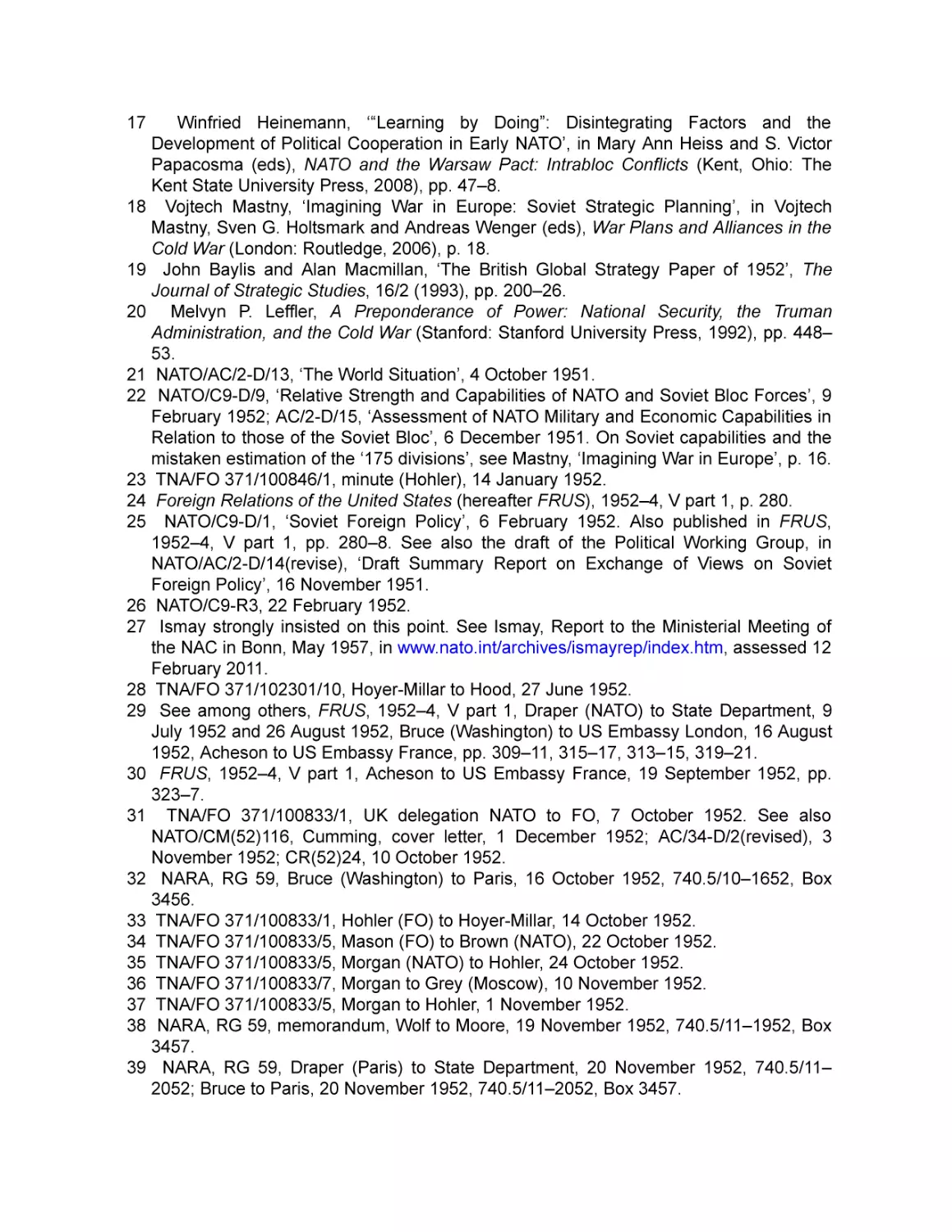
1 See, among others, Lawrence S. Kaplan, NATO and the United States (New York:
Twayne Publishers, 1994); John Duffield, Power Rules: The Evolution of NATO’s
Conventional Force Posture (Stanford: Stanford University Press, 1995); Beatrice
Heuser, NATO, Britain, France and the FRG: Nuclear Strategies and Forces for Europe,
1949–2000 (Basingstoke: Macmillan, 1998); Vojtech Mastny, ‘The Warsaw Pact as
History’, in Vojtech Mastny and Malcolm Byrne (eds), A Cardboard Castle? An Inside
History of the Warsaw Pact, 1955–1991 (Budapest: Central European University, 2005),
pp. 1–74; Phillip A. Karber and Jerald A. Combs, ‘The United States, NATO and the
Soviet Threat to Western Europe: Military Estimates and Policy Options, 1945–1963’,
Diplomatic History, 22/3 (1998), pp. 399–429; Matthew Evangelista, ‘The “Soviet
Threat”: Intentions, Capabilities and Context’, Diplomatic History, 22/3 (1998), pp. 439–
49; Vojtech Mastny, ‘Imagining War in Europe: Soviet Strategic Planning’, in Vojtech
Mastny, Sven G. Holtsmark and Andreas Wenger (eds), War Plans and Alliances in the
Cold War (London: Routledge, 2006), pp. 15–45. See also the activity of the Cold War
International History Project (hereafter CWIHP), and of the Parallel History Project on
NATO and the Warsaw Pact (PHP).
2 Studies of NATO and Western perceptions tend to focus on a higher level, mostly
discussions in the North Atlantic Council, and particularly among Ministers: see Robert
Spencer, ‘Alliance perceptions of the Soviet Threat, 1950–1988’, in Carl-Christoph
Schweitzer (ed.), The Changing Western Analysis of the Soviet Threat (London: Pinter,
1989), pp. 9–48; Anna Locher and Christian Neunlist, ‘What role for NATO? Conflicting
Western Perceptions of Détente, 1963–65’, Journal of Transatlantic Studies, 2/2 (2004),
pp. 185–208. A first effort to study the alliance analysis papers can be found in Evanthis
Hatzivassiliou, ‘Images of the Adversary: NATO Assessments of the Soviet Union,
1953–1964’, Journal of Cold War Studies, 11/2 (2009), pp. 89–116.
3 Lawrence S. Kaplan, ‘The Development of the NATO Archives’, Cold War History, 3/3
(2003), pp. 103–6.
4 London, The National Archives (hereafter TNA), FO 371/162000/13, Donald (NATO) to
Edmonds (FO), 27 March 1962.
5 TNA/FO 371/137793/1, Roberts to Selwyn Lloyd, 28 February 1958, annual review for
1957.
6 The ascent of Russian studies and its impact on US analysis have been researched.
See David C. Engerman, Know Your Enemy: the Rise and Fall of America’s Soviet
Experts (Oxford: Oxford University Press, 2009), especially pp. 97–128 on studies of
the Soviet economy, and 180–232 on the Soviet society and the political system.
7 Lawrence S. Kaplan, The United States and NATO: the Formative Years (Lexington,
Ky: The University Press of Kentucky, 1984), p. 189; Robert Jervis, ‘Was the Cold War
a Security Dilemma?’, Journal of Cold War Studies, 3/1 (2001), pp. 36–60.
8 Melvyn P. Leffler, A Preponderance of Power: National Security, the Truman
Administration, and the Cold War (Stanford: Stanford University Press, 1992).
9 Vojtech Mastny, The Cold War and Soviet Insecurity: the Stalin Years (Oxford: Oxford
University Press, 1996). See also, among others, Caroline Kennedy-Pipe, Stalin’s Cold
War: Soviet Strategies in Europe, 1943 to 1956 (Manchester: Manchester University
Press, 1995); Gerhard Wetting, Stalin and the Cold War in Europe: the Emergence and
Development of East–West Conflict, 1939–1953 (Lanham: Rowman and Littlefield,
2008); Beatrice Heuser, ‘Stalin as Hitler’s Successor: Western Interpretation of the
Soviet Threat’, in Beatrice Heuser and Robert O’Neill (eds), Securing Peace in Europe,

1945–62: Thoughts for the Post-Cold War Era (Basingstoke: Macmillan, 1992), pp. 17–
40.
10 Henry A. Kissinger, The Troubled Partnership (New York: McGraw-Hill, 1965), p. 196.
11 Robert Jervis, Perception and Misperception in International Politics (Princeton:
Princeton University Press, 1976), p. 82.
12 Mark Kramer, ‘Ideology and the Cold War’, Review of International Studies, 25/4
(1999), pp. 539–76; Douglas J. Macdonald, ‘Formal Ideologies in the Cold War: toward
a Framework for Empirical Analysis’, in Odd Arne Westad (ed.), Reviewing the Cold
War: Approaches, Interpretation, Theory (London: Frank Cass, 2000), pp. 180–204;
Leopoldo Nutti and Vladislav Zubok, ‘Ideology’, in Saki Dockrill and Geraint Hughes
(eds), Cold War History (Basingstoke: Palgrave Macmillan, 2006), pp. 73–110; Odd
Arne Westad, ‘The Cold War and the International History of the Twentieth Century’, in
Melvyn P. Leffler and Odd Arne Westad (eds), The Cambridge History of the Cold War,
Vol. I (Cambridge: Cambridge University Press, 2010), pp. 1–19.
13 Vladislav M. Zubok, A Failed Empire: The Soviet Union in the Cold War from Stalin to
Gorbachev (Chapel Hill: The University of North Carolina Press, 2007), p. 163.
14 Jonathan Haslam, Russia’s Cold War: from the October Revolution to the Fall of the
Wall (New Haven and London: Yale University Press, 2011), p. 76.
15 See, among others, Robert Jervis, ‘Identity and the Cold War’, in Leffler and Westad
(eds), The Cambridge History of the Cold War, Vol. II, pp. 22–43.
16 Melvyn P. Leffler, For the Soul of Mankind: the United States, the Soviet Union and the
Cold War (New York: Hill and Wang, 2007), p. 3.
17 See the interesting connection between ideology, the economy and alliance cohesion
in John Lewis Gaddis, We Now Know: Rethinking Cold War History (Oxford: Oxford
University Press, 1997), pp. 189–200.
18 David G. Engerman, ‘The Romance of Economic Development and New Histories of
the Cold War’, Diplomatic History, 28/1 (2004), pp. 23–54; Charles S. Maier, ‘The World
Economy and the Cold War in the Middle of the Twentieth Century’, in Leffler and
Westad (eds), The Cambridge History of the Cold War, Vol. I, pp. 44–66; Wilfried Loth,
‘The Cold War and the Social and Economic History of the Twentieth Century’, in Leffler
and Westad (eds), The Cambridge History of the Cold War, Vol. II, pp. 503–23.
19 NATO Archives, Brussels, International Staff, TYP/US(60)1, US document, ‘NATO in
the 1960s: Non-military Guidelines for the Future’ (pp. 7 and 59–60), conveyed by
Burgess to Permanent Representatives, 29 October 1960.
20 Melvyn P. Leffler, ‘Bringing It Together: the Parts and the Whole’, in Westad (ed.),
Reviewing the Cold War, p. 57.
21 See, among others, Geoffrey Roberts, The Soviet Union in World Politics: Coexistence,
Revolution and the Cold War, 1945–1991 (London: Routledge, 1999), especially pp. 5–
9.
22 Archie Brown, The Rise and Fall of Communism (London: Vintage, 2010), pp. 117–34.
23 Vojtech Mastny, ‘NATO in the Beholder’s Eye: Soviet Perceptions and Policies, 1949–
56’, CWIHP Working Paper No. 35, Washington, DC, 2002.
24 See, among many others, Constantine Pleshakov, ‘Studying Soviet Strategies and
Decision-making in the Cold War Years’, in Westad (ed.), Reviewing the Cold War, pp.
236–7; David Priestland, ‘Cold War Mobilization and Domestic Politics: the Soviet
Union’, in Leffler and Westad (eds), The Cambridge History of the Cold War, Vol. I, pp.
442–63; Peter Gatrell, ‘Economic and Demographic Change: Russia’s Age of Economic
Extremes’, and Lewis H. Siegelbaum, ‘Workers and Industrialization’, in Ronald Grigor

Suny (ed.), The Cambridge History of Russia, Vol. III (Cambridge: Cambridge University
Press, 2006), pp. 383–410 and 440–67 respectively. See also the observation that after
Stalin all Soviet leaders preferred not to test the patience of the Soviet public, in Philip
Hanson, The Rise and Fall of the Soviet Economy: an Economic History of the USSR
from 1945 (London: Longman, 2003), p. 6. Last but not least, see the legitimizing
impact of the (evolving) narratives of the October Revolution during the first era of the
Soviet polity: Frederick C. Corney, Telling October: Memory and the Making of the
Bolshevik Revolution (Ithaca and London: Cornell University Press, 2004).
25 Thomas C. Wolfe, Governing Soviet Journalism: the Press and the Socialist Person
after Stalin (Bloomington: Indiana University Press, 2005), p. 208.
26 Joseph L. Nogee and Robert H. Donaldson, Soviet Foreign Policy since World War II
(New York: Macmillan, 1992), pp. 34–8.
27 Zbigniew Brzezinski, The Soviet Bloc: Unity and Conflict (Cambridge, Mass.: Harvard
University Press, 1960), p. 406.
28 Aleksandr Fursenko and Timothy Naftali, Khrushchev’s Cold War: the Inside Story of
an American Adversary (New York and London: W.W. Norton, 2006), p. 17. See also,
Ronald Grigor Suny, ‘Reading Russia and the Soviet Union in the Twentieth Century:
How the “West” wrote its History of the USSR’, in Suny (ed.), The Cambridge History of
Russia, Vol. III, pp. 5–64.
29 Marc Trachtenberg, A Constructed Peace: the Making of the European Settlement,
1945–1963 (Princeton, NJ: Princeton University Press, 1999), pp. 63–5.
30 A. S. Milward, The Reconstruction of Western Europe, 1945–1951 (London: Methuen,
1984); Michael J. Hogan, The Marshall Plan: America, Britain and the Reconstruction of
Western Europe, 1947–1952 (New York: Cambridge University Press, 1987); William I.
Hitchcock, ‘The Marshall Plan and the Creation of the West’, in Leffler and Westad
(eds), The Cambridge History of the Cold War, Vol. I, pp. 154–74. On the nature of the
Marshall Plan see also the extremely interesting debate in Journal of Cold War Studies,
7/2 (2005), mostly Michael Cox and Caroline Kennedy-Pipe, ‘The Tragedy of American
Diplomacy? Rethinking the Marshall Plan’, pp. 97–133; Marc Trachtenberg, ‘The
Marshall Plan as Tragedy’, pp. 135–40; Charles S. Maier, ‘The Marshall Plan and the
Division of Europe’, pp. 168–74.
31 Timothy Ireland, Creating the Entangling Alliance: the Origins of the North Atlantic
Treaty Organization (London: Aldwych, 1981); Martin H. Folly, ‘Breaking the Vicious
Circle: Britain, the United States, and the Genesis of the North Atlantic Treaty’,
Diplomatic History, 12/1 (1988), pp. 59–77.
32 See for example, Ian Jackson, ‘“Rival Desirabilities”: Britain, East–West Trade and the
Cold War, 1948–51’, European History Quarterly, 31/2 (2001), pp. 265–87; Francine
McKenzie, ‘GATT and the Cold War: Accession Debates, Institutional Development, and
the Western Alliance, 1947–1959’, Journal of Cold War Studies, 10/3 (2008), pp. 78–
109.
33 See for example, Thomas W. Gijswijt, ‘Beyond NATO: Transnational Elite Networks
and the Atlantic Alliance’, in Andreas Wenger, Christian Nuenlist and Anna Locher
(eds), Transforming NATO in the Cold War: Challenges beyond Deterrence in the 1960s
(London: Routledge, 2007), pp. 50–63.
34 See among others, Klaus Schwabe, ‘Efforts towards Cooperation and Integration in
Europe, 1948–1950’, and Manfred Knapp, ‘Economic Aspects of the Creation of the
North American–Western European Alliance System (1948–1950)’, in Norbert
Wiggershaus and Roland G. Foerster (eds), The Western Security Community, 1948–

1950: Common Problems and Conflicting National Interests during the Foundation
Phase of the North Atlantic Alliance (London: Bloomsbury Publishing, 1994), pp. 29–44
and 343–74 respectively.
35 Kissinger, The Troubled Partnership, p. 3.
36 See, among others, Geir Lundestad, ‘Empire by Invitation? The United States and
Western Europe, 1945–1952’, Journal of Peace Research, 23/3 (1986), pp. 263–77;
Geir Lundestad, The United States and Western Europe since 1945: from ‘Empire’ by
Invitation to Transatlantic Drift (Oxford: Oxford University Press, 2003); Geir Lundestad,
‘Empire’ by Integration: the United States and European Integration, 1945–1997
(Oxford: Oxford University Press, 1998), especially pp. 40–82; Trachtenberg, A
Constructed Peace; Leffler, A Preponderance of Power, pp. 211–13, 234–5, 280–2,
285–6 and 350–1; John W. Young, Britain, France and the Unity of Europe, 1945–1951
(Leicester: Leicester University Press, 1984), pp. 99–107; Lawrence S. Kaplan, ‘NATO
United, NATO Divided: the Transatlantic Relationship’, in Mary Ann Heiss and S. Victor
Papacosma (eds), NATO and the Warsaw Pact: Intrabloc Conflicts (Kent, Ohio: The
Kent State University Press, 2008), pp. 3–24; Ralph Dietl, ‘Towards a European “Third
Force”? Reflections on the European Political and Security Cooperation, 1948–1964’, in
Christian Nuenlist and Anna Locher (eds), Transatlantic Relations at Stake: Aspects of
NATO, 1956–1972 (Zurich: Center for Security Studies, 2006), pp. 23–50.
37 John Lewis Gaddis, Strategies of Containment: a Critical Appraisal of Postwar
American National Security Policy (Oxford: Oxford University Press, 1982), pp. 36–42.
38 See among others, John Kent and John W. Young, ‘British Policy Overseas: the “Third
Force” and the Origins of NATO – in Search of a New Perspective’, in Heuser and
O’Neill (eds), Securing Peace in Europe, pp. 41–61; Wilfried Loth, The Division of the
World, 1941–1955 (London: Routledge, 1988), pp. 175–95.
39 See also Norbert Wiggershaus, ‘The German Question and the Foundation of the
Atlantic Pact’, in Joseph Smith (ed.), The Origins of NATO (Exeter: The University of
Exeter Press, 1990), pp. 113–26; by the same author, ‘The Other “German Question”:
The Foundation of the Atlantic Pact and the Problem of Security against Germany’, in
Ennio di Nolfo (ed.), The Atlantic Pact Forty Years Later: a Historical Reappraisal
(Berlin: de Gruyter, 1991), pp. 111–26; Christian Greiner, ‘The Defence of Western
Europe and the Rearmament of West Germany, 1947–1950’, in Olav Riste (ed.),
Western Security: the Formative Years. European and Atlantic Defence, 1947–1953
(Oslo: Norwegian University Press, 1985), pp. 150–77.
40 Vojtech Mastny, ‘NATO in the Beholder’s Eye’, p. 92.
41 See, among others, Vojtech Mastny, ‘The Warsaw Pact: An Alliance in Search of a
Purpose’, in Heiss and Papacosma (eds), NATO and the Warsaw Pact, pp. 141–60.
42 Hugh Farrington, Confrontation: the Strategic Geography of NATO and the Warsaw
Pact (New York: Routledge and Kegan Paul, 1986), p. 143; see also pp. 138–50 (the
analysis refers mostly to the late Cold War period).
43 On the commonality of ideals, the concept of the Atlantic Community, and the
Canadian role in its projection see Robert S. Jordan, Political Leadership in NATO: a
Study in Multilateral Diplomacy (Boulder, Colorado: Westview Press, 1979), pp. 14–18;
Andreas Wenger, Christian Nuenlist and Anna Locher, ‘New Perspectives on NATO
History’, and Jeremi Suri, ‘The Normative Resilience of NATO: a Community of Shared
Values amid Public Discord’, in Wenger, Nuenlist and Locher (eds), Transforming NATO
in the Cold War, pp. 3–12 and 15–30; Beatrice Heuser, Transatlantic Relations: Sharing
Ideas and Costs (London: The Royal Institute of International Affairs, 1996).

44 Linda Risso, ‘“Enlightening Public Opinion:” A Study of NATO’s Information Policies
between 1949 and 1959 Based on Recently Declassified Documents’, Cold War
History, 7/1 (2007), pp. 45–74; Giles Scott-Smith, ‘Not a NATO Responsibility?
Psychological Warfare, the Berlin Crisis, and the Formation of Interdoc’, in Wenger,
Nuenlist and Locher (eds), Transforming NATO in the Cold War, pp. 31–49.
45 Wenger, Nuenlist and Locher, ‘New Perspectives on NATO History’, pp. 3–4.
46 Spencer, ‘Alliance Perceptions of the Soviet Threat’, p. 9.
47 Ronald S. Ritchie, NATO: the Economics of an Alliance (Toronto: The Ryerson Press,
1956), pp. 25–32.
48 Hanson, The Rise and Fall of the Soviet Economy, p. 6.
49 See a similar analysis in a work which became part of a series on the history of
European civilization edited by Geoffrey Barraclough: J. P. Nettl, The Soviet
Achievement (Norwich: Harcourt, Brace and World, 1967). A similar thought was
expressed in the groundbreaking work by William H. McNeill, The Rise of the West:
History of the Human Community (Chicago: The University of Chicago Press, 1963).
50 In this respect, the term ‘démocraties populaires’, employed in the title of a major work,
seems a more sound theoretical option: François Fejtö, Histoire des démocraties
populaires, 2 Vols (Paris: Editions du Seuil, 1969).
51 NATO, Research Section, ‘The Evolution of NATO Political Consultation, 1949–1962’, 2
May 1963, NATO/NHO/63/1, www.nato.int/archives/docu/d630502e.htm, assessed 12
February 2011.
52 See the analysis of the American ‘empire of liberty’, the Soviet ‘empire of justice’ and
the search of Third World leaders in Odd Arne Westad, The Global Cold War
(Cambridge: Cambridge University Press, 2007), pp. 8–109. See also Mark Philip
Bradley, ‘Decolonization, the Global South and the Cold War, 1919–1962’, and Michael
E. Latham, ‘The Cold War in the Third World, 1963–1975’, in Leffler and Westad (eds),
The Cambridge History of the Cold War, Vol. I, pp. 464–85 and Vol. II, pp. 258–80
respectively.
53 John Kent, ‘NATO, the Cold War and the End of Empire’, and Frode Liland, ‘Explaining
NATO’s Non-Policy on Out-of-Area Issues during the Cold War’, in Gustav Schmidt
(ed.), A History of NATO: the First Fifty Years, Vol. 1 (Basingstoke: Palgrave, 2001), pp.
141–52 and 173–89 respectively; Lundestad, The United States and Western Europe
since 1945, pp. 142–67.
54 Evanthis Hatzivassiliou, ‘Out-of-Area: NATO Perceptions of the Third World, 1957–
1967’, Cold War History, 13/1 (2013), pp. 67–88.
55 TNA/FO 371/111684/5, minute (Hohler), 23 March 1954.
56 TNA/FO 371/113684/5, Hohler (FO) to Brown (NATO), 13 April 1954.
57 TNA/FO 371/102301/2, minutes (Hood), 8 November 1951 and 23 January 1952;
TNA/FO 371/106529/5, Mason to Broadmead, 12 March 1953.
58 Washington DC, National Archives and Records Administration (hereafter NARA), RG
59, Hoover (State Department) to Paris, 24 October 1955, 740.5/10–2455, Box 3122.
59 NARA, RG 59, Martin (Paris) to State Department, 12 April 1955, 740.5/4–1255, Box
3116.
60 TNA/FCO 28/22/12, Bushell (NATO) to Smith (FO), 2 April 1968.
61 TNA/FCO 41/607/4, minute (Waterfield), 9 February 1970.
62 TNA/FO 371/137828/1, Roberts (NATO) to Hancock (FO), 26 September 1958.
63 See The Diplomatic Service List, 1967 (London: HMSO, 1967), pp. 237 (Hooper) and
317 (Shuckburgh). Another Briton holding a major NATO post in the 1950s was the

Executive Secretary Lord Coleridge, who had little competence in matters connected
with the subject of this book.
64 TNA/FO 371/113217/1, Steel to Eden, 3 February 1954.
65 TNA/FO 371/100846/1, minute (Hohler), 14 January; FO 371/100847, minute (Uffen), 3
March 1952.
66 TNA/FO 371/133300/1, Benson (FO) to Cheetham (NATO), 28 November 1958.
67 Robert S. Jordan, The NATO International Staff/Secretariat, 1952–1957: a Study in
International Administration (London: Oxford University Press, 1967), pp. 19–45 and
289; Jordan, Political Leadership in NATO, pp. 23–54; NATO, Lord Ismay, Report to the
Ministerial
Meeting
of
the
NAC
in
Bonn,
May
1957,
in
www.nato.int/archives/ismayrep/index.htm, assessed 12 February 2011; Lord Ismay,
NATO: The First Five Years, 1949–1954, at www.nato.int/archives/1st5years/index.htm,
assessed 12 February 2011. See also Kaplan, NATO and the United States, pp. 32–49.
68 Alan S. Milward, ‘NATO, OEEC, and the Integration of Europe’, in Francis H. Heller and
John R. Gillingham (eds), NATO: the Founding of the Atlantic Alliance and the
Integration of Europe (Basingstoke: Macmillan, 1992), pp. 241–52.
69 Charles S. Maier, ‘Finance and Defense: Implications of Military Integration, 1950–
1952’, in Heller and Gillingham (eds), NATO, pp. 335–51.
70 Michael H. Smith, ‘The Political Economy of Transatlantic Relations: Forces of History
and the Shadow of the Future’, in Schmidt (ed.), A History of NATO, Vol. 1, pp. 289–
304.

1 A new look at the opponent, 1951–6
Testing the ground, 1951–2
In the early NATO structure, until 1952, the NAC met only at the
ministerial level. A lower-level body of diplomats, the Council
Deputies, was assisted by the Political Working Group, which
produced background papers. Political consultation was in its
infancy. Every member of the Council Deputies could raise an issue,
provided that there was enough notification to the other members to
prepare for the discussion. The NAC encouraged the exchange of
views, noting that this was useful particularly ‘to the smaller countries
who did not enjoy the same facilities as the larger countries for
obtaining information from widely differing sources’.1 Yet, intra-NATO
discussions focused mostly on the post-Korean War military build-up,
coordination on infrastructure, the appointment of a Supreme
Commander in Europe and German rearmament. The discussion on
the ‘survey of the world situation’ during the December 1950 NAC
involved mainly NATO’s military effort and the Soviet military threat;
nothing was mentioned about the Soviet regime or its economy.2 By
that time, NATO cooperation on the non-military field focused on the
organization of an allied information service: this, according to the
Americans, was necessary to strengthen the European public’s
support for the common defence effort.3
Things began to change in 1951. The Council Deputies discussed
various questions ‘of common political concern’, including the
situation in the Soviet Union and Eastern Europe.4 The first topic
was Yugoslavia, for which Western fears had peaked after the start
of the Korean War; in fact, the Yugoslav discussion set the pattern
for the debate on other Eastern European countries in the following

months.5 The Council Deputies concluded that Yugoslavia’s breach
with Moscow had become unbridgeable; the West should help Tito
preserve his independence from Moscow.6 On the special case of
East Germany, two months later, they noted that no active resistance
was to be expected: the East German economy was improving, and
despite its unpopularity, the regime seemed to be making inroads
into East German public opinion.7 A similar examination of
conditions in Hungary, Romania, Bulgaria and Albania suggested
that the regimes were firmly established, although peasant hostility
remained strong. Economic conditions were bleak and consumer
goods were in short supply, but rapid progress was being made on
the field of industrialization, even if planning seemed overambitious.8 On Poland and Czechoslovakia, the Council Deputies
suggested that, despite the essentially Western identity of these
nations, the monopoly of communist education and propaganda was
having an effect on the public opinion.9 Thus, at that moment the
NATO officials feared that the pro-Soviet leaderships could shape
East European opinion and gain legitimacy. It was only later – after
the 1953 East German riots and mostly after the 1956 Hungarian
Revolution – that the NATO authorities became more confident
regarding the fundamental unpopularity of the Eastern European
regimes.
This first round of analysis was crowned by a study of political and
economic conditions in the Soviet Union. However, it soon became
apparent that it was not easy to monitor the main Cold War
adversary. The discussion in the Political Working Group was poorly
organized, political considerations tended to blur the needs of
accurate analysis and the limits between the various NATO bodies
had not yet been delineated. Thus, the French Deputy, Hervé
Alphand, wanted the Deputies to include Soviet military capabilities
in their report. This was accepted by the other members, but then
the French, who faced the discomfort of their public opinion for the
European Defence Community (EDC), wanted the report to state
that if the West rearmed, the Soviet Union could evolve to become a

better neighbour. The French hoped to make the EDC more
acceptable to their public, but this was a political consideration, and
other delegations stressed that there were no indications of a ‘Soviet
evolution’. On top of that, the military authorities refused to disclose
military information on grounds of security. This also raised the
question of the competence of different alliance bodies. In the end,
the Council Deputies also discussed military potential, as an aspect
of Soviet power. The process was dominated by Alphand, the US
Deputy, Charles M. Spofford, the US Vice-Deputy, Theodore C.
Achilles, and the British Sir Frederick Hoyer-Millar, while the drafting
was also assisted by national experts, such as Hugh Morgan of the
FO.10 Still, when the report became available, the discussion of the
Deputies revealed a notable similarity of views of the member-states
regarding the main adversary.11 The NATO members were eager to
unite in the face of a strong opponent.
The report of the Council Deputies reveals the awe of the West
when facing the Eastern superpower of the late Stalinist period:
There can be no doubt about the internal stability of the Soviet
regime. It is probably more secure today than it has been at any
time since 1917, and unless some chance or outside agency (e.g.
world war) brings about a radical change it is likely in future to
become even stronger.
The Council Deputies considered that even the death of Stalin would
not cause a split in the party or a modification of the system of
government. Living standards were improving gradually, and there
was little chance for an effective opposition. Intellectuals showed
little sign of unrest, and nationalism, although a potent force, had
been reconciled with the system through the granting of cultural
autonomy. The Soviet Union’s vast natural resources ensured its
continuing development, especially in the industrial sector, and the
Soviet economy already had surpassed pre-war levels. The poor
state of the transportation system was considered a major long-term
impediment for growth.12

These documents were submitted to the Ottawa NAC in
September 1951. The Ministers devoted two consecutive sessions to
the discussion of the ‘world situation’, and noted that, apart from the
danger of invasion, social and economic realities facilitating
communist subversion should be taken into account.13 In the
November 1951 NAC, the discussion on the ‘survey of the world
situation’ included the Far East, Indochina and the Middle East.14
Still, at this stage of the Korean War, the Ministers mostly dealt with
the military threat. A prime aspect of this threat involved the
capabilities of the Soviet economic system to support a major war
effort. This subject was examined both in June by the Council
Deputies (in their report of the Soviet Union) and in November by the
military authorities, in a document on which the Council Deputies
also commented; the latter focused on Soviet military capabilities to
act against NATO in the period 1951–4 and the Soviet economy’s
ability to maintain and increase military forces even after the
outbreak of a war. The two documents noted that the Soviet Union
was not as developed industrially as the West, but possessed the
necessary manpower, and devoted huge resources to its war
industries. Its economy ‘in all branches affecting the Soviet Union’s
capacity to wage war, is stronger than at the beginning of World War
II’ (June 1951). The Soviet Union was largely self-sufficient in war
materials, and was already stockpiling those which it did not
possess. The Kremlin had kept its munitions industries running.
Many plants had been converted to peacetime production, but had
been designed to revert quickly to wartime use (for example tractor
factories to turn to tank manufacture). As for its capacity in war, the
Soviet economy was capable of supporting both the existing
formations and the additional ones which would be formed after the
outbreak of hostilities. For example it was expected to increase its
annual output of aircraft from 8,000–10,000 to 40,000–50,000 within
two years after going into full war production. Its vulnerability to
Western air attacks against its industries would be its major problem.
In other words, the Soviet system maintained a high readiness to go
to war, and the central control over the economy facilitated the

transition from peace to war production. In fact, the Soviet Union’s
economic preparedness for war was expected to rise compared to
the West’s.15 The two documents tended to exaggerate the
capabilities of the Soviet economy, but also supported the need for a
sustained NATO effort to rearm.
At the same time, the Atlantic Community Committee (the socalled Pearson Committee consisting of Foreign Ministers Halvard
Lange of Norway, Alcide de Gasperi of Italy, Lester Pearson of
Canada, Dirk Stikker of Holland and Paul van Zeeland of Belgium)
was set up to make recommendations for the strengthening of nonmilitary cooperation according to Article 2 of the Treaty. The
Committee noted the need to discuss political issues, including outof-area problems.16 However, the Americans felt uncomfortable
about this prospect, fearing that it would limit their freedom of action
in the Cold War.17 Thus, NATO had started discussing wider political
and economic aspects of the Cold War, although the first reports on
the Soviet bloc were rather simplistic, if not timid, descriptions of its
realities.
Meanwhile, by late 1951 and early 1952, the stalemate in Korea
and the debate on German rearmament raised a different question.
Even if, during the Korean War, Stalin had been tempted to consider
an invasion of Europe,18 the West was in the process of raising an
effective military deterrent. Perhaps the West now needed to prepare
itself for a protracted Cold War. This line of thinking finally emerged
in the 1952 British Global Strategy Paper, which placed its emphasis
on the new concept of deterrence and on nuclear weapons, rather
than on a huge and costly conventional military establishment.19
Although the first British attempts to change NATO strategy met with
the opposition of the Truman administration, which focused on the
rapid building of NATO’s military capabilities,20 London now raised
the question of a long Cold War, in which it would be imperative to
establish a better understanding of Soviet aims and potential. In
October 1951, a separate British paper was annexed to the report of
the Political Working Group on the ‘world situation’, arguing for the

need to place emphasis on the economic realities, to raise the
standard of living, and to develop the non-military purposes of
NATO.21
In late 1951, during the Rome NAC, the NATO Ministers decided
to ask for a comprehensive document discussing Soviet ‘aims and
means’. This was presented during the Lisbon meeting of the NAC in
February 1952, together with a comparison of Soviet bloc and NATO
military strength, which sketched a gloomy picture of the balance of
conventional forces, and referred to ‘175 Soviet line divisions’, an
estimation which, as we now know, was inaccurate. This document,
moreover, once more stressed the potential, the output and the
operational readiness of Soviet war industries. The Soviets had the
necessary manpower, but faced a ‘scarcity of skilled labour’; even
so, their industries could concentrate on the more essential military
equipment. Armament production was kept running since 1945, and
thus large stocks of weapons existed. It was only on the sector of
transport, with its major difficulties, that the Soviet war effort was
going to face major problems. Evidently, these estimations were also
meant to convince reluctant Europeans to step up their defence
effort.22
The February 1952 document on Soviet foreign policy was based
on a British draft (with the FO’s Hugh Morgan again as the major
expert),23 and represented the first NATO attempt to sketch a fuller
picture of the Kremlin’s international conduct. Its drafting was telling
of some intra-alliance differences. Thus, the US delegation
disagreed with the notion that the Soviet intelligentsia supported the
regime. The Americans also were not fully comfortable with the
paper’s rather ‘relaxed’ attitude towards communist China.24 In its
final form, the report reproduced the dominant perception in the
West since the days of George Kennan’s 1946 Long Telegram,
namely the notion that Soviet foreign policy was ‘the offspring of a
marriage between traditional Russian imperialism and Communist
doctrine’, and aimed at the establishment of a communist world
order. The NATO analysts considered that the first priority of the

Kremlin was to protect the Soviet power base, and to deal with the
constant Russian/communist fear of encirclement. The Soviets’
insistence on the incompatibility of the social systems meant that
they were responsible for international tensions: ‘It can be
considered that the cold war waged by the Soviet Union since the
end of the Second World War is a logical expression of Communist
ideology’. War by proxy also was considered as a likely Soviet
option, although its attractions seemed to have decreased after
Korea. According to the report, Soviet policy aimed to disrupt NATO
and paralyse any anti-communist power combination; control
Eastern Europe and overthrow Tito (though not necessarily through
an invasion of Yugoslavia); divide the US from the European
members of NATO; control Germany, ‘the key to control of all
Europe’; and prevent West German participation in Western defence.
However, the document also stressed that the Soviets would
probably tolerate West German disarmament if some safeguards
were established. Last but not least, the Kremlin aimed to eliminate
Western influence in other parts of the world. The Sino-Soviet
relationship seemed to be cordial, but did not resemble the absolute
Soviet control of Eastern Europe. It was also stated that in the
Middle East and North Africa conditions were favourable for the
Soviets to subvert Western influence. However, in these regions
communist parties were weak, and Moscow was more likely to
cooperate with nationalist ‘anti-imperialist’ forces and encourage
neutralism. The document cautioned that general war could not be
ruled out. Thus, ‘[t]he West should prepare for a long drawn-out
period during which they must remain firm and vigilant’.25
This document directly referred to a protracted Cold War (the
emerging British thesis), but also to the high danger of a hot war (the
American prerequisite). It differed from subsequent analysis
documents in that it gave its emphasis on Soviet external policies,
and dealt summarily with internal realities in the annex (the Soviet
regime was described as stable, even in the event of Stalin’s death).
Yet, the document did not seem to have a significant impact: the
NAC at Lisbon merely took notice of its submission.26

Moving on to a comprehensive analysis, 1952–3
The first attempt, December 1952
After the Lisbon NAC, the emergence of a strong Secretary-General,
Lord Ismay, significantly affected the evolution of NATO reporting on
the non-military aspects of Soviet power: Ismay represented a
strengthening of British influence, and thus pressed for preparing for
a long Cold War. Moreover, Ismay now led an NAC in permanent
session: the Permanent Representatives were not merely deputies,
but fully expressed the positions of their countries.27 At the same
time, additional developments seemed to point to the need for better
consultation. In summer 1952 the smaller NATO powers strongly
reacted when the Standing Group powers (the US, Britain and
France) replied to the Soviet note on Germany without consulting
their allies. In June, the Norwegian Permanent Representative, Arne
Skaug, suggested the creation of a formal NATO Political Committee
to discuss relevant issues; the larger powers rejected the notion of a
standing committee, but the British thought that ad hoc working
groups could be useful in this juncture.28 In September, the proposal
of the French Permanent Representative, Alphand, to turn NATO into
a global strategy body was rejected by the other members of the
alliance, as it would expand the alliance’s competence outside the
treaty area.29 On its part, the US was concerned about the tendency
of the European allies to consider that the military threat had eased,
at a time when the Americans were shouldering the burden of the
Korean War and of European defence. By September, the US
Secretary of State, Dean Acheson, summarized his government’s
position: the US should accept expanded consultation, but this
should not result in the Americans limiting their own freedom of
action. Acheson preferred to allow the NATO Secretariat to draft the
relevant papers, on which the US delegation would comment, rather
than to submit a US document, which could be leaked.30 This US
preference left the road open to the British, with their different ideas

on the Cold War, already incorporated in the Global Strategy Paper.
If nothing else, the British were prepared to do the drafting.
In early October, the NAC discussed the forthcoming 19th
Congress of the Communist Party of the Soviet Union (CPSU).
Skaug, the Norwegian Permanent Representative, asked for a paper
on Soviet foreign policy. Despite US objections (the Americans
wanted to place emphasis on military issues), the NAC approved a
proposal by the British Permanent Representative, Sir Frederick
Hoyer-Millar, to set up an ad hoc working group on ‘trends of Soviet
policy’, under the Deputy Assistant Secretary for Political Affairs,
Hugh Cumming, a US diplomat with former service in Moscow.31
This was going to be a new process, and the British managed to
control it from the start. In fact, the State Department underestimated
the novelty of the venture, instructing the US delegation to use the
February paper as a basis for the report.32 On the contrary the
British Russia Committee was already preparing similar papers. In
other words, the British were well ahead of the rest in this subject.33
At the same time, the British managed to block Cumming’s ideas for
bringing in major experts such as Charles Bohlen or George
Kennan. The British insisted that the Permanent Representatives
should control the process, while the drafting should be made by
lower-level experts: ‘only the United States, after all, happens to
possess an unemployed one-man delegation like Kennan’.34 In the
first meeting of the working group, it was apparent that three experts
(the FO’s Hugh Morgan, the French Jean Laloy, and Dick Davis, the
head of the State Department’s Soviet desk) would draft the report,
which would then be submitted to governments. As Morgan reported
to the FO, ‘so we have gained our main point’.35
This became evident during the meetings of the group. Morgan
noted that ‘since I was armed with the paper that we had already
produced in the Foreign Office, the enclosed draft is very largely
based on that’.36 This meant that the draft report largely reflected
British thoughts about the long Cold War. It even avoided mentioning
the ultimate Soviet aim of world domination which had been stressed

by the previous NATO reports. Morgan, barely hiding his
characteristically British contempt for such big words, commented:
In fact [the American expert] Dick Davis (whether speaking for the
State Department or not, I don’t know) has come to have doubts
whether the Soviet leaders really do think in their heart of hearts
that they can govern the whole world. Rather than risk any
speculation on so esoteric a point of eschatology, the drafting
group just left it out.37
During this transitory phase of the Cold War, the production of such a
‘forward’ draft inevitably stirred reactions. In Washington, the
American administration had grave doubts about the draft. The US
did not care much about the phraseology regarding the Soviet
intention to establish a communist world order; the State Department
itself regarded this as an uncertain statement. However, according to
the US view, the working group had not gone ‘deeply enough into the
question of Soviet intentions’, and considered that war could be
triggered mainly by Soviet miscalculation. The Americans were also
concerned at the inconsistencies regarding Soviet intentions
between the Soviet political report and the military capabilities
papers by NATO. These could encourage European relaxation of the
defence effort, a major American fear of that time.38 Even then,
however, Washington, focusing on the military dimension of the
NATO effort, underestimated the process. Although the US
delegation in Paris pressingly asked for the quick return of Davis, the
American expert, and reported some ‘“doctrinal” changes in Soviet
for[eign] policy paper’, the State Department proved too slow in its
reactions.39 The American demands for changes were put forward
in early December, after the last meeting of the working group, and
were not fully incorporated in the final report. The Americans wanted
the report to note that ‘Soviet leaders look forward to the eventual
establishment of a Communist world order, dominated and directed
from Moscow’ (although specific Soviet initiatives could not be
predicted), and to state clearly that Soviet ‘deliberate aggression’

could not be excluded; also, to delete the phrase that the Soviets
‘seem unlikely to want a major war in any near future’.40 The British
did not consider the point on the communist world order as worth
fighting for, but regarded some of the proposed amendments (for
example Soviet deliberate aggression) as unacceptable. They opted
to settle this difference with the Americans ‘outside the NATO
Working Group’. They suggested a compromise wording; in case this
was not agreed they were ‘prepared to let the original report go
forward with the United States position stated as a minority view (it is
believed that the other NATO members would support us in this)’.41
The Americans did not want the NAC to appear divided, and decided
to accept the report with minor changes, but also to make a
statement during the ministerial meeting.42 The episode was
indicative of the tensions of that era, but also of the nature of NATO
as a union of sovereign states: facing the danger that their thesis
would be recorded as a minority view in NATO, the Americans had to
give way. The brief for the British Foreign Secretary, Anthony Eden,
noted with satisfaction that the report reproduced the British view of
the long Cold War, arguing that NATO should take into account the
economic prospects and the emergence of new weapons.43
The final report was a long document, dealing with a variety of
issues, from Soviet internal and foreign policies and economic
prospects, to the nature of Soviet rule in Eastern Europe, and Soviet
intentions regarding the ‘underdeveloped’ world. It will be seen in this
book that, at later stages, these areas would become the subject of
different, specialized documents. However, the December 1952
report was the first of its kind, and set the pattern for subsequent
ones. The working group concluded that the Kremlin’s strategy and
ideology remained unchanged, although variations in tactics could
be expected. The Soviet leaders’ confidence had grown considerably
since the end of the Second World War: they believed that they
would outpace the West in economic development, and seemed to
regard the development of Soviet economic strength as ‘the key not
only to their security but to the outcome of the “two worlds” struggle’.

Yet, it was unlikely that the Soviets would prefer an armed
confrontation with the West. Indeed, the working group stressed that
the Kremlin had not yet decided whether the West meant war.
Stalin’s aims were to preserve the Soviet regime; consolidate and
protect the ‘Soviet orbit’; and expand Soviet control. As regards
relations with the West, the Soviets aimed to disrupt NATO, the
Marshall Plan and European integration, and to drive a wedge
between the US and Western Europe. Stalin believed in a life-anddeath struggle between the two worlds, and his basic strategy took
two forms. The first, ‘direct action’, involved military intervention by
the Kremlin ‘or by proxy (as in Korea)’, and subversion by force,
including internal revolution as had happened in Greece, Indochina
and Malaya, or coups as in the case of Czechoslovakia. ‘Indirect
action’, the second form of Soviet activity, involved non-violent
subversion, such as psychological pressure through propaganda
campaigns, economic pressure or political/diplomatic initiatives such
as proposals for non-aggression pacts. Stalin, the working group
continued, could also countenance tactical retreat when met by
superior force: ‘Soviet policy is thus within limits extremely flexible’.
There was only one overriding consideration for the Kremlin: the
need to protect the Soviet Union itself, namely, the seat of Stalin’s
power and the springboard of the revolution. Thus, the Soviets
‘cannot deliberately contemplate a total war unless they feel
reasonably assured of victory’.44
Despite its more relaxed tone regarding the Kremlin’s political
aims, the report again noted the huge capacities of the Soviet
economy to support a major war effort. The analysts stressed that
the Soviets preferred to maintain the numerical levels of their military
forces, and to ‘concentrate rather upon raising the long-term
economic and military potential of the Soviet Union’. The new fiveyear plan was expected to facilitate the supply of first-class modern
arms and munitions. The NATO experts were convinced that the
Soviets had since 1945 maintained an industrial base capable of
producing arms at a higher rate than its wartime peak, and that
defence expenditure since 1950 had mainly aimed to improve arms

and equipment. The potential of the Soviet economy to convert to a
war footing was again underlined. As regards administration, the
recent CSPU Congress had provided interesting evidence. The
replacement of the Politburo and the Orgburo by an enlarged
Presidium and Secretariat tended to confirm the trend of merging the
state and the party. On the other hand, Georgi Malenkov’s criticism
of malpractices in public life seemed to indicate that the country was
reaching a point where ‘further economic advance will be a matter of
technique rather than manpower and correspondingly more difficult’.
The report pointed out that the Soviets ‘have not solved the problem
posed by the emergence of a relatively privileged class who may
before long discover their own standard of life is more important than
world revolution’. Soviet capability to cause trouble ‘varies inversely
with Western strength and determination’, but Soviet aims remained
unaltered:
The containment policy increasingly caused a certain loss of
initiative on the Soviet side and concentration on negative aims at
countering Western moves. […] ‘“Peaceful co-existence” is in fact
no more than the Soviet name for the Soviet policy that we call “all
mischief short of war”’.45
The document then turned to the examination of Soviet policy in
various parts of the globe. The experts expected the Kremlin to
become more active in the periphery. The 19th CPSU Congress had
made a strong reference to anti-colonial struggles, aiming to sever
ties between the colonial peoples and the colonial metropoles. In the
same context, the Soviets appealed to peoples and countries in Latin
America, the Middle East and Asia which the West regarded
independent, but which, according to Soviet theory, continued to
suffer under the yoke of capitalist domination. Thus, NATO should be
prepared for the outbreak of economic warfare, especially in SouthEast Asia, where relatively small Soviet exports could make an
important difference. The report ended with a call for NATO vigilance
and unity, as the Cold War evolved to become a protracted struggle:

We can be certain only that the Soviet Government will be quick to
exploit any weakening or relaxation in the free world and will not
hesitate to revert to direct aggressive policy if they judge the
circumstances propitious. But as far as we can see provided the
Western world adheres to the course it has chosen, it is unlikely
that the Soviet Government would deliberately start general
hostilities. We can look forward to a period of cold war, lasting
perhaps many years, during which the Kremlin will maintain
unremitting pressure upon the free world. The foundation of their
policy is the conviction that they can win the psychological political
and economic battle now in progress for the minds of men.46
The report took sides in an intra-NATO discussion: it supported the
notions of the British Global Strategy Paper on the prospect of a
protracted Cold War, which embarrassed the Americans. On 16
December, the day when the ministerial NAC met, Acheson
intervened with a statement which was also circulated as an NAC
document. Acheson accepted the ‘well-stated and considered’
report, but noted that as long as ‘the initiative for aggressive action
rests with the Soviet Government we cannot flatly say that we can
prepare for a long, cold war without consideration of the real
possibility of a hot war’. Thus, Acheson continued, the Soviet Union,
as a totalitarian state, would always seek to perpetuate its own
power and would always keep open the option of the use of force;
any Soviet miscalculation of Western resolve could lead to war. The
US Secretary of State praised the report’s conclusion that the
continuation of Western defence effort could deter war.47 Acheson
thus went out of his way to stress that these studies should not lead
to a relaxation of Western military effort or of German rearmament.
During the discussion in the NAC, the British Foreign Secretary,
Eden, and his French counterpart, Robert Schumann, praised the
analysis of the working group, but also asked that the Chinese role in
Soviet policy be taken into account as well. Foreign Ministers Fuat
Köprülü of Turkey and Stephanos Stephanopoulos of Greece took
the opportunity to point out that, in a long bras de fer with the Soviet

world, NATO needed to aid the economic and social development of
its less developed members. Norway’s Halvard Lange insisted that
the subject be kept under ‘constant review’.48 Yet, it is interesting
that, despite his interventions prior to the NAC meeting, Acheson,
reporting to Truman, expressed his satisfaction at the discussions,
which showed the ‘basic unity of view and purpose among us’.49
This was indicative of the complicated relationships in an alliance
such as NATO.
It was pivotal for the development of the NATO analysis process
that a new US administration took over at that moment. Despite their
ideological rhetoric, President Dwight D. Eisenhower and his
Secretary of State, John Foster Dulles, believed that the Cold War
was now becoming a protracted conflict, in which alliances would
prove extremely important; the US should avoid an overextension of
military spending, which could also have a distorting effect on
American society itself.50 This meant that US reservations about the
British emphasis on the long Cold War would decrease:
Despite his long military career, Eisenhower tended to downplay
the military dimension of the Cold War, a tendency that Dulles
shared. Neither of them believed that a Soviet threat could be
regarded solely in military and nuclear terms, which the Truman
administration had seen as the main danger after the outbreak of
the Korean War. The Eisenhower administration saw the
Communist threat as a combination both of Soviet military power
and of a gradual Soviet political, psychological, and economic
encroachment into the West.51
Beyond Moscow: China and East–West trade, spring 1953
The December 1952 report did not exhaust the subject. As
requested by the NAC, a paper on China was prepared by the
Working Group on Trends in Soviet Policy. Before submitting its
report, the working group discussed the role of the Chinese
Communist Party (CCP) and the nature of the Sino-Soviet

relationship. It noted that even if disagreements occurred between
Moscow and Beijing, these would be submerged ‘in the dominant
identity of interests’, although it was unclear whether China would
prove an asset or a liability for Moscow.52 Initially the drafting was
entrusted to the French, but their text met with US and British
objections and the final draft was produced by the Foreign Office.53
However, the manner in which US objections were put forward was
telling for the Eisenhower administration’s determination to reassert
US control over the NATO analysis process, and to avoid a
European ‘imposition’ of views as had happened in December 1952.
Thus, in mid-March Dulles rejected the draft ‘in its present form […]
due to its length, factual inaccuracies and statements reflecting bias
of drafting officer’. The US suggested the acceptance of a British
submission as the basis for the report.54 In this way, the Americans
made clear that they could not be ‘ignored’ again; and by accepting
the British draft (despite the fact that their previous quarrel had been
with the British), they also showed that this was not merely an issue
of a barren ‘revenge’. Evidently, from this point onwards, the
European members were much more anxious to listen to US views
very carefully.
In its final report, the working group dealt extensively with the
history of relations between Soviet and Chinese communism, noting
that the strengths of the latter, which had developed before the
Second World War, had been ‘the result of policies not in accordance
with the precepts of the Comintern’. Relations between Moscow and
the CCP in 1945–9 were characterized by ‘hesitations and
uncertainties’, although after Mao’s victory the Chinese had entered
the ‘pro-Soviet phase’. The experts pointed to Beijing’s aid to the
insurgency in Indochina (in which ‘[t]he Soviet contribution seems to
be relatively unimportant’), and to the first Chinese Five-Year Plan of
1952 which depended on increased Soviet assistance. Mostly, the
Korean War provided evidence of ‘close coordination of policies
between China and the Soviet Union’, with China contributing the
manpower and Moscow the arms, equipment, technical advice and
training. In view of these, the experts tried to answer the main

question: was a split between Moscow and Beijing probable? They
saw four possible areas of Soviet–Chinese disagreements: Soviet
aid for the economic development of China; territorial problems in
Korea, Manchuria, Mongolia and Sinkiang; antagonism for
leadership in Asia; and differences over doctrine. On the latter, the
working group noted that Mao’s originality lay more in practical
politics rather than doctrine, but he might be less prepared to
unquestionably follow Stalin’s successors than the great Soviet
revolutionary himself. The study noted that the CCP assumed power
in China by its own efforts, and the country was now ‘a world power
in its own right’. Communist China was a ‘junior partner’ of the Soviet
Union, rather than a satellite, although differences with Moscow were
more likely to be submerged in the face of the common Western
enemy.55
A third analysis document on East–West trade was drafted by the
Secretariat, under Ismay’s direct supervision. It was presented in
June 1953, but the decision to draft it had been taken by the NAC on
4 March, following a proposal by the Turks, who feared Soviet
economic warfare against NATO countries.56 Although they did not
regard NATO as the appropriate forum to discuss economic issues,
the State Department officials accepted this discussion. It is notable
however that they also instructed their delegation in Paris to hold
informal discussions with the British and the French prior to the
submission of the report.57 It was clear that Washington would not
underestimate the NATO analysis process again, especially on a
subject which it regarded as important. After all, it was at American
insistence (and with considerable Western European opposition) that
the strategic embargo to the Soviet bloc had been imposed in the
previous years.58
In this report, ‘West’ was taken to mean ‘all the trading nations,
including Japan, outside the Soviet orbit’, and ‘East’ included the
PRC. The document noted that West European exports to Eastern
Europe were about two-thirds, and imports from Eastern Europe no
more than one-quarter of the pre-war volumes. Trade had declined

since 1949, both because of the Western strategic embargo, and as
the effort of the Soviet bloc to industrialize had led to a reduction in
the production of their pre-war exportable goods. Moreover, the
Western strategic embargo had forced the Soviets to develop their
own production, and had benefited black marketers. The Secretariat
was in favour of keeping the restrictions in force, but also argued that
East–West trade should continue: an ‘abrupt cessation’ would simply
damage the economies of NATO countries with no compensatory
effect. However, NATO members should take special care to avoid
dependence on Eastern markets, and should avoid offering Moscow
and its allies ‘unduly generous’ long-term credits. The experts
suggested that the satellites had ‘to sell cheap to the Russians and
buy dear’, and this exploitation of Eastern Europe could be
favourably compared with the advantages of trade with the West:
‘Western goods in Polish and Czech shops are, it is understood, of
good propaganda value in themselves’. However, the creation of a
rigid Western bloc on trade would run counter to the notion of free
trade and ‘would not in itself be desirable’. The document concluded
that NATO was not equipped to deal with economic questions: the
alliance could only call for a better coordination of its members.59
The reception of the Secretariat paper was mixed. The Americans,
when asked by the British, noted that this discussion would provide
‘an outlet for the expression of the feeling of smaller NATO
countries’. On their part, the British were highly critical of the paper:
they thought that it was not based on reliable data. They also wanted
to prevent NATO from engaging in close monitoring of the members’
trade activities, and from playing a role in trade, which was the
domain of other international organizations: anyway, they noted,
NATO did not include important players in East–West trade such as
Japan and West Germany. Last but not least, the British and many
continental European countries felt that security controls in exports
were practically untenable, whereas the Americans hoped to
maintain them through the NATO discussion.60 In early 1954 the
British successfully discouraged the production of a new study, with

the argument that the subject was now being covered in the ‘Soviet
trends’ reports.61
The production of these NATO papers started before Stalin’s
death. Convinced that the West had succeeded in ‘stopping Soviet
aggression’ in Europe and in the Far East, the NATO statesmen
needed to examine both the need to develop their military power,
and the scenario of a long Cold War. However, all these questions
assumed a dramatically more pressing nature (and the importance of
NATO political consultation grew) after Stalin’s death in March 1953,
which caused ‘apparent bafflement’ among Western statesmen.62
By February, the Working Group on Trends of Soviet Policy was
discussing whether to amend the December 1952 report or to
produce a new one, and the Americans, supported also by the
chairman of the working group, Cumming, held that there had been
no significant new development (apart from the doctors’ plot) to
justify a new document.63 Stalin’s death changed the setting.
Although individual delegations submitted papers,64 the Americans
insisted that only a ‘brief factual account’, as a supplement to the
December 1952 report, be prepared. The American view won
through, and the working group merely presented a ‘calendar’ of
events, to be discussed by the Permanent Representatives.65 At the
same time, the US delegation also provided a brief summary,
indicating that they detected no change in Soviet policies or
regarding the character of the regime.66 The discussion of the
calendar by the Permanent Representatives showed that the other
members agreed with this American estimation. The French, Dutch,
Greek and Turkish Permanent Representatives noted that the
defence effort should not relax. The British Sir Frederick HoyerMillar, evidently reflecting Winston Churchill’s preference for a
summit meeting, suggested that the West should keep an open
mind.67 It is telling that the British Russia Committee also did not
produce a full report but a special paper for March 1953.68 This is

another indication of the West’s bafflement when evaluating the
great event.
During the ministerial meeting of the NAC, in April, the US
Secretary of State, John Foster Dulles, took the lead in stressing
that, despite declarations about peaceful coexistence, the new
Soviet leadership changed the Kremlin’s tactics, not its aims; the
USSR was, and would remain, a ‘total dictatorship’. The Turkish
Foreign Minister, Köprülü, reminded his colleagues that ‘peaceful
coexistence’ was not a new policy of the post-Stalin leaders, but a
line which Moscow had pursued since 1951; thus it was a Stalinist
concept, and a mere change of tactics. Belgium’s van Zeeland,
Canada’s Pearson, Greece’s Stefanopoulos and Italy’s de Gasperi
agreed that the West should not relax its defence effort. France’s
Georges Bidault expressed his fear that the Western public opinion
could be lured to a state of relaxation by the discourse of the new
Soviet leaders. Yet, there were also Ministers who remarked that,
without relaxing its defence effort, the West should keep an open
mind and be prepared to negotiate; among them, the British Selwyn
Lloyd, the Dutch Johan Beyen and the Norwegian Lange.69 Yet,
even the Americans themselves did not have a full picture of the
situation in Moscow in spring 1953.70 It was clear that the transition
in the Kremlin called for fresh studies of Soviet policy and its power
base.

Studying the post-Stalin Soviet puzzle, 1953–5
Monitoring the rise of Khrushchev
The post-Stalin period raised crucial questions for the NATO
analysts: among others, the nature of the transition of power in a
totalitarian state, the character of the new regime and its disposition
towards the West. Historians today agree that the window of
opportunity, if there had been one, to end the Cold War after Stalin’s
death was too small and lasted too little.71 Yet, the NATO analysts of
the early 1950s did not feel free to pose such questions: their terms

of reference obliged them to serve the needs of the Cold War, not to
dispute it. Indeed, an event of such magnitude, posing important
questions regarding the precious unity of the alliance, pushed the
West to seek stability, rather than new opportunities. Soon the
Americans became worried that the Soviet ‘peace offensive’ tended
to weaken European attachment to NATO, while the European allies
were worried that the US might lose interest in the alliance.72 Ismay
himself worried that Stalin’s death had led to a relaxation of Western
public opinion, and to a loosening of the members’ military effort:
‘NATO is losing momentum’.73 As the Americans noted in June
1953, ‘United support for any projected program by the fourteen
Nato governments and by Western Germany is almost more
important than the program itself’.74 At the same time, these
uncertainties made the NATO allies instinctively close ranks. Thus,
when the Soviets offered to ‘join’ NATO early in 1954 in a clear
attempt to disrupt it, the NAC unanimously rejected the idea: the US
delegation reported that this ‘was the most effective and fruitful
example of consultation we have seen in the NAC’.75
In turn, it became even more important to monitor the Soviet
Union, in a process which was still a novelty in NATO and had
produced minor but interesting tensions between the US and the
European allies in autumn 1952–spring 1953. Evidently, the
emergence of major questions regarding the opponent was a
stimulant for the member-states to go through this formative period
of NATO analysis. It is clear that the British and the Americans
sought and managed to retain the production of reports on ‘Soviet
trends’ under control. The State Department did not repeat its
mistake of late 1952 to underestimate the drafting process: it
consistently followed the discussions, making sure that its revisions
would be incorporated in the British drafts.76 On its part, the NATO
Secretariat did not have the resources to study the Soviet Union, and
had to turn to the major powers of the alliance to provide experts and
inputs. Thus, in October 1953, when a new report had to be
prepared, Cumming’s successor as chairman of the working group

on Soviet trends, the Assistant Secretary General for Political Affairs
Sergio Fenoaltea, produced a telling idea. He noted to the British,
the French and the Americans that, since the smaller powers
criticized the ‘Big Three’ (US, Britain and France) for dominating the
drafting process, this time the Secretariat would prepare it; but as it
lacked the people to do it, he asked the ‘Big Three’ to ‘assist’ in the
drafting; he would then present it as a Secretariat proposal. This was
also indicative of the intra-alliance realities. As the FO commented
on the final report, ‘I think the paper is now reasonably satisfactory. It
is, at any rate, very much as we drafted it’.77 The same procedure
(of Big Three drafting) was followed in the first report of 1954, while
in the second, in which the Secretariat again tried its hand, the
British noted that the officials of the three major powers had altered
the text ‘beyond recognition’.78 The smaller members felt uneasy at
this domination of the Big Three, and the British tended to put
forward two arguments: first that the smaller nations often failed to
record their views (which was correct); and second that the drafting
was being done in the working group by all members. The second
argument was not always very accurate.
Thus, it was the British, the American and the French experts who
mostly did the running. The most influential were the FO’s Morgan
and J. A. Dobbs, the French Laloy, and Walter Stoessel, the Acting
Director, Soviet Affairs, of the State Department’s Office of Eastern
European Affairs. The drafts were also examined by members of the
British Russia Committee, and there is evidence that in the American
side Charles Bohlen also commented on them.79 By late 1954, a
new trend appeared: the documents were increasingly prepared in
Paris by members of the national delegations (with the Big Three
again playing a major role). Of course, these officials remained
highly dependent on inputs from their capitals. Thus, to give an
indicative example, in the British side the members of the delegation,
Denis Greenhill and then John Cheetham, received advice from
London-based FO experts such as Reginald Hibbert and Thomas
Brimelow. The rank of experts remained relatively low, without the
big (American) names coming in, as the British had initially wanted.

From early 1954 the title of the relevant documents was partially
revised to become ‘trends and implications of Soviet policy’. This
was an indication that the NATO experts were aware that they were
studying a much more mobile and energetic opponent. The ‘trends’
reports became biannual. Despite worrying leaks of these
documents to the Press, mainly Cyrus Suzberger of the New York
Times,80 the work of the working group did not stop. In spring 1954
the Secretariat prepared another paper on ‘Current Appraisal of
Soviet Strength’, which would also serve ‘as background to the
discussion on Trends and Implications of Soviet Policy’.81 In mid1954, a time of important soul-searching in Western strategy,82
evidently it was deemed necessary to present a comprehensive
picture of Soviet political/economic and military policies.
The first full post-Stalin analysis on the Soviet transition was
submitted to the NAC in December 1953, when the internal political
situation in the Kremlin had stabilized, and a new Cold War
‘normalcy’ seemed slowly to emerge. By that time, the working group
on ‘trends’ had a new chairman, Fenoaltea (he was replaced by
another Italian, Giuseppe Cosmelli, late in 1954). It is notable that
the Permanent Representatives discussed whether that report
should also include a section of ‘conclusions for the Western
powers’, but the idea was dropped since it was felt that suggestions
over policy lay beyond the scope of the experts.83 This set the tone
of subsequent reports as well.
The NATO analysts reported that the transition in the Kremlin had
been successfully completed; Stalin’s autocracy was now
transformed to rule by a small group of people with the Prime
Minister, Georgi Malenkov, as a primus inter pares, and the leader of
the CPSU, Nikita Khrushchev, as the second most important
personality. Still, the NATO experts obviously did not have all the
answers in such an early stage: their information regarding the
internal struggles in the Kremlin was very limited. Commenting on
Lavrentii Beria’s impressive demise, they noted: ‘Manoeuvring for
position as indicated by the Beria episode probably continues, but

we cannot identify the contending factions and personalities with any
certainty’. Although the experiment of collective leadership was a
radical departure compared to Stalin’s era (‘genuine collective rule is
incompatible with the totalitarian nature of the Soviet state’), no
doubt was expressed regarding the stability of the regime. The new
leaders, always placing their emphasis on heavy industry, also
announced their intention to raise living standards in the country.
However, no change in the ideology, totalitarian structure or ultimate
aims of the regime could be traced. The new Soviet leadership
aimed to encourage loyalty towards the CPSU rather than towards a
specific individual, while the extent of army influence could not yet be
determined. Some concessions to the Soviet public, such as the
amnesty, the termination of the ‘doctors’ plot’ campaign and the
promise for a rise in the standard of living, were seen as part of the
effort to consolidate the new regime. The report noted the apparent
contradiction between the emphasis to heavy industry (as a
doctrinaire priority but also as a prerequisite for rapid economic
growth imposed from above), failures in agriculture and the need to
seek legitimization by responding to social needs. The NATO experts
stressed the continuity of Soviet policies compared to the Stalinist
era: the country continued to maintain an excessive industrial base
and military establishment; Marxism–Leninism remained ‘the guiding
creed of the Soviet leaders’, and the Kremlin continued to adhere to
the notion of an inevitable struggle between the two worlds. In other
words, the transition in the Kremlin did not change the fundamental
elements of the Cold War.84 This conclusion was also embodied in a
resolution for the NAC, which determined that Soviet policy had not
changed, and therefore that NATO forces needed to remain at their
existing levels.85 With the Soviet autocrat now absent, more
emphasis was placed on the totalitarian character of the regime,
reflecting a dominant trend in Soviet studies of that era.86
Subsequent reports took a similar line. The regime was described
as more flexible compared to the Stalin years, but, as was noted in
December 1954, ‘this has been a change of manner rather than

substance’.87 The fall of Malenkov early in 1955 puzzled the NATO
analysts, who displayed a difficulty to grasp the workings of a rigid
political system, where personal or practical differences tended to be
disguised into differences over dogma.88 In its further reports, the
working group noted that Malenkov’s demise was the result of an
internal power struggle, masked behind disagreements over policy,
mostly Malenkov’s advocacy for intensive methods for increasing
agricultural production and Khrushchev’s preference for the
extensive methods. Despite internal power struggles, however, there
was ‘nothing to indicate that the stability of the regime itself has been
fundamentally affected’. The continuity of the regime was stressed,
although the army leaders seemed to have strengthened their
role.89 Interestingly, the late March 1955 document of the working
group was not an agreed report, but a summary of the discussion by
the chairman, Cosmelli. This evidently reflects the uncertainty that
the fall of Malenkov caused to the NATO experts; in the NAC, the
British and the French Permanent Representatives, Steel and A.
Parodi, noted that much in that report were hypotheses, not
conclusions based on hard evidence.90
Post-Stalin Soviet foreign policy, 1953–5: continuity or change?
Soviet foreign policy naturally was a prime interest of the NATO
experts, who tried to assess the meaning of peaceful coexistence or,
in Western parlance, the Soviet ‘peace offensive’. The December
1953 report stressed that there was no sign of a change in the
Kremlin’s ‘aggressive aims’ and hostility to the West. However,
Soviet tactics could ‘undergo considerable mutations in order to take
advantage of circumstances’: the Soviets were prepared to lessen
international tensions through their advocacy of peaceful
coexistence, the encouragement of East–West trade, acceptance of
high-level four-power talks, and the Korean armistice; they seemed
to believe that ‘less aggressive tactics would pay better in political
warfare’. They mostly aimed at frustrating Western defence and
preventing or delaying the incorporation of West Germany in the

Western defensive system. Thus, the Kremlin kept making a German
settlement dependent on the scraping of the EDC, and on the
withdrawal of US troops from Europe. The June 1953 riots in East
Germany and Konrad Adenauer’s electoral victory in West Germany
confirmed the Soviet determination to maintain its hold in the ‘Soviet
zone’. Thus, signs of the new policy of peaceful coexistence, such as
the abandonment of Soviet territorial claims against Turkey, the
setting up of frontier commissions between Yugoslavia and its
Soviet-controlled neighbours, and the Bulgarian offer to settle
disputes with Yugoslavia, Greece and Turkey, were seen as attempts
to weaken solidarity among the Western powers. The NATO experts
did not give the Kremlin the benefit of the doubt even regarding the
Korean armistice: they thought that the Soviet attitude could be
attributed to the strain which the war imposed on the Soviet
economy, while they also referred to indications that the Chinese and
the North Koreans wanted the conflict to end. At the same time, the
Kremlin displayed a new interest in developing trade with other parts
of the world.91 In other words, this report referred to continuity in
Soviet aims, and to the adoption of more dangerous and mobile
Soviet tactics. The NATO analysts did not expressly interpret the
East Berlin riots as a major crisis of legitimacy in the Soviet bloc,
perhaps because suppression was regarded as a natural response
of the Kremlin.92 As officials of a defensive alliance, they were
reluctant to point to opportunities for rollback.
These conclusions were repeated in subsequent reports. The
Malenkov–Khrushchev ‘duel’ was not attributed to differences over
foreign affairs. Peaceful coexistence was interpreted as a Cold War
tactic rather than as an offer for a definite settlement and a lasting
peace. The conflicting demands of heavy industry and the
armaments industry on the one hand, and the need to devote
resources to agriculture and the raising of the standard of living were
considered as incentives for the Soviets to seek a ‘lowering of
tension’ with the West. The NATO analysts stressed that peaceful
coexistence focused on ‘inexpensive verbal appeals and symbolic
acts’ which could also impress opinion in the West. However, they

argued that this Soviet tactic entailed a ‘recognition of the growing
strength and cohesiveness of the Western world’. Soviet foreign
policy was seen as aiming to undermine the cohesion of NATO,
retain strategic positions in Germany and in Eastern Europe, disrupt
the EDC, prevent the integration of West Germany in Western
defence, split Western Europe from the US and effect a US
withdrawal from the continent. The Soviet leaders wanted to avoid a
nuclear war, but at the same time they used the theme of nuclear
disarmament as a propaganda slogan, and they knew only too well
that a ban on such weapons would destabilize Western defence and
leave Moscow supreme in conventional forces. Moscow’s major aim
was to block German rearmament, and bring Germany and the
whole of Europe under Soviet control. Thus, the experts expressed
strong relief at the London Accords of autumn 1954 and the
accession of West Germany to NATO. The conclusion of the
Austrian State Treaty in May 1955 was seen as an effort by the
Soviets to tempt the Germans with neutrality, although it was also
noted that Austrian neutrality posed serious problems of
communication between NATO forces in Italy and in Germany.
These reports also contained brief sections on the Soviet ‘satellites’
in Eastern Europe, mostly stressing the effectiveness of Soviet
control over this region. Last but not least, the NATO analysts noted
the increasing use of cultural and sporting events by the Soviets for
propaganda purposes. The working group consistently insisted that
the West should avoid showing signs of weakness or division.93
These reports also reflected NATO’s perceptions regarding the
birth of its institutional opposite, the Warsaw Pact. The July 1955
document, prior to the Geneva summit, was discussed in two
sessions of the ‘trends’ working group, but was drafted as a personal
report by the chairman, Cosmelli. Expressing relief at the West
German accession to NATO, Cosmelli did not show alarm either at
the conclusion of the Warsaw Pact or at Khrushchev’s and
Bulganin’s visit to Belgrade in May 1955. The report stressed that
the Warsaw Pact contained a clause for its own dissolution in the
event of the creation of a new European security system:

This suggests that the Pact itself is conceived as a bargaining
counter. But in reality the Pact does not fundamentally modify the
existing balance of force in Europe, though it may give the USSR
a better means of controlling and integrating the forces of the
Satellites.94
Thus, the NATO experts formed an accurate understanding
regarding the functions of the Warsaw Pact: recent scholarship has
stressed that, at least initially, the Soviets conceived it exactly as a
means for bargaining, since the Eastern alliance did not play the
pivotal role in the formation of the Soviet bloc (and its military
strategy) that NATO was playing for the West; a possible dissolution
of both alliances would leave the Soviets supreme in the
continent.95
The ‘trends’ reports also dealt with Soviet policy in other parts of
the globe. The Kremlin showed particular interest in South Asia,
especially in cultivating ties with India and in disrupting Pakistan’s
rapprochement with the West. The NATO experts pointed to close
cooperation between the Kremlin and the PRC, especially in the
Geneva conference on Indochina. Soviet aid to the Chinese
economy was merely ‘modest’, and pointed to Moscow’s discomfort
about communist Chinese claims on the offshore islands. Still, China
was not expected to take initiatives in Asia (for example an invasion
of Formosa, South Korea or Thailand) without Soviet consent. After
late 1954, the NATO analysts noted the increasing emphasis of the
Soviets on the periphery and their effort to capitalize on anti-colonial
struggles (the Americans also, in their submissions to NATO, noted
the Soviet emphasis on neutralism, especially in Asia). In late 1955
the working group noted that ‘[h]olding, and being held in Europe,
the USSR has recently made, and is likely to continue to make more
spectacular moves in Asia and the Middle East’. Moscow was
expected to encourage neutralism through trade of arms or industrial
assistance of a ‘spectacular’ nature, ‘calculated to make a dramatic
impression on public opinion (the High Dam on the Nile, the Indian
Steel mill, the street-paving in Kabul)’. Especially Khrushchev’s visit

to India illustrated ‘the flexibility of Soviet tactics and the global
conceptions on which they are based’. By early February 1956, the
NATO analysts were referring to an ‘economic offensive’ of the
Soviet bloc in the underdeveloped world, ‘which does not attempt to
match the massive Western aid to underdeveloped regions but
rather seeks to make political gains with a minimum of actual
expenditure’. The reports also noted the attractiveness of Soviet
communism as a development strategy for these states. These
meant that the Soviet Union now ‘acted in several areas of the world
with a new freedom of manoeuvre’, which was a completely new
tendency of Soviet policy.96
The ministerial NAC tours d’orizon on the international situation,
which discussed these reports, show the NATO statesmen’s resolve
to avoid being drawn into a state of relaxation by the new Soviet
leadership. During the December 1953 and April 1954 ministerial
NACs, the Ministers were resolute on German rearmament. In April
1954, Dulles accepted a Canadian resolution calling for the
expansion of political consultation, but he also added that
consultation should be ‘within the bounds of common sense’, since
the US could not subject their world policy to the NAC.97 The
Ministers also appeared anxious that the road to the 1955 Geneva
summit could lead to unwanted relaxation of Western public opinion,
thus disrupting the NATO defence effort. In the May 1955 ministerial
NAC, with the Geneva summit in sight, Dulles stressed once more
that Soviet aims had not changed, to which Turkey’s Fatin Rüştü
Zorlu, France’s A. Pinay, and Germany’s Konrad Adenauer agreed,
while Belgium’s Paul-Henri Spaak stressed that the West should
carefully prepare its positions in the summit, exactly in order to avoid
disappointing the Western public.98 It is notable, however, that
although special reports were prepared prior to the summer 1955
summit with the Soviets, Dulles insisted that they be examined by
the Permanent Representatives, not the special ministerial NAC, as
it was premature for Ministers to discuss them.99 As will be shown in
the next chapter, there is an interesting difference of this case with

what would happen prior to the 1960 summit. In July 1955, the
special ministerial NAC prior to the summit was greeted as a
progress for consultation by Spaak and Lange, but also by Pearson,
speaking to the Americans; the fact that the Americans, British and
French reported to the NAC immediately after the conference
satisfied the other alliance members, who were always afraid of a
‘directorate’ by the Standing Group powers.100 Still, Ismay
repeatedly made clear his anxiety that the new international climate
should not disorient the Western public, who might think that NATO
was unimportant.101 The uncertainties of the new international
climate seemed to argue in favour of an effort to expand political
consultation. This was stressed by Ismay prior to the December
1955 ministerial NAC, and in the NAC itself by the Italians and the
Canadians.102 It was clear that a strengthening of consultation
would now be needed.
Assessing the claims of Soviet economic ascent, 1954–6
The riddles of the post-Stalin era were not confined to the political
level. Indeed, with the Cold War evolving into a protracted
antagonism between East and West, the economy emerged as a
potentially decisive factor. This was further underlined by the
impressive Soviet economic growth in these years and by the
Kremlin’s claims, especially during the Khrushchev era, that the
Soviet economy would soon overtake the West.103 Thus, Soviet
economic prospects, and the relative economic growth of the two
camps became the subject of specialized studies by the Western
powers and NATO. It is clear that US input was crucial for these
NATO studies, but the differences between US and NATO attempts
need to be noted: the American documents also dealt more
extensively with Soviet military capabilities and the cohesion of the
Eastern Bloc, and pointed to problems in the Soviet economy,
especially agriculture (a subject which will not become salient in
NATO studies before the early 1960s).104 On their part, the

Americans academics went even further, stressing that the Soviet
economy was ‘better suited for brief bursts of rapid growth than for
long-term steady expansion’.105 On the contrary, the NATO studies
often painted the picture of an over-effective Soviet industrial
expansion, triggering US discomfort.
The first comparison of the economies of the West (including West
Germany) and the Soviet bloc (excluding China) was undertaken in
1954 by the Secretariat, under the Deputy Secretary-General H. van
Vredenburgh. Once more, the wording was indicative. The option to
undertake a ‘comparison of economic trends’ reflected the West’s
own initial insecurity when facing the boasts of Soviet economic
ascent. The Secretariat pointed out the difficulties in such a venture,
especially the unreliability of Soviet bloc statistics, and also stressed
that the study did not involve the capacity of the two alliances to
wage war, which would depend on additional factors, such as the
resources devoted to defence or the dependence of the belligerents
on external sources of supply. Moreover, it was expressly stated that
the exclusion of China from the study inevitably led to an
underestimation of Soviet bloc capabilities. It was also stressed that
the West remained dependent on free trade with the other parts of
the world, whereas the Soviet bloc maintained its self-sufficiency,
which was a qualitative difference between the two camps, and a
stimulant for the West’s interest in the development of other areas of
the globe.106
The findings attest to the Western alarm at the breathtaking Soviet
economic growth. In 1952 the value of the total output of the NATO
countries (including West Germany) was four times higher than the
Soviet bloc’s; the output of the European NATO countries was one
and a half times larger, and of the US two and a third times larger
than that of the Soviet bloc as a whole. The Eastern European
countries’ output was roughly one-third of the Soviet bloc’s total. The
average per capita income in NATO was two and a half times that of
the Soviet bloc, although three members (Greece, Portugal and
Turkey) had a lower per capita income than the Soviet. Consumption
of energy was four times larger in NATO than in the Soviet bloc, and

steel production and wheat production three times larger. However,
by 1972 the absolute margin of NATO superiority would increase, but
the communist world would substantially improve its relative position.
Total output in the NATO countries would be two and three-quarters
times larger than that of the Soviet bloc; the US would be one and
two-thirds times larger; and that of the European NATO countries
‘rather less’ than the bloc’s. By the same time, the per capita income
in the Soviet bloc would be half the average per capita income of the
NATO countries as a whole and about 80 per cent of the average of
European NATO. The study clearly showed the importance of
Europe. Without the East European countries, the Soviet economy
would still be considerably smaller than European NATO in 1972; but
if the Soviet bloc managed to extend its hold on Western Europe, its
economy would be roughly as large as the US economy by the same
date. Without West Germany, the Western European economy would
merely be half the size of that of the Soviet bloc in 1972: ‘[w]ithout
Western Germany, NATO Europe would be overshadowed’. This
fundamental conclusion explains the emphasis of the West in
preventing Soviet domination of that country. The struggle for
Germany involved much more than the dilemmas of rearmament.107
The report rejected the claims that the Soviet economy would
overtake the West. However, the Soviet economy was growing
rapidly, and in the following twenty years the communist countries
were expected to be able to extend aid to the underdeveloped
states, which might also view communism as a model for
development. Thus, NATO could not ignore the need to speed up
economic development and to make the best possible use of its
resources. This was a difficult task, taking into account that in a free
economy it was impossible to reach the rate of investment which a
totalitarian state could achieve. The West should, above all, preserve
its unity:
[T]he NATO countries must stand together in order to provide an
effective counterweight to the growing power of the Soviet bloc.

No smaller combination of countries could hope to achieve
this.108
The Secretariat report was a watershed, in that it showed the need
for more systematic comparisons and projections. Yet, it had some
weaknesses: the British commented that it was useful, but not as
thorough as their own studies of the Soviet economy. Its main merits,
according to the FO, lay elsewhere. First, it showed that NATO
military effort should be based on ‘healthy economic expansion’.
Second, it showed to continental Europeans that older notions of
European autonomy were impractical: ‘the Third Force is no force at
all and […] the Western world without the United States is likely soon
to fall so far behind in economic power as to be unable alone to exert
any weight’.109 The Americans, on their part, noted the ‘limited’
character of the report.110 The NAC also thought that the study was
‘incomplete’, and decided to set up a special Working Group on
Comparison of Economic Trends in NATO and European Communist
Countries (this would evolve to become the Committee on Soviet
Economic Policy), under John Licence of the International Staff.111
During the following months this group discussed the methodology of
its study.112 This time, the national delegations, especially the
British and the American, played a greater role: among them the
British Raymond Bell and (in 1956) A. K. Potter, as well as the
American Walter Stoessel, who was now serving with the US
Embassy in Paris; at the same time, the drafts were also examined
by the national governments (in the British case the FO, but also the
Treasury). The Americans contributed important information, as did
the delegations of Italy, France and West Germany. The British noted
the unreliability of Chinese statistics, which made work on that
country ‘a waste of time’. The smaller powers stated that they had no
information to submit.113 By autumn 1955, it was becoming clear
that the NATO International Staff could not digest the US input and
asked for an American expert to help (the US sent Stoessel).
Moreover, the US projection for twenty years would not be ready in

time.114 It was with some difficulty that the Americans, who
regarded that the document had been prepared hastily, accepted
that there would be a ‘brief treatment of projections’; the Americans
were mostly interested in the impact of the report to the Ministers,
and noted that it was ‘important to avoid use aggregate East–West
figures which could be construed to justify complacency over relative
strengths and prospects of Sov[iet] bloc and NATO area’.115 Thus it
was clear that the report of the working group would be of an
‘interim’ nature.
This report was submitted to the NAC in late 1955. Noting the
difficulties of comparisons between dissimilar economies, the
working group pointed to the ‘marked economic superiority’ of the
NATO countries. The population of the NATO members was one and
a half times bigger than the population of the Soviet bloc, but NATO
members’ annual production of goods and services was three and a
half times larger. However, in 1948 total annual production had been
four times larger than the Soviet world. This meant that the margin of
Western superiority was decreasing due to the rapid pace of
industrialization in the Soviet world. Soviet industrialization had been
achieved through massive investment in heavy industry, at the
expense of other sectors of the economy and by retaining a low
standard of living for the population. The same model was followed
in the countries of Eastern Europe. The NATO analysts noted that
the Soviet industry had grown at an impressive rate of 13 per cent
annually in 1928–37 (when the Western industry did not grow at all)
and had shown remarkable powers of recovery after 1945: by 1948
Soviet industrial production was almost 20 per cent above the 1937
levels, and since then it had continued to grow ‘about twice as fast
as in the NATO countries as a whole’. The experts noted that this
kind of development presented serious disadvantages, mostly the
one-sided emphasis to heavy industry. Agriculture was seen as the
main weakness of the Soviet economy: collectivization and the lack
of mechanization were serious impediments. Soviet agriculture
employed almost half of the Soviet labour force, whereas this figure
was less than a quarter in the NATO countries and about 12 per cent

in North America. Still, Western agriculture was much more
productive than the Soviet.116
The working group noted that the main difference of the NATO and
Soviet economies lay in their use of resources. As a totalitarian state
which could neglect demands regarding the standard of living, the
Soviet Union devoted almost half of its annual output to investment
and defence, while the figure in the NATO countries was below 30
per cent. On the other hand, only about 40 per cent of the Soviet
annual output was going for consumption, compared to two-thirds in
the NATO countries. Thus, the Soviet citizen was paying the cost of
the spectacular Soviet industrial and military development, by having
a standard of living which was about two-fifths of the average for
NATO Europe. As for China, its population was estimated at 600
million, but its development problem was deemed more grave than
the one which the Soviet Union had faced in the interwar period:
China had a smaller industrial base and a more pressing problem of
agricultural production, while it was impossible further to reduce the
standard of living to acquire resources for industrialization.117
In an effort to project the picture twenty years in the future, and
assuming that no major war or economic depression would occur,
the working group noted that the Soviet bloc would have to devote
increasing resources to agriculture, housing and other social
investment, but would continue to develop its industrial output, at
about 1.6 times the rate of Western industrial growth. As for China,
provided that it displayed ‘determination and effectiveness in
mobilizing resources’, it could achieve by 1975 ‘a level of industrial
production something like that in Western Germany today’. The
growth of the Soviet economy would enable Moscow to offer
assistance to the underdeveloped countries and to pose as a model
for development. The interim report noted that the West’s economic
lead would remain, but the margin of Western supremacy would
narrow down.118
In the ministerial NAC, Dulles, France’s A. Pinay and West
Germany’s Hermann von Brentano pointed to the growing Soviet

capacity to open several fronts, economic and political.119 Yet,
beyond the formal context of the NAC, the report was badly received
by important member-states. The British FO and the Treasury
considered that it was based on unreliable data, and had failed to
show the trends clearly. The British noted that the Secretariat had
simply been overwhelmed by the bulk of the inputs of the memberstates.120 On the American side, Dulles was especially angry at the
report, which he termed ‘dangerous’, without giving any further
arguments. In the face of Dulles’ discomfort, the NATO Secretariat
toyed with the idea to make a further report omitting the twenty-year
projection and focusing on the Soviet Five-Year Plan. At that stage,
the British, who regarded these reports as invaluable, especially for
the smaller alliance members, insisted to prepare a fresh report for
the May 1956 ministerial NAC, but the Americans made clear that
they would be in no position to provide the necessary data on
time.121 The British were surprised to find out that the US officials
repeatedly failed to explain, when asked, the reasons for Dulles’
discomfort. In the end, the FO reached the conclusion that the
Secretary of State feared that these studies encouraged the minor
allies to relax their defence efforts. It was only in mid-summer 1956
that the Americans finally agreed, after intense British lobbying, to
the drafting of a new report.122 The US delegation to NATO also
insisted, in its cables to Washington, about the importance of
continuing the comparison reports, especially at a time of
‘competitive coexistence’. The State Department finally agreed to the
drafting of a further report, on the condition that it would be more
analytical and critical, taking into account ‘political, social,
psychological factors as these affect trends’.123 Washington
regarded that the simple reproduction of figures tended to present a
distorted view of a dynamic situation, which could confuse alliance
members in their determination to resist Soviet expansionism.
The new study of the Committee on Soviet Economic Policy
appeared in late 1956.124 Drafting was aided by additional work on
the Soviet Sixth Five-Year Plan, which impressed the West. In fact,

the opinion was expressed that the 1955 interim report had probably
underestimated the rate of growth in the Soviet Union.125 The US
delegation submitted six papers, the German two, the British four,
the French sixteen, and there was one joint contribution from Norway
and Denmark.126 Once again, therefore, the main role was played
by the major powers of the alliance.
The final memorandum stressed that in the subsequent two
decades the overall rate of economic expansion of the Soviet bloc
would certainly surpass that of the NATO countries, while the PRC
would also emerge as a major economic and industrial power. The
Soviet Union was able to achieve higher growth rates because, as a
totalitarian state, it could maximize investment without concern for
the needs of the population, concentrate investment on the desired
sectors of the economy, mobilize cheap domestic resources and
transfer surplus labour from agriculture to industry without concern
for the average citizen: ‘the Russians have pursued growth as a
deliberate goal, made higher production the measure of success and
arranged incentives accordingly’. Growth rates could decline in the
following years, but the Kremlin’s ability to maintain investment at a
level unattainable in a free society would permit continuing
expansion. Still, the Soviet aim, declared at the Twentieth CPSU
Congress, of overtaking the West, would not be realized, although
the West’s relative superiority would be reduced. The Soviet bloc
economy would grow at a rate of 1.7–1.9 times faster than the total
NATO. In 1955, the national product of the Soviet bloc was one-third
of that of the NATO total, but by 1975 it would be at least half, and
would be further augmented by the addition of the Chinese national
product. By 1975, the total production of NATO Europe would be
exceeded by the production of the Soviet bloc and possibly of the
Soviet Union alone. US production would still exceed that of the
USSR, but the combined output of the US and Canada would be
overtaken by the combined output of the Soviet bloc plus China.
Industrial production of the Soviet bloc, which in 1956 was less than
one-third of the NATO total, would increase to between one-half and
two-thirds in 1975, and Soviet industrial production could surpass

that of the US. These were impressive, though controversial,
predictions. By 1975, consumption per head in the Soviet bloc would
reach the level of consumption in European NATO countries in 1956,
although by that time the latter would have moved significantly
ahead. Soviet trade with the underdeveloped states would increase,
with obvious political repercussions, as a new antagonism would
surface between NATO and the communist East for supplies and
markets in the periphery. The economic Cold War would play a major
role in the East–West confrontation.127
Throughout this period, 1954–6, the capabilities of the Soviet
economy in time of war remained a subject of NATO analysis. In the
spring 1954 ‘Current Appraisal of Soviet Strength’, it was again
noted that the Soviet economy possessed the resources to provide
equipment and supplies to the Soviet and the satellite forces, and
still to implement an intensive programme of stockpiling. The
comparison of wartime economic capabilities of the two ‘worlds’ also
loomed large in the 1955 and 1956 reports. These again
overestimated the force projection capabilities of the Soviet
economy. In the 1955 document, the experts noted that defence
expenditure in the Soviet Union and the West was difficult to
compare: it was estimated to be at 9 per cent in NATO and at 20 per
cent in the Soviet Union. Allowing for the difference in the respective
GNPs, the Soviet bloc’s defence spending was estimated to be twothirds of the Western one. However, the experts cautioned that this
could not be taken as an assessment of relative fighting power: the
economic base of the Soviet Union revealed its potential to mount an
‘increasing military threat’. The purchase of weapons represented a
larger proportion of defence expenditure in the Soviet bloc than in
the West, with its extended lines of communication and higher
production and maintenance costs. Moreover, the Soviet costs of
subsistence of troops were much lower than the Western ones. This
meant that the Soviets acquired more weapons, more quickly than
the West. In 1956 it was noted that Soviet forces could be
numerically reduced, but this would be ‘more than offset by
increased costliness of new weapons’. The experts were certain

about the ability of the Kremlin to shoulder the cost: it was estimated
that Soviet military expenditure would expand by 5 per cent per year.
Since the expected rate of growth in the Soviet economy was even
higher, by 1975 the share of defence expenditures would be lower
than in 1956. In other words, the Soviet Union grew more rapidly
than the West on the military field:
so long as the Soviet bloc economies expand so much faster than
those of the NATO countries, the improved relative economic
strength of the Soviet bloc and of the USSR in particular will alter
substantially the military capabilities of East and West over the
next twenty years.128
These first comparison reports reveal the Western awe at the
economic capabilities of a totalitarian regime, reigning in a huge
country. The politically guided Soviet economy could pose enormous
challenges to the free economies of the West. Throughout these
years, the NATO experts repeatedly noted that the increase in Soviet
economic power allowed the Soviets to pursue various aims
simultaneously: maintain strong conventional and nuclear forces,
pose as a model for development in the Third World, and enter world
markets, possibly acquiring the ability to influence them in certain
respects. The Soviet economy was regarded successful, an element
which solidified the power base of Khrushchev and the CPSU, and
intensified the threat (including the military threat) that the USSR
posed to the West.

Failure and reform in 1956
An unusual party congress
Meanwhile, the first half of 1956 was a time of confusion for NATO
analysis of Soviet policy. The surprise caused by the fall of Malenkov
pointed to a gap in the NATO committee system, which was unable
constantly to follow Soviet developments. Moreover, the Americans
had criticized the spring 1955 ‘trends’ draft report on the grounds

that it put too much emphasis on appearances rather than
substance, and downplayed the elements of continuity in Soviet
policy.129 Thus, the NAC decided that the working group on Soviet
trends would meet on a regular basis, and would produce monthly
reports. This was despite the protests of the chairman of the working
group, Cosmelli, who noted that the experts did not have enough
information for this.130 The FO grudgingly accepted the new
procedure, but noted that a standing working group would tend ‘to
show almost limitless capacity for discussion and argument’.131 The
FO considered that regular meetings in Paris, attended by members
of the national delegations but not necessarily by national experts,
would fail to produce adequate results. The Americans tended to
agree with the FO, but the smaller powers (and the Germans)
insisted on the monthly scheme.132 The novel practice, from early
1956, of the production of monthly reports coincided with the
exceptionally confusing information coming from Moscow exactly in
this period. Thus, these monthly reports either failed to predict
developments, or were unable to evaluate them correctly. Already in
April 1956 the working group returned to the practice of producing
semi-annual reports.
In early February 1956, as a new CPSU Congress, the twentieth,
was drawing nearer, the Working Group on Trends of Soviet Policy
submitted a short note to the NAC. It expected ‘no notable surprises’.
In foreign policy, the Asian tour of Khrushchev and Bulganin showed
their increasing interest in encouraging anti-Westernism in Asia,
while pursuing a ‘relatively static’ policy in Europe. In internal affairs,
the working group detected ‘several recent developments of
importance but none of them have indicated a basic change in
policies’. The document expected the Twentieth Party Congress to
be a case of ‘business as usual’.133 It proved to be anything but
that. The surprise caused by the Twentieth Congress was huge, and
was not confined to the NATO experts: the US also failed to predict
developments, and after learning of the Khrushchev speech the
director of the CIA is quoted as wondering whether Khrushchev ‘had

been drunk’.134 NATO received the news about the Khrushchev
speech from the US, and in April the US delegation circulated at the
NAC a long note on the congress.135
In March, the working group on Soviet trends noted the impressive
changes that the congress had brought about: certain doctrines had
been revised and Stalin’s personal dictatorship had been repudiated;
an ‘economic offensive’ to the underdeveloped world had started,
and the Kremlin held that the struggle with the capitalist world would
be fought on the economy. Noting that ‘the fundamental outlook of
the Soviet leadership has not changed’, the NATO experts pointed
out that the Soviet Union had now an increasing volume of capital
goods to export to other countries, and needed imports from the
periphery. However, ‘[t]he weapons are economic, but even though
the Soviet objectives are no doubt also in part economic, the danger
to the West is principally political’. The document ended by posing a
number of questions regarding Khrushchev’s motives in accepting
the notion of different roads to socialism, the repudiation of Stalin or
the aims of the ‘economic offensive’.136 This was a further failure:
the last thing the NATO authorities wanted at that moment, was a
series of questions. The working group needed to have answers. In
April, the next report stressed the continuity of the regime despite
de-Stalinization.137 In June 1956, a further paper discussed the
Khrushchev speech which had now become available. Khrushchev’s
ethical assumptions were described as sui generis, since he was
repulsed by Stalin’s violence and torture against CPSU members,
but accepted these methods against enemies of the regime.
Although the NATO analysts attributed de-Stalinization to a desire for
‘revenge’ against the dead leader, they also noted the Kremlin’s
need to reassure the CPSU apparatus that the excesses of the
Stalinist era would not be repeated. The focus was on the rights of
the party members: Khrushchev ‘gives to the Party what is meant for
mankind’. However, this document was not an analysis of Soviet
policy; effectively, it was a political ‘answer’ by Western political
analysts to the Khrushchev speech.138

During the May 1956 NAC, as was usual in cases of surprises
from the East, the Ministers, with Dulles taking the lead, stressed
that the alliance should safeguard its unity. At the same time, in view
of the insistence of many members since the previous NAC, but also
of the failures of Western intelligence regarding the Twentieth
Congress, they agreed that NATO political consultation should
develop further, including a more systematic study of the new Soviet
policy in the ‘underdeveloped’ world. Dulles referred to the dangers
of the new Soviet opening to the developing countries. Lange
warned that if the West refused to talk to the Soviets, it would simply
strengthen the extremists in the Kremlin. Selwyn Lloyd suggested
that the Soviet system might not survive the rise of a middle class
and the increase of contacts with the West. The Soviet turn to the
periphery, Selwyn Lloyd noted, was an indication of NATO’s success
in Europe. Spaak – always more radical than his colleagues – called
for an effort to ‘re-launch’ NATO. This discussion led to the
appointment of the Committee of Three for the reorganization of
NATO’s non-military functions (see below).139
The declarations of the Twentieth Congress regarding the new
emphasis by the Kremlin on the underdeveloped world seemed to
open a gigantic new ‘front’ of the Cold War. Previous reports on
Soviet economic growth and on ‘trends’ of Soviet policy had
predicted a more vigorous policy on that field. In February 1956, the
West German Permanent Representative, Herbert Blankenhorn,
suggested that NATO should analyse not only the political, but also
the economic aspects of Soviet policy in the Near East.140 In March
1956, the French and the Italian delegations submitted notes to the
NAC pointing to the vigour of Soviet ‘penetration’ of the ‘underdeveloped world’, and calling for greater exchange of information
and the coordination of Western responses to these
developments.141 A month later, Ismay prepared a memorandum on
this new aspect of Soviet policy. He noted that Moscow had radically
expanded its trade contacts with countries in the Near and the
Middle East: five agreements in 1952, fifteen in 1953, thirty-four in
1954 and fifty-two in 1955; the volume of Soviet trade with these

countries had risen from $276 million in 1952 to $521 million in 1955.
Ismay stressed that the Kremlin had shown great skill in making
trade to serve ‘a well-thought-out ideological and political campaign’,
and the Twentieth Congress showed that Moscow would continue
this policy.142
NATO’s definite decision to monitor Soviet bloc economic activity
in the global South came after much soul-searching. The Belgian
Permanent Representative, André de Staercke, put forward an idea
for the creation of a NATO fund in which every member would
contribute; this, predictably, was not very popular with the other
members. On its part, the US did not want to subject their global
policy to the cumbersome NAC process, and anyway did not regard
NATO as the appropriate forum to discuss these issues. The
Americans preferred the major states (US, Britain, France, Canada
and Germany) to coordinate their action outside the NAC processes.
The British (stressing that money for the periphery, not international
machinery, was lacking) preferred that action be undertaken by a
small committee of ‘donor states’. They noted that it was anyway
impossible to agree on common NATO action, while the new states
of the periphery distrusted the Western alliance. Consultation,
however, was another matter: NATO could discuss Soviet economic
penetration of the global South, although it would not reach
decisions to act. Pearson and the British pressed this point very
convincingly, while the US delegation stressed to the State
Department that the other allies expected such a discussion and
would anyway raise the subject themselves. Although the State
Department initially wondered ‘what such countries as Portugal, Italy
and Greece could contribute besides “views”’, it finally agreed that
periodical surveys of the ‘economic offensive’ would be welcome.
Dulles and Selwyn Lloyd discussed this issue prior to the NAC
meeting of May: both agreed that NATO should discuss the issue,
but action should be taken outside the NATO framework, since it
involved out-of-area questions. At the insistence of the German
Foreign Minister, Heinrich von Brentano, and of Ismay, the May 1956
ministerial NAC asked for a more detailed study of this subject. The

Permanent Representatives authorized these studies in June
1956.143 In July 1956, in the wake of the crisis over the Suez Canal,
the NATO economic experts prepared a memorandum on Soviet
bloc interest in building a shipyard and a dry dock in Alexandria.144
At the same time, the discussion for the terms of reference of a new
Committee of Technical Advisers to examine issues connected with
Western aid to underdeveloped countries (the French Pineau Plan,
see below) displayed the complexity of these problems.145
The breathtaking developments in Moscow, the inadequacies of
the hastily prepared monthly reports on Soviet trends and the new
needs for monitoring Soviet economic activity in the periphery (an
unheard-of challenge for the civilian machinery of a military alliance)
posed enormous problems. The NATO experts had failed to provide
a credible analysis of Soviet policy: they merely provided
commentary after the event. The need for a better structure of
analysis was clear. It is telling that the March ‘trends’ report was
regarded as particularly feeble in the British FO (and was criticized
for laying too much emphasis on the economic, rather than the
political motives of the ‘economic offensive’); the effort to discuss the
‘implications’ of Khrushchev’s speech was described as ‘rather
vague and woolly’, and the relevant document as ‘useful, though
somewhat pedestrian’.146 The British blamed Cosmelli for the
inadequacies of the NATO process, and pressed for the return to the
previous type of semi-annual ‘trends’ document. Although this was
accepted for the April 1956 report and the British were entrusted with
its drafting, it is interesting that the Americans showed some
discomfort for this, and the British agreed to show their draft to the
US officials before submitting it to the working group.147 These
pointed to the need for a readjustment of analysis processes. Soon,
new developments in Europe would push towards the same
direction.
Crisis in Poland, revolution in Hungary, surprise in Paris

Contrary to the US, which was monitoring Eastern Europe and was
seeking a political warfare strategy towards it, the Soviet-dominated
part of the continent – in Western parlance, the ‘satellites’ – had not
taken up much space in NATO reports until 1956. Usually, the
alliance experts noted that the Soviet hold on this region remained.
Soviet repression was regarded as the natural consequence of a
Soviet rule which effectively amounted to military occupation of, or
quasi-imperial rule over the region. However, by late 1956 Eastern
Europe was in turmoil and Hungary had been invaded.148 As was
usually the case, turmoil had to appear in the ‘satellites’, especially in
Poland in summer 1956,149 before the alliance experts got down to
deal with it. Cosmelli’s replacement as Assistant Secretary General
(and chairman of the working group on Soviet policy) by Alberico
Casardi, in summer 1956, seems to have contributed to, but not to
have caused this belated response, which was a permanent
characteristic of NATO analysis. In July and August 1956 the
Working Group on Trends of Soviet Policy turned its attention to the
effects of de-Stalinization in Eastern Europe. The larger NATO
members contributed papers on the situation in the satellites: it was
perhaps predictable that, while all papers discussed the general
situation in the region, the West Germans focused on the effects of
de-Stalinization in East Germany, the French on the doctrinal
discussions in the Kremlin and the British on the ‘more liberal trends
in Soviet internal policy’.150
In late September 1956, a long memorandum entitled ‘The Thaw
in Eastern Europe’ pointed to a new climate in Eastern Europe,
which had its origins in ‘the passive resistance of the people to
further sacrifices on behalf of the projects of their unpopular regimes’
and also in ‘the more active resistance of the West’. The Soviets,
especially after Stalin’s death and Beria’s fall, reacted by ‘loosening
the screws a few notches’, while most Eastern European leaderships
were against any change. Noting the role of local intellectuals in
pushing things towards the ‘thaw’, the NATO experts insisted that the
causes were social and economic, mostly the failure of forced

collectivization, one-sized industrialization and the break of these
societies’ links, economic and other, to the West:
It would be wrong to look on at the thaw either as something
forced on unwilling regimes by discontent from below or as
concessions freely dispensed by Moscow and imposed on the
local Communists from the ‘Centre’. Rather it should be viewed as
a response to the political and economic situation which Stalinism
had created – a situation which may be characterized as an
impasse in both domestic and foreign affairs.151
Regarding particular countries, the NATO experts thought that there
was little prospect for change in East Germany, where the population
was strongly anti-Soviet, but had also realized after the June 1953
disturbances that ‘the Red Army cannot be driven out by workers
with sticks and stones’. Discontent in East Germany was expressed
‘chiefly through the continuing exodus’. The analysts expressed
hope about Poland, which was regarded as the satellite with the
greatest anti-Soviet disposition. The June 1956 Poznan riots and the
return of Wladyslaw Gomulka to power were seen as manifestations
of this potential, although it was also stressed that the future of the
country would be decided ‘in Warsaw and Moscow and the West can
play only a marginal rôle’. The situation was much better for
dissidents in the ‘northern tier’ (Poland, Czechoslovakia, Hungary),
while in the ‘southern group’ the regimes ‘have not merely tried to
restrain [criticism], they have nipped it in the bud’. On its part,
Moscow accepted a change of leadership in cases where the old
rulers were ‘unduly conservative or hopelessly discredited’. This had
happened in Poland, but also with the replacement of Vulko
Chervenkov by Anton Yugov in Bulgaria, and with the reappearance
of Imre Nagy in Hungary. Thus the Soviets tended to apply different
measures in different countries, ‘perhaps pushing Bulgaria a bit and
certainly holding back on Poland’. The NATO experts stressed that
this was a departure from Stalinist methods, but there was no doubt
about Soviet ability to retain control. At the same time, Tito’s
Yugoslavia, which was (wrongly) described as ‘now more or less

back in the Communist camp’, could not act as a model for change.
Thus, according to the NATO experts, the West should apply a
careful and selective policy of contacts with these countries, and
cautiously encourage the dissidents through contacts or broadcasts.
However, the NATO experts went out of their way to criticize,
indirectly but clearly, the recent Free Europe radio broadcasts to
Eastern Europe. They stressed that moral support was important,
but
as we are not prepared to use force to liberate them, we should
not encourage futile rebellions on their part […] the danger to the
West is the tendency to substitute hope for reason and to assume
that the ‘thaw’ has gone considerably further than it has in fact.152
This was an interesting effort to take distances from US propaganda.
US strategy ruled out the ‘direct use of military force’ in an effort to
‘liberate’ Eastern Europe.153 However, the rhetoric of liberation was
a different matter, and evidently caused strong discomfort in NATO.
The NAC discussed the report on 26 October, as the crisis in
Hungary was mounting. It is clear that the Permanent
Representatives did not expect the climax of the following days: they
asked for further studies on the subject.154 Indeed, the process of
consultation had already continued, with the submission of additional
papers by the British, the French and the Americans, in midOctober.155 However, as it turned out, there was no time for the
preparation of a fresh report: NATO failed to predict a full-scale crisis
in Hungary. It is true that the alliance experts did not have the time to
digest information coming with breathtaking speed from Eastern
Europe, and thus could hardly predict political and military
developments which had acquired a dynamic of their own. This also
was a time of grave strains for the Western alliance: the Suez crisis
caused a major intra-NATO problem and led to a major propaganda
success for the Soviet Union, at the very same moment when the
Red Army was crushing a full-scale revolution in Eastern Europe.
Additional internal strains had been caused by the Cyprus dispute

which had brought three NATO members (Britain, Greece and
Turkey) at loggerheads. On various levels, things appeared to be
going badly.
Meanwhile, the NAC met repeatedly to deal with the crisis in
Hungary. Ismay and many Permanent Representatives wanted the
alliance to act as a body, but could suggest no clear way of ‘action’,
whereas the British and the US took the line that there was little that
NATO could do, except mobilize Western opinion. The British and
the American view prevailed.156 The Soviet invasion also upset the
drafting of a new report on Soviet ‘trends’. This time the Americans
had been entrusted with the drafting, but the British objected to their
analysis, when the Moscow Embassy commented that the text
presented the Soviet leaders as ‘more in control of their own policies
than they really are’.157 On top of that, the invasion of Hungary
raised fresh dilemmas and stopped the production of the new report.
In the NAC, the Belgian Permanent Representative, de Staercke,
posed the crucial question: was the invasion a ‘revirement’ (a
reversal and a return to Stalinism), or a ‘coup d’arrêt’ (a temporary
interruption)?158 The NATO experts would now need to address this
issue. However, as the US delegation reported to Washington, the
dual crisis of autumn 1956 also served to demonstrate to all
members the need for unity: this was the effect not only of the Soviet
military operation in Hungary, but also of their fear of an intra-NATO
split over Anglo-French policy in Suez.159
Finally, the December 1956 ‘trends and implications’ report was
submitted by the International Staff, and presented an overall
interpretation of Soviet policy. Echoing the dominant view in the
West, the report stressed that the Soviet Union was both a
springboard for world revolution and the inheritor of old Tsarist
geopolitical ambitions. The Kremlin leaders had displayed
‘increasing realism and variety in their choice of methods’. In the
three years since Stalin’s death, the aims of the Soviet regime had
not changed, but its methodology had proved much more flexible,
and its policy had become even more dangerous to the West.

Understanding that modernization was incompatible with ‘Stalinist
violence’, the Soviet leaders were trying to strike ‘a new balance
between coercion and initiative’. Evidently, this attitude, together with
the apparent improvement of living conditions, ensured for them the
acceptance of the Soviet public. In other words, the NATO analysts
stressed the increasing legitimization of the post-Stalin regime and of
‘collective leadership’ under Khrushchev.160
Thus, NATO analysis now drew a clear line regarding internal
legitimacy between the Soviet Union and the ‘satellites’. Unlike the
Soviet case, Eastern European regimes were not legitimized.
Following Stalin’s death, the new Soviet leadership had tried to
moderate ‘the more onerous forms of Soviet control’, thus putting
Soviet power in that region on a ‘sounder basis’. They had
succeeded in most cases, although things had got out of control in
Poland and mostly in Hungary, where Soviet concessions had come
too little and too late. However, the Kremlin could not contemplate
losing control of this area. In Western Europe, the Soviets had failed
to stop German rearmament and mainly aimed to consolidate the
East German regime, as a united pro-western Germany would alter
the correlation of forces in the continent. This was regarded as the
cornerstone of Soviet policy towards European NATO: ‘there is a
direct connection between the problem of control over the Satellites,
the German problem and the European problem as a whole’. At the
same time, however, Moscow furthered cultural and scientific
contacts with European NATO and tried to promote popular fronts in
order to bring about changes of policy in the NATO members. The
report expressly mentioned Iceland, Turkey and Greece as targets of
Soviet propaganda and diplomacy.161
A special section of the report dealt with ‘the Middle East, Asia and
Africa’ (also described as ‘the Bandung area’). It was stated that an
alliance of the Soviet bloc with nationalist, anti-colonial and neutralist
forces could outflank Western defences, strike at Western economic
development and eventually pave the way for ‘forward policies in
Europe’ – a marvellously ambiguous phrase. The Soviet propaganda
success in posing as the champion of Egyptian independence during

the Suez crisis, and the Soviet arms sales to Egypt and Syria, were
mentioned as serious threats. The Kremlin no longer pursued the
Stalinist method ‘of trying to overthrow the existing régimes and
encouraging only Communists or groups allied with the
Communists’; it was prepared to work with any group with which it
could ally against the West.162 This report was the last in which the
NATO experts tried to study Soviet global policy in a single
document.
During the lengthy discussion in the December ministerial NAC,
the French and the British came under fire for their action in Suez.
All Ministers stressed the need to reinforce the unity of the alliance,
but noted that the suppression of the Hungarian Revolution did not
necessarily mark a return to Stalinist policies. At any rate, the
European Ministers stressed, the West should not encourage
uprisings which it could not aid militarily. Dulles went further, by
posing the question whether the satellite armies would be a reliable
ally of the Soviets in case of war. He also noted that the communist
regimes were treating their populations as ‘slave labour’. The mood
in the ministerial NAC was one of upholding the endangered unity of
the alliance, and the ‘trends’ report was an integral part of the effort.
This was one of the cases where the trends document played an
important role in a ministerial session of the Council.163
Connected to the new aspects of the Soviet menace, was the
study of the newly created Committee of Technical Advisers on a
French scheme (the Pineau Plan) to set up an international/Western
organization to administer aid to developing countries. This report
raised problems of strategy in a global Cold War. It noted the
dangers of Soviet penetration of the periphery: the economic
expansion of NATO members was partially dependent on basic raw
materials coming from these countries, and on access to their
markets. Moreover, there was always the danger that the countries
of the periphery, striving for economic development, would be
tempted to adopt authoritarian regimes: ‘Whether or not such
dictatorships fall within the Soviet orbit, their existence would not be
conducive to world political stability’. Although the development of

these countries could impair sectors of Western industry (for
example textiles), increased specialization in the global economy
should be seen as a welcome trend:
[D]evelopment is a long-term process, and the adjustments
necessitated should consequently be assimilated in the process of
economic expansion in NATO countries themselves. NATO
countries can and must adapt themselves to increased
competition from developing countries […]. In general, the
economic growth of underdeveloped countries should have
favourable long-term repercussions on the economies of the
advanced countries […]. It is very desirable that the new influence
of these countries in the concert of nations should be in support of
the free world.164
However, the NATO members expressed strong reservations about
the French idea of setting up new international machinery. Anyway,
the less developed members of NATO, which had consistently
argued for increased economic aid, objected to the French plan with
the argument that the alliance should first aid its less advanced
members.
The restructuring of NATO analysis: the impact of the Report of
the Three, December 1956
By mid-1956, when the Western powers (and the NATO analysts)
had been surprised by the Twentieth Congress, and when NATO
debated how to discuss the Soviet ‘economic offensive’ to the global
South, it was clear that a new system of improved consultation was
needed. The old dilemma between a long economic/political Cold
War and the emphasis to defence had already been solved: NATO
had to prepare for both. The prospect of ‘peaceful coexistence’ in a
long Cold War raised once more the pressing need for safeguarding
NATO cohesion: evidently, an alliance of sovereign states could
more easily hold together in the face of a clear and present military
danger, but could suffer from increasing internal disagreements in

the environment of a more loose and prolonged conflict. How could
NATO respond to what the British Permanent Representative, Sir
Christopher Steel, termed a ‘Soviet war of smiles’?165 In the
December 1955 ministerial NAC, the Italians, the Canadians and
many of the smaller members had called for a fuller implementation
of Article 2 of the Treaty, and Ismay initiated the relevant
discussion.166 This opened the road for a major rethinking about
NATO, decided at the May 1955 ministerial NAC, which led to the
Report of the Three in December 1956.
In other words, NATO’s 1956–7 reform was rooted in the
mutations of a long Cold War, whose tensions were now being visibly
transferred, to a large extent, to non-military fields and the global
South, while deterrence in the NATO area remained a main aspect.
This meant that procedures for consultation now acquired a new
importance. Despite their determination not to submit their policies
for NAC approval, the Americans wanted to promote political
consultation on the understanding that this would not entail a
loosening of the defence effort.167 In summer 1956, parallel to the
work of NATO’s Committee of Three Wise Men, the Americans set
up their own working group, under Julius C. Holmes, to report on the
‘Atlantic Community’. This working group stressed the need for a
readjustment of NATO and for strengthening its unity.168 In March
1956, Steel had made an interesting comment. Arguing for a NATO
adjustment, Steel thought that Article 2 was a ‘joke’, and was often
leading to demands which were ‘nonsense’, but there was a general
uneasiness regarding the question ‘where we stand and where we
are going’:
Basically, I think it rests in the acute realization of all members of
the Council that, with the exception of the United States, we are all
pretty small fry except as members of the Atlantic Alliance. There
is a genuine realisation both of what the Alliance has meant to the
life of Western Europe during its existence and of the danger that
unless an alliance has a real sense of purpose and a real vitality it
will soon cease to be much more than the proverbial scrap of

paper. During the first few years of NATO’s existence there was no
doubt about the purpose. An attack by the Soviet Union seemed
an ever present possibility; the Western world was wholly unready
for war; and the means to make ourselves ready for war quickly
were not very ready to hand. The Organisation therefore had a
very simple common goal – that of making progress without
economic disaster towards a more adequate state of military
preparedness. The world, however, is now not so simple. No one
expects a Russian attack in the very immediate future; instead we
are faced with the more difficult and less dramatic task of
maintaining present standards of effectiveness with rapidly
developing new weapons which no one except the Americans can
afford. At the same time the Russians are seeking to undermine
our position by tactics of a different order from those they have
used in the past […].169
The Committee of Three was set up by the NAC ministerial session
of May 1956 and aimed to address these major problems. It
consisted of the Foreign Ministers of Italy, Gaetano Martino, Norway,
Halvard Lange, and Canada, Lester B. Pearson, who in the previous
years had distinguished themselves in seeking a deepening of
consultation. Its terms of reference were ‘to advise the Council on
ways and means to improve and extend NATO cooperation in nonmilitary fields and to develop greater unity within the Atlantic
alliance’. The committee held its first meetings in Paris at the end of
June, and drafted a questionnaire which was sent to the memberstates. In late August the member-states submitted their replies, and
the committee met again in Paris on 10–22 September, when it also
heard representatives of the members.170 The enormous volume of
working papers and background work by the International Staff
attests to the effort of finding a common position on a variety of
issues. In this process, the International Staff accepted the US
position that the studies of the Soviet bloc economy did not entail an
economic role for NATO:

the growing interest of the Organization in economic matters
arises from the changing tactics of the Soviet bloc rather than from
the intention of the member countries to use NATO as an
instrument for general economic collaboration.171
In late September an initial report was drafted to which some special
advisors also contributed: Professors Lincoln Gordon of Harvard
University, Guido Carli of the University of Rome, and Robert Major,
an advisor of Lange. The draft was revised in mid-November to take
into account developments in Suez and Hungary.172 Presenting
their final Report to the NAC, the Three expressly referred to the
‘signs of deterioration’ of intra-NATO cooperation, since ‘important
initiatives affecting the common interest’ had been undertaken by
some members without consultation with the allies. The Three made
it clear that they had drafted a political document, addressing not
only defence problems, but the wider crisis of legitimization of late
modernity.173
This character of the Report was strongly declared in its very first
paragraphs. The Three stressed that their recommendations aimed
at strengthening ‘internal solidarity, cohesion and unity’. The
employment of three different wordings which described the same
thing – internal unity – was telling. Moreover, the Three stressed one
of Ismay’s favourite points, namely that the notional barriers between
military and political/economic security had been lowered, and that
NATO’s deterrent role could not be fulfilled without close political and
economic cooperation of its members:
It has also become increasingly realised since the Treaty was
signed that security is today far more than a military matter. The
strengthening of political consultation and economic co-operation,
the development of resources, progress in education and public
understanding, all these can be as important, or even more
important, for the protection of the security of a nation, or an
alliance, as the building of a battleship or the equipping of an
army. These two aspects of security – civil and military – can no

longer safely be considered in watertight compartments, either
within or between nations.174
In the conditions of a long Cold War, the Three stressed, the Atlantic
Community needed not only to protect itself, but also to prove that
‘the common cultural traditions, free institutions and democratic
concepts’ of the West – all menaced by the Soviet Union –
presented the best option for ‘progress and co-operation’. NATO had
to ‘become more than a military alliance […] to grow beyond and
above the emergency which brought it into being’. The development
of such an Atlantic Community should take place gradually, and
always keeping in mind that the military threat had not disappeared:
‘Strengthening the political and economic side of NATO is an
essential complement to – not a substitute for – continuous cooperation in defence’. In these circumstances, the threat could only
be dealt with through international cooperation, corresponding to a
new phase of human history, in which nation-states had to combine
to deal with the challenges:
[The threat] comes from the revolutionary doctrines of
Communism which have by careful design of the Communist
leaders over many years been sowing seeds of falsehood
concerning our free and democratic way of life. The best answer to
such falsehoods is a continuing demonstration of the superiority of
our own institutions over Communist ones. We can show by word
and deed that we welcome political progress, economic
advancement and orderly social change and that the real
reactionaries of this day are these Communist regimes which,
adhering to an inflexible pattern of economic and political doctrine,
have been more successful in destroying freedom than in
promoting it […]. The fundamental historical fact underlying this
development is that the nation state, by itself and relying
exclusively on national policy and national power, is inadequate for
progress or even for survival in the nuclear age. As the founders of
the North Atlantic Treaty foresaw, the growing interdependence of
states, politically and economically as well as militarily, calls for an

ever-increasing measure of international cohesion and cooperation. Some states may be able to enjoy a degree of political
and economic independence when things are going well. No state,
however powerful, can guarantee its security and its welfare by
national action alone.175
The Three went out of their way to note that a theoretical acceptance
of the obligation to confer was insufficient; it was necessary to
develop consultation in practice. The member-states needed to
exchange views in an initial stage, prior to reaching decisions on a
national level: ‘[w]ithout this the very existence of the North Atlantic
Community may be in jeopardy […]. There cannot be unity in
defence and disunity in foreign policy’. The Three also accepted that
policy-making was a national competence, and that cases of
emergency could arise, which would not permit consultation.176 The
Report suggested an annual political appraisal of the alliance by the
Secretariat. It also called for the setting up of a Committee of
Political Advisers, drawn from each delegation, which ‘would include
among its responsibilities current studies such as those on trends of
Soviet policy’. The Three also proposed a process for the peaceful
settlement of intra-NATO disputes. This would provide for an
obligation of the members to solve their differences within NATO
before resorting to a different organization, while the SecretaryGeneral would have the right to offer his ‘good offices’ in these
cases. Still, specialized issues such as economic or legal problems
would be exempted from this process.177
Economic cooperation in NATO was described as compatible with
participation in other economic and mostly European organizations.
This was a direct reference to the European Coal and Steel
Community (ECSC) and the discussions for the setting up of a
European Common Market. The Three noted some priorities of the
alliance in the economic field: avoidance of economic competition
between the member-states; the promotion of the well-being of the
peoples of the alliance; ‘the greatest possible freedom in trade and
payments and in the movement of manpower and long-term capital’;

aid to underdeveloped areas of the globe. However, the Three also
accepted the US view that the alliance could not claim a role in the
economic development of its members, which involved the work of
other organizations. Intra-NATO cooperation should focus on
economic issues which were of special interest to the alliance, and
on the development of consultation, including scientific and technical
cooperation, a pivotal field in the development of the Atlantic
Community. At the same time, the economic development of the
Soviet world needed to be studied comprehensively. Thus, the Three
proposed the setting up of a Committee of Economic Advisers, which
would absorb the functions of the Committee of Technical Advisers.
The report also dealt with the need to promote cultural cooperation in
ways which would underline the ‘common cultural heritage’ of the
Atlantic Community, such as exchange programmes or the NATO
Fellowship and Scholarship Programme. Information policy remained
at the hands of national governments, but consultation should also
be strengthened through the cooperation of national services and the
alliance’s Information Division. The Three considered that the NATO
mechanism was adequate for the promotion of non-military
cooperation, although better preparation of the ministerial sessions
was needed in order to encourage ‘discussion rather than simply
declarations of policy prepared in advance’.178
The NAC approved the Report in December 1956. Although Lester
Pearson himself noted that consultation did not develop adequately
in the following years,179 this was a huge leap for NATO. Political
consultation would now be strengthened, and analysis of the nonmilitary aspects of Soviet power would become more thorough.

In retrospect: facing the riddles of deStalinization
The first attempts to develop NATO analysis in 1951–6 reflected the
insecurities of the Western alliance, and its fear of the visibly
ascending Soviet opponent. NATO insecurity was accentuated by

the fact that the Soviet Union was a totalitarian state, able to pursue
growth as a political goal, without any regard for the needs of its own
society. This was an extremely alien concept for an official or
statesman of the liberal West, and tended to underline the threat
coming from Moscow. The changes in the Soviet polity after 1953
were met with an insistence about the unchangeable totalitarian
character of the Soviet Union. In the climate of that era, it was
natural that NATO, a defensive alliance facing military inferiority and
geographical disadvantage, tended to exaggerate Soviet economic
or military capabilities. However, insecurity was also mirrored in the
hiccups recorded in the NATO analysis process, mostly between the
Americans and the European allies: initially underestimating the
process of NATO analysis, the US suffered a serious ‘defeat’ in
December 1952, and tried to reassert their primacy in the following
years. The process was a novel phenomenon, and new
methodologies had to be invented, new balances to be reached.
In this context, the most pressing concern of the NATO working
groups was to argue for allied unity, which was regarded as a
precondition for survival. Thus, to give a few examples, in November
1954 the study of Soviet economic capabilities stressed the need for
unity, as ‘no smaller combination of countries’ could provide a
counterweight to the Soviet Union. In April 1955, dealing with the
new change in the Soviet leadership, the NATO analysts repeated
that ‘any serious weakness or division in the West’ would be
dangerous.180 Evaluating the Soviet policy of peaceful coexistence
in July 1955, the analysts cautioned that it should not lead to a
relaxation of Western effort: ‘In this way the West might be led to
lose sight of the fundamental importance of maintaining its unity in
NATO, and pressure might grow for major cuts in the defensive
structure of the West’.181 The Committee of Three was expressly
requested to report on strengthening allied unity, and this task
became even more important in the year of the Suez crisis. Last but
not least, the need for unity was a constantly recurring theme during
the NAC ministerial sessions. However, after the restructuring of late
1956, mere calls for unity would not be enough. The first phase had

cleared the ground; now, a better understanding of the opponent
needed to be projected, and a higher level of consultation to be
reached.

Notes
1 NATO/C5-D/2, ‘Report of the North Atlantic Council Deputies’, 14 September 1950; C5R/1, NAC record, 15 September 1950.
2 NATO/C6-R2, 19 December 1950.
3 NARA, RG 59, Penfield (London) to State Department, 6 February 1951, 740.5/2–651,
Box 3432.
4 See the proposal of the Political Working Group for the procedure in NATO/D-D(51)92,
‘Exchange of Views on Matters of Common Political Concern’, 9 April 1951.
5 NARA, RG 59, Spofford (London) to State Department, 20 February 1951, 740.5/2–
2051, Box 3432A.
6 NATO/D-D(51)29(final), ‘Exchange of Views on Yugoslavia’, 14 February 1951. See
also D-D(51)174, ‘Economic Assistance to Yugoslavia’, 7 July 1951.
7 NATO/D-D(51)90, ‘Draft Agreed Minute on Exchange of Views on Political, Economic
and Military Conditions in East Germany’, 5 April 1951. For US views on East Germany
see NARA, RG 59, Webb (Washington) to London, 20 February 1951, 740.5/2–2051,
Box 3432A.
8 NATO/D-D(51)80(final), ‘Summary Report on Exchange of Views on Hungary,
Roumania, Bulgaria and Albania’, 24 April 1951; AC/2-D/5, ‘Draft Agreed Minute’, 20
April 1951.
9 NATO/D-D(51)133(revise), ‘Revised Draft Summary Report on Exchange of Views on
Military, Political and Economic Conditions in Poland and Czechoslovakia’, 8 June
1951. See also TNA/FO 371/94488/1, Hoyer-Millar to FO, 26 April 1951; NARA, RG 59,
Achilles (London) to State Department, 27 April 1951, 740.5/4–2751, Box 3434.
10 TNA/FO 371/94815/1, 2, 7, 9, minutes by Uffen, 2 May and Morgan, 19 April, HoyerMillar to FO, 3 May, minutes (Morgan), 25 May and 4 June 1951.
11 NARA, RG 59, Spofford to State Department, 12 June 1951, 740.5/6–1251, Box 3436.
12 NATO/D-D(51)169, ‘Draft Summary Report by the Political Working Group on the
Deputies’ Exchange of Views on Political and Economic Conditions in the Soviet Union’,
28 June 1951. See also the drafts in AC/2-D/9(revise), 22 June 1951, and AC/2D/10(revise), 23 June 1951.
13 NATO/C7-D/1, ‘Report by the Council Deputies’, 1 September 1951; C7-R2 and R3, 16
and 17 September 1951; C7-D/24, ‘Exchange of views on the World Situation’, 19
September 1951.
14 NATO/C8-R2, 24 November 1951.
15 NATO/D-D(51)169, 28 June 1951; C8-D/4, ‘Estimate of the Relative Strength and
Capabilities of NATO and Soviet Bloc Forces at Present and in the Immediate Future’,
23 November 1951.
16 NATO/AC/10-D/1, ‘Atlantic Community Committee’, 30 October 1951; C8-D/6, ‘Interim
Report by the Committee of the North Atlantic Community’, 26 November 1951; C9-D/8,
‘Report by the Committee on the North Atlantic Community’, 19 February 1952.

17

Winfried Heinemann, ‘“Learning by Doing”: Disintegrating Factors and the
Development of Political Cooperation in Early NATO’, in Mary Ann Heiss and S. Victor
Papacosma (eds), NATO and the Warsaw Pact: Intrabloc Conflicts (Kent, Ohio: The
Kent State University Press, 2008), pp. 47–8.
18 Vojtech Mastny, ‘Imagining War in Europe: Soviet Strategic Planning’, in Vojtech
Mastny, Sven G. Holtsmark and Andreas Wenger (eds), War Plans and Alliances in the
Cold War (London: Routledge, 2006), p. 18.
19 John Baylis and Alan Macmillan, ‘The British Global Strategy Paper of 1952’, The
Journal of Strategic Studies, 16/2 (1993), pp. 200–26.
20 Melvyn P. Leffler, A Preponderance of Power: National Security, the Truman
Administration, and the Cold War (Stanford: Stanford University Press, 1992), pp. 448–
53.
21 NATO/AC/2-D/13, ‘The World Situation’, 4 October 1951.
22 NATO/C9-D/9, ‘Relative Strength and Capabilities of NATO and Soviet Bloc Forces’, 9
February 1952; AC/2-D/15, ‘Assessment of NATO Military and Economic Capabilities in
Relation to those of the Soviet Bloc’, 6 December 1951. On Soviet capabilities and the
mistaken estimation of the ‘175 divisions’, see Mastny, ‘Imagining War in Europe’, p. 16.
23 TNA/FO 371/100846/1, minute (Hohler), 14 January 1952.
24 Foreign Relations of the United States (hereafter FRUS), 1952–4, V part 1, p. 280.
25 NATO/C9-D/1, ‘Soviet Foreign Policy’, 6 February 1952. Also published in FRUS,
1952–4, V part 1, pp. 280–8. See also the draft of the Political Working Group, in
NATO/AC/2-D/14(revise), ‘Draft Summary Report on Exchange of Views on Soviet
Foreign Policy’, 16 November 1951.
26 NATO/C9-R3, 22 February 1952.
27 Ismay strongly insisted on this point. See Ismay, Report to the Ministerial Meeting of
the NAC in Bonn, May 1957, in www.nato.int/archives/ismayrep/index.htm, assessed 12
February 2011.
28 TNA/FO 371/102301/10, Hoyer-Millar to Hood, 27 June 1952.
29 See among others, FRUS, 1952–4, V part 1, Draper (NATO) to State Department, 9
July 1952 and 26 August 1952, Bruce (Washington) to US Embassy London, 16 August
1952, Acheson to US Embassy France, pp. 309–11, 315–17, 313–15, 319–21.
30 FRUS, 1952–4, V part 1, Acheson to US Embassy France, 19 September 1952, pp.
323–7.
31 TNA/FO 371/100833/1, UK delegation NATO to FO, 7 October 1952. See also
NATO/CM(52)116, Cumming, cover letter, 1 December 1952; AC/34-D/2(revised), 3
November 1952; CR(52)24, 10 October 1952.
32 NARA, RG 59, Bruce (Washington) to Paris, 16 October 1952, 740.5/10–1652, Box
3456.
33 TNA/FO 371/100833/1, Hohler (FO) to Hoyer-Millar, 14 October 1952.
34 TNA/FO 371/100833/5, Mason (FO) to Brown (NATO), 22 October 1952.
35 TNA/FO 371/100833/5, Morgan (NATO) to Hohler, 24 October 1952.
36 TNA/FO 371/100833/7, Morgan to Grey (Moscow), 10 November 1952.
37 TNA/FO 371/100833/5, Morgan to Hohler, 1 November 1952.
38 NARA, RG 59, memorandum, Wolf to Moore, 19 November 1952, 740.5/11–1952, Box
3457.
39 NARA, RG 59, Draper (Paris) to State Department, 20 November 1952, 740.5/11–
2052; Bruce to Paris, 20 November 1952, 740.5/11–2052, Box 3457.

40 TNA/FO 371/100833/14, UK delegation NATO to FO, 7 December 1952; NATO/AC/34D/4, US memorandum, 7 December 1952. See also NARA, RG 59, Acheson to Paris, 2
December 1952, 740.5/12–252; Draper to State Department, 3 December 1952,
740.5/12–352, Box 3458.
41 TNA/FO 371/100833/14 and 15, minutes (Morgan), 8 and 9 December 1952, UK
delegation NATO to FO, 8 December 1952, and FO to NATO, 10 December 1952.
42 NARA, RG 59, Acheson to Paris, 8 December 1952, 740.5/12–852, Box 3458.
43 TNA/FO 371/100833/20, Brief for the Foreign Secretary, 11 December 1952.
44 NATO/CM(52)116, ‘Trends of Soviet Policy’, 1 December 1952.
45 NATO/CM(52)116, ‘Trends of Soviet Policy’, 1 December 1952.
46 NATO/CM(52)116, ‘Trends of Soviet Policy’, 1 December 1952.
47 NATO/CM(52)139, Acheson statement, 16 December 1952.
48 NATO/CVR(52)38, 16 December 1952.
49 FRUS, 1952–4, V, part 1, Acheson to Truman, 17 December 1952, pp. 351–3.
50 John Lewis Gaddis, Strategies of Containment: a Critical Appraisal of Postwar
American National Security Policy (Oxford: Oxford University Press, 1982), pp. 127–63.
51 Saki Dockrill, Eisenhower’s New-Look National Security Policy, 1953–61 (Basingstoke:
Macmillan, 1996), p. 27.
52 NATO/AC/34-D/6, ‘The Role of China in Soviet Policy’, 4 March 1953.
53 TNA/FO 371/106529/30, Brief for the Minister of State.
54 NARA, RG 59, Draper to State Department, 3 March 1953, 740.5/3–353, Box 3462;
Dulles to Paris, 19 March 1953, 740.5/3–1953, Box 3463.
55 NATO/CM(53)44, ‘The Role of China in Soviet Policy’ 16 April 1953.
56 NATO/CM(53)14, Memorandum by the Turkish delegation, 24 February 1953.
57 NARA, RG 59, Smith (Washington) to Paris, 9 May 1953, 740.5/5–953, Box 3465.
58 See Ian Jackson, The Economic Cold War: America, Britain and East–West Trade,
1948–63 (Basingstoke: Palgrave, 2001); Frank Cain, Economic Statecraft during the
Cold War: European Responses to the US Trade Embargo (London: Routledge, 2007).
59 NATO/CM(53)86, ‘East/West Trade’, 22 June 1953.
60 TNA/FO 371/106025/2, 4, 5, 8 and 9, Vincent to Christofas, 3 July, Bell (NATO) to
Crawford (FO), 27 July, Hardman (NATO) to FO, 13 August, Christofas to Vincent, 31
August, Steel to FO 2 September, and minute (Christofas), 8 September 1953. See the
discussion of the Secretariat paper in the NAC, in NATO/CR(53)40, 3 September 1953.
61 TNA/FO 371/111684/2, Brown to Dobbs, 12 February 1954.
62 Adam B. Ulam, Expansion and Coexistence: Soviet Foreign Policy, 1917–73 (New
York: Praeger, 1974), p. 545.
63 NARA, RG 59, Dulles to Paris, 3 February 1953, 740.5/2–353, Box 3461.
64 See NATO/AC/34-D9 and D-10, memoranda by Portugal and Belgium, 24 and 30
March 1953 respectively. The French wanted NATO to issue a declaration of policy
towards the Soviet Union, but this was resisted by the British and the Americans:
TNA/FO 371/106529/25, Mason to Hoyer-Millar, 10 April 1953.
65 NATO/CM(53)38, ‘Calendar of Events since Stalin’s Death and Points to be Considered
by Ministers’, 14 April 1953.
66 NARA, RG 59, Smith to Paris, 10 April 1953, 740.5/4–1053; Smith to Paris, 13 April
1953, 740.5/4–1353, Box 3464.
67 NATO/CR(53)17, 17 April 1953.
68 TNA/FO 371/106529/7 and 13, Brown (NATO) to Morgan, 18 February and 7 March
1953; FO 371/106528/4, minute (Roberts), 8 April 1953.

69 NATO/CVR(53)21, 23 April 1953; NARA, RG 59, Draper to State Department, 24 April
1953, 740.5/4–2453, Box 3464.
70 FRUS, 1952–54, VIII, Special Estimate: ‘Current Communist Tactics’, 24 April 1953, pp.
1160–2.
71 On the emergence of the post-Stalinist leadership, the Khrushchev–Malenkov duel,
and the debate about the ‘window of opportunity’, see Mark Kramer, ‘The Early PostStalin Succession Struggle and Upheavals in East–Central Europe’, Journal of Cold
War Studies, 1/1–3, (1999), pp. 3–55, 3–38 and 3–66 respectively; Vojtech Mastny, The
Cold War and Soviet Insecurity: the Stalin Years (Oxford: Oxford University Press,
1996), pp. 180–5; Mark Kramer, ‘International Politics in the Early Post-Stalin Era: A
Lost Opportunity, a Turning Point, or More of the Same?’ and Vojtech Mastny, ‘The
Elusive Détente: Stalin’s Successors and the West’, in Klaus Larres and Kenneth
Osgood (eds), The Cold War after Stalin’s Death: a Missed Opportunity for Peace?
(Lanham: Rowman and Littlefield, 2006), pp. xiii–xxxv and 3–26, respectively; Melvyn P.
Leffler, For the Soul of Mankind: the United States, the Soviet Union and the Cold War
(New York: Hill and Wang, 2007), pp. 100–35; Vladislav M. Zubok, A Failed Empire:
The Soviet Union in the Cold War from Stalin to Gorbachev (Chapel Hill: The University
of North Carolina Press, 2007), pp. 96–109; Aleksandr Fursenko and Timothy Naftali,
Khrushchev’s Cold War: the Inside Story of an American Adversary (New York and
London: W.W. Norton, 2006), pp. 28–9; Jonathan Haslam, Russia’s Cold War: from the
October Revolution to the Fall of the Wall (New Haven and London: Yale University
Press, 2011), pp. 134–5; Caroline Kennedy-Pipe, Stalin’s Cold War: Soviet Strategies in
Europe, 1943 to 1956 (Manchester: Manchester University Press, 1995), pp. 171–91;
William Taubman, ‘The Khrushchev Period, 1953–1964’, in Ronald Grigor Suny (ed.),
The Cambridge History of Russia, Vol. III (Cambridge: Cambridge University Press,
2006), pp. 268–91; Geoffrey Roberts, ‘A Chance for Peace? The Soviet Campaign to
End the Cold War, 1953–1955, CWIHP Working Paper No. 57, Washington, DC, 2008.
72 FRUS, 1952–54, V, part 1, Hughes (NATO) to State Department, 27 and 29 June and 2
July 1953, Merchant to Dulles, 7 July 1953, memorandum for the President, 8 July
1953, pp. 416–36; FRUS, 1952–4, VIII, memorandum (Nitze) to Dulles, 10 March 1953,
Special Estimate, 12 March 1953, pp. 1107–8, 1125–9.
73 NATO/CM(53)87, Ismay, ‘NATO: the Present Position’, 25 June 1953; CR(53)16, 14
April 1953. See also CR(53)32, 1 July 1953, when the NAC discussed Ismay’s paper:
although all Permanent Representatives agreed with his conclusions, the British and the
Norwegian, reflecting their governments preference for negotiations with the Soviets,
insisted that things were not so bad regarding the Western public opinion.
74 FRUS, 1952–4, V, part 1, Draper to Eisenhower, 5 June 1953, pp. 401–8.
75 FRUS, 1952–4, V, part 1, Hughes to State Department, 8 April 1954, pp. 495–7.
76 See, among many others, NARA, RG 59, Dulles to Paris, 20 October 1953, 740.5/10–
2053, Adair to Thurston, 22 October 1953, 740.5/10–2253, Box 3469; Dulles to Paris, 6
November 1953, 740.5/11–653, Dulles to Paris, 28 November 1953, 740.5/11–2853,
Box 3470; Smith to Paris, 13 April 1954, 740.5/4–1354, Box 3474; Dulles to Paris, 27
October 1954, 740.5/102754, Box 3480A; Dulles to Paris, 5 November 1954, 740.5/11–
554, Box 3481.
77 TNA/FO 371/106530/53, 57 and 61, Brown to Jellicoe (FO) 8 and 20 October 1953,
and minute (Hohler), 26 November 1953. See also NARA, RG 59, Hughes (Paris) to
State Department, 20 October 1953, 740.5/10–2053, Box 3469.

78 NATO/CR(54)8, 19 March 1954; TNA/FO 371/111684/5 and 14, Brown to Dobbs, 17
March 1954, and Brown to Jellicoe, 25 November 1954.
79 See NARA, RG 59, Adair to Thurston, 22 October 1953, 740.5/10–2253, Box 3469.
80 NATO/CM(54)57, 5 July 1954. In November 1954 the NAC considered a suggestion to
present digests of the ‘trends’ report for the press (in order to avoid leakages), but this
was successfully resisted by Fenoaltea, the chairman of the working group, who (with
British support) pointed out that the production of different versions would itself be
leaked and cause a sensation: CR(54)44, 26 November 1954. Leaks to Sulzberger had
occurred even in the case of the 1953 China paper, sparking strong US fears about the
security of the NATO processes: NARA, RG 59, Dulles to Paris, 29 April 1953, 740.5/4–
2953, Box 3464.
81 NATO/CM(54)36, Note by Ismay, 20 April 1954.
82 On the New Look see, among others, Gaddis, Strategies of Containment, pp. 164–97;
Dockrill, Eisenhower’s New-Look.
83 NATO/CR(53)50, 4 December 1953.
84 NATO/CM(53)164, ‘Report on Trends of Soviet Policy’, 5 December 1953.
85 NATO/CM(53)166, Resolution on the 1954 Annual Review, 15 December 1953.
86 David C. Engerman, Know Your Enemy: the Rise and Fall of America’s Soviet Experts
(Oxford: Oxford University Press, 2009), pp. 206–11.
87
See the documents ‘Report on Trends and Implications of Soviet Policy’,
NATO/CM(54)33, 15 April 1954; CM(54)116, 9 December 1954.
88 See NATO/AC/34-D(55)1, ‘Purge of Malenkov’, 7 March 1955.
89 NATO/CM(55)36, ‘Recent Developments in the USSR’, 26 March 1955; and CM(55)46,
‘Report on Trends and Implications of Soviet Policy’, 29 April 1955.
90 NATO/CR(55)11, 1 April 1955.
91 NATO/CM(53)164, ‘Report on Trends of Soviet Policy’, 5 December 1953.
92 On the 1953 events, see Wilfried Loth, The Division of the World, 1941–1955 (London:
Routledge, 1988), pp. 267–73; Charles S. Maier, Dissolution: the Crisis in Communism
and the End of East Germany (Princeton, NJ: Princeton University Press, 1997), pp. 6
and 15; Christian F. Ostermann, ‘The United States, the East German Uprising of 1953,
and the Limits of Rollback’, CWIHP Working Paper No. 11, Washington, DC, 1994;
Kramer, ‘The Early Post-Stalin Succession Struggle’.
93
See the documents ‘Report on Trends and Implications of Soviet Policy’,
NATO/CM(54)33, 15 April 1954; CM(54)116, 9 December 1954; CM(55)46, 29 April
1955; CM(55)62, 4 July 1955; CM(55)121, 3 December 1955; CM(56)10, 8 February
1956.
94 NATO/CM(55)62, 4 July 1955.
95 See the works of Mastny, ‘The Warsaw Pact as History’, in Vojtech Mastny and
Malcolm Byrne (eds), A Cardboard Castle? An Inside History of the Warsaw Pact,
1955–1991 (Budapest: Central European University, 2005), pp. 3–6, and ‘NATO in the
Beholder’s Eye: Soviet Perceptions and Policies, 1949–56’, CWIHP Working Paper No.
35, Washington, DC, 2002, p. 66.
96 See note 93, and Hoover to Paris, 23 November 1955, 740.5/112355, Box 3123.
97 NATO/CVR(53)53 and 54, 14 December 1953; CVR(54)17, 23 April 1954.
98 NATO/CVR(55)18, 19 and 20, 9 and 10 May 1955.
99 NARA, RG 59, Dulles to Paris, 30 June 1955, 740.5/6–3055, Box 3119.
100 NATO/CVR(55)32, 16 July 1955; CR(55)34, 22 July 1955; NARA, RG 59, Dube
(Ottawa) to State Department, 28 July 1955, 740.5/7–2855, Box 3120.

101

NATO/PO/55/800 and PO/55/985, Ismay to Permanent Representatives, 22
September and 6 December 1955.
102 NATO/CVR(55) 88 and 60, 15 and 16 December 1955.
103 On the growth of the Soviet economy in the first post-Stalin years see, among others,
Philip Hanson, The Rise and Fall of the Soviet Economy: an Economic History of the
USSR from 1945 (London: Longman, 2003), pp. 48–69.
104 See, among others, FRUS, 1952–4, VIII, National Intelligence Estimate, 16 June 1953,
Special Estimate: ‘Probable Long-Term Development of the Soviet Bloc and Western
Power Positions’, 8 July 1953, National Intelligence Estimate: ‘Soviet Bloc Capabilities
and Main Lines of Policy through mid-1959’, 7 June 1954, National Intelligence
Estimate: ‘Soviet Capabilities and Probable Courses of Action through mid-1959, 14
September 1954, pp. 1188–92, 1196–205, 1233–8, 1248–53.
105 Engerman, Know Your Enemy, pp. 112–13.
106 NATO/CM(54)99, ‘Economic Comparison between the NATO Countries and the Soviet
Bloc’, 9 November 1954.
107 NATO/CM(54)99, ‘Economic Comparison between the NATO Countries and the Soviet
Bloc’, 9 November 1954.
108 NATO/CM(54)99, ‘Economic Comparison between the NATO Countries and the Soviet
Bloc’, 9 November 1954.
109 TNA/FO 371/111341/2, Cheetham (NATO) to Hohler, 19 November 1954.
110 NARA, RG 59, Dulles to Paris, 24 November 1954, 740.5/11–2454, Box 3481.
111 NATO/CR(54)44, 26 November 1954; CR(54)45, 2 December 1954.
112 NATO/AC/89-D/1(final), 25 April 1955; AC/89-D/2, 24 February 1955.
113 NATO/AC/89-R1, R2 and R3, 11 February, 7 April and 21 July 1955. See also TNA/FO
371/116122/6, Bell (NATO) to Rodgers, 8 February, and FO paper, March 1955 (on the
working group’s procedure). The British were already working on comparisons up to
1975: TNA/FO 371/116122/20, COS/Joint Intelligence Committee, ‘The Economic
Development of the USSR – 1950–1961’, 7 July 1954, and Brief: ‘The Long-term
Economic Growth of NATO Countries and the Sino-Soviet Bloc’, summer 1955. See
also NARA, RG 59, Dulles to Rome, 2 March 1955, 740.5/3–255, Box 3115; State
Department instruction to Paris, 10 March 1955, 740.5/3–1055, Box 3116.
114 NARA, RG 59, Perkins to State Department, 24 September 1955, 740.5/9–2455, Box
3122.
115 NARA, RG 59, Hoover to Paris, 3 November 1955, 740.5/11–355, Box 3123.
116 NATO/CM(55)119, ‘Comparison of Economic Trends in the NATO and Soviet Countries
– Interim Report’, 2 December 1955.
117 NATO/CM(55)119, ‘Comparison of Economic Trends in the NATO and Soviet Countries
– Interim Report’, 2 December 1955.
118 NATO/CM(55)119, ‘Comparison of Economic Trends in the NATO and Soviet Countries
– Interim Report’, 2 December 1955.
119 NATO/CVR(55) 88 and 60, 15 and 16 December 1955.
120 TNA/FO 371/116122/25, Record of meeting in Treasury, 22 November 1955; FO
371/122088/1, Bell (NATO) to Radice (MoD), 17 January 1956.
121 TNA/FO 371/122088/2, Bell to Neild (Treasury), 20 February 1956, and Hohler to
Barker (Washington), 28 February 1956; FO 371/122790/16, minute (Nove), 9 April
1956. See also NARA, RG 59, Perkins to State Department, 28 February 1956,
740.5/2–2856, Box 3126; Perkins to State Department, 2 March 1956, 740.5/3–256,
Box 3127.

122 TNA/FO 371/122088/18, 23 and 34, Barker to Gallagher (FO), 23 June and 17 July,
and FO minute ‘Comparison of Economic Growth in the Soviet Bloc and in NATO
Countries’, late 1956.
123 NARA, RG 59, Martin (Paris) to State Department, 12 January 1956, 740.5/1–1256,
Box 3125; Dulles to Paris, 23 June 1956, 740.5/6–2356, Box 3132.
124 For reports on its meetings, see TNA/FO 371/122088/25, 32, 33, Potter (NATO) to
Spicer (Treasury), 17 November, 20 November and 27 November 1956. See also
NARA, RG 59, Perkins to State Department, 12 October 1956, 740.5/10–1256, Box
3135; Perkins to State Department, 15 November 1956, 740.5/11–1556, Box 3136.
125 NATO/CM(56)50, ‘The Soviet Sixth Five-Year Plan’, 26 April 1956; AC/89-D/6(revised),
‘The Soviet Sixth Five-Year Plan and Its Implications for NATO’, 23 April 1956; AC/89D/12, ‘Comparison of Economic Growth in the Soviet bloc and NATO’, 12 November
1956.
126 NATO/AC/89-D4, 5 March 1956.
127 NATO/CM(56)131, ‘Comparison of Economic Growth in the Sino-Soviet Bloc and in
NATO Countries’, 30 November 1956.
128 NATO/CM(54)36, 20 April 1954; CM(55)119, 2 December 1955; CM(56)131, 30
November 1956.
129 NARA, RG 59, Dulles to Paris, 10 March 1955, 740.5/3–1055, Box 3116.
130 NATO/CR(56)5, 9 February 1956.
131 TNA/FO 371/116658/3, Greenhill (NATO) to Laskey (FO), 15 February 1955; FO
371/116659/25, Greenhill to Jellicoe, 2 July 1955.
132 TNA/FO 371/122789/1, Steel to FO, 15 February 1956.
133 NATO/CM(56)10, ‘Analysis of the Trends of Soviet Policy’, 8 February 1956.
134 FRUS, XXVI, Paper on the Soviet Leadership Situation, 11 January 1956, Policy
Information Statement, 8 February 1956, pp. 38–40 and 56–8; Dockrill, Eisenhower’s
New-Look, p. 159.
135 NATO/CM(56)40, ‘Note by the US delegation’, 5 April 1956. The US Ambassador to
Moscow, Charles E. Bohlen, reached quite early the conclusion that Stalin’s repudiation
aimed to reassure party members that the past excesses would not be repeated, and to
conclude the transfer of legality to the CPSU: FRUS, 1955–57, XXVI, Memorandum
(Davis, PPS) to Bowie, 11 April 1956, pp. 93–5.
136 NATO/CM(56)26, ‘Analysis of Trends of Soviet Policy’, 8 March 1956.
137 NATO/CM(56)49, ‘Trends of Soviet Policy’, 20 April 1956.
138 NATO/CM(56)80, ‘Some Implications of Khrushchev’s Secret Speech’, 19 June 1956.
See also AC/34-WP(56)5, ‘Some Implications of Khrushchev’s Secret Speech’, 13 June
1956.
139 NATO/CVR(56)20 and 21, 4 May 1956.
140 NATO/CR(56)6, 18 February 1956.
141 NATO/CM(56)29, (French delegation), 12 March; CM(56)36, (Italian delegation), 18
March 1956.
142 NATO/CM(56)52, Note by the Secretary-General, 28 April 1952.
143 TNA/FO 371/120804/4, 5, 16, Coulson (Washington) to Wright (FO), 5 April; Caccia to
Wright (Washington), 18 April 1956, FO circular to Embassies in the Commonwealth
countries, 28 April, and FO to Washington, 29 April 1956; FO 371/120805/33, Note on
the ‘Belgian Plan’, May 1956; FO 371/120807/97, Steel (NATO) to FO, 28 June 1956.
See also NARA, RG 59, Perkins to State Department, 13 March 1956, 740.5/3–1356,
Box 3127; Perkins to State Department, 27 April 1956, 740.5/4–2756, Box 3129; Dulles

to Paris, 22 May 1956, 740.5/5–2256, Box 3130; FRUS, 1955–57, IV, US delegation
NATO to State Department, 4 May 1956, pp. 54–57. See also, NATO/CM(56)74
‘Periodic Surveys of Soviet Economic Penetration in Underdeveloped Countries’, 31
May 1956; CR(56)30, 15 June 1956; AC/89-D/10, ‘Periodic Surveys of Soviet Moves
vis-à-vis the outside world’ (draft), 4 September 1956.
144 NATO/CM(56)100, ‘Egyptian Project for Building a Shipyard and Dry Dock in
Alexandria’, 20 July 1956.
145 NATO/CM(56)79, ‘Proposed Terms of Reference of a Committee of Technical
Advisers’, 15 June 1956.
146 TNA/FO 371/122789/8, minutes by Hibbert, 12 March, Hutchings, 13 March and
Duncan, 15 March 1956; FO 371/122790/27 and 31, Greenhill to Hibbert, 8 June and
FO minute, 18 June 1956.
147 TNA/FO 371/122789/11, Greenhill to Gallagher, 23 March 1956.
148 Joseph L. Nogee and Robert H. Donaldson, Soviet Foreign Policy since World War II
(New York: Macmillan, 1992), pp. 244–51; Zubok, A Failed Empire, pp. 114–19;
Johanna Granville, The First Domino: International Decision-Making during the
Hungarian Crisis of 1956 (College Station, TX: Texas A&M University Press, 2004);
Charles Gati, Failed Illusions: Moscow, Washington, Budapest, and the 1956 Hungarian
Revolt (Washington, DC: Woodrow Wilson Center Press, 2006); Mark Kramer, ‘The
Soviet Union and the 1956 Crises in Hungary and Poland: Reassessments and New
Findings’, Journal of Contemporary History, 33/2 (1998), pp. 163–214; Aleksandr
Stykalin, ‘The Hungarian Crisis of 1956: The Soviet Role in the Light of New Archival
Documents’, Cold War History, 2/1 (2001), pp. 113–44; Csaba Békés, ‘The 1956
Hungarian Revolution and the Declaration of Neutrality’, Cold War History, 6/4 (2006),
pp. 477–500; Csaba Békés, ‘The 1956 Hungarian Revolution and World Politics’,
CWIHP Working Paper No. 16, Washington, DC, 1996, p. 21; Lászlo Borhi, ‘Rollback,
Liberation, Containment, or Inaction? US Policy and Eastern Europe during the 1950s’,
Journal of Cold War Studies, 1/3 (1999), pp. 67–110; Fursenko and Naftali,
Khrushchev’s Cold War, pp. 114–37; Haslam, Russia’s Cold War, pp. 166–74.
149 See the discussion on the Poznan riots: NATO/CR(56)39, 18 July 1956.
150 See among others, NATO/TSP/56/12 and 14, 13 and 21 July 1956 (West German
papers); TSP/56/16 and 22, 26 July and 6 August 1956 (Italian); TSP/56/19, 27 July
1956 (British); TSP/56/23, 13 August 1956 (French).
151 NATO/CM(56)110, ‘The Thaw in Eastern Europe’, 24 September 1956.
152 NATO/CM(56)110, ‘The Thaw in Eastern Europe’, 24 September 1956. Especially on
Tito’s effort to resist, exactly then, Soviet pressures to return to the fold, see Svetozar
Rajak, Yugoslavia and the Soviet Union in the Early Cold War: Reconciliation,
Comradeship, Confrontation, 1953–1957 (London: Routledge, 2011), pp. 151–9 and
168–72. It should be noted that the US disagreed with the view that Tito had returned to
the Soviet sphere of influence.
153 See the careful analysis in Dockrill, Eisenhower’s New-Look, pp. 158–67; see also
Christopher J. Tudda, ‘“Reenacting the Story of Tantalus”: Eisenhower, Dulles, and the
Failed Rhetoric of Liberation’, Journal of Cold War Studies, 7/4 (2005), pp. 3–35.
154 NATO/CR(56)56, 26 October 1956; CM(56)122, ‘The Thaw in Eastern Europe – further
action’, 27 October 1956.
155 NATO/TSP/56/26, 27 and 28, 8 and 10 October 1956 (British, French and US papers
respectively).

156 TNA/FO 371/131024/1, Steel to Selwyn Lloyd, 21 January 1957, annual review for
1956.
157 TNA/FO 371/122791/57, Parrot (Moscow) to Brimelow, 12 October, and Cheetham to
Brimelow, 19 October 1956.
158 TNA/FO 371/122791/61 and 65, Cheetham to Bushell, 6 November, and Porter to
Hancock, 19 November 1956.
159 NARA, RG 59, Perkins to State Department, 9 November 1956, 740.5/11–956, Box
3136.
160 NATO/CM(56)133, ‘Trends and Implications of Soviet Policy’, 3 December 1956.
161 NATO/CM(56)133, ‘Trends and Implications of Soviet Policy’, 3 December 1956.
162 NATO/CM(56)133, ‘Trends and Implications of Soviet Policy’, 3 December 1956.
163 NATO/CVR(56)69 and 70, 11 December 1956.
164 NATO/CM(56)142, ‘Report on the Pineau Plan for Aid to Underdeveloped Countries’,
18 December 1956.
165 TNA/FO 371/131024/1, Steel to Selwyn Lloyd, 21 January 1957, annual review for
1956.
166 For informative summaries, see TNA/FO 371/124797/4 and 18, FO papers on Article
2.
167 FRUS, 1955–57, IV, US delegation NATO to State Department, 17 December 1955
and 4 May 1956, pp. 41–4 and 54–7. See also FRUS, 1955–7, IV, Dulles to
Eisenhower, 5 and 6 May 1956, and NSC, 284th meeting, 10 May 1956, pp. 75–84. The
US position was stated to the Committee of Three: NATO/CT-R/11, Report on the
consultation with the United States, 19 September 1956.
168 NARA, RG 59, Report, Atlantic Community Working Group, 3 August 1956, 740.5/8–
356, Box 3133.
169 FO 371/124798/37, Steel to Clarke, 28 March 1956.
170 See the questionnaire at NATO/CT-D/1(revised), 28 June 1956; CT-WP/3, ‘Draft
Analysis of the Replies’, 31 August 1956; and the records at CT-R series for the
consultations. See also the discussions of Pearson with the Americans, in NARA, RG
59, Rewinkel (Ottawa) to State Department, 5 June 1956, 740.5/6–556, and Record of
meeting (Dulles–Pearson), 11 June 1956, 740.5/6–1156, Box 3131.
171 NATO/CT-D/7, Report by the International Staff, 28 August 1956.
172 NATO/CM(56)127(Revised), Annex 1, ‘Committee of Three: Formal Record of
Procedures’. See the two main early drafts in CT-WP/7(final), 24 September 1956; CTWP/7(final)(Ottawa), 23 October 1956.
173 NATO/CM (56)126, Letter of transmittal of the Report of the Committee of Three, 17
November 1956.
174 NATO/CM(56)127(Revised), Report of the Committee of Three, 10 January 1957.
175 NATO/CM(56)127(Revised), Report of the Committee of Three, 10 January 1957.
176 This aimed to reduce US objections for political consultation, and to secure
Washington’s freedom of action: see Heinemann, ‘“Learning by Doing”’, p. 51. Without
questioning this interpretation, this author suggests that US freedom of action was also
welcome by some of the smaller powers of the alliance, which always felt more secure
knowing that the mighty Americans would be able to assume initiatives.
177 NATO/CM(56)127(Revised), 10 January 1957. The Three had examined the possibility
to set up a standing committee of the NAC, responsible to mediate in infra-NATO
disputes; an arbitral board had also been discussed. However these options would not
secure the acceptance of all member-states, and the proposed procedure was

presented as the ‘minimum requirement’ which could be acceptable to all. See
NATO/CM (56)126, Letter of transmittal, 17 November 1956.
178 See NATO/CM (56)127(Revised), 10 January 1957.
179 Lester B. Pearson, Memoirs, 1948–1957, Vol. 2: The International Years (London:
Gollancz, 1974), pp. 96–7. See also a similar observation in Alistair Buchan, NATO in
the 1960s: the Implications of Interdependence (London: The Institute for Strategic
Studies, 1960).
180 NATO/CM(55)46, ‘Report on Trends and Implications of Soviet Policy’, 29 April 1955.
181 NATO/CM(55)62, ‘Report on Trends and Implications of Soviet Policy’, 4 July 1955.

2 The emergence of specialized
studies
From the Three Wise Men to APAG,
1957–62
The new machinery of NATO analysis
The approval of the Report of the Three led to a more organized
structure of NATO analysis. New permanent machinery was created:
the Committee of Political Advisers, and the Committee of Economic
Advisers. Deciding the functions and roles of the two committees
was an interesting process. The Committee of Political Advisers,
consisting of members of the national delegations, seemed to raise
most of the problems. Initially, the Canadians wanted it to be able to
choose the themes of its agenda, which the NAC would then
confirm. However, this suggested a wide autonomy for the
committee, which other members found unacceptable. The State
Department objected, pointing out that the agenda of the Political
Advisers should be ‘firmly in hands Council [NAC] itself’, which
(together with the Secretary-General) should retain the leading role
in political consultation.1 Still, the Political Advisers practically
expanded their agenda, if only because of the width of the topics that
they had to address: the situation in, and regular contacts with the
Soviet bloc, intra-NATO deliberations, the political dimensions of
defence, as well as developments in other parts of the globe. It was
impossible for the NAC to discuss everything, and the lower-level
Political Advisers offered an alternative forum in which memberstates were able to inform their allies about Soviet developments,
and to exchange views. Despite the State Department’s initial
reservations, the US delegation to NATO was favourable to this

tendency: thus, in early 1957, when the smaller countries wanted to
raise disarmament in the Political Advisers, the delegation reminded
the State Department that consultation was important for the smaller
members, and a negative US attitude would have a ‘dampening
effect’. The US, the delegation concluded, should be ‘liberal’ on
this.2 In 1958, when the Canadians wanted to discuss Spaak’s
contacts with other regional alliances, the US delegation cautioned
the State Department that it was better to have this debate in the
lower-level Political Advisers, rather than in the NAC.3 Thus, the
Political Advisers proved of much value both for the large and the
smaller members of NATO. The State Department, after ensuring
that the Political Advisers would not become a ‘second NAC’,
acquiesced to their expanded roles.
Since the Committee of Political Advisers consisted of members of
the delegations, its membership was subject to constant change. In
the first meetings of 1957, it was chaired by the Assistant SecretaryGeneral for Political Affairs, Casardi, and the most active members
were J. Cheetham (Britain), F. E. Nolting (US), J. le Roy (France)
and E. Wickert (Germany). William M. Newton of the Political Affairs
Division and J. Licence of the Economic Affairs and Finance Division
also participated.4 Some members had already played a major role
in the working group on Soviet trends (for example Cheetham) or in
the Committee on Soviet Economic Policy (Licence), and this
provided for a measure of continuity with the work of the previous
bodies. At the same time, national experts also advised the
members of the committee or attended some meetings, for example
the British FO’s Brimelow.
The Economic Advisers would report on economic issues,
including Soviet activity in the periphery. A little later, the Committee
on Soviet Economic Policy became a sub-committee of this new
group. According to US preference, the Economic Advisers would be
a standing committee consisting of members of the delegations and
delegating specific studies to working groups (whereas the British
preferred it as an ad hoc body with flexible membership, including

experts from the national capitals).5 The American idea was
adopted. At US suggestion, the Economic Advisers were able to ask
for the Political Advisers’ comment on the political implications of
their reports, but no hierarchical relationship between the two was
established.6 As could be expected, problems of coordination
between the two bodies occurred, especially in an early stage. Thus,
in March 1957 the Assistant Secretary-General for Economics and
Finance (and chairman of the Economic Advisers), François-Didier
Gregh, complained that the delegations were submitting papers of
economic interest to the Political, instead of the Economic Advisers.7
The British successfully resisted the idea to produce ‘parallel’ studies
on political and economic Soviet ‘trends’ by both the Political and the
Economic Advisers, arguing that a single document (by the former)
would be more comprehensive.8 In 1958 the Americans and the
Canadians urged for more extensive exchanges on Soviet economic
policy.9 It took about a year to find a new balance. In its initial
meetings of 1957–8, the committee’s membership included A. K.
Potter (Britain, one of the longest-serving members), E. Martin (US),
P. Blanc (France), A. Böker (West Germany), and the International
Staff’s Licence and P. Basolevant (from the Political Division).10
Again, the presence of people who were very active in the
Committee on Soviet Economic Policy (like Licence and Potter)
provided for continuity with the previous period. At the same time,
the drafts of the Economic Advisers were also being examined by
the national governments, both the Foreign Ministries and the
economic authorities. Thus, it is important to keep in mind that the
documents of the Political and the Economic Advisers did not
represent merely the views of medium-rank diplomats; they were
accepted (eventually) by the national governments.
The setting up of the two committees soon brought
institutionalization and a sort of ‘normalcy’ in intra-NATO
consultation. By the second half of 1957, their work acquired a quiet
flow, and usually was not accompanied with the tensions that were
evident in the previous stage of 1951–6, when procedures, themes

and roles had to be defined from scratch and often on an ad hoc (or
even a hand-to-mouth) basis. It is indicative that in early 1958, when
the Political Advisers met to discuss developments in the Soviet
bloc, the US delegation cabled to the State Department that
‘[b]elieve no instructions required’.11 It was the Political Advisers
themselves who decided to move on with separate reports for Soviet
trends, Eastern Europe and the Middle East in autumn 1957; the
NAC approved their recommendation.12
The creation of the two committees entailed the production of
specialized papers. In post-1957 NATO analysis, the Soviet world
was no longer the subject of a single document. Different sets of
reports appeared, covering the Soviet Union, economic
developments in the Soviet bloc, Soviet activity in the periphery, and
Eastern Europe. Even more impressive was the appearance of outof-area studies: sets of documents for the Middle East (starting from
1957), the Far East (1958), Africa (1959) and Latin America (1961):
the tour d’orizon of the ministerial NAC was increasingly covered by
discussion of these out-of-area problems. In this study, emphasis will
be placed on the documents which dealt with Soviet policy and the
economy, Eastern Europe and the Soviet bloc’s economic
penetration of the periphery.
The creation of the two new bodies represented a leap forward on
many levels. Many countries sent experts to participate in the first
meeting of the Political Advisers on the Soviet ‘trends’,13 and
drafting (which until then was mostly done by the British) became a
more collective affair. This was welcome to the British as well, who
could not cope with the preparation of so many documents: the
delegation to NATO stressed that the two new committees had made
consultation more effective, but the drafting process often ended up
in ‘long and unprofitable discussion’.14 A division of labour between
the larger powers appeared: for example, in the first meetings of the
Political Advisers, it was agreed that the Americans, the British and
the French would have experts with ‘basic draft papers’, while the
Italians, the Germans and the Canadians experts with ‘drafts on

particular points’.15 In spring 1958, the Americans suggested to the
British that the US be responsible for drafting of the ‘trends’ paper,
the French for the study on the satellites and the British for the
Middle Eastern report (the British accepted the idea, but asked to
see an early version of the US text).16 Thus, although British
influence remained strong, drafting became more balanced and
additional countries were involved.17
The new phase of NATO analysis was to a large extent the
product of the leadership provided by the new, from 1957, SecretaryGeneral, Paul-Henri Spaak.18 In the 1958–9 Annual Political
Appraisal and in his ‘interim report on political co-operation’ late in
1958, he regarded political cooperation as ‘the essential condition for
the survival and progress of the Alliance’. He argued that, despite
progress, the level of consultation was unsatisfactory; especially on
economic studies, the results were ‘quite inadequate’. He even
suggested that the distinction between ‘questions arising within the
Treaty area and questions arising elsewhere is largely artificial: it is
the common interest and not geography which justifies consultation’.
But Spaak went even further: he thought that in out-of-area
consultations, it would not be necessary to arrive ‘in all
circumstances [to] a specific expression of unanimity’, but to a more
loose agreement or even to a position where reservations would be
acceptable.19 Evidently, this emphasis on flexibility rather than
unanimity was one of his ideas that scared many NATO members,
who regarded solid agreements and unanimity as essential
preconditions for a NATO process.20 Of course, by the term
‘consultation’ Spaak did not simply mean the reports on the Soviet
world, but mostly intra-alliance discussions of ongoing crises (for
example, he regretted the ‘silence’ of the smaller states during
consultations). In the Secretary-General’s words:
It is true that reports prepared by groups of experts on the most
significant aspects of the international situation are submitted in
ministerial meetings. But these documents, however valuable, do

not constitute a true ‘policy forming’ factor, since although they
offer the best possible appraisal of facts, they usually contain no
recommendations for action by the Council.21
It is impossible to evaluate the strengths, but also the limits, of NATO
analysis in those years without taking into account Spaak’s impact.
Spaak differed from Ismay, but also from subsequent SecretaryGenerals, in that he was a champion of Western integration, which
he wanted to strengthen even in NATO, an intergovernmental (not a
supranational) organization. Thus, Spaak was both a hope and a
threat for many NATO members, who were eager to protect the intergovernmental character of NATO and thus the principle of unanimity.
The Scandinavians often expressed distrust for his forward
initiatives.22 The British described him as a ‘more brilliant but also a
more controversial figure’ than his predecessor,23 regarded him as
‘difficult enough to influence’, and considered that Evelyn
Shuckburgh’s presence in Paris (as Assistant Secretary-General for
Political Affairs and chairman of the Political Advisers) was
invaluable, since ‘the Latin group around Spaak, i.e. Casardi, Saint
Mleux and Gregh, are all yes-men, convinced that the great man can
do no wrong’.24 The British always kept a wary eye on Spaak, but
soon reached a modus vivendi with the new Secretary-General.
Spaak’s 1958 report on political consultation ‘was drafted by
Shuckburgh after some discussion with ourselves’.25 In 1959, the
Permanent Representative, Sir Frank Roberts, stressed that the
Secretary-General’s ‘approach to most NATO problems is practical
and non-doctrinaire and usually in harmony with United Kingdom
thinking’.26
Equally multifaceted, but still fundamentally functional, was
Spaak’s relationship with the US. Thus, he accepted the
fundamental American thesis that the NAC should be kept informed
on global problems, although it could not act outside the treaty
area.27 However, Spaak’s major problem came from Charles de
Gaulle: the Secretary-General’s preference for greater integration

ran counter to the French leader’s views. Moreover, Spaak, like most
prominent Europeanists, was also an Atlanticist, and disagreed both
with de Gaulle’s reserve for deeper European integration and with
his obstructionist policies within NATO.
In 1958–9, in an agonizing effort to appease de Gaulle (or block
his more ‘dangerous’ ideas), Spaak floated ideas about the
expansion of consultation on out-of-area issues through the
establishment of informal regional groups consisting of the ‘Big Five’
(US, Britain, France, West Germany and Italy) and of representatives
of any member willing to participate. This, however, caused strong
reservations by the British and the Americans, who regarded that the
proposal would not satisfy de Gaulle and at the same time would
anger the smaller powers, who would perceive it as the creation of
two different classes of NATO members. Furthermore, it would
create an even more cumbersome procedure. As the British noted, ‘if
policies had to be discussed first in the tripartite Anglo-American
French group and then in a Spaak group and finally in the NATO
Council, we should all be exhausted with discussion and never get
anywhere’.28
The search for increased political cooperation, combined with de
Gaulle’s demands for a new type of NATO leadership, led to a
process unusual for a military alliance. In 1960, following a US
proposal, the Secretary-General initiated a ‘Ten Year Planning’
exercise, with the object of deciding the alliance’s needs for the new
decade. Spaak once more indicated his anxiety to develop and
deepen non-military cooperation, by calling the member-states to
place more emphasis on out-of-area issues, develop a better
coordination on economic issues, and discuss the economic
situation in the less developed member-states (an issue which
Greece and Turkey were constantly raising).29 However, things went
badly. Spaak’s views on integration of policies were more advanced
than those of the majority of the member-states. Serious
disagreements emerged regarding the road to détente in 1959–60.
Moreover, the balance of opinion was that NATO should not deal
with the economic conditions in the member-states, or ‘duplicate’ the

functions of the international economic organizations. Spaak
resigned early in 1961, and the Ten-Year Planning produced
relatively small results.30
The role of the US was always crucial. Just as the advent of the
Eisenhower government in 1953 played a crucial role in expanding
NATO’s perspective beyond the short- or medium-term military
threat, the emergence of the Kennedy administration was similarly
decisive. President John F. Kennedy and his Secretary of State,
Dean Rusk, wanted to reassure the European allies that their views
would be taken into account. Moreover, they were anxious about
developments in the Third World, and tried to carry the European
allies with them.31 However, intra-alliance relations soon
encountered the major difficulties of de Gaulle’s nuclear ambitions
and the problems of the Multilateral Force (MLF), while the Kennedy
government, contrary to its predecessor, opted for full US control of
the MLF. Still, the European allies appeared more content with
Kennedy’s attitude on consultation, compared to the Eisenhower era.
In any event, the US position in a voluntary (but also unequal)
alliance was always delicate. As Rusk told Spaak’s successor, Dirk
Stikker, during a discussion on the Berlin situation in September
1961, ‘the US is usually criticized for lack of leadership if it does not
put forward firm proposals, but it is criticized equally for dictating to
others when it does submit firm recommendations’.32

Khrushchev supreme: Soviet internal politics and
the economy, 1957–62
A stable regime
The most important conclusion of the Political Advisers regarding
internal Soviet developments concerned the stability of the regime.
Despite the emphasis on heavy industry, living standards were
improving, and the average Soviet citizen acquiesced to the regime.
Furthermore, the experts noted that de-Stalinization was not
abandoned, but the party leadership was trying to show the limits

beyond which criticism would not be tolerated. At that stage,
intellectual dissent in the Soviet Union was not regarded as ‘a threat
to the system’.33 On leadership, the committee stressed that,
especially after the suppression of the June 1957 coup against him
and after the removal of Marshall Zhukov in autumn of that year,34
Khrushchev was firmly on the saddle. The picture of Soviet internal
stability seemed to be confirmed after Khrushchev’s assumption of
the premiership in spring 1958. By institutionalizing the power of the
CPSU (contrary to the cult of personality of the Stalinist era),
Khrushchev seemed to enhance the legitimacy of the Soviet system.
The CPSU was described as servile and as lacking initiative
(elements ‘bred in them by a generation of arbitrary Stalinist rule’),
but its defects were seen to be partially offset by Khrushchev’s
energetic personality. The Soviet leader was described as bold,
‘dynamic, confident and pragmatic’ (April 1958), a man of ‘thrust and
energy’, who succeeded ‘in presenting himself as a popular leader’
(December 1958). It was only in 1962–3, when the Soviet
predominance of the world communist movement had been
challenged, but also when the economy showed signs of slowing
down, that the NATO experts noted that Khrushchev, although still
dominant, needed to negotiate with other leaders in the party.35
There was a subtle but important difference between NATO and
US attitudes towards Khrushchev. Although both agreed on the
stability of the regime, the Americans were more reserved towards
the Soviet leader: on various occasions Dulles insisted that
‘Khrushchev was the most dangerous person to lead the Soviet
Union since the October Revolution’, because he was emotional,
‘obviously intoxicated much of the time’, capable of doing irrational
things and essentially unpredictable, whereas previous Soviet
leaders were ‘the chess-playing type’.36 The Americans also were
less certain regarding Khrushchev’s internal position: they saw
potential challenges (a ‘conservative opposition’) to Khrushchev’s
rule.37 The European members of NATO arguably were more ready
than the Americans to give to Khrushchev the benefit of the doubt.

Regarding the economic basis of the Soviet regime, the NATO
experts noted the evident stress that rapid industrialization posed on
the system. However, the performance of Soviet industry throughout
this period appeared impressive, and Western analysts remained
astonished at the capability of the Kremlin to channel almost
unlimited investment to the desired sectors. In late 1957, the NATO
experts became interested in the abandonment of the Sixth FiveYear Plan, and noted that Moscow was facing problems in
simultaneously accomplishing an excessively high industrial
expansion, and meeting targets on agriculture which were
‘unrealistic’. The Kremlin was facing a dilemma: industrial
development remained the established dogma, but the raising of the
standard of living affected the legitimization of the regime, and could
not be ignored: it was ‘an aspect of the policy of competitive
coexistence and of the attempt to give to the outside world, and to
the underdeveloped countries in particular, a more attractive
impression of communism’. Moreover, the 1956 Hungarian and
Polish experience had indicated that there were limits to the
sacrifices that even totalitarian regimes could impose on the
peoples.38 In 1957 the Canadians noted the ‘extraordinary
centralization of the Soviet system’, which meant that no one dared
make decisions and everything was referred to Moscow. Other
members criticized previous papers on the grounds that these
presented an excessively positive view of the Soviet economy.39
Soon, however, the announcement of the Seventh Five-Year Plan
contradicted the sceptics. The new plan provided for an annual
increase of industrial output of 8.6 per cent. The NATO experts noted
that the plan took account of the needs of modern industry, and gave
priority to oil and natural gas, chemical industries, the development
of the enormous natural resources especially in the east of the
country, as well as housing, education and public health. Although
the Soviet claim that the country would overtake the United States’
levels of production per capita was ‘grossly exaggerated’, the vigour
of Soviet development was impressive.40 Indeed, the British
delegation commented in mid-1959 that the new Soviet educational

system was an attempt to adapt to the needs of a more complicated,
industrialized society.41
In the late 1950s the Political Advisers noted a trend for
decentralization, associated again with Khrushchev’s impact. The
NATO analysts pointed out that, contrary to the Stalin era, in
Khrushchev’s days unexpected economic difficulties did not
automatically lead to the sacrifice of consumer interests. This was
seen as important in Khrushchev’s quest for ‘Socialist legality’.
Moreover, economic difficulties were not regarded sufficient to
dispute the strength of the Soviet economy or substantially to affect
its foreign policy. Successive reports reminded that the rates of
Soviet growth were, and would continue to be, higher than that of
NATO states. In the April 1960 report, the Political Advisers went out
of their way to stress in no uncertain terms that ‘there is probably
now a wider public “acceptance” of the Soviet régime than ever
before’. However, 1960 was the high tide of the NATO experts’
insistence on the nexus of Soviet economic success and
Khrushchev’s personal power. In 1961, the Economic Advisers
remarked that the recently announced Twenty-Year Plan aimed at
‘transforming the USSR into the world’s most powerful country’ by
1980, but doubted the realization of its targets. By 1962 the NATO
analysts pointed to the absence of a ‘clearly consistent line’ in Soviet
internal politics and the economy, a sign of a new pattern which
would emerge more clearly in the following years.42 However, the
NATO analysts were reluctant fully to accept the American optimism
about a gradual ‘change from below’, namely, from a Soviet
population seeking more freedom and affluence.43
Long-term economic realities
In April 1960 the Economic Advisers submitted to the NAC a fresh
report on long-term (1960–75) economic growth in NATO countries
and in the Soviet bloc; the latter was taken to mean the Soviet Union
and Eastern Europe, while China was treated separately.44 This was
the first report since 1956, and its drafting had been delayed due

mostly to the ‘well-known’ US discomfort with such studies.45 The
report repeated that the relative position of the Soviet bloc economy
would improve in the period 1960–75, while Soviet bloc industrial
growth would rise ‘substantially faster’ than that of the NATO
countries. The Economic Advisers once more stressed that the rapid
expansion of the Soviet economy had been aided by the huge
natural resources of the country, but also by the ability of a
totalitarian state to ignore demands for a better standard of living and
to move labour arbitrarily from one sector to the other. The experts
estimated that the enormous rates of Soviet growth would decline in
the following years (because of the need to devote resources to the
improvement of living conditions), although they would again rise
after 1964, aided also by the increased post-war birth rate, as well as
by improvements in education and in mass production methods.
However, economic performance in the satellites would be less
impressive, as these countries lacked the rich natural resources of
the Soviet Union, and had not achieved either specialization or
regional cooperation sufficient to boost development. On the
contrary, European NATO had developed new schemes of European
cooperation (mostly the European Economic Community – EEC)
which also encouraged specialization, and its economic prospects
were excellent. The Economic Advisers stressed that by 1975 the
national product of the Soviet bloc would exceed by about 18 per
cent that of European NATO, but would be only 45 per cent that of
the NATO countries as a whole. This was the first sign of an
increased Western self-confidence on the economic level. The
Western economic lead seemed to hold: ‘There is not the remotest
chance that the USSR will overtake the United States in living
standards and per capita industrial output by 1970, as boasted by
Khrushchev’.46
Regarding communist China, the economic experts stressed the
lack of credible data, the backward state of the economy, but also
the enormous potential of the country. By 1975 the PRC would
emerge as a major industrial power, the third largest globally,
although it would still lag behind the US and the Soviet Union in

technology and per capita output. Chinese industry was technically
backward, and thus relied on Soviet and East European aid and
supplies of advanced machinery. However, dependence was being
rapidly reduced due to the determined efforts of the PRC
government. The NATO experts estimated that by 1965 this
dependence would become of secondary importance for the Chinese
economy.47
Contrary to the previous similar reports, the 1960 one did not
place emphasis on the war-sustaining capabilities of the Soviet
economy. This was for many reasons: a war was no longer regarded
imminent, and anyway the experts took it for granted that the Soviet
Union, a nuclear power able to develop inter-continental missiles,
had the necessary economic means at its disposal. Emphasis now
was placed on a different front: the new element in the correlation of
economic forces was the position of the Third World. The NATO
experts went out of their way to stress that this new factor
complicated the picture: these countries needed to achieve growth
and industrialization, while they also faced huge pressures by the
rise of their populations. Moreover, ‘the very wide gap in living
standards between developed and underdeveloped countries is one
of the most serious problems facing Western countries’. In this
respect, the ‘spectacular scientific and technological achievements’
of the communist countries would continue to impress the
underdeveloped states, and the ‘Sino-Soviet bloc’ would increasingly
pose as a model for development. This process would also be
augmented by the bloc’s growing available resources to be used in
the periphery. This was a battle which the West could not afford to
lose:
In this area the problem of whether or not a noticeable measure of
economic progress can be achieved under conditions of freedom
will be a major factor in the global struggle against communism
[…]. The free world is challenged to demonstrate to the peoples of
the underdeveloped countries that it is possible to achieve their
legitimate aspirations under conditions of freedom. This will not be

possible unless the Western countries adopt policies which ensure
the growth and stability of their own economies.48
The 1960 comparison report was a further sign of Western awe at
the economic capabilities of a totalitarian regime, reigning in a huge
country. The late 1950s was, according to NATO analysis, the peak
of the Soviet Union’s economic ascent: the regime seemed to enjoy
a significant degree of legitimization in the country, its leader was
energetic, mobile and capable, and its economy, despite its evident
‘abnormalities’ (at least according to the Western canon) seemed to
grow at rates which the West regarded as fearsome. Soon, however,
from the early 1960s onwards, this picture was going to change.

The challenge of Soviet foreign policy and of
détente
Trying to understand Khrushchev’s foreign policy, 1957–60:
‘détente’ as a stillborn child
Following the twin crisis of autumn 1956 in Suez and Hungary, the
Political Advisers argued that no change was detectable in Soviet
strategic aims. However, wishing to avoid a nuclear war, Moscow
now aimed to ‘reconstruct’ the cohesion of its bloc, while increasing
its economic strength and military capabilities; to weaken the
cohesion of NATO and the West; to effect a withdrawal of US forces
from Europe and from strategic positions around the USSR; and to
encourage neutralism and Soviet influence in the periphery. The
Soviet invasion of Hungary had damaged the international standing
of the Kremlin, but the Soviet leaders strove to repair damage within
Europe, as well as to consolidate their gains in the Middle East by
posing as the champions of Arab independence. According to the
NATO experts, the ultimate Soviet aim was to bring the Middle East
under the Kremlin’s control, but the immediate goal was the denial of
the region’s resources to the West. However, it was clear, the
analysts noted, that the major Soviet priority was Eastern Europe,

not the periphery. The replacement of Dmitri Shepilov by Andrei
Gromyko as Foreign Minister in February 1957 was interpreted as
part of this readjustment of Soviet tactics, and was seen as an
effective step, placing a respected person (‘a highly qualified career
diplomat’) at the helm of Soviet foreign policy.49
Soon, the attention of the NATO experts focused on another issue:
the Sputnik flight, the test of the first intercontinental missile,
disarmament, and the NATO summit in Paris in December 1957, to
examine the installation of US Intermediate Range Ballistic Missiles
(IRBMs) in Europe. The Soviet Union was extremely active on
disarmament issues since early summer 1957. The Political Advisers
attributed this to an effort to divide NATO, and responded with their
usual call for alliance unity.50 The Sputnik flight and the test of the
first intercontinental missile were described as an ‘enormous
success’: the Kremlin would now seek to negotiate with the West
from a ‘position of strength’, and to augment its influence in the
Middle East. The simultaneous Soviet rapprochement with Syria and
the Soviet bloc proposals for nuclear-free zones in Central Europe
(the Rapacki plan) and the Balkans (the Stoica Plan) were seen in
this light.51
The apparent strengthening of Soviet nuclear capabilities caused
major changes to NATO military posture. Moreover, the Soviet
advances in nuclear weapons tended to increase the range of
options for Soviet foreign policy. Having shaken the West’s ‘massive
retaliation’ strategy, Moscow could now assume the initiative, either
through friendly gestures or through intimidation. It was this
realization, together with Khrushchev’s idiosyncratic personality, that
puzzled the NATO analysts in the following years, when facing the
Soviet leader’s sudden switches from offers for pacification to
threats. In fact, the NATO experts tended to view Khrushchev as a
‘reliable’ opponent who wanted to avoid war, but failed to realize, as
contemporary bibliography stresses, that he was willing to match
‘American nuclear superiority with Soviet nuclear brinkmanship’,
relying ‘more on his instincts rather than on strategic calculations’;52

or that he was prepared to engage in a nuclear gamble, being ‘the
most provocative, the most daring, and, ironically, the most desirous
of a lasting agreement with the American people of any man or
woman in the Kremlin’.53 The NATO analysts never realized these
contradictions in Khrushchev. This was yet another reason why
some of his initiatives caused such surprise in NATO.
Even Khrushchev’s tactics were incomprehensible to the NATO
experts: in 1958 alone, the Soviets insisted on increased East–West
trade and proposed a fresh summit meeting,54 but then they
published unilaterally the exchanges on the summit giving a serious
blow to their own idea, and in mid-July they proposed a European
Treaty of Friendship (which left the US out, and which the Western
powers rejected as a propaganda move). Last but not least,
Khrushchev’s November 1958 ultimatum on Berlin stirred all the
West’s insecurities about the unpredictable adversary. Soviet
unilateralism always panicked the West, and was now evident not
only in Eastern Europe, but also in Berlin, one of the most dangerous
points of Cold War confrontation:
Soviet policy toward the West is likely in the immediate months to
come to be marked by a greater tendency to probe weak spots in
the West’s position, e.g. Berlin, and to resort to intimidation and
pressure rather than blandishment in order to muster support for
Soviet proposals on specific issues. Generally speaking, Soviet
tactics reflect increasingly the thrust and energy of Mr.
Khrushchev.55
Nevertheless, in subsequent months Khrushchev again changed
course and promoted ‘détente’.56 From the NATO point of view,
Khrushchev’s U-turns and mostly his offers for pacification raised the
existential problem of allied unity and cohesion. Intra-NATO relations
suffered because of insufficient consultation on Berlin between the
US, Britain and France, which dealt with the crisis as they also had
special obligations in the German question, and the smaller
members, which felt that they were being left out of the discussions

in an issue which could spark a general war. Indeed, the British
suspected that the small members’ dissatisfaction was also fuelled
by Spaak himself.57 Things became even more difficult because of
Eisenhower’s unilateral pursuit of détente in his 1959 meeting with
Khrushchev in Camp David, which again alarmed the smaller
members. At the same time, intra-alliance tensions were
accentuated as de Gaulle was demanding the creation of a NATO
directorate. By late 1959, political consultation in NATO had sharply
deteriorated.58 Spaak tried to respond, among others, by initiating
an intra-NATO discussion on the meaning of détente.
The kick-off of the détente discussion was a report by the Political
Advisers in late 1959. The experts noted that Khrushchev’s recent
visit to the US had led to an improvement in atmosphere, but not to a
‘solution of, or even appreciable progress in solving the major
political issues which underlie East–West tensions’. The Political
Advisers obviously did not appreciate the profound impression that,
as we now know, the US society and economy made on the Soviet
leader.59 On the contrary, they noted that ‘he has been at pains
since his return from the United States to give the impression that
the visit has not caused him to revise his thinking’. Thus, the Soviet
leader had effected a ‘change in tone rather than in content, and no
change at all as regards ideology or long term political ambition’.
According to NATO analysis, the Soviets understood détente as a
continuation of the Cold War. In this context, the West might be able
to negotiate some agreement on partial disarmament ‘and gradually
to reduce the role of military considerations in East–West relations’.
The Soviets also aimed to improve their prospects for infiltration of
Asia and Africa. Mostly, they wanted ‘primarily to undermine the
unity, cohesion and determination of the west’, and Khrushchev’s
advocacy of détente referred to a ‘vague impression of relaxation, in
which it would be easier for him to extract concessions from the
Western Governments’. Once more, therefore, the Political Advisers
pointed to the intra-NATO problems of cohesion that could arise from
the new Soviet line, and called for greater unity and coordination.60

The ministerial NAC of December 1959 failed to solve differences
on détente or political consultation. Spaak was rather aggressive,
pointing out that the US, Britain and France negotiated with the
Soviets without notification of the alliance. He also again referred to
the problem of consultation on out-of-area issues. All ministers
agreed that détente represented a change of Soviet tactics rather
than of aims. Détente, argued the Belgian Foreign Minister P. Wigny,
was only a ‘frame of mind’. The US Secretary of State, Christian
Herter, noted that the Cold War was a kind of trench warfare, but in a
climate of détente it would acquire more mobility and manoeuvre. He
also suggested to review NATO’s prospects for the following decade
(this led to the Ten-Year Planning exercise of 1960–1). The Foreign
Ministers most suspicious of détente were Heinrich von Brentano of
West Germany, Evangelos Averoff-Tossizza of Greece and Fatin
Rüştü Zorlu of Turkey, representing frontline states towards which
the Soviets kept exerting strong pressures. The smaller members
strongly reacted against the prospect that the US, Britain and France
would act as a quasi-directorate and handle a summit with
Khrushchev. At the insistence of the smaller powers, the ‘Big Three’
would report on this issue to the NAC.61 The US Permanent
Representative, Randolph W. Burgess, reporting to the State
Department, cautioned his superiors that the anxieties of the smaller
powers should be seriously taken into account.62 The insecurities of
the frontline NATO members were also noted by the Political
Advisers, who in late 1959 and April 1960 recorded Khrushchev’s
pressure on the Adenauer government, his strong pressure on
Greece in May 1959 not to accept US IRBMs, the new proposal for
denuclearization of the Balkans, in June 1959, by concerted
statements from the Soviet Union, Bulgaria and Romania, and the
Soviet proposal for denuclearization of the Baltic.63
Last but not least, the prospect of détente could affect NATO’s
resolve and the continuation of its defence effort. In March 1960 the
Americans repeated that ‘expansionist Communism […] has not
changed its ultimate objectives’, while the recent Soviet force
reductions presented no cause for comfort, since they were

accompanied by a wide programme of weapons modernization
which would result in increased Soviet military capabilities. Thus, the
US would continue its military aid programmes, provided that the
Congress was satisfied that ‘military aid supplements, and does not
substitute for, maximum effort of our allies to support our common
defence’.64 It is telling of the mutual fears during the Cold War that
at that stage, when the West was trying to deal with such
insecurities, the Warsaw Pact authorities projected the image of an
aggressive NATO alliance which, from the military point of view, was
more effective and fearsome than it actually was.65
The hiccups of consultation, the tense discussion on détente and
the Gaullist tactics created a difficult situation at a crucial moment.
The British Permanent Representative, Sir Frank Roberts, spoke of a
‘malaise’ of the alliance.66 Thus, Spaak issued a questionnaire early
in 1960, asking for the views of the members not represented in the
working group on the forthcoming summit. It is telling that all
members replied.67 In February 1960 the Secretary-General
suggested a five-power committee to harmonize NATO policy on
disarmament and a four-power committee (including West Germany)
to discuss Berlin.68 In his April 1960 annual political appraisal,
Spaak again lamented the failure of the larger states to consult their
allies in the previous year. He regretted the lack of discussions on
‘other areas of the world’, expressly noting that the papers of the
Political Advisers could not cover this vacuum. If détente were to
come, the Secretary-General noted, ‘its main feature will be that the
struggle in the underdeveloped areas will become more and more
severe’. Spaak believed that consultation in the alliance had reached
a point of ‘complete stagnation’.69
In early May, the ministerial session of the NAC discussed the line
to be pursued with the Soviets in the forthcoming Paris summit. This
aimed to diffuse the ‘revolt’ of the small countries during the previous
ministerial NAC. Still, objections were raised about the Western
bargaining positions in the approaching Paris summit by Canada,
Italy and Turkey. France (Maurice Couve de Murville) and Holland

(Joseph Luns) objected to Spaak’s bold thinking on political
consultation. Norway’s Lange noted that the NATO experts’ reports
were being prepared at the last moment, and the Ministers did not
have the time to study them. Finally, the Council merely accepted
Spaak’s suggestion to stress that détente could only be linked with
increased alliance solidarity.70 This was an instinctive NATO
response to the prospect of relaxation of tension, but remained a
vague reference and solved nothing. Arguably, the spectacular
collapse of the summit contained the growing intra-NATO tensions,
forcing the alliance members to draw together once more.
The failure and the turning point of 1960
Meanwhile, the road to the 1960 summit led to one of the greatest
failures of NATO analysis. As the Americans noted, following the
debates of 1959, the alliance ‘has been linked closely to summit
preparations’.71 In April 1960 the Political Advisers submitted to the
ministerial NAC (which was held prior to the summit) a report which
proved crushingly inadequate. The committee noted that Khrushchev
saw détente as a means to achieve his major aims without war:
enhance Soviet power, weaken the solidarity of NATO and expand
Soviet influence in the non-committed countries. At the same time,
‘there is an implicit contradiction between Khrushchev’s forward
policy on Berlin (based, as it is, in the last resort, on the threat of
unilateral action), and his general policy of détente’. The Political
Advisers tended to view Khrushchev’s line as more rational than it
finally proved:
In short, he has sought to strengthen his bargaining position at the
summit, to remind the West of its vulnerability in Berlin, and to
weaken Western resolve by posing as forceful a threat as
possible, without, however, committing himself to precise
conditions and timing for its implementation.
The NATO experts expected Khrushchev to adopt a more flexible
attitude at the Paris summit, including a possible acceptance of an

agreement for partial disarmament:
It is probable that at the Summit Khrushchev will press for some
broad Western commitment to a form of complete disarmament
along the lines of the Soviet proposals, calculating that either
acceptance or rejection would generate political problems for the
NATO countries. […] In any event it seems likely that he will seek
to gain the greatest possible propaganda effect, although he may
be prepared to make some concession to the Western position in
order to achieve at least a limited agreement.72
Few NATO documents proved more mistaken in their predictions
than this report. It assumed that the Soviets would follow a rational
policy at the summit, but Khrushchev used the U-2 episode to
destroy it. Considering also that the same report noted explicitly that
‘the Chinese continue to acknowledge Soviet leadership of the bloc’,
and that ‘there is, however, no likelihood in the foreseeable future
that they [the Chinese] will pose any real threat to the Sino-Soviet
alliance’ (whereas the public Sino-Soviet quarrel would erupt a few
months later), the report made huge errors on many fronts. These
spectacular failures of the April 1960 report came on top of the intraNATO tensions on the meaning, advisability and procedures of
détente. It is interesting to remember that Dulles’ reserve towards
the Soviets had led him to insist that no paper be tabled to the
ministerial NAC prior to the 1955 summit; this time the West
appeared more confident and relaxed, but the result was
disappointing.
The failure of the report raised a number of difficult problems on
many levels. Mostly, it threatened to discredit even the larger alliance
members in the eyes of the smaller ones, which had already
expressed dissatisfaction with political consultation procedures (and
repeated their complaints in June 1960, when the Americans, the
British and the French continued their consultations outside the
NATO forum73). Moreover, these threatened the significant British
influence in the NATO committee system: the head of the Political

Advisers was a major British diplomat, Evelyn Shuckburgh, who
additionally was scheduled shortly to return to London to become
Deputy Under-secretary at the FO. He was to be replaced as
Assistant Secretary-General for Political Affairs by another British
diplomat, Robin Hooper. The failure of the April 1960 report could
damage British prestige in NATO on many levels. The response of
the FO and the resultant discussion were very interesting.
The Foreign Office was greatly embarrassed by the failure of the
trends report. In May 1960, at Spaak’s insistence, the Political
Advisers debated the causes of Soviet behaviour in the summit, but
the process appeared inconclusive and to some extent chaotic: each
delegation made hypotheses without offering a clear framework for
analysis.74 Thus, the British proposed a more thorough study.
Evidently, they aimed to re-establish their leading position in the
committee, and also to help Shuckburgh and Hooper. Yet, their
nervousness is vividly displayed by the haste and confusion which
this NATO discussion caused in such a well-functioning machine as
the FO: the British delegation asked the FO for material and a report
by Sir Patrick Reilly was duly sent, but then the FO instructed its
representatives not to circulate it. Subsequently, the FO sent a
British paper to Shuckburgh himself, sparking some discomfort to the
other NATO delegations, who asked that the document be made
available to them as well, and not just to the ‘Secretariat’.75
In the summer, Shuckburgh left to assume high office at the FO.
Now, the British proposed that instead of the usual ‘trends’ document
by the Political Advisers, a meeting should be convened in NATO,
with the participation of ‘senior officials’ from the national
governments to draft a new report. Shuckburgh himself instructed
the British delegation to NATO to ensure that the report be drafted
under the Assistant Secretary-General for Political Affairs (Hooper)
and not under the Deputy Secretary-General (Casardi). He intended
that the British ‘produce a first class “papier de base”’. The British
suggested a meeting in two phases, with the drafting to take place in
the period between them.76 It is clear that London intended to
restore its wounded prestige in Paris. This time, the British

themselves were proposing the elevation of the level of experts,
which they had resisted earlier.
The Americans had already asked their delegation to ‘smoke out
probable level and competence’ of the experts of the other members,
and then suggested that the first phase of the meeting should involve
experts and only the second ‘senior’ persons. However, in the
Committee of Political Advisers on 18 August, they met a British-led
opposition to their suggestion by almost everybody else: the British
wanted ‘senior officials’ in both phases.77 After receiving this blow,
the Americans threw their diplomatic equivalent of a nuclear bomb
on the British: in late August they announced that their ‘senior
official’ would be Charles Bohlen himself.78 The US delegation
reported that the news of Bohlen’s participation was ‘taken as real
shot in arm by all members POLAD’.79 This way, however, the
American announcement turned the tables on the British, who had
no comparable expert to field. The FO asked the delegation to NATO
to undermine the US initiative. The delegation’s Peter Murray replied
that it was impossible to do this: the other alliance members
welcomed Bohlen’s participation enthusiastically, and anyway it was
impossible for Britain (which had set things in motion) to backtrack
‘when the United States field their No. 1’.80 This produced a strong
reprimand by Heath Mason of the FO, who cautioned Murray that
London never intended to block Bohlen: Britain had proposed a
meeting at the level of heads of departments, namely Councellors,
and ‘Bohlen amongst the Councellors would indeed be a whale
amongst the minnows’. Mason then continued in a personal tone,
very unusual for British diplomatic correspondence: ‘I am now writing
to you personally about the tone of your letter, which gave me the
impression of having been dashed off in a moment of impatience
and irritability’.81
Irritability was apparent, and perhaps not only in the delegation in
Porte Dauphine. The British were now facing the possibility that their
initiative would backfire. In view of Bohlen’s presence, the British
threw their strongest card in the meeting: Shuckburgh himself, the

former head of the NATO Political Advisers. In a barely concealed
effort to save the day, Shuckburgh met the French expert, Jean
Laloy, and suggested to allow the chair (namely, Hooper) to do the
drafting, despite the fact that Bohlen had offered to assist in this as
well.82 Amusingly, even in mid-October, Shuckburgh, obviously in
agony, ‘inquired [the US embassy in London] whether Bohlen still
intends participate. Shuckburgh expressed strong hope he would do
so’.83 Finally, Shuckburgh went to the first meeting of officials in
October armed with everything that the FO could throw in his arms:
eighteen briefs of sixty-two pages on every possible aspect of Soviet
internal and external policy, including various aspects of Sino-Soviet
relations. Even more indicative is the fact that these briefs also
contained a report of the FO expert Thomas Brimelow about an
exchange that he had with Bohlen himself. It is difficult to resist the
thought that Shuckburgh went to Paris partially to face the leading
American expert.84 Still, Shuckburgh was not available for the
second meeting, since he had to accompany the Prime Minister,
Harold Macmillan, in his visit to Rome.85 Thus, the Americans
showed, even in a very indirect way, that, when they wanted it, the
game was theirs. Yet, they did not press their advantage excessively:
they made their point, but refrained from embarrassing the British
further.
The special report was presented to the NAC in December. It
noted that Soviet policy had become more militant, although it was
impossible to determine whether this was a ‘transitory phenomenon’
or a permanent change of posture. Khrushchevite diplomacy was
characterized by the alternation of periods of tension and of peace
offers. The experts suggested that the post-Stalin Kremlin had
distanced itself from the bipolar understanding of the early post-war
years (which had led to a hostile attitude towards any noncommunist state), and now understood the world in terms of a
triangle, consisting of the capitalist West, the socialist East and the
uncommitted countries. Although Khrushchev needed to show to the
latter a moderate face, there were instances when he needed to be

harsh to the West, in order to satisfy the national liberation
movements and to maintain the morale of communists worldwide.
Khrushchev was the leader not only of a state, but also of a world
movement which now included ‘two super-powers, the USSR and
China. It is crossed by various currents’. The hardening of Soviet
policy could also be attributed to the emerging ‘Sino-Soviet dispute’.
Yet, the experts reminded that these ‘fluctuations of Soviet policy’
were nevertheless kept within certain limits, such as the need to
avoid general war and to safeguard the unity of the bloc. Thus, the
ad hoc working group called for prudence and moderation:
Fluctuations within the limits defined above should therefore be
regarded as a normal aspect of Soviet policy during the present
phase. The West, while seeking to understand the underlying
motives, must not view them with undue alarm. To be oversensitive to these variations would, moreover, provide the Soviet
leadership with an effective psychological weapon.86
The experts pointed to Soviet policy in the developing world, and
argued that the West should not appear divided on colonial
questions. They were particularly interested in Soviet dissatisfaction
at the prospect of a powerful UN Secretary-General as this was
manifested in the Congo crisis: Moscow reacted adversely to any
procedure or actor it could not control. Regarding Berlin, the experts
put forward two possible explanations for Soviet policy: either
Moscow was trying to keep up the pressure on the West by exposing
its weakness in a pivotal point; or Khrushchev and the East German
leader, Walter Ulbricht, genuinely saw the existence of West Berlin
as a threat to the stability of East Germany, and strove to eliminate it.
The West should leave no doubt about its determination to defend
West Berlin: ‘Such a policy of psychological deterrence is the best
method of preventing the USSR from going too far’. Thus, the
analysts again took a calm view of Soviet policy and tended to show
some understanding for Khrushchev’s position: ‘Despite the failure of
the May Summit Conference the West should not take too negative a

line about the prospect of further negotiations with the Soviet Union’.
In any event, the West should mostly guard its unity.87
This report evidently marked one of the instances when NATO
analysis documents supported an effort to re-establish calm in an
NAC torn by internal disagreements and insecurity. Moreover, the
relative success of the autumn 1960 experiment with government
officials pushed things to a slight alteration in the procedures of
NATO analysis in the following years: although the participation of
‘senior officials’ was not repeated for some time, increasingly from
1961 onwards, political reports would be produced by expert working
groups, with the participation of national experts, under the direction
of the Political Advisers. This was a natural response to the growing
complexity of the problems.
Early in 1961 Spaak resigned his post of Secretary-General. Of
course, this cannot be attributed to the failures of the April 1960
report. Clearly, he was disappointed at the problems posed by the
French and at the reluctance of the NATO members to accept his
ideas for integration. It was for some time that he obviously felt that
he could not stir NATO to the desired direction, and since 1959 there
had been rumours of his impending resignation.88 Moreover, since
the December 1960 ministerial session of the NAC, a further major
disagreement surfaced between Spaak, who wanted to create a
machinery of permanent and restricted committees, and the majority
of the member-states, which preferred ad hoc and open ones.89
Spaak’s problem may also be revealed by the fact that early in 1961
he again issued a questionnaire on the Soviet bloc, but (as his
temporary replacement, Casardi, informed the NAC in April) only five
delegations replied.90 Spaak himself never fully explained his
reasons for resigning, although speaking to the Americans and the
British, and also in his memoirs, he noted that the inadequate
development of political consultation was one of his reasons to do
so.91 The record of the NAC meeting during which he tendered his
resignation provides no explanation, as is usual with NATO
documents touching upon difficult moments of the alliance, and

especially internal problems.92 However, it is clear that his need to
respond to Belgian internal needs was also a major incentive: Spaak
himself mentioned this to the British and the Americans, and his
biographer also put forward this interpretation.93 Certainly, after the
row during the December 1960 ministerial NAC over his proposals,
his position had become awkward, and it is telling that the British
expressly noted that they did not want to stop him from resigning.94
From Berlin to Cuba
The failures of 1960 and Spaak’s resignation were partially offset by
the changes in US attitudes on consultation, effected by the new
Kennedy administration. The climate in NATO substantially changed
because of the new US government’s apparent desire to reassure
the European allies that they were being kept informed. According to
the new Secretary-General, Dirk Stikker, in 1961–2, the ‘Other
Eleven’ (namely, the smaller members except US, Britain, France
and West Germany) had been reassured by the American
position.95 It is difficult to trace how far this change of tone should
also be attributed to the tendency of Spaak to see the glass halfempty, and of Stikker to see it half-full.
Nevertheless, the failures of NATO (and US) analysis of Soviet
developments would continue. In April 1961 the Political Advisers
noted Khrushchev’s return to a more conciliatory line. They pointed
out that Khrushchev was obviously facing a serious problem inside
the communist world, as this became evident during the Moscow
conference of communist parties in November 1960, when the
Soviet leader’s détente policy was severely criticized by the Chinese.
The experts repeated that Soviet interest in disarmament did not
involve only propaganda, and thus the West should pursue the
relevant discussions. As for a new summit, the West should accept
this prospect, maintaining its unity and aiming ‘to ascertain whether
there are issues regarding which Western and Soviet interests,
however opposed in many ways, may nevertheless permit limited
agreements to be reached’. However, once more the NATO experts

failed to predict developments in Berlin. They noted that the Soviets
might try to bring things to a head in Berlin during 1961, and
discussed various alternatives at the disposal of Moscow (signature
of a separate Peace Treaty or the de facto transfer of control to the
East German regime). Yet, their emphasis was on a possible Soviet
attempt to restrict Western access to the city. The building of the Wall
was not among the options they examined.96
Thus, the building of the Berlin Wall was another surprise for the
NATO experts, who, after the event, stressed that the Soviet initiative
did not affect Western control in the city, and thus was kept within
some limits, mostly the need to avoid war. Serious concern was
expressed at the tendency of the bloc to raise the level of verbal
confrontation with Greece and Turkey (there was a Greek–Bulgarian
exchange of accusations for espionage and a Soviet protest at the
holding of NATO manoeuvres in the area). This was interpreted as
an effort to divert attention from the former German capital. The
Political Advisers also noted with concern the large-scale Warsaw
Pact military manoeuvres after the building of the Wall.97 However
the experts did not understand that it was exactly at that time that the
Soviet bloc armies definitely assumed an offensive posture in
Europe, as recent research has shown.98 Evidently, the NATO
authorities took it for granted that the Warsaw Pact, and mostly
Soviet national strategy, was aggressive from the start. Furthermore,
the experts focused on the Kremlin’s motives in Berlin, downgrading
the role of the East German regime or the possibility that
Khrushchev was influenced by his own misperceptions of American
policy, especially after the debacle in the Bay of Pigs.99 Once more,
the terms of reference of experts working for a defensive alliance
compelled them to give priority to the consequences of Soviet
actions for the NATO area, rather than to the roots of these actions in
the Soviet bloc itself. In any event, the NATO experts did not have
access to sufficient evidence for the latter. This also holds for US
national analysis, but the defensive priority was more pronounced in
NATO analysis.

In the following year, the Political Advisers noted the problems of
indecisiveness which were becoming evident in Soviet policy, as the
Sino-Soviet rift continued and intensified, and Albania was pursuing
a pro-Chinese line. However, Khrushchev was again presented as
aiming to effect a lowering of tensions.100 This time, however, the
Americans had to deal with strong Franco-German objections to their
position that the Kremlin was showing signs of flexibility on Berlin:
especially the West Germans felt that US support on this pivotal
point left much to be desired. In the ministerial session of the NAC in
May 1962, many Ministers, including Britain’s Lord Home, Holland’s
Luns, Turkey’s Feridun Kemal Erkin and Norway’s Lange, expressed
hope for a ‘lull’ with Moscow.101 However, the Cuban missile crisis
unfolded in the autumn.
The boldness of the Soviets’ Cuban venture, aimed at effecting a
sudden, unforeseen and radical change in the balance of power,
seemed to scare NATO experts. In their November 1962 report, they
noted that the difference from previous crises, including the building
of the Berlin Wall, was that in Cuba, Soviet policy violently and
unexpectedly breached the ‘limits’ which it had respected in those
previous instances. Soviet action in Cuba ‘involved a very high
degree of risk, not characteristic of Soviet behaviour in the past and
hence surprising’, but ‘the potential military gain was such as to
justify the risk’. The experts noted that the Soviets had apparently
reached the conclusion that the balance in nuclear weapons was
shifting against them and tried to redress it by enhancing
dramatically their own first strike capabilities. The Soviets were
seeking ‘to accomplish a major shift in the balance of power in their
direction’; they might even want to strengthen their hand ‘for a
showdown on Berlin’ in the ensuing months. In doing so, and in
stepping into the Western hemisphere, the Kremlin had crossed the
line,
simultaneously
displaying
‘duplicity,
audacity
and
resourcefulness’. Still, the experts continued, Moscow had
miscalculated the likely US reaction, and the Soviets’ claim that they
had saved Cuba ‘is a small consolation in comparison with the prize
which they had reckoned they would gain’. The experts noted that

Khrushchev’s prestige had suffered a serious blow, and he might
seek to create diversions elsewhere to compensate for the Cuban
failure. As a crisis in Berlin was regarded unlikely, the fear was
expressed that the Kremlin could try to weaken the alliance in SouthEast Europe.102
The Cuban missile crisis also showed the limits of NATO
consultation: the US took initiatives ignoring the positions of its allies
or the NATO procedures themselves.103 On the other hand, the US
could not be expected to handle such a pressing crisis trying to
secure the unanimous approval of its fourteen allies; and arguably
the NATO allies themselves seemed relieved that Washington took
things in its own hands without bringing them such dilemmas. In the
December NAC, the allies appeared reassured by the strength of the
US reaction and the perceived Soviet capitulation, and complaints
were not aired.104 As Rusk commented: ‘For first time in many
years US Secretary of State did not raise hand and swear that US
would indeed faithfully meet its solemn NATO commitment; no one
noticed the omission in atmosphere of general confidence’.105 In the
1963 annual political appraisal, Stikker made the debatable
statement that ‘the Council were kept closely and fully informed by
the United States Government’.106

A new set of reports: the question mark of
Eastern Europe
A new focus on Eastern Europe, 1957–9
Until 1956, the NATO studies focused on the Kremlin: Eastern
Europe was regarded as an occupied area, in which little prospect
for change existed. The 1956 Polish unrest and the Hungarian
Revolution revealed the problems of legitimization which the Soviets
were facing in this pivotal ‘heart’ of their empire. Of course, 1956 had
left scars in NATO as well: it is indicative that during the ministerial
NAC of May 1957, the German Foreign Minister, von Brentano,

caused a stir by stating his hope that, if a rebellion occurred in East
Germany (the ‘Soviet zone’), NATO would not confine itself to
‘declarations of pure form’. He then explained that he did not ask for
armed intervention, but for diplomatic sanctions.107
The 1956 Eastern European unrest raised the need for fresh and
specialized studies on Eastern Europe. Beyond the discussion of
humanitarian assistance for Hungary (which should not turn into aid
to the Kadar regime),108 a series of biannual reports of the Political
Advisers emerged, under titles which, once more, were telling. The
first report was entitled ‘The Satellites’, then the term ‘Situation in
Eastern Europe’ was used, and from 1959 a clear differentiation was
made between Eastern Europe and the East German entity,
reflecting NATO (and mostly West German) refusal to recognize the
German Democratic Republic (GDR): ‘The Situation in Eastern
Europe and the Soviet-Occupied Zone of Germany’.
Perceptions as well as political and cultural attitudes need to be
addressed before embarking on an analysis of these documents.
First, it is interesting to note, again, similarities and differences
between NATO and US national analysis of the region. Both agreed
on the superficial stability of Eastern European regimes, and on the
need to avoid revolution but to encourage evolution. However, the
Americans, in their national analysis documents, sometimes included
the Soviet Baltic republics in ‘Eastern Europe’ (which the NATO
analysts never did), and examined the prospects of active resistance
in Eastern Europe (and in the Baltic States or the Ukraine) in case of
war, which again the NATO analysts avoided. The major difference
involved the scope of analysis: the US was seeking for ways to act,
even indirectly and in the long run, whereas NATO’s situation reports
were confined strictly to the observation of developments in Eastern
Europe.109 It is also interesting that during the drafting of the first
Eastern European report, early in 1957 and in the immediate
aftermath of the Hungarian Revolution, the Americans successfully
resisted a French suggestion to discuss the ‘re-stalinization’ of

Eastern Europe.110 At that moment, the Americans appeared
calmer in their analysis than the Europeans.
The NATO experts consistently pointed out that the Eastern
European countries did not form a monolith, but were divided into
several sub-categories. The simplest categorization was political:
there were ‘progressive elements (Poland, Yugoslavia)’ and the
‘conservatives’ in Czechoslovakia, the ‘Zone’ and elsewhere.111 The
East German regime (the ‘Zone’) was always described as the most
repressive, but also vulnerable Eastern European entity, forming a
category of its own, since it lacked international recognition, but also
because of its pivotal importance ‘to the Soviet position in Europe,
and to the Soviet hold over the bloc’.112 The East German regime
was consistently described as being hostile to Khrushchev’s
openings to the West. The conclusion of trade agreements with the
GDR was strongly discouraged.113
Additional categorizations appeared. There were countries in this
region (the northern East European states and East Germany) in
which public opinion was notable both for its anti-Russian and anticommunist disposition. The NATO experts noted that Soviet rule was
unpopular throughout Eastern Europe, but it was more unpopular in
some countries than in others. This refers to a cultural attitude:
although this was not expressly stated, the NATO analysts evidently
held that the northern East European states (today’s East Central
Europe), with their Catholic tradition, were ‘more’ restive and antiSoviet – and arguably, more European, and more important – than
the South-East European countries such as Bulgaria (or, at times,
even Yugoslavia), with their Orthodox and pro-Russian tradition, and
their low level of development. Moreover, the northern East
European countries faced NATO’s pivotal Central Region, while the
Balkan ones only the Southern Flank. In any event, the NATO
experts kept stressing that the Soviet problem in Eastern Europe
was unsolvable: as they noted in December 1958, ‘they [the Soviets]
have not been able to resolve the basic difficulties underlying their

position in Eastern Europe – hostility to Soviet domination and
antipathy toward communist rule’.114
Last but not least, a prominent part of NATO analysis concerned
economic realities and trends in Eastern Europe. The experts
referred to the forced attempt of these states to industrialize in 1948–
53, as a result of the dogmatic priorities of communism: although
most of these countries were agricultural societies, their industrial
output had doubled from 1938 to 1956. However, this had happened
too fast: societies in Eastern Europe had little time to absorb a
change of this magnitude, while agriculture was neglected, and
property rights were violated. These created sources of tension.
Furthermore, the Economic Advisers pointed to the failures of
collectivization: in 1955 the food output was two-thirds of the pre-war
level, and the Soviet bloc policies of autarky accentuated problems.
The five-year plans of the satellites had paid lip service to the need
to raise the standard of living, but had achieved very little, while
harsher policies had been implemented in early 1956, such as a
renewed drive to collectivize agriculture. At the same time, the Soviet
Union until 1956 granted loans, not credits, and exploited its
satellites economically. All these profound social and economic
changes, the NATO experts stressed, were not results of national
revolution, but imposed from abroad, and could spark the reaction of
local societies. Furthermore, these changes led to economic failures,
posing a further problem for Soviet rule in Eastern Europe.115
The first Eastern European reports of the Political Advisers in
1957–9 stressed the problem of Soviet imposition. The documents
noted that in 1956 Moscow had managed to carry out ‘a fairly
successful blocking operation in Eastern Europe’. The campaign
against ‘revisionism’ in 1958 (including the execution of Imre Nagy)
was seen as part of this drive to contain anti-Sovietism. This,
however, did not solve the Kremlin’s long-term problem: Moscow had
merely managed to suppress popular unrest, not uproot it. The
NATO experts stressed that following the 1956 crisis, the Kremlin’s
hold rested more than ever on the repressive nature of the Eastern
European regimes, and (as Khrushchev had declared) on Moscow’s

readiness to intervene militarily in the region. Moreover, after 1956
the Soviets stopped the economic exploitation of these states and
extended aid to them. In fact, Eastern Europe was becoming a
Soviet economic liability. Still, the NATO experts also stressed that
Soviet aims in the region were not merely strategic. The need to
maintain the ‘conquests of Socialism’ should not be underestimated,
and the Soviets knew that if the situation in one country got out of
control, unrest could easily spread to the others. The NATO analysts
underlined that in case of further disturbances in Eastern Europe (in
Poland, Hungary or East Germany), the West should carefully try to
maintain the morale of the peoples, but it was impossible to wean
these countries away from Moscow by economic and political means
alone. The West should also strive to localize a future intra-bloc
armed conflict, and should avoid encouraging the East European
peoples to use force in their effort to achieve liberation. This was
another admission that NATO did not have the power decisively to
influence developments in that area.116
The NATO experts also looked for centres of resistance to
Moscow. Dissident intellectuals were regarded as a hopeful sign, but
as unable to effect change. Yugoslavia remained a puzzle for
Western analysts. Belgrade’s recognition of the GDR frightened the
NATO experts, who regarded that Belgrade was returning to the
Soviet fold.117 Still, the renewed Soviet campaign against
‘revisionism’ since autumn 1957 and the open quarrel of Moscow
and Belgrade on the 1958 Yugoslav Party programme reassured
them. By December 1958 the Political Advisers were confident that
Yugoslavia was ‘a Communist power but not a Satellite’. It was clear,
however, that Moscow would not allow Yugoslavia to function as a
model for the other Eastern European countries.118
In 1957–9 the Political Advisers pinned their hopes on Poland.
This was a general trend in Western analysis: for example, Zbigniew
Brzezinski noted in his book the existence (or his hope for the
existence) of a ‘Polish way to socialism’ and of ‘Gomulkaism’.119 It is
true, as we now know, that 1956 was a watershed in delegitimizing

the Polish communist regime,120 but this would only work in the
long term, contrary to the NATO experts’ expectation for quicker
results. At that time, Gomulka wanted to reform the Warsaw Pact,
not dispute it.121 In other words, the NATO experts evidently
allowed their expectations to rise too high. Early in 1957 many
delegations argued for a more lenient attitude towards the Gomulka
regime.122 Based on these assumptions, the Political Advisers
emphasized that the Kremlin faced a ‘very serious problem in
Poland’, and suggested to aid the Gomulka regime through the
conclusion of economic agreements; this, however, should not mean
that the Soviets would allow Poland to ‘recover complete economic
independence’.123
The hope for a semi- (or potentially) independent Poland thus
emerged. The first Eastern European report noted that the Soviets’
problem in the area ‘would not be so acute but for Poland’s
successful assertion of relative independence under Gomulka’s
leadership’. Situated strategically between the Soviet Union and
Germany, Poland could not be isolated from the other communist
countries in the manner that Tito had been in 1948. Furthermore,
politically ‘the Polish example presents more radical aspects than the
case of Tito in 1948 […] the Polish “way to Socialism” from the outset
represents a potential danger to the Soviet system itself’. In an even
greater exaggeration, the report went on to suggest that ‘Poland has
to some extent become a foreign body within the Soviet bloc’, as deStalinization was under way, speech was ‘reasonably free’ and the
jamming of Western broadcasts had stopped.124 In April 1958
Poland was described as having acquired a ‘semi-independent
position’, as shown by its reluctance to participate in the publication
of a new communist journal, and by its desire to join GATT and the
International Monetary Fund (IMF). The Political Advisers even
suggested that the Rapacki plan for the denuclearization of Central
Europe echoed not only Soviet priorities, but also ‘strictly Polish
motives’, including the creation of international controls which would
ease Soviet military pressures on Poland.125 Still, these hopes were

dashed by late 1958 and in 1959, when Gomulka firmly came out
against the Yugoslavs and ‘revisionism’, showing that he would not
challenge Moscow. By that time, the NATO analysts had also
detected a tightening of the internal political situation, although the
gains registered by the Catholic Church had not been reversed. Still,
it was repeatedly stressed that, even so, the Gomulka regime
continued to be the satellite with the best relationship with Titoist
Yugoslavia.126 The NATO experts as well as the governments of the
member-states continued to aim to encourage the perceived effort of
the Gomulka government to maintain some distance from Moscow.
By 1960 Poland was the only satellite which was receiving Western
government-to-government credits (and not merely governmentguaranteed ones).127
Still, by 1958–9 the NATO reports were pointing to the visible limits
of Soviet control, which were a result of the ‘basic hatred of
Communist rule and Russian overlordship’. Successive documents
presented an estimation of Khrushchevite policy in identical wording:
‘A flexible Soviet policy, which can isolate Tito, prefer an Ulbricht but
simultaneously accept a Gomulka, may well prove more profitable
for the USSR in Eastern Europe than earlier Stalinist policies’.128 By
late 1959 the Political Advisers noted that the post-1956 stabilization
and consolidation in Eastern Europe had insecure foundations:
Basic weaknesses […] remain. In spite of jubilant statistics, life in
the people’s democracies remains difficult. Their populations are
still apparently by no means convinced of the superiority of
Socialism,
and
resentment
against
Soviet
hegemony
continues.129
At the same time, the NATO experts were careful to warn against
excessive optimism and Western interventionism. The Political
Advisers noted that ‘in the long run the fate of the Eastern European
peoples fundamentally depends on developments within the Soviet

Union itself’.130 They also did not omit to include in their reports
their favourite call for allied unity:
Such changes [in Soviet policy] may be assisted by the continuing
pressure exerted by the very existence of a strong and united
Western Alliance […]. The Western nations, without relaxing their
opposition to Communism, should, while exercising due caution,
not neglect any real possibilities for assisting evolutionary trends in
the bloc.131
1960–2: the high tide of Soviet control?
In 1960–2 the mood started to change. Initially, the Political Advisers
referred to a growing ‘political confidence’ of the Eastern European
regimes, detecting a ‘trend toward acquiescence’, which was aided
by growth mostly in the industrial sector (but not in agriculture) and
by the relative improvement in the standard of living. The NATO
experts, following American suggestions,132 thought that this was
partially the result of economic coordination through COMECON
(Council for Mutual Economic Assistance). On the other hand, these
did not solve the fundamental problem of legitimacy which troubled
the communist countries: thus, the Eastern European leaderships
appeared to be afraid of détente, exactly because relaxation could
spark dissent, as in 1956. The fundamental struggle between the
communist regimes and the Eastern European Churches continued
unabated, and signs of popular hostility towards the regime were
evident, mostly in Poland, the GDR and Hungary. However, the East
European societies could do little to effect change: as noted in April
1961, the public opinion in the satellites seemed to take the
communist regimes as ‘an enduring fact of life’. Moreover, the SinoSoviet split was seen as increasing the satellites’ space for
manoeuvre, as Moscow now needed their support against Beijing.
Albania’s defection from the Soviet bloc was noted (and fervently
commented by the British, Turkish and Italian delegations early in

1961), but was not regarded as a development of catalytic
importance.133
Regarding individual countries, the Committee insisted that Poland
was still able to maintain its gains of 1956, although the previous
claims that the country could play a crucial role in the evolution of the
bloc were not expressly repeated. Czechoslovakia was described as
the most stable satellite, with an entrenched regime and a ‘relatively
prosperous’ economy. Hungary was seen as slowly overcoming the
economic problems caused by the 1956 Revolution and invasion,
while the Janos Kadar regime was described as unpopular and
relentlessly repressive, but also provocatively defiant of the West.
The most extreme case in Eastern Europe continued to be East
Germany. The Political Advisers noted the regime’s exceptionally
repressive character and the exodus of refugees causing its
manpower problem. Following the building of the Wall, the NATO
experts stressed that the Ulbricht regime
has dropped all pretence of government by consent and has
resorted to threats, force and brutality to impose its will […]. From
all this the régime has derived new confidence in its powers, but
conversely, has never been so hated by the population.
Yet, this provided little comfort for the people, ‘whose despondency
was increased by the immunity with which the régime was able to
proceed to seal off East Berlin’.134
In 1961–2, however, new trends became evident. In the first
instance, the NATO documents referred to a constant failure in
agriculture, resulting in major food shortages. Although the NATO
experts described these problems as ‘embarrassing rather than
dangerous’ for the communist regimes, this was a pattern which
would continue in the years to come. The analysts pointed to the
main reason for the satellites’ economic difficulties: ‘the essential
pre-condition to a rational allocation of resources – namely a price
system that reflects real costs of production – remains unfulfilled’. At
the same time, the reports detected a Soviet bloc tendency to view

the highly successful EEC as a ‘serious challenge’. The obvious
response was to mobilize the COMECON in order to balance
Western European success. However, COMECON now appeared
less successful: in a scenario of Eastern European economic
integration, there was potentially a conflict of interests between the
industrialized members of the Soviet bloc, such as the ‘Zone’ or
Czechoslovakia, which would welcome a larger market, and the
more backward members, ‘who fear that they will be relegated to the
role of primary producers’.135 Apart from economic challenges, in
1961–2 the NATO experts detected the possibility of ‘a weakening of
Soviet ideological predominance and a strengthening of the
tendency of the satellite countries to reassert their national identity’.
This process was being aided by the Sino-Soviet split, but also by
the fear of Eastern European leaders that Khrushchev’s policies
might expose them to a new 1956.136 This raised important
questions about the likely Western response, and would occupy
NATO in the following years.

The Sino-Soviet relationship and its uncertainties
Taking the ‘communist monolith’ for granted, 1957–60
Of all the riddles of the communist world, none was more perplexing
for the NATO analysts than the position and prospects of the PRC,
which was not only communist, but also Asian and Chinese. The
greatest question mark was, of course, its relationship with the
Muscovite metropolis.137 It is here that one of the most interesting
failures of NATO analysis can be detected: the NATO working
groups failed to assess the growing Sino-Soviet tension. Even after
the Sino-Soviet split became public in 1960, they remained
uncertain, and kept dealing with the two countries as a united antiWestern force in international affairs. Evidently, the NATO analysts
allowed their awe of communism to obscure the deep divisions that
grew in those years between the two communist power-centres.

The PRC was studied in three different contexts: as a member of
the communist world which deserved special analysis; in the Far
East situation reports of the Political Advisers; and in the context of
the Sino-Soviet relationship. Yet, NATO analysis on the PRC differed
radically from the reports on the Soviet Union. The major problem
was the abysmal unreliability of Chinese statistics and the absence
of Western diplomatic representation in Beijing, which meant that
Western analysts lacked adequate intelligence or evidence to
evaluate the PRC’s policies. The Economic Advisers reported on
China in the summer of 1958. They noted that the ‘conquest’ of
China was a success which offered the communist world
‘opportunities that it never had before’, but the development of the
country could prove an enormous burden. China’s greatest problem
was its rapidly expanding population: the density of the population
was four times higher than that of Russia in 1928. On the other
hand, the economic experts noted that China now had allies which
would contribute to its development; industrial output had already
doubled, and the Chinese economy was stronger and more
diversified than before.138 However, the Americans had to step in
during the drafting process and caution the NATO analysts that they
tended to present a more favourable picture of the PRC economy
than was real.139 The lack of reliable information also tormented the
Political Advisers, who initially regarded the Great Leap Forward as
a successful policy, and only gradually came to realize its failures.
Even then, they were alarmed to note that, despite failures in
agriculture, the PRC was developing faster than the other countries
of the region. The Political Advisers monitored the increasing
international activity of the PRC, including its ambition to court the
neutral Asian countries. They considered that India and Japan
formed the most notable counter-weights to the Chinese challenge in
Asia.140
The most intriguing problem was, of course, the nature of the
Sino-Soviet relationship. Since 1953, reports on China had stressed
that the PRC was not a satellite but a sui generis ally of the Soviet
Union, although a break between Beijing and Moscow was regarded

improbable. The NATO analysts had pointed out that Mao was
prepared to accept Stalin’s primacy, but it was probable that he, as a
revolutionary leader, would be less willing to do the same with the
next generation of Soviet leaders, who had risen from the ranks of
Soviet bureaucracy and lacked the revolutionary aura. On the other
hand, it was also clear that China was dependent on Soviet aid for
its own development. In late 1957 and early 1958 the issue of SinoSoviet relations was debated in the alliance, and in March 1958 a
report by the Political Division on the PRC’s relationship with the
Soviet bloc was submitted to the NAC.
The report noted that the Chinese were ‘only lukewarm’ in their
support of Khrushchev’s de-Stalinization policy. Evidently, Mao was
displeased with the deconstruction of Stalin’s myth, and the PRC’s
discomfort grew bigger with the events in Hungary and Poland. The
Chinese regime decided to tolerate criticism: the ‘Hundred Flowers’
campaign (based on the slogan ‘Let all flowers bloom together’ and
aiming at scientific progress) was part of this enterprise. However,
this led to unrest which the regime could not accept: the government
then launched the ‘rectification’ campaign and its struggle against
the ‘rightists’, which included increased propaganda and ideological
‘purification’ of dissidents. Part of this drive was the Chinese support
to the parallel Soviet campaign against ‘revisionism’. Despite the use
of the term ‘Hundred Flowers’ by East European dissidents, it was
clear that this Chinese policy had not led to more freedom, while
Beijing supported Moscow in the 1956 invasion of Hungary.
Moreover, in his November 1957 visit to Moscow, Mao accepted the
Soviet Union’s primacy in the communist world.141
The Political Division stressed that the Sino-Soviet alliance
benefited both countries. The Chinese leaders were seen as devoted
communists, dependent on Soviet economic and military aid: ‘It
would clearly take a great deal of provocation to make them quarrel
openly with their Soviet comrades’. The NATO experts discussed
possible fields of Sino-Soviet friction. They regarded a Sino-Soviet
break ‘over a purely doctrinal issue [to be] almost unthinkable’. They
did not believe that Chinese demands for aid could lead to friction:

‘The Soviet Alliance is the source from which the Chinese leaders at
present derive […] capital, and it would be quixotic for them to throw
away this advantage’. At the same time, the analysts noted, the
Soviets were exercising self-restraint towards China, and did not try
to turn it into a ‘docile satellite’. Even historic causes of conflict
(differences over Sinkiang, Outer Mongolia, Manchuria or over Asian
leadership) were not expected to overcome the factors that drew the
two regimes together; this was a ‘remote’ prospect. As for
differences over Eastern European developments, China had neither
the interest nor the power to exert influence there. Last but not least,
there was no evidence ‘of profound differences between Moscow
and Peking over their views of the outside world’. There was
evidence of Soviet discomfort that ‘the younger brother is growing up
so fast’, but there were no signs that a real divergence of interests
could occur. The NATO experts carefully pointed out that in 1947 a
similar conclusion would have been drawn regarding Soviet–
Yugoslav relations: ‘the unlikely does sometimes come to pass’. Still,
they insisted:
The Tito–Stalin type of break in Soviet–Chinese relations is a less
likely contingency than a possible progressive disillusionment of
one or the other partner with the Alliance. Of this there are at
present no signs on either side […]. The likelihood must be faced
that the Sino-Soviet alliance will persist for a long time, despite
differences of greater or less seriousness beneath the surface.142
In other words, the NATO analysts were seeing the possible causes
of Sino-Soviet friction, but did not believe that the two communist
power-centres would allow an open break. In essence this was due
to a difficulty to understand how revolutionary leaders, especially the
Chinese, worked.
Another set of Western misunderstandings became clear late in
1958, after the new crisis over the offshore islands, which raised the
danger of an armed clash between Chinese and American forces.
The Political Advisers failed fully to appreciate the effects of this
crisis or the Chinese fears of Soviet domination. They also failed to

note the importance of Chinese nuclear ambitions. They thought that
Soviet restraint on the Chinese was effective, and that ‘Moscow’s
performance in fulfilment [sic] of these pledges has been exemplary
in vigour as well as in its outward harmony and co-ordination with
Peking’. The NATO analysts considered that, despite their
differences, the two powers were united by common ideology and
their hostility to the West, while China’s economic dependence on
Moscow was also a crucial factor. ‘Thus, Sino-Soviet relations in the
foreseeable future are likely to be characterised by solidarity and
close co-operation’.143 In their simultaneous Far East report, the
Political Advisers noted ‘no sign of a weakening of the Sino-Soviet
alliance’.144
In the following years the NATO committees maintained this line.
The April 1960 ‘Soviet trends’ report of the Political Advisers, which
also failed to predict Soviet policy in the summit, stressed that the
Chinese ‘continue to acknowledge Soviet leadership of the bloc’:
There is no firm evidence of Sino-Soviet rivalry for the direction
and control of communist parties and their activities in the
underdeveloped areas, although there appears in some cases to
be imperfect co-ordination.
Whereas Soviet Communism has now successfully overcome
the most formidable problems of its early years and can afford to
take a more relaxed and confident view of the future, Chinese
Communism is still in the early stages of socialist economic
construction and cannot afford to relax its initial revolutionary
impetus […] There is, however, no likelihood in the foreseeable
future that they [Sino-Soviet differences] will pose any real threat
to the Sino-Soviet alliance.145
In both their Far East reports of that year, the Political Advisers
insisted on this interpretation. In April they noted that ‘a breach
between the two countries can be confidently ruled out for the
foreseeable future’, and in late 1960, even after the Sino-Soviet split
had come out in the open, they argued that the differences

concerned ‘tactics’ rather than the ‘fundamentals’: ‘no rupture of the
alliance is to be expected in the foreseeable future’.146
Refusing to acknowledge the Sino-Soviet split, 1961–2
In subsequent years, the NATO experts continued to point to the
existence of a ‘Sino-Soviet bloc’. It proved difficult for them to
question one of the major assumptions of Western analysis, namely
the ‘monolithic’ nature of communism. Mostly, they could not decide
what the West could do to exploit this dramatic development. At the
end of the day, the problem for the NATO experts seemed
unsolvable: China, which was quarrelling with the Soviets, argued for
a more aggressive policy towards the West. Unable to suggest a
rapprochement with the more extremist communist country, the
NATO experts obviously could not support the unthinkable course of
siding with the Soviets against the Chinese: this would only bring the
West into the strange position of trying to solve the Soviets’ problem!
In August 1962 Alexander Böker, the head of the NATO regional
working groups, told the Americans that the Political Advisers had
done everything they could in analysing the phenomenon, but the
nature of the conflict ‘made it difficult to draw any new policy
conclusions, particularly with respect to implications of the SinoSoviet conflict for Western policy’. Böker was in favour of setting up
an ad hoc working group to study this issue.147
A similar mental attitude was detectable in American and British
diplomacy. In 1961 the Kennedy administration appeared eager to
provide to its NATO allies early guidance on the issue of Chinese
recognition, evidently fearing ‘misunderstandings’ by the Europeans,
who were usually critical of the US policy of non-recognition.148
When, in 1961, a NATO questionnaire asked the alliance members
whether they believed that NATO could take advantage of the SinoSoviet dispute, the British gave a negative reply.149 In 1962 SinoSoviet relations were debated in the Committee of the Political
Advisers. The Americans noted that they were not certain that it was
yet an open breach. The British took a similar line, although they

disagreed with the US assessment that the Soviet world until 1956
was under the full control of Moscow: ‘The control was more
apparent than real’. Moreover, the Americans and the British, not
having reached definite conclusions themselves, did not want NATO
to write a major study about this dispute: the Political Advisers
should provide factual accounts or address specific issues.150 Thus,
apart from major policy dilemmas, the NATO analysts also faced
their rather restricted terms of reference, imposed by national
governments which remained uncertain when facing this
phenomenon. Moreover, as the British noted, NATO analysis
suffered from an endless commenting on previous comments on
China.151
In this context, the Western analysts preferred to adopt an attitude
of waiting. But this ‘waiting’ could take different forms. As early as
December 1960–January 1961, US national assessments insisted
that the rift would not be easily bridged, although they did not
foresee a complete break. In fact, the Americans were afraid that a
full break might free the Chinese to opt for war with the West.152
George Kennan himself suggested that the West could do little to
influence Sino-Soviet relations, and should carefully observe
developments.153 Later on, the Americans pointed to the difficulty of
bridging the gap, although they did not yet refer to a full break
between the two communist centres.154
In view of such uncertainties, NATO analysis proved timid. The
November 1960 ‘review of Soviet policy’, took a non-committal line
towards the Sino-Soviet split. It noted that ‘it is probable that the
Sino-Soviet dispute has played an important part in the recent
hardening of Soviet policy’ (towards the West). The experts pointed
out that the Kremlin seemed more confident about the communist
position in the world, but also alarmed at the prospect of a nuclear
war. On the contrary, Beijing wanted a more vigorous drive towards
revolution in the periphery, held that the possibility of war remained
and accused the Soviets for being ‘soft’ on the West. Behind these
problems of strategy, the report continued, were issues of doctrine

and of predominance in the communist world. Mao’s claim to be a
direct successor to Lenin obviously embarrassed the Kremlin: Mao
was the leader of a successful revolution, whereas the post-Stalin
Soviet leaders were simply successful bureaucrats, and this meant
that their standing in a world revolutionary movement was peculiar,
compared to the leaders of Beijing. The experts also pointed to other
sources of friction: Chinese dissatisfaction with Soviet economic aid,
Chinese nuclear ambitions and the Chinese Formosan priorities
which were quite low in Soviet policy. However, the NATO experts
could not bring themselves to believe that an intra-communist
quarrel could prove more decisive than hostility to the West:
Despite the bitterness of the Sino-Soviet dispute, mutual interest in
maintaining the Alliance is more compelling than any fissiparous
tendencies, and an open breach does not seem likely. While in the
long run the maintenance of the dispute should be to the
advantage of the West, in the short term it has tended to harden
Khrushchev’s line by making him more eager to obtain visible
successes for his policy. This serious dispute between the two
greatest Communist powers tends to tarnish the myth that
Communism eliminates national differences and offers an infallible
guide in political questions. Western propaganda agencies can
use this fact to advantage, though there is little that can be done
by the West to exacerbate the dispute.155
Perhaps in 1960 it was premature to reach a bolder conclusion.
However, in subsequent years, the NATO analysts did not deviate
from this line, and insisted that the West adopt a ‘hands-off’ policy. In
December 1961 the Political Advisers argued:
Although the continuance of the rifts in the Sino-Soviet bloc carries
certain benefits for the West, it appears that in general overt
attempts by the Western powers to deepen or exploit these rifts
would probably be counter-productive, since they would tend to

bring the parties together on the issue on which they are most
united, viz. hostility to the West.156
The Sino-Soviet dispute was now being discussed by the Political
Advisers, with many delegations contributing papers. The Americans
were not certain that the split had reached a ‘decisive point’: the two
countries remained communist, and ‘even a complete break between
Soviet Russia and Communist China would not end the Cold War’.
However, the Americans also revealed their embarrassment by
adding:
Neither would it [a complete break] result in a decisive shift in the
balance of forces that could be brought to bear either in global war
or in violent or non-violent attempts to secure advantage in local
areas around the world. It would not in itself eliminate any of the
particular points of conflict between the United States and Soviet
Russia or between the United States and Communist China. It
would most likely not give the United States opportunity to ‘win
over’ either of the two, or even to establish particularly friendly
relations with the one or the other.157
In view of this analysis by the leader of the alliance, the NATO
experts continued to be puzzled by the Sino-Soviet quarrel. They
could not rule out the possibility that the two communist powers
would again draw together, and were uncertain as to what form this
dispute would take in the future:
With regard to foreign policy, co-ordination of the bloc’s moves
against the West will become more difficult. However, this will not
necessarily mitigate the dangers which communist hostility and
purpose raise for the free world, nor diminish the increasing
material power which underlies the communist threat.158

Concepts, interpretations and the global conflict:
the ‘economic offensive’ of the ‘Sino-Soviet’ bloc
A new global Soviet policy
Moscow’s ‘rediscovery of the Third World’159 opened up a new field
of economic and political conflict, which assumed greater importance
and complexity after the acceleration of decolonization in 1960. In
the aftermath of the Twentieth CPSU Congress, following a proposal
by West Germany, NATO had decided to monitor this global Soviet
activity. The task was extremely demanding for a defensive alliance,
which primarily wanted to defend its ‘treaty area’ in Europe. It was
undertaken by the Committee of Soviet Economic Policy which later
became a sub-committee of the Economic Advisers. The initial
discussions showed an important extent of agreement between the
major powers, although the Americans and the British insisted that
the reports should not give the picture of NATO interfering in the
internal affairs of the new states, and Africa should not yet be
covered.160 Once more, perceptions and descriptions were crucial:
the relevant documents were entitled ‘the economic offensive of the
Sino-Soviet bloc’, revealing the West’s feeling that it was being
attacked in parts of the globe in which, until recently, it was supreme.
It was also telling that the phrase ‘the Sino-Soviet bloc’ remained
even after it had become clear that the Sino-Soviet dispute was
difficult to bridge.
The ‘economic offensive’ documents indicated that economic
growth had allowed the Kremlin to undertake major initiatives
globally. The first of these memoranda, in 1957, stressed that the
economic offensive posed ‘a major political and strategic threat to
the outside world’. The new Soviet policy had become evident in late
1952 and especially after Stalin’s death, and involved a new strategy
in the Cold War: ‘The Soviet acceptance of the fact that the two
leading powers had reached a nuclear stalemate gave renewed
importance to the use of non-military means in the achievement of
communist aims’. The ‘offensive’ involved trade, aid, technical

assistance and trade fairs. From 1953 to 1957 the trade of the Soviet
bloc with underdeveloped countries had almost doubled: thus, to
give indicative examples, ‘trade with the Middle East and Africa
doubled between 1953 and 1955, while with Latin America increased
five-fold’. During the same period, 1953–7, almost $1.5 million of
Soviet bloc aid was given; two-thirds of Soviet aid was of a nonmilitary nature, although in the Middle East the delivery of arms was
more important than the granting of economic assistance. The
Economic Advisers noted that the total volume of Soviet bloc trade
was still small (in 1957 it represented 2.5 per cent of total world
trade), but had serious political and economic repercussions:
But the smallness of the total understates the impact of the trade
drive, which is designed so as to have the maximum political effect
and concentrates on countries who are in need of economic
assistance and trade outlets […]. The prime aim of Communist
foreign economic policy is undoubtedly the weakening of Western
influence in strategic areas of the world, by attempting to gain
sympathy for the communist cause from national governments that
are pro-Western or neutral in their foreign policies. Recent events
in the Middle East demonstrate this clearly.161
The main point of these studies concerned the increasing
capabilities of the Soviet economy. The experts noted that Soviet
economic growth allowed the bloc to offer long-term credits at low
rates of interest, arranging for the bulk purchases of raw materials
from the developing countries, usually (or at least nominally) above
market prices, thus tying up a large part of their surpluses and
ultimately distorting world trade. Such a distortion could also be
caused by massive Soviet sales at prices lower than those of the
world market: this was the case with Soviet sales of tin and
aluminium in 1958. The NATO experts cautioned that Cold War
strategy was not the only reason for the intensification of Soviet
economic activity: intensive industrialization had created more need
for raw materials and had made available a larger volume of
exportable manufactured goods, together with traditional exports of

oil and wheat. In summer 1957 the experts went as far as to note
that ‘[i]t is estimated that certain parts of the Soviet Union’s heavy
industry compare favourably both in quality and in efficiency with
those of the United States’. As for the Soviet arms trade, the NATO
experts noted that this involved obsolescent arms and secured in
exchange important raw materials, and thus it was an economic and
political gain for the Soviet bloc. Furthermore, after 1954 credits
became an increasingly important tool of Soviet economic
diplomacy. In 1959 the experts recorded a great leap in Soviet bloc
credits, given for a period of twelve years, with low interest (2.5 per
cent). By 1962 the NATO experts estimated that arms deliveries
through credits or grants exceeded the economic development
credits. However, at the same time, 1962, the Economic Advisers
noted the ‘increased vigour’ and the expanding geographical focus
of the ‘economic offensive’, especially the granting of credits to small
and poor countries, ‘where even small amounts can have a
considerable economic and political impact’, such as Mali or the
Somali Republic.162
The experts also noted the concerted character of the ‘economic
offensive’, an indication of the increased threat that it represented for
the West. China focused on Asia, and a division of labour was
detectable between individual Eastern European states. Thus, East
Germany specialized in electrical equipment or ships, Poland in
railroad rolling-stock and mining equipment, Hungary in diesel
engines, Czechoslovakia in heavy machinery and so on. Still, the
most successful example of Soviet trade was the supply of arms to
the Middle East. Early in 1960, the NATO analysts described the
Eastern European satellites as ‘sub-contractors on its [the Soviet
Union’s] major credit deals with underdeveloped countries’. In 1959
the NATO experts detected a Sino-Soviet rivalry regarding aid to the
developing countries, but did not interpret it as a source of friction.
They held to the concept of a coordinated communist policy.163
Technical aid and education slowly became a major aspect of
Soviet activity. The NATO experts stressed the importance of Soviet
technical aid to countries such as India, Burma, Afghanistan and

Egypt: the number of Soviet technicians abroad was estimated to
have risen from 2,000 in 1958 to 6,500 in late 1959 and to 10,230 by
late 1961. Equally important was the ‘Peoples’ Friendship
University’, founded in Moscow in 1959 and later renamed ‘Patrice
Lumumba’, which trained Third World students. In 1962 the
Economic Advisers stressed that since 1955 more than 15,000
nationals of these countries had studied in the Soviet bloc. This
number was well below the annual intake of British universities from
the same areas. However, Soviet educational activity was a recent
phenomenon, remained highly selective to nationals of specific key
countries and included indoctrination.164
Evaluating the new threat
The NATO experts stressed that Soviet trade and aid ‘is also in line
with some developments in underdeveloped areas’. Not all of these
countries’ products (rice, cotton, sugar, etc.) could be absorbed by
Western markets, and thus could be used to secure Soviet bloc
capital goods. Mostly, the Soviet bloc’s ‘economic offensive’ was
highly selective: it focused on specific ‘key countries’ (for example,
Egypt, Syria, Yemen, Yugoslavia, India, Turkey, Burma, Indonesia,
and after 1959 Cuba), on ‘spectacular’ projects (the Indian steel mill
or the Aswan High Dam) or on oil and oil equipment. By 1959 a
mounting Soviet economic effort was detectable also in Latin
America, as agreements were signed with Argentina, Brazil and
Uruguay, while Cuba followed soon afterwards. In 1960 the
Americans noted that ‘experienced’ governments, such as those of
Egypt or India, were displaying some reserve towards Soviet aid, but
inexperienced ones could more easily be lured by this prospect.165
A special field of Soviet activity concerned oil. By the early 1960s
Moscow was offering to build oil industries in developing countries.
This might allow the latter to seek larger revenues and disrupt the
world oil market and therefore Western energy policies. At the
insistence of the Americans, Soviet oil policy soon became the
subject of the study of a separate working group. Early in 1962 the

Economic Advisers reported on the enormous potential of Soviet oil
production, which had risen from twenty-one million tons in 1932 to
148 million tons in 1960, while the goal for 230–240 million tons by
1965 would be met. The output of the bloc represented 16 per cent
of the world production, and would rise to 20 per cent by 1965. The
Economic Advisers estimated that in the mid-1960s about 15 per
cent of consumption in Western Europe itself would come from the
Soviet Union. The committee noted that there were disagreements in
its ranks regarding the nature of the threat: some analysts thought it
was immediate, others considered it less urgent.166
The NATO experts were mostly concerned about the political,
rather than the economic capabilities of the force they had been
studying, and stressed that for the communist world, economic aid,
military assistance or trade were subjected to political aims.167 The
monopolistic nature of the Soviet economy and the centralized
totalitarian system allowed the Kremlin to be very effective in
channelling trade and aid selectively to politically sensitive areas of
the globe, sometimes irrespectively of the economic logic of its
initiatives. As the Economic Advisers noted in mid-1958, ‘Soviet aid
is closely co-ordinated with Soviet diplomacy as a whole’. In 1962
they stressed that ‘if either for economic or political reasons, the bloc
considers it desirable to conquer certain markets, there is nothing to
stop it from lowering its prices without being always compelled to
take into account production costs’. Moreover, the spectacular
industrial expansion of the Soviet Union was projected as a model
for the underdeveloped countries which also aspired to achieve
industrialization and tended to see the Soviet model as more
adequate for their ambitions than the ‘slow’ modes of Western
capitalist development. Although no country had gone communist
because of the ‘economic offensive’, Western lines of communication
were under threat. The Soviets posed as a new and ‘different’
economic power, which supported the national and economic
aspirations of the new nation-states. In a struggle for ‘the soul of
mankind’, the NATO analysts were viewing this as one of the most
alarming aspects of the ‘economic offensive’. As the Economic

Advisers noted in early 1960, the economic offensive was ‘an
integral element of total communist strategy’.168
It was difficult to counter these Soviet moves: the Kremlin
presented itself as the new liberating force, in former colonial
territories which had been ruled by Western powers and sought
independence. According to the ad hoc working group which
reported on Soviet policy to the NAC in November 1960, difficulties
arose by ‘the complexity of the relationships between the West and
the underdeveloped countries, the multiplicity of the agencies
involved, and the slowness with which a free society moves –
especially in financial matters – compared to a dictatorship’.169
Western nervousness also became apparent in 1958–9, when
Western European industry called for NATO measures to counter the
‘economic offensive’, but the NAC did not know how to respond,
since this was outside the alliance’s competence.170 In 1960 the
Economic Advisers called for an increase of Western aid through an
International Development Association, and urged that the West
accept the prospect of competition with growing industries of the
developing countries.171 In 1961 the Political Advisers argued that it
was imperative not to disappoint those developing countries which
opted to ally with the West.172 These thoughts were markedly
similar to the conclusions of the 1956 report of the Technical
Advisers on the Pineau Plan. However, the US and Britain
consistently resisted suggestions that NATO discuss policies of aid
to the Third World.173 In the framework of the Ten-Year Planning
exercise, in 1961, the member-states re-examined NATO’s role on
the economic field, and the Economic Advisers discussed possible
counter-measures to the ‘economic offensive’. However,
disagreements were too wide to be bridged: the US and Britain
insisted that NATO should not duplicate the work of existing
economic organizations and should not assume an executive
role.174 The Americans also were extremely reluctant to submit their
global policies to a NATO process: although in 1960 they toyed with
the idea of informal periodic assessments of the threat by the larger

NATO countries, when in 1962 the head of the Economic Advisers,
Gregh, suggested that the NATO analysts focus on specific countries
and propose Western counter-measures, the State Department
quickly discouraged any thought for the latter, pointing out that its
policy was not decided merely on the basis of NATO reports.175
This was one of the infamous out-of-area problems, and NATO
remained an observer.

The rediscovery of comprehensive analysis: the
emergence of APAG, 1960–2
By the early 1960s, NATO reports had become excessively
compartmentalized, and had been notable for some spectacular
failures. This sparked a rethinking of NATO analysis. The new idea
was to complement the specialized studies with the creation of a
partially independent group of analysts, who would address specific
questions of prime importance. It was hoped that this would offset
the tendency for compartmentalization, thus providing Ministers and
NATO officials with high-quality analysis on specific major issues.
Arguably, the ‘experiment’ of autumn 1960, when national experts
had participated, also played a role in this process. As often was the
case in the Western alliance, the proposal came from the US and
Britain, in the context of the Long-Term Planning Exercise of 1960–1.
The American idea involved a permanent committee of prominent
experts, who would not necessarily be subordinate to the NAC, but
would have more freedom in discussing issues. Perhaps this was too
bold for NATO, and the British notion for a more loosely organized
group finally prevailed.176 The British wanted an ad hoc group,
functioning under the NAC, but also free to present thoughtprovoking analysis on specific major questions. It would consist of
‘planners’, not merely ‘experts’, and thus would also be able to make
recommendations to Ministers. This meant that the influence of the
major powers would be retained (since only they had planners), but
the smaller members would also be integrated in the process.

Indeed, the original British idea was to rotate the meetings in all
NATO countries, both to allow the small powers to act as hosts (and
thus to chair the meetings), and also to get away from Paris, where
the new body would run the risk of becoming merely another working
group of the national delegations.177 The British delegation
submitted the proposal to the NAC in autumn 1961.178 This set the
stage for the creation of the Atlantic Policy Advisory Group (APAG).
At the request of the NAC, the Political Advisers studied the
proposal, and in October 1961 proposed terms of reference. APAG
would make studies on long-term policy problems at the request of
the NAC, and would also make suggestions for future action. The
focus on long-term policy problems would guard against overlap with
the competence of the existing machinery of NATO analysis. APAG
would consist of experts from the member-states, although they
were expected to express opinions and reach conclusions without
constant reference to their governments.179 At British insistence,
the group would focus on specific problems, as it would be pointless
to discuss everything.180 This was the major point that interested
the British, who did not elaborate much on the details of APAG’s
terms of reference:
In general, we do not want to be sticky about details: once this
Group is launched we should be able to steer it in the right
direction without constantly referring to every comma in the master
paper.181
APAG now became one the focal points of British interest in NATO
analysis, more so since the project was placed under the direction of
Hooper. Of course, in the beginning there were the usual problems
of coordination. In its first meeting, on 5–6 July 1962 at the NATO
Headquarters in Paris, APAG was charged with an evaluation of the
long-term threat to NATO, but the Standing Group proved reluctant
to release detailed military information.182 The meeting also
discussed the problems of neutralism. It was attended by high-

ranking planners, including the American Walt W. Rostow, the Head
of the Policy Planning Staff of the State Department; the French
Jean Laloy, Assistant Director of Political Affairs of the Foreign
Ministry; and the British P. E. Ramsbotham, the Head of the Western
Organizations and Planning Department of the FO.183 The three
countries, the only ones in NATO which had policy planning staffs,
retained the initiative in subsequent APAG sessions as well.184
APAG expected that the main features of Soviet policy would remain
unchanged until 1970. However, the Soviets would now face
increasing difficulties on the economy, as the competition for
resources would continue between agriculture, defence, capital and
consumer goods. The Kremlin would also face problems because of
the Sino-Soviet dispute (although APAG was not prepared to
consider the split as final and regarded that a complete break was
‘unlikely in the near future’). Last but not least, the problem of
nationalities within the Soviet Union and the Soviet bloc was
expected to surface more vigorously. APAG stressed that the
defence of NATO depended on the economic and social progress of
its members, and was part of the economic and social defence
against communism. The group wished that the EEC become
stronger, and consider its enlargement – a clear reference to
Britain’s ambitions to join the Community.185 In the NAC, in midJuly, both Stikker and many Permanent Representatives stressed
that the report added little new. It was recognized that the subject
(the long-term threat) was very wide, something which strengthened
British arguments about the need to focus on specific issues.186
APAG’s second meeting was held in Paris in mid-October 1962.
The group completed its discussion on neutralism, following
submission of papers by the US and the British delegations,187 and
started the examination of Western economic might in relation to the
Soviet bloc. The participants included Rostow and Laloy, and, from
the British side, the new Head of the Planning Department of the FO,
E. J. W. Barnes.188 The resulting APAG document did not deal with
classic neutralism of the Swiss of Swedish type, but the ‘new’ and

‘emotional’ type which was surfacing in Asia, Africa and to a lesser
extent in Latin America. APAG stressed that these countries were
becoming easy targets of Soviet propaganda and penetration. The
West should not oppose neutralism: it could even use some of the
neutral countries ‘as a buffer or even as a mediator between the two
blocs’. Mostly, it was imperative that the Western countries
coordinate their policies in the Third World.189
Despite the fact that its first reports were too general, APAG
differed significantly from existing working groups: it could make
policy recommendations, and was expected to provide new
perspectives. An example can be found in its December 1962
progress report. In the context of a long Cold War involving
legitimization, APAG pointed to the need to confirm the West’s
progressive character:
The West would therefore be well advised to avoid giving the
impression that the system which it advocates is based exclusively
in the unrestricted play of economic forces which, historically has
led to serious crises. The West should recognise that laissez-faire
needs to be tempered by controls based in central planning of the
economy, involving state action.190
Mostly, APAG’s reports were not agreed minutes,191 but rather the
chairman’s report on the discussion. These allowed it to be bolder
than the other NATO bodies. Still, it should be remembered that
APAG was not created as a decision-making body; this competence
was always reserved for the NAC and the national governments, and
it could not be otherwise in an inter-governmental organization.
APAG would provide stimulating analysis and food for thought. Its
setting up was a telling indication that NATO was now seeking more
critical reports. The emergence of APAG and the Ten-Year exercise
also aided another change in NATO analysis procedures: since late
1961, the Political Advisers decided to start recording disagreements
in their documents (although they would still not propose policies),
and in mid-1962 decided to prepare shorter reports and also to stop

reviewing and redrafting the documents of the expert working
groups.192 It was hoped that these, together with APAG, would
allow for bolder NATO analysis. By 1963 the Cold War was entering
a new phase, and NATO would confront fresh challenges.

Notes
1 NARA, RG 59, Dulles to Paris, 23 January 1957, 740.5/1–2357; Dulles to Paris, 26
January 1957, 740.5/1–2657, Box 3139; Dulles to Paris, 19 February 1957, 740.5/2–
1457, Box 3140. See also TNA/FO 371/124815/70, minute (Hood), 30 November 1956.
2 NARA, RG 59, Perkins to State Department, 2 February 1957, 740.5/2–257, Box 3139.
3 NARA, RG 59, Burgess to State Department, 24 April 1958, 740.5/4–2458, Box 3152.
4 Other members of the committee in 1957 were: J. Poppeians de Morchoven (Belgium),
P. Tremblay (Canada), S. Sandager-Jeppesen (Denmark), C. Gasparini (Italy), M.
Alexandrakis (Greece), A. Philippe (Luxemburg), K. Aars (Norway), A. Martins
(Portugal), Z. Kuneralp (Turkey). See NATO/AC/119-R1, 30 January 1957.
5 NATO/CM(58)61, ‘Future Work of the Committee of Economic Advisers’, 3 April 1957;
TNA/FO 371/131029/5, Steel to FO, 24 January 1957; TNA/FO 371/131051/1 and 2,
Potter (NATO) to Bushell, 7 and 15 February 1957. See also NARA, RG 59, Perkins to
State Department, 26 January 1957, 740.5/1–2657, Box 3139.
6 NARA, RG 59, Perkins to State Department, 14 February 1957, 740.5/2–1457, Box
3140.
7 NATO/AC/89-R17, 13 March 1957.
8 TNA/FO 371/128995/6, Gallagher to Cheetham, 7 March 1957.
9 NATO/AC/127-D/28, US note, 4 March 1958, and D/32, Canadian note, 17 July 1958.
10 Other members were: M. Frérotte (Belgium), P. Bridle and J. H. Warren (Canada), E.
Jørgensen (Denmark), T. Christidis (Greece), C. Gasparini and R. Ferrara (Italy), G. De
Graaf and J. H. Lubbers (Holland), P. G. Schøyen (Norway), A. Martins (Portugal), I.
Kavadar (Turkey). See NATO/AC/127-R1, 17 April 1957.
11 NARA, RG 59, Houghton to State Department, 1 March 1958, 740.5/3–158, Box 3151.
12 NARA, RG 59, Perkins to State Department, 17 September 1957, 740.5/9–1757, Box
3143; NATO/AC/119-R2, 5 February 1957 and R13, 18 June 1957.
13 TNA/FO 371/128995/6, Cheetham (NATO) to Gallagher, 1 March 1957.
14 TNA/FO 371/131054/1 and 3, Porter (NATO) to Anderson (FO), 6 April, and Cheetham
to Anderson, 11 April 1957.
15 NARA, RG 59, Perkins to State Department, 4 March 1957, 740.5/3–457, Box 3140.
16 TNA/FO 371/134565/1 and 2, Barker (Washington) to Joy (FO), 17 March, and Barker
to Gallagher, 24 March 1958.
17 Interestingly, by mid-1959 the delegation to NATO cautioned the FO that British
contributions to the Political Advisers were decreasing: TNA/FO 371/146343/20,
Shattock (NATO) to Pemberton-Pigott (FO), 19 June 1959.
18 On Spaak’s leadership, see Robert S. Jordan, Political Leadership in NATO: a Study in
Multilateral Diplomacy (Boulder, Colorado: Westview Press, 1979), pp. 55–101; Michel
Dumoulin, Spaak (Bruxelles: Éditions Racine, 1999), pp. 533–7 and 550–2.

19 NATO/CM(58)138, ‘Interim Report of the Secretary General on Political Consultation’,
17 November 1958; CM(59)29, ‘Annual Political Appraisal’, 17 March 1959.
Interestingly, the Danes also suggested that the reports of the Political Advisers should
be agreed documents, except in the cases of out-of-area issues: NATO/PO/57/244,
Ismay to Permanent Representatives, 7 March 1957.
20 See for example the discussion in the ministerial NAC in NATO/CVR(58)62, 16
December 1958.
21 NATO/CM(58)138, 17 November 1958.
22 TNA/FO 371/137814/3, Roberts to Rumbold, 6 February 1958.
23 TNA/FO 371/137793/1, Roberts to Selwyn Lloyd, 28 January 1958, annual review for
1957.
24 TNA/FO 371/137828/1, Roberts to Hancock, 26 September 1958.
25 TNA/FO 371/137811/5, Brief, autumn 1958.
26 TNA/FO 371/146300/1, Roberts to Selwyn Lloyd, 23 February 1959, annual review for
1958.
27 See, among others, FRUS, 1958–60, VII, part 1, Dillon to US Embassy France, 18 July
1959, Burgess (NATO) to State Department, Record (Dulles–Spaak), 10 November
1959, pp. 468–73 and 501–3. See also Lawrence S. Kaplan, NATO and the United
States (New York: Twayne Publishers, 1994), p. 66.
28 TNA/FO 371/146344/37, Roberts to Hoyer-Millar, 8 October 1959. See also TNA/FO
371/146346/17, Steering brief, ‘Spaak’s visit’, and Brief, ‘Consultation in NATO:
Monsieur Spaak’s Proposals’, autumn 1959. The British were informed on Spaak’s
views by Shuckburgh on a confidential basis.
29 NATO/PO/60/775, Spaak to Permanent Representatives, ‘First Thoughts on the “Ten
Year Plan”’, 6 July 1960.
30 NATO/CM(60)111, ‘Progress Report by the Secretary-General on Long-Range
Planning’, 5 December 1960; TYP(61)1, Spaak to Permanent Representatives, 18
January 1961; TYP(61)9, ‘Competence and Objectives of NATO in the Economic Field’,
29 March 1961. See also TYP(61)7, Casardi to Permanent Representatives, 20 March
1961, forwarding a report on the situation on the field of political consultation. Casardi
signed the cover letter as Secretary-General Interim since Spaak had tendered his
resignation. TNA/FO 371/167033/1, Mason to Home, 19 January 1962, annual review
for 1961. See also, NATO, Research Section, ‘The Evolution of NATO Political
Consultation,
1949–1962’,
2
May
1963,
NATO/NHO/63/1,
www.nato.int/archives/docu/d630502e.htm, assessed 12 February 2011.
31 See, among others, FRUS, 1961–3, XIII, Policy Directive, ‘NATO and the Atlantic
Nations’, 20 April 1961, ‘NATO Ministerial Meeting: Scope and Objectives’, 1 December
1961, and ‘NATO Ministerial Meeting’, 17 May 1963, pp. 285–91, 335–9 and 575–9
respectively.
32 FRUS, 1961–3, XIII, Record (Rusk–Stikker), 9 September 1961, pp. 326–9.
33 On the contrary, recent research has stressed the importance of dissidence of
intellectuals or students. See Vladislav M. Zubok, A Failed Empire: The Soviet Union in
the Cold War from Stalin to Gorbachev (Chapel Hill: The University of North Carolina
Press, 2007), pp. 168–72.
34 On the power struggle of 1957, see Zubok, A Failed Empire, pp. 119–22; Aleksandr
Fursenko and Timothy Naftali, Khrushchev’s Cold War: the Inside Story of an American
Adversary (New York and London: W.W. Norton, 2006), pp. 144–57. Of course, NATO

analysts did not have the clear picture of internal Soviet political struggles that recent
bibliography presents.
35 See the reports ‘Trends and Implications of Soviet Policy’, NATO/CM(57)62, 16 April
1957; CM(58)69, 22 April 1958; CM(58)144, 6 December 1958; CM(60)38, 12 April
1960; CM(62)109, 26 November 1962; CM(60)107, ‘NATO Review of Soviet Policy
since the Summit Setback’, 30 November 1960. Initially, in early 1957 the French feared
a return to Stalinism: See AC/119-WP16, 25 February 1957. On West German doubts
about Khrushchev’s position, see AC/119-WP(59)28, 27 February 1959. See also
AC/119-WP(61)70, ‘Military Leaders and Soviet Foreign Policy – Note by the Division of
Political Affairs’, 6 December 1961, and, on the same subject, AC/119-WP(62)4/2 Note
by the US delegation, 27 January 1962.
36 See FRUS, 1955–7, XXVI, NSC, 298th meeting, 28 June 1956, pp. 118–23; Dulles
made similar remarks to Spaak, who did not comment: FRUS, 1958–60, VII, part 1,
Record (Dulles–Spaak), 4 May 1958, pp. 325–6. See also FRUS, 1958–60, X, part 1,
Report on the Khrushchev visit, no date [1959], pp. 485–92.
37 FRUS, 1955–7, XXVI, NSC, 330th meeting, 11 July 1957, and Thompson (Moscow) to
State Department, 15 July 1957, pp. 146–54; FRUS, 1958–60, X, part 1, Memorandum
(Anderson) to Herter, 27 March 1958, and Special National Intelligence Estimate, 8 July
1958, pp. 156–8, 171–5. See also FRUS, 1961–3, V, National Intelligence Estimates, 1
December 1960, 21 February 1962, 22 May 1963, pp. 1–9, 374–9, 685–701; see also
in the same volume, Current Intelligence Weekly Review, 20 April 1962, pp. 407–9, and
the discussion of Khrushchev’s possible succession (at an admittedly inopportune
moment), in Current Intelligence Weekly Review, 19 October 1962, pp. 535–41. See
also, regarding the communication of these views to NATO, NARA, RG 59, Durbrow to
State Department 7 February 1962, 375/2–762, Box 636; Rusk to Paris, 9 April 1962,
375/4–962, Box 637.
38 NATO/CM(57)149, ‘Recent Economic Developments in the USSR and the Implications
of the Abandonment of the Sixth Five Year Plan’, 7 December 1957; AC/89-D/16, ‘The
Soviet Economy in 1956 and in the First Half of 1957’, 4 September 1957.
39
NATO/AC/89-WP1, (US delegation) 27 February 1957; AC/89-WP5, (French
delegation) 30 April 1957; AC/89-WP7, (Canadian delegation) 5 August 1957; AC/89WP12 (US delegation) 29 October 1957; AC/89-WP13 (Italian delegation) 4 November
1957; AC/89-R22, 15 November 1957; AC/89-R23, 5 February 1958.
40 NATO/CM(58)144, ‘Trends and Implications of Soviet Policy’, 6 December 1958;
AC/89-D/22, ‘Current Economic Trends in the USSR’, 28 November 1958.
41 NATO/AC/119-WP(59)86, 24 July 1959.
42 See the documents ‘Trends and Implications of Soviet Policy’, NATO/CM(57)62, 16
April 1957; CM(58)69, 22 April 1958; CM(58)144, 6 December 1958; CM(60)38, 12
April 1960; CM(61)28, 18 April 1961; CM(61)144, 5 December 1961; CM(62)45, 17
April 1962; CM(62)109, 26 November 1962. See also CM(60)107, ‘NATO Review of
Soviet Policy since the Summit Setback’, 30 November 1960; CM(62)89, ‘Economic
Questions and the 22nd Congress of the CPSU: the 20-year Programme’, 28 August
1962; CM(62)90, ‘Results of the 1961 Soviet Economic Plan and the Plan for 1962’, 28
August 1962. See also the economic experts’ analysis of the twenty-year programme in
AC/127-D/105, Note by the Sub-Committee on Soviet Economic Policy, 16 July 1962.
43 For these American estimations see among others, FRUS, 1961–3, V, Thompson
(Moscow) to State Department, 1 February 1961, National Intelligence Estimates, 21
February 1962, 2 May 1962, 22 May 1963, pp. 50–4, 374–9, 414–29, 685–701.

44 Regarding problems of methodology see NATO/AC/89-D/26, ‘Comparative Economic
Strength’, 28 August 1959.
45 NARA, RG59, Burgess to State Department, 21 November 1957, 740.5/11–2157, Box
3148.
46 NATO/CM(60)39, ‘Long-Term Economic Trends in NATO Countries and in the
Communist Bloc and Some Implications for the Atlantic Alliance’, 15 April 1960.
47 NATO/CM(60)39, ‘Long-Term Economic Trends in NATO Countries and in the
Communist Bloc and Some Implications for the Atlantic Alliance’, 15 April 1960. See
also NATO/AC/127-D/43, Paper on the Great Leap Forward, 8 March 1960; AC/127D/73, ‘Economic Development in Communist China in 1959’, 2 July 1961.
48 NATO/CM(60)39, ‘Long-Term Economic Trends in NATO Countries and in the
Communist Bloc and Some Implications for the Atlantic Alliance’, 15 April 1960. See
also NATO/AC/127-D/43, Paper on the Great Leap Forward, 8 March 1960; AC/127D/73, ‘Economic Development in Communist China in 1959’, 2 July 1961.
49 NATO/CM(57)62, ‘Trends and Implications of Soviet Policy’, 16 April 1957.
50 NATO/CM(57)93, ‘The Recent Soviet Political Offensive’, 13 June 1957. For the NAC
discussion see also TNA/FO 371/128995/19, Roberts to FO, 10 July 1957.
51 NATO/CM(57)140, ‘Trends and Implications of Soviet Policy’, 29 November 1957. See
also Lykourgos Kourkouvelas, ‘Denuclearization on NATO’s Southern Front: Allied
Reactions to Soviet Proposals, 1957–1963’, Journal of Cold War Studies, 14/4 (2012),
pp. 197–215.
52 Zubok, A Failed Empire, p. 153.
53 Fursenko and Naftali, Khrushchev’s Cold War, p. 7. See also pp. 355–6 and 412–16.
54 NATO/CM(58)69, ‘Trends and Implications of Soviet Policy’, 22 April 1958.
55 NATO/CM(58)146, ‘East–West Relations’, 10 December 1958 (Political Division);
CM(58)144, ‘Trends and Implications of Soviet Policy’, 6 December 1958. See also, on
Berlin, CM(59)28, ‘Trends and Implication of Soviet Policy’, 16 March 1959.
56 Wilfried Loth is correct when referring to a ‘deescalation of the Cold War’, rather than to
a ‘proper’ détente in the late 1950s. See Wilfried Loth, Overcoming the Cold War: a
History of Détente, 1950–1991 (Basingstoke: Palgrave Macmillan, 2002), p. 34.
57 TNA/FO 371/146343/1, Roberts to Rumbold, 13 January 1959.
58 Marc Trachtenberg, History and Strategy (Princeton, NJ: Princeton University Press,
1991), pp. 169–234; Marc Trachtenberg, A Constructed Peace: the Making of the
European Settlement, 1945–1963 (Princeton, NJ: Princeton University Press, 1999), pp.
251–82; Dumoulin, Spaak, pp. 569–73; Christian Nuenlist, ‘Into the 1960s: NATO’s Role
in East–West Relations, 1958–1963’, in Andreas Wenger, Christian Nuenlist and Anna
Locher (eds), Transforming NATO in the Cold War: Challenges beyond Deterrence in
the 1960s (London: Routledge, 2007), pp. 69–88; Bruno Thoss, ‘Information,
Persuasion or Consultation? The Western Powers and NATO during the Berlin Crisis,
1958–1962’, in Christian Nuenlist and Anna Locher (eds), Transatlantic Relations at
Stake: Aspects of NATO, 1956–1972 (Zurich: Center for Security Studies, 2006), pp.
73–94; Loth, Overcoming the Cold War, pp. 47–56; Anna Locher and Christian Nuenlist,
‘Containing the French Malaise? The Role of NATO’s Secretary General, 1958–1968’,
in Mary Ann Heiss and S. Victor Papacosma (eds), NATO and the Warsaw Pact:
Intrabloc Conflicts (Kent, Ohio: The Kent State University Press, 2008), pp. 75–8.
59 Fursenko and Naftali, Khrushchev’s Cold War, pp. 227–48.
60 NATO/CM(59)96, ‘Trends and Implications of Soviet Policy’, 25 November 1959;
PO/59/1615, Spaak to Permanent Representatives, 4 December 1959.

61 NATO/CVR(59)44 and 45, 21 December 1959.
62 FRUS, 1958–60, VII, part 1, Burgess to State Department, 22 and 26 December 1959,
pp. 560–2.
63 ‘Trends and Implications of Soviet Policy’, NATO/CM(59)96, 25 November 1959; and
CM(60)38, 12 April 1960.
64 NATO/CM(60)27, ‘Meeting the Defense Burden – Note by the US Delegation’, 16
March 1960.
65 See document 12, ‘Warsaw Pact Views of NATO’s Plans and Capabilities, April 28,
1960’, in Vojtech Mastny and Malcolm Byrne (eds), A Cardboard Castle? An Inside
History of the Warsaw Pact, 1955–1991 (Budapest: Central European University, 2005),
pp. 105–7.
66 TNA/FO 371/154541/1, Roberts to Selwyn Lloyd, 8 February 1960, annual review for
1959.
67 NATO/PO/59/1663, Spaak to Permanent Representatives, 18 December 1959;
PO/60/30, Spaak to Permanent Representatives, 15 January 1960. See also the
summary of the replies in PO/60/276(revised), Spaak to Permanent Representatives, 5
March 1960.
68 NATO/PO/60/139, Spaak to Permanent Representatives, 5 February; PO/60/248 and
253, Spaak to Permanent Representatives, 29 February 1960.
69 NATO/CM(60)40, ‘Annual Political Appraisal’, 21 April 1960.
70 Nuenlist, ‘Into the 1960s’, p. 72; see also NATO/CVR(60)18–21, 2–3 May 1960; FRUS,
1958–60, VII, part 1, Burgess to State Department, pp. 588–90.
71 NARA, RG 59, memorandum, Tobin to Meloy, 8 March 1960, 375/3–860, Box 628.
72 NATO/CM(60)38, ‘Trends and Implications of Soviet Policy’, 12 April 1960.
73 TNA/FO 391/161265/1, Mason to Home, 12 January 1961, annual review for 1960.
74 NARA, RG 59, Burgess to State Department, 24 May 1960, 375/5–2460; Burgess to
State Department, 25 May 1960, 375/5–2560; Burgess to State Department, 16 June
1960, 375/6–1660, Box 628.
75 TNA/FO 371/151922/35, Shattock (NATO) to Bullard, 25 May, 1 June and 10 June,
minutes by Bullard, 24 May, and Henderson, 3 June, Shattock to Shuckburgh, 3 June
1960.
76 TNA/FO 371/151926/73, Petrie (NATO) to Leavett, 29 July, minute (Leavett), 2 August,
and Shattock to Leavett, 19 August 1960.
77 NARA, RG 59, Dillon to Paris, 12 August 1960, 375/8–1260; Burgess to State
Department, 19 August 1960, 375/8–1960, Box 629.
78 NARA, RG 59, Herter to Paris, 30 August 1960, 375/8–3060, Box 629; TNA/FO
371/151926/73, Petrie to Bullard, 31 August 1960.
79 NARA, RG 59, Burgess to State Department, 31 August 1960, 375/8–3160, Box 629.
80 TNA/FO 371/151926/73, Murray (NATO) to Mason, 12 September 1960.
81 TNA/FO 371/151926/73, Mason to Murray, 14 September 1960.
82 TNA/FO 371/151926/73, minute (Shuckburgh), 5 October 1960.
83 NARA, RG 59, Whitney (London) to State Department, 12 October 1960, 375/10–1260,
Box 630.
84 TNA/151931/127, Briefs for Sir Evelyn Shuckburgh, October 1960.
85 TNA/FO 371/151932/131, minutes by Shuckburgh, 7 November, and Mason, 3
November 1960.
86 NATO/CM(60)107, ‘NATO Review of Soviet Policy since the Summit Setback’, 30
November 1960.

87

NATO/CM(60)107, ‘NATO Review of Soviet Policy since the Summit Setback’, 30
November 1960.
88 TNA/FO 371/146344/47, Roberts to Rumbold, 27 October 1959.
89 NATO, Research Section, ‘The Evolution of NATO Political Consultation’. See also
FRUS, 1958–60, VII, part 1, Record (Spaak–Burgess), 13 June 1960, pp. 591–6.
90 NATO/PO/61/142, Spaak to Permanent Representatives, 9 February 1961; PO/61/425,
Casardi to Permanent Representatives, 12 April 1961.
91 Paul-Henri Spaak, Combats Inachevées, Vol. 2 (Paris: Fayard, 1969), pp. 212–25.
TNA/FO 371/161278/5, Mason to FO, 31 January 1961; NARA, RG 59, Burgess to
State Department, 29 January 1961, 375/1–2961, Box 631. See also FRUS, 1961–3,
XIII, Record (Eisenhower–Spaak), 21 February 1961, pp. 260–6. At any rate, it was
agreed that no connection should be made between Spaak’s resignation and intraalliance disagreements.
92 NATO/CR(61)7, 8 March 1961.
93 Dumoulin, Spaak, 573–7.
94 TNA/FO 371/161278/2, Mason to Tomkins, 19 January, and Shuckburgh to Mason, 27
January 1961.
95 FRUS, 1961–3, XIII, Finletter to State Department, 18 December 1961, Record
(Kennedy–Stikker) 6 February 1962, Rusk to State Department, 6 May 1962, pp. 340–
1, 360–4, 388–9. See also NATO/CM(62)47, ‘Annual Political Appraisal’, 17 April 1962.
96 NATO/CM(61)28, ‘Trends and Implications of Soviet Policy’, 18 April 1961.
97 NATO/CM(61)118, ‘The Situation in Eastern Europe and Soviet-Occupied Zone of
Germany’, 27 November 1961.
98 Mastny, ‘The Warsaw Pact as History’, pp. 18–19 and document 21, ‘Organizational
Principles of the Czechoslovak Army, November 22, 1962, in Mastny and Byrne (eds),
Cardboard Castle?, pp. 137–9; Matthias Uhl, ‘Storming On to Paris: the 1961 Buria
Exercise and the Planned Solution of the Berlin Crisis’, in Vojtech Mastny, Sven G.
Holtsmark and Andreas Wenger (eds), War Plans and Alliances in the Cold War
(London: Routledge, 2006), pp. 46–71.
99 See Vladislav Zubok and Constantine Pleshakov, Inside the Kremlin’s Cold War: From
Stalin to Khrushchev (Cambridge, MA: Harvard University Press, 1996), pp. 194–202
and 248–58; Hope M. Harrison, ‘Driving the Soviets up the Wall: A Super-Ally, a
Superpower, and the Building of the Berlin Wall, 1958–1961’, Cold War History, 1/1
(2000), pp. 53–74; Petr Lunák, ‘Khrushchev and the Berlin Crisis: Soviet Brinkmanship
Seen from Inside’, Cold War History, 3/2 (2003), pp. 53–82.
100 NATO/CM(62)45, ‘Trends and Implications of Soviet Policy’, 17 April 1962.
101 NATO/CVR(62)21 and 22, 4 May 1962.
102 NATO/CM(62)109, ‘Trends and Implications of Soviet Policy’, 26 November 1962.
103 See mostly, Graham T. Allison and Philip Zelikow, Essence of Decision: Explaining the
Cuban Missile Crisis (New York: Longman Publishing Group, 1999); Aleksandr
Fursenko and Timothy Naftali, ‘One Hell of a Gamble’: Khrushchev, Castro, Kennedy,
and the Cuban Missile Crisis 1958–1964 (London: John Murray Publishers, Ltd., 1997);
Trachtenberg, History and Strategy, pp. 235–60; Joseph L. Nogee and Robert H.
Donaldson, Soviet Foreign Policy since World War II (New York: Macmillan, 1992), pp.
152–9; John Lewis Gaddis, We Now Know: Rethinking Cold War History (Oxford:
Oxford University Press, 1997), pp. 260–80; Zubok and Pleshakov, Inside the Kremlin’s
Cold War, pp. 258–71; Zubok, A Failed Empire, pp. 143–9; Philip Nash, The Other

Missiles of October: Eisenhower, Kennedy and the Jupiters, 1957–1963 (Chapel Hill,
NC: University of North Carolina Press, 1997).
104 NATO/CVR(62)58 and 59, 13 December 1962.
105 FRUS, 1961–63, XIII, Rusk to State Department, 18 December 1962, pp. 458–60.
106 NATO/CM(62)29, ‘Annual Political Appraisal’, 6 May 1963.
107 NATO/CVR(57)26, 27 and 28, 8 and 9 May 1957.
108 NATO/CM(57)65, ‘Report on Hungarian Refugees’, 17 April 1957; AC/119-R1, 30
January 1957; CM(57)39, ‘Relations with the Kadar Government’, 26 April 1957. See
also documents by many delegations on trade with Hungary, in AC/119-WP2,
February–March 1957, and the view that no recognition of the Kadar government was
needed in AC/119-WP5, 1 March 1957.
109 For US analysis see indicatively, FRUS, 1955–7, XXV, National Intelligence Estimate,
19 February 1957, pp. 578–9; FRUS, 1958–60, X, part 1, National Intelligence
Estimates, 4 February and 4 March 1958 and 11 August 1959, pp. 5–11, 100–2. See
also in the same volume, NSC 5811/1, 24 May 1958, and OCB Report, 27 July 1960,
pp. 18–31 and 118–22.
110 NARA, RG 59, Dulles to Paris, 5 February 1957, 740.5/2–557, Box 3139.
111 NATO/CM(57)140, ‘Trends and Implications of Soviet Policy’, 29 November 1957;
AC/89-WP36, Note by the US delegation, 25 June 1958.
112 NATO/CM(57)57, ‘The Satellites’, 12 April 1957; and the documents ‘The Situation in
Eastern Europe’, CM(58)70, 23 April 1958; CM(58)145, 8 December 1958; CM(59)31,
20 March 1959.
113 NATO/CM(58)75, Note by the West German Delegation, 26 April 1958; CM(58)103,
‘Commercial Relations between NATO States and the Soviet-Occupied Zone of
Germany’, 25 June 1958.
114 NATO/CM(58)144, ‘Trends and Implication of Soviet Policy’, 6 December 1958.
115 NATO/AC/89-D/13(revised), ‘Economic Difficulties in the Satellites’, 1 March 1957.
116
Reports ‘The Situation in Eastern Europe’, NATO/CM(57)57, 12 April 1957;
CM(57)138, 28 November 1957; CM(58)145, 8 December 1958; CM(59)31, 20 March
1959. See also the documents ‘Trends and Implications of Soviet Policy’, CM(57)140,
29 November 1957; CM (58)69, 22 April 1958; CM(58)144, 6 December 1958. See also
AC/119-WP50, ‘L’URSS et les Démocracies Populaires – Note by the French
Delegation’, 12 June 1957’; AC/119-WP(58)52, ‘La Lutte contre le Revisionism en
URSS – Note by the French delegation’, 24 June 1958; AC/119-WP(59)15 and 21
Notes by the West German delegation, 10 and 23 February 1959 respectively.
117 NATO/CM(57)138, 28 November 1957; CM(57)140, ‘Trends and Implications of Soviet
Policy’, 29 November 1957.
118
Reports ‘The Situation in Eastern Europe’, NATO/CM(58)70, 23 April 1958;
CM(58)145, 8 December 1958; CM(59)31, 20 March 1959.
119 Zbigniew Brzezinski, The Soviet Bloc: Unity and Conflict (Cambridge, Mass.: Harvard
University Press, 1960), p. 333.
120 See, among others, Krystyna Kersten, ‘1956 – the Turning Point’, in Odd Arne Westad,
Sven Holtsmark and Iver B. Neumann (eds), The Soviet Union in Eastern Europe,
1945–89 (Basingstoke: Palgrave, 1994), pp. 47–62.
121 See Mastny, ‘The Warsaw Pact as History’, pp. 9–10.
122 See, among others, NATO/AC/119-WP11 (Dutch delegation) 17 February 1957;
AC/119-WP14 (French delegation) 19 February 1957; AC/119-WP19 (British
delegation) 26 February 1957.

123 NATO/CM(57)62, ‘Trends and Implications of Soviet Policy’, 16 April 1957; CM(57)45,
‘Economic Relations with Poland’, 27 March 1957.
124 NATO/CM(57)57, 12 April 1957. See also AC/119-WP/89 (French delegation) 16
October 1957; AC/119-WP(58)73 (US delegation), 17 September 1958.
125 NATO/CM(58)70, 23 April 1958.
126 Reports ‘The Situation in Eastern Europe’, NATO/CM(58)145, 8 December 1958;
CM(59)31, 20 March 1959; and CM(59)97, ‘Eastern Europe and the Soviet Zone of
Germany’, 26 November 1959.
127 NATO/CM(60)63, ‘Credits to the Soviet Bloc’, 21 June 1960.
128 Reports on Eastern Europe, NATO/CM(58)145, 8 December 1958; CM(59)31, 20
March 1959; CM(59)97, 26 November 1959.
129 NATO/CM(59)97, 26 November 1959.
130 NATO/CM(57)57, 12 April 1957.
131 NATO/CM(57)62, ‘Trends and Implications of Soviet Policy’, 16 April 1957.
132 NARA, RG 59, memorandum, Whitnack to Kupinski, 2 March 1960, 375/3–260, Box
628.
133 Reports ‘The Situation in Eastern Europe and the Soviet-Occupied Zone of Germany’,
NATO/CM(60)41, 22 April 1960; CM(60)101, 18 November 1960; CM(61)29, 14 April
1961; CM(61)118, 27 November 1961; CM(62)111, 30 November 1962. See also
CM(62)88, ‘The Council of Mutual Economic Assistance (COMECON), 24 August 1962;
AC/119-WP(61)2, ‘The Mechanism of Soviet Control in the Satellites – Note by the UK
Delegation’, 14 January 1961. On the Albanian defection, see AC/119-WP(61)11. On
COMECON, see the note by the Sub-Committee on Soviet Economic Policy, describing
it as ‘mildly successful’, in AC/127-D/104.
134 Reports ‘The Situation in Eastern Europe and the Soviet-Occupied Zone of Germany’,
NATO/CM(60)41, 22 April 1960; CM(60)101, 18 November 1960; CM(61)29, 14 April
1961; CM(61)118, 27 November 1961; CM(62)111, 30 November 1962. See also
AC/89-D/30, note by the US representative, 20 November 1959; AC/89-D/37, paper on
COMECON Council Plenum in Moscow, 27 August 1962.
135 Eastern European reports, NATO/CM(61)118, 27 November 1961; CM(62)111, 30
November 1962.
136 NATO/CM(62)46, ‘The Situation in Eastern Europe and Soviet-Occupied Zone of
Germany’, 18 April 1962.
137 On the Sino-Soviet split, see Zubok and Pleshakov, Inside the Kremlin’s Cold War, pp.
210–35; Nogee and Donaldson, Soviet Foreign Policy, pp. 251–62; Adam B. Ulam,
Expansion and Coexistence: Soviet Foreign Policy, 1917–73 (New York: Praeger,
1974), pp. 635–9 and 679–85; Chen Jian, Mao’s China and the Cold War (Chapel Hill
and London: The University of North Carolina Press, 2001), especially pp. 49–84;
Lorenz Luthi, The Sino-Soviet-Split: Cold War in the Communist World (Princeton:
Princeton University Press, 2008), especially pp. 80–104 and 157–80. See also
Constantine Pleshakov, ‘Nikita Khrushchev and Sino-Soviet Relations’, and Chen Jian
and Yang Kuisong, ‘Chinese Politics and the Collapse of the Sino-Soviet Alliance’, in
Odd Arne Westad (ed.), Brothers in Arms: the Rise and Fall of the Sino-Soviet Alliance,
1945–1963 (Washington, DC: Woodrow Wilson Center Press, 1998), pp. 235–40 and
246–94 respectively; Shu Guang Zhang, ‘China’s Strategic Culture and the Cold War
Confrontations’, in Odd Arne Westad (ed.), Reviewing the Cold War: Approaches,
Interpretation, Theory (London: Frank Cass, 2000), pp. 258–77; Shu Guang Zhang,
‘The Sino-Soviet Alliance and the Cold War in Asia, 1954–1962’, in Melvyn P. Leffler

and Odd Arne Westad (eds), The Cambridge History of the Cold War, Vol. I
(Cambridge: Cambridge University Press, 2010), pp. 353–75.
138 NATO/AC/89-D/21, ‘Economic Development in Communist China’, 9 July 1958. See
also AC/89-WP9, (British delegation) 28 September 1957; AC/119-WP(58)69/1
(Canadian delegation), September 1958; AC/119-WP(58)76 (US delegation), 1 October
1958; AC/89-D/23, (French delegation), 11 December 1958.
139 NARA, RG 59, Dulles to Paris, 13 March 1957, 740.5/3–1358, Box 3151.
140 Reports ‘The Situation in the Far East’, NATO/CM(58)143, 5 December 1958;
CM(59)101, 3 December 1959; CM(60)42, 22 April 1960; CM(60)108, 30 November
1960; CM(61)33, 19 April 1961.
141 NATO/CM(58)50, ‘China’s Relation to the Soviet Bloc’, 18 March 1958.
142 NATO/CM(58)50, ‘China’s Relation to the Soviet Bloc’, 18 March 1958.
143 NATO/CM(58)144, ‘Trends and Implications of Soviet Policy’, 6 December 1958.
144 NATO/CM(58)143, ‘The Situation in the Far East’, 5 December 1958.
145 NATO/CM(60)38, ‘Trends and Implications of Soviet Policy’, 12 April 1960.
146 ‘The Situation in the Far East’, NATO/CM(60)42, 22 April 1960; and CM(60)108, 30
November 1960.
147 NARA, RG 59, Durbrow (Paris) to State Department, 15 August 1962, 375/8–1562,
Box 639.
148 NARA, RG 59, Wolf to Fessenden, 25 March 1961, 375/3–2561, Box 632.
149 TNA/FO 371/159193/2, FO paper, February 1961.
150 TNA/FO 371/165784/88, Youde (FO) to Donald (NATO), 2 May, Donald to Bullard, 26
April, and FO paper, Comments on the United States Paper, spring 1962.
151 TNA/FO 371/165785/105, Rose (NATO) to Youde, 11 May 1962; FO 371/165785/106
and 110, Wright to Youde, 15 May, and Donald to Youde, 24 May 1962.
152 FRUS, 1961–3, V, National Intelligence Estimate, 1 December 1960 and 17 January
1961, pp. 6–7 and 17–24.
153 FRUS, 1961–3, V, Record, PPS, 8 February 1961, pp. 62–63.
154 FRUS, 1961–3, V, National Intelligence Estimates, 21 February 1962, 2 May 1962, 22
May 1963, pp. 374–9, 414–29, 685–701. On the submission of US views to NATO see
NARA, RG 59, Rusk to Paris, 12 October 1962, 375/10–1262, Box 640.
155 NATO/CM(60)107, ‘NATO Review of Soviet Policy since the Summit Setback’, 30
November 1960.
156 NATO/CM(61)144, ‘Trends and Implications of Soviet Policy’, 5 December 1961.
157 NATO/AC/119-WP(62)15, Note by the US delegation, 14 March 1962. See also in the
same folder the views of other delegations.
158 NATO/CM(62)45, ‘Trends and Implications of Soviet Policy’, 17 April 1962.
159 Odd Arne Westad, The Global Cold War (Cambridge: Cambridge University Press,
2007), pp. 66–72. See also, Nogee and Donaldson, Soviet Foreign Policy, pp. 163–79.
160 NARA, RG 59, Perkins to State Department, 19 March 1957, 740.5/3–1957, Box 3141;
Dulles to Paris, 14 June 1957, 740.5/6–1457, Box 3143.
161 NATO/CM(57)116, ‘The Economic Offensive of the Sino-Soviet Bloc’, 21 August 1957.
This report was soon regarded by the NATO Secretariat as ‘out-of-date’: NARA, RG 59,
Perkins to State Department, 12 September 1957, 740.5/9–1257, Box 3146.
162 Reports ‘The Economic Offensive of the Sino-Soviet Bloc’, NATO/CM(57)116, 21
August 1957; CM(58)97, 16 June 1958; CM(59)103, 8 December 1959; CM(60)4, 1
March 1960; CM(61)68, 18 July 1961; CM(62)13, 12 February 1962; and CM(62)36,

‘The Sino-Soviet Bloc Economic Offensive, 1954–1961: A Summary Review’, 9 April
1962.
163 Reports ‘The Economic Offensive of the Sino-Soviet Bloc’, NATO/CM(57)116, 21
August 1957; CM(58)97, 16 June 1958; CM(59)103, 8 December 1959; CM(60)4, 1
March 1960; CM(61)68, 18 July 1961; CM(62)13, 12 February 1962; and CM(62)36,
‘The Sino-Soviet Bloc Economic Offensive, 1954–1961: A Summary Review’, 9 April
1962. On the roles of the satellites see also AC/119-WP(59)60 (US delegation) and
60/1 (British delegation), 20 May and 5 August 1959 respectively.
164 Reports ‘The Economic Offensive of the Sino-Soviet Bloc’, NATO/CM(57)116, 21
August 1957; CM(58)97, 16 June 1958; CM(59)103, 8 December 1959; CM(60)4, 1
March 1960; CM(61)68, 18 July 1961; CM(62)13, 12 February 1962; and CM(62)36,
‘The Sino-Soviet Bloc Economic Offensive, 1954–1961: A Summary Review’, 9 April
1962. On Soviet personnel see also NATO/AC/119-WP(61)6, Brief by SEATO, 8
February 1961.
165 NATO/AC/127-D/50, Note by the US delegation, 8 August 1960.
166 NATO/CM(60) 91, ‘Creation of a Study Group on Soviet Oil Policy’, 28 October 1960;
CM(62)30, ‘Soviet Bloc Activities in the World Oil Market’, 26 March 1962.
167 NATO/CM(62)36, ‘The Sino-Soviet Bloc Economic Offensive, 1954–1961: A Summary
Review’, 9 April 1962. See also this assessment in AC/127-D37, (questionnaire of the
Committee of Economic Advisers to the member-states regarding the ‘offensive’), 28
October 1958; the replies of the member-states in AC/127-WP/9 (January 1959).
168 Reports on the ‘economic offensive’, NATO/CM(57)116, 21 August 1957; CM(58)97,
16 June 1958; CM(59)2, 21 January 1959; CM(60)4, 1 March 1960; CM(62)36, 9 April
1962.
169 NATO/CM(60)107, ‘NATO Review of Soviet Policy since the Summit Setback’, 30
November 1960.
170 NATO/PO/58/1352, Spaak to Permanent Representatives, 30 October 1958; CR(59)6,
11 February 1959.
171 NATO/CM(60)4, ‘The Sino-Soviet Bloc Economic Offensive in Underdeveloped
Countries’, 1 March 1960.
172 NATO/CM(61)144, ‘Trends and Implications of Soviet Policy’, 5 December 1961.
173 See for example the position of the British Permanent Representative, Roberts, in the
NAC in NATO/CR(58)28, 28 April 1958, and the discussion in CR(60)9, 24 March 1960.
See also AC/127-WP/7, Note by Italy, 19 May 1958. On the US attitude, NATO/AC/127WP/43, Note by the Chairman, 8 October 1959.
174 TNA/FO 371/161273/8, 12, 15 and 17, Potter to Crawshawm 22 February, Potter to
Goodfellow, 4, 15 and 25 March, and Basic Brief, ‘Role of NATO in the Economic Field’,
4 March 1961.
175 NARA, RG 59, Herter to Paris, 24 June 1960, 375/6–2460, Box 628; Durbrow to State
Department, and Rusk to Paris, 6 February 1962, 375/2–662, Box 636.
176 NATO, Research Section, ‘The Evolution of NATO Political Consultation’. For the
American origins of the proposal see also FRUS, 1958–60, VII, part 1, Report (Bowie),
‘The North Atlantic Nations: Tasks for the 1960s’ (summary), pp. 622–7; FRUS, 1961–3,
XIII, Policy Directive, ‘NATO and the Atlantic Nations’, 20 April 1961, pp. 285–91. See
the US and British proposals at NATO/TYP/US(60)1, Burgess to Permanent
Representatives and US memorandum, ‘NATO in the 1960s: Non-military Guidelines for
the Future, 29 October 1960; TYP/UK(61)2, British paper, ‘Political Aspects of LongRange Planning’, 31 January 1961; PO/61/441, Stikker to Permanent Representatives,

24 April 1961. See also PO/61/529, Note by the US delegation, 9 June 1961; TNA/FO
371/161273/26, Murray to Ramsbotham, 14 April 1961; NARA, RG 59, Burgess to State
Department, 19 April 1961, 375/4–1961, Box 632.
177 TNA/FO 371/161284/12, 19 and 24, minute (Ramsbotham), 21 April, Ramsbotham to
Tomlinson (NATO), 18 August, and minute (Ziegler), 30 October 1961.
178 NATO/CM(61)88 Note by the British delegation, 6 October 1961; CR(61)51, 17
October 1961.
179 NATO/CM(61)101, ‘Atlantic Policy Advisory Group’, 31 October 1961. See also
TNA/FO 371/161284/22, 23 and 24, UK delegation, report on NAC meeting of 11
October, and Wright to Ramsbotham 18 and 24 October 1961 (on the discussions in the
Committee of Political Advisers). See also NARA, RG 59, Finletter to State Department,
26 October 1961, 375/10–2661, Box 634.
180 NATO/APAG(62)1/1, Note by the UK delegation, 5 September 1962; APAG(62)2,
‘APAG, Terms of Reference’, 11 October 1962.
181 TNA/FO 371/161284/24, Ramsbotham to Wright, 27 October 1961.
182 TNA/FO 371/167044/11, Wright to Ramsbotham, 3 April 1962; FO 371/167045/12,
Donald to Elliot, 8 June 1962; NARA, RG 59, Finletter to State Department, 4 April
1962, 375/4–462, Box 637.
183 TNA/FO 371/167045/13 and 18, Report of the first meeting of APAG, Paris, 5–6 July,
and Ramsbotham to Wright, 10 August 1962.
184 Turkey also had a similar staff. The other countries were usually represented by heads
of departments, who also had experience of NATO procedures (especially the Political
Advisers), such as the Belgian Poppeians de Morchoven and the Portuguese Martins.
185 NATO/APAG/1, ‘Basic Assumptions for an Assessment of the Long-term Threat to
NATO’, 6 July 1962. The document was submitted to the NAC as CM(62)79. See also
NATO/AC/214(a)-D/1, APAG, ‘Basic Assumptions for an Assessment of the Long-Term
Threat to NATO’, 19 June 1962. See also papers on Western economic power in
relation to the East–West conflict, in AC/214(a)-WP/5, Note by the British delegation, 9
October 1962; WP/6, Note by the US delegation, 10 October 1962; WP/10, Note by the
West German delegation.
186 TNA/FO 371/167044/18, UK delegation, report on NAC meeting, 18 July 1962; NARA,
RG 59, Finletter to State Department, 20 July 1962, 375/7–2062, Box 638.
187 NATO/AC/214(a)-WP/1, Note by the US delegation, 22 June 1962, and WP/2, Note by
the British delegation, 22 June 1962.
188 TNA/FO 371/167046/25, Notes on the APAG meeting of 15 October, minute (Barnes),
28 November, and Report on the second meeting of APAG, Paris, 15–17 October 1962.
See also NARA, RG 59, Finletter to State Department, 16 October 1962, 375/10–1662,
Box 640; Finletter to State Department, 20 October 1962, 375/10–2062; Finletter to
State Department, 23 October 1962 (two reports), 375/10–2362, Box 640.
189 NATO/CM(62)94, ‘Atlantic Policy Advisory Group’, 28 September 1962.
190 NATO/APAG(62)4, ‘Progress Report’, 18 December 1962.
191 See the Anglo-American agreement in NARA, RG 59, Rusk (London) to State
Department, 25 June 1962, 375/6–2562, Box 638.
192 NARA, RG 59, Finletter to State Department, 13 September 1961, 375/9–1361, Box
634; Finletter to State Department, 8 June 1962, 375/6–862, Box 638.

3 A more complex Cold War, 1963–7
Doubt, optimism and the prospect of
détente
Analysis during an era of intra-alliance tensions
If the 1950s had marked the apogee of the two superpowers within
their respective alliances, the next decade proved more complex.
The US and the Soviet Union continued to be the strongest states in
the globe and the undisputed leaders of their blocs, but the limits of
their power started becoming apparent. The Americans encountered
enormous problems at Vietnam, but also within NATO, where de
Gaulle mounted an unprecedented challenge. The Soviets faced the
dispute with China and the rise of national feeling in their delegitimized Eastern European empire. As APAG commented in 1964,
‘in the East as in the West, there were forces at work tending
towards the break-up of alliances’, although the West could cope
with this tendency better than the rigid communist system.1
The mid-1960s was a strange era for NATO. The US Permanent
Representative, Harlan Cleveland, pointed to the two ‘ghosts’
haunting the alliance (French dissent and Vietnam),2 while his
British counterpart, Sir Evelyn Shuckburgh, referred in early 1966 to
‘a virtual declaration of war [by de Gaulle] against the organisation’.3
The Gaullist challenge came close to undermining the sacred cow of
NATO, its unity.4 It has been stressed that the French President put
forward demands which existed before his return to power in 1958.5
Yet, he also sought a veto on US decisions, which it was certain that
he would not get.6 As is correctly noted, the intra-NATO crisis of the
1960s was ‘fundamentally a crisis of legitimacy which derived from

the evolving East–West context, combined as it was with the
changing international setting within NATO countries’; détente itself
raised ‘the issue of the articulation between the evolution of the
East–West system and the transformation of the Alliance’.7
De Gaulle was not the only problem. European détente originated
mostly in Europe,8 but raised difficult problems for NATO, where
differing interpretations for its meaning appeared. Once more, it was
becoming apparent that it had been easier for the Western world to
stand united in the face of clear and present danger, as in the days
of the Berlin blockade or of Korea. The precious unity of the alliance
could be corroded in times of relative relaxation of international
tensions. Moreover, many NATO members disagreed with US
policies in various parts of the world, mostly Vietnam, which
threatened to draw US attention away from Europe. The Western
Europeans always feared their ‘abandonment’ by the US, and now
refused to lend full support to a badly waged and embarrassing war
in distant South-East Asia.9 Last but not least, NATO was
embarrassed by the April 1967 military coup in Greece.10 For NATO,
the 1960s was an era of doubt and uncertainty.
Ironically, it was also an era of a new optimism. The crisis of
French withdrawal from the NATO military command in 1966 was
admirably overcome through the Harmel Report in 1967, which
marked a new stage in NATO’s development. Moreover, since the
early 1960s, Western analysts noted persistent evidence that
something was going very wrong with the Soviet economy. This was
crucial in the long Cold War, in which its economic lead was the
West’s main advantage. Thus, despite challenges, the confidence of
Western leaders in the 1960s was higher than in the 1950s, when
the Soviet Union was seen as rapidly closing the gap with the
capitalist world.
In this new phase of NATO analysis, compartmentalization
reached a peak, with separate reports dealing with the Soviet Union,
Eastern Europe, the Middle East, Asia, Africa and Latin America.
These were now being drafted by expert working groups (who were

given more time – four days instead of three – for their discussions),
and were presented to the NAC without redraft by the Committee of
Political Advisers. It was accepted that the Political Advisers should
not try to ‘control too strictly’ the experts, who had a deep knowledge
of their fields; nor could the Political Advisers (namely, members of
the national delegations) have the specialization required to follow
events on a global scale.11 After 1962 and until the early 1970s, the
experts on the Soviet Union and on Eastern Europe were meeting
under the chairmanship of William M. Newton of the International
Staff, an experienced member of the NATO civilian machinery and a
former member of the Political Advisers. Alexander Böker (the
former West German member of the Economic Advisers) was the
chairman of the regional expert groups.
At the same time, there was a clear attempt to have a thread
uniting these specialized studies through the work of the new body,
APAG, which focused on long-term questions of strategy. The cover
letter of APAG reports mentioned that they were drafted, revised and
circulated by the chairman (Robin Hooper until 1966) ‘on his own
responsibility’. This meant that the APAG reports were not agreed
documents: the idea was to stimulate discussion. In many cases,
APAG produced documents which were being referred for ‘follow up
action’ to the standing committees of the alliance, such as the
Political Advisers. Through the ‘informal and non-committal nature of
its discussions’, it was easier for this group to handle the frequent
intra-NATO disagreements of these years. Yet, as APAG itself
stressed, its limits were defined by the nature of the alliance: it was
not really a NATO policy planning body, if only because NATO was
not expected to decide and implement a common policy on global
issues.12
APAG’s integration in the NATO Committee system did not come
without tensions. The new group needed to find a new point of
balance. As the British noted, Walt Rostow, the American member of
APAG, sometimes scared the smaller countries into thinking that he
wanted to turn it into a steering group for the alliance as a whole.
Stikker and some smaller members such as Belgium were afraid that

APAG would escape from the control of the NAC. This was why
Stikker only grudgingly accepted that APAG meetings could be held
away from Paris. The Canadians seemed to think that APAG
practically reflected the domination of the great powers.13 On their
part, the Americans found the new group useful, and Rusk himself
received the APAG delegates of the spring 1963 session, held in the
US.14 In autumn 1963, Rostow showed the value of contacts in the
APAG context, when he advised the State Department to take more
into account the constant fears of the European members about the
‘Anglo-Saxon’ monopoly of negotiations with the Soviets, or about a
possible US–Soviet deal over their heads.15 Thus, APAG slowly
found a role in the NATO system.
On the other hand, the emergence of APAG and of the expert
working groups had an important impact on the work of the older
alliance bodies, the Political and the Economic Advisers. They were
chaired by Hooper and Gregh, the Assistant Secretary-Generals for
Political Affairs, and for Economics and Finance until 1966, when
they were replaced by Joachim Jaenicke and A. Vincent respectively.
In 1963 the Political Advisers decided not to repeat a high-level
review of Soviet policy (on the autumn 1960 model), exactly because
the matter would be studied by APAG.16 In 1964 the heads of the
Political and the Economic Advisers defended their newly acquired
right to note some disagreements and to offer some
recommendations.17 APAG’s work on long-term problems and the
decision to avoid redrafts of the texts of the expert working groups
meant that the Political Advisers, who now met very regularly, were
more occupied with exchange of information on various aspects of
relations with the Soviet bloc and with the ‘other business’ part of
their agenda, mainly developments in the global Cold War which was
intensifying in these years.18 However, the successive US reports of
the Political Advisers meetings show that the committee was working
smoothly, and was becoming increasingly valuable in providing a
further, though lower-level, opportunity for consultation. Last but not
least, the many ‘layers’ of NATO consultation (NAC, APAG, Political

and Economic Advisers, expert working groups) also meant that a
tendency appeared in the NAC to deal more with administrative
problems. In April 1963 the US appeared anxious for more
substantive discussions in the ministerial NACs, possibly through a
focus on fewer topics.19 Early in 1964, Stikker and the Americans
showed their concern that the permanent Council should deal more
with substance than with administration.20 The effort to strengthen
consultation was clear, though not always successful. However,
despite all these readjustments, it was finally proved, in the moment
of internal crisis in 1966, that the NATO mechanisms were able to
function. This was mostly because the members themselves wanted
them to function, and clearly shows NATO’s role as one of the
instruments which forged the post-war West.
Adjustments were also recorded in the internal balances of the
NATO analysis process. The creation of APAG – a body of planners
– and then the road to the Harmel report entailed a significant
elevation of the level of experts: instead of Councellors, more senior
people, and sometimes leading analysts and politicians, now came
in the process. US influence was always strong, and the alliance
committees relied heavily on US input regarding the Soviet bloc and
the Third World. Moreover, the dominating personality of Rostow in
APAG also maximized the impact of US views. The West Germans
now stepped forward and assumed a larger role, especially in
analysis on Eastern Europe, but also through the assumption of
leading posts in alliance reporting by Jaenicke and Böker. Despite
their problems with the alliance (and even after their withdrawal from
the military command in 1966), the French continued to participate in
the expert groups and in APAG. However, by 1966 their major Soviet
European expert, Jean Laloy (their representative at APAG), seemed
to have fallen from grace in Paris because of his pro-NATO views.21
This evidently contributed to the relative reduction of French
influence. The British FO kept drafting many NATO reports, and
submitted much-valued analysis documents.22 However, there were

so many regular NATO reports, that some distribution of labour
needed to done with the other alliance members.
The British now mostly focused on APAG, which they considered
as a pivotal process both for NATO and for their own influence within
the alliance analysis system. Despite initial complaints in early 1963
that APAG’s texts were not stimulating enough, the FO was
obviously satisfied with the setting up of the new group, and eagerly
hosted its meeting of spring 1964 at Ditchley Park.23 The British
also evidently considered that Hooper’s role as its chairman allowed
them to exert important influence in the process. It is telling that,
after the spring 1964 Ditchley Park meeting, the British
representative to APAG, Sir John Nicholls, wrote to Shuckburgh to
complain that the resulting report was evidently drafted by a French
member of the Secretariat, and lacked ‘the imprint of the personality
and authority of its Chairman’, Hooper.24 Perhaps this was why in
the next APAG report of autumn 1964, and in the face of criticism
regarding his handling of the reports, Hooper stressed that drafting
was his own responsibility ‘and he does not undertake necessarily to
accept all proposed amendments’.25 Thus, British influence evolved,
but remained strong in this period as well.

A reliable enemy: Soviet politics and foreign
policy
Khrushchev and the others
Throughout 1963–7, the NATO experts insisted on the stability of the
Soviet regime and of the CPSU hold on Soviet society. However,
they also noted that the internal political situation was being
aggravated by economic strains: failures were being recorded in
agriculture, and the conflict between the needs of defence (including
space appropriations) and of raising the standard of living posed
important problems in the allocation of resources. The NATO
analysts pointed to the party and government reorganization of
November 1962 and the setting up of a Supreme Economic Council

in March 1963, which aimed to increase efficiency in the economy.
These, however, meant that the grip of the party’s hold over the
economy tightened, and such measures tended to aggravate the
problem rather than solve it.26 However, once more, the experts
failed to predict an internal Soviet process, namely the fall of
Khrushchev. The April 1964 report stressed:
[H]e [Khrushchev] continues to dominate the political scene and
the top leadership as a whole has remained remarkably stable
[…]. If Khrushchev is on occasion obliged to bow to opposing
views, this does not of itself imply any weakening of his grip. He
retains a firm hold on the main levers of power and has shown no
sign of being prepared to abandon any of them [thus providing] a
potential opponent with the institutional basis to challenge him.
Nor is there any sign of the formation of an effective group
opposing his policies within the leadership. Barring his sudden
illness or incapacitation, there is no reason to expect any major
changes in the Soviet leadership.27
The NATO analysts were right to note that there was no bloc which
could force Khrushchev out. However, they were wrong in that
Khrushchev fell from power later in that year, by a coup by Leonid
Brezhnev, Alexei Kosygin and Andrei Gromyko, who, until then, were
considered as his own people. In this respect, once more, US
national analysis seems more bold and accurate: the CIA and the
State Department had insisted that Khrushchev’s stature within the
Kremlin was falling. They stressed that, according to Soviet
leadership traditions, a succession would involve no orderly
procedure, but would again be a case of the ‘survival of the fittest’;
still, his likely successor would come from the present high
echelons.28 In 1963 the British also expressly criticized the expert
working group for failing to consider the possibility of a leadership
change in the Kremlin.29

The fall of Khrushchev in autumn 1964 surprised NATO analysts,
but did not alarm them.30 In November 1964 and April 1965 the
expert working group and APAG noted that Khrushchev’s removal
was motivated by internal realities (mostly his style of leadership and
his decision to create separate agricultural and industrial contingents
in the CPSU, which threatened the power of the party members) and
by the concern caused by the Sino-Soviet split, rather than by
disagreements on policy towards the West. The coup was presented
as ‘adroitly managed’. The new leaders were seen as members of
the Khrushchev group who strove to reassert the position of the
party, and their ascent was regarded as a partial change in the
existing power structure. The NATO analysts expected that the new
leadership would seek to consolidate its position, deal with the
internal problems of the world communist movement, and try to
penetrate further the Third World. They noted that in the long-term,
the Soviet system tended to one-man rule: the post-Khrushchev
arrangements seemed temporary. Still, the country faced serious
economic problems, which might call for even more radical reforms
than those which cost Khrushchev so dearly. As the November 1964
‘trends and implications’ report noted:
[Khrushchev’s] elimination does not alter the realities of power in
the world or the complexity of the internal and external situation
against which the Soviet policies must be conducted […]. The only
hope of solving these [internal economic] problems probably lies in
the adoption of even more radical reforms than Khrushchev
himself was willing to risk.31
In the following years, the NATO experts searched for, but failed to
find, the distinctive agenda of the new leadership. They merely noted
the collective nature of the new group and the attempt to reassure
the CPSU about its own stature in society. The importance of
Brezhnev was stressed late in 1965, and also after the April 1966
23rd CPSU Congress, when he assumed the revived title of
Secretary-General. The NATO experts noted the efforts of the new

leaders to boost industry, although this was made with great ‘caution’
and much compromise. However, the fundamental problems of the
Soviet economy remained. The 23rd Congress was described as an
attempt to promote reform in the economy, although policies on other
issues, such as internal stability, the authority of the party, freedom of
expression and ideological matters were much more conservative. In
a subsequent report it was also stressed that there was an inherent
contradiction in the new leaders’ attempts to increase the influence
of the party (and discipline) and to encourage initiative from below.
Thus, the NATO analysts reached the conclusion that this was a
conservative leadership, characterized by ‘indecision or inability to
reach agreement on major long-term economic issues’ (May 1967).
Furthermore, on the 50th anniversary of the Russian Revolution, the
celebrations projected the view that, as the NATO report put it,
‘revolution was a historical fact, not a present inspiration’ – another
sign of growing conservatism.32
Assessing Soviet foreign policy, 1963–7
Throughout 1963–7 NATO analysis documents stressed that the
aims of Soviet foreign policy had not changed. The experts
considered that the internal economic problems, the ‘lessons’ of the
Cuban missile crisis and the Chinese challenge made the Kremlin
eager to show restraint in foreign policy. On the other hand, the
Cuban crisis had shown that Western unity and resolve were
essential prerequisites in a process of ‘taming’ the Soviet Union. On
these, NATO analysis agreed with US intelligence assessments. Yet,
national US analysis placed more emphasis on Soviet denunciations
of US policy in Vietnam and in the resulting bilateral estrangement of
Washington and Moscow, and pointed to internal divisions among
the Soviet leaders in foreign policy.33 On the other hand, Cuba held
‘lessons’ both for the Soviets and for the West. Discussing the
missile crisis in the first half of 1963, APAG noted that Soviet policy
was at a crossroads: it could become more ‘tough’, it could seek a
compromise with the West or it could evolve to a strange mixture,

aiming to obtain advantages without resorting to force. The balance
of opinion in APAG was that the third course was the most probable,
which did not entail a speedy end to the Cold War.34
In the last period of Khrushchev’s rule, the expert working group
described the Soviets as striving ‘to avoid being faced again with a
“Cuban choice”’, and as seeking a ‘limited accommodation with the
West’, which would allow them to concentrate on domestic problems
and the Sino-Soviet dispute. This argumentation also served to
explain the Soviet decision to sign the limited Test Ban Treaty in the
summer of 1963, although the NATO analysts also noted that the
Kremlin hoped to avoid an expensive arms race, and to isolate the
Chinese in the world communist movement. However, the experts
also remarked that this policy of limited agreement with the West
presented to the Kremlin opportunities to disrupt the NATO unity or
to preserve Berlin as a lever against the West.35
In late 1964 the NATO experts were convinced that Khrushchev’s
fall would not lead to changes in Soviet policy towards the West: the
new leadership needed to consolidate its position inside the world
communist movement, and thus the Kremlin would not seek
trouble.36 In February 1965 the new Secretary-General, Manlio
Brosio, initiated in the NAC a discussion on East–West relations. He
noted that following Khrushchev’s fall there had been no major
change in Soviet policy towards the West: the new leadership was
seeking détente in Europe, and an expansion of Soviet influence in
the developing world. According to Brosio, ‘[a]s far as Europe and
the German problem are concerned, caution and continuity have
been the keynotes’.37 Brosio, who was sceptical about ‘forward’
détente policies,38 addressed the problem of East–West relations at
a time of significant intra-NATO disagreements over this issue (see
below), and stressed that national policies towards the Soviet bloc
should not be allowed to become competitive, especially regarding
trade with Eastern Europe. This call for unity was the main theme
through which NATO tried to respond to Khrushchev’s fall. In May
1965 ARAG reached similar conclusions, and argued that the new

Soviet leaders might aim to ‘reduce the risk of a major China–United
States confrontation, which would face the Soviet Union with an
agonizing choice’.39
In the following years, the NATO experts noted the continuity of
Soviet policy. Still, they also stressed that the Vietnam War did not
allow the Kremlin to appear too accommodating towards the West.
This West European ‘understanding’ of the Soviet position in
Vietnam was one of the elements of NATO analysis which irritated
the Americans. The NATO experts described Soviet foreign policy as
careful, but also as ‘active, diversified and subtle’, although by 1966
the phrase ‘cautious, though not to say inactive’ was also used.
However, this policy also was highly contradictory, since the Chinese
would resist an understanding with the West. Thus, the Sino-Soviet
rift was interpreted as a factor which severely complicated the
picture: it created the motives for a less adventurous Soviet policy,
but also placed limits on a Soviet understanding with the West. In
this context, once more the fundamental call for unity was repeatedly
expressed in successive reports, with almost identical phraseology.
In the road towards détente, unity was more important than ever:
In this situation, close consultation, unity and preparedness, and
readiness to explore areas of understanding with the Soviet Union
continue to be indicated for NATO countries [April and November
1965]. Without compromising the basic aims of the alliance and
keeping in mind the objectives of Soviet policy, member
governments should endeavour to profit from any indications that
the USSR and East European states genuinely seek to work for
better relations in Europe. Continued consultation and exchange
of information amongst members of the Alliance in relations with
the Soviet Union and Eastern Europe is of great importance
[December 1966]. While the member countries of the Alliance
should be realistic about the true aims of the Russians when they
proclaim their desire to improve relations with the West, and must
show prudence in regard to ‘détente’, they can derive benefits
which are by no means negligible from increasing contacts with

the East. It is most important, however, that they should keep their
information up-to-date and consult together regularly on Soviet
policy and its manifold aspects, which are often of great
complexity [May 1967].40
(Reluctantly) acknowledging the Sino-Soviet rift: so what?
The Sino-Soviet rift affected all aspects of Soviet foreign and
defence policy.41 Sino-Soviet relations took a turn for the worse after
the Cuban crisis and the 1962 Sino-Indian clash. Initially, the NATO
experts insisted that bilateral differences should not be overstated,
but by autumn 1963, after the signing of the Test Ban Treaty, the
Americans appeared more confident that the break was beyond
repair.42 In late 1963 and early 1964 the expert working group
pointed to the primacy of national, as opposed to ideological,
differences between the two countries: it had become clear that the
Soviet refusal to supply the PRC with nuclear weapons was a major
cause of Chinese disillusionment with Moscow. At the same time, the
NATO experts noted with interest the Soviet proposal to call a world
conference of communist parties which could formalize the split with
Beijing. The emergence of pro-Chinese dissident parties or factions
meant that Moscow no longer was able to speak for the whole
communist movement. The balance of opinion in NATO was that the
West should opt for a policy of waiting and of non-involvement.43
Thus, NATO analysis at last acknowledged the importance of the
Sino-Soviet
split.
By
summer
1963
some
Permanent
Representatives, such as the French, François Seydoux, and the
Greek, Christos Xanthopoulos-Palamas, argued that ‘greater
distinction’ should be made between Soviet and Chinese policies,
since these were no longer similar.44 In the December 1964
ministerial NAC the balance of opinion was that the communist world
had become polycentric.45 However, NATO analysts and statesmen
remained anxious, insecure and indecisive towards this
phenomenon: they could not make up their minds about the nature

of the dispute or about possible Western initiatives to exploit it, while
the Americans always were disappointed by the ‘indifference’ of the
Europeans regarding China.46
Nor could APAG suggest answers. In November 1963, reporting
on the projected nuclear capability of China, APAG stressed that
Moscow’s refusal to grant nuclear weapons to Beijing was one of the
causes of the Sino-Soviet dispute. Noting that the Kremlin was faced
with the danger of ‘a Cold War on two fronts’, APAG remarked that
the Soviets now were forced to accept some diversification in their
bloc: otherwise a leader might ‘look towards the wrong Rome’. As
was usually the case in NATO when confronted with an uncertainty
of this magnitude, APAG instinctively made a call for NATO unity: the
report stressed that détente was preferable to the Cold War, but
caution was needed, since a relaxation of tensions could endanger
the cohesion of the West.47 In its April 1964 report, the group noted
that the Sino-Soviet dispute ‘seems to be hardening and becoming
permanent’, while it also rendered communism less appealing in the
Third World. However, ‘this did not diminish the danger for the West.
The two threats were cumulative rather than mutually exclusive’. In
the same APAG meeting, the French decision to recognize the PRC
was criticized. Still, the view was also recorded that ‘it would be
wrong, however, indefinitely to ignore the existence of Communist
China’ – a constant criticism of the Europeans to the strong US
position on the issue of recognition.48 During a new APAG meeting
in autumn 1964, Rostow ruled out an improvement in Sino-Soviet
relations, and suggested that the younger generation of Chinese,
especially the technicians, might be more interested in relations with
the West than the revolutionaries.49 But this, again, did not
constitute a suggestion for action.
The NATO analysts were interested in the attempts (and failure) of
the post-Khrushchev Soviet leadership to bridge relations with
Beijing. They noted that Moscow refrained from adopting a more
active anti-Chinese line or formalizing the split. However, the
Chinese had proved unappeasable:

Soviet efforts to reduce the intensity of the conflict with Peking
have encountered Chinese intransigence, and there seems little
likelihood that the two sides will draw closer together. But this does
not exclude the possibility that in some situations their policies,
even if for disparate reasons, will run along parallel lines […]. The
USSR will continue to face the prospect of an interminable and
unrelenting fight for the allegiance of left-wing forces, particularly
in Asia, Africa and Latin America. They must seek to cope with the
natural tendencies in the international Communist movement
towards greater autonomy, as well as with active Chinese efforts to
split parties sympathetic to the Soviet Union and build their own
corps of supporters.50
By late 1966 the NATO experts noted that Chinese ideological
intransigence, as evidenced in the Cultural Revolution, led to a
further deterioration of Sino-Soviet relations, and made the Kremlin
less sensitive to Chinese charges of ‘collusion’ with the Americans.
In early 1967 it was noted that Sino-Soviet relations were ‘at times
nearing rupture’. This was also the first time the possibility of an
armed clash between the two countries was raised in NATO analysis
documents. Although the experts did not regard this scenario
probable, the change of tone was striking, and the split was now
regarded as definite. However, the expert working group did not
expect the Sino-Soviet rift to lead the Kremlin to adopt a more
conciliatory attitude towards the West.51 The problems of
backwardness of the Chinese economy (which now became the
subject of specific studies), the economic effects of the Cultural
Revolution and the population boom in China frightened the NATO
experts.52 It is interesting that the Far East situation reports noted
that the adverse effects of the Cultural Revolution (aimed at
‘blooding a new generation of revolutionary youth’) on the PRC’s
economy could not be measured accurately, due to the unreliability
of Chinese statistics. However, the 1967 reports included the
impressive statement that it was ‘desirable that Communist China
should be brought out of her isolation’, as its extremism could hide

unprecedented dangers. The Prime Minister, Chou Enlai, was seen
as aiming to ‘protect the country’s economic and technological
development from the disruptive effects of Mao’s political
extremism’.53
Once more, the problem for the NATO analysts was insoluble: the
main opponent in the Cold War, the Soviet Union, was the more
moderate of the two major communist powers, and the feeling that
China was entering a further phase of instability made the NATO
experts even more reserved towards Beijing. Thus, the Western
observers had no practical proposal to offer. They were content to
see the split unfolding, hoping that it would continue to place
difficulties on Soviet policy. This was the line that APAG adopted in
January 1966, noting also that ‘[t]he relative immobility which has
overtaken Soviet policy had its advantages for the West in that
Khrushchev’s successors had on the whole abstained from
provocative actions’.54 Of course, this was a passive attitude, not an
answer.

Economic malaise and political conservatism:
the Soviet Union’s emerging dead end
A new picture of the Soviet economy, 1963–5
In 1963–7, a major change in NATO analysis took place. Until the
early 1960s the rapid growth of the Soviet economy (and mostly,
Soviet industry) had frightened Western analysts. Starting from
1962–3, however, a gradual but marked change of tone of the NATO
analysis documents is detectable: the experts now started to point to
a slowdown of Soviet economic growth.55 This did not mean that
they foresaw economic and political collapse. However, long-term
economic trends pointed to severe problems. In the long Cold War,
this was a decisive development.
The spectacular failures of Soviet agriculture played an
enormously important role. In the doctrinaire Soviet system, always
focusing on industrial development, resources had been taken away

from agriculture, ‘the orphan child of Marxist thinking’.56 This now
started to show. In 1963–4 the Soviets made large imports of wheat
(eleven million tons) from Canada and the United States.57 This
puzzled the Economic Advisers, who initially regarded Soviet wheat
imports as a temporary phenomenon. However, soon it was seen
that the failures of Soviet agriculture were permanent and created
needs for regular wheat imports from the West.58 In 1965–7 the
Economic Advisers described this trend: in 1958 the Soviets could
stockpile about ten million tons of wheat, in 1959–62 they could just
meet their requirements, but in 1963 production was ten million tons
below requirements. This revealed the ‘sorry state of Soviet
agriculture’ (March 1965). The NATO experts now stressed that
Soviet agricultural failures were caused not only by bad weather (as
the Kremlin claimed) but also by structural weaknesses, deficits of
mechanization and lack of incentive.59 Agricultural failure, thus, was
more than an indication of a conventional economic problem: it
marked the failure of collectivization, and also the inability of the
regime to cover crucial needs of its citizens. Since a large part of
Soviet and Chinese wheat imports came from Canada, by 1967–8
the Canadian delegation assumed a leading role in reporting on
Soviet wheat production.60
The first references to Soviet economic malfunctions had
appeared in NATO reports of 1961–2, but a turning point was
reached at the APAG meetings in 1962–3, on ‘Western economic
power in relation to the East–West conflict’. APAG came out with the
view that ‘not only was the economic potential of the West superior
to that of the Soviet bloc, but also that the difficulties encountered by
Communism demonstrated that the Western system was better fitted
to solve the economic problems of the modern world’. APAG
stressed the failures of Soviet and Chinese agriculture, the failure to
raise the standard of living, the burden that the East European
countries, mostly the GDR (and Cuba) represented for the Soviet
economy and the fact that even in the Third World the Soviets
seemed to be facing setbacks. The overall production in the NATO

countries was three times larger than in the Soviet bloc, while growth
in the West was sustained by economic integration, especially in
Europe. The report confidently stressed that a turning point had been
reached in the economic Cold War.61 A new APAG report, in April
1964, also stressed the growing Soviet economic difficulties.62
Similar conclusions were drawn by the long-term economic
comparison which the Economic Advisers prepared in mid-1963. The
previous document of this kind had been submitted to the NAC in
1960. The new report covered the same period (1960–75), reiterated
that growth in the ‘Sino-Soviet bloc’ would remain higher than in
NATO, but also made an unprecedented statement:
But, compared with the previous decade, the pace of expansion is
most likely to slacken in the Sino-Soviet bloc, while it is expected
to speed up in the NATO countries […]. The consequence of these
various changes is to strengthen the relative position of the West
in terms of combined national products, standard of living and
relations with less-developed countries.63
This was the first report of NATO economic experts which predicted
not simply the maintenance of the Western lead, but also a relative
improvement of the Western position: Western rates of growth would
improve, especially in European NATO (showing the success of the
EEC); the Soviet ones would remain unchanged; and Chinese
industrial growth would be delayed as a result of the failures of the
Great Leap Forward and of agricultural problems. The Economic
Advisers indicated that in 1960 the combined Gross National Product
of the Soviet bloc represented 45 per cent of the NATO total, while in
1975 it was expected to rise to 59 per cent; however, in absolute
terms, the combined product of the bloc would rise by $560 billion,
while the combined NATO’s by $754.6 billion. Thus, in absolute
terms, the NATO countries’ lead over the bloc would widen. The
experts also made it clear that by 1975 the Soviet bloc would have
overtaken the European NATO in combined GNP, ‘[b]ut there is not
the remotest chance that the USSR will have overtaken the United

States’. In terms of Gross National Product per head (or else, the
standard of living) the Economic Advisers predicted that the Western
lead would also be strengthened. The average GNP per head in the
Soviet bloc would rise from 53 to 65 per cent of NATO’s. However, in
absolute terms the GNP per head in NATO countries would rise
more than that of the Soviet bloc ($1,021 against $891). These
meant that in this crucial indicator, directly affecting the legitimization
of the regimes, the Soviets would be unable to turn their higher
growth rates into a political advantage. By 1975 some cities in the
Soviet Union and the satellites (especially East Germany and
Czechoslovakia) might reach a standard of living comparable to the
richer parts of Western Europe. However, quantity was not the whole
story, and ‘it remains to be seen whether planning methods in the
Soviet bloc will become sufficiently flexible to provide goods and
services as varied as those sold in the West’.64
The Economic Advisers once more noted that a totalitarian regime
was able to depress arbitrarily the standard of living and devote huge
resources to investment in sectors contributing to increases in
output, especially heavy industry. Moreover, a totalitarian regime
could arbitrarily move labour from agriculture to the cities or, through
large-scale demobilization in the armed forces, from the military to
the civilian sector. However, investment in light industry, housing or
other social projects was very low. The Soviet economy was growing
too fast and in an unbalanced manner. Yet, its prospects were not
bad: ‘it would therefore be imprudent to expect a sudden sharp
decline in the Soviet rate of growth up to 1975’. China was, again, a
huge question mark for the NATO analysts. The Economic Advisers
repeated that the resurgence of China would be a major economic
event in the years to come. However, Chinese industry was weak,
and its problems were made worse by the cessation of Soviet and
satellite technical aid.65
Regarding the impact of these trends on relations with the Third
World, the Economic Advisers again noted that the gap in GNP per
head between the periphery and the West would widen. The West
needed to show to the new states that ‘what matters for them is not

the gap, even widening, but economic growth’. The Economic
Advisers focused on the major question that the Third World faced:
what was the best regime to find ‘a short cut towards economic
development’? Was the communist system better suited for this
purpose than Western-style democracy? The NATO experts thought
that many factors caused the appeal of the communist system to
recede: the visible economic slowdown of the Soviet world; Western
economic aid, which exceeded by far that of the ‘Sino-Soviet’ bloc;
and the better prospects for trade with the free economies of the
West.66
The APAG study of March 1963 and the June 1963 report of the
Economic Advisers were watersheds: it was the first time that
studies pointed to a Soviet bloc economy which was becoming, even
partially, vulnerable. This picture was complemented by additional
reports. The Sub-committee on Soviet Economic Policy prepared
studies on the Soviet, the satellite and the Chinese economies in
summer 1963 and summer 1964.67 Summaries of these reports
were presented to the NAC in October 1963 and August 1964. As
Gregh noted in the October 1963 summary, ‘the economies of the
Communist countries have now reached the stage at which
increasing difficulties have reduced the rate of growth achieved in
recent years’. The NATO studies showed that in 1963 agricultural
production in the Soviet Union had fallen by 7 per cent, while the rate
of industrial growth, although impressive (8.5 per cent), was still
lower than in previous years. The increases in net material product
were also declining: 8 per cent for 1960, 7 per cent for 1961, 6 per
cent for 1962 and 4.5 per cent for 1963. The targets of the SevenYear Plan for housing and consumer goods had tacitly been
abandoned. The 1964 reports confidently noted that simple
reallocation of resources could not redress the Soviet problem: ‘more
drastic remedies, including fundamental reforms in methods of
economic planning and management, are clearly called for’. The rate
of growth was also falling in Eastern Europe, and living standards
had stagnated there as well. COMECON had failed to stimulate
growth through common management of joint projects, while the

satellites themselves had shown increasing suspicion towards such
supra-national cooperation.68
As for the PRC, a separate study of the Sub-committee on Soviet
Economic policy noted that the failure of the Great Leap Forward
and the cessation of Soviet aid had caused significant problems.
Chinese agriculture was described as ‘primitive’. The total grain
output in China was 1.5 times higher than in the Soviet Union,
despite the fact that the Chinese agricultural labour force was four
times larger. Industry had stagnated at the 1960 levels, as the
country tried to cope with its agricultural crisis. However, the NATO
experts stressed that China was going through the last stages of a
transitory phase, aiming to achieve technological independence from
the Soviet Union. Chinese economic progress was slow: thus, steel
production in 1963 was less than one-twelfth of the US, one-tenth of
the Soviet, one-quarter of the West German and the Japanese, onethird of the British and less than one-half of the French. In electricity,
Chinese production in 1963 stood for 3 per cent of the US, 7.5 per
cent of the Soviet, and one-fifth of the British, West German and
Japanese production. Regarding mechanization of agriculture, China
possessed fewer than 100,000 tractors compared with 4.7 million in
the US, 1.2 million in the Soviet Union, 940,000 in West Germany
and 740,000 in France. The experts regarded China as a country
with a huge potential and on the road towards economic
independence, but unable, at that moment, to seek economic
exchanges with the West.69
These reports were combined with the findings of an ad hoc study
group of the Committee of Economic Advisers on Soviet bloc
demographic trends. The issue had been studied by the economic
experts since 1961.70 The studies on the Soviet population and the
labour force showed that the population of NATO countries was, and
would continue to be, higher than that of the Soviet bloc (excluding
China). The Soviet bloc population was aging probably due to the
losses and low birth rates during the Second World War. By 1970,
however, the trends would again be rising, and the main difficulty for
the Soviet planners would be the distribution of skilled labour. The

experts stressed that, contrary to Soviet bloc propagandist claims,
unemployment existed in Poland and in the rural areas of Romania,
Bulgaria or Slovakia, although Czechoslovakia was suffering from a
shortage of labour. The agricultural labour force represented a
substantial part of the total in the Soviet bloc, despite attempts at
industrialization: 18 per cent in East Germany, 23 per cent in
Czechoslovakia, 36 per cent in Hungary, 40 per cent in the Soviet
Union, 48 per cent in Poland, 63 per cent in Bulgaria and 66 per cent
in Romania. Women represented almost half of the labour force in
the Soviet Union compared to 34 per cent in the US. However,
attempts to make better use of human resources had proven
unsuccessful, due to the ‘rigidity of national plans and national
prejudices’. The experts took great care to note that ‘the economic
advantages derived from movements of labour in the West show the
superiority of a free economic system and the efficiency of a freely
accepted international co-operation’.71 Still, the economic experts
also noted that the Soviet educational system was producing more
graduates than the West (and equally well educated), and this
pointed to a significant potential for Soviet development.72
These reports of 1963–5 formed a novel picture of the Soviet bloc
economy, compared to the sense of its threatening growth of the
1950s. The Soviet economy was continuing to grow, and was a
formidable force in the global economy. Yet, the NATO experts of
various bodies now noted with increasing self-confidence that the
Soviet bloc was starting to record its first relative economic failures,
in the form of a marked reduction in the pace of its continuing
growth.
A propaganda exercise? The March 1965 comparison report
In 1964 the Americans aired the idea in the NAC to publicize Soviet
economic problems.73 In March 1965 the Economic Advisers
produced such a document on the comparison of economic trends.
In his cover letter to the NAC, the chairman, Gregh, stated that
‘provided no NATO origin is mentioned’, this document – which,

uniquely, was unclassified – could be used by national governments
and by the Information Service ‘as source material for public
information work’, including the developing countries. Gregh referred
to the desirability of ‘ensuring the widest possible circulation of the
study’, by journalists or speech writers and officials ‘in contact with
the public’.74 The Secretary-General, Brosio, told the NAC that the
study should be widely circulated since it ‘was already presented in a
form avoiding the NATO label’, and the Greek Permanent
Representative, Christos Xanthopoulos-Palamas, even suggested to
publish it ‘in the form of a brochure without, of course, any attribution
to NATO’.75 The propagandist function of the report is underlined by
the fact that the next comparison report, of 1966, made a reference
to its predecessor from 1963, but not to the 1965 document.76
Indeed, the March 1965 report was different in tone and structure
from previous similar documents. The fact that it covered ‘basic’
information on the Soviet world (which was taken for granted in
previous similar documents) is another indication of its role as an
essentially public document. The human and natural resources of
the Soviet Union were described as substantial: its territory was
‘seven times larger than the whole of Western Europe and two and a
half times larger than that of the US’, and was rich in minerals.
However, economic performance was poor, due to the weaknesses
of the communist system: despite the comparative advantages of the
Soviet Union, the Soviet GNP was less than half of the American
and slightly smaller than the GNP of the EEC countries; the Soviet
GNP per capita was less than 40 per cent of the US and 75 per cent
of the EEC average. In the Soviet Union, consumption amounted to
42 per cent of the GNP but investment to 32 per cent, whereas the
figures in the West were 60 per cent and 20 per cent respectively.
This painted the picture of a cruel Soviet regime which did not care
for its own citizens. Even the high Soviet rates of growth were not
unique: they were matched by the much more advanced economies
of West Germany and Japan. Mostly, the Soviet system had proved
efficient in the first stage of development or in the phase of

reconstruction after the war, but would prove inefficient from then on,
since it could not meet the needs of an advanced economy:
In fact, the Soviet economy has now reached a stage at which its
present system of planning constitutes a serious obstacle to
further progress. Economic growth is a pointless process unless
the goods, production of which is growing, meet a need. But the
Soviet system of hypercentralised planning is singularly unsuited
to identifying and responding to the needs of the consumers,
whether these be private individuals or enterprises. Products are
manufactured in quantities and according to specifications
decreed by the central planners. These, however, are not in a
position to assess the likely demand for the products whose
manufacture they prescribe. Thus products are often
manufactured which nobody wants to buy. This tendency is greatly
reinforced by the system of rewarding enterprises primarily
according to their success in fulfilling the gross output plan. This
leads to an obsession with the quantity of output at the expense of
qualitative considerations.77
The failures of Soviet agriculture took up a large part of the report:
the Economic Advisers were profoundly ironic, noting that since
forced collectivization started in 1928, agriculture had been the ‘sick
man of the Soviet economy’. Following a ‘partial recovery’ in the mid1950s, ‘the patient suffered a serious relapse in 1963’. Low
productivity and lack of incentives were the results of collectivization
and under-investment in agriculture: the experts noted that ‘the
output of one American farm worker is about eight times greater than
that of his Soviet counterpart’. At the same time, there were
immense failures in consumption and the standard of living: the
experts attributed another large part of their report to the bad
nutrition of the Soviet citizen, the poor quality of the consumer goods
and of housing. This was the result ‘partly of a deliberate choice by
the Soviet leadership which for many years gave low priority to the

claims of the consumer, and partly of the highly centralised form of
planning practised in the Soviet Union’.78
The experts noted the autarkic nature of the Soviet economy and
the huge resources of the country, which explained the relatively
small role that international trade played for the Kremlin. The Soviet
Union ‘has tended to regard foreign trade essentially as a means of
plugging vital holes in its economic plans’, or as a political tool,
useful to cultivate relations with developing countries. However, the
‘clumsy centralized trading apparatus in the Communist countries’
had failed to meet demands of the developing countries or to back
up its exports of machinery with adequate after-sales service. This,
too, was a novel element in a NATO report. Soviet bloc aid to the
developing countries was small but selective. Moreover, the political
returns of this aid were described as ‘disappointing’ for the Kremlin:
only Cuba had been reduced to the status of a satellite. According to
the NATO experts, most developing countries had realized that their
economic interests lay with the Western world.79 It was the first time
that the NATO analysts felt that they could utilize in public this picture
of crushing Western economic and social superiority over the Cold
War opponent.
The failure to reform, 1965–7
The picture of relative Soviet economic failure did not change in the
following years. The Sub-committee on Soviet Economic Policy
noted a slight improvement for 1964, but in 1965 serious difficulties
appeared again in agriculture. The Kremlin was buying wheat
(almost nine million tons) from Canada, Argentina, Australia and
France, while it exported grain to Eastern Europe, Cuba and Egypt.
This was another indication of the irrationality of the dogmatic and
politically driven Soviet bloc economy. Last but not least, albeit with
some incredulity, the Economic Advisers reported the possibility that
some Soviet workers who had been made redundant by
mechanization and automatization, remained on the payrolls of state

enterprises. The experts commented that the system was visibly
incapable of distributing labour efficiently.80
The Economic Advisers studied the Soviet economic reforms of
autumn 1965. These reforms were introduced by Alexei Kogygin, the
Chairman of the Council of Ministers, and involved an emphasis on
profitability at enterprise level, but also a strengthening of the role of
the State Planning Commission (Gosplan).81 This was the first
attempt by the Kremlin to ‘adopt a more cost-conscious attitude
towards production and respond to the demands of the users of its
products’. Despite hopes expressed in the West that it could be the
first step in transforming the Soviet Union into a market economy,
the NATO experts held that it was a ‘compromise’ between the
supporters of liberalization and the conservatives, and in effect
signalled a return to the centralized system of the pre-1956 period:
‘the problem of ensuring a satisfactory balance between initiative at
enterprise level and firm overall control from the centre of a vast and
increasingly complex and diversified economy will continue to
bedevil the Soviet Authorities’.82
In a further report six months later, in which national officials from
member-states participated, the reforms were described as an effort
to achieve the hoped-for efficiency in the economy. Examining the
results of the Seven-Year Plan (1959–65), the experts noted that the
pace of Soviet growth had declined, mostly because of the setbacks
in the agricultural sector, but also because of the increasing burdens
of defence and space expenditure, and ‘the inadequacy of the
system of industrial planning and management which has proved
increasingly incapable of meeting the requirements of a complex
industrial society’. The Soviet system consistently failed to devise ‘a
more rational system of prices’. This could not be determined from
above; but if a more rational price system were allowed to evolve
from below, it could undermine the authority of the central planning
system and the party. Thus, even though the reforms were described
as ‘a significant step forward’, they also were ‘disappointingly
cautious, even timid’. The experts were divided on the significance of
the reforms: some believed that the Kremlin had ‘crossed a Rubicon’

towards liberalization, others that the reforms were bound to fail
simply because economic efficiency could not be compatible with
central planning. All experts, however, agreed that the autumn 1965
reforms were the most important Soviet effort to adopt a more ‘cost
conscious attitude towards production’. In this context, the NATO
experts estimated that the aims of the new Five-Year Plan (1966–70)
were over-optimistic, both in industry and in agriculture: the reforms
would take time to make a difference, and even if they proved
successful, they were not a panacea for all the problems that
burdened the Soviet economy. Still, the plan was a ‘workmanlike
document, noticeably free of the bombast characteristics of
Khrushchev’s excursions into the realm of economic planning’.83 In
essence, however, the reforms did not change the fundamental
characteristics of the Soviet system. As APAG noted in January
1966, a more diversified Soviet economy could stimulate desire for
political freedom, but ‘the Soviet leadership was still to a great extent
the prisoner of its own ideology, and […] when ideology and reality
came into conflict, it was still ideology that carried the day’.84
The new system of management and planning was implemented
in Soviet enterprises with good results, but the central authorities
continued to fix prices in an unrealistic manner, which meant that
results could only be limited. Still, 1966 proved a better year for the
Soviet economy, mostly because of better returns in the agricultural
sector. The economic experts hoped that all these could facilitate
détente. However, the fundamental character of the Soviet
communist system had not changed, and the experts stressed that
‘[t]he well-known question whether a well-fed Communist is better
than a lean one remains largely unanswered’.85
In this period the war-sustaining capabilities of the Soviet economy
were taken for granted, and these economic problems were not
expected to influence the Soviet defence effort. Soviet defence
expenditures were estimated to be at 10 per cent of the GNP, which
was comparable to the US defence effort. Still, the Soviet GNP per
head was less than half compared to the American, and thus the
funds for defence were coming out of a significantly smaller ‘pocket’.

The experts noted that in the 1966–70 plan, the Kremlin appeared
anxious not to increase defence spending, but also needed to
develop new and expensive weapons systems. There was no
indication for the diversion of funds from military and space
expenditure to consumption: this would benefit the West, but was
unlikely to happen. Indeed, the channelling of resources and skilled
labour to defence continued. It was thought that the progress of the
Soviet economy allowed it to meet various demands
simultaneously.86
A new comparison between the West, the Soviet bloc and the
Third World was presented to the NAC in late 1966.87 The Subcommittee on Soviet Economic Policy tried to update projections of
economic growth up to 1975. It is interesting that no projection was
attempted after 1975, which had been the preferred time limit of the
relevant studies since the mid-1950s. In this report, the older
concept of a ‘compact’ Sino-Soviet bloc was also abandoned, at
least partially: the term ‘Communist countries’ described the Soviet
Union, the Eastern European satellites and the ‘underdeveloped
Communist countries (Communist China, the other Asian
Communist countries, Cuba and Albania)’. The ‘Third World’
described Latin America (except Cuba), Africa (except South Africa),
the Middle East and Asian countries other than the communist ones.
The most striking feature of this report was its tone of confidence:
During the years 1961 to 1965, the economic growth rate of the
industrialised countries was more or less similar (4.5% per year) in
both the market economy countries and Communist countries.
However, whereas expansion was slowing down in the latter, it
speeded up in the market economy countries. Thus, in contrast to
what had generally been forecast in the early 1960s, the
industrialised countries of the Free World maintained and even
increased their lead over the Communist countries. As the level of
the economic resources of the United States exceeds both that of
all the other NATO countries put together and – to an even greater
extent – that of the Soviet Union, although the rate of growth of all

these countries is the same, the margin of superiority of the United
States’ economy is widening in absolute terms.88
The Economic Advisers made a series of additional points. They
stressed that the ‘less advanced’ countries of both worlds (Bulgaria,
Romania, Spain, Greece, Portugal, but also Japan) developed in
similar patterns: ‘for these countries, which are still in an
intermediate stage of development, both systems gave about the
same result’. However, China’s growth rates were lower than the
less-developed Western countries – which negated the argument
that communism allowed for higher growth rates in poorer states.
The Economic Advisers also noted that the growth of the lessdeveloped countries of both worlds had slowed down, while the
growth rate of the industrialized countries rose. Thus, the gaps
between richer and poorer countries within both blocs widened, while
the agricultural crisis of the communist and the Third Worlds,
together with the population increase, referred to a possible food
crisis by the mid-1970s. Last but not least, the Third World’s
dependence on trade with (and aid by) the West had intensified. By
1975 the gap between industrial (Western or communist) and lessdeveloped countries would widen even further.89 This was the first
NATO report which mentioned a new cleavage in world affairs: the
one between industrialized countries as a whole, and less-developed
ones. However, the conclusion was clear: the West was winning the
economic Cold War.

Economic failures and ‘national roads’ in Eastern
Europe
NATO analysis regarded the Soviet empire in Eastern Europe as an
integral part of the Soviet power-base. In the mid-1960s Soviet
control in that pivotal area seemed to undergo significant changes.
The Kremlin faced a matrix of interrelated problems, such as the
slowing down of Soviet economic development, the resurgence of

national feeling in the satellites, and the Sino-Soviet dispute, which
forced Moscow to seek the support of its satellites and thus allowed
greater space for manoeuvre to them. The West was interested in
both levels: Soviet policy itself, and the situation in the specific
countries. The first level was mostly dealt with by the ‘trends and
implications’ reports, and the experts noted that Soviet control could
not be disputed. However, the Kremlin appeared apprehensive about
Western efforts to approach countries of Eastern Europe, especially
the new Eastern policy of the post-1966 West German government,
led by Kurt-Georg Kiesinger and Willy Brandt. The West German
opening to the satellites in 1966–7 was seen as undermining Soviet
control.90 The second level involved the area studies undertaken by
the expert working group for Eastern Europe. A new mood in the
satellites had been noted in 1960–2, but from 1963 onwards it
became more pronounced.
The satellites were facing growing economic problems, but these
did not seem to threaten the Eastern European regimes. Economic
failures appeared in industry as well as in agriculture, thus leading
these countries to seek imports of food from the West. Even
Czechoslovakia now appeared less successful economically. This
led the NATO analysts to hope that some of these regimes might
turn to ‘unorthodox ideas borrowed from free-market economies’, but
soon this proved illusory. Politically, the regimes appeared stable.
The most conservative of the satellite governments (Bulgaria, the
GDR and Czechoslovakia) continued to be repressive towards
dissidents, and Poland no longer sparked immediate hope. In the
November 1963 report, discussing relaxation of police pressure and
tolerance towards intellectuals, the experts noted that ‘Poland,
however, which hitherto had played the rôle of pilot in this evolution,
has, comparatively speaking, lost ground’. Instead, Hungary was
portrayed as ‘the model towards which the eyes of the liberals in the
other Eastern European countries are now turned’. However, soon
disappointments were bound to come from Budapest as well. The
GDR’s treaty of friendship with the Soviet Union in mid-1964 also
attracted attention: the experts noted that this was ‘a poor substitute’

for the peace treaty that Kremlin had promised to East Berlin, and
thus confirmed that the ‘Zone’ remained totally dependent on
Moscow.91
The NATO experts pointed to the revival of national feelings and to
the emerging trend towards diversity between the satellites, seeking
now ‘national roads’ to socialism. Again, this was not an innovation
of NATO analysis: Brzezinski had already referred to the possible
centrifugal tendencies in this region, also cautioning that a ‘national
road to socialism’ might even increase the legitimacy of the proSoviet regimes.92 The alliance analysts stressed that this process
was also aided by the Sino-Soviet dispute which forced the Kremlin
to seek support from its Eastern European allies, and thus to accept
a degree of ‘polycentrism’ or even autonomy within its bloc.
However, it was strongly noted that the satellites were firmly behind
Moscow in the salient problems of the Cold War, including Berlin,
Cuba, enmity towards the EEC, the MLF or the Sino-Soviet dispute.
The failure to strengthen COMECON was also noted with interest.
The NATO experts acidly remarked that supranational cooperation
was far more successful in the ‘bourgeois’ West than in the
‘internationalist’ Soviet world: the growing nationalism of the
satellites, the reluctance of the poorer ones to accept specialization
and the absence of a coherent price system in their planned
economies were noted as the major impediments for such a
course.93
The fall of Khrushchev came as a shock to the satellites as well as
to NATO, but did not change the fundamental patterns of power in
Eastern Europe. According to the alliance experts, the news
provoked ‘astonishment and regret’ in Poland, Hungary and
Czechoslovakia, although the first two endorsed the coup. Bulgaria
omitted any reference to the fallen leader, while ‘the Romanians
observed a magisterial silence’. Khrushchev’s demise was a blow to
Soviet prestige, and was expected to give an impetus to the trend
towards diversification and to ‘the movement towards independence,

which now appears to have become irreversible’. However, no
spectacular or immediate change should be expected.94
From now on, the NATO experts focused on the economies of the
Eastern European countries. Following a US proposal in 1964, the
Economic Advisers undertook periodic studies of the economies of
the individual Eastern European satellites.95 It is interesting (though
also inevitable) that some distribution of labour is recorded for the
drafting of these reports: for example, the British wrote the
Hungarian, and the Germans the Bulgarian one.96 In successive
meetings of the NAC and of the Economic Advisers during the
discussions of these reports, the representatives of the memberstates stressed the increasing importance of this subject.97 The
experts stressed that ‘elements of liberalism’ could now be
introduced to Czechoslovakia, Poland and Hungary (and the US
hoped that opportunities existed in Poland). They were less hopeful
for Bulgaria, which was becoming dependent on Soviet trade and
simultaneously showed little desire to take distances from the
Kremlin, and saw no prospect for liberalization in the GDR (despite
the 1960–2 failure of forced collectivization of its agriculture), as the
regime was dependent on Moscow and the exodus of skilled workers
had dealt a huge blow to the economy.98 In the case of Albania, the
NATO experts noted the links between Tirana and Beijing which
embarrassed Moscow, but also stressed that in the long term the
isolation of the country should be terminated.99 The discussion of
the Eastern European economies led to a report by the economic
experts in autumn 1965 on the ‘five Communist countries of Eastern
Europe and the Soviet-occupied Zone of Germany’. The report noted
that after a period of rapid growth, these countries encountered
serious economic difficulties in the early 1960s. The initial rapid
growth rates of their industry were explained by the observation that
this was a common feature in the first phases of industrialization.
However, these countries were now facing structural problems,
deriving directly from the rigidity of the communist system, especially
in advanced and diversified economies. Thus, the Eastern European

leaders had started introducing initiatives for decentralization as well
as market elements in their economies, but the NATO experts could
not be certain about the final results of this venture.100
The NATO analysts kept insisting on Moscow’s continuing hold
over the area. The Kremlin now opted for bilateral economic
agreements with its satellites, thus confirming the failure of
COMECON to encourage coordination. Leonid Brezhnev’s reference
in 1965–6 to the need for better consultation within the Warsaw Pact
was interpreted as an attempt to accept a measure of autonomy and
enhance cohesion in the bloc, which was becoming more complex
than before. Still, the strong condemnation by the satellites of US
policies in Vietnam – especially in the 1966 Bucharest Declaration of
the Warsaw Pact – their support to the Kremlin in its dispute with
China and their attitude in the Middle Eastern crisis of summer 1967,
confirmed that Moscow’s control remained. The NATO experts also
referred to the ‘inner contradiction of a social order in which the
leading circles require fresh impulses and new ideas from their
intelligentsia whilst they cannot allow them to overstep certain limits’.
In December 1966 the experts noted that ‘[i]t is clear that the leaders
are aware of the difficulty of reconciling economic decentralization
and continued Party control’. On this level, Poland was again a
disappointment (its accession to GATT did not change the picture),
and Hungary halted its liberalization experiment because of fresh
economic failures. The NATO experts continued to stress the
weakness of the extremely repressive regime in East Germany: the
anxiety of the Ulbricht regime at West German diplomatic activity in
Eastern Europe in 1966–7 was seen as an indication of this. The
NATO experts were impressed by the continuity of Romanian
policies following the death of Gheorghe Gheorghiu-Dej, and by
Romanian resistance in 1966 to closer organization within the
Warsaw Pact. However, they held that Romania could not become a
catalyst for Eastern Europe: the country was too backward, one of
the harshest regimes in Eastern Europe, and presented no hope for
‘liberalization’. Czechoslovakia was now seen as taking the lead in
reform: this was an industrialized country which had remained under

severe totalitarian rule until 1963–4, but by 1965 it tried to
decentralize. The NATO experts hoped that this would encourage
the other satellites to move towards the same direction.101 On the
other hand, Yugoslavia was now described as an autonomous entity,
and its economic reforms of the mid-1960s were seen with much
interest: ‘It is in the interest of the West that the economic reforms
now implemented in Yugoslavia should be successful’. Yugoslav
success could encourage the Eastern European satellites to move
towards the same direction.102

The Third World and the communist challenge
Pointing to Soviet problems and opportunities, 1963–4
The economic activities of the Soviet bloc and China in the Third
World remained one of the major subjects of NATO analysis. The
relevant reports were drafted by the Sub-committee on Soviet
Economic Policy and were being approved by the Economic
Advisers. The economic problems of the Soviet bloc and the
evolving Sino-Soviet dispute caused differentiations in NATO
analysis regarding the southern hemisphere. This was mirrored in
the relative optimism of the NATO experts. The Soviets were now
present in the Third World, and thus they had gains to defend or
even to lose in case of mistaken moves. The experts noted that
Soviet policy often was opportunistic: for example Moscow had to
keep both Baghdad and Cairo satisfied (an almost impossible task),
and sacrificed the small communist forces in Iraq. The Soviets were
described as determined ‘to pay as heavy a price as necessary to
maintain the Castro régime as a Communist beachhead in Latin
America’,103 which was dangerous for the West, but containable.
Most of all, the Sino-Soviet split had led to a vicious antagonism
between the two communist centres for the support of the
developing countries.104 It was on this subject that the break-up of
the ‘Sino-Soviet bloc’ was noted, for the first time so clearly:

Although both the Soviets and the Chinese aim at eliminating
Western influences in the developing countries, to describe such
communist economic activities as originating from ‘a Sino-Soviet
bloc’ would suggest a higher degree of co-ordination than
warranted by recent developments.105
This increased self-confidence was mirrored in the reports on Soviet
economic activity in the periphery.106 From 1964 onwards, the
relevant NATO documents no longer referred to the ‘economic
offensive’ of the ‘Sino-Soviet bloc’, but employed a more descriptive
title mentioning ‘communist economic activities’ in the developing
countries. These reports noted that the Sino-Soviet dispute had
affected the foreign aid policies of the two states, which now were in
some respects (especially in East Africa) competitive. The NATO
experts noted a slight decrease of communist aid in the early 1960s,
and a further increase since 1964 especially in arms deliveries
(Indonesia, Iraq, Egypt Algeria, India, Cuba and Somalia). Soviet aid
was slowing down, probably due to the economic problems of the
Soviet bloc: as the May 1963 report noted, the Soviets could not
afford ‘“several Cubas” at the same time’. The experts stressed that
Western aid to developing countries (including private capital) was
eighteen times greater in absolute value than Communist aid, while
trade with the West accounted for 70 per cent of the total of the Third
World, compared to a mere 5 per cent of trade with the communist
states. Thus, communist ‘penetration’ of the periphery, although
successful in some respects (especially in the Middle East and in
Asia, and in raising the morale of Latin American leftists) was not as
effective as feared in the late 1950s. It certainly had not led to the
imposition of communist regimes, with the exception of Cuba; but
even in Cuba, the cost was too high. Still, the economic experts
stressed that ‘penetration’ now took more subtle forms, and technical
assistance played an increasingly important role: by mid-1963 the
number of Soviet bloc technicians in developing countries had risen
to 15,800 (including 4,600 military advisers), or double the number
reported in 1960. At the same time, the number of nationals of Third

World countries receiving training in communist countries (including
military personnel) increased steadily. It was estimated that since
1956, 37,550 students from seventy-eight countries had received
training in communist states. Additionally, 7,200 Cubans were being
educated in Soviet bloc countries in academic or technical fields,
while the number of Cubans receiving military training was unknown.
An interesting pattern was revealed by the observation that military
training rose at a faster pace than technical or academic training.
Thus the NATO experts noted that communist economic tactics in
the Third World were becoming more elaborate and sophisticated,
and remained a major threat to the West.107
‘Revolutionary democracy’, Vietnam and the ‘diversification’ of
the Third World, 1965–7
Soviet activity in the Third World intensified after Khrushchev’s fall, at
a time when the Vietnam War also did a lot to corrode the US image
in the developing countries. The Kremlin aimed to expand its
influence in the Third World, without coming into direct conflict with
the US, but also without leaving space for a Chinese thrust to its
position. Moscow now put forward the notion of ‘revolutionary
democracy’ to describe anti-Western regimes. This tactic, the NATO
experts stressed, was applicable mostly in Africa, whereas in Latin
America the Kremlin continued to work through local communist
forces.108 The American delegation commented that, contrary to
Lenin and Stalin, the post-1956 Soviet leadership saw the Third
World as ‘a main theater of the world power struggle’, and as ‘its
principal target area’.109 In December 1966 APAG also studied the
Soviet doctrine of ‘wars of national liberation’, and noted the
significant adaptations for which Soviet policies in the developing
world proved capable. This was seen as the ‘logical counterpart’ to
the theory of peaceful co-existence. The latter aimed to avoid
general war, whereas the former justified Soviet interference in
cases where profits could be made without provoking a general
crisis: ‘in practice the Soviet Union has been very cautious and

flexible in applying this theory’. APAG also discussed the ways in
which the West should respond to contingencies falling under this
category of ‘wars of national liberation’: Western armed intervention
should be considered as a last resort; the facilitation of economic
and social progress for the populations of the Third World was the
preferred course of action. Moreover, it was stressed that the West
should avoid giving ‘unconditional support to reactionary régimes’,
while emphasis should be given to ‘the strength of national feelings
and traditions as an antidote to Communism’.110 These, however,
appeared rather theoretical in the era of Vietnam.
For Moscow, the Vietnam war presented significant opportunities
and challenges.111 The post-Khrushchev leadership showed
solidarity for North Vietnam and the Vietcong, if nothing else, to
avoid further attacks by the Chinese for failing to support the
communist cause in the Third World. At the same time, Moscow
wanted to avoid a direct confrontation with the US, or even to
prevent a clash between the US and China. The NATO analysts
estimated that the Kremlin regarded the Vietnam War as a
manageable low-intensity conflict, which it was in the Soviet interest
to let unfold, just like it was in the interest of the West to let the SinoSoviet dispute develop. This was an interesting indication of a more
complex context in the global Cold War of the 1960s.112 In
December 1966 APAG noted that the outcome of the war in Vietnam
was crucial for the course of events in the whole of South-East Asia
(the domino theory), but also that ‘this conflict influenced East–West
relations less than might have been expected’.113
Regarding the regional dimension, the Far East reports of the
expert working group, also echoing the dominant domino theory,
repeatedly stressed that ‘it remains a vital interest of the West to
prevent a communist victory in South Vietnam which would stimulate
similar developments throughout South East Asia’. The Far East
reports insisted that the commitment of US ground troops had led to
an improvement of the military situation in South Vietnam, but did not
prevent the North Vietnamese from interfering in the south. The

weakness of the anti-communist forces in the country was seen as
the major Western problem. The 1968 Tet Offensive was regarded
as important mostly because it impaired the prospect of a viable
South Vietnamese government, rather than because of its military
implications.114 However, it is clear that (despite Brosio’s pleas for
closer consultation115), the NATO working groups tended to
downplay the adverse effects of Vietnam to the West’s image in the
Third World, as well as to Western public opinion.116 During a
period when serious reservations were being expressed within NATO
regarding US policies in South-East Asia, the NATO bodies evidently
preferred not to open another field of intra-alliance tension.
Last but not least, a major political and military crisis erupted with
the Six-Day War in the Middle East in summer 1967. The NATO
analysts stressed the Soviet willingness to replace the Arab losses of
military material, and expressed concern at Soviet naval activity in
the Mediterranean, behind the alliance’s treaty area.117
Meanwhile, in 1965–7 the economic experts reported a revival of
communist economic activities in the Third World. This was evident
in the increase of communist aid (economic and technical) and trade:
aid by communist countries exceeded $1,5 million for 1964, with
China increasing its contributions substantially. Sino-Soviet
competition in the Third World intensified (indeed, Chinese
technicians and ‘labourers’ in the Third World rose from 470 in 1963
to 2,160 in 1964 and 5,150 in 1966). Still, the NATO experts stressed
that China had not reached a level of development which would
enable it to emerge as a major competitor of the Soviet Union in the
global South. Soviet trade remained selective and focused on
specific countries (Egypt, Afghanistan, Guinea, Syria, Mali, Ghana
and Cambodia). The number of Soviet civilian and military
technicians in the developing countries reached 18,000 in 1964 and
25,820 in 1966. The number of students from developing countries in
the communist world reached 36,000 in 1967 (of which 14,500 came
from African countries). In the 1967 report, the new Soviet aid
commitments to Latin America were also noted with concern.

Nevertheless, by 1967 the NATO experts commented that Soviet
economic credits were being extended at more ‘commercial
conditions’ (for example higher interest rates), while ‘in total value,
Communist countries have thus far provided developing nations with
more weapons and military goods than industrial equipment and
tools for their economic expansion’. The economic experts noted that
fresh studies should be undertaken on these aspects of communist
activity, and the West should remain alert: communist aid and trade,
although substantially smaller than the Western ones, remained
selective and politically targeted.118
APAG once more proved bolder than the more formal NATO
working groups. In late 1964 it stressed that the developing countries
were often on the wrong economic path: despite the need to
modernize their agriculture and deal with their food problems, most
of their leaderships opted for a spectacular industrialization.
However, Western enterprises also made excesses in trying to
control the developing economies, and thus the blame should not fall
solely on the developing countries.119 In January 1966. APAG
considered that the Third World was undergoing ‘a significant
process of diversification and even of disintegration’, as the unifying
force of anti-colonialism was being weakened and the Sino-Soviet
split deepened. Neutrality and non-alignment were considered to be
less appealing to Third World countries than before. APAG thought
that the West should take advantage of this trend, ‘curb Chinese
expansionism’, encourage the new countries to overcome ‘excessive
nationalism’ and assume greater efforts to achieve development.120
APAG considered that the problems of the developing countries ‘are
expected to become increasingly important in the 1970s’.121
However, the huge blow that Vietnam (and, before that, the Congo
crisis) dealt on the West’s image in the Third World was always
underestimated. The NATO experts seemed content to note the
Soviet difficulties in the global South, but arguably failed to assess
that the West’s own failures could open the door for spectacular
successes of Soviet policy in the periphery in the following decade.

East–West relations: the intra-NATO debate and
the road to détente, 1962–7
By the early and mid-1960s, the texture of the Cold War was
changing. The economic problems of the Soviet bloc, the SinoSoviet dispute, the resurgence of national sentiment in the satellites,
the evident desire of the satellites for commercial agreements with
Western Europe, but also the emergence of a more elaborate
international economy (following the immediate post-war
reconstruction), seemed to open new prospects for a more active
Western policy. Was, perhaps, détente an opportunity for the West to
use its main advantage, namely, its economic preponderance, and
breach the Iron Curtain? Could the mighty Western economy
succeed where politics had failed? As usually happened with NATO
during the Cold War, opportunities were also accompanied by fears:
was it possible for NATO to retain its precious unity in a climate of
relaxation of tensions, and with the Gaullist challenge unfolding?
Would a more relaxed commercial policy towards the East end up
with the NATO members competing against each other for contracts
with the Soviet bloc countries? This debate pointed to the difficulties
of free economies to mount a concerted response to an international
economic challenge.
The NATO civilian machinery was monitoring Western trade with
the Soviet bloc since 1960. Although the figures involved were rather
low (around 3 per cent of the total exports and imports of the NATO
countries was directed to the Soviet world), the Eastern European
satellites were by far the largest trade partners of the West: 58 per
cent of the total trade of NATO countries with communist states was
directed towards Eastern Europe.122 At a moment when the
‘satellites’ were searching for ‘national roads to socialism’, this could
present an opportunity for the West to increase its leverage with
them.
In summer 1962 the British took the lead in suggesting a policy of
‘opening up’ Eastern Europe: trade was expected, gradually and in
the long term, to weaken the Soviet hold over the satellites, although

quick results should not be expected. In November 1962 the Political
Advisers – a NATO body in which British influence was always
strong – came out in favour of such a policy. They stressed that the
Soviet Union would try ‘at all costs’ to maintain control over Eastern
Europe. Thus, the West should adopt a ‘positive long-term policy’
towards the satellites, trying to ‘vigorously exploit’ the attachment of
Eastern European peoples to Western social and cultural values.
The aim was to encourage ‘evolution’ rather than ‘revolution’.123 It is
notable that the essence of this British strategy had important
common elements with the views expressed by Brzezinski in his
landmark study of the Soviet bloc.124 The November 1962 report of
the Political Advisers was one of the cases in which an alliance
analysis document played a major role in policy-making, and
became the subject of heated debates in the NAC and among the
alliance statesmen.
In fact, the adoption of the memorandum was not a panacea. The
NATO powers had agreed on the principle of an expansion of trade,
and on the advisability of trying to exploit the situation in Eastern
Europe, but they strongly disagreed over the means to implement
such a policy. These disagreements tended to come out when
specific issues, rather than principles, were discussed. Thus, the
Americans insisted that the extension of government-guaranteed
long-term (over five years) credits to the Soviet bloc amounted to a
transfer of resources to these countries. The British disagreed with
this limitation, which they considered arbitrary and pointless. In early
1963 the EEC Six pressed the British to limit credits to five years, but
this was an inopportune moment for such a proposal, since in
January of that year de Gaulle had vetoed British accession to the
EEC, thus making it even more important for Whitehall to secure
exports to the East. Trade in specific commodities also revealed
strong disagreements: for example, large diameter oil pipes and
pipeline equipment was an item which had been removed from the
strategic embargo list, but the Americans insisted that the sale of
such items to the Soviet Union would increase its military potential in
Europe, and wanted the British to avoid such transactions. London,

however, pressed by its economic predicaments, the French veto of
its EEC application, and also convinced that limitations of credits
would have a negligible effect on the Soviet economy, went on with
its policy. Soon, a rift emerged between Britain, the Scandinavians
and the Canadians, on the one hand supporting a more ‘forward’
policy, and claiming that NATO was not a body competent to direct
‘economic warfare’, and all the rest who wanted a more concerted
and less ambitious expansion of trade with the East. Britain,
essentially, was accused for starting a ‘credit race’ between the
Western countries. This way, the omnipresent fear of endangering
NATO unity came to the fore. When the British refused to change
course, the Americans struck with venom: during the NAC meeting
of 18 November 1963, which was attended by economics Ministers
of the member-states, the US Under-secretary of State, George Ball,
led an attack on the British position, while the Six seconded the
American onslaught. Britain found itself isolated. However, it was an
indication of London’s strong influence in the NATO committee
system that by 1964, the Economic Advisers recorded the
disagreements, called for a more concerted stand of the NATO
members, but also effectively proposed to allow freedom of action to
those countries supporting a ‘forward’ policy. This was the first time
that a NATO group suggested that the NAC openly recognize a
major intra-NATO disagreement.125
The strong disagreements over the role of trade, and the
simultaneous uncertainties caused by the fall of Khrushchev sparked
the intervention by the new Secretary-General, Brosio. As noted
above, in February 1965 Brosio suggested a wider discussion of
East–West relations. He explicitly mentioned his worries that
disagreements over East–West trade could damage NATO, and
noted that his initiative was partially caused by the fact that ‘a
number of Governments of the Alliance’ were taking ‘vigorous action’
on a bilateral basis. Brosio stressed that relations with Eastern
Europe were ‘important but subsidiary’, and asked the memberstates to place alliance unity above any other consideration. In the
ensuing debate, the member-states agreed to try to encourage

diversification in Eastern Europe, but this should be done by
concerted policies. The disagreements persisted, but involved
means rather than aims, and thus were manageable.126
Things changed gradually in 1966–7. The US itself decided in
1966 to embrace détente – a decision which culminated in President
Lyndon Johnson’s October 1966 speech.127 NATO’s pace towards
the restructuring of its defence dogma and its acceptance of détente
was accelerated in the climate of soul-searching triggered by the
French withdrawal from the NATO military command (announced in
March 1966), which brought any Anglo-American disagreements
over trade into second place. NATO now embarked on a process of
rethinking its future, détente and relations with the East. This was
part of a larger process which the US preferred, of involving the
allies more deeply in the major decisions which were to follow.
A crucial step was made by the report of the Council in Permanent
Session on East–West relations in November 1966, at the request of
the June 1966 ministerial NAC.128 It is telling that, although the
Political Advisers produced the first draft, the Ministers gave this task
to the Permanent Representatives: this meant that the new policy
line would be formally agreed by all member-states. The British and
the Canadians, fervent advocates of a ‘forward’ policy in previous
years, regretted that the terms of reference were too narrow, but
clearly welcomed the new trend. In the ensuing discussion, the US
Permanent Representative, Cleveland, made the first references to
the dual pillar of détente and defence, which should support the new
policy.129 Significantly, some reservations were expressed regarding
the final document: the French did not approve the section which
described NATO’s role in East–West relations, arguing that a
concerted political line would simply confirm the existence of two
opposing blocs. Moreover, the Greeks argued that more emphasis
should be placed on the Soviet threat rather than on the prospects
for détente.130 Despite some American disappointment for the
French reservation,131 these were not fatal for the
recommendations of the report: France was anyway expected to

distance itself from a concerted NATO policy, and the nature of the
Greek complaint (seeking a larger emphasis to defence) was
compatible with alliance aims.
The Permanent Representatives’ report clearly welcomed the
prospect of détente. It stressed that despite the reluctance of the
Soviets to end the partition of Europe and of Germany,
the Alliance should encourage the slow and difficult process of
reassociation of East European states and the USSR with the
Western world […]. We should be mindful that a permanent
solution to European problems is unthinkable without the cooperation of the Soviet Union.
The Permanent Representatives were in favour of the expansion of
trade, (which ‘would serve a useful purpose, both from the political
and the economic point of view, and should be promoted as far as
possible’), tourism, cultural, educational, scientific and technical
exchanges, and consular relations. However, this expansion of
contacts should be done in a concerted manner (thus not allowing
for the perceived British ‘unilateralism’ on trade). The Council was
also in favour of reviving the Economic Commission for Europe
(ECE), examining the association of communist states with Western
organizations such as GATT, OEEC and IMF, and using the Council
of Europe as a forum for ‘informal and semi-official East–West
discussions’. Still, it was on the major political issue – Germany –
that the future of détente would be decided:
However,
the
gradual
reduction
and
elimination
of
misunderstandings between Germany and the Eastern European
peoples through small but concrete steps could constitute an
important factor in creating a favourable climate for the process of
reunification and for broadening the basis of future negotiations on
Germany and European security. The USSR and its Allies should
be brought to realise that their desire for a genuine reduction in
tension in Europe will be judged not only by the continuing

improvement in their relations with most NATO countries, but also
with the Federal Republic of Germany.
The report ended with a call to improve consultation: NATO should
become ‘a more effective Western clearing house’. This was the part
of the report which sparked French objections.132 This document
became the basis for the decision of the NAC in December 1966 to
move on to détente and to the reorganization of the alliance in the
context of the process which would become known as the Harmel
Report.133 At the same time, despite initial reservations, the US and
NATO also accepted (or at least did not object to) a British
declaration for Europe.134
The Permanent Council’s (the so-called ‘reinforced POLADs’)
report signalled a new search for détente procedures by the leaders
of the West. Cleveland noted to Rusk that until then détente had
been discussed in an abstract manner: ‘Now we have to move on
from slogans to concepts – escape the hard–soft, hawk–dove
dichotomy […] and feel for a strategy that will guide it along lines that
make sense in the US interest’.135 At the same time, Brosio himself,
despite his personal reservations for détente, noted that ‘we could
not go on making offers to the East, while the East gave up nothing.
Improved atmosphere was not enough’. He also asked for more
‘concrete measures’ of East–West cooperation.136 Thus the
tendency for a ‘linkage’ had appeared before the emergence of the
Nixon–Kissinger team on the scene.
A détente policy naturally entailed increasing trade with communist
countries. Despite continuing US criticism of governments which
provided credits to the Soviet bloc, in mid-1967 the economic
experts stressed that this was a worldwide phenomenon of the
1950s and 1960s. In reality, the economic experts noted, there had
been no coordinated Western attitude on this issue, if only because
the Western governments themselves were eager to increase trade
with the East: in 1967 ‘long-term’ credits (of over five years)
accounted for 41.4 per cent of the total of NATO countries’ credits to

the bloc. Long-term credits of European NATO to communist
countries were expanding faster than those to the Third World; they
were also important for the Eastern European states, although there
also was the danger that the latter might not be able to repay them in
the end.137 In other words, the experts noted that the
financial/commercial tools of détente were being applied even in the
absence of a fully concerted NATO policy.
Thus, by 1966–7 NATO finally agreed that détente was a new
strategy for the West. The West appeared to enjoy clear advantages
in this process: its economic system was proving more efficient than
the communist in meeting the demands of the post-war world; the
EEC was proving spectacularly successful, thus widening the
potential of the West; West Germany strengthened this potential in
Eastern Europe; the Soviet leadership was conservative, reserved
and timid; the Sino-Soviet split was limiting the Kremlin’s options and
opening opportunities in Eastern Europe. However, before moving
on to détente, two major obstacles needed to be overcome: a
reorganization of NATO, and the side-effects of a new Soviet military
operation in Eastern Europe.

Notes
1 NATO/CM(64)27, ‘Atlantic Policy Advisory Group’, 29 April 1964.
2 FRUS, 1964–68, XIII, Clevelant (NATO) to State Department, 18 December 1965, pp.
285–8.
3 TNA/FO 371/190610/1, Shuckburgh to Stewart, 18 January 1966, annual review for
1965.
4 From the huge bibliography on this subject see Lawrence S. Kaplan, NATO and the
United States (New York: Twayne Publishers, 1994), pp. 84–104; James Ellison, The
United States, Britain and the Transatlantic Crisis: Rising to the Gaullist Challenge,
1963–1968 (Basingstoke: Palgrave Macmillan, 2007); Andrew Priest, Kennedy,
Johnson and NATO: Britain, America and the Dynamics of Alliance, 1962–68 (London:
Routledge, 2006); Frédéric Bozo, La France et l’OTAN de la Guerre Froide au Nouvel
Ordre Européen (Paris: Mason, 1991), pp. 65–104; Frédéric Bozo, Two Strategies for
Europe: De Gaulle, the United States, and the Atlantic Alliance (Lanham: Rowman and
Littlefield, 2001); Pierre Lelouche, L’Allié Indocile: La France et l’OTAN de la Guerre
Froide à l’Afghanistan (Paris: Editions du Moment, 2009), pp. 37–56; Anna Locher,
Crisis? What Crisis? NATO, de Gaulle, and the Future of the Alliance, 1963–1966
(Baden-Baden: Nomos, 2010); Frédéric Bozo, ‘Chronique d’une Decision Annoncée: le

Retrait de l’Organization Militaire (1965–1967)’, and Frank Costgliola, ‘La Réaction
Américaine en Retrait de la France de l’OTAN’, in Maurice Vaïsse, Pierre Mélandri and
Frédéric Bozo (eds), La France et l’OTAN, 1949–1996 (Bruxelles: Editions Complexe,
1996), pp. 331–57 and 403–20 respectively; Geir Lundestad, ‘Empire’ by Integration:
the United States and European Integration, 1945–1997 (Oxford: Oxford University
Press, 1998), pp. 58–82.
5 Maurice Vaïsse, ‘Indépendence et Solidarité, 1958–1963’, in Vaïsse, Mélandri and Bozo
(eds), La France et l’OTAN, pp. 219–45.
6 Geoffrey Warner, ‘De Gaulle and the Anglo-American “Special Relationship”, 1958–
1969: Perceptions and Realities’, in Vaïsse, Mélandri and Bozo (eds), La France et
l’OTAN, pp. 247–66.
7 Frédéric Bozo, ‘Defense versus Security? Reflections on the Past and Present of the
“Future Tasks” of the Alliance (1949–99)’, in Gustav Schmidt (ed.), A History of NATO:
the First Fifty Years, Vol. 2 (Basingstoke: Palgrave, 2001), pp. 71 and 74.
8 Jussi M. Hanhimäki, ‘Detente in Europe, 1962–1975’, in Melvyn P. Leffler and Odd Arne
Westad (eds), The Cambridge History of the Cold War, Vol. II (Cambridge: Cambridge
University Press, 2010), pp. 197–218.
9 See, among others, Geir Lundestad, The United States and Western Europe since
1945: from ‘Empire’ by Invitation to Transatlantic Drift (Oxford: Oxford University Press,
2003), pp. 156–61; Lawrence S. Kaplan, ‘The Vietnam War and Europe: the View from
NATO’, and Fredrik Logevall, ‘The American Effort to Draw European States into the
War’, in Christopher Goscha and Maurice Vaïsse (eds.), La Guerre du Vietnam et
l’Europe, 1963–1973 (Paris: LGDJ, 2003), pp. 89–102 and 3–16 respectively; Jeremi
Suri, Power and Protest: Global Revolution and the Rise of Detente (Cambridge, Mass:
Harvard University Press, 2003), pp. 131–63; Effie Pedaliu, ‘Transatlantic Relations at a
Time When “More Flags” Meant “No European Flags”: The US, Its European Allies and
the War in Vietnam, 1964–1974’, International History Review, 35/3 (2013), pp. 556–75.
10 Louis Klarevas, ‘Were the Eagle and the Phoenix Birds of a Feather? The United
States and the Greek Coup of 1967’, Diplomatic History, 30 (2006), pp. 471–508; Effie
G.H. Pedaliu, ‘“A Discordant Note”: NATO and the Greek Junta, 1967–1974’, Diplomacy
and Statecraft, 22/1 (2011), pp. 101–20.
11 NARA, RG 59, Finletter to State Department, 16 January 1965, Central Files 1964–
1966, NATO 3, Box 3270.
12 NATO/CM(66)1, ‘Atlantic Policy Advisory Group’, 5 January 1966.
13 TNA/FO 371/173382/2 and 4, Wright to Barnes, 27 February, minute (Tickell), 1 March,
and Tomlinson (NATO) to Barnes, 12 March 1963.
14 See for example NARA, RG 59, memorandum, Tyler to Rusk, 18 April 1963, Ball
circular telegram, 4 May 1963, and Rusk to Paris, 21 October 1963, Central Files 1963,
Pol 3 NATO, Box 3795.
15 NARA, RG 59, Finletter to State Department, 10 October 1963, Central Files 1963, Pol
3 NATO, Box 3795.
16 NARA, RG 59, Finletter to State Department, 10 July 1963 and 3 July 1963, Central
Files 1963, NATO 3, Box 4229.
17 NARA, RG 59, Finletter to State Department, 22 April 1964, Central Files 1964–1966,
NATO 3, Box 3270.
18 NARA, RG 59, Finletter to State Department, 9 June 1966, Central Files 1964–1966,
NATO 3, Box 3270.

19 NARA, RG 59, Finletter to State Department, 4 April 1963, Central Files 1963, NATO 3,
Box 4229.
20 NARA, RG 59, Finletter to State Department, 27 January, and Ball to Paris, 28 January
1964, Central Files 1964–1966, NATO 3, Box 3271.
21 NARA, RG 59, McBride (Paris) to State Department, 7 December 1965, Central Files
1964–1966, NATO 3, Box 3270. On French participation see also TNA/FO
371/190610/1, Shuckburgh to Stewart, 18 January 1966, annual review for 1965.
22 See for example, TNA/FO 371/188933/2, British paper for the NATO expert group on
Soviet policy, 10 May 1966; TNA/FCO28/333, minute (Sutherland), 16 May 1967; FCO
28/333/7, British papers on the NATO meetings of experts on Soviet policy, 10 May and
2 November 1967.
23 TNA/FO 371/173382/1, Wright to Barnes, 4 January 1963; FO 371/173383/21 and 28,
Shuckburgh (NATO) to Barnes, 8 May 1963, and minute (Barnes) 2 September 1963.
24 TNA/FO 371/177815/30, Nicholls to Shuckburgh, 20 April 1964.
25 TNA/FO 371/177815/46, Nicholls, memorandum on APAG meeting, Italy, 1–4 October
1964.
26 ‘Trends and Implications of Soviet Policy’, NATO/CM(63)25, 29 April 1963; and
CM(63)98, 26 November 1963.
27 NATO/CM(64)29, ‘Trends and Implications of Soviet Policy’, 24 April 1964.
28 FRUS, 1964–8, XIV, National Intelligence Estimate, 8 January 1964, Intelligence
Memorandum, 19 March 1964, Special Report by the CIA, pp. 5–6, 43–4, 59–64.
29 TNA/FO 371/173383/21, Barnes to Shuckburgh, 10 May 1963.
30 On Khrushchev’s fall, see Aleksandr Fursenko and Timothy Naftali, Khrushchev’s Cold
War: the Inside Story of an American Adversary (New York and London: W.W. Norton,
2006), pp. 531–9. For analyses of the new leaders in Moscow, see Vladislav M. Zubok,
A Failed Empire: The Soviet Union in the Cold War from Stalin to Gorbachev (Chapel
Hill: The University of North Carolina Press, 2007), pp. 193–8 and 201–7; Jonathan
Haslam, Russia’s Cold War: from the October Revolution to the Fall of the Wall (New
Haven and London: Yale University Press, 2011), pp. 215–20; Stephen E. Hanson, ‘The
Brezhnev Era’, in Ronald Grigor Suny (ed.), The Cambridge History of Russia, Vol. III
(Cambridge: Cambridge University Press, 2006), pp. 292–315.
31 NATO/CM(64)118, ‘Trends and Implications of Soviet Policy’, 28 November 1964. See
also CM(65)46, ‘Atlantic Policy Advisory Group’, 13 May 1965. For the similar
conclusions of US analysts, see FRUS, 1964–68, XIV, Intelligence Memorandum, 17
October 1964, National Intelligence Estimate, 27 January 1965, Special Report by the
CIA, 9 April 1965, pp. 137–41, 215–27, 273–85.
32 Reports ‘Trends and Implications of Soviet Policy’, NATO/CM(65)32, 27 April 1965;
CM(65)94, 26 November 1965; CM(66)42, 10 May 1966; CM(66)129, 7 December
1966; CM(67)29, 29 May 1967; CM(67)65, 29 November 1967.
33 FRUS, 1961–3, V, National Intelligence Estimate, 22 May 1963, pp. 685–701; FRUS,
1964–8, XIV, National Intelligence Estimates, 19 February 1964, 27 January 1965, 28
April 1966, 28 September 1967, pp. 20–31, 215–27, 390–2, 581–92.
34 NATO/CM(63)35, ‘Atlantic Policy Advisory Group’, 8 May 1963.
35 Reports ‘Trends and Implications of Soviet Policy’, NATO/CM(63)25, 29 April 1963;
CM(63)98, 26 November 1963; CM(64)29, 24 April 1964. See also AC119-WP(63)2,
‘Soviet Policy in the Post-Cuba Period’, 15 January 1963, and AC/119-WP(63)29 for
documents of the national delegations.
36 NATO/CM(64)118, ‘Trends and Implications of Soviet Policy’, 28 November 1964.

37 NATO/PO/65/56, Brosio to Permanent Representatives, 1 February 1965.
38 Robert S. Jordan, Political Leadership in NATO: a Study in Multilateral Diplomacy
(Boulder, Colorado: Westview Press, 1979), pp. 214–16; see pp. 165–247 for an
assessment of his service as Secretary-General. See also Bozo, ‘Defense versus
Security?’, p. 72; Bruna Bagnato, ‘NATO in the mid-1960s: the View of SecretaryGeneral Manlio Brosio’, in Christian Nuenlist and Anna Locher (eds), Transatlantic
Relations at Stake: Aspects of NATO, 1956–1972 (Zurich: Center for Security Studies,
2006), pp. 165–87.
39 NATO/CM(65)46, ‘Atlantic Policy Advisory Group’, 13 May 1965.
40 Reports ‘Trends and Implications of Soviet Policy’, NATO/CM(65)32, 27 April 1965;
CM(65)94, 26 November 1965; CM(66)42, 10 May 1966; CM(66)129, 7 December
1966; CM(67)29, 29 May 1967; CM(67)65, 29 November 1967.
41 For the Sino-Soviet conflict see, among others, Odd Arne Westad, The Global Cold
War (Cambridge: Cambridge University Press, 2007), pp. 160–70; Lorenz Luthi, The
Sino-Soviet-Split: Cold War in the Communist World (Princeton: Princeton University
Press, 2008), pp. 273–339.
42 NATO/CM(63)25, ‘Trends and Implications of Soviet Policy’, 29 April 1963. See also
FRUS, 1961–3, V, Memorandum (CIA), 9 August, and Current Intelligence Weekly
Review, 27 September 1963, pp. 741–2 and 770–4.
43 Reports ‘Trends and Implications of Soviet Policy’, NATO/CM(63)98, 26 November
1963; CM(64)29, 24 April 1964. See also AC/119-WP(63) 14, Note by the Chairman, 28
March 1963, and AC/119-WP(63)29/1, 30 September 1963.
44 NATO/CR(63)33, 24 June 1963; CR(63)38), 23 July 1963.
45 NATO/CVR(64)54 and 55, 15 December 1964.
46 See for example NARA, RG 59, memorandum, Jacobson to Bundy, 22 December
1965, Central Files 1964–6, NATO 3, Box 3270. It was only in the December 1966
ministerial NAC that the Americans were content to see a growing European anxiety
about the rise of Chinese power: FRUS, 1964–8, XIII, Clevelant to State Department,
17 December 1966, pp. 523–4.
47 NATO/CM(63)84, ‘Atlantic Policy Advisory Group’, 15 November 1963; see also
APAG’s further report on NATO and the developing countries, where a similar
uncertainty and disagreement as to the West’s ability to exploit the Sino-Soviet
emerged: CM(64)128, ‘Atlantic Policy Advisory Group’, 2 December 1964.
48 NATO/CM(64)27, ‘Atlantic Policy Advisory Group’, 29 April 1964. See also APAG(63)5,
‘La Crise Sino-Sovietique’, 26 August 1963; TNA/FO 371/177815/29, Note on the APAG
meeting, 10–13 March 1964.
49 TNA/FO 371/177383/1, Palliser, report on APAG meeting on China, 23 October 1964.
50 NATO/CM(65)32, ‘Trends and Implications of Soviet Policy’, 27 April 1965. See also
the report for the discussion of the Political Advisers on the Moscow meeting of
communist parties, in NARA, RG 59, Durbrow to State Department, 10 March 1965,
Central Files 1964–6, NATO 3, Box 3270.
51 Reports ‘Trends and Implications of Soviet Policy’, NATO/CM(65)94, 26 November
1965; CM(66)42, 10 May 1966; CM(66)129, 7 December 1966; CM(67)29, 29 May
1967; CM(67)65, 29 November 1967.
52 NATO/CM(66)7, ‘Economic Developments in Communist China in 1964 and 1965’, 28
January 1966; CM(68)10, ‘Survey of the Economic Situation in Communist China
(1966–1967), 26 March 1968; AC/89-D/198, ‘Economic Trends in Communist China’,
10 October 1966.

53

See the reports ‘The Situation in the Far East’, NATO/CM(66)45, 23 May 1966;
CM(66)100, 22 November 1966; CM(67)27, 30 May 1967; CM(67)60, 20 November
1967.
54 NATO/CM(66)1, ‘Atlantic Policy Advisory Group’, 5 January 1966. See also the similar
line in CM(66)52, ‘Atlantic Policy Advisory Group’, 26 May 1966.
55 For the Soviet economic performance in the early 1960s see Philip Hanson, The Rise
and Fall of the Soviet Economy: an Economic History of the USSR from 1945 (London:
Longman, 2003), pp. 70–97; Richard N. Cooper, ‘Economic Aspects of the Cold War,
1962–1975’, in Melvyn P. Leffler and Odd Arne Westad (eds), The Cambridge History of
the Cold War, Vol. II (Cambridge: Cambridge University Press, 2010), pp. 44–64. On
the attitudes of American academics towards the Soviet economy see David C.
Engerman, Know Your Enemy: the Rise and Fall of America’s Soviet Experts (Oxford:
Oxford University Press, 2009), pp. 121–6.
56 Zbigniew Brzezinski, The Soviet Bloc: Unity and Conflict (Cambridge, Mass.: Harvard
University Press, 1960), p. 188.
57 Reports ‘NATO Countries’ Trade with Communist Countries’, NATO/CM(64)52, 29 June
1964; CM(65)55, 7 July 1965. Canada had started wheat exports to China since 1961;
see also CM(65)21, ‘Wheat Purchases by the Communist Countries’, 16 March 1965.
58 For discussions of the Economic Advisers see, among others, NATO/AC/89-R/59, 19
November 1964; AC/89-R72, 20 September 1965. This was a permanent topic of
discussion in these years.
59 Reports on wheat purchases by the Soviet bloc, NATO/CM(65)21, 17 March 1965;
CM(66)21, 8 March 1966; CM(67)28, 24 May 1967. See also the papers of the national
delegations in AC/89-WP/199 and WP/202.
60 NATO/AC/89-WP/236, ‘The 1967 Soviet Wheat Harvest’, 5 January 1968; AC/89WP/247, Note by the Canadian Delegation, 7 March 1968.
61 NATO/CM(63)10, ‘Atlantic Policy Advisory Group’, 15 March 1963. See also
NATO/APAG(62)4, ‘Progress Report’, 18 December 1962.
62 NATO/CM(64)27, ‘Atlantic Policy Advisory Group’, 29 April 1964.
63 NATO/CM(63)49, ‘Long-Term Economic Trends in NATO Countries and in the
Communist Bloc and Some Implications for the Atlantic Alliance’, 26 June 1963.
64 NATO/CM(63)49, ‘Long-Term Economic Trends in NATO Countries and in the
Communist Bloc and Some Implications for the Atlantic Alliance’, 26 June 1963.
65 NATO/CM(63)49, ‘Long-Term Economic Trends in NATO Countries and in the
Communist Bloc and Some Implications for the Atlantic Alliance’, 26 June 1963.
66 NATO/CM(63)49, ‘Long-Term Economic Trends in NATO Countries and in the
Communist Bloc and Some Implications for the Atlantic Alliance’, 26 June 1963.
67 NATO/AC/127-D/127, ‘Current Economic Developments in the Soviet Union’, 4 July
1963; AC/127-D/128, ‘Recent Economic Development in the European Satellite
Countries and Prospects for the Future’, 5 July 1963; AC/127-D/129, ‘Evolution de la
Situation Economique de la Chine Communiste depuis 1959’, 3 July 1963; AC/127D/164, ‘Recent Economic Developments in the European Satellite Countries and
Prospects for the Future’, 11 June 1964; AC/127-D/166, ‘Economic Development in
Communist China in 1964’, 30 June 1964; AC/127-D/167, ‘Current Economic
Development in the Soviet Union’, 4 July 1964.
68 NATO/CM(63)71, ‘Recent Economic Developments in the Soviet Bloc and Communist
China’, 2 October 1963; CM(64)64, ‘Economic Developments in the Soviet Union and
the European Satellite Countries during 1963’, 10 August 1964. See also the US report

of the NAC discussion of the latter report: NARA, RG 59, Finletter to State Department,
3 September 1964, Central Files 1964–6, NATO 3, Box 3271.
69 NATO/CM(64)65 ‘Economic Developments in Communist China in 1963’, 12 August
1964.
70 NATO/AC/127-D/59, 4 January 1961.
71 NATO/CM(63)82, ‘Demographic Trends in the Soviet Bloc’, 5 November 1963;
CM(65)16, ‘The Labour Situation in the USSR, the Eastern European Countries and the
Soviet-Occupied Zone of Germany’, 11 March 1965. See also AC/127-D/131, Report of
the Ad hoc Group of Experts on Demographic Trends in Soviet Bloc Countries, 20
September 1963.
72
NATO/AC/127-WP/141, ‘The Comparative Development of Education and the
Graduation of Scientists and Engineers in the Western Countries and the Soviet Bloc’,
15 May 1964; the study was undertaken at French and Greek insistence.
73 NATO/CR(64)40, 9 September 1964; TNA/FO 371/178114/240, Potter (NATO) to
Hugh-Jones, 22 September 1964.
74 NATO/CM(65)17, Cover letter by Gregh, 11 March 1965; AC/127-D/183, Note by A.
Vincent, 8 February 1965.
75 NATO/CR(65)13, 30 March 1965.
76 See NATO/CM(66)95, ‘Long-Term Economic Trends in NATO Countries, in Communist
Countries and in the Third World’, 8 November 1966.
77 NATO/CM(65)17, ‘Comparison of the Economic Performance of the Soviet Union and
the Western Countries’, 11 March 1965.
78 NATO/CM(65)17, ‘Comparison of the Economic Performance of the Soviet Union and
the Western Countries’, 11 March 1965.
79 NATO/CM(65)17, ‘Comparison of the Economic Performance of the Soviet Union and
the Western Countries’, 11 March 1965.
80 NATO/CM(65)81, ‘Current Economic Developments in the Soviet Union’, 8 October
1965.
81 Hanson, The Rise and Fall of the Soviet Economy, pp. 101–8.
82 NATO/CM(66)8, ‘Economic Reforms in the Soviet Union’, 28 January 1966. See also
the US report on the discussion of the Economic Advisers in NARA, RG 59, Cleveland
to State Department, 5 May 1966, Central Files 1964–6, NATO 8–4, Box 3275.
83 NATO/CM(66)55, ‘The Current Economic Situation in the Soviet Union and the New
Five-Year Plan (1966–70)’, 6 June 1966; AC/89-D/52, meeting with national officials, 22
April 1966. See also AC/89-WP/187, ‘Development of the Soviet Economy during the
Period of the Seven-Year Plan (1959–1965)’, 16 March 1966; and AC/89-WP/189, ‘The
Soviet Five-Year Economic Plan (1966–70)’, 4 April 1966. For reports of the meeting
with national officials, see also NARA, RG 59, Cleveland to State Department, 12 May
(two reports) and 13 May 1966, Central Files 1964–6, NATO 3, Box 3271.
84 NATO/CM(66)1, ‘Atlantic Policy Advisory Group’, 5 January 1966. See also CM(66)52,
‘Atlantic Policy Advisory Group’, 26 May 1966.
85 NATO/CM(67)78, ‘Review of Recent Economic Developments in the Soviet Union’, 12
December 1967. This was again aided by a meeting of the Economic Advisers with
national officials: see AC/89-D/60, ‘Review of the Soviet Economy’, 6 October 1967.
See also the US note on the Soviet economy in AC/89-WP/221, 3 July 1967.
86 NATO/CM(66)55, 6 June 1966; CM(67)78, 12 December 1967; AC/89-WP228, ‘Soviet
Defence Expenditures’, 14 September 1967. See also AC/89-WP/222 and 229.

87

NATO/CM(66)95, ‘Long-Term Economic Trends in NATO Countries, in Communist
Countries and in the Third World’, 8 November 1966. As noted above, the Chinese
economy had become the subject of special studies: see NATO/CM(66)7, ‘Economic
Developments in Communist China in 1964 and 1965’, 28 January 1966; CM(68)10,
‘Survey of the Economic Situation in Communist China (1966–7), 26 March 1968.
88 NATO/CM(66)95, ‘Long-Term Economic Trends in NATO Countries, in Communist
Countries and in the Third World’, 8 November 1966.
89 NATO/CM(66)95, ‘Long-Term Economic Trends in NATO Countries, in Communist
Countries and in the Third World’, 8 November 1966.
90 Reports ‘Trends and Implications of Soviet Policy’, NATO/CM(66)129, 7 December
1966; CM(67)29, 29 May 1967; CM(67)65, 29 November 1967.
91 Reports, ‘The Situation in Eastern Europe and the Soviet-Occupied Zone of Germany’,
NATO/CM(63)27, 6 May 1963; CM(63)99, 28 November 1963; CM(64)36, 24 April
1964; CM(64)124, 3 December 1964. See also the discussion of the Political Advisers
in NARA, RG 59, Finletter to State Department, 6 March 1964, Central Files 1964–6,
NATO 3, Box 3270.
92 Brzezinski, The Soviet Bloc, pp. 405–8.
93 See note 91. The Economic Advisers debated especially whether the Romanian
motives for resisting COMECON’s coordination were ideological or economic, but
mostly concluded that there was little to expect from the harsh Romanian regime:
NARA, RG 59, Finletter to State Department, 20 July 1963, Central Files 1963, NATO 3,
Box 4229.
94 NATO/CM(64)124, ‘The Situation in Eastern Europe and the Soviet-Occupied Zone of
Germany’, 3 December 1964.
95 NATO/AC/89-R/54, 5 June 1964; AC/89-R/55, 26 June 1964.
96 TNA/FO 371/182604/4, Smith (FO) to Harpham (Sofia), 14 June 1965.
97 NARA, RG 59, Cleveland to State Department, 22 May and 2 December 1965, Central
Files 1964–6, NATO 3, Box 3270; Durbrow to State Department, 31 July 1965, and
Cleveland to State Department, 16 September 1965, Central Files 1964–6, NATO 8–2,
Box 3273.
98 NATO/CM(65)41, ‘Economic Review of Individual Eastern European Countries:
Czechoslovakia’, 3 May 1965; CM(65)42, ‘Poland’, 4 May 1965; CM(65)57, ‘Hungary’,
12 July 1965; CM(65)63, ‘Soviet-Occupied Zone of Germany’, 29 July 1965; CM(65)80,
‘Bulgaria’, 7 October 1965; CR(65)24, 26 May 1965, on US views on Poland; CR(65)35,
9 August 1965; CR(65)38, 22 September 1965; CR(65)45, 5 November 1965. The US
method of estimating the GNP of the satellites also caused some disagreements in the
discussions: see AC/89-R/65, 5 April 1965.
99 NATO/CM(66)6, ‘Albania’, 21 January 1966.
100 NATO/CM(65)88, ‘Economic Review of Eastern European Countries and the SovietOccupied Zone of Germany’, 22 October 1965.
101 Reports ‘The Situation in Eastern Europe and the Soviet-Occupied Zone of Germany’,
in NATO/CM(65)35, 3 May 1965; CM(65)92, 24 November 1965; CM(66)38, 6 May
1966; CM(66)128, 2 December 1966; CM(67)26, 22 May 1967; CM(67)61, 21
November 1967. See also the economic reports CM(67)1, ‘Czechoslovakia’, 17 January
1967; CM(67)39, ‘Bulgaria’, 6 July 1967; CM(67)45, ‘Soviet Zone of Germany’, 4 August
1967; CM(67)67, ‘Hungary’, 10 November 1967; CM(68)31, ‘Rumania’, 11 July 1968;
CM(68)32, ‘Poland’, 11 July 1968. Many notes by the US, Britain and West Germany on
Eastern European countries, summer 1966, in AC/89-WP/191 and Ac/89-WP/197; the

US detected signs of disagreements within the Communist regimes over economic
policy: AC/89-WP/191, 26 May 1966. See also AC/127-D/243, ‘The Development of
Foreign Trade between the Soviet-occupied Zone of Germany and the USSR’, 25
January 1968.
102 NATO/CM(66)41, ‘The Yugoslav Economic Experiment’, 10 May 1966. See also
AC/89-D/51(revised), ‘Review of the Yugoslav Experiment’, 15 March 1966.
103 NATO/CM(63)98, ‘Trends and Implications of Soviet Policy’, 26 November 1963.
104 NATO/CM(64)29, ‘Trends and Implications of Soviet Policy’, 24 April 1964.
105 NATO/CM(64)67, ‘Communist Economic Activities in the Developing Countries’, 7
August 1964.
106 The first strong signs of optimism became apparent in the Committee of Economic
Advisers meetings which examined the 1963 report: see TNA/FO 371/172415/54,
Potter to Laver, 11 April; FO 371/172419/121, UK delegation, report on NAC meeting,
17 June 1963.
107 NATO/CM(63)39, ‘The Economic Offensive of the Sino-Soviet Bloc in the LessDeveloped Countries’, 31 May 1963; CM(64)67, ‘Communist Economic Activities in the
Developing Countries’, 7 August 1964.
108 Reports, ‘Trends and Implications of Soviet Policy’, NATO/CM(65)32, 27 April 1965;
CM(65)94, 26 November 1965; CM(66)129, 7 December 1966. See also CM(66)1,
‘Atlantic Policy Advisory Group’, 5 January 1966. See, however, the apparently alarmist
British paper to APAG arguing that China was the biggest threat, especially in Africa, in
APAG(65)2, ‘Implications of Sino-Soviet Penetration in Black Africa’, 23 February 1965.
109 NATO/APAG(65)4, Note by the US Delegation, 18 March 1965.
110 NATO/CM(66)142, ‘Atlantic Policy Advisory Group’, 20 December 1966.
111 Westad, The Global Cold War, pp. 180–94; Chen Jian, Mao’s China and the Cold War
(Chapel Hill and London: The University of North Carolina Press, 2001), pp. 205–37.
112 Reports, ‘Trends and Implications of Soviet Policy’, NATO/CM(65)32, 27 April 1965;
CM(65)94, 26 November 1965; CM(66)129, 7 December 1966; CM(66)1, ‘Atlantic
Policy Advisory Group’, 5 January 1966.
113 NATO/CM(66)142, ‘Atlantic Policy Advisory Group’, 20 December 1966.
114 See the reports ‘The Situation in the Far East’, in NATO/CM(65)93, 23 November
1965; CM(66)45, 23 May 1966; CM(66)100, 22 November 1966; CM(67)27, 30 May
1967; CM(67)60, 20 November 1967; CM(68)17, 28 May 1968; CM(68)53, 25 October
1968.
115 NATO/CM(65)40, ‘Annual Political Appraisal’, 24 April 1965.
116 For more on Vietnam-related intra-NATO problems, see among others, Pedaliu,
‘Transatlantic Relations’.
117 NATO/CM(67)65, ‘Trends and Implications of Soviet Policy’, 29 November 1967.
118
Reports, ‘Communist Economic Activities in the Developing Countries’,
NATO/CM(65)72, 15 September 1965; CM(67)55, 14 September 1967. On US and
French assessment of Chinese potential to aid the Third World, see NATO/PO/65/90
and 154, Brosio to Permanent Representatives, 23 February and 17 March 1965. See
also two US papers to the Economic Advisers: AC/89-WP/239, ‘The “Costs” of Soviet
Economic Aid to Developing Countries’, 26 January 1968; AC/89-WP/248, Note, 20
March 1968.
119 NATO/CM(64)128, ‘Atlantic Policy Advisory Group’, 2 December 1964; see also
TNA/FO 371/177815/46, Nicholls, memorandum on the APAG meeting of 1–4 October
1964.

120 NATO/CM(66)1, ‘Atlantic Policy Advisory Group’, 5 January 1966. A similar optimism
regarding the loss of appeal of anti-Western attitudes in the Third World was also
expressed by the Political Advisers: CM(65)130, ‘Indefinite Postponement of Second
Afro-Asian Conference’, 26 November 1965.
121 NATO/CM(67)38, ‘Atlantic Policy Advisory Group’, 26 June 1967.
122 NATO/AC/127-D/56, 10 October 1960; AC/127-D/67, 15 May 1961; AC/127-D/79, 19
September 1961; AC/127-D/94, 23 February 1962; AC/127-D/97, 7 May 1962; AC/127D/100, 25 June 1962; AC/127-D/109, 15 October 1962; Documents, ‘NATO Countries’
Trade with Communist Countries’, NATO/CM(64)52, 29 June 1964; CM(65)55, 7 July
1965.
123 NATO/CM(62)143, ‘Policy towards East European Satellites’, 28 November 1962. The
British noted that the document reproduced their concepts: TNA/FO 371/173378/87,
Brief no. 3, ‘The Situation in East Europe’ (ministerial NAC, December 1963).
124 Brzezinski, The Soviet Bloc, pp. 404–5.
125 See for more, Evanthis Hatzivassiliou, ‘Commerce as a British Cold War “Heresy”: the
intra-NATO Debate on Trade with the Soviet Bloc, 1962–5’, in John Fisher, Effie Pedaliu
and Richard Smith (eds), The Foreign Office, Commerce and British Foreign Policy
since 1900, Vol. 2, forthcoming.
126 Hatzivassiliou, ‘Commerce as a British Cold War “Heresy”’.
127 Helga Haftendorn, NATO and the Nuclear Revolution: a Crisis of Credibility, 1966–
1967 (Oxford: Clarendon Press, 1996); Ellison, The United States, Britain and the
Transatlantic Crisis, p. 97; Bozo, Two Strategies for Europe, p. 191.
128 NATO/CVR(66)23, 24 and 25, 7 and 8 June 1966.
129 NATO/CR(66)28, 28 June 1966. For the NAC discussions of the report, see CR(66)32,
13 July 1966; CR(66)58, 16 November 1966; CR(66)60, 21 November 1966; CR(66)61,
25 November 1966; CR(66)63, 1 December 1966; PO/66/284 and 324, Brosio to
Permanent Representatives, 20 June and 8 July 1966. See also the State Department’s
guidance to the US delegation, mostly the point that NATO should not be ‘equated’ with
the Warsaw Pact, in NARA, RG 59, Ball to Paris, 24 June, 12 and 20 September 1966,
Central Files 1964–6, Def 4 NATO, Box 1568.
130 NATO/CM(66)84(final), Brosio, cover letter and Annexes A and B, 28 November 1966.
131 NARA, RG 59, Leddy to Rostow, Background paper, 11 October 1966, Central Files
1964–6, Def 4 NATO, Box 1568.
132 NATO/CM(66)84(final), ‘East/West Relations’, 28 November 1966.
133 On the December 1966 NAC and the road to the Harmel Reports, see Ellison, The
United States, Britain and the Transatlantic Crisis, pp. 108–16; Haftendorn, NATO and
the Nuclear Revolution, pp. 320–74.
134 NARA, RG 59, memorandum Vest to Myerson, 9 August 1966, and Katzenbach to
Paris, 31 December 1966, Central Files 1964–6, NATO 3, Box 3271.
135 NARA, RG 59, Cleveland to Rusk, 17 November 1966, Central Files 1964–6, NATO 3,
Box 3271.
136 NARA, RG 59, Cleveland to State Department, 14 October 1966, and Record (Brosio–
Leddy), 16 November 1966, Central Files 1964–6, NATO 3, Box 3271.
137 NATO/CM(68)6, ‘The Significance of the Increase of Export Credits Granted to
Communist Countries’, 26 February 1968.

4 On the road to détente, 1967–9
The Harmel Report, the Prague Spring
and the dynamics of the Cold War
The Harmel Report and East–West relations
Defence and détente
By 1966–7 NATO needed a new start. The prospect of détente
seemed to be accepted in both East and West, but the alliance was
in deep trouble in the aftermath of the French withdrawal, while
Vietnam continued to burden intra-NATO relations. Behind all these,
there were even bigger questions: What exactly was NATO? Could it
survive its twentieth anniversary in 1969? And if it did, what was its
role in the fabric of the West and in the new strategies of détente?
The answers came with the Harmel Report, which was approved by
the NAC in December 1967, together with the application of the
flexible response strategy on the military field.
The decisions of December 1967 marked a new phase of the
alliance’s history, and have been admirably studied. They involved a
simultaneous emphasis on the two pillars of defence and détente.
The adoption of flexible response was a belated adjustment of NATO
to more modern US military strategies, designed – or so it was
hoped – to respond to the more complex situations arising in the
Cold War. The new doctrine assumed that the Soviets did not want
to provoke a global war. This meant that the alliance would have to
guard against war by miscalculation, and also to ensure that in case
of armed conflict it would have sufficient warning.1 Moreover, strong
defence and allied unity were the preconditions for a détente policy,
and assured many, including Brosio, who in the past were uncertain
about the latter. On the other hand, it is interesting that since 1965,

the Warsaw Pact appeared to view NATO’s adoption of flexible
response as a manifestation of a more aggressive Western
strategy.2 Mutual suspicion continued to be a major feature of the
Cold War even on the road to détente.
The search for détente was combined with a renovation of NATO’s
structure. The Harmel Report contained the Gaullist challenge by
leading to the transformation of NATO into a more participatory
alliance. The process started with the proposal of the Belgian
Foreign Minister, Pierre Harmel, for a reconsideration of NATO’s
functions and role in the new international climate. This proposal,
coming from a small European country, was supported by the
Americans, who were eager to strengthen the Atlantic orientation of
the Europeans in the face of the Gaullist ‘mutiny’. Thus, the
Americans and the British managed to turn the crisis of the French
withdrawal into an opportunity, while the process was also welcome
to most continental West European statesmen, who wanted to retain
NATO and the US guarantee. At the same time, the Harmel Report
was a response to the demands of Western public opinion: by the
mid-1960s a new post-war generation tended to see the alliance as
a conservative and static structure, and the Harmel Report went a
long way towards satisfying public demands for security, détente and
relaxation of Cold War tensions, thus enhancing NATO’s
legitimization.3 Indeed, both Harmel and the Americans referred to
the détente policy as a way of making NATO more acceptable to the
European Left (or, in American parlance, ‘liberal groups’).4 The
Harmel Report involved the very identity of NATO.
In the aftermath of the French withdrawal from NATO military
command, and as the sub-groups studying the ‘future tasks’ of the
alliance had begun their work, APAG also engaged in the search for
answers. In June 1967 APAG reported on the ‘problems of balance
within the Atlantic Alliance in the 1970s’. The advisory group noted
that a problem of internal balance had existed in NATO from its very
beginnings, since, in view of the sheer US power, the alliance
members were de jure equal, but de facto unequal: ‘A new situation,
however, slowly developed, mainly due to economic recovery and

the strengthening of the European partners of the Alliance. For
psychological and political reasons the European members of the
Alliance are thus no longer satisfied with the state of factual
imbalance within the Alliance’. Since de facto equality of power
between the US and the Europeans was an unrealistic prospect,
APAG urged for the functional improvement of the alliance
mechanisms. This required that the European members become
more active and develop unity among them. Mostly, they should ‘feel
less dependent, or dominated by the overwhelming power of the
United States’. Still, APAG refrained from proposing an
institutionalized ‘European pillar’ in the alliance. Moreover, a more
balanced NATO had additional roles to play: ‘NATO is gradually
evolving from a purely defensive organization to a political organ
which may have special tasks in improving East/West relations and
in contributing to the lessening of tensions in Europe.’5
These were fascinating ideas, facilitating the ongoing process of
reorganization of the alliance. However, the APAG discussions of
‘the problems of balance within the Atlantic Alliance in the 1970s’
took place at Portaria, central Greece, from 18 to 21 April 1967, and
thus ended on the very day of the military coup which toppled Greek
democracy, brought the Colonels’ dictatorship to power and became
a major embarrassment for the alliance. In its own way, this pointed
to a failure: being taken off-guard, while meeting in a NATO country,
on the very day when its army (or, even worse, a group of relatively
low-rank army officers) toppled a NATO democracy was hardly the
best way to prepare for the NATO of the 1970s. The laconic
reference to the coup in the American report of the meeting reveals
US embarrassment, and speaks for itself: ‘Although the Greek coup
d’etat occurred before the formal conclusion of the APAG program,
the substantive discussions had been completed and were thus
unaffected by the political crisis’.6 Arguably, the fact that a meeting
dealing with such a subject could be seen as ‘unaffected’ by such an
event, was itself a bad sign for NATO analysis.
The Harmel Report: the West and the Soviet world

This sub-chapter will focus on the aspects of the Harmel Report
which involved NATO’s perceptions of its political role, of the Soviet
opponent and of détente. Thus, it will mostly discuss the findings of
Sub-groups One (East–West relations) and Two (les relations
interalliées). These are among the most comprehensive texts of the
post-war West. Defence was dealt by Sub-group Three, under the
US Under-secretary of State, Foy D. Kohler, while the fourth Subgroup, under the Dutch Professor C. L. Patijn, examined out-of-area
issues. The latter was bound to cause discomfort to many memberstates, more so because of Professor Patijn’s rush to put forward a
NATO agenda in the Third World. However, the US was, as
expected, very interested in this issue, and wanted the sub-group to
raise it.7
The appointment of prominent personalities as rapporteurs was
strongly supported by the US, in an effort to produce groundbreaking
reports.8 It is important to focus on the personalities of the
rapporteurs of Sub-groups One and Two. The former was under the
direction of the Assistant Under-secretary of the Foreign Office, John
Hugh Adam Watson, and of Klaus Schutz of the German Foreign
Ministry. Watson was no ordinary diplomat. An analyst of exceptional
qualities and a former official of the FO’s Information Research
Department (and then Ambassador, among other countries, to
Cuba), in 1968 he resigned from the FO to become an academic and
one of the founding members of the British school of International
Relations. Watson’s opus magnus was a book on the evolution of the
‘international society’, which reflected a specific understanding of
international affairs, focusing on their organized structure.9 His
contribution to the Harmel Report was essential: he radiated the
preference for a structured Western policy, reflecting British
pragmatism and experience of international affairs. Moreover, in
Sub-group One the other member-states also appointed prominent
personalities, such as Zbigniew Brzezinski and Helmut Sonnenfeldt
from the US policy planning apparatus. In his famous book about the
Soviet bloc, together with his suspicion about Soviet power,
Brzezinski had appeared receptive to ‘forward’ views regarding

relations with Eastern Europe, which was bringing him rather close
to (although not to an identical position with) the British. It is perhaps
no coincidence that, in the State Department’s allocation of duties,
Brzezinski was scheduled to work with Watson, and Sonnenfeldt with
Schutz.10 By now, Brzezinski was also the US representative in
APAG meetings.
Despite the recent Anglo-American disagreement over credits to
the Soviet bloc, it became possible for Watson to work with his
American colleagues. US aims regarding Sub-group One were clear
but flexible: the Americans wanted to strengthen allied unity in
dealing with the East, noting that ‘[t]his does not mean rigid political
alliance front toward East but rather a broadly attuned approach’.
They also needed to recognize German sensitivities regarding the
German question – hence the presence of a German rapporteur.11
During the meetings of the sub-group, but also in his
correspondence with Kohler, Watson was careful to show that his
views were compatible with American aims. The British accepted the
notion of a loose coordination of Western policies, and the
Americans were reassured about British ‘unilateralism’ towards
Eastern Europe, which had embarrassed them in 1963–4.12 The
resulting document embodied both the necessary respect for
German sensitivities, as well as an Anglo-American convergence on
détente and East–West trade.
The rapporteur of Sub-group Two was a presence of pivotal
importance in the debate for the future of NATO and of the Atlantic
community. Paul-Henri Spaak effectively offset de Gaulle’s vision for
Europe. He represented the huge part of Western European opinion
which did not question the notion of the Atlantic community. De
Gaulle was one of the greatest statesmen of the post-war world, the
leader of a great power. However, in European integration, Spaak
was a greater figure than the General. One of the ‘fathers of Europe’,
a founder of the EEC, an outspoken exponent of European
supranationalism (which de Gaulle rejected), he strongly stressed
that Atlanticism and Europeanism were compatible and
complementary, not antagonistic, options. No one could suggest that

Spaak, as a supporter of NATO, cared for Europe ‘less’ than de
Gaulle. As Secretary-General of NATO, Spaak had been tormented
by de Gaulle in 1958–61. In the mid-1960s, impatient at the French
leader’s policies, he even suggested proposing an immediate
reorganization of NATO and had to be restrained by the Americans,
who did not want an open break with the French leader.13 Now,
having just withdrawn from the Belgian political scene,14 he came
forward as the embodiment of the ‘other alternative’ for Europe. In
1966, even as his party was moving to the opposition benches in
Belgium, he swiftly rose to confront the French President’s
withdrawal from NATO military command and to defend the alliance.
Thus, even before the French note of withdrawal, Spaak told the
Americans that the ‘fourteen’ should wait for de Gaulle to make his
move and then immediately confront him with action in a ‘unified
front’.15 Immediately after the official notification of French
withdrawal, in a public speech, Spaak defended NATO, in the words
of the Americans, ‘outspokenly’.16 He then indicated his readiness
to serve in a high-level committee to help NATO, and continued his
public interventions in favour of the alliance in the following
months.17 Nor was Spaak alone in European opinion. In an
impressive gesture, the leading French analyst Raymond Aron (a
person who had come to NATO’s defence in previous instances as
well) now published in Le Figaro a strong article criticizing de Gaulle
and defending NATO’s role.18
Despite the discomfort of some member-states for his tendency to
dominate the Harmel process,19 and although the Americans had to
step in to discourage his idea of producing a single report rather than
four separate ones,20 Spaak was more representative of the
European intellectual mainstream than the French President. It is
indicative that, during the drafting process, the French reacted
against Spaak’s report, which he did not change but merely
rephrased.21 Thus, Spaak’s report, dealing with the ‘soul’ of NATO
during a difficult moment, needs to be examined first.

Spaak pointed to NATO’s role as an instrument of legitimization of
a Western world based on institutionalization and interdependence.
He noted that NATO had succeeded in containing the immediate
Soviet threat in the late 1940s and early 1950s. This threat was not
strictly military: NATO had been created to defend both territory and
values. According to the preamble of the 1949 Washington Treaty,
the founding members aimed to ‘sauvegarder la liberté de leurs
peuples, leur héritage commun et leurs civilisations fondées sur les
principes de la démocratie, les libertés individuelles et le régime du
droit’. However, the former Secretary-General continued, the
evolution of NATO had been dominated from the start by the need to
meet the military threat. As a result, political consultation had been
neglected, despite the recommendations of the Three Wise Men in
1956, which he quoted extensively. Still, even by the late 1960s,
‘chacun des pays de l’Alliance, exception faite pour les Etats-Unis,
est incapable d’assurer sa défense s’il reste livré à ses propres
forces’. Spaak expressed strong fears about Soviet aims: Soviet
means were now more indirect (political, economic, cultural), and
thus the threat still existed, albeit in different forms. Thus the alliance
needed to respond to the prospect of détente, but also to ‘justify’
itself on levels additional to military realities, even on a long-term
basis. Allied unity and coordination, including continuing cooperation
with the US and Canada, were of prime importance. In this respect,
Spaak stressed a point of catalytic importance: ‘C’est au sein de
l’Alliance atlantique que les pays d’Europe peuvent espérer
influencer la politique des Etats-Unis’. Spaak did not feel that the US
was imposing policy on the Europeans in questions involving the
NATO area. As for US unilateralism in out-of-area issues, he noted
that the Europeans had only themselves to blame for their
feebleness and timidity. He believed that this could be remedied by
the union of Europe and by the strengthening of the EEC through
British accession: this would allow Europe to become a real partner
for the US. In other words, he suggested that even a united and
strong Europe would remain part of the Atlantic community; it would
not become a ‘middle-of-the-road’ option between East and West.22

Spaak made a strong point about the necessity of NATO, and he had
the prestige and the authority to do so.
Sub-group One, under Watson and Schutz, stressed that, apart
from defence, the common aim of allied policy was to ‘develop plans
and methods for eliminating the present unnatural barriers between
Eastern and Western Europe (which are not of our choosing)
including the division of Germany’. This also involved an effort to
‘promote easier movement and intercourse between the countries of
Europe’. These could not be attained through tension. Thus, the
achievement of NATO’s aims required détente, which however
should be pursued – and here the tradition of British pragmatism
became more than evident – ‘by means of a persuasive, patient and
undramatic policy’. The sub-group envisaged a European settlement,
not merely coexistence. In fact, the document effectively described
some of the basic principles which would, some years later, become
dominant in the Helsinki process. The rapporteurs discussed Soviet
motives in seeking détente:
The economic practices followed by the East, although effective in
the early stages of industrialization, are showing themselves
inadequate to meet the needs of a more complex and
technological economy; and several East European states have
begun to understand that the further development they seek
requires them to specialize. Since on the whole the best markets,
technology and sources of supply are not within the communist
grouping, increased exchanges with the West are likely to
result.23
The rapporteurs noted that the Soviets still aimed to split the Atlantic
alliance, and therefore the relaxation of tensions would be ‘a
fluctuating process’ which would require much time. In such a
climate of insecurity and evolution, NATO ‘remains an irreplaceable
guarantor of security in Western Europe’, and the continuing
cooperation between its North American and European members
was an existential need:

The European members of the Alliance are not in a position to
maintain their freedom and independence alone in face of the
presence and power of the Soviet Union in its present
manifestations; and a corresponding North American presence
thus remains as necessary as when the Alliance was founded, in
order to preserve the freedom of its European members. This
contribution must not be limited to defence and deterrence: active
North American participation is equally necessary in the process of
utilizing the détente for achieving a peaceful order in Europe.
Moreover, any general European settlement and security system,
once achieved, will require the continuing support and cooperation
of the United States. Therefore the participation of the United
States and of Canada is of vital importance, both in working
towards a new peaceful order in Europe, and in maintaining it
afterwards.24
Together with the dual aim of détente and defence, Sub-group One
stressed a third element, namely NATO solidarity towards West
Germany: the division of Germany and Europe were ‘indissolubly’
connected. Thus, the NATO allies should extend the widest possible
support to Bonn and avoid anything which could imply recognition of
the GDR. On its part, Bonn should continue its effort to lower
tensions with the Soviet Union and Eastern Europe. Relations with
the ‘Zone’ was an internal matter of West Germany: it was for Bonn
to decide how it would integrate the East Germans in détente, and
‘there are not two German states’. On the other hand, a European
settlement had to secure the acceptance and cooperation of the
Soviet Union:
our policy should therefore be not to set Eastern Europe against
the Soviet Union but rather to involve both Eastern Europe and the
Soviet Union in more constructive forms of cooperation which will
be of greater advantage to both sides than the present
confrontation.

The report also discussed the means that the West could employ in
pursuing this settlement: bilateral contacts were important, but the
NATO members should avoid giving opportunities to the Soviet bloc
to play one Western country against the other. Multilateralism would
play an increasingly important role, and thus allied unity would prove
even more crucial. The sub-group stressed the importance of
economic and cultural relations in ‘breaking down communist rigidity’
and affecting the ‘artificially isolated societies of the East’. However,
these contacts would not ‘by themselves be sufficient to bring about
a just and lasting settlement’. This would require political initiatives,
including possibly a European conference, in which it was imperative
that the US would participate.25
The report of Sub-group One was the most comprehensive NATO
document on detente as an alliance strategy. This issue had troubled
the alliance, but the report provided for widely acceptable answers
regarding a process which was envisaged as long and difficult. On
the other hand, the Americans, in a document which they circulated
to the four rapporteurs in their final meeting of October 1967 in
Ditchley Park, noted that Sub-group One had used careful language,
but had once more reached agreement on principles. ‘The report
masks, however, some very important differences of view and
emphasis among the Allies’. The US document went on to mention
Greek and Turkish discomfort with the détente concept, the German
insistence that four-power responsibility for the German problem be
maintained, and the fact that Britain was ‘more interested in pursuing
new initiatives for negotiations with the East than in looking at the
hard issues’ – a remnant of the Anglo-American disagreements
about trade with the Soviet bloc in 1963–4.26 Thus, the Americans
made clear that they were conscious of the limitations of the report.
More importantly, the limits of the new strategy would become
apparent only in the long term, mostly in the second half of the
1970s. Sub-group One stressed that ‘we must also ensure that a
multilateral approach to a European settlement does not perpetuate
the existing division in Europe or allow it to crystallise on its present
lines’. However, it arguably was impossible to work with the Soviets

for a ‘settlement’ which would not crystallize the division of Europe.
Still, in late 1967 NATO could only be content with the new levels of
consensus reached through the Harmel Report. A major criterion for
success in these things is whether they work in their given context.
The Harmel Report did.
Expanding the notions, 1968
The famous Reykjavik Signal of mid-1968, involving a NATO offer to
negotiate with the Soviet bloc on troop reductions in Europe, has
been extensively studied in available bibliography, and is correctly
considered as an important manifestation of the new NATO
strategy.27 Some of the fundamental political assumptions of this
strategy also became clear in two APAG reports in 1968. These
showed that the Western decision to pursue détente was based on a
strong sense of Western preponderance on crucial levels: the
economy, technology, political and social legitimization, and
adaptability.
In the first report, the Soviet leadership was described as ‘much
more inward-looking, narrowly bureaucratic and ideologically
perhaps more conservative than that of the Khrushchev era’. The
NATO experts noted the increasing Soviet military and political
capabilities to intervene globally (through the development of naval
and airborne forces), but also stressed that the Soviet leaders
appeared ‘cautious and hesitant in making moves in the field of
foreign policy, and are reluctant to undertake any new extension of
Soviet commitments’. These were interpreted as the reflection of a
series of Soviet dilemmas, involving politics, ideology and the
economy:
In the longer term, the Soviet Union may be faced with an
embarrassing internal dilemma. There is clear evidence that the
gap between the present rigid and somewhat petrified political
system and the developing Soviet society is widening and will
continue to do so. Tensions will thus inevitably arise. Concomitants
are a disaffected intelligentsia, restlessness of the nationalities

and the growing gap between generations. The Party is essentially
in search for a rôle for itself, and has the uncomfortable feeling
that the country is no longer moving completely in step with
history. Externally, the Soviets become more and more aware of
the considerable technological gap between themselves and the
West. The current gap will widen in the future.
Détente, APAG insisted, could speed things up in Eastern Europe,
even if the local leaders aimed to resist change. Liberalization might
even be speedier in the satellites than in the Soviet Union, thus
creating a gap between the two components of the Soviet bloc.
Détente could be promoted both on the bilateral and multilateral
levels, including discussions on European security, and the new
West German policy in Eastern Europe. It was stressed that a West
German recognition of the Oder-Neisse line could further the
process. The deepening Sino-Soviet split was seen as ‘a precondition, in the development of Eastern Europe towards greater
independence’, and this also advocated in favour of a détente policy.
Last but not least, APAG once more underlined the need for NATO
unity, which was always regarded as a prerequisite of a détente
policy:
While there might, of course, be advantage in Western multiplicity
of approach to the Soviets, the inherent danger should be avoided
of stimulating Soviet belief in the possibility of splitting the West.28
Similar conclusions were included in the next APAG report of June
1968. The new meeting focused on European security at the
insistence of the Europeans and the Canadians; the Americans
wanted to discuss Asia. However, the US representatives were
impressed by the extent of European agreement with their own ideas
on concerted but small steps towards détente.29 Apart from the
need for Western vigilance, it was stressed that any system of
European security should take into account ‘the existing and
developing political and especially ideological situation’. The process

of creating a new European security system would follow three
phases: the first would involve ‘increasing contacts and striving for
more confidence, which is the phase in which Europe finds itself at
present’. The second would include negotiations for security
measures, including arms control. In the third phase a new security
arrangement could be reached, which might include the replacement
of ‘existing alliances’. APAG took great care to stress that this could
only be done by taking into account all factors, for example the
increasing Soviet naval capabilities which pointed to the Kremlin’s
ambition to play a more active global role: ‘Confrontation in Europe is
thus clearly linked to the problem of global confrontation’. Still,
Western public opinion should remain prudent and avoid being
‘deluded into thinking that the search for security was the same thing
as being in possession of it’.30 Yet, the experts probably did not
realize how soon NATO would pass through a further test.

NATO analysis and the Prague Spring
Identifying NATO’s problems
The hope to encourage emancipation of the Eastern European
countries from Moscow was one of NATO’s incentives for embracing
détente. In spring 1968, the NATO Political Committee held a special
session, with the participation of national experts, to discuss the
evolution of intra-Communist relations and of the Warsaw Pact. The
Committee noted the trend in Eastern Europe for greater diversity,
and argued that NATO should intensify its efforts to encourage
this.31 In May, at British suggestion, the expert working groups on
the Soviet Union and Eastern Europe held a joint meeting.32 A
further higher-level meeting of experts was scheduled for midSeptember.33
Czechoslovakia and the GDR were the most advanced satellites
economically and socially. An industrial society entailed high levels
of social diversification, and a greater potential for reform and
dissent. Obviously, this was an impossible hypothesis in the East

German regime, but Prague was a different case. Although belated
in its reforms, Czechoslovakia was geographically adjacent to
Western Europe and had a historical legacy of belonging to the
West. Prague applied a policy of decentralization even under the
Novotny regime, although the economic results were less impressive
than expected.34 As an advanced economy, it emerged in 1968 as
the NATO analysts’ best model of liberalization in the Soviet
empire.35
The replacement of the Novotny regime by the team under
Alexander Dubcek and the acceleration of the process of reform (the
‘Prague Spring’) led to the Warsaw Pact invasion of August 1968.
The Soviet invasion and NATO’s reactions have been thoroughly
studied.36 The Western powers kept hoping that the Soviets would
not invade. Apart from expressing their wish that an invasion would
be averted (and putting forward vague remarks about a possible
adverse effect on East–West negotiations), the NATO powers did
little during the crisis. On the other hand, it is difficult to see what
NATO could have done: military intervention in a Warsaw Pact
country was a doomsday scenario, and the Bundeswehr took great
care to transfer its manoeuvres away from the Czechoslovak border.
An attempt to intervene diplomatically could provide little tangible
help to the Czechs. At least, in the Czechoslovak case, the Western
powers avoided the infamy of the 1956 Hungarian Revolution, when
Radio Free Europe had contributed in inciting a revolt which the
West could not aid. Anyway, by 1968 NATO’s internal reorganization
was under way, and the new defence doctrine had not been fully
implemented; the US was committed in Vietnam and a presidential
election was imminent; there was discussion about reductions of
NATO forces, widespread student turmoil had broken out in the
West, and France went through the vast crisis of May 1968 which
raised the spectre of internal destabilization. This was hardly the
context for an active policy.
For NATO, the challenge of the Czechoslovak crisis did not involve
the scenario of Western action, which was anyway out of the
question. NATO responses covered two fields: operational questions

and interpretation. These also involved the possibility of a Soviet
invasion of the West under the cover of the Czechoslovak operation.
We now know that during the invasion the Soviets had adopted a
profoundly ‘defensive’ posture towards the West, and that their
priority was to control the situation within Czechoslovakia.37
However, a defensive alliance such as NATO could not ignore the
unfolding of such a major military operation by the strongest
conventional army of the globe, so close to its borders. The crisis
occurred in summer, when the alliance machinery was in a rather
inactive state. Brosio himself was absent in an initial stage, and the
relevant deliberations were made by the Acting Secretary-General,
James A. Roberts. In early August, the SACEUR, General Lyman
Lemnitzer, expressed his concern to the NAC that ‘the present
situation provides an ideal cover for preparatory actions against the
Central Region’.38 In subsequent weeks, the NATO Political
Committee submitted to the NAC regular ‘political assessments’ on
Soviet military movements. These benefited greatly from the ‘weekly
political notes’ which the State Department was submitting since
January 1968 to the new NATO Situation Centre.39 The Political
Committee did not believe that a Soviet invasion of the West was
imminent, and by early September reported that there was little
danger of a spillover in other countries of Eastern Europe. However,
it also noted the fears expressed in Romania or Yugoslavia.40 This
close monitoring of the situation in Eastern Europe lasted until early
1969.
The alliance also evaluated its own crisis management. This was
crucial in the nexus of ‘defence and détente’ which NATO had
decided to pursue. Especially in the context of a flexible response
military doctrine, as the one NATO had adopted in 1967, it was
imperative to make sure that the alliance would have sufficient
advance warning and would not be taken by surprise. The
Secretariat initiated this evaluation by 29 August.41 The problem
assumed larger proportions because, predictably, many European
NATO members, especially West Germany, were alarmed at the

speed of the Soviet operation, and were afraid that a Soviet invasion
of Western Europe would unfold too quickly for NATO to have real
strategic warning and to move military units from the US and Britain
to the European battlefields. In this context, European NATO might
consider defence as a lost cause and might refuse to make the
needed defence effort, also required by the Harmel Report.42 Thus,
these NATO evaluations were important to assure the allies that their
fears were unsubstantiated. It is notable that the French, despite
their withdrawal from the military command, took an active part in
these discussions.
The Council Operations and the Exercise Coordination Working
Group studied this aspect and concluded that the overall response of
the NATO machinery was adequate, although there was room for
improvement. The working group noted that in the first phase of the
crisis (January–August), Supreme Headquarters Allied Powers
Europe (SHAPE) had accurately assessed that an invasion of
Czechoslovakia was probable, and that the Soviets would not use
the crisis as a pretext to launch an attack in the Central Region.
During the second phase (the events of 21 August), the picture was
less satisfactory: three NATO governments had been warned about
the invasion by the Soviet Ambassadors accredited in their capitals,
but failed to inform NATO Headquarters, which learned the news
from a Prague radio broadcast at 02.00 Brussels time. The only wire
service teleprinter available at the new Situation Centre had been
out of order. Yet, even this was irrelevant, because the competent
officer, in accordance with the Standard Operations Procedures, had
retired from his post at 01.20. After the first shock, during the third
(post-invasion) phase, inputs from the national delegations increased
sevenfold, but now assimilation of information became very difficult.
It was stressed that the practice of disseminating all available
information should continue (with some adjustments) because it
offered to the smaller members guidelines to evaluate the situation.
The NATO-wide Communications System had worked satisfactorily.
The recommendations of the working group included, among others,
the improvement of exchange of intelligence (‘in view of the

Organization’s inherent lack of an intelligence collection capability’)
and of the dissemination of data, the automatization of the
communications system, provision for continuous watch in the
Situation Centre and requests which may today be considered trivial,
such as ‘the acquisition of a high speed large volume Xerox machine
for use in the Situation Centre’. In general, however, the working
group noted the ‘increased effectiveness of the Alliance’s
consultation machinery’.43 Thus, fears of an unpleasant ‘surprise’
were allayed.
More important, however, was the problem of the origins and
consequences of the crisis. What was the significance of the Soviet
decision to invade? Did it mean that détente was impossible? These
should be seen in connection with US and, to a lesser extent, British
attitudes. Although they had started deliberations with the Soviets on
strategic arms control, and had notified their allies that they would
not resort to economic sanctions or ‘return to cold war measures’,
the Americans considered calling an extraordinary NATO ministerial
NAC or a Defence Ministers meeting. However, this proposal was
not well received in NATO: in the NAC it was mostly the Belgian de
Staercke who agreed, while the other Permanent Representatives
argued that a spectacular meeting should provide spectacular
results; in their absence (and it was impossible for NATO ‘to rescue
Eastern European countries’), doubt about the value of Western
institutions would be fuelled.44 On their part, the British, from the
very start, moved along the lines of the declaration of Prime Minister
Harold Wilson, that ‘détente must continue to be as important an
objective for the West as defence’; the British preferred NATO to
avoid moves ‘in the heat of the moment’. At their suggestion, the
December ministerial NAC was moved to November, a formula
which provided for a middle-of-the-way solution, and was accepted
by the US and the other allies.45 The Americans also asked for
contingency studies for areas which could be threatened by the
Soviets (such as Austria, Romania, Yugoslavia). At the same time,
the Americans were satisfied to note that the invasion had
reinvigorated the alliance, since the members instinctively drew

together.46 Notably, even the French asked for consultations with
the US on the Eastern European crisis.47
The NATO analyses of the crisis clearly showed its preference for
détente. Reporting on the motives behind the Soviet invasion, the
Council in Permanent Session – the NAC itself – referred to the
multiplicity of Soviet motives: ideological, involving the monopoly of
party power; political, since the Kremlin evidently had detected ‘a
mortal threat to the coherence of the Soviet political system in
Central Europe and thus to the European status quo’; security,
including the need to safeguard the unity of the Warsaw Pact;
economic, involving Dubcek’s policy of ‘escaping from overwhelming
dependence on the Soviet-dominated COMECON system’, and of
turning towards foreign investment and world markets. However, the
most important motive was considered to be the danger of
‘contagion’ to other satellites, even the Ukraine. The Council
concluded that the main motive for the invasion was ‘a defensive
concern about a process of erosion of the political, economic and
military integrity of the Warsaw Pact and socialist bloc, including
adverse effects of this process within the USSR itself’. However, ‘the
Soviets by this very action have created a new situation with
profound implications for themselves and for the Alliance’.48
Notably, the initial draft of this report (by the Political Committee
under J. Jaenicke) attracted some criticism by the British, who
thought that it was ‘rather superficial’. Yet, the FCO understood the
pressures of time in preparing the report, and commented: ‘Fifteennation drafting is always difficult and has been particularly so on this
occasion’.49
This assessment about Soviet motives was repeated in the
conclusions of the alliance working groups. Thus, the expert working
group under W. Newton, reporting in November on Soviet bloc
‘trends’, pointed to the fundamentally defensive and ‘conservative’
posture of the Soviets. Indeed, in this document the employment of
the term ‘conservatives’ to describe the Kremlin leaders became
much more pronounced and political.50 On another level, the

economic experts, under A. Vincent, noted that the economic
policies of Czechoslovakia included some salient features to which
the Soviets objected. Thus, the reformist ‘Action Programme’ of the
Czechoslovak Communist Party aimed to apply strictly economic
criteria in policy-making (including the selection of managers for their
technical competence rather than their political loyalties), lessening
party domination of economic affairs. The Economic Advisers
estimated that the Soviets saw this as the start of capitalist
penetration of a communist economy, as an overture for a
Czechoslovak turn to the West for financial support, and as a major
danger of ‘contamination’ of the other satellites.51 Thus, NATO
studies insisted that the motives of the Soviet bloc were clearly
defensive: however unacceptable in moral and political terms, the
invasion seemed to pose no immediate threat of general war.
The other major question involved the prospects for East–West
relations. Taking the lead, the Council in Permanent Session
remarked that the invasion had not solved the fundamental Soviet
problem in Eastern Europe. Indeed, it probably had intensified Soviet
challenges in the long term, and ‘[t]he gap between rulers and ruled
in the Eastern Europe satellites has increased’. However, in the short
term ‘the Soviet Union, by its occupation of Czechoslovakia, has
tightened its grip in Eastern Europe and reduced the prospects for
disintegration or polycentrism in the Warsaw Pact area’. This was
very important for NATO, since one of the alliance’s motives for
moving on to détente was exactly to encourage such trends in
Eastern Europe. Moreover, the Council pointed to additional
implications: Moscow would now have to be much more concerned
about internal security in its bloc, and would probably be less
confident regarding the reliability of the satellite armies. Last but not
least, the Council pointed to the dissatisfaction of Western
Communist parties and to the damage done to Moscow in
international public opinion. Regarding the implications for NATO, the
Council expressed strong fears that the Soviets could be led to
believe that violence pays off. The Council did not raise the spectre
of a threat against NATO itself, but discussed the possibility of Soviet

pressures or use of force against Romania, Yugoslavia, Albania or
even Austria. Stressing the usual point that the crisis had
‘emphasized the need for solidarity in the Alliance’ and that ‘the
pursuit of détente must not be allowed to split the Alliance’, the
Permanent Representatives noted that the invasion signified a
serious setback for détente. However, they also concluded that
‘there is no need to re-define the two fundamental goals of defence
and détente as set forth in the Report on the Future Tasks of the
Alliance’.52
This fundamental conclusion was identical to the findings of the
alliance working groups. The Economic Advisers predicted that the
Soviets would be more reluctant to allow their allies to engage in
economic dealings with the West, but also insisted that Western
trade and credits had stimulated the need for reform in the satellites,
and thus the Western policy of détente should continue.53 The
‘trends’ report noted that the invasion had ‘seriously checked’ the
movement towards reform and the assertion of national
independence in the satellites. The expert working group predicted
that the Soviet leadership would turn to more ‘conservative’ attitudes
both on the political, cultural and the economic sphere – especially
since the 1965 Soviet economic reforms had not produced the
desired results. As for the international policy of the bloc,
consolidation in Eastern Europe was seen as the main aim of the
Kremlin, including the strengthening of the Warsaw Pact and
COMECON. The expert working group expressed fears about Soviet
pressures against Yugoslavia, Romania, Albania, Finland and
Austria. The experts placed their emphasis on the ‘doctrine of the
Socialist Commonwealth’ (the Brezhnev doctrine), noting that the
Kremlin had been rather vague about its geographical application.
They thus posed a crucial question: even if the invasion was a
defensive move, what did the Soviets consider as ‘defensive’?
Would an intervention in Yugoslavia, Albania or even China fall
outside this concept? The experts differentiated between the (rather
improbable) danger of Soviet invasion of the West, and the

possibility of a new adventure in Eastern Europe. However, they
appeared calm:
There is no sign that Soviet foreign policy has abandoned its
traditional and basic feature of avoiding incalculable risks.
Nevertheless […], a disturbing element of uncertainty must remain
[…]. While the invasion created widespread and natural alarm and
opened up new fields of uncertainty, it has not marked any
fundamentally new orientation of Soviet policy towards the West in
an aggressive or adventurous sense.54
The November 1968 ministerial session of the NAC was presided
over by Willy Brandt. The NATO statesmen concluded that there was
no immediate threat of a Soviet invasion of NATO territory. Both
Brandt and the British Foreign Secretary, Michael Stewart, took the
lead in stressing that the restrictions to contacts with the Soviet bloc
would have to be relaxed sooner or later. The NAC issued a
communiqué referring to the ‘grave uncertainty’ of the situation which
had arisen after the invasion. The Ministers pointed to the new
Brezhnev doctrine, which allowed for interventions in other
communist countries and led to fears about possible Soviet action in
Eastern Europe and the Mediterranean. At the same time, attention
was also paid to the defence effort, which satisfied the Americans.55
Perhaps, American satisfaction on the defence level played a role in
the US decision, in December 1968, to resume high-visibility
contacts with the Soviets. In the relevant US documents, it was
stated that the decision had stemmed both from the appreciation of
US interests, but also following NATO consultations.56 In January
1969 the British also notified the NAC that they would resume
contacts on the ministerial level.57 Yet, as the British Permanent
Representative, Sir Bernard Burrows, noted to the FO, it was
impossible both to stop détente, and to continue pursuing it as if the
Czech crisis had not happened: more analysis was needed.58

Contingency studies after the invasion
By late 1968 the NATO analysts were confident that there was no
military threat to the West, but they were less certain regarding
Soviet intentions in the Soviet bloc or in the European and the
Mediterranean ‘grey zones’ of the Cold War. Recent scholarship
notes that there is no evidence of a Soviet plan to attack Romania,59
and with hindsight, it is possible to argue that these were excessive
Western fears. On the other hand, as a defensive alliance, NATO
could not ignore such scenarios. Contingency planning is a sign of
effectiveness in a defensive structure, provided that it does not
‘construct’ non-existent dangers which lead to self-fulfilling
prophecies.
The question of possible Soviet action in Eastern Europe
(Yugoslavia, Romania, Albania, Austria and Finland) was studied by
the Senior Political Committee at the request of the NAC. The
Economic Advisers also undertook special studies on the economic
vulnerability of Yugoslavia, Romania and Albania.60 From the start,
it had been decided that the process would not cover East Germany.
Apart from expected West German sensitivities, there were
additional problems which the British Representative, Burrows,
stressed: this was not a regime likely to engage in liberalization; the
Soviets would not have to invade, since they already had troops
there; and a study would raise difficult questions about the role and
special responsibilities of the US, Britain and France in the German
question.61 Still, studying contingencies in the periphery of Europe
was one of the very rare occasions when NATO dealt with such ‘grey
areas’ of the Cold War (additionally, regions outside the treaty area)
in terms of a probable war crisis. As Burrows remarked:
Here again we have a narrow course to steer between a fullfledged NATO commitment, which is presumably impossible, and
a revelation of disinterest which could encourage what we are
hoping to prevent.62

NATO out-of-area contingency planning was natural to spark
reactions by some members, and to raise difficult problems. The
British undertook to write the text referring to the threat, in order to
prevent endless discussion by the more reserved members – to
whom the FCO referred, demeaningly, as ‘the weaker sisters of
NATO’. On the other hand, the US itself had misgivings as to
whether military action in these areas should be planned by NATO.
The British preferred that the NATO reports cover the nature of the
threat, and probable preventive measures, although the examination
of alternatives in case deterrence failed, should be the subject of
deliberations outside the Council. This was accepted, and as the
British delegation reported to the FCO, ‘[t]he voices of the timorous
were scarcely raised at all’.63
Contingency studies reached a climax in late March 1969, when
Joachim Jaenicke, the head of the Senior Political Committee,
presented a document covering all cases. Although today the
balance of opinion is that the Brezhnev doctrine said little new (it
merely used more direct wording),64 this was not the assumption of
the NATO authorities. The Political Committee (based on the British
draft) repeated that, despite Soviet aggressive language against
West Germany, there was no threat of a Warsaw Pact invasion of
NATO. However, the ‘apparently successful’ use of force in
Czechoslovakia could tempt the Kremlin to think that violence pays
off. The Political Committee insisted that the Brezhnev doctrine had
severely complicated the strategic situation. The notion of ‘Socialist
Commonwealth’ was an old concept in Soviet discourse, but it was
now being projected in new terms, aiming to legitimize both the idea
of limited sovereignty of these countries, and the possibility of Soviet
armed intervention in them. The area which the doctrine covered
was ill-defined: as things stood, NATO had to assume that the
doctrine was applicable even for countries such as Yugoslavia,
Albania and even China. Moreover, the political criteria for
implementing the doctrine were also vague: what was, according to
Soviet perceptions, a ‘socialist state’? Apart from the clear case of a
Warsaw Pact country defecting from the bloc, or China (where the

doctrine apparently could not be applied simply because an invasion
of the country was impossible), there were the cases of smaller
European countries, where the attitude of the West could also play a
role in deterring Soviet armed action.65
The Political Committee examined three Balkan countries:
Romania, Yugoslavia and Albania (the report on their economic
‘vulnerability’ had been submitted to the NAC). Romania differed
from Czechoslovakia: ‘the Rumanian leaders are innocent of the
cardinal sin of “revisionism”, but guilty of the cardinal sin of
“nationalism”’. However, the experts pointed out that the position of
Romania, its rigidly ‘orthodox’ internal regime and the possible
political cost of a new military operation, made an invasion
improbable. Anyway, a Soviet move would not alter the balance of
forces in Europe, and would not entail the expansion of Soviet
control beyond the Warsaw Pact area. Yugoslavia was a special
case: although it was seen by the Soviets as a country of the
‘socialist camp’ which had gone renegade, Soviet pressures in the
past had proved ineffective, and Belgrade’s leadership of the nonaligned was a strong deterrent. Furthermore, the conquest of the
mountainous Yugoslav interior would be a difficult operation, and the
reaction of the West would be strong, exactly because a Soviet
operation there would have serious repercussions in the
Mediterranean and in NATO’s Southern Flank. Thus, the Political
Committee envisaged a strong deterrent role for the West in the
Yugoslav case, through ‘timely and appropriate preventive
diplomacy’. The use of force was not mentioned. Moreover,
subsequently the visit of Andrei Gromyko to Yugoslavia in
September 1969 led to the reaffirmation of the principle of noninterference in bilateral relations and led to a relative relaxation
regarding Soviet intentions towards this country. Last but not least,
Albania did not constitute a serious challenge for Soviet policy: the
Soviets feared reform in Eastern Europe, not an Albanian-style
return to Stalinist rigidity.66
There was little prospect that the Kremlin would cause trouble in
the Mediterranean. Although the Soviets supplied many Arab states

with arms, the Political Committee regarded it improbable that they
would incite their Middle Eastern partners to further conflict. The
experts turned their attention to the Soviet naval presence in the
Mediterranean, which complicated the tasks of the NATO forces in
the area and increased political and military options for the Kremlin.
As regards Central and Northern Europe – the neutral countries of
Austria and Finland – the committee stressed that since neither was
a ‘socialist country’ the doctrine could not be applicable to them,
while the cost of a military operation in terms of world public opinion
would be excessively high. Furthermore, the US, Britain and France
were signatories to the Austrian State Treaty and thus a Soviet
operation there could spark their reaction.67
Thus, the invasion of Czechoslovakia shook NATO and raised
fears about Soviet intentions. However, NATO had no capability to
intervene in, or to influence, a crisis involving a Warsaw Pact
country, without opening the door to a Third World War scenario.
According to the NATO analysts, it soon became clear that Moscow
intended ‘merely’ to restore its control in its own alliance, not to
expand. Although the invasion was unacceptable morally and
politically, it was not interpreted as constituting a reason to change
NATO’s détente policy. It remains for scholars to judge how far this
attitude was ‘cynical’, or ‘prudent’. It probably was both.

Planning for détente: prospects of East–West
relations, 1968–9
Reaffirming the détente strategy
Early in 1969, a new administration took over in Washington. If the
Harmel Report had projected a clear view of détente as a Western
strategy, Richard Nixon and Henry Kissinger elevated the notion to
levels of unforeseen elaboration.68 Nixon and Kissinger knew that
they would carry their NATO allies with them in their new policy.
More importantly, they based their decisions on the assumption that
the Soviet Union acted as a world power rather than as a centre of a

world revolution – namely that the Kremlin would behave
‘rationally/realistically’ in global affairs.69 Moreover, Kissinger had
since 1965, in his book on the Western alliance, argued for a more
participatory NATO, which would recognize the European post-war
ascent, and would be able to adapt and evolve from a ‘defensive
concept’ to a ‘political arrangement’.70 This, of course, had already
been done, to a large extent, through the Harmel Report. However,
the new US administration would bring its own thinking in the
process and would provide for a notable elaboration of the new
strategy.
The advent of the Nixon–Kissinger détente strategy suited NATO.
Indeed, the West’s incentives for détente were vividly confirmed in
December 1968, in a study of the Economic Advisers comparing the
economic situation in East and West as it appeared at the end of
1967. This confirmed that the West’s lead had been maintained. By
the end of 1967 the Soviet Union and the satellites accounted for 10
per cent of the world’s population and for 19 per cent of the world
output in terms of GNP. The figures for the NATO countries were 15
per cent of the world population, and an impressive 51 per cent of
the world output. The GNP of NATO Europe alone was equal to the
total output of the Soviet bloc, and the GNP of the Six EEC members
matched that of the Soviet Union. The Soviet GNP was less than half
of the American, and living standards much lower than in the West.
More importantly, the Economic Advisers pointed to evidence that
the Soviet lead inside the Communist world was much less clear
compared to the US lead in the West: the Soviet GNP was 74 per
cent of the total of the Warsaw Pact countries, but in terms of income
per head the Soviet Union lagged behind Czechoslovakia and the
GDR; the US GNP was 60 per cent of the NATO total, but income
per head in the US was 1.8 times higher than that of the most
advanced Western European countries.71
The Economic Advisers noted that agricultural production in 1966–
7 had improved the Soviet bloc countries’ overall performance, while
industrial growth continued to be higher than in the West, and the
cost from the invasion of Czechoslovakia could be absorbed easily.

However, the increasingly complex character of the Soviet bloc
economies and the slowing down of growth had forced them to
accept a degree of reform. The experts divided the Soviet bloc
countries into two major categories: the ‘orthodox conservative’,
aiming at ‘streamlining the existing system’ (USSR, GDR, Poland
and Romania), and the more liberal, accepting some market
elements (Czechoslovakia, Hungary and, surprisingly, Bulgaria).
However, reform would be a long-term process, and the introduction
of market elements in planned economies could be accompanied by
challenges, such as inflation and social unrest. As for the foreign
trade of the bloc, it had expanded in the same proportion as world
trade, and had trebled between 1956 and 1967. The Soviet Union
possessed enormous natural resources, and was less dependent on
foreign trade, ‘but the small Communist states are’. The latter were
increasingly interested in capital equipment from the West, and there
had even been signs that Moscow feared that its satellites would
become dependent on the capitalist countries. In the aftermath of the
Czechoslovak crisis, it was expected that the Kremlin would insist on
its full control through COMECON. This, however, could spark
resistance not only from the usual suspect, Romania, but also from
Czechoslovakia, Hungary and Poland.72 In other words, the Soviet
bloc was described as economically strong but in trouble, and this
seemed to confirm the advisability of a détente policy by the West.
In view of these conclusions, the Economic Advisers took a
special interest in the COMECON meetings of January 1969 in East
Berlin (celebrating the twentieth anniversary of the Organization) and
April 1969 in Moscow. Stressing the existence of many internal
disagreements within the Soviet bloc, the Economic Advisers noted
that the East Berlin meeting had not discussed integration, although
the show of COMECON unity in Moscow satisfied the Kremlin.
However, in both meetings it became apparent that this organization
could not solve the economic problems of the Soviet bloc.73 At the
same time, the Economic Advisers noted the increase of trade
between NATO and Eastern European countries: NATO countries’
credits of over five years now were more than half of the total.74

At the same time, the NATO working groups were taking a special
interest in the defence expenditures of the Soviet bloc countries.
These studies confirmed that the military burden was greater for the
Soviet bloc economies than the Western ones. However, Soviet
defence spending was not regarded as a danger for the bloc’s
stability. In 1969 the Americans noted that military competition with
the West retarded Soviet growth, and this was a further incentive for
Moscow to seek détente. Moreover, the Kremlin now had to replace
obsolescent equipment. Still, the Soviets continued to give priority to
defence over civilian industries. This derailed resources and people
to high-tech defence projects, but the Soviet economy was still
regarded as able to carry the burden. On their part, the West
Germans pointed out that the Soviet Union was expected ‘to raise its
defence expenditure beyond the rate of growth of its Gross National
Product’.75 Allocation of resources was always a major problem of
the Soviet economy, but this was the first time that the NATO experts
pointed to a major problem of Soviet defence spending. The experts
did not predict a Soviet economic collapse because of excessive
defence expenditure, but pointed out that the problem was now
qualitatively different than before. This also called for the
continuation of the détente policies.
This was the connotation of the ‘trends’ report of March 1969 as
well. This document was drafted at a meeting of experts from twelve
member-states, who addressed specific questions put to them
before the meeting. It repeated that the invasion of Czechoslovakia
had not solved the Kremlin’s East European problem. The report
noted that Soviet policy was seeking a return to a Cold War
‘normalcy’ after the turmoil of the invasion. There was evidence of
internal disagreements in the Soviet leadership, but this was
regarded as natural at a time of stress and in the context of the
Soviet collective leadership system. The experts were satisfied that
the role of the military did not appear stronger following the invasion.
On the other hand, the conservative tendencies of the Soviet
leadership were strongly underlined: controls over the Soviet society
were intensifying, including ‘a greater emphasis on doctrinal

orthodoxy, more insulation against foreign influences and a
moderate increase in political vigilance’. Thus, the invasion of
Czechoslovakia seemed to strengthen the conservative tendencies
already apparent in the Kremlin, but this was also accompanied by a
‘continuing evidence of protest by youth and of dissidence among
intellectuals’, as well as by an alienation of young people, even of
workers. In this context, Soviet foreign policy was seen as a venture
in conservatism. The Soviets wanted ‘to revert to the relationship
with Western countries which they had enjoyed before August last
year’, while they appeared willing to engage in discussions on
European security and in bilateral US–Soviet negotiations on
strategic arms. The usual plea for allied prudence and solidarity
appeared again in the conclusions of the report.76
Similar conclusions on the prospects of the Soviet bloc were
drawn during the APAG discussion of April 1969, on ‘the future of the
Alliance in relation to long-term trends in Europe and North America’.
The APAG report pointed to the many ‘uncertainties’ in the Soviet
world, which made predictions difficult. There were groups within the
Soviet Union itself (intellectuals, artists or managers), who were
dissatisfied with the regime, while national minorities could also exert
pressure. However, these were not enough to engineer political
change in the foreseeable future, and much would depend on the
success of economic reforms. Although some members of APAG felt
that the Kremlin would prove able to keep things under control,
others thought that in the long term reforms were ‘inevitable,
however reluctant Soviet leaders would be to accept them’. All
agreed that ‘[i]f changes took place, they would most probably be the
result of developments inside Soviet society and not so much of
direct influences coming from the outside world’. However, things
were different in Eastern Europe, where the Soviets faced a set of
practically insoluble problems.77
All these post-invasion studies (including national studies, such as
the admirable British document on the long-term prospects for East–
West relations78) converged to a clear conclusion. The picture of a
‘conservative’ Soviet leadership, forced to seek economic ‘reform’

within excessively narrow limits, and more generally the fact that the
Soviet Union clearly faced significant long-term problems which
could not be solved by its rigid system, arguably called for a more
energetic and mobile Western policy.
Preparing for East–West negotiations
Together with reaffirming the détente strategy, the NATO working
groups engaged in a comprehensive preparation for negotiations
with the Soviet bloc. This process unfolded in the first half of 1969. In
February the Political Committee noted that the member countries
favoured a policy of gradual resumption of East–West contacts,
which would not give the impression of condoning the invasion of
Czechoslovakia. However, at that stage, the resumption of contacts
involved cultural exchanges and ‘functional contacts, particularly in
science and technology’. The NATO countries ‘are not resuming
political contacts on a pre-August level’. Moreover, differentiation
was being made between contact with the five aggressor states
which mounted the attack on Czechoslovakia, and Yugoslavia,
Romania and Czechoslovakia itself. This, however, did not include
‘certain necessary contacts between the United States and the
Soviet Union on questions involving world peace and order’, namely
talks on strategic arms.79 At the same time, the NATO Secretariat
prepared a study on the impact of East–West contacts on the ‘state
of the alliance’, pointing out that negotiations with the Soviets called
for increased allied unity, but also for an increased NATO interest in
out-of-area issues.80
The Senior Political Committee then submitted two important
documents on East–West relations. The first was prepared in March
(largely based on a Canadian draft, one of the cases when the
drafting was not made by one of the larger members81), and was
agreed ad referendum. Following discussion in the ministerial NAC
of April 1969, the document was revised and presented as a report
by the Council in Permanent Session, namely as the most formal
assessment possible. The May document also took into account

fresh information on the March meeting of the Warsaw Pact. Recent
bibliography stresses that this meeting, a watershed for the Warsaw
Pact, was a Soviet bloc attempt to imitate NATO’s search for a more
participatory structure.82
In their final document of May, the Permanent Representatives
argued that it was in the interest of the West to adopt a policy which,
while not ‘condoning’ the invasion of Czechoslovakia, would still
pursue détente. In this venture, full consultation would prove crucial.
The aim was nothing less than the solution of the outstanding
problems and the achievement of peace and stability. However, the
Soviet understanding of ‘peaceful co-existence’ was not identical to
the Western concept of détente: the Soviets evidently aimed to
legitimize the division of Europe, ‘to erode the solidarity of the
Alliance’ and effect the withdrawal of US troops from Europe, as well
as to use increased contacts to secure Western technology. The
invasion of Czechoslovakia revealed once more the limitations of
détente. Still, the Soviet Union ‘continues to be realistic about the
danger of nuclear war and is confronted with significant internal
problems of resource allocation’. Moscow also seemed to favour a
settlement in Vietnam, and to seek to avoid a new war in the Middle
East. These were promising, provided that the West showed caution:
The Allies’ search for a peaceful and lasting settlement in Europe
is not in question; it is the only course in keeping with the nature of
the Alliance itself. What is needed is adaptation to the current
situation of the means by which this course is pursued. The
contemporary setting does not conform to a state of affairs that
can be characterized as either cold war or détente. Contradictory
tendencies exist side by side in the Communist world; forces of
change are in conflict with traditional attitudes and attachment to
the status quo; dangers of coercion and opportunities for East–
West co-operation are present simultaneously’.83
In this environment, the report continued, détente could only bear
fruit in the long-term, and a ‘profound change within the USSR’

would need to take place before that. Thus NATO needed, most of
all, to guard its unity:
Even if some changes should occur within the USSR or in its
methods of dealing with its Eastern European neighbours, the
Allies will continue to face in the East an immense, centralised,
modern industrial power with increasing economic and military
capabilities and historic interests in the politics of Europe.
Continued political solidarity and maintenance of sufficient
defences are therefore an essential foundation not only for the
security of the Allies but also for their pursuit of a just and lasting
peace in Europe.84
In the May document, the second part also put forward policy
guidelines for the member-states. These included, among others, the
removal of restrictions upon East–West contacts which had been
imposed after the invasion of Czechoslovakia. This should be done
on a ‘deliberate, differentiated and gradual basis’. Member-states
should also seek the expansion of relations with Czechoslovakia and
Romania, and support Yugoslavia’s independent position. On East–
West negotiations, NATO should support US–Soviet talks on the
limitation of strategic weapons. Outstanding issues ‘should be seen
in relation to each other’ (a different wording for Kissinger’s
‘linkage’). Public opinion should not be led to believe that the
defence effort could be relaxed. As for a possible European Security
Conference, the idea should be pursued with caution: any such
conference should be well prepared in advance, and US participation
should be assured. In this context, intra-NATO consultation should
be developed, as this was the best way to preserve the alliance’s
unity.85
Thus, in spring 1969 NATO took the definite decision to pursue
détente, despite the invasion of Czechoslovakia. An enormous range
of issues had to be examined: economic, technical and cultural
contacts, which opened the prospect of piercing the Iron Curtain and
encouraging the political evolution of the satellites; strategic arms

limitations talks; ‘mutual and balanced force reduction’ in Europe;
measures to reduce tension (what in our days would be called
‘confidence building measures’); and the linkage between Western
and Soviet priorities. This process was one of the elements of the
new NATO political strategy in which the impact of the new US
government was evident. As Kissinger had argued since 1965, the
problem for NATO was not to debate, rather abstractly, about Soviet
intentions, but to draw a ‘program for negotiations’ (or ‘a concrete
and common program’ for talks) with the Kremlin.86 Again, as seen
above, this was the intention of the Johnson administration and of
NATO since 1966, but the extent and the specificity that Kissinger
was now asking signalled a new phase of Western strategy.
This was what NATO now did. In the summer and autumn of 1969
the NATO Senior Political Committee, under a new chairman, Frank
E. Maestrone, examined the ‘list of issues’ which could be the
subject of negotiations with the Soviet bloc, and the linkage between
them, which would not allow the Soviets to ‘“dine à la carte” while at
the same time consolidating the status quo in Europe’.87 Moreover,
NATO now moved on to discuss Richard Nixon’s three suggestions
for the improvement of alliance consultation: regular meetings of
deputy Foreign Ministers; a new special planning group (different
from APAG, which had an advisory role); and the setting up of a
committee to study the needs of modern societies. The Nixon
proposal started a new process of internal reorganization of NATO
consultation, although the Americans themselves regarded Brosio’s
idea of expanding APAG (rather than creating a new group) as rather
conservative.88
This is the point to end the present book. The post-Harmel Report
reorganization of NATO, and the post-1969 implementation of the
détente policies, point to a new phase in the history both of the
alliance and of the Cold War. In the new era, new issues would
surface, in a radically different context, and would have to be dealt
with through radically adjusted procedures and policies. New
perceptions, orientations and also new dead ends would emerge. It
was clear that, at least at that stage, détente would not entail the end

of the Cold War: it would be a different form of Cold War. By 1967–9
NATO had managed to overcome its internal crisis, decide on a new,
comprehensive strategy and adjust to the changing circumstances of
the post-war era. The alliance’s analysis would now have to follow
developments in a different political environment. However, this is
another story.

Notes
1 John Duffield, Power Rules: The Evolution of NATO’s Conventional Force Posture
(Stanford: Stanford University Press, 1995), pp. 151–93; Helga Haftendorn, NATO and
the Nuclear Revolution: a Crisis of Credibility, 1966–1967 (Oxford: Clarendon Press,
1996), pp. 25–91.
2 See document 28, ‘Warsaw Pact Intelligence on NATO’s Strategy and Combat
Readiness, 1965’, in Vojtech Mastny and Malcolm Byrne (eds), A Cardboard Castle? An
Inside History of the Warsaw Pact, 1955–1991 (Budapest: Central European University,
2005), pp. 170–3.
3 James Ellison, The United States, Britain and the Transatlantic Crisis: Rising to the
Gaullist Challenge, 1963–1968 (Basingstoke: Palgrave Macmillan, 2007), pp. 108–16
and 170–8; Haftendorn, NATO and the Nuclear Revolution, pp. 320–74; Andrew Priest,
Kennedy, Johnson and NATO: Britain, America and the Dynamics of Alliance, 1962–68
(London: Routledge, 2006), pp. 135–7; Andreas Wanger, ‘Crisis and Opportunity:
NATO’s Transformation and the Multilateralization of Détente 1966–1968’, Journal of
Cold War Studies 6/1 (2004), pp. 22–74; Andreas Wenger, ‘NATO’s Transformation in
the 1960s and the Ensuing Political Order in Europe’, and Jeremi Suri, ‘The Normative
Resilience of NATO: a Community of Shared Values amid Public Discord’, in Andreas
Wenger, Christian Nuenlist and Anna Locher (eds), Transforming NATO in the Cold
War: Challenges beyond Deterrence in the 1960s (London: Routledge, 2007), pp. 223–
42 and 15–30 respectively; Frédéric Bozo, Two Strategies for Europe: De Gaulle, the
United States, and the Atlantic Alliance (Lanham: Rowman and Littlefield, 2001), pp.
192–203. On the report’s wider impact see also Helga Haftendorn, ‘The Harmel Report
and Its Impact on German Ostpolitik’, in Wilfried Loth and George Soutou (eds), The
Making of Détente: Eastern Europe and Western Europe in the Cold War, 1965–75
(London: Routledge, 2008), pp. 103–16.
4 FRUS, 1964–8, XIII, Record (Rusk–Harmel), 11 December 1967, and NSC, 590th
meeting, 4 September 1968, pp. 646–8 and 749–54.
5 NATO/CM(67)38, ‘Atlantic Policy Advisory Group’, 26 June 1967.
6 NARA, RG 59, Rusk circular, 28 May 1967, Central Files 1967–9, Pol 3 NATO, Box
2355.
7 NARA, RG 59, Katzenbach to Paris, 11 April 1967, Central Files 1967–9, Def 4 NATO,
Box 1584; Cleveland to State Department, 11 September 1967, Central Files 1967–9,
Def 4 NATO, Box 1585.
8 NARA, RG 59, Cleveland to State Department, 6 March 1967, Central Files 1967–9,
Def 4 NATO, Box 1584.

9 Adam Watson, The Evolution of International Society: a Comparative Historical Analysis
(London: Routledge, 1992). See also his obituary in The Times, 17 October 2007.
10 NARA, RG 59, Rusk to Paris, 28 May 1967, Central Files 1967–9, Def 4 NATO, Box
1582.
11 NARA, RG 59, Katzenbach to Paris, 12 April 1967, Central Files 1967–9, Def 4 NATO,
Box 1584; McGhee (Bonn) to State Department, 14 April 1967 Central Files 1967–9,
Def 4 NATO, Box 1586.
12 NARA, RG 59, Watson to Kohler, 14 June, and Kohler to Watson 13 July 1967, Central
Files 1967–9, Def 4 NATO, Box 1585. On the meetings of Sub-group One see NARA,
RG 59, Cleveland to State Department, 8 and 12 May, and 29 June 1967, Central Files
1967–9, Def 4 NATO, Box 1584. On the meeting of the rapporteurs, NARA, RG 59,
Hillenbrand to State Department, 22 July 1967, Central Files 1967–9, Def 4 NATO, Box
1585.
13 FRUS, 1964–8, XIII, Tyler to MacArthur, 2 April 1964, and Rusk to Brussels, 21
October 1965, pp. 31–4 and 260–1. Locher, Crisis? What Crisis?, pp. 34, 59, 102–3
and 134–5.
14 Michel Dumoulin, Spaak (Bruxelles: Éditions Racine, 1999), pp. 667–70.
15 NARA, RG 59, Knight (Brussels), to State Department, 5 March 1966, Central Files
1964–6, Def 4 NATO, Box 1574.
16 NARA, RG 59, Knight (Brussels), to State Department, 9 March 1966, Central Files
1964–6, Def 4 NATO, Box 1573.
17 NARA, RG 59, Knight (Brussels), to State Department, 16 March 1966, Central Files
1964–6, Def 4 NATO, Box 1573; Knight (Brussels), to State Department, 5 May 1966,
Central Files 1964–6, Def 4 NATO, Box 1570; Knight (Brussels), to State Department, 9
May 1966, Central Files 1964–6, Def 4 NATO, Box 1569.
18 NARA, RG 59, Bohlen (Paris) to State Department, 4 April 1966, Central Files 1964–6,
Def 4 NATO, Box 1572. For previous cases of Aron’s defence of NATO see NARA, RG
59, Houghton (Paris) to State Department, 16 March 1959, 740.5/3–1659, Box 3158;
Houghton to State Department, 5 January 1961, 375/1–561, Box 631.
19 Haftendorn, NATO and the Nuclear Revolution, p. 343.
20 NARA, RG 59, Rusk to Paris, 16 September 1967, Central Files 1967–9, Def 4 NATO,
Box 1585.
21 FRUS, 1964–8, XIII, Record (Rusk–Harmel), 27 September 1967, pp. 617–19. See
also NARA, RG 59, memorandum Hughes to Rusk, 2 November 1967, Central Files
1967–9, Def 4 NATO, Box 1586.
22 Harmel Report, Sub-group Two, ‘Les relations interalliées’ (Spaak), 4 October 1967, in
www.nato.int/cps/en/natolive/80987.htm, assessed 28 September 2013.
23 NATO/AC/261-N/13(revised), Harmel Report, Sub-group One, ‘East–West Relations’
(Watson and Schutz), in www.nato.int/cps/en/natolive/80986.htm, assessed 28
September 1013.
24 NATO/AC/261-N/13(revised), Harmel Report, Sub-group One, ‘East–West Relations’
(Watson and Schutz), in www.nato.int/cps/en/natolive/80986.htm, assessed 28
September 1013.
25 NATO/AC/261-N/13(revised), Harmel Report, Sub-group One, ‘East–West Relations’
(Watson and Schutz), in www.nato.int/cps/en/natolive/80986.htm, assessed 28
September 1013.
26 NARA, RG 59, memorandum, ‘The Future of the Alliance Study’, 16 October 1967,
Central Files 1967–9, Def 4 NATO, Box 1585.

27 Haftendorn, NATO and the Nuclear Revolution, p. 373; Andreas Wenger, ‘Crisis and
Opportunity’.
28 NATO/CM(68)1, ‘Atlantic Policy Advisory Group’, 10 January 1968. See the American
report of the meeting in NARA, RG 59, Rusk to Paris, 16 November 1967, Central Files
1967–9, Pol 3 NATO, Box 2355.
29 NARA, RG 59, Cargo to State Department, 2 February, and Rusk to Paris, 13 April
1968, Central Files 1967–9, Pol 3 NATO, Box 2355.
30 NATO/CM(68)25, ‘Atlantic Policy Advisory Group’, 11 June 1968.
31 NATO/PO/68/194, Brosio to Permanent Representatives, 28 March 1968. On the
meeting of the Political Committee, see also TNA/FCO 28/22/12, minutes by Smith and
R. D. Clift (the British expert who attended the meeting), 12 and March, and Bushell to
Smith, 28 March 1968.
32 TNA/FCO 28/22/12, Smith to Bushell, 28 March and 2 April, and UK paper for the joint
meeting, 2 May 1968.
33 TNA/FCO 28/23/12, Bushell to Smith, 24 July 1968; FCO 28/57/3, Warner to FO, 9
August 1968.
34 NATO/CM(67)1, ‘Czechoslovakia’, 17 January 1967. See also NATO/AC/89-D/54,
‘Review of the Economic Situation in Czechoslovakia’, 19 January 1967; AC/127-D/232,
Note by Belgium on Czechoslovak foreign trade, 26 May 1967; AC/127-D/232–1, Note
by West Germany, 6 July 1967.
35 NATO/CM(68)29, ‘The Role of the Economic Factor in Current Developments in
Czechoslovakia’, 10 July 1968; AC/89-WP/255, Note by the US Delegation, 30 April
1968; AC/127-WP/221, ‘The Role of Economic Factors in the Developments in
Czechoslovakia, 28 May 1968, and the comments by Britain, Italy and Canada.
36 On the 1968 crisis see, among others, Matthew J. Ouimet, The Rise and Fall of the
Brezhnev Doctrine in Soviet Foreign Policy (Chapel Hill: The University of North
Carolina Press, 2003), pp. 16–58; Vladislav M. Zubok, A Failed Empire: The Soviet
Union in the Cold War from Stalin to Gorbachev (Chapel Hill: The University of North
Carolina Press, 2007), pp. 207–9; Joseph L. Nogee and Robert H. Donaldson, Soviet
Foreign Policy since World War II (New York: Macmillan, 1992), pp. 262–72; Kieran
Williams, The Prague Spring and Its Aftermath: Czechoslovak Politics, 1968–1970
(Cambridge: Cambridge University Press, 1997); documents 46–58 in Mastny and
Byrne (eds), Cardboard Castle?, pp. 252–311; Jeremi Suri, Power and Protest: Global
Revolution and the Rise of Detente (Cambridge, Mass: Harvard University Press,
2003), pp. 164–212; Mark Kramer, ‘The Czechoslovak Crisis and the Brezhnev
Doctrine’, in Carole Fink, Philipp Gassert and Detlef Junker (eds), 1968: the World
Transformed (New York: Cambridge University Press, 1998), pp. 111–71; John G.
McGinn, ‘The Politics of Collective Inaction: NATO’s Response to the Prague Spring’,
Journal of Cold War Studies, 1/3 (1999), pp. 111–38; Vojtech Mastny, ‘Was 1968 a
Strategic Watershed of the Cold War?’, Diplomatic History, 29/1(2005), pp. 149–77. On
the role of the crisis in reinvigorating NATO defence see John G. McGinn, ‘NATO in the
Aftermath of the 1968 Invasion of Czechoslovakia’, in Gustav Schmidt (ed.), A History
of NATO: the First Fifty Years, Vol. 2 (Basingstoke: Palgrave, 2001), pp. 197–208.
37 Ouimet, The Rise and Fall of the Brezhnev Doctrine, pp. 40–58.
38 NATO/PO/68/420, Roberts to Permanent Secretaries, 6 August 1968.
39 NARA, RG 59, Rusk to NATO, 19 January 1968, and Katzenbach to NATO, 2 October
1968, Central Files 1967–9, Pol 2 NATO, Box 2354. The submission of these ‘notes’

stopped during the days of the crisis, but was resumed afterwards, and after October
they were transmitted through the NATO-wide Communications System.
40 NATO/PO/68/430, 442, 452 and 474, Roberts to Permanent Representatives, 8, 13, 21
and 29 August 1968; PO/68/459 and 475 Brosio to Permanent Representatives, 22
August and 4 September 1968; PO/68/504, Jaenicke to Permanent Representatives, 23
September 1968. See also the brief in CR(68)42Annex, 12 September 1968 (meeting of
26 August). See also reports of the Political Committee’s meetings in TNA/FCO
41/225/3, Warner to Barnes, 22 August 1968, and Thomas to Alexander, 10 September
1968.
41 NATO/PO/68/473, Roberts to Permanent Representatives, 29 August 1968.
42 FRUS, 1964–8, XIII, NSC, 590th meeting, 4 September 1968, and Intelligence
Memorandum No. 2049/68, 4 November 1968, pp. 749–54, 778–80.
43 NATO/CM(68)42, ‘Crisis Management Aspects of the Invasion of Czechoslovakia’, 25
September 1968.
44 TNA/FCO 41/175/5, Burrows to Barnes, 28 August 1968.
45 TNA/FCO 41/175/5, FO to NATO, 27 and 30 August, and minute (Barnes), 28 August
1968. See also NARA, RG 59, Cleveland to State Department, 30 August and 9
September 1968, Central Files 1967–9, NATO 3, Box 3158; Record (Rusk, Dean), 23
September 1968, Central Files 1967–9, Def 4 NATO, Box 1588.
46 See, among others, FRUS, 1964–8, XVII, National Intelligence Estimate, 7 November
1968, pp. 102–12; FRUS, 1964–8, XIV, Weekly Summary, 15 November 1968; FRUS,
1964–8, XIII, Memorandum, Rusk’s dinner with the NATO Foreign Ministers and Brosio
(New York), 7 October 1968, Intelligence Memorandum No. 2049/68, 4 November
1968, NATO Ministerial Meeting: Scope Paper, 7 November 1968, pp. 768–74, 778–80,
781–6; FRUS, 1969–76, State Department circular telegram, 12 September 1968, pp.
1–2. On the US demand for contingency studies, see FRUS, 1964–8, XVII,
memorandum, Geddy to Katzenbach, 1 October 1968, pp. 80–94; FRUS, 1964–8, XIII,
Rusk to US Delegation NATO, 16 October 1968, pp. 774–7.
47 NARA, RG 59, Rusk to Paris, 14 October 1968, Central Files 1967–9, Def 4 NATO,
Box 1589.
48
NATO/CM(68)43(final), ‘Political Implications of the Czechoslovakia Crisis’, 5
November 1968; CR(68)51 partII, 14 and 18 October 1968; CR(68)52 Annex, 17
October 1968.
49 TNA/FCO 41/175/5, Warner to Parsons, 27 September 1968.
50 NATO/CM(68)56, ‘Trends in the Soviet Union and Eastern Europe and their Policy
Implications’, 5 November 1968.
51 NATO/CM(68)44, ‘Economic Implications of Recent Events in Czechoslovakia’, 27
September 1968. See also the papers by US, Britain, West Germany and Canada in
AC/127-WP/229.
52 NATO/CM(68)43(final), 5 November 1968.
53 NATO/CM(68)44, 27 September 1968.
54 NATO/CM(68)56, 5 November 1968.
55 NATO/CVR(68)61 and 62, 15 November 1968. See also FRUS, 1964–8, XIII, Rusk
(NATO) to State Department, 16 November 1968, pp. 790–2.
56 FRUS, 1964–8, XIV, State Department, circular telegram, 18 December 1968, pp. 786–
7. For the Senior Political Committee meeting on the issue of exchanges see also
NARA, RG 59, Cleveland to State Department, 19 December 1968, Central Files 1967–
9, NATO 3, Box 3158.

57 TNA/FCO 28/574/16, Davidson to Cambridge, 14 January 1969.
58 TNA/FCO 41/450/10, Burrows to Stewart, 16 December 1968; FCO 28/574/14,
Burrows to Parsons, 19 December 1968.
59 See Jordan Baev, ‘The Warsaw Pact and Southern Tier Conflicts, 1959–1969’, in Mary
Ann Heiss and S. Victor Papacosma (eds), NATO and the Warsaw Pact: Intrabloc
Conflicts (Kent, Ohio: The Kent State University Press, 2008), pp. 193–205.
60 NATO/CM(68)71, ‘Possible Developments of Soviet Policy in Eastern Europe and
Related Areas’, 18 December 1968; CM(68)66, ‘Vulnerability and Economic Problems
of Yugoslavia’, 8 November 1968; CM(69)14, ‘Vulnerability and Economic Problems of
Yugoslavia, Romania and Albania’, 14 March 1969; AC/89-D/61(definitive), 23 April
1969, on a review on Yugoslavia.
61 TNA/FCO 41/175/5, Burrows to Parsons, 7 September 1968.
62 TNA/FCO 41/440/12, Burrows to Stewart, 6 January 1969, annual review for 1968.
63 TNA/FCO 41/450/10, Warner to Barnes, 21 November, Davidson to Barnes, 28
November, and minute (Barnes), 3 December 1968.
64 See Mastny, ‘The Warsaw Pact as History’, in Cardboard Castle, pp. 37–8.
65 NATO/CM(69)16, ‘Further Developments in Eastern Europe: Contingency Studies.
Analysis of the Soviet Threat in Europe and the Mediterranean and Its Implications’, 26
March 1969.
66 NATO/CM(69)16, ‘Further Developments in Eastern Europe: Contingency Studies.
Analysis of the Soviet Threat in Europe and the Mediterranean and Its Implications’, 26
March 1969. On the Gromyko visit, see NATO/CM(69)51, ‘Trends in the Soviet Union
and Eastern Europe and Their Policy Implications’, 18 November 1969.
67 NATO/CM(69)16, ‘Further Developments in Eastern Europe: Contingency Studies.
Analysis of the Soviet Threat in Europe and the Mediterranean and Its Implications’, 26
March 1969.
68 John Lewis Gaddis, Strategies of Containment: a Critical Appraisal of Postwar
American National Security Policy (Oxford: Oxford University Press, 1982), pp. 289–
305.
69 FRUS, 1969–76, XXIX, State Department circular, 26 March 1969, Editorial Note, and
State Department to US Delegation NATO, 12 May 1969, pp. 2–8; FRUS, 1969–76,
XXXIX, Kissinger to Nixon, 4 and 8 April 1969, pp. 3–6; FRUS, 1969–76, XII, National
Intelligence Estimates 27 February 1969 and 17 July 1969, pp. 69–86 and 206–12.
70 Henry A. Kissinger, The Troubled Partnership (New York: McGraw-Hill, 1965), pp. 5–
11.
71 NATO/CM(68)70, ‘Economic Developments in the Soviet Union and the Eastern
European Countries’, 11 December 1968. See also AC/89-D/63, 23 June 1969 (on
China) and AC/89-D/69, 19 December 1969 (on the USSR).
72 NATO/CM(68)70, ‘Economic Developments in the Soviet Union and the Eastern
European Countries’, 11 December 1968. See also AC/89-D/63, 23 June 1969 (on
China) and AC/89-D/69, 19 December 1969 (on the USSR).
73 NATO/CM(69)4, ‘Assessment of the January 1969 COMECON Meetings’, 5 February
1969; CM(69)25, ‘The COMECON Meeting in Moscow, 23rd–24th April, 1969’, 11 June
1969.
74 See the reports on credits, in NATO/CM(68)49, 2 October 1968; CM(69)6, 10 February
1969; CM(69)35, 18 July 1969.
75 See NATO/CM(68)23, ‘Western Estimates of Defence Expenditure in Communist
Countries’, 30 May 1968. On the same subject, see AC/89-R/97, 29 September 1967,

R/99, 23 November 1967, 101, 23 February 1968, R/105, 27 March 1968. On Soviet
bloc defence expenditure see also AC/89-WP/240; AC/89-WP/246: AC/89-WP278,
‘Developments in the Soviet Economy, 1968–1969’ (US delegation), 10 September
1969; AC/89-WP/268, ‘The Effects of the Events in Czechoslovakia on the Soviet Bloc
Economy’ (German delegation), 24 February 1969.
76 NATO/CM(69)13, ‘Trends in the Soviet Union and Eastern Europe and their Policy
Implications’, 26 March 1969.
77 NATO/CM(69)30, ‘Atlantic Policy Advisory Group’, 25 June 1969. On the meetings of
the group, see the American report in NARA, RG 59, Rogers, to Brussels, 26 April
1969, Central Files 1967–9, Def 4 NATO, Box 1590.
78 See TNA/FCO 28/575/2, Stewart to Wilson (Moscow), 15 May 1969, transmitting FCO
paper ‘The Longer Term Prospects for East–West Relations after the Czechoslovak
Crisis’. The FCO paper argued that détente should continue, aiming to effect a
European settlement, in which the Soviets would no longer seek to subvert the West.
This, however, would not be accomplished in the five-to ten-year period covered by the
paper. The FCO believed that existing pressures in the Soviet bloc would ‘beyond the
time-scale of this paper’ begin to reduce ‘the ideological preoccupations in Soviet
policy’.
79 NATO/CM(69)5, ‘East/West Contacts: Present and Prospective’, 10 February 1969.
80 NATO/PO/69/109, ‘Impact of Future East–West Relations on the State of the Alliance,
11 March 1969. See also PO/69/132, Brosio to Permanent Representatives, 15 March
1969.
81 TNA/FCO 28/576/7, Cambridge to Thomas, 21 February 1969.
82 See document 62, ‘New Secret Statutes of the Warsaw Pact (17 March 1969)’, in
Mastny and Byrne (eds), Cardboard Castle?, pp. 323–30. The Warsaw Pact/Eastern
European perspective of the road to détente started in the mid-1960s and has been
studied: see documents 33–7 in Mastny and Byrne (eds), Cardboard Castle?, pp. 195–
214; Vojtech Mastny, ‘Learning from the Enemy – NATO as a Model for the Warsaw
Pact’, in Schmidt (ed.), A History of NATO, Vol. 2, pp. 157–77; Douglas Selvage, ‘The
Warsaw Pact and the European Security Conference, 1964–69’, in Andreas Wenger,
Vojtech Mastny and Christian Nuenlist (eds), Origins of the European Security System:
the Helsinki Process Revisited, 1965–75 (London: Routledge, 2008), pp. 85–106;
Csaba Békés, ‘The Warsaw Pact and the CSCE Process from 1965 to 1970’, in Loth
and Soutou (eds), The Making of Détente, pp. 201–20.
83 NATO/CM(69)18(final), ‘The State of East–West Relations and Its Implications for the
Alliance’, 5 May 1969; see also CM(69)15, ‘East–West Relations’, 11 March 1969. The
last sentence appears only in the May document.
84 NATO/CM(69)18(final), ‘The State of East–West Relations and Its Implications for the
Alliance’, 5 May 1969. This passage did not appear in the March document.
85 NATO/CM(69)18(final), ‘The State of East–West Relations and Its Implications for the
Alliance’, 5 May 1969.
86 Kissinger, The Troubled Partnership, pp. 191 and 206.
87 NATO/CM(69)34, ‘List of Issues for Possible Negotiation with the East’, 14 July 1969;
CM(69)39, ‘Follow-up to Paragraph 5 of Washington Communiqué: List of Issues for
Possible Negotiations with the East’, 22 September 1969; CM(69)46, ‘List of Issues for
Possible Negotiation with the East’, 21 October 1969.
88 NARA, RG 59, Rogers to Brussels, 19 April 1969, Central Files 1967–9, Def 4 NATO,
Box 1590; Cleveland to State Department, 22 May and 11 June 1969, Central Files

1967–9, Def 4 NATO, Box 2354.

5 Conclusions
In his famous novels, John le Carré describes a world of Cold War
espionage in which nobody could be absolutely certain about the
loyalty of a colleague, or that someone was not being used (even
unconsciously) by the enemy to provide false information, leading to
flawed analysis. The established black-and-white picture of a
polarized international system is thus complemented (though not
necessarily replaced) by the parallel picture of a ‘grey’ world of
images, hopes, deceptions and faints, or even, as Frank Herbert put
it in his novels, of ‘faints within faints’. Indeed, le Carré’s Tinker,
Tailor, Soldier, Spy, arguably the best spy novel of Western literature,
is the story of an archival research, during which, amusingly, the
researcher, the legendary George Smiley, also steals some
documents necessary to form an accurate picture. Perhaps
inevitably, the novel also touches upon the intellectual challenges
that Cold War analysts faced:
I once heard someone say morality was method. Do you hold with
that? I suppose you wouldn’t. You would say that morality was
vested in the aim, I expect. Difficult to know what one’s aims are,
that’s the trouble, especially if you’re British. We can’t expect you
people to determine our policy for us, can we? We can only ask
you to further it. Correct? Tricky one, that.1
This, of course, is a literary narrative, but one should consider it
when discussing NATO analysis in the 1950s and 1960s. After all,
even in a book such as this one, which has been written rather
‘close’ to the documents, one needs to keep in mind the fluctuating
nature of their relevance. This book is not only about facts, but
mostly about estimations (and therefore underlying hopes and fears),
conceptual frameworks, images and perceptions. The Cold War was

a contest which involved strategy, but also legitimization and the
forms of organization of human society. The NATO experts,
members of their national diplomatic establishments and therefore
Cold Warriors in the first line of the battle, needed to balance
between the need to uphold their lowest common denominator
(namely, to protect the unity of the alliance), and to provide credible
analysis to the alliance’s statesmen. They were also being asked to
devise new forms of political consultation, unheard of in the context
of a military alliance. Last but not least, they had to combine their
national aims with the needs of an international structure dealing
with such a multifaceted conflict as the Cold War. Inevitably, these
raised problems of balance. In order to reach an overall
interpretation of this process, scholars need to take into account
various variables: the nature of the Cold War, the perception of the
Soviet opponent (a perception which tended to change subtly but
significantly with the passage of time), the fundamental
characteristics of NATO, the climate of the era, the analysis tools
available at that time and the intellectual limitations that these
imposed. Perhaps, scholars also need to go, to some extent and
prudently, ‘beyond’ the actual documents, or even to question their
sources. This is part of the intellectual challenge of our era, when we
try to understand a past which is so contemporary, but also refers to
a world dramatically different than the one we face today. At the end
of the day, it is crucial, on top of all these, to comprehend the limits
of our own understanding of that past, yet recent era.

NATO analysis of the Soviet world: trying to
understand the Other
In their studies of the Soviet world, the NATO analysts were usually
torn between conflicting aims. They had to assess the long-term
economic capabilities and social endurance of the Soviet bloc, based
on evidence which often was inconclusive, and on statistics which
always were unreliable. They had to interpret events as they
unfolded, in the face of evidence which was usually conflicting, while

Soviet declarations were wrapped up in a doctrinaire discourse,
which members of the liberal West did not fully understand and
usually resented. They needed to find patterns to interpret Soviet
policies and balance the emphasis on doctrine with Soviet quasiimperial pragmatism. They needed to point to certainties, when the
very texture of their Western world allowed (and even encouraged)
doubt. Last but not least, they had to take into account the realities of
their era, and mostly the impetus of breathtaking change on all levels
– economic, technological, social and psychological. Arguably, the
NATO experts never fully solved this problem. Although one could
discuss extensively whether the NATO experts had a good or a poor
understanding of the ‘Russian mind’ (and one suspects that most
scholars would probably side with the latter view), by the late 1960s
they were much more able to follow Soviet developments than in the
early 1950s.
It is imperative to stress the nature of the majority of NATO
reports, which also delineates some of their problems. These were
records agreed between experts representing member-states, and
thus the products both of an intellectual process and of an
international negotiation. After the emergence of the expert working
groups in the early 1960s and the decision of the Political Advisers
not to review the reports, the anxiety of producing formally agreed
records receded somehow, but the documents still aimed at putting
forward a consensus between the member-states. The need to
reach consensus among varying perceptions tended to filter out the
bolder, unorthodox or minority views, and often resulted in
homogenized, middle-of-the-road reports. Moreover, there is
evidence to suggest that the larger members were reluctant to
engage in full sharing of high-quality intelligence and insights, for
fear of leakage. This meant, inevitably, that analysis in NATO, an
intergovernmental organization, was slow and cumbersome. It also
was less likely to produce groundbreaking views or breakthroughs,
which usually stimulate dissent, and require someone ‘at the top’,
competent, to make a decision and break the impasse, as Nixon and
Kissinger did with regard to China in the late 1960s. In this respect,
NATO analysis was always at a disadvantage compared to national

analyses and assessments. The NATO analysts (or the NAC itself)
could never go to Beijing, either metaphorically or materially. This
was one of the most significant limits of NATO analysis of its
opponents.
There is a fundamental pattern in the NATO reports which may
allow the scholar to reach conclusions regarding their effectiveness.
To put it simply, NATO analysis was more successful in assessing
the long-term prospects of the Soviet economy and the political
system, rather than in foreseeing (and providing warning for) specific
Soviet political initiatives in the short term.2 The NATO reports
almost constantly failed to foresee major Soviet moves, such as the
Twentieth CPSU Congress, the invasion of Hungary, the building of
the Berlin Wall or the Cuban missiles. Perhaps this is not surprising.
The political initiatives of the ‘other side’ depend largely on the its
own assessment of the situation (on which one can never be
certain), and are often the products not only of a governmental
system, but also of the worldviews, character and temper of specific
individuals at the top; if one of these individuals is Khrushchev, with
his idiosyncratic personality, prediction of political moves becomes
even more problematic. This was a major irritant for the alliance:
after all, Ministers needed accurate assessments in specific issues.
However, one should not forget that this was a problem for national
analysis as well. The Americans themselves, despite their huge
resources in intelligence, had a similar difficulty of prediction. In 1955
during an NSC session, Eisenhower commented that ‘Communists
simply do not react normally’.3 In 1964 a leading official of the United
States Information Agency noted that the Soviet Union was ‘a land of
paradox’.4 Yet, there was more than that. As the Americans noted
regarding their own failures to predict the Kremlin’s moves:
Capabilities of an industrial or military nature are, of course,
another matter and to some extent can be roughly estimated for a
considerable period in the future. In regard to policy, intentions
etc., however, I doubt very much if the men in the Kremlin could
give you a reasonable answer.5

This was exactly the case with NATO analysis as well. Predictions of
Soviet political moves usually left much to be desired, but long-term
economic and social trends concern the ‘deeper forces’, the wider
functions of a social system and the huge forces of social inertia, and
could be traced. The NATO experts consistently pointed to the
enormous capabilities, political, economic and even psychological, of
a superpower which combined the resources and the traditional
geopolitical ambitions of Russia with the radiance of a centre of
world revolution. However, they also pointed to fundamental
weaknesses of the Soviet system, such as arbitrary rule, intellectual
and administrative rigidity, the absence of a realistic price system,
and the competition for resources between industry and
consumption. These affected both the effectiveness and the
legitimization of the regime, a crucial ingredient of a long Cold War.
The NATO experts never doubted – even at the era of Soviet
economic ascent, during the 1950s – that the West’s main
advantage, its economic supremacy, would not be corroded. By the
early 1960s, however, they stressed that Soviet growth would slow
down: they strongly stated their confidence that the Western system
was much more effective in dealing with the problems of modernity.
The West could still lose the Cold War ‘great game’ of strategy, and
thus had to remain vigilant. However, it was winning (or at least, it
was not losing) the battle for legitimization. This was a major turning
point for NATO analysis of the opponent.
It may be important to insist on this level of NATO’s perceptions of
the Soviet world. The alliance experts constantly indicated that the
Soviet Union was an excessively centralized (or a totalitarian) state.
This meant that decisions from the top – even absurd decisions –
went down to the lower echelons of the system immediately and
without debate or doubt, and thus were immediately implemented. It
also meant that the Kremlin could arbitrarily channel its huge
resources to industrial growth, without caring much about
accountability. This kind of ‘efficiency’ was impossible in the Western
political and social system, which lacked a dominant economic or
social factor, and where debate played a catalytic role. The overcentralized Soviet structure seemed to score important successes in

the first post-war years, when it was urgent to achieve immediate
reconstruction, aiming to cover fundamental needs of a population
that had lost too much in the Second World War. This, together with
the glory of its victory over Hitler, was why the Soviet system
appeared more effective than the Western until the late 1950s. Yet,
things became much more complicated in later stages, during the
1960s and beyond, when the emphasis of societies naturally moved
from the coverage of fundamental needs to the issue of the quality of
life. An excessively centralized system was in a position to
accomplish growth much more easily in the war-depleted societies of
the immediate post-war years, rather than in the developed,
elaborate and more demanding societies of the 1960s. In the latter
case, sustained growth presupposed technological progress (and
thus, political and intellectual freedom), the ability to adjust and a
degree of society-oriented debate, which had never been the
strongest points of the Soviet system, either in its Stalinist form or
later. In other words, the Soviet Union was a product of the age of
the industrial belt, designed to stimulate large-scale growth from
above, in a process which could easily be described as quasipharaonic. By the mid-1960s, there was strong evidence that it could
not cope with the demands of the post-industrial society of the late
third of the twentieth century.6
This was noted by the NATO reports, and formed the basis of the
alliance analysts’ confidence after the early 1960s. As the Economic
Advisers noted in 1965, ‘the rigid Soviet system of centralized
planning becomes increasingly inadequate as the economy
develops’.7 The NATO experts noted that it was impossible to direct
a developed, elaborate and diversified economy exclusively from
above; but the Soviet system knew no other way to function, and
refused to search for one. Anyway, ‘another’ way of functioning
would inevitably entail a turn to market forces, and to forms of
intellectual and political pluralism which appeared unacceptable to
the men in the Kremlin. Thus, the experts confidently pointed to the
long-term prospects of the Western system in the struggle for ‘the
soul of mankind’. The irony was that, in most cases, the recipients of

the NATO reports, the Ministers of the member-states, were more
interested in assessment of specific policies, rather than of long-term
trends. The focus of statesmen was slightly different than that of
analysts or of academics.
On the other hand, until the late 1960s, the alliance experts never
doubted that the Soviet system enjoyed a significant degree of
legitimization within the Soviet Union. Although it was difficult to
measure ‘legitimization’ in a communist polity and in the peculiar
social conditions of such a huge state, they insisted that the system
enjoyed acceptance by the Soviet people. This is, perhaps, an
indication of the high quality and the professionalism of their
analysis. The NATO experts of the 1960s constantly stressed that
the Soviet system represented – and at that time it did – a very
dynamic actor in international affairs. Later on, of course,
perceptions changed as the stagnation in the USSR grew. For
example, in the early 1980s a notable book of the (American) Centre
for Strategic and International Studies on Soviet Policies referred, in
retrospect, to the system of ‘stable oligarchy’ that Brezhnev built,
characterized by negotiation between various factions (in contrast to
Khrushchev’s constant search for change). The publication noted the
continuous ‘reforms’ of the Soviet economy, which, however, always
avoided to attack the ‘central problem’; Soviet worldviews did not
seem to change considerably, and thus failed to adjust to changing
circumstances, and to solve recurring problems.8 And as
contemporary scholarship puts it, ‘[a]ffected by the changes but slow
to adapt, the Soviet system lumbered on, an industrial behemoth in
post-industrial age’.9 In the end, for all its power, the Soviet Union
and its empire collapsed from within, even if Kennan avoided to say
‘I told you so’. But Kennan was a bold analyst working in the system
of the leading nation-state of the West; the NATO experts of the
1950s and 1960s, lower-ranking members of their diplomatic
services negotiating among themselves, could not predict (and
arguably it was not in their terms of reference to predict) the
poisonous stagnation of the later Brezhnev era. Even if they had

predicted it, they would probably have been criticized for
encouraging the NATO members to relax their defence effort.
As for the Eastern European communist countries, initially (in the
early 1950s) the NATO experts feared that the huge propaganda
machines of totalitarian systems, combined with rapid post-war
reconstruction, might make significant inroads to Eastern European
public opinion. After the 1953 East Berlin riots, the NATO reports
remained timid or indecisive, and effectively evaded the subject. It
was only after the Hungarian Revolution in 1956 that they expressly
pointed to the growing lack of legitimization of the regimes of the
‘satellites’, and this became even more pronounced after the early
1960s, when visible problems appeared in these countries’
economies because of unbalanced, dogmatically driven industrial
growth. In any event, the NATO analysts constantly stressed the
inability of the West to effect ‘roll back’ in the Kremlin’s East
European empire. The memory of the infamous Radio Free Europe
broadcasts in 1956 was not the only reason. Mostly, as experts of a
defensive alliance, anxious to deter Soviet aggression, the NATO
analysts were usually horrified at the thought of an out-of-area
propaganda offensive beyond the Iron Curtain: this was outside
NATO’s Cold War roles. Moreover, any similar suggestion was
certain to spark huge internal disagreements, and endanger the
analysts’ first and foremost term of reference, namely the need to
uphold alliance unity. Last but not least, as members of a defensive
alliance living in constant fear about the huge capabilities of its
gigantic opponent, their priority constantly was to assess the
consequences of Soviet initiatives for the NATO area, but not the
opportunities for action in Eastern Europe. This was evident in all
intra-Soviet bloc crises: in 1953 Berlin, in 1956 Hungary, after the
building of the Berlin Wall, and in the 1968 Prague Spring. When the
chips were down, the NATO experts automatically focused on the
alliance’s prime responsibility, the treaty area.
Throughout this period the NATO experts took communist
aggression for granted, both in its military and political/economic
forms. As people of their times, and as members of their national
diplomatic services, they belonged to the ‘traditional’ or ‘orthodox’

school of thought on the Cold War. They often regarded Soviet policy
as more rational, effective, well organized and determined than it
actually was. As experts of a defensive alliance, striving to preserve
the balance of power against an adversary who enjoyed
conventional military superiority and the advantage of geography,
they preferred to err on the side of caution. Thus, the alliance
experts did not seek, especially in 1953–5, an ‘opportunity’ to end
the Cold War. Such a quest would have been outside their terms of
reference. Mostly, it could even endanger the unity of the alliance,
since it would also spark intra-alliance disagreements: an alliance of
sovereign states depended on consensus, and also needed an
opponent to remain united. There are strange, and sometimes
hidden, limits in perceptions, especially those involving such a
complex process as the Cold War; mostly the fact that ‘people
perceive what they expect to be present’.10 In other words, as
happened with most intellectual processes of the Cold War, NATO
analysis aimed to serve its dynamics, not to dispute them. This could
only be done by a national policy-making process, and only under
the leadership of an exceptionally strong analyst – for example
Henry Kissinger.
On the other hand, it is possible to detect an evolution of NATO
viewpoints from the early 1950s until the late 1960s. There was a
slight, gradual but unspoken change of perceptions from the rather
alarmist views of 1951–2 to more functional positions. In the early
1950s, especially when the fearsome figure of Joseph Stalin was still
present, it was expressly stated in NATO reports that the aim of the
Soviet Union was ‘world domination’. In subsequent years, the
experts noted that no change in Soviet aims was detectable, and
thus at first sight it appears that this thesis remained unchanged. Yet,
by the early 1960s the NATO experts reached more realistic
positions, which did not place emphasis on the Dullesian
interpretation about the unchanging nature of ‘Soviet totalitarianism’.
They started understanding the Soviet system better, and
consequently saw it with less fear or awe. By the late 1960s, the
NATO documents no longer pointed to a ‘radical’, aggressive

revolutionary regime, but to a ‘conservative’ bureaucratic structure.
The change was gradual and subtle, but apparent. It was part of the
evolution of the West’s more general attitudes towards the opponent,
which allowed, by 1967, a more structured and elaborate (and thus
more difficult) search for simultaneous ‘defence and détente’.
However, it would be incorrect to see the turn to détente policies as a
kind of ‘happy ending’ of the NATO analysis story: the ‘story’ never
ends, even if historians need to point to turning points or ‘breaks’ in
order to structure their interpretations. Thus, in our case, the
decision to pursue détente was not the end of the Cold War, and was
destined to meet with its own dead ends in the late 1970s. By that
time, new challenges would appear for NATO analysis.

NATO analysis and NATO: the search for the
West
The function of NATO analysis within the alliance changed over time.
This means that the theme of this book is a kind of ‘moving target’,
something which always fascinates scholars. NATO analysis started
in the years of the Korean War, when there was a pressing fear of a
Soviet physical/military threat. As far as NATO’s major prerequisite –
allied unity – was concerned, this was a rather ‘simple’ and easy
period: under the perceived immediate threat of the Kremlin, NATO
appeared rather homogeneous, sticking closely to the Americans,
and its bureaucracy was small and usually of one mind. The initial
reports of 1951–2 were too general in scope; one might even call
them superficial. But over time, in the era of the ‘long haul’ and
especially after Stalin’s death, the perception of the ‘threat’ changed
in a qualitative manner: the military threat seemed more distant, but
challenges now expanded and became political, economic, and also
involved popular radiance and competition in the Third World. NATO
analyses of the Cold War adversary proliferated and became more
sophisticated and comprehensive (and sometimes even more
scholarly). After the late 1950s, but mostly after the landmark of the
Cuban missile crisis and during the search for détente, NATO

members tended to react differently to the common enemy. The
loose unity of the Atlantic alliance (a major element of its claim for
legitimization) could be more easily endangered in a climate of
lessening of the immediate tensions. At any rate, in the 1960s, and
especially after the rise of what has remained in NATO history as the
‘Gaullist challenge’, ‘unity’ was even less automatic, and had to be
sought and cultivated. Thus came the emphasis of the Kennedy and
Johnson administrations on consultation, cooperation and concern
about out-of-area issues. NATO was less homogeneous: it was a
community of sovereign states no longer frightened to death, but
trying to find a common purpose outside the purely military
necessities. In short, the process of the making of the NATO reports
mirrors NATO’s own history, functions and evolution. It was an
interactive process in the building of the Western community of
nations; a part (although a small one) of the ‘making of the West’.
Inevitably, a study on NATO analysis raises the question of the
usefulness of the reports. Who read these papers? How useful were
they, and to whom? This book has noted the importance of individual
reports for the statesmen of the alliance and intra-allied
deliberations: for example, the trends reports of December 1952 (the
first comprehensive one), of December 1956 in the aftermath of
Suez and Hungary, of April 1960 (although in a negative sense), of
November 1960, of the Eastern European policy paper of November
1962, of the Permanent Council in 1966, and the reports in the
aftermath of the invasion of Czechoslovakia. The major documents
of economic comparisons also fall into this category. It could be
argued, of course, that the ‘soothing’ effect of such reports
(especially in times of crisis) was mostly the product of the
statesmen’s desire to be soothed. But this was an integral
characteristic of NATO analysis documents: they mirrored views, and
did not propose plans for action.
However, when one goes beyond the usefulness of specific
reports, the discussion about the importance of alliance analysis as a
process points to some additional interesting aspects of NATO. It can
be assumed with reasonable certainty that the Ministers of the larger
members of the alliance, especially the Americans and the British,

had little need for such papers. After all, their services were writing
most of them. Similarly, the statesmen of France or West Germany
also had access to crucial intelligence and information on the Soviet
world, either through their own services or through bilateral
exchanges with Washington. At the same time, excesses were not
avoided. By the early 1960s each Minister received prior to the NAC
session (and on top of his own Ministry’s briefs) a pack of NATO
reports on the Soviet Union, the Soviet economy, Eastern Europe,
the ‘economic offensive’, the Middle East, the Far East, Africa and
Latin America, as well as the APAG reports. These amounted
practically to the manuscript of a small book. The British FO tellingly
assumed that the ‘summary’ and ‘conclusions’ sections of the reports
are ‘probably all that Ministers will read’.11 The statesmen of the
larger powers might not need to do even that. However, for the larger
countries, the production of these reports presented a series of
advantages: in 1965 the Johnson administration noted that the
experts’ reports provided ‘an excellent semi-annual review of events.
They are summarized for the Secretary for his use at the ministerial
meetings and are distributed in their entirety to the appropriate
bureaus and research offices in the Department’. It was also noted
that national contributions supplemented US intelligence (this was a
very polite comment since NATO intelligence was mostly based on
the US), and the process provided opportunity to discuss the views
of the allies.12 Thus, even for the larger members of the alliance, the
NATO reports were useful. Even if their Ministers did not place much
emphasis on them, the officials were strongly interested in this lowerlevel consultation process, which was instrumental in allowing for a
convergence of national views on the international situation.
Moreover, the NATO process offered to the larger members early
lower-level (and thus more manageable) warning of the perceptions,
fears, hopes and demands of their smaller Western allies.
Things were radically different regarding the small and ‘mediumsized’ members of the alliance. As seen in this book, one of the
major aims of the NATO reports was to provide analysis for (or to
‘educate’) the smaller members of the alliance. This was noted time

and time again, from the very start. As the British commented on the
1952 trends report:
The NATO paper was largely educational in aim, being intended to
carry on the process of enlightening the Governments of less wellinformed NATO Powers about the facts of Soviet life.13
There was more in this dimension than the hegemonism of the larger
powers, or their ‘control’ over the smaller members. The NATO
analysis process did not simply try to give the small members a
semblance (or an illusion) of participation in the Western structure.
Indeed, it is difficult to exaggerate the importance of these NATO
reports for the small members.
These states were often complaining about lack of consultation,
but were also grateful for this process, which allowed them access to
information which they could not possibly have through their own
sources. The NATO reports provided them with invaluable
intelligence on Soviet developments, trends or intentions, and thus
helped them contain their inevitable sense of vulnerability or anxiety.
Of course, the main importance of the alliance lay in the deterrence
that it offered. However, the combination of deterrence and analysis
(which otherwise they would not have) allowed the smaller members
to face the enormous pressures of the Cold War with more
confidence. This is an indication of the moderating influence that the
Cold War alliances, and mostly NATO, exerted on the participants of
the Cold War.
Perhaps it is necessary to insist on this, and give a telling
example. This author had the opportunity to study the reactions of a
small Western country, Greece, in various instances of the Cold War,
before and after its accession to NATO (1952). In 1948, when it tried
to understand the Tito–Stalin split, Greek diplomacy was practically
at a loss. In the midst of the Greek civil war, the Greek diplomats
lacked adequate intelligence on the internal realities of the Soviet
bloc, and were understandably incapable of evaluating declarations
which were phrased in the idiosyncratic, dogmatic communist
language of the late Stalinist period. The Greeks were desperately

turning from one source of information to the other, and the Foreign
Ministry Archive is packed with reports (or mere rumours) of radically
varying value, from cuttings of the international press to the
expression of opinions of Western diplomats (and not always highranking diplomats, at that) from various ‘major’ capitals. The situation
in Athens was chaotic, and it was only the presence of an analyst of
exceptional quality (the Permanent Under-secretary of the Foreign
Ministry, Panayiotis Pipinelis, who in 1952 would become Greece’s
first Permanent Representative to NATO) that allowed the country to
put things into perspective and form a realistic picture. Indeed,
Pipinelis had been careful to establish a special committee in his
Ministry, exactly to provide high-quality analysis to Ministers, and
prevent them from giving in to panic, alarmism and confusion.
On the contrary, after its accession to NATO, Greece did not face
the same problem, at least to a comparable extent. After 1952, when
facing international crises, there was much less confusion or panic in
Athens’ responses. It still was hugely anxious about Cold War
tensions (and always, as a minor and frontline member of the West,
feared that it could be ‘abandoned’ by its larger allies). However, it
felt that it was under the NATO guarantee, which (even if militarily
never seemed fully effective against a Soviet bloc invasion) was a
crucial political deterrence. Moreover, the country could now depend
on a reliable input from the alliance in order to respond to an
international crisis – even big ones, such as Hungary, the building of
the Berlin Wall or Cuba. In other words, after 1952 the Greeks
understood (or thought that they understood) international crises
much better; the Cold War world was not as incomprehensible as it
had appeared before.14 The difference, to a large extent, lay in their
access to the NATO reports, which presented a credible picture of
the international situation, something which they could never
possess through their own means. Moreover, their participation in
the ministerial sessions of the NAC allowed the Greek leaders to feel
that they were part of a wider, institutionalized structure, and this
also was instrumental in containing alarmism. Thus, it can be argued

that the NATO analysis/consultation process was extremely
important, especially for the smaller members of the alliance.
On the other hand, a study of NATO analysis has to address one
of the major questions regarding the alliance: how far was this
process dominated by the US? Conventional wisdom suggests that
the US must have played a dominating role. And yet, replying to this
question is anything but easy. It is clear that US inputs were crucial
for the drafting of the NATO reports, if only because the other allies
often lacked the necessary intelligence. It is also clear that, when the
Americans wanted to show that the game was theirs, they could do it
with immense ease. This happened early in 1953, and in the case of
the autumn 1960 report on the Soviet Union, drafted with the
participation of national officials. But they did not want to do it very
often. Usually, or at least whenever they felt that they could do this
with an acceptable cost to themselves (which was very often), the
Americans exerted self-restraint in order to carry their allies with
them.
Indeed, initially, the Americans were rather sceptical about the
wisdom of putting such reports forward. In 1952 they even faced a
British threat to allow the American view to be expressed as a
minority opinion! This US isolation, of course, was an exception; it
was something that only the British could accomplish; it could not be
done by the smaller powers or a combination of them. However, it is
an indication of the self-restraint with which the Americans saw the
whole process, even at the time of their perceived omnipotence in
the early 1950s. Later on, in the Eisenhower and mostly in the
Kennedy years, the Americans tried to encourage consultation within
the alliance, even on out-of-area issues. Still, they were not prepared
to ‘submit’ their global policy to the cumbersome NATO procedures,
and they were eager, at least to some extent, to step back and allow
their allies to express their opinion. In this respect, they were always
anxious to let their British partners do much of the running. The
functionalism with which the US approached the NATO analysis
process allowed participation. It also helped the Americans assess
the views of their allies, in an international process behind closed
doors. In other words, the Americans could impose their views on

many levels, but preferred to use NATO as a vehicle for the
emergence, whenever possible, of a concerted allied view. Yet, one
also needs to take into account the very delicate position of the
leader of the West in a voluntary alliance. An indicative example is
offered by the comment of the US delegation in summer 1967, when
reporting the discussion in the Political Advisers about the setting up
of an ‘Atlantic Assembly’: the US representative tried ‘walking narrow
line between expression strong US support for proposal and
pressing issue so hard as to risk killing it entirely’.15
These, on the other hand, should not obscure the huge differences
between NATO and US (or British) national analysis. The differences
were perhaps subtle (for, at the end of the day, US and British
analysis played a huge role in NATO analysis as well), but
nevertheless they were crucial. The Americans, who had constant
direct contact with the Soviet regime and various specialized
agencies to study it, understood the Soviet Union much better and
assumed a more functional attitude towards the Kremlin and its
leaders. On the contrary, NATO analysis was the product of an
international negotiation, and of the convergence of many national
standpoints: this impeded an intellectual breakthrough. As Böker, the
head of the regional expert working groups of the Political Advisers,
noted to the Americans in 1962, ‘there was some tendency to paper
over real differences of view rather than allow dissents to go into
final paper, with result that some passages of reports represented
least common denominator’.16 Thus, NATO analysis did not, and
arguably could not, show the boldness of the US experts in
discussing the currents which run beneath the austere surface of the
Kremlin. The definite Western policy to move on to détente in 1966
had to be accepted by the US, although NATO assumed a very
important role in preparing the West for its many demands. The
definite Western policy to take advantage of the Sino-Soviet rift was
not devised in NATO, and in a collective manner; it was devised in
Washington, by the Nixon–Kissinger team in the late 1960s and early
1970s. This is crucial in assessing the potential (and the limits) of
NATO analysis, compared to the abilities of the national policy of a

superpower to undertake radical initiatives, designed to redress the
correlation of forces globally. This was a major difference between
the analysis of a nation-state and of an alliance.
Last but not least, one should take into account the limits of NATO
consultation and analysis. The deficits of the process became
obvious in this book. As Cleveland, the US Permanent
Representative, commented in March 1967, the member-states were
democracies, which, after reaching a foreign policy decision through
painful processes at home, were reluctant to go through another
process of bargaining with fourteen other governments: this ‘is
almost more than the human spirit can bear’. Nor was the US
blameless on this point, Cleveland continued. ‘But frankly, as an
American representative at this table, I have been struck by the
relative infrequency with which other NATO governments consult on
real problems before they have already decided what to do’.17 This,
anyway, was one of Spaak’s real problems in NATO. Lester Pearson
also expressed his disappointment for the limited nature of allied
consultation.
On the other hand, we, as researchers studying the problem in the
early twenty-first century, should not allow our own preferences or
inflated expectations to colour the picture. It is true that a lot more
needed to be done, but political consultation, a novel concept
especially in peacetime, developed substantially within the alliance.
In its first two decades, NATO proved quite exceptional in going
beyond the narrower concepts of the national interest, and in
bringing together many sovereign states, thus contributing to the
building of the West. It would perhaps be futile to wonder on the
extent that the NATO analysis process managed to break
‘ethnocentric’ perceptions and nationalist bias in favour of an
international/transnational feeling of common values. In these
matters, usually things do not work in terms of a clearly defined
(much less an instant) transition from the one state of affairs to the
other. This evidently was the case with NATO analysis as well. This
is why it should be seen as a part of an ongoing process of the

‘building of the West’. NATO could, arguably, do more; but it would
be a mistake to underestimate what it did accomplish.
Let us, then, take a step back and try to reach a wider
interpretation of NATO analysis. Of course, NATO’s main role was to
provide deterrence and security. However, in the context of a long
Cold War involving, among others, the forms of organization of
human society, the analysis of the non-military capabilities of the
adversary was a crucial aspect of the West’s response to the
challenge that communism posed. NATO analysis was dominated by
the two major characteristics of the organization: NATO’s defensive
nature meant that its focus was on the preservation of the balance of
power; by its very role, NATO was not seeking to devise an
‘offensive’, political or psychological (much less a military one), which
could lead to victory in the Cold War. It could provide the shield
which would allow the Americans to win the Cold War, but could not
do so (and was not expected to do so) itself. On the other hand, its
nature as an alliance of sovereign states meant that its highest
priority was to preserve its unity; in an intergovernmental
organization, this meant unanimity, a very difficult task. This
accounts for the constant, even sometimes irritating, repetition of the
calls for unity which dominate the conclusions of the NATO reports.
As an alliance of sovereign states, NATO was – and could not but be
– a rather complex and slow-moving institution, whose success in
achieving its evolving and expanding mission required the help and
cooperation of all its members. These fundamental characteristics
determined the climate in the NAC and its working groups, as well as
the conceptual framework (and thus the inevitable limits) of analysis
documents.
To put it more simply, these mean that NATO did not have an
institutional existence of its own. It was the sum, or the lowest
common denominator, of its members. Although its first secretarygenerals (mostly Spaak) would like to see it elevated to an ‘actor’ in
international affairs, it never became such a thing. It did not have a
‘policy’ outside its narrow competence of the common defence, and
it is debatable if it even had a ‘worldview’ of its own. Its worldview
was the point of convergence of the worldviews of its members. But

it is exactly for this reason that NATO – including the process of its
analysis of the Soviet enemy – was a crucial instrument of the
institutionalization of the post-war West. Institutionalization referred
to the West’s participatory character: a conclusion which still stands,
even taking into account the unequal nature of the relationship
between the US and the European allies. This institutionalization of
the Western world was, in itself, a major element of its legitimization,
which allowed it to win the Cold War. In this respect, NATO analysis
of the Soviet Union does not only mirror NATO perceptions of the
opponent, but also its perceptions of itself.

The Cold War: so near, and so far away
In a book about Western perceptions (both of the Soviet opponent,
but, crucially, as has been argued, of the Western ‘self’ as well), one
should keep in mind that the Cold War itself is, inevitably, a subject
of these perceptions – the perceptions even of us who study it.
Understanding a past era in its own terms is a challenge in any form
of history writing. Historians strive to avoid hindsight, but also to
avoid, in their effort to understand past cleavages, ending up
legitimizing them. Perhaps, these dangers are sharper for the current
generation of historians of the post-war world, for whom the Cold
War is not a sufficiently ‘old’ event. The Cold War is so much
contemporary, that if we take out our cellular phones and PCs, and if
we are willing to overlook some slight differences in the shape of
cars, we could walk in New York or London of the Cold War era
without fully understanding that we are in a different time. Many of us
were born and raised during the Cold War, and regard its fabric as
part of our identities: this is why we get so upset when our students,
born in the 1990s, so easily misunderstand its fundamentals.18 In
Star Trek terms, sometimes we act as if we were the children of the
Cold War, exiled in another timeline.
On the other hand, hindsight, triumphalism or historical arrogance
place additional traps. Sometimes, we tend to look down to the
assumptions of that era, when it was taken for granted that the

survival of social systems presupposed prevalence, and when issues
– strategic, political, economic or ideological – were often (though
not always) sketched in terms of a zero-sum game. Still, the Cold
War world was a relentless place. Perhaps the Western statesmen of
those days were seeing the dangers more clearly than us, who can
afford to be more detached and relaxed, exactly because ‘we now
know’. The people of that time did not know the end of their story,
and there is nothing to suggest that this end was predetermined or
inevitable. It could go either way, and it was the West’s ability to deal
with challenges – strategic, but also economic, social and political –
that brought about this particular outcome.
This is, perhaps, the most important conclusion of this book.
Research on NATO analysis provides further justification of the
thesis that the West prevailed in the Cold War, not only because it
could deal with the strategic dilemma, but also because it proved
more capable of dealing with the problems of modernity, namely, with
the crisis of legitimization. It managed to do so, because it was
politically conscious and value-oriented. For Cold War statesmen
and analysts, the Cold War called for political, economic and social
answers; Western identity was a precondition of survival, and NATO
was not only a military tool, but also a pivotal element in the shaping
of this Western identity. In essence, this book studies a process –
understanding the Other – in which this feeling of belonging to the
West was instrumental, exactly because this Other existed. I wonder
if sometimes, in our days, we miss this – not the Other, but the
stimulus for a comprehensive and progressive response to
problems.

Notes
1 John Le Carré, Tinker, Tailor, Soldier, Spy, 2nd edition (London and Sidney: Pan Books,
1975), p. 65.
2 See also Evanthis Hatzivassiliou, ‘Images of the Adversary: NATO Assessments of the
Soviet Union, 1953–1964’, Journal of Cold War Studies, 11/2 (2009), pp. 110–12.
3 FRUS, 1955–7, XXVI, NSC, 234th meeting, 27 January 1955, p. 10.
4 FRUS, 1964–8, XIV, Wilson (Deputy Director, USIA) to Director Rowan, 1 June 1964, p.
77.

5 FRUS, 1952–4, VIII, memorandum (Merchant) to Dulles, 10 August 1954, p. 1246.
6 See also Philip Hanson, The Rise and Fall of the Soviet Economy: an Economic History
of the USSR from 1945 (London: Longman, 2003), p. 6.
7 NATO/CM(65)88, ‘Economic Review of Eastern European Countries and the SovietOccupied Zone of Germany’, 22 October 1965.
8 See Seweryn Bialer, ‘The Political System’, Robert W. Campbell, ‘The Economy’ and
Adam B. Ulam, ‘The World Outside’, in Robert F. Byrnes (ed.), After Brezhnev: Sources
of Soviet Conduct in the 1980s (Bloomington: Indiana University Press, 1983), pp. 1–
67, 68–124 and 345–422 respectively.
9 David G. Engerman, ‘The Romance of Economic Development and New Histories of
the Cold War’, Diplomatic History, 28/1 (2004), p. 50.
10 Robert Jervis, Perception and Misperception in International Politics (Princeton:
Princeton University Press, 1976), p. 68.
11 TNA/FO 371/128995/6, minute (Gallagher), 1 March 1957.
12 NARA, RG 59, Rusk to Paris, 11 March 1965, Central Files 1964–6, NATO 3, Box
3270.
13 TNA/FO 371/106529/5, Mason to Broadmead, 12 March 1953.
14 See, for example, Evanthis Hatzivassiliou, ‘Suez kai Huggaria: he Proslipsi tis Crisis
stin Hellada’ [Suez and Hungary: the Reception of the Crisis in Greece], Market Without
Frontiers (Athens) 12 (2007), pp. 324–47.
15 NARA, RG 59, Farley to State Department, 18 July 1967, Central Files 1967–9, Pol 3
NATO, Box 2355.
16 NARA, RG 59, Durbrow to State Department, 30 November 1962, 375/11–3062, Box
640.
17 NARA, RG 59, Cleveland to State Department, 8 March 1967, Central Files 1967–9,
Def 4 NATO, Box 1584.
18 See for example John Lewis Gaddis, The Cold War: a New History (New York:
Penguin, 2005), p. x.

List of sources

Unpublished
A NATO
NATO Archives, Brussels, International Staff, 1949–69
C[-]-R records of NAC meetings (1949–52)
C[-]-D documents submitted to NAC (1949–52)
D-R records of the Council Deputies meetings (1949–52)
D-D documents submitted to the Council Deputies (1949–52)
CVR verbatim records of the NAC ministerial meetings (1952–69)
CR records of the NAC meetings (1952–69)
CM memoranda submitted to the NAC (1952–69)
PO Private Office of the General Secretary (1955–69)
AC/2 Political Working Group (1951–2)
AC/10 Atlantic Community Committee (1951–2)
AC/34 Working Group on Trends in Soviet Policy (taken over by
AC/119 after 1957)
AC/89 Working Group on Comparison of Economic Trends in the
NATO and Soviet Countries
AC/119 Committee of Political Advisers (1957–69)
AC/127 Committee of Economic Advisers (1957–69)
AC/214 Atlantic Policy Advisory Group (1962)
APAG Atlantic Policy Advisory Group
CT Committee of Three (1956)
TSP Working Group on Trends of Soviet Policy (1956)
TYP Ten-Year Planning (1960–1)
B British
The National Archives, Kew Gardens, London

FO 371 Foreign Office, General Political correspondence
FCO 28 Foreign and Commonwealth Office
FCO 41 Foreign and Commonwealth Office
C United States
National Archives and Records Administration, College Park, MD.
State Department papers
RG 59, Central Decimal Files 1950–4 and 1955–9, 740.5: Internal
Political and National Defense Affairs, Europe
RG 59, Central Decimal Files, 1960–3, 375: Major Western
European Regional Organization – North Atlantic Organization
RG 59, Central Files 1963, Pol 3 NATO; NATO 3
RG 59, Central Files 1964–6, Def 4 NATO; NATO 3; NATO 8–2
RG 59, Central Files 1967–9, Def 4 NATO; Pol 2 NATO; Pol 3 NATO;
NATO 3

Published
A NATO
Lord Ismay, NATO: The First Five Years, 1949–1954, at
www.nato.int/archives/1st5years/index.htm, assessed 12 February
2011
Lord Ismay, Report to the Ministerial Meeting of the NAC in Bonn,
‘NATO:
April
1952–April
1957’,
May
1957,
in
www.nato.int/archives/ismayrep/index.htm, assessed 12 February
2011
NATO, Research Section, ‘The Evolution of NATO Political
Consultation, 1949–1962’, 2 May 1963, NATO/NHO/63/1,
www.nato.int/archives/docu/d630502e.htm, assessed 12 February
2011
Committee of the Three Wise Men, 1956, NATO Archives,
www.nato.int/cps/en/natolive/75548.htm, assessed 28 September
2013

Future Tasks of the Alliance (Harmel Report), 1967, NATO Archives,
www.nato.int/cps/en/natolive/80830.htm, assessed 28 September
2013
B United States
Department of State, Foreign Relations of the United States,
(FRUS), Washington DC 1952–4, V part 1 (1983)
1952–4, VIII (1988)
1955–7, IV (1986)
1955–7, XXV (1990)
1955–7, XXVI (1989)
1958–60, VII, part 1 (1993)
1958–60, X, part 1 (1993)
1961–3, V (1998)
1961–3, XIII (1994)
1964–8, XIII (1995)
1964–8, XIV (2001)
1964–8, XVII (1996)
1969–76, XII (2006)
1969–76, XXIX (2007)
1969–76, XXXIX (2007)

Select bibliography

Books
Allison, Graham T. and Philip Zelikow, Essence of Decision: Explaining the Cuban Missile
Crisis (New York: Longman Publishing Group, 1999).
Bozo, Frédéric, La France et l’OTAN de la Guerre Froide au Nouvel Ordre Européen (Paris:
Mason, 1991).
Bozo, Frédéric, Two Strategies for Europe: De Gaulle, the United States, and the Atlantic
Alliance (Lanham: Rowman and Littlefield, 2001).
Brzezinski, Zbigniew, The Soviet Bloc: Unity and Conflict (Cambridge, Mass.: Harvard
University Press, 1960).
Buchan, Alistair, NATO in the 1960s: the Implications of Interdependence (London: The
Institute for Strategic Studies, 1960).
Byrnes, Robert F. (ed.), After Brezhnev: Sources of Soviet Conduct in the 1980s
(Bloomington: Indiana University Press, 1983).
Cain, Frank, Economic Statecraft during the Cold War: European Responses to the US
Trade Embargo (London: Routledge, 2007).
Dockrill, Saki, Eisenhower’s New-Look National Security Policy, 1953–61 (Basingstoke:
Macmillan, 1996).
Dockrill, Saki and Geraint Hughes (eds), Cold War History (Basingstoke: Palgrave
Macmillan, 2006).
Duffield, John, Power Rules: The Evolution of NATO’s Conventional Force Posture
(Stanford: Stanford University Press, 1995).
Dumoulin, Michel, Spaak (Bruxelles: Éditions Racine, 1999).
Ellison, James, The United States, Britain and the Transatlantic Crisis: Rising to the Gaullist
Challenge, 1963–1968 (Basingstoke: Palgrave Macmillan, 2007).
Engerman, David C., Know Your Enemy: the Rise and Fall of America’s Soviet Experts
(Oxford: Oxford University Press, 2009).
Farrington, Hugh, Confrontation: the Strategic Geography of NATO and the Warsaw Pact
(New York: Routledge and Kegan Paul, 1986).
Fink, Carole, Philipp Gassert and Detlef Junker (eds), 1968: the World Transformed (New
York: Cambridge University Press, 1998).
Fursenko, Aleksandr and Timothy Naftali, ‘One hell of a Gamble’: Khrushchev, Castro,
Kennedy, and the Cuban Missile Crisis 1958–1964 (London: John Murray Publishers,
Ltd., 1997).
Fursenko, Aleksandr and Timothy Naftali, Khrushchev’s Cold War: the Inside Story of an
American Adversary (New York and London: W. W. Norton, 2006).
Gaddis, John Lewis, Strategies of Containment: a Critical Appraisal of Postwar American
National Security Policy (Oxford: Oxford University Press, 1982).

Gaddis, John Lewis, We Now Know: Rethinking Cold War History (Oxford: Oxford
University Press, 1997).
Gaddis, John Lewis, The Cold War: a New History (New York: Penguin, 2005).
Gati, Charles, Failed Illusions: Moscow, Washington, Budapest, and the 1956 Hungarian
Revolt (Washington, DC: Woodrow Wilson Center Press, 2006).
Goscha, Christopher and Maurice Vaïsse (eds), La Guerre du Vietnam et l’Europe, 1963–
1973 (Paris: LGDJ, 2003).
Granville, Johanna, The First Domino: International Decision-Making during the Hungarian
Crisis of 1956 (College Station, TX: Texas A&M University Press, 2004).
Haftendorn, Helga, NATO and the Nuclear Revolution: a Crisis of Credibility, 1966–1967
(Oxford: Clarendon Press, 1996).
Hanson, Philip, The Rise and Fall of the Soviet Economy: an Economic History of the USSR
from 1945 (London: Longman, 2003).
Haslam, Jonathan, Russia’s Cold War: from the October Revolution to the Fall of the Wall
(New Haven and London: Yale University Press, 2011).
Heiss, Mary Ann and S. Victor Papacosma (eds), NATO and the Warsaw Pact: Intrabloc
Conflicts (Kent, Ohio: The Kent State University Press, 2008).
Heuser, Beatrice, Transatlantic Relations: Sharing Ideas and Costs (London: The Royal
Institute of International Affairs, 1996).
Heuser, Beatrice, NATO, Britain, France and the FRG: Nuclear Strategies and Forces for
Europe, 1949–2000 (Basingstoke: Macmillan, 1998).
Heuser, Beatrice and Robert O’Neill (eds), Securing Peace in Europe, 1945–62: Thoughts
for the Post-Cold War Era (Basingstoke: Macmillan, 1992).
Hogan, Michael J., The Marshall Plan: America, Britain and the Reconstruction of Western
Europe, 1947–1952 (New York: Cambridge University Press, 1987).
Ireland, Timothy, Creating the Entangling Alliance: the Origins of the North Atlantic Treaty
Organization (London: Aldwych, 1981).
Jackson, Ian, The Economic Cold War: America, Britain and East–West Trade, 1948–63
(Basingstoke: Palgrave, 2001).
Jervis, Robert, Perception and Misperception in International Politics (Princeton: Princeton
University Press, 1976).
Jian, Chen, Mao’s China and the Cold War (Chapel Hill and London: The University of North
Carolina Press, 2001).
Jordan, Robert S., The NATO International Staff/Secretariat, 1952–1957: a Study in
International Administration (London: Oxford University Press, 1967).
Jordan, Robert S., Political Leadership in NATO: a Study in Multilateral Diplomacy (Boulder,
Colorado: Westview Press, 1979).
Kaplan, Lawrence S., The United States and NATO: the Formative Years (Lexington, Ky:
The University Press of Kentucky, 1984).
Kaplan, Lawrence S., NATO and the United States (New York: Twayne Publishers, 1994).
Kennedy-Pipe, Caroline, Stalin’s Cold War: Soviet Strategies in Europe, 1943 to 1956
(Manchester: Manchester University Press, 1995).
Kissinger, Henry A., The Troubled Partnership (New York: McGraw-Hill, 1965).
Larres, Klaus and Kenneth Osgood (eds), The Cold War after Stalin’s Death: a Missed
Opportunity for Peace? (Lanham: Rowman and Littlefield, 2006).
Leffler, Melvyn P., A Preponderance of Power: National Security, the Truman Administration,
and the Cold War (Stanford: Stanford University Press, 1992).

Leffler, Melvyn P., For the Soul of Mankind: the United States, the Soviet Union and the
Cold War (New York: Hill and Wang, 2007).
Leffler, Melvyn P. and Odd Arne Westad (eds), The Cambridge History of the Cold War,
three volumes (Cambridge: Cambridge University Press, 2010).
Lelouche, Pierre, L’Allié Indocile: La France et l’OTAN de la Guerre Froide à l’Afghanistan
(Paris: Editions du Moment, 2009).
Locher, Anna, Crisis? What Crisis? NATO, de Gaulle, and the Future of the Alliance, 1963–
1966 (Baden-Baden: Nomos, 2010).
Loth, Wilfried, The Division of the World, 1941–1955 (London: Routledge, 1988).
Loth, Wilfried, Overcoming the Cold War: a History of Détente, 1950–1991 (Basingstoke:
Palgrave Macmillan, 2002).
Loth, Wilfried and George Soutou (eds), The Making of Détente: Eastern Europe and
Western Europe in the Cold War, 1965–75 (London: Routledge, 2008).
Lundestad, Geir, ‘Empire’ by Integration: the United States and European Integration, 1945–
1997 (Oxford: Oxford University Press, 1998).
Lundestad, Geir, The United States and Western Europe since 1945: from ‘Empire’ by
Invitation to Transatlantic Drift (Oxford: Oxford University Press, 2003).
Luthi, Lorenz, The Sino-Soviet-Split: Cold War in the Communist World (Princeton:
Princeton University Press, 2008).
McNeill, William H., The Rise of the West: History of the Human Community (Chicago: The
University of Chicago Press, 1963).
Maier, Charles S., Dissolution: the Crisis in Communism and the End of East Germany
(Princeton, NJ: Princeton University Press, 1997).
Mastny, Vojtech, The Cold War and Soviet Insecurity: the Stalin Years (Oxford: Oxford
University Press, 1996).
Mastny Vojtech and Malcolm Byrne (eds), A Cardboard Castle? An Inside History of the
Warsaw Pact, 1955–1991 (Budapest: Central European University, 2005).
Milward, A. S., The Reconstruction of Western Europe, 1945–1951 (London: Methuen,
1984).
Nash, Philip, The Other Missiles of October: Eisenhower, Kennedy and the Jupiters, 1957–
1963 (Chapel Hill, NC: University of North Carolina Press, 1997).
Nettl, J. P., The Soviet Achievement (Norwich: Harcourt, Brace and World, 1967).
Nogee, Joseph L. and Robert H. Donaldson, Soviet Foreign Policy since World War II (New
York: Macmillan, 1992).
di Nolfo, Ennio (ed.), The Atlantic Pact Forty Years Later: a Historical Reappraisal (Berlin:
de Gruyter, 1991).
Nuenlist, Christian and Anna Locher (eds), Transatlantic Relations at Stake: Aspects of
NATO, 1956–1972 (Zurich: Center for Security Studies, 2006).
Ouimet, Matthew J., The Rise and Fall of the Brezhnev Doctrine in Soviet Foreign Policy
(Chapel Hill: The University of North Carolina Press, 2003).
Pearson, Lester B., Memoirs, 1948–1957, Vol. 2: The International Years (London:
Gollancz, 1974).
Priest, Andrew, Kennedy, Johnson and NATO: Britain, America and the Dynamics of
Alliance, 1962–68 (London: Routledge, 2006).
Rajak, Svetozar, Yugoslavia and the Soviet Union in the Early Cold War: Reconciliation,
Comradeship, Confrontation, 1953–1957 (London: Routledge, 2011).
Riste Olav, (ed.), Western Security: the Formative Years. European and Atlantic Defence,
1947–1953 (Oslo: Norwegian University Press, 1985).

Ritchie, Ronald S., NATO: the Economics of an Alliance (Toronto: The Ryerson Press,
1956).
Roberts, Geoffrey, The Soviet Union in World Politics: Coexistence, Revolution and the Cold
War, 1945–1991 (London: Routledge, 1999).
Schmidt, Gustav (ed.), A History of NATO: the First Fifty Years, three volumes (Basingstoke:
Palgrave, 2001).
Schweitzer, Carl-Christoph (ed.), The Changing Western Analysis of the Soviet Threat
(London: Pinter, 1989).
Smith, Joseph (ed.), The Origins of NATO (Exeter: The University of Exeter Press, 1990).
Spaak, Paul-Henri, Combats Inachevées, Vol. 2 (Paris: Fayard, 1969).
Suny, Ronald Grigor (ed.), The Cambridge History of Russia, Vol. III (Cambridge:
Cambridge University Press, 2006).
Suri, Jeremi, Power and Protest: Global Revolution and the Rise of Detente (Cambridge,
Mass.: Harvard University Press, 2003).
Trachtenberg, Marc, History and Strategy (Princeton, NJ: Princeton University Press, 1991).
Trachtenberg, Marc, A Constructed Peace: the Making of the European Settlement, 1945–
1963 (Princeton, NJ: Princeton University Press, 1999).
Ulam, Adam B., Expansion and Coexistence: Soviet Foreign Policy, 1917–73 (New York:
Praeger, 1974).
Vaïsse, Maurice, Pierre Mélandri and Frédéric Bozo (eds), La France et l’OTAN, 1949–1996
(Bruxelles: Editions Complexe, 1996).
Wenger, Andreas, Christian Nuenlist and Anna Locher (eds), Transforming NATO in the
Cold War: Challenges beyond Deterrence in the 1960s (London: Routledge, 2007).
Wenger, Andreas, Vojtech Mastny and Christian Nuenlist (eds), Origins of the European
Security System: the Helsinki Process Revisited, 1965–75 (London: Routledge, 2008).
Westad, Odd Arne, The Global Cold War (Cambridge: Cambridge University Press, 2007).
Westad, Odd Arne, Sven Holtsmark and Iver B. Neumann (eds), The Soviet Union in
Eastern Europe, 1945–89 (Basingstoke: Palgrave, 1994).
Westad, Odd Arne (ed.), Brothers in Arms: the Rise and Fall of the Sino-Soviet Alliance,
1945–1963 (Washington, DC: Woodrow Wilson Center Press, 1998).
Westad, Odd Arne (ed.), Reviewing the Cold War: Approaches, Interpretation, Theory
(London: Frank Cass, 2000).
Wetting, Gerhard, Stalin and the Cold War in Europe: the Emergence and Development of
East–West Conflict, 1939–1953 (Lanham: Rowman and Littlefield, 2008).
Wiggershaus, Norbert and Roland G. Foerster (eds), The Western Security Community,
1948–1950: Common Problems and Conflicting National Interests during the Foundation
Phase of the North Atlantic Alliance (London: Bloomsbury Publishing, 1994).
Williams, Kieran, The Prague Spring and Its Aftermath: Czechoslovak Politics, 1968–1970
(Cambridge: Cambridge University Press, 1997).
Wolfe, Thomas C., Governing Soviet Journalism: the Press and the Socialist Person after
Stalin (Bloomington: Indiana University Press, 2005).
Young, John W., Britain, France and the Unity of Europe, 1945–1951 (Leicester: Leicester
University Press, 1984).
Zubok, Vladislav M., A Failed Empire: The Soviet Union in the Cold War from Stalin to
Gorbachev (Chapel Hill: The University of North Carolina Press, 2007).
Zubok, Vladislav and Constantine Pleshakov, Inside the Kremlin’s Cold War: From Stalin to
Khrushchev (Cambridge, MA: Harvard University Press, 1996).

Journal articles, chapters and working papers
Baev, Jordan, ‘The Warsaw Pact and Southern Tier Conflicts, 1959–1969’, in Mary Ann
Heiss and S. Victor Papacosma (eds), NATO and the Warsaw Pact: Intrabloc Conflicts
(Kent, Ohio: The Kent State University Press, 2008), pp. 193–205.
Bagnato, Bruna, ‘NATO in the mid-1960s: the View of Secretary-General Manlio Brosio’, in
Christian Nuenlist and Anna Locher (eds), Transatlantic Relations at Stake: Aspects of
NATO, 1956–1972 (Zurich: Center for Security Studies, 2006), pp. 165–87.
Békés, Csaba, ‘The 1956 Hungarian Revolution and World Politics’, CWIHP Working Paper
No. 16, Washington, DC, 1996.
Békés, Csaba, ‘The 1956 Hungarian Revolution and the Declaration of Neutrality’, Cold War
History, 6/4 (2006), pp. 477–500.
Békés, Csaba, ‘The Warsaw Pact and the CSCE Process from 1965 to 1970’, in Wilfried
Loth and George Soutou (eds), The Making of Détente: Eastern Europe and Western
Europe in the Cold War, 1965–75 (London: Routledge, 2008), pp. 201–20.
Bialer, Seweryn, ‘The Political System’, in Robert F. Byrnes (ed.), After Brezhnev: Sources
of Soviet Conduct in the 1980s (Bloomington: Indiana University Press, 1983), pp. 1–67.
Borhi, Lászlo, ‘Rollback, Liberation, Containment, or Inaction? US Policy and Eastern
Europe during the 1950s’, Journal of Cold War Studies, 1/3 (1999), pp. 67–110.
Bozo, Frédéric, ‘Chronique d’une Decision Annoncée: le Retrait de l’Organization Militaire
(1965–1967)’, in Maurice Vaïsse, Pierre Mélandri and Frédéric Bozo (eds), La France et
l’OTAN, 1949–1996 (Bruxelles: Editions Complexe, 1996), pp. 331–57.
Bozo, Frédéric, ‘Defense versus Security? Reflections on the Past and Present of the
“Future Tasks” of the Alliance (1949–99)’, in Gustav Schmidt (ed.), A History of NATO: the
First Fifty Years, Vol. 2 (Basingstoke: Palgrave, 2001), pp. 65–80.
Bradley, Mark Philip, ‘Decolonization, the Global South and the Cold War, 1919–1962’, in
Melvyn P. Leffler and Odd Arne Westad (eds), The Cambridge History of the Cold War,
Vol. I (Cambridge: Cambridge University Press, 2010), pp. 464–85.
Campbell, Robert W., ‘The Economy’, in Robert F. Byrnes (ed.), After Brezhnev: Sources of
Soviet Conduct in the 1980s (Bloomington: Indiana University Press, 1983), pp. 68–124.
Cooper, Richard N., ‘Economic Aspects of the Cold War, 1962–1975’, in Melvyn P. Leffler
and Odd Arne Westad (eds), The Cambridge History of the Cold War, Vol. II (Cambridge:
Cambridge University Press, 2010), pp. 44–64.
Costgliola, Frank, ‘La Réaction Américaine en Retrait de la France de l’OTAN’, in Maurice
Vaïsse, Pierre Mélandri and Frédéric Bozo (eds), La France et l’OTAN, 1949–1996
(Bruxelles: Editions Complexe, 1996), pp. 403–20.
Cox Michael and Caroline Kennedy-Pipe, ‘The Tragedy of American Diplomacy? Rethinking
the Marshall Plan’, Journal of Cold War Studies, 7/2 (2005), pp. 97–133.
Dietl, Ralph, ‘Towards a European “Third Force”? Reflections on the European Political and
Security Cooperation, 1948–1964’, in Christian Nuenlist and Anna Locher (eds),
Transatlantic Relations at Stake: Aspects of NATO, 1956–1972 (Zurich: Center for
Security Studies, 2006), pp. 23–50.
Engerman, David G., ‘The Romance of Economic Development and New Histories of the
Cold War’, Diplomatic History, 28/1 (2004), pp. 23–54.
Evangelista, Matthew, ‘The “Soviet Threat”: Intentions, Capabilities and Context’, Diplomatic
History, 22/3 (1998), pp. 439–49.

Folly, Martin H., ‘Breaking the Vicious Circle: Britain, the United States, and the Genesis of
the North Atlantic Treaty’, Diplomatic History, 12/1 (1988), pp. 59–77.
Gatrell, Peter, ‘Economic and Demographic Change: Russia’s Age of Economic Extremes’,
in Ronald Grigor Suny (ed.), The Cambridge History of Russia, Vol. III (Cambridge:
Cambridge University Press, 2006), pp. 383–410.
Gijswijt, Thomas W., ‘Beyond NATO: Transnational Elite Networks and the Atlantic Alliance’,
in Andreas Wenger, Christian Nuenlist and Anna Locher (eds), Transforming NATO in the
Cold War: Challenges beyond Deterrence in the 1960s (London: Routledge, 2007), pp.
50–63.
Greiner, Christian, ‘The Defence of Western Europe and the Rearmament of West
Germany, 1947–1950’, in Olav Riste (ed.), Western Security: the Formative Years.
European and Atlantic Defence, 1947–1953 (Oslo: Norwegian University Press, 1985),
pp. 150–77.
Haftendorn, Helga, ‘The Harmel Report and Its Impact on German Ostpolitik’, in Wilfried
Loth and George Soutou (eds), The Making of Détente: Eastern Europe and Western
Europe in the Cold War, 1965–75 (London: Routledge, 2008), pp. 103–16.
Hanhimäki, Jussi M., ‘Detente in Europe, 1962–1975’, in Melvyn P. Leffler and Odd Arne
Westad (eds), The Cambridge History of the Cold War, Vol. I (Cambridge: Cambridge
University Press, 2010), pp. 197–218.
Hanson, Stephen E., ‘The Brezhnev Era’, in Ronald Grigor Suny (ed.), The Cambridge
History of Russia, Vol. III (Cambridge: Cambridge University Press, 2006), pp. 292–315.
Harrison, Hope M., ‘Driving the Soviets up the Wall: A Super-Ally, a Superpower, and the
Building of the Berlin Wall, 1958–1961’, Cold War History, 1/1 (2000), pp. 53–74.
Hatzivassiliou, Evanthis, ‘Images of the Adversary: NATO Assessments of the Soviet Union,
1953–1964’, Journal of Cold War Studies, 11/2 (2009), pp. 89–116.
Hatzivassiliou, Evanthis, ‘Out-of-Area: NATO Perceptions of the Third World, 1957–1967’,
Cold War History, 13/1 (2013), pp. 67–88.
Heinemann, Winfried, ‘“Learning by Doing”: Disintegrating Factors and the Development of
Political Cooperation in Early NATO’, in Mary Ann Heiss and S. Victor Papacosma (eds),
NATO and the Warsaw Pact: Intrabloc Conflicts (Kent, Ohio: The Kent State University
Press, 2008), pp. 43–57.
Heuser, Beatrice, ‘Stalin as Hitler’s Successor: Western Interpretation of the Soviet Threat’,
in Beatrice Heuser and Robert O’Neill (eds), Securing Peace in Europe, 1945–62:
Thoughts for the Post-Cold War Era (Basingstoke: Macmillan, 1992), pp. 17–40.
Hitchcock, William I. ‘The Marshall Plan and the Creation of the West’, in Melvyn P. Leffler
and Odd Arne Westad (eds), The Cambridge History of the Cold War, Vol. I (Cambridge:
Cambridge University Press, 2010), pp. 154–74.
Jackson, Ian, ‘“Rival Desirabilities”: Britain, East–West Trade and the Cold War, 1948–51’,
European History Quarterly, 31/2 (2001), pp. 265–87.
Jervis, Robert, ‘Was the Cold War a Security Dilemma?’, Journal of Cold War Studies, 3/1
(2001), pp. 36–60.
Jervis, Robert, ‘Identity and the Cold War’, in Melvyn P. Leffler and Odd Arne Westad (eds),
The Cambridge History of the Cold War, Vol. II (Cambridge: Cambridge University Press,
2010), pp. 22–43.
Jian, Chen and Yang Kuisong, ‘Chinese Politics and the Collapse of the Sino-Soviet
Alliance’, in Odd Arne Westad (ed.), Brothers in Arms: the Rise and Fall of the SinoSoviet Alliance, 1945–1963 (Washington, DC: Woodrow Wilson Center Press, 1998), pp.
246–94.

Kaplan, Lawrence S., ‘The Vietnam War and Europe: the View from NATO’, in Christopher
Goscha and Maurice Vaïsse (eds), La Guerre du Vietnam et l’Europe, 1963–1973 (Paris:
LGDJ, 2003), pp. 89–102.
Kaplan, Lawrence S., ‘The Development of the NATO Archives’, Cold War History, 3/3
(2003), pp. 103–6.
Kaplan, Lawrence S., ‘NATO United, NATO Divided: the Transatlantic Relationship’, in Mary
Ann Heiss and S. Victor Papacosma (eds), NATO and the Warsaw Pact: Intrabloc
Conflicts (Kent, Ohio: The Kent State University Press, 2008), pp. 3–24.
Karber, Phillip A. and Jerald A. Combs, ‘The United States, NATO and the Soviet Threat to
Western Europe: Military Estimates and Policy Options, 1945–1963’, Diplomatic History,
22/3 (1998), pp. 399–429.
Kent, John, ‘NATO, the Cold War and the End of Empire’, in Gustav Schmidt (ed.), A History
of NATO: the First Fifty Years, Vol. 1 (Basingstoke: Palgrave, 2001), pp. 141–52.
Kent, John and John W. Young, ‘British Policy Overseas: the “Third Force” and the Origins
of NATO – in Search of a New Perspective’, in Beatrice Heuser and Robert O’Neill (eds),
Securing Peace in Europe, 1945–62: Thoughts for the Post-Cold War Era (Basingstoke:
Macmillan, 1992), pp. 41–61.
Kersten, Krystyna, ‘1956 – the Turning Point’, in Odd Arne Westad, Sven Holtsmark and
Iver B. Neumann (eds), The Soviet Union in Eastern Europe, 1945–89 (Basingstoke:
Palgrave, 1994), pp. 47–62.
Klarevas, Louis, ‘Were the Eagle and the Phoenix Birds of a Feather? The United States
and the Greek Coup of 1967’, Diplomatic History, 30 (2006), pp. 471–508.
Knapp, Manfred, ‘Economic Aspects of the Creation of the North American–Western
European Alliance System (1948–1950)’, in Norbert Wiggershaus and Roland G. Foerster
(eds), The Western Security Community, 1948–1950: Common Problems and Conflicting
National Interests during the Foundation Phase of the North Atlantic Alliance (London:
Bloomsbury Publishing, 1994), pp. 343–74.
Kramer, Mark, ‘The Czechoslovak Crisis and the Brezhnev Doctrine’, in Carole Fink, Philipp
Gassert and Detlef Junker (eds), 1968: the World Transformed (New York: Cambridge
University Press, 1998), pp. 111–71.
Kramer, Mark, ‘The Soviet Union and the 1956 Crises in Hungary and Poland:
Reassessments and New Findings’, Journal of Contemporary History, 33/2 (1998), pp.
163–214.
Kramer, Mark, ‘Ideology and the Cold War’, Review of International Studies, 25/4 (1999),
pp. 539–76.
Kramer, Mark, ‘The Early Post-Stalin Succession Struggle and Upheavals in East–Central
Europe’, Journal of Cold War Studies, 1/1–3, (1999), pp. 3–55, 3–38 and 3–66
respectively.
Kramer, Mark, ‘International Politics in the Early Post-Stalin Era: A Lost Opportunity, a
Turning Point, or More of the Same?’, in Klaus Larres and Kenneth Osgood (eds), The
Cold War after Stalin’s Death: a Missed Opportunity for Peace? (Lanham: Rowman and
Littlefield, 2006), pp. xiii–xxxv.
Latham, Michael E., ‘The Cold War in the Third World, 1963–1975’, in Melvyn P. Leffler and
Odd Arne Westad (eds), The Cambridge History of the Cold War, Vol. II (Cambridge:
Cambridge University Press, 2010), pp. 258–80.
Leffler, Melvyn P., ‘Bringing It Together: the Parts and the Whole’, in Odd Arne Westad (ed.),
Reviewing the Cold War: Approaches, Interpretation, Theory (London: Frank Cass,
2000), pp. 43–63.

Liland, Frode, ‘Explaining NATO’s Non-Policy on Out-of-Area Issues during the Cold War’,
in Gustav Schmidt (ed.), A History of NATO: the First Fifty Years, Vol. 1 (Basingstoke:
Palgrave, 2001), pp. 173–89.
Locher Anna, and Christian Neunlist, ‘What Role for NATO? Conflicting Western
Perceptions of Détente, 1963–65’, Journal of Transatlantic Studies, 2/2 (2004), pp. 185–
208.
Locher, Anna and Christian Nuenlist, ‘Containing the French Malaise? The Role of NATO’s
Secretary General, 1958–1968’, in Mary Ann Heiss and S. Victor Papacosma (eds),
NATO and the Warsaw Pact: Intrabloc Conflicts (Kent, Ohio: The Kent State University
Press, 2008), pp. 75–8.
Logevall, Fredrik, ‘The American Effort to Draw European States into the War’, in
Christopher Goscha and Maurice Vaïsse (eds), La Guerre du Vietnam et l’Europe, 1963–
1973 (Paris: LGDJ, 2003), pp. 3–16.
Loth, Wilfried, ‘The Cold War and the Social and Economic History of the Twentieth
Century’, in Melvyn P. Leffler and Odd Arne Westad (eds), The Cambridge History of the
Cold War, Vol. II (Cambridge: Cambridge University Press, 2010), pp. 503–23.
Lunák, Petr, ‘Khrushchev and the Berlin Crisis: Soviet Brinkmanship Seen from Inside’, Cold
War History, 3/2 (2003), pp. 53–82.
Lundestad, Geir, ‘Empire by Invitation? The United States and Western Europe, 1945–
1952’, Journal of Peace Research, 23/3 (1986), pp. 263–77.
Macdonald, Douglas J., ‘Formal Ideologies in the Cold War: toward a Framework for
Empirical Analysis’, in Odd Arne Westad (ed.), Reviewing the Cold War: Approaches,
Interpretation, Theory (London: Frank Cass, 2000), pp. 180–204.
McGinn, John G., ‘The Politics of Collective Inaction: NATO’s Response to the Prague
Spring’, Journal of Cold War Studies, 1/3 (1999), pp. 111–38.
McKenzie, Francine, ‘GATT and the Cold War: Accession Debates, Institutional
Development, and the Western Alliance, 1947–1959’, Journal of Cold War Studies, 10/3
(2008), pp. 78–109.
Maier, Charles S., ‘Finance and Defense: Implications of Military Integration, 1950–1952’, in
Francis H. Heller and John R. Gillingham (eds), NATO: the Founding of the Atlantic
Alliance and the Integration of Europe (Basingstoke: Macmillan, 1992), pp. 335–51.
Maier, Charles S., ‘The Marshall Plan and the Division of Europe’, Journal of Cold War
Studies, 7/2 (2005), pp. 168–74.
Maier, Charles S., ‘The World Economy and the Cold War in the Middle of the Twentieth
Century’, in Melvyn P. Leffler and Odd Arne Westad (eds), The Cambridge History of the
Cold War, Vol. I (Cambridge: Cambridge University Press, 2010), pp. 44–66.
Mastny, Vojtech, ‘Learning from the Enemy – NATO as a Model for the Warsaw Pact’, in
Gustav Schmidt (ed.), A History of NATO: the First Fifty Years, volume 2 (Basingstoke:
Palgrave, 2001), pp. 157–77.
Mastny, Vojtech, ‘NATO in the Beholder’s Eye: Soviet Perceptions and Policies, 1949–56’,
CWIHP Working Paper No. 35, Washington, DC, 2002.
Mastny, Vojtech, ‘Was 1968 a Strategic Watershed of the Cold War?’, Diplomatic History,
29/1 (2005), pp. 149–77.
Mastny, Vojtech, ‘Imagining War in Europe: Soviet Strategic Planning’, in Vojtech Mastny,
Sven G. Holtsmark and Andreas Wenger (eds), War Plans and Alliances in the Cold War
(London: Routledge, 2006), pp. 15–45.
Mastny, Vojtech, ‘The Elusive Détente: Stalin’s Successors and the West’, in Klaus Larres
and Kenneth Osgood (eds), The Cold War after Stalin’s Death: a Missed Opportunity for

Peace? (Lanham: Rowman and Littlefield, 2006), pp. 3–26.
Mastny, Vojtech, ‘The Warsaw Pact: An Alliance in Search of a Purpose’, in Mary Ann Heiss
and S. Victor Papacosma (eds), NATO and the Warsaw Pact: Intrabloc Conflicts (Kent,
Ohio: The Kent State University Press, 2008), pp. 141–60.
Milward, Alan S., ‘NATO, OEEC, and the Integration of Europe’, in Francis H. Heller and
John R. Gillingham (eds), NATO: the Founding of the Atlantic Alliance and the Integration
of Europe (Basingstoke: Macmillan, 1992), pp. 241–52.
Nuenlist, Christian, ‘Into the 1960s: NATO’s Role in East–West Relations, 1958–1963’, in
Andreas Wenger, Christian Nuenlist and Anna Locher (eds), Transforming NATO in the
Cold War: Challenges beyond Deterrence in the 1960s (London: Routledge, 2007), pp.
69–88.
Nutti, Leopoldo and Vladislav Zubok, ‘Ideology’, in Saki Dockrill and Geraint Hughes (eds),
Cold War History (Basingstoke: Palgrave Macmillan, 2006), pp. 73–110.
Ostermann, Christian F., ‘The United States, the East German Uprising of 1953, and the
Limits of Rollback’, CWIHP Working Paper No. 11, Washington, DC, 1994.
Pedaliu, Effie G. H., ‘“A Discordant Note”: NATO and the Greek Junta, 1967–1974’,
Diplomacy and Statecraft, 22/1 (2011), pp. 101–20.
Pedaliu, Effie G. H., ‘Transatlantic Relations at a Time When “More Flags” Meant “No
European Flags”: The US, Its European Allies and the War in Vietnam, 1964–1974’,
International History Review, 35/3 (2013), pp. 556–75.
Pleshakov, Constantine, ‘Nikita Khrushchev and Sino-Soviet Relations’, in Odd Arne
Westad (ed.), Brothers in Arms: the Rise and Fall of the Sino-Soviet Alliance, 1945–1963
(Washington, DC: Woodrow Wilson Center Press, 1998), pp. 235–40.
Pleshakov, Constantine, ‘Studying Soviet Strategies and Decision-making in the Cold War
Years’, in Odd Arne Westad (ed.), Reviewing the Cold War: Approaches, Interpretation,
Theory (London: Frank Cass, 2000), pp. 232–41.
Priestland, David, ‘Cold War Mobilization and Domestic Politics: the Soviet Union’, in
Melvyn P. Leffler and Odd Arne Westad (eds), The Cambridge History of the Cold War,
Vol. I (Cambridge: Cambridge University Press, 2010), pp. 442–63.
Risso, Linda, ‘“Enlightening Public Opinion:” A Study of NATO’s Information Policies
between 1949 and 1959 Based on Recently Declassified Documents’, Cold War History,
7/1 (2007), pp. 45–74.
Roberts, Geoffrey, ‘A Chance for Peace? The Soviet Campaign to End the Cold War, 1953–
1955, CWIHP Working Paper No. 57, Washington, DC, 2008.
Schwabe, Klaus, ‘Efforts towards Cooperation and Integration in Europe, 1948–1950’, in
Norbert Wiggershaus and Roland G. Foerster (eds), The Western Security Community,
1948–1950: Common Problems and Conflicting National Interests during the Foundation
Phase of the North Atlantic Alliance (London: Bloomsbury Publishing, 1994), pp. 29–44.
Scott-Smith, Giles, ‘Not a NATO Responsibility? Psychological Warfare, the Berlin Crisis,
and the Formation of Interdoc’, in Andreas Wenger, Christian Nuenlist and Anna Locher
(eds), Transforming NATO in the Cold War: Challenges beyond Deterrence in the 1960s
(London: Routledge, 2007), pp. 31–49.
Selvage, Douglas, ‘The Warsaw Pact and the European Security Conference, 1964–69’, in
Andreas Wenger, Vojtech Mastny and Christian Nuenlist (eds), Origins of the European
Security System: the Helsinki Process Revisited, 1965–75 (London: Routledge, 2008),
pp. 85–106.
Siegelbaum, Lewis H., ‘Workers and Industrialization’, in Ronald Grigor Suny (ed.), The
Cambridge History of Russia, Vol. III (Cambridge: Cambridge University Press, 2006), pp.

440–67.
Smith, Michael H., ‘The Political Economy of Transatlantic Relations: Forces of History and
the Shadow of the Future’, in Gustav Schmidt (ed.), A History of NATO: the First Fifty
Years, Vol. 1 (Basingstoke: Palgrave, 2001), pp. 289–304.
Spencer, Robert, ‘Alliance perceptions of the Soviet Threat, 1950–1988’, in Carl-Christoph
Schweitzer (ed.), The Changing Western Analysis of the Soviet Threat (London: Pinter,
1989), pp. 9–48.
Stykalin, Aleksandr, ‘The Hungarian Crisis of 1956: The Soviet Role in the Light of New
Archival Documents’, Cold War History, 2/1 (2001), pp. 113–44.
Suny, Ronald Grigor, ‘Reading Russia and the Soviet Union in the Twentieth Century: How
the “West” wrote its History of the USSR’, in Ronald Grigor Suny (ed.), The Cambridge
History of Russia, Vol. III (Cambridge: Cambridge University Press, 2006), pp. 5–64.
Suri, Jeremi, ‘The Normative Resilience of NATO: a Community of Shared Values amid
Public Discord’, in Andreas Wenger, Christian Nuenlist and Anna Locher (eds),
Transforming NATO in the Cold War: Challenges beyond Deterrence in the 1960s
(London: Routledge, 2007), pp. 15–30.
Taubman, William, ‘The Khrushchev Period, 1953–1964’, in Ronald Grigor Suny (ed.), The
Cambridge History of Russia, Vol. III (Cambridge: Cambridge University Press, 2006), pp.
268–91.
Thoss, Bruno, ‘Information, Persuasion or Consultation? The Western Powers and NATO
during the Berlin Crisis, 1958–1962’, in Christian Nuenlist and Anna Locher (eds),
Transatlantic Relations at Stake: Aspects of NATO, 1956–1972 (Zurich: Center for
Security Studies, 2006), pp. 73–94.
Trachtenberg, Marc, ‘The Marshall Plan as Tragedy’, Journal of Cold War Studies, 7/2
(2005), pp. 135–40.
Tudda, Christopher J., ‘“Reenacting the Story of Tantalus”: Eisenhower, Dulles, and the
Failed Rhetoric of Liberation’, Journal of Cold War Studies, 7/4 (2005), pp. 3–35.
Uhl, Matthias, ‘Storming On to Paris: the 1961 Buria Exercise and the Planned Solution of
the Berlin Crisis’, in Vojtech Mastny, Sven G. Holtsmark and Andreas Wenger (eds), War
Plans and Alliances in the Cold War (London: Routledge, 2006), pp. 46–71.
Ulam, Adam B., ‘The World Outside’, in Robert F. Byrnes (ed.), After Brezhnev: 220
Selected bibliography Sources of Soviet Conduct in the 1980s (Bloomington: Indiana
University Press, 1983), pp. 345–422.
Vaïsse, Maurice, ‘Indépendence et Solidarité, 1958–1963’, in Maurice Vaïsse, Pierre
Mélandri and Frédéric Bozo (eds), La France et l’OTAN, 1949–1996 (Bruxelles: Editions
Complexe, 1996), pp. 219–45.
Warner, Geoffrey, ‘De Gaulle and the Anglo-American “Special Relationship”, 1958–1969:
Perceptions and Realities’, in Maurice Vaïsse, Pierre Mélandri and Frédéric Bozo (eds),
La France et l’OTAN, 1949–1996 (Bruxelles: Editions Complexe, 1996), pp. 247–66.
Wenger, Andreas, ‘Crisis and Opportunity: NATO’s Transformation and the
Multilateralization of Détente 1966–1968’, Journal of Cold War Studies 6/1 (2004), pp.
22–74.
Wenger, Andreas, ‘NATO’s Transformation in the 1960s and the Ensuing Political Order in
Europe’, in Andreas Wenger, Christian Nuenlist and Anna Locher (eds), Transforming
NATO in the Cold War: Challenges beyond Deterrence in the 1960s (London: Routledge,
2007), pp. 223–42.
Wenger, Andreas, Christian Nuenlist and Anna Locher, ‘New Perspectives on NATO
History’, in Andreas Wenger, Christian Nuenlist and Anna Locher (eds), Transforming

NATO in the Cold War: Challenges beyond Deterrence in the 1960s (London: Routledge,
2007), pp. 3–12.
Westad, Odd Arne, ‘The Cold War and the International History of the Twentieth Century’, in
Melvyn P. Leffler and Odd Arne Westad (eds), The Cambridge History of the Cold War,
Vol. I (Cambridge: Cambridge University Press, 2010), pp. 1–19.
Wiggershaus, Norbert, ‘The German Question and the Foundation of the Atlantic Pact’, in
Joseph Smith (ed.), The Origins of NATO (Exeter: The University of Exeter Press, 1990),
pp. 113–26.
Wiggershaus, Norbert, ‘The Other “German Question”: The Foundation of the Atlantic Pact
and the Problem of Security against Germany’, in Ennio di Nolfo (ed.), The Atlantic Pact
Forty Years Later: a Historical Reappraisal (Berlin: de Gruyter, 1991), pp. 111–26.
Zhang, Shu Guang, ‘China’s Strategic Culture and the Cold War Confrontations’, in Odd
Arne Westad (ed.), Reviewing the Cold War: Approaches, Interpretation, Theory (London:
Frank Cass, 2000), pp. 258–77.
Zhang, Shu Guang, ‘The Sino-Soviet Alliance and the Cold War in Asia, 1954–1962’, in
Melvyn P. Leffler and Odd Arne Westad (eds), The Cambridge History of the Cold War,
Vol. I (Cambridge: Cambridge University Press, 2010), pp. 353–75.

Index

Acheson, Dean 26, 30, 31
Achilles, Theodore C. 22
Adenauer, Konrad 38
Administration, NATO 14–15
Agriculture, Soviet 42, 44, 77, 93, 97, 133, 139, 140, 181; Chinese 136
Aid, Soviet to the Third world 104–5, 107, 148–9; administration 56; comparison of 146;
Western 108
Albania 22, 96–7, 179
Alphand, Hervé 22
Analysis, NATO: adjustments to process 126; areas of success and failure 195–6; back
ground to NATO’s 11; change of tone 133; conflicting aims 194; focus of NATO 6; function
of 199–200; intellectual challenge of 193–4; limitations 204; national 204; and NATO 199–
206; perception of Eastern Europe 198; perceptions of Soviet Union 196–8; quality of
108; restructuring 56–61; structural reform 71–6; understanding in context 205–6;
understanding the Other 194–9; United States’ use 3; US domination 203–4; usefulness
200–2
analytical failures 51, 84–90, 98–104, 127
Annual Political Appraisals 60, 74
arms sales 55
arms sales and trade, Soviet 104–5, 106
Aron, Raymond 167
Atlantic Community Committee 24; impact on advisory committees 125
Atlantic Policy Advisory Group (APAG) 108–11; on developing world 149; on economic
reform 141; ‘the future of the Alliance in relation to long-term trends in Europe and North
America’ 183; ‘problems of balance within the Atlantic Alliance in the 1970s’ 164–5;
reports on détente strategy 170–1; role of 124–5; on Sino-Soviet split 131; on Soviet
economy 134; on Soviet foreign policy 129; on wars of national liberation 147
Austrian State Treaty 1955 39
authoritarianism 56
Averoff-Tossizza, Evangelos 83
Balkan study 179
Ball, George 151
Bandung area 55
Beria, Lavrentii 37
Berlin 81–2, 88, 89–91
Berlin Wall 90
Beyen, Johan 34
Big Three drafting 35–6

Blankenhorn, Herbert 50
Bohlen, Charles 86–7
Böker, Alexander 101, 124, 125, 204
Brandt, Willy 177
Brezhnev doctrine 177, 178–9
Brezhnev, Leonid 127, 128, 145
Britain: focus on APAG 126; role in NATO 3–4, 13–14; stronger influence 26–7; threat to
influence 85–7
British Global Strategy Paper 1952 24, 30
British Russia Committee 34, 36
Brosio, Manlio 129, 138, 148, 151–2, 153–4, 173, 186
Brzezinski, Zbigniew 7, 94, 143, 165–6
Bucharest Declaration 145
Bulganin, Nikolai 48–9
Bulgaria 22, 53, 137, 142, 143, 144
Burgess, Randolph W. 83
Burrows, Sir Bernard 177, 178
Casardi, Alberico 52, 72, 74, 86, 89
Central Europe 180
centralization, Soviet Union 77
Chervenkov, Vulko 53
China 100; agriculture and industry 136; contexts of study 98; development 45; and East–
West trade, spring 1953 31–4; economic projections 79, 142; economy 135; French
recognition of PRC 131; ideology 132; international activity 98–9; NATO’s analysis 12;
offshore islands 100; poor intelligence 98; in Soviet policy 30; Sub-committee on Soviet
Economic policy report 136; see also Sino-Soviet relationship
China–United States confrontation 130
Chinese Five-Year Plan 1952 32
Chou Enlai 132
Churches, Eastern Europe 96
Cleveland, Harlan 123, 152, 153, 204
cohesion: NATO 56–7, 80, 82–3; Warsaw Pact 145
Cold War: changing character of 57; expectations of length of 25, 30; reflection on 206–7
collective leadership, Soviet Union 37
collectivization 93
colonial territories, independence 107
COMECON (Council for Mutual Economic Assistance) 96, 97, 136, 181–2
Committee of Economic Advisers 60, 72, 78–80, 93; on agriculture 133; on China 98;
demographic trends 137; on developing world 135; on Eastern Europe 144–5; economic
comparison 1963 134–5; economic projections 142; impact of APAG 125; on oil 107; on
Soviet trade 105
Committee of Political Advisers 60, 71–2, 81; 1957–62 78; analytical failures 84–91; Balkan
study 179; on China 98–100; on détente 82–3, 84–5; on Eastern Europe 92, 94–6, 150;
impact of APAG 125; on Poland 94–6; recording of disagreements 111; on Sino-Soviet
split 101–4; Soviet trends report 1960 100–1
Committee of Technical Advisers 51, 56, 60, 108
Committee of Three Wise Men 56–61

Committee on Soviet Economic Policy 46, 72, 104, 106
Communications System 174
Communism: doctrinal differences 102; as monolithic 101; objectives 83; threat of 59
communist aggression, expectations of 198–9
comparison studies: 1963 134–5; 1967 180–1; economic growth, 1954–6 41–8; economic
growth 1966 141–2; limitations 42, 44; long-term economic growth 78–80; March 1965
137–9; responses to 43, 45
compartmentalization of analysis 108, 124
conservatism, Soviet foreign policy 182–3
consultation 13, 41, 51, 56; attitudes to 89; expansion 75; extent of 73–4; importance of 60;
limitations 204; strengthening 60, 125–6, 153, 186
contingency studies 177–80
cooperation: between advisory committees 72; cultural 60; economic and political 58–9, 60;
European 79; flexibility vs. unanimity 74; non-military aspects 60, 75; political 74, 75;
scientific 60; technical 60
Cosmelli, Giuseppe 36, 39–40, 48, 51, 52
Council Deputies, first report 21–3
Council in Permanent Session on East–West relations, report 1966 152–3
Council Operations 173–4
Couve de Murville, Maurice 84
CPSU congresses 26, 29, 30; 1956 48–51, 56, 104
CPSU, institutionalization 76
credits 149, 151, 154, 166
crisis management 173
Cuba, as burden to Soviet Union 134, 146
Cuban missile crisis 91, 129
cultural cooperation 60
cultural relations 169
Cultural Revolution 132
Cumming, Hugh 26–7, 34
‘Current Appraisal of Soviet Strength,’ 1954 36
Cyprus 54
Czechoslovakia 22, 97, 106, 135, 137, 143, 144, 145, 172–6, 180; invasion 172–3, 174–6,
182
Davis, Dick 27
de Gasperi, Alcide 24
de Gaulle, Charles 75, 76, 82, 123, 151, 166, 167
de-Stalinization 49, 76; Chinese attitude to 99; Eastern Europe 52; responses to 61–2
de Staercke, André 50, 54, 174
decentralization, Soviet Union 78
defence, and détente 163–5
defence cooperation 59
defence expenditure, Soviet Union 47, 141, 182
demographic trends, Soviet Union 137
détente 82–5; acceptance of 163; decision to pursue 185; and defence 163–5; difficulties of
169–70; East–West negotiations 183–6; as essential to NATO 168–9; European 123–4;
expanding notions of 170–1; importance of unity 130; incentives for 180–1; moves toward

152–4; as new strategy 154; opportunities of 150; perceived limitations 184–5; planning
for 180–6; Soviet motives 168; as strategy 169, 180–3
deterrence 24, 57, 58–9, 179
developing world: and communist challenge 145–9; communist economic activities 148–9;
Communist penetration 146–7; comparison study 1966 141–2; diversification 147–9;
influencing 79–80; NATO interest in 12; NATO reliance on 56; Soviet economic offensive
40, 49, 104–8; Soviet foreign policy 104–6; Soviet policy 88; Soviet problems and
opportunities 1963–4 145–7; Soviet setbacks 134; technical aid 146–7, 148–9; trade
dependence 142; Western relations with 135
development, post-Stalin Soviet Union 37
disarmament 81, 85; nuclear 39
distrust, of peace offensive 38
Ditchley Park meeting 126, 169
diversification, developing world 147–9
domino theory 148
donor states 50
drafting process: control of 35–6; sharing 73
Dubcek, Alexander 172
Dulles, John Foster 31, 34, 41, 45–6, 49–50, 51, 55, 77
early years of NATO: 1951–2 21–5; 1952–3 26–34
East Germany 97, 143, 145, 172; discussions 21; NATO aims 55; perceptions of 93;
prospects for change 52–3; riots 1953 38, 39
East–West cooperation 153–4
East–West negotiations, preparation for 183–6
East–West relations 129–30; 1962–7 150–4; 1968–9 180–6; Harmel Report 1967 163–71
East–West trade: discussion of 150–2; 1953 report 32–3; increased 81; post-Stalin 38
Eastern Europe: 1957–9 92–6; 1960–2 96–8; as burden to Soviet Union 134;
categorizations 92–3; Churches 96; crises 52–6; de-Stalinization 52; differentiation
between states 183–4; discussions 21–2; diversification 172; division of labour 106;
economic problems 97, 143; economic vulnerability 178; fall of Khrushchev 144; focus on
economies 144–5; industrial development 93; leadership changes 53; legitimacy 55; limits
of Soviet control 95–6; nationalism 143–4; NATO’s analysis 12; perceptions of 92–3, 198;
policy towards 150; political confidence 96; relationships with 185; reports on 94; scope of
analysis 92; Soviet control 142–3; Soviet exploitation 93; as Soviet priority 80; Soviet
threat to 176–7, 178; stability 143; support for Moscow 143; trade 150–1, 153, 154; trade
exploitation 33
economic cooperation, in NATO 60
economic development: in NATO 60; as NATO’s role 31
economic growth: 1954–6 41–8; 1957–62 77; effects on world market 105; long-term 78–
80; pace of 140
economic monitoring, global South 50, 51
economic offensive 40, 49, 104–6; counter-measures 108; evaluation of threat 106–8
economic reforms, Soviet Union 181; 1965 140
economies, use of resources 45, 46
Eden, Anthony 28, 30
education 106, 147, 149
Eisenhower, Dwight D. 31, 82, 195

Erkin, Feridun Kemal 91
Europe, economic importance 43
European Coal and Steel Community (ECSC) 60
European cooperation 79
European Defence Community (EDC) 22
European Economic Community (EEC) 79, 151
European Recovery Program (ERP) 8
European settlement, vision for 168, 169
European Treaty of Friendship 81
Exercise Coordination Working Group 173–4
Far East, reports on 148
Fenoaltea, Sergio 35, 36
five-power committee 84
flexibility vs. unanimity 74
flexible response 163
focus of NATO 4
food shortages 97
France: loss of influence 126; recognition of PRC 131; withdrawal from NATO command
163, 164
GDR see East Germany
geographical focus 3
German rearmament 24, 39, 41
Germany, and détente 153
Gheorghiu-Dej, Gheorghe 145
global South 50, 51
Gomulka, Wladyslaw 53, 94–5, 96
Great Leap Forward 98, 136
Greece: military coup 124, 164–5; participation 202–3
Gregh, François-Didier 72, 74, 108, 125, 136, 137
Gromyko, Andrei 80–1, 127, 179
Harmel, Pierre 163–4
Harmel Report 1967 124, 163–71, 180; context 163–4; NATO’s political role 165–70;
rapporteurs 165–8; Subgroup One 166, 168–9; Sub-group Two 166; sub-groups 165–6
Herter, Christian 83
Holmes, Julius C. 57
Hooper, Robin 14, 85, 86, 87, 109, 125, 126
hot war, danger of 25, 30
Hoyer-Miller, Sir Frederick 14, 22, 26, 34
‘Hundred Flowers’ campaign 99
Hungary 21–2, 52, 53–4, 55, 80, 92, 97, 143, 145
ideology 5–7, 97; China 132
imbalance, within NATO 164–5
India, Khrushchev’s visit 40

industrial development, Soviet Union 42, 46–7, 77, 105, 107, 133, 181; demands of 39;
China 136
information collection 12–13
information policy 60
information sharing 13, 125, 174
intelligence failures 48–9, 51
intelligence sharing 174
intercontinental missiles 81
‘interim report on political co-operation’ 74–5
Intermediate Range Ballistic Missiles (IRBMs) 81
internal politics, Soviet Union 86, 109, 22, 29, 36–8, 48–9, 76–8, 127–8
internal tensions 28, 35, 56–7, 82–4, 88, 123–6; see also intra-NATO crisis; intra-NATO
disputes
International Staff 14–15
intra-NATO crisis, nature of 123
intra-NATO disputes, settlement mechanism 60
intra-NATO relations 82
invasion, fear of 173
Ismay, Lord 14, 15, 26, 32, 35, 41, 50, 51, 54, 57
Jaenicke, Joachim 125, 126, 175, 178
Johnson, Lyndon 152
Kennan, George 27, 102
Kennedy, John F. 76, 89
Khrushchev, Nikita 37, 40, 48, 49, 76–80; attitudes towards 77; effects of fall 129–30; fall of
127–8, 144; global role 88; NATO expectations of 85; unpredictability 81–2
Kissinger, Henry 4, 8, 180, 185
Kohler, Foy D. 165–6
Köprülü, Fuat 30, 34
Korea, stalemate 24
Korean armistice 38
Korean War 15; Sino-Soviet relationship 32
Kosygin, Alexei 127, 140
labour distribution 140
labour force, Soviet Union 137
labour mobility 137
Laloy, Jean 27, 87, 109, 110, 126
Lange, Halvard 24, 31, 34, 41, 50, 58, 84, 91
Latin America 149
leaks to press 36
legitimacy, Eastern Europe 55, 96
legitimization 109; Cold war as crisis of 5–7; NATO as instrument of 8–9; role of NATO 167;
of Soviet regime 54–5, 92, 197
Lemnitzer, Gen. Lyman 173
living standards 76
London Accords 1954 39

Long Telegram 25
Long-Term Planning Exercise 108
lowering of tension 39
Luns, Joseph 84, 91
Macmillan, Harold 88
Maestrone, Frank E. 186
Malenkov, Georgi 29, 37–8, 46
Malenkov–Khrushchev ‘duel’ 39
malpractice, Soviet public life 29
Mao Zedong 12, 32, 99, 102, 132
Marshall Plan 8–9
Martino, Gaetano 58
Mason, Heath 87
‘massive retaliation’ strategy 81
Mediterranean 179–80
Middle East 55, 80, 104, 106, 145, 148, 180, 184
military aid 83, 104–5
military capabilities 47, 141; comparison 24; lessened emphasis on 79; reports of 23, 29;
weapons modernization 83
military information, disclosure 22
military training 147
monthly reports, inception of 48
Morgan, Hugh 22, 26, 27
Multilateral Force (MLF) 76
multilateralism 169
Murray, Peter 86–7
mutual suspicion 163
Nagy, Imry 53
national analysis 204
national experts 88
national identities 97
national roads to socialism 143–5, 150
NATO: achievements 205; call for re-launch 50; defence dogma 152; evolving viewpoints
199; French withdrawal 163, 164; as observer 3; perceptions of Soviet Union 196–8;
reform 1956–7 57; shifting emphasis 200; structural change 163–4; as subject of study 9–
15; understanding in context 205–6
NATO Fellowship and Scholarship Programme 60
NATO fund 50
NATO Political Committee 172
NATO reports: areas of success and failure 195–6; evolution of 200; nature of 194–5;
usefulness 200–2
NATO’s problems, identifying 172–7
nature, of NATO 9–11
neutralism 39, 40, 80, 109
New Deal 5
Newton William M. 124

Nicholls, Sir John 126
Nixon, Richard 180, 186
non-military aspects, of NATO 24
non-military cooperation 60, 75
North Atlantic Council (NAC): biannual sessions 1; creation of administrative structure 14–
15; decision making 1, 3; meetings 1951 24; permanent session 26; tours d’orizon 41, 73
Northern Europe 180
nuclear capabilities 81
nuclear-free zones 81, 83
nuclear stalemate 104
oil 106–7
out-of-area contingency planning 178
out-of-area problems 12, 75, 83; Harmel Report 1967 165
out-of-area studies 73
Paris summit 1957 81, 84
participation 201–3
Patijn, C. L. 165
peace offensive 35, 38
peaceful coexistence 56, 184–5; theory of 147
Pearson Committee see Atlantic Community Committee
Pearson, Lester B. 24, 34, 41, 51, 58, 61, 204
‘Peoples’ Friendship University’ 106
People’s Republic of China (PRC) see China
permanent Council, focus of 126
Permanent Representatives, on East–West relations 184–5
Pinay A. 45
Pineau Plan 51, 56, 108
Poland 22, 52, 53, 92, 94–5, 97, 143, 145
policy continuity, post-Stalin Soviet Union 37
policy making, as national competence 60
political appraisal, of NATO 60
political consultation 41, 50, 57, 82, 85
political cooperation 74, 75
political roles, of NATO 9–11, 165–70
polycentrism 143, 176
post-Stalin analysis 1953 36–7
post-Stalin era, 1953–5 34–48
post-war security crisis, as cause of Cold War 4–5
Poznan riots 53
Prague Spring 172
‘problems of balance within the Atlantic Alliance in the 1970s’ 164–5
procedural changes 88
propaganda 39, 53, 54, 137–9
purpose, of NATO 10–11
Rapacki plan 81, 95

rapporteurs, Harmel Report 1967 165–8
‘rectification’ campaign 99
regime continuity 49
regional groups 75
Reilly, Sir Patrick 86
relationships, within NATO 9; see also internal tensions
Report of the Three 1956 56–61
report production 12–13
reports: compartmentalization 108; content of 22; object of 4–9; representativeness 72–3;
shift of focus 36, 50
resources: access to 56; allocation of 182; control of 80; use of 45, 46
revolutionary democracy 147–9
Reykjavik Signal 170
rhetoric of liberation 53
Roberts, James A. 173
Roberts, Sir Frank 2, 14, 75, 84
Romania 21, 83, 145, 179
Roosevelt, Franklin D. 5
Rostow, Walt 109, 110, 125, 131–2
Rusk, Dean 76, 91, 125, 153
satellite nations see Eastern Europe
Schuman Plan 15
Schumann, Robert 30
Schutz, Klaus 165–6
scientific cooperation 60
Secretaries-General 14
security challenges 5, 10
Selwyn Lloyd, John 50, 51
Senior Political Committee 186; on East–West relations 184–5
Seven Year Plan 136, 140–1
Seventh Five Year Plan 77–8
Seydoux, François 131
Shepilov, Dmitri 80
Shuckburgh, Evelyn 14, 74–5, 85–7, 123
Sino-Soviet relationship 85; 1952 report 25, 31–4; acknowledgement of split 130–3, 146;
analytical failure 98–104; cooperation 40; risk of armed conflict 132; split 96, 97, 98, 101–
4, 130; see also China
Six Day War 148
Skaug, Arne 26
social development, as NATO’s role 31
Socialist Commonwealth 179
Sonnenfeldt, Helmut 165–6
Soviet bloc: categorization 181; cohesion 80; NATO’s analysis 11
Soviet economy: 1957–62 76–80; 1963–5 133–7; comparison study 1965 137–9; failure to
reform 1965–7 139–42; reforms 1965 140; see also comparison studies
Soviet foreign policy 184–5; 1952 report 25; 1963–7 129–30; analysis 1957–60 80–4;
conservatism 182–3; Eastern Europe 52–6, 176–7; effects of death of Stalin 33–4;

evaluation of threat 106–8; global activity 104–6; global South 50, 51; indecisiveness 90;
instability 87–8; perceived aims 39; perceptions of 198–9; post-Stalin, 1953–5 38–41;
shift of focus 50; South Asia 40; uncertainty 177–8; working group 1952 26–30
Soviet rule: resistance to 94–5; unpopularity 93, 94, 96
Soviet Union: ‘aims and means’ 24; coup 127; difficulties of monitoring 22; first report on
22–3; as liberator 107; limits of control 95–6; military capabilities 23, 29; offer to join
NATO 35; stability 1957–62 76–80; stability 1963–7 127
Spaak, Paul-Henri 41, 50, 74–5, 83, 84, 166–8, 204; resignation 89
special advisors 57
special report 1960 87
specialized studies: background to 71; range of 73
Spofford, Charles M 22
Sputnik 81
Stalin, Joseph 4, 29, 33–4, 199
statistics, reliability of 42, 44, 98, 132
Steel, Sir Christopher 14, 57–8
Stephanopoulos, Stefanos 31
Stewart, Michael 177
Stikker, Dirk 24, 76, 89, 91, 110, 125, 126
Stoessel, Walter 44
Stoica Plan 81
strategic arms 184
structure, early years of NATO 21
Sub-committee on Soviet Economic Policy 139; on developing world 145–6; economic
projections 141–2; report on China 136
Suez crisis 54, 55, 80
summit 1955 41; 1960 84–5
supranational cooperation 143–4
Supreme Economic Council 127
Supreme Headquarters Allied Powers Europe (SHAPE) 174
suspicion 163
Sutton, Nigel E. P. 15
technical aid, Soviet to the Third World 106, 146–7, 148–9
technical cooperation 60
Ten-Year Planning exercise 6, 75, 108
Test Ban Treaty 129, 131 ‘the future of the Alliance in relation to long-term trends in Europe
and North America’ 183
‘The Thaw in Eastern Europe’ 52, 53–4
Third World: use of term 141; see also developing world
threat perception 4
Three Wise Men 167
Tito, Josef 53, 95
totalitarian states, transition of power in 34–5
totalitarianism: and collectivism 37; and economic growth 43, 45, 46, 48, 61, 135; threat of
4; and use of resources 11
tours d’orizon, NAC 41, 73

trade: disagreements over 151–2; East–West 32–3, 150–1, 153, 154; view of Permanent
Representatives 153
trade dependence, developing world 142
trade development 38, 104–5
training 147
transition of power 34–5, 36–7
transnational values 8
‘trends and implications of Soviet policy,’ shift of focus 36
Twentieth Congress 1956 48–51, 56, 104
Twenty Year Plan 78
Ulbricht, Walter 88, 96
unanimity vs. flexibility 74
United States: attitude towards Khrushchev 77; crucial role 76; disagreements with policy
124; dominance 203–4; leadership and influence 8–9, 126; military aid 83; on Sino-Soviet
split 103; working group 57
unity 55; calls for 10, 49, 81, 96, 129–30, 131, 171; and defence 163; importance of 61,
169; major prerequisite 200; strengthening 57, 58–9
van Vredenburgh, H. 42
van Zeeland, Paul 24, 34
Vietnam 123, 124, 130, 145, 147–9, 163, 184
Vincent, A. 125, 175
von Brentano, Heinrich 45, 51, 83, 92
war by proxy 25
war-sustaining capabilities 79
wars of national liberation 147
Warsaw Pact 9, 39–40, 172; consultation within 145; military manoeuvres 90
Washington Treaty 10, 14, 167
Watson, John Hugh Adam 165–6
weapons 47
weapons modernization 83
weekly political notes 173
West: legitimacy 8; threat perception 4
West Germany: accession to NATO 39; and Eastern Europe 143; increased role 126;
solidarity towards 169
Western strategic embargo, effects of 33
wheat, imports and exports 139
wheat production 133–4
Wilson, Harold 174
Wigny, P. 83
working groups: Comparison of Economic Trends in NATO and European Communist
Countries 43–4; monthly meetings 48; paper on China 31–4; on trends of Soviet policy
26–30, 33–4, 49, 52; United States 57
Xanthopoulos-Palamas, Christos 131, 138

Yugoslavia 95, 145, 179; discussions 21
Yugov, Anton 53
Zorlu, Fatin Rüştü 83