/


Автор: Wolkstein D. Kramer S.N.
Теги: folklore sumerian mythology sumerian literature ancient near east
ISBN: 0-06-090854-8
Год: 1983


Текст
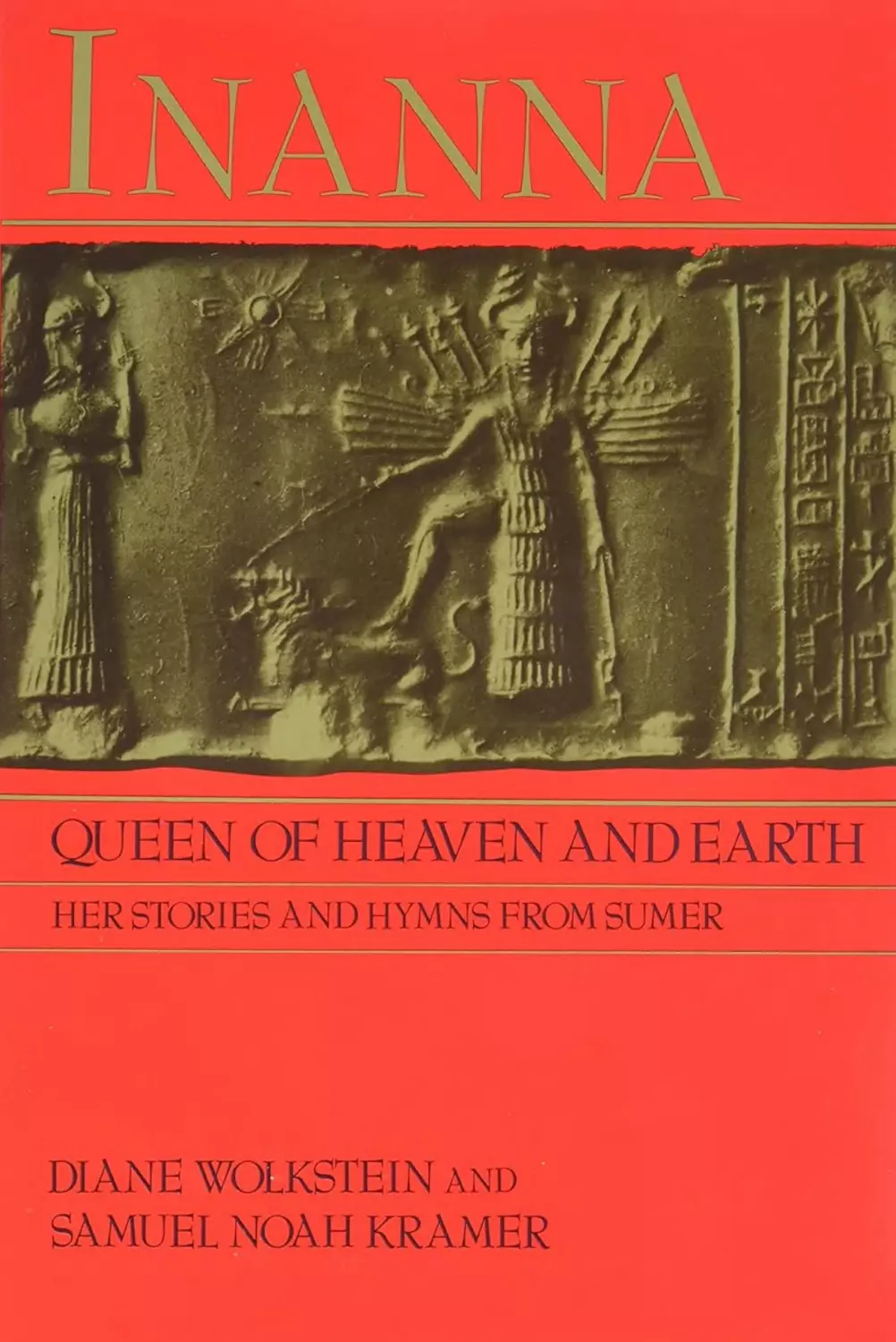
                    QUEEN OF HEAVEN AND EARTH
HER STORIES AND HYM i
IV
INANNA
QUEEN OF HEAVEN AND EARTH
INANNA
QUEEN OF HEAVEN AND EARTH Her Stories and Hymns from
Sumer
DIANE WOLKSTEIN and
SAMUEL NOAH KRAMER Art compiled by Elizabeth WilliamsForte
1817
HARPER & ROW, PUBLISHERS, New York Cambridge,
Philadelphia, San Francisco, London, Mexico City, Sao Paulo,
Sydney

INANNA: QUEEN OF HEAVEN AND EARTH. Copyright ©
1983 by Diane Wolkstein an ^ Noah Kramer. All rights reserved.
Printed in the United States of America. No part o i ^ ^ ^ may be
used or reproduced in any manner whatsoever without written
permission ex ^ f case of brief quotations embodied in critical
articles and reviews. For information a res & Row, Publishers, Inc.,
10 East 53rd Street, New York, N.Y. 10022. Published simuitan in
Canada by Fitzhenry & Whiteside Limited, Toronto.
FIRST EDITION
Designer: C. Linda Dingier
Library of Congress Cataloging in Publication Data
Wolkstein, Diane.
Inanna, queen of heaven and earth.
Translation and retelling of the Inanna stories from the Sumerian.
Bibliography: p. Includes index.
I. Inanna (Sumerian deity) 2. Mythology, Sumerian. 3. Inanna
(Sumerian deity) — Poetry. I. Kramer, Samuel Noah, 1897- II.
Title. BL1616.15W64 1983 299'.92 80-8690 ISBN 0-06-01 47 13X ISBN 0-06-090854-8 (pbk.)
83 84 85 86 87 83 84 85 86 87

10 9 8 7 6 10 9 8 7 6 5
543214321
For my daughter, Rachel Cloudstone Zucker
CONTENTS
Inanna's Family Tree ix
Map of Sumer xii
Preface, by Samuel Noah Kramer xiii
Introduction, by Diane Wolkstein xv
Inanna's Stories and Hymns
The Huluppu-Tree 3
Inanna and the God of Wisdom 1 1
The Courtship of Inanna and Dumuzi 29
The Descent of Inanna 5 1
From the Great Above to the Great Below 52
The Dream of Dumuzi 74

The Return 85
Seven Hymns to Inanna 91
1. The Holy Priestess of Heaven 93
2. Loud Thundering Storm 95
3. The Holy One 97
4. The Lady of the Evening 101
5. The Lady of the Morning 103
6. The Lady Who Ascends into the Heavens 105
7. The Joy of Sumer: The Sacred Marriage Rite 107
vii
Commentaries
Sumerian History, Culture, and Literature, 115
by Samuel Noah Kramer The Discovery and Decipherment of "The
Descent of Inanna," 127
by Samuel Noah Kramer
Interpretations of Inanna's Stories and Hymns, 136
by Diane Wolkstein

Annotations of the Art, 174
by Elizabeth Williams-Forte
Sources for Inanna's Stories and Hymns 201
Notes on the Textual Editing 205
Selected Bibliography 209
Acknowledgments 2 1 3
Selected Pronunciation Guide 215
Index 217
viii
INANNA'S FAMILY TREE
The stories in this cycle express an amalgamation of Sumerian and
Akkadian religious and political beliefs that go back at least a
thousand years before Sumer was a unified political entity. During
the third millennium B.C., there were periodic attempts to unify the
various city-states in Sumer and Akkad; and with the increasing
political centralization came a concurrent movement to bring
together the many local gods and goddesses into one pantheon.
In the Cycle of Inanna, we encounter aspects of the earlier
Sumerian Dumuzi as well as the later more politicized Akkadian

6

Dumuzi. The Sumerian Dumuzi, who comes from the agricultural,
more traditional area of southern Sumer, Eridu, which emphasized
order (the me), is characterized as the force in the grain and as the
priestly lover and attendant of the Fertility Goddess, Inanna. The
Akkadian Dumuzi, coming from the northern nomadic peoples who
emphasized the arbitrary will and power of the gods, is
characterized as the shepherd, the astral heavenly bull, and the king
who has "godlike" powers. Inanna, too, by her epithet Queen of
Heaven and Earth, subsumed the many local cults to the goddess
and combined the earlier, more peaceful Fertility Goddess with the
attributes of the more directing and directive Goddess of Love.
Although in other legends and stories the Sumerian divinities and
heroes may have different relationships to each other, for the
purpose of clarification the family tree on the following page
indicates the relationships of the divini- ties to each other within
the context of these stories.
IX
KI
(URASH) Earth Goddess
NINLIL—
Air Goddess City, Nippur
UTU Sun God City, Sippar
7

— ENLIL
Air God City, Nippur
NANNA ■ Moon God Citv, Ur
— NINGAL Moon Goddess City, Ur
INANNA
Queen of Heaven and Earth Goddess of Love Morning and
Evening Star City, Uruk
SHARA
Citv, Umma
LULAL Citv, Badtibira
I NAN N AS FAMILY TREE
— AN — Sky God City, Uruk
NAMMU
8

Goddess of the Watery Deep
NINGIKUGA- Reed Lady
ENKI
God of Wisdom God of the Waters City, Eridu
SIRTUR —
(NINSUN) Sheep Goddess
■LUGALBANDA King of Uruk
DUMUZI
Shepherd-King of Uruk
GESHTINANNA Lady of Wine
GILGAMESH Shepherd-King of Uruk
ERESHKIGAL
Queen of the Underworld

9

GUGALANNA Bull of Heaven
PREFACE
by Samuel Noah Kramer
This book is a graphic example of an effective cooperation between
two specialists working in contrasting, yet complementary, areas of
humanistic research: a folklorist who has collected and recorded
the tales, legends, and songs of modern contemporary societies,
and a cuneiformist who has devoted his entire scholarly career to
the restoration and translation of the written tales, legends, and
songs of the ancient Sumerians.
The Sumerian tales, legends, and songs are part of a vast literature
in- scribed on clay tablets and fragments scattered throughout
museums the world over. Their contents, which date back to 2000
B.C., are now in the process of being deciphered, translated, and
interpreted by a small interna- tional group of dedicated scholars;
gradually, they are becoming available in one form or another to
the world at large. Inscribed on these tablets and fragments,
numbering some five to six thousand in all, are hundreds of compositions — myths, epic tales, hymns, psalms, love songs, laments,
essays, dis- putations, proverbs, fables — that constitute a treasure
house of comparative source material for the historian of literature
and religion, for the biblical and classical scholar, and (as this book
demonstrates) for the folklorist and cultural anthropologist.
The main goal of the selection presented here is to provide the
reader with an authentic portrait of Sumer's most beloved and

10

revered deity, the goddess Inanna. To compile this collection, I first
combed the extant Sumerian literary documents, which I had
deciphered and translated over the decades, for the relevant
compositions on Inanna. Then, with the help of the most recent
contributions by fellow Sumerologists, I brought the translations up
to date. Finally, I turned the stories over to Diane Wolkstein, who
proceeded to arrange, combine, and mold their raw contents in a
way that would make them alive and meaningful to modern
readers.
As a gifted storyteller and professional folklorist, Diane Wolkstein
per- formed her delicate task with originality, ingenuity, and
sensitivity. She elimi- nated cluttering repetitions, added
explanatory words and lines when advisaxiii
ble, restored a broken passage when possible, and skillfully wove
the texts of numerous related poems into a unifying whole. Diane
Wolkstein has suc- ceeded in re-creating a significant group of
rather esoteric tales and songs, long erased from the memory of
man, in a form that is at once imaginative and evocative, attractive
and engaging.
xiv
INTRODUCTION
by Diane Wolkstein
11

Inanna was a birthday gift — and more. In the spring of 1979 I had
been asked by Priscilla Moulton to present a program at Simmons
College in Boston the following November. As the date fell on the
week of my birthday and the program was open to my choosing, I
decided that this must be the occasion I had been waiting for.
I had for years wanted to tell the story of the Moon Goddess,
Diana. Not only am I her namesake, but in her cyclical aspect, the
Moon Goddess is an identifying symbol for women. And all of us,
both women and men, have long needed a "grand" story of a
woman — as inspiration, guide, and model — for ourselves as well
as for our children.
To my surprise, four months of research on the moon goddesses of
the world turned up only scattered bits. The most complete tale of
the goddess is that of Demeter; but the story revolves around the
mother-daughter aspect of the goddess, and I wanted to tell a story
of the goddess in all her aspects. Where was she to be found?
To look at the statues of the goddess in museums and to read of her
impact in books of mythology and religion was only a beginning.
As a storyteller, in order to truly know her, I had to hear her speak.
I had to find the goddess in relationship with others. In order to
know her, I had to find her text.
I went through the world's anthologies in search of the names of
moon goddesses: Ishtar, Mari, Diana, Isis, Hecate, Pasiphae,
Selene, Brigit, Cybele, the Shekinah, Lilith, Persephone, Inanna ...
I sought her by name, and at last I found mention of her and her
stories in Samuel Noah Kramer's most recent book, From the
Poetry of Sumer. In this book, Kramer describes the goddess of the
first civilization from which we have texts: "Female deities were

12

wor- shipped and adored all through Sumerian history. . . . but the
goddess who outweighed, overshadowed, and outlasted them all
was a deity known to the Sumerians by the name of Inanna, 'Queen
of Heaven,' and to the Semites who lived in Sumer by the name of
Ishtar. Inanna played a greater role in myth, epic, and hymn than
any other deity, male or female." 1
Samuel Noah Kramer, From the Poetry of Sumer, Berkeley:
University of Berkeley Press, 1979, p. 71.
XV
In Kramer's The Sacred Marriage Rite, 2 I found the various love
poems of the young earthy Inanna and the story of the mature
Inanna's descent into the underworld. I read Inanna's descent again
and again. I was drawn to the story of the woman who gave up, at
seven successive gates, all she had accomplished in life until she
was stripped naked, with nothing remaining but her will to be
reborn.
Although fragmented, the story of Inanna as I began to perceive it
fol- lowed the same pattern as the archetypal Moon Goddess: the
young woman who is courted; the ripe woman who enjoys her
feminine powers and gener- ously offers her bounty; and the
mature woman who meets death in the underworld. In The White
Goddess, Robert Graves conjectures on the heavenly aspect of the
Triple Goddess, "As the Sky Goddess, she was the moon ... as the
New Moon or Spring she was girl; as the Full Moon or Summer
she was woman; as the Old Moon or Winter she was hag. . . ." 3

13

In Sumerian, Inanna's name means literally "Queen of Heaven,"
and she was called both the First Daughter of the Moon and the
Morning and Evening Star (the planet Venus). In addition, in
Sumerian mythology, she was known as the Queen of Heaven and
Earth and was responsible for the growth of plants and animals and
fertility in humankind. Then, because of her journey to the
underworld, she took on the powers and mysteries of death and
rebirth, emerging not only as a sky or moon goddess, but as the
goddess who rules over the sky, the earth, and the underworld.
Here was the goddess in all her aspects; here was my story.
But as I prepared the story for presentation, piecing together the
different sections, there were many gaps and question marks in the
text, often at the most crucial moments, and I wondered what many
of the words meant— literally. My friend Susan Bergholz, long a
Sumerianophile, suggested I telephone the source: Samuel Noah
Kramer, who had deciphered the text.
"So you love Inanna?" Kramer said, answering the telephone
himself. "Well, then come and see me." He was giving a Jayne
Lecture on Inanna in two days' time at the Philosophical Society in
Philadelphia and why didn't I come then?
I arrived eager and full of questions:
"In the first line of The Descent of Inanna,' 'From the Great Above
she set her mind to the Great Below,' what exactly does 'mind'
mean?" "Ear," Kramer said. "Ear?"
'Samuel Noah Kramer, The Sacred Marriage Rite, Bloomington,
Indiana: University of In- diana Press, 1969.

14

'Robert Graves, The White Goddess, New York: Farrar, Straus, and
Giroux, p. 386.
xv i
"Yes, the word for ear and wisdom in Sumerian are the same. But
mind is what is meant."
"But — I could say 'ear'?"
"Well, you could."
"Is it opened her ear or set her ear?"
"Set. Set her ear, like a donkey that sets its ear at a particular
sound."
As Kramer spoke, a shiver ran through me. When taken literally,
the text itself announces the story's direction: From the Great
Above the goddess opened (set) her ear, her receptor for wisdom,
to the Great Below.
While these thoughts were darting about in my mind, Kramer
looked at the shaping I had done of his texts and said that he
thought if I could find a publisher there might be a possibility for
our collaborating on a joint publi- cation. I had read the story of
"Inanna and the Huluppu-Tree," and asked Kramer if there were
other stories about Inanna that were intact. He men- tioned "Inanna
and Enki: The Transfer of the Arts of Civilization from Eridu to
Erech," but said it had not yet been completely translated into
English.

15

In November of 1979 I told "The Courtship" and "The Descent of
Inanna" at Simmons College to an astonished and awestruck
audience. When I told Kramer about it, he insisted that the people
were responding to me, but I assured him it was the Inanna who
had captivated him for fifty years who was now captivating them as
well. By February, 1980, we had an eager and supportive publisher.
In March, Kramer sent me a translation of "The Me. " Then, a
month later when Kramer showed me Reisman's scholarly
translations of the hymns, I suddenly understood that with the
rebirth of the goddess into the sky, the texts formed one story: the
life story of the goddess, from her adolescence to her completed
womanhood and "godship."
In beginning the work of trying to find the appropriate written form
for the stories of Inanna, I tried prose, the form I knew best from
storytelling. But I found myself continually returning to verse.
After six months of experiment- ing with different forms for "The
Huluppu-Tree" it seemed there was some invisible, irreducible
essence buried in each Sumerian line. Only by keeping the actual
Sumerian verse line could I hope to express the mystery and power
that lay within it.
For over two years I worked on the texts Kramer gave me. On my
visits to Kramer, I asked him: What did this word mean? This
sentence? Could he express it in different English words? What did
it mean literally in Sumerian? Sometimes he could answer my
questions. Other times he'd throw up his hands and say: "No matter
how many times you ask me the same question, I still don't know."
xvii

16

With Kramer's consent, I turned to the writing „fn, , , , alternative
ideas and words. I consulted the ZZo^K ^ fo < for further
poss.bihties on p U22 lin g secuons. I
edited-always with the idea of "story" in mind n. T d,and
cleaning the meadow— blade by blade. ^ k of
In thinking about the book, I felt it was essential to use the art of
Wand the surroundmg areas to illustrate the text. Elizabeth
Williams-Forte ofCd" expert and encouraging guidance both in
finding and in selecting the appropr ate works of art. Together we
spent many wonderful hours discussing Z choosing the cylinder
seals and terracotta sculptures that seemed best to express the
stones' moods and meanings.
After the first nine months of reading everything I could find on
Sumerian literature, culture, and history, speaking with Kramer,
and working and re- working each line, I decided I had to bring the
story once again to an audience. I arranged to tell the Cycle of
Inanna at Robert Bly's Mother Goddess Confer- ence in Maine in
June, 1980. But the thought of telling the stories to other people
propelled me to rework the text again. In fact, each time I have told
Inanna I have reworked the text as I realized that expressions such
as "days of yore" or "I, the Maid" would immediately deaden the
receptivity of the audience.
Further changes came to the manuscript from the telling. Audiences
had difficulty keeping more than one foreign name in their minds
and at the same time following the flow of the story. For this reason
I decided to use English epithets to accompany the names of the
characters as they appear. I also tried to minimize the use of

17

Sumerian place names and epithets. Still, I kept such Sumerian
words as kur, me, sukkal, and abzu, for they are metaphysical concepts that seem to me intrinsic to Sumerian thought; and in time, I
hope, they may come to enrich our English thought and language.
My aim has been to keep as close as possible to the power, wonder,
and mystery embedded in the Sumerian texts, and simultaneously
to render the stories both accessible and compelling. For the latter
reason, I have eliminated much of the repetition. For the former
reason, I have retained as much of the repetition and Sumerian
grammatical structure as the flow of the story would allow (for
example, the three-part progressing parallelism, as in he— father—
Enki). Whenever there is a break in the text, I use ellipses. When a
certain section seems to demand clarification, often because there
is a break at a cruci^ point, parentheses have been used to indicate
that these are my own w
Here, then, is the Cycle of Inanna. In 'The Huluppu-Tree;' she ^^ to
us as a young woman in search of her womanhood. In Inanna and t
e
xviii
of Wisdom," she achieves her queenship. In "The Courtship of
Inanna and Dumuzi," she chooses the shepherd Dumuzi to be her
lover, her husband, and the King of Sumer. In "The Descent of
Inanna," Inanna leaves for the under- world and is allowed to return
from the Great Below only on the condition that she choose a
substitute. In the last section of the cycle, the "Seven Hymns to
Inanna," Inanna is greeted and loved in her many aspects.

18

The world's first love story, two thousand years older than the Bible
— tender, erotic, shocking, and compassionate — is more than
momentary enter- tainment. It is a sacred story that has the
intention of bringing its audience to a new spiritual place. With
Inanna, we enter the place of exploration: the place where not all
energies have been tamed or ordered.
Inanna's scribe, Samuel Noah Kramer, gave me her words. I have
sung them as best as I can. Now, we pass them on to you.
xix
INANNA'S STORIES AND HYMNS
THE HULUPPU- TREE
In the first days, in the very first days, In the first nights, in the very
first nights, In the first years, in the very first years,
In the first days when everything needed was brought into being, In
the first days when everything needed was properly nourished,
When bread was baked in the shrines of the land, And bread was
tasted in the homes of the land, When heaven had moved away
from earth, And earth had separated from heaven, And the name of
man was fixed; When the Sky God, An, had carried off the
heavens, And the Air God, Enlil, had carried off the earth, When
the Queen of the Great Below, Ereshkigal, was given the
underworld for her domain,

19

He set sail; the Father set sail,
Enki, the God of Wisdom, set sail for the underworld.
Small windstones were tossed up against him;
Large hailstones were hurled up against him;
Like onmshing turtles,
They charged the keel of Enki's boat.
The waters of the sea devoured the bow of his boat like wolves;
The waters of the sea struck the stern of his boat like lions.
4
At that time, a tree, a single tree, a buluppu- tree
Was planted by the banks of the Euphrates.
The tree was nurtured by the waters of the Euphrates.
The whirling South Wind arose, pulling at its roots
And ripping at its branches
Until the waters of the Euphrates carried it away.
A woman who walked in fear of the word of the Sky God, An, Who
walked in fear of the word of the Air God, Enlil, Plucked the tree

20

from the river and spoke: "I shall bring this tree to Uruk. I shall
plant this tree in my holy garden."
Inanna cared for the tree with her hand.
She settled the earth around the tree with her foot.
She wondered:
4 4 How long will it be until I have a shining throne to sit upon?
How long will it be until I have a shining bed to lie upon?"
The years passed; five years, then ten years. The tree grew thick,
But its bark did not split.
5
Then a serpent who could not be charmed
Made its nest in the roots of the huluppu-tree.
The Anzu-bird set his young in the branches of the tree.
And the dark maid Lilith built her home in the trunk.
The young woman who loved to laugh wept.
How Inanna wept!
(Yet they would not leave her tree.)
21

As the birds began to sing at the coming of the dawn,
The Sun God, Utu, left his royal bedchamber.
Inanna called to her brother Utu, saying:
"O Utu, in the days when the fates were decreed, When abundance
overflowed in the land, When the Sky God took the heavens and
the Air God the earth, When Ereshkigal was given the Great Below
for her domain, The God of Wisdom, Father Enki, set sail for the
underworld, And the underworld rose up and attacked him. . • ■
6
At that time, a tree, a single tree, a huluppu- tree
Was planted by the banks of the Euphrates.
The South Wind pulled at its roots and ripped at its branches
Until the waters of the Euphrates carried it away.
I plucked the tree from the river;
I brought it to my holy garden. I tended the tree, waiting for my
shining throne and bed.
Then a serpent who could not be charmed Made its nest in the roots
of the tree,

22

The Anzu-bird set his young in the branches of the tree, And the
dark maid Lilith built her home in the trunk. I wept. How I wept!
(Yet they would not leave my tree.)"
Utu, the valiant warrior, Utu, Would not help his sister, Inanna.
As the birds began to sing at the coming of the second dawn,
Inanna called to her brother Gilgamesh, saying:
"O Gilgamesh, in the days when the fates were decreed, When
abundance overflowed in Sumer, When the Sky God had taken the
heavens and the Air God the earth,
7
When Ereshkigal was given the Great Below for her domain,
The God of Wisdom, Father Enki, set sail for the underworld,
And the underworld rose up and attacked him.
At that time, a tree, a single tree, a buluppu- tree
Was planted by the banks of the Euphrates.
The South Wind pulled at its roots and ripped at its branches
Until the waters of the Euphrates carried it away.
I plucked the tree from the river;

23

I brought it to my holy garden. I tended the tree, waiting for my
shining throne and bed.
Then a serpent who could not be charmed Made its nest in the roots
of the tree,
The Anzu-bird set his young in the branches of the tree, And the
dark maid Lilith built her home in the trunk. I wept. How I wept!
(Yet they would not leave my tree.)"
Gilgamesh the valiant warrior, Gilgamesh, The hero of Uruk, stood
by Inanna.
8
Gilgamesh fastened his armor of fifty minas around his chest. The
fifty minas weighed as little to him as fifty feathers. He lifted his
bronze ax, the ax of the road, Weighing seven talents and seven
minas, to his shoulder. He entered Inanna's holy garden.
Gilgamesh struck the serpent who could not be charmed.
The Anzu-bird flew with his young to the mountains;
And Lilith smashed her home and fled to the wild, uninhabited
places.
Gilgamesh then loosened the roots of the huluppu- tree;

24

And the sons of the city, who accompanied him, cut off the
branches.
From the trunk of the tree he carved a throne for his holy sister.
From the trunk of the tree Gilgamesh carved a bed for Inanna.
From the roots of the tree she fashioned a pukku for her brother.
From the crown of the tree Inanna fashioned a mikku for
Gilgamesh, the hero of Uruk.
9
INANNA AND THE GOD OF WISDOM
Inanna placed the shugurra, the crown of the steppe, on her head.
She went to the sheepfold, to the shepherd. She leaned back against
the apple tree.
When she leaned against the apple tree, her vulva was wondrous to
behold.
Rejoicing at her wondrous vulva, the young woman Inanna
applauded herself.
She said:
"I, the Queen of Heaven, shall visit the God of Wisdom. I shall go
to the Abzu, the sacred place in Eridu. I shall honor Enki, the God
of Wisdom, in Eridu. I shall utter a prayer to Enki at the deep sweet
waters."

25

Inanna set out by herself.
When she was within a short distance of the Abzu, He whose ears
are wide open,
He who knows the me, the holy laws of heaven and earth, He who
knows the heart of the gods, Enki, the God of Wisdom, who knows
all things, Called to his servant, Isimud: "Come, my sukkal, The
young woman is about to enter the Abzu.
12
When Inanna enters the holy shrine Give her butter cake to eat.
Pour cold water to refresh her heart. Offer her beer before the
statue of the lion. Treat her like an equal.
Greet Inanna at the holy table, the table of heaven."
Isimud heeded Enki's words.
When Inanna entered the Abzu,
He gave her butter cake to eat.
He poured cold water for her to drink.
He offered her beer before the statue of the lion.
He treated her respectfully.
He greeted Inanna at the holy table, the table of heaven.

26

13
Enki and Inanna drank beer together.
They drank more beer together.
They drank more and more beer together.
With their bronze vessels filled to overflowing,
With the vessels of Urash, Mother of the Earth,
They toasted each other; they challenged each other.
Enki, swaying with drink, toasted Inanna:
"In the name of my power! In the name of my holy shrine! To my
daughter Inanna I shall give The high priesthood! Godship! The
noble, enduring crown! The throne of kingship!"
Inanna replied:
"I take them!"
To my daughter Inanna I shall give
14
Truth!

27

Descent into the underworld! Ascent from the underworld! The art
of lovemaking! The kissing of the phallus!"
Inanna replied:
"I take them!"
Enki raised his cup and toasted Inanna a third time:
"In the name of my power! In the name of my holy shrine! To my
daughter Inanna I shall give The holy priestess of heaven!
The setting up of lamentations! The rejoicing of the heart! The
giving of judgments! The making of decisions!"
Inanna replied:
"I take them!"
(Fourteen times Enki raised his cup to Inanna.
Fourteen times he offered his daughter five me, six me, seven me.
Fourteen times Inanna accepted the holy me. )
15
Then Inanna, standing before her father, Acknowledged the me
Enki had given to her:
"My father has given me the me:
28

He gave me the high priesthood. He gave me godship. He gave me
the noble, enduring crown. He gave me the throne of kingship.
He gave me the noble sceptre.
He gave me the staff.
He gave me the holy measuring rod and line.
He gave me the high throne.
He gave me shepherdship.
He gave me kingship.
He gave me the princess priestess. He gave me the divine queen
priestess. He gave me the incantation priest. He gave me the noble
priest. He gave me the libations priest.
He gave me truth.
He gave me descent into the underworld. He gave me ascent from
the underworld. He gave me the kurgarra.
He gave me the dagger and sword. He gave me the black garment.
He gave me the colorful garment. He gave me the loosening of the
hair. He gave me the binding of the hair.
16

29

He
gave
me
the standard.
He
gave
me
the quiver.
He
gave
me

30

the art of lovemaking.
He
gave
me
the kissing of the phallus.
He
gave
me
the art of prostitution.
Up
gave

31

iiie
ine art or speeoing.
He
gave
me
the art of forthright speech.
He
gave
me
the art of slanderous speech.
He

32

gave
me
the art of adorning speech.
He
gave
me
the cult prostitute.
- He
5 avc
mp
fhp hnlv ffivprn

33

He
gave
me
the holy shrine.
He
gave
me
the holy priestess of heaven.
He
gave
me

34

the resounding musical instrument.
He
gave
me
the art of song.
He
f?ave
me
thp art of thp pIHpt
He
gave

35

me
the art of the hero.
He
gave
me
the art of power.
He
gave
me
the art of treachery.
He

36

gave
me
the art of straightforwardness.
- He
gave
me
the plundering of cities.
He
gave
me
the setting up of lamentations.

37

gave
111C
t V-» rpir^inno nf thp npcirt L11C ICJVJIL.111^ \Ji lilt llC-dl L.
He
gave
me
deceit.
He
gave
me
the rebellious land.

38

He
gave
me
the art of kindness.
He
gave
me
travel.
* He
gave
me

39

the secure dwelling place.
17
He gave He gave He gave He gave He gave He gave He gave He
gave
me the me the me the me the me the me the me the me the
craft of the craft of the craft of the craft of the craft of the craft of
the craft of the craft of the
woodworker, copper worker, scribe, smith.
leather maker, fuller, builder, reed worker.
Hp
gave
mo II1CT
lllC ^CICCpilVC Cal .

40

Hp
5 dVC
ii id
thp nnu/pr nf flttpntinn
He
f?avp
mp
thp holv nurification rites.
Hp
6 dVC
iiicr

41

thf* tp»oH i n cr r>pn Liicj ictunifc ^jctii.
He
5 avc
mp
rhp hpaninf? un of hot coals.
He
gave
me
the sheepfold.
He
gave

42

me
fear.
He
gave
me
consternation.
He
gave
me
dismay.
He

43

gave
me
the bitter-toothed lion.
He
gave
me
the kindling of fire.
He
gave
me
the putting out of fire.

44

He
gave
me
the weary arm.
He
gave
me
the assembled family.
He
gave
me

45

procreation.
He
gave
me
the kindling of strife.
He
gave
me
counseling.
He
gave

46

me
heart-soothing.
He
gave
me
the giving of judgments.
He
gave
me
the making of decisions."
18

47

(Still reeling with drink) Enki spoke to his servant Isimud: 14 My
sukkal, Isimud — The young woman — is about to leave — for
Uruk. It is my wish that she reach her city — safely."
Inanna gathered all the me.
The me were placed on the Boat of Heaven.
The Boat of Heaven, with the holy me, was pushed off from the
quay.
When the beer had gone out from the one who had drunk beer,
When the beer had gone out from Father Enki, When the beer had
gone out from the great God of Wisdom, Enki looked about the
Abzu.
The eyes of the King of the Abzu searched Eridu.
King Enki looked about Eridu and called to his servant Isimud,
saying:
"My sukkal, Isimud — "
"My king, Enki, I stand to serve you."
"The high priesthood? Godship? The noble enduring crown? Where
are they?"
"My king has given them to his daughter."
"The art of the hero? The art of power? Treachery? Deceit? Where
are they?"

48

19
"My king has given them to his daughter."
"The perceptive ear? The power of attention? The making of
decisions? Where are they?"
"My king has given them to his daughter."
(Fourteen times Enki questioned his servant Isimud; Fourteen times
Isimud answered, saying:
"My king has given them to his daughter. My king has given all the
me to his daughter Inanna.")
Then Enki spoke, saying:
"Isimud, the Boat of Heaven, with the holy me Where is it now?"
"The Boat of Heaven is (one quay away from Eridu)."
"Go! Take the enkum- creatures Let them bring the Boat of Heaven
back to Eridu!"
Isimud spoke to Inanna:
"My queen, your father has sent me to you. Your father's words are
words of state. They may not be disobeyed."
Inanna answered:

49

"What has my father said? What has Enki added?
What are his words of state that may not be disobeyed?
20
Isimud spoke:
"My king has said: 'Let Inanna proceed to Uruk;
Bring the Boat of Heaven with the holy me back to Eridu.' "
Inanna cried:
"My father has changed his word to me! He has violated his pledge
— broken his promise! Deceitfully my father spoke to me!
Deceitfully he cried:
'In the name of my power! In the name of my holy shrine!'
Deceitfully he sent you to me!" Scarcely had Inanna spoken these
words
When the wild-haired enkum- creatures seized the Boat of Heaven.
Inanna called to her servant Ninshubur, saying:
"Come, Ninshubur, once you were Queen of the East; Now you are
the faithful servant of the holy shrine of Uruk. Water has not
touched your hand, Water has not touched your foot. My sukkal

50

who gives me wise advice, My warrior who fights by my side,
Save the Boat of Heaven with the holy me!"
21
(Ninshubur sliced the air with her hand.
She uttered an earth-shattering cry.)
The enkum- creatures were sent hurtling back to Eridu.
Then Enki called to his servant Isimud a second time, saying: "My
sukkal, Isimud — "
"My king, Enki, I stand to serve you."
"Where is the Boat of Heaven now?"
"It is (two quays away from Eridu)."
"Go! Take the fifty uru- giants, Let them carry off the Boat of
Heaven."
The fifty flying uru -giants seized the Boat of Heaven. But
Ninshubur rescued the boat for Inanna.
Enki called to his servant Isimud a third time, saying: "My sukkal,
Isimud — "
"My king, Enki, I stand to serve you."

51

"Where is the Boat of Heaven now?"
22
"It has just arrived at Dulma."
"Quickly! Take the fifty lahama- monsters, Let them carry off the
Boat of Heaven."
The fifty lahama- sea. monsters seized the Boat of Heaven.
But Ninshubur rescued the boat for Inanna.
A fourth time Enki sent the sound-piercing kugalgal.
A fifth time Enki sent the enumiti.
But each time Ninshubur rescued the boat for Inanna.
Enki called to his servant Isimud a sixth time, saying: "My sukkal.
Isimud — "
"My king, Enki, I stand to serve you."
"Where is the Boat of Heaven now?"
"It is about to enter Uruk."
"Quickly! Take the watchmen of the Iturungal Canal, Let them
carry off the Boat of Heaven."

52

23
Isimud and the watchmen of the Iturungal Canal seized
the Boat of Heaven, But Ninshubur rescued the boat for Inanna.
Then Ninshubur spoke to Inanna:
"My queen, when the Boat of Heaven Enters the Nigulla Gate of
Uruk, Let high water flow in our city;
Let the deep-going boats sail swiftly through our canals."
Inanna answered Ninshubur:
"On the day the Boat of Heaven Enters the Nigulla Gate of Uruk,
Let high water sweep over the streets; Let high water flow over the
paths. Let the old men give counsel; Let the old women offer heartsoothing. Let the young men show the might of their weapons; Let
the little children laugh and sing. Let all of Uruk be festive!
Let the high priest greet the Boat of Heaven with song.
Let him utter great prayers.
Let the king slaughter oxen and sheep.
Let him pour beer out of the cup.
Let the drum and tambourine resound.
Let the sweet tigi- music be played.

53

Let all the lands proclaim my noble name.
Let my people sing my praises."
24
And so it was,
On the day the Boat of Heaven entered the Nigulla Gate of Uruk,
High water swept over the streets; High water flowed over the
paths.
The Boat of Heaven docked at the holy shrine of Uruk; The Boat of
Heaven docked at the holy house of Inanna.
Then Enki called to his servant Isimud a seventh time, saying: "My
sukkal, Isimud — "
"My king, Enki, I stand to serve you."
"Where is the Boat of Heaven now?"
"The Boat of Heaven is at the White Quay."
"Go! She has aroused wonder there. The queen has aroused wonder
at the White Quay. Inanna has aroused wonder at the White Quay
for the Boat of Heaven."
25

54

The holy me were being unloaded.
As the me which Inanna had received from Enki were unloaded,
They were announced and presented to the people of Sumer.
Then more me appeared — more me than Enki had given Inanna.
And these, too, were announced, And these, too, were presented to
the people of Uruk: "Inanna brought the me:
She brought the placing of the garment on the ground.
She brought allure.
She brought the art of women.
She brought the perfect execution of the me.
She brought the tigi- and lilts- drums.
She brought the ub-, the meze-, and the ^-tambourines.
Inanna spoke, saying:
"Where the Boat of Heaven has docked, That place shall be called
The White Quay. Where the holy me have been presented, That
place I shall name The Lapis Lazuli Quay."
26

55

Then Enki spoke to Inanna, saying:
"In the name of my power! In the name of my holy shrine! Let the
me you have taken with you remain in the holy shrine of your city.
Let the high priest spend his days at the holy shrine in song.
Let the citizens of your city prosper,
Let the children of Uruk rejoice.
The people of Uruk are allies of the people of Eridu.
Let the city of Uruk be restored to its great place."
27
THE COURTSHIP OF INANNA
AND DUMUZI
The brother spoke to his younger sister. The Sun God, Utu, spoke
to Inanna, saying:
"Young Lady, the flax in its fullness is lovely. Inanna, the grain is
glistening in the furrow. I will hoe it for you. I will bring it to you.
A piece of linen, big or small, is always needed. Inanna, I will bring
it to you."

56

"Brother, after you've brought me the flax, Who will comb it for
me?"
"Sister, I will bring it to you combed."
30
"Utu, after you've brought it to me combed, Who will spin it for
me?"
"Inanna, I will bring it to you spun."
"Brother, after you've brought the flax to me spun, Who will braid
it for me?"
"Sister, I will bring it to you braided."
"Utu, after you've brought it to me braided, Who will warp it for
me?"
"Inanna, I will bring it to you warped."
"Brother, after you've brought the flax to me warped, Who will
weave it for me?"
"Sister, I will bring it to you woven."
"Utu, after you've brought it to me woven, Who will bleach it for
me?"
"Inanna, I will bring it to you bleached."

57

"Brother, after you've brought my bridal sheet to me, Who will go
to bed with me? Utu, who will go to bed with me?"
"Sister, your bridegroom will go to bed with you. He who was born
from a fertile womb, He who was conceived on the sacred marriage
throne, Dumuzi, the shepherd! He will go to bed with you."
31
Inanna spoke:
"No, brother! The man of my heart works the hoe. The farmer! He
is the man of my heart! He gathers the grain into great heaps. He
brings the grain regularly into my storehouses.
Utu spoke:
"Sister, marry the shepherd. Why are you unwilling?
32
His cream is good; his milk is good. Whatever he touches shines
brightly. Inanna, marry Dumuzi.
You who adorn yourself with the agate necklace of fertility,
Why are you unwilling?
Dumuzi will share his rich cream with you.

58

You who are meant to be the king's protector,
Why are you unwilling?"
Inanna spoke:
"The shepherd! I will not marry the shepherd! His clothes are
coarse; his wool is rough. I will marry the farmer. The farmer
grows flax for my clothes. The farmer grows barley for my table."
Dumuzi spoke:
"Why do you speak about the farmer? Why do you speak about
him? If he gives you black flour, I will give you black wool. If he
gives you white flour, I will give you white wool. If he gives you
beer, I will give you sweet milk. If he gives you bread, I will give
you honey cheese.
33
I will give the farmer my leftover cream. I will give the farmer my
leftover milk. Why do you speak about the farmer? What does he
have more than I do?"
Inanna spoke:
"Shepherd, without my mother, Ningal, you'd be driven away,
Without my grandmother, Ningikuga, you'd be driven into the
steppes,

59

Without my father, Nanna, you'd have no roof, Without my brother,
Utu — "
Dumuzi spoke:
"Inanna, do not start a quarrel. My father, Enki, is as good as your
father, Nanna. My mother, Sirtur, is as good as your mother,
Ningal. My sister, Geshtinanna, is as good as yours. Queen of the
palace, let us talk it over.
Inanna, let us sit and speak together.
I am as good as Utu.
Enki is as good as Nanna.
Sirtur is as good as Ningal.
Queen of the palace, let us talk it over."
The word they had spoken Was a word of desire. From the starting
of the quarrel Came the lovers' desire.
34
The shepherd went to the royal house with cream. Dumuzi went to
the royal house with milk. Before the door, he called out:
"Open the house, My Lady, open the house!"
Inanna ran to Ningal, the mother who bore her. Ningal counseled
her daughter, saying:
60

"My child, the young man will be your father.
My daughter, the young man will be your mother.
He will treat you like a father.
He will care for you like a mother.
Open the house, My Lady, open the house!"
Inanna, at her mother's command, Bathed and anointed herself with
scented oil. She covered her body with the royal white robe. She
readied her dowry.
She arranged her precious lapis beads around her neck. She took
her seal in her hand.
Dumuzi waited expectantly.
35
Inanna opened the door for him. Inside the house she shone before
him Like the light of the moon.
Dumuzi looked at her joyously.
He pressed his neck close against hers.
He kissed her.

61

Inanna spoke:
"What I tell you Let the singer weave into song. What I tell you,
Let it flow from ear to mouth, Let it pass from old to young:
36
My vulva, the horn,
The Boat of Heaven,
Is full of eagerness like the young moon.
My untilled land lies fallow.
As for me, Inanna, Who will plow my vulva? Who will plow my
high field? Who will plow my wet ground?
As for me, the young woman, Who will plow my vulva? Who will
station the ox there? Who will plow my vulva?"
Dumuzi replied:
"Great Lady, the king will plow your vulva. I, Dumuzi the King,
will plow your vulva."
Inanna:
"Then plow my vulva, man of my heart! Plow my vulva!"
At the king's lap stood the rising cedar. Plants grew high by their
side. Grains grew high by their side. Gardens flourished
62

luxuriantly.
37
Inanna sang:
"He has sprouted; he has burgeoned; He is lettuce planted by the
water. He is the one my womb loves best.
My well-stocked garden of the plain,
My barley growing high in its furrow,
My apple tree which bears fruit up to its crown,
He is lettuce planted by the water.
My honey-man, my honey-man sweetens me always. My lord, the
honey-man of the gods, He is the one my womb loves best. His
hand is honey, his foot is honey, He sweetens me always.
My eager impetuous caresser of the navel, My caresser of the soft
thighs, He is the one my womb loves best, He is lettuce planted by
the water."
38
Dumuzi sang:

63

44 0 Lady, your breast is your field. Inanna, your breast is your
field. Your broad field pours out plants. Your broad field pours out
grain. Water flows from on high for your servant. Bread flows from
on high for your servant. Pour it out for me, Inanna. I will drink all
you offer."
"Make your milk sweet and thick, my bridegroom. My shepherd, I
will drink your fresh milk. Wild bull, Dumuzi, make your milk
sweet and thick. I will drink your fresh milk.
Let the milk of the goat flow in my sheepfold. Fill my holy churn
with honey cheese. Lord Dumuzi, I will drink your fresh milk.
My husband, I will guard my sheepfold for you.
I will watch over your house of life, the storehouse,
The shining quivering place which delights Sumer —
The house which decides the fates of the land,
The house which gives the breath of life to the people.
I, the queen of the palace, will watch over your house."
Inanna sang:
39

64

Dumuzi spoke:
"My sister, I would go with you to my garden. Inanna, I would go
with you to my garden. I would go with you to my orchard. I would
go with you to my apple tree. There I would plant the sweet,
honey-covered seed."
Inanna spoke:
"He brought me into his garden. My brother, Dumuzi, brought me
into his garden. I strolled with him among the standing trees, I
stood with him among the fallen trees, By an apple tree I knelt as is
proper.
Before my brother coming in song,
Who rose to me out of the poplar leaves,
Who came to me in the midday heat,
Before my lord Dumuzi,
I poured out plants from my womb.
I placed plants before him,
I poured out plants before him.
I placed grain before him,
I poured out grain before him.
I poured out grain from my womb."
65

40
Inanna sang:
"Last night as I, the queen, was shining bright, Last night as I, the
Queen of Heaven, was shining bright, As I was shining bright and
dancing, Singing praises at the coming of the night —
He met me — he met me!
My lord Dumuzi met me.
He put his hand into my hand.
He pressed his neck close against mine.
My high priest is ready for the holy loins. My lord Dumuzi is ready
for the holy loins. The plants and herbs in his field are ripe. O
Dumuzi! Your fullness is my delight!"
41
She called for it, she called for it, she called for the bed!
She called for the bed that rejoices the heart.
She called for the bed that sweetens the loins.
She called for the bed of kingship.
66

She called for the bed of queenship.
Inanna called for the bed:
"Let the bed that rejoices the heart be prepared!
Let the bed that sweetens the loins be prepared!
Let the bed of kingship be prepared!
Let the bed of queenship be prepared!
Let the royal bed be prepared!"
Inanna spread the bridal sheet across the bed. She called to the
king:
"The bed is ready!" She called to her bridegroom:
"The bed is waiting!"
42
He put his hand in her hand. He put his hand to her heart. Sweet is
the sleep of hand-to-hand. Sweeter still the sleep of heart-to-heart.
43
Inanna spoke:

67

"I bathed for the wild bull, I bathed for the shepherd Dumuzi, I
perfumed my sides with ointment, I coated my mouth with sweetsmelling amber, I painted my eyes with kohl.
He shaped my loins with his fair hands,
The shepherd Dumuzi filled my lap with cream and milk,
He stroked my pubic hair,
He watered my womb.
He laid his hands on my holy vulva,
He smoothed my black boat with cream,
He quickened my narrow boat with milk,
He caressed me on the bed.
Now I will caress my high priest on the bed, I will caress the
faithful shepherd Dumuzi, I will caress his loins, the shepherdship
of the land, I will decree a sweet fate for him."
The Queen of Heaven,
The heroic woman, greater than her mother, Who was presented the
me by Enki, Inanna, the First Daughter of the Moon, Decreed the
fate of Dumuzi:
44

68

"In battle I am your leader, In combat I am your armor-bearer, In
the assembly I am your advocate, On the campaign I am your
inspiration. You, the chosen shepherd of the holy shrine, You, the
king, the faithful provider of Uruk, You, the light of An's great
shrine, In all ways you are fit:
To hold your head high on the lofty dais, To sit on the lapis lazuli
throne, To cover your head with the holy crown, To wear long
clothes on your body, To bind yourself with the garments of
kingship, To carry the mace and sword, To guide straight the long
bow and arrow, To fasten the throw-stick and sling at your side, To
race on the road with the holy sceptre in your hand, And the holy
sandals on your feet, To prance on the holy breast like a lapis lazuli
calf.
You, the sprinter, the chosen shepherd,
In all ways you are fit. May your heart enjoy long days.
That which An has determined for you — may it not be altered
That which Enlil has granted — may it not be changed. You are the
favorite of Ningal. Inanna holds you dear."
45
Ninshubur, the faithful servant of the holy shrine of Uruk, Led
Dumuzi to the sweet thighs of Inanna and spoke: "My queen, here
is the choice of your heart,
The king, your beloved bridegroom.

69

May he spend long days in the sweetness of your holy loins.
Give him a favorable and glorious reign.
Grant him the king's throne, firm in its foundations.
Grant him the shepherd's staff of judgment.
Grant him the enduring crown with the radiant and noble diadem.
From where the sun rises to where the sun sets,
From south to north,
From the Upper Sea to the Lower Sea,
From the land of the huluppu- tree to the land of the cedar,
Let his shepherd's staff protect all of Sumer and Akkad.
As the farmer, let him make the fields fertile,
As the shepherd, let him make the sheepfolds multiply,
Under his reign let there be vegetation,
Under his reign let there be rich grain.
In the marshland may the fish and birds chatter,
In the canebrake may the young and old reeds grow high,
In the steppe may the masbgur- trees grow high,

70

In the forests may the deer and wild goats multiply,
In the orchards may there be honey and wine,
46
In the gardens may the lettuce and cress grow high,
In the palace may there be long life.
May there be flood water in the Tigris and Euphrates,
May the plants grow high on their banks and fill the meadows,
May the Lady of Vegetation pile the grain in heaps and mounds.
O my Queen of Heaven and Earth, Queen of all the universe,
May he enjoy long days in the sweetness of your holy loins."
The king went with lifted head to the holy loins.
He went with lifted head to the loins of Inanna.
He went to the queen with lifted head.
He opened wide his arms to the holy priestess of heaven.
47

71

Inanna spoke:
"My beloved, the delight of my eyes, met me. We rejoiced together.
He took his pleasure of me. He brought me into his house.
He laid me down on the fragrant honey-bed. My sweet love, lying
by my heart, Tongue-playing, one by one, My fair Dumuzi did so
fifty times.
Now, my sweet love is sated. Now he says:
'Set me free, my sister, set me free. You will be a little daughter to
my father. Come, my beloved sister, I would go to the palace. Set
me free . . "
48
Inanna spoke:
"My blossom-bearer, your allure was sweet. My blossom-bearer in
the apple orchard, My bearer of fruit in the apple orchard, Dumuzirf&ZM, your allure was sweet.
My fearless one, My holy statue,
My statue outfitted with sword and lapis lazuli diadem, How sweet
was your allure. ..."
49

72

THE DESCENT OF INANNA
FROM THE GREAT ABOVE TO THE GREAT BELOW
From the Great Above she opened her ear to the Great Below. From
the Great Above the goddess opened her ear to the Great Below.
From the Great Above Inanna opened her ear to the Great Below.
My Lady abandoned heaven and earth to descend to the
underworld. Inanna abandoned heaven and earth to descend to the
underworld. She abandoned her office of holy priestess to descend
to the underwi
In Uruk she abandoned her temple to descend to the underworld. In
Badtibira she abandoned her temple to descend to the underworld.
In Zabalam she abandoned her temple to descend to the
underworld. In Adab she abandoned her temple to descend to the
underworld. In Nippur she abandoned her temple to descend to the
underworld. In Kish she abandoned her temple to descend to the
underworld. In Akkad she abandoned her temple to d escend to the
underwotld52
She gathered together the seven me.
She took them into her hands.
With the me in her possession, she prepared herself:

73

She placed the shugurra, the crown of the steppe, on her head. She
arranged the dark locks of hair across her forehead. She tied the
small lapis beads around her neck, Let the double strand of beads
fall to her breast, And wrapped the royal robe around her body. She
daubed her eyes with ointment called "Let him come, Let him
come,"
Bound the breastplate called "Come, man, come!" around her chest,
Slipped the gold ring over her wrist,
And took the lapis measuring rod and line in her hand.
Inanna set out for the underworld. Ninshubur, her faithful servant,
went with her. Inanna spoke to her, saying:
"Ninshubur, my constant support,
My sukkal who gives me wise advice,
My warrior who rights by my side,
I am descending to the kur, to the underworld.
If I do not return,
Set up a lament for me by the ruins.
Beat the drum for me in the assembly places.
Circle the houses of the gods.
Tear at your eyes, at your mouth, at your thighs.

74

Dress yourself in a single garment like a beggar.
Go to Nippur, to the temple of Enlil.
53
When you enter his holy shrine, cry out:
'O Father Enlil, do not let your daughter
Be put to death in the underworld.
Do not let your bright silver
Be covered with the dust of the underworld.
Do not let your precious lapis
Be broken into stone for the stoneworker.
Do not let your fragrant boxwood
Be cut into wood for the woodworker.
Do not let the holy priestess of heaven
Be put to death in the underworld.'
If Enlil will not help you,
Go to Ur, to the temple of Nanna.

75

Weep before Father Nanna.
If Nanna will not help you,
Go to Eridu, to the temple of Enki.
Weep before Father Enki.
Father Enki, the God of Wisdom, knows the food of life,
He knows the water of life;
He knows the secrets.
Surely he will not let me die."
Inanna continued on her way to the underworld. Then she stopped
and said:
"Go now, Ninshubur — Do not forget the words I have
commanded you."
When Inanna arrived at the outer gates of the underworld, She
knocked loudly.
54
She cried out in a fierce voice:
"Open the door, gatekeeper! Open the door, Neti! I alone would
enter!"
76

Neti, the chief gatekeeper of the kur, asked: "Who are you?"
She answered:
"I am Inanna, Queen of Heaven, On my way to the East."
Neti said:
"If you are truly Inanna, Queen of Heaven, On your way to the
East, Why has your heart led you on the road From which no
traveler returns?"
Inanna answered:
"Because ... of my older sister, Ereshkigal, Her husband,
Gugalanna, the Bull of Heaven, has died. I have come to witness
the funeral rites. Let the beer of his funeral rites be poured into the
cup. Let it be done."
Neti spoke:
"Stay here, Inanna, I will speak to my queen. I will give her your
message."
55
Neti, the chief gatekeeper of the kur,
Entered the palace of Ereshkigal, the Queen of the Underworld and
said:
"My queen, a maid As tall as heaven, As wide as the earth,
77

As strong as the foundations of the city wall, Waits outside the
palace gates.
She has gathered together the seven me.
She has taken them into her hands.
With the me in her possession, she has prepared herself:
On her head she wears the shugurra, the crown of the steppe.
Across her forehead her dark locks of hair are carefully arranged.
Around her neck she wears the small lapis beads. At her breast she
wears the double strand of beads. Her body is wrapped with the
royal robe. Her eyes are daubed with the ointment called, 'Let him
come, let him come.'
Around her chest she wears the breastplate called 'Come, man,
come!'
On her wrist she wears the gold ring.
In her hand she carries the lapis measuring rod and line.
When Ereshkigal heard this,
She slapped her thigh and bit her lip.
She took the matter into her heart and dwelt on it.
Then she spoke:

78

56
"Come, Neti, my chief gatekeeper of the kur, Heed my words:
Bolt the seven gates of the underworld. Then, one by one, open
each gate a crack. Let Inanna enter.
As she enters, remove her royal garments.
Let the holy priestess of heaven enter bowed low."
Neti heeded the words of his queen.
He bolted the seven gates of the underworld.
Then he opened the outer gate.
He said to the maid:
"Come, Inanna, enter."
When she entered the first gate,
From her head, the shugurra, the crown of the steppe, was
removed.
Inanna asked:
"What is this?"
57

79

She was told:
"Quiet, Inanna, the ways of the underworld are perfect. They may
not be questioned."
When she entered the second gate,
From her neck the small lapis beads were removed.
Inanna asked:
"What is this?"
She was told:
"Quiet, Inanna, the ways of the underworld are perfect. They may
not be questioned."
When she entered the third gate,
From her breast the double strand of beads was removed.
Inanna asked:
"What is this?"
She was told:
"Quiet, Inanna, the ways of the underworld are perfect. They may
not be questioned."
When she entered the fourth gate,

80

From her chest the breastplate called "Come, man, come!" was
removed.
Inanna asked:
"What is this?"
58
She was told:
"Quiet, Inanna, the ways of the underworld are perfect. They may
not be questioned."
When she entered the fifth gate,
From her wrist the gold ring was removed.
Inanna asked:
"What is this?"
She was told:
"Quiet, Inanna, the ways of the underworld are perfect. They may
not be questioned."
When she entered the sixth gate,
From her hand the lapis measuring rod and line was removed.
Inanna asked:

81

"What is this?"
She was told:
"Quiet, Inanna, the ways of the underworld are perfect. They may
not be questioned."
When she entered the seventh gate,
From her body the royal robe was removed.
Inanna asked:
"What is this?"
59
She was told:
"Quiet, Inanna, the ways of the underworld are perfect. They may
not be questioned."
Naked and bowed low, Inanna entered the throne room. Ereshkigal
rose from her throne. Inanna started toward the throne.
The Annuna, the judges of the underworld, surrounded her. They
passed judgment against her.
Then Ereshkigal fastened on Inanna the eye of death. She spoke
against her the word of wrath. She uttered against her the cry of
guilt.

82

She struck her.
Inanna was turned into a corpse,
A piece of rotting meat,
And was hung from a hook on the wall.
60
When, after three days and three nights, Inanna had not returned,
Ninshubur set up a lament for her by the ruins. She beat the drum
for her in the assembly places. She circled the houses of the gods.
She tore at her eyes; she tore at her mouth; she tore at her thighs.
She dressed herself in a single garment like a beggar. Alone, she set
out for Nippur and the temple of Enlil.
When she entered the holy shrine, She cried out:
"O Father Enlil, do not let your daughter
Be put to death in the underworld. Do not let your bright silver Be
covered with the dust of the underworld. Do not let your precious
lapis Be broken into stone for the stoneworker. Do not let your
fragrant boxwood Be cut into wood for the woodworker. Do not let
the holy priestess of heaven Be put to death in the underworld."
Father Enlil answered angrily:

83

"My daughter craved the Great Above. Inanna craved the Great
Below.
She who receives the me of the underworld does not return. She
who goes to the Dark City stays there."
Father Enlil would not help.
61
Ninshubur went to Ur and the temple of Nanna. When she entered
the holy shrine, She cried out:
"O Father Nanna, do not let your daughter
Be put to death in the underworld.
Do not let your bright silver
Be covered with the dust of the underworld.
Do not let your precious lapis
Be broken into stone for the stoneworker.
Do not let your fragrant boxwood
Be cut into wood for the woodworker.
Do not let the holy priestess of heaven.

84

Be put to death in the underworld."
Father Nanna answered angrily:
"My daughter craved the Great Above. Inanna craved the Great
Below.
She who receives the me of the underworld does not return. She
who goes to the Dark City stays there.
Father Nanna would not help.
Ninshubur went to Eridu and the temple of Enki.
When she entered the holy shrine,
She cried out:
"O Father Enki, do not let your daughter Be put to death in the
underworld. Do not let your bright silver Be covered with the dust
of the underworld.
62
Do not let your precious lapis
Be broken into stone for the stoneworker.
Do not let your fragrant boxwood
Be cut into wood for the woodworker.

85

Do not let the holy priestess of heaven
Be put to death in the underworld."
Father Enki said:
"What has happened? What has my daughter done? Inanna! Queen
of All the Lands! Holy Priestess of What has happened? I am
troubled. I am grieved."
63
From under his fingernail Father Enki brought forth dirt. He
fashioned the dirt into a kurgarra, a creature neither male nor
female.
From under the fingernail of his other hand he brought forth dirt.
He fashioned the dirt into a galatur, a creature neither male nor
female.
He gave the food of life to the kurgarra. He gave the water of life to
the galatur. Enki spoke to the kurgarra and galatur, saying: "Go to
the underworld, Enter the door like flies.
Ereshkigal, the Queen of the Underworld, is moaning
With the cries of a woman about to give birth.
No linen is spread over her body.

86

Her breasts are uncovered.
Her hair swirls about her head like leeks.
When she cries, 'Oh! Oh! My inside!'
Cry also, 'Oh! Oh! Your inside!'
When she cries, 'Oh! Oh! My outside!'
Cry also, 'Oh! Oh! Your outside!'
The queen will be pleased.
She will offer you a gift.
Ask her only for the corpse that hangs from the hook on the wall.
One of you will sprinkle the food of life on it. The other will
sprinkle the water of life. Inanna will arise."
The kurgarra and the galatur heeded Enki's words.
They set out for the underworld.
Like flies, they slipped through the cracks of the gates.
They entered the throne room of the Queen of the Underworld.
64
No linen was spread over her body.

87

Her breasts were uncovered.
Her hair swirled around her head like leeks.
Ereshkigal was moaning:
"Oh! Oh! My inside!"
They moaned:
"Oh! Oh! Your inside!"
She moaned:
"Ohhhh! Oh! My outside!"
They moaned:
"Ohhhh! Oh! Your outside!"
She groaned:
"Oh! Oh! My belly!"
They groaned:
"Oh! Oh! Your belly!"
She groaned:
"Oh! Ohhhh! My back!!"
They groaned:

88

"Oh! Ohhhh! Your back!!"
65
She sighed:
44 Ah! Ah! My heart!"
They sighed:
44 Ah! Ah! Your heart!"
She sighed:
44 Ah! Ahhhh! My liver!"
They sighed:
44 Ah! Ahhhh! Your liver!"
Ereshkigal stopped. She looked at them. She asked:
"Who are you,
Moaning — groaning — sighing with me?
If you are gods, I will bless you.
If you are mortals, I will give you a gift.
I will give you the water-gift, the river in its fullness."

89

The kurgarra and galatur answered: "We do not wish it."
Ereshkigal said:
44 I will give you the grain-gift, the fields in harvest.
The kurgarra and galatur said: "We do not wish it."
66
Ereshkigal said:
"Speak then! What do you wish?"
They answered:
4 4 We wish only the corpse that hangs from the hook on the wall."
Ereshkigal said:
"The corpse belongs to Inanna."
They said:
"Whether it belongs to our queen,
Whether it belongs to our king, That is what we wish."
The corpse was given to them.
The kurgarra sprinkled the food of life on the corpse. The galatur
sprinkled the water of life on the corpse. Inanna arose. . . .

90

67
Inanna was about to ascend from the underworld
When the Annuna, the judges of the underworld, seized her.
They said:
"No one ascends from the underworld unmarked. If Inanna wishes
to return from the underworld, She must provide someone in her
place."
As Inanna ascended from the underworld,
The galla, the demons of the underworld, clung to her side.
The galla were demons who know no food, who know no drink,
Who eat no offerings, who drink no libations,
Who accept no gifts.
They enjoy no lovemaking.
They have no sweet children to kiss.
They tear the wife from the husband's arms,
They tear the child from the father's knees,
They steal the bride from her marriage home.

91

The demons clung to Inanna. The small galla who accompanied
Inanna Were like reeds the size of low picket fences. The large
galla who accompanied Inanna Were like reeds the size of high
picket fences.
The one who walked in front of Inanna was not a minister, Yet he
carried a sceptre.
The one who walked behind her was not a warrior,
Yet he carried a mace.
Ninshubur, dressed in a soiled sackcloth,
68
Waited outside the palace gates.
When she saw Inanna
Surrounded by the galla,
She threw herself in the dust at Inanna's feet.
The galla said:
"Walk on, Inanna, We will take Ninshubur in your place."
Inanna cried:
"No! Ninshubur is my constant support. She is my sukkal who
gives me wise advice. She is my warrior who fights by my side.
92

She did not forget my words.
She set up a lament for me by the ruins.
She beat the drum for me at the assembly places.
She circled the houses of the gods.
She tore at her eyes, at her mouth, at her thighs.
She dressed herself in a single garment like a beggar.
Alone, she set out for Nippur and the temple of Enlil. She went to
Ur and the temple of Nanna. She went to Eridu and the temple of
Enki. Because of her, my life was saved. I will never give
Ninshubur to you."
The galla said:
"Walk on, Inanna, We will accompany you to Umma."
69
In Umma, at the holy shrine,
Shara, the son of Inanna, was dressed in a soiled sackcloth When
he saw Inanna Surrounded by the galla. He threw himself in the
dust at her feet.
The galla said:
"Walk on to your city, Inanna, We will take Shara in your place.
93

Inanna cried:
No! Not Shara!
He is my son who >:r-i:s r.vrr^s :o me. He is my son who cuti rr.y
nails and smooths my hair. I w411 never give Shara :c you.
The gjlU said:
"Walk on. Inanna. We will accorr.rar/.- you 3 : u::r:: - .
In Badtibira, at the holy shnne.
Lulah the son of Inanna. was iressec :r. i souec sucsdoth.
When he saw Inanna
Surrounded by the v c- -~
He threw himself in the du>: u: he: fee:.
The said:
'Walk on to your city. I-.iar.r.a. We will rake l uUl tn \ou: ?..•;;
Inanna cried:
"Not Lulal! He is my son. He is a leader among men. He is my
right arm. He is my left arm. I will never give Lulal to you."
The galla said:

94

"Walk on to your city, Inanna. We will go with you to the big apple
tree in Uruk."
In Uruk, by the big apple tree,
Dumuzi, the husband of Inanna, was dressed in his shining megarments. He sat on his magnificent throne; (he did not move).
The galla seized him by his thighs.
They poured milk out of his seven churns.
They broke the reed pipe which the shepherd was playing.
Inanna fastened on Dumuzi the eye of death. She spoke against him
the word of wrath. She uttered against him the cry of guilt: "Take
him! Take Dumuzi away!"
The galla, who know no food, who know no drink,
Who eat no offerings, who drink no libations,
Who accept no gifts, seized Dumuzi.
They made him stand up; they made him sit down.
They beat the husband of Inanna.
They gashed him with axes.
71

95

Dumuzi let out a wail.
He raised his hands to heaven to Utu, the God of Justice, and
beseeched him:
"O Utu, you are my brother-in-law, I am the husband of your sister.
I brought cream to your mother's house, I brought milk to Ningal's
house. I am the one who carried food to the holy shrine. I am the
one who brought wedding gifts to Uruk. I am the one who danced
on the holy knees, the knees Inanna.
Utu, you who are a just god, a merciful god, Change my hands into
the hands of a snake. Change my feet into the feet of a snake. Let
me escape from my demons; Do not let them hold me."
72
The merciful Utu accepted Dumuzi's tears.
He changed the hands of Dumuzi into snake hands.
He changed the feet of Dumuzi into snake feet.
Dumuzi escaped from his demons.
They could not hold him. . . .
73

96

THE DREAM OF DUMUZI
His heart was filled with tears. The shepherd's heart was filled with
tears. Dumuzi's heart was filled with tears. Dumuzi stumbled
across the steppe, weeping: "O steppe, set up a wail for me!
O crabs in the river, mourn for me!
O frogs in the river, call for me!
O my mother, Sirtur, weep for me!
If she does not find the five breads,
If she does not find the ten breads,
If she does not know the day I am dead,
You, O steppe, tell her, tell my mother.
On the steppe, my mother will shed tears for me.
On the steppe, my little sister will mourn for me.
74
He lay down to rest.
The shepherd lay down to rest.
Dumuzi lay down to rest.

97

As he lay among the buds and rushes, He dreamed a dream. He
awoke from his dream. He trembled from his vision. He rubbed his
eyes, terrified.
Dumuzi called out:
"Bring . . . bring her . . . bring my sister. Bring my Geshtinanna, my
little sister, My tablet-knowing scribe, My singer who knows many
songs, My sister who knows the meaning of words, My wise
woman who knows the meaning of dreams. I must speak to her. I
must tell her my dream."
Dumuzi spoke to Geshtinanna, saying:
"A dream! My sister, listen to my dream: Rushes rise all about me;
rushes grow thick about me. A single growing reed trembles for
me. From a double-growing reed, first one, then the other, is
removed.
In a wooded grove, the terror of tall trees rises about me. Water is
poured over my holy hearth. The bottom of my churn drops away.
My drinking cup falls from its peg. My shepherd's crook has
disappeared.
75
An eagle seizes a lamb from the sheepfold. A falcon catches a
sparrow on the reed fence.
My sister, your goats drag their lapis beards in the dust. Your sheep
scratch the earth with bent feet.

98

The churn lies silent; no milk is poured. The cup lies shattered;
Dumuzi is no more. The sheepfold is given to the winds."
Geshtinanna spoke:
"My brother, do not tell me your dream. Dumuzi, do not tell me
such a dream.
The rushes which rise all about you,
The rushes which grow thick about you,
Are your demons, who will pursue and attack you.
The single growing reed which trembles for you Is our mother; she
will mourn for you.
The double-growing reed, from which one, then the other, is
removed, Dumuzi, Is you and I; first one, then the other, will be
taken away.
In the wooded grove, the terror of tall trees which rises about you
Is the galla; they will descend on you in the sheepfold.
When the fire is put out on your holy hearth, The sheepfold will
become a house of desolation.
When the bottom of your churn drops away, You will be held by
the galla.
When your drinking cup falls from its peg,

99

76
You will fall to the earth, onto your mother's knees.
When your shepherd's crook disappears, The galla will cause
everything to wither.
The eagle who seizes a lamb in the sheepfold Is the galla who will
scratch your cheeks.
The falcon who catches a sparrow in the reed fence Is the galla who
will climb the fence to take you away.
Dumuzi, my goats drag their lapis beards in the dust.
My hair will swirl around in heaven for you. My sheep scratch the
earth with bent feet.
O Dumuzi, I will tear at my cheeks in grief for you.
The churn lies silent; no milk is poured. The cup lies shattered;
Dumuzi is no more. The sheepfold is given to the winds — "
Scarcely had she spoken these words When Dumuzi cried out:
"My sister! Quickly, go up the hill!
Do not go with slow noble steps.
Sister, run!
The galla, hated and feared by men, Are coming on the boats. They
carry wood to bind the hands; They carry wood to bind the neck.
100

Sister, run!"
Geshtinanna went up the hill. Dumuzi's friend went with her.
77
Dumuzi cried:
"Do you see them?"
The friend cried:
"They are coming; The large galla who carry wood to bind the
neck, They are coming for you."
Geshtinanna cried:
"Quickly, brother! Hide your head in the grass. Your demons are
coming for you."
Dumuzi said:
"My sister, tell no one my hiding place. My friend, tell no one my
hiding place. I will hide in the grass. I will hide among the small
plants. I will hide among the large plants. I will hide in the ditches
of Arali."
Geshtinanna and Dumuzi 's friend answered: "Dumuzi, if we tell
your hiding place, Let your dogs devour us, Your black dogs of
shepherdship, Your royal dogs of kingship, Let your dogs devour
us!"

101

The small galla spoke to the large galla:
"You galla, who have no mother, or father, No sister, brother, wife,
or child,
78
You who flutter over heaven and earth like wardens,
Who cling to a man's side,
Who show no favor,
Who know not good from evil,
Tell us,
Who has ever seen the soul of a frightened man Living in peace?
Let us not look for Dumuzi in the home of his friend.
Let us not look for Dumuzi in the home of his brother-in-law.
Let us look for Dumuzi in the home of his sister, Geshtinanna."
The galla clapped their hands gleefully. They went searching for
Dumuzi.
They came to the home of Geshtinanna. They cried out: "Show us
where your brother is!"
Geshtinanna would not speak.

102

They offered her the water-gift. She refused it.
They offered her the grain-gift. She refused it.
Heaven was brought close. Earth was brought close. Geshtinanna
would not speak.
They tore her clothes.
They poured pitch into her vulva.
Geshtinanna would not speak.
79
The small galla said to the large galla:
4 'Who since the beginning of time Has ever known a sister to
reveal a brother's hiding place? Come, let us look for Dumuzi in
the home of his friend."
The galla went to Dumuzi's friend. They offered him the water-gift.
He accepted it.
They offered him the grain-gift. He accepted it. He said:
"Dumuzi hid in the grass, But I do not know the place."
The galla searched for Dumuzi in the grass. They did not find him.
The friend said:
"Dumuzi hid among the small plants, But I do not know the place."
103

The galla searched for Dumuzi among the small plants. They did
not find him. The friend said:
"Dumuzi hid among the large plants, But I do not know the place."
The galla searched for Dumuzi among the large plants. They did
not find him. The friend said:
"Dumuzi hid in the ditches of Arali. Dumuzi fell down in the
ditches of Arali."
80
In the ditches of Arali, the galla caught Dumuzi.
Dumuzi turned pale and wept.
He cried out:
"My sister saved my life. My friend caused my death. If my sister's
child wanders in the street, Let the child be protected — let the
child be blessed. If my friend's child wanders in the street, Let the
child be lost — let the child be cursed."
The galla surrounded Dumuzi.
They bound his hands; they bound his neck.
They beat the husband of Inanna.
Dumuzi raised his arms to heaven, to Utu, the God of Justice, and
cried out:
104

"O Utu, you are my brother-in-law, I am the husband of your sister.
I am the one who carried food to the holy shrine. I am the one who
brought wedding gifts to Uruk. I kissed the holy lips,
I danced on the holy knees, the knees of Inanna.
Change my hands into the hands of a gazelle. Change my feet into
the feet of a gazelle. Let me escape from my demons. Let me flee
to Kubiresh!"
The merciful Utu accepted Dumuzi's tears. He changed his hands
into the hands of a gazelle. He changed his feet into the feet of a
gazelle. Dumuzi escaped from his demons. He fled to Kubiresh.
81
The galla said:
"Let us go to Kubiresh!"
The galla arrived in Kubiresh. Dumuzi escaped from his demons.
He fled to Old Belili.
The galla said:
"Let us go to Old Belili!"
Dumuzi entered the house of Old Belili. He said to her "Old
woman. I am not a mere mortal. I am the husband of the goddess
Inanna. Pour water for me to drink. Sprinkle flour for me to eat."

105

82
After the old woman poured water And sprinkled flour for Dumuzi,
She left the house.
When the galla saw her leave, they entered the house.
Dumuzi escaped from his demons.
He fled to the sheepfold of his sister, Geshtinanna.
When Geshtinanna found Dumuzi in the sheepfold, she wept.
She brought her mouth close to heaven.
She brought her mouth close to earth.
Her grief covered the horizon like a garment.
She tore at her eyes. She tore at her mouth. She tore at her thighs.
The galla climbed the reed fence.
The first galla struck Dumuzi on the cheek with a piercing nail, The
second galla struck Dumuzi on the other cheek with the shepherd's
crook,
The third galla smashed the bottom of the churn, The fourth galla
threw the drinking cup down from its peg, The fifth galla shattered
the churn, The sixth galla shattered the cup, The seventh galla
cried: "Rise, Dumuzi!
Husband of Inanna, son of Sirtur, brother of Geshtinanna!
106

Rise from your false sleep!
Your ewes are seized! Your lambs are seized!
Your goats are seized! Your kids are seized!
83
Take off your holy crown from your head! Take off your megarment from your body! Let your royal sceptre fall to the ground!
Take off your holy sandals from your feet! Naked, you go with us!"
The galla seized Dumuzi. They surrounded him.
They bound his hands. They bound his neck.
The churn was silent. No milk was poured. The cup was shattered.
Dumuzi was no more. The sheepfold was given to the winds.
84
THE RETURN
A lament was raised in the city:
"My Lady weeps bitterly for her young husband. Inanna weeps
bitterly for her young husband. Woe for her husband! Woe for her
young love! Woe for her house! Woe for her city!

107

Dumuzi was taken captive in Uruk.
He will no longer bathe in Eridu.
He will no longer soap himself at the holy shrine.
He will no longer treat the mother of Inanna as his mother.
He will no longer perform his sweet task
Among the maidens of the city.
He will no longer compete with the young men of the city. He will
no longer raise his sword higher than the kurgarra priests.
Great is the grief of those who mourn for Dumuzi."
85
Inanna wept for Dumuzi:
"Gone is my husband, my sweet husband. Gone is my love, my
sweet love. My beloved has been taken from the city. O, you flies
of the steppe,
My beloved bridegroom has been taken from me Before I could
wrap him with a proper shroud.
The wild bull lives no more.
The shepherd, the wild bull lives no more.

108

Dumuzi, the wild bull, lives no more.
I ask the hills and valleys: 'Where is my husband?' I say to them:
'I can no longer bring him food. I can no longer serve him drink.'
The jackal lies down in his bed. The raven dwells in his sheepfold.
You ask me about his reed pipe? The wind must play it for him.
You ask me about his sweet songs? The wind must sing them for
him."
Sirtur, the mother of Dumuzi, wept for her son: "My heart plays the
reed pipe of mourning. Once my boy wandered so freely on the
steppe, Now he is captive.
Once Dumuzi wandered so freely on the steppe, Now he is bound.
86
The ewe gives up her lamb.
The goat gives up her kid.
My heart plays the reed pipe of mourning.
0 treacherous steppe!
In the place where he once said 'My mother will ask for me,' Now
he cannot move his hands. He cannot move his feet.
My heart plays the reed pipe of mourning.

109

1 would go to him,
I would see my child."
The mother walked to the desolate place. Sirtur walked to where
Dumuzi lay. She looked at the slain wild bull. She looked into his
face. She said: "My child, the face is yours. The spirit has fled."
There is mourning in the house. There is grief in the inner
chambers.
The sister wandered about the city, weeping for her brother.
Geshtinanna wandered about the city, weeping for Dumuzi:
"O my brother! Who is your sister?
I am your sister.
0 Dumuzi! Who is your mother?
1 am your mother.
87
The day that dawns for you will also dawn for me. The day that
you will see I will also see.
I would find my brother! I would comfort him! I would share his
fate!"
When she saw the sister's grief,

110

When Inanna saw the grief of Geshtinanna,
She spoke to her gently:
"Your brother's house is no more.

111

Dumuzi has been carried away by the galla.
I would take you to him,
But I do not know the place."
Then a fly appeared.
The holy fly circled the air above Inanna's head and spoke: "If I tell
you where Dumuzi is, What will you give me?"
Inanna said:
"If you tell me, I will let you frequent the beer-houses and taverns.
I will let you dwell among the talk of the wise ones. I will let you
dwell among the songs of the minstrels.
The fly spoke:
"Lift your eyes to the edges of the steppe, Lift your eyes to Arali.
88
There you will find Geshtinanna's brother, There you will find the
shepherd Dumuzi."
Inanna and Geshtinanna went to the edges of the steppe. They
found Dumuzi weeping. Inanna took Dumuzi by the hand and said:
"You will go to the underworld Half the year.

112

Your sister, since she has asked, Will go the other half. On the day
you are called, That day you will be taken. On the day Geshtinanna
is called, That day you will be set free."
Inanna placed Dumuzi in the hands of the eternal.
Holy Ereshkigal! Great is your renown! Holy Ereshkigal! I sing
your praises!
89
SEVEN HYMNS TO INANNA
THE HOLY PRIESTESS OF HEAVEN
I say, "Hail!" to the Holy One who appears in the heavens! I say,
"Hail!" to the Holy Priestess of Heaven! I say, "Hail!" to Inanna,
Great Lady of Heaven!
Holy Torch! You fill the sky with light! You brighten the day at
dawn!
1 say, "Hail!" to Inanna, Great Lady of Heaven!
Awesome Lady of the Annuna Gods! Crowned with great horns,
You fill the heavens and earth with light!
I say, "Hail!" to Inanna, First Daughter of the Moon!

113

Mighty, majestic, and radiant,
You shine brilliantly in the evening,
You brighten the day at dawn,
You stand in the heavens like the sun and the moon, Your wonders
are known both above and below, To the greatness of the holy
priestess of heaven, To you, Inanna, I sing!
93
LOUD THUNDERING STORM
Proud Queen of the Earth Gods, Supreme Among the Heaven
Gods, Loud Thundering Storm, you pour your rain over all the
lands and all the people.
You make the heavens tremble and the earth quake. Great Priestess,
who can soothe your troubled heart?
You flash like lightning over the highlands; you throw your
firebrands across the earth.
Your deafening command, whistling like the South Wind, splits
apart great mountains.
You trample the disobedient like a wild bull; heaven and earth
tremble. Holy Priestess, who can soothe your troubled heart?

114

Your frightful cry descending from the heavens devours its victims.
Your quivering hand causes the midday heat to hover over the sea.
Your nighttime stalking of the heavens chills the land with its dark
breeze.
Holy Inanna, the riverbanks overflow with the flood-waves of your
heart. . . .
95
On the seventh day when the crescent moon reaches its fullness,
You bathe and sprinkle your face with holy water.
You cover your body with the long woolen garments of queenship.
You fasten combat and battle to your side;
You tie them into a girdle and let them rest.
In Eridu you received the me from the God of Wisdom, Father Enki
presented the me to you at his holy shrine in Eridu. He placed
queenship and godship in your hands.
You mount the steps to your high throne. In all majesty you sit
there
With your beloved husband, Dumuzi, at your side.
The gods of the land, wishing to hear their fate, come before you.
The gods of heaven and earth kneel before you. The living

115

creatures and the people of Sumer come before you. The people of
Sumer who parade before you ~ V^"
Are caught in your gaze, And held in your holy yoke.
96
THE HOLY ONE
The people of Sumer parade before you. They play the sweet aladrums before you. The people of Sumer parade before you.
I say, "Hail!" to Inanna, Great Lady of Heaven!
They beat the holy drum and timpani before you. The people of
Sumer parade before you.
I say, "Hail!" to Inanna, Great Lady of Heaven!
They play the holy harp and timpani before you. The people of
Sumer parade before you.
I say, "Hail!" to Inanna, First Daughter of the Moon!
The male prostitutes comb their hair before you.
They decorate the napes of their necks with colored scarfs,
They drape the cloak of the gods about their shoulders.

116

The righteous man and woman walk before you.
They hold the soothing harp by their sides.
Those who follow wear the sword belt.
They grasp the spear in their hands.
97
The people of Sumer parade before you.
The women adorn their right side with men's clothing. The people
of Sumer parade before you.
I say, "Hail!" to Inanna, Great Lady of Heaven!
The men adorn their left side with women's clothing. The people of
Sumer parade before you.
I say, "Hail!" to Inanna, Great Lady of Heaven!
The people compete with jump ropes and colored cords. The
people of Sumer parade before you.
I say, "Hail!" to Inanna, First Daughter of the Moon!
The young men, who carry hoops, sing to you.
The maidens and coifFured priestesses walk before you,
They carry the sword and double-edged ax.

117

The ascending kurgarra priests raise their swords before you.
The priest, who covers his sword with blood, sprinkles blood,
He sprinkles blood over the throne of the court chamber.
The f/gj-drum, the jew- drum, and the ala- tambourine resound!
In the heavens the Holy One appears alone.
My Lady looks in sweet wonder from heaven.
She looks in sweet wonder on all the lands
And on the people of Sumer as numerous as sheep.
99
THE LADY OF THE EVENING
At the end of the day, the Radiant Star, the Great Light that fills the
sky,
The Lady of the Evening appears in the heavens.
The people in all the lands lift their eyes to her.
The men purify themselves; the women cleanse themselves.
The ox in his yoke lows to her.

118

The sheep stir up the dust in their fold.
All the living creatures of the steppe,
The four-footed creatures of the high steppe,
The lush gardens and orchards, the green reeds and trees,
The fish of the deep and the birds in the heavens —
My Lady makes them all hurry to their sleeping places.
The living creatures and the numerous people of Sumer kneel
before her.
Those chosen by the old women prepare great platters of food and
drink for her. The Lady refreshes herself in the land. There is great
joy in Sumer. The youne man makes love with his beloved.
My Lady looks in sweet wonder from heaven.
The people of Sumer parade before the holy Inanna.
Inanna, the Lady of the Evening, is radiant.
I sing your praises, holy Inanna.
The Lady of the Evening is radiant on the horizon.
101

119

THE LADY OF THE MORNING
Honored Counselor, Ornament of Heaven, Joy of An! When sweet
sleep has ended in the bedchamber, You appear like bright daylight.
When all the lands and the people of Sumer assemble, Those
sleeping on the roofs and those sleeping by the walls, When they
sing your praises, bringing their concerns to you, You study their
words.
You render a cruel judgment against the evildoer; You destroy the
wicked.
You look with kindly eyes on the straightforward; You give that
one your blessing.
My Lady looks in sweet wonder from heaven.
The people of Sumer parade before the holy Inanna.
Inanna, the Lady of the Morning, is radiant.
I sing your praises, holy Inanna.
The Lady of the Morning is radiant on the horizon.
103
THE LADY WHO ASCENDS INTO THE HEAVENS

120

My Lady, the Amazement of the Land, the Lone Star, The Brave
One who appears first in the heavens — All the lands fear her.
In the pure places of the steppe,
On the high roofs of the dwellings,
On the platforms of the city,
They make offerings to her:
Piles of incense like sweet-smelling cedar,
Fine sheep, fat sheep, long-haired sheep,
Butter, cheese, dates, fruits of all kinds.
They purify the earth for My Lady. They celebrate her in song.
They fill the table of the land with the first fruits. They pour dark
beer for her. They pour light beer for her. Dark beer, emmer beer,
Emmer beer for My Lady.
105
The sagub-vat and the lamsari-vzt make a bubbling noise for her
They prepare gug- bread in date syrup for her.
Flour, flour in honey, beer at dawn.
They pour wine and honey for her at sunrise.

121

The gods and the people of Sumer go to her with food and drink.
They feed Inanna in the pure clean place.
My Lady looks in sweet wonder from heaven. The people of Sumer
parade before the holy Inanna. Inanna, the Lady Who Ascends into
the Heavens, is radiant. I sing your praises, holy Inanna.
The Lady Who Ascends into the Heavens is radiant on the horizon.
106
THE JOY OF SUMER The Sacred Marriage Rite
The people of Sumer assemble in the palace,
The house which guides the land.
The king builds a throne for the queen of the palace.
He sits beside her on the throne.
In order to care for the life of all the lands,
The exact first day of the month is closely examined,
And on the day of the disappearance of the moon,
On the day of the sleeping of the moon,
The me are perfectly carried out
122

So that the New Year's Day, the day of rites,
May be properly determined,
And a sleeping place be set up for Inanna.
107
The people cleanse the rushes with sweet-smelling cedar oil,
They arrange the rushes for the bed.
They spread a bridal sheet over the bed.
A bridal sheet to rejoice the heart,
A bridal sheet to sweeten the loins,
A bridal sheet for Inanna and Dumuzi.
The queen bathes her holy loins,
Inanna bathes for the holy loins of Dumuzi,
She washes herself with soap.
She sprinkles sweet-smelling cedar oil on the ground.
The king goes with lifted head to the holy loins, Dumuzi goes with
lifted head to the holy loins of Inanna. He lies down beside her on
the bed. Tenderly he caresses her, murmuring words of love: "O my
holy jewel! O my wondrous Inanna!"

123

After he enters her holy vulva, causing the queen to rejoice, After
he enters her holy vulva, causing Inanna to rejoice, Inanna holds
him to her and murmurs: "O Dumuzi, you are truly my love."
108
The king bids the people enter the great hall. The people bring food
offerings and bowls. They burn juniper resin, perform laving rites,
And pile up sweet-smelling incense.
The king embraces his beloved bride, Dumuzi embraces Inanna.
Inanna, seated on the royal throne, shines like daylight. The king,
like the the sun, shines radiantly by her side. He arranges
abundance, lushness, and plenty before her. He assembles the
people of Sumer.
The musicians play for the queen:
They play the loud instrument which drowns out the southern
storm, They play the sweet algar- instrument, the ornament of the
palace, They play the stringed instrument which brings joy to all
people, They play songs for Inanna to rejoice the heart.
109

124

The king reaches out his hand for food and drink, Dumuzi reaches
out his hand for food and drink.
The palace is festive. The king is joyous.
In the pure clean place they celebrate Inanna in song.
She is the ornament of the assembly, the joy of Sumer!
The people spend the day in plenty.
The king stands before the assembly in great joy.
He hails Inanna with the praises of the gods and the assembly:
"Holy Priestess! Created with the heavens and earth,
Inanna, First Daughter of the Moon, Lady of the Evening!
I sing your praises."
My Lady looks in sweet wonder from heaven.
The people of Sumer parade before the holy Inanna.
The Lady Who Ascends into the Heavens, Inanna, is radiant.
Mighty, majestic, radiant, and ever youthful —
To you, Inanna, I sing!
110

125

COMMENTARIES
SUMERIAN HISTORY, CULTURE
AND LITERATURE
by Samuel Noah Kramer
History
Sumer, the land inhabited by the ancient Sumerians, is situated in
the southern half of modern Iraq, in the alluvial valleys of the
Tigris and Euphrates rivers, roughly between modern Baghdad and
the Persian Gulf, an area of approximately 10,000 square miles. Its
climate is hot and dry, its soil is wind- swept, it has no minerals and
very little stone and timber — an unpromising land seemingly
doomed to poverty and desolation. But the Sumerians were a
gifted, energetic, innovative people, technologically inventive and
ideologi- cally resourceful, and with the help of irrigation and a
relatively pragmatic view of life and its mysteries, they turned this
deprived land into a veritable Garden of Eden.
It was in Sumer that the first great urban centers came into being,
and it was in these cities that the cuneiform system of writing was
developed through the centuries, to spread all over the ancient Near
East — witness most recently the cuneiform tablets discovered at
far-away Ebla in northwest Syria. Sumerian ideas, techniques, and
achievements in the areas of religion, education, litera- ture, and
law left a deep impression on their neighbors, and to some extent
even on the culture of modern Western man. In more than one

126

respect, Sumer may justifiably be designated the "cradle of
civilization."
Sumer — or rather, the land that came to be known as Sumer in
about 3000 B.C. — was first settled during the fifth millennium
B.C., by a people speaking an unknown language that has left its
traces in the names of places and occupations. Archaeologists now
generally designate this people as Ubaidians, a name derived from
Ubaid, an ancient tell, or mound, not far from the city of Ur, where
the first archaeological remains of the people were uncovered. It
was the Ubaidians who established the village settlements that
gradually developed into Sumer's great urban centers: Ur, Eridu,
Adab, Isin, Larsa, Kullab-Uruk, Lagash, Nippur, Kish. The
Ubaidians were responsible for Sumer's earliest cultural advances:
they were its first farmers, cattle-raisers,
115
fishermen, weavers, leather workers, woodworkers, smiths, potters,
and ma- sons. But the Ubaidians did not long remain the sole and
dominant group in the land. As their settlements prospered and
flourished, they were infiltrated and invaded by Semitic nomads
from the Syrian and Arabian desert lands, and it was these Semites
who became the politically dominant group. For according to later
Sumerian tradition, the first dynasty that reigned in Sumer
following the legendary Flood was that of the city of Kish in the
north, many of whose rulers bore Semitic names.
The Sumerians, on the other hand, did not arrive in the land until
the second half of the fourth millennium B.C. The location of their

127

original home is unknown, but since the Sumerian language is an
agglutinative tongue like that of the Turkic peoples, it seems likely
that it may have been somewhere in south-central Asia. There is
also some evidence that on their way to southern Mesopotamia
they may have settled for a time in western Iran. No matter where
the Sumerians came from, and whatever type of culture they
brought with them, this much is certain: their arrival led to an
extraordinary ethnic and cultural fusion with the native population
that brought about a major creative spurt for the history of
civilization.
In the course of the centuries that followed, Sumer reached new
heights of political power and economic wealth, and witnessed
some of its most significant achievements in the arts and crafts, in
monumental architecture, in religious and ethical thought, in oral
myth, epic, and hymn. The Sumerian language became the
prevailing tongue of the land; the cuneiform system of writing
gradually developed into an effective tool of communication; and
the first steps were taken for the introduction of a formal system of
education.
Sumerian political history is dominated by the institution of
kingship. Originally, political power lay in the hands of the free
citizens and a city governor known as the ensi, who was no more
than a peer among peers. In cases of decisions vital to the
community, these free citizens met together in a bicameral
assembly consisting of an upper house of "elders" and a lower
house of younger fighting men. As the struggle between the various
Sumerian city-states grew more violent and bitter, and as the
pressures from the barbaric peoples to the east and west intensified,
military leadership became an urgent need, and the king — or as he
is known in Sumerian, the lugal, "big man — came to the fore. At

128

first the king was probably selected and appointed by the assembly
at critical moments for specific military tasks. But gradually
kingship with all its privileges and prerogatives became a
hereditary institution. The king established a regular army with the
chariot as the main offensive weapon, and a heavily armed infantry
that attacked in phalanx formation. Sumer s victories and conquests
were due largely to its superiority in military weapons, tactics,
organization, and leadership.
116
The first ruler of Sumer whose deeds are recorded, if only in the
briefest kind of statement, is a King of Kish by the name of Etana,
who probably reigned at the very beginning of the third millennium
B.C. In the Sumerian "Kinglist"— a document written centuries
later—he is described as the "man who brought stability to all the
lands," and it may thus be inferred that he held sway not only over
Sumer but also over Sumer's neighbors.
In the course of time the power of Kish waned, and it went down to
defeat at the hands of Uruk, a city in central Sumer. Some of the
rulers of the Uruk dynasty, men like Enmerkar, Lugalbanda,
Gilgamesh, and perhaps Dumuzi, performed such prodigious deeds
of bravery and conquest that they inspired the Sumerian bards to
compose epic lays characteristic of what is commonly known as a
heroic age, such as that of the Greeks and Teutons much later. But
despite these feats of bravery and heroism, the Uruk dynasty, too,
came to a disastrous end: it was vanquished by Mesannepadda, an
ambitious and power- hungry ruler of Ur, a city in southern Sumer
that in biblical times came to be known as Ur of the Chaldees.

129

The bitter tri-partisan struggle for domination between Kish, Uruk,
and Ur so weakened Sumer and so impaired its military might that
for a considera- ble period of time it came under foreign rule.
Finally, soon after the beginning of the second half of the third
millennium (about 2350 B.C.), a city in south- eastern Sumer by
the name of Lagash, which had played no significant political role
in earlier days, emerged as the dominant power in the land. The
Lagash dynasty lasted less than a century, and is memorable not so
much for its political and military achievements as for its archivists
and men of letters, who produced the first significant contemporary
historical and sociological docu- ments in man's recorded history.
In the centuries that followed, Sumer suffered two humiliating
defeats. The first was at the hands of a Semitic ruler by the name of
Sargon, who conquered not only Sumer but most of western Asia.
He established his capital in Agade (biblical Akkad), a city not far
from Kish, and Sumer gradually became known by the hyphenated
name Sumer-Akkad. Moreover, during the reign of the Akkad
dynasty, the Semitic tongue now generally designated as Akkadian
began to rival Sumerian as the living language of the land.
Sargon's grandson Naram-Sin, for some unknown reason, attacked
Nip- pur, Sumer's most holy city, and desecrated and plundered its
most sacred shrine. This sacrilegious act, according to the later
Sumerian mythographers, led to Sumer's second catastrophic
disaster: it was overrun and desolated by the Gutians, a barbarous
people inhabiting the mountains of western Iran. Communication
by land or sea became impossible throughout Sumer and famine
ravaged the country and its people.
Toward the very end of this disastrous, humiliating period in
Sumerian

130

117
history, the city of Lagash once again came to the fore as a political
force, especially under the rule of an extraordinary and pious emi
named Gudea. A considerable number of inscribed statues of this
ruler, originally set up in the temples of Lagash and unearthed by
French excavators, have made Gudea's the Sumerian face best
known to the modern world. The source and extent of his political
power are as yet unknown, but his inscriptions indicate that he had
trade contacts in virtually all the known world of the time. He
obtained gold from Anatolia and Egypt, silver from the Taurus,
cedars from the Amanus, copper from the Zagros ranges, diorite
from Ethiopia, and timber from the as yet unidentified land of
Dilmun.
Not long after Gudea's reign, Sumer freed itself from the Gutian
yoke, and a king by the name of Ur-Nammu founded a dynasty at
the city of Ur, the so-called Third Dynasty of Ur (approximately
2050-1950 B.C.), that gave promise of an impressive renaissance.
Ur-Nammu was not only a capable and energetic military leader
but also an outstanding social reformer and lawgiver. He
promulgated the first law code in recorded history, a document
whose preamble boasts that he, Ur-Nammu, removed the
"chiselers" and grafters from the land, established and regulated
honest weights and measures, and saw to it "that the orphan did not
fall a prey to the wealthy, that the widow did not fall a prey to the
powerful, that the man of one shekel did not fall a prey to the man
of one mina [sixty shekels]."

131

Ur-Nammu was followed on the throne by his son Shulgi, who
turned out to be one of the most distinguished and illustrious kings
of ancient times. He was an outstanding military leader, a
punctilious administrator, an energetic builder, and a lavish patron
of the arts, particularly of literature and music- he claims to have
established major Sumerian schools at Nippur and at Ur. The
Sumerian poets and men of letters outdid themselves in composing
hymns of exaltation and glorification in his honor, and these
portray him as a combina- tion of sage, soldier, sportsman, diviner,
diplomat, patron of learning; a happy, optimistic king, who
provided all good things for the land and its people.
Shulgi reigned for close to half a century. He was followed on the
throne by his two sons, who ruled nine years each, and barely
managed to keep the nation united and independent. When Shulgi's
grandson, the pious and trust- ing Ibbi-Sin, came to the throne, he
found himself under attack by Elamites and nomadic Amorites
from the west, and betrayed by his own governors and generals.
Finally, in the twenty-fifth year of his reign, the Elamites attacked
and destroyed Ur, carrying off its king into captivity. The
catastrophe made an indelible impression on the poets of Sumer,
who over the years composed a whole series of mournful laments
bemoaning the bitter, cruel fate that befell their land and its people.
In the centuries that followed the fall of Ur there was again a bitter
118
three-cornered struggle for dominance in the land, this time
between the cities of Isin, Larsa, and Babylon. Finally, in about

132

1750 B.C., Hammurabi, King of Babylon, defeated Rin-Sin, King
of Larsa, and emerged as the sole ruler of Sumer-Akkad. This date
may be said to mark the end of ancient Sumer and the beginning of
Babylonia. By this time the Sumerian people, that is, the people
who spoke the Sumerian language, were virtually extinct, and the
Semites were in full control. The kings were all Semites, and the
spoken language was now the Semitic Akkadian. The culture as a
whole, however, remained predominantly Sumerian in form and
content, and the schools and academies of the land continued to use
the Sumerian language and literature as the basis of their
curriculum throughout the millennium.
Culture
Sumerian society was essentially urban in character, though it
rested on an agricultural rather than an industrial base. In the third
millennium B.C. Sumer consisted of a dozen or so city-states, each
comprising a large and usually walled city surrounded by villages
and hamlets. According to Sumerian religious belief, the city
belonged to its ruling deity, so the outstanding feature of each city
was the main temple. This largest and tallest building was situated
on a high terrace, which gradually developed into a massive stage
tower, or zi^gurat, Sumer's most memorable contribution to
religious architecture. The temple consisted of a rectangular central
shrine, or cella, surrounded on its long sides by a number of rooms
utilized by the priests and priestesses. In the cella was a niche for
the deity's statue, fronted by an altar or offering table made of
brick.
The temple was constructed of unattractive mud bricks, so the
Sumerian architects livened up the walls by adding regularly placed

133

buttresses and recesses. They also introduced the mud-brick
column and half-column, which they decorated with colored
patterns of zigzags, lozenges, and triangles by inserting thousands
of painted clay cones into the mud plaster. Sometimes the inner
walls of the shrine were painted with frescoes of human and animal
figures, as well as a varied assortment of geometric motifs.
Although, in theory, the whole city belonged to the main god, in
practice, the temple corporation owned only some of the land,
which it rented out to sharecroppers. The remainder of the land was
the private property of individ- ual citizens: farmers and cattlebreeders, boatmen and fishermen, merchants and scribes, doctors
and architects, masons and carpenters, smiths, jewelers, and
potters. At the very top of the social hierarchy were the nobles: the
palace courtiers and temple administrators, whose families owned
large estates
119
tended by clients and slaves. But even some of the poorer citizens
managed to own farms and gardens, houses and cattle. Riches and
poverty, success and failure were, at least to some extent, the result
of private enterprise and individual drive. The more capable and
industrious of the farmers, artisans, and craftsmen sold their
products in the town market, receiving payment either in kind or in
"money," which consisted usually of a disk or ring of silver of
standard weight. Traveling merchants carried on a thriving trade
from city to city, as well as with surrounding countries, both
overland and by sea, and many of these tradesmen were private
individuals rather than palace or temple representatives.

134

The economic and social life of Sumer was characterized by the
all- pervading concepts of law and justice. Significant economic
and legal reforms were introduced as early as the twenty-fourth
century B.C. by the Lagash ruler Urukagina. Law codes were
promulgated as early as the twenty-first century, and one of these,
the Ur-Nammu law code, has been recovered in part. Sumerian
legal documents have been excavated in large numbers: contracts,
deeds, wills, promissory notes, receipts, and actual court decisions
that became legal precedents. In theory, it was the king who was
responsible for the administration of law and justice; in practice,
the city governor or his repre- sentative, the mashkim, attended to
the administrative and legal details. Court cases were usually heard
by tribunals of three or four judges. Suits could be brought either
by private parties or by the government. Evidence was taken in the
form of statements from witnesses and experts, or was obtained
from written documents. Oath-taking played a considerable role in
court procedure.
Slavery was a recognized institution of Sumerian society. The
temples, palaces, and rich estates owned slaves and exploited them
for their own ben- efit. Many slaves were prisoners of war; these
were not necessarily foreigners, but could be Sumerians, from a
defeated neighboring city. Slaves were also recruited in other ways:
freemen might be reduced to slavery as punishment for certain
offenses; parents could sell their children as slaves in time of need;
or a man might turn over his entire family to creditors in payment
of a debt, but for no longer than three years.
The slave was the property of his master. He could be branded and
flogged, and was severely punished if he attempted to escape. He
did have certain legal rights, however: he could engage in business,
borrow money, and buy his freedom. If a slave, male or female,

135

married a free person, the children were free. The sale price of
slaves varied with the market and the quality of the individual for
sale. The average price for a grown man was ten shekels, which at
times was less than the price of an ass.
The basic unit of Sumerian society was the family. Marriage was
arranged by the parents. The betrothal was legally recognized as
soon as the groom
120
presented a gift to the bride's father, although it was often made
binding with a contract inscribed on a tablet. While marriage was
thus reduced to a practical arrangement, surreptitious premarital
lovemaking was by no means unknown. The woman in Sumer had
certain important legal rights: she could hold property, engage in
business, and qualify as a witness. But the husband could divorce
her on relatively light grounds; and if she had borne him no
children, he could take a second wife. Children were under the
absolute authority of their parents, who could disinherit them or
even sell them into slavery. But usually children were loved and
cherished; and at the parents' death, they inherited all property.
Adopted children were not uncommon, and these too were treated
with care and consideration — they were a kind of insurance for
old age.
It is difficult to estimate with any reasonable degree of exactness
the size of the population of the Sumerian cities. The number
probably varied between 10,000 and 50,000. We know that, except
for a few broad boulevards and public squares, the streets were

136

narrow, winding, quite irregular, with high blank house- walls on
either side. They were unpaved and undrained, and all traffic was
either by foot or donkey. The average Sumerian home was a small
one-story mud-brick structure consisting of several rooms grouped
around an open court. The well-to-do Sumerian, on the other hand,
probably lived in a two-story house of about a dozen rooms, built
of brick and plastered and whitewashed both inside and out. The
ground floor consisted of a reception room, kitchen, lavatory,
servants' quarters, and sometimes even a private chapel. For
furniture there were low tables, high-backed chairs, and woodenframed beds. Household vessels were made of clay, stone, copper,
and bronze; baskets and chests were of reed and wood. Floors and
walls were adorned with reed mats, skin rugs, and woolen
hangings.
The family mausoleum was often located below the house, though
in early times there were special cemeteries for the dead outside the
city. The Sumeri- ans believed that the souls of the dead traveled to
the underworld, and that life continued there in some way as on
earth; they therefore buried with the dead their pots, tools,
weapons, and jewels. Some of the earlier kings even had their
courtiers, servants, and attendants buried with them, as well as their
chariots with the onagers still yoked to them. It is largely from the
rich tomb finds that the modern archaeologist has learned so much
about the material culture of the ancient Sumerians.
In the field of art, the Sumerians were noted for their sculpture,
which in early times (approximately 2600 B.C.) was abstract and
impressionistic. The temple statues of those days show profound
emotional and spiritual intensity, but little skill in modeling. The
later sculptors were technically superior, yet tneir images lacked
the original inspiration and vigor. Sumerian craftsmen also

137

121
manifested considerable skill in carving figures on stelae and
plaques, vases and bowls.
It is from Sumerian sculpture and carving that we learn a good deal
about the physical appearance of the Sumerians and their dress.
The men were either clean-shaven or had heavy beards and long
hair parted in the middle. They wore a kind of flounced skin
covered sometimes by a long cloak of felt. In later days, the
"chiton" or long shirt took the place of the flounced skin; covering
this shin was a large fringed shawl, which was carried over the left
shoulder, leaving the right arm free. Women wore long dresses that
resembled tufted shawls and covered them from head to foot,
leaving only the right shoulder bare. Their hair was usually parted
in the middle and braided into a heavy "pigtail," which was wound
around the head. On important occasions elabo- rate headdresses
were worn, consisting of ribbons, beads, and pendants.
One of the most original art contributions of the Sumerians was the
cylinder seal, a small cylindrically shaped stone engraved with a
design that became clear and meaningful when rolled over a clay
tablet or the clay sealing of a container. The earliest cylinder seals
are carefully carved gems incised with such scenes as the king on
the battlefield, the shepherd defending his catde from wild beasts,
rows of animals, or hybrid creatures and monsters. Many of the
later seals depicted imaginative mythological scenes, though it is
often difficult to penetrate their meaning. Finally, one particular
design be- came predominant: the "presentation" scene, in which a

138

worshipper is being presented to a deity or a deified king. The
cylinder seal became a Sumerian trademark that penetrated
Anatolia, Egypt, Cyprus, and Greece.
Music, both instrumental and vocal, played a great role in
Sumerian life, and some of the musicians became important figures
in temple and court. Beautifully constructed harps and lyres have
been excavated in the royal tombs of Ur. Percussion instruments
such as the drum and tambourine were quite common, as were
pipes of both reed and metal. Poetry and song flourished in the
Sumerian schools. Although virtually all the recovered texts are
hymns to gods and kings, there is little doubt that music, song, and
dance were a major source of entertainment both at home and in
the marketplace.
Sumerian religious faith and practice were based on a cosmology
and theology evolved by their thinkers and sages in the early third
millennium B.C. that became the basic creed and dogma of the
entire Near East. The Sumerians believed that sea and water
surrounded the universe on all sides; they there- fore concluded
that a primeval sea had existed from the beginning of time, and was
a kind of "first cause" and "prime mover." In this primeval sea the
universe was engendered, consisting of a vaulted heaven
superimposed over a flat earth and united with it. In between,
separating heaven from earth, was the moving, expanding
atmosphere. Out of this airy atmosphere were tash122

139

ioned the luminous bodies: the moon, the sun, the planets, and the
stars. Following the separation of heaven and earth and the creation
of the astral bodies, animal and human life came into existence.
This universe, so the Sumerians believed, was under the watchful
charge of a pantheon, consisting of a large group of living beings.
Human in form but superhuman in nature and powers, these beings,
although invisible to mortal eyes, guided and controlled the cosmos
in accordance with well-laid plans and duly prescribed laws. There
were gods in charge of heaven, earth, air, and water; of the sun, the
moon, and the planets; of wind, storm, and tempest; of the rivers,
the mountains, and the steppes; of cities and states; of fields and
farms; of the pickax, the brickmold, and the plow.
The leading deities of this pantheon were the four creating gods
control- ling the four major components of the universe: the Sky
God An; the Earth Goddess Ki, whose name was changed in the
course of time to Ninhursag, Queen of the Mountain; the Air God
Enlil, who gradually became the leader of the pantheon; and the
Water God Enki, who also came to be designated the God of
Wisdom. Among the other more important deities were the Moon
God Nanna; his son, the Sun God Utu; and his daughter Inanna, the
Goddess of the Morning and Evening Star, known to the Semites as
Ishtar. There was also a group of sky gods known as Anunna, some
of whom seem to have fallen from grace and to have been carried
off to the underworld.
The power of creation of the four leading deities, according to the
Sumerian theologians, consisted primarily of the divine word. All
the creator had to do was to make his or her plans, utter the word,
and pronounce the name. Moreover, to keep the cosmic entities and
cultural phenomena operat- ing continuously and harmoniously

140

without conflict and confusion, they de- vised the me — that set of
universal and immutable rules and limits which had to be observed
by god and man alike.
As for man, the Sumerians tended to take a tragic view of his fate
and destiny. They were convinced that man was fashioned from
clay and created for one purpose only: to serve the gods by
supplying them with food, drink, and shelter so that they might
have leisure for their divine activities. Life, according to the sages,
was beset with uncertainty and haunted by insecurity. No one could
know the destiny decreed for him by the unpredictable gods. When
a person died, the spirit descended to the dark, dreary nether world,
where "life" was but a dismal reflection of earthly existence.
The Sumerians, according to their own records, cherished goodness
and truth, law and order, freedom and justice, mercy and
compassion— and ab- horred their opposites. The gods, too,
preferred the ethical and the moral to the unethical and the
immoral. Unfortunately, in their inscrutable fashion, they had
created sin, evil, suffering, and misfortune, and there was little that
123
could be done about it. The proper course for a Sumerian Job to
pursue was not to complain and argue, but to plead, lament, and
wail, tearfully confessing his sins and failings. And since the great
gods were far away in the distant sky and might have more
important matters to attend to, the Sumerian theologians evolved
the notion that each individual, or at least each head of a family,

141

had a special personal god, a kind of good angel, who would hear
his prayer and through whom he would find his salvation.
While private devotion and personal piety were important, it was
the public rites and rituals that played the dominant role in
Sumerian religion. The center of the cult was naturally the temple,
with its priests and priestesses, its musicians and singers, its
castrates and hierodules. Here sacrifices were offered daily to the
gods: vegetable and animal foods, and libations of water, beer, and
wine. In addition, there were the New Moon Feast and other less
known monthly celebrations. Most important was the prolonged
New Year celebra- tion, culminating in the sacred marriage rite: the
marriage ceremony of the reigning monarch to Inanna, the Goddess
of Love and Procreation, which was believed to ensure the fertility
of the soil and the fecundity of the womb.
This royal holy marriage ceremony was but one of a number of
more mystical Sumerian cult practices revolving about the notion
of a "dying god" and his resurrection, which served to explain, at
least to some extent, two disturbing theological inconsistencies.
The first concerned the bitter and in- controvertible fact that all
vegetable and animal life languished to the point of death in the
hot, parched summer months. This led the theologians to conclude
that the god in charge had "died," that he had been carried off to the
underworld, where he remained during the hot summer months,
and that he did not return to the earth until the autumnal equinox,
the time of the Sumerian New Year, when his sexual reunion with
his wife made fields and farms, steppes and meadows, bloom and
blossom once again. The second inconsistency revolved about the
death of the king who had come to be deified and therefore
immortal. This was resolved by identifying the king with the
Vegetation God, whose annual death, resurrection, and reunion

142

with his spouse were accepted doctrine. Every New Year, therefore,
the Sumerians celebrated with pomp and ceremony, with music and
song, the sacred mar- riage between the king as the risen god and
the goddess who was his wife.
The origin and evolution of this remarkable fusion of myth and
ritual, of cult and credo, are obscure. There were quite a number of
"dying gods" in ancient Sumer; but the best known is Dumuzi, the
biblical Tammuz, whom the women of Jerusalem were still
mourning in the days of the prophet Ezekiel. Originally, the god
Dumuzi was a mortal Sumerian ruler, whose life and death had
made a profound impression on the Sumerian thinkers and
mythogra- phers. His wife was the ambitious, aggressive Goddess
of Love, Inanna, who
124
according to the Sumerian theologians and mythographers had her
insensitive, ungrateful spouse carried off to the underworld but then
repented and decided that he could arise and return to earth every
half year. It was this annual marriage of the king as the resurrected
Dumuzi, to the goddess Inanna, that was commemorated and
celebrated every New Year in the hieros gamos ritual.
Literature
Probably the most important Sumerian contribution to civilization
was the invention and development of the cuneiform, or wedgeshaped, system of writing, which was borrowed first by the

143

Akkadians and then by most, if not all, the surrounding peoples.
The script began as a series of pictographic signs, devised by
temple priests and administrators for the purpose of keeping account of the temples' resources and economic activities. In the
course of the centuries, the Sumerian scribes and teachers so
modified, molded, and conven- tionalized the script that it
altogether lost its pictographic character, becoming a purely
phonetic system of writing in which each sign stood for one or
more syllables.
Clay tablets inscribed in cuneiform by means of a reed stylus have
been excavated by the tens of thousands in the ancient buried cities
of Sumer, and are now located in museums the world over. The
vast majority are economic, legal, and administrative documents.
But some five to six thousand tablets and fragments are inscribed
with Sumerian literary works current in the early second
millennium B.C. These reveal the religious beliefs, ethical ideals,
and spiritual aspirations of the Sumerians, and to some extent of
the ancient world as a whole.
Many of the Sumerian literary tablets and fragments were
excavated toward the end of the last century; but they remained
largely unpublished and unavailable to the scholarly world, and it
was thus impossible to evaluate the nature and scope of their
contents. In the course of the past fifty years virtually all the extant
Sumerian literary pieces have been published or are in the process
of being published, and quite a number of cuneiformists, young and
old, have devoted much time and labor to their translation and
interpretation. As a result, it is now evident that Sumerian literature
comprises some twenty myths, nine epic tales, more than two
hundred hymns of diverse types and genres, a considerable number
of laments and dirges, several legendary his- toriographic

144

documents, and a large, diversified group of "wisdom" texts,
including essays, disputations, proverbs, precepts, and fables.
This vast literature, consisting of more than thirty thousand lines of
text, mostly in poetic form, constitutes the oldest written literature
of significant
125
quantity and variety so far uncovered, and its recovery and
restoration repre- sent one of the major contributions of our century
to the humanities. Not only is the material of immense value for its
own sake, as the creative product of the Sumerian imagination, but
it is also proving to be a rich treasure of prime sources for the
historian of literature and religion, the biblical and classical
scholar, the anthropologist and sociologist. Moreover, there is
reasonable hope that this ancient treasure will be enlarged and
enriched in future days. The literary compositions uncovered to
date are but a fraction of those that existed in Sumer. Many a text is
still lying buried in the tells of southern Iraq, awaiting the lucky
spade of the future excavator.
Sumer, its rise and fall, provides the historian with the most ancient
example of the poignant irony inherent in man's fate. As the
Sumerian literary documents make amply manifest, it was the
competitive drive for superiority and preeminence, for victory,
prestige, and glory, that provided the psycho- logical motivation
sparking the material and cultural advances for which thei
Sumerians are justifiably noted: large-scale irrigation,
technological invention,, monumental architecture, writing,

145

education, and literature. Sad to say, this I very passion for
competition and success carried within it the seed of destruc-; tion
and decay.
In the course of the centuries, Sumer became a "sick society" with
deplor- able failings and distressing shortcomings: it yearned for
peace and was con- stantly at war; it professed such ideals as
justice, equity, and compassion, but] abounded in injustice,
inequality, and oppression; materialistic and short-, sighted, it
unbalanced the ecology essential to its economy; it was afflicted
by, a generation gap between parents and children, and between
teachers and students. And so Sumer came to a cruel, tragic end, as
one melancholy Sumerian bard bitterly laments: Law and order
ceased to exist; cities, houses, stalls, and sheepfolds were
destroyed; rivers and canals flowed with bitter waters; fields and
steppes grew nothing but weeds and "wailing plants." The mother
cared not for her children, nor the father for his spouse, and nursemaids chanted no lullabies at the crib. No one trod the highways
and the roads; the cities were ravaged and their people were killed
by the mace or died of famine. Finally, over the land fell a calamity
"undescribable and unknown to man."
126
THE DISCOVERY AND DECIPHERMENT OF "THE DESCENT
OF INANNA"
by Samuel Noah Kramer

146

'The Descent of Inanna" — a myth in whose recovery and
restoration I played a key role — consists of more than four
hundred lines of text in almost perfect condition that were pieced
together from thirty tablets and fragments as a result of
contributions by numerous scholars, dead and alive, young and old.
The process of scholarly cooperation that began more than a
century ago is only now bearing fruit.
The majority of the tablets and fragments on which "The Descent"
was inscribed by the ancient mythographers sometime around 1750
B.C. lay buried and forgotten for close to four thousand years in the
ruins of Nippur, Sumer's spiritual and cultural center. There they
were discovered and excavated in the course of four grueling
campaigns conducted by a University of Pennsylvania expedition
between the years 1889 and 1900, the first American institution to
excavate in the Near East.
But the excavation of the tablets and fragments was only the initial
step in the process of recovering "The Descent." Once excavated,
they had to be read — at least in a tentative, preliminary way — by
some cuneiformist, and identified as belonging to the myth. After
identification, the various texts inscribed on the individual pieces,
which often duplicate and overlap each other, had to be pieced
together and dovetailed into a connected text that was uniform and
consistent. Then, finally, came the difficult and at times heartbreaking task of translation and interpretation.
Moreover, in the case of the Nippur tablets there was an added and
rather burdensome complication: upon excavation, these tablets
were divided be- tween two museums thousands of miles apart. Not
infrequently the breaks and gaps on the tablets of one of the
museums could not be filled and restored without the relevant

147

pieces in the other. Which brings us to the rather unusual and
felicitous "tale of two museums": the long-lasting, uninterrupted
scholarly cooperation between the Istanbul Museum of the Ancient
Orient by the
127
The fourteen tablets and fragments shown here graphically
illustrate the process o piecing together the tablets and fragments
utilized in the reconstruction and decip er ment of "The Descent."
128
Bosphorus and the University Museum of the University of
Pennsylvania by the Schuylkill.
In the years 1889-1900 when the Nippur excavations took place,
modern Iraq, whose southern half corresponds to ancient Sumer,
was part of the Turkish empire. All the archaeological finds at
Nippur — it was agreed be- tween the American excavators and the
Turkish officials — were to be divided into approximately equal
halves, one half going to Istanbul, which was then the capital of the
Turkish empire, while the other half became the property of the
University of Pennsylvania, which had sponsored the expedition.
At the time of the excavations, therefore, the thousands of clay
tablets emerging from the ground, no matter what their condition
(and the majority were quite fragmentary) were boxed, crated, and
transported either to Philadelphia, where they were placed in the

148

newly founded University Museum, or to Istanbul, where they were
housed in the newly established Museum of the Ancient Orient.
It was only in later years that scholars began to study and identify
the contents of these boxes, and it was not until 1914 that the first
five pieces, inscribed with "The Descent of Inanna," were
published. Two of these were in Istanbul. They were copied by
Stephen Langdon, an enthusiastic, energetic, but rather careless
scholar, and published in his book Historical and Religious Texts
from the Temple Library of Nippur. The other three were in
Philadelphia; they were superbly autographed by Arno Poebel and
published in his Historical and Grammatical Texts.
But although five pieces inscribed with portions of "The Descent"
were now available, their contents remained quite obscure and
unintelligible, due primarily to the fragmentary nature of the tablets
and the numerous breaks in text. Moreover, each of these pieces
contained only a small part of the myth and it was impossible to
make reasonably trustworthy connected sense of their contents. It
was not until 1937, almost a quarter of a century after their
publication, that the first half of "The Descent" could be
reconstructed — at least partially. And although I prepared and
published the relevant study in the French journal Revue
d'assyriologie et d'archeologie orientale under the title "Inanna's
Descent to the Nether World: The Sumerian Version of Ishtar's
Descent," much of the credit belongs to Edward Chiera, one of the
leading cuneiformists of his day.
Chiera during most of the 1920s was a member of the Oriental
Depart- ment of the University of Pennsylvania; he dedicated much
of his time and labor to studying, identifying and copying the
Nippur literary documents. In !923, he traveled as Crozer Fellow to

149

Istanbul, where he copied fifty of the documents in the Museum of
the Ancient Orient. These were published the very next year in his
book Sumerian Religious Texts. Upon his return to Philadel129
phia, he spent the next three years copying close to three hundred
Sumerian literary pieces from the Nippur collection of the
University Museum. Before he could prepare them for actual
printing and publication, however, he was invited by the eminent
Egyptologist and historian Henry Breasted, then direc- tor of the
Oriental Institute of the University of Chicago, to become editor-inchief of its invaluable Assyrian Dictionary project.
In 1927, Chiera left Philadelphia for his new post in Chicago,
carrying with him his precious copies, which the Oriental Institute
undertook to publish in two volumes whenever he had prepared the
introductions and plate ar- rangements. Unfortunately, he died
suddenly and unexpectedly before he was able to complete the
work. His copies, together with the relevant notes and comments,
now orphaned and stranded, were turned over to me to edit for
publication. 1
Chiera's copies of the Nippur literary tablets in the University
Museum included three that belonged to "Inanna's Descent" and
helped to fill a good many of the gaps and breaks in its first
hundred lines. But more important still, while studying and
identifying the Nippur literary tablets in the University Museum,
Chiera found a large fragment consisting of the lower half of a
four-column tablet whose upper half had been first copied and

150

published by Stephen Langdon in 1914. Evidently the tablet had
been broken in two, either in ancient times or during the
excavations, and the upper part had come to Istanbul while the
lower part found its way to Philadelphia. It was Chiera's longdistance joining of this four-column tablet (two on the obverse and
two on the reverse) that made it possible for me to place all the
other published pieces in their proper order, and so reconstruct the
text of close to three hundred lines, even though many of these
were still full of crucial breaks and gaps.
The second significant publication of "The Descent" appeared in
1942, in the Proceedings of the American Philosophical Society. 2
In the years 1937-39, after leaving the Oriental Institute, I traveled
to Istanbul as a Guggenheim Fellow and copied more than 150
tablets and fragments from the Nippur
*I had come to the Oriental Institute in 1932 as a research assistant
on the Assyrian Dictionary project. There I met Arno Poebel, who
by that time had become one of the world's leading Sumerologists
— his Sumerian grammar, Grundziige der Sumeriscben Gramma
tik. which appeared in 1923, was gradually being recognized as a
fundamental contribution to Sumerian research. During my stay at
the Oriental Institute I sat at his feet and drank in his words, and so
came to be known as a promising young Sumerologist capable of
preparing Chiera's posthumous volumes for publication. It was in
the course of trying to understand the contents of Chiera's copies of
the Nippur literary texts, which were published in 1934 by the
Oriental Institute in two volumes entitled Sumerian Epics and
Myths and Sumerian Texts of Varied Content, that I became
"hooked on Sumerian literature. I have since traveled from museum
to museum year after year for the past forty years, seeing to it that

151

the thousands of Sumerian literary tablets and fragments were
made available to the scholarly world in one form or another.
2 Vol. 85, pp. 293-314.
130
collection of the Museum of the Ancient Orient, among which were
three that belonged to "Inanna's Descent." On my return to
Philadelphia, I became a research associate in the Mesopotamian
Section of the University Museum, and with the help of a number
of grants from the American Philosophical Society began to study
and catalogue all the literary tablets of its Nippur collection. In the
course of this work, I identified and copied two more tablets
belonging to "The Descent." This enabled me to prepare a revised
version of approximately the first two thirds of the myth, ending
with the passage depicting the goddess's ascending from the nether
world accompanied by the bogies and harpies who had their home
there. As I noted in that study: "Here all the extant source materials
for 'Inanna's Descent to the Nether World' unfortunately break off.
But this is not the end of the myth. It is not too much to hope that
some day in the not too distant future, the pieces on which the
conclusion of the story is inscribed will be discovered and
deciphered."
The hope was at least partially realized in my next major
publication, which appeared in the 1951 Journal of Cuneiform
Studies , 3 entitled "Inanna's Descent to the Nether World:
Continued and Revised." This study brought to light two new
pieces inscribed with portions of the myth. One was a small

152

fragment from the Nippur Collection of the Museum of the Ancient
Orient, which I had copied in 1946 when I traveled to Istanbul as
the annual professor of the American Schools of Oriental Studies.
The other, far more important piece was an excellently preserved
tablet in the Yale Babylonian Collection, inscribed with ninety-two
lines of text, the last thirty of which contained an entirely new
passage that carried on the story from where it had broken off in
the previously known texts.
This Yale tablet had been bought decades earlier from an antique
dealer, and its provenance is therefore unknown; but it may well
have been Nippur. It was identified by me as belonging to "Inanna's
Descent" while I was helping to catalogue the Sumerian literary
tablets in the Yale Babylonian Collection. The new material in this
tablet brought the story of the myth to the point where Inanna
handed over her insensitive husband Dumuzi to the galla of the
underworld — a tragic decision that caused Dumuzi to turn pale
and plead with the Sun God Utu to transform him into a snake so
that he might escape the demons. There the text broke off, leaving
us ignorant of Utu's response and of Dumuzi's ultimate fate.
The missing denouement of the plot was recovered in part with
"Cunei- form Studies and the History of Literature," which
appeared in 1963 in the Proceedings of the American Philosophical
Society. 4 The tablets that came to the
3 Vol. 5, pp. 1-17. 4 Vol. 107, pp. 485-527.
131

153

133
rescue this time were not those excavated at Nippur but at Ur, the
biblical Ur of the Chaldees. Here Leonard Woolley had conducted a
joint British Mu- seum-University Museum expedition between the
years 1923 and 1933, and among the thousands of tablets he
excavated were four that belonged to "Inanna's Descent." They
were copied in turn by the late Cyril Gadd and published in the
sixth volume of Ur Excavation Texts (written joindy by Gadd and
myself).
One of these Ur tablets consisted of a telescopic version of
"Inanna's Descent" that provided us with Utu's favorable response
to Dumuzi's plea: he transformed Dumuzi into a snake and thus
enabled him to escape the demons. Of the other three tablets, two
duplicated material already known but added some significant
variants.
The third — the upper part of an unusually wide tablet — proved to
be of the utmost importance. The obverse duplicated material long
known; but the reverse provided the hitherto missing end of the
myth. It began with Inanna's blessing of a fly that seemed to have
informed her of Dumuzi 's whereabouts after his escape from the
galla, and concluded with her decree that Dumuzi must stay in the
underworld only half the year and that his sister Geshtinanna would
take his place for the other half. Still missing were approximately
twenty lines of text depicting the events that took place between
Dumuzi's escape from the demons and Inanna's Solomon-like
verdict.

154

The publication of my 1963 study in the Proceedings of the
American Philo- sophical Society marked the fourth major revision
of "Inanna's Descent," whose text had been recovered and
reconstructed gradually over a period of fifty years. It was high
time that a new, complete variorum edition of the myth be
compiled, together with a translation and interpretation that would
include the relevant contributions of such eminent cuneiformists as
Thorkild Jacobsen, Adam Falkenstein, and Benno Landsberger.
This very useful task was per- formed ably and competendy in
1974 by William R. Sladek in his "Disserta- tion submitted to the
Johns Hopkins University in conformity with the re- quirements for
the degree of Doctor of Philosophy," prepared under the expert
guidance of his teacher, Jerrold S. Cooper, and of Ake Sjoberg, my
successor as curator of the Tablet Collection at the University
Museum.
Which brings us to the Jayne Lecture delivered by me in 1979 at
the November meeting of the American Philosophical Society. 5
The lecture is endtled "Sumerian Literature and the British
Museum: The Promise of the Future," and a large part of it is
devoted to the Ur tablet whose upper third had been copied by
Cyril Gadd and published in the sixth volume of the I r Excavation
Texts. The obverse of this fragment duplicated material already
^Proceedings of the American Philosophical Society Vol. 124, pp.
205-312.
134

155

known, but its reverse, as we have seen, provided us with the very
end of the myth: it related that Inanna, moved by Dumuzi's tears,
had decided to allow him to leave the underworld every half year,
and to have his place taken by his loving, self-sacrificing sister
Geshtinanna. All that was missing, therefore, was the
approximately twenty-line passage immediately before this,
depicting the events that befell Dumuzi after he had eluded the
galla with Utu's help. It seemed not unreasonable to hope that, once
the lower two thirds of the tablet were located, this missing passage
would be recovered, and the text of "The Descent" would be
virtually complete.
Sad to say, it did not turn out that way. Several years ago, the
missing part of the Ur tablet was found in one of the cupboards of
the British Museum, and joined to the part copied by Gadd. But as
the photographs of the now almost complete tablet show, only the
obverse of the new piece is fairly well preserved, and its text
duplicates the lines of the myth already known from other sources.
The reverse, which contained the missing passage, is very poorly
preserved, and is of no help in restoring the text of approximately
twenty lines. It may be surmised, of course, that these lines
depicted such events as the final seizure of Dumuzi by the galla;
the bitter lamentation of his despairing sister, Geshtinanna; and the
appearance on the scene of the clever, knowing fly who informed
the goddesses of Dumuzi's whereabouts. But none of this is certain,
and our knowledge of what actually took place must await the
future discovery of some duplicating tablet.
135

156

INTERPRETATIONS OF INANNA'S STORIES AND HYMNS
by Diane Wolkstein
Introduction
In the first three lines of "The Huluppu-Tree" we meet the
predominant stylistic feature of the Cycle of Inanna: repetition.
Words are repeated, sen- tence structure is repeated; and by this
slow, studied, almost hypnotic repeti- tion we are transported into
another realm — the timeless realm of the gods, the soul, and the
origins of life.
All the Sumerian tales in this collection are connected to a religious
foundation about which, except for the stories and hymns, we
unfortunately have very little factual information. Nevertheless, we
need to approach these stories as sacred narratives, spiritual
explorations of the place of the gods and the human psyche in the
universe. In all the stories there is a focusing on such spiritual
concepts as rule, destiny, and the me (the sacred culture of Sumer).
Much like the sculpture of the time, the Sumerian stories have a
stark, raw, wide-eyed quality, as if the poet were attempting to
pierce through conven- tions into the very essences of life in order
to see "what is," to understand what it is all made of, how, and why.
Unfortunately, the Sumerian priest no longer exists to explain
ambiguous terminology or explicate ritual and symbols. In
addition, we do not even know at what period the stories were
created; they could have been created any time between 1900 B.C.
and 3500, or even further back. Yet despite, or most likely because
of their sacred roots, the stories continue to have a compelling hold

157

on us. When I have told them, the responses from the audience
have been striking: "I felt as I did the first time I stepped into the
cathedral at Chartres," or, "It was like going behind a mirror." And
in the telling— especially in the moments of repetition such as the
second or third time Inanna's story is told in "The Huluppu-Tree"
or during the seven disrobings in "The Descent of Inanna" — I,
too, have felt the strange opening-up quality of these stories, as if I
were falling out of the storyteller-audience framework into a
deeper, more eternal soul-place.
These commentaries have been written in response to the many
questions of listeners: "Who is the /4wzw-bird?" "Why did Inanna
go to the under136
world?" "Why did she sentence her husband to death?" My
thoughts are in n0 way definitive, but rather responses to working
with the material. I had to speak back. I did so, first by trying to
take into consideration the Sumerian context for the symbols, both
in their literary and cultural aspects, and then by relying on hunch,
speculation, and a storyteller's intuition.
The Huluppu- Tree
In the first days, in the very first days, In the first nights, in the very
first nights, In the first years, in the very first years . . .
"The Huluppu-Tree" is one of the world's first recorded tales of
gene- sis. Such a claim however, ought not to lead us to consider
158

first to mean "primitive" or unformed. The art and thinking of the
Sumerians and Ak- kadians had an enormous breadth,
sophistication, and variety in its represen- tation of the universe.
The Sumerian sculptor, who wished to exalt in the very tangible
delights of love, could realistically portray a woman and man
embracing (See Lovers Embracing on the Bed, page 43). The
Sumerian artist, who was searching to represent the frightening,
impenetrable, and imprison- ing aspects of the snake, could choose
to draw his subject in a decorative, schematic manner (see Snake
with Interlacing Coil, page 7). Similarly, the Sumerian poet, who
was investigating in "the Huluppu -Tree' " the moment of
beginnings, 1 was able to create a structure which would evoke the
nature of growth.
In order to penetrate the closely woven fabric of the Sumerian poet,
I have approached the story from three viewpoints: that of the
story's poetics, its character development, and its thematic material.
In Sumerian there is no rhyme. However, the intricate patterns of
similar and alternating sounds of vowels and consonants and the
similar and alternat- ing verb and noun endings give the language a
musical resonance. 2 Unfortu- nately, the richness of the sound
play in Sumerian is not available to the non-Sumerian reader;
nevertheless, we can begin to unlock this mysterious
'See Mircea Eliade's Myth and Reality (Harper&Row, 1963), for a
discussion of "first times" and "beginnings."
2 See Piotr Michalowski, "Carminative Magic: Towards an
Understanding of Sumerian Poet- lcs - ' Unpublished manuscript.

159

137
tale by examining it from another aspect of poetics. As Adele
Berlin has explained: "The different ordering of parallel clauses
within a multi-clause stanza produces many patterns ... it is here . . .
that the modern reader will find the beauty and intricacy of
Sumerian poetry." 3
The story begins with a progressive three-part parallelism:
In the first days, in the very first days, In the first nights, in the very
first nights, In the first years, in the very first years . . .
The repetition of "days" is then picked up in the fourth and fifth
lines, linking them to the previous lines, yet presenting new
material in a new, balancing parallelism. This balancing parallelism
has the same subject:
In the first days when everything needed was brought into being, In
the first days when everything needed was properly nourished . . .
The same subject-balancing parallelism is continued in the sixth
and sev- enth lines:
When bread was baked in the shrines of the land, And bread was
tasted in the homes of the land . . .
When, in the eighth and ninth lines, the balancing parallelism
switches from the subject to the verb,
When heaven had moved away from earth When earth had
separated from heaven . . .

160

we have the reassuring sense of the growth of one thing into the
other. We understand the natural order of things: one thing follows
another, one thing flows out of another, until a third line is added to
the balancing parallelism that contradicts the previous couplet both
in subject and verb:
And the name of man was fixed.
Previously, the story of creation had been a developing natural
process: existence was set into time (lines 1-3); life's vital aspects
were brought forth and nourished (lines 4-7); the oneness of the
world was divided (lines 8-9). But with the tenth line, And the
name of man was fixed, consciousness— artifice, effort, intention
— begins.
With the act of naming that which is in flux, what is in movement
becomes shaped and what is inside becomes manifest. To give a
name is to bring into existence and recognition. In Indian
mythology, Brahma created apparitions
5 Adele Berlin, Enmerkar and Ensuhkesdanna. Philadelphia: The
University Museum, 19 7 9, p. 15.
138
from his unconscious; then the world guardian, Daksha, gave the
apparitions names so that they might be known and their functions
assigned to them. In Sumerian mu-lugal means "man's name" and
also "life-giving properties." To give a name to something is to
bring it into a second (and conscious) existence. The sentence, And
the name of man was fixed, which occurs as the disruptive third
161

part of a parallelism (consciousness always being a jarring and
disturbing event), is also the tenth line in the larger story of
creation and represents a new order: the conscious order of
creation.
Lines 1 1 and 12 take up the previous repetitive verb-balancing
parallelism of lines 8 and 9, suggesting a restoration of the process
of creation. And now since man has been named, the gods, too, are
named:
When ... An had carried off the heavens, And . . . Enlil had carried
off the earth . . .
However, the third line of the parallelism, with its new subject and
contrasting verb, once again arrests the action of the story and
throws the spotlight onto the meaning of the thirteenth line:
When . . . Ereshkigal, was given the underworld for her domain
As in so many world mythologies, 13 is the number of death. It is
the unlucky, fateful number. In lines 1 1 and 12, the two male gods,
An and Enlil, actively take over their realms; but in line 13, the
female goddess, Ereshkigal, receives her domain and her fate. And
that which is assigned to Ereshkigal, the House of Death, of
Darkness, of Decay, of Dust, is the same realm that awaits all of
humankind. The flow of creation is brought to a halt, for though
man's name has been "fixed," what purpose is there in life and
awareness if it is all to be undone in the House of Decay? Who will
attempt to understand death and thus to find meaning in life?
The answer to the question raised in the first section is given as the
Wise One, Father Enki, the God of Wisdom, enters the story at the
beginning of the second section. The progressive three-part
162

parallelism is repeated; but this time, the action is accomplished in
two rather than three lines:
He set sail; the Father set sail,
Enki, the God of Wisdom, set sail for the underworld.
The father who journeys to the underworld can be appreciated in
two ways: metaphysically, as the "God of Wisdom," and sexually,
as the God of the Waters (water also means "semen" in Sumerian).
As God of Wisdom, Enki takes up humanity's quest to confront the
Unknown. Like other shamanic figures who voyage to the
underworld, Enki is assaulted by stones and animal spirits. He is
battered and bruised by the underworld, which is possessive of
139
its realm; but he does not turn back. The battle between conscious
and uncon- scious forces rages. As God of the Waters, Enki sets sail
into the underworld penetrating Ereshkigal, the Queen of the
Underworld, who reacts by storm- ing, throwing up stones,
devouring, and roaring.
The suspense of the struggle between male and female, conscious
and unconscious, is achieved grammatically by setting up one
balancing parallelism after another. The entire second section is
made up of parallel couplets. Whereas in the first section the
balancing parallelism flows from subject to verb, here there is no
varying of the balancing-subject parallelism, nor is there a
movement into a three-part contrary or synthetic parallelism. The
repetition of parallelisms stresses the confrontation: the two powers
163

are equal. No resolu- tion occurs until the third section, where the
answer is given in the form of a synthesis. From the encounter
between the God of Wisdom and the Queen of the Underworld, a
tree comes into existence.
The third section repeats the progressive three-part parallelism of
the first and second sections, but now as time is speeded up, the
parallelism is con- tracted into the space of one line:
At that time, a tree, a single tree, a huluppu- tree . . .
When the third section begins, we have come through time,
encountered the gods, and have arrived, with the planting of the
seed, on earth. Soon Inanna enters and the plot can begin.
The dynamic contrapuntal rhythms of the structure continue
throughout the story, creating a pulsating web of time. Each section
both echoes and responds to the previous section. Only at the end
of the first part of "The Huluppu-Tree," when there is a resolution
to Inanna's dilemma, do the vary- ing two- and three-pan
parallelisms give way to a new, four-part parallelism:
From the trunk of the tree he carved a throne for his holy sister.
From the trunk of the tree Gilgamesh carved a bed for Inanna.
From the roots of the tree she fashioned a pukku for her brother.
From the crown of the tree Inanna fashioned a mikku for
Gilgamesh, the hero of Uruk.
The exchange between male and female, between the goddess,
Inanna, and the mortal, Gilgamesh, causes a resolution and a
respite to the previous regular/irregular pace of the story. Moreover,
the number four, connected to the four directions, the square, gives
a sense of grounding and completion.
164

A second approach to the understanding of The Hm //</>/>//Tree'* is through its characters. Enki and Ereshkigal battle in the
prelude; the plot begins with the buluppu-iree and Inanna.
The buluppu- tree sprouts by the Euphrates River, but soon it is
struck b\
140
the South Wind and forced into the waters. If it had not been for
Inanna, the tree in its untended state of nature might have perished.
Inanna rescues the tree from the waters and brings it to a place of
cultivation.
Only after Inanna has cared for the tree for a period of time in the
enclosure of her garden do her wishes connected with it emerge.
Just as in the first section,
In the first days when everything needed was brought into being, In
the first days when everything needed was properly nourished,
life must be properly nourished and cared for before it can take root
and begin to be differentiated. From the growing tree Inanna
wishes to have a shining throne and a bed.
However, in conflict with these wishes, the first fact we are told
about Inanna is that she fears the "word" of An and Enlil. An, the
Sky God, and Enlil, the Air God, are Sumer's lawgivers and
ordainers who direct the fates of those in heaven and on earth. As
Jacobsen has noted, "A command of An and Enlil is not known
ever to be changed." 4 The "word" or fate awaiting the young
165

woman Inanna is that which she wishes and also that which she
fears: her throne and bed, her queenship and womanhood.
Inanna's sexual fears and wishes, which are those of all
adolescents, are further amplified in the history of the relations of
the gods in Inanna's family tree. (See Inanna's Family Tree, pp. xxi.)On her mother's side there was a sense of warmth and
relatedness; on her father's side, a more forced, con- trolled and
controlling sense of relationship. Inanna's great-grandfather An, the
Sky God, had mated with her great-grandmother Ki (or Urash), the
Earth Goddess. Ki had given birth to trees, reeds, vegetation, and
Enlil. The imperi- ous Enlil had raped the young woman Ninlil
(forcing open her too small vagina) and Nanna, the Moon God,
Inanna's father, was born. Through the goddess Nammu, of the
Watery Deep, An had also fathered Enki, the God of Flowing Water
and Wisdom. Enki had mated with Ningikuga, the Reed Goddess,
and Inanna's mother, Ningal, was born. Nanna fell in love with
Ningal and she with him. It was from this joyful impetuous union
that Inanna, the Morning and Evening Star, and Utu, the Sun God,
were born. Inanna is thus descended from a grandmother who was
raped and a grandmother and mother who were loved.
But now Inanna, who was born of divine parents, has descended to
earth and waits as a "young woman" for her throne and bed. Inanna
waits; but her tree does not come into the fruition she wishes.
Instead it becomes the habitat of Inanna's unacknowledged,
unexpressed fears and desires.
The snake, because it sloughs off its own skin, has long been
connected

166

4 Thorkild Jacobsen, Yale University Press, The Treasures of
Darkness. New Haven and Lon- don: 1976, p. 187.
141
with rebirth. In the Akkadian The Epic ofGilgamesb, contemporary
to the Cycle of Inanna, the snake steals the "flower of rebirth" from
the unmindful Gil- gamesh. Both because of its regenerative aspect
and its phallic likeness, the appearance of the snake suggests
rebirth and sexuality. Moreover, the text states that the snake "could
not be charmed." Inanna will not be able to appease, tame, or
disregard it. The snake is immune to the laws of the land.
The Anzubird was known to the Sumerians from the story of
"Ninurta- Turtle," 5 in which the Anzu bird unsuccessfully attempts
to steal the me, the attributes of civilization and knowledge, from
Enki, the God of Wisdom. The mature Anzu bird, depicted in
Sumerian art with the great wings of an eagle and the face of a lion
(see page 8), craves power and knowledge.
Lilith does not appear in any other Sumerian texts. To understand
her nature, we need to consider various later texts. In Hebrew
legend, she was the first bride of Adam; but insisting on her own
equality, she refused to copulate with him, for she did not want to
be underneath him. She fled from Adam and remained forever
outside human relationship or regulation, possessed by an avid,
insatiable sexuality. She was cursed by the daily death of a hundred
of her demon children, for which she takes continual revenge by
stealing, injur- ing, or killing human infants. 6 In Zoharic texts, she
has dominion over all instinctual, natural beings, over "every living

167

creature that creepeth." Lilith forms with the An zu- bird and the
snake a triad of sexual, lawless creatures who live outside the
bounds of the Sumerian community and seek power only for
themselves. These are Inanna's unexpressed fears and desires,
which have now been "named."
Inanna had wanted a throne and bed. She had wanted the end result
— her rule and womanhood. Yet the snake, the bird, and Lilith are
essential to Inanna's achieving her wishes, for they give her fears
an external form so that she can begin to see them. The three
creatures embody the primitive, grasping, human aspects Inanna
must recognize and let go of if she is to be deserving of the gifts of
"the throne" and "the bed."
Inanna dissolves into tears at the realization of her own dark
solipsistic cravings:
The young woman who loved to laugh wept. How Inanna wept!
But weeping has little effect on the creatures who will not be
tamed.
After intense and repetitive weeping, Inanna's own resistances
weaken, and she is prepared to move to another state of awareness.
At dawn, with the
% Bendt, Alster, Jourrul Cuneiform SiuJies. vol. 24. Uri-J, PP 1
20rt". 'Louis Ginzberg, Legends of dx BihU. Philadelphia: Jewish
Publication Society ot" Amenci, 1956, p. 35.
142

168

renewal of light and consciousness, she asks for help, not from her
father or mother, but from her own peer group. Her divine brother,
Utu, the Sun God, refuses her. Her earthly brother, Gilgamesh 7 the
hero of Uruk, who functions in this story as the son of Enki, the
God of Wisdom — responds to Inanna's plea. 8
Gilgamesh enters Inanna's garden and by using the bronze ax, a
cutting weapon of civilization, he defeats the untamable snake.
With the death of the snake, Inanna becomes joined to Gilgamesh,
who has entered her garden and released her from her fears. The
bond which is formed between the solitary Inanna and the heroking of Uruk also extends to those who have aided the king, the
people of Sumer. As a sign of their new relationship, Gilgamesh
and Inanna exchange gifts.
Inanna gives Gilgamesh a pukku and a mikku. 9 We read in the
second part of "The Huluppu-Tree" (not published here) 10 that
Gilgamesh loses his gifts. He does not yet have sufficient
consciousness to use them wisely. His vain- glorious use of the
pukku brings bitterness, lamentation, and tears to the mothers,
sisters, and young maidens of Uruk, so that the wet earth opens and
the pukku and mikku are lost in the underworld.
In "The Huluppu-Tree" Gilgamesh is the brazen young hero, full of
his manliness and the signs of his physical strength — his heavy
ax, which weighs 450 pounds, and his great armor, which weighs
60 pounds. But he also acts in the role of a hero-king. He defeats
lawless nature (Lilith and the beasts) by performing the same
civilizing tasks as King Gilgamesh performs, when (in The Epic of
Gilgamesh ) he enters Ishtar's cedar forest, kills the monster Humbaba and then fells the trees.

169

Although Gilgamesh has not come into his full development in
"The Huluppu-Tree," he is nevertheless Inanna's initiator, for he
brings courage, decisiveness, and strength to Inanna in her moment
of weakness. With her consent, he rids the young woman of her
"creatures of the wilderness."
Inanna brought the huluppu- tree from its free-floating state in the
wilder- ness into the enclosure of her garden. But without the will
of the hero-king Gilgamesh, the tree can not bear "the fruit" Inanna
wishes for. In order to
7 Gilgamesh was said to be two-thirds god and one-third human. In
the stories he is mortal and acts in a human manner. From the
Family Tree it can be seen that he is of the same generation as
Inanna, suggesting a brother-sister kinship relationship.
8 Gilgamesh was considered an avatar of Dumuzi, the son of Enki.
As one who is linked to Enki, Gilgamesh, in the second part of the
story, parallels Enki's role in the first part of the story, by coming to
the rescue of the conscious part of Inanna against the forces of the
snake or the underworld.
9 Sumerologists have not yerbeen able to translate the meaning of
either pukku or mikku. One Possible explanation is that they are
emblems of kingship such as a rod or ring. See page 9 in text for
illustration. . u .
10 For the full story of "The Huluppu-Tree," see S. N. Kramer, The
Sumertam: Their History. Culture, and Character. Chicago:
University of Chicago Press, 1963, pp. 199-205.
143
170

produce a throne and bed, a green tree must be changed into a
hewn tree. 11 Inanna, Gilgamesh, and the tree are all in their
formative stages. Because of its lawless, uncivilizable occupants,
the tree — changed from benign to malevo- lent — must therefore
be destroyed. It is with the conscious consent of Inanna and
Gilgamesh that the tree is uprooted a third time. It is then brought
by Gilgamesh and his companions from the garden into the city and
civilization, where it bears "reciprocal gifts" for all of Sumer.
Both Inanna and Gilgamesh are enriched by the death and
transformation of the tree. Inanna is now prepared to be a woman,
and Gilgamesh has proven his manliness. Although they do not
become united, Gilgamesh, by entering Inanna's garden is drawn
closer to his feminine side. Inanna, provided with a shining bed,
awaits her consort; and prepared with a throne, she is ready to act
on her own.
A third approach to the story is through the major themes. The
huluppu -tree, created at the beginning of the story, reflects the
reality and struggle of the gods as well as Inanna's own psychic
reality. The tree embodies the dual forces of the universe: Enki and
Ereshkigal, consciousness and unconsciousness, light and darkness,
male and female, and the power of life and the power of death.
The Sumerian pictograph for plant displays the complexity of the
synthesis wonderfully. The two sets of four lines cross each other at
right angles, forming a mesh, which is a third new entity, yet
maintains the equal identities of the opposing forces.

171

The image of the tree as the synthesis of these numinous powers is
also effectively seen in outer reality, for the tree grows from the
darkness and underworld into the light and consciousness. It is
anchored in the underworld and grows toward the heavens. The
tree is a part of the three kingdoms: the underworld of Ereshkigal,
the earth of Enlil, and the heavens of An. The wonder of the tree
continues to exist today, for although we still cannot explain the
mystery of the first seed, we can take the seed in our hand and say,
here is the beginning of life. It will emerge from the underworld,
strive toward the heavens, and die back into the underworld, from
which one of its descendants will emerge.
The Hebrew story of creation parallels the Sumerian account of
"The Huluppu-Tiee" in many ways. In Genesis, on the first day
God created time, on the second day the heavens, and on the third
day the earth, "which brought forth grass, the herb-yielding seed,
and the fruit-tree-yielding fruit after his
Il See David Bynum's The Daemon in the Wood (Cambridge:
Harvard University Press, 19^ for a discussion of the lifegiving/life-withdrawing aspects of the green tree and the reciprocal,
cultural aspects of the dry or hewn tree.
144
kind, whose seed is in itself." For both cultures the tree represents
the first living thing on earth.
The tree also provides for both cultures a configuration of the
forces of life and death and consciousness and lack of knowledge.

172

It may be that the powers of the biblical trees in the center of the
Garden of Eden, the Tree of Life and the Tree of Knowledge of
Good and Evil, are based on the joined powers of the Sumerian
huluppu- tree. In any case, the biblical Tree of Knowl- edge
contains great powers, for God warns Adam not to eat of its fruit or
he will die. When Adam and Eve both disobey ("The woman saw
that the tree [was] desired to make one wise"), they discover their
own nakedness and sexuality and lose their opportunity for
immortality. Yet they gain a knowl- edge of good and evil. They are
then expelled from the Garden of Eden. But they do not go
completely unprepared, for they go with their newly acquired
consciousness. Contact with the tree, which has within itself its
own means of regeneration, gives the partakers a chance also to be
reborn, if not physically, then in stages of understanding.
When Inanna plants the huluppu- tree in her garden, she brings the
forces of Ereshkigal and Enki into her protected retreat. The living
tree, which mirrors the larger world as well as Inanna's interior
world, is inhabited by creatures who each strive toward rebirth
alone. Yet for Inanna, at this mo- ment, rebirth by herself is not
possible. Just as Eve shared the fruit of the Tree of Knowledge with
Adam and "the eyes of both were opened," the young Inanna, also,
appeals to her brothers — first Utu, then Gilgamesh.
By the time Gilgamesh enters Inanna's garden, both Inanna and we
are ready for Inanna's awakening. We have lived through the story
of the creating and the undoing of the universe three times (once in
the outer world, with the presence of Ereshkigal, and twice in
Inanna's inner world, with the pres- ence of the frightening
creatures). The balancing parallelisms have led again and again to
the changing third. Stasis and anti-stasis have prepared us for the
end of Inanna's maidenhood. With the cutting ax of civilization,

173

Gilgamesh pierces the feared snake, the beast that would go forever
around and around upon itself, and Inanna's projected fears
disappear. The tree, freed of Inanna's demons, is brought into the
city.
The tree, which was born from the confrontation of life's opposing
forces, is now shared between Inanna and Gilgamesh; woman and
man, goddess and mortal. Contact with the tree brings Sumerian
man and woman to a closer understanding of life's forces: the
world's creation and its human echo, woman's sexuality and her
emerging consciousness. The sons of the city who help Gilgamesh
are benefactors as well, for it is from the wood of the huluppu- tree
that the throne and bed of their goddess is fashioned. When Inanna
begins
145
her rule, she will be sitting on the throne of the buluppu- tree, and
her under- standing of life and death, consciousness and lack of
consciousness, will be increased accordingly. Likewise, when she
holds a man in her arms, the bed will murmur to them both the
secrets of life and death, light and darlcness.
Inanna and the God of Wisdom
Inanna placed the shugurra, the crown of the steppe, on her head.
When Inanna places the crown of the steppe on her head, she
assumes her role as Queen of the Land. 12 As Queen of the Land of
Sumer, Inanna is responsible to and receives her power from the
174

resources and fertility of the land. With the shugurra on her head,
Inanna goes to the sheepfold, which is the center of nature in
Sumer. Leaning against a fruit tree, she rejoices in her own natural
powers — her wondrous vulva. In Sumerian, the word for sheepfold, womb, vulva, loins, and lap is the same. The images presented
in the first few lines — shepherd, sheepfold, apple tree, young
woman, and vulva — are all related to fertility. Gone is the
brooding, fearful adolescent girl of "The Huluppu-Tree." Inanna
has received her throne and crown. The story of "Inanna and the
God of Wisdom" begins with Inanna delighting in her womanhood
and wishing to test its powers.
Inanna decides to go on a journey. Often in heroic stories, before
the hero sets out on a journey, he takes up and brandishes his sword
or manly weapon. In "The Huluppu-Tree" before the young
Gilgamesh ventures into Inanna's garden, he demonstrates his
extraordinary virility by raising a bronze ax weighing 450 pounds.
Likewise, the young Inanna, about to set out on a journey, exults, in
an amazingly straightforward way, in her feminine powers — her
wondrous vulva.
Inanna sets out to visit Enki, the God of Wisdom, who is also the
God of the Waters. In "The Huluppu-Ttee" after the new world is
divided, Enki appears, but he is not assigned a fixed domain. Yet
without the presence on earth of Enki, the God of the Waters, no
life is possible. With his presence, water, which permeates and
fertilizes the land, gives the earth the power of life and creativity.
This in part accounts for the dual aspect of Enki's powers, for as
well as being God of the Waters, he also has many powers over the
earth (in Sumerian, "Enki" means literally God of the Earth). Enki's
iconographic

175

12 In the Sumerian section of the Philadelphia University Museum
an exquisite queen's crown, excavated from Ur and dated to around
2500 B.C., is on display. Unlike most European queens crowns,
which are made of solid gold embedded with precious gems, this
Sumerian queen s crown is a band of lapis lazuli beads to which are
sewn the earths wonders: miniature golden fruit trees, plants, and
tiny animals of many different kinds.
146
emblem, the goat-fish, further indicates his earth-water aspect: the
goat goes to the highest point of all earth animals and the fish to the
lowest depths.
The fertilizing, free-flowing, purifying, calming, and raging
characteris- tics of waters are personified in the many roles Enki
plays in Sumerian stories. He is the Creator of Humankind ("Enki
and Ninmah"), the Fertilizer of the Land, and Organizer of his
Creations ("Enki and the World Order"). He is a Magician and a
Master of Ritual and Incantation. Rather than an upholder of the
laws of the gods, he is a Mediator between Men (the debate
literature) and a Mediator before the Gods on the part of the
Mortals ("Atrahasis"). Always following his own feelings and
instincts, Enki is the Great Shaman ("The Descent of Inanna" and
"The Huluppu-Tree"). Enki's sacred shrine, the Abzu, is built above
the regions of the underworld. His city, Eridu, is located near where
the fresh and salt waters meet, where the Tigris and Euphrates
rivers and the Persian Gulf converge.

176

When we consider the myriad aspects of the God of Wisdom,
Inanna's decision to journey to Eridu can be understood as a wish
to be "fertilized" by the sexual as well as the magical, spiritual, and
cultural powers of life — both for herself and for her queendom.
With youthful audacity, she boasts that she will bless Enki, the God
of Wisdom. But Enki refers to Inanna as "the young woman," and
bids his servant Isimud treat Inanna "as if she were an equal. Each
deity supposes superiority over the other.
As soon as Enki and Inanna begin to drink, Enki the overconfident,
over-effusive host offers the treasures of his kingdom to his guest.
She accepts. Enki is full of generosity; Inanna is full of intention.
Gaiety surrounds them. Enki donates and Inanna takes. After
Inanna itemizes the me she has been given, they are placed on the
Boat of Heaven. Inanna's Boat of Heaven (which Inanna in "The
Courtship of Inanna and Dumuzi" compares to her wondrous
vulva) is of sufficient amplitude to hold all the me.
The ordering of the me offers some indication of what the
Sumerians — or the Sumerian priesthood who had possession of
the me — valued. The first eight groupings center on the priesthood
and the rituals involved in serving the gods, the king, and the
temple. Since the me are referred to as the "holy me" it can be
inferred that the "attributes of civilization" were derived from and
inspired by the gods and made available to the people through the
institu- tion of the temple and its servants. The last six groupings,
beginning with "the art of the hero," are related to humanity's
concerns: political power, the secure dwelling place, crafts,
husbandry, emotions, the family, counseling, and deci- sion. 13

177

13 By the end of the story, the me have been announced four times.
Since there are about one hundred me, this method of listing the me
four times within a story may have been an early Sumerian
pedagogical technique for learning one's "me" in an enjoyable
manner. One child who
147
There is a wonderful irony in the last of Enki's gifts to Inanna.
When Inanna sets out for Eridu, she is eager for adventure, eager to
test her powers, eager to be fertilized. During the drinking bout, she
happily accepts each gift. But at the moment she receives from
Enki the last gift, "the making of decisions," Inanna's eagerness
turns from bravado to true decision. Inanna decides she wants to
keep the me; and so she hastily and prudently departs. Although
most of the me stress the power and importance of the priesthood
and servitude, without "the making of decisions" the other me are
meaning- less. Without the individual's decision there can be no
kingship, leather- making, princess/priestess, counseling. It is the
will — the strength and ability to make decisions — that houses the
divine attributes. It is the will that per- ceives, believes, and takes
action.
Adding further irony to the story, the great God of Wisdom loses
his own sense of form and control through drunken frivolity. Enki,
the protector of Sumer's most spiritualized treasure, the me, symbol
of the ultimate form of things, loses his will. To understand this
dual aspect of Enki — his highly differentiated standards of culture
as well as his carousing, companionable frivolity — is to have a
fuller view of "wisdom."

178

As God of Wisdom, Enki knows that the powers of knowledge
need to be shared; as King of Eridu, he knows that the best rule is
the self-sufficiency of his citizens; as Father, he knows that the best
way to raise his children is by encouraging initiative and
independence. Like the first drop of water, which generously offers
a place to the second drop, Enki, in his state of drunkenness, freely
shares his own powers.
Perhaps the vessel of Urash from which Enki drinks partially
influences his generous state of mind. Urash, the primordial Mother
of the Earth, does not hold back. In giving birth, Urash gives away
everything; all that a plant or tree needs is given in the birthing. No
power is withheld. But surely the beer within the vessel also
contributes to Enki's fluid state. Immediate con- cerns, cares, and
boundaries vanish. Enki's ego melts. The God of Wisdom gives to
the young Queen of Uruk all the necessary knowledge for the
ruling of her kingdom. Yet as soon as the drink wears off and his
consciousness returns, so do Enki's possessive, jealous, and
controlling aspects. Enki— god, king, father, and magician —
wants his riches for himself.
Now the other side of the God of Wisdom, the dark shaman who
with- holds rather than gives birth, emerges, and Enki summons his
occult powers. Of the six creatures who guard the treasures of
Eridu, we have fragmentary
heard the story of the me told me he imagined that the mi were
loaded onto the boat in inflatable plastic containers of different
shapes and sizes. They were stored in these containers; then, when
a certain me was needed, the container was squeezed slightly to let
out a little tear, kindness, or courage.

179

148
information on only two: the enkum and the lahamas} 4 The
enkum are protec- tive spirits created by Enki and placed under the
floors and foundations of Eridu. They are part-human, part-animal,
and have hair that hangs loosely behind them. The lahamas are
dragon-like stone statues who guard the door- ways of Eridu and
act as messengers for Enki. Throughout world mythology,
wherever there is a great treasure there are also dragons, monsters,
and demons to guard that treasure. The mysteries or spiritual
treasures offer abun- dance and riches, but only to those capable of
both winning and protecting them. Enki, who has lost his treasures,
sends his servant Isimud with the enkum- creatures to rescue the
me of Eridu.
When Isimud requests that Inanna return the treasures she has been
given, she is indignant. She rages against her father. She no longer
sees him as the supportive, generous father, but as the one who
withholds, insisting on his own rights and desires. In her childish
eyes, her father is a tyrant, a fraud, a monstrous liar. However,
when Enki's henchmen seize the Boat of Heaven, Inanna drops her
attitude of deceived, dependent, naive child. She recognizes the
reality of her father's dual nature and takes action.
By summoning her own sukkal, Ninshubur, Inanna defends the
treasures she wishes to bring to her city. Although a sukkal is a
servant who may act in many different capacities — as vizier,
minister, chancellor, messenger, general, or warrior — a sukkal
who carries out orders often has powers superior to his or her
master. Inanna's sukkal Ninshubur, often referred to as the servant
of the holy shrine of Uruk, seems to represent the inner spiritual

180

resources of Inanna, which are intended for the greater good of
Sumer. (In other Sumerian literature Ninshubur acts as the sukkal
of the Sky God, An — the creator and the oldest of the gods — and
as his sukkal, she would have access to his heav- enly, numinous
powers.)
Because the text is not decipherable at this point, we do not know
exactly how Ninshubur defeats Enki's monsters. There is a clue,
however, in Inanna's cryptic lines to Ninshubur:
Water has not touched your hand, Water has not touched your foot.
Enki's powers are in the waters, and if water (or semen) has never
touched Ninshubur, Enki can have no hold over her. Also, if water
has never touched Ninshubur, she is probably pure spirit, and since
she comes from the East (Ninshubur means Queen of the East), her
powers, possibly connected to the sun, are able to quench those of
Enki's— the water. The Queen of the East
,4 Margaret Whitney Green, Eridu in Sumerian Literature. Doctoral
Dissertation, Department of Near Eastern Languages, University of
Chicago, 1975, pp. 108-10. See this dissertation for further
information on Enki.
149
aspect of Ninshubur is related to the cosmological Morning Star
aspect of Inanna. It is Inanna's heavenly power that defeats the
crafty, protean, eanhy Enki. l >

181

As Ninshubur overpowers each of Enki's magic creatures, the Boat
of Heaven nears Uruk. There is insufficient information available
to us to differ- entiate among the six Eridu creatures. Most likely,
there is some son of progression of power. The creatures become
larger, more powerful, or more treacherous. By defeating Enki's
magic creatures, Inanna acquires their corre- sponding shaman ic
powers. When she returns to Uruk, she enters as the heroic,
shamanic queen. A hero wrests the treasure from the adversary; a
shaman uses higher powers to protect the well-being of the
community; and a queen, mother of her country, offers her people
that which will nourish them both physically and spiritually.
Indeed, when Inanna returns to Uruk, she is acclaimed — and even
more than she had expected. As the me are unloaded and presented
to the people of Uruk, they are announced for the fourth time.
Then, suddenly, more me appear than Enki had given. These me
center on feminine attributes. At the beginning of the story, Inanna
flaunted her raw feminine vitality — her won- drous vulva. En
route and in battle her powers were tested, and, joining forces with
more spiritual resources, Inanna emerged a fuller woman. She
passed from vulva to provider, from hero to queen. Thus she was
rewarded by the great Earth Shaman, Father Enki, with the "art of
the woman." And this, too, she offers to the people of Uruk.
The Courtship of Inanna and Dumuzi
The brother spoke to his younger sister. The Sun God, Utu, spoke
to Inanna, saying: "Young Lady, the flax in its fullness is lovely.
Inanna, the grain is glistening in the furrow.' '

182

It is spring when the love of the goddess Inanna and the mortal
shepherd Dumuzi begins. The wheat is ripe, the lettuce is
sprouting, the gardens are in bloom, water is flowing, and fresh
milk is abundant. The growing, blooming aspect connects lovers
and the spring earth.
In the story of "The Huluppu-Tree" the young woman Inanna was
given a throne and bed. In the story of "Inanna and the God of
Wisdom," Inanna,
n In the famous Chinese epic of Monkey, a similar confrontation
and victory' take place. The earthy, crafty magician Monkey (Enki)
challenges the Great Buddha (An) but is defeated, ait he hops into
Buddha's hand, by experiencing the limitlessness of the heavens.
150
the Queen of the Land, earned her throne. Yet as "The Courtship"
poems begin, the bed of the "Young Lady" is still empty.
The Sun God, Utu, who oversees and affects the growing earth, approaches Inanna and compares her sexual ripeness to the ripeness
of the growing grain. By his sexually arousing dialogue with his
sister, Utu takes on momentarily the role of sexual initiator, a role
he refused in "The Huluppu- Tree," for it would have led to too
close a bond between brother and sister and not have permitted the
destined bond between goddess and mortal. Since Gilgamesh, the
hero of Uruk, and Dumuzi were both listed as historical kings of
Uruk (who ruled in approximately 2500-2275 B.C. and shared the
same mother Sirtur/Ninsun), 16 they can be considered avatars or

183

incarnations of each other. Utu incites Inanna in order to prepare
her for her destiny: her marriage bed with the shepherd Dumuzi.
Hence, the bond that was formed between Gilgamesh and Inanna in
"The Huluppu-Tree" is to be consummated in "The Courtship."
But Inanna refuses. Perhaps she wishes to choose her own consort.
Per- haps Inanna, who has her own garden, finds the farmer more
familiar and appealing than the coarser, rougher figure of the
shepherd. Dumuzi, in turn, refuses to be overlooked and offers to
match his rival's gifts. Inanna protests, but Dumuzi persists,
reassuring her, by comparing their families, that she and he are not
so different. Yet it is only when Dumuzi fortuitously equates
himself with Inanna's beloved brother Utu that he is able to spark
her desire for him.
When Dumuzi actually arrives at Inanna's house bearing the gifts
he had promised, Inanna runs to her mother. Surely, Ningal, "the
mother who bore her," would know about love and loving. Ningal
reassures Inanna by explain- ing that the young man will be both
mother and father to her. She needn't be afraid of leaving her home,
for she will find another where she will also be nourished and
protected. "Open the house," Ningal advises her daughter. While
Dumuzi waits, Inanna purifies and adorns herself in the hope of
being admired and loved. When she opens the door of her house to
Dumuzi, her outer allure delights him and his delight in her, in turn,
arouses her passion. To press one's neck close to another, to put
one's hand in another's, and to embrace are all Sumerian
expressions for making love.
From this moment, the lovers enter their own world. Realizing her
for- mer barren state, Inanna urges the man of her heart to fertilize
her — all of her. Her readiness and eagerness incite his energies,

184

and Dumuzi blossoms. In the next several love songs, as in all
deeply shared and open sexual passion, there
16 This information is found in the historical document of the
Sumerian Kinglist, which states that Dumuzi's reign of 100 years
was followed by Gilgamesh's reign of 1 26 years. Before Dumuzi,
Lugalbanda reigned over Uruk, and before him, Enmerkar built
Uruk and ruled over it for 420 years.
151
is a mingling and intermingling of male and female energies:
Inanna drinks Dumuzi's milk; he drinks hers. They dance and meet.
Dumuzi offers his ripened fruit to Inanna; Inanna pours out her
ripened fruit to Dumuzi. The doors to each other's houses are wide
open. They call each other brother and sister, terms of affection and
kinship in ancient love songs. As soul-mates, they wander together
in the spring garden of life.
In the final series of love songs, Inanna calls for the royal bed her
family had wished her to prepare; she sums up the love shared
between herself and Dumuzi; and then commits herself to serving
her king and husband in every possible way. Ninshubur restates
Inanna's pledge in a more public manner: Inanna, Queen of Heaven
and Earth, will serve her husband, who will be the king and servant
of all Sumer and Akkad. The marriage is consummated officially
and followed, almost immediately, by Dumuzi's withdrawal to
kingly matters, and Inanna's bereaved memories of a lover, a
brother, who was once so sweet.

185

The love of Inanna and Dumuzi divides into three sections. In the
first section, the young woman, Inanna, still belongs to her family.
Her brother guides her; her father and grandfather advise her; her
mother counsels her. She is physi- cally ready for the sexual act
(the flax is in its fullness), yet she still needs time to be emotionally
and psychologically prepared. The back-and-forth, pulling and
tugging verbal battles so much a part of young love give the young
woman and man time to try each other out and become familiar
before setting sail into unknown territory.
In the second section, the lovers embark. The world of the senses
so explodes about them — drinking, eating, churning, dancing,
singing, tasting, smelling — that they are oblivious of everything
but each other. They feed on and are nourished by one another's
vital juices. The words of Inanna's mother, Ningal, are prophetic:
"... the young man will be your father. . . . the young man will be
your mother."
In taking all their nourishment from each other, each becomes in
turn parent and child, feeder and fed. Dumuzi plants the seed that
nourishes Inanna; Inanna gives to Dumuzi the impulse that enables
him to sprout. Yet they are more than parent and child; they are also
brother and sister, equals, capable of articulating and expressing the
riches that love induces. Dumuzi rejoices:
O Lady, your breast is your field . . . Your broad field pours out
plants. Your broad field pours out grain . . .
152

186

Pour it out for me, Inanna. I will drink all you offer.
Inanna sings:
My honey-man, my honey-man sweetens me always. My lord, the
honey-man of the gods; He is the one my womb loves best. His
hand is honey; his foot is honey; He sweetens me always.
The "always" ends. Whether by external or internal interference,
unending, uninterrupted mutual bliss is not an earthly possibility.
Change is the human condition. In this instance, it is the woman
Inanna who by calling for the royal marriage bed brings the family
and social world into her exclusive relationship with Dumuzi, thus
ending "the honey-moon."
The third section reflects upon and poignantly echoes the first and
second sections. The marriage bed that Inanna calls for is the very
one her brother, Utu, first advised her to prepare. But now Inanna
takes on the voice of the woman. She proclaims what she will be.
What once flowed so freely and naturally between man and woman
is "declared" and "determined." And then, by accepting the
mandates of Ninshubur, the servant of the holy shrine of Uruk —
that she will give her husband the strength to provide leadership,
guidance, and fertility to others — Inanna implicitly sanctions her
lover being turned into father.
As Dumuzi takes on the prescribed role of father and king, he asks
Inanna to set him free; for he cannot be her exclusive paramour,
making love to her "fifty times," and also serve in the manifold
ways demanded of him as King of Sumer. He who once in awe and
eagerness cried, "Great Lady ... I, Dumuzi the King, will plow your

187

vulva," now relegates the Priestess of Heaven and Earth to the role
of "little daughter." He who once sought to be close to Inanna, "My
sister, I would go with you to my garden," now seeks to separate
himself from her:
"Set me free, my sister, set me free. You will be a little daughter to
my father. Come, my beloved sister, I would go to the palace. Set
me free."
"The Courtship" has come fullxircle. Although the shepherd has
become king and Inanna has found a consort for her royal marriage
bed, the intimacy and passion of their "summery" love is gone. The
two are together, yet separate.
153
These Sumenan love songs between the sneptierd-iang MM In
in Sumetiw times «o a ritual Sumerologists call the sacred marriage
rite. In this ritual, the king of a Sumerian city (usually given the
epithet "Dumuzi ") symboliolBj weds the goddess Inanna, who is
represented by the high pri ess of her city. If the goddess is pleased
with her suitor and his gifts, 1 ' she
ise to him. The sacred marriage bed is prepared, and there, at the
proper time (see "The Joy of Sumer" hymr. md commentary), the
mairiage between king and goddess takes place to the
accompaniment ot merriment and such songs as those in "The
Courtship.'

188

A detailed description of both Inannas powers and the sacred
marriage it given in the story of Enmerkjr and Ensuhkisdan'u. In
this story, two kings of Sumer each claim to be first in Inanna s
affections. The King ot Aratta boasts:
He will lie with her on the "splendid bed." (But) (1 will he) in
sweet slumber with her on the (He may see) Inanna at night in a
dream. vBut) (I will commune) with Inanna face to face
Enmerkar, King of Uruk, speaks:
He may dwell with Inanna in the Ezagin of Aratta But me she will
let dwell with her when . . . from heaven she is standing on earth
adorned bed.
:s
r ie
ie with her in sweet slumber on the
orr.eol Sec
(But) I on the "spier plants.

189

At its back is an ^s-lion; at its
id bed" of I nan r.a which is strewn with pure
eae: is a
£■ lion
The i<£-lion chases the pins-lion; The ping- lion chases the Hon:
The h£-lion is (chasing > the - lion: The ping-lion is { chasing > the
:.;-lion.
The day did not dawn; the night did not pass; I saysetf accompany
Inanna for {I 5) double-hours. 19
Inanna s powers are prodigious. She is capable o:" :r. a love :r. day
and night. She is the cosmic force that descends from heaver, tc
eartr. Not only is she a spiritual vision in dreams, she > the
awakening torce th* stirs love in men and ripeness in plants No
wor.de: jorr.petec ro: r.e:
An expense account reconied M :he southern 'iMmr iiin city or Ur
* 1900 B.c sates: "one sheep ind one k:c [:or~ :r.c i.:": i, "Religious
Dnnu m Ancient Mesopotamia." p . ~ v ^Beriin. En^tri^r
BmMmimmm, p. 43
-on*

190

in nSe r>umac — Tnofbki
154
favor. The man who wed such a goddess would gain fertility for
himself, the farmer who wed Inanna would gain fertility for his
plants; and the shepherd who wed Inanna would gain fertility for
his land and people. Inanna, the Love Goddess, was "the force that
through the green fuse drives the flower." 20
In the love songs, the Sumerian farmer and shepherd compete for
the affections of the Love Goddess. The Sumerian pantheon, or
"family" protec- tive of Sumer's interests, prefers the shepherd to
be the one to share Inanna's marriage bed. The preference may be
the result of one or several reasons: As shepherd, Dumuzi can take
care of and provide for his flocks, thus proving that he can take on
the leadership of the land. 21 As Dumuzi-abzu (abzu means "the
deep"), the son of Enki, the God of Wisdom, Dumuzi would bring
to the city of Uruk, which was previously ruled by the Sky God,
An, the deep wisdom of Enki. And as a leader from the southern
regions of Mesopotamia, Dumuzi would bring to northern Sumer
an alliance with the more religious (and sometimes wealthier)
states of southern Sumer.
The marriage of the goddess Inanna to the king was of essential
impor- tance to the people of Sumer. It was by this religious ritual
that Inanna, Queen of Heaven, would take the earth-king into the

191

"sweetness of her holy loins," and by her cosmic powers ensure the
king's powers of leadership and fertility.
Yet Inanna, the Goddess of Love, does not offer her favors freely.
Not only must she be properly approached with sweet words and
gifts, but she must be properly and amply loved. A lion of a man is
demanded: a king who is equal to Inanna in ferocity, rage, greed,
power, and passion for life. And then, as the two "bed-lions" — the
wg-lion and the pirig- lion — chase each other from back to front,
from front to back around the bed, goddess and mortal, woman and
man "chase" each other until the two become one. At that moment,
at least in ritual, the bounties of heaven are assured on earth for the
kingdom of Sumer — its people, its flocks, and its "holy plants."
The Descent of Inanna
FROM THE GREAT ABOVE TO THE GREAT BELOW
From the Great Above she opened her ear to the Great Below. From
the Great Above the goddess opened her ear to the Great Below.
From the Great Above Inanna opened her ear to the Great Below.
20 Dylan Thomas, The Collected Poems of Dylan Thomas. New
York: New Directions, 1957, p.
10.
2, Of all ancient professions, none was more demanding than
shepherding or husbandry; care and protection of animals was a
twenty-four-hour-a-day occupation.

192

155
The path of the descent has "impelled" the mystic since the
beginning of recorded human experience. In many traditional
societies, initiatory tribal rites are often characterized by a
symbolic descent into and ascent from the labyrin- thian Earth
Mother. These rituals give women and men the experience of being
reborn on a spiritual plane. According to Mircea Eliade, traditional
rituals of the descent tend to follow a universal pattern: (1)
separation from the family; (2) regression to a pre-natal state, the
cosmic night; (3) death, dismemberment, suffering; (4) rebirth; and
(5) killing of another. 22 In other traditional societies, only certain
people are "called" to travel to the under- world, for the path to the
Great Below is treacherous and often there is no return. Those who
do return, such as Enki, the God of Wisdom, become known as
shamans and Great Magicians. They carry within them the knowledge of rebirth and often return bringing to their cultures a new
world view.
Sometimes there is a specific cause that starts, or seems to start, the
descent: dissatisfaction, dissolution, separation from loved ones. In
modern times, Tolstoy, at the age of fifty, in good health, happily
married and happily employed, wrote that there did not seem to be
an apparent cause, only a "call":
I felt that something had broken within me on which my life had
always rested, and that I had nothing left to hold on to, and that
morally my life had stopped. An invincible force impelled me to
get rid of my existence in one way or another. It cannot be said

193

exactly that I wished to kill myself, for the force which drew me
away from life was fuller, more powerful, more general than any
mere desire. It was a force like my old aspiration to live, only it
impelled me in the opposite direction. . . , 23
Inanna is Queen of Heaven and Earth, but she does not know the
under- world. Until her ear opens to the Great Below, her
understanding is necessar- ily limited. In Sumerian, the word for
ear and wisdom is the same. The ear, which is located mostly
internally and is coiled like a spiral or labyrinth, takes in sounds
and begins to transform the imperceptible into meaning. It is said
of Enki, the God of Wisdom and the King of the Watery Deep, who
lives directly above the underworld, that his ears are "wide open"
and that "he knows all things." In order to fully appreciate or
"know" what is said or meant, a great understanding is needed —
an understanding of all things. It is the Great Below, and the
knowledge of death and rebirth, life and stasis, that will make of
Inanna an "Honored Counselor" and a guide to the land.
The moment Inanna opens her ear to the Great Below, her journey
begins. Yet although her journey begins at once, the way to the
underworld is slow and laborious. To enter the spiritual realm of
the underworld, Inanna must give up her earthly powers. One by
one, Inanna abandons her glory, both
"Mircea Eliade, Myths. Dreams and Mysteries. London: Harvill
Press, I960, pp. 197-200. "William James, The Varieties of
Religious Experience. New York: New American Library, 1958, p.
130.
156

194

in heaven and on earth. She abandons her seven cities and temples;
she abandons her worldly strongholds:
My Lady abandoned heaven and earth to descend to the
underworld
•••
She abandoned her office of Holy Priestess of Heaven to descend
to the underworld.
In Uruk she abandoned her temple to descend to the underworld.
To prepare for her journey, Inanna gathers together the seven me.
Just as a hero takes certain talismanic weapons to ensure his
success, Inanna takes the seven me, transformed into such feminine
allure as a crown, jewelry, and a gown, to serve as her protections.
In case she should not return from the underworld, Inanna instructs
Ninshubur in what way to remind her "fathers" of their daughter.
Since Ninshubur is to enter the shrines of the gods, where their
cultic images reside, Inanna's metanymic description of herself as
silver, stone, and wood may refer to the materials the craftsworkers
used to form the cultic statue of Inanna which, according to
Sumerian belief, harbored the goddess herself. Silver, stone, and
wood are also primary elements represent- ing the three worlds: the
light of heaven, the permanence of earth, and the impermanence
and decay of the underworld.
At the gate of the underworld, Inanna is asked why she has come.
Her first answer, "Because of my older sister, Ereshkigal," probably
the true spontaneous response, expresses the compelling, not yet
195

understandable pull of the Great Below for Inanna. Her second,
more formal, ceremonial reply refers to her desire "to witness" the
funeral of Gugalanna. 24 In many ways the Bull of Heaven's
impetuous, forceful, procreative character resembles Inanna's.
Certainly, the ever-curious Inanna would prefer "to witness" another's funeral — to gain power of and knowledge over death by
proxy — rather than to experience death herself. But to enter the
underworld is to see Ereshki- gal, and to see the Queen of the
Underworld can bring Inanna the possibility of being witness to
only one funeral, her own.
Ereshkigal, the Queen of the Underworld, lives in a dry and dark
realm. The kur, which in Sumerian also means "mountain" and
"enemy territory," is the Great Unknown. Ereshkigal did not choose
such a place to rule; but in "The Huluppu-Tree" we are told she
"was given the underworld for her
24 An astronomical interpretation of "the funeral of Gugalanna"
(the Bull of Heaven or the planet Taurus) is suggested by the planet
Taurus's yearly passage for 6 weeks below the Sumerian horizon
beginning the middle of January. The re-emergence of the planet
Taurus into the sky in March also corresponds to the Sumerian
agricultural cycle and the yearly emergence of Dumuzi (who is
often referred to as the bull) from the underworld in the early
spring. See Willy Manner, "The Earliest History of the
Constellations in the Near East and the Motif of the Lion-Bull
Combat," in the Journal of Near Eastern Studies, 12, pp. 1-16,
1965.
157

196

domain." In the underworld, she eats clay and drinks dirty water.
She has no compassion for the relationships of others, husband and
wife or parent and child. 25 Her one great craving is for her own
sexual satisfaction. In the later Neo- Assyrian story of "Nergal and
Ereshkigal," we learn that when Nergal enters the kur, Ereshkigal
copulates with him for six days and six nights; yet when he departs
on the seventh day, she still has not had enough.
Like Lilith's, Ereshkigal's sexuality is compulsive, insatiable, and
without relationship or offspring. She herself bemoans her plight
when she begs the gods of heaven to send Nergal back to her:
Since I, thy daughter, was young,
I have not known the play of maidens,
I have not known the frolic of young girls.
(That god whom) thou didst send and who had intercourse with me,
Let him lie with me. 26
This underground goddess, whose realm is dry and dark, whose
husband Gugalanna is dead, who has no protective or caring
mother, father, or brother (that we know of), who wears no clothes,
and whose childhood is lost, can be considered the prototype of a
witch — unloving, unloved, abandoned, instinc- tual, and full of
rage, greed, and desperate loneliness.
In many ways, Ereshkigal is the other, neglected side of Inanna.
There- fore, when she hears of the appearance at her gates of the
"all-white" fertile, bedecked Goddess of Love, she is enraged, for
Inanna's light, glory, and perpetual movement have, to some extent,
been achieved at her expense. Ereshkigal commands Neti to divest
197

the bright goddess of all she has accom- plished so that the
effervescent force of the universe, the ever-rising planet of the East,
may experience what it is to be rejected — incapable of movement
or relationship — and rendered prima materia.
Neti opens the gates of the underworld to Inanna. The descent,
which Inanna began on earth by abandoning her seven cities and
seven temples, is continued and paralleled in the underworld. At
each of the seven gates (seven in Akkadian means "wholeness")
Inanna is forced to give up another one of her earthly attributes.
Inanna protests, yet she determinedly and heroically surrenders her
roles as queen, holy priestess, and woman. Her royal power, her
priestly office, her sexual powers, which had helped her in her
journey and encounter with her father, Enki, are of no avail in the
underworld. In fact, all that Inanna had achieved on earth weighs
against her when she meets the woman at whose expense Inanna's
glories had been attained. The all-seeing
"Alexander Heidel, The Gilgamesb Epic. Chicago: University of
Chicago Press, 1963, PP- 122-23.
26 Pritchard, op. cit., p. 511.
158
judges of the underworld perceive Inanna's hidden, split-off parts
and con- demn her. Ereshkigal cries out "Guilty." And Inanna, like
Gugalanna before her, is killed and becomes a part of the
underworld.

198

The fate Inanna has chosen is the same that awaited every mortal
Sumerian. However, from archaeological evidence and literary
texts, it does not seem that the Sumerians believed death was the
end. For them, death marked the separation of the body from the
spirit. The body was buried in the ground; the spirit moved on to a
different realm in the kur. Both at the royal cemeteries (Ur, Nippur,
and Kish) and at smaller private cemeteries that have been
excavated, vessels of stone and cups of lead with remnants of food
and drink have been found in the hands of, or next to, the bodies of
the dead. 27 In The Epic of Gilgamesh, Enkidu describes the vision
he has had of the kur:
. . . the house where none leave who have entered it. . . .
Where dust is their fare and clay their food.
They are clothed like birds, with wings for garments,
And see no light, residing in darkness.
In the House of Dust, which I entered,
I looked at (rulers), their crowns put away;
I (saw princes) those (born to) the crown,
Who had ruled the land from the days of yore.
(These doubl)es of Anu and Enlil were serving meat roasts. . . , 28
From Enkidu 's account we learn that the Sumerians believed that
although no one returns from the underworld, death is not

199

completely final. The body disintegrates, yet the transformed spirit
is still recognizable. Rulers and princes become servants. Inanna,
the mighty Queen of Heaven and Earth, is no longer the
commanding queen; she is now at the mercy of her servant.
Ninshubur, her spiritual self, must save her. Inanna can do no more.
When after three days Inanna does not return, 29 Ninshubur
follows Inanna's advice and pleads before the fathers. Enlil,
Inanna's father's father, the authority and director of the rational
world, wants nothing to do with Inanna in the kur. Nanna, Inanna's
father and the good son of Enlil, also has no appreciation or
understanding of why Inanna might have gone on such a journey.
Both Enlil and Nanna are angry that Inanna should pursue a
direction that is different from theirs. But Enki, Inanna's mother's
father and the God
27 Woolley, C. Leonard, Excavations at Ur, Ernest Benn, Ltd,
London, M54, p. 145. 28 Pritchard, op. cit., p. 87.
29 The three-day period may be connected to the moon s
disappearance from view for three days each month. This relates to
Inanna's aspect as First Daughter of the Moon. (We do not have
sufficient information at present to correlate Inanna's Venus aspect
— Lady of the Morning and Lady of the Evening — with
astronomical fact.)
159
of Wisdom, has compassion for his daughter who is in difficulty.
Not only does the God of Wisdom value the journey she has set out

200

upon, but he does not forget his daughter's significance. Inanna is
Queen of Heaven and Earth; her existence is vital to all the lands.
As God of Wisdom, Enki has powers to create and to facilitate. He
knows the nature of the feminine kur, and of its rule by the jealous,
anguished Ereshkigal, who at this moment is moaning "with the
cries of a woman about to give birth." He creates from the dirt of
his fingernails the kurgarra and galatur — instinctual, asexual
creatures who will not disturb the necessary infer- tility rules of the
kur. He endows the creatures with the artistic and empathetic talent
of being professional mourners, capable of mirroring the lonely
queen's emotions.
At the same time that Ereshkigal is moaning both for her "inside"
and her "outside," Inanna is dying. Ereshkigal had willed Inanna's
death; yet she can scarcely bear it, for Inanna is the other side of
herself. The interplay between Inanna and Ereshkigal is complex
and dynamic. Although Inanna had seemed to descend without
cause to the kur, it might now be understood that Ereshkigal, or the
dark side of Inanna, had gone into labor and needed to be reborn. It
was this labor or "call" that Inanna had heard from the Great
Above.
Ereshkigal, the neglected side of Inanna, has certain qualities that
are similar to Lilith's. Both are connected to the nighttime aspects
of the feminine — the powerful, raging sexuality and the deep
wounds accumulated from life's rejections — which seek solace in
physical union only. Lilith usually flees from rejections; Ereshkigal
withdraws "underground." In "The Huluppu-Tree," when Lilith
could not have her own way, she resentfully and destructively
smashed her own home. The powerful Lilith of Inanna's adolescent
days had to be sent away so Inanna's life-exploring talents could be

201

developed. But now that Inanna has become queen of her city, wife
to her beloved, mother to her children, she is more able to face
what she has neglected and feared: the instinctual, wounded,
frightened parts of herself. She now hears, and is capable of
responding to, the labor call of Ereshkigal in the Great Below.
When Ereshkigal moans, the kurgarra and galatur moan with her.
The anguish she feels in the deep underworld is appeased by the
echo of their concern. Ereshkigal is so touched by the attention
they offer to her in her pain that she extends herself and offers, in
turn, gifts of fertility and growth. But the creatures, following
Enki's instructions, refuse these gifts and ask her instead for what
she wishes to give and yet for that which is most difficult for her to
give. They ask her to release part of her personal anguish, her
despair and anger, which is embodied in the glorious Goddess of
Love. Yet by having permitted herself to be comforted and to
experience the pleasure of the rapport with the other, Ereshkigal
has already released part of her pain. Her
160
agreement to release her nemesis, Inanna, is only the confirmation
of the spiritual movement that the God of Wisdom and Healing,
Enki, had under- stood and had most ingeniously brought about. 30
The triad— Ninshubur, Inanna's spiritual self; Enki, the God of
Wisdom and Healing; and the compassionate, instinctual kurgarra
and galatur— is suc- cessful.

202

Once reborn, Inanna wishes immediately to leave. However, in the
Sumerian underworld, while a record of each arrival is kept, no one
had ever before been allowed to depart. But Inanna's case is
different. She has been reborn in the underworld. Therefore new
rules must be introduced. With the proclamation of the gods of the
underworld:
No one ascends from the underworld unmarked.
If Inanna wishes to return,
She must provide someone in her place . . .
the rules of the underworld are both stretched and maintained.
Inanna may leave, but she is responsible for finding someone to
replace her.
A pan of Inanna must return. A passageway has been created from
the Great Above, the conscious, to the Great Below, the
unconscious, and it must be kept open. Inanna must not forget her
neglected, abandoned older "sister" —that part of herself that is
Ereshkigal.
Inanna leaves the underworld, accompanied by the galla. In their
uncom- promising aspect of refusing all gifts, the galla, or demons
of the underworld, are the living representations of the kur: death
accepts no deals, physical, emotional, or familial. Moreover, the
galla have the additional, riveting aspect of belonging to the one for
whom they are intended.
Meanwhile, Inanna's servant and two sons, 31 who care deeply
about her, have abandoned the routine of their daily lives.
Ninshubur waits by the gate of the underworld for Inanna. Shara
203

and Lulal, Inanna's sons, wait for their mother in their temples,
most likely praying. All three have taken off their customary
clothes and put on sackcloth, the garment of mourning.
Yet the King of Sumer goes on with life as if nothing had
happened, as if the Queen of Heaven and Earth had not
disappeared, as if his own wife were safe and secure. Near the
apple tree where he and Inanna had once made love, Dumuzi,
dressed in the noble me- garments his wife had given him, seated
on
}0 See Sylvia Perrea's Descent to the Goddess (New York: Inner
City Books, 1981 ) for a further exploration of the healing aspects
of "The Descent of Inanna."
}1 Our only information about Inanna's two sons, according to
Samuel Noah Kramer, comes from two sources. In "Enmerkar and
the Lord of Aratta," Shara proclaims: "I am a wild beast ... a
warrior ... a noble lord ... the son of Inanna and the god of the
king." In a composition that seems to be a lamentation, Inanna
gives birth to Lulal, the water scorpion, the water snake, whose cry
is the cry of the Flood.
161
the royal throne, which his wife, Inanna, had also presented to him,
clings to his new role of kingship and refuses to acknowledge the
ties of feeling and love that once bound him to his wife.
When Inanna's inner ear opened and she departed from Uruk, she
was in midlife, married, with two children. Through her
204

instructions to Nin- shubur, Inanna made careful provisions so that
she would return. However, during her absence Dumuzi had been
following a completely different jour- ney. Inanna had turned from
earthly passion and achievement to the Un- known; Dumuzi had
turned from earthly passion to earthly achievement. Once shepherd,
now king, kingship has become his path. He has grown so attached
to and identified with his high position that he neither weeps for his
"lost" wife nor runs to greet her when she returns, as do her sons
and Ninshubur.
The impasse between Inanna and Dumuzi at this moment is
reflected in their physical positions. The Queen of Heaven,
tormented by underworld- demons, stands below her husband.
Dumuzi is raised above the earth and maintains his high seat and
glorious, shining garments. To understand this crucial and brutal
encounter, it is worth hypothesizing on both of their thoughts:
Dumuzi: I ruled the kingdom, kept order while she adventured into
chaos. Now she wants to reclaim her authority on earth. Her
unsettling jour- ney and demons bring turmoil into the kingdom.
They are her concern, not mine. I must continue to carry out my
all-consuming task of governing the people and state of Sumer.
Inanna: I placed him on the throne, gave him his position. I loved
him and he left me to attend to affairs of state. While I went to deal
with matters affecting my deepest soul, he used my powers to make
himself more important. Once I was his whole world; now he
refuses to descend from his throne to help me.
Whatever may have been the specific personal grievances between
hus- band and wife that allow us to identify with the story, the
greater issue is already determined. Someone must go to the

205

underworld to replace Inanna. And the husband of Inanna is the
perfect substitute, for he is also the King of Sumer.
The Sumerians extolled the king who was wise and compassionate
as well as powerful. They extolled the king who cared for the weak,
the poor, the wronged, the widowed. 32 It was Inanna's visit to the
underworld that opened the Queen of Heaven's vision to her own
vulnerability. If Dumuzi is to be a
32 The plaque of Ur-Nammu (see page 9 for illustration) states that
the king was responsible for ensuring that the orphan did not fail a
prey to the wealthy, that the widow did not fall a prey to the
powerful, that the man of one shekel did not fall a prey to the man
of one mina [sixty shekels]" — Kramer's essay, page 118.
162
truly "great" king in the ways extolled by the poets of Sumer, he
too must journey to the feared place, to the Great Unknown. He,
too, must meet Ereshkigal. Inanna's curse topples Dumuzi from his
fixed position and forces him to face the dark, demanding aspects
of his wife, as well as the uncontrolla- ble, inexplicable, irrational
mystery of death and the kingdom of Ereshkigal.
Filled with terror, Dumuzi resists the galla who seize him. Yet as
Inanna's husband, as well as Dumuzi-a bzu, the son of the God of
Wisdom, he has the inner capacity to undergo such a journey. Just
as Inanna needed time to descend, abandoning one city and temple
after another, Dumuzi, too, in fleeing from Uruk to Kubiresh to Old

206

Belili, prepares himself to leave the earth for his own journey of
transformation.
THE DREAM OF DUMUZI
His heart was filled with tears.
The shepherd's heart was filled with tears.
Dumuzi 's heart was filled with tears.
As "The Dream of Dumuzi" begins, the heart of the shepherd-king
is filled with tears. The ruling king who once sat so proudly on his
noble throne, permitting himself little compassion toward others,
now is overwhelmed by his own feelings and vulnerability.
He leaves the city to return to his boyhood home of the steppes.
There he calls on the familiar natural forces — plants and animals
— to comfort him. He calls to his mother and sister; he has lost his
strength and vitality and can no longer provide for them. Alone,
without power, comfort, or direction, he turns inward and dreams.
Nightly dreams are usually of a daily, mundane character. Once a
year, or perhaps only once in a lifetime, we dream a "Great
Dream." We sense its overwhelming importance. The Great Dream
speaks of more than the here and now; its images are riveting. It
will not give us peace until we begin to understand it.
In ancient literature, Great Dreams often emerge at moments of
intense confusion or turmoil; and the one who can interpret the
dream and find direction for the dreamer then becomes invaluable
to the dreamer. At the end of The Odyssey, Penelope speaks of the

207

dreams from the Gate of Ivory that are illusions, and the dreams
from the Gate of Horn that, when understood, accurately describe
the future. The constant Penelope tells her dream to the disguised
wanderer Odysseus. He not only interprets it but helps to bring it to
pass. In the Bible, the powerful Egyptian Pharaoh frees the lowly
Hebrew slave, Joseph, from prison so that Pharaoh can profit from
Joseph's wisdom. Once Joseph interprets Pharaoh's dream, the fate
of the two— ruler and slave,
163
Egyptian and Hebrew — becomes linked. It often takes a person of
opposite character from the dreamer to interpret the dream, for the
dream speaks of the inner life that lies hidden away from its
dreamer.
Until now, all that Dumuzi had needed to rule his kingdom —
sceptre, crown, measuring rod and line, fields, meadows, and
forests — had been given to him. Understanding, compassion,
devotion belonged to others. But now, it is these very qualities that
Dumuzi needs. Therefore, he turns to the femi- nine wisdom of his
younger sister. The compassionate Geshtinanna explains his dream
image by image. The message of the dream is devastating: for
Dumuzi there is no escape from the forces that will carry him to his
death. Yet, buried within the dream, there is a small detail
portending life and hope.
Dumuzi's dream divides into five sections. In the first section, the
larger natural world, symbolized by the rushes, reeds, and trees,
turns against him. In the second section, the tools of Dumuzi's

208

profession and manhood — his hearth, churn, drinking cup, and
shepherd's crook — are taken away and de- stroyed. In the third
section, Dumuzi's life instinct — the lamb and the sparrow — has
been crushed. Dumuzi is no longer welcome on earth. He has lost
his livelihood. His feet cannot move, nor can his spirit (in the form
of the spar- row) ascend. All that is left to him is the mourning and
grief of his sister. Just as Ninshubur, at Inanna 's request, wept for
Inanna and saved her life, so it is Geshtinanna who is to take up
Dumuzi's spirit and not let it die.
In the fourth section, the memory of Dumuzi is safeguarded in the
immor- tal aspect of Geshtinanna's animals. The one detail
portending hope for Dumuzi is the lapis beards of Geshtinanna's
goats. Just as the grief of the animals for their lost shepherd is to be
permanent, so too the sister's grief is to go beyond the momentary;
Geshtinanna, in her enduring vigil, will save Dumuzi's life.
In the fifth section, shepherd and man are destroyed, returning
Dumuzi's kingdom to the primordial forces. Although the kings of
Sumer continuously battle to conquer the wilderness and secure
their cities and sheepfolds from flood, famine, and enemies, the
devastating power of "the winds" is ever- present, ever-threatening.
(In Sumerian, the word for wind, Hi also means "ghost" and
"demon.")
Despite Geshtinanna's realization of the inescapable devastating
power of the demons, when the galla appear, she urges Dumuzi to
hide. The galla search for Dumuzi. For material profit, Dumuzi's
friend betrays him. Dumuzi then curses his friend's child. However,
it was not so long ago that Dumuzi had considered the me- garment
and his high throne more valuable than his ties to his wife. It is the
compassionate Geshtinanna who puts an end to the perpetuation of

209

rejections and curses, pain and anger. Dumuzi turns to his sister,
and she bravely and adamantly befriends him.
164
The galla continue to pursue Dumuzi. Dumuzi appeals to Utu, and
pleads his case by reminding Utu of their shared family ties:
0 Utu, you are my brother-in-law,
1 am the husband of your sister.
Utu, the God of Justice, remembers the shepherd, whom he had
first suggested that his sister marry. He enables Dumuzi to assume
the forms of the slow lowly snake and the swift high-climbing
mountain gazelle. By taking on the skin of different animals,
Dumuzi is given the opportunity to experience the varying forms of
his earthly kingdom. But the galla, who belong to Dumuzi,
discover him in each disguise.
Resigned, Dumuzi returns for the last time to the sheepfold and his
sister. The sheepfold or "womb" is the Great Earth Mother, who
gives birth and takes back the dead. Much as Inanna had been
forced to do when entering the underworld, Dumuzi, too, is
divested of his kingship, his shepherdship, his achievements, and
his virility. The most imperceptible of things, Dumuzi 's dream, has
now come to pass.
THE RETURN
"You will go to the underworld Half the year.

210

Your sister, since she has asked, Will go the other half. On the day
you are called, That day you will be taken. On the day Geshtinanna
is called, That day you will be set free."
Inanna, Sirtur, and Geshtinanna weep for the departed Dumuzi.
They weep for their husband, son, and brother. The depth of
Geshtinanna's grief leads her to offer her life to share her brother's
death. Her offer is of such magnitude that the mind can scarcely
grasp its meaning. The instinct to live, to survive, becomes
secondary. Love transcends life.
After losing her bridegroom through her uncontrollable willfulness,
Inanna realizes she has lost the "sweetness" of life. In "The
Huluppu-Tree," the young Inanna wept because she could not get
her way. In "Inanna and the God of Wisdom" and "The Courtship,"
she was able to channel her resources to achieve her desires. But
now, having returned from the underworld charged with her own
dark, ruthless powers, the widowed Inanna grieves because she has
pushed her way through and destroyed the bridegroom and husband
she loves.
165
When the bereft and humbled Inanna meets Dumuzi's sister, Geshtinanna's words pierce her heart:
"I would find my brother! I would comfort him! I would share his
fate!"
Once Inanna was also Dumuzi's "sister." They nourished and
comforted each other; they delighted in each other; they shared
211

each other's days and nights. When Inanna and Geshtinanna meet
on the streets of Uruk, the two sides of the feminine — passion and
compassion, willfulness and feeling — meet. But mourning and
suffering have subdued Inanna's raging passion; and Geshtinanna's words awaken her nurturing, compassionate side.
Throughout the Cycle of Inanna there has been an intense
relationship between the heavenly sister and brother, Inanna and
Utu, as well as between the earthly sister and brother, Geshtinanna
and Dumuzi. Both brothers acted as sexual initiators and protectors
for their sisters; 33 both sisters relied upon and supported their
brothers. In heaven, the sky gods, Utu and Inanna, com- plement
each other; Utu, the Sun God, rules the sky by day, Inanna, the
Morning Star and Evening Star (known to us as the planet Venus),
rules the sky at dawn and twilight. On earth, Dumuzi and
Geshtinanna share the yearly planting cycle.
The sister-brother couples are first drawn together in "The
Huluppu- Tree" when Inanna asks the earth hero, Gilgamesh, to
help her. Later, in "The Courtship," it is Utu who suggests Dumuzi
as a fitting consort for his heavenly sister. Surprisingly, it is the sky
gods Inanna and Utu who initiate the relation- ship with their
earthly counterparts.
After the marriage of Inanna and Dumuzi, there is a reversal of
roles. The immortal Queen of Heaven descends into the earth and
dies; while the mortal Dumuzi ascends his throne, striving, much
like a sky deity, for greater power and glory. This reversal is then
turned about when Inanna condemns Dumuzi to enter the
underworld. Because of this reversal, the humbled earthly brother
and sister seek help from the sky deities. Dumuzi appeals to Utu to
save him from the demons and Geshtinanna appeals to Inanna to

212

find her brother. The cross-tie of marriage between Inanna and
Dumuzi provides the link that opens up new relationships between
brother and brother and sister and sister.
Geshtinanna's transcendent words of compassion stir Inanna from
her state of isolation and self-pity. Just as her older widowed sister,
Ereshkigal, had been moved by the compassionate words of her
healers; so, too, the widowed Inanna is touched by the warmth of
her earthly sister. And she, too, grants her healer a boon: she
releases Dumuzi from her angry curse and allows Gesh33 In The Sacred Marriage Rite, Kramer includes a poem in which
Dumuzi initiates his sister in the sheepfold, p. 103.
166
tinanna to share his fate. The favors are returned from the sky
deities to their earthly sister and brother.
In her youth, Inanna's contact with her earthly brother, Gilgamesh,
pro- pelled her into life, activity, and achievement. Later, her
journey to the under- world connected her with the buried, rejected
pans of herself. Now it is the presence of her earthly sister,
Geshtinanna, that completes Inanna's journey on earth. Through
Geshtinanna, Inanna is reconnected to Dumuzi, to an other, and so
to all of life.
The two "sisters" are led by the "holy" fly to the lost brother. The
bloodless fly, that part of nature so seemingly without import or
substance, is yet alive and, like all of life, craves a fate and
meaning. It demands a boon from Inanna. In response, Inanna
213

draws into her story those who also seek meaning: the people of
Sumer. Inanna grants the fly permanent residence in the taverns and
access to the culture of Sumer, which, most likely, flows with the
beer and wine. As a result of Inanna's boon, the high talk of the
wise ones is to be accompanied by the tiny buzzing of the lowliest
of living creatures — a constant remainder that it was the lowliest
of creatures who, by its connection to the realms of death, was able
to reunite their king and goddess.
At Arali, a stopping place on the way to the Great Below, Inanna
takes Dumuzi's hand and blesses Dumuzi and Geshtinanna with
both eternal life and death. The loving sister is given her request:
she will comfort her brother and share his fate. But she will not be
able to unite with her brother on earth. Dumuzi is to remain
Inanna's husband. The once seemingly surprising and yet vital
relationship between sky goddess and earthly hero can now be
more fully understood. The union of opposite realms — that of the
fixed, willful, judgmen- tal aspects of the sky deities with the everchanging, emotional aspects of earthly mortals — brings about
greater personal integration for individuals as well as greater
prosperity and fertility for the gods and the community of Sumer.
Half the year the goddess Inanna and the king Dumuzi will be
united; and half the year they will be separated. For half the year,
Dumuzi will actively rule over Sumer. He will join Inanna on the
sacred marriage bed, a ritual all Sumer will join in celebrating (see
Hymn Seven). The milk will flow in the sheepfold, the wheat will
ripen, the apple trees will blossom. But then, as the seasons change
and the harvest passes, Dumuzi will enter a period of inactivity,
quietude, and meditation. He will surrender his worldly powers,
constructs, and conventions. He will become a part of the stasis—
of that which ineluctably "is." He will return to Ereshkigal.

214

The force that through the green fuse drives the flower Drives my
green age; that blasts the roots of trees Is my destroyer. 34
}4 Dylan Thomas, op. cit.. p. 10.
167
The choice of a period of six months as the time of separation is
probably related to the concomitant agricultural cycle, in which
Geshtinanna, "root- stock of the grapevine," 35 reigns over the
wine whose grapes and figs are harvested from the Sumerian earth
each autumn: while Dumuzi, in his aspect of Damu, the power in
the growing grain, reigns over the beer, whose barley grows in the
earth the other six months of the year, to be harvested in the spring.
Paradoxically, although Dumuzi seems to be separated from Inanna
six months of the year, he is actually wed to her all year, for in the
winter as he rests with Ereshkigal, he is staying with the dark,
instinctual side of Inanna. Since Dumuzi is married to the
composite goddess Inanna-Ereshkigal, he is to experience all of the
woman. Not only is he to "know" the love goddess, he is to "know"
the Goddess of Death as well. To live with the light side of the
goddess half the year and the dark side the other half would seem
to require superhuman powers; and indeed, when the king Dumuzi
weds Inanna, the title of deity is affixed to his name. With Inanna's
proclamation, Dumuzi's marriage takes on a sacrificial nature. But
as the spiritual king of his people, this is justified. Dumuzi, King of
Sumer, is to live in a perpetual state of initiation. The spiritual
awakening of man, according to Inanna's proclamation, is to be
required of the king.

215

At this moment at the end of the story, when Inanna acts as divine
ordainer, she shifts from active participant in her life story to
constellated divinity. She who opened up for the first time the
passage between the con- scious and the unconscious now retreats,
giving over the task to the more human participators, Dumuzi and
Geshtinanna. They are now responsible for keeping open the
passage from the Great Above to the Great Below.
Inanna's journey to the underworld has brought a new world order
to Sumer. The ramifications of her proclamation are manifold. By
giving Dumuzi eternal life half the year, Inanna changes the cosmic
pattern. Love, which parallels the normal course of the human life
cycle — budding, blooming, and dying — is henceforth
guaranteed, by being linked to the seasons, an annual renewal. The
king who enters the underworld once a year will emerge every six
months renewed in feminine wisdom and inner strength to take
over the leadership and vitality of the nation. Moreover, by
alternating the descent between sister and brother, feminine and
masculine, the women and men of Sumer (at least in ritual) share in
the necessary journey into and out of the mountain.
Inanna's establishing of the annual ritual of descent and ascent
offers a model of parity to the female-male relationship.
Acknowledging the duality of life dying into death and death
leading into life gives the participants in the
3, Jacobsen, Treasures of Darkness , pp. 62-3.
168

216

ritual the opportunity of annually renewing their relationships to
the cosmos, to each other, and to their goddess.
But none must forget that the wisdom of Inanna's decree and its
manifold ramifications have been attained for all of Sumer by
Inanna's response to, journey toward, and encounter with the fierce,
forbidding, and terrifying queen, Ereshkigal— Inanna's other self.
"For whoever has not known himself has known nothing, but
whoever has known himself has simultaneously achieved
knowledge about the depths of all things." 36
Holy Ereshkigal! Great is your renown! Holy Ereshkigal! I sing
your praises!
Seven Hymns to Inanna
In the beginning of time, the universe was divided into three
realms: heaven, earth, and the underworld. Inanna's journey
through these realms as related in "The Descent" describes a soul's
ripenings. When she returns from her journeys below to her place
of origin in heaven, she is a completed soul and, as such, Inanna
comes into her divinity.
The hymns to Inanna acknowledge her myriad achievements and
aspects. She is radiant, thundering, destructive, defiant, judgmental,
kind, generous, peaceful, healing, erotic, decisive, discerning, wise,
transcendent, loving, fer- tile, joyous, and ever youthful. Parts of
Inanna's characteristics can be seen to have emerged from her
encounters with the bold, decisive hero Gilgamesh, the wise, formmaking Enki, the fertile, erotic, eager young shepherd Dumuzi, the
powerful, authoritative King Dumuzi, the just, all-seeing Utu, as

217

well as with the "fixed," judgmental Ereshkigal and the generous,
compassionate Geshtinanna. But the fullness of Inanna's being goes
beyond these separate aspects. Inanna is the Goddess of Love.
Formed from all of life, the Goddess of Love gives forth desire that
generates the energy of the universe.
The seven hymns, known as the Iddin-Dagan Hymns, included in
this cycle are attempts by the Sumerian temple poet to reveal
Inanna's glory and to come close to, as well as to attract, the
Goddess of Love, so that she will descend once again from heaven
to earth. The first six hymns may have been recited on varying
occasions. W. W. Hallo writes that the hymns to Sumerian deities
and kings may have been created for dedications of new temples or
statues or at festivals involving public processions of statues. 37
The seventh
}6 Elaine Pagels, The Gnostic Gospels, New York City: Random
House, 1979, p. 19.
37 W. W. Hallo, "The Cultic Setting of Sumerian Poetry," Actes de
la XVII Rencontre Assyn- ologique Internationale, Comite Beige
de Recherches en Mesopotamie, Ham-sur-Heure, Belgium, !970,
pp. 116-34.
169
hymn clearly was recited in celebration of King Iddin-Dagan's
divine union with the goddess Inanna. Although the names of
specific instruments do not introduce the different hymns in this
composition, string instruments and drums such as are noted in the

218

third and seventh hymns often accompany the recitation. It seems
likely that the antiphon or refrain that occurs in the last four hymns
of this composition would have been accompanied by one or
several instruments.
/. THE HOLY PRIESTESS OF HEAVEN
The first hymn to Inanna is a greeting. Her radiance and light are
wel- comed from afar. As the daughter of the Moon God, Nanna,
she belongs to the sky deities, who are worshipped for their
awesome power, consciousness, majesty, and transcendence.
2. LOUD THUNDERING STORM
By means of a monthly ritual, the second hymn to Inanna changes
the perspective of the worshipper from that of a distant bystander to
that of a "captured" participant.
In the first twelve lines, all that is mysterious, awesome, and
beyond human control or knowledge — both in the external world
of the raging storm and in the internal world of the emotions of the
heart — is likened to the persona of Inanna.
Unfortunately, the fifty lines that connect the passionate,
destructive, troubled Inanna to the composed, magnanimous, and
all-knowing Inanna are not decipherable. When the text begins
again fifty lines later, "the crescent moon reaches its fullness." The
implicit comparison between the wild, terrify- ing Inanna and the
dark of the moon suggests that they were both accepted and viewed
by the Sumerians as mysterious, awesome, and uncontrollable parts
of life. Yet both in heaven and on earth, dark and frightening
moments are followed by calm and order: the moon in the heavens
grows, lessens, disappears, but then takes its form on the seventh
219

day of each month; the earthly woman, who often experiences a
disequilibrium at the start of her menstrual period, finishes the
disorder of her cycle on the seventh day of the month. By joining
the menstrual cycle to the moon's cycle in a monthly ritual, the
wild, frightening, and disorderly parts of life are subsumed into a
predicta- ble and reassuring order.
Thus the moment each month when the crescent moon took its
shape was a time of great import for Sumer, for it symbolized the
time when the raging Inanna purified herself and assumed her role
as divine woman, wife to Dumuzi, the King of Sumer, and guide to
her people. It meant that the inchoate time of chaos and instinct had
ended, and that form was to be reestablished.
170
Once Inanna takes up the me, the holy form of things, she assumes
her destined role, and her spiritual force moves from the wild and
unpredictable "heart" to the all-knowing and all-seeing "eye." So,
too, the animals, people, and gods who are governed by their
uncontrollable instincts go before their queen in order to discover
their own form and destiny. What they discover is the experience of
being linked to the "eye" or inner light of their goddess. The
incredible energy of the storming goddess, now brought into the
social order, emanates with such luminosity and intensity that the
people are cap- tured and lifted into a state of "greater light." This
spiritual impulse is given grounding in the many forms of
expression (from specific vocations to such abstract pursuits as
"truth" or "the art of kindness") offered in the holy me.

220

3. THE HOLY ONE
The third hymn releases the worshipper from a state of "captivity"
to a more equitable relationship with the goddess. With a
devotional ceremony or parade, the people of Sumer honor their
goddess. They praise her with music and dress; by initiatory
sacrifice, they both release and rejoin themselves to her "light."
In the parade, the women and men wear androgynous clothing,
symbolic of the Goddess of Love, who exists as the opposite sex in
each person. By adorning one side of themselves with the clothing
of the opposite sex, both women and men "create" themselves in
the image of their goddess. The various activities — both sexes
eagerly entering the moving circle of the jump ropes, the men
singers carrying the feminine hoop, and the cultic group of female
priests, carrying the masculine double-edged ax and sword — all
exem- plify the desire of experiencing the fullness of the self.
As the colorful procession nears Inanna, who most likely is seated
in the form of the high priestess at the top of the temple steps, one
priest destroys the wholeness of life by offering blood before the
holy priestess. One can imagine that as the blood is given the
pulsating beat of the music suddenly stops in anticipation. But it
begins again almost immediately with the tinkling tambourine. The
ecstatic sacrifice, expressing the offer of the population to give
their life to their goddess, who gives them life, has been accepted.
This seemingly miraculous appearance of Inanna in her heavenly
aspect is most likely timed to the appearance of the Evening Star in
the darkness. Inanna's heavenly manifestation, akin to the rainbow
in the sky after a storm, marks the goddess's promise to Sumer to
guide and watch over her people as a divine shepherdess would

221

watch over her sheep. From this moment of exchange between
mortal and goddess, the refrain— "My Lady looks in sweet wonder
from heaven" — begins and continues throughout the hymns in this
cycle. The refrain heralds the bond forged between the goddess and
her
171
people, which by the act of sacrifice and its acceptance has become
a physical blood tie as well as an abstract visual one.
4. THE LADY OF THE EVENING 5 THE Li DY OF THE
MORNING 6. THE LADY WHO ASCENDS INTO THE
HLiVENS
The next three hymns celebrate the daily relationship between the
Queen of Heaven and her followers. In Hymns Four and Five,
Inanna, the Lady of the Evening and the Lady of the Morning, is a
manifestation of a stable, dependable cosmic order that divides,
organizes, and guides life's activities. Twice daily Inanna gives to
her followers what is appropriate.
At twilight, the Lady of the Evening's radiant light guides the
people and creatures of Sumer to their place of rest and love. The
westerly sunset images of Hymn Four center on the feminine
Inanna: night, animals, gardens, reeds, food, rest, lovemaking. At
dawn, the Lady of the Morning's clarity of light reveals and settles
the proper judgments in society, so that the people of Sumer can
direct their energies toward their day's work. The sunrise images of
Hymn Five are grouped around the masculine Inanna: dawn,

222

judgment, thought, action, abstractions. Together, Hymns Four and
Five create a dependable order, a personalized deity, composed of
clearly feminine and masculine char- acteristics.
Another side of Inanna is the Lady Who Ascends into the Heavens.
The Inanna of Hymn Six is feared by her people. This Inanna
belongs to the emerging-dissolving epiphany of existence, the
awesome miracle of rebirth, for she appears when the sky is empty
and dark. In the moment of terror between day and night, when
there is nothing, when all seems lost and void, then Inanna, the first
one to brave the empty skies, appears.
In return for Inanna's different manifestations of light, the people
offer her appropriate gifts. For her guidance by day and night, they
kneel before her, singing her praise and offering her cooked food.
For her miraculous presence, they bring Inanna the scent of life —
incense — as well as the signs of divine life — every kind of raw
and cooked food.
The people who parade before the three Inannas sing her praises,
for they yearn to fulfill their own feminine and masculine natures,
as well as to come close to the Goddess of Love, the transcendent
force of life, which permeates all of existence. And Inanna,
confirming her continuing relationship with the people of Sumer,
partakes of their gifts and appears to them morning and evening on
the horizon, the meeting place of heaven and earth:
My Lady looks in sweet wonder from heaven.
The people of Sumer parade before the holy Inanna.
172
223

Inanna, the Lady Who Ascends into the Heavens, is radiant. I sing
your praises, holy Inanna.
The Lady Who Ascends into the Heavens is radiant on the horizon.
7. THE JOY OF SUMER
Hymn Seven is the culmination of the seasonal, monthly, and daily
ties
created between Inanna and Sumer. In Hymn One, Inanna, solitary
and sepa- rate, is greeted from a great distance. In Hymn Two, the
people of Sumer are raised into a relationship with their goddess, a
relationship which, in Hymn Three, is formed by their act of
sacrifice and its acceptance. By Hymns Four, Five, and Six, Inanna
is in constant relationship with her people. And in Hymn Seven,
she descends from heaven to enter into direct union with the people
of Sumer through their earthly king, Dumuzi.
Inanna's descent is needed to set in motion the annual cycle of life
on earth. According to the me, which dictate the order and form of
things, a New Year's Day is ordained that marks the earth's
awakening to new life. All year the people have brought their
goddess tribute in the form of plants and animals, her creations. But
now, when the earth is ready to be seeded, to bring forth plants
which will give the people the holy power of life, and when the
new moon has just been reborn, the divine spark is needed once
again. The mystery of human life, connected to the mystery of
natural life, dwells with the Goddess of Love. It is she who brings
fertility to all things. The sacred bed, strewn with her holy plants

224

and designed with her symbol of the lion, is thus carefully prepared
to entice the Queen of Heaven to earth.
After making love, both Inanna and Dumuzi shine with inner joy.
Inanna's cosmic light, which shines from the heavens all year, this
day appears on earth. The king invites the people to join in their
happiness. The king, queen, musicians, and people celebrate with
feasting and singing. The magic moment is upon them: male and
female, heaven and earth, mortal and divine have united and a new
year has begun. The spirit of love has descended and is reborn on
earth. The king acknowledges the source of the people's and the
gods' delight:
Mighty, majestic, radiant, and ever youthful — To you, Inanna, I
sing!
173
ANNOTATIONS OF THE ART
by Elizabeth Williams-Forte
Inanna's City: Uruk
Inanna's city, Uruk — modern Warka — lies 150 miles (250 km.)
southeast of Baghdad and 12 miles (20 km.) from the Euphrates, a
branch of which skirted the ancient city known in the Bible as
Erech. Systematic excavations have been conducted at Uruk for
over fifty years by a German archaeological expedition and have
uncovered levels of occupation dating from the fourth through the
225

first millennium B.C. By far the most important for our knowledge
of the goddess Inanna and of ancient Sumerian civilization,
however, are the levels dating to c. 3500-2900 B.C. These levels
(VI— III ) provide evidence of the earliest known urban
civilization, characterized by the first truly monumen- tal temple
architecture and art and by the first writing.
A complex, class-stratified society must have administered the
building of these architectural complexes and imported the
materials, such as stone and metal, that were not available locally
but were transformed by specialized craftsmen into cult statues and
vessels, tools and weapons. Although the pro- cesses that led to the
transition to urban life in Mesopotamia are believed to have begun
several centuries prior to the so-called Uruk period, the appearance of the hallmarks of civilization at Uruk is sudden and evokes
the story of the me that Inanna took from Enki and Eridu to bring
back to her people in Uruk.
The sacred place of Inanna, the Queen of Heaven, is called Eanna,
the "House of Heaven," and is the oldest preserved temple on the
site of Uruk. In level V-IVb at Uruk appears a complex of
enormous temples that exhibit the characteristic features of all later
Mesopotamian temple architecture: mud- brick construction with
elaborate niche decoration, a three-part plan composed of two
aisles flanking a nave, and at the end of the nave, the "Holy of
Holies." The largest of these temples, over 30 by 80 meters in size,
possesses a lime- stone base — an unusual and lavish feature in a
region where mud bricks are
174

226

the common building material and stone is rare.
A smaller shrine of mud brick lies at a right angle to and across a
court from the "Limestone Temple." Covering the mud-brick walls
of the court is a distinctive mosaic-like decoration formed of
individual baked clay cones. The heads of the clay cones are dipped
in red, black, and yellowish-white paint, then thrust into the mud
substructure of the wall to create textile-like geomet- ric patterns.
Above the court and adjacent to the temples stands a hall composed of two rows of the earliest examples of free-standing
columns, each over 2 meters in diameter and also decorated with
the colorful clay cones.
Within these temple complexes and the successive temples built on
the same holy ground over a period of several centuries were found
the first cylinder seals and clay tablets bearing the first writing,
characteristic features of Mesopotamian civilization until the first
millennium B.C. Cylinder seals — small tubes of stone with
designs carved upon their cylindrical surface — were rolled in wet
clay used to seal storage jars and to make clay tablets. Numerous
cylinder seal impressions on pieces of clay used to seal vessels
were found in the Limestone Temple and nearby buildings. Two
methods were employed to secure these vessels: wet clay was
either packed into the mouth of the vessel or it was pressed over a
knotted string used to secure a piece of cloth or leather that covered
the jar. The cylinder seal was then handrolled in several direc- tions
over the clay to form unbroken friezelike designs that served with
the clay plug to secure the jar's contents.
In a slightly later level at Uruk were found clay tablets bearing seal
impressions, numerals, and then the first writing, pictographic in
form. These very first written documents were tallies and records

227

of the administration of the temple, which served as the center of
Sumerian economic, industrial, and religious life. Writing probably
developed as a means to keep track of the economic activities of
the temple, providing documents of the number of sheep, the
amount of barley, and the like that were brought to the temple by
the farmers and shepherds, then redistributed to them and the
remainder of the populace of Uruk by the temple managers.
Cylinder seals also may have served an economic function. For the
surface designs of the cylinder seals produced complex nonduplicatable impressions on the clay jar sealings and tablets,
showing animals, mythological creatures, and ritual scenes
involved with the cult of Inanna. The seal-impressed clay thus
provided the temple officials with a sure means of determining if
temple goods had been tampered with, and may also have served to
identify the vessels' contents or owners. The impression of a seal
on a table probably legitimized the transaction recorded there either
in numerals or pictographic script by the temple official who
witnessed the transaction in the name of the goddess. Indeed, if
only indirectly, the symbols of Inanna must have alluded to the
175
goddess as the ultimate source of all the goods and thus of the
economic activities of the temple, and must also have provided a
potent apotropaic, protective function for both the tablets and
temple goods on which they appeared.
The ritual significance of the seals is evidenced by the scenes
engraved upon them, showing Inanna's gatepost and rosette

228

symbols and perhaps Inanna herself in human form (page 27), her
temple, and her sacred flocks and herds (page v). Other
impressions depict the "man in the net skirt," probably the en or
lord of Uruk (page 85). This figure's responsibilities as the priest
who assumes the role of the goddess's consort and as the king who
becomes the temporary war leader are portrayed: he performs
sacred rites before Inanna's temple (page 106) and views prisoners
or slaves bound hand and foot before him. Vases and sculpture in
relief and in the round found at Uruk were probably also central to
the cult of the goddess. The vases embellished with relief sculpture
and stone inlay in rosette form must have been for use in the
temple.
The most important vessel, known as the "Warka Vase," was carved
with three registers of relief, the top showing Inanna in human
form, or perhaps her priestess, before her temple receiving
offerings brought by the en of Uruk (page 104). The riches of the
land are brought to the goddess on this vessel, just as they may
have been deposited before her image in the sanctuary of her
temple. Fragmentary remains of enormous cult images of the
goddess may have been found at Uruk in the form of two stone
sculptures of female faces. These imposing visages, one of
alabaster, the other of gypsum, may have been joined to bodies of
some perishable material like wood and embellished with precious
metals and fine garments.
Thus the inhabitants of ancient Uruk provided their patron goddess,
Inanna, whom they envisioned in human form, with all the
necessities of their own lives but on a grander scale. For her they
built a "House of Heaven" — enriched by bright colors, adorned
with sculpture, and laden with vessels filled with produce recorded
in detail by the temple scribes — in gratitude for the gifts of

229

civilization, the me. which Inanna had brought to them from Eridu
and which the excavations have revealed within her sacred city,
Uruk.
I would like to thank Dominique Collon of the British Museum and
Franoois Tallon of the Louvre for their help in expediting the
photographs of the illustrations.
With only a few exceptions, the ancient artifacts chosen to illustrate
the stories and hymns of Inanna derive from the region and general
era in which these myths originate — that is, ancient Mesopotamia
during the late fourth through early second millennium B.C.
Certain photographs show only a detail
176

230

or a motif excerpted from a larger work of an in order to more
clearly elucidate the relationship between image and text. The use
of such details is noted in the documentary information that
precedes each commentary. Spe- cific details regarding place and
date of origin, dimensions, and other informa- tion have been
included in the art commentaries when available. Full bibliographic citations for sources mentioned in the commentaries can be
found in the Selected Bibliography.
ii Inanna with Date Palm
Fragment of a relief vessel inscribed to Entemena of Lagash.
Mesopo- tamia. Early Dynastic period, c. 2400 B.C. Basalt. Berlin,
Staatliche Museen
An enthroned goddess gazes benignly out at the viewer from this
fragment of relief from a vessel inscribed to King Entemena of Lagash. On her head is a horned crown flanked by feathers. On top of
the crown is a small frontal face. Heavy masses of hair fall around
the goddess's face and over her shoulders, ending in spiral curls.
She grasps a date cluster, and stalks surmounted by blossom-like
forms grow from her shoulders. These attributes suggest that she is
a vegeta- tion goddess.
Her frontal visage and the dates she holds might suggest that she is
Inanna as the goddess of the date storehouse, her original title and
significance according to Thorkild Jacobsen. If so, perhaps the
blos- soms are the rosettes of Inanna, and the small face, bird
feathers, and talons on her crown those of Anzu, the lion-headed

231

thunder-bird that Jacobsen maintains is also her emblem. The
Anzu-bird that made its home in the summit of the huiuppu- tree to
Inanna's dismay, and that coveted the me eventually won by
Inanna, may appear here as the tamed opponent now an
embellishment of her holy crown.
v Sheepfold with Sheep and Gateposts of Inanna
Trough. Mesopotamia. Jemdet Nasr period, c. 3000 B.C.
Limestone. 1.3 m. London, The British Museum. Photograph
courtesy of Hirmer Verlag, Munich.
Lambs issue from either side of a sheepfold bearing the doorpost
symbols of Inanna, marking these sheep as the property of the god177
dess and her temple. The sheep that crawl from Inanna's sheepfold
(a pictographic sign that also represents the vulva) are always
young animals and thus may be symbolically "born" from the
womb of this goddess of fertility.
The Hullupu -Tree
3 Woman, Goddtss, and Date Palm
Cylinder seal (impression). Mesopotamia. Akkad period, c. 23302150 B.C. Green schist. London, The British Museum, BM 892360
A date palm is flanked by two seated figures wearing long garments. To the left appears a female figure, with her hair held up by

232

a headband. Her mirror image, the figure opposite her, is identified
as a deity by its horned crown. Each figure gestures (with upturned
palm) toward the tree between them. From beneath the throne of
the divine being writhes an upright serpent.
Although the huluppu- tree may have been a willow, the most
frequently represented tree in Mesopotamian art is the date palm.
The date palm was an important economic source for the ancient
Mesopotamians. Its fruit is of great nutritional value and can be
preserved and stored; its leaves, fiber, and timber provide
numerous by-products; and it survives easily in the salty soil and
water of Mesopotamia. These factors, together with the fact that the
date palm requires the services of a horticulturalist in pollination if
a substantial crop of dates is to be harvested, must explain its
frequent appearance in Mesopotamian texts and art.
Inanna herself, according to Thorkild Jacobsen, is called "Lady of
the Date Clusters" and represents the numen of the communal
storehouse for the dates. Her spouse, Dumuzi, called Amaushumgalanna, "The one great source of the date clusters," is personified
in the enormous bud that the date palm sprouts each year — the
source of the leaves, flowers, and fruit. In Sumerian art, the date
palm stands before deities and is the focus of libations and,
perhaps, symbolic ritual fertilizations (see page 9).
5 Planting a Tree
Relief vessel. North Syria, Mari. Early Dynastic period, c. 2500
B.C. Steatite, h. 20 cm. Damascus Museum. Photograph taken from
Andre Parrot, Sumer, pi. 169.

233

178
On this vessel fragment a kneeling male figure and a horned animal
flank a hatched panel that probably represents the trunk of a palm
tree. At the base of the tree, which seems to separate the cultivated garden from the wilderness, appear two saplings. The
sapling to the right is possibly being planted by the male figure.
The animal seems to prepare to trample or perhaps graze upon the
second sprout. In the field around the animal to the right appear
other perhaps herbivorous creatures. To the left an undulating
serpent rises as if to strike at the underbelly of the kneeling man.
Framing this scene is a wavy band and a guilloche, which may
symbolize the water that nurtures the vegetal and animal life that
appears above.
Such vessels formed of easily carvable stone, such as steatite or
chlorite, are found at third millennium B.C. sites stretching from
eastern Iran to the Gulf and throughout Mesopotamia to the north
Syrian site of Mari, where this fragment was found.
Lilitb
Clay plaque. Mesopotamia. Isin-Larsa-Old Babylonian period, c.
2000-1600 B.C. Baked clay. Paris, Louvre, AO 6501
A nude, winged, bird-footed goddess wears a crown composed of
multiple horns. Her gaze directly engages the attention of the
viewer as she stands frontally, with both hands uplifted, palms
facing outward. Beneath her taloned feet appear two horned
animals back to back.

234

A demonic composite being, part-bird, part-human, is repre- sented
on this clay plaque. Her delicately modeled nude body is
juxtaposed with powerfully clawed bird feet and wings that fall behind her like an open veil. She has been identified as the dark maid
Lilith, called "screech owl" in a biblical passage (Isaiah XXIV: 14).
Like that nocturnal bird, Lilith makes her home in the trunk of a
tree, the buluppu- tree of Inanna.
Snake with Interlacing Coil
Cylinder seal. Ur, Mesopotamia. The Royal Cemetery, Early
Dynastic Period, c. 2600-2500 B.C. Lapis lazuli. Iraq Museum.
Photograph courtesy of the British Museum, Ul 9080.
The majority of the pictorial surface is covered with the inter- lined
coils of a serpent, forming a lattice pattern. To the right its tail
179
appears below the coils and its head above, with a bird perched
upon it.
Two snakes intertwined rather than one are shown on earlier
representations of this motif. Snakes twist themselves together in
this fashion when mating, suggesting this symbol's association with
fertil- ity.
The close relationship between snakes and tree roots has been
pointed out by Thorkild Jacobsen, especially in connection with the
chthonic god Ningishzida, "Lord of the Good Tree," whose symbol
is the serpent. The underground source of the tree's life, its roots,
235

become the writhing serpent emblem of the anthropomorphic god.
On this seal, the entwined serpent perhaps represents the subterranean sphere in which the tree's winding roots exist and to which the
snake returns to hibernate, just as the snake made its home in the
roots of the huluppu- tree.
Anzu-Bird
Relief plaque of Dudu (detail). Tello (Girsu), Mesopotamia. Early
Dynastic period, c. 2450 B.C. Bituminous stone. Paris, Louvre.
Photo- graph taken from W. Orthmann, ed., Der Alte Orient, pi. 88.
This eagle is the embodiment of the thundercloud, floating as a
cloud on its outstretched wings, its lion head emitting a roar like
thunder.
Enthroned Goddess, God. and Date Palms
Stele of Ur-Nammu. Ur, Mesopotamia. (Two details from stele are
set facing each other.) Third Dynasty of Ur, c. 2050-1950 B.C.
Lime- stone. Philadelphia, the University Museum, University of
Pennsyl- vania Photograph taken from Andre Parrot, Sumer, pis.
282-283.
King Ur-Nammu, identified by the inscription on this stele, pours a
libation over a date palm planted in a vessel placed before a
goddess on the left, and repeats the libation before a god on the
right of this relief. Each deity wears the multiple-horned miter and
flounced robe characteristic of divinity and sits upon a throne in the
form of a temple. The goddess gestures toward the king with
upraised hand, while the god extends the "rod and ring" toward the
libating figure.

236

King Ur-Nammu, the founder of a dynasty that initiated a revival of
traditional Sumerian culture in southern Mesopotamia, is shown on
this relief (one of five, each 3 meters high), performing his pious
180
duties to the god and goddess of Ur: Nanna, the Moon God, and his
spouse, Ningal. The king's role as "gardener" responsible for
nurtur- ing vegetation by his union with the goddess may be
symbolized by this action.
The rod and ring extended to Ur-Nammu by the god have been
interpreted as a measuring rod and line, to be used in laying out the
plan of Nanna's temple, for the building of the Moon God's shrine
is portrayed on another register of this relief. These implements
may also be emblems of kingship, like the pukku and the mikku
fashioned by Inanna for Gilgamesh.
Inanna and the God of Wisdom
11 Flowing Vases
Fragment of relief. Tello (Girsu), Mesopotamia. Gudea period, c.
2144-2124 B.C. Limestone, h. 15.5 cm.; w. 11. 7 cm. Paris, Louvre.
Photograph taken from Andre Parrot, Sumer, pi. 243.
On this fragment of relief "flowing vases" appear. Two streams of
water gush from each vase to intermingle with those issuing from
its neighbor. The flowing vase is the symbol of Enki and also of
237

abundance, like the cornucopia. The two streams may represent the
two major rivers of Mesopotamia, the Euphrates and the Tigris. A
Sumerian text discussed by Samuel Noah Kramer relates that the
Tigris was formed by the semen of Enki.
13 Enki in the Abzu receiving Isimud
Cylinder seal. Mesopotamia. Akkad period, c. 2330-2150 B.C.
Black serpentine. 30 X 19 cm. New York, Pierpont Morgan
Library, Cor- pus 202
The god Enki holds his emblem, the vase from which flow two
streams of water. The corners of his sacred chamber are
embellished by spiraling volutes, perhaps evoking the watery
nature of the Abzu where Enki made his home. Before the God of
Wisdom stands his minister, Isimud, whose two faces look in
opposite directions. The doorposts grasped by two nude heroes
frame the scene and designate the entrance to the Abzu. As an
acolyte of the Water God, Enki, the nude hero frequently holds a
flowing vase or, as here, a doorpost. The association of the
doorpost with Enki may allude to his role as the patron of
foundations.
181
14, 15 Banquet
Cylinder seal (upper and lower impression). Ur, Mesopotamia. The
Royal Cemetery, c. 2500 B.C. Lapis lazuli. 48 X 25 mm. London,
The British Museum, U 10939

238

Lifting their cups to each other, a ritually bald male figure sits
opposite a female figure. Servants stand before and behind the
enth- roned banqueters, whose importance is indicated by their
size.
As related in this text, journeys of the gods to holy cities to visit
relatives or patrons frequently culminated in banquets. Whether the
banquets represented here depict such a divine symposium is
difficult to determine because none of the participants wear the
emblem of divinity, the horned crown. However, this seal was
inscribed to a Queen of Ur, Pu-abi (Shubad), within whose grave it
was found. Thus the banquet shown here may depict some type of
annual festival in which the queen or a priestess participated,
perhaps in the guise of a goddess.
16 — 18 Cuneiform Writing
Samuel Noah Kramer has transcribed in his own writing the cuneiform for the specific me given in each of the first lines of the
fourteen groupings of the me.
19 Crescent-Shaped Boat
Cylinder seal. Mesopotamia. Neo-Sumerian period, c. 2112-2004
B.C. Steatite, h. 16 mm.; d. 7 mm. Brooklyn, New York, The
Brook- lyn Museum, L 71.21.10
A flat-bottomed boat with inward-curving prow and stern floats
upon zigzag lines, probably symbolic of flowing water. The round
form with netlike markings that surmounts the boat may be a
canopy or hut for either passengers or storage. Reeds indicative of
the marsh- like environment along the rivers in southern
Mesopotamia flank the boat.
239

21 Seven-Headed Monster
Cylinder seal (detail of impression). Tell Asmar, Mesopotamia.
Akkad period, c. 2350-2150 B.C. Gray stone. 3.2 X 2.2 cm. Iraq
Museum.
Seven snake heads with forked tongues characterize this dragonlike creature. Four of its heads have been slain and hang limply.
182
22 Giant Monster
Cylinder seal (detail of impression). Khafaje, Mesopotamia. Early
Dynastic II, c. 2750-2600 B.C. Shell. 2.8 X 1.8 cm. Iraq Museum.
Photograph taken from Andre Parrot, Sumer, pi. 201.
This demonic hybrid creature is formed of human, leonine, and
serpentine characteristics. It has a frontal masklike face and human
torso. The lower body is composed of two lions whose tails have
serpent heads that bite at the creature's head and are grasped by its
human arms.
23 Running Monster
Cylinder seal (detail of impression). Mesopotamia. Early Dynastic
II, c. 2750-2600 B.C. Onyx marble. 3.7 X 2.4 cm. New York,
Pierpont Morgan Library, Corpus 61. Photograph taken from Andre
Parrot, Sumer, pi. 169.

240

A kneeling composite creature, with one leg uplifted as if run- ning,
is shown on this seal. Its spiky arms terminate in lion heads, while
its head is formed of a single large eye surmounted by two hornlike
projections.
25 Reed Boat Approaches City Shrine
Cylinder seal (left side). Tell Billa, Mesopotamia. Late UrukJemdet Nasr period, c. 3200-3000 B.C. Black diorite. h. 4.3 cm; d.
3.5 cm. Iraq Museum, IM 11953. Photograph courtesy of Corethia
Quails.
A reed boat is directed, punted, and paddled to a temple by three
bald, ritually nude male figures. On the shore, a shrine facade
stands between two pillars composed of reed bundles topped by
three pairs of rings. These "ring-bundles" may be the emblem of a
male god, perhaps Dumuzi, based on their appearance elsewhere on
cattle byres (another symbol of that deity), just as the doorpost with
streamer emblem of Inanna appears above sheepfolds.
26 Gift Bearers
Cylinder seal (right side). Tell Billa, Mesopotamia. Late Uruk-Jemdet Nasr period, c. 3200-3000 B.C. Black diorite. h. 4.3 cm; d. 3.5
cm. Iraq Museum, IM 11953. Photograph courtesy of Corethia
Quails.
183
Gifts associated with the goddess and with the figure in the net
skirt, probably her consort, appear in the hands of offering bearers
241

to the right. The first carries a long, beaded belt or necklace; the
second has hands clasped in prayer; and the third carries the long
belt worn by the net-skirted figure in other scenes.
27 City Shrine Surrounded by Signs of Inanna: The Rosettes, her
Face, and Her Gate- posts.
Cylinder seal. Tell Agrab, Mesopotamia. Jemdet Nasr period, c.
3000 B.C. White limestone, h. 5 cm.; w. 4.4 cm. Iraq Museum.
Photograph courtesy of the British Museum.
The surface of the seal is divided horizontally by an arched line.
Beneath it appears a temple, flanked by two gateposts. Evenly
spaced above the temple in the upper register are two eight-petaled
rosettes, the flower or star symbol of the goddess Inanna. Above
the arch, where its two ends meet in a V-shaped, chinlike form, is a
face. The face is dominated by an enormous pair of oval eyes
above a round nose and oval mouth. Similar enormous oval eyes in
association with rosettes appear on a vessel excavated at Uruk in
the sacred precinct of Inanna — Eanna, the House of Heaven.
The Courtship of Inanna and Dumuzi
29 Man and Woman
Clay plaque. Diqdiqqah near Ur (U 17604), Mesopotamia. IsinLar- sa-Old Babylonian period, c. 2000-1600 B.C. Baked clay.
London, The British Museum, BM 123230
A god and goddess stand facing frontally with arms around each
other's waist. Each wears a horned crown, the emblem of divinity,
and a flounced robe that leaves one shoulder bare. Their faces are
care- fully modeled and their expressions dignified. The goddess's
242

hair is held up in a chignon, while the god's falls into heavy curls
alongside his long beard.
Between two trees growing from mountain-like forms appear two
horned animals, one above the other in the field. The animal on top
rests, with its legs tucked beneath its body; below, the second
creature appears to kneel, perhaps to drink from a brook indicated
by the slightly undulating line beneath its snout.
184
30 Wheat and Sun Symbols
Fragmentary back of a chariot. Larsa, Mesopotamia. Isin-Larsa-Old
Babylonian period, c. 2000-1600 B.C. Baked clay. 7.1x6 cm. Paris,
Louvre, AO 16959
This fragmentary terracotta plaque shows three standards surmounted by orbs, the upper parts of which are missing, with a
central drilling. Such orb standards are often interpreted as solar
emblems, symbolic of the Sun God, Utu. Between the standards
appear two long-necked birds before two stalks of vegetation.
32 Man with Wheat
Cylinder seal (detail of impression). Mesopotamia. Late UrukJemdet Nasr period, c. 3200-3000 B.C. White limestone, h. 6.2
cm.; d. 4.3 cm. Paris, Louvre, AO 6620
A man in a short net skirt holds two stalks of grain.

243

35 Shepherd Herding His Sheep
Cylinder seal (lower half). Mesopotamia. Uruk period, c. 34003200 B.C. Yellow limestone, h. 5.7 cm.; d. 5 cm. Berlin, Staatliche
Museen, VA 7234
To the rear of a herd of long-eared sheep their shepherd appears
with his staff and a Hail.
36 Inanna with Staff
Clay plaque. Mesopotamia. Isin-Larsa-Old Babylonian period, c.
200O-1600 B.C. Baked clay. 11.9 X 6.6 cm. Paris, Louvre, AO
12456
Inanna stands in full regalia on this terracotta plaque. Her crown is
adorned with multiple horns of divinity, her body with the divine
garment of flounced material. Around her neck she wears multiplebeaded necklaces. In her outstretched hand she holds the emblem
composed of a mace flanked by heads of lions, her sacred animal.
Baked clay plaques like this were made from molds and were thus
infinitely reproducible. Such plaques bearing images of deities may
have been private devotional images, for they have been found in
the excavation of private houses at Mesopotamian sites.
185
38 Water and Vegetal Design

244

Cylinder seal. Mesopotamia. Early Dynastic period, c. 2800 B.C.
Shell, h. 3 cm.; d. 1.8 cm. Berlin, Staatliche Museen, VA 510
Undulating lines suggestive of water or vegetation cross the seal's
surface diagonally. From each side of these diagonal motifs sprout
small, branchlike lines. Near them are randomly placed oval forms.
40 Goddess and Tree Spirit
Cylinder seal (detail of impression). Tello (Girsu), Mesopotamia.
Akkad period, c. 2330-2150 B.C. Serpentine, h. 3.5 cm.; d. 2.2 cm.
Paris, Louvre.
Beneath a tree is sheltered a kneeling goddess with her arms
outstretched to receive a god whose upper body emerges from the
base of the tree. Both deities wear miters with multiple horns
indica- tive of their high rank, and the god extends a mace, an
emblem of gods and kings, to the goddess.
The deities on this seal are probably embodiments of natural forces.
The falling tree with its crown touching the ground may be dying
from the heat of the sun. The god rising from the trunk of the dying
tree would then symbolize the rebirth of vegetation, as sug- gested
by Pierre Amiet.
On this seal, the poses and gestures of the anthropomorphic gods
are strikingly similar to Inanna and Dumuzi's actions in this
passage of "The Courtship": the goddess kneels with arms
outstretched to receive the god, who rises like a sprout from the
tree before her. In "The Courtship," Dumuzi rises up from fallen
leaves to consummate his marriage with the goddess, thus
producing new vegetation that pours forth from Inanna's womb.
The dying of the tree in the fall and its rebirth in the spring seem to
245

be enacted here — just as in "The Courtship of Inanna and
Dumuzi" — by divine beings whose love for each other perpetuates
fertility in the world and ensures the seasonal cycle.
41 Star-Shaped Rosettes
Cylinder seal. Mesopotamia. Jemdet Nasr period, c. 3000 B.C.
Chal- cedony, h. 4.2 cm.; d. 1.5 cm. Berlin, Staatliche Museen, VA
2031
A dense pattern of geometric forms covers the field of this seal.
Enormous four-pointed rosette-like stars dominate the design. Sur186
rounding them are "Maltese crosses" and circles with central drillings.
This four-pointed star may be associated with Inanna, for it is
similar to the eight-pointed rosette-star that appears as her emblem.
That Inanna already in the earliest periods was considered the goddess of the planet Venus is confirmed by an inscribed clay tablet
from Uruk, level Illb. On the tablet appear the pictographs for
"festival," "star," "Inanna," "day," and "to set." Adam Falkenstein
interprets these signs to mean the festival on the day on which the
star of Inanna sets.
The remaining motifs may also have had a religious or protective
significance for the owner of the seal.
Lovers Embracing on Bed

246

Clay plaque. Mesopotamia. Isin-Larsa-Old Babylonian period, c.
2000-1600 B.C. Baked clay. Basel, Erlenmeyer Collection.
Short, horizontal strokes score the edge of a bed upon which lie
embracing male and female figures. The bearded man cups his
part- ner's head in the palm of one hand and rests his other hand
upon her waist. The long-haired woman, her neck adorned by
multiple neck- laces, encircles her companion's waist with one arm,
offers him her breast with the other, and places her foot upon his.
Such scenes are considered representations of the cult of the sacred
marriage, which took place annually in each Mesopotamian city.
The union of the city's patron god or goddess and their divine
consort ensured the prosperity of all living things in the coming
year. The actual participants in the ritual were the king of the city
and the high priestess of the temple. It is they who may be
portrayed on this small clay model of a bed.
The purpose of small clay plaques such as this is not certain. The
religious scenes they bear may have served an amuletic purpose for
the owner, providing specific magical benefits such as the
protection or blessing of certain divine beings.
Numerous lead plaques of couples making love, as well as lead and
clay plaques of scorpions, were found deposited in the vicinity of a
late second millennium B.C. temple to Inanna/Ishtar at Ashur in
northern Mesopotamia. It has been suggested that such plaques
were brought by worshippers as offerings to the temple and in
some cases taken away as tokens of worship offered there.
187

247

44-45 Inanna's Gateposts
Detail of the upper register of the "Warka Vase." Uruk (level III), c.
3100-2900 B.C. Alabaster, h. 3 ft. Iraq Museum. Photograph courtesy of Hirmer Verlag, Munich.
These polelike objects are the gatepost emblems of Inanna and
appear as her symbol in both the art and the earliest pictographic
script from her city, Uruk. They most frequently appear as a pair
and are thought to designate the entrance to her temple. These
emblems are probably composed of a bundle of reeds tied with
bands. Some houses in modern Iraq are still constructed of such
reed bundles. On the basis of the ring and streamer at its summit,
this emblem's ar- chitectural function has been suggested to be that
of a doorpost. A pole passing through the rings would support a mat
that was lowered to close the door, and raised and secured (perhaps
by the streamer) to allow worshippers to enter the temple.
The role of the doorpost as a kind of "sentry" guarding the
vulnerable entrance to the temple rendered it an important apotropaic, protective emblem in later art. Certainly, this tall emblem
with its long streamer surmounted by a round ring is evocative of
the female form, and is perhaps a sort of "totem" of the goddess
Inanna, as suggested by Adam Falkenstein.
49 Votive Statue of King
Statue of King Lamgi-Mari. Mari, North Syria. Early Dynastic
period, c. 2500 B.C. White stone, h. 27.2 cm. Aleppo Museum.
Photograph taken from W. Orthmann, ed., Der Alte Orient, pi. 30.

248

Lamgi-Mari, King of Mari, stands facing us with one bare foot
slightly advanced. Both hands are held at waist level, one grasping
the wrist of the other. His hair is worn parted and gathered in an
elabo- rate chignon, the characteristic hairstyle of kings in the late
Early Dynastic period (c. 2600-2400 B.C.) in Mesopotamia. The
priest- kings of the religious hierarchy that controlled the city-state
in the late fourth millennium B.C. gradually evolved into the kings
of the third millennium B.C., who lived in palaces, served as war
leaders, and assumed some priestly responsibilities.
This statue of King Lamgi-Mari bears a dedicatory inscription on
the shoulder not covered by the elaborate flounced robe. The
inscrip- tion states that this is a votive statue, dedicated to
Inanna/Ishtar, within whose temple at Mari the statue was found.
Votive statues like
188
this were surrogates for their owners, placed in the temple to offer
continuous prayers to the deity.
The Descent of Inanna
From the Great Above to the Great Below
51 Goddess from the Other World
Cylinder seal. Isin-Larsa-Old Babylonian period, Mesopotamia, c.
2000-1600 B.C. Hematite.

249

An enormous winged bird-footed goddess stands frontally with
hands clasped. A double register scene appears alongside her. In the
upper register a nude goddess and a bearded deity receive homage
from human worshippers. A row of composite beings appear in the
lower register. A fly, a hedgehog (?), and a human head appear
above these creatures in the field.
This goddess with bird features has been identified with Lilith (see
page 6). She may represent the chthonic aspect of Inanna/Ishtar
derived from her association with the demonic and frequently birdlike creatures and gods that inhabit the underworld. Here, the goddess's horned head appears alongside deities and their human worshippers while her bird-feet appear beside demonic creatures. The
hierarchical arrangement of this scene may signify her dual nature,
partially of "heaven and earth" and partially of the underworld.
52 Inanna on Her Throne
Cylinder seal. Mesopotamia. Akkad period, c. 2330-2 1 50 B.C.
Neph- rite. 4.3 cm. Private collection. Photograph taken from W.
Orth- mann, ed., Der Alte Orient, pi. 135H
During the period of Akkadian control of Mesopotamia (c. 23342154 B.C.), the early Sumerian "Lady of Heaven" and fertility
goddess Inanna merged with the Semitic Ishtar, a warrior goddess.
The goddess Inanna/Ishtar appears on this Akkadian seal, seated on
a throne decorated with two crossed lions. Weapons, including a
scimitar and a mace, rise from her shoulders as she gestures to two
worshippers and looks full-face at the viewer. Her flounced
garment covers only one shoulder, and her long hair falls in curls
down to her elbows. To the left of Inanna/Ishtar stands an attendant

250

goddess wearing a single-horned miter. To her right a female figure
gestures in worship and pours a libation into a vessel.
189
5 5 Door to the Underworld
Clay plaque. Mesopotamia. Isin-Larsa-Old Babylonian period,
2000- 1600 B.C. Baked clay. h. 6 X 5 cm. Paris, Louvre AO 9007
An open door leads into the interior of a rectangular terracotta box
that probably represents a shrine. Inside sits a bird-beaked figure,
wearing the long flounced robe characteristic of divinities.
57 Goddess in Underworld
Cylinder seal. Mesopotamia. Akkad period, c. 2330-2150 B.C.
Hematite, h. 3.5 cm.; d. 2.2 cm. Paris, The Louvre, AO 2485
Flanked by two forms shaped like mountains, perhaps symbolic of
the kur (the underworld), stands a frontal-facing goddess. Undulating rays or flames rise from her shoulders and may indicate either
her solar or infernal nature. A ring — possibly similar to the ring
that was taken from Inanna when she entered the fifth gate of the
underworld — is held in her hand.
To the right, within one mountain, a deity with rays or flames rising
from his shoulders grasps the tail of a bull-man. To the left, a deity
with a scourge stands grasping the horn of another deity who
collapses within another flaming mountain. A small figure kneels
beside the mountain to the left.

251

60 Scorpions and Rosette
Stamp seal. North Mesopotamia. Gawra period, c. 3300 B.C.
Steatite, h. 14 mm (base to apex); w. of base: 33 mm; 1.41 mm.
Brooklyn, New York, The Brooklyn Museum, L. 71.11.2
Inanna's symbol, the eight-pointed star or rosette, appears between the pincers of two scorpions on the square face of this stamp
seal.
61 Goddess Entreating
Cylinder seal (detail of impression). Mesopotamia. Akkad period,
c. 2330-2150 B.C. Marble, h. 3.6 cm.; d. 2.6 cm. Paris, Louvre.
(Image repeated on following pages.)
Many Mesopotamian prayers had to be spoken out loud and
accompanied by specific gestures. According to Leo Oppenheim,
the
190
best attested of these prayers is the type named hi- Ha, or "uplifted
hands."
On this seal, a goddess stands with an uplifted hand, perhaps
performing a similar prayer-like ritual. Uplifted hands are
characteris- tic of goddesses in Mesopotamian art, especially
during the Neo- Sumerian and Old Babylonian period, c. 21001600 B.C. Such god- desses have been identified as lama, female
protective beings that Oppenheim calls "angels." These goddesses

252

served as supplicants on behalf of human worshippers, offering
prayers for their well-being.
Goddess Pleading Before Enki
Cylinder seal. Mesopotamia. Akkad period, c. 2330-2150 B.C.
Mar- ble, h. 3.6 cm.; d. 2.6 cm. Paris, The Louvre
A supplicating goddess of lower rank, indicated by her singlehorned miter, approaches the enthroned Enki flanked by his twofaced minister Isimud and his acolyte, the nude hero. With her arm
uplifted and her hand held before her mouth, she appears as a
suppli- cant to Enki.
Attacking Demons
Cylinder seal. Ischali, in the Diyala region, Mesopotamia. IsinLarsa- Old Babylonian period, c. 2000-1600 B.C. Hematite, h. 2
cm; d. 1 cm. Courtesy of the Oriental Institute, University of
Chicago, A 17004 (Ish. 34:129)
A kneeling figure with upraised arm is attacked by demonic
creatures with leonine heads and bird feet, and by a male figure
with multiple mace and scimitar.
The exact nature of the demonic figures is difficult to determine,
but the association of birdlike beings with the nether world is common in the Near East and the Aegean. The galla are described as
those "who flutter over heaven and earth" in "Dumuzi's Dream"
(see page 79), suggesting their birdlike nature. And as Henri Frankfort has shown, soul-birds in Egypt and harpies and sirens in the
Aegean area all objectified certain aspects of terror inspired by
death. The frightening, bird-clawed monsters with gaping mouths
253

may rep- resent similar underworld beings threatening the small
cringing man with death.
191
The Dream of Dumuzi
74 Cattle Byres
Cylinder seal. Late Uruk-Jemdet Nasr period, c. 3200-3000 B.C.
Magnesite. h. 5.3 cm.; d. 4.8 cm. Oxford, Ashmolean Museum,
1964, 744
In the lower field of this seal appear three reed cattle byres. Each
byre is surmounted by three reed pillars topped by rings, a motif
that has been suggested as symbolizing a male god, perhaps
Dumuzi. Within the huts calves or vessels appear alternately; from
the sides come calves that drink out of a vessel between them.
Above each pair of animals another small calf appears. A herd of
enormous cattle moves in the upper field.
82 Leaping Stag
Cylinder seal. Middle Assyrian period, c. 1300-1200 B.C. Milky
chal- cedony, h. 3 cm.; d. 1 cm. New York, Pierpont Morgan
Library, Corpus 601
A stag leaps with upflung leg through a wooded, mountainous
region, indicated by the twisted trees and scale pattern representing
the mountain from which it grows. A small bird is perched on a
thistle-like plant beneath the tree.

254

The Return
85 King Feeding Rosette Flowers to Sheep
Cylinder seal. Mesopotamia. Late Uruk-Jemdet Nasr period, c.
3200- 3000 B.C. Marble, h. 5.4 cm.; d. 4.5 cm. Berlin, Staatliche
Museen, VA 10537
A bearded male figure wears a round cap and a skirt with netlike
pattern. This man appears on many artifacts excavated at Inanna's
city, Uruk, and may represent the en, or priest-king, of that city,
who assumes the role of divine consort of Inanna in the sacred
marriage ceremony. Clasped to his chest are two curving branches
ending in rosette-flowers. These rosette symbols of Inanna are
nibbled by
192
maned sheep, literally portraying the nourishment of the flocks ensured by the union of the goddess and her consort. The emblems of
Inanna that flank the scene suggest that it is taking place within the
sacred precinct of her temple.
89 Dying Man
Cylinder seal. Mesopotamia. Neo-Assyrian period, ninth century
B.C. Serpentine. 42 X 19 mm. Toronto, Canada, Lands of the Bible
Archaeology Foundation, Royal Ontario Museum
A sick or dying man lies beneath a reed hut. Attendant figures,
perhaps exorcist priests, lean above him and kneel at the head of

255

his bed. Sacred dogs of Gula, the Goddess of Healing, leap about
the exterior of the hut.
Seven Hymns to Inanna
91 Stars
Cylinder seal. Mesopotamia. Early Dynastic I, c. 2900-2750 B.C.
London, The British Museum, BM 119304
An enormous four-lobed, starlike rosette dominates the pictorial
field on this seal. It is surrounded by smaller rosette-stars, dotted
circles, and triangles.
I. The Holy Priestess of Heaven
92 Radiant Inanna
Cylinder seal. Mesopotamia. Akkad period, c. 2334-2154 B.C.
Black stone, h. 4 cm.; d. 2 cm. Courtesy of the Oriental Institute,
University of Chicago, A 27903
Inanna/Ishtar in full regalia stands triumphantly with one foot upon
the back of her roaring lion. Her head is crowned by a head- dress
of multiple horns. Weapons issue from her shoulders, while
enormous wings appear from behind her back, suggesting both her
martial and supernatural nature. In the sky beside her appears her
eight-pointed star, emblematic of her manifestation as the Venus
star. Another goddess wears a single-horned miter, denoting her

256

lower rank, and gestures in worship to the Queen of Heaven and
Earth.
193
2. Loud Thundering Storm
94 Rain Goddess
Cylinder seal. Mesopotamia. Akkad period, c. 2334-2154 B.C.
Shell. 33.5 X 19.5 mm. New York, Pierpont Morgan Library,
Corpus 220
Inanna/Ishtar may appear on this seal in her manifestation as Rain
or Thunderstorm Goddess, as suggested by Elizabeth Douglas Van
Buren. Nude except for her horned crown, she stands between the
wings of a lion-bird or griffin, probably a manifestation of the
embodiment of the thunder-bird, Anzu. Streams of rain are held by
the goddess and vomited by the lion-bird as it draws the chariot of
the Weather God, who snaps his lightning whip. The clatter of the
wooden wheels may be accompanied by the roar of the lion-bird as
thunder. This scene gives mythopoeic form to the visual
phenomena of rain, lightning, and thunder — its aural
accompaniment in nature.
96 Woman and Man; Crescent, Star, and Bird
Clay plaque. Diqdiqqah, near Ur., Mesopotamia. Neo-Sumerian period (Ur III), c. 2000 B.C. Baked clay. London, The British
Museum, BM 127473 (U 18496)

257

This baked clay plaque, found in a grave in the Diqdiqqah cemetery near Ur, shows a man and a woman facing each other. The
woman reaches out to rest her hand on the man's shoulder, while he
places his hand on her waist. Each wears a full, rounded coiffure
and elaborate garment. The female figure has multiple necklaces
and a flounced garment. The long beard of the male — rendered by
a series of short incisions in the clay — reaches to the border of his
garment, which crosses his body diagonally, freeing one shoulder.
Below the couple's arms is a bird; above, a moon crescent
surmounted by a star.
96 Eye
Cylinder seal. Mesopotamia. Early Dynastic period, c. 2800 B.C.
Lon- don, The British Museum, BM 128839
An abstract design formed of parallel curving lines creates an
eyelike effect on the surface of this cylinder seal.
194
3. The Holy One
98 Parade
Cylinder seal. Tell Asmar, in the Diyala region (As 32.120),
Mesopo- tamia. Akkad period, c. 2334-2154 B.C. Carnelian. h. 3.9
cm; d. 0.8 cm. Courtesy of the Oriental Institute, University of
Chicago, A 11367

258

In this seal's upper-left register, a deity, perhaps Inanna/Ishtar,
stands upon a lion and gestures in greeting to two worshippers. The
first worshipper gestures toward the goddess; the second figure,
per- haps nude, clasps its hands before its chest. Behind the
goddess ap- pears another deity, wearing a multiple-horned miter
and holding a mace across its shoulder. A bare-headed figure with
clasped hands stands to the right. In the lower register appears a
procession of five worshippers identical to this bare-headed figure.
4. The Lady of the Evening
100 Goddess standing on lion throne
Cylinder seal. Mesopotamia. Old Babylonian period, c. 1850-1700
B.C. Hematite. 25 X 14 mm. Toronto, Canada, Lands of the Bible
Archaeology Foundation, The Royal Ontario Museum. Photograph:
David A. Loggie.
The goddess Inanna/Ishtar stands upon a dais formed of two of her
lions, back to back. She gazes serenely out at the viewer, wearing
her flounced robe and multiple-horned miter. A weapon composed
of a mace flanked by two curved blades surmounted by decorative
lion-head finials is held in her outstretched right hand. An
anonymous goddess raises her hands in supplication to the
magnificent Inanna.
101 Lovers with Tambourine and Lyre
Clay plaque showing erotic scene. Larsa, Mesopotamia. Isin-LarsaOld Babylonian period, c. 2000-1600 B.C. Beige clay. 8.0 X 6.5
cm. Paris, Louvre, AO 16924, Barrelet 591

259

A couple stand back to back, either acrobatically dancing, mak- ing
love, or possibly both. The male figure turns to look at his partner
while playing a lyre held to his chest. As she looks back at her
195
companion, the woman shakes a tambourine, her long hair
cascading behind her upraised arm.
Erotic content is evident in all aspects of this scene: in the sexual
posturing of the nude male and long-haired female, in their
dancelike movements, and in their musical instruments. As noted
by Ann Draff- korn Kilmer, allusions to the tautness of the strings
of instruments such as lyres are found in Sumerian and Akkadian
love charms to ensure potency.
Tambourines are usually held by nude female figures and, in one
instance, on a cylinder seal from Mari, by the goddess
Ishtar/Inanna. Accordingly, the instrument is associated with sexual
love, with se- duction, and perhaps with the cult of the goddess.
Thus the two figures seen here are not secular performers, but
provide joyful music and erotic dancing as an accompaniment to
and celebration of a cult ritual, perhaps the sacred marriage.
5. Lady of the Morning
102 lnanna with Date Palm and Anzu-bird
Cylinder seal. Mesopotamia. Neo-Sumerian period, c. 2112-2004
B.C. Steatite. 27 X 14 mm. Toronto, Canada, Lands of the Bible
Archaeology Foundation, The Royal Ontario Museum
260

On this seal, lnanna raises her hand in greeting to the worship- pers
who approach her while she looks "in sweet wonder from heaven"
directly out at the viewer. Above her hand is an eagle, perhaps the
lion-headed Anzu. Before her in the field is a date palm within a
vessel, the focus of ritual libations before the goddess in other
scenes. Beneath her feet lies her lion. An elaborate throne supports
her. Empowered by her date palm and the Anzu-b'wd, lnanna is
better able to rule and judge wisely for her people.
Human worshippers frequently petition deities in scenes and
inscriptions on seals; the seal in effect becomes a permanent prayer
to the deity. Here a bald, bare-footed worshipper is held by the
wrist and led by a suppliant goddess before the awesome
Inanna/Ishtar.
The seal's inscription states that it belongs to Lu-igallim, who is the
lumah-priest of Ninibgal, "Lady of the Big House," probably
another name for lnanna. Perhaps it is Lu-igallim who is led by the
goddess into Inanna's presence here.
196
6. The Lady Who Ascends into the Heavens
104 Bringing Gifts to Inanna
Alabaster vase. Uruk (level III), c. 3100-2900 B.C. h. 3 ft. Iraq
Museum. Photograph courtesy of Hirmer Verlag, Munich.
The upper register of this enormous pedestal vase probably shows
the goddess Inanna before the twin-doorpost entrance to her
261

temple. A ritually nude figure, perhaps a priest, presents her with a
vessel filled with the fruits of the land. Behind the priest stands
another figure (partially obliterated by damage to the vessel),
wearing the long skirt and elaborate belt of the en who assumes the
role of groom in the sacred marriage with Inanna. The ceremony
may be portrayed here.
(An ancient repair with copper rivets is visible above the head of
the goddess, indicating that the vase was treasured in antiquity.)
106 Inanna Receiving Offering
Cylinder seal. Late Uruk-Jemdet Nasr period, 3200-3000 B.C.
Magnesite. 4.7 X 4.2 cm. Dresden, Staatliche Kunstsammlungen
Although unprovenanced, this cylinder seal bears a scene that is
closely related to the one depicted in the upper register of the
"Warka Vase" excavated at Uruk. The "figure in the net skirt,"
perhaps the en or priest-king of the city of Uruk, brings offerings to
Inanna's temple, symbolized by her two gatepost emblems. The
long-horned animal that the priest-king carries is in fact a vessel,
with a spout on its back perhaps formed of precious metal. Behind
him, a second long-haired assistant figure wearing a short net skirt
offers a spouted vessel, perhaps filled with beer. Before Inanna's
temple enormous vessels are filled with the produce of the land, the
fruit and grains of the farmer, flanked by the meat offerings of the
shepherd. The bounty of the land of Sumer is here presented to the
goddess Inanna.
7 The Joy of Sumer
107 The Bed

262

Clay plaque. Ur. (U 25), Mesopotamia. Isin-Larsa-Old Babylonian
197
period, c. 2000-1600 B.C. Baked clay. London, The British
Museum, BM 116506
This clay model of a bed clearly shows the pattern of the basketry
"mattress" that was lashed to the wooden frame. Actual beds of this
type were found in a cemetery at the site of Mari. Such beds were
probably used by individuals of high social status, for the majority
of the people of ancient Mesopotamia slept on mats on the floor.
Other terracotta beds supporting intertwined couples suggest that
such beds were used for ritual purposes, as in the enactment of the
sacred marriage.
108 Loiffj Embracing
Clay plaque. Mesopotamia. Isin-Larsa-Old Babylonian period, c.
2000-1600 B.C. Baked clay. London, The British Museum, BM
113181
This damaged terracotta bed holds roundly modeled male and
female figures. As they kiss, each wraps one hand about the
partner's neck and the other around the waist, in gestures evocative
of deep human emotion. The scene's ritual rather than secular
nature is sug- gested by the baldness of the male figure. Similar
shaven heads are believed to characterize priestly or royal figures.
109 Musician with Upright Harp

263

109 Musician u ith Horizontal Harp
Musicians with upright and horizontal harps. Mesopotamia. Ur IIIIsin-Larsa period, c. 2100-1800 B.C. Baked clay plaques. 12 X 7
cm.; 7.3 X 8.5 cm, respectively. Paris, Louvre, AO 12453 and AO
12454, respectively. Barrelet 775, 776
Seated on stools, two male figures play harps. The first holds a
vertical harp against his shoulder; the second cradles a horizontal
harp against his chest and plucks it with a plectrum.
Of the three categories of Sumero-Babylonian instruments —
percussion, wind, and strings — the strings are traditionally
associated with potency and with the cult that is played before the
goddess In anna and the king in this hymn. Here the harp's sound is
said "to drown out the southern storm," providing us with some
idea ot the loudness of the music it produced. Other texts liken the
sound ot a
198
stringed instrument, perhaps a lyre, to the thunder of the Storm
God, Adad. Bulls— the animal symbol of storm and fertility gods
like Adad —actually form the soundbox of lyres excavated at the
Royal Ceme- tery at Ur. The bull thus seemingly emits the
thunderous sound of this stringed instrument.
The sacred nature of these musical instruments is suggested by
texts which relate that offerings were brought to lyres as to statues
of the gods. Accordingly, to play such holy instruments, musicians
had first to purify their fingers, perhaps by washing.
264

In Sumerian music, a development can be traced from a five-note
(pentatonic) to a later eight-note (heptatonic) scale, as pointed out
by Marcelle Duchesne Guillemin.
Husband and Wife
Clay plaque. Tello (Girsu), Mesopotamia. Isin-Larsa-Old
Babylonian period, c. 2000-1600 B.C. Baked clay. h. 11 cm.; w. 6.4
cm. Paris, Louvre, AO 16676
Fully clothed male and female figures lie gazing intently at each
other on a bed; the scored edge of the bed is visible behind the
woman. Each wears a padded diadem that may be specifically
priestly headgear, according to Madeline Noveck. Their hair has
been elabo- rately coiffed into chignons, and in the case of the male
figure into a long spiral curl. Each holds one hand at waist level
and the other encircling the partner's waist. Both wear garments
that wrap obliquely about the body. Multiple necklaces and
bracelets adorn the woman.
199
SOURCES FOR INANNA'S STORIES AND HYMNS
Many Sumerologists contributed to the deciphering of Sumerian
grammar and vocabulary. The following notes acknowledge the
specific sources used by the authors to create this book.
The Huluppu-Tree
265

Translations of "The Huluppu-Tree" which is part of the epic tale
"Gil- gamesh, Enkidu, and the Nether World," can be found in S.
N. Kramer's The Sumerians: Their History, Culture, and Character
(University of Chicago Press, 1963), pp. 197-205, and in Aaron
Shaffer's doctoral dissertation presented to the Oriental Department
of the University of Pennsylvania (1963), entitled "Sumerian
Sources of Tablet XII of the Epic of Gilgamesh."
Inanna and the God of Wisdom
"Inanna and the World Order" has been edited by Gertrud FarberFlugge, under the title "Der Mythos 'Inanna und Enki' mit
besonderer Be- riicksichtigung der liste der me" (Biblical Institute
Press, Rome, 1973). A sketch of its contents, together with
translations of several key passages, was first published in Samuel
Noah Kramer's Sumerian Mythology (3rd ed., Univer- sity of
Pennsylvania Press, 1972), pp. 64-8.
The Courtship of Inanna and Dumuzi
Translations of most of the poems relating to the Inanna-Dumuzi
courtship can be found in S. N. Kramer's contribution to the 3rd
edition of Ancient Near Eastern Texts Relating to the Old
Testament (James Pritchard, ed., Princeton
201

266

University Press, 1969), pp. 41, 496, 637-45; in his "Cuneiform
Studies and the History of Literature" (Proceedings of the
American Philosophical Society, vol. 107, 1963); and in The
Sacred Marriage Rite (University of Indiana Press, 1969), pp. 49106, and From the Poetry ofSumer (University of Berkeley Press
1979), pp. 71-98).
The translation of the phrase "the agate necklace of fertility" was
offered to Diane Wolkstein by Miguel Civil of the University of
Chicago.
The Descent of In anna
From the Great Above to the Great Below
Translations of "The Descent of Inanna" can be found in S. N.
Kramer's "Inanna's Descent to the Nether World: Continued and
Revised" (Journal of Cuneiform Studies, vol. 5, 1951, pp. 1-17),
The Sacred Marriage Rite, pp. 107— 33, and the article in a
forthcoming volume of the Proceedings of the American
Philosophical Society entitled "Sumerian Literature and the British
Museum"; in William B. Sladek's doctoral dissertation presented to
the Department of Near Eastern Studies of the Johns Hopkins
University (1974), entitled "Inanna's Descent to the Nether World";
and in Thorkild Jacobsen's The Treasures of Darkness (Yale
University Press, 1978), pp. 53-63.
The Dream of Dumuzi
A translation of "Dumuzi's Dream" can be found in Bendt Alster's
mono- graph Dumuzi's Dream from Mesopotamia, I (Copenhagen,
1974), which is based in large part on contributions by Adam

267

Falkenstein, Thorkild Jacobsen, J.J. Van Dijk, and S. N. Kramer.
"Dumuzi and Geshtinanna" can be found in Sladek's dissertation.
New translations to be found in "The Descent of Inanna" were
gener- ously offered to Diane Wolkstein by Miguel Civil of the
University of Chicago. They are "the double strand of beads," "Let
the beer of his funeral rite be poured into the cup," "A maid, as tall
as heaven . . . waits outside the palace gates," "the small galla . . .
the size of low picket fences," "a single growing reed trembles for
me," "The bottom of my churn drops away," and "The churn lies
silent."
The Return
The text of "The Return" is a compilation of several Sumerian
lamentations. "The Lady Weeps Bitterly" can be found in S. N.
Kramer's Sacred Marriage Rite on p. 128 and in Jacobsen's The
Treasures of Darkness on page 50. Transla- tions of "The Wild Bull
Lives No More," "My Heart Plays the Reed Pipe of
202
Mourning," and "O My Brother! Who Is Your Sister," can be found
in The Treasures of Darkness, pp. 50, 53-4, 54-5, and 66,
respectively.
Seven Hymns to Inanna
Translations of the hymns can be found in David Reisman's
doctoral disserta- tion presented to the Oriental Department of the
University of Pennsylvania (1969), entitled "The Sumerian Royal
268

Hymns." The first part of "Loud Thundering Storm" is taken from
"Queen of the Earth Gods," in S. N. Kramer's From the Poetry of
Sumer, p. 89; the second part is taken from Reis- man's
dissertation.
203
NOTES ON THE TEXTUAL EDITING
The following is an account of the specific changes that depart
from literal Sumerian texts. These notes are especially intended for
the Sumerologist, folklorist, storyteller, and dramatist. The Cycle of
Inanna is meant not only to be read silently but "loudly" and
performed as theatre, ritual, or opera. As live performances,
repetitions are not necessarily tedious; they can be glorious.
The Huluppu-Tree
When Inanna speaks to Utu and Gilgamesh, she condenses the first
section of the Sumerian text of 1 3 lines into 5 lines as has been
done. However, begin- ning from line 14 of the first section, "He
set sail; the Father set sail," Inanna retells the story both times line
by line in the Sumerian text (referring to herself in the third person)
until the line, "How Inanna wept!" Wolkstein has condensed
Inanna's two retellings to Utu and Gilgamesh from 33 or so lines
into 19 lines to quicken the dramatic flow of the reading.
Inanna and the God of Wisdom
269

The entire list of me is recited four times in the original Sumerian
story (the complete list, in fourteen groupings, appears on pp. 1618). The four listings in this text have been modified in the
following ways:
The first time the me are recited (pp. 14-15), the offerings have
been reduced from fourteen groupings to three. Enki's first offering
to Inanna corresponds to the first grouping of the complete list of
me. Enki's second and third offerings have been selected to relate
to Inanna's life story.
The second time the me are recited (pp. 16-18), the text follows the
complete list as given in the Sumerian.
The third time the me are recited (pp. 19-20), the groups have again
been reduced to three. The first offering corresponds to the first
grouping of the
205
complete list of me. The second and third offerings were chosen to
relate to the drama taking place between Enki and Inanna.
The fourth time the me are recited (p. 26), the original Sumerian
consists of all the previously given me as well as the new me. In
this text, only the new me are given.
The Courtship of Inanna and Dumuzi
To form the section here called "The Courtship of Inanna and
Dumuzi," Diane Wolkstein selected among the different love songs

270

scattered in mu- seums throughout the world. Samuel Noah Kramer
deciphered them, and Wolkstein then retranslated and ordered them
so that the story would lead from the personal romance of the
young lovers to the more public ritual of the king and queen in the
sacred marriage rite. The rosettes indicate breaks between the
different pieces of the courtship texts.
The Descent of Inanna
Several compositions are combined to form "The Descent of
Inanna." The first section, "From the Great Above to the Great
Below," follows the Sumerian text until there is a break on line 381
of twenty lines that are not yet completely decipherable. Here our
first section ends at the break in the text.
"The Dream of Dumuzi" is composed of Alster's "Dumuzi's
Dream" and sections from the more fragmentary "Dumuzi and
Geshtinanna" story.
"The Return" is composed of several mourning songs and then,
with the appearance of Geshtinanna, of Kramer's tentative
translation of the last fifteen lines of "From the Great Above to the
Great Below."
From the Great Above to the Great Below
In the Sumerian text, Inanna repeats three times to Ninshubur the
plea she wishes her to deliver to Enlil, Nanna, and Enki. The exact
speech is given on p. 54 , after which "Weep before Nanna" . . .
"Weep before Enki" is used rather than repeating the entire plea.
To prolong the comic relief on pp. 65-66, Sladek's translation of
"belly- back" and Jacobsen's translation "heart-liver" have been
271

added to Kramer's translation of "inside-outside."
206
The Dream of Dumuzi
On p. 78, after the speech "Let your dogs devour us," there occurs a
section of about fifteen lines that is not clearly understandable. At
this point a section from "Dumuzi and Geshtinanna" has been
substituted. Wolkstein returns to the text of "The Dream of
Dumuzi" with the line: "The galla went to Dumuzi's friend" on p.
80.
On p. 83, after Geshtinanna's grief "covered the horizon," five galla
enter the sheepfold, and Dumuzi and the sheepfold are destroyed.
The seven galla section from "Dumuzi and Geshtinanna" is
substituted. Wolkstein then concludes with the last three lines from
"The Dream of Dumuzi."
The Return
The lamentations have been edited to accord with the epithets and
place names already used in the text.
Seven Hymns to Inanna
The Seven Hymns to Inanna follow Reisman's translations of
Iddin-Dagan's Hymns to Inanna. To the second hymn has been
added parts of the Ishme- Dagan Hymn to Inanna from the same
period, 1900 B.C. Since the two hymns have the similar contents of
the monthly worship of Inanna by the gods and people of Sumer, it

272

seemed important to add Inanna's raging, stormy aspects in order to
form the full view that the Sumerian poets present of their passionate, fructifying, yet terrifying and unfathomable Goddess of Love.
207
SELECTED BIBLIOGRAPHY
Adams, Robert McC. The Evolution of Urban Society in Early
Mesopotamia and
Prebispanic Mexico. Chicago: Aldine Publishing Co., 1966.
Alster, Bendt. "Dumuzi's Dream," Mesopotamia, I. Copenhagen,
1974.
Amiet, Pierre. La Glyptique Mesopotamienne archaique. Paris,
1961.
'The Mythological Repertory in Cylinder Seals of the Agade Period
(c. 2335-2155 B.C.)," Ancient Art in Seals, ed. Edith Porada.
Princeton,
N.J.: Princeton University Press, 1980. Andrae, Walter. Das
Gotteshaus und die Urformen des Bauen im alten Orient.
Berlin, 1930. Die Ionische S'dule. Berlin, 1933.

273

Barrelet, Marie-Therese. "Les Deesses armees et ailees," Syria 32 (
1955), pp. 222-60.
Figurines et reliefs en terre cuite de la Mesopotamie antique, I.
Paris: Librairie
Orientaliste Paul Geuthner, 1968. Berlin, Adele. Enmerkar and
Ensuhkesdanna. Philadelphia: The University
Museum, 1979.
Conteneau, Georges. Everyday Life in Babylon and Assyria. New
York: W. W. Norton, 1966.
Duchesne-Guillemin, Marcelle. "Appendix: Note complementaire
sur la decouverte de la gamme babylonienne," Studies in Honor
ofBenno Lands- berger (Assyriological Studies 16). Chicago, 1965,
pp. 268-72.
Edzard, Dietz Otto. "The Early Dynastic Period," The Near East:
The Early Civilizations, eds. Jean Bottero, Elena Cassin and Jean
Vercoutter. New York: Delacorte Press, 1967, pp. 52-90.
Eliade, Mircea. Myths, Dreams, and Mysteries. London: Harvill
Press, I960.
Myth and Reality. New York: Harper & Row, 1963.
Falkenstein, Adam. Archaische Texte aus Uruk. Ausgrabungen der
Deutschen Forschungsgemeinschafte in Uruk-Warka, II. Leipzig,
Germany, 1936.
"The Prehistory and Protohistory of Western Asia," The Near East:

274

209
The Early Civilizations, eds. Jean Bottero, Elena Cassin and Jean
Vercout- ter. New York: Delacorte Press, 1967, pp. 1-51.
Falkenstein, Adam, and W. von Soden. Sumerische und akkadische
Hymnen und Gebete. Munich: Artemis Verlag, 1953.
Farkas, Ann. Prehistoric Uruk. M.A. thesis, Faculty of Art History
and Archae- ology, Columbia University.
Frankfort, Henri. The Art and Architecture of the Ancient Orient.
Baltimore, Md.: Penguin Books, 1955.
Cylinder Seals: A Documentary Essay on the Art and Religion of
the Ancient
Near East. London: Macmillan and Co., 1939.
"Notes on the Cretan Griffin," Annual of the British School at
Athens,
37 (1940), pp. 110-22.
Gadd, Cyril J. Ideas of Divine Rule in the Ancient Near East.
London: Oxford University Press, 1948.
Green, Margaret Whitnev. Eridu in Sumerian Literature. Ph.D.
thesis, Depart- ment of Near Eastern Languages, University of
Chicago, 1975.

275

Hallo, W. W., and J. J. A. van Dijk. The Exaltation of Inanna. New
Haven, 1968.
Heidel, Alexander. The Gilgamesh Epic and Old Testament
Parallels. Chicago and
London: University of Chicago Press, 1963. Jacobsen, Thorkild.
Toward the Image of Tammuz and Other Essays on
Mesopotamian Religion, ed. William L. Moran. Cambridge, Mass.:
Harvard
University Press, 1970. The Treasures oj Darkness: A History of
Mesopotamian Religion. New
Haven and London: Yale University Press, 1976. Kilmer, Ann
DrafTkorn. "The Strings of Musical Instruments: Their Names,
Numbers and Significance," Studies in Honor of Benno
Landsberger (Assyriological Studies 16). Chicago, 1965, pp. 261-68. Kirk, G. S. Myth:
Its Meaning and Functions in Ancient and Other Cultures (Sather
Classical Lecture: No. 40). Berkeley: University of California
Press,
1970.
Kramer, Samuel Noah. "Cuneiform Studies and the History of
Literature," Proceedings of the American Philosophical Society
107, 1963.

276

From the Poetry of Sumer: Creation, Glorification, Adoration.
Berkeley, Los
Angeles, and London: University of California Press, 1979.
The Sacred Marriage Rite. Bloomington: University of Indiana
Press,
1969.
Sumerian Mythology, 3d ed. Philadelphia: University of
Pennsylvania
Press, 1972.
The Sumerians: Their History, Culture, and Character. Chicago:
Univer- sity of Chicago Press, 1963.
210
Kristensen, Brede W. The Meaning of Religion. Martinus Nijhoff,
The Hague, I960.
Lenzen, Heinrich. "New Discoveries at Warka in Southern Iraq,"
Archaeology
17:2 (1964), pp. 122-31. "Die Architektur in Eanna in der Uruk IV
Periode," Iraq 36 ( 1974),
pp. 1 1 1-28.

277

Moortgat, Anton. The Art of Ancient Mesopotamia. London:
Phaidon, 1969.
Noveck, Madeline. "Horned Headdress," Ladders to Heaven: Art
Treasures from the Lands of the Bible, ed. Oscar White Muscarella.
Toronto: McClelland and Steward, 1981 (no. 47), pp. 90-92.
Opificius, Ruth. Das altbabylonische Terra kottarelief. Berlin: De
Gruyter, 1961.
Oppenheim, A. Leo. Ancient Mesopotamia: Portrait of a Dead
Civilization. Chi- cago: University of Chicago Press, 1964.
Orthmann, W., ed. Der Alte Orient. Propylaen Kunstgeschichte,
Band 14, Propylaen Verlag. Frankfurt am Main: Verlag Ullstein
GmbH, 1975.
Parrot, Andre. Sumer. New York: Golden Press, 1961.
Perera, Sylvia. Descent to the Goddess. New York: Inner City
Books, 1981.
Porada, Edith, in collaboration with Briggs Buchanan. Corpus of
Ancient Near Eastern Seals in North American Collections I: The
Collection of the Pierpont Morgan Library, Bollingen Series 14.
Washington, D.C., 1948.
"Sumerian Art in Miniature," The Legacy of Sumer, ed. D.
SchmandtBesserat, Bibliotheca Mesopotamica 4. Malibu, Calif.: Undena
Publica- tions, 1976, pp. 112-16.

278

Pritchard, James B., Ancient Near Eastern Texts Relating to the Old
Testament, 3d ed. Princeton, N.J.: Princeton University Press,
1969.
Reisman, David. The Sumerian Royal Hymns. Ph.D. thesis,
Oriental Depart- ment, University of Pennsylvania, 1969.
Rimmer, Joan. Ancient Musical Instruments of Western Asia in the
Department of Western Asiatic Antiquities, the British Museum.
London: The Trustees of the British Museum, 1969.
Rohmer, W. H. Ph. "Religion of Ancient Mesopotamia," Historia
Religionum: Handbook for the History of Religions, Vol. I,
Religions of the Past, ed. C. J. Bleekerand G. Widengren. Leiden:
E.J. Brill, 1969.
Schmandt-Besserat. The Legacy of Sumer. Malibu, Calif.: Undena
Publications, 1976.
Shaffer, Aaron. Sumerian Sources of Tablet XII of the Epic of
Gilgamesh. Ph.D.
thesis, Oriental Department, University of Pennsylvania, 1963.
Sladek, William. Inanna's Descent to the Nether World. Ph.D.
thesis, Department
of Near Eastern Studies, Johns Hopkins University, 1974. Spyckett,
Agnes. "La deesse Lama," Revue d'assyriologie et d'archaeologie
orientate
54 (1960), pp. 73-84.

279

211
Les statues de culte dans ies textes Mesopotamiens des origins a la
l re dynastie
de Babylone, Cahiers de la Revue Biblique, 9. Paris, 1968.
Strommenger, Eva, and Max Hirmer. Cinq millenaires d'art
Mesopotamien de
5000 avant Jesus-Christ a Alexandre le Grand, trans. M. DuvalValetin
Paris: Flammarion, 1964. "Modele de lit," Tresors du Musee de
Bagdad: 7000 ans d'histoire
Mesopotamienne. Mainz am Rhein: Phillipp von Zabern, 1977 (no.
114). Van Buren, Elizabeth Douglas. Symbols of the Gods in
Mesopotamian Art, Analecta
Orientalia 23. Rome: Pontificum Institutum Biblicum, 1945. "The
Rain Goddess as Represented in Early Mesopotamia," Analecta
Biblica 12 (1959), pp. 343-55. "Religious Rites and Rituals in the
Time of Uruk IV— III," Archiv fur
Orientforschung 30 (1939-41), pp. 32-45. "The Rosette in
Mesopotamian Art," Zeitschrift fiir Assyriologie NF XI
(XLV)(1939), pp. 99-107. Wooley, C. Leonard. Excavations at Ur.
London: Ernest Benn, 1954.

280

212
ACKNOWLEDGMENTS
I wish to thank my friends and family who stood by me during the
three years I was living 5,000 years ago in the service of the
Goddess.
My first thanks go to Benjamin Zucker. Our mutual interest in
ancient history led us fifteen years ago to read the incredible
Sumerian text of "The Lamentations of Ur" and to become
admirers of Samuel Noah Kramer. Since then I often spoke to him
about the absence of the great heroine in ancient history; to this, he
always responded: "You must find her and write about her
yourself."
Samuel Noah Kramer's patient and searching scholarship served as
a model for me in my construction of the text.
Erlo Van Waveren and Charles Mee were the first of my friends to
recognize the importance of the Inanna text. My discussions with
each of them clarified many sections of the text and led me to the
writing of the commentar- ies.
My very special thanks to Jinx Roosevelt who assiduously, wisely,
and lovingly read and re-read, edited and re-edited the numerous
versions of text and commentary. She would smile each time I
would show her another "last" version of the commentaries.
Elizabeth Williams-Forte was an invaluable help. She listened to
my many queries on the problematic aspects of Sumerian culture
281

and always provided just the right article or book.
The questions and suggestions of other friends greatly enriched the
book. My thanks to Peter and Lorraine Ackerman, Doris Alberecht
of the Jung Library, Olivier Bernier, Robert Bly, Ira Friedlander,
Brooke GofTstein, Philip and Phylis Morrison, David Outerbridge,
Corethia Quails, and Gary Wolkstein.
No one could ask for a more supportive and wonderful editor than
Hugh Van Dusen at Harper & Row. I am also especially grateful to
the care and diligence of Janet Goldstein in the editorial department
and Coral Tysliava of the copyediting department at Harper &
Row.
Miguel Civil at the University of Chicago gave most generously of
his time by reading the text and commentaries and offering the
latest Sumerian scholarship for the text.
Whenever I came to an impasse in the text or commentaries, my
daughter, Rachel Cloudstone Zucker, would say, 'Just say what you
mean." I'm still trying.
Diane Wolkstein
213
SELECTED PRONUNCIATION GUIDE
This selected list of frequently occurring Sumerian words has been
chosen to serve as a guide to pronouncing Sumerian words

282

appearing in the stories and hymns of Inanna.
Sumerian syllables are evenly accented, with a light stress
occurring on certain syllables according to the word. In twosyllable words, the stress occurs on the first syllable; in foursyllable words, the stress occurs on the third syllable; in threesyllable words, the stress varies between the first and second
syllable.
"a" is pronounced ah as in "father"
"e" is pronounced eh* as in 4, bend"
"i" is pronounced ee as in "knee"
"u" is pronounced oo as in "moon"
Inanna Ee-nah'-nah Dumuzi Doo'-moo-zee Enki Ehn'-kee
Ereshkigal Eh-resh-kee'-gahl Geshtinanna Gesh-tee-nah'-nah
Gilgamesh Geel'-gah-mesh Ninshubur Neen-shoo'-boor Utu Oo'too
Eridu Eh'-ree-doo Uruk Oo'-rook
<*bzu ahb'-zoo lalatur gah'-lah-toor lalla gah'-lah huluppu hoo-loo'poo hir koor
kurgarra koor-gah'-rah
*w may (an exception to the rule)
sukkal soo'-kahl

283

2 15
INDEX
Italicized page numbers refer to the actual stories and hymns of
Inanna.
Abzu (holy shrine; the deep), 13
(illus.), 147, 155, 181 in "Inanna and the God of
Wisdom," 12. 13, 19 Adab, xii, 52
Adam (biblical character), 142, 145
Akkad (Agade), ix, 52. 117 Akkadian language, 117, 119 Alster,
Bendt, \42n. Amiet, Pierre, 186 An (Sky God), xi, 123, 149 in "The
Courtship of Inanna and
Dumuzi," 45 in "The Huluppu-Tree," 4, 5, 139, 141, 144 Anunna
(Gods of the Sky and Underworld), 60, 68. 123 Anzu-bird, ii
(illus.), 8 (illus.), 94 (illus.), 177, 180, 194, 196 in "The HuluppuTree," 6-9,
142 See also bird apple tree, 12, 38, 40. 49, 71.
146, 161, 167 Arali, 78, 80-81, 88, 167 arts, Sumerian, 119, 12122, 136, 137, 174-77 See also Music and song "Attaching
Demons," 72 (illus.), 191

284

Badtibira, xii, 52, 70 "Banquet," 14-15 (illus.), 182
beds, 43 (illus.), 107 (illus.), 108 (illus.), Ill (illus.), 187, 197-99
See also sacred marriage bed
beer, 14, 19, 23, 33, 88, 105-6, 147, 148, 167, 168, 197
Bergholz, Susan, xvi
Berlin, Adele, 138, 154w.
Bible
creation story in, 144-45 Joseph, story of, 163-64 bird, 7 (illus.), 30
(illus.), 82 (illus.), 96 (illus.), 179-80, 185, 191, 192, 194 See also
Anzu-bird boat, 4, 19 (illus.), 25 (illus.), 77,
182, 183 Boat of Heaven, 44, 150 in "Inanna and the God of
Wisdom," 19-26. 147 bread, 4, 33, 14, 106 Breasted, Henry, 130
"Bringing Gifts to Inanna," 104
(illus.), 197 Bull of Heaven (planet Taurus),
55. 157 burial practices, 121 Bynum, David, 144n.
219
"Cattle Byres," 74 (illus.), 192 cella (central shrine), 1 19 Chiera,
Edward, 129-30 'City Shrine Surrounded by Signs
of Inanna: The Rosettes, Her

285

Face, and Her Gateposts," 27
(illus.), 184 Civil, Miguel, 201, 202 clay tablets, xiii, 125, 175
Collon, Dominque, 176 Cooper, Jerrold S., 132 "Courtship of
Inanna and Dumuzi,
The," 30-49. 165, 166, 186 interpretation of, 150-55 sources for,
200 textual editing of, 206 creation, see Genesis "Crescent-Shaped
Boat," 19
(illus.), 182 crown of the steppe (sbugurra). 12,
53. 56. 5 7. 146 cuneiform system of writing, 102
(illus.), 115, 116, 125, 128
(illus.), 133 (illus.), 134
(illus.), 144, 196 me in, 16-18 (illus.), 182 cylinder seals, xviii, 35.
122,
175-6
Damu, 168
date palms, ii (illus.), 3 (illus.), 9 (illus.), 102 (illus.), 177, 178,
180-81, 196 See also "The Huluppu-Tree" death, Sumerian view
of, 159 See also "The Descent of Inanna"; kur decision, art of, 78.
147-48 demons, see monsters and demons "Descent of Inanna,
The," xvi, 52-89. 124-25 discovery and decipherment of,
127-35 "The Dream of Dumuzi," 7 4-84. 163-65

286

"Descent of Inanna" (com. )
"From the Great Above to the Great Below," 52-73. 155-63
interpretation of, 155-69
"The Return," 85-89. 165-69
sources for, 201
textual editing of, 206-7 "Door to the Underworld," 55
(illus.), 190 "Dream of Dumuzi, The," 74-84
interpretation of, 163-65
sources for, 201
textual editing of, 206, 207 dress, 122
See also specific illustrations and annotations Dulma, 23
Dumuzi, (Shepherd-King of Uruk), ix, xi, 3 (illus.), 124, 178, 192
in "The Courship of Inanna and Dumuzi," 3/. 33-49. 150-55 in
"The Descent of Inanna,"
7 /-89. 131, 132, 135, 161-69 in "The Dream of Dumuzi,"
7 4-84. 163-65 in Hymns to Inanna, 96. 108-10 dying gods, 124
"Dying Man," 89 (illus.), 193
eagle, see /In:://- bird
Eanna (holy shrine in Uruk), 25.

287

27. 46. 7 2. 81. 174, 176, 184,
193, 197 ear, xvi-xvii, 12. 18. 20. 52. 156,
162
Elamites, 1 18
Eliade, Mircea, 137;/.. 156
en (priest-king), 85 (illus.), 104
(illus.), 106 (illus.), 192, 197 Enki (God of Wisdom; God of the
Waters), xi, 13 (illus.), 63
(illus.), 123, 156, 163, 181,
191
in "The Courtship of Inanna and Dumuzi," 34. 4-4
220
Enki (com ) in "The Descent of Inanna," 54.
62-64. 69. 159-61 in "The Huluppu-Tvee" 4. 6. 8.
139-40, 144, 145 in "Inanna and the God of
Wisdom," 12-20. 22. 23.

288

25-27. 146-50 Enkidu, in The Epic of Gilgamesh,
159
enkum- creatures, 20-22. 149 Enlil (Air God), x, 123 in "The
Courtship of Inanna and
Dumuzi," 45 in "The Descent of Inanna,"
53-54. 6/. 69. 159 in "The Huluppu-Tree" 4. 5.
139, 141
Enmerkar, King of Uruk, 15 lw.. 154
Enmerkar and Ensubkesdanna, 154
Enshukesdanna, 154
Entemena, King of Lagash, 177
"Enthroned Goddess, God, and
Date Palms," 9 (illus.),
180-81 enunum creatures, 23. 148 Epic of Gilgamesh. The. 142,
143,
159
Ereshkigal (Queen of the Underworld), xi
in "The descent of Inanna," 55-57. 64-67. 89. 157-58, 160-61, 163,
167, 168

289

in "The Huluppu-Tree f " 4. 139,
140, 144, 145, 157-58 Eridu, xii
in "The Descent of Inanna," 54.
62. 69. 85 in Hymns to Inanna, 96 in "Inanna and the God of
Wisdom," 12, 19-22. 27.
147-49 Etana, King of Kish, 117
Euphrates River, xii, 5. 7. 8. 47.
140, 147, 181 Eve (biblical character), 145 eye, 27 (illus.), 96. 96
(illus.),
171, 184, 194 eye of death, 60. 71
Falkenstein, Adam, 132, 187, 188, 201
family, 120-21 family tree, ix-xi, 141 Farber-Flugge, Gertrude, 200
farmer, 32-34, 151, 155, 197 fertility, 180, 186, 197 in "The
Courtship of Inanna and
Dumuzi," 150, 152, 153, 155,
186
in "The Huluppu-Tree," 142,
145-46 in "Inanna and the God of Wisdom," 146, 147, 150
"Flowering Vases," 11 (illus.), 181 fly, in "The Descent of Inanna,"

290

88. 132, 135, 167 Frankfort, Henri, 191 "From the Great Above to
the Great Below," 52-73 interpretation of, 155-63 sources of, 201
textual editing of, 206
Gadd, Cyril, 132
galatur (professional mourner), 64,
66. 67. 160, 161 galla (demons of the underworld),
68-73. 72 (illus.), 76-84.
131, 132, 135, 161-65, 191 gardens, 5. 38. 41. 47. 101. 144,
145, 151, 153 Garden of Eden, 145 gateposts of Inanna, v (illus.),
27
(illus.), 44-45 (illus.), 85
(illus.), 104 (illus.), 106
(illus.), 177-78, 184, 188,
192, 197
221
gazelle, 81. 82 (illus.), 165, 192 genesis (creation) Hebrew story of,
144-45 Sumerian story of, 122-23, 137;
see also "The Huluppu-TTee" Geshtinanna (Lady of Wine), xi,

291

34. 135 in "The Descent of Inanna,"
74_79. 83. 8 7 -89. 164-68 "Giant Monster," 22 (illus.), 183 gifts,
see offerings Gilgamesh, (Shepherd-King of
Uruk), xi, 167 in "The Courtship of Inanna and
Dumuzi," 151 in "Huluppu-Tree" 7-9, 140,
143-45, 166 Ginzberg, Louis, 142«. "Goddess and Tree Spirit," 40
(illus.), 186 "Goddess Entreating," 61 (illus.),
190-91
"Goddess from the Other World,"
51 (illus.), 189 "Goddess in Underworld," 57
(illus.), 190 "Goddess Pleading Before Enki,"
63 (illus.), 191 "Goddess Standing on Lion
Throne," 100 (illus.), 195 God of Wisdom, see Enki grain, 30
(illus.), 32. 32 (illus,),
38-39. 47, 79. 151, 167,
185
Graves, Robert, xvi
Green, Margaret Whitney, 149«.

292

Gudea, 118
Gugalanna (Bull of Heaven), xi, 55. 157
Guillemin, Marcelle Duchesne, 199
Gula (Goddess of Healing), sacred
dogs of, 189 (illus.), 193 Gutians, 1 17
Hallo, W. W., 169 Hammurabi, King of Babylon, 119
Hartner, Willy, 157 n. Heidel, Alexander, 158w. "Holy One, The"
hymn, 97. 99. 171-72
"Holy Priestess of Heaven, The"
hymn, 93. 170 houses of Sumer, 121, 188, 198 "Huluppu-Tree,
The," 3-9. 157-58, 160, 165, 166 characters in, 140-43 as genesis
tale, 137, 138 interpretation of, 136-46 major themes of, 144-46
naming in, 138-39 poetics of, 137-40 second part of, 143 sexuality
in, 141, 142 sources for, 200 textual editing of, 205 tree in, 141,
143-46; see also date palm; tree "Husband and Wife," 111 (illus.),
199
Hymns to Inanna, see "Seven Hymns to Inanna"
Ibbi-Sin, 118
Iddin-Dagan Hymns, see "Seven
Hymns to Inanna" Inanna (Goddess of Love; Queen of Heaven and
Earth), xv-xix, 123-25, 175-76 family tree of, ix-xi, 141 See also
293

moon; Venus; and specific stories and other topics Inanna/Ishtar, 52
(illus.), 92
(illus.), 94 (illus.), 100 (illus.), 189, 193-95 "Inanna and the God of
Wisdom," /2-2 7 . 165 interpretation of, 146-50
222
"Inanna and the God" (cont. ) sources for, 200 textual editing of,
205-6 "Inanna's Descent," see "The
Descent of Inanna" "Inanna with Date Palm," ii
(illus.), 177 Ishtar (Mood Goddess), xv, 123
See also Inanna/Ishtar Isimud (servant of Enki), 12-13 13 (illus.),
19-25, 63 (illus.), 149, 181, 191 Isin, xii
Jacobsen, Thorkild, xviii, 132, 141, 154h., 177, 178, 180, 201, 206
James, William, 156«. Joseph (biblical character), 153- 64
"Joy of Sumer — The Sacred
Marriage Rite" hymn, 107-10, 173
Ki (Urash: Earth Goddess), x, 14,
123, 141, 148 Kilmer, Ann Draffdorn, 196 "King Feeding Rosette
Flowers to
Sheep," 85 (illus.), 192-93 kingship, institution of, 116, 151,
294

188
Kish, xii, 52, 116, 117
Kramer, Samuel Noah, xv-xix, 143
n., \6ln., \62n., \66n., 181,
182, 200-3, 206 Kubiresh, 81-82 kugalgal creatures, 23, 148 kur
(underworld; Great Below),
15, 16, 55 (illus.), 57 (illus.),
157-60, 190 burial practices and, 121 See also "The Descent of
Inanna" kurgarra (professional mourner;
performer in the cult of
kurgarra (cont. )
Inanna), 16, 64, 66, 67, 85 160, 161
"Lady of the Evening, The" hymn, 101
"Lady of the Morning, The" hymn, 103
"Lady Who Ascends into the
Heavens, The" hymn, 105-6,
172-73 Lagash, xii, 117, 118 lahama- monsters, 23, 149 lama
(suplicating goddesses), 61

295

(illus.), 63 (illus.), 100 (illus.),
191, 195 Lamgi-Mari, King of Mari, 49
(illus.), 188-89 Landsberger, Benno, 132 Langdon, Stephen, 129,
130 lapis lazuli, 49, 53, 54, 56, 58,
61-63, 76-77 Larsa, xii
law codes, 120, 121 "Leaping Stag," 82 (illus.), 192 Lilith, 6
(illus.), 51 (illus.), 179, 189
in "The Huluppu-Tree" 6-9,
142, 143, 160 Lions and lion throne, 30 (illus.),
52 (illus.), 92 (illus.), 100
(illus.), 102 (illus.), 185, 189,
193, 195, 196 pirig- and ug, 154, 155 "Loud Thundering Storm"
hymn,
95-96, 170-71 "Lovers Embracing," 108 (illus.),
198
"Lovers Embracing on Bed," 43
(illus.), 187 "Lovers with Tambourine and
Lyre," 101 (illus.), 195-96 Lulgalbanda, King of Uruk, xi,
151".

296

223
Lulal (Inanna's son), x, 70-71, 162
"Man and Woman," 29 (illus.), 184
"Man with Wheat," 30 (illus.), 185
Marriage, 120-21
See also sacred marriage rite me (attributes of civilization), ix, 123,
174, 176 in cuneiform writing, 16-18
(illus.), 183 in "The Courtship of Inanna and
Dumuzi," 44 in "The Descent of Inanna," 53,
56, 61, 62, 71, 157, 161 in Hymns to Inanna, 96, 107,
171, 173 in "Inanna and the God of Wisdom," 12, 14-19, 21, 26,
27, 147-50 measuring rod and line, 9 (illus.), 16. 53. 56, 57 (illus.),
59, 175, 181, 190 menstrual cycle, 170 Mesannepadda, 117
Michalowski, Piotor, 157 n. mikku (emblem of kingship), 9, 143,
181
milk, 33, 35, 40, 45. 71, 72, 152, 167
minas, 9. 143, 162«. Alonkey (Chinese epic), \50n. monsters and
demons, 23, 21-23 (illus.), 51 (illus.), 149, 150, 182-83, 189 See
also galla moon, 36-37, 96 (illus.), 107, 170, 173, 194 Inanna as

297

Daughter of, 44, 93, 97, 99, 110 moon goddesses, xv, xvi See also
Inanna; Inanna/Ishtar; Ningal
Museum of the Ancient Orient,
127, 129, 131 music and song, 17, 24, 27, 37,
39, 86, 105, 109, 110, 122,
154, 170, 171, 195-96,
198-99
musical instruments, 26, 53, 61, 69, 97, 99, 101 (illus.), 109 (illus.),
195-96, 198-99
naming, act of, 138-39 Nammu (Goddess of the Watery
Deep), xi, 141 Nanna (Moon God), x, 9 (illus.),
34, 54, 62, 69, 123, 141, 159,
181
Naram-Sin, 117 "Nergal and Ereshkigal"
(Neo- Assyrian story), 158 Net (servant of Ereshkigal),
55-57, 158 New Year Celebration, 124-25,
173

298

Ningal (Moon Goddess), x, 9 (illus.), 141, 181 in "The Courtship of
Inanna and Dumuzi," 34, 35, 45, 72, 151, 152
Ningikuga (Reed Lady), xi, 34, 141
Ningishzida, 180 Ninhursag (Queen of the
Mountain), 123 Ninlil (Air Goddess), x, 141 Ninshubur (servant of
Inanna), 149, 157 in "The Courtship of Inanna and
Dumuzi," 46-47, 152, 153 in "The Descent of Inanna," 53-54, 6163, 68-69, 159, 161, 162 in "Inanna and the God of Wisdom," 2124, 149- 50
"Ninurta-Turtle," 142
224
Nippur, xii, 52. 53, 67. 69, 127,
129-31 Noveck, Madeline, 199
Odyssey. The, 163
offerings, 26 (illus.), 104 (illus.),
106 (illus.), 183-84, 187, 197 Old Belli, 82-83 Oppenheim, Leo,
190-91
Pagels, Elaine, I69w. "Parade,- 98 (illus.), 171, 172, 195
parallelism, in "The Huluppu299

Tree," 138-40, 145 Penelope, 163 Perrea, Sylvia, 161 n. physical
appearance of Sumerians,
122
"Planting a Tree," 5 (illus.),
178-79 Peobel, Arno, 129, 130n. poerics of "The Huluppu-Tree,"
xvii, xviii, 137-40 Pritchard, James B., 158«., 159w. Pu-abi (Shu
bad), Queen of Ur,
182
pukku (emblem of kingship), 9. 143, 181
"Radiant Inanna," 92 (illus.), 193 "Rain Goddess," 94 (illus.), 194
rebirth, 142, 145-46, 156, 160,
161, 167-69, 186 "Reed Boat Approaches City Shrine," 25 (illus.),
183 Reisman, David, xvii, 202, 207 relief sculpture, 176 religion,
ix, 122-25, 136, 137 repetition, xviii, 136 "Return, The," 85-89
interpretation of, 165-69
sources for, 201-2
textual editing of, 206, 207 rosettes, 27 (illus.), 41 (illus.), 60
rosettes (com. )
(illus.), 67 (illus.), 85 (illus.),

300

91 (illus.), 96 (illus.), 184,
186-87, 190, 192-94 "Running Monster," 23 (illus.),
183
sacred marriage bed in "The Courtship of I nan n a and
Dumuzi," 37. 42. 44. 51-55 in "The Huluppu-Tree" 5. 7-9,
141, 142, 144-46
in Hymns to Inanna, 107-8. 173 See also beds sacred marriage rite,
124, 125, 154, 155, 167, 197-99 in "The Joy of Sumer" hymn,
/07-8, 173 preparation for, in "The Courtship of Inanna and
Dumuzi," 30-31 42-41 Sargon, 1 17
"Scorpions and Rosette," 60
(illus.), 190 sculpture, 121-22
relief, 176 seals, see cylinder seals Semites, 1 16
"Seven-Headed Monster," 21
(illus.), 182 "Seven Hymns to Inanna," 93-110 interpretation of,
169-73 sources for, 202 textual editing of, 207 sexuality Adam and
Eve and, 145 in "The Courtship of Inanna and
Dumuzi," 151-52, 187 in "The Descent of Inanna,"
158, 160 in "The Huluppu-Tree" 141,

301

142, 145
See also beds; fertility; sacred marriage rite Shaffer, Aaron, 200
225
Shara (Inanna's son), x, "0. 161 sheep and sheepfold, v (illus.), 35
(illus.), 85 (illus.), 177-78, 185, 192-93 in "The Courtship of lnanna
and
Dumozi,'* 40 in "The Descent of lnanna," 76.
77. 83. 84, 86. 167 in "lnanna and the God ot Wisdom," /2, /8. 146
shepherd. 35 ( illus. ), 85 ( illus. ),
185, 192-93 in "The Courtship of lnanna and Dumuzi," 31i 33-35,
44—46. 151, 155 in "The Descent of lnanna."
74-75, 86 in "lnanna and the God of
Wisdom," 12 See also Dumuzi Shrine, 55 (illus.), 190 of Enki, see
Abzu of lnanna, see Eanna See also temple architecture sbugurra
(crown of the steppe), 12,
53. 56, >7, 146 Shulgi (son of Ur-Nammu), 1 18 silver, 54. 61. 62.
157 Sippar, xii
Sirtur, (Ninsun: Sheep Goddess),
xi, 34. 74. 86-8". 163 sister-brother couples, 166, 1 6^ Sjoberg.
Ake, I 32 Sladek, William, 132, 201, 206 slavery in Sumer, 120

302

snakes and serpents, 3 (illus.), 5 (illus.), 7 (illus.), P8-80 in "The
Descent of lnanna."
72- 7 3. 131 in "The Hu luppu -Tree," 6-0. 137, 141-43, 145, 165
songs, see music and song stars, see rosettes; Venus sukkal
(servant), 149
See also Isimud; Neti; Ninshubur
Sumer (Sumerians) arts in, 119, 121-22, 136, 137, 174-77; see also
music and song
culture of, 119-25, 169-70 end of, 126 geography of, 1 19 history
of, 115-19 houses in, 121, 188, 198 kingship in, 116, 151, 188
literature of, xiii, 125-26, 136,
137 map of, xii
religion of, ix, 122-25, 17173
temple architecture of, 1 19, 174-75, 188 Sumerian language, xviii,
116
pronunciation guide for, 216 Susa, xii
tablets, vcv clay tablets talents, 9. 143 Tallon, Francois, 176 Taurus
planet (Bull of Heaven), 157
temple architecture. 119, P4-75. 188
Thomas, Dylan. 155>;.. l(v>/. Throne, 3 (illus. ), 14-15 (illus.),
303

178, 182 of Dumuzi, "*/, 162 of Enki, 13 (illus.), 14, H\ 63
(illus.). 181, 191 of Ereshkigal. 4 \ 46 of lnanna. S_o. S2 (illus.),
96,
98 (illus.), 00. ioo (illus.),
102 (illus.). 14 1, 142, 144-46,
189. 105. 106 of Ningal and Nanna, 0 (illus.),
180-81
sacred marriage, M. /0". /00 Tigris River, xii, V 147, 181 Tolstoy,
Leo. I s o tree(s), *> (illus.), 40 (illus.) V(\
iree(s), (cont.)
73, 76. 82 (illus.), 101, 180,
186, 192 biblical, 145
in "The Huluppu-Tree",
140-41, 143-46 See also apple tree; date palm; huluppu- tree Tree
of Knowledge of Good and
Evil, 145 Tree of Life, 145
Ubaidians, 115-16 Umma, xii, 69-70 underworld, see kur
University Museum of the
University of Pennsylvania,

304

129
University of Pennsylvania, 127, 129
Ur, xii, 54, 69. 115, 117, 118, 180-81
tablets excavated at, 132, 135 Third Dynasty of, 118 Urash, see Ki
Ur-Nammu, King, 9 (illus.), 118,
120, 162, 180-81 uru- giants, 23. 149 Uruk (Warka), xii, 117, 17476 in "The Courtship of Inanna and
Dumuzi," 45, 155 in "The Descent of Inanna," 52,
71, 72, 81, 85, 192 in "The Huluppu-Tree," 5 in "Inanna and the
God of Wisdom," 12-21, 23-27, 149, 150
Utu (Sun God), x, 30 (illus.), 123,
141, 185 in "The Courtship of Inanna and
Dumuzi," 30-34, 151 in "The Descent of Inanna,"
72-73. 81, 131, 165, 166 in "The Huluppu-Tree," 6, 7.
143, 145
Van Buren, Elizabeth Douglas, 194
Van DijkJ.J., 201 Vases, 176

305

See also Warka Vase Venus (Morning and Evening Star), 149-50,
158, 159»., 166, 171, 172, 180, 188, 193 See also rosettes "Votic
Statue of King," 49 (illus.), 188-89
vulva, 12, 37, 108, 146, 147, 150
Warka Vase, 44-45 (illus.), 176,
188, 197 water, 5 (illus.), 11 (illus.), 13
(illus.), 19 (illus.), 38 (illus.),
63 (illus.) in "The Courtship of Inanna and
Dumuzi," 38-39 in "The Huluppu-Ttee" 4, 5,
140-41 in Hymns to Inanna, 96 in "Inanna and the God of
Wisdom," 12, 13, 21, 24-25,
146, 147, 149 water of life, 64, 67 wheat, see grain Williams-Forte,
Elizabeth, xviii "Woman, Goddess, and Date
Palm," 3 (illus.), 178 "Woman and Man; Crescent, Star,
and Bird," 96 (illus.), 194 Woolley, C. Leonard, 132, 159«.
Yale Babylonian Collection,
"Inanna's Descent" tablet at, 131
Zabalam, 52 Zohar, book of, 142

306