/





Текст
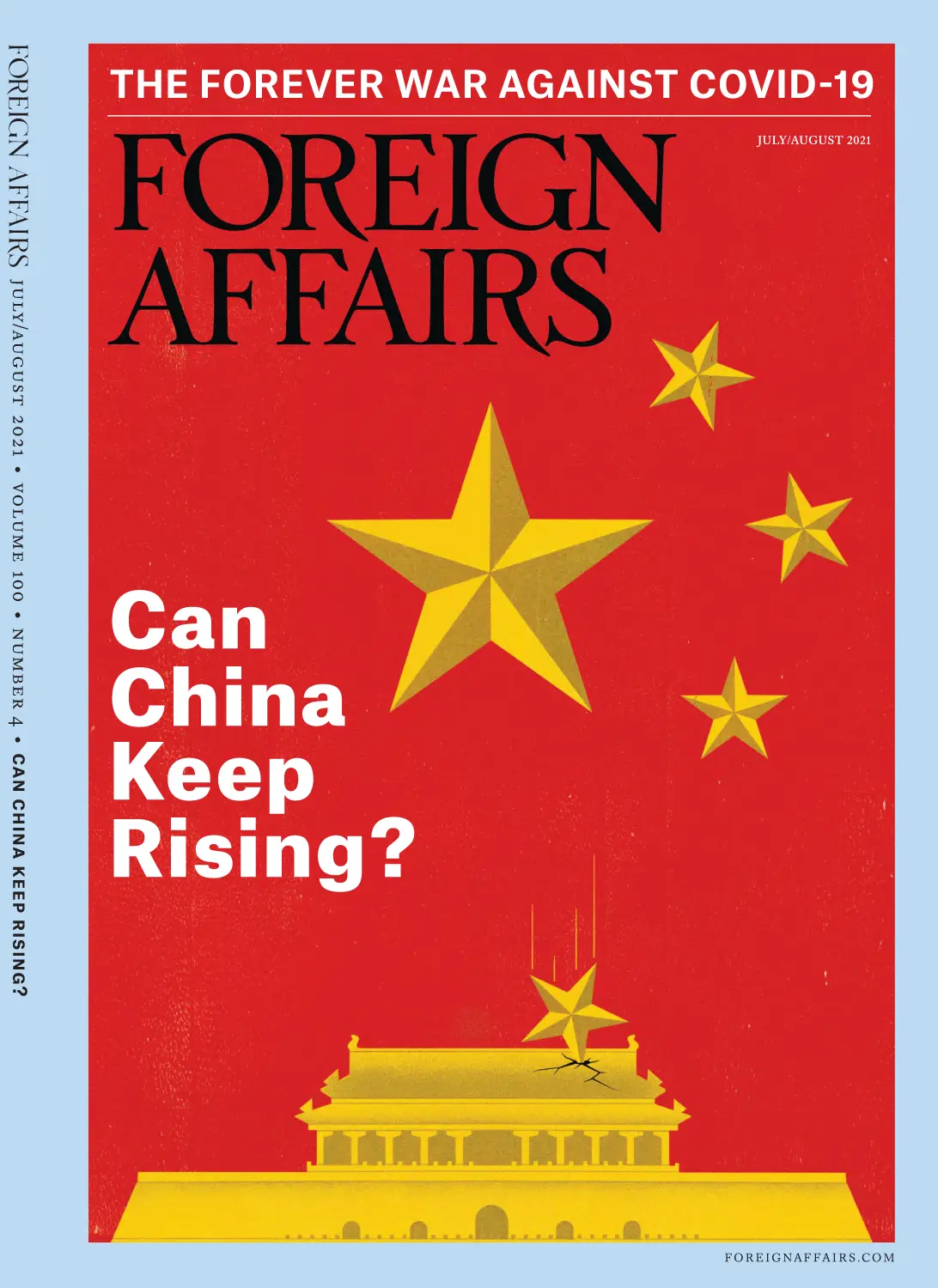
THE FOREVER WAR AGAINST COVID-19
JULY/AUGUST 2021
july/august 2021 • volume 100 • number 4 •
can china keep rising?
Can
China
Keep
Rising?
F O R E I G N A F F A I R S .C O M
Volume 100, Number 4
CAN CHINA KEEP RISING?
Xi’s Gamble
The Race to Consolidate Power and Stave Off Disaster
Jude Blanchette
China’s Economic Reckoning
10
20
The Price of Failed Reforms
Daniel H. Rosen
The Robber Barons of Beijing
30
Can China Survive Its Gilded Age?
Yuen Yuen Ang
Becoming Strong
40
The New Chinese Foreign Policy
Yan Xuetong
The Plot Against China?
How Beijing Sees the New Washington Consensus
Wang Jisi
The Taiwan Temptation
48
58
Why Beijing Might Resort to Force
Oriana Skylar Mastro
COVE R: DAN BEJAR
Life of the Party
68
How Secure Is the CCP?
Orville Schell
July/August 2021
ESSAYS
The Forever Virus
76
The Fulbright Paradox
92
A Strategy for the Long Fight Against COVID-19
Larry Brilliant, Lisa Danzig, Karen Oppenheimer, Agastya Mondal,
Rick Bright, and W. Ian Lipkin
Race and the Road to a New American Internationalism
Charles King
A Better Boom
107
A Measure Short of War
118
Myanmar’s Coming Revolution
132
Antimonopoly Power
146
The Threat Reflex
159
How to Capture the Pandemic’s Productivity Potential
James Manyika and Michael Spence
The Return of Great-Power Subversion
Jill Kastner and William C. Wohlforth
What Will Emerge From Collapse?
Thant Myint-U
The Global Fight Against Corporate Concentration
Barry C. Lynn
Why Some Societies Respond to Danger Better Than Others
Michele Gelfand
ON FOREIGNAFFAIRS.COM
Ashraf Ghani on the
path to peace in
Afghanistan.
Maya Wang on China’s
growing technoauthoritarianism.
David Miliband on the
age of impunity and
how to fight it.
July/August 2021
REVIEWS & RESPONSES
Spies Like Us
168
The Promise and Peril of Crowdsourced Intelligence
Amy Zegart
Chronicle of a Defeat Foretold
174
Why America Failed in Afghanistan
Christina Lamb
Anti-imperial Subjects
180
Asia’s Unfinished Rebellions
Adom Getachew
“Foreign Affairs . . . will tolerate wide differences of opinion. Its articles will not represent any consensus
of beliefs. What is demanded of them is that they shall be competent and well informed, representing
honest opinions seriously held and convincingly expressed. . . . It does not accept responsibility for the
views expressed in any article, signed or unsigned, which appear in its pages. What it does accept is the
responsibility for giving them a chance to appear there.”
Archibald Cary Coolidge, Founding Editor
Volume 1, Number 1 • September 1922
July/August 2021
July/August 2021 · Volume 100, Number 4
Published by the Council on Foreign Relations
DANIEL KURTZ-PHELAN Editor, Peter G. Peterson Chair
STUART REID, JUSTIN VOGT Executive Editors
LAURA SECOR Web Editor
TY M C CORMICK, KANISHK THAROOR, KATHERINE ZOEPF Senior
LAUREL JAROMBEK Engagement Editor
KEERTHANA ANNAMANENI, RHYS DUBIN Assistant Editors
ANN TAPPERT Copy Chief
SARAH FOSTER Business Operations Director
CHRISTIAN GIBBONS Editorial Assistant
Editors
Book Reviewers
LISA ANDERSON, BARRY EICHENGREEN, RICHARD FEINBERG, LAWRENCE D. FREEDMAN, G. JOHN IKENBERRY,
MARIA LIPMAN, JESSICA T. MATHEWS, ANDREW MORAVCSIK, ANDREW J. NATHAN, NICOLAS VAN DE WALLE
STEPHANIE SOLOMON Chief Revenue Officer
JONATHAN CHUNG Circulation Operations Director
NORA REVENAUGH Marketing Director
CARLOS A. MORALES Director, Digital Analytics and Audience Development
MICHAEL PASUIT Advertising Director
GRACE FINLAYSON, FAIZA CHOWDHURY Assistant Managers, Marketing Operations
ANASTASIA FISCHER Marketing Coordinator
HALEY ARNDT Assistant Manager, Customer Retention
ALEXA SOLORIO Production and Business Coordinator
GABRIELA VIEIRA Marketing Promotions Associate
NICOLE CEBALLOS Advertising Operations Associate
ERIC SPECTOR Deputy Director, Digital Development
ANGEL TRAJKOV Manager of Web Development
TIM WASSON Front End Web Developer
KAREN MANDEL Quality Assurance Manager
LISA SHIELDS, IVA ZORIC, DALIA DAGHER
Media Relations
Board of Advisers
JAMI MISCIK Chair
JESSE H. AUSUBEL, PETER E. BASS, JOHN B. BELLINGER, DAVID BRADLEY, KENNETH CHENAULT, SUSAN CHIRA,
JESSICA P. EINHORN, FRANCIS FUKUYAMA, THOMAS H. GLOCER, ADI IGNATIUS, JEH CHARLES JOHNSON,
CHARLES R. KAYE, WILLIAM H. M C RAVEN, MICHAEL J. MEESE, COLIN POWELL, MARGARET G. WARNER,
NEAL S. WOLIN, DANIEL H. YERGIN
SUBSCRIP TION SERVICES:
ForeignAffairs.com/services
T ELEPHONE:
800-829-5539 U.S./Canada
845-267-2017 All other countries
EMAI L: support@ForeignAffairs.com
MAIL : P.O. Box 324, Congers, NY 10920
Foreign Affairs
58 E. 68th Street, New York, NY 10065
ADVE RT ISIN G: Call Michael Pasuit at 212-434-9528 or visit
www.foreignaffairs.com/advertising
WEBS IT E: ForeignAffairs.com
N EWS LET T E R S: ForeignAffairs.com/newsletters
FAC E BOOK : Facebook.com/ForeignAffairs
REPRO DUCTION : The contents of Foreign Affairs are copyrighted. No part of the magazine may be reproduced, hosted,
or distributed in any form or by any means without prior written permission from Foreign Affairs. To obtain permission, visit
ForeignAffairs.com/permissions
Foreign Affairs is a member of the Alliance for Audited Media and the Association of Magazine Media.
GST Number 127686483RT
Canada Post Customer #4015177 Publication #40035310
CONTRIBUTORS
is one of China’s most influential scholars of
international relations. After working as a laborer in the
countryside in the 1960s and 1970s, Wang studied at
Peking University. He went on to teach in the school’s
Department of International Politics and is now president of its Institute of International and Strategic
Studies. A former member of the advisory board of the
Chinese Ministry of Foreign Affairs, in “The Plot
Against China?” (page 48), Wang considers how a
tougher U.S. line on China looks from Beijing.
WANG JISI
has been studying China since he was an
undergraduate at Harvard in the 1950s. In the decades that
followed, he served as The Boston Globe’s “man in Asia,”
wrote for The New Yorker and other magazines, produced
television programs, and headed the Graduate School of
Journalism at the University of California, Berkeley. The
author of 15 books, Schell now directs the Center on
U.S.-China Relations at the Asia Society. In “Life of the
Party” (page 68), he examines the long and surprisingly
diverse history of the Chinese Communist Party.
ORVILLE SCHELL
A leading chronicler of Myanmar, THANT MYINT-U has written
four books on the country, including the acclaimed Hidden
History of Burma. He has also worked for the UN in various
capacities, serving on three peacekeeping operations and as
chief of policy planning in the organization’s political
department. Thant Myint-U is chair of U Thant House, a
leading education and discussion center in Yangon named
after his grandfather, and from 2011 to 2016, he served as an
adviser to the president of Myanmar. In “Myanmar’s
Coming Revolution” (page 132), he argues that despite the
recent turmoil, the country can still break free of its past.
T HA N T MY I N T- U P H O T O: T H U R E I N AU NG
a political theorist at the University of
Chicago, was born in Ethiopia, grew up in Botswana in a
community of fellow African expatriates, and moved to the
United States a month before 9/11. Her early experiences
with both pan-Africanism and the resurgence of American
power shaped her scholarly pursuits, including her book
Worldmaking After Empire, an intellectual history of decolonization. In “Anti-imperial Subjects” (page 180), she
reviews Tim Harper’s Underground Asia, which delves into
the Asian radicals who resisted European imperialism.
ADOM GETACHEW ,
Return to Table of Contents
CAN CHINA KEEP RISING?
“
T
he East is rising,” Chinese
leaders took to declaring around
the time U.S. President Joe
Biden entered office, “and the West is
declining.” The second part of that
declaration may draw eye rolls or angry
objections in Washington and allied
capitals. But the first has become a point
of near consensus: a self-assured China,
bolstered by years of dazzling economic
performance and the forceful leadership
of Xi Jinping, has claimed its place as a
world power and accepted that longterm competition with the United
States is all but inevitable as a result.
But past performance does not
guarantee future results. On closer
examination, the obstacles to China’s
continued success look daunting—as Xi
himself is well aware, which accounts
for both the urgency and the audacity
of his agenda, argues Jude Blanchette.
“Ambition and execution are not the
same thing,” Blanchette writes, “and Xi
has now placed China on a risky trajectory, one that threatens the achievements his predecessors secured in the
post-Mao era.” A similar dynamic is at
play in the economic realm. Daniel
Rosen notes that Beijing’s recent policy
record is one not of world-beating
mastery but of failed attempts at sorely
needed reform followed by panicked
retreats to central control. Meanwhile,
China’s official efforts to overcome “its
own Gilded Age” have been hamstrung
by Xi’s simultaneous suppression of the
very forces that could tame inequality
and corruption in the country, Yuen
Yuen Ang reveals.
Other risks loom beyond China’s
borders. Two of the country’s most
important scholars convey how the
world today looks from Beijing, with
Yan Xuetong outlining China’s growing
willingness to challenge U.S. dominance
and Wang Jisi explaining why “most
Chinese observers now believe that the
United States is driven by fear and envy
to contain China in every possible way.”
And Oriana Skylar Mastro argues that,
amid such distrust, “for the first time in
three decades, it is time to take seriously
the possibility that China could soon use
force” against Taiwan.
This year, Beijing is marking the
100th anniversary of the Chinese
Communist Party with ample “nationalist bravado” and “an avalanche of official
party histories portraying China as a
monolithic powerhouse,” writes Orville
Schell. Yet in tracing the course of
China and the party over the past
century, Schell makes clear that such
triumphalism obscures a more complicated and varied past. Perhaps more
important, it masks uncertainty about
China’s future.
—Daniel Kurtz-Phelan, Editor
On closer examination,
the obstacles to China’s
continued success look
daunting.
Xi’s Gamble
Jude Blanchette
DAN BEJAR
10
The Plot Against China?
Wang Jisi
48
China’s Economic Reckoning
Daniel H. Rosen
20
The Taiwan Temptation
Oriana Skylar Mastro
58
The Robber Barons of Beijing
Yuen Yuen Ang
30
Life of the Party
Orville Schell
68
Becoming Strong
Yan Xuetong
40
I L L U ST R AT I O N S BY T K
CAN CHINA KEEP RISING?
Return to Table of Contents
Xi’s Gamble
The Race to Consolidate
Power and Stave Oª Disaster
Jude Blanchette
X
i Jinping is a man on a mission.
After coming to power in late
2012, he moved rapidly to
consolidate his political authority,
purge the Chinese Communist Party
(CCP) of rampant corruption, sideline
his enemies, tame China’s once highflying technology and financial conglomerates, crush internal dissent, and
forcefully assert China’s influence on
the international stage. In the name of
protecting China’s “core interests,” Xi
has picked fights with many of his
neighbors and antagonized countries
farther away—especially the United
States. Whereas his immediate predecessors believed China must continue
to bide its time by overseeing rapid
economic growth and the steady
expansion of China’s influence through
tactical integration into the existing
global order, Xi is impatient with the
status quo, possesses a high tolerance
for risk, and seems to feel a pronounced sense of urgency in challenging the international order.
Why is he in such a rush? Most
observers have settled on one of two
diametrically opposite hypotheses. The
first holds that Xi is driving a wide
range of policy initiatives aimed at
JUDE BLANCHETTE is Freeman Chair in
China Studies at the Center for Strategic and
International Studies.
10
F O R E I G N A F FA I R S
nothing less than the remaking of the
global order on terms favorable to the
CCP. The other view asserts that he is
the anxious overseer of a creaky and
outdated Leninist political system that
is struggling to keep its grip on power.
Both narratives contain elements of
truth, but neither satisfactorily explains
the source of Xi’s sense of urgency.
A more accurate explanation is that
Xi’s calculations are determined not by
his aspirations or fears but by his timeline. Put simply, Xi has consolidated
so much power and upset the status
quo with such force because he sees a
narrow window of ten to 15 years
during which Beijing can take advantage of a set of important technological and geopolitical transformations,
which will also help it overcome
significant internal challenges. Xi sees
the convergence of strong demographic headwinds, a structural economic slowdown, rapid advances in
digital technologies, and a perceived
shift in the global balance of power
away from the United States as what
he has called “profound changes
unseen in a century,” demanding a
bold set of immediate responses.
By narrowing his vision to the
coming ten to 15 years, Xi has instilled
a sense of focus and determination in
the Chinese political system that may
well enable China to overcome longstanding domestic challenges and
achieve a new level of global centrality.
If Xi succeeds, China will position itself
as an architect of an emerging era of
multipolarity, its economy will escape
the so-called middle-income trap, and
the technological capabilities of its
manufacturing sector and military will
rival those of more developed countries.
Xi’s Gamble
PAO L O T R E / A 3 / C O N T R AST O / R E DU X
11
July/August 2021
Jude Blanchette
Yet ambition and execution are not
the same thing, and Xi has now placed
China on a risky trajectory, one that
threatens the achievements his predecessors secured in the post-Mao era.
His belief that the ccp must guide the
economy and that Beijing should rein
in the private sector will constrain the
country’s future economic growth. His
demand that party cadres adhere to
ideological orthodoxy and demonstrate
personal loyalty to him will undermine
the governance system’s flexibility and
competency. His emphasis on an expansive definition of national security will
steer the country in a more inward and
paranoid direction. His unleashing of
“Wolf Warrior” nationalism will
produce a more aggressive and isolated
China. Finally, Xi’s increasingly singular position within China’s political
system will forestall policy alternatives
and course corrections, a problem made
worse by his removal of term limits and
the prospect of his indefinite rule.
Xi believes he can mold China’s
future as did the emperors of the
country’s storied past. He mistakes this
hubris for confidence—and no one
dares tell him otherwise. An environment in which an all-powerful leader
with a single-minded focus cannot hear
uncomfortable truths is a recipe for
disaster, as China’s modern history has
demonstrated all too well.
A MAN IN A HURRY
In retrospect, Xi’s compressed timeline
was clear from the start of his tenure.
China had become accustomed to the
pace of his predecessor, the slow and
staid Hu Jintao, and many expected Xi
to follow suit, albeit with a greater
emphasis on economic reform. Yet
12
f o r e i g n a f fa i r s
within months of taking the reins in
2012, Xi began to reorder the domestic
political and economic landscape. First
came a top-to-bottom housecleaning of
the ccp. The party had repeatedly
demonstrated its ability to weather
domestic storms, but pressures were
building within the system. Corruption
had become endemic, leading to popular dissatisfaction and the breakdown of
organizational discipline. The party’s
ranks were growing rapidly but were
increasingly filled with individuals who
didn’t share Xi’s belief in the ccp’s
exceptionalism. Party cells in stateowned enterprises, private companies,
and nongovernmental organizations
were dormant and disorganized.
Senior-level decision-making had
become uncoordinated and siloed. The
party’s propaganda organs struggled to
project their messages to an increasingly
cynical and tech-savvy citizenry.
Xi took on all these problems simultaneously. In 2013 alone, he initiated a
sweeping anticorruption drive, launched
a “mass line” campaign to eliminate
political pluralism and liberal ideologies
from public discourse, announced new
guidelines restricting the growth of the
party’s membership, and added new
ideological requirements for would-be
party members. The size of the party
mattered little, he believed, if it was not
made up of true believers. After all, he
noted, when the Soviet Union was on
the brink of collapse in the early 1990s,
“proportionally, the Soviet Communist
Party had more members than [the
ccp], but nobody was man enough to
stand up and resist.”
Next on Xi’s agenda was the need to
assert China’s interests on the global
stage. Xi quickly began land reclama-
Xi’s Gamble
tion efforts in the South China Sea,
established an air defense identification
zone over disputed territory in the East
China Sea, helped launch the New
Development Bank (sometimes called
the brics Bank), unveiled the massive
international infrastructure project that
came to be known as the Belt and Road
Initiative, and proposed the Asian
Infrastructure Investment Bank.
Xi continued to slash his way
through the status quo for the remainder of his first term and shows no signs
of abating as he approaches the end of
his second. His consolidation of power
continues uninterrupted: he faces no
genuine political rivals, has removed
term limits on his tenure in office, and
has installed allies and loyalists in key
positions. New research centers are
dedicated to studying his writings and
speeches, party officials publicly extol
his wisdom and virtue, and party
regulations and government planning
documents increasingly claim to be
based on “Xi Jinping Thought.” He has
asserted the ccp’s dominance over vast
swaths of Chinese society and economic
life, even forcing influential business
and technology titans to beg forgiveness
for their insufficient loyalty to the
party. Meanwhile, he continues to
expand China’s international sphere of
influence through the exercise of hard
power, economic coercion, and deep
integration into international and
multilateral bodies.
Many outside observers, myself
included, initially believed that the
party’s inability to contain the outbreak
of covid-19 highlighted the weaknesses
of China’s system. By the summer of
2020, however, Xi was able to extol the
virtues of centralized control in check-
ing the pandemic’s domestic spread. Far
from undermining his political authority, Beijing’s iron-fisted approach to
combating the virus has now become a
point of national pride.
A UNIQUE MOMENT
Xi’s fast pace was provoked by a convergence of geopolitical, demographic,
economic, environmental, and technological changes. The risks they pose are
daunting, but not yet existential;
Beijing has a window of opportunity to
address them before they become fatal.
And the potential rewards they offer
are considerable.
The first major change is Beijing’s
assessment that the power and influence of the West have entered a phase
of accelerated decline, and as a result, a
new era of multipolarity has begun, one
that China could shape more to its
liking. This view took hold as the U.S.
wars in Afghanistan and Iraq became
quagmires, and it solidified in the wake
of the 2008 financial crisis, which the
Chinese leadership saw as the death
knell for U.S. global prestige. In 2016,
the British vote to leave the European
Union and the election of Donald
Trump as president in the United
States fortified the consensus view that
the United States, and the West more
generally, was in decline. This might
suggest that China could opt for
strategic patience and simply allow
American power to wane. But the
possibility of a renewal of U.S. leadership brought about by the advent of the
Biden administration—and concerns
about Xi’s mortality (he will be 82 in
2035)—means that Beijing is unwilling
to wait and see how long this phase of
Western decline will last.
July/August 2021
13
Jude Blanchette
The second important force confronting Xi is China’s deteriorating
demographic and economic outlook. By
the time he assumed office, China’s
population was simultaneously aging
and shrinking, and the country was
facing an imminent surge of retirees
that would stress the country’s relatively weak health-care and pension
systems. The Chinese Academy of
Social Sciences now expects China’s
population to peak in 2029, and a
recent study in The Lancet forecast that
it will shrink by nearly 50 percent by
the end of the century. Although
Beijing ended its draconian one-child
policy in 2016, the country has still
recorded a 15 percent decline in births
during the past 12 months. Meanwhile,
the government estimates that by 2033,
nearly one-third of the population will
be over the age of 60.
Contributing to these woes is China’s shrinking workforce and rising
wages, which have increased by ten
percent, on average, since 2005. Larger
paychecks are good for workers, but
global manufacturers are increasingly
moving their operations out of China
and to lower-cost countries, leaving a
rising number of low-skilled workers in
China unemployed or underemployed.
And because only 12.5 percent of
China’s labor force has graduated from
college (compared with 24 percent in
the United States), positioning the bulk
of the country’s workforce to compete
for the high-skilled jobs of the future
will be an uphill battle.
Directly related to this worrying
demographic picture is the slowdown of
China’s economy. With annual gdp
growth having dropped from a high of 14
percent in 2007 to the mid-single digits
14
f o r e i g n a f fa i r s
today, many of the long-standing problems Beijing had been able to sweep
under the rug now require attention and
a willingness to accept economic and
political pain, from unwinding the vast
sea of indebted companies to demanding
that firms and individuals pay more into
the country’s tax coffers. At the heart of
China’s growth woes is flagging productivity. Throughout the first several
decades of the post-Mao reform period,
realizing productivity gains was relatively
straightforward, as the planned economy
was dissolved in favor of market forces
and droves of citizens voluntarily fled the
countryside for urban and coastal areas
and the promise of higher-wage jobs.
Later, as foreign companies brought
investment, technology, and know-how
to the country, industrial efficiency
continued to improve. Finally, the
massive amounts spent on infrastructure,
especially roads and rail, boosted connectivity and thus productivity. All of this
helped a poor and primarily agricultural
economy rapidly catch up with more
advanced economies.
Yet by the time Xi assumed power,
policymakers were finding it increasingly difficult to maintain momentum
without creating unsustainable levels of
debt, just as they had done in response
to the 2008 global financial crisis. What
is more, the country was already saturated with transportation infrastructure,
so an additional mile of road or highspeed rail wasn’t going to add much to
growth. And because almost all ablebodied workers had already moved from
the countryside to urban areas, relocating labor wouldn’t arrest the decline in
productivity, either. Finally, the social
and environmental costs of China’s
previous growth paradigm had become
both unsustainable and destabilizing, as
staggering air pollution and environmental devastation provoked acute
anger among Chinese citizens.
Perhaps the most consequential
shifts to have occurred on Xi’s watch are
advances in new technologies such as
artificial intelligence, robotics, and
biomedical engineering, among others.
Xi believes that dominating the “commanding heights” of these new tools
will play a critical role in China’s
economic, military, and geopolitical
fate, and he has mobilized the party to
transform the country into a high-tech
powerhouse. This includes expending
vast sums to develop the country’s R & D
and production capabilities in technologies deemed critical to national
security, from semiconductors to
batteries. As Xi stated in 2014, firstmover advantage will go to “whoever
holds the nose of the ox of science and
technology innovation.”
Xi also hopes that new technologies
can help the CCP overcome, or at least
circumvent, nearly all of China’s domestic challenges. The negative impacts of
a shrinking workforce, he believes, can
be blunted by an aggressive push
toward automation, and job losses in
traditional industries can be offset by
opportunities in newer, high-tech
sectors. “Whether we can stiffen our
back in the international arena and
cross the ‘middle-income trap’ depends
to a large extent on the improvement of
science and technology innovation capability,” Xi said in 2014.
New technologies serve other purposes, as well. Facial recognition tools
and artificial intelligence give China’s
internal security organs new ways to
surveil citizens and suppress dissent.
DIPLOMACY
CASE
STUDIES
Bring the
REAL WORLD
to your classroom
foreign policy
International organizations
Conflict resolution
Terrorism and security
Global ealt
International trade
Women, peace, and security
And more.
Instructors: Join our Faculty Lounge
for free access to this unique online
library of over 250 case studies and
simulations — and make diplomacy
part of your course
casestudies.isd.georgetown.edu
12 advertising space - long.indd 1
July/August 2021
7/14/2017 2:31:53 PM
15
Jude Blanchette
The party’s “military-civil fusion”
strategy strives to harness these new
technologies to significantly bolster the
Chinese military’s warfighting capabilities. And advances in green technology
offer the prospect of simultaneously
pursuing economic growth and pollution abatement, two goals Beijing has
generally seen as being in tension.
THE PARANOID STYLE IN
CHINESE POLITICS
This convergence of changes and
developments would have occurred
regardless of who assumed power in
China in 2012. Perhaps another leader
would have undertaken a similarly bold
agenda. Yet among contemporary
Chinese political figures, Xi has demonstrated an unrivaled skill for bureaucratic infighting. And he clearly believes
that he is a figure of historical significance, on whom the ccp’s fate rests.
In order to push forward significant
change, Xi has overseen the construction of a new political order, one
underpinned by a massive increase in
the power and authority of the ccp. Yet
beyond this elevation of party power,
perhaps Xi’s most critical legacy will be
his expansive redefinition of national
security. His advocacy of a “comprehensive national security concept”
emerged in early 2014, and in a speech
that April, he announced that China
faced “the most complicated internal
and external factors in its history.”
Although this was clearly hyperbole—
war with the United States in Korea
and the nationwide famine of the late
1950s were more complicated—Xi’s
message to the political system was
clear: a new era of risk and uncertainty
confronts the party.
16
f o r e i g n a f fa i r s
The ccp’s long experience of defections, attempted coups, and subversion
by outside actors predisposes it to
acute paranoia, something that reached
a fever pitch in the Mao era. Xi risks
institutionalizing this paranoid style.
One result of blurring the line between
internal and external security has been
threat inflation: party cadres in lowcrime, low-risk areas now issue warnings of terrorism, “color revolutions,”
and “Christian infiltration.” In Xin
jiang, fears of separatism have been
used to justify turning the entire region
into a dystopian high-tech prison. And
in Hong Kong, Xi has established a
“national security” bureaucracy that
can ignore local laws and operate in
total secrecy as it weeds out perceived
threats to Beijing’s iron-fisted rule. In
both places, Xi has demonstrated that
he is willing to accept international
opprobrium when he feels that the
party’s core interests are at stake.
At home, Xi stokes nationalist
sentiment by framing China as surrounded and besieged by enemies,
exploiting a deeply emotional (and
highly distorted) view of the past, and
romanticizing China’s battles against the
Japanese in World War II and its “victory” over the United States in the
Korean War. By warning that China has
entered a period of heightened risk from
“hostile foreign forces,” Xi is attempting
to accommodate Chinese citizens to the
idea of more difficult times ahead and
ensure that the party and he himself are
viewed as stabilizing forces.
Meanwhile, to exploit a perceived
window of opportunity during an
American retreat from global affairs,
Beijing has advanced aggressively on
multiple foreign policy fronts. These
Xi’s Gamble
include the use of “gray zone” tactics,
such as employing commercial fishing
boats to assert territorial interests in the
South China Sea and establishing
China’s first overseas military base, in
Djibouti. China’s vast domestic market
has allowed Xi to threaten countries
that don’t demonstrate political and
diplomatic obedience, as evidenced by
Beijing’s recent campaign of economic
coercion against Australia in response
to Canberra’s call for an independent
investigation into the origins of the
virus that causes covid-19. Similarly, Xi
has encouraged Chinese “Wolf Warrior” diplomats to intimidate and harass
host countries that criticize or otherwise antagonize China. Earlier this
year, Beijing levied sanctions against Jo
Smith Finley, a British anthropologist
and political scientist who studies
Xinjiang, and the Mercator Institute for
China Studies, a German think tank,
whose work the ccp claimed had
“severely harm[ed] China’s sovereignty
and interests.”
Mao Zedong and Deng Xiaoping
demonstrated strategic patience in
asserting China’s interests on the global
stage. Indeed, Mao told U.S. President
Richard Nixon that China could wait
100 years to reclaim Taiwan, and Deng
negotiated the return of Hong Kong
under the promise (since broken by Xi)
of a 50-year period of local autonomy.
Both leaders had a profound sense of
China’s relative fragility and the
importance of careful, nuanced statesmanship. Xi does not share their
equanimity, or their confidence in
long-term solutions.
That has sparked concerns that Xi
will attempt an extraordinarily risky
gambit to take Taiwan by force by 2027,
the 100th anniversary of the founding
of the People’s Liberation Army. It
seems doubtful, however, that he would
invite a possible military conflict with
the United States just 110 miles from
China’s shoreline. Assuming the pla
were successful in overcoming Taiwan’s
defenses, to say nothing of surmounting possible U.S. involvement, Xi
would then have to carry out a military
occupation against sustained resistance
for an indeterminate length of time.
An attempted takeover of Taiwan
would undermine nearly all of Xi’s
other global and domestic ambitions.
Nevertheless, although the more
extreme scenarios might remain unlikely for the time being, Xi will
continue to have China flaunt its
strength in its neighborhood and push
outward in pursuit of its interests. On
many issues, he appears to want final
resolution on his watch.
THE MAN OF THE SYSTEM
Xi’s tendency to believe he can shape
the precise course of China’s trajectory
calls to mind the economist Adam
Smith’s description of “the man of
system”: a leader “so enamored with the
supposed beauty of his own ideal plan
of government, that he cannot suffer the
smallest deviation from any part of it.”
In order to realize his near-term goals,
Xi has abandoned the invisible hand of
the market and forged an economic
system that relies on state actors to
reach predetermined objectives.
Critical to this shift has been Xi’s reliance on industrial policy, a tool of
economic statecraft that had fallen out of
favor until near the end of the tenure of
Xi’s predecessor, Hu, when it began to
shape Beijing’s approach to technologiJuly/August 2021
17
Jude Blanchette
cal innovation. The year 2015 marked
an important inflection point, with the
introduction of supersized industrial
policy programs that sought not just to
advance a given technology or industry
but also to remake the entire structure
of the economy. These included the
Made in China 2025 plan, which aims
to upgrade China’s manufacturing capabilities in a number of important
sectors; the Internet Plus strategy, a
scheme to integrate information technology into more traditional industries;
and the 14th Five-Year Plan, which
outlines an ambitious agenda to decrease China’s reliance on foreign
technology inputs. Through such
policies, Beijing channels tens of
trillions of yuan into companies,
technologies, and sectors it considers
strategically significant. It does this by
means of direct subsidies, tax rebates,
and quasi-market “government guidance funds,” which resemble statecontrolled venture capital firms.
Thus far, Beijing’s track record in
this area is decidedly mixed: in many
cases, vast sums of investment have
produced meager returns. But as the
economist Barry Naughton has cautioned, “Chinese industrial policies are
so large, and so new, that we are not yet
in a position to evaluate them. They
may turn out to be successful, but it is
also possible that they will turn out to
be disastrous.”
Related to this industrial policy is
Xi’s approach to China’s private-sector
companies, including many of the
technological and financial giants that
just a few years ago observers viewed as
possible agents of political and social
change. Technological innovation put
firms such as Ant Group and Tencent in
18
f o r e i g n a f fa i r s
control of critical new data flows and
financial technology. Xi clearly perceived this as an unacceptable threat, as
demonstrated by the ccp’s recent
spiking of Ant Group’s initial public
offering in the wake of comments made
by its founder, Jack Ma, that many
perceived as critical of the party.
Xi is willing to forgo a boost in
China’s international financial prestige
to protect the party’s interests and send
a signal to business elites: the party
comes first. This is no David and
Goliath story, however. It’s more akin
to a family feud, given the close and
enduring connections between China’s
nominally private firms and its political
system. Indeed, nearly all of China’s
most successful entrepreneurs are members of the ccp, and for many companies, success depends on favors granted
by the party, including protection from
foreign competition. But whereas previous Chinese leaders granted wide
latitude to the private sector, Xi has
forcefully drawn a line. Doing so has
further restricted the country’s ability
to innovate. No matter how sophisticated Beijing’s regulators and state
investors may be, sustained innovation
and gains in productivity cannot occur
without a vibrant private sector.
GRAND STRATEGY OR
GRAND TRAGEDY?
In order to seize temporary advantages
and forestall domestic challenges, Xi
has positioned himself for a 15-year
race, one for which he has mobilized the
awesome capabilities of a system that he
now commands unchallenged. Xi’s
truncated time frame compels a sense of
urgency that will define Beijing’s policy
agenda, risk tolerance, and willingness
Xi’s Gamble
to compromise as it sprints ahead. This
will narrow the options available to
countries hoping to shape China’s
behavior or hoping that the “Wolf
Warrior” attitude will naturally recede.
The United States can disprove
Beijing’s contention that its democracy
has atrophied and that Washington’s
star is dimming by strengthening the
resilience of American society and
improving the competence of the U.S.
government. If the United States and
its allies invest in innovation and human
capital, they can forestall Xi’s efforts to
gain first-mover advantage in emerging
and critical technologies. Likewise, a
more active and forward-looking U.S.
role in shaping the global order would
limit Beijing’s ability to spread illiberal
ideas beyond China’s borders.
Unwittingly, Xi has put China into
competition with itself, in a race to
determine if its many strengths can
outstrip the pathologies that Xi himself
has introduced to the system. By the
time he assumed power, the ccp had
established a fairly predictable process
for the regular and peaceful transition
of power. Next fall, the 20th Party
Congress will be held, and normally, a
leader who has been in charge as long as
Xi has would step aside. To date,
however, there is no expectation that Xi
will do so. This is an extraordinarily
risky move, not just for the ccp itself
but also for the future of China. With
no successor in sight, if Xi dies unexpectedly in the next decade, the country
could be thrown into chaos.
Even assuming that Xi remains
healthy while in power, the longer his
tenure persists, the more the ccp will
resemble a cult of personality, as it did
under Mao. Elements of this are already
evident, with visible sycophancy among
China’s political class now the norm.
Paeans to the greatness of “Xi Jinping
Thought” may strike outsiders as
merely curious or even comical, but
they have a genuinely deleterious effect
on the quality of decision-making and
information flows within the party.
It would be ironic, and tragic, if Xi, a
leader with a mission to save the party
and the country, instead imperiled
both. His current course threatens to
undo the great progress China has
made over the past four decades. In the
end, Xi may be correct that the next
decade will determine China’s longterm success. What he likely does not
understand is that he himself may be
the biggest obstacle.∂
July/August 2021
19
CAN CHINA KEEP RISING?
Return to Table of Contents
China’s Economic
Reckoning
The Price of Failed Reforms
Daniel H. Rosen
M
any observers look at China
and see its leadership playing
a masterful game. They see
China refusing to bend its policies to fit
global norms and successfully going its
own way. The reality is that Beijing has
tried to bend repeatedly under President
Xi Jinping but has almost broken each
time and has had to fall back on its old
ways—which are not succeeding. The
quantity and the quality of China’s
growth (looking past the anomalies of the
pandemic period) have both deteriorated.
And unless the leadership of the Chinese
Communist Party finds its way back to
the path of economic liberalization,
China’s future will look very different
from the rosy picture the CCP paints.
The urgency of reform is a happy
result of China’s rise to middle-income
status from the extreme poverty it
experienced just a few decades ago. It is
nothing to be ashamed of. But the
applause that China has earned for its
economic successes will subside if Xi
fails to tolerate policy debate and accept
more constrained political ambitions that
admit the limits of the CCP’s capabilities.
An honest assessment of recent
setbacks suggests that time is running
DANIEL H. ROSEN is a founding partner
of Rhodium Group and leads the firm’s work
on Asia.
20
F O R E I G N A F FA I R S
out. Investors and businesses in China
and abroad, as well as other governments, have so far gone along with the
pretense that China is either succeeding
at reform or understandably choosing to
defer it; few have been willing to
conclude that China has tried to reform
but failed. Xi may believe that he has
another decade to tinker with the
country’s economic model. Taking stock
of the many major policy plans that the
CCP has launched but then abandoned
indicates otherwise: there are at most a
few years to act before growth runs out.
If China’s leaders wait until the last
minute, it will be too late.
STUCK IN THE MIDDLE
In recent years, China hawks in the
United States have asserted that they
were right all along: China has not
reformed and never intended to do so.
Some have even suggested that the CCP
has been deceiving Washington since
1972, when U.S. President Richard
Nixon went to China and normalized
relations with Beijing. China, according
to this view, was merely feigning an
appetite for liberalization. That is a
misreading of China’s economic path.
During the reform era ushered in by
Deng Xiaoping in 1978, the party
relaxed its control over economic forces
such as inflation, internal capital flows,
and unemployment. To stoke growth
and innovation, Beijing let foreigners
into strategically sensitive corners of
the Chinese economy, such as telecommunications and aerospace. Sacred
cows of communist ideology were
sacrificed along the way. When Deng
began the reform process, the state was
setting almost all prices for goods and
services; by the time China joined the
China’s Economic Reckoning
PAU L L A NG RO C K / Z E N I T / L AI F / R E DU X
21
July/August 2021
Daniel H. Rosen
World Trade Organization in 2001, all
but a few prices were being set by
market competition. In the 1990s, the
ccp allowed more than 100,000 stateowned firms to close, resulting in more
than 20 million layoffs. By 2020, the
party had let foreigners build businesses in China worth $3 trillion, many
of them in direct competition with
Chinese incumbents.
As significant as these policy moves
were, however, they were the easy part:
they mostly required bureaucrats to
simply get out of the way. Officials didn’t
grow a market; they let a market grow
out of a morass of government planning.
Reduced state intervention and the
dismantling of cross-border investment
barriers, internal fees, and taxes transformed China’s economic trajectory. In
the decades after 1978, annual gdp
growth rates of 5.5 percent or less—typical for low-income countries—accelerated into the double digits, turning
China into an economic juggernaut.
But by the time the global financial
crisis hit in 2008, Beijing had picked all
the low-hanging fruit. To ensure
continued strong growth, the party
needed to lean in, promoting good
governance and fair competition and
imposing hard constraints on wasteful
investment—delivering on the challenges faced by any successful modern
regulatory state. For the next four
years, however, easy credit became
Beijing’s main tool, and annual debt
service costs catapulted from an estimated three trillion to eight trillion
yuan. When Xi rose to the top of the
ccp in 2012, growth had slowed to
single digits, and the return on state
investments in infrastructure was
falling. This is what economists call
22
f o r e i g n a f fa i r s
“the middle-income trap”: once a
country emerges from poverty, it
becomes harder to deliver growth.
Xi came to power with a mandate to
take charge. From the start, he moved
to consolidate his own authority, shrinking the Standing Committee of the
Politburo from nine members to seven
and personally chairing virtually all the
important groups responsible for
policymaking. As his point person on
the economy, Xi chose Liu He, a
well-known proponent of marketization. Xi set a high bar for reform,
issuing a manifesto in 2013 known as
the “60 Decisions.” He pledged to make
the market “decisive” in guiding economic outcomes and to recast the role
of the government in a manner that
liberal Western economists would
welcome: maintain macroeconomic
stability, deliver public services, ensure
fair competition and regulation, and
address market failures. Xi was convinced by his economists that without
bold action, China would face its own
internal debt trap. If the party failed to
transform the economy, Xi wrote during
his first year in office, “we will find
ourselves in a blind alley.”
Liu got to work. In the spring of
2013, policymakers set their sights on
parts of the financial system that were
swelling with risky liabilities. Banks
were issuing short-term wealth management products at high interest rates and
using the proceeds to invest in riskier
long-term assets. The People’s Bank of
China, the country’s central bank,
decided to shock those banks into better
behavior by cutting off their access to
short-term funding. The move had
massive unintended consequences: the
banks were so surprised that they
China’s Economic Reckoning
stopped lending immediately, causing
short-term borrowing rates to rise from
around two or three percent to between
20 and 30 percent. Chinese stock
markets plummeted by more than ten
percent as traders tried to access cash
through any liquid asset available. The
pboc quickly backed down and restored
short-term funding to banks. As the
central bank had feared, however, this
only invited more risk-taking. From
2013 to 2016, borrowing via the shortterm money market quintupled, and
there was an explosion of so-called
shadow lending, with Chinese banks
providing money to third-party institutions, which in turn sought higher
returns by going through unregulated
channels (such as offering margin loans
for stock market speculation) and by
lending to riskier borrowers.
TWO STEPS FORWARD,
TWO STEPS BACK
This interbank market crisis was just
the first sign of what has become a
pattern during the Xi era: bold attempts
at reform followed by retreats when
those attempts trigger instability and
upheaval. The pattern recurred in 2014,
when Beijing took steps to make it
easier for Chinese companies to invest
abroad directly, a necessity if they were
to graduate from manufacturing basic
goods for export to running global
businesses. And invest they did, with
outward foreign direct investment
rising from $73 billion in 2013 to a high
of $216 billion in 2016. The explosion
of outbound investment was far more
significant than anyone had anticipated.
Some of these investments earned
China bragging rights as a global
player—the acquisition by Anbang
Insurance of the Waldorf Astoria, for
example, and the financing of a venture
with Carnival Cruise Lines by the
China Investment Corporation, a
sovereign wealth fund. But as these
foreign assets piled up, China’s foreign
exchange reserves, built up over years
thanks to consistent trade surpluses, fell
by almost a quarter (from nearly $4
trillion to below $3 trillion) as Chinese
players sought dollars to invest abroad.
By the end of 2016, the ccp, anxious
over the rapid outflows, decided that
reform could wait and reimposed capital
controls. Outbound investment has
been stagnant ever since.
Tax policy was another area in which
Xi moved aggressively at first. In June
2014, the Politburo approved a national
fiscal and tax reform plan that, among
other things, called for the Finance
Ministry, headed by Lou Jiwei, to rein
in the borrowing and spending of local
governments and to introduce property
taxes. Those tasks were supposed to
have been completed by 2016. Five
years past that deadline, however, the
ministry has made little progress; local
government debt has actually increased
since the reforms were initiated, and
the now retired Lou has publicly
warned about the fiscal risks looming
over the system.
Knowing that government spending
could not fuel growth forever, Xi’s team
turned to the corporate sector. Xi
pledged to reduce the overbearing role of
the state and to make room for businesses to manage their commercial
activity with less political interference.
Pilot programs set out to empower
independent directors to make decisions
on strategy and leadership, paring back
the role of ccp committees. Other
July/August 2021
23
Daniel H. Rosen
reforms were supposed to clarify which
industries were well suited to market
competition and which required continued state control. Both of those efforts
stalled, however, and since 2017, the party
has retained its hold on all corporate
affairs at state-related companies and has
sought to increase its influence over
private firms, including foreign ones.
When Xi came to power, the party
also tried to unleash equity markets to
ease the financing burden on state
banks. The debt levels of local governments and state-owned enterprises were
a constant worry, and the prospect of
using equity-market listings to deleverage was irresistible. Beijing envied the
dynamism of Western stock markets. In
2013, the government simplified the
requirements for initial public offerings,
and within a year, 48 ipos had been
completed and another 28 had been
cleared by regulators. Officials also lifted
restrictions on margin trading, and
editorials in state-controlled newspapers
encouraged people to pile into increasingly bubbly stocks. Soon, China saw
the downside of its gambit. In June 2015,
after official support for the unsustainable trend was called into question, the
bubble burst: within a month, the
market lost a third of its value. Today,
despite a substantial expansion of the
overall economy, the market remains 25
percent below its 2015 high.
UNINTENDED CONSEQUENCES
Banking was another area in which Xi
hoped to make strides. In October 2015,
the pboc announced a long-awaited
milestone: the full liberalization of
interest rates on bank deposits and
loans. Those rates had previously been
set by the central bank with guidance
24
f o r e i g n a f fa i r s
from the State Council, the central
government’s chief administrative
authority. That system prevented banks
from competing with one another for
depositors and borrowers. Until the
early 2010s, rates were fixed far lower
than market conditions would have
dictated, which meant households were
effectively subsidizing state borrowers:
depositors should have received higher
rates on their savings, and borrowers
should have paid higher lending rates.
That had the effect of encouraging
overinvestment by state-owned enterprises in industries that were already
dogged by overcapacity and reducing
household consumption.
To address these problems, the
central bank permitted banks to compete by offering depositors interest
rates up to 50 percent above official
benchmark rates; the ceiling had
previously been just ten percent. Soon
after, the deposit rate cap was eliminated altogether—in principle. In
practice, banking officials worried that
smaller banks would create instability
if they competed based on market
forces, and so they maintained an
informal rule that deposit rates should
remain no more than 50 percent higher
than the benchmark rate. Those training wheels remain in place today:
interest rates have been nominally
liberalized, but little has truly changed,
and banks are still restricted in how
they can compete for customers.
Another goal of Xi’s financial liberalization strategy was to secure the
International Monetary Fund’s recognition of the yuan as a reserve currency
worthy of inclusion in the basket of
currencies on which the imf bases its
Special Drawing Rights (sdrs), a unit
Gain competitive skills for the global workplace plus experience the business,
policy and cultural environments of Russia and the region. This unparalleled
opportunity has enabled over 200 professionals to elevate their careers since 2004.
RUSSIA+
PROFESSIONAL EXPERIENCE
CULTURAL IMMERSION
LANGUAGE TRAINING
MONTHLY STIPEND
ACCOMMODATION
NETWORKING
TRAVEL
Learn more:
culturalvistas.org/alfa
Apply by
DECEMBER 1
OJSC Alfa-Bank is incorporated, focused and based in Russia, and is not affiliated with U.S.-based Alfa Insurance.
�������������������������������...�������������������
��������������������������������������������������....
��������������������������������������������������
�����������������������������������.�� —Kirkus
�v�i����� �t ����� ���� ��t�i���s ��� ������
�...��������������������������������
�����������������������������������������
���������������������������������������
������������������������������.� —�r�����ri���ri�������������������k����i��
visit ������������� �� ���t��t i������i��������i��t����is���s����
Daniel H. Rosen
of account that central banks use to
make transactions. The pboc hoped that
if the yuan had that status, it would
encourage other central banks to
purchase assets denominated in yuan,
making China’s markets more attractive
to foreign investors.
The trouble, however, was that
currencies in the sdr basket are supposed to be freely usable in international
transactions and traded frequently.
China’s capital controls made it hard to
meet those criteria. To get around that
stumbling block, Beijing claimed that
there was in fact a liquid market for
yuan—in Hong Kong, which maintains
an offshore yuan market where currency
rates can fluctuate more than in China
itself. The problem with this workaround became clear when Beijing
suddenly depreciated the yuan in August
2015 in an attempt to unify prices on the
mainland and in Hong Kong. Alarming
capital outflows resulted, facilitated by
the very Hong Kong market that the
pboc had been promoting.
The imf did eventually agree to add
the yuan to the sdr basket in November
2015. At that point, China’s central bank
backed away from liberalizing the Hong
Kong currency market, squeezing the
liquidity out of it and diminishing its
role as a trading center. Six years later,
the offshore pool of Hong Kong yuan
remains small, the currency still accounts for only a limited share of
international cross-border transactions
and a modest proportion of global
foreign exchange reserves, and China’s
capital controls are still in place.
By the summer of 2016, Liu and the
rest of the ccp leadership had grown
weary of the risky lending activity that
had led to the stock market bubble and
26
f o r e i g n a f fa i r s
the interbank market crisis. China’s
financial system, they feared, was
starting to look like that of the United
States before the subprime crisis of
2007–8. So Beijing embarked on a
deleveraging campaign to shrink the
shadow banking system and reduce
systemic financial risks. First, the central
bank fixed short-term borrowing rates
higher, which raised overall interest
rates but did not significantly reduce
credit volumes. Then, Beijing toughened
regulatory rules to prevent banks from
parking funds with third-party institutions in order to skirt regulations. As
planned, the volume of new credit fell,
but this had the effect of throttling the
economy throughout 2018, because it
turned out that borrowers from shadow
banks were not only engaged in speculation but also investing in property
development and local infrastructure.
Once again, Beijing had to pull back,
abandoning its aggressive deleveraging
efforts and allowing credit to rise again,
particularly for local governments.
The pattern of restoring central
control after failed attempts to liberalize may be reaching its apex in one of
the most important stories to come out
of China in the past year: Beijing’s
crackdown on financial technology
firms. This has led to antitrust actions
against the technology giants Alibaba
and Tencent and the shelving of an
initial public offering for Ant Group, an
Alibaba subsidiary.
The ccp has presented these steps as
pro-consumer reforms, which seems
reasonable in a world where many other
countries are looking to rein in their
tech titans. But for Beijing, the moves
mark the end of a crucial financial
opening. In the early 2010s, these firms
China’s Economic Reckoning
were given a free hand by party technocrats who hoped that financial innovations would force ossified state-owned
banks to become more productive. This
succeeded, at least in fits and starts: the
new firms made the financial system
work for previously underserved
customers. But innovation also came
with new risks, such as peer-to-peer
lending platforms that offered high
rates to depositors and even higher
rates to borrowers. When many of the
borrowers defaulted, investors protested, believing erroneously that the
platforms were guaranteed by the
government. In August 2018, thousands
of people showed up in the heart of
Beijing’s financial district to demand
compensation. A regulatory crackdown
on peer-to-peer lenders commenced, in
a prelude to this year’s scrutiny of Ant
Group. The crackdown has been successful in reducing financial risks, but it
has also reversed the benefits of reform,
as many low-income consumers now
have fewer choices in accessing credit.
The pattern of macroeconomic
policy in the Xi era is clear: each
attempt at reform has produced a
miniature crisis that has threatened to
become a bigger one, prompting the
ccp to revert to what it knows best—
command and control. The official line,
of course, is that there were no failures
and that China is inexorably marching
forward with Deng’s agenda of “reform
and opening.” In a speech in December
2020, Xi boasted of having launched
2,485 reform plans, meeting the party’s
targets on schedule. The next month,
the official newspaper, the People’s
Daily, concurred, saying that 336
high-priority reform goals had been
“basically accomplished” and lauding
“significant breakthroughs in comprehensively deepening reform.”
Privately, Chinese economists
acknowledge that this is not the case.
But they contend—not without merit—
that the challenges afflicting market
economic systems since the global
financial crisis provide ample reason to
proceed slowly. As Chinese Vice President Wang Qishan reportedly told then
U.S. Treasury Secretary Henry Paulson
in the midst of that crisis: “You were
my teacher, but now here I am in my
teacher’s domain, and look at your
system, Hank. We aren’t sure we should
be learning from you anymore.” During
the Trump era, even the United
States—long the world’s leading proponent of economic liberalization—
seemed to call its free-market convictions into question.
But the real story is neither China’s
reform success nor its reform hesitancy.
Xi has tried but largely failed to push
ahead with the agenda that Deng
launched in 1978 and that Xi’s predecessors all sustained. The consequences of
that failure are clear. Since Xi took
control, total debt has risen from 225
percent of gdp to at least 276 percent.
In 2012, it took six yuan of new credit to
generate one yuan of growth; in 2020, it
took almost ten. Gdp growth slowed
from around 9.6 percent in the pre-Xi
years to below six percent in the months
before the pandemic began. Wage
growth and household income growth
have also slowed. And whereas productivity growth—the ability to grow
without needing to use more labor or
resources—accounted for as much as
half of China’s economic expansion in
the 1990s and one-third in the following
decade, today it is estimated to contribJuly/August 2021
27
Daniel H. Rosen
ute just one percent of China’s six
percent growth, or, by some calculations,
nothing at all. All these data points
signal a loss of economic dynamism.
HIGH STAKES
Why is it important to understand that
Xi did not resist reform but instead
failed at it? The reason is that when it
comes to China’s prospects, perceptions
matter. If investors, businesses, and
other governments believe that Xi has
spurned reform but that China can
deliver growth without it, then they
will endorse and invest in Beijing’s
model. But if they understand that Xi has
in fact attempted to liberalize but retreated to a low-productivity commandand-control economy, then they will
hesitate, if not withdraw, and insist that
Beijing do the hard work of policy
reform before it can earn their trust.
Based on Xi’s own belief that without reform China will hit a dead end, a
reckoning appears to be inevitable. The
question is when it will arrive and
whether Beijing will take the bold steps
that every country that has escaped the
middle-income trap has been forced to
take. Skeptics of China’s continued
progress have been wrong before, and
they must explain what is different now
to justify their bearishness. Three
factors are most compelling. First, in
recent years, interest on debt alone
(never mind principal) has grown to
double the value of annual gdp growth:
this situation is causing bank failures,
restructurings, and major defaults of
state-owned enterprises. Second, for
the first time since the mass starvations
of the catastrophic Great Leap Forward, the working population is shrinking, which will result in a smaller labor
28
f o r e i g n a f fa i r s
force and fewer people buying property
in China’s oversupplied housing market.
And third, from 1978 to about 2015, the
United States and other world powers
went out of their way to engage with
China and smooth its path to global
opportunities. That is no longer the
case, even if open-market democracies
have not formed a consensus about the
right stance to take on China going
forward. In many ways, the tailwinds
China enjoyed from global enthusiasm
about its rise have become headwinds.
If Beijing cannot induce private firms
to ramp up their investment and cannot
persuade major economies to remain
engaged with China, then the country’s
clear economic outlook will cloud over.
Xi-era reform efforts have already
precipitated a series of minicrises, each
one shrinking the space for trial and
error in the future. The high-tech
wizards whom the ccp was so recently
celebrating as the heroes of a new digital
future are now scurrying to prove their
fealty to the party rather than pushing
officials to allow them to compete and
innovate more aggressively. With
business and household debt levels
already extremely high, China can
scrape out perhaps two or three more
years of economic stability by piling on
further loans, as long as global capital
flows and supply chains do not dry up.
If firms and investors do pull back, or if
China needs to raise interest rates more
aggressively at home, a reckoning could
happen much sooner.
Beijing has options to ease this transition, but it cannot avoid it. Unlike Japan
when its asset bubble popped in 1991,
China is not a mature, high-income
nation. Growing rural incomes will
make China stronger but will not
China’s Economic Reckoning
produce trophy cities or high-tech
machines. Xi’s “dual circulation” campaign envisions a revolution in consumer spending. That, too, is a possibility, provided Beijing shifts from
supporting firms to forcing them to
serve consumers. And by selling off state
enterprises, China could raise trillions of
dollars to retire debt, fund health care,
and pay for carbon abatement, all while
stoking healthy private competition.
These and many other avenues to
sustainable growth are available. But in
each case, the party’s insistence that in
“government, military, civilian, and
academic; east, west, south, north, and
center, the party leads everything”
would have to be sacrificed—and to
date, that has been a bridge too far.
At some point, China’s leaders must
confront this tradeoff: sustainable
economic efficiency and political
omnipotence do not go hand in hand.
Throughout history, leaders faced with
this conundrum in China and elsewhere
have tried to hide falling productivity
to buy time and keep searching for a
way to have it all. And indeed, a number of statistics have lately been made
unavailable in China. Beijing will point
to its record of exceptionalism, but if it
were to find a way to maintain stability,
state control, and economic dynamism
all at once, it would be the first country
in history to do so. In light of the
muddled reform record of the Xi years,
skepticism seems justified.
If China meets the fate of other
middle-income nations that failed to
reform their way out of declining
productivity, the picture will darken.
Asset prices for property and corporate
bonds will fall significantly, causing
political discontent as people see their
wealth evaporate. With faltering
confidence and too much riding on the
credibility of government promises to
ensure stability, new investment will
dwindle, job creation will slow, and the
tax and revenue base will shrink. All of
this has already begun to happen, but
Beijing will be forced to make much
harder choices going forward.
That will mean a time of painful
austerity for China and also for its
partners abroad, who have come to
count on China as a buyer of iron ore, a
purveyor of development assistance,
and a direct investor in startups and
many other enterprises. This will have
immense geopolitical consequences, as a
recalibration of great-power competition takes place. Beijing could turn
more belligerent in search of solutions.
Conversely, it could return to the
domestic development focus of prior
years, reverting to Deng’s admonition
to keep the party’s focus limited.
Economists are not well equipped to
predict which grand political choices
leaders will make. History does demonstrate, however, that every nation graduating to high-income status has gone
through systemic crises, especially in
banking. Those that accept the necessity
of adjustment and jettison the fantasy of
efficiency without reform come out
more competitive. China has a strong
legacy of embracing reform and adjustment, which has accounted for its rise.
Reform is not a Western agenda being
pushed on China: it is China’s modern
birthright. After a decade of failed
efforts to carry it out, Beijing is looking
for an easier way. Xi must rediscover
that reform is the hardest route, except
for all the others.∂
July/August 2021
29
CAN CHINA KEEP RISING?
Return to Table of Contents
The Robber
Barons of Beijing
Can China Survive
Its Gilded Age?
Yuen Yuen Ang
I
t seemed like a typical story of
Chinese corruption. Stuffing
suitcases full of company shares, the
businessman lavished bribes on influential officials in exchange for cheap loans
to subsidize his railroad projects. The
target of his largess, those in charge of
public infrastructure and budgets, were
his friends and business associates.
Their family members ran firms in the
steel industry, which stood to benefit
from the construction of new track.
Over time, as the ties between the
officials and the businessman grew
closer, the officials doubled their financial support for his ventures, indulging
his inflated costs and ignoring the risk
of losses. Slowly but surely, however, a
financial crisis brewed.
Stories like this are endemic to
China: business leaders colluding with
officials to exploit development projects
for personal enrichment, graft infecting
all levels of government, and politicians
encouraging capitalists to take on outsize
risks. No wonder some observers have
insisted since the 1990s that the Chinese
economy will soon collapse under the
YUEN YUEN ANG is Associate Professor of
Political Science at the University of Michigan
and the author of China’s Gilded Age: The
Paradox of Economic Boom and Vast Corruption.
30
F O R E I G N A F FA I R S
weight of its own excesses, and bring
down the regime with it. But here’s the
twist: the businessman is not Chinese
but American, and the tale took place in
the United States, not China. It describes Leland Stanford, a nineteenthcentury railroad tycoon who helped
catapult the United States’ modernization but whose path to immense fortune
was paved with corrupt deals.
The Gilded Age, which began in the
1870s, was an era of crony capitalism as
well as extraordinary growth and transformation. Following the devastation of
the Civil War, the United States rebuilt
and boomed. Millions of farmers moved
from fields to factories, infrastructure
opened up long-distance commerce, new
technology spawned new industries, and
unregulated capital flowed freely. In the
process, swashbuckling entrepreneurs
who seized on the right opportunities at
the right time—Stanford, J. P. Morgan,
John D. Rockefeller—amassed titanic
levels of wealth, while a new working
class earned only a pittance in wages.
Politicians colluded with tycoons, and
speculators manipulated markets. Yet
instead of leading to disintegration, the
corruption of the Gilded Age ushered in
a wave of economic, social, and political
reforms—the Progressive era. This, along
with imperial acquisitions, paved the way
for the United States to rise and become
the superpower of the twentieth century.
China is now in the midst of its own
Gilded Age. Private entrepreneurs are
growing fabulously wealthy from special
access to government privileges, as are
the officials who illicitly grant them.
Recognizing the dangers of crony
capitalism, Chinese President Xi Jinping
is attempting to summon China’s own
Progressive era—an age of less corrupPACKAGE ILLUSTRATIONS BY DAN BEJAR
July/August 2021
31
Yuen Yuen Ang
tion and more equality—through brute
force. The problem, however, is that this
is not the way to ensure that real reform
takes hold. Xi is suppressing the bottomup energy that holds the key to solving
China’s current woes—and in so doing,
he may end up making them even worse.
CATEGORY ERROR
For students of corruption, China poses
a baffling puzzle. Normally, corrupt
countries are poor and stay that way.
Study after study has shown a strong
statistical relationship between corruption and poverty. But China has managed to sustain four decades of economic growth despite levels of
corruption that even Xi has described as
“grave” and “shocking.” Why does it
seem to have bucked the trend?
The answer lies in the type of corruption that prevails in China. Conventional
metrics of corruption ignore the different
varieties it comes in. The most popular
metric, the Corruption Perceptions Index,
released by Transparency International
every year, measures corruption as a
one-dimensional problem that ranges on
a universal scale from zero to 100. In
2020, China scored 42, ranking it as more
corrupt than Cuba, Namibia, and South
Africa. Conversely, high-income democracies consistently rank among the
cleanest countries in the world, reinforcing the popular belief that corruption is a
malaise that is exclusive to poor countries.
Although appealing in its simplicity,
this conception of corruption is misleading. In reality, corruption comes in
distinct flavors, each exerting different
social and economic harms. The public is
familiar with three main types. The first
is petty theft: police officers shaking
down people on the street, for example.
32
f o r e i g n a f fa i r s
The second is grand theft: national elites
siphoning off massive sums from public
treasuries into private accounts overseas.
The third is speed money: petty bribes
paid to regular officials to bypass red
tape and delays and grease the wheels of
bureaucracy. All three types are illegal,
vociferously condemned, and rampant in
poor countries.
But corruption comes in another,
more elusive variety: access money. In
this kind of transaction, capitalists offer
high-stakes rewards to powerful officials
in exchange not just for speed but also
for access to exclusive, lucrative privileges, including cheap credit, land grants,
monopoly rights, procurement contracts,
tax breaks, and the like. Access money
can manifest in illegal forms, such as
massive bribes and kickbacks, but it also
exists in perfectly legal forms. Take
lobbying, which is a legitimate means of
political representation in the United
States and other democracies. In exchange for influence over laws and
policy, powerful groups fund political
campaigns and promise politicians plush
positions after they leave office.
Different types of corruption harm
countries in different ways. Petty theft
and grand theft are like toxic drugs; they
directly and unambiguously hurt the
economy by draining public and private
wealth while delivering no benefits in
return. Speed money is akin to painkillers; it may relieve a headache but doesn’t
improve one’s strength. Access money,
on the other hand, is like steroids. It
spurs muscle growth and allows one to
perform superhuman feats, but it comes
with serious side effects, including the
possibility of a complete meltdown.
Once one unbundles corruption, the
Chinese paradox ceases to look so baf-
The Robber Barons of Beijing
duced market reforms on the margins
of the planned economy and delegated
authority to local governments. In
doing so, he laid the ground rules for
profit sharing within the bureaucracy:
that is, apparatchiks would personally
benefit from capitalism as long as they
stayed loyal to the Chinese Communist
Party. No wonder officials at all levels
enthusiastically embraced market
reforms. As the reforms got underway,
many officials doubled as surrogate
entrepreneurs—operating collective
enterprises, recruiting investors through
personal networks, and running businesses on the side.
But as markets opened up beginning
in the 1980s, corruption flourished. It
came in forms that were particular to a
still backward country with a mixed
economy and a government with little
capacity to monitor millions of bureaucrats. Local governments, for example,
held what were called “small treasuries,”
slush funds filled with the unauthorized
fees, fines, and levies extracted from
residents and businesses. Because central
regulators exerted scant oversight over
THE EVOLUTION OF CORRUPTION
local budgets, embezzlement proliferThis dramatic evolution of corruption
ated. So did petty bribery, as the emergand capitalism began with Deng Xiao
ing class of private entrepreneurs was
ping, who steered China in a new direcforced to pay local bureaucrats to
tion after three decades of disaster under overcome red tape. Even giant multi
Mao Zedong. Without explicitly saying
national corporations such as McDonald’s
so, Deng introduced a new religion:
were not spared; at one point, local
pragmatism. He recognized that simulagencies slapped its restaurants in Beijing
taneous political and economic liberalwith 31 fees, most of them illegal. In the
ization would be too destabilizing for
countryside, such corruption led to
China. For a nation shaken by chaos, he widespread complaints about the burdens
said in a historic 1978 speech, “stability
shouldered by farmers, sparking protests
and unity are of prime importance.”
across rural China.
Thus, Deng chose the path of partial
Then came the Tiananmen Square
economic liberalization. Instead of leap- crackdown of 1989, which struck a
ing straight into capitalism, he introdevastating blow to the reform movefling. Over the past four decades, corruption in China has undergone a structural
evolution, moving away from thuggery
and theft and toward access money. By
rewarding politicians who serve capitalist
interests and enriching capitalists who
pay for privileges, this now dominant
form of corruption has stimulated
commerce, construction, and investment,
all of which contribute to gdp growth.
But it has also exacerbated inequality and
bred systemic risks. Bank loans, for
example, go disproportionately to
politically connected companies, forcing
cash-strapped entrepreneurs to borrow
from shadow banks at usurious rates.
Connected companies, flush with excess
credit, can then afford to spend irresponsibly and speculate in real estate. Furthermore, because politicians personally
benefit from the investments they bring
into their jurisdictions, they are driven to
borrow and build feverishly, regardless of
whether the projects are sustainable. As a
result, the Chinese economy is not just a
high-growth economy but also a high-risk
and out-of-balance economy.
July/August 2021
33
Yuen Yuen Ang
ment. At that point, China could have
easily reverted to Maoism. Instead, Deng
rekindled the flames of capitalism
through his famous “southern tour” in
1992, before passing the baton to his
successor, Jiang Zemin. The new leadership took Deng’s partial market reforms
in the 1980s to the next level. Beijing’s
pledge to establish “a socialist market
economy” may have rung hollow to
many Western ears, but it soon unleashed an institutional revolution.
In some ways, this post-Deng period
can be likened to the United States’
Progressive era. Beijing dismantled key
elements of central planning (for example, price controls and production quotas)
and drastically reduced state ownership
in the economy. From 1998 to 2004,
about 60 percent of workers in stateowned enterprises were laid off. Simultaneously, the central government pursued
bold reforms in banking, public administration, public finance, and regulation.
These efforts laid the foundation for an
accelerated phase of growth—but without
formal political liberalization.
At the helm of this progressive
campaign was Zhu Rongji, China’s
premier from 1998 to 2003. Famous for
giving fiery speeches in which he berated
local officials for their ineptitude, Zhu
rolled out a wide range of administrative
reforms. Beijing consolidated public
bank accounts in order to eliminate
illegal slush funds and keep a closer
watch over financial transactions. It
divested government agencies of their
side businesses to prevent them from
abusing their regulatory powers. And it
replaced cash payments of fees and fines
with electronic payments to prevent
bureaucrats from extorting citizens or
stealing from public coffers.
34
f o r e i g n a f fa i r s
The reforms worked. Beginning in
2000, the number of corruption cases
involving embezzlement and the misuse
of public funds fell steadily. Media
mentions of “arbitrary fees” and “bureaucratic extortion,” an indicator of the
public’s concern about these issues, also
declined. It was no surprise, then, that
by 2011, when Transparency International asked Chinese respondents
whether they had paid a bribe to access
public services in the past year, only nine
percent said they had, compared with 54
percent of Indians and 84 percent of
Cambodians. In China, at least in the
more developed coastal areas, the
growth-impeding forms of corruption
had finally come under control.
PAY TO PLAY
Access money, however, exploded.
After 2000, the number of bribery
cases soared, and they involved everlarger sums of money and officials of
ever more seniority. Newspapers ran
front-page stories on corruption scandals, replete with lurid details of
decadence and greed. A former minister of railways was charged with taking
$140 million in bribes, not including
the more than 350 apartments he had
been given. The head of one stateowned lender allegedly kept a harem
with over 100 mistresses and was
arrested with three tons of cash hidden
in his home. A police chief in Chongqing amassed a private museum collection that included precious works of art
and fossilized dinosaur eggs.
Why did access money explode?
Because the reforms China took did not
diminish the government’s power over
the economy so much as change it.
Whereas in the 1980s, the primary role
The Robber Barons of Beijing
of public officials was to plan and command, in the globalized capitalist economy of the 1990s, they acquired new
functions—attracting high-stakes investment projects, borrowing and lending
capital, leasing land, demolishing and
building at a frenzied pace. All these
activities gave officials new sources of
power that were previously unthinkable
in a socialist system.
The change can be traced to a seemingly obscure problem: a fiscal imbalance
between the central government and local
governments. In 1994, as part of their
modernizing drive, Jiang and Zhu recentralized tax revenue, keeping the lion’s
share in Beijing and drastically reducing
the fraction kept by localities. The local
governments were left financially
strapped even as they faced continued
pressure to promote growth and deliver
public services. So an alternative source
of income was found: land. All land in
China belongs to the state and thus
cannot be sold, but the right to use it can
be leased. Beijing allowed local governments to lease those rights to corporate
entities in order to raise revenue.
From that point onward, China’s army
of local officials marched away from
industrialization and toward urbanization. Instead of relying on manufacturing as the primary engine of growth,
local governments turned their attention
to leasing agricultural land to real estate
developers for residential and commercial use. In the two decades after 1999,
the amount of revenue raised through
the leasing of land rights grew more than
120-fold. Developers profited handsomely from this arrangement, collecting
exorbitant rents after leasing farmland at
bargain prices and turning it into glitzy
real estate projects. In one instance
related to me by a bureaucrat, the value
of a piece of land increased by a multiple
of 35 simply through being converted
from rural to urban use.
The local officials who controlled land
rights also did well for themselves,
accepting hefty kickbacks for aiding their
cronies in securing prized parcels. They
helped developers rig auctions to buy
land plots cheaply, and they deployed the
power of the state to artificially speed up
the process of urbanization. Local
functionaries packed farmers into suburban apartments to free up rural land, and
they invested heavily in urban infrastructure, such as electric grids, public utilities, parks, and transportation, to increase
the value of new developments.
All this new infrastructure was funded
not only through the sale of land rights
but also through loans. The law prohibited local governments from running
budget deficits, but officials got around
that rule by setting up subsidiary companies known as “government financing
vehicles.” These entities took out loans to
raise money, which the officials then used
to finance their pet infrastructure and
construction projects.
It was this twin source of credit—
leasing land and borrowing money—that
financed China’s massive infrastructure
boom. Between 2007 and 2017, the
country more than doubled the length of
its highways, from 34,000 miles to
81,000 miles—“enough to go around the
world more than three times,” a government website boasted. The construction
of subways was just as frenzied. China
now boasts eight of the world’s 12
longest subway systems.
Although it turbocharged China’s
urbanization, the infrastructure boom
generated new risks. Local governments
July/August 2021
35
Yuen Yuen Ang
and their financing vehicles accumulated
mounting debts. Even central regulators
did not know the scale of these liabilities
until 2011, when they conducted their
first audit, which found that local governments had borrowed about $1.7 trillion.
Despite repeated edicts from Beijing
against borrowing, local debts continued
to rise, reaching $4 trillion in 2020, nearly
equivalent to the total income local
governments earned that year. This is the
bubble that so many fear could burst.
To understand the marriage of growth
and corruption, consider the case of an
official named Ji Jianye. In 2004, Ji
became the party secretary of Yangzhou.
Repositioning the city as a historic tourist
site, he launched a massive demolition
and construction campaign that earned
him the nickname “Bulldozer Ji.” These
efforts paid off: the media hailed Ji for
reviving the city, the United Nations
recognized his city with an award, tourism flourished, and the price of luxury
real estate skyrocketed. In 2010, Ji was
transferred to a more prominent post:
mayor of Nanjing, a provincial capital.
But as investigators would later
discover, Ji was sharing directly in the
profits of his ambitious urban redevelopment schemes. Like other Chinese
bureaucrats, his official salary was very
low; his real compensation came from
corporate contributions. In a city undergoing a massive reconstruction, Ji
directed nearly all the government
contracts to a private construction
company named Gold Mantis, owned by
his longtime friends, which repaid him in
the form of kickbacks. During Ji’s tenure
in Yangzhou, the company’s profits grew
15-fold in just six years, and when the
company subsequently went public, Ji
received a percentage of the shares.
36
f o r e i g n a f fa i r s
Stories such as Ji’s suggest that
portrayals of the Chinese state as predatory or rapacious miss the true nature of
its crony capitalism. Ji lined his own
pockets, but he also successfully transformed Yangzhou. In recent decades,
there have been many officials like him,
leaders who are corrupt yet also deliver
commerce, infrastructure, and public
services. Unlike politicians in other
countries who simply steal from the
public or put obstacles in the way of
entrepreneurs, these officials collect
bribes by making it easier, not harder, for
capitalists to do business.
None of this is to say that access
money is good for the economy. To the
contrary, like steroids, it causes unbalanced, artificial growth. Owing to
Chinese officials’ power over land,
collusion between businesses and the
state has funneled excessive investment
into one particular sector—real estate,
which offers unmatched windfalls for the
politically connected. As a result, Chinese businesses face perverse incentives
to shift their efforts away from productive activities, especially manufacturing,
and toward speculative investment.
Some state-owned railway companies
and defense contractors, for example,
now find their real estate investment
activities to be more profitable than their
core businesses. Beijing recognizes the
threat such a shift poses: in 2017, it
issued a warning against “abandoning
productive for speculative activities.”
Access money also exacerbates
inequality. Within the business world,
politically connected capitalists can easily
secure government contracts, cheap
loans, and discounted land, giving them
an enormous edge over their competitors. In society at large, the superrich
The Robber Barons of Beijing
snap up luxury apartments as investment
properties, while urban housing remains
out of reach for many ordinary Chinese.
The result is a perverse situation in
which the minority of Chinese people
who own homes often do not live in
them and the majority who need homes
cannot afford them.
ENTER XI
In 2012, Xi took on the mantle of
leadership under ominous circumstances. The party was facing its
biggest political scandal in a generation: Bo Xilai, a Politburo member
once seen as a contender for the top
position, had been dismissed from his
posts and would soon be arrested on
charges of graft and abuse of power.
This wasn’t just any corruption scandal.
Bo, the son of a prominent Chinese
Communist Party leader, was also
implicated in the murder of a British
businessman, and he was rumored to
have been plotting a coup against Xi.
This dramatic episode surely helped
form Xi’s worldview, imprinting in him
a deep sense of insecurity not only
about the party’s future but also about
his own survival. For Xi, Bo’s brazenness revealed that access money in a
supersized economy had created elite
factions far more powerful than those
any previous leader had had to contend
with. And for the Chinese public, Bo’s
downfall offered a rare peek into the
world of state-business collusion and
the lavish lifestyles of the political elite.
It was now clear that China was rife
with corruption, inequality, moral decay,
and financial risk. Since Deng’s reforms
began, the party had successfully lifted
an estimated 850 million people out of
poverty by dint of sustained economic
growth, but a small minority had benefited disproportionately, particularly
those lucky enough to control property.
In 2012, China’s Gini coefficient (a
measure of income inequality, with zero
representing perfect equality and one
representing perfect inequality) reached
0.55, exceeding the United States’ figure
of 0.45. This was an especially jarring
distinction for a nominally communist
country. A businessman in Shanghai
described the whiplash to me this way:
“When I was growing up, textbooks tried
to convince us about the decadence of
capitalism by showing a picture of rich
Americans’ pets enjoying air conditioning, a luxury that few Chinese dreamed
of having in those days. Today, my
neighbor’s dog will only drink Evian.”
No wonder Xi has chosen to define
his legacy by fighting two key battles:
one against corruption and the other
against poverty. At his maiden speech to
the Politburo, Xi did not mince words
about the threat that Bo’s saga represented. “Corruption will doom the party
and the state,” he declared. Since then,
he has launched the longest and widestranging anticorruption drive in the
party’s history. By 2018, a staggering 1.5
million officials had been disciplined.
Unlike previous anticorruption campaigns, this one is purging not just
low-level officials but also high-level
ones—“flies” and “tigers,” in Xi’s words.
Is Xi’s crackdown merely a pretext to
purge his enemies or a genuine effort at
reducing corruption? The answer is
both. It would not be surprising if Xi has
used the campaign to root out those who
pose personal threats, including officials
who were allegedly linked to a plot to
overthrow his rule. But he has also set
out to strengthen bureaucratic ethics—
July/August 2021
37
Yuen Yuen Ang
for example, issuing a list of eight
regulations prohibiting “extravagance
and undesirable work practices,” such as
drinking on the job. His campaign has
also been remarkably thorough, extending beyond public offices into stateowned companies, universities, and even
official media outlets. An abrupt drop in
the sale of luxury goods after the campaign began suggests a temporary
restraint in bribery and conspicuous consumption. But Chinese citizens’ perceptions have been mixed. While many are
impressed by the forceful crackdown,
others are disillusioned by the grotesque
details of greed that the corruption
investigations have revealed. Moreover,
the campaign may not be doing much
about inequality. According to Chinese
government statistics, although the
country’s Gini coefficient fell continuously from the year Xi took office to
2015, it has since picked up again.
It is too soon to say whether Xi’s
campaign has substantially reduced the
prevalence of access money. But two
things are clear. First, Xi’s forceful
campaign has placed officials on high
alert. My analysis of a cohort of 331 city
party bosses found that 16 percent of
them were removed for corruption
between 2012 and 2017, a high rate of
turnover that should give local leaders
good reason to put their corruption on
hold. Second, the only significant
predictor of whether officials survived
the crackdown was whether their patron—the official who oversaw their
appointment—also survived. Performance didn’t matter, suggesting that
under Xi, the political system has
become more personalist than rulesbased. In short, Xi’s campaign has had a
mixed record. It has successfully struck
38
f o r e i g n a f fa i r s
fear into corrupt officials, but it has not
removed the root causes of graft—
namely, the enormous power of the
government over the economy and the
patronage system in the bureaucracy.
THE ROAD NOT TAKEN
China does not exist in a vacuum, of
course. Across the Pacific, its chief rival
is also experiencing a repeat of the
Gilded Age. This time, the new technology the United States is grappling
with is not steam power but algorithms,
digital platforms, and financial innovations. Like China, the United States is
beset by sharp inequality. Its government, too, fears the populist backlash
from the losers of globalization, and the
country is similarly struggling to
reconcile the tensions between capitalism and its political system. In that
sense, the world is witnessing a curious
form of great-power competition today:
not a clash of civilizations but a clash of
two Gilded Ages. Both China and the
United States are struggling to end the
excesses of crony capitalism.
But the two countries are pursuing
this goal very differently. Transparency
mandates, muckraking journalists, and
crusading prosecutors were central
ingredients in the United States’ battle
against graft during the Progressive era;
today, President Joe Biden’s progressive
agenda rests on restoring the integrity of
democracy. Xi, on the other hand, has
opted to stamp out inequality and
corruption by tightening political control.
Xi’s pledge to eradicate rural poverty,
for instance, has been carried out in the
manner of a national campaign. Central
planners have imposed hard targets on
local officials, and the entire bureaucracy,
even the entire society, has been mobi-
The Robber Barons of Beijing
lized to meet them, regardless of what it
takes. Although the cause is noble, the
methods are extreme. Edicts from the
top pressure local officials to eliminate
poverty by fiat—by relocating millions of
residents from remote areas to suburbs,
for example, regardless of whether they
want to move. Some of the uprooted
now have neither farmland nor jobs.
The crusade against corruption is
similarly top-down. In addition to
arresting large numbers of corrupt
bureaucrats, Xi has exhorted officials to
demonstrate loyalty and adhere to party
ideology. These measures have resulted
in bureaucratic inaction and paralysis—
“lazy governance,” as the Chinese
say—with nervous officials opting to do
nothing, so as to avoid blame, instead of
introducing potentially controversial
initiatives. Xi’s insistence on political
correctness also extinguishes honest
feedback within the bureaucracy.
Officials’ fear of reporting bad news, for
instance, may have contributed to the
delay in China’s early response to the
covid-19 outbreak.
It didn’t have to be this way. China
could have taken a different path in its
quest to control corruption. Before Xi, in
fact, the country was making steady
progress toward open governance. Some
local governments were increasing
transparency and starting to solicit public
input on policies. Despite the constraints
of censorship, investigative newspapers
such as Caixin and Southern Weekend
regularly uncovered scandals that
prompted reforms. Several localities
experimented with reporting the assets
and income of government officials, a
move supported by legal activists; in 2012,
central regulators considered turning
these experiments into national law. As
soon as Xi’s anticorruption campaign
began, however, these bottom-up efforts
were snuffed out, and the government
tightened its control over civil society.
In many ways, Xi’s centralization of
personal power has put him in an
exceptional position to challenge vested
interests and advance difficult reforms.
He could reduce monopoly control of
state-owned enterprises and empower
private companies, which, as of 2017,
accounted for more than 90 percent of
new jobs created. A strong private
sector would accelerate the type of
broad-based growth that reduces
inequality. Or Xi could correct the fiscal
imbalance between the central government and local governments, so that the
latter are not forced to lease land and
borrow money to raise revenue. He
could also streamline the ballooning
demands imposed by central planners
on local governments, a move that
would both reduce their need to exercise regulatory power and relieve their
budgetary pressures.
Yet Xi has shown little interest in
such reforms. Instead, in his bid to end
crony capitalism, he is reviving the
command system, the very approach that
failed miserably under Mao. After
successfully controlling the covid-19
outbreak, he appears more convinced
than ever that national mobilization and
top-down orders under his strongman
leadership are the only path forward. But
by rejecting a bottom-up approach, Xi is
stifling China’s adaptability and entrepreneurship—the very qualities that
helped the country navigate its way
through so many obstacles over the
years. “It’s like riding a bike,” an official
once told me. “The tighter you grip the
handles, the harder it is to balance.”∂
July/August 2021
39
CAN CHINA KEEP RISING?
Return to Table of Contents
Becoming Strong
The New Chinese
Foreign Policy
Yan Xuetong
I
n March, China’s top diplomat,
Yang Jiechi, made headlines when
he told U.S. officials at a summit in
Alaska that they did “not have the
qualification . . . to speak to China from a
position of strength.” Even after years of
heightened tensions between Beijing and
Washington, the remark seemed unusually harsh, especially coming from a
seasoned diplomat. The setting, too, was
noteworthy: Yang was speaking at the first
high-level diplomatic meeting between
China and the United States since U.S.
President Joe Biden entered the White
House. It seemed like an unmistakable
warning to the new administration.
At home, Yang’s comment circulated
widely on social media, resonating with
the belief of many Chinese that their
country has found its voice on the
global stage. International media read
the statement as reflective of a postpandemic China: ambitious and outspoken in its claim to global leadership.
Yang’s statement did, indeed, reflect a
paradigm shift underway in Beijing:
China believes that its rise to greatpower status entitles it to a new role in
world affairs—one that cannot be
reconciled with unquestioned U.S.
YAN XUETONG is a Distinguished Professor
and Dean of the Institute of International
Relations at Tsinghua University.
40
F O R E I G N A F FA I R S
dominance. Beijing’s initial hopes that a
Biden administration would ease tensions with China have been dashed.
Instead, it views Biden’s attempts at
isolating China diplomatically as a
serious threat and is working on multiple
fronts to make the country less vulnerable to U.S. aggression and pressure.
Beijing’s newfound confidence does
not mean it will challenge Washington
in every single domain. China rejects
U.S. leadership on some issues, but as a
developing country, it will limit competition to areas in which it feels it has an
advantage, such as the fight against
COVID-19, poverty reduction, trade,
international infrastructure and development, digital payment systems, and
5G technologies, among others. Across
the board, however, a post-pandemic
China will make its voice heard with
greater determination than before and
will push back forcefully against any
attempts to contain it.
CHINA’S DUAL IDENTITY
To be the world’s “largest developing
country” (a popular moniker in Beijing)
once meant that China’s capabilities
surpassed those of its immediate peers.
Nowadays, it means the country’s power
is second only to that of the United
States. Consider the sharp contrast
between Chinese success and American
failure in the fight against COVID-19:
China suffered the least among all major
powers during the pandemic and is the
only major economy to have grown over
the past year. By the end of 2020, its
GDP had reached 71 percent of U.S. GDP,
up from 66 percent in 2019, and Chinese policymakers are confident that
they will close the remaining gap in the
coming decade. In their eyes, China has
July/August 2021
41
Yan Xuetong
gone through the stages of standing up
and getting rich and is now advancing to
the stage of becoming strong. The
U.S.-led unipolar order is fading away,
its demise hastened by China’s rise and
the United States’ relative decline. In its
place will come a multipolar order, with
U.S.-Chinese relations at its core.
Until recently, Beijing viewed this
once-in-a-century shift with unalloyed
optimism, predicting a “bright future for
Chinese national rejuvenation.” The
turmoil of the Trump years—especially
Washington’s decision in 2017 to label
China a “strategic competitor”—caused
Chinese officials to dial down their
enthusiasm. China’s most recent fiveyear plan strikes a more sober tone,
listing opportunities in the realm of
technology and development and
warning of the instability fueled by
“unilateralism, protectionism, and
hegemonism.” Yet the bottom line, in
Beijing’s eyes, remains the same: China
has become a global power that can meet
the rest of the world on an equal footing.
China’s global reach still has its
limits. Despite being a major power,
China also thinks of itself as a developing country—and rightly so, considering that its GDP per capita remains far
behind those of advanced economies.
(The International Monetary Fund puts
China’s 2020 GDP per capita at only
$10,484, compared with $40,146 for
Japan, $45,733 for Germany, and
$63,416 for the United States.) The
“developing country” label is also meant
to signal Beijing’s geopolitical alignment: even if China catches up with the
West economically, the thinking goes,
its loyalties will still lie firmly with the
developing world—it will, as Chinese
President Xi Jinping put it in a 2018
42
f o r e i g n a f fa i r s
speech, “forever belong to the family of
developing countries.”
This dual identity will color all
aspects of China’s post-pandemic foreign
policy. As a developing country, China
still lacks the resources required of a
true world leader, with globe-spanning
responsibilities, especially in the military realm. As a great power, however, it
will not follow the United States’ lead,
and on some issues, competition with
Washington will be inevitable.
Take the issue of ideological rivalry.
On the one hand, China is anxious not
to frame relations with the West as a
new Cold War: leaders in Beijing
believe that Soviet-style ideological
expansionism could trigger a backlash
that might hinder their country’s
continued growth, and they do not
expect their ideology to become as
popular as Western liberalism is today—hence their insistence that China
is a developing country “with Chinese
characteristics,” a phrase meant to
imply that its political system and
governance model cannot merely be
exported to other countries.
On the other hand, China will try to
shape an ideological environment
favorable to its rise, pushing back
against the notion that Western political values have universal appeal and
validity. The United States defines
democracy and freedom in terms of
electoral politics and individual expression, for example, whereas China
defines them in terms of social security
and economic development. Washington will have to accept these divergences of opinion rather than try to
impose its own views on others.
The same conviction will animate
China’s post-pandemic diplomatic
strategy. Contrary to the common
perception, Beijing does not reject
multilateral rules and institutions out of
hand. It will not, however, accept rules
that the United Sates makes without
consultation with China. Instead,
Beijing’s objective is for international
norms to rest on a truly inclusive multilateralism. Such is the idea behind the
China-based multilateral forums that
Beijing has been building with a host of
states and regions, such as its cooperation forums with African, Arab, Latin
American, Pacific island, and Southeast
Asian states. From other major powers,
meanwhile, Beijing expects treatment
based on equality and mutual respect, as
illustrated by its assertive retaliatory
sanctions strategy. When the Trump
administration imposed sanctions on 14
high-ranking Chinese officials over the
disqualification of some Hong Kong lawmakers, China took revenge with sanctions on 28 American officials, including
then Secretary of State Mike Pompeo.
Likewise, Beijing quickly retaliated
against British and EU sanctions over the
Xinjiang issue. On both of these matters,
the Chinese government considers any
sanctions or criticism of its policies as
interference in its internal affairs.
China’s economic policies are shifting, too, impelled both by the pandemic,
which revealed the vulnerability of
global supply chains, and by U.S.
attempts at economic decoupling. In
fact, the Chinese government believes
that protectionism, a slowing world
economy, and shrinking global markets
will outlast the pandemic. Under a new
“dual circulation” strategy, which was
unveiled at a high-profile Chinese
Communist Party meeting in May
2020, Beijing therefore aims to lessen
International Security has defined the debate on US national
security policy and international
security affairs for more than
forty-five years. Complete your
collection with the #1 journal in
International Relations.*
Subscribe Today.
*Per 2019 Clarivate
Analytics Impact Factor
The MIT Press
direct.mit.edu/isec
July/August 2021
43
Yan Xuetong
its dependence on foreign markets. The
goal is to shore up China’s massive
internal market and to build robust
domestic chains of supply, distribution,
and consumption, thus reducing the
country’s vulnerability to outside
economic pressure, especially from the
United States. Science and technology
will be at the center of this effort, laying
the groundwork for future development. The resulting domestic boom, it
is hoped, will in turn improve economic
relations with other states and aid the
recovery of the world economy.
Beijing will also seek to reduce its
exposure to U.S. financial sanctions,
including by promoting the use of the
renminbi in foreign trade and investment. Last year, it started trials of a
digital currency in a handful of large
cities, an innovation that could one day
allow China and its business partners to
conduct international transactions
outside SWIFT, the financial messaging
system, which is under de facto U.S.
control and a major source of American
geopolitical leverage. China will, of
course, not turn inward altogether: the
Belt and Road Initiative, Beijing’s
massive global infrastructure campaign,
will continue, although progress has
been slow during the pandemic. Since
the “dual circulation” strategy enshrines
the domestic market, and not global
linkages, as Beijing’s primary political
focus, the BRI’s projects will henceforth
be based more on market demand than
on political considerations. China will
also continue to seek technological
cooperation with other countries,
provided they can resist U.S. pressure
to decouple from China on this front.
China’s military strategy, by contrast,
will remain largely unchanged in the
44
f o r e i g n a f fa i r s
post-pandemic world. Beijing seeks to
turn the People’s Liberation Army into
a world-class fighting force ready for
war at any moment, emphasizing
quality over quantity, cyber-capabilities
over conventional prowess, and artificialintelligence-based weapons systems
over individual combat skills. Yet the
PLA’s mission will remain one of deterrence, not expansion. China’s 2021
military budget, albeit larger than that
of other major powers, is less than a
third of what the United States spends
on defense. On top of this budget
disparity, China’s military lacks experience: the PLA has not been involved in a
shooting clash since 1989 and has not
fought a real war since 1979. As a result,
Beijing remains wary of direct military
confrontations and will continue to
reject military alliances, which could
drag it into an unnecessary war. For the
same reason, China has been careful not
to let territorial conflicts in the South
China Sea and on the Sino-Indian
border escalate into live-fire clashes.
A HEALTHY COMPETITION
Biden’s election initially raised hopes
among Chinese officials and media that
Washington’s China policies were due for
a fundamental rethink. That optimism
quickly faded. Instead of a radical break,
Biden’s policies to date are in many ways
a continuation of his predecessor’s
confrontational approach. As a result,
U.S.-Chinese relations are unlikely to
grow any less tense or competitive than
they have been in recent years.
The Biden administration’s forays
into exclusive multilateralism—that is,
its attempts to form issue-based coalitions in opposition to China on technology and human rights—are bound to
Becoming Strong
be a particular source of tension in the
years ahead. Beijing views this as the
most serious external threat to its political security and the biggest obstacle to
its national rejuvenation. U.S.-led
anti-China technology coalitions are an
obstacle on China’s path to technological superiority, and similar ideological
coalitions will encourage secessionists
in Hong Kong, Taiwan, Tibet, and
Xinjiang. Both involve core interests on
which China will not make concessions.
To counter U.S. attempts at forming
such coalitions, Beijing has already
begun shoring up its bilateral strategic
partnerships. Within weeks of the
public clash between American and
Chinese representatives at the Alaska
summit earlier this year, Beijing embarked on an extensive diplomatic
campaign, dispatching its defense
minister to the Balkans and its foreign
minister to the Middle East, where the
latter official signed a 25-year strategic
cooperation agreement with Iran and
pledged $400 billion in Chinese investment in the country. At home, China
received foreign ministers from Indonesia, Malaysia, the Philippines, Singapore, and South Korea and signed a
joint statement with Russia that, in a
departure from tradition, omitted the
usual assurances that Chinese-Russian
cooperation does not target any third
party. (In the years ahead, Moscow is
likely to be an important partner of
Beijing’s in pushing back against the
politicization of human rights issues
and in promoting alternative models of
democracy and nonideological multilateralism.) Xi also sent the North Korean
leader Kim Jong Un a message stating
his willingness to further consolidate
Beijing’s relations with Pyongyang.
Beijing still hopes it can confine
tensions with Washington to the
economic realm and avoid an escalation
to military clashes. Yet the risk of a
conflict over Taiwan, especially, is
growing. Beijing’s most recent five-year
plan reiterates its commitment to
pursuing peace and prosperity across
the Taiwan Strait, a policy that has long
prevented a potential U.S.-Chinese war
over the island. Although China has not
given up the principle of peaceful
unification to date, it may abandon it if
Taiwan announces de jure independence. The more other countries
support Taiwan’s secessionist policies,
the more the PLA will carry out military
exercises to deter Taiwan. In the meantime, Beijing hopes to reach a tacit
understanding with Washington that
maintaining peace in the Taiwan Strait
is a shared interest.
This is not to suggest that cooperation
with Washington is out of the question.
Beijing has expressed its willingness to
play an active role in reforming global
governance regimes, in aiding the global
economy’s post-pandemic recovery, and
in tackling transnational challenges in
concert with Washington. Xie Zhenhua,
China’s climate envoy, has already met
with his U.S. counterpart, John Kerry.
Chinese Foreign Minister Wang Yi has
signaled that China does not oppose the
Biden administration’s efforts to relaunch
the 2015 Iran nuclear deal, and U.S. and
Chinese diplomats have discussed plans
for each side to recognize the other’s
COVID-19 vaccinations for the purposes
of overseas travel. Meanwhile, China is
open to trade negotiations based on the
so-called Phase One agreement signed by
the Trump administration in 2020, and
even some U.S. officials, such as Tom
July/August 2021
45
Yan Xuetong
Vilsack, the agriculture secretary, have
noted that China has so far made good
on the promises made in that agreement.
Even if competition carries the day, it
would be best thought of as a race, not a
boxing match: each side is doing its best
to get ahead, but neither has any intention of destroying or permanently
changing the other. In 2019, prior to
becoming high-level national security
officials in the Biden administration,
Kurt Campbell (the National Security
Council’s top Asia official) and Jake
Sullivan (now the national security
adviser) argued as much in these pages.
“The basic mistake of engagement,” they
wrote, “was to assume that it could bring
about fundamental changes to China’s
political system, economy, and foreign
policy.” A more realistic goal, they
continued, was to seek “a steady state of
clear-eyed coexistence on terms favorable to U.S. interests and values.” That
view is not too far removed from Wang’s
hope that both sides should engage in
“healthy competition” based on “improving oneself and illuminating the
other side, rather than mutual attacks
and a zero-sum game.” If neither Beijing
nor Washington intends to subjugate the
other, their rivalry will be fierce—but
milder than the existential great-power
struggles of the twentieth century.
NEW BATTLEGROUNDS
How will such competition play out in
practice? It will, for one, unfold on
novel battlegrounds, chief among them
cyberspace. As the digital sphere takes
over more and more of people’s lives,
cybersecurity will become more important than territorial security. Already,
the digital economy is growing rapidly
as a share of major powers’ GDPs,
46
f o r e i g n a f fa i r s
making it an essential source of national
wealth. The race for leadership on 5G
and 6G telecommunications networks
will increasingly shape the contest, and
for the time being, China seems to be in
the lead. By February 2021, Chinese
companies, including the technology
giant Huawei, accounted for 38 percent
of approved 5G patents, compared with
around 17 percent for U.S. companies.
(In other areas, however, American
digital platforms remain ahead of their
Chinese counterparts, and U.S. digital
platforms account for some 68 percent
of the global digital economy in terms
of market capitalization, compared with
just 22 percent for Chinese companies.)
Meanwhile, international cooperation will increasingly take the form of
issue-specific coalitions instead of truly
international (or even regional) institutions. At times, Beijing and Washington
might belong to some of the same
clubs: for example, when it comes to the
nonproliferation of cyberweapons and
certain kinds of artificial intelligence
tools. In the long run, the digital
superpowers could even have a shared
interest in introducing and enforcing
some international tax regulations to
protect their own companies from being
overtaxed by other countries. For the
most part, however, China and the
United States will build rival teams,
with other countries deciding which to
join on a case-by-case basis, depending
on which arrangement best serves their
national interests. Most governments
will welcome this trend, having already
adopted hedging strategies to avoid
picking sides between the two powers.
Of course, a club-based international
system will bring complications of its
own: a country that joins some coali-
Becoming Strong
tions led by Washington and others led
by Beijing will be a less trustworthy
partner for both powers. It could also
become common for members of the
same coalition to punish one another
for actions required by their membership in other clubs. For instance, both
Australia and China are members of the
Regional Comprehensive Economic
Partnership, a trade agreement among a
dozen states in the Asia-Pacific, yet
disputes over human rights recently led
Australia to cancel its BRI deal with
China, which responded by suspending
an economic dialogue between the two
countries. Likewise, eastern European
states have often told Chinese diplomats that their membership in the EU
forces them to side against China on
political matters. The same countries,
however, cooperate with China on
infrastructure investment and technology, at the risk of violating EU regulations, citing their participation in the
Cooperation Between China and
Central and Eastern European Countries, a diplomatic forum in the region
initiated by China.
Such conflicts are likely to heighten
political instability and accelerate the
trend toward deglobalization in the
decade ahead, but they are preferable to
a world split into rigid geopolitical
blocs. As long as individual states
remain members of clubs on both sides
of the divide, it will not be in their
interest to throw in their lot with one
side only. This bipolar configuration
will cause some tension, but on the
whole, it will be far less dangerous than
all-out, Cold War–style competition.
China’s post-pandemic foreign policy
is just beginning to take shape. Beijing
has always adjusted its policies to
shifting domestic and foreign circumstances, following Deng Xiaoping’s
approach of “crossing the river by
feeling the stones.” The coming era will
be no different: achievements and
failures will inform China’s path and
choices. The backdrop to these adjustments, however, will be a radically
altered global landscape, in which
unilateral decisions by Washington and
the various alliances and issue-specific
coalitions it leads will no longer be as
viable as they once were. As many
states prepare for a return to life after
the pandemic, they should come to
terms with this new reality.∂
July/August 2021
47
CAN CHINA KEEP RISING?
Return to Table of Contents
The Plot Against
China?
How Beijing Sees the New
Washington Consensus
Wang Jisi
T
he United States and China are
embroiled in a contest that
might prove more enduring,
more wide-ranging, and more intense
than any other international competition in modern history, including the
Cold War. In both countries, fears have
grown that the contest might escalate
into open conflict. In the past decade,
the consensus in Washington has
shifted decisively in favor of a more
confrontational posture toward Beijing,
a process that reached its peak during
the Trump administration, which
expressed open hostility to China and
vilified the Chinese Communist Party
(CCP). The recent change in U.S.
administration has produced a different
tone, but not a dramatic shift in substance: the Biden administration’s
Interim National Security Strategic
Guidance, released in March, asserts
that China “is the only competitor
potentially capable of combining its
economic, diplomatic, military, and
technological power to mount a sustained challenge to a stable and open
international system.” Many in Washington argue that this tougher new
WANG JISI is President of the Institute of
International and Strategic Studies at Peking
University.
48
F O R E I G N A F FA I R S
consensus on China has emerged in
response to more assertive, even aggressive moves on Beijing’s part: in their
view, China has forced the United
States to take a firmer stance.
The CCP’s official line remains that
bilateral ties should be guided by the
principle of “no conflict, no confrontation, mutual respect, and win-win
cooperation,” as Chinese President Xi
Jinping described it in his first telephone conversation with U.S. President
Joe Biden, in February. Nevertheless,
just as American views on China have
hardened in recent years, so have many
Chinese officials come to take a dimmer
view of the United States. The conventional wisdom in Beijing holds that the
United States is the greatest external
challenge to China’s national security,
sovereignty, and internal stability. Most
Chinese observers now believe that the
United States is driven by fear and envy
to contain China in every possible way.
And although American policy elites
are clearly aware of how that view has
taken hold in China, many of them miss
the fact that from Beijing’s perspective,
it is the United States—and not
China—that has fostered this newly
adversarial environment, especially by
carrying out what the CCP views as a
decades-long campaign of meddling in
China’s internal affairs with the goal of
weakening the party’s grip on power.
Better understanding these diverging
views of recent history would help the
two countries find a way to manage the
competition between them and avoid a
devastating conflict that no one wants.
THE FEELING IS MUTUAL
It is not difficult to understand why
U.S. officials see China as a competitor.
July/August 2021
49
Wang Jisi
Most analysts estimate that by the end
of 2021, Chinese gdp will be equivalent
to around 71 percent of U.S. gdp. In
comparison, in the early 1980s, during
the Cold War, Soviet gdp equaled less
than 50 percent of U.S. gdp. Meanwhile, China has replaced the United
States as the largest destination for
foreign investment. Americans increasingly feel that in the contest with
China, the momentum is with Beijing.
As China has grown richer and more
powerful, U.S. politicians hoping to
look tough have harshly criticized the
ccp and have played on public fears
about the U.S.-Chinese trade imbalance, China’s alleged hacking of U.S.
institutions and theft of trade secrets,
and illegal Chinese immigration. In
2020, President Donald Trump repeatedly accused China of spreading the
pathogen that causes covid-19, referring to it as “the China virus,” and
suspicions that Beijing has misled the
world about the virus’s origins linger.
Under Biden, official U.S. rhetoric on
China has become less belligerent but
still reflects an antagonistic mood.
China has “an overall goal to become
the leading country in the world, the
wealthiest country in the world, and
the most powerful country in the
world,” Biden said at his first press
conference, in March. “That’s not
going to happen on my watch, because
the United States is going to continue
to grow and expand.”
Suspicion of China is hardly exclusive to U.S. officials and elites. By last
fall, a record-setting 73 percent of
Americans polled reported holding a
negative view of China, according to
the Pew Research Center. This may in
part reflect a generational shift. Older
50
f o r e i g n a f fa i r s
Americans tend to see their Chinese
peers as students or junior partners,
eager to learn from American experiences. Younger Americans, however, are
confronting a far more assertive China,
and they may be less patronizing—and,
in a way, less sympathetic—to their
Chinese counterparts. Meanwhile, the
United States has witnessed an alarming spike in racially motivated violence
and hateful speech directed against
people of Asian origin, and some
analysts believe this trend is related to
the worsening U.S. relationship with
China. More than five million people of
Chinese origin live in the United States
today, over three million of whom were
born in China. And prior to the beginning of the pandemic, U.S. colleges and
universities hosted nearly 400,000
students from the Chinese mainland.
These people and the communities they
form have often been viewed as a
bridge between the two countries.
Increasingly, however, their presence
and the treatment they receive may
become sources of friction.
In the United States, China’s rise is a
source of neuralgia and anxiety. Unsurprisingly, in China, the country’s
growing status is a source of confidence
and pride. “As the world faces unprecedented turbulence,” Xi told a group of
high-ranking ccp officials in January,
“time and momentum are on China’s
side.” Chinese officials seem to feel
increasingly emboldened in confronting
Washington. In March, Yang Jiechi—a
Politburo member and a veteran Chinese diplomat—made headlines at a
contentious high-level U.S.-Chinese
meeting in Alaska, where he publicly
rebuked the American officials in
attendance for speaking to China “in a
The Plot Against China?
condescending way” and asserted that
“the United States does not have the
qualification . . . to speak to China from
a position of strength.”
During the past year, China’s
confidence has been buoyed by a series
of stark contrasts with the United
States. By mid-May, the U.S. death
toll from covid-19 was nearly 600,000,
whereas China—with a far larger
population—had lost fewer than 5,000,
according to government figures. In
recent years, the United States has
supplied a steady drumbeat of stories
about mass shootings, police brutality,
and urban unrest—a degree of chaos
and violence without parallel in China.
And the controversy surrounding the
2020 U.S. presidential election, culminating in the January 6 assault on the
Capitol by rioters attempting to
overturn Trump’s defeat, revealed a
high degree of social and political
instability in the United States, especially compared with the order and
predictability of the Chinese system.
Against this backdrop, many Chinese
analysts highlight the political dysfunction, socioeconomic inequality, ethnic
and racial divisions, and economic
stagnation that plague the United
States and other Western democracies.
They also point out that many developing countries and former socialist
countries that emulated Western
models after the Cold War are not in
good shape, and they note how Afghanistan and Iraq, the two places
where the United States has intervened
most forcefully, continue to suffer from
poverty, instability, and political
violence. For all these reasons, many
Chinese, especially the younger generation, feel fully justified in meeting
U.S. pressure with confidence and
even a sense of defiant triumphalism.
THE HIDDEN HAND
Underneath the recent hardening of
Chinese views on the United States lies
a deeper, older source of antagonism. In
Chinese eyes, the most significant threat
to China’s sovereignty and national
security has long been U.S. interference
in its internal affairs aimed at changing
the country’s political system and
undermining the ccp. Americans often
fail to appreciate just how important
this history is to their Chinese counterparts and just how much it informs
Beijing’s views of Washington.
The ccp’s rise to power in 1949
wiped out U.S. political, economic, and
cultural ties to the Chinese mainland.
In response to Washington’s effort to
contain and isolate China, Beijing
forged an alliance with Moscow and
soon found itself directly fighting the
United States during the Korean War.
At around that time, the ccp waged an
ideological campaign to rid educated
Chinese of the mindset of “being
pro-America, fearing America, and
worshiping America.” In the mid-1950s,
the ccp took note when the United
States and its allies supported anticommunist rebellions in Soviet-dominated
Hungary and Poland. For the next two
decades, guarding against Western
subversion and preventing a “peaceful
evolution” toward Western-style capitalism and democratization remained at
the top of the party’s agenda.
In the late 1970s, the Chinese leader
Deng Xiaoping’s “reform and opening”
policy ushered in a dramatic political
transformation and led to the warming
of U.S.-Chinese relations. Commercial
July/August 2021
51
Wang Jisi
activities and civil society links between
the two countries boomed in the 1980s.
Closer ties, however, also fed Chinese
suspicions that the Americans intended
to sow the seeds of dissent in China and
eventually topple the ccp. The U.S.
media’s intense coverage of the Tiananmen Square demonstrations in 1989 and
the sanctions that Washington and its
allies levied on Beijing in the wake of
those events confirmed the party’s
concerns about American intentions.
Ever since, anytime the ccp has
encountered political turmoil at home,
it has believed the United States to be a
hidden hand. In the late 1990s, after
Beijing cracked down on Falun Gong,
an organization the ccp had identified
as an “evil cult,” its leader and some
followers fled to the United States and
established a stronghold there, and the
U.S. House of Representatives denounced China’s “persecution” of the
group and its adherents. The United
States has also hosted and given consistent support to a number of Chinese
dissidents. In October 2010, Liu
Xiaobo, a well-known intellectual and
fierce critic of the ccp, was awarded the
Nobel Peace Prize. The U.S. House of
Representatives congratulated Liu and
called on China to release him from jail.
It is widely believed in China that U.S.
politicians pushed the Nobel Committee to award the prize to Liu.
Chinese officials are particularly
irritated by what they see as American
meddling in restive regions of China.
In 2008, when a riot took place in
Lhasa, the capital of Tibet, the ccp saw
the violence as the intentional result of
long-term U.S. support for Tibetan
separatists living overseas and led by
the Dalai Lama, who was granted nine
52
f o r e i g n a f fa i r s
meetings with U.S. presidents between
1991 and 2008. Chinese state media in
early 2009 asserted that “the Dalai
clique has in fact become a tool for U.S.
rude interference into China’s internal
affairs and attempts to split China.” In
2018, Trump enacted a law that requires
the U.S. Department of State to punish
Chinese officials who bar Americans
from traveling freely to Tibet, a move
that China’s Foreign Ministry condemned as “grossly interfering in
China’s domestic affairs.”
More recently, the western Chinese
region of Xinjiang has become a major
source of friction. Beijing charges that
violent riots there in July 2009 were
planned and organized from abroad
and that Uyghur activists in the United
States who received encouragement
and support from American officials
and organizations acted as a “black
hand” behind the unrest. In 2019,
human rights groups in the United
States accused the ccp of engaging in
the surveillance and torture of Uyghurs
and other Muslim minorities and of
detaining at least one million people in
camps in Xinjiang. In 2020, the U.S.
Congress passed legislation requiring
the federal government to report on
abuses in the region. And in March,
the Biden administration labeled
China’s actions in Xinjiang a “genocide” and sanctioned Chinese officials
in charge of security affairs in the
region. Beijing has repeatedly denied
that allegation and accused Washington
of being “obsessed with fabricating lies
and plotting to use Xinjiang-related
issues to contain China and create [a]
mess in China,” in the words of the
spokesperson of the Permanent Mission of China to the un.
CO LU M B I A U N I V E R S I T Y P R E SS
“If there is one book that can help readers
understand China’s transition ... to the
biggest threat to U.S. interests in the global
arena, this is the one.”
—J. Stapleton Roy,
former U.S. ambassador to China
“A must-read for leaders,
security practitioners, students,
and journalists alike.”
—Shabtai Shavit,
former head of Mossad, 1989–1996
“Ban Ki-moon has had an extraordinary and
inspirational life ... You admire his ambition,
tenacity, and patience ... But you also
appreciate the golden thread that weaves its
way through this book—his humanity.
A true public servant, whose compassion
shines throughout.”
—Tony Blair, former prime minister
of the United Kingdom
“Richly detailed and sharply focused study.”
—Gregg Brazinsky, author of
Winning the Third World
“Essential reading for all who wish to think
productively about a human future.”
“There is nothing like it in the field—
a must-read.”
—Talal Asad, author of
Secular Translations
—Thane Gustafson, author of The Bridge:
Natural Gas in a Redivided Europe
CUP . COLUMBIA . EDU
Wang Jisi
U.S. policy toward Hong Kong
represents another long-running source
of Chinese mistrust. In 2014, a series of
street protests that came to be known as
Occupy Central (or the Umbrella Movement) occurred in Hong Kong in reaction
to Beijing’s decision to reform the
territory’s electoral system. Beijing
believed that the U.S. government and
U.S.-based nongovernmental organizations had helped stage the protests.
When protests flared again in 2019–20 in
response to proposed changes to the
extradition agreement between the
mainland and Hong Kong, security forces
cracked down, and the Trump administration levied sanctions on a number of
Chinese and Hong Kong officials. In
March, the Biden administration added
additional sanctions in response to
Beijing’s imposition of a restrictive new
national security law in Hong Kong.
Finally, no issue has bred as much
Chinese distrust of the United States as
the status of Taiwan. For decades,
Washington’s “one China” policy has
generally had the intended effect of
preventing disagreement over the island
from sparking a U.S.-Chinese conflict.
But there have been many near misses,
and the policy’s ability to paper over
tensions is wearing thin. In 1995, as
pro-independence factions in Taiwan
gained momentum, the island’s leader,
Lee Tung-hui, received a U.S. visa to
visit Cornell University, his alma mater,
where he gave a speech that irritated
Beijing. In reaction, China conducted
military exercises near Taiwan, and
Washington sent two aircraft carrier
battle groups to the area in the spring
of 1996. In Beijing’s view, the crisis left
little doubt that Washington would
remain a major stumbling block to
54
f o r e i g n a f fa i r s
unification. During the administration
of the Taiwanese leader Ma Ying-jeou,
from 2008 to 2016, tensions between
Beijing and Taipei subsided. But since
2016, when the pro-independence
Democratic Progressive Party took
power in Taipei, Beijing’s stance has
hardened again. China has steadily
mounted political and military pressure
on Taiwan to deter the dpp from making moves toward de jure secession.
Meanwhile, in recent years, Washington
has begun to push the envelope when it
comes to Taiwan. In December 2016,
when he was president-elect, Trump
received a phone call from the Taiwanese leader Tsai Ing-wen to congratulate
him on his election victory, a conversation that provoked angry protests from
Beijing. Although Trump himself did
not seem particularly focused on
Taiwan, he signed a number of pieces of
legislation aimed at augmenting U.S.Taiwanese ties and bolstering the
island’s international position. In
January, Biden became the first U.S.
president since 1978 to host Taiwan’s
envoy to the United States at his
inauguration. Days after that, the U.S.
State Department released a statement
confirming Washington’s “rock solid”
commitment to the island.
The ccp believes that all these perceived U.S. attempts to foment dissent
and destabilize China are part of an
integrated American strategy to westernize (xihua) and split up ( fenhua) China
and prevent the country from becoming
a great power. Beijing believes that
Washington was the driving force behind
the “color revolutions” that took place in
the first decade of this century in former
Soviet states and that the U.S. government has ginned up protest movements
The Plot Against China?
against authoritarian regimes around the
world, including the Arab revolts of
2010–11. The ccp believes that those
alleged U.S. interventions will supply a
blueprint for Washington to undermine
and eventually topple the party. The
central government and Chinese official
media acknowledge no distinctions
among the U.S. government’s executive
branch, the U.S. Congress, American
media, and American-based nongovernmental organizations. The ccp views all
American institutions and individuals
that criticize or take action against
Beijing as players in a well-planned,
well-organized campaign of subversion,
and the party brands any Chinese citizen
or group that has in one way or another
been backed by the United States or
American organizations as a “stooge” or
“political tool” of Washington.
China’s reactions to perceived U.S.
interference have hardly been confined
to angry rhetoric. In recent years,
China has consolidated the ccp’s power
base in society and further restricted
the “politically incorrect” information
its citizens can access, and Beijing has
sanctioned U.S. officials, organizations,
and individuals whom the party alleges
are working against China. This vigilance against perceived U.S. interference forms one part of a comprehensive, long-term strategy to safeguard the
ccp leadership, which also includes a
number of laws and policies aimed at
restricting the ability of Americans and
other foreigners to encourage political
dissent in China—activities that the
party sees as threats to its legitimacy
and authority. The ccp has also stepped
up its “political education” among
cadres and the general public at home
and its propaganda efforts abroad.
The ccp’s concerns about U.S.
meddling in China’s internal affairs
have a direct connection to the tension
between Washington and Beijing on
range of geopolitical issues, including
territorial disputes in the South China
Sea and finger-pointing over the origins
of the virus that caused the covid-19
pandemic. China’s increasingly assertive
posture in these disagreements is in
part a reaction to the ccp’s perception
that the United States is attempting to
weaken the country and delegitimize
the party. The message is clear: China
will not be intimidated.
TWO ORDERS, TWO REALITIES
The U.S.-Chinese relationship revolves
around two orders: the internal order
that the ccp maintains in China and the
international order that the United
States wants to lead and sustain. Until
the current downward spiral in the
bilateral relationship, which began in
2017, Washington and Beijing maintained an implicit understanding: the
United States would not openly attempt
to destabilize China’s internal order, and
in turn, China would not intentionally
weaken the U.S.-led international order.
Within the framework of this mutual understanding, the two countries tremendously expanded their commercial and
civic links—to the point of interdependence. They also started to coordinate
and cooperate on various global issues,
such as counterterrorism and climate
change. The implicit understanding has
now unraveled, however, as the United
States seems determined to weaken the
ccp and China appears intent on defying
U.S. leadership of global institutions and
Western values more broadly. The
prospect of a vicious cycle looms.
July/August 2021
55
Wang Jisi
To avoid open conflict, leaders in
Washington and Beijing need to accept
two fundamental realities. The first is
that the ccp enjoys immense popularity
among the Chinese people; its grip on
power is unshakable. Despite challenges
at home, such as an economic slowdown, an aging population, and an
imperfect social welfare system, the
party’s rule will remain unchallenged
for the foreseeable future. External
pressures on China to change its political system are likely to be futile and
might even backfire by promoting unity
and inflaming anti-Western sentiment.
The second reality is that the United
States will remain the most powerful actor in shaping the global order. The
country’s problems are obvious: racial
tensions, political polarization, socioeconomic inequality, and weakened alliances. Its strength, however, lies in its
diversity, its culture of innovation, and
the resilience of its civil society—and
those attributes remain unchanged.
Many countries might be frustrated by
Washington’s hypocrisy, dysfunction,
and flagging leadership, but few genuinely wish to see the United States
depart from their region and leave
behind a power vacuum.
Given these realities, both countries
should abide by what the Chinese have
long referred to as an approach of
“mutual respect.” Washington should
respect Beijing’s internal order, which
has lifted hundreds of millions of people
out of poverty and brought stability to
the world’s largest country, and Beijing
should respect Washington’s positive
role in the existing international order,
which has helped promote economic
growth and technological advancement—and which has, in fact, greatly
56
f o r e i g n a f fa i r s
benefited China. The two countries will
continue to compete in many areas:
which government serves its people
better, which country will recover
sooner from the covid-19 pandemic and
keep its citizens healthier, which country is more popular in the world, and so
on. But they should refrain from competing over which country can level the
loudest and harshest criticisms of the
other and which can produce the most
formidable weapons.
To prevent competition from becoming catastrophe, two issues will require
special attention. The first is Taiwan.
The ccp regards the status of Taiwan as
central to China’s sovereignty and
territorial integrity; the U.S. government views Taiwan through the lens of
its international obligations and security interests. Both countries, however,
share a common interest: maintaining
peace. As the veteran U.S. policymakers Kurt Campbell and Jake Sullivan
observed in these pages in 2019, “Taiwan is not only a potential flash point;
it is also the greatest unclaimed success
in the history of U.S.-Chinese relations,” as a result of the flexible and
nuanced approach historically adopted
by both sides. If Washington sticks to
its “one China” policy and refrains from
openly supporting Taiwanese independence, Beijing will likely continue to
seek peaceful unification with Taiwan,
unless conditions specified in China’s
Anti-Secession Law—such as the
Taiwan authorities unilaterally claiming
de jure independence by removing
“China” from the island’s official
name—push the mainland to use force.
The second crucial issue is U.S.Chinese economic competition, and the
problems it presents are both broader
The Plot Against China?
and thornier than the Taiwan dilemma.
“Socialism with Chinese characteristics”
and “the liberal international order”
appear to be increasingly incompatible.
Even before the trade war triggered by
the Trump administration, the pattern
of bilateral U.S.-Chinese economic
exchanges was becoming unsustainable,
because Americans had grown increasingly aggrieved over what they saw as
China’s unfair trade and technology
policies. The two economies have
become so deeply intertwined, however,
that economic and technological decoupling would incur myriad losses and
foster unprecedented uncertainty.
At the moment, Beijing is emphasizing economic self-reliance and indigenous innovation, at the same time that
Washington grapples with rising
populist nationalism—an impulse that
expressed itself in Trump’s “America
first” approach and now partly inspires
Biden’s “foreign policy for the middle
class.” Both countries are eager to
increase their economic competitiveness
and disadvantage the other. In reality,
however, neither economy will thrive
unless both enjoy a strong recovery in
the wake of the pandemic.
China needs to hasten reforms to
allow for more foreign trade, investment, and technological know-how,
which is what the new Chinese mantra
of “dual circulation” is all about. Spurring domestic production and consumption, the thinking goes, would encourage foreign businesses to rely more on
China’s industrial supply chains and
consumer markets and foster what Xi
has called an “open world economy.”
Embracing international economic
integration will in turn buttress China’s
internal order, because a booming
economy should boost the ccp’s popularity. China may continue to resist calls
for remaking its political system, but it
should abide by (or adjust to) international rules that will benefit its economy, aid social progress, and provide
environmental security in the long run.
The United States, for its part, should
reconsider the possible consequences of
buttressing the existing order. A truly
liberal order would be more inclusive
and take into consideration the values
of non-Western societies and the
interests of countries beyond Washington’s circle of like-minded partners. The
failures of U.S. interventions in Afghanistan and the Middle East should
serve as sobering reminders of the
limits of American power.
If the United States and China fail
to manage their competition, the world
will face division, turbulence, and
conflict. The first step to building
mutual respect would be to try to
understand the roots of their mutual
mistrust. If leaders in both countries
can understand how the other side
views the past, they will have a better
chance of building a better future.∂
July/August 2021
57
CAN CHINA KEEP RISING?
Return to Table of Contents
The Taiwan
Temptation
Why Beijing Might
Resort to Force
Oriana Skylar Mastro
F
or more than 70 years, China and
Taiwan have avoided coming to
blows. The two entities have
been separated since 1949, when the
Chinese Civil War, which had begun in
1927, ended with the Communists’
victory and the Nationalists’ retreat to
Taiwan. Ever since, the strait separating
Taiwan from mainland China—81 miles
wide at its narrowest—has been the site
of habitual crises and everlasting
tensions, but never outright war. For
the past decade and a half, cross-strait
relations have been relatively stable. In
the hopes of persuading the Taiwanese
people of the benefits to be gained
through a long-overdue unification,
China largely pursued its long-standing
policy of “peaceful reunification,”
enhancing its economic, cultural, and
social ties with the island.
To help the people of Taiwan see the
light, Beijing sought to isolate Taipei
internationally, offering economic
inducements to the island’s allies if they
agreed to abandon Taipei for Beijing. It
also used its growing economic leverage
ORIANA SKYLAR MASTRO is a Center
Fellow at the Freeman Spogli Institute for
International Studies at Stanford University
and a Senior Nonresident Fellow at the
American Enterprise Institute.
58
F O R E I G N A F FA I R S
to weaken Taipei’s position in international organizations and to ensure that
countries, corporations, universities, and
individuals—everyone, everywhere,
really—adhered to its understanding of
the “one China” policy. As sharp as
these tactics were, they stopped well
short of military action. And although
Chinese officials always maintained that
they had a right to use force, that option
seemed off the table.
In recent months, however, there
have been disturbing signals that
Beijing is reconsidering its peaceful
approach and contemplating armed
unification. Chinese President Xi
Jinping has made clear his ambition to
resolve the Taiwan issue, grown markedly more aggressive on issues of
sovereignty, and ordered the Chinese
military to increase its activity near the
island. He has also fanned the flames of
Chinese nationalism and allowed
discussion of a forceful takeover of
Taiwan to creep into the mainstream of
the Chinese Communist Party (CCP).
The palpable shift in Beijing’s thinking
has been made possible by a decadeslong military modernization effort,
accelerated by Xi, aimed at allowing
China to force Taiwan back into the
fold. Chinese forces plan to prevail even
if the United States, which has armed
Taiwan but left open the question of
whether it would defend it against an
attack, intervenes militarily. Whereas
Chinese leaders used to view a military
campaign to take the island as a fantasy,
now they consider it a real possibility.
U.S. policymakers may hope that
Beijing will balk at the potential costs of
such aggression, but there are many
reasons to think it might not. Support
for armed unification among the Chi-
July/August 2021
59
Oriana Skylar Mastro
nese public and the military establishment is growing. Concern for international norms is subsiding. Many in
Beijing also doubt that the United States
has the military power to stop China
from taking Taiwan—or the international clout to rally an effective coalition
against China in the wake of Donald
Trump’s presidency. Although a Chinese
invasion of Taiwan may not be imminent, for the first time in three decades,
it is time to take seriously the possibility
that China could soon use force to end
its almost century-long civil war.
“NO OPTION IS EXCLUDED”
Those who doubt the immediacy of the
threat to Taiwan argue that Xi has not
publicly declared a timeline for unification—and may not even have a specific
one in mind. Since 1979, when the
United States stopped recognizing
Taiwan, China’s policy has been, in the
words of John Culver, a retired U.S.
intelligence officer and Asia analyst, “to
preserve the possibility of political
unification at some undefined point in
the future.” Implied in this formulation
is that China can live with the status
quo—a de facto, but not de jure, independent Taiwan—in perpetuity.
But although Xi may not have sent
out a save-the-date card, he has clearly
indicated that he feels differently about
the status quo than his predecessors
did. He has publicly called for progress
toward unification, staking his legitimacy on movement in that direction. In
2017, for instance, he announced that
“complete national reunification is an
inevitable requirement for realizing the
great rejuvenation of the Chinese
nation,” thus tying Taiwan’s future to
his primary political platform. Two
60
f o r e i g n a f fa i r s
years later, he stated explicitly that
unification is a requirement for achieving the so-called Chinese dream.
Xi has also made clear that he is
more willing than his predecessors to
use force. In a major speech in January
2019, Xi called the current political
arrangement “the root cause of crossstrait instability” and said that it
“cannot go on generation to generation.” Chinese scholars and strategists I
have spoken to in Beijing say that
although there is no explicit timeline,
Xi wants unification with Taiwan to be
part of his personal legacy. When asked
about a possible timeline by an Associated Press journalist in April, Le
Yucheng, China’s vice foreign minister,
did not attempt to assuage concerns of
an imminent invasion or deny the shift
in mood in Beijing. Instead, he took the
opportunity to reiterate that national
unification “will not be stopped by
anyone or any force” and that while
China will strive for peaceful unification, it does not “pledge to give up
other options. No option is excluded.”
Chinese leaders, including Xi,
regularly extol the virtues of integration
and cooperation with Taiwan, but the
prospects for peaceful unification have
been dwindling for years. Fewer and
fewer Taiwanese see themselves as
Chinese or desire to be a part of mainland China. The reelection in January
2020 of Taiwanese President Tsai
Ing-wen, who favors pursuing more
cautious ties with China, reinforced
Beijing’s fears that the people of Taiwan
will never willingly come back to the
motherland. The death knell for peaceful unification came in June 2020,
however, when China exerted sweeping
new powers over Hong Kong through a
The Taiwan Temptation
new national security law. Hong Kong’s
“one country, two systems” formula was
supposed to provide an attractive
template for peaceful unification, but
Beijing’s crackdown there demonstrated
clearly why the Taiwanese have been
right to reject such an arrangement.
Chinese leaders will continue to pay
lip service to peaceful unification until
the day the war breaks out, but their
actions increasingly suggest that they
have something else in mind. As tensions
with the United States have heated up,
China has accelerated its military operations in the vicinity of Taiwan, conducting 380 incursions into the island’s air
defense identification zone in 2020
alone. In April of this year, China sent its
largest-ever fleet, 25 fighters and bombers, into Taiwan’s air defense identification zone. Clearly, Xi is no longer trying
to avoid escalation at all costs now that
his military is capable of contesting the
U.S. military presence in the region.
Long gone are the days of the 1996 crisis
over Taiwan, when the United States
dispatched two aircraft carrier battle
groups to sail near the strait and China
backed off. Beijing did not like being
deterred back then, and it spent the next
25 years modernizing its military so that
it would not be so next time.
Much of that modernization, including updates to hardware, organization,
force structure, and training, was
designed to enable the People’s Liberation Army to invade and occupy Taiwan. Xi expanded the military’s capabilities further, undertaking the most
ambitious restructuring of the PLA since
its founding, aimed specifically at
enabling Chinese forces to conduct
joint operations in which the air force,
the navy, the army, and the strategic
rocket force fight seamlessly together,
whether during an amphibious landing,
a blockade, or a missile attack—exactly
the kinds of operations needed for
armed unification. Xi urgently pushed
these risky reforms, many unpopular
with the military, to ensure that the PLA
could fight and win wars by 2020.
The voices in Beijing arguing that it
is time to use these newfound military
capabilities against Taiwan have grown
louder, a telling development in an era
of greater censorship. Several retired
military officers have argued publicly
that the longer China waits, the harder
it will be to take control of Taiwan.
Articles in state-run news outlets and
on popular websites have likewise
urged China to act swiftly. And if
public opinion polls are to be believed,
the Chinese people agree that the time
has come to resolve the Taiwan issue
once and for all. According to a survey
by the state-run Global Times, 70
percent of mainlanders strongly support using force to unify Taiwan with
the mainland, and 37 percent think it
would be best if the war occurred in
three to five years.
The Chinese analysts and officials I
have spoken to have revealed similar
sentiments. Even moderate voices have
admitted that not only are calls for
armed unification proliferating within
the CCP but also they themselves have
recommended military action to senior
Chinese leadership. Others in Beijing
dismiss concerns about a Chinese
invasion as overblown, but in the same
breath, they acknowledge that Xi is
surrounded by military advisers who
tell him with confidence that China can
now regain Taiwan by force at an
acceptable cost.
July/August 2021
61
Oriana Skylar Mastro
BATTLE READY
Unless the United States or Taiwan
moves first to alter the status quo, Xi
will likely consider initiating armed
unification only if he is confident that
his military can successfully gain
control of the island. Can it?
The answer is a matter of debate, and
it depends on what it would take to
compel Taiwan’s capitulation. Beijing is
preparing for four main campaigns that
its military planners believe could be necessary to take control of the island. The
first consists of joint PLA missile and
airstrikes to disarm Taiwanese targets—
initially military and government, then
civilian—and thereby force Taipei’s
submission to Chinese demands. The
second is a blockade operation in which
China would attempt to cut the island off
from the outside world with everything
from naval raids to cyberattacks. The
third involves missile and airstrikes
against U.S. forces deployed nearby, with
the aim of making it difficult for the
United States to come to Taiwan’s aid in
the initial stages of the conflict. The
fourth and final campaign is an island
landing effort in which China would
launch an amphibious assault on Taiwan—perhaps taking its offshore islands
first as part of a phased invasion or carpet
bombing them as the navy, the army, and
the air force focused on Taiwan proper.
Among defense experts, there is
little debate about China’s ability to pull
off the first three of these campaigns—
the joint strike, the blockade, and the
counterintervention mission. Neither
U.S. efforts to make its regional bases
more resilient nor Taiwanese missile
defense systems are any match for
China’s ballistic and cruise missiles,
which are the most advanced in the
62
f o r e i g n a f fa i r s
world. China could quickly destroy
Taiwan’s key infrastructure, block its oil
imports, and cut off its Internet access—and sustain such a blockade
indefinitely. According to Lonnie
Henley, a retired U.S. intelligence
officer and China specialist, “U.S.
forces could probably push through a
trickle of relief supplies, but not much
more.” And because China has such a
sophisticated air defense system, the
United States would have little hope of
regaining air or naval superiority by
attacking Chinese missile transporters,
fighters, or ships.
But China’s fourth and final campaign—an amphibious assault on the
island itself—is far from guaranteed to
succeed. According to a 2020 U.S.
Department of Defense report, “China
continues to build capabilities that
would contribute to a full-scale invasion,” but “an attempt to invade Taiwan
would likely strain China’s armed forces
and invite international intervention.”
The then commander of U.S. IndoPacific Command, Philip Davidson, said
in March that China will have the ability
to successfully invade Taiwan in six
years. Other observers think it will take
longer, perhaps until around 2030 or 2035.
What everyone agrees is that China
has made significant strides in its ability
to conduct joint operations in recent
years and that the United States needs
adequate warning to mount a successful
defense. As Beijing hones its spoofing
and jamming technologies, it may be
able to scramble U.S. early warning
systems and thereby keep U.S. forces in
the dark in the early hours of an attack.
Xi’s military reforms have improved
China’s cyberwarfare and electronic
warfare capabilities, which could be
The Taiwan Temptation
trained on civilian, as well as military,
targets. As Dan Coats, then the U.S.
director of national intelligence, testified in 2019, Beijing is capable of
offensive cyberattacks against the
United States that would cause “localized, temporary disruptive effects on
critical infrastructure.” China’s offensive
weaponry, including ballistic and cruise
missiles, could also destroy U.S. bases in
the western Pacific in a matter of days.
In light of these enhanced capabilities, many U.S. experts worry that
China could take control of Taiwan
before the United States even had a
chance to react. Recent war games
conducted by the Pentagon and the
RAND Corporation have shown that a
military clash between the United
States and China over Taiwan would
likely result in a U.S. defeat, with
China completing an all-out invasion in
just days or weeks.
Ultimately, on the question of
whether China will use force, Chinese
leaders’ perceptions of their chances of
victory will matter more than their
actual chances of victory. For that
reason, it is bad news that Chinese
analysts and officials increasingly
express confidence that the PLA is well
prepared for a military confrontation
with the United States over Taiwan.
Although Chinese strategists acknowledge the United States’ general military
superiority, many have come to believe
that because China is closer to Taiwan
and cares about it more, the local
balance of power tips in Beijing’s favor.
As U.S.-Chinese tensions have risen,
China’s state-sponsored media outlets
have grown more vocal in their praise for
the country’s military capabilities. In
April, the Global Times described an
unnamed military expert saying that “the
PLA exercises are not only warnings, but
also show real capabilities and pragmatically practicing reunifying the island if it
comes to that.” If China chooses to
invade, the analyst added, the Taiwanese
military “won’t stand a chance.”
GO FAST, GO SLOW
Once China has the military capabilities
to finally solve its Taiwan problem, Xi
could find it politically untenable not to
do so, given the heightened nationalism
of both the CCP and the public. At this
point, Beijing will likely work its way
up to a large-scale military campaign,
beginning with “gray zone” tactics, such
as increased air and naval patrols, and
continuing on to coercive diplomacy
aimed at forcing Taipei to negotiate a
political resolution.
Psychological warfare will also be
part of Beijing’s playbook. Chinese
exercises around Taiwan not only help
train the PLA but also wear down
Taiwan’s military and demonstrate to
the world that the United States cannot
protect the island. The PLA wants to
make its presence in the Taiwan Strait
routine. The more common its activities
there become, the harder it will be for
the United States to determine when a
Chinese attack is imminent, making it
easier for the PLA to present the world
with a fait accompli.
At the same time that it ramps up its
military activities in the strait, China
will continue its broader diplomatic
campaign to eliminate international
constraints on its ability to use force,
privileging economic rights over political ones in its relations with other
countries and within international
bodies, downplaying human rights, and,
July/August 2021
63
Oriana Skylar Mastro
above all, promoting the norms of
sovereignty and noninterference in
internal affairs. Its goal is to create the
narrative that any use of force against
Taiwan would be defensive and justified
given Taipei’s and Washington’s provocations. All these coercive and diplomatic efforts will move China closer to
unification, but they won’t get it all the
way there. Taiwan is not some unoccupied atoll in the South China Sea that
China can successfully claim so long as
other countries do not respond militarily. China needs Taiwan’s complete
capitulation, and that will likely require
a significant show of force.
If Beijing decides to initiate a campaign to forcibly bring Taiwan under
Chinese sovereignty, it will try to
calibrate its actions to discourage U.S.
intervention. It might, for example,
begin with low-cost military options,
such as joint missile and airstrikes, and
only escalate to a blockade, a seizure of
offshore islands, and, finally, a full-blown
invasion if its earlier actions fail to
compel Taiwan to capitulate. Conducted
slowly over the course of many months,
such a gradual approach to armed
unification would make it difficult for
the United States to mount a strong
response, especially if U.S. allies and
partners in the region wish to avoid a
war at all costs. A gradual, coercive
approach would also force Washington
to initiate direct hostilities between the
two powers. And if China has not fired a
shot at U.S. forces, the United States
would find it harder to make the case at
home and in Asian capitals for a U.S.
military intervention to turn back a
slow-motion Chinese invasion. An
incremental approach would have
domestic political benefits for Beijing, as
64
f o r e i g n a f fa i r s
well. If China received more international pushback than expected or became
embroiled in a campaign against the
United States that started to go badly, it
would have more opportunities to pull
back and claim “mission accomplished.”
But China could decide to escalate
much more rapidly if it concluded that
the United States was likely to intervene
militarily regardless of whether Beijing
moved swiftly or gradually. Chinese
military strategists believe that if they
give the United States time to mobilize
and amass firepower in the vicinity of
the Taiwan Strait, China’s chances of
victory will decrease substantially. As a
result, they could decide to preemptively
hit U.S. bases in the region, crippling
Washington’s ability to respond.
In other words, U.S. deterrence—to
the extent that it is based on a credible
threat to intervene militarily to protect
Taiwan—could actually incentivize an
attack on U.S. forces once Beijing has
decided to act. The more credible the
American threat to intervene, the more
likely China would be to hit U.S. forces
in the region in its opening salvo. But if
China thought the United States might
stay out of the conflict, it would decline
to attack U.S. forces in the region, since
doing so would inevitably bring the
United States into the war.
WISHFUL THINKING
What might dissuade Xi from pursuing
armed unification, if not U.S. military
might? Most Western analysts believe
that Xi’s devotion to his signature plan to
achieve the “Chinese dream” of “national
rejuvenation,” which requires him to
maintain economic growth and improve
China’s international standing, will deter
him from using military force and
The Taiwan Temptation
risking derailing his agenda. They argue
that the economic costs of a military
campaign against Taiwan would be too
high, that China would be left completely isolated internationally, and that
Chinese occupation of the island would
tie up Beijing for decades to come.
But these arguments about the cost
of armed unification are based more on
American projections and wishful
thinking than on fact. A protracted,
high-intensity conflict would indeed be
costly for China, but Chinese war
planners have set out to avoid this
scenario; China is unlikely to attack
Taiwan unless it is confident that it can
achieve a quick victory, ideally before
the United States can even respond.
Even if China found itself in a
protracted war with the United States,
however, Chinese leaders may believe
they have social and economic advantages that would enable them to outlast
the Americans. They see the Chinese
people as more willing to make sacrifices for the cause of Taiwan than the
American people. Some argue, too, that
China’s large domestic market makes it
less reliant on international trade than
many other countries. (The more China
economically decouples from the
United States and the closer it gets to
technological self-sufficiency, the
greater this advantage will be.) Chinese
leaders could also take comfort in their
ability to quickly transition to an
industrial wartime footing. The United
States has no such ability to rapidly
produce military equipment.
International isolation and coordinated punishment of Beijing might
seem like a greater threat to Xi’s great
Chinese experiment. Eight of China’s
top ten trading partners are democra-
cies, and nearly 60 percent of China’s
exports go to the United States and its
allies. If these countries responded to a
Chinese assault on Taiwan by severing
trade ties with China, the economic
costs could threaten the developmental
components of Xi’s rejuvenation plan.
But Chinese leaders have good reason
to suspect that international isolation and
opprobrium would be relatively mild.
When China began to cultivate strategic
partnerships in the mid-1990s, it required other countries and organizations,
including the European Union, to sign
long-term agreements to prioritize these
relationships and proactively manage any
tensions or disruptions. All these agreements mention trade, investment,
economic cooperation, and working
together in the United Nations. Most
include provisions in support of Beijing’s
position on Taiwan. (Since 1996, China
has convinced more than a dozen countries to switch their diplomatic recognition to Beijing, leaving Taiwan with only
15 remaining allies.) In other words,
many of China’s most important trading
partners have already sent a strong signal
that they will not let Taiwan derail their
relationships with Beijing.
Whether compelling airlines to take
Taiwan off their maps or pressuring
Paramount Pictures to remove the Taiwanese flag from the Top Gun hero Maverick’s jacket, China has largely succeeded
in convincing many countries that
Taiwan is an internal matter that they
should stay out of. Australia has been
cautious about expanding its military
cooperation with the United States and
reluctant even to consider joint contingency planning over Taiwan (although
the tide seems to be shifting in Canberra). Opinion polls show that most
July/August 2021
65
Oriana Skylar Mastro
Europeans value their economic ties
with China and the United States
roughly the same and don’t want to be
caught in the middle. Southeast Asia
feels similarly, with polls showing that
the majority of policymakers and
thought leaders from member states of
the Association of Southeast Asian
Nations believe the best approach to
U.S.-Chinese sparring is for the association to “enhance its own resilience and
unity to fend off their pressures.” One
South Korean official put it more
memorably in an interview with The
Atlantic, comparing the need to pick
sides in the U.S.-Chinese dispute to
“asking a child whether you like your
dad or your mom.” Such attitudes
suggest that the United States would
struggle to convince its allies to isolate
China. And if the international reaction
to Beijing’s crackdowns in Hong Kong
and Xinjiang is any indication, the most
China can expect after an invasion of
Taiwan are some symbolic sanctions and
words of criticism.
The risk that a bloody insurgency in
Taiwan will drag on for years and drain
Beijing of resources is no more of a
deterrent—and the idea that it would be
says more about the United States’ scars
from Afghanistan and Iraq than about
likely scenarios for Taiwan. The PLA’s
military textbooks assume the need for
a significant campaign to consolidate
power after its troops have landed and
broken through Taiwan’s coastal defenses, but they do not express much
concern about it. This may be because
although the PLA has not fought a war
since 1979, China has ample experience
with internal repression and dedicates
more resources to that mission than to
its military. The People’s Armed Police
66
f o r e i g n a f fa i r s
boasts at least 1.5 million members,
whose primary mission is suppressing
opposition. Compared with the military
task of invading and seizing Taiwan in
the first place, occupying it probably
looks like a piece of cake.
For all these reasons, Xi may believe
he can regain control of Taiwan without
jeopardizing his Chinese dream. It is
telling that in the flood of commentary
on Taiwan that has come out of China
in recent months, few articles have
mentioned the costs of war or the
potential reaction from the international community. As one retired
high-level military officer explained to
me recently, China’s main concern isn’t
the costs; it’s sovereignty. Chinese
leaders will always fight for what is
theirs. And if China defeats the United
States along the way, it will become the
new dominant power in the Asia-Pacific.
The prospects are tantalizing. The
worst-case scenario, moreover, is that
the United States reacts more quickly
and effectively than expected, forcing
China to declare victory after limited
gains and go home. Beijing would live
to capture Taiwan another day.
NO EXIT
These realities make it very difficult for
the United States to alter China’s
calculus on Taiwan. Richard Haass and
David Sacks of the Council on Foreign
Relations have argued in Foreign Affairs
that the United States could improve
cross-strait deterrence by ending its
long-standing policy of “strategic ambiguity”—that is, declining to state specifically whether and how it would come to
Taiwan’s defense. But the main problem
is not U.S. resolve, since Chinese leaders
already assume the United States will
The Taiwan Temptation
intervene. What matters to Xi and other
top Chinese leaders is whether they
think the PLA can prevail even in the
face of U.S. intervention. For that
reason, successful deterrence requires
convincing China that the United States
can prevent it from achieving its military
objectives in Taiwan, a difficult undertaking that would come with its own
downsides and potential risks.
One way to convince Beijing would
be to develop the capabilities to physically stop it from taking Taiwan—deterrence by denial. This would involve
positioning missile launchers and armed
drones near Taiwan and more long-range
munitions, especially antiship weapons,
in places such as Guam, Japan, and the
Philippines. These weapons would help
repel a Chinese amphibious and air
assault in the initial stages of an attack.
If Chinese leaders knew their forces
could not physically make it across the
strait, they would not consider trying
unless Taiwan took the truly unacceptable step of declaring independence.
The United States would also need
to invest heavily in intelligence, surveillance, and reconnaissance in the region.
The attractiveness of a full-on invasion
from China’s perspective lies in the
possibility of surprise: the United States
may not be able to respond militarily
until after Beijing has taken control of
the island and the war is over. Leaving
aside the operational challenges of such
a response, it would be politically
difficult for any U.S. president to
authorize an attack on China when no
shots were being fired at the time.
An enhanced U.S. military and
intelligence presence in the Indo-Pacific
would be sufficient to deter most forms
of armed unification, but it wouldn’t
prevent China from using force altogether. Beijing could still try to use
missile strikes to convince Taiwan to
bend to its will. To deter all Chinese
military aggression, the United States
would therefore need to be prepared to
destroy China’s missile batteries—which
would involve U.S. strikes on the
Chinese mainland. Even if U.S. intelligence capabilities improve, the United
States would risk mistaking Chinese
military exercises for preparations for an
invasion—and igniting a war by mistake.
China knows this and may conclude the
United States would not take the chance.
The most effective way to deter
Chinese leaders from attacking Taiwan is
also the most difficult: to convince them
that armed unification would cost China
its rejuvenation. And the United States
cannot do this alone. Washington would
need to persuade a large coalition of
allies to commit to a coordinated economic, political, and military response to
any Chinese aggression. And that,
unfortunately, remains a remote possibility, since many countries are unwilling to
risk their economic prospects, let alone a
major-power war, in order to defend a
small democratic island.
Ultimately, then, there is no quick and
easy fix to the escalating tensions across
the strait. The only way the United
States can ensure Taiwan’s security is to
make an invasion impossible for Beijing
or to convince Chinese leaders that using
force will cause them to be pariahs. For
the last 25 years, however, Beijing has
sought to prevent Washington from
doing either. Unfortunately for Taiwan,
only now is the United States waking up
to the new reality.∂
July/August 2021
67
CAN CHINA KEEP RISING?
Return to Table of Contents
Life of the Party
How Secure Is the CCP?
Orville Schell
The Chinese Communist Party: A Century
in Ten Lives
EDITED BY TIMOTHY CHEEK,
KLAUS MÜHLHAHN, AND HANS
VAN DE VEN. Cambridge University
Press, 2021, 302 pp.
China’s Leaders: From Mao to Now
BY DAVID SHAMBAUGH. Polity, 2021,
288 pp.
The Party and the People: Chinese Politics
in the 21st Century
BY BRUCE J. DICKSON. Princeton
University Press, 2021, 328 pp.
J
uly 23 marks the 100th anniversary
of the Chinese Communist Party,
which was founded in Shanghai in
1921. The first party congress was
attended by, among others, a 27-year-old
Mao Zedong, who had made an arduous
journey from his inland Hunan Province. This summer, China will hold an
epic celebration to honor the occasion.
Although the party will forgo a military
parade in Tiananmen Square (lest it
appear too militaristic), the jingoistic
Global Times explained that “large-scale
exhibitions will be held to display the
glorious course, great achievements, and
valuable experience of the CCP over the
ORVILLE SCHELL is Arthur Ross Director of
the Center on U.S.-China Relations at the Asia
Society and the author of the novel My Old Home.
68
F O R E I G N A F FA I R S
past 100 years.” There will be celebratory publications, seminars, commemorative stamps and coins, medals for
“outstanding party members,” and a
special hotline set up so that patriotic
citizens can report any “historical
nihilists”—miscreants who might deign
to “deny the excellence of advanced
socialist culture.” Xi Jinping, China’s
president and the general secretary of
the CCP, has, in rhetoric that would have
pleased Mao, exhorted the party’s 90
million members to “vigorously carry
forward the Red tradition.” Meanwhile,
propaganda organs are bombarding the
public with wordy slogans: “Adhere to
Marxism-Leninism, Mao Zedong
Thought, Deng Xiaoping Theory, the
important idea of the ‘Three Represents,’ the Scientific View of Development and Xi Jinping Thought on
Socialism With Chinese Characteristics
for the New Era as the guide!”
Although such language is familiar
to older Chinese who lived through the
Mao era, many others are left wondering how such retrograde big-leader
Kultur fits into a modern globalized
world—especially one in which an
autocratic latter-day people’s republic
continues to astound analysts, with an
economic growth rate of 18 percent in
the first quarter of 2021. After all, didn’t
Western theorists once insist that a
growing economy was the companion to
ineluctable democratic development?
Those of us who have long watched
China’s progress—I first joined the
China-watching fraternity at Harvard in
the early 1960s as a student of John
Fairbank and Benjamin Schwartz—now
find ourselves entering an era hauntingly
reminiscent of that earlier one when
Americans were shut out of “Red China,”
July/August 2021
69
Orville Schell
left to make sense of Mao’s tectonic
revolution through Chinese newspapers
and by peering through knotholes from
Hong Kong, Macau, and Taiwan. Now,
after several decades of hopeful engagement, Beijing’s “Wolf Warrior” diplomacy is again souring relations with the
United States. Chinese libraries and
archives have closed their doors to
scholars, the government is denying visas
to foreign correspondents, harsh crackdowns are suffocating global civil society
groups, and the COVID-19 pandemic has
brought cultural exchanges to a standstill.
And this time, the United States is
jousting with a far more successful,
powerful, and threatening adversary.
As the CCP marks its centennial with
an avalanche of official party histories
portraying China as a monolithic
powerhouse, three recent books serve as
reminders that Chinese communism
has given rise to a surprising diversity
of viewpoints and leadership styles.
Although the country’s leaders have all
shared a commitment to a one-party
Leninist government, this fact masks
deeper uncertainty. Despite nationalist
bravado about China’s “rejuvenation”
and success at nation building, the
party’s ongoing obsession with control
reveals a lack of confidence in the
system it has confected.
FROM ONE, MANY
Communist China’s historical diversity
is most evident in the volume edited by
Timothy Cheek, Klaus Mühlhahn, and
Hans van de Ven, which profiles a score
of figures who played important roles in
the CCP’s contradictory development.
They include the Dutch communist
politician Henk Sneevliet, alias Maring,
who helped organize the CCP in the
70
f o r e i g n a f fa i r s
1920s; the outspoken intellectual leftist
Wang Shiwei, who was beheaded for his
candor in 1947; and the reform-minded
CCP general secretary Zhao Ziyang, who
was purged in 1989 for sympathizing
with student protesters.
China’s Leaders, by David Shambaugh, covers roughly the same broad
period, with five essays on Mao and his
successors: Deng Xiaoping, Jiang
Zemin, Hu Jintao, and Xi. As Shambaugh skillfully demonstrates, Xi marks
a sharp break with these other postMao leaders. By ending collective rule
and crowning himself the unilateral
leader, Xi has reincarnated China as a
highly centralized, neo-Maoist technoautocracy. By dashing the dream of
engagement—an idea founded on the
premise that increased trade, scholarly
exchange, civil society interaction, and
diplomacy would bridge the divide
between China and the United States—
he has thrown U.S.-Chinese relations
into a death spiral.
The Party and the People, by the
political scientist Bruce Dickson, drafts
a helpful balance sheet of the party’s
strengths and weaknesses, giving
readers a better understanding of how
the CCP’s versatility enabled it to
become the longest-ruling communist
party in history. Although Deng’s
exuberant reforms did start to bend
China’s Leninist metal, under Xi’s
tutelage, China has begun to snap back
into its old Maoist shape. What is new,
as Dickson hastens to note, is that the
party’s legitimacy is “based not on the
consent of the governed, but on its
ability to modernize the country.”
Evident throughout these narratives
of the CCP’s history is the way dissident
voices outside the party have repeatedly
Life of the Party
made themselves heard and shifted the
party’s direction. This tradition of
diversity remains encoded in China’s
political DNA, like a recessive gene ready
to express itself at any time. These shifts
should prompt observers to remember
that at any given time, China’s posture is
only a freeze-frame of that moment and
should never be mistaken as constant.
So how should outsiders understand
this endlessly morphing country that
keeps surprising analysts with its
extraordinary developmental acumen
and self-wounding blindness? What
Shambaugh calls the “operating software” of Xi’s rule includes the feeling
that China is constantly under siege by
both internal and external enemies, a
national fixation on secrecy, a desire to
regulate everything, endless “reeducation” and “rectification” campaigns, and
an insistence that “the Party control the
gun” at all times. Above all, instead of
subscribing to the view that human
beings, like markets, are best given as
much freedom as possible, the CCP
contends that almost every aspect of
human life may require oversight and
intervention. As Dickson notes, it “will
not tolerate demands that [will] challenge its monopoly on power.”
The CCP’s deeply rooted domestic
impulse to control and constrain has a
parallel expression in China’s interactions with the outside world. While
so-called soft power is something most
democratic nations view as an independent, natural byproduct of their cultural
and social activities, the CCP views it as
something in need of careful management—even manufacture and manipulation. To promote China’s image
abroad, the CCP maintains a massive,
well-funded apparatus, the United
Front Work Department, which runs
global propaganda campaigns on behalf
of Xi’s version of socialism.
Beijing’s international trade policy
obeys similar incentives. The common
wisdom among market economies is
that global commerce functions best
when left unrestrained, except when
subject to the oversight of institutions
such as the World Trade Organization.
In China, however, the CCP views trade
as a weapon that can be wielded to gain
influence and geostrategic advantage.
China’s recent trade policies echo an
economic strategy pursued by Germany
before World War II. In 1941, the
economist Albert Hirschman described
Berlin as neither a free trader nor
protectionist but a “power trader.” As
the economist Robert Atkinson has more
recently written, Hitler’s Germany used
global commerce “as a key tool to gain
commercial and military advantage over
its adversaries,” turning “foreign trade
into an instrument of power, of pressure,
and even of conquest” to “degrade its
adversaries’ economies, even if that
imposed costs on [its] own economy.”
Today, argues Atkinson, China has
become just such a power trader, seeking
to make itself such an important market
for the export of raw materials that it
turns others “into dependent vassal
states, worried that China could cut off
their exports at any time.”
Beijing has already demonstrated its
propensity to be a retaliatory and
punitive trade partner. It cut Norwegian
salmon exports after the dissident Liu
Xiaobo won the Nobel Peace Prize;
closed down stores run by the South
Korean chain Lotte, halted tourism, and
stopped K-pop exchanges after Seoul
accepted a U.S. missile defense system;
July/August 2021
71
Orville Schell
embargoed Canadian exports when the
chief financial officer of the Chinese
telecommunications firm Huawei was
arrested in Vancouver; slapped tariffs on
Australian wine, cotton, and barley
exports when Canberra urged the World
Health Organization to study the
Chinese origins of the COVID-19 pandemic; and sanctioned a Berlin-based
think tank and members of the European
Parliament after they criticized China’s
treatment of its Uyghur population.
By Atkinson’s account, China is not
just another trader seeking larger
markets and more profit but an authoritarian power set on mobilizing itself to
become a global hegemon. As Xi
himself has proclaimed, “Our responsibility is to unite . . . to work for realizing the great revival of the Chinese
nation in order to let the Chinese
nation stand more firmly and powerfully among all nations around the
world.” If Atkinson is right, the world
confronts not only a formidable new
trading, technological, industrial,
economic, and military power but also a
state willing to deploy all these forces
to make the world a safer place for its
form of autocracy.
BEIJING’S DIALECTIC
The German philosopher Hegel
believed that history had an inexorable
forward motion. Karl Marx borrowed
this idea, concluding that history would
inevitably lead to world socialism.
Indeed, many other Western thinkers
have fallen in thrall to a similar teleology, believing that history was inescapably moving toward greater freedom
and democracy.
Martin Luther King, Jr., famously
proclaimed that “the arc of the moral
72
f o r e i g n a f fa i r s
universe is long, but it bends toward
justice.” U.S. President Ronald Reagan
told the British Parliament that MarxismLeninism was destined for “the ash
heap of history.” President Bill Clinton
made numerous references to autocratic
countries—usually China—as being on
“the wrong side of history.” President
Barack Obama predicted victory in the
war on terrorism “because we are on the
right side of history.” He even had a
rug made for the Oval Office with the
King quote woven into it.
But did these idealistic Americans
misidentify history’s direction? Does
history even have a direction? With the
United States awash in racial protests
and mass shootings, with right-wing
populists storming the U.S. Capitol, and
with American conservatives refusing
COVID-19 vaccinations in the name of
liberty, might history end up favoring
Xi’s form of dynamic Leninist capitalism instead of freedom and democracy?
The authors of these three centennial volumes claim no clairvoyance
about history’s intention. Some of the
figures they write about, however, give
reason to believe that even if history
lacks direction, it still brings change
rather than constancy. Their profiles
show that communist China’s odyssey
has been riven by conflicting forces,
clashing ideologies, competing factions,
and colliding visions. Although the
one-party system Stalin bequeathed to
Beijing has remained essentially unchanged since 1921, the lives described
in these three books have nonetheless
helped Chinese politics swing between
opposing poles ever since the end of the
old imperial system. It is precisely this
ever-fluctuating and unresolved state
that renders Beijing so unpredictable.
Life of the Party
Today, China’s tight social controls,
impressive infrastructure, dynamic
economy, and modernizing military may
lend the appearance of a well-ordered,
confident, and invincible nation united
around an unchallengeable leader and a
unified party. Its successes should not
be dismissed. But when one factors in
the party’s history of fratricidal struggle, fixation on control, obsession with
ceremony, and mania for propaganda, a
different picture emerges: of a system so
uncertain and lacking in self-confidence
that its leaders need to maintain an
expensive simulacrum of national
greatness to believe in their true prowess. Whatever history’s goal, its deterministic end state is unlikely to be the
kind of insecure neo-Maoist technoautocracy that needs state control and
“Wolf Warrior” diplomacy to assert its
greatness. Such a rigidly controlled,
brittle, and belligerent system contravenes one of the most powerful of
modern human urges: to enjoy as much
liberty and freedom as possible within
the constraints of any given societal
context. It is hard to imagine Xi’s
version of the CCP ever becoming
comfortable enough with either itself or
its restless people to allow Chinese
citizens a meaningful quotient of
political liberty and freedom.
Major challenges, moreover, have
repeatedly ruptured communist China’s
well-manicured surface to expose a
molten core beneath. The recent essay in
these pages by Cai Xia, a former Central
Party School professor, is but one example. “Xi was no reformer,” she bluntly
wrote. “Over the course of his tenure, the
regime has degenerated further into a
political oligarchy bent on holding on to
power through brutality and ruthlessness.
It has grown even more repressive and
dictatorial.” After breaking with the CCP,
Cai was hounded into exile.
Then there are the rapier-like
missives of the Tsinghua University law
professor Xu Zhangrun, who criticized
Xi for his mishandling of the COVID-19
outbreak and for reviving Mao’s rule by
personality cult. “Enough, the moldy
campaigns of deification and personality cult,” he cried out. “Enough, the
monstrous lies and endless sufferings;
enough the blood-sucking red dynasty
and greedy party-state; enough, the
absurd policies and practices in trying
to put the clock back over the past
seven years; enough, the mountains of
bodies and seas of blood resulting from
the red tyranny over the past 70 years.”
Xu was summarily cashiered from his
university position.
This spring, even former Premier
Wen Jiabao spoke out, marking the death
of his mother in the obscure Macau
Herald by describing his father’s persecution during the Cultural Revolution.
“He was often subjected to barbaric
‘interrogation’ and beatings,” wrote Wen.
“In my mind, China should be a country
full of fairness and justice. There should
always be respect for the will of the
people, humanity and the nature of
human beings.” His oblique critique was
quickly taken offline by censors.
ITS OWN WORST ENEMY?
The continual reappearance of such
discordant voices throughout China’s
communist history hints that political
control, economic growth, and infrastructure alone do not necessarily make
a durable nation. What is missing?
Those things that lie within the realm
of what the economist Adam Smith
July/August 2021
73
Orville Schell
dubbed “moral sentiments.” It’s here
that China’s stunning century of progress remains most underdeveloped,
incomplete, and vulnerable.
As some of the figures profiled in The
Chinese Communist Party show, China
does have a long historical tradition of
humanism and reform, which the party
has now silenced. As Xi recently warned,
“All the work by the party’s media must
reflect the party’s will, safeguard the
party’s authority, and safeguard the
party’s unity. They must love the party,
protect the party, and closely align
themselves with the party leadership in
thought, politics and action.”
Although Shambaugh observes that
“Xi Jinping has unleashed a sustained
reign of repression and comprehensive
controls on China not seen since the
Maoist era,” Dickson urges observers
not to let Beijing’s repression cloud the
ways in which the party has been
responsive. “There is no question that
the CCP uses repression against its
perceived enemies,” he admits. But, he
notes, “it also uses other tools to create
popular support: rising prosperity,
national pride, even responsiveness to
public opinion to varying degrees.” The
editors of The Chinese Communist Party,
for their part, counsel that because “the
Party is dangerous to provoke,” others
must do “everything possible to keep
China from becoming an implacable
enemy.” That may be true, but unless
such efforts are reciprocal, they have
little prospect of success.
These scholarly books leave the
reader with respect for China’s material
progress but also a deep sense of alarm
over the confrontational authoritarian
gear into which Xi has now shifted his
country. His imperial reign raises a
74
f o r e i g n a f fa i r s
question that hovers over each of these
works: Can China continue to cohere
and progress without a humanistic
moral core? Lacking that crucial ingredient, China has become a giant social
science experiment. Perhaps the CCP
has managed to perfect an entirely new
model of development that does not
require such quaint values as freedom,
justice, and liberty. But modern history
suggests that the absence of these
elements can imperil a country. Think
of fascist Italy and Germany, imperial
Japan, Francoist Spain, theocratic Iran,
and the Soviet Union.
Yet even though it lacks such humanistic niceties, the CCP is now celebrating
its centennial anniversary. Might the
Chinese just be different from everyone
else, especially those in the West?
Perhaps, some say, Chinese citizens will
prove content to gain wealth and power
alone, without these aspects of life that
other societies have commonly considered fundamental to being human. Such
an assumption seems unrealistic, not to
say patronizing. In the end, the Chinese
people will likely prove little different in
their yearnings from Canadians, Czechs,
Japanese, or Koreans. Just because those
outside China cannot see or hear a more
fulsome expression of universal values
right now does not mean that such
desires do not exist. Stilled for the
moment, they have appeared again and
again in the past and are bound to
reappear in the future.∂
ESSAYS
The virus is here to stay.
The question is, What do
we need to do to ensure
that we are, too?
– Larry Brilliant,
Lisa Danzig, Karen
Oppenheimer, Agastya
Mondal, Rick Bright,
and W. Ian Lipkin
The Forever Virus
Larry Brilliant, Lisa Danzig, Karen
Oppenheimer, Agastya Mondal, Rick
Bright, and W. Ian Lipkin
ZO RANA J EV TIC / REUT E RS
The Fulbright Paradox
Charles King
76
92
A Better Boom
James Manyika and Michael Spence
107
A Measure Short of War
Jill Kastner and William C. Wohlforth
118
Myanmar’s Coming Revolution
Thant Myint-U
132
Antimonopoly Power
Barry C. Lynn
146
The Threat Reflex
Michele Gelfand
159
Return to Table of Contents
The Forever Virus
A Strategy for the Long Fight
Against COVID-19
Larry Brilliant, Lisa Danzig, Karen
Oppenheimer, Agastya Mondal, Rick Bright,
and W. Ian Lipkin
I
t is time to say it out loud: the virus behind the COVID-19 pandemic is not going away. SARS-CoV-2 cannot be eradicated, since
it is already growing in more than a dozen different animal species. Among humans, global herd immunity, once promoted as a singular solution, is unreachable. Most countries simply don’t have
enough vaccines to go around, and even in the lucky few with an
ample supply, too many people are refusing to get the shot. As a result, the world will not reach the point where enough people are immune to stop the virus’s spread before the emergence of dangerous
variants—ones that are more transmissible, vaccine resistant, and
even able to evade current diagnostic tests. Such supervariants could
bring the world back to square one. It might be 2020 all over again.
Rather than die out, the virus will likely ping-pong back and forth
across the globe for years to come. Some of yesterday’s success stoLARRY BRILLIANT is an epidemiologist, CEO of Pandefense Advisory, a firm that helps
organizations respond to COVID-19, and Senior Counselor at the Skoll Foundation.
LISA DANZIG is an infectious disease physician, a vaccine expert, and an Adviser at
Pandefense Advisory.
KAREN OPPENHEIMER is a global health strategy and operations adviser and a Principal
at Pandefense Advisory.
AGASTYA MONDAL is a doctoral student in epidemiology and computational biology at
the University of California, Berkeley.
RICK BRIGHT is Senior Vice President of the Rockefeller Foundation and former U.S.
Deputy Assistant Secretary of Health and Human Services for Preparedness and Response.
W. IAN LIPKIN is Director of the Center for Infection and Immunity and John Snow
Professor of Epidemiology at Columbia University, Founding Director of the Global Alliance
for Preventing Pandemics, and an Adviser at Pandefense Advisory.
76
F O R E I G N A F FA I R S
The Forever Virus
ries are now vulnerable to serious outbreaks. Many of these are places
that kept the pandemic at bay through tight border controls and excellent testing, tracing, and isolation but have been unable to acquire
good vaccines. Witness Taiwan and Vietnam, which experienced impressively few deaths until May 2021, when, owing to a lack of vaccination, they faced a reversal of fortune. But even countries that
have vaccinated large proportions of their populations will be vulnerable to outbreaks caused by certain variants. That is what appears to
have happened in several hot spots in Chile, Mongolia, the Seychelles, and the United Kingdom. The virus is here to stay. The question is, What do we need to do to ensure that we are, too?
Conquering a pandemic is not only about money and resources; it is
also about ideas and strategy. In 1854, at a time when germ theory had
yet to take hold, the physician John Snow stopped a cholera epidemic
in London by tracing its source to an infected well; after he persuaded
community leaders to remove the handle from the well’s pump, the
outbreak ended. In the 1970s, smallpox was rampant in Africa and India. The epidemiologist William Foege, working in a hospital in Nigeria, recognized that the small amount of vaccine he had been allocated
was not enough to inoculate everyone. So he pioneered a new way of
using vaccines, focusing not on volunteers or the well-connected but
on the people most at risk of getting the disease next. By the end of the
decade, thanks to this strategy—first called “surveillance and containment” and later “ring vaccination”—smallpox had been eradicated. It is
a twenty-first-century version of this strategy, along with faster mass
vaccination, that could help make covid-19 history.
For this pandemic, epidemiology also has tools to return the world
to a state of relative normalcy, to allow us to live with sars-CoV-2 as
we learned to deal with other diseases, such as influenza and measles.
The key lies in treating vaccines as transferable resources that can be
rapidly deployed where they are needed most: to hot spots where
infection rates are high and vaccine supplies are low. The United
States, flush with vaccines, is well positioned to lead this effort, using
a modernized version of the strategy employed to control smallpox.
Meanwhile, governments should exploit new technologies to get
better at identifying and containing outbreaks. That means embracing exposure notification systems to alert people to their possible
infection. And it means enhancing capabilities to sequence viral genomes, so that researchers can rapidly determine which variant is
July/August 2021
77
Brilliant, Danzig, Oppenheimer, Mondal, Bright, and Lipkin
where and which vaccines work best against each. All this needs to
happen as quickly as possible. The slower countries vaccinate people
most at risk of spreading the disease, the more variants will emerge.
The international system for responding to pandemics must also be
repaired. As the current crisis has laid bare, that system is dangerously
underfunded, slow, and vulnerable to political interference. In a time
of rising nationalism, countries need to find a way to work together to
reform the global public health institutions that will be responsible for
waging this long fight against covid-19. These bodies must be protected and empowered so that they can work faster than they have.
The pandemic is in many ways a story of magical thinking. In the
early days of 2020, many leaders denied that what began as a regional
outbreak in Wuhan, China, could spread far and wide. As the months
went on, governments imagined that the virus could be contained
with border controls and that its spread would miraculously slow
with warm weather. They believed that temperature checks could
identify everyone who harbored the virus, that existing drugs could
be repurposed to mitigate the disease, and that natural infection
would result in durable immunity—all assumptions that proved
wrong. As the body count rose, many leaders remained in a state of
denial. Ignoring the scientific community, they failed to encourage
mask wearing and social distancing, even as the evidence mounted.
Now, governments must come to grips with another inconvenient
truth: that what many hoped would be a short-lived crisis will instead
be a long, slow fight against a remarkably resilient virus.
HOW WE GOT HERE
Covid-19 hit at an inauspicious geopolitical moment. An era of rising nationalism and populism made it frustratingly difficult to mount
a collaborative response to a global pandemic. Jair Bolsonaro of Brazil, Xi Jinping of China, Narendra Modi of India, Vladimir Putin of
Russia, Recep Tayyip Erdogan of Turkey, Boris Johnson of the United
Kingdom, and Donald Trump of the United States—all these leaders
evinced some combination of parochialism and political insecurity,
which caused them to downplay the crisis, ignore the science, and
reject international cooperation.
The two countries vying for global leadership are most to blame
for allowing an outbreak of a novel disease to become a crippling pandemic: China and the United States. Even setting aside the question
78
f o r e i g n a f fa i r s
The Forever Virus
of whether the virus jumped to humans as a result of a lab accident or
animal spillover, Beijing was less than forthright in sharing information about the scale of the problem in its early days. And although it may never be clear what Chinese decision-makers knew
when, it was nonetheless irresponsible of them to allow international travel in and out of an epidemic area during a period of intense
holiday travel—a decision that pos- What many hoped would
sibly created a superspreader event.
be a short-lived crisis will
The United States, for its part,
instead be a long, slow fight
disregarded early warnings from
against a remarkably
dozens of epidemiological Cassandras and denied the gravity of the
resilient virus.
emerging crisis. The Trump administration treated COVID-19 as an abstract threat instead of the clear and present danger it was and failed
to mount a coordinated national response. The U.S. government
banned some but not all travel from China, waited way too long to
control travel from Europe, refused diagnostic test kits developed
abroad, and bungled the development of its own test kits. It failed to
procure and distribute the personal protective equipment needed to
safeguard frontline workers and the general population, leaving states
to compete with one another for critical supplies. Politicians made
mask wearing a matter of political identity. The result of all the chaos,
delay, and stupidity was a largely uncontrolled spread and a heightened death toll. The United States is a rich, educated country that is
home to the world’s leading scientific institutions and just over four
percent of the global population. Yet in the first year of this pandemic,
it had an astounding 25 percent of the world’s COVID-19 cases and 20
percent of deaths from the disease.
Some governments did take the threat seriously. At the beginning
of the pandemic, the best predictor of a country’s success against this
coronavirus was recent experience with an outbreak caused by an earlier
coronavirus—SARS or MERS. When COVID-19 appeared, Taiwan, which
had been hit hard by SARS in 2003, rapidly implemented screenings,
closed its borders to residents of Wuhan, and activated a command
center to coordinate its response. Fortunate to have an epidemiologist
at the helm as vice president, the Taiwanese government acted transparently. It rolled out a program of comprehensive testing, tracing,
July/August 2021
79
Brilliant, Danzig, Oppenheimer, Mondal, Bright, and Lipkin
and isolation and encouraged social distancing and mask wearing. As
of May 1, 2021, Taiwan had reported just 12 deaths from covid-19.
Vietnam had also learned from sars. In the years following that
epidemic, it built a robust public health infrastructure, including an
emergency operations center and a national surveillance system to
facilitate data sharing and case finding. When the current pandemic
hit, the government was ready to implement a program of mass testing, contact tracing, quarantining, and business shutdowns. By
April 2020, Vietnam had deployed a mobile app to over half its
population that automatically notified users if they had been near
someone with a confirmed case of covid-19. Despite having a dense
population of 96 million, the country reported no new deaths from
September 2020 to May 2021. By early May, it had counted a total
of just 35 deaths.
By contrast, the international response to covid-19 was surprisingly inept, especially compared with previous campaigns to
contain epidemics or eradicate diseases. With smallpox and polio,
for example, governments and international organizations worked
together to develop and fund cohesive strategies, around which
response teams were organized worldwide. Not so for covid-19.
Politics undermined public health in a global crisis to an extent
nobody had thought possible. The president of the United States
silenced trusted public health leaders from the U.S. Centers for
Disease Control and Prevention (cdc), the respected diseaseprevention agency that the world expected to take the lead in that
very moment, and he withdrew the United States from the World
Health Organization (who) just as global collaboration was needed
most. Emboldened by Trump, self-interested leaders elsewhere followed suit, pursuing disease-denying policies that further amplified
the death toll and suffering.
Vaccine development has been one of the few bright spots in this
pandemic. Pharmaceutical and biotechnology companies worked
hand in hand with governments to make powerful new vaccines in
record time. The two vaccines based on messenger rna, or mRNA—
the Moderna and Pfizer-BioNTech ones—moved lightning fast. Just
two months after the genetic sequence of sars-CoV-2 was published,
the Moderna vaccine was being tested in a Phase 1 clinical trial, and
not long after, it moved on to Phase 2. At the same time, a number
of actors—the Coalition for Epidemic Preparedness Innovations;
80
f o r e i g n a f fa i r s
The Forever Virus
Out and about: dining in New York City, May 2021
CAI T L I N O C H S / R E U T E R S
Gavi, the Vaccine Alliance; the WHO; and many governments, companies, and philanthropies—were investing massively in manufacturing capacity. As a result, the companies behind the two vaccines
were able to rapidly scale up production and conduct Phase 3 trials
over the summer. The trials demonstrated that the Moderna and
Pfizer-BioNTech vaccines were not just safe but also far more effective than many had thought, and by the end of 2020, regulatory agencies
around the world had authorized them for emergency use. Vaccines
based on a modified adenovirus also moved quickly. The United
Kingdom authorized the Oxford-AstraZeneca vaccine in December
2020, and the United States did the same for the single-dose Johnson
& Johnson vaccine in February 2021.
Although the creation of the vaccines was a triumph of international cooperation, their distribution has been anything but. Hedging
their bets, the United States and other rich countries bought many
times the number of doses they needed from several manufacturers,
essentially cornering the vaccine market as if the product were a comJuly/August 2021
81
Brilliant, Danzig, Oppenheimer, Mondal, Bright, and Lipkin
modity. Making matters worse, some countries imposed restrictive
export regulations that have prevented the wider manufacture and
distribution of the vaccines. In May, pointing out that 75 percent
of the vaccine doses had so far gone to just ten countries, the
who’s director general, Tedros Adhanom Ghebreyesus, rightly
called the distribution a “scandalous inequity that is perpetuating
the pandemic.”
In the absence of global coordination for the purchase and distribution of vaccines, governments struck bilateral deals, leaving some
unlucky countries with less effective or untested vaccines. For instance, China has exported more than 200 million doses of four
homegrown vaccines—more than any other country—and yet there
is disturbingly little transparent data on the Chinese vaccines’ safety.
Anecdotal reports from Brazil, Chile, and the Seychelles have raised
doubts about their efficacy. Meanwhile, India’s devastating surge in
covid-19 cases has reduced exports of its locally produced vaccines,
leaving the countries that were depending on them, such as Bhutan,
Kenya, Nepal, and Rwanda, with inadequate supplies. The United
States made a lot of promises, but as of late May, the only vaccine it
had exported was the Oxford-AstraZeneca one—which the U.S.
Food and Drug Administration had not yet authorized—sending
four million doses to its neighbors, Canada and Mexico.
To provide at least a cushion of vaccines for less well-off countries,
and to help the who manage the challenge of global vaccine distribution, a coalition of organizations created a unique consortium called
covax. The body went on to develop an “advance market commitment” mechanism, through which governments have agreed to buy
large numbers of doses at predetermined prices. The goal is to raise
enough money to provide nearly one billion doses to 92 countries
that are not able to pay for vaccines themselves, allowing each to
meet 20 percent of its vaccine needs. As of May, however, reaching
this target anytime in 2021 seemed a long shot.
In fact, the barriers to access have been so profound that many
low- and middle-income countries won’t have enough vaccines to
inoculate even just their at-risk populations until 2023. This disparity has led to a jarring split-screen image. At the same time that
Americans were taking off their masks and preparing for summer
vacations, India, with only three percent of its 1.4 billion inhabitants
fully vaccinated, was ablaze in funeral pyres.
82
f o r e i g n a f fa i r s
Define your path to global leadership.
the freedom to exPLore
Start here
The Jackson Institute’s M.A. in Global
Affairs prepares students to impact the
global community through an academically
rigorous, yet flexible interdisciplinary
program. Our M.A. program in Global
Affairs allows you to design your own path
through an individualized course of study.
This intellectually demanding and diverse
program will provide you with the
theoretical foundations, analytical skills,
and professional training needed to work
within the complexity of today’s public,
nonprofit, and private sectors worldwide.
Our students take courses in Yale’s worldclass professional schools, including:
yale school of management
yale school of the environment
yale law school
yale school of public health
Every student builds a tailored curriculum to
suit their interests and career ambitions.
Learn from outstanding schoLars
and distinguished Practitioners
chenyue yang, m.a. ’20:
“I like the freedom of curriculum selection since
we can choose whatever courses at Yale besides the three
mandatory courses. I took a Yale College seminar
on Tibet, which offered quite a different perspective
and helped me understand China’s position in
the world and how the international institutions work.”
jackson.admissions@yale.edu
Jackson students have access to some
of the world’s preeminent global affairs
experts, including interdisciplinary
faculty members from across Yale as well
as outstanding practitioners, including
retired U.S. ambassadors, former elected
officials, journalists, policy advisors,
business and nonprofit leaders, and retired
military personnel.
jackson.yale.edu
scholars + practitioners: (top row)Arne Westad, Asha Rangappa, John Kerry, Harry Thomas;
(bottom row) Emma Sky, Stan McChrystal, Frances Rosenbluth, Sigrídur Benediktsdottir
Brilliant, Danzig, Oppenheimer, Mondal, Bright, and Lipkin
THE CORONAVIRUS AT A CROSSROADS
Over a year and a half into the pandemic, it has become clear that the
race to contain the virus is simultaneously a sprint and a marathon.
Yes, the world needs to vaccinate as many people as possible as quickly
as possible to slow the spread of the virus. But if every human on the
planet were vaccinated tomorrow, sars-CoV-2 would still live on in
multiple animal species, including monkeys, cats, and deer. In Denmark, more than 200 people contracted covid-19 from minks. Although there is no evidence yet of sustained transmission from humans
to animals and then back to humans, the discovery of sars-CoV-2 in
so many species means that it is not just plausible but probable.
The dream of herd immunity has also died. Just a year ago, some
newly minted experts were arguing that the virus should be given
free rein to circulate in order for countries to reach herd immunity as
soon as possible. Sweden famously followed this approach; predictably, it experienced dramatically higher rates of infection and death
than nearby Denmark, Finland, and Norway (while suffering similar
economic damage). Only after hundreds of thousands of unnecessary
deaths occurred worldwide was this misguided strategy abandoned.
More recently, epidemiologists were debating what percentage of a
population had to be vaccinated to reach herd immunity and when that
threshold would be reached. But now it is becoming clear that the world
cannot wait for herd immunity to contain the pandemic. For one thing,
vaccination is proceeding too slowly. It is taking too long to produce
and deliver sufficient supplies of vaccines, and a sizable global antivaccine movement is dampening demand for them. For another thing,
there has been a constant flow of new variants of the virus, threatening
the progress that has been made with vaccines and diagnostics.
Variants are an unavoidable byproduct of the pandemic’s exponential growth. More than half a million new cases of covid-19 are
reported every day. Each infected person harbors hundreds of billions of virus particles, all of which are constantly reproducing.
Each round of replication of every viral particle yields an average
of 30 mutations. The vast majority of mutations do not make the
virus more transmissible or deadly. But with an astronomical number of mutations happening every day across the globe, there is an
ever-growing risk that some of them will result in more dangerous
viruses, becoming what epidemiologists call “variants of concern.”
Hyperintense outbreaks—such as the ones in New York City in
84
f o r e i g n a f fa i r s
The Forever Virus
Putting out fires: at a crematorium in Srinagar, India, May 2021
DANIS H ISMAIL / REUT E RS
March 2020, Brazil in March 2021, and India in May 2021—only
increase the risk.
A number of variants have already emerged that spread more easily, cause more severe illness, or reduce the effectiveness of treatments or vaccines, such as the B.1.1.7 variant (first detected in the
United Kingdom), B.1.351 (South Africa), B.1.429 (California), P.1
(Brazil), and B.1.617.2 (India). Although variants are often labeled
with a geographic tag based on where they were first identified, they
should be considered global threats. (In fact, given the uncertainty
about where each variant emerged, as opposed to where it happened
to be first reported, the geographic nomenclature would best be
dropped altogether.)
To date, the three vaccines authorized in the United States—the
Moderna, Pfizer-BioNTech, and Johnson & Johnson vaccines—are
effective against the existing variants. But two variants, B.1.351 and
B.1.617.2, have shown signs of impairing the efficacy of other vaccines and of therapeutic antibodies. Each new, more resistant or
July/August 2021
85
Brilliant, Danzig, Oppenheimer, Mondal, Bright, and Lipkin
more transmissible variant may require additional booster shots, or
perhaps new vaccines altogether, adding to the massive logistical
challenge of vaccinating billions of people in nearly 200 countries.
Other variants may even evade current diagnostic tests, making
them more difficult to track and contain. The pandemic, in short, is
hardly in its last throes.
AMERICA’S ROLE
As a wealthy, powerful, and scientifically advanced country, the
United States is optimally positioned to help lead the long fight
against covid-19. To do so, the country must recover its reputation
for global public health leadership. At a time of resurgent nationalism
at home and abroad, it will need to rise above the forces of division
and rally the rest of the world to join it in undertaking what may be
the biggest experiment in global health cooperation ever.
To start, the United States must continue its trajectory toward
zero covid-19 cases at home. No country can help others if it is
crippled itself. Extraordinarily effective vaccines, along with equally
impressive vaccination campaigns in most U.S. states, have dramatically decreased the number of infections. When epidemiologists look at
the United States now, they no longer see a blanket of disease covering the entire country; instead, they see scattered flare-ups. This
means they can discern individual chains of transmission—a gamechanger in terms of strategy.
One of the most important missing pieces of the U.S. vaccination
program is an appreciation for the power of speedy, targeted deployment. Vaccines should be redistributed to the parts of the country
with high infection rates to protect those most at risk of contracting
the disease and reduce the potential for transmission. In many ways,
this strategy represents a return to the basics of disease control. To
eradicate smallpox in the 1970s, epidemiologists encouraged public
health departments to report potential cases, looked for symptomatic
people at large gatherings, maintained a “rumor register” to pick up
new outbreaks, and offered cash rewards to people who found potential cases. They investigated every case, located the source of infection, and identified contacts who were likely to get the disease
next. Those who were infected with smallpox, as well as the people they
had exposed to the disease, were quickly isolated and vaccinated.
By practicing “just in time” vaccination, epidemiologists were able
86
f o r e i g n a f fa i r s
The Forever Virus
to prevent new chains of transmission—quickly controlling the disease and saving as many as three-quarters of the vaccine doses as
compared to if they had performed mass vaccination.
Of course, it was a different disease, a different vaccine, and a different time. Part of what makes COVID-19 so difficult to combat is that
it is an airborne illness with so much asymptomatic transmission.
Today, however, epidemiologists have the added benefit of powerful
new tools for detecting outbreaks and
developing vaccines. They can use
these innovations to build a twenty- Variants are an unavoidable
first-century version of surveillance
byproduct of the pandemic’s
and containment for the battle against
exponential growth.
this pandemic. Adopting a strategy
of “just in time” vaccination, the
United States and other countries with moderate infection rates
should prioritize the immunization of people known to have been
exposed (for whom vaccination can still prevent or mitigate symptoms), along with their contacts and communities, using old-fashioned or modern-day methods.
If the United States solves the puzzle of controlling outbreaks of
COVID-19 at home and shields itself against importations of the virus
from abroad, it will have a blueprint that it can share globally. It
should do so, turning outward to help lead what will be the largest
and most complicated disease-control campaign in human history.
To that end, it should support expanded manufacturing capacity for
COVID-19 vaccines worldwide and get to work distributing enough of
them to reach the last mile of each country in the world—and do so
faster than new supervariants can emerge.
There is other work to be done domestically, as well. The $1.9 trillion American Rescue Plan, passed by Congress in March, provided
$48 billion for diagnostic testing and additional public health personnel to contain outbreaks. Such efforts have become all the more
important as demand for vaccinations has slowed. As of May, barely
half of the country was fully immunized. Even allowing for those
with natural immunity from prior infection, that leaves about 125
million Americans susceptible to COVID-19. Thus, there is even more
reason to build the capacity to protect these Americans from the inevitable importations of the virus, doubling down on efforts to find,
manage, and contain all outbreaks.
July/August 2021
87
Brilliant, Danzig, Oppenheimer, Mondal, Bright, and Lipkin
Part of this effort will require building a stronger disease surveillance system in the United States. Hospitals, testing labs, and local
public health agencies already routinely report data about COVID-19
to the CDC. But the CDC must continue adding more innovative ways
to detect outbreaks early on. Already, epidemiologists around the
world are experimenting with digital
disease detection, combing through
The global framework
data on pharmacy purchases and scouring social media and online news stofor pandemic response
ries for clues of new outbreaks. Taking
is broken.
advantage of electronic medical records, they are tracking the symptoms
of emergency room patients in real time. And they have created participatory surveillance systems, such as the apps Outbreaks Near Me
in the United States and DoctorMe in Thailand, which allow people
to voluntarily disclose symptoms online.
Together, these reporting systems could capture a high percentage
of symptomatic cases. To find missed infections, epidemiologists can
monitor sewage for virus shed in feces to detect unreported outbreaks.
And to capture asymptomatic cases, an especially important task for
interrupting the transmission of SARS-CoV-2, exposure notification
systems will prove key. With these systems, users are alerted through
their cell phones if they have come into close contact with someone
infected with the virus, without that person’s identity being divulged—thus informing people who do not feel sick that they may in
fact be carrying the virus. At the same time as they are notified of
possible infection, users can be advised to get tested, vaccinated, or
learn about government support for isolation. Although such systems
are still in their infancy, early reports from Ireland and the United
Kingdom, where they have taken off, are encouraging.
Adding newer forms of disease detection to conventional reporting systems would give public health officials the kind of situational
awareness that battlefield commanders and CEOs have long been accustomed to. That, in turn, would allow them to act much more
quickly to contain outbreaks. So would faster and cheaper viral sequencing, which would enable scientists to rapidly identify infections
and variants. They could use that information to update diagnostic
tests to ensure accurate surveillance and modify vaccines to maintain
their efficacy. If a particular variant was found to be vulnerable to one
88
F O R E I G N A F FA I R S
The Forever Virus
vaccine and not others, the vaccine that worked best could be rushed
to the areas where the variant was prevalent. Such a custom-tailored
approach will become yet more important as new vaccines are created
for new variants; those vaccines will inevitably be in short supply.
Everyone should be grateful for the remarkable vaccines that won
the race to be first. But the United States and other wealthy countries
must nonetheless invest in the next generation of covid-19 vaccines,
ones that are less expensive to manufacture, require no refrigeration,
and can be given in a single dose by untrained personnel. This is no
pipe dream: researchers are already developing vaccines that can survive heat, take effect more quickly, and can be administered through
a nasal spray, oral drops, or a transdermal patch. Thanks to these innovations, the world could soon have vaccines that are as practical to
distribute in rural India or Zimbabwe as they are in London or Tokyo.
SYSTEM REBOOT
Even though the United States must play a leading role in getting
this pandemic under control, that will not be enough without efforts
to reform the global framework for pandemic response. The current
system is broken. For all the debates about who should have made
what decisions differently, a simple fact remains: what began as an
outbreak of a novel coronavirus could have been contained, even
when it was a moderately sized epidemic. In a report released in
May, an independent panel chaired by two former heads of state, Ellen Johnson Sirleaf of Liberia and Helen Clark of New Zealand, did
not assign blame for that failure. But the panel did offer suggestions
for how to prevent the same mistake from happening again.
Its headline recommendation was to elevate pandemic preparedness and response to the highest levels of the un through the creation
of a “global health threats council.” This council would be separate
from the who, led by heads of state, and charged with holding countries accountable for containing epidemics. In order to rebuild public
trust in global health institutions, it would have to be immune from
political interference. The report envisioned the council as supporting and overseeing a who that had more resources, autonomy, and
authority. One vital contribution it could make would be to identify
those diagnostic tests, drugs, and vaccines for covid-19 that merit
investment most and allocate resources accordingly, so that they can
be rapidly developed and efficiently distributed. Although many deJuly/August 2021
89
Brilliant, Danzig, Oppenheimer, Mondal, Bright, and Lipkin
tails remain to be worked out, the recommendation of such a council
represents a brave attempt in the middle of a pandemic to reform how
pandemics are managed—akin to rebuilding a plane while flying it.
The most urgent need for global public health is speed. With a viral
epidemic, timing is nearly everything. The faster an outbreak is discovered, the better chance it can be stopped. In the case of covid-19,
early and rapid detection would let decision-makers around the world
know where to surge appropriate vaccines, what variants are circulating, and how to triage resources based on risk. Fortunately, when the
next novel pathogen emerges—and it is a question of when, not if—
scientific advances will allow global public health institutions to move
faster than ever before. Scientists at the cdc and at the who’s Global
Outbreak Alert and Response Network, or goarn, have made huge
strides in compiling a range of data streams to quickly learn of new
outbreaks. Twenty years ago, it took six months to detect a new virus
with pandemic potential; today, it can be done in a matter of weeks.
But the global system for disease surveillance has ample room for
improvement. The latest surveillance technologies—digital disease detection, participatory surveillance systems, and exposure notification
systems—should be available everywhere, not just in the richest countries. So should viral-sequencing technologies. It is time to move beyond
the old model of global health, in which samples of pathogens were sent
from poor countries to rich ones to be sequenced, with the countries that
sent the samples rarely sharing in the test kits, vaccines, and therapeutics that were developed as a result. This is a matter not only of fairness
but also of epidemiological necessity, since the closer to its origin a new
epidemic can be detected, the faster the world can respond.
Even if a novel pathogen escapes national borders, there is still
time to contain it regionally. Governments should encourage the
sharing of data about emerging diseases among neighboring countries. To that end, they should back Connecting Organizations for
Regional Disease Surveillance, or cords, a group that brings together three dozen countries, several un agencies (including the
who), and a number of foundations, all in an effort to share early
warning signals of infectious diseases and coordinate responses to
them. In the same spirit, the who should work with governments
and nongovernmental organizations to put anonymized case-level
demographic, epidemiological, and sequencing data all in a single
database. The end goal is a global health intelligence network that
90
f o r e i g n a f fa i r s
The Forever Virus
would bring together scientists who can collect, analyze, and share
the data needed to inform the development of diagnostic tests, drugs,
and vaccines, as well as make decisions about where to surge vaccines
to control outbreaks.
FINISHING THE JOB
Covid-19 is not yet the worst pandemic in history. But we should
not tempt fate. The past year and a half revealed how globalization,
air travel, and the growing proximity between people and animals—
in a word, modernity—have made humanity more vulnerable to infectious diseases. Sustaining our way of life thus requires deep
changes in the way we interact with the natural world, the way we
think about prevention, and the way we respond to global health
emergencies. It also requires even populist leaders to think globally.
Self-interest and nationalism don’t work when it comes to a lethal
infectious disease that moves across the globe at the speed of a jet
plane and spreads at an exponential pace. In a pandemic, domestic
and foreign priorities converge.
Most of the planet is still mourning for what has been lost since
this pandemic began. At least three and a half million people have
died. Many more are suffering from lingering effects of the disease.
The financial toll of the pandemic has been estimated at some $20
trillion. Virtually no one has been spared from some grieving or some
loss. People are ready for the long nightmare to be over. But in most
places, it is not. Huge disparities have led to a Dickensian tale of two
worlds, in which some countries are experiencing a respite from the
disease while others are still on fire.
The psychiatrist Elisabeth Kübler-Ross famously and controversially outlined the stages of grief that people go through as they learn
to live with what has been lost: denial, anger, bargaining, depression,
and acceptance. Almost everyone has experienced at least one of
these stages during the pandemic, although in many ways, the world
is still stuck in the first stage, denial, refusing to accept that the pandemic is far from over. To these five stages, the bioethicist David
Kessler has added one more that is crucial: finding meaning. From
the devastation of covid-19, the world must work together to build
an enduring system for mitigating this pandemic and preventing the
next one. Figuring out how to do that might be the most meaningful
challenge of our lifetime.∂
July/August 2021
91
Return to Table of Contents
The Fulbright Paradox
Race and the Road to a New
American Internationalism
Charles King
I
t was an act of political bravery heard around Washington, if not
around the world. By January 1954, Senator Joseph McCarthy’s Permanent Subcommittee on Investigations had upended lives and destroyed careers, all in an effort to expose a fantastic conspiracy inside
American government and society. That month, the committee was up
for reauthorization. When senators’ names were called to approve a motion to keep it going, only one nay came from the floor: that of the junior
Democratic senator from Arkansas, J. William Fulbright. “I realized that
there was just no limit to what he’d say and insinuate,” Fulbright later said
of McCarthy. “As the hearings proceeded, it suddenly occurred to me that
this fellow would do anything to deceive you to get his way.” Within a
year, Fulbright had helped persuade 66 other senators to join him in censuring McCarthy and ending his demagogic run. By the spring of 1957,
McCarthy was gone for good, dead of hepatitis exacerbated by drink.
President Harry Truman once called Fulbright “an overeducated
Oxford S.O.B.,” and the senator might have felt that was about right.
As a Rhodes scholar, promoter of the United Nations, enemy of McCarthyism, chair of the hearings that helped expose the horrors of the
Vietnam War, and founder of the academic exchange program that
bears his name—now in its 75th year—he had a good claim to being
the most broadly influential American internationalist of the twentieth century. From his first run for federal office, in 1942, until his
death, in 1995, he cast himself as a political tinker wandering in a divided America: a salvage man trying to pull what he could from a country that was, for much of his career, riven by race, class, and geography.
CHARLES KING is Professor of International Affairs and Government at Georgetown
University and the author of Gods of the Upper Air: How a Circle of Renegade Anthropologists Reinvented Race, Sex, and Gender in the Twentieth Century.
92
F O R E I G N A F FA I R S
The Fulbright Paradox
Fulbright’s ideas were shaped at a time of party polarization and chinjutting demagoguery unmatched until the rise of Donald Trump. His
life is therefore an object lesson about global-mindedness in an age of
political rancor and distrust—but not exactly in the ways one might think.
In addition to being a foreign policy visionary, Fulbright was, as his
biographer Randall Woods put it 26 years ago, “a racist.” He vocally
opposed the racial integration of public schools mandated by the Supreme Court’s 1954 ruling in Brown v. Board of Education. In the 1960s,
he filibustered or voted against the era’s monumental civil rights legislation. Later in life, he would claim his stance was tactical. Electoral
viability in his home state of Arkansas depended on defending states’
rights and a gradualist approach to equality for Black Americans, he
said. But to those who knew him, that argument was only partly true.
“To his mind the blacks he knew were not equal to whites nor could
they be made so by legislative decree,” Woods wrote.
Americans today are less than one lifetime removed from the system of apartheid that Fulbright defended. The United States has had
only one president who came of age when full racial equality was the
law of the land. Eighty-one of the 100 current U.S. senators were
born in an era when people could be arrested for marrying across racial lines. Americans are more armed, more forgiving of extrajudicial
killing, and more comfortable with state-sanctioned confinement and
execution than the citizens of any other free country. A hardening
segment of the population sees broader social empowerment as an
existential threat, and the country’s institutions have proved weak
when challenged by officials determined to subvert them. If one were
analyzing another country similarly placed in history, the warning
lights for the fate of democracy would be flashing red.
In a moment of crisis, Fulbright is a clarifying case. He was a figure
who committed his life to global understanding yet found it impossible to apply the same ideals to his homeland. What seems like a
contradiction in Fulbright’s outlook, however, is really a blind spot in
Americans’ own. The combination of open-mindedness abroad and
bigotry at home was not unique to him. His opinions aligned with a
deeper conviction in U.S. statecraft that the interests of a great power
are best pursued by placing a partition between domestic politics and
foreign policy. Yet in an age of savvy authoritarianism, foreign competitors now have a more clear-eyed view of American society than at
any point in recent history. Their grasp of American studies is often
July/August 2021
93
Charles King
starkly discerning, with an understanding of the fissures of class, race,
and locale—and an unprecedented ability to exploit them.
Remaking U.S. internationalism will require that Americans bridge
the old divide between committed globalists and concerned localists.
The task is more complicated than leading through “the power of our
example,” as President Joe Biden has often repeated, especially when
that example includes an organized effort to upend electoral democracy. To counter their own illiberal nationalists and braying chauvinists, Americans should start by practicing the sober self-awareness
that Fulbright claimed was critical to living intelligently in the world.
Both Fulbright’s vision and his myopia form the story of his country’s
twentieth-century rise. And with new limitations on access to voting
and more “America first” candidates preparing for electoral runs, the
central question of his life remains deeply relevant today: What price
does a racially ordered polity pay for its global role?
A MAN OF THE WORLD
Fulbright was representative of a certain species of midcentury internationalist: white, male, patrician in style if not background, and
schooled in both the superiority of Anglo-Saxon civilization and the
obligations of noblesse. He grew up in northwestern Arkansas at the
social apex of an otherwise provincial and largely white, southern upland. His mother, Roberta, was a local businesswoman with an extensive telephone list and a gift for persuasion. Her ambitions were
realized through Bill, as he was known, whom she helped usher toward the Rhodes scholarship, a college lectureship, and the presidency
of the University of Arkansas, all before his 35th birthday.
Fulbright’s political career began with a term in the U.S. House of
Representatives and then a race for the Senate. His Senate tenure
would extend from President Franklin Roosevelt to President Gerald
Ford, and he still holds the record for the longest continuous service
as chair of the Senate Foreign Relations Committee. Because of the
scholarships that he established by an act of Congress just after World
War II, Fulbright was close to a household name before people quite
knew why. The original funding for the Fulbright Program came from
an ingenious bit of budgeting and backdoor internationalism: selling
wartime assets left behind by the United States in other countries,
which were hard to repatriate and of little value if converted to dollars,
in order to pay the local expenses of Americans studying and research94
f o r e i g n a f fa i r s
The Fulbright Paradox
The racist internationalist: Fulbright in the U.S. Senate
C O R B I S H I S T O R I CAL
ing there. It would eventually grow into the world’s largest foreign
scholarship program, supported bilaterally by Washington and partner governments. In the 1950s, the program put Fulbright himself
squarely in McCarthy’s sights. Scholarship recipients were Americahaters who promoted communism, McCarthy alleged. To Fulbright,
this was nonsense. “You can put together a number of zeros and still
not arrive at the figure one,” he told McCarthy during one hearing.
Over the next two decades, Fulbright would stage-manage some of
the most deeply civic moments of the era. As the Vietnam War devolved into both a foreign policy quagmire and a national crisis, Fulbright convened a series of Senate hearings that interrogated the war’s
origins, its cost in lives and prestige, and pathways to ending it. The
televised hearings, which ran intermittently from 1966 to 1971, brought
high-level debate about the conflict into American living rooms.
Across the administrations of Lyndon Johnson and Richard Nixon, a
who’s who of foreign and defense decision-makers was called to testify. The diplomat and strategist George Kennan confirmed that many
professed communists, such as the North Vietnamese leader Ho Chi
Minh, were in fact nationalists. Kennan recommended “a resolute and
courageous liquidation of unsound positions”—in other words, stop
the war. Long before he became a U.S. senator, a 27-year-old John
July/August 2021
95
Charles King
Kerry, wearing his fatigues and service ribbons and representing Vietnam Veterans Against the War, spoke the most arresting question of
the age: “How do you ask a man to be the last man to die for a mistake?” Secretary of State Dean Rusk defended the Johnson administration’s policies, only to be met by the incredulous drawl of Fulbright,
sounding like a southern lawyer
descending on a dodgy witness.
Fulbright’s life is an object
If there was a moment when the
White House began to lose middle
lesson about globalAmerica, the Fulbright hearings
mindedness in an age of
marked it. From the outset, Johnpolitical rancor.
son was so worried about their impact that he pressed one television
network to air I Love Lucy reruns
instead of live coverage. In the first month alone, the president’s approval rating on the war slid from 63 percent to 49 percent. Fulbright’s
role was all the more powerful because he had earlier supported the
1964 Gulf of Tonkin Resolution, which facilitated the United States’
all-out attack on the North Vietnamese. By the time Nixon was inaugurated in 1969, however, Fulbright had transformed into something he
could never have predicted—an antiwar activist. The counterculture
had the streets, but Fulbright had the Constitution’s requirement that
the Senate hold the presidency to account, even when both institutions
were controlled by the same party. It was an enactment of the founders’
vision that has never since been equaled.
Fulbright’s political philosophy was on full display in those moments before the cameras. As a student at Oxford in the 1920s, he had
settled into a loose belief in progress and an expectation of cooperation among nations, tempered by a certain pessimism about humans’
ability to get it all right. As a legislator, he often seemed to channel
the conservative British statesman Edmund Burke. Legislatures
worked best, Burke believed, when they were composed of the best
people: educated, curious about the world, expert in their craft. Their
role was not only to make laws but also to inform their constituents—
“to teach the nation what it does not know,” as the nineteenth-century
English constitutionalist Walter Bagehot put it.
The world was a plurality, which demanded tolerance for differences
of opinion and culture, as well as properly functioning international
institutions that would promote mutual dependence. Fulbright pressed
96
F O R E I G N A F FA I R S
The Fulbright Paradox
for engagement with the Soviet Union during the Cold War, and when
the communist system began to falter, late in his life, he still counseled
restraint and outreach rather than a victory dance. Change had to come
about in evolutionary ways, he believed. For both a nation’s adversaries
and a legislator’s own voters, it was no good pushing people onto ground
they were not ready to inhabit. Government, at home and abroad,
worked best when it practiced pragmatism and followed the law.
Although some of these ideas get framed as Wilsonian today, many
of them—pluralism, tolerance, the primacy of the rule of law—had
avatars among white opponents of racial equality. It was here that
Fulbright’s outlook connected with those of other segregationists,
such as President Woodrow Wilson himself. In 1956, Fulbright signed
the Declaration of Constitutional Principles, also known as the Southern Manifesto, along with 100 other members of Congress. The document codified southern resistance to racial integration as a matter of
states’ rights. It denounced outside “agitators and troublemakers” and
pledged the use of “all lawful means” to resist federal law.
The document might have been even more extreme had Fulbright
not worked behind the scenes to soften it. The word “lawful” may have
been one of his insertions. Still, other southern Democrats, such as Al
Gore, Sr., and Johnson, then the Senate majority leader, decided not
to sign the manifesto. Throughout the rest of the 1950s and into the
1960s, when civil rights legislation came to the Senate floor, Fulbright
again held the line. “The Negroes of my State vote freely and without
coercion,” he proclaimed during one filibuster. A defense of southern
prerogatives was a stand for constitutional restraint, he maintained.
Change via federal mandate did violence to the unique conditions the
South had inherited from slavery, including the mere fact that white
majorities lived alongside large African American minorities.
When Fulbright looked back on those moments, even in his 80s, he
cited the constraints imposed on him by the wishes of his constituents. It would take time for them to come around to the idea of equality, he believed. The constituents he could most readily see, however,
were the white ones. The African American communities of Arkansas’s Mississippi Delta, whom he also represented, were largely invisible. The problem was that they didn’t vote, Fulbright claimed. But to
the degree that was true, he must have known why. The vast southern
system of disenfranchisement, coercion, and terror was still firmly in
place throughout his time on Capitol Hill.
July/August 2021
97
Charles King
Americans typically tell the story of the civil rights movement as a
struggle between subjugators and emancipators, which of course it
was. But Fulbright also occupied a zone inhabited by so many white
leaders of the era, especially if they took an interest in global affairs.
It was a position whose evil lay in its sheer banality. With the great
questions of war and peace clamoring for attention, they felt, full citizenship for Black Americans just wasn’t that important.
SOUTHERN LIVING
The contradictions in Fulbright’s outlook are puzzling only from a
specific perspective. U.S. foreign policy is often narrated from New
England—the “city upon a hill” described by the Massachusetts Bay
colonist John Winthrop, the Harvard and Yale men who designed
global institutions and managed the Cold War, and so on—but it was
born in the South.
The peculiarities of a slaveholding region were central to the emergence of U.S. foreign relations and, later, westward expansion, as Sven
Beckert, Matthew Karp, Heather Cox Richardson, and other historians have shown. The wealth derived from cotton, tobacco, and other
commodities—the fruit of the forced labor of nearly four million
women and men on plantations stretching from the Chesapeake Bay
to the Gulf of Mexico—spurred a commitment to free trade. National
leaders from southern states defended slavery not just as a domestic
institution but also as the basis for alliances and world order. A consistent strand in U.S. foreign policy thinking before the Civil War was
the South’s other indigenous Jeffersonianism—not Thomas’s but that
of Senator Jefferson Davis, the future Confederate president. “Among
our neighbors of Central and Southern America, we see the Caucasian
mingled with the Indian and the African,” Davis said in a speech in
1858. “They have the forms of free government, because they have
copied them. To its benefits they have not attained, because that standard of civilization is above their race.” For Davis and other white
southerners, the United States’ calling was not to spread universal
freedom and republicanism. It was to model the superiority of a political economy founded on the supposedly natural ranking of races.
After the end of Reconstruction, the influence of southern voices
and ideas grew both locally and nationally. The South didn’t so much
lose the Civil War as outsource it, spreading new theories and techniques of segregation beyond the region itself. Domestically, the Jim
98
f o r e i g n a f fa i r s
S TA N F O R D U N I V E R S I T Y P R E S S
Pastels and Pedophiles
Inside the Mind of QAnon
Mia Bloom and
Sophia Moskalenko
Sovereignty Sharing
in Fragile States
John D. Ciorciari
Manufacturing Militarism
U.S. Government
Propaganda in the
War on Terror
Christopher J. Coyne
and Abigail R. Hall
The Specter of Dictatorship
Judicial Enabling of
Presidential Power
David M. Driesen
From Mandate to
Blueprint
Lessons from
Intelligence Reform
Thomas Fingar
Following the Leader
International Order,
Aliance Strategies,
and Emulation
Raymond C. Kuo
Interdependent Yet Intolerant
Naïve Citizen–Foreign Migrant
Violence and Global Insecurity
Robert Mandel
United Front
Projecting Solidarity
through Deliberation
in Vietnam’s
Single-Party Legislature
Paul Schuler
Guns, Guerillas, and
the Great Leader
North Korea and the
Third World
Benjamin R. Young
REDWOOD
PRESS
S TA N F O R D S T UD I E S I N
L AW A N D P O L I T I C S
sup.org
stanfordpress.typepad.com
S T UD I E S O F T H E
WALT E R H . SH O R E N S T E I N
AS I A-PAC I F I C
R E SE ARC H C E N T E R
CO L D WAR
I N T E R NAT I O NAL
H I S TO RY PROJE C T
Charles King
Crow system cemented the legal, economic, and political power of
whites, as did the brutal counterinsurgencies against Native Americans fought by the regular military on the western plains. Places that
had no association with the old Confederacy, from Indiana to California, rushed to create their own versions of apartheid, including
prohibitions on interracial marriage
and restrictions on voting.
Internationally, U.S. interventions
U.S. foreign policy is often
in Hawaii, the Philippines, Cuba, and
narrated from New
Haiti were explained using the same
England, but it was born
tropes that many antebellum southerners had seen as theirs: manliness, white
in the South.
supremacy, and faith in one’s own noble intent, even when other people experienced it as terror. The map of the world as it appeared to white
strategists was one of natural affinities—Europeans and their descendants, Africans and theirs—that rendered foreigners familiar and cocitizens foreign. Politics was the art of managing the unfortunate side
effect of enslavement, immigration, and empire, namely, the fact of
race mixing. The bedrock principle of politics was the same inside the
borders of the United States as beyond: “a harsh and cruel struggle for
existence . . . between superior races and the stubborn aborigines,” as
the Wisconsin political scientist and diplomat Paul Reinsch put it in
his textbook World Politics at the End of the Nineteenth Century in 1900.
The same reasoning was still at work during World War II, enabling the internment of Japanese Americans in the United States and
informing different visions of the conflicts in Europe and the Pacific.
“In Europe we felt that our enemies, horrible and deadly as they were,
were still people,” wrote the war correspondent Ernie Pyle from the
Pacific theater. “But out here I soon gathered that the Japanese were
looked upon as something subhuman and repulsive, the way some
people feel about cockroaches or mice.” The mechanisms that helped
sustain and spread these ideas, as the scholar and civil rights leader
W. E. B. Du Bois wrote in the American Journal of Sociology in 1944, were
part of the structure of U.S. politics: “The power of the southerners
arises from the suppression of the Negro and poor-white vote, which
gives the rotten borough of Mississippi four times the political power
of Massachusetts and enables the South through the rule of seniority
to pack the committees of Congress and to dominate it.”
100
F O R E I G N A F FA I R S
The Fulbright Paradox
The consonance between domestic order and foreign affairs proved
difficult to sustain, however. In the 1950s, the growing opposition to
race-based discrimination, pursued in the courts and through acts of
bravery by Black Americans, slowly began to weaken the system that
southern whites had effectively nationalized after the 1870s. A new
global competitor, the Soviet Union, took pains to highlight the hypocrisy at the heart of American claims about freedom and democracy. It is tempting to look back on that Soviet approach as a minor
element of Cold War jockeying. But at the time, it was of more than
passing concern to American diplomats, intelligence analysts, and
others who understood the vulnerabilities created by American racism. “Racial discrimination furnishes grist for the Communist propaganda mills,” the U.S. Justice Department told the Supreme Court in
an amicus brief for the Brown v. Board of Education case, “and it raises
doubts even among friendly nations as to the intensity of our devotion to the democratic faith.”
The communists had a point, of course, even if it was an inconvenient one. “Can’t you just tell the Africans not to drive on Route 40?”
President John F. Kennedy once asked an aide after a Maryland diner
sparked an international incident by refusing to serve Chad’s representative to the United Nations. For white politicians and intellectuals, the
easier thing to accept was that the domestic and foreign worlds were
essentially separate, demanding different ethical reasoning and specific
analytic models. “Both domestic and international politics are a struggle for power,” the scholar Hans Morgenthau wrote in Politics Among
Nations, first published in 1948, yet “different moral, political, and general social conditions prevail in each sphere.” States were atomic, amoral
units in the international system, each chasing an object called a national interest. Grand strategy was the technique by which a state pursued its goals, given the available resources and the actions of allies and
adversaries. A selective reading of Thucydides and Machiavelli might
suggest that this had been the normal way of thinking about world affairs for millennia. As time went on, even when scholars began to open
the black box of the state, the drivers of behavior that suggested themselves were personalist or antiseptically structural, such as institutional
rivalry, the military-industrial complex, and interest-group politics.
Scholars tended to ignore the thing that Du Bois and others had insisted on for a century: the connection between who wielded power at
home and the aims a government pursued abroad.
July/August 2021
101
Charles King
The result was to place the most urgent domestic issues outside
the purview of the globally minded. At a time when American politics and international affairs were entangled as never before—with a
feedback loop running from Mahatma Gandhi to Martin Luther
King, Jr., and then out to anticolonial
and human rights struggles around the
American internationalism world—denying these connections was
essential to forming a coherent conhas to start with the
of the national interest. After all,
braided reality of a country cept
a collective will is stable only as long as
founded on enslavement
one controls who counts as the collective. That is how it was possible for
and the Enlightenment.
virtually every leading white policymaker and global affairs expert of the
time to relegate racism, disenfranchisement, and colonialism to the
sidelines, as the scholars Kelebogile Zvobgo and Meredith Loken
have argued in a key critique. Between 1945 and 1993, they observed
in Foreign Policy last year, the word “race” appeared only once in the
titles of articles in the top five international relations journals. In a
remarkable sleight of hand, scholars stopped recognizing the ties between domestic power and global ambition, something that had been
obvious, in its white-supremacist version, to people such as Davis,
precisely when that relationship was coming to matter most: at the
moment of American ascendancy.
For all their differences, the establishment figures who shaped the
United States’ postwar role shared the concept of the international
arena as a safe space separate from the concerns of home and inhabited mainly by men like them (the gender, of course, mattered). In
these ways, Fulbright was representative of his cadre of foreign policy
minds—Kennan, Morgenthau, Dean Acheson, John Foster and Allen
Dulles, Henry Kissinger—whose serial biographies once constituted
the standard way of writing the history of U.S. foreign relations. Like
them, he rejected the isolationism of the aviator and America First
celebrity Charles Lindbergh, the haranguing anticommunism of McCarthy, and the miscegenation-phobia of the Alabama politician
George Wallace. Each was, in his fashion, déclassé and, what is even
worse to a self-invented patrician, zealous.
By contrast, what the great affairs of state really required was sober
discernment. “A sound sense of values, the ability to discriminate be102
F O R E I G N A F FA I R S
The Fulbright Paradox
tween that which is of fundamental importance and that which is only
superficial,” Fulbright wrote in these pages in 1979, “is an indispensable
qualification of a good legislator.” His example of a fundamental matter was emboldening the United Nations. A superficial one, he said,
was the poll tax, which he knew was explicitly used to keep Black citizens away from the voting booth. “Regardless of how persuasive my
colleagues or the national press may be about the evils of the poll tax,
I do not see its fundamental importance,” he wrote.
Most readers would find his dismissal of voting rights shocking
today, but the distinction was both telling and commonplace at the
time. It exemplified the habit of carving the national interest in ways
that avoided the burls: For whom? For what purpose? In whose actual interest? Fulbright had once coined a phrase for what it meant
to elide questions such as these. It was on the cover of one of his
several books, even if it never occurred to him to turn the analysis
back on himself. The title of that book was The Arrogance of Power.
Now, a new generation of historians and political scientists is taking the problems of American democracy seriously and placing them
in the appropriate comparative light. They are redefining the place of
racism and antiracism in U.S. history and resurrecting thinkers, from
Du Bois to the civil rights pioneer Pauli Murray, who drew explicit
connections between national politics and foreign policy. That proc
ess has accompanied a broad and necessary rethinking of racial hierarchies in college syllabuses, publishers’ lists, film scripts, art exhibitions,
symphony repertoires, and other areas. That American college students can still study diplomacy without Ralph Bunche, anthropology
without Zora Neale Hurston, and history without Carter G. Woodson
is a sign of how far the desegregation of the imagination has yet to go.
Rediscovering Black voices such as these isn’t a matter of “political
correctness” or “wokeness”—what self-aware person uses such
terms?—or even a question of justice, although it might lead in that
direction. It is at base about being less dumb.
A new American internationalism can rise on this fresh foundation. It has to start with the braided reality of a country founded on
enslavement and Enlightenment ideals—holding in one’s head at once
both 1619, the year the first Africans were forcibly brought to the
Colonies, and 1776, the year of the Declaration of Independence. It
also entails putting away the residual exceptionalism that still divides
scholars and journalists in the United States from their counterparts
July/August 2021
103
Charles King
elsewhere and that, in turn, determines what students and the public
think is important to know. Mainstream liberals, as well as conservatives, tend to diminish the ills caused by the United States abroad
while recasting ones effected closer to home—the American prison
system, health-care disparities, voter suppression—as unimportant to
an understanding of global affairs. That habit can be undone.
The United States ought to be a laboratory for investigating issues
that are too often consigned to the vast abroad. Global development
also matters in the Mississippi Delta, in upland Appalachia, and on
the Standing Rock Indian Reservation. American authoritarianism—
from Jim Crow to Trump—bears a family resemblance to systems of
violence and personalist dictatorships in other parts of the world.
Corruption has the same sources everywhere and is fed by networks
that are multinational. Populism, ethnic nationalism, radicalization,
and the politics of nihilism and despair all have American versions,
which are now more linked than ever, via the Internet and social media,
to their global equivalents. The United States has a well-developed
export industry of unfreedom, from ruthless campaign advisers to
private security firms, whose paid expertise will continue to shape
political outcomes and public safety in communities around the world.
Reclaiming the domestic as international requires recognizing these
realities, and the first step is easy to state, if not to achieve. It is
summed up in a line that Fulbright once quoted from President Abraham Lincoln’s 1862 message to Congress. “We must disenthrall ourselves,” Lincoln wrote, “and then we shall save our country.”
THE TWO FULBRIGHTS
Fulbright’s life, like most people’s, was mottled. He acquiesced to awfulness yet led in areas that required political and moral courage. His
failings were his country’s, and especially his region’s. His achievements were his alone. He was brave and weak, persuasive and exasperating, prescient and shortsighted, a futurist in thrall to the past. If the
United States had followed the domestic path he supported in the
1950s and 1960s, it would have committed a massive act of injustice
and self-betrayal. If it had followed the foreign policies he advocated
in the 1960s and 1970s, the era would likely have claimed fewer lives.
In 1982, Fulbright’s alma mater (and my own), the University of
Arkansas, held a ceremony renaming its College of Arts and Sciences
after him, with an oration by the economist John Kenneth Galbraith.
104
f o r e i g n a f fa i r s
The Fulbright Paradox
The former senator himself beamed from the dais. Nearly four decades
later, in August 2020, the university established a special committee to
make recommendations about the future of the college’s name and a
prominent statue of Fulbright on campus. By that time, Woodrow Wilson’s name had been dropped from Princeton’s School of Public and
International Affairs. Monuments to old secessionists and segregationists had fallen across the country.
Congress would soon pass legislation
stripping the surnames of ConfederFulbright acquiesced to
ate generals from U.S. military bases.
awfulness yet led in areas
This past April, the committee recthat required political and
ommended that the Fulbright name
and statue be removed.
moral courage. His failings
The reexamination of Fulbright is
were his country’s.
part of the broader transformation in
how Americans talk about themselves
in the past tense. Monuments, like nations, are situated in history. As
societies change, so do the things they erect to instruct children in the
preferred way of recounting it. The meaning of tributes to the dead is
no more than what the living do with them. As any visitor to Washington, D.C., can confirm, the Victims of Communism Memorial—
unveiled by President George W. Bush in 2007 and now a gathering
place for clients from a nearby homeless shelter—has ironically become a monument to the victims of capitalism. The usefulness of
statues resides in whether they enable human achievement or inhibit
it in the here and now. If the latter is the case, it is best to let them go.
Ghosts do not care either way.
There may come a time when societies no longer feel that buildings
need human names or that people of note warrant bronzing. Until
then, there are plenty of ways to remember the people whose worldviews exceeded their biographies. One of them is the transformative
experience of being a Fulbrighter. Since 1946, over 400,000 people
(myself included) from more than 160 countries have benefited from
an array of Fulbright programs; at present, around 3,000 American
students, teachers, and scholars do so annually. Among the awardees
are 39 heads of state or government, 60 Nobelists, and 88 Pulitzer
Prize winners. The Fulbright title remains a marker of brainy, worldly
achievement. “Aren’t you the woman who was recently given a Fulbright?” the musician Paul Simon asked on his multi-Platinum album
July/August 2021
105
Charles King
Graceland. It would be hard to imagine a more profitable investment
in building a world both more peaceful and more inclined to think of
the United States as, on balance, a force for good.
This legacy is a remarkable monument not to a man but to an idea,
one lived out imperfectly in a single life and betrayed repeatedly by
the country that professed it. Fulbright’s own biography is evidence
that the best of what the United States produced in the last century
was inseparable from the worst—a complicated, grownup fact that
ought to inform how Americans approach everything from education
in international affairs to foreign-policy making. And to generations
of people in Africa, Asia, Europe, and the Americas, Fulbright’s most
enduring contribution is something that the United States now has an
opportunity to bring back home: the astonishing, liberating idea that
governments have a duty to help people lose their fear of difference.∂
106
f o r e i g n a f fa i r s
Return to Table of Contents
A Better Boom
How to Capture the Pandemic’s
Productivity Potential
James Manyika and Michael Spence
I
n the early days of the coronavirus pandemic, much of the global
economy came to a grinding halt. In the United States, industrial
production and retail sales plunged to historic lows. In the eurozone,
employment contracted at the fastest rate ever recorded. And around
the world, many economies went into a sudden and deep recession.
The pandemic did more than temporarily paralyze the global economy, however. It spurred businesses in practically every sector to radically rethink their operations, often accelerating plans for technological
and organizational innovation that were already in the works. Overwhelmingly, firms adopted new digital technologies that enabled them
to continue doing business even under severe coronavirus restrictions.
The result was a profound economic transformation, one that has hastened the potential for productivity gains even in sectors that have
historically been slow to change. In health care, for example, telemedicine had long promised new efficiencies and added value, but it was
not until the COVID-19 crisis that it took off. In retail, with the exception of e-commerce players, firms had been slow to adopt digital sales
strategies, doing so mostly as a way to complement Main Street retailing. That changed rapidly with the pandemic.
Surprising as it may seem, out of the deepest economic crisis since
World War II could come a new era of productivity gains and prosperity. Whether that happens will depend largely on the decisions that
governments and businesses make as they prepare to exit the pandemic in the coming months. In the short and medium term, the
prospects for increased productivity—and prosperity—are encouragJAMES MANYIKA is Chair and Director of the McKinsey Global Institute.
MICHAEL SPENCE, winner of the 2001 Nobel Prize in Economics, is Philip H. Knight
Professor and Dean Emeritus at Stanford University’s Graduate School of Business.
July/August 2021
107
James Manyika and Michael Spence
ing, as the United States and other countries spend heavily on economic recovery and businesses reap the benefits of digitization. But
the outlook is less optimistic over the long term, since governments
cannot spend indefinitely and consumer and investment spending
may not fill the gap.
Governments and businesses must therefore seek to create the conditions for sustained productivity growth and prosperity, in particular
by facilitating the diffusion of technological and organizational innovations and bolstering consumer demand. Out of a major global crisis
could come a major jolt of productivity growth—but only if policymakers and business leaders make the most of this moment.
THE PRODUCTIVITY PARADOX
The history of productivity growth can be understood as a succession of
technological revolutions, from the steam engine to the computer. Each
offered the promise of accelerated productivity and economic growth,
and each eventually delivered. But there has often been a delay between
innovation and adoption, and another between adoption and economic
impact. The economist Robert Solow summed up these apparent discrepancies in a 1987 article in The New York Times Book Review, writing,
“You can see the computer age everywhere but in the productivity statistics.” His formulation became known as “the Solow paradox.”
But then came the revolution in information and communication
technologies between 1995 and 2005, a decade in which the Solow
paradox was temporarily resolved. Widespread adoption of these
technologies was accompanied by a simultaneous acceleration in productivity, which grew at an annualized rate of 2.5 percent in the
United States, a full percentage point faster than the rate between
1970 and 1995. Companies invested heavily in information and communication technologies and reorganized their operations and managerial practices around them. They did so out of the desire to gain a
competitive edge, but also because of relatively robust consumer demand for their products.
Productivity growth accelerated in several sectors as a result, driving growth in the U.S. economy as a whole. This period was characterized by an unusual combination of large spurts in productivity growth
in a few big sectors employing many workers, such as retail and wholesale, and even larger productivity growth in smaller sectors, such as
those that produced computers and electronic products. In both big
108
f o r e i g n a f fa i r s
A Better Boom
No man’s land: at a manufacturing plant in Tanjung Malim, Malaysia, December 2019
LIM HU EY TENG / REUTE RS
and small sectors, there was a virtuous cycle of employment growth to
meet demand and even faster growth in the value of the output from
these sectors. The value of outputs across all sectors of the economy
grew by 3.4 percent per year between 1995 and 2005, whereas the total
number of hours worked grew by only 0.9 percent per year.
But the boom did not last. Between 2005 and 2019, annual productivity growth in the United States fell by more than half, to 1.0 percent. In the aftermath of the 2008 global financial crisis, from 2010 to
2019, it was even lower, at 0.6 percent. Unlike the United States,
European countries had not experienced rapid productivity gains in
the 1995–2005 period, but they did experience the postcrisis decline.
Between 2010 and 2019, annual productivity growth fell below one
percent in France, Germany, and the United Kingdom.
July/August 2021
109
James Manyika and Michael Spence
The Solow paradox was back. After a decade of rapid productivity
gains, the information technology revolution had reached a point
of diminishing returns. But the next wave of technology—the digitization of processes, big data and analytics, cloud computing, the
Internet of Things—was not yet ready to fill the gap. Despite early
breakthroughs in image recognition and natural language processing,
few firms had begun to make use of
artificial intelligence technologies, and
Out of the deepest economic digitization was proceeding slowly. We
estimated, based on a sector-bycrisis since World War II
sector assessment, that in 2015, the
could come a new era
United States had reached only 18
of productivity gains and
percent of its digital potential and
prosperity.
Europe had reached only 12 percent.
Moreover, a gap had opened up between the firms that were digital leaders and those that were digital laggards—a gap that other researchers
found was correlated with a gap in labor productivity.
This gap in technology adoption was widening at a time of weak consumer demand for goods and services, in large part due to the aftereffects of the financial crisis. Firms scaled back their investments, and
fewer new businesses were created. Making matters worse, the share of
income that flowed to top earners and the owners of capital increased,
while the share that went to labor decreased, further weakening demand.
Across the United States and Europe, the vast majority of sectors
experienced declines in productivity growth. Only four percent of all
sectors recorded productivity jumps in 2014, compared with an average
of 18 percent of sectors that achieved substantial increases in productivity in the previous two decades. Growth in gross value added—a measure of a firm’s or a sector’s contribution to GDP—declined from 3.4
percent annually between 1995 and 2005 to 1.8 percent between 2005
and 2019. Growth in hours worked remained roughly unchanged, at 0.7
percent, throughout both periods.
These two very different periods of economic activity in the United
States reveal much about the underpinnings of productivity growth. It
stems first and foremost from the widespread adoption of technological
innovations, especially general-purpose technologies such as electricity
and the Internet. But it also stems from the managerial innovation and
reorganization of functions and tasks that occur when firms adopt new
110
F O R E I G N A F FA I R S
A Better Boom
technologies. Both of these processes must spur leaps in productivity
growth in many sectors, or at least in a few large ones, so that productivity jumps in the economy as a whole. Finally, adoption and reorganization within and across sectors must be driven by competition, which
incentivizes firms to innovate and helps spur technological diffusion.
Not all productivity growth is created equal, however. Productivity
growth can be achieved through gains in the volume or value of outputs
for a given number of hours worked, or it can come about as a result of
a reduction in hours worked for a given output. Often both happen at
the same time. But it is when the former exceeds the latter that a virtuous cycle is created in which innovation and investment generate growth
in employment and wages, which in turn generates demand for increased (or more valuable) output. This is what happened during the
period from 1995 to 2005. When the latter source of productivity growth
exceeds the former, however, a vicious cycle results in which firms reduce labor costs faster than they grow the volume or value of their outputs, which in turn puts pressure on employment and incomes.
POST-PANDEMIC POTENTIAL
The pandemic has primed advanced economies for another period of
rapid productivity growth. It is too early to say for sure whether such
growth will be the product of a virtuous or a vicious cycle, but signs
point to the former. Despite uncertainty, stress, and plummeting economic activity in the early days of the COVID-19 crisis, many firms
boldly deployed and used new general-purpose technology—especially digital technology—in ways that have driven virtuous productivity gains in the past. In October 2020, we surveyed 900 C-suite
executives in various sectors and countries and found that many had
digitized their business activities 20 to 25 times as fast as they had
previously thought possible. Often, this meant shifting their businesses to online channels, since roughly 60 percent of the firms we
surveyed experienced a significant increase in customer demand for
online goods and services as a result of the pandemic.
Before the pandemic, e-commerce was forecast to account for less
than a quarter of all U.S. retail sales by 2024. But during the first two
months of the COVID-19 crisis, e-commerce’s share of retail sales more
than doubled, from 16 percent to 33 percent. And that growth did not
just reflect brick-and-mortar firms setting up shop online for the first
time. Firms that were already highly digitized before the pandemic
July/August 2021
111
James Manyika and Michael Spence
significantly expanded their online capabilities to meet the surge in
demand. They also reorganized their operations, including their logistics, to complement what they were doing digitally—for example, by
expanding their direct-to-home delivery capabilities.
Businesses also strove to become more efficient and agile. In Europe and North America, nearly half of the respondents to our survey
said that they had reduced their operating expenditure as a share of
revenue between December 2019 and December 2020. Two-thirds of
senior executives said they had increased investment in automation
and artificial intelligence, whether to help warehouse and logistics
operations cope with higher e-commerce volumes or to enable manufacturing plants to meet surging demand. Many companies used technology to reduce the physical density of their workplaces or to enable
contactless service—for instance, by expanding self-checkout in grocery stores and pharmacies and employing online ordering apps for
restaurants and hotels. Other businesses, such as meatpacking and
poultry plants, accelerated the deployment of robotics to reduce their
need for labor. If there was one lesson from the pandemic, it was that
digital capability and resilience go hand in hand.
But even as the arrival of vaccines has made it possible to imagine
a return to relative normalcy in parts of the developed world, continued digitization and the adoption of other technological innovations
promise to deliver still more productivity gains. The largest of these
gains—roughly an additional two percentage points per year—could
come in the health-care, construction, information technology, retail,
pharmaceutical, and banking sectors. In health care, for instance, accelerating the use of telemedicine beyond the pandemic could drive
incremental productivity growth for years. According to one recent
U.S. poll, 76 percent of patients expressed interest in using telemedicine in the future, and industry experts project that the services for 20
percent of health-care spending could be delivered virtually—up from
11 percent before the pandemic. Other sectors, including automotive,
travel, and logistics, show less—but still substantial—potential for
productivity growth as a result of more flexible task scheduling, leaner
operations, and smarter procurement.
Overall, these innovations and organizational changes could accelerate productivity growth by around one percentage point per year
between now and 2024 in the United States and the six large European economies that we analyzed (France, Germany, Italy, Spain,
112
f o r e i g n a f fa i r s
A Better Boom
Sweden, and the United Kingdom). This gain would result in a productivity growth rate twice as high as the rate after the 2008 global
financial crisis, and in the United States, it would expand per capita
GDP by roughly $3,500 by 2024. That would be a stunning outcome,
but it will hinge on continued technology adoption by firms and the
maintenance of robust demand.
Even more productivity gains could be on the horizon thanks to
other advancements. The accelerating revolution in biology, for instance, could transform sectors from health care and agriculture to
consumer goods, energy, and materials. Biological innovation has already enabled the rapid development of new vaccines for COVID-19.
Equally impressive revolutions in energy could make possible the
widespread adoption of solar and wind power, especially in light of
recent progress toward better (and cheaper) batteries. Artificial intelligence is also advancing rapidly, but is still a long way from being
deployed widely across companies and sectors. When and if that happens, the productivity gains could be enormous.
FOLLOW THE DIGITAL LEADER
Future gains in productivity, even those that boost overall growth, are
likely to be uneven. We analyzed metrics that have the potential to unleash future productivity growth—such as research-and-development
spending, revenue, capital expenditures (including digital expenses), and mergers and acquisitions—and found that especially in
the United States, a small number of large superstar firms accounted
for a disproportionately large share of the activity in all these categories. From the third quarter of 2019 to the third quarter of 2020, U.S.
superstars (defined as the top ten percent of firms by profit) saw much
shallower declines in capital expenditures and revenue than did other
companies. During the same period, U.S. superstars spent $2.6 billion more on R & D than they did the previous year, while all other
firms spent just $1.4 billion more.
If this investment, innovation, and technology adoption gap between superstars and the rest of the large firms and smaller, less
profitable firms persists, any post-pandemic acceleration in productivity growth could fall short of its potential. Small and mediumsized enterprises have been hit disproportionately hard by the
COVID-19 crisis. As a result, many of them are unable to make big
investments in future productivity and are therefore liable to fall
July/August 2021
113
James Manyika and Michael Spence
even further behind the superstars. This is what happened in the
aftermath of the 2008 global financial crisis, when only a minority of
companies achieved productivity growth.
But there is room for cautious optimism about the ability of nonsuperstars to close some of the gap. Before the pandemic, the superstars
tended to be highly digitized and innovative in their managerial approaches, as well as more profitable and
resilient. They were therefore better
After years of sluggish
placed to weather and even take advantage of the shock. But as the hardest-hit
productivity growth,
firms and sectors recover, and as early
COVID-19 has triggered a
digital adaptors demonstrate the enorfrenzy of technological and mous potential of these technologies,
organizational innovation. many of the digital laggards could begin to catch up. Indeed, in another survey of executives we conducted in
December 2020, about 75 percent of respondents in North America and
Europe said they expected investment in new technologies to accelerate
substantially between 2020 and 2024, up from 55 percent between 2014
and 2019. This expected uptick was similar across firm sizes.
Another reason for optimism is that in 2020, a year that saw the
darkest economic days of the pandemic, 24 percent more new businesses were created in the United States than in 2019. Europe lagged
behind the United States on this metric, with new business creation
staying roughly flat in 2020 in France, Germany, and the United Kingdom and declining by more than 15 percent in Italy and Spain. If the
American increase in business dynamism persists, however, it should
contribute to more productivity growth.
Investment, innovation, and technology adoption are only one-half
of the virtuous cycle of productivity growth, however. The other half is
demand for the expanded output that results—in other words, income
growth from increased productivity has to flow to people who will
spend that additional money. In the short term, the outlook for demand is good, especially for countries that have made progress toward
vaccinating their populations and could be among the first to open up
their economies. Pent-up demand and savings from the pandemic
could be unleashed all at once, resulting in a strong initial bounce in
demand led by consumers. In the United States, President Joe Biden’s
$1.9 trillion economic support bill should push demand even higher.
114
F O R E I G N A F FA I R S
A Better Boom
In the medium term, the outlook for demand is also relatively solid,
although it will depend on the size, deployment, and longevity of
government spending. In the United States, Biden now has set his
sights on a large infrastructure package. As his administration shifts
its focus from economic relief to investment in productive areas, it
could also increase productivity growth by raising demand to match
potential supply, creating a high-pressure economy, that is, one with
low unemployment and high growth. The outlook in continental Europe, where large-scale government economic support is harder to
coordinate, is less certain. Nonetheless, the EU has put in place an
unprecedented plan totaling some $900 billion to boost investment in
the digital and green energy transitions.
But government spending on this scale will likely be time-limited,
making the long-term outlook for demand less rosy. Moreover, longneglected problems, including the falling share of firms’ income going
to workers, rising inequality, and the long-term decline in private investment, could drag down demand. Roughly 60 percent of the postpandemic productivity gains that we estimate could come from
innovations and organizational restructuring—the one percentage
point of acceleration per year between now and 2024—would stem
from firm-level measures, such as automation, designed to cut labor
and other business costs. Unless firms do more to boost the volume or
value of their output and help workers transition by acquiring new
skills, the drive for efficiency will risk generating productivity gains
through a vicious, rather than a virtuous, cycle, undermining wages
and jobs and weakening consumption-driven demand and investment.
A NEW AGE OF DYNAMISM?
What can businesses and governments do to capitalize on the positive
short- and medium-term outlook for productivity and to improve the
long-term outlook? First, they should work to speed up technology
adoption and managerial innovation, helping these changes spread
within and across sectors. As the recovery begins, firms that have until
recently been focused on crisis management and survival should follow
the lead of superstar firms by investing in technology and reorganization. The superstars can assist in this process by supporting their
broader ecosystems, in particular by doing business with smaller firms
that offer complementary products and services. Governments can
support the process, as well, by investing in research and development.
July/August 2021
115
James Manyika and Michael Spence
Policymakers should also seek to strengthen competition and business dynamism. In a healthy economy, the firms that add the most
value prosper and grow, while the firms that add the least value shrink
or disappear: so-called creative destruction. Policymakers can revive
and reinforce this natural sorting process by revising competition rules,
bankruptcy procedures, and product and labor-market regulations.
Governments and businesses should also aim to bolster demand and
encourage business investment, the other half of the virtuous productivity cycle. As government spending tapers off, businesses should play
their part by creating broad-based revenue growth while also finding
efficiencies. Additionally, they should spend more on upgrading the
skills of their employees, helping them make the most of technological
and organizational innovations while also reducing inequality and unemployment. Governments can incentivize such investments in human
capital through tax credits that encourage retraining and by shifting the
tax burden away from labor income and toward capital income.
But productivity growth isn’t everything, especially as it is meas
ured and projected today. It does not capture important dimensions
of individual and social well-being that may be significantly augmented in the post-pandemic environment. For instance, the spread
of digital technologies could foster more inclusive patterns of growth,
and telemedicine could deliver timely primary health-care services to
millions in the developing world. Nor do measures of productivity
growth account for some of the negative externalities associated with
modern innovations, which will compound over time and profoundly
affect people’s quality of life.
What is perhaps most notable is that productivity as it is currently
measured does not account for climate change. To mitigate that risk
around the world, significant investment in technologies that make energy greener and more efficient is needed. Some of this investment will
increase productivity growth. Electric vehicles, for instance, are not
just good for the environment; they also require less labor to produce
and so raise productivity. To the extent that energy-efficient investments divert resources and talent away from other, even more potentially productive areas of the economy, they could dampen short-term
productivity growth. Over the long term, however, their effect will be
positive, since they will prevent a dramatic decline in future productivity, among other catastrophic outcomes. Many of these gains may never
be captured by the standard productivity measures, since the gains will
116
f o r e i g n a f fa i r s
A Better Boom
represent a downturn that never occurred. But some of the productivity gains could eventually be captured, especially those related to infrastructure designed to help the economy adapt to climate change.
As they prepare to exit the pandemic, governments and businesses
alike will have to balance these short- and long-term goals. Yet even
now, as COVID-19 continues to exact a human and economic toll, a
potential upside appears to be emerging. After years of sluggish productivity and economic growth following the 2008 global financial
crisis, COVID-19 has triggered a frenzy of technological and organizational innovation. Whether this frenzy leads to a new age of dynamism will depend on what governments and businesses do to sustain
a virtuous cycle of ever-greater productivity.∂
July/August 2021
117
Return to Table of Contents
A Measure Short of War
The Return of Great-Power Subversion
Jill Kastner and William C. Wohlforth
I
n the run-up to the 2016 U.S. presidential election, a foreign
power managed to exert what seemed like unprecedented influence over the sacred rites of American democracy. On social media, a legion of paid Russian trolls sowed discord, spreading pernicious
falsehoods about the Democratic nominee, Hillary Clinton, and seeking to boost turnout for the Republican candidate, Donald Trump.
Powerful Russians close to the Kremlin sought out contact with Trump
and his courtiers, dangling the promise of damaging information
about Clinton. State-sponsored hackers stole and leaked her campaign aides’ private emails. They went on to target election systems in
all 50 states and even managed to infiltrate voter databases.
The meddling set alarm bells ringing. “We have been attacked;
we are at war,” the actor Morgan Freeman solemnly announced in a
video in 2017 released by a group calling itself the Committee to
Investigate Russia, which was backed by old U.S. intelligence hands
such as James Clapper, the former director of national intelligence,
and Michael Morell, the former acting director of the CIA. A New
York Times headline announced that “Russian cyberpower” had “invaded” the United States. Foreign policy experts predicted a coming wave of digital subversion, led by authoritarian states targeting
their democratic rivals. “This digital ecosystem creates opportunities for manipulation that have exceeded the ability of democratic
nations to respond, and sometimes even to grasp the extent of the
challenge,” Alina Polyakova of the Brookings Institution testified
before a congressional committee in 2019. “All democracies are current or potential future targets.”
JILL KASTNER is an independent researcher based in London.
WILLIAM C. WOHLFORTH is Daniel Webster Professor of Government at Dartmouth
College.
118
F O R E I G N A F FA I R S
A Measure Short of War
U.S. policymakers scrambled to react. In its final months, the
Obama administration expelled 35 Russian diplomats, seized Russian
diplomatic property, and pledged that the United States would retaliate at a time and place of its choosing. In 2018, Congress created
an entirely new agency—the Cybersecurity and Infrastructure Security Agency, a division of the Department of Homeland Security—to
prevent similar intrusions in the future.
The 2016 election may have been a rude wake-up call, but no one
should have been surprised. Russia’s operation was just the latest instance of a pattern that stretches back in history as far as the eye can
see. Subversion—domestic interference to undermine or manipulate
a rival—has always been a part of great-power politics. What stands
out as an anomaly is the brief period of extraordinary U.S. dominance, beginning after the collapse of the Soviet Union, when the
United States appeared immune to malicious meddling by peer competitors, in large part because there weren’t any. Now, that dominance
is beginning to wane. Great-power competition has returned—and
with it, so has great-power subversion.
DARK ARTS
In international relations, subversion is best understood as the practice of trying to gain an advantage by directly influencing a foreign
country’s domestic politics against its wishes. By manipulating events
inside another country’s borders, a subverter hopes to change the policy of an existing regime—or change the regime itself. Subversion
combines the aggression of war and the stealth of espionage but fits
into neither category neatly. It lacks the overt nature of combat and
military threats, the passive nature of espionage and intelligence gathering, and the arm’s-length politesse of diplomacy and coercion. It is
secret, active, and transgressive.
Subversion can be classified into three levels of severity. The first
level involves propaganda, a tactic as old as speech itself. In 1570,
when Pope Pius V issued his papal bull declaring Queen Elizabeth I
a heretic and calling on good English Catholics to remove her from
the throne, he was engaging in subversive propaganda. The same
was true during the Cold War when Radio Liberty beamed anticommunist broadcasts into the Soviet Union. Level 1 subversion can
entail one state’s open endorsement of opposition candidates or parties in another country’s election, as when Stalin publicly backed the
July/August 2021
119
Jill Kastner and William C. Wohlforth
third-party candidacy of Henry Wallace in his run against U.S.
President Harry Truman in 1948.
It can also include undermining an incumbent. In nineteenthcentury Europe, German Chancellor Otto von Bismarck disagreed so
strongly with British Prime Minister William Gladstone’s approach
to European affairs that he embarked on a quest to destroy Gladstone’s reputation at home—a smear campaign of anti-Gladstone propaganda. As Bismarck’s son Herbert put it in an 1884 letter, the plan
was to “squash Gladstone against the wall, so that he can yap no more.”
The prime minister’s prestige, he added, “will vanish even among the
masses of the stupid English electorate.”
Ramping things up a notch brings one to Level 2 subversion. This
form is always covert, and it includes disinformation, a more muscular
version of propaganda. In the 1980s, for example, the kgb, working with
the East German Stasi, spread the rumor that hiv had been developed
in the United States as part of a biological weapons program; they planted
the story in an Indian newspaper in 1983, and it was eventually picked up
by mainstream media elsewhere. Within two years, the story had spread
across Africa and beyond, and it still has believers today. Forgery is a
common tactic of Level 2 subversion. After Pope John Paul II was attacked by a gunman in 1981, kgb operatives released fake documents
purporting to come from the U.S. embassy in Rome that implied Washington was behind the assassination attempt. The creation of fake personas, most recently online, is another tactic—and not one that was invented
by Russia in 2016. Beginning as early as 2011, the U.S. military undertook such activities in the fight against terrorism, developing software to
create fake foreign-language accounts to counter extremism online.
Level 2 subversion can also include covert offers of money or material support to opposition forces or interest groups. With help from
abroad, the subverting state hopes, these groups might be able to
change foreign policy or sow discord in the target country. Thucydides
recounts that in the fifth century bc, Athens dangled the promise of
financial aid from Persia to conspirators on the island of Samos in an
attempt to overthrow its democracy. The Athenians “urged the most
powerful men in Samos itself to work with them to try and establish
an oligarchy there, despite the fact that the Samians had just been
through an internal uprising to avoid being governed by an oligarchy,”
he wrote. More recently, in the United Kingdom in 1929, the Soviets
gave a secret subsidy to the Labour Party, which, in a coalition with
120
f o r e i g n a f fa i r s
A Measure Short of War
The spirit of radio: at Radio Free Europe/Radio Liberty in Munich, August 1977
AP
the Liberal Party, subsequently won enough votes in parliamentary
elections to form a government.
During the Cold War, the Soviet Union sought to help U.S. presidential candidates it thought would be friendlier, directly approaching
Adlai Stevenson in 1960 with a blanket offer of support and Hubert
Humphrey in 1968 with financial help for his cash-strapped campaign.
(Both candidates politely refused the offers.) Moscow also worked to
undermine candidates deemed hostile. In 1984, the KGB embarked on
an across-the-board effort, involving agents of influence, front organizations, and disinformation, to convince the American public that
Ronald Reagan’s reelection would mean war. Outside the electoral
system, the KGB sought to radicalize the U.S. civil rights movement in
order to sow domestic instability. It tried to discredit Martin Luther
King, Jr., by releasing compromising information about him, and it
connived to promote more radical civil rights leaders. Around the
same time, of course, the CIA was bolstering dissidents in the Soviet
Union, smuggling in banned materials and providing money, public
relations services, and publishing outlets to Russian, Ukrainian, and
Baltic nationalists, as well as reform-minded Communists.
July/August 2021
121
Jill Kastner and William C. Wohlforth
Level 3 subversion is violent: arming and funding insurgents, sabotaging infrastructure, and assassinating opponents. When Protestants
in the Netherlands revolted against Spanish rule in the 1570s, Queen
Elizabeth I secretly helped them pay for thousands of Swiss and other
troops to come fight for the Protestant cause. During the Troubles in
Northern Ireland, the Soviet Union provided money and arms to the
Irish Republican Army, bedeviling officials in London, who scrambled
to stanch the flow. In the early Cold War, the United States tried to
subvert the Soviet Union by funneling logistical and material support
to insurgents in the Baltic states and Ukraine. It tried a similar tactic
against communist China, supporting rebels in Tibet.
At all three levels, the goals of subversion can vary. Subversive
activities may be used to weaken a target by sowing internal discord
so that it is distracted from pursuing its interests on some other front.
This is what Elizabeth I was doing when she funded mercenaries to
aid Dutch Protestant rebels—she hoped Spain would become consumed with the uprising and shelve its plans to restore Catholicism
in England by securing her overthrow—and what Russia is attempting today with its support for populist nationalist movements in
Western democracies. Alternatively, a country may intend to change
another country’s foreign policy by secretly supporting one side of a
domestic debate. During the Cold War, Moscow provided, through
its front organizations, logistical, organizational, and financial support to the peace movement in the West. More recently, it may have
interfered in the 2016 Brexit referendum, encouraging the British
public to vote to leave the eu.
Sometimes, subversion has a maximalist goal: changing the nature of the regime itself. In 1875, Bismarck engineered a war scare,
insinuating that Germany was about to launch a preventive attack
against France. His goal was to frighten French voters away from
choosing conservative monarchists, whose victory seemed to promise a more formidable great-power competitor across the Rhine. The
gambit worked. The French press soon took to calling Bismarck “the
Great Elector of France.”
A TEMPTING TOOL
There’s a reason states have turned to subversion so often throughout
history: it’s much less costly and risky than conventional statecraft.
Subversion to weaken a rival is a cheap alternative to balancing and
122
f o r e i g n a f fa i r s
A Measure Short of War
war. Subversion to change a rival’s policy is a cheap alternative to coercion, deterrence, or diplomacy. Why raise an army and invade an
adversary when you can spread propaganda, pay off politicians, or
dispatch Internet trolls to achieve subtler but still tangible gains? Why
entangle yourself in risky alliances or bankrupt yourself building up
the means to contain a rival if you can
simply join forces with a faction on Why raise an army and
the inside, eager for your help and ininvade an adversary when
tent on directing that rival’s power
you can spread propaganda
elsewhere? Even when subversion
achieves less than traditional stateand pay off politicians?
craft would, it can still be attractive.
After all, in the competitive environment of great-power rivalry, each state faces incentives to weaken the
other. And since great powers dominate international politics, even a
small effect on a big target might be worth the effort.
Subversion also promises flexibility: a state can put pressure on an
adversary to change its behavior without having to lob artillery over
the border or offer costly inducements or concessions. If things get
hot, subversion can be dialed down or denied, giving the subverter
much more room for maneuver in a changing environment. It would
be a foolish general who would start a war just to see how far he could
get, but a subverter can do just that. Subversion can act as a safety
valve, venting some of the fears and frustrations that drive states to
attack one another. It is a seductive measure short of war; if the costs
of conflict are prohibitively high, subversion promises an alternative
method of advancing one’s position.
Subversion, in other words, is the hyena of international relations.
It skulks around the edges of the legitimate world, waiting to take
advantage of confusion or weakness but lacking the courage to attack
in the open. And just as the hyena fills a key position in nature’s food
chain, subversion has an important role to play in international statecraft. In many cases, it lets states avoid the dichotomous choice between war and peace, allowing them to play out their rivalries in
unsettling but perhaps less dangerous ways.
Subversion allows victims to act with restraint, too. Great powers
at the receiving end of it may hold back precisely because they find
this form of statecraft useful themselves and are reluctant to take
measures that might permanently remove it from the toolkit. From
July/August 2021
123
Jill Kastner and William C. Wohlforth
today’s vantage point, the Reagan administration’s reaction to the
kgb’s ramped-up political warfare in the 1980s seems mild: merely the
creation of an interagency group meant to publicize Soviet disinformation campaigns. One reason for the restraint may have been that
the United States was busy subverting the Soviet Union at the same
time. A declassified paper from 1987 outlines a cia program “designed
to exploit the current Soviet policy of ‘glasnost’ and the revolution in
electronic communications, two phenomena which offer an unprecedented opportunity for our covert action program to impact on Soviet
audiences.” Another declassified document, this one recounting a 1987
White House meeting, reveals that the U.S. government printed
pamphlets falsely labeled as coming from a Communist youth organization. “Six thousand copies were infiltrated into the Soviet Union,”
the document reads, “claiming to support Gorbachev’s reform program, but demanding democratic reforms well beyond what the regime will tolerate.” No wonder the Reagan administration showed
little interest in punishing Moscow for similar behavior.
Those are the benefits of subversion, but it has its share of costs,
too. The most obvious one is retaliation, and the bigger the target, the
bigger the retaliation. Escalation, both accidental and intentional, is a
real danger, particularly with Level 3 subversion, when a target’s redline might be crossed or actors on the ground might exceed their brief.
Much less obvious, but possibly much more important, is the potential destruction of trust that comes with subversion. Trust is crucial
in international relations. Even between bitter foes, a modicum of
trust allows for cooperation and de-escalation. Subversion risks shattering it, and it can do so much more easily than traditional moves
such as military buildups or the forging of new alliances, which promise harm only if the target makes a future move in the wrong direction.
Subversion is also a poor choice for signaling one’s intentions. It is
usually far safer and easier to try to alter another state’s behavior by
building up one’s own power or wielding traditional carrots and sticks.
Through such traditional statecraft, a state can signal that it is not
unalterably hostile to a rival but rather only preparing to impose costs
should the rival undertake some further action. Subversion, however,
makes such a message much harder to send. Once the subversion has
been done, there is no way for the subverter to claim that it is not
inherently hostile and no way for the target to alter its behavior to
avoid punishment. The fact that subversion is usually denied by the
124
f o r e i g n a f fa i r s
A Measure Short of War
perpetrator complicates matters further. It’s hard for a government to
pretend it isn’t doing something while also offering to stop doing it.
Another cost is less tangible and more debatable. Governments
that resort to subversion may face opprobrium for breaking one of the
most cherished norms of international relations: sovereignty. This
norm, often dated to the Peace of Westphalia, in 1648, holds that
states have the ultimate authority within their territory and thus that
other states must not interfere in it. For many scholars, it is axiomatic
that the consequences of violating this norm act as a brake on subversion. But as realists point out, what really matters is the capacity of
states to enforce their sovereignty, not the norm itself. After all, states
resented their rivals’ hostile activities on their territory long before
rules against such behavior were established at Westphalia. And there
has been plenty of subversion since, even by states that claim to revere
the norm of sovereignty. Norms are a malleable constraint.
CHOOSING SUBVERSION
At some point, of course, the costs of subversion outweigh the benefits,
and a state decides to hold back. The trick for potential subverters is to
correctly calculate the costs, especially the potential for retaliation.
After all, one state’s minor irritation could be another state’s redline.
When a great power is facing off against a weaker one, the costbenefit calculation routinely skews in favor of the great power, so the
stronger state can be expected to use subversion if the disagreement is
deep enough. There are plenty of examples of subversion flourishing
when such a power imbalance exists, from the Soviet Union in Afghanistan to the United States in Iran and Chile. The political scientists
Alexander Downes and Lindsey O’Rourke have counted over 100 instances since 1816 in which one country tried to impose regime change
on another. Not surprisingly, none occurred between great-power peers
in peacetime. After all, regime change is serious business. If a great power
initiates actions to try to bring about regime change in a peer country,
the two states are almost by definition already at war—or will be soon.
In wartime, however, the calculus changes, because most of the
costs are inoperative. Retaliation and escalation are less relevant concerns when a war has already started; fears that a reputation for subversion might impede cooperation fall by the wayside. And so great
powers tend to go at one another with gusto in the heat of battle.
France and the United Kingdom undertook frenetic efforts to subvert
July/August 2021
125
Jill Kastner and William C. Wohlforth
each other during the Napoleonic Wars, when they empowered sympathetic political forces in each other’s territory. During World War I,
Germany had an extensive program of subversion against tsarist Russia, which culminated in the train trip it arranged to bring Vladimir
Lenin to Petrograd’s Finland Station, sparking the revolution that
took Russia out of the war. In World War II, Germany cultivated fifth
columns—foreign citizens whose loyalties lay with their government’s
enemies—to undermine France and the Soviet Union.
But among great-power rivals not at war, subversion is normally
kept to a simmer—useful and ubiquitous, but not a game-changer.
Throughout the nineteenth century, the Austrian, German, and Russian empires worried that France or the United Kingdom might
threaten their territorial integrity by supporting Polish independence.
But their fears never materialized, because leaders in Paris and London
knew that the empires would likely go to war to prevent the creation of
an independent Poland. Over the same period, the United Kingdom
worried that Russia would weaken the British position in India, with
the goal of adding it to its growing empire, but Russia declined to do
so. In all these cases, states had daggers at the hearts of their greatpower rivals, but they decided not to use them. In a time of peace, the
costs were simply too large: the destruction of trust and the very real
possibility of retaliation and escalation. Great powers are hard targets.
This is the pattern, but there are variations. A great power will often take a shot if its rival is weakened. In 464 bc, when a devastating
earthquake in Sparta led to a revolt, Sparta asked other Greek cities
for help subduing the rebellion but rejected a contingent of 4,000
Athenians for fear that they would switch sides and aid the rebels.
(Thucydides noted that the Athenians’ “enterprising and revolutionary character” posed a particular threat.) In 1875, France was reeling
from defeat and occupation in the aftermath of the Franco-Prussian
War when Bismarck decided to manipulate its domestic politics.
Communist China was still recovering from revolution and war in the
1950s when the cia armed and advised a Nationalist army in Burma
that staged repeated incursions into China’s Yunnan Province.
Another source of variation is the degree to which a target is able
to be subverted—namely, the prevalence of sympathetic agents that
enjoy legitimacy and political sway in the target country. During the
Cold War, a worldwide network of communist parties stoked hope in
Moscow and fear in Western capitals. The French Communist Party,
126
f o r e i g n a f fa i r s
A Measure Short of War
for example, enjoyed widespread popularity and made the support of
Soviet interests a key part of its identity. The party stood ready to act
on Stalin’s orders, as it did when it organized mass strikes in opposition to the Marshall Plan. France, its power diminished by World
War II, could not credibly deter Moscow from influencing the party, so it
Subversion is the hyena
was left playing defense against this domestic threat, which often meant viointernational relations.
lently repressing French Communists.
But soon, the subversion subsided. Under Charles de Gaulle, the French government presented itself to the
Kremlin as a far more valuable diplomatic prize than anything the
French Communists could offer, relegating the party to a sideshow
for the rest of the Cold War.
Subversion also rises and falls with the state of relations between
two great powers. The more intense a rivalry is, the less a would-be
subverter worries about destroying its reputation for trustworthiness;
the prospect of cooperation is already low. This was precisely the way
the American diplomat George Kennan viewed the rivalry between
the United States and the Soviet Union at the beginning of the Cold
War. Kennan saw subversion as having few downsides—it was certainly cheaper and less risky than preventive war or permanent European alliances—which is why he argued for making subversion a
centerpiece of U.S. strategy. And so in a top-secret memo to the president in 1948, he advised Washington to “encourage the development
among the Russian peoples of attitudes which may help to modify
current Soviet behavior and permit a revival of the national life of
groups evidencing the ability and determination to achieve and maintain national independence”—in other words, fan the flames of nationalism, and thus secessionism, in the Soviet Union in an effort to
cause Moscow to stand down in the Cold War.
Ultimately, however, the Soviet Union under Stalin proved too
hard a target, and one whose threat to escalate in response was too
credible. Kennan had overestimated the popularity of Stalin’s opponents and underestimated the dictator’s ability to crush them. In
time, American diplomats came to believe that Level 3 subversion
would make it impossible to carry on necessary diplomacy with Moscow, and so Washington focused on Level 1 and 2 subversion for the
rest of the Cold War. (Never again, for example, did it attempt to
July/August 2021
of
127
Jill Kastner and William C. Wohlforth
infiltrate armed insurgents into Soviet territory. A dalliance with
Pakistan during the 1980s to dispatch cia-backed Afghan mujahideen
into Soviet Tajikistan was cut short for precisely these reasons.)
China, by contrast, was a much more enticing target. It was far weaker
than the Soviet Union, and there was less diplomatic interaction to
worry about preserving. Accordingly, the cia aided Tibetan insurgents from the late 1950s through the 1960s. The operation was
shelved only when President Richard Nixon made his diplomatic
overture to Beijing in 1972.
Variation in great powers’ use of subversion also depends on their
comparative advantage: states choose subversion to the degree that it
seems attractive in relation to the other tools at their disposal. If influence can be gained overtly and cheaply, subversion loses some of its
luster. In the early Cold War, the United States felt it had very few
options to influence the Soviet Union, so subversion loomed large in
the minds of U.S. statesmen of that day. Later, as the diplomatic and
trade agenda expanded, Washington had more tools to exert pressure
on Moscow. And in the unipolar era, with democracy on the march,
the United States saw even less need for subversion. Far better, policy
makers thought, to fund nongovernmental organizations to spread democracy than put that task on the cia. As Allen Weinstein, co-founder
of the National Endowment for Democracy, admitted in 1991, “A lot
of what we do today was done covertly 25 years ago by the cia.”
Finally, the emergence of new technologies can temporarily upset
the cost-benefit calculation by offering a novel opportunity to give
subversion a try. Johannes Gutenberg’s perfection of his printing
press in the middle of the fifteenth century set off a revolution in the
mass distribution of information and ideas, including an event that
was profoundly subversive to the Catholic authorities and unleashed
the Protestant Reformation: Martin Luther nailing his “95 Theses”
to the door of a church in Wittenberg in 1517. A few decades later,
the invention of increasingly powerful gunpowder and the wheellock pistol allowed an assassin with a handgun unique and deadly
access to his target. William I of the Netherlands met this fate in
1584, prompting Queen Elizabeth I to ban mechanical firearms
within 500 yards of a royal palace.
But with time, newly soft targets were hardened. The printed pamphlet begot censorship and counterpropaganda; the pistol, armor and
bodyguards. This cycle has repeated itself throughout history. There was
128
f o r e i g n a f fa i r s
A Measure Short of War
a time when U.S. officials thought that radio broadcasts would be a potent tool to undermine the Soviet Union. Then it was Xerox machines,
followed by personal computers. But each time, Moscow was able to
respond, jamming radio broadcasts and controlling access to copying
machines and other technology. The pendulum always swings back.
EVERYTHING OLD IS NEW AGAIN
Viewed in the context of this long history, the events of 2016 don’t
seem so abnormal. The United States, lulled into a sense of security
by its post–Cold War dominance, let down its guard and ignored
warnings to boost critical infrastructure ahead of the election. A new
technology—the Internet—created a temporary imbalance by offering a novel, cheap, and powerful weapon of subversion for a fellow
great power to try out. In the aftermath, the target state now finds
itself scrambling to strengthen its defenses and devise new ways to
retaliate and raise the costs of subversion. History suggests that it
would take a severe weakening of one of the great powers of today to
make it truly vulnerable to subversion. Barring war, revolution, or
state breakdown, none of the great powers—not the United States or
China or Russia—is likely to reach the low that, say, France did after
its war with Prussia, when Bismarck was able to meddle so effectively.
Great powers must become extraordinarily weak for subversion
against them to become a game-changer.
Still, lesser degrees of influence and meddling will be more prevalent in the future than in the past quarter century, purely because the
world has returned to normality after an anomalous period of extraordinary U.S. dominance. Subversion, in other words, has reclaimed its
rightful place among the various tools of statecraft. But it is also being
aided by other recent trends. One is the increasingly ideological color
that current rivalries are taking on, with the issues at stake not merely
the national interests of the opposing powers but also their very systems of government. As in the religious wars of the sixteenth century
or the Cold War of the twentieth, when rivals view one another as illegitimate, they will more readily embrace subversion. Another trend
is the rise of centrifugal forces in the United States. New areas of dissensus around political and economic equality will multiply the number of aggrieved groups and open up new areas of vulnerability. With
the American public unreconciled and the wounds of the Trump era
still raw, the country’s foes will have new opportunities for subversion.
July/August 2021
129
Jill Kastner and William C. Wohlforth
But again, ’twas ever thus. States will always suffer from internal
vulnerabilities that can be exploited by outside actors. Russian President Vladimir Putin is happy to benefit from the fact that in France,
Marine Le Pen’s National Rally, although a deeply rooted indigenous
movement, happens to share Russia’s
interest in weakening the European
project. In the 1980s, the Soviets saw an
Viewed in the context of
opportunity in bolstering authentic
this long history, Russia’s
Western peace activists who opposed
election meddling doesn’t
new missile deployments in Europe and
seem so abnormal.
advocated a nuclear freeze. Similarly,
U.S. officials did not hesitate to take advantage of a confluence of interests with
uncompromising liberal reformers in Mikhail Gorbachev’s Soviet
Union. The convergence mindset of the post–Cold War era—the idea
that history is on the side of democracy and American power—must
give way to a frank appreciation of the reality of competition.
The history of subversion should also offer reason to relax about
new technologies. Someday, no doubt, a subverter will wield a new
technology that yet again sets alarm bells ringing. From the printing
press to radio, from the mimeograph machine to the Internet, technological change has invariably opened up new avenues for manipulation
and subversion—and set off renewed handwringing and teeth gnashing. In recent years, deepfakes—fake video clips that look real—have
raised the prospect of frighteningly convincing disinformation. But
states will find a way to push back, perhaps harnessing the very artificial intelligence used to create deepfakes as a tool for their destruction.
Those worried about subversion should also remember that politics
and statecraft can still keep it under control. Subversion is the continuation of great-power rivalry by other means, and the nature of the emerging rivalries between the United States and both China and Russia shows
a reassuring need for a great deal of cooperation. On climate change,
arms control, and nuclear proliferation, the great powers will be forced
to work together. Much of what China and Russia want to achieve on the
world stage will require bargaining with the United States and its allies.
And both Beijing and Moscow surely realize that if they rely on subversion to the point where their trustworthiness is destroyed, the possibility
of dealmaking will disappear. The old rules of cost-benefit calculation
will still apply, preventing subversion from running rampant.
130
F O R E I G N A F FA I R S
A Measure Short of War
Moreover, as authoritarian states, China and Russia have unique
vulnerabilities in the subversion game. The openness of democratic
societies does make them softer targets, but repressive regimes are
more brittle. Witness Beijing’s and Moscow’s desperate attempts to
curtail Internet freedoms. Or consider their extreme sensitivity to
Western governments’ efforts to support human rights, promote democracy, and combat corruption around the world. While most democracies would consider those endeavors relatively mild stuff, from
the perspective of Beijing or Moscow, they look deeply subversive and
threatening. This is to be expected, because authoritarian regimes almost always have a legitimacy problem. They know that grassroots
opposition to their system of government is more prevalent than
grassroots opposition to democracy.
History can only interpret the past and help explain the present; it
cannot predict what comes next. But to the extent that it is possible to
divine the future of subversion, one thing above all seems clear: it will
always be with us. Some level of meddling will forever accompany
rivalry, because states, whether they admit it or not, find it useful. As
with espionage, governments will remain reluctant to disarm themselves of a valuable tool of statecraft, no matter how much lip service
they pay to norms and niceties. The world has not entered a new age
of subversion. It never left the old one.∂
July/August 2021
131
Return to Table of Contents
Myanmar’s Coming
Revolution
What Will Emerge From Collapse?
Thant Myint-U
M
yanmar is at a point of no return. The army’s February
coup, meant to surgically shift power within the existing
constitutional framework, has instead unleashed a revolutionary energy that will be nearly impossible to contain.
Over the past four months, protests and strikes have continued
despite the killing of more than 800 people and the arrest of nearly
5,000 more. On April 1, elected members of parliament from Aung
San Suu Kyi’s National League for Democracy (NLD), together with
leaders from other political parties and organizations, declared a “national unity government” to challenge the authority of the recently
established military junta. And through April and May, as fighting
flared between the junta and ethnic minority armies, a new generation of pro-democracy fighters attacked military positions and administrative offices across the country.
The junta could partially consolidate its rule over the coming year,
but that would not lead to stability. Myanmar’s pressing economic
and social challenges are too complex, and the depth of animosity toward the military too great, for an isolated and anachronistic institution to manage. At the same time, the revolutionaries will not be able
to deal a knockout blow anytime soon.
As the stalemate continues, the economy will crumble, extreme poverty will skyrocket, the health-care system will collapse, and armed violence will intensify, sending waves of refugees into neighboring China,
India, and Thailand. Myanmar will become a failed state, and new
forces will appear to take advantage of that failure: to grow the coun-
THANT MYINT-U is a historian and the author of The Hidden History of Burma: Race,
Capitalism, and the Crisis of Democracy in the 21st Century.
132
F O R E I G N A F FA I R S
Myanmar’s Coming Revolution
try’s multibillion-dollar-a-year methamphetamine business, to cut down
the forests that are home to some of the world’s most precious zones of
biodiversity, and to expand wildlife-trafficking networks, including the
very ones possibly responsible for the start of the covid-19 pandemic in
neighboring China. The pandemic itself will fester unabated.
The task now is to shorten this period of state failure, protect the
poorest and most vulnerable, and begin building a new state and a
freer, fairer, and more prosperous society. A future peaceful Myanmar
can only be based on both an entirely different conception of its national identity, free of the ethnonationalist narratives of the past, and
a transformed political economy. The weight of history makes this the
only acceptable outcome but also a herculean task to achieve. The alternative, however, is not dictatorship, which can no longer achieve
stability, but rather ever-deepening state failure and the prospect of a
violent, anarchic Myanmar at the heart of Asia for decades to come.
A COLONIAL INHERITANCE
Myanmar is a colonial creation. Over the course of the nineteenth and
early twentieth centuries, the United Kingdom conquered the coastline from Bengal to the Malay Peninsula, the valley of the Irrawaddy
River (home for a millennium to Burmese-speaking Buddhist kingdoms), and then the surrounding uplands (regions that had never before
come under external control). Myanmar—then called Burma—was
forged through a military occupation and governed as a racial hierarchy. Imperial census administrators complained that the many and
varied identities of its inhabitants were too fluid and contingent and
that the country was “a zone of racial instability.” They nonetheless
divided everyone into neat racial categories, with some races deemed
“indigenous” and others “alien.” The British also established an incredibly unequal and exploitative colonial political economy, based on
the large-scale immigration of Indian labor and the export of primary
commodities—mainly rice, oil, and timber—to global markets.
Modern Burmese politics emerged a century ago, and at its core
was an ethnonationalism rooted in the notion of a Burmese-speaking
Buddhist racial identity. In 1937, ten years before Pakistan was partitioned from India along religious lines, the British partitioned Burma
from India on the basis of perceived racial difference. After winning
independence in 1948, the new Burmese state tried to incorporate
those non-Burmese peoples of the country also deemed indigenous,
July/August 2021
133
Thant Myint-U
such as the Karens and the Shans, but within a framework of Burmese
racial and cultural supremacy. Those peoples categorized as “aliens,”
such as the more than 700,000 people from the Rohingya Muslim
community viciously expelled to Bangladesh in 2016 and 2017, have
fared worse. Myanmar’s nation-building project has failed for dec
ades, leaving behind a landscape of endemic armed conflict and a
country that has never truly been whole.
The Burmese army has been the self-appointed guardian of this
ethnonationalism. It is the only army in the world that has been fighting nonstop since World War II: against the British and then the Japanese, and, after independence, against an extraordinary array of
opponents, including Washington-backed Chinese nationalist armies
in the 1950s, Beijing-backed communist forces in the 1960s, drug lords,
and ethnic armed forces struggling for self-determination, all the while
taking as well as inflicting enormous casualties. Since the 1970s, most
of the fighting has been confined to the uplands, where the army became an occupation force imposing central rule on ethnic minority
populations. But every now and then, the army would descend into the
cities of the Irrawaddy River valley to crush dissent. The ranks of the
armed forces have grown to over 300,000 personnel. In recent years,
the military has acquired new Chinese and Russian combat aircraft,
drones, and rocket artillery. It is led by an officer corps that cannot
imagine a Myanmar in which the military is not ultimately in control.
For four decades after independence, successive civilian and military governments embraced socialism in response to colonial-era economic inequalities. The main opposition to ruling governments was
communist. During the 1960s, the military junta of the time combined
the nationalization of major businesses with extreme isolation from
the rest of the world. But that orientation shifted in 1988, when a new
army junta seized power, rejected socialism, and began encouraging
private business, foreign trade, and foreign investment. Over the following years, however, Western countries began to impose sanctions
in solidarity with a nascent democracy movement. At the same time,
the army’s principal battlefield enemy, the Beijing-backed communist
insurgency in the northeast, collapsed, making trade with China possible for the first time in decades. The net result was a Burmese capitalism intimately tied to China’s giant industrial revolution next door.
The political economy that emerged during the 1990s and early
years of this century was the most unequal since colonial times. Illicit
134
f o r e i g n a f fa i r s
Myanmar’s Coming Revolution
People power: anti-coup demonstrators in Yangon, April 2021
T H E N EW YO R K T I M ES / R E DU X
narcotics syndicates flourished, especially in areas where the junta had
reached cease-fires with local militias. Timber and mining (especially
of jade) enriched a cohort of generals, militia leaders, and their business partners, who invested these profits in real estate in the country’s
biggest city, Yangon, sending housing prices into the millions of dollars. By 2008, newly discovered offshore gas fields were providing the
junta with over $3 billion a year, money that those with the right connections could access at ludicrously low exchange rates. Not all army
officers accumulated much wealth, but all enjoyed access to patronage
networks that could transform power into wealth.
No one paid taxes, and the state provided next to no social services,
with the World Health Organization listing Myanmar’s health system
at the absolute bottom of its table of national health systems in 2000.
The army confiscated land on an enormous scale from ordinary people. Then, in 2008, a cyclone killed 140,000 people. Landlessness, the
cyclone, and other environmental threats relating to climate change
fueled an epic migration from west to east, from lowland ethnic Burmese areas to Yangon and upland minority areas, and from everywhere
around the country to Thailand, where three million to four million
July/August 2021
135
Thant Myint-U
unskilled laborers from Myanmar work today. Myanmar’s ethnic dem
ographics became further jumbled, separating identity from place.
Ethnonationalism had no ideological rivals. In 1989, the generals
changed the name of the country from Burma, a geographic term used
by Europeans since the sixteenth century to mean the area around
the Irrawaddy valley, to Myanmar, an ethnonym for the Burmesespeaking majority. Socialism and communism had been discredited,
and in their place came a nationalist narrative rooted in a conception
of the country as a union of indigenous “national races,” with the
Burmese-speaking Buddhist people—the Myanmar people—and
their culture at the unquestioned center.
THE DEMOCRATIC OPENING
A decade ago, Myanmar began opening up both its political system
and its economy. The reforms came about not because of sanctions or
diplomatic engagement but because the country’s aging autocrat,
General Than Shwe, believed that a new constitutional setup would
help ensure him a safe and comfortable retirement. He didn’t want to
hand power to a new military dictator, who might one day turn against
him, and he believed the more prudent option was to split power be
tween an army under a younger cohort of generals and a government
led by the pro-army party he had created, the Union Solidarity and
Development Party. But in 2011, the reformist ex-generals leading the
usdp went off script, releasing political prisoners, including Aung San
Suu Kyi, ending media censorship, freeing the Internet, and ushering
in a level of political freedom unknown for half a century. Western
governments, hoping democracy might be just around the corner,
rolled back sanctions, and the country’s economy boomed. The open
ing of the telecommunications sector sparked a revolution in connec
tivity: in 2011, almost no one in Myanmar had a phone; by 2016, most
people had smartphones and were on Facebook. A new generation
came of age in a period of relative freedom and wanted desperately for
their country to succeed as a prosperous and peaceful democracy.
The army, however, was left in its own universe. When Than Shwe
retired, he promoted a relatively junior officer, Min Aung Hlaing, to
be the new commander in chief, with the explicit task of safeguarding
the army’s preeminence. But Min Aung Hlaing and the new crop of
generals below him were decades younger than the men of the old
junta, and they had little access to the moneymaking networks of prior
136
f o r e i g n a f fa i r s
Myanmar’s Coming Revolution
decades. At the same time, the reforms begun in 2011 shrank the army’s
role in the economy considerably. It lost its privileged access to foreign
currency and corporate monopolies. Its share of the national budget
was reduced. Moreover, the army no longer had a say in economic
policy. Some of its former business
partners lost out to newly arrived foreign competition; others thrived in The democratic reforms
still left the army in its
the open environment. But few companies were any longer dependent on
own universe.
the military’s largess.
In the 2010s, the army placed less
emphasis on moneymaking and more on the exercise of violence. The
generals wanted to upgrade their weaponry and become, in their
own words, a “standard modern army.” They dreamed of ending the
country’s endless internal armed conflicts on their own terms, using a
mix of pressure and persuasion to disarm and demobilize the many
and varied forces fighting on behalf of ethnic minority communities.
Their focus over the past ten years has been campaigns against new
ethnic minority forces, in particular the Arakan, Kokang, and Ta’ang
armies, all linked to China, as well the ethnic cleansing of the Rohingya. To some extent, their uncompromising stance found support
among the public, as Burmese ethnonationalism flourished on social
media, as well as among Buddhist organizations that saw Islam and all
things foreign as threats to the conservative order they espoused.
From 2011 to 2015, the army shared power with the reformist exgenerals of the USDP in what was more or less an amicable relationship. But in 2016, after Aung San Suu Kyi’s NLD won a landslide
election victory, they found themselves in government with their
longtime political foes. Under the constitution, the army held three
ministries—Defense, Home Affairs (which controlled the police),
and Border Affairs—as well as a quarter of the seats in parliament.
But Aung San Suu Kyi enjoyed real power. Her supermajority meant
she could pass any law she wished, as well as control the country’s
budget and the entire range of government policy apart from the security issues directly under the military’s purview.
She and the generals shared conservative values, including a respect for age, self-discipline, and the Buddhist establishment, and had
a similar ethnonationalist worldview. They were united in believing
that the Western reaction to the Rohingya expulsions was unfair. In
July/August 2021
137
Thant Myint-U
2019, Aung San Suu Kyi acted out of conviction, not expediency, when
she went to The Hague to defend the army before the International
Court of Justice. But her relationship with the generals was testy at
best. The nld feared a coup. The army feared a conspiracy between
Aung San Suu Kyi and the West to remove it from the government
altogether. Min Aung Hlaing worried that Aung San Suu Kyi might
one day throw him under the bus to placate her erstwhile international supporters, many of whom had disavowed her after the violent
displacement of the Rohingya.
As political tensions grew, the country’s economy reached a tipping
point. In 2016, the central bank, following advice from the International Monetary Fund, introduced new prudential regulations for
Myanmar’s private banks at a time when as many as half of all loans
in the country were nonperforming and the once white-hot real estate
market had just nose-dived. Aung San Suu Kyi suddenly found that
she had leverage over a business class that many of her supporters
loathed. The cronies who had become rich under the old junta now
vied for her attention. Her technocrats pushed for further liberalization. At the same time, Beijing, which had nurtured close ties with
Aung San Suu Kyi, was proposing multibillion-dollar infrastructure
projects through its Belt and Road Initiative, including the ChinaMyanmar Economic Corridor, which would stretch from China’s
southwestern province of Yunnan to the Bay of Bengal.
Then came the covid-19 pandemic. Its impact on public health
was minimal, but lockdowns and disruptions to foreign trade sent
the economy into a tailspin. The government’s response was anemic
at best, offering virtually no cash support to those hardest hit. According to one survey conducted in October 2020, the proportion of
the population living in poverty (those making less than $1.90 a day)
had risen from 16 percent to 63 percent over the previous eight
months, with a third of people polled reporting no income since August 2020. Public trust in Aung San Suu Kyi, however, only grew, as
she appeared on Facebook for the first time, live-streaming conversations with health-care workers and others. Millions didn’t blame her
for the economy’s ills and instead felt that they finally had a leader
who was looking out for them.
But alarm bells were already ringing, especially outside the Burmesemajority heartland. After the ethnic cleansing of the Rohingya
Muslims, an entirely new dynamic emerged in Rakhine State, in the
138
f o r e i g n a f fa i r s
Myanmar’s Coming Revolution
west of the country: the rise of the Arakan Army, set on achieving
self-determination for the state’s Rakhine-speaking Buddhist community. In 2018, the Arakan Army began large-scale attacks on government positions. It was the most significant armed insurrection in
Myanmar in a generation. By late 2020, it had pinned down several
army divisions and had gained de facto authority over vast swaths of
the Rakhine countryside.
At the other end of the country, the methamphetamine industry,
which supplied markets as far afield as Japan and New Zealand, was
thriving as never before. The drugs were produced in areas controlled
by militias near the Chinese border, with the bulk of profits going not
to anyone in Myanmar but to powerful transnational syndicates, such
as the one headed by the Chinese Canadian Tse Chi Lop, who was
arrested in January in Amsterdam and is purported to have made as
much as $17 billion in revenue annually. Drugs encouraged a growing
ecosystem of money laundering and other illicit industries, with over
a hundred casinos in the northeast, near the Chinese province of Yunnan, and plans for a giant gambling and cryptocurrency hub on the
border with Thailand.
National elections took place last November in the feverish context
of rising conflict and economic woes. But people still voted overwhelmingly for Aung San Suu Kyi. The army leadership was shocked,
having believed that the nld would fare poorly, given the state of the
economy, and that the military top brass would have at least a say in
choosing the next president. Instead, Aung San Suu Kyi, thanks to
the scale of her win, seemed set to be more powerful still. Efforts by
Aung San Suu Kyi and Min Aung Hlaing to reach an understanding
went nowhere. He fixated on allegations of electoral fraud and demanded an investigation into the election. She refused to consider
this. The army felt humiliated. But ordinary people, thrilled by her
victory, could only imagine better times ahead.
THE COUP AND THE UPRISING
On February 1, the army seized power, arresting Aung San Suu Kyi
and other nld leaders. It was billed not as a coup d’état but as a state
of emergency under the constitution, with the new junta composed of
members of several political parties (other than the nld) as well as
top generals. Min Aung Hlaing stacked his cabinet with senior technocrats and, in his first public appearances, promised to prioritize the
July/August 2021
139
Thant Myint-U
post-pandemic economic recovery and even suggested a multibilliondollar stimulus package. He seems to have thought that he could take
over without much of a fuss, sideline the nld, focus on fixing the
economy, and then hold fresh elections skewed to his advantage. If so,
he completely misread the public mood.
The reaction to the coup was spontaneous and visceral. Within days,
hundreds of thousands of people poured onto the streets demanding
an end to military rule, the release of Aung San Suu Kyi and other
civilian leaders, and the restoration of the elected government. At the
same time, a civil disobedience movement began, with medics leaving
government hospitals, and quickly spread across the public sector,
from ministerial departments down to local administrative bodies. On
February 22, a general strike shut down businesses, including banks, all
around the country. And a campaign on Facebook meted out “social
punishment” in the form of orchestrated public attacks on any person
or business thought to have links to the army or the junta.
The army cracked down mercilessly. It had held back at first, perhaps in the hope that the protests would melt away on their own. But
over the last week of February, battle-hardened troops of the army’s
elite light infantry divisions, including the units responsible for the
ethnic cleansing of the Rohingya, began moving into Yangon and other
cities. A campaign of terror accompanied the lethal use of force: as
night fell, the Internet went dark, and soldiers began firing indiscriminately in residential neighborhoods, setting off sound grenades, breaking down doors, and hauling people away. The large crowds dissipated,
but smaller and even more determined protests persisted. Young men
and women erected makeshift barricades and wielded shields and occasionally improvised weapons to defend themselves against the soldiers’ automatic fire. On March 14 alone, dozens were killed in Yangon’s
industrial suburb of Hlaingthaya. On March 27, over a hundred died
as the army opened fire on crowds across Myanmar.
The carnage radicalized the resistance. With videos of the beating
and killing of civilians shared over the Internet, the popular desire to
simply reverse the coup transformed into a determination in some
quarters to see an end to the army altogether. Protesters raised signs
calling for “R2P,” referring to the principle of “the responsibility to
protect,” which obliges the international community to intervene in
a country to defend its people from crimes against humanity, even if
such an action violates that country’s national sovereignty. For a
140
f o r e i g n a f fa i r s
Myanmar’s Coming Revolution
while, many in Myanmar genuinely expected that the world would
save them from a new dictatorship. But by late March, with no armed
international intervention in sight, many young protesters turned to
armed insurrection. In the city of Kalay, near India, for example, local residents resolved to fight back as the “Kalay Civil Army,” arming
themselves with homemade hunting rifles, killing several soldiers,
and holding out for ten days before the army overran their positions.
Dozens of new groups, locally organized and lightly armed, began
appearing in different parts of the
country over the following months.
Economic implosion will
In May, another militia called the
turn Myanmar into
Chinland Defense Force held the
town of Mindat, in the rugged westa failed state.
ern uplands, for three weeks before
the army, using artillery and helicopter
gunships, forced them to withdraw. All the while, hundreds of young
men and women made their way to territories controlled by ethnic
minority armies to receive training, including in explosives. By late
May, there had been dozens of arson and other attacks on police and
administrative offices and nearly a hundred small bombings against
junta-linked targets, including in Yangon.
These new guerilla movements can certainly keep the junta off balance. But the insurrectionists will not be able to build a new army to
challenge the existing one without significant help from a neighboring
country, which seems next to impossible. And nothing in the history of
Myanmar’s army suggests that a sizable chunk of its forces would break
away and join a rebellion. That leaves the ethnic minority armies as the
only other possible agents of a broader uprising. The Kachin Independence Army and the Karen National Liberation Army, in the far north
and southeast of the country, respectively, have already mounted new
attacks on army positions. Other groups, too, may move from statements of political support to armed action. But even the combined
might of the ethnic armed organizations—numbering perhaps 75,000
fighters in total—would be no match for a military that has far superior
artillery and a monopoly on airpower. Moreover, the most powerful
ethnic armed organization, the United Wa State Army, with 30,000
troops, has deep links to China, having emerged from the old communist insurgency. It will heed the advice of Beijing, which has no love for
the Myanmar army but does not want to see an all-out civil war.
July/August 2021
141
Thant Myint-U
MYANMAR AS A FAILED STATE
More than anything that happens on the battlefield, it is the ongoing
implosion of the economy that will turn Myanmar into a failed state.
Industries on which ordinary households rely, such as tourism, have
collapsed, as have other sources of income, such as remittances from
overseas, which totaled as much as $2.4 billion in 2019, a result of income lost by migrant workers abroad during the global pandemic.
The garment industry employed over a million people, many of them
young women, and was a success story during the past decade, but it
has been devastated as orders from Europe have dried up. The future
of the agricultural sector, the biggest employer in the country, remains uncertain, with logistics disrupted by strikes and China now
closing border crossings out of fear of covid-19. What is most critical
is that the financial sector has been paralyzed by a mix of strikes, the
unwillingness or inability of the central bank to provide added liquidity, and a general collapse in confidence. Closed banks mean no cash
at atms and thousands of businesses unable to make payroll, taking
trillions of kyats (equal to billions of dollars) each month out of circulation. The knock-on effect across all sectors has been catastrophic.
The economy may be on its knees, but the junta will likely not suffer. Revenues from natural gas and mining will continue to flow into
its coffers. The army-owned conglomerates provide at most a fraction
of the $2.5 billion or so the military receives annually from the regular
budget, and so foreign sanctions on those firms won’t have much effect. In any case, the junta now controls the country’s entire $25 billion budget: the first cuts won’t be to defense in any fiscal squeeze.
But the people of Myanmar will suffer enormously. The un Development Program expects half of Myanmar’s population of 55 million to fall into poverty over the coming six months, and the World
Food Program worries that 3.5 million more people will face hunger.
Lifesaving medicines and treatments are in extremely short supply,
and over the course of 2021, 950,000 infants will not receive the vaccines that they would normally get for diseases such as tuberculosis
and polio. Those who suffer most will include those who have always
been the most vulnerable, including landless villagers, upland farmers, migrant workers, the Rohingya, people of South Asian descent,
and the internally displaced. The economy will collapse not with a
bang but with a whimper, as a new generation grows up severely malnourished and uneducated.
142
f o r e i g n a f fa i r s
Myanmar’s Coming Revolution
Myanmar as a failed state may look something like this: The army
holds the cities and the Irrawaddy valley, but urban guerilla attacks and
a spreading insurrection prevent any firm consolidation of junta rule.
The strikes end, but millions remain unemployed, and the vast majority of people have little or no access to basic services. Some ethnic
armed groups are able to carve out additional territory, while others
come under withering air and land assault. In Rakhine State, the Arakan Army expands its de facto administration, and in the eastern uplands, old and new militia groups strengthen their ties to transnational
organized crime networks. Extractive and illicit industries become a
bigger piece of Myanmar’s economic pie. As armed fighting intensifies, Beijing, fearing instability above all, feels compelled to increase
its sway over all territories east of the Salween River. Myanmar becomes a center for the spread of disease, criminality, and environmental destruction, with human rights atrocities continuing unchecked.
BREAKING FREE FROM THE PAST
A deep crisis can be an opportunity for radical change. Ongoing efforts by elected members of parliament, civil society groups, and
emerging protest networks across the country to break through entrenched ethnic divides represent a seismic shift, one that might eventually do what the democratic thaw of the last decade could not:
overcome the legacy of colonial-era racism and a century of ethno
nationalist politics, end discrimination, and foster a new multicultural
national identity. Equally important will be a reimagining of the
economy, turning it away from a reliance on the market liberalization
that yielded the extreme inequality of past decades and toward a new
welfare state and the kinds of structural transformations that could
create inclusive, dynamic development.
Myanmar’s future need not be bleak. Successful change must come
from within, and there is absolutely no doubt, given what has happened since February, that Myanmar’s young people are determined to
alter the course of their country’s history. It is they who must chart a
path forward. But global action now could alleviate some of the suffering in the country and help it more swiftly escape impending disaster.
First, the international community needs to agree to a resolution in
the un Security Council that clearly demands a quick and peaceful
transition back to an elected civilian government. China must be on
board; there is simply no substitute for China’s involvement because
July/August 2021
143
Thant Myint-U
of its economic clout in Myanmar and its deep ties to many of the
country’s ethnic armed organizations. International sanctions that do
not involve China may be symbolically important, but they will be
just that: symbolic. The junta can survive with just China’s tacit support. But Beijing can play a constructive role. It has always had difficult relations with the generals, is wary of instability, would prefer a
return to civilian government, and remains uncertain of its next
moves. Diplomacy between Beijing and Washington will be essential
in achieving a Security Council resolution and thereby providing the
needed framework for international cooperation on Myanmar. Several countries in the region are important, as well, especially India and
Thailand, Myanmar’s other key neighbors, and Japan, whose aid and
investments have been a big part of the country’s economic growth
over the past decade. The Association of Southeast Asian Nations, the
regional body, is far less significant; it initiated a process of dialogue
with the junta in April that has yet to bear any fruit.
Second, outside powers must support and encourage all those
working not only for democracy in Myanmar but also for the broad
transformation of Myanmar politics and society. That includes serious efforts, possibly through an expanded un civilian presence in
Myanmar, to monitor human rights abuses and negotiate the release
of political prisoners. It is critical, however, not to raise false hopes by
offering people in Myanmar the chimera of international salvation;
that would only steer energy away from building the necessary and
broadest possible coalitions at home.
Third, outside help needs to be based on an appreciation of Myanmar’s unique history, one in which past army regimes have withstood
the strictest international isolation, and the unique psychology of the
generals themselves, molded by decades of unrelenting violence. The
international community’s usual carrots and sticks won’t work.
Fourth, foreign governments should assist poor and vulnerable
populations as much as possible, perhaps focusing initially on providing covid-19 vaccinations. But such assistance must be handled with
tremendous political skill and designed in collaboration with healthcare workers themselves, so as not to inadvertently entrench the grip
of the junta. Many of the junta’s opponents have wanted to crash the
economy to help trigger revolution, but as weeks stretch into months
and years, it will be necessary to protect the civilian economy as much
as possible, to prevent a worsening humanitarian disaster. Responsi144
f o r e i g n a f fa i r s
Myanmar’s Coming Revolution
ble global firms that do not do business with the army should be encouraged to stay in the country. A population that is healthy and well
fed is one that will be better able to push for political change.
Governments must try different initiatives with as much flexibility
and international coordination as possible. There is no magic bullet, no
single set of policies that will solve the crisis in Myanmar. That’s because the crisis isn’t just the result of the February coup; it is the outcome of decades of failed state building and nation building and an
economy and a society that have been so unjust for so long to so many.
The outside world has long tended to see Myanmar as a fairy tale, shorn
of its complexities, in which an agreeable ending is just around the corner. The fairy tale must now end and be replaced with serious diplomacy and well-informed, practical strategies. With this, there is every
chance that over a few years—not magically overnight—Myanmar can
become the peaceful democracy so clearly desired by its people.∂
July/August 2021
145
Return to Table of Contents
Antimonopoly Power
The Global Fight Against
Corporate Concentration
Barry C. Lynn
M
ore than 75 years after the United States began to build a
system of liberal trade to help integrate the world around
a vision of peaceful economic cooperation, many of the
most vital international systems are failing. Nations are fighting over
how to secure vaccines, how to divvy up the production of semiconductors, how to respond to China’s mercantilism and militarism, how
to manage technology and information monopolists such as Facebook
and Google, and even how to share the metals necessary to build the
batteries for electric cars.
One result of these problems has been a surge in calls for governments to introduce protectionist measures, closely manage domestic
industries, and pursue new visions of autarky. But these clashes and
government officials’ responses to them threaten far more than the
world’s fragile international industrial and financial systems. They
have led states to lose faith in the rule of law and in the intentions of
longtime allies. Worse, they have played a role in the disruption of
democratic debates and norms in the United States and Europe.
The United States can begin to end these dangers today. Washington can start by acknowledging that most of the current problems can
be traced to a single source: the concentration of control over production and communications in the hands of a few corporations and
countries. U.S. officials should recognize that today’s monopolists
have done what monopolists have always done, which is to strip out
redundancies in order to reap profits, while exploiting dependency
for power. This, in turn, will help the United States remember a core
idea that guided the country for its first 200 years—that trade policy
BARRY C. LYNN is Director of the Open Markets Institute and the author of Liberty From All
Masters: The New American Autocracy vs. the Will of the People.
146
F O R E I G N A F FA I R S
Antimonopoly Power
is a form of antimonopoly policy and can be used to break the kinds
of concentration that threaten U.S. security.
The United States should begin to use the principles and tools of
competition to limit its dependence on any single foreign source of the
goods and services on which Americans depend. U.S. officials should
use similar tools to eliminate the ability of technology monopolists to
disrupt news and information systems in the United States and abroad.
Such an approach would force Americans to relearn the core paradox
of liberalism: that although liberalism aims to limit the role of government in the political economy and maximize individual liberty, it is a
system that must be imposed on corporations and other nations and
then protected with the full power of the state. From the first days of
the republic, antimonopolism has been the key to the United States’
strategic vision—the broad tool that the country has used to build and
protect liberal democracy at home and around the world.
EGGS, MEET BASKET
In March, images of the container ship Ever Given aground in the
Suez Canal became an emblem of the fragility of today’s international systems. The stranding triggered a series of disruptions to
global transport, demonstrating how the world’s maritime cargo systems depend on a handful of chokepoints. Yet such disruptions are
among the lesser threats posed by the concentration of capacity and
control in global industrial systems.
Consider how the avoidable shortages of masks, testing gear, and
vaccines have shattered trust among even the closest and most integrated of neighbors during the COVID-19 pandemic. Or take the semiconductor industry, which provides crucial components for almost every
major industrial product in the world today. A single chipmaker, Taiwan
Semiconductor Manufacturing Corporation, has nearly monopolized
the production of high-end semiconductors, producing almost all of the
world’s supply of certain types of essential chips. This year, shortfalls at
TSMC disrupted production in industries from automobiles to telecommunications: Ford, for instance, projected in April that it would lose
half of its second-quarter output. Making matters worse, TSMC has concentrated a substantial amount of its operations on a single island—
Taiwan—that bestrides two kinds of fault lines, one physical and the
other political. An earthquake or a conflict with China could suddenly
shut down all of the corporation’s production, with catastrophic effects.
July/August 2021
147
Barry C. Lynn
There are similar threats in the communications sector. Amazon,
Facebook, and Google have concentrated control over how people
exchange information with one another. Their business models—
which rely on manipulating what citizens read and buy and which
seek to monopolize online advertising revenue—have undermined
the free press and the public square in democracies around the
world. Just as dangerous, Facebook and Google have sought to intimidate or pay off influential publishers, including News Corp and
The New York Times, and have punished countries, such as Australia, that have dared to try to regulate them. At the same time, digital interconnection has given foreign states and groups new ways to
disrupt everyday life in the United States, as demonstrated by Russia’s alleged massive hack of U.S. government computers last year,
the ransomware attack on Colonial Pipeline in May, and China’s
and Russia’s routine exploitation of Facebook, Google, and Twitter
to influence U.S. political debates.
Then there are more old-fashioned threats. China, for instance,
has used its power over essential components and profit flows to
coerce Western corporations such as Apple, Disney, and Nike into
promoting Chinese propaganda and reinforcing the power of the
Chinese state. The country has used that same power to pressure
U.S. allies to agree to special deals. In December 2020, less than a
month before Joe Biden took office as U.S. president, Germany
pushed the EU into a wide-ranging investment agreement with
China, a key source of supplies and profits for German car-makers
and manufacturers.
The most immediate danger is the way that monopolists and
mercantilists have stripped out many of the physical redundancies
that once helped ensure the stability and resilience of international systems. There are many examples of how shocks in one
place have swiftly become global problems. The Taiwan earthquake in September 1999, the financial crisis beginning in September 2008, and the Tohoku earthquake in Japan in March 2011
all saw local shocks trigger cascading shutdowns of industrial production around the world. Even more terrifying is the prospect of
a political or military action that cuts off access to a key industrial
zone. A Chinese move on Taiwan, for instance, would risk not
only a major-power war but also the shutdown of much of the
world’s industrial production.
148
f o r e i g n a f fa i r s
Antimonopoly Power
Strategic supplies: producing masks in Vélizy-Villacoublay, France, January 2021
LIBERTY FROM MONOPOLY
GONZALO FU ENTES / REUTERS
That the United States would one day find itself entirely dependent
on any one foreign power for essential products would have appalled
the country’s founders. The Declaration of Independence was a vision
of liberty not merely of person from person but also of nation from
nation—and especially of the United States from Great Britain’s monopolistic trading system. This vision shaped U.S. policy soon after
the country’s independence. When the Napoleonic Wars led the British to try to block the United States from trading with the French and
others, President Thomas Jefferson imposed an embargo on trade
with European powers in an attempt to force them to change course.
After that failed, President James Madison launched the War of 1812
against the United Kingdom.
The United States’ goal during this era was not to fully break off
trade with the British. Rather, Americans sought to build a domestic
manufacturing base that was sophisticated and diverse enough to ensure that their country could defend itself in times of crisis. Atop this
base, the United States aimed to trade not just with the United KingJuly/August 2021
149
Barry C. Lynn
dom but also with China, France, Spain, the Baltic states, and British
possessions such as Canada—on American ships, with American finance, and on freely negotiated terms. This vision of open trade
amounted to an entirely different way to organize the world economy
than that of Europe’s monarchies,
with their competing colonial and
From the first days of the
mercantilist systems.
republic, antimonopolism
Over the long century from Waterloo to World War I, the United
has been the key to the
States’ antimonopoly approach to
United States’ strategic
trade served it well. By early in the
vision.
nineteenth century, Americans had
mastered shipbuilding and armsmaking to a degree that empowered them to declare the Monroe
Doctrine to protect the new republics of Latin America. By midcentury, U.S. companies had begun to master mass production and
even to export the model, as the American inventor and manufacturer Samuel Colt did when his firm set up a firearms factory
in London. Decades before the start of the Gilded Age and the rise
of Wall Street, Americans had shown they could develop the nation
at an astonishing speed.
During these years, the U.S. government also used antimonopoly
policy to advance democracy. From the late eighteenth century into
the twentieth century, the United States sought to promote the independence of its citizens by distributing land to them and shielding
family-sized properties from the reach of corporations and banks. The
American antimonopoly vision also played a foundational role in the
decades-long fight to break the slave power, which many Americans
considered a monopolistic threat to the system of small proprietorship
that the U.S. government had cultivated. Internationally, the United
States developed the Open Door policy to oppose formal monopolistic colonization not only in the Americas but also around the world,
especially in China. Americans viewed this policy partly as a way to
ensure that the federal government did not build the kinds of autocratic institutions necessary to run colonial empires.
By the time Germany shattered the peace in 1914, U.S. President
Woodrow Wilson had succeeded in updating the United States’ domestic antimonopoly regime for the industrial age. In his first 16
months in power, Wilson established the foundations of the modern
150
F O R E I G N A F FA I R S
Antimonopoly Power
liberal administrative state by passing the Clayton Antitrust Act, the
Federal Trade Commission Act, the Federal Reserve Act, tariff reform, and a progressive income tax and by overseeing the first
breakup of the communications corporation AT&T. (Twenty years
later, Wilson’s vision would serve as the intellectual and institutional
basis for the New Deal.)
But when World War I ended, Wilson failed to exploit the United
States’ new standing to finish the job that Jefferson and Madison had
started: breaking the monopolistic systems of trade of France and the
United Kingdom. Although he had proved a master at imposing liberalism at home, Wilson left the French and the British free to both
destroy the German economy through punitive reparations and maintain the colonial regimes that had inspired Germany’s play for power.
As World War II drew to a close, however, U.S. Presidents Franklin Roosevelt and Harry Truman showed that they had learned from
Wilson’s failures. In 1937, the columnist Walter Lippmann had argued
that liberal systems must seek to “conserve the existing order of things
in the field of ultimate power, but to concede an increasing equality of
rights in all other fields.” In the Bretton Woods system, the United
States aimed to create an open and liberal system of trade, policed by
U.S. economic power. Washington also imposed strong antimonopoly regimes on Germany and Japan, reinforced the neutrality of international communications systems, and finally fatally weakened the
British and the French imperial regimes. The Truman administration
even tried to enact a global antimonopoly policy through the Havana
Charter, a 1948 treaty signed by 56 countries to regulate world commerce, but the Senate blocked the effort.
After the communist revolution in China and the outbreak of war
in Korea, the U.S. government ratcheted up its efforts to impose a
liberal system on the world, seeking to build an integrated economy
from West Berlin to Tokyo. The Truman and Eisenhower administrations forced U.S. corporations to export manufacturing technology
and capacity to allies while intentionally ceding to them large portions of the U.S. markets for apparel, cars, airplanes, and even electronics. Washington also used the Marshall Plan to push economic
integration in Western Europe, giving a boost to the European Coal
and Steel Community, which required France and West Germany to
renounce some aspects of economic sovereignty and later served as a
cornerstone of the European Union.
July/August 2021
151
Barry C. Lynn
The result was an international system remarkably like the one Jefferson and Madison had envisioned a century and a half before. And
it worked. In one of the great political successes in history, the United
States laid the foundation for a liberal, open system of political and
commercial cooperation that spanned half the world and buttressed
democracy and prosperity for three generations.
FALSE ECONOMIES
Until the 1970s, the U.S. government approached the political economy much as it had since its founding. The main goals were to ensure
liberty and near equality for as many citizens as possible and to protect democracy against concentrations of power. The main philosophical assumptions were that all societies were systems of power and
that everything that happened in them was the result of political decisions. The main tools for achieving these social and political ends
were antimonopoly law and policy.
But in the early days of Ronald Reagan’s presidency, a group of economists and legal scholars led by Milton Friedman, Robert Bork, and
Richard Posner set out to replace this long-standing approach. These
proponents of neoliberalism, as their worldview was known, argued
that the goal of economic policy should be to maximize the material
welfare of consumers by promoting more efficient production. These
thinkers portrayed the market itself as a sort of metaphysical power
that determined many of the outcomes of economic and social life.
The Reagan administration began to promote the new ideas soon
after it took office, directing the Justice Department and the Federal
Trade Commission to enforce existing antimonopoly laws in ways
that prioritized economic efficiency over traditional social and political goals. But Washington did not carry this new thinking beyond the water’s edge. Even as U.S. officials worked to concentrate
economic power at home, they continued to use the country’s trade
policy to break concentrations of capacity abroad. Most dramatically, in the mid-1980s, the U.S. government used a sophisticated
system of quotas and tariffs to disrupt an effort by Japan to monopolize the computer industry.
After the collapse of the Soviet Union, Americans in both political
parties began to push pro-monopoly thinking. At home, the Clinton
administration introduced pro-monopoly policy into the banking,
communications, defense, finance, and media industries, as well as into
152
f o r e i g n a f fa i r s
Antimonopoly Power
corporate governance and patent law. It pushed regulatory agencies
abroad, especially in Europe, to adopt similar approaches.
The Clinton administration reshaped U.S. trade policy along
pro-monopoly lines. Extolling the
efficiency of extreme economic specialization among nations, it adopted The U.S. government
a utopian vision of a single, worldused antimonopoly policy
spanning community forged by the
to advance democracy.
globalization of manufacturing, finance, and communications. As Robert Reich, later Bill Clinton’s secretary
of labor, argued in 1991, borders were becoming “ever more meaningless” before the “centrifugal forces of the global economy.”
Two actions during these years stood out: the creation of the
World Trade Organization in 1995 and the eventual lifting of most
restrictions on exchange with China. Whereas the early postwar
system sought to ensure that democratic governments decided what
systems to internationalize and how, the new WTO freed big corporations and mercantilist nations to concentrate capacity and organize production largely as they saw fit. The immediate result was a
burst of monopolization across various industrial sectors by corporations supported by mercantilist governments in Brazil, Germany,
Japan, South Korea, and Taiwan. Ultimately, the biggest winner was
China, where the state had developed sophisticated systems of surveillance, control, and coercion.
What followed was a revolutionary restructuring of most of the
world’s production and financial systems. Monopolists worked with
mercantilists to transfer entire industries to China and, to a lesser
extent, India, Mexico, South Korea, and Taiwan. And whereas most
production had historically been compartmentalized within vertically integrated manufacturers that served individual states or regions, the new order often resulted in international networks designed
to serve all nations at once.
From the outset, it was clear that the new structure posed many
dangers. Three stood out. The new system raised the potential for
cascading industrial crashes in the event that a natural disaster or a
political shock cut off access to an essential source of supply. It empowered China’s authoritarian government to exercise more power
over countries that depended on Chinese industrial capacity, includJuly/August 2021
153
Barry C. Lynn
ing the United States. And it undermined the ability of the United
States, European countries, and many other states to surge manufacturing during crises, such as pandemics and wars.
Despite the risks, U.S. policymakers pressed on. For one thing,
investors and businesses were profiting from moving industrial capacity offshore. For another, faith in the utopian promise of globalization
had taken hold in elite U.S. policy and intellectual circles. That the
United States spent over a decade distracted by war in Afghanistan
and Iraq after the 9/11 attacks did not help. The upshot was the abandonment of the system the United States had used to keep itself safe
and free for two centuries. Thus, the nation was left naked to the
winds of chance and the whims of foreign powers.
BREAKING UP IS GOOD TO DO
The election of U.S. President Donald Trump in 2016 marked the
end of the Clinton-era approach to trade. Trump campaigned as a
protectionist, and once in office, he raised tariffs not only on China
but also on the United States’ close trading partners. The Trump administration also took the first coherent actions since the Reagan
presidency to disrupt offshore concentrations of power, most importantly by sanctioning the Chinese communications corporations Huawei and ZTE. But Trump’s team failed to publish a coherent explanation
of its vision or to institutionalize its ideas.
Some Democrats welcomed many of Trump’s moves on trade,
and during the 2020 campaign, neither candidate advocated a return to Clinton-era trade policy. Since taking office in January,
Biden has largely shied away from the globalists who dominated the
Clinton and Obama administrations, appointing thinkers who endorse a more nationalist approach to manufacturing. The Biden administration has backed those appointments with plans to rebuild
industries producing certain essential goods, such as semiconductors, within U.S. borders.
It is only natural to react to a big problem by locating its causes
and doing the opposite. But before U.S. officials formalize a vision
of a post-international world, they should recognize that even the
most coherent protectionist vision would pose many risks. Protectionism could intensify the scramble for components and raw
materials and contribute to the breakdown of international political
systems. And by further concentrating capacity and eroding systems
154
f o r e i g n a f fa i r s
Antimonopoly Power
of mutual support, protectionist measures could in fact make Americans less safe than they are today.
There is a better way. Instead of aiming to bring production home,
the United States should work to break concentrations of power within
the international economic system.
The United States can do so by using
the same tool that protectionists seek The United States was left
to employ—the nation’s control over
naked to the winds of
its own borders—but to different ends.
chance and the whims of
U.S. officials can learn from three
recent antimonopoly models as they
foreign powers.
develop such a policy. The first is the
approach the United States has long
taken to the oil sector. Since the end of World War II, Washington
has been willing to use the full power of the state—as it did during
the Gulf War—to ensure that no one actor can paralyze the United
States or its allies by cutting off the supply of oil. The second useful
model is the United States’ governance of domestic manufacturing
from the mid-1930s until the early 1980s, when Washington aimed to
ensure there were at least four makers of any good. The results
showed that strong competition among four or more players delivered higher quality, faster innovation, lower prices, stronger redundancies, and greater surge capacity. The Reagan administration’s
response to Japan’s play to control the computer industry offers a
third model. The most important lesson of these examples is that the
United States should enforce simple limits on how much capacity
and control any country is allowed to concentrate.
Applied to today’s conditions, this lesson would instruct the United
States to ensure that no country controls more than, say, a quarter of
the manufacturing capacity that supplies U.S. demand for any essential good, component, or service. Once any state fulfills 25 percent of
total U.S. demand, Washington should require top-tier manufacturers and importers to turn to suppliers located elsewhere.
The United States should ultimately apply such a rule to all products, components, and services, no matter how trivial they seem,
because concentrations of power in one sector can be used to exercise power over others. But given the need to address the most pressing threats swiftly, Washington should start by identifying the
concentrated industrial capacities that support entire systems—such
July/August 2021
155
Barry C. Lynn
as electronics and chemicals—and prioritize actions to distribute
productive capacities in those sectors.
To force compliance with this system of quotas, the Biden administration should instruct the Office of the U.S. Trade Representative
to impose stiff tariffs on imported goods or services from any country
that supplies more than a quarter of U.S. demand. The administration should also punish any manufacturer or trading company that fails to
Protectionist measures
diversify its sources of supply. The
could make Americans less timing of these measures should reflect the fact that it can take a year or
safe than they are today.
more to build new factories. In the
case of TSMC’s control of advanced
semiconductors, for instance, over the next six months, the United
States should escalate tariffs against Taiwan and ramp up fines on all
corporations that import TSMC semiconductors into the United
States. Once the administration has taken such steps, Congress
should pass legislation making this new system of tariffs permanent.
This approach would require the U.S. government to look deep inside supply chains. The good news is that U.S. Customs and Border
Protection has developed extensive expertise in enforcing “rules of origin” regimes in the years since the signing of the North American Free
Trade Agreement in 1993. And in those nearly three decades, the technological ability to trace where components come from has only grown.
U.S. Customs and Border Protection could likely upgrade its capabilities to meet the new demands.
Distributing production across more countries would not address
all the threats the United States faces from the concentration of power
and capacity in nations and businesses. Three others stand out: Big
Tech’s chokehold on information, news, and communication; the lack
of U.S. capacity to produce many of the supplies essential to national
security and health emergencies; and the exploitation of patent monopolies by large corporations to limit their rivals’ access to essential
technologies. In each case, however, the United States can draw lessons from the domestic and international antimonopoly regimes in
place before the Reagan and Clinton administrations.
In the case of Facebook, Google, and other corporations that have
captured extensive control over global communications and information systems, Washington should view them as utilities and use
156
F O R E I G N A F FA I R S
Antimonopoly Power
so-called common carrier rules to limit their ability to manipulate
how individuals share information and news with one another. As
for products and components vital to national security—such as
drug ingredients, military hardware, and N95 masks—Washington
should immediately use a combination of tariffs, subsidies, and domestic competition policies to ensure that the United States can
produce nearly all of what it needs at home, whenever it is needed.
Finally, the United States should eliminate most of the patent rights
of dominant corporations, as it did between the late 1930s and the
early 1980s, in order to prevent those companies from using patents
to reinforce their control over vital goods. The Biden administration’s support for waiving the patent rights tied to COVID-19 vaccines marked a good start.
SELLING THE DEAL
The big political question is how such a strategy would be met at
home and around the world. In both cases, there is reason for hope.
For U.S. consumers, the costs of such a plan would likely be minimal and short-lived. Manufacturing generally accounts for only a
small portion of the final price of most products. And increased competition would swiftly result in more innovation, higher quality, and
lower prices. In the unlikely event that higher costs became permanent, the enormous advances in security and safety that the new rules
would deliver would be worth the price.
Many U.S. businesses would also likely embrace the plan. By disrupting the power of mercantilists such as China, the new trade rules
would increase the freedom of manufacturers, traders, and investors
to do business where they want and to avoid business where they
don’t. The rules’ simplicity could also eliminate much of the uncertainty and disorder that U.S. trade policy has seen in recent years.
Selling such a plan internationally would be more challenging. After 75 years of support for multilateral decision-making, the United
States would suddenly be acting unilaterally to restructure much of
the international economy. But most key allies could swiftly come to
understand that the United States’ intent is not to concentrate power
over day-to-day business in the hands of American officials or corporations but to provide the people of the world with an opportunity to
rebuild a liberal international system designed to ensure the security
of all nations and promote cooperation and shared prosperity. What is
July/August 2021
157
Barry C. Lynn
more, given China’s dominance of so many industrial systems, any effort to limit the United States’ dependence on that country would
create a wide array of opportunities for other countries and companies
to enter lines of business now dominated by a powerful few. Even Beijing may not entirely oppose such a vision. Although China would lose
much of its ability to manipulate other countries and corporations, it
would gain from having to worry less about its own dependencies.
Imposed in a neutral fashion, a quota system could encourage other
countries and non-U.S. corporations to regulate their trade along similar
lines, in search of the same benefits. Indeed, as soon as the United
States moves to break the power of monopolists and mercantilists, it
will likely find most people and many businesses around the world
ready to join Americans in constructing a renewed international
system, one that is more open and resilient—and more truly liberal—than any yet built.∂
158
f o r e i g n a f fa i r s
Return to Table of Contents
The Threat Reflex
Why Some Societies Respond to
Danger Better Than Others
Michele Gelfand
T
he COVID-19 pandemic has killed more than three million
people worldwide, but the fatality rate is wildly uneven across
countries. Some countries responded to the first outbreaks
with swift and decisive action, imposing sweeping lockdowns, shutting borders, implementing rigorous contact tracing, and enforcing
social distancing and mask mandates. Many of these countries have so
far evaded the worst of the pandemic, experiencing relatively low
numbers of cases and deaths. Other countries struggled to fend off
the disease with tragic results: rampant sickness, overwhelmed hospitals, and overflowing morgues.
The variation in outcomes can be striking. Taiwan and Florida both
have populations of about 20 million, yet as of May 2021, Taiwan had
suffered just 23 COVID-19 deaths, whereas Florida had recorded over
36,000. What accounts for this stark difference? New research from
social scientists points to an often overlooked factor: variations in how
societies respond to threats. Some countries have well-developed
threat reflexes that evolved over centuries of dealing with chronic
diseases, invasions, natural disasters, and other dangers. The ability of
people to follow rules in a crisis has served some countries well during
the pandemic, as was evident in Taiwan. Places that have faced few
such threats failed to develop these reflexes—and dropped the ball
when it came to responding to the menacing new virus. Many Floridians resisted rules for social distancing and mask wearing.
A country that closely observes and upholds social norms can be
considered to be “tight.” People in those societies don’t tolerate deviMICHELE GELFAND is Distinguished University Professor at the University of Maryland,
College Park, and the author of Rule Makers, Rule Breakers: How Tight and Loose Cultures
Wire the World.
July/August 2021
159
Michele Gelfand
ance and generally follow the rules. “Loose” countries celebrate individual creativity and freedom. They are lax in maintaining rules and
customs but very tolerant of new ideas and ways of being. Visitors to
Germany might notice pedestrians waiting patiently for a crosswalk
signal during rush hour; in the United States, one is more likely to see
people dashing across the street at an opportune moment.
Social norms form the nervous systems of nation-states. Just as
physical nervous systems have common pressure points that can trigger predictable mental and physical reflexes, societies have important
pressure points, too. Understanding them can explain not just why
some countries have so far beat covid-19 and others have struggled
but also larger political questions, such as why democracies have grown
more susceptible to authoritarian politics. Populist autocrats appeal to
a society’s desire for order by empathizing with people who feel threatened and promising them a return to tightness. Their power rests on
a fundamental understanding of how social norms tighten and loosen.
TIGHT AND LOOSE
The Greek historian Herodotus, in his travels across the world in the
fifth century bc, was the first to observe the opposing tendencies of
societies toward either order or permissiveness. He singled out the
Persian Empire for its openness to foreign ideas and practices: “There
is no nation which so readily adopts foreign customs as the Persians.
Thus, they have taken the dress of the Medes, considering it superior
to their own; and in war they wear the Egyptian breastplate.” By contrast, he described the Egyptians as having very strong norms, especially about cleanliness, religion, and respect for authority. Two
centuries later, the Greek historian Polybius contrasted Roman discipline, order, and rationality with Celtic impetuosity, chaos, and passion on the battlefield. These ancient writers had stumbled on one of
the most important ways in which human groups varied—by the
strength of their social norms.
It wasn’t until the late 1960s that social science took account of
these essential differences. The American anthropologist Pertti Pelto
introduced the terms “tight” and “loose” in his work on underlying
cultural codes. Like many seminal discoveries, Pelto’s was something
of an accident. He set out to study the impact of reindeer herding on
community politics among the Skolt Sami in northern Finland. What
intrigued him most, however, were the conspicuously loose norms he
160
f o r e i g n a f fa i r s
The Threat Reflex
The new normal: shopping in Taipei, February 2021
A N N WA N G / R E U T E R S
saw there. He expected to find families managing herding activities in
an organized and systematic way. Instead, he observed that the Skolts
routinely left reindeer unattended, paid them only irregular visits, and
had a very vague sense of organized cooperation with one another.
Pelto later studied the strength of norms across 20 traditional societies. The “tight” Hutterites in North America, Hanos in Arizona,
and Lugbaras in Uganda had strong norms, were quite formal, and
had severe punishments for norm violations, whereas the “loose”
Skolts in Finland, !Kung in South Africa, and Cubeos in Brazil had
weaker norms and a greater tolerance for deviance. Pelto’s work
never attracted the recognition it deserved and was buried in the
stacks of libraries for decades.
A team of researchers and I picked up where Pelto left off. We
tracked and ranked tightness and looseness across 33 countries in a
paper published in Science in 2011. We queried individuals about their
perceptions of the strength of their country’s social norms, including
whether people in their country had many social norms that they were
supposed to abide by, whether their compatriots strongly disapproved
of others who acted in inappropriate ways, whether they had the freedom to choose how they wanted to act, and whether people in their
July/August 2021
161
Michele Gelfand
country almost always complied with social norms. Analyzing these
perceptions allowed us to assess the variation in tightness and looseness across the globe. Societies are not monoliths, of course, and can
have areas in which norms are observed more closely or more laxly.
But tightness and looseness generally exist on a continuum. Austria,
Germany, Japan, Norway, Singapore, South Korea, and Turkey tend
to be tight, while Brazil, Greece, the
Netherlands, New Zealand, Spain, and
Social norms form
the United States tend to be loose.
Tightness and looseness confer adthe nervous systems of
vantages and disadvantages to societies.
nation-states.
Tight cultures exemplify order and discipline. Societies with tight cultures tend
to consist of individuals who are more attentive to rules, have greater
impulse control, and are more concerned about making mistakes. They
have higher uniformity—even to the point where their clocks are more
synchronized on city streets. Loose cultures have less order: people
have lower impulse control and suffer from greater levels of debt,
obesity, alcoholism, and drug abuse. But countries with loose cultures
also boast much higher levels of openness: they are more tolerant of
people of different races, religions, and sexual orientations; are more
entrepreneurial; and have much higher levels of creativity.
But what explains these variations in social norms? Tight cultures
and loose ones don’t share any obvious characteristics, such as geography, language, religion, or traditions. GDP isn’t a factor, either: rich
and poor countries abound in both categories. Japan, a rich country,
and Pakistan, a poor one, have tight cultures; the rich United States
has a loose one, as does the far poorer Brazil. Instead, the extent to
which societies have been exposed to collective threats in part determines their relative tightness or looseness.
Tight cultures have grappled with more frequent natural disasters,
a greater prevalence of disease, greater resource scarcity, higher population density, and territorial invasions. Groups exposed to frequent
dangers need stricter rules to coordinate to survive. Groups that have
experienced fewer threats can afford to be permissive. The United
States, for example, is separated by oceans from other continents, has
abundant natural resources, and has faced relatively few invasions and
major natural disasters in its history. Singapore, by contrast, has over
20,000 people per square mile, suffers from resource scarcity, and en162
F O R E I G N A F FA I R S
The Threat Re�ex
dured the risk of ethnic violence in the twentieth century. The architect of Singapore’s economic rise, Lee Kuan Yew, put it simply in his
book From Third World to First: “We had one simple guiding principle
for our survival, that Singapore had to be more rugged, better or
ganized, and more efficient than others in the region.”
Although there are some exceptions to the general rule, the pattern is
overwhelming across continents and centuries. Revisiting Pelto’s original
data source—ethnographies—we expanded his sample to study over 86
nonindustrial societies in a paper published in the Proceedings of the
Royal Society B in 2020. Sure enough, we found the same connection
between exposure to threats and tightness of social norms. Societies
that have endured many severe crises and dangers tend to be more
ordered, wary of difference, and disciplined in the following of rules
than societies without that historical experience.
Tightening during times of threat is an important adaptation that
helps groups coordinate and survive. This simple principle lies at the
heart of two problems plaguing societies today—populism and the
pandemic. Populist authoritarian leaders hijack, amplify, and manipulate threat signals and then promise to return their countries to a tight
order. Faced with the pandemic, societies have ignored threat signals
with tragic consequences. Understanding tight-loose dynamics can help
countries better anticipate and manage these challenges.
DEMOCRATIC RECKONING
Whatever their excesses, populist authoritarians seek to provide their
fellow citizens with an answer to an altogether rational question: Who
will protect me? Before the 2016 U.S. presidential election, my research team found that Americans who perceived a lot of threats—including from illegal immigration, a lack of jobs, crime, terrorism, and
Iran—wanted the United States to be tighter. They craved security
and order in a community that seemed to be collapsing. This preference, far more than political orientation, predicted voter support for
Donald Trump, as it did for his political counterparts elsewhere, such
as Marine Le Pen in France.
Globalization, surging immigration, and the Internet have transformed societies, often in ways that seem to have upended the old
order. Populist autocrats appeal to people who are wary of change and
apparent disorder, who suspect that their societies are growing too
loose. The power of these leaders rests on a fundamental understandJuly/August 2021
163
Michele Gelfand
ing of how social norms tighten and loosen. Stoking fears of a country
unmoored and adrift, they promise quick, simple solutions that will
return the country to a tighter social order of yesteryear.
Recall Trump’s inaugural campaign speech in 2015, in which he underscored the threat from Mexican “rapists” and argued that China
was “killing us.” The far-right Italian politician Matteo Salvini inveighed against immigration by declaring, “We are under attack. Our
culture, society, traditions, and way of life are at risk.” Hungarian
Prime Minister Viktor Orban has claimed that his country needs to
get rid of “Muslim invaders.” In France, Le Pen warned that globalization and Islam will “bring France to its knees.” Invoking a menacing threat succeeds by tapping into the deep evolutionary impulse to
tighten that has long helped groups survive.
Democracies have to reckon with this psychology. Populist leaders will come and go, but threats—perceived or real—will always
abound and produce the desire for tightness. Some of the threats,
such as the loss of well-paid and secure employment for workingclass people in the West, are real. Rather than dismiss fears of these
threats, authorities need to empathize with those who are struggling
and develop innovative solutions, particularly for people put out of
work by the decline of manufacturing and the rise of artificial intelligence. When fears are unwarranted, however, governments and
civil society groups need to better dispel fake and exaggerated threats
designed to manipulate a population.
U.S. policymakers also need to be more mindful of the unintended consequences of rapid changes in cultural norms. The sudden displacement of long-standing regimes can unleash extreme
disorder that allows populist autocrats to step into the breach and
promise to replace chaos with tightness. This happened during the
Arab Spring: after a popular uprising ousted Egyptian President
Hosni Mubarak in 2011, it quickly became apparent that Egypt was
transitioning not to freedom but to chaos. In my surveys of Egyptians in the spring of 2012, those who felt the country had become
unsafe and had lost its traditional social norms expressed keen support for autocratic rule. Egypt soon jolted back to an even tighter
regime—call it autocratic recidivism. In much the same way, populations in disorganized and chaotic Iraqi districts initially welcomed
the so-called Islamic State (or isis), which promised to restore order
and fix essential services that had been neglected by the govern164
f o r e i g n a f fa i r s
The Threat Re�ex
ment. History repeatedly shows that chaos pushes people toward a
yearning for tightness. This psychology leaves populations in places
where norms have collapsed vulnerable to extremists.
THE PANDEMIC THREAT
The examples above show how perceived threats—whether real or
imagined—can promote tightening. But the covid-19 pandemic has
tragically demonstrated the devastating effects of societies failing to
tighten when facing a genuine threat. As covid-19 cases exploded in
2020, governments and citizens turned to global health officials,
contagious-disease specialists, and economists to help formulate strategies for containment, mitigation, and recovery. But it wasn’t only
experts who shaped how countries handled the pandemic; the relative
strength of their social norms did, too.
Loose societies have struggled with the pandemic far more than tight
ones. Our analysis of more than 50 countries in the autumn of 2020,
published in The Lancet Planetary Health, found that those with high
levels of looseness had over five times the cases and eight times the
deaths as compared to those with high levels of tightness. These effects
were found even when controlling for wealth, inequality, age, population density, climate, authoritarianism, and the stringency of the government’s response. Ironically, people in countries with loose cultures
had far less fear of covid-19 throughout 2020, even as cases skyrocketed. In tight countries, 70 percent of people were very scared of catching the virus. In loose ones, only 50 percent were. Not all loose countries
have done poorly, and not all tight ones have been successful at limiting
cases and deaths during the pandemic. Yet the results of our study suggest that cultural looseness can be a liability in times of collective threat.
People in countries that are adapted to low levels of danger didn’t
respond as swiftly to the pandemic’s threat signal. Indeed, the virus
benefited immensely from some societies’ propensity for rule breaking. Americans exemplify this maverick spirit, which fuels the United
States’ world-class creativity and innovation but is a major liability
during times of collective threat. Countless Americans flouted public
health protocols by holding parties, shopping without wearing masks,
and generally scoffing at the virus. Instead of fearing covid-19, many
Americans were more troubled by lockdowns and mask mandates.
Meanwhile, people in Singapore and Taiwan voluntarily abided by
rules about physical distancing, the wearing of masks, and not congreJuly/August 2021
165
Michele Gelfand
gating in large numbers. Both places managed to protect their populations from covid-19 without entirely shutting down their economies.
Leaders play an enormous role in influencing the psychology of
tightness and looseness. Notably, threat signals may be intentionally
distorted and manipulated by leaders who are more concerned about
avoiding blame and maintaining their political standing than the
health of their citizens. In Brazil, President Jair Bolsonaro described
the virus as causing mere “sniffles,” and in the United States, Trump
frequently promised that the virus would just “disappear.” This sneering in the face of death encouraged their followers to do the same. In
evolutionary terms, minimizing a threat can reduce the necessary
tightening response needed to fend it off.
CRACKING THE CODE
The pandemic can be seen as a dress rehearsal for future threats and a
reminder of the importance of cultural intelligence. Governments in
loose countries need to be prepared to explain risks to their citizens in
clear and consistent ways. Unlike concrete and vivid threats, such as
warfare and terrorism, germs are invisible and abstract, so people can
ignore the threat signal more easily. Governments must remind their
citizens that tightening during times of collective threat is temporary.
The sooner a society tightens in the face of a threat, the faster it can defeat the threat and return back to its cherished looseness. New Zealand,
which is famously loose, got this right. Through great leadership and the
willingness of its citizens to follow rules, the country beat covid-19
rather than being beaten by it. It displayed what I call “tight-loose
ambidexterity”: the ability to tighten when there is an objective threat
and loosen when that threat recedes. India, which leans toward tightness,
did the opposite: it loosened prematurely, with tragic consequences.
Understanding tightness and looseness can allow governments and
societies to better anticipate trends in rapidly changing regions and
develop national strategies informed by a more sophisticated appreciation of cultural differences. Herodotus recognized these cultural
codes several millennia ago, and it’s time for thinkers and policymakers today to do the same.∂
166
f o r e i g n a f fa i r s
REVIEWS & RESPONSES
The open-source revolution is here
to stay, and U.S. intelligence agencies
must embrace it or risk failure.
– Amy Zegart
WEST EN D61
Spies Like Us
Amy Zegart
168
Chronicle of a Defeat Foretold
Christina Lamb
174
Anti-imperial Subjects
Adom Getachew
180
Return to Table of Contents
Spies Like Us
The Promise and Peril of
Crowdsourced Intelligence
Amy Zegart
We Are Bellingcat: Global Crime, Online
Sleuths, and the Bold Future of News
BY ELIOT HIGGINS. Bloomsbury,
2021, 272 pp.
O
n January 6, throngs of supporters of U.S. President
Donald Trump rampaged
through the U.S. Capitol in an attempt
to derail Congress’s certification of the
2020 presidential election results. The
mob threatened lawmakers, destroyed
property, and injured more than 100
police officers; five people, including
one officer, died in circumstances
surrounding the assault. It was the first
attack on the Capitol since the War of
1812 and the first violent transfer of
presidential power in American history.
Only a handful of the rioters were
arrested immediately. Most simply left
the Capitol complex and disappeared
into the streets of Washington. But they
did not get away for long. It turns out
that the insurrectionists were fond of
taking selfies. Many of them posted photos and videos documenting their role in
the assault on Facebook, Instagram,
AMY ZEGART is a Senior Fellow at the Hoover
Institution and the Freeman Spogli Institute for
International Studies at Stanford University and
the author of the forthcoming book Spies, Lies,
and Algorithms: The History and Future of
American Intelligence.
168
F O R E I G N A F FA I R S
Parler, and other social media platforms.
Some even earned money live-streaming
the event and chatting with extremist
fans on a site called DLive.
Amateur sleuths immediately took to
Twitter, self-organizing to help law
enforcement agencies identify and
charge the rioters. Their investigation
was impromptu, not orchestrated, and
open to anyone, not just experts.
Participants didn’t need a badge or a
security clearance—just an Internet
connection. Within hours, this crowdsourcing effort had collected hundreds
of videos and photographs before
rioters could delete them or social
media platforms started taking them
down. Beyond merely gathering evidence, citizen detectives began identifying perpetrators, often by zeroing in on
distinctive features captured in images,
such as tattoos or unusual insignias on
clothing. Soon, law enforcement agencies were openly requesting more online
assistance. By March, the volunteer
community of amateur investigators
had sent some 270,000 digital tips to
the FBI; hundreds of suspects have now
been arrested and charged.
This is the emerging world of
open-source intelligence. Tracking
criminals at home and adversaries
abroad used to be the province of
governments, which enjoyed a near
monopoly over the collection and
analysis of essential information. In the
old days, law enforcement agencies had
special access to data used for identifying perpetrators—such as fingerprint
records—that ordinary citizens did not.
Intelligence agencies had unique data,
too; they were the only organizations
with the resources and know-how
necessary to launch billion-dollar
Spies Like Us
satellites and collect information at
scale. Publicly available information
mattered, but information residing in
government agencies mattered more.
Not anymore. Today, new technologies
are enabling nonstate actors and individuals to collect and analyze intelligence,
too—sometimes more easily, more
quickly, and better than governments.
Commercial firms are launching hundreds of satellites each year, offering
low-cost eyes in the sky for anyone who
wants them. More people on earth have
cell phones than have running water,
enabling them to post what they are
seeing in real time from anywhere.
More than half the world is online,
producing and acquiring open-source
intelligence even if they don’t know it.
According to a 2019 World Economic
Forum report, Internet users post some
500 million tweets to Twitter and 350
million photos to Facebook every day.
Bellingcat is a key member of this
new open-source intelligence ecosystem.
Formally founded in 2014, Bellingcat
eludes easy definition. It conducts activities traditionally performed by a wide
variety of players, including journalists,
activists, hobbyists, and law enforcement
agencies. Led by Eliot Higgins and a
small staff, Bellingcat draws on the work
of thousands of volunteers from around
the world, united by a shared passion for
using openly available information to
investigate crimes, battle disinformation,
and reveal wrongdoing. The group’s
name was inspired by a fable about a cat
that terrorizes a group of mice. The
mice are faster than the cat, but they
realize they cannot protect themselves
unless they hear the cat coming. Their
solution: find a brave mouse to hang a
bell on the cat’s neck. Higgins sees his
mission as “belling” the cats of global
injustice. He calls his organization “an
intelligence agency for the people,” an
“open community of amateurs on a
collaborative hunt for evidence.”
In We Are Bellingcat, Higgins traces
his improbable journey from college
dropout and video-game player to
open-source intelligence pioneer. After
the 9/11 terrorist attacks, in 2001,
Higgins, a British citizen then in his
20s, was struck by the slowness of
traditional media. “News was happening so fast,” he writes, “and the papers
were so slow.” He became obsessed with
current affairs and started joining
online message boards. By 2011, when
the Arab Spring protests were erupting
across the Middle East, Higgins was
arriving early to his office job to scour
the Internet for news. It was then that
he had a realization: reporters were
often posting more information in their
personal Twitter feeds than in their
published stories; social media had facts
that traditional media did not.
Higgins eventually moved from
consuming information to producing it,
posting comments on the Something
Awful message board and The Guardian’s live blog, then creating his own
blog under the handle Brown Moses,
after the Frank Zappa song of the same
name. His self-described forte was
using Google Earth to determine the
locations of events and identifying
unusual weaponry he found in photos.
Imagery, he discovered, could be a gold
mine in the hands of a careful investigator. Photographs often contained
telltale clues—a distant road sign, a
certain type of tree, a time of day, a specific kind of munition—that the subjects and photographers themselves
July/August 2021
169
Amy Zegart
didn’t realize were present. “What
people mean to show is not all they are
revealing,” writes Higgins.
Bellingcat is best known for investigating the shootdown of Malaysia
Airlines Flight 17, which crashed in
Ukraine in 2014, killing all 298 people
onboard. The Russian government
insisted that Ukrainians were behind
the tragedy and launched disinformation campaigns to spread false narratives and sow confusion. Bellingcat
uncovered the truth: the plane was shot
down by a Russian Buk surface-to-air
missile supplied by Russian special
operations forces to pro-Russian separatists in Ukraine, who likely mistook
the civilian airliner for a Ukrainian
military plane. The amateur investigators at Bellingcat found all sorts of
ingenious sources to piece together the
Buk missile’s secret transport from
Russia to Ukraine. They used pictures
and videos of separatist military hardware that Ukrainians liked to post on
social media; dashboard camera footage
of daily drives in the region, which car
owners posted on YouTube (a popular
local hobby); an app called SunCalc,
which measures shadows in pictures to
pinpoint the time of day of an image;
and Instagram selfies of a Russian
undercover soldier posing at the border.
Bellingcat’s volunteers identified the
specific Russian military unit and
individuals involved. They even pinpointed the exact weapon that shot
down the plane by tracking photos of its
transport and identifying the unique
pattern of bumps and tears that appeared on a rubber part of the Buk
transporter’s exterior.
Bellingcat has notched many other
successes: unearthing and compiling
170
f o r e i g n a f fa i r s
overwhelming evidence that Syrian
President Bashar al-Assad used chemical weapons against his own citizens;
identifying neo-Nazis involved in
violent protests in Charlottesville,
Virginia, in 2017; and unmasking
members of a Russian hit team that in
2018 tried to assassinate a former
Russian military officer who had spied
for the British and was living in the
United Kingdom. In one case, Bellingcat investigators identified someone
photographed assaulting an African
American man in Charlottesville by
examining social media photos of white
nationalist rallies held in the summer
(when it was hot and people tended to
open their shirts) and matching the
distinctive pattern of moles at the top
of the suspect’s chest. In another case,
Higgins saw a late-night video tweeted
by a Syrian activist, Sami al-Hamwi,
that showed a man picking through
strange turquoise canisters on the
ground in Syria. “Anyone know what
this weird [bomb] is?” Hamwi asked.
Higgins found another video from the
same area showing a split shell that had
fins and a distinctive shape. Another
amateur sleuth sketched it and posted
the drawing so people could more
easily hunt for matches at specialty
weapons sites online. Eventually,
Higgins concluded that the videos
showed parts of a Russian-made
RBK-250-275 cluster bomb, a widely
denounced munition that releases
bomblets that often fail to explode,
posing risks for civilians (including
children) who later find them. The
turquoise canisters the man was picking
through on the video were live bombs.
This track record has brought
Bellingcat a level of attention and
Spies Like Us
renown that Higgins scarcely could
have imagined when he started the
project; the once obscure blogger now
sits on the Technology Advisory Board
of the International Criminal Court.
He recounts this unlikely tale with
fascinating detail and fervor, making We
Are Bellingcat a mix of memoir, manifesto, and police procedural: CSI for the
international relations set.
WISE CROWDS, DANGEROUS MOBS
Perhaps unsurprisingly, We Are Bellingcat gives a glass-half-full view of opensource intelligence, focusing almost
entirely on its promise and glossing
over its potential risks. But the downsides are important to consider.
Bellingcat is part of an eclectic,
expanding ecosystem that is home to a
wide range of inhabitants with varying
motives and capabilities. There are
hobbyists, journalists, activists, academics, part-timers, profiteers, volunteers,
fact checkers, conspiracy peddlers, and
everything in between. Higgins’s outfit
is one of the most capable and responsible members of this emerging world,
with high standards for verification and
a commitment to training. Those values
are shared by a number of academic
experts and former government officials
who also conduct valuable open-source
intelligence work. But open-source
intelligence is a loose, unregulated field,
open to anyone: there are no formal
qualifications, rules, or standards.
Operating online means that errors can
go viral. And participants don’t risk
losing a promotion or a job for making
a mistake. Higgins disdains the hierarchy and bureaucracy of government
intelligence agencies, but red tape has
some benefits: the best intelligence
agencies insist on rigorous hiring
standards and procedures, formalized
analytic training, mandatory peer
review of intelligence products, and
penalties for poor performance.
Higgins is also passionate about the
benefits of crowdsourcing to find the
truth. But a thin line separates the
wisdom of crowds from the danger of
mobs. The herd is often wrong—and
when it is, the costs can be high. After
two terrorists detonated explosives near
the finish line of the Boston Marathon
in 2013, killing three people and
wounding more than 260, users of the
online forum Reddit who were eager to
crack the case identified several “suspects” who turned out to be innocent;
the crowdsourced investigation quickly
devolved into a digital witch-hunt.
Recent research has found that facial
recognition algorithms—which are
widely available and easy to use online—are far more accurate at identifying lighter-skinned faces than darkerskinned ones, increasing the risks that
amateur sleuths, as well as government
agencies, could wrongfully charge the
innocent. That is exactly what happened to Robert Julian-Borchak Williams in 2020, an African American
man who is the first known person in
the United States to be charged with a
crime he did not commit because his
face was erroneously identified by a
faulty facial recognition algorithm.
After the January 6 siege of the U.S.
Capitol, an anonymous Washingtonarea college student used imagery
posted online and simple facial detection software to create Faces of the
Riot, a website with 6,000 photographs
of people believed to have been involved in the attack. “Everybody
July/August 2021
171
Amy Zegart
participating in this violence, [which]
really amounts to an insurrection,
should be held accountable,” said the
student. But Faces of the Riot did not
distinguish between people who broke
into the Capitol complex and those who
only attended protests outside it. Nor
did the site’s image dump identify or
remove mere bystanders, members of
the press, or police officers.
Flawed open-source investigations
can also lead intelligence officials and
policymakers astray, sapping resources
from other missions and priorities. In
2008, a former Pentagon strategist
named Phillip Karber was teaching a
class at Georgetown University when he
decided to guide his students on an
open-source intelligence investigation
to uncover the purpose of a massive
underground tunnel system in China.
The existence of the tunnels had been
known for years, but their use remained
uncertain. Karber’s student sleuths
produced a 363-page report that concluded that the tunnels were secretly
hiding 3,000 nuclear weapons—which
would have meant that China possessed
a nuclear arsenal around ten times as
large as what most experts and U.S.
intelligence agencies believed, according to declassified estimates.
Experts judged that the report was
flat wrong and found the analysis to be
riddled with egregious errors. Among
them, it relied heavily on an anonymous
1995 post to an Internet forum—a
source that was “so wildly incompetent
as to invite laughter,” wrote the nonproliferation expert Jeffrey Lewis. Nevertheless, the report was featured in a
Washington Post article, was circulated
among top Pentagon officials, and led to
a congressional hearing. It was all a
172
f o r e i g n a f fa i r s
wild-goose chase that consumed the
most valuable resource in Washington:
time. As open-source intelligence
grows, such distractions are likely to
proliferate. Increasingly, U.S. intelligence agencies may have to serve as
verifiers of last resort, debunking
crowdsourced claims that make headlines instead of giving policymakers the
intelligence they need.
Open-source intelligence investigations also tend to focus on details to
illuminate the big picture. In Higgins’s
view, truth is truth, small things add up,
and everyone knows it. This approach is
seductive but riskier than it sounds.
Intelligence is a murky business in
which individual facts often support
many competing hypotheses. In 1990,
for example, U.S. satellite imagery
clearly showed Iraqi forces mobilizing
near the Kuwaiti border. But nobody
knew whether the Iraqi leader Saddam
Hussein was bluffing to gain leverage in
his dispute with the Kuwaitis or
whether he was really preparing to
invade. The facts were obvious, but
Saddam’s intentions were not.
Small truths can also lead to big
distortions. Humans often place too
much weight on information that
confirms their views and too little
weight on information that contradicts
them. U.S. General Douglas MacArthur was blindsided by China’s entry
into the Korean War mostly because he
was convinced that the Chinese leader
Mao Zedong wouldn’t dare join the
fight; MacArthur put stock in intelligence that supported that belief and
discounted anything that challenged it.
Asking the wrong question can also
produce information that is narrowly
accurate yet highly misleading. Michael
Spies Like Us
Hayden highlighted this danger during
his 2006 confirmation hearing to serve
as cia director. “I have three great kids,”
Hayden told the Senate Intelligence
Committee, “but if you tell me to go
out and find all the bad things they’ve
done, . . . I can build you a pretty good
dossier, and you’d think they were
pretty bad people, because that was
what I was looking for and that’s what
I’d build up.” Truths can deceive even
when nobody intends it.
WIDE OPEN
The revolution in open-source intelligence is here to stay, and U.S. intelligence agencies must embrace it or risk
failure. Innovators such as Bellingcat
are harnessing publicly available information with new technologies in
exciting ways. But like anything in
intelligence, this emerging landscape
holds both promise and pitfalls.
Maximizing the benefits and mitigating the risks of this open-source world
requires action on three fronts. First,
governments and nongovernmental
actors need to develop closer partnerships to make it easier to collaborate
and share open-source intelligence.
Meanwhile, governments need to create
intelligence agencies dedicated to
open-source collection and analysis,
which remains a peripheral activity in
most intelligence bureaucracies. In the
United States, the cia, the National
Security Agency, and other intelligence
agencies have promising open-source
initiatives underway. But these will not
be enough: a new open-source intelligence agency is needed. Secret agencies
will always favor secrets. Just as the
U.S. Air Force was hobbled until it split
from the army, open-source intelligence
will remain underfunded, underpowered, and underutilized as long as it sits
inside agencies whose missions, cultures, and capabilities are all designed
for a classified world.
Finally, nongovernmental opensource groups such as Bellingcat have
work to do. The ecosystem as a whole
needs to codify and institutionalize best
practices, create shared ethical norms,
establish quality standards, and improve
collection and analysis skills to reduce
the risk of errors and other bad outcomes. Here, too, efforts are underway.
Bellingcat is running training programs,
and the Stanley Center for Peace and
Security, a nonprofit, is convening
international workshops with leaders in
open-source intelligence to examine
ethical challenges and develop recommendations for addressing them.
Today, open-source intelligence is
dominated by Americans and the
United States’ Western democratic
allies. Many of the leading organizations are filled with experts who are
driven by a sense of responsibility, who
have exacting quality standards, and
who work closely with government
officials and international bodies. But
the future is likely to bring more players
from more countries with less expertise,
less sense of responsibility, and less
connectivity to U.S. and allied intelligence officials and policymakers. China
already operates commercial satellites,
and the internationalization of the
commercial satellite business is expected to grow significantly in the next
several years. The open-source world
will soon be more crowded and less
benign. Now is the time to prepare.∂
July/August 2021
173
Return to Table of Contents
Chronicle of a
Defeat Foretold
Why America Failed in
Afghanistan
Christina Lamb
The American War in Afghanistan:
A History
BY CARTER MALKASIAN. Oxford
University Press, 2021, 576 pp.
I
n 2008, I interviewed the United
Kingdom’s then outgoing military
commander in Afghanistan, Brigadier Mark Carleton-Smith, in a dusty
firebase in Helmand Province, where
international troops had been battling
the Taliban on a daily basis for territory
that kept slipping away. The war in
Afghanistan could not be won militarily,
Carleton-Smith told me. He was the
first senior coalition military officer to
say so publicly, and the story made the
front page of the British Sunday Times.
U.S. Defense Secretary Robert Gates
promptly denounced Carleton-Smith to
the news media as “defeatist.”
Thirteen years on, U.S. President
Joe Biden appears to have reached the
same conclusion as the British brigadier. In April, Biden announced that
the United States would pull all its
remaining troops out of Afghanistan by
CHRISTINA LAMB is Chief Foreign Correspondent for The Sunday Times and the author
of Farewell Kabul: From Afghanistan to a More
Dangerous World.
174
F O R E I G N A F FA I R S
the 20th anniversary of 9/11, ending
what he referred to as “the forever
war.” But by now, such a withdrawal
was all but a foregone conclusion: the
Taliban had proved a stubborn enemy
that was not going anywhere and that
indeed controlled close to half the
country’s territory.
How the conflict once known as “the
good war” (to distinguish it from the
war in Iraq) went so wrong is the
subject of a new book, The American
War in Afghanistan, which claims to be
the first comprehensive account of the
United States’ longest war. Its author,
Carter Malkasian, is a historian who
has spent considerable time working in
Afghanistan, first as a civilian official in
Helmand and then as a senior adviser
to the U.S. military commander in the
country. A sprawling history of more
than 500 pages, the work stands in
stark contrast to Malkasian’s previous
book, War Comes to Garmser, which tells
the compelling story of one small
district in Helmand. In his new book,
Malkasian considers just how it could
be that with as many as 140,000 soldiers in 2011 and some of the world’s
most sophisticated equipment, the
United States and its NATO allies failed
to defeat the Taliban. Moreover, he asks
why these Western powers stayed on, at
a cost of more than $2 trillion and over
3,500 allied lives lost, plus many more
soldiers badly injured, fighting what
the British brigadier and others long
knew was an unwinnable war.
FATAL BEGINNINGS
The Afghan intervention seemed, at
the start, a success story. The United
States entered Afghanistan in October
2001 with the backing of the United
Chronicle of a Defeat Foretold
Way out: U.S. soldiers in Laghman Province, Afghanistan, December 2014
L UCAS JAC KS O N / R E U T E R S
Nations and fueled by worldwide
outrage over the 9/11 attacks. It dispatched B-52 bombers, laser-guided
missiles, and Green Berets, who
worked alongside local militias to
topple the Taliban within 60 days, with
the loss of only four U.S. soldiers
(three a result of friendly fire) and one
CIA agent. The operation seemed a
model of intervention and cost a total
of $3.8 billion: President George W.
Bush described it as one of the biggest
“bargains” of all time. Observes Malkasian: “The ease of the 2001 success
carried away sensibility.”
The Taliban fell, Osama bin Laden
fled to Pakistan—and the Bush administration no longer seemed to know
what it was trying to achieve in Afghanistan. Bush made much of women’s rights, declaring in his State of the
Union address in January 2002 that
“today women of Afghanistan are free,”
after “years as captives in their own
homes,” when the Taliban forbade girls
from going to school and women from
working, wearing lipstick, or laughing
out loud. But Washington had no
appetite for rebuilding Afghanistan
and almost no understanding of the
war-ravaged country, let alone of how
much work would be needed to secure
and reconstruct it.
Malkasian argues that the United
States made mistakes between 2001 and
2006 that set the course for failure. The
catalog of errors he recounts is by now
familiar. Defense Secretary Donald
Rumsfeld did not want to invest in the
Afghan army—and by the end of 2003,
just 6,000 Afghan soldiers had been
trained. Warlords, whom most Afghans
blamed for the country’s descent into
violence in the first place, roamed free
July/August 2021
175
Christina Lamb
and even became ministers and members of parliament. At the same time,
the United States and its allies shut the
Taliban out of talks on a political
settlement, failing to appreciate that the
group represented a point of view that
many among the majority Pashtuns
shared. The United States should have
pressed its advantage, Malkasian
suggests, at a time when the Afghan
government had popular support and
the Taliban were in disarray. Instead, it
empowered militias and conducted
overly aggressive counterterrorism
operations that alienated ordinary
Afghans and led the excluded Taliban to
resort once more to violence.
Nonetheless, the Bush administration
classed Afghanistan as a success and
turned its attention to Iraq. The Taliban
fled across the border to Pakistan, where
they regrouped, raised funds, recruited
in the madrasahs, and trained with the
assistance of Pakistan’s security service,
the Inter-Services Intelligence. Many
ISI officers had worked with Taliban
leaders for decades and shared their
worldview. Moreover, Malkasian notes
that Islamabad’s strategic thinking
centered on its rivalry with India.
Pakistan had fought four wars with its
neighbor and feared that India would
encircle it by gaining influence in
Afghanistan. India had 24 consulates in
Afghanistan, Pakistani officials complained; in fact, it had only four.
Pakistan’s role turned out to be fatal.
Even as the United States prosecuted
its war in Afghanistan, those it fought
found refuge and training in the country next door. But the Bush administration not only turned a blind eye to Pakistan’s machinations; it provided
Pakistan with $12 billion, more than
176
f o r e i g n a f fa i r s
half of which was a reimbursement for
military operations, as American
officials believed that Islamabad was
helping in what they saw as the more
important fight against al Qaeda.
THE HEART OF AFGHANISTAN
Afghan officials like to blame Pakistan
for the deepening war. But the Taliban
had something more in its favor—something Malkasian calls “the Taliban’s tie
to what it meant to be Afghan.” The
heart of Afghanistan, by Malkasian’s
description, is the atraf, or countryside,
with its mud-walled homes, hiddenaway women, and barefoot children, a
realm where “other than cell-phones,
cars, and assault rifles, the 21st century
was invisible.” Into this space came
American soldiers with night-vision
goggles and missiles the price of
Porsches. The last foreigners the villagers had seen were the Russians who
occupied their country in the 1980s. The
Taliban were able to use that memory as
a powerful motivator in a country that
prided itself on defeating superpowers
and never having been colonized.
Malkasian believes that the Taliban
profited from their posture as a force
for Islam, against infidels. But my own
reporting in Afghanistan suggests a
somewhat more ambiguous dynamic.
Mullahs in villages would rage against
the foreign presence, but they collected
their salaries from a government
dependent on foreigners. Ordinary
Afghans I spoke to suggested that
religion was less important to them
than pride in their history of defeating
superpowers. The fact that the Taliban
paid unemployed farmers further
boosted the group’s advantage. Moreover, as Malkasian details, the Taliban
exploited tribal rivalries that Western
forces didn’t understand. Many powerful Pashtun tribes, such as the Ghilzais,
the Ishaqzais, and the Noorzais, felt cut
out. They resented foreign troops for
disrespecting their culture (entering
women’s quarters, bombing wedding
parties) and attempting to eradicate
their poppy crops.
The United States had created
conditions that called for a more robust
Afghan state than it had built. As
Malkasian writes, “If a state faces a
hostile safe haven on its border and
mistreats various segments of its
population, it had best have capable
military forces of one form or another.”
When the Taliban reemerged in earnest
in 2006, their forces were estimated at
only 10,000, which should have been
containable. But the foreign forces in
Afghanistan were unfamiliar with the
terrain, both geographic and cultural;
the U.S. leadership was distracted by
Iraq, where a civil war was spinning out
of control; and Afghanistan had not
even a small, capable army.
As for Afghan President Hamid
Karzai, he was furious about NATO
airstrikes and what he saw as British
meddling in Helmand, where he had
been forced to remove a governor.
Increasingly paranoid, rather than unite
tribes that might have stepped in to
fight the Taliban, he tried to divide
them, lest they become a political
threat. Later, the Afghan security forces
were ramped up and gained numerical
superiority over the Taliban and at least
equivalent ammunition and supplies.
Still, they threw in the towel at decisive
moments. “The Taliban had an edge in
inspiration,” writes Malkasian. “The
average soldier and policeman simply
Get Foreign Affairs
delivered straight
to your inbox.
foreignaffairs.com/newsletter
July/August 2021
177
Christina Lamb
wanted to fight less than his Taliban
counterpart. Many could not reconcile
fighting for Afghanistan alongside an
infidel occupier and against a movement that represented Islam.”
In stressing the religious dimension,
however, Malkasian overlooks more
material conditions that sapped motivation from many Afghan fighters. Some
were reluctant to fight for a government whose insatiable demand for
bribes they felt was the bane of their
lives. Others were well aware that there
would be no medevacs for injured
security forces and that corrupt commanders were siphoning off their fuel
and supplies, as well as pocketing the
pay for “ghost fighters,” who existed
only on the books. They saw little
utility in risking their lives for a predatory government when the Taliban
seemed just as likely to return.
THE CLOCKS AND THE TIME
The United States, sucked in ever
deeper, seemed to exhaust every strategy, from maintaining a light footprint
to surging U.S. troops, increasing them
almost threefold, to more than 80,000
by 2010. President Barack Obama, who
was constitutionally wary of pouring
troops and dollars into military interventions, and who had opposed the war
in Iraq at its inception, found himself
sending more and more Americans to
prop up a government that had lost the
trust of its people. But he never considered getting out altogether: the cost was
just too high. “The United States was
stuck,” writes Malkasian. And the
Taliban expanded their influence with
the support of Iran and Russia, both of
which were interested in making life
hard for the Americans.
178
f o r e i g n a f fa i r s
So how did Washington come unstuck,
and why now? U.S. President Donald
Trump, with his “America first” policy,
was never going to have much time for
Afghanistan; indeed, one of his campaign
promises was to end the war. By the
autumn of 2018, with midterm elections
approaching, Trump raged to his generals
that their strategy had been “a total
failure” and he wanted out. For the first
time, talks with the Taliban took on real
urgency. In February 2020, Washington
signed a deal promising withdrawal by
May 1, 2021. The Afghan government
had been completely excluded from these
negotiations. When Biden came into
office, Kabul hoped the new president
would not only delay the withdrawal but
also leave a permanent force in place. In
the end, it got only four months’ grace.
In announcing a September pullout,
Biden argued that the United States
should “be focused on the reason we
went in the first place: to ensure Afghanistan would not be used as a base
from which to attack our homeland
again. We did that. We accomplished
that objective.” But even this point is
not entirely clear-cut. True, there hasn’t
been an attack from Afghanistan since
9/11. But al Qaeda has not gone away.
In fact, the situation is more complicated than before, as there is not only
al Qaeda to contend with but also
Islamic State Khorasan, or IS-K, which
is small in numbers but has conducted
deadly suicide attacks in Afghanistan,
including on maternity hospitals and
schools, particularly in Kabul.
The current U.S. plan is to contain
terrorism from afar, using drones,
intelligence networks, and special
operations raids launched from bases
somewhere in the region. William
Chronicle of a Defeat Foretold
Burns, the CIA director, admitted that
this plan involved “a significant risk.” It
was “not the decision we hoped for,” said
the British defense chief, Nick Carter.
“These are professional understatements,” William Hague, a former
British foreign secretary, wrote recently
in response. “Most western security
officials I know are horrified.”
Even if the United States’ war is over,
Afghanistan’s is not. In the last 15 years,
more than 40,000 civilians have been
killed. The Afghan government and the
Taliban began peace talks in Qatar late
last year—but since then, the fighting
has intensified, causing even more
casualties. When peace talks got underway between the Taliban and the United
States in 2019, I asked young Afghans
what peace would mean to them. “Being
able to go for a picnic,” said one. “Not
having to wonder if you will come back
again when you leave for work or study,”
said another. Most, however, could not
answer at all. Fully 70 percent of the
Afghan population is under the age of
25, and fighting has gone on since the
Soviet invasion in 1979. These Afghans
have only ever known war.
Malkasian’s book raises a disturbing
question: In the end, did the U.S.
intervention in Afghanistan do more
harm than good? “The United States
exposed Afghans to prolonged harm in
order to defend America from another
terrorist attack,” he writes. “Villages were
destroyed. Families disappeared. . . . The
intervention did noble work for
women, education, and free speech. But
that good has to be weighed against
tens of thousands of men, women, and
children who died.”
Those “noble” achievements are not
negligible, however. There are now 3.5
million Afghan girls in school (although
more than two million still do not go).
Women are working in all sorts of
fields: law enforcement, cinema, robotics. The health-care system has been
transformed, and life expectancy for
Afghan women has increased by almost
ten years. Afghanistan has flourishing
media. Even the presence of cell phones
indicates a society connected with the
rest of the world. Young Afghans will
not easily give up these hard-won rights.
The fear is that these gains may now
be threatened. Since the peace deal was
signed, there have been dozens of
assassinations of judges, journalists, and
human rights activists, as well as the
horrific bombing of a girls’ school. And
however U.S. policymakers may seek to
dress it up, to the Taliban, the American
pullout is a victory. As the oft-quoted
Taliban adage goes, “You have all the
clocks, but we have all the time.”
The Afghans, after all, never believed that the Americans would stay.
Back in 2005, in the remote village of
Shkin, a place of intense fighting in the
mountains of eastern Afghanistan, I
watched local villagers happily accept
health care and other help from U.S.
soldiers in the day, then rocket their
base at night. When I asked them why,
they had a simple explanation: “In the
end, they’ll be gone, and the bad guys
will still be here.”∂
July/August 2021
179
Return to Table of Contents
Anti-imperial
Subjects
Asia’s Unfinished Rebellions
Adom Getachew
Underground Asia: Global Revolutionaries
and the Assault on Empire
BY TIM HARPER. Harvard University
Press, 2021, 864 pp.
A
s great powers clashed during
World War I, another war raged
in colonial Asia. In February
1915, Indian soldiers mutinied in Singapore following rumors that they would
soon be sent to Egypt to fight fellow
Muslims of the Ottoman Empire. Unable
to control the rebellion, the British had to
rely on European special constables and
the support of the Japanese imperial
consul to regain control of the city-island.
This mutiny was part of a wider plot by
the far-flung members of the Ghadar
Party, an Indian anti-imperial movement
started in California, to initiate a panIndian insurrection across the British
Empire. A transnational network stretching from San Francisco to Kabul supported these efforts; Ghadarites worked
in collaboration with German consulates,
the Ottoman Empire, and Irish republicans to supply resources, especially arms,
to Indian rebels. Imperial counterintelADOM GETACHEW is Neubauer Family
Assistant Professor of Political Science at the
University of Chicago and the author of
Worldmaking After Empire: The Rise and Fall of
Self-Determination.
180
F O R E I G N A F FA I R S
ligence agents eventually managed to
snuff out this revolution, but not before it
shook the British Empire and its allies.
The New York Times called the Singapore
Mutiny the “greatest threat to British
power in Asia” in over half a century.
In Tim Harper’s Underground Asia, a
magisterial history of anti-imperialism
in Asia in the first three decades of the
twentieth century, this uprising constitutes one part of an Asia-wide assault on
European empires. Asia seethed during
World War I. Waves of labor strikes hit
the urban centers and plantations of
Java. A revolt against new land taxes
broke out in Kelantan, on the Malay
Peninsula. From Saigon to Sumatra,
Singapore to Lahore, the spirit of
rebellion spread like wildfire. Specific
grievances fueled each uprising, and
their participants espoused a range of
political ideologies. But the rebellions
shared a global outlook: a conviction
that the tables would soon be turned in
favor of subjugated peoples against their
European masters.
Ironically, this surge of anti-imperialism
has often been treated as an offshoot
of an American or European story.
Scholars of this period tend to focus on
how anticolonial movements borrowed
ideas of national self-determination and
revolution from Western liberals, such as
Woodrow Wilson, or from communist
revolutionaries, such as Vladimir Lenin.
That emphasis has the effect of casting
political events in Asia as mere echoes of
developments in the West.
Harper, by contrast, seeks to place
Asian anticolonialism in its own context.
The scale and ambition of his work are
nothing short of remarkable. He reconstructs how migration, the translation
and transmission of texts, and the
Anti-imperial Subjects
formation of intellectual and political
communities helped spark the rebellions
and build an “Asian underground” of
determined radical opposition to European empires at the high point of
imperialism. Although by training a
historian of Southeast Asia, he dispenses
with the restricting framework of area
studies—which separates East, Southeast, and South Asia—and likewise
doesn’t confine his inquiry to a particular
empire, looking across the borders of
British, Dutch, and French possessions.
In so doing, Harper shows how imperial
subjects in Asia came to develop radical
worldviews and build the movements
that would eventually drive European
powers out of the continent.
But his is also a history of a lost era
and its forgotten possibilities. He shows
how Asian revolutionaries in the period
developed internationalist and cosmopolitan visions of the world, which were
much broader than those of the nationalists who would come to dominate Asia
and Africa during the mid-twentieth
century. Decolonization and the emergence of nation-states in those parts of
the world rested on the defeat of alternative conceptions of freedom centered
on pan-Asianism, pan-Islamism, and a
communist world revolution.
Harper’s book arrives at another
moment of rebellion across Asia. In the
unprecedented demands for reform of
the monarchy in Thailand, the struggles
for Hong Kong’s autonomy, the largescale and months-long strikes of Indian
farmers, and the uprising against the
return of military rule in Myanmar,
hundreds of thousands have taken to the
streets in recent years. The protests
sweeping Asia are reminders that the
project of achieving freedom and
equality in the region, a project begun
underground in the early decades of the
last century, remains unfinished today.
THE LIGHT OF ASIA
At the dawn of the twentieth century, as
European empires tightened their hold
across Asia, one country seemed to offer
anti-imperial thinkers a vision of a future
beyond colonial rule. Surveying “the
present outlook of the darker races” in
1897, the African American intellectual
W. E. B. Du Bois declared that “the one
bright spot in Asia to-day is the island
empire of Japan.” Centralizing and
modernizing reforms in the nineteenth
century had strengthened the Japanese
state such that it could resist the advances
of European empires. Japan’s decisive
military victory over Russia in 1905
further confirmed the country’s status as
“the light of Asia,” inspiring anticolonial
thinkers across the continent.
Japan attracted many dreamers in this
period. Harper’s narrative begins in 1905
with the journey of a group of Vietnamese revolutionaries—Phan Boi Chau,
Prince Cuong De, and Phan Chau
Trinh—who fled French Indochina for
Japan after the French suppressed the
anticolonial Can Vuong movement.
Many other political and intellectual
exiles turned to Japan for refuge. Students from across the region arrived to
study in Tokyo. Merchants set up shop
in rapidly industrializing Japanese cities.
And aspiring industrialists came to learn
from Japan’s industrial processes.
The idea of Asia as a political space
united by a common struggle against
Western imperialism, rather than a vague
geographic concept, first emerged in this
dynamic and bustling milieu. Students
and exiles from various parts of the
July/August 2021
181
Adom Getachew
continent developed a common language
of lamenting the “loss of country” and
the shared “sickness” brought on by
European domination. To them, Asia
appeared as a “field for concerted action”;
Asian thinkers in the early twentieth
century looked forward to remaking their
world on their own terms. They imagined
a future that was not bound by territorial
nation-states and instead was defined by
political and economic relationships that
traversed the region. This was the dream
of pan-Asianism, a movement that
encompassed various projects of building
Asian unity through linguistic, religious,
and commercial networks.
But Japan’s own imperial ambitions,
its aspiration to be an “empire among
empires,” quickly made it an inhospitable place for the nascent project of
pan-Asianism. Japan signed agreements
with France and the United Kingdom
that exposed exiles to regimes of
surveillance and repression. For figures
such as the Vietnamese Chau, Japan no
longer offered a viable model of Asian
solidarity. The first wave of exiles
dispersed from Japan and went underground. Chau ended up in China,
where he built a new revolutionary
league; French agents soon hunted
down that group, as well. Despite its
crackdown on the political organizing of
exiles and émigrés, Japan did remain a
hub of anti-imperial revolutionary
ideas. Harper argues that even after the
Russian Revolution in 1917, when
anti-imperialists came to describe
Russia as a political mecca, Japan
continued to be “the principal source”
of translated socialist texts.
Of course, Asian students and
activists did travel to European centers—notably Berlin, Moscow, and
182
f o r e i g n a f fa i r s
Paris—and learn from radical European
political theory. The circulation and
translation of European political and
social thought, including the works of
Karl Marx, the Russian anarchist Peter
Kropotkin, and the Italian nationalist
Giuseppe Mazzini, played an important
role in the intellectual formation of
many anti-imperial thinkers. But Asians
understood these texts through their
own experiences and predicaments.
For instance, migrant labor formed a
key bedrock of the economies of Western empires in Asia. That labor was
more likely to be located on the plantation or at the docks than on the factory
floor, the site so central to classical
Marxist theory. In the early twentieth
century, regimes of migrant labor
uprooted millions of people. Asian cities
such as Singapore grew dramatically, as
they served as conveyor belts for labor
and capital. Laborers from southern
India fed the plantations of Malaya and
Ceylon, where many lost their lives to
malaria or dysentery. Chinese and
Indian immigrants worked on railways
and farms in Canada and the United
States before new forms of immigration
control and exclusion blocked their
arrival. Students and political exiles
would follow the paths that labor forged
across oceans and continents.
THE VILLAGE ABROAD
Many of Harper’s protagonists are male,
but he also shows how women participated in and took advantage of the
turbulent and changing times. Women
flocked to work in cities and factories to
forge more independent lives. They also
played a central role in uprisings and
rebellions. For instance, women initiated the first labor strikes at the turn of
Anti-imperial Subjects
Unfinished revolution: protesting in Hong Kong, September 2014
TYRON E SIU / REUTE RS
the century in Shanghai’s factories.
They can be difficult for historians to
find in traditional archives; many
women employed male pseudonyms or
had their contributions diminished in
the historical record by male comrades.
Despite these silences, Harper finds
many women who daringly advanced
revolutionary causes. In 1925, Wong
Sang—dubbed “the bobbed-haired
woman” for the fashionable, modern
haircut she sported—set off a bomb in
Kuala Lumpur in a failed attempt to
assassinate the governor. When asked to
enter her plea during her trial, she said
very little, admitting that she was
responsible and coyly suggesting she
had “a very bad temper.” The investigation that followed her trial revealed that
she was part of a conspiracy that
stretched across modern-day Indonesia,
Hong Kong, Malaysia, and Thailand.
Wong and others who played a role
in Asia’s “great age of movement” were
not isolated actors but part of new
networks formed at “the waterfront, the
lodging house, the coffeeshop, the
clandestine printing press in the back
alley,” Harper writes. Traveling the
circuits of the Asian underground, they
became members of what Chau called
“the village abroad,” a dispersed but
meaningful community of radicals who
helped facilitate rebellion against and
resistance to Western empires by illicitly
moving people, money, arms, and
revolutionary literature. The village
abroad offered a distinct vantage point—
both at the center of global economic
processes and at their margins—from
which its denizens debated important
questions, including about the relationship among class, national, and religious
identities and the necessity and pruJuly/August 2021
183
Adom Getachew
dence of violence as a tool of resistance.
They always kept an eye on the global
character of their struggle, while still
staying attuned to the particular contexts in which they lived and strived.
Exemplary of this underground were
the activities of the Ghadar movement,
a group of U.S.-based Indian anticolonial revolutionaries that formed from
the Hindustani Association of the
Pacific Coast. As Harper notes, the
group’s journal, Ghadar (Mutiny), was
published in “a polyphony of languages
and scripts,” including Gurmukhi,
Hindi, and Urdu, and reached a global
readership as it spread through the
growing South Asian diaspora. Through
publications and public meetings,
Ghadarites grounded the fight for
freedom from the British in invocations
of a heroic Indian past. They drew on a
range of ideologies but shared the
anarchistic orientation of the wider
world of underground Asia. Anarchism,
Harper argues, was well suited to the
experience of displacement and exile as “a
doctrine of self-help and self-governance”
and as an internationalist vision. It
also fit the milieu of the village abroad,
which was characterized by the “mixed
labor forces of the waged, the unwaged
and the casual.”
Members of the village abroad often
endorsed political violence. A December 1913 Ghadar pamphlet, for instance,
celebrated the attempted assassination
in 1912 of the British viceroy of India
with a homemade bomb, hailing “the
power of the bomb” for “its ability to
sow perpetual fear among the British.”
These sporadic acts of violence would
powerfully expose how imperial power
relied on the compliance and support of
the colonized. Violence turned the
184
f o r e i g n a f fa i r s
empire into “a nervous state,” to borrow
the historian Nancy Rose Hunt’s
evocative term, which felt obliged to
constantly look over its shoulder.
But the underground did not just
produce violence. It circulated ideas,
information, and propaganda that
offered eye-opening critiques of European empire, presented the tantalizing
possibility of new postcolonial futures,
and girded revolutionaries for the long
struggle ahead. The pamphlets, magazines, and letters spread news across the
region and drew new recruits to antiimperial causes. Stopping this flow of
incendiary writing would become as
important to imperial powers as uncovering possible bomb attacks.
THE END OF A WORLD
After World War I, the cosmopolitan
Asian underground began to wane. New
restrictions on the mobility of labor and
the ever more intricate dragnet of
imperial surveillance and repression
weakened the networks of the village
abroad. As a result, anti-imperial thinkers and activists turned from the wider
project of Asian liberation to narrower,
nationalist aims. “The early vision of an
Asian whole, united in suffering the
same sickness,” was less powerful. Elder
fugitives of the underground mourned
the loss of a more internationalist
project. For Lala Har Dayal, a founding
member of the Ghadar Party, this was
the age of “dismal nationalism.”
Harper charts this transformation in
part through three anchor characters: the
Indian Communist M. N. Roy, the
Indonesian Tan Malaka, and the Vietnamese Nguyen Ai Quoc (better known
by his assumed name of Ho Chi Minh—
“He Who Enlightens”). The arcs of their
Anti-imperial Subjects
lives map onto the ideological evolution
of the struggle for freedom in Asia.
Harper’s narrative unfolds as a detective’s tale, piecing together archival
fragments, tracking aliases and pseu
donyms, and doggedly following hidden
trails to reconstruct the men’s distinctive
and overlapping itineraries.
Roy sits awkwardly in the standard
history of Indian anticolonialism that
gives a central role to the Indian National Congress and leaders such as
Mahatma Gandhi and Jawaharlal Nehru.
But Roy’s globe-spanning travels and his
internationalist vision made him an
emblematic figure of the Asian underground. Roy was initiated into anticolonial politics in India during the Swadeshi
movement, which began in 1905 and was
a precursor to the nationalist freedom
struggle against the British. He left India
in the midst of the 1915 Asia-wide
uprisings. Following sojourns in Mexico
City (where he helped found the Mexican Communist Party) and Berlin, he
became a key theorist for the Comintern
in Moscow. From this perch, he insisted
on the central role Asia would play in
world revolution and urged Lenin and
others to turn their attention to the East.
He also advocated a more skeptical
stance toward the nationalist movements
that Lenin often wanted to support and
instead insisted on prioritizing workers
and peasant movements in the colonies.
But even as he commanded a central role
in trying to direct a wider communist
Asian revolution, he grew distant from
developments in India, and his ability to
influence events there waned. Frustrated
by the “impotence of exile,” as Harper
puts it, Roy returned to India in 1930.
There, colonial authorities arrested him
on an earlier warrant for conspiring to
overthrow the empire. Released in 1936
due to poor health, he then briefly joined
forces with the Indian National Congress, the nationalist party he had
rejected in his early years. The partnership did not last long: Roy believed that
the global fight against fascism took
precedence over Congress’s commitment
to noncooperation with colonial authorities, and the party expelled him for
wanting to support British efforts during
World War II. He experienced the end
of empire in India as a spectator far
removed from the field of action.
Malaka, a prominent member of the
Indonesian Communist Party, known as
the pki, epitomized how members of the
underground could meld visions of the
world seemingly at odds with one another. He argued that pan-Islamism and
Bolshevism were mutually reinforcing
rather than opposed political projects. He
was forced to leave the Dutch East Indies
after authorities arrested him in 1922. He
welcomed exile as a chance to experience,
in his words, “the largeness of the world”
but also recognized that “seldom are we
[exiles] able to hold firm to our original
beliefs, desires, and faith.” Malaka
remained committed to the cause of
Indonesian liberation, but along the way,
his understanding of this project took on
new dimensions that pitted him against
his pki comrades. From exile, he articulated a republican vision of Indonesia
based on universal suffrage and a federal
constitution. When his former comrades
in the pki planned an open rebellion, he
rejected it as a “putsch,” favoring instead
a slower, broader mass mobilization. He
didn’t shy away from the use of violence
as a revolutionary tactic, but he imagined
direct action in more subtle ways, including “the suborning of military garrisons,
July/August 2021
185
Adom Getachew
the solidarity of general stoppages, the
unstoppable momentum and moral force
of the mass demonstrations.” Malaka
would later be hailed as “the father of the
Indonesian Republic” by Sukarno, the
first leader of the country after independence, but when Malaka finally returned
from exile, in 1945, Indonesian nationalist
forces jailed and executed him.
Unlike these counterparts, Ho Chi
Minh was successful in leading a national liberation movement. Ironically,
he is the most shadowy of the three, having retreated so far into the underground
that many parts of his travels are difficult to confirm. Like Roy, he passed
through the Americas on his way to
Moscow; like Malaka, he would come to
reject explosive military plots and
“patriotic anarchism” in favor of slowly
building organizational capacity. In 1925,
Ho Chi Minh organized the Revolutionary Youth League in the southern
Chinese city of Canton (now Guangzhou). He saw firsthand the widening
fissures between the two main forces in
China, the Kuomintang, or Nationalist
Party, and the Chinese Communist
Party. When he formed the Vietnamese
Communist Party, he sought to build an
organization that combined both nationalism and communism. The Comintern
in Moscow chastised him for narrowing
his work to Vietnam rather than seeking
to liberate Indochina more broadly. But
his increasingly national focus reflected
changing times, as anti-imperial and
socialist struggles throughout the region
shifted from the internationalist orienta-
tion of the era of the underground to a
more nationalist one. When Ho Chi
Minh returned to Vietnam in 1941, after
30 years of exile, he had undergone a
dual transformation: “from the son of a
mandarin to a plebian, from a cosmopolitan into a patriot,” a journey that
reflected the waxing and waning world
of underground Asia. Ho Chi Minh’s
return marked the beginning of a
national struggle, first to end the Japanese occupation and French colonization
of Vietnam and then to fend off the
fateful intervention of the United States.
Around the time Ho Chi Minh
returned to Vietnam, Chau penned his
memoir. “My history is entirely a history
of failure,” he concluded. The diverse,
eclectic world of underground Asia—its
rebellions nurtured in port cities, its
smuggled journals, its migrant enclaves—
had failed to realize its radical and internationalist vision of pan-Asianism. In its
place, the end of European imperialism in
Asia ushered in an age of narrower
nationalisms fixated on state building.
Chau’s journey to Japan in 1905 had
opened one pathway of underground
Asia, but those routes were now closed.∂
FOR THE RECORD
A capsule review of an edited volume,
The Future of Global Affairs (May/June
2021), misidentified one of its contributors. The book contains a chapter by the
international relations professor Michael
Oppenheimer of New York University,
not by the Princeton environmental
scientist of the same name.
Foreign Affairs (ISSN 00157120), July/August 2021, Volume 100, Number 4. Published six times annually (January, March, May, July,
September, November) at 58 East 68th Street, New York, NY 10065. Print subscriptions: U.S., $54.95; Canada, $66.95; other
countries via air, $89.95 per year. Canadian Publication Mail–Mail # 1572121. Periodicals postage paid in New York, NY, and at
additional mailing offices. POSTMASTER: Send address changes to Foreign Affairs, P.O. Box 324, Congers, NY 10920. From time to
time, we permit certain carefully screened companies to send our subscribers information about products or services that we believe
will be of interest. If you prefer not to receive such information, please contact us at the Congers, NY, address indicated above.
186
F O R E I G N A F FA I R S
INDEPENDENT TASK FORCE REPORT NO. 79
China’s Belt and Road:
Implications for the United States
A bipartisan Task Force warns that an inadequate U.S. response to
Beijing’s Belt and Road Initiative, the world’s largest infrastructure
program, risks ceding economic and political power to China.
Read the full report: cfr.org/BeltAndRoad
Is Washington Right to
Leave Afghanistan?
Foreign Affairs Brain Trust
We asked dozens of experts whether they agreed or disagreed that the United States
is right to withdraw all its military forces from Afghanistan. The results are below.
20
10
0
STRONGLY
DISAGREE
DISAGREE
NEUTRAL
STRONGLY DISAGREE, CONFIDENCE LEVEL 9
AGREE
STRONGLY
AGREE
AGREE, CONFIDENCE LEVEL 8
David Petraeus
Anne-Marie Slaughter
Partner, KKR, and former U.S. Commander of
Coalition Forces in Iraq and Afghanistan
CEO, New America
“I fear that we will deeply regret this decision
and conclude that we should have maintained a
sustainable commitment on the ground to help
our Afghan security force partners, to prevent the
civil war that may now engulf Afghanistan, and to
ensure that al Qaeda and the Islamic State are not
able to establish a sanctuary in Afghanistan or in
neighboring countries.”
“Withdrawing our troops is likely to be a
miserable outcome for Afghan women and
Afghanistan’s society and economy. But President
Joe Biden has had the courage to recognize that
20 years of surges and strategy changes is enough;
the United States accomplished its initial mission
of destroying a base for al Qaeda and cannot
accomplish the larger mission of trying to remake
Afghan society.”
See the full responses at ForeignAffairs.com/AfghanistanWithdrawal
REDESIGNING
GLOBALIZATION
Discover our degrees in
International Affairs & Public Policy
The UC San Diego School of Global Policy and Strategy provides analytical
training for the next generation of policymakers, utilizing the latest science
and technology to solve the world’s greatest challenges.
gps.ucsd.edu