/



Текст
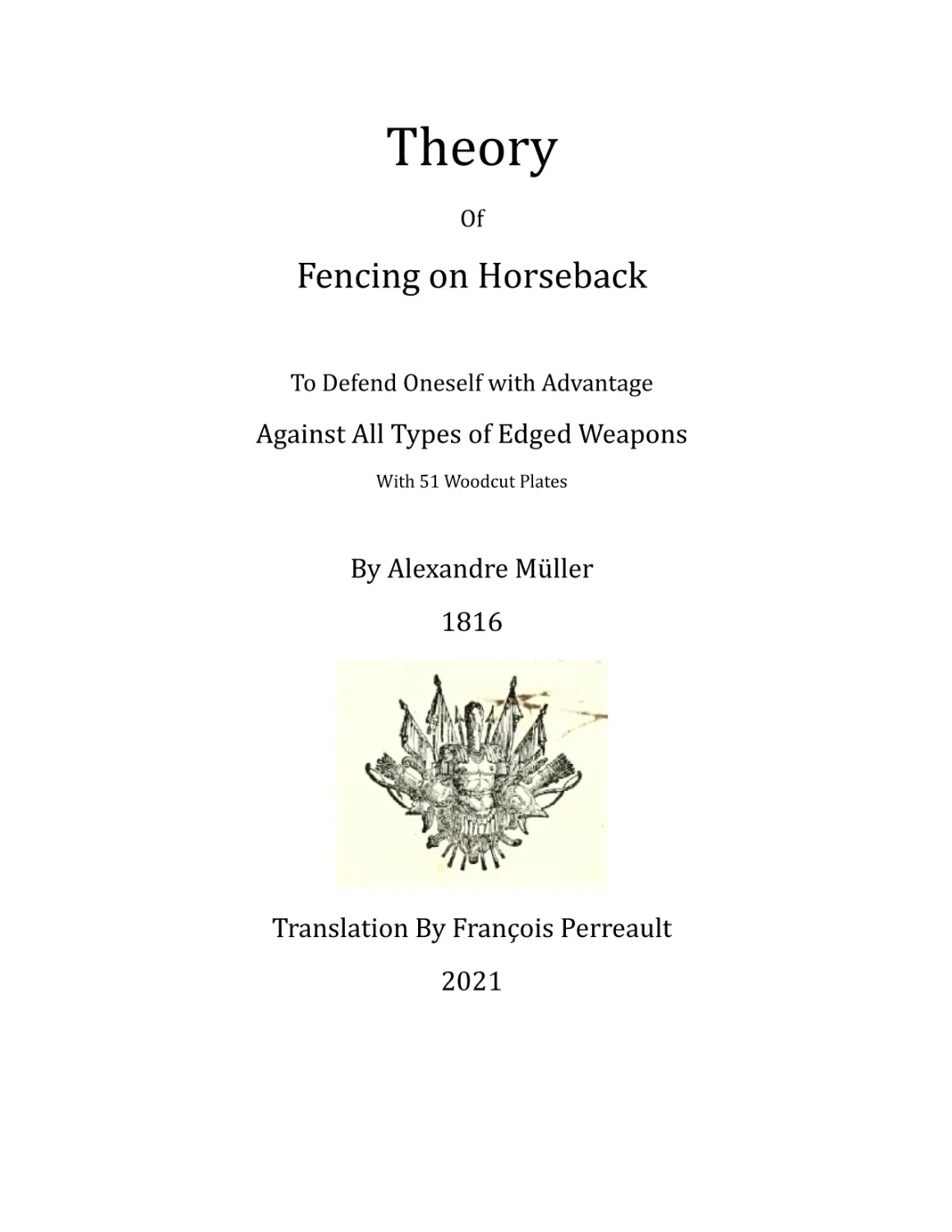
                    Theory
Of

Fencing on Horseback
To Defend Oneself with Advantage

Against All Types of Edged Weapons
With 51 Woodcut Plates

By Alexandre Müller
1816

Translation By François Perreault
2021

Foreword From the Translator
Hello dear reader, my name is François Perreault. I am a student at La
Compagnie Médiévale, a historical fencing club in Montreal which I have been
attending since the fall of 2017. Our main club focuses are German longsword
and Spanish rapier, but with experience I found myself getting more and more
interested in something else: French sabre.
Given that I am a native French speaker I found these sources easily
accessible, but I also took note of the fact that some of the French language
corpus I was able to find remains mostly untranslated into English and thus
difficult to access for non-francophones.
It is with this in mind that I decided to start working to resolve that
problem in my free time so that others who are interested in the subject may
derive as much enjoyment from the topic as I do. A secondary purpose of this
project was to gather some experience in translating so that I may take the
lessons learned here and apply them to future projects.
You will find that this particular book is very much a cavalry manual, as
the title implies. You will also notice that there are sometimes footnotes marked
with the prefix “T.N:”, meaning translator’s note. You will find also one footnote
marked A.N., which means “author’s note”, which is one written by Müller
himself.
FInally, I would like to thank Sebastian Seager for his excellent
proofreading and for being the spark that led to this project’s realisation. He
was the one who casually suggested to me one day in an internet thread, where
I was expressing my frustration at this material’s lack of accessibility, that
somebody should translate this stuff, and it might as well be me since it has not
been done so far. Without him nudging me in the right direction, I probably
would not have undertaken this task. I would also like to thank my fencing
instructor André Hajjar for both his excellent advice and setting me on the path
to reading fencing treatises and manuals. He has worked to foster this interest
in me and I am glad it has led to me working on this.
And thank you too, dear reader, for indulging me. Happy Reading! :)

1

Table of Contents

Preface

5

Introduction

7

Fencing on Horseback

9

First Division

9

Supervising

10

On Resting

11

Choosing the Supervisors

12

Promotion of the Classes

13

Second Division

15

Order and Execution of the Commands

16

Definitions

18

Inspection and Instruction

20

On the wrist

20

Opening the Ranks

21

On the Offensive and Defensive Parry

22

On the Moulinet

23

Instruction on the Moulinet

24

Offensive in Tierce: Thrust

25

Offensive in Tierce: Cut

26

Offensive in Quarte: Thrust

27

Offensive in Quarte: Cut

28

Offensive to the Left

29

Offensive to the Right

30

2

Third Division

31

Head Parry Against Light Cavalry

31

Defense Against Light Cavalry

32

Parry to the Rear

33

Defensive: Left Shoulder Parry

34

Defensive: Right Shoulder Parry

35

Cut to the Rear in Tierce

36

Cut to the Rear in Quarte

37

Thrust to the Rear

38

Offensive and Defensive

39

Offensive and Defensive

40

Fourth Division

41

Offensive and Defensive to the Right Against Cuirassiers

41

Offensive: Thrust in Quarte

42

Offensive: Thrust in Tierce

43

Offensive: Thigh Cut to the Right

44

Offensive and Defensive to the Left Against Cuirassiers

45

Offensive: Thrust in Quarte

46

Offensive: Thrust in Tierce

47

Offensive: Thigh Cut to the Left

48

Fifth Division

49

Defense Against Lancers to the Right

49

Defense Against Lancers to the Left

50

How to Defend Oneself Against the Lance on the Retreat, in Embankments, Ravines,
Narrow Passes and on Bridges.

51

Offensive and Defensive Against the Lance Behind

52

Sixth Division
On Defending Against Infantry to the Right

53
53
3

Lifting up the Bayonet to the Right Against Infantry

54

Cut in Tierce to the Right Against Infantry

55

Cut in Quarte to the Right Against Infantry

56

Thrust in Quarte to the Right Against Infantry

57

Thrust in Tierce to the Right Against Infantry

58

On Defending to the Left Against Infantry

59

Lifting Up the Bayonet

60

Cut in Quarte

61

Cut in Tierce

62

Thrust in Tierce

63

Thrust in Quarte

64

Mode of Dress

65

4

Notice

I declare that, having conformed to all dispositions required under the
law, I would sue before the tribunals as counterfeiters any libraries that
would sell and distribute an example of the present work that does not
include my signature.

5

Preface
The weapon of the cavalry is the most expensive for the state, and it is
on its good instruction that the conservation and advantage of the government
depends. It is thus of absolute necessity to make the cavalryman capable of
attacking or defending himself with superiority.
This superiority can only exist as long as the cavalryman can wield his
sabre with ease and dexterity, it being his favourite weapon which he uses with
the most frequency.
The certitude in his ability to defend himself with success gives
assurance to the cavalryman, fortifies his spirit in the face of danger and
stimulates his courage. The soldier that does not know how to make use of his
weapon sees too vividly the danger that he cannot avoid.
The school of the espadon has been wiped out since the revolution; war
has reaped the practitioners of this art. The focus has been put on the pointe
[smallsword], a type of fencing that is destructive for the soldier, which he uses
for his particular quarrels and is completely useless for the army.
The soldier must be taught to fight not for a closed arena, but to serve
his country on the battlefield.
The study of the sabre has for too long been neglected. Many generals
of the cavalry have noted the disastrous results.1

1

A.N: This is how the author of the excellent Reglement du Service Intérieur expresses himself on the
subject, recently published with the approval of the Ministre de la Guerre, art. 534: “Fencing has until
now been too neglected in the cavalry. It is just as necessary to this weapon as the use of the musket is in
the infantry – Recruits should be made to take fencing lessons for at least 6 months so that by
consequence they should have one or two masters or provosts of the contre-pointe for every squad. One
master and two provosts are sufficient for a regiment.”

6

Being struck by their observations, I have concluded it should be my
duty, by my love of the government and my attachment to my brothers in arms,
that I should publish this short book which is the fruit of my experience.
Fifty-one illustrations represent the positions of the cavalryman, from his
entry into the academy to the moment where his education is completed.
This study consists of simple and natural movements which can be
reduced to those of tierce and quarte with the wrist closed or open.
The cavalryman can acquire the knowledge of these movements in a
month.
The school of the espadon is not sufficient to train a cavalryman; he will
still need practice which can only be acquired through simulated combat.
To make the practice of the sabre easier, one should not use terms of art
with the soldier. Rather, simple expressions should be used so that he may
understand quickly.
I have made this work as clear and concise as I have felt it possible, and I
should be happy if I have reached the goal I have set for myself. That of general
utility!

7

Introduction
The strength of the cavalryman lies in his practice of fencing on
horseback. This sort of fencing consists of horseback riding and wielding the
sabre.
If he is well trained, the cavalryman when left to his own will be bolder
when he goes to battle. It is in that critical moment where the cavalryman can
draw the most advantage from what he knows, or become victim to what he
ignores.
Horseback riding and fencing with the sabre, though they may have
some relation, remain two distinct sciences that require their own separate
instruction before they are combined.
It is thus necessary that the cavalryman should first learn to wield his
sabre on foot by making him take the position of a man on horseback (see plate
8). He should not be put in the saddle until he has perfectly mastered riding the
horse and using his sabre, following the order prescribed in this theory which is
divided into three parts, just as the students are divided in three classes.

8

Theory
Of

Fencing on Horseback
1st Part________________ 1st Lesson
Demonstration of all blows contained within this theory for all cavalrymen that
compose the regiment.

2nd Part________________2nd Lesson
The most advanced cavalrymen from the previous class will enter this one to
practice offense and defense, man against man. This exercise is meant as preparation
for the third part.

3rd Part________________3rd Lesson
This class will consist of the most advanced cavalrymen from both of the
previous classes. They will practice these exercises on horseback in the order of war. No
cavalryman can enter this class without perfectly mastering his horse and weapons.

9

First Division
Order and Division of the Work

The Instructors will give two lessons each day;
To know:

1st Lesson= Officers and Non-Commissioned Officers
Every morning the officers, non-commissioned officers and trumpeters
of the regiment will be assembled without distinction of rank. If the students of
a particular ranking do not reach the number of sixteen, students from the
succeeding ranking should be taken in to fill this number, placing them at the
left flank.

2nd Lesson
Every afternoon, before or after grooming the horses, at whichever time
the colonel deems suitable, and having notified the instructors through the
order of the day, the regiment will assemble for their lesson.
All officers and non-commissioned officers who have had a lesson in the
morning will oversee the respective companies and platoons to assist the
instructors in the afternoon.
The regiment will be conducted by their instruments upon the exercise
grounds.
10

Supervising
A lieutenant-colonel and the officer in charge of supervising the lesson
as well as the adjutant-major and adjutant non-commissioned officer of the
week, the surgeon-major and veterinarian will watch during this instruction,
each in what concerns them. The first to make sure there is silence through the
lesson and the others to prevent accidents and remedy them.
The instructors may send a cavalryman to the guardhouse in the case of
disobedience by making a report after finishing the lesson.

11

On Resting
The lieutenant-colonel will sound by trumpet every quarter hour the
time for rest, or whenever they consider it reasonable.
The cavalrymen of the first two lines will sheath their sabres before
breaking their line.
Mounted cavalrymen will dismount to strap their horses. Odd numbered
cavalrymen will be allowed to break rank while even numbered ones will keep
their horses, and vice-versa.
The musicians and trumpeters of the regiment will play a few fanfares
during the resting period.

12

Choosing the Supervisors
The supervisors will be chosen by the colonel upon presentation of the
instructors among the knowledgeable officers and non-commissioned officers.
(These supervisors will always be one rank above the class whose work they will
be overseeing.)
The officers will oversee the work of the non-commissioned officers and
the non-commissioned officers will oversee that of the cavalrymen.
Only the instructor may interrupt the lesson to speak with all the
students aloud. All other supervisors are directed to only do so quietly.

13

Promotion of the Classes
The colonel will regroup the regiment every eight days and, according to
the propositions of the instructors, will proceed to the changing of classes.
To this effect, instructors will keep a list of their students’ names, which
they will use to call them to each instruction.
In the margins of this list, the instructors will record the progress level of
each student cavalryman.

14

Second Division
Entry to the Lesson

The regiment having assembled on the square, the instructors will call
their students by name. The cavalrymen, after having answered present, will
leave their ranks and form up in two lines in front of their instructors. They will
direct them to the training field by a quarter turn right or left.
On arrival, they will command: Attention! = First rank, 4 steps forward =
March.
When the students have arrived at the destination, the instructors will
command: Dress your ranks.

15

Order and Execution of the
Commands
All the blows in this theory, be they offensive or defensive, will be
announced to the students by their prescribed commands. The instructors must
demonstrate them and the students will follow the movements exactly.

Drawing the Sabre

Attention -> Hands on sabres -> Draw.
One tempo, Three movements

1. Bring the right hand over the reins; bring the wrist through the sword knot;
grasp the sabre by its hilt to bring the blade about 6 inches out of the
scabbard.
2. At the second command, draw the sabre from its scabbard in a lively
manner and bring the wrist at the height of the heart, the point facing
upwards, eyes fixed towards the leader with a calm disposition. (In this
position, the thumb must be along the hilt of the sabre. (see plate 1)
3. Place the sabre along the right side, the back of the blade resting on the
shoulder, the wrist coming to rest on the right thigh, with the little finger
on the outside.

16

Note: Each time the cavalryman draws his sword, he must salute his leader in
the same way it was indicated in step 2. In this position he shows that he
has more energy and lets all see that he has drawn his sabre only for honour,
king and country.

17

Definitions
The soldier having not been trained in any fencing on horseback can only
have a bad way to hold his sabre. It is thus necessary before anything to teach
him all the terms that will be used in this theory, as well as all the positions of
the wrist, and the meaning of the terms offensive and defensive which hold a
particular meaning in fencing.
I have said in the preface that this theory is based on simple and natural
movements, which can be reduced to those in tierce and in quarte with the
wrist closed and open.
First Article

Definition of Offensive
With edged weapons, we call offensive any position where the soldier
attacks his enemy, in whatever manner that may be.
Art. II

Definition of Defensive
We call defensive all positions where the soldier, without attacking,
parries with his sabre the blows of his enemy.
Art. III

Definition of Quarte
We refer to any position, be they offensive or defensive, a parrying
movement, a cut or thrust, as done in quarte when the edge is turned to the
left shoulder, or to the inside. (see plate 3)

18

Art. IV

Definition of Tierce
We refer to any of the above-mentioned movements as done in tierce
when the edge is turned towards the right shoulder, or the outside. (see plate 4)
(It is of course understood that the back and the edge of the sabre are on the same horizontal
line)

Art. V

Definition of the Open Wrist
When giving a thrusting movement, to the right or left, in front or
behind, we call it open wrist when the pommel is pressed against the palm and
the fingers are held together along the grip of the sabre. (see plate 5)
The wrist is still open in parries behind the left shoulder through
movement of the right arm, and when executing the moulinet the fingers must
then be loosened and flexible in their movement, the thumb serving only to
close the hand.
Art. VI

Definition of the Closed Wrist
Closed wrist refers to movements of the sabre, offensive or defensive,
where the thumb lies along the grip for its full length and is pressed against the
guard, serving as a key to close the wrist. This is also to give the necessary force
to make accurate cuts or to displace the enemy’s weapon. (see plate 6)

19

Inspection and Instruction
On the wrist
The ranks being open as described in Entry to the Lesson, the instructor
will move on to instruction on the wrist. The supervisors will assist him by going
through the ranks.
Attention -> Passing to the inspection of the wrist
Present -> Quarte
One Tempo, One Movement

Detach the sabre from the shoulder; extend the arm forward, wrist
closed in quarte at the height of the forearm, the sabre’s point at an incline (see
plate 3)
The cavalryman will stay in this position until the instructor has been
assured of the execution of the command.
Present -> Tierce
One Tempo, One Movement

Turn the wrist to the left2 and stay in the previous position. (see plate 4)
Present -> Open Wrist
One Tempo, One Movement

Open the wrist and stay in this position. (see plate 5)
Present -> Closed Wrist
One Tempo, One Movement

Close the wrist and stay in the previous position. (see plate 6)
Carry -> Sabre
One Tempo One Movement

Bring the sabre back to the shoulder as before, in its default position.
(see plate 2)

2

T.N: Possibly a misprint in the original, as tierce is supposed to be to the right. This has been left
unchanged because the rest of the book is consistent with the directions laid out in the definitions.

20

Opening the Ranks
Attention -> Left and right, open ranks to the points of your sabres.
At this command, the cavalrymen will open ranks to the left and right
along the same line, keeping the same distance of four paces deep. Each man
will measure the space necessary with his arm and sabre extended, which is the
space necessary to execute this manoeuvre without injuring his comrades.
The same will be done for cavalrymen on horseback. (see plate 7)

21

On the Offensive and Defensive Parry
Note: This parry is very advantageous for the man on horseback, as no
weapon can reach him in this position. He finds himself always on guard and
can begin his offensive if he deems it appropriate.

Attention -> Offensive and Defensive -> Parry
One tempo, Two Movements

1. Have the right foot two feet away from the left and adopt the position of
the man on horseback. Close the left hand and rest the wrist on the
lower belly as if the cavalryman was holding his reins. Extend the sabre
forward and to the left, with the wrist to the right or left according to
the position of the adversary, at neck height with the sabre’s edge up
and the point slightly higher than the hilt. The body should be leaning
forward and the cavalryman looking firmly at his enemy. (see plate 8)
Carry = Sabre
2. Bring the sabre to the shoulder and stay in the position from plate 2.

22

On the Moulinet
This instruction is of great utility to free and train the cavalryman’s wrist,
as well as giving strength and agility to his arm and shoulder. The cavalryman
can only acquire this through regular and repeated exercise. It is thus necessary
to begin with this lesson and to execute it again after each division that makes
up this theory, so that the cavalryman is trained so much in this exercise that no
weapon can reach him. It must also be said that the moulinet is a core part of
the attack for cavalry.
Being on the front of the battle lines, the infantry are the first to witness,
through this sabre play, their strength, courage, and the ardent desire that
animates the cavalry to fight; the opinion of their brothers-in-arms certainly
being a powerful motive to frighten and defeat the enemy in war.

23

Instruction on the Moulinet
Circle to the Left
Attention -> Prepare to execute the Moulinet
One Tempo, Three Movements

1. Offensive and Defensive -> Parry
2. Extend the arm forward so it is in a horizontal line, wrist in tierce at the height
of the forehead.
3. Vigorously glide the sabre to the left of the horse’s neck and return to position.
(see plate 9)

Circle to the Right
One Tempo, Three Movements

1. Turn the wrist to quarte.
2. Vigorously glide the sabre to the right of the horse’s neck and return to position.
(see plate 10)
3. Return the sabre.

Observations
The elbow and wrist must be flexible while executing the movements.
While cutting to the left of the horse, the arm must form an angle to the right.
While cutting to the right of the horse, the arm must form an angle below.

24

Offensive in Tierce
Thrust
Attention -> Thrust in Tierce
One Tempo, Five Movements

1. Offensive and Defensive -> Parry
2. Bring the hand back closer to the body, blade level, edge to the outside
and wrist at ear height to prepare the thrust thereafter.
3. Launch the thrust forward, point directed towards the enemy’s chest.
(see plate 11)
4. Return to the parry.
5. Return the sabre to the shoulder and remain in the position from plate
2.

25

Offensive in Tierce
Cut

Attention -> Cut in Tierce
One Tempo, Five Movements

1.

3

Offensive and Defensive -> Parry

2.

Bring the sabre to ear height, edge in tierce and point in the air to
prepare the cut thereafter.

3.

Cut with lively force from this position to the adversary’s face. (see
plate 12)

4.

Return to the parry.

5.

Return the sabre.3

T.N: I believe this to be referring to step 5 of the previous page.

26

Offensive in Quarte
Attention -> Thrust in Quarte
One Tempo, Five Movements

1. Offensive and Defensive -> Parry
2. Bring the hand back closer to the body so that the wrist is on the right
hip, nails up, body tilted forward. The blade should be level and edge
inside to prepare the thrust and align it with the enemy.
3. Launch the thrust forward, the sabre’s point directed towards the
adversary. (see plate 13)
4. Return to the parry.
5. Return the sabre.

27

Offensive in Quarte
Attention -> Cut in Quarte
One Tempo, Five Movements

1. Offensive and Defensive -> Parry
2. Raise the sabre in the air on the right side, arm extended, wrist in quarte
and higher than the head, edge directed towards the enemy, body
slightly turned to the right and leaning forward to prepare the blow.
3. Give a cut with force to the adversary’s face. (see plate 14)
4. Return to the parry.
5. Return the sabre.

28

Offensive to the Left
Attention -> Thrust to the Left
One Tempo, Six Movements

1. Offensive and Defensive -> Parry
2. Carry the sabre to the stomach, point in the air, wrist in tierce.
3. Turn the head left, let the blade drop flat on the left arm.
4. Bring the wrist back to the height of the right shoulder, shortening the
arm as much as possible. Aim for the adversary and launch the thrust at
him from this position. (see plate 15)
5. Return to the parry.
6. Return the sabre.

29

Offensive to the Right
Attention -> Thrust to the Right
One Tempo, Six Movements

1. Offensive and Defensive -> Parry
2. Carry the sabre on the stomach, point in the air, wrist in tierce.
3. Turn the head to the right, let the blade drop horizontally onto the right
arm, aiming the point towards the enemy. (see plate 16)
4. Launch the thrust in this direction.
5. Return to the parry.
6. Return the sabre.

30

Third Division
Head Parry Against Light Cavalry
Attention -> Head Parry in Quarte
One Tempo, Six Movements

1. Offensive and Defensive -> Parry
2. Turn the wrist to quarte, bring the sabre back so that it is one foot away
from the left shoulder at ear height. The point should be eight inches
higher than the hilt so that you can parry the adversary’s cuts to the
head.
3. Pass the blade over the head and cut in tierce with strength and speed
at the enemy’s right flank. (see plate 17)
4. Thrust in tierce.
5. Thrust in quarte.
6. Return the sabre.

31

Defense Against Light Cavalry
Attention -> Head Parry in Tierce
One Tempo, Six Movements

1. Offensive and Defensive -> Parry
2. Bring the wrist from this parry back to cover the head in tierce so that
the hilt is at chin height, at one foot’s distance and facing the right
shoulder. The point should be eight inches higher than the hilt so that
the enemy’s cuts to the head can be parried.
3. Bring the blade over the head and cut in quarte at the adversary’s left
flank to cut his hand or his reins. (see plate 18)
4. Thrust in tierce.
5. Thrust in quarte.
6. Return the sabre. (see plate 2)

Observation
If the cavalryman cannot reach his adversary, he must try to cut the reins of his
horse.

32

Parry to the Rear
Attention -> Cover yourselves to the rear
One Tempo, Two Movements

1. Raise the arm in an extended manner, blade perpendicular to it.
2. Turn the head to the right. Let the blade drop along the back, edge
outside. Adjust the reins and be careful not to wound the horse’s rump
with the point of the sabre. (see plate 19)

33

Defensive
Left Shoulder Parry

Attention -> Cover the Left Shoulder
One Tempo, One Movement

1. Turn the head to the left and extend the arm as much as possible. Pass
the wrist over the head, edge outside and the sabre’s point one foot
below the hilt. (see plate 20)

34

Defensive
Right Shoulder Parry

Attention -> Cover the Right Shoulder
One Tempo, One Movement

1. Turn the head to the right. Start from the previous position. Bring the
wrist back over the head and make a circular motion to return to the
right shoulder, edge outside. (see plate 21)

35

Cut to the Rear in Tierce
Attention -> Cut to the rear in tierce
One Tempo, Two movements

1. Raise the arm in an extended manner, blade perpendicular so the cut is
well prepared.
2. With strength and speed, give a backhand cut to the rear in tierce,
aiming for the adversary’s head. (see plate 22)

36

Cut to the Rear in Quarte
After the previous cut, the cavalryman turns the hand to quarte and
gives a cut to his enemy’s left wrist or his reins, to try and cut them. (see
plate 23)

37

Thrust to the Rear
One Tempo, Two Movements

1. After the previous cut, stay in this position. Bring the wrist back so that it
is along the right shoulder. Let the blade drop onto the right forearm,
point directed towards the enemy.
2. Launch the thrust in this direction. (see plate 24)

38

Offensive and Defensive
Horse’s Head Parry to the Left

Attention -> Horse’s Head Parry to the Left
One Tempo, Eight Movements

1. Offensive and Defensive -> Parry
2. Bring the arm and body horizontally forward. Lower the point of the
sabre, wrist to tierce, to one foot away from the horse’s right ear. Seek to
parry the enemy’s blows that may fall on the horse’s head to the right.
3. Thrust in tierce.
4. Thrust in quarte.
5. Cut in quarte.
6. Cut in tierce.
7. Return to the parry.
8. Return the sabre. (see plate 25)

Note: Covering the horse’s head is an essential and absolutely necessary parry
in attacks en masse and in charges, because as soon as the horse receives a hit
on the head it will rear up and sow disorder in the ranks, create gaps in the line
and make it easier for the enemy to penetrate it.

39

Offensive and Defensive
Horse’s Head Parry to the Right

Attention -> Horse’s Head Parry to the Right
One Tempo, Eight Movements

1. Offensive and Defensive -> Parry
2. Bring the arm and body horizontally forward. Lower the point of the
sabre, wrist in tierce, one foot away from the horse’s left ear. Seek to
parry the enemy’s blows that may fall on the horse’s head to the left.
3. Thrust in tierce.
4. Thrust in quarte.
5. Cut in quarte.
6. Cut in tierce.
7. Return to the parry.
8. Return the sabre. (see plate 26)

Note: Same observations as the previous page.

40

Fourth Division
Offensive and Defensive to the Right
Against Cuirassiers
Attention -> Defense Against a Cuirassier to the Right
One Tempo, Two Movements

1. Offensive and Defensive -> Parry
2. Firm up on the stirrups, adjust the reins, bring the body forward, extend
the arm forward horizontally from the right shoulder. Bring the wrist into
quarte and the blade perpendicular with the thumb extended along the
hilt. Wait for the cuirassier in this position. (see plate 27)

41

Offensive
Thrust in Quarte

One Tempo, Two Movements

1. After the previous movement, pretend to drive the cuirassier’s thrust
away to the left or the right.
2. Bring the wrist back to the right hip and launch a thrust to the
cuirassier’s face. (see plate 28)

42

Offensive
Thrust in Tierce

One Tempo, Two Movements

1. After the previous thrust, bring the hand back to the right hip while
turning the wrist to tierce.
2. In a lively manner, launch a second thrust to the cuirassier’s face. (see
plate 29)

43

Offensive
Thigh Cut to the Right

One Tempo, Three Movements

1. After the previous thrust, raise the sabre horizontally overhead.
2. Give a forceful cut in quarte to the cuirassier’s hand. Seek to wound him
or to cut his reins. (see image 30)
3. Return to the parry.
4. Return the sabre.

44

Offensive and Defensive to the Left
Against Cuirassiers
Attention -> Defense Against a Cuirassier to the Left
One Tempo, Three Movements

1. Offensive and Defensive -> Parry
2. Firm up on the stirrups, adjust the reins, bring the body forward, the
arm horizontally forward so it is below the left shoulder. Bring the wrist
into quarte, with the blade perpendicular. Wait for the cuirassier in this
position. (see plate 31)

45

Offensive
Thrust in Quarte

One Tempo, Two Movements

1. After the previous movement, pretend to drive the cuirassier’s thrust
away to the left or the right.
2. Bring the wrist back to the right hip and launch a thrust at the
cuirassier’s face. (see plate 32)

46

Offensive
Thrust in Tierce

One Tempo, Two Movements

1. After the previous thrust, bring the hand back to the right hip while
turning the wrist to tierce.
2. In a lively manner, launch a second thrust at the cuirassier’s face. (see
plate 33)

47

Offensive
Thigh Cut to the Left

One Tempo, Four Movements

1. After the previous thrust, raise the sabre horizontally overhead.
2. Cut strongly at the cuirassier’s exposed left hand, or cut his reins. (see
plate 34)

48

Fifth Division
Defense Against Lancers to the Right
Attention -> Against Lancers to the Right
One Tempo, Eight Movements

1. Offensive and Defensive -> Parry.
2. Bring the arm back and place the wrist on the upper thigh. Firm up on
the stirrups and adjust the reins, with blade and body leaning forward
slightly. Wait in this position for the lancer’s attack.
3. Pretend to forcefully drive the lance away to the right or left.
4. Thrust in tierce.
5. Thrust in quarte.
6. Cut at the reins.
7. Return to the parry.
8. Return the sabre. (see plate 35)

49

Defense Against Lancers to the Left
Attention -> Against Lancers to the Right
One Tempo, Eight Movements

1. Offensive and Defensive -> Parry.
2. Bring the arm towards the left shoulder, point in the air and blade
leaning slightly forwards. Adjust the reins and wait for the lancer’s attack
in this position.
3. Pretend to forcefully drive the lance away to the right or left.
4. Thrust in tierce.
5. Thrust in quarte.
6. Cut at the reins.
7. Return to the parry.
8. Return the sabre. (see plate 36)

50

How to Defend Oneself Against the Lance on
the Retreat, in Embankments, Ravines, Narrow
Passes and on Bridges.
It is necessary that this command be given to an experienced officer
who can keep his cavalrymen marching at a walking pace, because if the
movements were executed faster there would be disorder in the manoeuvre
and the horses would be winded.
While entering the manoeuvre, the rearguard will have their carbines
loaded and their sabres hanging from their wrists. The commander will divide
his troops by four so that there is room for a horse to pass between each side of
the ravine. The first ones in line separate themselves from the group.
The first and second lines will countermarch by swinging to the right
while the third and fourth line will countermarch by swinging to the left. When
they have arrived to take the place of the rearmost horse, they will fire their
carbines at the enemy cavalrymen and not the horses; this is because
dismounted horses sow disorder in the ranks and slow the enemy’s pursuit.
After firing, the cavalrymen drop their guns and recover their sabres, which they
hold to the rear, ready to parry the lance. They should have their heads turned
to the right so they can see the attack and be capable of driving away the
lances, should they need to. (see plate 37)

51

Offensive and Defensive
Against the Lance Behind
One tempo, Five Movements

1. Offensive and Defensive -> Parry.
2. Turn the head back to the right to observe the enemy’s attack, holding
the sabre to the rear, arm extended and the blade perpendicular in the
air in order to drive away the enemy’s lance.
3. Pretend to drive the lance away to the left or right.
4. Return to the parry.
5. Return the sabre. (see the 4th line in plate 37)

52

Sixth Division
On Defending Against Infantry to the Right
Offensive and Defensive

Attention -> Against Infantry to the Right
One Tempo, Three Movements

1. Offensive and Defensive -> Parry
2. Turn the wrist to quarte and bring the sabre high towards the left
shoulder, so that the wrist is at neck height. Signal the horse to traverse
left; that is to say loosen the reins and the left leg, and push with the
right leg; this is so that the horse does not accidentally expose itself to
bayonet thrusts.
3. Forcefully repel the bayonet with a backhand cut made with the spine of
the sabre. (see plate 38)

53

Lifting up the Bayonet to the Right
Against Infantry
One Tempo, Two Movements

1. After the previous movement, turn the wrist to tierce with the edge
outside.
2. Raise the infantryman’s bayonet again. (see plate 39)

54

Cut in Tierce to the Right
Against Infantry
One Tempo, One Movement

1. Having driven away the bayonet and still being in line in tierce, cut in a
lively manner to the infantryman’s face. (see plate 40)

55

Cut in Quarte to the Right
Against Infantry
One Tempo, Two Movements

1. Having executed the previous cut, turn the wrist to quarte, edge inside.
2. Make a second cut at the adversary. (see plate 41)

56

Thrust in Quarte to the Right
Against Infantry
One Tempo, Two Movements

1. Having executed the previous cut, bring the wrist back to the right hip,
point in quarte and directed towards the adversary’s chest.
2. Launch a thrust in this direction. (see plate 42)

57

Thrust in Tierce to the Right
Against Infantry
One Tempo, Four Movements

1. After the previous thrust, turn the hand to tierce while bringing the arm
back. Bring the wrist level with the right eye.
2. Look towards the infantryman, direct the sabre’s point toward his chest
and launch the thrust in a lively manner.
3. Return to the parry.
4. Return the sabre. (see plate 43)
Note: The six previous blows must follow each other quickly. The
cavalryman, after driving away the bayonet, can use thrusts instead of
cuts. Nothing prevents the instructors from making this change,
especially when dealing with the instruction of heavy cavalry.

58

On Defending to the Left
Against Infantry

Offensive and Defensive

Attention -> Against infantry to the left
One Tempo, Three Movements

1. Offensive and Defensive -> In Guard
2. Bring the sabre high to the right, edge outside, arm and blade extended.
Signal the horse to traverse right, that is to say loosen the reins and the
right leg and press with the left leg, to prevent the horse from
stampeding and to avoid bayonets thrusts.
3. Vigorously press the horse’s neck on the left and drive away the bayonet
with the spine of the sabre. (see plate 44)

59

Lifting Up the Bayonet
One Tempo, Two Movements

1. Turn the wrist to quarte.
2. Raise the bayonet again with the spine of the sabre and bring the wrist
to the right, at head height, to go on the offensive. (see plate 45)

60

Cut in Quarte
One Tempo, One Movement

1. With force and in a lively manner, make a cut in quarte to the
infantryman’s head and bring the wrist back to the left shoulder to
prepare the next blow. (see plate 46)

61

Cut in Tierce
One Tempo, Two Movements

1. Turn the wrist to tierce.
2. Throw a second cut at the infantryman’s head. (see plate 47)

62

Thrust in Tierce
One Tempo, Two Movements

1. After the previous cut, bring the wrist back in line with the right eye and
direct the point towards the adversary’s chest.
2. Launch a thrust at him in tierce. (see plate 48)

63

Thrust in Quarte
One Tempo, Four Movements

1. Having done the thrust in tierce, the cavalryman brings his wrist back to
the right hip and directs the point again towards the infantryman’s chest
in quarte.
2. In a lively manner, launch the thrust in this direction. (see plate 49)
3. Return to the parry.
4. Return the sabre.

64

When the students are well-learned enough to execute all the
offensive and defensive blows contained in this theory without
demonstration from their instructors and only according to his
command, they will be able to move on to the second lesson.

Mode of Dress

The instructors and cavalrymen will wear a buffalo sleeved jacket, along
with a visored helmet so as to prevent injury to their faces.

Activities of the 2nd Lesson

The cavalrymen will be placed in a row and the instructor will take his
position at a distance of twenty paces, in the centre and in front of the line. He
will command Attention = Cavalrymen on the right come forward to fight =
March. Straight away they will come from the right at walking pace according to
the command, and on the prescribed line they will place themselves in front of
the instructor, who will make them parry all the offensive sabre, lance and
bayonet blows described in this theory.
For parrying the bayonet, the cavalryman must step up on a table four
feet high. (see figure 2, plate 50)
After this exercise, the students will return to the row, placing
themselves on the left side.

65

Activities of the 3rd Lesson

With the cavalrymen having arrived at the training ground, the
instructor will have the ranks opened at sabre point as described in the
instruction on foot. After the students have executed all the cuts and thrusts on
horseback seen in the instruction on foot, the odd numbered students will
dismount. They will then leave ranks to put on a cuirass and mask, and after
their return the even numbered students will leave to dress themselves in the
same manner. They will then all mount their horses.
The instructor will divide his group so that one part has the offensive
and the other the defensive. He will place them face-to-face at a distance of
fifty paces to prepare the exercise, which will be done in the order of combat.
The cavalrymen will start from the right wing, one-by-one on the prescribed line
at the same pace and according to the orders of the instructors. At the
command of Attention = Cavalrymen of the right prepare to fight this division
(designate the division) at a walk, at a trot, at a canter = March. Straight away
the trumpet will sound the attack. The cavalrymen will meet at the centre
between the two lines. The non-combatants who are spectating will still be able
to find benefit in this lesson, which will serve them well when their turn to fight
comes. The instructor will give the signal to the trumpeters which will sound the
return. The combatants will return to their ranks, placing themselves on the left
wing.
The instructor will make the students dismount as often as they wish to
strap their horses. (see plate 51)
The above exercise having been well-executed, there cannot be any doubt
about the perfection of the cavalryman. It will be easily seen that it is enough to give
him courage and confidence in himself and that he will, by these means, always have a
great advantage over his enemy and be certain that he will defeat him through the
assurance retained from these first exercises.

66

67

1

The Salute

68

2

The Cavalryman at Rest
69

3

The Wrist in Quarte

70

4

The Wrist in Tierce

71

5

The Open Wrist

72

6

The Closed Wrist

73

7

Measuring the Distance with the Sabre’s Length for Training
74

8

Position for the Offensive and Defensive, Parry

75

9

Position for the Moulinet to the Left

76

10

Position for the Moulinet to the Right

77

11

Thrust in Tierce

78

12

Cut in Tierce
79

13

Thrust in Quarte

80

14

Cut in Quarte

81

15

Thrust to the Left

82

16

Thrust to the Right

83

17

Head Parry in Quarte

84

18

Head Parry in Tierce

85

19

Parry in the Back

86

20

Parry at the Left Shoulder

87

21

Parry at the Right Shoulder

88

22

Cut to the Rear in Tierce
89

23

Cut to the Rear in Quarte
90

24

Thrust to the Rear

91

25

Parry for the Horse’s Head to the Left

92

26

Parry for the Horse’s Head to the Right

93

27

Defensive Against Cuirassiers to the Right

94

28

Thrust in Tierce at the Cuirassier’s Face

95

29

Thrust in Quarte at the Cuirassier’s Face

96

30

Thigh Cut in Quarte to the Right
97

31

Parry to the Left in Quarte Against Cuirassiers

98

32

Thrust to the Left in Quarte

99

33

Thrust to the Left in Tierce

100

34

Thigh Cut in Quarte, to the Hand or Reins

101

35

Defensive to the Right Against Lancers

102

36

Defensive to the Left Against Lancers

103

37

Defense in Retreat Against Lancers in Pursuit
104

38

Defensive to the Right in Quarte Against Bayonets

105

39

Collecting the Bayonet to the Right in Tierce with the Back of the
Sabre

106

40

Cut in Tierce to the Right Against Infantry

107

41

Cut in Quarte to the Right Against Infantry
108

42

Thrust in Quarte to the Right Against Infantry

109

43

Thrust in Tierce to the Right Against Infantry

110

44

Defensive to the Left to Drive Away Bayonets with the Back of the
Sabre

111

45

Collecting the bayonet in Quarte to the Left with the Back of the
Sabre

112

46

Cut in Quarte to the Left Against Infantry
113

47

Cut in Tierce to the Left Against Infantry
114

48

Thrust in Tierce to the Left Against Infantry

115

49

Thrust in Quarte to the Left Against Infantry

116

50

Work in the 2nd Lesson

117

51

3rd Lesson, Instruction on Horseback

118