/


Автор: Ломоносов М.В. Жуковский В. Карамзин Н.М. Давыдов Батюшков Богданович Костров Бобров
Теги: русская поэзия антология русской поэзии
Год: 1821


Текст
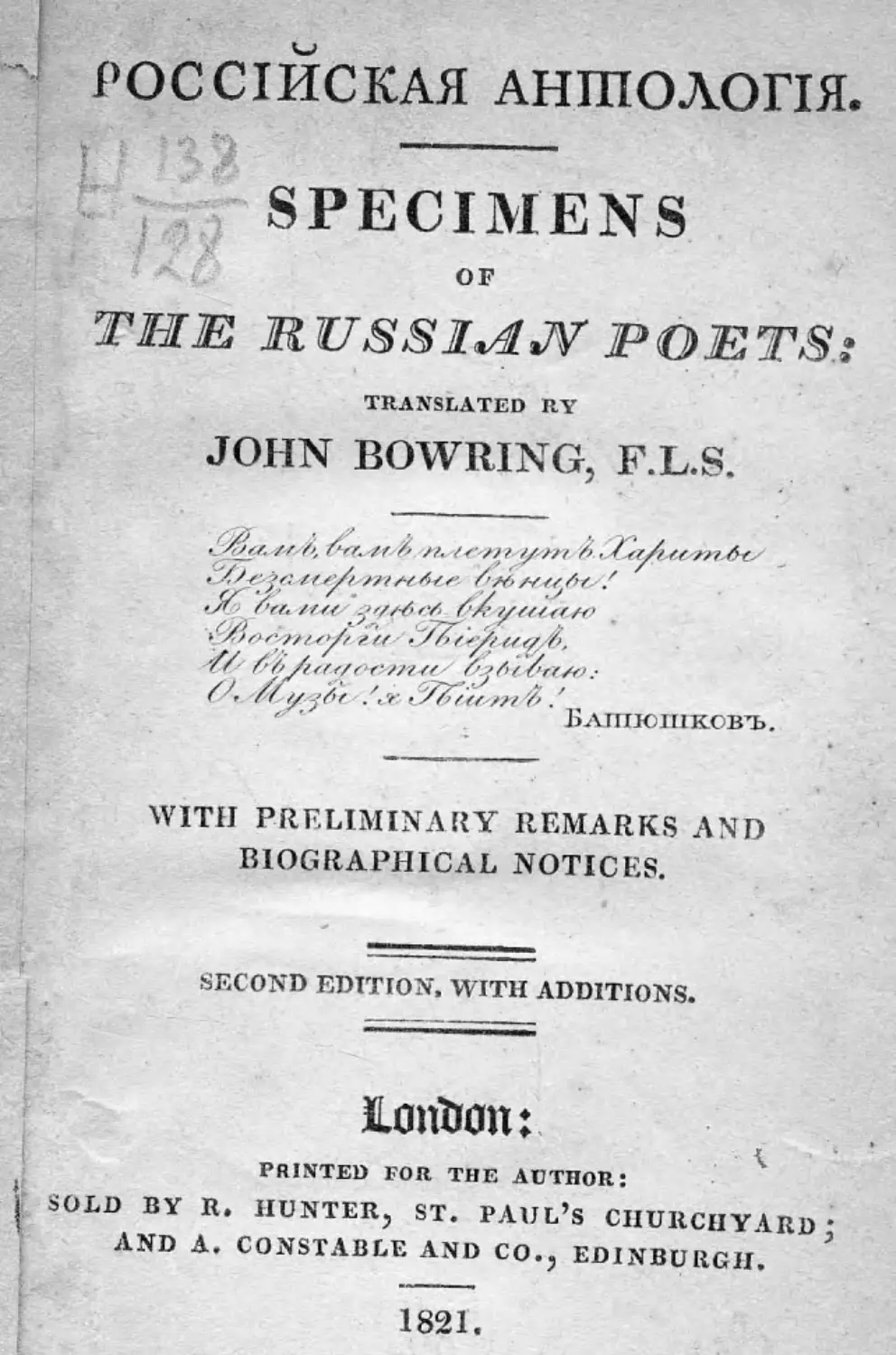
                    российская аншолопя.

SPECIMENS

THE RUSSI^LJV POETS.s

TRANSLATED RY

JOHN BOWRING, F.L.S.

WITH PRELIMINARY REMARKS AND
BIOGRAPHICAL NOTICES.

SECOND EDITION. WITH ADDITIONS.

iLanWn:

PRINTED FOR THE ADTHOR:

SOLD BY R. HUNTER, ST. PAUL’S CHURCHYARDj
AND A. CONSTABLE AND CO., EDINBURGH.
PRINTED BY R. AND A. TATLOR

SHOE-LANE, LONDON.
ADVERTISEMENT

♦ то

THE SECOND EDITION.

The first edition of this work was publish-
ed without any strong expectations that it
would excite attention. It has been re-
ceived with singular indulgence, nay with
.flattering encouragement, and I trust it
will be followed, at no distant period, by
Specimens of the Poetry of other nations,
which is as yet a stranger to our literature
and language.

Theobjects of this publication have been
in a great degree answered. Many of .the
Poets of Russia, whom 1 have ventured to
introduce to my countrymen, have met with
a cordial welcome, and their claims have
been cheerfully admitted by the mighty
a 2
iv

arbiters of fame. For myself I own, that
my hopes of the future progress of that
vast empire in civilization and virtue and
liberty have been greatly flattered, greatly
increased by the observations which this
little volume has served to elicit.

It must not, however, be forgotten, that
this is a representation of nothing but the
unformed and infant poetical literature of
Russia. That literature had its birth but
yesterday,andcertainly its present strength
and beauty give fair hope for to-morrow.
In it are elements of improvement, and
buds and blossoms of future expectation.
They are scattered over "half a world,”
and in due time will ripen, to encourage, to
console, and to stimulate myriads and mil-
lions. It will then be an interesting task,
to compare the maturer charms of Sclavo-
nic song, with these its earliest gems.
TABLE OF CONTENTS.

Introduction ..........................vii

Derzhavin................................1

Batiushkov........................45

Lomonosov ..............................65

Zhukovsky ...........	71

Karamsin .............................,103

Dmitriev ..............................117

Krilov ................................129

Khemnitzer ............................135

Bobrov . ..............................145

Bogdanovich......................163

Davidov .............................  175

Kostrov .............................  179

Neledinsky Meletzky..............183

National Songs ........................192

Biographical and Critical Notices ....	203
INTRODUCTION.

Few subjects can be more complacent to the
philanthropist than to trace the forward march
of mind; peculiarly complacent where its pro-
gress is neither slow nor doubtful; where the
stream of light spreads widening more and
more over the whole surface of society ; and
more delightful yet, where the first rays of twi-
light break out of the thick darkness of long
and dreary barbarism, and the day advances
with sure and steady steps. Such were the cir-
cumstances under which Russia presented it-
self to my contemplation. It had emerged, as
it were instantaneously, from a night of igno-
rance, to occupy a situation in the world of
intellect, not contemptible, even when com-
pared with that of southern nations; but sin-
gularly striking as contrasted with the almost
universal ignorance which pervaded the im-
mense empire of the Tzars, before Peter the
Great, the Russian Colossus, as one of their
poets calls him, gave it. the first impulse to-
wards civilization1. The foundation is now
laid, on which the proud edifice of civilization
will be raised. The moral vis inertice is in ac-
tion : and the immense political influence which
Russia has acquired, and seems likely to main-
tain, will be less appalling, at all events, to the
moralist, if not to the statesman, than if wholly
unaccompanied by a spirit of literature; while,
on the other hand, it is consolatory to remem-
ber, that every instance which Russia affords
of the advance of knowledge, is a pledge that

2 Sa an anonymous Russian poet:

Russia and Russia’s strength lay hid in dreary night;

God said “Let Peter be I ” and then they burst to light.
the blessings of freedom andgood government,
which followin the train of intellectual distinc-
tion, cannot be for ever shut out.

.Lomonosov1 is the father of Russian poetry.
It did not advance from step to step through
various gradations of improvement, but re-
ceived from his extraordinary genius an eleva-
tion and a purity which are singularly opposed
to the barbarous compositions which preceded
him. He did more than any other writer to
fix the standard of language, and wielded a
then uncouth and unformed idiom with singu-
lar address and power. A natural sense of har-
mony and beauty, made sublimer by early con-
templation of the prophetic and the poetical
compositions of the Old Testament, did more
for his own fame, and for the future literary
reputation of his country, than could have re-
sulted from the closest acquaintance with the

* or Broken Nose,
a 5
great names of Greece or Rome, His style is
singularly vigorous, and his works are distin-
guished throughout for their bold and impres-
sive character. They have been collected into
six volumes; and his name, as well as that of his
rival Sumarokov, has already found its way,
with some particulars of his life and writings,
into our biographical dictionariesr.

Sumarokov, whose productions are very
voluminous, and were once considered models
of grace, beauty, and harmony, has been much
neglected of late years. His dramatic com-
positions are, for the most part, gross and in-
decent; his contemptuous jealousy of Lomo-

1 Under the engravings of Lomonosov an eulogium is some-
times found, of which the following is a translation :

Where Winter sits upon his throne of snow,’

Thus spoke the bright Parnassian Deity :

“ Another Pindar is created now,
The king of bards, the lord of music, he.”
And Russia’s bosom heaved with holy glow—

“ My Lomonosov ! Pindar lives in thee ! ”
nosov, though so greatly his superior, is often
most ridiculously intruding itself; but in one
point of view, at least, he is entitled to respect
and gratitude. He is the eldest of the Russian
fabulists ; the introducer of a species of com-
position, in which Russian poetry possesses
treasures more varied and more valuable than
that of any other nation. It is no mean praise
to say, and it may be said truly, that Russia
can produce more than one rival of the de-
lightful La Fontaine. Of the dramatic writings
of Sumarokov, the best is the tragedy Demi-
trij SamosvanclZ) or The False Demetrius1,
which has beeq, translated into English.

Von Visin, who seems to have made Mo-
liere his model, improved greatly upon Su-
marokov. His two most celebrated comedies

1 The history of this extraordinary man may be found at
length in Coxe’s Travels, ii. 3GG-393.
are Nedorosl, The Spoilt Youth; and Briga*
diry The Brigadierr.

Kheraskov holds a high rank among the
lyric poets of Russia. He died a few years ago.
He was curator of the Moscow University.
He published a collection of his poems, which
he entitled Bakhariana^ ili Neisviestny ; Bacha-
riana, or*The Unknown; but his great work
is Rossiada, ili Rasrushchenie Kasanij; The
Russiad, or The Destruction of Kasan.

But of all the poets of Russia, Derzhavin
is in my conception entitled to the very first
place. His compositions breathe a high and
sublime spirit; they are full of inspiration.

1 I do not feel myself qualified to give an opinion on the
present state of the Russian Stage: but the translations repre-
sented there from the French and German drama are of ac-
knowledged merit ; and many original pieces have been of late
produced, of which their literary men speak with great delight
and even enthusiasm. Ozerov is, I imagine, the most eminent
of their tragic poets.
His versification is sonorous, original, charac-
teristic; his subjects generally such as allowed
him to give full scope to his ardent imagina-
tion and lofty conceptions. Of modern poets,
he most resembles Klopstock: his Oda Bog,
Ode on God, with the exception of some of
the wonderful passages of the Old Testament,
cc written with a pen of fire,” and globing with
the brightness of heaven, passages of which
Derzhavin has frequently availed himself, is
one of the most impressive and sublime ad-
dresses I am acquainted with, on a subject so
pre-eminently impressive and sublime. The
first poem which excited the public attention
to him was his Felitza.

Bogdanovich has obtained the title of the
Russian Anacreon. His Dushenka (Psyche)
is a graceful and lovely poem. I mean at
some future time to give some extracts from
this poem, with specimens of the Russian
epics, and longer poetical compositions, which
I hope to collect into one volume. He has
also written several dramatic pieces.

Bobrov was well acquainted with the litera-
ture of the South of Europe, and has trans-
fused many of its beauties into his native
tongue. Our English writers especially have
given great assistance to his honest plagiarism.
His Khersonida^ an oriental epic poem, is not
so good as Laila Rookh, but it is very good
notwithstanding.

Kapnist has written on a variety of subjects
—odes, songs, romances and translations.

The name of Kostrov closes the list of the
most eminent among the deceased poets of
Russia. He died, not long ago, in the meri-
dian of his days. He had made an admirable
translation of Homer, and was engaged in a
version of Ossian, which he left unfinished: the
conclusion has since been added by Gnoedich.

Of all the living writers of Russia, or rather
of all the writers Russia ever produced, the
most successful and the most popular is Ka-
ramsin. Derzhavin called him long ago “ the
nightingale of poetry/7 but it is not to his
poetry alone that he owes his fame. Stand-
ing on the summit of modern literature in
Russia, he has been loaded with honours and
distinctions, which, however, have not served
to check his wonted urbanity, or to chill his
natural goodness of heart. When a young
writer, he was fond of imitating Sterne 1; a
very bad model, it may be added, since the
peculiarities.which characterize him are only
tolerable because they are original. Karam-
sin’s style was then usually abrupt and un-
natural, and its sentimentality wearisome and
affected. But he has outlived his errors, and
established his reputation on their subjection.
His great undertaking, the liossijskaje Islorije
(History of Russia), is, without comparison,

1 Especially in his Puteshestvcnnik (or Traveller).
the first and best literary work which has
been produced in the country it celebrates. It
was received with loud eulogiums throughout
the Russian empire ; it has been translated
into several European languages; ard will
probably long maintain a pre-eminent rank
among- Russian classics, and become one of
the standard authorities of history1.

The peculiar excellence of the Russian fa-
bulists has been mentioned. Sumarokov and
Khemnitzer, Dmitriev and Krilov, are the
most distinguished among them. Dmitriev,
who is still living at Moscow, has published a

1 The German translation is faithful, but heavy and ill-wril-
ten. The French, tolerably written, perhaps, but miserably
incorrect; Karamsin told me he bad discovered two hundred
errors in the first volume alone. The Italian is a rendering from
the French. As a proof of the estimation in which Karamsin
is held, I may mention that I learned at Petersburg, that se-
veral thousand copies of this voluminous work were distributed
in a few weeks; and it was said, the author received fifty
thousand rubles for the copy-right of the second edition.
great number of fables and ballads, besides
translations from the Latin and other lan-
guages. His style is easy, harmonious, and
energetic: some of his compositions have a
sublimer character; his religious poetry is dig-
nified and solemn^ his elegies are tender and
affecting.

Krilov holds an office in the Imperial library
at Petersburg. He is well known to the
bons vivans of the English club. His heavy
and unwieldy appearance is singularly con-
trasted with the shrewdness and the grace of
his writings. He stings like a wasp, and flies
laughingly away, but always leaves his sting
behind him. He has published one volume of
fables, remarkable for their spirit and origi-
nality. He now employs himself in translat-
ing Herodotus, having, at an advanced period
of life, first entered on the study of the lan-
guages of ancient Greece and Rome.

Zhukovskij has printed some poetical trans-
lations of distinguished merit from the Ger-
man, French and English. Among these, his
version of Gray’s elegy is entitled to particu-
lar praise. For the sake of comparison I give
the epitaph.

Sdoes’ pepel iunoshi besvremenno sokrili;

Chto slava, shchastie, ne snal on v miroe sem !

No Musi ot nego litza ne otvratili,
I melankholii pechat’ bila na nem.

On krotok serdtzem bil, chuvstvitelen dushoiu
Chuvstvitel’nim Tvoretz nagradu polozhil!

Daril neshchastnikh on—choem tolko mog—
slesoiu!

V nagradn ot Tvortza on druga poluchil!

Prokhozhii, udalis’ ! vo grobce son syjeslichenni'i!
. Sud’bapochivshikh v nem pokrita grosnoimgloi
, Nadezha robkaje zhivit ikh pepel tlocnnii!

Kto snaet, kto nas zhdet sa grobovoi doskoi !

This piece is one among very many transla-
tions from the English. The following verse
from Goldsmith’s Edwin and Angelina will be
perhaps recognised from its cadence alone.
Voidikh v moi dom—sabot fam chuzhdi

Noct blaga v suetoc !

Nam mahjedeni sdoes’ nuzhdi!

Na malii mig i псе I

Uis Liudmilla (an imitation of Leonora) is
deemed more beautiful and forcible than the
original itself. He has written on a variety of
subjects, and is now engaged as a companion
to the Grand Dukes..

I believe Batiushkov is now in Italy. He
has published translations from Tibullus and
other classics. His most celebrated composi-
tion is his Address to his Penates, which will
be found in the present volume. As it intro-
duces in a very agreeable manner the most
eminent of the Russian poets, and contains
some allusion to Russian manners, it will not,
I hope, be without interest to the English
reader.

There are many other names which the nar-
row limits of this volume will not allow to be
introduced at length. Mersljekov’s transla-
tions from the Greek and Latin classics: those
of Gnoedich, Knjezhnin, Milonov, Volkov and
Bunina from different sources : Rodsjenkai
from Addison, and many others, have produced
an admirable effect upon the taste of the na-
tion, and given noble examples for the imita-
tion of Russian bards.

I can scarcely hope to satisfy those who are
masters of Russian literature. I have not al-
ways satisfied myself; for, far from any feel-
ings of self-complacency, to do full justice to
some of the poets of Russia has been beyond
the compass of my powers. In the instance of
Bogdanovich, especially, the charm I have
felt, I have not been able to convey.

No one can be more alive than I am to the
extreme difficulty of communicating to a fo-
reign version the peculiar characters of the
original. The grace, the harmony, the happy
arrangement, the striking adaptation of words
to ideas ; every thing, in fact, except the pri-
mary and naked thought, requires for its per-
fect communication a genius equal to its first
conception : and, in truth, there are but few
instances of enduring and deserved reputation
dependent only on successful poetical transla-
tions. unaided by the merits of distinguished
original works.

One thing, however, is certain ; I have in-
tended no wrong,—I hope I have done no
wrong, to the names and to the works I now
introduce to my countrymen ; I mean only to
be an honest, conscientious interpreter. Many
of the charms of their compositions have pro-
bably escaped me : their faults, I am afraid,
are but too faithfully rendered; I have disco-
vered many, but I dared not meddle with
them.

The measure of the original has been gene-
rally preserved. This adhesion to one of the
distinguishing characters of poetical composi-
tion has been made of late quite a point of con-
science in Germany (a country which possesses
a greater number of excellent and faithful
translations than all the united world besides);
and as far as the genius of the language will
admit, I hope it will become so in EnglandT.
It would have been well if our early transla-
tors had been more honest and correct in this
particular—their aberrations have given a

1 The merits of Shakespeare were never fully recognised
till he was clad in garments something like his own. There is
generally no idea in this country of the sublime and imposing
character of the writings of Klopstock, for they have never
been presented to us in any thing like their original form. If
any one wish to study the freezing effect of a translation
made in conformity to what are called the prejudices, or the
habits of a people, let him read the Hamlet of Moratin ; a
man confessedly of extraordinary talent; an original dramatic
writer of most distinguished success; and who has preserved a
general faithfulness to the sense of his author, even in this
translation : let him compare this, or any of the plays of Le
Tourneur, or the choicest passages of Ducis, with ten lines
taken at random from Voss, or Schlegel, and the argument
will be fully understood.
sort of sanction to the wanderings of others.
The future poets of Russia have excellent pre-
cursors to study, especially as regards the fide-
lity of their early versions.

A few words on the peculiarities of the Rus-
sian language will not, perhaps, be misplaced1.

The mother-tongue of nearly forty millions
of human beings, and which in the course of
thirteen centuries has undergone no radical
change, is indeed entitled to some attention.
All Russian grammarians claim for it an anti-
quity at least equal to that of the city of Novo-
gorod. The oldest written documents that exist
are two treaties with the Greek emperors,
made by Oleg, A.D. 912, and Igor, A.D. 943.
Christianity, introduced into Russia at the be-
ginning of the eleventh century by Vladimir
the Great, brought with it many words of

1 It is a remarkable fact, that the first Russian Grammar
ever published was published in England. It was entitled
H. W. Ludolfi Grammatica Russica^ quce continet et manuduc*
tioncm quandam ad Grammaticam Sclavonicam. Oxon. 1696.
Greek origin. The Tartars added considera-
bly to the vocabulary during the two centuries
of their domination. The intercourse which
Peter the Great established with foreign na-
tions, increased it still more; and of late years
a great number of words have been amalga-
mated with it from the French, German, and
English. It is now one of the richest, if not
the richest, of all the European languages, and
contains a multitude of words which can only
be expressed by compounds and redundant de-
finitions in any northern tongues. Schlozer
calculates, that of the five hundred roots on
which the modern Russ is raised, three-fourths
of the number are derived from Greek, Latin,
and German. Many are of Sans-crit origin,
of which Adelung published a list in 1811 \

Printing was introduced into Russia about
the middle of the sixteenth century. The
oldest printed book which has been discovered

1 Rapports entre les Langues Russe et Sans-critc»
is a Sclavonic Psalter, bearing the date Kiev,
1551; two years after, a press was established
in Moscow. The Sclavonic alphabet, said to
have been introduced by Cyrillus in the ninth
century, consists of forty-two letters. The
modern Russ has only thirty-five: those un-
known to the English	are as follows:

Letters.	Sounds	and. Orthography adopted.

Ж1................zh.

Ф ....................pb.

X2.................kh	(guttural).

Ц	•	•	•	•	•	tz-

TJ	.	.	;	.	.	ch (as	in	chance).

Ill...............sh.

ЦГ................shtsh,	or	shch.

1	I have adopted zh to convey the sound of this letter, though
it is sometimes rendered by j; it is nearly equivalent to the
French J, as in jar din y jaune$ or to s and z in the English
words, measure, vision, azure.

2	A strong guttural; the Greek

5	This is the letter which disfigures Russian w ords so much
b
Ы1 • . • • • i(dulli).

2)1.................tenninal.

............ditto.
............oe.

K)* 1 * 3 * s.....iu-

Я.................Je-

when written in Roman characters. t£ I defend,” which has
but seven letters in the original, is thus conveyed by fourteen—
sashchishchaju; and much more awkwardly in the German
system of orthography by twenty—saschtschischtschaju. Its
exact sound may be produced by connecting together the two
last syllables of the words establuZtf-cZzurch.

1 The shibboleth of the Russian alphabet. It is hardly ever
well pronounced by foreigners. It is a deep, indistinct arti-
culation, something like i in bill.

- A mere expletive; and yet so common that Schlozer says,
to abandon it would diminish the trouble and expense of writ-
ing and printing five per cent. It occurs, on an average, fifty
times among a thousand letters. It can only be used as the
termination of a syllable or a word.

3 This letter, which is also a terminal, gives to the conso-
nant that precedes it the sound which the French call mouiUe.9
as in mile, agneau; like gn or gl in Italian; in Spanish the
% or IL I have adopted an apostrophe ’ when it is introduced.

< The close e of the French.

5 The English w,as in union,universe3always pronounced iu.
Besides these, there are several letters which
seem almost identical as to sound.

E and Э1.............for e,

И - Г................- i.

С - 31 * 3 4 • •	. - s-

Of the above,

TIT appears a compound of III and 4.

IO I _ Y.

Я  I _ E.

0 {theta) and^f (t/pszVon) form a part of the
Russian alphabet, but are seldom used. /И,с5,
x6,/7, w8, are wanting altogether.

1 Is of modern introduction, and is used principally in the be-
ginning of words of foreign origin, as Edinburgh, Etymology.

- The first of these is used before a consonant, the latter be-
fore a vowel.

3 C is the sharp s or ss, as in lass: 3 the soft single s, as usu-
ally pronounced in the middle of words; e.g. muse.

4 H, where it occurs in foreign words, is rendered by Г, g.

5 C, is in fact an expletive in all languages.

6 X, is always written ks, v. g. Aleksandr (Alexander).
The Russian language may be adapted to
almost every species of versification. It is
flexible, harmonious, full of rhythmus, rich in
compounds, and possesses all the elements of
poetry. From the following examples in dif-
ferent measures, some idea may be formed of
its natural music.

ADONICS OF FIVE SYLLABLES.

Ti dusha moje

Krasna dsevitza,
Moje prezhnjeje
Poliu bovnitza1.

7	F, is conveyed usually by the ф (ph), sometimes by the В (v).

8	The Germans use their W for the Russian B, which latter
is in fact the English v. This letter might in English, as in
Russian, conveniently stand in the alphabet next to B. It is a
second B, a letter which in all times has been constantly con-
founded with it. In Spanish the two letters are used almost
indifferently.

Thou my sweet spirit,
Beautiful maiden ’
Thou my fair empress,
Queen of my bosom 1
TROCIIAICS OF SEVEN AND EIGHT SYLLABLES.

Stonet sisoi golu bochik

Stonet on i den’ i noch’;

Ego milen’koi druzhecliik,

Otletoe'l dale ко pro ch’

Derzhavin.

IAMBICS OF SIX AND SEVEN SYLLABLES.

Sakoni 6 suzhdaiut,
Predmet nioei liubvf:

No kto, о serdtze! indzhet,
Protiv'it’sje tebae'4.

Karamzin.

DACTYLICS OF SEVEN AND EIGHT SYLLABLES.

Svae ri raboti ne snaiut,
Ptitzi zhiviit bes truda;

1 Deeply sighs the little wood-dove,
Deeply sighs he day and night;
Uis beloved heart-companion
Far away has wing’d her flight.

- But law’s imposing fetters
My burning love restrain :
Yet who, О heart 1 could ever
O’er thee a victory gain ?
Liudi ne svae'ri ne ptitzY,
Liudi rabotoi zhiv'ut1.

Karamsin.

ALEXANDRINES.

Bozhestvennyf metall! krasjeshchii istukanov,
Zhivotvorjeshchaje dusha pusti'kh karmanov*.

Von Visin.

HEXAMETERS AND PENTAMETERS.

Tam, tam saetovat’ nmae ves’vaek moi ! gorcstnii
mrachnii

Kazhdii medlenniiden’,kazhdufus uzhasomnoch’1 * 3.

Rimes are either masculine or feminine;
the former have the accent on the last syllable,
the latter on the penultimate:

1 Beasts of the field never labour,
Birds of the forest repose;
Man, neither one nor the other,
Man is appointed to toil.

5 Thou godlike metal gold ! that mov’si the very statues,
And to an empty purse canst give a living spirit.

3 There, there do I wear out life’s pilgrimage, sorrow ing and
dreary,

While the day in its misery rolls, and the terrible night.
Masculine.	Feminine.
iskal	lobdiu
stal	krasoiu
tzar	poru
tvar	goru1

The productions of the Russian press are no
index to the national cultivation. The great
majority of that extensive empire are yet little
removed from the uncivilized and brutish state
in which they were left by the Ruriks and the
Vladimirs of other times. Unfortunately,
society has few gradations ; and there is no
influence so unfriendly to improvement, no
state of things so hopeless, as that produced
by a domestic slavery built upon the habits
of ages. In Russia, the next step from abso-
lute dependence is nobility; at least, the inter-
mediate classes are very inconsiderable. The
strength, the intelligence, the public and the
private virtue, of our middling ranks, which

1 The best Russian Grammar I have met with is Tappe’s
Theoretlsch-praktische, Russische Sprachlehre. I have availed
myself of it for many of the preceding observations.
serve so admirably to cement the social edifice,
are there wanting*. All sympathy is partial and
exclusive. In this country, the spirit of in-
formation, wherever elicited, rapidly spreads
over and glows in every link of the electrical
chain of society. It mounts aspiring! y, if it
have its origin among the less privileged or-
ders ; and it descends through all the beautiful
gradations of rank, when it has its birth in the
higher circles: it is diffusive—it is all-enlight-
ening. But in Russia, however bright the
flame, it is pent up, it cannot spread. The
noble associates with the noble : the slave
herds with the slave; but man has no commu-
nion with man. No spot is there, whether
sacred to science or to virtue, in vrhich the
“richand poor” may “meet together,” equal-
ized though but for a moment, as if the com-
mon Father were indeed “the Maker of all;”
and assuredly the Russian nation can make no
striking progress in civilization till the terrible
barriers which so completely separate the dil-
ferent ranks are destroyed. The million, un-
instructed and unambitious, will, it is to be
feared, be long' held in the fetters of vassalage.
The personal interests of the ruling few are
too clearly, too fatally opposed to the meli-
oration of the subject many, to allow any
thing to be hoped fox' from these Lords of the
soil. There are, it must be confessed, active
minds, generous energies, at work; but where
is theii' influence seen? To lead such an im-
mense nation through the different stages of
improvement, to rational and permanent li-
berty, were indeed an object worthy of the
most aspiring, the most glorious ambition. It
were an achievement not to be hailed by the
blast of trumpet, nor the roar of artillery; (the
world, recovering from its drunken infatuation,
is well nigh weary of the unholy triumphs
which have been thus celebrated;) it were an
achievement which would hand down the name
of him who should effect it to future ages,
linked with the gratitude, the virtue, the hap-
piness, of successive and long* enduring gene-
rations.

I must not, however, be misunderstood.
The language of despondency, as to the pro-
gressive improvement and ultimate civilization
of Russia, would be unwarrantable and insin-
cere. If, in the vassalage which depresses and
degrades the most numerous class in that coun-
try, we look in vain for any redeeming circum-
stance, to create or to encourage the expecta-
tion of a speedy and considerable change; still
there is little fear of active opposition to the
progress of truth and knowledge, among the
immense majority of the people; that is, among
the hereditary slaves. They are an inert, un-
intellectual mass, who, though they will not
probably make sufficient advances, under the
present system, to bring about any very per-
ceptible improvement themselves, will certain-
ly be little disposed to take any measures in
support of an arbitrary system, or to offer any
resistance to those changes whose benign
effects they would so speedily feel. But, as far
as they are concerned, improvement must fol-
low, rather than lead to, any important melio-
ration. A middle class, as yet neither nume-
rous nor powerful, is withal growing up in
Russia by and by, they will form the link be-
tween the oppressor and the oppressed. The
pride of the first will be brought down; the
ambition of the last will be excited. Bosoms
will begin to glow with hope and ardor, which
are now frozen beneath the wintry touch of
bondage; and Russia, full as she is of the ma-
terials out of which great minds are formed,
may yet perhaps take her stand in intellectual
eminence among the nations of Europe, at no
distant period.

For the interesting notices at the close of
this volume I am indebted to my illustrious
friend Von Adelung. Thus to thank him is
the least return I can make.

J. B.
I bore you from the regions of the north,
Where ye first blossom’d, flowers of poetry !
Now light your smiles and pour your incense forth
Beneath our Albion’s more benignant sky.

I cull’d your garlands ’neath the polar star,
From the vast fields of everlasting snow,
Adventurous I transplant your beauties far :—•
Still breathe in fragrance, still in beauty glow.

Within our temple many a holy wreath,
Hallowed by genius and by time, is hung:
At our old altar many a bard has sung,
Whose music vibrates from the realms of death.

I may not link your lowlier names with theirs—
The giants of past ages:—but to bring
To our Parnassus one delightful thing, ’
Would gild my hopes and answer all my prayers.


в
RUSSMW ANTHOLOGY.

DERZHAVIN.

GOD'.

О Тио и eternal One ! whose presence bright
AH space doth occupy? all motion guide:
Unchanged through time’s all-devastating flight;
Thou only God! There is no God beside !

1 This is the poem of which Golovnin says in his narrative,
that it has been rendered into Japanese, by order of the em-
peror, and is hung up, embroidered with gold, in the Temple
of Jeddo. I learn from the periodicals, that an honour some-
thing similar has been done in China to the same poem. It has
been translated into the Chinese and Tartar languages, written
в 2
Being above all beings! Three in One !

Whom none can comprehend and none explore;

Who fill’st existence with Thyself alone :
Embracing all,—supporting,—ruling o’er,—
Being whom we call Gon—and know no more * 1!

In its sublime research, philosophy

May measure out the ocean-deep—may count
The sands or the sun’s rays—but, God ! for Thee
There is no weight nor measure :—none can mount
Up to Thy mysteries; Reason’s brightest spark,
Though kindled by Thy light, in vain would try
To trace Thy counsels, infinite and dark :
And thought is lost ere thought can soar so high,
Even like past moments in eternity.

on a piece of rich silk, and suspended in the imperial palace
at Pekin.

1 In the first edition there was a deviation from the original
in this verse. A translator is bound not to alter the sense of
his author, and I had certainly exceeded the limits which are
in any case allowed. I have been reproved for the variation

I had introduced. The reproof was just, and might have been
more severe.
Thou from primeval nothingness didst call
First chaos, then existence ;—Lord! on Thee
Eternity had its foundation :—all
Sprung forth from Thee :—of light, joy, harmony,
Sole origin :—all life, all beauty Thine.

Thy word created all, and doth create/
Thy splendor fills all space with rays divine.
Thou art, and wert, and shalt be ! Glorious! Great!
Light-giving, life-sustaining Potentate!

Thy chains the unmeasured universe surround :
Upheld by Thee, by Thee inspired with breath !
Thou the beginning with the end hast bound,
And beautifully mingled life and death !

As sparks mount upwards from the fiery blaze,
So suns are born, so worlds spring forth from Thee;
And as the spangles in the sunny rays
Shine round the silver snow, the pageantry
Of heaven’s bright army glitters in Thy praise1.

1 The force of this simile can hardly be imagined by those
who have never witnessed the sun shining, with unclouded
A million torches lighted by Thy hand

Wander unwearied through the blue abyss :

They own Thy power, accomplish Thy command;
AU gay with life, all eloquent with bliss.

What shall we call them ? Piles of crystal light—
A glorious company of golden streams—
Lamps of celestial ether burning bright—
Suns lighting systems with their joyous beams?
But Thou to these art as the noon to night.

Yes! as a drop of water in the sea,
All this magnificence in Thee is lost:—
What are ten thousand worlds compared to Thee ?
And what am I then ? Heaven’s unnumber’d host,
Though multiplied by myriads, and array’d

splendor, in a cold of twenty or thirty degrees of Reaumur.
A thousand and ten thousand sparkling stars of ice, brighter
than the brightest diamond, play on the surface of the frozen
snow; while the slightest breeze sets myriads of icy atoms in
motion, whose glancing light and beautiful rainbow-hues daz-
zle and weary the eye.
In all the glory of sublimest thought;

Is but an atom in the balance weigh’d
Against Thy greatness; is a cypher brought
Against infinity! What am I then ? Nought!

Nought! But the effluence of Thy light divine,
Pervading worlds, hath reach’d my bosom too;
Yes! in my spirit doth Thy spirit shine
As shines the sun-beam in a drop of dew.

Nought 1 but I live, and on hope’s pinions fly
Eager towards Thy presence ; for in Thee
I live, and breathe, and dwell; aspiring high,
Even to the throne of Thy divinity.

I am, О God ’ and surely Thou must be !

Thou art! directing, guiding all, Thou art!

Direct my understanding then to Thee ;

Control my spirit, guide my wandering heart:
Though but an atom midst immensity.
Still I am something, fashion’d by Thy hand!

I hold a middle rank ’twixt heaven and earth,
On the last verge of mortal being stand,
Close to the realms where angels have their birth,
Just on the boundaries of the spirit-land !

The chain of being is complete in me;
Tn me is matter’s last gradation lost,
And the next step is spirit—Deity!

I can command the lightning, and am dust I
A monarch, and a slave : a worm, a god !
Whence came I here, and how ? so marvellously
Constructed and conceived ? unknown! this clod
Lives surely through some higher energy •
For from itself alone it could not be!

Creator, yes! Thy wisdom and Thy word
Created me! Thou source of life and good !

Thou spirit of my spirit, and my Lord!

Thy light, Thy love, in their bright plenitude
Fill’d me with an immortal soul, to spring
Over the abyss of death, and bade it wear
The garments of eternal day, and wing
Its heavenly flight beyond this little sphere,
Even to its source—to Thee—its Author there.
О thoughts ineffable ! О visions blest!

Though worthless our conceptions all of Thee,
Yet shall Thy shadowed image fill our breast,
And waft its homage to Thy Deity.

God ’ thus alone my lowly thoughts can soar;
Thus seek Thy presence—Being wise and good !
Midst Thy vast works admire, obey, adore;
And when the tongue is eloquent no more,
The soul shall speak in tears of gratitude.

. в 5
ON THE DEATH OF MESHCIIERSKY.

Ah ! that funereal toll! loud tongue of time!
What woes are centred in that frightful sound!
It calls! it calls me with a voice sublime,
To the lone chambers of the burial ground.
My life’s first footsteps are midst yawning graves;
A pale, teeth-clattering spectre passes nigh;
A scythe of lightning that pale spectre waves,
Mows down man’s days like grass, and hurries by.

Nought his untired rapacity can cloy:

Monarchs and slaves are all the earth-worm’s food;
And the wild-raging elements destroy

Even the recording tomb. Vicissitude
Devours the pride of glory; as the sea
Insatiate drinks the waters, so our days
And years are lost in deep eternity;
Cities and empires vandal death decays.
We tremble on the borders of the abyss,
And giddy totter headlong from on high;
For death with life our common portion is,
And man is only born that he may die.
Death knows no sympathy; he tramples on
All tenderness—extinguishes the stars—
Tears from the firmament the glowing sun,
And blots out worlds in his gigantic wars.

But mortal man forgets mortality!

His dreams crowd ages into life’s short day;—
While, like a midnight robber stealing by,
Death plunders time by hour and hour away.
When least we fear, then is the traitor nigh;
Where most secure we seem, he loves to come :
Less swift than he, the bolts of thunder fly,
Less sure than he, the lightning strikes the dome.

Thou son of luxury! child of dance and song,
О whither, whither is thy spirit fled ?

On life’s dull sea thy bark delayed not long,
But sought the silent haven of the dead.
Here is thy dust! Thy spirit is not here!

Where isit? There. Where there? ’tis all unknown:
We weep and sigh—alas! we know not where!
Forman is doubt and darkness’ eldest son.

Where love and joy and health and worldly good?
And all life’s pleasures in their splendor glow;
He dries the nerves up, he congeals the blood,
And shakes the very soul with mighty wroe.
The songs of joy are funeral cries become—
And luxury’s board is cover’d with a pall—
The chamber of the banquet is a tomb :
Death, the pale autocrat, he rules o’er all.

He rules o'er all—and him must kings obey,
Whose will no counsel knows and no control;
The proud and gilded great ones are his prey,
Who stand like pillars in a tyrant’s hall.

Beauty and beauty’s charms are nought to him,
Man’s intellect is crush’d by his decrees -

Man’s brightest light his dreadful frowrn can dim—
He whets bis scythe with trophies such as these.
Death makes all nature tremble ! What are we ?
To-morrow dust, though almost gods to-day!
A mixture strange of pride and poverty :
Now basking in hope’s fair and gladdening ray;
To-morrow—what is man to-morrow ? Nought!
How swiftly rolls the never-tarrying stream,
Hour after hour to gloomy chaos brought;
While ages dawn and vanish like a dream!

Even like an infant’s sweet imagining,
My early, lovely spring-tide hurried on :
Beauty just smiled and sported—then took wing;
Joy laugh’d a moment and then joy wras gone.
Now less susceptible of bliss, less blest,
Wiser and worldlier, panting for a name;

With a vain thirst of honour, pain’d, opprest,
I labour wearied up the hill of fame.

But manhood too and manhood’s care will pass,
And glory’s struggles be ere long forgot;

For fame, like wealth, has busy wings, alas!
And joy’s and sorrow’s sound will move us not.
Begone, ye vain pursuits, ye dreams of bliss3
Changing and false, no longer flatter me!

I stand upon the sepulchre’s abyss,
In the dark portal of eternity.

To-day, my friend! may bring our final doom;

If not to-day, ^o-morrow surely will:
Why look we sadly on Meshchersky’s tomb ?
Here he was happy—he is happy still!
Life was not given for ages to endure,
But virtue on death’s bosom finds her rest;
And know—a spirit order’d well and pure,
May make life’s sorrows and life’s changes blest.
THE WATERFALL.

Lo ! like a glorious pile of diamonds bright,
Built on the steadfast cliffs, the waterfall
Pours forth its gems of pearl and silver light:
They sink, they rise, and sparkling cover all
With infinite refulgence; while its song,
Sublime as thunder, rolls the woods along—

Rolls through the woods—they send its accents back,
Whose last vibration in the desert dies:

Its radiance glances o’er the watery track,
Till the soft wave, as wrapt in slumber, lies
Beneath the forest-shade; then sweetly flows
A milky stream, all silent, as it goes.

Its foam is scattered on the margent bound,
Skirting the darksome grove. But list! the hum
Of industry, the rattling hammer’s sound,
Files whizzing, creaking sluices, echoed come
On the fast-travelling breeze О no! no voice
Is heard around, but thy majestic noise 1

When the mad storm-wind tears the oak asunder,
In thee its shivered fragments find their tomb ;
When rocks are riven by the bolt of thunder,
As sands they sink into thy mighty womb:
The ice that would imprison thy proud tide.
Like bits of broken glass is scattered wide.

The fierce wolf prowls around thee — there he
stands

Listening—not fearful, for he nothing fears :
His red eyes burn like fury-kindled brands,
Like bristles o’er him his course fur he rears;
Howling, thy dreadful roar he oft repeats,
And, more ferocious, hastes to bloodier feats.

The wild stag hears thy falling waters’ sound,
And tremblingly flies forward—o’er her back
She bends her stately horns—the noiseless ground
Her hurried feet impress not—and her track
Is lost amidst the tumult of the breeze,
And the leaves falling from the rustling trees.

The wild horse thee approaches in his turn :
He changes not his proudly rapid stride ;

His mane stands up erect—liis nostrils burn—
He snorts—he pricks his ears—and starts'aside ;
Then rusliing madly forward to thy steep,
He dashes down into thy torrents deep.

Beneath the cedar, in abstraction sunk.
Close to thine awful pile of majesty,
On yonder old and mouldering moss-bound trunk?
That hangs upon the cliff’s rude edge, I see
An old man, on whose forehead winter’s snow
Is scattered, and his hand supports his brow.

The lance, the sword, the ample shield beneath
Lie at his feet obscured by spreading rust;

His casque is circled by an ivy wreath—

Those arms were once his country’s pride and
trust:
And yet upon his golden breast-plate plays
The gentle brightness of the sunset rays.

He sits, and muses on the rapid stream,
While deep thoughts struggling from his bosom
rise:

cc Emblem of man! here brightly pictured seem
The world’s gay scenery and its pageantries,
Which, as delusive as thy shining wave,
Glow for the proud, the coward and the slave.

So is our little stream of life poured out,
In the wild turbulence of passion : so,
Midst glory’s glance and victory’s thunder-shout,
The joys of life in hurried exile go—
Till hope’s fair smile and beauty’s ray of light
Are shrouded in the griefs and storms of night.

Day after day prepares the funeral shroud;

The world is gray with age :—the striking hour
Is but an echo of death’s summons loud—
The jarring of the dark grave’s prison door :
Into its deep abyss—devouring all—
Kings and the friends of kings alike must fall.

Aye! they must fall! see that unconquered one
Midst Rome’s high senate—hark! his deeds they tell г
He stretch’d his hand to seize the proffered crown ;
His mantle veiled his countenance—he fell.

Where are the schemes, the hopes that dazzled him ?
Those eyes, aspiring to a throne, are dirp.l..

Aye ! they must fallI another hero see,
From triumph’s golden chariot fortune flings:
The proudest son of magnanimity,
Who scorned the purple robe :—ev’n he whom kings
Looked to with reverence : he in prison dies,
Heaven’s light extinguished in his vacant eyes2.

Aye! they must fall! as I have fallen—I,
Whom late with flowery wreaths the cities crown’d;

1 Julius Caesar.

4 Belisarius, who, by the way, is the subject of many Rus*
sian Poems.
And dazzling phantoms played so smilingly
Midst laurels, olive-branches waving round •
’Tis past—’tis past—for in the battle now
My hand no lightnings at the foe can throw.

My strength abandons me ; the tempest’s roar
Hath in its fury borne my lance away :
My spirit rises proudly as before,
But triumph hides her false and treacherous ray.’r
He spake—he slumbered, wearied and opprest;
And Morpheus o’er him waved his wings of rest.

A wintry darkness visited the world,
Borne on the raven-pinions of the night;

Nothing is heard but thy loud torrents, hurled

Down in their fierceness from the o’erhanging
height;

They dash in fury ’gainst the echoing rock,
Even with an Alpine avalanche’s shock.

The desert is as gloomy as the grave ;

The mountains seem all wrapt in solemn sleep ;
The clouds are rolling by, like wave on wave,
In silent majesty across heaven’s deep.

But see, the pale-faced melancholy moon
Looks tremblingly from her exalted throne :

She look’d out tremblingly, and soon withdrew’
Her terror-stricken horns: the old man Jay
Sleeping in sweet tranquillity : she knew
Her mighty foe—she knew, and slunk away :
She dared not look on that old man, for he
Was the world’s glory*and her enemy’.

He slumber’d ; glorious were his hero-dreams!
And wondrous visions floated round his eye :

1 It is scarcely necessary to explain, that Romanzov is the
old hero whom the poet means to depicture, and that these
stanzas refer to his victories over the Turks. To Romanzov a
long and laudatory poem was addressed from London by Pe-
trov in celebration of these successes.

I must here disclaim all sympathies with the poet in the ad-
miration he expresses of the warlike character. The victims
of the executioner are at all events doomed to death by the
forms and with the solemnities of justice. Those of the con-
While near, the sleeping bolt of thunder seems
To wait from him its awful destiny.

Ten thousand warriors armed around him stand,
And silently attend his high command.

His finger points ! the loud artillery’s fire
Follows ’ a sudden trembling shakes the ground ;
Army on army, in their proud attire,
Cover the vales, the hills, the plains around ;
They rise like mountains o’er the distant sea,
When from the sunny ray the vapours fiee.

queror hurry into another world under the influence of crimes
and passions which, while indeed they unfit them for this, will
serve but as a fearful passport for eternity. I should as soon
think of celebrating the carousals of a horde of cannibals, as
of giving the attractions and decorations of song to those
dreadful scenes of sin and misery which men call victories:
and I blush for my country and for my race when I reflect,
that in the very proportion of the wickedness implied, and
the wretchedness produced, are they made the subjects of pride
and congratulation, and honoured with the designations
“ great” and “ glorious! ” Man was surely born to nobler and
better things than these.
His footsteps now imprint the dewy grass;
There early morning opens on his view,
Amidst the dust, th’ innumerable mass
Of enemies: he looks their squadrons through,
And reads the secrets of their vast array,
Even as an eagle soaring o’er his prey.

Then like a Magus in his dark retreat
He calls his spirits round him; gathering those
And scattering these, with prudence infinite,
Thro’ valleys, plains, and mountains; then he throws
O’er all a mantle of omnipotence,
While the storm bursts with furious vehemence.

The eagle’s daring, and the crescent’s pride.
There, by the ebony and the amber sea1,
He humbles ; and, by the evening’s golden side®,
Subdues the golden fleece and Kolkhidi.

> “ The ebony and amber sea ’’—the Euxinc and the Cas-
pian.

* u Evening’s side ”—the west.
A thousand trophies of victorious war
Redeem the losses of the snowy tzar1:

Like the vermilion ray on morning’s wings,
Uis triumphs o’er admiring nations beam:
Emperors and empires, heroes, kingdoms, kings,
Unite to praise, unite to honour him.
And raise above his glory-circled head
A laurelled, time-enduring pyramid.

His name, his deeds through hurrying years appear
Bright as the sun-beams on the mountain’s brow,
Dazzling the world with splendor: waving there
Garlands of radiance-giving laurels glow ;

Their rays shall animate the future fight,

And fill the brave one’s breast with hope and
light.

Envy, disarmed before his piercing glance,
Bends down her head to earth, and hurries by;

1 The white czar (bseloi tzar), a common appellation of the
Russian emperor.
Crawls trembling to her vile retreat askance—
She cannot bear the lightnings of his eye.
Go, envy, to thy dark and deep abyss!

What deeds, what fame can be compared to his ?

He slumbers midst these images ; but now

He hears the howling dogs—the trembling trees;
The vulture’s cries, the screech-owl’s voice of woe,
And the fierce raging of the turbulent breeze ;
The wild beasts’ roaring from their distant lair,
And shadowy spirits fill the troubled air.

The oaks are shivered by the maddened storm;
Armies of ravens flap their funeral wings;
The stony mountain shakes its giant form,
And bursts, with terrible re-echoings:
From rock to rock ’tis vibrated around,
And thunders thunder back the thundering sound1.

Original:

Grokhochet ekho po goram.

Kak grom gremjeshchij po groraam.
A winged woman, clad in sable weeds,
Her long hair scattered by the winds, was there,
Like one with dreadful, deathful news that
speeds:

She waved a scythe-like weapon in the air,
And held a golden trump ; she called u Arise,”
And her loud voice was echoed through the
skies.

See on her casque the frowning eagle rest,
Grasping the fearful thunderbolt: he bears
His country’s shield upon his noble breast.
The old man waked ; he shed a shower of tears ;
He sighed, and bent his venerable head,
Uttering—Some hero surely must be dead.

Happy if always combating for right

When combating -with glory : happy lie
Whose swrord knew mercy in the bloodiest light,
His shield an /Egis for an enemy.

Centuries to come shall celebrate his fame.
And c Friend of Man’ shall be his noblest name.
Dear let his memory be, and proud his grave,
And this his epitaph!—‘ He lived, he fought
For truth and wisdom : foremost of the brave.
Him glory’s idle glances dazzled not;

’Twas his ambition, generous and great,
A life to life’s great end to consecrate !’

О glory! glory ! mighty one on earth 1
How justly imaged in this waterfall!

So wild and furious in thy sparkling birth,
Dashing thy torrents down, and dazzling all3
While hurrying thus sublimely from thy height,
Majestic, thundering, beautiful £nd bright.

How many a wondering eye is turned to thee,
In admiration lost;—short-sighted men I
Thy furious wave gives no fertility;

Thy waters, rolling fiercely through the plain,
Bring nought but devastation and distress,
And leave the flowery vale a wilderness.

О fairer, lovelier is the modest rill,
Watering with stops serene the field, the grove ;

c 2
Its gentle voice as sweet and soft and still
As shepherd’s pipe, or song of youthful love.
It has no thundering torrent, but it flows
Unwearied, scattering blessings as it goes.

To the wild mountain let the wanderer come,
And, resting on the turf, look round and see.
With sadden’d eye, the green and grassy tomb,
And hear its monitory language : he—
He sleeps below, not famed in war alone ;
The great, the good, the generous-minded one.

О be immortal, warlike hero ’ Thou
Hast done thy duty—all thy duty here.”
So said the old man crowned with locks of snow
He looked to heaven, then stood in silence there
In silence, but the echoes caught the sound,
And filled the listening scenery around.

Who glances there along the mountain’s side,
Just like the moon upon the darkest wave ?
What shadow flits across the midnight tide,
Gleaming as if from heaven ? The pitchy grave
Is brighter than that gloomy brow, ’tis clad
In deep and desolate abstraction sad!

What wondrous spirit from the north descends ?

The winds are swift, but cannot follow him:
Nation on nation struck with terror bends ;

His voice is thunder : starry glories gleam
Around him, and his glancing footsteps bright
Scatter a thousand thousand rays of light.

His body, like a dark and gloomy shade,
On midnight’s melancholy bosom lies :
A coarse and heavy garment round him laid,
And thickening films are gathering round his
eyes :

His icy fingers press his bosom chill,
His lips are opened wide, but all is still.

His bed, the earth: his roof, the azure sky:
His palace, yonder desert stretching wide.
Art thou the son of fame and luxury ?

The prince of Tavrid ? from thy height of pride
Fallen so low and lonely ? and is this
But one dark step from glory and from bliss ?

Wert thou the favourite of the northern throne,
Minerva’s1 favourite ? Wert thou he that trod
The Muse’s temple—thou, Apollo’s son,
The pride of Mars—thou, on whose mighty nod
Both peace and war stood waiting ; nobly great,
Not clad in purple, but a potentate ?

What! art thou he that cradled and uprear’d
The Russian’s prowess—Catherine’s energy ?
Sustain’d by her, thy thunderbolt was heard
Rolling through distant lands its majesty ;
And to the everlasting heights was hurl’d,
Whence Rome sent forth her mandates to the
world.

1 Catherine.—This was one of her favourite titles; and in
the character and dress of Minerva she is often represented on
her medals.
Art thou not he who hade the robber yield;
Scatter’d the pirate herds the desert o’er,
And bade the city flourish and the field,
Where all was waste and barrenness before;
Sprinkled with ships the Euxine—while the shore
Even of the tropics heard thy cannons’ roar ?

Wert thou the great, the glorious one, who knew
With martial fire the hero Russ to fill;

Taught him the very elements to subdue.
In burning Ochakov and Ismahil:
With eagle-daring, eagle-strength inspired;
While valour looked and wondered and admired ?

’Tis he, the hardiest of mortals; he,
Sublimely soaring, takes his flight alone,
Creator of his own proud destiny :

No footstep near him—that bright path his own.
Thy fame, Potemkin, shall in glory glow,
While everlasting ages lingering flow.

Beauty and art and knowledge raised to him
Triumphal arches : smiling fortune wrove
Myrtle and laurel-wreaths, and victory’s beam
Lighted them up with brightness: joy and love
Play’d round thy flow’ry footsteps : pleasure,
pride

Walk’d in majestic glory at thy side.

’Tis he, ’tis he to whom the poet brought
His offerings lighted with the Muse’s fire :
Thundering with Pindar’s majesty of thought,
And breathing all the sweetness of the lyre,
I sang the victories of Ismahil;

But thou wert gone—the poet’s lyre was still.

Alas! ’twas then a vain and voiceless shell :
Or, if it spoke, its tone was but despair;

From my weak hands it fell, in dust it fell,
My eye was dimmed by the fast-falling tear:
I stood the stars of paradise beneath1,
But all was darkness, desolation, death!

1 The roofs of many of the apartments of the Tavrid palace
were decorated with golden stars.
’Tis stilly where all was eloquent with thee :

The thunders of thy fame have rolled away ;

Thy orphan’d armies wail their misery;

The ear is wearied with their plaintive lay.
’Twas brightness all, with joy and beauty bright,
But now ’tis night, ’tis desolation’s night.

Thy laurel crown is faded in its pride :

Thy sparkling Bulavax is broken now;

Thy half-sheathed sword hangs useless at thy side;

And Catherine mourns her woe, her more than
woe:

He fell; his mighty, unexpected fall
Shook, like an earthquake, the terrestrial ball.

Peace brought her fresh green laurel branches; saw
His fall, and from her hands the garland fell.

She heard the voice of wretchedness and woe;

The Muses joined to sing a funeral knell

1 Bulava—the Hetman’s staff.

c 5
Around the tomb of Pericles:—the strain

Of Maro wept Maecenas’ fate again

His was a kingdom full of light: a throne

Of more than regal glory was his seat:

A rosy-silver steed convey’d him on—
A splendour-glancing phaeton at his feet:
Proudest of all the proud equestrians he—
He fell:—in death’s dull, dark obscurity.

О! what is human glory, human pride ?

What are man’s triumphs when they brightest seem ?
What art thou, mighty one! though deified ?
Methusalem’s long pilgrimage, a dream;

Our age is but a shade, our life a tale,
A vacant fancy, or a passing gale,

Or nothing! ’Tis a heavy hollow ball.
Suspended on a slender, subtle hair,

1 This is somewhat of an anachronism, as the Poet died be-
fore his patron,
And filled with storm-winds, thunders, passions, all
Struggling within in furious tumult there.

Strange mystery! man’s gentlest breath can shake
it,

And the light zephyrs are enough to break it.

But a few hours, or moments, and beneath
Empires are buried in a night of gloom :
The very elements are leagued with death,
A breath sends giants to their lonely tomb.
Where is the mighty one ? He is not found,
His dust lies trampled in the noiseless ground!

The dust of heroes? No ! their glories rise
Triumphant upwards, spreading living light
And pure imperishable memories
Through ages of forgetfulness and night:
Flowers shining on time’s wintry mountain side;
Potemkin could not die—he has not died!

His theatre "was th’ Euxine’s distant shore.
His temple, thankful hearts: the glorious hand
That crowns him, Catherine’s: glancing, dazzling
o’er

Was fame’s all-eloquent, triumphant band.

Life was a list of triumphs, and his head
Beneath a tomb-stone, reared by love, was laid.

When the red morn breaks trembling o’er the dew,
And through the woods the wild winds whistle shrill;
When the dark Danube wears a bloody hue—
Then is the name oft heard of Ismahil,
And oft a gloomy voice is echoed then,
Through twilight, “ Say what means the Saracen ?”

He trembles, and his eye is dimmed with fear,
The arms he dreads are sparkling in the sun;
And forty thousand Moslems dying there,
Are the proud trophies of the northern one.
Their shades, like frighted spectres, glide before,
And the Russ stands in streams of human gore.

He trembles, and looks upwards, but the skies
Are covered with portentous omens dire*
Dark visions from the sea of Tav rid rise,
And the land shakes with heaven’s excited ire :
Ochakov pours anew her sanguine flood,
And terror seems to freeze that tide of blood.

As through the fluid brightness of the sea,
Beneath the welkin’s sunny canopy,
The tenants of the waves glide joyfully;

So o’er the Leman’s face our squadrons fly,
Their swell’d sails bursting with the winds, they tell
How proud the ambition of the Russ can swell.

Ours is unutterable triumph now,
Theirs fears and apprehensions : on the tomb
That shields their heroes, thorns and mosses grow;
Laurels and roses o’er our heroes bloom.

Our glory-girded mausoleums stand
O’er conquerors of the ocean and the land.

When the sun sinks at evening’s calmest close,
Love sorrowfully sits: the breeze of spring
Across the melancholy harp-strings blows,
And spreads around its deep notes sorrowing :
Sighs from his bosom burst, and tears are shed
Upon the sleeping hero’s sculptured bed.

And ere the morning gilds the distant hill,
And o’er the golden tomb the sunbeams play;
While yet the wild deer sleeps; and night winds shrill
Wind round the mountain’s side; the old man gray
Hangs o’er the monument in secret gloom.
And reads, “ Potemkin’s consecrated tomb ! ”

Manes of Alcibiades ! so low.
That even the earth-worm joys in their decay:
There lies the casque that bound Achilles’ brow;
The shepherd finds it—bears that casque away
On his base forehead! Does it matter ? Nay ’
The victor sleeps—his glory ? wrapt in clay!

But gratitude still lives and loves to cherish
The patriot’s virtues, while the soul of song
In sacred tones, that never never perish,
Fame’s everlasting thunder bears along ;
The lyre has an eternal voiced—of all
That’s holy, holiest is the good man’s pall.
List then, ye worldly waterfalls! Vain men,
Whose brains are dizzy with ambition; bright
Your swords—your garments flow’ry like a plain
In the spring time—if truth be your delight
And virtue your devotion, let your sword
Be bared alone at wisdom’s sacred word.

Roar, roar, thou waterfall! lift up thy voice
Even to the clouded regions of the skies:
Thy brightness and thy beauty may rejoice,
Thy music charms the ears, thy light the eyes;
Joy-giving torrent! sweetest memory
Receives a freshness and a strength from thee.

Roll on ! no clouds shall on thy waters lie
Darkling : no gloomy thunder-tempest break
Over thy face : let the black night-dews fly
Thy smiles, and sweetly let thy murmurs speak
In distance and in nearness : be it thine
To bless with usefulness, with beauty shine.

Thou parent of the waterfall! proud river !

Thou northern thunderer, Suna! hurrying on
In mighty torrent from the heights, and ever
Sparkling with glory in the gladdened sun,
Now dashing from the mountain to the plain,
And scattering purple fire and sapphire rain.

’Tis momentary vehemence : thy course
Is calm and soft and silent; clear and deep
Thy stately waters roll: in the proud force
Of unpretending majesty, they sweep
The sideless marge, and brightly, tranquilly,
Bear their rich tributes to the grateful sea.

Thy stream, by baser waters unalloyed,
Washes the golden banks that o’er thee smile;
Until the clear Onega drinks its tide,
And swells while welcoming the glorious spoil:
О W’hat a sweet and soul-composing scene,
Clear as the cloudless heavens, and as serene!
THE LORD AND THE JUDGE1.

The God of heaven stood up, and loudly

Thus to the gods of earth he spoke :

“ How long shall folly triumph proudly,
And virtue wear its heavy yoke ?

’Tis yours, however high the wronger,
The wrongs of misery to redress;

Defend the weaker from the stronger,
Widow and orphan shield and bless.

To guard the naked head of sorrow,
To make the path of wisdom light;

To free the prisoner; and to borrow

My attributes for truth and right.”

1 In the former edition this poem was printed in another
shape, and was then attributed to Lomonosov. It belongs,
however,.to Derzhavin, and is here restored to its proper au-
thor and to its original measure.
They not hear, see, know—О never 5
Dark mists are on their vision thrown.

And shall the sick earth groan for ever ?

Wilt Thou not tire, long-suffering one ?

Kings I gods of earth ! no earthly being
May bid you at his bar appear;

Yet there is One all-knowing—seeing—
Who sits in sternest judgement there.

Proud as ye are, your gems imperial

Shall fall like leaves :—your kingdoms—graves;

Your martial pomp—a pall funereal;

Your throne—looked down on by your slaves.

God of the righteous I God, arise Thee !

Hear the faint prayers Thy children bring I
Judge, scatter all who dare despise Thee,
And be the earth’s unrivalled King ’
ON THE DEATH OF COUNT ORLOV.

What do I hear ? An eagle from heaven’s cloudy sea,
Midst the high-towering hosts that swam
Before Minerva’s steps, when she
To earth from proud Olympus came :
That eagle, sailing in its state,
Heralding Russia’s naval might,
Pierced by the fatal spear of fate,
Falls rustling from the glorious height!

Alas! alas ! whither his flight through heaven’s blue
vault ?

Where is his path on ocean’s deep ?

Where is his fearful thunderbolt ?

Where do his forked lightnings sleep ?
Where is the bosom nought could fright,
The piercing, penetrating mind ;

’Tis all, ’tis all enshrined in night;
He left us but his fame behind!
SONG.

Golden bee ! for ever sighing,
Round and round my Delia flying;
Ever in attendance near her :

Dost thou really love her, fear her,

Dost thou love her,
Golden bee ?

Erring insect! he supposes,
That her lips are morning roses:
Breathing sweets from Delia’s tresses,
He would probe their fair recesses.

Purest sugar
Is her breast!

Golden bee ! for ever sighing,
Ever round my Delia flying ;

Is it thou so softly speaking ?

Thine the gentle accents breaking,

u Drink I dare not
Lest I die ! ”

BATIUSHKOV

TO MY PENATES.

Fatherland Penates 1 come,
Kind protectors of my home !
Not in gold or jewels rich—
Can ye love your simple shrine ?
Smile, then, sweetly from your niche
On this lowly hut of mine.

Thus removed from worldly care,
I, a wearied w anderer,
In this silent corner here.
Offer no ambitious prayer.
Here if ye consent to dwrell,
Happiness shall court my cell.
Kind and courteous ever prove,
Beaming on me light and love 1
Not with streams of fragrant wine,
Not with incense smoking high,
Does the poet seek your shrine;—
His is mild devotion’s sigh,
Grateful fears, the still soft fire
Of feeling heart: and sweetest strains,
Inspired by the Aonian quire.
О Lares ! in my dwelling rest,
Smile on the poet where he reigns,
And sure the poet shall be blest.

Come, survey my dwelling over;

I ’ll describe it if I’m able :
In the window stands a table.
Three-legged, tott’ring, with a cover,
Gay some centuries ago,
Ragged, bare and faded now.
In a corner, lost to fame,
To honour lost, the blunted sword
(That relic of my fathers’ name)
Harmless hangs, by rust devoured.
Here are pillaged authors laid—
There, a hard and creaking bed :
Broken, crumbling, argile-ware;
Furniture strewed here and there.
And these in higher love I hold,
Than sofas rich with silk and gold,
Or china vases gay and fair.

Kind Penates! thus I pray—
О may wealth and vanity
Never hither find their way,
Never here admitted be I
Let the vile, the slavish soul.
Let the sons of pomp and pride,
Fortune’s spoilt ones, turn aside;
Not on them nor theirs I call!
Tottering beggar! hither come,
Thou art bidden to my home :
Throw thy useless crutch away ;
Come—be welcome and be gay!
Warmth and rest thy limbs require,
Stretch thee by my cheerful fire :
Reverend teacher ! old and hoary,
Thou whom years and toils have taught.
Who with many a storm hast fought,
Storms of time and storms of glory !
Take thy merry balalaika1,
Sing thy struggles o’er again •
In the battle’s bloody plain,
Where thou swungst the rude nagaika1 2;
Midst the cannon’s thunder-roar,
Midst the sabres clashing o’er;

Trumpets sounding, banners flying
O’er the dead and o’er the dying ;
While thy never-wearied blade
Foes on foes in darkness laid.

And thou, Lisette! at evening steal,
Through the shadow-cover’d vale,
To this soft and sweet retreat;

Steal, my nymph, on silent feet.

Let a brother’s hat disguise
Thy golden locks, thy azure eyes;

1 The balalaika is a two-sided musical instrument, of which
the Russian peasants are extremely fond.

2 The nagaika is a hard thong used by the Cossacks to flog
their horses; but sometimes employed as a weapon of warlike
attack.
O’er thee be my mantle thrown,
Bind my warlike sabre on:
When the treacherous day is o’er,
Knock, fair maiden, at my door;
Enter then, thou soldier sweet 1
Throw thy mantle at my feet;
Let thy curls, so brightly glowing,
On thy ivory shoulders flowing',
Be unbound : thy lily breast
Heave, no more with robes opprest!
cc Thou enchantress I is it so ?
Sweetest, softest shepherdess !
Art thou come indeed to bless
With thy smiles my cottage now ? ”
О her snowy hands are pressing
Warmly, wildly pressing mine !
Mine her rosy lips are blessing,
Sweet as incense from the shrine,
Sweet as zephyr’s breath divine
Gently murmuring through the bough;
Even so she ^whispers now:
u О my heart’s friend, I am thine;
Mine, beloved one ! art thou»”
What a privileged being he,
Who in life’s obsciirity,
Underneath a roof of thatch,
Till the morning dawns above,
Sweetly sleeps, while angels watch.
In the arms of holy love I

But the stars are now retreating
From the brightening eye of day,
And the little birds are greeting,
Round their nests, the dewy ray*
Hark ! the very heaven is ringing
With the matin song of peace :
Hark ! a thousand warblers singing
Waft their music on the breeze :

All to life, to love are waking,
From their wings their slumbers shaking ;
But my Lila still is sleeping
In her fair and flowery nest;

And the zephyr, round her creeping,
Fondly fans her breathing breast;
O’er her cheeks of roses straying,
With her golden ringlets playing:
From her lips I steal a kiss ;

Drink her breath: but roses fairest,
Richest nectar, rapture dearest,
Sweetest, brightest rays of bliss,
Never were as sweet as this.

Sleep, thou loved one ! sweetly sleep ;
Angels here their vigils keep
Blest, in innocence arrayed,
I from fortune’s favours flee ;
Shrouded in the forest-shade.
More than blest by love and thee.
Time on dove-like wing glides by:
О ! has gold a ray so bright
As thy seraph-smile of light
Throws o’er happy poverty ?

Thou good genius! in thy view
Wealth is vile and worthless too :
Riches never brought thee down
From thy splendour-girded throne :
But beneath the shadowy tree
Thou hast deigned to smile on
Fancy, daughter of the skies.
Thoughts, on wings of light that rise,
Waft my spirit gay and free,
When the storm of passion slumbers.
Far above humanity,
To the Aonian land of numbers,
Where the choirs of music stray;
Rapture, like a feather’d arrow,
Bursting life’s dark prison narrow,
Bears me to the heavens away.

Sovereigns of Parnassus! stay
Till the morning’s rosy ray
Throws its brightness o’er your hill,
Stay with nature’s poet still.
О reveal the shadowy band,
Minstrels of my fatherland 1
Let them pass the Stygian shore,
From the ethereal courts descending.*
Yonder airy spirits o’er,
О ! I hear their voices blending :
List t the heavenly echoes come
Wafted to my privileged home;
Music hovers round my head,
From the living and the dead.

Our Parnassian giant1, proud,
Tow’ring o’er the rest I see ;
And, like storm or thunder loud,
Hear his voice of majesty.

Sons and deeds of glory singing
A majestic swan of light;

Now* the harp of angels stringing,
Now he sounds the trump of fight •
Midst the muses’, graces’ throng,
Sailing'through the heaven along;
Horace’ strength, and Pindar’s fire,
Blended in his mighty lyre.

Now he thunders, swift and strong,
Even like Suna o’er the waste *;
Now, like Philomela’s song,
Soft and spring-like, swTeet and chaste,

1 Derzhavin.

® In the original steppe; a long, mighty, barren, dtberts
such as the Siberian river (Suna) flows over.
Gently breathing through the wild,
Heavenly fancy’s best loved child!

Gladdening and enchanting one 1!
History’s gayest, fairest son !

He who oft with Agathon
Visits evening’s fane of bliss :
Or in Plato’s master tone,
Near the illustrious Parthenon,
Calls the rays of wisdom down
With a voice sublime as his.

Now amidst the darkness walking,
"Where old Russia had her birth :
With the Vladimirij talking.
As they ruled o’er half the earth :
Or Sclavonian heroes hoary,
Cradled in a night of glory I

Sweetest of the sylphs above 1 2,
And the graces’ darling, see !
О how musically he

1 Karamsin.

2 Bogdanovich.
Tunes his Citra’s melody,
To Dushenka1 and to love.
Near, Meletzy smiling stands,
Mutual thoughts their souls employ ;
Heart in heart, and hands in hands,
Lo ! they sing a song of joy;

Next engaged with love in play,
Poets and philosophers,
Close to Phsedrus and Pilpay1 2,
Lo ! Dmitriev appears

1 Dushenka (the diminutive of Dusha—the Soul), or The
Little Psyche, is the title of the most celebrated poem of Bog-
danovich.

2 The wise man, who according to the oriental story (cur-
rent also in Russia) received Truth when she had been inhos-
pitably driven from place to place. In Russia I have heard
the fable thus A Vakir in his ramble trod where the ground
re-echoed his footsteps—“It must be hollow here,” thought
he; “ I will dig, and I shall find a treasure.” He dug, and
discovered a spring, from whence a beautiful and naked female
sprung forth—“ Who art thou, loveliest daughter of heaven ?”
said he. “ My name,” she replied, “is Truth; lend me thy
mantle.” This he refused to do ; and she hastened to the city,
where the poets found fault with her figure, the courtiers with
Sporting like a happy child,
Midst the forest’s tenants wild,

her manners, the merchants with her simplicity. She wan-
dered about, and none would give her an asylum, till she fell in
with a poor man, the court news-writer, who thought she might
be a very useful auxiliary: but she blotted out whatever he
composed, so that no news was published for many days; and
the sultan sending for his newsman to inquire the cause of his
silence, was told the history of the intrusive guest, who was in
consequence summoned to court. Here, however, she was so
troublesome, turning every thing upside down, that it was de-
termined to convey her away ; and the sultan ordered her to
Ke buried alive in his garden. His commands were obeyed
by his courtiers ; but Truth, who always springs up with re-
newed vigour in the open air, rose from her grave; and, after
wandering about for some time, found the door of the public
library open, went in, and amused herself by burning all the
books that were there, with the exception of two or three.
Again straying forth in search of an abode, she met a vene-
rable man, to wThom she told her story—and this was Pilpay.
He received her to his house with a cordial welcome, and re-
quested her company to his museum of stuffed beasts, birds,
and insects. “ Thou hast no discreetness,” said he ; “ in the
world thou art constantly getting into scrapes: now take the
counsel of an old man, make this cabinet thy abode; here
thou hast a large choice of society, and here dwell.” She
Garlanded with smiling wreaths;
Truth unveiled beside him breathes.
See two brothers toying there,
Nature’s children—Phoebus’ priests :
Kriloff leading Khemnitzer !

Teaching poets! ye whose song
Charms the idle moments long,
When the wearied spirit rests.

Heavenly choir ’ the graces twine
O’er you garlands all divine ;

And with you the joys I drink,
Sparkling round Pierian brink,
While I sing in raptured glory,
u Ed io anche son pittore.”

Friendly Lares ’ О conceal
From man’s envious, jealous eye,

found the advice so reasonable that she adopted it ; since
when her voice is only heard in the language of fable, and
her chosen interpreters are the animal creation.

Pilpay’s Fables were translated into French by Galland,
2 vols. 8vo. 1714» There are also several English transla-
tions.
Those sweet transports which I feel,
Those blest rays of heart-born joy !
Fortune ! hence thy treasures bear,
And thy sparkling vanities :
I can look with careless eyes
On thy flight—my little bark,
Safely led through tempests dark.
Finds a peaceful haven here—
Those who sported in thy ray
From my thoughts have passed away.

But ye gayer, wiser ones,
Glory’s, pleasure’s cheerful sons !
Ye who with the graces walk,
Ye who with the muses talk ;
Hurrying o’er life’s visions gay
In intellectual children’s play;
Careless, joyous sages!—you,
Philosophers and idlers too
Ye who hate the chains of slavery!
Ye who love the songs of bravery!
In your happiest moments come,
Come, and crowd the muses’ home.
Let the laugh and let the bowl
Banish sorrow from the soul:
Come, Zh******5 hither hieing,
Time is like an arrow flying—
Pleasure like an arrow fleet:
Here let friendship’s smile of gladness
Brighten every cloud of sadness—
Wreathe with cypress, roses sweet.

Love is life •—thy garlands bring,
V****, while they ’re blossoming :
Bind them blooming round our brow—-
Bacchus, friends ! is with us now.
Favourite of the muses, fill :
Pledge and drink, and pledge us still!
Aristippus’ grandson—thou!

О thou lov’st the Aonian lasses,
And the harmonious clang of glasses ;
But when evening’s silence fills
All the vales and all the hills,
Thou, remote from worldly folly,
Tak’st thy walk with melancholy;
And with that unearthly dame
(Contemplation is her name)
Who conveys the illumined sense
In sublime abstraction hence—
Up to those high and bright abodes
Where men are angels—angels, gods.

Give me now thy friendly hand;
Leave for me thy spirit-land !
Come, companion of my joy,
We will all time’s power destroy
On our chazha solotoi h
See behind, with locks so gray,
How he sweeps life’s gems awray;
His remorseless scythe is mowing
All the flowers around us blowing.
Be it ours to drive before us
Bliss—though fate is frowning o’er us!
Time may hurry, if he will •
We will hurry swifter still *

1 The golden cup.
Drink the cup of ecstasy,
Pluck the flow’rets as we fly.
Spite of time and destiny:
Many a star and many a flower
Shine and bloom in life’s short hour,
And their rays and their perfume
For its shall shine—for us shall bloom.

Soon shall we end our pilgrimage •
And at the close of life’s short stage
Sink smiling on our dusty bed :
The careless wind shall o’er us sweep;
Where sleep our sires, their sons shall sleep
With evening’s darkness round our head.
There let no hired mourners weep 1;

No costly incense fan the sod;

No bell pretend to mourn; no hymn
Be heard midst midnight’s shadows dim—
Can they delight a clay-cold clod?
No ’ if love’s tribute ye will pay,
Assemble in the moonlight ray,

1 Plakalschitzii—women hired to mourn round a corpse.
And throw fresh flow’rets o’er my clay:
Let my Penates sleep with me—
Here bring the cup I loved—the flute
I played—and twine its form, though mute
With branches from the ivy-tree I
No grave-stone need the wanderer tell,
That he who lived, and loved so well,
Is sleeping in serenity.
iomonosirt).
LOMONOSOV.

EVENING REFLECTIONS, ON THE MA-
JESTY OF GOD, ON SEEING THE
GREAT NORTHERN LIGHTS.

Now day conceals her face, and darkness fills
The field, the forest, with the shades of night;
The gloomy clouds are gathering round the hills,
Veiling the last ray of the lingering light.

The abyss of heaven appears—the stars are kindling
round;

Who, who can count those stars, who that abyss can
sound ?
Just as a sand ’whelm’d in the infinite sea;

A ray the frozen iceberg sends to heaven;

A feather in the fierce flame’s majesty;

A mote, by midnight’s maddened whirlwind driven,
Am I, midst this parade: an atom, less than nought,
Lost and o’erpower’d by the gigantic thought.

And we are told by wisdom’s knowing ones,
That these are multitudes of wrorlds like this;
That yon unnumber’d lamps are glowing suns.
And each a link amidst creation is;—
There dwells the Godhead too—there shines his wis-
dom’s essence—

His everlasting strength—his all-supporting presence.

Where are thy secret laws, О nature, where ?

Thy north-lights dazzle in the wintry zone :
How dost thou light from ice thy torches there ?
There has thy sun some sacred, secret throne ?
See in yon frozen seas what glories have their birth;
Thence night leads forth the day to illuminate the
earth.
Come then, philosopher I whose privileged eye
Reads nature’s hidden pages and decrees:—
Come now, and tell us whence, and where, and why,
Earth’s icy regions glow with lights like these,
That fill our souls with awe :—profound inquirer,
say,

For thou dost count the stars and trace the planets’
way!

What fills with dazzling beams the illumined air ?
What wakes the flames that light the firmament ?
The lightnings flash:—there is no thunder there—
And earth and heaven with fiery sheets are blent:
The winter night now gleams with brighter, lovelier
ray

Than ever yet adorn’d the golden summer’s day.

Is there some vast, some hidden magazine,
Where the gross darkness flames of fire supplies ?
Some phosphorus fabric, which the mountains
screen ?

Whose clouds of light above those mountains rise ?
Where the winds rattle loud around the foaming
sea,

And lift the waves to heaven in thundering revelry ?

Thou knowest not! ’tis doubt, ’tis darkness all!
Even here on earth our thoughts benighted stray,
And all is mystery through this worldly ball—
Who then can reach or read yon milky way ?

Creation’s heights and depths are all unknown—
untrod—

Who then shall say how vast, how great creation’s
God?
^vikt/osty.
ZHUKOVSKY.

THE MARINER.

Rudderless my shattered bark,
Driven by wild fatality,
Hurries through the tempest dark,
O’er the immeasurable sea.

Yet one star the clouds shines through;
Little star ! shine on, I pray I
О that star is vanished too—
My last anchor breaks away.

Gloomy mists the horizon bound.
Furiously the waters roar;

Frightful gulfs are yawning round,
Fearful crags along the shore.

к
Then I cried in wild despair,
u Earth and heaven abandon me.”
Fool! the heavenly pilot there
May thy silent helmsman be.

Through the dark, the madden'd waves,
O’er the dangerous craggy bed ;

Midst the night-envelop’d graves,
Lo ! I wras in safety led

By the unseen guardian hand:—
Darkness gone, and calm the air,
And I stood on Eden’s land ;

Three sweet angels hailed me there 1

Everlasting fount of love !

Now will I confide in Thee :
Kneeling midst the joys above,
Thy resplendent face I see :
Who can paint Thee, fair and bright,
Thy soul-gladdening beauty tell ?

Midst heaven’s music and heaven’s light,
Purity ineffable!
О unutterable joy 1

In Thy light to breathe, to be ;

Strength and heart and soul employ,
О my God, in loving Thee.

Though my path were dark and drear,
Holiest visions round me rise ;

Stars of hope are smiling there.
Smiling down from Paradise,
BOLUS’S HARP1.

In yon mansion of ages

Lives Morven’s famed chieftain, the valiant Ordal;

Where the wild billow rages.

And scatters its foam on the time-hallowed wall;

1 It will immediately occur to the readers of Ossian, that
the personages, sentiments, and scenery of this poem are de-
rived from him. The conviction of their high antiquity (not-
withstanding w’hat Adelung has written) is very general in
the north of Europe, and I have often heard that conviction
expressed by those who have gone very profoundly into the
history of Runic and Gothic poetry. Whatever be their date,
the inquiry as to their literary merit is very distinct from it.
With the exception of Gray’s Elegy, (of which I have seen a
collectionof more than one hundred and fifty versions,) there
is nothing, probably, in our language, which has been more
frequently translated. There are many translations and imi-
tations in Russian besides this of Zhukovsky,—by Kostrov,
Graedich, Visheslavtzev, Oserov, Kapnist, &c.

To the first edition I added a specimen of Dutch poetry,
Like a mountain in glory,

It towers o’er the wave,

And its oaks, old and hoary,

Come down to the shores which the white water*
lave

The stag-hound, the beagle,
With voices re-echoed, the wide forest fill;

To the throne of the eagle

They chase the wild boar and the goat up the hill;

And the stag from the heather:—

The valleys resound;

Horns, shoutings together,
Are mingled in rapid vibrations around.

of which Ossian was the subject, and ventured to speak of
the great excellence of Vondel, Hooft, Helmers, Tollens,and
other poets of Holland. I have now decided on publishing
a little volume of specimens, in which I have made considera-
ble progress.

1 High walls rise on the banks of the Duvranna, and see
their mossy towers in the stream ; a rock ascends behind them
with its bending pines. Thou may’st behold it far distant.—
Oithona,
All, all are invited—

And joy is let loose at the board of Ordal;

The guests are united

Where wide-spreading antlers adorn the rude hall1:

Of ages departed

The glories are told ;

And memory, full-hearted,

Sends back all its thoughts to the great ones of old \

Their helmets in order,

Their bucklers, and harness, and hauberks are hung

On the roof’s antique border1 * 3:

And there, while the deeds and the victories are sung

1 Many a king of heroes, and hero of iron shields, and
youth of heavy looks came to Rurmar’s echoing hall—they
came to woo the maid.—Cath-Loda.

4 Now I behold the chiefs in the pride of their former
deeds I their souls are kindled at the battles of old; at the ac-
tions of other times; their eyes are flames of fire.—Fingal.

з When a warrior was so far advanced in years as to be
unfit for the field, it was the custom to hang up his arms in the
great hall, where the tribe feasted on joyful or remarkable
occasions.
Of the heroes of story,
Ordal proudly stands-
And a flash of their glory
Shines out from the cup which he waves in his
hands 4

He looks to the armour;

’Tis all that destruction hath left of their name ;—
His bosom beats warmer,

His spirit is roused with the touch of their fame :

Though the helmets before them

Are broken and dim,

He remembers who wore them—
And, O, they are splendid and sacred to him®.

1 Is the remembrance of battles pleasant to the soul? Do
we not remember with joy the place where our fathers feast-
ed ?—Femora,

- Not unmarked by Sul-Malla is the shield of Morven’s king.
It hangs high in my father’s hall in memory of the past.—Sul-
Malla.
Milvana the bright one 1

The hall of her father resplendently fills •
ASj with garments of light on %

A morning of summer walks up the fresh hills ;

As from nature’s recesses

A free golden stream ?

So her fine flowing tresses

O’er her soft-heaving bosom in luxury gleam \

Far fairer than morning 1 * 3 4?

She scatters around the soft lustre of soul’

Dark glances adorning

The flashes of fire from her eye-balls that roll ;

1 Her eyes were two stars of light. Her face was heaven’s
bow in showers. Her dark hair flowed around it like the
streaming clouds.—Cath-JLoda.

Her soul was like a stream of light.—Co Ina- Dona,

* She was a light on the mountain.—Temora,

3 Her breast rose slowly to sight, like the ocean’s heaving
wave.— Colna-Dona.

< Her face was like the light of the morning,—Dar-Thula,
Like the song of the fountain

Her mild accents fall;

Like the rose of the mountain

Her breath ‘—but her spirit is sweeter than all 4

Her beauty’s gay splendour

Has beamed in its brightness through far-distant
lands :

What heroes attend her—

The castle of Morven is filled with their bands.

Its chieftain delighted

Weaves visions of pride ;

But his daughter has plighted

Her hand to a bard with no glory allied.

Young, lovely, and lonely

As the rose in its freshness, he tuned his soft lays

In the deep valley only :

To him all unheard was the music of praise.

1 She appeared lovely as the mountain flower, when the
ruddy beams of the rising sun gleam on its deu-covered
sides.—Prel, Discourse to Ossian.

r 5
Milvana descended

From luxury’s throne:
Affection had blended

Iler heart with a heart as unstained as her own.

In the black arch of heaven,

Like the shield of a warrior, the jpale moon is hung 1 •
Through the gloomy clouds driven,

Its light-streams o’er ocean’s wide surface are flung •
The dark shadows spreading,
From castle and grove,
Their giant forms shedding

Sublimely the waves and the waters above.

Where the mountain-cocks rally,
Where the waterfall bursts from the storm-cover’d
rock

1 О thou that travellest above, round as the full-orbed hard
shield of the mighty.—Prel. Discourse to Ossian.

His shield, is terrible, like the bloody moon ascending
through a storm.—Temora.
Ere it rush to the valley1;

The oak was her witness, her shelter the oak :

Milvana retreating

To solitude there,
Iler minstrel awaiting:—
She breathed not—her breath was suspended by fear.

His harp sounded lightly—

He came to the oak-tree—blest moments of love !

The moon glimmered brightly :

All stillness beneath and all beauty above.

What a temple for loving

For bosoms so bland!

And the waves, softly moving,
Convey their low music along the smooth strand.

era cn

1 Lead me, О Malvina ! to the sound of my woods—to the
roar of my mountain-streams.— War of Caros>

As the falling brook to the ear of the hunter descendin
from his storm-covered hill; in a sun-beam rolls the echoin
stream.— Calhlin of Clulha.

It is like the bursting of a stream in the desert, when it
comes between its echoing rocks to the blasted field of the sun.
—Temora. Gray streams leap down from the rocks.—Ibid.
They looked on the ocean ;

With their soft pensive sadness it seemed to attune *
The waves’ gentle motion

Was silvered and marked by the rays of the moon.

“ How brightly, how fleetly
The waters roll on !

So swiftly, so sweetly

Come pleasures and love—they smile and are gone.”

“ Why sigh then, my fair one !

Though the waters may ebb and the years may decay ?

My beloved! my dear one !

Can time on its wings bear affection away ?

To a bard unbefriended

О say canst thou bow;

Thou, from monarchs descended,
And heroes, whom Morven is honouring now ?”

u What is honour or glory ?

What garlands so sacred as love’s holy wreath ?

What hero-bright story

Has an utterance so sweet as affection’s young breath ?
No fears shall confound us,

No sorrow, no gloom;

Joy is sparkling around us,

And let years follow years till life sinks in the tomb.”

a Come, joys that smile o’er us,
Ye sweets of a moment, come hither and stay !

For who can assure us

They will not be scattered by morning’s bright ray ?

For morn will not linger,

Nor rapture remain;

I, again a poor singer,
And thou, a bright queen in thy splendour again1.”

1 The melancholy character of the whole of this passage,
may serve to recall Ossian’s sublimely beautiful and tender
song of sorrow. I shall be excused for introducing it.—
“ Desolate is the dwelling of Moina*, silence is in the house
of her fathers. Raise the song of mourning, О bards, over
the land of strangers. They have but fallen before us; for
one day we must fall. Why dost thou build the hall, son of
the winged days ? thou lookest from thy towers to-day ; yet
a few* years and the blast of the desert comes; it how’s in thy
empty court, and whistles round thy half-worn shield. And
“ Let the glance of day brighten,
Let its radiance be shed o’er the mountain and

sea1;

Thy smiles shall enlighten

All nature, while living, to love and to me;

With hope and with heaven,

With love and with thee,
What joys are not given ?

For life has no transports that beam not on me.”

let the blast of the desert come! we shall be renowned in our
day. The mark of my arm shall be in battle; my name in the
song of bards. Raise the song, send round the shell; let
joy be heard in my hall. When thou, sun of heaven ’ shalt
fail—if thou shalt fail, thou mighty light! if thy brightness is
for a season, like Fingal,—our fame shall survive thy beams.”
—Carthon.

In the same touching spirit is the noble address to the sun.
—“ О thou that rollest above, round as the shield of my fa-
thers ! whence are thy beams, О sun I—thy everlasting light ?
Thou contest forth in thy awful beauty, the stars hide them-
selves in the sky : the moon cold and pale sinks in the western
wave. But thou thyself movest alone: who can be a com-
panion of thy course ? The oaks of the mountains fall; the
mountains-themselves decay with years; the ocean shiinks
The sun is returning;

The orient is pale with the promise of day;

The zephyrs of morning

Awakened, like waves on the mountain-tops play; ”
’Tis the northern light glancing
Across the dark sky,
Not the morning advancing;

Sweet winds! bring no morn from the mountains on
high.”

and grows again; the moon herself is lost in heaven; but thou
art for ever the same, rejoicing in the brightness of thy course.
When the world is dark with tempests, when thunder rolls
and lightning flies, thou lookest in thy beauty from the clouds,
and laughest at the storm. But to Ossian, thou lookest in vain;
for he beholds thy beams no more, whether thy yellow hair
flows on the eastern clouds, or thou tremblest at the gates of
the west. But thou art perhaps, like me, for a season, and thy
years will have an end. Thou shalt sleep in thy clouds, care-
less of the voice of the morning. Exult then, О sun, in the
strength of thy youth ! age is dark and unlovely; it is like the
glimmering light of the moon, when it shines through broken
clouds and the mist is on the hills: the blast of the north is
ou the plain—the traveller shrinks in the midst of his jour-
ney.”—Ibid.

1 The mountains are covered with day.—Temcra.
u But list! to the bustling

Of voices; they wake in the castle ere now.”

u О no! ’tis the rustling

Of half-slumbering birds as they dream on the
bough.”

u The orient is lighted,
Milvana! О why
Do my spirits, benighted

In doubt and foreboding, desert me and die ? ”

The youth has suspended,

In silence, his harp on the time-hallowed oak:—
u Unseen, unattended,

Let thy soft music speak, my sweet harp ! as it
spoke

In the luxury of sadness1,

The fervour of truth,

The bright tones of gladness,

The songs and the smiles and the sunshine of
youth.

1 Pleasant is the joy of grief.—Carric-tkura.
“ The bloom of the singer

Shall fade with the grief-blast, like Sowers of the
grove1;

But here there shall linger,

The spirit, the youth and the fervour of love.

An angel here speaking,
Shall often be seen,
All those raptures awaking,
Which in days of our early devotion have been.

“ My spirit shall hover

Like a light airy shade o’er the track of thy way;

Milvana 1 thy lover

Shall speak through his harp at the close of the day.
The grief that alarmed us,
Uncertainty’s fear,
The tears that disarmed us,

All, all of life’s sorrows shall fly from us here.

1 Thy death came like a blast from the desert and laid my
green head low: the spring returned with its showers, no leaf
of mine arose.—Croma.
u When his life-term is ended,
Affection immortal shall live in his soul;

Our spirits there blended,
Shall love and be blest while eternities roll.

Thou oak-tree! wide-spreading,
O’ershadow the fair;—

Ye zephyrs! here shedding

Your fragrance, the freshness of sympathy bear.”

The big tears were falling :—

He ceased:—his eye fixed, but within, like a knell,
A low voice was calling 1—

cc Farewell! my Mil van a I for ever farewell.”
His hand, damp and burning,
Had wildly seized hers :
Then hurriedly turning,

Like a phantom of fancy, the youth disappears.

The moon shone unclouded—

The maiden was there, but the minstrel was fled:

1 Within my bosom is a voice—others hear it not.—Temora.
Like a silent tree shrouded

In darkness, she stood in the wilderness dreadr.

The chieftain his daughter

Had traced to the grove :

And now o’er the water
To exile, a bark is conveying her love.

At morn and at even

Milvana retires to the oak-tree to mourn;

And the stream that is driven
Adown the steep hill, seems her sighs to return.
“ ’Tis all dark and dreary,

Milvana! to thee,
Thy spirit is weary—
And thy minstrel shall never return to the tree.”

The evening wind waking.

Called up their soft sounds from the leaves as it roved:

1 Night came: the moon from the east looked on the mourn-
ful field: but they stood still like a silent grove that lifts its
head on Gormal.—Carthon.
The green branches shaking,

It kisses the harp—but the harp is unmoved.

Spring came, sweetly bringing

Her eloquent train

And nature was ringing

With rapture, enkindling gay smiles through her
reign.

On the emerald meadows,

And hills in the distance, are gold streams of light;

And soft silent shadows

Seem to spread over eve the calm stillness of night.

The stars are in motion

Across the blue deep :

Like a mirror, the ocean :

And the winds, hushed to silence, among the leaves
sleep *.

1 So hears a tree in the vale the voice of spring around, an d
pours its green leaves to the sun.—'femora.

3 Hast thou left thy blue course in heaven, golden-haired
son of the sky ? The west has opened its gates; the bed of thy
repose is there. The waves come to behold thy beauty : they
Milvana sat weeping

Beneath the old tree, but her thoughts were not
there.

All nature lay sleeping,

When accents unearthly were heard in the
air:

The green leaves are shaken—

It was not the wind ’—

The silent strings waken :

Some ghost hurries by and leaves music behind 2.

lift their trembling heads; they see thee lovely in thy sleep;
but they shrink away with fear. Rest in thy shadowy cave,
О sun ! and let thy return be in joy. — Carric-thura,

1 Doth the wind touch thee, О harp ’ or is it some passing
ghost ?—Berrathon.

- The harps of the bards were believed to emit medancholy
and unwonted sounds propheticor commemorative of the death
of any renowned and worthy person. This was attributed to
the light touch of ghosts. The music was called the warning
voice of the dead.

The harps of the bards untouched, sound mournful over the
hill.—Temora.

The lone blast touched their trembling strings: the sound is
sad and low*.—Jbid.
The harp’s secret spirit

Breathed forth a long, sorrowful, heart-rending
sound 1:

She trembled to hear it,
’Twas softer than zephyrs when whispering
around ;

’Twas the voice of her lover;—

Her soul sunk in night®:

“ ’Tis over—’tis over—

The earth is a waste—he has taken his flight.”

In desolate madness

Milvana had fall’n in the dust1 * 3 : but the tone

Still breathed its sweet sadness !

More sad as the soul that inspired it was gone.

1 The wind was abroad in the oaks. The spirit of the

mountain shrieked. The blast came rustling through the hall,
and gently touched my harp. The sound was mournful and
low, like the song of the tomb.—Dar-Thula.

3 Darkness covers my soul.—Prel. Discourse.
Darkness gathered on Utha’s soul.—Carric-thura.

3 Her dark brown hair is spread on earth.—Ibid»
Its music she heard not;

She woke faint and chill;

The star-lights appeared not—

’Twas morning—’twas morning, damp, dewy, and
still.

From morrow to morrow,
She visited still the old oak of the wood ;

There that music of sorrow

Still broke on her ear from the realms of the
good.

While thus disunited,
On earth could she stay,
By her minstrel invited

To the heaven where her thoughts and her hopes led
the way ?

Thou harp of my bosom,

Be still—let thy voice drown the summons of
death;

The delicate blossom.
Unopened, shall fade in the valley beneath:
The wanderer roaming

To-morrow will come—

a My floweret, where blooming1 ? ”

u Thy floweret! — ’tis withered—it sleeps in the
tomb.”

She is dead—but whenever

A black, starless mantle is hung o’er the skies;

When from fountain, and river,

And hill, the cold mists like the dark billows rise, 1 * * * s

1 Why did I not pass away in secret like the flower of the

rock, that lifts its head unseen and shows its withered leaves
to the blast ?—Oithona.

They fall away like the flower on which the sun hath looked
in his strength after the mildew has passed over it, when its

head is heavy with the drops of night.—Croma.

s It was a current opinion, that the spirits of women ho-
vered over the earth in all their living beauty, and were often
seen gliding along like a sun-beam on a hill.

She was like a spirit of heaven half folded in the skirt of a
cloud.—Temora,

The sky grew dark : the forms of the dead were blended
with the clouds.—Ibid.

Hereafter shall the traveller meet their dark thick mist on
Two shades are seen blending,

United as when

In their youth-tide attending ®;—
And the oak waves its boughs, and the chords speak
again.

Lena, where it wanders, with their ghosts, beside the reedy
lake. Never shall they rise without song to the dwelling of
winds.—Ibid,

Two spirits of heaven standing each on his gloomy cloud.—
Ibid.

The flower hangs its heavy head, waving at times to the
gale. “ Why dost thou awake me, О gale! it seems to say,
“ 1 am covered with the drops of heaven: the time of my
fading is near —the blast thatshall scatter my leaves. To-
morrow shall the traveller come. He that saw me in beauty
shall come—his eyes will search in the fields, but they will not
find me.”—Berrathon,
SONG.

Say, ye gentle breezes, say,
Round me why so gently breathing ?
What impels thee, streamlet! wreathing
Through the rocks thy silver way ?

What awakens new-born joy,
Joy and hope thus sweetly mingled;

Say, has pilgrim-spring enkindled
Rapture with her laughing eye ?

Lo ’ heaven’s temple, bright, serene,
Where the busy clouds are blending,
Sinking now, and now ascending,
Far behind the forest green !

Will the High, the Holy One

Veil youth’s soul-enrapturing vision ?

Shall I hear in dreams elysian
Childhood’s early, lovely tone ?
See the restless swallow flies

Through the clouds—his own dominion;
Could I reach on hope’s strong pinion,
Where that land of beauty lies !

О how sweet—how blest to be

Where heaven’s shelter might protect me 1
Who can lead me—who direct me
To that bright futurity?
ROMANCE.

Gather’d yon dark forest o’er
Lo ! the gloomy clouds are spread:
Bending toward the desert shore,
See the melancholy maid ;

Her eyes and her bosom are wet with tears ;
All heaven is black, and the storm appears ;
And the wild winds lift the billows high,
And her breast is heaving with many a sigh.

О my very soul is faded,
Joy and sympathy are fled;
Nature is in darkness shaded,
Love and friendship both are dead.
The hope that brightened my days is gone !
О whither, my angel! art thou flown ?
Too blest was I, too wild with bliss,
For I lived and loved, and loved for this!
“ Swell then, burning tears ! the deep,
Flow, with yonder billows flow:
And ye lonely forests ! weep.
Meet companions of my woe.

My days of pleasure, though short and few,
Are fled for ever—О earth! adieu !

He sleeps—will death restore him ? Never ’
For the joy that’s lost is lost for ever.

“ Nature’s sad and wintery day

Is of momentary gloom :
Soon in Spring’s reviving ray
All her loveliness shall bloom.

But joy has never a second spring :
And time no ray of light can bring
But from tearful eyes :—there ’s no relief
From dark despair’s corroding grief! ”
Жагашйш
KARAMSIN.

THE SONG OF BORNHOLM.

Curses on the world’s decree !

That decree which bid us part:
Who has e’er resisted thee,

Passion-throbbing, maddened heart ?

Is aught holier than the light

Kindled in our souls by heaven ?

Is aught stronger than the might
Given to love—to beauty given ?

Yes I I love—shall ever love !

Curse the passion if ye will,
Call down vengeance from above,

Still I love—adore her still!

F 5
Holy Nature I I, thy child,
To thy sheltering bosom flee :

Thou hast fanned this flame so wild,
I am innocent with thee.

If to yield to passion’s sway,
Be a dark and damning sin;

Why hast thou, О tempter 1 say,
Lighted passion’s fires within ?

No ! thy storm-winds as they rolled,
Gently rocked our secret bed•

And thy thunder, though it growled,
Never burst upon our head.

Bornholm ! Bornholm ! to thy home
Memory—wildered memory flies;

Thither would my spirit roam
From its tears—its agonies !

Vain the wish! an outlaw I,
Followed by a father’s curse 5
Doomed in banishment to die,
Or despairing live—as worse !

Lila 1 has thy spirit shrunk

From thy woes, and found a grave ?

Has thy burthened misery sunk
In oblivion’s silent wave ?

Let thy shadow then appear,
Smile upon me from the tomb;

Give me, love ! a welcome there,
Come, though veil’d in darkness,—come 1
THE CHURCH-YARD.

FIRST VOICE.

How frightful the grave 1 how deserted and drear !

With the howls of the storm-wind—the creaks of the
bier,

And the white bones all clattering together!

SECOND VOICE.

How peaceful the grave! its quiet how deep !

Its zephyrs breathe calmly, and soft is its sleep,
And flow’rets perfume it with ether.

first voice.

There riots the blood-crested worm on the dead,
And the yellow skull serves the foul toad for a bed,
And snakes in its nettle-weeds hiss.
SECOND VOICE.

How lovely? how lone the repose of the tomb !

No tempests are there :—-but the nightingales come
And sing their sweet chorus of bliss.

FIRST VOICE.

The ravens of night flap their wings o’er the grave :—
’Tis the vulture’s abode :—’tis the wolf’s dreary
cave,

Where they tear up the earth with their fangs

SECOND VOICE.

There the coney at evening disports with his love.
Or rests on the sod;—while the turtles above,
Repose on the bough that o’erhangs.

FIRST VOICE.

There darkness and dampness with poisonous,
breath,

And loathsome decay fill the dwelling of death,
The trees are all barren and bare !
SECOND VOICE.

О soft are the breezes that play round the tomb,
And sweet with the violet’s wafted perfume,
With lilies and jessamine fair.

FIRST VOICE®

The pilgrim who reaches this valley of tears,
Would fain hurry by, and with trembling and fears
He is launched on the wreck-covered river I

SECOND VOICE.

The traveller outworn with life’s pilgrimage dreary,
Lays down his rude staff, like one that is weary,
And sweetly reposes for ever.
AUTUMN.

The dry leaves are falling;
The cold breeze above
Has stript of its glories
The sorrowing grove.

The hills are all weeping,

The field is a waste,
The songs of the forest
Are silent and past:

And the songsters are vanished
In armies they fly
To a clime more benignant,
A friendlier sky.

The thick mists are veiling
The valley in white;
With the smoke of the village
They blend in their flight.

And lo ! on the mountain
The wanderer stands.,
And sees the pale autumn
Pervading the lands.

Thou sorrowful wanderer,
Sigh not—nor -weep !

For nature, though shrouded,
Will wake from her sleep.

The spring, proudly smiling,
Shall all things revive;

And gay bridal-garments
Of splendor shall give.

But man’s chilling winter
Is darksome and dim ;

For no second spring-tide
E’er dawns upon him.
The gloom of his evening,
Time dissipates never:
His sun when departed
Is vanisht for ever.
LILEA.

What a lovely flower I see
Bloom in snowy beauty there—
О how fragrant and how fair I
Can that lily bloom for me ?
Thee to pluck, be mine the bliss,
Place upon my breast and kiss !
Why then is that bliss denied ?
Why does heaven our fates divide ?

Sorrow now my bosom nils •
Tears run down my cheeks like rills :
Far away that flower must bloom,
And in vain I sigh, u О come I ”
Softly zephyr glides between,
Waving boughs of emerald green.
Purest flow’rets bend their head.
Shake their little cups of dew :
Fate unpitying and untrue.
Fate so desolate and dread

Says, She blossoms not for thee;—
In vain thou shedd’st the bitter tear,
Another hand shall gather her:—
And thou—go mourn thy misery.”
О flower so lovely I Lilea fair!
With thee I fain my fate would share.
But heaven hath said, “ It cannot be ’ ”
EPIGRAM.

TO NIC ANDER.

You talk of your taste and your talents to me,
And ask my opinion—so don’t be offended :

Your taste is as bad as a taste can well be:

And as for your talents — you think them most
splendid.
(yujuuc?
DMITRIEV.

DURING A THUNDER-STORM.

It thunders! Sons of dust, in reverence bow !
Ancient of days! Thou speakest f rom above :
Thy right hand wields the bolt of terror now;
That hand which scatters peace and joy and love.
Almighty ! trembling like a timid child,
I hear Thy awful voice—alarmed—afraid—
I see the flashes of Thy lightning wild,
And in the very grave would hide my head.

Lord! what is man ? Up to the sun he flies—
Or feebly wanders through earth’s vale of dust:
There is he lost midst heaven’s high mysteries,
And here in error and in darkness lost:
Beneath the storm-clouds, on life’s raging sea,
Like a poor sailor—by the tempest tost
In a frail bark—the sport of destiny,
He sleeps—and dashes on the rocky coast.

Thou breathest j—and th’ obedient storm is still:
Thou speakest;—silent the submissive wave :
Man’s shatter’d ship the rushing waters fill,
And the husht billows roll across his grave.
Sourceless and endless God! compared with Thee,
Life is a shadowy momentary dream :
And Time, when view’d through Thy eternity,
Less than the mote of morning’s golden beam.
THE TZAR AND THE TWO SHEPHERDS.

The tzar has wandered from the city-gate,
To seek seclusion from the cares of state;
And thus he mused : “What troubles equal mine !
That I accomplish when I purpose this:—
In vain I bid the sun of concord shine,
And toil unwearied for my subjects’ bliss ;

Its brightness lasts a moment, and the tzar
For the state’s safety is compell’d to war,
God knows I love my subjects—fain would bless
them,

But oft mistake—and injure and oppress them.

I seek for truth, but courtiers all deceive me;

They fill their purses and deluded leave me !

My people sigh and groan :—I share their pain,
And struggle to relieve them, but in vain.”

Thus mused the lord of many nations; then
Looked up, and saw wide scatter’d o’er the glen

о
The poor lean flocks :—the sheep had lost their
lambs,

And the stray’d lambkins bleated for their dams:—
They fled from place to place, alarm’d, afraid;
The lazy dogs were sleeping in the shade !

How busy is the shepherd !—now he hies
To the grove’s verge :—now to the valley flies :—
Seeks to assemble here the sheep that stray,
And there a favourite lamb he hurries on :
But lo ! the wolf!—he springs upon his prey ;
The shepherd hastens, but the thief is gone :
He cries—he beats his breast—he tears his hair.
Invoking death in agonized despair.

u Behold my picture ! ” said bis majesty,
u Here is another sovereign, just like me:—
I’m glad to know vexations travel far,
And plague a shepherd as they plague a tzar.”

And on he moved in more contented mood—
Whither he knew not;—but beyond the wood
He saw the loveliest flock that ever grazed,
And linger’d, mute with wonder, as he gazed :—
How strong, how sleek, how satisfied, how fair!
Wool soft as silk, and piled in luxury there,
Its golden burthen seemed too great to bear.
The lambs, as if they ran for wagers playing,
Or near their dams, or far—securely straying—
The shepherd, ’neath the linden-tree.
Tuned his pipe most joyfully I

cc Ah! ” said the tzar, u ye little think
IIow close ye stand on danger’s brink,
The uncharitable wolf is near:—

And he for music has no ear.”

And so it wras—as if the wrolf had heard,
Advancing in full gallop he appear’d.

But the dogs, the wily traitor knew,
Sprung up, and at the robber flew :—

His blood has for his daring paid ;

And the lambkin that through fear had stray’d,
Is gather’d into the fold anew;

g 2
And the shepherd’s pipe was echoed still,
Down the vale and up the hill.

The monarch lost all patience now:—
Ci What! dost thou sit there like a rock,
While wolves are ravaging thy flock ?

A very pretty shepherd thou ’ ”

“ Tzar! here no evil can betide my sheep,

My dogs are faithful—and they do not sleep.
ТЛЕ BROKEN FIDDLE.

A wretched 1 fiddle fell, in fragments,—these
Though once discordant, by the hand divine
Of music fashioned, breathed sweet harmonies :
***#&-&

So is man tuned by sufferings’ discipline.

1 Original, diuzhenna—one of a dozen—a frequent ex-
pression for what is very common and useless.
OVER THE GRAVE OF BOGDANOVICH,
AUTHOR OF THE BEAUTIFUL POEM PSYCHE.

Here Love unseen, when sinks the evening sun,
Wets the cold urn with tears, and mournful thinks,
While his sad spririt, sorrow-broken, sinks,—
None now can sing my angel Psyche—none !
LOVE AND FRIENDSHIP.

Fair sister!

“ Infant brother dear!

On the wing, on the wing ? ”

Wandering the wide world over

In search of a lover—there is no lover:

Lost as if the plague had been there!

“I’ve been seeking & friend! — there’s none
below,

The world must soon to ruin go !

Written in sand are the oaths now spoken,
’Tis all lip-service, and promise broken;

My name is a cloak for thirst of gain! ”

And mine for passion impure, profane !
ЖгйоЬ.
KRILOV.

THE ASS AND THE NIGHTINGALE1.

An ass a nightingale espied,
And shouted out, cc Holla! holla! good friend !
cc Thou art a first-rate singer, they pretend :—
Now let me hear thee, that I may decide;

I really wish to know—the world is partial ever—
If thou hast this great gift, and art indeed so clever.”

The nightingale began her heavenly lays;

Through all the regions of sweet music ranging,
Varying her song a thousand different ways;

Rising and falling, lingering, ever changing:

1 Krilov gave me this fable in MS. It has been printed in
his Basni.
Full of wild rapture now—then sinking oft
To almost silence—melancholy, soft
As distant shepherd’s pipe at evening's close :—
Strewing the wood with lovelier music ;—there
All nature seems to listen and repose :
No zephyr dares disturb the tranquil air :—
All other voices of the grove are still,
And the charm’d flocks lie down beside the rill.

The shepherd like a statue stands—afraid
IIis breathing may disturb the melody,
His finger pointing to the harmonious tree,
Seems to say, “ Listen! ” to his favourite maid.

The singer ended :—and our critic bow’d
His reverend head to earth, and said aloud :—

(( Now that’s so so;—thou really hast some merit;
Curtail thy song, and critics then might hear it;
Thy voice wants sharpness:—but if Chanticleer
Would give thee a few lessons, doubtless he
Might raise thy voice and modulate thy ear;
And thou in spite of all thy faults mayst be
A very decent singer.”-----

The poor bird

In silent modesty the critic heard,
And winged her peaceful flight into the air.
O’er many and many1 a field and forest fair.

There are too many such critics now-a-days.
Merciful heaven! protect us from their praise.

’ Literally—“three times nine.”
THE SWAN, THE PIKE, AND THE CRAB.

If harmony be wanting to your plans,
Vain are your efforts, yours, or any man’s;
They end in disappointment all alike.

I once observed a Swan, a Crab, a Pike,
Drawing a treasure; all their power, their will
Exerted, yet it stood unmoved and still.
’Tis not its weight, its weight was very little;
Three powers at work, it budges not a tittle :
The Swan would fain soar upwards in its pride,
The Crab draws back, the Pike to the water side.

Who of the three was wrong ? and who was right ?
It might be all—it might be none—it might!
<f)amut?er.
KHEMNITZER.

THE HOUSE-BUILDER.

Whate’er thou purposes! to do,
With an unwearied zeal pursue;
To-day is thine—improve to-day,
Nor trust to-morrow’s distant ray.

A certain man a house would build,
The place is with materials fill’d ;

And every thing is ready there—
Is it a difficult affair ?

Yes ! till you fix the corner stone ;
It won’t erect itself alone.

Day rolls on day, and year on year,
And nothing yet is done—
There’s always something to delay
The business to another day.
And thus in silent waiting stood
The piles of stone and piles of wood ;
Till Death, who in his vast affairs
Ne’er puts things off—as men in theirs—
And thus, if I the truth must tell,
Does his work finally and well—
Winked at our hero as he past,
“ Your house is finish’d, Sir, at last;
A narrower house—a house of clay—
Your palace for another day !”
THE RICH AND THE POOR MAN.

So goes the world :—if wealthy, you may call

This friend, that brother;—friends and brothers
all:

Though you are worthless—witless—never mind it;

You may have been a stable-boy—what then ?
’Tis wealth, good Sir, makes honourable men.
You seek respect, no doubt, and you will find it.

But if you are poor, heaven help you! though your
sire

Had royal blood within him, and though you
Possess the intellect of angels too,
’Tis all in vain;—the world will ne’er inquire
On such a score :—Why should it take the
pains ?

’Tis easier to weigh purses, sure, than brains.
I once saw a poor devil, keen and clever,
Witty and wise :—he paid a man a visit,
And no one noticed him, and no one ever
Gave him a welcome. “ Strange,” cried I, u nhenc
is it ? ”

He walked on this side, then on that,
He tried to introduce a social chat;

Now here, now there,—in vain he tried 5
Some formally and freezingly replied,

And some

Said by their silence—u Better stay at home.”

A rich man burst the door,

As Croesus rich I’m sure,
lie could not pride himself upon his wit
Nor wisdom—for he had not got a bit:
He had what’s better;—he had wealth.

What a confusion 1—all stand up erect—
These crowd around to ask him of his health;

These bow in honest duty and respect;

And these arrange a sofa or a chair,
And these conduct him there.
ci Allow me, Sir, the honour;”—then a how
Down to the earth—Is’t possible to show
Meet gratitude for such kind condescension ?

The poor man hung his head,

And to himself he said,

“ This is indeed beyond my comprehension:”

Then looking round

One friendly face he found,

And said—“ Pray tell me why is wealth preferr’d
To wisdom ?”—“That’s a silly question, friend I”

Replied the other—“ Have you never heard,
A man may lend his store
Of gold or silver ore,

But wisdom none can borrow, none can lend : ”
THE LION’S COUNCIL OF STATE.

A lion held a court for state affairs:

Why? That is not your business, Sir, ’twas theirs!

He called the elephants for counsellors—still

The council-board was incomplete;

And the king deemed it fit

With asses all the vacancies to fill.

Heaven help the state—for lo ’ the bench of asses
The bench of elephants by far surpasses.

He was a fool—the foresaid king—you ’ll say ;
Better have kept those places vacant surely,
Than fill them up so poorly.

О no ! that’s not the royal way ;

Things have been done for ages thus—and we

Have a deep reverence for antiquity :

Nought worse. Sir, than to be, or to appear
Wiser and better than our fathers were.
The list must be complete, even though you make it
Complete with asses ; for the lion saw
Such had for ages been the law—
He was no radical to break it !

Ci Besides,” he said, my elephants’ good sense
Will soon my asses’ ignorance diminish,
For wisdom has a mighty influence.”

They made a pretty finish !

The asses’ folly soon obtained the sway•
The elephants became as dull as they!
THE WAGGONS.

I saw a long, long train

Of many a loaded, lumbering wain ;

And one there was of most gigantic size,
It look’d an elephant midst a swarm of flies;

It roll’d so proudly that a passenger

Curiously asked—cc Now what may that contain? ”

<c Nothing hut bladders, Sir! ”

Such masses (misnamed men!) are little rare,
Inflated, bullying, proud, and full of—air.

BOBROV.

ADDRESS TO THE DEITY.

From the Khersonida? p. 41—3.

О thou unutterable Potentate !

Through nature’s vast extent sublimely great!

Thy lovely forin the flower-decked field discloses,
Thy smiles are seen in nature’s sunny face :
Milk-coloured lilies and wild-blushing roses
Are bright with Thee :—Thy voice of gentleness
Speaks in the light-winged whispering zephyrs play-
ing

Midst the young boughs, or o'er the meadows stray-
ing:

Thy breath gives life to all; below, above,
And all things revel in Thy light and love,
и 2
But here, on these gigantic mountains, here
Thy greatness, glory, wisdom, strength and spirit,
In terrible sublimity appear;

Thy awe-imposing voice is heard,—we hear it!
Th’ Almighty’s fearful voice ; attend, it breaks
The silence, and in solemn warnings speaks :
His the light tones that whisper midst the trees ;
Uis, his the whistling of the busy breeze ;

His, the storm-thunder roaring, rattling round1 * * * V,
When element with element makes war
Amidst the echoing mountains : on whose bound,
Whose highest bound he drives his fiery car
Glowing like molten-iron ; or enshrin’d
In robes of darkness, riding on the wind
Across the clouded vault of heaven :—What eye
Has not been dazzled by Thy majesty ?

1 I have endeavoured to imitate the singular adaptation of

words to sound, of which the Russian language affords so many
striking examples:

Original—

Tvoi dukh vsivaet vsc boriushchii

V sikh—sikh svistjeshchikh vikhrei silakh
Srazhaiushchikhsa mczhdu Gor !	*
Where is the ear that has not heard Thee speak ?
Thou breathestI—forest-oaks of centuries
Turn their uprooted trunks towards the skies.
Thou thunderest!—adamantine mountains break,
Tremble, and totter, and apart are riven ;

Thou lightenest I and the rocks inflame ; Thy power
Of fire to their metallic bosom driven,

Melts and devours them ;—Lo ! they are no more :—
They pass away like wax in the fierce flame,
Or the thick mists that frown upon the sun,
Which he but glances at and they are gone;

Or like the sparkling snow upon the hill.
When noon-tide darts its penetrating beam.
What do I say ? At God’s almighty will,
The affrighted world falls headlong from its sphere,
Planets and suns and systems disappear!

But Thy eternal throne—Thy palace bright,
Zion—stands steadfast in unchanging might;
Zion—Thy own peculiar seat—Thy home I
But here, О God ! here is Thy temple too :
Heaven’s sapphire arch is its resplendent dome ;
Its columns—trees that have for ages stood ;
Its incense is the flower-perfumed dew ;

Its symphony—the music of the wood;

Its ornaments—the fairest gems of spring ;

Its altar is the stony mountain proud 1

Lord! from this shrine to Thy abode I bring
Trembling, devotion’s tribute—though not loud,
Nor pomp-accompanied: Thy praise I sing,
And Thou wilt deign to hear the lowly offering.
MEDINA.

From the Khersonicla.

Thou wondrous brother of the prophet, sun !
So brightly on Medina’s temple burning 5
And scarce less beautiful the crescent moon,
When moving gently o’er the shadows dun
Of evening :—and their verge to silver turning.
О what a lovely, soft tranquillity

Rests on the earth and breathes along the sea !
Here is no cedar bent with misery ;

No holy cypress sighs or weeps, as seen
In other lands, where his dark branches green
Mourn in the desert o’er neglected graves :
Here his all-sheltering boughs he calmly waves
In the dim light, the sacred vigils keeping
O’er the blest ashes on earth’s bosom sleeping.
Picture of God ’ upon the prophet’s shrine
Shine brightly—brightly, beautifully shine
Upon those holy fields where once he trod,
And flowers sprung up beneath his innocent feet,
Tulips and aloes and narcissus’ sweet,
Л lovely carpet for the child of God!

There have our privileged, pilgrim footsteps been,
This have we seen—yes, brother! this have seen:
The grave, the life, the ashes, and the dome
Eternal and the heavens : and there have bought
The grace of God and found the joy we sought,
A certain entrance to our final home.

And now, be short our houseward way !

Our fathers’ habitations now appear 1
О with what transports shall we hear them say,
With what loud greetings, Welcome, welcome
here! ”

The swelling-bosom’d wife, the black-hair’d sou
And black-eyed daughter greet our joyous train,
Rushing from our own doors they hither run,
And songs of rapture loudly hail us then.

Their trembling hands the fragrant aloe bear,
Which joyful o’er our wearied limbs they throw ;

Home of our fathers! now appear,
Our houseward path be shortened now!
SHEIK-HUIABIS CREED,

AS DESCRIBED BY THE С И E К I F.
x

From the Khersonida.

’Tis Allah governs this terrestrial ball,
To all gives laws, as he gave life to all!
He rules the unnumbered circles bright with bliss,
That from the ends of heaven send forth their beams:
He rules the space, the infinite abyss,
The undefined and wandering ether-streams,
Where thousand, thousand stars and planets play—
What are the laws that guide them on their way ?
They are no perishable records—laws
Written with pen and ink:—No ! Allah spreads
The golden roll of nature : o’er our heads
Opens his glorious volume, and withdraws
The veil of ignorance : read the letters there.
That is the blazing, burning record, where
The letters are not idle lines^ but things:

и 5
Read there the name of Allah, dazzling bright,
In works of eloquence and words Qi light!
Shut, shut all other books; and if thy soul,
Borne upward on devotion’s angel-wings,
Soar to the heaven, from earth and earth’s control,
Thou shalt perceive—shalt know the Deity.
His splendours then shall burst upon thy eye,
An effluence of noon-tide round thee roll.
Thy spirit glad with light and love;—a sun
Of pure philosophy to lead thee on.
THE GOLDEN PALACE.

CHERTOG TVOI VIZHDU.

SUNG AT MIDNIGHT IN THE GREEK CHURCHES THE
LAST WEEK BEFORE EASTER.

From the Sclavonic.

The golden palace of my God
Tow’ring above the clouds I see :
Beyond the cherubs’ bright abode,
Higher than angels’ thoughts can be :
How can I in those courts appear
Without a wedding garment on ?
Conduct me, Thou life-giver, there,
Conduct me to Thy glorious throne !
And clothe me with Thy robes of light,
And lead me through sin’s darksome night,
My Saviour and my God I
MIDNIGHT HYMN

OF ТИС RUSSIAN CHURCHES, SUNG AT EASTER,

Vskuiu, mid esi oostavil?

Why hast thou forsaken me ?

Why, thou never-setting light,
Is Thy brightness veiled from me ?

Why does this unusual night
Cloud Thy blest benignity ?

I am lost without Thy ray,
Guide my wandering footsteps, Lord I
Light my dark and erring way
To the noon-tide of Thy word 1
IZIIE KIIERUVIMIJ,
OR SONG OF CHERUBIM.

THE HYMN CHANTED IN THE RUSSIAN CHURCHES
DURING THE PROCESSION OF THE CUP.

See the glorious cherubim

Thronging round the Eternal’s throne;

Hark ! they sing their holy hymn :
To the unknown Three in One.

c All-supporting Deity—
c Living spirit—praise to Thee 1 ’

Rest, ye worldly tumults, rest!

Here let all be peace and joy:
Grief no more shall rend our breast,
Tears no more shall dew our eye.

Heaven-directed spirits rise
To the temple of the skies!
Join the ranks of angels bright,
Near th’ Eternal’s dazzling light.

Khvalim Boga1.

1 Hallelujah.
CHILDREN’S OFFERING ON A
PARENT’S BIRTH-DAY.

Not the first tribute of our lyre,
Not the first fruits of infant spring,
But flames from love’s long kindled fire,
And oft-repeated prayers we bring

To crown thy natal day.

’Tis not to-day that first we tell
(When was affection’s spirit mute ?)
How long our hearts have loved—how wrell—
Nor tune our soft and votive flute,

Nor light the altar’s ray.

That altar is oui' household shrine—

Its flame—the bosom’s kindly heat:

Its offering, sympathy divine ;

Its incense, as the may-dew sweet!

Accept thy children’s lay.
RULES FOR THE HEART AND THE
UNDERSTANDING.

I.

О son of nature ! let self-culture be

The object of thy earliest toils : as yet

Thy lamp burns bright—thy day shines gloriously—
Thou canst not labour when thy sun is set I

2.

Wouldst thou The Unseen Spirit see:
First learn to know thyself; and He
Will then be shadowed forth in thee !

3.

God is a spirit through creation’s whole,
As in this mortal tenement—the soul.

4.

The sun that gives the world its fairest light
Is not yon orb welcomed by the morning hour,
And by the eve expelled ;—it is the power
Of an enlightening conscience pure and bright.
5.

Mark where thou standest first; and whence thou art
come,

And whither goest, and straight speed thee home.

6.

The woe to come, the woe that’s gone,
Philosophy thinks calmly on :
But show me the philosopher
Who calmly bears the woes that arc.

7.

How wise is he who marks the fleeting day
By acts of virtue as it rolls away !

8.

Be all thy views right forward, clear, and even :
The straightest line the soonest leads to heaven.

9.

Thou w'ouldst count all things, proud philosophy;
Now measure space and wreigh eternity!

10.

Light first thy heart with virtue; then thy soul
With wisdom—purest joy shall o’er thee roll.
11.

The most perverted spirit has greatness in it,
The very savage bears a heart that’s noble.

12.

Virtue, though loveliest of all lovely things,
From modesty apart no шоте is fair;

And when her graceful veil aside she flings,
(Like ether opened to th’ intrusive air)
Loses her sweetest charms and stands a cypher there.

BOGDANOVICH.

FROM THE DUSHENKA.—p.8.

’Twere but vain daring thro’ dark time to range,
Chasing the shadowy forms of words, which change,
For ever restless, gave to beauty’s power:
All lived an hour, and perished with that hour:
The subject of the aspiring poet’s lay
Is that fair royal maiden, youngest child
Of the eastern monarch, whom with passion wild
Crowds honoured, loved and sigh’d for night and day,
She by the Greeks called Psyche—meaning
(According to our learned ones’ explaining)

A soul, or spirit:—our philosophers
Thinking that all that’s tender, fair and bright,

Must needs be hers,
Named her Dushenka1;—thus
A word so sweet, so musical to us,
With all the charm of novelty,
О loveliest Psyche, was conferred on thee!
Conveyed from tongue to tongue, its throne it found
In memory’s archives:—its melodious sound
Now breathes the an gel-harmony of love,
A music and a radiance from above.

1 Dusha—Dushenka its diminutive, a word expressing great
tenderness and fondness.
FROM THE DUSHENKA.—p. 49.

Dushenka ! Dushenka! the robes that thou wearest
Seem ever most lovely and fitting :

Whether clad like a queen of the east thou appearest.
Or plain as a shepherdess sitting

By the door of her cottage at evening’s calm tide,
Thou still art the charm of the world and its pride !
Thou fairest of saints that devotion has sainted,

Divinest of all the divine :—

All the pictures of beauty that art ever painted
Can give no idea of thine !
THE INEXPERIENCED SHEPHERDESS.

A POPULAR SONG.

I’m fourteen summers old, I trow,
’Tis time to look about me now :
’Twas only yesterday they said,
I was a silly, silly maid;—

’Tis time to look about me now.

The shepherd-swains so rudely stare,
I must reprove them, I declare;

This talks of beauty—that of love—

I’m such a fool I can’t reprove—

I must reprove them, I declare.

’Tis strange—but yet I hope no sin;
Something unwonted speaks within :
Love’s language is a mystery,
And yet I feel, and yet I see,—

О what is this that speaks within ?
The shepherd cries, “ I love thee, sweet; ”
“ And I love thee,” my lips repeat:
Kind words, they sound as sweet to me
As music’s fairest melody;

UI love thee,” oft my lips repeat.

His pledge he brings,—I’ll not reprove;

О no ! I’ll take that pledge of love;

To thee my guardian dog I’d give,
Could I without that guardian live:

But still I’ll take thy pledge of love.

My shepherd’s crook I’ll give to thee;—•
О no ! my father gave it me—
And treasures by a parent given,
From a fond child should ne’er be riven—

О no! my father gave it me.

But thou shalt have yon lambkin fair—
Nay 1 ’tis my mother’s fondest care;

For every day she joys to count

Each snowy lambkin on the mount;—
I’ll give thee then no lambkin fair.

i
But stay5 my shepherd 1 wilt thou be
For ever faithful—fond to me ?

A sweeter gift I’ll then impart,

And thou shalt have—a maiden’s heart,
If thou wilt give thy heart to me.
SONG FROM THE OLD RUSSIAN,

Hark ! those tones of music stealing

Through yon wood at even :

Sweetest songs that breathe a feeling

Pure and bright as heaven.

Nightingales in chorus near thee,

All their notes are blending ;

Then they stop their songs to hear thee,
Silent—unpretending.

I 2
SONG FROM THE OLD RUSSIAN.

Wiiat to the maiden has happened ?

What to the gem of the village ?

Ah ! to the gem of the village.

Seated alone in her cottage,
Tremblingly turned to the window ;

Ah! ever turned to the window.

Like the sweet bird in its prison,
Pining and panting for freedom;

Ah! how ’tis pining for freedom !

Crowds of her youthful companions

Come to console the lov’d maiden;

Ah! to console the lov’d maiden.
“ Smile then, our sister! be joyful,
Clouds of dust cover the valley ;

Oh! see, they.cover the valley.

“Smile then, our sister ! be joyful,
List to the hoof-beat of horses;

О ! to the hoof-beat of horses.”

Then the maid looked through the window,
Saw the dust-clouds in the valley;

О ! the dust-clouds in the valley :

Heard the hoof-beat of the horses,
Hurried away from the cottage;

О ! to the valley she hurries.

“ Welcome ! О welcome ! thou lov’d one : ”

See, she has sunk.on his bosom;

О ! she has sunk on his bosom.

Now all her grief is departed:

She has forsaken the window :

О ! quite forsaken the window.
Now her eye looks on her lov’d one,
Beaming with brightness and beauty;

01 ’tis all brightness and beauty,
Эа^йлЛ.
DAVIDOV.

WISDOM.

While honouring the grape's ruby nectar,
All sportingly, laughingly gay;

We determined—I, Silvia, and Hector,
To drive old dame Wisdom away.

aO my children, take care,” said the beldame
£C Attend to these counsels of mine :

Get not tipsy! for danger is seldom

Remote from the goblet of wine.”

“ With thee in his company, no man
Can err,” said our wag with a wink;

u But come, thou good-natured old woman,
There’s a drop in the goblet—and drink! ”

i 5
She frown’d—hut her scruples soon twisting,
Consented :—and smilingly said :

u So polite—there’s indeed no resisting,
For Wisdom was never ill-bred.”

She drank, but continued her teaching:
“ Let the wise from indulgence refrain •

And never gave over her preaching,

But to say u Fill fhe goblet again.”

And she drank, and she totter’d, but still she

Was talking and shaking her head :

Mutter’d u temperance”—uprudence”—until she

Was carried by Folly1 to bed.

1 The original has Xcve.
ЖоПгоХъ
KOSTROV.

THE VOW.

The rose is my favourite Sower:
On. its tablets of crimson I swore,
That up to my last living hour
I never would think of thee more.

I scarcely the record had made,
Ere Zephyr, in frolicsome play,
On his light, airy pinions convey’d
Both tablet and promise away.
182

HISTORY OF MAN.

ANONYMOUS.

What is man’s history ? Born—living—dying—
Leaving the still shore for the troubled wave—
Struggling with storm-winds, over shipwrecks flying,
And casting anchor in the silent grave.

B.
ЦеШпШр
NELEDINSKY MELETZKY.

SONG.

Under the oak-tree, near the rill,
Sits my fair maiden at evening still,
Singing her song, her song of love,
Sweetly it warbles through the grove.

The nightingale heard the heavenly tone,
And blended the music with his own:
My ears drink in the wondrous strain,
And my spirit re-echoes the song again.

How oft the zephyrs have brought to me
Delighted, those accents of harmony!

How oft have I blamed the jealous breeze
That scatter’d the music amidst the trees!
Listen awhile? thou nightingale!

Echo the song from hill to vale:
Though hill and vale enraptured be5
Sweeter the music sounds to me!
SONG.

To the streamlet I ’ll repair,
Look upon its flight, and say :
Bear, О fleeting streamlet! bear
All my griefs with thine away.”

Ah ! I breathe the wish in vain I

In this silent solitude

Counted is each throb of pain;—
Rest is melancholy’s food.

Waves with waves unceasing blend,
Hurrying to their destiny:

Even so, thoughts with thoughts, and tend
All alike to misery.

And what grief so dark, so deep
As the grief interred within ?

By the friend, for whom I weep,
All unnoticed, all unseen.
Yet, could I subdue my pain,
Soothe affection’s rankling smart,
Ne’er would I resume again
The lost empire of my heart.

Thou, my love! art sovereign there,
There thou hast a living shrine :
Let my portion be despair,
If the light of bliss be thine.

Loved by th ее э О might I live,
’Neath the darkest, stormiest sky:
’Twere a blest alternative !

Grief is joy, if thou be nigh.

Every wish and every pray’r

Is a tribute paid to thee :
Every heart-beat—there, О there,
Thou hast mightiest sovereignty.

To thee, nameless one ! to thee
Still my thoughts, my passions turn;
’Tis through thee alone I see,
Think, and feel, and breathe and burn»

If the woe in which I live,
Ever reach thy generous ear;

Pity not—but О forgive
Thy devoted worshipper!

In some hour of careless bliss,
Deign my bosom’s fire to prove ;

Prove it with an-icy kiss—
Thou shalt know how much I love !
SONG.

He whom misery, dark and dreary,
Robs of all his spirit’s strength;
Hopeless—but that wasted, weary,
Nature shall repose at length:
Not a joy to sparkle o’er him,
Not a ray of promised light;

Till the deep grave yawns before him,
Till his eye is closed in night.

Such am I;—time’s changes borrow
All their interest from thee:
Life is but a midnight sorrow,
Thou, life’s sun-shine, veiled from me.
But those hopes, with angels seated,
Life and death can ne’er subdue;
And the heart to thee related,
Needs must be immortal too.
Can that spirit ever perish,
Which divine emotions fill ?
Thee on earth I loved to cherish,
Thee in heaven must cherish still 5
Like a shadow to thee clinging,
Ever following—ever nigh;

Up to thee each look is springing,
Every word, and thought, and sigh.

Up to thee, my saint, my lover!

Up to thee my soul is led:
Spirit, wilt thou deign to hover
O’er my green and grassy bed?
Wilt thou from thy throne descending,
Catch thy fond one’s dying breath ?
Wilt thou, near his tomb attending,
Consecrate the dreams of death ?
192

NATIONAL SONGS-

I.

Upon its little turfy hill, the desert’s charm and
pride,

The tall oak in his majesty extends his branches
•wide:

His shadow covers half the waste, and there he stands
alone,

Like a poor soldier on the watch, a sad abandoned
one I

And who, when wakes the glowing sun, thy friendly
shade shall seek ?

Or shield thee when the thunder rolls, and when the
lightnings break ?

No graceful pine protects thee now, no willow waves
its head,

No sheltering ivy’s dark green leaves are midst thy
branches spread’
Alas 1 ’tis sad to stand alone, thus banished from the
grove;

But bitterer far for youth to mourn divided from his
love!

Though gold and silver, wealth and fame, and ho-
nours he possess,

With none V enjoy them, none to share, they arc
but nothingness.

Cold is the converse of the world—a greeting, and
no more!

And beauty’s converse colder still—a word, and all
is o’er:

Some shun my presence, and from some scorn bids
my spirit fly:

Though all are lovers, all are friends, till tempests
veil the sky.

But where’s the breast where I may sleep, when
those dark moments come ?

Fox’ he who loved me cannot hear, he slumbers in
the tomb I

Alas! I long have lost the joys of friend and fa-
mily,
And the fair maid that I adore looks carelessly on
me:

No aged parents on our heads their benedictions
pour:

No children to our bosoms creep, or play upon our
floor;

О take away your wealth, your fame, your honours,
treasures vile,

And give me in their stead, a home—a love—and
love’s sweet smile.
II.

ABSENCE.

Why wilt thou think that thy heart’s distress
May find relief in tear or sigh ?

Thou art abandoned to loneliness—

To loneliness and to misery.

Severing oceans between you roll,
And frowning mountain-barriers rise;

She may not read thy faithful soul—
She may not witness tears or sighs.

Weak and wayward spirit to deem

That the w'ing of the zephyr will bear to her

Soft as the flight of childhood’s dream

The orisons of her worshipper!

That the gale’s light fragrant breath will bring
Music of thine to thy maiden’s ear,

What time the day-star triumphing

Looks from his throne on the waking sphere.

к 2
Yet cherish the hope—tho’ weak and wild.

Its promise of joy thy bosom may bless—
But thou—thou, sorrow’s devoted child !

Soon wilt be left to thy loneliness,
To thy loneliness and thy misery—

Oceans and mountains divide you far;

Never her smile shall light on thee,

Ne’er shalt thou welcome that heavenly star.
III.

Thou field of my own, thou field so fair !
So wide, extensive, fertile there I
Adorned with gems so gay and bright—
With flowers, and butterflies, and bees.
And plants, and shrubs, and leafy trees—
Thou hast but one ungrateful sight!

See there upon the broom-tree’s bough,
The young gray eagle flapping now,
O’er the raven black that he tears asunder,
Whose warm red blood is dropping under,
And sprinkles the moistened ground below :
The raven black—a wild one he I
And the eagle gray—bis enemy !

No swallow, gliding round and round
His homely happy nest, is found -
But a mother is seen in the darksome vale,
Or sad by the raging ocean’s tide;

A sister sighs on the fountain’s side,
A lover weeps in the night-dews pale—
The sun shines forth—the dews are dried

1	This composition refers, no doubt, to some historical or
traditionary tale, without the knowledge of which it w’ould
seem unintelligible. I translate it as rather a striking speci-
men of popular Russian songs.
IV.	1

A young maid sat upon the streamlet’s side,
And thought most tearfully on her bitter fate;
Her bitter fate, and on departed time—
Departed time—the glad, exulting time;
And there the lovely maiden robed herself,
She robed herself, with many adornings robed,
And waited anxious for her trusted friend—
Waited for her trusted friend:—a ruffian he !
He played the ruffian with the maid and fled:—
Alas I love’s flower of hope is withered !

Well may that lonely flower decay and die !
She calls in vain—she wipes her tears awray :
Thee, rapid streamlet! they may fill, and roll

1 The peculiarities of the original are preserved in this song;
such repetitions as here occur are quite characteristic of the
national poetry of Russia.
Over thy bosom—make thy bed of tears:
“ I had adorned me for that faithless friend,
That faithless friend is fled :—he hath stolen all,
All my possessions but my grief:—that grief
He left in mercy, if that grief can kill.

Come, death ’ I veil me in thy shadows dim—
To thee I fly, as once I flew to him! ”
V.

Upon that brow, so soft, so fair,
Why sit those frowns ?—О why should I

Plant bitter flowers of anger there ?

О tell me, more than angel, why ?

I have been wretched—did I e’er

Trouble thy peace with my distress ?

Did I invite thee, say, to hear

The story of my wretchedness ?

О no ! I sigh’d midst rocks and groves,
That thou might’st never know I sigh’d :

I wept where stillest water roves:—

The tear but swell’d the silent tide.

Forget me—for my love shall be

Enough for both :—undying, bright—
Winged for an immortality,

And filling all the tomb with light.

к 5
VI.

DIRGE.

Not to-day he the young rose sought,
For she was fairer than the rose :
Hers be the cypress, dark as thought;
Yew that over the still grave grows.
Can ye remember her sigh, her tear
O’er a departed one, fair as she ?
Such were a tribute meet for her,
Meet for us, and our misery.

О forget her sweet smiles—forget

All that she was :—she is nothing now.
catter the purple violet;

O’er her green pillow the snow-drop throw 1
Come with the eve; let your requiem
Mount on the breeze o’er the grassy heap :
Thousand spirits shall join the hymn,
Watching over her slumbers deep.
BIOGRAPHICAL and CRITICAL
NOTICES.
BIOGRAPHICAL AND CRITICAL

NOTICES.

LOMONOSOV.

Michael Vassiljevich Lomonosov was born
in Cholmognie in 1711. He was the son of a sailor.
He studied. Latin and Greek, rhetoric and poetry,
in Sakonospaskoe Uchilishchoe. In 1734 he entered
the imperial academy, and two years afterwards was
sent to Germany as a student. On his return to
Petersburg he was appointed to the professorship of
Chemistry; in 1751 he was made associate of the
academy, and in 1760 called to the directorship of
the academical gymnasium and of the university. He
died in 1765.

The Petersburg Academy of Sciences published a
complete collection of his works, in sixteen volumes,
which reached a third edition in 1804. They com-
prise the following remarkable list, exhibiting a rare
diversity of subjects: among them his prose produc-
tions are : Kratkil Leetopisetz^ Short Russian An-
nals ; Drevnjeje Rossiiskaje Istorije^ Oldest Rus-
sian History, from the beginning of the Russian
people to the death of the great prince Jaropolk
the First, i. e. down to the year 1054 ; Rossiiskqje
Grammatlka^ Russian Grammar ; Kratkoe Ruko-
vodetzo к KrasnoroschiiU) Short Introduction to
Rhetoric; Pismo о pravilakh P^ossiiskago Stikh-
omvorstva, Letter on the Rules of Russian Poetry;
Predislovie о polzoe Knig Tzerkovriikh^ Remarks
on the Uses of Church-Books ; Slovo Pokhvalnoe
Imperatritzce Elisavetce L, Eulogium on the Em-
press Elizabeth (which he himself translated into
Latin); Slovo poklwalnoe Imperatoru Petru Veli-
komu^ Eulogium on Peter the Great; Slovo о polzos
Khimii) On the Use of Chemistry ; Slovo о jevle-
nijekh vosdushriikh ot Elektricheskoi siki proiz-
khodjeshchikh) On Electrical Phenomena; Slovo
о proizkhozhdenii soda novuiu teriiu о tzvcetakh
predstavljeiushcheC) On the Origin of Light, ex-
hibiting the new theory of Colours ; Slovo о pozh-
denii Met all ov ot trjesenije zemli, On the Changes
produced on Metals by earthquakes; Rosuzhdenie
о bolshei tochnosti Morskago putt, On the means
of obtaining the greatest correctness in Sea Voy-
ages; Jevlenie Fenert na solntzee, Appearance of
Venus on the Sun’s Disk; Programma sоchinen-
naje tri nachaloe chenije is jesncnije Phisiki, Pro-
gramma, introductory to Lectures on Physic; Opi-
sanie v nachaloe 1744 goda jevivshijesje Коте Ci,
Description of the Comet of 1744 ; Perdije osno-
vanije Metallurgii, Introduction to Metallurgy;
ShestnadtzaP piset к J. J. Shuvalova, Sixteen
Letters to J. J. Shuvalov.

His poems are—two books of an Heroic Epic en-
titled Peter Velikii, Peter the Great; Tamir a i
Selim, a Tragedy ; Demophont, a Tragedy ; Pismo
о PoVsos Stekla, A Poetical Epistle on the Merits
of Glass, addressed to Shuvalov, of which a French
prose translation was published in Paris in ISOO;
Oda na Shchastiee, Ode to Happiness, from the
French of J. B. Rousseau; Vanchannaje nadezhda
Rossliskoi Imperii, The Garlanded Hope of the
Russian Empire, from the German of Professor
Junker; eleven spiritual odes; encomiastic odes;
forty-nine laudatory inscriptions; poem on a fire-
work ; Rolydore^ an Idyl, and sundry smaller
pieces; imitations of Anacreon, poetical epistles,
translations, &c. &c.

Besides his philosophical prose writings, he pub-
lished Rasgovor v tzarstvoe Mert~cikhy Dialogue in
the Realms of Death, between Alexander the Great,
Hannibal, andaScipio, from the Greek of Lucian;
and Rasgavor utro^ A Discourse on Morning, from
Erasmus.


DERZHAVIN.

Gabriel Romanovich Derzhavin was bom
at Kasan on the 3d of July, 1736. The elements of
instruction were given to him in the house of his
parents ; he then studied in private academies, and
afterwards completed his education in the imperial
gymnasium. In 1760 he was inscribed in the en-
gineer military service ; and in the following year, as
a reward for his great progress in the mathematics,
and for his excellent description of the Bulgarian
ruins on the banks of the Wolga, he was placed in
the ranks of the Preobrashenshe regiment. From
the year 1762 he was promoted through the different
gradations to the rank of ensign, which he held in
1772, and he obtained great credit for his prudence
and ability while engaged as lieutenant in the corps
sent to reduce Pugachev in 1774. He advanced un-
interruptedly in his military career till in 1784 he
was made a counsellor of state, and appointed to the
government first of Oloretz and afterwards of Tam-
bov. In 1791 the Empress Catherine the Second gave
him the office of secretary of state ; in 1793 he was
called to the senate, and the next year he was made
president of the college of Commerce. In the year
1800 he was appointed to the post of public cashier,
and in 1802 to that of minister of justice. His of-
ficial career was soon after closed by his retiring on
his full allowance, in the evening of his days, to the
enjoyment of the fruits of his long and active labours.

Such a life would appear little calculated for the
pursuit of intellectual pleasures, or for the cultiva..
tion of poetical talents ; but the energies of these seem
to be alike uninfluenced by the burthens of pomp
or the privations of poverty. None is too high to
bend down to the attractive voice of song—none too
low to be raised by the awakening call of the lyre.

The most celebrated compositions of Derzhavin
are, his Ode to God; Felitza; On the Birth of
Alexander ; The First Neighbour; On the Death
of Count Meshchersky; On the Swedish Peace ;
The Fountain; The Waterfall; Autumn ; and th*
Anacreontic Songs. His Poems were printed in
four volumes in 180S.
Of his prose works (his official ones of course ex-
cepted) the most celebrated are : Hee ch ot litza Ka-
zanskago Dvorjenstvalinperatritzos Skater incell.,
Address of the Kasan Eagle to the Empress Cathe-
rine the Second • Topographicheskoe Opshanie Tam*
bovskoi Gubernii^ Topographical Description of the
Tambov Government; Hoech na otkrltie ъ Tam-
bo voe Narodnago Ichilishcha, Address on the open-
ing of the Tambov Public School, republished in Pe-
tersburg, and translated into several languages;
Razsuzhdenie о Liricheskom Stikhotvorstvoe.) On
Lyric Poetry, published by a Society of Amateurs
of Russian Literature in 1811.


BOGDANOVICH.

TRANSLATED FROM KARAMSIN’S VCESTNIkA

Hippolitus Bogdanovich was born under the
beautiful heaven of Little Russia, in the village of
Be revolo tchno, in the year 1743. His father was a
respectable physician, to whose affectionate care and
to that of an excellent mother he owed the first ru-
diments of knowledge. The talents which often re-
quire long years to ripen and to perfect, sometimes
exhibit their blossoms in very early youth, and Bog-
danovich while quite a child showed a passionate fond-
ness for reading and writing, for music and poetry.

He was brought to Moscow in 1754, and placed
in the college of justice. The President Sheljebush-
sky noticed the active and inquiring spirit of the
boy, and allowed him to attend the mathematical

s A Periodical Journal.—See p.23S.
school, which was at that time in the neighbourhood
of the senate. But mathematics were nothing to
him;—the sweet poetry of Lomonosov, who now be-
gan to captivate his countrymen, was dearer to his
mind than all the transpositions of lines or figures.
Nothing, perhaps, is so likely to produce a strong and
permanent impression on the heart of a young en-
thusiast, as the pomp, parade, and poetry of the
Drama. What wonder then that a fiery boy, intro-
duced for the first time to its witcheries, should be
led to some act of giddy imprudence ! A youth of
fifteen once presented himself to the director of the
Moskow theatre, modestly and almost unwillingly
owning—he wras a nobleman—he would be an actor.
The director had some conversation with him, and
soon ascertained his love of knowledge and his poe-
tical ardour. He painted in strong colours the in-
compatibility of an actor’s character with that of
nobility,—he urged him to inscribe himself in the
university, and to visit him at his house. This young
man was no other than our Bogdanovich,—that di-
rector -was no other than Michael Matveevich Khe-
raskov, the poet of the Russiad. Thus did a lucky
accident bring this scholar of the muses to their fa-
vourite bard; one who, possessed of extraordinary-
talent himself, was not slow to discover and to ho-
nour it in others. From him did Bogdanovich learn
the rules and the ornaments of poetry; he studied fo-
reign languages, and acquired whatever else might give
strength and encouragement to his natural powers.
Study, it is true, is no creator of genius, but it serves
to exhibit it in all its most beautiful and mighty in-
fluence. Kheraskov gave him examples, precepts,
encouragements; and in the university-journal of
this period, Polesnoe Uveselenie^ we find many
specimens of the powers of the young bard. These,
though yet far removed from perfection, are striking
proofs of his ability to reach it.

Besides Kheraskov, our young poet possessed,
while he remained at the university, another invalu-
able protector in Count Michael Ivanovich Dashkov.
The favours conferred by rank and influence on ta-
lents just developing themselves, create a grateful
and well-rewarding return; while, on the other
hand, the fair and delicate flowers of youthful genius
are but too often and too early blasted by the cold
winds of neglect. Butletitbe said in Russia’s honour,
that talent has never wanted patronage there, espe-
daily if accompanied by moral worth. This was
eminently the case with Bogdanovich. Like La
Fontaine, in whose poetical steps he seems to have
trodden, he was distinguished by the most attractive
ingenuousness. Ere he was eighteen he held his sta-
tion in the great and busy world, but held it with
the simplicity of a child. Whatever he felt he ut-
tered, whatever pleased him he did; he listened
willingly to the wisdom of others, and fell asleep
during the tiresome lessons of folly. It was our
young bard’s good fortune to live with a poet who
exacted the productions of his muse as the price of
his protection and his counsels, leaving every thing
else to his own waywardness. His open heartedness
often led him into perplexities, but no sooner did he
perceive that his conversation had inflicted on any a
feeling or thought of sorrow^ than he lamented his
inconsiderateness with tears. He determined again
and again to talk more warily; the resolution wras,
however, soon forgotten, and succeeded by regret
and repentance and renewed vows.

He was not rich ; he often had nothing to give the
poor but sympathy. Is not this often more grateful
to the receiver, and always more honourable to the
giver, than the pieces of gold extorted by misery
from the coldness of pride and of affluence ? To-
wards his friends and acquaintance he was kindness
and urbanity itself. On one occasion a fire broke
out in the neighbourhood of one of his connexions.
Bogdanovich sprung fromhisbed, and, in spite of the
bad weather and the distance, hurried to the assist-
ance of his friend, clad only in his night garment.

His dwelling was with an estimable family, who
treated him as a near and dear relative, and he re-
turned their kindness with ever-active affection.

We must here linger a little on one mark of cha-
racter, common indeed to all genuine poets;—a
lively sensibility to female charms, a sensibility which
has been the creator of some of the sweetest songs
of the choir of bards. In one who, like Bogdano-
vich, was born to be the poet of the graces, this
mighty sympathy could not but be early developed
among the sensibilities of his character. In its origin
it is timid and unpretending—in him itwas peculiarly
so. He saw, he felt, he supplicated, he blushed—•
and uttered his emotions in his harmonious songs.
Stern indeed must have been the beauty that could
not be moved by that melodious lyre !
In 1761 Bogdanovich was appointed inspector of
the Moscow university, with the rank of officer.
Soon after he was joined to the commission appoint-
ed to make the arrangements for celebrating the
coronation of Catherine the Second, in Moscow. He
was fixed on for preparing the inscriptions on the
triumphal gates and arches. In 1763, through the
recommendation of the Countess Dashkov, he was
employed by Panin as a translator; and at this pe-
riod he published a journal entitled, Nevinnoe Up»
rashnenie. Innocent Recreation, to which his pro-
tectress, and the protectress of literature, of native
literature especially, most generously contributed.
And now our poet soared in loftier flights: he
translated most felicitously many of Vol taire ’s poems,
especially that on the Destruction of Lisbon, in
which his version has added greatly to the beauty and
the strength of the original. A number of pieces,
distinguished for the exquisiteness of the feeling
and the peculiar harmony of the expression, directed
the public attention to him. Among these is that
beautiful song to Climene:

Yes! since bliss is now my lot,
I will live to love thee, fairest:
Thon, that I may live, wilt not
Now refuse to love me, dearest!

L
In 1765 he published a poem with the title, The
Doubled Bliss. It is divided into three parts, the
first of which is a description of the golden age;
the second, a history of the progress of civiliza-
tion and of knowledge, with pictures of the mis-
direction and misuse of the human passions; the
last, on the salutary influence of lawTs and govern-
ments. This undertaking was too vast for the
youthful strength of the poet. The work had some
redeeming beauties, but it made little impression
upon society in general. At this period, notwithstand-
ing, the laurels were rapidly growing that were to
crown the brow of Bogdanovich;—but those laurels
were then unnoticed.

In 1766 he went with Count Beloselsky as secre-
tary of legation to Dresden. The amiable character
of this ambassador, the brilliant society which he
took with him and gathered round him, the attractive
and picturesque neighbourhood of his dwelling, and
his high appreciation of the arts, made the poet’s
abode so delightful to him that it left the fairest re-
cord on his memory, and produced a happy influ-
ence on the character of his writings. While he
wandered enchanted on the flowery borders of the
Elbe, whose nymphs, worthy of that magnificent
stream, excited all the strength of his glowing fancy;
while the works of Correggio, Rubens, and Paul
Veronese charmed his eye and guided his mind in
the beautiful creation of his Dushenka^ which now
engaged it; he was at the same time busied in writ-
ing a Description of Germany, and in all the duties
of his office he united the charms of a man of the
world, a friend of science, and a poet.

He left Dresden in 1768 and hastened back to his
own country, devoting himself wholly to the culti-
vation of knowledge and the charms of song. He
translated many articles from the Encyclopedic^
Vertot’s History of the Changes of the Roman Re-
public, St. Pierre’s Treatise on Permanent Peace,
and the Poem of an Italian writer, Michael An-
gelo Gignetti, then settled at Petersburg. The
subject was Catherine the Great, which led to his
introduction to that empress. He next published
a periodical, of which sixteen numbers appeared
(Vecstnik Petersburgsky) ; and at last, in 1775,
he laid his beautiful poem Pushenka on the altar of
the Graces. He ever afterwards spoke with enthu-
siastic delight of that part of his life which had been
employed in this work. His abode was then at Peters-
l 2
burg, on the Vassiliostrovj in a silent solitary
dwelling, wholly rapt in poetry and music, enjoy-
ing an enviable and care - divested liberty. He
had agreeable acquaintances;—he sometimes went
out, but always to return with keener pleasure to a
home where the muses welcomed him with renewed
fondness, with hope and fancy’s fairest flowers. The
tranquil, unuttered, unutterable joy of the poet is
perhaps the sweetest and brightest that this world
can witness. How triumphantly do the favoured
sons of song scatter the misty shades of vanity and
the more palpable array of earth-born passion ! Who
that ever tasted the charm of such enviable moments,
does not turn away from the sparkling follies of the
substantial world to the memory of those holy hours
of rapture ? One energetic and harmonious line
—one vrell-conveyed emotion—a gentle, graceful
transit from one thought to another—can fill the soul
of the poet with innocent and natural delight, leav-
ing behind it a soft and placid gladsomeness which
will be doubly grateful if it can be participated by
some sympathizing and sensible friend, who can
enter into its enthusiasm and forgive its excess. It
is indeed a guiltless and a spiritual joy, created by
an effort, which effort is in itself enjoyment: and
then it brings the prospect of the approbation, the
encouragement of the wise and good I—But envy!
envy ’—the pitiful efforts of envy itself only make
its triumphs the more splendid—they dash and mur-
mur like the little waves against the firm foot of the
mountain, on which true merit raises itself in its own
majesty, for the glory of its country and of mankind.

The story of Psyche is one of the most attractive
which has been handed down to us by classic mytho-
logy. It originally conveyed a beautiful and impres-
sive allegory, whose charm has been obscured and
whose interest almost lost in the many embellishments
with which a series of poets have crowded the simple
tale ; a tale in fact only intended to describe the nup-
tials of the god of love with Psyche, and the conse-
quent birth of the goddess of enjoyment : the obvious
sense of which is, that when the soul is filled with
love, it enjoys the highest possible portion of pleasure.
.From this unadorned fable Apuleius drew a charm-
ing story, more indeed like ilx fairy-tales of modern
days than the pAjffoi of the old Grecian age. On
this production of Apuleius La Fontaine founded his
fascinating Psyche, adding numberless beauties to
his original, and delightfully mingling verse and
prose—the strikingly impressive with the playfully
good-humoured. To the Psyche of France we owe
the Russian Dushenka : but our poet, though he
never loses sight of his exemplar, goes onwards in his
own path of Howers, and gathers many a one which
the French poet overlooked or disregarded. La
Fontaine has more of art—Bogdanovich of nature ;—
and the current of the latter flows in consequence
more refreshingly. Besides, Dushenka is wholly in
verse, and good verse is certainly greatly better than
good prose, and rarer too. The most laborious
efforts of art are also the most valued1; and thus it
is that the purest and most harmonious prose can
never give to a representation the energy or the in-
terest which it may derive from the power of verse,
to which indeed whatever is mysterious and super-
natural more especially belongs. This La Fontaine
constantly felt, and sought shelter for his highest

1 This isamaxim of the French school, and a very untenable
one. The characteristic of eminent genius is, that it produc es
the same and even greater effect w ithout laborious effort, which
inferior merit requires intense application io accomplish.
efforts and sweetest fancies in the regions of song.
How much better had he done, if he had made his
Pysche a continuous poem! Bogdanovich’s Dushenka
is so. Where exists the Russian who has not read
Dushenka ?

This production must not be weighed in the scales
of Aristotle. It is a display of the powers of a
gay and joyous imagination, directed by good taste.
It is sportive, excursive, ingenuous, faithful:—Why-
must rules of art be intruded here ?

[Karamsin then goes on to compare the French
with the Russian fabulist, giving the most striking
passages from the Dushenka, and u strewing,” as he
says, “ the grave of the poet with his own Howers.”]

Is it surprising that such a poem produced so great
an impression ? Six or seven sheets thrown, uncall-
ed for into the world, wholly changed the fate of the
author. Catherine wras then reigning in Russia. She
saw', she admired the Dushenka—sent for the poet,
and inquired of him how she could gratify him.—It
was enough—who doubts the taste of a sovereign ?
Nobles and courtiers learnt Dushenka by heart,
each rivalling the rest in the attentions showered
upon the author. Epistles, odes, and madrigals in
his honour were scattered profusely. He was
mounted above the clouds.—Alas! that the destruc-
tive influence of such distinctions should have over-
shadowed him in the brightest epoch of his poetic
talents. He was thirty years old—he abandoned the
muses—and the garland woven for him by his Dush-
enka was the only one that encircled his brow in his
listless lethargy. It is an imperishable wreath, no
doubt, but the friends of poetry mourn that it should
have satisfied him. Even the thirst for fame may be
quenched. Our poet afterwards wrote much, but
against his own will and against the will of his in-
spiring genius. Perhaps he would set up no rival
to his beloved Dushenka.

From 1775 to 1789 he published the following
works: Historical Description of Russia—an imper-
fect essay, which however is very well written ; only
the first volume appeared. A Comedy in verse-—
The Joy of Dushenka ;—The Sclavonian Woman>
and two dramatised proverbs. Catherine encou-
raged him to write for the stage, and sent him bril-
liant presents on the production of these pieces. The
Sclavonian piece made a strong impression. It re-
presents the festivities with which the old Sclavoni-
ans welcomed the return of the twenty-fifth year of
the reign of their Great Princes/’ and it was pro-
duced just at the period when Catherine had swayed
the Russian sceptre for a quarter of a century.

At the request of the Empress he also published
a collection of Russian proverbs, and wrote some
small poems in the Sobescednik, The Companion,
a weekly periodical, which appeared at Petersburg
in 1788 and 9. Many of these graceful • trifles are
full of wit and gaiety, and the song “ I’m fourteen
summers old,” &c. (p. 168) has become one of the
most popular national songs in Russia. He also trans-
lated at this time the best eulogiums, such as Vol-
taire’s and Marmontel’s, on the Empress, and the
compositions lost nothing of their effect in being thus
transferred to our language.

In the poet let us not forget the man. He was
made associate of the Archives at Petersburgin 1780,
and in 1788 was elected president. In 1795 he was
dismissed from service, in which he had been engaged
forty-one years. The salary was continued to him
in the form of a pension. He left Petersburg the
follow ing year. The then unfortunate state of Eu-
rope—those dreadful revolutions which shook indi-
viduals as well as nations, added to many personal
sorrows, excited in his sensitive mind the ardent long-
ing after a peaceful solitude. A beautiful climate—
the sweet recollections of youth—the bonds of early
friendship and of brotherhood—invited him to the
fair fields of Little Russia. He wrent to Sumii, in-
tending to glide calmly and silently through the
evening of life, in the circle of his connections, and
reposing on the bosom of nature. The first w eeks
and months he passed in those retreats were ineffa-
bly happy. His spirits had never been so free and
so tranquil. No phantoms disturbed his peace. A
pure conscience, the recollections of fifty years
passed in unbroken but serene activity—a poetical
but strong mind—an active strength of fancy—an
excellent library—the friendliest union with good
men and beloved relatives—and the uniformity of an
ingenuous and happy life, a life which had been so
full of allurements—these were the sources of that
happiness which he here enjoyed—a real enviable
happiness, such as is sought by all, who amidst the
world’s tumultuousness strive after their own fame,
and their fellow'-creatures’ well-being •—that hap-
piness he had sighed after to decorate the peaceful
though sometimes gloomy days of eventide :—hut
In this world where shall peace be found?”

And Bogdanovich did not enjoy it long :—An un-
fortunate attachment drove himfrom the haven where
he deemed himself to be safely anchored from all
the storms of life. He abandoned friends, relatives,
the silent abodes of peace and happiness, that he
might fly from this ever-ruling passion. In the years
when the sun of life sinks rapidly towards its setting,
and the calm of nature seems to invite to closer
communion with what is left of earthly pleasure, it
is then the passions are most terrible.—Youth is
supported by hope—but age has no such stay. It
hears alone the strong voice of reason, which will
not approve of the useless murmurs against destiny.
Every heart that can feel will look with sorrow on
this period of our poet’s existence.

In the year 1798 he again returned to Kursk, in
whose neighbourhood he had long been wandering.
Alexander mounted the Russian throne. And when
every eye of patriotism, bright with hope and joy,
was turned upon the young monarch, Bogdanovich
again seized his long neglected lyre, and received
from the Emperor a ring as the token of his approval.
The poet of Dushenka had had the honour of grati-
fying Catherine the Great; should not her illustrious
grandson deign also to honour him ?

The health of Bogdanovich had been always in-
different; in the beginning of December, 1802, it
began visibly to decay, and on the 6th of January,
1803, he died, mourned by his acquaintances and
friends, and by every friend of the literature of his
country ; for he had not yet attained those venera-
ble years when the last and only blessing which hea-
ven can confer on the son of mortality is to soothe
and brighten his passage to the realms of eternity.

It is said that the character of an author is best
painted in his works; but it is surely safer to take into
account the opinions and observations of those who
knew him best. And here then we must listen to
the unvarying voice of praise. All speak of his
meekness, his feeling heart, his unselfishness, and
that innocent gaiety which played around him to
the end of his days, and gave a peculiar charm to
his society. He had no pride of authorship. He
seldom spoke of literature or of poetry, and always
with an unaffected modesty, which seemed to have
been born with him. He loved not criticism, which
often destroys even the honestest self-complacency,
and he often confessed that its severity would have
driven him wholly away from the exercises of his
pen.

His memory will be cherished by his friends and
the friends of Russian genius; and the sweet—the
feeling—the acute—the joyous poet of Dushenka
will be honoured by the future age.
KHEMNITZER.

Ivan Ivanovich Khemnitzer was born of Ger-
man parents at Petersburg, in the year 1744. Uis
father was of Saxon origin, and wras attached as phy-
sician to the country hospital of the Russian capital.
From parents of distinguished excellence our poet
received the elements of a careful education. It was
his father’s wish that his son should succeed him in
his profession, but the unconquerable aversion of the
latter to the study of anatomy could never be sub-
dued. He was enrolled in consequence when thir-
teen years old in the regiment of guards, as sub-
officer, and made tw’o campaigns against the Prus-
sians and the Turks. This, however, as he wras
wont to say, was out of the rain into the river ”
—from the theatre of anatomy to the martyr-cham-
ber of surgery. He became in consequence an en-
gineer in the Berg cadet corps, having obtained the
rank of lieutenant in the Russian service. He
won the love and the confidence of all his superiors
by his activity and uprightness. In the year 1776,
he accompanied one of his superior officers through
Germany, Holland, and France; and after his re-
turn to his country applied himself ardently to his
literary labours. In 1778 he published the first
volume of his fables; and on its reaching a second
edition about three years afterwards, he added to it
another volume. One of his particular friends and
protectors quitting the service at this period, he de-
termined to do the same. He had no means of living
independently of his salary, and being compelled
to look round him for another engagement, he soon
obtained the consul-generalship of Smirna. The
emoluments attached to this office led him to hope
that in the progress of a few years he should be en-
abled to retire comfortably from active life, and
this hope induced him to accept an office which ba-
nished him from his country. That country he
abandoned with a heavy heart; and on separating
from his friends, whom he loved with indescribable
affection, he seemed to sink under the thought that
he was bidding them a final farewell. In the autumn
of 1782 he reached Smirna;—indisposition greeted
him on his arrival. The climate was perhaps un-
friendly ; but his mind was more keenly affected by
his exile from that society in which he had so long
breathed and lived, and which had become a neces-
sary element of his existence. He struggled long
against his illness :—it subdued him in the spring of
1784.

This is a short outline of the serene and unpre-
tending career of an excellent man and an admi-
rable poet, whose manners were as ingenuous and
unobtrusive as his life. In many respects he may be
compared to La Fontaine, his pattern and forerun-
ner. The same goodness of heart, the same blind
confidence in his friends, the same carelessness and
inoffensiveness, and the same absence of mind, which
formed the prominent features of La Fontaine’s cha-
racter, were developed with singular fidelity in that
of Khemnitzer. Of the last trait we will give an
example or two. When in Paris he once went to see
the representation of Tancred. On Le Cain’s ap-
pearance, he wras so struck with the noble and majes-
tic presence of thatrenowned actor, that he rose from
his seat and bowed with lowly reverence. An univer-
sal roar of laughter brought him back to himself.
One morning a friend, for whom he had the highest
regard, related to him an interesting piece of news.
Khemnitzer dined with him afterwards, and as apiece
of remarkable intelligence narrated to his host that
which his host had before communicated to him. His
friend reminded him of his forgetfulness. Khemnit-
zer was greatly distressed, and in his perplexity, in-
stead of his handkerchief, he put his host’s napkin
into his pocket. On rising from table Khemnitzer
endeavoured to slip away unobserved; his friend saw
him, folio wed him, and tried to detain him. Khem-
nitzer reproached him for unveiling his weaknesses,
and would not listen to any entreaties. u Leave my
napkin then, at least, which you pocketed at table,”
said the other. Khemnitzer drew it forth, and stood
like a statue. The loud laugh of the company reco-
vered him from his trance, and with the utmost good
nature he joined in the general mirth.

A very handsome edition of his fables was pub-
lished in Petersburg, 1799, under' the title Basni
i Skaski I. L Khemnitzera v Trckh Chastcekh^
Khemnitzer’s Fables and Tales. The third part
consists of posthumous fables, printed for the first
time in this edition.
In Germany the works of Khemnitzer have been
often spoken of as models and master-piecesl. Some
of them are imitations of La Fontaine, some of Gel-
lert2, but they are principally original. They are
remarkable for their purity of style—genuine Rus-
sian character—their naivete and descriptive charms
—their poetical smoothness—their singular simpli-
city—and an original epigrammatic wit^ most feli-
citously applied.

1 In No. 22 of the <c Freimuthigeri ” Kluschin speaks very
approvingly of the fables of Khemnitzer, and gives as an ex-
ample “ The Lion’s mandate.” In a following number an
anonymous writer claims this fable for La Fontaine. It is
singular enough that the Russian copy was never written by
Khemnitzer, though it was published in a volume of his fa-
bles, but under the title of Ckuzhiia Basni, Fables by other
Authors.

* The imitations are always distinguished in the index from
the originals.
KOST R О V.

Ermil Ivanovich Kostrov was born in the
Vjetskish province. His father was a vassal of the
crown. He received the first part of his education
in the common school of his neighbourhood, and, in
consequence of his display of talent, was sent to the
Moscow university, where he obtained the rank of
bachelor of arts, and was advanced to the post of
provincial secretary in 17S2. He died on the 9th
of December, 1796. A collection of his poetry,
which had been scattered in different publications,
was made in 1802 in two volumes. His translations,
which are much admired, are Homer’s Iliad, of which
the seventh, eighth, and ninth books were first print-
ed in the European Herald, V&stnik Evropi. It
is said he offered the last six books to a bookseller,
and the liberal tradesman offering him only one hun-
dred and fifty rubles (about 7l. 10$. sterling) for his
labours, the offended poet threw the translation into
the fire. The first six books are the only ones which
have been collected. Apuleev Solotoi Osel> Apu-
leins’s Golden Ass • Ossian, from a French version,
on which he has greatly improved; Elvir i Zeno-
temsh, a Poem of Ardouro ; and Voltaire’s Tac-
tique in verse.
KARAMS IN.

Nicolai Michaelovich Karamsik was born
in the province of Limbersk on the 1st of December,
1765. His earliest instructor was Professor Scha-
den, of Moscow, from whose care he was removed
to the university of that place. In 1789—91 he
travelled through central Europe, and published in
1791 and 1801 his Pi'sma Russkago Puteshestven-
nika, Letters of a Russian Traveller, which have
been translated into English. He took up his abode
at Moscow on his return, and was appointed the
imperial historiographer in 1803. From his earliest
youth he exhibited a striking fondness for literary
pursuits, and a great number of his translations were
printed in the Journal Dostskoechenie^ Children’s
Reading Book. The Idyl Derevannaje^ The Wood-
en Foot, was published in 1787. In the years 1792
and 1793 he published the Moskovskij Zhurnal^
Moscow Journal, in eight volumes. In 1794, two
parts of Aglaia. In 1797-8 and 9, a Collection of
Poems, entitled Lonidz. In 1798, his Panteon In-
ostrannoiSlovesnosti) Pantheon of Foreign Litera-
ture, in three parts. In 1802—3, F(sstnik Evrop^
European Herald, in twelve volumes. His compo-
sitions which were printed in the newspapers at
Moscow, he published in 1794 with the title Moi
Besdcelki^ My Trifles. Besides these, have been
published his Rosgavor о Shchastii, Discourse on
Happiness; 1798, Julies a Tale; and Pokhval'noe
slovo Ekaterinoe Velikoi^ Eulogium on Catherine
the Great. In 1804 a collection of his works was
printed in eight volumes. His great work, The
History of Russia, has been mentioned elsewhere
in this volume.
ZHUKOVSKY.

Vassilj Andrejevich Zhukovsky was born in
1783. He was educated in the public school at
Tulaandinthe Moscow University, wdiich he left in
1803. He held afterwards an appointment from the
Russian government. In 1808 and 1809 he edited
the Voestnik Evrop^ European Herald, in which
he was afterwards joined by Kachenovsky. He has
translated Florian’s Don Quixote into Russian, and
published in 1810-11, the best collection of Rus-
sian poetry I am acquainted with, Sobranie Rush-
kikh Stikhotvorenii, in 5 vols. Most of his pro-
ductions were originally printed in the above perio-
dical. Of his poetical compositions, the most es-
teemed are Marina Roshcha, Mary’s Goat, a tale ;
The Moje Boginje^ My Goddess, from Gothe :
Liudmilla^ and Dvenadtzat Spjeshchikh Dcev,
The twelve sleeping Virgins.
LONDON:
PRINTED BY R. AND A. TAYLOR
SHOE LANE.