/


ISBN: 9781503637313

Текст
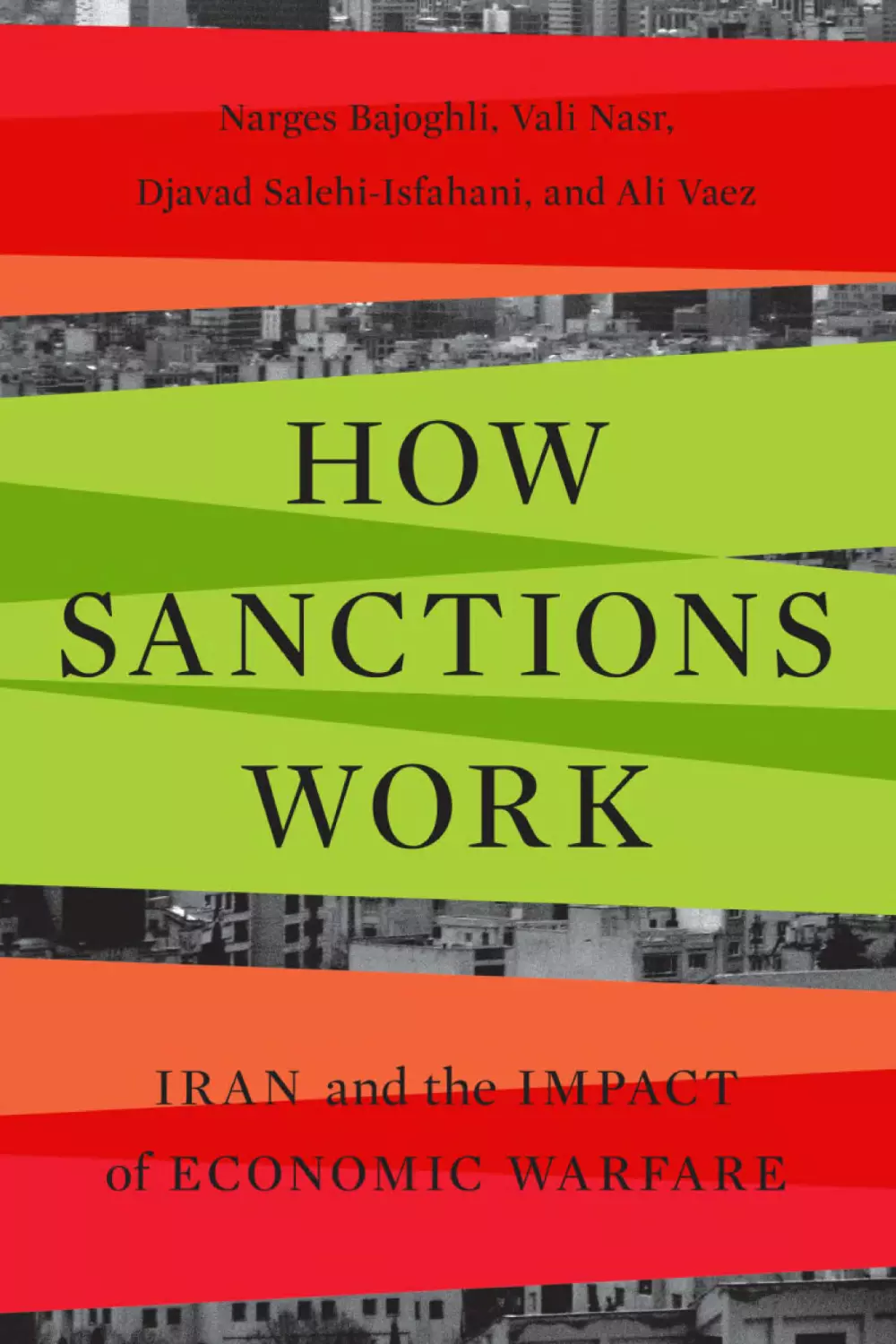
How Sanctions Work
This page intentionally left blank
How
Sanctions
Work
Iran and the Impact
of Economic Warfare
NARG E S BA J OG H LI,
VALI NAS R ,
DJAVAD SALE H I - I S FAHAN I,
and
ALI VAE Z
STANFORD UNIVERSITY PRESS
Stanford, California
Stanford University Press
Stanford, California
© 2024 by Narges Bajoghli, Vali Nasr, Djavad Salehi-Isfahani, and Ali Vaez.
All rights reserved.
No part of this book may be reproduced or transmitted in any form or by any
means, electronic or mechanical, including photocopying and recording, or
in any information storage or retrieval system, without the prior written permission of Stanford University Press.
Printed in the United States of America on acid-free, archival- quality paper
Library of Congress Cataloging-in-Publication Data
Names: Bajoghli, Narges, 1982- author. | Nasr, Seyyed Vali Reza, 1960author. | Salehi-Isfahani, Djavad, author. | Vaez, Ali, author.
Title: How sanctions work : Iran and the impact of economic warfare /
Narges Bajoghli, Vali Nasr, Djavad Salehi-Isfahani, and Ali Vaez.
Description: Stanford, California : Stanford University Press, 2024. |
Includes bibliographical references and index.
Identifiers: LCCN 2023017223 (print) | LCCN 2023017224 (ebook) |
ISBN 9781503637313 (cloth) | ISBN 9781503637801 (paperback) |
ISBN 9781503637818 (ebook)
Subjects: LCSH: Economic sanctions--Iran. | Economic sanctions,
American--Iran. | Iran--Economic conditions. | Iran--Politics and
government. | United States--Foreign relations--Iran. | Iran--Foreign
relations--United States.
Classification: LCC HF1586.4 .B36 2024 (print) | LCC HF1586.4 (ebook) |
DDC 327.1/17--dc23/eng/20230717
LC record available at https://lccn.loc.gov/2023017223
LC ebook record available at https://lccn.loc.gov/2023017224
Cover design: Will Brown
Cover photograph: Hosein Charbaghi / Unsplash
To the people of Iran who have suffered under decades of sanctions.
This page intentionally left blank
CONTENTS
Preface When Sanctions Work
ix
Acknowledgments
xiii
Introduction The Invisible War
1
One When Society Is Sanctioned
10
Two When Politics Is Sanctioned
29
Three When Iran Was Sanctioned
Four When an Economy Is Sanctioned
Five What Sanctions Cost the United States
Six What Sanctions Cost Iran—and the World
53
74
111
125
Conclusion Permanent Siege
146
Notes
151
Selected Bibliography
181
Index
191
This page intentionally left blank
PR EFACE
WHEN SANCTIONS WORK
One of the most important developments in international affairs is the
growing primacy of economic sanctions as a tool of foreign policy. Increasingly, the US response to international crises is first and foremost
the application of sanctions. But do sanctions work? If so, when and how,
and at what cost? The case of US sanctions on Iran is particularly instructive in this regard. For over four decades Iran has been a foreign
policy concern for the United States: a country that refuses to deal directly with the US, and that maintains anti-Americanism at the core of
its foreign policy and even its identity. The United States has addressed
its Iran problem primarily through sanctions. Since their first imposition
in 1979, sanctions have become more far-reaching and sophisticated; so
much so that, at the time of this writing, Iran is the most sanctioned
country in the world. In the process, the US has come to consider sanctions as a nearly unassailable necessity; to the point, we will argue, of a
counterproductive overreliance on them.
Additional sanctions, and more punishing sanctions, have failed to
realize US policy objectives. The experience of Iran shows how ineffective this seemingly effective foreign policy tool can be. Waged by warriors in dark suits in the US Department of the Treasury, the sanctions
are assumed to be more efficient and less costly alternatives to what warriors in the Pentagon and diplomats at the State Department are capable of. The decades of sanctions exacted on Iran, and the application of
ix
x
PREFACE
“maximum pressure” sanctions under the Trump and Biden administrations, challenge this assumption. The extended period also allows us to
gain a better understanding of the humanitarian, social, and political
costs of sanctions, as well as the less noticed costs that sanctions inflict
on the US. The case of Iran also shows that sanctions are far from being
an efficient tool; while they are more easily applied than direct military
or diplomatic measures, that very facility is also at the root of their failure because they become so difficult to lift, regardless of whether they
are accomplishing their goals.
The forty-plus years of US and international sanctions, and recently the
maximal use of sanctions, have been levied on Iran not only to punish its
behavior but also to force the Islamic Republic to change course: desist
from supporting terrorist activities, refrain from aggressive regional policies, and abandon its nuclear ambitions. President Trump in particular
believed in the promise of sanctions to achieve this course change, but
his administration failed on each of these three counts, and in fact the
threat of Iran has appeared to become increasingly grave on every front
of concern to the US.
Iran has shown greater defiance and more willingness to directly and
dangerously confront the US and its allies in the Middle East. The application of maximal sanctions, beginning in 2018, provoked an aggressive
response from Tehran. A year after the imposition of maximum pressure, Iran attacked four tankers off the coast of the United Arab Emirates
(UAE) port of Fujairah on the Gulf of Oman; downed a high-flying US
surveillance drone; and launched a sophisticated attack with drones and
missiles on oil facilities in Abqaiq and Khurais in eastern Saudi Arabia.
The audacity of this latter attack, and Iran’s ability to evade Saudi and
American radar and air defense systems, caught Washington by surprise.
But all of the aggressive actions were cause for alarm, given that Iran
carried them out while subject to the worst sanctions it had ever faced.
In 2022, the world was shocked when Russia deployed lethal drones that
Iran had developed under sanctions.
Throughout 2019–20, the US response to Iranian provocations only
invited escalation. After US missiles attacked an Iraqi militia base in
response to the killing of an American contractor, Iran and its Iraqi allies
laid siege to the US Embassy in Baghdad. In turn, the United States used
PREFACE
xi
an attack drone to kill Iranian general Qasem Soleimani, who played a
key role in Iran’s regional policies. Iran was neither chastened nor deterred, and in January 2020 it launched nearly two dozen Iranian- built
ballistic missiles at a military base in Iraq, which hosted US forces. This
attack on the Ain al-Asad base in Iraq—in retaliation for the assassination of Soleimani—was not only a precise strike, but the largest missile
attack US troops have ever faced.
Through such actions, Iran showed that Trump’s maximum pressure
sanctions had not bent the nation’s will to accept Western demands. Instead, the sanctions had achieved the opposite effect: making Iran more
aggressive, risk-taking, and dangerous. Indeed, this was a consequence
of sanctions. Instead of sanctions offering an “alternative to war,” maximum pressure sanctions on Iran have shown that they could be a cause
of war.1
“Do sanctions work?” is often asked by policymakers and pundits.
Perhaps that is the wrong question. When a country with the size and
economic power of the United States imposes harsh sanctions on a country, of course they “work”: sanctions create massive disruptions in the
everyday lives of citizens, impact the political culture of the targeted
state, and induce shocks in the economy. But do sanctions— as some
claim—bring about the behavioral changes in targeted states as intended
by Western foreign policy? Do sanctions work the way they “should”?
Consider Iran, the most sanctioned country in the world. Comprehensive sanctions are meant to induce uprisings or instigate pressure
that leads to a change in the behavior of the ruling establishment, or a
lessening of its hold on power. But after four decades, Iran has shown
the opposite to be true. In fact, despite periodic protests, sanctions have
strengthened the Islamic Republic, weakened and impoverished its population, and increased Iran’s military posture vis- á-vis the US and its
allies in the region. It is not only that the Islamic Republic is still around
despite harsh sanctions; most importantly, Iran has become a more belligerent state as a result of increased American sanctions.
As this book shows, then, sanctions do work. But not in the way most
think.
This page intentionally left blank
ACKNOWLEDGMENTS
To our many interlocutors inside Iran who opened up their lives and
worlds to us over the years in hours of interviews and conversations, our
heartfelt gratitude. We hope that we have done justice in these pages to
your life stories.
We would like to thank the scholars who have participated in the Iran
Under Sanctions project at Johns Hopkins University, and whose invaluable insights contributed greatly to this book: Esfandyar Batmanghelidj,
Orkideh Behrouzan, Shahrokh Fardoust, Kevan Harris, Kaveh Madani,
Adnan Mazaeri, Arzoo Osanloo, Hadi Salehi Esfahani, Tara Sepehri Far,
Nazanin Shahrokni, Alexander Soderholm, Leili Sreberny-Mohammadi,
and Sara Vakhshouri.
Thank you to Ghadir Asadi, Brendan Keating, and Arin Shahbazian
for their research assistance.
We are extremely grateful to Ben Platt not only for his expert editing skills but also for his many conversations and prompts that helped
expand this manuscript in fruitful ways. Thank you for believing in the
importance of this project and for being an incredible intellectual interlocutor along the way.
Thank you to Kate Wahl at Stanford University Press for her support
of the book and to our editor at Stanford, Daniel LoPreto, for his enthusiasm for our work and helping to so expertly bring it into the world. Many
thanks to Marie- Catherine Pavel and the rest of the team at SUP for all
their hard work. A special thanks to the anonymous reviewers, whose
recommendations strengthened the book.
xiii
This page intentionally left blank
INTRODUCTION
The Invisible War
“I am a forty-four-year- old woman who has lived forty- one years of her
life under varying degrees of economic sanctions,” said Habibe Jafarian,
a writer and editor, writing nearly two years into the US “maximum pressure” sanctions on Iran. “I grew up with the sanctions; I went to school
with them; I learned to read and write with them hovering over my head;
I fell in love, and began my career as a journalist, and have stayed alive,
all under sanctions from the United States of America. Sanctions have
been a part of my life like the weather.”1
A century before Jafarian’s lament, US president Woodrow Wilson
described sanctions differently. Sanctions, he explained in 1919, are “an
absolute isolation . . . that brings a nation to its senses just as suffocation removes from the individual all inclinations to fight . . . Apply this
economic, peaceful, silent, deadly remedy and there will be no need for
force. It is a terrible remedy. It does not cost a life outside of the nation
boycotted, but it brings a pressure upon that nation which, in my judgement, no modern nation could resist.”2
Yet the Islamic Republic has demonstrated that a nation can, in fact,
resist attempted economic suffocation. The pressures of sanctions have
not reduced tensions in the region nor have they turned Iran into a
ruined shell of a nation ready to abide by Western dictates. The pressures
of maximal sanctions have contributed to vast social uprisings, but each
1
2
INTRODUCTION
time the state has responded with violent repression and the further suppression and securitization of civic spaces.
That sanctions have failed to match their intended goal is damning
enough. But, as Jafarian makes clear, even worse is that sanctions don’t
decisively end conflicts. Instead, sanctions can linger on for decades, antagonizing the state even as they impoverish and harm ordinary people.
Most of all, sanctions, once started, are seemingly impossible to stop.
After all, how does one stop the weather?
Revealing the truth about sanctions is the goal of How Sanctions Work.
How, for example, do prolonged comprehensive sanctions affect a targeted country’s society, politics, and economy? Are they, in fact, a costless
tool for the United States and the Western-led international system—
something that can be done easily “over there” with no impact “over here”?
What does it mean for a country to experience four decades of economic
sanctions? And what are the ricochet effects of sanctions in international
politics, if any?
Iran is the perfect case study for understanding sanctions broadly.
It is also a worthy site of examination in its own right. Despite the fact
that Iran has been under decades of Western sanctions, little systematic
knowledge exists on the short-, medium-, and long-term impacts of sanctions on the growth patterns of the Iranian economy, or on the general
welfare of its people in the cities and rural areas, or on societal dynamics,
or on civic space, or on the country’s environment. Instead, the focus has
often been on a few metrics that flare up with the tightening of sanctions:
currency depreciation, inflation, and recession, which are then followed
by increases in unemployment and poverty. Yet the more comprehensive
picture remains lost in political cacophony.
We aim to correct that lacuna. In this book, we analyze what prolonged comprehensive sanctions have done to Iran’s society, politics, and
economy; moreover, we show what these decades of sanctions have cost
Iran, the United States, and the broader international economic and political order.
We take readers inside Iran, to hear from Iranians from different
walks of life and from across the political spectrum about their experiences living under decades of economic sanctions. We examine the be-
THE INVISIblE WAR
3
havior of state and military actors, as well as opposition activists inside
the country. We take a critical look at the economic data to understand
how the Iranian state has attempted to resist sanctions and what their
impacts have been on the lives of citizens. As we analyze the impacts of
comprehensive sanctions on Iran’s society, economy, and domestic and
regional politics, we also consider the blowback costs of sanctions to the
international community— a point, we argue, that needs to be considered more seriously as Washington levies additional sanctions on larger
states, such as Russia.
Ultimately, our aim is to show how sanctions have impacted the political calculus of those in power in Iran: who sanctions have empowered
and who they have disempowered. What we found inside Iran is alarming. As the use of this “economic weapon” has proliferated against Iran,
the Iranian state, in response, has become more militaristic. Prolonged,
comprehensive sanctions on Iran have created shocks within society:
leading to new social classes, changing social bonds, and a hardening of
the political sphere. These trends have only accelerated since the imposition of maximum pressure sanctions in 2018.
Why would Iran react in these specific ways? Because the Trump administration’s maximum pressure campaign—which the Biden administration has continued unabated—is in effect a “shadow war,” fought on
multiple fronts and across the region, against Iran and its allied forces.
Shadow wars are intelligence wars first and foremost. And so, in response, Iran has relied on the Revolutionary Guard’s extraterritorial
forces, the Quds Force, and the intelligence services of the Revolutionary Guard. Indeed, Iran has infused this shadow war worldview into all
realms of decision-making within the Islamic Republic. Sanctions have
caused the Iranian government to increasingly view the world as waging
external and internal war on Iran, outside in the international community and inside its own borders.
Such a sanctions- derived worldview has had an outsized impact on
Iranian political culture, anchoring it in security and repression. Iran
has responded to sanctions by intensifying the “securitization” of the domestic sphere: meaning that civil liberties are even more repressed, and
importantly, activists have been lethally targeted, imprisoned in larger
numbers, or have withdrawn from their activities. Although Iran, due
to the size and makeup of its economy, has not faced the humanitarian
4
INTRODUCTION
crises that have resulted from comprehensive sanctions in Cuba, Venezuela, and Iraq in the 1990s, its medical, educational, and agricultural
sectors are showing cracks under the economic pressure.
Ultimately, sanctions have enriched— by orders of magnitude—
enterprises tied to the Revolutionary Guard and the supreme leader’s
office. While it is nearly impossible to provide exact numbers, given how
sanctions- busting requires trade on the black and gray markets, with
attendant bribes and kickbacks, it is crucial to acknowledge that sanctions have lowered economic transparency, weakened the independent
private sector, and strengthened business owners with ties to the regime,
and especially the Revolutionary Guard. All of which has led to major
shifts in who comprises the capitalist class in society, with long- term
consequences. As later chapters show, Iran’s middle class—the sector of
society from which much of the resistance against the Islamic Republic has stemmed, and the sector that therefore should be supported by
Western policy—has been impoverished in tandem with the escalation
of sanctions pressure, and markedly since 2018. These trends are not
promoting a more peaceful Iran, but, instead— both internally and externally— a more violent one.
Bombs may not be dropped under long- term comprehensive sanctions. Even so, such sanctions create social realities and generational
impacts akin to war.
This understanding— of sanctions as war— contradicts commonly held
views on sanctions. Throughout most of their history, economic sanctions have been imposed without much regard for their impacts: the
humanitarian costs have been dismissed as necessary, and the political
costs as marginal.3 By and large, policymakers and scholars in the West
presume that sanctions (eventually) work; that if the tools of sanctions
are tweaked just right, the targeted actors suffer and eventually change
their bad behavior.
Why did this belief take hold? In the aftermath of the horrors of World
War I, Western leaders and policymakers sought to create peaceful tools
as an alternative to war. The idea of economic sanctions was born.4 Their
appeal was in what they portended: the application of pressure on a “bad
actor” to induce change, not by military exertion and dead soldiers,
but by policymakers, lawyers, and bankers sitting behind desks. The
THE INVISIblE WAR
5
notion that economic sanctions could leverage a certain kind of power
that would help avoid conflicts and diminish the need for troops has appealed to many in the West since the early twentieth century. Now, with
Americans becoming warier of troop deployments, economic sanctions
come across as a desirable alternative: reinforcing the belief that “we are
doing something,” but without the costs associated with armed conflict.
Today, economic sanctions are among the most salient tools in US foreign policy, “one of liberal internationalism’s most enduring innovations
of the twentieth century.”5
Yet the research and literature on the impacts of sanctions, especially over time, remains unfortunately thin.6 Sanctions have become a
favored foreign policy tool in Washington and the European Union, but
they have held that favored position even though their impacts remain
largely understudied, and therefore mostly unknown. Worst of all, despite their unknown impact, US sanctions have increased by more than
900 percent since the start of the twenty-first century.7 It is this increase
of an unexamined tool that makes it especially vital to reveal how sanctions really work.
For revealing the truth about sanctions, Iran is the perfect case study.
Moreover, given that Iran is the most sanctioned nation in the world, it
is worthwhile to illuminate the unique struggle of Iran and its people.
In the early 1950s, Iran experienced Western economic blockades
and sanctions for the first time in response to its prime minister, Mohammad Mosaddegh, nationalizing his country’s resources, the first
third world leader to do so. When Mosaddegh’s government ended the
unjust agreement that gave the Anglo-Iranian Oil Company complete
control of the country’s oil, Great Britain not only imposed sanctions
on Iran but also supported the coup in 1953 that removed Mosaddegh.
Great Britain’s aim was twofold: to protect its oil interests in Iran and to
make an example of Mosaddegh in order to deter other newly independent countries from nationalizing their own assets. While the purpose
of those sanctions was to force Iran to yield to British demands, it is
important to note that a military coup, not sanctions, ended the crisis
in the 1950s. Nor did sanctions on Iran dissuade Egyptian president
Gamal Abd al-Nasser from nationalizing the Suez Canal shortly after
in 1956. The sanctions on Iran in the 1950s were lifted once there was a
6
INTRODUCTION
new government in place willing to arrive at a new oil agreement with
Western oil companies.
The belief that Iran had experienced a serious blow to its sovereignty
when Mosaddegh was removed from power in 1953 festered internally
over the following decades, eventually manifesting as a main driver of
the 1979 Iranian Revolution, and has fueled resentment toward the West
ever since. The coup and revolution set Iran on a collision course with
the West, and sanctions were its first manifestation.
Sanctions returned in 1979. Since then, Iran has been repeatedly
sanctioned over the ensuing decades for a variety of reasons. In fact—
even though in this book we focus mainly on the experience of Iranians
under the nuclear sanctions—the sentiment exists in Iran that the country will never free itself from sanctions, as long as it refuses to abide by
US hegemony in the Middle East.
“If the nuclear sanctions get removed,” explains an Iranian university professor interviewed for this book, “then the West will sanction us
for our ballistic missiles. Then it’ll be human rights sanctions. Then it’ll
be another reason for sanctions. Just look at any country that has challenged Western power—whether political or economic—what do you see?
They get sanctioned in order to break their will and make them succumb
to Western power.”
In a sense, this professor is right. Sanctions originated in the aftermath of World War I. Western sanctions were soon used on states that
defied Western norms: the Soviet republics of Russia and Hungry in
1919. Blockades of these states were enacted because, from the beginning, sanctions “were considered suitable for use mainly against peripheral European states and ‘semi- civilized’ countries.”8
“Just look at any country that has challenged Western power.” In
the case of Iran, then, the history of sanctions—who is sanctioned, and
what that means about the underlying principles of the international
community— cannot be overlooked, neither by Iranians nor by those
studying how sanctions really work.
Some might argue that, despite this troubled history, sanctions have
worked in Iran. After all, wasn’t it sanctions that compelled Iran to agree
to negotiations in 2013 and then sign on to the 2015 “nuclear deal”?
Iran did show more flexibility in 2013, after President Obama in-
THE INVISIblE WAR
7
creased sanctions. Thus, many in Washington touted this as proof that
the Obama- era comprehensive sanctions against Iran worked, setting
the stage for the 2015 nuclear deal (technically, the Joint Comprehensive
Plan of Action or JCPOA). Trump tore up that deal in 2018 and increased
sanctions on Iran from 750 to over 1,500, with the stated logic that he
could get a “better deal” with more pressure.
But, as we see in later chapters, Trump’s action failed; 2018 would
not be 2013. Simply applying more sanctions, it seems, does not achieve
policy goals. Why?
As this book will show, there is a flaw in the logic of sanctions. As
painful as the experience of sanctions has been, it has also forced Iran’s
leaders to create infrastructure to resist sanctions. In fact, Iran’s current
supreme leader, Ayatollah Ali Khamenei, has called for the creation of
a “resistance economy” (discussed in chapters 2 and 4) and has tasked
policymakers to search for ways to increase the resilience of Iran’s economy in the face of sanctions in order to build long-term economic stability. Indeed, such an outcome was the goal of many Iranian leaders,
regardless of what political regime they served.9 It is plausible to argue
that, as bad as sanctions have been for Iran’s economy, these external
restraints have forced the country to rely more on its non- oil resources
for economic growth.
Sanctions, then, have not forced Iran to stagnate. Instead, sanctions
have actually forced Iran to innovate; just not in ways that are amenable
to the West. The result is that Iran has evolved along a path that has been
dictated by sanctions. Its economic and social institutions, politics, and
more broadly the nature of its state, reflect that path dependency, one
which we know from the history of states around the world is not easily
corrected and likely irreversible.
Sanctions offer incentives for certain kinds of development, and present
obstacles to others. After four decades, it is clear that those incentives
have not pushed Iran toward a more just society and a more peaceful role
in the world. Instead, sanctions have created an economy both resilient
and resistant, one capable of— and ready to— shower missiles on US military bases or Ukraine’s civilian infrastructure. And, within Iran’s borders, sanctions have impoverished nearly all elements of society except,
perhaps, the Revolutionary Guard and the businesses and social strata
8
INTRODUCTION
allied with them, the very institutions and classes that sanctions have
targeted.
When economic sanctions were first envisioned after World War I, it
was assumed that they would not be used.10 The devastating impact of
sanctions would be worse than war, which would deter countries from
engaging in adventurous foreign policy behavior that would disturb the
international order. Russia’s invasion of Ukraine, begun during the US’s
maximal sanctions assault on Iran, shows that the deterrence value of
sanctions is not what it is made out to be.
If more countries risk sanctions to challenge the international order,
then sanctions will become purely punitive. They will no longer deter.
Instead, they will simply shrink global economic relations, which would,
in turn, make defying sanctions easier.
Despite their intention, sanctions are not diplomacy nor are they instruments of peace. As the case of Iran shows, sanctions wage war on
societies within their own borders, and at the same time loosen war on
the wider world.
Methods
As anthropologists, political scientists, economists, and policymakers,
we engaged a variety of research methods for this book. We did so with
the aim of providing a fuller picture of how prolonged comprehensive
sanctions both impact the targeted society and reverberate outward into
international politics and economics.
We first began to untangle the multifaceted impacts of sanctions in
2019 at Johns Hopkins University, gathering dozens of leading scholars
from international institutions: a multidisciplinary group that included
economists, climate and energy scientists, and social scientists to explore the multifaceted impacts of sanctions on Iran. The scholars all
conducted original research and were able to place their observations
within the wider context of their long-term engagement with and scholarship on Iran.11 We continue to engage different researchers to produce
new scholarship on the impacts of sanctions in order to better, and more
deeply, understand how sanctions work on a targeted society.
In addition to that body of work, this book also draws on multiyear,
long-form oral history interviews with eighty Iranians inside Iran, including political and social activists; political actors; university profes-
THE INVISIblE WAR
9
sors and researchers, especially those conducting their own research
on the impacts of sanctions on Iranian society; psychiatrists and social
workers; workers (white collar and blue collar); large independent business owners; and former members of the Revolutionary Guard who are
now business owners. Furthermore, multiyear discourse analysis of
Persian-language media and social media was conducted.
The economic analysis in this book relies primarily on survey data
and official global and Iranian statistics. Iran produces more survey data
than most developing countries— about fifty surveys of income and expenditures and labor force surveys are publicly available in unit record.
These surveys have been used and tested by researchers across the globe,
and are generally considered reliable and of high quality. In addition,
they are consistent with 2 percent samples of census data that are also
available. Other official economic data (GDP, inflation, etc.) are also publicly available and are generally accepted by international institutions.
The analysis of all these aspects of sanctions is broken into thirds.
Chapters 1 and 2 examine the impact of sanctions on the internal society and politics of Iran. Chapters 3 and 4 explore the economic history
of sanctions alongside their escalation over the decades. Chapters 5 and
6 reveal the true costs of sanctions, not just for Iran but for the world at
large. The Conclusion raises moral concerns about economic sanctions
that predominantly target noncombatant civilians, and shows that the
efficacy of sanctions as a foreign policy tool is open to question.
ONE
When Society Is Sanctioned
Fariba— a recently retired teacher, who once led a solidly middle- class
life in Tehran with her husband, an electrical engineer— struggles to
get by today.1 “Every day I leave the house, the prices at the fruit sellers
go higher and higher. We’ve reduced what we buy quite heavily.” Her
daughter and son live abroad. “When my daughter suggested that she
send money to us on a monthly basis to help out, I died inside. As parents
we’re the ones who are supposed to ensure the stability of our children,
not the other way around, not when both my husband and I are still relatively young and have worked our whole lives.”
Fariba keeps herself busy by joining her former colleagues in organizing teachers’ protests for higher pay. “I gather with them a few times
a week to talk and strategize and join them on the streets in protests. At
least we’re doing something. Being around others like me as we agitate
for some changes gives me an avenue to take out my anger and frustrations about the hard times we’re living through.”
To make ends meet, Fariba sold a small plot of land that she had inherited from her father in their provincial town over two hundred kilometers outside of Tehran. “Before these sanctions, that money could
have lasted us for many years. But now we’re budgeting our daily expenses in order for this money to stretch as far as possible. At least my
children are already out of the country and I don’t have to think about
10
WHEN SOCIET Y IS SANCTIONED
11
their future or how to provide a good life for them here,” she says with
resignation in her voice.
In interview after interview, Iranians across the country recount how
the rise in prices has been “utterly insane.” And this rise is the direct
result of the increase of comprehensive US sanctions under President
Trump; sanctions that, as of this writing, President Biden has continued
unabated. From 2019 to 2022, Iranians explain in interviews just what
happens to society when such extreme sanctions are imposed.
They recount how the increased prices force them to cut back on purchases or pawn their prized possessions. Or they express exasperation,
uncertain of how to move forward. Middle- class families bemoan the
loss of their life savings and are anxious about their futures and those
of their children. Those in the working classes have found themselves in
even more precarious situations, as they hustle to make rent, feed families, and survive. Families in rural areas have descended rapidly into
poverty.
In comparison to other countries under comprehensive sanctions
(such as Venezuela, Cuba, and Zimbabwe), Iran has an education and
health system that has developed on par with middle-income countries.2
Moreover, the country is relatively food- sufficient. Thus, while the steep
rise in food prices due to sanctions has shrunk food pantries and calorie
intakes, there are no food shortages in Iran from sanctions.
Nonetheless, maximum pressure sanctions have plunged many Iranians, in both rural and urban areas, into poverty. It is true that the black
and gray markets, which are endemic to sanctions-busting, have created
enormous wealth for those at the top strata of society. Yet such markets,
simultaneously, have greatly increased economic inequality. Over eight
million individuals have fallen from the middle class to the lower middle
class. And the ranks of the poor have swelled by more than four million.3
These shocks to Iran’s economy have forced changes in Iran’s society.
In response, new social classes are emerging, social bonds are changing, and domestic politics has swung toward the hardliners. Meanwhile,
attacks on civil and political liberties have become even more severe.
Bombs may not be dropped under long-term comprehensive sanctions.
Even so, such sanctions create social realities and generational impacts
akin to war.
Sanctions target the economic lifelines of a society. In so doing,
prolonged comprehensive sanctions induce an environment of siege,
12
CHAPTER ONE
shortage, and intense pressure, bearing down in the form of collective
punishment. Richard Nephew, a key architect of US sanctions on Iran in
the Bush and Obama administrations, writes:
Because of the different practical effects of sanctions and military
force, policymakers treat these two tools differently. Military conflict
creates causalities and damage for each side, and the results are
visible for all to see. The impacts of sanctions can be less visible and
may seem less destructive, certainly on a visceral level. This no doubt
explains part of the attractiveness of sanctions as a tool of force. . . .
But on a strategic level, the imposition of pain via sanctions is intended
to register the same impulses in an adversary as those imposed via
military force. . . . And just because the damage wrought by sanctions
may be less visible (at least, with some sanctions regimes), it need
not be less destructive, particularly for economically vulnerable
populations that may be affected [emphasis added].4
If society is like a sea, then prolonged sanctions regimes create waves:
leading to the rise of new social classes, new economies (especially in
black and gray markets), new coping mechanisms, a heavy brain drain,
the breakdown of infrastructure, and the further militarization of politics in impacted countries.
In this chapter we ask: What do economic siege and comprehensive
sanctions “do” to a country’s society? What happens when members of
the middle class confront the (often sudden) loss of value of their income
and savings? Has Iran’s society changed in the way that those who sanctioned it intended? And what can all this tell us about sanctions in the
abstract?
Since sanctions— especially prolonged comprehensive ones—impact
multiple sectors and domains of life simultaneously, it is nearly impossible to isolate only the ways sanctions impact social life. Yet scholars
in different countries have observed similar direct consequences, especially over time. Humanitarian catastrophes resulting from comprehensive sanctions— such as food shortages,5 the breakdown of medical
systems,6 and the unavailability of critical medicines—have led to thousands of deaths around the world.7 The United Nations special rapporteur on unilateral coercive measures said, after a May 2022 visit to Iran,
WHEN SOCIET Y IS SANCTIONED
13
that sanctions were especially affecting those suffering from “severe
diseases, disabled people, Afghan refugees, women-led households and
children.”8
Comprehensive sanctions regimes also target critical infrastructure
and the opportunities available for knowledge producers, professionals,
and students. Over time, this leads to compounded crises that span generations: distressed hospital systems, brain drain, and a decline in the
quality of education. It can have a difficult-to- quantify but clearly destabilizing effect on social life: a pervasive hopelessness at the demoralizing prospect of vanishing dreams and aspirations.
Maximum pressure sanctions have indeed increased outward expressions of anger and frustration toward the ruling establishment in
Iran and generated discourses of state failure. It may appear as if this
evidence suggests that sanctions are working. Yet, as this book demonstrates, despite palpable and growing popular discontent, maximum
pressure sanctions have actually weakened the Iranian population and
made it more dependent on the state.9 Simultaneously, these sanctions
have further securitized and militarized the domestic sphere. Hamid,
a disaster management specialist in the civil society sector, responds
angrily when I ask him about the sanctions. “Don’t ask me about the
sanctions. Don’t write about the sanctions. All they’ve done is make the
Revolutionary Guard more powerful. Those of us in civil society are
suffocating—we’re constantly worried about saying something that may
come across as a ‘security threat’ by those in charge.”
This chapter argues that comprehensive sanctions have produced four
key social changes in Iran. First, comprehensive sanctions have created
conditions of mass suffering. Second, comprehensive sanctions induce
the world to view— and invent—Iranians as enemies. With no clear path
to sanctions removal, all facets of Iranian society and the movement of
Iranian peoples are regarded as either outright illegal or subject to constant legal scrutiny. This contributes to the creation of what we term an
“everyday life of resignation.”
In this atmosphere of resignation, sanctions prompt the third and
fourth key social changes: the growth of independent autarkic institutions and businesses, and the general exit from arenas of civic engagement with a corresponding retreat into private life. Such an inward turn
is especially notable in the lives of activists and artists, in contrast to the
14
CHAPTER ONE
effervescence of civil society activity that was ubiquitously credited with
the collapse of the Berlin Wall and democratization of Eastern Europe in
the 1990s.
Ultimately, then, comprehensive sanctions impact the everyday lives
of the vast majority of the population: impoverishing them, making them
more reliant on the state for help, and driving exponential inequality.
And in the face of this multipronged war, moreover, the state and its military apparatus become wealthier and more militaristic, both externally
and internally, while society increasingly weakens.
Mass Suffering: Disaster Swarms and Discourses of State Failure
Iran now faces what Yarimar Bonilla (writing about Puerto Rico and
its neighbors) conceptualizes as “disaster swarms.”10 Disaster swarms
characterize places facing “economic crisis, imperial violence . . . earthquakes . . . climate change, privatization, profiteering, and other forms of
structural and systemic violence all acting as a disordered jumble upon
a collective body that cannot discern a main event or a discrete set of
impacts, only repetitive and enduring trauma.”11 In the case of Iran, US
maximum pressure sanctions (ongoing since 2018) have coincided with
seemingly endless waves of COVID-19 (the pandemic has impacted Iran
more than any other country in the Middle East), increased tensions between Iran and its regional adversaries, chronic state mismanagement,
severe droughts, natural disasters, profiteering and increased privatization, political upheaval, and threats of chaos and even war. The resulting trauma and stress have entered into the everyday lives of Iranians,
alarming Iranian psychiatrists, psychologists, and social workers.
Nazanin is a 63-year- old mother and wife who has run a small catering business from her home in Tehran for fifteen years. The main breadwinner of her family, she has worried about their future since the price of
food sharply increased after the maximum pressure sanctions imposed
by US president Trump in 2018. “On top of sanctions, when COVID-19 hit
Iran in February 2020 and we eventually started lockdowns, I thought
that’s it for me and my family. My whole business relies on people getting
together for gatherings and on businesses having in-person functions.”
Nazanin had gotten her family through tough years before. Her husband was a technocrat at a state ministry. It was steady income, but it
barely allowed them a middle- class life. When her two children were in
WHEN SOCIET Y IS SANCTIONED
15
their teens, her husband began battling alcoholism. “We lost the small
apartment we had and became renters. That’s when I decided to start my
own business. I couldn’t allow my kids to face such an uncertain future
as their father dealt with his addiction.” Nazanin’s business eventually
flourished and allowed her family to reclaim a middle- class perch, albeit
one without home ownership in Tehran’s hot real estate market. And so,
when her business took a heavy hit with the onset of Trump- era sanctions and COVID, Nazanin’s family found themselves dealing with the
heavy stress of insecure housing. “Making monthly rent is hard enough
under normal circumstances when you run your own business and it all
depends on how many clients you have per month. But add to that the
looming feeling that my business might be gone for good because of skyhigh food prices and then the pandemic, and in the middle of all of that
my daughter was getting a divorce . . . I was having nervous breakdowns.
My daughter took me to see a therapist.”
Leeda, a psychiatrist and professor at a leading university in Tehran,
has been overwhelmed with patients. “The combination of the sanctions
making life harder for people and later the pandemic,” she explains, “has
caused a mental health crisis in the country.” Along with her colleagues,
Leeda organizes monthly meetings to discuss what they are hearing
from their patients and how they can better support those who come to
see them. Taboos around mental health have steadily decreased over the
years; now, Iran boasts large communities of people tuned into new- age
self-help books, group sessions, conversations around mental health on
state television, and pop psychology Instagram pages. Such a turn has
made talking about mental health and seeking therapy and counseling
more of a norm, especially in large urban centers. For her part, Leeda has
created both public and private seminars to engage more people and has
started to toy with podcasting as another potential avenue to engage a
wider community. “The sheer numbers of patients we’re seeing is incredible,” Leeda admits. And so, along with her colleagues in sociology and
social work, Leeda helps to initiate research studies to trace longer-term
impacts of the sanctions.
“Some of the most dire things we heard from people were in our interviews in late 2019 and early 2020,” explains Hamed, a leading sociologist involved in the research. “The shock of the sanctions had entered
society and people were extremely worried. It was unclear what Trump
would do next. There were huge nationwide protests in November 2019
16
CHAPTER ONE
against the sudden hike in fuel prices, with reports of state forces killing
hundreds of protestors. And then less than two months later, the US assassinated General Qasem Soleimani, and a few days after that, Iran shot
down a passenger airliner on the same night it sent missiles to an American military base in Iraq. It was a time of extreme loss, anger, mourning,
fear, and uncertainty. Were we going to head into another war? Would
we turn into the next Iraq? And anger at the regime was palpable everywhere you turned for the way they lied about downing the Ukrainian airliner and the rage at the deaths themselves. And then a few weeks after
all of that, COVID-19 hit the country hard, second only to China, and
people felt the authorities were lying to them and not protecting them
from this pandemic. There were daily news articles around the world
about how badly Iran was handling COVID and that the authorities were
digging mass graves and lying about the numbers of those dying from
the virus. Every day the news got worse and worse, and in the quest to
find information and not trusting the authorities, there was also this barrage of bad, and at times exaggerated, news from Iranian diaspora television networks. We picked up on that collective anger in our interviews.”
Especially illuminating is how Iranians’ understanding of this global
crisis was, necessarily, filtered through the way in which the sanctions
regime designated their country as an outlier. By this time in the pandemic, Leeda adds, “I distinctly remember how angry and helpless my
patients felt and how many new calls we had from people looking to
come in for the first time for counseling. It wasn’t until Europe and the
US began to be overwhelmed by COVID and their numbers peaked that
people here began to calibrate what they were saying to us about the dire
situation in Iran with what was going on in the world.”
Hamed nods along to Leeda’s recounting of the period, then leans
in toward the screen, adding, “One of the things we’re finding is that as
wealthy countries were unable to deal with COVID and later the global
economic situation started to get worse, within Iran the sense of ‘we’re
the only ones suffering like this’ decreased, at least in our interviews and
what we’re hearing from psychiatrists and psychologists.”12
Leeda, with her characteristically alert eyes, remembers “the level of
despair that we heard across the board in winter 2019/2020 was so high,
and we heard a lot from people about how they had become addicted to
following the news from abroad, especially the Persian-language diaspora media stations.”
WHEN SOCIET Y IS SANCTIONED
17
The battle over the narrative and affective domain is an element of
the maximum pressure campaign and other comprehensive Western
sanctions regimes. Writing about Iraq under sanctions during the 1990s,
Omar Dewachi notes how sanctions created a discourse of “state failure,” whereby citizens repeatedly bemoaned the state’s inability to meet
the needs of its population.13 In the maximum pressure sanctions against
Iran, discussions of state failure were even part of the sanctioners’ toolbox. For example, the Trump administration approved an extensive Pentagon campaign to conduct sabotage, propaganda, and psychological and
information operations in Iran. The campaign, led by the military’s Special Operations forces, “was designed to undermine the Iranian people’s
faith in their government as well as shake the regime’s sense of competence and stability.”14 This campaign involves “things that would cause
the Iranians to doubt their control over the country, or doubt their ability
to fight a war,” as a former senior defense official recounts.15
Over two dozen satellite television channels broadcast these messages into Iran on a daily basis, despite the state’s attempts at blocking
the coverage. In addition to the US-funded Voice of America and the
British-funded BBC Persian service, there are new channels such as
Manoto (broadcast from the UK with programming that leans toward
support of the former monarchy) and Iran International (a multi-milliondollar television station, launched in mid-2017). All of these channels
broadcast cutting- edge productions and news programs into the country,
often with the express aim of countering Iranian state narratives and
promoting discourses of regime change.
In addition to these channels, social media campaigns and troll
armies increasingly entered the digital fray with the launch of the
maximum pressure campaign. And, as might be imagined, this social
media realm became increasingly polarized: there were troll farms run
by armed Iranian opposition groups;16 there was US State Department
funding that, while ostensibly meant to counter the Iranian state’s disinformation campaigns on social media, targeted and smeared American
scholars, journalists, and analysts who publicly questioned the Trump
administration’s policies on Iran;17 and there was disinformation campaigns run by “digital warriors” loyal to the Islamic Republic.
The same sort of scorched- earth tactics (“you’re either with us or
against us”) that, in the United States, created stark divisions in the social
media environment during the Trump presidency, now began to appear
18
CHAPTER ONE
in Persian-language social media, especially Twitter. Social media apps
such as Twitter already amplify content that drives anger, in order to
create engagement and capitalize on ad revenues. So, within the context
of sanctions, the algorithms added fuel to the fire with the foreign funding of Persian-language troll armies that drove the discourse on social
media toward conflict. The Trump administration and other anti-Iran
states poured resources into furthering resentment and anger among Iranians at this time.18 The Islamic Republic is also an active player in this
terrain: with hacker groups that target adversary nations, troll and bot
armies that sow discord in the opposition, news websites and YouTube
channels loyal to the Iranian regime and its allies, and multifaceted disinformation and smear campaigns.
All of this social media polarization and near- constant warring
discourses— between anti-regime activist groups, diaspora satellite television outlets and news organizations such as Iran International and BBC
Persian, and the vast media and social media world tied to the Islamic
Republic— contributed to the distress experienced by Leeda’s patients,
which reached another climax in fall 2022 with the #MahsaAmini uprisings in Iran. The severe repression of the uprisings, and the ensuing
heated battleground of social media, have only deepened rage and polarization. These have all contributed to a widening discontent toward the
political establishment.
Of course, it is not the result of the sanctions alone. The Islamic Republic itself creates the conditions whereby the affective strategies of
sanctions are impactful. Years of policies and actions have created deep
frustrations, resentments, and anger among increasing swaths of the
population against the ruling establishment. Among the most common
phrases repeated throughout interviews for this research were “they [the
Islamic Republic] have ruined us,” “things are destroyed,” “they can’t
run the country’s affairs,” “nothing works.” We repeatedly heard among
those who had lived through the revolution some version of “we’re worse
off than we were prior to the revolution. The revolution was a mistake.”
These discourses may seem to confirm US desires for sanctions. But,
in fact, such sentiments in other countries under comprehensive sanctions have not led to social change. Instead, as witnessed in cases such
as Cuba, Venezuela, and Iraq— as well as in Iran—widespread disillusionment or even uprisings in conditions of prolonged comprehensive sanctions are met with strong repression from security forces. Those who
WHEN SOCIET Y IS SANCTIONED
19
join uprisings are often treated as enemies of the state. We have yet to
see an instance in which prolonged comprehensive sanctions have led
to popular uprisings that force either behavioral changes in the ruling
establishment, or regime change altogether. More often, the discourses
of state failure lead to a prevailing resignation, a consuming struggle to
make ends meet from one day to the next, and in the case of Iran, an onslaught against activists and civil society actors to the extent that those
who are not imprisoned, killed, executed, or driven to exile withdraw
from the securitized public sphere (discussed in chapter 2).
In Iran, the combination of decades of neoliberal governance, economic mismanagement, sanctions, corruption, and media wars has led to
both conditions of disaster swarm and discourses of state failure. Such a
state does not further US policy goals. Instead, it further entrenches antiAmericanism not only within the ruling establishment in Iran but also
among ordinary Iranians who did not express such sentiments before
maximum pressure sanctions.19 But worst of all, living under disaster
swarm and state failure simply wrecks the daily lives of ordinary people.
Defining a Society as the Enemy
Comprehensive sanctions regimes are literally tools of economic pressure. Perhaps more importantly, sanctions are, both by design and by
implementation, a strategy to define an enemy.
For years, the United States actively worked to make any contact or
trade with Iran toxic, even and especially for those—like the European
countries, South Korea, and Japan— that relied on energy trade with
Iran.20 Thus, the United States turned trade partners and potential allies
of Iran into enemies.
At the same time, Iran was depicted as a “pariah” state: through direct
economic sanctions and via media, there has been an attempt to present
Iran as an enemy not only of the US but also of the global world order.21
In this multidecade process, Iran has gone from a state that challenges
US (and by extension, Israeli) hegemony in the Middle East, to an official
global threat. This transformation is manifested in the 1984 US designation of the country as a “state sponsor of terrorism” (in more recent
years, US officials have amplified that designation by adding that Iran is
a “leading state sponsor of terrorism”).
Consequently, a logic of enmity paralyzes both the US and Iran,
20
CHAPTER ONE
making it now nearly impossible to lift sanctions. Embedded in this
enemy-making dynamic are affective logics, whereby Iran (for the West)
and the West (for Iran) become opponents committed to a zero- sum game
of destruction. It is crucial to note that this logic applies to other comprehensively sanctioned countries as well, with a similar reality: a multilayered web of sanctions, with no real path toward removal. Comprehensive
sanctions designate a country— and its targeted population— as an enemy
perpetually.
What happens in the everyday lives of people when their society is
defined as an “enemy” to the international system, outside of a formal
declaration of war? How does this impact the conduct of everyday life,
internal domestic developments, the international movement of citizens,
and the wider sociopolitical context of a people?
By coupling sanctions with a “terrorist state” designation, the US
further hinders international travel, student visas, and the movement
of professionals for academic and medical conferences and artistic exchanges. During the Trump years, for example, the US “Muslim Ban”—
which disproportionately targeted Iranians—worked in tandem with the
sanctions not only to “punish” the Islamic Republic as a state but to criminalize the movement of Iranians across borders. Added to this ban were
multiple cases where Iranian students in the US, on valid student visas,
were denied reentry into the US or deported.22 This targeting of student
and professional classes— oftentimes, the very people who on-the- ground
have led the most sustained efforts to challenge state power—has become
a key component of the comprehensive sanctions regime, with effects
that seem to contradict the US’s own policy goals.
Again, the sanctions turn friends and allies into enemies and accomplices. Take literary and scientific publishing houses. The vagueness of
language in the sanctions regulations themselves have led to publishers
overcomplying, so as to avoid censure: this has taken the form of issuing
directives not to publish work from any Iranian writers or researchers.23
Scientific and academic conferences often cannot accept the work of Iranian researchers. Collaborative academic work between Iranian universities and those outside Iran constantly runs into roadblocks imposed
by the sanctions. This, over time, effectively sidelines Iran’s researchers
and industries of knowledge production.
The vague language of sanctions regulations has also led US universities to curtail the academic freedom of social science researchers to con-
WHEN SOCIET Y IS SANCTIONED
21
duct research in places such as Iran.24 This, in turn, has led to university
lawyers forbidding the invitation of Iranian scholars, artists, and journalists to virtual conferences and invited talks, even when no money is being
transacted. It has only been through extensive— and expensive—legal
fights that the US Treasury Department admitted that these entities are
overinterpreting the sanctions and offered a (often only slight) corrective.
Despite some clarifications, most sanctions directives continue to be
vague in language and, therefore, ripe for overinterpretation and overcompliance. This ensnarls Iranians in a Kafkaesque web of legalese that
spans the globe. Yet the US government insists on maintaining the vague
language in sanctions directives, even in the face of calls for clarifications and clearer regulations. Clearly, then, vagueness is a tool in the
enemy- defining strategy. By making interactions with Iran sanctionable
and depicting the country as “special and not in a good way” (as Richard
Nephew, an architect of the US sanctions against Iran, has proclaimed),
US policymakers have made Iran and its people into pariahs, in every
realm of business, exchange, and engagement.
Even worse, there is no off-ramp to the comprehensive sanctions. As
such, this enemy status—which attempts to economically strangulate
Iran—has a stubborn, sticky quality to it, one that reverberates in the everyday lives of Iranians.
Coping Mechanisms: Mutual Aid and Autarky
“Sure, the situation is tough,” Zahra, a lower-middle- class homemaker
from Isfahan in her late sixties, explains about life under comprehensive sanctions. “But, at least for those from my generation and my kids’
generation, we remember what it was like to live through eight years of
war. There was food rationing then. There were bombs flying over our
heads. I didn’t buy cherries this summer because they were so expensive. We’re eating less red meat. But in comparison, we’re making do.
There aren’t long lines for food like during the war. The shelves in all
the markets are full. It’s frustrating that we can’t buy what we used to,
and its maddening that we’re at this stage after all of these years, but
at least for me and those I’m surrounded by, we’re getting by. When we
don’t have enough of something, my cousin’s family sends it over. When
my friends need something, I drive it over. We know how to take care of
each other. The other month a girl from our family was getting married.
22
CHAPTER ONE
Everyone chipped in what they could and we all bought her everything
she needed to start her new life. Sure, before this situation her parents
could have done it on their own, but now we all help out. We make sure
no one stays without.”
In her free time, Zahra has picked up knitting and sewing again. She
and her friends started a clothes-making circle, for children whose families may not be able to afford new clothes. Every month they send bags
full of new clothes to lower-income neighborhoods of the city and have
expanded to surrounding small towns and villages.
The latest round of sanctions, the parallel psychological and information wars, the social and political pressures from the Iranian state
on society, and the ongoing nature of the sanctions with no end in sight,
have led to an “everyday life of resignation” as well as ways to cope with
the new and ever- changing realities. One coping mechanism that has
become widespread and been pushed to the forefront, both on small and
large scales, is mutual aid networks (like that of Zahra’s clothing circle).
After all, Iran is a society that, less than fifty years ago, toppled millennia of monarchy through a popular revolutionary movement. The
kind of sustained movement necessary to topple an autocratic leader
backed by the United States demanded that society forge deep bonds of
solidarity. The ensuing four decades, for a variety of reasons, deeply fractured these bonds. Even so, Iranians have responded to disasters since
the revolution— both human-made and natural—with continued social
solidarity that, in times of crisis, crosses class lines. These efforts, led by
both citizens and state/semi- state organizations, play an important role
in coping with sanctions.
Sara, an upper-middle- class homemaker in Shiraz, helps lead an informal charity with other women who have disposable income. Every
three weeks, they collect everything from computers to cell phones
to shoes for those in need. “We coordinate with women who are from
neighborhoods with less resources. They tell us what families need—
from actual material goods to cash in order to get their sons or daughters
set up in a home after marriage. We go around and collect the goods from
families with means in Shiraz and every month so far we’ve met the demands in our network. There are at least seven other networks I know of
like this personally.”
In southern Tehran, Leyli, a single mother of two, rushes to pick up
her brother’s car after six hours threading eyebrows at a salon in central
WHEN SOCIET Y IS SANCTIONED
23
Tehran. Since the imposition of maximum pressure sanctions and the
exponential rise in the cost of food, Leyli began to drive “Snap,” Iran’s
version of ride- share apps like Uber and Lyft. She rotates her kids from
her brother’s house to her aunt’s house during the week when she works
late driving. “If it weren’t for my brother’s car, I’m not sure what I would
do. I’ve sold all the jewelry I have, I’ve run out of everything possible to
pawn. I don’t want to think about what I would be forced to do . . . how
I would need to work the streets, to provide for my children with the
prices the way they are. I just thank god every day for my brother,” she
says with relief in her voice, a mere few seconds before tears well up in
her eyes and she drops her head. The suppressed sob and her attempts at
wiping her tears muffles her voice. After gaining her composure, she repeats, “I hardly ever see my children anymore. My daughter has started
acting out and her school called me to say they were worried about her
behavior. I know she wants me around more. I only see them when I
get them ready in the mornings and on Fridays. It kills me to be this
absent, but with my husband gone and prices the way they are now, what
choice do I have?” Leyli is among the legions of new households headed
by women who have been plunged into poverty due to the sanctions.25
Prior to the death of her husband in a road accident, Leyli had a
job threading women’s hair at a family- owned beauty salon in central
Tehran, and had been there for ten years when the pandemic started.
“For over one year when the pandemic began, people were too afraid to
come in and get their faces threaded,” Leyli explains. At the same time,
her children needed laptops to participate in virtual school, given the
lockdowns. Without even needing to ask, the owner of the salon called
some of her clients; they gathered secondhand laptops and tablets to give
to Leyli and the other employees of the salon for their children. Other clients sent her money regularly during the lockdowns, saying they would
be paying her regularly if the lockdowns weren’t in place.
Throughout the country, these women-led charity networks— at times
formal and registered, but often informal—help create a wider network of
mutual aid and care. It is hard to measure how extensive these networks
are and how much they cover, as far as needs are concerned. Nevertheless, what they do reveal are the deep connections that zigzag through
the country, and have done so for decades. These networks of mutual aid
and charity have proven key during large natural disasters like earthquakes and floods and during the Iran-Iraq War. Sanctions, then, are just
24
CHAPTER ONE
another obstacle for the embattled Iranian people to overcome, rather
than a unique pressure that might lead them toward US policy goals.
In addition to these informal networks, formal charities are also very
active, as are mosques, religious centers, and wealthy foundations, especially for the dissemination of food, money, furniture, appliances, and
personal technology. Although no substitute for the dwindling state-led
social safety nets under the pressure of sanctions and years of privatization and neoliberalization, these sustained networks help in dealing
with everyday shortages.
While women-led circles and mutual aid networks attempt to alleviate some of the harsh impact of sanctions, opportunities born of isolation
and a desire for autarky have arisen for others, especially some young
men and women. With the import of goods diminished and increasingly
out of reach for everyday consumers, the market has opened up to domestic producers and smaller businesses. With the help of apps such as
Instagram, Telegram, Whatsapp, and Iran’s growing e- commerce and
tech sector, small businesses have popped up in homes and shared office
spaces throughout the country. A homegrown fashion industry is booming in urban centers, increasing the demand for manufacturing domestic textiles, while similar booms are apparent in home décor, businesses
pertaining to children, and the entire ecology of creatives involved in
the production of digital content for social media outreach and brand
development for these small businesses and influencers. Here again, despite the great hardships of the sanctions, Iranians are adapting.
Vida, a 32-year- old entrepreneur who had spent four years studying
in Malaysia, has no intention of leaving Iran again and “starting from
zero. I’ll make do with the situation here, as difficult as it gets.” She had
grown up in a middle- class family in central Tehran. After earning her
civil engineering degree and working for a few years in a private company doing what she had studied at university, she finally quit her job
and decided to try what had always been her dream: to become a pastry
chef and run a catering company. She runs her pastry and catering business mainly through Instagram, WhatsApp, and Telegram, and, prior to
the pandemic, had gathered a steady and increasing clientele. When she
divorced her husband one year into the pandemic, she knew she had to
find her own place to live and try to pick up extra work to be financially
stable on her own. She sought investors from the network she had created through her pastry business and opened a small grocery market
WHEN SOCIET Y IS SANCTIONED
25
that sells domestically made artisanal food products. She advertises both
of her businesses on Instagram through Iranian social media influencers and in pop-up food events throughout Tehran. “Things have gotten
very expensive, but there’s also this odd opening for those of us who
are running small businesses here. People still want a good time, they
want good food and experiences, and we can now offer that to them and
reach them through social media as our business platform. And we’re
not competing with foreign products as much anymore. Of course, the
government slows down the internet during protests and it’s unsure if
we’ll have access to Instagram in the future—it has all of us who work
through that platform worried. But, we’ll find our ways,” she adds with
a brief laugh. “Every day is a hustle to find ways around government restrictions and sanctions and somehow make things work.”
For small and micro business owners, such as Vida and Nazanin, the
caterer who is the main breadwinner in her family, they describe being
extremely busy and having lots of orders, despite inflation and growing
concerns over the economy. “The restaurants all over the city are full
virtually every night of the week,” Vida recounts. “I’m in motion every
day throughout Tehran, going from east to west and south to north to buy
what I need for my businesses, and scoping out new opportunities. I’m
telling you, after the lockdowns, the restaurants and cafes all over the
city are full and for those of us who cater, we’re back at full capacity, at
times even more.” Nazanin agrees. “Don’t ask me to explain it to you how
despite high prices people are still spending money to enjoy themselves,”
she laughs. “I guess there’s a lot of money circulating. All I can tell you
is I have so many orders and not just from homes in wealthy parts of the
city. There’s usually a lull of a few weeks after the currency depreciates,
but then orders start up again once people adapt to the new prices.”
Interviews with Iranians in other cities around the country also echo
the same sentiments: despite soaring prices and a decrease in buying
power, the entertainment, food, fashion, and leisure industries are vibrant.
Dashed Aspirations
Prior to the Obama- era sanctions and Trump’s maximum pressure campaign, Iran experienced years of economic growth, as will be discussed
in chapter 4. Not only were standards of living increasing in urban areas,
but rural areas saw an exponential rise in living standards and devel-
26
CHAPTER ONE
oped aspirations for middle- class life. Since 2010, however, poverty rates
have doubled in rural areas and increased by 60 percent in urban areas.26
A common theme in interviews was how bleak the future seems.
Many parents search for ways to get their children abroad, and increasingly more so since the violent repression of the #MahsaAmini uprisings.
This potential new wave of brain drain has caused further narratives of
dismay and anxiety to course through Persian-language social commentary in online spaces and offline conversations. Diminished opportunities, skyrocketing costs of living, and an uncertain future have created
the conditions for “migration fever,” as journalist Ferial mentions. Covering the social beat for a leading Iranian newspaper, she comments, “Everyone around me is either in the process of leaving or wanting to leave.”
Yet for those who stay, the most repeated sentiments in interviews
for this research included dismay, resignation, rage, despair, and hope.
Ali, a chemist in his mid-thirties, unplugged from the news and current
events in 2019–20, and began to find refuge in the mountains on the outskirts of Tehran. Hiking and mountain climbing are regular pastimes
in the areas of Iran with mountain ranges. On Thursdays and Fridays,
the weekends in Iran, hiking paths are often crowded, as people seek
an escape from the urban sprawl or healthy exercise. For Ali, it became
a refuge away from what he describes as an all- enveloping negativity.
“All of the negative news, all of the talk of impending doom and people
being angry and depressed around me . . . it was really impacting my
own mental health. The problems seem so much bigger than what we
can solve. Everything seems absurd. So one day I just said, I’m done.
I’m done with all of it. I wanted to spend time in nature. My friends and
I started going on weekly hikes in the mountains. Then we started to
camp. We all work for companies where we can work remotely, and
some of my friends eventually even quit their jobs because they weren’t
making enough to live. They downsized their lives and we all hit the
road. We drive to different areas of the country. Camp throughout. Make
our own food at campsites. We’ve met so many young people doing the
same. We’re just disconnecting from all of this,” he waves around, “and
reconnecting with nature and with other people.
Kaveh, an architect in his late thirties from Karaj, a city just west of
Tehran, recounts a similar journey: “I started hating going to work. They
couldn’t pay me well anymore. I was frustrated watching my peers who
had gone abroad shine on social media with their careers. I remembered
WHEN SOCIET Y IS SANCTIONED
27
how my mother created what felt like a cone of light and creativity for me
and my siblings during the [Iran-Iraq] war. We’d always have music on in
the house. We went on picnics every week, we went hiking. She would
scrape together money and put us in music and art classes. We knew the
war was going on outside, but inside our cone, it was light and full of
love and music and art. So I looked around myself and really started to
question why I had forgotten that. I was striving so hard to be a successful architect and make money and live a certain lifestyle. Just like the
war interrupted my parents’ lives, this economic war of sanctions was
interrupting mine. So I decided to do like my mother had done: I created
my internal world and turned away from the darkness and frustration
of what was going on outside that felt too big for me to impact anyway. I
quit my job, I began to play music again. I hike and cook and document
it all on my Instagram. I’ve found so many others my age who are doing
the same thing on Instagram. We’ve been meeting up, some of us are now
traveling around the country together. None of us come from wealthy
backgrounds. We’ve literally downsized our lives to two backpacks.
We’ve given up the race of being ‘successful’ and instead have decided to
connect with nature and music and art and each other.”
Golnaz, a painter and illustrator in her mid- thirties, has a similar
story: “Before the sanctions and COVID, it felt like we had to live our
lives BIG. Keep up with exhibitions here and there. Plan how to get on
the radar of art collectors. The sanctions limited all of that for us. It hurt
a lot at first. But then with COVID, the whole world had to downsize and
turn inwards. All of a sudden I saw all of my friends who had moved
abroad struggle very deeply. They had to take on whatever jobs they
could to pay rent and afford to live abroad. They were isolated from everyone they loved. At least here I am surrounded by family and friends.
I could unplug from the life I had built and do small- scale projects that I
didn’t care if they ‘succeeded’ or not.
“And with the ‘Woman, Life, Freedom’ uprisings, I have work to do
here. The repression has been so hard to witness, and about ten of my
friends were arrested. But as an artist, my gaze has shifted from getting
into the latest exhibitions to creating visions for the future here in Iran.
In some ways, my world has gotten smaller. In other ways, it’s become
fuller and I’m present in this struggle.”
These consequences to society of young people retreating from their
involvement in formal public spheres are clear in the stories of Ali, Kaveh,
28
CHAPTER ONE
and Golnaz, but perhaps none more so than Ava. Ava, an environmental
activist who used to be involved in political organizing during the reformist years, has turned inward: “I just shut off all of my social media. It
was too depressing. The state arrested my friends and colleagues in the
environmentalist sphere. For a while I knew my activities were being
monitored. I’d talk to my friends in prison on a weekly basis. They kept
encouraging me to do what I needed to do to stay alive and free and
healthy. I started to read more, to play some music again. To slow down
. . . instead of rushing like I used to, I now take my days slow, enjoy my
friends and family. I’ve learned to cook new things and have started to
learn how to paint from some Instagram painters. What does that mean
for my future? I don’t know. But I don’t care, because at this rate, none
of us may actually have a future given how the climate crisis is going
and how conflict- driven the world is. We lived limited lives during the
Iran-Iraq War, we can do it again now. And perhaps most freeing of all is
that I’ve given up the urge to organize for change in formal ways in this
system. The atmosphere is so tense and securitized. We need to create
new visions. So, we’ll do like our parents taught us in the 1980s: we cultivate . . . we plant seeds of beauty and culture, we push the confines
of this state every day with our presence, and when the situation gets
better and it’s not as dangerous to organize again, then we’ll reemerge,
and hopefully healthy again and with newer ideas for how to build and
grow.”
TWO
When Politics Is Sanctioned
It was the week before the 2021 presidential elections in Iran. Traditionally, voter turnout mattered to the state, which, after all, had been
founded by a popular revolution. But, over the preceding three years,
since 2018—when the Trump administration pulled out of JCPOA (the
2015 nuclear deal) and initiated its maximum pressure sanctions campaign against Iran—the atmosphere had drastically changed.
Up until maximum pressure, the postrevolutionary state had differentiated itself from the shah’s dictatorial rule by claiming a particular
kind of legitimacy: that the Islamic Republic of Iran originated in the
mass movement that gave birth to the 1979 Iranian Revolution. In March
1979, reportedly 99 percent of the electorate voted for the Islamic Republic and its constitution. Since then, the presidential elections every four
years in Iran had touted relatively large voter turnouts, both legitimizing the Islamic Republic to its own supporters and serving as a buffer
against its myriad opponents. It was true that the electorate had suffered
a big blow after the violent suppression of the 2009 Green Movement
uprisings, which protested what many saw as voter fraud in President
Ahmadinejad’s reelection. But that was nothing compared to just over a
decade later. In June 2021, the disappointment, defeat, and anger of the
electorate resulted in the lowest voter turnout in postrevolutionary Iranian history: less than 50 percent of the electorate cast ballots.
29
30
CHAPTER T WO
“The past two presidential elections [2013 and 2017] we told people,
‘Go vote so we don’t get sanctioned anymore and we can solve our issues
with the West,’ ” says Shadee— a former student activist tied to the Green
Movement of 2009—rolling her eyes at how absurd that argument sounds
to her today. Letting out a big sigh, she adds, “My generation is the generation that believed in the power of the ballot box to push the system to
reform and moderate itself,” her voice sounding increasingly resigned,
as she considers the high hopes and deep losses her generation of civic
and political activists have endured in Iran. “But after everything we’ve
been through because of Trump pulling out of the deal and reimposing
sanctions . . . I cannot go back out on the streets and try to convince
people to vote. What am I going to say? We have no arguments left. We’ve
been rendered speechless.” She raises her hands in resignation and looks
down and away in exasperation for what feels like a long minute.
A pregnant silence fills with a mixture of resignation and anger.
“People voted in 2013 and 2017 to make relations better with the West,
to ease the economic situation, and we’re worst off today than we were
before JCPOA,” she finally says. She excuses herself for a break from the
conversation to regroup.
Alireza is another activist from the Green Movement, who spent time
in prison in 2010, and again landed in prison during the 2022 #MahsaAmini uprisings. He stayed in Iran upon his release in 2011 and says
he plans to do so again now that he has been released from prison after
the 2022 uprisings, in order to continue working to preserve space for
civic engagement. He explains the years since the imposition of maximum pressure sanctions: “It’s like we’re in a boxing ring fighting against
two opponents at the same time: the US and our own hardliners. Trump’s
reimposition of sanctions knocked the air out of us and opened the field
for our hardliners to pounce on top of us and just keep punching so we
don’t have the space or ability to get back up. Even when we rise up again
. . . the ‘Woman, Life, Freedom’ protests, which have been so crucial in
reclaiming the language of revolution and uprising from the state . . . but
the state responds with such breathtaking violence. It feels like a total
knockout and I don’t know when we will be able to find our footing again
. . .” His voice trails off, the last sentence lingering uncertainly.
Fatemeh, meanwhile, is on the other side of the political spectrum,
but no less shaken by recent events. An active member of the young
generation of self- described “revolutionaries” (enqilabiyun)—those who
WHEN POlITICS IS SANCTIONED
31
helped organize campaigns for young hardline candidates in Tehran’s
city council elections in 2021—Fatemeh describes the harsh experience
of the Trump era: “The reformists and moderates who believed that the
US would keep its word in JCPOA were naïve. The US government rescinded every treaty it’s had with Native Americans in its history. It’s a
regime that has gone back on its word time and again with its own Black
citizens. If that’s how it treats its own people, we’re fools to believe it
will honor its word in its foreign policy. The reformists and moderates
have the same problem Iranian leftists and liberals had at the beginning of the 1979 revolution: they believe in an inherent goodness of the
West. They’re brainwashed by the West and they put our people in this
economic situation because of it. Hopefully this bitter lesson of Trump
teaches our people once and for all that the US and the West cannot be
trusted.”
It is an understatement to say that Iran had a bitter experience with
JCPOA, particularly the ease with which President Trump pulled out
of the accord and reimposed harsh sanctions (everything from overt
sanctions to covert operations to propaganda wars). As this chapter
demonstrates, the recent US maximum pressure campaign will have
long-lasting impacts on Iranian politics and political culture. In just a
few years, the US actions severely contracted political space in Iran; as
shown in chapter 1, the results were not a flourishing of liberal opposition but a strengthening of the hardline right with its attendant penchant
for violent suppression. Moreover, the sanctions militarized political culture and discourse, which has contributed to an atmosphere of polarization and resignation even as it further strengthens hardliners. In fact,
the most direct result of maximum pressure has been an almost total
consolidation of political power by Supreme Leader Khamenei loyalists,
and a hastening of the increase of economic power by the Revolutionary
Guard by orders of magnitude.
Maximum pressure, and comprehensive US sanctions in general,
have resulted in political hardening and increased military control over
political culture. And, worst of all, they have done so while suffocating
the voices for engagement and change.
Yet the discussion in the following pages also shows that none of
this—not the securitization of Iran’s political sphere, nor the contracting
of the political arena, nor even the near complete takeover of political
and military decision-making by the more conservative camps of the Is-
32
CHAPTER T WO
lamic Republic that occurred after Trump imposed maximum pressure—
was a foregone conclusion. Indeed, this chapter shows how, without US
sanctions and pressure, Iran might truly have charted a different path,
even in this last decade.
Lessons from Iran’s Political History
“For Americans, pulling out of the Iran deal and reimposing sanctions—I
doubt it’s impacted their daily lives at all,” says Hasan. “Many may not
even remember it or care to know much about it. But for Iranians, not
only did it make day-to- day life more expensive, more tense, and bring
about a sense of cynicism . . . which is a true tragedy in my opinion, when
hope dissipates and deep cynicism and resignation set in . . . but it also
undid almost two decades of many of us pushing for an opening and
easing of tensions with the West.”
A 60-year- old intellectual who volunteered to fight during all eight
years of the Iran-Iraq War, Hasan had written, lobbied, and traveled
across the country implementing programs and activities to increase
dialogue and promote what he often described as “a culture of peace.”
His desire to reduce tensions did not come from his fear of battle, he is
always quick to point out, but precisely because he had spent so many
years of his youth on battlefields. “There is nothing like experiencing
war up close to make you hate it and never wish for its specter to be anywhere near you, your family, your country. That’s precisely why so many
of us who had experienced that war and all that our tensions with the US
have tried for so long to bring about a discourse of gradual trust building
and reducing tensions.”
Hasan was a supporter of the revolution and the postrevolutionary
system but believed that deep cultural changes were necessary. Hailing
from a pious middle- class family in the southern city of Bushehr, he had
lived in Tehran since the early 1990s and seen many of his friends from
the war gain high political and economic positions. To him, their “blind
pursuit of money and power” was creating an out- of-touch political elite
like those of the shah’s regime, causing a deep disconnect between those
in decision-making positions in the system and ordinary people. Hasan
adamantly maintained his independence from both the reformist and
conservative camps within the political establishment. Although his
ideas are more in line with those on the reform end of the spectrum, he
WHEN POlITICS IS SANCTIONED
33
often criticizes reformists just as harshly as he does his more conservative colleagues.
“The other side calls us naïve, and maybe we are . . . ,” Hasan trails off
for some time, his eyes looking outside the virtual frame of his camera,
“but we need to keep creating space for peace and engagement. It’s just
too bad that this experience with JCPOA was so sour. It’s been a major
earthquake in our political and social history.”
Although Iran was never directly colonized, experiences with colonial powers in its modern history—not to mention the myriad intellectual, political, and activist reactions toward foreign powers that have
tried to wield control over the country’s vast natural resources and its
geostrategic position—have helped define Iran’s political culture over
the past century. In 1953, the CIA and MI6 helped orchestrate a coup to
depose Mohammad Mosaddegh—the first third world leader to nationalize his country’s resources and take them out of the hands of the British,
for which the West imposed sanctions and an embargo— and replace him
with a despotic monarch, the shah. Since then, the widespread belief
that Iran had experienced a serious blow to its sovereignty in 1953 festered. Indeed, a main kernel of the 1979 Iranian Revolution was its struggle against the shah, who was widely believed to be doing the bidding of
the United States.
The experience of the 1953 coup loomed large over the early events
of the 1979 revolution, as the population demanded national sovereignty
in the face of powerful outside forces. “Every morning we woke up and
wondered if the US embassy had staged another coup to return the shah
to Iran,” a leftist activist recalls from those early months after the shah
had fled the country. It was these fears that first led leftist guerillas to
attempt a takeover of the US embassy in Tehran in February 1979. Seven
months later, in November 1979, Islamist student revolutionaries loyal to
Ayatollah Khomeini did succeed in overrunning the US embassy, after
President Carter had acquiesced to allowing the shah to enter the US.
The students eventually held fifty-two Americans hostages for 444 days.
Over the four decades since the hostage taking, relations between the
two countries experienced far more ebbs than flows. The US supported
a war of attrition between Iran and Iraq in the 1980s, turning a blind
eye to more than five years of chemical attacks on Iran during that war;
Iran was involved in the creation of Hezbollah in Lebanon and a deadly
attack on US Marine barracks, showing its willingness to hit back at the
34
CHAPTER T WO
US outside of Iran’s national borders. President George W. Bush included
Iran in the “axis of evil,” despite US and Iran cooperation in toppling
the Taliban in the aftermath of 9/11, and US-led sanctions against Iran
spanned decades; Iran in turn sponsored and trained Iraqi militias to
battle US forces in their country. Meanwhile, there were the multiple
fronts of proxy wars in the region between Iran and the US and its allies,
Israel and Saudi Arabia. But the signing of JCPOA in 2015, which included direct negotiations between Iranians and Americans, appeared
to signal a departure from the previous four decades.
For JCPOA to become even a possibility, however, entailed a battle
of ideas and discourses. The two countries had shared a bitter history.
Moreover, there was debate concerning the legacy of the Iranian Revolution: after all, one of the revolution’s desires and promises was to establish sovereignty vis- á-vis the imperial powers of the US and the Soviet
Union at the time. And there was debate over how Iran could or should
relate to the world’s superpower, which, since the 1979 revolution, took
concrete steps to build a military presence in the Middle East, and since
9/11 formally occupied two of Iran’s neighboring countries.
A crucial role in this battle of ideas was played by Iran’s majority
young population. Born after the revolution, Iran’s youth pushed—
politically at the voting booth, and socioculturally in their everyday
practices— against the myriad social and political restrictions of the postrevolutionary state.
Why did activists like Shadee and Alireza, quoted earlier, feel so resigned in the 2021 elections and the aftermath of the violent suppression of the 2022 uprisings? To answer this question, it is important to
understand first the role their generational cohort played in the political
realm since 1997. At that time, young Iranians who did not remember
the revolution, and who were children during the Iran-Iraq War, came
out in droves to vote in the presidential race for Mohammad Khatami: a
reformist cleric who spoke of the power of dialogue for both internal and
external relations.
Khatami’s election was experienced as a rupture of Iran’s revolutionary experience to that point. Key to understanding postrevolutionary
Iran is to appreciate the deep sociopolitical changes that occurred, both
individually and collectively, through the very processes of mass mobilizations that led to a revolution as “unthinkable” as the one in Iran.1
The 1979 Iranian Revolution came about through massive social
WHEN POlITICS IS SANCTIONED
35
movements, which included people and groups from all walks of life.
The postrevolutionary political project, which issued from the fierce
power plays endemic to revolutions, was an Islamic Republic led by
Ayatollah Khomeini. So the subsequent 1980s were marked by two concurrent political battles. The first was a domestic battle against other revolutionaries who disagreed with Ayatollah Khomeini. They were heavily
repressed, imprisoned, executed, or pushed into exile. The other was external, an eight-year war with Iraq. In the same decade, Iran underwent
a massive demographic change, with the arrival of the baby boom generation in the 1980s.
The postrevolutionary period has been marked by cycles of continued popular mobilization. These have taken place in the form of protests, movements, and struggles for change in political discourse, and
have used everyday actions and practices to push against sociocultural
redlines. Also taking place were the controlled mobilization of the state
at the warfront in the 1980s, enforced by religio-political organizations,
and the sustained mobilization of paramilitary and other forces.
In such a fluid situation, it is foolhardy to attempt to project with
certainty who or what “wins out” in such struggles. What does become
clear in these pages, however, is that comprehensive sanctions tend to
strengthen one side of this dynamic and weaken the other, the latter
contributing to the feeling of “suffocation” voiced by Shadee, Alireza,
and other activists.
Battle over Discourse: Newspapers and Protests (1997–2009)
The domestic struggle to change Iran’s relationship with the West and to
reform the revolutionary state played out publicly in the pages of Iran’s
newspapers and on the streets in protests. But the change itself was
fueled by massive demographic changes in the 1980s. These, in turn, led
to public support for a different approach in the mid-1990s.
Twenty million people voted Mohammad Khatami into office in 1997,
representing almost 80 percent of the electorate. This presented a fierce
challenge to the conservative factions within the Islamic Republic. This
was primarily experienced as a shocking defiance of the supreme leader,
Ali Khamenei, who did not enjoy the popularity, charisma, or legitimacy
of his predecessor, Ayatollah Khomeini (1902–1989), and had been supreme leader for less than eight years. Remarkably, Khatami even drew
36
CHAPTER T WO
support from within the ranks of military and security forces, notably among the Revolutionary Guard, including people like Hasan (the
60-year- old veteran who believed in peace, introduced earlier).
This reformist wave challenged the grip of the conservative clerical
establishment on Iranian politics. Perhaps most importantly, it attempted
to move the country toward domestic democratization—which would inherently reduce the power of the supreme leader— and international integration vis- á-vis the West.
“We kept writing and giving speeches about the necessity to ease tensions with the West and to ease tensions internally,” Hasan recalls of all
the dynamic energy of the Khatami presidency. “There was a palpable
current in society at the time for change on all fronts. But it was a battle
of words and ideas. We had to fight to carve out a different discourse
than what had become the norm in Iran due to the eight years of war and
the revolutionary fervor.”
The primary arena in which all of this played out was the media,
especially newspapers. Prior to Khatami’s election, the newsstands were
mostly dominated by the conservative dailies such as Kayhan, Resalat,
and Jomhouri- e Eslami. In less than two years after Khatami’s election,
numerous newspapers began publication, each representing a specific
political and social viewpoint. And this was largely thanks to a push
from young journalists and editors.
As the number of newspapers exploded, the press itself was in a simultaneous process of transformation and radicalization. The press
became increasingly bold and aggressive in its criticism, echoing people’s opposition to the conservative domination of the Islamic Republic,
the conservative turn in postrevolutionary politics, and the interpretation of Islamic law prevailing in the Islamic Republic. Even older newspapers were full of critical editorials against the conservative factions of
the Islamic Republic; some even openly called for a reform of the entire
system and a reevaluation of its foreign policy. At times, newspapers
even echoed people’s broader discontent, questioning the right of the religious establishment to exist in its present form.
Due to the absence of legal opposition parties, the various newspapers acted as surrogate political parties, with each newspaper publishing a specific political perspective. Most, however, were united in calling
for reforms within the framework of the Islamic Republic and a reconsideration of Iran’s foreign policy stances. Thus, the press increasingly
WHEN POlITICS IS SANCTIONED
37
functioned as a platform for political debate among various factions in
Iran. This, in turn, led to a “war of editorials,” which raged over the details of the liberalization of Iranian society.
The reformist media attempted to hold the regime accountable for its
actions, directly threatening conservative forces headed by the supreme
leader. For example, the daily Jame’e (Society) newspaper published reports about threats its staff received from the Revolutionary Guard. It
even ran interviews with well-known figures who were incarcerated and
faced torture in prisons, especially in the unit run by the Revolutionary
Guard, which is under the supervision of the supreme leader.
Alireza, the reformist student activist who was imprisoned in 2010
and 2022, remembers the Khatami years as a time where nothing was
fixed and things were in motion: “You had the reformist intellectuals
writing things that hadn’t been published before. . . . It was so exciting.
We’d rush out to buy the newspapers and magazines. The newsstands
were always crowded with people taking part in the ‘war of editorials’
that dominated this time. At the time I was sixteen and would follow my
sister around to all her university student meetings where they’d discuss
how to push for change on the streets and in the schools. It felt like everyone in our social circles were involved, but especially the younger
generations. We felt that we had a say finally in the direction our country
could take and what our politics could look like.”
To stop the reformist wave— spearheaded by students, women, teachers, artists, and youth— conservative elements of the state, backed by the
supreme leader, launched a multipronged attack. Reformists and their
allies were labeled as puppets of the United States, enemies of the revolution, and superficial admirers of the “Western” way of life. As the new
press challenged the state—which had survived since 1979 by heavily
censoring all channels of information— conservatives denounced the
press itself as an “enemy” of the state. The conservative factions began
to take relentless actions against the various reformist newspapers: shutting them down one by one, imprisoning journalists, student activists,
and others.
Just a few years into Khatami’s presidency, then, protests against the
conservative forces mounted, especially after the student uprisings in
July 1999. But, by then, senior Revolutionary Guard officers began attacking the reformists. “There were big splits within the Revolutionary
Guard at the time,” Hasan recalls, who had just retired from his position
38
CHAPTER T WO
in the powerful military institution prior to Khatami taking the presidency. “Many of my colleagues desired change and were not in line
with how the country was developing politically after the death of Imam
Khomeini. But the supreme leader did not appreciate this momentum
for change and did not agree with the demands being made. He felt it
threatened his power, so he and his allies in the Revolutionary Guard
and within the political establishment of the system began to retaliate.”
In a letter addressed to Khatami in the conservative newspaper Jomhuri- e Eslami that same summer of 1999, twenty-four senior Revolutionary
Guard officers stated that they “cannot tolerate the situation anymore,”
and would take action if Khatami did not change his policies.
Alireza remembers that summer of 1999 as defined by the university protests in which his older sister took part. At the time, these university protests were the biggest public demonstration challenging the
conservative establishment since the revolution. “After that massive
demonstration at the University of Tehran, Sara could never take me
with her to campus meetings. Everything became heavily securitized.
They checked all student IDs cards at the entrance to the universities
and their paramilitary Basij forces and plainclothes security forces were
spread out throughout campus, and they jailed many students who had
partaken in that uprising.”
In the realm of foreign policy, the situation deteriorated. In the first
years of his presidency, Khatami had attempted rhetorical overtures with
the West and especially the United States, and even aided the US in its
initial fight against the Taliban. But none of this diplomatic work—which
was supported by the reformists and condemned by the conservatives—
stopped George W. Bush from labeling Iran as part of the “axis of evil”
in 2002, and invading Iraq (which, of course, bordered Iran) in 2003. In
fact, members of the Bush administration openly talked about invading
Iran next— even going so far as to stage military games with Iran as the
target.2 “With the US now on both of our borders and with talks that
Iran would be next,” recalls Hasan, “it helped harden views even among
my colleagues in the Revolutionary Guard who sympathized with the
reformists. For them, it turned everything into a national security issue.”
After all, Iran’s popular reform government that sought détente with
the West had been met with derision and even threats of war. So, it
should come as little surprise that Iran responded in kind. Consequently,
as Khatami’s presidency drew to an end in 2005, reformist Revolution-
WHEN POlITICS IS SANCTIONED
39
ary Guard members were sidelined. This left their conservative counterparts well positioned within the political and economic realms to
increase their power. The supreme leader took it one step further. To decisively counter the remaining reformists, he began actively appointing
more conservative Revolutionary Guard members to political positions;
meanwhile, he continued to provide vast resources to training younger
members of the conservative paramilitary organization Basij, making
sure they would be loyal to his worldview and leadership.
For the most part, those who came into political power under the
Ahmadinejad presidency (2005–13) had been kept on the economic sidelines within the ruling elite during the previous presidencies of Hashemi
Rafsanjani (1989–97) and Mohammad Khatami (1997–2005). Those two
administrations had been driven by political figures with long- standing
ties to the West and a desire to slowly expand Iran’s relationship with
the West. The economic policies at the heart of both administrations had
been neoliberal, with a strong push to further privatize the country’s
economy.
When the conservative populist Mahmoud Ahmadinejad ran for
office in 2005, the narrative of his campaign focused on giving a voice
and opportunities to those who had been left behind by the neoliberal
flank of the Islamic Republic, which had been in power since the end
of the war in 1989. (Although Hassan Rouhani, elected in 2013, would
return to the same neoliberal, Western- oriented policies of Rafsanjani
and Khatami.) During his 2005 campaign, Ahmadinejad’s populist message and slickly produced campaign videos and rallies resonated with
those upset over growing wealth inequities and the undelivered promises of the revolution. For them, the demands of the reformist movement
were seen as out- of-touch with the economic reality of those “left behind”
by the state’s neoliberal economic policies.
Vahid was a student leader in the Basij at Sharif University during
the Ahmadinejad years; today, he is a leading member from his generational cohort in a prominent technology company affiliated with the
Revolutionary Guard. Vahid recalls what he saw as the reasons for the
disconnect he felt with other students at his university who supported
reformism: “They were making all of this noise about political and social
freedoms while they were completely blind to and had nothing to say
about the growing economic inequality in the country. The reformist
student leaders on the university campuses in Tehran mostly lived in
40
CHAPTER T WO
the middle- and upper-middle- class neighborhoods of the city and constantly wanted to act and be Western. They seemed to us to care more
about having their parties in peace than in thinking about the lived realities of those of us in the southern [working class and poor] parts of
the city.” It certainly helped Ahmadinejad’s cause when, in the runoff
presidential elections, he went head-to-head with Rafsanjani, the former
two-term president of Iran (1989–97), who had become the symbol of unbridled postrevolutionary wealth creation.
The neoliberal economic policies of the Rafsanjani and Khatami
administrations, with their emphasis on privatization, had taken small
steps away from the revolutionary rhetoric of serving the oppressed (mostazefin) promoted during the first decade of the revolution. In the process, socioeconomic divisions within supporters of the Islamic Republic
began to widen in visible ways. When Ahmadinejad surprised observers
by sweeping into the presidency with a populist message aimed at those
who felt left behind by the revolution, he ushered new political actors
into the centers of political and economic power.
Eventually, Ahmadinejad’s presidency became known for threading
the needle politically: taking an aggressive stance against the clergy,
while, at the same time, adhering to a more hardline politics in both
domestic and international affairs. Driving power away from the clergy
was a popular move among the general population. Even so, given Ahmadinejad’s other actions and their consequences—restrictive social,
cultural, and civic policies; the suppression of the Green Movement;
harsh sanctions by the West and United Nations; and rising inflation
and economic isolation—he was a highly polarizing figure. During his
two terms, a number of his declarations, starting with “wiping Israel off
the map” and denying the Holocaust, set the stage for the rapid deterioration of relations between Iran and Western powers. Ahmadinejad soon
became a lightning rod internationally. It was a 180- degree turn from his
predecessor, Khatami.
Shadee, a prominent student leader at the University of Tehran during
the Ahmadinejad years, including the 2009 Green Movement, describes
Ahmadinejad’s first term: “The domestic sphere during those first four
years was suffocating for those of us who wanted the system to reform
and to open the space for civic engagement and better relations with the
West. The conservative forces at the university began to act bolder and
would intimidate us on a weekly basis. Especially for all of us female
WHEN POlITICS IS SANCTIONED
41
students, they made life more difficult during those years, but we didn’t
back down. During his two terms, he and his allies couldn’t succeed in
changing much socially as far as pushing women to veil more or policing
interactions between the sexes . . . they were dealing with a generation
who was done taking their commands and who knew how to push for
social changes with our everyday actions. Yet they did succeed in shutting down spaces for civic society and in changing the tenor of discussion on politics and foreign relations.”
Fatemeh, quoted earlier, hailed from a pious family with humble
means. She was a student in Amir Kabir University in Tehran during
the Ahmadinejad years. Today, she organizes political campaigns for
conservative “revolutionary” (enqelabiyun) political hopefuls from her
generation. “I was never personally against what the reformist students
asked for at the university. But for those of us who didn’t come from their
neighborhoods or backgrounds, and who didn’t have their style of dress
or didn’t act like they did, we were barely even acknowledged by them.
We were nobodies for many of them . . . at least that’s how their interactions with us made us feel.”
It is not necessarily true that the reform movement, and the Green
Movement specifically, were solely middle- and upper-middle- class
movements. Even so, they were often depicted as such, both by the foreign press and those opposed to these movements inside Iran. Nonetheless, ethnographic research and interviews with politically active
Iranians from the same generational cohorts who led the Green Movement indicate that those who did not belong to the middle and uppermiddle classes of society often felt excluded from these spaces. These
class and subcultural divides have continued to have wide-reaching
reverberations in Iranian politics and social movement alliances to the
present day.
Arash, now a veteran of the NGO world in Iran, started as a student
activist during the Khatami years. He continued his work despite the
repression that followed in the Ahmadinejad period, witnessing many of
his colleagues being called in for regular interrogation sessions with security officials or sent to prison. “Everything became more securitized,”
he recalls of the eight years Ahmadinejad was in power. “Especially
after the crackdown on the Green Movement.”
In the lead-up to the 2009 presidential elections in Iran, the population was galvanized once again by the newest wave of reformism, and the
42
CHAPTER T WO
push for a domestic and foreign opening. Attempting to regain power—
and pushing for civic spaces to stay open and engage with the world— a
coalition of students, women, teachers, workers, and veterans allied
behind Ahmadinejad’s two main contenders, Mir Hossein Mousavi and
Mehdi Karrubi. Yet Ahmadinejad was reelected, although under accusations of widespread fraud. When the 2009 Green Movement erupted in
protest, it evolved into the largest public challenge to formal politics in
Iran since the 1979 revolution.3 With millions of protestors on the streets
chanting “Down with the Dictator,” Supreme Leader Khamenei faced
the most publicly widespread challenge to his legitimacy. Predictably,
he ordered his security forces to clamp down in support of Ahmadinejad. Consequently, throughout the course of less than a year, the Green
Movement was suppressed and eventually its leaders placed under house
arrest. They remain so to this day.
Securitizing Political Culture (2009–20)
Unbeknownst to protestors pouring into the streets in the first week
of the Green Movement, the United States and Israel had launched the
Stuxnet cyberattack on Iran’s nuclear facilities, in what became the first
large- scale cyberwar in history. But the security establishment of Iran
blamed the Green Movement, not foreign adversaries, for the attacks on
the country’s centrifuges. More importantly, perhaps, they claimed the
movement was not homegrown but orchestrated from abroad. For example, then–US secretary of state Hillary Clinton personally requested that
Twitter put off updating its software (which would take the service down
for some time) in order to ensure Green Movement protestors had access
to the online sphere to continue reporting on protests and their battles
with security forces.4 The Islamic Republic perceived Clinton’s actions,
coupled with the Stuxnet cyberattack, as similar to how the West backed
the recent “color revolutions” of eastern Europe.
But the widespread suppression of the Green Movement and the concurrent contraction of the sociopolitical sphere did not end domestic
support for change. Just a few years later, in 2013, Iran’s under- 40 population, women, and reformists again attempted to bring about an opening, both domestically and with the West, at the ballot box. A new and
important coalition emerged. Hasan Rouhani was a moderate without a
popular base, who held top security positions in the regime and was a
WHEN POlITICS IS SANCTIONED
43
supporter of former president Rafsanjani, yet he courted the reformist
vote in 2013. In the last few days leading up to the 2013 vote, supporters
of the Green Movement rallied for Rouhani. They backed his rhetoric to
engage with the West, in order to ease the pressure of Western sanctions
imposed during the Ahmadinejad presidency and to de- securitize the
domestic sphere.
Despite their support leading him to victory, Rouhani was unable— or
perhaps unwilling— to spend much political capital to free the leaders
of the Green Movement from house arrest. Instead, he went all in on
making a deal with the West, in exchange for sanctions relief, which led
to the “Iranian nuclear deal” (the Joint Comprehensive Plan of Action, or
JCPOA) negotiated with the Obama administration. When JCPOA was
signed in July 2015, jubilant citizens poured out onto the streets to celebrate, much as when the Iranian national soccer team won big matches.
There seemed to be a collective sigh of relief and a desire to no longer be
isolated and punished economically by the US and the West.
Even after Trump won the presidency in the US a year later—he had
campaigned to rip up the Iranian nuclear deal—Iranians still turned out
in large numbers to reelect Rouhani in 2017. They hoped that he and his
foreign minister, Javad Zarif, could keep the deal alive, maintain good
relations with the West, and stave off further sanctions.
Instead, Trump pulled out of JCPOA and implemented the maximum
pressure campaign, which included not only comprehensive economic
sanctions but also covert operations, cyberwar, propaganda wars, overt
actions, and assassinations. In so doing, Trump dealt a heavy blow to the
political actors and constituencies that, allegedly, the West most sought
to cultivate: those who had struggled for over two decades to maintain
an open domestic sphere and engage with the West.
Trump’s maximum pressure campaign—which Biden has continued
unabated as of this writing—is a shadow war, fought on multiple fronts
and across the region, against Iran and its allied forces. Shadow wars are
intelligence wars first and foremost. It is not surprising that, in response,
Iran extended the reach of the Revolutionary Guard’s extraterritorial
forces, the Quds Force, and the intelligence services of the Revolutionary Guard into all realms of decision-making within the Islamic Republic. This, in essence, is the main factor causing the exponential increase
in the securitization of Iranian political culture.
During Rouhani’s second term (2017–21), for example, there was a
44
CHAPTER T WO
sustained and loud debate inside Iran between his administration and
opponents regarding the extent to which the “battlefield” (meydaan)
mentality informed by the Quds Force—indeed, the head of the force,
General Qasem Soleimani, was openly assassinated by the United States
in January 2020— should determine Iranian political decision-making.
For example, in an audio interview leaked in the last months of the Rouhani administration, Javad Zarif, Iran’s foreign minister who had negotiated JCPOA, speaks at length about the battlefield mentality and the
struggle between himself and the by-then- assassinated Soleimani.5
The conservative- led media sphere had slammed Zarif and Rouhani throughout their administration for not implementing a battlefield
mentality in the face of maximum pressure. Yet by 2020, the assassination of Soleimani in January, coupled with public threats by Trump to
bomb Iran’s cultural sites, made it nearly impossible for those against
a meydaan outlook to retain control of political discourse. Further cyberattacks on critical infrastructure, military sites, and manufacturing
facilities in Iran, some of which resulted in physical explosions, only
increased the battlefield mentality. And all this strengthened the hand
of the Revolutionary Guard security apparatus.
In the leaked tapes from the 2020 interview, Zarif claimed that a security outlook came to dominate the Ministry of Foreign Affairs from
the beginning of the revolution. Not only was it informed by widespread
belief that the US could undertake espionage to weaken the new revolutionary state— especially given the revolutionary anti-imperialist rhetoric
and the importance of Iranian oil to Euro-American strategic interests—
but also by the real internal battles between different revolutionary
groups in the power plays surrounding the postrevolutionary political
project.6 Even so, Zarif explained, the security outlook did not turn into a
battlefield mentality spearheaded by the Revolutionary Guard until later.
In fact, the origins of the battlefield mentality (though not articulated
as such until decades later) can be traced back to the 1980–88 Iran-Iraq
War, where many of the current commanders of the Revolutionary
Guard and those within high echelons of the Islamic Republic served.
The war was not only a terrain where the nascent Revolutionary Guard
gained experience in how to fight a war. Instead, the war became the
very way through which they began to develop their understandings of
international relations. It was how they learned to see the world, and
Iran’s place in it.
WHEN POlITICS IS SANCTIONED
45
For many of these men, the war was where they experienced firsthand what it meant to fight a multipronged war where the enemy was not
only the forces in front of them but also outside powers who sought to
arm both sides in a war of attrition. Thus, through their experiences on
the battlefields of Iran and Iraq, Iran’s new leaders began to understand
how the US and the West fight proxy wars. To fight this type of war, the
Revolutionary Guard developed asymmetrical strategies, which have
since come to define a core strategy of the organization. They also developed allied armed groups throughout the region, which are similarly
opposed to US meddling and Israeli expansion.
Decades after the Iran-Iraq War was the US “war on terror,” when the
United States invaded two of Iran’s neighbors, Iraq and Afghanistan, accompanied by loud proclamations and finger-wagging that Iran would be
next. In response, the Quds Force took what they had learned from the
Iran-Iraq War—their strategies of asymmetrical warfare, their ability to
build alliances, and their development and manufacturing of indigenous
weaponry— and deployed it to fight against the US, and eventually, the
wider axis of US allies in the region in the war in Syria.
For the Quds Force and their allied groups, the meydaan is not only
physical battlefields throughout the region. They understand the conflict
as a hybrid war that also includes the intelligence, cyber, propaganda, and
financial wars that span the region, with the US and its regional allies on
one side, and Iran and its regional allies, or what they call the “axis of resistance,” on the other. In this formulation, the domestic sphere, especially
protests and criticism, also entails a critical part of the meydaan.
A veteran of the Iran-Iraq War, Reza was a professor in some of Iran’s
most prestigious universities after the war, including Imam Jafar Sadegh
University, which grooms students who are intended to eventually comprise the political elite of the Islamic Republic. A popular professor,
Reza has trained countless students who have acted as regime loyalists
throughout the years. He was appointed to political positions during the
presidency of Ahmadinejad (2005–13) as well as under Ebrahim Raisi
(2021–). He is outspoken against the writings and speeches of people like
Hasan. “What my friends from the other side have constantly miscalculated is how the US operates as an empire,” Reza says. “They actually believe the liberal discourse of the West, its talk of an ‘international order,’
and operating as supposed equals. They think it’s a genuine discourse.
They constantly turn a blind eye to all the examples throughout history
46
CHAPTER T WO
of when the US and the West in general do not extend their rhetoric to
non-Western nations, not to mention their own nonwhite populations.”
For Reza and others who train the younger generation of conservative
elites in Iran, there is no need for conspiracy theories about the United
States or even, in their view, to have a pessimistic view of the US. “All
that’s needed is to study the history of US and Western imperialism from
the point of view of those who have been on the receiving end. The problem with Iran’s intellectual circles and young people who want to copy
being Western is that they have zero racial analysis,” Reza says emphatically. “They think that the West will accept Iran and Iranians as equals.
You can’t understand the West or Western history without understanding that white supremacy is the bedrock of their entire project. But many
Iranians believe we’re white, isn’t that true?”
Reza smiles and lets the question linger in the air while he puts a
sugar cube in his mouth, taking a slow sip of his tea. A practiced professor
who knows how to captivate his students, he is in no rush. Eventually, he
continues, “It’s a remnant of Pahlavi- era nationalist discourse—that we
are the original Aryans. If you believe that, which many of my friends
who hold opposing political views from us do, then you develop a huge
blind spot when it comes to how Western power operates.” He smirks
a bit before he continues. “Many Iranians still believe we’re white, not
understanding that ‘white’ is a made-up category to keep Americans and
Europeans on top. And so,” he says after taking another sip of tea, “when
we get sanctioned to the levels we have even when we didn’t abandon
the deal for a good eighteen months after Trump pulls out, and there’s a
Muslim Ban that predominantly targets Iranians, and Iranian students
on valid student visas get deported from the US, and . . . and . . . and . . .
then what happens? Our friends are all shocked and dismayed.”
He continues, speaking with the air of someone who is confident in
his analysis and used to defending it: “So when our side comes to power
and says ‘you can’t trust the West,’ our friends on the other side make us
out to be rabid radicals. But it’s their belief that the US will actually treat
Iran as a sovereign nation and respect our desires to be free from their hegemony that’s the radical idea. When has the US, or the West in general,
ever let a country that’s pushed out imperialist powers and taken control
over its resources and decision-making to go without punishment? Quite
the opposite,” he raises his finger to make his point. “The West has made
an example of every third world country to stand up to it in order to
WHEN POlITICS IS SANCTIONED
47
dissuade others from even thinking of doing the same. Just look at Haiti,
look at Cuba, look at Venezuela, look at Zimbabwe. It levies wars and
economic sieges to make populations who dared to rise up regret ever
wanting independence. They try to make our lives miserable so no other
third world population thinks to oust them from their affairs.”
When Zarif received heavy criticism from hardline camps inside
Iran for not pursuing a meydaan mentality, he retaliated with the critique that a battlefield point of view would only lead to further conflict.
Musa, an Iranian-Lebanese fighter who serves as one of the conduits for
strategy building between the Iranian Revolutionary Guard and the Lebanese Hezbollah, crosses his arms and shrugs his shoulders at the mention of the leaked Zarif tapes and his critique of the battlefield mentality.
“Look, I respect Zarif and think he’s a very skilled diplomat. But he sees
one reality, and we see a completely different reality on a daily basis in
Iraq, Syria, Lebanon, Yemen. The US says one thing in the diplomatic
world, it’s echoed loudly by all Western media outlets and their people
in the region, and on the ground it acts completely contradictory to what
it proclaims.”
Hadi, a Lebanese member of Hezbollah who fought in Syria and spends
months at a time in Iran to receive training, interjects to support Musa’s
point: “The reality is that the US and Israel thought they could overpower
Iraqis, Lebanese, Iranians, Palestinians, and Syrians easily. It’s precisely
on the battlefield where we’ve shown them that not only can we fight
back, but we can strike decisive victories and soil their plans to dominate
the entire region. We’re the only forces since the establishment of Israel to
force Israel to retreat militarily, and to establish serious detente.”
Musa jumps back into the conversation. “In the minds of the Americans and Israelis, that’s not supposed to happen. In their minds, we’re
some backwards terrorists who should be no match for their selfperceived sophistication and military might. In reality, we’ve developed
into groups that are not scared of them and we have our own means of
defending ourselves. This is unacceptable to them.”
Hadi nods along, adding, “So, when Iran and the axis of resistance
are able to keep Bashar al-Asad in power against the dirty war the West
and their allies played with all their mercenary jihadist groups, the US,
Israel, and Saudi Arabia want to try everything they can to weaken Iran
and its allied powers. They not only impose harsh sanctions on Iran, but
they also heavily sanction Syria, they sanction Hezbollah, they make ri-
48
CHAPTER T WO
diculous demands of the Lebanese political elite to disarm us, they pour
money into heavy media campaigns against us across the region. So, yes,
we are in an active battlefield with them on many terrains.”
Reza, the university professor and administration official in the
Raisi administration, concurs with this line of thinking. For him and
his colleagues from the more conservative elements of the political establishment, it is impossible to formulate effective national security and
diplomatic positions without the meydaan being front and center.
Even for someone like Hasan, the writer and professor who believes
in cultivating a “culture of peace” in Iran given the horrors of war, the
assassination of Soleimani and the intensified multipronged attacks
against Iran by the US and its allies since the imposition of “maximum
pressure” have pushed him to accept certain points by Reza and other
conservative colleagues. “I pushed back very heavily in a public way
against what I found were baseless attacks against Zarif and the JCPOA
up until the assassination of Soleimani. But with that assassination, I
agree with my conservative colleagues— before we can even begin to
think about maintaining a stable Iran, we need to make sure Iran exists
in the face of all of this pressure and shadow wars that seek to ravage the
country and create yet another failed and broken Middle Eastern country. This is, in my opinion, the tragedy of this strategy of the Americans
and Israelis. It’s justified a total militarization of Iranian politics.”
Could attempting to resolve issues with the US, Saudi Arabia, and
other neighboring countries decrease the need for a meydaan mentality
to be a central component of political decision-making? “Zarif tried with
the JCPOA,” Reza, the university professor responds. “And before that,
there were other attempts at rapprochement between us. Look, I don’t
deny there are people within the US political establishment that want to
decrease tensions with Iran. But there are very powerful forces that want
this conflict to continue—”
“On all sides, including ours,” Hasan interjects.
Reza continues: “Yes, on all sides. But take one look around the
region. Since the US became the dominant power in the region, it’s left
it in destruction. Nearly every country is in shambles. We’ve tried our
best to keep Iran out of that destruction. And to be perfectly honest, as
long as Iran is a state that believes in national sovereignty and will not
kowtow to outside forces, we will continue to be on the brunt end of destructive US policy. If it’s not the nuclear issue, it’s our ballistic missiles.
WHEN POlITICS IS SANCTIONED
49
If it’s not our ballistic missiles, it’ll be human rights. If it’s not human
rights, they’ll find another reason. Just look at every third world country
that’s dared to question Western imperialism—from Haiti ousting French
colonialists to today.”
Hasan sighs, nods his head, and looks down before he mumbles, “Unfortunately, yes.”
Resistance Economy
To combat the notion that Iran will be sanctioned by the US for a myriad
of issues even if the nuclear sanctions are removed, Iran’s supreme
leader, Ali Khamenei, has called for the entry of the young generation
of revolutionaries into leadership roles, reiterating that “the solution to
these problems lies in the strong, responsible and lively implementation
of the policies delineated by the Economy of Resistance that need to
be outlined, followed up and acted upon by administrations.”7 In other
words, the goal is to figure out how to make the economy resilient in the
face of continued sanctions.
Khamenei calls the increased sanctions regime against Iran an “imposed economic war” (jang- e eghtesaadi- e tahmili), echoing language
used to describe the eight-year Iran-Iraq War of the 1980s. In both instances, Khamenei is clear that it is the US imposing these wars to isolate
and weaken Iran and force it to capitulate. Iran’s response to the war
with Iraq in the 1980s was to build asymmetric capabilities and develop
its own expertise in weapons, logistics, and strategy, at a time when it
was isolated internationally. In the “imposed economic war” of today,
Khamenei has called for similar tactics, with asymmetry and expertise
extended into the realm of trade and operationalized by men tied to certain sectors of Iran’s Revolutionary Guard.
Throughout the four- decade history of the Islamic Republic, a key
discourse has been economic sovereignty and self- sufficiency. In 2010,
Khamenei expanded on this discourse, formulating the notion of a “resistance economy” (eghtesad- e moqavemat) in the face of US sanctions
and the global financial crisis of 2008–9. In a series of official meetings
and speeches, Khamenei asked scholars, economists, and businesspeople to pursue policies that will leverage Iran’s international trade, diversify markets, increase manufacturing, move away from dependence on
oil revenue, and encourage development of Iranian industry and tech-
50
CHAPTER T WO
nology. The resistance economy, much like other developments in Iran
since the 1979 revolution, was not announced as a fully formed idea but
presented as an aspirational model to be perfected along the way by revolutionary loyalists.
Many of the business ventures that began to create a “resistance
economy” did so under the Ahmadinejad government. Ali, a 55-year old
businessman, met Venezuelan and Cuban officials in his spacious office
on Argentina Square, one of Tehran’s business districts populated with
high-rise office buildings. Ali had a long- standing relationship with officials from Cuba’s biotechnology and pharmaceutical entities, spoke
conversational Spanish, and was interested in expanding his ties to Venezuela, which, unlike Cuba, had economic resources that could lead to
significant profit margins for his businesses.
Ali hailed from a working- class family in a central province of Iran,
but over the years he had created a fortune for himself and his family. He
was 16 years old when the revolution began and 17 when he volunteered
to fight after Iraq invaded Iran in 1980. When the war ended, Ali was
25; he desired a world beyond his provincial town. Taking advantage
of one of the many educational opportunities available to veterans, he
entered one of Tehran’s most prestigious universities to study civil engineering. Upon graduation, he was employed in a new business created
by a former commander of his from the war.
Many of these ventures created by former Revolutionary Guard members often outsourced the work, in the first two decades, to engineers
and scientists who came from the professional classes. Yet many of these
individuals, though not radical critics of the state, were not regime loyalists. Although this practice continues, there has been a concerted effort
to increase the number of competent professionals in a variety of sectors
who are also loyal to the Islamic Republic.
When Ali decided to venture out on his own, he lacked the capital to
start a new business. But his former boss told him to take advantage of a
new opportunity opening up with the Cuban biotechnology industry. At
a time when Iran was working to lure European and East Asian investments, “No one really paid any attention to me and gave me a small smile
of sympathy when I told them I was working with Cuba,” he says. They
doubted this relationship would go anywhere and knew how strapped
Cuba was financially due to the US embargo. “But my former boss reminded me that we had to seek business partnerships all over, and he
WHEN POlITICS IS SANCTIONED
51
said to me, wisely, ‘We need to learn how Cuba has created a biopharmaceutical industry in the face of US sanctions.’ ”
At the time that Ali started to create the connections with Cuban state
biotechnology entities in the 1990s, Iran’s special relationship with Latin
America had not yet been developed. When Ahmadinejad and Chavez
began giving the green light to such ventures and supporting them with
significant state resources, Ali was in an ideal position. Over the years,
he and his sons eventually expanded their businesses to Venezuela;
later, they became involved in different Revolutionary Guard–linked
businesses, building residential units and infrastructural projects. Ali’s
businesses took him all around Syria, Afghanistan, and Iraq, in addition
to Latin America. From the point of view of Khamenei, Iran’s resistance
economy is predicated on people like Ali and the younger generation of
regime loyalists.
Ultimately, sanctions have enriched— by orders of magnitude—
certain Revolutionary Guard enterprises. But it is impossible to provide
exact numbers, given how sanctions-busting requires trade on the black
market with attendant bribes and kickbacks. Perhaps more importantly,
sanctions have weakened the independent businesspeople who had
more ties to the West.
Mahmood is a wealthy businessman from a landowning family, who
chose to continue his many businesses in Iran after the revolution. He
fared very well, until Obama began comprehensive sanctions in 2011.
Mahmood and his friends, many of them also wealthy business owners
and manufacturers, now mourn the drastic loss in revenue and influence. “Over the past ten years, the economy is being eaten up by those
tied to the Revolutionary Guards,” laments Mahmood. “They’ve been
around since the end of the war, but until Obama and Trump sanctions,
we independent business owners still held a lot of clout inside Iran. Over
the past ten years we’re being wiped out— sure, we’re still running our
businesses, but we don’t have nearly the same kind of power we did
before. Our traditional business partners outside the country are afraid
to do business with us because of the sanctions, so these businesses run
by those with the Revolutionary Guard step in and forge ahead because
they can take risks to break sanctions that we just don’t have enough
capital or political clout to do so.”
The 1979 Iranian Revolution completely upended the political, social,
and cultural makeup of the country. Massive economic changes ensued,
52
CHAPTER T WO
and big business and manufacturing elites left the country or were executed. Even so, wealth was partially co- opted by the new political formation of the country. Indeed, independent business owners continued
to hold substantial sway and lobbying power throughout the Islamic
Republic.
The imposition of comprehensive sanctions on Iran is changing
this dynamic. Massoud, a longtime friend of Mahmood’s and himself
a wealthy business owner not tied to the regime, sums up the state of
affairs: “These sanctions are allowing the Islamic Republic to do something that they couldn’t since the revolution: make those loyal to them
the complete winners as far as wealth concentration and creation is concerned. The sanctions have created the economic revolution that makes
those tied to the Revolutionary Guard and Khamenei’s inner circle the
owners of the vast majority of wealth inside Iran.”
This also means that some within the ruling establishment favor
the continuation of sanctions because it generates massive wealth for
them. Hasan contextualizes this phenomenon: “So much of what you see
play out publicly, or what Western observers call the ‘factionalism’ of
the system in Iran, goes back to who sees themselves as rightful heirs of
this revolution and therefore as beneficiaries of the political and business connections Iran creates around the world. The sanctions have
only exacerbated this situation because it drags so much of the trade
into the black market, which means it ultimately benefits the Revolutionary Guard and those tied to Khamenei.” As that happens, creating new
social classes with wide-reaching consequences, ordinary Iranians have
gotten poorer, the domestic sphere has become even more militarized
and securitized, and the battlefield mentality has come to dominate both
domestic and foreign policy decision-making in Iran.
THR EE
When Iran Was Sanctioned
Since the moment it was established in 1979, the Islamic Republic of
Iran has been subjected to a steady stream of sanctions. Over the years,
their depth and breadth have dramatically increased: often gradually, at
times by leaps and bounds. The existing patchwork of sanctions reflects
diverse policy objectives and disparate legal frameworks, developed and
evolved over forty-four years and implemented by different governmental and institutional bodies.
The most important element, however, is that sanctioning Iran is now
a seemingly permanent fixture of US policy toward the Islamic Republic.
This chapter recounts the history of escalating and increasing sanctions,
broken into four major phases, spread out over nearly half a century.
Moreover, it reveals how this sanctions regime has not just failed at its
ideal outcome, which is to change the nature of Iran’s government to one
amenable to the West, but has also failed to force Tehran to capitulate at
the negotiating table.
In fact, the history of sanctions demonstrates that Iran’s attempts to
negotiate have been smashed, above all, by Washington’s recourse to
sanctions. Moreover, here as in chapter 2, it shows how sanctions have
mostly strengthened Iran’s resolve to oppose US policy objectives. Worst
of all, this recalcitrance has been achieved, as the previous chapter
showed, at the expense of the Iranian people.
53
54
CHAPTER THREE
Ultimately, this chapter reveals how sanctions as a tool of coercive
diplomacy are effective only within a narrow field: specifically, imposing sanctions is effective only in proportion to the prospects of relieving
them in exchange for policy shifts. As such, their measure of efficacy lies
in what can be obtained when they are removed, not what happens when
they are imposed.
Therein lies the dilemma. Sanctions have become so extensive and
so intricately woven that it will be difficult to offer significant, concrete
relief, short of a major turnaround in key aspects of Tehran’s domestic
and foreign policies. Reaching that threshold for removing US sanctions
is difficult to imagine. What is not difficult to imagine is Iran looking at
the last four decades of sanctions, and concluding that the only policy
choice more perilous than suffering the toll of sanctions is surrendering
to them.
The Sanctions Toolkit
There are different ways to categorize sanctions. Although sanctions are
usually analyzed as an economic tool, they could also be diplomatic/
political, military, technological.1 Diplomatic or political sanctions impact
a state’s international reputation and standing rather than cause economic loss, which can be implemented by excluding the state from international organizations or limiting travel for its leadership.2 Military
sanctions are meant to cause strain by denying the state’s access to military hardware and technical assistance.3 Technological sanctions are
usually aimed at impairing the technological development of a state,
stunting economic growth.4 Economic sanctions are the most common
type of sanction and damage a state’s ability to receive and implement
economic resources, thereby “inflicting punishment.”5
The United States employs sanctions that are enforced and regulated
by the Treasury Department’s Office of Foreign Assets Control (OFAC)
by way of five different sources. The first source is statutes. There are
six major legislations directly targeting Iran. But there are other more
general ones that apply to Iran as well. Since 1977, most sanctions have
been imposed under the statutory authority of the International Emergency Economic Powers Act (IEEPA). IEEPA authorizes the president to
implement economic sanctions, with the intent to deal with any usual
and extraordinary threat, which has its source in whole or substantial
WHEN IR AN WAS SANCTIONED
55
part outside the United States, to the national security, foreign policy, or
economy of the US, if the president declares a national emergency with
respect to such threat.6 These measures regulate US citizens and lawful
permanent residents, wherever located; entities organized under US law
(e.g., corporations or nonprofits); all entities and persons located in the
US; and entities owned or controlled by US citizens.
Executive orders are another source of sanctions. There are twentysix of them targeting Iran. These are issued by the US president and can
be rescinded by the executive branch. It is, however, important to consider that executive orders cannot overcome legislative action. The third
source of sanctions, US Justice Department civil lawsuits, aims at seizing Iranian assets to pay compensation to victims of terrorism, currently
amounting to billions of dollars.7 The fourth source is states’ divestment
acts. Thirty-two states and the District of Columbia have enacted divestment legislation or policies, directing state pension administrators to
divest from companies that meet with, have significant trade ties to, or
invest in Iran.8 Given the importance of some of these states in the global
financial system (e.g., New York), they carry a significant weight. They
also increasingly have their own enforcement mechanisms, operating
in parallel with federal authorities. Finally, there is the private sector,
to whom compliance with sanctions is essentially subcontracted; this
sector often overcomplies with these restrictions, which it views as more
economically expedient than inadvertently crossing a red line.
Traditionally, economic sanctions are country- based sanctions,
which prohibit virtually all activity and transactions involving a certain country, like Iran. These sanctions generally bar trade in goods and
services, as well as financial transactions with persons who ordinarily
reside within the country or are affiliated with its government. There
are often general licenses that allow humanitarian trade, the exchange
of information and informational materials, personal communications,
and legal services. The use of country- based sanctions has decreased
with the advent of more flexible list- based (or smart) sanctions, which
allow more precise targeting of persons and groups who pose a threat to
US national security interests. OFAC prohibits transactions between US
individuals and entities with organizations on the Specially Designated
Nationals and Blocked Persons List, or SDN list, which is amended on
an “as-needed” basis. It targets persons involved in terrorism, weapons
proliferation (particularly weapons of mass destruction), narcotics traf-
56
CHAPTER THREE
ficking, transnational organized crime, human rights abuses, and genocide. Between these two, there are sanctions that target specific sectors
of the sanctioned country’s economy (e.g., US sanctions imposed in 2014
to punish Russia for its invasion and annexation of Crimea). Starting in
the late 1990s, Washington has also used extraterritorial and secondary
sanctions to target non-US persons who do business with Iran. These
measures regulate US markets by restricting foreign financial institutions’ correspondent accounts in the United States, if they have any ties
with individuals and entities sanctioned by the US.9
No country in the world has been the target of this array of sanctions
to the extent experienced by Iran over the past four decades.
Weaving the Spiderweb
In February 1979, Iran’s Islamic Revolution toppled the ruling monarchy
of the Shah Mohammad Reza Pahlavi, who was a staunch US ally. Since
then, sanctions have been a significant component of US policy toward
Iran. These measures were imposed by different US administrations in
four waves: 1979–95, 1996–2006, 2006–16, and 2018–present. Taken together, these ever-increasing waves demonstrate the US commitment
across bipartisan presidential administrations to punish, contain, and
coerce Iran through economic warfare.
The turning point in US-Iranian relations occurred on November
4, 1979: in response to President Jimmy Carter allowing the deposed
shah— exiled in Mexico—to enter the United States for cancer treatment,
fifty-five American diplomats were taken hostage in Tehran. The Carter
administration responded, in part, by banning the importation of Iranian crude oil.10 Over the course of the following contentious months,
a string of executive orders froze $12 billion worth of Iranian government assets within the jurisdiction of the United States,11 barred exports
of US goods to Iran, severely restricted financial transactions with the
country, banned all Iranian imports,12 and prohibited US citizens from
traveling to, or conducting business with, Iran.13 The same year, the labeling of Iran as a “state sponsor of terrorism” triggered several financial
sanctions.14
Starting, then, with Carter’s first unilateral sanctioning of Iranian
crude oil, this first wave of sanctions (1979–1995) originated as a US
response to the embassy hostage crisis, Tehran’s more broadly anti-
WHEN IR AN WAS SANCTIONED
57
American policies, and its support for violent groups that threatened US
allies in the region. These sanctions (unlike the third and fourth waves)
were largely confined to restricting material transfers to and from Iran,
not blocking financial transactions and third-party investment in Iran.
But while US sanctions were intended to compel Iran to cease supporting acts of terrorism and anti-American acts more generally, they also
had a broader strategic purpose: to limit Iran’s power and influence in
the Middle East.15
In 1981, the Algiers Accords formally resolved the United States–Iran
hostage crisis, and established the Iran–United States Claims Tribunal
at The Hague (which continues to arbitrate government-to- government
cases resulting from the 1980 break in relations and freezing of certain
of Iran’s assets).16 The accords led to the removal of the most punitive
measures against Iran by President Ronald Reagan, after the hostages
were released on his inauguration.17 Thus, less than two years after Carter’s initial response, the US sanctions regime seemed to have ended.
Yet a few years later, in January 1984, sanctions were reimposed, when
the State Department designated Iran as a state sponsor of terrorism, for
its alleged involvement in the 1983 bombing of US Marine barracks in
Beirut.18 The designation denied Iran, in the midst of its war with Iraq,
access to financial aid, dual- use technology (that is, technology with
both civilian and military applications), and US defense exports.19
Previously, the 1961 Foreign Assistance Act and the Arms Export
Control Act barred US foreign assistance to countries listed by the State
Department as sponsors of terrorism. Successive foreign aid appropriations laws since the late 1980s have banned direct assistance to the Islamic Republic, with no waiver provisions. The US Export-Import Bank
cannot finance any entity that, among others things, was sanctioned
under the Iran Sanctions Act. In August 1986, Congress passed the Arms
Export Act, barring Iran from receiving US arms and spare parts.20 The
following year— invoking continued Iranian aggression against USflagged vessels in the Persian Gulf and Tehran’s purported support for
terrorism—President Reagan issued an executive order banning all imports of Iranian crude oil, goods and services, although without banning
the trading of Iranian oil overseas.21
Next, at the end of the Iran-Iraq War in 1988, Washington sought to
blunt Tehran’s efforts to reconstitute its conventional military capability.
The Iraq Sanctions Act of 1990 provided for a “presumption of denial”
58
CHAPTER THREE
for all dual-use exports to Iran, which could be waived only if “essential
to the national interest.”22 In 1992, Congress passed the Iran-Iraq Arms
Nonproliferation Act, prohibiting other countries from selling conventional and unconventional weapons to Iran.23 Should another country
violate the 1992 act, the result would be suspension of US assistance,
technical exchange, co-production agreements, and sales of US arms to
the incriminated country for a period of one year. That same act even
requires US representatives to vote against international lending to that
country for a period of one year.
Iran has not received any significant international financial loans
since 2005. Even in 1993, the United States voted its 16.5 percent share
of the World Bank against loans to Iran of $460 million for electricity,
health, and irrigation projects. Nonetheless, the loans were approved by
a majority vote.24
Yet the Clinton administration took even more punitive steps, on
account of Iran’s alleged support for violent movements in the Levant
(primarily Hezbollah and the Palestinian Islamic Jihad), as well as its
signing of a contract with Russia to complete the Bushehr nuclear power
plant.25 In 1994, the administration began by targeting more Iran-related
entities to be sanctioned.26 In 1995, it proscribed all US investment in
Iran’s oil and gas sectors,27 and subsequently, all involvement by US
firms in developing,28 or helping to develop, Iran’s oil industry.29 Shortly
thereafter, an executive order barred all US trade and investment affiliated with the Islamic Republic,30 as well as re- export by third countries
of US products to Iran.31 And then, in March 1995, President Clinton, in
a “state of emergency” declaration with respect to Iran, added a prohibition on US companies knowingly exporting goods to a third country for
incorporation into products destined for Iran.
Since then, every US administration has extended the “state of emergency” status on an annual basis. Ironically, the period preceding the
1995 embargo had witnessed a sharp rise in trade between Iran and the
United States. The US had then become Iran’s sixth-largest source of imports, with nearly $2.2 billion worth of trade from 1991 through 1994.
But this did not stop the Clinton administration. Instead, its regime of
sanctions exacerbated Iran’s marginalization internationally. Perhaps
more worryingly, Clinton’s actions also forced Iran to increasingly look
to the East, particularly to Russia and China, as a means of surviving
Washington’s relentless economic onslaught.
WHEN IR AN WAS SANCTIONED
59
The Long Arm of Sanctions
Yet in Washington there was growing frustration with the limited
impact of sanctions on Iran’s policies at home and abroad. Cognizant
that without cutting off third-party exchanges with Iran, US sanctions
would have only limited effect, Washington focused on the extraterritorial reach of its measures.
Thus came the second wave of sanctions (1996–2006). Enacted in
August 1996, the Iran-Libya Sanctions Act (later renamed the Iran Sanctions Act, or ISA) was the first dramatic example of these new efforts to
deter foreign companies from investing in Iran’s energy sector through
extraterritorial sanctions.32
ISA constituted a penalty that was meant to last. The prohibition was
scheduled to expire, unless extended, on December 31, 2016. After its
inception in 1996, legally, in order for the United States to terminate
sanctions, ISA stipulated three necessary elements: (1) The president
must certify that Iran has ceased efforts to design, develop, or acquire
nuclear, chemical, and biological weapons, as well as ballistic missile
technology, (2) Iran must be removed from the US list of state sponsors of
terrorism, and (3) Iran must not pose a significant and foreseeable threat
to US national security interests or its allies.
European countries vehemently opposed these secondary sanctions,
both as a matter of principle and because they were engaged in a process of “critical dialogue” with Tehran at the time.33 An ISA waiver was
issued, in order to avoid penalizing European companies like Total, Gazprom, and Petronas for investing in Iran. Even so, ISA was a powerful
prohibition both on companies doing business with Iran and on US officials themselves from ending the sanctions.
There have been brief moments that punctuate the continuing increase in sanctions. In 1999, for example, President Clinton used his
waiver power to authorize the sale of medicine and food to Iran. And
he did so again in 2000 to enable the import of pistachios, carpets, and
caviar from that country.34 Since April 1999, in fact, regulations on food
and medical exports have permitted US sales of food and medical products to Iran as long as they were labeled humanitarian items. An April
2000 regulation relaxed the import ban for ten years. But Iran’s growing
difficulties in accessing the global financial system meant that the exemptions were increasingly futile, as international banks considered the
60
CHAPTER THREE
cost of conducting due diligence to deal with Iran not worth the benefits.
Yet further alleviation of economic pressure was not forthcoming. Instead, heightened US concern over Iranian-Russian nuclear cooperation
quickly closed this brief window of lessening, not increasing, sanctions.
In 2000, Congress passed the Iran Nonproliferation Act, ordering
sanctions on foreign entities assisting Iran in developing weapons of
mass destruction (WMD) and its ballistic missile programs.35 Following
the Bush administration’s condemnation of the “rogue states” aligned
in an “axis of evil,” the 2000 Iran Nonproliferation Act later became
the Iran–North Korea–Syria Nonproliferation Act (INKSNA) after the
enactment of laws expanding its provisions to Syria (2005) and North
Korea (2006). Even so, since 2000, INKSNA has authorized sanctions
on foreign persons (that is to say, nongovernment actors) who are determined, in a report by the administration, to have assisted Iran’s WMD
programs. Sanctions imposed include a prohibition on US exportation
of arms and dual-use items to the sanctioned entity, as well as a ban on
US government procurement and on imports to the United States from
the sanctioned entity. INKSNA also banned US extraordinary payments
to the Russian Aviation and Space Agency in connection with the international space station, unless the president certified that the agency
had not transferred any WMD or missile technology to Iran within the
preceding year.
After the 9/11 attack on the United States, sanctions targeted not only
Al- Qaeda but also, subsequently, Iran. An executive order by President
Bush froze the US- based assets of institutions suspected to have been
supporting international terrorism.36 Additionally, it implemented a ban
on US transactions with these entities. Under INKSNA, many institutions were blacklisted following the attack.37
During George W. Bush’s presidency, attention shifted squarely to
concerns about Iran’s potential for making nuclear weapons. After Iran’s
covert uranium enrichment activities were brought to light in 2002, the
EU-3 (France, United Kingdom, and Germany) engaged in a partially successful diplomatic effort with the Islamic Republic. The two sides reached
an agreement,38 pursuant to which Tehran suspended enrichment and
allowed intrusive inspection of its sites through implementation of the
International Atomic Energy Agency (IAEA) Additional Protocol.39 In
return, the EU-3 promised economic and energy cooperation.40
Yet the United States sidelined these EU negotiations, instead impos-
WHEN IR AN WAS SANCTIONED
61
ing a new set of sanctions in June 2005, which blacklisted individuals
and entities supporting Iran’s nuclear and missile programs.41
From Unilateral to Multilateral
By January 2006, unable to bridge differences between the two sides,
the EU-3’s diplomatic initiative ended in failure. Consequently, Iran resumed its uranium enrichment activities, and, subsequently, the IAEA
referred the situation to the UN Security Council.42 This led to the third
wave of sanctions (2006–2016), marked by multilateral measures and financial sanctions to coerce Iran.
Partly, then, in response to reports that Iran was making progress in
its nuclear program, the US Congress passed the 2006 Iran Freedom Support Act (IFSA).43 It codified previous executive orders banning investment in and imports from Iran; also, “promotion of Iranian democracy”
became official US policy. But the most significant innovation of the
2006 act was the decision to turn to financial sanctions, as a complement
to more traditional measures Tehran had appeared able to circumvent.44
The US Treasury Department began blacklisting major Iranian
banks, and pressuring and cajoling other states to follow suit.45 During
2006–16, the department conducted a campaign—termed as “targeted financial measures”—to persuade foreign banks to cease transactions with
Iran. As part of this effort, Treasury officials briefed banking officials
around the world on Iran’s use of the international financial system to
fund terrorist groups and acquire weapons-related technology.46
This period is characterized not only by US-imposed financial sanctions but also by the UN Security Council sanctioning Iran. Three UN
Security Council resolutions (1737, 1747, and 1803) imposed sanctions on
Iran’s nuclear program and WMD infrastructure. Resolution 1929 (June
9, 2010) asserted that major sectors of the Iranian economy supported
Iran’s nuclear program, and, in response, authorized UN member states
to sanction civilian sectors of Iran’s economy. It also imposed binding
limitations on Iran’s development of nuclear- capable ballistic missiles
and imports and exports of arms. The UN sanctions on Iran were enacted by the Security Council under Article 41 of Chapter VII of the UN
Charter and applied to all UN member states.
Barack Obama’s 2008 election appeared to herald a greater emphasis on engagement, rather than simply punishment, in Washington’s ap-
62
CHAPTER THREE
proach toward Iran.47 Still, the two-track policy remained at the core of
Obama’s approach: the belief being that a good-faith invitation to dialogue needed to be complemented by continued— and even sharpened—
pressure, if it were to produce results. This was seen as all the more
relevant after Tehran appeared to spurn the first US entreaties.
Consequently, on November 6, 2008— that is, the week of Obama’s
election, more than two months before his inauguration—new regulations were imposed, which barred foreign banks or persons from accessing the US financial system to acquire dollars for any transaction
involving Iran (known as “U-turn transactions”).48 There was no blanket
ban on foreign banks or persons paying Iranian entities in US dollars,
provided that no bank accessed the US financial system to replenish its
supply of dollars to accomplish their transactions with Iran. Even so,
with many financial institutions worldwide halting their business with
Iran, and the United States barring Iranian banks from dealing in dollars, Iran virtually became a financial pariah.49
Accordingly, between 2009 and 2012, the United States both toughened its own pressure and turned to the UN Security Council for additional measures. In fact— partly in response to developments such
as Iran’s post-2009 presidential election crackdown and the failure of
an effort to swap a portion of Iran’s stockpile of enriched uranium for
nuclear fuel rods,50 partly in response to pressure from Congress— the
Obama administration devised ever more comprehensive economic
penalties.
These culminated in 2010 in the adoption of the Comprehensive Iran
Sanctions, Accountability, and Divestment Act (CISADA), which targeted individuals and entities aiding Iran in developing its energy sector,
took aim at Tehran’s ability to import petrol, and restricted its ability
to engage in financial transactions.51 CISADA includes a “special rule”
pursuant to which firms that pledge to verifiably end their business with
Iran and forgo any future contracts with the country are exempted from
sanctions. It also meant to expand a bottom-up democratization of Iran
by sanctioning alleged human rights abusers and facilitating freedom of
speech on the internet.52
The United States benefited at this time from a significant diplomatic
and political alignment with its European counterparts. After the 2010
passage of Resolution 1929, European Union (EU) sanctions on Iran
became nearly as extensive as those of the US. This shift contrasted with
WHEN IR AN WAS SANCTIONED
63
earlier periods, such as when the EU countries refused to join the 1995
US trade ban on Iran.
Over time, the Obama administration issued more executive orders
to penalize Iranian officials for their suspected role in nuclear and missile programs; human rights abuses;53 and alleged financial and operational assistance to the Syrian regime in suppressing antigovernment
protests. An International Atomic Energy Agency (IAEA) report in late
2011 detailing the possible military dimension of Iran’s nuclear program
added to the momentum for more pressure.54 Targets included Iran’s petrochemical industry and, again, persons tied to its missile and nuclear
programs.55
In 2011, the Obama administration began to focus on sanctions to disrupt Iran’s finances, a decision that would reverberate over a decade and
affect millions of people’s lives (as seen in the previous chapter). Given
US dominance in the now fully digitized global financial system and the
power of the US dollar, Washington could curb Iran’s access to the global
banking system in ways that were previously unfathomable.
The Obama administration took banking restrictions to a new level,
labeling the entire Iranian financial sector—including its Central Bank
(CBI)— a “jurisdiction of primary money laundering concern.”56 Significantly, on December 31, 2011, under congressional pressure and after obtaining flexibility for incremental implementation to mitigate any impact
on global energy prices, Obama signed the National Defense Authorization Act of 2012 (NDAA 2012), in which section 1245 bars foreign banks
from processing oil receipts through the CBI, with the goal of gradually
depleting Iran’s revenues.57
Equally important, the administration ordered domestic financial
institutions to impound all remaining Iranian governmental assets and
sanctioned any third- country purchase of Iranian oil and petroleum
products,58 save for countries already exempted under the National Defense Authorization Act of 2012.59 Expressing frustration at what it considered to be continued Iranian defiance, on August 1, 2012, Congress
passed the Iran Threat Reduction and Syria Human Rights Act (TRA or
ITRSHRA), which codified several previous executive orders; expanded
both the list of sanctionable activities and attendant penalties; banned
the provision of messaging services for conducting financial transactions and shipping insurance; and prohibited repatriation of Iran’s oil
receipts.60 ITRSHRA required reports on electronic payments systems,
64
CHAPTER THREE
such as the Brussels- based Society of Worldwide Interbank Financial
Telecommunications (SWIFT), that process transactions for Iranian
banks. That law also authorizes, but does not mandate, sanctions against
SWIFT or against electronic payments systems.
Despite purported White House objections— based on concern that
it “threaten[ed] to undercut and confuse” other sanctions—2012 concluded with adoption of yet another harsh measure, the Iran Freedom
and Counter-Proliferation Act of 2012 (IFCPA).61 It blacklisted the entire
energy, shipping, shipbuilding, and port- operating sectors in Iran as “entities of proliferation concern.” This set of decisions was strengthened by
monitoring sanctions evasions and punishing those who breach the US
decisions.62
None of these 2011 economic measures (as we examine in subsequent
chapters) were effective in ending Iran’s nuclear program. But they were
devastatingly effective in inflecting pain on the country’s economic
well-being.
Then, in Iran’s 2013 presidential elections, Hassan Rouhani— a pragmatic politician—was swept to victory. In response, the United States
pushed the pause button in imposing new sanctions on Iran. And eventually, after more than two years of arduous negotiations, the two sides in
July 2015 concluded the Joint Comprehensive Plan of Action (JCPOA).63
A Heavy Lift
The prolonged process that led to JCPOA was tortuous. It took more than
a decade of diplomatic fits and starts and a perilous sanctions-versuscentrifuges race for Iran and the P5+1/E3+3 (the UN Security Council’s
five permanent members plus Germany) to agree to a core compromise:
acceptance of a limited and tightly monitored uranium enrichment program on Iran’s soil in return for reintegration into the global economy.64
More than two years of grueling multilateral diplomacy culminated
in a meticulously parsed 159- page accord that received unanimous
Security Council endorsement on July 20, 2015.65 The agreement then
went through a trial by fire in the US Congress and the Iranian parliament. Once it emerged unscathed, it entered into force on October 18,
2015— designated as Adoption Day per JCPOA’s calendar. This triggered
the start of Iran’s rollback of its nuclear program and cooperation in re-
WHEN IR AN WAS SANCTIONED
65
solving the International Atomic Energy Agency’s long- standing questions about its past nuclear activities.
Implementation Day occurred on January 16, 2016, after the IAEA
certified that Iran had fulfilled its key commitments under the agreement, which prompted sanctions relief. The quick progress surprised
most observers and dismayed accord critics. Its Iranian detractors were
concerned that President Rouhani’s eagerness for sanctions relief had
led him to hasten rolling back the nuclear infrastructure, irreversibly
damaging it and depriving Tehran of leverage to ensure that the West
delivered its end of the bargain.66 US opponents of JCPOA were deeply
dissatisfied with how the IAEA closed the file on allegations of the program’s past military dimensions, saying the JCPOA Joint Commission
(the seven negotiating parties, coordinated by the EU) had made exemptions that allowed Iran to skirt some obligations.67
The criticism missed the bigger picture. Speeding implementation
accelerated the core trade- off that motivated the deal: unshackling
Iran’s economy from sanctions while closing all potential pathways for
weaponizing its nuclear know-how. The decisions to grant exemptions,
known as memorializations, are standard for implementing a technically complex agreement; none impinged on the constraints that rendered nuclear weaponization virtually impossible.68 Their confidential
nature—likewise, hardly exceptional in the nonproliferation field—was
the result of the procedural requirement that all eight Joint Commission
members approve publication of internal documents. Several refused:
some out of concern for a political backlash over details of what critics
on both sides viewed as additional concessions, and others not wishing
to politicize the IAEA’s work.
A vast array of US, EU, and UN nuclear-related sanctions on Iran were
relaxed on Implementation Day. In the ensuing months, the impact on
Iran’s economic performance became increasingly tangible: oil production and exports returned to pre-sanction levels of 3.85 million barrels per
day, of which around two million were exported; the country absorbed
more than $11 billion of foreign direct investment, the highest annual
level in nearly two decades; trade with the EU increased by 42 percent;
Iran regained access to $55 billion of previously frozen assets; inflation
dropped from a peak of 45 percent in 2013 to less than 8 percent in December 2016; Iranian companies signed contracts worth $150 billion with
66
CHAPTER THREE
major European, Asian, and even US firms. The International Monetary
Fund (IMF) forecasted that the economy would grow 4.5 percent during
the 2016–17 fiscal period, up from 0.5 percent the previous year.69
Still, sanctions relief fell short of its promise. Perhaps most important,
Iran struggled to restore normal international banking relations. While
some second- and third-tier international banks resumed providing financial services, first-tier banks did not.70 This hampered reintegration
into the global economy, which, along with low oil prices, dashed highly
inflated public expectations of a rapid recovery. Each side blamed the
other. Iranian foreign minister Javad Zarif complained:
[The US Treasury] goes out and tells people that “it’s OK to do business
with Iran, but” . . . and then there are five pages of ifs and buts. So at
the end of the day, the banks say, “we’ll take the safe road” . . . As far
as the United States government is concerned . . . it took [it] seven
months to issue licenses for seventeen out of the 118 planes Airbus
plans to sell [to Iran].71
US officials pointed to the unprecedented complexity of untangling the
sanctions and to their extensive efforts: publishing hundreds of pages
of guidelines; dozens of multi- agency trips to explain sanctions relief to
Iran’s trading partners; and even then–secretary of state John Kerry’s
efforts, including personally encouraging European banks to engage
Iran.72 Never before had the United States repealed so many sanctions at
once and needed to demonstrate results in a short period of time. So, of
course, unanticipated complexities abounded.
The primary US embargo, which since the 1980s has broadly prohibited US persons from engaging in transactions with Iran, remained in
force, though with a few exceptions: now, US-Iran trade could include
civilian aviation, food and humanitarian goods, Iranian caviar, pistachios, and carpets. So too did secondary US sanctions remain, specifically those related to Iran’s regional policies, ballistic missiles program,
and human rights record.73 Moreover, thirty-two US states and the District of Columbia maintained their own sanctions against Iran that targeted contracting, public trust, and insurance divestment and banking.74
There were also sanctions of individuals and entities: of the 600 sanctioned pre-JCPOA, more than 200, including ones with links to the economically omnipresent Islamic Revolutionary Guard Corps, remained
WHEN IR AN WAS SANCTIONED
67
blacklisted by the Treasury Department’s Office of Foreign Assets Control (OFAC).
Navigating this complex web of residual sanctions within Iran’s
opaque economy proved difficult. Due diligence is costly and cumbersome, and its standards are ill- defined. This adversely affected businesses’ risk-reward calculus of trying to comply while operating within
the Iranian economy’s opaque ownership structure. The costs, after all,
are not theoretical: since 2004, the United States has levied more than
$15 billion in fines for violations.75
One of the most challenging sanctions was the ban on Iran’s access to
the US financial system. There had been various workaround attempts—
OFAC clarifications (as obtuse as the restriction is severe); Iran’s efforts
to circumvent by denominating its trade in other currencies; symbolically significant deals like Boeing’s sale of eighty civilian aircrafts, the
largest Iran- US contract in thirty- seven years— that both sides hoped
would have a snowball effect. None did much to resolve the problem.76
These difficulties bring to light the challenges of effectively removing US sanctions and dissipating their chilling effect. Practical considerations also stand in the way. Even assuming Iranian willingness to
compromise, the standard for lifting US sanctions is high. The president
can modify or revoke an executive order, but most of the sanctions have
been codified by Congress, thereby limiting even an amenable president’s room to maneuver.77 The president can exercise their waiver authority or order greater flexibility in enforcing the penalties, but such
short-term and easily reversible steps are unattractive to the sanctioned
country, which often mistrusts Washington.78 So even after JPCOA’s implementation, at a seeming moment of triumphant diplomatic accord, the
sanctions’ chill stayed stubbornly in place.
The Pendulum Swings Back
A shadow was cast over the accord’s survival in November 2016 with
the election of Donald Trump, an avowed JCPOA critic. In the Trump
administration’s first year in office, contradicting the spirit of JCPOA,
Congress enacted the 2017 Countering America’s Adversaries through
Sanctions Act, which imposed sanctions on individuals and entities associated with Iran’s ballistic-missile program, or with the sale or transfer
to Iran of military equipment.79 For its part, the Trump administration
68
CHAPTER THREE
blacklisted nearly a hundred Iran-related individuals and entities for
their involvement in Iran’s ballistic-missile program, for Iran’s support
of nonstate actors, and for the country’s human rights violations.80
The US also labeled Iran’s Islamic Revolutionary Guard Corps as a
Foreign Terrorist Organization (FTO). This was significant not only because it was the first time an official branch of a state’s armed forces
has been designated as such by the United States. It was also significant
because, as will be seen in the next chapter, the IRGC maintains an
expansive role in Iran’s opaque economy.81 The Trump administration
managed to turn the IRGC into the pariah organization par excellence,
making it the most- sanctioned entity on the SDN list.
By the summer of 2017, Iran’s economic growth stalled due to uncertainties around JCPOA’s fate that drove away much-needed foreign
investment and left the market in limbo. Then, on May 8, 2018, Iran’s
worst fears were realized: the Trump administration officially ended US
participation in JCPOA.82 Without the United States, JCPOA’s entire balance of give- and-take was disrupted. And Iran stood to lose most—if not
all— of the economic dividends the deal had promised it.
Then came the fourth round of sanctions (2018–present). These “maximum pressure” sanctions of the Trump administration arrived in two
major tranches: an initial set of non- oil sanctions on August 7, 2018, and
a second, more significant batch on November 5 against over 700 persons and entities, including around 300 new targets.83 As per previous
sanctions (2010–13), these latter sanctions targeted Iran’s lifeline: its oil
exports.
Officially aimed at reducing these exports to zero, the Trump administration’s maximalism helped it remove as much Iranian oil from the
market (approximately one million barrels per day) on its own, as its predecessor did with international support in the years before JCPOA.84 More
damaging to the Iranian economy than the reduced volume of oil exports
was a new requirement under US sanctions: the oil exports’ proceeds—
which constituted 35 percent of government revenue, as per the annual
budget at the time—remained locked in escrow accounts, which can only
be used for imports from those countries.85 (The United States did grant
exemptions to eight Iranian oil customers, but only as long as they continued to significantly reduce the volume of their crude imports.)86
On April 22, 2019, the US State Department announced that no additional waivers would be granted after May 2, in order to drive Iranian
WHEN IR AN WAS SANCTIONED
69
oil exports as close to zero as possible. Iranian officials dismissed Washington’s ability to achieve its objective of zero exports. Still, the measure proved effective in precipitating a sharp drop in Iran’s crude oil
sales, which fell from around 2.5 million barrels/day (mbd) in April 2018
to under 0.5 mbd in December 2019.87 Throughout the year, the United
States continued to expand and enforce its sanctions designations.88
Among the most significant of these amplified sanctions were: labeling
the IRGC an FTO (April); sectoral sanctions against Iran’s metal industries and major petrochemical firms (May–June); targeting Supreme
Leader Ali Khamenei’s office (June), as well as Foreign Minister Javad
Zarif (July); blacklisting the Central Bank of Iran, as well as the country’s
national development fund, less than a week after the attacks against
Saudi oil facilities (September); designating many of Iran’s remaining
unsanctioned banks for sanctions, in order to more comprehensively
shut Iran’s banks out of the international financial system (October); and
designating a sanction of the company Islamic Republic of Iran Shipping
Lines (December).89
In response to the US killing of the IRGC’s General Qasem Soleimani
on January 3, 2020, Iran fired ballistic missiles into Iraqi bases hosting
US troops. Subsequently, on January 10, 2020, the Trump administration announced a new executive order, which imposed sanctions against
Iran’s construction, mining, manufacturing, and textile sectors; and it
designated eight additional senior Iranian officials, and blacklisted more
than two dozen firms and ships, linked to Iran’s metals trade.90
Using the same executive order, Washington designated Iran’s financial sector writ large for penalties, including the eighteen banks
that remained connected to the global financial system.91 Although the
United States underscored humanitarian exemptions to the sanctions,
the Europeans expressed misgivings about the decision to sanction the
entire financial sector.92 The Treasury Department also blacklisted the
Mostazafan Foundation, a revolutionary foundation that acts as a massive economic conglomerate in Iran.93 Other sanctions singled out firms
active in sectors ranging from energy to metals and shipping.94
Also targeted were nuclear- and defense-related individuals, entities,
and goods, ranging in scale and specificity from the Atomic Energy Organization of Iran to dual- use aluminum with possible military applications.95 The United States designated senior Iranian political figures,
including members of the Guardian Council, the interior and intelli-
70
CHAPTER THREE
gence ministers, and security forces associated with human rights violations. After it became clear that the UN Security Council would not
support US efforts to extend the Resolution 2231 ban on arms transfers
to and from Iran, which expired on October 18, 2020, the United States
imposed unilateral sanctions aimed at achieving the same objective.96
In February 2020, as the COVID-19 pandemic gripped Iran, the Treasury Department issued a General License to permit transactions with
the Iranian Central Bank for purchase of humanitarian items.97 The
Trump administration even offered Iran assistance, via the World Health
Organization, to help it battle the COVID-19 outbreak in early 2020. Perhaps it was to be expected that Iran refused what it saw as charity by a
country that had impeded, with unwarranted and unilateral sanctions,
its own ability to fight the pandemic.
All in all, the Trump administration levied over 1,500 sanction designations against Iran as part of its “maximum pressure” campaign,
either by restoring designations lifted under JCPOA or introducing new
ones against both nuclear and nonnuclear targets.98 Indeed, throughout
2020, the Trump administration continued its policy of placing unilateral US sanctions on Iranian and Iran-linked targets: blacklisting key
sectors, companies, and individuals, either through new designations or
redesignations using additional authorities.99 These sanctions appeared
designed, at a minimum, to complicate the process of their repeal by a
future US administration.100
When Joe Biden came to office in January 2021, many hoped that
JCOPA would be rapidly restored.101 At the time of this writing, however,
the Biden administration has left the Trump- era sanctions untouched
and has built on them. It is true that the Biden administration is negotiating over the scope of sanctions relief it might offer as part of a revived nuclear deal. But it has also kept the inherited sanctions in place. In some
cases, it even expanded these penalties, placing emphasis on increased
enforcement as JCPOA talks grounded to a halt in September 2022.102
With key Iranian economic sectors already blacklisted, the United
States added to its sanctions against particular individuals and companies. These were mostly unrelated to JCPOA and Iran’s nuclear activities.
On March 9, 2021, the Biden administration unveiled its first Iranspecific sanctions, designating two men identified as IRGC interrogators,
who allegedly committed human rights abuses during Iran’s 2019–20
protests.103 In December, it sanctioned a further thirteen persons and en-
WHEN IR AN WAS SANCTIONED
71
tities on human rights grounds.104 For its part, the EU sanctioned eight
individuals in April, including the IRGC commander and paramilitary
Basij force head, and three Iranian prisons for allegedly helping suppress demonstrations in November 2019.105 In September 2021, the US
Treasury Department sanctioned four Iranians indicted for plotting to
kidnap a US citizen, and in November designated six more persons and
one company for alleged involvement in cyber- activity meant to disrupt
the 2020 US presidential election.106 In October, the United States issued
sanctions targeting what it described as Quds Force networks raising
revenue for the Revolutionary Guard’s drone program and Middle East
activities.107
In June, the Justice Department seized nearly three dozen websites
linked to Iran’s previously sanctioned radio and television union. In July,
the Commerce Department blacklisted eight entities for Iran-related
export violations; in December, it targeted companies in four countries “for diverting or attempting to divert U.S. items to Iran’s military
programs.”108
There were several instances of Washington revisiting existing sanctions designations. In June 2021, the United States delisted five individuals and entities linked to the Iranian petrochemical trade, citing “a
verified change in behavior or status,” and in July and October, following
legal challenges, removed sanctions against several individuals and companies designated in 2020 for links to Iran’s ballistic missile program.109
The Biden administration continued Trump- era sanctions waivers for
Iraqi energy imports from Iran.110
With evidence coming to the fore of Iran’s military support for Russia’s war of aggression against Ukraine and its proliferation of drones
and missiles throughout the region, the Biden administration started
imposing more targeted sanctions. In March, the Treasury Department
revealed sanctions against one Iranian individual and four entities for
engagement in ballistic missile–related procurement following Iran’s
missile strike in Erbil and Huthi attacks in Saudi Arabia and the UAE.111
In May, Washington announced sanctions against an international
network that sold hundreds of millions of dollars through oil smuggling
and money laundering for both the IRGC- QF and Hezbollah, additionally emphasizing involvement of the “Russian Federation government
and state-run economic organs.”112 Then, in July, the United States announced an executive order imposing financial and travel sanctions on
72
CHAPTER THREE
people responsible for unjustly holding US nationals.113 In response, the
Iranian foreign ministry blacklisted sixty- one US officials and lawmakers in July, alluding to their support for the dissident group Mojahedine-Khalq.114 From late May to August, the United States added four sets of
energy-related sanctions.115
Following the death of Mahsa Amini on September 16, 2022, the
Biden administration and many Western countries resorted to sanctions
to condemn the regime’s brutal crackdown against the protestors. The
United States sanctioned Iran’s “morality police” and seven senior Iranian security officials.116 Additionally, on September 23 it issued a general license to facilitate greater access for Iranians to the internet and
other online platforms due to the government’s restriction of internet
access, following their suppression of protests.117 On October 10, the UK
sanctioned the “morality police” along with five senior security and political figures.118 On October 17, the European Union designated the “morality police,” as well as Iran’s information minister, condemning the use
of force against the peaceful protesters.119
The following months saw a constant increase in sanctions from the
international community. In November 2022, the United States sanctioned three Iranian entities, including the IRGC Aerospace Force, in a
larger set of designations involving Russian- and UAE-based companies
implicated in the transfer of drones (also known as UAVs, unmanned
aerial vehicles) being used in Ukraine.120 Additionally, the European
Union approved sanctions against thirty- two individuals and entities
over the Iranian government’s iron-fisted approach against the protesters as well as UAV provisions to Russia; the UK in parallel sanctioned
two dozen Iranian officials.121 On January 6, 2023, Washington targeted
sanctions at half a dozen individuals, including the director, linked to
an Iranian company allegedly responsible for Iran’s ballistic missile
programs.122
A One-Way Ratchet
This history shows that sanctions have become so extensive and so intricately woven that it will be hard to offer significant, concrete relief. Short
of a major— and improbable—turnaround in major aspects of the Islamic
Republic’s domestic and foreign policies, then, reaching the threshold
for removing US sanctions in particular is hard to imagine. That leaves
WHEN IR AN WAS SANCTIONED
73
the option of a time-limited suspension or waiver, which, in turn, is
likely to prompt at best time-limited and reversible Iranian reciprocal
steps. JCPOA’s sorry fate has deepened Iran’s mistrust in the utility of
such ephemeral economic reprieves.
The impact of sanctions, moreover, has acquired a life of its own, one
that will outlast the measures themselves. This is because important
trading and consumption patterns already have changed. Companies
and countries that have shifted away from Iran— often at considerable
expense— are unlikely to rush back, at least short of solid assurances
that any decision to remove the penalties will be lasting rather than
temporary.
Finally, there is another, considerable risk. Because the United States
has placed all of its eggs in the sanctions basket, failure may appear to
leave no other option for the US but war.
None of this is meant to indict sanctions as a policy tool. Even in
the Iranian case, it is plausible that, in their absence, Tehran might have
advanced further along the nuclear path. And they remain a preferable
option to military confrontation.
But, at a minimum, it argues for a more nuanced understanding of
sanctions and their efficacy. The history of Iranian sanctions, then,
compels one to exhibit greater prudence and judiciousness in imposing them, and to resist piling on more sanctions when those already in
place do not succeed. It demands constantly assessing and reassessing
sanctions’ social and economic consequences. Perhaps most of all, this
history requires that the United States preserve sufficient nimbleness so
that sanctions can be used—including through their removal—to advance
negotiations in a diplomatic process, where a scalpel, not a chainsaw, is
required.
FOUR
When an Economy Is Sanctioned
In 2011, President Barack Obama substantially changed the nature of US
sanctions by preventing other countries from trading with Iran. Obama’s
sanctions prohibited the sale of Iran’s main source of foreign exchange
earnings: oil. The sanctions also cut off Iranian banks, including the
Central Bank, from the international financial system. Even if Iran could
export oil— or any other good—it would have difficulty in receiving the
proceeds. Iran would have to settle for items a country was willing to
sell (like tea from Sri Lanka), and receive such items through barter or
by accepting indefinite IOUs.
This chapter presents two main arguments. First, in tandem with
sanctions, all economic indicators point to a sharp change from growth
to stagnation or decline. This shift is evident in aggregate economic data
as well as in household-level indicators of incomes and employment obtained from survey data. It is evident in the rising ranks of the poor since
2011 and the decrease in the size of the middle class. Analysis of the data
leaves little doubt that, while sanctions have hurt government finances,
they have done greater harm to ordinary Iranians, impoverishing millions. This account contradicts arguments asserting that sanctions have
not hurt ordinary people or, while admitting the opposite, blaming the
impoverishment on the incompetence and corruption in Iran’s ruling
elite. Second, reliance on markets, especially decisions to allow prices of
74
WHEN AN ECONOmY IS SANCTIONED
75
foreign currencies and most goods to rise, explains why a decade of harsh
economic sanctions has failed to instigate economic collapse, or change
the regime or its behavior. Contrary to predictions of economic collapse,
Iran’s economy had enough flexibility to adjust to the loss of oil exports
and prevent serious loss of output. To be sure, the adjustment entailed
substantial loss of the average living standard, but the flow of goods and
services continued and images of empty store shelves and long lines
at distributions centers, characteristic of command economies, were
rare. The argument that sanctioning one more individual or entity can
do what the proverbial straw does to the camel’s back—that is, to turn a
failed sanctions policy into a success—has not proven to be true.
When the Obama sanctions took effect in 2011, oil prices were at
their height and Iranians were enjoying rising living standards thanks
to robust economic growth. Sanctions brought the oil boom to an abrupt
end, leaving little doubt that they had reached their target. The stated
purpose of the sanctions was to immiserate the Iranian people, so as to
indirectly pressure Iran’s leaders to limit their nuclear ambitions. But
others in the West also saw these sanctions as an important tool to contain Iran by scuttling its economic growth. The oil boom of the 2000s
saw Iran growing at a robust pace, which enabled Iran to project its
power across the Middle East and challenge US hegemony. From this
perspective, the objective of inflicting a persistent economic crisis on the
Islamic Republic seemed at least as important as containing its nuclear
program. Indeed, opponents of the Joint Comprehensive Plan of Action
(JCPOA) relied on exaggeration: complaining about the economic benefits of giving Iran $150 billion as part of the nuclear deal, three times the
actual size of the country’s frozen assets abroad.1
In both views, the key to the success of the sanctions was how Iran’s
economy would respond to them. For those policymakers who wanted to
contain Iran, economic crisis was the goal. For those interested in changing Iran’s nuclear and regional policies, the crisis had to make life for
ordinary Iranians hard enough to draw them into the streets, and then to
elicit concessions from their leaders or force them out of power.
But as this chapter will argue— and as seen in the resiliency of Iranian society in chapter 1— economic collapse was never in the cards. Presenting quick collapse and regime change as a likely outcome, however,
did prove useful in attracting support for the US sanctions from many
quarters, including Iranians inside and outside Iran who would not have
76
CHAPTER FOUR
approved of a policy that imposed economic misery for decades. Still, a
significant recession was unavoidable.
Pressure on the living standards of ordinary Iranians was always at the
core of the logic of sanctions, which in turn would lead them to exercise indirect pressure on the government to change its behavior. Although limits
on oil exports would first hit the government’s purse, it was believed that
the shock would soon reach people’s budgets. Two assumptions proved
false. First, that the blow would be so large as to send people into the
streets, risking their lives. In fact, there was at most a 15 percent reduction
in living standards (similar to what Argentines have experienced recently
for reasons internal to their economy). The protests in the fall of 2022 that
followed the tragic death of Mahsa Amini in police custody may not have
happened in the absence of the social restrictions that have sown resentments due to decades of social and legal discrimination against women,
although dissatisfaction with the economic conditions was certainly a
factor. While rising inflation provided an important backdrop to the uprisings, unlike in previous protests, social demands—beautifully captured
by the slogan “Women, Life, Freedom”— dominated the protesters’ chants.
Linking the protests to economic sanctions, as some observers have done,2
is weakened by the fact that in 2021 the economy was growing and household incomes outpaced inflation by 11 percentage points.3 Unemployment,
which affects youth especially hard and might have triggered more protests, had remained stable throughout the sanctions period.
The second assumption was that the people would blame their own
government, and not the United States. This assumption also proved
unrealistic, at least as far as blaming hardliners who had the last word
on Iran’s foreign policy was concerned. Opinion polls taken in 2021
showed that after several years of sanctions, the popularity of pro-West
politicians such as Hassan Rouhani (president, 2013–21) and Javad Zarif
(foreign minister to Rouhani, 2013–21) declined as the popularity of conservatives like Ebrahim Raisi (president, 2021–) rose.4 But, as the 2022
protests against forced hijab revealed, a year after Raisi had taken charge
of the government, the popular rage against the conservative ruling elite
was mainly directed at their social policies rather than policies that had
triggered the sanctions.
This chapter will show that living conditions for ordinary Iranians
have indeed declined significantly, back to where they were two decades
ago. The ranks of the poor have expanded and those of the middle class
WHEN AN ECONOmY IS SANCTIONED
77
narrowed. But if sanctions aimed to create a more politically moderate
Iran, they failed.
To evaluate the impact of sanctions, this chapter begins with an account of their timing and intensity. Before 2011, the economic impact of
sanctions was muted and difficult to distinguish from other factors that
shook the economy. These included disruptions such as the war with
Iraq (1980–88) and reconstruction (1989–97), which was followed by an
oil boom in the 2000s.
But, starting in 2011, with oil prices at their peak, sanctions became
the dominant factor, reducing oil exports and disrupting the country’s
international trade. In 2013, oil exports—the main source of foreign exchange and government revenues—were down by two-thirds (shown later
in Figure 3). Financial sanctions added to the large negative shock from
the cut in oil exports by isolating Iran from the global banking system
and forcing Iranian traders to find workarounds for the secondary US
sanctions at considerable cost. It was during this time that the United
Arab Emirates (UAE) emerged as the main entrepôt for Iran’s international trade. Financial restrictions deepened the economic blow in more
complex and concealed ways, especially by encouraging corruption. As
chapter 1 has shown, the consequence of these impacts has been widespread misery and social unrest.
Proving that Iran’s current economic crisis stems from such financial
sanctions is difficult. Separating the effect of the sanction from other factors is complicated by the fact that postrevolution Iran is not a stranger
to economic turbulence. From 1980 to 1988, for example, the war with
Iraq caused significant destruction and reduced Iran’s oil exports to a
trickle, clearly overwhelming any effect sanctions might have had. Together with the 1979 revolution itself, the war cut the GDP by one-third
(see Figure 1).5 Economic restructuring after the war initiated by President Rafsanjani (1989–97) produced its own shock, as markets replaced
widespread rationing, causing living standards to stagnate from 1992
to 1995 (shown later in Figure 7). These market reforms provided the
springboard from which the economy grew at a whopping 10.4% per year
in the following two decades, although growth in the 2000s was mainly
the result of the oil boom.6
Consequently, if sanctions played a role before 2011, their impact was
overwhelmed by other factors, such as the Iran-Iraq War and the reconstruction effort that followed. As Figure 1 shows, postwar reconstruction
78
CHAPTER FOUR
billion USD
2,500
2,000
1,500
1,000
500
0
1970
1975
1980
1985
1990
1995
2000
2005
2010
2015
2020
Year
Iran
Turkey
Saudi Arabia
Economic growth in Iran, Saudi Arabia, and Turkey. GDP is in billions
of constant international dollars (2017 PPP). PPP dollars use US prices to
evaluate GDP in different countries. Source: Penn World Tables, version 10.0.
FIGURE 1.
generated impressive economic growth before oil prices rose in the early
2000s, despite the sanctions that were then in effect.
Prior to Obama’s 2011 financial sanctions, the 2008 global financial
crisis caused a temporary decline in the world price of oil and halted
Iran’s economic growth. Still, the economy resumed its growth quickly.
Just a few years later, in 2014, the world price of oil again fell (this time,
from above $100 to about $40 per barrel); Iran’s economy was hurt, but
the impact was overshadowed by the effect of sanctions, which had
pushed the country into recession since 2012. (The dip in Saudi GDP at
this time, as seen in Figure 1, reveals the impact of the oil price collapse
on Saudi Arabia.)
The timing of the impact of sanctions on Iran’s economy is more easily
established by considering the fluctuations in Iran’s crude oil production
and exports (see Figure 2).7 As noted in the last chapter, oil exports fell
from about 2 million barrels per day (mbd) in 2011 to less than half of
that amount as sanctions tightened. Of more immediate relevance to the
economy is the size of oil revenues in constant dollars and per capita.
79
WHEN AN ECONOmY IS SANCTIONED
million barrels
per day
4
3
2
1
0
2000
2005
2010
2015
2020
Year
Production
Export
FIGURE 2. Crude oil production and exports (millions of barrels per day). Source:
Federal Reserve Economic Data (FRED).
Figure 3 shows the relative size of the two oil booms enjoyed by Iran, in
the 1970s and 2000s, and the fact that since Trump’s sanctions, oil revenues per capita have been lower than they were in the 1960s.
Finally, further evidence of the detrimental effect of sanctions on
the economy is found in the quick economic recovery that Iran enjoyed
when sanctions eased briefly, during 2016–17, with the 2015 nuclear deal
(JCPOA) in effect. The economy grew by 13% in 2016 and 7% in 2017
as oil exports and revenues increased. As Figure 2 shows, oil exports
quickly bounced back to 2 mbd, the level before sanctions, and revenues
in 2017 were nearly twice their level in 2015 (Figure 3).
Trump’s withdrawal from JCPOA in 2018, followed by his “maximum
pressure” campaign, put a quick end to this recovery. These actions cut
oil exports by half and GDP by 6%, plunging the economy deeper into recession (shown later in Figure 4). Following Biden’s election, oil exports
increased to about 1.2 mbd in 2021, in part because Trump’s departure
weakened compliance by China and a few other recipients of Iranian oil
and in part because Iran found more ways to get around the sanctions.
80
CHAPTER FOUR
USD, 2021
prices
4,000
3,000
2,000
1,000
0
1960 1965 1970 1975 1980 1985 1990 1995 2000 2005 2010 2015 2020
Year
FIGURE 3. Oil revenues per person (2021 USD). Dollar values of oil revenues are
deflated by the US CPI to bring their purchasing power to 2021, before dividing
by population. Source: Central Bank of Iran and OPEC Annual Statistics.
However, the economy continued to suffer, as financial sanctions prevented Iran from easy access to the proceeds from these exports.
The Cost of Sanctions
How much has Iran and its economy lost from the sanctions? One method
is to compare Iran’s GDP to those of similar economies that were not
sanctioned. For a simple comparison, consider the GDP of Iran alongside
those of Saudi Arabia and Turkey in Figure 1.
Evaluated in international dollars (PPP), the three economies produced the same output around 2011; but after Obama’s sanctions Iran’s
economy stalled, while its main regional rivals continued to grow. As
a result, Iran’s GDP today is much less than that of Saudi Arabia and
Turkey. Other GDP measures that do not use PPP dollar values, such as
WHEN AN ECONOmY IS SANCTIONED
81
Iran’s own official national accounts, show a less dramatic decline in
Iran’s GDP than the Penn World Tables data used in Figure 1, but they
all tell the same story of the sudden emergence of a gap and the role
of sanctions in Iran’s economic stagnation after 2011. While this simple
comparison leaves little doubt about the timing and general impact of
the sanctions, it does not allow us to measure the size of the loss.
To measure how much Iran has lost because of the sanctions, we need
a counterfactual. That is, what the economy would have done had there
been no sanctions. Neither Saudi Arabia nor Turkey is a good counterfactual for Iran. The gap between Iran and Turkey post-2011 certainly
exaggerates the size of Iran’s economic loss, because Iran’s GDP would
have faltered with the decline in the price of oil even in the absence
of sanctions, as did Saudi Arabia’s GDP. Moreover, for a more accurate
measurement, the comparator countries should be similar in economic
complexity and government policies, which no single country is.
To measure the cost of sanctions more formally, we should use a
group of countries with appropriate weights attached to the GDP of each.
This is known as the synthetic control method (SCM), which constructs
a “synthetic Iran” as the counterfactual.8 The weights are calculated so
as to minimize the distance between Iran and its synthetic counterparts
for the period before sanctions. Gharehgozli and Ghomi employ SCM to
estimate that the loss of GDP in Iran, respectively, was 17.1% over three
years (2011–14) and 19.1% over four years (2011–15).9 These are low compared to the 50% that has been reported in the case of Iraq sanctions in
1991.10
While SCM improves on the arbitrary selecting of comparator
countries, the popularity of the technique should not hide its fragility.
Changes in the list of countries or predictors (variables that predict the
GDP) often yield different estimates. More generally, constructing counterfactuals for countries that differ from Iran in unquantifiable respects—
institutions, level of corruption, and policy effectiveness—is hazardous.
As the rise of China has taught us, in many ways each country has to
carve its own unique path to economic growth.
Another approach, employed by Laudati and Pesaran, uses Iran’s own
past data to predict what the economy would have done in the absence
of sanctions instead of relying on a set of comparator countries.11 They
employ a time- series structural model and data over the entire post–Iraq
war period to estimate the impact of sanctions. Their estimate of the
82
CHAPTER FOUR
impact of sanctions over the period 1989 to 2019 is a loss of 2% of growth
per year. This estimate is substantially lower than what Figure 1 or SCM
studies indicate for the period of intense sanctions after 2011, when the
growth rate fell by much more than 2% per year. For example, the change
in the annual growth rate from before (2003–11) to after sanctions (2011–
19) implied by Penn World Tables (PWT) data in Figure 1 is from 7.4%
to –3.4%, over 10% per year. Iran’s own official data for the same period
record a drop from 5% to 1% (shown later in Figure 4).12
Estimates of the cost of sanctions in terms of lost economic growth
can easily vary with the assumptions one makes about what might have
happened in their absence. But what is not in dispute is that sanctions
were instrumental in ending Iran’s robust growth of prior decades. The
discontinuity in a host of indicators noted above— oil exports, investment, currency value, and the growth rate of the GDP—leaves little doubt
that sanctions dealt a serious blow to Iran’s economy.
Oil and Vulnerability to Sanctions
Iran is unusually vulnerable to sanctions because it is a fairly open economy and it is a single commodity exporter. For the past two decades,
imports have amounted to about 20% of GDP and its trade dependence
(imports plus exports as % of GDP) to about 50% of GDP, which is about
the same as Turkey or Russia. It is also highly reliant on oil exports,
which makes Iran even more vulnerable to sanctions. In the past, crude
oil exports accounted for more than 50% of all exports but have averaged
about half as much in the past decade. Government revenues from oil,
which can be thought of as the main target of sanctions, dropped from
about 40% of all revenues in the proposed budget for 2010 to less than
30% under sanctions.
Oil exports are more easily tracked, stopped, and their proceeds
frozen than exports of a variety of manufacturing goods, such as those
from China. Government revenues from oil also determine the level of
investment because most investments, public and private, can be traced
to oil income as their source. Historically, government savings from oil
revenues have been the largest determinant of economic growth in Iran.
Private investment has played an important role as well, before and after
the revolution, but it has generally followed government’s lead. Government investment in infrastructure, and the credit it makes available to
WHEN AN ECONOmY IS SANCTIONED
83
private investors, are the most important determinants of overall investment in the country.
In the decades before 2011, high levels of investment, especially
public investment in infrastructure, reached about one-third of GDP and
enabled robust growth before sanctions. As a revolutionary country, Islamic Iran’s business climate has not been conducive to private investment.13 Nevertheless, before 2011, private investment grew by 8.8% per
year, faster than public investment at 5.4% per year.14
Both public and private investment proved highly vulnerable to sanctions. Public investment fell because sanctions reduced oil revenues,
and funds allocated for development expenditures are the first to be
sacrificed for more urgent current expenses. In 2018 and 2019, public
investment fell by a whopping 23% and 22% in real terms, much faster
than private investment, which fell by 6.6% in 2018 and registered zero
growth in 2019.15 Private investment fell because it usually follows the
government lead and because sanctions increased economic uncertainty
by disrupting Iran’s international trade, the exchange rate and inflation
(see below). As a result, total gross investment has averaged about 13% of
the GDP since 2018, about half its value in 2011, which is barely enough
to repair old capital (SCI national accounts data). The harsh lesson from
letting development outlays drop below replacement is being learned as
supplies of electricity, natural gas, and drinking water, once a source of
pride for the Islamic Republic, are disrupted. In winter 2023, the government had to cut natural gas to Iran’s heavy industries, like steel, to maintain the supply to homes. Nevertheless, social media buzzed with the
news that the clock had turned back a century as animal dung replaced
natural gas in heating some homes in eastern Iran.
Resilience of the Non-oil Economy
Despite the vulnerability of oil exports to sanctions, Iran’s economy has
proved more resilient than proponents of sanctions had anticipated. This
resilience is seen more clearly in the behavior of non- oil sectors, which
add up to what is called the non- oil GDP. The overall impact of sanctions
is better understood by focusing on the non- oil GDP, which accounts for
the output of some 95% of Iranian workers. Figure 4, which uses data
from the Statistical Center of Iran (SCI) that distinguish oil and nonoil GDP, shows that under sanctions the non- oil GDP did much better
84
CHAPTER FOUR
than the GDP with oil. In 2021, nonoil GDP was 26.0% higher in real
terms than in 2011, compared to 10.2% for the total GDP. Figure 4 shows
that under sanctions the gap between GDP and non- oil GDP shrank. In
2006, non- oil GDP was 71% of the total GDP rising to 86% in 2021. The
growth of the non- oil GDP under sanctions, though very modest at 2.3%
per year, is in sharp contrast to the dramatic accounts of economic collapse based on currency crashes, inflation, and loss of oil exports. The
relative stability of the non- oil GDP has been a source of confidence for
Iran’s hardliners, who have tried to show that the Islamic Republic can
not only withstand sanctions but can also grow. Later in this chapter, the
reasons behind the relative stability of the non- oil GDP will be discussed
and the potential for Iran’s economy to grow while under US sanctions
reassessed.
billion USD
PPP
1,800
1,600
1,400
1,200
1,000
2006
2008
2010
2012
2014
2016
2018
2020
Year
GDP
Non-oil GDP
FIGURE 4. GDP and non-oil GDP in constant 2011 international dollars. Values
reported in rials are converted to international dollars using the PPP conversion
factor for 2011, equal to 5,855 rials per dollar. Source: Statistical Center of Iran.
WHEN AN ECONOmY IS SANCTIONED
85
How Sanctions Affect the Economy
For three decades, US sanctions targeted Iran’s top officials and its government. As these sanctions failed to deliver results, their scope widened. In 2011, Obama’s crippling sanctions extended to target the entire
economy. While the impact of sanctions on the government and the rest
of the economy cannot be cleanly distinguished, it is useful to look at the
two separately. The former impact is easier to describe in terms of loss of
oil revenues, but its scope goes beyond the government’s operation. Because of its large role in the economy, what happens to the government
affects the rest of the economy significantly. The government is responsible for incomes earned by the large civil service, about 15% of the labor
force. Its anti-poverty welfare covers about one-tenth of the population,
and its other transfers reach nearly everyone. Historically, the government has directly carried out the bulk of investments and supplied credit
to the private sector for its investment. So, when its revenues shrink,
everyone feels it.
Since the 1970s, government revenues have played a large role in the
economy, although this dependence has diminished as the economy
has become larger while oil exports have declined. In 2010, before sanctions, oil exports accounted for about 40% of all government revenues,
and taxes about 30%. In 2020, oil revenues reached their lowest point,
after Trump’s maximum pressure campaign, while taxes had increased
to 35%. A decade after sanctions had constrained its main source of
income, the government had not found a replacement for the lost revenues. The government has recently improved its ability to borrow from
the public. In 2020, it had reached a record 27%, rising from less than
10% a decade earlier. The sale of government properties, first as privatization and more recently to supplement revenues, has been controversial
and marred with charges of corruption. In 2023, by order of the supreme
leader, a commission was created and granted legal amnesty in order to
expedite the sale of public property “not in use,” expected to raise about
5% of the total revenues. The rest of the shortfall has been paid for with
new printed money, which explains the rising rate of inflation during
the decade.
Setting aside the impact of sanctions on the government, to describe
the impact of sanctions on the population at large goes well beyond dependence on the public purse, involving the more complex mechanism
86
CHAPTER FOUR
of various markets. To describe this mechanism, it is helpful to start
with the transmission of pressure— devaluation in the market for foreign currencies— and follow it to domestic prices and incomes in other
markets.
The best way to see the close relationship between sanctions, devaluation, and inflation is with two graphs, Figures 5 and 6. In Figure 5,
changes in the nominal exchange rate (rials per USD) are depicted with
its real value, known as the real exchange rate, which are the nominal
rates expressed in 2021 rials (the role of the real exchange rate is discussed later in this chapter). The timing of large devaluations— sudden
increases in the nominal exchange rate— closely match the timing of
sanctions. In a matter of a few months, the 2011 Obama sanctions doubled the value of the US dollar in terms of the rial. The devaluation unleashed inflation, which further reduced the value of the rial. By 2013,
Rials per
USD
500,000
400,000
300,000
200,000
100,000
0
2011m7
2014m7
2017m7
2020m7
2023m7
Year, month
Nominal
Real
Shocks to the nominal and real exchange rates. Real exchange rates
are nominal rates divided by the ratio of Iran’s CPI to that of the US, both
normalized to 100 in 2022. Source: Nominal exchange rates are taken from tgju.
com (www.tgju.org/chart/price_dollar_rl/2).
FIGURE 5.
WHEN AN ECONOmY IS SANCTIONED
87
when Iran agreed to meet the world powers to discuss limiting its nuclear program in return for the lifting of sanctions, the rial had lost twothirds of its value in 2010. The next big collapse of the rial occurred in
2018, when President Trump withdrew from the nuclear deal and reimposed sanctions, trebling the value of the dollar again. The COVID-19
pandemic dealt its own blow to the economy in 2020, further weakening
the currency.
The transmission of external shocks to the currency markets is rather
quick and sometimes occurs before the event itself. Each bout of sanctions first arrived as news of an impending drop in oil revenues, which
initiated a drop in the value of the rial in the free currency market as
individuals tried to move their savings into assets with rising value—
foreign currencies.
As unwelcome as devaluations generally are, they are necessary if the
economy is to adjust to the loss of oil exports. This is especially true of
an oil economy in which, as is explained later, the local currency is often
overvalued, discouraging the production of non- oil products that generate most of the jobs. To shield the local economy from these shocks, the
government distributed its own earnings of foreign currency at a large
discount. The multiple exchange rate system has been a large source of
corruption without fully protecting the economy from the shock of sanctions. How else to explain the sharp increases in the general price level
that closely followed devaluations?
Despite the subsidies, devaluations have quickly transmitted to all
sectors of the economy as local prices adjusted to the new price of foreign exchange. Figure 6 shows the movement of the general price level
in the last decade, which exhibits close correlation with the timing of
episodes of large devaluations. The changes in the rate of inflation since
Trump’s maximum pressure campaign testify to the damage it has done
over and above depriving Iran of its oil income.
The proposition that the correlation between sanctions, the exchange
rate, and inflation implies causation running from sanctions to exchange
rate to inflation is difficult to prove. An alternative reading minimizes
the role of sanctions and instead blames endemic budget deficits resulting from internal pressures for social expenditures, which expand the
money supply, causing inflation, which devalues the rial. Such a reading of the evidence shifts the blame for Iran’s economic problems from
sanctions to mismanagement. While no doubt this interpretation carries
88
CHAPTER FOUR
Percent
4
3
2
1
0
2010m1
2012m1
2014m1
2016m1
2018m1
2020m1
2022m1
Year, month
The timing of episodes of inflation. Three-month moving averages are
the average of inflation in three consecutive months, the month before and after
each month. Inflation measures the percent increase in CPI per month in urban
areas. Source: Central Bank of Iran.
FIGURE 6.
some truth, it is difficult to reconcile it with the timing of the violent
movements of the exchange rate and inflation displayed above.
The Market for Foreign Exchange
Most of the time, Iran operates with multiple exchange rates. Including
them all in Figure 5 would overcrowd it. The government has at different
times used lower rates intended for specific purposes. The free-market
rate is of interest because it reflects the expectations of millions of private
actors and is therefore more informative about the impact of sanctions.
The official rates are rigid, stay the same after sanctions have reduced
the supply of foreign currencies, and do not affect local prices the same
way that the free-market rate does. Having said that, the free-market rate
often exaggerates the impact of sanctions, and its price does not reflect
the true scarcity of foreign exchange, because it is a narrow market, and
WHEN AN ECONOmY IS SANCTIONED
89
some buyers use it to move their wealth abroad. Most essential commodities, like food and medicine, are imported with the official, often
subsidized, rates, so it is a mistake to interpret devaluations in the free
market as an indication of reduction in average living standards. Some
estimates put it at less than 10% of all foreign exchange transactions.
Because of its transparent and often exaggerated response to measures taken by the United States, the Iranian authorities are not always
happy with the high visibility of the free-market rate, and from time to
time have tried to suppress it. One reason for the continued operation of
the free market is that not all transactions take place inside Iran and can
be easily controlled. Some markets are outside Iran (Herat in Afghanistan, Soleimanieh in Iraqi Kurdistan, or Dubai) and operate the hawala
system. In this system, no money changes hands and traders match the
buyers of US dollars, usually located in Iran, with sellers abroad. The
prices “discovered” by these parallel transactions are quickly reported
in the Iranian media, setting off price increases in the local currency
markets.
The unregulated free market allows purchases for speculation, capital flight, and foreign travel. A regulated market, called Nima, has been
set up for licensed importers and exporters, and a highly subsidized
market allocates foreign exchange for import of basic necessities. In the
last few years, for example, when the free-market rate reached as high as
300,000 rials per USD, importers of medicine and essential foods could
buy foreign currency from the Central Bank at 42,000 rials, a sixth of the
organized market, which hovered around 250,000 rials. In practice, the
free-market rate seems to affect prices in Iran the most; so, for the most
part, market signals do their work.
Once foreign currencies rise in value in the official and unofficial
markets, import prices rise quickly, which turn to full-fledged inflation
when the Central Bank injects cash into the system to prevent bankruptcies. Eventually, wages and other personal incomes decline in real terms,
as expected after an aggregate loss of resources, as markets transmit the
aggregate shock to the household level. This is how sanctions threaten
current prosperity, during the year they are in effect. But their cost extends beyond the current year because diminished resources and dim
prospects for business reduce private investment, negatively affecting
future incomes and employment.
For the most part, how sanctions lead to economic contraction fol-
90
CHAPTER FOUR
lows the standard economic analysis of the impact of adverse aggregate
shocks, such as loss of export revenues. Where Iran’s experience differs
from the standard case is the simultaneous loss of revenues for the government as the main exporter (oil), which reduces its ability to lead a
recovery or assist the poor and affected businesses. A second and more
important difference is the role of sanctions in inhibiting the market response that, in standard cases of loss of export revenues and devaluation,
comes to the country’s rescue by helping it to expand other exports and
to produce domestically what it previously imported. These beneficial
changes help limit the loss of revenue and in some cases can increase
employment. Financial sanctions that prevent Iranian producers from
repatriating their sales abroad is the main reason why Iran has not been
able to take advantage of the market flexibility it has tolerated so far by
allowing depreciation, movement of capital, and imports to continue.
Iran is not a poster child for a market economy, but markets play a
significant role in its economy. Market signals, though often distorted
by government actions, are nevertheless the main mechanism for the
allocation of resources. What young people study, where the family lives,
or how the family stores its savings are all guided by market prices, even
though government influence distorts these decisions—investment in
human capital is guided by publicly set wages and tenure rules,16 interest
rates have little to do with scarcity of capital,17 and the exchange rate is
manipulated to subsidize import of essential commodities.
In this respect, Iran’s experience with sanctions differs from that of
other heavily sanctioned countries, like Cuba and Venezuela. In Cuba,
the rigid communist economy has stagnated under sanctions for decades.
In left-leaning, populist Venezuela, fears of inflation and their adverse
effect on incomes of the poor prompted its leaders to resist devaluation
and resort to price fixing, which emptied the supermarket shelves from
consumer goods and led to hyperinflation. The analogy with Venezuela
may have led some analysts to predict hyperinflation in Iran.18 So far,
Iran’s inflation has not turned into hyperinflation, which occurs when,
fueled by the runaway printing of money, inflation continues to rise after
the initial shock has passed. In populist regimes, the state prints money
to protect the purchasing power of its social base, usually the poor. As
Figure 6 shows, inflation has been high but not rising at a steady pace.
After each period of intense prices increases, inflation came down, although the amplitudes have been rising and there is no guarantee that
WHEN AN ECONOmY IS SANCTIONED
91
the government can control the pace of future price increases, especially
if sanctions continue as tight as they have been.
Markets are not part of the ethos of the Islamic Republic. During its
first decade, when the war with Iraq raged, the war economy naturally
expanded the role of the state at the expense of the market. Coupons
replaced market prices as the mechanism for the distribution of goods,
and mosques replaced markets as the place to get your building materials and the new refrigerator. Today, as sanctions exacerbate economic
uncertainty and rock the market system, the experience of the war years
casts a dark shadow over private economic activity.
After the war, with the return of economic stability, markets revived
under the leadership of President Akbar Hashemi Rafsanjani (1989–97).
Coupons were discontinued, local chambers of commerce sprang up
around the country, and markets regained their primacy. Critics from
the left and the right dismiss Rafsanjani’s reforms as the origin of the
neoliberal economy they associate with the reformist administrations of
Mohammad Khatami and Hassan Rouhani.
As luck would have it, the first test of the market’s primacy arrived
when the conservative administration of President Mahmoud Ahmadinejad (2005–13) was in office. Far from a pro-market reformer,
Ahmadinejad identified with the populist policies of Hugo Chavez and
Nicolas Maduro of Venezuela rather than his predecessors, Rafsanjani
and Khatami. In 2012, when pressures from the tightening Obama sanctions were being felt in Tehran’s currency market, the rial was gradually depreciating but then suddenly caved in October 2012, losing half
of its value in a matter of few weeks (Figure 5). The government ordered
security forces to round up money changers who loitered on the sidewalks of Ferdowsi Avenue near the Central Bank. In the ensuing chaos,
as trade in the more organized foreign exchange markets (sarrafis) was
disrupted, threatening the country’s international trade, the government
relented. The deputy governor of the Central Bank in charge of foreign
transactions announced that money changers were welcome to operate
legally while the official rate remained fixed. In an apologetic statement,
she thanked traders for their service to the economy. The market had reasserted itself and from then on would lead the adjustments to sanctions.
Two years later, in July 2015, Iran and the Group of 5+1 would reach
the nuclear accord known as JCPOA, which allowed for a short period of
economic stability, exemplified by a relatively stable nominal exchange
92
CHAPTER FOUR
rate (Figure 5) and mild inflation (Figure 6). If Trump had not withdrawn
the US from the 2015 nuclear accord, the course of Iran’s adjustment to
sanctions would have been very different and Iran sanctions might have
been known as a case of success. To see this alternative reality, just cover
the right side of the graphs in Figures 5 and 6 (beyond year 2017) and
imagine that the trends would continue.
Sanctions and Living Standards
Viewed from this perspective, which is common among observers inside
and outside Iran, the history of Iran’s economy under sanctions is one
of unmitigated decline. According to the devaluation-inflation recorded
in Figures 5 and 6, the currency has lost value continuously and the CPI
climbed unceasingly since the start of sanctions in 2011. But economic
performance is not summarized by the behavior of the exchange rate
and the CPI. To be sure, devaluation and inflation are highly disruptive,
but what happens to living standards is not observable from the behavior
of monetary measures alone.
As noted earlier in this chapter, the most popular measure of living
standards is GDP per capita. But a more accurate measure of what appears on people’s dinner table (sofreh mardom, a common refrain of
Iranian politicians) is personal consumption as reported in household
surveys. For example, inflation of 40%, which is the current rate in Iran,
need not reduce the living standards of a minimum wage worker if his or
her wage rises by 57%, the legal minimum announced for 2022, or if the
person receives rent income, which is rising faster than inflation (about
7% of households report rent income).
As noted above, measures of living standard from GDP data vary depending on the source, though all show decline in GDP per capita. According to PPP data from Penn World Tables, GDP fell by an average of
3.8% per year during 2011–19 (Figure 1), and GDP per capita by 5.0%.
According to Iran’s official national accounts data, during 2011–21, GDP
increased by about 0.5% while GDP per capita fell by about 1% per year.
The difference arises because PPP uses US prices, which differ from Iranian prices. The World Bank, which estimates its own 2017 PPP data,
shows no change in Iran’s per capita GDP for the decade 2011–21, which
is closer to Iran’s own official data.
But GDP per capita underestimates the decline in purchasing power
93
WHEN AN ECONOmY IS SANCTIONED
felt by ordinary Iranians, because GDP includes parts of government
expenditures, such as those for defense, that ordinary people do not
consider as contributing to their living standard. For a more accurate
assessment of the latter, we turn to the annual household expenditure
surveys. These surveys record expenditures of over a thousand items
for thousands of households and offer a detailed view of household consumption. Figure 7 presents the average real consumption expenditures
per person for three regions of Iran—rural and urban areas with the
urban areas of Tehran province grouped separately.
The trends in per capita consumption expenditures closely reflect the
changes in GDP noted above: the twenty-year period of economic growth
before sanctions followed by stagnation and decline (Figure 1). During
1990 to 2010, average consumption nearly doubled; urban areas outside
the Tehran province led the increase (2.4 times) while rural areas lagged
(1.6 times). In contrast, the period of sanctions (2010–21) exhibits divergent behavior, with Tehran experiencing an increase of 25% in per capita
USD PPP
25
20
15
10
5
1980
1985
1990
1995
2000
2005
2010
2015
2020
Survey year
Rural
Tehran
Urban
FIGURE 7. The fall and rise of living standards, by region. Real expenditures
per person per day in constant 2021 prices. Source: Authors’ calculations,
Household Expenditure and Income Survey, Statistical Center of Iran.
94
CHAPTER FOUR
consumption over the period, while rural areas did the worst (down by
20%), and other urban areas lost 4.6%. The better performance of Tehran
under sanctions suggests that sanctions favored households living closer
to the center of power, beating smaller urban areas that had done much
better in the preceding twenty years. The national average rose by 5.1%
in ten years, an annual increase of 0.04% per year, which is in sharp
contrast with the 3.4% increase before sanctions. In 2021, real per capita
household expenditures were down by $1 PPP per day compared to their
peak in 2007, but higher by the same relative to 2010, just before sanctions (using the World Bank’s PPP conversion factor of about 40,000 rials
per USD). This is closer to GDP estimates supplied by Iran’s own national
accounts.
Although multiple factors affect average living standards and poverty, the role of sanctions stands out, both in the rise and fall of average
consumption before and after 2011, and in the temporary uptick during
2016–17, when JCPOA was in effect. The harshness of the Trump maximum pressure campaign is also evident in the acceleration of the deterioration after 2018.
Impact on Nutrition
The most important damage from the economic crisis is to health, especially that of the poor. Although food and medicine have been exempted from sanctions, overzealous policing of Iranian trade after 2018
dissuaded banks from processing payments for most transactions, even
those including food and medicine.19 Iran depends on imports for a quarter of its food supply.20 But for the poor, the aggregate food supply may
not be the critical issue.
Even if food were available, the poor’s shrinking income— because of
the economic crisis brought about by sanctions—may put certain foods
outside their reach. On the flip side, various food subsidies and substitutions by households between food and nonfood expenditures have
surely ameliorated the negative impact of the economic crisis on nutrition. There is a direct subsidy for bread and indirect subsidies for basic
food items, like chicken, through the preferential exchange rate for imports of food and animal feed.
Despite the subsidies, the ratio of food in total expenditures—which is
closely correlated with living standards21—increased from 29.9% in 2010
WHEN AN ECONOmY IS SANCTIONED
95
to 32.7% in 2020 (however, this is still lower than its value at the end of
the war with Iraq, about 45%). For the poorest quintile, the share of food
fell from 53.8% in 1984 to 42.7% in 2010, then rose to 44.4% in 2020. According to the literature on food insecurity, households with food shares
below 50% are not considered vulnerable nutritionally, since they have
room to cut back their nonfood expenditures.22
Still, digging deeper into the data from expenditure surveys confirms
the adverse impact of the economic crisis brought about by sanctions on
the nutrition of the poor. Figures 11 and 12 (shown later) plot the calorie
and protein contents of consumption expenditures by quintiles of per
capita expenditures.23 The trends in average intake of these nutrients,
as well as for phosphorous and vitamin B12 (not shown in these figures),
are all downward and for all quintiles.24 In 2011, the average person in
the lowest quintile consumed 2,064 calories and 68 grams of protein per
day, compared to 1,818 calories and 61 grams of protein in 2020. Much
of the decline in protein was due to cutbacks in the consumption of red
meat, which has occurred for all income groups but more severely for
the poor. Their average consumption of red meat fell by 60% in the last
decade, from 0.27 kg per person per month in 2011 to 0.10 kg in 2020.
During the same period, their poultry consumption remained constant,
at 1 kg per person per month, which partially stabilized their total intake
of animal protein.
It is difficult to ascertain the degree to which sanctions directly contributed to the fall in nutrition. It is often noted that food imports are not
sanctioned, although the difficulties that sanctions created for the movement of funds between Iran and the rest of the world implicate sanctions
in the diminished food consumption and nutrition. The downward trend
in consumption of red meat has been a global trend, at least since 2007,
which an arid country facing a decade-long drought, like Iran, cannot
avoid.25 But the economic crisis that sanctions precipitated no doubt reduced Iran’s ability to import food and for the poor to purchase it.
Furthermore, there is a perceptible acceleration in the rate of decline
in calorie and protein consumption around 2011. Before 2011, these
trends were rather flat and fell with different speeds afterward. For calories, even before sanctions, the average intake for the lowest quintile was
below the 2,100 minimum calories per person per day, a standard that
is commonly used in defining poverty. Thus at least half of this group,
or 10% of the total population, have been calorie-poor for the entire last
96
CHAPTER FOUR
decade. However, after 2011, malnutrition worsened, as pressure from
sanctions caused the average calorie intake for this group to drop by
11%. The situation for protein was better, in the sense that at the beginning of the decade the majority of those in the bottom quintile received
the 60 grams minimum level of protein intake, indicated by the horizontal line in Figure 12 (shown later). But by 2020, about half of them
suffered from protein deficiency according to this criterion. These trends
are consistent with the rise in poverty rates noted earlier.
Calories
4,500
4,000
3,500
3,000
2,500
2,000
2004
2006
2008
2010
2012
2014
2016
2018
2020
Survey year
Bottom 20%
Quintile 3
Top 20%
Quintile 2
Quintile 4
Caloric intake has been declining, but after 2011 fell below the
minimum requirement for the lowest 20%. Source: Authors’ calculations,
Household Expenditure and Income Survey, Statistical Center of Iran, and the
National Institute of Research on Nutrition and Food Industries, Tehran, Iran,
for caloric content of individual food items.
FIGURE 8.
97
WHEN AN ECONOmY IS SANCTIONED
Grams
150
130
110
90
70
50
2004
2006
2008
2010
2012
2014
2016
2018
2020
Survey year
Bottom 20%
Quintile 3
Top 20%
Quintile 2
Quintile 4
Protein intake also fell but stayed above the minimum recommended
standard for all income groups. Source: Authors’ calculations, Household
Expenditure and Income Survey, Statistical Center of Iran, and the National
Institute of Research on Nutrition and Food Industries, Tehran, Iran, for protein
content of individual food items.
FIGURE 9.
Wages
When a large negative shock hits the economy, no amount of flexibility
or adjustment can prevent private consumption from falling. The first
stop in the search for how an aggregate shock cuts the average household budget is the real wage, which is the main source of income for the
majority of Iranians. In order for the economy to adjust to a lower level
of consumption, real wages must fall, which is to say nominal wages
cannot keep up with inflation.
Figure 10 depicts the real wages for workers with different levels of
education. As with household consumption, real wages for all education
groups peaked around 2007, which was the height of the oil boom and
before sanctions hit. Between 2007 and 2011, the floodgate of imports
reduced demand for Iranian products and workers and prevented nom-
98
CHAPTER FOUR
USD PPP
per month
1,400
1,200
1,000
800
600
400
1995
2000
2005
2010
2015
2020
Survey year
Illiterate
High school
Less than high school
University
FIGURE 10. Real wages by education level, constant 2021 prices. Nominal average
wages are deflated by the CPI and converted to PPP dollars using the 2021
World Bank conversion factor of 46,020 rials per international dollar. Source:
Authors’ calculations, Household Expenditure and Income Survey, Statistical
Center of Iran.
inal wages from increasing as fast as inflation. The oil boom caused the
rial to appreciate, making imports cheap and Iranian labor costs high.
This is a well-known malady that afflicts oil- exporting countries, known
as the Dutch Disease, after the de-industrialization of the Netherlands
following rising natural gas exports in the 1960s. In Iran, this is reflected
in the fact that real wages were on their way down several years before
sanctions tightened in 2011 and suggests a more complex relationship
between sanctions and real wages than between sanctions and oil exports or GDP. More evidence of this complex relationship is the recovery
of wages after sanctions arrived in 2011 (seen later in Figure 12). Real
wages bottomed out in 2013 as the effect of the rial’s drastic devaluation
of 2012 showed up in the labor market. The later rise of wages, especially
during 2016–17, is likely the result of the 2015 nuclear deal (JCPOA).
WHEN AN ECONOmY IS SANCTIONED
99
Wages stalled in 2018, when Trump sanctions begin, but resumed their
growth in 2019. It is difficult to predict if this later rise is a trend or will
fall prey to dimming prospects for sanctions relief in light of the 2022
protests and Iran’s support for Russia in the Ukraine war.
Impact on the Middle Class
The economic crisis of the last decade has affected living standards across
income groups. Figure 11 shows the relative share of four income groups:
the poor, lower middle class, middle class, and upper middle class. The
poor are defined as those below the poverty line of $6.85 PPP per person
per day in 2017, suggested by the World Bank for upper-middle-income
countries (raised to $7.60 in 2021); the lower middle class is between the
poor and the middle class. Middle- class status is defined as having per
capita expenditures between two and five times the poverty line, and
the rich as those above five times the poverty line. As in most developing
countries, Iran’s rich families rarely participate in income surveys, so
the upper-middle- class label used in Figure 11 is more appropriate.
First, notice the contrast between the pre- and post- sanction periods, which we have seen in other graphs. During two decades of economic growth, 1990 to 2010, the middle class rose from one in five to
more than half the population. At the same time, the ranks of the poor
shrank considerably, from one in two to one in five. The share of the
other two groups did not change much, so the shifts in income classes
can be summarized as a substantial shift from the ranks of the poor to
the middle class. After sanctions, this process of social change came to
a halt. At some point, between 2011 and 2019, some 9 million people
lost their middle- class status and joined the ranks of the lower middle
class and perhaps even the poor. While the middle class suffered losses
as sanctions shrank the economy, the poor suffered the most. The 9 million people who became poor between 2011 and 2019 could ill afford any
loss of income. Significantly, in the last two years, about half of these
individuals have regained their previous higher status. This is consistent
with the upturn in average household consumption noted in Figure 7.
Naturally, the middle class and the poor resent their loss of income,
but they pose different challenges for the government. The Islamic Republic, too, regards them differently. The founder of the Islamic Republic, Ayatollah Ruhollah Khomeini, considered the poor (mostasafin) as
100
CHAPTER FOUR
Percent of
population
60
50
40
30
20
10
1980
1985
1990
1995
2000
2005
2010
2015
2020
Survey year
Poor
Middle class
Lower middle class
Upper middle class
FIGURE 11. Social classes defined according to per capita household expenditures.
The poor are defined as those below the poverty line of $7.60 PPP per person per
day; the lower middle class below 1.5 times the poverty line, the middle class
below 5 times the poverty line, and the rest are the upper middle class. Source:
Authors’ calculations, Household Expenditure and Income Survey, Statistical
Center of Iran.
the natural social base for a populist and anti-imperialist revolution. He
often referred to them as “the light of my eyes.” Postrevolution governments had their greatest success by implementing policies that targeted
the poor, especially in rural areas. They have also put in place a fairly
extensive social protection system that assists the poor, which has come
under stress as sanctions have bankrupted the government.26 In Iran, the
poor benefit from extensive income transfers, and are seen as a natural
ally of the populist and anti-imperialist Islamic Republic. In contrast, the
middle class often finds itself at odds with the socially restrictive Islamic
laws and is therefore a more serious source of political pressure than the
poor who, though harder hit, are more easily reached with income trans-
WHEN AN ECONOmY IS SANCTIONED
101
fers.27 As such, those in the middle class are viewed by the hardliners
with suspicion: because of their taste for Western lifestyles and distaste
for authoritarian rule, which seem inconsistent with how the Islamic
Republic defines itself.
Social Protection
The poor sailed through the first wave of sanctions and devaluation. They
did so because, starting in 2011 as sanctions tightened, they received
substantial cash transfers from a program that was partially linked to
sanctions. One of the first places sanctions aimed was import of gasoline. At the time Iran competed with Venezuela for the country with the
lowest gasoline price and as a result demand was rising by 7% per year.
To limit its consumption, the Ahmadinejad government took the difficult
decision of removing the hefty subsidies for energy and bread. In return,
to prevent protests, it paid generous cash transfers amounting to more
than 20% of the median income.28
The program proved popular with the poor but not with upper-income
Iranians, who consumed the bulk of the subsidized energy but received
the same amounts in cash transfers as the poor. The redistributive subsidy reform program had even less appeal because it was identified with
President Ahmadinejad, whom they considered illegitimately reelected
in 2009. In addition, the program generated high inflation, which angered
the salaried class. Higher energy prices had hastened inflation because
of its direct impact on cost of production and the fact that the government had to print money to fill the shortfall in the program’s revenues.
The government of President Hassan Rouhani that succeeded the
populist Ahmadinejad government in 2013 was very critical of the cash
transfers, and let their value diminish with inflation. In 2011, they were
worth about $90 per person per month (PPP), falling to $15 in 2021. A
gasoline price increase by the Rouhani government in November 2018
was announced without mentioning any compensating increase in cash
transfers. Unsurprisingly, it was met with urban riots that engulfed most
Iranian cities.29 The budget allocations show more spending on health
and education, but not in direct income transfers.30 Cash transfers were
back in the government’s good graces in 2022. This time, the second conservative administration, led by President Ebrahim Raisi, offered cash
102
CHAPTER FOUR
transfers in compensation for removing subsidies for foreign exchange
allocated for food imports.
Cash transfers are a logical and proven type of income assistance
that helps the government address poverty during sanctions. Domestic
energy use had expanded after the revolution considerably, creating an
additional reason to use prices to control demand. Before the revolution,
Iran produced about 7 mbd of crude oil, from which it earned record
revenues, making the government and the country oil-rich. After the revolution, and despite sanctions, Iran produced about the same amount of
oil and gas equivalent barrels per day, but more than two-thirds of it was
used domestically. Before the Ahmadinejad subsidy reform program,
the government was revenue- poor because it sold this energy at very
low prices. If the government could sell this oil and gas at international
prices—that is, with no subsidy—it could afford to finance more generous
cash transfer programs. Estimates of the amount of energy subsides ran
as high as 20% of the GDP and thwarted government expenditures. Most
commodity subsidies are distributed unevenly, especially energy. Gasoline is the most regressive, with the top decile receiving about ten times
as much of the subsidy as the bottom decile. The same ratio of subsidies
going to the top and bottom deciles for natural gas and electricity is 3 and
4, respectively.
This is why the replacement of energy subsidies with cash transfers
in 2010 lowered poverty and inequality in 2011 and 2012, despite the
tightening of sanctions.31 It was the failure of the Rouhani government
to do the same during his tenure that forced him to run large budget deficits, as Trump sanctions reduced government revenues from oil exports.
His successor, Ebrahim Raisi, repeated the Ahmadinejad experiment
when he replaced foreign exchange subsidies for food imports with cash
transfers. Like energy subsidies, selling foreign exchange at a third of
its market price was unequal, inefficient, and added a new space for corruption. For example, red meat imported with the subsidized exchange
rate did not always reach consumers at prices that reflected the subsidy,
and the benefit of the subsidy for the richest decile was 2.5 times that
of the lowest decile (corresponding to the ratio of their per capita consumptions). The reform raised inflation to historic levels (in June 2022
inflation reached a 300% annual rate) and was widely criticized. For this
reason the Raisi administration has ruled out energy price reform for
WHEN AN ECONOmY IS SANCTIONED
103
the foreseeable future, even though it can add to efficiency in the use of
hydrocarbons and increase equity substantially.
Employment
Economic crises are almost always associated with loss of employment,
but, in the case of Iran, if anything, employment increased under sanctions. In the past decade, employment fell only once, in 2020, due to the
disruption of the COVID pandemic. As in most other countries, COVID
hit the service sector the hardest (Figure 12). Three reasons explain the
stability of employment under sanctions. First, nearly half of all workers in Iran are self- employed, and thus do not quit during stagnation.
Second, wage labor employment in Iran is rigid because labor laws discourage employers from laying off workers. Finally, those who lose their
jobs often move to the large informal economy. Unemployment insurance covers only 4% of workers, so there is no financial benefit from declaring being unemployed. For these reasons the unemployment rate is
not a good indicator of the conditions of the labor market and therefore
the impact of sanctions in Iran. Table 1 shows the unemployment and
labor force participation rates of prime- age workers (ages 25–54). For the
last fifteen years, male unemployment rates have remained in the 7–9%
range; for women, 11–18%. There is more variation in the labor force participation rates, which includes those working and seeking work. If anything, sanctions appear to have increased participation. During 2005–11,
when oil income was abundant, participation rates fell, for men from 92%
in 2005 to 86.3% in 2011 and for women from 23.3% to 17.4%. This is not
surprising. It is well known that an increase in nonlabor income reduces
participation in market work. Sanctions appear to have had a small positive impact on men’s participation, perhaps because oil income diminished, but women’s participation rate fell back to below 18% in 2021.
The continued increase in employment during the decade of sanctions tells the same story as discussed earlier regarding the resilience of
non- oil production—the non- oil GDP. Employment conditions for young
people, who have been in the forefront of anti-regime protests in recent
years, have never been good, but have not deteriorated much under sanctions. Limiting the age range in Table 1 to 20–34 doubles the unemployment rates but leaves the trends the same.
104
CHAPTER FOUR
Unemployment
Year
men
Women
2005
6.8
2006
2007
2008
labor Force Participation
All
men
Women
All
11.5
7.7
92.0
23.3
57.5
7.0
11.1
7.8
91.1
22.8
56.9
6.6
11.6
7.6
90.8
21.6
56.1
6.6
11.9
7.5
89.2
18.8
53.6
2009
8.3
13.3
9.3
88.9
19.8
54.1
2010
9.0
16.0
10.3
87.6
19.2
52.9
2011
8.3
16.7
9.8
86.3
17.4
51.2
2012
8.3
16.0
9.8
86.8
19.0
52.0
2013
7.0
16.5
8.6
87.5
17.3
52.1
2014
7.3
16.8
8.9
87.2
17.2
51.9
2015
8.0
17.1
9.6
87.9
18.8
53.1
2016
9.2
18.7
11.1
88.8
21.2
54.6
2017
9.2
17.8
10.9
89.4
22.6
55.9
2018
9.4
17.3
11.0
90.1
22.6
56.0
2019
8.2
16.1
9.7
89.9
22.0
55.7
2020
7.6
14.6
8.9
88.4
18.4
53.0
2021
7.1
14.6
8.4
89.2
17.7
53.0
TAblE 1. Unemployment and labor force participation rates of prime-age workers
(25–54 years old), by gender. Unemployed are defined as those having worked at
least one hour in the week before the interview and individuals are in the labor
force if they are employed or are actively seeking employment. Source: Authors’
calculations, Labor Force Surveys, Statistical Center of Iran.
The resilience of employment under sanctions is due to more than
rigidity in Iran’s labor markets. As explained in the next section, devaluations stimulated the production of substitutes for imported goods,
which limit the loss of jobs due to the loss of oil income. This is seen in
Figure 12, which shows employment in industry to be rising after sanctions, albeit very moderately.
105
WHEN AN ECONOmY IS SANCTIONED
million
25
20
15
10
5
2010q1
2012q1
2014q1
2016q1
2018q1
2020q1
2022q1
Year, quarter
Total
Industry
Agriculture
Services
FIGURE 12. Employment has been stable and slightly increasing in industry.
Source: Authors’ calculations, Labor Force Surveys, Statistical Center of Iran.
Reversing the Dutch Disease
For insight into the surprising trends in employment and non- oil GDP
under sanctions, this chapter earlier looked to the well-known theory of
economic growth for oil-rich countries (in the section “Wages”), known
as the Dutch Disease. As seen in Table 1, Iran’s oil boom was not good for
employment. During the period of rising oil revenues in the 2000s, unemployment increased and labor force participation declined. According to the Dutch Disease theory, employment in tradable sectors suffers
because abundant foreign exchange lowers the price of foreign currencies and imported goods, encouraging the substitution of imports for locally produced goods. For the same reason, export of non- oil products
becomes uneconomical. Compelling evidence for this theory is found
in the change in national employment between the national censuses
106
CHAPTER FOUR
of 2006 and 2011, when oil income was high. It revealed that Iran had
created 14,000 new job each year during the five-year period, while more
than a million young people entered the labor market each year. By contrast, the average increase in employment under sanctions was more
than half a million per year. The pathetic performance of employment in
the intercensal period did not lead to higher unemployment because the
government absorbed a large part of the inflow into the labor market by
rapidly expanding online universities.
In other ways, too, government policy in the late 2000s, when the oil
prices reached historic highs, was at odds with its demographic reality.
At the time, the largest cohort of Iranians born during the baby boom of
the 1980s was entering the labor market. The conservative administration of President Ahmadinejad allowed the rial to appreciate and opened
the economy to the floodgate of imports—the Dutch Disease on steroids.
This was his way of fulfilling his campaign promise to “bring oil money
to people’s dinner table,” intended as a pro-poor, anti- elite slogan. At the
same time, to accommodate the inflow of Iran’s largest cohorts of high
school graduates, he doubled the capacity of universities while quality
declined. The result would haunt his successor, Hassan Rouhani, four
years later when the unemployment of college- educated youth sharply
rose.
If the Islamic Republic was intent on developing a bomb or scaling
up its nuclear enrichment to the level that would trigger US sanctions,
the economic policies it pursued in the years beforehand did nothing to
prepare it for the eventual standoff.
The inflow of oil money in the decade before sanctions ill-prepared
the country for coping with sanctions in different ways. Besides making
domestic production uncompetitive, the falling value of foreign currencies encouraged closer integration of Iranian production into the global
economy. Producers increased the use of imported inputs in production,
making Iranian industries more vulnerable to sanctions that would
arrive in 2011. More than half of all imports were intermediate products.
A good example of how the oil boom further integrated Iran’s economy
into the global economy and thus weakened its ability to cope with sanctions is the story of a sugar factory in the eastern industrial city of Neishabour, where one of this book’s authors grew up. Ghand- e Neishabour,
one of the country’s oldest sugar factories, established in the decade of
rapid industrialization in the 1960s, had encouraged sugar beet farm-
WHEN AN ECONOmY IS SANCTIONED
107
ing in the region, engaging thousands of growers and lorry drivers, who
transported the crop to the factory. During the harvest season, lorries
would line up on the road to the factory’s door waiting to unload. But,
in the 2000s, with the oil boom in full swing, the line of lorries started
to shorten and then stopped up altogether as rising costs and cheap foreign exchange made the use of the local sugar beet uneconomical. The
factory cut its purchases from local farmers and instead imported raw
sugar, which it processed and packaged for the local market.32 The factory stayed afloat but only by integrating itself into global trade.
While the flood of imports rapidly modernized the kitchens and livings rooms of Iran’s rising middle class, it failed to prepare them for the
kind of sacrifice their hardline leaders would ask of them just a few years
later. Iran’s middle class, which in repeated elections had expressed its
preference for global engagement and respectability, was the wrong citizenry to sacrifice its living standards in a standoff with “global arrogance,” the term their leaders used for the United States. In recent years,
Iran’s conservative leaders have been preaching frugality and making do
with less, while in his Nowruz speeches the supreme leader named the
new year as one dedicated to production. The appeals have fallen on deaf
ears in a country whose people are more eager to embrace a middle- class
lifestyle through consumption than in a global competition of skills and
productivity.
Distortions caused by the Dutch Disease are not irreversible. In principle, as oil exports decline and foreign currencies become expensive,
domestic production can become more advantageous. Devaluation raises
the price of traded goods (agriculture and manufacturing) relative to
nontraded goods (mainly services and goods difficult to transport), setting off restructuring in favor of manufacturing and improved employment. Much of the economic history of Iran in the last two decades can
be told with the help of the movement of relative prices, which is at the
core of the Dutch Disease model of oil-induced lopsided development.
Figure 13 shows the far-reaching swings in the ratio of two price indices, that of traded goods to nontraded goods (as defined by Iran’s SCI).
Both indices are set at 100 in 2016, so their ratio, referred to here as the
terms of trade index, was equal to 1 in that year. During the oil boom, the
index fell by one-third, triggering the “de-industrialization” of Iran. But
as sanctions took effect and oil incomes decreased and the rial experienced multiple devaluations, traded goods regained their advantage. The
108
CHAPTER FOUR
Relative price
of tradables
2.0
1.5
1.0
0.5
2001m9
2005m11
2010m1
2014m3
2018m5
2022m7
Year, month
Relative price of tradable goods increased with devaluation. Source:
Statistical Center of Iran, monthly inflation reports.
FIGURE 13.
terms of trade index had doubled in six years. These changes are easily
linked to the movements of the real exchange rate in Figure 5, themselves driven by changes in oil income and the intensity of the sanctions.
No oil-rich country has voluntarily given up the benefits of rising
living standards with oil income. Oil revenues feed an addiction, which
is why oil is often seen as a mixed blessing, or a “poisoned well” as the
late Fuad Ajami referred to oil.33 In this regard, sanctions may have done
Iran a favor by forcing it to come to terms with the eventual disappearance of hydrocarbon incomes, either by the exhaustion of reserves or by
technology and climate change rendering them unusable. The oil-rich
neighbors of Iran to the south in this sense lag far behind, having resorted to foreign labor to produce at home those services that cannot be
imported, like childcare and domestic services.
Between the two bouts of sanctions, Obama’s in 2011 and Trump’s
in 2018, inflation erased a good part of the devaluations so the real ex-
WHEN AN ECONOmY IS SANCTIONED
109
change rate, which adjusts the nominal rate by changes in the relative
rates of inflation in the US and Iran, fell by about 80% (Figure 5). Trump’s
assault on the nuclear deal and Iran’s economy extended the life of the
reverse Dutch Disease process.
Returning to the real side of the economy, one looks for the consequences of the improvement in the terms of trade in favor of traded
goods, the reversal of the Dutch Disease, to show itself in the composition of the national output and in the non- oil GDP, which is what the vast
majority of Iranian workers produce. Indeed, as seen in Figure 4, there is
an upward trend in non- oil GDP, which, this chapter argues, accounts for
the resilience of the Iranian economy under sanctions.
In principle, such large changes in relative prices should encourage
restructuring of production to reverse the ill effects of the Dutch Disease. Some change in this direction is evident: Non- oil exports have
increased—in 2022 they were $48 billion, twice as much as crude oil
exports. But the bulk of the increase in non- oil exports has come from
heavily subsidized petrochemicals, which are capital intensive and do
not create many jobs. Relative price changes have also stimulated the
substitution of domestic goods for imports, and Iranians are taking more
vacations inside Iran than in neighboring countries, and shiny new shopping malls are springing up in Tehran and Iran’s largest cities. Substitution of locally produced goods for imports has also increased without
making a big dent in joblessness. The increase in manufacturing output
and employment has been modest but notable. Manufacturing employment grew by 11.6% during 2015–20, despite harsh sanctions in place
since 2018, reversing the decline of 16.0% that occurred during 2011–15.
But for the restructuring to be complete, at least four important preconditions must hold. First, some economic stability must prevail for
producers to plan and undertake the necessary investments in production of newly profitable traded goods. This will not happen unless the
future of trade with the rest of the world becomes more predictable. In
recent years, especially since Trump’s withdrawal from the nuclear deal,
every month’s news raises hopes of the resumption of talks to revive the
nuclear deal, which are then quickly dashed by some official’s tweet.
News of negotiations rocks the exchange rate and local prices, shaking
business confidence in economic stability. Second, producers must have
access to credit to finance their investments. Iranian banks have been
in a state of near bankruptcy for several years and are unable to lend to
110
CHAPTER FOUR
producers, especially small producers who create most of the jobs. Third,
to restructure, producers must have access to global markets to import
new technologies and to procure new inputs. Finally, sanctions have
suppressed domestic demand, so production increase should be directed
toward external demand— exports. As with access to technology, access
to external markets requires sanctions against movement of goods and
money to ease.
So far, there is no sign that restructuring is steady or even accelerating. If anything, progress toward removing these obstacles has slowed.
The anemic restructuring appears to have convinced many in the conservative camp that they are witnessing the green shoots of the resistance economy that the supreme leader has envisaged for an Iran cut off
from the Western economies.
To sum up, to date the economic impact of sanctions has been far
from what the hawkish US conservative establishment had predicted.
To be sure, sanctions ended two decades of steady economic growth and
caused widespread economic distress among the population. But they
did not cause the economy to collapse nor did they cause mass uprisings
to put serious pressure on the government. The relative flexibility of the
economy, and the decision to allow the currency to depreciate, helped
initiate— so far a very modest— economic restructuring away from oil exports and toward domestic production. Despite its much- diminished resources, the government used its social protection mechanism to shield
the poorest households from hunger and a descent into severe poverty.
While there have been numerous protests, so far they have not reached
the level that would threaten the regime or force it to submit to US
demands.
FIVE
What Sanctions Cost the United States
Iran is not the only country to have endured prolonged economic sanctions. But it does have the distinction of being subject to one of the most
extensive and thoroughgoing application of sanctions. Therefore, the
case of Iran is a valuable examination of both the efficacy and cost of
using sanctions as an instrument of foreign policy.
The proliferation of sanctions on Iran as a principal tool for managing
its perceived threats has signaled the greater prominence of economic
statecraft in US foreign policy. There is a growing body of work examining the impact and implications of this trend for American interests.1
When it came to Iran, economic sanctions were not deployed merely as
punishment for specific Iranian actions and policies. Instead, as shown
in earlier chapters, they were used to define an enemy; they were used
as a strategic tool to manage Iran, and even change the character of the
country and profile of its regional role.2
Iran has lived under various US sanctions for over four decades. However, since Iran embarked on building a nuclear program in 2003, sanctions grew in scale. That trend coincided with the deepening of the US
Treasury’s investment in financial tools after 2001 to combat terrorism.
Those tools, in turn, made economic sanctions on Iran both more expansive and more effective.3 The Treasury has continued to develop its arsenal of sanctions tools, a process not unlike the Pentagon’s never- ending
111
112
CHAPTER FIVE
investment in more lethal weaponry. In this process Iran, more than any
other country, has served as the target that has justified the Treasury’s
development of its “economic statecraft.”4
The underlying assumption here is one that has long guided international relations: the greater the economic pressure and the more vulnerable the economy of the target country, the more likely it would respond
to demands for change.5 In reality, however— as also shown in earlier
chapters—Iran found ample ways to survive under sanctions, and has
by and large resisted accommodating US demands, even as sanctions
became more punishing.6
The sanctions regime has had its ebbs and flows. But it was during the
Trump administration when sanctions crossed a Rubicon, posing hitherto unanticipated costs and consequences for US foreign policy. The
case of Iran therefore raises questions about the effectiveness of sanctions as a tool of foreign policy, but with added questions about its costs
to the country that imposes them.7
Sanctions and Nuclear Diplomacy
The Trump administration’s escalation of economic pressure on Iran
assumed that sanctions would replicate— and even enhance—what they
had achieved during the previous administrations. This was incorrect.
The way that the Bush administration responded to Iran’s nuclear
program was to shun negotiations. Instead, it applied economic pressure
to compel Iran to end its nuclear program. Soon after the US invasion of
Iraq, Iran’s president at the time, Mohammad Khatami, sent a letter to the
Bush administration via the Swiss Embassy in Tehran. In that letter he
offered direct talks with the United States.8 But Washington rejected the
overture, believing that the fall of Baghdad would soon be followed by
the collapse of the Islamic Republic in Tehran.9
Washington also assumed that Tehran’s offer of talks reflected fear of
coming economic pressure. Despite Washington’s rejection, in 2003 the
EU-3 (France, Germany, and the UK) sought to avert a nuclear crisis with
Iran by negotiating a deal to halt its nuclear program. Washington dismissed the agreement, believing it had only proved that Iran was desperate and susceptible to pressure. And if that was the case—the thinking
in Washington went—then why not escalate pressure rather than settle
for a deal now?
WHAT SANCTIONS COST THE UNITED STATES
113
That approach did not yield the desired result.10 First, the US at the
time demanded Iran give up its nuclear program altogether but did not
offer to lift sanctions in return; instead, it only threatened Iran with even
more economic pressure. To use Washington’s own terminology, what
was on the table was all “stick” and no “carrot.” Second, Washington’s
European allies— already jilted by the Iraq war experience and unhappy
with US rejection of their nuclear deal with Iran—were reluctant to
follow Washington’s lead. They were worried that Washington had already used one nuclear threat to start a war with Iraq, and, unrepentant,
was now eyeing Iran’s nuclear program as an excuse to barrel toward
another war with Iran.
Washington’s reliance on escalating sanctions in lieu of a deal at the
diplomatic table only convinced Iran to continue to build its program—
that is, to build more leverage. Clearly their program was too small to
persuade Washington to take it seriously enough to put economic incentives on the table. Washington, on the other hand, remained convinced
that economic pressure alone would compel Iranian compliance with its
demands. From its perspective, it was not a matter of whether sanctions
would work, but simply how much was needed to move Iran.
A decade later, that approach would find additional credence in Washington, after the United States and Iran joined nuclear talks in 2013. It
became a widely held belief that it was the successful tightening of economic pressure on Iran during Obama’s first term as president (starting
in 2011) that compelled Iran to agree to the diplomatic negotiations that
led to JCPOA.11 The bombastic rhetoric of Iran’s president at the time,
Mahmoud Ahmadinejad, was likewise important in providing public
support in both the US and Europe for additional sanctions. Facing an
obdurate Iran, President Obama took advantage of European enthusiasm
for his presidency to win support for tighter sanctions on Iran. Unlike
with Bush after the Iraq invasion, Europeans trusted that Obama did not
want war or regime change and was genuinely interested in boosting the
chances for diplomacy.
During the first term of the Obama administration, expansion of
Iran’s nuclear program was met with additional economic sanctions, including at the United Nations. And, indeed, the sanctions that the United
States imposed on Iran between 2010 and 2013 were the most comprehensive and biting that Iran had confronted since 1979.
Such international support for those sanctions sent a powerful signal
114
CHAPTER FIVE
to Tehran. The Islamic Republic was then reeling from nationwide Green
Movement protests— discussed in chapter 2— and felt especially vulnerable.12 Tehran did not want escalating international pressure at that point
and needed to focus on consolidating power at home. The Obama administration had been careful to signal to Tehran that it was not after
regime change. Furthermore, its message to allies was that its sanctions
policy was not designed to ratchet up tensions with Iran and pave the
way to war, of which the Bush administration stood accused. Instead,
the Obama administration’s intended goal was to force Iran to engage
in serious negotiations over its nuclear program. In effect, sanctions
were depicted as an alternative to war, and, as such, a less costly path to
achieving US diplomatic goals.
To that end, Obama even encouraged Brazil and Turkey in early 2010
to pursue a nuclear deal with Iran, although he demurred accepting it
when it was concluded.13 Perhaps he had not expected Brazil and Turkey
to succeed, expecting instead their failure to isolate Iran further. Or he
felt that Iran was unlikely to abide by a deal with only Brazil and Turkey
and that Congress was unlikely to endorse a deal the US had not been
privy to. Still, the exercise underscored American interest in diplomacy
and that Iran would have to engage the United States to resolve the crisis.
And to compel Iran to talk, the US followed its dismissal of the BrazilTurkey deal with greater sanctions on Iran, combined with an offer of
diplomacy.
With the United States still mired in the Iraq war quagmire, a diplomatic path to resolve a major crisis was compelling. The historian
Nicholas Mulder writes of the time when the “economic weapon” was
first conceived after World War I; it was considered the preferred tool to
compel states to observe rules of the international order, because those
who used the weapon were immunized from confronting the costs and
consequences of its use.14 As he puts it, “The coercive power [of economic sanctions] was administered not out of the cockpit of a bomber or
through the bench of a cannon but from behind a mahogany desk.”15 The
“field of operations,” he cites an American observer of the time explaining, “is not a visible terrain; but a force is exerted just the same.”16
To put together the toughest economic sanctions on Iran to date,
Obama used the power of presidential executive orders, combined with
new comprehensive congressional legislation and fines levied on third
parties, including levying of fines on major European banks.17 The strat-
WHAT SANCTIONS COST THE UNITED STATES
115
egy yielded results. First, the sanctions proved effective: Iran’s economy
contracted by 17% between 2010 and 2012, as economic growth fell by
7.6%, oil exports fell by 50%, and inflation rose by 65%.18 Second, the
sanctions yielded the intended policy result. In 2013, the United States
and Iran engaged directly: first through secret talks,19 and then through
formal diplomatic negotiations under the aegis of the five permanent
members of United Nations Security Council plus Germany (the socalled P5+1).20 Iran’s leaders were no doubt surprised and alarmed by
the scale and effectiveness of the new sanctions, and the international
support Obama had garnered for them. They also concluded that Obama
was serious about diplomacy, but that the United States would not agree
to any deal unless it was a party to it. Therefore, there was a plausible
way to reduce sanctions through negotiations.21
The United States concluded that the only reason why Iran had agreed
to serious negotiations was because of sanctions pressure. Sanctions had
worked, obviated war, and defused a conflict that could have potentially
entangled the United States in a prolonged and costly military conflict,
which would have dwarfed the Iraq war in scale. Even Iran acknowledged that the 2015 deal— according to which Iran would significantly
reduce the scope of its program, in exchange for the lifting of US and
UN sanctions that had been imposed after 2010—proved to be the only
occasion when a country had exited the UN’s Chapter 7 sanctions without war and regime change.22
It is important to note, however, that Obama coupled added economic
pressure with a clear statement: first, the United States was not after
regime change in Iran, and, second, it was serious about a negotiated
deal. The latter meant that Obama relied on the removal of sanctions
to incentivize Iran to negotiate. It was not the threat of more sanctions
that compelled Iran to talk and cut a deal. Rather, it was the prospect of
earlier sanctions being lifted.
This important lesson of the 2015 nuclear deal was lost on the Trump
administration. The threat of sanctions is a deterrent. And yet, once imposed, its power of persuasion ultimately lies in lifting them; and that is
where the US sanctions strategy is weakest. Its political and legal ability
to lift sanctions lags behind the alacrity with which they are imposed.
Still, at the time, the 2015 nuclear deal was successful. In short order,
Iran implemented its commitments under the deal, coined the Joint Comprehensive Plan of Action, or JCPOA.
116
CHAPTER FIVE
But the US would find it more difficult to implement its own part of
the deal. First, the perceived success of sanctions in getting Iran to a deal
created an appetite for holding on to them for as long as possible, so as to
extract further concessions from Iran. Furthermore, economic sanctions
proved more difficult to dismantle than nuclear infrastructure, as shown
in chapter 4. Rescinding sanctions required political support at multiple
levels in the US government; even then, it would require political will
at the highest level to defend the decision. Many businesses found the
sanctions rollback too slow and fraught with pitfalls, and, as such, were
not willing to risk the wrath of the US Treasury to do business with Iran.
Still, Iran’s economy got a boost from the deal. Between $50 and $56
billion in Iran’s foreign reserves were released; the economy grew by
17%, creating 3.5 million jobs.23 The Rouhani government estimated
that, over a ten-year period, the deal would have increased the size of
Iran’s middle class by 35%.
But despite these gains, even in 2015 Iranians realized that the quid
pro quo they had signed on to at the negotiating table was not that at
all. Iran would quickly abide by its side of the deal; but although some
US sanctions were removed, the bulk would continue to restrict Iran’s
economy.
In the United States, the foreign policy establishment saw the nuclear
negotiations and JCPOA in simple formulaic terms. The lesson drawn
from the experience was that where low-level sanctions do not work,
higher-level sanctions will, and can achieve goals that had hitherto been
the domain of war. The logical conclusion was as simple as it was false:
Why remove all sanctions? In fact, why stop escalating them? Sanctions
could not just achieve immediate objectives but maximal goals. That
became the basis for criticisms against JCPOA as soon as it was signed:
Why had the United States not gone further to disarm Iran altogether,
end its missile program, liquidate its proxies, and extricate it from the
Arab world? According to critics, there was no limit to what sanctions
could have achieved. Rather than being credited for success at the negotiating table, the Obama administration was instead excoriated for settling for too little, for not using the sanctions weapon to its fullest effect.
These arguments were all based on the assumption that imposing
stringent economic sanctions on Iran bore no cost to the US economy,
and that going further with sanctions too would be cost-free. American
companies were not involved in Iran, although European companies had
WHAT SANCTIONS COST THE UNITED STATES
117
interests in the country and would bear a cost. There was much European carping, but their reaction would not dent the perception in Washington that the United States did not have to worry about the cost of
escalating sanctions. Furthermore, Iranian energy exports were not sufficiently large to sway global markets. As the 2011 sanctions began, for
example, European countries swiftly reduced oil imports from Iran, replacing their needs with imports from other producers— and would eventually cease to import oil from Iran altogether. There was little worry
that there would be an oil supply shortfall. Oil markets were fungible
enough to absorb reduction in Iran’s energy exports. Iran alone would
shoulder the cost of sanctions— at least, so it was believed— and would do
so even if they were reimposed and escalated.
It was these assumptions and conclusions that led the Trump administration to place little value on the 2015 nuclear deal and to decide that
the United States could walk away. In its place, they chose to simply escalate sanctions to exact more concessions from Iran, and believed that
doing so would have no cost to the United States—the US could simply
get a better deal by increasing economic pressure. The Republican Party
and a notable segment of the Democratic Party had already bought into
this argument when they criticized JCPOA in 2015.
Therefore, criticisms of Trump for undoing Obama’s deal did not include serious questioning of the underlying assumption of his policy.
Such critiques do not contend with the idea, for example, that sanctions
are a facile and cost-free tool, which, if deployed at scale, can achieve its
intended policy goals.
Iran, the Perfect Target
There were clearly consequences to over-relying on sanctions. But these
concerns were overshadowed by acid views of the Islamic Republic in
the US Congress and media, as well as a broad swath of the American
public. The Islamic Republic had long been viewed as an intractable
enemy, a country that had held American diplomats hostage in a humiliating ordeal in 1979–80, and had since lost no opportunity to make a
display of its anti-Americanism. Iran had come to be seen as the fountainhead of terrorism in the Middle East, and a root cause of instability
in that region. More recently, Iran’s role in supporting militias in Iraq
and waging a bombing campaign to undermine the US in Iraq, which
118
CHAPTER FIVE
had claimed a large number of American casualties, had hardened those
views. All of this made only the timing and extent to which sanctions
could be escalated worthy of discussion.
At the core of this outsized view of “Iran as enemy” is Iranian enmity
toward Israel, its support for Hezbollah and Hamas, and the potential
threat posed by Iran’s nuclear program to Israel. Given that support for
Israel is important to domestic American politics, opposition to Iran has
become an article of faith among American politicians, especially in
the Republican Party. That creates a situation in which lifting sanctions
on Iran would exact notable political cost, while imposing them would
accrue political capital and political contributions.
This problem emerged in 2022 at the conclusion of the Vienna talks
directed at restoring JCPOA, when Iran’s demand that the designation
of Foreign Terrorist Organization (FTO) imposed by the Trump administration on the Islamic Revolutionary Guard Corps be removed. That
request became the rallying cry for opponents of deal-making with Iran,
threatening to undo the nuclear negotiations. A designation and sanction that was imposed to persuade Iran to return to talks had— thanks to
US domestic politics—turned into an obstacle.
From the outset, sanctions on Iran were designed to signal the international community’s disapproval of Iranian policies and to deter and
punish those policies. Iran’s insistence on challenging the United States
and threatening its neighbors invited more sanctions, which punished
the state without deterring it. This challenged some of the fundamental
assumptions behind the use of sanctions: that isolation dejects a population, and that fear of economic ruin deters aggressive action. President
Woodrow Wilson once said that the true power of economic sanctions
was psychological; they worked because “it is the soul that is wounded
much more poignantly than the body.”24 Those feelings, however, did not
dissuade Japan from attacking the United States in 1939. In fact, American sanctions likely encouraged that course of action.25
In Iran’s case too, the disapproval of the international community did
not compel the population of Iran into action in ways that the United
States had hoped. This was, in some measure, because for many years
revolutionary fervor made such communication with the Iranians futile.
Sanctions did not deter the Islamic Republic either. Its anti-Americanism
and revisionist challenge to the regional order continued unabated.
Still, for US policymakers, a key value of using sanctions to manage
WHAT SANCTIONS COST THE UNITED STATES
119
Iran is that the practice did not stir up any domestic opposition. No soldiers are placed in harm’s way, no military operations are funded by
taxpayer money, and no American businesses are impacted by disruptions to trade and commerce. American businesses do not protest, and
the public does not see the impact.
There were also important innovations to the structure of the sanctions regime during the Obama era that made them more attractive. As
discussed in chapter 4, one effective innovation was to extend sanctions
to third- party actors— those who were engaged in the economic activities that primary sanctions intended to halt. Equally important was
closing down Iran’s access to SWIFT (Society for Worldwide Interbank
Financial Telecommunication), the widely used international messaging
system for banking transfers, which further limited trade with Iran that
was not impacted by sanctions.
This showed that US control over critical nodes in an interdependent
world gave it inordinate power to pursue its foreign policy goals through
nonmilitary coercion by extricating a country from the international
economic system.26 While this represented a significant display of the
power that sanctions afforded US foreign policy, it also made it difficult
to avoid the danger of overreach.27
Even before Trump was elected, as we have seen, the 2015 nuclear
deal was facing challenges. Meanwhile, in Tehran, the slow pace of sanctions removal was eroding support for the nuclear deal and encouraging
the belief that, unlike classic arms- control deals, the implementation of
a sanctions deal would disfavor Iran in lopsided fashion. In fact, the resilience of sanctions on Iran would ultimately complicate any diplomatic
negotiations with an adversary, because it changed the give- and- get calculation, along with the sequencing and speed of implementation. Iran
would learn those lessons only after the ink dried on JCPOA. How it
reacted would, in turn, make US use of sanctions more problematic.
But the United States saw only unlimited possibility in deploying
sanctions. The lesson of Obama’s negotiations with Iran—that sanctions
impact only the targeted economy, do so quickly and with devastating
effect, and, in turn, produce fruitful negotiations— clouded the Trump administration’s view. It saw no cost in abandoning the deal, and believed
a stronger deal could be made in short order. When skeptical European
allies warned Washington about the consequences of scuttling the hardfought 2015 deal, the Trump administration’s answer was that Europe-
120
CHAPTER FIVE
ans should not worry: “It would be a matter of a few months before Iran
would be crawling on its knees begging for another deal.”28
In May 2018, President Trump formally withdrew from JCPOA and
imposed a bevy of new sanctions on Iran. During the following two
years, the number of sanctions on Iran grew from 750 to over 1,500.29
This represented an unprecedented surge. Iran quickly became the most
economically sanctioned country in the world.
Reimposing sanctions was easy and did not bear any immediate and
obvious political or economic cost for the United States. Iran had already
rolled back its nuclear program, shipped its stockpile of enriched uranium to Russia, and dismantled its cascades of centrifuges. The sanctions gave the US the means to demand renegotiation of a deal after its
successful implementation had altered the balance of power that had
yielded the original deal. Iran had given up tangible physical assets
that it had built over time and at great cost, whereas the US had merely
agreed to rescind laws that it could one day reinstate. There was no
meaningful cost to lifting sanctions, nor to reimposing them. In effect,
President Trump showed sanctions to be a particularly versatile weapon,
one that could be waged much more swiftly than the hard assets of the
adversaries.
The power of sanctions, however, could work only once. It had worked
in 2013–15 to get the original deal, but it was not going to work again regardless of the severity of their impact. Even if Iran agreed to fresh negotiations— as it would eventually do in 2021— diplomacy would become
more difficult. Iran would now try to calibrate what it gives up and how
quickly to account for the US ability to reimpose sanctions.
And yet, when Trump withdrew from the deal, the expectation was
that Iran would quickly comply with new American demands. The potential costs of piling on more sanctions would not become apparent for
a while longer.
Domestic Anchor of Sanctions
Sanctions allow the US government to pursue a coercive foreign policy
without demanding sacrifices in blood and treasure from Americans.
In fact, sanctions as a foreign policy tool gained attraction after World
War I, explains the historian Mulder, exactly because European powers
exhausted by war (yet compelled to assert the writ of the League of Na-
WHAT SANCTIONS COST THE UNITED STATES
121
tions) found economic statecraft to be an expedient substitute for war.30
Similarly, America’s reliance on sanctions has increased in recent decades, on pace with the growing antiwar mood that followed in the wake
of the Iraq war of 2003.
However, sanctions are not a simple substitute for war. First, although the US Congress declares war, the president as commander-inchief oversees the actual conduct of the war: including when hostilities
start, how they unfold, and when they cease. Furthermore, although it is
Congress that decides whether to invoke the War Powers Act, they do so
only pursuant to the president’s request, and are not independent from
the executive branch of the US government. More important, wars are
ended by presidents, and Congress cannot continue a war in defiance of
the presidency.
That does not hold true for sanctions. Congress can pass its own sanctions, as it did in 1996 with the Iran-Libya Sanctions Act. The president
can suspend the application of sanctions, but that would amount to a
temporary reprieve, a ceasefire. When it comes to sanctions, Congress
has the ability to wage war on par with the presidency and even in defiance of it.
To avoid wrangling between the executive and legislative branches of
the government, the White House would have to negotiate with Congress
over the removal of sanctions, and that demands of a president both time
and precious political capital, which reduces the presidency’s maneuverability when conducting foreign policy. Iran fully understands that
entrenched opposition to its policies in Congress goes beyond the fate of
the nuclear deal. As such, the executive branch and American diplomats
cannot be fully trusted to deliver on the promises that they make, in this
case, on lifting sanctions in exchange for capping the nuclear program.
Meanwhile Iran also understands that sanctions are reducing the
likelihood of America resorting to war to achieve its policy objectives.
Therefore, since sanctions obviate war but are unlikely to be fully lifted,
the question for Iran— or any country subject to US sanctions—is how to
arrive at a manageable level of sanctions: where Iran would avoid war
but be able to tolerate sanctions. That happy medium will—in contrast
with stated US policy goals— actually require Iran to sustain its nuclear
leverage and keep regional pressure on the US.
In effect, rather than resolving the problem, sanctions freeze it. Sanctions have locked the US and Iran in complicated calculations, in which
122
CHAPTER FIVE
both Iran’s nuclear program and sanctions remain in place. The equilibrium will avoid an outright crisis. But it will be a situation in which the
glass is half full for Iran and half empty for the US.
Economic sanctions are rapidly imposed and lifted only slowly, and
often not at all. After the signing of the 2015 nuclear deal, it took Iran
six months to fulfill its obligations under the deal, including the dismantling of a plutonium enrichment reactor. But years later, when the Trump
administration left JCPOA in 2018, the United States had still lifted only
a fraction of the sanctions it had promised to. Why?
First, the labyrinthine legal process for delisting is time consuming,
and often involves Congress, which could impose hurdles or reimpose
the same sanctions under a different pretext. Second, lifting sanctions
on trade or investment proved meaningless, since sanctions on financial and banking systems— either because Iranian banks had been sanctioned for other reasons or were not signatories to the Financial Action
Task Force (FATF, which combats money laundering and illicit uses
of financial networks)—remained in place. One set of sanctions would
make the lifting of other sanctions immaterial. In Iran’s eyes, a nuclear
deal would produce little sanctions relief unless the Islamic Republic
changed other policies too—that is, until the regime itself changed. Thus,
if full compliance on Iran’s part would result in only partial compliance
on the US side, then Iran too should either comply less or seek greater
leverage to compel greater compliance by the United States. That is exactly the attitude Iran adopted ahead of nuclear negotiations in Vienna
in 2021.
Congress’s ability to exercise outsized influence on sanctions, far
more than what it can do in the case of military operations, gives to
special interests the incentives and the means to influence US foreign
policy. It also gives individual members of Congress the ability to shape
both Congress and the administration’s respective positions. This reduces the room to maneuver that the president and his diplomats need to
conduct effective foreign policy.
Even President Trump, his near total control of the Republican Party
notwithstanding, did not remain immune. He was eager to negotiate with
Iran but dithered at key junctures. He asked Japan’s prime minister at the
time, Shinzo Abe, to go to Tehran in July 2019 to persuade Iran to engage
with the US in nuclear talks, but then couched that step with new sanctions on Iran’s petrochemical sector to avert criticism from his conser-
WHAT SANCTIONS COST THE UNITED STATES
123
vative allies. The new sanctions were put in place shortly before Prime
Minister Abe’s trip. Even before Abe had arrived in Tehran, the supreme
leader cited the new sanctions in a tweet on June 23, 2019, addressing the
prime minister directly: “.@AbeShinzo U.S. president met & talked with
you a few days ago, including about Iran. But after returning from Japan,
he immediately imposed sanctions on Iran’s petrochemical industry. Is
this a message of honesty? Does that show he is willing to hold genuine
negotiations?” Trump had felt it necessary to assuage hawks in Congress
and his own party that he remained steadfast in pressuring Iran. That
attempt, however, sabotaged fruitful diplomacy with Iran.
The problem is even greater when it comes to lifting sanctions. For
instance, maximum pressure sanctioned economic institutions in Iran,
including the country’s Central Bank. The Trump administration also
insisted on imposing as many sanctions as possible, not solely concerned
with the nuclear issue but also linked to support for terrorism and violations of human rights. As a result, to lift those sanctions, the president in effect would have to vouch that those institutions, such as Iran’s
Central Bank, have never supported terrorism and will not do so in the
future. That is risky for any president. Nor would the White House be
comfortable arguing that Iranian state institutions may have supported
terrorism or violated human rights, and could do so in the future, but,
nevertheless, still insist that it is necessary to lift sanctions on them. At a
fateful juncture, with the success of the Vienna talks at stake, President
Biden refused to lift the Foreign Terrorist Organization designation or
other sanctions imposed on the IRGC. This problem became even more
pronounced as protests engulfed Iran after Mahsa Amini’s death. The
protests were led by young women challenging the Islamic Republic’s
forcible imposition of head coverings on women. The bravery of protesters defending their fundamental rights in the face of a harsh government
crackdown captured the world’s imagination. The Biden administration
concluded that the lifting of sanctions would face a severe public backlash, which meant that nuclear diplomacy was at a dead end. In fact,
the administration, and its European allies, added new sanctions in response to Tehran’s crackdown on the protests. Sanctions are intended to
act as a coercive foreign policy tool, but domestic public opinion holds a
veto over whether they can be lifted.
Sanctions lifting will either fail, or exact considerable political cost.
That makes any US administration reluctant to agree to sanctions lift-
124
CHAPTER FIVE
ing; and even if an administration agrees to do so, it is unlikely to see it
through as promised. Iran, and other US adversaries, know this. Thus,
they approach talks with the United States having already factored in US
inertia, at least when it comes to sanctions lifting.
If countries must either change completely to get rid of sanctions or
remain subject to them, they lose any incentive to arrive at agreements.
And yet, such agreements are the aim of American foreign policy. Which
means that, rather than making US goals more achievable, sanctions solidify the problems that caused the United States to impose sanctions in
the first place.
Escalation of sanctions against Iran between 2018 and 2022 led Iran
to seek closer ties with Russia. The new cooperative relationship between
the two manifested itself in Iran’s military support for Russian invasion
of Ukraine, which incensed Europe and the United States, inviting additional sanctions on Iran, and making a nuclear deal even more unlikely.
In effect, American sanctions had helped engineer a fundamental strategic shift in Tehran, moving from a semblance of neutrality that reflected
the “neither east, nor west” mantra of the 1979 Revolution to align Iran
decidedly with Russia.
In wars, the two sides can agree to a ceasefire. With sanctions, such
an agreement is an arduous and lengthy process, which means that conflicts can slow, but will not end.
SIX
What Sanctions Cost Iran—and the World
President Trump’s “maximum pressure” showed, once again, the inability of economies large and small to avoid the US use of so- called secondary sanctions (directed at countries and companies that violate US
sanctions on Iran).1 Trump dispensed with the Obama administration’s
façade of rallying allies to support sanctions. He showed that the United
States did not need to do so. Instead, all it had to do was to impose sanctions, and demand that all countries abide by them, threatening punitive
action even against violators outside of US legal jurisdiction.2 The world
might complain over this exercise of extraterritoriality, but it would have
no choice but to quickly fall in line.
However, as will be discussed below, the scale and brazen manner
of implementation of “maximum pressure” was so drastic that it did provoke reaction among allies. They may not have had a choice but to accept
American policy, but they did not do so without reservation. That resistance would cost the United States.
To start with, Washington’s European allies refused to leave JCPOA
and used whatever means at their disposal to keep it afloat and resist
American policy where they could. Trump’s Iran policy had assumed
that Europeans too would leave the deal, forcing its formal collapse. Even
though Europeans had no choice but to abide by the US sanctions, they
were not compelled to follow the US on the diplomatic front. The clear125
126
CHAPTER SIx
est example of this came in September 2020, when European powers
refused to vote in support of the US drive to reimpose arms embargo
sanctions on Iran at the United Nations.
At the outset, however, “maximum pressure” was seen in the US as a
resounding success. So much so that a common refrain in Washington in
2018–19 insisted this success proved that the US was more powerful on
the world stage and more capable of imposing its will than policymakers
and academics had previously understood. America did not really need
allies or adversaries to agree with its policies; they had no option but to
do so. Such hubris would only further American reliance on sanctions.
The efficacy of economic sanctions, however, proved to follow a “reverse J- curve”—whereby an economic trend first dips before it rises—not
a straight shot to the moon. At a certain point, that is, sanctions proved
counterproductive. The Trump administration imposed severe sanctions on Iran with the expectation that Tehran would quickly surrender and agree to negotiate with the US on a new nuclear deal, but also
agree to fundamental changes to its regional policies. The eruption of
social unrest in Iran in December of 2017, continuing into early months
of 2018, perhaps convinced the administration that the Islamic Republic
was about to buckle under pressure. The White House decided that it
should not settle for a nuclear deal and should instead push for regime
change. That is certainly how Tehran interpreted the intent of maximum
pressure. The twelve-point list of demands put forth by Secretary of State
Mike Pompeo went far beyond Iran’s nuclear program and amounted
to de facto regime change. However, although the maximal flexing of
American power went unchecked, it failed to achieve the goal for which
it had been deployed.
As the chapters in this book show, maximum pressure buffeted Iran’s
economy and society, but the Islamic Republic did not crumble, nor did it
come to America on its knees ready for a new nuclear deal. Why was this
the case and what have been the costs of that outcome?
Moral Hazard
Since the humanitarian catastrophe of the Biafran war in the late 1960s,
concern for human rights and the welfare of the people has been a prominent component of American foreign policy.3 US foreign policy claims
a moral high ground and takes issue with how governments treat their
WHAT SANCTIONS COST IR AN— AND THE WORlD
127
citizens. It criticizes and levies sanctions on those who brutalize their
population and deny them their basic constitutional and human rights.
After the genocide in Rwanda in 1994, the idea of “responsibility to protect” became a buzzword of American diplomacy. It guided American
intervention in Libya in 2011.
Broad- based economic sanctions, however, belie this vaunted concern for the welfare of the people.4 Sanctions inflict pain on people to
influence the behavior of their government. This was the explicit reason
why economic sanctions were first conceived of and used after World
War I. Then, the architects of economic sanctions were open about the
intent and effect of sanctions: they aimed “to instill fear in civilians.”5
At that time, however, the explicit goal of sanctions to make people
suffer was viewed as a deterrence to aggression. As the use of sanctions
becomes routinized, policymakers no longer acknowledge sanctions’
impact on individuals. The nomenclature surrounding sanctions today
(rather than explicitly “inflicting pain on a population” or “instilling
fear” in them) conveniently obfuscates who the sanctions impact.
A century after the League of Nations conceived of sanctions as an
enforcement tool, how the tool works has not fundamentally changed.
The population is punished for its government’s behavior, and the population is tasked to compel the government to change its ways; even
though, all along, the sanctioning government acknowledges that undemocratic and brutish governments are impervious to public opinion
and pressure from below. American sanctions on Iran and later Russia
unfold in tandem with the widespread belief that Iran’s rulers and Russia’s president Vladimir Putin are “brutal dictators,” deaf to public opinion and ready to crush any sign of opposition. And yet the underlying
assumption of sanctions is that popular disgruntlement and unrest will
force dictatorships to change course. Sanctions are not generally levied
on democracies, where the popular will matters. They are an instrument
mostly deployed to bring dictators to heel, even though, by their nature,
dictatorships resist and suppress dissent.
Thus, there is a moral hazard in the assumptions relied on by sanctions. They are premised on making life difficult for civilians, who are
themselves helpless to change their fate. Prolonged and severe sanctions
damage societies and economies in ways that cannot be easily reversed
when and if sanctions are lifted. The more severe the sanctions, the
greater the moral quandary. The case of sanctions on Iran bears this out.
128
CHAPTER SIx
The impact of sanctions on Iranian society has been detailed in earlier chapters of this book. Maximum pressure showed that US sanctions
could decimate an economy. The evidence from Iran is compelling.
Between 2018 and 2021 Iran’s economy contracted by 12% and its per
capita income by 14%, poverty rose by 11% and average living standards
fell by 13%.6 Inflation ravaged the economy. Food prices rose by 186%
and healthcare by 125%.7 As disposable income shrank, Iranians spent
30% less on education and 32% less on entertainment.8 In 2017, 45% of
Iranians could be considered middle class; that number fell to 30% by
2020.9 The economic downturn affected all aspects of Iranian society.10
The impact was even worse during the COVID-19 pandemic, especially
as the United States decided not to provide effective exceptions for importing necessary pharmaceutical and humanitarian goods to deal with
the pandemic.11 Iran could technically buy medical and pharmaceutical
goods, but, owing to financial sanctions, it could not pay for them.
The pauperization of Iran under maximum pressure was one reason
why the 2022 protests did not explode into a massive movement that
could overwhelm the Islamic Republic. The protests reflected popular
anger— especially among youth—toward the cultural strictures and political repression that dominated their daily lives. The discontent toward
the country’s dire economic situation was even more widespread. However, the thin margins that Iranians were forced to survive on dissuaded
them from joining protests and strikes that could disrupt their livelihoods. Too many Iranians lived day-to- day and depended on government
assistance—by one estimate 75% of Iranians in 2022 needed government
economic assistance to make ends meet—to mount a revolutionary struggle.12 Sanctions that were designed to encourage regime change were in
effect preventing it from happening.
Such a foreign policy—which aims to destroy the middle class, crush
people, and foster hardship and poverty among civilian populations—
simply is not morally superior to the targeting of civilians in warfare.
A central element of US policymaking is to question the moral values
of adversary governments like Iran, and then to rally the international
community to support those policies guided by moral values. However,
targeting civilians through sanctions erodes the American moral high
ground and increases the cost to its policy.
A further problem lies in the negative impact of sanctions on society.
WHAT SANCTIONS COST IR AN— AND THE WORlD
129
Earlier chapters have detailed how maximum pressure has changed Iranian society in worrying ways.
It has long been an article of faith in Washington that Iran has the
most “pro-American” population in a region where anti-Americanism
has been rife. Iran is, after all, the only post- Islamist country in the
region, one that has tried an Islamic revolution and lived under an Islamic state and is no longer enamored by its promise. The driving force
in Iranian society for change, opening the country, and turning toward
the West has been the middle class.13 Yet US economic sanctions have
shrunk the Iranian middle class, reducing its economic importance and
political influence.14
This is counterproductive to American foreign policy. Sanctions have
not changed Iran; instead, they have weakened the constituency within
it that favored building ties with the West.15 Sanctions, then, have only
made dealing with Iran more difficult, as the social base for resistance
and distrust of the West has grown larger and more influential.
There is also the lesson the United States should have learned in
Iraq.16 When punishing sanctions were first adopted as the instrument
for containing and changing the Saddam Hussein regime, Iraq boasted
the largest middle class in the Arab world, a population with economic
means and know-how, and the greatest number of engineers per capita.
Iraq then had a literacy rate, infant mortality, and life expectancy that
was the envy of the Arab world. It was this impression that led American
policymakers to expect building democracy in Iraq to be an easy task.
But that middle class disappeared under sanctions.17 When Saddam fell
from power, the middle class was nowhere to be found. It was the disenfranchised and the poor that inherited Iraq.18 Instead of democracy, the
country was ravaged by extremism and civil war. It has become a threat
to the region that continues to tax American foreign policy.
Something similar has started to unfold in Iran, as the middle class
is sinking under the weight of sanctions, and the country’s social infrastructure is atrophying.19 The result has been a hardening of its politics,
which has put the country on the wrong path. Rather than looking to
move past the revolution to normalize its foreign relations, it is hunkering down within the citadel of its rejectionist views.
In fact, as we have seen in earlier chapters, Trump’s withdrawal from
JCPOA and his maximum pressure strategy undermined the argument
130
CHAPTER SIx
for pursuing engagement with the United States. President Rouhani and
his moderate faction had argued for trusting the US in negotiating a nuclear deal with the hope that it would anchor Iran’s future in ties with
the West, and boost Iran’s middle class and its moderate proclivities.20 By
withdrawing from the deal, the US bolstered the argument of Rouhani’s
critics and rivals—that Rouhani had been naïve and that it was a mistake
to have trusted the US. The supreme leader, who had tacitly supported
nuclear talks and JCPOA, now distanced himself from the deal, saying
that he had warned Rouhani all along.21
If in 2013 the supreme leader had concluded that moderates would do
better negotiating with the US, which had helped the election of Hasan
Rouhani to the presidency and Javad Zarif’s appointment as foreign
minister, in 2021 he resolved on the reverse. He decided that the moderates would not be able to lift sanctions, and intractable and trenchant
hardlines could achieve that goal. Sanctions had hardened Iran, and that
would ultimately prove costly to the United States in the longer run.
In June 2021 the hardline candidate Ebrahim Raisi was elected president, and the foreign policy team that had negotiated the 2015 nuclear
deal was replaced by those who believed that the US would only respond
to pressure and threat. Ali Bagheri Kani, the new Iranian chief negotiator, had long criticized JCPOA and Iran’s approach to diplomacy. He believed that only an Iran on the threshold of nuclear breakout could elicit
concessions from the United States, and ensure that sanctions would not
return.
US reliance on sanctions had taught Iran that the way to combat and
reverse sanctions was by becoming more threatening. How have these
lessons played out since 2015?
Maximum Pressure Fails, then Backfires
Iran was initially shocked by the US withdrawal from JCPOA and its
bevy of new sanctions. This was not because Iranians had a charitable
view of President Trump’s intentions. Instead, their disbelief came from
their calculation that the United States would remain in the deal because
it would be able to use the mechanisms of the deal to exert pressure on
Iran. By leaving the deal, Washington abandoned that advantage. The
Trump administration may have expected that its departure would provoke Iran to quickly reciprocate and also leave the deal. With no deal in
WHAT SANCTIONS COST IR AN— AND THE WORlD
131
place, Iran would be isolated and exposed. It would have no diplomatic
protection for its nuclear program.
Witnessing popular unrest in Iran in late 2017 and early 2018, Washington may have also concluded that the Islamic Republic was teetering
on the verge of collapse and thus scuttling the nuclear deal and adding
economic pressure would hasten its collapse. Short of that, Washington
assured its worried European allies that Iran would be on its knees looking for a deal within a matter of months, and the whole issue would be
quickly resolved, thanks to the power of sanctions.22
Trump’s assumptions proved wrong. Tehran resolved not to give
Trump a quick victory by leaving JCPOA and acquiescing to new negotiations. And they had two good reasons for doing so.
First, quick success would not satiate Washington’s desire for a stronger
deal, but, rather, whet its appetite for deploying sanctions to ask for something beyond the nuclear deal—in effect, regime change. If Iran went to
the table quickly, then Washington would see it as weak and push harder.
Secretary of State Pompeo’s twelve demands of Iran made it clear that
Washington’s agenda extended far beyond Iran’s nuclear program to the
nature of the Islamic Republic itself.23 A few months later Pompeo would
add human rights demands to his original twelve points,24 making it clear
to Tehran that the United States was after regime change. The more Washington policy looked like regime change, the less inclined was Tehran to
engage, lest it encourage the pressure. When fresh protests erupted in Iran
in 2019 and 2020, Iran’s rulers suspected American incitement, the unfolding of a one-two punch of sanctions and covert action. That suspicion
turned to conviction in 2022 as protests erupted across Iran in the aftermath of the death of Mahsa Amini. Iran’s rulers openly accused the West
of waging a “hybrid war” (jang- e tarkibi) against Iran. In that war sanctions prepared the ground, while the use of cyberattacks and information
warfare through social media and exile television stations fomented uprisings.25 The 2022 protests posed a significant challenge to Iran’s rulers. They
exposed the depth of popular discontent; anger not only at the economic
situation facing the country but the authoritarian and theocratic nature of
the Islamic Republic. The world cheered the protesters and reveled in the
humbling of Iran’s ruling order. Tehran, however, was determined not to
engage in nuclear diplomacy from a position of weakness, especially since
it saw the American hand behind the protests. Iran would not see engagement as beneficial until it convinced the West that hybrid war was futile.
132
CHAPTER SIx
Second, Iran had already cashiered the bulk of its nuclear program to
secure JCPOA. It had no leverage in new talks. The question of trusting
the United States in the first place, in 2013, had been a divisive political
issue in Tehran. The government of President Rouhani had pushed for
nuclear talks and then acceptance of JCPOA. The deal had proven to be
ephemeral; its economic promises to the people, a mirage. Iranians were
frustrated and angry that the United States had easily fooled Iran. There
was no political support in Iran for new negotiations, not after Iran had
fulfilled its part of JCPOA.
All this meant that Iran had to resist and survive maximum pressure rather than surrender to US demands. Iran decided to stay in the
nuclear deal, an unexpected maneuver that immediately wrong-footed
the Trump strategy. For the first time, it was the United States that was
diplomatically isolated and subject to international criticism. Staying
in the deal gave reason and time for Europeans to explore ways to address Iran’s economic concerns. By staying inside the deal, Iran denied
Washington the argument that Iran was in violation of the nuclear deal,
after which Washington would need to seek the support of the international community to roll back the program, perhaps by military means.
Iran also needed time to explore ways to sustain its economy despite the
draconian new sanctions, and to build leverage for future talks. It could
achieve those aims better if it stayed inside JCPOA.
All of this did not dissuade Washington from seeking to destroy
JCPOA from the outside and force Iran into new negotiations. Again, the
weapon of choice was sanctions. The United States launched a strategy
of “maximum pressure,” putting Iran’s economy under unprecedented
pressure by cutting Iran’s oil exports, trade, and access to the international financial system. The number of sanctions on Iran would increase
threefold in a matter of two years.
The Iranian economy, as earlier chapters show, would prove more
resilient than Washington had assumed. The shock to the economy
was severe, and social unrest was real. However, Iranians by and large
blamed Washington for the sudden turn in their fortunes; hence, the full
force of their wrath was not directed at their own government. Political
protests rattled Iran on an ongoing basis but remained localized. They
did not grow in a mass movement that could threaten the ruling regime,
as they had during the Green Movement of 2009.
Iran gradually built the capacity to circumvent the sanctions, at least
WHAT SANCTIONS COST IR AN— AND THE WORlD
133
enough for its economy to stay afloat.26 Iran continued to export oil, natural gas, and electricity to neighboring countries and, for a time, to India.
Most importantly, it continued to sell oil to China.27 Manufacturers who
had relied on European capital and intermediary goods replaced trade
ties with Europe with new ones with China.28 That helped local manufacturers expand production to supplant some of the Western imports;
but, more important for the long run, it also tied Iran’s economy to a
greater extent to China.29
If President Rouhani and his team had hoped that JCPOA would
anchor Iran’s economy and hence political future in ties with the West,
maximum pressure had the opposite effect. Iran’s rulers now saw economic ties with the West as a vulnerability and relations with China as
necessary to their strategy of survival. It would be these burgeoning economic ties with China that would culminate in talks for a twenty-fiveyear strategic partnership between the two countries.30 In the short run,
an axis with China would help Iran resist maximum pressure. Yet in
the longer run, this new partnership would open Iran to greater Chinese
influence, at a time when the US was hoping to curtail Beijing’s growing
global influence.
Maximum pressure sanctions did not end Iran’s oil exports altogether. In fact, exports went up from 400,000 barrels a day at the outset
of maximum pressure to 700,000 barrels a day in 2020.31 This was still
far lower than the 2.5 million barrels a day before maximum pressure
was put in place. The damage to the Iranian economy was significant
enough to persuade Iran to favor a deal with the United States, but not
any deal and not at any cost— a return to JCPOA as it stood in 2015 was
unlikely. Iran had learned that it should build a bigger nuclear program
before negotiating with the US, then negotiate incrementally, and give
up nuclear assets slowly over a far longer period than it did in 2015, to
compel the US to lift sanctions and dissuade it from reimposing them.
By May 2020, Iran’s leadership was confident that the country had
weathered the worst of maximum pressure. The long-run cost to Iran’s
economy and political stability was profound, but there would be no immediate threats to its ruling order. Tehran had concluded by then that,
despite its best intentions, Europe was powerless in the face of American
policy and would not be able to find any way around maximum pressure.
This conclusion would only confirm Iran’s strategic shift away from the
US in China’s direction.
134
CHAPTER SIx
Iran’s leaders also concluded that the Trump administration saw no
cost in applying maximum pressure and would continue to escalate pressure to get what it was after. Unless that perception was reversed, Trump
was likely to continue the current course and seek to further tighten the
economic noose around Iran’s neck. That would inevitably lead to either
war or regime collapse and mayhem inside Iran. Tehran had to deter
Washington by imposing cost on its strategy. Those among the Iranian
leadership who had argued for a more robust Iranian response to maximum pressure started to get the upper hand.
Washington was attracted to sanctions because it has been deemed as
a facile alternative to war. But Iran’s case showed that sanctions will
eventually encourage a country under sanctions to react in ways that, instead, escalates the risk of war. This unfolded in Iran’s case as maximum
pressure sanctions started to cripple Iran’s economy and destabilize the
Islamic Republic; and as Washington looked poised to keep tightening
the stranglehold on Iran. Tehran decided to make it clear that further
pressure would lead to war, and that it would be costly to the United
States and its Persian Gulf allies who had supported US policy.
The turning point came in April 2019 when President Trump, frustrated that maximum pressure had not yet brought Iran to its knees, decided to further tighten sanctions on Iran. He announced that the United
States was going to reduce Iran’s exports to zero: this meant ending waivers the US had given a few countries to continue to buy Iranian oil while
they looked for alternatives. Washington would also pressure China to
end its purchase of Iranian oil. With this announcement, Iran’s “strategic
patience” ended. Pressure would have to be met with pressure. The turning point shows that sanctions will not remain forever cost-free.
Iran reacted to Trump’s announcement by declaring that, since
the other signatories to JCPOA were no longer in compliance with the
deal— as Iran was not receiving the economic benefits it believed it was
entitled to—Iran too would reduce its own compliance but would remain
in the deal. These steps away from full compliance were reversible but
significant. They would happen gradually, with the aim of putting Europeans on notice that the deal was in real danger and the burden of
saving it could not be shouldered by Iran alone. Tehran was also sending
a signal to Washington that its economic pressure risked a major crisis.
WHAT SANCTIONS COST IR AN— AND THE WORlD
135
By 2019, Tehran had concluded that despite his bombast Trump was
averse to starting a new war in the Middle East, and much like his predecessor wished to reduce American entanglements in the region to focus
on Asia. Trump might have thought that he could increase economic
pressure on Iran without risking war or jeopardizing his pivot to Asia.
Iran was now determined to disabuse him of this halcyon assumption.
In May 2019, four tankers were attacked off the cost of the United
Arab Emirates (UAE) port of Fujairah on the Gulf of Oman.32 Iran denied
responsibility, but the attack sent a strong signal to both the US and UAE
that Iran would no longer merely absorb maximum pressure and was
determined to exact a price for sanctions. Instability in the Persian Gulf
would threaten stability of energy markets and the global economy. The
UAE and Saudi Arabia had supported the US withdrawal from JCPOA
and US sanctions on Iran. Iran also intended to warn its neighbors of the
cost of supporting maximum pressure. The UAE’s main urban centers
are a mere hundred kilometers from Iranian shores. They are in easy
reach of Iranian missiles and drones, and that makes the UAE’s energy
and tourism sectors vulnerable to Iran.
The Fujairah incident was followed by additional attacks on tankers in the Persian Gulf. Then came an audacious Iranian downing of
a high-flying US surveillance drone.33 That act brought the US close to
military retaliation. According to President Trump, US fighter jets and
missiles were ready to commence attacks on Iranian targets, when he
changed his mind.34 The downing of the American drone showed both
Iran’s willingness and capability to escalate the crisis in ways that the
US had neither anticipated nor wished to see unfold. In fact, President
Trump’s last-minute change of heart showed that he was not willing to
countenance the rebounding costs that maximum pressure was setting
before the United States.
With these attacks, Iran also showed that it had crossed a Rubicon. It
had become more aggressive, risk-taking, and dangerous. This was a consequence of sanctions. The world would now understand that the prolific
use of sanctions was likely to be met with hard power. Ultimately, sanctions were not an alternative to war but could be a cause of war.35
American response to Iranian aggression was to add to the sanctions.
Iran responded by further aggression. In September, Iranian drones and
missiles carried out a sophisticated attack on oil facilities in Abqaiq and
Khurais in eastern Saudi Arabia. The audacity of the attack, and Iran’s
136
CHAPTER SIx
ability to go around Saudi and American radars and air defense systems,
caught Washington by surprise. Iran was again signaling that it was not
going to passively endure sanctions, but was also showcasing military
capabilities that could prove deadly and which the United States may
have not been aware of. In short, maximum pressure could lead to a war
that could be more difficult and costly than the US might have assumed.
President Trump decided not to retaliate directly— although the US
said that it carried out cyberattacks in response. Iran was again escalating conflict in response to maximum pressure and signaling that it
had the capability of causing significant damage in the UAE and Saudi
Arabia and to the stability of oil markets. Iran was becoming more dangerous, and Washington was dealing with its provocations by ignoring
them. Iran was also showcasing its military technology to deter war. Tehran’s goal was for the US to reassess maximum pressure. It was a risky
gambit that would again bring the two sides closer to war. The brewing
crisis also showed that, unlike in a military confrontation, the US could
not reduce the scope of sanctions as a way of de- escalating a conflict.
Iran’s decision to escalate regional tensions ultimately led to a near
war standoff with the United States. In late December 2019 an Iranian
missile attack on an Iraqi air base killed an American contractor.36 The
US retaliated with missile strikes on Iraqi militias that had carried out
the attack and maintained close ties to Iran’s IRGC. The incensed militias mobilized a mob to lay siege to the US embassy in Baghdad, demanding the withdrawal of American troops from the country.
Worried that the standoff would lead to an attack on the embassy—
precipitating another “Benghazi” imbroglio, or worse yet, another “American hostage crisis” akin to 1979 in Tehran—the Trump administration
decided to kill the commander of IRGC’s expeditionary force, the Quds
Force, General Qasem Soleimani.37 Soleimani had a near-mythic reputation as the mastermind behind Iran’s regional operations.38 Eliminating
him, concluded Washington, would both cripple Iran’s regional policies
and be a strong warning that it desist from aggressive policies.
The drone that killed Soleimani also killed the senior Iraqi militia
commander, Mahdi al-Mohandes. Millions of Iranians took to the streets
to mourn Soleimani’s killing, turning the IRGC commander into a martyr
and, for some, a folk hero. Similarly, Mohandes’s killing incensed many
Iraqi Shias. In both countries, there were calls for vengeance as a deep
grudge against the United States set in.
WHAT SANCTIONS COST IR AN— AND THE WORlD
137
Iran’s supreme leader declared that the true revenge for Soleimani’s
killing would be an American departure from the region.39 Still, Iran had
to respond more concretely, not only to assuage domestic public opinion
but also to deter further US assassination attempts. On January 8, 2020,
Iran targeted the Ain al-Asad base in Iraq, which was home to some 1,500
US troops with close to a dozen ballistic missiles. The barrage was the
largest missile attack US troops have ever faced. Surprisingly there were
no US casualties.40 The attack was the culmination of a tense forty- eighthour period during which the two countries stood at the edge of war.
That the missile attack did not lead to greater conflict owed to President
Trump’s decision to dismiss its scale and impact. Responding to questions about traumatic brain injuries some American soldiers may have
suffered in the attack, Trump said, “I heard that they had headaches.”41
Maximum pressure had brought the two to the verge of war, a war
that failed to materialize only because the US president decided to back
down. Iran, however, concluded that its show of force had worked; it
had exposed the US aversion to war and compelled it to de- escalate. The
killing had also gained sympathy for the Islamic Republic at home and
abroad and energized the regime’s resolve.42
The case of Iran had confirmed that sanctions could ultimately lead
to war. And yet, this historical lesson seems lost on policymakers.43
Every step Iran took away from full compliance escalated pressure on the
United States and Europe. Iran rebuilt its enrichment capability using
more advanced cascades of centrifuges; it increased its stockpile of hard
water and low enriched uranium; more worryingly, it commenced enriching uranium to 20%. In December 2020, the Iranian parliament mandated that the government match noncompliance with noncompliance:
unless the United States and Europe took steps to fulfill their JCPOA obligations, Iran would resume enrichment and suspend cooperation with
the United Nations’ nuclear watchdog agency, the International Atomic
Energy Agency (IAEA). These steps would reduce the breakout time—the
time Iran needed to amass sufficient highly enriched uranium for one
bomb—that JCPOA had established. Iran would not resume cooperation
with the IAEA before February 2021.
In the run-up to American presidential elections of 2020 the Democratic Party candidates, President Biden included, had confirmed their
138
CHAPTER SIx
wish to restore JCPOA. All Iran had to do was to wait out Trump. A US
return to JCPOA would follow, along with the reestablishment of “compliance for compliance.” Sanctions would be lifted on Iran, as it too
would reverse steps it had taken away from its commitment under the
nuclear deal.
However, once in office, the Biden administration dithered. It decided
that there was no need to rush the restoration of JCPOA— or even seek to
do so. The administration feared that a simple return to JCPOA would
provoke bipartisan resistance. It had to elicit further concessions from
Iran in the form of tighter nuclear restrictions, and curtailment of its program and regional activities—in short, what Secretary of State Anthony
Blinken called “a longer and stronger deal.”
Thus, maximum pressure failed to achieve its policy goal and wasted
valuable trust and political capital, as well as time. JCPOA contained several provisions that would expire by 2023—the so- called “sunset clauses.”
In agreeing to this timeline, the Obama administration had assumed
that successful implementation of JCPOA would build trust and generate momentum, which would pave the way for further negotiations that
would address any unresolved issues and extend the deal well beyond
2023. Maximum pressure had instead destroyed trust and wasted four
years, making the 2023 deadlines more ominous than they had been in
2015. The Biden administration had to contemplate returning to a deal
that had limited shelf life, and it had to exchange sanctions relief just to
get Iran back into full compliance with the deal. Once the US returned
to compliance under JCPOA, it would have little leverage to persuade a
jilted Iran to trust in new negotiations. The Biden administration was
also confronting an important cost of sanctions, which was discussed
in the previous chapter: namely, the inordinate ability of Congress and
domestic pressure groups to resist the lifting of sanctions.
To solve this conundrum and get Iran to agree to accept additional
restrictions, the Biden administration decided to hold on to maximum
pressure for a while longer. It did not return to JCPOA soon after assuming office, as it had indicated during the presidential campaign. The
new administration rejected a limited lifting of sanctions as a goodwill
measure, even on vital medical and humanitarian trade amidst the pandemic, and decided to wait. In effect, the Biden administration adopted
the maximum pressure strategy as its own, confirming the Trump- era
belief in the efficacy of sanctions in achieving Iran policy goals.
WHAT SANCTIONS COST IR AN— AND THE WORlD
139
There would be no immediate talks. Instead, the Biden administration conveyed to Tehran that Iran would have to return to full compliance
before the US would consider doing so, and at best Washington would be
willing to release Iranian funds frozen in Asian banks— payments for oil
Iran had sold under JCPOA—in exchange for Iran’s full compliance with
JCPOA. Iran understood this to mean that the US wanted to buy its full
compliance with “its own money,” oil proceeds that were facilitated by
JCPOA, but there would no lifting of Trump- era sanctions. Washington
was going to use those to elicit further concessions from Iran on nuclear,
missiles, and regional issues—to secure a so- called longer and stronger
deal.
The realization that maximum pressure had now become bipartisan
American policy—that is, that the Biden administration, too, was leaning on it for the same reasons as its predecessor—angered Tehran. In response, Iran decided to mount its own maximum pressure. Through the
spring of 2021, Iran accelerated its nuclear program at an alarming scale.
It suspended IAEA monitoring of nuclear sites and commenced enriching uranium first up to 60%, saying it would push that limit to 90%.
Under JCPOA, Iran was allowed only 202.8 kilograms of low enriched
uranium at 3.67% until 2031. By 2021, Iran had enriched around 2.5 tons
of uranium, of which 114 kilograms were enriched to 20% and eighteen kilograms to 60%.44 It had deployed advanced centrifuges in contravention of JCPOA stipulations and hinted that it might leave JCPOA
altogether to pursue a more secretive nuclear program. Under JCPOA,
Iran was permitted to operate a limited cascade of first- generation centrifuges. By 2021, it was operating over 2,100, including more advanced
second- generation centrifuges.45 It was also testing even faster cascades
with greater enrichment capacity.
The United States and Israel sought to slow the program through acts
of sabotage at Iran’s nuclear enrichment and centrifuge production facilities in Natanz and Karaj.46 Israel also assassinated Iran’s top nuclear scientist (and later other military officials and scientists),47 and carried out
debilitating cyberattacks against industrial facilities and Iran’s energy
and electricity grids. These were all done to warn the Islamic Republic,
and to foment public discontent.48
These operations, however, did little to dent the expansion of Iran’s
nuclear program. The effect was, in fact, the opposite. Iran rebuilt damaged facilities quickly and accelerated its program.49 Iran’s breakout ca-
140
CHAPTER SIx
pacity started to shrink rapidly. It would soon get down to two weeks.
And given the know-how Iranian scientists had gained, and the infrastructure they had built in the process, JCPOA restrictions would no
longer be adequate to ensure that Iran remained two years away from
breakout.50
It was after Iran flexed its muscles that the US dropped its strategy
of Iranian compliance for release of Iran’s frozen funds, and, instead,
agreed to engage in indirect talks in Vienna in 2021 to fully restore
JCPOA. It now faced an even more distrustful and obdurate Iran, one
that demanded compensation and guarantees from the US.
It was not just Trump’s volte face that had angered Iran. Now, most
importantly, it was Iran’s realization that the US had become comfortable with sanctions, and the ease with which they could be put in place
meant that the barter of sanctions for nuclear assets was not an even one.
In 2021, Iran’s leaders concluded that they had miscalculated in 2015.
They had not fully understood the ease with which sanctions could
return. They had gone into negotiations with the US too early and with
too little leverage, and then had implemented their part of the deal too
quickly. All of which had led the Trump administration to conclude
that the US could withdraw from the nuclear deal without concern over
Iran’s nuclear capability, and then envision no cost to imposing maximum pressure on Iran. Instead, they expected sanctions to quickly result
in new negotiations and a new deal.
If Iran’s nuclear program had been more advanced in 2015— so the
thinking now went in Tehran—Iran could have asked for more concessions while giving up less, and Washington would have shown a greater
commitment to agreement. Thus, the lesson that maximum pressure
taught Iran was that a nuclear deal will only be successful if Iran has
enough leverage to force the United States to lift more sanctions, and
then to think twice about breaking the deal.
The larger lesson of JCPOA, however, was that Iran gave up tangible
physical assets that it had built over time and at great cost, whereas the
US merely agreed to rescind laws that could one day come back into
force. There was no meaningful cost to lifting sanctions, nor to reimposing them. It is to change this calculus that Iran decided to resist maximum pressure and demand that the US government pay compensation
for abandoning the deal and inflicting economic pain on Iran.
Even while JCPOA was being negotiated, Iran’s supreme leader re-
WHAT SANCTIONS COST IR AN— AND THE WORlD
141
minded Iranian President Rouhani and his team of the fate of Muammar
al- Qaddafi in Libya. When Qaddafi agreed to give up his nuclear program, the supreme leader told his audience, Libya received some sanctions relief, but no goodwill from the West. Instead, giving up the nuclear
program played a hand in the toppling of the Qaddafi regime. In fact, this
would be the same point made after Russia invaded Ukraine, reneging
on guarantees it had given Ukraine when it separated from the Soviet
Union and turned over its nuclear arsenal to Russia.
Once maximum pressure was imposed, Tehran worried that the aim
was to use sanctions to weaken Iran, before more aggressive intervention
could topple the Islamic Republic. Commanders of the IRGC started to
argue that it was better for Iran to go to war with the United States while
it still had its strength, rather than languish under sanctions that would
hollow the Iranian state, as they did in Iraq under sanctions. War, they
argued, would also rally the population to the flag, and deny Washington
the breach between the people and the leadership that it coveted.51
Iran decided not to go to war. But, as sanctions bit hard into the economy, it did start to risk direct confrontation.
Iran’s leaders have come to see regime change as the goal of maximum
pressure— a hybrid war directed at toppling the Islamic Republic. They
have blamed popular protests that have rocked the country over the past
three years on outside interference— assuming Washington’s strategy is
to prod the population into unrest and then use its agents to light the
fuse for a mass uprising. Would the United States have followed such
a strategy had Iran not given up its nuclear program? The guardians of
the Islamic Republic think not. The imperative of regime survival will
remain a barrier to easy concessions in nuclear talks unless the fear of
regime change subsides in Tehran.
The Biden administration hopes that a new nuclear deal with Iran
will diffuse the crisis that was precipitated by the US withdrawal from
JCPOA. However, maximum pressure has made a full return to the 2015
deal an elusive goal. Iran successfully reacted to American pressure by
pressure of its own, in the form of a more assertive regional policy and
acceleration of its nuclear program. Sanctions did not force the 2015
nuclear deal to crumble. Instead, the agreement was hollowed out, and
only then did it provoke Iranian countermeasures. That forced the US to
142
CHAPTER SIx
return to nuclear negotiations, facing a more bullish Iran further along
on the path to advanced nuclear capability. The United States, which
had wanted a “longer and stronger deal,” now had to settle for a weaker
JCPOA.52
Any deal that would leave Iran closer to a breakout point than in 2015
is likely to keep Iran under sanctions. But this will continue the vicious
cycle of Iranian pressure to lift them, as well as American reliance on
more of them to keep Iran at bay. That poses the risk of another crisis
before long. And if the US and Iran fail to arrive at a stable deal, then
Washington is likely to look to ratchet up sanctions even further.53 That
could risk war.
International Cost of Overuse of Sanctions
Iran is a cautionary tale about the diminishing returns of sanctions.
Overreliance on sanctions runs the risk of depleting entities that can be
sanctioned. As more sanctions are levied, and an economy is increasingly isolated from the world, there will be fewer meaningful targets left
to sanction. That in turn will make additional sanctions largely symbolic
and toothless, and as a result ineffective. This is especially a concern
if there emerge new areas of conflict that demand American reaction.
The United States imposed maximum pressure on Iran to force it to negotiate over its nuclear program. In the process Iran’s trade, oil exports,
and access to global financial institutions were severely curtailed. Iran’s
principal leaders, and main state institutions including the Revolutionary Guard and the Central Bank, were sanctioned. That left the United
States with few, if any, valuable targets for additional sanctions to either
increase pressure on Iran on the nuclear issue or respond to Iran’s regional policies or violations of human rights. When Iran erupted in protests over Mahsa Amini’s death, and soon after Iran supplied Russia with
sophisticated drones that were used to devastating effect in Ukraine,
the United States, and then Europe, added a bevy of new sanctions on
Iran. These new sanctions largely stood to represent Western outrage;
none of them had the prospect of materially impacting Iran’s economy
or policymaking.
Overuse of sanctions also runs the danger of immunizing the world
to their effectiveness. The Iranian case raised alarm around the world
about unchecked American use of sanctions and the threats that it poses
WHAT SANCTIONS COST IR AN— AND THE WORlD
143
to the interests of all international actors.54 Now, other nations could
find themselves caught in its dragnet as either targets of sanctions or
so- called “secondary actors” forced to comply with unilateral US sanctions. American decisions now have the potential to disrupt trade more
broadly and force countries to suspend economic ties that run counter
to their interests.
India serves as a good example. India had been buying Iranian oil and
developed ties with Iran, in line with their shared geostrategic objective of limiting Pakistan’s ability to deepen its influence in Afghanistan.
In the 1990s, Iran and India had joined hands with Russia to support
the Northern Alliance’s resistance to the Taliban’s drive to take over Afghanistan. Both Iran and India were wary of Pakistan’s support of Sunni
extremism in Afghanistan: Iran saw Pakistan serving as a pawn of its
regional rival Saudi Arabia, and India believed Pakistan was supporting
Sunni extremism to establish a base of support from which to launch
jihadi operations in India. Furthermore, Iran and India worried that Pakistan sought to control Central Asia’s access to the Arabian Sea through
Afghanistan.
To circumvent Pakistan as the only trade corridor for Central Asia,
India signed an agreement in 2016 with Iran to invest $8 billion in developing the port of Chabahar on the shores of the Gulf of Oman. Chabahar
is a short distance from the port of Gwadar that China was developing on
Pakistan’s Makran coast on the Arabian Sea. The project was intended
to connect Chabahar by road and railway links to western Afghanistan
and from there to Central Asia. The project was of geostrategic importance to India, allowing it to maintain trade routes with Afghanistan
and Central Asia independent of Pakistan. It would also reduce Afghanistan’s reliance on the Pakistani corridor for trade with the outside world.
Once China and Pakistan forged a strategic partnership that brought
China to Gwadar, Chabahar also became important to India’s rivalry
with China— and by extension to the US desire to bolster India as an
Asian counterweight to China.
However, secondary sanctions— as mandated by the Trump administration’s maximum pressure— demanded that India suspend its investments in Chabahar. India had to forgo financial investments it had made
to date, and, furthermore, cede all access to Afghanistan and Central
Asia, allowing Pakistan and China to control that trade corridor. Iran
reacted to India’s forced exit from Chabahar by suggesting that the devel-
144
CHAPTER SIx
opment initiative could become a Chinese project instead, which would
further strengthen China’s position in West Asia.55 Abiding by US secondary sanctions is clearly at odds with India’s vital strategic interests
involving its principal regional rivals.
India is not alone. The US ability to force the world to enforce its
foreign policy priorities is a predicament for countries large and small.
When economic sanctions were first conceived after World War I, it
was assumed that they would not be used.56 The devastating impact of
sanctions would be worse than war, and that would deter countries from
engaging in adventurous foreign policy behavior that would disturb the
international order. Russia’s invasion of Ukraine, coming on the heels
of the US sanctions assault on Iran, shows that the deterrence value of
sanctions is not what it is made out to be.
If more countries risk sanctions to challenge the international order,
then sanctions will become purely punitive. They will no longer deter.
Instead, they will simply shrink global economic relations, which would,
in turn, make defying sanctions easier.
Currently, countries friendly to the US, as well as those at odds with
it, do not have the means to protect themselves against American sanctions. But with the experience of Iran, and then Russia, before them, they
have started to invest in mechanisms that would resist or circumvent US
pressure.57
Rather than deter, sanctions will encourage autarky. Countries that
contemplate challenging the US-led international order will delay action
long enough to protect themselves against sanctions by building resilience. They will not be successful in doing so fully, but a trend will be
set in motion toward the decoupling of global economic relations and
self-reliance. Iran sanctions encouraged China, Russia, and other international actors to increase explorations of mechanisms that would
allow them to circumvent the dollar, ranging from an alternative to the
SWIFT network to greater use of currency swaps and cryptocurrency in
trade.58 The sanctions on Russia after its invasion of Ukraine will only
expedite this trend. The larger lesson here for many countries is that
globalization and their strategic interests do not align. Removing trade
barriers and increasing dependency on the global economy and the US
dollar– dominated system renders them vulnerable to sanctions. That
would limit their strategic options. To free their foreign policies from
WHAT SANCTIONS COST IR AN— AND THE WORlD
145
that constraint, countries will see benefit in protecting themselves from
globalization.
Although these efforts will not immediately dethrone the supremacy
of the dollar, they are bringing closer the day when it ceases to be the
world’s currency. It is not the weakening of the American economy that
is the cause, as was the case with the British pound after World War II,
but the overreach of US sanctions. The long-term result will be an eroding effect of economic sanctions, as more economies seek to circumvent
the global dollar economy. It will also carve the world into economic
spheres and reverse the impact of economic globalization: less global
prosperity, more poverty, and more conflict and aggression.
America’s reliance on sanctions to contain and roll back Iran’s nuclear program represents the apogee of the use of economic statecraft
in lieu of war. Over the past decade, the United States has shown that
it can deploy sanctions expansively and to ruinous effect. It can compel
other countries to abide by those sanctions, enhancing their effectiveness. Even so, the power of sanctions has not resulted in their greater
effectiveness. Maximum pressure sanctions against Iran were effective
and devastated Iran’s economy, but they did not force it to abandon its
nuclear program. Instead, Iran returned to negotiations only after it had
built a larger program.
In fact, sanctions have the effect of encouraging those targeted to
build leverage to deter sanctions and encourage their lifting. This is only
one cost of sanctions. The humanitarian damage they entail, the pressure they put on allies, and the ways in which they open the door to Congress and pressure groups to influence the conduct of American foreign
policy— all are costs with which advocates of sanctions must reckon.
CONCLUSION
Permanent Siege
Prolonged and severe sanctions damage societies and economies in
ways that cannot be easily reversed when and if sanctions are lifted.
It is always the population that is punished for its government’s behavior, and it is the population that is tasked to compel the government to
change its ways.
Although bombs are not dropped, long- term comprehensive sanctions create an environment of siege, shortage, and intense pressure in
sanctioned countries. As this book has shown, the attempted economic
suffocation of a nation—with the stated goal of inflicting pain on people
to influence the behavior of their government—raises serious moral questions about comprehensive economic sanctions. This moral hazard notwithstanding, this book also shows that the efficacy of sanctions as a
foreign policy tool is open to question.
Such broad violence is rarely discussed today. Not so earlier: when
economic sanctions were first conceived after World War I, the architects were open about the intent and effect of sanctions. Their goal for
sanctions was “to instill fear in civilians.”1 And this was why, in the interwar period, economic sanctions were meant to be employed in order to
reduce aggression and avert war. But as the use of sanctions has become
prolific, policymakers rarely consider or acknowledge sanctions’ impact
on societies and individuals. The nomenclature surrounding sanctions
146
PERmANENT SIEGE
147
today (rather than explicitly “inflicting pain” on a population or “instilling fear” in them) conveniently obfuscates who the sanctions impact, or
talks about that impact as “unintended.”
Hundreds of thousands of people have died pursuant to humanitarian catastrophes that have followed in the wake of comprehensive sanctions in different countries: food shortages,2 the breakdown of medical
systems,3 and the unavailability of critical medicines have all contributed
to the human toll.4 Comprehensive sanctions regimes also target critical
infrastructure and the opportunities available for knowledge producers,
professionals, and students, impacting the aspirations of targeted populations. Over time, this leads to compounded crises that span generations: interrupted social reproduction, brain drain, declining quality of education.
Yet unlike “just war” theory—in which noncombatants should be protected—in sanctions regimes, the distinction between combatants and
noncombatants is purposefully blurred. If the goal of sanctions is to inflict enough pain on a society to pressure the political elite to change
behavior, the target in fact becomes “noncombatants”— ordinary people—
violating the very terms of warfare in the current international order.
Prolonged comprehensive sanctions regimes distribute pain and death
so widely that they function as an invisible war.
Wielding comprehensive economic sanctions as a foreign policy—
which we demonstrate in this book has impoverished the Iranian middle
class and fostered hardship and poverty among civilian populations—
simply is not morally superior to the targeting of civilians in warfare. A
central element of US policymaking is to win the hearts and minds of the
populations it is targeting with sanctions by questioning the moral standing of their government. However, because this assertion of an American
high moral ground is invisible to a population under economic siege, the
sanctions themselves ensure that they will not achieve the very thing
they are intended to achieve—winning over the population to the extent
that they rise up against their government.
The international system currently does not have any clear rules
governing the use of sanctions; there are no international guidelines
outlining what is ethical or unethical. It is true that the United Nations
has critiqued how US comprehensive sanctions against countries such
as Iran, Cuba, and Venezuela cause humanitarian suffering and violate
human rights. Regardless, these comprehensive sanctions continued,
even in the throes of a global pandemic in 2020–21.5
148
CONClUSION
Moreover, as we demonstrate in this book, comprehensive economic
sanctions have not reduced tensions between Iran and the US, or Iran
and US allies in the Middle East. Quite the opposite, in fact. Indeed, as
this book has shown, the US has increased the deployment of comprehensive economic sanctions regardless of the result, and with no offramps to lift them, it has created a dynamic for permanent conflict with
sanctioned nations. Four decades of US sanctions on Iran have only furthered enmity between the two countries, increasing the likelihood of
lethal conflict and the prospect of a nuclear Iran, all the while compelling the Iranian population to pay the price.
Sanctions, as we show in this book, are a tool for creating an enemy
that only grows more dangerous and aggressive the longer sanctions stay
in place. Moreover, with no clear path toward an exit for a comprehensively sanctioned country like Iran, comprehensive economic sanctions
contribute to prolonged conflict. Iran has responded to US maximum
pressure sanctions by increasing its military posture. On the domestic front, US maximum pressure sanctions have weakened the middle
class, enriched the Revolutionary Guard and those loyal to the regime
by magnitudes, and led to the further securitization of civil society and
militarization of Iran’s political culture. Iran’s experience with sanctions
has also led it to develop policies that inure the country from Western
economic pressures, thus pushing the country’s trade and relations away
from the West and toward Russia and China, an outcome that, in the long
term, challenges the United States.
As the US uses the same strategy with even larger economies like
Russia and China, it is important to take stock of the lessons of Iran.
These sanctions will not produce compliance but instead encourage
Russia and China to resist, and then contemplate challenging the USled international order. They will invest in mechanisms to protect their
economies from sanctions, learning the lessons of Iran, and to build
social and economic resilience in the process. Although no sanctioned
country will be fully successful in deflecting the impact of sanctions,
they still can do enough to survive the shocks. The changes that this
process will bring to these countries will combine to impact the global
economy. As more countries go under sanctions, they will set in motion
a trend toward decoupling global economic relations and promoting selfreliance. The Iran sanctions encouraged China, Russia, and other international actors to increase explorations of mechanisms that would allow
PERmANENT SIEGE
149
them to circumvent the dollar, ranging from an alternative to the SWIFT
network to greater use of cryptocurrency in trade to investing in transportation networks that would connect Eurasia and circumvent trade
routes susceptible to US interdiction.6 The sanctions on Russia after its
invasion of Ukraine have only expedited this trend.
Although these efforts will not immediately dethrone the supremacy
of the dollar, they are creating mechanisms with the intent of seriously
challenging the dollar as the world’s currency. It is not the weakening of
the American economy that is the cause, as was the case with the British pound after World War II, but the overreach of US sanctions. This
reality will also carve the world into economic spheres and reverse the
impact of economic globalization: less global prosperity, more poverty,
and more conflict and aggression.
With the United States sanctioning larger economies such as Russia,
and threatening more punishing sanctions on a country like China, it
behooves us all— as scholars, policymakers, and concerned citizens—to
critically examine economic sanctions. Put another way, it is time to understand how sanctions really work.
What are the consequences of the economic punishment and siege of
a nation—for its people, for its political actors, and for the international
system? A century ago, Wilson called sanctions a way to “suffocate” a
nation into submission. Now we know better: such suffocation—no
matter how painful— only encourages a nation to fight back. The consequences will not be what the United States had expected, but they will be
ones which the world will have to contend with long afterward.
This page intentionally left blank
NOTES
Introduction
1. Habibe Jafarian, “Something Cataclysmic Every Week,” The Baffler, no. 53
(September 2020), trans. Salar Abdoh, https://thebaffler.com/outbursts/something
-cataclysmic -every-week-jafarian.
2. Quoted in Nicholas Mulder, The Economic Weapon: The Rise of Sanctions
as a Tool of Modern War (New Haven, CT: Yale University Press, 2022).
3. Madeleine Albright, in an interview on 60 Minutes with Lesley Stahl, responded to Stahl’s question about whether 500,000 Iraqi children dying from
sanctions was “worth it”: “I think this is a very hard choice. But we think the
price is worth it.” Olian Catherine, Lesley Stahl, and CBS Video, dirs., Punishing
Saddam, CBS Video, 1996.
4. For a history of economic sanctions, see Mulder, The Economic Weapon.
For additional scholarship on the development of the field of studying sanctions
and the debates around it, see, among others: David Baldwin, Economic Statecraft (Princeton, NJ: Princeton University Press, 2020); Navin A. Bapat, Tobias
Heinrich, Yoshiharu Kobayashi, and T. Clifton Morgan, “Determinants of Sanctions Effectiveness: Sensitivity Analysis Using New Data, International Interactions,” International Interactions 39, no. 1 (2013): 79–98; Risa Brooks, “Sanctions
and Regime Types: What Works and When?,” Security Studies 11, no. 4 (2002):
1–50; David Cortright and George Lopez, “Are Sanctions Just? The Problematic
Case of Iraq,” Journal of International Affairs 52, no. 2 (1999): 735–55; Dan
Drezner, “Economic Sanctions in Theory and Practice: How Smart Are They?,”
in Coercion: The Power to Hurt in International Politics, ed. Kelly Greenhill and
Peter Krause (New York: Oxford University Press, 2018); Daniel Drezner, The
151
152
NOTES TO THE INTRODUCTION
Sanctions Paradox: Economic Statecraft and International Relations (Cambridge:
Cambridge University Press, 1999); Bryan Early, Busted Sanctions: Explaining
Why Economic Sanctions Fail (Stanford, CA: Stanford University Press, 2015);
Timothy Frye, “Economic Sanctions and Public Opinion: Survey Experiments
from Russia,” Comparative Political Studies 52, no. 7 (2019): 967–94; Johan Galtung, “On the Effects of International Economic Sanctions, With Examples from
the Case of Rhodesia,” World Politics 19, no. 3 (1967): 378– 416; Kerim Can Kavaklı, J. Tyson Chatagnier, and Emre Hatipoğlu, “The Power to Hurt and the Effectiveness of International Sanctions,” Journal of Politics 82, no. 3 (2020):
879–94; Fiona McGillivray and Alastair Smith, “Trust and Cooperation through
Agent- Specific Punishments,” International Organization 54, no. 4 (2000): 809–
24; Dursun Peksen: “When Do Imposed Economic Sanctions Work? A Critical
Review of the Sanctions Effectiveness Literature,” Defence and Peace Economics
30, no. 6 (2019).
5. Mulder, The Economic Weapon, 4.
6. For scholarship on the impact of sanctions on targeted populations, see,
among others: Nadje Al-Ali, “Reconstructing Gender: Iraqi Women between Dictatorship, War, Sanctions and Occupation,” Third World Quarterly 26, no. 4/5
(2005): 739–58; Y. Al Jawaheri, Women in Iraq: The Gender Impact of International Sanctions (New York: I. B. Tauris, 2007); P. Sean Brotherton, Revolutionary
Medicine: Health and the Body in Post-Soviet Cuba (Durham, NC: Duke University Press, 2012); Omar Dewachi, Ungovernable Life: Mandatory Medicine and
Statecraft in Iraq (Stanford, CA: Stanford University Press, 2017); A. Cooper
Drury and Dursun Peksen, “Women and Economic Statecraft: The Negative
Impact International Economic Sanctions Visit on Women,” European Journal of
International Relations 20, no. 2 (2014): 463–90; T. Dyson and V. Cetorelli,
“Changing Views on Child Mortality and Economic Sanctions in Iraq: A History
of Lies, Damned Lies and Statistics,” BMJ Global Health 2, no. 2 (2017); Mohammad Reza Farzanegan et al., “Effect of Oil Revenues on Size and Income of Iranian Middle Class,” Middle East Development Journal 13, no. 1 (2021): 27–58;
Hanna Garth, Food in Cuba: The Pursuit of a Decent Meal (Stanford, CA: Stanford University Press, 2020); Joy Gordon, Invisible War: The United States and the
Iraq Sanctions (Cambridge, MA: Harvard University Press, 2012); Joy Gordon, “A
Peaceful, Silent, Deadly Remedy: The Ethics of Economic Sanctions,” Ethics and
International Affairs 13, no. 1 (1999): 123– 42; Jerg Gutmann et al., “Sanctioned to
Death? The Impact of Economic Sanctions on Life Expectancy and Its Gender
Gap,” Journal of Development Studies 57, no. 1 (2021): 139– 62; Mediel Hove, “The
Debates and Impact of Sanctions: The Zimbabwean Experience,” International
Journal of Business and Social Science 3, no. 5 (2012); Ehsan Lor Afshar, “Banking the Bazl: Building a Future in a Sanctioned Economy,” Economic Anthropology 9, no. 1 (2022): 60–71; Yiyeon Kim, “Economic Sanctions and HIV/AIDS in
Women,” Journal of Public Health Policy 40 (2019): 1–16; Matthias Neuenkirch
and Florian Neumeier, “The Impact of US Sanctions on Poverty,” Journal of Development Economics 121 (July 2016): 110–19; Elham Taheri and Fatma Guven
NOTES TO THE INTRODUCTION
153
Lisaniler, “Gender Aspect of Economic Sanctions: Case Study of Women’s Economic Rights in Iran,” SSRN Electronic Journal (December 19, 2018); Emrah
Yildiz, “Nested (In)securities: Commodity and Currency Circuits in Iran under
Sanctions,” Cultural Anthropology 35, no. 2 (2020): 218–24.
7. US Department of the Treasury, The Treasury 2021 Sanctions Review, October 2021, https:// home.treasury.gov/system /files/136/ Treasury-2021-sanctions
-review.pdf.
8. Mulder, The Economic Weapon, 8.
9. Two oil booms in recent history, in the 1970s and 2000s, allowed Iranian
governments of different political persuasions— one a monarch, the other a populist president— to satisfy with imports the rising aspirations of a large segment
of Iranians for a global middle- class lifestyle. The 1979 revolution did not change
the political economy of using oil income to boost private consumption at the
expense of domestic production and jobs. And as long as oil revenues flowed,
governments would not want to voluntarily switch course from a policy of liberal import in favor of an industrial policy that limited dependence on imports
to protect key domestic industries from the vagaries of the oil market. The first
boom, in the 1970s, ended with the revolution in 1979, and the second with sanctions in 2011.
10. Mulder, The Economic Weapon, 4–5.
11. For this research, see the following (all from the Rethinking Iran Initiative, School of Advanced International Studies [SAIS], Johns Hopkins University): Narges Bajoghli, “Iran in Latin America: Striver Cosmopolitans and the
Limits of U.S. Sanctions,” 2021, https://www.rethinkingiran .com /iranunder
sanc tions/ bajoghli; Esfandyar Batmanghelidj, “Resistance Is Simple, Resilience
Is Complex: Sanctions and the Composition of Iranian Trade,” 2020, https://
www.rethinkingiran.com /iranundersanctions/ batmanghelidj; Orkideh Behrouzan and Tara Sepehri Far, “The Impact of Sanctions on Medical Education in
Iran,” 2021, https://www.rethinkingiran .com /iranundersanctions/orkideh -beh
rou zan -tara -sepehri -far; Shahrokh Fardoust, “Macroeconomic Impacts of U.S.
Sanctions (2017–2019) on Iran,” 2020, https://www.rethinkingiran.com /iranun
der sanc tions/fardoust; Kevan Harris, “Iran’s Government Expenditure Priorities and Social Policy Burdens during Sanctions,” 2021, https://www.rethink ing
iran .com /iranundersanctions/ kevan -harris -irans -government-expenditure -pri
or ities -and-social-policy-burdens -during -sanctions; Kaveh Madani, “The Unintended Environmental Implications of Iran Sanctions,” 2020, https://www.re
think ing iran .com /iranundersanctions/ kaveh -madani; Adnan Mazarei, “Inflation Targeting in Time of Sanctions and Pandemic,” 2020, https://www.rethink
ing iran .com /iranundersanctions /mazarei; Arzoo Osanloo, “Entanglements:
Lives Lived under Sanctions,” 2021, https://www.rethink ing iran.com /iranunder
sanc tions /arzoo -osanloo -entanglements -lives -lived -under -sanctions; Hadi
Salehi Esfahani, “The Experience of Iran’s Manufacturing Sector under International Economic Sanctions,” 2020, https://www.rethink ing iran.com /iranunder
sanc tions/ hadi-salehi-esfahani; Djavad Salehi-Isfahani, “Impact of Sanctions on
154
NOTES TO THE INTRODUCTION AND CHAPTER ONE
Household Welfare and Employment,” 2020, https://www.rethink ing iran.com /
iranundersanc tions/salehiisfahani; Nazanin Shahrokni, “Bursting at the Seams:
Economic Sanctions and Transformation of the Domestic Sphere in Iran,” 2021,
https://www.rethink ing iran .com /iranunder sanc tions/nazanin -shahrokni; Alexander Soderholm, “Sanctions and Illicit Drugs in Iran,” 2020, https://www.re
think ing iran.com /iranundersanc tions/soderholm; Leili Sreberny-Mohammadi,
“Sanctions and the Visual Arts of Iran,” 2021, https://www.rethink ing iran.com /
iranunder sanc tions/sreberny-mohammadi; Sara Vakhshouri, “U.S. Sanctions
and Iran’s Energy Strategy,” 2020, https://www.rethink ing iran.com /iranunder
sanc tions/vakhshour.
Chapter One
1. All names have been anonymized.
2. Kevan Harris, A Social Revolution: Politics and the Welfare State in Iran
(Oakland: University of California Press, 2017).
3. Salehi-Isfahani, “Impact of Sanctions.”
4. Richard Nephew, The Art of Sanctions: A View from the Field (New York:
Columbia University Press, 2017), 10–11.
5. Garth, Food in Cuba.
6. Dewachi, Ungovernable Life.
7. Gordon, Invisible War.
8. Amir Vahdat, “UN Envoy: US Sanctions on Iran Worsen Humanitarian Situation,” AP News, May 18, 2022, https://apnews.com /article/politics -iran-nuclear
-global-trade -united-nations -61ce077f975af481319307ee35dc229d.
9. Osanloo, “Entanglements.”
10. Yarimar Bonilla, “The Swarm of Disaster,” Political Geography 78 (2020).
11. Bonilla, “Swarm of Disaster,” 2.
12. It is important to note that after the outbreak of COVID-19 in Wuhan,
China, Iran was the next country hit with massive waves of the virus. Coverage
in Western media about Iran’s handling of COVID-19, with frequent references
to mass graves and a state unwilling or unable to quell the transmission of the
virus, was meant to vilify the country. It was only after Italy and then New York
City became the next hot- spots that coverage in Western media shifted drastically from how poorly Iran and China dealt with the virus to COVID-19 being a
phenomena that overwhelmed existing public health infrastructures in wealthy
and democratic states as well.
13. Dewachi, Ungovernable Life.
14. Zach Dorfman, “Frustrated with CIA, Trump Administration Turned to
Pentagon for Shadow War with Iran,” Yahoo!News, November 23, 2021, https://
news.yahoo.com /frustrated -with -cia -trump -administration -turned -to -pentagon
-for -shadow-war -with-iran-205152958.html?guccounter =1.
15. Dorfman, “Frustrated with CIA.”
16. Donya Alinejad and Ali Honari, “Online Performance of Civic Participation: What Bot- like Activity in the Persian Language Twittersphere Reveals
NOTES TO CHAPTERS ONE AND T WO
155
about Political Manipulation Mechanisms,” Television and New Media 23, no. 11
(November 2021).
17. Alex Marquardt, “State Department Suspends Funding of Anti-Iran Group
Which Targeted Journalists and Activists,” CNN, June 5, 2019, https://www.cnn
.com /2019/06/05/politics/us -suspends -funding-anti-iran-group.
18. See Alinejad and Honari, “Online Performance of Civic Participation”;
Murtaza Hussain, “An Iranian Activist Wrote Dozens of Articles for Right-Wing
Out lets: But Is He a Real Person?,” The Intercept, June 9, 2019, https://theintercept
.com /2019/06/09/ heshmat-alavi-fake -iran-mek /.
19. See Osanloo, “Entanglements.”
20. Nephew, The Art of Sanctions.
21. Edward Said, Covering Islam: How the Media and the Experts Determine
How We See the Rest of the World (New York: Vintage Books, 1997).
22. See Ebby Abramson, “Another Iranian Student Deported from Boston Despite Court Order,” Endangered Scholars Worldwide, January 23, 2020, https://
www.endangeredscholarsworldwide .net / post /another -iranian -student -de
ported-from-boston-despite -court-order.
23. For more on the PEN America legal case, see “PEN, Co- Plaintiffs Settle
OFAC Lawsuit,” PEN America, October 1, 2007, https://pen .org /press -release/
pen-co -plaintiffs -settle -ofac -lawsuit / (accessed October 1, 2021).
24. Narges Bajoghli, “The Researcher as a National Security Threat: Interrogative Surveillance, Agency, and Entanglement in Iran and the United States,”
Comparative Studies of South Asia, Africa and the Middle East 39, no. 3 (December 2019): 451– 61; Bajoghli, “Iran in Latin America.”
25. Hadi Kahalzadeh’s forthcoming research focuses on the impact of sanctions on women and poverty. For more on the impact of sanctions on middleclass women, see Shahrokni, “Bursting at the Seams.”
26. Salehi-Esfahani, “Impact of Sanctions.”
Chapter Two
1. Charles Kurzman, The Unthinkable Revolution in Iran (Cambridge, MA:
Harvard University Press, 2005).
2. See U.S. Joint Forces Command Millennium Challenge 2002: Experiment
Report, United States Joint Forces Command, https://www.esd.whs.mil/Portals/
54 / Documents / FOID/ Reading % 20Room / Joint _ Staff /12 -F -0344 -Millennium
-Chal lenge -2002-Experiment-Report .pdf, accessed September 15, 2022.
3. The four candidates of the 2009 presidential elections in Iran were incumbent president Mahmoud Ahmadinejad; former prime minister (1980s) MirHossein Mousavi; former chairman of the parliament Mehdi Karrubi; and
former chief commander of the Revolutionary Guard Mohsen Rezaei. In the aftermath of the June 12, 2009 presidential elections, hundreds of thousands, some
claim millions, poured onto the streets of Tehran and other main cities of the
country to protest the announcement of Ahmadinejad’s victory with 65 percent
of the vote. After one week of nonviolent protests, the state deployed anti-riot
156
NOTES TO CHAPTERS T WO AND THREE
police and Basij militia to attack protestors. Throughout the summer of 2009,
scores of protestors, student leaders, reformist politicians, women’s rights activists, journalists, and artists were rounded up and imprisoned. Although estimates vary on the exact number of those imprisoned for taking part in the Green
Movement, the BBC reported that 170 people were arrested after the first two
days of protests in June. Another 200 students were arrested in the raid on the
University of Tehran dormitories on June 15, and 100 students were arrested on
June 16 at Shiraz University. During June 2009 alone, The Guardian estimated
that 500 people were arrested. The Green Movement catalyzed the largest
demonstrations in the history of the Islamic Republic, and the state responded
by imprisoning former ministers and vice presidents, in addition to activists and
lay people participating in the demonstrations. According to opposition accounts, 107 individuals were killed in the period following the June 2009 election to March 2010. These deaths include those killed in the streets during the
protests, as well as those in prisons and in the hospital. This number is significantly lower than the number of dead in the Egyptian uprising of 2011, but as
news of the torture and killings in the prisons and streets began to leak out, the
anger grew, but heavy-handed suppression eventually quelled the Green Movement for the moment.
4. For more on digital media and the Green Movement, see Negar Mottahedeh, #iranelection: Hashtag Solidarity and the Transformation of Online Life
(Stanford, CA: Stanford University Press, 2015).
5. This six-hour interview was leaked in the lead-up to the June 2021 presidential election. Political commentators believed it was leaked to ensure that Zarif
would not be able to run for president given the critical remarks in the interview
about Soleimani, who was being immortalized as a national hero.
6. After the return of Ayatollah Khomeini to Iran in February 1979, the ensuing years witnessed battles among differing revolutionary groups for political
power. The country saw armed uprisings and nascent civil war in the Turkoman
and Kurdish regions of the country; the Mujahedin- e Khaleq organization (MKO
or MEK in English), in particular, undertook armed resistance, including assassinations of top-ranking clerics and allies of Khomeini and officials of the new
revolutionary state.
7. Seyed Ali Khamenei, “The ‘Second Phase of the Revolution’ Statement Addressed to the Iranian Nation,” February 11, 2019, https://english.khamenei.ir/
news/6415/ The -Second-Phase -of-the -Revolution-Statement-addressed-to -the.
Chapter Three
1. Nephew, The Art of Sanctions.
2. Nephew, The Art of Sanctions, 16, 44.
3. Nephew, The Art of Sanctions, 45.
4. Nephew, The Art of Sanctions, 45.
5. Nephew, The Art of Sanctions, 46.
6. 50 U.S.C. Section 1701(a).
NOTES TO CHAPTER THREE
157
7. Christopher Bidwell, “US Courts Say Iran Owes Terrorism Victims Billions:
That’s an Obstacle to a New Iran Nuclear Deal,” Bulletin of the Atomic Scientists,
August 3, 2021.
8. Yeganeh Torbati, “Deal or Not, Many U.S. States Will Keep Sanctions Grip
on Iran,” Reuters, April 13, 2015.
9. Tom Ruys and Cedric Ryngaert, “Secondary Sanctions: A Weapon Out of
Control? The International Legality of, and European Responses to, US Secondary Sanctions,” British Yearbook of International Law, September 22, 2020.
10. Proclamation 4702, Imports of Petroleum and Petroleum Products from
Iran, November 12, 1979.
11. Executive Order 12170, Blocking Iranian Government Property, November 14, 1979. Unlike an act of Congress, an executive order can be unilaterally
repealed by the president.
12. Executive Order 12205, Prohibiting Certain Transactions with Iran, April
7, 1980. Food, medicine and humanitarian aid were exempted.
13. Executive Order 12211, Further Prohibitions on Transactions with Iran,
April 17, 1980. The Treasury’s Office of Foreign Assets Control (OFAC) is in
charge of administering and enforcing US sanctions.
14. See Section 6(j) of the Export Administration Act of 1979.
15. Kenneth Katzman, Iran Sanctions, Congressional Research Service, February 2, 2022, 2, https://sgp.fas.org /crs/mideast /RS20871.pdf.
16. But arbitrage tended to appear as sanctions in disguise. Indeed, these
agreements precluded compensation for the US diplomats held hostage by the
young Islamic Republic until January 1981, but the FY2016 Consolidated Appropriation set up a mechanism for paying damages to the US embassy hostages
using settlements paid by various banks for concealing Iran-related transactions
and proceeds from other Iranian frozen assets, including those assets discussed
earlier.
17. Executive Order 12282, Revocation of Prohibitions against Transactions
Involving Iran, January 23, 1981. Removal of “all sanctions” was one of the conditions of the Algiers Accords, signed between Iran and the US on January 19,
1981. Both countries agreed to end litigation between their respective governments and citizens, referring the cases to international arbitration at the Iran–
United States Claims Tribunal, which continues its work in The Hague.
18. The designation entails a ban on direct US financial assistance and requires US representatives in multilateral organizations to vote against any lending; it also bans exports of arms and dual-use items. These triggers are contained
in separate laws, namely the Export Administration Act, the Arms Export Control Act, and the Anti-Terrorism and Effective Death Penalty Act, which apply
the provisions to any country on the terrorism list. For a detailed account of the
1983 Beirut bombing, see David Crist, The Twilight War: The Secret History of
America’s Thirty-Year Conflict with Iran (New York: Penguin, 2012), 139–59.
19. The ramifications of such constraints were legion: restrictions on sales of
US dual-use items, bans on direct US financial assistance and arms sales to Iran,
158
NOTES TO CHAPTER THREE
requirements to oppose multilateral lending, withholding of US foreign assistance to countries that assist or sell arms to terrorism-list countries, and withholding of US aid to organizations that assist Iran. The president’s authority to
remove a country from the terrorism list is subject to congressional approval
after a forty-five- day notification period. Rescission of the designation would require the president to certify to Congress that Iran has not provided support for
acts of terrorism within the preceding six months and has provided assurances
that it will not support acts of international terrorism in the future. Congress can
block the removal by enacting a joint resolution of opposition, subject to presidential veto, itself subject to override by a two-thirds supermajority. Section 307
of the FAA (added in 1985) names Iran as unable to benefit from US contributions to international organizations, and requires proportionate cuts if these institutions work in Iran.
20. A few months later, the administration violated the embargo by secretly facilitating the sale of arms to Iran in exchange for the release of US hostages held in
Lebanon. For more information on the so- called Iran- Contra Affair, see Lawrence
E. Walsh, “Final Report of the Independent Counsel for Iran/Contra Matters,”
United States Court of Appeals for the District of Columbia Circuit, August 4, 1993.
21. Executive Order 12613, Prohibiting Imports from Iran, October 29, 1987.
22. See Section 586G(a) of Public Law No. 101–513.
23. Iran-Iraq Arms Nonproliferation Act, Title XVI of the National Defense
Authorization Act for Fiscal Year 1993, Public Law No. 102– 484, October 23,
1992. The act imposed sanctions on foreign entities that supply Iran with “destabilizing numbers and types” of conventional weapons or weapons of mass destruction (WMDs).
24. Katzman, Iran Sanctions, 50.
25. “Iran, Russia Agree on $800 Million Nuclear Plant Deal,” Washington
Post, January 9, 1995. In 1990, Iran signed a $800 million contract to construct
four VVER-1000 reactors and four other VVER- 440 reactors, with Russia sending
a thousand experts to Iran. See Vladimir V. Evseev, “Russie-Iran: Un partenariat
prudent,” Outre-Terre, February 2011.
26. See Executive Order 12938, Proliferation of Weapons of Mass Destruction, November 14, 1994.
27. Announcing that “the actions of the government of Iran pose an unusual
and extraordinary threat to the national security, foreign policy, and economy of
the United States,” President Clinton declared a state of emergency between the
two nations on March 15, 1995. See Paul Richter and Robin Wright, “Clinton
Kills Pending Iran- Conoco Oil Deal,” Los Angeles Times, March 15, 1995.
28. Executive Order 12957, Prohibiting Certain Transactions with Respect to
the Development of Iranian Petroleum Resources, March 15, 1995.
29. Executive Order 12957, Prohibiting Certain Transactions with Respect to
the Development of Iranian Petroleum Resources, March 15, 1995.
30. Executive Order 12959, Prohibiting Certain Transactions with Respect to
Iran, May 6, 1995.
NOTES TO CHAPTER THREE
159
31. Executive Order 13059, Prohibiting Certain Transactions with Respect to
Iran, August 19, 1997.
32. Iran Sanctions Act, Public Law No. 104–172, August 6, 1996. The bill
passed in the House of Representatives without an opposing vote and received
the unanimous consent of the Senate. Over the years, legislation expanded the
triggers and sanctions under ISA while circumscribing presidential waiver authority. Whereas the original trigger was established at a $20 million investment
in Iran’s oil sector, the current list of triggers ranges from selling gasoline to Iran,
to investing in Iran’s petrochemical sector and providing insurance for Iranian
oil tankers. See Katzman, Iran Sanctions.
33. For a review of the “critical dialogue” between Iran and Europe, see Bernd
Kaussler, “From Engagement to Containment: EU-Iran Relations and the Nuclear
Programme, 1992–2011,” Journal of Balkan and Near Eastern Studies 14, no. 1
(March 2012): 53–76; Council Regulation (EC), no. 2271/96, Protecting against the
Effects of the Extra-territorial Application of Legislation Adopted by a Third Country, and Actions Based Thereon or Resulting Therefrom, November 22, 1996.
34. Katzman, Iran Sanctions, 7.
35. Special waivers were built in to allow continued cooperation between the
National Aeronautics and Space Administration (NASA) and the Russian space
agency. See Iran Nonproliferation Act of 2000, Public Law No. 106–178, March
14, 2000.
36. Executive Order 13224, Blocking Property and Prohibiting Transactions
with Persons Who Commit, Threaten to Commit, or Support Terrorism, September 23, 2001.
37. Katzman, Iran Sanctions, 81.
38. In October 2003, Iran reached agreement with France, Germany, and the
UK, pursuant to which it committed to: “engage in full co- operation with the
IAEA to address and resolve through full transparency all requirements and
outstanding issues of the Agency and clarify and correct any possible failures
and deficiencies within the IAEA”; “sign the IAEA Additional Protocol and commence ratification procedures”; “continue to cooperate with the Agency in accordance with the Protocol in advance of its ratification”; and “voluntarily . . .
suspend all uranium enrichment and reprocessing activities as defined by the
IAEA.” In return, the EU-3 stated that “this will open the way to a dialogue on a
basis for longer-term cooperation. In particular, once international concerns . . .
are fully resolved Iran could expect easier access to modern technology and supplies in a range of areas.”
39. On December 18, 2003, Iran signed the Additional Protocols. Mohamed
ElBaradei, the IAEA director general, remarked: “If you look at the big picture,
we are clearly moving in the right direction. If you compare where we were a
year ago and where we are today, that’s a sea change.”
40. Crisis Group interviews with German and French officials, Tehran, Paris,
and Washington, February–March 2004. See Crisis Group Report, Iran : Where
Next on Nuclear Impasse?, November 24, 2004.
160
NOTES TO CHAPTER THREE
41. Executive Order 13382, Blocking Property of Weapons of Mass Destruction Proliferators and Their Supporters (June 28, 2005), allows the president to
block the assets of proliferators of weapons of mass destruction (WMD) and their
supporters under the authority granted by the International Emergency Economic Powers Act (IEEPA; 50 U.S.C. 1701 et seq.), the National Emergencies Act
(50 U.S.C. 1601 et seq.), and Section 301 of Title 3, U.S.C. The numerous Iranian
or Iran-related entities sanctioned under the order are listed in the tables at the
end of this report. Entities delisted during US implementation of JCPOA are in
italics. See Katzman, Iran Sanctions.
42. Crisis Group Middle East Report No. 51, Iran: Is There a Way Out of the
Nuclear Impasse?, February 23, 2006.
43. The Iran Freedom Support Act, Public Law No. 109–293, September 30,
2006. IFSA prohibits the sale of WMD technology or destabilizing numbers and
types of advanced conventional weapons to Iran. The act allocates “sums as may
be necessary” to assist Iranians who officially oppose the use of violence and
terrorism; advocate for Iran’s adherence to the nonproliferation regime; are dedicated to democratic values and respect for human rights; support fundamental
freedoms; work to establish equality of opportunity; and support adoption of a
democratic form of government.
44. Section 311 of the Patriot Act, enacted in the wake of the September 11,
2001 terrorist attacks on the US, authorizes the Treasury Department to deny
access to the US financial system to any entities exposed to or involved in money
laundering or terror financing. In September 2005, the Treasury Department
designated Banco Delta Asia (BDA), a small Macanese bank holding North
Korean assets, as an institution of money laundering concern. In January 2006,
Stuart Levey, undersecretary for terrorism and financial intelligence at the Treasury Department, replicated the policy against Iran and spearheaded a global
effort to press the private sector to curb business with Tehran. A former Iranian
finance minister, Davoud Danesh-Jaffari, characterized Levey’s undertaking as
“a serious and breath- taking game of chess.” A US official said, “It’s the most
direct and aggressive stuff we’ve got going. It delivers.” See Robin Wright, “Stuart
Levey’s War,” New York Times, October 31, 2008.
45. Several international organizations, such as the Financial Action Task
Force (FATF, the financial watchdog for the thirty-four largest economies) and
the Organization for Economic Cooperation and Development (OECD, which includes thirty of the world’s richest nations), warned against dealing with Iranian
financial institutions. See Louis Charbonneau, “Iran Bank Hit Hard by U.N.
Sanctions: Diplomats,” Reuters, July 30, 2007.
46. According to a GAO report of February 2013, the Treasury Department
convinced at least eighty of them to cease handling financial transactions with
Iranian banks.
47. In the wake of his reelection, US president Barack Obama made a direct
linkage:
NOTES TO CHAPTER THREE
161
We’ve imposed the toughest sanctions in history. It is having an impact on
Iran’s economy. There should be a way in which they can enjoy peaceful
nuclear power while still meeting their international obligations and providing clear assurances to the international community that they’re not
pursuing a nuclear weapon. I very much want to see a diplomatic resolution to the problem. I was very clear before the campaign, I was clear
during the campaign, and I’m now clear after the campaign—we’re not
going to let Iran get a nuclear weapon. But I think there is still a window of
time for us to resolve this diplomatically. . . . I think it’s fair to say we want
to get this resolved, and we’re not going to be constrained by diplomatic
niceties or protocols. If Iran is serious about wanting to resolve this, they’ll
be in a position to resolve it. (“Remarks by the President in a News Conference,” White House, November 14, 2012)
48. For text of the OFAC ruling barring U-turn transactions, see the document
fr73_66541.
49. Crisis Group interview, US officials, Washington, December 2012. Prior to
2008, US banks could clear indirect dollar transactions for Iranian financial institutions, an authorization known as the “U-turn” exception. In 2006, the Treasury Department accused one of Iran’s largest banks, Bank Saderat, of facilitating
fund transfers to Hezbollah and barred it from using the US banking system.
Two years later, the ban was extended to all other Iranian banks. This primarily
affected Iran’s oil receipts, as the dollar is the international currency for oil markets, and most of Iran’s oil income was channeled through the US financial
system. See “Revoking an Authorization Previously Granted to U.S. Depository
Institutions to Process U-Turn Transfers,” US Treasury Department, November
6, 2008.
50. On US-Iranian relations during President Obama’s first term and the nuclear fuel swap initiative, see Trita Parsi, A Single Roll of the Dice: Obama’s Diplomacy with Iran (New Haven, CT: Yale University Press, 2012).
51. Comprehensive Iran Sanctions, Accountability, and Divestment Act of
2010 (CISADA), Public Law No. 111–195, July 1, 2010. CISADA banned the sale
of gasoline, related aviation fuel, and other fuels to Iran and barred foreign
banks from conducting transactions with Iranian institutions that were blacklisted from accessing the US market. It also imposed travel bans and asset freezes
on Iranians who were determined to have violated human rights and proscribed
the sale of technology liable to be used to monitor or control the internet.
52. See Section 105 of CISADA; Executive Order 13553, Blocking Property of
Certain Persons with Respect to Serious Human Rights Abuses by the Government of Iran and Taking Certain Other Actions, September 29, 2010. On March
2010, a General License was provided for the provision to Iranians of free massmarket software. The regulations change required a waiver of the provision of
the Iran- Iraq Arms Nonproliferation Act (Section 1606 waiver provision) discussed earlier.
162
NOTES TO CHAPTER THREE
53. Executive Order 13553— Blocking Property of Certain Persons with Respect to Serious Human Rights Abuses by the Government of Iran and Taking
Certain Other Actions, September 29, 2010. The order impounded the US-based
assets of eight Iranian officials and banned their entry into the country. The list
included Mohammad Ali Jafari, commander of the IRGC; Heydar Moslehi, intelligence minister; and Saeed Mortazavi, former prosecutor- general. See Saeed
Kamali Dehghan, “Iranian Officials Put on Travel Blacklist by UK, US and
Canada,” The Guardian, July 8, 2011.
54. “Implementation of the NPT Safeguards Agreement and Relevant Provisions of Security Council Resolutions in the Islamic Republic of Iran,” IAEA,
GOV/2011/65, November 8, 2011.
55. Executive Order 13577, Concerning Further Sanctions on Iran, May 23,
2011, authorized the implementation of financial sanctions outlined in ISA,
while Executive Order 13590, Iran Sanctions, November 21, 2011, extended the
list of sanctioned individuals to those knowingly engaged in the country’s
energy and petrochemical sectors.
56. The action was taken under Section 311 of the USA Patriot Act. The designation was a stark warning about the risks of dealing with Iran’s financial
institutions—including the Central Bank of Iran. See “Fact Sheet: New Sanctions
on Iran,” US Treasury Department, November 21, 2011. US officials contended
that the designations were justified because the Central Bank was helping other
Iranian banks circumvent sanctions. Crisis Group interview, Washington, DC,
December 2012.
57. The measures were attached to the defense appropriation bill. David
Cohen, undersecretary for terrorism and financial intelligence, testified to the
Senate on December 1, 2011, that “[it] is imperative that we act in a way that does
not threaten to fracture the international coalition of nations committed to the
dual-track approach, does not inadvertently redound to Iran’s economic benefit,
and brings real and meaningful pressure to bear on Iran.” See Section 1245 of
the FY2012 National Defense Authorization Act (NDAA, Public Law No. 112–81,
December 31, 2011).
58. Executive Order 13599, Blocking Property of the Government of Iran and
Iranian Financial Institutions, February 5, 2012.
59. Executive Order 13622, Authorizing Additional Sanctions with Respect to
Iran, July 30, 2012. The order essentially sanctions any new customer of Iranian
energy products, as NDAA exemptions apply solely to existing ones.
60. See Iran Threat Reduction and Syria Human Rights Act of 2012, H.R.
1905—Public Law No. 112–158, August 10, 2010.
61. Iran Freedom and Counter-Proliferation Act of 2012, Subtitle 1241 of the
National Defense Authorization Act of 2013. Repealing or amending NDAA 2013
requires congressional action, but the president enjoys various waiver authorities. See Josh Rogin, “White House Opposed New Iran Sanctions,” Foreign Policy
(online), November 30, 2012, https://foreignpolicy.com /2012/11/30/white -house
-opposed -new-iran -sanctions/. The administration obtained exemptions, nota-
NOTES TO CHAPTER THREE
163
bly the right to waive sanctions on Iran’s crude oil customers if “exceptional
circumstances prevented the country from being able to reduce significantly its
purchases of petroleum and petroleum products from Iran.”
62. See Executive Order 13608, Prohibiting Certain Transactions with and
Suspending Entry into the United States of Foreign Sanctions Evaders with Respect to Iran and Syria, May 1, 2012.
63. See Revocation of Executive Orders 13574, 13590, 13622, and 13645 with
Respect to Iran, Amendment of Executive Order 13628 with Respect to Iran, and
Provision of Implementation Authorities for Aspects of Certain Statutory Sanctions, White House, January 16, 2016.
64. See Crisis Group Middle East Reports Nos. 18, Dealing with Iran’s Nuclear
Program, October 27, 2003; 51, Iran: Is There a Way Out of the Nuclear Impasse?,
February 23, 2006; 116, In Heavy Waters: Iran’s Nuclear Program, the Risk of War
and Lessons from Turkey, February 23, 2012; 152, Iran and the P5+1: Solving the
Nuclear Rubik’s Cube, May 9, 2014; and Briefings Nos. 34, The P5+1, Iran and the
Perils of Nuclear Brinkmanship, June 15, 2012; 40, Iran and the P5+1: Getting to
“Yes”, August 27, 2014; and 43, Iran Nuclear Talks: The Fog Recedes, December
10, 2014.
65. UN Security Council Resolution 2231, July 20, 2015.
66. The almost three-month time span between Adoption and Implementation Days was significantly less than the P5+1’s six- to-nine-month estimates.
Crisis Group interviews, US and European officials, New York, September 2015.
A letter to Rouhani by parliamentarians charging that the pace of centrifuge
deactivation exceeded the supreme leader’s directive (which conditioned implementation on the IAEA settling allegations on Iran’s past nuclear activities)
caused the government to temporarily stop the process. “Iran Stops Dismantling
Nuclear Centrifuges under Pressure from Hardliners,” Reuters, November 10,
2015. The government justified the rush, implicitly confirming the accusation,
by reiterating the $100 million daily cost of sanctions’ continuation for Iran.
“Zarar-e takhir-e ejrāe-e barjām” [Damage of JCPOA’s delayed implementation],
ISNA.ir, September 21, 2015. The February 2016 parliamentary election was also
part of the calculus. Crisis Group Middle East Report No. 166, Iran after the Nuclear Deal, December 15, 2015.
67. See “Final Assessment on Past and Present Outstanding Issues Regarding
Iran’s Nuclear Program,” IAEA, GOV/2015/68, December 5, 2015, and the related
Board of Governors resolution, GOV/2015/ 72, December 15, 2015. Leaks about
the Joint Commission’s confidential decisions gave credence to these suspicions.
David Albright and Andrea Stricker, “JCPOA Exemptions Revealed,” Institute
for Science and International Security, September 1, 2016. The decisions exempted liquid, solid, and sludge wastes, particularly those in pipes of Isfahan’s
Enriched UO2 Powder Plant (EU-PP), and irradiated uranium enriched to below
3.67 percent, from the 300 kg threshold set by JCPOA; near–20 percent enriched
uranium in unrecoverable “lab contaminant”; and nineteen “hot cells” (radiation
containment chambers for handling radioactive material) that are larger than
164
NOTES TO CHAPTER THREE
the deal permitted. “Decision of the Joint Commission,” EU External Action Service, January 6 and 16, December 18, 2016.
68. For instance, plutonium produced in hot cells is neither sufficient nor usable
for nuclear weapons without a reprocessing facility, which Iran lacks and is
banned from constructing. The same applies to weaponizing waste contaminated
with low enriched uranium needing further processing to highly enriched uranium prohibited under JCPOA. Julian Borger, “Obama Administration Denies
Secret Loopholes in Iran Nuclear Agreement,” The Guardian, September 1, 2016.
69. Annex II, JCPOA; US Executive Order 13716, January 16, 2016; Council Decision (CFSP) 2015/ 1863, October 18, 2015; Council Regulation (EU)
2015/1861, October 18, 2015; and UNSC Resolution 2231, “Iran Oil Exports Hit
Pre- sanctions High on Run- up in Condensate Shipments,” Reuters, October 3,
2016; “mizān-e sarmāyeh gozāry-e khārejy e’lām shod” [Amount of foreign investment was announced], ISNA.ir, December 3, 2016; “Inflation Rate Drops to
7.2% in Iran,” Tehran Times, December 23, 2016; Crisis Group interviews, Iranian entrepreneurs, Frankfurt, November 16, 2017; “Regional Economic Outlook: Middle East and Central Asia,” IMF, October 2016.
70. “Europe’s Banks Begin Tentative Return to Iran,” Financial Times, April 3,
2016.
71. “A Conversation with Javad Zarif,” event at Council on Foreign Relations,
New York, September 23, 2016.
72. “Kerry: Businesses Using US Sanctions as Excuse to Avoid Iran,” Associated Press, May 10, 2016. For a critical take on Kerry’s initiative, see Stuart Levy,
“Kerry’s Peculiar Message about Iran for European Banks,” Wall Street Journal,
May 12, 2016.
73. For more background, see Crisis Group Middle East Report No. 138, Spider
Web: The Making and Unmaking of Iran Sanctions, February 25, 2013. One of the
most arduous elements of US primary sanctions has proven to be their requirement that multinational companies wall off their US staff and board members
from business with Iran. “BP Ring- Fences CEO Dudley from Iran DecisionMaking,” Reuters, November 21, 2016.
74. These have not been affected by JCPOA, since as an executive agreement—
unlike a ratified treaty—it is not binding for US states. Eli Lake, “Obama Administration Urges States to Lift Sanctions on Iran,” Bloomberg, April 18, 2016.
75. Businesses often find OFAC guidelines legalistic and vague. In October
2016, OFAC issued a guideline noting that business dealings with an entity not
blacklisted but “minority owned, or controlled in whole or in part” by a blacklisted Iranian “is not necessarily sanctionable for a non-U.S. person.” See M.10 in
“Frequently Asked Questions Relating to the Lifting of Certain U.S. Sanctions
under the JCPOA,” US Treasury Department, October 12, 2016. John Smith,
OFAC’s acting director, said, “We will not be playing ‘gotcha’ for companies that
conducted the appropriate due diligence, collected the documentation, but unwittingly found themselves dealing with a Revolutionary Guards front company”; Atlantic Council, Washington, DC, June 16, 2016.
NOTES TO CHAPTER THREE
165
76. Boeing and Airbus agreements were financed by a consortium of large financial institutions and denominated in euros. “Boeing-Iran Deal for $16.6 Billion of Jets Is First since 1979,” Bloomberg, December 11, 2016; “Total to Finance
Iran Project with Euros to Avoid U.S. Sanctions,” Wall Street Journal, November
8, 2016. Republican opposition prevented the Obama administration from easing
this restriction during and after the negotiations. “Rubio, Kirk Introduce Bill to
Block Iran’s Access to US Money,” The Hill, April 6, 2016. In October, OFAC explained that non-US financial institutions may process dollar transactions provided they “do not involve, directly or indirectly, the U.S. financial system.” This
implies banks can only use dollars at hand, ruling out financing for large development and infrastructure projects.
77. Congress tried repeatedly, for example, to block the sale of civilian aircraft to Iran contrary to Paragraph 5.1.1 of JCPOA’s Annex II. “U.S. House Votes
to Stop Sales of Boeing Jetliners to Iran,” Bloomberg, November 17, 2016. More
recently, the February 7, 2022 letter from Republican senator Ted Cruz to President Biden embodies such a political limitation from the US internal political
system toward sanctions policy— sanctions imposed on Iran being a major source
of political divisions among Congress members. He wrote: “The submission of
[the Iran Deal Review Act] triggers a statutorily- defined review process, and includes the possibility of Congress blocking implementation of the agreement.”
78. This, as another senior Iranian official put it, is not a material breach of
the deal, but “at best procrastination, at worst deliberate harassment,” and has
deepened mistrust. He added: “The JCPOA is moderately healthy, but Iranian
confidence in dealing with the U.S. has been bruised and is ailing and failing.”
Crisis Group interview, New York, September 2016. “Iran’s Supreme Leader Says
U.S. Lifted Sanctions Only on Paper,” Reuters, April 27, 2016; “Iran’s President
Rouhani Slams US ‘Lack of Compliance’ with Nuclear Deal,” CNN, September
22, 2016.
79. On August 2, 2017, Trump signed the Countering America’s Adversaries
Through Sanctions Act (CAATSA) into law. See Public Law No. 115– 44.
80. The Treasury Department issued nine tranches of sanctions, designating
ninety- five targets in China, Iran, Lebanon, the United Arab Emirates, and
Ukraine in connection with the IRGC and Iran’s ballistic-missile program, support for terrorism, and human rights violations. For its part, the State Department sanctioned eighteen individuals and entities.
81. The Treasury Department designated the entirety of the IRGC, whose affiliated bodies and leaders were already subject to several other US sanctions, as
a Specially Designated Global Terrorist (SDGT) under Executive Order 13224
and Section 105 of CAATSA because of its support for its expeditionary Quds
Force, which itself was designated an SDGT in 2007. John Hudson and Borzou
Daragahi, “Trump’s Boldest Foreign Policy Move Today Wasn’t Decertifying the
Iran Deal,” BuzzFeed, October 13, 2017.
82. See “President Donald J. Trump Is Ending United States Participation in
an Unacceptable Iran Deal,” White House, May 8, 2018.
166
NOTES TO CHAPTER THREE
83. The August sanctions covered “the purchase or acquisition of U.S. bank
notes by the Government of Iran; Iran’s trade in gold and other precious metals;
graphite, aluminum, steel, coal and software used in industrial processes; transactions relating to the Iranian rial; activities relating to Iran’s issuance of sovereign debt; and Iran’s automotive sector.” The November sanctions targeted Iran’s
energy, shipping, insurance, and financial sectors, and revoked exemptions in
US primary sanctions, including those that allowed certain US subsidiaries to
conduct business with Iran. “President Donald J. Trump Is Reimposing Sanctions Lifted under the Horrible Iran Deal,” White House, August 6, 2018; “Statement by the President Regarding the Re-imposition of Nuclear-Related Sanctions
on Iran,” White House, November 2, 2018; “U.S. Government Fully Reimposes
Sanctions on the Iranian Regime as Part of Unprecedented U.S. Economic Pressure Campaign,” US Treasury Department, November 5, 2018. The November
designations included “over 300 . . . new targets,” putting the total number of
designations under the Trump administration at over 900. “Press Availability
with Secretary of Treasury Steven T. Mnuchin,” US State Department, November 5, 2018.
84. Iran’s exports declined from 2.7 million barrels per day (mb/d) in June to
1.9 mb/d in September. “Iran Has Produced and Exported Less Crude Oil since
Sanctions Announcement,” US Energy Information Administration, October 23,
2018. Precise figures for Iran’s total post- sanctions oil exports (i.e., November
and December) are nebulous, as is the exact volume of import reductions by the
eight countries that were granted waivers.
85. Section 504 of Iran Threat Reduction and Syria Human Rights Act of 2012
makes repatriating Iran’s oil export earnings a sanctionable act, thus forcing
Tehran to barter with its remaining oil clients. See H.R. 1905—Public Law No.
112–158, August 10, 2012. Iran’s fiscal reliance on oil revenues has decreased
from 50.5 percent in the 2012 budget to 35 percent in the 2019 proposed budget.
Nearly two-thirds of oil revenues will be earmarked for the government budget,
with the remainder split between the National Development Fund and National
Iranian Oil Company. Donya-ye Eqtesad, December 27, 2018. As a US official
explained: “Any time Iran sells oil, that money goes into an escrow account in
the importing nation’s bank . . . the U.S. will be monitoring these escrow accounts very closely.” “Briefing with Special Representative for Iran Brian Hook,”
US State Department, November 2, 2018.
86. At the time, Secretary of State Mike Pompeo asserted that “more than
twenty importing nations have zeroed out their imports of crude already, taking
more than one million barrels of [Iranian] crude per day off the market.” The eight
recipients of these Significant Reduction Exceptions were China, India, South
Korea, Japan, Taiwan, Italy, Greece, and Turkey. “Press Availability with Secretary
of Treasury Steven T. Mnuchin,” US State Department, November 5, 2018.
87. President Rouhani, for example, maintained on May 1 that “we will overcome all problems and sell our own oil and satisfy our own needs.” President.ir,
May 1, 2019. The Iranian government does not provide details of current crude
NOTES TO CHAPTER THREE
167
oil exports, which industry media estimate are in the region of a few hundred
thousand barrels per day. “Iran’s Oil Exports Face New Security Threat,” S&P
Global, October 11, 2019. Despite constituting 17.6 percent (nominal) of GDP in
2018–19, the revenue from oil sales made up 26 percent of Iran’s government
budget that year and around 30 percent in 2019–20. The US Energy Information
Administration has estimated that Iran’s net oil export revenues for the first
seven months of the year were $20 billion (nominal), without factoring in discounts. In 2018, revenue was $67 billion. See “OPEC Revenues Fact Sheet,” US
Energy Information Administration, August 20, 2019.
88. “Secretary of State Michael Pompeo Remarks to Press,” US State Department, June 23, 2019. See also “ZAG IP, LLC Settles Potential Civil Liability for
Apparent Violations of the Iranian Transactions and Sanctions Regulations,” US
Treasury Department, February 21, 2019; “Standard Chartered Bank Admits to
Illegally Processing Transactions in Violation of Iranian Sanctions and Agrees
to Pay More than $1B,” US Justice Department, April 9, 2019; “Italy’s UniCredit
to Pay $1.3 Billion to Settle U.S. Sanctions Probe,” Reuters, April 15, 2019; Jacob
Rund, “PACCAR to Pay $1.7 Million for Possible Iran Sanctions Evasion,”
Bloomberg Law, August 6, 2019; “Defense Contractor Agrees to Pay $45 Million
to Resolve Criminal Obstruction Charges and Civil False Claims Act Allegations,” US Justice Department, December 4, 2019.
89. On the IRGC: “Statement from the President on the Designation of the Islamic Revolutionary Guards Corps as a Foreign Terrorist Organization,” White
House, April 8, 2019; on industries: “Imposing Sanctions with Respect to the
Iron, Steel, Aluminum and Copper Sectors of Iran,” White House, May 8, 2019;
“Treasury Sanctions Iran’s Largest Petrochemical Holding Group and Vast Network of Subsidiaries and Sales Agents,” US Treasury Department, June 7, 2019.
On Khamenei and Zarif: “President Donald Trump Is Imposing Sanctions on the
Supreme Leader of Iran and the Worst Elements of the Iranian Regime,” White
House, June 24, 2019; “Treasury Designates Iran’s Foreign Minister Javad Zarif
for Acting for the Supreme Leader of Iran,” US Treasury Department, July 31,
2019. Iran’s information minister, Mohammad-Javad Azari Jahromi, was designated following the internet blackout imposed during the November 2019 protests. “Treasury Designates Iran’s Minister of Information and Communications
Technology in View of the Regime’s Repressive Internet Censorship,” US Treasury Department, November 22, 2019. See also “Treasury Sanctions Iran’s Central Bank and National Development Fund,” US Treasury Department, September
20, 2019; “Secretary Michael Pompeo Remarks to the Press,” US State Department, December 11, 2019. On the exclusion of banks in October 2018, see “Treasury Designates IRGC- QF Weapon Smuggling Network and Mahan Air General
Sales Agents,” US Treasury Department, December 11, 2019.
90. “Intensified Sanctions on Iran,” US State Department, January 10, 2020.
91. Executive Order 13902, Imposing Sanctions With Respect to Additional
Sectors of Iran, January 10, 2020; “Treasury Sanctions Eighteen Major Iranian
Banks,” US Treasury Department, October 8, 2020.
168
NOTES TO CHAPTER THREE
92. See John O’Donnell and Jonathan Saul, “Exclusive: European Allies
Pushed Back When Trump Sanctioned Iran’s Banks,” Reuters, December 1, 2020.
93. “Treasury Targets Vast Supreme Leader Patronage Network and Iran’s
Minister of Intelligence,” US Treasury Department, November 18, 2020.
94. See, for example, “The United States Imposes Further Sanctions on Iran’s
Petrochemical Industry,” US State Department, January 23, 2020; “Treasury Targets Major Iranian Metals Companies and Foreign Subsidiaries and Sales
Agents,” US Treasury Department, June 25, 2020; “United States Designates Key
Iranian Shipping Entities under Proliferation Authority as Tehran Continues to
Expand Proliferation Sensitive Activities,” US State Department, June 8, 2020.
95. “Designation of the Atomic Energy Organization of Iran, Its Head Ali
Akbar Salehi and Renewing Nuclear Restrictions,” US State Department, January 31, 2020; “Expansion of the Scope of Iran Metals Sanctions Targeting Iran’s
Nuclear, Military and Ballistic Missile Programs and the IRGC,” US State Department, July 30, 2020; “Treasury Sanctions Procurement Network Supplying
Iranian Military Firm,” US Treasury Department, November 10, 2020; “Treasury
Designates Entity Subordinate to Iran’s Military Firm,” US Treasury Department, December 3, 2020.
96. “Iran Nuclear Deal: US Unveils New Sanctions Targeting Arms Sales,”
BBC, September 22, 2020.
97. Treasury Issues General License No. 8 Regarding Certain Permitted Humanitarian Trade Transactions Involving the Central Bank of Iran, JDSupra,
March 12, 2020.
98. Tweet by Mike Pompeo, @SecPompeo, US Secretary of State, 10:00 a.m.,
January 12, 2021.
99. On December 4, Secretary of State Mike Pompeo estimated that the administration had levied “77 rounds of sanctions targeting close to 1,500 individuals and entities.” Quoted in “Michael R. Pompeo at the IISS Manama Dialogue,”
US State Department, December 4, 2020. See also Barak Ravid, “Trump Administration Plans ‘Flood’ of Sanctions on Iran by Jan. 20,” Axios, November 8, 2020.
100. See, for example, Ian Talley, “Trump Administration Hopes to Make Iran
Pressure Campaign Harder to Reverse,” Wall Street Journal, October 23, 2020.
101. Joe Biden, “There’s a Smarter Way to Be Tough on Iran,” CNN, September
13, 2020. A senior Iranian official asked: “Is this how Biden wants to rectify his
predecessor’s mistakes? By being tougher?” Crisis Group interview, Tehran, November 2020.
102. Crisis Group Report, The Iran Nuclear Deal at Six: Now or Never, January
17, 2022.
103. “Designation of Iranian Officials Due to Involvement in Gross Violations
of Human Rights,” US State Department, March 9, 2021.
104. “Targeting Repression and Supporting Democracy,” US State Department, December 7, 2021. Iran’s judiciary responded by issuing human rights–
related sanctions of its own on twenty US individuals and companies. “Iran
Imposes Sanctions on 20 American Individuals, Entities,” Mehr News, December
NOTES TO CHAPTER THREE
169
13, 2021. Tehran had previously sanctioned many of the Trump administration’s
senior officials as they left office. “Iran Blacklists Trump, U.S. Officials as His
Term Nears End,” Reuters, January 19, 2021.
105. “Iran: Council Concludes Annual Review of the EU’s Iran Human Rights
Sanctions Regime,” Council of the EU, April 12, 2021. Iran’s foreign ministry
replied that it would “suspend comprehensive talks with [the] EU including
human rights talks and all cooperation resulting from these talks, especially in
the areas of terrorism, drugs and refugees.” “Iran to Suspend Comprehensive
Talks with EU: FM Spox,” Mehr News, April 13, 2021.
106. “Treasury Sanctions Iranian Intelligence Network Targeting IranianAmerican Activist in the United States,” US Treasury Department, September 3,
2021; “Treasury Sanctions Iran Cyber Actors for Attempting to Influence the
2020 U.S. Presidential Election,” US Treasury Department, November 18, 2021.
107. “Treasury Sanctions Network Financing Houthi Aggression and Instability in Yemen,” US Treasury Department, June 10, 2021; “Treasury Targets Oil
Broker Network Supporting Qods Force,” US Treasury Department, August 13,
2021; “Treasury Sanctions International Financial Networks Supporting Terrorism,” US Treasury Department, September 17, 2021; “Treasury Sanctions Network and Individuals in Connection with Iran’s Unmanned Aerial Vehicle
Program,” US Treasury Department, October 29, 2021.
108. “United States Seizes Websites Used by the Iranian Islamic Radio and
Television Union and Kata’ib Hizballah,” US Justice Department, June 22, 2021;
“Commerce Department Adds 34 Entities to the Entity List to Target Enablers of
China’s Human Rights Abuses and Military Modernization, and Unauthorized
Iranian and Russian Procurement,” US Commerce Department, July 9, 2021;
“Commerce Acts to Deter Misuse of Biotechnology, Other U.S. Technologies by
the People’s Republic of China to Support Surveillance and Military Modernization That Threaten National Security,” US Commerce Department, December 16,
2021.
109. The State Department asserted that the June action was “a practice consistent with good sanctions hygiene and administrative process” and came after
a delisting petition by sanctioned entities, while the Treasury Department underscored that the July and October decisions were “unrelated to nuclear negotiations.” State Department spokesman, quoted in “Department Press Briefing,”
US State Department, June 10, 2021; Daphne Psaledakis and Arshad Mohammed, “U.S. Drops Sanctions on Three Iranians, Says Move Unrelated to Nuclear
Talks,” Reuters, July 2, 2021; Laura Kelly, “Biden Lifts Sanctions on Two Iranian
Missile Producers,” The Hill, October 8, 2021.
110. These waivers, issued for periods ranging from 30 to 120 days, were last
approved by the Trump administration in January 2021 and then renewed three
times by the Biden administration. “U.S. Grants 120-Day Waiver for Iraq to Pay
for Electricity from Iran,” Reuters, March 31, 2021; “U.S. Gives Iraq Another 120Day Waiver to Import Iranian Power Supplies,” S&P Global Platts, August 5, 2021;
Adam Kredo, “Biden Admin Waives Sanctions on Iran as Nuclear Talks Restart,”
170
NOTES TO CHAPTER THREE
Washington Free Beacon, December 3, 2021. In December, Iraq’s Central Bank
governor estimated Baghdad’s arrears for Iranian electricity purchases at $5 billion, indicating that the Iraqi government had earmarked around $250 million
for Iranian purchases of COVID-19 vaccines and an unspecified sum for wheat
imports (since US sanctions preclude repayment in money). John Davison and
Ahmed Rasheed, “Iraq Foreign Reserves Rise on Currency Devaluation, Oil
Prices—Bank Governor,” Reuters, December 14, 2021.
111. “Treasury Sanctions Key Actors in Iran’s Ballistic Missile Program,” US
Treasury Department, March 30, 2022; Anthony J. Blinken, “United States Imposed Sanctions on Iran’s Ballistic Missile-Related Activities,” US State Department, March 30, 2022.
112. “Treasury Targets Oil Smuggling Network Generating Hundreds of Millions of Dollars for Qods Force and Hizballah,” US Treasury Department, May
25, 2022.
113. Anthony J. Blinken, “Issuance of Executive Order on Bolstering Ongoing
Efforts to Bring Hostages and Wrongfully Detained U.S. Nationals Home,” US
State Department, July 19, 2022.
114. “The Statement of the Ministry of Foreign Affairs of the Islamic Republic
of Iran on Updating Designations Regarding American Officials and Individuals
Supporting the Monafeghin Terrorist Group,” Islamic Republic of Iran Ministry
of Foreign Affairs, July 16, 2022.
115. “Tehran Feeding Gas into New Centrifuges as Countermeasures to Fresh
US Sanctions: Iranian FM,” PressTV, August 2, 2022.
116. “Treasury Sanctions Iran’s Morality Police and Senior Security Officials
for Violence against Protesters and the Death of Mahsa Amini,” US Treasury
Department, September 22, 2022.
117. “Deputy Secretary Sherman’s Meeting with Technology Companies on
Supporting Internet Freedom for the Iranian People,” US State Department, October 12, 2022.
118. “UK Sanctions Iranian ‘Morality Police’ and Senior Security Officials,”
Government of the United Kingdom, October 10, 2022.
119. “Iran: EU Sanctions Perpetrators of Serious Human Rights Violation,”
European Council, October 17, 2022.
120. “Imposing Sanctions on Entities and Individuals in Response to Iran’s
Transfer of Military UAVs to Russia,” US State Department, November 15, 2022;
“Treasury Targets Actors Involved in Production and Transfer of Iranian Unmanned Aerial Vehicle to Russia for Use in Ukraine,” US Treasury Department,
November 15, 2022.
121. “Iran: EU Adopts Additional Sanctions against Perpetrators of Serious
Human Rights Violations,” European Council, November 14, 2022; “UK and International Partners Announce Further Sanctions against Iranian Officials,”
Government of the United Kingdom, November 14, 2022.
122. “Treasury Sanctions Suppliers of Iranian UAVs Used to Target Ukraine’s
Civilian Infrastructure,” US Treasury Department, January 6, 2023.
NOTES TO CHAPTER FOUR
171
Chapter Four
1. https://twitter.com/realDonaldTrump/status/1072836035514634240.
2. Ellen Ioanes, “Iran’s Months-Long Protest Movement, Explained,” Vox, updated January 21, 2023, https://www.vox.com /2022/12/10/23499535/iran-protest
-movement-explained.
3. Djavad Salehi-Isfahani, “Protests, Drones Sends Iran’s Economic Recovery
in Spiral,” Responsible Statecraft, December 30, 2022, https://responsiblestate
craft .org /2022/12/30/protests -drones -send-irans -economic -recovery-in-spiral/.
4. “Iranian Public Opinion under Maximum Pressure,” CISSM, October 16,
2019, https://cissm .umd .edu /research -impact /publications/iranian -public -opin
ion-under -maximum-pressure.
5. Figure 1 uses data from Penn World Table (PWT), which is the workhorse
of empirical studies of economic growth. Robert C. Feenstra, Robert Inklaar, and
Marcel P. Timmer, “The Next Generation of the Penn World Table,” American
Economic Review 105, no. 10 (2015): 3150–82. GDP calculations rely on Purchasing Power Parity (PPP), which measures more accurately quantities produced in
different countries because they correct for differences in prices across countries. This is particularly important for Iran, where energy prices have been and
are a fraction of their global values and are therefore undervalued in Iran’s own
national accounts. When evaluated with US prices, which PPP does, they offer a
more accurate reflection of the size of the economy. Growth rates in PWT differ
from Iranian sources, which use local prices, and therefore undervalue energy
used domestically, but they all show that growth ended in 2011.
6. PWT data uses output- side real GDP at chained PPPs (in 2017 US$). Iranian sources that do not use PPP show slower growth during 1990–2010 and a
smaller decline after 2010. Much of the difference is in how different sources
value production of energy and construction services that grew rapidly during
this period.
7. All figures are from the IEA report. Besides crude oil, Iran exports related
products, such as condensates, which are liquids that are produced when natural gas is extracted. Exports of these and other closely related products add another 0.5 mbd. See Sara Vakhshouri, “U.S. Sanctions and Iran’s Energy Strategy,”
SAIS Rethinking Iran, Johns Hopkins University, 2020, https://www.rethink ing
iran.com /iranundersanc tions.vakhshour.
8. Alberto Abadie, Alexis Diamond, and Jens Hainmueller, “Synthetic Control
Methods for Comparative Case Studies: Estimating the Effect of California’s Tobacco Control Program,” Journal of the American Statistical Association 105, no.
490 (2010): 493–505.
9. Orkideh Gharehgozli, “An Estimation of the Economic Cost of Recent Sanctions on Iran Using the Synthetic Control Method,” Economics Letters 157 (2017):
141– 44; Morteza Ghomi, “Who Is Afraid of Sanctions? The Macroeconomic and
Distributional Effects of the Sanctions against Iran,” Economics & Politics 34, no.
3 (2022): 395– 428.
10. Peter A. G. van Bergeijk, “Failure and Success of Economic Sanctions,”
172
NOTES TO CHAPTER FOUR
VoxEU, March 27, 2012, https://voxeu.org /article/do -economic -sanctions -make
-sense.
11. Dario Laudati and M. Hashem Pesaran, “Identifying the Effects of Sanctions on the Iranian Economy Using Newspaper Coverage,” Journal of Applied
Econometrics 38, no. 3 (2023): 271–94.
12. Shahrokh Fardoust, “Macroeconomic Impacts of U.S. Sanctions (2017–
2019) on Iran,” SAIS Rethinking Iran, Johns Hopkins University, 2020, https://
www.rethinking iran.com/iranundersanc tions/fardoust.
13. Fardoust, “Macroeconomic Impacts.”
14. Fardoust, “Macroeconomic Impacts.”
15. Fardoust, “Macroeconomic Impacts.”
16. Djavad Salehi-Isfahani, “Human Resources in Iran: Potentials and Challenges,” Iranian Studies 38, no. 1 (2005): 117– 47.
17. Adnan Mazarei, “Iran Has a Slow-Motion Banking Crisis,” Policy Brief
19- 8, 2019, Peterson Institute for International Economics, Washington, DC.
18. Steven H. Hanke, “Hyperinflation Has Arrived in Iran,” Cato Institute,
October 3, 2012, https://www.cato.org / blog / hyperinflation-has -arrived-iran.
19. Human Rights Watch, “ ‘Maximum Pressure’: US Economic Sanctions
Harm Iranians’ Right to Health,” October 29, 2019, https://www.hrw.org /report /
2019/10/29/ maximum -pressure / us -economic -sanctions -harm -iranians -right
-health.
20. Jalal Hejazi and Sara Emamgholipour, “The Effects of the Re-imposition
of US Sanctions on Food Security in Iran,” International Journal of Health Policy
and Management 11, no. 5 (2022): 651–57.
21. Lant Pritchett and Marla Spivack, Estimating Income/Expenditure Differences across Populations: New Fun with Old Engel’s Law, Working Paper 339,
August 2013, Center for Global Development, Washington, DC, https://ciaotest .
cc.columbia.edu/wps/cgd /0028974/f_0028974 _ 23522.pdf.
22. Lisa C. Smith and Ali Winoto Subandoro, Measuring Food Security Using
Household Expenditure Surveys, International Food Policy Research Institute,
2007, p. 147, http: //cdm15738 .contentdm .oclc .org / utils /getfile /collection /
p15738coll2/id/125275/filename/125276.pdf.
23. The estimates of calories and protein are based on food expenditures and
not the intakes of these nutrients based on food actually consumed.
24. Averages are per adult rather than adult equivalent, which weighs children less and therefore would show a higher average.
25. OECD/FAO study, https://www.oecd-ilibrary.org /sites/cf68bf79 -en/index
.html?itemId=/content /component /cf68bf79 -en.
26. Kevan Harris, “Iran’s Government Expenditure Priorities and Social Policy
Burdens during Sanctions,” SAIS Rethinking Iran, Johns Hopkins University,
2020, https://www.rethink ing iran .com /iranunder sanc tions/ kevan -har ris -irans
-government-expenditure -priorities -and-social-policy-burdens -during-sanctions.
27. Heng Chen and Wing Suen, “Aspiring for Change: A Theory of Middle
Class Activism,” Economic Journal 127 (2017): 1318– 47.
NOTES TO CHAPTERS FOUR AND FIVE
173
28. Djavad Salehi-Isfahani, “The Reform of Energy Subsidies in Iran: From
Promise to Disappointment,” Economic Research Forum, Policy Perspective, no.
13, June 2014, https://erf.org.eg /publications/irans -subsidy-reform-from-promise
-to -disappointment /.
29. Farnaz Fassihi and Rick Gladstone, “Iran Abruptly Raises Fuel Prices, and
Protests Erupt,” New York Times, November 15, 2019, https://www.nytimes.com
/2019/11/15/world/middleeast /iran-gasoline -prices -rations.html.
30. Harris, “Iran’s Government Expenditure Priorities.”
31. Salehi-Isfahani, “Reform of Energy Subsidies in Iran.”
32. Hassan Khajooyi, “Taam talkh baraye ghand- e Neishabour” [Bitter taste
for Neishabour sugar], Khayyam Nameh 6, no. 133 (August 1, 2009).
33. Fuad Ajami, “The Poisoned Well,” New York Times, October 17, 2003, https:
//www.nytimes.com/2003/10/17/opin ion/the -poisoned-well.html.
Chapter Five
1. Jacob Lew and Richard Nephew, “The Use and Misuse of Economic Statecraft,” Foreign Affairs, November/December 2018, 139– 49; Daniel W. Drezner,
“The United States of Sanctions,” Foreign Affairs, September/October 2021,
142–54.
2. For a list of areas of US sanctions on Iran see Katzman, Iran Sanctions.
3. Juan Zarate, Treasury’s War: The Unleashing of a New Era of Financial Warfare (New York: Public Affairs, 2013); Meghan O’Sullivan, Shrewd Sanctions:
Statecraft and State Sponsors of Terrorism (Washington, DC: Brookings Institution, 2003).
4. Robin Wright, “Stuart Levey’s War,” New York Times Magazine, October 31,
2008, https://www.nytimes.com/2008/11/02/magazine/02IRAN-t .html.
5. M. P. Doxey, Economic Sanctions and International Enforcement (New York:
Oxford University Press, 1980), 77–79; James Barber, “Economic Sanctions as a
Policy Instrument,” International Affairs 55, no. 3 (1979): 367–84; Francis J. Gavin,
“Economics and U.S. National Security,” War on the Rocks, June 29, 2021, https://
warontherocks.com/2021/06/economics -and-u-s -national-security/.
6. Bryan R. Early, Busted Sanctions: Explaining Why Economic Sanctions Fail
(Palo Alto, CA: Stanford University Press, 2015).
7. Robert Pape, “Why Economic Sanctions Do Not Work,” International Security 22, no. 2 (1997): 90–136; Robert Pape, “Why Economic Sanctions Still Do Not
Work,” International Security 23, no. 1 (1998): 66–78.
8. Personal interviews with President Mohammad Khatami and his chief foreign policy advisor, Ambassador Sadegh Kharrazi, Davos, Switzerland, January
2007.
9. Trita Parsi, Single Roll of the Dice: Obama’s Diplomacy with Iran (New
Haven, CT: Yale University Press, 2012), 2–5.
10. Seyed Hossein Mousavian, The Iranian Nuclear Crisis: A Memoir (Washington, DC: Carnegie Endowment for International Peace, 2012).
11. Suzanne Maloney, “Progress of the Obama Administration Policy towards
174
NOTES TO CHAPTER FIVE
Iran,” Brookings Institution, November 11, 2011, https://www.brookings.edu /
testimonies/progress -of-the -obama-administrations -policy-toward-iran /.
12. Trita Parsi, Losing an Enemy: Obama, Iran, and the Triumph of Diplomacy
(New Haven, CT: Yale University Press, 2017), 103–13; Suzanne Maloney, “Sanctioning Iran: If Only It Were So Simple,” Washington Quarterly 33, no. 1 (2010):
136–37.
13. Parsi, Single Roll of the Dice, 172–93.
14. Nicholas Mulder, The Economic Weapon: The Rise of Sanctions as a Tool of
Modern War (New Haven, CT: Yale University Press, 2022), 5– 6.
15. Mulder, The Economic Weapon, 6.
16. Mulder, The Economic Weapon, 6.
17. Nephew, The Art of Sanctioning.
18. Hadi Kahalzadeh, Iran after Trump: Can Biden Revive the Nuclear Deal
and Does Iran Even Want to?, Middle East Brief 145, Crown Center for Middle
East Studies, Brandeis University, January 2022, https://www.brandeis .edu /
crown/publications/middle -east-briefs/pdfs/101-200/meb145.pdf.
19. William J. Burns, The Back Channel: A Memoir of American Diplomacy
and the Case for Its Renewal (New York: Random House, 2019), 337– 87; David
Ignatius, “The Omani ‘Back Channel’ to Iran and the Secrecy Surrounding the
Nuclear Deal,” Washington Post, June 7, 2016, https://www.washingtonpost .com
/opinions / the -omani -back-channel -to -iran -and -the -secrecy -surrounding -the
-nuclear -deal/2016/06/07/0b9e27d4 -2ce1-11e6 -b5db -e9bc84a2c8e4 _ story.html.
20. Parsi, Losing an Enemy; John Kerry, Every Day Is Extra (New York: Simon
and Schuster, 2018), 485–523; Wendy R. Sherman, Not for the Faint of Heart:
Lessons in Power, Courage and Persistence (New York: Public Affairs, 2020);
Burns, The Back Channel, 337–87.
21. Mohammad Javad Zarif, Ali Akbar Salehi, Seyyed Abbas Araghchi, and
Majid Takht Ravanchi, Raz Sar Be Mohr (Sealed Secret) (Tehran: Entesharat
Etelaat, 2021), vol. 2.
22. Conversations with Iran’s foreign minister, Mohammad Javad Zarif,
Munich, February 2016.
23. Hadi Kahalzadeh, “ ‘Maximum Pressure’ Hardened Iran against Compromise,” Foreign Affairs, March 11, 2021, https://www.foreignaffairs.com /articles/
iran/2021-03 -11/maximum-pressure -hardened-iran-against-compromise
24. Mulder, The Economic Weapon, 6.
25. Michael Barnhart, Japan Prepares for Total War: the Search for Economic
Security, 1919–1941 (Ithaca, NY: Cornell University Press, 1987); Erik Sand and
Suzanne Freeman, “The Russian Sanctions Regime and the Risk of Catastrophic
Success,” War on the Rocks, March 8, 2022, https://warontherocks.com /2022/03/
the -russian-sanctions -regime -and-the -risk-of-catastrophic -success/.
26. Henry Farrell and Abraham L. Newman, “Weaponized Interdependence:
How Global Economic Networks Shape State Coercion,” International Security
44, no. 1 (2019): 42–79.
27. Daniel Drezner, Henry Farrell, and Abraham L. Newman, The Uses and
NOTES TO CHAPTERS FIVE AND SIx
175
Abuses of Weaponized Interdependence (Washington, DC: Brookings Institution,
2021).
28. Narrated by a senior European diplomat to Iran’s foreign minister, Javad
Zarif, from conversations with Zarif at the Munich Security Conference, February 2019.
29. “Iran Sanctions under the Trump Administration,” International Crisis
Group, January 15, 2020, https://www.crisisgroup.org /middle -east-north-africa/
gulf-and-arabian-peninsula/iran/iran-sanctions -under -trump -administration.
30. Mulder, The Economic Weapon, 5– 6.
Chapter Six
1. Jason Bartlett and Megan Ophel, “Sanctions by Numbers: U.S. Secondary
Sanctions,” Center for New American Security, August 26, 2021, https://www.
cnas .org / publications /reports /sanctions -by -the -numbers -u -s -secondary -sanc
tions.
2. Tom Ruys and Cedric Ryngaert, “Secondary Sanctions: A Weapon Out of
Control? The International Legality of, and European Response to, US Secondary Sanctions,” British Yearbook of International Law (Oxford: Oxford University Press, 2020), 1–116.
3. Daniel Sargent, A Superpower Transformed: The Remaking of American
Foreign Relations in the 1970s (New York: Oxford University Press, 2015),
68–99.
4. Charli Carpenter, “Weaponized Interdependence and Human Rights,” in
The Uses and Abuses of Weaponized Interdependence, ed. Daniel W. Drezner,
Henry Farrell, and Abraham L. Newman (Washington, DC: Brookings Institution, 2021), 273–89.
5. Mulder, The Economic Weapon, 5.
6. Kahalzadeh, “ ‘Maximum Pressure’.”
7. Esfandyar Batmanghelidj, “The Inflation Weapon: How American Sanctions Harm Iranian Households,” Sanctions and Security Research Project, January 2022, https://sanctionsandsecurity.org /publications/the -inflation -weapon
-how-american -sanctions -harm -iranian -households/; Esfandyar Batmangelidj
and Erica Moret, “The Hidden Toll of Sanctions,” Foreign Affairs, January 17,
2022, https: // www.foreignaffairs .com /articles / world /2022 -01 -17/ hidden -toll
-sanc tions.
8. Kahalzadeh, “ ‘Maximum Pressure’.”
9. Kahalzadeh, “ ‘Maximum Pressure’.”
10. See, for example, Niloofar Adnani, “Irreparable Loss: Sanctions and the
Disruptions of Children’s Education in Baluchistan, Iran,” Bourse and Bazaar
Foundation, December 2021, https://www.bourseandbazaar.com /research -1 /
2021/12/16/irreperable -loss -sanctions -and-childrens -education-in-baluchistan.
11. Hadi Kahalzadeh, “Sanctions Make the Coronavirus More Deadly,” Foreign Affairs, April 2, 2020, https://www.foreignaffairs.com /articles/iran /2020
-04 -02/sanctions -make -coronavirus -more -deadly; Miriam Berger, “U.S. Sanc-
176
NOTES TO CHAPTER SIx
tions Could Impede Iran’s Access to Coronavirus Vaccines, Experts Say,” Washington Post, December 7, 2020, https://www.washingtonpost .com /world /middle
_ east / iran -covax -coronavirus -vaccine -sanctions /2020 /12 /07/61a721f8 -3632
-11eb -9699 -00d311f13d2d _ story.html.
12. “Farshad Momeni: Tebq Gozaresh-ha Balegh Bar 75% Mardom Bedoun
E`aneh Nemitavanand Zendegi Khod Ra Begozaranand” [Farshad Momeni:
Based on reports, 75% of people cannot make ends meet without government
handouts], Entekhab, December 20, 2022, https: / / www .entekhab .ir / fa / news /
707623 / ﮔ ﺰارش- ﻃ ﺒ ﻖ- ﻣ ﻮﻣ ﻨ ﯽ- ﻓ ﺮﺷ ﺎد% E2 % 80 % 8Cمن ﯽ- اﻋ ﺎﻧ ﻪ- ﺑ ﺪون- ﻣ ﺮدم- درﺻ ﺪ- ٧۵- ﺑ ﺮ- ﺑ ﺎﻟ ﻎ- ﻫ ﺎ
% E2 % 80 % 8Cﻣ ﺮدم- ﻧ ﺠ ﯿ ﺒ ﺎﻧ ﻪ- ﻣ ﺪارای- ﮐ ﻪ- اﺳ ﺖ- اﯾ ﻦ- اﺻ ﻠ ﯽ- ﭘ ﺮﺳ ﺶ- ﺑ ﮕ ﺬراﻧ ﻨ ﺪ- را- ﺧ ﻮد- زﻧ ﺪﮔ ﯽ- ﺗ ﻮاﻧ ﻨ ﺪ
ﻣ ﯽ- ﮐ ﺠ ﺎ- ﺗ ﺎ- ﻓ ﻘ ﺮ- ﺑ ﺎ- اﯾ ﺮان- % E2 % 80 % 8Cﺑ ﻮدن- آﯾ ﻨ ﺪه- ﺑ ﯽ- ﺣ ﺲ- دﭼ ﺎر- اﯾ ﺮان- ﺑ ﺎﺷ ﺪ- داﺷ ﺘ ﻪ- اداﻣ ﻪ- ﺗ ﻮاﻧ ﺪ
اﺳ ﺖ-ﻓ ﺮوﭘ ﺎﺷ ﯽ-ﺑ ﻮدن-آﯾ ﻨ ﺪه-ﺑ ﯽ-از-ﺑ ﻌ ﺪ-ﻣ ﺮﺣ ﻠ ﻪ-ﺷ ﺪه-.
13. Mahnaz Zahirnejad, “The Economic Effects of Sanctions and the Iranian
Middle Class,” in Iran in the International System: Between Great Powers and
Great Ideas, ed. Heintz Gartner and Mitra Shahmoradi (New York: Routledge,
2020), 108–30.
14. Borzou Daragahi, “Middle Class Iranians Sought to Remake Their Nation:
Here Is How They Were Betrayed,” Atlantic Council: IranSource, March 9, 2021,
https: / / www.atlanticcouncil .org / blogs / iransource / middle -class -iranians
-sought-to -remake -their -nation-heres -how-they-were -betrayed /; Mohammad Sadeghi Esfahlani and Jamal Abdi, “Sanctions Cripple Iran’s Middle Class, Not the
Regime,” Foreign Policy, August 2, 2012, https://foreignpolicy.com /2012/08/02/
sanctions -cripple -irans -middle -class -not-the -regime/; Esfandyar Batmanghelidj,
“How Sanctions Hurt Iran’s Protesters,” Foreign Affairs, April 4, 2023, https://
www.foreignaffairs.com /middle -east /iran-sanctions -how-protesters.
15. Kahalzadeh, “ ‘Maximum Pressure’.”
16. Joy Gordon, Invisible War: The United States and the Iraq Sanctions (Cambridge, MA: Harvard University Press, 2010).
17. Joy Gordon, “The Enduring Impact of Iraq Sanctions,” Middle East Report
294 (Spring 2020), https://merip.org /2020/06/the -enduring -lessons -of-the -iraq
-sanc tions/.
18. Denis J. Halliday, “The Impact of UN Sanctions on the People of Iraq,”
Journal of Palestine Studies 28, no. 2 (Winter 1999): 29–37.
19. Azadeh Moaveni and Sussan Tahmasebi, “The Middle- Class Women of
Iran Are Disappearing,” New York Times, March 28, 2021, SR-10.
20. Hasan Rouhani, Amniyat- e Melli va Diplomacy- e Haste’i [National security and nuclear diplomacy] (Tehran: Markaz- e Tahqiqat- e Strategic, 2012).
21. Rick Gladstone, “Iran’s Top Leader Faults Rouhani for Crisis, Says He
Crossed ‘Red Lines’,” New York Times, August 14, 2018, A4.
22. Foreign Minister Zarif said that his European colleagues told him of the
US assurance of Iran’s imminent surrender; conversations with Zarif, Munich,
February 2019.
23. “Mike Pompeo’s Speech: What Are the Twelve Demands Given to Iran?”
NOTES TO CHAPTER SIx
177
AlJazeera, May 21, 2018, https: // www.aljazeera .com /news /2018/5/21 /mike
-pompeo -speech-what-are -the -12-demands -given-to -iran.
24. Noah Annan, “Pompeo Adds Human Right to Twelve Demands to Iran,”
Atlantic Council, October 23, 2018, https://www.atlanticcouncil.org / blogs/iran
source/pompeo -adds -human-rights -to -twelve -demands -for -iran /.
25. “Imam Khamenei: Ettefaqat- e Akhir Jang Tarkibi Boud” [Imam Khamenei:
Recent events were hybrid warfare], Tasnim, November 2, 2022; “Hadaf Doshman
Shekastan Iran- e Mottahed Ast” [The enemy’s objective is to break Iran’s unity],
Khamenei.ir, November 13, 2022, https://farsi.khamenei.ir/others-dialog?id=51314.
26. Bijan Khajepour, “Three Scenarios for Iran’s Economic Development,”
Middle East Institute, October 7, 2021, https://www.mei.edu/publications/three
-scenarios -irans -economic -development.
27. See Bourse & Bazaar, “China-Iran Trade Report,” October 2022, https://
www.bourseandbazaar.com /china -iran -trade -reports/october -2020? rq = China,
and March 2021, https://www.bourseandbazaar.com /china -iran -trade -reports/
march-2021?rq= China.
28. Bijan Khajepour, “China’s Emerging Role in Iran’s Petroleum Sector,” AlMonitor, January 31, 2019, https://www.al -monitor.com /originals/2019/01/iran
-china-energy-cooperation-nioc -sinopec -sanctions.html.
29. Jacopo Scita, “China- Iran Relations through the Prism of Sanctions,”
Asian Affairs, February 9, 2022, https://doi.org /10.1080/03068374.2022.2029060.
30. Vali Nasr and Ariane Tabatabai, “China Plays the Iran Card,” Project Syndicate, July 29, 2020, https://www.project-syndicate.org /commentary/china-iran
-deal -implications -for -us -foreign -policy-by-vali -nasr -and -ariane -tabatabai -2020
-07.
31. Benoit Faucon, “Iranian Oil Exports Rise as Tehran Circumvents Sanctions, Finds New Buyers,” Wall Street Journal, December 15, 2020; https://www
.wsj .com /articles / iranian -oil -exports -rise -as -tehran -circumvents -sanctions
-finds -new-buyers -11608052404.
32. Liz Sly, “Two Saudi Oil Tankers, Norwegian Ship Apparently Attacked
Near the Persian Gulf Amid Rising Iran Tensions,” Washington Post, May 13,
2019, https://www.washingtonpost .com /world /middle _ east /two -saudi -oil -tan
kers -attacked-in-the -persian-gulf-amid-rising -iran-tensions/2019/05/13/c890710
8 -755e -11e9 -bd25 -c989555e7766 _ story.html.
33. David Axe, “Iran Knocked Out of the Sky a Very Special U.S. Drone (And
Exposed a Key Weakness),” National Interest, June 20, 2019, https://national inter
est .org / blog / buzz / iran -knocked -out -sky -very -special -us -drone -and -exposed
-key-weakness -63577.
34. John Bolton, The Room Where It Happened: A White House Memoir (New
York: Simon and Schuster, 2020); Michael D. Shear, Eric Schmitt, Michael Crowley
and Maggie Haberman, “Strikes on Iran Approved by Trump, Then Abruptly
Pulled Back,” New York Times, June 10, 2019, https://www.nytimes.com/2019/06/
20/world/middleeast/iran-us -drone.html.
178
NOTES TO CHAPTER SIx
35. Julian Borger, “How a Drone’s Flight Took U.S. and Iran to the Brink of
War,” The Guardian, June 21, 2019, https://www.theguardian.com /world /2019/
jun /21/iran-latest-trump -drone -attack-timeline -airstrikes -called-off.
36. Aaron C. Davis, “Contractor Whose Death Trump Cited Was a Naturalized
U.S. Citizen Born in Iraq,” Washington Post, January 7, 2020, https://www.wash
ing ton post .com /investigations /contractor -whose -death -trump -cites -was -a -na
tura lized -us -citizen -born -in -iraq/2020/01/07/afa7e774 -31ac -11ea-91fd -82d4e04a
3fac _ story.html.
37. Daniel Lippman, Wesley Morgan, Meredith McGraw, and Nahal Tousi,
“How Trump Decided to Kill Iran’s Soleimani,” Politico, January 3, 2020, https://
www.politico.com /news/2020/01/03/donald-trump -iran-soleimani-093371.
38. Dexter Filkins, “The Shadow Commander,” New Yorker, September 23,
2013, https://www.newyorker.com /magazine/2013/09/30/the -shadow-com man
der; Isaac Chotiner, “The Meaning of Qasem Soleimani’s Death in the Middle
East,” New Yorker, January 3, 2020, https://www.newyorker.com /news/q -and-a/
the -meaning-of-qassem-suleimanis -death-in-the -middle -east.
39. Maziar Motamedi, “Khamenei Renews Revenge Vow as Soleimani Death
Anniversary Nears,” AlJazeera, December 16, 2020, https://www.aljazeera.com /
news/2020/12/16/ khamenei-renews -revenge -vow-before -soleimani -killing -an ni
versary.
40. Louisa Loveluck, “U.S. Commanders at Al-Asad Base Believe Iranian Missile Barrage Was Designed to Kill,” Washington Post, January 13, 2020, https://
www.washingtonpost .com /world /middle_east /al-asad-base -had-minutes -notice
-before -the -iranian -rockets -came -crashing -down -in -an -hour -long -barrage/2020
/01/13/50fc9dd6 -33e2 -11ea -971b -43bec3ff9860 _ story.html; David Martin and
Mary Walsh, “Who Would Live and Who Would Die: The Inside Story of the Iranian Attack on Al-Asad Airbase,” CBS News: 60 Minutes, August 8, 2021, https://
www.cbsnews .com /news/iranian -attack-al -asad -air -base -60 -minutes -2021-08
-08/.
41. “President Trump Minimizes Concussion-Like Injuries in Iraq Attacks as
Merely ‘Headaches’,” ABC News, January 22, 2020, https://abcnews.go.com /Pol i
tics / president -trump -minimizes -concussion -injuries -iraq -attack-headaches /
story?id= 68448853.
42. William J. Burns and Jake Sullivan, “Soleimani’s Ultimate Revenge,” The
Atlantic, January 6, 2020, https://www.theatlantic .com /ideas/archive/2020/01/
soleimanis -ultimate -revenge/604471/.
43. Nicholas Mulder, The Economic Weapon.
44. International Crisis Group, “Iran Nuclear Deal at Six: Now or Never,”
Middle East Report, no. 230 (January 17, 2022), 44.
45. International Crisis Group, “Iran Nuclear Deal at Six,” 45.
46. International Crisis Group, “Iran Nuclear Deal at Six,” 4–5.
47. Ronen Bergman and Farnaz Fassihi, “The Scientist and the A.I.-Assisted,
Remote- Control Killing Machine,” New York Times, September 19, 2021, 1.
48. Ronen Bergman, Rick Gladstone and Farnaz Fassihi, “Blackout Hits Iran
NOTES TO CHAPTER SIx AND THE CONClUSION
179
Nuclear Site in What Appears to Be Israeli Sabotage,” New York Times, April 12,
2021, p.1.
49. David Sanger, Steve Erlanger, Farnaz Fassihi, and Lara Jakes, “As Hopes
for Nuclear Deal Fade, Iran Rebuilds and Risks Grow,” New York Times, November 22, 2021, 1; Francois Murphy, “Iran Adds Machines at Enrichment Plant
Struck by Blast—IAEA,” Reuters, April 21, 2021, https://www.reuters.com /world
/ mid dle -east / iran -adds -advanced -machines -underground -enrichment -plant
-iaea-report-2021-04 -21/.
50. Laurence Norman, “U.S. Sees Iran’s Nuclear Program as Too Advanced to
Restore Key Goal of 2015 Pact,” Wall Street Journal, February 3, 2022, https://
www.wsj .com /articles / u -s -sees -irans -nuclear -program -as -too -advanced -to -re
store -key -goal -of -2015 -pact -11643882545?st = ne9ed8ea4mkeiua&reflink= desk
topwebshare_twitter.
51. Anonymous interviews with Iranian officials and academics.
52. Norman, “U.S. Sees Iran’s Nuclear Program as Too Advanced.”
53. Benoit Faucon and Ian Talley, “U.S. Weighs New Sanctions on Iran’s Oil
Sales to China If Nuclear Talks Fail,” Wall Street Journal, July 19, 2021, https://
www.wsj.com /articles/u -s -weighs -new-sanctions -on -irans -oil -sales -to -china -if
-nuclear -talks -fail-11626692402.
54. Agathe Demarais, Backfire: How Sanctions Reshape the World Against
U.S. Interests (New York: Columbia University, 2022).
55. Nasr and Tabatabai, “China Plays the Iran Card.”
56. Mulder, The Economic Weapon, 4–5.
57. Stacie E. Goddard, “The Road to Revisionism: How Interdependence Gives
Revisionists Weapons for Change,” in Drezner, Farrell and Newman, Uses and
Abuses of Weaponized Interdependence, 84–99.
58. Agathe Demarais, “The End of the Age of Sanctions?,” Foreign Affairs, December 27, 2022, https://www.foreignaffairs .com /united -states/end -age -sanc
tions; Henry J. Farrell and Abraham L. Newman, “The Wrong Way to Punish
Iran,” New York Times, November 1, 2018, https://www.nytimes.com /2018/11/01
/opin ion /swift-iran-sanctions.html.
Conclusion
1. Mulder, The Economic Weapon, 5.
2. Hanna Garth, Food in Cuba: The Pursuit of a Decent Meal (Stanford, CA:
Stanford University Press 2020).
3. Omar Dewachi, Ungovernable Life: Mandatory Medicine and Statecraft in
Iraq (Stanford, CA: Stanford University Press, 2017).
4. Gordon, Invisible War.
5. United Nations Human Rights Office of the High Commissioner, “US Sanctions Violate Human Rights and International Code of Conduct, UN Expert
Says,” https://www.ohchr.org / EN/ NewsEvents/ Pages/ DisplayNews.aspx?News
ID =24566&LangID =E (accessed October 1, 2021).
6. For more, see Demarais, Backfire.
This page intentionally left blank
SElECTED bIblIOGR APHY
Abadie, Alberto, Alexis Diamond, and Jens Hainmueller. “Synthetic Control
Methods for Comparative Case Studies: Estimating the Effect of California’s
Tobacco Control Program.” Journal of the American Statistical Association
105, no. 490 (2010): 493–505.
Adnani, Niloofar. “Irreparable Loss: Sanctions and the Disruptions of Children’s
Education in Baluchistan, Iran.” Bourse and Bazaar Foundation, December
2021. https://www.bourseandbazaar.com /research -1/2021/12/16/irreperable
-loss -sanctions -and-childrens -education-in-baluchistan.
Al-Ali, Nadje. “Reconstructing Gender: Iraqi Women between Dictatorship, War,
Sanctions and Occupation.” Third World Quarterly 26, no. 4/5 (2005):
739–58.
Alinejad, Donya, and Ali Honari. “Online Performance of Civic Participation:
What Bot-like Activity in the Persian Language Twittersphere Reveals about
Political Manipulation Mechanisms.” Television and New Media 23, no. 11
(November 2021).
Al Jawaheri, Y. Women in Iraq: The Gender Impact of International Sanctions.
New York: I. B. Tauris, 2007.
Baldwin, David. Economic Statecraft. Princeton, NJ: Princeton University Press,
2020.
Bajoghli, Narges. “Iran in Latin America: Striver Cosmopolitans and the Limits
of U.S. Sanctions.” SAIS Rethinking Iran, Johns Hopkins University, 2021.
https://www.rethink ing iran.com /iranundersanc tions/ bajoghli.
Bajoghli, Narges. “The Researcher as a National Security Threat: Interrogative
Surveillance, Agency, and Entanglement in Iran and the United States.” Com181
182
SElECTED bIblIOGR APHY
parative Studies of South Asia, Africa and the Middle East 39, no. 3 (December
2019): 451– 61.
Bapat, Navin A., Tobias Heinrich, Yoshiharu Kobayashi, and T. Clifton Morgan.
“Determinants of Sanctions Effectiveness: Sensitivity Analysis Using New
Data.” International Interactions 39, no. 1 (2013): 79–98.
Barber, James. “Economic Sanctions as a Policy Instrument.” International Affairs 55, no. 3 (1979): 367–84.
Barnhart, Michael. Japan Prepares for Total War: The Search for Economic Security, 1919–1941. Ithaca, NY: Cornell University Press, 1987.
Batmanghelidj, Esfandyar. “The Inflation Weapon: How American Sanctions
Harm Iranian Households.” Sanctions and Security Research Project, January 2022. https: //sanctionsandsecurity.org / publications / the -inflation
-weapon-how-american-sanctions -harm-iranian-households/.
Batmanghelidj, Esfandyar. “Resistance Is Simple, Resilience Is Complex: Sanctions and the Composition of Iranian Trade.” SAIS Rethinking Iran, Johns
Hopkins University, 2020. https://www.rethink ing iran .com /iranunder sanc
tions/ batmanghelidj.
Batmangelidj, Esfandyar, and Erica Moret. “The Hidden Toll of Sanctions.” Foreign Affairs, January 17, 2022. https://www.foreignaffairs.com /articles/world
/2022-01-17/ hidden-toll-sanctions.
Behrouzan, Orkideh, and Tara Sepehri Far. “The Impact of Sanctions on Medical
Education in Iran.” SAIS Rethinking Iran, Johns Hopkins University, 2021.
https: // www.re think ing iran .com /iran un der sanc tions /orkideh -behrouzan
-tara-sepehri-far.
Bolton, John. The Room Where It Happened: A White House Memoir. New York:
Simon and Schuster, 2020.
Bonilla, Yarimar. “The Swarm of Disaster.” Political Geography 78 (2020).
Brooks, Risa. “Sanctions and Regime Types: What Works and When?” Security
Studies 11, no. 4 (2002): 1–50.
Brotherton, P. Sean. Revolutionary Medicine: Health and the Body in Post-Soviet
Cuba. Durham, NC: Duke University Press, 2012.
Burns, William J. The Back Channel: A Memoir of American Diplomacy and the
Case for Its Renewal. New York: Random House, 2019.
Carpenter, Charli. “Weaponized Interdependence and Human Rights.” In The
Uses and Abuses of Weaponized Interdependence, edited by Daniel W.
Drezner, Henry Farrell and Abraham L. Newman, 273–89. Washington, DC:
Brookings Institution, 2021.
Chotiner, Isaac. “The Meaning of Qasem Soleimani’s Death in the Middle East.”
New Yorker, January 3, 2020. https://www.newyorker.com /news/q -and-a/the
-meaning-of-qassem-suleimanis -death-in-the -middle -east.
Cortright, David, and George Lopez. “Are Sanctions Just? The Problematic Case
of Iraq.” Journal of International Affairs 52, no. 2 (1999): 735–55.
Crist, David. The Twilight War: The Secret History of America’s Thirty-Year Conflict with Iran. New York: Penguin, 2012.
SElECTED bIblIOGR APHY
183
Dewachi, Omar. Ungovernable Life: Mandatory Medicine and Statecraft in Iraq.
Stanford, CA: Stanford University Press, 2017.
Doxey, M. P. Economic Sanctions and International Enforcement. New York:
Oxford University Press, 1980.
Drezner, Daniel. “Economic Sanctions in Theory and Practice: How Smart Are
They?” In Coercion: The Power to Hurt in International Politics, edited by
Kelly Greenhill and Peter Krause. New York: Oxford University Press, 2018.
Drezner, Daniel. The Sanctions Paradox: Economic Statecraft and International
Relations. Cambridge: Cambridge University Press, 1999.
Drezner, Daniel W. “The United States of Sanctions: The Use and Abuse of Economic Coercion.” Foreign Affairs, August 24, 2021. https://www.foreignaffairs
.com /articles/united-states/2021-08 -24/united-states -sanctions.
Drezner, Daniel, Henry Farrell, and Abraham L. Newman. The Uses and Abuses
of Weaponized Interdependence. Washington, DC: Brookings Institution,
2021.
Drury, A. Cooper, and Dursun Peksen. “Women and Economic Statecraft: The
Negative Impact International Economic Sanctions Visit on Women.” European Journal of International Relations 20, no. 2 (2014): 463–90.
Dyson, T., and V. Cetorelli. “Changing Views on Child Mortality and Economic
Sanctions in Iraq: A History of Lies, Damned Lies and Statistics.” BMJ Global
Health 2, no. 2 (2017).
Early, Bryan R. Busted Sanctions: Explaining Why Economic Sanctions Fail. Palo
Alto, CA: Stanford University Press, 2015.
Fardoust, Shahrokh. “Macroeconomic Impacts of U.S. Sanctions (2017–2019) on
Iran.” SAIS Rethinking Iran, Johns Hopkins University, 2020. https://www.re
think ing iran.com /iranundersanc tions/fardoust .
Farrell, Henry, and Abraham L. Newman. “Weaponized Interdependence: How
Global Economic Networks Shape State Coercion.” International Security 44,
no. 1 (2019): 42–79.
Farzanegan, Mohammad Reza, et al. “Effect of Oil Revenues on Size and Income
of Iranian Middle Class.” Middle East Development Journal 13, no. 1 (2021):
27–58.
Feenstra, Robert C., Robert Inklaar, and Marcel P. Timmer. “The Next Generation of the Penn World Table.” American Economic Review 105, no. 10 (2015):
3150–82.
Filkins, Dexter. “The Shadow Commander.” New Yorker, September 23, 2013.
https://www.newyorker.com /magazine/2013/09/30/the -shadow-commander.
Frye, Timothy. “Economic Sanctions and Public Opinion: Survey Experiments
from Russia.” Comparative Political Studies 52, no. 7 (2019): 967–94.
Galtung, Johan. “On the Effects of International Economic Sanctions, With Examples from the Case of Rhodesia.” World Politics 19, no. 3 (1967): 378– 416.
Garth, Hanna. Food in Cuba: The Pursuit of a Decent Meal. Stanford, CA: Stanford University Press, 2020.
Gavin, Francis. “Economics and U.S. National Security.” War on the Rocks, June
184
SElECTED bIblIOGR APHY
29, 2021. https://warontherocks .com /2021 /06/economics -and -u -s -national
-security/.
Goddard, Stacie E. “The Road to Revisionism: How Interdependence Gives Revisionists Weapons for Change.” In The Uses and Abuses of Weaponized Interdependence, edited by Daniel W. Drezner, Henry Farrell and Abraham L.
Newman, 84–99. Washington, DC: Brookings Institution, 2021.
Gordon, Joy. Invisible War: The United States and the Iraq Sanctions. Cambridge,
MA: Harvard University Press, 2012.
Gordon, Joy. “A Peaceful, Silent, Deadly Remedy: The Ethics of Economic Sanctions.” Ethics and International Affairs 13, no. 1 (1999): 123– 42.
Gutmann, Jerg, et al. “Sanctioned to Death? The Impact of Economic Sanctions
on Life Expectancy and Its Gender Gap.” Journal of Development Studies 57,
no. 1 (2021): 139– 62.
Halliday, Denis. “The Impact of UN Sanctions on the People of Iraq.” Journal of
Palestine Studies 28, no. 2 (Winter 1999): 29–37.
Harris, Kevan. “Iran’s Government Expenditure Priorities and Social Policy Burdens during Sanctions.” SAIS Rethinking Iran, Johns Hopkins University,
2021. https: // www.re think ing iran .com /iranun der sanc tions / kevan -harris
-irans -government-expenditure -priorities -and -social -policy-burdens -during
-sanctions.
Harris, Kevan. A Social Revolution: Politics and the Welfare State in Iran. Oakland: University of California Press, 2017.
Hejazi, Jalal, and Sara Emamgholipour. “The Effects of the Re-imposition of US
Sanctions on Food Security in Iran.” International Journal of Health Policy
and Management 11, no. 5 (2020): 651–57.
Hove, Mediel. “The Debates and Impact of Sanctions: The Zimbabwean Experience.” International Journal of Business and Social Science 3, no. 5 (2012).
Jafarian, Habibe. “Something Cataclysmic Every Week.” The Baffler, no. 53 (September 2020). Translated by Salar Abdoh. https://thebaffler.com /outbursts/
something-cataclysmic -every-week-jafarian.
Lew, Jacob, and Richard Nephew. “The Use and Misuse of Economic Statecraft:
How Washington Is Abusing Its Financial Might.” Foreign Affairs, October 15,
2018. https: // www.foreignaffairs .com /articles / world /2018 -10 -15/ use -and
-misuse -economic -statecraft.
Kahalzadeh, Hadi. Iran after Trump: Can Biden Revive the Nuclear Deal and
Does Iran Even Want To? Middle East Brief 145, Crown Center for Middle East
Studies, Brandeis University, January 2022. https://www.brandeis.edu/crown
/publications/middle -east-briefs/pdfs/101-200/meb145.pdf.
Kahalzadeh, Hadi. “ ‘Maximum Pressure’ Hardened Iran against Compromise.”
Foreign Affairs, March 11, 2021. https://www.foreignaffairs .com /articles/
iran/2021-03 -11/maximum-pressure -hardened-iran-against-compromise.
Katzman, Kenneth. Iran Sanctions. Congressional Research Service, February 2,
2022, 2. https://sgp.fas.org /crs/mideast /RS20871.pdf.
Kaussler, Bernd. “From Engagement to Containment: EU-Iran Relations and the
SElECTED bIblIOGR APHY
185
Nuclear Programme, 1992–2011.” Journal of Balkan and Near Eastern Studies
14, no. 1 (March 2012): 53–76.
Kavakli, Karim Can, J. T. Chatagnier, and E. Hatipoglu. “The Power to Hurt and
the Effectiveness of International Sanctions.” Journal of Politics 82, no. 3
(2020): 879–94.
Khajepour, Bijan. “Three Scenarios for Iran’s Economic Development.” Middle
East Institute, October 7, 2021. https: // www.mei .edu / publications /three
-scenarios -irans -economic -development.
Khajepour, Bijan. “China’s Emerging Role in Iran’s Petroleum Sector.” AlMonitor, January 31, 2019. https://www.al -monitor.com /originals/2019/01/
iran-china-energy-cooperation-nioc -sinopec -sanctions.html.
Khamenei, Seyed Ali. “The ‘Second Phase of the Revolution’ Statement Addressed to the Iranian Nation.” February 11, 2019. https://english.khamenei.ir
/ news /6415/ The -Second -Phase -of -the -Revolution -Statement -addressed -to
-the.
Kim, Yiyeon. “Economic Sanctions and HIV/AIDS in Women.” Journal of Public
Health Policy 40 (2019): 1–16.
Kurzman, Charles. The Unthinkable Revolution in Iran. Cambridge, MA: Harvard University Press, 2005.
Lor Afshar, Ehsan. “Banking the Bazl: Building a Future in a Sanctioned Economy.” Economic Anthropology 9, no. 1 (2022): 60–71.
Madani, Kaveh. “The Unintended Environmental Implications of Iran Sanctions.” SAIS Rethinking Iran, Johns Hopkins University, 2020. https://www
.rethink ing iran.com /iranundersanc tions/ kaveh-madani.
Maloney, Suzanne. “Progress of the Obama Administration Policy towards
Iran.” Brookings Institution, November 15, 2011. https://www.brookings.edu
/testimonies/progress -of-the -obama-administrations -policy-toward-iran /.
Maloney, Suzanne. “Sanctioning Iran: If Only It Were So Simple,” Washington
Quarterly 33, no. 1 (2010): 136–37.
Mazarei, Adnan. “Inflation Targeting in Time of Sanctions and Pandemic.” SAIS
Rethinking Iran, SAIS Johns Hopkins University, 2020. https://www.rethink
ing iran.com /iranundersanc tions/mazarei.
Mazarei, Adnan. “Iran Has a Slow Motion Banking Crisis.” PIIE Policy Brief no.
19–8 (2019).
McGillivray, Fiona, and Alastair Smith. “Trust and Cooperation through AgentSpecific Punishments.” International Organization 54, no. 4 (2000): 809–24.
Moaveni, Azadeh, and Sussan Tahmasebi. “The Middle- Class Women of Iran
Are Disappearing.” New York Times, March 28, 2021, SR-10.
Mottahedeh, Negar. #iranelection: Hashtag Solidarity and the Transformation of
Online Life. Stanford, CA: Stanford University Press, 2015.
Mousavian, Seyed Hossein. The Iranian Nuclear Crisis: A Memoir. Washington,
DC: Carnegie Endowment for International Peace, 2012.
Moyn, Samuel. Humane: How the United States Abandoned Peace and Reinvented War. New York: Farrar, Straus, and Giroux, 2021.
186
SElECTED bIblIOGR APHY
Mulder, Nicholas. The Economic Weapon: The Rise of Sanctions as a Tool of
Modern War. New Haven, CT: Yale University Press, 2022.
Nephew, Richard. The Art of Sanctions: A View from the Field. New York: Columbia University Press, 2017.
Neuenkirch, Matthias, and Florian Neumeier. “The Impact of US Sanctions on
Poverty.” Journal of Development Economics 121 (July 2016): 110–19.
O’Sullivan, Meghan. Shrewd Sanctions: Statecraft and State Sponsors of Terrorism. Washington, DC: Brookings Institution, 2003.
Olian, Catherine, Lesley Stahl, and CBS Video, dirs. Punishing Saddam. CBS
Video, 1996.
Osanloo, Arzoo. “Entanglements: Lives Lived under Sanctions.” SAIS Rethinking
Iran, Johns Hopkins University, 2021. https://www.rethink ingiran.com/iranun
dersanctions/arzoo -osanloo -entanglements -lives -lived-under -sanctions.
Pape, Robert. “Why Economic Sanctions Do Not Work.” International Security
22, no. 2 (1997): 90–136.
Pape, Robert. “Why Economic Sanctions Still Do Not Work.” International Security 23, no. 1 (1998): 66–78.
Parsi, Trita. Losing an Enemy: Obama, Iran, and the Triumph of Diplomacy. Yale
University Press, 2017.
Parsi, Trita. A Single Roll of the Dice: Obama’s Diplomacy with Iran. New Haven,
CT: Yale University Press, 2012.
Peksen, Dursun. “When Do Imposed Economic Sanctions Work? A Critical
Review of the Sanctions Effectiveness Literature.” Defence and Peace Economics 30, no. 6 (2019): 635– 47.
Pritchett, Lant, and Marla Spivack. Estimating Income/Expenditure Differences
across Populations: New Fun with Old Engel’s Law. Center for Global Development Working Paper 339 (2013).
Rouhani, Hasan. Amniyat- e Melli va Diplomacy- e Haste’i (National Security and
Nuclear Diplomacy). Tehran: Markaz- e Tahqiqat- e Strategic, 2012.
Ruys, Tom, and Cedric Ryngaert. “Secondary Sanctions: A Weapon Out of Control? The International Legality of, and European Response to, US Secondary
Sanctions.” In British Year Book of International Law, 1–116. Oxford: Oxford
University Press, 2020.
Said, Edward. Covering Islam: How the Media and the Experts Determine How
We See the Rest of the World. New York: Vintage Books, 1997.
Salehi Esfahani, Hadi. “The Experience of Iran’s Manufacturing Sector under
International Economic Sanctions.” SAIS Rethinking Iran, Johns Hopkins
University, 2020. https://www.rethink ing iran.com /iranundersanc tions/ hadi
-salehi-esfahani.
Salehi-Isfahani, Djavad. “Impact of Sanctions on Household Welfare and Employment.” SAIS Rethinking Iran, Johns Hopkins University, 2020. https://
www.rethink ing iran.com /iranundersanc tions/salehiisfahani.
Sand, Erik, and Suzanne Freeman. “The Russian Sanctions Regime and the Risk
of Catastrophic Success.” War on the Rocks, March 8, 2022. https://waronthe
SElECTED bIblIOGR APHY
187
rocks .com /2022 /03/ the -russian -sanctions -regime -and -the -risk-of -cat a stro
phic -success/.
Sargent, Daniel. A Superpower Transformed: The Remaking of American Foreign
Relations in the 1970s. New York: Oxford University Press, 2015, 68–99.
Scita, Jacopo. “China-Iran Relations through the Prism of Sanctions.” Asian Affairs, February 9, 2022. https://doi.org /10.1080/03068374.2022.2029060.
Shahrokni, Nazanin. “Bursting at the Seams: Economic Sanctions and Transformation of the Domestic Sphere in Iran.” SAIS Rethinking Iran, Johns Hopkin
University, 2021. https://www.rethink ing iran.com/iranundersanc tions/naza
nin-shahrokni.
Sherman, Wendy R. Not for the Faint of Heart: Lessons in Power, Courage and
Persistence. New York: Public Affairs, 2020.
Soderholm, Alexander. “Sanctions and Illicit Drugs in Iran.” SAIS Rethinking
Iran, Johns Hopkins University, 2020. https://www.rethink ingiran.com/iranun
dersanctions/soderholm.
Smith, Lisa C., and Ali Subandoro. Measuring Food Security Using Household
Expenditure Surveys, vol. 3. International Food Policy Research Institute,
2007.
Sreberny-Mohammadi, Leili. “Sanctions and the Visual Arts of Iran.” SAIS Rethinking Iran, Johns Hopkins University, 2021. https://www.rethink ing iran
.com /iranundersanc tions/sreberny-mohammadi.
Taheri, Elham, and Fatma Guven Lisaniler. ”Gender Aspect of Economic Sanctions: Case Study of Women’s Economic Rights in Iran.” SSRN Electronic Journal (December 19, 2018).
Vakhshouri, Sara. “U.S. Sanctions and Iran’s Energy Strategy.” SAIS Rethinking
Iran, Johns Hopkins University, 2020. https://www.rethink ing iran.com /iran
undersanc tions/vakhshour.
Walsh, Lawrence E. “Final Report of the Independent Counsel for Iran/Contra
Matters.” United States Court of Appeals for the District of Columbia Circuit,
August 4, 1993.
Yildiz, Emrah. “Nested (In)securities: Commodity and Currency Circuits in Iran
under Sanctions.” Cultural Anthropology 35, no. 2 (2020): 218–24.
Zahirnejad, Mahnaz. “The Economic Effects of Sanctions and the Iranian
Middle Class.” In Iran in the International System: Between Great Powers and
Great Ideas, edited by Heintz Gartner and Mitra Shahmoradi, 108–30. New
York: Routledge, 2020.
Zarate, Juan. Treasury’s War: The Unleashing of a New Era of Financial Warfare.
New York: Public Affairs, 2013.
Zarif, Mohammad Javad, Ali Akbar Salehi, Seyyed Abbas Araghchi, and Majid
Takht Ravanchi. Raz Sar Be Mohr (Sealed Secret), vol. 2. Tehran: Entesharat
Etelaat, 2021.
Zetter, Kim. Countdown to Zero Day: Stuxnet and the Launch of the World’s First
Digital Weapon. New York: Random House, 2014.
188
SElECTED bIblIOGR APHY
Comprehensive Iran Sanctions, Accountability, and Divestment Act of 2010
(CISADA). Public Law No. 111–195, July 1, 2010.
Crisis Group Report. Iran: Where Next on Nuclear Impasse? November 24, 2004.
Crisis Group Middle East Report No. 51. Iran: Is There a Way Out of the Nuclear
Impasse? February 23, 2006.
Crisis Group Middle East Report No. 166. Iran after the Nuclear Deal, December
15, 2015.
Department of the Treasury. The Treasury 2021 Sanctions Review, October 2021.
https:// home.treasury.gov/system /files/136/ Treasury-2021-sanctions -review.
pdf.
Executive Order 12170. Blocking Iranian Government Property, November 14,
1979.
Executive Order 12205. Prohibiting Certain Transactions with Iran, April 7,
1980.
Executive Order 12211. Further Prohibitions on Transactions with Iran, April
17, 1980.
Executive Order 12613. Prohibiting Imports from Iran, October 29, 1987.
Executive Order 12938. Proliferation of Weapons of Mass Destruction, November 14, 1994.
Executive Order 12957. Prohibiting Certain Transactions with Respect to the
Development of Iranian Petroleum Resources, March 15, 1995.
Executive Order 12959. Prohibiting Certain Transactions with Respect to Iran,
May 6, 1995.
Executive Order 13059. Prohibiting Certain Transactions with Respect to Iran,
August 19, 1997.
Executive Order 13224. Blocking Property and Prohibiting Transactions with
Persons Who Commit, Threaten to Commit, or Support Terrorism, September
23, 2001.
Executive Order 13382. Blocking Property of Weapons of Mass Destruction Proliferators and Their Supporters, June 28, 2005.
Executive Order 13553. Blocking Property of Certain Persons with Respect to
Serious Human Rights Abuses by the Government of Iran and Taking Certain
Other Actions, September 29, 2010.
Executive Order 13577. Concerning Further Sanctions on Iran, May 23, 2011.
Executive Order 13599. Blocking Property of the Government of Iran and Iranian Financial Institutions, February 5, 2012.
Executive Order 13622. Authorizing Additional Sanctions with Respect to Iran,
July 30, 2012.
Executive Order 13608. Prohibiting Certain Transactions with and Suspending
Entry into the United States of Foreign Sanctions Evaders with Respect to
Iran and Syria, May 1, 2012.
Revocation of Executive Orders 13574, 13590, 13622, and 13645 with Respect to
SElECTED bIblIOGR APHY
189
Iran, Amendment of Executive Order 13628 with Respect to Iran, and Provision of Implementation Authorities for Aspects of Certain Statutory Sanctions. White House, January 16, 2016.
Executive Order 13902. Imposing Sanctions with Respect to Additional Sectors
of Iran, January 10, 2020.
Iran-Iraq Arms Nonproliferation Act, Title XVI of the National Defense Authorization Act for Fiscal Year 1993. Public Law No. 102– 484, October 23, 1992.
Iran Freedom Support Act. Public Law No. 109–293, September 30, 2006.
Iran Nonproliferation Act of 2000. Public Law No. 106–178, March 14, 2000.
United Nations Human Rights Office of the High Commissioner. “US Sanctions
Violate Human Rights and International Code of Conduct, UN Expert Says.”
https://www.ohchr.org / EN/ NewsEvents/ Pages/ DisplayNews.aspx?NewsID =
24566&LangID =E.
United Nations Security Council Resolution 2231. “On Iran Nuclear Issue,” July
20, 2015.
United States Joint Forces Command. U.S. Joint Forces Command Millennium
Challenge 2002: Experiment Report. https://www.esd .whs .mil / Portals/54 /
Documents / FOID / Reading % 20Room / Joint _ Staff /12 -F -0344 -Millennium
-Challenge -2002-Experiment-Report .pdf.
This page intentionally left blank
INDEx
1979 hostage crisis (US embassy in
Tehran), 33, 56, 117
1983 bombing of US Marines in
Beirut, 57
2021 Iran presidential election, 29
Abd al-Nassar, Gamal, 5
Abe, Shinzo, 122–23
Afghanistan, 45, 143
Ahmadinejad, Mahmoud, 29, 39– 42,
51, 91, 101–2, 106, 113
Ajami, Fuad, 108
Al-Asad, Bashar, 47– 48
Albright, Madeleine, 4n3
Algiers Accords, 57
Ali (businessman), 50
Ali (chemist), 26–27
Alireza, 30, 37–38
al-Mohandes, Mahdi, 136
Amini, Mahsa: death, 72, 76, 123, 131;
government repression of protests,
26, 30; protests sparked by killing,
27, 123, 128, 131, 142
Anglo-Iranian Oil Company, 5
anti-Americanism, 19, 118, ix
Arash, 41
Argentina, 76
Arms Export Act, 57
assymetrical warfare, 45, 49
Ava, 28
“axis of evil,” 34, 38, 60
ballistic missiles, 6, 59– 61passim,
66– 69 passim, 68n80, 71, 72, 137
Basij (paramilitary forces), 38, 39,
42n3, 71
Benghazi embassy attack, 136s
Biafran war, 126
Biden, Joe, 11, 70, 79, 123, 137, x
Biden Administration, 3, 70, 71, 123,
138–39, x
black market, 11, 12, 52
Blinken, Anthony, 138
Bonilla, Yarimar, 14
brain drain, 12, 13, 26, 147
Brazil, 114
breakout time (for building atomic
bomb), 130, 137, 139– 40
191
192
INDE x
Bush, George W., 34, 38, 60
Bush Administration, 12, 38, 112, 114
Dutch Disease, 97–98, 105–110; and
employment, 105– 6
Carter, Jimmy, 56, 57
cash transfer program (2011), 101–3
Central Bank of Iran (CBI): effects of
sanctions, 70, 80; and inflation,
88–89, 91; sanctions against, 63,
69, 74, 123, 142
Chabahar (shipping port), 143– 44
Chavez, Hugo, 51
China, 16, 58, 79, 82, 133–34, 143– 4,
148
CIA (Central Intelligence Agency),
33
civil liberties, 3, 11
Clinton, Bill, 58, 59
Clinton, Hillary, 42
Clinton Administration, 58
“color revolution,” 42
Commerce Department, 71
Comprehensive Iran Sanctions,
Accountability, and Divestment
Act of 2010 (CISADA), 62
Congress (US): as impediment to
removing sanctions, 67, 67n77, 114,
117, 121–23, 138, 145; sanctions
and deals passed, 57– 64 passim,
121
corruption: among Iranian elite, 51,
74, 81, 85, 87, 102; encouraged by
sanctions, 4, 77
COVID-19: and economic recession,
23, 27, 70, 87, 103, 128, 148; and
mental health crisis, 14–16; and
mistrust of government, 16, 16n12;
sanctions impact Iranian pandemic relief, 14–16, 70
Cuba, 4, 11, 18, 47, 50–51, 90, 147
“economic statecraft,” 112, 121, 145
EU-3. See also UN Security Council,
60– 61, 64, 112
European Union sanctions, 5, 62– 63,
71, 72
exchanges rates (multiple), 86–88, 90,
92, 94, 102, 108
executive order of sanctions, 55– 63
passim, 67, 69, 71
Export-Import Bank (US), 57
Dewachi, Omar, 17
disaster swarms, 14, 19
drones, 71, 72, 135, 142, x
imperialism, 34, 44, 46, 49
income inequality, 11, 14, 39– 40
India, 133, 143– 44
Fariba, 10–11
Fatemeh, 31, 41
Ferial, 26
Financial Action Task Force (FATF),
122
Foreign Assistance Act (1961), 57
fuel price protests (2019), 15–16, 101
Ghand- e Neishabour (sugar factory),
106–7
Gharehgozli, Orkideh, 81
Ghomi, Morteza, 81
Golnaz, 27–28
Green Movement, 29–30, 40– 43
passim, 42n3, 114, 133
Hadi, 47– 48
Hamas, 118
Hamed, 15–16
Hasan, 32, 36, 38, 48– 49, 52
hawala system (of monetary exchange), 89
Hezbollah, 33, 47– 48, 58, 62n49, 71,
118
Hussein, Saddam, 129
INDE X
inflation: connected to sanctions, 2,
65, 83–84, 85–92, 102, 108, 115;
effect on Iranians, 25, 97–98,
101–2; and Iranian politics, 40, 76,
97–98, 101–2
International Atomic Energy Agency
(IAEA), 60, 63, 65, 137, 139
International Emergency Economic
Powers Act (IEEPA), 54
Iran Freedom and CounterProliferation Act of 2012 (IFCPA),
64
Iran Freedom Support Act of 2006
(IFSA), 61
Iranian military actions: attacked
four tankers in Gulf of Oman
(UAE), 135, x; Attack US forces at
Ain al-Asad base (Iraq), 7, 16, 137,
xi; drone and missile attack in
Saudi Arabia, 135–36, x; missile
attack kills American contractor,
136; shooting down Ukrainian
airliner, 16; shot down US surveillance drone, 135, x
Iranian Revolution, 6, 18, 22, 29,
33–34, 51–52, 129
Iran-Iraq Arms Nonproliferation Act
(1992), 58
Iran-Iraq war: economic impact, 49,
77, 91; personal impact on Iranians, 21, 23, 28, 32, 33, 44; political
impact, 34, 44– 45, 49; post war
reconstruction, 57, 77, 91
Iran-Libya Sanctions Act of 1996
(ISA), 59, 121
Iran-North Korea- Syria Nonproliferation Act (INKSNA), 60
Iran nuclear deal. See JCPOA (Joint
Comprehensive Plan of Action)
Iran sanctions: and American
domestic politics, 117–19; as cause
of economic restructuring, 4, 7,
105–110; as cause of negative
193
political changes, 3, 11, 13, 29–52,
128–29; difficult to stop, 2, 21,
66– 67, 116; effect on the most
vulnerable, 13; enrich establishment, 4, 7–8, 51–52, 148; failed in
their aims, 7–8, 53, 118; and
government subsidies, 87, 94,
101–2; history of, 56–73, 130–134,
ix; impacting education and
research, 13, 20; impact on
nutrition, 94–97; as impoverishing
Iranian middle class, 4, 74, 99–101,
107, 116, 128–29, 147; incentivize
Iran to keep nuclear program, 121,
130, 140– 41; as increasing Iranian
military aggression, 14, 31, 47– 48,
134–38, 141, 148, x–xi; lead other
countries to view Iranians as
enemies, 13, 19–21, 111, 117–18,
148; lead to collapse of Iranian
civic engagement, 13, 19; lead to
growth of autarkic institutions, 13,
110; lead to mass suffering, 21–22,
52, 74–75, 80, 85, 88–89, 99–101,
128; make Iranians more dependent on state, 13–14, 128; measuring economic impact of, 81–82;
most sanctioned country, 5, 111,
120, ix, xi; as possible cause of war,
134–138, 148, xi; rise in food
prices, 11, 14, 21, 94–97; rise in
rural poverty, 11, 25–26, 74, 93–95;
stories of middle class pain, 10–11,
25–26; and unemployment, 103–5;
and wages, 97–99
Iran Sanctions Act of 1990, 57–59,
59n32
Iran Threat Reduction and Syria
Human Rights Act (ITRSHRA),
63
Iran-United States Claims Tribunal
(The Hague), 57
Iraq, 4, 16–17, 47
194
INDE X
Iraq Sanctions Act of 1990, 4n3,
57–58, 81, 129, 141
Iraq war with US, 38, 45, 112–117
passim, 121
Israel, 34, 40, 42, 47, 118, 139
Jafarian, Habibe, 1–2
JCPOA (Joint Comprehensive Plan of
Action): American goals, 6–7, 34,
113, 119, 133; American opposition,
75, 117; Biden avoids restoring deal
immediately, 70, 137–39; economic
growth after implementation,
65–66, 79, 91–92, 98; economic
pressures after Trump withdrawal,
87, 99; Europe refused to leave deal,
125–26; history of Iran nuclear
program, 112–17; implementation,
43, 64–65, 115–116, 119; international banking not normalized, 66;
Iranian reaction to US withdrawal,
33, 48–49, 117–118, 130–31, 134,
137; Iran improves negotiating
position after Trump, 131–134,
141–42; negotiations for new
nuclear deal, 126; Trump repeals,
29–30, 43, 67–69, 91–92, 117–120
passim; US never fulfills obligations, 122–24; US states maintained
own sanctions, 66; Why Iran
remained in after US withdrawal,
131–32
Justice Department (US), 55, 71
just war theory, 147
Kani, Ali Bagheri, 130
Karrubi, Mehdi, 42
Kaveh, 26–27
Kerry, John, 66
Khamenei, Ali (Ayatollah), 7, 31, 35,
42, 49, 51, 52, 69
Khatami, Mohammad, 34, 35–38, 40,
112; and liberalization of the press,
36–38
Khomeini, Ruhollah (Ayatollah), 35,
38, 99–100
Laudati, Dario, 81
Leeda, 15–16
Leyli, 22–23
Libyan invasion by US, 127, 141
Living standards (measurements):
GDP per capita, 92–93; PPP
(Purchasting power parity), 92–93;
sofreh mardom (the dinner table),
92–93
Mahmood, 51
Massoud, 52
“maximum pressure”: Biden continues Trump policy, 137–39; consequences for US, 112, 121, 124,
125–26, 128–29; decimated Iran’s
economy, 128, 145; and discourse
of state failure, 13, 17, 19; and
disinformation, 17–18; harmed
democratic activists, 29–30, 48,
129–30; and increased Chinese
influence in Iran, 133; and Iranian
mistrust of US, 48– 49, 67n78, 70,
73, 129–32, 138; and Iran’s
aggressive reaction, 134–140, x;
and its implementation, 68– 69;
promotes of regime change, 17, 76,
130–31, 141; and “reverse J- curve”
effect, 126; and secondary sanctions, 125, 143; as shadow war, 3,
43, 48; strengthened hardliners,
31, 48, 140
medical system, 4, 12, 59, 128, 138,
147
meydaan mentality (means: battlefield), 44– 45, 47– 48, 52
Ministry of Foreign Affairs (Iran), 44
Mojahedin- e-Khalq (dissident group),
44n6, 72
“morality police,” 72
Mossadegh, Mohammad, 5– 6, 33
INDE X
Mostazafan Foundation, 69
Mousavi, Mir Hossein, 42
Mudler, Nicholas, 114, 120
Musa, 47
“Muslim ban,” 20, 46
mutual aid networks, 22–24
National Defense Authorization Act
of 2012, 63
Nazarin, 14–15
neoliberalization, 19, 24, 39– 40, 91
Nephew, Richard, 12, 21
Nima (regulated market), 89
non- oil GDP, 83–84, 105, 109
nuclear sanctions, 6
Obama, Barak: and nuclear deal, 7,
114–15; sanctions against Iran, 6–7,
51, 61– 63, 74–75, 85–86, 91, 113–15
Obama administration: and Iran
nuclear deal, 43, 116, 119, 138;
sanctions against Iran, 12, 62– 63,
113–14, 119, 125
oil industry in Iran: economic
dependence upon, 7, 7n9, 49, 75,
77–78, 106; exports under maximum pressure, 68– 69, 68n86, 133,
142; governmental dependence
upon, 82, 85, 90; import boom, 7n9,
105–110; sanctions on, 56–58
passim, 74–75, 77, 85, 87, 139;
unemployment, 103– 6; vulnerability to sanctions, 82–83, 106–7
P5+1. See also UN Security Council,
64, 91, 115
Pahlavi Dynasty, 46, 56
Pakistan, 143
Pentagon (US Department of Defense),
17, ix
Pesaran, M. Hashem, 81
Pompeo, Mike, 126, 131
poor Iranians’ politics, 99–101, 106
Putin, Vladimir, 127
195
Qaddafi, Muammar, 141
Quds Force. See also Revolutionary
Guard (Iran), 3, 43– 45 passim, 71,
136
Rafsanjani, Hashemi, 39, 40, 43, 77, 91
Raisi, Ebrahim, 45, 76, 101–3, 130
Reagan, Ronald, 57
recession, 2, 76, 78–79
“resistance economy,” 7, 49–51, 110
Revolutionary Guard (Iran): functions, 3, 43, 45, 49; labelled Foreign
Terrorist Organization (FTO), 68,
118, 123; politics of, 36–39 passim;
sanctions against, 67, 71, 136, 141,
142; strengthened because of
sanctions, 4, 7–8, 13, 31, 44, 50–52,
148
Reza, 45– 46, 48
rial (Iranian currency), 86–87, 91, 98,
106–7
Rouhani, Hassan: and nuclear deal,
43, 64– 65, 65n66, 116, 130–33
passim; policies and views, 39,
42– 44, 64– 65, 65n66, 76, 101–2,
106; and sanctions, 43, 65, 130–33
passim, x
Russia: relations with Iran, 58, 72, 99,
120, 124, 143, x; and sanctions, 3,
6, 60, 127, 144, 148– 49; war in
Ukraine, 56, 71–72, 124, 141– 42, x
Rwanda, 127
sanctions: as alternative to military
action, 4–5, 12, 114, 119–21, 145,
146– 47; belie concern for human
rights, 127–28, 146– 47; constitute
moral hazard, 126–27, 146; define
target as enemy, 19–21; difficult to
remove, 120–24; efficacy lies in
removing them, 54, 115–16;
encourage autarky, 144– 45,
148– 49; invention, 4–5, 8, 114, 127,
144, 147; less effective on
196
INDE X
sanctions: as alternative to military
action (cont.)
dictatorships, 127; no longer deter,
142– 44, 148– 49; population
punished for government behavior,
110, 126–27, 141, 146; and their
diminishing returns, 134–145;
threaten dollar supremacy, 145,
149; as tool of Western hegmony,
5– 6, 46– 47, 119; types and sources,
54–55; as war or worse, 3– 4, 118,
128, 144
Sara, 22, 38
Saudi Arabia, 34, 47, 69, 71, 78, 80–81,
x
“securitization,” 3, 19, 28, 38, 41, 52,
148
Shadee, 30, 40– 41
shah, 29, 32–33, 56
Soleimani, Qasem, 16, 44, 48, 69,
136–37, xi
Soviet republics, 6
Specially Designated Nationals and
Blocked Persons List (SDN list), 55,
68
Special Operations (US military), 17
State Department (US), 17, 57, ix
“state of emergency” (regarding Iran),
58
state sponsor of terrorism, 19–20, 56,
57, 57n19, 59
Statistical Center of Iran (SCI), 83, 107
Stuxnet cyberattack, 42
supreme leader (of Iran). See also
Khamenei, Ali (Ayatollah), 35–39
passim, 42, 107, 130, 137, 140– 41;
and sanctions, 4, 7, 31, 49, 69, 110,
123
SWIFT (international banking
system), 64, 119, 144
synethetic control method (SCM),
81–82
trade dependence, 82
Treasury Department (US): as
implementing sanctions, 54, 61,
69–71 passim, 111–12, ix; as
interpreting sanctions, 21, 66,
67n75, 116; Office of Foreign Assets
Control (OFAC), 54, 55, 67
trolls, 17–18
Trump, Donald: aggression against
Iran, 44, 135; attempts to destabilize Iran, 15, 17–18, 43; backs down
from war with Iran, 134–37; backs
out of nuclear deal, 7, 29–32, 43, 87,
92, 117–20 passim, 122; campaigned against nuclear deal, 67, x;
further tightens sanctions post
maximum pressure, 134; Iranian
perspective on, 15, 135, 137–38;
and maximum pressure, 3, 11, 14,
29–32, 43, 79, 87, 94; and US
anti-Iran sentiment, 122–23, 125,
131–32
Trump Administration: actions
against Iran-related individuals
and entities, 67– 68; assumptions
and strategy regarding Iran, 115,
117, 123, 126, 130, 134, 140; history
of sanctions against Iran, 67–70;
operations in Iran, 17–18; push for
Tehran regime change, 126,
130–31
Turkey, 78, 80–81, 82, 114
Twitter, 18, 42
Ukraine, 7, 71, 124, 141, 142, 144, 149
unemployment, 76, 103– 6
United Arab Emirates (UAE), 71, 77,
135, 136, x
United Kingdom, 5, 17, 72
United Nations sanctions, 61, 113,
115
unmanned aerial vehicles (UAVs). See
drones
INDE X
UN Security Council, 61, 62, 64, 70,
115
US embassy in Baghdad, x
US sanctions in twenty-first century, 5
u-turn transactions, 62
Vahid, 39– 40
Venezuela, 4, 11, 18, 47, 50–51, 90–91,
101, 147
Vida, 24–25
Voice of America, 17
voter turnout, 29
197
war on terror, 45
weapons of mass destruction (WMD),
55, 60, 61n41
White (race), 46
Wilson, Woodrow, 1, 118, 149
women, life, freedom uprising. See
Amini, Mahsa
World Bank, 58, 92, 99
YouTube, 18
Zahra, 21–22
Zarif, Javad, 43, 44, 47, 48, 66, 69, 130
This page intentionally left blank