/



























Текст
A2+
Teacher’s
Resource Book
Maria Karyda
CVR Bus Part TB A2P GLB 90990.indd 1
27/06/2019 14:30
Find out more about the course, the resources and the digital component s
on the Business Partner website: www.pearsonelt.com/businesspartner
A2+
Discover the innovative world of Business Partner, a new eight-level business
English course for learners and professionals who want to communicate
effectively in English in the workplace. Business Partner offers a holistic
approach to teaching language and communication skills through video
and communicative tasks.
Business Partner Teacher’s Resource Book provides:
• A detailed introduc tion and unit walkthrough explaining the approach
and methodology behind the course.
• Detailed teacher’s notes with suggestions on how to use the
material effectively.
• A business brief for each unit with information on the business
topics covered.
• A Reading bank with additional reading texts and activities,
a Writing bank with supplementary models of professional
communication, and a Func tional l anguage bank with
useful phrases for a range of business situations such
as presentations, meetings and interviews.
• Photocopiable activities for ex tra classroom practice.
• All coursebook resources and ex tra teacher’s
resources are available for download in
MyEnglishLab (access code
inside this book)
Course components
• Coursebook with Digital Resources
• Coursebook with MyEnglishLab
(Online workbook and Resources)
• Workbook with audio and answer key
• Teacher’s Resource Book with
MyEnglishLab
• Pearson English Portal
with
Dual access to Online workbook
and Resources
MyEnglishLab
access code inside
A resource bank Downloadable coursebook resources such as video clips,
audio files, extra practice activities and supplementary Reading bank,
Writing bank and Functional language bank.
An interactive workbook for assigning practice and tests.
Learn more about the Global Scale of English at english.com/gse
<A1 A1 A2+
B1+
C1 C2
B2+
CEFR
Level 5: B1+
Level 4: B1
Level 8: C1
Level 3: A2+
Level 7: B2+
Level 2: A2
Level 1: A1
Level 6: B2
102030405060708090
CVR Bus Part TB A2P GLB 90990.indd 2
27/06/2019 14:30
ACCESS CODE FOR MyEnglishLab
This code can only be used once and the user subscription is valid
for 36 months from the date of registration.
NEED HELP?
Go to english.com/help for support with:
• creating your account,
• activating your access code,
• checking technical requirements,
• using apps.
To download all the coursebook resources and access the interactive
workbook register for
MyEnglishLab
To access MyEnglishLab, via the Pearson English Portal:
1 Go to english.com/activate
2 Sign in or create an account.
If you have an existing MyEnglishLab account, please use the same email
and password to access the Portal.
3 Enter the access code below and click Activate
CVR IFC Bus Part TB A2P GLB 90990.indd 1
09/07/2019 16:28
A2+
Teacher’s
Resource Book
Maria Karyda
F01 Bus Part TB A2P GLB 90990.indd 1
28/06/2019 09:43
Contents
UNIT 1 TRAVELLING FOR WORK p.7
Videos: 1.1 Business travel 1.3 Making small talk
1.1 Business travel
1.2 Events
management
1.3 Communication
skills: Small talk
1.4 Business skills:
Dealing with problems
1.5 Writing: Email –
Asking for information
Business workshop 1
A business trip (p.88)
Video: Business travel
Vocabulary: Transport,
accommodation and
travel
Project: Helping a
business traveller
Listening: Interview
with an Events Manager
Grammar: Comparatives
and superlatives
Speaking and writing:
Choose a venue for a party
Pronunciation:
The letter ‘r ’ (p .114)
Video: Making
small talk
Pronunciation:
Showing interest in
small talk (p.114)
Functional language:
Making small talk
Task: Practise making
small talk with colleagues
Listening: Talking
about problems
Functional language:
Explaining and solving
IT problems
Task: Practise explaining
and solving an IT problem
Model text: Email asking
for information
Functional language:
Phrases for writing
an email
Grammar: L can
and could to ask for
information
Task: Write an email
asking for information
Reading: Website of
a music talent agency
Listening: Phone call
to arrange a business trip
Task: Rearrange plans
Review p.104
UNIT 2 BUSINESS LOCATION p.17
Videos: 2.1 Choosing a business location 2.3 Clarifying information
2.1 Dovetailed in
Cambridge
2.2 Visiting Singapore 2.3 Communication
skills: Checking and
clarifying
2.4 Business skills:
Starting a meeting
2.5 Writing: Short
communications
Business workshop 2
A new location (p.90)
Video: Choosing a
business location
Vocabulary: Location
Pronunciation:
Syllables and stress
(p.114)
Project: Researching the
location of a company
Pronunciation:
Stress in noun phrases
(p.114)
Reading: Singapore
creates a tropical wildlife
paradise
Grammar: enough
and too
Speaking and writing:
Describing problematic
situations
Video: Clarifying
information
Functional language:
Checking and clarifying
Task: Checking and
clarifying information
in a meeting
Listening: A meeting
Functional language:
Opening a meeting,
referring to the agenda
and stating purpose
Task: Opening a meeting
Model text: Short
messages
Functional language:
Abbreviations
Grammar: L Present
Continuous
Task: Informal and formal
messages
Listening: New office
locations
Reading: Magazine report
Task: Choose a location
Review p.105
UNIT 3 RETAIL p.27
Videos: 3.1 An unusual café 3.3 Dealing with a problem
3.1 The Ziferblat café 3.2 The retail
experience
3.3 Communication
skills: Solving workflow
problems
3.4 Business skills:
Presenting results
3.5 Writing: An online
review form
Business workshop 3
Pop-up stores (p.92)
Video: An unusual café
Vocabulary: Shops and
the shopping experience
Project: A survey about
shopping habits
Listening: Shopping
experiences
Grammar: Past Simple
and Past Continuous
Pronunciation:
Past Simple (p.115)
Writing: Writing a tweet
Video: Dealing with
a problem
Functional language:
Solving problems
Pronunciation: Stress
in short sentences (p.115)
Task: Dealing with a
workflow problem
Listening:
A presentation
Functional language:
Signposting a
presentation
Task: A presentation
Model text: An online
review
Functional language:
Phrases from a review
Grammar: L Types
of adverbs
Task: An online review
Reading: Article about
a famous retailer
Listening: Market
research interviews
Task: Design your own
pop-up store
Review p.106
UNIT 4 WORK PATTERNS p.37
Videos: 4.1 The working day 4.3 Approaches to decision-making
4.1 My working life
4.2 Executives at work 4.3 Communication
skills: Making group
decisions
4.4 Business skills:
Phoning to change
arrangements
4.5 Writing:
Confirming arrangements
Business workshop 4
The Holsted way (p.94)
Video: The working day
Vocabulary: Describing
jobs and contracts
Pronunciation:
Vowel sounds: British
English and American
English (p.115)
Project: Researching work
patterns
Reading: Women in
Business
Grammar: Present Perfect
Simple
Pronunciation:
Present Perfect Simple
(p.116)
Speaking: Asking and
answering questions
using the Present Perfect
Simple
Video: Approaches
to decision-making
Functional language:
Facilitating a
decision-making meeting
Task: Discussing proposals
in a meeting
Listening: Changing
an appointment on the
phone
Functional language:
Rescheduling
appointments on
the phone
Task: Roleplay a phone
call to confirm
an appointment
Model text: Emails
making and confirming
arrangements
Functional language:
Phrases for confirming,
inviting questions,
thanking, apologising and
concluding in an email
Grammar:
L Prepositions of time
Task: An email to confirm
arrangements
Listening: Presentation
about company culture;
Meeting about work
patterns
Task: Negotiate changes
Writing: Reply to an email
Review p.107
UNIT 5 MONEY p.47
Videos: 5.1 Cashless payments 5.3 Negotiating roles
5.1 Going cashless 5.2 Consumer
spending
5.3 Communication
skills: Negotiating
team roles
5.4 Business skills:
Presenting facts and
figures
5.5 Writing: Letter
about a price increase
Business workshop 5
Local economy boost
(p.96)
Video: Cashless
payments
Vocabulary: Money;
Collocations
Project: Creating an
advertising campaign
to persuade people to
go cashless
Listening: Podcast
about money
Grammar: First
conditional
Pronunciation:
Intonation in
conditionals (p.116)
Speaking: Talking about
yourself
Video: Negotiating
roles
Functional language:
Agreeing on team roles
in meetings
Task: Team Tasks Game
Listening: Presentation
about retail banking
Functional language:
Quoting figures in
presentations
Pronunciation:
Numbers and figures
(p.116)
Task: Give a presentation
on equal pay
Model text: Formal letter
Functional language:
Reasons, explanations,
enclosures, conclusions
Grammar: L because,
so, so that
Task: A letter explaining
price increases
Listening: A town
council meeting
Reading: Information
on a local government
website
Speaking: Choose
a project
Writing: Announcement
for the town council
website
Review p.108
UNIT 6 TEAMWORK p.57
Videos: 6.1 Teamwork in extreme situations 6.3 Offering support to a colleague
6.1 Working together 6.2 Team building
6.3 Communication
skills: Supporting
a colleague
6.4 Business skills:
Being positive in meetings
6.5 Writing: Making
requests
Business workshop 6
The Amazing Chair
Company (p.98)
Video: Teamwork
in extreme situations
Pronunciation:
Vowel sounds: /ɪ/, /iː/,
/aɪ/ and /ɪə/ (p.117)
Vocabulary: Teamwork;
Word building – verbs
and nouns
Project: Plan and make
a schedule for a meeting
Reading: The rise of sport
at work
Pronunciation:
Linking between words
(p.117)
Grammar: Pronouns with
some- and every-
Speaking and writing:
Describing people, places,
things, jobs and studies
Video: Offering
support to a colleague
Functional language:
Encouraging and
motivating
Task: Supporting
a colleague
Listening:
A recruitment problem
Functional language:
Supporting, building on
and questioning ideas
Task: Supporting, building
on and questioning ideas
in a meeting
Model text: Email making
requests
Functional language:
Making requests
Grammar: L Linking
words for sequence
Task: An email making
a request
Listening: Employees
talk about their jobs
Reading: Business emails
Task: Rearrange
team roles
Review p.109
UNIT 7 RESEARCH & DEVELOPMENT P.67
Videos: 7.1 Developing a new product 7.3 Giving explanations
7.1 A nimble company 7.2 Innovation
7.3 Communication
skills: Giving explanations
7.4 Business skills:
Dealing with technical
problems
7.5 Writing: Preparing
slides
Business workshop 7
Zapatos Trujillo S.A.
(p.100)
Video: Developing
a new product
Vocabulary: Research
and development
Project: Planning product
testing
Reading: Henn na Hotel
Grammar: can, have to,
need to
Pronunciation:
can and can’t (p.117)
Speaking and writing:
Explanation of a process
Video: Giving
explanations
Functional language:
Explaining a procedure
clearly and effectively
Pronunciation:
Phrasing and pausing
when giving instructions
(p.118)
Task: Explain how to use
an app
Listening: Problems
and solutions in a webinar
Functional language:
Signalling and dealing
with technical problems
Task: Dealing with
technical problems in
an online meeting
Model text: Presentation
slides
Functional language:
Language used in slides
Grammar:
L Wh- questions
Task: Slides for a
presentation
Listening:
Conversation about
shoe manufacturing
Reading: Progress report
Task: Manage production
Writing: Email explaining
the board’s decision
Review p.110
UNIT 8 GREEN SOLUTIONS p.77
Videos: 8.1 Tourism in Punta de Lobos 8.3 Feedback in a review meeting
8.1 Green business 8.2 Transport
solutions
8.3 Communication
skills: Giving and
receiving feedback
8.4 Business skills:
Managing questions
8.5 Writing: An
intranet update
Business workshop 8
Walsh Ryan’s green office
(p.102)
Video: Tourism in
Punta de Lobos
Pronunciation:
Vowel sounds : /ɜː/,
/ʊ/, /uː/ and /əʊ/ (p.118)
Vocabulary: The
environment
Project: Protecting the
environment
Listening: An interview
about public transport
Grammar: should and
could for advice and
suggestions
Pronunciation:
should and could
(p.118)
Writing: Email offering
advice and suggestions
Video: Feedback in
a review meeting
Functional language:
Giving and receiving
feedback
Task: Practise giving and
receiving feedback
Listening: A Q&A
session in a presentation
Functional language:
Managing a Q&A session
Task: Roleplay a Q&A
session
Model text: An intranet
update
Functional language:
Language for giving an
update
Grammar: L Future
forms
Task: Write an intranet
update
Reading: Report about
office energy use
Listening: Ways to
reduce energy costs and
waste
Task: Present ideas
on waste and energy
reduction
Review p.111
Pronunciation p.112 Grammar reference p.119 Additional material p.127
Videoscripts p.142
Audioscripts p.148
Glossary p.156
F02 Bus Part CB A2+ GLB 90952.indd All Pages
14/02/2019 11:43
Coursebook contents
F02 Bus Part TB A2P GLB 90990.indd 2
15/07/2019 14:04
Contents
UNIT 1 TRAVELLING FOR WORK p.7
Videos: 1.1 Business travel 1.3 Making small talk
1.1 Business travel 1.2 Events
management
1.3 Communication
skills: Small talk
1.4 Business skills:
Dealing with problems
1.5 Writing: Email –
Asking for information
Business workshop 1
A business trip (p.88)
Video: Business travel
Vocabulary: Transport,
accommodation and
travel
Project: Helping a
business traveller
Listening: Interview
with an Events Manager
Grammar: Comparatives
and superlatives
Speaking and writing:
Choose a venue for a party
Pronunciation:
The letter ‘r’ (p.114)
Video: Making
small talk
Pronunciation:
Showing interest in
small talk (p.114)
Functional language:
Making small talk
Task: Practise making
small talk with colleagues
Listening: Talking
about problems
Functional language:
Explaining and solving
IT problems
Task: Practise explaining
and solving an IT problem
Model text: Email asking
for information
Functional language:
Phrases for writing
an email
Grammar: L can
and could to ask for
information
Task: Write an email
asking for information
Reading: Website of
a music talent agency
Listening: Phone call
to arrange a business trip
Task: Rearrange plans
Review p.104
UNIT 2 BUSINESS LOCATION p.17
Videos: 2.1 Choosing a business location 2.3 Clarifying information
2.1 Dovetailed in
Cambridge
2.2 Visiting Singapore 2.3 Communication
skills: Checking and
clarifying
2.4 Business skills:
Starting a meeting
2.5 Writing: Short
communications
Business workshop 2
A new location (p.90)
Video: Choosing a
business location
Vocabulary: Location
Pronunciation:
Syllables and stress
(p.114)
Project: Researching the
location of a company
Pronunciation:
Stress in noun phrases
(p.114)
Reading: Singapore
creates a tropical wildlife
paradise
Grammar: enough
and too
Speaking and writing:
Describing problematic
situations
Video: Clarifying
information
Functional language:
Checking and clarifying
Task: Checking and
clarifying information
in a meeting
Listening: A meeting
Functional language:
Opening a meeting,
referring to the agenda
and stating purpose
Task: Opening a meeting
Model text: Short
messages
Functional language:
Abbreviations
Grammar: L Present
Continuous
Task: Informal and formal
messages
Listening: New office
locations
Reading: Magazine report
Task: Choose a location
Review p.105
UNIT 3 RETAIL p.27
Videos: 3.1 An unusual café 3.3 Dealing with a problem
3.1 The Ziferblat café 3.2 The retail
experience
3.3 Communication
skills: Solving workflow
problems
3.4 Business skills:
Presenting results
3.5 Writing: An online
review form
Business workshop 3
Pop-up stores (p.92)
Video: An unusual café
Vocabulary: Shops and
the shopping experience
Project: A survey about
shopping habits
Listening: Shopping
experiences
Grammar: Past Simple
and Past Continuous
Pronunciation:
Past Simple (p.115)
Writing: Writing a tweet
Video: Dealing with
a problem
Functional language:
Solving problems
Pronunciation: Stress
in short sentences (p.115)
Task: Dealing with a
workflow problem
Listening:
A presentation
Functional language:
Signposting a
presentation
Task: A presentation
Model text: An online
review
Functional language:
Phrases from a review
Grammar: L Types
of adverbs
Task: An online review
Reading: Article about
a famous retailer
Listening: Market
research interviews
Task: Design your own
pop-up store
Review p.106
UNIT 4 WORK PATTERNS p.37
Videos: 4.1 The working day 4.3 Approaches to decision-making
4.1 My working life 4.2 Executives at work 4.3 Communication
skills: Making group
decisions
4.4 Business skills:
Phoning to change
arrangements
4.5 Writing:
Confirming arrangements
Business workshop 4
The Holsted way (p.94)
Video: The working day
Vocabulary: Describing
jobs and contracts
Pronunciation:
Vowel sounds: British
English and American
English (p.115)
Project: Researching work
patterns
Reading: Women in
Business
Grammar: Present Perfect
Simple
Pronunciation:
Present Perfect Simple
(p.116)
Speaking: Asking and
answering questions
using the Present Perfect
Simple
Video: Approaches
to decision-making
Functional language:
Facilitating a
decision-making meeting
Task: Discussing proposals
in a meeting
Listening: Changing
an appointment on the
phone
Functional language:
Rescheduling
appointments on
the phone
Task: Roleplay a phone
call to confirm
an appointment
Model text: Emails
making and confirming
arrangements
Functional language:
Phrases for confirming,
inviting questions,
thanking, apologising and
concluding in an email
Grammar:
L Prepositions of time
Task: An email to confirm
arrangements
Listening: Presentation
about company culture;
Meeting about work
patterns
Task: Negotiate changes
Writing: Reply to an email
Review p.107
UNIT 5 MONEY p.47
Videos: 5.1 Cashless payments 5.3 Negotiating roles
5.1 Going cashless
5.2 Consumer
spending
5.3 Communication
skills: Negotiating
team roles
5.4 Business skills:
Presenting facts and
figures
5.5 Writing: Letter
about a price increase
Business workshop 5
Local economy boost
(p.96)
Video: Cashless
payments
Vocabulary: Money;
Collocations
Project: Creating an
advertising campaign
to persuade people to
go cashless
Listening: Podcast
about money
Grammar: First
conditional
Pronunciation:
Intonation in
conditionals (p.116)
Speaking: Talking about
yourself
Video: Negotiating
roles
Functional language:
Agreeing on team roles
in meetings
Task: Team Tasks Game
Listening: Presentation
about retail banking
Functional language:
Quoting figures in
presentations
Pronunciation:
Numbers and figures
(p.116)
Task: Give a presentation
on equal pay
Model text: Formal letter
Functional language:
Reasons, explanations,
enclosures, conclusions
Grammar: L because,
so, so that
Task: A letter explaining
price increases
Listening: A town
council meeting
Reading: Information
on a local government
website
Speaking: Choose
a project
Writing: Announcement
for the town council
website
Review p.108
UNIT 6 TEAMWORK p.57
Videos: 6.1 Teamwork in extreme situations 6.3 Offering support to a colleague
6.1 Working together 6.2 Team building
6.3 Communication
skills: Supporting
a colleague
6.4 Business skills:
Being positive in meetings
6.5 Writing: Making
requests
Business workshop 6
The Amazing Chair
Company (p.98)
Video: Teamwork
in extreme situations
Pronunciation:
Vowel sounds: /ɪ/, /iː/,
/aɪ/ and /ɪə/ (p.117)
Vocabulary: Teamwork;
Word building – verbs
and nouns
Project: Plan and make
a schedule for a meeting
Reading: The rise of sport
at work
Pronunciation:
Linking between words
(p.117)
Grammar: Pronouns with
some- and every-
Speaking and writing:
Describing people, places,
things, jobs and studies
Video: Offering
support to a colleague
Functional language:
Encouraging and
motivating
Task: Supporting
a colleague
Listening:
A recruitment problem
Functional language:
Supporting, building on
and questioning ideas
Task: Supporting, building
on and questioning ideas
in a meeting
Model text: Email making
requests
Functional language:
Making requests
Grammar: L Linking
words for sequence
Task: An email making
a request
Listening: Employees
talk about their jobs
Reading: Business emails
Task: Rearrange
team roles
Review p.109
UNIT 7 RESEARCH & DEVELOPMENT P.67
Videos: 7.1 Developing a new product 7.3 Giving explanations
7.1 A nimble company 7.2 Innovation
7.3 Communication
skills: Giving explanations
7.4 Business skills:
Dealing with technical
problems
7.5 Writing: Preparing
slides
Business workshop 7
Zapatos Trujillo S.A .
(p.100)
Video: Developing
a new product
Vocabulary: Research
and development
Project: Planning product
testing
Reading: Henn na Hotel
Grammar: can, have to,
need to
Pronunciation:
can and can’t (p.117)
Speaking and writing:
Explanation of a process
Video: Giving
explanations
Functional language:
Explaining a procedure
clearly and effectively
Pronunciation:
Phrasing and pausing
when giving instructions
(p.118)
Task: Explain how to use
an app
Listening: Problems
and solutions in a webinar
Functional language:
Signalling and dealing
with technical problems
Task: Dealing with
technical problems in
an online meeting
Model text: Presentation
slides
Functional language:
Language used in slides
Grammar:
L Wh- questions
Task: Slides for a
presentation
Listening:
Conversation about
shoe manufacturing
Reading: Progress report
Task: Manage production
Writing: Email explaining
the board’s decision
Review p.110
UNIT 8 GREEN SOLUTIONS p.77
Videos: 8.1 Tourism in Punta de Lobos 8.3 Feedback in a review meeting
8.1 Green business
8.2 Transport
solutions
8.3 Communication
skills: Giving and
receiving feedback
8.4 Business skills:
Managing questions
8.5 Writing: An
intranet update
Business workshop 8
Walsh Ryan’s green office
(p.102)
Video: Tourism in
Punta de Lobos
Pronunciation:
Vowel sounds : /ɜː/,
/ʊ/, /uː/ and /əʊ/ (p.118)
Vocabulary: The
environment
Project: Protecting the
environment
Listening: An interview
about public transport
Grammar: should and
could for advice and
suggestions
Pronunciation:
should and could
(p.118)
Writing: Email offering
advice and suggestions
Video: Feedback in
a review meeting
Functional language:
Giving and receiving
feedback
Task: Practise giving and
receiving feedback
Listening: A Q&A
session in a presentation
Functional language:
Managing a Q&A session
Task: Roleplay a Q&A
session
Model text: An intranet
update
Functional language:
Language for giving an
update
Grammar: L Future
forms
Task: Write an intranet
update
Reading: Report about
office energy use
Listening: Ways to
reduce energy costs and
waste
Task: Present ideas
on waste and energy
reduction
Review p.111
Pronunciation p.112
Grammar reference p.119 Additional material p.127
Videoscripts p.142
Audioscripts p.148
Glossary p.156
F02 Bus Part CB A2+ GLB 90952.indd All Pages
14/02/2019 11:43
F02 Bus Part TB A2P GLB 90990.indd 3
15/07/2019 14:04
Contents
Introduction
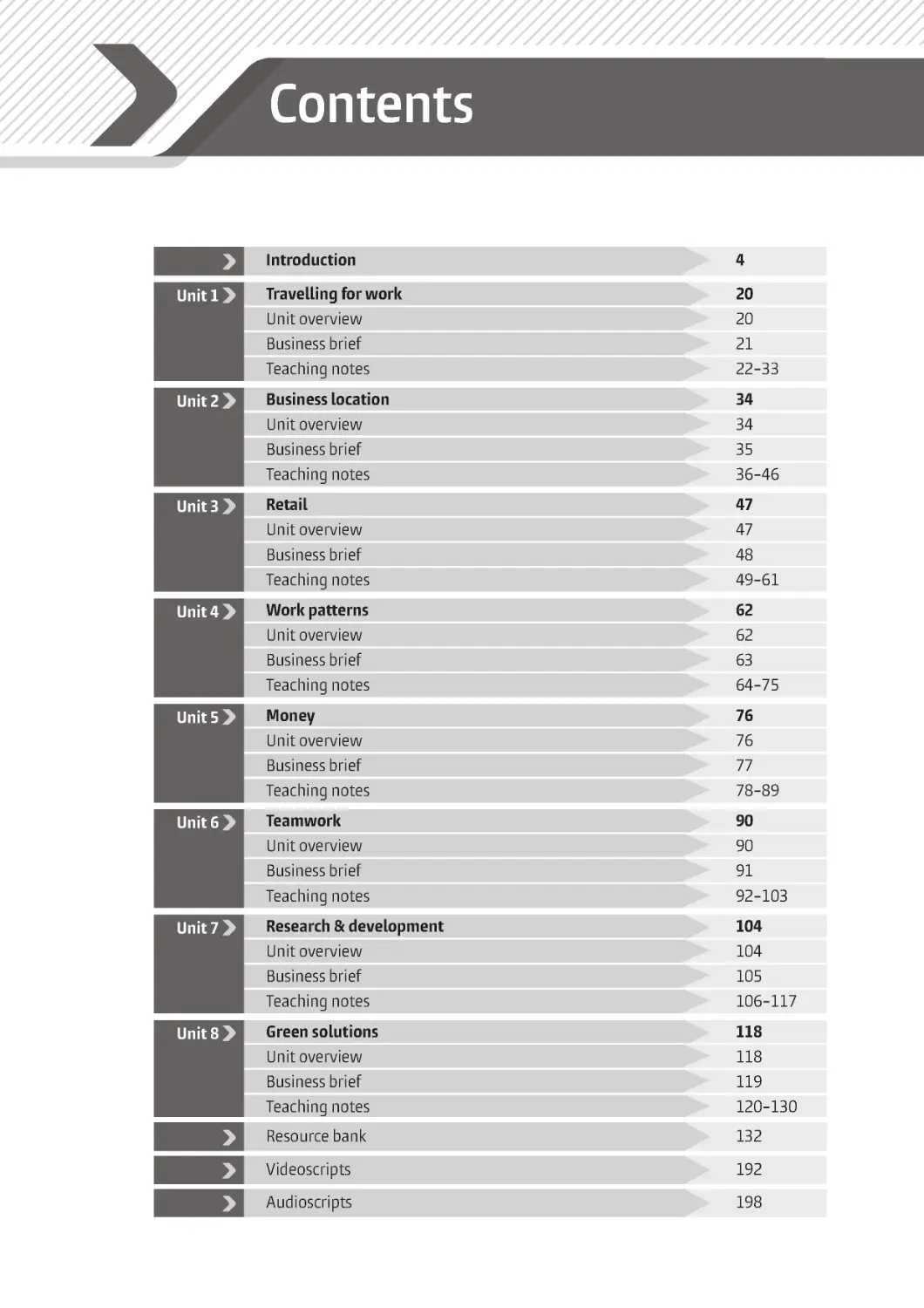
4
Unit 1
Travelling for work
20
Unit overview
20
Business brief
21
Teaching notes
22–33
Unit 2
Business location
34
Unit overview
34
Business brief
35
Teaching notes
36–46
Unit 3
Retail
47
Unit overview
47
Business brief
48
Teaching notes
49–61
Unit 4
Work patterns
62
Unit overview
62
Business brief
63
Teaching notes
64–75
Unit 5
Money
76
Unit overview
76
Business brief
77
Teaching notes
78–89
Unit 6
Teamwork
90
Unit overview
90
Business brief
91
Teaching notes
92–103
Unit 7
Research & development
104
Unit overview
104
Business brief
105
Teaching notes
106–117
Unit 8
Green solutions
118
Unit overview
118
Business brief
119
Teaching notes
120–130
Resource bank
132
Videoscripts
192
Audioscripts
198
F02 Bus Part TB A2P GLB 90990.indd 4
15/07/2019 14:04
Introduction
Business Partner is a flexible course designed for a variety of learners. It is suitable for
students with mixed abilities, requirements and interests and for varied class sizes where
the common requirement is to learn professional English language and develop key skills
for the workplace.
When talking to learners, their reasons for studying business English almost always relate
to their employability. Many tertiary students want to maximise their chances of finding
a job in an international environment, while in-work professionals want to communicate
more effectively in their workplace and improve their future career prospects. Other
learners may simply need to study and pass a business English exam in order to complete
their overall degree.
In all three cases, teachers need to be able to engage and motivate by providing learning
materials which:
• are interesting and relevant to their life experiences.
• match their learning needs and priorities.
• are appropriate for the amount of study time available.
Business Partner has been designed to enable teachers to meet these needs without
spending many hours researching their own materials. The content and structure of the
course is based on three key concepts: employability, flexibility and learner engagement.
Employability
Balance between language and business skills training
In order to achieve their employability goals, learners need to improve their knowledge
of English language as it is used in the workplace and also develop key skills for the
international workplace. Business Partner provides this balance.
In addition to building their vocabulary and grammar and developing their writing skills,
Business Partner trains students in Communication and Business skills. Language being
only one aspect of successful communication, students also require an understanding
of different business situations and an awareness of different communication styles,
especially when working across cultures.
• ‘Communication skills’ (Lesson 3) provides the soft skills needed in order to work
effectively with people whose personality and culture may be different from your own.
This includes teamwork , decision-making and influencing skills.
• ‘Business skills’ (Lesson 4) provides the practical skills needed in different business
situations, such as taking part in meetings, presentations and negotiations.
Flexibility
The modular approach means that Business Partner can be adapted to suit a variety of
teaching requirements from extensive lessons to intensive short courses. In addition to the
Coursebook, a wide variety of additional optional activities and resources are provided
which can be used to focus on and extend material which is most useful to learners’ needs.
Extra activities and extra grammar points
You can extend your lessons or focus in more depth on certain areas by using the large
bank of extra activities in MyEnglishLab (clearly signposted for you throughout the
Coursebook). These include extra vocabulary and grammar practice exercises for use in
class as well as activities which draw attention to useful language in reading texts.
Overview
Course aims and
key concepts
Pronunciation activities are included at the back of the book . This allows teachers
to focus on aspects of pronunciation which are most useful for their students.
page 112 See Pronunciation bank
These are PDFs in MyEnglishLab that you can download and
print or display on-screen .
Alternative videos with worksheets are available for lessons 3.1
and 8.1 and are clearly signposted. You can use them in the
classroom as an alternative approach to the topic in Lesson 1,
depending on your students’ needs.
Business Partner offers a flexible approach to grammar depending on
whether you want to devote a significant amount of time to a grammar
topic, or focus on consolidation only when you need to. There is one
main grammar point in each unit, presented and practised in Lesson 2.
In addition, the Writing section (Lesson 5) includes a link to an
optional second grammar point in MyEnglishLab, where students
can watch short video presentations of the grammar points and do
interactive activities.
L The text messages and email contain examples of the Present
Continuous. Go to MyEnglishLab for optional grammar work.
T Teacher’s resources: alternative video and activities
T Teacher’s resources: extra activities
5
F02 Bus Part TB A2P GLB 90990.indd 5
15/07/2019 14:04
Teacher’s Resource Bank: Photocopiables, Writing bank, Reading bank and
Functional language bank
You can use these resources as and when needed with your classes. The Photocopiables
further activate and practise, vocabulary from Lesson 1 and grammar from Lesson 2 as and
when needed.
The Reading bank for each unit gives students more reading practice and can be also used
for self-study. The activity types reflect those found in a range of business English exams.
The Writing bank provides supplementary models of professional communication and the
Functional language bank extends useful phrases for a range of business situations.
Learner engagement
Video content: We all use video more and more to communicate and to find out about
the world and we have put video at the heart of Business Partner. There are two videos in
every unit with comprehension and language activities:
• an authentic video package in Lesson 1, based on real-life video clips and interviews
suitable for your learners’ level of English.
• a dramatised communication skills training video in Lesson 3 which follows characters
in an international team as they deal with different professional challenges.
Authentic content: Working with authentic content really helps to engage learners,
and teachers can spend many hours searching for suitable material online. Business
Partner has therefore been built around authentic videos and articles from leading media
organisations such as the Financial Times and news channels. These offer a wealth of
international business information as well as real examples of British, U.S . and
non-native-speaker English.
Relevance for learners without work experience: Using business English teaching
materials with learners who have little or no work experience can be particularly
challenging. Business Partner has been carefully designed to work with these students
as well as with in-work professionals. In the case of collaborative speaking tasks and
roleplays, the situation used will either be:
• one that we can all relate to as customers and consumers; OR
• a choice of situations will be offered including a mix of professional and everyday
situations.
Both will allow learners to practise the skill and language presented in the lesson, but in
a context that is most relevant to them.
Business workshops: Learners have the opportunity to consolidate and activate the
language and skills from the units in 8 business workshops at the end of the book . These
provide interesting and engaging scenarios where students simulate real-life professional
situations such as roleplaying meetings, negotiations or presentations.
Business Partner offers fully integrated skills, including the essential critical thinking and
higher-order thinking skills, which are built into the activities.
Vocabulary and video The main topic vocabulary set is presented and practised in Lesson
1 of each unit, building on vocabulary from the authentic video. Teachers are given lots of
opportunities to use the vocabulary in discussions and group tasks, and to tailor the tasks
to their classroom situations.
Functional language (such as making small talk , solving problems, rescheduling
appointments on the phone, ) supports learners’ capability to operate in real workplace
situations in English. Three functional language sets are presented and practised in every
unit: in Lessons 3, 4 and 5. You will be able to teach the language in group speaking and
writing tasks. There is a Functional language bank at the back of this Teacher’s Resource
Book which students can also find in MyEnglishLab so that they can quickly refer to useful
language support when preparing for a business situation, such as a meeting, presentation
or interview.
Listening and video The course offers a wide variety of listening activities (based on both
video and audio recordings) to help students develop their comprehension skills and to hear
target language in context. All of the video and audio material is available in MyEnglishLab
and includes a range of British, U.S. and non-native-speaker English. Lessons 1 and 3 are
based on video (as described above). In four of the eight units, Lesson 2 is based on audio.
In all units, you also work with a significant number of audio recordings in Lesson 4 and the
Business workshop.
Approach to
language and skills
Introduction
6
F02 Bus Part TB A2P GLB 90990.indd 6
15/07/2019 14:04
Grammar The approach to grammar is flexible depending on whether you want to devote
a significant amount of time to grammar or to focus on the consolidation of grammar
only when you need to. There is one main grammar point in each unit, presented and
practised in Lesson 2. There is a link from Lesson 5 to an optional second grammar point
in MyEnglishLab – with short video presentations and interactive practice. Both grammar
points are supported by the Grammar reference section at the back of the Coursebook
(p.118). This provides a summary of meaning and form, with notes on usage or exceptions,
and business English examples.
Reading Business Partner offers a wealth of authentic texts and articles from a variety
of sources, particularly the Financial Times and the Nikkei Asian Review. Every unit has
a main reading text with comprehension tasks. This appears either in Lesson 2 or in the
Business workshop. There is a Reading bank at the back of this Teacher ’s Resource Book
which students can also find in MyEnglishLab and which has a longer reading text for
every unit with comprehension activities.
Speaking Collaborative speaking tasks appear at the end of Lessons 1, 3, 4 and the
Business workshop in every unit. These tasks encourage students to use the target
language and, where relevant, the target skill of the lesson. There are lots of opportunities
to personalise these tasks to suit your own classroom situation.
Writing Business Partner offers multiple opportunities to practise writing. Lesson 5
in every unit provides a model text and practice in a business writing skill. The course
covers a wide range of genres such as slides, letters, intranet updates and emails, and for
different purposes, including formal and informal communication, explaining, confirming
arrangements, making updates. There are also short writing tasks in Lesson 2 which
provide controlled practice of the target grammar. There is a Writing bank at the back of
this Teacher’s Resource Book which students can also find in MyEnglishLab and which
provides models of different types of business writing and useful phrases appropriate to
their level of English.
Pronunciation Two pronunciation points are presented and practised in every unit.
Pronunciation points are linked to the content of the unit – usually to a video or audio
presentation or to a grammar point. The pronunciation presentations and activities are at
the back of the Coursebook (p.112), with signposts from the relevant lessons. This section
also includes an introduction to pronunciation with British and U.S . phonetic charts.
A key aspect of Business Partner is the innovative video-based communication skills
training programme.
The aims of the Communications skills lessons are to introduce students to the skills
needed to interact successfully in international teams with people who may have different
communication styles from them due to culture or personality. Those skills include dealing
with a problem, negotiating roles, giving explanations.
These lessons are based on videos that provide realistic examples of work situations. This
is particularly important for pre-service learners who may not have direct experience of
the particular situations they are about to see. In each of these videos students watch
two videos (Video A and Video B) in which a different communication style is used. These
options give students the opportunity to engage in critical viewing of each option and gain
awareness of the impact of different communication styles.
Business Partner provides a balance of formative and summative assessment. Both types of
assessment are important for teachers and learners and have different objectives. Regular
review and on-going assessment allows students to evaluate their own progress and
encourages them to persevere in their studies. Formal testing offers a more precise value
on the progress made on their knowledge and proficiency.
Formative assessment: Each Coursebook lesson is framed by a clear lesson outcome which
summarises the learning deliverable. The lesson ends with a self-assessment section which
encourages students to reflect on their progress in relation to the lesson outcome and to
think about future learning needs. More detailed self-assessment tasks and suggestions
for further practice are available in MyEnglishLab. (See also section on the Global Scale of
English and the Learning Objectives for Professional English.)
The Coursebook also contains one review page per unit at the back of the book to recycle
and revise the key vocabulary, grammar and functional language presented in the unit;
they are structured to reflect the modularity of the course.
Approach to
Communication
skills
Approach to testing
and assessment
Introduction
7
F02 Bus Part TB A2P GLB 90990.indd 7
15/07/2019 14:04
Summative assessment: Unit tests are provided and activities are clearly labelled to show
which section of the unit they are testing to reflect the modular structure of the course.
The tests are available in PDF and Word formats so that you can adapt them to suit your
purposes. They are also available as interactive tests that you can allocate to your students
if you wish to do so.
These Unit tests are based on task types from the major business English exams. There is
also an additional LCCI writing task for professional English for every unit. This approach
familiarises learners with the format of the exams and gives them practice in the skills
needed to pass the exams.
MyEnglishLab also contains extra professional English practice activities. The content and
level of the tasks match the Coursebook so they can also be used as additional revision
material.
The Global Scale of English (GSE) is a standardised, granular scale from 10 to 90 which
measures English language proficiency. The GSE Learning Objectives for Professional
English are aligned with the Common European Framework of Reference (CEFR). Unlike
the CEFR, which describes proficiency in terms of broad levels, the Global Scale of English
identifies what a learner can do at each point on a more granular scale – and within a CEFR
level. The scale is designed to motivate learners by demonstrating incremental progress in
their language ability. The Global Scale of English forms the backbone for Pearson English
course material and assessment.
Business Partner has been written based on these Learning Objectives, which ensure
appropriate scaffolding and measurable progress. Each Lesson outcome in each lesson in
the Coursebook encapsulates a number of specific Learning Objectives which are listed
in this Teacher’s Resource Book in the Teaching notes. These Learning Objectives are also
listed in the Self-assessment sheets available to students in MyEnglishLab. (See also Self-
assessment above in Approach to testing and assessment.)
Business Partner is an eight-level course based on the Global Scale of English (GSE) and
representing the CEFR levels: A1, A2, A2+, B1, B1+, B2, B2+, C1.
For the teacher
For the student
print
Teacher’s Resource Book with
MyEnglishLab
Coursebook with Digital Resources
Workbook
blended Pearson English Portal
Coursebook with MyEnglishLab
The Global Scale
of English
<A1
A1 A2+
B1+
B2+ C1C2
CEFR
102030405060708090
Learn more about the Global Scale of English at english.com/gse
Course structure
For the teacher
For the teacher
For the teacher
For the teacher
Teacher’s Resource Book with
For the teacher
Teacher’s Resource Book with
For the teacher
Teacher’s Resource Book with
For the teacher
Teacher’s Resource Book with
MyEnglishLab
For the teacher
Teacher’s Resource Book with
MyEnglishLab
For the teacher
Teacher’s Resource Book with
MyEnglishLab
For the teacher
Teacher’s Resource Book with
MyEnglishLab
For the teacher
Teacher’s Resource Book with
MyEnglishLab
For the teacher
Teacher’s Resource Book with
MyEnglishLab
Pearson English Portal
Teacher’s Resource Book with
MyEnglishLab
Pearson English Portal
Teacher’s Resource Book with
MyEnglishLab
Pearson English Portal
Teacher’s Resource Book with
MyEnglishLab
Pearson English Portal
Teacher’s Resource Book with
MyEnglishLab
Pearson English Portal
Teacher’s Resource Book with
MyEnglishLab
Pearson English Portal
Teacher’s Resource Book with
Pearson English Portal
Teacher’s Resource Book with
Pearson English Portal
Teacher’s Resource Book with
Pearson English Portal
Teacher’s Resource Book with
Pearson English Portal
Teacher’s Resource Book with
Pearson English Portal
Teacher’s Resource Book with
Pearson English Portal
Teacher’s Resource Book with
Pearson English Portal
Teacher’s Resource Book with
Pearson English Portal
Teacher’s Resource Book with
Pearson English Portal
Pearson English Portal
Pearson English Portal
Pearson English Portal
Introduction
8
F02 Bus Part TB A2P GLB 90990.indd 8
15/07/2019 14:04
MyEnglishLab
Business Partner is a fully hybrid course with two digital dimensions that students and
teachers can choose from. MyEnglishLab is the digital component that is integrated with the
book content.
Access to MyEnglishLab is given through a code printed on the inside front cover of this book.
As a teacher, you have access to both versions of MyEnglishLab, and to additional content in
the Teacher’s Resource folder.
Depending on the version that students are using, they will have access to one of the following:
Digital Resources includes downloadable
coursebook resources, all video clips, all
audio files, Lesson 3 additional interactive
video activities, Lesson 5 interactive grammar
presentation and practice, Reading bank,
Functional Language bank, Writing bank,
and My Self-assessment.
MyEnglishLab includes all of the Digital
Resources plus the full functionality and
content of the self-study interactive workbook
with automatic gradebook. Teachers can
also create a group or class in their own
MyEnglishLab and assign workbook activities
as homework .
www.pearsonelt.com/businesspartner
A2+
Discover the innovative world of BusinessPartner. Thisnew eight-level
businessEnglishcourse isfor learners and professionalswho want to
communicate effectively inEnglish in theworkplace.The articles from
the FinancialTimes offer a wealthofinternationalbusiness information
ona wide variety of topics.
• Themodular approachgivestheflexibility tofocuson specific learning outcomes.
• Interesting real-lifebusinessstoriesin the authenticvideoskeep you motivated.
• Thekey businesstopicsincludeWork patterns, Teamwork,Research and
development andGreensolutions.
• Theintegrated video-basedCommunicationskillstrainingprogramme
includesSmall talk,Clarifying information,Solving problems, Making
decisions,and Givingfeedback.
• BusinessskillslessonsincludeDealingwithproblems,Meetings,
Telephoningand Presenting.
• Businessworkshopsarecasestudiesbasedonreal-lifeprofessional
situationsto practiseskills in aprofessional context.
• Self-assessment helpsyou check your progressagainst
the GlobalScaleofEnglish Learning Objectivesfor
Professional English.
• Examtasksin the Workbookand onthe
MyEnglishLabhelp practise forBEC,
BULATS,and LCCI.
Coursebook
Margaret O’Keeffe
Lewis Lansford
Ros Wright
Mark Powell
Lizzie Wright
A2+
B
u
s
i
n
e
s
s
P
a
r
t
n
e
r
A
2
+
with
access code inside
Digital Resources
Downloadable coursebook resourcessuch asvideo clips, audio tracks,
practice activitiesand supplementary Reading bank, Writing bank
and Functional language bank.
with
access code inside
Digital Resources
C
o
u
r
s
e
b
o
o
k
+
D
i
g
i
t
a
l
R
e
s
o
u
r
c
e
s
Learn more about the Global Scale of English at english.com/gse
<A1 A1 A2+ B1+
C1 C2
B2+
CEFR
Level 5: B1+
Level 4: B1
Level 8: C1
Level 3: A2+
Level 7: B2+
Level 2: A2
Level 1: A1
Level 6: B2
102030405060708090
CVRBusPart CBA2+ GLBDR90952.indd 1
02/06/2019 20:35
www.pearsonelt.com/businesspartner
A2+
Discover the innovativeworld ofBusiness Partner. This new eight-level
businessEnglishcourse is for learnersand professionalswho want to
communicate effectively in Englishinthe workplace. The articles from
the FinancialTimes offer a wealthof international business information
ona wide variety oftopics.
• Themodular approachgivesthe flexibility to focusonspecificlearning outcomes.
• Interesting real-lifebusinessstoriesin theauthenticvideoskeep you motivated.
• Thekey businesstopicsincludeWork patterns,Teamwork, Research and
development andGreen solutions.
• Theintegrated video-based Communication skillstraining programme
includesSmall talk,Clarifying information,Solvingproblems, Making
decisions,and Givingfeedback.
• BusinessskillslessonsincludeDealing with problems,Meetings,
Telephoningand Presenting.
• Businessworkshopsarecasestudiesbased on real-lifeprofessional
situationsto practiseskillsinaprofessional context.
• Self-assessment helpsyou check your progressagainst
theGlobal ScaleofEnglish LearningObjectivesfor
Professional English.
• Examtasksin the Workbook andon the
MyEnglishLabhelp practisefor BEC,
BULATS,and LCCI.
Coursebook
Margaret O’Keeffe
Lewis Lansford
Ros Wright
Mark Powell
Lizzie Wright
A2+
B
u
s
i
n
e
s
s
P
a
r
t
n
e
r
A
2
+
C
o
u
r
s
e
b
o
o
k
+
M
y
E
n
g
l
i
s
h
L
a
b
Learn more about the Global Scaleof English at english.com/gse
<A1 A1 A2+ B1+
C1 C2
B2+
CEFR
Level5: B1+
Level4: B1
Level8: C1
Level3: A2+
Level7: B2+
Level2: A2
Level1: A1
Level6: B2
102030405060708090
A resource bank Downloadable coursebook resources such as video clips,
audio tracks, practice activities and supplementary Reading bank,
Writing bank and Functionallanguage bank.
An interactive workbook for self-study with automatic gradebook.
with
Online Workbook and Resources
access code inside
MyEnglishLab
with
Online Workbook and Resources
access code inside
MyEnglishLab
CVR BusPartCBA2+GLBMEL 47755.indd 1
02/06/2019 20:36
Introduction
9
F02 Bus Part TB A2P GLB 90990.indd 9
15/07/2019 14:04
Components for the learner
MyEnglishLab digital component
• Eight units, each containing five lessons
(see pages 2–3 for unit overview)
• Eight Business workshop lessons relating
to each of the eight units
• A one-page Review per unit to revise key
language and grammar
• A Pronunciation section which practises
two points from each unit
• A Grammar reference with detailed
explanations and examples
• Videoscripts and audioscripts
• A glossary of key business vocabulary
from the book
Coursebook video and audio material is
available on MyEnglishLab.
Coursebook
(with access code for MyEnglishLab)
Workbook
• Additional self-study practice activities, reflecting the structure of
the Coursebook. Activities cover vocabulary, grammar, functional
language, reading, listening and writing.
• Additional self-study practice activities for points presented in the
Coursebook Pronunciation bank.
• Answer key
• Audioscripts
Workbook audio material is available on MyEnglishLab.
www.pearsonelt.com/businesspartner
A2+
Discover the innovative world of BusinessPartner. Thisnew eight-level
businessEnglishcourse is for learnersand professionalswho want to
communicate effectively inEnglish in theworkplace.The articles from
the FinancialTimes offer a wealth ofinternationalbusiness information
ona wide variety of topics.
• Themodular approachgivestheflexibility tofocuson specific learning outcomes.
• Interestingreal-lifebusinessstoriesin the authenticvideos keep you motivated.
• Thekey business topicsinclude Work patterns,Teamwork,Research and
development andGreensolutions.
• Theintegrated video-basedCommunicationskillstrainingprogramme
includes Small talk,Clarifying information,Solving problems,Making
decisions,and Givingfeedback.
• Business skillslessonsinclude Dealingwithproblems,Meetings,
Telephoning and Presenting.
• Business workshopsarecasestudiesbased onreal-lifeprofessional
situationsto practiseskillsin aprofessional context.
• Self-assessment helpsyou check your progress against
the GlobalScaleofEnglish Learning Objectivesfor
Professional English.
• Exam tasksin the Workbook and on the
MyEnglishLabhelp practise forBEC,
BULATS,and LCCI.
Coursebook
Margaret O’Keeffe
Lewis Lansford
Ros Wright
Mark Powell
Lizzie Wright
A2+
B
u
s
i
n
e
s
s
P
a
r
t
n
e
r
A
2
+
with
access code inside
Digital Reso urces
Downloadable coursebook resourcessuch asvideo clips, audio tracks,
practice activitiesand supplementary Reading bank, Writing bank
and Functional language bank.
with
access code inside
Digital Resources
C
o
u
r
s
e
b
o
o
k
+
D
i
g
i
t
a
l
R
e
s
o
u
r
c
e
s
Learn more about the Global Scale of English at english.com/gse
<A1 A1 A2+ B1+
C1 C2
B2+
CEFR
Level 5: B1+
Level 4: B1
Level 8: C1
Level 3: A2+
Level 7: B2+
Level 2: A2
Level 1: A1
Level 6: B2
102030405060708090
CVRBusPart CBA2+ GLBDR90952.indd 1
02/06/2019 20:35
www.pearsonelt.com/businesspartner
A2+
Discover the innovativeworld ofBusiness Partner. This new eight-level
businessEnglishcourse is for learnersand professionalswho want to
communicate effectively in Englishinthe workplace. The articles from
the FinancialTimes offer a wealthof international business information
ona wide variety of topics.
• Themodular approachgivesthe flexibility to focusonspecificlearning outcomes.
• Interesting real-lifebusinessstoriesin theauthenticvideoskeep you motivated.
• Thekey businesstopicsincludeWork patterns,Teamwork, Research and
development andGreensolutions.
• Theintegrated video-based Communication skillstraining programme
includesSmall talk,Clarifying information,Solvingproblems, Making
decisions,and Givingfeedback.
• BusinessskillslessonsincludeDealing with problems,Meetings,
Telephoningand Presenting.
• Businessworkshopsarecasestudiesbased on real-lifeprofessional
situationsto practiseskillsina professional context.
• Self-assessment helpsyou check your progressagainst
theGlobal ScaleofEnglish LearningObjectivesfor
ProfessionalEnglish.
• Examtasksin the Workbook and on the
MyEnglishLabhelp practisefor BEC,
BULATS,and LCCI.
Coursebook
Margaret O’Keeffe
Lewis Lansford
Ros Wright
Mark Powell
Lizzie Wright
A2+
B
u
s
i
n
e
s
s
P
a
r
t
n
e
r
A
2
+
C
o
u
r
s
e
b
o
o
k
+
M
y
E
n
g
l
i
s
h
L
a
b
Learn more about the Global Scaleof English at english.com/gse
<A1 A1 A2+ B1+
C1 C2
B2+
CEFR
Level5: B1+
Level4: B1
Level8: C1
Level3: A2+
Level7: B2+
Level2: A2
Level1: A1
Level6: B2
102030405060708090
A resource bank Downloadable coursebook resources such as video clips,
audio tracks, practice activities and supplementary Reading bank,
Writing bank and Functionallanguage bank.
An interactive workbook for self-study with automatic gradebook.
with
Online Workbook and Resources
access code inside
MyEnglishLab
with
Online Workbook and Resources
access code inside
MyEnglishLab
CVRBusPartCBA2+GLBMEL 47755.indd 1
02/06/2019 20:36
W
o
r
k
b
o
o
k
A2+
Workbook
Madeleine Williamson
B
u
s
i
n
e
s
s
P
a
r
t
n
e
r
A
2
+
Discover theinnovative worldof Business Partner, a new eight-level
business English course for learners and professionals whowant to
communicateeffectively inEnglishinthe workplace. Partnering withthe
Financial Times means that thiscourse also offersa wealthof international
business informationon a wide varietyof topics.
Business Partner allows for personalizationof the learningexperience
witha structuredmodular approachthat givesthe flexibilitytofocus
onspecific needs andlearningoutcomes.
The Business Partner Workbook offers flexible self-study practice:
• Vocabulary andgrammaractivitieshelp toconsolidatethelanguagecovered
inthecoursebook
• Reading, listeningand writing activitiesextendtheskills developed
inthecoursebook
• Functionallanguageactivitieshelp toreinforce thelanguagelearned in
theCommunication skillstraininglessonsand in theBusinessskillslessons
• Pronunciation activities helpto improve speaking and communicate
betterin English
• Task-typesreflect business English examtaskssuchasBEC,BULATS
and LCCI.
Find outmore about thecourse,theresources and thedigital components
on theBusinessPartnerwebsite: www.pearsonelt.com/businesspartner
A2+
Course components
• Coursebook withDigital Resources
• Coursebookwith MyEnglishLab (Onlineworkbook
andresources)
• Workbook with audioand answerkey
• Teacher’s ResourceBook with MyEnglishLab
• ActiveTeach
Learn more about the Global Scale of English at english.com/gse
<A1 A1 A2+ B1+
C1 C2
B2+
CEFR
Level5: B1+
Level4: B1
Level8: C1
Level3: A2+
Level7: B2+
Level2: A2
Level1: A1
Level6: B2
102030405060708090
CVRBusPart WBA2+GLB91027.indd 1
21/02/2019 12:24
Accessed using the code printed on the inside cover of
the Coursebook. Depending on the version of the course
that you are using, learners will have access to one of the
following options:
Digital resources powered by MyEnglishLab
• Video clips
• Audio files and scripts
• Extra Coursebook activities (PDFs)
• Lesson 3 extra interactive video activities
• Lesson 5 interactive grammar presentation and practice
• Reading bank
• Writing bank
• Functional language bank
• Extra professional English practice
• My Self-assessment
• Workbook audio files and scripts
Full content of MyEnglishLab
• All of the above
• Interactive self-study Workbook with automatic feedback
and gradebook
10
F02 Bus Part TB A2P GLB 90990.indd 10
15/07/2019 14:04
Components for the teacher
• Teaching notes for every lesson
including warm-ups, background
/culture notes and answer keys
• Business brief for every unit with
background information on the
unit topic and explanations of
key terminology; it gives teachers
an insight into contemporary
business practices even if they have
not worked in these particular
environments
Introduction
Coursebook resources
• Video clips and scripts
• Audio files and scripts
• Extra Coursebook activities (PDFs)
• Lesson 3 extra interactive video activities
for self-study
• Lesson 5 interactive grammar
presentation and practice for
self-study
• Extra professional English practice
• My Self-assessment: a document that
students can use to record their progress
and keep in their portfolio
Workbook resources
• Self-study interactive version of the
Workbook with automatic feedback
and gradebook
• Teachers can assign Workbook activities
as homework
• Workbook audio files and audioscripts
• Digital version of the
Teacher ’s Resource
Book
• Digital version of the
Coursebook with
classroom tools for
use on an interactive
whiteboard
• Video clips and scripts
• Audio files and scripts
• Extra Coursebook
activities (PDFs)
Teacher’s Resource Book (with access code for MyEnglishLab)
MyEnglishLab digital component
Pearson English Portal
Accessed using the code printed on the inside
cover of the Teacher’s Resource Book.
• Photocopiable activities – two per unit
with teaching notes and answer keys
• Reading bank – an extended reading
text for every unit with comprehension
activities (+ answer keys)
• Writing bank – models of different
types of business writing with useful
phrases
• Functional language bank – useful
phrases for different business
situations, e .g. meetings, interviews
• Videoscripts and audioscripts
A2+
Teacher’s
Resource Book
Maria Karyda
CVR BusPartTBA2PGLB90990.indd 1
25/06/2019 20:25
Teacher’s Book resources
• Alternative video (Units 3 and 8)
and extra activities
• Photocopiable activities + teaching
notes and answer keys
• Reading bank + answer keys
• Writing bank
• Functional language bank
Tests
• Unit tests (PDFs and Word), including
exam task types
• Interactive Unit tests, with automatic
gradebook
• Tests audio files
• Tests answer keys
11
F02 Bus Part TB A2P GLB 90990.indd 11
15/07/2019 14:04
A unit of the Coursebook
Unit overview page
A well-known or provocative quote related to the unit topic is provided as a talking point. There
are suggestions for how to use the quote in the Teacher’s Resource Book notes for each unit.
The Unit overview summarises the contents of each lesson as well as the lesson outcomes.
Content at the back of the book which extends the unit is highlighted: the Business workshop,
Review, Pronunciation bank and Grammar reference.
Business location
2
Unit overview
2.1
Video: Choosing a business location
Vocabulary: Location
Project: Researching the location of a company
Dovetailed in Cambridge
Lesson outcome: Learners can use vocabulary related to places of
work and business locations.
2.2
Reading: Singapore creates a tropical wildlife paradise
Grammar: enough and too
Speaking and writing: Describing problematic situations
Visiting Singapore
Lesson outcome: Learners can use enough and too to express
sufficiency and insufficiency.
2.3
Video: Clarifying information
Functional language: Checking and clarifying
Task: Checking and clarif ying information in a meeting
Communication skills: Checking and clarifying
Lesson outcome: Learners can check , confirm and clarify
information using a range of expressions.
2.4
Listening: A meeting
Functional language: Opening a meeting, referring to the agenda
and stating purpose
Task: Opening a meeting
Business skills: Starting a meeting
Lesson outcome: Learners are able to use a variety of expressions to
open meetings.
17
Model text: Short messages
Functional language: Abbreviations
Grammar: Present Continuous
Task: Informal and formal messages
2.5 Writing: Short communications
Lesson outcome: Learners can communicate by text message,
write short emails and use abbreviations and shortened forms
appropriately.
Business workshop 2: p.90
Review 2: p.105
Pronunciation: 2.1 Syllables and stress
2.2 Stress in noun phrases p.114
Grammar reference: p.119
‘ Be sure you put
your feet in the
right place, then
stand firm. ’
Abraham Lincoln
M02 Bus Part CB A2+ GLB 90952.indd 17
21/02/2019 16:53
1
2
3
2
3
1
12
F02 Bus Part TB A2P GLB 90990.indd 12
15/07/2019 14:04
Introduction
1 The Lesson outcome defines a clear learning outcome for every lesson. Each Lesson outcome encapsulates
a number of specific Learning Objectives for Professional English which are listed in this Teacher’s Resource
Book in the Teaching notes.
2 Every lesson begins with a short Lead-in activity to engage learners with the lesson topic on a personal level.
3 Lesson 1 is based on an authentic video of about 4 minutes with comprehension activities.
4
Teacher’s resources: extra activities
T
Extra activities are clearly signposted. These are PDFs in
MyEnglishLab to display on-screen or print. They can be used to extend a lesson or to focus in more depth on
a particular section.
Teacher’s resources: alternative video and activities
T
Alternative videos with worksheets are available for
some units and are clearly signposted.
5 The main unit vocabulary set is presented and practised in Lesson 1, building on vocabulary from the video.
Extra activities are available in MyEnglishLab.
6 Follow-up questions provide an opportunity for personalisation.
7 The Project at the end of Lesson 1 is a collaborative group task with a strong emphasis on communication
and fluency building. It can be done in class or in more depth over several weeks in and out of class.
8 Every lesson ends with a short Self-assessment section which encourages learners to think about the
progress they have made in relation to the lesson outcomes. More detailed self-assessment tasks and
suggestions for extra practice are available in MyEnglishLab.
Learners can use vocabulary related to places of work and business locations.
Lesson outcome
Dovetailed in Cambridge
2.1
1 Discuss these questions.
1 What is good or bad about the location where you live, work or study? Use some of the
expressions in the box to help you.
I (don’t) really like (my town) because ... It’s (not) a very (interesting, nice, etc.) place.
It’s full of (parks, etc.). There are lots of good (shops, etc.).
I think it’s very (quiet, noisy, etc.). It’s near (the station, etc.) .
2 Which factors are most important to you when choosing a place to live, work or study?
2 2.1 .1 Watch the video interview with Dr Vaiva Kalnikaitė about her
company, Dovetailed. Tick (✓) the fi v e reasons she says Cambridge is a good
location for her business.
☐ cheap location
☐ international city
☐ can work with other companies
☐ good public services (schools, hospitals, etc.)
☐ can work with the university
☐ salaries lower than other places
☐ nice place to live
☐ easy to travel to London
3 Watch the video again and answer the questions.
1 When did Dr Kalnikaitė start her company?
2 Which company did she work for as an intern in Cambridge?
3 What help does she get from her business contacts? funding / products / advice
4 What help does she get from Judge Business School? funding / products / advice
5 How long does it take Dr Kalnikaitė to get to work?
6 How long does it take to get to London by train? And by car?
4 Based on what you saw in the video, would you like to live and work in a city
like Cambridge? What would you like most? What would you like least?
Location
5 Look at these extracts from the video. Match the words in bold with the definitions.
a a special room or building in which a scientist does tests
b a room where an artist, photographer or designer regularly works
c a very wide road for travelling fast over long distances, especially between cities
d something that makes travel between two places possible
e a building in which goods are produced in large quantities, using machines
f put or build something in a particular place
g how easy or difficult it is for people to enter a public building, to reach a place or to talk to
someone or contact them
h money that is paid regularly to use office buildings, etc.
i not far from something
page 114 See Pronunciation bank: Syllables and stress
Lead-in
VIDEO
T Teacher’s resources:
extra activities
Vocabulary
1 where to locate the
business
2 access to skilled staff
3 good transport links
4 reasonable rents for
factory or office space
5 a technology design
studio and innovation lab
6 it’s very close to London
7 drive to London on a
motorway
18
M02 Bus Part CB A2+ GLB 90952.indd 18
21/02/2019 16:53
PROJECT: Location, location, location
•
How successfully have you achieved the lesson outcome? Give yourself a score
from 0 (I need more practice) to 5 (I know this well).
•
Go to My Self-assessment in MyEnglishLab to reflect on what you have learnt.
Self-assessment
Dovetailed in Cambridge
2.1
19
9A Work in pairs or small groups. You are going to research the location
of a company in your town or city. Choose from one of these
options or use your own idea.
an airport a bank a factory a gym
the headquarters of a company a hospital
a luxury hotel a restaurant a shop
a transport company a university a warehouse
B Find out why the company chose that location.
Describe the advantages of the location. Are
there any disadvantages?
C Present what you found out about the
location to another pair or group.
6 Replace the underlined phrase in each sentence using the words and phrases
in the box.
car park convenient facilities headquarters (HQ) port warehouse
1 This is the place where we store large quantities of our products.
2 The transport company is close to the place where the ships arrive and leave.
3 The place with spaces for people to leave their vehicles outside the office is very small.
4 The train station is very close and easy to reach.
5 Google’s main offices are in Mountain View, California.
6 The conference rooms, equipment and services at the hotel are excellent.
7 Match the facilities with the examples. Can you think of another example
for each?
1 office facilities
2 hotel facilities
3 sports and leisure facilities
a 24-hour reception, car park, room service, free wi-fi
b swimming pool, gym, football stadium, park
c car park, printers, meeting rooms, staff kitchen
8A Choose the correct option in italics to complete the sentences.
1 Where are the most expensive rents / locate for office space in your town or city?
Where are the cheapest? Why is this?
2 Which part(s) of your town or city have good access / close to an airport / a port /
a motorway? How does this help a business?
3 What are the best headquarters / facilities where you work or study?
4 What sports and leisure facilities are there close / access to your home?
5 Where would you locate / convenient a new hotel in your town or city? Why?
6 How good are the transport links / ports in your town? What would make them better?
B Work in pairs or small groups. Discuss the questions in Exercise 8A.
T Teacher’s resources:
extra activities
M02 Bus Part CB A2+ GLB 90952.indd 19
21/02/2019 16:53
Lesson 1
The aims of this lesson are:
• to engage students with the unit topic through a video based on authentic material.
• to present and practise topic business vocabulary, drawing on vocabulary from the video.
• to encourage students to activate the language they have practised in a group project.
2
6
7
1
5
3
4
8
13
F02 Bus Part TB A2P GLB 90990.indd 13
15/07/2019 14:04
Introduction
Lesson 2 Reading or Listening
The aims of this lesson are:
• to provide students with meaningful reading or listening skills practice based on engaging, relevant and up-to-date content.
• to present and practise the unit grammar point, drawing on examples from the text.
• to encourage students to activate the grammar point they have practised through communicative speaking
or writing activities.
1 The Lesson outcome defines a clear learning outcome for every lesson.
2 Every lesson begins with a short Lead-in activity to engage learners with the lesson topic on a personal
level. This section includes pre-teaching of vocabulary needed for the reading or listening to come.
3 The reading text is generally an article, often from the Nikkei Asian Review or Financial Times. The text
focuses on a particular aspect of the unit topic which has an interesting angle, and it contains examples
of the grammar point presented.
4 There is one grammar point in each unit, presented in Lesson 2. In general a guided discovery (inductive)
approach has been taken to the presentation of grammar. The grammar is presented with reference to
examples in the reading (or listening) text, followed by controlled practice.
5 Discussion questions and communicative practice of vocabulary and grammar is provided in the final
Speaking or Writing section of this lesson.
6 Every lesson ends with a short Self-assessment section which encourages learners to think about the
progress they have made in relation to the lesson outcomes.
Singapore is creating an eco-tourism
hub* with five wildlife parks in
Mandai, in the northern part of the
country. Mandai is already home to
the Singapore Zoo, the Night Safari
and the River Safari, which opened
in 2014. The famous Jurong Bird
Park in the southwestern side of the
country is now 1too small. It will soon
relocate to a site in Mandai, which is
2big enough for the 5,000 birds that
come from 400 species. In addition
the new Rainforest Park will open
in a few years. Within the hub, there
will also be conservation projects for
endangered species.
Singapore is a stopover for visitors
going to other parts of Asia or
travelling from Europe to Australia.
Most holidaymakers feel three or
four days is 3enough time to see the
country. The government wants to
attract tourists to less visited parts
of the city and get them to stay
longer. It hopes the Mandai project
will receive more than 10 million
visitors each year.
Luxury resort operator Banyan
Tree will open its eco-resort with
around 400 rooms in Mandai by
2023. Apart from the standard and
family rooms, visitors will also be
able to stay in treehouses and cabins
that will provide a unique experience.
Visitors can also go on nature walks.
The government wants Singapore
to offer more than the usual shopping
and dining experiences to attract
tourists. Today there is 4too much
competition from online shopping
and bigger destinations in Asia.
Seshan Ram asw ami , asso ci ate
professor of marketing education at
Singapore Management University,
said the Mandai project and Banyan
Tree resort will appeal to travellers
who want ‘to experience nature in a
sophisticated urban environment.’
JUSTINA LEE, Nikkei staff writer
5
10
15
20
25
30
35
40
45
*hub: the most important part of an area, system or activity that other parts are connected to
20
Learners can use enough and too to express sufficiency and insufficiency.
Lesson outcome
2.2 Visiting Singapore
1A Work in pairs or small groups. Do you ever visit any of these places?
aquarium bird park city zoo ski resort theme park wildlife park
B Tell each other about a visit to one of these places.
page 114 See Pronunciation bank: Stress in noun phrases
2 Read the article quickly and choose the best headline.
Lead-in
Reading
Singapore opens more parks in the city centre
1
Singapore creates a tropical wildlife paradise
2
Singapore offers more shopping experiences
3
3 Read the article again and answer the questions.
1 What are the names of the five parks in the Mandai project?
2 Which of the Mandai parks are already open?
3 How long do tourists usually stay in Singapore?
4 Why is the government creating the Mandai project?
5 What type of rooms will the Banyan Tree resort offer?
6 Why does Singapore want to change its image?
7 What type of tourists will go to Mandai?
T Teacher’s resources:
extra activities
M02 Bus Part CB A2+ GLB 90952.indd 20
21/02/2019 16:53
•
How successfully have you achieved the lesson outcome? Give yourself a score
from 0 (I need more practice) to 5 (I know this well).
•
Go to My Self-assessment in MyEnglishLab to reflect on what you have learnt.
Self-assessment
Visiting Singapore
2.2
21
enough and too
4 Look at the underlined phrases (1–4) in the article. Match them with the
meanings (a–d).
a itisasbigasitneedstobe
b it is more than needed or wanted
c itisnotasbigasitneedstobe
d it is a good amount of time to do what is needed
or wanted
5 Look at these comments on a review site about a theme park. Which visitors were
satisfied? Which visitors were not? Why?
Grammar
10 Choose one of these options. Write 80–100 words and use too and (not) enough.
1) Write an email complaining to the canteen manager at work. Explain some
recent problems with the canteen. 2) Write a short online review for a tourist
attraction (e.g. a park or museum), hotel or restaurant.
1Youwenttobedat2a.m.lastnight
andgotupat7a.m .thismorning.You
are having difficulties concentrating
on your work/studies now.
2 You arrived late for lunch in the canteen. There
was one person serving a long queue of customers.
The only dessert option was apples. All the tables
were occupied or had dirty plates on them.
6 Look at the underlined phrases in the article and the sentences in Exercise 5.
Choose the correct options.
1 (not) adjective / noun + enough
2 (not) enough + adjective / noun
3 too + adjective / noun
4 too many + countable / uncountable noun
5 too much + countable / uncountable noun
page 119 See Grammar reference: enough and too
7 Put the words in the correct order to complete the sentences.
1 This office
for six people.
enough / big / isn’t
2 The station
to walk .
too/is/far
3 Are there
everyone?
attractions / for / enough
4 There
to finish the presentation.
time / wasn’t / enough
5 There are
waiting.
customers / many / too
6 It’s
for one person.
too / work / much
8A Complete the dialogue with (not) enough, too, too many and too much.
A: Is there 1
space in this room for the meeting?
B: Yes, but I think there are 2
chairs.
A: You’re right! I’ll move some next door.
B: Andit’s 3
hot in here, isn’t it? Let’s open the windows.
A: Oh no! There’s 4
noise from outside. I’ll put the air conditioning on.
B:OK!Iseethereare5
glasses. I’ll get some more from the kitchen.
A: Is there 6
time to make some photocopies?
B: Yes! We have lots of time. It’s still 7
early for people to arrive.
B 2.01 Listen and check your answers to Exercise 8A.
9 Work in pairs or small groups. What would you say in these situations? Use too
and (not) enough.
T Teacher’s resources:
extra activities
Speaking and
writing
1 Great theme park
with enough
attractions for all ages!
2 There are too many
people in summer! It’s too
hot to queue for hours.
3 A day isn’t long enough to
do and see everything. Fantastic!
4 Too many shops
and not enough rides!
5 My children weren’t tall
enough to go on the best rides.
M02 Bus Part CB A2+ GLB 90952.indd 21
21/02/2019 16:53
2
3
5
1
6
4
14
F02 Bus Part TB A2P GLB 90990.indd 14
15/07/2019 14:04
Introduction
Lesson 3 Communication skills
The aims of this lesson are:
• to introduce students to the skills needed to interact successfully in international teams.
• to encourage students to notice different communication styles and the misunderstandings that can
arise as a result, by watching the scripted skills training video.
• to present and practise functional language associated with the communication skill in the lesson.
1 The Lesson outcome defines a clear learning outcome for
every lesson.
2 Every Communication skills lesson begins with a short Lead-in
activity to engage learners with the lesson topic on a personal
level and to set-up the video which follows.
3 The Communication skills training video introduces learners
to the skills needed to interact successfully in international
teams, with people who may have different communication
styles due to culture or personality. There is a storyline
running through the eight units, with the main characters
appearing in different situations. Note: Each clip, however, can
be watched separately and each lesson done independently
without the need to watch the preceding video clips.
4 In each Communication skills lesson, you will:
a watch a set-up video which introduces the main characters
and challenge of the lesson;
b watch the main character approach the situation in two
different ways (Options A and B);
c answer questions about each approach (Option A and
Option B) before watching the conclusion.
5 Students work alone on a short reflection activity. The
approach to this reflection activity may change to suit each
lesson. The idea is to encourage students to think about
communication styles and their implications.
6 The lesson to this point works as a standalone lesson for
teachers who have a limited amount of time to work on
communication skills. In other teaching situations, the lesson
can be extended using the activities on functional language.
7 This page presents and practises a set of useful functional
language from the video in the Communication skills lesson.
8
Teacher’s resources: extra activities
T
The optional
extension activities for this lesson provide controlled practice
of the functional language.
9 The lesson ends with a collaborative group task designed to
practise the functional language and the communication
skill presented in the lesson. There is a scenario or scenario
options which pre-work students can relate to, as well as
an element of personalisation in the scenario to help with
mixed-ability classes.
10 Every lesson ends with a short Self-assessment section which
encourages learners to think about the progress they have
made in relation to the lesson outcomes.
22
Lesson outcome
2.3
COMMUNICATION SKILLS
Checking and clarifying
Learners can check, confirm and clarify information using a range of expressions.
1A Work in pairs. Think about the last meeting or discussion you took part in at
your place of work or study. How many of these people attended your meeting?
Think of two or three more.
1 The person who always arrives late.
2 The person who talks a lot but is
very unclear.
3 The person who takes lots of notes.
4 The person who spends a lot of time looking
at their mobile phone.
B In small groups, discuss where on the line you would put the people in Exercise 1A.
Explain your choice.
Lead-in
2A 2.3 .1 Watch the video as Shaun and Alex prepare to meet their client, Nick
from Zapna Clothing. Answer the questions.
1 What is the purpose of the meeting?
2 What type person in Exercise 1A does Shaun say Nick is?
B How easy do you think it will be for Shaun and Alex to get the information they
want from Nick?
3A Watch Video A and complete as much of the information sheet as you can. How
do you think Shaun and Alex feel about the meeting now? Why?
VIDEO
Video A 2.3 .2
Least annoying
Most annoying
B What can Shaun and Alex do to get the information they need from Nick?
4A Watch Video B and complete the rest of the information sheet in Exercise 3A.
How do you think Shaun and Alex feel about the meeting now?
B What did Shaun and Alex do to improve their communication with Nick?
Compare your answers with your ideas in Exercise 3B.
5 2.3 .4 Watch the Conclusions section of the video and note the main points
the speaker makes about checking and clarifying information.
6 Think about how you check and clarify information in English. In pairs, discuss
how you could improve your skills.
Video B 2.3 .3
Reflection
Candidate Profile Form
Company name Zapna Clothing
Job title Assistant Manager
Location Poznań, Poland
Contract type
1replacement / maternity cover / new post
(circle)
Contract length
2
months
Experience
3
,
Language(s) spoken English and 4
Language level
5basic knowledge / working knowledge / fluent
(circle)
Package offered
bonus scheme
subsidised staff canteen
gym membership
private healthcare
pension
6(tick)
□
□
□
□
□
Relocation package
7Yes / No / Needs further discussion
(circle)
No. of candidates for interview 6 maximum
THE GALLAGHER
TGC CONSULTANCY
M02 Bus Part CB A2+ GLB 90952.indd 22
21/02/2019 16:53
TASK
•
How successfully have you achieved the lesson outcome? Give yourself a score
from 0 (I need more practice) to 5 (I know this well).
•
Go to My Self-assessment in MyEnglishLab to reflect on what you have learnt.
Self-assessment
Communication skills: Checking and clarifying
2.3
Checking and clarifying
7A Watch Video B again and complete these expressions for checking and clarifying.
1 So Nick,
you want someone
with logistics experience?
2 And
, you’re looking for someone
with a good language level?
3
you want to hire someone locally?
4 Yes, you said that, but
?
5 There’s an international airport not far from Poznań,
?
6
, it’s a sensitive topic.
B Match the responses (a–f) with the correct questions in Exercise 7A.
a No, not necessarily, but they must be prepared to move.
b Exactly; fluent in English and Polish.
c That’s right, Poznań has its own airport.
d Yes, of course. We understand.
e Correct, but they also need a diploma in management.
f I mean there’s a good bonus scheme and a subsidised staff canteen.
8 Put the words in the correct order to make sentences.
1 you/for/confirm/us/just/can/that/?
2 I / what Tim / think / means / is / the best candidate / that / won’t live locally
3 relocation/what/package/you/by/do/mean/?
4 right/that/is/?
5 yousay/it’sa/what/sensitivetopic/when/you/do/mean/?
Functional
language
T Teacher’s resources:
extra activities
23
Tip
You can use Right,
That’s right, Correct
and Exactly to confirm
information.
9A Work in two groups. Group A: Look at page 128; Group B: Look at page 138. Read your scenario
and prepare for the meeting in your group.
B In pairs, roleplay Scenario 1 using expressions from Exercises 7 and 8 to check, clarify and
confirm information. Student A, take the role of the client. Student B, take the role of the TGC
staff member and complete the Candidate Profile Form. Exchange roles and roleplay Scenario 2.
C When you have finished, discuss how easy or difficult it was to check, clarify and confirm
information in English. Share your experience with the class.
M02 Bus Part CB A2+ GLB 90952.indd 23
21/02/2019 16:53
1
2
3
4
5
6
6
6
8
7
9
10
15
F02 Bus Part TB A2P GLB 90990.indd 15
15/07/2019 14:04
Introduction
Lesson 4 Business skills
The aims of this lesson are:
• to give students exposure to a functional business skill or sub-skill using a listening comprehension,
encouraging them to notice successful and unsuccessful techniques.
• to present and practise relevant functional language drawing on examples from the listening.
• to encourage students to activate the skill and language they have practised by collaborating on a group task .
1 The Lesson outcome defines a clear learning outcome for every lesson.
2 Every Business skills lesson begins with a short Lead-in activity to engage learners with the lesson topic on
a personal level.
3 An original listening comprehension introduces the business skill and related key techniques and key
functional language.
4 Listening comprehension activities check that students have understood the meaning of key concepts or
vocabulary, and move on to listening for detail.
5 The section on Functional language offers presentation and practice of a set of useful functional language
related to the business skill of the lesson. The language exponents come from the audioscript, and
common tasks include gap-fill activities.
6
Teacher’s resources: extra activities
T
The optional extension activities for this lesson provide controlled
practice of the functional language and additional listening practice using the lesson listening text.
7 The lesson ends with a significant collaborative group task to practise the target business skill and provide
an opportunity to use the functional language presented. A scenario or several scenario options are
provided to help with mixed classes, and often include an opportunity for personalisation.
8 Every lesson ends with a short Self-assessment section which encourages learners to think about the
progress they have made in relation to the lesson outcomes.
Lesson outcome
2.4
BUSINESS SKILLS
Starting a meeting
24
Learners are able to use a variety of expressions to open meetings.
1A In pairs, discuss the questions.
1 What kind of meetings do you attend at your place of work or study?
2 What topics do you usually discuss during meetings in your place of work or study?
3 Are your meetings always successful? Why? / Why not?
B Look at the list of reasons why meetings are sometimes unsuccessful. Discuss
whether you agree or disagree, and why. Add two or three more reasons.
1 The meeting doesn’t have a clear purpose.
2 Some people are not invited to the meeting.
3 The chairperson has no control over who speaks, or for how long.
4 People are not prepared for the meeting.
C Discuss your ideas in Exercise 1B with another pair. What can make meetings
more successful?
2A Josh and Samia are discussing the next staff meeting. Before you listen, match
the words and phrases (1–6) with the correct definitions (a–f).
1 action point
2 agenda item
3 AOB (Any Other
Business)
4 deadline
5 minutes
6 matters arising
a a written record of what people say during a meeting
b the time when something must be finished by
c something that will be discussed during the meeting
d the time when you can ask questions about the previous meeting
e a task for someone to do after the meeting
f things that need to be discussed but are not included on the agenda
B 2.02 Listen to Josh and Samia dis cussing the meeting and complete the
agenda (a–f). How do you think they feel about the meeting?
Lead-in
Listening
Staff Meeting
8 December (15.00–16 .30) Room 2. Chair: Don A .
DRAFT AGENDA
Item
Responsible
Time
1 Matters arising
15.00 –15.10
2 Staff reports
All
15.10 –15.25
3a
Mike
15:25–15.35
4b
c
15.25 –15.45
5 Micro-kitchen
Dei rdre
15.45 –16.00
6d
e
16.00 –16.15
7 AOB
16.15 –16.30
8f
16.30
M02 Bus Part CB A2+ GLB 90952.indd 24
21/02/2019 16:53
•
How successfully have you achieved the lesson outcome? Give yourself a score
from 0 (I need more practice) to 5 (I know this well).
•
Go to My Self-assessment in MyEnglishLab to reflect on what you have learnt.
Self-assessment
Business skills: Starting a meeting
2.4
25
• Open the meeting
• Welcome and introduce everyone
• Give roles – minute-taker, time-keeper
• Discuss the agenda
• Explain the purpose of the meeting and/or one or two agenda items
5A Work in groups of four. Write up an agenda for a meeting.
B Work in different groups of four. You are going to take turns to chair the opening
of a meeting. Use your agendas from Exercise 5A to chair your meetings.
C When you have finished, discuss how easy or difficult it was to open
a meeting in English. Share your experience with another group.
3A 2.03 Listen to part of the meeting and decide if the sentences are true (T)
or false (F). In pairs, correct the incorrect sentences.
1 Everyone is on time for the meeting
except Josh.
2 Harry has just joined the team.
3 Harry agrees to manage the timing
of the meeting.
4 Ellen doesn’t want to take the minutes.
5 The team discussed the micro-kitchen idea
during the last staff meeting.
6 The budget for the micro-kitchen is more
than 500 pounds a month.
B Listen again and complete the expressions.
1 Right, so let’s
.
2 Does anyone want to add anything
?
3 Harry,
you to be
time-keeper?
4 And could I have a volunteer to
?
5 So,
to item 5: this is Deirdre’s
point, I think.
6 The reason
discuss this
agree on a budget.
Opening a meeting, referring to the agenda and stating purpose
4A Look at these expressions from the meeting. Match the beginnings (1–8) with
the endings (a–h).
1 I’d like to start
2 Nice to see everyone, and
3 So, one reason for meeting is to
4 Does everyone have
5 The main aim today is to
6 Could I have a volunteer
7 Let’s look at
8 Sorry, can we just go back
a item 1, Matters Arising.
b toitem2?
c introduce you all to Harry.
d on time.
e a copy of the agenda?
f catch up before the holidays.
g welcome back to Ellen.
h to take the minutes?
B Complete the table with the expressions from Exercise 4A.
Opening a meeting Stating purpose
Giving tasks
Referring to the agenda
I’d like to start on
time.
C Add the expressions in Exercise 3B to the correct section of the table.
Functional
language
T Teacher’s resources:
extra activities
TASK
Work in different groups of four. You are going to take turns to chair the opening
of a meeting. Use your agendas from Exercise 5A to chair your meetings.
M02 Bus Part CB A2+ GLB 90952.indd 25
21/02/2019 16:53
2
3
4
7
1
5
8
6
6
16
F02 Bus Part TB A2P GLB 90990.indd 16
15/07/2019 14:04
Introduction
Lesson 5 Writing
The aims of this lesson are:
• to present and practise a specific aspect of business writing, focusing on either genre, function or register.
• to present and practise relevant functional language, drawing on examples from the model text.
1 The Lesson outcome defines a clear learning outcome for
every lesson.
2 Every Writing lesson starts with a writing model with an
associated task. The task often requires students to notice
or do something with the language within the model text.
3 The functional language is presented in a table
summarising useful language associated with the target
writing skill, and includes a related activity. The table
is likely to be categorised according to the different
sections of the writing model. Tasks include completing
exponents in the table or identifying which ones are
formal and informal.
4
Teacher’s resources: extra activities
T
The optional
extension activities for this lesson provide controlled
practice of the functional language.
5
There is a signpost to the optional second grammar point.
Some examples of the target language point are included in
the writing model. The teacher’s notes include instructions
to focus students on the examples before directing them to
the activities in MyEnglishLab if they choose to do so.
6 The lesson ends with at least two writing tasks, from
controlled to freer practice.
7 Every lesson ends with a short Self-assessment section
which encourages learners to think about the progress they
have made in relation to the lesson outcomes.
The text messages and email contain examples of
the Present Continuous. Go to MyEnglishLab for
optional grammar work.
L
•
How successfully have you achieved the lesson outcome? Give yourself a score
from 0 (I need more practice) to 5 (I know this well).
•
Go to My Self-assessment in MyEnglishLab to reflect on what you have learnt.
Self-assessment
TASK
26
3A Work in pairs. Read the email on page 127. Discuss how you could shorten it.
B Look at the notes on page 127 and write both an informal text message and a
more formal email. Use no more than 50 words for the text and 80 for the email.
Abbreviations like BTW (by the way) count as one word.
C Exchange text messages and emails with your partner. Did your partner use the same
abbreviations as you? Did your partner use all the techniques in Exercise 2C?
Less on outcome
Learners can communicate by text message, write short emails and use
abbreviations and shortened forms appropriately.
2.5
WRITING
Short communications
Lead-in
1A Read the messages between an estate agent and his
secretary and answer the questions.
1 What is the problem?
2 Why does Jeff, the estate agent, want to contact his
client, Dana, urgently?
Functional language
2A What do you think the underlined abbreviations
in Exercises 1A and 1B mean?
B Match the abbreviation in each sentence to the
meaning in the box.
by the way close of business
end of day to be announced
1 We should get an answer by COB.
2 Will complete report by EOD.
3 Product ready for markets. Launch date TBA soon.
4 Thanks for finishing presentation. BTW , it looks good.
C Look at the table and complete the gaps. Use two to
three words in each gap.
Formal
Informal
Use full forms
1
outside the
Duke St offices.
Other companies
2
.
Use shortened forms
Waiting outside Duke St
offices.
Other companies interested.
Use pronouns
Sorry I had to cancel.
Don’t use pronouns
3
to cancel.
Use articles
She sent 4
last
night.
Don’t use articles
Sent email last night.
Use all words
I will be with you
5
.
Don’t use unnecessary words
With you in 20.
B Read the email reply to Jeff from Dana. What does
she want to do?
Hi Jeff,
Thanks for your email and sorry I had to cancel our
meeting today. I’m working in Rome at the moment .
Back tomorrow, ETA 1800 hrs, so can we rearrange the
appointment for Thurs? About 4 p.m .? I’m WFH that
day and Duke Street is very close to my apartment.
I hope this is OK for you.
Regards,
Dana Matthews
page 120 See Grammar reference: Present Continuous
T Teacher’s resources: extra activities
L The text messages and email contain examples of the
Present Continuous. Go to MyEnglishLab for optional
grammar work.
Hi Jeff. Where are you?
Waiting outside Duke St offices
for Dana Matthews.
No. She needs to see offices ASAP. Other
companies interested, appointment times
TBC. Emailing her now.
Yes. With you in 20.
FYI Dana sent email last night to cancel.
She’s in Rome. Didn’t you see it?
Are you coming back now?
M02 Bus Part CB A2+ GLB 90952.indd 26
21/02/2019 16:53
2
3
4
1
6
5
7
17
F02 Bus Part TB A2P GLB 90990.indd 17
15/07/2019 14:04
Introduction
Business workshops
The aims of the Business workshops are:
• to simulate a real-life professional situation or challenge which is related to the theme of the unit.
• to provide multiple opportunities for free, communicative practice of the language presented in the unit.
1 The Lesson outcome defines a clear learning outcome for every lesson.
2 The workshop begins by providing some background information on the company and the situation or
challenge the scenario focuses on.
3 Business workshops always include a significant additional listening or reading practice. In many of the
workshops, both skills are practised.
4 This section includes an activity to check understanding.
5 The task is a practical, collaborative task which addresses the challenge set out in the background
section. It focuses on speaking, but usually also includes an element of writing. The Business workshops
provide a good variety of output task types.
6 Every lesson ends with a short Self-assessment section which encourages learners to think about the
progress they have made in relation to the lesson outcomes.
Learners can identify the main points in short presentations about business
locations and participate in a short meeting to choose a new location.
Lesson outcome
BUSINESS
WORKSHOP 2 A new location
90
1 Read the background and answer the questions with a partner.
1 Why do EM Animations need to leave London?
2 Why is Berlin a good place for the company to go?
3 What situation(s) would make you want to move to another country to live and work?
Background
BACKGROUND
Ewa Kowalska and Mark Anderson started EM Animation Studios four years ago. They
began their animation partnership at university, where Ewa studied business and Mark
studied animation. After finishing university, they moved to London, where they have
a small team of staff. They work on many animation projects including advertisements,
software apps and video games. The company now needs more space but rents for
bigger offices in the capital are too expensive for them.
Ewa, now CEO, is thinking about moving the company to Berlin. With a population of
3.5 million, Berlin is an exciting, international city in the heart of Europe which offers
excellent value. EM Animation Studios will still be able to hire great people from all over
the world. Also, with the money they save on rent and other costs, they can attract staff
with better salaries and invest more in their business.
2A BW 2.01 Listen to Ewa presenting three possible locations for the new office
in Berlin. Put her slides in the correct order.
Offices for rent
B Listen again and complete Ewa’s presentation slides. Use one to two words in
each gap.
3 Discuss the good and bad points of each location. Which would you choose for
the company? Why?
T Teacher’s resources:
extra activities
• Office room in modern building in the
1
of Berlin.
•
2
m2 large room and
3
m2 small office for meetings.
• Includes furniture, high-speed internet,
4
ser vice, shared kitchen.
• Rent €5
/month plus one-
month deposit. Min. rent period
6
. One-month cancellation.
• Co-working space in an old
1
in the south of the city.
•
2
m2 in total with workstations
for 3
people and meeting r oom s.
• Includes high-speed internet, use of
4
, shared kitchen.
• Rent €5
per workstation/month.
No deposit required. Min. rent period
6
. One-month cancellation.
• Hasno1
. Office in
old building in 2
Berlin.
•
3
m2 including two
4
.
• Includes kitchen, two toilets.
• Rent €5
/month plus
6
deposit. Min. rentperiod
six months. Three-month cancellation.
SLIDE D OFFICE LOCATIONS: MITTE
SLIDEB OFFICE LOCATIONS: KREUZBERG
SLIDEF OFFICE LOCATIONS: PRENZLAUER BERG
SLIDE A OFFICE LOCATIONS
SLIDEC OFFICE LOCATIONS
SLIDEE OFFICE LOCATIONS
Z01 Bus Part CB A2+ GLB 90952.indd 90
20/02/2019 16:14
6A Work in groups of three or four. You’re going to decide on the
new location for EM Animation Studios. Decide who is going to be
Ewa and who Mark. The other students choose from the roles as
other employees. Look at your information and prepare for the
discussion.
Ewa: Look at page 138.
Mark: Look at page 131.
Paul: Look at page 133.
Yelena: Look at page 139.
B Hold a meeting and agree on the new location.
Consider these points in your discussion.
•The size and type of the space
•The cost and conditions of rent
•The pros and cons of each location
•Your personal preferences
•
How successfully have you achieved the lesson outcome? Give yourself a score
from 0 (I need more practice) to 5 (I know this well).
•
Go to My Self-assessment in MyEnglishLab to reflect on what you have learnt.
Self-assessment
Business workshop 2
91
4A BW 2.02 Listen to Ewa and Mark discussing the three offices after their visit.
Complete the notes.
A trip to Berlin
B What do you think they should do?
5 Ewa reads this report in a magazine on the flight back to London. What are the
possible advantages/disadvantages of Estonia?
World’s best places
World’s best places
World’s best places
to locate your business
to locate your business
Estonia is a small country with a population of just 1.3 million. This country in
northern Europe, which is becoming well-known for advances in technology,
was the first in the world to introduce an e-residency scheme with a digital ID
card. It allows an e-resident to access digital services without living in Estonia.
In business-friendly Estonia, most people speak more than one language and
younger people in particular have a high level of English. About one in four
residents come from countries close by, including Russia and Finland, as well
as professionals from other EU countries and the USA.The capital, Tallinn,
famous for its medieval old town, has one of the highest number of start-ups
per person in the EU.
Pros
Cons
MITTE
OFFICE
Pros
Cons
PRENZLAUER BERG
OFFICE
Pros
Cons
KREUZBERG
OFFICE
TASK
Choose
a location
T Teacher’s resources:
extra activities
Z01 Bus Part CB A2+ GLB 90952.indd 91
20/02/2019 16:14
1
2
3
5
6
4
18
F02 Bus Part TB A2P GLB 90990.indd 18
15/07/2019 14:04
Introduction
Extra material
Extra coursebook activities (PDFs)
go to MyEnglishLab, Teacher ’s Resources
Photocopiables (PDFs)
at the back of this Teacher ’s Resource Book , and on MyEnglishLab, in the Teacher’s Resources
Resource Bank: Reading bank, Writing bank , Functional language bank (PDFs)
at the back of this Teacher ’s Resource Book , and on MyEnglishLab, in the Teacher’s Resources
Unit tests, with audio files and answer keys (PDFs and Word documents)
go to MyEnglishLab, Teacher ’s Resources; also available as Interactive tests.
19
F02 Bus Part TB A2P GLB 90990.indd 19
15/07/2019 14:04
Travelling for work
1
Unit overview
CLASSWORK
FURTHER WORK
1.1
Business travel
Lead-in Students discuss different aspects of travel.
MyEnglishLab: Teacher’s
resources: extra activities
Teacher’s book: Resource bank
Photocopiable 1.1 p.134
Workbook: p.4 Exercises 1–3
Video Students watch a video about different aspects of business travel.
Vocabulary Students look at vocabulary related to transport, accommodation
and travel.
Project Students roleplay a conference call giving advice to a colleague
who is visiting from overseas.
1.2
Events
management
Lead-in Students talk about planning different corporate and
social events.
MyEnglishLab: Teacher’s
resources: extra activities;
Reading bank
Grammar reference: p.119
Comparatives and superlatives
Pronunciation bank: p.114 The
letter ‘r ’
Teacher’s book: Resource bank
Photocopiable 1.2 p.135
Workbook: p.5 Exercises 1–4 ,
p.6 Exercises 1–3
Listening Students listen to an interview with an Events Manager.
Grammar Students study and practise comparatives and superlatives.
Speaking Students practise the grammar from the lesson by talking and
writing about venues for a party.
1.3
Communication
skills: Small talk
Lead-in Students discuss their views on making small talk.
MyEnglishLab: Teacher’s
resources: extra activities;
Interactive video activities;
Functional language bank
Pronunciation bank: p.114
Showing interest in small talk
Workbook: p.7 Exercises 1 and 2
Video Students watch a video giving a model for making small talk in
professionally related social contexts.
Reflection Students reflect on the conclusions from the video and discuss
their own small-talk skills.
Functional
language
Students look at useful questions for making small talk.
Task Students practise making small talk with colleagues in different
situations.
1.4
Business skills:
Dealing with
problems
Lead-in Students talk about the first day at a new college/job.
MyEnglishLab: Teacher’s
resources: extra activities;
Functional language bank
Workbook: p.7 Exercises 3A–B
Listening Students listen to conversations between a new employee and
some of his colleagues.
Functional
language
Students look at useful language for explaining and solving IT
problems.
Task Students roleplay a telephone call where they explain and solve
IT problems.
1.5
Writing:
Email – Asking for
information
Lead-in Students read and complete an email asking for information.
MyEnglishLab: Teacher’s
resources: extra activities;
Interactive grammar practice;
Writing bank
Grammar reference: p.119 can
and could to ask for information
Workbook: p.8 Exercises 1–3
Functional
language
Students look at useful language for writing emails asking for
information.
Task Students write an email asking for information.
Business
workshop 1
A business trip
Reading Students read about an Australian music talent agency.
MyEnglishLab: Teacher’s
resources: extra activities
Listening Students listen to phone communications about the details of a
business trip.
Task Students write an email rearranging travel plans.
20
M01 Bus Part TB A2P GLB 90990.indd 20
12/07/2019 12:42
The main aim of this unit is to introduce students to the concept of travelling for work. Many
employees travel for work; this can be divided into commuting, travelling daily to get to and
from their place of work, and business travel, where certain roles within a company require
employees to travel outside the office for research, promotion, meetings, etc.
Recent surveys show that the countries where workers spend the longest time commuting
are Kenya, Hong Kong, India and the United Arab Emirates. In these places people commute
for around one and a half hours each day. In the UK there has been a significant rise in
those who now spend more than two hours on their daily commute in the last decade. In
contrast, employees in Japan are likely to have the shortest commute globally, with an
average of less than forty minutes daily.
While the majority of commuters still rely on traditional means of transport like trains and
buses to get to work, there has been a rise in the last fifteen years in the use of car-pooling
and ridesharing apps. These apps allow people who are travelling in the same direction
to travel in one car. In the case of car-pooling, they are usually work colleagues who live
in the same area. Ridesharing apps, on the other hand, allow people who don’t know
each other to share a car. This is often quicker and less stressful than public transport and
reduces the impact of traffic pollution as it means there are fewer cars overall on the road.
Mobile technology has also had an impact on travelling for work, making it possible
for commuters to use some of their journey time to work. Employees can check
and reply to emails, make calls to clients, and even write reports using their smart
phones, tablets and laptops while on the move. Some companies also now allow their
employees to work remotely part of the time, usually from home, in order to avoid
travel delays due to long commutes. Effective working from home allows them to
manage their time more efficiently.
Although the volume of business travel traffic continues to increase worldwide,
recent technological advances mean that video conferencing is now frequently used
to communicate instead, making it unnecessary for people to meet face-to-face.
However, because human communication is both verbal and non-verbal, time invested
in actually meeting people and getting to know them still plays a vital role in the
success of negotiations. This is particularly true in cross-cultural business situations
where nuances in communication can be difficult to pick up or via a computer screen.
Furthermore, in some cultures the small talk which precedes a face-to-face business
meeting is extremely important and this type of networking can build stronger
business relationships.
Business travel can come at a high price for both companies and employees. For
businesses, sending employees abroad to do business in person is an expensive part of
their budget which they are sometimes forced to reduce to contain costs. Employees who
travel a lot for work find that the experience is often far from glamorous. The reality can
consist of frustrating delays, flight cancellations and sitting in long meetings while coping
with jetlag!
Many students regard travel as an attractive part of a corporate role but they should also
be aware of its wider implications. Pre-work students need to understand the effects of
commuting and business travel on employees’ lives, as well as their professional success,
when applying for jobs. Students who are in work also need to be aware of the high costs of
travel to their employer and the need to measure this against the desired business outcomes.
Business brief
Travelling for work
and your students
21
Teacher ’s notes
M01 Bus Part TB A2P GLB 90990.indd 21
12/07/2019 12:42
Video
Students watch a video about different aspects of business
travel.
3 1.1.1 Explain to students that they are going to watch
a video where businesspeople talk about different aspects of
travelling for work . Give them a minute to look at the list of
topics, play the video then check answers with the class.
a,b,d,e,g
4 1.1.1 Before you play the video again, give students
two minutes to go through the questions and options and
ask you about any words they do not understand. To check
answers, you could play the video again and tell students to ask
you to pause when an answer is heard.
1b2c3a4c5b6a
Extra activities 1.1
A 1.1.1 Explain to students that the sentences in this
exercise are from the video. Get them to match the sentence
halves individually or, in weaker classes, in pairs, then play
the video again to check answers. Get students to tell you
which words in each half helped them match the two parts
of each sentence: was it a grammatical or lexical clue? Do
not focus on the meanings of the words in bold at this point
as students will look at them in the next exercise.
1c2d3a4f5e6b
B This activity practises useful vocabulary from the video.
Students could do it individually or in pairs. Encourage them
to read the sentences carefully, thinking about the meaning
of the whole sentence each time. This will help them work
out the meanings of the words in bold. Allow them to use
their dictionaries to help them if necessary. Check answers
with the class and clarify meanings as necessary.
i stay overnight ii the locals iii timings iv overseas
v organisation vi workplace
5 Put students in pairs or small groups and give them 3–4
minutes to discuss the question. As feedback , invite students
from different pairs/groups to share their ideas with the class,
giving reasons.
Possible answers
Probably. They all speak about it with enthusiasm.
Vocabulary: Transport, accommodation
and travel
Students look at vocabulary related to transport,
accommodation and travel.
6 Go through the words in the box with students before they
begin, or let them use their dictionaries to check any unknown
vocabulary. Get them to complete the exercise individually
and compare answers in pairs before checking with the class.
During feedback, clarify any vocabulary items as necessary.
Unit lead-in
Elicit a brief description of the photo and draw students’
attention to the unit title. Look at the quote with the class and
check that they understand the meanings of modest and occupy.
Briefly discuss the quote as a class: Can students explain it in
simpler words? Do they agree with it? Why? / Why not?
1.1 Business travel
GSE learning objectives
• Can understand simple informal advice on a work-
related situation.
• Can identify key details in a simple recorded dialogue
or narrative.
• Can identify simple information in a short video,
provided that the visual supports this information and
the delivery is slow and clear.
• Can give simple opinions using basic fixed expressions.
• Can make and respond to suggestions.
• Can ask for basic advice using simple language.
Warm-up
Put students in pairs or small groups and dictate or write
the following questions on the board: How often do
you travel? Where to? What for? What do you like about
travelling? Give pairs/groups 3–5 minutes to discuss the
questions, then invite brief feedback from the class.
Lead-in
Students discuss different aspects of travel.
1 Go through the words in the boxes with students and check
understanding. Give them a minute to tick the items they have
used, then get feedback from the class. If time allows, you could
get students to discuss their answers in pairs or small groups first.
2 Go through the questions with students and teach or elicit
the meanings of comfort and location. Then put them in groups
and give them 2–3 minutes to discuss the questions. Invite
a few students to share their answers with the class. If time
allows, you could draw a table on the board with rows for the
criteria (see example below) and invite volunteers to tick the
criteria they each use to choose transport and accommodation.
For the other items, get students to explain what each criterion
is and why it is important for them.
Transport
price
speed
comfort
Accommodation
price
comfort
location
something else
22
Teacher ’s notes
M01 Bus Part TB A2P GLB 90990.indd 22
12/07/2019 12:42
You could then ask students to categorise the sentences: write
the headings Air travel, Accommodation and Travelling around
town on the board and ask them to match each sentence with
the correct heading (Air travel: 2, 5, 7; Accommodation: 1, 6 , 8;
Travelling around town: 3, 4, 9).
1 reservation 2 flight 3 vehicle 4 ridesharing app
5 gate 6 stay 7 lounge 8 location
9 public transportation
7A You could do this as a whole-class activity, checking
answers and meanings as you go. Alternatively, get students
to complete it individually or in pairs, then check answers with
the class.
1c2a3e4b5d
7B Students could do this individually or in pairs, using their
dictionaries if necessary. Check answers with the class and
encourage students to record the pairs of opposites in their
vocabulary notebooks.
1 short-haul 2 landing 3 departure 4 delayed
5 abroad
Extra activities 1.1
C This activity practises key vocabulary from the lesson. It
is a consolidation exercise, so you may prefer students to
do it individually. Get students to compare answers in pairs
before class feedback .
1 flight 2 delayed 3 reservation 4 gate
5 vehicle 6 departure lounge 7 location 8 local
9 arrival 10 on time
8 Put students in pairs or small groups, explain the activity
and refer them to the example sentence. Check that they
understand the meanings of the phrases on the left before
they begin. You could also elicit a few opinion adjectives they
could use in their sentences (interesting, boring, easy, difficult,
helpful, exciting, etc.) and list them on the board for students
to refer to during the activity. To help students, you could give
them a couple more example sentences, using the adjectives
on the board (e.g . Using a ridesharing app is easy because you
can book in advance. Driving when you’re abroad is exciting
because you get to see new places.) Allow pairs/groups 3–5
minutes to make the sentences, then invite students from
different pairs/groups to share their ideas with the class.
Project: Helping a business traveller
Students roleplay a conference call giving advice to
a colleague who is visiting from overseas.
9A Put students in pairs or small groups and explain the task.
Go through the list of categories with students, refer them to
the example sentence and set a time limit. Encourage students
to make notes and remind them that they can refer to Exercises
1, 6 and 7 for useful vocabulary to use in their advice. During
the activity, monitor and help as necessary.
9B Students now roleplay their conference calls in pairs.
Explain the task and read through the example exchange with
students. Set a time limit and remind students to talk about all
the categories in Exercise 9A and refer to their notes. During
the activity, monitor and note down any points to highlight
during feedback, but do not interrupt the conference calls.
When students have finished, have a brief feedback session,
highlighting any points you noted while monitoring.
MyEnglishLab: Teacher’s resources: extra activities
Teacher ’s book: Resource bank Photocopiable 1.1 p.134
Workbook: p.4 Exercises 1–3
1.2 Events management
GSE learning objectives
• Can identify specific events from short spoken
descriptions.
• Can identify key details in a simple recorded dialogue or
narrative.
• Can form the superlative of longer regular adjectives
with most.
• Can form the superlative of regular adjectives with -est.
• Can use all forms of comparatives and superlatives of
adjectives.
• Can make simple, direct comparisons between two
people or things using common adjectives.
• Can give an extended description of everyday topics
(e.g . people, places, experiences).
• Can make simple comparisons bet ween people, places
or things.
Warm-up
Ask students to think about the last social or corporate
event they went to and put them in pairs or small groups
to discuss the following questions: What was the event?
Do you think it was well organised? Why? / Why not?
What did you like/dislike about it? Give pairs/groups 3–5
minutes to discuss, then get brief feedback from the class.
Lead-in
Students talk about planning different corporate and social
events.
1 Put students in pairs or small groups for this activity. Check
that they understand the meaning of the events in the box
before they begin. You could get students who understand
some of the more difficult terms (e.g . anniversary celebration,
grand opening of a new business, launch of a new product) to
explain them in their own words to the rest of the class. This
activity can also be done with the whole class, asking for
a show of hands for each event.
2A Do this as a whole-class discussion, inviting different
students to share their views. Make sure they give reasons for
their answers.
23
Teacher ’s notes
M01 Bus Part TB A2P GLB 90990.indd 23
12/07/2019 12:42
Suggested answers
organised, able to pay attention to details, good with
budgets
2B If time allows, let students discuss the question in pairs or
groups first, then broaden this into a class discussion. Again,
remind them to give reasons for their answers. In weaker classes,
before students discuss the question, you could help them by
writing some prompts on the board, e .g . I’m (not very) ... , I’m (not
very) good at/with ... , I (don’t) like ... , I can/can’t ... , I enjoy ... .
Possible answers
No. I’m not organised. I don’t like budgets.
Yes. I enjoy paying attention to details.
Listening
Students listen to an interview with an Events Manager.
3 Explain the activity and give students 2–3 minutes to note
down ideas for each category, individually or in pairs. Go over
the answers with the class to get the biggest possible pool of
ideas before students listen. List students’ ideas on the board.
If your students are not familiar with circuses, draw their
attention to the photo and elicit what they know about them,
so they have a general idea before they listen to the interview.
See answers to Exercise 4.
4 1.01 Explain the activity and remind students to refer to
the list on the board and/or their notes as they listen. Play the
recording, then check answers with the class.
The types of events she plans: parties, conferences,
corporate hospitality events, not weddings, events for
corporate clients, parties for individual people, grand
openings, welcoming new employees
Important things to think about: type of event, schedule,
budget, location, theme – an original idea, entertainment,
food, tables and chairs, sound system for speeches and
music
Important skills for an Events Manager: attention to detail,
organisation, people skills
5 1.01 Allow students to read through the statements
before they listen again, then play the recording. In weaker
classes, students may need to listen twice for this activity: once
to decide whether the statements are true or false and then
a second time to correct the false statements. Get students to
compare answers in pairs before checking with the class.
1 F – She doesn’t help people plan weddings because
they ’re usually done by people who only plan weddings.
She helps people plan parties, conferences, corporate
hospitality events, etc.
2T
3 F – She talks about budget in the first meeting.
4 F – She once planned an event that had a circus theme.
5T
6T
Extra activities 1.2
A 1.01 This activity practises key vocabulary from
the listening. Explain to students that the sentences are
things Alicia said in her interview, and give them 3–4
minutes to complete the exercise. Play the recording
again for students to check their answers. Pause after
each sentence is heard, eliciting the correct answer and
clarifying meanings as necessary.
1 plan 2 client 3 venue 4 guests 5 arrange
6 organise 7 staff 8 manage
6 Depending on time available, you could let students discuss
this in small groups first, then get brief feedback from the class.
Grammar: Comparatives and superlatives
Students study and practise comparatives and superlatives.
7A Before students do the exercise, write the following
sentences on the board: Planning a business lunch is easier
than planning a wedding. Planning a small party is the easiest
event. Underline easier than and the easiest, explain or elicit
that they are comparative/superlative adjectives and check
students understand meaning. At this point, you may wish
to refer students to the Grammar reference on page 119, go
through the explanations and examples with them and answer
any questions they may have. Alternatively, students can look
at the Grammar reference after Exercise 7B. The exercise can be
done individually or in pairs.
Sentences 1, 5, 7 and 8 are comparatives.
Sentences 2, 3, 4 and 6 are superlatives.
7B Do this as a quick whole-class activity.
1 superlative 2 comparative 3 irregular
8 Get students to do the exercise individually and then
compare answers in pairs. Check answers with the class and go
over any points that need clarification.
1 the most 2 less difficult 3 harder 4 the worst
5 more 6 easier than 7 The best 8 The least
9 Explain the activity and point out that students may need
to add than or the in some items. Go over the answers with the
class, checking that they have spelt the adjectives correctly.
If there are any difficulties with spelling, refer students to the
table on page 119 again.
1 the biggest 2 worse than 3 easier than
4 the least expensive 5 the cheapest 6 better than
7 smaller than 8 the best
24
Teacher ’s notes
M01 Bus Part TB A2P GLB 90990.indd 24
12/07/2019 12:42
Extra activities 1.2
B This activity gives further practice of comparatives and
superlatives and can be done individually or in pairs. As an
extension, after checking answers, you could ask students
to underline the comparative/superlative adjectives in the
sentences and use them to make their own sentences.
1 We want the cheapest option.
2 A party for 50 is cheaper than a party for 500.
3 We need the biggest dining room.
4 We want to hire the best staff.
5 An informal meal is easier than a formal meal.
6 Rain is the worst weather for an outdoor party.
7 Orange juice is more expensive than water.
8 Managing three people is less difficult than
managing twenty people.
Speaking and writing
Students practise the grammar from the lesson by talking and
writing about venues for a party.
10A Put students in pairs, explain the activity and go over
the example sentences with them. With weaker classes, you
may wish to do another example on the board or write some
possible adjectives for students to use in their sentences (e.g.
large, expensive, good, bad). During the activity, monitor and
note down any errors students make with comparatives and
superlatives, for some brief class feedback afterwards.
Possible answers
The ballroom is the most expensive.
The barbecue is the least expensive.
The ballroom is the biggest.
The barbecue is bigger than the restaurant.
The ballroom has the most staff.
The barbecue has the least staff.
The country band is more exciting than the jazz band.
10B Students should do this in the same pairs as Exercise 10A. To
help them explain their reasons for choosing a venue, you could
list some prompts on the board, e .g. location, price, entertainment,
size. Give pairs 2–3 minutes to discuss the question, then invite
different pairs to share their ideas with the class.
11 Depending on the level of your class, students could do this
individually or in the same pairs as the previous two exercises.
Before they begin, you could do an example on the board: write
three different venues from the students’ town on the board and
some details about each one (e.g. capacity, location, price). Then
write (or elicit from stronger students) one comparative sentence
and one superlative sentence about each venue. During the
activity, go round monitoring and correcting students’ sentences
as necessary.
Possible answers
Metropole Hotel, city park, community centre
The community centre is smaller than the park.
The Metropole Hotel is bigger than the community centre.
The city park is worse than the others in bad weather.
The Metropole is the most expensive hotel in town.
The city park is the least formal venue.
The community centre is the most boring option.
Pronunciation bank
p. 114: The letter ‘r ’
Warm-up
P1.01 Refer students to the explanation in the
box and go through it with them. Play the recording
for students to just listen and compare the rhotic
and non-rhotic pronunciation. Do not focus on
students’ own pronunciation at this point.
1 Get students to do this exercise individually. You
may wish to copy or project the sentences onto the
board, and record the answers there.
1 A party for 50 is cheaper than a party for 500.
2 The better option is a big tent in the park.
3 Some people think this is the worst hotel in
town.
4 The barbecue is bigger than the restaurant.
5 A circus theme is more fun than just having a
meal.
6 Are some venues better than others?
2A P1.02 Play the recording, twice if necessary,
and get students to compare their answers in pairs
before checking with the class. If you have the
sentences written or projected on the board, invite
students to come to the board and circle the ‘r ’s that
are pronounced.
1 A party for 50 is cheaper than a party for 500.
2Thebetteroptionisabigtentinthepark.
3 Some people think this is the wo rst hotel in
town.
4 The barbecue is bigger than the restau rant.
5 A circus theme is more fun than just having
a meal.
6 A re some venues bette r than othe rs?
2B You may wish to play the recording again for this
activity. Remind students of the explanation in the
box: ‘r ’ is usually pronounced by American, Irish and
Scottish English speakers; British English speakers
usually only pronounce ‘r ’ after a vowel.
British: 1, 4, 5
American: 2, 3 , 6
3 Put students in pairs. Before they begin, make sure
they understand that pronouncing or not pronouncing
the letter ‘r ’ is something native speakers do, but that
does not mean students, as non -native speakers, have
to do it. Also point out that an advantage of rhotic
pronunciation is that it makes it easier for listeners to
identify words.
MyEnglishLab: Teacher’s resources: extra activities; Reading bank
Grammar reference: p.119 Comparatives and superlatives
Pronunciation bank: p.114 The letter ‘r’
Teacher ’s book: Resource bank Photocopiable 1.2 p.135
Workbook: p.5 Exercises 1–4 , p .6 Exercises 1–3
25
Teacher ’s notes
M01 Bus Part TB A2P GLB 90990.indd 25
12/07/2019 12:42
1.3 Communication skills
Small talk
GSE learning objectives
• Can follow a simple conversation or narrative about
familiar, everyday activities.
• Can extract key details from conversations between
colleagues about familiar topics.
• Can make basic inferences in simple conversations on
familiar everyday topics.
• Can make and respond to suggestions.
• Can initiate, maintain and close simple, restricted
face-to-face conversations.
• Can participate in short conversations in routine
contexts on topics of interest.
• Can use fixed expressions to keep a conversation going
(e.g . I see., right).
• Can show interest in conversation using fixed
expressions.
Warm-up
Write the following questions on the board: How do you
feel about small talk? Do you think you’re good at it?
Underline small talk and check that students know what it
means. Then put them in pairs or small groups to discuss
the questions. After 2–3 minutes, invite different students
to share their answers with the class. If time allows, ask
for a show of hands on who has had to make small talk in
English. Invite students who raise their hand to share their
experience with the class: What was the situation? How
did they feel?
Lead-in
Students discuss their views on making small talk .
1A Put students in pairs and refer them to the comment on
small talk . Give pairs 2–3 minutes to discuss whether they
agree or disagree, then get brief feedback from the class.
Encourage students to give reasons for their answers.
1B Depending on time available, students could discuss the
questions in pairs or small groups first, then as a whole class.
For questions 1 and 3, list students’ ideas on the board.
Possible answers
1 in a lift, on a bus/train/plane, in the staff canteen, in
a queue, by the coffee machine, before a meeting, at
a conference
2 to be polite as they are waiting for a meeting, etc., to
learn about the other person, to develop new contacts,
i.e . for business
3 Students’ own answers
1C Put students in small groups and give them 3–4 minutes to
rank the topics on the line. Then invite a few students to share
their answers with the class, giving reasons. Are there any
other topics they definitely would or wouldn’t talk about?
Notes
• Your home town, music, the place you are in, sports,
travel and the weather are considered safe topics
in most countries/cultures. The weather is a good
starter as it is something that affects everyone and is
an immediate context.
• Asking about someone’s family often means you
are making assumptions about the other person,
e.g . ‘Do you have children?’ may be interpreted as
discourteous in some cultures.
• Health, personal finances, politics and religion are
generally considered as subjects too personal to
discuss with someone you have just met.
Video
Students watch a video giving a model for making small talk
in professionally related social contexts.
2 1.3.1 Before students watch the video, briefly explain
the context and characters’ roles (or refer students to page 6 of
the coursebook). The Gallagher Consultancy (TGC), an Irish HR
consultancy firm, have recently hired four new people. Senior
management have invited the new starters to a welcome
dinner. Play the video and ask students to make notes in answer
to the questions. Check answers with the class. In weaker
classes, students may need to watch the video a second time to
check/complete their answers.
1 trainee at TGC, an HR consultancy
2 It gives advice to companies about recruitment,
company strategy, etc.
3 They are new recruits and their managers/bosses.
It’s a welcome dinner for the new recruits.
4 She is stuck in traffic.
3A 1.3.2 Explain that students are going to watch the
next part of the welcome dinner. Give them a minute to read
the questions and check that they understand the meaning of
typical. Play the video and get students to compare answers in
pairs before checking with the class.
1 home town, the place they are in (the restaurant)
2 Turkey, Dublin
3 a It sometimes takes him hours to get home because
there is a lot of traffic.
b Los Angeles: the traffic was bad and he missed the time
to give his presentation. Bangkok: the airline lost his
luggage.
3B Put students in pairs and give them time to discuss the
question. Check the answer with the class.
b
4A 1.3.3 Explain that Video B will show the next part
of the dinner and a different approach to making small talk .
Explain the activity and encourage students to make notes
about each character. Check answers with the class.
26
Teacher ’s notes
M01 Bus Part TB A2P GLB 90990.indd 26
12/07/2019 12:42
1 She’s an American from Boston. She went to university in
Boston. She met Orla at her interview. She thinks Orla is
a nice person.
2 He’s never been to Boston, but would like to go. His
name is Brazilian, but he’s from Italy. His father is
Brazilian. He doesn’t know much about working at TGC.
3 Azra is originally from Turkey. She was born in Istanbul,
but moved to London when she was five. She returns
regularly to Istanbul to see family. She loves London and
Istanbul, and it is difficult to say which she prefers.
4 Alex knows Turkey a bit. He went to Turkey on holiday
three years ago.
4B 1.3.3 Before students watch again, go through the
table with them and check that they understand the meanings
of lean forward and eye contact. Use this as an opportunity
to teach body language (= changes in your body position and
movements that show what you are feeling or thinking), which
will come up in the Conclusions video in Exercise 5. Play the
video and check answers with the class.
All four speakers do all the things in the table, so students
should tick all the boxes.
5 1.3.4 Explain that students are going to watch the
last section of the video, with conclusions on the different
approaches to small talk they looked at in Videos A and B. Play
the video and elicit the answer. With stronger classes, you
could ask students to watch the video a second time and note
down the four tips the speaker gives for making small talk (1
Choose your topic carefully and don’t be too negative. 2 Listen
and show interest in what the other person is saying. 3 Don’t
dominate the conversation and change the subject if the other
person looks bored. 4 Follow the AAA model.).
The AAA model is:
Answer the speaker’s question,
Add new information and then
Ask him or her another question.
Reflection
Students reflect on the conclusions from the video and
discuss their own small-talk skills.
6 Allow students to work individually on this so that they
can reflect on what they do when they make small talk and
whether they notice any difference in doing this in their native
language and in English. Ask them to think about their answers
and make notes. Then put them in pairs to discuss and compare
their ideas. Get brief feedback from the class.
Possible answers
Don’t talk about personal finances, politics or religion, and
don’t be too negative.
Show interest in the other person and their views.
Don’t dominate the conversation and if the other person
looks bored, change the subject.
Use the AAA model.
Functional language: Making small talk
Students look at useful questions for making small talk .
7A You could do this as a whole-class exercise, checking
answers as you go. Alternatively, get students to do the
matching individually, then check answers with the class.
1g2a3d4b5f6h7c8e
7B Students could do this individually or in pairs. Encourage
them to think about the type of information after each
expression in bold to help them do the matching (e.g . Is it a
place? A verb? A name?). Point out that more than one answer
may be possible in some items.
1 live
2 David / the company / the food / the project / Angelina’s
Pizzeria / fashion / the town / Prague or Barcelona
3 flight
4 David / Angelina’s Pizzeria / the company / the food / the
project / the town / fashion / Prague or Barcelona
5 David / Angelina’s Pizzeria / the company / the town /
Prague or Barcelona
6 Prague or Barcelona
7 David / Angelina’s Pizzeria / the company / the town /
Prague or Barcelona / the project
8 in Boston
7C Give students time to write their questions individually,
then get them to compare answers in pairs. Monitor and help
as necessary. If time allows, you could put students in pairs to
practise asking and answering their questions.
8A Students should do this individually. To check answers, you
could play the extract from the video again.
1 you from 2 That’s right 3 to university
4 youknowit 5 I’dliketo
8B Elicit or remind students of the AAA model: when someone
asks you a question, answer, add some new information and
ask another question. If time allows, put students in pairs
to discuss the questions and come up with suggestions for
question 2. Then discuss the answers with the class.
1 Yes. She answers Thiago’s question, adds some more
information (I’m from Boston.) and then asks him
a question (Do you know it?).
2 Yes. He could ask Jasmine another question after ... but
I’d like to, e .g. Have you ever been to Italy?
8C Play Video B again and elicit the answers. Alternatively,
you could refer students to the videoscript on page 142 and ask
them to find the examples there – this option might be easier
for weaker classes. There are three examples in the video; in
stronger classes, you could ask students to find all three.
27
Teacher ’s notes
M01 Bus Part TB A2P GLB 90990.indd 27
12/07/2019 12:42
Possible answers
1 Jasmine: Thiago, that’s a Brazilian name, isn’t it?
Thiago: It is. My father’s from Brazil, but I’m Italian. So ...
Do you know Orla?
Jasmine: Yeah, I met her at the interview.
2 Alex: So, I heard you come from Turkey. Whereabouts?
Azra: Well, I was born in Istanbul, but my parents moved
to London when I was five. We go back there quite often
to see family. Do you know Turkey?
3 Alex: A little. I went there on holiday about three years
ago. Which do you prefer, London or Istanbul?
9 Put students in pairs and explain the activity. Allow 3–4
minutes for pairs to ask and answer the questions, then invite
different pairs to act out their AAA exchanges to the class. If
your students need more practice, you could put them in new
pairs and get them to repeat the activity with the questions
from Exercise 7B and/or the ones they wrote in Exercise 7C.
Pronunciation bank
p. 114: Showing interest in small talk
Warm-up
P1.03 Elicit or remind students that
intonation is how we say things to create
expression and variation in speech. Explain that
intonation can convey our attitude and emotions.
Refer students to the information in the box and
go through it with them. Play the recording and
ask: In which version did the speaker sound more
interested? (the second one) How do you know?
(The intonation was different – the speaker used
falling intonation to sound interested.) Model the
question again and drill it around the class.
1 P1.04 Play the recording, twice if necessary,
and check answers with the class.
1b2b3a4b5a
2 P1.05 Play the recording for students to listen
and repeat. If time allows, put them in pairs to practise
saying the questions while you monitor and correct
their intonation as necessary.
3 Put students in pairs and set a time limit for the
activity. Keep the focus on intonation rather than
speaking and, again, monitor and correct students’
intonation as necessary.
Extra activities 1.3
A This activity practises the functional language from
the lesson. As it is a consolidation exercise, you may
wish to ask students to work individually. Weaker classes
could compare answers in pairs before class feedback.
Depending on time available, students could also practise
the conversation in pairs.
a4b6c2d3e1f5
B Let students write their questions individually, then get
them to compare them in pairs. Monitor while they are
writing, correcting any errors as necessary. As feedback,
elicit questions from different students for each answer.
1 Do you know (Zurich)?
2 Do you know (Carla)?
3 How long was your trip?
4 What are you doing in Paris?
5 Which do you prefer, Dublin or Belfast?
6 What do you know about Buenos Aires?
7 Where do you live?
8 What do you think about (this hotel)?
Task
Students practise making small talk with colleagues in
different situations.
10A Put students in pairs and ask them to imagine they are
colleagues. In weaker classes or if your students find roleplays
challenging, you could tell them that they invent their own
character for the roleplay. Explain the activity and go through
the list of situations with them. You could also ask students to
suggest more situations, list them on the board and let them
choose from those. Give pairs a minute to choose the situation
they want to roleplay.
10B Let pairs choose their topic and remind them of the
AAA model again. Write Answer, Add and Ask on the board
for students to refer to during the activity. Remind pairs to
use phrases from Exercise 7A and to think about their body
language, make eye contact and remember to smile. Set a time
limit of 5–10 minutes for the activity. Monitor and check that
students are using the functional language correctly, and make
notes for any points to highlight during feedback.
10C Students repeat the steps in Exercises 10A and 10B in
new pairs.
10D Invite different students to share with the class what they
found out about their partners. Did anything surprise them?
Was there anything they found particularly interesting? Finally,
highlight any points you noted while monitoring.
MyEnglishLab: Teacher’s resources: extra activities; Interactive
video activities; Functional language bank
Pronunciation bank: p.114 Showing interest in small talk
Workbook: p.7 Exercises 1 and 2
28
Teacher ’s notes
M01 Bus Part TB A2P GLB 90990.indd 28
12/07/2019 12:42
1.4 Business skills
Dealing with problems
GSE learning objectives
• Can extract key details from conversations between
colleagues about familiar topics.
• Can identify key details in a simple recorded dialogue
or narrative.
• Can follow the sequence of events in a short, simple
dialogue or narrative.
• Can suggest possible solutions to a problem using
simple language.
• Can describe how of ten a work-related problem has
occurred using simple language.
• Can make and respond to suggestions.
Warm-up
Write the following statement on the board: Starting a
new job is scary – it’s like the first day of school. Discuss
the statement as a class. Do students agree? Why do many
people feel scared in this situation?
Lead-in
Students talk about the first day at a new college/job.
1A If time is short, discuss this briefly with the whole class,
nominating a few different students to answer. Alternatively,
let students discuss in pairs or small groups first, then get
feedback from the class.
1B Put students in pairs and give them 3–4 minutes to note
down their advice. You could provide or elicit a few examples
before they begin or, if students are struggling, you could go
round and help them with prompts/ideas (see possible answers
below). Then invite different pairs to share their advice with the
class. Once students have shared their ideas, the class could
draw up a list of ‘Top tips for your first day at work’.
Possible answers
smile at everyone, ask questions, apologise if you forget
someone’s name, offer to make coffee, reflect on the day
Listening
Students listen to conversations between a new employee
and some of his colleagues.
2 1.02 Go through the instructions and list of tasks
with students and check that they understand the meaning
of induction briefing – ask them what kind of information is
shared at one (details about a new job or a new employee’s
role, values of the organisation, terms of employment, etc.) .
Play the recording, then check answers with the class.
1 Go to the induction briefing
2 Meet the team
3 Do the health and safety training
4 Set up his email account
3A 1.03 To help students, you could tell them that they
need to listen for three things Jakob is having problems with.
Play the recording, then check answers with the class.
5 connecting to the company intranet
2 his user name
3 his email address
3B 1.03 Give students a minute to read the questions
and play the recording. To check answers, you could play the
recording again, telling students to ask you to pause each time
an answer is heard.
1 intern32
2 He couldn’t read Sue’s writing and thought his username
was intern82.
3 DAVIS
4 5182
Extra activities 1.4
A 1.03 Play the recording, twice if necessary, then
check answers with the class. Students could then work in
pairs and practise the conversation.
1 having problems with 2 kind of
3can’tconnectto 4howtologon 5 needtouse
6 Can you try 7 it’s not working 8 just check your
Functional language: Explaining and
solving IT problems
Students look at useful language for explaining and solving
IT problems.
4A 1.03 This exercise can be done individually or, in weaker
classes, in pairs. With stronger classes, you could ask students to
try to do the exercise first, then listen again to check/complete
their answers. During feedback, check that students understand
the meaning of all the expressions and point out the verb +
infinitive or -ing patterns in some of the items (e.g. can’t / know
how to + infinitive; try / have trouble + -ing).
1 the IT 2 connect to the intranet 3 log on
4 use your login details 5 logging on 6 ‘intern32’
7 a company email address 8 set up my email account
9 set that up 10 finding my extension number
4B Ask students to do this individually and compare answers
in pairs before checking with the class. Then look at the tip on
page 15 with students. Explain/Clarify as necessary and elicit
examples for each pattern from different students.
29
Teacher ’s notes
M01 Bus Part TB A2P GLB 90990.indd 29
12/07/2019 12:42
Explaining a problem
I’m having problems with the IT.
I can’t connect to the intranet.
I don’t know how to log on.
I need to get a company email address.
How do I set up my email account?
I’m having trouble finding my extension number.
Solving a problem
You need to use your login details.
Can you try logging on again?
Try ‘intern32’.
I’ll set that up for you.
Extra activities 1.4
B Quickly go through the expressions in the box with
students and check understanding. Point out that more
than one answer may be possible in some items. Get them
to compare answers in pairs, then check with the class.
Possible answers
1 a company email address / logging on /
my password / the internet / the login details
2 connect to the intranet / log on / set that up /
set up my email account / use your login details
3 connect to the intranet / log on / set up my email
account / set that up
4 connect to the intranet / log on / set up my email
account / use your login details
5 finding my extension number / ‘intern32’ /
logging on
6 a company email address / finding my extension
number / ‘intern32’ / logging on
7 connect to the intranet / log on / set up my
email account
8 connect to the intranet / set that up
9 finding my extension number / logging on /
with that
5A Do this as a whole-class activity, checking answers and
clarifying meanings as you go. Note that more than one answer
is possible in some cases.
1b/c/d 2a 3b/c 4b/c
5B Explain the activity and look at the example with students.
While they are practising their conversations, monitor and make
sure they are using the expressions from Exercise 4A correctly. If
time allows, invite a few pairs to act out their conversations to
the class and highlight any errors/difficulties during feedback.
Task
Students roleplay a telephone call where they explain and
solve IT problems.
6A Put students in pairs and explain that they are going to
roleplay a phone call where they explain and solve IT problems.
Assign roles (or let students choose) and give students a minute
to read their information. Answer any vocabulary questions
they may have and make sure they are clear about what they
have to do.
6B Set a time limit for the preparation stage. Remind students
to refer to the table in Exercise 4B and the information in the
Tip box, then set a time limit for the roleplay and ask them to
begin. During the activity, monitor and check students’ use of
the functional language. Note down any errors to highlight
during feedback but do not interrupt the phone calls. When
students finish the first phone call, they should swap roles and
roleplay a different situation. Again, allow some preparation
time and set a time limit for both stages.
6C Do this as a whole-class discussion, inviting different
students to share their experience with the class. Finally,
highlight any points you noted during Exercise 6B.
MyEnglishLab: Teacher’s resources: extra activities; Functional
language bank
Workbook: p.7 Exercises 3A–B
1.5 Writing
Email – Asking for information
GSE learning objectives
• Can understand standard emails on work-related
topics.
• Can write a simple email requesting work-related
information.
Warm-up
Ask students if they ’ve ever written emails in English to ask
for information. If so, what kind of information have they
asked for? Who did they write to?
Lead-in
Students read and complete an email asking for information.
1 Ask students to read the email quickly and answer the
following questions: Who is it from/to? (from a conference
manager, to a hotel manager) Why did the writer send the
email? (to ask for information about the hotel) Is the style
formal or informal? (formal) Then ask them to read the email
again and do the exercise individually. Get them to compare
answers in pairs before class feedback.
1 conference facilities 2 two large rooms 3 50 people
4 city centre 5 walk 6 book 7 five nights 8 desk
9 lunch 10 price
30
Teacher ’s notes
M01 Bus Part TB A2P GLB 90990.indd 30
12/07/2019 12:42
Functional language
Students look at useful language for writing emails asking
for information.
2 Before students complete the table, look at the structure of
the email with them. Refer them to the headings in the table
and then get them to match the headings with the different
parts of the email in Exercise 1. Then ask students to complete
the table individually. During feedback , check that students
understand the meanings of all the expressions in the table.
1 Dear Sir/Madam, 2 I am writing to ask for
3 We are looking 4 We need 5 We would like to
6 would also like 7 Please can you confirm
8 Could you tell 9 I look forward to 10 Kind regards,
Extra activities 1.5
A This exercise provides students with a second model
answer and practises useful language for emails asking
for information. Before they begin, tell students that they
should look carefully at the words around each gap – this
will help them decide what type of word is missing.
1 writing 2 for 3 Please 4 know 5 would
6 Can/Could 7 confirm 8 long 9 hearing
10 best
Optional grammar work
The email in Exercise 1 contains examples of can and
could to ask for information, so you could use it for
some optional grammar work. Refer students to the
Grammar reference on page 119 and use the exercises in
MyEnglishLab for extra grammar practice.
Task
Students write an email asking for information.
3A Put students in pairs and refer them to the questions on
page 127. Explain that for each question, they should write
a sentence asking for the information, using the language in
Exercise 2. Check that they understand the questions before
they begin. Monitor, checking students are using the phrases
correctly. Have a brief feedback session to highlight any errors.
Suggested answers
1 Please can/could you confirm / Can/Could you tell me /
Please can/could you let me know how big your main
conference rooms are?
We would also like more information about the size of
your main conference room.
2 Can/Could you tell us / Please can you let me know
which hotels you recommend?
3 Please can/could you tell us if you offer other facilities?
We would also like more information about other
facilities you have.
4 Please can/could you confirm / Can/Could you tell me if
you are near the city centre?
5 Can/Could you please confirm / Can/Could you let me
know how many parking spaces are available?
3B Go through the information on page 130 with students
and, if time allows, put them in pairs to plan their email. If
there is no time to do the writing task in class, it can be set for
homework .
Model answer
Dear Sir/Madam,
I am writing to ask for information about your hotel as
I am staying there for three nights next month. Please
could you confirm that my room is a double room? I also
need to have a large desk in the room. I would also like to
know if meals are included in the price. Can you also let me
know how far the hotel is from the AXCentre? In addition,
could you tell me if there is parking, because I am driving
to the hotel? Finally, I would like more information about
other facilities you have. Do you have a swimming pool
and gym for your guests?
I look forward to hearing from you.
Kind regards,
3C If students write their emails for homework, this exercise
can be done in the next lesson. Put students in pairs and ask
them to read each other’s emails, underline the functional
language phrases from Exercise 2 their partner has used and
give their partner feedback: How many / Which phrases did
they use? Did they use them correctly? In addition, they could
discuss what their partner did well and if there is anything in
their email that could be improved.
MyEnglishLab: Teacher’s resources: extra activities; Interactive
grammar practice; Writing bank
Grammar reference: p.119 can and could to ask for information
Workbook: p.8 Exercises 1–3
Business workshop 1
A business trip
GSE learning objectives
• Can identify specific information in simple letters,
brochures and short articles.
• Can understand the key details of hotel, restaurant,
and transport reservations.
• Can understand simple work-related questions asked
on phone calls.
• Can make basic inferences in simple conversations on
familiar everyday topics.
• Can make simple future arrangements and plans with
reference to a diary or schedule.
• Can describe plans and arrangements.
• Can discuss what to do next using simple phrases.
• Can write a simple email, giving details of work-related
events or plans.
31
Teacher ’s notes
M01 Bus Part TB A2P GLB 90990.indd 31
12/07/2019 12:42
Background
Students read about JK Talent Spot, a talent management
agency in Japan.
1 Go through the questions with the class. Then put students
in pairs and ask them to read the background and answer the
questions. Check answers with the class.
1 music/entertainment 2 Australia
3 Students’ own answers
Making contacts
Students read about an Australian music talent agency.
2A Ask students to look at the title of the text and explain that
Oz is a nickname for Australia. Pre-teach Down Under, another
nickname for Australia, which is used in the text. Ask them
how they think these names originated. (See Notes below.) Set
a time limit for the reading task and get students to compare
answers in pairs before class feedback.
a2b4c6d1e5f3
Notes
An informal reference to Australia is the first three
letters of its name, Aus; and an informal reference to
a resident of the country is Aussie. When Australians
pronounce these words it sounds as though they are
saying Oz and Ozzie, which has resulted in the country
being nicknamed Oz.
The nicknames Down Under or the Land Down Under
derive from the country ’s position in the Southern
Hemisphere: looking at a globe, Australia is below the
equator and many other countries, which is how the
nickname originated. The term is often also used to
refer to New Zealand.
2B Do this as a whole-class activity.
Yes, it’s exactly what Junko needs.
Extra activities Business workshop 1
A This activity provides students with extra reading
practice. Give them time to read the statements first. Ask
students to underline the parts of the text that give them
the answers.
1 F – Australia’s biggest cities
2 F – Bands don’t need to do their own marketing.
OzMusicNow deals with the advertising and promotion.
3T
4T
5 F – OzMusicNow offers professional advice. They help
entertainers learn to manage their time, money and
image.
6T
A business trip
Students listen to phone communications about the details
of a business trip.
3A BW 1.01 Explain the activity and ask students to look
at the notes carefully and think about the type of information
they need to listen for (a date, a number, a place, etc.) . Play the
recording, then check answers with the class.
1 2 June 2 one 3 Brisbane 4 bed and breakfast / B&B
(in Spring Hill) 5 5 June
Extra activities Business workshop 1
B BW 1.01 This activity looks at useful language for
discussing travel plans. Check students understand the
verbs in the box and ask them to complete the exercise
individually. Play the recording for students to check their
answers and clarify meanings as necessary.
Answers in parentheses are possible because they
are logical and grammatical, but they aren’t the
words that are used in the recording.
1 finalise 2 arrive 3 book (or arrange)
4 recommend (or book/arrange)
5 arrange (or book/recommend) 6 depart
3B BW 1.01 Go through the instructions with students and
check that they understand the meaning of itinerary. Give them
time to read the email and correct the mistakes, then play the
recording again. In weaker classes, you may need to play the
recording twice and/or pause at short intervals for students to
complete their answers.
The dates are June 2–5.
In Sydney, she needs one room, not two.
In Brisbane, she wants a bed and breakfast, not a town-
centre hotel.
On June 5 she flies to Singapore, not back to Japan.
4 BW 1.02 Ask students to read the questions first so they
know what they need to listen for. Play the recording, then
check answers with the class.
1 Junko’s flight is going to land at Canberra, not Sydney.
2 a computer problem
3 He is going to make new arrangements for Canberra.
Task: Rearrange plans
Students write an email amending travel plans.
5A Put students in pairs and give them time to read the
scenario. Point out that Junko is trying to save money but also
wants to use her time in Australia well. Ask them what they
think the implications of this might be for her travel plans.
Then refer students to 1–3 . Point out that there are two choices
for each item and explain that students should first compare
the two choices and then decide on the best one. Draw their
attention to the example exchange. Before they begin, give
them time to read the options and check they understand
32
Teacher ’s notes
M01 Bus Part TB A2P GLB 90990.indd 32
12/07/2019 12:42
them. If time allows, they could make notes for each option
individually first, then discuss in their pairs. Finally, allow pairs
3–4 minutes to discuss the three items, while you monitor and
help as necessary.
Students’ own answer (but see Note, below)
Note
Although the company doesn’t have a lot of money,
Junko’s priority is to use her time well. The taxi is more
expensive, but it’s quicker. Savings can be made on
the hotel. Although the coach (3hr30m) is quicker and
cheaper than the train (4–4hr30m), the train leaves
earlier than the coach. Therefore, Junko would arrive in
Sydney earlier if she took the train.
5B Students should do this in the same pairs as Exercise 5A .
Give them plenty of time to write their emails and offer help
where necessary.
Model answer
Dear Junko,
Thanks for your messages. I’m sorry your arrival airport
has changed. I’m writing to confirm your new travel
arrangements. Please don’t worry – everything is going to
go well on your trip. Here’s the new itinerary:
2nd June
Evening: Take taxi to Canberra Lodge Hotel. It takes about
10 minutes and costs $30. The hotel is near the city centre
and costs $150 per night.
3rd June
Morning: Take 7:00 train from Canberra to Sydney. I will
meet you at the train station at 11:10. It costs $80 for a
ticket.
I’ll send you the train ticket and the hotel reservation in
a separate email. Let me know if you have any questions.
I’m looking forward to meeting you!
Best regards,
Sam
MyEnglishLab: Teacher’s resources: extra activities
Review 1
1 1 reservation 2 public transportation 3 long-haul
4 stay 5 abroad 6 ridesharing 7 vehicle
8 delayed
2 1 more difficult than 2 happier than 3 The worst
4 the best 5 the least expensive 6 less important
than
3 1 That’s right 2 you come from 3 How long was
4 About six hours 5 do you live 6 Do you know
7 Yes, a little 8 What are you 9 visiting
4 1 having 2 how 3 need/have 4 can’t 5 Try
6Can 7How 8do
51Dear 2ask 3looking 4would 5need
6 confirm 7 look 8 Kind
33
Teacher ’s notes
M01 Bus Part TB A2P GLB 90990.indd 33
12/07/2019 12:42
Business location
2
Unit overview
CLASSWORK
FURTHER WORK
2.1
Dovetailed in
Cambridge
Lead-in Students discuss the importance of location.
MyEnglishLab: Teacher’s
resources: extra activities
Pronunciation bank: p.114
Syllables and stress
Teacher’s book: Resource bank
Photocopiable 2.1 p.136
Workbook: p.9 Exercises 1–3 ,
p.11 Exercises 1–3
Video Students watch a video about how the owner of a company chose
its location.
Vocabulary Students look at vocabulary related to places of work and business
locations.
Project Students prepare and give a presentation about the location of a
company in their area.
2.2
Visiting
Singapore
Lead-in Students talk about visiting places of interest.
MyEnglishLab: Teacher’s
resources: extra activities;
Reading bank
Pronunciation bank: p.114
Stress in noun phrases
Grammar reference: p.119
enough and too
Teacher’s book: Resource bank
Photocopiable 2.2 p.137
Workbook: p.10 Exercises 1–3
Reading Students read an article about Singapore.
Grammar Students study and practise enough and too.
Speaking
and writing
Students talk about how they would react in problematic
situations and write an email or review.
2.3
Communication
skills: Checking
and clarifying
Lead-in Students discuss meeting etiquette.
MyEnglishLab: Teacher’s
resources: extra activities;
Interactive video activities;
Functional language bank
Workbook: p.12 Exercises 1
and 2
Video Students watch a video about the importance of asking questions
in order to check and clarify information.
Reflection Students reflect on the conclusions from the video and discuss
their own clarification skills.
Functional
language
Students look at useful language for checking and clarifying
information.
Task Students roleplay a meeting where they check , clarify and confirm
information.
2.4
Business skills:
Starting a meeting
Lead-in Students discuss reasons why a meeting might be successful or
unsuccessful.
MyEnglishLab: Teacher’s
resources: extra activities;
Functional language bank
Workbook: p.12 Exercise 3
Listening Students listen to a conversation between colleagues preparing
for a meeting and then to part of a staff meeting.
Functional
language
Students look at useful language for opening a meeting, referring
to an agenda and stating the purpose of a meeting.
Task Students write the agenda for a meeting and then practise
chairing a meeting.
2.5
Writing:
Short
communications
Lead-in Students read text messages and an email and answer
comprehension questions.
MyEnglishLab: Teacher’s
resources: extra activities;
Interactive grammar practice;
Writing bank
Grammar reference: p.120
Present Continuous
Workbook: p.13 Exercises 1–4
Functional
language
Students look at abbreviations and shortened forms often used in
short communications.
Task Students write an email and a text message using abbreviations
and shortened forms.
Business
workshop 2
A new location
Listening Students listen to people discussing possible new locations for
a company.
MyEnglishLab: Teacher’s
resources: extra activities
Reading Students read a report on good business locations.
Task Students roleplay a meeting to choose a business location.
34
M02 Bus Part TB A2P GLB 90990.indd 34
12/07/2019 12:43
The main aim of this unit is to introduce students to the concept of location in business.
The decision about where to locate a business can have a marked impact on its success,
so it is a very important consideration for any firm. The main factors influencing where
to locate a business are ease of access (how convenient is it for customers, clients or
employees to reach the site) and proximity to the services or facilities needed to support
the organisation.
Costs are a big consideration when selecting a good site for a business. Prime locations in
a town centre are considerably more expensive to buy or rent than sites on the outskirts
of urban areas. However, the choice of location also depends on the type of business in
question. For example, most retail outlets or restaurants need to be conveniently located
in central areas to attract the passing customers who make up most of their business.
In contrast, adequate space is likely to be the most important requirement for a factory
or warehouse, so an out-of-town location where rents are lower and large units more
affordable would be more suitable. Some areas might offer incentives such as lower rents
in order to attract businesses to a particular region and boost local employment. Other
areas might develop a reputation as a good location for a particular industry and therefore
attract more businesses of the same type to set up there. When similar or complementary
businesses group together they create a hub. Examples of this include Silicon Valley in
California and Bangalore in India which are well known for the hi-tech organisations
based there. Wall Street in New York and The City in London are famous for the number of
financial services companies they are home to.
An organisation also needs to take into account its potential workforce. Staff need to be
able to get to their place of work easily, so access to motorways and bus or rail transport
links can be also an important factor in choosing where to locate a company. The number
and type of roles that need to be filled can also be a factor in this. Some firms require a
large pool of reliable workers to fill unskilled or low-skilled roles. In this case it would
make sense to hire from the local area to keep salary costs stable and minimise commuting
costs for lower-paid workers. Transport links would therefore be less of an issue as many
of the workers would live nearby. Other companies may need to recruit specially skilled
staff with particular experience or expertise. In this scenario good transport links to major
centres are vital to allow the firm access to potential candidates living further away. Inter-
city transport links are also very important for businesses that have to meet regularly with
international clients and customers, or with colleagues from other domestic or overseas
branches of the same organisation.
Depending on the type of company, local infrastructure may also be a key consideration.
To allow goods to reach their markets quickly and economically, an effective transport
network often needs to include airports and ports as well as road and rail links. An efficient
infrastructure also refers to the amenities that support a business, such as electricity, gas
or broadband, which can vary in cost and efficiency from one area to another. In a wider
context, local infrastructure can have an impact on the employees a company can attract
and keep: people are more likely to want to work in a location which is not only well
connected but offers affordable housing, good schools, reliable medical services and good
leisure facilities, than one which is remote and poorly served.
Larger organisations, such as a company ’s headquarters, or industrial plants and
factories which are usually located at some distance from the nearest town, may decide to
provide facilities for their staff on site, for example a canteen or restaurant, car parks and
recreational facilities like a gym. Some companies also now provide crèches for staff with
young children if adequate childcare facilities are not available locally.
It is important that students are aware of the concept of work location and its effects. Both
pre-work and in-work students need to appreciate the importance of a company’s location
when making their own employment choices. In addition, some students may eventually
consider starting their own businesses and will need to give the concepts outlined in this
unit serious consideration.
Business brief
Business location and
your students
35
Teacher ’s notes
M02 Bus Part TB A2P GLB 90990.indd 35
12/07/2019 12:43
3 2.1.1 Give students a minute to read the questions and
check they understand intern and funding. Check answers with
the class. If time allows, you could play the video again and ask
students to tell you to pause when the answers are mentioned.
1 in 2010 2 Microsoft 3 funding 4 advice
5 three minutes (by bike) 6 50 minutes by train and just
over an hour by car
Extra activities 1.1
A This activity practises useful vocabulary from the video.
Play the video, then get students to compare answers in
pairs before checking with the class. During feedback,
clarify meanings as necessary and write (or invite students
to write) the answers on the board, to make sure they have
spelt them correctly.
4 Put students in pairs or groups and give them 2–3 minutes to
discuss the questions. Make sure students give reasons for their
answers. In stronger classes, you could also ask students to
number their choices in order of preference; e.g. if they mention
four things they would/wouldn’t like about living and working
in Cambridge, they could number them 1–4 (1 = what they
would like least, 4 = what they would like most).
Vocabulary: Location
Students look at vocabulary related to places of work and
business locations.
5 In stronger classes, you could ask students to complete the
exercise individually or in pairs using their dictionaries to check
any unknown words, clarifying meanings as necessary during
feedback . In weaker classes, you could do this as a whole-class
activity, checking answers and clarifying meanings as you go.
a lab b studio c motorway d transport links
e factory f locate g access to h rents i close to
Pronunciation bank
p. 114: Syllables and stress
Warm-up
P2.01 Go through the explanation in the box
with students and play the recording for them
to listen to the examples. Get them to repeat the
words, to make sure they can hear and imitate
the stress patterns. Then check understanding by
asking them to give you examples of words they
know which are stressed on the first syllable (e.g .
popular, conference, travel, personal), and words
which are stressed on the second syllable (e.g.
expensive, location, machine, important).
1 get right 2 launched 3 human
4 design software 5 vibrant 6 start-ups
7 set up 8 attracted 9 support 10 journey
11 amazing 12 grow
Unit lead-in
Elicit a brief description of the photo and a definition/
translation of location in the unit title. Then look at the quote
with the class. Teach or elicit the meaning of stand firm, and
ask how the quote might be related to business location.
2.1 Dovetailed in Cambridge
GSE learning objectives
• Can follow the main points in a simple audio recording
aimed at a general audience.
• Can identify key details in a simple recorded dialogue
or narrative.
• Can identify simple information in a short video,
provided that the visual supports this information and
the delivery is slow and clear.
• Can give simple opinions using basic fixed expressions.
• Can use language related to location and position.
• Can use language related to places of work.
• Can use language related to public buildings and
places.
• Can make and respond to suggestions.
• Can give an extended description of everyday topics
(e.g . people, places, experiences).
Warm-up
Write the following statement on the board: Location is the
most important factor in buying a home. Teach or elicit the
meaning of factor. Ask students to think about their area. Do
they agree with the statement? How important is location
to them? Elicit ideas and reasons from different students.
Lead-in
Students discuss the importance of location.
1 Put students in pairs or groups and give them 2–3 minutes
to discuss the questions. Get brief feedback from the class and
ask students what sort of places or facilities the phrases in the
box could refer to (e.g. sports centres, shopping centres, green
spaces). Then do a quick class survey for question 2: What is the
most important factor in the class when choosing a place to
live, work or study?
Video
Students watch a video about how the owner of a company
chose its location.
2 2.1 .1 Explain that students are going to watch a video
about Dovetailed, a Cambridge-based company, and how
its owner chose where to locate it. If desired, pre-teach the
following vocabulary from the video: brand, business network,
collaborate, investment group, global recognition. Play the
video, then check answers.
international city, can work with other companies, can
work with the university, nice place to live, easy to travel
to London
36
Teacher ’s notes
M02 Bus Part TB A2P GLB 90990.indd 36
12/07/2019 12:43
1 Put students in pairs to complete the exercise.
Encourage them to say the words aloud to check
which syllable is stressed each time. Do not confirm
answers yet as students will check them in the next
exercise.
2 P2.02 Play the recording for students to check
their answers, then play it a second time for students
to listen and repeat.
1 access 2 convenient 3 facilities 4 hotel
5 studio 6 transport
3 P2.03 Put students in pairs to practise saying
the sentences. Monitor and check for any errors in
word stress, then play the recording for them to check .
As feedback, highlight any errors you noted while
monitoring and, if necessary, get pairs to practise
saying the sentences again.
6 Go through the words in the box with students and get them
to complete the exercise individually. Check answers with the
class, clarifying meanings as necessary.
1 warehouse 2 port 3 car park 4 convenient
5 headquarters (HQ) 6 facilities
7 This could be done as a whole-class activity, checking
answers as you go.
1c2a3b
Other items:
Office facilities: canteen, vending machines, staff gym,
photocopy service, toilets
Hotel facilities: restaurants, spa, sauna , bar, fitness room,
business centre, rooftop terrace
Sports and leisure facilities: tennis courts, golf club, sports
arena/hall, hockey pitch, ice rink, skateboard park
8A This exercise looks at vocabulary covered in previous
exercises, so students should be able to do it individually. Check
answers with the class and ask students to explain why the
incorrect option cannot be used each time.
1 rents 2 access 3 facilities 4 close 5 locate 6 links
8B Put students in pairs or small groups and give them
3–5 minutes to discuss the questions. Encourage them to use
vocabulary from Exercises 4–7 . Get brief feedback from the class.
Extra activities 2.1
B Get students to do this individually as a quick
vocabulary quiz. You could get them to compare answers
in pairs before checking answers with the class.
1c2b3a4b5a6c7c8a
Project: Location, location, location
Students prepare and give a presentation about the location
of a company in their area.
9A Put students in pairs or small groups, explain the task and
give them a minute to decide on a company to research.
9B Pairs/Groups now carry out their research. Allow plenty
of time for this stage and encourage students to make notes
for their presentation. If there is no time to do this in class, or
if your students do not have access to the internet, you could
ask them to do their research at home and do Exercise 9C in
the next lesson. As an alternative approach to the activity,
instead of asking students to research a particular company ’s
reasons for choosing a location, you could get them to say
why they think the company they chose in Exercise 9A chose
their location, and what are its advantages and disadvantages.
You may also wish to do some research before the class, in
order to be able to help students with ideas if they struggle. A
web search for why companies choose a location or business
location strategy should return some useful results.
9C If students did their research at home, give them a few
minutes to discuss their notes, decide on information to include
and plan their presentation. In either case, encourage them to
use vocabulary from Exercises 5–7 (is close to, is convenient
for, has easy access to, etc.) . Point out that both/all students in
each pair/group should speak, so they should decide between
them who will give which part of their presentation.
MyEnglishLab: Teacher’s resources: extra activities
Pronunciation bank: p.114 Syllables and stress
Teacher ’s book: Resource bank Photocopiable 2.1 p.136
Workbook: p.9 Exercises 1–3
2.2 Visiting Singapore
GSE learning objectives
• Can scan a simple text, identifying the main topic(s).
• Can identify specific information in a simple
factual text.
• Can express sufficiency and insufficiency with enough
and too.
• Can qualify adverbs with enough and too.
• Can make a complaint.
• Can make and respond to suggestions.
• Can write a letter or email of complaint with
supporting details.
• Can write a short review of a restaurant, movie, etc.
using simple language.
Warm-up
Put students in pairs and ask them to tell each other about
the most interesting place they have ever visited. What was
it like? What did they like about it? After 3–4 minutes, invite
different students to share their experience with the class.
37
Teacher ’s notes
M02 Bus Part TB A2P GLB 90990.indd 37
12/07/2019 12:43
Lead-in
Students talk about visiting places of interest.
1A–B Put students in pairs or small groups and teach or elicit
the meanings of the words in the box. Give them 3–4 minutes
to discuss in their pairs/groups, then get brief feedback from
the class. If time is short, do this as a whole-class activity,
eliciting answers around the class.
Pronunciation bank
p. 114: Stress in noun phrases
Warm-up
P2.04 Write city centre on the board and
elicit or explain that it is a noun phrase (two or
more words which join together to make a single
noun). Refer them to the information in the box
and play the recording for them to listen to the
examples. See if students can give you more
examples of noun phrases, stressing the correct
word each time. If your students are keeping
vocabulary notebooks, tell them that when they
learn new noun phrases, it may be useful to note
which word is stressed each time.
1 P2.05 With stronger classes, you could ask
students to try and complete the exercise before they
listen, then play the recording for them to check . Go
over the answers with the class.
city zoo
2 P2.05 Students may need to listen twice for
this activity: once to underline the stressed word in
each noun phrase, then a second time to underline the
stressed syllable in each stressed word. Check answers
with the class.
1 ski resort 2 bird park 3 city zoo
5 wildlife park 5 shopping experience
3 P2.05 Play the recording for students to listen
and repeat. Drill the words around the class.
4 Put students in pairs, explain the activity and do an
example with a stronger student. Monitor and correct
students’ pronunciation as necessary.
Reading
Students read an article about Singapore.
2 Tell students they are going to read an article about
Singapore. Before they read, you could show a map and elicit
or give students some basic information about the island (see
Notes below) to raise interest. Give students time to read the
headlines and teach or elicit the meanings of tropical and
paradise. Ask students to read the article quickly and choose
the best headline, then check the answer with the class.
2
Notes
Singapore
Location: island city-state south of Malaysia, Southeast
Asia
Size: 722 km2 (main island and 62 other islands)
Population: 5.6 million, estimate in 2019
Languages: four official languages: English, Malay,
Mandarin, Tamil; Singlish widely spoken (Singlish = an
English-based language which incorporates elements
of Chinese and Malay)
Cultures: major ethnic groups are Chinese, Malay and
Tamil (the largest Indian ethnic group in Singapore)
Climate: tropical
Economy: global financial centre
3 Get students to read the questions first and teach or elicit
the meaning of image. Ask them to complete the exercise
individually, underlining the parts of the text where they find
the answers. Get them to compare answers in pairs, then check
answers with the class.
1 Singapore Zoo, the Night Safari, the River Safari, the
Jurong Bird Park, the new Rainforest Park
2 Singapore Zoo, the Night Safari, the River Safari (the
Jurong Bird Park is open, but in a different part of the
country)
3 three or four days
4 to attract visitors to other parts of the city and to get
tourists to spend more time in Singapore
5 standard rooms, family rooms, treehouses and cabins
6 because online shopping and other destinations
compete on shopping and dining experiences
7 those who want to ‘experience nature in a sophisticated
urban environment’ – i .e . people who want the comfort
of hotels and shops as well as an opportunity to see
wildlife and nature
Notes
The Mandai area is next to the large Central
Catchment Nature Reserve on the main island of
Singapore. An eco-bridge, for both humans and
animals, links the two areas.
Extra activities 2.2
A This exercise practises useful vocabulary from the
reading text. Students could do it individually or in pairs,
using their dictionaries to help them if necessary. Check
answers with the class, clarifying meanings as necessary.
1 relocate 2 conservation 3 stopover
4 holidaymakers 5 attract 6 cabins 7 appeal
B Students could do this individually or, if time is short,
you could do it with the whole class, checking answers as
you go.
1 attract 2 relocate 3 conservation 4 cabins
5 stopover 6 appeal 7 holidaymakers
38
Teacher ’s notes
M02 Bus Part TB A2P GLB 90990.indd 38
12/07/2019 12:43
Grammar: enough and too
Students study and practise enough and too.
4 Do this as a whole-class activity, checking answers as you go.
Do not focus on the grammar details yet – students will look at the
patterns for enough and too in Exercise 6. After checking answers,
ask students which of the options express positive ideas (a and d)
and which express negative ideas (b and c).
a 2 (big enough) b 4 (too much competition)
c 1 (too small) d 3 (enough time)
5 You may wish to let students work in pairs for this activity
to discuss their answers. To check answers, write the headings
Satisfied and Not satisfied on the board, eliciting answers from
students and writing them under the correct heading.
1 satisfied – There was the right number of attractions.
2 not satisfied – There were more people than he/she
wanted, the temperature was hotter and the queues
were longer than he/she liked.
3 satisfied – He/She wanted more time to see everything
because it was enjoyable.
4 not satisfied – There were more shops than he/she
wanted and fewer rides.
5 not satisfied – His/Her children were not the right height
to enjoy the best rides so they were probably unhappy
about the experience.
6 Again, you could get students to work in pairs so that they
can discuss and compare their answers. If you wrote the answers
to Exercise 5 on the board, underline the too/enough phrases
in them (or invite students to come to the board and underline
them). After checking answers, refer students to the Grammar
reference on page 119, go through the explanations and
examples with them and clarify any points as necessary.
1 adjective 2 noun 3 adjective 4 countable
5 uncountable
7 Get students to complete the exercise individually, then check
answers with the class. Word order with enough is often a problem
area for students, so during feedback, highlight that it is used after
adjectives but before nouns.
1 isn’t big enough 2 is too far 3 enough attractions for
4 wasn’t enough time 5 too many customers
6 too much work
8A–B 2.01 Give students 3–4 minutes to complete the
exercise and refer them to the Grammar reference on page 119
if they need help. Play the recording for them to check their
answers, then clarify any errors or queries as necessary.
1enough 2toomany 3too 4toomuch
5 not enough 6 enough 7 too
Extra activities 2.2
C Get students to complete this exercise individually and
then check their answers in pairs before class feedback.
1 Malay is too hard for her to learn.
2 There wasn’t enough space in the plane for the
luggage.
3 You aren’t old enough to stay out late.
4 It was too much effort to walk so they took the lift.
5 There were too many people to manage on the
project.
6 Is there enough money to buy some new office
furniture?
7 Is the theme park interesting enough for very
young children?
8 There are too many cars and too much pollution in
the city.
Speaking and writing
Students talk about how they would react in problematic
situations and write an email or review.
9 Put students in pairs or small groups. Explain the activity,
give students time to read the scenarios and teach or elicit the
meanings of concentrate, queue and occupied. Allow
2–3 minutes for pairs/groups to come up with one response
for each scenario, then invite different students to share their
answers with the class.
Possible answers
1 I went to bed too late last night and got up too early
this morning. I’m too tired to concentrate (on my work/
studies) today.
2 There weren’t enough staff serving in the canteen,
and there were too many people in the queue. There
weren’t enough dessert options, only apples. There were
too many dirty plates on the tables and there weren’t
enough tables for everyone.
10 This writing task can be done in class or for homework . If
there is enough time to do it in class, you could set the second
option (the one students did not write in class) as homework.
Model answers
1
Dear Mrs O’Donnell,
I’m writing to you because I feel the canteen service is not
good enough at the moment. Firstly, there aren’t enough
staff and the service isn’t fast enough. Yesterday, only one
person was serving food and the queue was too long.
Secondly, on most days, there aren’t enough clean tables
for staff to have their lunch. Finally, there aren’t enough
dessert options. When clients come for lunch, they like to
have a choice.
I hope you can offer a quick solution to these problems.
Best regards,
Amal
39
Teacher ’s notes
M02 Bus Part TB A2P GLB 90990.indd 39
12/07/2019 12:43
2
I went to the national museum to see the new animal
wildlife photography exhibition at the weekend. The
exhibition is so large that there isn’t enough time to see
all the photos! There were also too many photos of birds
so it felt too similar to the birdlife exhibition last year. I still
enjoyed it, and I think it’s interesting enough for everyone,
not just animal lovers! However, there were too many
people in the afternoon. The waiting time in the queue is
too long if you’re busy, so go early.
MyEnglishLab: Teacher’s resources: extra activities; Reading bank
Pronunciation bank: p.114 Stress in noun phrases
Grammar reference: p.119 enough and too
Teacher’s book: Resource bank Photocopiable 2.2 p.137
Workbook: p.10 Exercises 1–3 , p.11 Exercises 1–3
2.3 Communication skills
Checking and clarifying
GSE learning objectives
• Can identify key details in a simple recorded dialogue
or narrative.
• Can recognise when a speaker is checking that the
listener has understood something in a conversation
conducted slowly and clearly.
• Can make basic inferences in simple conversations on
familiar everyday topics.
• Can make and respond to suggestions.
• Can use language related to agreement or
disagreement.
• Can explain what they like or dislike about something.
Warm-up
Ask the following questions, eliciting answers from
different students: How often do you take part in
meetings in your place of work/study? When you don’t
understand information during a meeting, are you more
likely to ask someone to explain it or try to figure it out
yourself? When someone asks you to explain something,
how easy is it for you to give a clear answer? Why?
Lead-in
Students discuss meeting etiquette.
1A Put students in pairs and give them 3–4 minutes to discuss
the questions, then get feedback from the class. If time is short,
do this as a whole-class activity: ask for a show of hands for
each of the points 1–4, then elicit more ideas around the class.
Possible answers
The person who: asks lots of questions / hates meetings /
thinks he/she is more important than everyone else / never
takes meetings seriously / takes meetings too seriously.
1B Put students in small groups and explain the activity. Point
out that they should give reasons for their opinions and try
to reach agreement as a group. As feedback , invite students
from different groups to share their decisions with the class,
explaining their reasons.
Video
Students watch a video about the importance of asking
questions in order to check and clarify information.
2A 2.3.1 If your students watched the Unit 1 video, ask
them to give you a short summary of the situation and the
main characters. If this is the first communication skills video
for your class, briefly set up the context and/or refer students to
page 6 of the Coursebook . Encourage students to make notes
in answer to the questions while watching, and play the video.
You could get students to compare answers in pairs before
discussing them with the class. During feedback , check that
students understand the meaning of maternity leave.
1 to help the client, Nick from Zapna Clothing, to find
someone to cover maternity leave for an Assistant
Manager in Poland
2 someone who talks too much and is unclear about what
he wants
2B Discuss the question with the whole class. Make sure
students give reasons for their answers.
Possible answer
They will have problems getting Nick to provide clear
information about what he wants.
3A 2.3.2 Explain that students are going to watch the
first part of Alex and Shaun’s meeting with Nick . Give them
time to read the candidate profile form and ask you about any
terms they do not understand. Point out that they will only
be able to complete some of the information in the form – the
rest will come the next video. In weaker classes, you may wish
to tell them which items they need to watch for now (1 and
2). Play the video and check answers with the class. To extend
the activity, you could refer students back to their answer to
question 2 in Exercise 2A and ask them what things Nick said /
didn’t say / did / didn’t do which confirm that answer. Students
may need to watch the video again for this.
1 maternity cover 2 15
3B If time allows, let students discuss their ideas in pairs/
groups first, then invite different students to share them with
the class. Alternatively, discuss the question as a class. Ask
students to make notes so they can refer to them in Exercise 4B.
Ask questions to check/clarify what he says; Ask closed
questions (where the answer is only one word or Ye s/No)
to clarify
4A 2.3.3 Explain that students are going to watch the
next part of the meeting to complete the rest of the candidate
profile form in Exercise 3A. Play the video and check answers
with the class. Finally, discuss as a class how Shaun and Alex
might feel about the meeting now.
40
Teacher ’s notes
M02 Bus Part TB A2P GLB 90990.indd 40
12/07/2019 12:43
3 experience of logistics, diploma in management
4 Polish
5 fluent
6 bonus scheme, subsidised staff canteen
7 Needs further discussion
4B Refer students to their notes from Exercise 3B. Let them
discuss the question in pairs/group first, then broaden this into
a class discussion.
They asked questions to check and clarify. They asked very
specific questions to complete the candidate profile form.
5 2.3.4 Explain that students are going to watch the last
section of the video, with conclusions and learning points on
the importance of checking and clarifying information in
a business context. They should watch carefully and note the
main points the speaker makes. If necessary, play the video
a second time for students to check/complete their notes.
Discuss the answers with the class.
Possible answer
It is important to check and ask for clarification in
communication to understand each other.
Be careful how you ask for clarification. ‘ What?’ may not
give you the answer you want. Use expressions from the
unit and rephrase questions to be more specific.
Closed questions are useful in getting the other person to
confirm their needs. Or, you can repeat the other person’s
question and ask ‘Is that right?’.
The listener ’s body language and facial expressions will
show you if he/she understands. If not, give clarification.
Reflection
Students reflect on the conclusions from the video and
discuss their own clarification skills.
6 Allow students to work individually on this so that they can
reflect on their own skills and ideas first. Ask them to make
notes. Then put them in pairs to discuss and compare their
answers. Get brief feedback from the class.
Functional language: Checking and
clarifying
Students look at useful language for checking and clarifying
information.
7A 2.3.3 Play Video B for students to complete the
questions. Check answers with the class, clarifying meanings
as necessary. Point out or elicit the function of the expressions:
checking and clarifying.
1 what you’re saying is 2 can I just check
3 Does that mean 4 could you be more specific
5right 6WhatImeanis
7B This activity can be done individually or, in weaker classes,
in pairs. After checking answers with the class, refer students
to the tip box. Explain that in addition to the two phrases they
saw in the responses (That’s right in sentence c and Correct in
sentence e), they can use Right and Exactly in the same way, to
confirm information.
a3b2c5d6e1f4
8 Get students to complete the exercise individually and then
to compare answers in pairs. During feedback, check that they
understand the meaning of each expression.
1 Can you just confirm that for us?
2 I think what Tim means is that the best candidate won’t
live locally.
3 What do you mean by relocation package?
4 Is that right?
5 What do you mean when you say it’s a sensitive topic?
Extra activities 2.3
A–B Students can do both activities individually, as
consolidation exercises. You could get them to compare
answers in pairs before checking with the class.
A
1 saying 2 meant 3 check 4 right 5 specific
6 think 7 mean
B
1 Can I just check you have all the information you need?
2 I think what she means is, she wants someone with lots
of experience.
3 I think what they meant is, a knowledge of logistics
is important.
4 So what you’re saying is, you need more staff to get the
job done.
5 Does that mean you need to provide French lessons
for staff?
6 Could you be more specific about the details of the role?
7 You’re looking for someone with an MBA , is that right?
Task
Students roleplay a meeting where they check, clarify and
confirm information.
9A Divide the class into two groups, A and B, and explain that
they are going to hold a meeting where they will need to check,
clarify and confirm information. This will be done in pairs in
the next stage, and students in each pair will take turns being
clients and TGC staff members. Refer groups to their respective
information on pages 128 and 138 and explain that in Scenario 1,
Group A will be the clients and Group B will be TGC staff members.
They will then swap roles for Scenario 2. Ask groups to read the
information and look at the forms for both scenarios. Check that
both groups understand the categories on the forms. Allow
plenty of time for students to prepare for both meetings while
you monitor and help as necessary.
9B Students now hold their first meeting. Put them in A/B pairs,
set a time limit and remind them to use phrases from Exercises
7 and 8. During the meetings, monitor, checking students are
41
Teacher ’s notes
M02 Bus Part TB A2P GLB 90990.indd 41
12/07/2019 12:43
using the functional language correctly and noting any points
to highlight during feedback . When students have finished, ask
them to swap roles and do the same for the second meeting.
Scenario 1 Group B
1 temp
2 accountancy
3 Cardiff
4 12 months
5 experience of small or medium-sized companies
6 Welsh
7 basic knowledge
8 free tea/coffee and lunch vouchers (students can invent
salary details)
9No
10 3–5
Scenario 2 Group A
1 temp
2 Dublin
3 18 months to begin with
4 generate more business in Europe
5 graduate preferred / knowledge of html / number of
years not specified
6 Spanish or French
7 fluent
8 18-month contract / lunch vouchers / cheaper Bike-co
tours / free travel card
9 Yes – must be willing to travel in Europe at least once a
month
105
9C In their pairs, students now discuss their meetings: Did they
find checking and clarifying easy or difficult? Why? Did they
use the functional language correctly? Did it help them get the
clarification they needed? Get brief feedback from the class and
highlight any points you noted while monitoring.
MyEnglishLab: Teacher’s resources: extra activities; Interactive
video activities; Functional language bank
Workbook: p.12 Exercises 1 and 2
2.4 Business skills
Starting a meeting
GSE learning objectives
• Can follow the main points in a simple audio recording,
if provided with written supporting material.
• Can identify the main points in a work-related meeting
on a familiar topic.
• Can use language related to greeting, meeting,
introducing, and leave-taking
• Can use language related to focusing.
• Can understand the main information in the agenda for
a work-related meeting.
• Can write the agenda for a meeting on a work-related
topic in a simple way.
• Can explain what they like or dislike about something.
Warm-up
Put students in pairs or groups and draw their attention
to the photos. Ask them to say what kind of meetings they
think they show, giving reasons. Give them 3–4 minutes to
discuss their ideas, then elicit ideas from the class. Accept
all answers, as long as students can justify them.
Lead-in
Students discuss reasons why a meeting might be successful
or unsuccessful.
1A Put students in pairs and give them 3–4 minutes to discuss
the questions. Invite different students to share their answers
with the class.
1B Students should do this in the same pairs as Exercise 1A. Go
through the instructions and list of reasons with them before
they begin and remind them to give reasons for their answers.
Possible answers
There is no agenda.
The meeting is too long.
The meeting isn’t necessary.
The meeting doesn’t have a clear purpose.
Too many people have been invited.
No clear decisions.
Minutes are inaccurate.
Technical problems.
It’s unclear who carries out the action points.
There is no time limit set for the meeting.
There is no consensus or conclusion to the meeting.
Action points for attendees for the next meeting are not
set or are unclear.
1C Join pairs together into groups of four to discuss the
question. If you did the Lead-in activity, remind them of the
ideas mentioned there. Give students 3–4 minutes to discuss
in their groups, then get brief feedback from the class.
Possible answers
Have a time-keeper.
Start and finish on time.
Set an agenda.
Invite only the people who need to be at the meeting.
Check all technical equipment before and at the beginning
of the meeting.
Listening
Students listen to a conversation between colleagues
preparing for a meeting and then to part of a staff meeting.
2A This activity pre-teaches some vocabulary from the
listening Exercises 2B and 3A. Get students to complete it
individually or in pairs, using their dictionaries if necessary,
then check answers with the class.
1e2c3f4b5a6d
42
Teacher ’s notes
M02 Bus Part TB A2P GLB 90990.indd 42
12/07/2019 12:43
2B 2.02 Explain that students are going to listen to Josh
and Samia preparing the agenda for the meeting. Give them
time to look at the agenda and check that they understand the
meanings of arise, staff report and AOB (Any Other Business).
Play the recording, then check answers with the class. Then
invite different students to say how they think Josh and Samia
feel about the meeting, giving reasons for their answers.
a Financial report b Results of market survey c Josh
d Office party e Samia f Close
Possible answers
They are not very interested in the meeting. Samia says that
item 6 is the only item she is interested in. Josh says he is
looking forward to Close, which is the end of the meeting.
3A 2.03 Ask students to do this individually. Give them
time to read through the statements before listening. Get them
to compare answers in pairs before checking with the class.
In weaker classes, students may need to listen twice for this
activity: once to decide whether the statements are true or
false and then a second time to correct the false statements.
1 F–Samiaislate.
2T
3T
4 F – She agrees.
5T
6 F – 500 pounds is suggested for the maximum budget.
3B Play the recording again for students to complete the
expressions. Check answers with the class, clarifying meanings
as necessary.
1 start 2 to the agenda 3 can I ask 4 take the minutes
5movingon 6Iwantto,isto
Functional language: Opening a meeting,
referring to the agenda and stating
purpose
Students look at useful language for opening a meeting,
referring to an agenda and stating the purpose of a meeting.
4A Ask students to do this individually, then confirm the
answers or play the recording again for students to check . Go
over the expressions and check students understand them but
do not focus on their functions yet as students will do this in
the next exercise.
2g3c4e5f6h7a8b
4B This exercise can be done individually or in pairs. Before
students begin, check they understand the headings in the
table. Check answers with the class.
Opening a meeting
I’d like to start on time.
Nice to see everyone, and welcome back to Ellen.
Does everyone have a copy of the agenda?
Stating purpose
So, one reason for the meeting is to introduce you all to Harry.
The main aim today is to catch up before the holidays.
Giving tasks
Could I have a volunteer to take the minutes?
Referring to the agenda
(Does everyone have a copy of the agenda?)
Let’s look at item 1 – Matters Arising.
Sorry, can we just go back to item 2?
4C Again, get students to complete the table individually or in
pairs and check answers with the class. Encourage students to
record the phrases in their notebooks.
Opening a meeting
Right, so let’s start.
Stating purpose
The reason I want to discuss this is to agree on a budget.
Giving tasks
Harry, can I ask you to be time-keeper?
And could I have a volunteer to take the minutes?
Referring to the agenda
Does anyone want to add anything to the agenda?
So, moving on to item 5: this is Deirdre’s point, I think.
Extra activities 2.4
A Get students to complete the exercise individually.
Point out that the first letter of each word is given and
do an example with the class if necessary. To extend the
activity, you could ask students to write one example
sentence for each word.
1 minutes 2 chair/chairperson 3 action point
4 agenda item 5 time-keeper 6 close
7 deadline 8 matters arising
B Again, as this is a consolidation exercise, students
should work on it individually, referring back to the table
in Exercise 4B if necessary. After checking answers, you
could put students in pairs to practise the conversation.
1 I’d like to start on time
2canIaskyoutobe
3 Could I have a volunteer to take the
4 want to add anything to the
5 let’s look at item 1
Task
Students write the agenda for a meeting and then practise
chairing a meeting.
5A Put students in groups of four. Start by explaining the
scenario and give them a couple of minutes to decide (a) what
type of company they work for and (b) why they are having
the meeting. Then ask them to think about their roles in the
company: what does each group member do? When they have
finished, give them time to write their agendas. Allow plenty
of time for this stage and remind students that they can use
the agenda in Exercise 2B as a model. Point out that they will
all need a copy of their agenda in the next exercise, so they
should all make notes. During the activity, monitor and help as
necessary.
43
Teacher ’s notes
M02 Bus Part TB A2P GLB 90990.indd 43
12/07/2019 12:43
5B Put students in new groups of four. Make sure that each
group does not have more than one student from the original
groups of four (so that there are four different agendas per
new group). Explain the activity: students are now going
to take turns to chair the opening of a meeting, using their
agendas from Exercise 5A. Refer them to the points in the box
and explain that they only need to follow the steps in the box
as they are only chairing the opening of their meeting. Before
they begin, refer them to the table in Exercise 4B, and allow
some time for them to prepare: they should think about what
they are going to say, who the participants are, who they will
assign the roles of minute-taker and time-keeper to, and which
of the phrases in the table they could use for each step. Set a
time limit and point out again that they will not be holding the
full meeting each time – the aim of this activity is for them to
practise using the functional language from Exercise 4.
5C Give groups 3–4 minutes to discuss the activity. What did
they find easy about opening their meeting? What did they find
difficult? Did they use the phrases from Exercise 4 correctly?
What would they do differently next time? Join groups
together into new groups of eight and give them 3–4 minutes
to share their experiences. Finally, if time allows, get brief
feedback from the class.
MyEnglishLab: Teacher’s resources: extra activities; Functional
language bank
Workbook: p.12 Exercise 3
2.5 Writing
Short communications
GSE learning objectives
• Can understand short, simple emails on work-related
topics.
• Can infer the meaning of abbreviations in emails from
the context.
• Can write a simple email requesting work-related
information.
• Can write short, simple notes, emails and messages
relating to everyday matters.
Warm-up
Dictate or write the following questions on the board: How
often do you write short communications in English? How
do you shorten information in messages when writing in
your own language? Put students in pairs or small groups
to discuss the questions and invite different students to
share their answers with the class.
Lead-in
Students read text messages and an email and answer
comprehension questions.
1A–B Get students to read the messages and email quickly,
then briefly discuss the answers with the whole class.
1A
1 The estate agent didn’t get an email which said his client
can’t come because she’s in Rome.
2 Because his client needs to see some offices as other
companies are interested in renting them, too.
1B
She wants to make a new appointment for Thursday at 4 p.m .
Functional language
Students look at abbreviations and shortened forms often
used in short communications.
2A If it did not come up in the Warm-up activity, explain
or elicit the meaning of abbreviation. Ask students if they
know any abbreviations in English like LOL (laugh out loud)
or ASAP (as soon as possible). Elicit a few examples and what
they mean. Tell students that abbreviations are often used in
business communications to keep them short. Refer them to
the underlined abbreviations in Exercises 1A and 1B and elicit/
confirm the answers.
FYI = for your information
ASAP = as soon as possible
TBC = to be confirmed
ETA = estimated time of arrival
WFH = working from home
2B Students could do this individually or in pairs. Encourage
them to look at the first letter of each word in the box to help
them match them with the abbreviations. Check answers with
the class and clarify meanings as necessary.
1 close of business 2 end of day 3 to be announced
4 bytheway
2C It may be better to do this exercise as a whole class,
explaining and checking answers as you go. Try to elicit one
or two more examples for each technique.
1 I am waiting 2 are interested 3 Sorry had
4 an email 5 in 20 minutes
Extra activities 2.5
A Explain the activity and get students to complete it
individually. Remind them to refer to the table in Exercise
2C. During feedback, ask students to say which technique
they used in each item.
1 FYI 2 appointment 3 TBC 4 Going to visit
5 email (me) plans 6 ASAP 7 WFH today 8 BTW
9 COB 10 check order 11 Have 12 in 10
Optional grammar work
The text messages and email in Exercises 1A and 1B
contain examples of the Present Continuous, so you could
use them for some optional grammar work. Refer students
to the Grammar reference on page 120 and use the
exercises in MyEnglishLab for extra grammar practice.
44
Teacher ’s notes
M02 Bus Part TB A2P GLB 90990.indd 44
12/07/2019 12:43
Task
Students write an email and a text message using
abbreviations and shortened forms.
3A Put students in pairs and refer them to the email on page
127. Remind them to use abbreviations and the techniques in
Exercise 2C. Monitor and help as necessary.
Model answer
Morning, Suki. How are you today?
Good news! Basixlife going to rent offices. Email them
contract by COB.
BTW thanks for report. Very helpful. Also need sales figures
by EOD.
John Welles to send payment but TBC when. Apologises
for delay. Problem with his bank.
3B This writing task can be done in class or for homework.
Refer students to the notes on page 127 and explain the
activity. Make sure they understand that their email should
be more formal and that they should not use abbreviations or
shortened forms.
Model answers
Text message
Hi Jack . Meeting my office 2.30 today confirmed. Need
short presentation on new office location, with reasons
for moving. BTW don’t forget appointment with building
owner tomorrow AM. Time TBC. Call me if you need more
information before meeting.
Email
Hi Susana,
How are you today?
This is to confirm our appointment for tomorrow morning.
Could you tell me what time would be good for us to
meet? I am out of the office today, so if you’d prefer to
call me to make the arrangements, please call my mobile.
I would also be grateful if you could send the contract
details before the close of business today.
I’m looking forward to seeing you tomorrow and signing
the contract.
Best wishes,
José
3C If students do the writing task for homework, you could do
this exercise in the next lesson. Put them in pairs and ask them
to read each other’s text message and email and think about
whether their partner has used (a) the same abbreviations and
(b) all the techniques in Exercise 2C.
MyEnglishLab: Teacher’s resources: extra activities; Interactive
grammar practice; Writing bank
Grammar reference: p.120 Present Continuous
Workbook: p.13 Exercises 1–4
Business workshop 2
A new location
GSE learning objectives
• Can identify specific information in simple letters,
brochures and short articles.
• Can make and respond to suggestions.
• Can follow the main points in a simple audio recording,
if provided with written supporting material.
• Can explain what they like or dislike about something.
• Can explain what they like or dislike about their job or
workplace.
• Can write short, simple notes, emails and messages
relating to everyday matters.
Background
Students read about EM Animation Studios, a London-based
company whose owners are considering relocating to Berlin.
1 Put students in pairs and ask them to read the background
and discuss the questions. Check answers with the class.
1 Because they need more space, but rents in London are
too high.
2 It’s exciting, international, and offers excellent value.
They will be able to hire people from all over the world.
They can save money on rent and offer higher salaries
and invest more in their business.
3 Students’ own answers
Offices for rent
Students listen to a conversation about possible new
locations for EM Animation Studios.
2A BW 2.01 Draw students’ attention to the slides and
photos and elicit brief descriptions of the photos in slides A,
C and E. Explain that Ewa and Mark are discussing possible
locations for their Berlin office and that students should listen
and number the slides in the order they talk about them. Tell
them not to worry about the gaps for now. You may wish to
pre-teach the following from the recording: trendy, fashionable
(as in trendy/fashionable neighbourhoods), workstation,
multicultural, bohemian, buzz (as in a buzzing neighbourhood).
Play the recording, then check answers with the class.
1A2F3E4B5C6D
2B BW 2.01 Students now listen again and complete the
gaps in the slides. Point out that they should not use more than
two words in each gap.
Prenzlauer Berg office
1 furniture 2 northeast 3 120 4 meeting rooms
5 2,600 6 7,800
Kreuzberg office
1 factory/building 2 400 3 40 4 printer 5 300
6 two months
Mitte office
1 heart/centre/middle 2 25 3 15 4 cleaning
5 1,200 (one room), 1,800 (two rooms) 6 three months
45
Teacher ’s notes
M02 Bus Part TB A2P GLB 90990.indd 45
12/07/2019 12:43
Extra activities Business workshop 2
A BW 2.01 Refer students to the three office locations
on page 90 and ask them to listen again and match
statements 1–6 with the office locations. Check answers
with the class. Additionally, you could refer students to the
audio script and ask them to find the point that led them
to the correct answer.
1PB2M3PB4K5K6M
B BW 2.01 This activity practises useful vocabulary
from the listening. You could go through the words in the
boxes with students before they begin or let them use
their dictionaries to look up unknown words and clarify
meanings during feedback.
1 estate agents 2 wooden 3 fashionable
4 distance 5 reach 6 properties 7 bright
8 trendy 9 arts 10 bohemian 11 floor
12 sights 13 prestigious 14 lifts, views
3 If there is time, put students in pairs or small groups to
discuss the question, then invite different students to share
their ideas with the class. Alternatively, do this as a whole-class
activity. Remind students to give reasons for their answers.
A trip to Berlin
Students listen to a conversation and read a magazine report
on good business locations.
4A BW 2.02 Explain that Ewa and Mark have now visited
three of the offices and are discussing their pros and cons. To
help them, you could tell them that they need to listen for two
or three pros and two or three cons for each office and think
about the sort of language which would introduce these in the
conversation. Play the recording, twice if necessary, then check
answers with the class.
Mitte office
Pros: location/address, love the idea of working in the city
centre
Cons: nothing in common with finance company, expensive
flat rents in the area
Prenzlauer Berg office
Pros: great old building, room to grow, save money in
future
Cons: expensive, darker than expected, three flights of
stairs and no lift
Kreuzberg office
Pros: lot of fun people (make friends quickly), terrace,
cheapest option
Cons: get distracted from work , no privacy, difficult to book
the meeting room
4B Do this as a whole-class discussion. Encourage students to
give reasons for their opinions.
5 Give students time to read the report and ask you about
anything they do not understand. Put them in pairs or groups
to discuss the question, then invite different students to share
their answers with the class. Again, remind them to give
reasons.
Possible answers
Advantages
advances in technology – might be good for an animation
start-up; most people speak more than one language,
including high levels of English; there are lots of
professionals from other countries; Tallinn has the highest
number of start-ups per person in the EU which their
company might work with
The biggest advantage would be the e-residency, which
allows businesses access to digital services without living
in Estonia – this means they could potentially rent office
space anywhere in the world.
Disadvantages
No disadvantages appear in the magazine report, but in
the discussion we learn that Mark thinks he’ll miss London
and is a little unsure about going to Berlin.
Extra activities Business workshop 2
C BW 2.02 Students could do this individually or in
pairs (the second option may be easier for weaker classes).
Before they begin, teach or elicit the meanings of three
flights of stairs, distracted and terrace. Play the recording
for students to check their answers.
1d2e3c4h5b6a7f8g
Task: Choose a location
Students roleplay a meeting to choose a business location.
6A Put students in groups of three or four, explain the activity
and let them select their roles. Refer each student to their role
card and give them time to read the information. Teach or elicit
the meaning of digital nomad in the information for Yelena.
Give students 2–3 minutes to think about their preferences and
prepare for the meeting.
6B Students now hold their meetings. Before they begin, go
through the list of points to consider with them and set
a time limit. Remind students to cover all of the points in their
discussion. After the meetings, invite students from different
groups to tell the class which location they chose and why.
MyEnglishLab: Teacher’s resources: extra activities
Review 2
1 1 studios 2 lab 3 leisure 4 close 5 links
6 warehouse 7 port 8 convenient
2 1 not big enough 2 too many changes
3 too much money 4 too small 5 too far
6 enough space 7 enough parking spaces
3 1 check 2 Correct 3 right 4 Exactly 5 specific
6 mean 7 saying
4 1see 2copy 3agenda 4start 5reason
6 volunteer 7 minutes 8 time-keeper 9 add 10 item
5 1 working from home 2 by the way
3 as soon as possible 4 to be confirmed
5 estimated time of arrival
6 1 I am very sorry I can’t come to the meeting.
2 I will be with you in 15 minutes.
3 We know other suppliers are interested.
4 John sent a message to the boss yesterday.
5 I’m reading the document now.
46
Teacher ’s notes
M02 Bus Part TB A2P GLB 90990.indd 46
12/07/2019 12:43
Retail
3
Unit overview
CLASSWORK
FURTHER WORK
3.1
The Ziferblat
café
Lead-in Students talk about going to cafés.
MyEnglishLab: Teacher ’s
resources: alternative video and
extra activities
Teacher’s book: Resource bank
Photocopiable 3.1 p.138
Workbook: p.14 Exercises 1–3
Video Students watch a video about a café with an unusual business
model.
Vocabulary Students look at vocabulary related to shops and shopping.
Project Students carry out a class survey to find out each other’s shopping
habits.
3.2
The retail
experience
Lead-in Students talk about different types of shopping experience.
MyEnglishLab: Teacher ’s
resources: extra activities;
Reading bank
Grammar reference: p.120 Past
Simple and Past Continuous
Pronunciation bank: p.115 Past
Simple
Teacher’s book: Resource bank
Photocopiable 3.2 p.139
Workbook: p.15 Exercises 1–4 ,
p.16 Exercises 1–3
Listening Students listen to people talking about recent shopping
experiences.
Grammar Students study and practise the Past Simple and Past Continuous.
Writing Students practise the Past Simple and Past Continuous by writing
short tweets.
3.3
Communication
skills: Solving
workflow problems
Lead-in Students discuss possible workflow problems and causes.
MyEnglishLab: Teacher ’s
resources: extra activities;
Interactive video activities;
Functional language bank
Pronunciation bank: p.115
Stress in short sentences
Workbook: p.17 Exercise 1
Video Students watch a video about different approaches to solving
workflow problems.
Reflection Students reflect on the conclusions from the video and their own
approach to problem-solving and decision-making.
Functional
language
Students look at useful language for solving problems.
Task Students roleplay resolving different workflow problems.
3.4
Business skills:
Presenting results
Lead-in Students read and discuss advice on structuring a presentation.
MyEnglishLab: Teacher ’s
resources: extra activities;
Functional language bank
Workbook: p.17 Exercises 2–4
Listening Students listen to a presentation about the results of a customer
service survey.
Functional
language
Students look at useful language for signposting a presentation.
Task Students give a presentation with a colleague.
3.5
Writing:
An online review
form
Lead-in Students read and complete an online review form.
MyEnglishLab: Teacher ’s
resources: extra activities;
Interactive grammar practice;
Writing bank
Grammar reference: p.121 Types
of adverbs
Workbook: p.18 Exercises 1–3
Functional
language
Students look at useful phrases in online review forms.
Task Students complete an online review form.
Business
workshop 3
Pop-up stores
Reading Students read articles about the benefits of pop-up retail.
MyEnglishLab: Teacher ’s
resources: extra activities
Listening Students listen to extracts from market research interviews.
Task Students design and present their own pop-up store and then
create an advertisement for it.
47
M03 Bus Part TB A2P GLB 90990.indd 47
12/07/2019 12:43
Teacher ’s notes
The main aim of this unit is to introduce the concept of retail business and some issues
affecting it. In recent years there have been many changes in consumer expectations and
the way we buy goods, which have drastically changed the retail industry.
A few decades ago the opening hours of most retail businesses were similar to those
of other types of business – 9 a.m. to 5 p.m., Monday to Friday. In many countries, shops
also had shorter opening hours on Saturdays and were closed on Sundays and festivals.
However, in the last twenty years, evolving working hours and changes in shopping habits
have in turn led to changes in the legislation affecting trading hours. There has been a
huge increase in the number of retail outlets like supermarkets which are open 24 hours a
day, seven days a week (24/7), and a marked increase in shops which offer longer opening
hours overall. Customers now expect trading hours to fit around their work and lifestyle,
and the overall trend is towards trading that allows them to shop day or night.
Another major change is that many larger retail chains sell a wider range of goods than
in the past, as customers’ expectations about product choice have increased. For example,
when food shopping forty years ago, people would buy fruit and vegetables that were
largely local to their area and in season. In contrast, a supermarket today can offer its
customers the same produce all year round, imported from many countries. Items which
were once seen as luxury are now bought as part of the standard weekly shop. As a
consequence of offering more products, retail chains need more space and there has been
a rise in the number of large-scale outlets like superstores and hypermarkets. The large
sites needed to build these mean that many businesses have relocated to out-of-town
shopping malls and retail parks where land is cheap. These changes have had a big impact
on traditional high street shopping areas.
Conditions for smaller retail businesses are becoming extremely challenging. In some areas
independent shops are being forced off the High Street by chain stores due to high rents.
They are also facing stiff competition from online retailers. Customers may visit a shop
on the High Street to browse products, but often go online to buy them more cheaply. A
decline in retail businesses on the High Street also impacts on other local businesses which
provide facilities for shoppers, such as cafés, restaurants and hairdressers.
The USA, the UK, Sweden, France, Germany and Japan currently spend the most on online
shopping among developed nations, with e-commerce in the USA now making up 10 percent
of all retail sales. However, although e-commerce may be changing the retail landscape, it’s
not all bad news for smaller operations. For instance, new retailers can now start up online
with much lower overheads than in the past since they no longer need to rent premises
to display their goods. In the online marketplace all you need is a website to showcase
your products and a contract with a reliable delivery company to ensure they get to your
customer.
The rise of e-commerce has also led to changes in attitudes towards customer service.
Customer feedback from surveys is now extensively used to inform retail business
strategies such as which new products or services to offer and how to promote them.
Businesses that wish to survive in a competitive marketplace have to find effective ways
to respond to customer opinions and complaints in the very public forum created by social
media. Technology means that the relationship between the retailer and the customer is
more important than ever before.
Pre-work students may have experience of retail business through part-time or holiday
jobs they have had while studying. Some in-work students may be employed in the retail
environment in customer-facing roles or administrative roles. All students will be familiar
with some of the aspects of retail from the point of view of the customer. This unit will
build on that experience and expand their understanding of the how the industry works
and the challenges it faces in the modern world.
Business brief
Retail and your
students
48
M03 Bus Part TB A2P GLB 90990.indd 48
12/07/2019 12:43
3 3.1.1 Play the video again for students to complete the
notes, then check answers with the class. You could ask students
to complete as many of the gaps as they can before watching, then
watch again to check/complete their answers.
1 free 2 hotel 3 minute 4 German 5 three
6 writing 7 month 8 expensive
Extra activities 3.1
A 3.1.1 This activity looks at useful vocabulary from
the video. You could go through the words in the box
with students before they begin, or let them use their
dictionaries to look up unknown words. While checking
answers, elicit what part of speech each gapped word is –
this will help students with Activity B.
1 help yourself 2 unique 3 stopwatch 4 abuse
5 pocket 6 counts 7 atmosphere 8 uploading
9 loo 10 laptop
B Get students to match the words with the definitions
individually, then check answers with the class and clarify
meanings as necessary.
a laptop b loo c uploading d atmosphere
e pocket f help yourself g unique h stopwatch
i abuse j counts
4 Put students in pairs or small groups and let them discuss the
question for 2–3 minutes, then elicit answers around the class.
Alternative video worksheet: Pop-up shops
1 If time is short, discuss the questions with the whole
class, nominating a few different students to answer.
Alternatively, let students discuss in pairs or small groups
first, then get feedback from the class. Teach or elicit the
meanings of bricks-and-mortar store and publicise before
students discuss the questions (refer them to the definition
of publicise at the end of the activity).
Students’ own answers
2 ALT 3.1 .1 Tell students that they are going to watch
a video about pop-up shops. Do not explain the term yet
or how pop-up shops work – the video will explain this.
Explain the activity and give students a minute to read the
statements before they watch. Play the first part of the
video (0:00–0:29), then check answers with the class.
1 long 2 days 3 customers 4 products
3 ALT 3.1 .1 Explain that students are going to watch
the next part of the video and decide if the statements are
true or false. Give them time to read the statements and
check that they understand skincare in question 2. Play the
next part of the video (0:30–3:24), then check answers with
the class. Students may need to watch the video twice for
this activity: once to decide if the statements are true or
false, then a second time to correct the false statements.
Unit lead-in
Refer students to the unit title and check they understand retail
(the sale of goods to customers for their own use). Look at the
quote and photo with the class and ask how they might be
related (e.g. being able to buy certain things can make us feel
happier). Discuss the quote with the class. Do they agree? Why?
/ Why not? Can shopping make us feel happier? Can money buy
happiness? How?
3.1 The Ziferblat café
GSE learning objectives
• Can follow the main points in a simple audio recording
aimed at a general audience.
• Can identify key details in a simple recorded dialogue or
narrative.
• Can make and respond to suggestions.
• Can use language related to shops and the shopping
experience.
• Can use language related to money.
• Can recognise phrases and content words related to
familiar topics (e.g. shopping, local geography).
• Can describe habits and routines.
• Can ask and answer questions about habits and routines.
• Can explain what they like or dislike about something.
• Can identify specific information in a simple factual text.
• Can write simple lists as part of a work-related task.
Warm-up
Dictate or write the following questions on the board:
When was the last time you went out with a friend or
colleague? Where did you go? What did you do there? Get
students to discuss the questions in pairs or small groups,
then invite some to share their answers with the class.
Lead-in
Students talk about going to cafés.
1 Go through the questions with the class and check students
understand the activities in question 2. If time allows, let them
discuss the questions in pairs or small groups first, then elicit
answers around the class. For question 2, you could ask for
a quick show of hands to find the most popular activity.
Video
Students watch a video about a café with an unusual
business model.
2 3.1.1 Explain the activity and go through statements 1–3
with the class. Draw their attention to retailer and remind them
of the word retail from the unit Lead-in. Check they understand
the meaning of both. Play the video, then check answers with
the class. Be prepared to check the meaning of the following
phrasal verbs if students ask about them: fit in (manage to do
something in a short period of time), work out (calculate), dash
in (go in a place very quickly), wolf down (eat something very
quickly), mount up (gradually increase in amount).
3
49
Teacher ’s notes
M03 Bus Part TB A2P GLB 90990.indd 49
12/07/2019 12:43
1 F – The Dirt Creative was a successful online
business before its pop-up shop opened.
2T
3T
4 F – Customers cannot visit the shop on Monday.
5 F–TheDirtCreativedidnotpayalotofrentto
open the shop.
6T
4 ALT 3.1.1 Tell students they are going to watch
the whole video again, and give them time to read the
questions and options before they watch. Make sure they
understand that they need to choose two correct options
in each question. Play the video and get students to
compare answers in pairs before class feedback.
1a,c 2b,c 3a,b
5 Put students in pairs or small groups to discuss the
questions. After 3–4 minutes, invite some students to share
their answers for question 1 with the class. For question 2,
elicit ideas and list them on the board. Ask students which
types of products are / would be popular in their country.
Students’ own answers
6 ALT 3.1.1 Get students to do the matching activity
individually or in pairs. Play the video and check answers
with the class.
1b2d3e4a5f6c
7 Ask students to do this individually and get them to
compare answers in pairs before checking with the class.
1 attract customers 2 open a pop-up store
3 test the market 4 financial risk 5 target market
6 expand the business
8 Put students in pairs or small groups and give them
a minute to read the questions. Remind them of the
meanings of target market and attract customers if
necessary. Give pairs/groups plenty of time to discuss
their ideas and encourage them to make notes. Then get
feedback from the class – make sure students give reasons
for their answers.
Students’ own answers
Vocabulary: Shops and the shopping
experience
Students look at vocabulary related to shops and shopping.
5 Get students to do the matching exercise individually or
in pairs. Encourage them to underline the key words in each
definition before they do the matching. Check answers with
the class, clarifying meanings as necessary. Explain what VAT
stands for if students ask (value-added tax, a tax added to the
price of certain goods and services in Britain and the EU).
1 customers 2 bill 3 branch 4 chain 5 serves
6 charge 7 VAT 8 profit
6 3.01 Check students understand the words before
playing the recording. To check answers, you could play the
recording again and pause after each extract, asking students
which words helped them choose the correct answer.
1 butcher ’s 2 department store 3 bookshop 4 pharmacy
5 clothes shop 6 shopping centre 7 bakery
7 Before students do the matching exercise, check they
understand the meaning of verbs 1–8. Give them a minute to
look at the nouns/phrases in a–h and ask you about any they
do not understand. Check they understand JP¥ (Japanese yen).
Point out that in order to match a verb with a set of phrases, all
the words in the set must be possible with the verb. Students
may be tempted to choose h for 1, but it is not possible to
charge nothing – you can only charge an amount, e .g . He
charged me £1. However, it is possible not to charge someone
at all: They didn’t charge me. Check answers with the class,
clarifying meanings as necessary.
1c2d3b4a5h6e7g8f
Extra activities 3.1
C This activity looks at key vocabulary from the lesson.
Students should be familiar with the words, so it might be
better for them to work individually. Encourage them to
look at the words around each gap to help them choose
the correct word. Check answers with the class.
1 spend 2 chains 3 bakery 4 customers
5 order 6 serve 7 charge 8 cost 9 VAT 10 bill
8 This activity should be done in two stages. First, get students
to choose the correct options individually and check answers
with the class. Then put students in pairs or small groups to
discuss the questions. Encourage them to give reasons for
their opinions. Give them 3–5 minutes to discuss in their pairs/
groups, then elicit ideas around the class.
1 shop 2 chains 3 pay 4 charge 5 make
6 bookshops
50
Teacher ’s notes
M03 Bus Part TB A2P GLB 90990.indd 50
12/07/2019 12:43
Project: Shopping habits
Students carry out a class survey to find out each other’s
shopping habits.
9A Put students in pairs or small groups, explain the
activity and go through the questions with them. Check they
understand discount card. Refer them to the survey on page
129 and give them 3–4 minutes to choose the correct questions
for the gaps. Check answers with the class.
1b 2g/j 3i 4j/g
9B Allow plenty of time for pairs/groups to decide on
additional questions for their survey. Explain that they can
choose from the questions in Exercise 9A or use their own
ideas. Monitor and, if students are writing their own questions,
help them with any vocabulary they may need.
9C Put students in new groups to conduct their surveys.
Make sure that each new group does not have more than one
student from the original pair/groups, so that each student
answers a different set of questions. Allow plenty of time for
them to ask and answer their questions, and encourage them
to make notes of the other students’ answers – they will need
these for Exercise 9D. For a more extensive survey, you might
like students to use an online survey tool. Students could then
survey more people and present their findings in graphical
form.
9D Put students back in the same pairs/groups as Exercise 9A.
Explain that they will now discuss their findings and go through
questions 1–3 with them. Allow plenty of time for students
to discuss in their pairs/groups, then broaden this into a class
discussion. Invite different students to share their findings with
the class. What did they find out from their survey? Did any of
the answers surprise them?
MyEnglishLab: Teacher’s resources: extra activities
Teacher’s book: Resource bank Photocopiable 3.1 p.138
Workbook: p.14 Exercises 1–3
3.2 The retail experience
GSE learning objectives
• Can follow the sequence of events in a short, simple
dialogue or narrative.
• Can identify key details in a simple recorded dialogue
or narrative.
• Can identify specific events from short spoken
descriptions.
• Can distinguish between the Past Simple and Past
Continuous.
• Can use when to link two clauses in the past simple.
• Can ask and answer questions about past times and
past activities.
• Can write short basic descriptions of past events and
activities.
Warm-up
Put students in pairs or small groups and ask them to tell
each other about their favourite place to shop. What kind
of shop is it? How often do they shop there? What do they
like about shopping there? Allow them 3–4 minutes to
discuss in their pairs/groups, then invite different students
to share their answers with the class.
Lead-in
Students talk about different types of shopping experience.
1A Put students in pairs to match the photos with the words in
the box, using their dictionaries if necessary. Explain that they
need to match two words to each photo. Go over the answers
with the class, checking that students understand
the vocabulary in the box.
Photo 1: bazaar, covered market
Photo 2: magic mirror, try something on
Photo 3: convenience store, self-service
1B Read out the question and check that students understand
augmented reality (see Notes below). If time allows, let
students discuss in the same pairs as Exercise 1A first, then
invite them to share their shopping experiences with the class.
Notes
Students may have used augmented reality (AR) or virtual
reality (VR) for gaming and/or on their phones.
• AR overlays digital information on real-world
elements like maps or photos. Pokémon GO is among
the best-known examples.
• VR is full immersion in a totally computer-generated
environment, usually wearing a headset.
• MR (mixed reality) allows you to interact with and
manipulate both physical and virtual items and
environments. It provides the ability to have one
foot (or hand) in the real world and the other in an
imaginary place.
Listening
Students listen to people talking about recent shopping
experiences.
2 3.02 Explain the activity and pre-teach the following
words: QR code (Quick Response code – a code with black and
white square patterns that is machine-readable), scan (e.g . scan
the QR code), self-service, browse, carpet. Play the recording,
then invite different students to share their ideas with the class,
giving reasons. Accept any reasonable answers as long
as students can justify them.
Possible answers
The man who visited the Grand Bazaar in Istanbul seems
to have had the most positive experience. The woman who
visited the automated shop seems the most dissatisfied
with her retail experience.
51
Teacher ’s notes
M03 Bus Part TB A2P GLB 90990.indd 51
12/07/2019 12:43
3 3.02 Give students a minute to read the questions. Let
them answer as many of the questions as they can, then play the
recording again for them to complete/check their answers.
1b2a3a4c5c6b
Extra activities 3.2
A 3.02 This activity looks at useful vocabulary from
the recording. It can be done individually or in pairs. To
check answers, play the recording again, pausing at each
answer, and clarifying meanings as necessary.
1 dinner, evenings 2 browsing 3 seller 4 bargain
5 putting on 6 queues, changing rooms 7 cashier
8 choose 9 ordering 10 QR 11 bar 12 complain
Grammar: Past Simple
Students study and practise the Past Simple.
4A 3.03 Before students do the exercise, write the
following sentence from the recording on the board: Yes, we had
a great time. Underline had and ask students what tense it is in
(Past Simple). Refer students to the Grammar reference on page
120. Go over the section on the Past Simple (but not the Past
Continuous) with them and make sure they understand why the
tense is used and how it is formed. Give them a few minutes to
do the exercise individually, then play the recording for them to
check their answers.
1 Did, have 2 served, sat 3 could 4 left, sent
5 didn’t speak , arrived 6 went, chose
4B–C Do these as quick whole-class activities. Remind students
that there is a list of common irregular verbs on page 126 of
the Student’s Book. After Exercise 4C, you could refer them to
audioscript 3.03 on page 149 to find more examples of regular
and irregular verbs in the Past Simple.
4B We use didn’t + infinitive to make negative sentences
in the Past Simple.
We use Did + subject + infinitive ... ? for questions in the
Past Simple.
4C Regular verbs: serve, arrive
Irregular verbs: have, sit, can , leave, send, speak, go,
choose
5 3.04 Get students to work individually for this exercise.
Remind them that they can use the Grammar reference on page
120 and the list of irregular verbs on page 126 if they need help.
Play the recording for them to check their answers.
1were 2got 3Did,pay 4wrote 5rang 6said
7 did, meet 8 didn’t see 9 didn’t come 10 thought
Extra activities 3.2
B This activity gives further practice of the Past Simple.
Get students to complete it individually and then to
compare answers in pairs before checking with the class.
1 bought 2 didn’t go 3 Did you go 4 saw, visited
5 took , was 6 rang, heard 7 did you catch
8 couldn’t, weren’t
Pronunciation bank
p. 115: Past Simple
Warm-up
P3.01 Go through the information in the
box with students. Before playing the recording,
give an example for each of the vowel sounds
mentioned in the box: /aɪ/: tried; /eɪ/: made; /iː/:
agreed; /ɜː/: hurt; /ɔː/: taught. Play the recording
for students to notice the differences between
the spelling and the sound actually pronounced.
1 P3.02 Depending on the strength of your class,
you could put them in pairs first and get them to
choose their answers before listening. Encourage them
to say the words aloud in order to decide, then play the
recording for them to check. If time allows, play the
recording again for students to listen and repeat.
1 different 2 different 3 same 4 different
5 same 6 same 7 same 8 different 9 same
10 different
2 Do the first item as an example with the class.
Then give students a few minutes to do the exercise
individually, and get them to compare answers in
pairs before checking with the class. During feedback,
you could draw a table on the board with one column
for each vowel sound and list the different spellings
students identify for each one.
heard – served
saw – thought
agreed – received
came – played
arrived – cried
3 Put students in pairs and explain the activity. Do
an example with a stronger student if necessary.
While students are working, monitor and correct their
pronunciation as necessary.
52
Teacher ’s notes
M03 Bus Part TB A2P GLB 90990.indd 52
12/07/2019 12:43
Past Continuous
Students study and practise the Past Continuous.
6 Do this as a whole-class activity. Look at the examples with
students and elicit the form of the Past Continuous. You might
like to write the patterns for the positive (subject + was/were +
- ing), negative (subject + wasn’t/weren’t + -ing) and question
(was/were + subject + -ing) forms on the board, for students
to refer to during Exercise 7. Refer students to the Grammar
reference on page 121 and go over the explanations and
examples with them. Answer any questions they may have.
We use was/were + verb + -ing to make the positive form
of the Past Continuous.
We use wasn’t / was not / weren’t / were not + verb + -ing
to make the negative form.
We use (question word) + was/were + subject + verb + -ing
to make the question form.
7 Put students in pairs, explain the activity and do an example
with a stronger student before they begin. While they are
working, monitor and note down any errors students make
with the Past Continuous. Highlight these during feedback.
With a stronger class an alternative way to do this activity
would be to get them to give unlikely-sounding answers
(e.g . A: What were you doing yesterday at 7 o’clock in the
morning? B: I was doing karate in the garden.) , with their
partner guessing whether these are true or false.
Extra activities 3.2
C This activity gives further practice of the Past
Continuous. Get students to complete it individually, then
check answers with the class.
1 were preparing 2 was raining 3 was writing
4 wasn’t listening 5 Were you reading
6 weren’t working, were chatting 7 was living
8 Was she listening
Writing
Students practise the Past Simple and Past Continuous by
writing short tweets.
8 Explain the activity and give students a minute to look at
the example tweets. Before they begin, teach or elicit the
meaning of tweet (a short message on social media) and point
out the character limit for each tweet. If time is short, students
can write some or all of their tweets as homework. If they
write them in class, monitor and help as necessary, checking
students’ use of the Past Simple and Continuous.
Model answers
2
(work)
Yesterday I was presenting product prototypes at the
#VideoGames industry conference. We presented some
incredible new features in our games and were very happy
with the audience response! We met some interesting
customers and got some great feedback . Thanks to all!
@videogamesconference @Stargames
(college)
I was still writing my #economics essay last night when
I heard that we got a deadline extension. Great news!
We completed our case study project and gave our
presentations in the morning so tonight I can focus on the
essay. What time does the library close this evening?
@collegelibrary @businessstudiesgroup
3
Last weekend I went to Madrid with friends. We visited
the Prado Museum and Parque Retiro, ate tapas and went
shopping in the #Salamanca neighbourhood. We also went
to a football match at #Atletico_Madrid – but I missed the
only goal because I was getting a drink!
@placestovisit @longweekend
MyEnglishLab: Teacher’s resources: extra activities; Reading bank
Grammar reference: p.120 Past Simple and Past Continuous
Pronunciation bank: p.115 Past Simple
Teacher ’s book: Resource bank Photocopiable 3.2 p.139
Workbook: p.15 Exercises 1–4 , p .16 Exercises 1–3
3.3 Communication skills
Solving workflow problems
GSE learning objectives
• Can follow the sequence of events in a short, simple
dialogue or narrative.
• Can identify key details in a simple recorded dialogue
or narrative.
• Can identify specific events from short spoken
descriptions.
• Can make and respond to suggestions.
• Can explain what they like or dislike about something.
Warm-up
Ask students to think about a time they worked in a team
when not everything went well. What problems were there?
What do they think caused these problems? How could
these problems have been avoided? Put students in groups
and give them a few minutes to discuss, then invite different
students to share their experiences with the class. Ask the
class if they like working in teams and why / why not.
Lead-in
Students discuss possible workflow problems and causes.
1A Put students in pairs and give them 2–3 minutes to discuss
the question. Teach or elicit the meaning of deadlines in
question 3. As feedback , invite different students to share their
views with the class, giving reasons.
1B Students could do this in the same pairs as Exercise 1A or
in new pairs. Go through the definition of workflow with them
and also check they understand the phrases in the box. Once
students have discussed in their pairs, broaden this into a class
discussion. In stronger classes, you could also ask students to
suggest possible solutions for the problems (see below).
53
Teacher ’s notes
M03 Bus Part TB A2P GLB 90990.indd 53
12/07/2019 12:43
Possible answer
A lot of time is wasted trying to contact people who don’t
return their phone calls or answer their emails and this
negatively affects workflow. As working in project teams is so
common these days, missing deadlines is even more serious.
If others are waiting for you to complete your task before they
can begin theirs, you may be holding up an entire project.
When projects fall behind schedule, it can cost a company a
large amount of money. People who don’t work well in teams
probably cause the biggest problems of all. With so much
work now involving teams (and virtual teams), it is probably
not a good idea to employ such people.
Video
Students watch a video about different approaches to
solving workflow problems.
2A 3.3.1 If your students watched the Unit 2 video, ask
them to give you a short summary of the situation and the
main characters. If this is the first communication skills video
your class have watched, briefly set up the context and/or refer
students to page 6 of the Coursebook . Encourage students to
make notes in answer to the questions while watching, and
play the video. Check answers with the class.
1 Thiago is worried about a project he’s doing for Shaun.
He’s nearly a week late with it.
2 Azra suggests he asks for an extension because a few
days won’t make much difference. But the report is
already a week overdue, so this may not be a great idea.
3 Thiago jokes about it, but it seems Shaun was angry.
2B Check that students understand avoid and discuss the
question as a class.
By avoiding Shaun, Thiago is probably making things
worse. At some point, he will have to face him, so the
sooner he does this, the better.
3A 3.3.2 Explain that students are going to watch
Thiago’s conversation with Shaun and give them time to read
the questions. Check they understand reject, excuse, blame,
workflow problem and outcome. Play the video, twice if
necessary, then check answers with the class.
1 Shaun. By catching Thiago and making him discuss the
problem, he is in a strong position to question Thiago’s
ability to complete the task and get him to him do things
he doesn’t want to do.
2 a) Shaun rejects Thiago’s explanations as excuses. (He
tells him that time management is part of the job, and
criticizes Thiago for not asking him to help with getting
the figures from Accounts.)
3 Yes (He blames Thiago for 1) not being able to manage
his time, 2) holding up the whole project team, 3) being
a week late with the report, 4) leaving him with nothing
to show the directors at the meeting he has the next day,
and 5) not asking for help to get the figures he needs for
the report yet.)
4 Shaun suggests that Jasmine helps Thiago finish the
report by tomorrow afternoon. Thiago doesn’t like this,
but has to accept it. (Thiago suggests that Shaun gives
him an extension, but Shaun rejects this idea.)
5 Shaun
3B Elicit ideas around the class for this question.
Shaun should be less aggressive towards Thiago. Thiago
also needs to be less defensive and try to make some
suggestions of his own to complete his task.
3C 3.3.3 Explain that students are going to watch
another version of Thiago’s meeting with Shaun, where Shaun
approaches the situation differently, and answer the same
questions they answered for Video A. Play the video, then check
answers with the class.
1 Thiago. By going to see Shaun in his office Thiago takes
responsibility for his failure to meet the deadline. This
puts him in a stronger position to explain why he has
failed and what he needs to complete the report.
2 b) Shaun listens and tries to think of ways to help.
3 Shaun doesn’t blame Thiago for anything directly, but he
does make it clear that he urgently needs the report to
be finished.
4 Shaun makes two suggestions: 1) that he talks to
Accounts about getting the figures Thiago needs and 2)
that he gets another trainee to share some of Thiago’s
workload for a few days. Later he also suggests that
Jasmine helps, as well as giving Thiago a three-day
extension to complete the report. Thiago suggests that
he produces an executive summary of the main points in
the report for Shaun to show at the directors’ meeting.
They both agree on these suggestions.
5 Thiago is very happy with the outcome of the meeting.
Shaun is also satisfied that he will finally get the report
he needs, but he realises that he needs to talk to Thiago
about time management.
4A–B Discuss the questions as a class. Invite different students
to share their views, giving reasons.
4A In most cases, the most important question to ask is
‘How can we fix it?’ Looking back at what went wrong is
less useful than looking forward at what needs to go right.
4B It can be useful to ask ‘What is going wrong?’ if you
are worried that the same problem may happen again or if
the problem is a technical one (e.g . software that doesn’t
work properly). ‘ Whose fault is it?’ is only useful if one
person in a team is repeatedly causing workflow problems
and holding up the others. This person may need to be
retrained or replaced.
5 3.3.4 Explain that students are going to watch the
last section of the video, where the speaker talks about the
advantages and disadvantages of the different approaches they
watched in Videos A and B. They should watch and compare
what is said with their answers to Exercise 4. Play the video
and, if time allows, let students discuss briefly in pairs or small
groups first. Round up ideas in a class discussion.
54
Teacher ’s notes
M03 Bus Part TB A2P GLB 90990.indd 54
12/07/2019 12:43
Reflection
Students reflect on the conclusions from the video and their
own approach to problem-solving and decision-making.
6 Allow students to work individually on this so that they can
reflect on their own preferred style and ideas. Ask them to think
of their own answers to the questions and to make notes. Then
put them in pairs to discuss and compare their answers. Get
brief feedback from the class.
Functional language: Solving problems
Students look at useful language for solving problems.
7 Draw students’ attention to the diagram and explain that it
shows three steps for asking someone about their progress with
a task , and that items 1–6 are useful questions/phrases they can
use in each step. Let them complete the exercise individually or
in pairs, then check answers with the class, clarifying meaning as
necessary.
1b2c3a4b5c6a
8A Explain that the phrases in the box are different ways to
make suggestions. Let students try to complete the exercise
individually, then get them to compare answers in pairs before
checking with the class. During feedback, clarify meanings
as necessary and point out the different patterns used with
each of the phrases in the box (let me + infinitive, how about +
- ing, etc.) . This will help students select the correct phrases in
Exercise 8B.
1Letme 2 I’llsee 3Whatelse 4Whatif/Howabout
5 How about 6 Why don’t I
8B Explain the activity and get students to complete it
individually. Remind them to think about the pattern used
with each phrase. Check answers with the class. You might also
like to teach/check understanding of some useful vocabulary
here: increase the budget, rethink the schedule, flexibility, (give
someone an) extension, assistant.
1Letme 2 I’llsee 3Whatelse 4Whatif/Howabout
5 How about 6 Why don’t I
8C Tell students that 1–6 are all ways to respond to the
suggestions they looked at in Exercises 8A and 8B. Point out
that some responses may match more than one suggestion.
Let them complete the exercise individually and allow them
to compare answers in pairs before checking with the class.
During feedback, check understanding of each response,
focusing on the words in bold.
1 Thanks, I’m not great with numbers!
Let me deal with Accounts.
What if / How about I bring in [someone] to help you out?
How about asking [someone] to help you with some of
the figures?
Why don’t I get you some help? / give you an assistant?
2 Someone to assist with the paperwork would be a big
help.
I’ll see if I can get [someone] to share some of your
workload.
What else can we do to get this report finished?
What if / How about I bring in [someone] to help you out?
WhatelsecanIdotohelp?/doweneedtodo?
How about adding more people to the project team?
Why don’t I get you some help? / give you an assistant?
3 Having a couple more people on the team would really
speed things up.
What else can we do to get this report finished?
What if / How about I bring in [someone] to help you out?
How about asking [someone] to help you with some of
the figures?
WhatelsecanIdotohelp?/doweneedtodo?
How about adding more people to the project team?
Why don’t I get you some help? / give you an assistant?
4 Good, I’m having problems with some of the software.
Let me try and get you some IT support.
5 Great, another five days should be enough.
What if / How about we make the deadline later?
What if / How about I give you an extension?
How about rethinking the schedule?
6 An extra 10 percent would make a big difference.
I’ll see if we can increase the budget / if there’s any
flexibility in the budget.
Extra activities 3.3
A This activity practises the functional language from
the lesson. Ask students to do it individually and get
them to compare answers in pairs before class feedback.
If time allows, you could put students in pairs to practise
the conversations. In stronger classes, you could also ask
them to choose one of the conversations and rewrite it
using different phrases from Exercises 7 and 8. If time is
short, divide the class into three groups, get each group
to look at one conversation, then go over all of them
during feedback.
Conversation 1:
a1b6c9d2e8f7g5h4i3
Conversation 2:
a1b6c5d8e9f3g7h4i2
Conversation 3:
a1b9c3d5e8f7g6h2i4
55
Teacher ’s notes
M03 Bus Part TB A2P GLB 90990.indd 55
12/07/2019 12:43
Pronunciation bank
p. 115: Stress in short sentences
Warm-up
P3.03 Write the following phrase from
Exercise 7 on the board: Any progress with that
report? Invite a different student to read out each
of the words in isolation. Then say the sentence
yourself, using the correct sentence stress (Any
progress with that report?). Ask students if they
notice anything about the way you said the
sentence. Are any words stressed more than
others? Refer students to the information in the
box to explain the concept of sentence stress.
Play the recording for them to hear the examples
and drill them around the class.
1A–B Let students work individually, then compare
answers in pairs. Encourage them to say the sentences
aloud, tapping the desk or snapping their fingers on
each stressed word. To help them, you could tell them
that there are two stressed words in sentences 1–4
and three in sentences 5–8 . Do not confirm answers
yet, as students will check them in the next exercise.
1A
1 How’s it going?
2 You look a bit worried.
3 I’m sure he’ll understand.
4 I’m still having problems.
1B
5 I’m going as fast as I can.
6 How about asking someone to help?
7 I’ll see if I can get you some support.
8 How are you doing with that report?
2 P3.04 Play the recording for students to check
their answers.
3 Put students in pairs and demonstrate the activity
with a stronger student. During the activity, monitor
and check students are stressing the correct words.
Task
Students roleplay resolving different workflow problems.
9 Put students in pairs and ask them to read situation 1 and
decide on their roles. Refer Speaker 1s to page 133 and Speaker
2s to page 139 to read the details of their roles. Monitor while
students are reading and answer any questions. Tell students
that they need to make sure they do all three things outlined
for their role. Remind them of the three steps in Exercise 7 for
asking someone about their progress with a task and tell them
that they should use language from Exercises 7 and 8 in their
roleplays. Allow students 4–5 minutes to prepare, while you
monitor and help as necessary. Set a time limit for the meetings
and ask students to begin. During the activity, monitor and note
down any points to highlight during feedback . When pairs have
finished the first meeting, they swap roles. Repeat the same
steps for situation 2 (students should refer to page 129 for
Speaker 1 and page 131 for Speaker 2). If time allows, you could
get a few pairs to act out their conversation for the class.
10 Do this activity as a whole class, inviting students to share
their experiences. You could also ask them to rate themselves
for each point (e.g . out of 5). In stronger classes, students could
discuss what could be done to avoid a problem next time.
Finally, discuss any points you noted while monitoring.
MyEnglishLab: Teacher’s resources: extra activities; Interactive
video activities; Functional language bank
Pronunciation bank: p.115 Stress in short sentences
Workbook: p.17, Exercise 1
3.4 Business skills
Presenting results
GSE learning objectives
• Can follow the main points in a simple audio recording
aimed at a general audience.
• Can identify key details in a simple recorded dialogue
or narrative.
• Can extract the key details from a presentation if
delivered slowly and clearly.
• Can use basic discourse markers to structure a short
presentation.
• Can make and respond to suggestions.
Warm-up
Discuss the following questions with the class: Have you
ever given a presentation? Have you ever been to
a presentation? What was it like? What do you think went
well? What do you think makes a presentation successful?
Lead-in
Students read and discuss advice on structuring
a presentation.
1 Put students in pairs and give them 1–2 minutes to read the
text. Check they understand audience, destination, move on ,
go back and change direction. Once students have discussed
their ideas, elicit answers as a class. Ask students what ‘GPS
for presenters’ might mean. (It is what you need to do in order
to make it clear to your audience where you are going in your
presentation. The basic idea is: tell them what you’re going to
tell them, tell them, tell them what you told them!)
1 Like a journey, a presentation has a starting point and
a destination. On the way to your destination you
usually want to keep moving on, but sometimes you
may want to change direction or go back . It’s a good
idea to indicate when you want to do this.
2 The text says you need to provide a clear map of your
talk . What this means is that, at the start of your
presentation, you explain the different stages that your
presentation will go through and the order you will go
through them.
56
Teacher ’s notes
M03 Bus Part TB A2P GLB 90990.indd 56
12/07/2019 12:43
Listening
Students listen to a presentation about the results of a
customer service survey.
2A Put students in pairs and give them a minute to look
at the slides and ask you about any vocabulary they do not
know. Check they understand the following words: customer
satisfaction, ratings, in-store, focus group, data collection and
people skills and the adjectives in the word cloud. Let students
discuss in their pairs for 1–2 minutes, then elicit ideas around
the class. Do not confirm the answer yet as students will check
their ideas in the next exercise.
2B 3.05 Give students a minute to read the questions,
then play the recording and check answers with the class.
1 last month’s customer service survey
2aCarl bCarl cInés
3 after the talk
4 from the in-store customer feedback stations (in
megastores)
2C Put students in pairs and give them 2–3 minutes to discuss
the question, then discuss as a class. Make sure students give
reasons for their answers.
Carl’s overview is very clear. He tells listeners the subject of
the presentation and why it’s important. He then describes
each stage of the presentation in advance and tells us who
will speak about each stage.
3A 3.06 Check students understand recommend, then
play the recording and check answers with the class.
1 Lots of customers don’t use the customer feedback
stations at all. And even customers who rate the service
as ‘great’ don’t say why, and don’t say if they recommend
the company to others.
2 On average, each happy customer recommends the store
to five other people.
3 1 out of 12 unhappy customers leave feedback, so 11 out
of 12 unhappy customers don’t leave any feedback at all.
3B 3.06 Do this as a whole-class activity. Play the
recording, then elicit ideas from different students.
Possible answer
Pauses give the audience (and Carl) more time to think
before moving on.
4 3.07 Explain that students are going to hear the last
part of the presentation and give them a minute to read the
questions. Weaker students may need to listen a second time.
1 how the company ’s sales advisers can improve their
service
2 Fifteen. The research team asked them to list ten
adjectives to describe the ideal mobile phone Sales
Adviser.
3 They were expecting more people to want
a ‘knowledgeable’ and ‘informative’ sales consultant to
help them with their purchase. But the focus groups were
more interested in having ‘helpful’ and ‘friendly’ service.
4 The company’s sales consultants have sufficient product
knowledge, but insufficient people skills to deal with their
customers, and Inés recommends training in this area.
Functional language: Signposting
a presentation
Students look at useful language for signposting a
presentation.
5 Draw students’ attention to the heading and check
understanding. Explain that they are going to look at useful
phrases for presenting information in a clear, organised way.
Do this activity with the whole class, clarifying meanings as
necessary.
1 First of all, ...
2 Secondly, ...
3 Then ... 4 Finally, ...
6 For weaker classes, students could work in pairs for this
activity. Let them try to work out the answers themselves,
using dictionaries if necessary, clarifying answers during
feedback.
1start 2move 3brings 4hand 5sum 6look
7 recap 8 jump 9 wrap 10 started
Extra activities 3.4
A This activity looks at the functional language from
Exercise 6. Get students to complete it individually, then
check answers with the class.
1d2c3a4e5b6i7j8g9h10f
B This activity looks at useful vocabulary from the
listening activities. Depending on the strength of your
class, you could ask students to work individually or in
pairs. Alternatively, you could do this as a whole-class
activity, checking answers and clarifying meanings as you
go. If this is done with students working individually / in
pairs, check students’ understanding of the words during
feedback.
1 in-store interview 2 customer satisfaction ratings
3 focus group 4 research team 5 people skills
6 product knowledge 7 knowledgeable
8 Sales Adviser
57
Teacher ’s notes
M03 Bus Part TB A2P GLB 90990.indd 57
12/07/2019 12:43
Task
Students give a presentation with a colleague.
7A Put students in groups of four and divide each group
into two pairs, A and B. Explain that each pair is going to give
a presentation, and refer the pairs to their information for
Presentation A or B (page 127).
7B Give pairs time to read their information while you monitor
and help them with any questions they may have. Let students
decide who will be Presenter 1 and Presenter 2 and make
sure they are clear about what they have to do. Point out that
they need to structure their presentations carefully, using the
signposting phrases from Exercises 5 and 6. You might also like
to refer them to the bullet points in Exercise 7D (or write these
on the board) and tell them that they should do these things in
their presentations. Set a time limit for the preparation stage
and tell students that they can also prepare some simple slides
if they like. Monitor and help as necessary.
7C In their groups, students take turns to give their
presentations. Set a time limit for each presentation and
ask students to begin. Monitor and note down any points to
highlight during feedback.
7D Go through the bullet points and let students discuss in
their groups. Again, monitor and note down any points to
discuss during feedback. After 3–4 minutes, invite different
students to share their experience with the class. Finally,
discuss any points you noted while monitoring.
MyEnglishLab: Teacher’s resources: extra activities; Functional
language bank
Workbook: p.17 Exercises 2–4
3.5 Writing
An online review form
GSE learning objectives
• Can identify specific information in simple letters,
brochures and short articles.
• Can use language related to reviews, success and
awards.
• Can write a simple review of a film, book or TV
programme using a limited range of language.
Warm-up
Dictate or write the following questions on the board: Do
you ever complete online review forms? If yes, what was
the last one you completed for? Do you ever read online
reviews? If yes, how useful do you think they are? Why do
you think companies ask for them? Put students in pairs
or small groups and give them 3–4 minutes to discuss the
questions, then get brief feedback from the class.
Lead-in
Students read and complete an online review form.
1 Ask students to read the review quickly before attempting
the exercise. You might like to ask a few questions, e .g . What is
this a review of? (a restaurant) Is the writer a regular customer?
(yes) Are they generally happy with the food and service?
(yes, although the service is sometimes slow). Ask students to
complete the review individually and get them to compare
answers in pairs before class feedback.
1 eat 2 ate 3 brought 4 were celebrating 5 bring
6 changes 7 didn’t arrive 8 have 9 offers
10 recommend
Functional language
Students look at useful phrases in online review forms.
2A Go through the headings in the box with students and ask
them to complete the exercise individually. Alternatively, if
time is short, you could do this as a quick whole-class activity,
checking answers as you go along.
1 Background 2 Good points 3 Bad points
4 Recommendation
2B Again, this can be done as a whole-class activity,
nominating a different student to name the correct category
for each phrase, and confirming answers as you go along.
Background
We sometimes have company lunches there.
We had dinner there two days ago.
Good points
The view from the restaurant is wonderful.
The food is always excellent.
Bad points
It is too expensive.
The food was terrible.
Recommendation
I’m afraid I cannot recommend your restaurant to other
people/businesses.
Extra activities 3.5
A–B These activities look at useful language for online
review forms. First, ask students to match the sentence
halves and check answers with the class. Then get them to
match each sentence with the correct category. They could
do this individually or in pairs. Weaker classes could refer
to the table on page 36 if they need help.
A
1e2g3a4f5d6h7c8b
B
1 Background: 1, 2 2 Good points: 3, 4
3 Bad points: 5, 6 , 7 4 Recommendation: 8
Optional grammar work
The review in Exercise 1 contains examples of adverbs, so
you could use it for some optional grammar work. Refer
students to the Grammar reference on page 121 and use
the exercises in MyEnglishLab for extra grammar practice.
58
Teacher ’s notes
M03 Bus Part TB A2P GLB 90990.indd 58
12/07/2019 12:43
Task
Students complete an online review form.
3A Put students in pairs, refer them to the review form on
page 130 and give them 3–4 minutes to complete the exercise.
After checking answers, you could ask students to match
the reviewer’s comments with the categories in the table in
Exercise 2A.
How often do you stay here?
Our company sometimes has conferences at the Flamingo
Palace and has visitors staying there almost every week .
When did you last stay here?
Two of our clients stayed there a few days ago.
What was the purpose of your last visit?
They were visiting our new factory and attending meetings
in our offices.
What do/did you like about the hotel?
Our clients are usually happy with the Flamingo. The
location of the hotel is very convenient for our company.
The food is always good in the restaurant and the price is
reasonable.
Is/Was there anything you aren’t/weren’t happy with?
The rooms are a little small and sometimes they are not
cleaned very well, so we think it is a little bit too expensive.
Would you recommend us?
We recommend the Flamingo Palace for low-cost business
trips in the area, but unfortunately, we cannot recommend
it to everyone.
3B Explain the writing task and remind students that they
should use phrases from Exercises 2A and 2B. Tell them that
they can use the reviews on pages 36 and 130 as models if they
need help.
Model answer
How often do you eat here?
I usually eat in the Flame once a week .
When did you last eat here?
I last ate there yesterday lunchtime.
What was the purpose of your last visit?
We often bring our clients to the restaurant and yesterday
I had a meeting with one of our biggest clients.
What do/did you like about the restaurant?
The food is always excellent at the Flame and the location
is perfect for us as it is close to our office. Also, our clients
are always amazed because the view from the restaurant
is wonderful.
Is/Was there anything you aren’t/weren’t happy with?
Sometimes the service can be quite slow and yesterday
the restaurant was very busy and the food didn’t arrive
very quickly. Unfortunately, our client had to leave before
dessert was served.
Would you recommend us?
I’m afraid I cannot recommend your restaurant to other
businesses at this time.
3C If students do the writing task for homework, you could
do this exercise in the next lesson. Put students in pairs and
ask them to read their partner ’s review and think about the
questions. You could also ask them to check if their partner
has used phrases from the table in Exercise 2 and if yes, if he/
she has used them correctly. Students could then rewrite their
reviews (or write a new review on the basis of their partner’s
feedback).
MyEnglishLab: Teacher’s resources: extra activities; Interactive
grammar practice; Writing bank
Grammar reference: p.121 Types of adverbs
Workbook: p.18 Exercises 1–3
Business workshop 3
Pop-up stores
GSE learning objectives
• Can identify specific information in simple letters,
brochures and short articles.
• Can identify specific information in a simple factual
text.
• Can communicate in routine tasks requiring simple,
direct exchanges of information.
• Can follow the main points in a simple audio recording
aimed at a general audience.
• Can follow the main points in a simple audio recording,
if provided with written supporting material.
• Can make and respond to suggestions.
Background
Students read about plans to open pop-up stores in an area
of Vancouver, Canada.
1 Draw students’ attention to the main title and teach or elicit
the meaning of pop-up stores (temporary retail stores which
open suddenly and usually exist for a short amount of time).
Ask students if pop-up businesses are common in their country/
city/area and if yes, what type of products they usually sell. You
could mention that a a pop-up store may also be referred to as
pop-up shop (usually in the UK or Australia), pop-up retail or
flash retail. Ask students to read the background and discuss
the questions in pairs. Check answers with the class. (Note that
it is not necessary to spend long on question 4 as more answers
are given in the next section.)
1 It was an old industrial part of the city with empty
warehouses and factories. Today it is a popular area
with new high-rise offices and apartments and some old
buildings.
2 It is a temporary shop that can be open for a day or
several months.
3 four types: people starting a new business, existing small
businesses, online businesses and large retailers
4 Possible answers: It’s cheaper than a long rental lease.
It’s a lower-risk way to see if a business idea will work.
Pop-up stories
Students read articles about the benefits of pop-up retail.
2A Check that students understand experimenting and give
them time to read the article and discuss the question in pairs.
Check the answer with the class.
59
Teacher ’s notes
M03 Bus Part TB A2P GLB 90990.indd 59
12/07/2019 12:43
They are opening pop-up stores and collection points in
city centres and small stores in some areas. They are trying
these types of store because their big warehouse stores
outside of city centres are losing popularity.
Note
Students may be surprised to read that IKEA is based in
the Netherlands. The company was founded in Sweden
(in 1943) but its headquarters is actually in Leiden,
Netherlands.
2B If there is time, let students discuss the question in pairs or
groups first, then broaden this into a class discussion.
Possible answer
It seems likely that pop-up stores are a good way to create
more interest in retailers’ new products. However, it’s more
of a marketing strategy than a way to create huge sales.
3A Put students in groups of three and refer them to their
articles on pages 93, 132 and 137. Explain that they are each
going to read a different article but answer the same set of
questions. Get them to read their article and make notes to
answer the three questions. Monitor and help as necessary but
do not discuss the answers with the class yet, as students will
talk about their texts in the next exercise.
Richard’s Pop-up Chocolates
1 He left his office job to start his business three years ago.
2 He sells artisan handmade chocolates which he makes at
home. (He also sells online.)
3 He doesn’t have to pay for a permanent store, he can
plan his pop-up shops around major ‘chocolate’ holidays,
he can have face time with customers, offer them
samples to taste and get repeat customers. He can’t do
this when he sells online.
Angelica’s Fashion Jewellery
1 She studied art and design at university.
2 She creates and sells her own jewellery and makes
personalised jewellery. (She also sells online.)
3 She can sell her products at other people’s stores, art
galleries and temporary exhibitions, she doesn’t have
fixed retail opening hours and she likes the flexibility.
People will come to her pop-up events to see her
new designs. Retail habits are changing and younger
customers want more urban boutique-style shopping
experiences like pop-ups. Also there is a movement
away from big stores towards shopping small and local.
Martine’s Coffee Shop
1 She started her own business last week . Before that, she
was a barista in a large coffee chain.
2 She sells top-quality coffee.
3 She can move around the city with the van. It’s quick
and easy to park and open for business. She often makes
many stops in a day. Weekdays she focuses on the office
workers and shoppers. Weekends she parks near big
events. She’s finding out the best places to be.
3B In their groups, students take turns to tell each other about
their text. They can refer to their notes but they should use
their own words and not read from the text. When they have
finished, discuss the answers to Exercise 3A with the class.
3C If there is time, let students discuss the questions in their
groups first, then elicit ideas around the class.
Suggested answers
Richard’s Pop-up Chocolates
He mentions that the chocolates are expensive so people
who are happy to pay for high-end handmade chocolates.
This might be a good gift that people would buy for others.
Angelica’s Fashion Jewellery
Again, these might make good gifts. Also people who are
interested in art who go to the exhibitions where she has
her pop-up events, and people who are looking for nice
jewellery to buy in the clothes stores where she has her
pop-ups, might be interested.
Martine’s Coffee Shop
Office workers and shoppers who like good coffee and pass
her van on the way to work or the shops during the day.
Yaletown is potentially a good place for all three pop-ups
as there are a lot of office workers.
Extra activities Business workshop 3
A This activity looks at useful vocabulary from the
reading texts. With stronger classes, you could let students
use their dictionaries to complete the exercise, then clarify
meanings during feedback. With weaker classes, you
may prefer to do this as a whole-class activity, checking
answers and clarifying meanings as you go along.
1c2a3b4e5f6d7h8i9g10l
11k12j
What people want
Students listen to extracts from market research interviews.
4 BW 3.01 Explain that students are going to listen to
extracts from market research interviews and correct the
mistakes in the notes for each interview. Give them time to read
the notes, then play the recording, twice if necessary. Check
answers with the class.
One young person I interviewed said all some of the places
to go in the evening were expensive. He said he and his co-
workers liked to have dinner socialise together after work.
One office worker I spoke to said she likes to buy natural
health personal care products. The price of the products
was more less important to her than the quality.
Another shopper I interviewed told me she likes doesn’t
like to go to shopping malls. She always wears doesn’t
want to wear the clothes fashions and colours that are
popular.
60
Teacher ’s notes
M03 Bus Part TB A2P GLB 90990.indd 60
12/07/2019 12:43
Extra activities Business workshop 3
B BW 3.01 This activity provides students with extra
listening practice. Give students a minute to read the
statements and check they understand personal care,
fragrance and unique. Play the recording, then check
answers with the class. With stronger classes, you could
ask students to correct the false statements – they may
need to listen again for this.
1True 2False 3False 4True 5False 6True
7 True 8 False 9 True
Task: Design your own pop-up store
Students design and present their own pop-up store and
then create an advertisement for it.
5A Put students in small groups and explain that they are
going to design their own pop-up store. Go through the
‘Remember to’ points with them and check any unknown
words. Then allow groups 3–5 minutes to discuss and decide on
the type of pop-up store they are going to open. Ask students
to make notes as they will need to present their ideas in the
next activity.
5B Now put students in pairs with someone from a different
group. They take it in turns to present their group’s ideas to
their partner, who then gives them feedback. To help them,
you could list some points on the board to think about and
comment on, e .g . the suitability of the location for the types
of good sold; the layout of the inside of the shop; the type of
special offer chosen. You could add any other details as a fourth
point, so that students can be more creative. Remind them that
they can refer to their notes from Exercise 5A.
5C Put students back into their original groups. They now
take it in turns to report the other students’ reactions to their
group’s special offer, and decide what changes/improvements
they need to make to their original plan. Again, encourage
them to make notes.
5D Students now design an ad for their pop-up store. Remind
them to refer to the ‘Remember to’ points and the notes they
made during the previous stages. Groups share their adverts and
present their ideas, and the class can vote on the best ad / the
best pop-up store.
Model answer
Angelica’s Fashion Jewellery
Winter Pop-up Store
Hamilton Street, Yaletown
Come and shop in my new pop-up store.
Special new designs for the winter from an independent
designer. You will not find these designs in any other
stores. It’s the perfect place to browse for an unusual item
for yourself or an original gift for someone.
From 1 November to 21 December only.
For more information about my designs and the pop-up
event visit: www.angelicasfashionjewellery.com.
MyEnglishLab: Teacher’s resources: extra activities
Review 3
1 1 pharmacy 2 bill 3 branch 4 charges 5 by
6 spend 7 stores 8 ordered
2 1 decided 2 did not / didn’t want 3 caught
4 arrived 5 went 6 rang 7 did not / didn’t have
8 told
3 1 were you doing 2 was having 3 were you talking
4 were discussing 5 Were you visiting
6 was not / wasn’t 7 were sitting
41just 2looking 3moment 4Howare 5 with
6 about 7 Having 8 help
51Second =First 2be=get 3start=move
4 give = hand/pass 5 hand = recap 6 sum = wrap
6 1 once a week 2 last 3 was visiting
4 always excellent 5 Unfortunately 6 highly
61
Teacher ’s notes
M03 Bus Part TB A2P GLB 90990.indd 61
12/07/2019 12:43
Work patterns
4
Unit overview
CLASSWORK
FURTHER WORK
4.1
My working life
Lead-in Students talk about their working week.
MyEnglishLab: Teacher ’s
resources: extra activities
Pronunciation bank: p.115
Vowel sounds: British English
and American English
Teacher ’s book: Resource bank
Photocopiable 4.1 p.140
Workbook: p.19 Exercises 1–3
Video Students watch a video of people talking about their working day
and working lives.
Vocabulary Students look at vocabulary to describe jobs and contracts.
Project Students research work patterns in their country.
4.2
Executives at
work
Lead-in Students talk about an average day in their working week.
MyEnglishLab: Teacher ’s
resources: extra activities;
Reading bank
Grammar reference: p.122
Present Perfect Simple
Pronunciation bank: p.116
Present Perfect Simple
Teacher ’s book: Resource bank
Photocopiable 4.2 p.141
Workbook: p.20 Exercises 1–4
Reading Students read two interviews with successful businesswomen.
Grammar Students study and practise the Present Perfect Simple.
Speaking Students practise the Present Perfect Simple by interviewing
a partner.
4.3
Communication
skills: Making
group decisions
Lead-in Students discuss different approaches to decision-making.
MyEnglishLab: Teacher ’s
resources: extra activities;
interactive video activities;
Functional language bank
Workbook: p.21 Exercises 1–4 ,
p.22 Exercises 1 and 2
Video Students watch a video about different approaches to
decision-making.
Reflection Students reflect on the conclusions from the video and discuss
their own approaches to decision-making.
Functional
language
Students look at useful language for decision-making meetings.
Task Students roleplay discussing proposals in a meeting.
4.4
Business skills:
Phoning to change
arrangements
Lead-in Students talk about making arrangements over the phone.
MyEnglishLab: Teacher ’s
resources: extra activities;
Functional language bank
Workbook: p.22 Exercise 3
Listening Students listen to phone calls where the speakers change
arrangements.
Functional
language
Students look at useful language for rescheduling appointments
on the phone.
Task Students roleplay a phone call to reschedule a meeting.
4.5
Writing:
Confirming
arrangements
Lead-in Students read and complete two emails making and confirming
arrangements.
MyEnglishLab: Teacher ’s
resources: extra activities;
Interactive grammar practice;
Writing bank
Grammar reference: p.122
Prepositions of time
Workbook: p.23 Exercises 1–3
Functional
language
Students look at useful language for making and confirming
arrangements in formal emails.
Task Students write emails making and confirming arrangements.
Business
workshop 4
The Holsted way
Listening Students listen to a presentation about company culture.
Students listen to a meeting between senior managers about
work patterns.
MyEnglishLab: Teacher ’s
resources: extra activities
Task Students roleplay a meeting negotiating new work patterns for
Holsted.
Writing Students write an email summarising decisions made at
a meeting.
62
M04 Bus Part TB A2P GLB 90990.indd 62
28/06/2019 09:43
The main aim of this unit is to introduce students to the concept of work patterns and
different ways of working.
A work pattern describes the days, hours and regularity that a person works in their job.
A typical pattern for a full-time position with a fixed schedule might be 9 a.m . to 5 p.m.
(nine-to-five) from Monday to Friday. In contrast, someone working part-time would be
employed for fewer hours or days, usually between 10 and 20 hours a week.
The consistency or security in work patterns varies from country to country. For example
in the UK, for those on zero-hours contracts, an employer is not obliged to provide a
minimum number of working hours at all. A employee simply signs a contract to say that
they will be available for work when required. Around three percent of the population
currently work on these controversial contracts, which are widely used in the hospitality
and health sectors.
In shift work the work block is divided into set periods of time (shifts) during which
employees carry out their duties. Shift workers usually work regular hours or days, but
outside the nine-to-five work pattern. Shift work may include working during the night or
early hours of the morning, the pattern rotating depending on requirements.
Whereas shift work allows an organisation to provide cover over a 24-hour period, flexible
hours (or flexitime) allow employees to adapt their work hours to fit with their lifestyle.
They need to be present in the workplace during core hours (usually 10 a.m.– 3 p.m.) but
outside of this can work longer or shorter days, depending on their commitments outside
work as well as their workload. This popular work pattern can provide a better work-life
balance. A variation of flexitime is compressed hours, where employees work the same
number of weekly hours as their colleagues, but over fewer days.
Some countries have experimented with work patterns in recent decades. In France
companies are encouraged to issue guidelines stating that staff should not read work
communications in the evening or at weekends. In New Zealand and Sweden reduced
working-hour trials have been conducted in order to improve working conditions
and reduce stress – in New Zealand by switching to a four-day week and in Sweden
by switching to a six-hour day. The results of both trials were positive, with increased
employee productivity and improved well-being being reported. However, these strategies
have not yet been adopted on a wider basis.
Work patterns often depend on the mode of employment. A person who is self-employed
has greater flexibility regarding their working hours compared to a person who works in
a company. However, a self-employed person’s position might be less secure since regular
hours are not guaranteed, contracts are often short-term, and they must make their own
pension and healthcare contributions.
Another big change in recent years has been around people’s employment history. In the
past, an employee might join a company after school or university and then stay there for
decades, or even until they retired. Now it is more usual for a person to have a number
of jobs during their working life. There has also been a rise in the number of temporary
workers, those working for a company on fixed short-term contracts. These are often
used where a company has a project to complete within a specific time-frame and
therefore requires more staff for a limited period.
In many countries, rising unemployment means that candidates need to show relevant
work experience on their CV, as well as the right qualifications, in order to be considered
for a full-time position. One result of this has been the increase in the number of
internships being taken up in the workplace. An intern is usually a younger person who
works unpaid for a limited time in order to gain work experience, which will eventually
help them get started in their chosen career.
It is important that students are aware of the concept of work patterns. It is helpful for pre-
work students to begin thinking about what type of work pattern would suit them and for
in-work students to describe their own work patterns. As work patterns differ from country
to country, it may be useful for both pre-work and working students to be aware that what is
normal in their country might not be the same elsewhere.
Business brief
Work patterns and
your students
63
Teacher ’s notes
M04 Bus Part TB A2P GLB 90990.indd 63
28/06/2019 09:43
answers with the class. Ask some follow-up questions, e .g. Who
gets up earliest/latest? Who has the shortest journey to work/
class? Who has the longest (working) day?
Video
Students watch a video of people talking about their working
day and working lives.
2 4.1.1 Draw students’ attention to the photos and explain
that they are going to watch a video in which these people talk
about their working lives. Play the video, then check answers with
the class.
Sharni has one job. Lauren and Laurie both do various jobs.
However, Lauren works in one job for a short time and then
another in sequence, whereas Laurie has several jobs at
the same time.
3 4.1.1 Give students a minute to read the statements and
teach or elicit the meaning of security in question 6. Play the video
and get students to compare answers in pairs before checking with
the class. In weaker classes, students may need to watch the video
twice: once to decide whether the statements are true or false and
then a second time to correct the false statements. Depending on
time available, you could discuss the following questions with the
class, as a follow-up: Which person do you think enjoys their work
most? Which job would you most/least like to do? Why?
1T
2 F – Today ’s global economy needs more flexible work
patterns, not nine-to-five jobs.
3 F – Sharni works flexible hours. Some days she starts
early and finishes early, and some days she starts later
and finishes later.
4T
5T
6 F – Lauren doesn’t have job security.
7 F – Laurie says he does lots of different jobs for different
companies.
8T
Extra activities 4.1
A 4.1.1 Ask students to complete the exercise
individually and get them to compare answers in pairs
before class feedback . Then play the video for them to
check their answers. Do not focus on the meaning of the
words in bold yet – students will do this in the next activity.
1b2d3h4a5i6g7j8f9c10e
B Students now look at the meaning of the words in bold
in Exercise A. They could do this individually or, in weaker
classes, in pairs. To help them match the words with their
definitions, encourage them to read the whole sentence
carefully and think about a) the meaning of the whole
sentence and b) the type of word: is it a noun, a verb, an
adjective, etc.? Check answers with the class and clarify
meanings as necessary.
1e2d3b4g5c6a7f
Unit lead-in
Draw students’ attention to the unit title and elicit or give
a brief explanation of the term work patterns (see Note
below). Use this as an opportunity to pre-teach vocabulary
for the video in Lesson 1, e.g. part-time/full-time,
temporary/freelance work, flexible working hours. Refer
students to the quote and discuss it briefly. What does it
mean? Do students agree? Why? / Why not? How important
is it to do a job you love? Can your feelings about a job
change the way you do it?
Note
The term work patterns refers to the type of
employment contracts people have and also how
their contractual hours are split across the days of
the working week (e.g . part-time work , temporary
work – these and other related words are presented
and practised in the unit). See the Business brief
introduction for more information.
4.1 My working life
GSE learning objectives
• Can follow the main points in a simple audio recording
aimed at a general audience.
• Can identify key details in a simple recorded dialogue or
narrative.
• Can use language related to the working day.
• Can use language related to work activities.
• Can use language related to places of work.
• Can identify key details in a simple recorded dialogue or
narrative.
• Can take notes while researching a familiar topic.
• Can ask and answer questions about habits and routines.
• Can answer simple questions and respond to simple
statements in an interview.
• Can ask what an employee likes or dislikes about their
job.
• Can explain what they like or dislike about something.
• Can explain what they like or dislike about their job or
workplace.
• Can ask what an employee likes or dislikes about their
job or workplace.
Warm-up
Write the following questions on the board: How do you
feel at the start of your working/study week? Are there
any days of the week you prefer at work / your place of
study? Why? Put students in pairs or groups to discuss
the questions, then get brief feedback from the class.
Encourage students to give reasons for their answers.
Lead-in
Students talk about their working week.
1 If time allows, let students discuss the questions in pairs/
groups first, then invite different students to share their
64
Teacher ’s notes
M04 Bus Part TB A2P GLB 90990.indd 64
28/06/2019 09:43
Vocabulary: Describing jobs and contracts
Students look at vocabulary to describe jobs and contracts.
4A Students may already be familiar with some of these
collocations from previous activities. Let them complete the
exercise individually or in pairs, then check answers with the
class, clarifying meanings as necessary.
1 patterns 2 employees 3 jobs 4 day 5 lives
6 hours 7 schedule 8 worker
4B This can be done individually or as a whole-class activity,
checking answers as you go along.
a working lives b working day c permanent employees
d fixed schedule e full-time jobs f work patterns
g flexible hours h temporary worker
Pronunciation bank
p. 115: Vowel sounds: British English and
American English
Warm-up
P4.01 Explain that there are differences
between British and American pronunciation,
and ask students if they have noticed any, (e.g.
when watching films). Elicit any ideas, then
refer students to the information in the box. Go
through it with them and play the recording for
them to listen to the examples.
1–3 P4.02, P4.03 , P4.04 For each exercise, play
the recording and check the answers with the class
but do not focus on students’ own pronunciation yet.
1
1A2A3B4A5B6A7A8B
2
1A–B 2B–A 3B–A 4A–B5B–A 6A–B
7B–A 8A–B 9A–B10B–A 11A–B
3
1A2A3B4B5A6B7A8B9A
10B 11A
4 Put students in pairs and let them practise saying
the words. If time allows, you could put them in new
pairs and get them to repeat the activity.
5 Depending on the strength of your class, you might like to
go through the words in the box with students before they do
the exercise or let them use their dictionaries to complete the
sentences, then clarify meanings during feedback.
1 staff 2 employer 3 intern 4 unemployed
5 self-employed 6 retired 7 employee
6 Ask students to complete the exercise individually, then
check answers with the class. During feedback, check students
understand the meaning of the incorrect options. To do this,
you could give each student a number from 1 to 6 and ask them
to write a sentence using the incorrect option corresponding
to their number (so students numbered 1 would use working
lives, students numbered 2 would use part-time, etc.).
1 working day 2 full-time 3 part-time 4 shifts
5 temporary 6 permanent
Extra activities 4.1
C This activity gives further practice of vocabulary
from Exercises 4A, 5 and 6. Get students to complete it
individually and then to compare answers in pairs before
class feedback .
1c2a3a4b5b6a7c8c
7A 4.01 Explain that students need to make notes about
each speaker’s job and working hours. To help focus students’
listening before playing the recording, ask them what type
of information they expect to hear. Elicit a few ideas and list
them on the board (e.g. type of job, part-time/full-time work,
shifts, hours, days per week), then play the recording. Students,
especially in weaker classes, may need to listen twice in order
to check/complete their notes. Check answers with the class.
Speaker 1 is a nurse, she works part-time three days
a week, her nine-hour shifts are often 11 or 12 hours, she
often can’t take her breaks.
Speaker 2 is a university student. She does temporary jobs
for an agency in hotels, and for conferences and events.
She starts work next week as an intern in a hotel and wants
to get a permanent job there.
Speaker 3 works as a taxi driver through an app. He has
a flexible schedule, decides his own working hours and
likes to work five or six hours a day. He retired last year and
the job supplements his pension.
7B Put students in pairs and explain the activity and give them
1–2 minutes to prepare. Encourage them to use vocabulary
from Exercises 4A, 5 and 6. Monitor and help as necessary. As
feedback, invite a few students to share their answers.
Project: Researching work patterns
Students research work patterns in their country.
8A–B This research project can be done in various ways.
Students could go out to companies and interview people,
send emails, or research the companies online. Pre-work
students could investigate the work patterns of the staff in
their institution as well as family members and friends. In-
work students could talk about companies they, their family
members or friends have worked for or have knowledge of.
Students could research job adverts/job conditions on company
recruitment pages and job sites. Some of these list benefits
or conditions of employment such as hours, holiday leave
or minimum commitment required. Whatever their choice,
encourage students to interview at least 2–3 people from each
company to make their research more meaningful. Point out
the categories in the box and remind students to try to find out
this information during their research. For the discussion in
Exercise 8B, students could use notes they have made during
65
Teacher ’s notes
M04 Bus Part TB A2P GLB 90990.indd 65
28/06/2019 09:43
their research, or you may wish to get them to prepare a more
concrete record, e .g. flipchart notes, slides or a chart.
MyEnglishLab: Teacher’s resources: extra activities
Pronunciation bank: p.115 Vowel sounds: British English and
American English
Teacher ’s book: Resource bank Photocopiable 4.1 p.140
Workbook: p.19 Exercises 1–3
4.2 Executives at work
GSE learning objectives
• Can identify specific information in a simple factual
text.
• Can scan a simple text, identifying the main topic(s).
• Can identify the main topic and related ideas in a simple
structured text.
• Can give a short, basic description of events and
activities.
• Can make and respond to suggestions.
• Can use the Present Perfect to refer to personal
experiences in the past.
• Can ask questions using the Present Perfect with ever.
Warm-up
Discuss the following questions with the class: What is
your busiest day of the week? Do you prefer to keep busy
or do you like to have an easy schedule? Do you make
a schedule for every week/day? Do you have enough time
to do the things you like to do? Elicit answers around the
class, encouraging students to give reasons.
Lead-in
Students talk about an average day in their working week.
1A Go through the phrases in the box with students and check
they understand escape and heavy in this context. Give them
2–3 minutes to make their lists. Monitor and help them with
any vocabulary they may need.
1B Put students in pairs to compare and discuss their lists, and
then to ask each other questions about their average day. Give
them 2–3 minutes to discuss, then nominate a few students to
tell the class about their partner’s day: does their partner do
anything unusual during their day?
Reading
Students read two interviews with successful
businesswomen.
2 Put students in pairs and tell them that they will each read
an interview with a successful businesswoman and complete
it with the questions she was asked. Refer them to their text
(Student A: page 132, Student B: page 40) and exercise and give
them plenty of time to read it and complete the task. Confirm
the answers but do not discuss either of the texts with the
class yet. You might like to pre-teach the following words: The
Association of Business Schools (see Note below), associate
fellow, civilised, facilitate, ingredient, the tube, voluntary role.
Student A text
KathrynBishop:1 b 2 a 3 d
Student B text
AnneKiem:1b 2c 3e
Note
The Chartered Association of Business Schools is
an organisation that represents the interests of
120 business schools and higher education institutions
in the UK, providing professional training and
networking opportunities.
3 Give students a minute to read the questions and ask you
about anything they do not understand before they read.
During the activity, monitor and check students’ answers, but
do not discuss them with the class as students will tell each
other about their interview in the next activity. You could ask
the A students to sit on one side of the classroom, and the B
students on the other, so you can feed back the correct answers
to each group separately. Then students can return to their
pairs for the next activity.
Student A text
Kathryn Bishop
1 She studied English and American Literature for a degree
in the USA and English Studies for a Masters in Oxford, UK .
2 She has worked for financial services companies,
universities and government.
3 She seems busiest on teaching days – she says ‘I am on
the go from breakfast until after dinner each night.’
4 She has three jobs and two voluntary roles.
5 Working in boardrooms (implying the members are
mostly men) and in her marriage.
6 She tries to manage her energy and ‘only do what only
she can do’, meaning that she tries to do the most
important tasks that only she is capable of doing.
Student B text
Anne Kiem
1 She was a maths teacher.
2 The tube is less busy and she has ‘quiet time’ to work
uninterrupted.
3 It is when managers leave their office door open to
encourage the employees in that company to come and
talk when they want.
4 By going outside at lunchtime.
5 The question ‘Why?’
6 She got up at 3 a.m. and then couldn’t concentrate in her
maths classes at university.
4A In the same pairs, students tell each other about their text.
Go through the ideas in the box before they begin and teach or
elicit the meaning of country of residence. Point out that they
should use their own words and not read from their text. After
they have told each other about their texts, they should try to
find some similarities and differences between the two women.
Discuss the answers with the class.
66
Teacher ’s notes
M04 Bus Part TB A2P GLB 90990.indd 66
28/06/2019 09:43
Possible answers
Similarities
Both women went to university; have teaching experience;
have worked in finance; live in the UK; spend a lot of time
at work communicating with their staff, other people and
departments.
Differences
Kathryn teaches now and Anne works in an office.
Kathryn has various jobs and Anne only mentions one
current job.
Kathryn is probably from the USA and Anne is from
Australia.
Kathryn works in Oxford and Anne works in London.
4B This question can be discussed with the whole class or, if
time allows, students could discuss it in their pairs first. You could
also ask students which woman they think has a busier working
day and why. (Both women are clearly very busy, but Kathryn
Bishop mentions three jobs and two voluntary roles, so that
makes her seem even busier than Anne Kiem.)
Extra activities 4.2
A This activity looks at useful vocabulary from the
reading texts. Get students to work in the same pairs
as Exercises 2–4. They should each look for the words/
phrases in the texts they read, then work together to
match the words with their definitions. Check answers
with the class, clarifying meanings as necessary.
1 chief executive 2 free time 3 afraid
4 successful 5 delivering 6 stay awake 7 degree
8 development 9 boardrooms 10 marriage
11 advice 12 manage
5 Keep students in the same pairs for this activity. Give them
3–5 minutes to interview their partner, then invite different
students to share their answers with the class.
Grammar: Present Perfect Simple
Students study and practise the Present Perfect Simple.
6 Do this as a whole-class activity, checking and clarifying
answers as you go along. When discussing question 2, tell students
that these forms are called past participles. Elicit/Give students
the form of the Present Perfect and write it on the board: have/has
+ past participle. Refer students to the Grammar reference on
page 122 and go through it with them, clarifying any points
as necessary. Also remind them that there is a list of common
irregular verbs on page 126.
1no
2 Learn, have and teach are all irregular verbs.
3 ever
7 Students complete the exercise individually, referring to page
126 if necessary. Alternatively, this can also be done as a whole-
class activity, checking answers as you go along.
be – been; buy – bought; give - given; meet – met; read
/riːd/ – read /red/; see – seen; sell – sold; speak – spoken;
think – thought; take – taken; win – won; write – written
8A Get students to do the exercise individually. Ask them to
use full forms. Do not confirm answers yet as students will
check them in the next exercise.
1 Have you ever bought 2 have never bought
3 have read 4 have seen 5 has written 6 has won
7 have never seen 8 have started 9 have never finished
8B 4.02 Ask students to look at their answers in Exercise 8A
again and change the full forms to short forms where possible.
Play the recording for them to check their answers.
1 no contractions in questions 2 ’ve never bought
3’veread 4’veseen 5 ’swritten 6 ’swon
7 ’ve never seen 8 ’ve started 9 ’ve never finished
Extra activities 4.2
B Students complete the activity individually. Do not
confirm answers yet as they will check them in the next
exercise.
1 They have won the contract.
2 I have been to the trade fair.
3 I have not seen the report.
4 He has worked in a bank.
5 He has never learnt to type.
6 She has not been to head office.
7 Has she ever met the Chief Executive?
8 Have you ever read a business book?
9 We have never been in the boardroom.
10 You have never worked in a big company.
C Again, ask students to work individually, then check
answers with the class. You could get students to write
the sentences out again or ask them to just note down the
short forms next to the full forms in the sentences they
have already written. Elicit both the full forms and the
short forms when checking answers.
1 They ’ve won the contract.
2 I’ve been to the trade fair.
3 I haven’t seen the report.
4 He’s worked in a bank.
5 He’s never learnt to type.
6 She hasn’t been to head office.
7 – (no contractions in questions)
8 – (no contractions in questions)
9 We’ve never been in the boardroom.
110 Yo u ’ve never worked in a big company.
67
Teacher ’s notes
M04 Bus Part TB A2P GLB 90990.indd 67
28/06/2019 09:43
Pronunciation bank
p. 116: Present Perfect Simple
Warm-up
P4.05, P4.06, P4 .07 Refer students to
the first sentence in the box and play recording
P4.05 for them to hear the examples. Explain
that auxiliary verbs like have/has in the
Present Perfect have no stress and so are often
‘weakened’ in speech. These forms are called
‘weak forms’. Model the example sentences
again, then move on to the next sentence in
the box. Explain that the weak form is used in
questions because have/has have no stress, as
mentioned above. However, when have/has
are used in short answers, they are stressed
and pronounced with the strong forms. Play
recording P4.06 for students to hear the
examples. Finally, look at the last sentence in the
box and explain that strong forms are also used
if we want to stress or emphasise something. Let
them hear the examples in recording P4.07.
1 P4.08 Play the recording for students to complete
the sentences. After checking answers, if time allows,
play it a second time for them to listen and repeat
before they practise on their own in the next exercise.
1 I’ve, I have 2 I’ve 3 I’ve, he’s 4 he has, He’s
5 Have you, I’ve 6 I’ve
2 Put students in pairs to practise saying the sentences.
Monitor and correct students’ pronunciation, modelling
the strong/weak forms again if necessary.
Speaking
Students practise the Present Perfect Simple by interviewing
a partner.
9A Get students to complete the exercise individually and
remind them that they can refer to page 126 if they need help.
Check answers with the class.
1 written 2 visited 3 spoken 4 been 5 sold/written
6 given 7 thought 8 wanted
9B Put students in pairs, explain the activity and draw their
attention to the example dialogue. Remind students that when
we give details about an experience, we use the Past Simple, not
the Present Perfect. If necessary, refer them again to page 122
in the Grammar reference. You might also like to do an example
with a stronger student before they begin. Fast-finishers or
stronger students can ask their own Have you ever ... ? questions.
MyEnglishLab: Teacher’s resources: extra activities;
Reading bank
Grammar reference: p.122 Present Perfect Simple
Pronunciation bank: p.116 Present Perfect Simple
Teacher’s book: Resource bank Photocopiable 4.2 p.141
Workbook: p.20 Exercises 1–4
4.3 Communication skills
Making group decisions
GSE learning objectives
• Can follow a simple conversation or narrative about
familiar, everyday activities.
• Can extract key details from conversations between
colleagues about familiar topics.
• Can make basic inferences in simple conversations on
familiar everyday topics.
• Can make and respond to suggestions.
• Can use language related to decision or indecision.
• Can summarise the main ideas in a meeting using
simple language.
• Can present a conclusion in a meeting using simple
language.
Warm-up
Ask students to think about situations in their working
or personal lives when they have had to make important
decisions. Dictate or write the following questions on the
board: Do you think you make better decisions alone or in
a team / with someone else? Why? When do you ask for
help? Put students in pairs / small groups to discuss the
questions, then get brief feedback from the class.
Lead-in
Students discuss different approaches to decision-making.
1A Refer students to the diagram and go through it
with them. Check they understand hands-on , hands-o ff ,
consultative and democratic. Before they discuss situations
1–6, ask them if they or anyone they work/study with has ever
used any of these styles during a decision-making process.
Invite students who answer ‘yes’ to share their experiences
with the class: What was the situation? Which style did they
use? Why did they choose to use this particular approach?
Did it work? Then give them a minute to read the situations
and check they understand input, go ahead, full responsibility
and relevant. Put them in pairs and give them 3–4 minutes to
discuss, then get feedback from the class.
1 approach 2 2 approach 1 3 approach 4
4 approach 3 5 approach 2 6 approach 1
1B Join pairs together into groups of four to discuss the
advantages and disadvantages of each approach, then
broaden this into a class discussion. As students provide their
suggestions, you could get the rest of the class to vote on
whether each one is a pro or a con, and write them in two
columns on the board.
68
Teacher ’s notes
M04 Bus Part TB A2P GLB 90990.indd 68
28/06/2019 09:43
Possible answers
Approach 1 (Hands-on) – Pros: it’s quicker and less
complicated; you get the result you want. Cons: you may
not get your team’s support; they may feel undervalued;
your team may not want to implement your decision.
Approach 2 (Consultative) – Pros: you get more
commitment from your team; you create a better
atmosphere as people feel more valued. Cons: it can take
longer; your team may not have much to contribute;
people may feel ‘manipulated’ because they are still not
actually making decisions.
Approach 3 (Democratic) – Pros: you get even more
commitment from your team than by using Approach 2;
you become accepted more as one of the team. Cons: it
may be difficult to get agreement; disagreements can hold
up the decision.
Approach 4 (Hands-off) – Pros: it saves you time; it gives
your team a sense of responsibility and helps train them in
decision-making. Cons: you lose control of the decision to
a great extent; your team may make a bad decision; some
people don’t like responsibility or delegation.
Video
Students watch a video about different approaches to
decision-making.
2A 4.3.1 If your students watched the Unit 3 video, ask
them to give you a short summary of the situation and the
main characters. If this is the first communication skills video
for your class, set up the context and/or refer students to page
6 of the Coursebook. Explain that in the video, Shaun is talking
to Orla after a meeting he had with Léana, the Managing
Director. Play the video, then check answers with the class.
1 The meeting went well. Léana liked Shaun’s idea and
she’s already spoken to some of the other directors
about his idea.
2 ‘Reverse coaching’ involves getting younger members
of staff who know a lot about technology to help older
members of staff to use it.
3 Orla thinks it’s a great idea.
4 The junior staff don’t know about the idea yet – Shaun
has a meeting with them later this afternoon.
2B Do this as a whole-class discussion, eliciting ideas from
different students.
3A 4.3.2 Explain that students are now going to watch
Shaun’s meeting with the junior staff. Give them a minute to
read the questions and check they understand the meanings
of sell and persuaded in question 2. Refer them back to the
diagram in Exercise 1 and remind them of the four approaches
to decision-making. Then play the video, twice if necessary, and
check answers with the class.
1 Hands-on. The junior staff are not there to give their
views on the decision itself, just to discuss how the
coaching can be done and who will work with whom.
2 He says it will be fun, they’ll be working with the top
people in the company and it will be good for their
careers. They don’t seem persuaded: the second two
points, at least, may be true, but it may not be fun, and
the junior staff may not like the responsibility.
3aTbJcEdT
4 Shaun tells the junior staff that they have to go ahead
with the coaching because Léana expects it now. Shaun
has got the decision he wanted, but does not have the
support of the group, and this may create problems
when the coaching begins.
3B Discuss the question with the whole class. Invite different
students to answer, giving reasons. As a follow-up, ask: Do you
think a hands-on approach is always a bad idea? Would
a different approach have worked better in this meeting? Why?
Possible answer
Shaun’s main mistake was probably not mentioning his
idea to the junior staff before taking it to Léana. But he
doesn’t listen enough to their concerns after he has told
them either.
4 4.3.3 Explain that students are going to watch another
version of the meeting, where Shaun takes a different approach
to decision-making. Encourage them to make notes in answer to
the questions, and play the video. Check answers with the class.
1 Shaun’s approach to decision-making in this version of
the meeting is more consultative. The decision has been
taken, but the details can be changed.
2 He listens to the group’s concerns, makes a note of them
and tries to think of possible solutions.
3 Thiago is concerned that the junior staff are too busy to
fit the coaching into their usual work schedules. Shaun
suggests that it should be programmed into their usual
work schedules. Jasmine is concerned that the junior
staff do not have any training as coaches. Shaun agrees
that basic training could be arranged.
4 (1) Mike suggests that the scheme should simply be
called ‘tech assistance’ rather than ‘coaching’. The idea
is that the junior staff will be less nervous about this.
Jasmine agrees with him.
(2) Ethan suggests that the coaching could be two-
way: the directors coaching the junior staff in the HR
consultancy business and the junior staff coaching the
directors in how to use everyday business technology.
5 If time allows, get students to discuss the question in small
groups before discussing it as a class. Point out that they need
to think about both similarities and differences in the group’s
response. You could provide points to consider based on the
questions they discussed in Exercise 4, e .g . Shaun’s response to
the group’s concerns, ways to deal with Thiago’s and Jasmine’s
concerns, ideas that come out of the meeting, involvement of all
the people at the meeting.
69
Teacher ’s notes
M04 Bus Part TB A2P GLB 90990.indd 69
28/06/2019 09:43
Possible answers
Shaun’s approach in Video A is to simply tell the junior staff
about the decision he and Léana have taken and ask them
to decide who they would prefer to work with. As a result,
they resist the proposal, and Shaun has to defend his idea.
In Video B, Shaun is open to comments about the decision
from the beginning and this creates a much more positive
atmosphere. The junior staff even start to think of ways
the idea could be improved. The decision itself (to do the
coaching) is still fixed, but everything about the way it is
put into action is open to discussion.
a) Both versions of the meeting end with the junior staff
planning who they are going to coach, but in Video A
nobody feels they have had any choice in the matter.
b)In Video B their concerns and suggestions have been
listened and responded to.
6 4.3 .4 Explain that students are going to watch the
last section of the video, where the speaker discusses the two
approaches to decision-making they looked at in Videos A and
B. Play the video and, if time allows, let students discuss the
question in pairs or small groups before discussing it as a class.
Reflection
Students reflect on the conclusions from the video and
discuss their own approaches to decision-making.
7 Allow students to work individually on this so that they can
reflect on their own skills and preferred approach(es). Ask them
to think about their answers to the questions and to make
notes. Then put them in pairs to discuss and compare their
answers. Get brief feedback from the class.
Functional language: Facilitating
a decision-making meeting
Students look at useful language for decision-making
meetings.
8A Explain that these are all expressions students can use
when they want to encourage someone to speak during a
decision-making meeting. Get them to complete the exercise
individually or, in weaker classes, in pairs, then check answers
with the class, clarifying meanings as necessary.
1 to get your input
2 what does everybody
3 are your thoughts on
4 you haven’t said anything
5 to hear what you
6 do you think of
7 they ’d like to add
8 thanks for your input
8B Do this as a whole-class activity, checking answers and
clarifying meanings as you go.
to say (7)
do you think about (3, 6)
to hear your views (1)
to know what you (5)
we haven’t heard much from you (4)
9 Give students time to attempt the exercise individually, then
confirm the answer. Again, check students’ understanding of
each expression. You may also wish to point out that in English
to just say No, I don’t agree is considered rude. It is important
to use expressions like the ones here, which are a more
‘diplomatic’ way of rejecting someone’s point/idea.
point
10 Explain the activity and the meaning of delay making
a decision (stop and take time to think before deciding).
Let students complete the exercise individually, then check
answers with the class.
1b2c3a
11 Put students in small groups. Ask them to imagine
that they all work for the same company and would like to
introduce one of the ideas to their colleagues. They are now
having a discussion with their colleagues and will take turns to
lead it. Remind them to use expressions from Exercises 8–10,
set a time limit for each discussion and ask them to swap roles
when the time is up. During the activity, monitor and check
students are using the expressions correctly. Highlight any
errors during feedback .
Extra activities 4.3
A This activity gives further practice of the functional
language from Exercises 8–10 . Get students to complete it
individually and compare answers in pairs before checking
with the class. If time allows, after checking answers,
students could practise the conversation in groups of four.
1 your input 2 everybody think 3 your thoughts
4 fair point 5 your point 6 said anything
7 hearwhat 8 apoint 9 rushinto 10 goaway
11 immediate decision 12 anything else
Task
Students roleplay discussing proposals in a meeting.
12A Put students in groups of three. Explain the activity
and draw their attention to the meeting plan. Make sure they
understand that they can choose to make a final decision or
defer it. Let groups choose their proposals (1–3) and allow
plenty of time for them to read the details of each one. Monitor
and help with any unknown vocabulary. In weaker classes, you
might like to briefly discuss the details of each proposal with
the class first. Another option for weaker classes would be to
divide the class into three groups (1–3) first and allocate one
proposal to each group. Students can prepare together for their
meetings, and then be divided into groups of three, where each
student has a different proposal, to hold their meetings.
12B Set a time limit for the preparation stage and for each
meeting. Remind students to refer to the meeting plan and to
use expressions from Exercises 8–10. You could also suggest
that each group appoints a student as a time-keeper. During
the activity, monitor and note down points to highlight during
feedback , but do not interrupt the meetings.
70
Teacher ’s notes
M04 Bus Part TB A2P GLB 90990.indd 70
28/06/2019 09:43
12C Let students discuss in their groups first, then broaden
this into a class discussion. Remember to highlight any points
you noted while monitoring.
MyEnglishLab: Teacher’s resources: extra activities;
Interactive video activities; Functional language bank
Workbook: p.21 Exercises 1–4 , p .22 Exercises 1 and 2
4.4 Business skills
Phoning to change arrangements
GSE learning objectives
• Can follow the main points in a simple audio recording
aimed at a general audience.
• Can identify key details in a simple recorded dialogue
or narrative.
• Can write short, simple notes, emails and messages
relating to everyday matters.
• Can make an appointment on the phone.
Warm-up
Dictate or write the following questions on the board:
How often do you phone or email people to make
arrangements? In what situations do you prefer to phone
rather than send an email? Put students in pairs or
groups and ask them to discuss the questions, referring
to their working (or study) life (rather than personal
arrangements). After 3–4 minutes, invite a few students
to share their answers with the class.
Lead-in
Students talk about making arrangements over the phone.
1A Explain the activity and check students understand
teleconference, reschedule and figures. Put them in pairs and
give them 3–4 minutes to complete the exercise, then check
answers with the class.
Whether you prefer to phone or send an email is partly
cultural. But in these situations, most people would
probably choose:
1 email 2 phone 3 email 4 phone 5 phone
1B Let students think about the question in their pairs first,
then invite different students to share their ideas with the class.
Possible answer
Situations 2, 4 and 5 seem more urgent, so it’s probably
better to communicate by phone in these cases.
Listening
Students listen to phone calls where the speakers change
arrangements.
2A 4.03 Give students a minute to read the questions so
they know what to listen for, then play the recording. To check
answers, you could play the recording again, pausing after each
answer is heard to elicit it from students.
1 on Wednesday the 17th
2 Sally can’t make it. She’s in Vienna all that week.
3 Sooner. She’s going to the Berlin Expo the week after
their original appointment.
4aIanbLou cLou dIan
5 Ian offers to find out if he can move his training session
on Wednesday afternoon.
2B 4.03 Explain the activity and make sure students
understand apologise. Ask them to listen for phrases Lou uses
which show she is apologising, and phrases Ian uses which
show he is being helpful. You might like to elicit an example
phrase for each attitude before students listen (e.g . I’m very
sorry. No problem.) . In weaker classes, students may need to
listen twice in order to check/complete their answers.
Lou: Sorry to bother you; I’m afraid; It’s my fault;
I appreciate it; I know it’s a bit short notice; Oh dear;
I’m really sorry about this
Ian: Sure; No problem; Let me see if I can move the training
session; Leave it with me
3A 4.04 Explain that Ian is now phoning his assistant to
make changes to his schedule. To help students, you might
like to tell them that they need to listen for four changes. Give
students a minute to familiarise themselves with the schedule,
then play the recording and check answers with the class.
Performance review
moves from Wednesday 10th morning to Friday 12th
morning.
Meeting with IT team
moves from Friday 12th morning to Friday 12th afternoon.
Staff training
moves from Wednesday 10th afternoon to Wednesday
10th morning.
Meeting with Lou & Sally
moves from Wednesday 17th afternoon to Wednesday
10th afternoon.
3B Discuss the question with the whole class.
James is Ian’s assistant. Lou is from head office. You can be
a little more direct with people you know well and who
work for you, as long as you’re still polite. Ian makes sure
to thank James at the end of their conversation.
4 4.05 Explain that Ian is calling back Lou to confirm the
details of their meeting. Students should listen and complete
Ian’s Meeting planner. Again, you could tell them that they
need to listen for four arrangements. Play the recording, then
check answers with the class.
Date: Wednesday 10th Time: 3 p.m.
Location: my office Attending: Lou, Sally, Tom
Arrangements: set up presentation, book meeting room,
reserve restaurant table for four
71
Teacher ’s notes
M04 Bus Part TB A2P GLB 90990.indd 71
28/06/2019 09:43
Functional language: Rescheduling
appointments on the phone
Students look at useful language for rescheduling
appointments on the phone.
5A Let students complete the exercise individually and get
them to compare answers in pairs before checking with the
class. During feedback, clarify meanings as necessary.
1c2d3e4b5a6g7h8f9j10i
5B You could do this as a whole-class activity, checking answers
as you go along. Encourage students to read the whole sentence
carefully each time to help them match the words/phrases to their
meanings. In weaker classes, you could write the sentences from
Exercise 5A on the board, underlining key phrases which will help
students with the matching task (see answers below).
1 (Friday ’s/It’s) out for me, I’m afraid.
2 How does the afternoon suit you?
3 I’m free on Wednesday morning.
4 Let me just check my schedule.
5 I’m busy all day Thursday.
6 Let me just check my schedule.
7 Do you mind if we fi x another time to meet?
8 I know it’s a bit short notice.
6 Look at phrases 1–8 with the class and check students
understand them. Then get them to complete the table,
individually or in pairs, and check answers with the class.
Alternatively, you could do this as a whole-class activity,
checking answers and clarifying meanings as you go along.
Making appointments: 2, 4
Changing appointments: 6, 8
Apologising: 1, 5
Thanking: 3, 7
Extra activities 4.4
A Point out the first item in the activity and then get
students to complete the exercise individually. Check
answers with the class.
1j2d3a4e5l6b7g8k9i10f
11h 12c
B Put students in pairs to practise the conversation in
Exercise A. Encourage them to cover up the answers
and try to remember the conversation by looking at the
‘scrambled’ version.
C 4.04 Get students to complete the exercise
individually. Before they begin, make sure they understand
that the pairs of words in the box are grouped together
and that each pair completes one sentence. Play the
recording for students to check their answers.
1can+do 2change+plan 3time+free
4 day + thinking 5 scheduled + then
6 forgot + tell 7 that + wait 8 leaves + free
Task
Students roleplay a phone call to reschedule a meeting.
7A Put students in pairs, let them choose their roles and give
them time to read the scenario and the information on pages
131 and 135. Help them with any unknown vocabulary and
check they understand what they need to do by asking a few
questions (e.g . (Where do you work? Who is calling to confirm
the appointment? Do you need to reschedule the meeting?).
7B Allow time for students to prepare while you go round
and provide help as necessary. In weaker classes, you may wish
to group Student As and Student Bs together first, to briefly
discuss their roles and prepare for their phone calls together
before returning to their original pairs. Remind students to
use phrases from Exercises 5 and 6 and set a time limit for the
phone calls. During the activity, monitor and note down any
points to highlight during feedback .
7C Let students discuss the questions in their pairs, then
check answers as a class. Highlight any points you noted while
monitoring.
MyEnglishLab: Teacher’s resources: extra activities;
Functional language bank
Workbook: p.22 Exercise 3
4.5 Writing
Confirming arrangements
GSE learning objectives
• Can understand standard emails on work-related topics.
• Can under stand short, simple emails on work-related
topics.
• Can reply to a work-related email confirming
arrangements.
Warm-up
Discuss the following questions with the class: Have
you ever had to write an email to make arrangements?
What was it for? Why do you think emails confirming
arrangements are important?
Lead-in
Students read and complete two emails making and
confirming arrangements.
1 Get students to complete the exercise individually, using
their dictionaries if they need help. Get them to compare
answers in pairs, then check with the class. Clarify any
unknown words as necessary. After checking answers, highlight
or elicit that both emails are written in a formal style.
1 confirm 2 discuss 3 place 4 invite 5 Feel 6 very
7 Thank 8 attend 9 am unable 10 meeting
72
Teacher ’s notes
M04 Bus Part TB A2P GLB 90990.indd 72
28/06/2019 09:43
Functional language
Students look at useful language for making and confirming
arrangements in formal emails.
2 Explain the activity and check students understand the
words in the box and the headings in the table. Get students to
complete the exercise individually, then check answers with the
class. Clarify meanings as necessary, highlighting the function
of each phrase. Draw students’ attention to the fact that look
forward to in the Concluding section can be followed by both
an -ing form (e.g . seeing you) and a noun (e.g . our meeting).
1 This 2 delighted 3 contact 4 free 5 Many
6 Unfortunately 7 meeting 8 seeing
Extra activities 4.5
A This activity practises the functional language from
the lesson. It can also serve as a second model answer,
which students can refer to when they complete the
writing task in Exercise 3B. The exercise can be done
individually or in pairs.
1 This 2 feel 3 questions 4 much 5 Thank
6 delighted 7 attend 8 Unfortunately 9 look
Optional grammar work
The emails in Exercise 1 contain examples of prepositions
of time, so you could use them for some optional grammar
work. Refer students to the Grammar reference on page
122 and use the exercises in MyEnglishLab for extra
grammar practice.
Task
Students write emails making and confirming arrangements.
3A Refer students to the email on page 128 and explain the
activity. Give them a minute to read the email and tell them
they should use phrases from Exercise 2 in their email. Ask
them which sections of the table the phrases will come from
(Confirming, Inviting questions and Concluding). Set a time
limit for the activity and remind them that they can also refer
to the emails in Exercise 1 (and Extra activity A). While students
are writing, monitor and help as necessary.
Model answer
Dear Mr Bankes,
This is to confirm our meeting at 11 a.m. next Wednesday.
It will take place at our factory in Milan. The meeting will
last until 12.30 p.m. I would like to invite you to stay for
lunch after the meeting. Please feel free to contact me if
you have any questions.
I very much look forward to meeting you on Wednesday.
Kind regards,
Marco Contini
3B Depending on the time available, students could plan their
emails in class and write them for homework. Highlight the word
limit and remind students to use the emails in Exercise 1 (and
Extra activity A) to help them if necessary. Also remind them to
include phrases from Exercise 2.
Model answer
Dear Mr Contini,
Thank you for your email. I am delighted to confirm that
I am able to attend the meeting with you at your factory
in Milan. Unfortunately, I am unable to stay for lunch after
the meeting because I have a flight to Australia in the
afternoon. Could you book a taxi to take me from your
factory to Milan Linate Airport, please?
I look forward to our meeting on Wednesday.
All the best,
John Bankes
3C If students write their emails for homework, you could do
this exercise in the next lesson. Put them in pairs and ask them
to read each other ’s emails and answer the questions. You
could also write the following questions on the board and get
students to copy them: Did your partner open and close his/her
email appropriately? Did he/she use the right register? What
did he/she do well? What could he/she improve?
MyEnglishLab: Teacher’s resources: extra activities; Interactive
grammar practice; Writing bank
Grammar reference: p.122 Prepositions of time
Workbook: p.23 Exercises 1–3
Business workshop 4
The Holsted way
GSE learning objectives
• Can follow the main points in a simple audio recording,
if provided with written supporting material.
• Can follow the main points in a simple audio recording
aimed at a general audience.
• Can recognise when speakers agree in a conversation
conducted slowly and clearly.
• Can recognise when speakers disagree in a
conversation conducted slowly and clearly.
• Can describe habits and routines.
• Can explain what they like or dislike about something.
• Can write short, simple notes, emails and messages
relating to everyday matters.
• Can write a simple email/letter in response to a request
for information.
• Can write simple texts giving key information about
their culture (e.g . food, national holidays, festivals).
Background
Students read about a Danish pharmaceutical company.
1 Put students in pairs and give them time to read the
background and discuss the questions. Check answers with
the class and clarify any unknown vocabulary.
73
Teacher ’s notes
M04 Bus Part TB A2P GLB 90990.indd 73
28/06/2019 09:43
1 It’s an area with a lot of pharmaceutical and
biotechnology companies and research institutions.
2 The company manufactures and markets
pharmaceutical products and services.
3 Holsted recently bought a Spanish pharmaceutical
laboratory based in Madrid and the Vice President plans
to investigate the work culture and present Holsted’s
work culture to the managers in Madrid.
4 Students’ own answer
The Holsted way
Students listen to a presentation about company culture.
2A BW 4.01 Remind students of Clara Olsen’s role at
Holsted (Vice President for Europe) and explain the activity.
Give them a minute to read the points, then play the recording,
twice if necessary. Check answers with the class.
2 They are often not expected to work long hours.
3 The working hours are fixed flexible for most employees.
4 The work culture is very strict relaxed but effective.
5 Managers are aren’t responsible for how employees
organise their time and projects.
6 Senior All staff in the company can tell us their ideas
and opinions.
7 It’s important to arrive on time for work meetings; it
shows you are professional.
2B Depending on time available, you could let students
discuss the questions in pairs/groups first, then as a class.
Extra activities Business workshop 4
A BW 4.01 Give students a minute to read the
sentence halves and check the meanings of adapt,
openness and collect. Get students to complete the
exercise individually, then play the recording for them to
check their answers.
1e2c3g4f5a6h7d8b
Investigating work patterns
Students listen to a meeting between senior managers about
work patterns.
3A BW 4.02 Explain that Clara is now having a meeting
with the company ’s senior managers to discuss work patterns.
Students should listen and decide which questions in Clara’s
notes they are discussing. Get them to identify the key words
in the list of questions first and then listen for these or words
associated with them. Play the recording, then check answers
with the class.
3and5
3B BW 4.02 Play the part from the recording (0:00–0:36)
again for students to complete the extract and check answers
with the class. Then draw students’ attention to the bar chart.
Explain that they should complete it using information from
the extract. To help them, you could tell them that they need to
write times for the x (horizontal) axis and percentages for the y
(vertical) axis. Get students to compare answers in pairs before
class feedback.
1 half / 50% / fifty percent 2 six/6 3 seven/7
4 20/twenty 5 10/ten 6 8/eight (o’clock)
3C Put students in pairs and give them 2–3 minutes to
brainstorm ideas, then elicit ideas around the class. For weaker
classes, or if students struggle to come up with ideas, you could
turn this into a multiple-choice exercise and give them three or
four options to choose from (e.g . A Percentage of staff arriving
early; B Percentage of staff leaving early; C Percentage of staff
working late; D Percentage of staff at work).
Suggested answer
Percentage of staff at work (in the evening)
3D BW 4.02 Ask students to make notes in answer to the
questions and play the rest of the recording (0:37–2:24). In
weaker classes, students may need to listen twice in order to
complete their answers.
1 It’s usual to have a two-hour lunch break from 2 p.m.
to 4 p.m.
2 If staff like the long lunch break or not. Álvaro believes
they like to have a good meal and socialise with
colleagues, but Marina thinks most staff would prefer
a shorter lunch break and the chance to go home earlier.
3 She thinks staff won’t get so much work done later in
the day, when they do a long working day, because they
are tired.
4 She thinks there could be accidents at work and more
sick leave because staff are tired (and probably stressed).
3E Explain the activity and remind students of the two issues
being discussed (working hours, duration of lunch break). If
there is time, let students discuss their answers in pairs or small
groups first, and then as a class. Accept any reasonable answers
as long as students can justify them. To help students, you
could use the Note below to make some suggestions to start
the discussion.
50%
20%
10%
6 p.m.
7 p.m.
8 p.m.
74
Teacher ’s notes
M04 Bus Part TB A2P GLB 90990.indd 74
28/06/2019 09:43
Note
Some of the more radical suggestions are switching
off lights and blocking computers so people can’t work
late. Clearly, managers need to take the initiative and
make changes. Often employees work late because
they are worried that they will lose their jobs and they
don’t want to leave before the boss. ‘Presenteeism’
is a problem in some companies and cultures where
unemployment is high and the best workers are seen as
those who spend the longest time in the office.
Extra activities Business workshop 4
B This activity practises useful vocabulary from the
listening. Ask students to do it individually, then get them
to compare answers in pairs before checking with the
class. During feedback, clarify meanings as necessary.
1b2f3c4d5g6e7h8a
Task: Negotiate changes
Students roleplay a meeting negotiating new work patterns
for Holsted.
4A Explain the activity, put students in groups of three and let
them choose their roles.
4B Refer students to their role cards and give them time to
read and check the information. Allow them to ask you about
anything they are not clear about, and teach or elicit the
meanings of intensive and split working day (working for one
part of the day, then having a long break, then working again
later in the day. Many workers have this working pattern in
Spain, including shop workers, cleaners, restaurant staff and
some office staff.) . Draw their attention to the four negotiation
points in the box and explain that students need to think about
what they want to say about each one. Students could prepare
for their meetings individually or you may prefer to group all
the students with one role together, and then ask them to
return to their original groups for their meetings.
4C Students hold their meetings. Remind them to discuss all
the points on the agenda and try to reach agreement on them.
4D Put students in pairs with someone from a different group.
Give them 3–5 minutes to discuss the questions, then get
feedback from the class.
Writing
Students write an email summarising decisions made at a
meeting.
5 Give students time to read the email and points they need
to include. Teach or elicit the meaning of official. If time is
short, students could plan their emails in class and then do the
writing task for homework . For weaker classes, you may wish
to let students plan their emails in pairs.
Model answer
Hello Carlos,
I’m writing to tell you about the new work patterns. Firstly,
we decided to introduce an intensive working day from 7 a.m.
to 3.30 p.m . every day from Monday to Friday.
We are introducing a more flexible timetable. Employees can
decide what time they start work (from 7 a.m. to 8.30 a.m .)
and finish (from 2 p.m . to 3.30 p.m .). Everyone must work
37 hours a week .
We also decided to make the lunch break flexible with a
minimum break of 30 minutes and a maximum of two hours.
Lunchtime can be any time between 1 p.m . and 3 p.m. We
decided not to introduce working from home. Please don’t
tell anyone about these changes until it is official.
Let me know if you have any questions.
Best regards,
Clara
MyEnglishLab: Teacher’s resources: extra activities
Review 4
1 1 intern 2 temporary 3 unemployed 4 retired
5 self-employed 6 flexible
2 1 have/’ve spent 2 Have (you) worked 3 has taught
4 has/’s gone 5 have/’ve, been 6 has/’s visited
7 has/’s won 8 have/’ve learnt
31think 2input 3add 4point 5go 6heard
7 into 8 thoughts
4 1 calling about 2 if we fix 3 postpone 4 bring it
5check 6free 7 suit 8outforme 9betterfor
10 for being 11 set for
5 1 to confirm 2 contact me 3 to seeing
4 am delighted 5 unable to 6 our meeting
75
Teacher ’s notes
M04 Bus Part TB A2P GLB 90990.indd 75
28/06/2019 09:43
Teacher ’s notes
Unit overview
CLASSWORK
FURTHER WORK
5.1
Going cashless
Lead-in Students discuss different types of cashless payment.
MyEnglishLab: Teacher’s resources: extra
activities
Teacher ’s book: Resource bank
Photocopiable 5.1 p.142
Workbook: p.24 Exercises 1–3
Video Students watch a video about cashless payment systems
in India.
Vocabulary Students look at vocabulary related to money and the
economy and collocations related to money, the economy
and personal finance.
Project Students create an advertisement to promote cashless
payments.
5.2
Consumer
spending
Lead-in Students talk about their spending habits.
MyEnglishLab: Teacher’s resources: extra
activities; Reading bank
Grammar reference: p.123 First conditional
Pronunciation bank: p.116 Intonation in
conditionals
Teacher ’s book: Resource bank
Photocopiable 5.2 p.143
Workbook: p.25 Exercises 1–3 , p.26
Exercises 1–3
Listening Students listen to a podcast about money.
Grammar Students study and practise the first conditional.
Speaking Students practise using the first conditional.
5.3
Communication
skills: Negotiating
team roles
Lead-in Students talk about the skills needed in a good team.
MyEnglishLab: Teacher’s resources: extra
activities; Interactive video activities;
Functional language bank
Workbook: p.27 Exercises 1 and 2
Video Students watch a video about negotiating roles in a team.
Reflection Students reflect on the conclusions from the video and discuss
their preferred approach to negotiating roles in a team.
Functional
language
Students look at useful language for discussing team roles
in meetings.
Task Students practise the functional language from the lesson
by playing a game.
5.4
Business skills:
Presenting facts and
figures
Lead-in Students look at different ways of presenting facts and
figures.
MyEnglishLab: Teacher’s resources: extra
activities; Functional language bank
Pronunciation bank: p.116 Numbers and
figures
Workbook: p.27 Exercise 3
Listening Students listen to a presentation about retail banking.
Functional
language
Students look at useful language for quoting figures in
presentations.
Task Students give a presentation on equal pay.
5.5
Writing: Letter
about a price
increase
Lead-in Students read and complete a formal letter explaining
a price increase.
MyEnglishLab: Teacher’s resources: extra
activities; Interactive grammar practice;
Writing bank
Grammar reference: p.123 because, so,
so that
Workbook: p.28 Exercises 1–3
Functional
language
Students look at useful language for a formal letter
explaining a price increase.
Task Students write a formal letter explaining a price increase.
Business
workshop 5
Local economy
boost
Reading Students read about three community projects.
MyEnglishLab: Teacher’s resources: extra
activities
Listening Students listen to a town council meeting and to local
residents discussing different community projects.
Task Students roleplay a meeting to discuss three community
projects and decide on the best one.
Writing Students write an announcement for the town council
website.
Money
5
76
M05 Bus Part TB A2P GLB 90990.indd 76
27/06/2019 15:27
The main aim of this unit is to introduce students to various concepts related to money,
including the economy, methods of payment and personal finance.
Global banks, which form part of the wider financial system, have experienced many
challenges in the last decade. These started in 2007 with a crisis in the mortgage market
in the USA , then developed into an international banking crisis after the collapse of the
investment bank Lehman Brothers in 2008. Massive bail-outs for financial institutions
and emergency fiscal policies were introduced by governments to try and prevent a
possible collapse of the world financial system. The crisis was nonetheless followed
by a global economic downturn now known as The Great Recession. The European
debt crisis, a crisis in the banking system of the European countries who use the euro,
followed soon after.
One result of the financial crisis of 2008 was a credit crunch, where banks and financial
institutions became much less willing to lend money to individuals or corporations. In
particular, the credit crunch created problems for smaller businesses which found it
increasingly difficult to raise the funds they needed to operate in an adverse economic
climate which was impacting their revenues and cash flow. The recovery since 2008 has
been slow and the International Monetary Fund (IMF) reports that global debt is now
worse than it was prior to the global financial crisis.
An important recent change in the banking industry is the move towards a cashless economy
where financial transactions (buying goods and services, paying bills) are made digitally
using credit or debit cards, store cards or mobile wallets. Other cashless methods used
between businesses or individuals include bank transfers, direct debits and online payment
methods like PayPal. One big advantage of cashless payments is that they make it easier to
follow money; it is more difficult for people and companies to avoid paying taxes, or to use
funds for criminal purposes, when all transactions are recorded online.
This move towards online banking and mobile banking means that although we might
still see a queue at the cash dispenser (ATM), people rarely need to go into local branches
to carry out financial transactions. As a result, many local bank branches have become
under-used and some have closed. It also means that fewer businesses now use petty cash
to pay for small expense items, or to pay casual workers cash in hand.
Another way of moving money without cash is by using a crypto currency. This is an
encrypted, person-to-person system of making payments online that works outside a
centralised banking system. Most digital payment systems use a central authority (such as
a bank) to verify the payments, whereas crypto currencies use a peer-to-peer network. As
a result, international transaction fees are much lower than those charged by banks. The
first crypto currency is believed to have been Bitcoin, created in 2009, but there are now
over 4,000 other crypto currencies. Although crypto currencies have gained in popularity,
they are still not seen as stable or reliable enough for mass use.
The move towards a cashless economy has been enthusiastically adopted by some
countries. Sweden is forecast to become completely cashless by 2030 and 900 of the
country’s 1600 banks no longer accept cash deposits. Canada is currently the country
which uses credit cards most widely, with approximately two per person. China has
experienced the highest growth in cashless payments over the last five years, while in the
UK only 3.9 percent of payments are now made in cash.
It is important that students are aware of the concept of money in relation both to
economics and personal finance. The financial world is changing rapidly and transaction
methods are constantly evolving. However, both pre-work and in-work students should
be able to talk about how they make personal payments. In-work students may also
have experience of making financial transactions for their company. It’s useful for
students to be aware that the circulation of money will continue to change and that
methods of payment already exist which may differ from those that are the norm in their
environment.
Business brief
Money and your
students
77
Teacher ’s notes
M05 Bus Part TB A2P GLB 90990.indd 77
27/06/2019 15:27
Unit lead-in
Ask students to look at the photo and unit title, then draw
their attention to the quote. Elicit or explain that it refers to
the fact that a bank will only approve a loan after confirming
a borrower will be able to repay it. Ask students what things a
bank will usually check before approving a loan (e.g. financial
status, annual income, type of employment, savings, assets,
credit history). If your students are comfortable discussing the
topic, you could ask them if they or someone they know have
ever tried to take out a loan and how easy or difficult it was.
Ask volunteers to share their experience with the class.
5.1 Going cashless
GSE learning objectives
• Can follow the main points in a simple audio recording
aimed at a general audience.
• Can identify key details in a simple recorded dialogue
or narrative.
• Can use language related to money.
• Can use language related to household finance.
• Can use language related to buying and selling.
• Can use language related to banking and insurance.
• Can write a shor t, simple marketing document,
describing products or services.
Warm-up
Refer students to the lesson title and elicit or give a brief
definition of the word cashless – help students understand
by pointing out the suffix -less (= without). Introduce the
concept of a cashless economy (an economy where all
transactions are carried out through digital means rather
than with money in the form of coins and notes). Ask what
students know about cashless payments and whether
they think moving away from physical money is a good
idea. Keep the discussion brief at this point – students will
discuss different aspects of the topic in more detail in the
exercises that follow.
Lead-in
Students discuss different types of cashless payment.
1 Go through the words in the box with students and check
that they understand them. Give them a minute to tick the
methods they have used in the past month, then invite
different students to share their answers with the class.
2 Get students to discuss the question in pairs or small groups
first, then elicit answers around the class. Encourage students
to give reasons.
Video
Students watch a video about cashless payment systems
in India.
3 Explain to students that they are going to watch a video
about cashless payments in India. Before they discuss the
questions, you may wish to give them some background
information (see Notes above). Some useful vocabulary
from the video which could be pre-taught includes: abolish,
(payment) gateway (an e-commerce service which authorises
the transfer of funds from the customer’s credit card to the
online retailer), queue and buy something upfront. Also check
students understand notes and track in question 1.
1 Possible answer
All of the answers are reasonable except for b. Thieves
can steal electronic money in various ways, including
identity theft.
2 Students’ own answers
Notes
In November 2016, India’s Prime Minister Narendra
Modi announced the demonetisation of all 500 and
1,000 rupee banknotes in one of a series of moves
to make India a cashless society. The two notes
accounted for approximately 85 percent of the
currency in circulation, and their ban forced everyone
to turn to alternative transaction methods, such as
digital payments and credit and debit cards. Since the
ban, the government has been promoting cashless
transactions, offering consumers incentives for their
use (e.g . discounts, free product insurance, service tax
exemption).
4 5.1.1 Play the video, then discuss the question as
a class.
1 c and d 2 buy street food, buy vegetables, (you can’t)
pay for a taxi
5 5.1.1 Go through the statements with students and
check they understand the options in italics before they watch
again. Then play the video and check answers with the class.
1 cash 2 at the time of delivery 3 credit card 4 a lot
5incash 6cash
Extra activities
A 5.1.1 This activity practises useful collocations
from the video. Get students to match the words
individually, then play the video for them to check their
answers. During feedback, teach or elicit the meaning of
each collocation. If time allows, you could play the video
again during feedback, pausing after each collocation, so
students can hear it used in context again.
1d2c3a4e5b
B Get students to complete the exercise individually and
then compare answers in pairs before class feedback.
1 small business 2 everyday item
3 a common sight 4 difficult times 5 street corner
6 You may wish to get students to discuss the question in pairs
or groups first, and then as a class. Remind students of their
answers to question 2 in Exercise 3.
78
Teacher ’s notes
M05 Bus Part TB A2P GLB 90990.indd 78
27/06/2019 15:27
Vocabulary: Money
Students look at vocabulary related to money and the
economy.
7 Students could do this exercise individually or in pairs.
During feedback, clarify meanings as necessary. In weaker
classes, this can also be done as a whole-class activity, checking
answers and clarifying meanings as you go along.
1b2a3f4d5c6e7g
Collocations
Students look at collocations related to money, the economy
and personal finance.
8A Give students time to read the sentences, then elicit the
answer. Do not focus on meanings yet as students will do this
in the next exercise.
cash
8B Put students in pairs and give them 4–5 minutes to
complete the exercise, using their dictionaries if necessary.
During feedback, point out that pay in cash in question 4 can
also be used without the preposition in (pay cash).
cash crunch: not having enough coins and paper notes in the
economy; this is what happened in India in 2018
cash flow: the movement of money coming into a business as
income and going out as wages, materials, etc.
cash register: a machine used in shops to keep the money in
and record the amount of money received from each sale
pay (in) cash: pay for something using paper notes and coins
withdraw cash: take money out of a bank account
cash in hand: pay someone directly and not into their bank
account
petty cash: a small amount of money that is kept in an office
for making small payments
cash on delivery: pay for something with paper notes and
coins as soon as you receive it
cash dispenser: another name for a ‘cash machine’ or ‘ATM’; a
machine from which customers can get money
short of cash: not having enough cash
9A Teach or elicit the meaning of small charge and get
students to complete the exercise individually. Remind them
that they may need to change the form of some words.
1 mobile wallet 2 withdraw cash 3 short of cash
4 cash dispenser 5 currency
9B Put students in pairs or small groups and give them 3–5
minutes to discuss the questions. Then invite different students
to share their answers with the class. Some students might be
reluctant to talk about question 3, so you may prefer not to ask
this question in open class.
Extra activities 5.1
C This activity gives further practice of vocabulary from
Exercises 7 and 8. Get students to complete the activity
individually and then compare answers in pairs before
class feedback .
1 petty cash 2 cash flow 3 cash dispenser
4 cash register 5 cash in hand 6 cash crunch
7 short of cash 8 withdraw 9 pay cash
10 cash on delivery
Project: Let’s go cashless!
Students create an advertisement to promote cashless
payments.
10 Explain the activity and go through the expressions in the
box with students. Check they understand convenient. Give
them 2–3 minutes to complete the table individually, then
briefly discuss the answers as a class.
Possible answers
Cash
Advantages: convenient, you know how much you have
Disadvantages: easy to lose, people can steal it
Cashless payments
Advantages: convenient, no need for correct change
Disadvantages: not every seller accepts it, people can steal it
11A Put students in pairs, go through the instructions with
them and get them to copy the table into their notebooks so
that they can make notes. Before they begin, remind them of
the vocabulary in Exercises 1 and 3. During the activity, monitor
and help pairs with any vocabulary they may need. When they
have finished, elicit ideas around the class and encourage
students to add other pairs’ ideas to their tables.
11B Pairs choose the type of advert they are going to create.
List the types from the activity rubric on the board (magazine,
newspaper, television, radio) and go through the list of points
to think about. Give pairs 3–4 minutes to agree on how they
want to present their information. Bear in mind that students
will present their adverts to the class in Exercise 11D, so you
might like to specify the format of the advert to avoid practical
issues (e.g . avoid a TV/radio advert if students cannot access the
equipment needed for one).
11C Students now create their adverts. Draw their attention
to the list of points and remind them to use their ideas
from Exercises 10 and 11A. Consider specifying the size of
the advert (including the amount of text) if it ’s a poster, or,
if in another format, stipulate a suitable length (i.e. for an
interview, story, commercial) so that students know the level
of detail (and language) required for the task. This will help to
minimise variations in what is produced by each group.
11D Students present their adverts to the class. Ask them to
divide up their presentation so that both students in each pair
get a chance to speak . As a follow-up, you could do a class vote
on which advert students think would be the most effective.
MyEnglishLab: Teacher’s resources: extra activities
Teacher’s book: Resource bank Photocopiable 5.1 p.142
Workbook: p.24 Exercises 1–3
79
Teacher ’s notes
M05 Bus Part TB A2P GLB 90990.indd 79
27/06/2019 15:27
5.2 Consumer spending
GSE learning objectives
• Can follow the main points in a simple audio recording
aimed at a general audience.
• Can identify key details in a simple recorded dialogue
or narrative.
• Can describe possible future outcomes of a present
action or situation using the first conditional.
Warm-up
Ask: What sort of things do you like / not like to spend
money on? Put students in pairs or small groups to discuss
the question. Then elicit answers around the class.
Lead-in
Students talk about their spending habits.
1A Look at the pie chart with students and check they
understand the words for the different segments. Demonstrate
or elicit the correct pronunciation of debt. Get students to
discuss the question in pairs or small groups, then invite a few
students to share their answers with the class.
1B Go through the words in the box and clarify any unknown
vocabulary, then get students to complete the exercise
individually or in pairs before checking with the class.
Alternatively, this can be done as a quick whole-class activity.
Housing: mortgage payment, rent
Food, clothes, entertainment: business suit, cinema ticket,
meals at work
Transport: bicycle, bus ticket
Debt repayment: mortgage payment, paying a car loan,
paying interest on a credit card bill
Savings: pension payment, putting money in the bank for
emergencies
2 Again, students could discuss the questions in pairs or small
groups before sharing their answers with the class.
Listening
Students listen to a podcast about money.
3A 5.01 Explain that students are going to listen to a
podcast about money and go through the topics with them.
Check they understand emergency expenses, interest rates,
currency exchange rates and changing money. Do not focus on the
meaning of It all adds up! yet as students will do this in the next
exercise. Play the recording, then check answers with the class.
b,d,e
3B Give students time to read the information and check
they understand the different uses of add up. Then discuss the
answer with the class.
Because we literally add up when we look after our money,
but also because the show gives advice about how to make
small changes that will save lots of money over time.
4 5.01 Give students a minute to read the sentences, then
play the recording and check answers with the class.
1 take your lunch 2 with your credit card
3 cinema tickets 4 borrowing 5 Mortgages
6 buy Chinese electronics
Extra activities
A 5.01 This activity looks at useful vocabulary from
the listening. Ask students to complete it individually, then
play the recording for them to check their answers. Clarify
meanings as necessary during feedback .
1 hundreds 2 thousands 3 borrowing 4 savers
5 imports
5 Get students to discuss the questions in pairs or small groups
first, then elicit answers around the class. Encourage students
to give reasons.
Grammar: First conditional
Students study and practise the first conditional.
6A–B Do these as whole-class activities. Refer students to
the sentences in the table and draw their attention to a) the
fact that each sentence has two parts and b) the verb forms
in bold in each part. Check that they understand the meaning
of condition (something that must exist or happen before
something else can happen), then elicit the answers. Explain
or elicit the main use of the first conditional: to talk about
an action/a situation (= the condition) with a possible result
in the future.
6A1a2b
6B 1 a possible result in the future 2 a condition
6C Let students think about the structures individually first,
then check answers with the class. Explain or elicit that when
a sentence starts with the condition (the if clause), we use
a comma between the two clauses; when the result clause
comes first, we do not use a comma.
1 If 2 will 3 infinitive 4 Present Simple
7 Before students do the exercise, refer them to the Grammar
reference on page 123 and go through it with them, clarifying
any points as necessary. Then get them to complete the
sentences individually and compare answers in pairs before
checking with the class.
1 will/’ll save 2 don’t start 3 go down 4 sell 5 stops
6 will/’ll have
80
Teacher ’s notes
M05 Bus Part TB A2P GLB 90990.indd 80
27/06/2019 15:27
Extra activities 5.2
B This activity gives further practice of the first
conditional. Do the first item as an example with the class,
then get students to complete the exercise individually;
remind them to use commas where necessary. Check
answers with the class.
1 If you save money this year, you will be able to go on
a nice holiday.
2 If he pays off his credit card bill next month, he won’t
have any more debt.
3 If she buys a new house, she will have more debt.
4 IfIgetapayriseatwork,I’llbuyanewcar.
5 If I don’t prepare for the interview, I won’t get the job.
6 If interest rates go up next month, savers will earn
more money.
Pronunciation bank
p. 116: Intonation in conditionals
Warm-up
P5.01 Write the first example sentence
from the box on the board (If I buy a car, I’ll
buy a second-hand one.) . Get students to read
the sentence aloud and ask: Which words are
stressed? (car and hand). Play the first sentence
and ask students if they notice anything about
the speaker’s intonation. Elicit answers but do
not confirm them yet; instead, refer students
to the explanation in the box and go through it
with them. Play the full recording and drill the
sentences around the class. To help students, you
could write the sentences on the board and mark
the rising and falling intonation using arrows.
1 P5.02 Play the recording, twice if necessary,
then check answers with the class.
1 money, English 2 cycle, thousands
3 money, bigger 4 car, bicycle
5 weather’s, walk 6 lunch, hundreds
7 transport, money 8 deposit, house
2 Put students in pairs to practise saying the
sentences. If necessary, play the recording again for
them to listen and repeat before they practise on
their own. During the activity, monitor and correct
students’ intonation as necessary.
Speaking
Students practise using the first conditional.
8A–B Get students to do the matching task individually and
check answers with the class. Then put them in pairs to discuss
the statements. After 3–4 minutes, invite different students to
share their answers with the class.
1c2a3e4b5f6d
8C– D Ask students to write their sentences individually.
Monitor and make sure they are using the first conditional
correctly. Then put them in small groups (in a different group to
the students they worked with in Exercise 8A) to compare and
discuss their sentences.
MyEnglishLab: Teacher’s resources: extra activities; Reading bank
Grammar reference: p.123 First conditional
Pronunciation bank: p.116 Intonation in conditionals
Teacher ’s book: Resource bank Photocopiable 5.2 p.143
Workbook: p.25 Exercises 1–3 , p .26 Exercises 1–3
5.3 Communication skills
Negotiating team roles
GSE learning objectives
• Can use language related to agreement or
disagreement.
• Can make and respond to suggestions.
• Can give or seek personal views and opinions in
discussing topics of interest.
Warm-up
Put students in pairs and ask them to tell each other about
a good team they have been part of. What do they think
made it a good team? What skills did the members of the
team have? Give students 3–4 minutes to discuss in their
pairs, then elicit answers around the class.
Lead-in
Students talk about the skills needed in a good team.
1A–B Draw students’ attention to the chart and check they
understand the words challenge and comfort. Then go through
skills 1–9 with them and elicit or give an example for each:
planning projects (e.g. a project for their place of study or
work), working with figures (e.g . managing personal finance),
personal communication (e.g. talking to / messaging friends),
leading teams (e.g . at work or in sport), using technology (e.g .
online shopping), public speaking (e.g. giving a presentation
at work/college), doing research (e.g . for a project), managing
your time (e.g. creating/keeping a deadline), making decisions
(e.g . at work or in their personal life). Give students a minute
to rate themselves, then put them in groups to compare and
discuss their charts. Get brief feedback from each group: are
they different enough to make a good team?
Video
Students watch a video about negotiating roles in a team.
2A 5.3.1 If your students watched the Unit 4 video, ask
them to give you a short summary of the situation and the main
characters. If this is the first communication skills video for your
class, briefly set up the context and/or refer students to page 6
of the Coursebook. Pre-teach client pitch: refer students to the
definition on the page. Give students time to read the questions,
then play the video and discuss the answers with the class.
81
Teacher ’s notes
M05 Bus Part TB A2P GLB 90990.indd 81
27/06/2019 15:27
5 Alex and Azra have swapped roles as pitch leader
and lead presenter. Alex and Thiago are now sharing
responsibility for both the presentation and the
PowerPoint slides.
4B Discuss the questions with the whole class.
Possible answers
People are much more polite about their objections. They
suggest roles rather than impose them. They say ‘no’
diplomatically and give reasons for saying ’no’.
5 5.3.4 Explain that students are going to watch
the Conclusions section of the video, which discusses the
advantages and disadvantages of the two approaches in Videos
A and B. Play the video and put students in pairs or small
groups to compare the advice the speaker gives with their own
reaction to each approach. Get brief feedback from the class.
Reflection
Students reflect on the conclusions from the video and discuss
their preferred approach to negotiating roles in a team.
6 Allow students to work individually on this so that they can
reflect on their own ideas. Ask them to answer the questions
and to make notes. Then put them in pairs to discuss and
compare their answers. Get brief feedback from the class.
Functional language: Agreeing on team
roles in meetings
Students look at useful language for discussing team roles
in meetings.
7A Ask students to do this exercise individually. Before they
begin, check they understand exchange/swap roles and head
up (a project). Check answers with the class.
1d2c3f4b5a6e7g8h
7B You could do this as a whole-class activity, checking
answers as you go along.
Checking agreement
Is that OK with everyone?
How would you feel about that?
If you don’t mind.
If you’re both happy to exchange roles, then that’s fine
with me.
Making suggestions
I was thinking you could head up the project.
Perhaps Azra and I could swap roles.
I’d like you to be the learning designer.
How would you like to do the PowerPoint for us again?
8A Ask students to work individually. Explain that they
have to use different pieces of the puzzle and that different
combinations are possible. Give them 3–4 minutes to write
their sentences and then put them in pairs to compare their
answers. Elicit different combinations around the class.
1 It’s the first time all the members of the team have
worked together.
2 The purpose of today’s meeting is to allocate the team
roles.
3 Orla is trying to decide whether to simply tell the team
what their roles are or to get them to decide among
themselves.
4 Shaun recommends the first option.
2B Discuss the questions as a class. Ask students who agree
with Shaun’s advice to say what advantages they think this
approach may have (e.g. making sure that all roles are covered,
avoiding people all opting for the interesting roles).
Possible answer
People generally prefer to be allowed to organise their
workload according to their personal strengths. If Orla
imposes roles on people without asking for their input, this
may give rise to objections / a negative reaction.
3A 5.3.2 Explain that students are going to watch the
meeting where Orla allocates roles to the team members
and give them a minute to read the questions. Check they
understand the different roles in question 2 and play the video.
As a brief follow-up, you could ask students if they would react
in the same way to Orla’s approach.
1 Yes, she does. The reaction is mostly negative.
2 pitch leader: Alex; tech support: Thiago; lead presenter:
Azra; learning designer: Jasmine
3 Alex has the most project management experience;
Thiago is good with technology; Azra wants to develop
her presentation skills; Jasmine is a learning and
development specialist and a responsible person.
4 Azra doesn’t think she’s a good enough presenter for
such an important pitch to a new client; Jasmine is
anxious about the level of responsibility involved in
being the learning designer; Thiago thinks he shouldn’t
have to always do the tech support.
3B Get students to discuss the questions in pairs or groups
first, then elicit ideas around the class.
Suggested answer
Orla was too directive and not prepared to listen to the
group’s objections. The group were too direct in their
objections.
4A 5.3.3 Explain that students are going to watch
another version of the meeting, where Orla uses a different
approach. Encourage students to make notes while watching,
and play the video. Check answers with the class.
1 Because, although it’s their first time together as a team,
they already know each other quite well.
2 Azra thinks the situation is too important for her to be
practising her presentation skills.
3 Because, although it’s a new client and, therefore,
especially important, Jasmine has the expertise and Orla
will be there to support her.
4 He won two public speaking competitions at university.
82
Teacher ’s notes
M05 Bus Part TB A2P GLB 90990.indd 82
27/06/2019 15:27
Possible answers
I’d rather not be the lead presenter.
Sorry, but I’d rather not be the lead presenter.
Sorry, but I’d rather not be the lead presenter if that’s OK.
Sorry, but I’d rather not be the lead presenter if that’s OK with
you.
I’d prefer not to do it again.
I don’t mind, but I’d prefer not to do it again.
I don’t mind, but I’d prefer not to do it again if I have a choice.
8B Go through the instructions with the class and draw their
attention to the example sentences. Before students attempt
the exercise, elicit the different ways to talk about strengths/
weaknesses shown in the puzzle and list them on the board.
Help students with the structures used:
Strengths: I’m good / quite good with + noun; I’m good / quite
good at + -ing; he/she is (much) better than me at/with ... .
Weaknesses: I’m not very good with + noun; I’m not very good at
+ -ing; She’s (much) better than me at/with ... .
Elicit or give examples of ways to end each sentence, e.g.
different skills (I’m good at solving problems on my own, I’m not
very good with numbers, etc.). Ensure students avoid boastful
comparisons to others (e.g. I’m much better at ... than ... ). Then
ask students to work individually to write their sentences,
while you monitor and help them as necessary. Finish by asking
different students to share their sentences with the class.
Possible answers
I’m (quite) good at presenting.
I’m good with technology.
I’m not very good at presenting.
She’s/He’s (much) better than me at presenting / at
presenting than me.
He/She is much better with technology than me.
Extra activities 5.3
A Put students in pairs and tell them that they are going
to play a game. Go through the instructions with the class
and elicit one or two example sentences from students.
Give pairs two minutes to write their sentences, then invite
them to read out their sentences in turn and give them
one point for each correct sentence – you could note their
scores on the board. In bigger classes, or if time is short,
students could play in small groups so there are fewer lists
to check during feedback.
Possible answers
I’d like you to give the presentation (if you don’t mind).
How would you like to give the presentation?
I was thinking you could give the presentation (if you
don’t mind).
Perhaps you could give the presentation (if you don’t
mind).
Is that OK with you?
Is that OK with everyone?
How would you feel about that?
How would you feel about giving the presentation?
If you are happy to give the presentation, it’s fine by me.
It ’s fine by me if you are happy to give the presentation.
If you don’t mind (giving the presentation), it’s fine by
me.
It ’s fine by me if you don’t mind (giving the presentation).
B Ask students to write the word CHECKING and the word
SUGGESTING on two pieces of paper/card. Explain that you
are going to read out possible sentences from activity A and
students need to decide if each one is making a suggestion,
checking agreement or both. They should hold up the
correct card for each sentence (or both cards if they think the
sentence is doing both). Do an example with the class, then
read out the sentences below, pausing after each one.
I’d like you to give the presentation (suggestion) (if you
don’t mind). (both)
How would you like to give the presentation? (both)
I was thinking you could give the presentation
(suggestion) (if you don’t mind). (both)
Perhaps you could give the presentation (suggestion) (if
you don’t mind). (both)
Is that OK with you? (checking)
Is that OK with everyone? (checking)
How would you feel about that? (checking)
How would you feel about giving the presentation? (both)
If you are happy to give the presentation, it’s fine by me.
(checking)
It’s fine by me if you’re happy to give the presentation.
(checking)
If you don’t mind (giving the presentation), it’s fine by me.
(checking)
It’s fine by me if you don’t mind (giving the presentation).
(checking)
Task
Students practise the functional language from the lesson by
playing a game.
9A Put students in pairs and tell them that they are going to play
a game. Refer them to the grid on page 132 and remind them
of the three ‘zones of ability ’ in Exercise 1A. Explain that in their
pairs, they should each choose five ‘comfort zone tasks’ and five
‘danger zone tasks’. The remaining six tasks on their grid will be
their ‘challenge zone tasks’. Go through the tasks on the grid and
clarify meanings as necessary, then give them 1–2 minutes to
select their tasks. Tell them not to show their grid to their partner.
In weaker classes, or if time is short, you could ask students to
choose fewer tasks for each category (e.g. three from each zone,
finishing with three challenge zone tasks).
9B Go through the rules of the game with students. Make sure
they understand what they need to do and how to keep score. You
could note the following on the board for them to refer to:
• comfort zone: +2 points (agree to do task)
• danger zone: -1 point (say ‘no’ → explain why not → suggest
someone else)
• challenge zone: +2 points (if you can say why it would be good
to learn how to do task).
You may wish to do an example for each zone with a stronger
student to demonstrate.Remind them to use language from
Exercises 7 and 8. Stop the game after 10 minutes and ask
students to count up their score.
9C Let students discuss this in their pairs first, then get feedback
from the class. If time allows, they could play again in new pairs.
MyEnglishLab: Teacher’s resources: extra activities; Interactive video
activities; Functional language bank
Workbook: p.27 Exercises 1 and 2
83
Teacher ’s notes
M05 Bus Part TB A2P GLB 90990.indd 83
27/06/2019 15:27
5.4 Business skills
Presenting facts and figures
GSE learning objectives
• Can follow the main points in a simple audio recording
aimed at a general audience.
• Can identify key details in a simple recorded dialogue
or narrative.
• Can use basic discourse markers to structure a short
presentation.
• Can make and respond to suggestions.
Warm-up
Keep this stage brief. Ask students to think about
presentations they have attended at their place of work or
study, or articles they have read which contained statistical
information. Ask them if they find it hard to follow
numbers in presentations/articles and if so, why. Use this
as an opportunity to teach exact figure and approximate
figure and ask students which they find easier to follow.
Do not go into detail about the different ways to present
figures yet – students will look at these in the exercises
that follow.
Lead-in
Students look at different ways of presenting facts and
figures.
1A Look at the three sentences with students and explain
what is meant by effective in the instructions: if these were
extracts from a presentation, which one would they find easier
to remember? Why? Elicit answers around the class.
Possible answer
1 is a bit vague – how many is ‘a lot’? 2 is the most accurate
– som e a udiences (e.g . those whose jobs involve working
with a lot of data) may prefer this. But 3 is generally the
most effective because whole numbers are easier to
remember than decimals.
1B Again, look at the statements with students and check they
understand the phrases in bold. Put them in pairs to discuss the
question, then invite different students to share their answers
with the class. Encourage them to give reasons.
Possible answer
Both of these options are probably more effective than 1–3
in Exercise 1A because they don’t just give the audience
a figure – they also put that figure in context to show
how significant it is. Twelve million sounds a lot, but is
it? Statement 1 tells us how many American women out
of the total female population of the USA are business
owners. It would be easy to design a simple visual aid to
show this. Statement 2 compares the number of women
business owners in the USA with the entire populations of
three economically developed countries and is perhaps an
even more surprising statistic than 1.
2A It may be better to do this as a whole-class activity,
clarifing meanings of the words in bold as you go along.
Alternatively, in stronger classes, students could work
individually or in pairs, using their dictionaries if necessary.
Elicit or explain that all the words in bold except under and
over mean ‘about’. If you did not do the Warm-up activity,
check that students understand the meanings of exact figures
and approximate figures.
1e2a3f4c5g6d7b
2B Get students to complete the exercise individually and
compare answers in pairs before checking with the class.
a ≈ (approximately) b < (less than) c ≈ (approximately)
d < (less than) e < (less than) f > (more than)
g ≈ (approximately)
2C Do this as a whole-class activity. Write well over/under ...
and just over/under ... on the board and check the answers with
the class. Elicit or give examples for each phrase (e.g. just under/
over three percent, well under/over ten centimetres long).
a well (over/under) b just (over/under)
Listening
Students listen to a presentation about retail banking.
3A 5.02 Go through the instructions and questions with
the class. Refer students to slide 1 for question 2 and check they
understand the meaning of ‘b.’ (= born). With weaker classes,
you may need to play the recording a second time or pause
briefly after each answer is given, to allow students time to
process the information and make notes.
1 She asks the audience a simple yes/no question, asks
them to raise their hands if the answer is ‘yes’ and makes
a little joke – all good ways of getting their attention.
2 Generation X (b. 1964–79), Generation Y (= Millennials)
(b. 1980–1994), Generation Z (b. 1995–2012)
3 Generation Z because they are already over a quarter
of the population and will soon be the bank’s biggest
customers.
4 Lifestyle – live for today (perhaps don’t plan for the
future); Technology – always online (perhaps not much
face-to-face contact); Work – don’t like to work (perhaps
more interested in leisure activities); Money – no idea
about money (perhaps spend more than they save).
3B Let students complete as much of the information as they
can remember and if necessary, play the recording again for
them to complete their answers. Check answers with the class.
2 early twenties 3 mid-nineteen-sixties 4 late seventies
5 early eighties 6 early twenty-tens
84
Teacher ’s notes
M05 Bus Part TB A2P GLB 90990.indd 84
27/06/2019 15:27
4A 5.03 Go through the instructions with students and
refer them to slide 2. Check they understand the meanings of
savings account, account-holder, retirement and opposed to.
Point out that they need to listen for approximate figures in
order to write the numbers as percentages in the slide. Refer
them to the example and play the first part of the recording.
Pause it after ‘some kind of full- or part-time employment’
and ask students which approximate figure Liz uses which
translates to ‘76%’ (roughly three-quarters). Explain that they
will need to do the same for the other approximate figures Liz
uses, i .e . match them with the exact figures given and write
them in slide 2. Finally, pre-teach a billion and a trillion before
playing the rest of the recording.
own savings account 64%
account-holders since age 10 21%
already saving for retirement 12%
opposed to all forms of debt 29%
4B 5.03 Give students time to read the questions before
they listen. Again, you may need to play the recording a second
time and/or pause after answers are given, to give students
enough time to process the information and make notes.
1 The employment figures for Generation Z, which are
almost the same as for the older Generation Y, prove
that they are not afraid of work.
2 The most surprising figure is that 12% of Generation Z is
already saving for their retirement, even though most of
them will not retire for fifty years or more.
3 They are especially against college debt, which has been
a major problem for Generations X and Y in the USA .
4 The good news for banks is that 16–21-year-olds like
to save money. The bad news is that they don’t like to
borrow it.
5A 5.04 Tell students that they are going to listen to the
last part of Liz’s presentation, and explain the activity. Check
they understand the abbreviation for billion (bn) in the slide,
then play the recording. Check answers with the class.
1 10.6 = the average number of hours each member of
Generation Z spends online per day
2 1 billion = the total number of hours Generation Z in the
USA spends online per day
3 53% = the percentage of Generation Z who say
they prefer face-to-face communication to online
communication
4 42 million = the total number of members of Generation
Z who say they prefer face-to-face communication to
online communication
5B If students cannot remember the answer from the first
listening, play the recording again. Discuss the answer as a class.
Liz points out that, because more than half of Generation Z
prefer face-to-face communication, the bank needs to
connect with them on a personal level. This means doing
more than just social media marketing.
6 Again, if students cannot remember the answer, play the
recording again or refer them to the audio script on page 151.
Possible answer
Liz adds impact to the figure of 10.6 hours by putting it in
context in two ways. First, she multiplies this figure by the
number of Generation Z-ers in the USA to give the total
number of hours this generation spends online – a billion.
That’s a surprising and easy-to-remember number. To give
it even more meaning, Liz also tells her audience what
they could do in that amount of time – watch every movie
ever made (about 500,000 movies) one thousand times.
This kind of information makes figures memorable and the
presentation more interesting.
Functional language: Quoting figures in
presentations
Students look at useful language for quoting figures in
presentations.
7 Students complete the activity individually or in pairs,
using their dictionaries if necessary. During feedback, clarify
meanings and encourage students to highlight the completed
expressions (or record them in their vocabulary notebooks).
1 look , shows 2 see 3 context, figure 4 idea 5 thing
6 takeaway 7 summary 8 terms, means
8 Explain the activity and refer students to the language they
looked at in Exercises 2A and 2B. Give or elicit an example
for the first figure, then ask students to write their sentences
individually. Weaker students may need more than one minute
for this. Then put students in pairs to compare their sentences.
Monitor, checking answers and helping as necessary.
Possible answers
33.4% – more than / just over 33% / a third / one in three
27.8% – well over 25% / a quarter / one out of five
99.9 – nearly / almost / around / about / approximately 100
€21m – over / above / around / about / roughly /
approximately 20m euros
11% – just over / roughly / more than 10% / one in ten
¥497 – roughly / around / about / approximately / almost
500 yen
48.9% – nearly / almost / less than 50% / half
£995bn – nearly / almost / around / about / approximately
/ roughly a trillion pounds
Extra activities 5.4
A Draw students’ attention to the diagram and
explain that it outlines three steps for quoting figures
in presentations to make them easier for audiences to
remember. Go through it with the class, then explain
the activity and look at the examples with students. The
exercise can be done individually or pairs.
a1b7c3d5e8f4g9h6i2j10
85
Teacher ’s notes
M05 Bus Part TB A2P GLB 90990.indd 85
27/06/2019 15:27
B Put students in groups of four and tell them that they
are going to play a game using phrases for exact and
approximate numbers. Let groups choose their cards
and explain that each speaker reads out an approximate
number. The rest of the group looks for the corresponding
exact number on their cards. The student who has that
number reads and crosses it out and then reads the next
number on their card. The game continues until Speaker
1 reads out the last number on their card. If time allows,
students can swap cards and play again.
Speaker 1: 1 → Speaker 4: 1
Speaker 4: 2 → Speaker 3: 1
Speaker 3: 2 → Speaker 2: 1
Speaker 2: 2 → Speaker 1: 2
Speaker 1: 3 → Speaker 4: 3
Speaker 4: 4 → Speaker 2: 3
Speaker 2: 4 → Speaker 3: 3
Speaker 3: 4 → Speaker 1: 4
Speaker 1: 5 → Speaker 4: 5
Speaker 4: 6 → Speaker 2: 5
Speaker 2: 6 → Speaker 3: 5
Speaker 3: 6 → Speaker 1: 6
Pronunciation bank
p. 116: Numbers and figures
Warm-up
P5.03 , P5.04, P5.05 , P5.06, P5.07 Refer
students to the information in the box and look
at the points in turn, pausing after each one to
drill the pronunciation. If students struggle with
the pronunciation of years and the number 0, do
a few more examples on the board (e.g . 2003,
1908; room 103, 22 .09).
1–2 P5.08 Ask students to work individually
first, then get them to compare answers in pairs. Play
the recording for them to check.
1 room one oh one
2 forty-six point oh nine two / forty-six point
nought nine two
3 the years sixteen oh five to sixteen fifteen
4 oh point five percent / nought point five percent
5 oh seven two, four six oh, seven oh five
6 ten-to-twelve-year-olds
7 eighteen point oh seven percent / eighteen
point nought seven percent
8 below zero
9 twelve forty five to fourteen oh five
10 rooms four oh five to four oh nine
11 oh three seven one, oh five oh, three six eight,
two eight oh
12 the years two thousand and six to twenty
eighteen
3 Put students in pairs to practise saying the numbers
and figures. If necessary, play the recording again before
they practise on their own. During the activity, monitor
and correct students’ pronunciation as necessary.
Task
Students give a presentation on equal pay.
9A–B Put students in pairs or small groups and go through the
instructions. Check they understand equal pay and HR (Human
Resources) and refer them to the notes and slides on page 136.
Give them time to read the information and ask any questions,
and let them decide which slides each student will present. You
could project the slides onto the board, copy the images onto a
screen or save them onto a document and scale them up onto
paper. Allow groups 4–5 minutes’ preparation time, and set
a time limit for each stage in Exercise 9B. Students should do
stages 1 and 2 as group practice. For stage 1, they take turns to
read the information directly from the notes. For stage 2, they
should refer to the notes, but not read from them. Stage 3 is
where groups give the presentation to the class, referring to
their slides. During the activity, monitor and check students are
using the functional language from the lesson correctly. Note
down any errors to highlight during feedback.
9C Allow groups 4–5 minutes to discuss the points, then get
feedback from the class. What do they think went well? What
did they find difficult? Finally, discuss any errors you noted
while monitoring.
MyEnglishLab: Teacher’s resources: extra activities; Functional
language bank
Pronunciation bank: p.116 Numbers and figures
Workbook: p.27 Exercise 3
5.5 Writing
Letter about a price increase
GSE learning objectives
• Can identify specific information in simple letters,
brochures and short articles.
• Can write a simple work-related email/letter to
someone outside their company.
• Can write a basic formal email/letter requesting
information.
Warm-up
Discuss the following questions with the class: Have you
ever received a letter informing you of a price increase?
What was it for? How did you feel? How important is it for
companies to explain why they are increasing prices?
Lead-in
Students read and complete a formal letter explaining
a price increase.
1 Before students complete the exercise, ask them to read the
letter and answer the following questions: What reason does
the writer give for the price increase? (rising costs) What else is
she sending with the letter? (a new price list). Check students
understand remain competitive and ask them to complete the
exercise individually. Check answers with the class.
1 increase our prices by 5 percent from 1st October
2 if we do not raise prices 3 we will continue to use the
best materials 4 our prices remain competitive
86
Teacher ’s notes
M05 Bus Part TB A2P GLB 90990.indd 86
27/06/2019 15:27
Functional language
Students look at useful language for a formal letter
explaining a price increase.
2A Do this as a whole-class activity. After discussing the
answers, you may wish to draw students’ attention to the
structure of a formal letter. Ask: Where does the address go?
(top left) Where does the date go? (right-hand side of the page,
before the greeting). Also point out the sender’s name and title
at the bottom.
1b 2a
2B Go through the headings in the table with students and
check they understand each one. Then get them to complete
the exercise individually or, for weaker classes, in pairs,
and check answers with the class. During feedback , clarify
meanings as necessary.
1 Unfortunately 2 rise 3 remain 4 Quality 5 enclose
6 with 7 for 8 supplying
Extra activities 5.5
A Get students to complete the activity individually and
compare answers in pairs before class feedback.
1 Dear 2 prices 3 increase 4 keeping
5 remain 6 Enclosed 7 appreciate 8 supplying
9 in 10 sincerely
Optional grammar work
The letter in Exercise 1 contains examples of the linking
words because, so and so that, so you could use it for
some optional grammar work. Refer students to the
Grammar reference on page 123 and use the exercises in
MyEnglishLab for extra grammar practice.
Task
Students write a formal letter explaining a price increase.
3A Refer students to page 133 and get them to complete the
exercise individually. After checking answers, you could also
ask them to organise the letter into paragraphs, referring to the
table in Exercise 2B (Para 1: e, g; Para 2: c, d, f; Para 3: h; Para 4: a).
1e2g3c4d5f6h7a8b
3B Explain the task and refer students to the notes on page
135. Remind them to use phrases from Exercise 2B and organise
the information in four paragraphs, referring to the model
answer in Exercise 1 if necessary. If time is short, the writing
task can be set as homework .
Model answer
Dear Sir/Madam,
As you know, we have not raised our prices for two years.
Unfortunately, we now need to increase our prices by
7 percent from 9th September. This is because of the new
design which improves our product line. However, the new
design also uses more expensive materials.
We know that quality is very important to our customers
so we need to use the best materials. We are keeping the
price rise small so our prices still remain competitive.
Enclosed with this letter is the new price list. If you have
any questions, please do not hesitate to contact us.
We thank you for your business and look forward to
supplying you in the future.
Yours faithfully,
(name)
3C If students write their letters for homework, you could do
this exercise in the next lesson. Put students in pairs and ask
them to read their partner’s letter and discuss the questions.
You could then ask them to write a final, improved version of
their letter in class or for homework.
MyEnglishLab: Teacher’s resources: extra activities; Interactive
grammar practice; Writing bank
Grammar reference: p.123 because, so , so that
Workbook: p.28 Exercises 1–3
Business workshop 5
Local economy boost
GSE learning objectives
• Can follow the main points in a simple audio recording,
if provided with written supporting material.
• Can follow the main points in a simple audio recording
aimed at a general audience.
• Can identify specific information in simple letters,
brochures and short articles.
• Can identify specific information in a simple factual
text.
• Can communicate in routine tasks requiring simple,
direct exchanges of information.
• Can make simple, direct comparisons between two
people or things using common adjectives.
• Can make and respond to suggestions.
• Can write short, simple notes, emails and messages
relating to everyday matters.
• Can write a simple email/letter in response to a request
for information.
Background
Students read about a community who want to improve the
local economy and quality of life.
1 Go through the questions with students. Put them in pairs
and give them time to read the background and answer the
questions. Check answers with the class. During feedback, check
they understand town council and pre-teach town councillor.
87
Teacher ’s notes
M05 Bus Part TB A2P GLB 90990.indd 87
27/06/2019 15:27
1 the local economy and quality of life
2 Some people want to encourage cash-only businesses
and others want to avoid money in some situations.
3 other towns and cities around the world
Suggestions
Students listen to a town council meeting.
2A BW 5.01 Draw students’ attention to the heading
in the notes, check they understand it and elicit what ideas/
solutions the people are looking for (how to improve the
local economy and quality of life in the community). Play the
recording, then check answers with the class.
1 (more) tourists 2 currency 3 time
4 exchange (marketplace) 5 market
2B BW 5.01 Give students time to read a–e and check
they understand the word trade. Play the recording again, then
check answers with the class.
1d2a3e4b5c
3 BW 5.02 Explain to students that they are going to listen
to the last part of the meeting and that they need to choose
answers from the ideas in Exercise 2A. Play the recording, twice
if necessary, then check answers with the class.
local currency, time bank , Saturday market
Looking more closely at options
Students read about three community projects and listen
to local residents discussing them.
4A–B Explain to students that the town council have put
information on their website about the three community
projects they are considering more seriously. Explain the activity
and go through the advantages and disadvantages in the boxes.
Clarify any unknown vocabulary and give students time to read
the information and complete the task. Do not confirm answers
yet as students will check them in the next exercise. Put students
in pairs and give them time to compare their notes from Exercise
4A. Then discuss the answers as a class.
Local currency
Advantages: increases the exchange of goods and services;
helps small, cash-only businesses; keeps money in the
local economy
Disadvantage: some businesses might not like the idea
Time bank
Advantages: makes all people’s skills the same value;
encourages people to get to know each other; gives
unemployed people a work opportunity
Disadvantage: some people may think it isn’t fair
Saturday market
Advantages: allows people to sell things they make;
encourages people to make their own local products;
encourages people to get to know each other
Disadvantage: might require expensive insurance
5A BW 5.03 Explain that two residents are now discussing
the projects students read about in Exercise 4. Play the
recording and check the answers with the class.
Ellen: Saturday market
David: local currency
5B BW 5.03 Explain the activity and give students time
to read the statements before they listen. Point out that the
speakers give a reason for their opinion in each statement. To
check answers, you could play the recording again and pause
after each speaker expresses each opinion to elicit the answer.
1aDbE cN
2aNbE cD
3aE bDcN
Extra activities Business workshop 5
A Ask students to work individually, then to compare and
discuss their answers in pairs before class feedback.
1 Saturday market 2 local currency
3 Saturday market 4 time bank 5 time bank
6 local currency
B BW 5.03 Play the recording for students to match
the statements with the responses, then clarify meanings
as necessary during feedback.
1d2a3b4e5f6c
C You could do this as a quick whole-class activity,
checking answers as you go along.
Agreeing: 2a4e5f
Disagreeing:1d 3b 6c
Task: Choose a project
Students roleplay a meeting to discuss three community
projects and decide on the best one.
6A Put students in groups of four. Explain that they are
members of the community and are going to hold a meeting
in order to decide which of the three projects is the best. As far
as possible, try to give role A, the meeting leader, to a stronger
student. If your class does not divide up into fours, role B (the
shopkeeper) could be doubled (e.g. it could be a married couple
or two business partners); they attend the meeting together but
they only get one vote. Assign roles and refer students to their
information. Give them time to think about their arguments and
the advantages and disadvantages of the project they support,
giving reasons for their opinions. Monitor and assist as necessary.
6B Students hold their meetings. Set a time limit, and remind
them that their aim is to convince other community members
to vote for the project they prefer, so they need to present their
arguments clearly. If you did Extra activity B, you may wish to
refer them to the language there, which they can use to respond
to other members’ arguments. Make sure the meeting leaders
88
Teacher ’s notes
M05 Bus Part TB A2P GLB 90990.indd 88
27/06/2019 15:27
understand that they need to open the meeting, then move
through each point on the agenda (so that the other participants
can make the points given on their role cards). Remind leaders to
keep the meeting on track and ensure each idea is discussed.
6C Invite students from different groups to say which project
their group voted for. Encourage them to give reasons.
Writing
Students write an announcement for the town council
website.
7 Explain the activity and if time allows, elicit phrases students
could use in their announcement (e.g. We would like to confirm
the result of ... , The people present at the meeting voted
for... , Theybelieve... , Wehopethat...).Listtheseonthe
board for students to refer to during the activity. In weaker
classes, students could do the task in pairs. It can also be set for
homework.
Model answer
We would like to confirm the result of the recent vote on
which project our town will support. The people present
at the meeting voted to support the local currency project.
They believe this will encourage people to shop locally and
will make people feel proud of our town. Local currencies
have been very successful in other places. We hope
everyone in town will support the project and benefit from
it. If this project is successful, we may try one of the other
two projects that we discussed.
MyEnglishLab: Teacher’s resources: extra activities
Review 5
1 1 cashless 2 financial 3 mobile 4 currency
5 revenues 6 payment
2 1 hand 2 short 3 dispensers 4 delivery 5 petty
6 withdraw
3 1 will not / won’t have, provides
2 don’t pay, will / ’ll need 3 walk, will/’ll save
4 will increase, get 5 eat, will not / won’t feel
6 will stop, goes
41with 2mind 3prefer 4at 5how 6rather
7 feel 8 with
5 1 look 2 shows 3 see 4 quarter 5 context
6 third 7 thing
6 1 Sir 2 know 3 raised 4 Unfortunately 5 keeping
6 We enclose 7 list 8 appreciate 9 supplying
10 faithfully
89
Teacher ’s notes
M05 Bus Part TB A2P GLB 90990.indd 89
27/06/2019 15:27
Teamwork
6
Unit overview
CLASSWORK
FURTHER WORK
6.1
Working
together
Lead-in Students talk about activities they have done with other people.
MyEnglishLab: Teacher’s resources:
extra activities
Pronunciation bank: p.117 Vowel
sounds: /ɪ/, /iː/, /aɪ/ and /ɪə/
Teacher ’s book: Resource bank
Photocopiable 6.1 p.144
Workbook: p.29 Exercises 1–3
Video Students watch a video about a mountain rescue team.
Vocabulary Students look at vocabulary related to teamwork and word
building with verbs and nouns.
Project Students plan and make a schedule for a meeting.
6.2
Team building
Lead-in Students look at parallels between sport and business.
MyEnglishLab: Teacher’s resources:
extra activities; Reading bank
Pronunciation bank: p.117 Linking
between words
Grammar reference: p.123
Pronouns with some- and every-
Teacher ’s book: Resource bank
Photocopiable 6.2 p.145
Workbook: p.30 Exercises 1–3 , p.31
Exercises 1–3
Reading Students read an article about the importance of sport in the
workplace.
Grammar Students study and practise indefinite pronouns with
some- and every-.
Speaking
and writing
Students practise describing people, places, things and jobs
and studies using indefinite pronouns.
6.3
Communication
skills: Supporting
a colleague
Lead-in Students talk about ways of offering support.
MyEnglishLab: Teacher’s resources:
extra activities; Interactive video
activities; Functional language
bank
Workbook: p.32 Exercises 1 and 2
Video Students watch a video about different approaches to offering
support to colleagues.
Reflection Students think about their own approach to supporting
a colleague.
Functional
language
Students look at useful language for encouraging and
motivating a colleague.
Task Students roleplay conversations where they offer support to
colleagues.
6.4
Business skills:
Being positive in
meetings
Lead-in Students discuss the importance of feeling safe in teams.
MyEnglishLab: Teacher’s resources:
extra activities; Functional
language bank
Workbook: p.32 Exercises 3–5
Listening Students listen to a meeting about a recruitment problem.
Functional
language
Students look at phrases for supporting, building on and
questioning ideas in a team.
Task Students hold a meeting where they support, build on or
question each other ’s ideas.
6.5
Writing: Making
requests
Lead-in Students read and complete an email making requests.
MyEnglishLab: Teacher’s resources:
extra activities; Interactive
grammar practice; Writing bank
Grammar reference: p.123 Linking
words for sequence
Workbook: p.33 Exercises 1–3
Functional
language
Students look at useful phrases for making requests.
Task Students write an email making requests.
Business
workshop 6
The Amazing Chair
Company
Listening Students listen to employees talking about their jobs.
MyEnglishLab: Teacher’s resources:
extra activities
Reading Students read three business emails.
Task Students have a group discussion about rearranging team roles
and responsibilities.
90
M06 Bus Part TB A2P GLB 90990.indd 90
27/06/2019 15:34
The main aim of this unit is to introduce students to the concept of teamwork. Job
applications often ask candidates to demonstrate the ability to work well in a team, or
lead a team, as a key requirement for a role, and interview questions often focus on this.
Some companies encourage activities which foster collaboration and teamwork and
encourage good working relations. These can be in the form of social events such as
company picnics, popular in the USA, which often include sporting competitions or
teambuilding activities.
While it is true that many roles require employees to work independently, most
employers want to be confident that a new employee has the right skills to work
effectively with colleagues when necessary. The concept of teamwork can vary
according to the degree of hierarchy in a particular work culture, or the communication
style within a company. For example, in Scandinavia many companies have a flat
management structure where it is common for everyone to contribute ideas and
suggestions in a team environment, regardless of their status or position. In other
cultures, respect for authority is key and the management structure is much more
hierarchical. Team members may have more defined roles and important decisions
might be made by the manager without much input from them.
Teamwork involves working collaboratively with others to complete a range of tasks
and achieve a common goal. It is therefore important for each member to have some
understanding of the roles and skills of the other people in the team. For effective working
it is essential that team members meet regularly to communicate key information about
what they are working on and to agree next steps towards their shared objectives.
Colleagues might approach tasks in a variety of ways, so an important factor in successful
teamwork is the ability to respect different perspectives and methods.
As individuals it is useful to be aware of differences in communication styles without
making assumptions as to which ones are best. For example, some team members might
be extroverted and keen to push their ideas forward, whereas more introverted people
may need time and space to process theirs. A good leader will be able to bring together
team members with different communication styles and foster a sense of cooperation in
working towards common goals. It can, be useful to agree some ground rules early on in
a shared project, for example, sending regular group emails to update everyone. A team
leader who promotes a respectful interchange of ideas makes it easier for the team to
work effectively.
Team management systems differ from business to business. In the linear approach or
Waterfall system, each stage in a project is completed before the next begins. In contrast,
the Agile system is based on an inter-departmental approach. Each project is divided into
short blocks of time called sprints. After each of these, progress is evaluated by the whole
team and the information is used to prioritise goals and tasks for the next sprint. Team
members often have flexible roles and one person who has less to do during a particular
sprint may pick up tasks for a colleague with a heavy workload to help achieve the team’s
common goals within the time frame.
Expectations of how a team operates may also depend on context. While some will
emphasise the importance of collaboration, others, in areas such as sales, might
encourage a sense of competitiveness between team members. When disagreements
occur, it’s useful to have conflict management strategies in place. Conflict can be a useful
way of airing differences and allowing diverse opinions and approaches to be heard.
Understanding different viewpoints can be a key factor in resolving issues within a team.
It is important that students are aware of the concept of teamwork as it is an essential skill
in most business environments. Pre-work students may be able to talk about teamwork
in relation to their studies, playing sport or taking part in theatrical productions. Students
who are in-work will probably have experience of working in a team. It’s useful for
students to understand various communication styles and learn to value the contribution
of people with different approaches to their own.
Business brief
Teamwork and
your students
91
Teacher ’s notes
M06 Bus Part TB A2P GLB 90990.indd 91
27/06/2019 15:34
Unit lead-in
Ask students what the photo shows (a school of fish) and how
they think it relates to the unit title. (A possible answer might
be that working in a team helps members face challenges more
effectively – as swimming in schools helps fish to better protect
themselves from predators.) Refer students to the quote and
briefly discuss it as a class. Do they agree? Is ‘staying together ’
important in the workplace? Does ‘working together’ always
lead to success? Why? / Why not?
6.1 Working together
GSE learning objectives
• Can follow the main points in a simple audio recording,
if provided with written supporting material.
• Can follow the main points in a simple audio recording
aimed at a general audience.
• Can use language related to aptitude, ability,
knowledge, and skills.
• Can describe skills and abilities using simple language.
• Can write simple sentences about personal skills.
• Can identify specific information in simple letters,
brochures and short articles.
Warm-up
Discuss the following questions with the class: Do you
prefer to spend time alone or with friends/family? What
sort of things do you prefer to do alone? What do you like
to do with other people?
Lead-in
Students talk about activities they have done with other
people.
1 Ask students to do this task individually.
2 Put students in groups and ask them to tell each other
about the things they ticked in Exercise 1 (e.g . if they ’ve ticked
play music, they should explain a little about it: ‘When I was
in high school, I played the trumpet in the school band.’ ). Give
them 3–4 minutes to discuss in their groups, then invite a few
students to share their experiences with the class.
Video
Students watch a video about a mountain rescue team.
3 Draw students’ attention to the photo and, if time allows,
get them to discuss the questions in pairs first, then as a class.
Do not refer to the topic of the video yet.
4 6.1 .1 Tell students that they are going to watch the
first part of the video with the sound off and try to guess the
answers to questions 1–4. Play the video (0:23–1:08), then
check answers with the class.
1b2b3a4b
5 6.1 .1 Ask students if they remember the name of the
mountain in the video (Table Mountain – see Notes below).
Explain that they are now going to watch the whole video,
which is about the mountain’s rescue team. You may wish to
pre-teach rescue (v, n ,) context, access (n), stretcher, reliable,
conflict (management) and respect (v, n).
1 dangerous 2 difficult 3 prepared to work 4 hurt
5 careful 6 communication skills 7 trust 8 relaxes
Notes
Table Mountain is a flat-topped mountain in South Africa,
overlooking the port city of Cape Town. It is one of Cape
Town’s most famous landmarks and a very popular
tourist attraction. Its highest point is Maclear’s Beacon
at 1,086 metres, named after Sir Thomas Maclear, an
astronomer who built a stone cairn at the site in 1865.
It got its distinctive shape as layers of sandstone were
exposed through wind and water erosion.
Extra activities 6.1
A 6.1.1 This activity practises useful vocabulary from
the video. Ask students to complete it individually or, in
weaker classes, in pairs, using their dictionaries if necessary.
Play the video for students to check their answers.
1b2a3d4f5c6e
B You could do this as a whole-class activity, checking
answers and clarifying meanings as you go along.
i training ii to safety iii a solution iv hiker
v patient vi at risk
6 Put students in pairs or small groups and give them
2–3 minutes to discuss the questions. Then invite different
students to share their answers with the class, giving reasons.
Possible answer
They probably enjoy their work. They need a lot of special
skills. These skills take a long time to learn, so they are
probably very interested in the job and in using their skills.
Helping people probably feels good.
Pronunciation bank
p. 117: Vowel sounds: /ɪ/, /iː/, /aɪ/ and /ɪə/
Warm-up
P6.01 Refer students to the information in
the box, play the recording for them to listen to
the example words and drill the pronunciation.
To check students recognise the phonetic
symbol for each vowel sound, you could write
the four example words on the board and with
books closed, invite different students to come
and write the correct symbol next to each one.
92
Teacher ’s notes
M06 Bus Part TB A2P GLB 90990.indd 92
27/06/2019 15:34
1 Put students in pairs to complete the table. Do not
confirm answers yet as students will check them in the
next exercise.
/ɪ/ busy, city, issue, simple
/iː/ believe, complete, metres, people
/aɪ/ climbing, high, hiker, reliable
/ɪə/ clearly, experienced, realise, zero
2 P6.02 Play the recording for students to check
their answers. Then play it again for them to listen and
repeat. As an optional extension for stronger classes,
or for fast-finishers, you could ask students to add two
or three more words to each group. They could then
check their answers in a dictionary.
3 P6.03 Play the recording, then put students
in pairs to practise saying the sentences. Monitor
and check their pronunciation, modelling the vowel
sounds if necessary.
Vocabulary: Teamwork
Students look at vocabulary related to teamwork.
7A Explain the activity and do the first item as an example
with the class. Draw students’ attention to the grammatical
clues in each sentence which can help them decide what part
of speech is needed each time (e.g. Can they find a main verb
in the sentence? What type of word comes before/after the
gap? What usually follows or precedes that word?). Then get
students to complete it individually or, in weaker classes, in
pairs, and check answers with the class.
1verb 2verb 3noun 4noun 5noun 6noun
7 verb 8 adjective 9 adjective 10 verb
7B Students could do this activity individually or in pairs.
With stronger classes, ask students to use their dictionaries to
check any unknown words. With weaker classes, go through
the words in the box before students complete the text. Check
answers with the class, clarifying meanings as necessary.
1 cooperate 2 disagree 3 conflict management
4 agreement 5 respect 6 argument 7 trust
8 reliable 9 experienced 10 deal with
Word building – verbs and nouns
Students look at word building with verbs and nouns.
8 You could do this as a whole-class activity or ask students
to complete the table individually and then check answers
with the class, clarifying meanings as necessary. If appropriate,
you could briefly focus on noun suffixes: ask students to look
at nouns 1–6 and point out that they all end in -ment or -tion.
Explain that these are called suffixes and are often used to
form nouns from verbs. Ask students if they know more nouns
which end in -ment or -tion, or provide examples yourself
(e.g . employment, improvement, development, presentation,
information, organisation).
1 agree 2 argue 3 communicate 4 cooperation
5 disagreement 6 manage 7 respect 8 trust
9A Get students to complete the exercise individually.
Encourage them to read the sentences first and think about
what type of word is needed for each gap.
1 argue 2 argument 3 communication
4 communicate 5 cooperate 6 Cooperation
9B Put students in pairs or groups and give them 3–4 minutes
to discuss the statements. Invite students from different pairs/
groups to share their views with the class.
Extra activities 6.1
C This activity gives further practice of key vocabulary
from the lesson. It is a consolidation exercise, so it would
be better for students to do it individually. Check answers
with the class.
1c2a3b4c5a6b
Project: Organising a team
Students plan and make a schedule for a meeting.
10A Put students in pairs or small groups and explain that
they are going to read an email from the CEO of ProgramsPro,
a software development company, to all employees. Give them
time to read the email and ask the following questions: Who
is tomorrow’s surprise visit from? (XYQ Global, an important
client) What does the CEO of ProgramsPro hope to do in
tomorrow ’s meeting? (improve their relationship with the
client; give a formal presentation of their new products) Explain
that students should make a list of everything that needs to
be organised for the meeting. During the activity, monitor and
help students as necessary.
Possible answers
decide who will attend the meeting; choose a location for
the meeting; plan the material of the presentations and
what will happen in the two hours – who will speak and
when; plan lunch; set specific goals for the meeting
10B Allow 5–7 minutes for this stage. During the activity,
monitor and help as necessary. If students are struggling, help
them with questions, e.g. If ProgramsPro are unhappy, what will
the people at the meeting need to find out? What will they need
to explain? What skills will they need for this? Once students
have discussed their ideas, elicit answers around the class.
Possible answers
The people who attend the meeting will need to
explain the new products, including a formal product
presentation, and will need to help repair the relationship
with XYQ Global. They will need to listen to XYQ Global
to understand why they ’re unhappy with the product
support. They will need to be good at communication and
conflict management.
10C Explain that the CEO has chosen five people to plan the
meeting but only two will attend the meeting. Refer students
to page 139 and give them time to read the information.
Answer any vocabulary questions they may have. Then explain
93
Teacher ’s notes
M06 Bus Part TB A2P GLB 90990.indd 93
27/06/2019 15:34
what they need to do: a) decide who will attend the meeting
and b) refer to their lists from Exercise 10A and assign the
tasks to the other three people. Draw students’ attention to
the example dialogue, set a time limit for their discussion and
encourage them to make notes.
Possible answers
• A new Sales Manager – should attend the meeting to
give the product presentation
• An Engineer – should explain the products to the new
Sales Manager to prepare for the meeting
• A Vice President – should attend the meeting to listen to
XYQ Global’s complaints about product support
• A Sales Representative – should help the Engineer
to explain the products to the new Sales Manager to
prepare for the meeting
• A Project Manager – should organise the food, meeting
room and all other logistical details of the meeting
10D Students now prepare a schedule for the meeting.
Remind them to refer to their notes from the previous stages
and, if you think it will help them, list the points they need to
consider on the board, e .g .
2 hours
•
how many parts?
•
how long is each part?
•
person responsible for each part?
When groups are ready, you could ask them to share their
schedules with other groups.
Possible answer
11.30–11.40 – Introduction and welcome – CEO
11.40–12.10 – Discussion of problems that XYQ Global has
with product support – Vice President
12.10–13.00 – Lunch, with formal product presentation –
Sales Manager
13.00–13.30 – Questions and answers, planning for the
future – CEO
MyEnglishLab: Teacher’s resources: extra activities
Pronunciation bank: p.117 Vowel sounds: /ɪ/, /iː/, /aɪ/ and /ɪə/
Teacher’s book: Resource bank Photocopiable 6.1 p.144
Workbook: p.29 Exercises 1–3
6.2 Team building
GSE learning objectives
• Can scan a simple text, identifying the main topic(s).
• Can identify specific information in simple letters,
brochures and short articles.
• Can use a range of indefinite compound pronouns
prefixed with some-.
• Can use a range of indefinite compound pronouns
prefixed with every-.
• Can give an extended description of everyday topics
(e.g . people, places, experiences).
• Can make simple comparisons between people, places
or things.
Warm-up
Write sport and business on the board, then discuss the
following with the class: More and more companies are
encouraging employees to take part in team sports. Why
do you think this is? How could it help a company or its
employees? (Possible answers might include: improved
communication and employee relationships, improved
team spirit, lower stress levels, improved physical health,
increased productivity.)
Lead-in
Students look at parallels between sport and business.
1A Start by teaching or eliciting the meanings of the words
in the box. Put students in pairs, explain the activity and refer
them to the example sentence. Give pairs 3–4 minutes to come
up with their own examples, then elicit ideas around the class.
Possible answers
Teams and athletes compete against each other, for
example in the Olympics. Companies compete against each
other in the marketplace, like Apple competing against
other computer makers.
A football team needs to cooperate to score a goal because
several team members must move the ball nearer the net
before the striker shoots. Businesspeople need to cooperate
to win new business, salespeople need the support of
product people to create good products and explain them.
Being good at football is a collection of skills. Players must
learn about moving the ball well, strategy, teamwork and
so on, and these skills can always improve. Being good
at business means communicating well, understanding
money, managing time and so on. But businesspeople can
always improve on these things, too.
Athletes must train and practise to win. Successful
companies train their employees in new skills – and allow
them to practise and develop those skills so they can
perform their jobs well.
1B Students should do this in the same pairs as Exercise 1A.
Again, check they understand the meanings of the verbs in the
box and draw their attention to the example sentence before
they begin. Give them 3–4 minutes to share their sentences,
then elicit a few examples around the class.
Possible answers
At work, I’m trying to develop my skills as a salesperson.
I’m reading a lot of books about sales.
I’ve challenged myself to compete in a golf tournament
next month, so I practise every weekend.
I want to reduce the amount of fast food I eat, so I’m taking
a cooking course.
Reading
Students read an article about the importance of sport in
the workplace.
2 Draw students’ attention to the photos and title of the article
and ask what they think it might be about. Before they read, pre-
teach: competitive, triathlon (see Notes below) and tonnes (of
evidence). Give students time to read the text and complete the
94
Teacher ’s notes
M06 Bus Part TB A2P GLB 90990.indd 94
27/06/2019 15:34
exercise individually, then check the answer with the class.
2
Notes
Most triathlons are for individuals and involve
swimming, cycling and running. In an Olympic triathlon,
competitors swim 1.5 km, cycle 40 km and run 10 km,
though shorter events are often put on at non-Olympic
levels. A team triathlon is done as a relay, where each
athlete does a segment of swimming, cycling and
running.
3 Ask students to work individually and encourage them to
underline the parts of the text that give them the answers. Get
them to compare answers in pairs before checking with the class.
1 get fit 2 improve employees’ fitness 3 talk to
4 became more competitive 5 some
Extra activities 6.2
A This activity practises useful vocabulary from the text.
Students could do it individually or in pairs. Encourage
them to read the sentences carefully, thinking about the
meaning of the whole sentence each time. This will help
them work out the meanings of the words in bold. Check
answers with the class and clarify meanings as necessary.
1b2d3e4a5c
4 Put students in pairs or small groups, give them 2–3 minutes
to discuss the question, then invite a few students to share their
answers. Encourage them to give reasons.
Pronunciation bank
p. 117: Linking between words
Warm-up
P6.04, P6.05 Check students understand
the meaning of consonant and vowel by asking
them to give you a few examples. Write come in
on the board and ask them to say it quickly. Ask if
they notice anything about the two words (they
join together). Refer them to the information
in the box, play recording P6.04 and drill the
pronunciation of the example phrases. Then
play recording P6.05 for them to compare the
pronunciation in linked and unlinked words.
1 P6.06 Play the recording for students to listen
and repeat. Point out that in Phrase 1, although the
last letter in you’re is a vowel, the sounds are linked
because you’re ends in a consonant sound.
2 Put students in pairs to complete the sentences. Do
not confirm answers yet as students will check them in
the next exercise.
1 Do you have ‿ everything you need?
2Print‿out‿an ‿extracopy.
3 I’ve looked ‿ everywhere for ‿ it.
4Acopyofthereport‿and‿apen‿orpencil.
5 I’m glad you’re ‿ all here.
6 Just‿ ask‿ifyouneedhelp.
3 P6.07 Play the recording for students to check
their answers. Then play it again for them to listen and
repeat.
4 Put students in pairs to practise saying the
sentences. Explain that they should listen to their
partner, check they are linking consonant and vowel
sounds correctly, and correct their pronunciation
if necessary. Monitor and help/correct students,
modelling the linked sounds again if necessary.
Grammar: Pronouns with some- and every-
Students study and practise indefinite pronouns with some-
and every- .
5A Ask students to complete the exercise individually. During
feedback, elicit the meaning of the indefinite pronoun in each
sentence, but do not go into detail about the grammar of
indefinite pronouns yet.
1 something 2 everyone 3 somewhere 4 everywhere
5 someone
5B Students could do this individually or in pairs. After
checking answers, refer them to the Grammar reference on
page 123, go through it and clarify any points as necessary.
a 1,3,5 b2,4
6 You could do this as a whole-class activity, checking answers
as you go along.
1b2d3a4c5g6e7h8f
7 Ask students to do this individually, then check answers with
the class.
1 everyone/everybody 2 everything 3 something
4 somewhere 5 everywhere 6 someone/somebody
95
Teacher ’s notes
M06 Bus Part TB A2P GLB 90990.indd 95
27/06/2019 15:34
Extra activities 6.2
B This activity gives further practice of indefinite
pronouns. Get students to do it individually and then to
compare answers in pairs before checking with the class.
1 Did everyone get my email?
2 Someone is waiting for you.
3 Did somebody take my pen?
4 I’ve looked everywhere for my car keys.
5 I want to show you something.
6 They want to go somewhere that’s quiet.
7 Everything is ready for the meeting.
8 Can everybody see the front of the room?
Speaking and writing
Students practise describing people, places, things and jobs
using indefinite pronouns.
8A–B Explain the activity and refer students to the examples.
Give them sufficient time to prepare their sentences while you
monitor and help/correct them as necessary. Then put them in
pairs or small groups and get them to say their sentences for
their partner to guess each word.
9 This exercise could be assigned as homework if there is no
time to do it in class.
MyEnglishLab: Teacher’s resources: extra activities; Reading bank
Pronunciation bank: p.117 Linking between words
Grammar reference: p.123 Pronouns with some- and every-
Teacher’s book: Resource bank Photocopiable 6.2 p.145
Workbook: p.30 Exercises 1–3 , p.31 Exercises 1–3
6.3 Communication skills
Supporting a colleague
GSE learning objectives
• Can follow a simple conversation or narrative about
familiar, everyday activities.
• Can extract key details from conversations between
colleagues about familiar topics.
• Can make and respond to suggestions.
• Can use language related to reassuring and encouraging.
• Can use some basic interjections to express
understanding, surprise, disappointment, and
excitement.
• Can initiate, maintain and close simple, restricted
face-to-face conversations.
• Can give or seek personal views and opinions in
discussing topics of interest.
Warm-up
Ask the following questions: Who is the most supportive
person you know? How do they show their support? How
does it make you feel to be around this person? Why? If
time allows, get students to discuss the questions in pairs
or small groups first, then invite a few students to share
their answers with the class.
Lead-in
Students talk about ways of offering support.
1A–B Tell students that they are going to do a quiz to find
out how good they are at understanding and sharing other
people’s feelings. Go through the quiz questions with them,
check they understand emotional in question 2, and give them
3–4 minutes to answer the questions. Then refer them to page
129 and ask them to add up their score and read their results.
Invite a few students to tell the class what they thought of their
results: Did they surprise them? Is there anything they disagree
with? Finally, check who has the highest score in the class and
ask them the question on page 131.
Video
Students watch a video about different approaches to
offering support to colleagues.
2A 6.3 .1 If your students watched the Unit 5 video, ask
them to give you a short summary of the situation and the main
characters. If this is the first communication skills video for your
class, briefly set up the context and/or refer students to page 6 of
the Coursebook. Give students time to read the questions, then
play the video and discuss the answers with the class.
1 Jasmine is on her phone and thinking about a proposal
she submitted to give a talk at the Global HR Leadership
conference in Miami.
2 The email is from the conference organisers. It’s
important to Jasmine because Orla encouraged her to
send in a proposal, and it will look good on her résumé if
she is a presenter.
3 Her proposal wasn’t accepted. She is very upset about it.
2B Put students in pairs to discuss the questions. Ask them
to think about what they would do in a similar situation. After
2–3 minutes, invite students from different pairs to share their
answers with the class.
Possible answer
Thiago should show that he’s sorry and listen as much as
possible without trying too hard to make Jasmine feel
better. He should not say that everything’s OK or that she’ll
get over it.
3A 6.3.2 Explain that students are going to watch Thiago
and Azra trying to support Jasmine and give them time to read
the questions. Check they understand positive side, pretend
and change the subject. You may also wish to pre-teach the
following vocabulary from the video: look on the bright side,
it’s no big deal, reject and cheer up. Play the video and get
students to compare answers in pairs before class feedback.
1a2b3c4d1e5
2 Thiago is not very successful at all, but saying something
positive about Jasmine at the end of their conversation
works best.
3 Azra is much more sympathetic than Thiago – perhaps
too sympathetic. By telling Jasmine how sorry for
Jasmine she is, she actually makes her feel worse rather
than better. If anything, her approach is less successful
than Thiago’s, although she obviously cares more.
96
Teacher ’s notes
M06 Bus Part TB A2P GLB 90990.indd 96
27/06/2019 15:34
3B Put students in pairs and give them 2–3 minutes to discuss
the questions, then get brief feedback from the class.
Possible answer
Thiago is probably trying too hard to pretend that
Jasmine’s bad news is not important and that she
shouldn’t be so upset. Trying to cheer her up by inviting
her to go out with him and some friends for a drink seems
a bit insensitive. He probably wants to help Jasmine forget
about the Miami conference, but that’s precisely what she
can’t do. Azra, on the other hand, is too sympathetic. She
knows how much Jasmine wanted to give her presentation
in Miami but two people being really sorry about
something they can’t change isn’t very helpful.
4A 6.3.3 Explain that students are going to watch
Jasmine sharing her news with Alex and give them time to read
the questions. You may wish to pre-teach work out (develop in
a successful way), put something behind you and move on. Play
the video, then check answers with the class.
1 Alex is quite careful about how he introduces the subject
of the Miami conference, which he has already heard
about from Thiago. When Jasmine says that’s it’s no big
deal, he is quick to tell her that her disappointment is
totally understandable. This relaxes Jasmine who is still
upset from receiving the news.
2 Alex says that Jasmine had the right topic (and therefore
the organisers liked it), but the problem was that it
didn’t fit the conference theme for this year. It’s a fairly
obvious point, but one that Jasmine appreciates.
3 Alex mentions that he had to apply to engineering
school three times before he finally got in. He does this
to show Jasmine that he knows how she feels – and his
situation was worse than hers.
4 Alex says everyone likes Jasmine, but suggests that she
expects too much of herself, too soon. Compliments
can be difficult – sometimes it’s not a good idea to give
them, but in this case Jasmine responds positively. In
this case, compliments are a good way to balance the
negative feelings of Jasmine’s disappointment, so it was
a good idea.
5 Alex’s main advice is for Jasmine to put the Miami
experience behind her and move on. He says this quite
directly, but because he has already been supportive and
understanding, Jasmine accepts it. He also suggests that
she think about what she can learn from the situation.
6 The good news is that because Jasmine is not going to
Miami later in the year she’ll be able to work with him on
the Ferguson pitch as his co-presenter. Because he told
her after she explained her disappointment, it probably
had a more positive impact – because the conversation
ends with some positive news.
4B Put students in pairs to discuss the different approaches in
Videos A and B, then broaden this into a class discussion.
Possible answer
At times Thiago seems not to care about Jasmine’s
situation, and Azra cares too much. Alex achieves a good
balance. He is sympathetic but professional. He pays her
a compliment, but is honest and is not afraid to talk about
his own failures. Jasmine feels a lot better at the end of
their conversation.
5 6.3.4 Explain that students are going to watch the
last section of the video, which discusses the advantages
and disadvantages of the approaches in Videos A and B. They
should watch and compare what is said with their answers
to Exercises 3B and 4B. Play the video and, if time allows, let
students discuss briefly in pairs or small groups first. Round up
ideas in a class discussion.
Reflection
Students think about their own approach to supporting
a colleague.
6 Allow students to work individually on this so that they can
reflect on their own approach first. Ask them to think about the
questions and make notes. Then put them in pairs to discuss
and compare their answers. Get brief feedback from the class.
Functional language: Encouraging and
motivating
Students look at useful language for encouraging and
motivating a colleague.
7A Tell students that you are now going to look at useful
expressions to encourage and support someone. Ask them to
complete the exercise individually, then check answers with
the class. Clarify meanings as necessary.
1feel 2big 3bright 4so 5bad 6up
7B Put students in pairs and give them 1–2 minutes to label
each of the phrases, then invite students to share their answers
with the class.
1
2
3
4
5
6
8 Explain the activity and point out that the comments are
grouped according to their meaning/function. Ask students to
complete the exercise individually and get them to compare
answers in pairs before checking with the class. During
feedback, clarify meanings as necessary.
1 sorry, work 2 hope, disappointed 3 sounds, work
4 know, important 5 understand, feel 6 can, try
7 makes, better 8 behind, move 9 question, learn
10 Look, way
9 Put students in pairs, give them time to read the statements
and check they understand scholarship and back up. In weaker
classes, you could demonstrate the activity with a stronger
student. Once they have practised in their pairs, invite a few
pairs to act out their conversations to the class.
97
Teacher ’s notes
M06 Bus Part TB A2P GLB 90990.indd 97
27/06/2019 15:34
Extra activities 6.3
A This activity practises the language of offering
support and encouragement. Ask students to complete
it individually and get them to compare answers in pairs
before class feedback. Point out that they should only refer
to page 63 in their books if they need to.
12
9
10
13
14
15
16
11
7
3
1
2
4
6
8
5
BE
B
H
I
N
D
U
A
S
I
D
PPOINTED
N
A
T
S
RTANT
TTER
I
G
H
T
B
M
O
O
PO
E
O
H
E
D
N
U
QES
Y
AL
E
D
W
L
E
E
F
A
TION
D
S
U
ORK
O
O
L
W
S
Task
Students roleplay conversations where they offer support
to colleagues.
10A Put students in groups of three. Explain the task
and the three different roles: the Speaker will describe
a disappointment; the Helper will offer support and
encouragement to the Speaker; the Observer will listen and
take notes on the conversation. Allocate roles (or let students
select them), refer students to their information and give
them time to read it. Explain that Speakers may choose one of
the scenarios on page 134 or talk about a real situation they
are comfortable discussing. Remind Helpers that they need
to use language from Exercises 7 and 8. Finally, make sure
Observers understand that they need to take notes on each of
the questions on their form. Note that there are two scenarios
on page 134, so for the third conversation, the Speaker should
either a) repeat one of the two options or b) talk about a real
(or imaginary) situation.
Allow students plenty of time to prepare, while you monitor
and help with any questions they may have. In weaker classes,
you may wish to group all Speakers, Helpers and Observers
together first to discuss their roles and prepare before
returning to their original groups. Before students begin their
conversations, make sure they understand that they will be
rotating roles: there will be three different conversations, with
students taking turns to be the Speaker, Helper and Observer.
Set a time limit for each conversation.
10B Students now discuss the Observers’ feedback . Make sure
students do this after each conversation, before swapping roles
for the next scenario. Allow plenty of time for this stage and
class feedback at the end of the activity. Ask students what they
found most challenging and how they think they could improve
next time. Invite Observers to share any points they found
interesting with the class.
MyEnglishLab: Teacher’s resources: extra activities; Interactive
video activities; Functional language bank
Workbook: p.32 Exercises 1 and 2
6.4 Business skills
Being positive in meetings
GSE learning objectives
• Can follow the main points in a simple audio recording
aimed at a general audience.
• Can identify key details in a simple recorded dialogue
or narrative.
• Can make basic inferences from simple information in a
short text.
• Can use language related to advising and suggesting.
• Can use language related to agreeing with a statement
or opinion.
• Can understand standard emails on work-related
topics.
• Can make and respond to suggestions.
Warm-up
Ask: How comfortable are you sharing suggestions and
ideas or expressing your opinion in a team? Why? What
helps you to feel comfortable about sharing ideas /
expressing your opinion? Elicit answers around the class,
making sure students give reasons.
Lead-in
Students discuss the importance of feeling safe in teams.
1 Put students in pairs and give them time to read the blog
post. Before they discuss the questions, check they understand
a safe place to be great in (a place (team) where people feel
comfortable contributing without having to worry about
negative reactions, conflict, etc.) . Once students have discussed
in their pairs, check answers with the class.
1 Possible answer
The feeling that it’s safe to ask questions, share ideas
and make mistakes without negative reactions.
Possible answer to ‘Do you agree?’
It’s also possible that a certain amount of conflict and
risk in a team can sometimes make it perform better.
2 Students’ own answers
3 Possible answer
The main thing a team leader can do to make a team
feel a ‘safe’ place in which to share ideas and take risks,
is to encourage team members to welcome and build on
each other’s ideas and not compete with each other to
see whose idea is best.
Listening
Students listen to a meeting about a recruitment problem.
2 6.01 Go through the instructions and questions with
students and check they understand recruitment/recruiter
and work culture. You may also wish to pre-teach graduate
application and management trainee, which students will hear
on the recording. Play the recording, twice if necessary, then
check answers with the class.
98
Teacher ’s notes
M06 Bus Part TB A2P GLB 90990.indd 98
27/06/2019 15:34
1 The company is having problems recruiting recent
graduates.
2 As a result, they are not recruiting the number of
management trainees they need.
3c,d,f
3A 6.02 Explain that students are going to hear the
second part of the meeting and give them time to read
the suggestions and responses. Pre-teach the following
vocabulary: careers fair, video promotion, sponsored diploma,
MBA, internship. After checking answers, ask students what all
five responses have in common (they are negative).
1d2a3e4c5b
3B Discuss the question as a class. Play the recording again if
necessary.
Anatol suggests they stop the meeting and meet again in
a couple of days when they’ve had time to think about the
issue a bit more. He says there’s too much negativity.
4 Get students to complete the exercise individually or, in
weaker classes, in pairs. After checking answers, elicit or
explain that in his text, Anatol is trying to be positive.
1 positive 2 possibilities 3 problem
5A 6.03 Pre-teach mobile advertising and personal
coaching and play the recording. Check answers with the class.
a3b5c6d1e2f4
5B Discuss the question as a class. Ask students to think about
how the people at each meeting respond to each other’s ideas.
Possible answer
In the first meeting, people are dismissing each other’s
ideas before there is a chance to discuss them. In the
second meeting, a more positive atmosphere encourages
people to build on other’s ideas by thinking of further
possibilities. Anatol and Michael both see possible
problems with Erin’s ideas, but they ask questions rather
than criticising. In one case, a good idea comes from this.
And in the other case, it becomes clear that this is
a decision for the board of directors.
5C 6.03 You may wish to ask students to copy the
suggestions from Exercise 5A into their notebooks and make
notes there. With weaker classes, you may need to pause after
each answer is heard to give students time to make notes, and/
or play the recording a second time.
Possible answers
a Most young people use their mobiles to hunt for jobs
these days.
b Young people prefer to work for smaller companies. By
working in project teams, even in a large company, they
get the feeling of being part of a smaller company.
c Erin pointed out that new graduates prefer a more
informal, fun work culture.
d Insurance is not a popular career choice for new
graduates. But getting paid internships is harder than
getting a job, so by offering internships to students,
the company can attract them before they graduate.
Hopefully, some of them will then stay at the company.
e There are professional skills students need which they
don’t learn at university, which the company could
coach them in.
f Currently, a quarter of the graduates they offer jobs to
have taken another job by the time they make the offer.
Mobile recruiting is a much faster way to stay in contact
with job applicants.
5D Discuss the questions as a class.
Possible answer
Anatol sees a problem with the cost of offering student
internships, but Erin suggests some of the money spent
on graduate recruitment could be used for this instead.
Michael wonders how the reorganisation of parts of the
company into project teams can be managed, but Anatol
says the board of directors can make a decision on that.
Functional language: Supporting,
building on and questioning ideas
Students look at phrases for supporting, building on and
questioning ideas in a team.
6A Get students to complete the exercise individually. Confirm
the answers or play recording 6.03 again for students to check
them, and clarify meanings as necessary.
1 like, idea 2 subject, don’t 3 problem, about
4 might, idea 5 What, idea 6 doing, could
7 think, idea 8 do, can 9 wondering, manage
6B Put students in pairs and give them 1–2 minutes to label
each of the phrases, then invite students to share their answers
with the class.
1✔2
3?4✔5✔6
7✔8
9?
99
Teacher ’s notes
M06 Bus Part TB A2P GLB 90990.indd 99
27/06/2019 15:34
Extra activities 6.4
A Explain to students that this is an extract from
a meeting about making the workplace more fun. Get
them to complete the exercise individually and then to
compare answers in pairs before class feedback. After
checking answers, you could put students in groups of
three to practise the conversation.
a1b8c7d4e9f6g2h5i3j10
B Students could do this exercise individually or in pairs.
You could also ask them to label the expressions according
to their function (✔ = supporting an idea;
= building
on an idea; ? = questioning an idea).
Of course, there is the question of cost. ?
What can we do about that? ?
You know, that might not be such a bad idea. ✔
I really like that idea! ✔
I’m just wondering about ... ?
How can we manage that? ?
Actually, I think that’s a great idea! ✔
And while we’re on the subject
why don’t we
What a good idea! ✔
And socialising more means
C This activity looks at useful vocabulary from the lesson.
Depending on the level of your class, it can be done
individually or in pairs. During feedback , clarify meanings
as necessary.
1 recruitment problem 2 negative reactions
3 reputation 4 salaries 5 employee benefits
6 work culture 7 career fairs 8 sponsor
9 internships 10 personal coaching
Task
Students hold a meeting where they support, build on or
question each other’s ideas.
7A Put students in groups of 3–6 and explain the scenario:
they all work for an advertising agency in Los Angeles and are
going to hold a meeting. Check that they understand creative
department (the department of an advertising agency where
advertisements are conceived, developed and produced). Give
them time to read the email and then assign roles A–F in each
group. Note that the meetings can be held in groups of 3–6;
roles D–F are optional. Try to give roles A (the Chair) and B (the
Note-taker) to stronger students. Refer each student to their
information and give them time to read it, while you monitor
and help with any unknown vocabulary or questions. Make
sure that the students playing the Chairs are clear that they
have to open the meeting, explain the rules, contribute ideas
during the meeting and close the meeting. Also check that
Note-takers understand they need to record everyone’s ideas
(on a flipchart or large piece of paper) and contribute ideas
themselves. Remind everyone that they should use language
from Exercise 6.
7B Allow students plenty of time to prepare for their
meetings. Depending on the strength of your class, you might
like to group all students with each role together for the
preparation stage, to briefly discuss their roles and brainstorm
ideas before returning to their original groups. Set a time limit
and ask students to begin their meetings.
7C Allow groups 5–7 minutes to discuss the questions, then
invite students from different groups to share their experience
with the class. Encourage students to talk about what they
found difficult and why.
MyEnglishLab: Teacher’s resources: extra activities; Functional
language bank
Workbook: p.32 Exercises 3–5
6.5 Writing
Making requests
GSE learning objectives
• Can write basic instructions with a simple list of points.
• Can write a simple email requesting work-related
information.
• Can edit and improve a simple text.
Warm-up
Discuss the following questions with the class: Have you
ever had to write an email making a request? If yes, what
was it about? How important do you think it is to receive
requests in writing?
Lead-in
Students read and complete an email making requests.
1 Before students complete the email, ask them to read
it quickly and answer the following question: What three
things does the writer ask his team to do? (visit new venue
for product launch, check guest list and contact people who
haven’t replied, write a press release by the end of the week).
Ask students to complete the email individually and then
compare answers in pairs before class feedback. If you think
your students need additional support, you could write the
prepositions required (for (x2), in, of (x2), on, to (x3), with) on
the board before they do the exercise.
1to 2for/of 3in 4of 5to 6with/about 7to
8for9on10of
Functional language
Students look at useful phrases for making requests.
2A Ask students to complete the exercise individually, then
check answers with the class. Point out that we can be used in
updates to help people feel part of a team, even though the
team leader may not be doing any of the tasks themselves.
100
Teacher ’s notes
M06 Bus Part TB A2P GLB 90990.indd 100
27/06/2019 15:34
1 possible, I’d like 2 would you mind 3 Please
4 think I could
2B Explain to students that they are now going to look at
different ways to say the things in the first column of the table
in Exercise 2A. You could do this as a whole-class activity,
checking answers as you go along, or get students to work
individually and then check answers with the class.
5 Could 6 canyou/wouldyou 7 Wouldyou/Canyou
8 if I could have
Extra activities 6.5
A This activity gives further practice of the language of
making requests. Ask students to complete it individually,
then check answers with the class.
1 Can you / Could you / Would you
2 can you / could you
3 grateful if
4 can you / could you / would you
5 can you / could you / would you
6 Do you think
Optional grammar work
The email in Exercise 1 contains examples of linking
words for sequence, so you could use it for some optional
grammar work. Refer students to the Grammar reference
on page 123 and use the exercises in MyEnglishLab for
extra grammar practice.
Task
Students write an email making requests.
3A Put students in pairs to complete the email extract on
page 139. Ask them to only refer to the phrases in the table in
Exercise 2A if they need to.
Suggested answers
1 Alex and Miguel, would you mind doing
2 Please contact them
3 Do you think you could update me
4 Please send me a meeting invite.
5 Would anyone like to help with these two tasks?
3B Give students time to read the notes on page 129 and
check they understand international trade speaker and
delegate. Remind them to use phrases from Exercise 2A in
their emails and point out the word limit before they begin.
You may also wish to remind them to organise the information
in paragraphs and make sure they open and close their email
appropriately. If time is short, the writing task can be assigned
as homework.
Model answer
Hi all,
I am writing to update you for the conference.
Unfortunately, the international trade speaker has
cancelled, so we have to find out who else is available and
book a new speaker. Please let me know if you have any
ideas. We are already over budget, so if possible, I’d like
Luis to try and make savings somewhere in the budget.
Claire, would you find out how many people are coming?
40 percent of people have not replied to our invitations
and we need to find out who’s coming by the end of the
week . After that, we need to look for 50 rooms in another
hotel because the Blossom Hotel has closed. David, would
you mind doing that? And finally, could you tell me what
equipment we need in the venue?
Thank you for your hard work.
Regards,
(name)
3C If students do the writing task as homework, this exercise
can be done in the next lesson. Put them in pairs and ask them to
read each other’s emails and think about the question. You could
also ask them to answer the following questions: Did your partner
open and close their email appropriately? Did he/she organise the
information in paragraphs? Did he/she make all requests using
functional language phrases? Can any more be used?
MyEnglishLab: Teacher’s resources: extra activities; Interactive
grammar practice; Writing bank
Grammar reference: p.123 Linking words for sequence
Workbook: p.33 Exercises 1–3
Business workshop 6
The Amazing Chair Company
GSE learning objectives
• Can identify specific information in simple letters,
brochures and short articles.
• Can identify specific information in a simple factual
text.
• Can understand standard speech on familiar matters,
with some repetition or reformulation.
• Can identify key details in a simple recorded dialogue
or narrative.
• Can ask and answer questions about basic plans and
intentions.
• Can describe plans and arrangements.
• Can discuss what to do next using simple phrases.
• Can make and respond to suggestions.
Background
Students read about a furniture retailer in the USA.
1 Ask students to read the background and discuss the
answers in pairs. Check answers with the class. Check students
understand accountant and bookkeeper.
101
Teacher ’s notes
M06 Bus Part TB A2P GLB 90990.indd 101
27/06/2019 15:34
1 She made a chair as a hobby and her friends loved it and
wanted to buy one.
2 designer, accountant/bookkeeper, director
3 Possible answer:
As it’s a busy, small business, they’re probably all working
very hard. Their jobs may feel insecure, as the business is
just barely successful. They may not get along well on a
personal level. João might wish for a full-time position.
Team roles
Students listen to employees talking about their jobs.
2A BW 6.01 Explain that students are going to listen to the
three people who work for The Amazing Chair Company talking
about their jobs. Ask them what João’s role is in the company
(part-time accountant and bookkeeper). Before students listen,
you may wish to pre-teach or check understanding of can
afford, deal with and supplier. Play the recording, then check
answers with the class.
1 maths 2 not completely happy
2B
BW 6.01 Check students understand being creative
and play the recording. Check answers with the class.
Likes: solving problems, being creative
Isn’t very interested in: numbers, accounting
3A
BW 6.02 Ask students what Leila’s role is in the
company (furniture designer) and play the recording. Check
answers with the class.
She liked working in a team.
3B
BW 6.02 Go through the words in the box with
students and check they understand bother, concentrate and
on time. Play the recording, then check answers with the class.
1 bothers 2 talks to 3 concentrate 4 share ideas
4A
BW 6.03 Ask students what Natalya’s role is in the
company (founder, director). Play the recording, then check
answers with the class.
not completely
4B
BW 6.03 Check students understand challenge and
play the recording. Check answers with the class.
1 difficult 2 are not really happy
3 making a great product
Extra activities Business workshop 6
A BW6.01, BW6.02, BW6.03 Give students time to
read the statements before they listen, then play all three
recordings. Alternatively, if you think your students may
remember some of the information from the first listening,
you could ask them to answer as many of the questions as
they can before listening again, then play the recordings
for them to check/complete their answers. Check answers
with the class.
1F2T3T4F5F6T
Natalya’s email inbox
Students read three emails to The Amazing Chair Company’s
director.
5A Ask students to complete the exercise individually, then
check answers with the class. Ask: What do you think Natalya
might do next? Elicit answers from a few students and tell
them that they will check their ideas in the next exercise.
A hotel group has placed an order for 20 chairs
immediately, and 200 more in the next year.
5B BW 6.04 Ask students to listen to check their ideas
from Exercise 5A . Play the recording, then elicit the answer.
She plans to hire a part-time employee to help manage
the business.
5C Explain that students are going to read two more of
Natalya’s emails and remind them of Leila’s and João’s roles
(designer, part-time accountant and bookkeeper). Ask them
to complete the exercise individually and then to compare
answers in pairs. Check answers with the class.
1 She’s having a few problems with the new designs.
2 She needs someone to talk to and she wants this person
to be Natalya.
3 His other part-time job has ended.
4 He may look for a full-time job somewhere else.
Extra activities Business workshop 6
B This activity looks at some useful phrases for informal
emails. Ask students to do it individually. When they have
finished, refer them to the emails on page 99 to check their
answers, then confirm the answers.
1 touch 2 together 3 talk 4 free
5 conversation 6 call
102
Teacher ’s notes
M06 Bus Part TB A2P GLB 90990.indd 102
27/06/2019 15:34
Task: Rearrange team roles
Students have a group discussion about rearranging team
roles and responsibilities.
6A Put students in small groups and explain the activity. Tell
them that if they need help, they can refer to the emails on
page 99 and audio scripts BW6.01, BW6.02 and BW6.03 on
page 154. Give them 3–5 minutes to match the descriptions
with the names, then check answers with the class.
1J2L3J4N5N6J7L8N
6B Explain the activity and go through the list of tasks with
students. Remind them that they should base their decisions
on the information in the table in Exercise 6A, thinking about
each person’s skills, abilities and preferences. Give groups 3–5
minutes to discuss, then get brief feedback from the class. Ask
students to explain their choices.
Possible answers
1J2N3J4J5L
6C Groups now make recommendations on how best to make
use of each team member ’s skills and address their needs and
preferences. Go through the list of points with students and
remind them to think about the information for each team
member from the previous exercises. Allow 3–5 minutes for the
discussion. Again, ask students to explain their choices. When
groups have finished, elicit ideas around the class.
Model answer
João wants a full-time job and Natalya can now offer
another part-time job. So João could turn the two part-
time jobs into one full-time job by taking over managing
some of the business – solving problems with suppliers,
for example – so Natalya can concentrate on selling. João
could also work with Leila, listening to her and helping
her develop her ideas. This makes sense because he has
expressed an interest in being more creative and problem-
solving, and because Natalya has said she really wants to
focus on sales.
6D Explain to students that they will now make further
suggestions for improving teamwork at The Amazing Chair
Company. Go through the list of points with them and check
they understand shared social space. During the activity,
monitor and help students with any vocabulary they may
need (you may need to provide words such as open-plan
o
ffi
ce
, s eating arrangement, etc.) . Finally, invite students from
different groups to share their ideas with the class.
Model answer
They could find an office where they can have an open-
plan seating arrangement to make communication easier,
or they could find an office with a shared social space if
they want to keep their private rooms. However, this might
be difficult because it might be more expensive. They
could arrange to go out of the office at certain times, or
for certain meetings – maybe for lunch – for more informal
interaction. They could consider going out for a meal or
a drink after work occasionally. As the Director, Natalya
could arrange for occasional Friday afternoon trips to
galleries or design companies, to inspire their work and
help develop ideas. João has expressed an interest in being
more creative; it might help the team if everyone discussed
new chair designs together.
MyEnglishLab: Teacher’s resources: extra activities
Review 6
1 1 cooperated 2 reliable 3 respect
4 arguments (disagreements) 5 Experienced
6 dealing 7 agree/communicate 8 disagree (argue)
2 1 everyone 2 everybody 3 everything 4 something
5 somewhere 6 everywhere 7 something
8 Someone 9 everyone
3 1 You must be so disappointed.
2 I know how important it was to you.
3 You can always try again.
4 I’m sorry it didn’t work out for you.
4 1 really 2 wondering 3 subject 4 why don’t
5 might 6 such 7 doing 8 could
5 1 If possible, I’d like 2 please 3 would you mind
4 couldyoulet 5 canyou 6 Doyouthink
103
Teacher ’s notes
M06 Bus Part TB A2P GLB 90990.indd 103
27/06/2019 15:34
Research & development
7
Unit overview
CLASSWORK
FURTHER WORK
7.1
A nimble
company
Lead-in Students talk about special products for elderly and disabled
people.
MyEnglishLab: Teacher’s
resources: extra activities
Teacher ’s book: Resource bank
Photocopiable 7.1 p.146
Workbook: p.34 Exercises 1–3
Video Students watch a video about a special product for elderly and
disabled people.
Vocabulary Students look at vocabulary related to the research and
development of new products.
Project Students plan the development, testing and launch of a new
product.
7.2
Innovation
Lead-in Students talk about innovation and technological advances in
everyday life.
MyEnglishLab: Teacher’s resources:
extra activities; Reading bank
Grammar reference: p.123 can,
have to, need to
Pronunciation bank: p.117 can
and can’t
Teacher ’s book: Resource bank
Photocopiable 7.2 p.147
Workbook: p.35 Exercises 1–4 , p.36
Exercises 1–4
Reading Students read an article about a hotel run by robots.
Grammar Students study and practise modal verbs of obligation,
necessity and possibility.
Speaking
and writing
Students talk and then write about a process.
7.3
Communication
skills: Giving
explanations
Lead-in Students talk about what makes a good presentation.
MyEnglishLab: Teacher’s resources:
extra activities; Interactive video
activities; Functional language
bank
Pronunciation bank: p.118
Phrasing and pausing when giving
instructions
Workbook: p.37 Exercise 1
Video Students watch a video about giving clear and effective
explanations.
Reflection Students reflect on the conclusions and learning points from
the video.
Functional
language
Students look at useful phrases for explaining things clearly and
effectively.
Task Students practise explaining how to use an app.
7.4
Business skills:
Dealing with
technical problems
Lead-in Students talk about ground rules in meetings.
MyEnglishLab: Teacher’s resources:
extra activities; Functional language
bank
Workbook: p.37 Exercises 2 and 3
Listening Students listen to part of a webinar where technical problems
occur.
Functional
language
Students look at useful expressions for signalling and dealing
with technical problems.
Task Students roleplay an online meeting where they have to deal
with technical problems.
7.5
Writing: Preparing
slides
Lead-in Students complete slides for a presentation.
MyEnglishLab: Teacher’s resources:
extra activities; Interactive
grammar practice; Writing bank
Grammar reference: p.124
Wh- questions
Workbook: p.38 Exercises 1–4
Functional
language
Students look at tips for preparing effective presentation slides.
Task Students prepare slides for a presentation.
Business
workshop 7
Zapatos Trujillo S.A .
Listening Students listen to conversations about shoe manufacturing.
MyEnglishLab: Teacher’s resources:
extra activities
Reading Students read a progress report.
Task Students discuss options for a production process and choose
one to put in place.
Writing Students write an email explaining a decision.
104
M07 Bus Part TB A2P GLB 90990.indd 104
27/06/2019 15:37
The main aim of this unit is to introduce students to the concepts of innovation and
research and development, and their roles in enabling a business to create successful
products. Innovation is an important part of helping a company to grow and develop its
business. Research and development (R&D) involves exploring ways in which new services
or products could be created, or how existing services and products could be improved.
The first step in the R&D process is often noticing a problem or a lack in a business’s
products or services, and then examining different ideas to find the one with the most
potential to provide an effective solution. The innovations resulting from R&D can have
far-reaching consequences, benefitting not only the organisation carrying out the research,
but also extending the knowledge (or know-how) in the industry as a whole. Sometimes
innovations which arise as part of a company ’s specific research into a localised problem
can develop to change the way people live, or improve the quality of their health. Examples
of game-changing innovations resulting from initial research with more modest aims are
the development of the driverless car and the smart technology that allows people to
regulate the lighting and heating in their homes remotely.
Some influential innovations can be more controversial. The use of robots in factories,
which increase production and profits but reduce the need for human workers, is a good
example of this. Another is the use of artificial intelligence (AI) in education. This allows more
personalised learning for the student and unbiased grading, but it also removes the valuable
element of personal interaction from the learning experience.
Fields in which it is most common to have a dedicated company R&D department include
the pharmaceutical industry, science, engineering and the design and technology sectors.
Organisations which don’t have dedicated R&D teams usually outsource this work to
specialist companies or university departments which have particular expertise in the
required area. Although scientists or engineers are likely to be involved in R&D research,
it can involve experts, from software designers to dieticians, depending on the sector.
Research can be of different types and have diverse aims. Basic research usually aims to
build general knowledge while applied research usually has a specific goal in mind.
Note that there is a difference between research and development and product
development. Whereas the focus of R&D is more conceptual and may only consist of
gathering and processing information, product development has more practical outcomes.
It is usually undertaken with the goal of developing or improving the features of an existing
product. As well as an initial research phase, it includes successive phases of product
design, prototyping and testing. The results of the initial research are used to develop trial
versions of the product (prototypes) which are then tested and refined. During the testing
phase feedback is given on the prototype by focus groups or reviewers who represent the
target users/customers. Feedback is often guided by the design team though the use of
questionnaires or interviews in which participants comment on the functions or aspects of
the design which are of interest. During the testing phase developers identify the aspects
of the proposed design which work well and those which require improvements or further
research. The results are analysed and used to inform the final product brief which is the
basis for the eventual new product/feature. After final adjustments have been made the
product is then launched into the market.
Although students might not work in the field of research and development, it is important
for them to be aware of how this process affects goods and services developed. Even pre-
work students will have encountered a range of products which have been researched and
developed. As consumers, all students will be able to discuss aspects of products which
they think are well or badly-designed and to reflect on the processes which drove their
development. Students who are in-work may not have direct experience of R&D, but the
goods or services that they interact with are likely to have gone through the process of
development, testing and refining outlined in this unit.
Business brief
Research &
development
and your students
105
Teacher ’s notes
M07 Bus Part TB A2P GLB 90990.indd 105
27/06/2019 15:37
Unit lead-in
Elicit a brief description of the photo and refer students to the
unit title. Check that they understand the meaning of moving
forward and explain or elicit that going forward (which appears in
the quote) has a similar meaning of progression. Draw students’
attention to the quote and teach or elicit the meaning of standing
still (in this context, the opposite of going forward). Discuss the
quote with the class: what do they think it means? (One possible
answer might be that, as long as you make an effort and work
towards your goals, progress can come in many forms; if you don’t,
you will not develop, get better or achieve any of your goals.)
7. 1 A nimble company
GSE learning objectives
• Can identify key details in a simple recorded dialogue
or narrative.
• Can identify a simple chronological sequence in a
recorded narrative or dialogue.
• Can make and respond to suggestions.
• Can communicate in routine tasks requiring simple,
direct exchanges of information.
• Can describe what something is used for, using basic
fixed expressions.
Warm-up
Ask students to think about the everyday tasks they do
(e.g . making food, washing-up, house-cleaning, doing
laundry, writing, typing, using a phone/computer). Ask:
What kind of clever products (gadgets) do you or would
you like to have to help you with these tasks? What kind
of products do you wish existed to help you with everyday
tasks? Elicit ideas around the class.
Lead-in
Students talk about special products for elderly and disabled
people.
1 Draw students’ attention to the picture and discuss the
question with the whole class. Be prepared to explain nimble in
the lesson title if students ask (a nimble company is one that can
quickly and effectively respond to changes in the marketplace).
Possible answers
making food, eating and drinking, getting dressed, writing,
typing, using a phone
2 Teach or elicit the meanings of the following words from
the questions: visual impairment, partially sighted, elderly and
disabled. You may also wish to pre-teach these words from
the video: research and development, trade show, 3D printing,
prototype, user-testing, one -size-fits-all.
Possible answers
1 cane / walking stick , glasses, special writing (Braille) that
they can feel with their fingers
2 cane / walking stick , walking frames, stair lifts, wheelchairs,
hearing aids
3 cane / walking stick , walking frames, stair lifts, wheelchairs
Video
Students watch a video about a special product for elderly
and disabled people.
3 Draw students’ attention to the photo and invite ideas for
its use from around the class. It is OK if students cannot guess
what the product is used for because it is not obvious. If you
want to help students to guess the right answer, you could
make some suggestions or ask related questions, e .g . How big
do you think it is? Do you think you can drink from it? Do you
think it’s a child’s toy? What do you think it is made of?
4A 7.1.1 Explain that students are going to watch a video
about the product in the photo. Ask them to watch the first
part of the video and answer the questions individually. Play
the video (00:00–01:26), then check answers with the class.
1 It cuts things. (opens boxes and packages)
2 elderly and disabled people
4B 7.1.1 Get students to complete the exercise
individually and then compare answers in pairs or small groups.
Play the next part of the video (01:27–03.22) for students to
check their answers.
1c2a3d4b5f6e7h8g
4C 7.1.1 Ask students to watch the final part of the video
and answer the question. Play the video (03:23–03:41), then
check the answer with the class.
a clip to help keep cables organised
5 Put students in pairs or small groups and give them 3–4
minutes to discuss the questions. Round up their ideas in a class
discussion. They could also vote for the best suggestion.
Possible answers
2 cutting material from newspapers and magazines,
cutting paper for wrapping presents, opening mail, for
kids to use instead of scissors
Extra activities 7.1
A 7.1.1 This activity looks at vocabulary from the
video. Get students to complete it individually, then play
the video for them to check their answers. Do not focus
on the meanings of the words in bold yet as students will
check them in the next exercise.
1c2b3a4e5f6i7d8h9g
B Get students to complete the exercise individually
or in pairs. Encourage them to read the whole sentence
carefully each time, as this will help them work out
the meanings of the words in bold. You could also refer
them to video script 7.1 .1 on page 146 so they can read
the sentences in context. Check answers with the class,
clarifying meanings as necessary.
i one-size-fits-all ii tangling iii blade iv blind
v arthritis vi struggling vii perspectives
106
Teacher ’s notes
M07 Bus Part TB A2P GLB 90990.indd 106
27/06/2019 15:37
Vocabulary: Research and development
Students look at vocabulary related to the research and
development of new products.
6 Tell students that they are going to look at useful vocabulary
related to research and development (R&D) and draw their
attention to the diagram. Explain the activity and let students
complete it individually or in pairs, using their dictionaries to
help them if necessary. Go through the answers and clarify
meanings as necessary. Alternatively, with weaker classes, you
could go through the words in the box with students before
they begin, then check answers with the class.
1 brief 2 solutions 3 sketches 4 prototype
5 challenges 6 improvements 7 feedback 8 Launch
7 You could do this as a whole-class activity, checking answers
and clarifying meanings as you go.
1b2c3a
8 This exercise practises vocabulary from Exercises 6 and 7, so
you could ask students to complete it individually and get them
to compare answers in pairs before checking with the class.
1 designer 2 create 3 function 4 brief 5 feedback
6 challenge
9 In this activity students choose which set of questions to
discuss based on their previous experience in the R&D process.
Put students in pairs to discuss the questions. As far as possible,
try to get students with the same level of experience to work
together. Give them 4–5 minutes to discuss in their pairs, then
have a whole-class round-up.
Extra activities 7.1
C This activity gives further practice of key vocabulary
from the lesson. Get students to complete the exercise
individually and then check their answers in pairs before
class feedback .
1 sketches 2 launch 3 usefulness
4 improvements 5 product testers 6 prototype
7 function 8 develop
Project: Planning product testing
Students plan the development, testing and launch of
a new product.
10A Put students in pairs or small groups and explain
that they are going to make a plan for developing, testing
and launching a product. First, give them time to read the
descriptions of the three products and check that they
understand the meanings of container and store. Then explain
that they need to answer questions 1–4 about each of the
products. You could list the points they need to consider on the
board as a reference:
1 What is the product used for? What problem does it solve?
2 Who will use it?
3 User testing: How? What does the company need to know?
4 Who should test the product?
Allow time for pairs/groups to discuss the questions and
encourage them to make notes. During their discussions,
monitor and help as necessary.
10B Students now choose a product and make their plan.
Explain that it can be one of the products in Exercise 10A or
their own idea, and remind them of the points they discussed
in the previous stage. Refer them to the notes on the board and
add: 5 Where and how should the product be launched?
Point out that for this they need to think about the type of
stores that will sell their product and how the product should
be advertised. Tell them that they should discuss each of the
points in detail and be prepared to present their ideas. Allow
plenty of time for this stage and, again, monitor and provide
help as necessary.
10C Students now present their plans to another pair/group
or, if time allows, to the whole class.
MyEnglishLab: Teacher’s resources: extra activities
Teacher ’s book: Resource bank Photocopiable 7.1 p.146
Workbook: p.34 Exercises 1–3
7. 2 Innovation
GSE learning objectives
• Can identify specific information in simple letters,
brochures and short articles.
• Can make basic inferences from simple information in a
short text.
• Can identify specific information in a simple factual
text.
• Can express obligation and necessity in the present and
near future with have to.
• Can convey simple relevant information emphasising
the most important point.
• Can make and respond to suggestions.
• Can describe the sequence in a process when writing a
simple text, using common discourse markers.
Warm-up
Ask students to think about machines they use in their
everyday lives (e.g . ATMs, snacks/drinks machines, ticket
machines). Ask: Do you ever have to use a machine
when you’d rather communicate with a person? Do you
ever have to deal with a person when you’d rather use
a machine?
Lead-in
Students talk about innovation and technological advances
in everyday life.
1 Give students a minute to read the definitions and clarify
meanings as necessary. Put them in pairs or small groups and
give them 3–4 minutes to discuss the questions. Get feedback
from the class.
107
Teacher ’s notes
M07 Bus Part TB A2P GLB 90990.indd 107
27/06/2019 15:37
Reading
Students read an article about a hotel run by robots.
2 Ask students to look at the title and the photo and tell
you what they think the article might be about. Elicit ideas
from a few students and check they understand the meaning
of run the show. Pre-teach the following words from the
article: unique, check in (v) / check-in (n), innovation, lifestyle
choice. Get students to read the article quickly and answer the
questions, then check answers with the class.
1 They are receptionists. / They check in guests.
2 Guests are attracted to the hotel because it is different –
innovation attracts guests.
3 Give students time to read the statements and elicit or teach
the meaning of human contact in question 6. Then ask students
to read the article and complete the exercise, underlining the
parts of the text that help them decide if a sentence is true or
false. Check answers with the class.
1F2F3T4T5T6T
4 If time allows, get students to discuss the questions in pairs
or small groups first, then invite a few students to share their
answers with the class.
Extra activities 7.2
A This activity practises opinion and commenting adverbs
from the article. Start by getting students to complete
it individually or in pairs, using their dictionaries to help
them if necessary. Check answers with the class but do not
focus on the function of the adverbs in bold yet.
1a2c3b4a5b
B Give students enough time to find the adverbs in the
article, then discuss the answer with the class. Depending
on the level of your class, you could ask students to write
their own example sentences using the adverbs.
b
Grammar: can, have to, need to
Students study and practise modal verbs of obligation,
necessity and possibility.
5 Get students to complete the exercise individually. During
feedback, ask students which word(s) in each sentence show
that something is 1) possible (can), 2) not possible (can’t),
3) necessary (have to and need to) and 4) not necessary (don’t
have to and don’t need to). Refer students to the Grammar
reference on page 123, go through it with them and clarify any
points as necessary.
1d2f 3a,c 4b,e
6 Get students to complete the sentences individually, then
check answers with the class. To extend the activity, you could
ask them to match each sentence with the functions in Exercise 5
(see answers in brackets in the answer key below).
1 can (possible) 2 don’t need to (not necessary)
3 don’t have to (not necessary) 4 need to (necessary)
5 have to (necessary) 6 can’t (not possible)
Extra activities 7.2
C This activity gives further practice of modal verbs
of possibility, obligation and necessity. Get students to
complete it individually, then check answers with the class.
1b2e3a4d5f6c
7 Students can complete the exercise individually or, in weaker
classes, in pairs. Check answers with the class.
1don’thaveto 2 can 3 needto 4 can’t 5haveto
6 can 7 can’t 8 don’t need to
Pronunciation bank
p. 117: can and can’t
Warm-up
P7.01 Refer students to the explanation
in the box and go through it with them. Model
the strong and weak forms of can/can’t, then
play the recording. Drill the pronunciation of the
example sentences.
1 P7.02 Play the recording for students to
complete the sentences, then check answers with the
class. Do not focus on students’ pronunciation yet.
1can’t 2can 3can’t 4Can 5can’t,can
6 can
2 P7.03 Explain that students will hear the
sentences with can from Exercise 1 and decide if they
hear the weak form or the strong form. Remind them
again of the pronunciation of each form, then play the
recording and check answers with the class.
Sentence 2: You can use the check-in kiosk . W
Sentence 4: Can I check in without my ID? W
Sentence 5: This robot can’t talk, can it? S
Sentence 6: Yes, it can! S
3 Put students in pairs to practise saying the
sentences in Exercise 1. You might like to play
recording P7.02 before they begin, so that they can
hear the sentences once again before they practise
on their own. During the activity, monitor and check/
correct students’ pronunciation as necessary.
108
Teacher ’s notes
M07 Bus Part TB A2P GLB 90990.indd 108
27/06/2019 15:37
Speaking and writing
Students talk and then write about a process.
8A Draw students’ attention to the photo and elicit or explain
what it shows (a vending machine). Put them in pairs, explain
the activity and give them time to read the instructions and
ask any questions before they begin. They should then take
turns to tell their partner how to use the machine using the
correct forms of can, have to or need to. Monitor and check that
students are using the modal verbs correctly. In weaker classes,
you could do an example with the class before students begin
(see answer key below for model answers).
Model answer
You can’t use a card with this machine – you have to use
cash. If you want to pay by card, you can go to a shop.
First, you have to put your money in the machine. You
don’t need to have the exact amount, because the
machine can give change. You need to press the correct
button to make your choice. You don’t have to hold it or
press it more than once. You have to wait for the product
to come out, then you need to press the change button to
get your change.
8B Join pairs together into groups of four and explain the activity.
After groups have compared their answers, invite a few students
to share their explanations with the class.
9 Explain the activity and point out that students should try to
use each modal verb in the box at least once. Weaker students
could plan their answers in pairs, then write their explanations
individually. If there is no time to do the writing task in class, it
can be assigned as homework .
Model answer
Buying a train ticket at a self-service ticket machine
First, you need to choose your destination. Touch the
screen to make your selection or you can find your
destination by spelling it in the search area. Then, you have
to choose the ticket type; for example, a day return ticket
or a single journey. After that, you need to pay: insert your
debit card and enter your PIN. You don’t have to pay by
card – you can also insert cash. Be aware that you can’t get
a refund after payment. Finally, wait for your ticket and
receipt, and collect your change if necessary.
MyEnglishLab: Teacher’s resources: extra activities; Reading bank
Grammar reference: p.123 can, have to, need to
Pronunciation bank: p.117 can and can’t
Teacher’s book: Resource bank Photocopiable 7.2 p.147
Workbook: p.35 Exercises 1–4 , p .36 Exercises 1–4
7. 3 Communication skills
Giving explanations
GSE learning objectives
• Can identify key details in a simple recorded dialogue
or narrative.
• Can identify a simple chronological sequence in a
recorded narrative or dialogue.
• Can make and respond to suggestions.
Warm-up
Ask students to think about a time when they’ve had to
give instructions or explain a process to someone. Ask:
Do you think you are good at explaining things to others?
What do you find easy or difficult? What do you think
makes an explanation clear and easy to understand?
Discuss the questions with the class, eliciting ideas and
reasons from different students.
Lead-in
Students talk about what makes a good presentation.
1 Put students in pairs and give them 2–3 minutes to discuss
the question, then elicit ideas around the class. Alternatively, if
you think your students will struggle, you could do this as
a whole-class discussion, suggesting points to consider (e.g. the
length of the presentation, engaging/addressing the audience,
using visuals, structuring the presentation, the way the speaker
uses their voice).
Possible answer
Use pictures, speak to the audience and ask them
questions, speak slowly, vary your tone of voice to sound
more interesting.
Video
Students watch a video about giving clear and effective
explanations.
2 7.3.1 If your students watched the Unit 6 video, ask
them to give you a short summary of the situation and the
main characters. If this is the first communication skills video
for your class, briefly set up the context and/or refer students
to page 6 of the Coursebook. Before students watch, refer them
to the definition of expenses claim and pre-teach expenses
system and receipt. Encourage them to make notes in answer
to the questions while watching, and play the video. You could
get them to compare answers in pairs before discussing them
with the class.
1 It’s complicated, and he doesn’t like carrying receipts
with him.
2 Something easy to use, like an app, would be an
improvement.
3 He thinks it might be boring.
4 Possible answer: An interesting, interactive session.
109
Teacher ’s notes
M07 Bus Part TB A2P GLB 90990.indd 109
27/06/2019 15:37
3A 7.3.2 Explain that students are going to watch
Thiago’s training session with Shaun. At this point, you might
like to pre-teach the following words from Videos A and B:
spreadsheet, expense item, currency, drop-down menu,
manually, default setting, submit, enter (the date). Again,
encourage students to make notes while watching. Play the
video, then check answers with the class.
1 It’s an app, it’s user-friendly, there’s no need to fill in
Excel spreadsheets or keep paper receipts.
2 Shaun’s explanation is unclear, and she doesn’t
understand it.
3B You could play the video again before students discuss the
questions. Put them in pairs and allow 3–4 minutes for their
discussions, then have a whole-class round-up.
1 His description is unclear. His voice is monotonous, he
just reads from his notes, he doesn’t check to see that
everyone understands, and the session is not interactive.
2 They find his explanation difficult to follow, become
bored and frustrated, and start to switch off.
3 He should divide the explanation into steps or short
sections, use sequencing expressions (First, next, etc.) to
order the information, check the listeners understand,
not assume everyone understands him, and make sure
his tone of voice is lively and sounds interesting.
4A 7.3 .3 Explain that students are now going to watch
Azra’s training session with Orla. Give them a minute to read the
questions, then play the video. Check answers with the class.
1a5b6c7d3e1f4g2
2 Azra will explain it to him.
4B Students should do this in the same pairs as Exercise 3B.
Give them 3–4 minutes to discuss the questions, then discuss
the answers as a class.
Possible answers
1 Very clear. The session is interactive and practical,
she speaks clearly, checks the audience is following
her explanation, uses sequencing expressions, gives
information in short sections that are easy to follow, and
invites questions from the audience.
2 They are able to understand immediately and enjoy the
training session.
4C 7.3.3 Refer students to the tip box and go through it
with them. Elicit or explain that these are techniques for giving
clear explanations. Check that they understand the meaning of
sequencing words by eliciting or giving a couple of examples
(First, then, next, after that, etc.) . Do not go into detail about
each technique yet, as this would pre-empt the task as well
as Exercise 8B. Play the video for students to identify each
technique, then check answers with the class.
Orla uses all of the techniques.
5 7.3.4 Explain that students are going to watch the last
section of the video, with conclusions and learning points from
Videos A and B. They should watch and note the four main
points the speaker makes about giving explanations. Play the
video, then check the answers with the class. In weaker classes,
you may need to play the video a second time or pause after
each main point to give students time to make notes.
1 Speak clearly and make sure you sound interested in
what you’re saying.
2 Divide the procedure into smaller pieces of information
to make it easier to understand.
3 Use sequencing words/expressions to order the
explanation clearly (e.g . First, next, etc.) .
4 Use examples and encourage listeners to ask questions
to check they have understood.
Reflection
Students reflect on the conclusions and learning points from
the video.
6 Allow students to work individually on this so that they
can reflect on their own skills first. Draw their attention to the
tip before they begin. Then put them in pairs to discuss their
answers. Get brief feedback from the class.
Functional language: Explaining
a procedure clearly and effectively
Students look at useful phrases for explaining things clearly
and effectively.
7A Ask students to complete the activity individually, then
check answers with the class, clarifying meanings as necessary.
Draw their attention to the patterns used in 1 (start by + -ing
form), 5 and 7 (once/when + have + past participle).
2d3a4f5g6c7e
7B You could do this as a whole-class activity, eliciting the
correct category for each expression as you go along.
Starting
You start by ...
Ordering
Then,you... , Afterthat, ... , Thenextstepisto... , Once
you’ve done that, ...
Finishing
The last step is to ... , When you’ve completed all the steps, ...
7C Ask students to complete the exercise individually and get
them to compare answers before checking with the class.
Starting
The first thing you do is ... , To begin, (you should) ...
Ordering
When you finish that, then ... , Next, ... , Once you’ve
finished ...
Finishing
Finally, ... The last thing you do is ... ,
110
Teacher ’s notes
M07 Bus Part TB A2P GLB 90990.indd 110
27/06/2019 15:37
8A This can be done as a whole-class activity: read out each
sentence (or invite a student to read it) and elicit the function
of the underlined expression before moving on to the next one.
Write the functions in four columns on the board and elicit the
phrases to write in each column. Encourage students to record
them in their notebooks.
1 like this 2 Any questions so far? 3 Do you see that?
4 because it’s the easiest thing to do
8B Refer students to video script 7.3.3 on page 146 and ask
them to find the examples, individually or in pairs. Check
answers with the class and add them to the columns on the
board.
Give an example: So in this case, ...
Give an opportunity to ask questions: Any questions?
Check the listener has understood: Does everybody
understand?
Give a reason: Accounts need the information for reporting
reasons.
Extra activities 7.3
A–B These activities give further practice of the
functional language from the lesson. Students should
complete them individually and then compare answers in
pairs before checking with the class. Exercise B could also
be done as a whole-class activity.
A Possible answers
(answers 2–5 in any order)
1 You start by 2 Then, you
3 After that, 4 The next step is to
5 Once you’ve done that, 6 The last step is to
7 When you’ve completed all the steps,
B1e,g,k 2b,d,j 3f,h 4a,c,i
Pronunciation bank
p. 118: Phrasing and pausing when giving
instructions
Warm-up
P7.04 Read out the following sentence fast
and without pauses: Start by selecting ‘Create
an expense report’, then enter the expense item
and after that select the calendar and enter the
date. Ask students if they notice anything about
the way you read the instructions (too fast and
without pauses). Ask: Was this helpful? Was it
easy for you to understand the instructions?
(They will probably say no.) . Refer students
to the explanation in the box and go through
it with them. Play the recording and drill the
example around the class.
1 P7.05 Before students listen, you could ask
them to mark where they think the speaker will use
pauses, then play the recording for them to check
their answers.
The first step / is to sign in to your account. / To
do this / you’ll need to enter your name / and
ID number. / When you’ve done this, / go to the
drop-down menu / in the top right-hand corner
of the screen, / and select ‘Create new report’. /
Then / you can type your report / or paste it in.
2 Put students in pairs to practise the instructions in
Exercise 1. You could let them listen once again before
practising on their own. For further practice, you could
also write the sentences from the Warm-up above on
the board, model them for students using appropriate
phrasing and pausing, then get them to practise the
instructions in their pairs.
Task
Students practise explaining how to use an app.
9 Put students in pairs and explain the activity. Make it clear
that they can use the app in their Student’s Book or another
app of their choice (e.g . one on their phone). For the app in
the Student’s Book , make sure they understand what type of
information is needed for each box (a date, a place, a number,
etc.) . Refer them back to the tip box on page 72 and remind
them of the four learning points from the video in Exercise 5.
Also tell students that they should use phrases from Exercises
7 and 8 in their explanations. In weaker classes, you could
demonstrate the activity using an app on your phone (or
another procedure). Set a time limit and ask students to begin.
When they have finished, give them another 3–4 minutes for
the self-/peer-assessment stage: they should discuss how
well they think they explained the procedure to their partner.
You could do a whole-class round-up at the end if you feel
that it would be useful What did students find easy/difficult
about explaining the procedure? Did they use the functional
language? What can they do better next time?
MyEnglishLab: Teacher’s resources: extra activities; Interactive
video activities; Functional language bank
Pronunciation bank: p.118 Phrasing and pausing when giving
instructions
Workbook: p.37 Exercise 1
7. 4 Business skills
Dealing with technical problems
GSE learning objectives
• Can understand standard speech on familiar matters,
with some repetition or reformulation.
• Can identify key details in a simple recorded dialogue
or narrative.
• Can make and respond to suggestions.
111
Teacher ’s notes
M07 Bus Part TB A2P GLB 90990.indd 111
27/06/2019 15:37
Warm-up
Put students in pairs and ask them to make a list of things
that can go wrong during a meeting. Give or elicit a few
examples before they begin (e.g . presentation tools not
working, no internet access, problems with audio/video
conferencing equipment, attendees arrive late, heating in
meeting room not working). Allow 2–3 minutes for this,
then elicit ideas around the class and write them on the
board. Ask students if any of the things on the board have
ever happened during a meeting they attended. Invite
those who answer ‘yes’ to share their experience with the
class. What happened? How was the problem managed/
resolved? How could it have been avoided?
Lead-in
Students talk about ground rules in meetings.
1A Refer students to the definition of ground rules. Elicit or
give a few examples of ground rules in your classroom (e.g .
arrive on time, try to speak as much English as possible in
class). Then put students in pairs and give them 3–4 minutes to
discuss the questions. Elicit ideas around the class.
Possible answers
1 Ground rules help meetings run smoothly.
2 The group should agree on the ground rules together.
3 Students’ own answers
1B Students could do this individually or in pairs, then share
their ideas with another student/pair. Elicit ideas around the
class and list them on the board. As a round-up, you could ask
students if they agree with all the ideas on the board. Are some
more important than others? Why?
Possible answers
Give everyone the chance to speak.
Announce your name and position / job title (especially
if you are new or meeting people who don’t know each
other well).
Ask everyone to speak slowly.
Use people’s names to indicate who you want to speak to.
Press ‘mute’ when you are not speaking to stop
background noise.
Listening
Students listen to part of a webinar where technical
problems occur.
2A This activity pre-teaches some useful vocabulary from the
listening and also from the Functional language section that
follows. Do it as a whole-class exercise, checking answers and
clarifying meanings as you go along. Ask students what all
these things have in common (they are all technical problems)
and, if time allows, ask if any students have ever faced any of
these problems during an online meeting/conversation.
1 echo 2 volume settings 3 mute button 4 cut out
5 blank (screen) 6 hang up
2B 7.01 Go through the instructions with students and
give them a minute to read the sentences. Teach or elicit the
meanings of webinar and division. Play the recording, then
check answers with the class.
1 name, before 2 brief, speak 3 slowly, clearly
4 button, noise
Extra activities 7.4
A 7.01 This activity gives further practice of useful
expressions for setting ground rules in meetings. It is
a consolidation exercise, so it might be better to ask
students to complete it individually. Give them 3–4
minutes to complete the expressions, then play the
recording for them to check their answers. Go through the
answers with the class and clarify any points as necessary.
1 We’ve got about 2 a few ground rules
3 name and division 4 keep your questions brief
5 slowly and clearly
3A 7.02 Explain that students are now going to hear
the beginning of the Q&A session, where the participants
are having some technical problems. Play the recording for
students to match the speakers with the problems – point
out that they need to use one of the problems twice. Check
answers with the class.
1 Donnac,b
2 Pauld,b
3 Karlf,e
4 Lenaa
3B 7.02 Put students in pairs and ask them to note down
the solution to each of the problems in Exercise 3A. Explain that
they should complete the information they remember from
the first listening and will then have chance to check/complete
their answers when they listen again. Play the recording, then
check answers with the class.
1 Donna turns off her camera.
2 Paul hangs up and Sam calls him back.
3 Karl moves closer to the microphone / checks the
volume settings / moves his mobile phone away from his
computer.
4 Lena uses the mute button.
Functional language: Signalling and
dealing with technical problems
Students look at useful expressions for signalling and
dealing with technical problems.
4A Get students to complete the exercise individually and
then to compare answers in pairs before checking with the
class. To check answers, you could play recording 7.02 again
or go through the sentences with the class. During feedback ,
clarify meanings as necessary.
See 4B below.
112
Teacher ’s notes
M07 Bus Part TB A2P GLB 90990.indd 112
27/06/2019 15:37
4B Students now look at the function of the sentences
in Exercise 4A. You could let them complete the exercise
individually and then check answers in pairs. Alternatively, you
could do this as a whole-class activity, checking answers as you
go along. You could draw two columns on the board, headed
Signalling a problem and Dealing with a problem, and record
the correct answers there. Students could then refer to the list
on the board when they do Exercise 4C.
1 Have you switched on your webcam? D
2 Your screen is blank. S
3 You keep cutting out. S
4 The connection is bad. S
5 Would you mind hanging up and I’ll call you back? D
6 I’m afraid we can’t hear you very well, either. S
7 Could you move closer to the microphone? D
8 If you can just check your volume settings, please? D
9 There’s a bit of an echo. S
10 Can you move your mobile phone away from your
computer? D
11 I can hear a lot of background noise. S
12 Would you mind using the mute button? D
Extra activities 7.4
B This activity practises expressions to describe technical
problems. Get students to match the sentence halves
individually, then check answers with the class.
1c2f3a4e5b6d
C 7.02 Students now match the problems in Activity B
with possible solutions. Explain that some solutions may
match more than one problem. Ask students to complete
the exercise individually and compare answers in pairs
before class feedback. If necessary, you could play recording
7.02 again for students to confirm their answers. Note
that doing this activity at this point in the lesson will help
students with Exercise 4C, below.
Possible answers
1 Could you use the mute button?
2 If you can just move your mobile phone away from
your computer ...
3 Could you just move closer to the microphone? /
Would you mind checking your volume settings?
4 Why don’t you switch on your webcam?
5 If you hang up, I’ll call you back.
6 If you hang up, I’ll call you back.
4C Put students in pairs and explain that they should take it
in turns to signal a problem, using expressions from Exercise
4A.Their partner should respond with a suitable solution, again
from Exercise 4A. Refer students to the example and point out
that there may be more than one possible problem-solution
combination each time. You may also wish to do an example with
a stronger student. If you listed the answers to Exercise 4B on the
board, encourage students to refer to it during the activity.
Possible answers
A: I can hear a lot of background noise.
B: Would you mind using the mute button? / Can you
move your mobile phone away from your computer?
A: There’s a bit of an echo.
B: Would you mind hanging up and I’ll call you back? /
Would you mind using the mute button?
A: I’m afraid we can’t hear you very well.
B: If you can just check your volume settings, please? / Can
you move closer to the microphone?
A: My screen is blank.
B: Have you switched on your webcam? / Would you mind
hanging up and I’ll call you back?
Task
Students roleplay an online meeting where they have to deal
with technical problems.
5A Put students in groups of three. Explain that they are
colleagues working for the same company, but they are not in
the office today and so are going to hold an online meeting.
First, they have to choose a topic for their meeting. Point out
that they should also decide on other details, (e.g . what type
of company they work for, their roles if appropriate, the reason
they are holding a party (for topic 1), the topic of the next
conference (for topic 2), the ideas for the team-building activity
(for topic 3)). Make it clear that they can use one of the three
topics given in their Student’s Book or choose one of their own.
Allow 3–5 minutes for this stage.
5B Allocate roles. Try to give role B to a stronger student. If
your class does not divide into threes, roles A and C could be
doubled. Give students time to read the information, think
about their roles and decide on any further details that are
specific to the scenario they chose in the previous stage. During
the discussions, monitor and help students as necessary, and
let them ask you any questions they may have.
5C Refer students to the Problem cards on page 138. Explain
that during their meeting, a different technical problem will
arise every 60 seconds. Students take it in turns to choose a
Problem card and use the functional language from Exercise
4 to signal and deal with that problem before continuing
with their meeting. During the meetings, monitor and check
students’ use of the functional language but do not interrupt –
note down any errors to highlight during feedback.
5D When students have finished their meetings, they change
roles, choose a different topic and hold a second meeting.
Before they do, they should repeat the steps in stages 5A–5C to
prepare for their meetings. Again, remind them to use phrases
from Exercise 4 to signal and deal with the technical problems.
5E Students now assess their performance. Go through
the instructions and give a few additional questions to help
them: Did they use the functional language (correctly)? When
signalling a problem, was it easy for the other participants to
understand what was wrong? Did they manage to suggest
appropriate solutions to each problem? What went well? What
could they do better next time? Give students 3–5 minutes
to discuss in their groups, then invite students from different
groups to share their experience with the class. Finally,
highlight any errors or difficulties you noted while monitoring.
MyEnglishLab: Teacher’s resources: extra activities; Functional
language bank
Workbook: p.37 Exercises 2 and 3
113
Teacher ’s notes
M07 Bus Part TB A2P GLB 90990.indd 113
27/06/2019 15:37
7. 5 Writing
Preparing slides
GSE learning objectives
• Can understand standard speech on familiar matters,
with some repetition or reformulation.
• Can identify key details in a simple recorded dialogue
or narrative.
• Can write bullet points to summarise key points in a
structured text.
Warm-up
Discuss the following questions with the class: What types
of visual aids can be used in presentations? (possible
answers: PowerPoint slides, flip charts, handouts, video)
What type of information do you think should be included
on slides? (possible answers: an agenda, key takeaways:
summary of key points, charts/diagrams, infographics).
Lead-in
Students complete slides for a presentation.
1A 7.03 Draw students’ attention to the slides. Tell them
that they are going to hear the first part of a presentation and
number the slides in the correct order (1–3). Tell them not to
worry about the gaps at the moment. Play the recording, then
check answers with the class.
1C2B3A
1B 7.03 Give students time to look at the slides again
and think about the type of word needed for each gap. Play the
recording, then check answers with the class.
1 colours 2 production 3 line 4 yellow 5 colours
6Why7What 8When
Functional language
Students look at tips for preparing effective presentation
slides.
2 Explain the activity. Before students find examples in the
slides, go through the table with them. For the first tip, check
that they remember the grammar forms listed by eliciting one
example of each (e.g . infinitives: work / to work; -ing forms:
working; nouns: product; Past Simple: increased; comparatives:
lower). Allow plenty of time for students to complete the table,
then check answers with the class. In weaker classes, students
may find it easier to complete the activity in pairs.
1 decide, choose, start, send (out), launch
2 keeping, making, adding
3 (negative) customer feedback , falling sales, (eco-friendly)
packaging, colour change, (use of) recycled materials,
(three) months
4 decide on (the) colours, choose (the) material, start (the)
production, launch (the) rebranded product line, keeping
(the) yellow
5 choose (a) material, send out (a) press release
Extra activities 7.5
A In this activity, students practice the tips from Exercise
2. Before they complete the exercise, you could get them
to match each slide with a tip from the table in Exercise
2. Ask: How can slide 1 be improved? (by using similar
grammar forms for all the bullet points) Slide 2? (by
cutting the articles) Slide 3? (by correcting the spelling
mistakes) Slide 4? (by arranging the information with
bullet points). Get students to complete the exercise
individually and then compare answers in pairs before
class feedback.
Slide 1
• do market research
• get feedback from customers
• give information to designers / inform designers
• get schedule ready
Slide 2
• find a new supplier
• consult an international expert
• update the computer system
Slide 3
welcom = welcome
contract = contact
speek = speak
langauge = language
buy=by
Slide 4
• Why?
–
sales increasing in USA and domestic market
• What?
–
buy, rent or build new factory
–
move HQ to NY or London
• When?
–
by end of year
Optional grammar work
The presentation in Exercise 1 contains examples of Wh-
questions, so you could use it for some optional grammar
work. Refer students to the Grammar reference on page
124 and use the exercises in MyEnglishLab for extra
grammar practice.
Task
Students prepare slides for a presentation.
3A Put students in pairs and refer them to the slides on page
140. Explain that they are examples of bad slides and that
students should think about how they can be improved using
the tips in Exercise 2. Point out that they should first identify
what can be improved in each slide and then think about how
to improve it. Give pairs 3–5 minutes for the activity and then
discuss the answers with the class.
114
Teacher ’s notes
M07 Bus Part TB A2P GLB 90990.indd 114
27/06/2019 15:37
Possible answer
Slide 1 uses full sentences. It’s what the presenter
should be saying, not what they should be showing their
audience. A bulleted approach like Slide C in Exercise 1
would be far more appropriate here.
Slide 2 has too much information on it. The font is too
small and there is a spelling mistake (qwality = quality).
The title is also something the presenter would say, not
something they should show their audience.
Slide 3 mixes different sorts of grammar in the ‘What?’
list. Bullet points are used erratically and there are three
spelling mistakes (bying = buying, enqueries = enquiries,
mutlinational = multinational). The first and last points are
expressed as full sentences.
The slides are also all different in terms of style, so would
need unifying if they are to be used in sequence in a
presentation.
3B 7.04 Explain that students are going to listen to a
presentation about the redesign of a walking frame for elderly
people and then create three slides for it. Teach or elicit the
meaning of walking frame. You may also wish to pre-teach
mobility, slip and non-slip, which students will hear on the
recording. After listening, refer them to audio script 7.04 on
page 151 and ask them to prepare their slides. Remind them to
follow the tips in Exercise 2. During the writing task, monitor
and help students as necessary.
Model answer
Slide 1
Reasons for redesign
•
new technology available
•
new competitors in the market
Slide 2
Key features
• lighter
• stronger
• more moveable
• better non-slip feet
• more stable
Slide 3
3C Put students in pairs and explain the activity. Allow plenty
of time for them to read and assess their partner’s slides while
you monitor and help as necessary. As a follow-up, you could
ask students to rewrite their slides based on their partner’s
feedback; they could do this in class or for homework .
1st
quarter
2nd
quarter
3rd
quarter
4th
quarter
4.5
4
3.5
3
2.5
2
1.5
1
0.5
0
Sales forecast
£
m
i
l
l
i
o
n
s
MyEnglishLab: Teacher’s resources: extra activities; Interactive
grammar practice; Writing bank
Grammar reference: p.124 Wh- questions
Workbook: p.38 Exercises 1–4
Business workshop 7
Zapatos Trujillo S.A .
GSE learning objectives
• Can identify specific information in simple letters,
brochures and short articles.
• Can identify specific information in a simple factual text.
• Can identify key details in a simple recorded dialogue or
narrative.
• Can recognise when speakers disagree in a conversation
conducted slowly and clearly.
• Can recognise when speakers agree in a conversation
conducted slowly and clearly.
• Can identify specific information in a simple factual text.
• Can identify key details in a simple recorded dialogue or
narrative.
• Can ask and answer questions about basic plans and
intentions.
• Can explain what they like or dislike about something.
• Can describe plans and arrangements.
• Can discuss what to do next using simple phrases.
• Can write a simple email, giving details of work-related
events or plans.
Background
Students read about a shoe factory in Mexico.
1 Put students in pairs and get them to read the background and
discuss the questions. Check answers with the class. Students may
want to know the meanings of product line and consultancy.
1 producing shoes/footwear
2 well-known global shoe companies
3 producing their own line of shoes
4 shoe manufacturing consultancy
5 deciding what type of footwear to produce, and the best
production processes to use
Discussing processes and products
Students listen to conversations about shoe manufacturing.
2A BW 7.01 Remind students of Oscar and Sofia’s roles
(Oscar is the CEO of Zapatos Trujillo S.A ., Sofia is the consultant
from Due Scarpe). Explain that Oscar has just given Sofia a
tour of the factory and they are now discussing the company ’s
production process. Play the recording, then check answers
with the class.
How long it takes to complete a shoe order; Making costs
lower
115
Teacher ’s notes
M07 Bus Part TB A2P GLB 90990.indd 115
27/06/2019 15:37
2B BW 7.01 Give students time to look through the notes
and think about the type of information needed for each gap.
Teach or elicit the meaning of automation and speed up, then
play the recording. Check answers with the class.
1 3,000 2 12 3 20/twenty 4 30/thirty 5 skill
3A BW 7.02 Explain to students that Sofia, Oscar and
Mario are now talking about shoe designs. Ask what Mario’s
role is at Zapatos Trujillo S.A . (Head of Design) and give students
time to read the sentence halves before they listen. Play the
recording, then check answers with the class.
Sofia: 1, 6 Oscar: 2, 4 Mario: 3, 5
3B BW 7.02 Play the recording again and quickly check
the answer with the class.
b
Extra activities Business workshop 7
A BW 7.01
BW 7.02 This activity looks at useful
phrasal verbs and prepositional phrases from the
recordings. Get students to complete it individually or
in pairs, using their dictionaries if necessary. Point out
that they should read the whole sentence each time to
help them work out the meaning needed. Then play the
recording for students to check their answers and hear
the words in context. This will help them with the next
exercise, where they have to think about meanings.
1up,down 2on 3on 4into 5of
B This can be done as a whole-class activity, or with
students working individually and then checking answers
in pairs. Check answers with the class, clarifying meanings
as necessary.
atakeon bspeedup cworkon
dbeproudof e cutdownon fbreakinto
C Get students to complete the exercise individually, then
check answers with the class.
1takeon 2 speedup 3beproudof 4workon
5 break into 6 cut down on
Considering options
Students read a progress report.
4A Get students to read the report quickly and answer the
questions. When checking answers, check that students
understand the difference between wholesale price (the price
at which Zapatos Trujillo S.A . sell the shoes to stores) and
recommended retail price (the price at which stores sell the
shoes to the public). Students may also ask about the meanings
of workforce and cut down.
Sofia wrote the report for her boss, John McDermott.
4B You could do this as a whole-class activity. Get students to
read the report again, then discuss the answer with the class.
Ask students to justify their answers.
2 (because the business would not make a profit)
5 BW 7.03 Play the recording, twice if necessary, then
check answers with the class. Encourage students to make
notes in answer to the questions while listening.
Sofia’s worried that Oscar won’t accept the idea of
automation. John recommends that she share some
stories of other factories that have automated, but also
points out that the decision is Oscar’s. He recommends
that Sofia give Oscar different options.
Extra activities Business workshop 7
D This activity looks at collocations with production.
Get students to complete it individually, using their
dictionaries if necessary, then check answers with the
class. During feedback, clarify meanings as necessary.
1 time 2 rate 3 line 4 process 5 annual
Task: Manage production
Students discuss options for a production process and choose
one to put in place.
6A Put students in pairs or small groups. Explain the activity
and give them time to read the options and ask you about any
unknown words. Remind or ask them what Mario’s design is
in Option 1 (he describes it as ‘very high quality – with some
really nice details that are finished by hand’) and give them
3–4 minutes to discuss the questions. Encourage them to give
reasons. You might like to discuss the answers with the class
before the next stage or let students continue in their groups.
1 Option 1 (The other two simpler options, with cheaper
materials, wouldn’t result in a premium shoe.)
2 Option 3 (Oscar is against automation, prefers his staff
to make shoes with their hands and doesn’t want to lay
off workers.)
3 Probably Option 1. In theory, the company would be
proud of any shoe it decides to produce. However,
Option 1 is the most complex design and probably
the one Oscar would feel the most proud of. It could
be argued that Option 2, also a handmade shoe,
would make the company proud because producing it
includes hiring ten additional workers, which is good
for local people.
6B Put students in groups of 3–6 and explain that they are
members of the board of Zapatos Trujillo S.A . and are each
going to argue for one of the options in Exercise 6A. Depending
on the size of your class, and of each group, assign each role to
one or two students and give them time to think about their
arguments. They should think of reasons why their option is
better than the other two. You could group students who have
the same role together for this stage – this would be particularly
useful for weaker classes. Set a time limit and point out that
116
Teacher ’s notes
M07 Bus Part TB A2P GLB 90990.indd 116
27/06/2019 15:37
students need to come up with convincing arguments and do
not necessarily need to base them on how financially viable each
option is; they can refer to other factors as well the profit (e.g.
quality, automation, how many people will lose their jobs). While
students are working, monitor and help as necessary. Encourage
them to make notes.
Possible answers
Role A
This option will produce the highest quality shoe. Zapatos
Trujillo S.A . will be proud to produce high-quality footwear.
The workers will feel happy and comfortable because they
will continue working in the same way. Options 2 and 3
aren’t good because they produce a shoe of lower quality.
Option 3 uses automation, which Oscar García wanted to
avoid. Also, ten people will lose their jobs.
Role B
This is a good option because it is in the middle of the
other two. The shoes will be handmade, but they will not
be so expensive, so they will sell more easily. Also, it will
give ten people a job. Option 1 isn’t good because the
expensive shoe may be difficult to sell. Sofia said it could
be hard to enter the market at the high end. Option 3 uses
automation, which Oscar García wanted to avoid. Also, ten
people will lose their jobs.
Role C
This option creates the most profit. The company could
use the extra money from this option to produce the
Option 1 shoe in the future. It would be a good way to
make the business grow. Option 1 isn’t good because the
expensive shoe may be difficult to sell. Sofia said it could
be hard to enter the market at the high end. Option 2
isn’t good because of the expense of hiring new workers.
Both Option 1 and Option 2 are bad because they don’t
produce as much profit for the company.
Here are the calculations on overheads and profit:
Option 1 – Mario’s design
Number of pairs: 12,000
Material: 50.00
Material total: 600,000 .00
Workers: 50
Rate: 5,000
Total labour: 5,000
Mat + Lab: 850,000
Fixed overheads: 200,000
Cost per shoe: 87.50
Wholesale price: 131.25
Retail price: 236.25
Income: 1,575,000
Profit: 525,000
Option 2 – Simpler shoe and more workers
Number of pairs: 15,000
Material: 38.00
Material total: 570,000 .00
Workers: 60
Rate: 5000
Total labour: 300,000
Mat + Lab: 870,000
Fixed overheads: 200,000
Cost per shoe: 71.33
Wholesale price: 107.00
Retail price: 192.60
Income: 1,605,000
Profit: 535,000
Option 3 – Automated simple
Number of pairs: 20,000
Material: 36.00
Material total: 720,000.00
Workers: 40
Rate: 5,000
Total labour: 200,000
Mat + Lab: 920,000
Fixed overheads: 300,000
Cost per shoe: 61.00
Wholesale price: 91.50
Retail price: 164.70
Income: 1,830,000
Profit: 610,000
6C In their groups, students now take it in turns to present
their arguments, trying to convince the rest of the group that
their option is the best choice. Remind them to refer to their
notes from the previous stage. When everyone in the group has
had a chance to present their arguments, they should choose
one option to put in place. If time allows, do a whole-class
round-up at the end: ask a few groups to tell the class which
option they chose and why.
Writing
Students write an email explaining a decision.
7 If there is no time to do this in class, it can be assigned as
homework. Explain to students that as board members, they
are now going to write an email to Mario, informing him of
their decision. Go through the list of points to remember with
them and also point out the word limit. In weaker classes, you
could let students plan their email in pairs, then complete the
writing task individually, in class or for homework .
Model answer
I’m writing to let you know that we’ve discussed the
options for producing a new line of shoes. We think
Option 1 is the best option. Although it doesn’t produce
the most profit, it will allow Zapatos Trujillo S.A . to make
a shoe that the company will be proud of, to continue
making shoes by hand and to keep its full workforce. We
hope that the new line of shoes will be a big success.
MyEnglishLab: Teacher’s resources: extra activities
Review 7
1 1 product tester 2 feedback 3 launched
4 usefulness 5 challenges 6 purchased
2 1haveto/needto 2haveto/needto
3can’t/haveto/needto 4 can 5haveto/needto
6haveto/needto 7 can
3 1startby 2nextstep 3Doyousee 4likethis
5 Any questions 6 Once you’ve 7 you’ve completed
8 because
4 1 background 2 mute 3 connection 4 hanging up
5 echo 6 switched on 7 volume 8 cutting out
5 1 report 2 new 3 recruited 4 very lightweight
5 easy-to-use
117
Teacher ’s notes
M07 Bus Part TB A2P GLB 90990.indd 117
27/06/2019 15:37
Green solutions
8
Unit overview
CLASSWORK
FURTHER WORK
8.1
Green business
Lead-in Students talk about places of natural beauty in their country.
MyEnglishLab: Teacher’s resources:
extra activities
Pronunciation bank: p.118 Vowel
sounds: /ɜː/, /ʊ/, /uː/ and /əʊ/
Teacher ’s book: Resource bank
Photocopiable 8.1 p.148
Workbook: p.39 Exercises 1–3
Video Students watch a video about tourism in Punta de Lobos, Chile.
Vocabulary Students look at vocabulary related to environmental issues.
Project Students interview each other on their attitudes towards
environmental issues.
8.2
Transport
solutions
Lead-in Students talk about the transport system in their city/town.
MyEnglishLab: Teacher’s resources:
extra activities; Reading bank
Grammar reference: p.124
should and could for advice and
suggestions
Pronunciation bank: p.118 should
and could
Teacher ’s book: Resource bank
Photocopiable 8.2 p.149
Workbook: p.40 Exercises 1–3 , p.41
Exercises 1–3
Listening Students listen to an interview about public transport.
Grammar Students study and practise should and could for advice and
suggestions.
Writing Students write an email giving advice and suggestions.
8.3
Communication
skills: Giving and
receiving feedback
Lead-in Students talk about their own approach to giving and
responding to feedback.
MyEnglishLab: Teacher’s resources:
extra activities; Interactive video
activities; Functional language
bank
Workbook: p.42 Exercises 1–3
Video Students watch a video about feedback in a review meeting.
Reflection Students reflect on the conclusions from the video and think
about their own approach to giving and receiving feedback.
Functional
language
Students look at useful phrases for giving and receiving
feedback.
Task Students roleplay a review meeting.
8.4
Business skills:
Managing questions
Lead-in Students look at tips for managing the Q&A session of
a presentation.
MyEnglishLab: Teacher’s resources:
extra activities; Functional
language bank
Workbook: p.42 Exercise 4
Listening Students listen to the Q&A session of a presentation.
Functional
language
Students look at useful phrases for managing the Q&A session
of a presentation.
Task Students roleplay the Q&A session of a presentation.
8.5
Writing: An
intranet update
Lead-in Students read and complete an intranet update.
MyEnglishLab: Teacher’s resources:
extra activities; Interactive
grammar practice; Writing bank
Grammar reference: p.125 Future
forms
Workbook: p.43 Exercises 1–3
Functional
language
Students look at useful phrases for a short intranet update.
Task Students write a short intranet update.
Business
workshop 8
Walsh Ryan’s green
o
ffi
ce
Reading Students read a report about office energy use.
MyEnglishLab: Teacher’s resources:
extra activities
Listening Students listen to a discussion about ways to reduce energy
costs and waste.
Task Students give a presentation about waste and energy reduction
in an office.
118
M08 Bus Part TB A2P GLB 90990.indd 118
27/06/2019 16:53
The main aim of this unit is to introduce students to the concept of environmental issues
and the increasing drive in modern business to find green solutions to these.
Whether due to specific government legislation or consumer pressure, it is difficult for
today’s businesses not to engage with environmental issues. For some companies, ‘going
green’ is good PR they can use as a visible part of their marketing strategy and corporate
branding. Other businesses might have pressures (e.g. , shareholders’ expectations, or
industry-specific legislation which limits the ways they can operate) to engage more fully
with environmental issues. In these cases, an organisation may decide to draw up and
publish corporate policies on issues such as recycling, CO2 emissions or sustainability.
Practical ways that organisations can improve their green credentials include promoting
paperless offices, where employees are discouraged from printing documents and store
everything online instead, opting to use energy from renewable sources, and using video
conferencing instead of corporate travel in order to reduce their carbon footprint.
Research indicates that an organisation’s commitment to sustainability can improve
employee engagement and motivation. Consequently, some companies now encourage
their employees to take part in green initiatives by offering them rewards such as extra
days off work . Experts believe that introducing green practices which have obvious
benefits for others can make workers feel more positively towards their company. Unilever
and IBM are examples of companies successfully boosting employee engagement through
an involvement in sustainability.
In some sectors, having green credentials is a crucial factor in attracting and retaining
business. In the travel industry, a rising awareness of the impact that mass development
can have on the environment has created the phenomenon of green tourism where hotels,
travel companies and tourist attractions agree to adhere to environmentally friendly
policies to protect the areas they operate in. These include trying to minimise the impact
of visitors on indigenous cultures, creating jobs for local people, using local suppliers and
produce, and supporting local conservation projects.
In other industries such as fashion, there is growing concern about production methods
which cause environmental pollution or harm to communities involved in the
manufacturing process. Consumers are increasingly aware that the ever-changing nature
of the clothing industry, allied with an increase in cheap stores selling disposable items,
leads to large increases in items which end up in landfill sites. Consumer groups are now
putting pressure on big retail chains to account for the ecological damage that is done
when manufacturing their goods. A direct result of this is that some clothing retailers now
reward customers for recycling old clothes in the outlets where they buy new ones.
The technology industry is also being pressurised both by governments and consumers
to find solutions to the pollution and toxic waste which often results from methods of
production such as built-in obsolescence and using large amounts of non-recyclable
materials in the production of goods.
It is important that students are aware of the concept of environmental issues as they are
becoming increasingly central to business policies. Pre-work students may be aware of
green issues which have had an impact in their own country. Those who are in-work might
already have seen changes in their company ’s attitude or policies regarding environmental
issues in the workplace.
Business brief
Green solutions and
your students
119
Teacher ’s notes
M08 Bus Part TB A2P GLB 90990.indd 119
27/06/2019 16:53
Unit lead-in
Elicit a brief description of the photo and draw students’
attention to the unit title. Teach or elicit the meaning of green
(environmentally friendly), then discuss the quote with the
class. What do students think it means? How important do they
think it is for companies to be environmentally responsible?
Are companies more or less environmentally responsible today
than they were in the past? Why?
8.1 Green business
GSE learning objectives
• Can follow the main points in a simple audio recording
aimed at a general audience.
• Can make and respond to suggestions.
• Can use language related to environmental issues.
• Can answer simple questions and respond to simple
statements in an interview.
Warm-up
Put students in pairs or small groups and ask them to tell
each other about a natural place in the world they ’d like to
visit. Why do they want to go there? What do they know
about the place? Give students 3–4 minutes to discuss in
their pairs/groups, then elicit ideas around the class.
Lead-in
Students talk about places of natural beauty in their country.
1 Teach or elicit the meanings of the words in the box, then
discuss both questions as a class. Ask students why they think
these are some of the best places to visit and why they get/
don’t get many visitors. If all your students are from the same
region or country, they could vote on the most beautiful
natural place. If you have a multinational group, students could
give mini-presentations about places in their countries, with
internet images or videos.
Video
Students watch a video about tourism in Punta de Lobos,
Chile.
2A 8.1.1 Tell students that they are going to watch the
first part of a video about Punta de Lobos, a town in Chile which
is a popular tourist destination, with the sound off. Go through
the items and check that they understand the meanings of
cacti, fence, surfers and waves. Play the video from 00:00 to
00:49, then check the answers with the class. After feedback,
you could ask students about other things they spotted in
the video (e.g . a family sitting on the other side of the fence,
tourists on the cliffs, birds).
cacti, cliffs, fence, rocks, surfers, waves
2B Discuss the questions as a class. Encourage students to give
reasons why they would or wouldn’t like to visit a place like
Punta de Lobos.
3 8.1.1 Explain the activity, give students time to read
the information and teach or elicit the meaning of construction
projects in item e. You might also like to pre-teach the
following words from the video: (huge) density, develop (use
land for construction), developers, development, developing
country, highway, resort, threatening. Play the video, then
check answers with the class.
1d2e3a4c5b
4 8.1.1 Give students a minute to read the statements
before playing the video. In stronger classes, you could ask
students to correct the false statements – they may need to
watch the video again for this.
1T
2 F – A ‘huge density ’ of construction was planned,
including a large resort.
3T
4 F – It wants to keep the cliffs open to the public.
5 F – One problem was there were traffic jams on the road
/ too much traffic / there were no bathrooms.
6T
7 F–12rooms
8T
5 Put students in small groups, give them 4–5 minutes to
discuss the questions, then have a whole-class round-up.
Pronunciation bank
p. 118: Vowel sounds: /ɜː/, /ʊ/, /uː/ and /əʊ/
P8.01 Refer students to the box and play the
recording for them to hear the examples. Drill
the pronunciation of the example words.
1 P8.02 Explain that students are going to hear
sentences which contain the vowel sounds in the box
and that they should listen and identify the sound in
each sentence. Point out that they should listen for the
sound rather than similarities in the way the words are
spelt – e .g ., the sound /ɜː/ is not always spelt -ir as in
the example word bird. Play the recording, then check
answers with the class. Do not focus on students’
pronunciation yet.
1 surf 2 looking 3 improved 4 coast
2 P8.02 Play the recording for students to listen
and repeat.
3 Put students in pairs and explain the activity:
they should take it in turns to say one of the
words in brackets in Exercise 1, their partner
saying the sentence next to it, paying attention
to the pronunciation of the vowel sounds. During
the activity, monitor and check/correct students’
pronunciation of the vowel sounds as necessary.
120
Teacher ’s notes
M08 Bus Part TB A2P GLB 90990.indd 120
27/06/2019 16:53
Extra activities 8.1
A 8.1.1 Explain the activity and give students time
to read the sentences. You could ask them to complete
as much of the information as they can remember before
watching again, then play the video for them to check/
complete their answers. Check answers with the class.
1P2P3M4M5P6M7P8P9J10M
Alternative video worksheet: Recycling
1 Discuss the questions as a whole class. Encourage
students to give reasons for their answers to question 3.
Students’ own answers
2 ALT 8.1 .1 Tell students that they are going to watch
a video about recycling electronic waste ,or e-waste.
Teach or elicit its meaning and ask for a few examples
(phones, computers, appliances like refrigerators, smaller
appliances like irons, etc.) . Then explain the activity, refer
them to the list and ask them which words they expect
to hear in the video. Elicit ideas as a class and ask them to
watch and check their predictions. Play the first part of the
video (0:00–0:55), then check answers with the class.
1,2,6,7,8
3 ALT 8.1 .1 Students complete the activity
individually or in pairs, using a dictionary if necessary. Play
the first part of the video again (0:00–0:55) for them to
check their answers. Then go over the answers, checking
that they understand the meanings of the words in italics.
1 opportunity 2 consumers 3 computer 4 away
5 electronic 6 pollution 7 Recycling 8 business
4 ALT 8.1 .1 Students watch the second part of the
video and choose the correct answers to questions 1–5.
Give them time to read the questions and options before
they watch, then play the video (0:56–2:58) and check
answers with the class.
1a2a3b4b5b
5 ALT 8.1 .1 Go through the instructions and
sentences with the students, then play the video (2:59–
4:00) and check answers with the class.
1d2a3c4b
6 ALT 8.1 .1 Encourage students to make notes to
answer the questions while watching. Play the whole
video, twice if necessary, then check answers with the
class.
1 plastic 2 Brazil, Peru, Chile
3 No. He thinks we need solutions from all types of
businesses as well as governments.
7 Put students in pairs or small groups and give them
2–3 minutes to discuss the questions, then elicit answers
around the class. For question 2, encourage students to
give reasons for their answers.
Students’ own answers
8 Students complete the activity individually or in pairs,
using their dictionaries to help them if necessary. If time is
short, you could do this as a whole-class activity, checking
answers and clarifying meanings as you go along.
1 toxic 2 pollution 3 e-waste 4 environment
5 recycle 6 resources 7 rubbish dump
9 Get students to complete the sentences individually,
then check answers with the class.
1 resources 2 rubbish dump 3 toxic
10 Students discuss the questions in pairs or small groups
first, then as a class. Make sure students give reasons for
their answers.
Students’ own answers
Vocabulary: The environment
Students look at vocabulary related to environmental issues.
6 Get students to complete the exercise individually. Check
that they understand the meaning of harm and damage in the
definitions before they begin. Check answers with the class,
clarifying the meanings of the words in bold as necessary.
1b2d3c4a
7 You could go through the words in the box with students
before they begin or let them use their dictionaries to look up
unknown words and clarify meanings during feedback .
1 environment 2 pollution 3 damage 4 reduction
5 destruction
8 You might like to check the meanings of the nouns once
again before students complete the table. You could also point
out that for one of the items (damage), the verb and noun
forms are the same. Ask them to work individually using their
dictionaries if necessary, then check answers with the class.
Alternatively, you could do this as a quick whole-class activity,
checking answers and clarifying meanings as you go along.
conserve, damage, destroy, protect, pollute, recycle, reduce
121
Teacher ’s notes
M08 Bus Part TB A2P GLB 90990.indd 121
27/06/2019 16:53
9A This is a consolidation exercise, so students should do it
individually. You could get them to compare answers in pairs
before checking with the class.
1 recycle 2 pollution 3 reduce 4 protect 5 reduce
9B Put students in pairs or small groups to discuss the
questions. After 4–5 minutes, invite students from different
pairs/groups to share their answers with the class.
Extra activities 8.1
B This activity practises key vocabulary from the lesson.
Get students to complete the exercise individually and
compare answers in pairs before checking with the class.
1a2c3b4c5a6b7c
Project: Protecting the environment
Students interview each other on their attitudes towards
environmental issues.
10A Divide the class into A B and C groups. Explain that
they are going to prepare a questionnaire and then interview
other students to find out how much they do to protect the
environment. Before they begin, ask everyone to read the
questions on all three cards and ask about any unknown words.
You might like to check the words unplug, heating and towels.
Set a time limit and ask students to think of 2–3 more questions
to add to their card. In weaker classes, you could circulate and
help students with ideas, e.g.
• Habits at home (Group A): Do you buy fresh or packaged
food? How much meat do you eat? Do you buy organic
food? Do you use plastic supermarket bags? How much food
do you throw away? What do you recycle at home? Do you
use a lot of cleaning products?
• Habits where you work/study (Group B): What do you recycle
at work? How much paper do you use every day? How much
do you travel for meetings? Do you drive an electric or
hybrid car? Do you drink bottled water or tap water?
• Habits on holiday (Group C): How do you conserve water on
holiday? What type of accommodation do you stay in? Do
you buy a lot of souvenirs? What type of souvenirs do you
buy? Do you do any activities on holiday which pollute the
environment? Do you eat locally produced food?
10B Put student in groups, with one student from each of the
original groups (A, B and C). They take turns to interview each
other using the questions on their cards. Encourage them to
make notes of the other two students’ answers as they will
need to refer to them in the next stage.
10C Students return to their original groups and report back
on what they found out about their classmates. As a group,
they then decide which of the students they interviewed has
the ‘greenest’ habits for each of the three categories. Remind
them that they should give reasons for their answers. Set a
time limit for students’ discussions, then ask each group to tell
the class what they decided.
MyEnglishLab: Teacher’s resources: extra activities
Pronunciation bank: p.118 Vowel sounds: /ɜː/, /ʊ/, /uː/ and /əʊ/
Teacher’s book: Resource bank Photocopiable 8.1 p.148
Workbook: p.39 Exercises 1–3
8.2 Transport solutions
GSE learning objectives
• Can follow the main points in a simple audio recording,
if provided with written suppor ting material.
• Can identify key details in a simple recorded dialogue
or narrative.
• Can make and respond to suggestions.
• Can use should(n’t) to offer or ask for advice or
suggestions.
• Can make offers and suggestions using could.
• Can make basic informal suggestions in writing.
Warm-up
Write public transport on the board and ask students to
give you examples (e.g. bus, train, taxi, tram, ferry, coach,
underground). Discuss the following questions with the
class: How often do you use public transport? Do you only
use it for travelling where you live or for going to other
towns/cities? Do you use it on holiday? What is your least
favourite form of public transport? Why?
Lead-in
Students talk about the transport system in their city/town.
1A Discuss the question as a class, inviting different students
to share their views. To help them, you could give them a few
ideas to think about (e.g. cost, punctuality, cleanliness).
1B Teach or elicit the meanings of the words in the box (see Note
below). You could ask students if they think a congestion charge
would be a good idea in the major cities in their country/-ies.
Note
Congestion is the problem of too much traffic in a
place. A congestion charge is a fee most motor vehicles
have to pay to enter a central zone in a city. London
introduced a congestion charge in 2003 in order to
reduce high traffic flow and pollution in the central area
and raise finance for the city ’s transport system.
Listening
Students listen to an interview about public transport.
2 8.01 Explain that students are going to listen to an
interview with an expert in public transport. You might like
to pre-teach urban areas and urban congestion from the
recording. Give them a minute to read the options, play the
recording and check answers with the class.
2
3 8.01 Go through the instructions with students and
give them time to read the information. Encourage them to
think about what type of word is needed for each gap so that
they will know what to listen for. Play the recording, twice if
necessary, then check answers with the class.
122
Teacher ’s notes
M08 Bus Part TB A2P GLB 90990.indd 122
27/06/2019 16:53
1 consultant 2 car 3 space 4 city streets 5 noise
6 technology 7 not enough 8 spend more
9 cleaner energy 10 quality of life
Extra activities 8.2
A 8.01 This activity practises useful vocabulary
from the listening. In weaker classes, go through the
words in the box with students before they begin. In
stronger classes, ask them to work individually, using
their dictionaries to check any unknown words. Play the
recording for students to check their answers, then clarify
meanings as necessary.
1 way to work 2 get around 3 convenient,
efficient 4 driverless, software apps 5 satellite
navigation 6 mass transit 7 promoting
4 Put students in pairs or small groups and give them 3–5
minutes to discuss the questions. Ask them to make notes in the
table for question 1. Point out that for question 2, they should
give their own opinions. Invite students from different pairs/
groups to share their answers with the class. As an optional
follow-up, you could ask students the following questions: Do
you think the government should promote walking and cycling
more in your country/area? How? What do you think would
encourage people to use public transport more?
Suggested answers
Private transport
Advantages: door-to-door, safer at night, faster, possible
to stop whenever and wherever you like, can carry lots of
things
Disadvantages: cost of fuel, maintenance and insurance,
time and stress of driving, problems finding parking spaces,
dangerous drivers
Public transport
Advantages: time to relax during the journey, cheaper, gets
you to the centre quicker than a car, no parking costs, saves
money on fuel, maintenance and insurance
Disadvantages: slower, not door-to-door, crowded, smelly,
no privacy, no seats
Grammar: should and could for advice
and suggestions
Students study and practise should and could for advice and
suggestions.
5A Ask students to complete the exercise individually, then to
compare answers in pairs before class feedback.
1b2c3a4d
5B Do this as a whole-class activity. Elicit the answers and
ask students what the verbs they underlined are called (modal
verbs). Refer them to the Grammar reference on page 124 and
go through it with them, answering any questions they may
have and clarifying any points as necessary.
1 shouldn’t 2 could 3 should 4 should
An infinitive verb form comes after each.
Pronunciation bank
p. 118: should and could
Warm-up
P8.03 Refer students to the explanation in
the box and go through it with them. Model
the strong and weak forms of should and could
in isolation, and then the pronunciation of
shouldn’t. Play the recording for students to
hear the examples, then drill the pronunciation
of the example sentences.
1 P8.04 Play the recording for students to
complete the sentences, then check answers with the
class. Do not focus on students’ pronunciation yet.
1 could 2 shouldn’t 3 should 4 could
5 should 6 should
2 P8.05 Explain that students will hear the
sentences with should and could from Exercise 1 and
need to decide if they hear the weak or the strong
form. Remind them of the pronunciation of each
form, then play the recording and check answers with
the class. Note that as sentence 2 contains shouldn’t
students should ignore this.
1 We could catch a bus or get a taxi. (W)
2 N/A – contains ‘shouldn’t ’
3 Do you think I should walk more? (W)
4 Yes, and you could, easily. (S)
5 They should spend more on public transport.
(W)
6 Yes, they definitely should. (S)
3 Put students in pairs to practise saying the
sentences in Exercise 1. You might like to play
recording P8.05 before they begin, so that they can
hear the sentences once again before they practise
on their own. During the activity, monitor and check/
correct students’ pronunciation as necessary.
6A–B Ask students to work individually for both exercises.
For Exercise 6B, point out that there may be more than one
possible answer for some questions.
123
Teacher ’s notes
M08 Bus Part TB A2P GLB 90990.indd 123
27/06/2019 16:53
6A
1b2e3d4c5a
6B
Possible answers
1 You could/should take your CV to shops and restaurants
in town. (Situation 2)
2 You could/should think about the job you want to do in
the future. (Situation 1)
3 You shouldn’t lie when they ask you questions.
(Situation 5)
4 You could/should ask if you can work from home some
days. (Situation 3)
5 You shouldn’t work so hard. It’s bad for your health.
(Situation 4)
6C Students could do this individually or in pairs. In weaker
classes, monitor and if students are struggling, help them with
ideas (e.g . 1 You should think about what you enjoy doing /
what you’re good at. 2 You could look online. 3 You should
check if taking the train can save you time. 4 You should join
a gym. 5 You could talk about your previous experience.) . Do
not conduct class feedback at this stage – students will discuss
their answers in the next exercise.
6D Put students in groups and ask them to compare and
discuss their ideas and vote on the best ones. After
4–5 minutes, invite students from different groups to tell the
class which ideas they thought were the best and why.
7A–B Put students in pairs and explain that they are going to
ask for and give advice and suggestions to each other. First, they
have to write three questions for another pair. Give them 3–4
minutes to do this, while you monitor and help/correct them as
necessary. Then join pairs together into groups of four and ask
students to swap questions and answer the ones they are given.
Again, monitor and check that students are using the target
language correctly.
7C Students now read each other ’s answers and decide on the
best suggestions. In smaller classes, this can also be done as
a whole-class activity, with the class voting on the best advice
and suggestions.
Extra activities 8.2
B This activity gives further practice of could and should
for advice and suggestions. Ask students to complete
the exercise individually and, if there is time, get them to
compare answers in pairs before checking with the class.
1 We shouldn’t arrive late for the meeting.
2 ... you could/should speak English with your
colleagues.
3 I shouldn’t eat all this chocolate.
4 You should go to bed early tonight.
5 Should I ask for a higher salary?
6 How many people should we invite to the
conference?
7 We could/should open a window ...
8 When should we have the next meeting?
Writing
Students write an email giving advice and suggestions.
8 Go through the instructions with students and give them
time to read the email. Check that they understand the
meanings of capital and hire. Point out the word limit and
remind students to use could and should to give advice and
make suggestions. Allow time for students to plan their answer
and set a time limit for the writing task . Monitor and help as
necessary. If time is short, students can write their emails for
homework.
Model answer
Hello Jenny,
It’s a great idea to visit Spain in spring because it’s not
too hot or crowded with tourists. After the conference
you should spend a few days sightseeing in Madrid. The
museums and restaurants are great.
After that you could take the high-speed train to Valencia
or Barcelona, spend some time in the city and go to the
beach to relax. Then you could fly to Seville. If you want to
explore Andalusia and other cities in the south, you could
hire a car. There are so many beautiful places to see. Enjoy!
Best wishes,
Sandra
MyEnglishLab: Teacher’s resources: extra activities; Reading bank
Grammar reference: p.124 should and could for advice and
suggestions
Pronunciation bank: p.118 should and could
Teacher’s book: Resource bank Photocopiable 8.2 p.149
Workbook: p.40 Exercises 1–3 , p .41 Exercises 1–3
8.3 Communication skills
Giving and receiving feedback
GSE learning objectives
• Can identify key details in a simple recorded dialogue
or narrative.
• Can identify a simple chronological sequence in a
recorded narrative or dialogue.
• Can make and respond to suggestions.
• Can use language related to reassuring and
encouraging.
Warm-up
Refer students to the lesson title and start by teaching
or eliciting the meaning of feedback – you could refer
students to the definition next to Exercise 1A. Then briefly
discuss the importance of feedback with them: Is feedback
a powerful influence on learning? Why? / Why not? What
are the benefits or problems with feedback?
124
Teacher ’s notes
M08 Bus Part TB A2P GLB 90990.indd 124
27/06/2019 16:53
Lead-in
Students talk about their own approach to giving and
responding to feedback.
1A Discuss the questions as a class. Invite different students
to share their views with the class. Encourage them to give
reasons for their answers to questions 2 and 3.
1B Put students in pairs and before they begin, go through the
points in the diagram with them. Check that they understand
the meanings of praise, compliment and on a positive note, but
do not explain corrective feedback yet as students will discuss
this in question 1. Give pairs 3–4 minutes to discuss
the questions, then broaden this into a class discussion.
1 feedback that gives examples of areas where the
employee needs to improve
2 Possible answers:
a) to feel secure in your job, to understand your
strengths and weaknesses, to understand when you
are doing something well, to understand how you can
improve, it can be rewarding
b) it reduces turnover of employees, it helps increase
productivity, it indicates training needs for employees
3 Possible answer:
It shows a balanced approach for giving feedback . It
encourages a positive experience.
Video
Students watch a video about feedback in a review meeting.
2A 8.3.1 If your students watched the Unit 7 video, ask
them to give you a short summary of the situation and the
main characters. If this is the first communication skills video
for your class, briefly set up the context and/or refer students
to page 6 of the Coursebook. Explain that Thiago is about
to have a review meeting with Orla. Ask students to watch
carefully and pay attention to the flashback scenes in the video.
Give them time to read the questions, then play the video and
discuss the answers with the class.
1 As shown in the flashbacks, he knows his performance
over the past six months has not been perfect.
2 He feels pressured after receiving emails from Della.
3 She was concerned, and only following the usual
procedure.
2B Put students in pairs and give them 2–3 minutes to discuss
the question. If necessary, play the flashback scenes again.
Invite different students to share their ideas with the class.
Possible answers
He doesn’t have good time-management skills, he can
seem disorganised, he can seem rude and disrespectful
and he doesn’t have good admin skills.
3A 8.3.2 Explain that students are going to watch
Thiago’s review meeting with Orla and give them time to read
the questions. Play the video, then discuss the answers with
the class. In weaker classes, you may need to play the video a
second time or pause briefly after answers are given, to allow
students enough time to make notes.
1 He believes he is doing well.
2 He’s enthusiastic and works hard; he’s great with
technology; he is warm and has good interpersonal
skills; he’s supportive of colleagues; he has an excellent
sense of humour.
3 When he tried to help Jasmine after her application for
the Miami conference was turned down.
3B Put students in pairs to discuss their answers, then check
with the class. Students may need to watch the video again in
order to check/complete their answers.
1 positive feedback
2 She explains what will happen during the feedback
session.
3 parts1,2and3
4A 8.3.3 Explain that students are going to watch Orla
give Thiago some corrective feedback. Play the video, then
check the answers with the class.
1,3,5
4B Students should do this in the same pairs as Exercise 3B.
Again, give them time to discuss their answers in their pairs,
then check them with the class. During feedback , you may wish
to play the video again, pausing after each answer is given to
confirm and discuss it with the class.
1 She gives an example.
2 pay more attention to how he speaks to colleagues in
the future
3 positively
5 8.3.4 Explain that students are going to watch the
last section of the video, which discusses the advantages
and disadvantages of the approaches in Videos A and B. They
should watch and compare what is said with their answers
to Exercises 3B and 4B. Play the video and, if time allows, let
students discuss briefly in pairs or small groups first. Round up
ideas in a class discussion.
1 Prepare the person for the feedback and ask for their
agreement.
2 Provide clarification or examples if necessary.
3 Then invite the person to assess their own performance.
4 Try to stay positive and diplomatic when receiving
corrective feedback . Always thank the other person for
their feedback , positive or corrective.
Reflection
Students reflect on the conclusions from the video and think
about their own approach to giving and receiving feedback.
6 Allow students to work individually on this so that they can
reflect on their own skills first. Ask them to think about the
question and make notes. Then put them in pairs to discuss and
compare their answers. Get brief feedback from the class.
125
Teacher ’s notes
M08 Bus Part TB A2P GLB 90990.indd 125
27/06/2019 16:53
Functional language: Giving and
receiving feedback
Students look at useful phrases for giving and receiving
feedback .
7 Ask students to complete the exercise individually or in
pairs, using their dictionaries to help them if necessary. Check
answers with the class, clarifying meanings as necessary. After
feedback, you could ask students to mark each sentence P if it
gives positive feedback or C if it gives corrective feedback .
1 pleased with (P) 2 great with (P) 3 were (P)
4 have (P) 5 for improvement (C) 6 could improve (C)
8A You could do this as a whole-class activity, checking that
students understand each heading and expression as you go
along. You could also write the expressions in four columns on
the board, under the correct heading, and encourage students
to record them in their notebooks.
1b2c3a4d
8B Again, this can be done as a whole-class activity.
Alternatively, ask students to work individually and then check
answers with the class, clarifying meanings as necessary. Add
the expressions to the four columns on the board and, again,
encourage students to record them in their notebooks.
Suggested answers
Preparing someone for the feedback
Let me explain the process.
We’ll start with the positive feedback , then we’ll move on
to areas for improvement.
Asking for consent (agreement)
How about that?
Giving clarification
A good example of that was ...
Let me explain why we’re concerned.
One example of this is ...
We’re worried because ...
Encouraging self-assessment
How did you feel it went?
What are your thoughts?
What do you think about ... ?
8C This activity is best done in two stages. Start by asking
students to form the sentences individually and check the
answers with the class. Then, once students have the complete
sentences, they can classify them individually or in pairs.
2 I mostly agree with your assessment. (C)
3 That’s an interesting idea, but ... (C)
4 I’d like to try and do that in the future. (C)
5 I accept that this is a problem for me sometimes. (C)
6 I’m glad to hear that. (P)
7 Your feedback is very helpful, thank you. (B)
8 That’s good to know. (P)
Extra activities 8.3
A This activity gives further practice of the expressions
for giving feedback. Ask students to complete the exercise
individually, then check answers with the class.
1 pleased 2 interpersonal 3 great
4 enthusiastic/positive/supportive 5 supportive,
great/important 6 enthusiastic/positive
B This activity practises the key expressions for
responding to feedback . It is a consolidation activity so,
again, it would be better for students to do it individually.
Check answers with the class.
1d2a3e4b5g6f7h8c
Task
Students roleplay a review meeting.
9A Put students in A–B pairs and explain that they are going
to hold review meetings, where they will give feedback to their
partner. Refer students to their information, give them time to
read it and answer any vocabulary questions. Point out that
there are two gaps in each student’s table, which they will
have to fill in with positive qualities for their partner. Make sure
students understand that there will be two meetings, and that
they will take turns giving and receiving feedback . Help them
prepare for the meeting by referring them back to the diagram
in Exercise 1B again. Then remind them of the main points from
the Conclusions section of the video in Exercise 5. Finally, tell
students to use expressions from Exercises 7 and 8 to give and
respond to feedback. Allow plenty of time for this preparation
stage, monitoring and helping them as necessary.
9B Students now hold their meetings. Go through the steps
with them and check they understand the meanings of
consent and carry out a self-assessment. Set a time limit for
each meeting and remind students again to use appropriate
expressions to give and respond to feedback .
9C Students now assess their performance. Did they follow
the steps in Exercise 9B? Was their feedback clear, but also
tactful and balanced? How easy was it to do this in English?
Allow some time for them to discuss in their pairs and then,
as a round-up, ask students from different pairs to share their
experience with the class.
MyEnglishLab: Teacher’s resources: extra activities; Interactive
video activities; Functional language bank
Workbook: p.42 Exercises 1–3
126
Teacher ’s notes
M08 Bus Part TB A2P GLB 90990.indd 126
27/06/2019 16:53
8.4 Business skills
Managing questions
GSE learning objectives
• Can follow the main points in a simple audio recording,
if provided with written supporting material.
• Can identify key details in a simple recorded dialogue
or narrative.
• Can use basic discourse markers to structure a short
presentation.
• Can make and respond to suggestions.
Warm-up
Teach or elicit the meaning of Q&A session (question
and answer session – the part of a presentation where
a speaker answers questions from the audience).
Refer students to the photo on page 84 and say: Many
people find the Q&A session the most difficult part of
a presentation. Imagine you are the presenter in the
photograph. How do you feel? Why? Put students in pairs
and give them 2–3 minutes to discuss the questions, then
elicit answers around the class.
Lead-in
Students look at tips for managing the Q&A session of
a presentation.
1 Put students in small groups and go through the advice with
them. Give them 3–4 minutes to discuss in their groups, then get
feedback from the class. Encourage students to give reasons.
Listening
Students listen to the Q&A session of a presentation.
2A Put students in small groups and explain the activity. Teach
or elicit the meaning of open-plan office and closed office. Give
them a few minutes to brainstorm ideas, then invite different
students to share them with the class. You could give them
some prompts to think about (e.g . privacy, communication,
noise levels). To extend the activity, you could ask the following
question around the class: Would you prefer to work in an open
plan office or a closed office? Why?
Possible answers
Open-plan office: encourages collaboration between
colleagues; stops colleagues feeling isolated; companies
can save space and reduce costs; companies can be more
eco-friendly – staff share printers, etc.; space can be used in
a more creative way – e .g. for communal activities
Closed office: easier to concentrate; staff can design their
own work space; staff don’t have to keep their desks tidy;
people can hold confidential meetings in their office;
people can play music, etc. without disturbing colleagues
2B 8.02 Go through the instructions and topics with the
class and check they understand the meanings of timing and
temporary. You may also wish to pre-teach the following words
from the recordings: reserve, be scheduled for, branch, shuttle
bus, allocate (space), hot-desking, policy, storage space. Tell
the students that one person mentions two topics. Play the
recording, then check answers with the class.
1b 2c,d 3a
2C 8.02 Ask students to work individually first. Give them
time to read the statements, and play the recording for them to
listen and decide if they are true or false. Check answers with
the class. Put students in pairs to correct the false statements
and let them listen again if necessary.
1T
2 F (five rooms on each floor)
3T
4 F (It’s a 20-minute ride.)
5T
3A 8.03 Explain that students are going to listen to
the next part of the Q&A session. Give them time to read the
questions and ask them to make notes as they listen. Play the
recording, then check answers with the class.
1 She doesn’t like it / thinks it will create lots of problems.
2 working in an open-plan office / who will sit where
3 She checks she has understood the question by asking
for clarification, explains she can’t answer it, thanks Jen
for the question and asks Ted to respond.
4 to keep the office tidy / for their files
5 She wants to talk to someone and complain about the
procedure for allocating desks.
3B Put students in pairs and give them 2–3 minutes to discuss
the questions, then discuss the answers as a class.
1 wait a few seconds before you answer a question; repeat
the question to check you have understood and make
sure the audience have heard it
2 Students’ own answer
Functional language: Managing
a Q&A session
Students look at useful phrases for managing the Q&A
session of a presentation.
4A Get students to complete the sentences individually and
then to compare answers in pairs before checking with the
class. During feedback, clarify meanings as necessary. Do not
focus on the functions of the phrases yet as students will look
at these in the next exercise.
1 have a question 2 is about 3 good question
4 answer your question 5 you’re asking, that right
6 not sure
4B Go through the headings and examples in the table with
students and check that they understand them. Then get them
to complete the exercise individually. Alternatively, do this as
a whole-class activity, eliciting the correct category for each
phrase as you go along.
127
Teacher ’s notes
M08 Bus Part TB A2P GLB 90990.indd 127
27/06/2019 16:53
1 Does anyone have a question?
2 So the question is about meeting rooms.
3 It’s a good question, thanks.
4 Sorry, you’re asking how we allocate space. Is that right?
5 Does that answer your question?
6 I’m not sure I can answer that.
5 Put students in pairs and explain the activity. Reassure them
that more than one answer is possible each time – they can
choose expressions from different categories and then answer
the questions using their own ideas. You could demonstrate the
activity with a stronger student. During the activity, monitor
and check that students are using the functional language
correctly. Go over any errors during feedback .
Extra activities 8.4
A–B These activities gives further practice of the
functional language from the lesson. Ask students to
complete both exercises individually, then check answers
with the class.
A
1d2f3e4a5b6c
B
1 We just have time for one more question.
2 So Sara asked when the move will happen.
3 Thank you, that’s an interesting question.
4 Sorry, you’re asking about the deadline. Is that
right?
5 I hope that answers your question?
6 Can I get back to you about that?
Task
Students roleplay the Q&A session of a presentation.
6A Put students in groups of three and explain that they are
going to take part in a Q&A session of a presentation. One of them
will manage the session. The other two students in each group
will be asking the questions. At this point, you may wish to tell
them that they will all get the chance to be the Presenter as each
group will hold three different Q&A sessions. Give students time to
read the scenario and ask you any questions they may have. Check
that they understand the meanings of improved communication,
savings on equipment costs, heating bills, creativity, reserve and
relaxation area. Before they select their roles, you may wish to give
them some time to add a couple of ideas of their own to the two
boxes. Let students select their roles.
6B Divide the class into two groups: Presenters and
Questioners 1 and 2. Refer all the Presenters to their
information on page 136 and all the Questioners to the
information for Q&A session 1 on page 137. Give them time to
read their information. Point out to the Presenters that their
role is to make sure that the session runs smoothly. Explain or
elicit that in order to do this, they need to use strategies from
Exercise 1, follow some of the steps (1–6) on their role card
and use expressions from Exercise 4. Give students plenty of
time to prepare for their sessions: the Presenters should try
to anticipate some of the questions they will be asked and
prepare their answers; the Questioners should prepare the
questions they are going to ask. During this stage, monitor and
provide help as necessary.
6C Students now return to their original groups of three and
roleplay Q&A session 1. Set a time limit before they begin.
When they have finished, ask them to swap roles and repeat
the steps in Exercise 6B for Q&A session 2. When they are ready,
set a time limit again and let them begin their roleplays. Repeat
the process one final time for Q&A session 3.
6D Students should do this final stage in their original groups
of three. Ask them to talk about how easy or difficult it was for
them to manage the Q&A session. Did they use the functional
language phrases? What would they change next time? After
students have discussed in their groups, you could broaden this
into a class discussion.
MyEnglishLab: Teacher’s resources: extra activities; Functional
language bank
Workbook: p.42 Exercise 4
8.5 Writing
An intranet update
GSE learning objectives
• Can make basic inferences from simple information in a
short text.
• Can write a simple email, giving details of work-related
events or plans.
• Can write a description of a future event or activity.
• Can write a simple email, giving details of work-related
events or plans.
Warm-up
Discuss the following questions with the class: What is
a company ’s intranet? What is it used for? (a private
network for exchanging information within an
organisation, accessible only to the organisation’s staff).
Ask if any students have ever used an intranet. Ask those
who have if they have ever read (or written) an intranet
update and if yes, what it was about.
Lead-in
Students read and complete an intranet update.
1 If you did not do the Warm-up activity, refer students to the
lesson title and teach or elicit the meaning of intranet. Then
refer them to the text in Exercise 1 and get them to complete
the exercise individually and compare answers in pairs. Go
over the answers with the class, clarifying the meanings of the
words in italics as necessary.
1 know 2 more 3 suggestions 4 propose 5 result
6 Firstly 7 introduce 8 holding 9 put 10 questions
Functional language
Students look at useful phrases for a short intranet update.
2 Before students look at the table, point out that the
information in the update in Exercise 1 is organised in three
paragraphs and ask them if they can work out what each
128
Teacher ’s notes
M08 Bus Part TB A2P GLB 90990.indd 128
27/06/2019 16:53
paragraph is about. Elicit ideas, then refer them to the headings
in the table to confirm answers. Finally, get students to
complete the table individually or in pairs, and check answers
with the class. During feedback, clarify meanings as necessary.
Tell students that when writing intranet updates, they should
try to follow the structure given in the table and also include a
title where possible.
1 As you know 2 ready 3 has decided
4 are going to 5 This will reduce 6 also plan
7 is planning to 8 Finally 9 therefore 10 is arranging
11 will answer 12 can explain
Optional grammar work
The intranet update in Exercise 1 contains examples
of future forms, so you could use it for some optional
grammar work. Refer students to the Grammar reference
on page 125 and use the exercises in MyEnglishLab for
extra grammar practice.
Extra activities 8.5
A This activity gives further practice of useful expressions
for the different parts of an intranet update. Ask students to
complete it individually, then check answers with the class.
1g2f3a4i5e6h7c8d9b
Task
Students write a short intranet update.
3A Refer students to the intranet update on page 140 and
point out the types of mistakes they need to look for. If you
think it will help them, give them an example of each (e.g .
grammar: We have deciding decided to set up ... ; spelling: We
will discus discuss all ideas during ... ; missing words: We also
plan to introduce a new system ... ; unnecessary words: We
have made a number of the changes to ...) . In weaker classes,
you may wish to do the first item as an example. Get students
to complete the exercise individually and then to compare
answers in pairs before checking with the class.
we trying = we are trying
arewe=weare
Fristly = Firstly
changing = change
planning us to = planning to
theirfore = therefore
answered = answer
3B Refer students to the notes on page 140 and explain
the writing task. Remind them to use a title, organise the
information into paragraphs and use the functional language
from the table in Exercise 2. If there is no time to do the writing
task in class, it can be assigned as homework .
Model answer
Update on proposed changes
As you know, we are trying to provide a more eco-friendly
environment by moving to smaller offices outside the city
centre. The company has found offices and we are now
ready to give you details.
Firstly, we are going to provide a free company bus service
from the city centre to the new offices. This will mean that
staff can leave their cars at home and arrive at work more
relaxed. It will also reduce the amount of pollution in the
city. We also plan to allow people to work from home,
which also means that there will be fewer cars on the road.
You can find out more about the new scheme soon.
We are holding a meeting next Friday to discuss the
changes and answer any questions you have.
3C If students write their intranet updates for homework, this
exercise can be done in the next class. Get students to do the
exercise in pairs. Encourage them to suggest corrections if they
think there is an error in their partner’s text. During the activity,
monitor and help as necessary.
MyEnglishLab: Teacher’s resources: extra activities; Interactive
grammar practice; Writing bank
Grammar reference: p.125 Future forms
Workbook: p.43 Exercises 1–3
Business workshop 8
Walsh Ryan’s green office
GSE learning objectives
• Can identify specific information in simple letters,
brochures and short articles.
• Can identify specific information in a simple factual text.
• Can follow the main points in a simple audio recording
aimed at a general audience.
• Can follow the main points in a simple audio recording, if
provided with written supporting material.
• Can communicate in routine tasks requiring simple,
direct exchanges of information.
• Can make and respond to suggestions.
• Can use basic discourse markers to structure a short
presentation.
Background
Students read about Walsh Ryan, an insurance company in
Dublin, Ireland.
1 Put students in pairs and ask them to read the background
and discuss the questions. Check answers with the class.
1 It’s an insurance company.
2 It’s six kilometres from the city centre. It’s on four floors
and is designed to save energy.
3 It’s responsible for day-to-day operations such as energy
use, security, cleaning and maintenance.
4 to reduce costs and help protect the environment (and
to give the company a better reputation)
129
Teacher ’s notes
M08 Bus Part TB A2P GLB 90990.indd 129
27/06/2019 16:53
The green office report
Students read a report about office energy use.
2A Ask students to work individually. Explain the activity and
tell them to focus on understanding the general idea of each
section rather than any words they don’t know. After checking
answers with the class, you could refer them to the pie chart
and ask them to think about possible items in the Other
office & kitchen equipment and Other categories. (Possible
answers include: Other office & kitchen equipment: printers,
photocopiers, meeting room equipment such as projectors;
a kitchen and canteen equipment such as coffee makers,
fridges, cookers, dishwashers and microwaves; Other: vending
machines, lifts, external lighting.)
1 Energy use 2 Paper use 3 Waste
2B If there is time, put students in pairs or small groups
to brainstorm ideas, then get feedback from the class.
Alternatively, do this as a quick whole-class activity, eliciting
a few ideas around the class.
Extra activities Business workshop 8
A This activity provides students with extra reading
practice. It can be done individually or, in weaker classes,
in pairs. Encourage students to underline the parts of the
text that gave them the answers each time, and elicit
these during class feedback .
1c2c3a4c5a
B This activity looks at useful vocabulary from the report
in Exercise 2. Students could do it individually or, in weaker
classes, in pairs. Encourage them to find the words in the
report before matching them with their definitions, so that
they can see them used in context – this will help them
work out their meanings. Check answers with the class.
1 budget 2 savings 3 waste 4 bill 5 utilities
6 disposal
The Facilities Department meeting
Students listen to a discussion about ways to reduce energy
costs and waste.
3A BW 8.01 Draw students’ attention to the pictures
and elicit what they show (from left to right: printer, cloud
computing, recycling bins, motion sensor). You may wish to
pre-teach the following words from the recording: corridor,
detect, equipment, install, look into (the options), motion
sensor, multifunctional, run (machines), storeroom, toner. Play
the recording, then check answers with the class.
1 motion sensors 2 cloud computing 3 printers
4 recycling scheme
3B Do this as a quick whole-class activity.
cloud computing, multifunctional printers, recycling
scheme
3C Give students time to read the notes and point out the
word limit before they listen. Play the recording, twice if
necessary, then check answers with the class.
1 lights 2 toilets 3 car park 4 servers/machines
5 right temperature 6 (print) quality 7 image
8 reputation (as a green company)
Task: Present ideas on waste and energy
reduction
Students give a presentation about waste and energy
reduction in an office.
4A Put students in groups of six and divide the students in
each group into, A , B and C pairs. Explain that they all work
in the Facilities Department of Walsh Ryan and are going
to present ideas for the G.O project. Refer them to their
information on pages 130, 134 and 128 and give them time
to read it. Monitor and help with unknown vocabulary or any
questions, then set a time limit and ask students to begin
the preparation; tell them that they can prepare slides or use
flipcharts if they wish. Allow plenty of time for this stage and,
again, monitor and provide help as necessary. If your class does
not divide into groups of six, allow stronger students to work
individually or less confident students to work in groups of
three rather than pairs. In smaller groups students can work in
groups of three and prepare their presentations individually.
4B In their groups, students now take turns to present their
ideas. Refer them to the points in the box before they begin and
set a time limit for the presentations.
4C When everyone has presented their ideas, groups should
decide on the best option for the G.O project, giving reasons
for their opinions. As a follow-up, invite students from different
groups to tell the class which option they chose and why.
MyEnglishLab: Teacher’s resources: extra activities
Review 8
1 1 pollutes 2 recycled 3 impact 4 destruction
5 protect 6 damage
2 1 should 2 shouldn’t 3 could/should 4 could
5 shouldn’t 6 should/could
31e2g3a4d5f6b7h8c
4 1 anyone have 2 good question 3 you’re asking
4 Does that 5 question, about 6 the answer
5 1 youknow 2 nowready 3aregoingto
4 will reduce 5 also plan to 6 therefore
7 are holding
130
Teacher ’s notes
M08 Bus Part TB A2P GLB 90990.indd 130
27/06/2019 16:53
M08 Bus Part TB A2P GLB 90990.indd 131
27/06/2019 16:53
132
Resource bank
Photocopiables
1.1
Vocabulary: Transport, accommodation and travel
134
1.2
Grammar: Comparatives and superlatives
135
2.1
Vocabulary: Location
136
2.2
Grammar: enough and too
137
3.1
Vocabulary: Shops and the shopping experience
138
3.2
Grammar: Past Simple and Past Continuous
139
4.1
Vocabulary: Describing jobs and contracts
140
4.2
Grammar: Present Perfect Simple
141
5.1
Vocabulary: Money; Collocations
142
5.2
Grammar: First conditional
143
6.1
Vocabulary: Teamwork; Word building – verbs and nouns
144
6.2
Grammar: Pronouns with some- and every-
145
7.1
Vocabulary: Research and development
146
7.2
Grammar: can, have to, need to
147
8.1
Vocabulary: The environment
148
8.2
Grammar: should and could for advice and suggestions
149
Photocopiables teacher 's notes
150
Z01 Bus Part TB A2P GLB 90990.indd 132
27/06/2019 16:55
133
Reading bank
Unit 1
Leading airlines planning to expand
158
Unit 2
Asia-Pacific closes gap as best location to do business
160
Unit 3
Online retailers face growing problem of returned goods
162
Unit 4
Should you follow your dreams?
164
Unit 5
It’s the data, stupid.
166
Unit 6
From teamwork to soft skills
168
Unit 7
Where does innovation come from?
170
Unit 8
China now the leading player in green energy
172
Reading bank Answer key
174
Writing bank
1
Letters
176
2
Online reviews
178
3
Emails
179
4
Giving updates
181
5
Short communications
182
6
Presentations
184
Functional language bank
1
Presentation skills
186
2
Meeting skills
187
3
Telephone skills
188
4
Dealing with technical problems
190
Resource bank
Z01 Bus Part TB A2P GLB 90990.indd 133
27/06/2019 16:55
Photocopiables
1 Travelling for work
1.1 Vocabulary
1 Brainstorm words and phrases connected to business travel.
2 Match the questions (1–6) with the answers (a–f).
1 Shall we eat at the airport?
2 Is the public transport from the airport
good?
3 Do you know when the departure time
is?
4 How are we getting to the hotel?
5 Which gate number do we go to?
6 Where are we staying?
a It’s not great, I think we should take
a taxi.
b In a small hotel in the city centre.
c Yes, the airport lounge has some good
restaurants.
d I’ll check , but I think it’s gate five.
e The plane leaves at 13.45.
f I think we should use a ridesharing app.
business
travel
airports and
fl
i
ghts
public
transport
accommodation
3 You are arranging a business trip to Stockholm with your
partner. Write the questions you will need to find out
the missing information on your card.
Place to eat
excellent restaurants /
airport lounge
Departure and arrival
time
Question:
?
Terminal
2? 3? / not sure / will email
Travel to
accommodation
Question:
?
Accommodation
business hotel / reservation /
two nights
Travel to client ’s office
Question:
?
4 Call your partner. Find out the missing information in
the table and give him/her the information you know.
Student A
✁
3 You are arranging a business trip to Stockholm with
your partner. Write the questions you will need to find
out the missing information on your card.
Place to eat
Question:
?
Departure and
arrival time
departure 13.20 / arrival
16.50
Terminal
Question:
?
Travel to
accommodation
taxi or ridesharing app
Accommodation
Question:
?
Travel to client’s office
30 km / train or taxi / traffic
bad in city centre
4 Call your partner. Find out the missing information in
the table and give him/her the information you know.
Student B
✁
134
Business Partner A2+ © Pearson Education 2019
Z02 Bus Part TB A2P GLB 90990.indd 134
27/06/2019 17:06
1.2 Grammar
1 Are the sentences correct or incorrect? Correct the incorrect sentences.
1 The wi-fi in that hotel is the worst I’ve
experienced.
6 The venue’s further from the airport
than we’d like.
2 Public transport in Europe is more
better than in the USA .
7 The facilities are the best I’ve ever seen.
8 What is the more expensive hotel
you’ve stayed in?
3 Videoconferencing is easiest than
teleconferencing.
9 This is most exciting conference I’ve
been to.
4 I thought the conference was more
interesting than last year.
10 What is the best thing about attending
conferences?
5 Hotels in that city are a lot better they
were in the past.
2 Work in pairs. You are planning a conference for your company and must choose
a venue. First, read about three venues and complete the sentences with the
correct venue.
1
is the closest to the city centre.
2 Marrakesh Conference Centre is closer to the city centre than
but
further away than
.
3
has the most conference rooms.
4
is closer to the airport than the other two.
5
has the most bedrooms.
3 Make three more comparisons about the venues.
4 Look at your company’s conference information. In pairs, discuss which venue to
choose. Give reasons for your choice.
Jackie Jackson Fashion Corporation
Conference dates: January 14–16
Attendees: 200 Sales Managers (from Europe, North America and Asia)
Conference purpose: to share sales information and improve staff relationships
Paradise Hotel &
Conference Centre
Location: 2 hours outside
London, UK
Nearest Airport: Gatwick,
30-minute taxi ride. No public
transport available. Airport
pickup available on request.
This luxury hotel and
conference centre offers
everything you need for your
business conference.
Facilities:
• 200 bedrooms
• 25 conference rooms with
full IT equipment
• Free tea and coffee
• 2 restaurants
• Pool, sauna and gym
Sydney House Hotel
and Conference Centre
Location: Central Sydney,
Australia
Nearest Airport: Sydney,
45-minute taxi ride. Train and bus
transfer available.
This luxury hotel and conference
centre offers everything you need
for your business conference.
Facilities:
•
400 budget bedrooms;
50 luxury bedrooms
•
15 conference rooms with full
IT equipment
•
3 restaurants
•
Pool and gym
•
Walking distance to all Sydney
attractions
Marrakesh
Conference Centre
Location: 20 minutes from the
centre of Marrakesh, Morocco
Nearest Airport: Marrakesh
International, 45-minute taxi
ride. No public transport
available.
This modern conference centre
in the heart of Marrakesh
provides facilities for small- and
large-scale conferences. Deals
available with local hotels.
Facilities:
•
20 large conference rooms
•
15 small conference rooms
•
Air conditioning in all
conference rooms
•
5G wi-fi in all areas
•
Five-star restaurant
Photocopiables
1 Travelling for work
135
Business Partner A2+ © Pearson Education 2019
Z02 Bus Part TB A2P GLB 90990.indd 135
27/06/2019 17:06
Photocopiables
2 Business location
2.1 Vocabulary
1 Complete the article with the words in the box.
access close facilities headquarters labs locate rents transport
Do you want your city to be the next Silicon Valley?
Think carefully about where to 1
your tech centre. Start-ups
generally have weak finances, so an area with reasonable 2
for
office space is a good choice. However, if you manage to attract a lot of start-ups, big
tech players may want to have their regional 3
in your city, so
make sure the area has enough space.
Tech companies require two key things: ideas and money. Try to create links with
universities and innovation 4
, and make sure banking
5
are available. Good university links will also make sure there
is6
to skilled staff.
Finally, tech is an international business, so make sure your new tech centre is
7
to good 8
links.
2 Match 1–5 with a–e to make sentences.
1 This is why you should locate
a offering excellent banking facilities.
2 We can offer office space
b offering access to very skilled staff.
3 We have lots of finance companies c your tech centre in our city.
4 We have six universities
d global transport links.
5 Our airports provide
e for reasonable rent.
3 Work in groups. You are representatives of a city and are attending an event
to attract tech start-ups to your city. Read the information about your city and
prepare a short presentation.
Bangalore, India
Paris, France
Hanoi, Vietnam
Transport
• International airport
• Trains, metro (41 stations),
taxis and auto rickshaws
• Over 30 bus stations, cheap
fares
Business and innovation
• Many technology companies
• Indian banks
• Many science research
institutes
Infrastructure
• Good internet
• Electricity supply not good
• Good roads in some places
• Office rent OK
Transport
• 2 international airports
• Fast train network across
Europe
• Metro (245 stations), buses
and taxis
Business and innovation
• Global business centre
• All major international
banks
• Famous and historic
universities
Infrastructure
• Fast internet
• Good electricity supply
• Great transport
• Expensive office rent
Transport
• International airport
• Trains, buses and
(motorbike) taxis
• Metro system (not finished;
229 stations planned)
Business and innovation
• Important business centre
• Vietnamese and Japanese
banks
• Over 20 universities (10 of
them science universities)
Infrastructure
• Good internet
• Electricity supply OK
• Busy roads
• Cheap office rent
4 Present your city to the class.
5 Work in different groups of three. Discuss which city you think is the best choice for
tech start-ups and why.
✁
✁
136
Business Partner A2+ © Pearson Education 2019
Z02 Bus Part TB A2P GLB 90990.indd 136
27/06/2019 17:06
2.2 Grammar
1 Complete the sentences with too or enough.
1 There are
many problems with this place.
2 There’s
much traffic in the city centre.
3 It’s
hot in summer. We need air conditioning.
4 It’s not big
. We need more space.
5 The rent’s
expensive.
6 It’s
big. Can we look for somewhere smaller?
7 The area’s
busy in rush hour.
8 There are
transport links.
9 There aren’t
parking spaces.
10 Are there
meeting rooms?
2 Your company is moving offices. The management board has found two possible
locations and has asked you to make the final choice. Read the information about
the company’s needs and the two options. Then think of one positive and one
negative opinion about each option using too or (not) enough. Make some notes.
Option A
Option B
• 50 minutes from city centre
• 3 bus stops and a train station
within walking distance
• Air conditioning on some floors
• Accommodates 1,450 employees
• 1,000 car parking spaces
• 20 minutes from the city centre
• No public transport
• Air conditioning on all floors
• Accommodates 1,700 employees
• 45 0 car parking spaces
3 Work in small groups. Discuss the advantages and disadvantages of Options A
and B. Then choose the best option.
4 Present your choice to the rest of the class.
The new office must:
•
be close to the city centre but not in it.
•
have air conditioning.
•
have space for 1,500 employees.
•
have good transport links.
•
have car parking spaces for at least 700 cars.
Ithas...
It doesn’t have ...
Itis...
There are ...
Photocopiables
2 Business location
137
Business Partner A2+ © Pearson Education 2019
Z02 Bus Part TB A2P GLB 90990.indd 137
27/06/2019 17:06
Start
1
pay / cash
2
offer /
discount
3
100 /
branches /
country
4
serve /
customers
9
shop /
online
8
charge / fee
7
High Street /
chain
6
cost /
supplies
5
bill / cash /
card
10
pay/card/
online
11
make /
profit
12
shop /
clothes
13
charge /
wi-fi
14
cost / too
much
19
branch
/ small
towns
18
pay / bill
17
spend /
money
16
make /
mistake /
bill
15
order / (type
of tea or
coffee)
20
offer / good
service
21
serve /
slowly
22
spend / $10
23
popular /
chain
Finish
Photocopiables
3 Retail
3333
3.1 Vocabulary
1 Complete the sentences with the words in the box.
bill branches chain charges cost offer order pay serve shop
1 We have 300
across the country.
2 Customers can
in cash or by card.
3 You can
online and collect in store.
4We
a 5 percent discount when you spend over €50.
5 Many customers prefer to
online.
6 Our branches
over 3,000 customers a day.
7 The
of food shopping is increasing every year.
8 Our town has lots of big
stores, and I don’t like them.
9 The total
is $56.30 .
10 My phone company
6 cents a minute for calls to outside Europe.
2 Work in small groups. Place your counter on Start. Take turns to roll the dice and
move your counter. When you land on a square, use the prompts to say a sentence
about your own shopping experience or about a company you know well.
Rules:
• You must use all the words in your square.
• Your sentence must use four words or more.
• Your sentence cannot be a question.
• If you cannot make a sentence, you miss your next turn.
138
Business Partner A2+ © Pearson Education 2019
Z02 Bus Part TB A2P GLB 90990.indd 138
27/06/2019 17:06
Photocopiables
3 Retail
3333
3.2 Grammar
1 Choose the correct option in italics to complete the email.
2 Complete the reply email. Use the Past Simple or Past Continuous form of the verbs
in brackets.
Dear Sir/Madam,
I’m writing to complain about the bike I bought from your shop.
I 1rode / was riding my new bike home when a car 2came / was coming towards me. I 3tried /
was trying to stop, but when I 4pulled / was pulling on the brake, I 5heard / was hearing
a strange noise. The brake cable 6snapped / was snapping, and I had to jump off the bike.
I 7phoned / was phoning your company, but I 8waited / was waiting for hours until someone
9answered / was answering.
I would like my money back or a new bike.
Regards,
Michael Jones
Dear Mr Jones,
I’m sorry you 1
(have) problems with your new bike.
I2
(check) our records, and we 3
(ask) you to give us
your bank details for the refund when you called us. But you didn’t give us that information.
We4
(wait) for that information.
Please give me a call.
Best regards,
Rachel Watson
Customer Services Manager
Student A
3A You recently paid for an internet service for your
home from Nyssan Net, but the internet connection
is bad. You will phone customer service (Student
B) to complain and negotiate a solution. Use the
information below to help you. Don’t forget to use
both the Past Simple and the Past Continuous.
technician / install / internet connection
important work / internet stopped
phone / technical support
internet – working
after phone call / internet stopped
(What solution do you want?)
B Make your call.
C You are a Sales Assistant at Caroo, a large car
dealership. Student B will call to make a complaint.
Listen to the complaint carefully and make notes.
Then repeat the information to check you
understand and suggest a solution.
Student B
3A You are a Customer Service Assistant at Nyssan Net, an
internet service provider. A customer (Student A) will call
to make a complaint. Listen to the complaint carefully
and make notes. Then repeat the information to check
you understand and suggest a solution.
B You recently bought a used car from Caroo, a large
car dealership. However, the passenger door mirror
is not working. Phone customer service (Student
A) to complain and negotiate a solution. Use the
information below to help you. Don’t forget to use
both the Past Simple and the Past Continuous.
used car – bought – good condition
moved mirror / mirror stopped working
phoned dealer / wait – long time
serviced car / mirror – working
moved mirror (yesterday) / stopped working
(What solution do you want?)
C Make your call.
✁
✁
139
Business Partner A2+ © Pearson Education 2019
Z02 Bus Part TB A2P GLB 90990.indd 139
27/06/2019 17:06
Photocopiables
4 Work patterns
4.1 Vocabulary
1 Complete the questions with the words in the box.
day flexible interns patterns permanent retired self
shifts time unemployed
1 Are most people
- e mployed, or do they work for a company?
2 Do most people prefer having
hours or a fixed schedule?
3 How many hours do full-
employees work?
4Do
get paid, or do they work for free to get experience?
5 Do most people have a
or a temporary job?
6 Is the normal working
9 a.m.– 5 p.m.?
7 Do people work night
in factories, or is it common in other
industries?
8 How are working
changing?
9 What do
people do in the later part of their lives?
10 How many
people are there in your country?
2 Work in small groups. Ask six questions from Exercise 1 and ask four questions of
your own. Write your own questions in the boxes for each topic.
Pay
Hours
Retirement
(Another topic)
3 Give a short presentation on the differences in work between the people in your
group. Use these three stages for your presentation.
Introduction
What is your
presentation
about?
Main points
Three pieces of
information you
learnt from your
group.
Conclusion
What does the information mean?
Is it surprising?
Is it different from your experience/country?
140
Business Partner A2+ © Pearson Education 2019
Z02 Bus Part TB A2P GLB 90990.indd 140
27/06/2019 17:06
Photocopiables
4 Work patterns
4.2 Grammar
1 Write sentences using the Present Perfect Simple. Use the phrases to help you.
1 They both / work / in sales.
2 He / manage / a small team.
3 She/manage/abigteam.
4 He/notwork/infinance.
5 She / work / in finance.
6 She / not set / sales targets.
7 They both / do / sales negotiations.
8 He / set / sales targets.
9 She / manage / sales budgets.
10 He / not give / presentations.
2 Work with a partner. Your company wants to hire a new Sales Manager. Read the
job description and tell your partner what you think are the two most important
qualities for this job.
Sales Manager
Full-time, permanent
Responsible for managing the sales team, the Sales Manager will have experience of leading
sales teams, setting targets and preparing sales forecasts.
The successful candidate must have sales experience, negotiation skills and leadership ability.
Financial knowledge and presentation skills are desirable but not essential.
Student A
3 Read the achievements section of
your candidate’s CV and explain his
experience to your partner (Student B).
4 Make some comparisons between the
candidates with your partner. Ask the
questions in the Present Perfect Simple
and think about the answers.
1 Who / manage / a bigger team?
2 Who / set / sales targets?
3 Who / have / negotiation experience?
5 Look at the job description in Exercise 2
again. Decide who should get the Sales
Manager job. Give reasons for your
answer.
John James
Key achievements
-
led a four-person sales team
-
created forecasts
-
set targets
-
negotiated with clients (5 yrs+)
-
met sales targets ($2 million+)
-
presented to clients
Main qualifications
-
Business degree
Student B
3 Read the achievements section of your
candidate’s CV and explain her experience
to your partner (Student A).
4 Make some comparisons between the
candidates with your partner. Ask the
questions in the Present Perfect Simple
and think about the answers.
1 Who / have / presentation experience?
2 Who / study / finance?
3 Who / meet / sales targets?
5 Look at the job description in Exercise 2
again. Decide who should get the Sales
Manager job. Give reasons for your answer.
Maria Delvechi
Key achievements
-
led a 40-person sales team
-
created forecasts
-
managed the sales budget
-
negotiated with clients (3 yrs+)
-
met sales targets ($1 million+)
-
prepared financial statements
Main qualifications
-
Tourism and hospitality degree
-
Accounting certificate
✁
✁
141
Business Partner A2+ © Pearson Education 2019
Z02 Bus Part TB A2P GLB 90990.indd 141
27/06/2019 17:07
Photocopiables
5 Money
5.1 Vocabulary
1 Choose the correct word to complete the sentences.
1 I normally pay by
on
the internet.
a cash card b credit card c bank card
2 The U.S. dollar is the world’s most
important
.
a currency b cash
c money
3 Ineedto
some cash
from the ATM.
a pull out b remove
c withdraw
4 Taxi companies in India have introduced a
cashless
system.
a pay
b paying
c payment
5 Restaurant staff like to be paid cash
in
.
a pocket b hand
c bank
✁
Student A
3A Work in pairs. You are visiting Buenos Aires.
Use the questions in Exercise 2 to ask your
partner how to pay.
B You work in Melbourne, Australia. Your partner
is visiting you on business. Use the information
to answer his/her questions.
BUENOS AIRES
Currency:
Public transport:
Taxis:
Restaurants:
Tipping:
Cash dispensers:
Other information:
Currency: Australian dollar
Trains: cash and cashless payments
Taxis: cashless payments (some)
Restaurants: all restaurants = cashless
payments
Tipping: waiters = cash (but cashless tipping
also possible)
Cash dispensers: ✔ (many)
Other information: (give some extra information)
Student B
3A You work in Buenos Aires. Your partner is visiting
on business. Use the information to answer his/her
questions.
Currency: Argentine peso
Trains: cash only
Taxis: most = pesos; some = U.S. dollars
Restaurants: luxury restaurants = cashless
payments
Tipping: waiters = cash (but cashless tipping also
possible)
Cash dispensers: ✔ (city centre); ✘ (outside centre)
Other information: (give some extra information)
B Work in pairs. You are visiting Melbourne. Use the
questions in Exercise 2 to ask your partner how to pay.
MELBOURNE
Currency:
Public transport:
Taxis:
Restaurants:
Tipping:
Cash dispensers:
Other information:
✁
6 Do you accept payment
by
card?
a debit
b direct
c balance
7 Pay for your purchases at the
cash
.
a machine b register
c box
8 Banking provides a lot of tax
for the government.
a profit b turnover c revenue
9 I need to get some money out of the
cash
.
a service b dispenser c device
10 Online payments are an important part of
the
system.
a financial b money
c business
2 Reorder the phrases to make questions.
1 do people use / in your country? / what currency 4 by credit card / in restaurants? / can you pay
2 accept / does public transport / credit cards?
5 you tip / how should / waiters?
3 payfor/taxis?/howcanyou
6 withdraw cash? / easy to / is it
142
Business Partner A2+ © Pearson Education 2019
Z02 Bus Part TB A2P GLB 90990.indd 142
27/06/2019 17:07
Photocopiables
5 Money
✁
5.2 Grammar
Student A
1 Read each phrase aloud. Your
partner (Student B) will tell you
the matching phrase.
use less water
buy new equipment
get company car
offer higher salary
spend more on advertising
hire a new accountant
Student B
1 Read each phrase aloud. Your
partner (Student A) will tell
you the matching phrase.
make staff happy
can travel quickly to clients
find ways to save money
help the environment
get more customers
need new software
2 Use the phrases to make suggestions using the first conditional.
1 We can change electricity supplier. (save $300+)
If
2 Let’s reduce the number of employees. (cut costs)
If
3 We reduce the amount of materials. (reduce the quality)
If
4 Change supplier (be cheaper)
If
5 We can buy cheaper paper. (save money)
If
3 You run a small coffee shop with your partner. You need to make your business
more successful. Look at the proposals in the table. Using the first conditional, say
how each proposal will have a positive or negative effect on the business. Then
add three proposals of your own.
Proposal
Effect
move: beach ➞ railway station
get more customers
coffee in each cup – reduce %
cleaning staff – two cleaners one cleaner
cheaper cake supplier
hire a new accountant
4 Work with another pair. Discuss the effect of each proposal on your coffee shop
and try to agree on the two best ways to make more money.
✁
If we move from the beach to
railway station, .. .
143
Business Partner A2+ © Pearson Education 2019
Z02 Bus Part TB A2P GLB 90990.indd 143
27/06/2019 17:07
6 Teamwork
Photocopiables
6.1 Vocabulary
1 Which of the words in the box are the three most important things for building
a great team?
argument cooperation communication disagreement
experience reliability respect trust
2 Rewrite the phrases in bold using the correct form of the words in Exercise 1. Some
words are not used.
1 I have to work together with the IT team, but they don’t answer our
phone calls.
2 I don’t think very highly of my colleagues. They leave the office early when we are very
busy.
3 I don’t believe her when she promises to meet deadlines. She’s always late.
4 My boss doesn’t really say much when he is busy.
5 He is often late with his work – I can’t depend on him.
✁
✁
✁
Student A
3A Work in groups of three. Read
your information.
B Before you have the meeting,
work with other Student As to
prepare what you are going to
say.
C Have the meeting.
Student B
3A Work in groups of three. Read
your information.
B Before you have the meeting,
work with other Student Bs to
prepare what you are going to
say.
C Have the meeting.
Student C
3A Work in groups of three. Read
your information.
B Before you have the meeting,
work with other Student Cs
to prepare some phrases that
you can use for managing a
meeting and for giving advice.
C Have the meeting.
You work in the finance
department. You need to process
invoices to pay suppliers every
Friday.
You are having problems getting
information about the invoices
from your colleague (Student B).
You have experienced the following
problems with your colleague.
PROBLEM 1 is about
communication – information
often late and missing
PROBLEM 2 is about cooperation –
(give example)
PROBLEM 3 is about trust –
(give example)
PROBLEM 4 is about reliability –
(give example)
You are going to meet your
colleague and the Finance Manager
(Student C) to discuss the problems.
You work in the finance
department. You manage orders
from the purchasing department.
You need to give information to
your colleague (Student A) every
week so that he/she can pay the
supplier invoices. You often can’t
give him/her the information on
time because purchasing are slow
to send you the information.
You know your colleague is
unhappy about the situation. You
have experienced the following
problems with your colleague.
PROBLEM 1 is about arguments –
doesn’t communicate in a friendly
way
PROBLEM 2 is about
disagreements – (give example)
PROBLEM 3 is about respect –
(give example)
PROBLEM 4 is about experience –
(give example)
You are going to meet your
colleague (Student A) and the
Finance Manager (Student C) to
discuss the problems.
You manage the finance
department . You know that two of
your employees don’t work very
well together. You have asked to
meet them to help with conflict
management .
You need to start the meeting.
Then, listen to each person explain
their problems. Give two solutions
for Student A and two solutions for
Student B.
Think about these questions when
giving solutions.
-
How can they communicate in
a friendlier way?
-
How can they solve disagreements?
-
How can they cooperate better?
144
Business Partner A2+ © Pearson Education 2019
Z02 Bus Part TB A2P GLB 90990.indd 144
27/06/2019 17:07
6 Teamwork
Photocopiables
6.2 Grammar
1 Choose the correct word to complete the sentences.
1
likes finishing work early on Friday.
a Everyone b Someone
2 Can you tell me
about the clients?
a someone
b something
3 I’ve looked
for my phone. Have you seen it?
a somewhere b everywhere
4 Do you know
with sales experience?
a someone
b everyone
5 The CEO has told
the company is moving.
a someone
b everyone
6 I’m looking for
to have a video call. Is there a room free?
a somewhere b everywhere
2 Work in pairs or small groups and use the clues on your cards for a quiz.
Clues:
1 Everyone has probably tried
it.
2 People can find
advertisements for this drink
everywhere around the world.
3 Someone invented it in the
19th century in the USA.
Answer: Coca-Cola
Clues:
1 It’s somewhere you can buy
shares in a company.
2 Everyone talks about it in
the news.
3 It’s something companies
use to raise money.
Answer: the stock market
Clues:
1 This person usually sits
somewhere away from other
workers.
2 He/She is someone who
talks to the board of directors.
3 He/She might be
responsible for everything in a
company.
Answer: a CEO
Clues:
1 It’s a good way to give
everyone information at the
same time.
2 It’s something you see a lot
of at conferences.
3 Nearly everyone uses
PowerPoint to make them.
Answer: a presentation
Clues:
1 It’s something in a company
that organises contracts and
helps employees.
2 It’s involved everywhere in
the company.
3 Everyone in the UK and USA
used to call this department
’personnel’.
Answer: HR
Clues:
1 Someone started this
company with a drawing of an
animal around 100 years ago.
2 Everyone has probably
watched one of its cartoons.
3 There are shops everywhere
around the world that sell its
characters, including a famous
bear.
Answer: (The Walt) Disney
(Company)
Clues:
1 Someone with a computer
or smartphone might use it.
2 Youcanuseittolookup
something you want to know.
3 Nearly everything on the
internet can be found here.
Answer: Google (search
engine)
Clues:
1 It’s somewhere that is not
a city or a town, but a region.
2 Nearly everyone who works
there thinks about the future
of the world.
3 It’s somewhere with a lot
of tech companies.
Answer: Silicon Valley
Clues:
1 It’s something you use to
sell products.
2 It’s everywhere on TV, the
internet and in magazines.
3 It’s somewhere you can
explain your products to
customers.
Answer: advert(s)/
advertisement(s)/advertising
Clues:
1 You can speak with and see
someone far away with this
technology.
2 Everyone can meet together
online with this.
3 It’s something you need a
microphone and a webcam for.
Answer: video conference(s)
(brand names such as Skype
and Google Hangouts
acceptable)
Clues:
1 It’s something that helps
a company grow.
2 Everyone wants this number
to be high.
3 If someone doesn’t help
make this, that person might
lose their job.
Answer: profit
Clues:
1 It’s something no one wants
to pay.
2 Youhavetopayit
everywhere in the world, but
you don’t have to pay so much
in some countries.
3 The government uses this to
pay for everything.
Answer: tax
Clues:
1
2
3
Answer:
Clues:
1
2
3
Answer:
Clues:
1
2
3
Answer:
Clues:
1
2
3
Answer:
✁
145
Business Partner A2+ © Pearson Education 2019
Z02 Bus Part TB A2P GLB 90990.indd 145
27/06/2019 17:07
Stage and task(s)
Due date
Problems
New due date
1
2
3
4 Check if product works
–
test
17th Dec
development delayed /
delay task?
2 weeks maximum
5 See what customers think of
product
–
feedback
8th Jan
date fixed
6 Start selling product
–
launch
1st Feb
maximum delay – end March
7. 1 Vocabulary
1 Put the R&D stages in a suitable order.
a Think about possible solutions.
f Test the product.
b Develop a prototype.
g Make improvements to the design.
c Identify a problem.. 1
h Deal with design challenges.
d Make simple sketches.
i Create a design brief.
e Get feedback.
j Launch the product.
2 Complete the sentences with the words in bold in Exercise 1.
1 We would like to
the product with some small groups to check the
functions work well.
2 The development of the
is exciting – it’s the first opportunity to see
what it might look like.
3 One of the design
will be to ensure all of the product functions are
accessible.
4 Theplanisto
the product in the shops in six months.
5 We received the
brief for the new phone, and we have made some
sketches.
6 It’s important to get customer
so that we can make improvements to
the next model.
3 Work in pairs. You are developing a new app for your company. Discuss progress
with a Salesperson (Student B). Update him/her on stages 1–3 and make notes on
stages 4–6. Try to agree new dates if necessary.
3 Work in pairs. You are a Salesperson for your company. Discuss the progress of a
new app with a Product Developer (Student A). Make notes on progress in stages
1–3 and explain the deadlines in stages 4–6. Try to agree new dates if necessary. If
there are any delays, negotiate new due dates with your partner.
Student A
Stage and task(s)
Due date
Problems
New due date
1 Write product information
– design brief
14th Nov
(done)
2 Develop first product design
– prototype
– sketches
27th Nov
design problems – delayed by
2 weeks
3 Develop second product design
– make improvements
16th Dec
if first product delayed
➞ this stage = delay
4
5
6
Student B
✁
✁
progress update
meeting with
Sales - 22
November
progress update
with Developer
- 22 November
146
Business Partner A2+ © Pearson Education 2019
7 Research & development
Photocopiables
Z02 Bus Part TB A2P GLB 90990.indd 146
27/06/2019 17:07
✁
7. 2 Grammar
Student A
1 Write questions to ask your partner about where he/she works or a company
he/she knows using the information and can, have to or need to.
Questions
Notes
1 wear formal clothes:
2 work from home:
3 use your own phone:
4 check social media:
5 give presentations:
6 meet clients:
7 work late:
8 start late on Mondays:
2 Ask your partner your questions and make notes about his/her answers.
Ask follow-up questions. Use your current company or a company you know to
answer your partner’s questions. Use can, can’t, (don’t) have to or (don’t) need to.
3 Work with a different partner. Tell your new partner three pieces of information
about your previous partner, such as something interesting, something funny and
something unusual.
Student B
1 Write questions to ask your partner about where he/she works or a company
he/she knows using the information and can, have to or need to.
Questions
Notes
1 wear jeans:
2 work flexible hours:
3 bring/use your own computer:
4 use special equipment:
5 write emails:
6 work with other departments:
7 work weekends:
8 leave early on Fridays:
2 Ask your partner your questions and make notes about his/her answers. Ask
follow-up questions. Use your current company or a company you know to answer
your partner’s questions. Use can, can’t, (don’t) have to or (don’t) need to.
3 Work with a different partner. Tell your new partner three pieces of information
about your previous partner, such as something interesting, something funny and
something unusual.
147
Business Partner A2+ © Pearson Education 2019
7 Research & development
Photocopiables
Z02 Bus Part TB A2P GLB 90990.indd 147
27/06/2019 17:07
8 Green solutions
Photocopiables
8.1 Vocabulary
1 Complete the solutions with the words in the box. Some words may be used more
than once. Then match each solution to an environmental issue.
collect create conserve damage destroy develop
impact increase pollute protect recycle reduce
Environmental issue Solution
a air pollution
1
the number of cars in the city.
b plants and animals 2
spaces for wildlife.
c recycling
3
rubbish and process it into new materials.
4
solar and wind power.
5
old and rare trees.
6
greenhouse gases.
2 Work in groups. You have entered a competition to develop ideas to improve the
environment of your city. The prize is $100,000. Read the information on your card.
Underline words and phrases in Exercise 1 that are connected to your idea. Then
prepare answers to the questions on your card. Prepare to give your presentation
or to listen and choose ideas.
Idea A: Marketing campaign to encourage bicycle use in
the city
How will it help the environment?
What will it change about the city?
How will it improve peoples’ lives?
(your own idea)
Idea B: Making city parks friendlier for wildlife
How will it help the environment?
What will it change about the city?
How will it improve peoples’ lives?
(your own idea)
Idea C: Pay people to recycle more
How will it help the environment?
What will it change about the city?
How will it improve peoples’ lives?
(your own idea)
Idea D: Free solar panels for every house in the city
How will it help the environment?
What will it change about the city?
How will it improve peoples’ lives?
(your own idea)
Notes for judging
Idea A: Marketing campaign to encourage bicycle use in
the city
How will it help the environment?
What will it change about the city?
How will it improve peoples’ lives?
(other idea)
Notes for judging
Idea B: Making city parks friendlier for wildlife
How will it help the environment?
What will it change about the city?
How will it improve peoples’ lives?
(other idea)
Notes for judging
Idea C: Pay people to recycle more
How will it help the environment?
What will it change about the city?
How will it improve peoples’ lives?
(other idea)
Notes for judging
Idea D: Free solar panels for every house in the city
How will it help the environment?
What will it change about the city?
How will it improve peoples’ lives?
(other idea)
✁
✁
✁
3 Give your presentation or listen to the ideas and select a winner.
✁
148
Business Partner A2+ © Pearson Education 2019
Z02 Bus Part TB A2P GLB 90990.indd 148
27/06/2019 17:07
8 Green solutions
Photocopiables
8.2 Grammar
1 Complete the sentences with should(n’t) or could. There may be more than one
possible answer.
1We
use energy-saving light bulbs to help the environment.
2 In my opinion, we
leave computers on overnight because it wastes
energy.
3 Iguesswe
stop using air conditioning so much, but it does get hot
in here.
4We
make sure the lights in the meeting room are turned off when
we finish.
5 Well, we
put solar panels on the roof to reduce electricity costs.
6We
use the heating in the summer, it’s not necessary.
2 Play the board game in small groups. Take turns to throw a dice and move your
counter. You can start from any square you like.
lights – on/off
(2 green points)
solar power
(3 green points)
roof garden
(5 green points)
MISS 2 TURNS
heating
(1 green point)
Can you help
Green Solutions, Inc.
to save the environment?
Rules:
When you land on a square, make a sentence about
how the company, Green Solutions, Inc., can help the
environment.
Use the words in the square, and if your dice number
is even (= 2, 4, 6), use should or shouldn’t. If your dice
number is odd (= 1, 3, 5) use could.
If you make a correct sentence, you can collect the
green points for that square.
Your sentence must have more than seven words in it.
You must not repeat another player’s sentence.
Continue playing for _____ minutes. The player with
the most green points is the winner.
Start in any square.
bicycles
(2 green points)
computers
(2 green points)
organic lunch menu
(3 green points)
recycle paper
(1 green point)
electric cars
(2 green points)
energy-saving light bulbs
(2 green points)
coffee machine
(1 green point)
car-sharing
(4 green points)
recycled paper
(1 green point)
air conditioning
(2 green points)
printers and photocopiers
(3 green points)
M
o
v
e thi
s
w
a
y
149
Business Partner A2+ © Pearson Education 2019
Z02 Bus Part TB A2P GLB 90990.indd 149
27/06/2019 17:07
Writing bank
Photocopiables teacher ’s notes
1.1 Vocabulary
• Tell students that they are going to practise using
vocabulary related to business travel.
• Give everyone a copy of Exercises 1 and 2.
• Explain that students will review travel vocabulary and then
look at some questions and answers related to travelling in
the first two activities.
• Ask students to work in pairs or small groups and look at
Exercise 1. Ask them to take turns to choose a category and
say as many words for that category as they can think of
within one minute.
• Move on to Exercise 2. Ask students to work individually and
match the questions to the correct answers.
• Check answers as a class.
• Introduce Exercise 3. Divide the class into two halves and
give half of the class the information for Student A and half
of the class the information for Student B.
• Tell students they are going to discuss arrangements for
a business trip with a partner. They have to ask their partner
questions to find out missing information.
• Ask students to work individually, look at the information
in the table and write questions to find out the missing
information. They can use the language in Exercise 2 to
help them.
• Ask students to think about what questions their partner
will ask them and how they can respond.
• Get students to check their questions with someone from
the same group (A or B).
• Walk around and help individual pairs if necessary.
• Put the class into new pairs of Student A and Student B.
• Ask students to ask and answer the questions and complete
the table.
• If some students had difficulties sharing information, review
possible questions and answers.
1 Possible answers
Public transport: train, bus, boat, car hire
Airports and flights: gate, arrival, departure, take off,
landing, lounge, short-haul, connection
Accommodation: (five-star) hotel, room service, budget
hotel, self-catering apartment, reservation
2
1c2a3e4f5d6b
3 Possible answers
Student A
When does the flight take off and land?
How do we travel to our accommodation?
How do we get to the client’s office?
Student B
Where can we eat?
What terminal do we (need to) go to?
Where are we staying?
1.2 Grammar
• Tell students that they are going to practise using
comparatives and superlatives related to the topic of
company conferences.
• Ask the class to think of some reasons why companies hold
conferences. Write some of their ideas on the board.
• Ask students which cities in the world they think are good
places to hold a conference and why. Add these ideas to the
board.
• Give everyone their own copy of the worksheet.
• Ask students to read the instruction for Exercise 1. Tell
them that the errors involve comparative and superlative
grammar structures. Get them to complete the exercise
individually.
• Check the answers as a class.
• Explain that students are going to read about some
conference venues in Exercise 2 and that they will then
choose a suitable venue for their company conference.
• Ask students to read the information in Exercise 2 about the
three venues and complete the sentences.
• Ask students to check their answers in pairs and then check
the answers as a class.
• For Exercise 3, ask students to make three more comparisons
with their partner. Monitor that they use comparative and
superlative structures.
• In Exercise 4, ask students to work with a different partner
and look at the conference information at the bottom of the
page. Tell them to discuss the suitability of each venue for
the conference.
• Walk around and prompt students to give reasons for their
answers if they are not already doing so.
• Ask each pair to present which venue they chose and why to
the class.
• As an extra activity, ask students if they can remember
three comparisons of the venues on the worksheet without
looking.
1
1 correct
2 more better than
3 easier than
4 correct
5 a lot better than
6 correct
7 correct
8 the most expensive
9 the most exciting
10 correct
2
1 Sydney House Hotel
2 Paradise Hotel & Conference Centre, Sydney House Hotel
3 Marrakesh Conference Centre
4 Paradise Hotel & Conference Centre
5 Sydney House Hotel
150
Business Partner A2+ © Pearson Education 2019
Z02 Bus Part TB A2P GLB 90990.indd 150
27/06/2019 17:07
2.1 Vocabulary
• Tell students that they are going to practise using
vocabulary on the topic of location in the context of
locations for technology (tech) start-up companies.
• Put students into small groups and ask them to make
a list of things a city needs in order to attract technology
start-ups. Do not spend too long on this.
• Give everyone their own copy of the worksheet.
• Ask students to read the article in Exercise 1 and complete it
with the words in the box. Get them to work individually.
• Check the answers as a class.
• Ask students if any of the ideas in the list they made before
Exercise 1 were the same as in the article.
• Ask students to match the two parts of each sentence in
Exercise 2 individually.
• Students should check their answers in pairs. Then check the
answers as a class.
• Explain that students will work in groups to prepare
a short oral presentation about a city. After giving the
presentations, they will decide which city is the best choice
to locate technology start-ups.
• Divide the class into small groups (there can be three groups
for a small class or six groups in the case of a larger class)
and give each group information about one of the cities
from Exercise 3.
• Tell students they can use the information on their paper,
or if they have internet access, they can research extra facts
about the cities.
• Give each group time to prepare their presentation and offer
support if necessary.
• For Exercise 4, ask each group to give their presentation to
the class.
• Finally, in Exercise 5, students should change groups and
discuss which city they think is the best choice for tech
start-ups. Walk around and encourage students to give
reasons for their choices.
• As a class, elicit the preferred city.
1
1 locate 2 rents 3 headquarters 4 labs 5 facilities
6 access 7 close 8 transport
2
1c2e3a4b5d
2.2 Grammar
• Tell students that they are going to practise using enough
and too to make decisions about a suitable place for a new
office building.
• Write the words too and enough on the board. Ask the class
what makes an office building a good place to work. Elicit
phrases that use too or enough, for example, too much
noise.
• Give everyone their own copy of the worksheet.
• Ask students to work individually and complete the
sentences in Exercise 1.
• Check answers as a class. If students are getting the answers
wrong, review the grammar rules from Lesson 2.
• Move on to Exercise 2. Explain to students that their
company is moving offices and the management board has
selected two options.
• Ask students to read the information from the board and the
two options individually.
• Then, ask students to make notes about one positive
and one negative point about each option. They can
use the sentence starter prompts on the page as well as
the sentences from Exercise 1 to help them. Remind the
students to use too and enough.
• For Exercise 3, divide the class into small groups and ask
each group to discuss the advantages and disadvantages
of each option together. Allow enough time for all group
members to contribute ideas.
• Monitor and offer support if necessary.
• Once the groups have made a decision, explain that for the
next exercise, they must present their decision to the rest of
the class. Give them a couple of minutes to prepare.
• Ask each group to present their decision and note examples
of good language and errors. As a class, agree on which
option is the best one.
• Lead a feedback session highlighting good language usage
and clarifying any errors.
1
1too 2too 3too 4enough5too 6too 7too
8 enough 9 enough 10 enough
2 Possible answers
Option A
It has enough car parking spaces.
It doesn’t have enough air conditioning.
It’s too far from the city centre / not big enough.
There are enough car parking spaces / transport links.
Option B
It has enough space / air conditioning.
It doesn’t have enough transport links / car parking spaces.
It’s close enough to the city centre.
The car park is too small / not big enough.
151
Business Partner A2+ © Pearson Education 2019
Photocopiables teacher ’s notes
Z02 Bus Part TB A2P GLB 90990.indd 151
27/06/2019 17:07
Photocopiables teacher ’s notes
3.1 Vocabulary
• Tell students that they are going to practise language to talk
about retailing.
• Give everyone their own copy of the worksheet.
• Ask students to complete the sentences in Exercise 1
individually.
• Ask students to check their answers in pairs.
• Introduce the board game in Exercise 2. Divide the class
into groups of three to four. Give each group a dice and one
counter for each player.
• Read the instructions and rules together with the class. As
an example, write charge / delivery on the board. Elicit a
sentence that uses those words, such as Amazon doesn’t
charge for delivery on orders over 29 euros.
• If you have a confident class, you could ask the group
members who are listening to the player whose turn it is to
judge if each sentence is correct and follows the rules. If the
sentence is incorrect, the student who is speaking misses
his/her next turn.
• Once students understand the rules, ask them to play it in
groups. Help individual groups where necessary.
• During the activity, monitor and note down good language
and errors.
• Lead a feedback session with the whole class at the end of
the game.
• As an extension, you could use the sentences in the Possible
answers section of the key and turn them into a quiz. Divide
the class into two halves. Read a sentence from the Possible
answers, but don’t read the words in bold. Students need to
say what the missing words are.
1
1 branches 2 pay 3 order 4 offer 5 shop 6 serve
7 cost 8 chain 9 bill 10 charges
2 Possible answers
1 I pay in cash at the supermarket.
2 Costco often offers big discounts on products.
3 Starbucks has over 100 branches in my country.
4 My company always serves customers quickly.
5 Utility companies usually allow you to pay a bill by cash
or card.
6 The cost of basic supplies is rising.
7 On every High Street, you can find the same chains.
8 My phone company charges a large fee when I use my
phone overseas.
9 I don’t shop online very much.
10 I pay by card when I shop online.
11 My company made a profit last year.
12 I normally shop for clothes on Amazon.
13 Many coffee shops don’t charge customers for wi-fi .
14 Shopping at the airport costs too much.
15 When I stay in a hotel, I always order a cappuccino after
my meal.
16 I know a restaurant that often makes mistakes with the
bill, and charge customers twice.
17 I like to spend money on designer brands.
18 One time, I had lunch at the Ritz, and I didn’t have
enough money to pay the bill.
19 Many bank branches have closed in small towns.
20 Some telecoms companies don’t offer a good service
when you contact them about a problem.
21 My garage always serves its customers so slowly – last
time I waited several hours to get my car fixed.
22 You can get free delivery if you spend over $10 on an
online purchase.
23 MOS Burger is a very popular Japanese fast-food chain.
3.2 Grammar
• Tell students that they are going to practise using the
Past Simple and Past Continuous in the context of making
complaints to a company.
• Ask students if they often make complaints about products
and services they buy.
• Give everyone a copy of Exercises 1 and 2.
• Tell students that they are going to review the two different
tenses presented in Lesson 2. As a class, elicit the correct
options for the first sentence in the email in Exercise 1. Elicit
why the first answer uses the Past Continuous (it describes
a longer action), and why the second answer uses the Past
Simple (it describes a shorter action).
• Ask students to complete Exercise 1 in pairs.
• Check the answers as a class.
• Explain that Exercise 2 is an email reply to the complaint in
Exercise 1. Ask students to complete the email in pairs.
• Check the answers as a class.
• Move on to Exercise 3. Divide the class into two halves,
with half of the class being Student A and the other half
of the class being Student B. Give students their respective
information cards and tell them to read their information.
• Explain that Student A will call Student B and make a
complaint about his/her internet service. Then Student B
will call Student A and make a complaint about his/her
car. The student who is listening to the complaint should
make notes and offer a solution as part of his/her response.
Remind students to consider using the Past Simple or Past
Continuous.
• Before students start their roleplay, they should work with
other students with the same role (i.e . all Student As work
together, etc.) to prepare what they are going to say.
• Put students into A–B pairs and ask each pair to roleplay the
phone calls.
• At the end, invite one or two pairs to perform their roleplays
for the class. Other students should listen for examples of
the Past Simple and Past Continuous and report them back
to you.
1
1 was riding 2 came 3 tried 4 pulled (’was pulling’
also possible if we consider it a longer action against ’heard
a strange noise’) 5 heard 6 snapped 7 phoned
8 was waiting (’waited’ also possible because ’for hours’
already implies a longer action) 9 answered
2
1 had 2 checked 3 asked 4 were waiting
152
Business Partner A2+ © Pearson Education 2019
Z02 Bus Part TB A2P GLB 90990.indd 152
27/06/2019 17:07
4.1 Vocabulary
• Tell students that they are going to practise talking about
jobs and contracts.
• Ask the class if they can remember any of the key words
from Lesson 1. Write them on the board.
• Give each student a copy of the worksheet and compare
how many words they remembered with the words in the
box in Exercise 1.
• Ask students to work in pairs to complete the questions.
• Check answers as a class.
• Explain that in Exercise 2, students will practise using the
key words and the questions from Exercise 1 by asking other
students the questions. Students can answer the questions
either with information about their own company, or if
they are not currently working, they can imagine a suitable
response.
• Divide the class into groups of three or four. If you have
a mixed-nationality class, try to have mixed nationalities in
each group.
• Ask students to read the instructions for Exercise 2, and
highlight that they need to create four questions of their
own. They should look at the topics in the boxes and write
one question in each box connected to those topics.
• Give students enough time to write the questions. Monitor
and give individual support where necessary.
• When groups are ready, ask students to interview their
group members and make notes about the replies.
• Walk around and encourage students to give details in their
responses.
• When groups have finished, move on to Exercise 3. Tell
students to prepare a short presentation about the
information they found out. They can use the guidelines
on the worksheet to help them. They should not spend too
much time preparing.
• When students are ready, they should give a short
presentation, either to their groups, or to the whole class.
1
1 self 2 flexible 3 time 4 interns 5 permanent
6 day 7 shifts 8 patterns 9 retired 10 unemployed
2
Possible questions
Pay: What is the average salary for Sales Managers?
Hours: How many hours a week do interns normally work?
Retirement: When do you receive a pension?
Training (Another topic): Do employers usually pay for
training in your company?
4.2 Grammar
• Tell students that they are going to practise using the
Present Perfect Simple by talking about people’s work
experience.
• Give everyone a copy of Exercises 1 and 2.
• Ask students Have you worked in sales? Elicit Yes, I have
or No, I haven’t. Elicit what tense the questions and
answers use (Present Perfect Simple). Remind students
that the Present Perfect Simple can be used to talk about
experiences.
• Ask students to complete Exercise 1 individually.
• Check answers as a class.
• Explain that the students will read a job description and
later they will choose a suitable person for that job.
• Ask students to read the job description in Exercise 2, and
then ask them to work in pairs to discuss what two qualities
they think are the most important for this job.
• Split the class into two halves, A and B.
• Hand all the Student As and Student Bs their respective
information card for Exercises 3–5.
• Explain that for Exercise 3, each student has information
about a job candidate. They need to tell their partner about
the information on their card.
• In Exercise 4, students should make some comparisons
about the candidates using the prompts. Monitor and check
that students are including examples of the Present Perfect
Simple in some of their responses.
• For Exercise 5, students should discuss who they think
should get the job.
• Ask each pair to present which candidate they would choose
and why.
1
1 They’ve (They have) both worked in sales.
2 He’s (He has) managed a small team.
3 She’s (She has) managed a big team.
4 He hasn’t (has not) worked in finance.
5 She’s (She has) worked in finance.
6 She hasn’t (has not) set sales targets.
7 They’ve (They have) both done sales negotiations.
8 He’s (He has) set sales targets.
9 She’s (She has) managed sales budgets.
10 He hasn’t (has not) given presentations.
2
Students’ own answers
4
Student A
1 Who has managed a bigger team?
2 Who has set sales targets?
3 Who has (had) negotiation experience?
Student B
1 Who has (had) presentation experience?
2 Who has studied finance?
3 Who has met sales targets?
153
Business Partner A2+ © Pearson Education 2019
Photocopiables teacher ’s notes
Z02 Bus Part TB A2P GLB 90990.indd 153
27/06/2019 17:07
Photocopiables teacher ’s notes
5.1 Vocabulary
• Tell students that they are going to practise language
around the topic of money.
• To review some key vocabulary, ask the class how they pay
for things such as restaurant meals, books, bus/taxi fares.
Write some of their ideas on the board.
• Give everyone a copy of Exercises 1 and 2.
• Tell students to look at Exercise 1. Tell them that they need
to fill in the missing word in each sentence from the list of
options. To make the exercise more interactive, students
could work in pairs and take turns to ask each other what
the gaps in the sentences are in the form of a quiz. You could
ask students to cover up either sentences 1–5 or sentences
6–10 depending on which sentences their partner is asking
them to complete.
• Check the answers as a class.
• Tell students that the next exercises will involve discussing
payment systems in different countries. To prepare for this,
Exercise 2 will provide some examples of questions that can
be used to discuss this topic.
• Ask students to look at Exercise 2 and reorder the phrases to
make questions. Decide whether students should make the
questions orally or if they should write them down.
• Check the questions as a class.
• Introduce Exercise 3. Divide students into A and B pairs and
give each student their respective information card. Ask
students to read their information.
• Explain that they are visiting the other city for the first time
and need to ask their partner questions to complete the
information card. Ask students to think about the questions
they need to ask and how they will reply. Remind them
that they can look at Exercise 2 for ideas. For the ’Other
information’ line on their information cards, you could tell
students to research some extra information, or they could
imagine some extra information. You could give them the
following categories to help them if they find it difficult to
think of ideas: shopping, accommodation, wi-fi , transport
from airport.
• Students ask and answer the questions.
• As an extra activity, you could ask students to share
information about how they pay for things in their
town/city.
1
1b2a3c4c5b6a7b8c9b10a
2
1 What currency do people use in your country?
2 Does public transport accept credit cards?
3 How can you pay for taxis?
4 Can you pay by credit card in restaurants?
5 How should you tip waiters?
6 Is it easy to withdraw cash?
5.2 Grammar
• Tell students that they are going to practise using the first
conditional.
• Write the clause If we work hard ... on the board and ask
the class for ideas to complete this sentence using the first
conditional structure. (For example, If we work hard, we will
get more rewards.) Ask the class what verbs and tenses are
used in each clause (work – Present Simple, will).
• Divide students into A and B pairs and give each student
their respective information card for Exercise 1. Ask students
to take turns to read out a phrase from their paper. Their
partner will then find and say a suitable matching phrase.
• Check answers as a class. Ask students which student had
phrases that were causes (Student A), and which student
had phrases that were effects (Student B).
• Give everyone a copy of Exercises 2 and 3.
• Ask students to read the instruction for Exercise 2 and write
their answers individually. Monitor and check that students
are using the first conditional correctly.
• Students check their answers in pairs.
• For Exercise 3, ask students to work in pairs. They need to
imagine they are running a coffee shop, and they need to
have ideas about how to improve their business and make
more money. They should use the phrases in the table and
use the first conditional to discuss their ideas. Then they
need to think of three ideas of their own.
• After students have finished discussing their ideas in
Exercise 3, tell them to join with another pair and do
Exercise 4. Read the instruction for Exercise 4 with the class
and highlight that they need to agree on two ideas.
• When the groups have finished discussing, ask each group to
explain their decision to the rest of the class.
1
use less water – help the environment
buy new equipment – need new software
get company car – can travel quickly to clients
offer higher salary – make staff happy
spend more on advertising – get more customers
hire a new accountant – find ways to save money
2
Possible answers
1 If we (can) change electricity supplier, we’ll save over
$300.
2 If we reduce the number of employees, it’ll/we’ll cut
costs.
3 If we reduce the amount of materials, it’ll reduce the
quality.
4 If we change supplier, it'll be cheaper.
5 If we buy cheaper paper, it’ll/we’ll save money.
3
Possible answers
If we change to a different location, we will get more
customers.
If we reduce the amount of coffee in each cup, customers
won’t like it.
If we cut the number of cleaning staff, for example from two
cleaners to one cleaner, the coffee shop will not be so clean.
If we use a cheaper cake supplier, we will save at least $100
every month.
If we hire a new accountant, we'll find ways to save money.
Business Partner A2+ © Pearson Education 2019
154
Z02 Bus Part TB A2P GLB 90990.indd 154
27/06/2019 17:07
6.1 Vocabulary
• Tell students that they are going to practise using the verbs
and nouns from Lesson 1.
• Give everyone their own copy of the worksheet.
• To prepare for Exercises 1 and 2, ask the class if the words in
the box in Exercise 1 are nouns or verbs (nouns). Then write
the word disagreement on the board and ask students what
the verb form of this word is (disagree).
• Ask students to work in pairs and choose the three attributes
from the box in Exercise 1 that they think are the most
important for building a great team.
• Lead a short feedback session asking a few students which
ideas they chose and why.
• Ask students to look at Exercise 2 and read the instruction.
Point out that they need to decide if they need to use a word
in noun form or if they need to change a word into a verb.
• Ask students to complete Exercise 2 individually and then
check their answers in pairs.
• Check answers as a class.
• For Exercise 3, tell students that they are going to roleplay
a situation which is connected to the topic of teamwork .
• Divide students into groups of three and give each student
the role of Student A, B or C. Explain that students A and B
are having problems working together. Student C is their
manager and needs to manage the meeting and suggest
solutions.
• Before the groups start their discussion, students should
first work together with students who have the same role
(i.e . all Student As should work together, etc.) to complete
Exercise 3B.
• Give students some time to prepare individually and offer
help if necessary.
• When the groups are ready, ask them to conduct their
meeting.
• When the groups have finished, lead a feedback session
eliciting solutions that were discussed.
1
Students’ own answers
2
1 cooperate 2 respect 3 trust 4 communicate 5 rely
6.2 Grammar
• Tell students that they are going to practise using pronouns
beginning with some- and every- .
• Give everyone a copy of Exercise 1.
• Ask students to complete Exercise 1 by choosing the correct
word to complete each sentence.
• When students have finished, ask them to check their
answers in pairs and then check the answers as a class.
• Divide the class into teams of pairs or small groups. Tell
them that they are going to do a quiz.
• Give each team eight cards from Exercise 2. The eight cards
should include two ’empty ’ cards. Tell the teams not to show
their cards to other teams.
• Ask each team to look at their questions. Tell them that
every question contains a pronoun beginning with some- or
every- , a nd that every answer is connected to business. The
first team should choose one of the squares and give the
first clue in that square. Tell the teams that if they get the
correct answer after the first clue, they get three points. If
they get the correct answer after the second clue, they get
two points, and if they get the correct answer after the third
clue, they get one point. The team with the most points
wins.
• Before they start asking the quiz questions, ask each team to
create two questions of their own in the empty cards.
• When teams are ready, they can play together.
• Teams conduct the quiz and keep track of the points. At the
end, they declare the winner.
1
1a2b3b4a5b6a
7. 1 Vocabulary
• Tell students that they are going to practise language on the
topic of research and development.
• Ask the class if they can remember any stages of the R&D
process. Elicit some ideas and write these on the board.
• Give everyone their own copy of Exercises 1 and 2.
• Ask students to work in pairs. Tell them to read the stages in
Exercise 1 and put the stages in a suitable order.
• Check answers as a class. Note that there could be more
than one correct order.
• Ask students to complete Exercise 2 using the words in bold
in Exercise 1.
• Ask students to check their answers in pairs, and then check
answers as a class by selecting students to read out their
answers.
• Divide the class into A and B pairs and give each student
a copy of their respective role for Exercise 3.
• Explain that the students work for a company developing
a new app and they are going to have a meeting to
discuss development of the product. Their partner has
the information they need to complete the table. Tell the
students that they need to ask and answer questions to get
the missing information and agree deadlines for stages 4–6.
• Before students start their ’meetings’, give them some time
to work individually and to read the information on their
card and to make some notes about questions they might
want to ask. When students feel ready, they can start their
discussion with their partner.
• Monitor and help individual pairs and record examples of
good language and errors.
• Lead a short feedback session highlighting good language
and correcting errors.
1 Possible answers
1c2i3a4d5b6h7g8f9e10j
2
1 test 2 prototype 3 challenges 4 launch 5 design
6 feedback
155
Business Partner A2+ © Pearson Education 2019
Photocopiables teacher ’s notes
Z02 Bus Part TB A2P GLB 90990.indd 155
27/06/2019 17:07
Writing bank
Photocopiables teacher ’s notes
7. 2 Grammar
• Tell students that they are going to practise using can, have
to and need to in a discussion about working practices
in their company or (if students are not working at the
moment) in a company they know.
• Write can, have to and need to on the board. Ask students
what the negative forms of these phrases are (can’t/cannot,
don’t have to, don’t need to). Elicit a sentence with can, such
as I can wear informal clothes at work. Remind the students
that the use of can in this sentence means it’s possible (so
that it is not confused with can for ability).
• Divide the class into A and B groups and give a copy of the
Student A questionnaire to half the class and the Student B
questionnaire to the other half. Tell the class that A and B
have different questions to ask each other.
• Ask students to read the instructions for Exercise 1.
• Tell students that they will first need to make their
questions. They should write these on their paper next to
each prompt. Each question must include can, have to or
need to. To help them, work through the first question on
each card as a class. Write wear formal clothes on the board,
and ask the class what question they can make using this
phrase. Elicit an answer such as Do you need to wear formal
clothes (at work)? Elicit another question for the phrase
wear jeans, for example, Can you wear jeans?
• Ask students to work with other students who have the
same questions and to prepare the questions together. Walk
around and check that students are using can, have to and
need to.
• When students have prepared their questions, they should
work in a Student A–B pair for Exercise 2. Tell them to take
turns to ask and answer each others’ questions. They should
make notes about the answers they hear. They should be
encouraged to make notes rather than write down complete
answers. Tell the students that the answers can use negative
forms (can’t, don’t have to or don’t need to).
• When students have finished Exercise 2, ask them to work
with a different partner for Exercise 3 and report three
things they found out about another company.
• As an extra activity, you could ask the class who found out
the most interesting information, the funniest information
and the most unusual information, and choose one piece of
information from each category to write on the board.
Possible questions
Student A
1 Do you have to / need to wear formal clothes?
2 Can you work from home?
3 Doyouhaveto/Doyouneedto/Canyouuseyourown
phone?
4 Can you check social media?
5 Do you have to / need to give presentations?
6 Do you need to / have to meet clients?
7 Do you have to work late?
8 Can you start late on Mondays?
Student B
1 Can you wear jeans?
2 Can you work flexible hours?
3 Do you have to / need to/Can you bring / use your own
computer?
4 Do you have to use special equipment?
5 Do you have to / need to write emails?
6 Do you have to / need to work with other departments?
7 Do you have to / need to work weekends?
8 Can you leave early on Fridays?
8.1 Vocabulary
• Tell students that they are going to practise using words and
phrases from Lesson 1 to talk about the environment.
• Give everyone their own copy of the worksheet. You will
need to cut up the cards in Exercise 2 in advance.
• Ask students to look at Exercise 1 and complete the
solutions with a suitable verb in the box.
• Then ask students to match each solution to an issue.
• Check answers as a class.
• Explain that for Exercises 2 and 3, there will be a
competition to win money for an idea to improve the
environment. Tell students that they will either need
to prepare a short presentation or they will judge the
presentations. Ask students to read the instructions for
Exercise 2.
• Divide the class into five groups. There should be four
presentation groups (A–D) and one group who will play the
role of judges. Depending on your class size, you might need
to configure the groups differently. For example, you might
have fewer than four presentations (you could just use two
or three of the presentation roles) and/or you might have
a whole-class presentation or small group presentations
with one or more judges.
• Give a role card from Exercise 2 to each student in each
group.
• Ask students to read their role and identify sentences from
Exercise 1 that might help them with their presentation.
If students have the ’judge’ role, ask them to match the
environmental issues to each of the presentation topic
ideas A–D.
• Ask students to make notes about the answers to the
questions on their role card individually or in a group. The
judges can work together to discuss how they are going to
judge the presentations.
• Ask each group to give a short presentation of their idea.
The judges should take notes while they listen.
• For Exercise 3, ask the judges to vote for the best idea(s).
1 Possible answers
1 Reduce, a 2 Create/Conserve/Increase/Protect, b
3 Collect, c
4 Develop, a 5 Protect/Conserve, b 6 Reduce, a
156
Business Partner A2+ © Pearson Education 2019
Z02 Bus Part TB A2P GLB 90990.indd 156
27/06/2019 17:07
8.2 Grammar
• Tell students that they are going to practise using should
and could in a board game about how companies can help
the environment.
• Elicit some of the ways a company can help the
environment (e.g. Companies should turn off heating
systems when the weather is not very cold.) . Write some of
the ideas on the board.
• Give everyone their own copy of the worksheet.
• Ask students to work in pairs to complete the sentences in
Exercise 1 using should(n’t) or could. Point out that both
should or could is possible for some of the sentences.
• Check the answers as a class. Elicit that sentences with
should sound stronger and more certain than sentences
with could.
• Move on to Exercise 2. Explain that students are going to
play the board game in small groups. Divide the class into
small groups and give each group a dice and one counter
per player.
• Tell students that they can start on any square, and they
must follow the rules of the game. Give students a few
moments to look at the rules in Exercise 2.
• When students have read and understood the rules, tell
them how much time they have to play the game. They
should note this on their worksheet. The students can keep
moving around the board and making sentences until the
time is up.
• Tell the students who are listening to the person making a
sentence to ensure that the sentence is correct. If a sentence
is not correct, the person making the sentence cannot
collect the points for that sentence. Also remind students
that they need to keep track of the points that they collect.
• Allow students to start playing.
• Walk around and check that students are making suitable
sentences and are following the rules of the game. Record
examples of good language use.
• When time is up, tell the students to stop playing. The
player with the most points is the winner.
•
Lead a short feedback session highlighting examples of
good language that was used during the game.
1 Possible answers
1 could/should 2 shouldn’t 3 could/should
4 could/should 5 could/should 6 shouldn’t
2 Possible answers
The company should turn lights off when no one is in the
building.
If the company installed solar power, they could save
electricity costs.
A roof garden could be a nice place to relax and could
provide a space for wildlife.
Employees should come to work on their bicycles to reduce
air pollution.
An organic lunch menu could encourage employees to eat
more healthily.
Electric cars should be given to employees for short
journeys to cut petrol use.
Staff shouldn’t use the coffee machine frequently because
it uses a lot of energy.
Printers and photocopiers should be turned off when
nobody is using them.
Green Solutions should install more modern air
conditioning that uses less electricity.
The company could use more recycled paper to help
conserve forests.
The company should encourage car-sharing because this
helps to reduce the number of cars on the road.
If the company uses more energy-saving light bulbs, it
could save more energy and more money.
In my opinion, employees should recycle paper because
they throw away too much good paper.
Computers shouldn’t be left on during the night because
this wastes energy.
The company could have a smart heating system so that
the temperature indoors changes with the temperature
outdoors.
157
Business Partner A2+ © Pearson Education 2019
Photocopiables teacher ’s notes
Z02 Bus Part TB A2P GLB 90990.indd 157
27/06/2019 17:07
Reading bank
Unit 1
1 Match the words in the box with their definitions.
capacity demand efficient expansion fuel hub merger
1 when two companies join to form one larger one:
2 an increase in size:
3 the amount that can fit inside a building, space or container:
4 something such as oil that produces power when it is burnt:
5 the central and most important part of a system or activity:
6 the amount of a product that people want:
7 working well, without wasting time, money or energy
2 Read the article quickly and find and underline the following information.
1 The percentage increase in air travel in July.
2 One type of airline cost that is rising.
3 The name of a new industrial area outside of Beijing.
4 The amount of money that LATAM will spend on its aircraft.
5 The two airlines that merged to form LATAM.
3 Read the article carefully. Which statement is the best summary of the article?
1 Air travel is increasing at the moment, but will decrease later in the year because of
rising costs. China Southern Airlines is building a new departure lounge at Baiyun
International Airport. Meanwhile, LATAM Airlines is buying new planes and will soon
become the world’s largest airline.
2 Air travel is increasing, and airlines are getting more efficient in filling seats on planes.
At Baiyun International Airport, China Southern Airlines is making life easier for people
who have connecting flights. Meanwhile, LATAM Airlines is improving the passenger
experience on all its flights.
3 Air travel is increasing, and airlines are buying more planes to meet the growing
demand. China Southern Airlines has had problems moving its hub airport from
Guangzhou to Beijing. Meanwhile, LATAM Airlines has changed the interiors of its
aircraft to provide extra legroom for all its passengers.
4 Complete the table with words from the article.
Noun
Verb
1
expand
2
grow
3
increase
4
develop
strength
5
6
connect
Business Partner A2+ © Pearson Education 2019
158
Z03 Bus Part TB A2P GLB 90990.indd 158
27/06/2019 16:06
5 Complete the sentences with the words in the box. Check your answers in the
article.
at between for from in (x2) of to
1 According
the IATA , there was a 6.2 percent growth in air travel this
summer.
2 Airlines are getting better
filling the seats on each flight.
3 The growth
air travel is reflected in the expansion plans of two leading
airlines.
4 Passengers who connect
international to domestic flights no
longer need to collect their baggage and check it in again.
5 The Xiong’an New Area is about 50 miles southwest
Beijing.
6 LATAM Airlines will invest $400 million
improving the interiors of its
aircraft.
7 LATAM Plus passengers will be able to pay more
extra legroom.
8 LATAM Airlines was formed from a merger
Chile’s LAN Airlines and
Brazil’s TAM Airlines.
6 Choose the correct option in italics to complete the sentences about the text.
1 Airline fuel costs are becoming higher / highest.
2 Airlines are becoming less efficient / more efficient at using their capacity to meet
demand.
3 The main reason for the growth in travel was lower / lowest ticket prices.
4 China Southern is one of the world’s largest / more large airlines.
Leading airlines planning to expand
According to the IATA (Inter national Air Transport Association), there was a 6.2 percent
growth in air travel this summer. As well as air travel growing overall, airlines are also getting
better at filling the seats on each flight. “The industry posted another month of solid traffic
growth, and airlines are becoming more efficient in terms of using their capacity to meet
demand,” said IATA Director General Alexandre de Juniac. Lower ticket prices were the main
reason for the growth in travel, but de Juniac added a warning for the rest of the year: “Rising
costs, particularly fuel, will likely limit the increase in travel we expect from lower airfares.”
The growth in air travel is reflected in the expansion plans of two leading airlines, one Chinese
and one Latin American. China Southern Airlines has moved to Terminal 2 of Guangzhou’s
Baiyun International Airport and offers an improved system. Passengers who connect from
international to domestic flights no longer need to collect their baggage and check it in again.
China Southern will also use Beijing’s new international airport as its second hub. This new
airport ser vices the Xiong’an New Area, which is about 50 miles southwest of Beijing. In the
future, this area will be the location of several big businesses. These developments will help
strengthen the position of China Southern as one of the world’s largest airlines.
Meanwhile, LATAM Airlines – Latin America’s leading airline – is investing $400 million
in improving the interiors of its aircraft. For long-haul routes there will be fully flat seats
in Business class, and in Economy class there will be f ast-charging USB ports and large
touchscreens on the seat backs. All flights will have a strong wi-fi connection, and LATAM Plus
passengers will be able to pay more for priority check-in and extra legroom. LATAM Airlines has
gone from strength to strength since it was formed from a merger between Chile’s LAN Airlines
and Brazil’s TAM Airlines in 2012.
5
10
15
20
159
Reading bank
Business Partner A2+ © Pearson Education 2019
Reading bank
159
Z03 Bus Part TB A2P GLB 90990.indd 159
27/06/2019 16:06
Reading bank
Reading bank
Unit 2
1 Match the phrases (1–6) with their definitions (a–f ).
1 Global Competitiveness Index
2 renewable energy
3 logistics
4 artificial intelligence
5 quality of life
6 start-up location
a a place where there are lots of new businesses
b a measure of how successfully a country can offer a good
business and living environment
c the practical arrangements to move goods from one
place to another
d the level of health, comfort and happiness of a person
or group
e power from natural processes, such as solar power
and wind power
f computer systems that do tasks that people normally do
(and usually do them faster and better than people)
2 Guess which location is number one in the world for phrases 1–6. Then read the
article to find out if your guesses were correct.
1 top of the Global Competitiveness Index
Dubai / Switzerland / Canada
2 renewable energy
Germany / India / China
3 logistics
Hong Kong / Rotterdam / Seoul
4 artificial intelligence
Japan / Singapore / USA
5 quality of life
Vienna / New York / Sydney
6 start-up location
California / London / Singapore
3 Read the article again and decide if these statements are true (T) or false (F).
1 The World Economic Forum produces a report every year about business sectors such as
renewable energy and logistics.
2 The Asia-Pacific region is good for start-ups because of its educated workforce and
access to ports and shipping.
3 Professor Wong believes that innovation is closely connected to the number of new
businesses in a region.
4 Professor Wong believes that Hong Kong will be less successful in the future. This is
because in the old days manufacturing and trading were easy, but now innovation is
more difficult.
4 Match the sentence halves.
1 The magazine produces a report about various
2 Artificial intelligence and robotics are key industries
3 Asia has a talent
4 The Asia-Pacific region also has a business-
5 Start-ups are part of the
6 Hong Kong has always been good at
5 Put the words in the correct order to make sentences. Use correct punctuation.
1 such as banking, logistics and retail / different areas of business / are called industry
sectors
2 compared to something else / a ranking is a position on a list / to show how good
something is
3 workers in a country or city / can be called a talent pool / a large group of skilled
4 of business in a country or region, / when there is a positive view / we can say there
is a business-friendly culture
a pool of skilled young people.
b business sectors.
c manufacturing and trading.
d friendly culture.
e of the future.
f process of innovation.
160
Business Partner A2+ © Pearson Education 2019
Z03 Bus Part TB A2P GLB 90990.indd 160
27/06/2019 16:06
6 Choose the correct answer, a, b or c, to complete the sentences. Then check your
answers in the article.
1 The Asia-Pacific region has closed the gap on the USA and Europe in terms
of business .
a markets
b industries
c opportunities
2 The Global Competitiveness Index how successful a country is at doing business.
a measures
b provides
c leads
3 China, the USA and Brazil lead the world in in renewable energy.
a reports
b logistics
c investments
4 The Asia-Pacific has access to major sea .
a manufacturers b routes
c applications
5 Professor Wong said that start-ups are important in the of innovation.
a trading
b process
c rankings
Asia-Pacific closes gap as best location to do business
A series of reports over recent months have shown that the Asia-Pacific region has closed the gap on
the USA and Europe in terms of business opportunities.
Every year, the World Economic Forum produces the Global Competitiveness Index. This index
measures how successful a country is at doing business and providing a good life for its people.
The latest index shows Switzerland at number one, followed by the USA and Singapore.
Other reports highlight how Asia-Pacific now leads in many sectors. For example, Business
Facilities magazine reports that China, the USA and Brazil lead the world in investments in
renewable energy, and the world’s top locations for logistics are Hong Kong, Memphis and
Shanghai. Top of the table for artificial intelligence and robotics – key industries of the future –
are Singapore, Shanghai and Dubai. Europe still dominates in the quality of life rankings,
however, and Vienna, Zurich and Munich get the top three places.
Asia-Pacific benefits from a big talent pool of skilled graduates from top institutions such as the
National University of Singapore and Tsinghua University in Beijing, among others. It also has
a business-friendly culture and access to major sea routes, making it a great environment for
new businesses. The consultancy Deloitte looked at the fastest growing start-ups in Asia. The top
two were Devsisters, a South Korean mobile game developer, and Hi-Target Digital Cloud, a
Chinese manufacturer specialising in 3D laser applications.
Compass, a San Francisco-based research firm, recently ranked the top four global start-up
locations in the world as: Singapore, Bangalore, Hong Kong and Kuala Lumpur. In the Compass
report, Professor Richard Wong from the University of Hong Kong said that start-ups are
important in the process of innovation, and this process is moving from the USA and Europe to
Asia-Pacific. He takes Hong Kong as an example. According to him, it has always been good at
manufacturing, trading and services, but now it is starting to be good at innovation as well.
5
10
15
20
Business Partner A2+ © Pearson Education 2019
Reading bank
161
Z03 Bus Part TB A2P GLB 90990.indd 161
27/06/2019 16:06
Reading bank
Unit 3
1 Match the phrases (1–6) with their definitions (a–f ).
1 High Street shop
2 stock levels
3 goods
4 warehouse
5 manufacturer
6 outlet store
2 First read the title of the article. Guess which sentence (a, b or c) summarises the
article. Then read the article quickly to check your answer.
a Customers buy goods online, receive them, but then decide they don’t want them. The
goods are returned, but often cannot be sold again at full price.
b Delivery companies like DHL , FedEx and UPS try to take goods to the customer’s house.
But the customers are often not at home, and the goods are returned to the warehouse.
c Because online shopping is growing so fast, the quality of products is going down. Many
items have to be returned to the manufacturers because of quality control.
3 Read the article carefully. According to the article, which of these things can
happen to returned goods?
They can be ...
1 damaged by the delivery company that takes them back.
2 inspected and cleaned if necessary.
3 thrown away.
4 given free to people who work for the manufacturer.
5 sold again in cheap supermarkets.
6 sold in street markets in poor countries.
7 sold on eBay.
8 sold again by some of the top 20 U.S. retailers.
4 Look at the phrases in bold in the article. Then choose the meaning (a or b)
of each phrase.
1 a The goods move from a warehouse by boat.
b The goods move from a warehouse by any kind of transport.
2 a Eight percent of all bought things, measured by the number of items.
b Eight percent of all bought things, measured by the amount of money that people
spend.
3 a It costs so much money to process the returned items – manufacturers make
no profit.
b It costs a lot of money to process the returned items – this reduces the profit a lot.
4 a Optoro’s technology shows the retailer where to sell the goods a second time in
order to make the most profit.
b Optoro’s technology finds someone else in the same town who really wants
the goods.
5 a Many retailers get 15–30 cents instead of 100 cents.
b Many retailers get 115–130 cents instead of 100 cents.
a the number of products waiting to be sold in a shop
b a large building for storing products before they are sold
c a shop found on a main street of a town
d a store where manufacturers sell directly to the public
e things that are made to be sold
f a company that makes a particular type of product
162
Business Partner A2+ © Pearson Education 2019
Z03 Bus Part TB A2P GLB 90990.indd 162
27/06/2019 16:06
5 Write the missing letters to make words from the article.
1 If a High Street shop does not look modern, we can say it is old-fa __ __ __ __ __ ed.
2 The way that the store is arranged and looks inside is its d __ __ __ gn.
3 If a returned product is packaged again, it is __ __-packaged.
4 Ifaproductissoldatlessthanthenormalprice,wecansayitissoldatadis______nt
price.
5 To say ’less than 50 percent’, we can say ’less than h __ __ f ’.
6 A website where users give the content – like Optoro, Facebook or YouTube – is called
apl________rm.
7 If goods are not wanted, we can say they are __ __ wanted.
8 To say something is two times the size, we can say it is d __ __ ble.
Online retailers face growing problem of returned goods
It’s a well-known story: retail is moving online. Shopping districts in towns and cities are
suffering as old-fashioned High Street shops close down. Costs on the High Street are just too
high: staffing, rent, store design, transporting goods to the store, managing stock levels, etc. It’s
so much easier for customers to order online – 1the goods are shipped from a large
warehouse straight to their home. But wait. There is something that is starting to cause real
headaches for online retailers – the increasing number of returned goods.
How big is the problem? Last year, Americans returned $260 billion in unwanted goods, and
that represents 28 percent of all purchases. But in specific areas the problem is much worse –
for example, clothing returns can be up to 40 percent. People order three or four items of
clothing in different colours and siz es when they only plan to buy one. They try them at home,
choose one, and return the rest.
3
Returns cut deeply into manufacturers’ profits. The items have to be checked, cleaned if
necessary, and then re-packaged to sell again. The processing costs are so high that many goods
are simply thrown away. Others are sold at a discount price in cheap supermarkets and outlet
stores, and some find their way onto Amazon or eBay as ’Like new’ items. In general, less than
half of returned goods bought online are re-sold online at the full price.
The problem of retur ned goods is giving new opportunities for start-up companies such as
Washington, DC-based Optoro.
4
They provide a technology platform that finds the ’next
best home’ when a product is returned to a warehouse or store. The unwanted goods are sent to
wherever offers the best resale price. Tobin Moore, CEO of Optoro, says ’
5
Many retailers are
getting 15 cents to 30 cents on the dollar for these returns because they’re having such
trouble economically processing them and getting them to the next best markets.’ Moore says he
can double or triple this figure. Optoro is used by sixteen of the top 20 U.S. retailers.
5
10
15
20
163
Business Partner A2+ © Pearson Education 2019
Reading bank
Z03 Bus Part TB A2P GLB 90990.indd 163
27/06/2019 16:06
Reading bank
Unit 4
1 Read the article quickly and choose the statement that sums up the main idea.
1 Everyone should follow their dreams. If you have a passion for something, then in the end
you will find a way to make your dreams come true.
2 ’Follow Your Dreams’ only happens in movies. In real life you wake up and your dream has
gone. Dreaming just wastes your time.
3 It’s better to get a regular job first and then see how realistic it is to follow your dreams.
2 Read the article again and find words that match the definitions below.
1 student who does a job for a short time to get experience (Para. 1)
2 no longer working because you are old (Para. 1)
3 working for yourself rather than a company (Para. 2)
4 protection from bad things that could happen to you (Para. 2)
5 detailed study of something in order to discover new facts (Para. 3)
6 one of a series of actions you take to reach your goal (Para. 3)
7 based on facts as they really are (Para. 5)
8 money that you pay to live in a house that belongs to someone else (Para. 5)
3 Match 1–5 with a–e and 6–10 with f–j to make phrases used in the article.
1 ask
a some money before you follow your dreams
2 suffer
b a question
3 make
c a lot of research
4 save
d a mid-life crisis
5do
e a choice about which road to go down
6 enter
f with friends
7 spend
g your passion just as a hobby
8 goout
h a new market
9 make
i a small start
10 keep
j time on everyday things
4 Decide if the two phrases have a similar (S) or different (D) meaning.
1 follow your dreams / do what your heart tells you
2 time to spare / time to waste
3 it sounds nice / it seems like a nice idea
4 need more experience / need to get more contacts
5 do research / get more information
6 understand the market / develop your ideas
7 existing company / current workplace
8 a passion / a part-time job
9 a steady salary / regular payment for your job
10 a ’nine-to-five’ job / an exciting job full of new challenges
5 Correct the one incorrect word in each sentence to make phrases from the article.
1 You might be a young intern working while you stutter at university.
2 In our lives we can make a chance: to go down the safe road or the risky road.
3 Maybe you need to save some money first, or you need more experiments.
4 You have to really underline the new market you are going to enter.
5 Look for small ways to drive your ideas before you take a big step.
6 Some people prefer to spell time on everyday things like going out with friends.
7 In the end the best clue may be to find a stable job with a steady salary.
8 You can keep your passion just as a hotel.
164
Business Partner A2+ © Pearson Education 2019
Z03 Bus Part TB A2P GLB 90990.indd 164
27/06/2019 16:06
6 Complete the dialogues with have or did.
1 A: Akari,
you leave your job and start as a yoga teacher? You were talking
about it the last time we met.
B: Yes, I
. It was difficult at first, but now I give lessons three times a week
at a health centre.
2 A: Riku,
you ever worked as a yoga teacher? You are so good at explaining
all the different positions.
B: Yes, I
actually. I did some yoga teaching last summer during
the holidays.
Should you follow your dreams?
Should you follow your dreams? This is a question just about everyone asks at some stage
in their life. You might be a young intern working while you study at university. Or a
manager suffering a mid-life crisis. Or a retired person with lots of time to spare. At any
point in our lives we can make a choice: to go down the safe, boring road or the risky,
exciting road.
’Follow your dreams’ is certainly the message we get in movies and popular culture, and is
often what our friends tell us. But let’s think about why it might not be the best idea. For
one thing, being a self-employed yoga teacher might sound nice, but it does not give much
financial security – at least not in the beginning. Maybe you need to save some money first,
or you need more experience, or you simply need more contacts to open doors.
Jonathan Black gives career advice in the Financial Times. He says that you need to do a lot
of research before you follow your dream. If your dream is to start a new business, you
have to really understand the new market you are going to enter. He suggests that you look
for small ways to develop your ideas before you take a big step. Perhaps you can do
something inside your existing company.
And what about those of us who don’t have any big dreams? In her blog post ’The Problem
with “Follow Your Dreams”’, Melissa Kirk says that most people don’t really have one
particular passion. People might actually be happier spending time on everyday things like
raising children, going out with friends or cleaning the house.
In the end, the best solution may be to find a stable job with a steady salary, and at the
same time find a way to research your dreams and perhaps even make a small start. Then,
if you find your dreams are not realistic, you still have your ’nine-to-five’ job to pay the
rent. You can keep your passion just as a hobby.
5
10
15
20
165
Business Partner A2+ © Pearson Education 2019
Reading bank
Z03 Bus Part TB A2P GLB 90990.indd 165
27/06/2019 16:06
Reading bank
Unit 5
1 Match the words (1–5) with their definitions (a–e).
1 data
a money that a company receives
2 revenues b an amount of money that you borrow
3 loan
c information that a computer or a human can use
4 interest d a measurement of how good someone or something is
5 rating
e the extra money you must pay back (in addition to what you borrow)
2 Complete the paragraph using words 1–5 from Exercise 1.
If you want to borrow money, for example to buy a car or get a mortgage, you go to
abankandaskfora1
. You then make monthly repayments
to the bank until you pay back everything. Of course, the bank will also charge you
2
, so you pay back more than you borrow. This extra money
that the bank receives is an important part of their 3
and helps
them to be successful as a business. Does the bank lend to everyone? Of course not. It
depends on your credit 4
, which is a measurement of how good
you have been with money in the past. To give a fair measurement, the bank will use
all sorts of 5
such as your salary, your payment history for past
loans, how much money you owe at the moment, etc.
3 Read the article quickly and decide if these statements are true (T) or false (F).
1 Facebook and Google use data from your internet activity to help advertisers give you
personalised ads. But they don’t collect every word you type – it would be too complicated as
there are so many words.
2 At the moment, we get loans from banks. In the future, we might get loans in very different ways.
3 Most people don’t worry about how their data is used. They are happy to get a free service and
ads that are interesting to them.
4 Find the underlined words in the article that match these definitions.
1 a short description that gives the main details about a person
2 a short phrase that is easy to remember and is used in advertising or politics
3 the freedom to do things without other people knowing
4 the person who gives you a loan
5 the way a situation is developing or changing
6 to believe that someone is good and honest
5 Match the sentence halves.
1 Many successful companies have a business
2 Google and Baidu have powerful search
3 Companies can pay for data and then give you
4 Different lenders might offer a different rate of
5 Artificial intelligence would calculate the level
6 Most people see personalised ads as a bonus, not
a of risk using data.
b a negative.
c personalised ads.
d model based on data.
e interest.
f engines.
6 In each sentence, fill one gap (a or b) with will and leave the other gap empty.
1 Ifyoua
search for ’Paris hotels’ on Google, then for many days after you b
get ads for hotels in Paris when you use the internet.
2 In the future, fintech a
use artificial intelligence and huge amounts of data – if the
ideas in the article b
happen.
3 Ifyoua
ask me, no one really knows what b
happen in the future.
4 Howa
regular banks continue to make a profit if they b
make fewer loans?
166
Business Partner A2+ © Pearson Education 2019
Z03 Bus Part TB A2P GLB 90990.indd 166
27/06/2019 16:06
It’s the data, stupid.
The 1992 U.S. presidential campaign was won by candidate Bill Clinton, who had
the slogan ’It’s the economy, stupid.’ These days, in modern business, ’It’s the data,
stupid.’
The most successful companies in the world have a business model based on data.
Facebook and WeChat, for example, give you a ser vice that’s impossible not to like
–
the ability to connect and share with friends and family. The service is free, but
these companies know your personal profile, your interests and all the words in
your posts. Advertisers pay them for this data. Google and Baidu offer powerful
search engines, and it’s hard to imagine life without them. Again, their ser vices are
completely free, but the companies have very high revenues. Every word you type
into the search engine is recorded, and this means that companies can pay for that
data and then give you per sonalised ads at the top of your search results.
This trend to put data at the heart of business is going to grow and grow. Let’s take
the example of finance, with ’fintech’ (financial technology) one of the hottest new
industries. In the future, to get a loan to buy a new car, you might use fintech rather
than a regular bank. A fintech app could use data to find people all over the world
who can lend you money, perhaps at different rates of interest. How would the
lender trust you to repay? Easy. Artificial intelligence would calculate the level of
risk using data. This data would come from your bank of course, but might also
come from unusual places like your star rating on eBay, your career history on
LinkedIn, the kind of people you have as connections on social media, etc.
Data, about you, is one of the world’s most precious resources, perhaps more
important than oil, diamonds or gold. And yes, privacy may be an issue, but user s
of websites and apps are happy to exchange their per sonal data for the free ser vice
they get. In fact, many see the personalised ads as a bonus, not a negative.
5
10
15
20
25
167
Reading bank
Business Partner A2+ © Pearson Education 2019
Z03 Bus Part TB A2P GLB 90990.indd 167
27/06/2019 16:06
Reading bank
Unit 6
1 Match the soft skills 1–5 with the definitions a–e and the soft skills 6–10 with
the definitions f–j .
1 emotional intelligence
a we look at things in a fresh, new way
2 creative thinking
b we look at something complicated and understand it
3 analytical abilities
c we keep positive and think that good things will happen
4 decision-making
d we understand our feelings and the feelings of others
5 optimism
e we look at the facts and then make the right choices
about what to do
6 problem solving
f we are confident of success and not afraid of
difficult jobs
7 flexibility
g we look at a difficult situation and know what to do
8 can-do attitude
h we understand how people behave with each other
9 collaboration
i we can easily change when a situation changes
10 interpersonal awareness j we can work together with other people to produce
something
2 Read the article quickly and choose the best summary.
a Teamwork is becoming less important in business. At job interviews, they will ask you
about soft skills.
b Soft skills are becoming more important in business. At job interviews, they will ask you
about teamwork and other things that show your personal qualities.
c Soft skills like teamwork or collaboration or interpersonal awareness are all the same
and are not very important. At job interviews, try not to answer questions about soft
skills.
3 Find and underline each phrase in the article. Then look carefully at the context
and decide if the meaning is a or b.
1 operational skills (Para. 1)
a the knowledge and ability to do the basic, technical, day-to-day tasks in a job
b the ability to operate complicated equipment in a factory
2 face to face (Para. 2)
a talking to another person close together and directly
b sitting on the other side of the desk in the office
3 conflict with another team member (Para. 3)
a serious disagreement between you and one of your colleagues
b poor communication between you and one of your colleagues
4 the company’s values (Para. 4)
a the company ’s ability to make money
b beliefs about what is important in the company and how people should behave
5 your background and experience (Para. 5)
a the education and training you received at school and at work
b all the things you have done in your life that are important for the job
4 Decide if these statements are true (T) or false (F).
1 Teamwork is about working with people near you.
2 Soft skills are connected with personality.
3 Many CVs contain examples of why candidates are good team players.
4 In job interviews, you need to explain difficult situations to the interviewer.
5 Theresa McHenry does not value soft skills.
6 McHenry suggests that employees at Microsoft will not stay in the same positions.
168
Business Partner A2+ © Pearson Education 2019
Z03 Bus Part TB A2P GLB 90990.indd 168
27/06/2019 16:06
5 Complete the sentences with the words in the box. Then check your answers in
the article.
about across from in of to under with
1 You might be working
different time zones.
2 Soft skills relate
your personality.
3 Soft skills include staying positive
pressure.
4 Soft skills are difficult to identify and test
a job interview.
5 This presents a problem to the interviewer on the other side
the desk.
6
her point of view she needs some evidence.
7 She is likely to ask a job candidate to talk
some concrete examples.
8 Go to a job interview prepared
stories that show your personal qualities.
6 Decide which sentence (a or b) makes the most sense.
1 a These days, someone in business needs soft skills.
b These days, everyone in business needs soft skills.
2 a In a job interview, someone might ask you to tell a story that shows your soft skills.
b In a job interview, everyone will ask you to tell a story that shows your soft skills.
3 a Is emotional intelligence something you are born with?
b Is emotional intelligence everything you are born with?
4 a In modern business, teamwork is something.
b In modern business, teamwork is everything.
5 a Show interest in other cultures. Everyone comes from somewhere.
b Show interest in other cultures. Someone comes from everywhere.
From teamwork to soft skills
The speed of change in modern business is f ast. These days you will need other skills besides the
operational skills related to the job itself.
So what are these other skills? Well, the fir st is definitely teamwork. You will be working with
people on a variety of projects, from different departments, and from different cultures. You
might be working across different time zones, and meeting your colleagues via the internet
rather than face to face. So you will need things like emotional intelligence and communication.
These qualities are often refer red to as ’soft skills’ because they relate to your personality. Other
soft skills include creative thinking, analytical abilities, decision-making, staying positive under
pressure, problem solving and flexibility.
One feature of soft skills is that they are very difficult to identify and test in a job inter view. This
presents a problem to the interviewer on the other side of the desk. For example, many of the
CVs and résumés that she receives will include the phrase ’good team player’, but from her point
of view she needs some evidence. She is very likely to ask a job candidate to talk about some
concrete examples. She might ask: ’Can you give me an example of when you solved a problem
as part of a team?’ Or perhaps: ’Can you give me an example of conflict with another team
member? How did you handle it?’ You will need to have stories ready to demonstrate your soft
skills, not simply say that you have them.
Theresa McHenry, a director of Human Resources at Microsoft, puts soft skills in another context
–
whether a candidate’s per sonality fits with the company’s values. In a Financial Times article,
she says: ’Everyone we hire is Microsoft first and the job second.’ Although their jobs change, an
employee might stay at Microsoft for years. She identifies the core Microsoft values as a can-do
attitude, optimism, interpersonal awareness and collaboration.
The lesson is clear: go to a job interview prepared with stories that show your personal qualities
in action, and don’ t just talk about your background and experience.
5
10
15
20
169
Reading bank
Business Partner A2+ © Pearson Education 2019
Z03 Bus Part TB A2P GLB 90990.indd 169
27/06/2019 16:06
Reading bank
Unit 7
1 Match the words in bold with the correct definition (a or b).
1 The key to long-term success in business is innovation.
a new ideas, new methods, new technologies, new products
b leaving a large, old-fashioned company to start a new company
2 Steve Jobs was well known for his strong views on market research.
a designing a new product through research and development
b collecting and analysing information about customers
3 People are interested in new challenges.
a strange things that nobody can explain
b things that need a lot of skill and energy to do, especially things you have never
done before
4 Only large companies have the resources and time.
a things you can use to reach a goal, such as money, people and equipment
b long-term strategy and plans
2 Read the article and choose the best summary.
a Steve Jobs thought that innovation comes from small companies. Anne Marie Knott also
thinks this.
b Steve Jobs thought that innovation comes from small companies. Anne Marie Knott
thinks that innovation comes from market research.
c Steve Jobs thought that innovation comes from creative leaders. Anne Marie Knott thinks
that innovation comes from R&D in large companies.
3 Match the sentences halves. Then check your answers in the article.
1 Rival companies were investing lots of money in
a microwave oven.
2 Apple was the one to innovate and create a
b places.
3 You need a culture where people are interested in
c R&D.
4 Most start-ups try to innovate but don’t survive in the d market-leading product.
5 Innovation can come from many different
e market.
6 It took over 20 years to launch a successful
f new challenges.
4 Complete the sentences. Put the letters in the brackets in the correct order.
1 Steve Jobs had strong views on market
. (rearsech)
2 You need people who are interested in new challenges and new
.
(sotioluns)
3 Anne Marie Knott does not reject the
of R&D. (imtanporce)
4 Only large companies have the
and time to do R&D. (rercsoues)
5 By the time consumers see a ’new ’ product, it has probably already been
under
for years. (deopmvelent)
5 Complete each sentence with one of these words: innovate, innovation, innovative.
1 The reality is that
can come from many different places.
2 People think that small companies are better at creating new ideas, but in fact, large
companies can also be
.
3 In the technology sector, Apple is often the one to
and create
market-leading products.
6 Complete each sentence with one of these words/phrases: can, can’t, don’t have to.
1 You
launch a high-technology product until it’s been fully tested.
2 Different people have different opinions about market research, and you
agree with Steve Jobs completely.
3 New ideas in business
come from market research, R&D or the
minds of creative leaders.
170
Business Partner A2+ © Pearson Education 2019
Z03 Bus Part TB A2P GLB 90990.indd 170
27/06/2019 16:06
Where does innovation come from?
The key to long-term success in business is innovation. But where does innovation
come from? There are several possible answers: market research, the R&D
department, or the minds of creative leaders.
Steve Jobs was well known for his strong views on the first of these, market
research. He didn’t think it worked, and used the quote (which many people say
comes from Henry Ford): ’If I’d asked customers what they wanted, they would
have said faster horses!’ Jobs also didn’t believe in R&D. When Apple invented the
Mac, rival companies were investing lots of money in R&D, far more than Apple.
But Apple was the one to innovate and create a market-leading product. Jobs
thought new ideas came from the minds of creative leaders – people like him –
rather than R&D. As well as that, he thought there has to be a company culture
where people get excited by new products, and where people are interested in new
challenges and new solutions.
Anne Marie Knott, a Professor at the Olin Business School, does not reject the
importance of R&D. She wrote an article for Harvard Business Review called ’There’s
No Good Alternative to Investing in R&D’. In it, she says that many beliefs about
innovation are not tr ue – for example the belief that start-ups are more innovative.
In fact, most start-ups try to innovate but don’ t sur vive in the market. She believes
that large companies are more innovative, either because they have R&D
departments, or because creative people come from other large companies where
they were not happy. She says that only large companies have the resources and
time to create a market for the new product.
So it looks like innovation can come from many different places. And by the time
consumers see a ’new’ product, it’s probably already been under development for
years. It took over 20 years to launch a successful microwave oven, for example.
5
10
15
20
25
171
Reading bank
Business Partner A2+ © Pearson Education 2019
Z03 Bus Part TB A2P GLB 90990.indd 171
27/06/2019 16:06
Reading bank
Unit 8
1 Match the words/phrases (1–6) with their definitions (a–f).
1 fossil fuel
2 renewable
3 solar panel
4 turbine
5 battery
6 plant
a equipment that collects the sun’s energy to make electricity
b a large factory where an industrial process happens
c able to replace itself naturally or easily
d a source of energy like oil or gas that was formed millions of years
ago from dead plants
e a large machine that produces power by using wind to turn a wheel
f an object that provides electricity for something such as
a smartphone or car
2 Read the article quickly. Match the figures in the box with the information.
7455085318930
1 global investment in fossil fuels last year ($bn)
2 global investment in renewable energy last year ($bn)
3 typical price of a barrel of oil between 2005 and 2014 ($)
4 China’s share of total global investment in solar power (%)
5 number of green cars that the Chinese government wants by 2025 (million)
6 Asia’s share of energy use in the world in the next 20 years (%)
3 Read the article again and decide if these statements are true (T) or false (F).
1 The world is rapidly changing to renewable energy like solar and wind.
2 The fall in the price of oil to $50 a barrel was good for green energy.
3 The most difficult part of solar energy is installing the solar panels in hot, dry deserts.
4 China is an expert in the study of batteries.
5 Many consumers do not like electric vehicles because they have to connect the car to
an electricity supply every few days.
6 Tesla does not have battery farms outside of the USA.
7 Tesla is working with a Chinese company to build a huge battery plant in Qinghai
province.
8 In the future, Asia might use little of the world’s energy.
4 Look at the phrases in bold in the article. Then choose the meaning (a or b) of each
phrase.
1 a not using as many fossil fuels as before
b not being able to find enough fossil fuels
2 a Green energy is now more expensive in relation to oil.
b Green energy is now cheaper in relation to oil.
3 a very easy
b quite easy, compared to other things
4 a China is in front of another country, and is going faster and faster.
b China is behind another country, but is going fast and will soon be at the same level.
5 a The amount of electricity and other forms of power that people want.
b When there isn’t enough electric power and so people ask the government for more.
5 Fill in the missing letters to make words from the article.
1 Thefi
es show that the world is slowing shifting from fossil fuels.
2 The price of oil fe
to around $50 a barrel.
3 China holds 45 percent of the total global invest
in solar power.
4 Electric vehicles are a major green business opp
unity of the future.
5 The market for EVs will be limi
.
6 Thef
us of the world economy is slowly moving to the Asia-Pacific.
172
Business Partner A2+ © Pearson Education 2019
Z03 Bus Part TB A2P GLB 90990.indd 172
27/06/2019 16:06
6 Sofia is giving some advice to her friend Miguel. Complete what she says using
should, shouldn’t and could.
1 Miguel, your car is so old. It keeps breaking down. You really
drive
it anymore.
2 Miguel, you know you were talking about electric cars the other day? And you said they
were too expensive? Well, how about asking your parents to help with the money? Or
maybe you
get a loan from the bank?
3 Miguel, an electric car would be perfect for you. You only drive a short distance to work .
I really think you
think about buying one.
China now the leading player in green energy
The Inter national Energy Agency (IEA) has released a new energy report. The
figures in it show that the world is 1slowly shifting from fossil fuels such as oil,
gas and coal, to renewables such as solar and wind. But the pace of change is
slower than you might think. Last year, businesses invested $930bn in fossil fuels,
while investment in renewables was much less, at $318bn.
One reason why green energy is not growing so fast is the price of oil. From 2005 to
2014, oil was around $85 a barrel, but after that it fell to around $50 a bar rel. Of
course, this created problems for companies like ExxonMobil, Shell and Chevron.
But it also created problems for 2green energy, which is now less competitive.
Another issue for green technology is batteries. It 3is relatively easy to place tens
of thousands of solar panels in a hot desert area, or hundreds of wind turbines just
off the coast. The problem is storing the energy that is produced in batteries. China
has become a world leader in research into battery technology, and is a clear leader
in green energy more generally. For example, China holds 45 percent of the total
global investment in solar power, according to the IEA report.
It is a similar story with electric vehicles (EVs), a major green business opportunity
of the future. The car itself is not so difficult to build, but the market for EVs will
always be limited if cars need recharging every few days. Tesla has giant EV battery
farms in California and South Australia, but 4China is catching up. BYD, China’s
largest EV maker, has opened a huge battery plant in Qinghai province. As part of
its long-term plans, the Chinese gover nment is hoping for 7 million eco-friendly
cars by 2025.
It is well known that the focus of the world economy is slowly moving to the Asia-
Pacific and Indian Ocean regions. The IEA report confirms this – Asia could
represent half of the total global 5energy demand within 20 years.
5
10
15
20
25
173
Reading bank
Business Partner A2+ © Pearson Education 2019
Z03 Bus Part TB A2P GLB 90990.indd 173
27/06/2019 16:06
Reading bank Answer key
Reading bank Answer key
Unit 1
1 1 merger
2 expansion
3 capacity
4 fuel
5 hub
6 demand
7 efficient
2 1 6.2 (Para. 1)
2 fuel (Para. 1)
3 Xiong'an (New Area) (Para. 2)
4 $400 million (Para. 3)
5 Chile’s LAN and Brazil’s TAM (Para. 3)
32
4 1 expansion
2 growth
3 increase
4 development
5 strengthen
6 connection
51to
2at
3in
4 from
5of
6in
7 for
8 between
6 1 higher
2 more efficient
3 lower
4 largest
Unit 2
11b2e3c4f5d6a
2 1 Switzerland
2 China
3 Hong Kong
4 Singapore
5 Vienna
6 Singapore
3 1 F – The report is about global competitiveness. 2 T 3 T
4 F – Hong Kong has always been good at manufacturing,
trading and services, but now it is starting to be good at
innovation as well.
41b2e3a4d5f6c
5 1 Different areas of business such as banking, logistics and
retail are called industry sectors.
2 A ranking is a position on a list to show how good
something is compared to something else.
3 A large group of skilled workers in a country or city can be
called a talent pool.
4 When there is a positive view of business in a country or
region, we can say there is a business-friendly culture.
61c2a3c4b5b
Unit 3
11c2a3e4b5f6d
2a
3 2,3,5,7
41b2b3b4a5a
5 1 old-fashioned
2 design
3 re-packaged
4 discount
5 half
6 platform
7 unwanted
8 double
Unit 4
13
2 1 intern
2 retired
3 self-employed
4 security
5 research
6 step
7 realistic
8 rent
31b2d3e4a5c6h7j8f9i10g
41S2D3S4D5S6D7S8D9S10D
5 1 stutter study
2 chance choice
3 experiments experience
4 underline understand
5 drive develop
6 spell spend
7 clue solution
8 hotel hobby
6 1did,did
2 have, have
Unit 5
11c2a3b4e5d
2 1loan
2 interest
3 revenues
4 rating
5 data
3 1 F – Every word you type into the search engine is recorded.
2T
3T
4 1 profile
2 slogan
3 privacy
4 lender
5 trend
6 trust
51d2f3c4e5a6b
61a– bwill
2awill b–
3a– bwill
4awill b–
174
Business Partner A2+ © Pearson Education 2019
Z04 Bus Part TB A2P GLB 90990.indd 174
27/06/2019 16:08
Unit 6
11d2a3b4e5c6g7i8f9j10h
2b
31a2a3a4b5b
4 1 F – Teamwork is about working with people in different
places.
2T
3 F – Many CVs don’t contain examples/evidence of why
candidates are good team players.
4T
5 F – She identifies the core Microsoft values as
a can-do attitude, optimism, interpersonal awareness and
collaboration.
6T
5 1 across
2to
3 under
4in
5of
6 From
7 about
8 with
61b2a3a4b5a
Unit 7
11a2b3b4a
2c
31c2d3f4e5b6a
4 1 research
2 solutions
3 importance
4 resources
5 development
5 1 innovation
2 innovative
3 innovate
6 1 can’t
2 don’t have to
3 can
Unit 8
11d2c3a4e5f6b
21930231838544557650
3 1 F – The world is slowly shifting from fossil fuels.
2 F – It also created problems for green energy, which is now
less competitive. 3 F – It is relatively easy to place tens of
thousands of solar panels in a hot desert area. 4 T 5 T
6 F – Tesla has giant EV battery farms in California and South
Australia. 7 F – BYD, China's largest EV maker, has opened
a huge battery plant in Qinghai province. 8 F – Asia could
represent half of the total global energy demand within 20
years.
41a2a3b4b5a
5 1 figures
2 fell
3 investment
4 opportunity
5 limited
6 focus
6 1 shouldn’t
2 could
3 should
175
Business Partner A2+ © Pearson Education 2019
Reading bank Answer key
Z04 Bus Part TB A2P GLB 90990.indd 175
27/06/2019 16:08
Writing bank
1 Letters
Business letters usually have a more formal style than emails. The opening and closing
of a letter changes when you know the name of the person you are writing to. Different
countries may have different requirements when writing letters. This example shows
a typical UK formal letter, with the name of the person you are writing to on the left and
the sender’s name and address on the right.
Lead-in
Model answer
Marek Dabrowski
Link Communications
3 Booth Business Park
Limerick
V94 W983
Ireland
Dear Mr Dabrowski,
Thank you for your recent order. As you are a regular client, we
would like to give you some news about the company.
We are improving our delivery service. Customers can now receive
their orders seven days a week. Goods will also be delivered in five
days instead of eight days. We hope that these changes will help all
our business customers.
Because of this new service, we need to increase our prices by
3 percent from 1st November. As you know, we have not raised our
prices for three years. We are keeping the rise small so that our prices
remain competitive.
Enclosed with this letter is the new price list. Please contact us if you
have any questions.
We thank you for your business and look forward to supplying you in
the future.
Yours sincerely,
Mia Green
Enclosed: price list
Adams and Wright Ltd
201 Park Road
Lynwood
Norfolk
NT1 7NP
England
5th September 2018
176
Business Partner A2+ © Pearson Education 2019
Z05 Bus Part TB A2P GLB 90990.indd 176
27/06/2019 16:11
Opening and closing a letter
You know the name of the person
you are writing to
You don’t know the name of the
person you are writing to
Opening Dear Ms/Mrs/Miss/Mr Mills,
Dear Sir/Madam,
Closing
Yours sincerely,
Kind regards,
Yours faithfully*,
Kind regards,
*Yours faithfully is not used in the USA. Yours truly or Sincerely would be used instead.
Getting started
Opening sentence Thank you for your recent order.
Reason for writing As you know, (the recent rise in fuel costs makes deliveries more
expensive).
We now need to (increase our prices).
Thank you for your recent order.
I am writing to (ask for details about your products).
Explanation
We are keeping the price rise small so that our prices remain
competitive.
The order was late because of a technical problem.
We are improving our delivery service so customers can now
receive their orders seven days a week .
Ending a letter
Referring to
documents
Enclosed with this letter is (the new price list).
We enclose (the application form) with this letter.
Please find (the new brochure) enclosed.
Closing remarks
Please contact us if you have any questions.
If you have any questions, please do not hesitate to contact us.
We thank you for your business and look forward to supplying
you in the future.
We appreciate your business and hope you will understand our
situation.
Functional language
177
Business Partner A2+ © Pearson Education 2019
Writing bank
Z05 Bus Part TB A2P GLB 90990.indd 177
27/06/2019 16:11
Writing bank
2 Online reviews
Reviews can be important to businesses. You can find online review forms for products
or services for travel, hotels, restaurants, etc. Some forms ask customers to rate their
experience using numbers, stars or symbols. Other forms ask a series of short questions and
writers can write their own reply, or sometimes they can choose from a list of responses.
When leaving comments, it is a good idea to think about what was positive and negative
about the experience. The responses on an online form are often short.
Short online reviews
Longer online review forms
Background
Lead-in
Model answers
How many stars do you give your hotel experience?
(5 stars = excellent, 1 star = bad)
What did you experience when you arrived at the hotel?
Check-in was quick
✔
Someone took my bags to the room
Staff were friendly
✔
Receptionist gave me an information brochure
✔
How often do you stay at this hotel?
I stay here once a month.
What was the purpose of your visit?
A business trip to a conference in the city centre.
What did you like about the hotel?
The location of the hotel is perfect for the city centre. The staff are always friendly and helpful. The rooms are large and clean.
Was there anything you weren’t happy with?
There was an event at the hotel and it was very noisy. I ate in the hotel restaurant in the evening and the service was slow.
Would you recommend us?
I highly recommend the hotel because it’s comfortable and in a great location. It’s a great place to stay on business.
However, I won’t use the restaurant again.
Functional language
Saying how
often you visit
I stay at the Merlin Hotel once a
month.
We usually eat in the restaurant at
least once a week.
We (ate) there on Monday with some
clients.
I visited last week with (some friends).
We often bring our clients (to the
Lodge).
We had dinner there (two days ago).
We sometimes have company lunches
there.
Talking about
purpose
It was a business trip to (a conference
in the city centre).
We were celebrating (a sales contract
with clients).
It was for (a company event).
Good and bad points
Talking about
good points
The staff are always friendly and helpful.
The rooms are (large and clean).
The location of the (restaurant) is perfect.
The (food) is always excellent.
The view (from the hotel) is wonderful.
Talking about
bad points
There was (an event at the hotel) and it was
very noisy.
(I ate in the hotel restaurant in the evening
and) the service was slow.
We waited too long for our food.
It is too expensive.
I won’t use the restaurant again.
Recommending We highly recommend it (because it’s
comfortable and in a great location).
I’m afraid I cannot recommend (your
restaurant).
178
Business Partner A2+ © Pearson Education 2019
Z05 Bus Part TB A2P GLB 90990.indd 178
27/06/2019 16:11
3 Emails
Emails can be informal (more like spoken English) or formal (like a business letter). The
subject line of the email helps the reader to understand what the email is about. Emails
usually use polite or friendly phrases to start and end the communication. When writing
to people outside of the company, the first email may be more formal or longer. When an
email conversation develops, the style may become more informal and similar to the style
of internal emails.
Lead-in
Model answers
From: Anton Lewis, Events Manager
To:
Rosa Santos, Jenson International Hotels
Subject: Conference arrangements
Dear Ms Santos,
I am writing to enquire about conference facilities at your venue. We are looking for
a venue for a conference for our international sales team next July. We need to have
a large room for the presentations and also 50 rooms for the delegates for two
nights.
We would like breakfast, lunch and dinner and also tea and coffee during the
conference. Could you confirm that the hotel can provide transport from the
airport?
If possible, I’d like to see a plan of the hotel, and please could you send a brochure
with details about the conference facilities?
I would like to arrange a visit to the hotel next Thursday. Are you available then?
Please contact me if you have any questions. I look forward to hearing from you.
Kind regards,
Anton Lewis
Dear Mr Lewis,
Thank you for your email and for your interest in our hotel.
I am delighted to confirm that we can meet next Thursday. Would you like to meet
in reception at 2 p.m .? I can show you the hotel facilities, and we can discuss your
conference needs.
Feel free to contact me if you have any questions. I very much look forward to
meeting you next week.
Kind regards,
Rosa
Rosa Santos
Hotel Manager
Hi Rosa ,
Many thanks for your email. This is to confirm that Thursday at 2 p.m . is fine.
I look forward to meeting you next week.
All the best,
Anton
Business Partner A2+ © Pearson Education 2019
Writing bank
179
Z05 Bus Part TB A2P GLB 90990.indd 179
27/06/2019 16:11
Writing bank
Starting an email
Formal
Informal
Dear Sir/Madam,
Dear Ms/Mrs/Miss/Mr/Dr Bell, Dear Tonya,
Hi Miku, Hi Team, To all staff,
Asking for information
Reason for writing
I am / I’m writing to enquire about (the sales conference).
I am / I’m asking for information about (your courses).
Asking for information
Could you tell me (when the project starts)?
Please can/could you let me know (who to contact in HR)?
Can/Could you confirm that (this information is correct)?
I would like to know (how far it is to the hotel).
We would also like more information about (conference rooms).
Giving information
We are looking for (a venue).
We need to have (a large room for the meeting).
We would like to book (four rooms).
Making requests
Saying what you want
done
Kate, could you (check the dates)?
Could Liam (meet the client at the airport)?
If possible, I’d like (to see the plans).
Would you (contact the team)?
Please (send me a copy of the report).
Saying when you want the
action completed
I’d be grateful if you could send me (the data) by (Friday).
Do you think I could have (a reply) by (Monday)?
Making and confirming arrangements
Making arrangements
Are you free on (the 12th) for (a meeting)?
Could we (have a conference call) to discuss (the project)?
Can we meet on (Wednesday afternoon)?
Are you available (next week)?
Would you like to meet (on the 8th) to discuss (the presentation)?
Thanking someone for
writing
Thank you for your email.
Many thanks for your email.
Confirming that the
arrangement is possible
This is to confirm that (Monday at 3 p.m . is fine for the meeting).
I am delighted to confirm (that I can come to the training course).
Apologising because
the arrangement is not
possible
I’m sorry but I cannot/can't (go the meeting next week).
Unfortunately, I am unable to attend (the conference).
I can go to the (morning session), but I can’t go to the (afternoon
session) because (I have a meeting).
Ending an email
Inviting questions
Feel free to call me / contact me if you have any questions.
Concluding
I am looking forward to hearing from you.
I hope to hear from you soon.
I look forward to our meeting on Tuesday.
I very much look forward to meeting you (next month).
Ending
Formal
Informal
Kind regards, Regards,
Best wishes, All the best, Best,
Functional
language
180
Business Partner A2+ © Pearson Education 2019
Z05 Bus Part TB A2P GLB 90990.indd 180
27/06/2019 16:11
4 Giving updates
It is common to give a written update about a project or task . Updates are often used in
a range of internal communications such as emails, reports, intranet posts or company
newsletters.
Lead-in
Model answer
Requesting an update
Asking for an update Could you let me know how (the project) is going?
Can we have an update (on the tasks)?
I would appreciate (some news about progress).
Giving an update
Purpose of the
update
As you know, (we are looking at new locations).
We are now ready to (open the new factory).
The company is planning to (employ more staff).
In this update, we will (give staff information about the
location).
Giving details and
explanations
Firstly, (we are going to buy new machines).
Secondly, we are (going to) introduce (safety regulations).
We also plan to (build new offices).
(The board of directors) has decided to (close the city centre
store).
We are ready to propose a number of changes (as a result of
our research).
This will reduce (the cost of the products).
Next steps
We are therefore (holding a meeting next week).
Therefore we (are having a team meeting to answer
questions).
We will explain how we are going to put these proposals into
action.
Concluding in
a positive way
This is an exciting time for our company.
We hope this will help all our teams.
Functional
language
Update on plans for new factory in India: location and changes
As you know, we are going to build a new factory in India. Last month in the staff
meeting, we had presentations to discuss ideas for three possible locations and
we also discussed staff working hours. We are now ready to update you on these
developments.
Firstly, we are going to build a new factory in Noida. We will also open new
offices in Gurgaon. The company is planning to employ more than 300 staff in
Noida and 150 in Gurgaon.
Secondly, we want to introduce new working hours for all employees. Staff in IT,
HR and Marketing will be able to work from home one day a week. We also plan
to give other departments flexible hours to start and finish work from Monday to
Friday.
We know that you will want to have more information about these plans.
Therefore, we are holding a meeting next Wednesday to answer questions. We
will explain how we are going to put these proposals into action.
This is an exciting time for the company. We are growing and changing, and we
hope that this will help all our teams around the world.
181
Business Partner A2+ © Pearson Education 2019
Writing bank
Z05 Bus Part TB A2P GLB 90990.indd 181
27/06/2019 16:11
Writing bank
5 Short communications
• Short communications at work can be electronic emails, short emails or short notes.
• When we communicate with colleagues, we often use informal language.
• We use more formal expressions with senior staff or people from outside the company.
This can be both in emails, texts and electronic messages.
• We sometimes use abbreviations to keep communications short or leave out some
words so that the information can be read quickly.
• Emails usually use normal punctuation, but messages and notes sometimes miss out
full stops, commas, etc.
More informal
Lead-in
Model answers
Are you at the conference, Jamal?
What ’s your ETA?
No prob. FYI boss here. Good
idea to message him?
Apologies, my flight was late.
Iamonmyway.
Yes, I’ll be with you in 10 minutes.
The presentation is ready to go.
On my way. Flight late. In taxi now.
Approx. 15 mins. OK?
Presentation ready to go.
Thanks. Will do!
Thanks for letting me know,
Jamal. Will you be here in time
for the presentation?
Excellent. Message me when you
arrive at reception.
Hi Jamal,
Well done with your presentation last week.
The CEO would like a report on the sales
conference. Can you arrange this by EOD?
I am in Dubai until Wednesday and WFH on
Thursday. Can we meet on Friday to discuss the
next conference? We want you to give another
presentation.
Regards,
Louisa
More formal
Messages for Jamal
– Louisa phoned. Has to cancel
meeting Friday. New date
TBA.
– CEO wants report by COB.
– BTW sales team are
celebrating tonight. Want to
join us for dinner?
Business Partner A2+ © Pearson Education 2019
182
Z05 Bus Part TB A2P GLB 90990.indd 182
27/06/2019 16:11
Messages
Informal
Use shortened forms
no prob (instead of no problem)
approx. (instead of approximately)
On my way. (instead of I'm on my way.)
Don’t use pronouns
She Has to cancel meeting on Friday.
Don’t use articles
In a taxi now.
The Sales team are celebrating tonight.
The CEO wants report.
Don’t use unnecessary
words
Flight late. (instead of My flight was late.)
More formal
Use full forms
No problem.
I’m on my way.
Use pronouns
My flight was late.
Use articles
The presentation is ready to go.
The CEO would like a report.
Use all words
I’ll be with you in 10 minutes.
Abbreviations
Abbreviation
Meaning
ETA
FYI
EOD
COB
WFH
BTW
TBA
TBC
ASAP
estimated time of arrival
for your information
end of day
close of business
working from home
by the way
to be arranged
to be confirmed
as soon as possible
Functional language
Business Partner A2+ © Pearson Education 2019
Writing bank
183
Z05 Bus Part TB A2P GLB 90990.indd 183
27/06/2019 16:11
Writing bank
6 Presentations
Some presentation slides are visual, using pictures or charts to illustrate information. Other
slides contain key information that the speaker wants to communicate to the audience.
When you prepare slides, it is useful to think about the language you want to use and the
amount of information you put on each slide.
Lead-in
Model answers
Step 1
Communicate with customers.
Step 2
Ask questions and listen to feedback.
Step 3
Research new ideas.
Finding solutions
Making a difference
Changing the world of IT
What do we really spend time on in the office every day?
Writing emails
= 1hour
Eating snacks,
making hot
drinks = 30 mins
Meetings
= 2 hours
Completing tasks
= 4 hours
Who visits the sports centre?
– Morning
• young families
• older people
– A ernoon
• schools
• clubs
– Evening
• young professionals
• students
What transport do they use?
use car
(45%)
take bus
(35%)'
use bicycle
(15%)
other
(5%)
Business Partner A2+ © Pearson Education 2019
184
Z05 Bus Part TB A2P GLB 90990.indd 184
27/06/2019 16:11
Preparing slides
When you are preparing slides for a presentation, it is a good idea to use a dictionary to
check spelling. Use of colour, pictures, charts and diagrams can make the slides more
interesting. However, think about the colours and pictures that you choose. Are they easy
to read and understand? Here are some more tips when preparing slides.
Tips
Examples
Use similar grammar forms
on each slide
infinitives: communicate with customers, ask questions
gerunds: finding solutions, making a difference
nouns: cars, businesses, emails
Drop articles
definite (the): make product (not make the product)
indefinite (a/an): send email (not send an email)
Use bullet points
use (•) for main lists: • use car
use ( ) for secondary lists: students
Use pictures and charts
• picture, photo
• diagram, table or chart
• symbols (e.g . ©)
Talking about slides
When you are presenting a slide, it is a good idea not to just read the words on the slide.
Use the slide to help communicate your ideas. Here are some useful phrases for using slides
in a presentation.
Introducing a slide
Here you can see (three steps for helping customer
communication).
If you look at this slide, you can see that (more people use
cars than bicycles).
This slide shows (that we are not always working when we
are in the office).
Moving from slide to slide This next slide shows (what we want the company to
focus on).
Moving on, let’s look at (some details about our
customers).
Functional language
Business Partner A2+ © Pearson Education 2019
Writing bank
185
Z05 Bus Part TB A2P GLB 90990.indd 185
27/06/2019 16:11
Functional language bank
1 Presentation skills
Presentation styles can differ from country to country. Here are some questions to research
before you prepare a presentation:
1 What information can you present in slides or pictures? What information is better spoken?
2 When you present data, how much detail do you need to give? Will the audience prefer
exact and detailed facts and figures or approximate information?
3 Will people expect you to answer questions during the presentation or at the end?
Welcoming
your audience
Thank you for coming today.
I’d like to thank everyone for being here.
Providing an
outline of the
talk
I’m here to talk about (our latest sales figures).
The talk is in (three) main parts.
Telling the
audience when
they can ask
questions
Feel free to ask questions (during) the presentation.
I’ll be happy to answer questions (at the end) of the presentation.
Getting started So, let’s get started.
I’d like to start off by talking about (the survey).
Focusing on
a point
Let’s look at (the figures) in more detail.
Moving from
point to point
Now let’s move on to (the sales for July).
Next we’ll look at (the results).
Signposting
First of all,
Firstly,
Secondly,
Then,
Finally,
Introducing
a co-presenter
I’ll hand you over to Alex (to look at the data).
Now, Kim will (explain how we did the survey).
Summing up
To recap the main points, (we need to sell more products).
So, just to sum up, (we will do more research).
In summary, (this was a very successful year).
Finishing
That brings me to (the end of my presentation).
Thank you for listening.
Referring to
figures in
visuals
As you can see, (sales increased in November).
Have a look at (this chart), which shows (profits for last year).
Explaining data To put that in context, that’s (the best result for five years).
To give you an idea of how much that is, it comes to (over a million).
Highlighting
main points
The key takeaway here is that (our products are too expensive).
This clearly means that (customers like the new design).
Giving
approximate
figures
More than > over (half)
Less than < almost (a third), nearly (one in three), under (5 percent)
Approximately roughly (3/4), around (40 percent), about (1/4)
Lead-in
Getting started
Structuring a
presentation
Presenting facts
and figures
Business Partner A2+ © Pearson Education 2019
186
Z06 Bus Part TB A2P GLB 90990.indd 186
27/06/2019 16:12
Inviting
questions
Does anyone have a question?
Any questions?
Are there any (further) questions?
Thanking
That’s an interesting question, thanks.
It’s a good question, thanks.
Thank you for your question.
Repeating
and checking
understanding
So the question was (why are we opening a new office).
Claire asked (about the computers), right?
So you want to know about (the costs).
Asking for
clarification
Sorry, can you repeat your question, please?
I’m sorry, I’m not sure what you mean.
What do you mean exactly?
Making sure
the question is
answered
Does that help?
I hope that answers your question.
2 Meeting skills
Meeting styles may differ from country to country. Here are some questions to research before
you prepare for a meeting:
1 Will the meeting have a leader?
2 Is it likely to be formal or informal?
3 Is there an agenda or other documents that will be used in the meeting?
4 Will the meeting have someone to take notes?
5 Are you expected to comment on ideas during the meeting?
Welcoming
people
Nice to see everyone.
Thank you all for coming today.
Getting started
Let’s start.
I’d like to start (on time).
Stating purpose One reason for the meeting is to (discuss the new computers).
The main aim today is to (agree on the IT budget).
The reason I want to (discuss this) is to (decide on where to move the
sales team).
Allocating tasks Could I have a volunteer to (take notes)?
(Meg), can I ask you to be time-keeper?
Referring to the
agenda
Does anyone want to add anything to the agenda?
Let’s look at (Item 3, the sales results).
Sorry, can we just go back to (Item 1)?
So, moving on to (Item 4).
Asking for
opinions
What do you think, Austin?
Does anyone have any ideas?
Giving an opinion I think it’s a good idea to (open a new store in Milan).
We can (talk to the New York office).
I’m not sure about that.
Agreeing/
Disagreeing
I agree with Vincent.
Sorry, I don’t agree.
Managing
questions
Lead-in
Opening a
meeting
Asking for and
giving opinions
187
Functional language bank
Business Partner A2+ © Pearson Education 2019
Functional language bank
187
Z06 Bus Part TB A2P GLB 90990.indd 187
27/06/2019 16:12
Functional language bank
Functional language bank
Supporting
an idea
What a good idea!
I really like that idea.
I think that’s a great idea.
That might not be such a bad idea. Let’s do it!
Building on
an idea
While we are on the subject of (design), why don’t we (decide on
a new logo colour)?
(And) doing that means we could also (arrange to meet the team in
Singapore).
If we do that, we can also (buy new desks for the office).
Questioning
an idea
(Of course) there is the question of (price). What can we do about
that?
I’m just wondering about the amount of (people at the event). How
can we manage that?
It’s a good idea, but (do we need more time)?
That’s everything on the agenda.
Thanks for coming to the meeting.
Thanks, everyone. See you at the next meeting (on Friday).
3 Telephone skills
Some ways of making a phone call may differ from country to country. Here are some
questions to research before you make telephone calls:
1 Are calls usually short and factual or is some small talk expected?
2 Is it usual to speak to a receptionist first?
3 Is it usual to give explanations when an appointment changes? Do you just apologise or
give details about why you need to change?
Starting a call
Hello, my name is Martin Becker. Can I speak to the Finance
Manager, please?
Hi, this is Luiza from Marketing.
Receiving a call
Hello, Bowbrick Engineering.
Hi, Himari Tanaka speaking.
Saying why you are
calling
Can we arrange a meeting to talk about the project?
I’d like some information about your products.
Asking for an
appointment
I’m calling to arrange an appointment (to look at the new offices).
Can we meet to discuss (the new brochure)?
Suggesting dates
I’m free on (Tuesday afternoon).
How does (2 p.m .) suit you?
How about (Friday)?
Saying a date is not
possible
I’m busy all day (Monday).
(Thursday)’s out for me, I’m afraid.
Sorry, (Wednesday afternoon) isn’t possible.
Agreeing on a date
Yes, (Thursday morning) is fine.
See you on (Friday at 3 p.m.) .
Responding
to ideas
Closing a
meeting
Lead-in
Starting a call
Making
arrangements
Business Partner A2+ © Pearson Education 2019
188
Z06 Bus Part TB A2P GLB 90990.indd 188
27/06/2019 16:12
Explaining that you
need to change
I’m calling about our meeting on the (28th).
Do you mind if we fix another time to meet?
Apologising
I’m really sorry about this.
I know it’s a bit short notice.
Sorry to bother you.
Talking about the
change
Can we bring it forward?
Do you want to postpone (the meeting)?
Let me just check my schedule.
I’ll check my diary.
Suggesting new date
Is (Wednesday afternoon) possible for you?
Which is better for you: (mornings) or (afternoons)?
Fixing a new date
So, just to confirm (we’ll change the meeting to the 12th).
We’re all set for the (19th).
Thanking
Thanks for being so flexible.
Thank you for your help.
Taking a message
Can I take a message?
Do you want to leave a message?
Would you like to leave a message?
Responding
No, thanks. I’ll call back later.
Yes, please. That’d be great.
Leaving a message
Can you tell (her) that (Fabio Russo) called?
Ask (him) to call me back (this afternoon), please.
Tell (Mrs Deakin) that (Shelly) phoned about (the meeting).
Asking for clarification
Sorry, I can’t hear you.
The line is bad.
Can you speak up/louder, please?
Could you repeat that, please?
Did you say (4231 3218)?
Giving clarification
Yes, that’s 4231 3218.
Yes, that’s right.
I said the hotel is in (Lille) not (Lyon).
No, it’s (fifty) not (fifteen).
Do you want me to spell that?
Thanks for calling.
Thank you for your call.
Good to speak to you, bye.
Changing
arrangements
Leaving a message
Asking for and
giving clarification
Ending a call
189
Functional language bank
Business Partner A2+ © Pearson Education 2019
Z06 Bus Part TB A2P GLB 90990.indd 189
27/06/2019 16:12
Functional language bank
4 Dealing with technical problems
Technical problems can occur at work while using a computer. When dealing with technical
problems, consider the following:
1 Is the best way to report a problem by telephone, online or in person?
2 What information will the person need to help you?
3 What will help you explain a problem clearly? (For example, write notes and use
a dictionary to help with technical vocabulary.)
Explaining a problem I’m having a problem with (my computer).
I can’t connect (to the internet).
I need to get (into my account).
How do I (open the file)?
I’m having trouble (opening a document).
Solving a problem
You need to (shut down the computer).
Can you try (shutting it down)?
Try (your name and password).
I’ll (come and) do it for you.
Checking the problem
is solved
Does it work now?
Do you need any more information?
Is there anything else I can help with?
Responding to help Yes, it works.
It’s fine now.
No, there’s still a problem.
That didn’t work.
Thanking
Thank you for your help.
Explaining a problem I’m afraid I can’t hear you very well.
The connection is bad.
You keep cutting out.
I can hear a lot of (background noise).
There’s (a bit of) an echo.
The screen is blank.
Solving a problem
Have you switched on (your webcam)?
If you can just check (your volume), please.
Would you mind (hanging up) and I’ll (call you back)?
Could you move closer to the microphone?
Would you mind using the (mute button)?
Can you move (your phone) away from (the computer)?
Checking the problem
is solved
Is it working?
Is that better? Can you (hear/see me) now?
Lead-in
Dealing with the
IT department
Dealing with
problems in online
meetings
190
Business Partner A2+ © Pearson Education 2019
Z06 Bus Part TB A2P GLB 90990.indd 190
27/06/2019 16:12
Z06 Bus Part TB A2P GLB 90990.indd 191
27/06/2019 16:12
1.1 .1
N = Narrator A1 = Alex A2 = Alessio A3 = Amira
N: In a global economy, many companies do
business overseas. This means that workers often
travel to see their colleagues or clients abroad.
There are many reasons why people travel for work .
A1: I go abroad to complete projects which are set
by my company. Those projects can include setting
up certain systems, laptops, docking stations, etc.
A2: I need to travel for work because sometimes the
projects I do are based some where outside London,
where I live, so I’ve been travelling to France, to Italy,
to Spain, to Romania.
A3: I need to travel because we work with big
brands and multinationals, and they want to
understand different people in the different markets
and countries, so we travel across the world.
N: An important part of business travel is
organising transportation. When people travel
internationally, they often fly, though in some cases
taking the train is an option.
A1: I travel for work once or twice a month, on a
regular basis. I tend to fly short haul and I use two
different airlines.
N: Alex makes the most of his travel time and
keeps busy during the flight.
A1: When I’m flying for business I tend to get my
laptop out and do some work during the flight,
and half an hour before my plane lands I remove
my laptop, put it back in my bag, and get ready for
the landing.
N: On business trips, you may need to stay
overnight. It’s important to book accommodation
that is suitable for your trip and has everything you
need, so you can keep working during your stay.
A2: The accommodation where I like to stay when I
travel for work is ... is hotels, usually, but they need
to be very close to the place where I need to go to
work . What I expect at my location is wi-fi because
I need to work most of the time when I’m back in
my room. And, of course, parking, because usually I
need to hire cars or a vehicle from the airport to the
workplace.
N: When travelling for work , you may not know
much about the local area and how to get around.
Find out about transportation before you go. And
when you get there, ask for help if you need it, or ask
for directions.
A3: When I have to go from a business meeting to
another meeting, I either use public transportation,
because it’s a really good way to mix with the locals,
or I use a ridesharing app. I always worry about
getting lost but it’s part of the adventure. I carry an
online map on my phone and, if I do get lost, I just
ask people and they ’re really helpful.
N: Even if you’ve planned ahead, things can still go
wrong. Your flight could be delayed or there might
be a mistake with your hotel reservation. It’s rare ,
however, to find a problem that cannot be solved.
A3: I remember once, I was at the airport lounge
waiting for my flight, and I got really confused with
timings; and then I get to the gate and it’s written in
huge red letters ‘gate closed’, and I start panicking.
Thankfully, the staff were really helpful and they
helped me through. And they rushed me to the
plane through a back door, and I made my flight.
N: Like anybody who’s done the same thing
several times, regular business travellers have
advice they can offer to others.
A2: My top travel tip when travelling for work is
to be very efficient in organisation. Because this
gives you time also to enjoy the place where you are
going, after you’ve done your business.
1.3 .1
J = Jasmine D = Driver G = Graham
J: Is it always this busy?
D: Not always. It depends. So, what are you doing
in Dublin?
J: I am starting a new job on Monday. I ’m a trainee
at TGC. They ’re an HR consultancy firm. They advise
companies on different aspects of their business –
recruitment, company strategy, that kind of thing.
They ’ve invited all the new recruits to a welcome
dinner. And it’s happening ... right about now.
G: Jasmine just sent me a text – she’s stuck in
traffic but she’ll be here soon. In the meantime,
welcome to TGC . Cheers!
1.3 .2
O=Orla A=Azra S=Shaun J=Jasmine
O: Where do you come from?
A: I’m from Turkey. But ... I’ve lived in Dublin for years.
O: Ah. You’re basically a native now. What do you
think about this restaurant?
A: It’s ... a nice place.
S: Ah, the traveller is here!
J: Sorry I’m late. The traffic was a nightmare.
S: Friday night traffic. Always terrible. It can be like
a car park out there sometimes. It can take me hours
to get home.
J: Really? So you live outside the city?
S: Not as bad as Los Angeles, though. I was at a
conference there last year. The traffic was so bad I
arrived late and missed my presentation. The boss
was not happy. But that ’s nothing compared to my
flight from Dublin to Bangkok a few years back . Did
I ever tell you that story? They lost all my luggage. I
tell you, I ’m never flying with that airline again.
1.3 .3
T=Thiago J=Jasmine Al=Alex Az=Azra
T: Hi. I ’m Thiago.
J: Jasmine. Nice to meet you.
T: You too. How long was your trip?
J: About an hour.
T: Shaun says you’re American. Where are you
from?
J: That ’s right. I’m from Boston. I went to
university there. Do you know it?
T: No, I ’ve never been, but I’d like to.
J: Thiago, that ’s a Brazilian name, isn’t it?
T: It is. My father’s from Brazil, but I’m Italian. So ...
do you know Orla?
J: Yeah, I met her at the interview. She’s really
nice. Hey ... What do you know about working at
TGC?
T: Not much.
Al: So, I heard you come from Turkey.
Whereabouts?
Az: Well, I was born in Istanbul, but my parents
moved to London when I was five. We go back quite
often to see family. Do you know Turkey?
Al: A little. I went there on holiday about three
years ago. Which do you prefer, London or Istanbul?
Az: Hmmm. That ’s difficult! I love them both.
Al: No more difficult questions, I promise. We’re
supposed to be relaxing.
Az: No problem.
1.3 .4
Let me give you some advice when making small talk.
Number one: choose your topic carefully and don’t
be too negative. Don’t talk about personal finances,
politics or religion, or more personal topics. Be
prepared to listen and remember to show interest
in the other person and their opinions. Showing
interest is simple. If you’re sitting down, move your
body forward a little, use eye contact and of course
smile as you speak . Watch the other person’s body
language and if they start to look bored, change
the subject. Most importantly, don’t dominate the
conversation.
Follow the AAA model that Azra used earlier in the
video. AAA is a simple formula. Answer the speaker ’s
question, add new information and then ask him
or her another question. The conversation will run
smoothly if you follow this model. Try it and see.
2.1 .1
P = Presenter V = Vaiva Kalnikaitė
P: When a new company launches, or an
established company opens, a new branch, there’s
a decision to be made about where to locate the
business.
It’s an important decision to get right, and there are
a number of factors which could influence it. These
might include access to skilled staff, good transport
links and reasonable rents for factory or office space.
Dr Vaiva Kalnikaitė launched her company,
Dovetailed, in 2010. It’s a technology design studio
and innovation lab.
V: We tend to work on projects that have human
interaction so often it will be projects where we
design software or, for example, an app, or it could
also be a physical object – for example, we designed
a 3D printer for printing food.
P: When Vaiva set up her company, she decided
to locate it in Cambridge – a city famous for its
university.
V: I was an intern in Cambridge with Microsoft
and I really liked Cambridge because it’s a very
international city, it’s a very vibrant city; it’s full of
really interesting companies from very small start-
ups to well-established companies, and that’s a
really good reason to set up a business in that kind
of environment.
P: Dovetailed is now a member of several business
networks, which has clear benefits for the company.
V: Being part of these networks, we have access to
local investment groups and we’ve been successful
in getting some funding for some of our products.
P: Many companies based in Cambridge are
attracted by the chance to connect with the
university.
V: We were really interested in working with the
university, so we talked to various departments to
see if we can collaborate on something.
P: Today Dovetailed is part of a business
programme at Cambridge University’s Judge
Business School and receives advice and support
from the school.
V: We also work with, for example, engineering
department and we have summer interns who
come and work at Dovetailed. It’s been really helpful
to have an association to Cambridge University
because it’s given us, as a brand, global recognition.
P: For Dovetailed, locating the company in
Cambridge has helped to attract talented staff, who
want to work in a lively town.
V: Cambridge is a really nice place to live in,
people can cycle everywhere, walk everywhere. My
journey to work is three minutes by bike. There’s lots
of social things happening, lots of interesting cafés
opening and it’s very close to London.
P: Dovetailed has clients in London, so good
transport links are important.
V: It’s very important for us to be able to travel
to London very quickly. It takes about 50 minutes
by train or we can drive to London on a motorway.
Again, it takes just over an hour.
P: So how does Vaiva feel about her decision to
locate Dovetailed in Cambridge?
V: I’m very happy to have chosen Cambridge
as a location to set up my business. I think it’s an
amazing place to live and work , and it’s given us a
lot of opportunity to grow.
2.3 .1
S=Shaun A=Alex
S: Here it is. Your first assignment. Ready?
A: Yes,I ...
S: Don’t worry, you’ll be fine. Alright. Here’s the
situation. We’re meeting Nick from Zapna. They ’re
a clothes manufacturing firm with a distribution
centre in Poland. Their Assistant Manager is going
on maternity leave and they need to find someone
to cover. Now, Nick ’s a nice guy, but he talks too
much and he can be unclear about what he wants.
I can get impatient with him sometimes. Come on.
Let ’s do this.
2.3 .2
N=Nick S=Shaun A=Alex
N: So Marta’s post will be vacant soon. And as
her post is vacant, we need someone to fill it. We’ll
need someone for about a year, as that ’s how long
she’s away. She’s on maternity leave. Did I tell you
that? I should also add that we did talk about taking
someone on for longer, maybe eighteen months, so
they could ...
S: Cover the handover period. Yeah. Great.
Understood.
Videoscripts
192
Z07 Bus Part TB A2P GLB 90990.indd 192
27/06/2019 16:17
N: That ’s right. But ... is a six-month handover
really needed? It’s expensive. And ...
A: Sorry to interrupt ... but I think a handover
period is important. But how about two months
instead of six?
N: That could work . Or three months, maybe.
Shaun?
S: I agree with Alex. So, that’s a fourteen-month
contract. Can you just confirm that for us, Nick?
N: Yes, I suppose I ... fifteen months. Just to be on
the safe side.
S: Great. Fifteen months. Now, about the benefits
package you’re offering ...
N: Well ... And as you know, I’m really busy at the
moment. Also, I’m not a logistics expert, so I don’t
always know which technical questions to ask . The
last time I interviewed ...
S: Let me just clarify once more. Alex is your
dedicated HR Consultant. Anything you need, he
can help you. No need to worry.
N: I really appreciate it. It’s wonderful to have
you with us, Alex. We’ve always had an excellent
service from your firm. Are you enjoying your time
there so far?
S: I’m dying for a coffee. Coffee break? Back here
in fifteen minutes.
A: Great.
S: See? On and on. Drives me crazy.
A: I could ask the questions when we go back in.
S: Sure. Be my guest.
2.3 .3
A=Alex N=Nick S=Shaun
A: So, Nick, what you’re saying is you want
someone with logistics experience?
N: Correct, but they also need a diploma in
management.
A: Great. And can I just check, you’re looking for
someone with a good language level?
N: Exactly; fluent in English and Polish.
A: Does that mean you want to hire someone
locally?
N: No, not necessarily, but they must be prepared
to move.
A: And what would make this appeal to
applicants?
N: Well, we’re offering an excellent package.
S: Yes, you said that, but could you be more
specific?
N: I mean there’s a good bonus scheme and a
subsidised staff canteen.
S: And there’s an international airport not far
from Poznań, right?
N: That ’s right, Poznań has its own airport.
S: And is there a relocation package?
N: What do you mean by a relocation package
exactly?
S: Well, you know, help with moving costs ...
A: I think what Shaun means is, the best person
may not live locally. Are you happy to cover the
cost for the right candidate to move to Poznań?
N: Possibly. What I mean is, it’s a sensitive topic.
We need to keep costs down.
S: Yes, of course. We understand.
A: And you’re looking to interview a maximum of
six people. Is that right?
N: Six is perfect.
A: So, I think that covers everything. We’ll get to
work and send you a list of candidates as soon as
possible.
N: Great, thanks, Shaun.
S: Nick.
N: Thanks, Alex.
A: Nick.
S: Good work, Alex. Well done.
A: Thanks.
2.3 .4
In professional situations, we sometimes meet
people, like Nick , who are unclear about what
they want. Checking and asking for clarification is
a good way to guide the other person so you can
understand exactly what they want.
But how do you do this in English? Saying ‘What do
you mean?’ may not be enough to clarify the
information you need. Instead, ask ‘What do you
mean by ...?’, or ‘Could you be more specific?’ Alex
also rephrases questions to help Nick be more
specific. And this works nicely. You can start by
saying ‘What I mean is ...’ . Closed questions will
then encourage the other person to confirm their
needs. Closed questions will force the other person
to answer ‘ Yes’ or ‘No’, o r give a simple direct
answer. Finally, repeating the other person’s words
and adding the expression ‘Is that right?’ is useful
to ask if you are still unsure.
And if you are the speaker, notice the body
language of the listener. Often, the listener ’s facial
expression will tell you if he or she has understood.
So, if necessary, offer to clarify. Use expressions like
‘ What I mean is ...’ or ‘Let me clarify’.
Remember, conversation is two-way. It’s not
always your responsibility to understand!
3.1 .1
CS=ColinShenton M=Man W=Woman
P = Presenter I = Interviewer C = Customer
CS: We like to describe it as home.
M: You can help yourself to snacks along the way.
W: You really concentrate how much work you
can fit in.
CS: Everything in Ziferblat is free, except for the
time that you spend.
P: Ziferblat is a café and social space with an
unusual business model. You check in and out at a
hotel-style desk , stay as long as you want, use the
wi-fi and eat and drink as much as you like. Your
bill is calculated at 6p a minute, including VAT. The
largest branch of this international retail chain is
here in Manchester, in northern England.
CS: Ziferblat is a Russian word, it means ‘clock
face’ , uh it’s the same in German, and it’s simply
because our pricing mechanism is completely
unique. We charge six pence a minute. Start your
stopwatch on your iPhone if you like, and work out
to the penny what your bill’s gonna be.
I: You must get some people who try to abuse
the system, ‘I’ve only got 20p in my pocket, I can
dash in, wolf down coffee and cake and leave, ’ does
that happen?
CS: It happens and it’s absolutely fine. I’m not even
sure I’d call it abuse, what we offer is no minimum,
no minimum charge, so if somebody feels they
want to come in and eat as much as humanly
possible – that ’s absolutely fine.
I: You feel under time pressure because you
know that each minute counts.
C: I don’t personally worry too much about
that, although I, I think it’s mounted up a bit this
morning.
W: You do think about it after a couple of hours
here, but I think it’s really good because you
concentrate how much work you can fit in.
M: Such a nice creative atmosphere, and the
wi-fi is really good, so for uploading things, that’s
perfect.
CS: I think our smallest spend was three minutes,
which is 18p – somebody wanted to go to the loo.
Our longest stay was 11 hours, which was a guy
based on his laptop who’s writing a book . We ask
that people respect the space, but this has been a
really positive experience in human nature.
P: The business makes a profit. This branch serves
12,000 customers each month.
I: You’ve got one of these in London, but you’ve
got several in the north – in Manchester and
Liverpool – and you’re rolling out more. Why is it
you’re able to expand up here?
CS: One principle reason, which is rent. We could
do it in London if we were charging 20 or 25 pence
a minute, but that adds up pretty fast, £15 an hour
starts to sound expensive.
3.3 .1
A=Azra T=Thiago
A: Thiago. Is everything OK?
T: It’s just this report I’m doing. For Shaun. It’s
such a lot of extra work . And I’m nearly a week late
with it. If I don’t finish the report soon, Shaun is
going to kill me!
A: Why don’t you ask him for an extension?
T: Shaun? Are you joking? Last time I missed a
deadline, he nearly put me on the next flight home
to Milan! It’s Shaun. You haven’t seen me ...
A: Shaun ...
3.3 .2
S=Shaun T=Thiago
S: Ah, Thiago! There you are! Just the person
I was looking for! Have you got a moment? Any
progress with that report?
T: Er...well...
S: Right. Sounds like there’s a problem.
T: I’m just really busy with two other projects,
and ...
S: Thiago, it’s no good making excuses. Time
management is part of the job.
T: I know, I know.
S: You’re holding everyone up. The report is a
week late, and I need it for tomorrow ’s meeting
with the directors. So, what ’s the delay?
T: Figures. I, er, still need some figures from
Accounts, you ...
S: Why didn’t you ask me to get the figures?
Any time over the past seven days? Right, that’s
enough. I’m bringing in Jasmine.
T: Shaun, I just need a bit more time.
S: You’ve had time. I’m calling Jasmine now. And
I want that report on my desk by 2 p.m . tomorrow.
No excuses.
T: Jasmine’s going to go crazy when she finds out
that we have to do overtime tonight. I guess I’m Mr
Popular around here ...
S: Was I hard on him? A little. But he has to learn.
He can’t keep missing deadlines. Anyway, Jasmine
should be able to help him out.
3.3 .3
T=Thiago S=Shaun
T: Shaun. Do you have a minute?
S: For you, Thiago? I’ve got two. Now. How are
you doing with that report?
T: I’m still having some problems, I’m afraid.
S: Right. You realise I have a meeting with the
directors tomorrow afternoon? I wanted it done by
then.
T: I’m really sorry. I’m so busy with other projects
at the moment. And Accounts didn’t get back to me
with the figures I need ...
S: OK. Let me deal with Accounts. And I’ll see if I
can get one of the other trainees to share some of
your workload. Just for a few days. Does that help?
T: Yes, it helps a lot.
S: Now, what else can we do to get this report
finished? What if I bring in Jasmine to help you
out?
T: No, no , I can manage.
S: Look , we don’t have much time. Let’s speed
things up. How about asking Jasmine to help you
with some of the figures?
T: Yes.OK.
S: Good. I’ll give you three more days. But no
more. Don’t let me down. Of course, this doesn’t
help me with the directors’ meeting tomorrow.
T: Why don’t I just write an executive summary of
the main points? You can give them that.
S: Alright, yes. Good idea.
I like Thiago’s attitude. He definitely has potential.
We just need to work out how to improve his time
management. Easier said than done, maybe.
T: Result! I can’t believe it. I got the extension I
needed. Problem solved! Well, until the next one
comes along ...
3.3 .4
When you’re trying to solve problems at work , you
have two basic options – focus on the problem or
focus on the solution.
Now, focusing on the problem can be very effective
when it’s a simple technical problem. But workflow
problems are usually people problems, and they ’re
more complex. In Video A , Shaun made a big
mistake. He dealt with a people problem as if it
was a technical problem. He focused on what went
wrong. He blamed Thiago for not completing the
report, so it’s no surprise there was an argument.
193
Videoscripts
Z07 Bus Part TB A2P GLB 90990.indd 193
27/06/2019 16:17
Videoscripts
And when Shaun asked Thiago and Jasmine to do
overtime, it was not the best solution.
In Video B, Shaun was much better. He focused on
the solution from the start. Instead of asking what
went wrong, he asked questions that focused on
help: ‘What can we do to get this report finished?’
and ‘What if I bring in Jasmine to help you out?’ As a
result, we saw Shaun and Thiago working together
to complete the report. Shaun also offered to help
Thiago get the figures he needed from the Accounts
department. And Thiago offered to write a short
summary for Shaun to give to the Board of Directors.
It was a win–win situation.
4.1 .1
P = Presenter S = Sharni L1 = Lauren L2 = Laurie
P: The way we work is changing fast and one
clear example of this is our work patterns. This
includes the hours people work , the type of contract
employees have, and even the number of different
jobs they work in. The traditional work pattern was
based on permanent employees doing full-time jobs
and fixed working hours. The typical office worker in
the UK and North America worked from Monday to
Friday and had a working day of nine o’clock to five
o’clock . Indeed, people talk about ‘nine-to-five jobs’
to describe traditional office work . However, that
is changing. Today ’s global economy needs more
flexible work patterns, not nine-to-five jobs. We
talked to some people about their working lives.
S: I’m Sharni, and I’m an Accountant. I work full-
time flexible hours, so that means some days I start
early and finish early, and some days I start later
and finish later. And I’ll take breaks depending on
what I need to deliver for the day. Some days I work
in the office and some days I work at home. I have
my office set up at home, so I have everything I
need to work as if I was in the office. I like working
flexible hours – it gives me the ability to manage my
career but also be there for my children. This type
of working isn’t for everybody. Some people will
work better with a fixed schedule and set hours. The
advantages for my employer for me to be a flexitime
worker means that I’m a much happier employee. I
can still maintain all aspects of my personal life and
still pursue my career.
P: Some people don’t have permanent jobs
with one employer but work for employment
agencies that find them temporary jobs in different
companies.
L1: My name is Lauren. I ’m a temporary worker
and that basically means that I work for an agency
that sends me on different assignments in different
companies. I started temping during university, and
I am still temping whilst I’m looking for a permanent
role. The contracts that I’m assigned on last from
around a couple of days to a few months, and this
can include a range of different roles, such as clerical
as well as reception work . The advantages of being
a temp worker are ... it gives you insight into loads
of different industries and it allows me to see what
kind of permanent roles I’ll be interested in. There
are some disadvantages to working as a temporary
worker and these include lack of job security, and
it makes it difficult for career progression. Being
adaptable is a very important skill in the job market,
and ... erm, temp work definitely allows me to build
upon that skill.
P: Freelance work for more than one company at
the same time is also more common today.
L2: My name’s Laurie. I ’m a gig worker. And ... gig
working means when you do lots of different types
of jobs to earn a living. I work in the television
industry, and a typical week for me might involve ...
I might write a script, I might direct a film or I might
do some camera work . Depending on how many
projects I have, I may work 20 hours one week and
40 hours another week . One advantage of being
a gig worker is that it allows a lot of variety in my
working life. Another advantage is that it allows
me to do things, in my free time, that I wouldn’t
ordinarily be able to do if I had a full-time job. One
of the disadvantages to gig working is that there’s
not that much income security, so you don’t always
know where your next pay cheque is coming from.
P: It’s clear that today there are many more work
patterns than in the past. It’s also clear that our
working lives will continue to change in the future,
and we will have to adapt to that.
4.3 .1
O=Orla S=Shaun
O: Good meeting with Léana?
S: Great, thanks. She’s already spoken to some of
the other directors about my idea.
O: What do you call it again? Reverse coaching?
S: Yes. A lot of companies are doing it. I don’t know
if you’ve noticed ... but a few of the directors
sometimes have problems with office technology.
The thing is, we have all these people in junior
positions working for us, who practically live their
whole lives online. Social media, apps, you name it.
So, the idea is they spend some time with the
directors who need a bit of help using business apps,
social media and so on. It’s basically
one-on -one coaching.
O: Perfect. What do they think?
S: Well, I’m meeting them later this afternoon.
I guess we’ll find out!
4.3 .2
S = Shaun E = Ethan M = Michael (‘Mike’)
T = Thiago J = Jasmine
S: Ideally, you’d meet with the directors, say, once
a week . What do you think? Sounds good? Great. So
...
E: Shaun? Erm, sorry to interrupt, but I thought we
were here to discuss this.
S: We are. We’re discussing how to do it right. So,
Thiago. You’re our tech guru. Do you want to work
with Léana?
M: So ... we ’re doing this? You’ve already made the
decision?
S: Well ... yes. Léana has approved it. Come on, it’ll
be fun! You get to work with the people running the
company. It’s great for your career!
T: Sorry, Shaun, but how do we find time for this?
We’re all really busy.
S: It’s an hour a week. That’s all.
J: Um, Shaun. We’re not trained coaches. I ’m not
sure I’d be comfortable working with people like
Léana and Graham.
E: Look , Shaun, let ’s not rush into anything. We
don’t have to take an immediate decision on this.
Can we go away and think about it?
S: Think about what? These people pay your
salaries. They need your help. It’s that simple.
T: Will we get paid extra? I’m just asking ...
S: I’m disappointed, guys. Really disappointed.
I have a great idea ... and this is how you react!
Anyway. I’ve told Léana about it. It’s going ahead.
So, you can either like it or learn to like it. Right.
Who’s going to work with Graham?
4.3 .3
S=Shaun T=Thiago J=Jasmine
M = Michael (‘Mike’) E = Ethan
S: Now, we already have the go-ahead from
Léana. But I’d like to get your input before we
finalise anything. So, what does everybody think?
Thiago, you’re our tech guru, what are your
thoughts on this?
T: Will we have time for it?
S: OK, it’s a fair point. We’ll figure out a way to fit it
into your schedules. Any other thoughts?
J: We’re not trained coaches. Are we qualified to
be doing this?
S: Hmm, I take your point. How about we arrange
some kind of training for you? Just the basics.
It shouldn’t be too hard. Mike, you haven’t said
anything so far. I ’d like to hear what you think .
M: Why don’t we call it ‘tech assistance’ instead
of coaching? It sounds more informal. More
comfortable.
S: Mm, you may have a point. Jasmine, what do
you think of Mike’s idea?
J: I like it. ‘ Tech assistance’ sounds fun.
S: It will be! Does anyone have anything else
they ’d like to add before we move on?
E: If we’re going to be coaching the directors,
maybe they could coach us, too? They could teach
us a lot about the business.
J: That ’s a great idea. We’re helping them, they ’re
helping us.
S: OK. I ’ll mention it to Léana. Right, well, thanks
for your input, everybody. Now we just have to
decide which directors you’re working with. Graham,
anybody?
4.3 .4
In business, it’s important to make good decisions.
But when those decisions affect other people, it’s
really important to make sure you involve them
before going ahead.
In Video A , Shaun discovered that having a great
idea is not enough. You need to persuade your team
that it’s a great idea, too. Often, the best way to
do this is to ask for their input and let them see for
themselves how good your idea really is.
Of course, involving others in your decisions can
take a little longer. You took time to develop your
idea. So your team needs time to think about it, too.
And sometimes people don’t have much input to
give. But by showing them you value what they say,
as Shaun did in Video B, you may find they can make
your idea even better! In fact, we saw that Michael
and Ethan were able to do this. More importantly,
your idea will become the team’s idea. And because
it’s now the team’s idea, everyone on the team will
want to make it work .
5.1 .1
I’m here in Mumbai where queues like this outside
banks have become a common sight. And that’s
the story across the country. Last week , the Indian
government announced that 500- and 1,000 -rupee
notes would be completely abolished. So I want to
find out how far I can get without a single penny in
my wallet.
A lot of people who have suffered from this cash
crunch are small businesses who have to buy their
goods up front.
Now, businesses like this stall, something that you
find on every street corner in a city like Mumbai.
Paan is a stuffed betel leaf chewed by millions
of Indians.
Thank you.
Great. So, he accepts credit cards, so I don’t have
to give cash. I ’ve got away with it here. Mobile
wallets, where you can load money onto an
app, have been around for years and have been
gaining in popularity, too. But since the currency
announcement has come in, some payment
gateways have been seeing a rise of up to 400
percent in customers.
OK, that’s great. So he’s accepting money via mobile
wallets, but vegetables are an everyday item
normally paid in cash. So are customers ready to go
cashless?
By taking this step, the government is hoping to
get more people and businesses into the financial
system. And this will also help increase tax revenues.
Cash? So there you have it. I managed to do most
of the things without cash. But then I need cash
for something that millions of Indians do every
day – getting around town. And without everyone
willing to turn to technology even in these difficult
times, the Indian government ’s hopes of becoming
a hundred percent cashless economy could still be
far off.
5.3 .1
S=Shaun O=Orla
S: Orla. On your way to the project meeting?
O: Yes.
S: It’s the first time this team’s worked together,
isn’t it? No pressure ...
O: Well, we’re really just working out team roles
today. The client pitch is not for another six weeks.
The question is, do I just tell them what I’d like them
to do or let them figure it out themselves? Part of
me wants to let them decide. Part of me just wants
to tell them ...
S: Well, there are some strong personalities in that
team, so I wouldn’t give them too much freedom. I’d
just tell them if I were you.
O: I’ll let you know how it goes ...
194
Z07 Bus Part TB A2P GLB 90990.indd 194
27/06/2019 16:17
5.3 .2
O=Orla J=Jasmine A1=Azra A2=Alex
T=Thiago S=Shaun
O: That ’s the project covered. Now, team roles.
Alex, I ’d like you to be pitch leader. You’ve got
the most project management experience. Now,
Azra, I thought lead presenter for you this time.
We’ve talked about you wanting to develop your
presentation skills. Jasmine, I’m going to ask you to
be the learning designer.
J: Oh,erm ...
O: Problem?
J: Well, no , it’s just quite a lot of responsibility.
O: You’re a Learning and Development Specialist,
and you’re a responsible person. You’ll be fine.
Finally, Thiago. Tech support. You’re so good with
technology.
A1: Actually, Orla, I’m really not comfortable
presenting. Especially in front of a new client.
A2: I agree. Azra should be the pitch leader on
this one, and I can take care of the presentation.
And maybe Thiago could help me out. He needs
something bigger than tech support.
T: Yeah, why do I always get tech support?
A1: And ... well ... maybe Jasmine also feels like I
do. About her role.
J: I am worried. It’s a big responsibility.
A2: Perhaps Thiago can help me present and do
the slides.
T: Wait a minute. I’m doing the presentation and
the slides?
O: Everyone! Please! Your first time together as
a team and you’re arguing about everything! Let’s
just think about this.
S: Sounded lively in there.
O: I don’t think this is going to be easy.
5.3 .3
O=Orla A1=Azra A2=Alex T=Thiago
O: OK, you all know each other quite well. So let ’s
decide the team roles among ourselves. Is that OK
with everyone? Alex. Azra. I was thinking you could
head up the project together as pitch leader and
lead presenter. How would you feel about that?
A1: Me as pitch leader?
O: If you don’t mind.
A1: Actually, Orla, sorry, but I’d rather not be the
lead presenter if that ’s OK with you. I’m really not
comfortable with that role.
O: But ... don’t you want to develop your
presentation skills?
A1: I do! But one step at a time. I’m quite good at
communicating one on one – but presenting to a
new client? I’m not sure I’m the best person.
A2: Perhaps Azra and I could swap roles.
O: Well, I did want you as pitch leader, Alex, but
if you’re both happy to exchange roles, then that ’s
fine with me. Right, Jasmine, I’d like you to be the
learning designer. Relax! You have the expertise,
and I’ll be here to help you out if you need it.
Just look at it as a challenge. Now, Thiago, you’re
our tech expert, so how would you like to do the
PowerPoint for us again?
T: I don’t mind. But I’d prefer not to do that again
if I have a choice.
A2: Actually, Orla, I think Thiago might do a
good job as co-presenter with me. Didn’t you win
a public speaking competition at university or
something?
T: I won two of them.
O: Nice idea, Alex, but who’s going to do the
PowerPoint? No offence, but it’s not really your
strong point, is it?
A2: Maybe Thiago and I could work together on
both? Thiago’s a lot better with technology than I
am, but I can help him with some of the other stuff.
O: OK. Great. I think we’ve got the team roles
covered. So, just to summarise ...
5.3 .4
It’s a key question when building a team: do you simply
tell people what you want them to do, or do you let
them decide? After all, they know what they ’re best at,
and what skills they still need to develop.
In Video A , we saw Orla taking the first approach.
And immediately we saw a negative reaction from
the team. When Orla gave Alex and Thiago roles
she knew they were good at, she didn’t consider
if they might like to develop new skills. And with
Azra and Jasmine, Orla went too far in the other
direction. She gave them challenges they didn’t
feel prepared for.
But both of these problems were solved in Video
B. This is because they negotiated their own team
roles. Jasmine kept the role Orla suggested, but
the others changed or shared roles. In this way,
there was room for them to improve their skill set
without challenging them too much.
When you’re building a team, you want people to
do things they ’re good at, and also excited about.
You can trust each team member to know what
these things are. And if you show that you trust
them to be involved in the decisions about their
roles, it gives them confidence, and builds their
trust in you. This is the ideal scenario.
6.1 .1
P = Presenter R = Roy White B = Brent Jennings
T=Teammember DrR=DrRickdeDecker
P: Whether we play team sports in our free time,
work on joint projects or are part of a team at
work , most of us have to cooperate with others on
a regular basis. But there is one context in which
teamwork is especially important ... and that ’s
when danger is involved. At more than 1,000
metres high, Table Mountain towers over Cape
Town in South Africa. Easy access from the city
makes it very popular with tourists and hikers.
But with over eighty rescues a year, it is more
dangerous than people realise.
R: Table Mountain is not a simple mountain, it’s
not an easy mountain.
P: This is why the Table Mountain Rescue team
is always ready. If someone has an accident on the
mountain, it’s the team’s job to get them down.
This hiker was on his way down from the mountain
with a friend when he fell and hurt his leg. He can’t
walk, so the rescue team has to get him to safety.
With the sun going down, the team has to work
in the dark. They need to be very careful and very
patient or they will put everyone at risk .
B: The main problem is that you don’t ever get
two people carrying a stretcher. You’ll have maybe
nine, ten people carrying a stretcher at any one
point; and that whole group has got to make its
way down safely.
P: By working together, the team has reached the
bottom safely. The members of the Table Mountain
rescue team have faced many difficult situations
together, but it takes more than practice and
experience to work well as a team.
B: You can’t just expect rescue experience alone
to give you what you need in a rescue team.
P: Lots of personal skills are necessary for a good
team worker. But being a good communicator –
knowing what to say, when to say it, and how to
say it clearly – is one of the most important. And
connected to that, of course, is the ability to listen
to others.
T: Woah, woah, woah, slowly guys!
P: You also need to be reliable, so the rest of the
team can trust you.
Dr R: If you get that level of trust with somebody
who is on the ledge above you, then you’ve got a
really good team going. But that takes some doing,
it takes quite a lot of training to get to that level.
P: Even in experienced teams, people may
disagree, so good team members need to know
how to deal with arguments, stay calm and help
everyone reach agreement – in other words, they
need to be good at conflict management. If team
members show each other respect, a solution can
usually be found. When the work is finished, the
team can relax, talk about what went well and get
ready for the next rescue.
6.3 .1
T = Thiago J = Jasmine
T: Coffee? Hell-o!
J: What? Oh, thanks. Sorry, I’m just thinking
about this Miami thing.
T: You’re going to Miami?
J: Hopefully, yeah. I put in a proposal for a talk
at the Global HR Leadership Conference. Orla said
I should give it a try. And ... I don’t believe it. That’s
an email from them. The conference organisers. Ah
... this could be so great for my résumé.
‘No’. They said ‘no’ .
6.3 .2
T=Thiago J=Jasmine A=Azra
T: I’m sorry, Jasmine. That ’s too bad. But ... look
on the bright side.
J: What bright side?
T: Erm...
J: Exactly.
T: Come on, it’s no big deal. It’s just a conference,
after all.
J: Thiago, it’s the biggest HR conference in the
world! And I should be speaking at it. Now I’ve got
to tell Orla they rejected me.
T: Orla will understand. Come on. Cheer up! Look
... some ofusaregoingforadrinkafterwork.Why
don’t you come along?
J: You know what? I don’t really feel like hitting
the pub right now.
T: Harry ’s Bar. At six. You know ... if you change
your mind. And, hey, Orla thinks you’re great. We
all do. Don’t worry so much.
A: Jasmine! Thiago told me your news. You must
be so disappointed!
J: Well. Life goes on.
A: Oh, poor you! I know exactly how you feel!
Listen, if you need someone to talk to about it, just
let me know, OK?
J: Thanks, Azra.
6.3 .3
A=Alex J=Jasmine
A: Miami?
J: Thiago. He told you.
A: No secrets in this place. I’m sorry it didn’t work
out for you. I hope you’re not too disappointed.
J: Thanks. Maybe Thiago was right. It’s no big
deal.
A: It sounds like you put a lot of work into it.
J: Yeah, well ...
A: And I know how important it was to you. So I
can understand how you feel. Did the organisers
tell you why they didn’t accept you? They can be
very selective.
J: They said I had an interesting topic, but it
didn’t really fit this year ’s theme.
A: So. You had the right topic. You just picked the
wrong year. It happens.
J: Looks like it. I didn’t really think about the
conference theme. Stupid of me.
A: You can always try again. You’ll know next
time. If it makes you feel any better, I had to apply
to engineering school three times before I finally
got in. My advice? Put it behind you and move on.
J: I guess I just wanted to impress Orla.
A: Orla likes you. Everyone does. But you haven’t
been here long. Don’t try to run before you can
walk. The question to ask yourself is: What can I
learn from this?
J: Yeah, I see that now.
A: Look at it this way:
you missed out
on a trip to Miami, but now you’ll be free to help
me with the Ferguson pitch.
J: The Ferguson pitch?
A: Yeah. Shaun thinks you’re ready to start
presenting to clients face to face. So you’ll be my
co-presenter to start with. What do you think?
More fun than talking to a roomful of strangers in
Miami?
6.3 .4
Business life can have its disappointments as well
as its successes. When the presentation doesn’t go
well, or we don’t get the promotion, what do we
do? Well, we might turn to the colleague we trust
the most for support and advice.
In Video A , Thiago’s response to Jasmine’s bad
news was to avoid it. Then, he tried to change the
subject by inviting her out for a drink with the
group. He didn’t seem to care very much.
Azra did the opposite. She showed too much
195
Videoscripts
Z07 Bus Part TB A2P GLB 90990.indd 195
27/06/2019 16:17
Videoscripts
emotion, and it was annoying for Jasmine.
In Video B, Alex got the balance right. He said he
understood how Jasmine felt, but he didn’t pretend
to know exactly what she was feeling. He looked for
positive things while accepting her disappointment.
Most importantly, he was able to empathise – which
means to share the experience of another person –
and this can make the other person feel better.
7.1 .1
P = Presenter S = Simon Lyons
P: Any company offering goods for sale is under
constant pressure to improve existing products and
to bring new products to market. But any product,
whether it’s a mobile phone, a new medicine or
a washing machine, must go through a period
of research and development – R&D – to make
improvements to the design, ensure that it ’s safe,
and that consumers will want to buy it. Simon
Lyons runs a small design company, Version 22, in
Loughborough, a town north of London. In 2016, the
company launched a clever product called Nimble.
S: Nimble is a one-finger safety cutter. You put it
on your finger tip; it’s got a tiny blade at the tip, and
you can use it to cut open boxes and parcels that
come through the post, food packaging, product
packaging.
P: Simon first had the idea when he was studying
at university and entered a competition.
S: The brief was to look at these videos of elderly
and disabled people describing problems they
had at home, and to pick one of those problems
and to design a solution. The one problem that
kept coming up the most was people with arthritis
in their hands, really struggling to open food
packaging in the kitchen.
P: After he had the idea, Simon began the research
and development process.
S: Starting the R&D process is quite simple – just a
pen and paper. So, really rough sketches, coming up
with as many different ideas as possible. I then try
and make a very, very low-cost prototype. This was
the first ever prototype I made of Nimble, which was
made out of a finger of a kitchen glove cut off, some
plastic from an A4 folder, and the tip of a knife blade.
P: Simon’s design won the competition. The prize
money allowed him to produce more advanced
prototypes.
S: I started doing 3D-printed prototypes of lots of
different designs before I got to a final design that I
was happy with. One of the main design challenges
I had with Nimble was designing it so it could be
worn and used by as many people as possible, so
having it as a one-size-fits-all design.
P: And how did Simon decide on the colour?
S: Yellow ’s a brilliant colour for people with visual
impairments; and as Nimble’s especially useful for
people who are blind or partially sighted, yellow
was the obvious choice there.
P: Once Simon was confident with the design,
Nimble was ready for user-testing.
S: It was important to user-test Nimble to get
as many perspectives on the product ’s usefulness,
design and function as possible. I found users to test
Nimble by attending a few trade shows, and this way
I got about 150 people signed up. I sent out early
prototypes of the product to these people, and they
used them for about a month and gave me their
feedback . Thankfully, the feedback we got from our
testers was positive, which meant that we didn’t have
to make many changes to the design at all.
P: With the R&D stage successfully completed,
Nimble was ready to be launched.
S: Nimble’s been commercially available for about
one and a half years, and it’s been selling really well.
We’ve shipped around 30,000 units to about 80
countries around the world so far.
P: So, what ’s the next product from Version 22?
S: So, the next product we’ve got coming out is
something quite different. It’s called Mobu, and it’s a
tiny little cable clip which will stop your earphones
tangling in your pocket, and it works together with
another product to keep your cables organised
around your desk and around the house.
7.3 .1
T=Thiago A=Azra
T: Whose training session are you in? I’m with
Shaun.
A: Orla. I’m looking forward to hearing about this
new expenses system.
T: Me, too. The current one is so complicated. And I
hate having to keep my receipts when I’m travelling.
It should be an app – something easy to use.
A: Exactly. Anyway, enjoy the training.
T: I just hope it’s not too boring.
7.3 .2
S = Shaun T = Thiago C = Caroline
S: What would your ideal expenses system look
like?
T: An app?
S: You’re in luck . Say hello to Expenses 220.
A new app – really easy to use. No more Excel
spreadsheets. No more paper receipts. Let me take
you through the process. So, to create an expense
report, you enter the expense item and date, choose
the currency and enter the amount, take a photo of
any receipts ...
T: Are you following any of this?
S: Additional comments in the comment box, and
then save it. So, you can go back to your claim as
many times as you like ... all you need to do is use
the drop-down menu ...
C: Sorry, Shaun. None of this is clear to me.
T: Yeah, I didn’t follow everything either.
S: Come on, guys, it’s not that difficult! OK ...
one more time. Use the drop-down menu to make
changes – but make sure your settings are put to the
relevant currency. Got it? Of course you have. Now,
moving on to ...
7.3 .3
O=Orla A=Azra T=Thiago
O: OK, so you start by selecting ‘Create an expense
report ’. Do you see that? Then, enter the expense
item – like this: ‘hotel bill’. After that, enter the date.
Don’t enter it manually, just select the ‘calendar ’;
because it’s the easiest thing to do. Any questions so
far? The next step is to choose the type of expense –
select this from the menu. You must do this because
Accounts need the information for reporting
reasons. So, in this case you’re going to choose
‘Business meal with client’. Right. Once you’ve done
that, choose your currency, and enter the amount.
The default setting is euros, so be careful if you need
another currency. Then, save your claim and you’re
almost finished. The last step is to take a photo of
your receipt and it’ll be saved automatically with
your electronic claim. When you have completed
all the steps, press ‘Submit’, and you’re done! Any
questions?
A: When should we send in our claims?
O: By the end of the month. Oh, and also, the app
will remember your data, and that will really save
you time! Does everybody understand? Now, it’s not
perfect and there might be teething problems, but I
think ...
A: How did it go?
T: Don’t ask . You?
A: Great. So I’m guessing you need a lesson from
me on how this thing works?
T: I’ll buy you a cappuccino! With chocolate!
A: It’s a deal.
7.3 .4
To explain a procedure clearly, follow these four
steps.
Step 1: Speak clearly and make sure you sound
interested, even if you’re not, or you’ve already
explained the same procedure a hundred times.
Step 2: Divide the stages of the procedure into small
parts or pieces of information. It’s a lot easier for
someone to understand small pieces of information
than the whole procedure all at once.
Step 3: Use words like ‘first’, ‘se c ond’ and ‘next ’ to
order your explanation, just like Orla did. These will
help the listener remember the different steps.
Step 4: Use examples where necessary and always
invite the other person to ask questions, to check
they have understood or need more detail.
There you go – a very simple and effective
procedure.
8.1 .1
P = Presenter M = Matías Alcalde
J = Juan Pablo Alvarez
P: Punta de Lobos in Chile is one of the best places
to surf in South America. In the summer months,
5,000 visitors arrive every day at this popular surf
and tourist destination. In recent years, developers
have made plans for large construction projects
along the cliffs. However, many in the community
were not happy about this. The Punta de Lobos
Foundation is an organisation created by local
people to fight these plans. We spoke to Matías
Alcalde, the Foundation’s director about why they
are against the building projects.
M: Uh, a lot of private projects, uh, real-estate
projects – big ones – were wan -, wa nted to be
developed here, like where we’re standing here,
there will be uh, houses hanging on the cliffs, uh,
four buildings, seven stories high like a surf resort,
or not even a surf resort, but huge density of
construction and people coming in here. We have
a real threatening situation for such a special place
like ... like this one.
P: The Punta de Lobos Foundation works with
other conservation groups, such as Save the Waves.
Together, they want to stop private construction on
the coast and to keep the cliffs open to the public.
They also want to solve other problems caused by
the large number of visitors.
M: It was a mess here, if you put a thousand or
fifteen hundred cars here, uh, you ... you can take an
hour, hour and a half to just go a mile out back to the
highway. And the second thing is that there were no
bathrooms here.
P: The foundation is looking for solutions to these
problems. They ’ve already improved the traffic
situation and installed eco-bathrooms for visitors.
They ’ve also put a fence along the cliff to protect
it from visitors’ feet. Some local businesses see
conservation as important, too. This small hotel is
by the beach at Punta de Lobos. Designed to have as
little impact as possible on the area, it was built with
local and recycled materials. I spoke to Juan Pablo
Alvarez, the hotel manager.
J: It’s only in the archi- , a rchitecture, we don’t
want it to be uh, like a big hotel five-star resort, we
have 12 rooms, we could have, like, 40 , 50 , but we
wanted to offer something different, something
special. This is a very sensitive and special place and
spot for us, so we wanted to ... to protect it.
P: Matías Alcalde sees Punta de Lobos as an
important conservation project for the rest of Chile.
It is not only about protecting one favourite surfing
location in the country.
M: We’re very eager that Punta de Lobos is
successful, because it’s the example in order to scale
this project throughout Chile, uh, there’s a need on
conservation in Chile, we are a developing country,
we’re just getting started and we can learn from so
many mistakes that, through Punta de Lobos, we
can set the example for future developments along
the coast.
8.3 .1
S=Shaun T=Thiago D=Della
S: You’re holding everyone up. The report is a
week late, and I need it for tomorrow ’s meeting with
the directors. So. What’s the delay?
T: Figures. I , er, still need some figures from
Accounts, you ...
S: Why didn’t you ask me to get the figures? Any
time over the past seven days? Right, that’s enough.
I’m bringing in Jasmine.
T: I’m sorry, Jasmine. That’s too bad. But ... look on
the bright side.
Della.
D: Yes?
T: You sent me a load of emails.
D: The reminder about your expenses claim, yes. I
think I only sent two. The first, and a follow-up.
196
Z07 Bus Part TB A2P GLB 90990.indd 196
27/06/2019 16:17
T: No, you sent at least three.
D: Ah. Yes. Three. Well, I was worried.
T: Well, it’s quite stressful receiving all these
emails. If I didn’t respond, there’s a reason .
D: Well, I’m sorry you feel that way, Thiago. This is
our normal procedure. So ...
8.3 .2
O=Orla T=Thiago
O: Come in! Nervous? Don’t worry. Let me explain
the process. We’ll start with the positive feedback ,
then we’ll move on to some areas for improvement.
Is that OK with you? So ... you’ve been with us for six
months. How do you feel it’s gone so far?
T: I think I’m doing well. I don’t think there have
been any problems, but I’d be interested to hear
what you think .
O: Well, in general, we ’re pleased with your
progress.
T: OK. I ’m glad to hear that.
O: You’re enthusiastic and you work hard. You’re
great with technology – that’s always a benefit.
You’re warm and in general you have good
interpersonal skills. We saw how you tried to help
Jasmine after the Miami conference issue – you
were very supportive.
T: That ’s good to know, thanks.
O: And, of course, you have an excellent sense of
humour. However, I have to point out some areas
for development. It’s important to give what we
call ‘corrective’ feedback . To support you in your
professional development.
T: Everyone can improve, right?
O: Exactly.
8.3.3
O=Orla T=Thiago
O: So, there are a couple of areas for improvement
... like your time-management skills. Shaun
mentioned that you were late finishing a report for
him. And you’ve missed other deadlines. How do
you feel about this aspect of your work?
T: I guess I am sometimes late.
O: You’ve been late a fe w times with your
expenses claims, too. We think you could improve
your admin skills more generally.
T: Yeah, OK , admin’s not my strong point.
O: Well, OK , but the reason we’re concerned is that
it creates problems for other people. The company
could miss a deadline with a client. So we really
need you to respect all your deadlines from now
on. And please remember to submit your expenses
claims on time. Now we have the new app, there are
no excuses.
T: Sure. Will do.
O: Now ... about your relations with some of the
older members of staff ... Della in particular.
T: I get on well with Della.
O: Well, she thinks you’re sometimes a little
disrespectful.
T: Really? Are you sure she means me?
O: I think it’s your tone of voice. So, it’s not what
you say, it’s how you say it. You can sound a bit
impolite, even aggressive at times. What do you
think? Would that be a fair assessment?
T: Well, I try to respect everyone ...
O: We’re worried because the way you
communicate could have a negative impact on the
team and also on relations with our clients.
T: I never meant to upset anyone.
O: I can see that. But I would like you to pay more
attention to this in the future.
T: Yes, yes, of course.
O: And we really love your enthusiasm. So, more
of that, please. Do you have any questions about the
feedback?
T: No, I don’t think so. I appreciate your comments,
thanks.
O: OK. So, in summary, we have agreed your goals.
8.3 .4
In our professional lives, we all have to receive
corrective feedback from time to time and some of
us might also have to give corrective feedback . So
here’s some advice.
First of all, how to give corrective feedback . Here, you
can follow a simple model. Prepare the person before
giving the feedback and then ask for their agreement.
Say something like, ‘ We need to discuss some areas
for improvement. Is that OK with you?’ As you give
the feedback , give clarification or examples where
possible. Then end by inviting the person to assess
their own performance. Phrases such as ‘Would
that be a fair assessment?’ encourage the person to
remain positive about the feedback .
Secondly, receiving corrective feedback . One of
the most difficult things is to stay positive and
diplomatic if someone is giving you feedback . ‘ Your
feedback is very useful, thanks. ’ is a good expression
to use. Or when you want to apologise for negative
behaviour, say, ‘ Yes, I accept that is sometimes a
problem for me.’
Finally, I would always suggest you thank the person
for their feedback . That way you end on a positive
note.
197
Videoscripts
Z07 Bus Part TB A2P GLB 90990.indd 197
27/06/2019 16:17
Audioscripts
1.01
A: Welcome, Alicia. Thanks so much for taking the
time to talk with us on World of Work today.
B: It’s my pleasure, Marek . Thanks so much for
inviting me on the show. It’s exciting!
A: I’d like to start by asking this: What does an
Events Manager do?
B: I manage events ...
A: Oh, right – OK , so the job title says it all: Events
Manager.
B: Right. So what that means is that I help people
plan events: parties, conferences, corporate
hospitality events – that kind of thing.
A: What about weddings?
B: No – not at all. Weddings are harder than
business lunches and are usually done by people
who only plan weddings.
A: OK, so who are your clients?
B: I’d say about ninety percent of my work involves
businesses – planning events for corporate clients. I
sometimes do parties for individual people, but not
very often.
A: OK. So when you plan an event, what do you
do? Where do you start?
B: First, I have to find out what the client wants.
That means finding out what type of event it is, and
also when they want to have it. Because usually, an
event is for some reason, like a grand opening, or
welcoming new employees or something – so the
timing is usually important.
A: OK, I see. And what about money?
B: Yes, of course. We have to talk about budget at
the first meeting, because I have to think about the
cost for every decision I make. I try to find the best
location for each event. I can’t choose the most
expensive hotel in town for an event for someone
with a small budget. For a cheap event, we choose
the least expensive venue possible. So we have to
choose a venue – a location – carefully.
A: Sure. And for you, are some venues better than
others?
B: Definitely. Planning an event outdoors is always
the biggest challenge.
A: Because ...
B: Because of the weather. You can’t control that!
A: Sure, of course. So after you’ve talked about
schedule, budget and venue, what then?
B: They usually want me to think of something
special – you know, to come up with an original idea.
A: Like ...
B: Well, I did a tenth anniversary party for a
software company, and we did a circus theme.
A: A circus theme?
B: Yeah – we had clowns, a guy who did magic
– and the location was actually a big tent – like a
circus tent – in a park. We had about five hundred
people there – five hundred guests. It was amazing.
Everyone had a great time.
A: Was the circus event more difficult than your
usual events?
B: No, not really. We usually have some kind of
entertainment, but we also have to arrange food,
tables and chairs ...
A: Wow.
B: I usually have to organise a sound system for
the speeches and music ...
A: So there are a lot of details.
B: It’s all details!
A: Well, that’s a good introduction to my next
question.
B: OK.
A: What skills are necessary for an Events
Manager?
B: Well, we’ve already talked about attention
to detail.
A: What else?
B: Organisation – the ability to organise is super
important.
A: Organising what?
B: Everything: Schedules, budgets, food orders,
teams of people ... . Getting the right staff for an
event is really important – you need the right
people.
A: Ah, yes, people. Do you need people skills?
B: For sure. You really need to get on with people
– you need to manage people well, because the job
is all about people – about making people happy.
My top priority is client satisfaction.
A: And for you, are any of the skills more
important – or less important?
B: Honestly, I don’t think so. You need all of them.
If you love people but you can’t organise, then you
can’t do this job. If you pay attention to detail but
can’t manage a budget – forget it!
A: OK, well, that makes sense. This is really useful
for our listeners, thanks Alicia. Please stay with us.
We’re going to take a short break . When we come
back, we’ll be asking Alicia about ...
1.02 L=Laura J=Jakob
L: How are you doing, Jakob?
J: OK so far, thanks. I’m looking forward to
meeting everyone.
L: Great. So, first, I ’ll explain the schedule for the day.
J: Sure.
L: So, we’ll start with the induction briefing,
where you learn about the company. And then you
can meet the team. The health and safety training
with the other interns is at 10.45. That gives us
plenty of time.
J: How many other interns are there?
L: Five. They ’re mostly from abroad, so it’s a really
international group this year.
J: Right, OK .
L: And this afternoon you can set up your email
account. Our IT technician, Sue, has created a
username for you, and temporary login details are
on your desk. Sue’s really helpful. Just call her if
you have any problems.
1.03 S=Sue J=Jakob
S: IT help desk. Sue speaking.
J: Hello, Sue. This is Jakob Davis. I’m ...
S: ... one of the new interns. Hi, Jakob. How can
I help you?
J: I’m having problems with the IT.
S: Ah, what kind of problems?
J: I can’t connect to the intranet. I don’t know
how to log on.
S: It should be quite simple. You need to use your
login details.
J: I tried my username and password, but ...
S: Can you try logging on again?
J: Er, just a minute ... no, it’s not working.
S: OK, no problem. Can I just check your username?
J: Intern82.
S: Are you sure? 82 or 32?
J: Er, it looks like 82.
S: Sorry, it’s my writing, it’s difficult to read. Try
‘intern32’.
J: Ah, that works, thanks. The other thing ... I need
to get a company email address. How do I set up
my email account?
S: I’ll set that up for you. Can you just remind me
of your family name?
J: Davis.
S: D-A-V-I-S?
J: That ’s right. And Jakob is J-A-K-O -B .
S: J-A-K-O -B , thanks. So your email address will
be Jakob dot Davis at htm.com . Give me a few
minutes and I’ll call you back. What’s your
extension number?
J: Er ... sorry, Sue, I’m having trouble finding my
extension number. I was going to ask my colleague
for help, but she’s just gone into a meeting and ...
S: That ’s OK. I can help you with that. Just a minute,
er, – here we are, Jakob Davis – extension 5182.
J: 5-1-8 -2 – got it.
S: I’ll call you back in a few minutes to confirm
your email address.
2.01
A: Is there enough space in this room for the
meeting?
B: Yes, but I think there are too many chairs.
A: You’re right! I’ll move some next door.
B: And it’s too hot in here, isn’t it? Let’s open the
windows.
A: Oh no! There’s too much noise from outside. I’ll
put the air conditioning on.
B: OK! I see there are not enough glasses. I’ll get
some more from the kitchen.
A: Is there enough time to make some
photocopies?
B: Yes! We have lots of time. It’s still too early for
people to arrive.
2.02 J=Josh S=Samia
J: Hey, it’s Josh, how are you?
S: Fine, thanks, Josh. How are you?
J: Good, thanks. Listen, did you get the agenda for
this afternoon?
S: Yes. You didn’t get it?
J: No.
S: I’ll send it to you. And the minutes from the last
meeting. Got them?
J: Thanks. Oh, no , Don’s chairing again; that
means it’ll go on and on.
S: Yes, probably. So you’re going to present the
results of your market survey?
J: Which item is that? Oh, yes, four. It’s quite
interesting actually.
S: Really? And did you prepare anything for Item 3?
J: The financial report? No, that was an action point
from the last meeting for Mike. Anyway, what ’s Item
5 all about? Micro-kitchen? What ’s that?
S: Dierdre wants to set up an office kitchen. I think
it’s quite a good idea.
J: I see you’re organising the office party again
this year, Samia!
S: Yes, that’s me, Item 6 – it’s the only item I’m
interested in.
J: No surprises. What are you planning?
S: Ah, you’ll have to wait and see.
J: Item 8 – Close – that ’s my favourite item ... Do
you think we’ll leave on time, though, with Don in
the chair?
2.03 Don=Don J=Josh E=Ellen S=Samia
H = Harry De = Deirdre
Don: Everyone ready?
J: Samia will be a little late. She’s on another call.
Don: OK, but I’d like to start on time; it’s a full
agenda today. Can you tell her what we said, Josh?
J: Sure.
Don: Right, so let ’s start. Nice to see everyone and
welcome back to Ellen.
E: Thanks, it’s lovely to see everyone.
Don: So, one reason for meeting is to introduce
you all to Harry. He started on Monday and he’ll be
helping us with our finances.
All: Hello, Harry. / How are you doing? / Nice to
meet you.
Don: Does everyone have a copy of the agenda?
Does anyone ...
S: Hi, everyone. Sorry I’m late.
Don: Samia, hello. Take a seat. The main aim today
is to catch up before the holidays. Does anyone
want to add anything to the agenda?
All: Not really. / No. / I’m fine.
Don: We have AOB if anything comes up. Harry, can
I ask you to be time-keeper?
H: OK.
Don: And could I have a volunteer to take the
minutes? Josh, Ellen?
E: OK, sure. I can do that.
Don: Thanks for agreeing. I know it’s a busy time. So,
let’s look at Item 1, Matters Arising from the last ...
E: Sorry, can we just go back to Item 2? What
was the decision? I didn’t quite understand it ...
Don: So, moving on to Item 5: this is Deirdre’s point,
I think . Harry, how are we doing for time?
H: We’re on time for the moment.
Don: Great. Deirdre, over to you.
De: Thanks. I’d like to talk about the micro-kitchen
we agreed on at the last meeting.
J: Did we?
De: Ah, yes.
S: ... And you even agreed to help set it up.
J: Did I? Oh, OK , sorry.
De: Right. The reason I want to discuss this is to
agree on a budget. I found some possible suppliers,
but of course we need to get some quotes.
Audioscripts
198
Z08 Bus Part TB A2P GLB 90990.indd 198
27/06/2019 16:19
Audioscripts
H: What did you include in the budget?
De: It seems contractors for micro-kitchens supply
everything. I think a maximum of 500 pounds a
month is reasonable. What do you all think?
3.01
1
A: We need something for dinner.
B: OK, I’ll get some chicken on my way home this
evening.
2
A: Where shall we get the presents for the family?
B: I just want to buy everything in one place. You
know I hate going around different shops all day.
3
A: You know it’ll be Noah’s birthday soon. He’s five
on Thursday.
B: That ’s right! Let’s get him some children’s
stories for his birthday.
4
A: Are you all right? You look a bit tired.
B: Yeah, I’ve got a terrible headache. I need to get
something for it.
5
A: I should get something to wear for that job
interview but I haven’t got much money.
B: Try Zara or H&M. Their prices are reasonable.
6
A: Where did you say we’re going again?
B: Bluewater. It says on the website that there are
330 stores and 40 cafés under one roof.
7
A: I love that fresh bread you bought in that new
place. Let ’s go there again.
B: Yes, and they have a really nice selection of
cakes as well.
3.02
Extract 1
A: Hello, Tony. Did you have a nice holiday?
B: Yes, we had a great time, thanks Sonia.
A: Where did you go? I can’t remember if you
told me.
B: Istanbul.
A: Ah, yes, that’s right.
B: You see my wife went to a conference there last
week . And I decided to go with her. Well, I didn’t go
to the conference. I spent the day visiting the city
when Barbara was at work. Then we had dinner
together in the evenings. She was working Monday
to Friday but she wasn’t working at the weekend.
We went to the Grand Bazaar on Saturday.
A: Oh, the Grand Bazaar, I heard it’s fabulous.
B: Yes, it is. Did you know it’s one of the largest
and oldest covered markets in the world?
A: Really?
B: Yeah, there are, I don’t know, thousands of
shops. I mean, we were browsing for hours but we
weren’t looking for anything specific and we didn’t
see half of it.
A: Did you buy anything in the end?
B: Yeah, a Turkish carpet. You know, the carpet
seller served us tea when we sat down, and then
we negotiated the price.
A: Sounds interesting. Did you get a bargain?
B: No, I don’t think so, but we really liked the
carpet and the experience was fun.
Extract 2
C: Hey! Did I tell you I went to that new shopping
mall yesterday?
D: No, what ’s it like?
C: It’s cool. One clothes store had magic mirrors.
D: Magic mirrors? What are those?
C: It’s basically augmented reality. So I could try
on different styles and colours without putting on
clothes. It uses special computer software.
D: Like a video game.
C: Yeah! You know how I really don’t enjoy
shopping for clothes. The stores are always busy
and there are long queues for the changing rooms.
Then you spend hours trying on clothes. Then more
long queues to pay the cashier. But with a magic
mirror I can try different clothes and colours in less
time, which makes shopping a bit easier.
D: So, what did you get?
C: Well, there were a couple of nice suits, but
I didn’t know which style or colour I liked best, so
I didn’t buy anything. But I have the store’s app on
my phone.
D: What ’s that for?
C: Well, when I left the store, they sent me a list
of the clothes I tried on to my phone, and I can
order online when I decide. Have a look and help
me choose.
D: Ah, oh is that the time? What was I thinking?
I was talking to Martin earlier and I agreed to help
him with something. I’ll see you later.
Extract 3
F: Hello, Rafa! Sorry! Did I interrupt you? Were you
eating?
E: No, no , I was having a coffee.
F: So, how are you?
E: Very well, and you? How ’s it going in Shanghai?
F: Not bad, not bad.
E: How ’s your Chinese?
F: Don’t ask! I didn’t speak much Chinese when
I arrived here a month ago and I don’t speak any
more today. It’s fine in the office because everyone
speaks English. But shopping is more of a problem.
E: What about ordering in restaurants?
F: Oh, that ’s easy. Lots of restaurants here in China
have picture menus. They ’re great!
E: So you can see exactly what you’re ordering?
F: That ’s right! Anyway, the other day I heard
about these new automated convenience stores.
E: Automated? You mean with robots? Artificial
intelligence?
F: No, not exactly, just self-service with no human
staff. I was walking to the metro yesterday when
I saw one. When I went in, I chose my food, paid
and didn’t interact with a single person.
E: How does it work?
F: First you give the company all your personal
details. Then you can use your phone to enter the
shop with a QR code and you scan the bar codes on
products and pay with your phone, too. You also
scan another QR code to leave the store.
E: Wow! But don’t some people leave without
paying?
F: I don’t think so. There are security cameras and
an alarm system. They’re watching you and they
have your personal details!
E: Ah! I see. So, it sounds like a good option for you.
F: Well, yes and no. There’s not much fresh food,
it’s mostly snacks and instant noodles. I was
looking for something healthy. And my soft drink
was warm but I couldn’t return it or complain to
anyone. I’m not sure I like the future of shopping.
3.03
1 Did you have a nice holiday?
2 ...the carpet seller served us tea when we
sat down ...
3 I could try on different styles and colours ...
4 when I left the store, they sent me a list ...
5 I didn’t speak much Chinese when I arrived here
...
6 whenIwentin,Ichosemyfood...
3.04 T=Tony S=Sonia
T: So, how was work when I was away last week?
S: We were very busy without you. We got
another big order from Piotr.
T: Again? Did he pay us for the last order?
S: No, not the full amount. I wrote him an email
about it when I received the new order. He rang me
immediately and said he’ll pay us this week .
T: That sounds good. And did you meet the new
Marketing Manager when she started last week?
S: No, I didn’t see her. She definitely didn’t come to
the office. In fact, I think she starts this week.
T: Yes, you’re right! I thought it was last week .
3.05 C=Carl I=Inés
C: Right, morning, everyone. Thanks for coming
in. OK , let ’s get started. This is Inés from customer
research ...
I: Hello, everyone.
C: Inés has joined us today to help me present the
results of last month’s customer service survey. As
you know, improving customer service is one of our
main objectives this year. Now, as you can see, this
was a three-stage survey. So, first of all, I’d like to
start off by talking about stage one, the customer
satisfaction ratings. Secondly, I’ll go on to talk
about the in-store interviews. And then I’ll hand
you over to Inés to talk about stage three, the focus
group results. Finally, there’ll be time for questions
at the end. OK? So, let’s jump right in. Have a look
at this. This is the customer feedback station we
now have in all our megastores. Customers simply
press the button that shows how satisfied they
were with our service. Was it great, good, not good
or bad? Then we process their feedback . Here’s a
full breakdown of the figures by region and store.
3.06
OK, now let’s move on to the in-store interviews.
First of all, why did we do them? Well, when we
sent our researchers into the stores, they noticed
that a lot of people weren’t using the customer
feedback stations at all. So, obviously, these people
do not show up in our customer satisfaction
figures. Fortunately, plenty of people were leaving
positive feedback. But why were they positive? And
how many other people were they telling about
us? Again, we had no data for this. So we organised
a team of interviewers to stop customers as they
were coming out of the store, and this is what we
found. First, the good news. Every customer who
rated our service as ‘great’ told us they regularly
recommend us to others – on average, fi v e other
people, which is very encouraging. But, now, the
bad news. For every customer who rated our
service as ‘bad’ , and explained the reasons, eleven
other unhappy customers were not leaving any
feedback . They were just going home unhappy.
And, frankly, that ’s a disaster! OK, let ’s look at the
interview data in
more detail.
3.07 C=Carl I=Inés
C: So, just to recap on the main points so far.
The in-store interviews now give us much more
accurate figures for customer satisfaction. But they
still don’t tell us what we can do to improve our
service. OK , that brings me to the end of my part of
the presentation this morning. Inés, over to you.
I: Thanks, Carl. Well, now, let me try to answer
Carl’s question. As you know, last month we set
up fifteen focus groups in different cities around
the country. And one thing we did was ask them
to text us ten adjectives to describe the ideal
mobile phone Sales Adviser. Here’s a diagram of
the results. Now, to help them choose a mobile
phone, we were expecting people to want a
‘knowledgeable’ and ‘informative’ Sales Adviser.
But, as you can see, mostly what they wanted was
someone ‘helpful’ and ‘friendly’. And that ’s where
some of our sales teams are failing.
So, just to sum up: Too many of our customers are
currently leaving our stores unhappy with the
service they received. This is not because our Sales
Advisers don’t have complete product knowledge.
They do. It’s because they simply don’t have the
people skills they need to give helpful and friendly
service. And that ’s why I’m recommending that we
now make people skills training a priority. OK , let ’s
wrap it up there. Any questions? Yes, Hugo ...
4.01
1
I thought it was a good idea to go part-time at the
hospital when my daughter was born, but it’s hard
work . It sounds nice to say I only work three days a
week , but nurses work long hours and a nine-hour
shift usually turns into 11 or 12 hours. That ’s more
than most people who work in full-time jobs. And it
isn’t always possible to take my breaks if there is a
lot of work to do.
199
Audioscripts
Z08 Bus Part TB A2P GLB 90990.indd 199
27/06/2019 16:19
Audioscripts
2
I’m studying for my degree in tourism management
and I work for an agency in my free time. Doing
temporary jobs is a good way to earn money at
weekends and in the holidays. It’s the time when
hotels need extra staff. If there’s a big event or
conference on in the city, I miss classes for a few
days. But next week I’m starting as an intern with
a big hotel chain so I’m leaving the agency work . I
know the hotel is a good employer and I hope they ’ll
offer me a permanent contract after my internship.
3
I’m a self-employed driver and I get my work from
a taxi service app on my phone. I don’t have a fixed
schedule and I decide my own working hours. I can
work as much or as little as I want and I’m paid for
each job I do. But after a ten-hour shift, drivers have
to take a six-hour break , by law. But my working
day is typically five or six hours. I don’t want to work
more than that, you see, I retired last year, and this is
just some extra money on top of my pension.
4.02
A: Have you ever bought a good business book?
B: No, I’ve never bought one but I’ve read a few
from the library and I’ve seen some business
experts on YouTube, like Daniel Kahneman. He’s
written a lot about how we make decisions and
how we don’t think as clearly as we believe we do.
A: Ah, yes! What was the title of that famous book
of his?
B: Thinking, Fast and Slow. You know, he’s a
psychologist but he’s won a Nobel Prize for
Economics.
A: Really? That ’s interesting. I’ve never seen him
talk. You know, I’ve started that book several times,
but I’ve never finished it.
4.03 L=Lou I=Ian
L: Hello, Ian?
I: Speaking
L: Hi, Ian, it’s Lou.
I: Hi, Lou. What ’s up?
L: Listen, sorry to bother you. I’m calling about
our meeting on Wednesday the 17th.
I: Uh-huh.
L: I’m afraid Sally can’t make it.
I: Ah.
L: Yes, it’s my fault. I forgot she’s in Vienna all
week . Do you mind if we fix another time to meet?
I: Sure. Let me just check my schedule.
L: Thanks. I appreciate it.
I: Do you want to postpone the meeting till the
following week?
L: Actually, no. That ’s Berlin Expo week .
I: Oh, right, of course.
L: So, I was wondering if we could bring it
forward. How about the week beginning the 8th?
I: Wait a minute, that ’s next week , isn’t it?
L: Yeah, sorry. I know it’s a bit short notice. That ’s
why I’m calling.
I: Well, er, let ’s see . I’m free on Wednesday
morning. That ’s the 10th. Any good?
L: Erm, could we make it the afternoon?
I: Mm, no good, I’m afraid. I’ve got a staff training
session.
L: Well, ... How about Thursday the 11th?
After lunch?
I: I’m busy all day Thursday. Friday might be OK ...
How does the afternoon suit you?
L: Friday the 12th? No, Friday ’s out for me, I’m
afraid. Oh, dear, I’m really sorry about this.
I: No problem. Look , let me see if I can move the
training session and call you back.
L: Good idea.
I: OK, leave it with me. Talk to you later.
L: Thanks, Ian, bye.
I: Bye, now.
4.04 I=Ian J=James
I: Hello, James. It’s Ian.
J: Oh, hi, Ian. What can I do for you?
I: It’s about our training session next Wednesday.
J: Ah, yes, ...
I: Change of plan. We need to change the training
to another day, I’m afraid. I’ve got an important
meeting with Lou and Sally from head office and
it’s the only time we’re all free.
J: Oh. Well, it’s a bit last minute, but, OK , what day
were you thinking?
I: Well, why don’t we just move the training to
the morning? I think that ’s the easiest.
J: Wednesday morning? Ah, I think I’ve scheduled
the staff performance reviews for then ... Sorry, I
forgot to tell you ... yeah. Performance reviews:
Wednesday morning.
I: Well, move those to Friday!
J: Friday. All right. Which is better for you:
morning or afternoon?
I: Erm, morning’s better. Oh, wait a minute. I ’ve got
a meeting with the IT team on Friday morning. OK ,
that can wait. Let ’s postpone it till the afternoon!
J: Postpone ... IT meeting ... OK , so that ’s training
on Wednesday the 10th in the morning.
I: Uh-huh.
J: Performance reviews on the Friday morning,
the 12th.
I: Fine.
J: IT meeting in the afternoon. And that leaves
you free on Wednesday afternoon for your meeting
with the people from head office.
I: Brilliant! I knew there was a reason I made you
my assistant. Thanks a lot, James.
4.05
L=Lou I=Ian
L: Good afternoon, Lou Klein speaking.
I: Hi, Lou. It’s Ian again.
L: Hi, there. Any luck changing your schedule?
I: Yes. We’re all set for the 10th.
L: Fantastic. So, just to confirm – we’re meeting
in your office on Wednesday the 10th at, erm, how
about 3 p.m .?
I: Sounds good.
L: That gives you time to set up for the
presentation before we arrive. Oh, and I invited
Tom B anks to join us. He works for Sally in research.
So, there’ll be four of us in all.
I: Fine. Hm, with four of us I’d better ask James to
book a meeting room. And how about something
to eat afterwards? There’s a nice restaurant just
near the office. I could book us a table if you like.
L: Perfect. Thanks a lot for being so flexible, Ian.
I: No problem. See you on Wednesday.
5.01 E=Ella D=Dan I1=Interviewee1
I2 = Interviewee 2 I3 = Interviewee 3
I4 = Interviewee 4 I5 = Interviewee 5
I5 = Interviewee 6
E: Hello, listeners, and welcome to It all adds up!,
the programme that talks about money. I’m your
host, Ella Leeson. Today we’re going to start with
more tips for saving money. Dan Parks went into
the street to talk to people and get ideas for saving
money on living expenses. Dan?
D: Thanks, Ella. I went to London’s Oxford Street
earlier this week and asked people how they spend
less and save more. Here’s what they said.
I1: Make your own food, so you don’t spend money
on lunch.. If you take your lunch to work, you will
save hundreds a year.
I2: I don’t have a car now – I sold it! You will save
thousands – and become healthier – if you cycle to
work instead of driving.
I3: Stop using your credit card. Pay it off. Only
spend money you already have – don’t borrow it.
I4: Save money every month for emergencies.
Then, when you have a problem with your house,
or you need a new car, the money will be ready.
I5: Don’t buy a new car. If you buy a car that ’s just
one year old instead of a new one, you will save a
lot of money.
I6: Go to the cinema on a discount day. My local
cinema is cheaper on Mondays. There are special
prices online.
D: Smart people out there in Oxford Street, Ella.
E: You’re right. Lots of great ideas for spending
less and saving more.
D: Right – a little bit here, a little bit there. It all
adds up!
E: It all adds up! So, Dan, what can consumers
expect in the next few months?
D: Well, the first thing we’re looking at is a
possible small increase in interest rates.
E: But that ’s not official yet, is it?
D: No, the government hasn’t confirmed it, but it
looks very likely.
E: What will that mean for consumers?
D: If interest rates increase, borrowing will go
down. People borrow more when loans are cheaper.
E: So if people are thinking of borrowing ... ?
D: They should do it now, before interest rates
go up.
E: OK. Anything else?
D: Housing costs will go up – people who own a
home will pay a little more each month.
E: So, not great news.
D: No, but it is good news for people with savings.
If banks raise the interest rate on savings, savers
will earn more. That means it’s a great time to start
saving, or to increase saving.
E: It all adds up!
D: It all adds up, Ella!
E: Anything else?
D: Just one more thing before I go. International
exchange rates. We’re watching China closely,
because its economy is really strong at the
moment. Electronics imports here will be more
expensive if China’s currency becomes stronger.
E: OK, so if you’re thinking of getting a new TV ...
D: ... now may be the time. We’ll probably start to
see prices go up in a couple of months.
E: Thanks, Dan. Some great tips!
D: Thank you, Ella.
E: That ’s it on money saving for this show, but
now we’re going to move on to ...
5.02 L=Liz M1=Male1 F1=Female1
M2=Male2 F2=Female2
L: Good morning! Could I just ask you to raise
your hand if you have children in their late teens
or early twenties? You’re probably the ones with
the largest debts. Hm, quite a lot of you. And
that’s not really surprising because, like me, you’re
the right age. Most of us in this room belong to
what we call Generation X – the generation born
somewhere between the mid-nineteen-sixties and
the late seventies. Of course, the younger ones
among us, born between the early eighties and
the mid-nineties, are Generation Y, also known as
the Millennials. You still have teenage kids to look
forward to! And it’s teenagers and young adults
that I’m here to talk about today. Born between
the mid-nineties and the early twenty-tens, we
call them Generation Z . They are already about
a quarter of the total population and they will
soon be our biggest customers. Now, when I say
Generation Z , what words and phrases can you
think of to describe them? Anybody? Yeah ... ?
M1: Live for today!
L: Uh-huh.
F1: Always online.
L: Right.
M2: Don’t want to work!
F2: No idea about money!
L: Oh, dear. We’re getting a bit negative, aren’t
we? Well, I think some of the research I’m going to
share with you this morning may just surprise you.
5.03
Now, just a moment ago some of you suggested
that Generation Z ‘lives for today ’, ‘doesn’t want to
work’ and ‘has no idea about money’ . So let ’s see if
that’s true. Have a look at this chart, which shows
the results of our survey of the financial habits of
people aged sixteen to twenty-one. As you can see,
roughly three- quarters of them are already earning
their own money through some kind of full- or
part-time employment. To put that in context,
that’s almost the same as the figure for Generation
Y. So that shows Generation Z is certainly not afraid
of work! You can also see that nearly two-thirds
200
Z08 Bus Part TB A2P GLB 90990.indd 200
27/06/2019 16:19
Audioscripts
of them have their own savings account. In fact,
around one in five has had one since the age of
ten. But perhaps the most surprising thing is that
over one in ten of them are already saving for
retirement! A retirement which may be over fifty
years away! Another interesting thing is that just
under three out of every ten are strongly against
any kind of debt – especially, college debt. Let ’s
not forget that college debt is currently over one
and a half trillion dollars in this country and has
been a major financial problem for Generations X
and Y. The key takeaway here is that Generation Z
likes to save, but doesn’t like to borrow. Obviously,
that’s good news for those of you running savings
accounts. But maybe not such good news for those
of you working in the loans department!
5.04
So, how do we market personal banking services
to Generation Z? Well, you were right about one
thing. Generation Zers are ‘always online’. On
average, they are currently spending over ten and
a half hours a day working or playing with digital
content. To give you an idea of just how much that
is, multiply it by the total number of Generation
Zers in the USA, and it comes to around a billion
hours of online activity every day! That’s enough
time to watch every movie ever made – one
thousand times! But here’s the really surprising
thing. Our studies show that more than half of
Generation Z say they actually prefer face-to-face
communication. That ’s over forty million people
who want to talk to us in person! So, in summary,
if we want to attract this new generation of
customers, we need to make sure we connect with
them on a personal level. And, in terms of selling
banking services, this clearly means that we need
to be doing a lot more than just social media
marketing.
6.01 A=Anatol M=Michael E=Erin
A: Right, I’ll get straight to the point. New
graduate applications are almost 30 percent down
this year. And, as a result, we’re not recruiting the
number of management trainees we need. Now,
we have a good reputation. We pay well. And we
offer excellent benefits. So what’s happening?
M: It’s a new generation, Anatol. Graduates today
just don’t want to work for big organisations like
us anymore. Besides, most twenty-one-year-olds
simply aren’t interested in insurance as a career.
E: To be honest, it’s also a question of the work
culture. College-leavers these days prefer the
workplace to be informal and ... well, fun!
A: Fun? We’re an insurance company, Erin.
What do you want? Music on the TV and pinball
machines in reception?
6.02 A=Anatol M=Michael E=Erin
A: OK, so, let’s get some ideas written up on
the flipchart. ‘How ... do... we ... attract ... new ...
graduates?’ How about attending more careers
fairs?
M: No, that ’s a complete waste of time. Students
can find out all they need to know about us online.
A: More talks at universities, then?
E: No, there’s no point. Michael’s right. Job-
hunting’s all online these days. Now, a video
promotion on YouTube – that might be more
effective.
M: We tried that before and it didn’t work.
A: We’re not doing very well, are we? Erm, let ’s
look at what more we can offer as an employer.
Erin, any ideas?
E: Well, most of the people I interview tell me
they expect training.
M: Yeah, but we’re already doing that.
E: Real training, Michael. Like sponsored diplomas,
MBAs.
M: You want us to pay for trainees to do MBAs? We
don’t have the budget for that!
A: OK, look, there’s far too much negativity in this
meeting. I suggest we go away and think about this
a bit more and meet again in a couple of days.
6.03 A=Anatol E=Erin M=Michael
A: So, Erin. Let ’s start with you.
E: OK, well, we all agree that our biggest problem
is getting new graduates to think about insurance
as a career. So I suggest we introduce twelve-
month internships. Believe it or not, it’s actually
harder to get a paid internship these days than
to get a job! I think we’ll find it easier to recruit
students before they graduate rather than after.
A: Mm. I really like that idea. And twelve months
is long enough for them to learn something about
our business.
E: Exactly. And while we’re on the subject of
learning the business, why don’t we provide
personal coaching as well? Teach them the
professional skills they don’t learn at university.
A: Good idea. Of course, there is the problem of
cost. What can we do about that?
E: Couldn’t we just spend more on student
internships and less on graduate recruitment?
A: You know, that might not be such a bad idea.
Now, Michael, you’re looking at how we market
ourselves to graduates. What have you got so far?
M: Yes, well, the first thing is: we need to go
mobile with our advertising. Most students prefer
to use their mobiles to look for work . So, this is the
perfect way to reach them as soon as we have job
opportunities.
E: What a good idea! And doing that means we
could also make job offers a lot faster – direct to
the applicant’s phone. Did you know that at the
moment, a quarter of the people we offer work
to have already taken another job by the time we
contact them?
A: Really? But that’s terrible ...
E: OK, as we know, another difficulty we have is our
size. So the question is: how do we make our large
company feel like a small one? And I think the answer
is to put our trainees into smaller project teams.
A: Actually, I think that ’s a great idea. And if we do
that, perhaps we can also create a bit of friendly
competition between teams. Might make things
more ... fun. As you say, Erin, that seems to be
important nowadays.
M: Mm, it’s a nice idea, Erin. I’m just wondering
about the amount of reorganisation it’ll need. How
can we manage that?
A: Mm, good point. Let’s see what the board thinks.
7.01 S=Sam A=Andrea
S: ... So, on behalf of the team, I’d like to thank
Andrea for such an informative presentation.
Thank you very much, Andrea, it was really
interesting – I learnt a lot.
A: No problem.
S: Now, we’ve got about fifteen minutes for
questions, but before we go into the question
and answer session, I just want to mention a few
ground rules. Firstly, could you just give your
name and division before you speak, so that we
know who you are? Can you keep your questions
brief, so everyone has the chance to speak? Also,
please help your colleagues by speaking slowly
and clearly ... and loudly enough. And lastly, don’t
forget to use the mute button when you’re not
speaking, to stop any background noise.
All:Yeah, no worries. / Sure, yeah, no problem. / Yeah.
7.02 S=Sam D=Donna P=Paul K=Karl
L=Lena
S: Right, is everyone ready? Donna, have you
switched on your webcam? I can’t see you. Your
screen is blank.
D: Sorry, my camera doesn’t work properly. I’ll
switch it off anyway because it slows down my
internet connection.
S: Oh, OK . That’s fine.
P: Hello ... can, can I ask ... easily, and ... so that’s a
problem if ...
S: Paul, Paul? Paul, you keep cutting out.
P: Sorry, what ... say ... Sam? ... hear you ... well.
S: You keep cutting out, Paul.
P: OK,ju...moment.Isthat...betternow?...I ...
can hear, hear ... you.
S: We still can’t hear you properly. The connection
is bad. Would you mind hanging up and I’ll call you
back. Hi, Paul, are you there?
P: Yes. Can everyone hear me now?
All: Yes. / Loud and clear.
K: Karl here, HR . Sam, did everyone receive my
notes from earlier?
L: Karl, I’m afraid we can’t hear you very well,
either. You’re very quiet. Could you move closer to
the microphone?
K: OK ... Is that better?
S: Not really. If you can just check your volume
settings, please?
K: Sure. Any better?
S: Yes, but now there’s a bit of an echo. Can
you move your mobile phone away from your
computer?
K: There we go, how about that?
S: Much better, thanks. I got your notes, by the
way, so thanks for those. If we ... Sorry, is someone
in a café? I can hear a lot of background noise.
L: Sorry, it’s me: R&D. I’m not in the office today.
S: No worries. Would you mind using the mute
button? I can almost smell the coffee.
L: Yeah, of course. Sorry, everyone.
S: That ’s better, thanks. Now, just one last
request before we start. I know it’s getting close to
lunchtime for some of you. So if anyone is hungry,
please feel free to eat your lunch as we speak, but
just remember to use that mute button!
7.03
Good morning everyone, and thank you for
coming. Firstly today, I’m going to answer the
question you’re all asking – why did we decide to
make changes to the product packaging? Now,
there are three main reasons for this.
One, we have received a lot of negative customer
feedback about the packaging this year. Customers
say it looks very old-fashioned and many have
suggested they ’d like it to be more colourful.
Two, as a result of the issues customers identified,
we’ve seen falling sales over the last twelve months.
And finally – three – we feel we should be using
more eco-friendly packaging.
So, what are we going to do? Well, we’ve already
decided to change the colour and to make use of
recycled materials for the packaging. And we plan
to do all this in just three months.
But, before we look at the details of the schedule,
let ’s look more closely at the colours we’re thinking
of. Obviously we’re keeping the yellow, but we are
making it much brighter and we are thinking of
adding one or two other colours, such as green or
orange, which you can see here on this slide.
So, when exactly is all this going to happen? The
first month, we’re going to decide on the colours
and the designers will produce the final design.
We’ll also choose the new material. In the second
month, we will set up and start production. There’ll
be a press release, and we’ll let everyone know
about the launch date. And finally, in three months,
we will launch our rebranded product line.
7.04
Today I’m going to talk about redesigning our
best-selling product, the walking frame for people
who need support when walking. Some people
might ask: why change it if it’s selling well? Well,
everything can be improved so, firstly, I ’ll talk about
the reasons for doing this. New developments in
technology have made it possible to make a product
which is much lighter and stronger than before.
Secondly, new competitors are coming into the
market and will begin to take some of our market
share if we don’t do as well as them.
Now, let ’s look at the most important parts of this
new design. As I said before, the new design means
that is much lighter and stronger. This makes it
much easier for older people or weaker people to
move about. They don’t have to pick up a heavy
object. Also, there’s a new non-slip material on the
bottom of the frame, which makes it much harder
to push over than others on the market.
201
Audioscripts
Z08 Bus Part TB A2P GLB 90990.indd 201
27/06/2019 16:19
Audioscripts
Finally, I want to look more closely at the sales
forecast for next year. As you can see from this
graph, we expect sales to increase rapidly once the
new product is on sale. In the first quarter we are
expecting sales of around £1.5 million, doubling to
nearly 3 million by the end of the second quarter.
The next-quarter sales may slow down a bit as they
always do in summer, but we expect them to reach
£4 million by the end of the year.
8.01 M=Matt K=Kyra
M: The time now is ten to eight and I’m sure many
of our listeners sitting in traffic jams on their way
to work will be interested in what my guest today
has to say. Kyra Sharma, university lecturer and
consultant in public transport, is here with me
to talk about her new book , Travel Chaos. Kyra,
welcome.
K: Thank you, Matt.
M: Kyra, you say in your book that people
shouldn’t drive in cities. So, why is the car the worst
way to get around?
K: Well, a car feels convenient for the person
driving, but it’s not the most efficient use of space.
In busy urban areas there isn’t enough space for
everyone to drive around. Cars cause massive
congestion on city streets, which causes serious air
pollution as well as noise problems.
M: You talk in your book about the impact of
technology and the transport solutions it offers.
For example, electric vehicles, driverless cars, car
sharing and software apps to help us get around.
K: Yes, there’s a lot of fantastic technology
now: electric cars help us to reduce air pollution,
satellite navigation helps us to find quicker routes,
and software apps allow us to share cars with
people doing similar journeys. It’s great that
technology is giving us more efficient ways to
travel and power our vehicles, but these things
aren’t enough. Our city streets are too crowded for
the number of cars we have these days. There is
not enough space. We have to reduce traffic on the
roads – driverless technology, satellite navigation
and electric cars don’t solve that problem.
M: Doesn’t car sharing reduce car use?
K: If it’s real ridesharing with several people sharing
a car, not one person hiring a car, then yes, but it ’s
much better to ‘rideshare’ on buses and trains.
M: So, what is the solution? How should
governments plan urban mobility?
K: Well, they should simply spend more on public
transport. I mean mass transit systems including
urban trains, underground or metro, buses and
trams. It’s the most efficient way to get around
in a big city. As I explain in the book, there are
excellent examples in developed countries in Asia:
for example, in Hong Kong, Korea and Singapore.
Most European cities are now using cleaner energy
in public transport, and finding ways to reduce the
number of cars on the roads. For example, London
has a congestion charge and other cities could
use a similar method to reduce the number of
cars in the centre. Major cities are now promoting
walking as part of a healthier lifestyle, and cycling
by having more cycle lanes and public bike-hire
schemes. Our cities are growing very fast and we
need solutions that improve the quality of life for
the people living and working in them.
M: Kyra, thank you for coming to talk to us today.
So, that was Kyra Sharma talking about her new
book , Travel Chaos. Coming up next the latest
travel news ...
8.02 E=Elena S=Steve T=Ted K=Kiera
B=Ben
E: So it looks like we’re running out of time
andIdowanttogiveyouachancetoaskafew
questions. If I can answer your questions, I will, but
please understand I may have to get back to you
on certain points. I hope that ’s OK. So, does anyone
have a question? Yes, Steve.
S: Thanks. I had a question about the open
space issue.
E: Sure. What did you want to say?
S: Personally, I don’t mind working in an open-
plan office, I’ve done it before. But I know it’s not
for everyone. Most of our communication with
clients is by email, so noise really isn’t a problem
anymore. My question is about meetings.
E: What do you mean, exactly?
S: Well, I just want to know if there will be rooms
provided to hold meetings?
E: I believe so. So, the question is about meeting
rooms. Ted, can I pass this one to you?
T: Sure. In the new building there’ll be five closed
meeting rooms on each floor, as well as some open
space for more informal one-to- one meetings. You
can reserve the closed meeting rooms using an
online booking system. It should work very well. I
hope that answers your question, Steve?
S: Yes, it does, thanks.
E: Kiera, do you have a question?
K: Yeah. Can I ask about the timing? When does
the move take place?
E: It’s a good question, thanks. I didn’t mention
that, you’re right. The final stage of the move is
scheduled for the end of May. I’m not sure about
the exact dates; it will depend on the team. But
you’ll be told a long time before you have to move.
Does that answer your question?
K: Not quite. You said we’d have to move into
temporary office space first.
E: That ’s right. Most of you will go straight to the
new site, but some people will move temporarily
to the Oxford Road office while they finish the
building work. OK?
K: Yeah, thanks.
B: I have a question, Elena. Can I ... ?
E: Yes, Ben, of course.
B: How do we get to and from the Oxford Road
branch? It’s quite a long way from here.
E: Thanks for your question. Yes, the company will
put on a shuttle bus service between the two sites
which should make it easier. I understand it takes
around twenty minutes. Does that help?
B: Sure. And do you know who’s actually moving
over there?
E: So, Ben asked who’s moving to Oxford Road,
right?
B: Yes.
E: As I understand it, it’s only the payroll and
finance departments. Anyone who is moving has
already been told about this.
B: So I guess I’m not on the list. That ’s good.
I really didn’t want to move twice!
8.03 E=Elena J=Jen T=Ted
E: OK. Are there any more questions? It looks like
we’ve got time for one more.
J: Yes, I have a question.
E: OK, Jen, go ahead.
J: To be honest, Elena, I’m really not happy about
this move and I’m definitely not happy about
moving from my own office into an open-plan
office. Unlike Steve, I can see lots of problems with
that. Who decides who sits where, for example?
E: Sorry, you’re asking how we allocate space. Is
that right?
J: Yeah, because I don’t see that working very
well. I think the best places will all be reserved,
anyway.
E: Well, ... I’m not sure I can answer that, but
thanks for the question. Ted, can I ask you to
respond to this one?
T: Of course. So to answer your question, Jen,
we’re not talking about hot-desking, ...
J: Oh, right, because that ’s what I’d heard.
T: No, not at all. Everyone will have their own
desk . And these will be allocated fairly; no one
will be allowed to reserve the ‘best desk ’. We’re
also introducing a clean-desk policy. So this means
we need to keep the space as tidy as possible, but
everyone will have storage space for their files; we
hope that will help.
J: So, not only do I have to share my office with
ten other people, but now I can’t even choose
my own desk . What if I don’t like where I’ve been
placed? Who can I speak to about that?
E: I’m sorry, I’m not sure what you mean.
J: Well, basically, I want to know who I can
complain to ...
BW1.01
A: Hi, Junko.
B: Hello, Sam.
A: We need to go over a couple of the details
of your visit next month before we finalise the
arrangements.
B: Sure, OK .
A: You want to arrive in Sydney on the second of
June, right?
B: Yes, that ’s right. I’m flying from Osaka to Sydney
on the second.
A: OK, good. And for the hotel, how many rooms
do you need? Are you coming on your own?
B: Yes, that ’s right – it’s just me this time. So I need
a single room.
A: No problem. There’s a great hotel downtown –
it’s next to our offices in the city centre. We’ll book
one room for two nights.
B: Great. Thanks.
A: Now, after we’ve had our meeting in Sydney
and seen some of the venues here, we can visit one
other city. We need to choose either Melbourne or
Brisbane.
B: OK, well ... what ’s the difference?
A: Well, Melbourne is bigger than Brisbane ...
B: OK...
A: But for us, Brisbane is slightly better.
B: Why is that?
A: The venues we use in Brisbane are better than
the ones we use in Melbourne. We use the two
most popular live music venues – medium-sized live
music venues. We have a great community there.
Don’t misunderstand me – our venues in Melbourne
are good, but in Brisbane, they ’re the best.
B: OK, I see. So ... are Brisbane audiences smaller?
A: Ah, well, that ’s a great question. Brisbane
audiences may be a bit smaller, but they really love
music. Honestly, for me, Brisbane is probably the
best place to start.
B: That sounds fine, Sam. Let’s go to Brisbane.
A: OK, great. Now, in Brisbane, you have a couple
of choices of places to stay. I can recommend
a hotel in the city centre very near one of our
music venues, but it’s a bit expensive. If you want
a cheaper place – maybe a bit quieter – we can
arrange a bed and breakfast. There’s one we like in
Spring Hill.
B: Oh, let ’s see – actually, maybe the quieter
option? The B&B?
A: OK, that ’s fine. And finally, when are you
returning to Japan?
B: Well, I want to depart on June fifth, but I’m not
going back to Japan. I’m going to Singapore.
A: Oh, great. OK . I’ll make a note of that.
B: Sure. Is there anything else?
A: I don’t think so. We’re really looking forward to
seeing you!
B: Yes, me too.
BW1.02
1 Sam, there’s a serious technical problem
at Sydney airport. Our flight is going to land at
Canberra, not Sydney! The problem may continue
until tomorrow!
2 Hi Junko. I got your message. Yes, I saw it on the
news. It’s a computer problem. Don’t worry! We
can make new arrangements for Canberra. I’ll send
you another message soon!
BW2.01 E=Ewa M=Mark
Extract 1
E: Now, I’ve done an online search and spoken to
some estate agents and I’ve made a selection of
three places we can see on our trip to Berlin this
week .
M: OK! Great! Good work!
E: So, take a look at the photo of this first office.
It’s empty at the moment so you have to imagine
it with furniture. We’d need to buy office desks,
chairs, and everything.
202
Z08 Bus Part TB A2P GLB 90990.indd 202
27/06/2019 16:19
Audioscripts
M: Yes, those old wooden floors, doors and
window frames look lovely. Where is it?
E: It’s in Prenzlauer Berg. It’s a fashionable
neighbourhood in northeast Berlin. It’s in a
beautiful old building and various creative and
media start-ups are already using the building.
M: How big is it?
E: The space is 120 square metres, and that
includes two meeting rooms, a kitchen and two
toilets. Oh, and the agent says there’s a nice park in
front of the building; we could sit and relax in the
lunch break. And lots of cafés, bars and restaurants
are within walking distance.
M: What about transport links?
E: The location is close to public transport. Actually
it’s never really a problem in Berlin. All these offices
I’m showing you are well connected and easy to
reach from the main train station and airports.
M: Sounds good. And the rent?
E: That ’s 2,600 euros a month. There’s a deposit
to pay of 7,800 – that ’s three months’ rent. Then
there’s a six-month minimum period to rent the
place, with a three-month cancellation period.
M: Um! It’s quite expensive. Maybe we don’t need
so much space. We could probably find something
somewhere in the UK for that price ...
Extract 2
E: Well, wait a minute ... I’ve looked at properties
in other parts of Berlin, too – what do you think of
this one?
M: I love it. Nice big windows, the office looks very
bright in the photo. And this one has furniture!
E: The place is a co-working space in an old
factory building in Kreuzberg. That ’s a trendy
neighbourhood in the south of the city.
M: How big is it?
E: In total it’s 400 square metres on two floors.
Freelancers pay to rent workstations and there’s
space for around 40 people. Lots of independent
creative workers are based there.
M: Workstations?
E: It means desks. And there is a room we can book
for free for private conferences and meetings. We
also get high-speed internet, use of the printer and
also a shared kitchen with free coffee and water.
M: And it would be easy to talk to people we might
want to work with.
E: That ’s right!
M: What can you tell me about the neighbourhood?
E: Very multicultural with exciting arts events.
Lots of graffiti on the walls and bohemian cafés,
that sort of thing.
M: Sounds like a nice place to live, too. I could walk
or cycle to work every day. And the rent?
E: It costs just 300 euros per workstation, per month.
J: So, as there are four of us, we could have a
shared work space for just 1,200 euros a month, and
we could rent more workstations as the team grows.
E: Yes, it’s an option with lots of choices. There’s
no deposit to pay, a two-month minimum period to
rent a workstation and just one month cancellation.
Extract 3
E: So ... That brings me to the third option. Here’s
the photo. It’s an ‘office room’. B asically, that
means a company is offering a separate room on
the tenth floor of their company offices. It’s in the
heart of the city, the Mitte district – that means
‘in the middle’ and it’s where all the main tourist
sights are – the Brandenburg Gate, the Potsdamer
Platz and lots of big companies.
M: Sounds like a prestigious location for the
company address.
E: Yes! This one is in a big modern office building
with lifts and views over Alexanderplatz. The office
room is 25 square metres, so it’s probably big
enough for five or six people.
M: But there isn’t a separate meeting room?
E: No, but I thought of that. They also have a
15-square-metre office room for rent on the same
floor, so we could rent two rooms and use one
as a meeting room. The rent includes furniture,
internet, cleaning service and use of the company ’s
shared kitchen and bathrooms.
M: So, how much is the rent?
E: For the big office room it’s 1,200 euros a month
and there’s a 1,200 -euro deposit to pay. There’s
a three-month minimum period only to rent the
place and just one month cancellation.
M: So, the same price as the co-working office. And
if we rent the two rooms?
E: That ’s another six hundred a month. So, for two
rooms we’re talking about 1,800 a month rent and
1,800 deposit.
M: Could we just rent the small office and the four
of us work in there for a few months instead?
E: No way Mark! Don’t be crazy!
BW2.02 E=Ewa M=Mark
E: OK, so let’s make a list of the pros and cons of
each office and see if we have a clear winner.
M: OK, I’ll start with the Mitte office. It’s in a great
location, prestigious address but the company
there is in finance, so we have nothing in common
with them. It’d be better to be in a place with other
new creative companies I think.
E: True! Being around other start-ups makes
more sense for us. I wouldn’t rent a flat in that area
either. It’s too expensive. Though that’s not a major
problem because the public transport network is so
good. I love the idea of working in the city centre.
M: What about the Prenzlauer Berg office? Great
old building! It would certainly give us room to
grow. Having a big office would be expensive now,
but we could save money in the future if we didn’t
have to move again soon.
E: True! I liked the office, but it was a bit darker
than I expected. That concerns me. I like a bright
space to work in.
M: I guess we could buy some bright lights. There’s
no lift though and it’s three flights of stairs up – not
all our clients might like that.
E: And the co-working space in Kreuzberg? There
were certainly a lot of fun people there and I loved
the terrace. Great to have some outside space.
M: Yes, but I wonder how much work we’d get
done. It would be easy to get distracted and spend
all day chatting in that office!
E: And I’m worried about the lack of privacy.
I mean, our projects are confidential. I don’t
think clients would feel happy about us being in
a co-working space. And trying to book that one
meeting room when we need it could be difficult.
M: Still, it is the cheapest option, and we’d make
friends quickly in Berlin. We should decide soon.
Rents are rising fast in the city. But do you really think
Berlin is the place for us? I’m still not sure about this
move abroad and I’m not sure what Paul, Yelena and
the rest of the team are going to say about it ....
E: I’m sure they ’ll love the idea! Berlin is really
multicultural. It has a real buzz about it.
M: I’m not sure. I think I’d miss London, you know.
Oh ... time to go or we’ll miss our flight.
BW3.01
Extract 1
A: Just one last question. What kind of stores do
you want to see in this area?
B: Well, I don’t really go to stores much. I do most
of my shopping online. But I think this area needs
some more nightlife. There are places to go in the
evening after work but some of them are really
expensive and the others get really busy. We’re a
young group in my office and we like to socialise
around here after work sometimes, but when you
leave the office in the evening, it’s hard to find
somewhere to go in the local area.
Extract 2
A: I just want to ask you one final thing. What type of
store does this neighbourhood need, in your opinion?
B: Well, I don’t live around here, I work in an
office over there but I like to go shopping in my
lunch hour. You know, last week , I wanted to buy
some personal care products, like shampoo and
deodorant, but couldn’t find anything I liked.
I prefer to buy products that are 100 percent
natural. It’s something that I don’t mind paying
extra for if the quality is good. There are a few
stores around here but there isn’t much variety.
Extract 3
A: Thank you for your time. Can I ask you one
final question? Is there any particular kind of store
missing from this area?
B: Erm, well, I’m a big fan of small fashion
boutiques and good-quality second-hand clothes.
I go all over the city to find stores that I like. I prefer
not to shop in big chain stores and shopping malls
because I don’t want to see the same shirt I’m
wearing on someone else. I like to browse for
original clothes, things that you can’t buy
anywhere else. And I like to mix and match styles,
I don’t want to just wear the fashions and colours
that are popular right now.
BW4.01 C = Clara Olsen A = Álvaro Martínez
C: So, at this point I’d like to talk about the work
culture of Holsted Pharmaceuticals. There are four
main areas I want to mention.
First of all, I want to talk about the working hours
at Holsted. The usual working week is 37 hours
from Monday to Friday. That ’s typical of Denmark in
general. You aren’t expected to work long hours.
As for the working day, the timetable at Holsted is
quite flexible for most employees. Staff can decide
their start times, finish times and lunch breaks
depending on their individual needs.
We understand when employees need to collect
children from school or have to leave early for
personal reasons, like a dentist ’s appointment. It’s
completely acceptable to do that. Whenever possible
we give employees the opportunity to adapt their
working hours to their family’s needs. Our company
work culture is very relaxed but effective.
Secondly, I want to talk about how we organise
work and the relationship between managers and
staff. There is a tradition that employees have a lot
of individual responsibility for how they organise
their own time and work . It is not generally the
manager who decides how employees do their
work . It is very important that staff meet deadlines
and do their job well, but exactly how employees
organise their time or projects is their responsibility.
And a third important point to mention is that all
employees in Holsted are encouraged to tell us
their ideas and opinions. This is very important
because a level of staff participation and openness
helps us to make better decisions.
And finally, I should say a word about meetings.
It’s very important at Holsted to arrive on time
to meetings. It shows you are professional and
organised.
A: Sorry, sorry I’m late. I’ve just come from another
meeting. So, what have I missed?
BW4.02 C = Clara Olsen M = Marina Beltrán
A = Álvaro Martínez
C: So, Marina, can you tell us more about the
research your department has done?
M: Yes, well, you can see from this bar graph: the
working day is very long here in the Madrid office.
On an average day only half of our employees
leave work by six o’clock . At seven o’clock twenty
percent of the staff are still here in the office and
ten percent are still at their desks at eight in the
evening.
C: That’s incredible! When do they spend time with
their families? What time do they have dinner?
M: Yes, these working hours are obviously a
disaster for family life.
A: Well, it is fairly normal to do this in Spanish
companies. And people have dinner late. We have
a ‘split’ working day where we start at 8.30 and go
for lunch about two o’clock . We have two hours for
lunch so you get back to work at four.
It’s a good time to be sociable with co-workers, or
go home for lunch if you don’t have to travel far, or
have business lunches. A long lunch break means
finishing work late. It’s always been part of our
work culture.
M: I agree with Álvaro. It is traditional but I think
many employees would prefer a shorter lunch
break and the opportunity to go home an hour
earlier.
203
Audioscripts
Z08 Bus Part TB A2P GLB 90990.indd 203
27/06/2019 16:19
Audioscripts
A: I don’t think so. It’s the way we do things. People
like to have a good lunch, not have a sandwich at
their desks like they do in other countries.
M: Perhaps, but a lot of our employees are
probably tired because of the long working hours
and they won’t get so much work done late in the
day. Long hours can also be a cause of accidents at
work and sick leave.
C: Has that been a problem here?
M: I don’t know about our company, but
international studies show people do more work
within shorter hours. I mean, just look at Germany.
C: Yes, that ’s true. Who has ever done their best
work when they ’re very tired?
BW5.01
Welcome, everyone. We’re really happy to see so
many people here, so much interest in making
our town a better place. The purpose of today ’s
meeting is to discuss practical ideas and real
solutions. We’ve had discussions with quite a few
of you already, and there are five main ideas we’d
like to discuss today. So I’ll introduce the ideas, and
then after that, we ’ll have about ten minutes to
discuss each of them.
So, here we go. The first idea is to get more
tourists here. We would hire an advertising
agency and advertise nationally or internationally
about our great town. Tourists would come and
spend money here.
Two. Create a local currency. Towns and cities all
over the world have done this. It doesn’t replace
our national currency – it’s money you can spend
in local businesses. This encourages people to shop
here in town.
Three. A time bank . In a time bank , anyone can
offer their skills – a doctor, a car mechanic, a
cleaner. If you work for someone for two hours,
then you get credit for it, and you can ask someone
to work for you for two hours.
Four. An online exchange – probably on social
media – for second-hand goods. There are a few
marketplaces that people use online, but we could
have our own, just for people in this area, and
people could trade things for other things.
Five. Start a Saturday market for local goods in the
town centre. This could be vegetables, things you
make at home, possibly second-hand items. We could
do this every Saturday, or maybe once a month.
So, those are the main ideas to discuss today. Now
we’ll take about ten minutes for each idea, and
after that we’ll vote and choose three that we think
are the ones that are the best ...
BW5.02
OK, so now we’ve counted the vote, and we’ve
decided to consider the following three options
more seriously. First, we’ll look at creating a local
currency. Second, we’ll see about setting up a time
bank . Finally, we’ll consider the idea of a Saturday
market in town. Thanks a lot, everyone. We’ll
contact you all by email before the next meeting.
BW5.03 E = Ellen D = David
E: So, what do you think of the proposed projects?
D: They’re interesting ideas.
E: Yeah. Will you vote?
D: Sure, yeah. But I haven’t decided yet – I think they
could all be useful. The local currency idea is definitely
interesting. It would be good for local business.
E: Do you think? It seems kind of a strange idea
to me – kind of weird – and I know other people
who think it’s strange, too. But maybe we’re just
old-fashioned.
D: You may have a point there!
E: I like the sound of the Saturday market.
That ’s just a good, honest idea that everyone can
understand. People will see it as a social event.
D: Yeah, maybe. But I think it’s a bit boring
compared to the other two. I mean – it’s easy to
sell old stuff, right? Why not just sell it online?
Don’t you think the time bank could be good? I
mean, you’re an accountant. If you join a time bank ,
people will definitely want your services.
E: Maybe that ’s what scares me! I have a job – I’m
too busy for extra work.
D: I’m with you. I’m the same. I’m not sure I want
to trade any of my skills. Sometimes it’s easier just
to pay people.
E: Yeah, definitely.
D: I think if we create a local currency, local
businesses will definitely get a boost.
E: Maybe – but I’m not so sure.
D: Well, I think that one’s going to get my vote.
BW6.01
I studied maths at university, but I didn’t really
think about what kind of job I could get. Everyone
thinks if you study maths, then accounting is a
natural job to do afterwards. So that’s why I’m
doing this now. But you know what? It isn’t the
numbers that I love – it’s solving problems. When
you study maths at university, you realise that
actually, it’s a very creative subject – almost like
some kind of art, or poetry. And for me, accounting
just isn’t very creative. So I’m not that happy in my
work , but I just don’t know what I should do – what
job I want to get. But something needs to change.
BW6.02
IlovetheworkIdo–Ilovedesign.Butinmylast
job, I was part of a team. Now, in this company, I’m
the designer – I work alone. One good thing is that
I can concentrate – because everyone is busy doing
their own job – no one bothers me ... or talks to
me. Natalya can’t afford another designer. But to
have good, creative ideas, I really need to talk with
someone – share my ideas – see what other people
think about my work . That ’s what was great about
my last job. I ’m not sure what we can do, though. The
company isn’t going to hire a new employee now.
BW6.03
It isn’t easy running a small company. I’m very lucky
to have João and Leila working for me. They work
hard and they care a lot – but I know they aren’t
completely happy. The truth is, I’m not completely
happy, either. I started this company because
I wanted to make and sell amazing chairs, not
because I wanted to be a full-time manager. Every
day there are problems to solve with suppliers,
emails to write, phone calls to make. I need help,
but I can’t afford to hire a new employee.
BW6.04
I had some great news today – we’ve made a big
sale to a hotel group – two hundred and twenty
chairs in the next year. That’s wonderful, because
it will give me enough money to hire someone
part-time to help me manage the business. I really
need someone to get things organised – someone
who can deal creatively with the suppliers and
schedules and all that.
BW7.01 S = Sofia O = Oscar
S: That factory tour was really interesting, Oscar.
Thanks.
O: You’re welcome. I think we’ve got a great team
here. And our customers are some of the biggest
international companies. They must have quality.
S: I can see that you’re giving them that. But
what’s your production time?
O: From our three production lines, we can do
3,000 pairs in twelve weeks. That’s a high-quality
shoe with nice details.
S: You mean twelve from order?
O: Yes, usually. Maybe a bit longer.
S: OK. Well, I think we can probably make some
savings there – speed up production time and cut
down on costs – you know, find ways to lower them
– spend less in general.
O: Well, maybe. What do you suggest?
S: I think there are some new machines you might
be interested in. More automation could increase
your rate of production by maybe twenty or thirty
percent.
O: I was afraid you were going to say that.
S: What?
O: More automation. We take pride in working with
our hands. We really value our workers’ skill. I ’m not
sure we’re ready to make any big changes there.
S: OK, well, that gives us something to talk about!
BW7.02 S=Sofia M=Mario O=Oscar
S: Before we decide on your shoe designs, we
need to know how you’re going to make them.
M: Sure.
S: So if you’re going for a more handmade style,
production will be slower, and there will be less
automation. I’m not sure I’d recommend it at this
point. It may not be very cost-effective. I think more
automation is the best thing to do. Oscar, do you
agree with what I am saying?
O: Well, OK ... . But these machines aren’t cheap.
If we don’t improve the factory, we could probably
take on a few more workers. And that will only cost
us money if we really need to increase production.
S: Sure. I think we’re probably talking about the
highest quality footwear in that case. And to make
it work financially, I’m pretty sure you’re going to
need to be able to deliver more shoes more quickly.
O: OK, I understand that. Mario – what are you
thinking?
M: The designs I’m working on are definitely very
high quality – with some really nice details that are
finished by hand.
S: They sound great, Mario, but I think breaking into
the market – you know, starting to sell a new product
– may be harder with a really high-quality shoe ...
M: Yeah, I understand that. But it’s like this:
Zapatos Trujillo S.A . have made other people’s
shoes for forty years, and we’re good at it. Now
we’d like to make some shoes that we are all really
proud of – something we can take to the big trade
shows, the big fashion footwear shows – you know,
Paris, Berlin – and really show people what we can
do. Those are the shoes we want to make.
S: OK, that ’s clear. So let ’s see how we can make it
happen.
BW7.03 S=Sofia J=John
S: Hi, John.
J: Sofia, hello. How ’s everything going in Mexico?
S: Good, mostly. Zapatos Trujillo S.A . are doing a
lot of things right already, so I feel good about the
company ...
J: But something’s bothering you.
S: Well, I really think automation is the answer
here. If they want to increase their annual
production, they really need to buy some
machines.
J: But they want to keep making handmade shoes.
S: Right.
J: Well, from our own experience, we can offer
plenty of success stories about automation, right?
I mean, most shoe makers who finally try it agree
afterwards that it’s helped their business. So
maybe you need to tell them about some of the
other companies we’ve worked with.
S: Yeah, that ’s a good idea. I haven’t tried that, but
I will.
J: And give them some options. You can show
them exactly what automation can do for their
profit, but the final decision has to be theirs. In
some cases, it really isn’t about the money, and
that’s OK.
S: Yeah, you’re right. OK , well, I’ll get back to
working out some of these numbers. Always good
to talk to you!
J: Good luck Sofia. I’m around if you want to talk
again.
BW8.01 P=Patricia D=Davy J=Joe
P: Now that we’ve measured our energy use and
waste, we can use that to help us plan the GO
project and decide what our priorities are.
D: Yes, it’s very important to have this data.
Obviously, I can see lighting is a big cost at the
moment but the LED lights in the new building will
help reduce costs there.
P: And the new motion sensors they ’re installing.
D: Motion sensors?
204
Z08 Bus Part TB A2P GLB 90990.indd 204
27/06/2019 16:19
Audioscripts
P: Yes, these can detect movement in certain areas
and switch the lights on and off without anyone
having to touch them. Places like the toilets,
corridors, storerooms, the stairs and in the car park .
But the new building will have them everywhere.
D: Good idea. That’s the lighting cost reduced.
What else can we do?
P: Well, as you can see from the pie chart in my
report, the computer servers are costing us quite
a lot of money. First of all there’s the cost of the
electricity to run the machines and second, there’s
the cost of cooling and ventilation to keep the
server room at the right temperature. Are there
any possible savings there?
D: What about ‘cloud computing’? I mean, do we
need servers in the office now? It’s possible to use a
cloud computing service.
P: Do we know what the options are? What are
the security risks? And the costs of the service?
D: I understand there are fewer risks with cloud
computing than having our own servers. I’ll talk
to the IT department, Patricia. We’ll look into the
options and the costs and tell you what we find
out.
P: Thank you. Now what about waste, especially
paper use? I know that paper itself is not very
expensive for the company compared to other
costs, but everyone is printing too much. The
current printers are old, always break down and
some employees complain they have to print
documents three or four times because the print
quality is so terrible.
J: They are terrible! When you think about the
paper and toner we waste because of this, then
it is clear they are not cost- effective. I think we
need new multifunctional machines that print,
photocopy and scan.
P: I agree! There’ll be costs to upgrade, obviously,
but we will save money, too. Joe, would you find
out more about those for us? Get some prices and
see how we could do this?
J: OK, Pat, I’ll do that.
P: Right, so Davy, you’ll find out more about
cloud computing, Joe, you’ll work on the printers
and I want to look at a new recycling scheme to
find out how we can recycle more of our waste. I
mean, two kilos of waste per person per day is not
good. I know we won’t make big savings, but it is
important for our image and our reputation as a
green company to help protect the environment.
Sorry. Hello! Really? OK, I’ll come down. Sorry, we’ll
have to end there. There’s a problem at reception.
D: OK, sure
J: No problem. See you later.
P4.08
1 I’ve never bought any good business books. But
I have read a few.
2 I’vereadafew,too.IreadsomewhenIwasa
student.
3 I’ve heard of Daniel Kahneman. I think he’s won
a Nobel Prize.
4 Yes, he has. He’s written a lot about how we
make decisions.
5 Have you read this book? I started it once or
twice, but I’ve never finished it.
6 I’ve just finished it. I liked it.
P6.02
/ɪ/ give busy city issue simple
/iː/ feel believe complete metres people
/aɪ/ price climbing high hiker reliable
/ɪə/ near clearly experienced realise zero
P6.07
1 Do you have everything you need?
2 Print out an extra copy.
3 I’ve looked everywhere for it.
4 A copy of the report and a pen or pencil.
5 I’m glad you’re all here.
6 Just ask if you need help.
P7.02
1 I can’t open my door with my key card.
2 You can use the check-in kiosk .
3 You can’t go directly to the gate.
4 Can I check in without my ID?
5 This robot can’t talk, can it?
6 Yes, it can!
P8.04
1 We could catch a bus or get a taxi.
2 We shouldn’t wait here any longer.
3 Do you think I should walk more?
4 Yes, and you could, easily.
5 They should spend more on public transport.
6 Yes, they definitely should.
205
Audioscripts
Z08 Bus Part TB A2P GLB 90990.indd 205
27/06/2019 16:19
Pearson Education Limited
KAO Two
KAO Park
Hockham Way
Harlow, Essex
CM17 9SR
England
and Associated Companies throughout the world.
www.pearsonELT.com/businesspartner
Business Partner A2+ Teacher’s Resource Book with MyEnglishLab
© Pearson Education Limited 2019
All rights reserved; no part of this publication may be reproduced, stored in a retrieval
system, or transmitted in any form or by any means, electronic, mechanical, photocopying,
recording, or otherwise without the prior written permission of the Publishers.
Photocopying: The Publisher grants permission for the photocopying of those pages
marked ‘photocopiable’ according to the following conditions. Individual purchasers may
make copies for their own use or for use by the classes they teach. Institutional purchasers
may make copies for use by their staff and students, but this permission does not extend to
additional institutions or branches. Under no circumstances may any part of this book be
photocopied for resale.
First published 2019
ISBN: 978-1 -292-23717-6
Set in Burlingame Pro
Printed in Slovakia by Neografia
We are grateful to the following for permission to reproduce copyright material:
Text
165, Financial Times Limited: Black, Jonathan, Do I build a steady career or follow my
entrepreneurial dreams? Financial Times, Apr 1, 2018. © 2018, Financial Times Limited.
CVR IBC Bus Part TB A2P GLB 90990.indd 161
27/06/2019 14:31