/







Текст
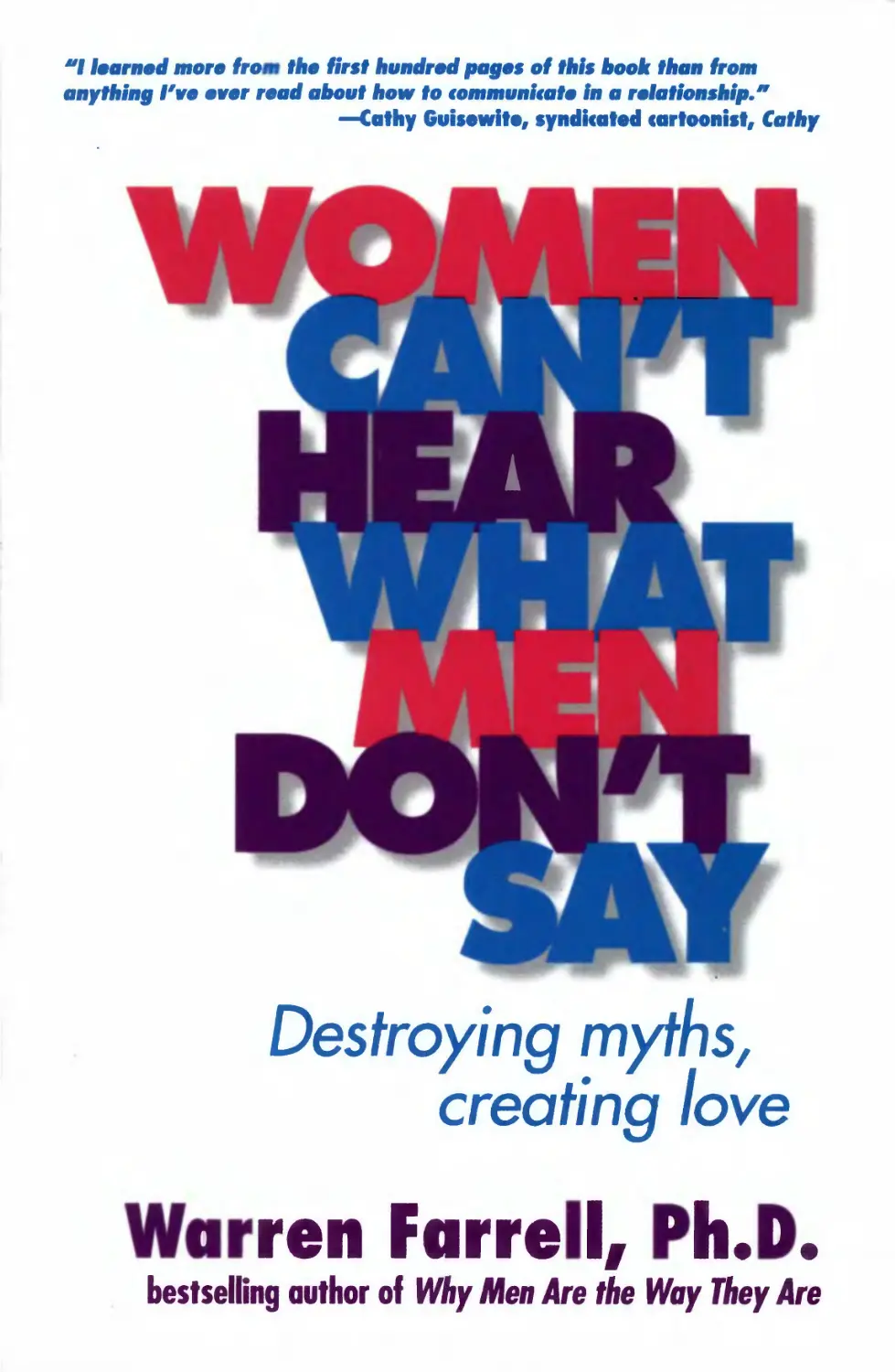
                    ul learned more fro the first hundred pages of this book than from
anything I've ever read about how to tommunitate In a relationship."
—Cathy Guisewite, syndicated cartoonist, Cathy
A
Destroying myths,
creating love
< ren Farre I, h.».
bestselling author off Why Men Are the Way They Are

Women Can't Bear fhit Men Don't Say
"Brave, brilliant, and filled with startling information that will forever change the
way you look at both men and women. Dr. Warren Farrell is the rare person who
truly has deep compassion for both sexes. Essential reading/'
—Susan Jeffers, Ph.D., author of Feel the Fear and Do It Anyway
Tm saying—no, I'm shouting- -to women arid men to read this book. Warren
Farrell is a true Renaissance man with penetrating insights and laser-accurate
perspectives who sees both the yin and yang. He is our spokesperson not merely
to women, but more poignantly to pur own male souls, which we Have been so
afraid to expose and share."
—Denis Waitley, Ph.D., author of The Psychology of Winning
"Shocking and provocative. Warren Farrell has the gift of compelling us to look at
old problems with new eyes. He challenges countless popular assumptions with
a devastatingly persuasive picture of reality. Most important, he points the way to
urgently needed solutions."
— Nathaniel Branden, author of The Six Pillars of Self-Esteem
"Warren Farrell has given us a gift by writing Women Can't Hear What Men Don't
Say. He points us to the only way to end the battle of the sexes in the twenty-first
century."
Karen DeCrow, attorney, and former president,
National Organization for Women
"Revolutionary! This book will help you be understood by your son, father, or
partner as much as it will help you understand them."
—Bettie B. Youngs, Ph.D., Pulitzer-nominated author of Gifts of the Heart
"An amazing piece of work. Women Can't Hear What Men Don't Say is a great
contribution to communication between men and women. It substitutes
illumination for emotion, and careful research for skewed statistics. It is my hope that
the law will hear what men don't say in time for our children to reap the benefit."
—Norman Vroman, District Attorney, Mendocino County, California

"Dr. Warren Farrell is one of the most original thinkers of our time."
—Nancy Friday, bestselling author of seven books,
including Our Looks, Our Lives
"I learned more from the first hundred pages of this book than from anything I've
ever read about how to communicate in a relationship. For the first time in my
life I know how to have a meaningful conversation with a man that will actually
bring him closer. I plan to reread the first hundred pages once a month for at
least the first five years of my marriage."
-Cathy Guisewite, syndicated cartoonist, Cathy
"You can hardly read a sentence in this fascinating book without thinking:
'Really? 1 didn't know that!'Warren Farrell is a true pioneer."
—Bernard Goldberg, reporter, CBS News'48 Hours
"Bursting with provocative data . . . FarrelPs specific prescriptions for better
communication make it must reading."
: Howard M. Halpern, Ph.D., former president, American Academy of
Psychotherapists, and author of How to Break Your Addiction to a Person
"Wow! Women Can't Hear What Men Don't Say made me open up and share with
my wife parts of myself I didn't even know existed. I've discovered new strengths
within myself, and 1 know our love will be stronger."
- Dom DeLuise, actor and comedian
"No book digs deeper than Women Can't Hear What Men Don't Say to help us
discover men's hidden stories. It is a brilliant book!"
Jack Caufield, coauthor of Chicken Soup for the Soul
"An excellent and original guide to help men and women give and receive
personal criticism and communicate more effectively."
John Gray, author of Men Are from Mars, Women Are from Venus

l(
ml Ik la

h
lid
>
11 11
Q
u
Q
n
Also by warren Farrell, Ph.D.
The Myth of Male Power
Wliy Men Are the Way They Are
The Liberated Man

»«r cL 5 i fit C«? if IIrf $3
IVlYTHS*
cheatins
Love
Tl
D
XX? X X
y.
Jeremy P. Tarcher/Putnam
amemheroj Penguin Putnam Inc. NewYork

Most Tare her/Putnam books are available at special quantity discounts
for bulk purchases for sales promotions, premiums, fund-raising, and
educational needs. Special books or book excerptsalso can be created
to" fit specific needs. For details, write Putnam Special Markets, 375
Hudson Street, New York, NY 10014.
Jeremy P. Tarcher/Piitnam
a member of
Penguin Putnam Inc.
375 Hudson Street
New York, NY 10014
www.penguinputnam.com
First Trade Paperback Kdition 2000
Copyright © 1999 by Warren Fanrell
All rights reserved. This book, or parts thereof, may not
be reproduced in any form without permission.
Published simultaneously in Canada
Permission for artwork appears on page 368.
'[Tie Library of Congress has catalogued the hardback edition as follows:
Farrell, Warren.
Women can't hear what men don't say / by Warren Farrell. .
p. cm.
Includes index.
ISBN 0-87477-988-X
1. Man^woman relationships. 2. Interpersonal communication.
3. Communication in marriage. I. Title.
HQ80I.F355 1999 99 16286 CIP
306.7- -dc21
ISBN 1 -58542-061 -1 (paperback edition)
Printed in the United States of America
10 9 8 7 6 5 4
BOOK HF.SIGN BY MAUNA EICHNF.R

m.' irs I hi i;',h'■ I:;
I am uncertain whether it is age or maturity that allows me to appreciate more
deeply with each book the love my family provides. As my dad, Tom,
approaches his nineties, I feel blessed at the balance, wisdom, and foresight he has
modeled. My "new" mom, Lee, has been a thirty-year blessing, as is her
relationship with my dad. Lee and my sister, Gail, are always present with their thought-
fulness. As Gail shares her experience teaching both gifted and special education
students, I admire her intuitive understanding of what makes children tick. I
hope some of my family's gifts have been accurately reflected in this book.
Joyce McHugh, who has been with me full time or part time for much of the
past eighteen years, has brought her competence to this book, her administrative
skills to the office, and her quick wit to my everyday life. She has known early
mornings, late nights, and weekends to help me keep the book in this
millenniums publishing schedule. That staff help was rounded out by additional
competent assistance during portions of the past five years, especially from Sophia
Ruiz and Susan Engbring, as well as Alexa Deere (especially on the housework
chapter), Michael Estes (domestic violence), and Ethan Michaels, Zia Bhaisa,
Jeff Seeman, Ravi Vora, and Alison Poggi.
This book began in the competent hands of Marilyn Abraham at Simon &
Schuster. When she retired, it experienced, shall we say, some post-traumatic
stress syndrome (about which you will read). Jeremy Tarcher, a man who I held
very dear largely as a friend, then became my publisher. He is a man who
understands my vision and was thus able to choose for it an extraordinary editor, Mitch
Horowitz. Mitch's, intellect has stimulated my thinking, and his availability,
balance, and devotion have nurtured the book to its completion.
Writing is lonely and people help sustain a writer in ways that reflect their
gifts. I have felt especially sustained by the love of Nathaniel and Devers Branden,
Liz Dowling, and Erin and Alex Blanchard, as I have by the friendship of Greg
Dennis, and the unique contributions to my life of Grainger Weston, Lydia Colo-
cho, Francisco Velasquez, Erick Hornak, Carey Linde, Nancy Friday, Norm

Pearlstine, Lindsay Kenny, Joseph McCaffrey, Doug McKegney, Robert Olson,
and Riki Robbins.
This manuscript was built on a base of information that was not gathered by
me alone, but required the sharp eyes and devotion of Stuart Pedersen, Steve
DeLuca, Norman Black, Ron Henry, Jimmy Boyd, David Dinn, Howard Hayghe,
Robert Keith Smith, and Hugh Nations -each of whom made my mail carrier
and fax machine feel needed.
A woman friend once told me that when I shopped with her and she tried on
clothes, she felt very vulnerable, since her final selection was designed to cover
up the flaws I was seeing. As authors, Steven Collins, Martin Fiebert, and
Nathaniel Branden saw all my flaws as they read the entire first drafts. And,
when someone reads only a few chapters, I feel as vulnerable as I feel when
someone walks into a speech late and leaves early, which reflects the trust I feel
for these colleagues, who fulfilled with care that request to review a few
chapters: Eugene August, Art Barker, Devers Branden, Armin Brott, Ellen Brown,
Greg Dennis, Liz Dowling, Martin Fiebert, Suzanne Frayser, Bernard Goldberg,
Steven Holzner, Helena Lea, Cindy and Robert McNeely, R. L. McNeely, Linda
Nickell, Kay Schwartzberg, Judith Sherven, Jim Sniechowski, and Hans-
Giinther Tappe.
Finally, this book rests in part on the dream of empowerment feminism
shared by the late Wilma Scott Heidi, former President of NOW, and sustained
to this day by a later NOW President, Karen De Crow. That dream felt alive in
the everyday life of a beloved friend I dearly miss, Shari Lewis.

SliMMiieeJailiJlyiie

IITIITJ
Introduction
PART
HOW TO COMMUNICATE WITH ANYONE,
ANYWHERE, ANYTIME
1
The Most Important Thing to Understand About Men . . .
In Fact, About Anyone 15
How to Give Criticism So It Can Easily Be Heard 20
3
How to Hear Criticism So It Can Easily. Be Given 38
How to Help Men Express Feelings 58
PART II
ip your man knew what to say,
Here's What He might Say . . .
. . . If You Told Him/'I Work Full Time and Take
Care of the Kids, but You Won t Even Do the Dishes" 85
$3
.. . If Your Man Knew You Feared His Potential
for Violence 123

PART III
IF YOUR MAN KNEW WHAT TO SAY,
HERE'S WHAT HE MIGHT SAY . . .
. . . When Male Bashing Is Called "Funny," But Female
Bashing Is Called "Sexist" 165
. . . When He Hears, "It's Men in the News, Men in
Government, Men at the Top—Where Are the Women?" 219
In Conclusion ... 311
Appendix: Domestic Violence Studies of Both Sexes 323
Bibliography 330
Resources 332
Notes 334
Index 355

ion
A lie can travel halfway around the world while the truth is
putting on its shoes. Mark Tw a i n
MY PERSONAL JOURNEY
In my first book, The Liberated Man,1 I shared my feelings about the
importance of independent women for secure men and the contribution of the
women's movement in foblering women's self discovery. My mother's death, prior
to the women's movement, was due, in part, to not living at a time in which she
was encouraged to explore all aspects of herself. And her death was doubtless
part of the motivation that led me to spend three years on the board of directors
of the National Organization for Women in New Ifork City, an experience that
deepened my excitement about women's potential. That was in the '70s.
As the women's movement moved from mocked to mainstream, I
increasingly sensed, an anger toward men that permeated our culture as unnoticed as
bacteria in water. Women were asking, "Why are men such jerks?" and "Why are
men afraid of commitment?" and men were confused: Why would a woman want
commitment from a jerk?
As women spoke, they wondered, "Why can't men listen?" As they pleaded
for intimacy, they feared fiien cared only about sex. The 600 or so men's and
women's groups I had formed helped me to hear what was behind women's anger
and what men could barely say. The findings took the form of Why Men Are the
Way They Are,2 written to answer women's questions about men in a way that
rang true for men. That was in the '80s.
I felt mixed emotions about these decades ... as if they were the best of
times and the worst of times between the sexes. The sexes have never
communicated as much, nor have they ever divorced as much; they have never known
so much about raising a child's self-esteem and never left their children so
destabilized. The male role (mostly) has never been so successful at expanding
ill mil

INTRODUCTION
women's lite expec tancy (by over 50 percent in the twentieth century), yet never
been so blamed for its neglect of women.
In retrospect, I saw the '50s as the decade of the family; the '60s, as the decade
of men (sex without marriage; freedom; questioning authority); and the last three
decades of the millennium, the decades of women. Unfortunately, while the
. decade of men also released women (birth control, professional choices, sexual
self-discovery), the decades of women are in many ways a dark age for men.
Since the beginning of the women's movement, the suicide rate for women
has decreased by about a third, while tbe suicide rate for men has increased by
about 15 percent,* yet we've focused only on the damage to women's self-esteem.
Something was going on . . .
By the late '80s, the anger toward men had become institutionalized. It was
dividing families and poisoning love. The newest dirty word was not a four-letter
wordv it was a three-letter word: men. The women's movement had done a
wonderful job <jf freeing women from sex roles, but no one did the same for men. The
more women gained advantages, the more its movement went from favoring
equality to fearing equality. Big feminism became like big labor. Both started by
correcting an imbalance; both became so preoccupied with getting protection
that soon everyone near them needed protection from them.
I began to feel that as women spoke up and men didn't, men and
masculinity were becoming demonized and the baby was being thrown out with the
bathwater. Soon 1 began distinguishing among the feminism I loved (what I now call
empowerment feminism) and the two forms of feminism I feared (victim
feminism and competitive feminism).
Empowerment feminism empowers a woman by encouraging her to develop
all of her potential without regard to gender. It is the feminism I shall always
support. Victim feminism foe uses on how men and society systematically view
women as second-class citizens and incapable, and any accomplishments a
woman achieves are despite these barriers. Competitive feminism does not stop
with saying women have it bad: It says that women have it worse than men;
women's victimhood was caused by men. It arrives at these conclusions by
exaggerating women's burdens and understating men's. Competitive feminism
creates a male catch 22: If he says nothing, he looks like a deadbeat or oppressor; if
he points out the exaggeration, he appears to be anti-woman.
Both Parts II and III are rife with examples of victim and competitive
feminism, but with solutions as to how they can become empowerment feminism. If
victim and competitive feminism have resulted in the last third of the twentieth
century being dark ages for men, they haven't'done so without men being a
coconspirator. • *
I

For six years I sorted out my feelings on these issues and worked to make y
The Myth of Male Power a new paradigm of men and power, and a more
progressive male-female dance. I had come to feel that men's traditional definition of
power did not give men real power. Men had come to define power as
feeling obligated to earn money that someone else spends while he dies
sooner. That felt to me like a better definition of obligation and responsibility.
The Myth of Male Power redefined "power" as controlling one's own life.
'I lie research on The Myth of Male Power helped me ferret out what I came
to feel was the biggest misunderstanding in my thinking as a feminist my
failure to understand that, historically, neither sex had power; both sexes had roles.
Our fathers and mothers had responsibilities, not rights; they had obligations,
not options. Women were obligated to raise children; men were obligated to raise
money. Earning money was not male privilege, it was male obligation. Privilege
was about options, like the option to raise children or raise money; it was the
option to spend money. . . . That was in the '90si
However, the breadth of Hie Myth of Male Power—explaining perhaps a
hundred myths about men that created the larger myth of male power;
explaining how our genetic heritage had come into conflict with our genetic future;
proposing not a women's movement condemning men or a men's movement
condemning women, but a gender transition movement — neglected to counter some'
myths in enough depth to expect social change. And it neglected a method of
communicating about these myths that could increase love without sacrificing
honesty to do it. Myths first. . .
Some of the myths were so ingrained that thoughtful people could not be
expected to drop them in response to a few paragraphs of explanation, f'brexam-
ple, -a conscientious feminist running a battered women's shelter would fear
subjecting vulnerable women to a new treatment plan based on a few paragraphs
explaining why their treatment program was based on false assumptions about
men. She would need more depth before she could make responsible changes.
In-depth redefining is important, but women can't hear what men don't say
partly because of the way men say it. And partly because its so difficult to listen
to anything we don't really want to hear.
So Women Cant Hear What Men Don't Say has to be about more than the
substance of myths. It has to also be about process. The process of communi-
cating difficult feelings; the process of listening to difficult feelings.
If 1 were to choose for myself a heritage of teaching men and women
everything there is to understand about each other, or teaching men and women
haw to understand, I would choose the latter. The process is more important
than the substance. The process is like learning to ride a bicycle or use a com-

Introduction
puter: The process will be useful even when the substance changes. The process
is Part I.
The substance of Women Can't Hear What Men Don't Say will put the
process to the test. All of us give lip service to having an open mind. The
substance of this book will ask us to put our money where our mouth is, so to speak.
That's Part II. More on that later.
Part I, then, is about the process it takes to understand someone who has a
different perspective, be that person a husband or wife, a parent or a child, an
employer or employee, a brother or sister, a Conservative or Liberal. . . . And
even more important, it is about the ability to not only handle personal criticism,
but to create a safe environment for it.
My feelings that political agreement was less important than listening skills
emerged in the late '60s and early 70s when I was in college (at Montclair State
University in New Jersey) and during graduate school at UCLA and NYU. I was
one of those Vietnam War protestors who was a civilian, a Civil Rights advocate
who was white, a gay rights supporter who was straight—someone your dad
probably wanted to wrap up in a Soviet flag and burn. It was no surprise to
anyone that by 1970, right after the women's movement surfaced in 1969, I was a
male on New York City's board of directors of the National Organization for
Worrfen.
To my liberal friends, I was a certified liberal; to my conservative friends* I
was a hopeless liberal. But to me, liberalism was never the issue—listening was.
When, instead of listening, we pigeonholed feminists as "bra burners," slandered
African-Americans as "niggers," branded war protesters as "commies," and
derided gays as "queers," I felt sad. It seemed to me that labeling was the lobotomy
of our soul.
The gap between my friends' and my desire to hear everyone's story left my
liberal friends aghast when I argued that even those on our enemy list deserved
an equal-opportunity ear. But this time the equal-opportunity ear was not to hear
the story of the gay black Communist Vietnamese female—it was to hear the
straight white European-American male . . . , er, me. (Oh, my. Wasn't "he" the
oppressor? Weren't we defending the oppressed?)
The problem was that listening to myself required more confrontation of self
than did listening to the perspectives of gays, blacks, women, and Vietnamese
Communists. Which made it deliciously tempting to indulge our standard
escape from listening to men: "Haven't we been listening to men's stories for
thousands of years?"
But among those men was my own dad. When all was optimal, dad left
home at 7 to 8 a.m. and returned at 6 to 7 p.m. Iliat optimal work week—of fifty-
five hours—was when he didn't work overtime. Or have to take a second job. Or

go to school at night. Often, though, my dad, and many of the dads in our
neighborhood, put in a total of sixty to eighty hours per week, with that combination
of work, overtime, school, and commuting. Sometimes oiir home must have
seemed less his castle than his mortgage.
Eventually dad got his reward—managing a company in Holland. The
company moved our family of five to Holland. Mom, though, found Holland too rainy
and lonely. Dad responded by putting his company on notice, moving the family
back to the United States, and staying alone in Holland until he could join us.
Once back in the United States, though, his age— and having just quit his last
job—-kept him from finding a job managing another company. He was soon
selling Fuller brushes door to door-so my sister Gail and I could go to college where,
ironically, I would learn why he should be on my enemy list.
For years, I never asked my dad how he felt selling Fuller brushes. But once,
he did tell me how empty he felt walking the street, banging on doors,
persuading some woman it was worth it to buy a brush from him at twice the price of a
supermarket; and how bad he felt that the promises to Mom (his reasons for
coming home late at nights and working weekends) had amounted to nothing.
These realities were in such stark contrast to my theories of male privilege that it
stopped me in my tracks.
And then I saw Mr. Longson, our next-door neighbor, die of a heart attack in
his fifties. I began to wonder about calling it male power when he fulfilled his
obligation to earn money his family spent while he died early. I realized that Mr.
Longson and my dad had not had their internal stories and fears expressed, only
repressed. To this day, I hear the stories of the women on my staff, but not those
of the men who collect my garbage.
Removing my blinders, though, also removed my feminist support system. It
was sad to feel that their support was dependent on my blinders. Feminists
brought me not only my nurturance—my psychological support—but also my
financial support. Removing my blinders severely damaged my financial success,
but it deepened my soul as it forced me to confront the self-righteousness that
sometimes seeped in as I viewed myself as "more enlightened," "unique," and
"sensitive" for being "one of the few men" who could hear the perspectives of
women. Hopefully, via that confrontation, it deepened those qualities in reality.
And it certainly helped me distinguish between friends and political allies:
Friends valued my integrity; political allies valued my agreement. It helped me
understand that everyone had moccasins that needed a little wearing—even
men.
INTRODUCTION

Introduction
If Men Have Problems, Why Aren't They Speaking Up?
Sharing fears and feelings will happen more slowly for men than with any other
group, because although men, like women, received love by solving problems for
others, the process it took for men to solve problems involved a more complete
repression of his own problems. A man didn't tell his sergeant in the army that
he, too, had some perspectives and problems the sergeant should consider. ..
That would not have led to the man becoming the officer and the gentleman, but
a failure and a reject, and he didn't notice many women rushing to a movie called
A Failure and a Reject.
For men, success has always been the best preventive medicine to avoid the
cancer of female rejection (... as well as everyone else's). Success came from
repressing feelings, not expressing feelings. For women, expressing weakness and
fear attracted a savior; for men, expressing weakness and fear attracted
contempt. Hearing a man complain makes a woman feel like a mother, not a lover.
Complaining was part of women's evolutionary heritage; for men, complaining is
an evolutionary shift.
Women will not respect men until they speak up. But this does not mean
women will respect men as soon as they speak up. ITie reason women ultimately
respect a man who speaks up is because he must jump over hurdles, and his
willingness to do it shows he cares, and his ability to do it earns respect. For
example . . .
Some women say, when a man speaks up, that he must be a woman hater.
That's one of the hurdles. For a man, that's perhaps the most painful one because
he is speaking up so his love for a woman can be more genuine.~He feels like he's
been hit below the belt, like women wanting to hear his feelings is a fraud. But for
some women, criticism does feel like hatred. She has just expressed her feeling.
The first part of this book is about helping both sexes know how to take
potentially destructive mutual misunderstandings like that and turn them into love.
Ultimately, this book is about both sexes speaking and both sexes listening in a
radically different way. But prior to the "ultimately," there are reasons men are
the silent sex, and men need to let women know their intent when they make a
transition from suppression to expression.
For example, a man needs to let a woman know that his intent in speaking
up is to have a more intimate relationship with an equal partner—that to not
speak up is to treat her like a child.
If a man is not speaking up out of a need to protect, he is creating something
worse than a parent-child relationship. He becomes like a permissive parent who
I soon finds himself needing protection from the child who knows no one's per-

spective but her or his own. This is what men's silence has created both
individually and socially.
It is not the men who confront women directly that women need to fear; it
is the men who fear confronting women because they don't think there's any
hope, they "know" she'll never understand, or they're unwilling to risk the
possibility she will call him "woman hater." When men do not speak up it
demonstrates a blend bf fear of women and contempt for women with a lack of courage.
That cannot coexist with truly loving a woman as an equal partner.
In contrast, a man who speaks up is engaged. A man who is engaged cares.
He has hope. He is risking for the hope of intimacy. But a man needs to let a
woman know that is his intent. She'll recognize the truth in it. On some level she
already knows it. She just needs to know he knows it, and that that's where he's
coming from. She needs that assurance.
Another hurdle: When Dr. Laura (Schlessinger) researched Ten Stupid
Things Men Do to Mess Up Their Lives, she "asked my male listeners to write Or
fax me suggestions for the stupid things men do. I got thousands of responses of
the most moving, vulnerable, meaningful material. But women have not been
open to hearing it. . . . Women feel angry and threatened by men's feelings. 'Ifiey
don't really want men to be sensitive, just sensitive to their (women's) feelings."4
Both sexes fear confronting their partner. When I first became involved with
the National Organization for Women, .women would invite me for dinner and
ask me to share my feminist perspectives with their husband so they could be
shielded from his response. Similarly, men who are honest often find the honesty
costs more than it was worth. A single man or woman can afford to weed out of
their lives someone who cannot handle who they are. But for couples with
children it's more complex.
Some of America's most powerful men have personally shared with me how
their own life matches the experiences about which I write, but they shudder
with the thought of sharing this with their own wives— "If I disagree with her, it'll
just cause trouble ... I can't just consider myself; we have .children too." When
the world s opinion leaders feel they cannot differ with their own wives . . .
FQrtunately, many women feel supported when men speak up. And many
women are feeling so strongly about the need to create a better world for children
that they are speaking up even when men are silent. The man in charge of the
1-800-SEE-DADS hotline told me more than half the calls they received were
made by women.5 Often the woman was a second wife who saw how much her
new husband loved his children. She was angry at him for placating his ex and
shocked that the system could allow his ex to prevent him from being with the
children. In many cases she felt that she and her new husband could provide
more balance for the children than could a single mom. This woman is perhaps
INTRODUCTION

INTRODUCTION
the first to experience how the Second Wives' Club loses when the First Wives'
Club wins.
Millions of women will be second wives. And millions more won't because
the man they love is still in shock at his last transition from husband to a
member of the men's auxiliary of the First Wives' Club.
FEELINGS AND DATA
I like feelings a lot more than data. \fct there's a lot of data in this book. Many
women will be tempted to say, "Why can't you just tell me how you feel—I can
listen to that. That means more to me than a statistic."
How men feel is crucial; but if a man said, "I just don't feel men are more
violent to women than women are to men," most women would just say, "Sorry,
you're wrong," and dismiss him as an ignorant chauvinist.
Without responsible, concrete information, we get stuck in the quicksand of
self-fulfilling prophecies. When the society has no awareness that men are
battered by women in significant numbers, we don't develop hotlines, so we don't
hear mens feelings; we don't develop shelters, so we don't hear men's feelings;
we don't train social workers to be sensitive to men who get hit first, so they
develop treatment programs based on what they can see. Without responsible new
information neither sex nor any social workers can be asked to alter a working
paradigm. And that only occurs if we care enough to let it in.
The best hope of knowledge is the creation of caring. Until Rachel Carson
wrote Silent Spring, we didn't have enough knowledge to care about the
insecticides that poison our food. Women Cant Hear What Men Don't Say, which is
about the "silent sex," provides the knowledge to care about the myths that are
the insecticides that poison our love for men. It will succeed only if it inspires
others to share their stories. The numbers help men know they are not alone;
they help women know that these are not just my opinions. It takes the personal
stories and the numbers for a critical mass to care. And care creates the search
for solutions.
Anger toward men is perpetuated as much by men's blindness as by
women's. If a person doing a survey on housework asks a man what housework
he has done in the past week, and he has just remodeled the house, he may say
"none" because he doesn't consider remodeling the house to be "housework." If
a man had just come back from a camping vacation and he drove the family
everywhere, and the person doing the housework survey asked him about his
contributions during the week, chances are he would not mention his time
driving, setting up the tent, packing the car, or organizing the trip. He'd be as likely
to say, "None—we were on vacation." As men learn to explain their contribu-

tions, women see how men contribute, feel more like a partner than a slave, feel
less used and more loved.
The hope of this book (if a book can have hope) is that by doing the hard
work of gathering, documenting, double-checking, publishing, and publicizing
data that has fallen short of the public consciousness, millions of men will not
fear being thought of as fools when they share what they would otherwise fear
might be an isolated observation. And millions of women will discover who men
are. A woman who understands her dad discovers she was loved more than she
knew, which allows her to love her-husband more fully and nurture her son more
completely.
THE GOALS OF PARTS l9 II, AND III
Our poor socialization to effectively give and receive personal criticism does
more to destroy families than any other weakness. Why? Handling criticism is
the Achilles' heel of us mortals. The more we love someone the more difficult it
is to handle criticism from them because we fear it means losing their love.
Ironically, when we can't hear criticism from them, we lose their love; whenwe can,
we strengthen their love. This book seeks to strengthen that skill so there will be
stronger marriages and fewer divorces.
Am I being redundant when I say stronger marriages and fewer divorces?
No. Many marriages that are legally together "for the children" are minimum
security prisons for the parents. Togetherness is usually better for the children than
divorce, but "minimum security-prison togetherness" is still an inferior role
model for teaching children to love. Strengthening our skills at giving and
receiving personal criticism creates both stronger marriages and fewer divorces.
And better parenting.
I have put more emphasis in Part I on hearing personal criticism well than
on giving it well because therapists are good at helping people give criticism
effectively, but have spent less time helping people handle criticism that is badly
given. Many therapists are by nature sensitive and oriented toward protection, so
guiding people to be sensitive in the way they criticize comes more naturally than
teaching people to handle criticism given badly. Problem is, almost anyone who
is criticized tries to "kill" the criticizer before they are killed by the criticism, so
criticism is almost always given back badly even if its given out sensitively. In
Part I, I will explain why that is true and what to do about it.
Part Is real goal, though, is to do more than refrain from killing the criticizer.
It is to feel genuine compassion for the person doing the criticism. No. It is more
than that. It is to predictably feel genuine compassion for the person doing the
criticism. So the person criticizing can depend on a safe environment. Your in-
INTRODUCTION

TRODUCTION
centive? You give this to a partner who is giving it to you—so your incentive is
also receiving a safe environment for expressing your most upsetting fears.
You'll notice that the fourth chapter is about how to get men to express
feelings. This chapter will surprise you with the confluence of contradictory
messages we send men about feelings: the number of ways we undermine men
expressing their feelings even though we say we want men to express feelings. It
is the first chapter that makes clear how men's external world affects men's
internal world. It makes clear what we can do about it personally, and, because the
influences are also external, politically.
Most books dealing with relationship or personal issues steer clear of
political issues. The assumption underlying Women Can't Hear What Men Don't Say
Is that that is a cop-out. When we learn to communicate at home by talking while
others are talking, or debating more than listening, we tend to become politically
more rigid—we develop a "hardening of the categories" arid are attracted to
political ideologies and religions that make us right and others wrong.
Even more important to this book, politics and social attitudes affect our
personal relationships. If you have a dad who grew up during the Depression, you
know he still has a thing about saving money, and that affects his relationship
with your mom. A woman growing up in the fifties was much less likely to even
think of becoming a corporate executive than if she grew up just twenty years
later. And that difference affects her selection of a husband and the way she and
her husband raise children.
The difference in politics and attitudes facing a soldier returning from
Vietnam than that facing a soldier returning from World War II affected these men's
attitudes toward themselves and everyone in their lives. And the everyday
personality of millions of men (in contrast with their female peers) was molded by
the political decision to require only men to be drafted or become conscientious
objectors, thus forcing every eighteen-year-old boy into either interpreting
patriotism as requiring his disposability, or experiencing a crisis of conscience that
would pit him against the U.S. government. That choice between disposability
and powerlessness was called a rite of passage into manhood. That same choice
still exists only for our eighteen-year-old sons (who must still register for the draft
or pay a quarter-million dollars and be barred from federal employment for the
rest of their lives).
Today we have a social and political attitude toward men. Or, as our kids
would put it, when it comes to men we have an "attitude." Part II shows how that
political attitude affects our personal lives. How, for example, as it exposes us to
headlines about women doing more housework, but not men doing more
remodeling, painting, or gutter cleaning, a woman becomes resentful as she picks up

hi$ underwear. Because she sees no headline saying she's not doing half the paint- |
ing, gutter cleaning, or repairs (e.g., "Study Finds Women Complain, Men
Repair"), nothing modulates her resentment. As she hears men's perspective and
also understands the underlying process that has cut her off from men's
perspective, she has the opportunity to deepen her love for men and raise her son
more effectively.
Part II does more than give us examples of myths that create anger toward
men—it makes us aware of what we need to ask before we can determine
whether we are being told the full truth when we hear the news. Why, for
example, do we believe that men batter women more than, women batter men when
we've had extensive research to the contrary for a quarter century? Clarifying
these myths is like cleaning filters; allowing us to breathe the air but not the
pollution, like the thresher that separates the wheat from the chaff.
Part III allows us to see the results of that anger in the form of man bashing,
and the biases of the institutions that disseminate it: what I will call "The Lace
Curtain."6 The Lace Curtain is the tendency of most major institutions to
interpret gender issues from only a feminist perspective, or from a combination of
feminist and female perspectives. As we look closely at the anger, it is apparent
what women are angry about and what we can do about it so our children don't
inherit it.
In brief, Women Can't Hear What Men Don't Say is asking men to take the
primary responsibility for, first, doing the hard work it takes to get in touch with
their feelings, then for speaking up in the first third of the twenty-first century
just as women did iri the last third of the twentieth century. But it suggests there
are powerful reasons men have difficulty revealing their real vulnerabilities to the
women they love—reasons powerful enough to make it predictable men would
reach the moon before they expressed their feelings. Until we understand the
relationship between the personal, social, political, and biological wires, we won't
be able to disentangle them for our sons or ourselves. Fortunately, we don't need
perfect answers to make progress.
It is my hope to strengthen our resolve to destroy man hating before it
destroys our sons' and daughters' relationships, and the lives of their children. It is
not my hope to make man hating politically incorrect, but to add the information
and emotional perspectives we need to dissolve the hatred that creates it.
It is my hope that by both exposing the myths about men and exposing the
process that creates those myths, I will contribute to stopping a process that is
leaving our children without fathers and our sons without self respect; that is
dividing the sexes and poisoning love.
It is my hope that by making the environment safe for men to speak up, men
Introduction

INTRODUCTION
will be inspired to be in touch with their feelings, do their homework, learn, to
speak with love, and then speak. As for me, I will do this less than perfectly. I will
be just like the men you love.
Nothing helps my ability to communicate more than hearing from my
readers. Write me, teach me, grow me. Write to me at:
PM B 222
315 South Coast Highway 101, Suite 4
Encinitas, CA 92024-2555
and check out:
www.warrenfarrell .com

PART
IT!"
II
U
li
L
Y
ii
u
-•
HOW TO
Communicate
with Anyone,
Anywhere,
Anytime

1
rn
iiiim ining
t t t
There will always he a battle between the sexes became men
and women want different things. Men want women and
wofnen want men. (i »•<>r c; k R u r n s
No One's Ever told Me, "I want A Divorce,
MY PARTNER UNDERSTANDS ME"
The most important thing to understand about men is their desire to be
understood. In fact, it is the most important thing to understand about
anyone. In more than thirty years of conducting workshops, no one has ever said to
me, "Warren, I want a divorce my partner understands me."
What is so precious about being understood? F;irst, it is rarer than a
diamond. Often, when we explain a problem to our parents, they problem-solve. Or
they criticize. Or they reassure ("You don't really need to feel that way
because . . ."), thus discounting the pain. Or they say "I understand," but we don't
feel their compassion. We wish they would let us know what they understand.
When we hear someone tell us, "I understand what you're saying," we often feel
our feelings are being dismissed rather than elicited.
1 Conversely, if we are parents, being truly understood by our children rarely
precedes the birth of grandchildren. Young children are too needy to think of
anyone but themselves. Teenagers are too concerned with their own identities.
Adults without children are focused on careers or the problems they imagine

their parents to have created. When it comes to being understood, the best hope
of a parent is becoming a grandparent.
Most of us don't try to understand our partner, we try to explain bur partner.
Which is a polite way of saying we try to analyze their faults. Yet, in those same
thirty years of conducting workshops, 1 have never heard anyone say, "Warren, I
want to remain married—my partner has such an accurate analysis of my faults."
An analysis of our faults may help someone else feel they understand us, but it
does not leave us feeling understood.
With about 50 percent of marriages ending in divorce, the fact that any one
characteristic is associated with marital survival is astonishing. And survival isn't
the only victory. People in relationships in which they feel understood usually
want to be there. That's in contrast with many marriages in which a couple is
legally married but psychologically divorced. What 1 call "Minimum Security-
Prison Marriages."
On the surface, it seems men should feel understood. After all, as corporate
heads and "heads of households," don't men have the power to explain
themselves and speak up about whatever they think? Yes . . . about whatever they
think, but not about whatever they feel. A man becomes successful by
repressing his feelings, not expressing his feelings.
It used to be that women didn't speak up either. Especially around men.
They became passive-aggressive (e.g., passively agreeing to do something, but
then not doing it; or agreeing with the man to his face and expressing their real
opinion to. their women friends). Especially around men. Today, men are the
passive-aggressive sex. Not only individually (April: "Sure I'll fix the faucet,
honey"; May: "Sure I'll fix the faucet, honey"), but collectively (which is what this
book is about).
Isn't it Natural for Men To Emotionally Withdraw . .
into their "Caves"?
We often hear that it is natural for men to withdraw into their caves.1 Natural?
Maybe. Functional? No. When either sex suppresses the expression of feelings,
it is almost always because they don't feel there is a safe environment to express
them. Many men fear that expressing feelings will lead to conflict. His wife is
usually more articulate, so he often loses; but if he "wins," she may withdraw
emotionally. Or sexually, into her cave. Either way he loses. Cave is safer.
Withdrawal into a cave is almost always a sign that the environment outside
the cave is not safe; withdrawal is usually an unconscious calculation that
outside the cave the potential for loss exceeds the potential for gain. The remote

control is his security blanket. Unfortunately, what gives him control makes him
remote. There is little incentive for a man to remain closed up if he feels
understood when he opens up.
It works the same with our kids. Two friends with a teenage daughter
complain that she never shares her feelings with them. When I was at their home for
dinner, though, I overheard her talking with a friend on the phone nonstop about
heV feelings. Why? One day, she tells her parents that the guy she's dating is
moving too quickly toward sex. The next day, she has a curfew. Or a lecture. It seems
like the feelings she expresses one day are used against her the next. It's natural
for anyone to withdraw when the environment for expressing feelings is unsafe.
It is more functional, though, to have a safe environment.
Are so many men afraid of expressing feelings because they are afraid of
intimacy? No. A man fears that conflict with his wife will lead to less
intimacy, not more intimacy. He suppresses the expression of his feelings
because he fears destroying the intimacy they do have. Men and women both
fear the loss of intimacy, but he fears discussion will leave him losing and,
therefore, he'll lose intimacy, while she feels discussion will bring them closer. And
even when it doesn't, herliope triumphs over her experience. From her
perspective, the more he withdraws, the more alienated she feels, thus the more
convinced she is that he doesn't want intimacy with her, ort doesn't want intimacy,
period. So* depriving our partner of a safe environment to express feelings makes
both sexes feel intimacy is hopeless.
Providing a safe environment to express feelings is not the best way to get a
man to express feelings. The best way is to choose a man who already expresses
them! Our choice of partners is perhaps the clearest single statement of
our choice of values. Ilierefore, when we blame our partner for anything, we
should really be confronting ourselves. Not as in, "Yes, I made a bad choice," but
as in, "How doesNthis choice reflect my values?"
Most women genuinely feel they value a man's feelings—if she could have
those feelings without making herself less secure (either emotionally or
financially). But if she values security more, she often chooses a man who is
successful at work. The problem is that the process required to succeed in most
high-paying careers is inversely related to the process it takes to be vulnerable. If
she likes his success but deplores his capacity for intimacy, she should be
looking within herself, not blaming him. Similarly, if he's forty and marries a
beautiful twenty-year-old but then blames her for being immature and entitled, he
should be confronting his own values, not hers.
While most of us can agree that our choice of partners is the best statement
of our choice of values, men continue to choose sex objects and women continue

Women Can't hear What Men don't Say
to choose success objects, and then both sexes claim to want what's missing! Put
another way, why do both sexes fall in love with the members of the other
sex who are the least capable of loving?
For millions of years, women have biologically selected men who were
heroes and rejected the other men—the "losers." So their children had heroes'
genes. Bui think of a hero's feelings. You can't? That's the point. The very word
"hero" is derived from the Greek word "serow," from which we get our words for
"servant," "slave," and "protector."2 Servants and slaves were not expected to
express feelings, but to repress feelings. Just like heroes. Just like corporate
executives. Just like surgeons, engineers, CEOs. Our genetic heritage—the
socialization process that led to women marrying killer/provider men and men
marrying beautiful women, thus selecting genes from which the next generation
of children were born—is still with us. If we have integrity about our desire to
support men to express feelings, every institution and attitude between the sexes
will require questioning and adjusting. That's what T'll investigate in chapter 4 on
supporting men to express feelings.
If Understanding Each Other Is So Valuable, Why
Haven't We Learned It already?
Throughout history, we learned to survive by killing people who didn't
understand us—we called them "the enemy." Compassion for the enemy was not a top
priority because survival was more dependent on combat than on
compassion. In fact,,compassion for the "other side" was called treason. In the 1950s,
even one positive statement about Communists would elicit the beginnings of
ostracism ("You Commie!"). In brief, humans have spent tens of thousands of
years learning to fight and debate with the other side, and almost no time
learning to listen and empathize.
Haven't women, though, spent their lifetimes learning compassion? Yes,
when someone is on their side. But neither sex learned compassion for people
who argued with them. At the time of divorce, women are not more
compassionate to men than men are to women. Under adversarial conditions, both sexes
have learned much better debating skills than listening skills. Just go to a divorce
court and see if anyone is listening.
There's one downside to understanding someone. Almost as soon as we do,
we expect understanding in return. We up our ante. It's easy to still be unhappy
by increasing our expectations faster than our partner's ability to respond. When
we do, we paralyze our partner with unrealistic expectations. And then, although
we are deepening our love on one level, we are also destabilizing the relationship.
If we doii't get the understanding we expect in return, then we expect some-

thing else. Like a new car. llie good news is, we will usually receive it.
Understanding is that powerful of a gift. The bad news is that if we don't receive even
more understanding, the material girl is as unhappy as the material guy.
IF I REALLY WANT TO BE UNDERSTOOD, WHAT DO I DO?
Give up. O^st kidding!)
If communicating effectively were easy, we'd already be doing it. I often joke
that when I decided to focus my life on getting women and men to understand
each other, at least I knew I'd always be employed! Before you assume the effort
is more than its worth, let me tell you how much it's worth.
Imagine having one relationship tool that would, more than any other, make
your partner less likely to want to divorce or break up with you. Spend one
moment thinking about the costs of a divorce—not only economically, but
psychologically; not only to you, but to your children .. . and their children.
Now imagine this same relationship tool being almost as likely to improve
your relationships with your children, your parents, your employer, and your
employees. If it took you as much time to learn this relationship language as it takes
most people to learn computer language, wouldn't it be worth it?
I often see couples in my workshops afraid to understand their partners
point of view partly because they fear they willhave to give in or -compromise..
The fact is that when we do not understand our partner, we wind up giving in a
lot more. A man who wants more time watching sports on TV will be less
interested in it the moment he feels more understood at home; a woman who wants
a new necklace or ring is a lot less interested in it when she is encircled with
understanding. People who cannot offer understanding will find themselves paying
for more and receiving less.
The good news about the first four chapters is that, as with a computer,
learning even a little will bring some success. The benefit of computer language
is that it opens ,us up to options that our parents couldn't have dreamed of fifty
years ago; the benefit of relationship language is that it opens us up to a type of
love no one could have imagined fifty years ago. And, as with a computer, every
option becomes usable through learning something new and practicing it
frequently. As with computers, our children will sometimes be able to learn it faster
than we, but we old dogs can learn.
If you're overwhelmed, remember, if we give to our partner nothing more
than a few of the steps that follow, we'll be giving more than 95 percent of what
couples give their partner. We will have made love . . . from a new position.
Thi most Important Thing to Understand about Min . . .

»i Iii tin
Criticism So It En
Easily to Heard
he practical steps to giving criticism —the focus of this chapter—contain
the underlying assumption that criticism should be given. But should it—
does it help or hurt relationships? And if it should, how much and in what way?
Do men and women have different approaches to giving criticism and expressing
anger?
Are Criticism and Anger Good or Bad for a
Happy Marriage?
Common wisdom seems divided. Some feel it's better to get criticism and anger
out; others feel that what you say, especially in anger, can never be taken back.
The truth? Both. Studies of happy marriages find that anger and criticism are
expressed, not repressed ... up to a point. And they find that the way they are
expressed does count.1
In marriages that ended in divorce, it was more likely that the ex-wife
expressed a lot of anger, sadness, disgust, and fear, was often belligerent,
contemptuous, defensive, was domineering, and frequently whined and stonewalled her
husband. The husband was more likely to have been belligerent, defensive, and
contemptuous.2

Do Women Have More difficulty Expressing Anger?
Books like Harriet L^rner's The Dance of Anger, articles in women's magazines,
as well as TV talk shows and assertiveness training classes, all tell us that women
are socialized to be uncomfortable with anger, especially toward men.3 This
leaves us with the belief that expressing anger is difficult for women, but the one
v emotion that is easy for men.
What s true is that everyone is uncomfortable with expressing anger and
being critical. Anger and criticism generate rejection. And everyone hates rejection.
Men do learn to express anger and criticism toward other men, but when it
comes to women, men are socialized to protect women, not attack them. They
are socialized to argue outside the home (with men), not inside the home (with
women). The research bears this out.
Researchers find that when only one sex expresses argument-provoking
feelings, it is likely to be the wife—by a ratio of almost six to one (85 percent vs. 15
percent). When both sexes participate but one dominates, women are about
twice as likely to dominate.4 Overall, women are more willing to initiate conflict,
more willing to escalate conflict, better able to handle it when it occurs, and,
when they have initiated it, are quicker to get over it.5
These findings come from numerous sources.6 They are found among
couples of high, medium, and low socio-economic status.7 They are found using a
variety of methodologies: The couples themselves acknowledge this gap,8 and,
much more reliably, researchers who systematically observe couples verify the
couples' own assessments.9
Probably the most respected researcher in the field is John Gottman at the
University of Washington. He records pulse rates, heart output, skin conduce
tance, and other indicators of stress. Then he videotapes the couples to observe
facial expressions and body language. He does not ask the couples to fight, since
that would be artificial. Instead, he basically works with a couple and when a
major area of disagreement naturally evolves, he asks them to discuss it and
attempts to resolve it. When a fight naturally occurs, the equipment is there to
record it.10
Gottman found that men are more intimidated by angry women than women
are by angry men. Men are more stressed by marital arguments, while women are
more comfortable with emotional confrontation and are better at it.11
Even in the feminist movement, the medium is the message: Feminists
express anger even as the message is that women cannot express anger; men
repress anger even as they are judged to be the sex that has no problem expressing
it! We often hear we have a battle of the sexes when, in fact, we have a war in

Women Can't Hear What Mkn don't Say
which only one side has shown up.12 (Men put their heads into the sand and
hope the bullets will miss!)
Withdrawal is not the way men do battle with men. It is the way men do
battle with women. Because the purpose of doing battle with men was to prepare
men to protect women from conflict, not to be the source of conflict.
The job of this book is not to create an affirmative action plan for men's
anger to be equal to women's. It is to create a method of communicating that
transforms anger in the way a solar panel transforms heat—by taking intense
heat that would normally leave us hot one moment and cold the next, and
transforming it into energy that keeps us warm all the time.
if women express anger more easily,
Why Do We Think Men Do?
A nine-month-old infant was crying. In a scientific experiment, observers who
were told the infant was a boy were much more likely to say "he" was expressing
"anger"; observers told the identical infant was a girl were more likely to say "she"
was expressing "fear."13 One reason we think men express more anger is because
we tend to interpret as "anger" in a man what we would call "fear" in a woman.
We can see why we do this when we look at the effect it has.
When we interpret a woman's emotion as fear, two instincts are set into
motion: the instinct to protect any woman, and the instinct to protect someone who
is afraid. A woman in fear is assumed to be a woman in jeopardy, and this
generates a double dose of our protector instinct. When the identical emotion (e.g.,
the crying) is expressed by a man, but we interpret it as anger, we want to fight
back or run away.
When a woman appears to express fear, we cannot assure her without at
least releasing her from responsibility; when we interpret the same emotion in a
man as anger, we want to blame him and be certain he acknowledges
responsibility. We want to find her guiltless; we want to find him guilty.
Once this double standard is woven into our mindset, it translates into our
feelings about how to criticize a woman vs. a man: When a man criticizes a
woman, it makes us fear for her; when a woman criticizes a man, it makes us
cheer for her. Either way, we're on her side. Emotionally, we experience her as a
damselin distress and, if we're a man, we feel summoned to compete for her love
by protecting.her. When then Vice Presijdent Candidate George Bush was
campaigning against Geraldine Ferraro in 1984, he and his advisers realized they
could not criticize her the way they would a man and expect positive voter
reaction, which is one reason they focused on her husband's finances, as did Dianne
Feinstein's opponents when she ran for U.S. Senate in California.

This is no one's fault. The difference has evolved from our genetic heritage
(the socialization process that led to women marrying killer/provider men and
men marrying beautiful women, thus selecting genes from which the next
generation of children were born). A nineteenth-century "gentleman" carried a
sword with which he was expected to avenge an insult to a woman, even if it cost
him his life. Criticism of her meant possible death to him. This heritage makes
it difficult for all of us to accept even today a man whose feelings about a woman
are critical.
Why Being Criticizeq Feels Like Being Killed
While anger and criticism need outlets for expression, using them to clear the air
of problems is a bit like using insecticide to clear the air of bugs: Both can
pollute the air to clear the air. Criticizing and complaining create negative energy
before they create positive energy. And they don't always create positive energy.
Why not?
Being criticized feels like being "killed." A woman friend of mine told me, "I
remember when my third grade teacher criticized me in front of the class. I
disintegrated. And when you criticize me, it feels like you're putting a knife into my
heart."
My woman friend may have been more literally accurate than she knew. The
New England Journal of Medicine reports that speaking about one's faults creates
abnormalities in the pulsation of our heart. Tiny abnormalities? No.
Abnormalities as great as those produced by riding a stationary bicycle to the point of either
exhaustion or chest pain.H
Why does being criticized feel like being stabbed .in the heart? Why are we
tempted to stab back, even though we know intellectually it's the worst thing we
could do? Historically, criticism could lead to ostracism, which could lead
to death. The word "ostracism" itself comes from the Greek word ostrakon,
meaning "tile." The ostrakon, or tile, was the ballot cast by the community to
decide whether or not to ostracize someone. If there were more ostrahons in the "yea"
group, she or he was ostracized. To ostracize someone meant to not speak with
them, trade with them, or in any way deal with them. So if you were a doctor, for
example, and you were ostracized, you would have no patients—you couldn't
support your family. Being the subject of criticism could mean your family starving.
Criticism feels like it will kill us, then, because it could lead not only to our
own death, but to our family's deaths. And to parents, a child's death is more to
be feared than their own. Thus our genetic heritage made it functional to
kill the criticizer before the criticizer killed us. If you're the one
contemplating criticism, that doesn't create much incentive to be honest. And today,
How to Give Criticism so it Can Easily bb Heard

Women can't Hear what Mkn don't say
with pur partner able to leave us, perhaps the incentive is even less. So we
became approval seekers.
Put another way, we are the offspring of approval seekers. We want approval
• so badly that we vacillate between conforming to get it and standing out (being
outstanding) to get it. Even the rebel, whose defiance may create the illusion of
not caring about approval, secretly nurtures the hope of being admired (awaiting
the day when they are ultimately seen to be right while everyone else is seen to
be wrong).
Many of us can't even go to a party without first finding out how most of the
guests will be dressed; without checking our appearance in the mirror half a
dozen times; without mentally rehearsing how we will respond when we meet
someone who matters. . . .
Our need for approval comes in many forms for our children, too. One boy
will join a gang, where having a "rep" is just another way of saying he wants love,
respect* and approval. A boy in my high school joined the Marines because he
wanted to prove himself, which is just another way of saying that he wanted
approval, respect, and love. He risked his life for it, and was killed. At least a
hundred women in my workshops have said that they knew before their wedding that
getting married wasn't right for them, hut they were afraid to back out because
"the invitations had already gone out." All these men and women risked their
lives for fear of criticism.
If criticism is ranked next to death and worse than taxes, is it possible to
provide a safe environment against being, well, killed? Yes—it is possible. The
process begins with mastering the "Rules of the Game" to giving criticism.
Five rules of the Game
It is the responsibility of the criticizer or complainer (or the person who is upset)
to abide by five Rules of the Game.
1. Tone of voice is more crucial than words. Words don't hold a candle to the
tone of our voice and the look in our eyes. Try using the words "I love you"
in a malicious tone of voice to a baby or a puppy dog and watch it
withdraw; yet say in a loving tone of voice "dumb doggie" or "smelly baby" and
watch it be responsive. If the tone and the look reflect respect,
appreciation, even a touch of admiration, well, you'll melt any iceberg! Studies
find that although a wife is more likely than her husband to complain, a
marriage is significantly more likely to be stable and happy if she softens
her complaints with positive affect (e.g., humor, affection, interest,
agreement, approval, smiles, positive physical contact, laughter). ^

.ft
2. Don't complain too often. How often is too often? Rule of thumb: "Com- [](J
™ -■■**,
plaining every day keeps your lover away." If complaints come too often or
you feel like you're walking on eggshells, group your complaints as I
suggest in the Plan Ahead Method below. Turn the rest of the week into a
"Complaint-Free Zone."
3. Never criticize someone who. has just criticized you. Wait until that person
says she or he has felt heard.
4. Ask the listener to just "play listener." If you have the listeners "buy in,"
you have a partner; if you don't, you have an opponent. Make sure the
timing is right.
5. Try not to cross-examine the listener with questions that require an
explanation for her or his behavior ('Tell me, why did you do that?"). Explain to
the listener that if you slip up and ask for an explanation, the request
should be treated as rhetorical.
If there are two iron rules of criticizing they are tone of voice is more crucial
than the words and don't complain too often.
Sometimes criticism will come from us like the spontaneous combustion of
a sneeze. To get a handleon criticism though, it's better to control it rather than
have it control us. If you're going to use a knife, it's better to think ahead before
the sharp edge that's cutting for you is cutting into you. (No, that's not something
my mom told me!)
The "Plan Ahead method" of Giving Criticism
So It Can be Easily Heard
Step i: Write Down Your Negative Feelings
I like it best in my personal life when I arrange with my partner to write
complaints on a piece of paper or an index card and put them in a little box. I find
that the mere act of writing them down releases much of the negative energy.
It also helps me sort out which ones are worth bringing up. Harry Truman
used to say, "When notice of an emergency arises, I stuff it in a drawer. At the*
end of the week, I open the drawer. If it's still an emergency, I take care of it." I
try to take care of complaints the same way.
Step 2: Create a Predictable Time in Which To Share '
Negative Feelings—Once Every Week or Two
The best way to take care of complaints is to create a predictable time to do so
every week or two—a "sharing and caring" evening. Harry and Sally illustrate why.
How to Oivk Criticism so It Can Easily Bk Heard

Women can't Hear What min Don't Say
After Harry met Sally, they moved in together (they didn't tell you that in the
movie; you learn these things from books). It was about seven p.m. and they were
running late for a play at eight. They had tickets to the play for more than a
month and Harry especially was looking forward to the evening. 'Hie phone rang.
It was Sally's sister. Sally always got caught up in long conversations with her
sister, and Many was pacing before her, catching her eye, pointing to his watch.
Finally, Sally got off the phone and exploded, "You've never liked my sister. I really
felt controlled. You don't give me the freedom to make my own judgments. So
what if we are a little late to the play?"
Now Harry was doubly impatient! He wanted to tell her that he wished she
would have let the answering machine pick it up, but he was afraid she'd have a
response and they'd miss the play altogether. His face showed impatience that
her "ranting" was making them even later. Sally picked up on his impatience and
hammered the nail into the coffin, "Now you're impatient that we're talking
about this. What's more important one stupid play or our relationship?"
Harry sensed#the question was a bit biased. Nevertheless, he didn't want to
miss the play.So lie responded, "Can we put this on hold, and discuss it after the
play?" "No," Sally said, "I have these feelings now; I've had them before and we never
talk about them. 1 can't enjoy the play with all this swimming around in my head."
Who's right?
They both are. Fortunately, there's a win-win solution.
Sally needed some assurance that feelings that had cropped up repeatedly
would not, once again, get postponed. She needed a security blanket. Harry had
been looking forward to the play for more than a month and, from his
perspective, there was no need to sacrifice either the relationship or the play. This was a
play that he, more than Sally, had been looking forward to, and he felt that she
would not now be bringing up this relationship issue if they were on their way to
one of Sally's beloved operas, lb him, Sally was either being manipulative or
having problems setting boundaries.
If Harry and Sally had created a predictable time to share negative
feelings say, seven on Sunday evening (60 Minutes will kill me for this)—Sally
would have had her security blanket. And Harry would have had his play. And
both would have had time to discuss their underlying feelings.
Back to the "sharing and caring" evening.
At the end of the week, then, about an hour before the planned meeting
time, review the cards and choose between three and six issues that still retain
some negative energy. Harry Truman might have called these the "emergencies."
Once there's a predictable time each week, turn the rest of the week into a
"no complaint zone." At least no complaints that our partner has to hear. In some
OP ways this is easier said than done; in other ways it is easier to do than it appears

because the process of writing the complaint down releases our need to keep
reviewing it in our mind; and the security of knowing we'll have a predictable time
to discuss it releases the anxiety that comes when we feel we have to keep
bringing it iip in order for it to be attended to. In brief, don't dismiss this before you
try it.
Applying the Predictable Time Approach to direct complaining and criticism
strikes a good balance between two extreme ways of dealing with potential
conflict: 'Hie "stuff it" extreme and the "clear the air now" extreme.
The "stuff it" extreme first. People who stuff their feelings eventually find
them popping up in two other forms; Attacking and/or Avoiding- what might be
called the Double-A responses to stuffing feelings. The Attack substitute for
complaining and criticism may surface in the form of little digs, sarcasm, put-
downs, backstabbing in the presence of company, or the worst infidelity: talking
to our friends about our partner, behind our partner's back.16 The Avoidance
substitute for complaining and criticism may come out in headaches, hiding behind
a sports event, gambling, drinking, or preoccupation with work, church, chil- .
dren, or a cause. The Avoidance list is endless.
'Ilie Predictable Time Approach.works because predictability fosters
security. When our security needs are met, the vacuum of neediness is filled. A baby
breast-fed at predictable intervals needs to be fed much less than the baby who
cannot count on when it will next be fed. Without predictability the baby
becomes anxious, needy, and has to be fed much more to be equally secure. In all
of us there is that baby.
Step 3: Share at Least Four Positive Feelings
with Each Negative
Then comes the tough part: making the transition from negative feelings to a
positive event. ITiis is the part we even look forward to. Couples who are happy
give each other between four and four hundred positive strokes for each
criticism. So, 1 find this works best whenmy partner and I create at least four things
we appreciate about the other for each problem area. We require ourselves to
give specific examples. Instead of, "I like how thoughtful you are," we'd write, "I
liked it when you noticed we were running low on fresh-squeezed orange juice,
volunteered to pick some up, and asked me if there was anything else I needed
while you were at the store. I felt so nurtured." To each of the examples we tried
to add the positive feeling or feelings it created. In this case, feeling nurtured.
By requiring ourselves to create four positives for each criticism, and
allowing ourselves only an hour for review before meeting time, we found ourselves
making positive notes throughout the week, which also meant we didn't begin
the pre-meeting rewew hour with a flood of negative feelings. It remained easy to
How to Give Criticism So it Can Easily Bs Heard

Women Can't Hiar What Mkn Don't Say
see the positives in the relationship. This worked well for a number of reasons,
but my favorite was the incentive we gave ourselves to do the positive notes
ahead of time.
We could get double-duty out of these positive notes by writing a version of
them on a Post-It that we might leave immediately on the other s steering wheel,
or on a card with a fresh-cut flower from the garden on each.others pillow, or E-
mail. By doing them ahead of time, then, four positives could be turned into
eight or twelve. Cheating? No one complained.
What the positive notes really created was (no, not writer's cramp!) but a
"muscle"—the "muscle" of pro-actively looking for the positive.
Step 4: Incorporate Humor and Romance into the
"Feelings" Evening
For me, humor might take the form of mocking what I do. For example, one of
my criticisms might say, "Sometimes I question your judgment. How can you be
in love with a relationships manual?" Humor glues souls, reminding us that we're
on the same team.
And so does romance. I like lighting candles, cutting flowers, turning on
Enya-type music. My woman friend loves the candles and the flowers, but is
ambivalent about my turning on Enya.
We sit eye to eye. One of us starts by sharing our positives and then one
criticism. Then we hold each other, in part for nurturance, in part for
congratulations. (Or maybe it's relief.) Then we alternate. That's one round. We continue
until we complete between three and five rounds. Hopefully three.
Sometimes we feel so understood that we want to make love. We allow that.
But if we do that before we complete the process, we always return to complete
the process. And that last point is crucial. Otherwise the lovemaking becomes an
escape from the process, then the security blanket disappears, things start
getting brought up midweek, and the rest of the week as a no-complaint zone
disintegrates.
When I bring up this last point in workshops, I am sometimes asked
whether lovemaking should be saved until afterward, as sort of a reward. The
value of being spontaneous is that it doesn't create performance pressure at the
end of the process. Also, men, in particular, will sometimes keep from being fully
honest if they feel it may deprive them of sexual intimacy; so if you want to
encourage honesty, allow yourselves to make love when it comes naturally. Having
said this, if you try a lovemaking break but don't return to complete the process,
then next time save the lovemaking until the end.

The "Spontaneous Method" of Giving Criticism so It
Can Be Easily Heard
It's ideal to give criticism in the Plan Ahead Method mode. But we don't live in
an ideal world. Sometimes we feel critical about a decision that we feel has to be
made right there and then. So the following steps are useful both when we're
being spontaneous, and also as ingredients that should he incorporated into the
criticisms we share in the Plan Ahead Method.
Step i: Identify Your Loved One's Best Intent—
the Best Spirit of Her or His Strongest Argument,
Without Distortion
Mom yells at her daughters, "Alex and Erin, no, you can't take your bikes to the
7-Eleven by yourselves—and if you keep pestering me, you won't be able to ride
your bikes at all."
WHAT DAD IS THINKING
Dad feels that Alex and Erin should be able to take their bikes to the 7-Eleven.
He feels the road isn't that dangerous, and that he and his.wife have given Alex
and Erin plenty of instruction and watched them—now it's time to wean them.
He feels it's more important for Alex and Erin to learn to depend on themselves,
become responsible, and not be so protected. He feels his wife's propensity to
protect the girls is part of what is making them so anxious, so afraid of taking
risks, making mistakes, and making transitions. He's, worried for them, worried
about the child psychologist bills he and his wife are paying to alleviate the girls'
anxiety, and worried about his wife always worrying about everything Alex and
Erin do. Finally, he feels his wife winds up exhausted, which impacts their
relationship, which requires more counseling . ..
Because Dad feels this way, he's also thinking there's no reason for Alex and
Erin to be hollered at. And of course, no reason for the girls to be threatened.
Because Dad has thought all this before, virtually all of this occurs to him in
just a few seconds- -triggered by the hollering.
DAD'S MOST LIKELY RESPONSE
Dad's gut instinct is to holler, "For heaven's sake, let them go," but he knows
better. He quietly tries to explain his perspective. He feels this is a big improvement
over his gut instinct.
HOW TO OlVK CRITICISM SO IT CAN EASILY ■■ HEARD

THE PROBLEMS WITH DAD'S "QUIET EXPLANATION" RESPONSE
When Dad does not first create the conditions to help Mom feel heard, Dad s
"quiet explanation" response leaves Mom thinking about what Dad is not taking
into account. Until he hears Mom completely, she will feel minimized and, in
this case, feel the children are being minimized (since only one mistake at a
dangerous intersection could lead to Alex's and Erin's deaths).
Once Mom feels minimized, she's on a roll . . . she knows Dad can't
guarantee that Alex and Erin are as capable of avoiding mistakes now as they will be in
a year or two. So Moms thinking, "What's the big deal in waiting a year or two?
Aren't you being irresponsible? Can I really trust you? Can I leave the house, put
you in charge, and be sure Alex and Erin will both be safe? This makes me feel I
don't really have a partner who can share with me the task of raising our children.
It's what makes me feel like a prisoner of my home and my children."
Mom does not say these things aloud, so on the surface, Mom may even
appear to be listening. In reality, she is "self-listening"—listening secondarily to
Dad, primarily to herself; listening to Dad just enough to be able to formulate the
best possible response as he is talking. This is not a female problem—it is a two-
sex problem, indigenous to anyone who does not first feel completely heard.
Second, Dad is not really explaining his perspective, he is reiterating his
perspective. Why? Because he didn't feel it had been heard before. He is right.
Dad's perspective wasn't heard because few people hear anything that
conflicts with their mindset until they feel completely heard
themselves. So most of us find ourselves saying the same things over and over again
to our loved ones. And that, of course, just makes our partner tune out, which
just encourages more repetition. The repetition breeds angst, which further
alienates our partner and, well, you've got the picture.
The problem is, the more powerfully Dad feels he has something to
contribute, the more likely he is to feel too impatient to first "endure" all five steps of
understanding that follow. Every ounce of him wanted to jump in to explain why
Alex and Erin should be permitted to take risks.
Dad has some choices. He can use the "quiet persuasion in private"
approach and elicit defensive self-listening, or he can see past his wife's less-than-
perfect behavior (hollering) and identify her best intent.
DAD'S IDEAL FIRST RESPONSE
Dad's ideal first response would be something like, "I know you didn't let Alex
and Erin ride their bikes to the 7-Eleven because you didn't want them crossing
that dangerous road by themselves. You're wise enough to know it takes only one
mistake on a Ndangerous road to lead to Alex's and Erin's deaths. And you know

the girls will be more capable of avoiding mistakes in a year or two— so why risk
their lives?"
WHY DAD'S IDEAL FIRST RESPONSE WORKS
Now Mom doesn't feel defensive because her strongest arguments have been
articulated by Dad—without distortion. Dad has understood her best intent.
Strongest arguments first. Most of us are afraid to articulate our partner's
strongest arguments out loud. It is as if we fear that the moment we do, our
partner will say, "Now that you understand, do it my Way." What is more likely to
happen is that it releases the energy our partner puts into trying to feel understood.
Imagine it this way. Imagine our partner's energy focused on their mouth,
constantly trying to explain it better and better until we understand it. But the
second we've articulated their strongest arguments back to them, the energy no
longer needs to focus on the mouth. It can transfer to the ear. As we articulate
our partner's strongest arguments, we free them to transfer their energy
from their mouth to their ear, so to speak.
Note that articulating our partner's strongest argument means
acknowledging their deepest fear. In this case, Dad articulated Moms fear of the possible
deaths of Alex and Erin. This, at least, was the deepest fear she expressed.
A more typical response to Mom would have been, "You have to take risks in
life—getting out of bed is a risk." Had Dad said this, Mom would have doubled
the intensity of her focus on the dangers—she' may have started cutting out
newspaper clippings of children who had died crossing streets, picked out
lectures or TV shows. The moment the dangers are acknowledged, she becomes
free to make a transition. She may reiterate another time or two, but usually the
energy will be much less intense, and with patience, the transition will be
enough'that the ears become clear.
Second, without distortion. I emphasize the "without distortion" because,
well, suppose Dad had said the following—see if you can spot the distortion: "I
know you're afraid to let Alex and Erin go anywhere by themselves because you
think they could get hurt or killed."
Try the word "anywhere." Guaranteed, the moment Mom heard the word
"anywhere," she would be thinking, "Not true. I ve let them go to school by
themselves, to Ashley's by themselves, to Sarah s by themselves, to ... I let them go
everywhere that doesn't put fheir lives in danger. I'm not overprotective, I'm
reasonably protective."
The problem is not just that everything Dad said during that period of time
would have been wasted. It is that the moment Mom feels her best intent is
dismissed or belittled, there is a decrease in trust. When her best intent is
heard, there is an increase in trust and a deepening of love.
How to Oivk Criticism so It Can Easily Be hka

women Can't hiar What mkn don't Say
Third, looking past the less-than-perfect. Dad didn't feel there was a
need for Mom to holler at Alex and Erin, or to threaten the girls with not being
able to use their bikes. But if Dad had said, "You're always hollering at Alex and
Erin—you're just getting them to tune you out," Mom would have become
defensive ("I wouldn't holler if they'd listened to me the first time"). Had Dad not
looked past Moms less-than-perfect style, chances are that Mom and Dad would
never have discussed the issues-^-of safety and risk taking. It is, of course, fine to
discuss the style, but if Dad's goal is to address the issue, he'd better start out by
looking past the imperfections in the style. In other words, choose your battle . . .
er, your priority.
If all this sounds overwhelming, remember that most of it boils down to attitude.
If our binoculars search for our partner's best intent, it will usually be found. And
if we miss it, we'll be close enough to the bull's-eye to maintain trust. Our
attitude will compensate for our inaccuracy. Few people ever told a divorce judge,
"Your Honor, my spouses empathy was slightly off the mark."
Step a: Identify Your Partner's Dilemma or Struggle
If Dad goes beyond identifying Mom's best intent and also identifies her
dilemma, he deepens Mom's feelings of being understood. For example, Dad
might say, "I imagine you felt caught between, on the one hand, your desire to
allow Alex and Erin to be independent, explore, and also please them; and, on the
other, your desire to make sure they're alive."
Some of us fear this will just encourage our partner to focus on .their
struggles. In the extreme, that's true. But as a starter, it does the opposite. Mom now
feels she has a partner to help share the burden. She feels lighter, more secure,
more capable of handling the burden. It helps Mom to transfer her energy away
from a focus on her struggles, to get on with it.
Step 3: Identify the Feeling Behind Your Partner's Dilemma
If Dad goes beyond identifying the dilemma, to identifying the feelings the
dilemma might create, he takes Mom's degree of feeling understood—or loved—
to an even deeper level. In this situation, he«might say, "It must feel terrible to
have to play the role of bad mom and police woman. And when I get to be their
advocate even though I spend less time with them, it must make you feel
unappreciated."
How does a guy dig all this up? Can a guy—the "unempathetic-and-
inarticulate-about-feelings" sex —really be expected to do this? Yes. Here's why.
Any guy who's played team sports has practiced a skill I call "team-sport
empathy": He's practiced focusing on anticipating the other team's moves. That

means figuring out their way of looking at the situation. He does, this by focusing (J|
on their perspective—by walking a mile in their moccasins. When he does this
well, we call him a good competitor. True. But he's also developed skills of
empathy. Now he just has to apply them to his partner, and to remember, it's only
getting out there and doing it that develops confidence. With confidence comes
articulateness.
Being a good competitor, then, involves empathy. Empathy for women is
an attribute of masculinity. When men play the protector role they are trying
to save a woman from grief or pain. If they had no glimpse of her grief or pain,
they wouldn't know when to protect.
When he focuses on her feelings (or when she does this for him), hell
sometimes uncover for her feelings she didn't even know she had. When we do this for
our partner, we give them one of the greatest gifts.
Suppose Dad is wrong? Suppose he's identifying feelings she doesn't feel?
Well, if Dad can imagine her feeling fearful of being seen as a policewoman, but
she has, in fact, remained free from of those feelings, that can make her feel she's
avoided a possible pitfall. And that feeling creates strength. And remember, few
people protest empathy, even misplaced empathy.
Step 4: Identify the Positive Character Traits Your Partner
Exhibited in Her or His Handling of This Situation '
Dad added, "it takes a lot of courage to follow your gut, a lot of strength of
character to handle the disapproval of your daughters."
This is an important one because, remember, Dad disagrees with what Mom
is doing. It never occurs to most of us at a moment of disagreement with our
partner to take the time to appreciate our partner's positive character strengths as
reflected in a stance we disagree with. When we do that, it allows our partner to
know that no matter which decision she or he makes, our trust in their
underlying character is never in question. It turn's every disagreement into a potential
gift of love. Because it is a gift so few people give, it is precious.
Dad's hesitation to do this, though, was that it would reinforce Mom's
protective behavior toward Alex and Erin. Instead, it further softened Mom's need
to fight for her position. Unconsciously, part of Mom's defensiveness came from
defending against not being respected, as being seen as a bad Mom for being
overprotective. When Dad made it clear he saw her strength of character in her
willingness to incur her daughters' disapproval, Mom could release yet another
layer of defensiveness.
Dad's trust in Mom allowed Mom to see Dad did understand the strength it
took to restrict and protect. And that freed Mom to trust Dad. When we give
trust, we receive trust. And people who trust us pay attention to us.
How to Oivk Criticism So It can Easily ■■ Heard

wc
Suppose you're reading this and you say, "My God, I should have done that
during my last disagreement—I wish I had." Forget the regrets. Would you mind
someone bringing up something that happened a week ago and acknowledging
the positive character traits they felt your perspective reflected—a perspective
with which they had disagreed? Would you mind if it was a year ago? It's a
present that, in some ways, ripens with age.
Step 5: Recall Relevant Past Conversations and Use Them To
Make Your Partner Feel More Understood
Dad remembered a past incident of a similar nature in which Alex and Erin had
shouted, "All the other parents let their children go to the 7-Eleven by
themselves." He could have used this to argue his own point ('The other parents agree
with me. You're turning Alex and Erin into outcasts."). Instead, he added, "And I
admire your courage in deviating from the other parents to do what you think is
right for Alex and Erin without regard for whether or not you've won a popularity
contest." In doing this, Dad showed that he wants to use their history—their past
shared experiences—to support his wife rather than as ammunition against her.
Notice that this is a reversal of the normal method of most couples—tossing
in everything but the kitchen sink to win an argument, only to discover that the
more they throw in, the more they lose; that even if they've won the battle,
they've lost the love. And to what end?
The Quickie Review To Giving Criticism
so it Can easily be heard
Notice that I am not calling this section "The Quickie Guide .-. ." It's useless as
a guide; but as a review, it can serve as a trigger to recall the chapter . . .
PLAN AHEAP METHOD: STEPS PLAN AHf AD METHOD: EXAMPLES
Step 1: Write down your negative "I really felt abandoned when you
feelings couldn't help me plan for Jeff and
Sarah s anniversary."
Step 2: Create a predictable time "Does it work for you if we schedule
in which to share negative a 'caring and sharing' evening
: " feelings-—once every week around five p.m. every other
or two. Sunday Y*

PLAN AHEAD METHOD: STEPS
i , PLAN AHEAD METHOD:EXAMPLES
Step B: Share at least four positive "I really felt appreciated when you
feelings with each negative took Kris to get a haircut and left
me time to soak in my bubble
bath/'
"I was very relieved when you cut
short the phone call with your
sister so we could make the play
on time."
"I felt very loved when you left the
rose on the passenger seat of my
car .. .
Step 4: Incorporate humor and ". ♦ . and very relieved that the rose
romance into the "feelings" was on the passenger side—until I
evening saw you even picked off the thorns P
£
SPONTANEOUS METHOD: STEPS
Step 1: Identify your loved one's
hest intent
Step 2: Identify your partner's
dilemma or struggle
Step 3: Identify the feeling behind
your partner's dilemma
Step 4: Identify the positive
character traits your partner
ex ubited in her or his
handling of this situation.
Step 5: Recall relevant past
conversations and use them
to make your partner feel
more understood.
. SPONTANEOUS METHOD: EXAMPLES
"I see that you're trying to prevent
an accident/'
"I imagine you feel caught between
wanting to give the girls freedom
and wanting them to live;'"
"It must feel terrible to have the
kids look at you like you're the
enemy."
"It takes a lot of courage to stand by
your decision despite the kids'
feeling differently."
"I remember the neighbors were
telling their kids they can go, and
you let our kids know you were
there for them, not for popularity."
HOW TO OlVK CRITICISM SO IT CAN EASILY ■■ HlARD

If all this seems a bit overwhelming, not to worry. You're not alone. Start with
the Plan Ahead Method. And don't expect to do it alone. Get the support of a
professional to work with you. If you were learning to program, you'd take
computer science classes. And you're not only learning to program, you're learning to
reprogram—that's a lot harder.
Toward a Solution
During what years should a child be introduced to better ways of giving and
receiving criticisms.—to what I call "relationship language"? Before school age. The
best teacher? Parents. Parade magazines national survey discovered that
daughters who had infants out of wedlock had one thing in common: not being able to
talk to their parents.17 Think of relationship language as your child's most
important insurance policy—guaranteeing a role model, reducing the risk of you being
divorced, as well as the risk of your teenager creating a pregnancy out of wedlock.
If you wish to give a gift to the next generation that was not available to us, help
bring this into local scliool systems—once you've become reasonably proficient
yourself.
How would relationship language change the priorities in our schools?
Schools currently excel in encouraging children to express opinions, but are
deficient in encouraging children to say, for example, "Oh, that's different from my
perspective—tell me more."
Schools internationally teach debate, but debating skills tend to reward
listening for the purpose of uncovering the other team's faulty analysis. >What s
wrong with that? Uncovering our partner's faulty analyses is to a relationship
what a termite is to wood: a little adds to the character; a lot, well, you know.
Remember my mentioning that in my workshops I never heard someone say, "I want
to stay married; my partner has such an excellent analysis of my faults"? Anyone
who believes that analyzing faults creates a healthy marriage has a faulty
analysis!
This doesn't mean there's no place for debating. There is. Listening skills
should not replace debating skills, they should add to them. But teaching
children to debate without teaching children to listen is divorce training. It
is preparing our children for out-of-wedlock children and drugs. It is child abuse.
Why were both sexes poor listeners? In Stage I families (defined as families
in which survival was the primary focus), a parent needed to be a problem
solver.18 Fathers, in particular, needed to "tough it out" by denying the feelings
created by seeing his best friend's head split apart by a.bullet before his eyes. A
father learned to teach his children the survival skills of arguing, debating, and
persuading, the skills that had made him "eligible" for a wife and children. Since

they were a prerequisite for all his relationships, these skills were his relationship
language. Problem is, "toughing it out" fed his loved ones' mouths, but didn't
nurture his loved ones' souls.
In Stage II families (defined as families in which survival is mastered enough
so that self-fulfillment is at least of equal concern), we can afford to strike a
balance between survival skills and relationship skills. And that implies a
"relationship language" that nourishes the soul, not just survival skills that nourish the
body.
How likely is it that we can teach ourselves a new relationship language?
Well, our grammar schools are teaching a whole generation computer language to
adjust to the technological needs of a Stage II society. The next step is teaching
a whole generation relationship language to address the social and psychological
needs of a Stage II society.
Should we teach this just to our children? Is it too late for adults? No. Close
to half of senior citizens are now learning computer language. And relationship
language requires parental involvement even more than Computer language. A
parent who doesn't learn computer language may actually help a child feel good
about knowing something about which his parents are ignorant; with
relationship language, a child who learns to listen in school but faces shouting at home
might feel more abused than he or she previously would have exactly because the
child is now aware of what should be happening at home. Put another way,
computer language without parental involvement can enhance a child's self-esteem,
but relationship language without parental involvement can damage a child's
self-esteem.
Relationship language is the best hope of restabilizing the family that
technology has destabilized. Before the era of technology, couples could not afford to
divorce; therefore, marriages without emotional understanding felt like
maximum security prisons. Since then, couples have been able to afford divorce, so
marriage has become a choice. Once staying married became a choice,
people could have partners who didn't understand them and marriages
without understanding became minimum security prisons.
When couples have the option to leave their minimum security prisons,
relationship language becomes the new security. In marriage and love, we have
upped the ante from desiring to be understood to requiring to be understood.
Without relationship language, technology will destabilize marriage or make us
desire to return to the old days of maximum security-prison marriages. In brief,
relationship language stabilizes the family that technology destabilized.

onie people feel they are good at communicating because they are in touch
1 with their feelings and express them well. But that's the easy side of
communication. The hard part is hearing criticism so it can be easily given.
Imagine being able to share criticism with your partner- or your parents -
and knowing they will respond by providing a supportive and safe environment
for you doing that and that they will genuinely appreciate your efforts to be closer
to them. It would probably revolutionize your relationship. Normally, though, we
neither receive that nor give that.
Here's a questionnaire to help you evaluate whether or not you usually
provide a safe environment. Take it now and lake it again once a week after you
finish this chapter until you get where you'd like to be. Don't answer what you'd like
to do, but what you uctually do most of the tiriie. Take a "tough love" approach to
yourself. It's the first step in the process of turning the criticism we hear into the
love we desire.
When My Partner Criticizes Mi: or Gets Angry,
I Am More Likely To:
1. (a) point out my partner's equivalent shortcomings ("Well, you often
interrupt me"), or
(b) share with my partner what 1 heard her or him say (with empathy in
my eyes, love in my voice, and all that positive attitude stuff).

2. (a) criticize the style (e.g., "The sarcasm in your voice made me tune
out"; "You always exaggerate!"), or
(b) look beyond the style to my partner's best intent.
3. (a) criticize the demeanor ("You look so angry, it scares me"; "As soon
as you shout, I tune out"; "You're hypersensitive."), or
(b) be compassionate no matter what his or her demeanor.
4. (a) look for the flaw in the accuracy of the criticism* or
(b) look for the germ of truth.
5. (a) distort what my partner said until 1 create something I can
effectively debate, or
(b) search for my partners most valid point and acknowledge it.
6. (a) sidestep my partners deepest underlying concern and, while my
partner's blabbing on, figure out what \ have the best response to
and focus on that, or
(b) deal directly with my partner's deepest concern, even if it puts me
in a bad light.
7. (a) feel impatient (as in "I know what you mean; shut up already"), or
(b) be genuinely patient (out of an understanding that the more jrour
partner feels it's safe to express negative feelings to you, the closer
she or he will feel to you).
8. (a) say some version of "If you really feel that way, then it's hopeless," or
(b) say some version of "Your willingness to express feelings gives me.
more hope for intimacy."
9. (a) cry, or
(b) be genuinely joyful (out of an understanding that this means my
partner trusts me enough to know I won't counterattack).
10. (a) wait for my partner to apologize first, or
(b) apologize first.
11. (a) hold a grudge, or
(b) let it go.
12. . (a) emotionally withdraw, or
(b) become more caring.
13. _^_ (a) sexually withdraw, or
(b) sexually open up.
How To Hear Criticism So it Can Easily Bi Oivkn

Women Can't Hear what Mkn Don't Say
The "b" answers are ideal only if you eventually also have an opportunity to
offer your own response. Without that, we're speaking of the repression of
feelings as the cost of peace. Not a good trade-off. When you know you'll have a
chance to respond, then each partner has an opportunity for the full expression
of feelings without the anxiety of being "killed" in the process.
If you still think the "b" answers are a bit much to ask for, review the
questionnaire once more. This time ask yourself, "Which answer would I prefer from
my partner?" Would you want your partner to find flaws, interrupt, hold a grudge,
sexually withdraw, criticize your style and demeanor (the "a" answers), or give
you supportive eye contact and look for the germ of truth in what you're saying
(the "b" answers)?
When we are asked what we want from our partner, the "b" answers are so
obvious that the question seems rhetorical; when asked what we could be
expected to give to our partner, the "b" answers seem a bit much to ask for.
What is Your Safe Environment Quotient?
A "safe environment" is not just an ecological issue. Think of the "b" answers as
your starting point toward creating a safe environment for intimacy. You might
call it your Safe Environment Quotient.
If you've got guts, do a reality check. Ask your partner to check off which
behaviors she or he thinks are most common for you when you encounter criticism
or anger.
For an even deeper reality check, discuss those points in which your partner
evaluated you less positively than you evaluated yourself. By the way, during that
discussion, did you respond receptively or defensively?
If Your SEQ Is Low, Don't Feel Bad, Because . . .
• We are all gifted of the mouth, retarded of the ear.
• The first instinctive response to any criticism is a defensive response (the
quicker the response, the more defensive).
• All defensive responses to criticism are natural (it is natural to think of
our own perspective before someone else's).
IF IT'S SO NATURAL TO RESPOND DEFENSIVELY, SHOULD WE
REALLY BE FOOLING WITH NATURE?
Yes. In nature, killing leads to survival of the fittest. Exactly because it is so nat-
i 0 ural, we have to create strict laws where we no longer feel it is functional. Simi-

larly, in the past, when criticism could lead to ostracism, which could lead to
poverty and therefore death, killing the criticizer was a natural survival skill. But
we are discovering it is more functional to communicate than to kill. Shouting
back at someone who is criticizing us is natural, but dysfunctional. Listening that
empathizes with the criticizer is unnatural, but a lot less likely to end in
domestic violence.
Killing the criticizer, then, is part of our evolutionary past; listening in
response to criticism is part of our evolutionary future. Listening in response to
criticism mandates a shift in our internal psyche that marks perhaps the most
important single evolutionary shift humans can make.
Listening is self-empowerment via the empowerment of others. But
listening to empower, like playing the jpiano, takes practice. The more it is mastered,
the more it plays music to the souls of all who experience it. Listening in
response to criticism is "good karma."
How To Prepare Our Children To Succeed in
WORK AND LOVE
The ability to handle criticism has traditionally been a prerequisite for success,
helping someone become a human "doing," but has also involved disconnecting
a person from their feelings, thus hurting a person s progress as a human being.
How, then, do we create the ability to endure criticism and at the same time
prepare our children to fully love and be in touch with their feelings? It begins by
looking at criticism in a different way.
People attracted to the profession of therapy tend to be sensitive and,
therefore, oriented toward protecting sensitive people from abuse or discomfort.
Perhaps as a result, therapists have made strides helping people give criticism in
kinder and gentler ways, but not nearly as much helping people receive
communication given poorly. Instead of working almost exclusively with the bad
communicator as the only one who can be changed, suppose we also work on the
receiver.
The out-of-the-box question then is, "Can we think of verbal abuse as we do
a virus and develop psychological vaccines strong enough to prevent the virus
from creating damage?" If the verbally "abused" no longer experiences himself or
herself as abused when subjected to the same virus that formerly would have
been experienced as negative, we have, ironically, protected the abused even
more.
Obviously I share the ideal of giving criticism well. That is what the previous
chapter is about, and that leaves fewer people hurt and leaves everyone happier
because the criticism is more easily received. And if criticism always happened
How To Hiar Criticism So It can Easily »■ Oivbn

WOMEN CAN'T HEAR WHAT MEN DON'T SAY
in this ideal way, this chapter would be helpful, but not necessary. In reality,
though, even the best of us has been verbally abusive (via shouting, put-downs,
name calling, and lying).
If we are to prepare out* children to be pioneers of political, social, or
scientific change, we have to do more than protect them from criticism, verbal abuse,
and neglect: We have to prepare them to experience it as a growth opportunity.
We can read the biography of almost anyone we wish our children to have as a
role model and be astonished at the amount of criticism they endured in their
time. Try Jesus, Gandhi, Darwin, or Sir Thomas Moore; Lincoln, FDR, or King;
Socrates, Galileo, or Copernicus; Elizabeth Cady Stanton or Susan B. Anthony;
Einstein or the Wright Brothers; Kinsey or Freud. Learning to handle criticism is
a prerequisite to success.
While these pioneers all endured criticism that would have defeated most of
their colleagues, still others endured childhoods that were textbook examples of
abuse and neglect. Aiid some, like Charles Dickens, actually used the abuse,
neglect, and rejection of their growing-up years as the very fuel for" their success.
Significantly, Dickens didn't ask for self pity, but pioneered reform based on
empathy for his characters, such as David Copperfield and Oliver. What allowed
these leaders to succeed while others with similarly abusive backgrounds sank?
They learned to use criticism, abuse, neglect, and rejection to create fires they
controlled rather than be consumed by the fire in their soul.
If you've had an adolescent son (or been one), you've doubtless seen this
process in progress. Unless you've been very protective, you've probably
overheard him exchanging wit-covered put-downs with his friends. I'd go so far as to
say that the commerce of male adolescence is the trading of wit-covered put-
downs. You've probably noticed he does this the most with boys he calls his "best
friends." Why? Wit-covered put-downs are boys' way of teaching each
other to handle the criticism they will have to handle if they are to
become a success. It is also boys' way of teaching each other to handle the
rejection that comes with still being the gender expected to take the sexual initiatives
and to handle the failures should they risk business ventures, or becoming an
inventor, or the personal attacks should they risk running for political office.
In concrete terms, boys learning to associate criticism (even public
criticism) with friendship is part of what allows two male lawyers to go at each other
in court one day and talk as friends on a golf course the next day, or allows
candidates Bush and Gore to criticize candidates Reagan and Clinton, respectively,
in the primaries only to have Reagan and Clinton ask their critics to be their vice
presidential partners for the next four years.
That's the upside of knowing how to endure criticism. But it left two crucial
unresolved problems, First, notice that most people who endure public criticism

are men. Second, these men often paid a severe price—the price of
disconnecting from their feelings to handle criticism. Or, perhaps even worse, becoming so
proficient with their defenses, in the form of wit, social criticism, or leadership
skills, that sometimes unhealthy defenses evolved into a primary source of
praise. And this left many of these men ineffective in their love relationships.
(The qualities it takes to succeed are often inversely related to the qualities it
takes to love.1 Put another way, the qualities it takes to succeed in life are often
inversely related to the qualities it takes to love your wife.)
How, then, do we create the ability to endure criticism, even use it as the
fuel for success, and at the same time prepare our children to fully love and be
in touch with their feelings? My goal in this chapter is to offer my reader a
vaccine against the virus of criticism that allows us to succeed in loye, succeed in
life, and still be in touch with our feelings.
The Four Constants
I call the four points below "constants" because they work only if they are
constantly kept in mind (during the process of listening to criticism or anger). Again,
if this feels overwhelming, remember, even a little listening, like a little smile, is
better than none. Toward the end of the chapter, I provide a Starter Kit with the
essentials, but its best to have the larger picture in mind first.
The "Cinematic" Approach as Insurance Policy
Because criticism feels like being killed, we're not going to be open to it unless
we have a ballet-proof vest. The "cinematic" approach is that vest.
You can probably recall watching a film in which your gut was in turmoil. I
felt this watching Saving Private Ryan. I had to keep assuring myself, "Its only a
film, I can choose to let it get to me or realize it's just images on a screen."
Similarly, when I feel criticism is getting to me, I imagine the criticize? being on
a movie screen, and my having the choice to "take it in" or listen with the
fascinated, but removed, interest of someone watching a film. In Hinduism, the
person doing this is called the "witness."
This "cinematic" approach is also Buddhist in its orientation, seeing life as a
play and seeing ourselves as playing roles. As Shakespeare would put it, "All the
world s a stage" and we are but players making our entrances and exits. 'Hie
"cinematic" approach keeps our ego from preventing us from viewing the situation as
others would view it.
Think of criticism as the sun and our ego as a magnifying glass. When the
sun is directed through the magnifying glass it burns, it doesn't nourish. When
criticism comes through the magnifying glass of our ego, we're more likely to get
HOW TO HEAR CRITICISM SO IT CAN EASILY ll OlVKN

Women Can't Hear What Mkn Don't Say
a sunburn than a tan. Our job is to let the sun nourish as it was intended to
nourish, not burn by putting our ego between it and us.
The paradox of the "cinematic" approach is that because we know we can
temporarily remove our egos, we become free to involve ourselves.'When we see
our partners story in the same way we would see a character on the screens story
as his or her story, the threat is gone and we can focus on their story.
Become a master of the "cinematic" approach. Begin by renting a video of a
murder mystery; when you get to a scene you can't handle, keep replaying it until
you can choose at will to alternate between full-ego involvement and cinematic-
witness-type ego involvement. When you've mastered that, then purposely
discuss politics or religion (or whatever pushes your buttons), with a friend.
Let the cinematic approach be triggered the second you experience any
feeling of discomfort, especially anger, during a conversation (especially with a laved
one). But remember, it is only a positive because you will have your turn to
express your feelings. And it is only necessary because no human being can be
supportive of someone "killing" them if they actually experience the knife going in.
You are not missing what your loved one is saying, you are just removing your ego
enough so you don't overwhelm your defenses and trigger a nuclear attack.
I mentioned that the paradox of the "cinematic" approach is that because we
know we can remove ourselves, we become free to involve ourselves in our loved
ones story. How?
Keeping the Energy on Our Partner's Story
The second core ingredient to providing a safe environment for our partner's
criticism and anger is keeping our energy on our partner's story rather than on our
defenses.
Why a "story"? Once we look at our partner's experience as a story it is
easier to. remember because our unconscious has been programmed to remember
stories better than abstractions or facts. By story, I don't mean fiction. I mean
their version,.their mini-bio if you will. But you're listening to it as you would
listen to a story, with one event evolving naturally from the other, as she or he sees
and experiences it.
Most people, when confronted by criticism, self-listen rather than listen to
their partner. The self-listening is pretty all-consuming because the self-listener
not only has to prepare defenses in response to everything their partner is saying,
but modify the defenses to adjust to each new criticism. If someone is busy
ducking bullets, they are not going to be looking at the point of the bullet.
For example, when Janet complained that her husband often drifted off in
conversations, her husband, Jim, "self-listened"—he listened to himself create
defenses such as, "When I drift off, it's because I'm tired and need some time to

. relax first," or "I'm in the middle of something and you interrupt. If you'd wait till
I finish, or just give me a half hour of peace and quiet after I come home, I'd be
ready to pay attention. But you never give me that."
Jim self-listened, then counterattacked. Which created for Janet a
dangerous environment for the expression of feelings: Instead of being heard, she was
attacked. Note that what Jim said might be true, and that his solution might be
valid. But everything has its season. A peach picked before it is ripe is a stone.
Jim's primary job is to focus on Janets version of herself. When Jim wants to hear
Janet like a child wants to hear the next sentence in a bedtime story, then Janet
will want to share her feelings like a parent wants to tell a bedtime story. We love
telling bedtime stories to our children as much as children love to hear them in
part because the child is not building defenses as the bedtime story is being told.
The child's energy is with the story. The child is not looking for flaws in the story.
Jim s job is to want to hear Janet with the anticipatory enthusiasm of an
Archimedes who knows he's on the verge of another "Eureka!" He is on the verge
of a "Eureka!"—he is discovering his loved one. Jim's job, then, is to get -into
Janet's emotions and needs. Jim's job is to get into Janet's story. He can do this
because his ego is not involved with himself. And once, of course, he can do it
with Janet, he can do it with his parents, children, employer . . .
When Jim kept the energy on Janets story, Janet's body language softened.
She felt heard. She became loving. She stopped repeating her story. Jim no
longer saw Janet as a nag. Janet no longer saw Jim as a .. . (some things are
better left unsaid).
Search Out Your Partner's Best Intent; Avoid the Great
Temptation of Distortion
You'll need a focal point as you're tracking your partner's "story line." Make the
focal point your search for your partner's best intent: the best spirit of your loved
one's strongest argument.
In every good story there is a villain—a devil, if you will. The devil in most
peoples criticism is distortion. It is the Great Temptation—tempting us to lose
our ability to search out our partner's best intent,, and if it has its way, tempting
us to lose focus on our partner's story altogether.
Each time you hear your loved one distort your perspective, think of it as a
challenge to leap over, duck under, or dance around. Why? Distortion usually
derives from misinformation or pain (pain that may surface as malice, but
underneath, pain). If it's misinformation, well, a critic's fear of retaliation leaves her or
him with a one-track mind; when misinformation is coming one way on one
track, new information cannot go the other way on the same track without a train
crash. So step aside.
How To Hear Criticism so It Can Easily ■■ Given

womin Can't Hear what Men don't say
And as for pain, it is best resolved by empathy. So either way, avoid the great
temptation of being pushed off your track of searching out-your partner's best
intent rather than his or her story.
Be Absolutely Certain Your Partner Cares
I can rail on ad infinitum that if someone cares enough about you to risk being
emotionally "stabbed" by you in order to get closer to you, well, that's a lot of
caring, but chances are you're a bit skeptical about your partner's criticism being a
sign of your partner's caring. And since you can't get to Step 1 of providing a safe
environment for feelings—giving supportive eye contact that's genuine—unless
you genuinely believe your partner cares, let's see how we can be sure your
partner does care.
It's almost impossible to think of someone as caring when they are lashing
out at us. Some of us lived in the era when a child being spanked was part of
being a good parent ("Spare the rod, spoil the child") rather than a reason to call
911. Nevertheless, few of us believed it when our parents said, "This hurts me
more than it hurts you." We didn't believe caring and lashing out at us could be
connected until we became parents—until we reversed roles. So I'll ask you to
reverse roles, but with your partner.
Think of the last time you felt critical of your partner. Did you fear bringing
it up? Did you feel you were walking on eggshells? Did you think of yourself as
trying to "get up the courage" to bring it up? Did it require courage because you
were risking being "stabbed"?
If you finally got up the courage, was your willingness to risk being "stabbed"
a reflection of your caring enough about intimacy to take that risk? If you believe
that's true for you, could it also be true for your partner? If you're sure your
partner doesn't care as much as you do, tell me, what are you doing with your partner?
The resistance to becoming convinced that our partner really cares is that
the conviction implies our shifting from "the problem with our partner" to our
own responsibility.
Okay, so exactly what is the best way to give supportive eye contact while our
partner appears to be engaging in unilateral guerrilla warfare?
Eight Steps Toward Providing a Safe environment for
Your Partner's Criticism and Anger
These eight steps are all important to have in the back of your mind, but
remember to begin with the Starter Kit at the end of the chapter, otherwise you'll
be overwhelmed.

Give Your Partner Supportive Eye Contact
You are free to give your partner supportive eye contact that's genuine because
your ego is not in fear of being sliced and diced, and you know your partner cares.
(That's what your supportive eye contact is supporting—being cared for.) Look
into your loved one's eyes, repeating in your mind's eye, "His/her best intent is to
be closer to me." Your eyes of love are your partner's greatest incentive to open
up. They signal your willingness to provide a safe environment for your partner's
criticism or anger. With that safety signal comes a responsibility to keep your
partner safe.
Your eyes are also expressing a relaxed eagerness to hear what's on your
partner's mind. This might be expressed by a nod of receptivity, or just eyes of
receptivity.
Suppose your partner challenges you, "Why did you . . . ever do that?" Just
tell your partner, "At this point, just let me hear you out." The moment you say
why you did it is the moment you transfer the energy from your partner to
yourself; you lose your ability to focus all your energy on your partner's story. You lose
your supportive eye contact.
Give Your Partner Verral Support
Draw your partner out by saying, for example, 'Tell me more about that
"Yes, I see . . .," "Would you explain . . .," "Mmm .. .'' But no more than a few
words. Never transfer the energy from your partner to yourself.
Now the Big One: Share with Your Partner Your
Understanding of What She or He Said
Focus first on the main points, always incorporating the specific examples that
generated upset for your partner. You do this not by saying "I heard you," but by
saying what you heard. Not by saying, "I see you're upset," but by being specific
about what upset your partner. "Getting it" means going beyond the bottom line
to the specific incidents and feelings that add up to the bottom line.
Do not offer assurances, but describe the specific feeling your partner said
it created. (When your partner has described a feeling, do a best guess.)
Since you've searched out your partner's best intent, this is the time to let
your partner know your understanding of his or her best intent.
Whatever you do, do not problem solve. That's for the end, and only if asked.
Quick problem solving is usually premature problem solving. It is only telling
your partner you are smarter than she or he is—you can figure out in a minute
what your partner couldn't figure out at all.
HoW To Hear Criticism so It Can Easily Bb Oivin

When I brought up the problem with premature problem solving at a
workshop at Esalen (in Big Sur, California), one of the women in the workshop, Liz,
shared the following experience.
Liz* had two children and ran a small public relations business out of her
home. WeTiad spent the morning on criticizing and listening skills, when Liz said
she'd been trying to share something with her husband, Bob, and she felt he had
tried to help but she didn't feel satisfied.
Liz explained, "I told Bob that when the children come home at three thirty,
I feel bad when I'm talking to a client and the kids have to slip me a note. I
promise myself I'll fix something healthy for them before they get home, but I
don't usually get around to it. Then I feel guilty if I let them have junk food and
guilty if I don't.
"When I mentioned this to Bob,.he volunteered that he would prepare them
a snack the night before. I really appreciated that, so I'm mad at myself for not
feeling, well, satisfied with the conversation. Is something wrong with me or does
it have to do with what you're calling premature problem solving?"
After Bob took a ribbing about his being a "premature problem solver"
(which gave me a minute to think of how I wanted to handle this), I responded,
"Pretend it's a month ago, and you're at that moment when Bob came up with the
solution. Pretend he didn't. Role play from that moment on, as if you were
having that conversation then—a month ago." Liz and Bob both agreed. She and
Bob sat across from each other.
'Yesterday Erin's lunch got wet, so I fixed her something when she came
home, but then I forgot a telephone appointment with a client and got a 'what
type of business is this?' message on my answering machine from a new client.
God, Bob, that made me feel like a fraud—trying to compete with the big guys
out of my home."
Bob looked at her with a bundle of love in his eyes, "Honey, you're not a
fraud, you're saving your client overhead and you're brighter and more
experienced than all those inexperienced college grads who know more about footnotes
than public relations."
Liz appreciated his confidence in her, but she still did not have a look of
complete satisfaction. Bob complained, "I can't seem to please her. Why?*' 'ITiey
both looked at me.
"Bob, you're supportive, and that's great; you're tracking, and that's great.
And I'm sure Liz feels your love. But you're still problem solving, just in a
different way—via assurance."
"Okay, so I should reflect back what Liz says." Bob stopped, got his act
together, and said, "WKat I hear you saying is that you feel overwhelmed by the
demands of work both, outside and inside the home."

At first this left Liz frustrated. "Bob does seem to understand the essence,
but I can't honestly say I feel understood."
"So what do I do?" Bob asked. '
"Bob, you're giving Liz the bottom line, not the feelings that lead to the
conclusion. She wants to know you understand her journey, not just where she ended
up. When you are specific, she knows you carry in your mind the same
visual pictures she carries in hers. This is what makes her feel understood."
Bob paused, 'That's clearer . . ."
Sensing "clearer" wasn't clear enough, I asked Bob what he did for a living.
He said he was a construction contractor.
"Bob, would you feel more understood by Liz empathizing that you had a
tough day, or by her letting you know how frustrating it must have been when one
of your subcontractors didn't show up for the second day in a row, how that was
going to prevent the drywall from being added for a week because the drywaller
was scheduled today, and that was making the customer not trust you . . . ?"
Bob brightened. I saw the lightbulb go off in the form of a Cheshire cats
grin. "I got it. That's the first time it's become really clear."
After some discussion, 1^ decided to take it to the next level. "What's clear
thus far is that Liz would like specifics, but something else also happened when
you gave Liz assurance." * '
Bob and Liz and everyone looked blank. "Okay, we need a'break. Dance
music on. Ten minutes. Forget the question. I'll repeat it when we return."
-After the break, Liz immediately volunteered, "I don't know if this is what
you have in mind, but I have to admit that at the time I did feel interrupted."
"That's exactly what I had in mind. No one who is interrupted feels satisfied
she or he is really being heard."
"Let me assure you," Bob said. "Liz usually isn't shy about objecting to being
interrupted."
Liz had a different take, "Actually, Bob, you hear about it when I object, but
not when I keep it to myself. I wonder what makes me object sometimes, but not
others."
"When we get interrupted by someone offering assurance or help, it is the
most difficult to complain because we appear, to be an ingrate. It'siike filling the
pitcher of a hungry person with milk and the hungry person feeling awkward
explaining they don't like milk." Another workshop participant chimed in, "So, Liz,
if you hadn't been interrupted, what would you have said?"
Liz looked both fearful and grateful at the opportunity to continue. "Well, I
felt terrible yesterday when, once again, I had to rely on Judy to take Alex to
soccer and Erin to baseball—I'm so overdue. And even though Judy took them, I got
involved in a conference call and didn't have time to prepare a decent dinner.
How To Hear Criticism so It Can Easily ■■ Given

Women Can't hear What. Men don't Say
And after dinner, although you helped with the homework and cleaned the
dishes, Bob, and 1 appreciated that, I couldn't ignore the kids' questions. By the
time we tucked them in, I had no time to prepare adequately for a presentation
to obtain a new client."
Liz paused.
Bob, with a very positive attitude, began, "What I hear you saying is -
I was hesitant to stop Bob, but the point was crucial. "Bob, I love your
willingness to gel right in there, but the reason I ask the listener to wjait until she or
he is asked to speak is because sometimes the most difficult things are saved for
last, when we're on a roll and our not being interrupted makes us increase our
trust enough to share them."
I could see now that there was a part of Liz that wished 1 had just let Bob
jump in, and a part that was relieved. I could feel Liz's mind moving at a
vertiginous pace with both a need to share and a fear of sharing. 1 encouraged her to
continue.
"Oh, boy . . . Well, I was so tired last night, and when I felt pressure from
you to make love, then anger and rejection when 1 felt too tired, that turned me
off even more. Kmotionally I felt 1 had another kid on my hands." Liz lightened
it up by joking, "1 just need a thirty-six hour day," but Bob was already crushed.
Later Bob told us he normally would have responded either defensively about
his sexual needs of told Liz he understood her by discussing the equal but
parallel pressures he endures (thus transferring the energy from Liz to him), or
problem solved: even offering Liz the option of not working, or working part-time, while
he assumed the financial burden. He acknowledged that all these responses
crossed his mind no, they actively tempted him but he was clear that none of
these responses left Liz feeling understood. So he kept focused on 1 .iz's story.
As Bob put it, "It reminded me of when I played end in sand-lot football
someone waving his hand in my face trying to distract me, and me trying to
remain focused on the ball."
Liz looked at Bob and said, "Keep practicing that football. 1 can't remember
when I've felt closer to you, Bob."
We took another break. Liz and Bob took a longer one.
Expand on Your Partner's Best Intent by Sharing Your Own
xNew Insights—Insights You Believe Would Increase Your
Partner's Feelings of Being Understood
When Jim told Janet he was upset about her drifting off when he Was speaking
with her, Janet, after a lot of discussion in our workshop, eventually responded,
in effect, that, "When I drift off, you must feel like 1 don't respect you. I guess
you probably feel taken for granted."
Sfl

'ITiat came fairly easily from Janet. But as I asked Janet to really get into Jims
feelings (as best as she could imagine them), she came out with, "On some level
you must feel like you are being set up to have an affair if just to meet some
woman who will pay attention to you." When Jim felt Janet s generosity, he
responded, "I hadn't quite thought of it that way, but I guess you're right. Ironically,
when you're so generous, it makes me feel loved, and that makes me not even
want to think about an affair."
I then asked Janet to see if she could connect Jims feelings to any other
feelings Jim had been having. Suddenly Janet had a little epiphany, "No wonder you
say that sometimes when we make love, 1 seem like I'm doing it for you, not for
me. That's the way my drifting off feels at those moments, yes?"
Jim's body language softened. He smiled, took Janets hand, and pulled her
toward him for a long hug. Janet seemed pretty focused.
Ask Your Partner To Clarify Anything You May Have
Misinterpreted or Omitted
After the clarification, share your new understanding with your partner. Repeat
the process until your partner feels completely heard.
Take a Brief Break
Take a brief break, especially if getting to this point has been exhausting. Hold
each other. It's okay to allow this to drift into lovemaking, but only ijyou return to
the listener's response. 1 emphasize this because as a rule women are more likely
to register complaints and men are more likely to want sex and, if a man thinks
listening without giving his.response won't get her upset and, therefore, will lead
to sex, then not responding is a big temptation. Since most women don't like to
listen to men complaining or expressing anger, it's tempting to strike a nonverbal,
perhaps even unconscious, bargain of his listening to her hut not responding
with his perspective. But that bargain is truly a Faustian deal for both sexes
because, if the process stops without the man having an opportunity to clarify j3er-
ceived distortions, then he'll build up anger that will surface as sudden outbursts,
drinking, flirtations, or affairs. Eventually there is less intimacy and less sex.
Respond by Reversing Roi.es
Now (finally!) explain your perspective. It is fine to clarify what you feel are
distortions. Do not, though, bring up hew issues. Bring up only the issues that are
directly related to the ones already brought up by your partner, liven though you
are responding, you are still focusing on your partner's initial source of complaint
or upset.
How To Hear Criticism So it Can Easily ■■ Given

Women Can't Hear What Mkn Don't Say
You and your partner reverse roles—your partner plays listener in the same
way you played listener. That is, your partner reflects back to you what you say,
asks you if there are any distortions, and you both continue until you feel well
represented and understood. And most important, your partner does all this
within the framework of the four constants (the "cinematic" approach; energy on
you; searching out your best intent; and certainty that you care).
Give the Person Who Did/Vot Bring Up a Complaint an
Opportunity To Do So
The first time or two you go through these steps, you may have only enough
energy to handle one complaint by one person. If that's the case, schedule a specific
time for the other person to register her or his. complaint, then reverse the
process, with the complainer following the guidelines in chapter 2 (on giving
criticism) and the listener following the guidelines in this chapter..
As you become more proficient, you'll be able to schedule the sharing and
caring evenings and go through two to four complete rounds. In the process of
becoming proficient, though, pay attention to these four caveats.
Four Caveats
The first two of these areas—the way we offer physical support and the tendency
to make promises to change our behavior—can undermine our effectiveness
as we execute the Eight Steps; the second two rising expectations and self-
righteousness—can undermine our effectiveness even when we've done virtually
everything right.
/
Physical Support
The best way to support your partner by physical touch is to ask your partner
what feels most supportive. Many people don't want any physical touch when
they are criticizing—they want space.
- If your partner prefers no touching, fine; but before you label your partner as
anti-touch, ask your partner, "When I touch you while you're making a point, do
you sometimes feel controlled by the way I touch?" For example, Sam noticed
that Susan often took his hand when she wanted to interrupt. He experienced
the touch not as an act of intimacy, but as an act of control.
Sam also noticed Susan withdrew her hand when he said the "wrong" thing
and returned when he said the "right" thing. From his perspective, then,
touching was not an act of intimacy, but a reward and punishment system that made
him feel like a behavior-modification experiment in Pavlovs lab.
Assuming our touch is not masking a need to control, then thfe form of phys-

ical support most frequently appreciated is being touched very lightly on the foot,
shoulder, or knee (depending on your position vis-a-vis your partner). The emr
phasis here is on "very lightly" because virtually any other touch feels controlling
to the criticizer.
Of course, once your partner is satisfied that she or he has been fully heard,
the issue isn't as "touchy," so to speak. Then holding your partner is more likely
to signal acceptance and support. Hold each other in silence for ten to twenty
seconds. Spend part of it giving each other appreciative eye contact.
Avoid Promises To Change
Men tend to be problem solvers and especially prone to listening to women for
the purpose of getting to the bottom line so he can figure out a solution while
she's elaborating. Therefore, when this process is finished, he's likely to be
tempted to be spontaneously generous, promising a change in his behavior, or to
rescue her in some other way (get married, have a child, get a new home). Hold
off on the promise of a behavior change—especially if you're a man. It's a shock
for many men to discover that a woman who feels heard, listened to, and
respected feels so well-cared for that her needs for change in behavior are
significantly reduced. It's usually better to wait a few days to see if the real behavior
that needed change was the expression of compassion. On the other hand, if the
behavior change is simple, inexpensive, and can be done quickly, go for it.
Rising Expectations
Every change comes with shadow sides —that is, a cost, downside, trade-off, or a
more selfish motive than has been openly acknowledged. One shadow side is
common to every positive change in human behavior: rising expectations. Our
partner changes, but we want even more, faster. So we're no happier than we
were before.
For a society, rising expectations have a positive value—they avoid
complacency and stimulate us to make the next layer of improvement—but they are
damaging to individual happiness. And whenever, as an individual or as a society,
we raise our expectations faster than we raise our level of change, we defeat
happiness and therefore defeat the purpose of change.
i
Self-Righteousness
A second shadow side is one common to virtually every stage of psychological
growth: self-righteousness. It grows out of our belief that we have changed more
than our partner. Why? We're aware of all of our efforts, but we see only our
partner's outcome. Their efforts are usually invisible. The problem is, our partner
sees all of his or her efforts and only your outcome. So both of you become self-
How To Hiar Criticism So it Can Easily ■■ Oivcn

women Can't hear What Men don't Say
righteous. And angry at not being acknowledged for our efforts. Moreover, self-
righteousness is worse than the problem it replaces. Even defensiveness is not as
ugly as self-righteousness.
Because self righteousness makes us both angrier and uglier, thus defeating
our efforts to be happier and more loving, having a way to avoid it is important. The
first way is to be aware that the real issue we are dealing with is feeling unloved.
That is, when we do not see our partner's efforts clearly, we unconsciously
believe that they are not making as much effort as we are because they
love us less than we love them. What we're really shouting when we tell them
about all the changes we've made, is, "I'm afraid I love you more than you love
me. It makes me afraid of rejection. It makes me scared. I feel like a little child."
The solution? First, just share that; share your fear of not being loved.
Sharing your fears makes you endearing; a litany of your efforts makes you a braggart.
Second, search for the efforts. A woman friend of mine had a habit of being
late. When I told her she had kept me waiting and the sacrifices I had made to
get there on time myself, her natural response was defensiveness. When I spent
just^a second imagining the efforts she had made to get there on time, I was
almost always able to come up with something, to the effect of, "How are you? You
must have had a load on your hands finishing your workday, getting dinner ready
for the children, and dealing with their complaints about being left alone for the
evening." When I chose that route, she felt seen and usually began by
volunteering an apology. The result was appreciation from her, a hug, and me experiencing
her love. And that was what I wanted.
• A QUICKIE REVIEW
Before we look at the Starter Kit, let's get a quick review of everything we've been
through, Remember, this is not a guide, but a review.
A quickie review To Providing a Safe Environment
FOR YOUR PARTNER'S CRITICISM AND ANGER
V
THE FOUR CONSTANTS
• Tlie "Cinematic" Approach as Insurance Policy. Imagine the criticizer
being on a movie screen. You have the choice to "take it in" or listen.
• Keeping the Energy on Your Partners Story. Don't be thinking of your
possible response.

• Search Out Your Partners Best Intent. Avoid the great temptation of
distortion.
• B Absoh tely Certain Your P rtner Cares. Do this by recalling how
much you care when you criticize your partner.
EIGHT STEPS TOWARD PROVIDING A SAFE ENVIRONMENT FOR YOUR
PARTNER'S CRITICISM AND ANGER
• Give Your Partner Supportive Eye Contact. This can only be genuine
if it emanates from all four constants. These eyes of love are your
partner's greatest incentive to open up. With them comes a
responsibility to keep your partner safe,
• Giv Your Partner Verb I Support. Like, "Tell me more,"
• The Big One: Share with Your Partn r Your Understanding of What
She or He Said. Give specific examples that illustrate those points
so your partner knows both your hearts share the same "visual pic-
ture.
• Expand on,Your Partner's Best Intent. Now thai you know your
partner s story, what feelings must she or he have that have not been
expressed directly yet.
• Ask Your Partner to Clarify Any thing You May Have Misinterpreted or
Omitted. Repeat this process until your partner agrees that you both
share the same perception of the complaint,
• Take a Brief Break. Be certain you return to the process of the
listener having a chance to clarify perceived distortions. Men: Beware
of the Faustian deal of silence for sex. In the long run it means less
intimacy and less sex.
• Respo i by Reversing Roles. Time for your perspective, but not your
own issues yet. Stick with the issues your partner presented. Your
partner follows the steps to providing a safe environment.
• Give the Person Wlto Did Not Bring up a Complaint an Opportunity
to Do So. It's the listener's turn to bring up whatever is bothering
him or her.
How To Hiar Criticism So it Can Easily Bk Given

The Starter Kit
The Quickie Review can still overwhelm—it's still a twelve-step program. When
we're beginning it's often better to try the essential steps, experience some
satisfaction, then add on. Besides, anger and criticism usually erupt too
spontaneously to have the time to read a chapter to discover the appropriate response.
And when we're hurt so much, we don't even want to do that. The best we can
hope for is a willingness to glance at a Starter Kit once our nervous system no
longer feels like it's being struck by lightning.
So here's a Starter Kit. ..
THE STARTER KIT TO PROVIDING A SAFE ENVIRONMENT
FOR YOUR PARTNER'S CRITICISM AND ANGER
THE TWO ESSENTIAL CONSTANTS
• The "Cinematic"Approach as Insurance Policy. Imagine the criticizer
being on a movie screen. You have the choice to "take it in" or listen.
• Focus Your Energy on Your Partners Story. Don't be thinking of your
possible response.
THE FOUR STARTER STEPS
• Give Your Partner Supportive Eye Contact. This can be genuine if it
emanates from the-Constants. These eyes of love are your partner's
greatest incentive to open up. With them comes a responsibility to
keep your partner safe.
• The Big One: Share the Main Points of Your Partners Best Intent Also
> include the examples that illustrate those points so your partner
knows both your hearts share the same "visual picture."
• Ask Your Partner to Clarify Anything You May Have Misinterpreted or
Omitted. Repeat this process until your partner agrees that you both
share the same perception of the complaint.
• Respond by Reversing Roles. Time for your perspective, but not your
own issues yet. Stick with the issues your partner presented. Your
partner follows the steps to providing a safe environment.

I suggest using the Starter Kit at least the first few times you try this.
However, even if you're a woman who does provide a safe environment in these ways,
you can be even more helpful encouraging your partner or son to open up by
becoming aware of the forces that surround us everyday that reward men for
repressing feelings even as we ask them to express feelings.

plE *s .
Iiw lo Help Men
Express Feelings
hen a friend of mine read the title of this chapter, she asked, "If men
want help expressing feelings, why don't they just get help—go to a
therapist, form a support group, talk with each other—do what women do when
they need help?" I asked her to imagine a man in the 1950s saying, "If women
want to own companies, why don't they just start one, like men do?"
The belief that men don't need help is part of the problem. In contrast, we
have helped women make transitions to traditional male skills by using virtually
every major institution of society and billions of dollars (math and science
programs only for women, affirmative action programs, minority status, special
scholarship funds, self-esteem courses, a women's movement, professional
associations for women in every profession, associations of university women,
women's magazines, TV talk shows, all-female schools). In this deeper respect,
neither men nor women have changed: JVten are still playing protector of
women's transitions, and both sexes expect only men to make transitions on their
own.
Helping men express feelings starts with understanding why men don't
express them. Do we give lip service to wanting men to express feelings and reward
men for repressing feelings? Yes. Who's the "we" who does this? The family, the
workplace, the church, the government, the education system. Here's how.
WHY CAN'T MEN EXPRESS THEIR FEELINGS?
Many people believe men communicated better before industrialization
because, for example, they taught their trade to their sons. But working together is
communicating about performing, not communicating about feelings. Sharing

instructions about how to perform better for others is very different than sharing
feelings about life experiences that make ws happy or sad.
The nature of mens responsibilities distanced men from feelings, whereas
the nature of women's responsibilities encouraged the expression of feelings.
Men s pay paid women to love and nurture, to connect and feel. To be nurturer-
connectors. In contrast, men received their pey by being some form of killer-
protector. By becoming a human doing (a captain or a coal miner), not a human
being (a person who feels happy or sad). Why?
Societies in which men are unwilling to dispose of themselves in war were
societies that usually got disposed of. Societies that were protected were
protected by killers, which is why I call the traditional role of men the role of killer-
protector. Killers, like people who got killed, could not be in touch with their
feelings. Killers could not be nurturer-connectors.
Both sexes had an unconscious investment in keeping men from expressing
feelings of fear and vulnerability. Why? Both sexes wanted a cadre of people
always available to protect them. This is why no legend told its children of
beautiful princesses falling in love with conscientious objectors.
Historically, then, a man being a human being was dysfunctional. A human
being in touch with his feelings would value himself too much to want a bullet to
go through his head in war or to be coughing up coal dust deep in a mine. If we
taught men to repress feelings and rewarded him instead for being a captain he
might be willing to die to protect us; if we paid him enough to feed his family if
he worked in a coal mine, he might be willing to die sooner to keep us warm. But
all that required him to forfeit his feelings—his power as a human being—and
substitute it for "power" as a human doing: feeling obligated to earn money
someone else spent while he died sooner.
Becoming a human doing was exactly what society needed. But for an
individual man, becoming a human doing was his undoing.
All of this is man's genetic heritage. However, man's genetic heritage is in
conflict with his genetic future. In the past, socializing men to become the best
killer-protectors led to the survival of the "fittest." In the future, with nuclear
technology, training killers is more likely to lead to the destruction of everyone.
And in the future, women will increasingly want men who can nurture them and
connect with them. In the future, women will increasingly want nurturer-
connectors, since part of what he will be nurturing is her ability to protect herself.
In order to connect and nurture, it is not just helpful to be in touch with
feelings, it is necessary. So man's first job—his next evolutionary
strategy—involves being in touch with his feelings. Because both sexes have an investment
in this type of man, the path io changing this is difficult for both sexes.

WOMI
Wfr
PtLBERT by SCOTT ADAMS
I LIKE. JACK
OJHO KNOCJ
HOU) TO
CO»"\/AUNIC*TE.
I
BUT NOT * KAN UHO
ONLY TALKS ABOUT
SPORTS, OK COfSPUTCKS,
OK MIS OD». OR TV,
OK SCLK, OK 70KtS,OK
HIS AOCOffPLXSMrtCNTS...
THAT CJOOLO LEAVt ...
GKfLEX PWTHOLOGY...
AND... YOU
NO GKCEK
1 STUFF.
Prior to the past thirty years, neither sex spoke very much to the other sex
about what bothered them. Both sexes became passive-aggressive in different
ways. Men got drunk and women got headaches. However, during the past thirty
years, the women's movement has supported women to express virtually every
feeling women felt. To other women. To men. To society. Women's feelings
became course curriculum, women's studies, TV specials, talk shows, and Lifetime
cable. Women's feelings were called both education and entertainment. Mens
were repressed until they were called ulcers.
Because men complained less, we made the false assumption that the
complaints women experienced were only women's complaints and, therefore, only
women's problems. Which created the rationale for women's problems to be
solved—or at least addressed—by public policy.
Unfortunately, die conversations of the great majority of men are still
focused on one or more of what I call the 'Tive Male Crutches."1 They are:
• Business
• Women, as beauty or sex objects
• Issues
• Sports
• Equipment (computers, cars, stereos, tools, guns, etc.)
How is it that during thirty years of "liberation," men have made so little
progress expressing their feelings, and most of the time when they do, it's at the
behest of women? The truth is that virtually everything conspires against men
expressing their feelings. Each internal and external influence tightens the grip
of the vise, keeping him emotionally constipated.
Let's start with the family, since the process of keeping men as human
doings (rather than human beings) deadens our sons and leaves our daughter
walking down the aisle on her wedding day to be transferred from the arm of one
human doing to another.

the Family
The "Father's Catch-**"
When the main purpose of the family was survival, its main method of survival
was the division of labor. And this created a division in the way fathers and
mothers loved their family. A father's traditional role prepared him to love his
family by being away from the love of his family. Before the industrial
revolution, a boy had to prepare to be away from his family in war, to hunt, and, to
a lesser degree, in the field: After the industrial revolution, this intensified: The
better a man was at supporting his wife and children, the more disconnected he
was from the support of his wife and children. That was the Fathe/s Catch-22.
The opposite was true of a mother. A mothers role prepared her to love her
family by being with the family she loved.
We think of the division of labor as being outdated, but in fact it has
reemerged. In the early '80s, a mother was 43 times more likely than the father
to leave the workplace for family responsibilities;2 more recently, a mom is 135
times more likely to leave the workplace for family responsibilities.3
Dad s paycheck is still much more likely to pay Mom to love. And in poor
families, where the government becomes a substitute husband, pay is given to
mothers to love, but fathers in poor families rarely get paid to love. Whether rich
or poor, it is rare for men to be paid to love. And the paychecks that pay women
to love are the paychecks that take men away from love.
It is still rare for us to financially support men who provide love; we still love
men who provide support.
A Husband's Emotional Investment
Women are socialized to take advantage of four informal options for emotional
support: husbands, women friends, children, and parents. Men are socialized to
take advantage of only one of these informal options: their wife or woman friend.
Since men tend to put all their emotional eggs in the basket of their wives (or
women friends), it is difficult for a man to communicate feelings of
disappointment to his wife because, if she withdraws, it feels to him like his entire
emotional support system has collapsed.
After a conflict, women are not only more likely to turn to other women
friends for support, but are nine times more likely to be with their children
should conflict become divorce. She is also much more likely to reconnect with
her parents, both emotionally and financially. (A woman living with her mother
has limited freedom; a man living with his mother has limited freedom and
limited respect.) For most men, the vacuum (of no support system) is so devastat-
HOW TO HELP MEN EXPRESS FKKLINOS

w
ing, they'd rather agree with their wife than express their feelings and risk
emotional withdrawal.
Divorce
After divorce, women's biggest fear is economic deprivation; men's biggest fear is
emotional deprivation. Divorce laws have given women some economic support
after divorce; no laws have given men emotional support after divorce. Men are
required to continue their obligations to their exes in the form of alimony or child
support; women are not required to continue their obligation to their exes in
the form of homemaking or nurturing. At a point in history in which about 50
percent of men are eventually deprived of marriage's emotional support, we are
compounding that deprivation by depriving men of other forms of emotional
support.
We had affirmative action programs to help women help themselves
economically. Is it now time for affirmative action programs to do for mens feelings
what the government did for women's economics? Instead of outlawing men s
organizations, should it be part of the government's affirmative action programs to
sponsor and encourage all-male groups to help men teach themselves emotional
responsibility?
Unlike affirmative action programs aimed at helping women, which are paid
for more by men, mens groups nurturing men would relieve women of providing
emotional support to men. All-male groups can help men teach themselves
emotional responsibility without taxing women.
Children of Divorce
Divorce has had an exceptionally difficult impact on boys expressing their feel
ings. It has left millions feeling abandoned by the person most eligible to be their
role model. A boy brought up by his mom, then thrust into a 90 percent -female
child care environment and then an 85 percent female elementary school
system has virtually no male role models.
The result has been severe damage to a large portion of a whole generation
of boys. Some join gangs for some male-male identity. A large study of urban
children found that children from poor and wealthier families had equal crime rates
if they both had dads. The difference in crime rate could be predicted only
by comparing the children without fathers at home to the children with
fathers at home.4
As for suburban boys, the six shootings in 1998 '99, from Springfield,
Oregon, to Littleton, Colorado, have been by boys in suburban public schools.
Coincidence or significant? What has been the relationship of these boys to their

I
dads? If such studies have been done, they are not part of the public
consciousness, and therefore not molding public policy. ^Vhen we care more about our
sons, there will be fewer teenage graves for both our daughters and sons.
In academic subjects, students coming from father-present families score
higher in math and science even whett they come front weaker schools. (The poor
educational performance in I he United States in the past twenty years, especially
in math and science, might have more to do with the absence of fathers than
with the quality of schools.)5 The deprivation of male role models is so pervasive
and the impact so powerful that recent studies show that even when income was
the same, both the hoy and the girl child did better brought up by a single dad
than a single mom.6
Organizations like Boy Scouts and Big Brother are more vital than ever if we
want fewer gangs and more positive male role models to teach olir sons, aifd
daughters intelligent risk taking. I'or example, team sports provide dozens of
areas not just of physical tension and conflict, but also of emotional tension and
conflict. Our children need to experience many more male role models helping
them translate what just happened on the playing field into what happens in
their everyday life.
We need, though, to introduce into organizations like Boy Scouts, Boys
Clubs, and Big Brother discussions of ethics, values, relationships, and
communication, conducted by men of all ages, so that boys see men not only as physical
adventurers but as emotional adventurers as well. 'I'hese new male skills,
modeled by men, should not substitute for the more traditional contributions mens
organizations have brought to boys. Rituals like taps, flag folding, marching,
awards ceremonies rituals that are repeated in predictable intervals create
feelings of security and stability on a deeply emotional and psychic* level that are
even more important in a culture of divorce than in a culture of intact families.
When rituals are conducted in the presence of men or boys, it connects that
security and stability to the men and boys. Boys miss this from a female parent,
no matter how loving or conscientious she is, as virtually every single-mother I
know is.
Should groups like Boy Scouts include girls? Some male and female groups
can be integrated, but there is also a value to single sex groups if we wish both
sexes to express the full range of their feelings. Boys' socialization to perform for
girls and to protect girls inhibits boys from expressing feelings of vulnerability in
front of girls, and girls are less open and more in conformity wit h what they think
will bring them the approval of boys when boys are present. That said, it is also
important for our sons and daughters to spend most of their time with the other
sex, since childhood is preparation for Ijfe with both sexes.
HOW

WOMEN CAN'T HIAR WHAT MKN DON'T SAY
The Workplace
Hasn't men's emotional support system been the workplace? Mostly no. For
many reasons the workplace is a far more precarious place for most men to
express feelings than for most women.
Since a woman is still 135 times more likely than a man to leave the
workplace for family reasons,7 her husband is still much more likely to be providing
for the family, therefore more likely to be repressing feelings of personal
vulnerability for fear of increasing his family's vulnerability. In contrast, this woman is
more likely to be developing friends who cannot hire or fire her, which allows her
to express her feelings without fear.
In addition, his and her style of seeking support are likely to be different.
Imagine this couple getting into a conflict, both needing support. She picks up
the phone, calls her woman friend, and spends an hour reconstructing the
conflict—what she said, he said, her response—all from her perspective. She
expects from her woman friend compassion ("Yes, he seems more interested in the
sports pages than in you. You must feel lonely even when he's there."). Her
woman friend is expected to share a similar story. Ultimately, she may get some
advice, some of it even from the mans perspective, but compassion is expected
to precede advice. As it should.
With him, it's different. Men develop fewer men friends. This tendency is
magnified by the fact that if he's an assistant vice president of a bank and he tells
the bank vice president about the conflict, he's allowed, at most, a three-minute
window of opportunity to share his story. No protector instinct is stimulated by
the vice president toward a man. So after that three-minute window, he notices
the bank vice president's eyes glaze over, as if to say, "Okay, then, I've heard you,
you've had your opportunity to cry in your beer, now get back to work."
If he violates that three-minute window, well, when the next opportunity for
promotion comes, the vice president will recommend someone else "who's less
disturbed/' So the price to him of revealing his vulnerability is greater
vulnerability. And if he's supporting a wife and children, that's a vulnerability he
feels he has no right to expose.
Is this different with the full-time working woman? Yes and no. Even when
women work full-time, they average ten hours less in the workplace than full-
time men because they have more responsibilities at home.8 Therefore he still
tends to be more colleague-as-friend dependent.
A characteristic of jobs held mainly by women versus jobs held mainly by
men is that jobs held by 80 percent or more women are often extensions of their

maternal role, such as teacher, nurse, or social worker, while jobs held 90 percent
or more by men are likely to offer very little nurturance, such as a truck driver,
garbage collector, welder, roofer, or engineer.
Human Resources Development (HRD) divisions of companies would
ideally provide an outlet for mens workplace frustrations and anger. Instead,
though, a man who gets angry about a failed sexual, relationship at work or a
failure to be promoted is seen as losing control, whereas a woman is seen as a vic'-
tim of discrimination. Her anger becomes a lawsuit; his becomes an ulcer. It is
rare for HRD divisions to pro-actively seek out men's feelings in these areas
despite the fact that the expression of men's feelings would be a perfect affirmative
action program for a sex that has become successful via the repression of
feelings.
In brief, men have learned that expressing vulnerabilities at work is a
hazardous job. Thus, the larger the family a man supports with that job, the more a
wife who provides a safe environment for him to express feelings of vulnerability
is uniquely treasured.
The Church
The church is the only worldwide institution to pro-actively invite all men to ask
for help, to "let go, let God." On the other hand, the people in most churches
who are most respected are men who are giving help, not asking for help. And the
women come to see the problem solvers, not the men asking for help.
Christ himself was the ultimate problem solver—he died to save us from our
sins. Christ, like most religious leaders, listened to those who asked for help and
created miracles to solve their problems. It was for his invulnerability that he was
worshipped. Thus, just as the family creates for men the Fathers Catch-22, so
the church creates for men the Religious Catch-22: we tell him to ask for help to
preserve himself, even as we worship a man who disposed of himself.
In contrast, both female socialization and the church encourage women to
ask for help. Church, therefore, creates no conflict between female socialization
and religion, as it does for men. Thus traditional churches are divided into
mostly females praying to have their problems solved, and mostly males
hired to solve their problems (ministers, rabbis, priests). Similarly, non-
traditional spirituality is divided into mostly females seeking help and mostly
male gurus competing to give it.
A women without a man in her life, then, can choose among the church-
as-substitute father, the government-as-substitute-husband, and the guru-as-
substitute-mentor without any conflict with her female socialization. For men,

WON
the government does not play the role of substitute wife and the church or guru
as substitute parent or mentor creates greater conflict with the message to men
that real respect comes with being the mentor, not asking for one.
The church reinforces this conflict among its potential male followers every
day. Even though the church is dominated by women seeking help, which would
logically suggest the need for special outreach programs for men, we
nevertheless find there are women's associations of Methodists, but no men's associations
of Methodists; there are Young Women of the Church of Jesus Christ of Latter
Day Saints, but no young mens. . . . When church organizations do focus on
men, they focus on responsibility, not opportunity.
The one Christian church organization aimed at men-Promise Keepers—
also continues this contradiction. On the positive side, it supports men to express
feelings, discuss family, and meet in small groups—an extraordinary positive
contribution that again separates out the church as the one institution to offer men
pre-crisis support. On the other hand, its emotional support comes with pressure
on men to play the role of provider, the role that creates the Fathers Catch-22:
providing for the family he loves by being away from the family he loves.
In brief, the church's message to women is consistent- love your children by *
being with the children you love; the church's message to men is conflicting—love
your children by being away from the children you love. In the secular world, a
woman who asks for help attracts a savior; a man who asks for help attracts no one.
■Thus for women there is no role conflict in attending church; for men there is
considerable role conflict in attending church, asking for help, expressing vulnerability.
The Government-as-Substitute-Husband
The feminist movement, while helping many women become independent, has
also given millions of women the option of dependency. It has done this by
pressuring the government to play a role—the role of government-as-substitute-
husband.9 The government-as-substitute-husband has been easy to create
because it appealed to both the protector instincts of the mostly male legislators
and the "protect us" instinct of almost every female legislator.
The issue here is not government-as-protector, but the government
legislating protection for women more than for men even in those areas in which
women are less vulnerable. For example, 85 percent of the street homeless are
men,10 yet many more special accommodations are open only to homeless
women (with or without children); men are more than twice as likely to be
murdered, but we have only a Violence Against Women Act; women receive 23
percent more bachelor's degrees,11 yet there are affirmative action privileges and
^ scholarships for white women that are not available to white men in any case, or

to any man in many cases; and, as chapter 7 explains, men are as likely to be
battered, yet there are shelters and hotlines only for battered women.
Women are the exclusive recipients of all of these governmental protections,
whereas there is no legislation focused exclusively on protecting men-
-emotionally, financially, or physically. What the government finances exclusively for men
is more likely to put men at risk: male-only draft registration and the subsidizing
of athletic programs that include football. The result? If men do have feelings of
great vulnerability, there are few places to go—no battered men's shelters, no sui^
cide hotlines, no programs to help men obtain access to their children, no mens
bureau in the department of labor, no office of mens health.
THE EDUCATION SYSTEM
During the '60s and 70s the Free Speech Movement led to students saying so
much their parents thought they'd never shut up. Today, speech codes have
replaced free speech. I will look in depth in chapter 8 (on the Lace Curtain; "Its
Men in the News . . .") at how and why the entire education system has turned
into hostile territory for our sons' feelings. I explain there why, especially in top
universities in the social sciences, your son will be expected to treat women as
equals unless something he might say or feel will offend them. He may be
confused.
What might confuse your son more is that the censorship of his feelings has
an ideological basis. Feminism, mostly Marxist feminism, although evolving from
the social sciences, defines gender politics university-wide. If your son is dating,
his feelings of confusion and growth will be much less free than your daughter's
to evolve, be experimental, and question. In universities, women don't hear what
men don't say because it is clear that should the silent sex decide to take its head
out of the sand and speak it can jeopardize its career as well as its self-esteem.
I'll leave the evidence for that to chapter 8, but suffice it to say here, I am not
aware of any point in human history in which the need for a safe environment for
men to relax and "let their hair down" has been greater.
Instead of safe environments for the expression of feelings, even private men's
clubs have been disappearing as women's appear.
men's Clubs Out; women's Clubs In
Ilie alternative to men's organizations is men becoming even more dependent on
women for all their emotional support. Yet instead of creating mens
organizations, we are destroying them: It used to be that most clubs we could think of—
Elks, Kiwanis, Rotarians—were men's clubs. Now, when we search the

Encyclopedia of Associations for organizations or clubs that are exclusively mens
vs. women's, there are more than twenty women's organizations and clubs
for each one men's club or organization.12
Similarly, we are now integrating YMCAs, but not integrating YWCAs,
allowing women to join mens sports teams in high school and junior high school,
but not allowing men to join women's sports teams. Where women need help to
bond and network, the government is giving it to tliem and the Supreme Court is
sanctioning it.13 Where men need help to bond and network, no one is giving it
to them. Even the Boy Scouts are being sued for not including women.
In the last third of the twentieth century, women's support systems in-
■ creased and men's decreased to such a degree that there are now approximately
400 to 500 women's professional organizations versus virtually no men's
professional organizations or associations. The Encyclopedia of Associations does list a
few men's professional organizations, but with very few exceptions the
encyclopedia described them as "defunct."
Are women's organizations more common because women are more likely to
be in the minority in more professions? Not quite. Nonuniversity educators are
mostly women, but there is no Association of Male Nursery School Teachers or
Association of Male Elementary School Teachers. Overall, there are
approximately five times as many women's professional organizations as there are all
men's organizations put together.
It is tempting to say that the pendulum has swung from a propensity for
men's clubs to a propensity for women's. But that misses the fact that both sexes
had places where they could "let their hair down" without the other sex around.
While men had clubs, bars, and sports, women could get together over garden
fences or at garden clubs; in clubs of their own, or in auxiliaries of men's clubs;
for quilting bees or shelling peas; arid always, for tea and sympathy. Thus in the
past, both sexes had an opportunity to discuss their frustrations in a safe
environment. The pendulum swung from equal to less-than-equal for men.
Sometimes a man wants his own space because he feels, rightly or not, that
as soon as something is made to accommodate both a woman and a man, her
needs dominate. She walks in, he can't swear too much or talk too much about
sex. Similarly, in his own space, a men's room, he has urinals. A home, built for
both sexes, has a toilet seat like a woman's room does, but no urinal like a men's
room does. And then that toilet seat, which can be used by.both of them with a
little adaptation, is required to be left in that position that never requires any
adaptation on her part, only on his. If he doesn't obey, he's called insensitive.
Some men sense these things, but fear a woman's reaction enough to not say
them to a woman; other men try not to even think them, lest they say something
and get in trouble. In truth, a man could care less about the toilet and doesn't

mind adapting to women's toilet seat needs, but he does mind it when the
woman he loves says he's insensitive and can't adapt even as he's adapting.
TRADITIONAL. MEN'S ORGANIZATIONS
While many women can see the value of men getting together in the type of non-
traditional, introspective mens support groups I have formed during the past
thirty years, they have more trouble with traditional mens groups like the Elks.
But traditional men's groups provide the traditional mans equivalent of tea and
sympathy or the garden fence. They serve some of the same functions for the
traditional man that the church provides for the traditional woman, for the reasons
mentioned just above.
Neither sex feels there is a safe environment to talk about certain types of
feelings with the other sex. A woman who goes out on a first date and fantasizes
marriage within ten minutes of meeting the man doesn't usually feel comfortable
talking with him about it, but her woman friend will immediately identify. A man.
who goes on a first date and fantasizes sex within ten seconds of meeting her
doesn't usually feel comfortable talking with her about it (!), but his buddy will
immediately identify. When both are disappointed, both sexes find it easier to
share their frustrations with the same sex. At a point in history when the male
bashing I cite in chapter 7 is called humor and female bashing is sexism, women
have a public outlet for what must increasingly be kept private among men.
Men with deep male-male friendships are less likely to become self-
destructive during crises such as death and divorce. When a woman dies, her
husband is ten times as likely to commit suicide as is a woman when her
husband dies.14 This leaves his entire family in grief over both her death and his
suicide; it leaves other widows without men to marry or love.
Why are men so much more self-destructive in response to the loss of love?
Scene One: husband dies. The widow is crying, her friends see she needs help,
they call, arrange to drop by, invite her to call at 3:00 in the morning. Exactly be-"
cause she has cried she needs less help—friends respond and people evea
become friends by responding; and the tears clean out impurities, leaving her with
a, stronger immune system.
Scene Two: wife dies. He represses his tears. His .men friends do ask if he
needs help, but he often says, 'Thanks, Jack. Really appreciate it. This is really
hard. But I'll be okay. Thanks." He signals less need for support and therefore
receives less support. The result? He may feel no one loves him or needs
him—the two characteristics most associated with suicide. And that's
where male-male friendships are crucial—he has a support system he knows
loves him arid needs him.
HOW TO HILP MKN IXPRIlf FKBLINttS

WOMIN CAN'T HIAR WHAT MKN DON'T SAY
My eighty-nine-year-old dad belongs to a mens organization called Activities
Unlimited. The male friendships he has developed through that group have
supported him through my moms bouts with cancer and through his heart surgery.
My mom, sister, dad, and I all know that the chances of his being alive, no less
anticipating next ski season, would be much less were it not for the phone calls,
hospital visits, dinner invitations in which someone picked him up so he didn't
have to drive at night, admiration, respect, and love he receives from many of
those men, and now, many of their wives.
More traditional men's groups—be they football teams, Boy Scouts, or
Elks—prepare each other to be protectors. The Elks provide a fascinating
example of this. They support female organizations like Girls State and Girl Scouts,
not just boys' organizations. Their symbol, the antlers, is a symbol of protection.
But interestingly, the antlers of the elk also symbolize the burden of protection:
An elk that does not rub its heavy antlers against a tree to shed them when it no
longer needs them to protect others makes itself more vulnerable to death—the
antlers also prevent the elk from fleeing from its predators. Note that the antlers
made the elk more vulnerable to fleeing from predators all along, but he was
willing to die as long as he could protect his family doing it. It is a perfect metaphor
for the challenge traditional men s groups face—helping its members know when
to shed ]their antlers so mens symbols of strength do not remain men's weakness.
If traditional men's groups introduce more introspection, sharing of feelings,
encouragement of vulnerability, questioning, and the understanding of
tradeoffs, they will combine the best of both worlds. Although they currently do not
do that, the friendships formed in traditional men's groups, and the ritual that
catalyzes these friendships, do provide a crucial source of emotional support in
times of crisis—emotional support that is greater exactly because the men are
around men who are like themselves.
NONTRADITIONAL MEN'S GROUPS'
Nontraditional men's groups encourage men to share their fears with those who
share their fears. A man who does this is better able to share his fears with his
wife because he doesn't think there is something uniquely wrong with him.
Like women, when a dream falls apart, men also feel that something is
wrong with them. For men, these feelings are especially potent when they face
downsizing or demotion, conflict at work or with their spouse, a boring sex life,
or rejection every night and special-occasion "mercy sex"; divorce, and especially
custody battles that involve denial of joint custody or visitation, false
accusations, or their feeling that their ex is bad-mouthing him to the children.
The value? A man who doesn't know that other men also share his problems

and feelings disappears. He may disappear into a bottle (hopefully to come out
at an AA meeting) or into work, behind a newspaper or in front of the TV {"the
one thing I can turn on"), behind a mouse or hehind a remote ("where my input
at least registers"). He seeks excitement in the victories of a local sports team,
one that is the winner he never was, the winner he fears he will never be. Todays
anxiety becomes tomorrow's ulcers, cancer, or heart attacks. A men's group often
turns a dead end into a T intersection.
Ironically, the most common discovery related to identity in all men's groups
is "I'm not alone," "I am not unique"—but that creates positive identity because
enormous self-doubt is engendered in men who believe their fears and failures
are shared only by men who are wimpy, fearful failures.
On an everyday level, how do we know that people with common fears'feel
more comfortable expressing those fears in front of those who share the fears?
Just think how your adolescent daughter opens up when she talks to her
girlfriend on the telephone. Remember how her tone of voice changes when Mom
or Dad walks in? She shares with her adolescent girlfriend a common set of fears.
She still needs time in her life to communicate with boys and parents, but needs
some separate space tp share her fears with those who share her fears. As do
parents. As do Women. As do men.
The obligation to provide and protect is the heritage common to all men.
The fear of not fulfilling that obligation is also a heritage common to all men. But
in these all-male settings, men discover that even when they do fulfill these
obligations, they face a catch-22: If he provides well financially, he hasn't had
enough time for his family, leaving both them and him unnurtured. On the other
hand, if he has been close emotionally, he fears he has not provided adequately
financially, Iliat's why each man shares the fears of other men.
As one man after the other speaks of his experience, he begins to understand
that the qualities it takes to be successful at work are often inversely related to
the qualities it takes to be successful in love; why becoming a killer-protector is
inversely related to being a nurturer-connector.15 Each man gets a sense of the
ways in which his own life is out of balance. Men's groups allow men to follow
like a pilot; each man who speaks serves as a gauge, helping him see the
adjustments he needs to make on his journey.
In some men's groups, the importance to men of sharing feelings is
symbolized by using a talking stick—a vine-wrapped stick similar to the caduceus, the
ancient medical symbol that symbolizes healing. Why? Talking about feelings is
healing; and feeling heard heals even more.
But same-sex groups have limitations. When I set up men's and women's
support groups, I encourage them to meet separately for a period of three months
and then meet alternately together and separately after that. I find that if either

WOMEN CAN'T tyBAIt WHAT MKN DON'T SAY
sex did not first meet separately, they were often afraid to discuss deeper fears
honestly; but if they met separately for too long, they began to think their
problems were only women's problems—or only men's problems—and were caused
by the other sex.16
This structureyalso allowed me a chance to observe the differences between
the way men communicated in a single-gender vs. a mixed-gender group. When
women were present, men were more likely to compete with each other to be the
best problem solver for problems women brought up. In groups in which
sensitivity was the biggest virtue, men just competed to be the biggest jock in the
sensitivity group! In other words, when women are present, men perform. Just as
women do when men are present.
What gets neglected with women present is mens willingness to go deeply
inside of themselves to explore territory they fear will make them look like losers
in front of women. Since most men's emotional eggs are all invested in the
basket of women, they fear questioning in front of women the success that brings
them the love of women. A doctor is afraid to explore becoming a nurse and
working half the hours, or writing a novel that may not sell. Introspective mens
groups help men make a transition between their current life choices and future
ones. Instead of doing it with a Corvette, a bimbo, and their genitals, they do it
with six men, their head, and their heart.
The path to helping men help themselves, though, is rife with irony and
paradox.
"You're So in Touch with your Feelings—I Wish Gary
Could Be Like You"
I was facilitating a workshop, helping a woman uncover her feelings and
suddenly she stopped and said, "I wish Gary could be like you—you're so in touch
with your feelings." I thanked her, but reminded her that I had not shown any
sign of being in touch with my feelings— I had been in touch with her feelings.
The distinction is important because Ginger had blamed Gary for not being
in touch with his feelings; she had also felt bad about "needing more than a
twenty-four-hour day just to have time to talk together." She had not appreciated
that as a result of Gary not expressing his feelings she had almost 100 percent of
the free time to air hers. When we put someone in touch with their feelings, they
have the air time; we don't. They may have less time to hear^us, understand us.
Which is why we haven't rushed to reexamine the structures of our lives that
keep men emotionally underground.
Among these structures are the helping professions. As we've already seen
among clergy, men who are workshop facilitators and therapists are experts at lis-

Nicole I lollander, Sylvia, Rockport, Maine
tening to others, but rarely experts at revealing their own vulnerabilities. In fact,
. people come to them because they are respectable, not vulnerable. Almost 100
percent of gurus and popes are men. We praise them for having the answers, for
problem solving, not for tht! way they share their own feelings, weaknesses, and
vulnerabilities. When a guru or pope is vulnerable, we don't praise him,
we call it a scandal. Our love, respect, and income go to these men only if they
keep their real feelings private from us.
We should praise someone who listens to us, problems solves, and inspires,
andt if we also want men to open up about what upsets them, we must be as
quick to praise men who are in touch with their feelings of distress. Currently we
praise men who save "the damsel in distress." A marriage between the savior and
the damsel in distress is celebrated. But not if the savior is female—there are no
Mother Teresas marrying the "sensitive man in distress." A marriage between
Mother Teresa and -a Homeless Harry would not have led to two and a half
billion women glued to their IV sets, as they were when Princess Di married a
prince with a castle. We don't celebrate a woman falling in love with a man in
distress. We warn her.
Men will express distress when we are as quick to praise women who marry
men in distress as we are to praise men who marry "damsels in distress."
kill, the Dragon but fear the Tear
Nothing better illustrates the fact that men's weakness is their facade of strength
than mens willingness to be fearless before a dragon, but in fear of a tear. The
weakness is a male disease I call emotional constipation.17

Is emotional constipation unnecessarily graphic:? No. Men change when
they know the bottom line. And the bottom line is that crying is an excretory,
process, like going to the bathroom. It removes impurities, ft is as dangerous to
tell our sons "real men don't cry" as it would be to say "real men don't go to the
bathroom." Which is why men who cry are healthier than men who don't.18 Even
children who cry are healthier than those who don't.19
This doesn't mean that a man or woman who cries has no problem
expressing emotions, or that crying cannot be misused as a form of manipulation, but it
does mean that telling boys not to cry is emotionally unhealthy and still
representative of our underlying inessage to boys.
If He Gets in Touch with His Feelings, Will He Avoid a
Midlife Crisis? Or Precipitate One?
A man who has been in touch with his feelings all his life will usually avoid a
midlife crisis. But a man who has denied his feelings all his life, and then learns
to get in touch with thein in middle age, will precipitate a midlife crisis. Which is
not necessarily a bad thing. If he's precipitating a midlife crisis among people who
love him, it can be the first time in his adult life he feels loved for something other
than being a wallet. Then he has a chance of directing the movie of his life rather
than being the jerk of his life. The alternative to a midlife crisis for a man who has
spent his lifetime thus far denying his feelings.is an early death, lake your cfroice.
Being in touch with feelings is very different from expressing feelings. A man
who expresses all of his feelings all of his life will not avoid a midlife crisis. A
man who expresses all of his feelings will be in a crisis all of his life! Me
will be in a whole-life crisis. But being in touch with feelings gives a man the
option of expressing them when appropriate. It is the choice that empowers him—
if he makes the right choices.
"When I Say 'Get in Touch with Your Feelings,' Henry
Doesn't Quite Know What I Mean"
I was conducting a workshop when Tina told Henry she had been planning to
leave him for some lime and wanted to tell him at the workshop so he could get
support and nurturance. Henry responded, "If that's what's right for you, okay,
but it's not gonna be as easy as you think out there."
I asked Henry to get in touch with his feelings. I lenry's eyes glazed over.
Which is, of course, a feeling state, but not one that spoke to Tina (on any level).
Tina's response was, "See? That's why I'm leaving him. When I say '(Jet in touch
with your feelings,' Henry doesn't even know what 1 mean."

An hour before, Henry had been explaining something to Tina about the
stock market. I responded to Tina's impatience by explaining that men need
emotional mentors just as women need business mentors. Tina recalled the
stock market discussion and softened. Eventually she acknowledged the glazing
as a feeling and asked him if he could put words to the glaze, to help her by
translating his feelings into her language.
If the man you love would like to get in touch with his feelings, but he either
doesn't quite know what that means or how to begin (which is just a face saving
way of saying he doesn't quite know what it means), walk him through a check of
the six barometers of his feelings.
THE SIX BAROMETERS FOR GETTING IN TOUCH WITH FEELINGS
• Muscle tension
• Breathing patterns
• Shortness of temper
• Drinking, smoking
• Penis
• Dreams
Getting a man in touch with his feelings only creates frustration if he doesn't
feel there is a safe environment for expressing them. If he doesn't, then not
being in touch with his feelings is an appropriate defense mechanism. Expecting
him to express himself without safety is like expecting him to play emotional
football without a helmet and with no one on his team.
Muscle Tension
He'll like this one, so start here. (Sorry, the penis one isn't what you think!)
Massage him. Be sure to include his jaw, shoulders, between his eyes, on the
side of his eyes, his scalp, and underneath the edges of his shoulder blades. 'Iriat
will tap both of you into his tense areas. Ask him to focus on the most tense area.
Now here is the key. Ask him to pay attention to everything that happens
during the day that makes the most tense area more tense (eliminate the ones
that are tense from sports activities or physical labor). If he's just received bad
news or about to face a difficult decision or tense period, keep asking him to
check every hour. Once he catches himself getting tense, that's when he's feeling
something.
If he still isn't in touch with what makes him feel tense, massage him, then

start an argument immediately afterward. Ask him whether the area you just
massaged is now more tense. Then, of course, explain what you did. Few men mind
when a woman acknowledges she caused the argument—especially when it's a
way of loving him. Now massage the same area for him again, and let him feel
the decrease in tension.
Breathing Patterns
Notice the difference in his breathing patterns between the times he is tense
versus relaxed. Imitate the difference for him. Point out to him when he makes a
shift. Help him to see what created the shift.
Shortness of Temper
Usually a.short temper is not a sign of one feeling, but an accumulation of
feelings. Often an accumulation that is situational depression. It is a golden
opportunity to help him unravel what's accumulated. But temper tempts judgment,
and if we feel it's being released at us we become both judgmental and defensive,
thus losing the golden opportunity.
Drinking, Smoking
Help him distinguish between his normal pattern of drinking and smoking,
which may accompany relaxing, versus even a small deviation from his pattern.
Instead of telling him to stop drinking or smoking, understand that a safe
environment for his feelings will reduce his tension and therefore usually reduce
drinking and smoking. (Alcoholics Anonymous is valuable in part because it
provides a safe environment for expression of feelings. The safer environment, the
less he will need to cover up with a bottle or with a cigarette as a pacifier.)
«
Penis
A soft penis is usually a penis that is working. If his penis is soft when you're
making love, don't think of it as impotence, because, assuming no medical
problem like diabetes, a soft penis is working exactly as intended. How so?
A penis is like radar. Like radar, it helps us detect what our conscious mind
may miss. A soft penis is a signal from a radar station that is working to tell us that
something is bothering him—he's self-conscious, preoccupied, tired, fearful. (In
some way he is uncomfortable.) If he had shut out those feelings, or taken
Viagra to cover them up, and his penis became hard as a result, then his hardness
would be a sign of his impotence because he would have tricked his
penis into giving him a false signal. Whenever a drug "solves" a problem, we
need to intensify our look at what nature was telling us by creating the signal—

whether it's in the form of pain when we're cut, or a soft penis when we're under
pressure.
The paradox of the penis, then, is that a penis that is soft is usually potent;
a penis that is hard can occasionally be impotent. It is potent, though, only if we
use its softness as a signal that real feelings aren't being addressed. The penis s
softness is signaling that his real feelings are more important than sex. (Well,
maybe don't mention that last part to him.) It is signaling that he is more than a
human doing, he is a human being, exactly because his feelings are not just
important, but primary.
The job of a loving couple is to respect the wisdom of the penis.20
Dreams
While the penis is a wiser detector of our feelings than the conscious mind, it
nevertheless gives a simple message: feelings off, feelings on. Dreams are as
complex as a penis is simple (or, should I say, "straightforward").
Because this isn't a book on dream interpretation—a book that would reveal
the extraordinary, rarely tapped brilliance of our unconscious—I will say here
only that if you* truly want to get your partner and yourself in touch with your
feelings and fears, then create a safe environment for sharing your dreams
without judgment. No, I take that back. Create a sacred environment for sharing
without judgment. How? ,
Perhaps the single biggest fear of using dreams, a fear so great it deprives us
of our ability to be nonjudgmental, is the belief our dreams are prognosticators of
the future. They are not. Dreams give us a computer printout of our fears,
usually in symbols, and most of those fears are meant to be registered,
acknowledged, and considered, as any feeling or fear should be, not used as predictors of
the future. And not used as instructions for a wiser path. The moment they are
treated in either of these ways is the moment we need to repress our dreams
rather than express them, because if we express them and our partner moves to
the couch (literally or figuratively), we're sure to repress the next one. Ditto for
dreams' sexual feelings and desires.
if Men Express Their feelings, What Will They be
Expressing—and Aren't Women the best Ones to
help them Do It?
When a man is upset about his mother dying from cancer, most women will
encourage their husbands to cry and use more of the skills of understanding than
the average man possesses. In this respect, women provide better emotional
support for men than men do for women.
HOW

But when a man fails at a job, it's a different story. When a man loses his job,
he often loses.his wife. And with h\s wife go the children. And their home. This
pattern is worldwide. Before I sat down to write this morning, I saw on CNN the
story of a Japanese man who had finally perfected the freezing of sushi. When
asked by CNN what motivated him to perfect the process, he said, "My sushi
was spoiling, my business was failing, and my wife was threatening to leave. I had
to do something. I saved my business, and saved my marriage."21 Men sense that
their support systems are conditional.
Many women do stay with men who are downsized or who earn less money
than they do. But men sense women's disappointment just as a woman who gains
weight and gathers cellulite might sense her husband's disappointment even if
he stays with her. Just as women pick up men's addiction to the sex object, so
men pick up women's addiction to the success object.
Men pick up this female support for the successful man by watching what
women cheer for. I remember watching the film An Officer and a Gentleman
when it first appeared. When the officer swept the woman off her feet and
proposed marriage, the audience applauded wildly. But the officer had a buddy who
looked inside himself during officer training and came to understand that he
didn't want to be a pilot, that he marched to a different drummer. Instead of
being applauded, he was seen as a failure. His fiancee, who he thought loved him,
left him. He was so devastated, he hanged himself.
When the movie ended, Richard Gere, not his character—was the focus of
female swooning. The equally good-looking man who was introspective—who
did not want to kill—was ignored. By real-life women. Richard'Gere's character
symbolized a pension; his buddy symbolized introspection. Most men follow the
applause. And they see few women applauding A Dropout and a Gentleman.
Men who look inside themselves and choose a path to lower income, lower
rank, or less status often fear they will be left, not loved; they fear not being
honored for their introspection, and thus often struggle with honoring themselves
even if they honor that part of themselves that chose a path with integrity. Ironically,
they find themselves more capable of love but less likely to be loved. So while the
traditional male role leads us to respect men, but to not really love men, the new
man finds himself more lovable but more likely to be rejected for love. Which is
why so many men feel caught between a rock and a hard place, once they learn
to feel.
Attraction to the success object is not women's fault; it was what women
learned to do to obtain security for their children and themselves. Nor is it men s
fault that they fall in love with young and beautiful women—youth created the
most years for child-bearing, and beauty represented the best genes. These were
each sexes' genetic heritage—a heritage that was functional when we were pre-

occupied with survival. Now, though, communication and common values are
more of a priority. And since adaptation is the key to survival, our challenge now
is to begin to develop in bur children associations of love with compassionate
communication.
Women often ask me with a bit of both curiosity and skepticism what men
talk about in these men's groups. Here are some specific questions and topics,
but more important is the process. As men listen to each others stories and
discover the relief it creates, they also unconsciously absorb another understand-.
ing—the value of listening. When men discover this, their wives and children are
enormously relieved, since training to be a man is strong on problem-solving
skills and weak on listening skills. Here, though, is a flavor for some of the
questions asked and topics discussed that seem to work best when the initial
discussions occur in an all-men's group. (A more complete list is in my book The
Liberated Man.22)
• "/// didn't have my children and wife to support, what might I have liked to
have done with my life?" Virtually every man has an artistic part of him, or
a love of nature or sports that got repressed as he took on the financial
obligations* of the family. As men lose this part of themselves, a quiet
desperation can set in that leads to drinking, gambling, cynicism, depression,
and suicide. Men are usually afraid to explore this part of themselves with
their wives because they fear their wife will take it personally. As men
explore this side with each other, it takes an enormous burden off their
shoulders—they feel understood, and that replaces drinking.
• Sex Lives. Many men would give a lot for a week on a Caribbean island
with a beautiful young woman. (Especially a weekend that no one finds
out about, and that hurts no one—especially not his family.) When he
first met the woman who became his wife, he may have fantasized and
even experienced weeks like this. But his everyday life with his wife falls
far short of that. Men, like women, need same sex groups to help them
see that their disappointments are not theirs alone. Eventually, though,
the sexes must meet to understand it isn't either sex's alone.
• Criticism vs. Praise. Most men learned to improve by accepting criticism
and therefore felt that giving criticism would help others improve.
However, when a man is critical of his wife, she seems to take it personally.
Ultimately, it seemed, her spirit was eroded. Same-sex discussions, of issues
like this can help men discover in a safe environment how to balance
criticism with praise with their children and why women tend to need many
compliments for each criticism.

women can't hiar what mkn don't say
Some Solutions
When we advise a man to take a vacation or get counseling, it often feels to him
like a contradictory message: "Make more money so you can afford to take a
break from making more money" (vacation); or "Make more money so you can
afford to question whether you should be money focused" (counseling). One of the
first steps toward a solution is to make sure we aren't sending conflicting
messages. For a man, the first step is sorting out conflicting messages.
The nontraditional men's group is perhaps the easiest way to begin
exhuming a man from his emotional underground. Any man can form a group by
contacting just two men who each contact two men who ... Or by asking for a
spiritual leader in his community to help him put out the word. Or by asking his
wife or woman friend to inquire among her women friends. But before he starts
one, be sure he reads carefully my best thinking on how to avoid the traps to
which mens groups are prone (in The Liberated Man23 [excuse the title]). A man
who has a poor first experience at being really vulnerable can be discouraged
from trying a second time.
Faith-based communities are especially open to starting mens groups. I
have personally seen this openness even in the most traditional of faith-based
communities, the Baptist Church. When I conducted an all-day workshop for
the St. Paul Community Baptist Church in Brooklyn, New York, a congregation
of nearly 100 percent African-Americans, most of the congregation began by
assuming that the men needed to be more responsible providers. When the men
conformed, they were marriage material; when they didn't, they were deadbeats.
When we worked on the possibility that many of the African-American women
were already good providers and that the men could be married and loved for
caring for their children, managing the home, doing remodeling in exchange for
rent, taking community-based schooling, and so on, there was not just openness,
but applause and reconsideration.
One barrier that the African-American Baptist congregation did confront
was the fact that most of the men had been involved in men's ministry which,
while providing the support system to help many make a transition from
addiction and/or prison time to being functional, nevertheless brought them into
contact with government programs that were promising the women more money for
not having the father at home than she would receive if the father was at home.
No government programs were encouraging men to be caring for their children
at home while the mom handled most of the breadwinning. After some
discussion, though, most of the congregation agreed that was an option that could ben-
f]f] efit not all, but much of the congregation.

If you have children, the most powerful impact you can make is mastering
the tools of communicating so your children will unconsciously do the same.
When everything else changes, listening skills and the ability to handle criticism
will be their rudder.
A woman can get her husband or man friend to express feelings, then, by
providing a safe environment. If she thinks men can't adapt, think againr Loving
dads who taught literature adapted in a matter of weeks to killing on front lines,
feeling their buddies die in their arms, only to.be expected to later return to the
arms of their wives and children. The reason we don't know men adapt is that
they've adapted so well they camouflage their adaptation (e.g., camouflaging the
fear of death as "glory"). When men hear they will be loved for being human
beings, they will become human beings. Meantime, though, nothing can replace
men's taking responsibility: Women can't hear what men dori't say.

PART I I
ull
Q
U
Q
u

Foil-Time id Me
Tl
ton Di He Dishes."
rom the 1970s through the turn of the century; women worked more and
more outside the home and felt that only they were returning home to a
"second shift"—not only taking care of the kids, housework, and dinner, but
taking psychological responsibility for guiding the children through homework,
sibling rivalry, runny noses, and rides to soccer, plus the needs of her husband (and
oh, yes, her own needs!). If, with all those balls in the air and her husband glued
to TV for the all-important-to-him playoffs of whatever, he should "wonder"
when dinner will be ready, well, that's the moment she wonders whether she has
one more child than she bargained for. And she wonders whether she is being
valued or being used.
The very phrase "second shift" became part of our consciousness with the
publication of the book The Second Shift1 in 1989. Pictures like the one at the
top of the next page from Time2 popularized the already recognized female jug-

WOMEN CAN'T HEAR WHAT MEN DON'T SAY
The Myth of Male .
For women, toil looms from sun to sun
gling act juggling everything from the baby to the turkey; meanwhile, the male
"juggling act," if you will, is a slightly different version: The "turkey" is now in the
"lazy" chair, "juggling" the sipping of a drink and the fondling of his remote.
Newsweek's headline claimed, "Woman's Work Is Never Done,"3 while People
magazine told working women they had been tricked into double duty: "For
Working Women, Having It All May Mean Doing It All."4 And as for men's con-
"x ^W% k&^* fi* lh identified tJu$ej>esMy fiftt&
. ^)t4 cruttu es /W **#d our {tvK, c**6p
^|3:§}l *<**&&* fhtrf*t right, and {eavt f J£
i||Sit JW wftrty ***w*&w*t fay tJ%£t*t&w
They're. calMwen.

tribution? Ihne magazine's headline reduced it to "The Myth of Male
Housework" while simultaneously telling women, "For Women, Ibil \ .ooms from Sun to
Sun."5 Enter the era of the second shift woman and the shiftless man.
By the rnid-'90s, the anger at men had become so palpable that even sedate •
publications like the Economist were characterizing women's vs. men's workload
as "A woman's work is never done; a man is drunk from sun to sun."6 Women
themselves were sending each other greeting cards reflecting 1 he fury.
How a Myth is Made and Female Fury Is Brewed
This attitude toward men intensified in the '90s with the media's transformation
of another minor publication- a United Nations publication, no less into a
major media event. It was the Human Developmefil Report 1995. Remember
when Hillary Clinton went to China for the International Women's Conference
sponsored by the United Nations? This was the report the U.N. issued just prior
to that conference to help publicize it. It created headlines all around the world
saying it wasn't just American women who were overworked and underpaid while
their husbands were lazy and miappreciative; women everywhere suffered this
double standard. These are some typical headlines.7
Women's Work s Never one
Local Residents Poised to Do Battle t Beijing Conference
ByNoraBdustan?
&br£fou ork Simc*
U.N. Documents Inequities for Women as WorldForum Nears
By BARBARA C«OJ»fcTT
UNITED NATIONS, Aug. H —
It's o icial: Women do work harder
l/JV. study affirms it,
cells their lot 'unfair*
ByDOUQMClXGRCH
There was a problem with these headlines. A big problem. The saga I am
about to share is to the United Nations like an investigation of first eye contact
between Monica Lewinsky and Bill Clinton: 'ITie closer you look, the more you
uncover.
WHIN HI HEARS, "I WORK FULL-TlMI . . . YOU WON'T Do THI DlSHKS"

WON
/ .
The "eye contact" started with the U.N.'s "eye contact" with the press7—its
press release. The U.N. press packet was replete with references to women
throughout the world working more than men, including a graph with the title
"Women Work More Hours Than Men"8 (paid and unpaid). However, the U.N/s
graph dnd press release excluded every single one of the countries in
which the men were found to work more than the women according to
the U.N.'s own study.9 The U.N. acknowledged they only sent the actual 230-
page study to a few of the major media who themselves ignored the contradiction
between the U.N. s press release about its study and the actual findings of the
study.10
I would consider the graph deceptive - but not an absolute falsehood—if it
had said, "Countries in which women work more hours than men." But it was
titled as an absolute: "Women Work More Hours Than Men," reinforced by the
press packet's no-exception references to women's work as universally underpaid
and men's as universally overpaid; to women as universally unappreciated, men
as universally overappreciated.
It is this competitive approach to women's problems that has been so
dangerous in the past thirty years. It was not good enough to ask that women's
contributions be appreciated; women's problems came with a blaming of men for
causing them; a resentment at men for having it better, and an anger at men for
not solving the problem. The collaborative, win-win sex had become the
competitive win-lose sex; empowerment feminism had become not just victim
feminism, but competitive feminism. Moreover, there was something very wrong with
the data.
At its core, the U.N. data saying women work more worldwide was a lie. I
confronted the U.N. (politely, of course) with this "conflict" between their press
release and their study. I was pleasantly surprised they acknowledged it. I asked
if they were conscious of what they had done. The answer? "Yes." Surprised, I
asked why it was done. They said they felt "they needed to correct people's belief
that men worked more."11
Think about that. By 1995, we already believed that women worked a
"second shift," were Superwomen, and were superstressed. But the U.N. was so
wedded to the need to reinforce the belief in women as victim it felt justified in
falsifying data to prove it.
The distorted data the U.N. did acknowledge, however, was just "the first
kiss," if you will.
I became suspicious of the Human Development Report—let's just call it the
Report—when I saw that it had the United. States listed as one of the countries
in which women worked more hours than men. 1 knew the most reliable studies
showed the opposite. I wanted to find the study they used. But the Report didn't

list the authors of the individual country studies. The only source listed was a
Goldschmidt-Clermont, who allegedly compiled the studies, and this source was
available only from the U.N.12 However, when getting the paper from the U.N.
was like getting President Clinton to acknowledge he had more information
about Monica, my suspicion intensified. When it was sent I found I needed to
pursue even further, for Series K13. Together, they then provided the next series
of clues.
Series K, the U.N.'s own resource, acknowledged that women in the United
States "were reported to work fewer hours than men—about three hours less per
week."14 (emphasis mine). Could the U.N. Report actually be lying about the
U.S. study just like the U.N. press release had lied to the press about the laziness
of men worldwide? Or was there a reasonable explanation?
Judge for yourself. The U.N. did not report the findings of any study in any
country as the authors had reported them. Instead, the U.N. asked each
author to "amend" his or her study with an estimate of voluntary unpaid
community work as well as "basket making, weaving, knitting, sewing,
etc. for own consumption."15 The source was listed as a "private
communication" either without the name of the person who wrote the communication or
without the name of the office from which it derived. For example, the American
publication Had a university, but no author.
Now here are the problems with the U.N.'s "amendment" solicitation. First,
they did not tell the press they had modified all the studies. Second, they asked
for modifications that would add female labor, but not male labor. Below I
outline fifty areas of contribution to the home that men typically make more than
women. None of these fifty were added, and the noninclusion of most of these
fifty is already a bias against men in almost all housework studies.
Third, the U.N. asked for work that may legitimately be work in third-world
countries, but when knitting and voluntary, unpaid community work is done in
the United States and other industrialized nations, it is work by option, not by
obligation; work for personal consumption, not family survival. Moreover, in
industrialized nations, the time to do this voluntary, unpaid work is a function of
luxury, not poverty. Some of it—like knitting for one s own consumption—is
considered for American women relaxation as much as work. This type of "work" is
an indicator of female well-being in the same way that female charity work
comes largely from those with enough income to have the luxury of time to
devote to others.
And that still wasn't the worst of it.
In the event that the "U.N. Amendment Solicitation System"4 failed to
expand women's contributions enough to create a "finding" of women working
more, the U.N. created a system to ignore mostly men's contributions. It was
WHIN HK HIARI, "1 WORK FULL-TlMI . . . YOU WON'T DO THI DllHIt"

WOM
done under the neutral guise of a "common format," but it allowed hours to be
counted for only two types of traditionally male work—repairs and care of yard—
and ten types of traditionally female work: child care, cooking, house cleaning,
laundry, shopping, gardening, marketing, errands, mending, and sewing.17 The
"common format" system excluded about 96 percent of the categories I list
below as the "Male Housework List." Contributions like shoveling snow, remodeling,
coaching, painting, assembling toys. Had any traditionally male contributions
other than repairs and yard care been included in other studies, then, the
common format system allowed the U.N. to ignore them.
Ilie result? We, the reader, saw only the women-as-victim headlines.
ITiroughout all of this, I had trouble doubting the U.N. because my image of
the U.N. had always been one of an organization creating peace and love, not
anger and hate. This impression was first damaged when, ironically, I had
addressed some 2,000 women at the U.N.'s 1975 International Woman's Year
Conference in Mexico C iity and, although receiving an extremely positive response
personally, I could not help but witness how all the world's problems were
blamed on men, patriarchy, and white male capitalistic imperialism. .
I saw that even in 1975, feminism already dominated U.N. gender politics,
especially Marxist feminism. When a person or two spoke differently, she was
swamped with us "feminist missionaries" who tried to "enlighten the sister/' As I
investigated the 1995 Report I realized it was only in that atmosphere that so
much could be manipulated without enough protest to make a difference. It also
made me aware that feminism today has become the dominant ideology of
gender worldwide because it dominates in those countries that dominate—those in
which men produce enough money to free women from roles—even as the men
are both expected to make that money and be criticized for making it.
What is the impact on our children of this international "Sisterhood Is Vic-
timhood" bonding? The headlines doubtless contribute to millions of women
feeling angry at men as they're washing the dishes, which adds to the man
bashing (chapter 7), which adds to marital conflict, sometimes tipping the scales of
already fragile marriages into divorce, leading to children raised without dads.
After divorce, this downhill slide from "I am woman, I am strong" to "I am
woman, I am victim" makes it harder for the woman to find a new lasting
relationship, thus leaving the children less likely to have another stable male
influence. If the mother does find a father substitute for the children, the anger
becomes a thorn in the already much-more-fragile construct called a blended
family, thus too often leading to a second divorce and children whose anxiety
about stability makes them either so overly anxious for commitment that they
"settle," or so distrustful they become commitment phobic.
A man spots this distrust in a woman in little ways that he often just regis-

''■■>:'T;:: j: ^
OK SMtrc +key Vc fun
■ for a while, but you
get tired of cleaning
[__ up after them?
ters unconsciously, maybe by spotting a greeting card she's sending or receiving.
For example, if you're a woman, ask yourself if you would sense this distrust in a
man who was sending other guys greeting cards with gerbil-size women in a cage,
saying "Oh, sure they're fun for a while, but you get tired of paying for them!"?
The U.N. study was built on a foundation of undeserved credibility that had
already been established by The Second Shift, and a foundation of anger created
by The%Second Shift's publicity. This publicity had already reinforced such a
deep-seated atmosphere of husband bashing that the national media was finding
it de rigueur to feature successful women like Jane Pauley bashing their husbands
(in her case, Garry Trudeau of Dooneshury fame) for not being an equal
participant in the housework. The stories not only ignored mens reality, but reality itself.
For example, here's how my own U.S. senator, Dianne Feinstein of California,
was portrayed as Superwoman with a deadbeat hubby by the New York Times.
When asked if she does housework, Ms. Feinstein responds, "Of course, I
think women always keep house. It comes with the gender. Every career woman
with a family does the wash, the laundry, scrubs floors, cleans the bathrooms,
changes the beds. The man generally does not." (emphases mine) Personalizing
the situation to Richard Blum, her third husband, Senator Feinstein complains,
WHEN HE HEARS, m1 WORK FULL-TIME . . . YOU WON'T DO THE DISHES"
■■■fa •
Enlargement
of upper
male "pet"
Enlargement
of lower
male "pet"

"I haven't taught him to hang up his bath towel yet, but rather than nag I don't
bother, anymore.018
The reality? For starters, Dianne Feinstein has a full-time housekeeper and
has had one since her second marriage.19 Second, Ms. Feinstein lives in
Washington; Richard Blum, the "man she. had to nag to pick up the towels," lives in
San Francisco.20 (Maybe they had an arrangement: Every night she asks, on the
phone, "Honey, did you pick up the towels?" He says, "No." They feel married.)
Third, the New York Times was negligent by not mentioning that Ms. Fein-
stein's new husband had put $3 million of his own money into his new wife's
1990 gubernatorial primary campaign alone, or that her new husband also raised
"hundreds of thousands more from his network of business associates."21
Fourth, the New York Times didn't tell us that as a result of his
overwhelming financial assistance, Richard Blum's entire business was brought under
scrutiny—the same thing that happened to Geraldine Ferraro's husband. In
Blum's case the opposition investigating happened to be the state's Attorney
General (VanDeKamp).22 Perhaps Richard Blum should have picked up the
towels and Dianne Feinstein could have forfeited his $3 million and earned $3
million of her own money.
In the meantime, according to the biography recommended to me by Fein-
stein's own Senate staff,23 it turns out that Ms. Feinstein never took an interest
in housework or cooking,24 "had never run a business or had a real job,"25 had
been economically supported by men, and was the type of mother who, as her
daughter (Kathy) recalls, "would always get other mothers to cover for her" rather
than do her share in a parent-cooperative nursery school.26
The issue, of course, is not Feinstein, but the anger that festers in women
when they believe that women who achieve had to do it all. In reality, a survey
done by Catalysty a woman's advocacy group, found that 85 percent of female
executives have domestic help, even though more than a third do not have children.
And that more than half had time to pursue personal interests such as golf.27 This
type of information makes many fewer headlines, but it is far more constructive to
women whose goal is to break "glass ceilings" and have a balanced personal life
without guilt about hiring someone. And it's more likely to leave a successful
woman with a husband than is lambasting one's husband in the New York Times
for not picking up towels while forgetting to mention he picked up the tab.
Female executives do not do it all—any more than do male executives. Yet
the atmosphere of male hatred leads even the world's most responsible media to
encourage husband-wife conflict in the name of progress for women, without
even asking the husband, "In what way do you contribute?" This atmosphere of
women good/men bad—competitive feminism—was catalyzed most in the area
of housework by Arlie Hochschild's The Second Shift.

The housework myth that Hochschild Built
Here is the central finding of The Second Shift—the finding that so effectively
created the myth of the second shift that the phrase "the second shift" today
makes virtually every "informed" reader worldwide think of women overworking
and men overshirking. First I'll look at the myth—or the mess—it created, and
then I'll do some spring cleaning.
Myth: Women work an additional month of twenty-four-hour days every year in
comparison to men. Overall, women work two shifts; men work one.
We will look at this more fully as the chapter evolves, but for starters .. .
Fact: The Journal of Economic Literature confirmed that the average woman
does work almost seventeen hours more per week inside the home, but also
reported that the average man works over twenty hours more per week outside the
home.28 In addition, the average man commutes two hours more per week than
the average woman.29 Practically speaking, then, the average man works five
hours per week more than the average woman. And this is despite the fact
that men's contribution to housework has never been adequately measured (see
The Male Housework List below).
Similarly, the University of Michigan's Survey Research Center found men's
total workload on the average exceeded women's by almost three-and-a-half hours
per week (57.8 versus 54.4).30
When women earn more income than their husbands, husbands do more
housework than their wives.31 (This is, ironically, mentioned in The Second Shift,
but obviously not reflected in the headlines about The Second Shift.)
Even when the wife works full-time and year-round, the husband provides
65 percent of the household income.32 (For reasons I begin to explain in The
Myth of Male Power, men earn more than women not for the same work, but very
different work, longer hours, etc.)
What About the Working Mother's Juggling act?
When we think of the second shift, though, we think especially of the juggling
act experienced by the working mother. The working mother's juggling act is fact.
It is only when it is used to imply that the father does not take on equal—or more
than equal—burdens, that it degenerates from fact to myth.
Whin hk hears, Ml Work full-Timi . . . You won't Do tub Dirhbr"

Women can't Hear What Men Don't Say
Myth: The working mother has two shifts, but her husband has only one.
Fact: The husbands of working mothers are . . . working fathers. Fathers' total
workload exceeds mothers' by four and a half hours per week (working
fathers': 61.4; working mothers': 56.9).33 Working mothers do more work in the
second shift; working fathers, though, do more work in the first shift. Specifically,
fathers work eleven hours more outside the home than mothers,34* plus
at least two hours extra commuting.35
Myth: When it comes to free time] married women have less than married men;
mothers have much less than fathers; and mothers with preschool children? Forget it!
Fact: Married women have almost two more hours of leisure time per week
than their husbands. Mothers with children five and older have one hour more of
free time per week. To my surprise, mothers with preschool children
averaged three hours more per week of free time than dads with preschool
children.36
It surprised me most that mothers with preschool children have more free
time than dads until I realized that more than a third of these mothers were full-
time moms. And I had to update my image of Dads contribution: Dad's free
time had decreased in recent years by ten hours a week; Mom's by four.37
The nature of a dad's work outside the home also gives him less on-the-job
freedom. It is harder for a man on a construction site to stop whenever he wants
to take a social call than it is for most moms at home. A man working outside the
home has a supervisor who is paid to criticize him if he doesn't produce at 100
percent; no one is paid to criticize a woman working in the home if she doesn't
produce at 100 percent, and her husband soon learns it doesn't pay for him to
criticize her, either! In essence, work outside the home is subject to scrutiny and
demands productivity by obligation; work inside the home is subject to less
scrutiny and allows for productivity more by option. Mothers' work has, of
course, its parallel special difficulties, from diapers and back talk to never being
able to "psychologically check out." But Hochschild covered these and "forgot"
dads'. And that's, of course, the issue.
When Hochschild and others- "forget" this, it sets the stage not only for
women shaming men, but for men generating status by shaming themselves and
other men. For example, remember my mentioning Jane Pauley publicly shaming
Note these distinctions: full-time working men work ten hours more than women who workfull time; working
fathers work 11 hours more than working mothers (many of whom work part time); the average man works 20 hours
more than the average woman outside the home, since many women don't work outside the home at all.

fier husband, Garry Trudeau? Well, Trudeau, in turn, shames other men with
cartoons like this:
8S
w~jmr
Aowfrr stmt
\
IIIUIMIU.HWM0*
However, were we aware of only men's contributions, then my parody—not
Trudeau's—of the above Doonesbury cartoon would make as much sense:
\
=U!
CA*70 HOURS
USJ
- >«*> *^ liff^J ~
IH.AI6KT
y
SHHf
[P
^ jft:
■^
Of course, when we acknowledge both sexes' contributions, then either
cartoon without the other makes no sense.
How did Hochschild reach Her Conclusion that
"WOMEN WORK AN EXTRA MONTH OF TWENTY-FOUft
HOUR DAYS A YEAR"?
38
Hochschild used mostly 1960s data in a 1989 book to "prove" that men weren't
doing any more housework in 1989 then they were in the '60s! So headlines
were telling the world that men hadn't changed by citing a book that
used data that hadn't changedl—quarter-century-old data. This created so
much anger because by 1990 everyone knew women were working more outside
the home; when men supposedly weren't working more inside the home, that
understandably brewed female fury.
Just think about that—if a man claimed women in the '90s hadn't changed
since the '60s, and based his claim on '60s data, would the press have made his
WHI
I, "1 WORK FULL-TIMI
YOU WON'T DO THI DlSHKS"

book into headlines or turned him into hash? Instead, the press specifically
presented the data as a current study of men's laziness and women's oppression.
(Time called the studies she cited "recent"39 and The New York Times Book
Review praised it as "of our time)."40
The only possible way The Second Shift could have been labeled "recent" is
if one counted the tiny "study" of fifty two-job couples that Hochschild
conducted herself—with almost all her examples coming from only twelve couples.41
This little add-on study not only got the book publicized as "recent," it got it
publicized as comparing full-time working women with full-time working men.
In fact, Hochschild studied mostly part-time working women, and still
other women who fluctuated between working full-time and part-time and not
working at all.42
Why is this important? The phrase "second shift" implied that full-time
working women could not expect husbands to share the housework equally even
though they shared income-earning equally. In reality, some of these part-time
working women's husbands worked sixty hours a week and were portrayed as
insensitive for not sharing the housework with a woman who works twenty hours.
To add insult to injury, instead of the man being credited for his forty-or-so
additional hours of work on the first shift, he is blamed for depriving her of her
career. It is this damned-if-you-do/damned-if-you-don't approach that has left
many men feeling, well, damned if they do and damned if they don't.
Hochschild s biggest mistake, though, was one made by almost every
popularized housework study: not adequately measuring men's contribution to work
around the home. For example, if Mom drives the children to daycare, it's called
housework; if Dad drives the family to Grandma's, well, that doesn't even count.
Look first at Hochschild's list for women vs. men just below, and then
compare it with my "Male Housework List." What do you discover?
THE HOCHSCHILD LIST
Chores Traditionally Done by Women (a la Hochschild)
HOUSEWORK
• "picking up"
• vacuuming
• making beds
• cleaning bathrooms
• doing laundry

• routine meal preparation
• • cleanup
• grocery shopping
• sewing
• care for house plants
• care for pets
• dealing with the bank
PARENTING/C HILDCARE
• tending a child while sick
• feeding the child
• bathing the child
• driving the child {e.g., to daycare or to doctors)
• educating the child
• daily discipline of the child
• reading to the child
MANAGEMENT OF DOMESTIC LIFE
• remembering domestic chores and events
• planning domestic chores and events
• scheduling domestic chores and events
• making up the grocery list
• paying bills
• sending birthday and holiday cards
• arranging baby-sitting
• preparing birthday parties for the child
Whin hk HEARS, "I Work Full-Time : . . Yo

Chores Traditionally Done By Men (a la Hochsciiild)
• putting out thegarhage
• car repairs
• lawn
• household repairs43
That concludes Jiochschild's fist. What is left out ol the chores traditionally
done hy men?
The "Male housework List" (or "Honey do" List), or
The Second Shift, male Style
Before we compare this to my "Male Housework List" below, I must tell you that
my female friends are genuinely dumhiounded when I ask them to come up with
even five categories of "male housework." (Don't .worry, most men can't either,
even if they do them!) If you are a woman, check your gut to see whether you are
resistant to seeing the fifty categories of what men do. Some women have told
me that, on the one hand, they found themselves laughing incredulously that
men could ever be that.involved in housework, and on the other hand they didn't
want to give up their belief in his laziness, that yes, they were hesitant to give up
the . . . er . . . victim power. It's nice to have honest women friends.
The more time a woman spends with this list below, the more she will feel
valued, appreciated, and less angry. Why? When a woman sees what a man
is also doing for her, she feels him valuing her, just as she values him.
She loses that anger, which emanates from feeling, "I le feels his time is worth
more than mine."
A woman who commits just a lew examples to memory will find men
shocked at the appreciation and, therefore, more ready to appreciate her. Men
depend on appreciation but consider it boyish to ask for the appreciation.
A woman who wants her "honey do" list done will find it gets done when she
appreciates. Men learn from infancy to get a woman's approval by doing what she
asks. Men have little trouble doing t/they get the approval.
If the male housework list is going to serve its purpose of softening female
anger and deepening both sexes' compassion a few caveats are necessary.
First, notice that much of what men do is also done by mothers who are
single, so appreciating what men do also helps us appreciate what single moms do.

Second, women do even more than is on Hochschild s list. I have not created J
a parallel woman's list hecause The Superwoman Syndrome already contains an
excellent one.44 Although my men's list would make it appear men do even more
than the Superwoman Syndrome women, comparing lengths is unfair to women
hecause the chores women do are more frequently done on a daily basis, while
mens are.more on an "as needed" basis ("Honey, the toilet seems backed .up").
Now, the big fallacy of housework studies: the word "housework."
I Tie word "housework" does not trigger an image of what men do. It makes
us think of contributions made by women in the home (cooking, cleaning, etc.).
Much of what men do is work around the home (e.g., car or roof repairs, outdoor
painting and planting, coaching, shoveling snow), not iwthe home, 'fhis is true
all over the world. What.follows, then, is not as much a "male housework" list as
a list of fifty categories of contributions men make to the family, most never
mentioned. All are in addition to earning money. They make up the second shift, male
style. No one has ever studied 90 percent of these categories because professors
with a tendency to think so specifically of men's contributions are rarely found;
and if found, rarely funded.
Few men keep mental lists of what they do, they just do what is on their lists.
Overall, men's style is to do, not talk. But neither sex is articulate about what they
are not trained to do. Bemember how, in the 70s, when women were just
beginning to apply for management positions? Interviewers asked them ifthey had any
management experience and the women answered, "No." We helped women
who were homernakers make their "management" experience conscious and
visible, first to themselves and then to the interviewer with answers such as: "Yes.
For twenty years, I managed personnel development, life-and-death decisions,
inventory, cash flow, cost benefits, ethical nuances, emergencies, and medical
decisions for a small, growing company. J then supervised its merger with other
small companies. You may have read about the wedding . . . er, merger ... in the
papers!" Now we need to do the same for men in the area of contributions to the
home, so they can talk about it and help others appreciate it. •
As you're looking over the male housework list, it will be tempting to respond
with "yes, buts," like, "Yes, but in my house / do the repairs," etc. It is my hope,
though, that both my list and the Superwoman Syndrome list will be used for
mutual appreciation, not tit for tats; and used as a take-off point to create your own
family's individualized system for distributing responsibilities. Ihink of this and
the Superwoman Syndrome list together as a couples guide to distributing tasks.
WHIN HK HEARS, "1 WORK FULL-TIME
. . . YOU WON'T DO THI DllHlf

What Percentage of the Time Do you vs. your Partner
do These Chores?
1. Activities most likely to break an arm, leg, or neck, or to crack a
skull: In your relationship, who climbs tall ladders or checks out the
roof? For example, who uses ladders to do house painting (e.g., reaching
for a spot weVe missed that's too far away on a homemade scaffold on a
windy day), or to clean outside windows; or to go into the attic? Who
shovels wet snow off a roof to avoid roof damage, resulting in many men
slipping off the roof every winter)?
A man who falls off a roof or ladder is lucky if he breaks only an arm;
some men, though, are paralyzed for life, or killed; others find shoveling
snow off a roof leads to problems that get them classified in one of the
next two categories.
2. Activities most likely to trigger heart attacks: Shoveling snow off a
driveway or sidewalk; pushing a car that s out of gas off a crowded street
into the gas station; playing tag, soccer, or basketball with the kids for a
"little too long" while trying to teach the children that a parent can be a
playmate too; or carrying a sleepy child from an upstairs bed to the
backseat of a car and back into bed again without waking up the child, only to
find Dad s heartbeat getting erratic and pain thrusting through his arm.
3. Activities most likely to cause lower back problems and hernia
operations: Moving furniture or twisting his back as he juggles a heavy
suitcase into the backseat of a two-door car (or behind other suitcases in
a trunk); or trying to cany a IV or a computer up a down staircase; or
moving the refrigerator or some file cabinets; or moving tables at a church
event or picnic.
4. Assembly: Mail-order products, toys, bikes, furniture, bookcases, beds;
putting up kids' plastic pools, backyard tents.
5. Barbecuing: Shopping for barbecue, charcoal, propane; basting,
marinating, cooking; cleaning up of grill, tongs, ashes, etc.
6. Bodyguard: at home (e.g., who usually checks it out in the middle of
the night when you and your partner are awakened by a noise that sounds
like someone has just broken into your home, and you know they could
have a gun?); in public places (who plays bodyguard when nightfall
turns a beautiful park into a dangerous park or a quaint side street into a

dangerous alley; or when a lonely hiking trail "proves to be a rattlesnake J^
haven; or when a ski slope becomes an avalanche?). WeVe all read stories
of a man saving a woman from a burning house or a raging river or a
crashed car. Women often save children in these situations—and even
lift cars to save children. Although I've asked over a million people (on TV
and radio) to send me a story of a woman risking her life to save an adult
man, so far, no stories. Every time a woman and man walk together in
a public place, he unconsciously serves as an unpaid bodyguard.45
7. Camping: It starts with taking psychological responsibility for avoiding
disaster (checking weather predictions and safety of the location, buying
correct tent and camping gear, taking responsibility for not getting lost,
knowing how to use compass, etc.), then carrying the primary backpack
(often including the stove and a kerosene lamp), erecting the tent,
digging drainage trenches, gathering firewood, building the fire, hoisting
food away from animals, llie man is often the camping home buyer,
home mover, and homemaker.
8. Car buying: Price negotiation, Consumer Guide/Blue Book-type research.
9. Car maintenance and repair: Checking hoses, belts, tire pressures,
vacuuming inside, applying Armor All; comparisons of prices with
mechanics, tire changing (see also Emergencies).
10. Carpentry: From putting up shelves (in garage, basement, and closets) to
repairing loose fence slats, to making bookcases, to building a doghouse.
11. Christmas: Putting up lights on house and tree; tree purchase, set-up,
dismantling and disposal; retrieving boxes of ornaments from dusty attic
or storage area.
12. "Male cleaning": Car washing (and waxing); cleaning all painting tools
for reuse (brushes, rollers, pans, guides); cleaning out the basement,
attic, fireplace and gutters (the darkest, dirtiest, hottest and coldest parts of
the house); cleaning filters of air conditioning and heating units; cleaning
yard; bathing of dogs; and, if there's a pool or Jacuzzi. . . . (See also:
Barbecuing; Diaper Changing, Male Equivalents of; Guns and Weapons;
Activities most likely to break. . . . )
13. Coaching-as-child care: Baseball (T-Ball, CAP Leagues, Little League),
Softball (e.g., Bobby Soxers), football (Pop Warner), roller hockey, field
hockey, ice hockey, soccer; more informal coaching-as-child care via
"playing together" in basketball, or throwing, catching, and hitting a ball;
WHKN HK HlARI, "I WORK FULL-TlMI . . . YOU WON'T DO THI DlSHKS"

46
,-f
.- *f'V-'.v.
m% ;"
■;-i':*-^Tv.Vf.^
fc^ ;■'?"
■*'* ^ ■•■V ^ ?/:.:*;
CNA„.fbrallthe Hiurjii.^.: you
Nuthfaig i» more jfwedmu^^^
to be there when • Yenw^.WBVeb<«nibtrt(br«lmo«
WOyeara. . ; > ourage^w«provfcfca(Unn^of
Imurence • • fer?iitUty,hOTwandburin«i.WHhthe
indutfryi. , MratinftwefHadorti|iiAjry6u<mo6unt
on. HHf^youfrgBplhecowwitlroentoynu mate.
trHnr<wrgfo»tmg»fclaiili,lwtiiM,piiMiirtiwad^»«^
instructions in individualized sports such as tennis; instructions in self-
defense (aikido, boxing, wrestling). .
14. Computer buying: Researching best hardware and software; comparing
prices, new vs. used markets, etc.
15. (Confrontations—with neighbors or strangers: "Go tell the neighbors
their dog's barking too loud." Or, youVe just gotten into a car accident
with a stranger; who approaches the other driver when everyone is
emotionally off center?
16. Dead animal disposal: DAD quickly comes to mean Dead Animal
Disposer when the gerbil dies, the rats been trapped, when the mouse has
been lead into temptation, or when the dogs been run over and the street
has blood all over. What's worse for some dads, though, is having to kill
the almost-dead animal—when DAD means Dying Animal Disposer.

17. Pecks: Building, sanding, staining, sealing.
18. Diaper changing, male equivalents of: Plunging a backed-up toilet;
wiping up a child's vomit when carsick on a vacation; cleaning up after
dog doo from own dog and neighbors'.
19. Digging: Holes and ditches, removing of boulders, tree stumps, etc.
20. Dinner when company's visiting! Meat carving, wine opening,
cocktail making (careful guys, most women still do most everything else when
company's visiting).
21. Disciplining of kids: "Wait till Daddy comes home."
22. Dragon-killing—modern version: Swatting flies, stepping on roaches,
squishing spiders—all without a sword (or, for pacifist performers,
removing the spider without hurting it!).
23. Driving: To and from functions that both sexes go to together, especially
when conditions are hazardous {e.g., when caught in rush hour in a
\strange city; when caught in snow on an icy mountain road; when caught
in heavy rain, wind, and fog at night, or when in a foreign country), or
when both are exhausted or have had a bit too much to drink; on long
trips, especially late at night while the family sleeps; or on a motorcycle
(have you ever.seen a woman on a motorcycle with a man hanging on?).
The automobile and motorcycle are the modern-day white horse. Like
the man on the white horse, his role involves more accidents; the man on
the white horse, though, never had to worry about a DU1 citation!
24. Emergency prevention: In home {e.g., noticing and repairing frayed
wires, plugs, sockets, smoke detectors); in car (putting chains on tires;
being certain all the cars' fluids [oil, transmission, anti-freezej are being
changed on schedule, tool kit and flares are adequate, flashlight has
batteries, etc.); via nature (battening down windows, putting sand bags in the
trunk before a blizzard, making sure trees aren't creating a hazard to
house or people should a storm arise), on the town (making sure there's
cash in the wallet and gas in the car).
25. When emergencies arise despite prevention: Sandbagging;
changing a tire on a cold night in the rain on a dangerous part of the road in the
bad part of town; taking the walk for five gallons of gas when the car runs
out; or risking putting the battery cable on the wrong side of the battery.
whkn hk Hears, «i Work full-time . . . You won't Do thi Dishii"

WOM
26. Post-emergencies: Roof repair (shingles, holes, leaks, etc.); removal of
fallen trees and branches; rebuilding and repairing after damage; or
arranging for, supervising and helping with rebuilding and repair.
27. Fences: Building fences from stone or wood, or installing a wire fence.
28. Fire building, wood chopping and carting wood indoors while not
getting the carpet dirty.
29. Garbage: Real men take out the garbage because, you see, its in their genes
to know how to use the garbage can cover as a shield should anything
happen in that journey from the castle to the street. If he takes out the
recycled items and the garden waste, it's just because he wants to protect his
turf of being the garbage man (excuse me, waste management engineer).
30. Gas/electric failures: Resetting clocks and circuit switches; relighting
pilot lights; troubleshooting.
31. Gift-giving as a contribution to maintaining the romance: We
often say men aren't romantic, but we forget that it is men who are more
likely to give the flowers she likes; the diamonds with the right 4 Cs (carat
size, clarity, cut and color [then he worries about the 5th C—cost]); the
earrings with the hypoallergenic studs; the perfume with the scent she
prefers; the right-size ring for the correct finger with the right stone and
her preferred cut; or to choose a restaurant that fits her definition of
romantic, arranging the occasion, taking her there, and paying. Many a man
has never had even one of these things done for him by even one woman
one time (just as some women have never had a man do their laundry,
cook a meal, or even make a cup of tea).
32. Guns and weapon: Purchase, cleaning, usage, and safety for protecting
family from thieves in city and from animals in rural areas.
33. Hanging: Of heavy pictures, wall hangings, clocks, phones (especially
when molly bolts, toggle bolts, or drywall or plastic anchors are necessary).
34. Installation/hook-up: Of washer, dryer, computer, TV, cables, and
antennas.
35. Life insurance: Purchasing and choice of carrier.
36. Risky investment management (stocks, joint ventures, rental
property): The investments that inspire blame when they fail and induce
stress even when they succeed.

37. Opening: Jars, doors, big boxes, paint, cans, windows that are stuck or
frozen.
' 38. Option generating: In many couples, the man generates the options,
the woman generates the rejections. For example, he asks, "Where would
you like to go for dinner?" She answers, "Anywhere." "Chinese?" he
offers. "We just had that," she reminds^ "Italian?" "Too heavy." "How about
that new place—what's its name?" he tries. "I hear that's expensive."
When it comes to restaurants and to movies, the man often generates the
options and the woman often selects even immediately after she's said, "It
makes no difference." Option-generating often involves having one's
ideas ^rejected, which can be emotionally taxing.
39. Painting: Inside and outside of the home, and the laying down of
masking tape, sheets, and other painting preparation (See also: Male cleaning
and Activities most likely to break an arm . ..).
40. Patio and sidewalk making: And sealing over cracks, requiring cement
mixing, building of frame, making it level, and living with every mistake
because it's "laid on concrete."
Planting: New trees, bushes, larger plants.
Plastering, spackling, grouting, caulking, and mortaring: And
creating the plaster, spackle, grout and mortar mixtures.
Poisons, exposure to: Use of insecticides to spray for ants and roaches;
or to spray trees, flowers, garden vegies.
Programming: The VCR ("Honey, before we leave, I can't miss the
special on male housework; would you program the VCR?"), or the CD
player, the telephone speed dial.
Pumping gas, paying for gas, changing oil: When there's both a man
and woman in the car, I notice men pump the gas about 80 percent of the
time in Northeast 8c West Coast urban areas and university towns, and
almost 100 percent of the time anywhere else.
46. Reading the business and financial pages: To get a feel for business
trends that may affect career decisions and information related to
investment decisions (which may just look like him "goofing off reading the
paper" but is the equivalent of a woman reading recipes in Better Homes &
Gardens or Family Circle [still the best selling magazines to women]). On
the Other hand, guys, the sports pages don't count!
Whkn hk hears, mi Wqrk Full-time . . . You Won't do thi Dishks"

WOM
47. Remodeling: Taking down walls, putting in windows, finishing garage or
basement, and, for better men than I, building entire new rooms.
48. Repairs: Toilets, faucets, plumbing, electrical, window screens, sliding
glass and screen doors, problems with cabinets, doors, etc.
49. Sharpening: Knives, mower blades, pruning shears.
50. Shopping for: Paint, hardware, lumber, spackle, lawnmower, tools,
much of the "bulk" shopping (Office Depot, Home Depot, Price Club,
CostCo, etc.) (See Also: Computer buying; Car buying; Stereo and video
buying; and Life insurance, for additional "Male Shopping" categories).
51. Stereo and video buying: Hooking up, troubleshooting, repair
arranging, and supervising.
52. Toy and bike care: Oiling, painting, and fixing kids' bikes, swing sets,
jungle gyms, merry-go-rounds, and other outdoor play equipment.
53. Weather guard: Guarding a woman against exposure to rain, sleet, and
snow by forfeiting his jacket to a woman who is cold even when he is also
cold; walking between a woman and a street in which cars and trucks
might splash water or slush onto their clothes; scraping ice and snow off
a car windshield on a freezing morning; dropping the family off at a
restaurant or movie when it's pouring, then parking and walking to the
restaurant or theater in the rain (especially if no one has an umbrella);
warming up the car before the family gets in it; bringing in the newspaper
on a rainy morning; salting the driveway, sidewalk, and stairs when the
rain has frozen over, so that if anyone falls, he does.1 (See Also: "Activities
most likely to trigger heart attacks" and "Emergency" categories).
54. Yard work: Lawn mowing, fertilizing, weeding, clipping, leaf raking, tree
trimming, etc.
So if men do all this, why don't we know about it? In part because instead of
complaining, men offer to carry the luggage, barbecue, build the shelves, or shop
for the stereo. And in part because we perform our roles unconsciously, as with
our bodyguard role; it's hard to complain about that of which we're unconscious.
Complaining is the shadow side of consciousness. But men were secretly hoping
for the lighter side: appreciation and love . . . but someone took the; appreciation
and love put to the garbage.

I
Myths the "Male Housework List" destroys
Hopefully this list destroys some myths that create anger toward men, and
creates instead some of the following understandings.
Myth: Women's housework is unappreciated.
Fact: Both sexes' housework is unappreciated, because we all 'see more
of what we do than we see of what our partner does. The fact that
virtually every housework study lists most of women's housework even as it
neglects about 90 percent of the "Men's Housework List" means men's
housework is especially unappreciated.
The frequency with which we hear "women's housework is unappreciated"
is actually evidence of its appreciation. Men will feel a lot more appreciated
when we're also saying "mens housework is unappreciated/'
Myth (Part I): Women's Housework is Unpaid.
In the words of the U.N.'s Report, "Most of women's work is unpaid."
(emphasis mine)"47
Fact (Part I): The Men's Housework List makes it apparent that both
sexes do housework for which they are unpaid, and both sexes'
housework "pays" their partner.
That is, a traditional wife's labor pays her husband because he would either
have to pay for it himself or do it himself. Conversely, his housework is work for
which she would otherwise have to pay or do herself. Most important, the money
he earns "pays" for her better home & gardens and family circle, which she
generally enjoys (and has more time to enjoy) more than he. Since divorce more
often makes their home her home, then all his labor often becomes her living
space. And should they divorce, community property and divorce settlements are
also more likely to make her home his mortgage payments. (The word
"mortgage," interestingly, is from the Latin, meaning "death pledge.")
Myth: Countries'GNPs measure men's work, not women's.
Fact: Countries' GNPs do not include either sex's contributions to
housework.
WHIN HK HEARS, "I WORK PULL-TlMI . . . YOU WON'T DO Ttim DISHES'*

When the U.N.'s official publication tells us that only women's work is
unpaid and that countries' Gross National Products need.to be refigured to
incorporate women's unpaid housework, that is a sexist recommendation: If it is to be
refigured, it needs to incorporate both sexes' unpaid work. Much of this work,
like financial consulting, is worth more per hour in the marketplace than house
cleaning; some of it, like someone who will check for a thief in response to your
nudge at 3 a.m., while you remain in bed, to see if they're stabbed, is hard to find
in the yellow pages. Men can't buy it at any price.
Myth: "Women's work" requires women to always he "on call."
Fact: Both sexes are "on call," each in their traditional areas of
responsibility.
Men also are "on call": for repairs, for moving or lifting furniture, as unpaid
bodyguards, as weather guards, as openers of jars, as solvers of emergencies
(honeys the roof is leaking!).
Myth: Women take responsibility, men just help with the housework.
Fact: It is rare for either sex to truly share psychological responsibility
for the type of housework traditionally done by the other sex.
A man may change the diapers in the middle of the night, but a woman is
more likely to lose sleep worrying over whether the baby is sick and what should
be done. That's an indication she is taking primary psychologically responsibility
for the baby—even if he is technically doing more diaper changing. Conversely,
if not enough money is coming in, a woman may be helping with the income—
she may even be producing more income—but Dad is more likely to lose sleep
worrying what he's going to (do to pay the doctors' bills, mortgage, and insurance.
Rather than quit a job he hates that earns this income, he will "tough it out."
Drinking, drugs, or fits of anger are often signs he is feeling psychologically
responsible for more than he can cope with, and more than he can express. When
he feels he will fulfill this psychological responsibility more via his insurance
policy than his life, he is a candidate for suicide.
Myth: "A man may work from sun to sunt but a womans work is never done."
Interestingly, although this is the original myth, when we check the
headlines I've listed above, we can see that women are now portrayed both as working

from sun to sun and doing work that is never done. Our prior acknowledgment of
men as working from sun to sun has faded with the sunset and never reappeared.
Fact: By seeing how men are also "on call" twenty-four hours a day, and
also share psychological responsibility that haunts them while they're
sleeping, we destroy the myth that only a woman's work is never done.
Myth: Men think marriage entitle* them to a domestic slave.
Articles in women's magazines and guests on Oprah and S&Uy often
complain, "Somehow my husband could do his own laundry when he was single, but
he seemed to think the diamond came with the plug to the washing machine."
Fact: Both sexes expect their partner to do chores they used to do
themselves before marriage ... so the real issue is how marriage tempts
both sexes into a division of labor.
For example, women take out their own garbage when they live by
themselves, but in a relationship, if we see a woman taking out the garbage, that
usually means there's no man home, or he forgot. Similarly, women drive under
dangerous conditions when they drive alone, but usually men do it when they're
a couple. But men don't even think of saying, "My wife could risk an accident
driving in fog, ice, or rush hours when she was single, but as soon as I gave her
the diamond, she thought it came with rights to a chauffeur/'
Some men in dual-earner couples feel her housework has become his and
hers, while his remains his. One man put it especially well. "While work in these
traditionally women's areas has slopped over into my bailiwick, the reverse is not
true. I am still on call 'round the clock when a drain does not work. There's
nothing magical about unclogging a toilet; not much upper-body strength is required.
But you'd better believe that only I get called on to do it. When all the females in
my house talked me into bringing my daughter's class hamster home during
Christmas, it was I who waded through the rodent droppings to clean the cage.
And I'm the only one in the house who can empty a mousetrap.
"For the record, I am a 6-foot, 200-pound, romping, stomping black male. I
can't believe I'm rare. I'm not the perfect husband, and my wife assures me that
I'm no treasure."48
By looking at the "Male Housework List" plus men's extra work time, plus
mens extra commuting time, plus men's greater likelihood to bring more work
home and take more hazardous jobs, we understand that the real issue is not the
husband expecting wife-as-slave, but both husband and wife expecting a division
of labor. To be sure, the sexes divide labor much less than we used to, but con-
Whin hi Hears, **i Work full-timi . . . You Won't Do thi Dishes'*

WOMIN CAN'T HIAR WHAT MKN DONrT SAY
structing this list made me realize the sexes still divide labor much more than we
think we do, especially after children arrive.
Overall, as a rule, mens demands are fewer: We hear about wives' "Honey
Do" lists for their husbands, but not about husbands' "Honey Do" lists for their
wives. Most men's attitude toward a wife who works even part time is more laissez-
faire: "If she cooks dinner, I love it; if she microwaves a frozen dinner, okay; if she
wants to order in pizza or Chinese, fine; if she wants to go out, that's, okay, loo."
If he has something to eat and drink, his loved one in his arms, and a remote in
his hand, he's not making "honey do" lists.
Myth: Single moms do the chores of both sexes.
Fact: Both sexes, when a single parent, do some of the chores of the
other sex.
Both sexes often do nontraditional chores when they are single, or a single
parent (or when the other sex is unavailable). Interestingly, though, single dads
will typically do last food with their kids. Single women and single moms often
get others to do repairs and "male-type" chores. Near my home in San Diego, I
occasionally see a truck for a handyman business called "Honey Dos." (In other
places it's called "Hire a Husband.") Other single moms persuade fathers, sons,
boyfriends, hopeful boyfriends, or neighbors (or neighbors who are hopeful
boyfriends!).
Myth: Men will always do t\ie physical chores because men are so much stronger
physically.
Fact: An Army study found that the average woman civilian volunteer
could lift 70 percent of what the average active-duty military man could
lift prior to twenty-four weeks of training; after the training, the civilian
women averaged 91 percent of what the active-duty military men
lifted.49
We can increase our daughter's self sufficiency and decrease the Female
Incompetency Defense by telling her it is as much a sign of "being a lady" to help
a boy with his luggage as it is a sign of being a gentleman to help a girl with hers.
This will help her also build her muscles, rather than having only boys build
theirs, which creates the self-fulfilling prophecy that boys are so much stronger
that we can just expect them to be girls' luggage carriers, as we would expect of
a mule.

Myth:. Women nurture men—they even "motfier" them; men don't nurture women.
Fact: Both sexes nurture each other in different ways. Women's way is
called nurturing; men's way is culturally invisible.
One danger of a woman believing that only she nurtures her husband is that
it makes the woman "feel like his mother," and that feeling desexualizes her.
A man who makes it clear that nurturance is a two-way street will hot hallow
a woman to know .how she is being loved and free her from the deserialization
that accompanies feeling like a mother. (I'inally, an incentive for men to speak
up!) For example, the man who digs up a garden to make it easier for a woman to
plant a rosebush contributes his form of nurturance even as she contributes hers.
The man who drives'under dangerous conditions late at night while his wife is
sleeping in the passenger seat is nurturing her; when he takes care of killing the
mice, spiders, and flies, he nurtures the woman by freeing her from having to
confront the killer in her psyche; the man who adds a bedroom to the house provides
a more beautiful space in which she can care for and nurture herself every night.
If a woman drove, pumped the gas and paid while her husband relaxed in
the passenger seat, and if she repaired a flat while he looked on, she might
complain, "I feel like his mother." Yet when men do these things for women, they
don't complain, "1 feel like her father."
The best way to use these lists to replace anger with love in real life is to
nurture each other by doing for your partner what your partner normally does for
you. I am sad when I hear of a man who has never fixed his wife a cup of tea, or,
if she prefers coffee, doesn't know how she likes it. I remember a woman friend
of mine getting ready to go out. As she was changing, she spilled something on
her skirt. When she returned and saw that I had handwashed her skirt and hung
it up to dry, she was so touched that she burst into tears. She had never been
nurtured in that way hefore. Similarly, when a woman has bought me flowers or
taken me to a nice restaurant for absolutely no reason, I am touched in some un-
explainable way And it increases my respect for her. (Note that I've never known
a woman to burst into tears of appreciation when* I've picked up a restaurant tab;
and I'm appreciative, but not as appreciative, if a woman washes a shirt on which
I've sprayed some marinara sauce. The point is that doing for others as they
usually do for you is more touching than doing the usual.)
So I hope using both the list in Ine Huperwoman Syndrome and mine
together inspires role reversals and appreciation - that they are used in discussions
with Part I listening skills, thus creating love, not war.
Whkn hk hears, Ml work Full-Time . . . You won't do thi Oishks"

WON
Four Mistakes Housework Studies Make -
The least responsible housework studies will continue to make the headlines and
generate anger toward men if we are too ignorant of their flaws to confront the
media with them. Here's a guideline to help you understand the journalists bias
the next time you read about men working less.
The Sexism of the Word "Housework"
We now know that the word "housework" does not trigger men's memory of
remodeling, coaching, driving, or virtually any male contributions, so when we see a
Harris poll saying women do more housework we can immediately see the sexism.50
The categories must be specific. A vague category like "Cleaning" rarely
makes men recall when they cleaned the gutters, fireplace, or paint brushes.
Similarly, "Shopping" rarely makes men recall shopping for tools or lumber, for
stereos or VCRs, for computers or cars, or even "bulk" item shopping. Examples
must list a range of traditional male chores.
Men's housework is also more seasonal and is therefore more easily
forgotten in the off-seasons. So when a pollster asks in July how much housework he
does, he doesn't think of shoveling snow.
Because men's housework changes from project to project, it is more easily
forgotten once the project is completed, regardless of the season.
Add the three biases together, and a man who coached his daughter1 s soccer
team in July and is asked about the housework he does in December doesn't
think of coaching—the project is long done, it's another season, and the word
housework would never have triggered it anyway Yet it may have been a turning
point in his daughter's life.
The "Typical Day" Fallacy
In The Second Shift, Hochschild asked women and men "Can you tell me about
your typical day?"51 From this she derived, the list of housework we saw above.
The "typical day" question is biased against men because men's chores
are not done on a typical day—they are done "as needed." The man does
not repair the toilet on a typical day, he does it "as needed"; ditto for mowing the
lawn and virtually every one of the fifty categories on the men's housework list.
Which is why 96 percent of men's contributions never made Hochschild's list.
The Diary's Benign Neglect
Notice that "driving the child to daycare or to doctor" is on Hochschild's list. So
the type of driving women are more likely to do is on Hochschild's list. But the

type of driving a man is more likely to do—driving the family on the weekend—
isn't on Hochschilds list. Would it be on the list of someone who used the diary
method to measure contributions to the home?
The diary method is considered the most reliable because it asks the woman
and the man to list what he or she does each hour of the day. However, in the
driving example, a mans diary entry for Saturday, 6:00 to 7:00 p.m. might be,
"Went with the kids to their grandparents'." "Went with the kids" could not be
translated by the diary researcher into "father drove," because the researcher has
no right to presume the dad drove. Similarly, the dad might also have packed the
trunk and pumped gas, and would be unlikely to mention it. So three male
contributions become none—even in the diary—because men are unconscious of
thinking of them as something worth volunteering.
For these reasons, even diary researchers need to educate themselves as to
how mens contributions are camouflaged and to help men bring their uncon-
scious contributions to the conscious level by including consciousness joggers
like the Male Housework List.
Women-Only Interviews
The most dangerous of recent trends is concluding how much each sex works by
polling only women, as in the recent Women's Sports Foundation study.52 This is
like asking only Republicans or Democrats which party works harder for the
country.
Huff, Puff, and Blow the housework Myth Down
One finding The Second Shift popularized was that men do only seventeen
minutes of housework per day. Let's look at the facts.
Myth: Men haven't changed—they still do only seventeen minutes of housework
per dayS3—the same as they did in 1965.S4
Fact: Even in 1965, mens contribution to housework and child care was an
hour and a half per day on weekdays,55 and three hours a day on his days off.56
And it's gone way up since then.57
The media publicized Hochschilds seventeen-minute per day figure without
checking it out. But when Joe Pleck, then at the Wellesley Center for Research
on Women went to Hochschilds source,58 he was surprised to find that this
figure was based on two fundamental errors:
WHIN HB HEARS, Ml WORK FULk-TlMI . . . YOU WON'T DO THI DlSHIl"

WOM
111
• It excluded all the time these employed dads spent on housework during
the weekends. The seventeen-minute figure was actually the time spent
by employed fathers only on workdays.59
• 1 lochschild totally ignored all men's contributions to repairs, paying bills,
and other administrative activities. She excluded the larger of the study's
two categories of housework.60. Sound a bit like the U.N.?
When I double-checked these figures to be sure it was not Pleck who was>
wrong, I myself was amazed to find that Hochschild had excluded mens child care.
So what happens when we look at what the mid-'60s man did when
weekends and weekdays are averaged together and when categories like repairs and
child care are included? llie alleged seventeen-minute man was actually
the. one-and-a-half-hour-a-day man on his workdays, and the 3-hour-a-
day man on his days off.61 And the mid-'60s was the era in which almost all
married men with children provided 90 to 100 percent of the income for the
entire family; when commuting from a suburb into a city took my dad, for example,
an additional 3 to 4 hours round-trip, door-to-door every day—a trip so common
that all our neighbors' homes in Waldwick, New Jersey (just outside New York)
had only one-car garages ... a car used by the wives while the husbands took
some combination of trains, buses, and subways.
Hochschild was disingenuous in a number of other ways. Here are three of
the most blatant:
• She never tells her reader that even the study she cites showed that the
great majority of women had total workloads that were less than mens.62
• She tejls us that according to a 1965 study, men have more, leisure time.63
Not .quite. She tells us only of working mothers—the only group who had
less leisure time than their husbands (by four minutes per day). She does
not tell us, for example, that the same study found that 1965 housewives
.with children had 346 more minutes of leisure time per week than their
husbands.64
• At one point Hochschild acknowledges that the main study she cited was
outdated, but says another study showed that men were doing no more
housework since 1965.65 So I looked up that "other study," also by John
Robinson. It said the opposite: Women were now doing much less
housework, and men much more. In fact, between 1965 and 1985, men
increased their housework 147 percent.66

Each fact in isolation has little impact. It is the pervasiveness of such |J|]
women-as-victim findings that leaves us with an impression remembered long
after the facts are forgotten. That is what creates the Big Lie.
When I introduce these data manipulations to leading feminists, their
response is not, "Oh, I didn't realize that—that makes me feel better about men;
111 be sure to double-check what you're saying, and if it's true, to never repeat the
false stereotype of men as deadbeats." Rather, the most common response is,
"How can you be so naive as to trust what men say about how much men work?"
Notice there is not a second's acknowledgment, just a transfer of the focus of
male bashing from men as deadbeats to men as liars; but, because the response
is so common, I checked that, too. Are men liarsr
Myth: Men exaggerate the amount of work they do. Women work more than they
acknowledge.
Fact: Women report three times as much child care as they themselves record
in the more accurate diaries.67 In contrast, men report only half as much time
spent on home repairs and alterations as they actually do.68
Women in the workplace are also much more likely to Overestimate the
hours they work than are men.69 Women's average overestimatiofi was ap- .
proximately six hours per week more than men's average overestima-
tion.70 Among women and men who said they worked fifty-five-hour workweeks,
women's oyerestimation was almost double that of men's.71 (In my forthcoming
25 Ways to Higher Pay, I look at the enormous implications of these findings.)
Okay, guys, before you get on your high horse and accuse women of being
the bigger liars, remember that a woman can be watching IV with her daughter
and simultaneously have a casserole in the oven, laundry in the dryer, and dishes
in the dishwasher for one hour and legitimately claim "one hour child care," "one .
hour cooking," "one hour laundry," "one hour clean up," or a total of four hours
housework in a one hour time slot. Most men find it difficult to simultaneously
repair the roof and mow the lawn. The nature of the different responsibilities
women and men undertake makes it much easier for a woman to exaggerate the
number of hours she worked.
In contrast, men who underestimate their workplace hours are not just
being modest. Researchers interviewing men who said they were unemployed
would often get interrupted by the man saying he had to leave to work. When the
interviewer responded, "I thought you were unemployed" the man affirmed "I am
unemployed—I just work twenty hours a week." The researchers discovered that
w
*
. . . YOU WON'T DO THI DllHII"

WOM
men who worked thirty hours or less often categorized themselves as
unemployed.72 For many men, the shame of being underemployed creates the feeling
of being unemployed.
Interestingly, both men's and women's tendency to overestimate the
workweek has increased over time—but even more so for women.73 People who work
over forty work hours are progressively more inaccurate.74 Even more
fascinating, all three of these trends also hold true in other countries as well, such as
Russia.75
Myth (Part 11): "Women's work" is unpaid.
I promised above that I would look at six ways that men pay for the work of
married women playing the traditional role.
Fact (Part II): "Women's work" is paid—in at least six ways.
i. The Man's Paycheck
Item. Hillary Clinton's personal income in 1995 was $0.76 Yet she lives in a very
White House, has bodyguards (men paid to die before she's even hurt), limos, Air
Force One, and gets better free food than her husband seems to eat.
A married man's income is not for him, it is for the family. If he earns three-
quarters of the income, he pays three-quarters of the bills. Sometimes more.
"His" income becomes their home and garden, their cars and car insurance, and
mostly her doctor and therapist bills.77 Their combined income is about seven
times more likely to be spent on her personal items (bracelets, rings, earrings,
mascara, and more shoes, makeup and designer labels than most men care that
women wear) than his.78
When a woman cooks and cleans every day for a man, it is only when her
husband pays her. We can see from the high number of divorces following a
mans continued unemployment, that when a man does not pay a woman, a
woman sometimes does not cook arid clean for him. And as we have seen, when
women earn more income than their husbands, it is the husbands who do more
housework than their wives.79
2. By Increasing Her Life Expectancy
Many Times Faster than His
No payment can be greater than the payment of life. We hear much about how
women's labor nurtures men, but little about how men's traditional role led to
women's life expectancy going from one year longer than men's in 1920 to seven

years longer today.80 Men's role has increased women's lives by creating cures for
almost all contagious diseases, better public sanitation, labor-saving washing
machines and dishwashers, the birth control pill, and breech-birth techniques,
anesthesia, central heating, computer chips. . ..
3. Giving Her the Freedom To Love
A husband's income often gives his wife the option of being paid to love. That is,
only a quarter of married women work full-time during the first five years after a
child is born.81 The remaining three-quarters either do not work at all outside the
home or work part-time. His willingness to obligate himself to the workplace
gives her the option to be paid to love. As a result, Mom is there when the baby
takes her first step: Dad only hears about it second hand. Her pay is even greater
when a couple divorces and she gets the children.
The more she is paid to love and nurture, the more her personality becomes
more nurturing, and the more he feels pressure to not confront his boss about
what he really thinks, to be more tempted to compromise ethics lest he should
jeopardize his children's and wife's security and ability to Jove each other. His
personality is also altered. By age forty-five, he may look in the mirror and realize
he's become someone he doesn't really like. Often his wife agrees. Only she has
been paid to love.
4. Risking His Life To Increase Her Comfort
We saw from the Male Housework List how men often risk their lives so their
wives don't have to risk theirs. Most men I know who have back problems have
aggravated them by moving furniture, often while a woman he loved directed.
When he checks out a roof or paints a house he is often allowing her to be safe
while he puts himself at risk. This is men's way of "paying" women for their
contribution.
5. The Creation of the Multi-Option Wife
If three-quarters of wives with young children do not work full-time, what about
wives who do work full-time? Do they have more options than their husbands?
Well, their husband's greater commitment to the workplace leads to the men
producing approximately two-thirds of the family income.82 This is because women
choose jobs that are less hazardous, with more flexible hours, shorter commutes,
and higher fulfillment. The "return" for women doing more housework is, then,
the choice of jobs that pay less because they require fewer sacrifices.
On the other hand, she can choose to pursue a career—to obligate herself to
producing enough income to support a family by pursuing jobs that pay more.
When I do radio shows, I often ask men and women to call in to tell me whether
WH
, "i work Full-time . . . You Won't Do thidiihisn

Women Can't hear What Mkn Don't Say
they would be comfortable having a husband care for the children while a
woman provided the income. Many men say "yes"; it is much rarer to get a call
from a woman who is okay with that.
"Burn-out" classes are attended almost exclusively by women—often by
women whose husband's income is allowing them to take off a year or two "to
find meaning." The only time I have seen a wife s income supply this option for a
man is after a heart attack and, even then, they were living off a savings produced
mostly from his inGome. This is not because women do not make a crucial
contribution. But it is unfair to suggest that women are not compensated for their
contribution.
6. Post-Divorce, She Is Protected More than He, Either by
His Income or Government Income
Item. A friend of mine earns over $70,000 a year, but lives in a small apartment
and feels deprived of his children. Although he would love the children and their
home, his ex has both the children and their comfortable three-bedroom home.
After child support, alimony, and taxes, he has less than $10,000 to pay for his
rent, food, and bills.
If a divorce occurs, he may still continue to pay her even though sne does not
continue to do housework for him. And the woman is more likely than he to have
the home while he has the mortgage payments; to have the children while he has
child-support payments.
Even the single mother in poverty does not quite have her housework and
child care go unpaid. Few people are aware that only one-quarter of unmarried
women with children under five work thirty-five hours or more in the
workplace.83 Studies of the combined benefits of Aid to Families with Dependent
Children payments, food stamps, Women, Infant and Children payments,
Medicaid, housing, utilities, and commodities, allotments find that for a single
mother with two children, the pre-tax wage that would be necessary to match the
welfare package was between $23,000 and $36,400 in the eleven most-generous
states as well as the District of Columbia.84 Of course, most women accepting
aid only receive some of these benefits, and many do not receive what they
deserve in child support, but the degree to which men are producing this income
via taxes is the degree to which this is another indirect way in which men pay
Women collectively when they have failed to pay women individually.
Single-Mom Syndrome
I mentioned above that much of what men do is also done by single mothers. A
mother who becomes single without realizing what her husband contributed is

on the short route to a place called stress. For example, since a dad who is good
at balancing nurturance, rough-housing, and discipline is often not very good at
explaining how he does it, Mom sees discipline disintegrate after divorce,
assumes the only problem is the divorce, compensates by being easier on the child,
and compounds the problem. Thus, with the kids running the show, she is
overwhelmed. It is difficult for a divorced woman to say to her ex, "I didn't realize you
were contributing so much to the children's lives until you were gone. Would you
give me a hand?"
I have seen small events—like a toilet breaking down—trigger outbursts of
tears, hurt, and resentment in many of my single mom friends who were in a
state of overwhelm. Part of this, of course, is the failure of her dream of "a
family forever." But sometimes another portion comes from a feeling; "Damn, I'm not
supposed to be repairing toilets—he is." It occasionally helps, after the tears have
been received with empathy, for her to feel what her response would be to her ex
saying, "Oh, thanks for dropping the kids by. Would you pick up my dirty
underwear before you leave?"
Single mothers who don't have husbands to do the "male housework" often
find themselves moving closer to their dads—or never moving away from their
dads—or relying on male neighbors, or male friends. Each of these creates
separate problems, especially for the woman who is unconscious of men's housework
and, therefore, unconscious of the trade-offs and the deals she is making to get
that housework done.
Single mothers who keep their dad actively in their lives often resent their
dad's judgments and interference. They resent themselves for feeling unable to
sever their ties, for being dependent, for "not growing up."
Single moms who rely on male friends for repairs—"he's just a repair
friend"—are often unaware that the man really isn't sacrificing his Sunday
afternoon in exchange for a Sunday night dinner. The truth is, if he's making that type
of sacrifice, it's usually because he's interested in her. I've seen many single
moms have men who they claim are "just friends" work on their cars, do repairs,
help them move. They think nothing of it. (Which says it all.) When she starts
dating.someone seriously, the "repair friend" feels hurt and her new boyfriend
feels suspicious. And Mom feels caught between a rock and a hard place, so to
speak.
The solution? Imagine her new boyfriend spending all Sunday afternoon
with a woman who's "just helping me cook, clean and do my laundry. It's
nothing." She would dump him before she emptied the rest of the garbage!
Sometimes these single moms even had sex with these men "in the past"; yet, if her
boyfriend had had sex "in the past" with this woman . . . well, he'd be in the
garbage!
WHKN HK HEARS, Ml WORK FULL-TIME . . . YOU'WON'T Do THI DISHKS"

M
I believe two things are going on when a woman has a "repair friend." First,
on some level she knows he is courting her, and thus feels entitled to having a
man who is courting her do more for her than she returns. Second, her.
unwillingness to give as much acknowledgment to the sacrifices involved in "male
housework" as in "female housework" makes her less conscious of how she is
using him. If she were spending half-days cooking or cleaning for a guy she hoped
would show some interest, friends would make her wonder if she were being
"used" or if she was a "doormat."
This attitude rests on a deeper foundation. Just as women who are poor turn
■ to the government as a substitute husband (in the form of welfare and AFDC
payments), so women without husbands often unconsciously turn to substitute
husbands, such as dads, "repair friends," and male neighhors..
If that s the case, where do we go from here?
Where do We Go from Here?
Turning anger into understanding involves more than changing the biases of
housework studies; it involves starting with the media's process of selecting
which studies become the headlines.
Bias: The media's tendency to make headlines out of the most anti-male
studies without double-checking the facts or the methodology to the degree they
would if the study concluded that men work longer.
Change: Because women-as-victim headlines, like "Women's Work Is Never
Done," sell better than a headline saying "Men Overworked," the media will have
to be confronted directly with their accusations of bias. This may mean careful
studies showing patterns of bias, followed by sit-ins and boycotts by readers, and
challenges to hire reporters as open to men's issues and male positive studies as
to women's issues.
Meantime, circulating responsible studies via the Internet is more, viable
since a profit is not required. PBS and NPR (National Public Radio) are
probably the most vulnerable to challenge because their use of public funding for
programs focusing almost exclusively on women's needs (in the area of gender)
leaves them in potential violation of FCC fairness regulations and the
Fourteenth Amendment's constitutional mandate to provide equal protection under
the law for both sexes.
Turning anger into love also involves challenging the biases in the
housework studies themselves. Here are the biases and some solutions.

Bias: Sometimes, just the word housework is used to inquire about both sexes'
contribution to work around the house, or the examples are mostly of traditional
women's housework. x
Change: Examples of the work men do around the house need to be even more
specifically listed than women's.
Bias: I know of no survey that measures the greater "quantitative options" that
married women with children are more likely to exercise. For example, married
women with children who feel "burned out" often exercise the option of cutting
back the number of hours they work, or they take a job that requires less
commuting.
Change: Each survey should measure each sex's quantitative options with a
question such as, "Could you take a job working less than thirty-five hours per
week without creating a conflict with your spouse?"
Bias: I know of no survey that measures the ^greater "qualitative options" that
married women with children are more likely to exercise. For example, married
women rarely consider taking a hazardous job like driving a cab, a truck, or being
a construction worker; or certain types of tedious, high-pressure positions such
as short-order cook; or dirty jobs like being a mechanic; or jobs like pumping gas
outdoors in the winter; or being a porter in a hotel; or jobs like coal mining, for
example, that combine a number of these problems.
Similarly, women are more likely, when they take a job they believe will be
fulfilling but that turns out not to be fulfilling, to declare themselves burned out
and desirous of having children, or to quit "for a while." When they return to
work, they will often take a more fulfilling job that pays less and that has more
. satisfying hours.
A survey that fails to factor in a measurement for women's vs. mens
qualitative options is a female-biased survey.
Change: Each survey should include a question, to the effect, "On a scale from
1 to 10, to what degree are you working at a job you don't like because its pay and
benefits are better than something you like more (e.g., being a teacher, writer,
singer, artist)?"
Bias: There are many surveys comparing those women who work the greatest
number of hours to their husbands, but none comparing those husbands who
WHKN HK HIARI, Ml WORK FULL-TlMI . . . YOU WON'T DO THI DlSHKS"

work the greatest number of hours to their wives, or even comparing men who do
the most housework to their wives.
Change: Study the hardest working men as much as we study the hardest
working women.
Bias: Some surveys assume working mothers work equal numbers of hours to
working fathers, and they then ask for only the measurements of the hours their
spouses spend doing housework. However, since working fathers, for example,
work eleven more hours per week outside the home than working mothers,85 and
commute two hours further,86 this sets up a thirteen-hour per week bias against
fathers.
Change: Be certain the number of hours working and the number of hours
commuted are both asked for.
These changes will lead to a woman feeling the -man she loves values her
time and, therefore, values her. It will lead to a man feeling more appreciated
and, therefore, being more involved because involvement is now producing
intimacy rather than new honey do's without the honey.
Perhaps nothing makes a woman feel less valued, though, than being abused
by a man. And perhaps nothing makes a man feel like less of a man than hitting
a woman. Unfortunately, our current approach to solving the problem is often
aggravating it. For all these reasons, there are fewer areas with more potential for
deepening love between men and women than understanding what men are
keeping secret about violence in the home.

i lis fr
"Dear Abby: Thank you for printing the warning signs of an abusive partner.
However, yon have unfairly portrayed men as the only, abusers. Not so;
women can also be abusers.
My brother was married to a physically abusive woman who exhibited
all 15 points you mentioned in your column. It wasn't until he joined a
support group and realized he wasn't the only man who got beat up by •'» woman.
After much research, 1 lind that women are just as abusive as men in
relationships.
Women are able to gel away with abusing men because most men are
too embarrassed to report it. With the massive attention now given to
domestic violence, it's time the other side of the story is told.
F\. V. 1.11.and, Dallas
l)ear K. V. Liland: If what you state is true, 1 would like to see the statistics.
Although I have no doubt that many men have been subjected to abuse by
their spouses,, experts tell me that their numbers are dwarfed by the vast
number of women who experience physical abuse at the hands of their
husbands or boyfriends.
Abused women are often captives in the abusive relationship, fearing
that if they leave, they will be killed. Frequently they have been isolated by
their abuser, have no money, credit, or job skills, and feel they'll be unable to
support themselves and their children. The same is not true for men."1

M
Even men who share their personal experiences find that, instead of
empathy, they get the response Dear Abby gave this man: "Women have it worse." This
belief is so strong that over the past quarter century, women's old fantasy of
marrying a man-as-protector has been tainted by women's new nightmare of hus-
band-as-batterer. She feels she is being told to marry the enemy. Both the Ad
Council2 and the Universal Pictures'3 ads below reinforce women's Many-the-
Enemy fear.
' """tnriWrtTirtiTiinniiiiinniii.ilrt^^;\* . .. .^
FORTT-T .0 PERCtHT OF ALL MURDtRtD WOtttM
flREKIUEDBYTHEUMEMAN.
.:-. Ici Oowewic Vjtlwt. , tm-...
Because men are part of every family, this anger and fear divides families and
poisons love. \et domestic violence is a domestic reality. So why is it that on our
wedding day, while almost all of us desire a life of giving and receiving love, some
couples end up giving and receiving black eyes and bruises?
I believe that a slide into violence is quickened by the popular assumptions
about domestic violence: that it is men who batter women, rarely the other way
around; that women hit men only in self-defense; that women can't walk out
because they will be found by enraged men who will be even more likely to harm
them; that this "male approach" to relationship problem solving emanates from
men's feelings of women-as-property and of male power and privilege.
If we believe that.it is predominantly men who batter women, it is hard to
see why women also need to change: We will continue saying, "Just change the
men. They're the batterers." United Way one of the major contributors to
funding to prevent domestic violence reinforces this only-the-female-is-victim im-
^ I agery in brochures such as this, for a program run by a men's center, no less:
ttgc fc f'*t O vi
Fear

A SLAP
IM THE FACE
IS NO
SOI
KMENi]
Abusive Men Exploring New Dtrectiona
CmmlOfficM (303)8324363
777Gt*M,S*e<00
•OUMRMSttCBlfflR
IIS
This assumption prevents us from redoing the male-female dance from a
nonblame perspective. The first step is men taking responsibility for sharing their
reality. But even as men do, it always surprises me how differently we listen to
mens reality.
Save the Whales, Batter the Males
Item. The Oprah Winfrey Show. Four men describe how their wives hit them in
the lower back with a pole, cracked them over the head or in the neck with a
frying pan. The audience renews its laughter after each story. The men are part of a
"PMS Men's Support Group."5
Imagine an audience of men laughing as battered women describe how their
husbands threatened them with brain or spinal cord injuries by battering them
over their heads or in the necks with a frying pan.
Note that all of these battered husbands are still with their wives. When a
woman stays with a man who batters, we provide shelters to encourage her to
escape. If she decides not to escape, we say she is a victim of "Battered Woman
Syndrome."
When battered women form support groups, we call it a Battered Women's
group—her victimization is cited. In the PMS Men's support group, the woman's
excuse is cited—the fact that the men were battered is left out. For men,
unemployment often precedes battering, but women rarely form a Wives with Unem-
. . . IF YOUR MAN KNIW YOU FSARKD Hi* POTENTIAL FOR VlOLINCI

WOM
ployed Husbands' Support Group (no mentioning of the battering) to help them
understand the cause of the battering—the unemployment. The emphasis of the
men s group was on understanding, coping, changing the situation and then, if all
else failed, getting out; the emphasis of battered women's groups is on getting out
first, and second, locking up the problem (the man).
In brief, when women batter, men's first priority is to support the woman and
help them change; when men batter, women's first priority is to escape the men
and put them in prison. The motto of feminists: "There is never an excuse for
hitting a woman." Shouldn't it be, "There is never an excuse for hitting"? None of
these distinctions were made by anyone on the show.
An attitude in American culture actually supports the battering of males, as
it does the saving of whales. In 100 percent of advertisements in which only one
sex is hitting or beating the other, it is the woman who is beating the man.6 One-
/ hundred percent. Sitcoms routinely portray women hitting men, almost never
portray men hitting women. When he fails to leave, it is not called "Battered
Man Syndrome"; it is called comedy. In the chapter on man bashing, we will see
• this pattern in everything from greeting cards sent by women to Disney films
watched by children. This makes it hard to listen to a different reality—that of
men who are abused.
A Different Reality
* Item*. Michael, thirty-eight, a construction worker and amateur rugby player,
barricaded himself in a spare bedroom at nights to avoid beatings from his
diminutive wife. During a three-year marriage he was stabbed, punched, kicked,
and pelted with plant pots. Despite his muscular, 15-stone [210 lbs] build, he
was frightened to sleep for fear of attack. "Nobody would have believed me if I'd
told them the constant bruising was from beatings by my wife. I still have the
scars from where she tore at my flesh with her fingernails. The screams from my
daughter as she witnessed the abuse will haunt me for the rest of my life."
Item. Paul, thirty-two, a former Royal Marine, said his wife, Claire, an
advertising executive, could suddenly.become like "a ferocious wild cat." The slightest
thing would set her off. "She would pull me to the ground, kick me, and pull large
clumps, of hair out of my head. I never fought back because she was a slightly
built, petite woman."
Item. A forty-two-year-old British police officer, trained in tackling armed crim-
. inals [British police don't carry guns J, was twice hospitalized by his 5-foot wife.
P He didn't report it. When asked why, he explained, "If I was to go up to my mates

on the force and tell them my wife was regularly hitting me over the head and j
body with anything she could get her hands on, they would crease themselves
[die laughing]."
All three of these examples are from the London Times.7 It is rare for equally
reputable American papers to run a story in which men's feelings and
experiences about being battered are reported in their own words in such depth.
Notice also that the wives are clearly weaker physically, and the men are not the
passive, hen-pecked stereotype of a battered man. And note the mens fear that
if they reported this to the authorities, not only would they not be believed, they
would be ridiculed ("my mates would crease themselves").
The London Times article spoke of the shock experienced by many police
officers at the violence meted out by women. As one officer put it, "We have had to
review our attitude. Ten years ago it wasn't thought possible that a woman could
beat up a man. Now it's a regular occurrence.'!8 In reality, husband beating may .
have occurred just as often ten years ago, but the unwillingness to consider it as
a possibility may have blinded officers to the regularity of the occurrence.
American newspapers are just beginning to acknowledge the feelings of .
some boys who are the victims of violence by a girl, but not the feelings of victims
who are men. For example, fifteen-year-old Bobby Papiere of Houston explains:'
One of my parents' lines that I just hate is, "Like your sister can hil yon
hard," meaning that if my sister hits me, it's no big deal because she can't hit
hard. But sometimes it is hard. And my parents don't let me hit her back. So
(when they're not .around) she'll stand there and hit me—and then she'll say,
"I'll tell if you hit meF I hate that.9
Notice that the boy could have told this story to his parents, but didn't.
Nowhere is the title Women Cant Hear What Men Dont Say more relevant than
to boys' and men's silence about domestic violence.
Why the silence? Think of all the ways we teach boys to become men by
enduring pain: football, rugby, ice hockey, boxing, boot camp, rodeos, car racing.
Men learn to call pain "glory"; women learn to call the police.
Why did virtually every culture reward its men for enduring violence? So it
would have a cadre of people available to protect it in war. The people, considered
the most in need of protection were women and children. The sex considered
most disposable was men—or males.
The more a man is trained to "be a man," the more he is trained to protect
women and children, not hurt women and children. He is trained to volunteer to
die before even a stranger is hurt—especially a woman or child. Thus most
firefighters are volunteers, and almost all the volunteers are men.

Women Can't Hiar What men Don't Say
"Try not to hit any females."
T1IK SATUKDAV KVKNINU POST
Part of the pressure men put on each other to carry out this mandate is
ridiculing a man who complains when he is hurt. We often think that when a man
insults another man by calling him a "girl," the insult reflects a contempt for
women. No. It reflects a contempt for'any man who is unwilling to make himself
strong enough to protect someone as precious as a woman. It is an insult to any
man unwilling to endure the pain it takes to save a woman's life—including the
pain of losing his own life. If you are a woman, imagine someone calling you a
"baby" because you cried rather than trying to save your daughters life at the risk
of your own—you would know the term "baby" was meant not to insult babies,
but to insult you for being unwilling to protect someone as precious as a baby.
The ridicule is pressure to consider ourselves less important than someone even
more precious: A baby is more precious than a mother; a mother is more precious
than a man.
Those feminists who say that masculinity is about men believing they can
batter women display the deepest ignorance possible about men and
masculinity. Battering a woman is the male role broken down. A man who batters
a woman is like a cross-dresser: he's out of role. In a Stage I survival-based
culture, it is the male role to protect women by taking control of survival needs.
Which is why, for example, nineteenth-century British and American law
required a husband to go to debtors' prison even if it was his wife who spent them
into debt.10 With responsibility came the ability to enforce. The male role was to
his family what the role of the military is to a nation: Both are assigned the role

of protector; but the power it takes to protect, when broken down, can be abu- J[[
sive. But the abuse is not the role, it is the role broken down. He was not
treating her as property, he was taking responsibility for keeping the property intact
for the entire family's protection. If he should fail, he's off to jail. That's why I call
it the responsibility to discipline, as opposed to male privilege.
In virtually every culture, then, manhood rests on men learning to protect
women, not hurt women.
WHO IS ABUSING WHO?
If we look at only police reports and all-female self-help groups, it appears that
men perpetrate about 90 percent of the domestic violence. But when we study
male-only self-help groups^ we get a different picture: Only 6 percent of the men
involved in domestic violence say they were the perpetrator; 81 percent said their
wives were the perpetrator (13 percent said it was mutual).11 So who do we
believe?: Ninety percent male perpetrators, or 6 percent?
Consider the possibility that the percentages are so different because the
people we asked were so different—that everyone might be telling their version
of the truth. There was something missing: a nationwide domestic violence study
of both sexes.
When the first scientific nationwide sample was conducted in 1975—by
Suzanne Steinmetz, Murray Straus, and Richard Gelles12—the researchers
could hardly believe their results. The sexes appeared to batter each other about
equally. Dozens of questions arose ("Don't women batter only in self-defense?";
"Aren't women hurt more?"). Over a hundred researchers during the next
quarter century double-checked via their own studies. About half of these researchers
were women, and most of the women who were academics were feminists. Most
expected to disprove the Steinmetz, Straus, and Gelles findings.
To their credit, despite their assumptions that men were the abusers, every
domestic violence survey done of both sexes over the hext quarter century in the
United States, Canada, England, New Zealand, and Australia—more than fifty
of which are annotated in the Appendix—found one of two things: Women, and
men batter each other about equally, or women batter men more. In
addition, almost all studies found women were more likely to initiate
violence and much more likely to inflict the severe violence. Women
themselves acknowledged they are more likely to be violent and to be
the initiators of violence. Finally, women were more likely to engage in
severe violence that was not reciprocate^ The larger and better designed
the study, the more likely the finding that women were significantly more violent.
Studies also make it clear that the women were 70 percent more likely to use
. . . IP YOUR MAN KNIW YOU FlARID HIS POTENTIAL. FOR VlOLINCI

WOMEN CAN'T HIAR WHAT MKN DON'T SAY
weapons against men than men were to use weapons against women.13 The
weapons women use are more varied and creative than men's, doubtless in
compensation for less muscle strength.
Item. "One well-to-do wife I know of turned the tables on her husband. After
suffering repeated beatings, she waited until he fell asleep one night, sewed him
in the sheets, and broke his bones with a baseball bat."
Barbara Spencer-Powell; Overland Park, KS14
rIlie fact that women were more likely to use severe violence does not
necessarily mean the men were injured more. I will explain later why we do not yet
have valid information about which sex is injured more.
Here are the most basic findings of the most responsible representative
nationwide domestic violence study concerning how often wives vs. husbands were
victims of severe violence.
Severe "Wife-Beating" vs. Severe "Husband-Beating"*
Wife Victim 1.9%
Husband Victim 4.5%
Expl i Hon: During the year prior to being surveyed, less than 27 of
wives and more than 4% of husbands were victims of severe domestic
violence. "Severe violence" was measured via Murray Straus's Conflict Tactics
Scale15 as: kicking or biting; being hit with an object or a fist; being beaten
up; being threatened with a knife or gun; or being stabbed or wounded,
* Source: 1992 National Alcohol and Family Violence Survey, a nationwide representative
population sample of 1970 persons, conducted by the Institute for Survey Research (Temple
University). See Murray Straus and Glenda Kaufman fCahtor, in "Change in Spousal Assault Rates
from 1975 to 1992: A Comparison of Three National Surveys in the United States," paper
presented at the thirteenth World Congress of Sociology, Bielefeld, Germany, July 19, 1994.
If we saw a headline saying, "Severe 'Husband-Beating Twice as Common
as Severe 'Wife-Beating/" we would think there was a misprint.
Because this chapter s very foundation rests on the counterintuitive findings
that women and men batter about equally—or that women batter more—I am
including all of the studies, and a summary of their findings, in the Appendix. I
do this because it is important for the reader to know that I am not just reporting
selected studies "in order to prove a point."

It is also important to know that I contacted the national NOW
headquarters and the NOW Legal Defense and Education Fund to ask them if they knew
of any two-sex domestic violence studies that showed men battered women more.
They could not cite a single one. They had relied on crime statistics from the
National Crime Victimization Survey16 to say that women were battered more.
The National Crime Victimization Survey is not a survey of domestic
violence, but a survey of crime (as the title indicates). That's a big problem. Why?
When a man is asked, "Have you ever been hit" or "kicked" and the context is his
wife, his answer has his wife in mind; if we ask him if he's ever been hit in the
context of a crime, he thinks of whether he's been hit by someone other than his
wife. How do we know this? By comparing crime surveys to domestic violence
surveys. In all domestic violence surveys the men are much more likely to 'say
they've been victims of violence from their partner.
What creates this difference? We have educated women to think of being
punched or kicked by a man as a crime, so a crime survey can get women to
report that as a crime; we have not yet educated men to think of being bitten,
punched, kicked, or hit with a frying pan as a crime, so a crime survey fails to get
men to report these behaviors as a crime. A crime survey cannot hear what men
do not say.
Another important consideration leads to men not seeing domestic violence
as a crime: the devaluation both sexes place on men's injuries—even when those
injuries are equal to their wife's. For example, a U.S. Department of Justice
survey finds that Americans consider it 41 percent less severe when a wife stabs her
husband to death as they do when a husband stabs his wife to death.17
On the less-severe level, such as when a man or woman hits, bites, or throws
something at their partner, both sexes consider it more serious if the woman is
hurt.18 When we add this to the male mandate to not "air their dirty laundry in
public," we can see why crime surveys do not uncover domestic violence to the
man, just by the man.
The second key to eliciting accurate information from men is "be specific."
If we ask a man a vague question, like, "Have you been battered," the answer is*
likely to be "no" even if he's been repeatedly hit with a frying pan or repeatedly
stabbed. But if we ask him specifically, "Have you ever been hit with a frying
pan," he'll be more likely to say "yes." (Also, the word "battered" connotes using
the fist, which is the male method; it does not imply using an object, the female
method. The word "battered," then, holds an implicit bias against men;
"domestic violence" is gender neutral.)
When I first became aware of these studies, I mentioned them to a woman
friend, Liz, who was the chair of her high school math department.19 At first, she
looked incredulous. But when I asked her to think of what she^aw at school, she

WOM
smiled. "Well, it is true that I do see a lot of the girls hit the guys, but I can think
of only one or two cases of guys hitting girls." Then she laughed, "But we sent
only the guys to the vice principal's office, so they got all the
attention—including, it seems, my attention. I guess that's an example of why it was hard for me to
believe you at first."
Not one to let a math teacher get away with a subjective observation, I asked
if she would keep track of the frequency with which the boys and girls hit each,
other the first time. She agreed, but not one to miss a potential math lesson, she
asked one of her classes to "do a survey," to keep track of all the times the boys
and girls initiated a slap or punch of a member of the other sex on the playground
or in their classes.
When Liz reported the results, she was a tad embarrassed, "Well, it was
almost twenty to one when I first started keeping track—mostly girls hitting guys
on the arm, occasionally slapping them. But I'm afraid I screwed up the survey. I
got so furious at the girls for 'beginning the cycle of violence,' as you put it, that
I began to do minilectures in class, and the girls and guys doing the survey
started lecturing the people they were observing, and soon there weren't nearly
as many girls hitting guys. I contaminated the results!"
I assured Liz that stopping violence was more valuable than surveying
violence, but it made me wonder whether Liz's quasi-survey held up in real surveys,
once high school and college students started dating. The answer? To some
degree. Female high school students are four times as likely as male students to be
the sole abuser of the other sex (5.7 percent vs. 1.4 percent).20
Of course, we have much more information on college students, since
academics teach college and their students are captive. The.average study showed
college women being about 40 percent more likely to be violent than the men.
When the questions were very specific, both sexes acknowledged the women hit,
kicked, bit, or struck their partner with an object between two and three times as
often.
Surveying college women and men, though, may be a bias against men,
since it seems that among women and men who have not gone to college, women
hit men proportionately even more than among those who haVe gone to college.
(Currently, the tendency of less-educated females to hit less-educated males
more than vice versa can be observed anecdotally on the Jerry Springer Show
every weekday. So far, I've never seen a man hit a woman, but about eighty
women hit men. That was as much of the show as I could stomach.)
Among all populations, most violence was mutual. But when it was
unilateral, it was more likely to have been initiated by the woman. For example, in a
study of over 500 university students, women were three times as likely (9
percent vs.. 3 percent) to have initiated unilateral violence.21

13
Exactly how Do Husbands and Wives Abuse Each Other?
Exactly what do husbands and wives do to abuse each other? The most recent
scientific national study analyzes violence according to the level of severity by
using an updated version of the Conflict Tactics Scale, which has become by far
the most acceptable measure in the field. Throughout this chapter, when I refer
to severe violence, I am talking about items four through nine below:
How Husbands and Wives Abuse Each Other
TYPES OF VIOLENCE
A. Minor Violent Acts
1. Threw something
2. Pushed/grabbed/shoved
3. Slapped
B, Severi Vioient Acts
4. Kicked/bit/hit with fist
5. Hit, tried to hit with something
6. Beat up
7. Choked
8 Threatened with knife or gun
9. Used knife or gun
Number of cases: 1,970
Excu iple: "4.1% of husbands, threw something at their wives; 7.4% of wives
threw something at their husbands."
HUSBAND-TO-
WIFE
4.1%
10.4
2.6
13
- 1.6
0.8
0.8
0.4
0.2
W1FE-TO-
HUSBAND
7.47
10.9
3.8
3.4
2.8
0.6
0.6
0.7
0.1
Source. 1992 National AlcoJwl and Family Violence Survey, based on a nationwide probability
sample of 1,970 cases (with a 4X Hispanic over-sample and the data weighted accordingly)
conducted by Dr. Glenda Kaufman Kantor of the Family Research Lab (University of New
Hampshire), Data printout provided by Dr. Jana L. Jasinski (New Hampshire; Family Research
Laboratory, July 8, 1996).
. . . if Your Man Kniw you Fkarkd his Potential, for Violinci

Once we get to couples who are not college students, findings of other large
studies are fairly reflective of this one. Many, though, show a much greater
propensity for women to engage in severe violence. For example, in a national
sample of men and women dating, women were live times more likely to be
severely violent/2 Women were more likely to be more violent in the more-involved
relationships, as their emotions got invested.23
If Men are Battered More,
why Do They Report it Less?
Item. Men rarely report being battered until their wives have attempted to kill
them with a knife or a gun.24 ,
Item. The film is ixxve at Large, with lorn Berenger. The TV promo features a
woman slugging lorn. 'ITie punch knocks him back, but his response is one of
gratitude. "[Wow,| that's the first time we've touched."
A man is fearful of reporting being battered to the police because a man
being hurt provokes laughter, a problem reinforced in ads and shows such as this:
FQNK3KC AN HOUR LONG TWBUTE
TO (SETTINQ HIT
WHERE IT HURTS THE MOST!
JUST ON
I
HEW!
7P
|*
\fox\\
Why does a promo of a man being hurt show the man laughing, or in
Berenger s case, show gratitude, while a promo for a woman being slugged in
which a woman was laughing or expressing gratitude to the man for slugging her
would provoke outrage? It tickles our funny bone because we love the "weaker"
underdog defeating the "stronger" man; because of our anger at men, and in part
because of our unconscious understanding of how men refraine abuse and call it
love.
And there's the biggie: Men have learned to associate being abused

with being loved. For example, becoming the football or ice hockey player
some woman will love (and men will respect) requires his enduring physical
abuse, name-calling, hazing, or emotional humbling. News magazines such as
Macleans help us reinforce our propensity to call men who are physically beaten
"heroes," even as we call women who are physically beaten "victims."
AR, Revisiting the Eatlieti^S'NEWSPAPERS: Chain R acUM
Thugs
Oil
''■?»■■■■ V»':■■**
Taking abuse will get him through boot camp so he can become the officer
some woman will adore; and it is part of the territory of "death professions" like
firefighting or coal mining, where he hopes to earn enough to afford a wife. By
the time he is eligible for love, he has been trained to be humbled, hazed, and
abused.
The Male "learned helplessness Syndrome*9
The weakness of men is their facade of strength;
the strength of women is their facade of weakness.25
Men expect neither life to protect them nor their wife to protect them. But
they do expect themselves to protect their wife. So even when men batter in self-
defense, they expect to be reported; and even when their wives hit first, men
rarely report.
Many men don't report being battered because they believe "private prob-
Jems must be solved privately." They consider "airing dirty laundry in public" a vi-

WON
olation of a relationship's sacredness. Which is also why we don't even report it
to our men friends. ^
Other men don't report abuse because their translation of "when the going
gets tough, the tough get going" is "when the going gets tough, the tough don't *
blame—they do something differently." So even when he's beaten, he still
expects himself to be "Timex Tough" (to "take a licking and keep on ticking").
Like women, men feel its up to them to change. They are amazed when they
hear women say the same thing ("I felt it was my fault") and then see the woman
call the police. To the man, if you genuinely feel it's your fault, you don't call the
police.
A battered man imagines that if he calls the police and says, "Please come
over, my wife just hit me," hell become the precinct's "Wimp of the Night." A
battered man knows there are no shelters for battered men because no
one really believes he exists. Men fear being denounced as an abuser if they
beat a woman^and laughed at as a wimp if they are beaten by a woman.
Both sexes feel helpless when the love of their life turns into the nightmare
of their life. But men, for all these reasons, feel much more helpless about
asking for outside help. In brief, women's strength is in knowing when they feel
helpless. Men's weakness is not knowing. The fact that we have identified women's
"learned helplessness" but not mens is, it turns out, a sign that the women's
problem is on its way to being solved, while the men's is as yet unrecognized.
The Elderly man's "Learned Helplessness Syndrome"
Carlos Mello's wife wouldn't let him sleep. He reported that his wife would grab
him by his genitals and "pull, squeeze, and twist them until I could not stand the
pain any longer and I would just stay awake."26 He didn't report to the hospital
until she had prevented his sleeping for three days and his genital area was
"swollen to the size of a small balloon," according to the report. Although
neighbors confirmed they had been hearing loud screams and moans for three days,
Mello had been reluctant to discuss the ruckus when neighbors knocked on his
door. When he finally did report to the police, his wife denied she had beaten
him, dismissing his condition as "he must have fallen out of bed."
Many elderly men who are abused by their wives report their wives' anger at
their failure to be useful—as a breadwinner or home repairer. The man has gone
from protector to needing protection, and that is a set up for her anger. The man's
shame and dependency often prevents him from reporting his wife's abuse,
The unwillingness of abused men to come forward is a classic symptom of
"Male Learned Helplessness." The elderly man feels helpless physically, emo-
I

tionally, and socially: physically, because he is often ten to fifteen years closer to
death; emotionally, because male socialization is a retardant to emotional
communication; socially because the network of friends he built up at work is more
likely to be spread out among many communities whereas the network of friends
his wife built up is more likely to be in her neighborhood and her community
This physical, emotional, and social combination creates the Elderly Mans
Learned Helplessness Syndrome.
Do Men Experience a "Battered man Syndrome"?
Feminist literature has helped us understand the many reasons a woman may re?
main in an abusive relationship—from economic fears to low self-esteem to fears
of enraging the man and having him track her down and become even more abu:
sive. The usual image is that the woman cannot afford to leave, but low-income
wives are more likely than high-income wives to leave abusive situations.27 This
suggests that the mans money may keep a woman but his lack of money does not
prevent her from leaving.
Men s fears of leaving can include those, but they are usually quite different.
I've already discussed men's fears of asking for help and reporting abuse, and the
plight of elderly men's experience of learned helplessness. But three other
reasons battered men fear leaving are even more crucial.
A battered man knows that if his wife has been abusing him, she has
often been abusing the children; leaving her means leaving his children
unprotected from her abuse.
Second, a man who loses his wife often feels his children are his only
remaining source of love.
Finally, abused men know that if they leave, their wives will not only get the
children, but the home. For many men, "Home, home on the range" is more
appealing than "Apartment, apartment on the range."
Many men, then, endure the physical hurt of being beaten rather than
endure the emotional torture of feeling they ve left their own children unprotected,
lost love, and lost their home. When these combine with the helplessness that
emerges from the fear of asking for help, they create the "Battered Man
Syndrome."
Aren't women Injured More than Men?
Dear Editor: Your article [Time] on domestic violence states that
women are unlikely to inflict much damage on men because wives are

M
generally smaller. Yet in my experience as an emergency-room
physician, 1 treated more men than women for such injuries. ... I
have seen men cut with an ax, scalded with hot water, smashed with a
fireplace poker, and knocked out by a brick, not to mention suffering
the common gunshot wound. One incident involved a woman who
walked into the hospital with a broken nose after being punched by
her husband during an argument. We set the nasal bones and
discharged her. Two hours later, her husband was wheeled in. He was
admitted with a fractured spine. As soon as she got home, she had
grabbed him by the lapels and thrown him against the kitchen stove.
Velimir Svoren, MI);
Chatsworth, GA, "Letters," 7iw^, Jan. 11, 1988.
Despite the fact that women are more likely to use weapons and severe
violence against men, 1.9 percent of the men and 2.3 percent of the women
surveyed said they had sought medical treatment for an injury due to partner abuse
in 1992.28 Is this because a frying pan hurts a man less than a fist hurts a
woman - because, as a female classmate of Calvin (of Calvin and Hobbes) put it,
'They can't paddle me! . . . Girls have more delicate heinies"?29
Or is there something wrong with the way we are measuring who is injured?
To measure which sex is injured more by measuring which sex reports to the
doctor more is to make the same mistake we made by assuming women were
battered more because they reported domestic violence to the police more. Women
are almost twice as likely to go to doctors as are men- -men's injuries have to be
much more serious before they seek attention.
But that's just the tip of the iceberg. When I do a radio show and ask men
who have been severely battered to call in anonymously, it is rare for them to
have sought medical attention even for a broken arm. But if they do, they almost
always report it as an athletic injury ("I was going up for a basket, this guy put his
elbow in my eye, I come down on my arm.-J end up with a black eye, a broken
arm and a "gee, sorry, man'"). No man I ever spoke with said that such an
explanation created skepticism. So the second reason that measuring which sex is
injured more by looking at the reporting of injuries to doctors is that men's rougher
sports gives them a natural excuse to avoid the association of the injury with
domestic violence.
Third, doctors are not trained to cross-examine the man to see whether the
claim of an athletic injury might be a cover up. If the doctor's a man, he's more
likely to bond with the basketball player by asking him if he made the basket. In
contrast, doctors are now trained to cross-examine a woman. The U.S. Surgeon
General sends out information on spouse abuse only to doctors who deal with

women (28,000 obstetricians and gynecologists).30 It is designed to assist doctors
in recognizing the subtle signs of spouse abuse among women and to encourage
doctors to encourage women to report it. This is a result*of feminist pressure to
educate the medical community. Mens silence has not created much pressure.
It is exactly the feeling that men are stronger—usually true—that gives
women permission for hitting them harder and using weapons. ITiis is even true
in mothers' attitudes toward their sons vs. their daughters. Sons are more than
twice as likely as daughters to be injured when their mothers hit them.31
How do we learn who actually does experience more injury? First, we need
to remember that a "my-injuiy-is-worse-than-your-injury" approach to family
violence does nothing to solve the problem—it just reinforces the orie-sided
blaming that undermines real solutions, like communication. '
If we do want data on who is more hurt, we need to stop asking about
coping mechanisms—which is what "Who sees a doctor measures?" -and start
asking both sexes specific questions about the actual damage and healing time of the
injuries: "Was your skin broken—did you bleed? Did you suffer any bruises? Any
scratches? Black eyes? Broken bones? How long did they take to heal? Was that
the time it took with or without treatment?" But again, lets work on solutions
rather than on "Who s the biggest victim?" Throughout the book, the only reason
that I concern myself with men as victims at all is because the pretense that men
are only the perpetrators has led us to ignoring men or blaming men -and that
poisons love between the sexes.
When women Batter; Isn't It in Self-Defense?
One of the valid objections to the initial domestic violence surveys was that
perhaps women were violent only in self-defense. Interestingly, when Straus and.
Gelles checked this out, they asked only women their opinion as to who had
struck the first blow. Their findings? Even 53 percent of the women acknowledged
they had struck the first blow.32
Other researchers asked both sexes. And asked not only who struck the first
blow, but who did so without retaliation. Here is what they found:
Who Struck th£ First Blow in Year Prior to \1arri\ge?
Men 13%
Women 26?
. . . IP your Man Kniw you Fiarid His Potential for Viqlinci

Who Struck thl First Blow
6 to 18 Months After Marriage? *
Men 8%
Women 17%
Who Struck th First Blow
18 to 30 Months Afttr M\rriage?
Men W
Women 16%
Explat tion: The percentages average both sexes' responses. Both sexes
reported both themselves and their partner; both sexes reported their own
aggression to be about 10% less than their partners estimate.
Source: K* Daniel O'Leary, Julian Barling, Ileana Arias, Alan Rosenbaum, Jean Malone, and
Andrea Tyree, "Prevalence and Stability of Physical Aggression Between Spouses: A
LongitudinalAnalysis" Journal of Co^isidtingaTtd Clinical Psychology, Vol 57, No. 2> 1989, p. 263-265. 3
Many studies now confirm women being more likely to strike the first blow,
or to be severely violent without the husband reciprocating.34 We saw above that
this started in high school. I'm unaware of any significant two-sex domestic
violence study showing the opposite, nor could NOW headquarters cite any.
Isn't it often claimed that when women kill their husbands., it is in self-
defense? Yes. However, when Dr. Corarrrae Richey Mann checked out these
claims, she discovered only 10 percent were valid.35 That is, when women killed
their husbands, they usually claimed self-defense, even when their husbands were
in wheelchairs. Others explained it was when their husband was asleep. If self-
defense is defined as it always has been by the law, as a response to an
immediate threat to ones life, from which one cannot escape, then neither meets the
self-defense standard. But feminists have created a for-women-only defense (the
Learned Helplessness Defense, based on the "Battered Woman Syndrome"),
allowing a woman who could escape, but was fearful, to kill a sleeping man and
then claim in court it was self-defense because he had previously abused her
repeatedly and she was afraid to leave. The problem is, the husband is too dead to
defend himself. And the court can't hear what men are too dead to say.
In contrast, when men claim self-defense, they are often not even believed
by their counselors. For example, when Steve Murray describes the abusive men
he counsels, he explains, "They whine and they bitch and they cry and they say,

'She attacked me first/ Pretty soon an'other guy is saying, 'That's the way it
happened to me!'"36 A second later Murray adds, "When a man resolved a conflict by
hitting his wife, there are no longer two sides to the story. No one ever deserves
to get hit."
Although Murray says, "No one ever deserves to get hit,1' he discounts the
men the moment they say they were hit. Even when the men claim self-defense
("She attacked me first"), they are discounted as whiners, bitchers, and
crybabies. By not believing the men—but believing only their wives—the social
worker is able to justify putting the men in groups for perpetrators, their wives in
groups for victims. If the women had all claimed the men hit them first, it would
be used to reinforce the stereotype that women never hit except in self-defense..
Is This Female Violence
against Men a Recent Phenomenon?
Is this gap between male and female violence in the home just recent (since laws
against wife-battering have just recently become tougher)? It is unlikely, but we
can't be positive of the answer, since the first large, nationwide random-sample
study was not done until 1975. Here is how the 1975 results compare to 1992.
Changes in Severe * wife-beating" vs. S vere
'Husband-Beating": 1975 to 1992
19 5 1985 1992
Wife Victim 3.8% 3.0% 1.9%
Husband Victim 4.6% 4,4% 4.57
Source: 1975 and 1985 National Family Violence Surveys, based on nationwide probability
population samples of 2,143 cases in 1975 and 3,520 cases in 1985, conducted by the Family
Research Lab (University of New Hampshire); and the 1992 National Alcohol and Family
Violence Survey, based on a national probability sample of 1,970 cases in 1992, conducted by
the Institute for Survey Research (Temple University). As cited in Murray Straus and Glenda
, Kaufman Kantor, "Change in Spouse Assault Rates From 1975 to 1992: A Comparison of
Three National Surveys in the United States," paper presented at the thirteenth World
Congress of Sociology, Bielefeld, Germany, July 19, 1994.
Fortunately, severe violence against wives decreased 48 percent; against
husbands, it decreased 2 percent. However, what the table does not mention is
another result of the comparison: Although overall violence (including minor vi-
. . IF YOUR MAN KNIW YOU FlARID HIS POTENTIAL. FOR VlOLINCI

Women can't hiar What mkn Don't say
olence, like shoving or slapping) against women decreased, overall violence
against men increased*7
has Violence Against Men been Censored—
is this why we don't know about it?
Yes, studies reporting violence against men have been censored. The underlying
dynamics of this censorship is the subject of chapter 8 on the Lace Curtain, but
when it comes to domestic violence, the censorship is both direct, which is quite
a story, and indirect, which is the real story.
Directly, first. Suzanne Steinmetz shared with me that, shortly after she
published an article titled 'The Battered Husband Syndrome" in 1978,38 she
received a bomb threat at a speech she was giving at the University of Delaware.39
She received threatening phone calls at home from women who said, "If you
don't stop talking about battered men, somethings going to happen to your
children and it won't be safe for you to go out." It's ironic that women saying that
women couldn't be violent were threatening violence.
Although the group of women never harmed Steinmetz physically, they did
tiy to damage her career. Steinmetz recalled that it wasn't until years later that
she learned these women had secretly contacted female faculty at the university
where she was employed and urged the women to work against her for promotion
and tenure.
Richard Gelles, the co-pioneer with Suzanne Steinmetz and Murray Straus
of these early studies, reports that Straus was rarely invited to speak at
conferences on domestic violence after the three of them published their initial
studies. When he was, he was unable to complete his presentation because of yells
and shouts from the audience that stopped only when he was driven from the
stage.40 Whereas he used to be nominated frequently for elected office on
scientific societies (such as the American Sociological Association), he has not been
nominated for any office since then.41
Now, the more indirect censorship. Richard Gelles wanted to present both
feminist and nonfeminist perspectives on domestic violence in a book he was
editing. The feminist scholar accepted until she was informed there would be
other points of view. Then she told Richard Gelles that she would not only refuse
to submit anything, but she would "see to it that no feminist would contribute a
chapter."42
In Canada, a University of Alberta study found 12 percent of husbands to be
victims of violence by their wives and 11 percent of wives to be victims, but only
the violence against women was published.43 Even when Earl Silverman, six
I

years later, was able to get the data from an assistant who had helped prepare the Jrfj|!-
original study, and then wrote it up himself, he was unable to get it published.
Similarly, another major Canadian study of dating couples found 46 percent
of women vs. 18 percent of men to be physically violent. You guessed it. The 18
percent male violence was published immediately.44 Not only was the 46 percent
female violence left unpublished, but the authors did not acknowledge in the
Canadian Journal of Sociology that their study had ever included violence against
men.
When a Canadian professor found out, he requested to see the data and was
refused.45 It was only when he exposed the refusal in his next book, combined
with another three more years of pressure, that the 46 percent female violence
was released and published.46 By that time (1997), Canadian policy giving
government support for abused women but not abused men had been entrenched.
As were the bureaucracies; as were the private funding sources like United Way.
By 1999, United Way of Greater Toronto increased their yearly allocation for
services to abused women and children by $1 million, to $3.3 million per year. To
abused men and children: $0.1 asked the research director whether the research
to determine need had included abused men and children. The answer? No.47
It was the United States, though, that set the precedent for this censorship.
In 1979, Louis Harris and Associates conducted a survey of domestic violence
commissioned by the Kentucky Commission on Women. However, when the
results of the study .were published,48 only the abuse of the women was included;
abuse by the women was censored.49 (The women themselves acknowledged
attacking men';who had not attacked them 38 percent of the time.50 The existence
of those data became known and published only when some professors were
later able to obtain the original computer tape.51
Why would these findings be ignored by academicians whose life passion is
seeking the truth? One colleague, R. L. McNeely, who pioneered the analysis of
research in domestic violence,52 told me, 'Til tell you why—as soon as I
published results along these lines, I received a letter threatening to stop my fund-
ing.
A portion of government funding to a professor usually goes to the university.
Funding is often what allows a university to keep a professor hired. If the
professor is supporting a family, it creates an ethical dilemma: When does being
responsible become irresponsible? And, of course, the instinct to protect the
female makes him or her fear that acknowledging male pain means discounting
female pain.
. . . IF YOUR MAN KNIW YOU FEARED HIS POTENTIAL FOR VIOLENCE

WOMIN CAN'T HIAR WHAT MKN DON'T SAY
v.
Are These Statistics for real?
Headlines like these5* make it difficult to believe statistics based on equal
samplings of both sexes:
i°o worn n
I cold an
aba erer
World's Women
Speak as One
Against Abuse
■ Strategy: From Fiji to Israel, Uganda to
the U.S,, activists raise a new batclc
cry—treat violence against women as a ♦
violation of bisic human rights.
By KATHLEEN HENDRIX
TIMES STAFF WRITER
Are these headlines at all true? Yes. It is true that about 50 percent of
women are shoved, slapped, or otherwise abused during their lifetime (which is
how the article explains the headline), but that is also true of an even higher
percentage of men. Why do we only know about the women? Because, as the second
headline points out, it is the world s women who are "speaking as one" against
abuse—the world's men aren't even speaking. The men are the silent battered.
The result? We have solidified our view of men as the perpetrators, making
it shocking to view men as equally battered.
One of the biggest barriers to hearing this information is the belief that
when women hit, it is in self-defense. So let's check this out emotionally first.
Which requires running it past our personal life experience. In my workshops I
ask my audiences to ask themselves two questions about each romantic
relationship they have had in their life:
• On your right hand, use one finger to represent each relationship in
which you hit your partner (a nonplayful slap or more) the first
time—before she or he ever hit you. The number?

• On your left hand, use one finger to represent each relationship in which
your partner hit you the first time. The number?
Remember, only one linger per relationship—and only the first time counts.
Take a moment to do this. It's crucial to understanding this chapter on the
emotional level.
Chances are, if you are a man, you will have a harder time remembering—a
man treats a slap as forgettable; a woman does not. Nevertheless, if you've hit or
been hit at all, it is likely more women will have hit you the first time than vice
versa. Now run this by a few friends. The men are likely to recall being hit the
first time more than the other way around; the women are likely to recall it being
closer to equal, with their hitting the first time slightly more frequently—which
basically matches the findings of the fifty surveys I reviewed. (The surveys, after
all, came from real people's reports.)
Despite all these findings, early researchers still concluded that we should
not be distracted from the current social policy of giving first attention to wives.54
To rationalize their conclusion, they assumed that women as a group were more
locked into marriage and therefore less able to escape abuse. They ignored the
data telling us that over 60 percent of divorces are initiated by women—and that
when women have children, it goes up to 65 percent.55 And they ignored findings
that men who are abused also feel locked into marriage because they
know their wives are much more likely to retain the children after
divorce and they fear the children will be abused.56
What Happens in other Cultures?
I reviewed a dozen studies that covered seven non-U.S. countries (Great Britain,
New Zealand, Finland, British Honduras, Canada, Puerto Rico, Israel) and a
number of subcultures within the United States (Quakers, Mormons, military,
Mexican-Americans).
In almost all of these cultures, the women were either equally violent to the
men, or more violent than the men (Puerto Rico being the only exception).57 In
addition, the women were much more likely to exercise severe violence. It was
not uncommon for the women to be three times as likely to exercise severe
violence, although on average it was about twice as often.
One of the best non-U.S. studies was a New Zealand study that followed
more than 1,000 children from when they were three until the age of twenty-one.
Because the researchers knew these people for eighteen years, the response rate
was high, as was the trust level (or at least that's what they.tell us!). Their
findings? By the age of twenty-one, women had perpetrated minor violence against

men in the previous year 36 percent of the time vs. men's 22 percent.S8 However,
women had perpetrated severe violence against men 19 percent of the time vs.
mens 6 percent more than three times the rate of severe violence.
I was curious to see if Quakers were, in fact, less violent? The answer? Yes
and no. Both husbands and wives reported pushing, shoving, and grabbing at
about the 15 percent level, which is slightly higher than it was in the overall
American population at the time of the Quaker study (12 percent women; 11
percent men59).60 However, when it came to severe violence, the Quaker women
did better than the average American woman (2.5 percent vs. 4.4 percent) and
the men were considerably less violent on the severe level than the average
American man was (0.8 percent vs. 3 percent).61 Again, among the Quakers, as
in many other groups, severe violence was about three times as frequent for the
women as the men.
Among a mostly Mormon sample, the violence levels were similar to the
U.S. at large.62 Among military couples, the men and women both exhibited
equal amounts of violence, and more than in the population at large.63 Among
Mexican-Americans, there was no difference between the genders.64
The real value of studying both sexes is how many hints it gives us at
reducing domestic: violence—especially on the severe level. For example, in more
traditional cultures, like Puerto Rico and the military, the sexes do not have the
tools to know how to stop escalating violence. Whereas among Quakers, with
their nontraditional emphasis on peaceful means of conflict resolution, severe
violence by women is lower and by men is rare.
It appears, then, that education toward nonviolence; helps. Especially men.
But if the Quakers are a model; the good news is that they are able to achieve this
level of nonviolence by men within the framework of a violent society; the more
challenging news is the Quaker education process is not just a few classes, but a
way of life. Which is why Part I of this book is really the biggest part of the
"solution" to domestic violence.
is Abuse the Result of patriarchy?
Item. Among lesbians who had prior intimate relationships with men, 32
percent had experienced physical aggression from any male partner; 45 percent had
experienced physical aggression from their most recent female partner alone.65
Item. When lesbians and heterosexual women (matched for age, race,
education, and socioeconomic status) were given identical questionnaires, 9 percent of
heterosexual women reported being raped by a man during a dating relationship;

7 percent of lesbians reported being raped by a woman during a dating
relationship.66 Statistically the difference was insignificant.
Lesbian violence shatters the myth that women abuse only when men drive_
them to it. It dispels the myth that male power and male privilege create violence
against women. I .esbians do not have much male power and privilege.
I ,esbian rape further dispels the myth that rape is also an outgrowth of male
power and privilege. We can claim that patriarchy causes lesbians to batter and
rape—as some feminists do but if patriarchy causes all the bad that lesbians
do, it must also cause all the good that lesbians do.
Is abuse the result of power—or Powerlessness?
The domestic violence community often assumes men abuse women due to
feelings of male power and privileged 'iheir treatment programs usually incorporate
this assumption.
As it turns out, the evidence supports much different conclusions: that
when women abuse, they are sometimes in a position of power,,
sometimes without power, and sometimes they are experiencing both
simultaneously. When men abuse, they are muck more likely to be in a position
of powerlessness—the act of abuse being a momentary act of jwwer designed
to compensate for underlying experiences of power/essness. Here's the evidence
for that paradigm shift, starting with women.
An elderly woman is more than four times as likely to abuse her husband as
the other way around.67 Think about why. If an elderly man is eight years older
than his wife, he is an average of .fifteen years closer to dying suffering from
arthritis or other ailments. She becomes her own caretaker and his caretaker. He
is in about as powerless a place as he can be, and he abuses very little. She is much
more powerful in comparison to him and abuses much more. But she doubtless
also feels the powerlessness of being tied to her caretaking responsibilities.
Similarly, two-thirds of mothers with children six years or under hit them
three or more times pej week.68 A recent study of confirmed child abuse found
mothers committed the abuse ">8 percent of the time, fathers 16 percent, and
both parents R percent/'9 We can view this three ways: as mothers exercising
their power over their children; as mothers experiencing their.powerlessness
visa-vis their children; or as both. The mother is obviously more powerful, and just
as obviously more likely to abuse when the baby is screaming, not smiling: The
screaming makes her feel powerless and the feelings of powerlessness tempt
physical violence. f think of how often we hear on the news of a rnom putting her

WOM
infant in a dumpster: The mom has the power to kill, but it is almost always a
young single mom with few resources.)
Why are women more likely to abuse men who are powerless while men are
more likely to protect women who are powerless? Or, put another way, why, if he
feels powerless, is he more likely to be abusive and she is also more likely to feel
abusive? She perceives him as no longer being able to protect her, so she
acts on her instincts to get rid of a man who can't protect her* (Remember,
she survived for millions of years by selecting protectors, which means knowing
how to weed out men who can't protect her.) Put another way, female abuse of
men who can't perform is instinctive. She feels powerless when he feels powerless.
Among lesbian women, the abused woman was likely to feel that the
problem of the batterer was dependence, not power.70
So among women, feelings of power or powerlessness—or some
combination of both—seem in various ways to catalyze abuse.
Among men it seems to be different. In 1997, the American Psychological
Association s official journal, the Journal of Consulting and Clinical Psychology,
found domestic violence by men was more likely to be associated with indicators
of powerlessness than it was when women were violent. The researchers found
that physical violence among men was more strongly associated with
unemployment, low educational attainment, few social support resources, the use of
drugs, personality disorders, and depression71 all pretty strong indicators of an
underlying experience of powerlessness.
Men's greater physical strength would seem to indicate mens violence
toward women involved male power. As I discussed above this is tricky, because
men learn to use that strength to protect women and will beat up or even kill a
man who uses it against a woman. It is when the power of his masculinity breaks
dawn that he is most likely to be violent toward a woman.
Many people resist looking at the powerlessness of the batterer because we
have been assuming the batterer was a man and we didn't want to blame a
woman who was battered. In love, though, both people can feel powerful*or both
can feel powerless.
The treatment implications are enormous and create much hope. Large
numbers of psychologists, social workers, Ys, and battered women's shelters
counsel a man who batters a woman to give up his assumptions of male privilege
and power. If a woman batters a man, it is by definition in self-defense—he has
the power.
Tliis "victim-either-way" rationalization leaves men feeling blamed either
way; it increases tensions and, therefore, the battering of spouses and the
breakup of marriages. It leaves millions of children raised without the love of
their dads. It is, though, good for the lawyers and therapists.

If Men Have Learned "Never Hit a Woman,"
Then Why Do Men Batter at All?
If the beautiful princess chooses the man who is willing to die to protect her, how
is it she sometimes winds up being abused by the man who was willing to die for
her?
A man writes to Dear Abby that his wife broke his arms and ribs when she
threw a heavy chair at him; that she frequently attacked him with her fingernails,
drawing blood from his face and neck. But his training to never hit a woman
stopped him from retaliating, and he made up lies when he visited emergency
rooms. He stayed in the marriage for the child, but when he finally filed for divorce,
she accused him of child molestation. Although acquitted, he felt devastated.72
The Dear Abby man never hit back. So why do somemen violate the male
mandate and retaliate—or even initiate? When a man feels the woman he is
supposed to protect is threatening him or verbally chopping him apart, he begins to
make a mental transfer from protecting her to protecting himself from hen She
begins to lose her status as a woman. When the nexus is reached, his protector
instinct is compromised. He becomes almost a split personality: protect her;
defend self. In turn, when his protector instinct is compromised, her love for him
is compromised, and her fear of him becomes irrational—which is her way of
protecting herself.
Once this nexus is reached another conflicting message also emerges: "Men
don't hit women" conflicts with "She won't respect a man she can push around7'
Paradoxically, he doesn't have the ability to protect until he has the ability to
stand up for himself. And sometimes, the woman may be provoking him to
stimulate passion and strength, which she may find preferable to a disconnected
blob. In brief, there is often an intricately woven dance.going on, which makes
one sided blame so inappropriate.
don't husbands actually kill their wives
More than Wives Kill Husbands, thus Making
battering scarier to women?
We opened the chapter with an Ad Council ad showing how the visual image of
Marry-the-Enemy is created. But the reason that ad can run without protest is
that it manipulates us into believing this is a statistical reality. Here's how. ..
The happy bride is warned: "42 percent of all murdered women are killed by
the same man."73 Look at the ad again and register the feeling.
When a woman is looking at a picture of a day that is supposed to be her

FORTY-TWO PtRaHT Of All MURDERED WOMEN
ARE HIKED BYTHE SAME MAH.
.&& Ay «rf : jut-fite:is*ttNkr frwws fasweating mini, fa iihtmim.tbm W
.. lot Oginrstu VioUut*.
happiest, that's an emotional experience; it does not motivate her to do a
statistical analysis of the 42 percent figure. She is manipulated into going with the "feel"
of the ad—that her happiest day is almost as likely as not to turn into her death.
Most women sense it is a statistical manipulation, but still the "feel" remains and
the fear registers. And that is the ad s intent.
The value of stopping to do a statistical look-see is to make the fear
appropriate to the reality. When it isn't, it's called paranoia. People who refuse to look
at a statistic because they want to remain "heart focused" are subject to having
their heart manipulated. In reality 900 women are murdered each year by the
man they married.74 Out of 54 million married women in the United States.75
That creates a bit of "a different feeling. But let's move to the exact sfatistic: that
"42 percent of all murdered women are killed by the same man."
The basic trick of the Ad Council's ad is that a high percentage of murdered
wives are murdered by their husband or ex-husband exactly because married
women are so rarely murdered to begin with.
But aren't husbands more likely to kill their wives than vice versa? Again,-we
enter the arena of "who's the biggest victim?" It bothers me to have to document
that the sexes kill their spouses about equally, but there are life-and-death
consequences that result from feminists persuading the public that it is almost
exclusively husbands who kill wives. It leads to financing of only women's shelters
and hotlines, without shelters and hotlines for men, thus leaving men with no

place to go when they are in danger, so they become powder kegs that can
endanger their wives rather than people who can find a supportive retreat
temporarily and teach them Part Is relationship language permanently.
The brief answer to this accusation is that no one knows for sure which sex
kills the other more. In a second well see why it's likely that more wives kill
husbands, but until the government is willing to collect data about the three female
methods of killing, we can only do an educated guess. I'll explain.
On the surface, the Bureau of Justice reports women are the perpetrators in
41 percent of spousal murders.76 However, the male method of killing is with a
knife or gun, done by himself; it is easily detected and reported. The three female
methods of killing are designed to not be detected, to have the man s death
appear as an accident, so insurance money can be collected.
The first mostly-female method is poisoning. The second is the wife hiring a
professional killer. The third is the wife persuading a boyfriend to do the killing.
These last two methods, if discovered, are never listed by the FBI as a
woman killing a man. They are listed, rather, as "multiple-offender" killings.77 We
only know that in multiple-offender killings there are four times as many
husbands as victims than wives, according to the FBI.78 That is, the 41
percent figure does not include either of these female methods of killing.
How common are multiple-offender, usually contract, killings? We don't
know. Perhaps the best hint we have of how many husbands could be killed by
contract comes from the FBI, reporting that some 7800 men were killed without
the killer being identified (vs. 1500 women).79 This number'is almost nine times
larger than all of the wives killed by spouses and ex-spouses put together.80 However,
this "nine times as many" figure is a very inadequate hint since many of these
men were doubtless killed by other men, and many are unmarried. It just gives
us an understanding that multiple-offender killings must be considered before
we can claim that more men murder wives than vice-versa.
Most important, of the hundred or so contract killings about which I have
read, only a small percentage were originally recognized as such. ITie very
purpose in hiring a professional, as with poisoning, was to have the husband's death
appear as an accident so the wife can collect insurance money.
Roberta Pearce, a teacher's aide, didn't have enough money to hire a real pro.
But she knew if she killed her husband and got away with it> she would have.
$200,000 in life-insurance money and a home of her own. So she offered two of
her fifteen-year-old students $50,000 each, sex, and a car if they would do just
one thing—kill her husband.81 Statistically, though, Roberta will not be listed as
a wife who killed her husband.
A husband is much more likely to kill in an emotional fit of rage (so much
for the rational sex!). Or he kills his wife and children, and then turns the gun to
. . . IF

his own head. Next time you read about a husband killing a wife in the
newspaper, read a little further in the article and you'll be .surprised to see how often he
also kills himself. And obviously the killing of himself indicates that money is not
his primary motivation. When people commit suicide, it is because they feel
there is no one who loves them or needs them.
In brief, a wife's style of killing reflects her motivation, which requires the
killing not to be detected; a husband's style of killing reflects his motivation and,
well, a husband who kills himself is pretty likely to be caught—a dead husband
is a dead giveaway. Even if her killing does get.detected, it is much more likely to
never be recorded as a spouse killing—but as a multiple-offender killing, or an
accident or a heart attack. When a woman is murdered, we are more likely to
track down the killer than when a man is murdered.82
As a result of the invisibility of the female methods of killing, women who
do kill benefit from the stereotype of women as innocent, and are treated very
differently by the law: thirteen percent of spousal murder cases with women
defendants result in an acquittal vs. 1 percent of murder cases with men
defendants. Similarly, the average prison sentence for spousal murder (excluding life
sentences and the death penalty) is almost three times longer for men than for
women—17.5 years vs. 6.2 years.83 And, thus far, a woman has never been
executed for killing only a man. When we can only see women as innocent, the law
becomes equally blind.
Just as there are different male and female styles of killing and the female's
has remained invisible, there are also different male and female methods of
violence that do not involve killing. The women's style has been so invisible we
haven't called it domestic violence.
DOMESTIC VIOLENCE, FEMALE STYLE
"Reputation Ruining" via False Accusations of Abuse
Thomas Kiernan, author of Citizen Murdoch (as well as twenty-five other books),
reported in the New Jersey Law Journal his experience attending four different
seminars for wives contemplating divorce. He reported that in all four cases, a
female lawyer conducted the seminar and "recommended, with knowing winks
and smirks, the 'advantages' of 'establishing or 'creating' a 'record' of spousal
violence, whether true or not, prior to the filing of a divorce complaint."84
What upset Kiernan was that a law designed to prevent domestic violence
(the Prevention of Domestic Violence Act) was openly being used to falsely
accuse men of spouse abuse. But the devastation to a man's reputation and career
is the less important consequence. The false accusation allows the woman to
obtain the children because the father is a suspected abuser. The false accusation

also justifies a woman being able to obtain an emergency restraining order to kick [[
a man out of his home prior to the commencement of divorce proceedings,
thereby also increasing her likelihood of obtaining the children because they are
"living with the mother now and stability dictates their remaining with, the
mother."
But this is what most astonished Kiernan: "ITie number of women attending
the seminars who smugly—indeed boastfully—announced that they had already
sworn out false or grossly exaggerated domes tic-violence,complaints against their
hapless husbands, and that the device worked! To add amazement to my
astonishment, the lawyer-lectures invariably congratulated the self-confessed
miscreants."
Unsubstantiated and false accusations of spouse abuse or child abuse ruin a
man's reputation even if he is ultimately found to be innocent.
Why are men so damaged by "reputation ruining"? Mens ability to earn
leads to their ability to gain love. Destroying earning potential means destroying
love potential. Observe how frequently a man will die from a heart attack or
cancer—or just commit suicide—shortly after his reputation is ruined. Yet these
deaths are recorded as heart attacks, not husband abuse. And not murder.
\
Property Abuse and Career Destruction
Item. As I walked into the Pannikin—a coffee shop where I occasionally edit
my writing—I spotted a friend of mine who looked depressed. It turned out that
he and his wife were divorcing; his wife had just destroyed all the architectural
plans he was working on.
We have traditionally thought of the body of work that men produce over the
course of a lifetime as the psychological equivalent of the children that women
produce over the course of a lifetime. Is "husband career damage" via property
abuse a female style of abuse, albeit unrecognized and therefore invisible? The
only hint we have is that more than two-thirds of lesbians who were abused had
their property destroyed or damaged.85 We don't have any data for men. It is
interesting that only when women are the victims of property abuse do we care
enough to study it. In contrast, when I am watching a film and the woman is
ruining a man's career, as in First Wives'Club, I am saddened to hear the cheering
from among so many in the audience, especially women.
Psychological Abuse
When lesbian abuse is studied, psychological abuse is often considered as
important as physical abuse.86 Studies of heterosexuals, though, have noticeably
avoided psychological abuse. Psychological abuse comes up only when the evi-
. . . If Your Man Kniw You fiarid his Potential for Violinci

WONIN CAN'T HEAR WHAT MlN DON'T SAY
dence is clear that the sexes physically abuse equally; then the first response is,
"When women abuse men physically it's because men have abused women
psychologically first."
Why have we been so hesitant to study psychological abuse among
heterosexuals? Was it because we sensed all along that women are more likely to use
psychology to abuse men because verbal communication is women's strength and
mens weakness? Were we afraid to explore anything that might make men look
less guilty ("the men were also abused") or force women to take responsibility
("the women were also abusers")? If that was not the reason, why is it that
psychological abuse is suddenly so important when women (as in the lesbian
community) are its victims, or when a woman is the perpetrator of physical abuse?
Now that we know that men are abused at least as much, though, it will be
easier to study the entire abuse system—male and female, psychological and
physical.
What little we do know about heterosexual psychological abuse seems to
indicate that the sexes swear, and insult each other about equally, and that women
threaten men with violence more. One study is from New Zealand, and the other
is unpublished raw data from the University of New Hampshire's Family
Research Lab.87
A few men have said to me, "And women manipulate us psychologically by
crying more." The New Zealand study did verify that women cry more during
conflicts, 55 percent vs. 16 percent,88 but I do not personally feel that all crying
can be called manipulative and, therefore, psychological abuse. That is, many
men do feel manipulated by a crying woman, but that does not necessarily mean
that the woman intended manipulation.
In my own observation of the sexes over three decades, I find women and
men psychologically abuse each other in different ways. Men are more likely to
disappear at work, disappear into a project in the garage, or disappear into a
bottle; to withdraw behind a newspaper or in front of the TV; to become addicted to
sports or to gambling. Women are more likely to shop and spend, nag and
manipulate, or withdraw from sex or into a romance novel. Contrary to popular
opinion, both are about equally likely to have affairs. Both sexes employ forms of
power intended to compensate for feelings of powerlessness. Both sexes
experience Pyrrhic tvic tones.
"My Partner Knows Just Which Buttons To Push"
Perhaps the most Pyrrhic victory is "pushing our partner's buttons." Spouse
abuse is usually preceded by a pattern of unwanted dialogue that is nevertheless
repeated.89 Think about "unwanted" and "repeated." Meaning both sexes know
they are escalating their partner's anger, but continue to do it anyway. Do some

people on some level need to verbally batter more than they need to avoid being
physically battered?
Yes. Why? Words contain more potential for rejecting us than being hit does.
The old saw should be, "Sticks and stones can break my bones, but names can
break my heart." For some people, physical battering allow? them to express
themselves without doing as much damage as they would with words. Which is
why the solution is reworking the entire system of communicating criticism.
Then we can focus not on abuse and victims, but on ways of using disagreements
as opportunities to deepen our compassion and therefore our love.
How Innocent Women Get Hurt
When Guilty Women Go Free
Everywhere Cindy Barry of Minnesota turned, she encountered the assumption
that her batterer was a man.90 Even in court, judges continually referred to her
batterer as "he." Now she is protesting this assumption. Cindy was abused by her
lesbian lover, and the image of,women as nonviolent led to Cindy not being taken
seriously.
Ironically, a woman is once again discovering that the elimination of men's
rights eventually hurts women—those women who have life experiences similar
to some men's, such as being battered by a woman. Cindy Barry is having to fight
to receive justice because laws were protecting women so completely that Cindy
had no protection against these women. Feminism had become a type of female
Mafia, protecting women who battered because they were women, but forgetting
the rights of women victimized by women, as well as men and children victim^
ized by women.
how innocent children get hurt
When Guilty Women Go Free
Item. Laurie Dann was already under investigation by the FBI for extortion* (She
was demanding money in return for halting the phone harassment of the family of
a doctor she had dated eighteen years previously.) Police in the Chicago area had
registered approximately a dozen complaints against her. When she and her
husband, Russell, separated, Russell reported to the police "harassment, stabbings,
purchasing of guns, and death threats."91 He then reported that Laurie broke into
the house and punctured him in the chest with an ice pick while he was asleep.
When Laurie Dann bought a .357 magnum revolver, Russell informed the
police she threatened to kill him with it, but the police did not impound the gun.
. . . if

WOM
They did not even confront Laurie; they confronted only her father. Laurie then
took the .357 magnum plus two other handguns and shot six children at an
elementary school, leaving eight-year-old Nicholas Corwin to die.92
When we fail to believe men who report abuse, we jeopardize children and
the community. Is this "the system s" fault, or do our attitudes create the system?
Thus even with all the complaints against Laurie, no inhibiting action was taken,
and even when Laurie was accused of threatening to kill her husband with a
newly purchased .357 magnum, Laurie herself was never approached. The
reverse would have led to a national police scandal.
When we think only men are serial killers, we are less likely to look for
patterns when a woman is reported, therefore less likely to prioritize catching her,
and thus leave all of those we love at risk. When we don't take seriously the men
who report women, we unwittingly abuse our children. When we don't take
seriously the female who commits a crime, she won't take committing a crime
seriously.
DOES THE LAW PROTECT WOMEN MORE THAN MEN?
Item. Evelyn Humphrey was very drunk. She took a gun and killed Albert
Hampton, her live-in partner. She claimed he had been abusive the day before.
His death prevented him from claiming he wasn't. She claimed "Battered
Woman Syndrome." The California Supreme Court gave her an acquittal.93
Until that time (1996), such a defense could only.be used to reduce the charges to
, manslaughter for a woman who killed her spouse or partner. Now it can be used
to give an acquittal to a woman—but not a man.
The "Battered Woman Syndrome" legal defense is unconstitutional because
there is no "Battered Man Syndrome" legal defense. Allowing a woman to claim
she was defenseless when she, in fact, had time to physically escape gives
women a permission to kill that is granted to no man under English or American
law. In both respects, the "Battered Woman Syndrome" violates the Fourteenth
Amendment's guarantee to equal protection of all human beings regardless of
sex. The only law more blatantly unconstitutional is male-only draft registration.
The "Battered Woman Syndrome" is only one of eight legal defenses I discuss in
The Myth of Male Power94 that women can use to kill with impunity that cannot
be used by men. Taken together with longer prison sentences for men for the
same crime, they give men a clear message: "You are less valued than women. You
are second-class citizens."
Is the solution a "Battered Person Syndrome" allowing both sexes to kill
1 abusers? Hardly. The implication? Physical aggression has been used to "resolve

marital conflict" at least once in 60 percent of families.95 But it isn't just spouses
who would be able to murder each other. Ninety-three percent of gay men and
88 percent of gay women who were abusers said they had been physically abused
as children.96 Should we allow them to go kill their parents and call it self-
defense? That would create a Family Murder Act to replace a Male Murder Act.
Conclusion and Solutions
If battering is a two-way street, so is its solution. And fortunately, the solution to
physical and psychological abuse lies in focusing on prevention—especially the
skills to handle personal criticism I discuss in Part I.
Are Laws Against.Physical Abuse Helpful?
Legal restriction is not the most powerful restraint operating on men. It is the
fear of losing the love of the woman. And the self-loathing that emanates from
months of slavishly attempting to rebuild trust. One way or another, the man
who physically hits a woman has traded one minute of power for months
of powerlessness.
Crossculturally, laws that punish physical abuse do appear to have an
inhibiting effect on physical abuse.97 But not a big inhibiting effect.98 In
approximately 85 percent of domestic violence assault and homicide cases, police had
visited that home address at least once in the two previous years.99
Punishment is often society's cop-out from complexity. For example,
imprisoning the abusive husband of a pregnant wife is often a cop-out from dealing via
pregnancy counseling with the complex anxieties pregnancy creates. Yet,
incentives for couples to take part in pregnancy counseling cost less than using
taxpayer money to keep a husband in prison. To say nothing of the anxiety a
pregnant woman feels when her husband is in jail (as opposed to counseling with
jail as a backup).
Both the laws against battering (and the attitude those laws reflect) did
doubtless contribute to the 21 percent reduction in severe wife beating.
However, the biased application of those laws against male batterers doubtless leads
to the less than 4 percent reduction in severe husband beating, as well as to the
increase in minor husband beating (but not minor wife beating).
The problem runs deeper with mandatory arrest laws. Once a person is
arrested for domestic violence she or he is less likely to be re-arrested than
someone to whom the police just give advice,100 but that doesn't tell us how many
people just stay away from calling the police again when the result the last time
was a criminal record for life. Also, they tie the hands of the police—turning
them into automatons rather than professionals with judgment. It is better to re-
. . . if Your Man Knew you piarid his Potintial for Violence

spond to a call for help with a low profile car and police trained in
communications work, with the authority to make a range of decisions depending on the
situation.
Mandatory arrest laws are usually applied with extreme bias against men.
When they aren't, the results are a bit ironic. Feminists pushed for those laws,
but when the police arrived, even when the woman had called, it was often so
apparent to the police that the woman had been the main abuser that the arrest
rates of women for spousal abuse have doubled since implementation of
mandatory arrest laws in Ix>s Angeles.101 Many feminists have thus begun opposing
what they previously supported when they thought only men would be arrested.
Given Suzanne Steinmetz's observation that since 60 percent of families
have experienced abuse since marriage,102 strict laws arresting abusers would be
like laws allowing the actual arrest of anyone exceeding 55 miles per hour. Most
of America would be in prison.
In brief, laws and police intervention can neither be dismissed as irrelevant,
be enforced in a sexist manner (and expect not to be eventually found
unconstitutional), nor be made so loose as to include virtually everyone. Most important,
though, imprisonment is more expensive than empowerment. And imprisonment
is less effective than empowerment.
Love Him or Leave Him; Love Heh or Leave Her?
Although the culture's attention is focused on Fielping women leave, we have
seen men also fear leaving. Ihey fear that leaving their wile means losing their
children; that leaving their wife means leaving their children to be abused
(abusive spouses are often abusive parents). It is men who have no shelters to turn to,
no hotlines to call, no genetic heritage or socialization to ask for help, no
education to request a restraining order; who believe the police will laugh at them; who
feel dirty laundry shouldn't be aired in public; who have few men friends, fewer
men's support groups, minimal vocabulary for discussing these issues.
One of the most destructive-to-women myths is that women are powerless
to leave men - the men will just come after them and kill them. The myth is
perpetuated by films like Sleeping Witfa the Enemy, in which an abused woman runs
away after faking her own death and changing her identity, but her husband
nevertheless tracks her down. The message is, "There's no way you can escape an
abusive man and remain alive-—they're the cleverest, most psychopathic, schizoid
terrorists on earth." But is it true?
Some men do come after women, and some women do hire contract killers.
There are no guarantees for either sex that they will be safe if they leave or stay.
But almost every time I have read of a spouse "coming after" the party who has
left, one or more of these five catalysts to violence-after leaving has occurred.

The Five Catalysts To Violence-After-Leaving:
(1) Deplete the bank account
(2) I cave a vitriolic, rejecting note
(3) Take the kids
(4) Have the spouse crested
(5) Have a lover and go to her or his house
Obviously, arresting a spouse is sometimes not only necessary but
appropriate. But it is a risk factor, to be balanced by the risk factor of not arresting. If the
arrest has been manipulated to keep children, the risk of retaliation increases.
The purpose of knowing these catalysts is to empower an abused spouse to leave
safely. The two rules of thumb are, set fmri boundaries and help your partner
save face, even as you enforce the boundaries.
For a husband who leaves, there's a sixth catalyst: the larger your life
insurance policy, the greater the incentive to have you killed and making it appear as
an accident, as discussed above.
[Tie "Battered Woman Syndrome," then, is an insult to women's
intelligence. It suggests that only a woman cannot figure out a way of leaving while her
spouse is at work, or on a sales trip, or on a fishing weekend; or that only she
cannot feign a weekend trip with a woman friend or to her parents. But in the final
analysis, there are no guarantees of violence avoidance for either sex. The best
we can do is to know that battering decreases as listening increases.
We occasionally read of men banging down the door of their home and
hurting the woman and children. But remember, this is almost always when he has
been evicted. Not when she has left. Were the roles reversed and lie had gotten a
restraining order to prevent her from returning home and seeing the children, the
chances of her resorting to violence would also increase.
Both sexes harass each other after separation. But women worry more
whether his phone calls, for example, indicate physical danger, 'liie three best
clues are (1) their personal history of physical violence; (2) how much he feels
rejected; and (3) whether or not she has taken the children "behind his back."
If he has no personal history of physical violence, then she protects herself
best by negotiating with him (not dictating to him) a specific contract- of times
to talk, of times when he versus she will have the children. Most men who aren't
made to feel unilaterally rejected are good about sticking to contracts if they

know they are firm and if the woman is sticking to her end of the deal. A contract
allows him to focus on what he will receive rather than on what he has lost.
If a Man Slaps a Woman, Should She Leave Him?
Since women are more likely to slap men, the question that should be asked is,
"If your partner slaps you should you leave?" Shelters are only available for
women and they see the cases that have escalated, therefore they believe, "A
man who slaps you once will slap you twice, will eventually beat you and batter
you." They don't see that women are twice as likely to be the first ones to slap a
man before and after a marriage—at the rate of 26 percent before a marriage, as
we saw above—and that both sexes are less likely to hit each other as a
relationship matures. Nor do they see why violence decreases when it does—how some
couples have used the signal of a slap as a sign that the situation is out of control,
that they need help and, as they're getting help, set firm boundaries: "If it
happens again, I'm out of here."
Walking out doesn't consider the impact on children of one slap leading to
the end of life as they knew it.
The power of a slap across the face from someone we love is not in the
physical hurt of the slap nearly as much as in the rejection the slap might symbolize.
If the slap symbolizes a breakdown in the system that has brought us love, it
might hurt more than a broken nose on the football field that was achieved in the
process of scoring a touchdown. The issue is not the pain, but the context.
We have allowed to atrophy the ability of our mind to "contextualize pain."
Ellen Langer, a Harvard social psychologist, found that once a person has
reinterpreted their pain into a more positive context, they are unlikely to return to the
original painful context.
The paradigm shift for domestic violence work in the future, then, is to use
the slap so that it is eventually contextualized as the start of a better marriage.
Inventing the Victim: A Stage II Luxury
In Stage II marriages, more people can afford to leave partners who physically
and psychologically abuse them. They can afford conditional love. And this new
freedom has spawned whole libraries helping us get in touch with "the victim
inside of us" (codependency, addiction, incest, battering, molestation). As the
pendulum swings from "endure anything from anyone" to "sue anyone for anything,"
we have developed a new industry of competition to be the biggest victim.
Lawyers and therapists are paid to find victims; when the supply runs short, they
create them. We are making a transition from a nation who believed, "When the
going gets tough, the tough get going," to a nation who believes, "When the
going gets tough, get a tough lawyer."

When it actually pays to be a victim, the pendulum swings from "for better
or for worse" marriages to "he slapped, me, I'm gone" marriages. Which
sometimes means "he slapped me, give me the kids and pay me" marriages.
The Politics of Abuse: The Great Inequality
In the arena of relationship arguments, women are about as much the masters as
men are on football fields. But women's misuse of relationship power is legal; men's
misuse of physical power is illegal. The illegality of physical abuse makes men
more restrained in the use of their physical power than women are in the use of
their relationship power. This might be called "The Great Inequality."
. We are now in a bind. We have discovered the need for a two-sex approach
to domestic violence, but federal and state governments give tax exemptions to
organizations like the United Way, which fund this feminist, blame-the-male
approach. It would be naive to think that these interlocking bureaucracies
(governments, foundations, and feminism) will change by readers passively absorbing
this information. Politicians must know that when it comes to the assumption of
men-as-perpetrator, woman-as-victim, their constituencies are in a divided way,
not a United Way. Foundations must know their tax-exempt status is being called
into question due to their discrimination against men. They must see copies of
letters written to Congresspersons and Senators. And be offered solutions.
If we wish to help men and women to help themselves, I believe we will
need to do the following:
• Train equal numbers of male and female counselors (worldwide) to take a
nonsexist, systems approach to battering—the approach outlined in Part I.
• Establish Family Communication workshops to be available to everyone,
without it being associated with domestic violence. A much cheaper
investment than prisons.
• Require the police departments to transfer all domestic violence calls to
a twenty-four-hour domestic violence hotline funded adequately enough
to send out a man and woman to work with an in-crisis couple.
• The police are used only when the man or woman desires the police after
the other alternative is offered.
• If the hotline is used more than once, a user fee must be paid by the
couple if they do not commit to attend the free Family Communication
workshops.

It Is Ciieapeb To Empower than To Imprison
Can mandatory communication workshops be enforced? Yes. If the first-time
batterer is given a choice between mandatory arrest or a mandatory
communication workshop. It won't take long for workshops to be fuller and prisons to be
emptier. Taxpayer money will be sowing seeds of love rather than breeding anger.
It is cheaper to empower than it is to imprison.
In conclusion, when domestic violence is seen as a two-way street, it frees
us to transfer from a "men must give up their power" model for treatment to a
"walk a mile in each others moccasins" model for treatment. It frees us to focus
not on a scapegoat oppressor, but a mutual responsibility dance;.not on
punishment, but prevention. It frees us not to treat a slap as terminal cancer, but as a
signal we need to make our love healthier. We have an opportunity to make a
paradigm shift from the world of victimhood—of learned helplessness defenses,
battered women's shelters and syndromes, mandatory arrest policies, and
restraining orders to the world of relationship training in elementary school;
workshops on "how to hear criticism" and "how to give criticism"-—the world of
redefining love.

P ART II I
181
II
u
ull
Q
U
Q
u

flat Men Ml Say fin
Male Baste Is Called
SOME ARE
* DEAD
Man Bashing: Trivial pursuit or a Truth
with Consequences?
Man bashers focus on the problems with men and ignore
the problems o/men. They usually become man bashers
by focusing on the problems of women and blaming
those problems on men. The combination is misandry.
-Misandry—or man hating—is the equivalent of
misogyny. If you are unaware of misandry, welcome to
the club. Our failure to see it is so complete that even the
1 most careful observer of the human vocabulary, Webster's
Unabridged Dictionary, is blind to it.2 One writer calls misandry "the hate that
dares us to breathe its name."3
Is misandry not acknowledged because it does not exist? A week after you
read this chapter, misandry will become apparent in commercials, in films, in
everyday conversations. But the bias that is hardest to see is the bias we share.
Even allegedly gender-neutral words like "sexist" imply slights only against
women.

Man bashing is not a problem per se. A person who cannot laugh at her- or
himself has a serious problem. But when one group gets singled out far more
often than others—whether it be "dumb Poles," "dumb blondes," or "corrupt
lawyers"—then a red flag is sent up. And I find man bashing now runs about 9 to
1 over woman bashing. As Time magazine puts it, it's as if "masculinity were a
bad smell in the room."4
The lopsided objectification of a group as the devil always makes us callous
to its deaths. Men's life expectancy was one year less than women's in 1920;
today, it is seven years less,5 yet the federal government has only an Office of
Research on Women's Health.6 It's part of what leads us to our blindness toward
domestic violence against men and to caring more about saving whales than
males.
On a personal level, man bashing hurts women because it undermines the
one thing that has most motivated men to work for women and die for women
throughout history: appreciation. IVe never seen a greeting card for
thanking mentors, or for thanking volunteer firemen.
the Double Standard and Its Consequences
Today, misandry is also in the double standard of our response: Woman
bashing is a lawsuit; man batshing is a Hallmark card. Public woman bashing is
illegal; public man bashing is institutionalized.
Is man bashing less damaging than woman bashing because boys spend a
lifetime putting each other down? The two are different. When boys put each
other down, there is an unwritten rule that it goes both ways. Not true when
women put men down. If she implies he's inept, it's a joke; if he implies she's in-
epf, it might be a joke, or it might be a "hostile work environment." If she
considers it a joke at the time, but a year later fails to get promoted, yesterday's joke
can become tomorrow's lawsuit. And an end to the "joker's" career.
A man whose career ends in shame is often a man whose marriage ends,
which often leads to his children calling him visitor (as in "she has the
children ... he has visitation"). When the U:S. Coast Guard's top spokesperson,
Captain Ernie Blanchard, told much less offensive jokes than the ones we'll see
below, Coast Guard feminists complained. Captain Blanchard apologized. The
apologies weren't good enough. He was subjected to a criminal probe. He offered
to resign to spare his family—on the condition the probe would stop. The Coast
Guard refused. Beside himself, he took his grandfather's Smith & Wesson
revolver, pointed it to his head, and shot a bullet through his brains.7
Why would the Coast Guard refuse to stop a criminal probe for a joke? Once
the machinery of a sexual harassment complaint is set into motion, few officers

or corporate executives have the guts to stop the machinery for fear they'll
become part of the complaint.
This double standard ultimately violates women. Mentors have proven
crucial to female success, and women consistently seek male mentors—the higher
up, the better. But the higher up the man, the farther he has to fall. Sexual
harassment legislation has left potential mentors increasingly feeling there is a thin
line between helping a woman advance her career and helping himself hurt his
career. Mentoring requires intimacy that includes joking, criticism, and time
alone. A joke that seems safe during the intimacy of mentoring can become a
lawsuit when the woman being mentored begins to want to create an identity
independent of the mentor. Then she often goes through a period of rebellion
similar to any adolescent trying to create identity. The jokes and intimacies can come
back to haunt him. Once a man sees this happen to someone in the company, or
a friend, he thinks twice about being a mentor. Which is why the double
standard hurts women.
Misandry's double standard is also in our language.
Doublespeak
WH

"baby," "honey," "doll," and "spinster," but are often the first to call men dead-
beats, jerks, perverts, macho, rapists, and womanizers. And should a man
protest, he risks being labeled a wimp, whiner, chauvinist, or misogynist. The
quotes later in the chapter, from feminists like Gloria Steinem and Andrea
Dworkin, novelists like Marilyn French, journalists like former New York Times
columnist Anna Quindlen, and from former Congresswomen like Barbara Jordan
are all examples of misandry from opponents of misogyny.
Haven't men Always Dished It Out?
Why Can't They Take It?
When man bashing first appears on someone's radar screen, it is almost always
dismissed as a.function of the pendulum swinging too far—from woman bashing
to man bashing. Not true. Comics like Dagwood have portrayed man-as-fool
since the 1920s. Prior to the women's movement, shows like The Three^Stooges
made a joke of both verbal and physical man bashing. In The Honeymooners, the
louder Ralph Kramden said "One of these days, pow, right in the kisser," or 'To
the moon, Alice," the farther he would fall. Every Honeymooners episode followed
this formula—or Ralph's fall from man-as-boastful.-jerk to the rediscovery of the
greater superiority and wisdom of his wife. Only he was wrong; only he apolo- ■
gized.
On the other, hand, shows like J Love Lucy mocked both sexes for the
excesses of their sex role. And still others idealized both sexes' role (from the Father
Knows Best image of masculinity to the "motherhood-and-apple-pie" image of J
Remember Mama).
In the past, when either sex deviated from its role, it was a target of epithets.
A woman was cheap, easy, promiscuous, a bitch; a man was a jerk, asshole,
bastard, motherfucker, faggot. I am not aware of any time in the past in which men
were not also the subject of ridicule. Feminists, though, have specialized in
uncovering only the ridicule against women, making the pendulum appear to have
been off balance, thus justifying man bashing as returning to balance.
Now the pendulum is off to one side. While epithets against women can end
a man's career track, epithets against men can begin a career track for writers of
cards, comedies, cartoons, and commercials.
Are men called jerks because Men Are jerks?
A study of thousands of commercials found that if both sexes appeared in the
commercial but only one was portrayed as a jerk, it was the man who was the jerk
100 percent of the time.8

Would men be called jerks less often if they were jerks less often? Yes and no.
Men are jerks more often in part because they take risks more often. A woman
who doesn't receive a call from a man^for a long time after a date often calls her
woman friend and they both label him a "jerk." No one asks why she's
expecting him to make the call. He doesn't call her a jerk if she doesn't call him.
Suppose he promised to call? That's part of their lopsided expectations—
that he will make the promise to do something, not she. Those expected to take
most of the risks, make most of the promises, do most of the performing, are
most often called a jerk when they fail. When they do it.perfectly, they're a hero.
A jerk is a potential hero who messes it up along the way. Women who
repeatedly fall in love with jerks have usually fallen in love with risk-takers rather
than take the risks themselves.
Does man bashing make women believe men are getting worse even in areas
in which they are improving? Yes. Remember how we saw in the chapter on
housework that even though men were doing much more housework, women
believed they were doing le6s?9 The only thing consistent with that belief was the
male-bashing headlines about men and housework.
Obviously, something deeper is going on to generate this anger.
Why Are Women So Angry at Men?
The anger from women to men that we'll see below can easily make us feel angry
toward women. But understanding what creates that anger, and what can be
done to change what creates it provides more compassion toward women, and is
far more productive to loving each other. Both for ourselves and our children.
Are women angry because they're powerless, and anger is the way the
powerless are heard? Yes and no. Never in history has any large single group of people
had; on the surface, more options, wealth, education, personal power, privilege,
•and respect than women in middle- and upper-middle-class industrialized
societies today. And never has such a large group been so angry. Why?
Until recently, there was no social permission for divorce. Marriage
guaranteed for a lifetime meant economic security guaranteed for a lifetime. Any man
who didn't provide that was ostracized, ridiculed, or ignored. Black men, Indian
men, homeless men, and gay men have the toughest time among American
males. And they all have something in common: They do not provide an economic
security blanket for upotnen. s
Divorce altered the economic relationship between men and women, and,
therefore, the psychological relationship between men and women. When
divorce was not permitted, men's addiction to sex and the twenty-year-old woman
worked for her—the addiction made him agree to support her for a lifetime; the

WON
taboo on divorce made him stick to his agreement. When the taboo on divorce
weakened and she was forty, his addiction to the twenties worked against her.
She fell disposable.
While this was true for all divorced women, the more beautiful the woman
was when she was younger, the more she had been heated like a celebrity what
I call a "genetic celebrity." The more she had been a genetic celebrity, the more
likely she was to feel anger as age brought feelings of invisibility in the beauty
contest of everyday life in which she used to be the winner.
Many divorced women with children feel they are not being treated as <£
woman, but as a package deal: a woman wilh children. A woman friend of mine
deeply loved a man, but he was supporting his ex and their children and was
already working more than lie wanted. When he saw my woman friend's guilt
about not spending more time with her children, he became afraid marriage
would lead to her quitting work as his previous wife had. Thus he would never
commit. My woman friend broke up with him and, after that, I noticed she
would often make digs at men- digs that never quite disappeared.
Feminism had a powerful effect on helping women become stronger, more
independent. But it had almost no impact on the type of man a woman would
find suitable if she did marry. In workshops, when 1 ask women, "On your
wedding day, did you believe the man you married would consistently
earn less than you?" almost no woman says "yes." Thai is, almost every
woman who marries still believes her future husband will earn equal to or more
than she. If she feels he doesn't "have potential," she might have sex with him,
might even live with him, but rarely marries him. Why?
This evolved as part of women's historic and biological obligation to find a
good provider and protector, not just for themselves, but for their children. Her
search for a successful man was her first step to becoming a responsible mother.
But women's biology, like mens, created a barrier to our struggle not to treat each
other as objects. Men treated women as sex objects; women treated men as
success objects. Feminism confronted men's addiction to women as "sex objects,"
but no one confronted women's addiction to men as "success objects."
So worldwide, women are still set up with "The Princess Diana Fantasy."
President Clinton made clear the problem with the male fantasy, but no one
asked Monica to re-examine the problem with the female fantasy. Which is ... ?
When two-and-a-half-billion people, mostly women, are comparing their
own lives to that of the future Princess Diana as they watch the IV broadcast of
her marrying the prince, more than a few are likely to, find their own lives disap
pointing. When 25 million American women10 read an average of twelve ro
malice novels per month,11 often with Bridges of Madison County type themes of
I

married moms being swept away by roving Clint Eastwoods,'again, more than a
few are likely to find their own lives disappointing.
Even in the late '60s, the National Longitudinal Survey found that 70
percent of younger women believed they would.not be working at age thirty-five, yet
when they actually reached age thirty five, more than 70 percentof them were
working.12 These women's dreams, of being swept away, had been swept away. This
created disappointment and anger.
Then, when women like Diana, who do marry the prince, are themselves
disappointed, and that disappointment resonates with her own, and men are not
offering their perspective, marital problems become interpreted as problems of
women, with men.
Women's greater-tban-ever wealth and power fails to predict happiness,
then, because it fails to consider disappointed expectations, the hurt and pain of
being rejected, and the hopelessness many women feel when they have less
beauty power and more children than they did when they were twenty thus
making the princes who were interested in her when she had external beauty be
less interested in her now that she has more internal beauty.
I lie degree to which we help our daughters resist the temptation to feel
entitled to a prince is the degree to which they will feel less angry when the prince
they marry is half prince and half frog... a bit like themselves. When I l^ave
seen, in my workshops, women without these expectations, or women who can
see the world from mens perspectives without denying their own, I see the anger
soften, and openings for love be created.
THE HATRED OF SELF-HATRED
Wi

Women Can't Hear what m~kn Don't Say
lection of lingerie than of men.14 An ad for hair products pictures a man as a slave
at auction, sale priced to the point that "you can't even give him away!"15
In each case the company is bonding with women by finding a common
enemy: men. It is basically gossip between the company and the woman. (The
function of gossip is to create an "in-group" bond by creating an "out-group" enemy.)
The anger gets communicated to men in a myriad of forms, but one of the
underlying vehicles is "the Sisterhood."
the Sisterhood
One of the things that most scares men is "the Sisterhood." Men see it when they
wander into the card shop, look under the "Love and Friendship" section, and
see dozens of cards designed for women to send to women, most bashing men,
and virtually none saying anything loving about men. They overhear the
Sisterhood when they sit in a cafe and listen to groups of only women talk, with each
"he said, I said" seeming to betray an intimacy, to use male-female intimacy to
create female bonding at the expense of the man. They read it in cartoons.
Sally Forth By Greg Howard and Craig Macintosh
Sally Forth By Greg Howard and Craig Macintosh
I've explained in the chapter on getting men to express feelings why, when
men feel that their most vulnerable moments ai>d intimacies are being shared
wjth other women, it feels like 'The Worst Infidelity/' like it might feel to a girl in

high school who finally shared herself sexually only to discover the boy had been
bragging about it the next day in school. Both are experiencing betrayal from -
someone who they trusted with their most vulnerable form of intimacy.
Female members of Congress formed a sisterhood of "man bashing by fax,"
faxing to each other man-bashing jokes. Mainstream publications like Newsweek
felt comfortable reprinting them. Correction. They felt comfortable justifying
them> as in "Remember Dumb Blonde jokes? Now,. .. Dumb Men jokes. . . ,"16
Of course, dumb blonde jokes are not the equivalent of dumb men jokes,
because only some women are blondes, but men includes all men. (Dumb blonde
jokes are the equivalent of corrupt lawyer jokes—when we hear dumb blonde we
think woman; when we hear corrupt lawyer, we think men.)
Here are a few of the jokes that the female congresswomen circulated that
were clean enough for Newsweek to publish. These jokes are much cruder than
the ones that led to feminist .complaints about U.S. Coast Guard Captain Blan-
chard, which led him to commit suicide.17 They were told at the highest levels of
government, yet no feminists protested.
• What's the difference between government bonds and men? Bonds mature.
• Why is it a good thing there are female astronauts? So someone will ask
directions if the crew gets lost in space.
• What's a man's idea of helping with housework? Lifting his legs so you can
vacuum.
Now, if the men in Congress faxed to each other female-bashing jokes,
would Newsweek publish them with a reverse rationalization, such as, "Go to any
card store and you'll find cards for women to send to women expressing their
contempt for men, but no cards for men to express their anger toward women.
Now, in the halls of Congress, men are also expressing their feelings. Here's a
sample of their responses . .. "? I don't think so.
In the chapter on understanding our loved ones, I explain that "walking a
mile in each other's moccasins" is one of the most effective ways of creating
empathy—it skips past a lot of intellectualization to create empathy on the
emotional level. We do this by reversing roles. Imagine, then, if Congressmen faxed.
each other these role reversals of the jokes faxed by the Congresswomen.
• What's the difference between government bonds and women? Older
bonds don't sag.
• Why is it a good thing there are female astronauts? Someone complaining
will make returning home less traumatic.

MKN CAN'T HIAR WHAT MKN DON'T SAY
• What's a woman's idea of helping with finances? Having her credit card
debt automatically withdrawn from your account.
If you can feel the contempt in these, and, on the gut level, you feel they
must be worse than the ones about the men, compare them, one for one.
If congressional men had circulated these, the Newsweek story would not be
a justification of rhe men s sexism but a condemnation of their sexual harassment.
It is not fair to suggest, though, that this attitude has trickled down from
Congresswoinen to constituency, but rather that the constituency's attitudes
have elected the Congresswomen. ITie evidence for this is most apparent in
greeting cards because women in every walk of life are buying and sending each
other millions of them. We can't say the women are being manipulated by
advertisers—greeting card manufacturers rarely advertise their man-bashing
messages. So let's look at the greeting card industry as just one case study of the
messengers of misandry, beginning with one message — If I'm Single, It's Because
There are No Good Men —and what's behind it.
If I'm Single, It's Because There Are No Good Men
A woman who can't find a man can always find a card.
If she's single, she can send her other single women friends greeting cards
that read, "Men: llie Great Ones are all married, the good ones are all
engaged ... all that are left are some dinkwads, a bunch of geeks, and a couple of
slimebuckets."18 Or "Men are like a box of chocolates . . . Most of them are fruits
or nuts, and whatever you pick, you'll regret it later."19
Some greeting cards do allow for the possibility of a good man: "What we
need is a younger man . . . with older money!!"20 If men expected women to be
young with older money before being eligible, the wedding industry would be out
of business. Of course, if she were young with older money—then she wouldn't
need his older money!
If a couple gets a divorce, we can assure the woman it's because he's an old
fart. "Congratulations on your divorce!! Now you can say 'Home is where the
heart is'. . . instead of 'Home is where the old fart is.'"21 Hopefully, if they get
back together, he won't find the card!
Suppose your best friend's fiancee has just broken the engagement? Send
her,"... Remember —it's better to have loved and lost . . . than to have actually
married the burn!"22
What, though, if a woman's birthday is reminding her that breaking up may
be becoming a lifestyle? She can send, "Happy Birthday! Let's get together and
laugh it up about"old boyfriends ... I just love a wienie roast."23 Of course, the

card pictures skewers puncturing, wienies. ITie card manufacturer, Maine Line,
which is mainstream, features no breast roasts—for "guys who want to throw a
couple of breasts on the grill."
When women create this sisterhood by sending greetings that objectify men
as jerks and losers, why do they do it? These are self-assurance cards. They are
more assuring than acknowledging, 'The Great Ones didn't choose me to marry
because I wasn't one of the great ones." It hurts her less to be rejected by an
object—a jerk or a loser—than to acknowledge that "a wonderful man rejected me."
Men do the same thing, but in a different way. ,When a guy fears rejection,
he may turn a woman into a sex object ("take a look at that broad"). Why? It hurts
less to be rejected by an object than it does to be rejected by a "bright, gorgeous
woman who had too much going for her to even look at me." For both se^xes, it
hurts less to be rejected by an object than by a full human being.
Because the objectification of men as losers, dogs, jerks, and scum is now
big business, women have a myriad of choices. The slogan of the greeting card
industry should be, "No Good Men, Many Good Cards."
Hallmark, Maine Line, and American Greetings are the Holy. Trinity of
misandry. But, as a Hallmark spokeswoman said to me, "Our cards are very
carefully test-marketed. They are neither ahead of their time nor behind their
time. . . . Greeting cards are the most unself-conscious form of expression."24 I
couldn't agree more. And that's the problem. Greeting card companies, like the
Pentagon, are just the weapons manufacturers. Their motivation is to profit from
women's need to assure themselves that whatever rejection they may have
encountered from a man, it is his fault.
How well has this worked? And exactly what have they discovered about
women and men with this test marketing and analysis of what s^lls and who buys?
BAD MARK FOR HALLMARK
When Lwas young, Hallmark gave words to the love we couldn't express. Today,
Hallmark also gives words to the hate we can't express. Fortunately, sales of love
cards by Hallmark have increased 550 percent since the '60s.25'Bought mostly by
women.
Hallmark gives words not just, to the hate, but also to the hurt women feel
toward men. It makes the hate and hurt seem like humor and wit, making it
easier to bond in assurance that the problem is not them, but men.. As the card on
the next page—asking the government to protect women from "the problem"—-
makes clear.
Ironically, some of these cards are the creations of a division of Hallmark
called Ambassador. Ambassador gives us the four stages-of a relationship: "One:

MAN* ingredients: voniJy,
self-cenleredness, arrogance,
irronsihvity thoughtlessness, ;;
insincerity. Plus may contain
g one or more of the following:
\ ''■ communication skills of a chimp,
1 / obsessive love for his mother;
t - cmd/oronegothesxeof
* - o londfill
.%<? ' .. ..
if the PDA put" a
Boy meets girl. Two: Boy romances girl. Three: Boy begins acting like jerk. Four:
Girl runs down boy with steam roller." The picture? A steam roller crushing a
man. The punch line? "Don't you love a card with a happy ending?" If Hallmark's
Ambassadors have their own steam rollers, just imagine their military.
Hallmarks military is its Shoebox division. It specializes in the man-bashing
cards. Here are three of a dozen similar examples of the way the Shoebox division
describes men: "If they can make penicillin out of moldy cheese ... maybe we can
make men out of the low-lifes in this town;" "You're better off when the turkeys
gone" and "If men are God's gift to women, then God must really love gag gifts."27
The Shoebox division calls itself "A Tiny Little Division of Hallmark." They
were tiny when they started in 1986. But man bashing was so popular by 1998
the Shoebox division was Hallmark's largest selling division. Two hundred fifty
million dollars a year cashing in mostly on women's anger toward men. The "tiny
little" division grew so quickly that Shoebox is now the most recognizable name
in the greeting card industry after Hallmark itself.28 It is hard to overstate the
fame or profit in misandry.
Where can you find these man-hating cards? Fry the "Love and Friendship"

section. A bit like calling the Pentagon the U.S. Government s "Love and
Friendship" building. And that symbolizes the problem. When we call anger and
objectifying "love and friendship" we put sheepskin over the wolf. This is not just
denial. Denial is saying we don't have a problem. "Love and friendship" poses as
the solution. When the problem is posing as the solution we have a problem.
The problem runs deeper because it is part of a pattern. Calling itself a "Tiny
Little Division" when it is the largest selling division is part of a female pattern of
denying one's power. When you have great power and are calling it "tiny" and
"little," and great hatred and calling it "love and friendship," there is not just a
problem with self, but a danger to others. This understating of personal power is the
female portion of the female-male dance.
The male pattern is the overstating of their power. Only men would call it
power to be the only group required to register for the draft, or to feel obligated
to earn money someone else spends while they die sooner. Men are the only
group that would endure misandry for thirty years and not have a word for it.
The male and female problem combined creates the irony of the male-
female dance—that women's strength is their facade of weakness, and mens
weakness is their facade of strength.
Does Shoebox have greeting cards for men to send? Well, sort of... A man
can send a woman a card of a boy (not a man) saying, "Being humble and
apologetic does not come easy for me. . . . Unfortunately, being stupid does. Please
forgive me."29 I asked Hallmark if they had an equivalent card for women—with
the woman saying it was not easy for her to be humble and apologetic, but easy
for her to be stupid. No such card.30
There is a conflict between Hallmark's medium and Hallmark's message.
The message says it is hard for men to be humble and apologetic. Yet Hallmark
has found a market only among men to send cards saying they are stupid (an act
of humility), and apologizing. If it were really hard for men to do this, there
would be no market. If it were easier for women to do this, Hallmark would have
found a market for cards for women to send men saying they are stupid, asking
for forgiveness, and acknowledging that humility does not come easily to her.
Hallmark has found what no one else is willing to admit: Men refuse to buy
cards putting women down, but are willing to buy cards asking for forgiveness
and blaming themselves; women do buy cards putting men down, but are
unwilling to buy cards asking for forgiveness and blaming themselves.
Another card company, though, does provide a card for a woman with some
remorse to send a man. The card shows a picture of a woman saying, "Thinking
of you. . . . Wish you would change."31
The second biggest offender among greeting card companies is Maine Line.
They have cards in which women send each other resumes, like "I should have

WOMIN CAN'T HlAR WHAT MlN DON'T SAY
«
been a proctologist... I meet so many assholes"32 and "... looking for a man
who's your intellectual equal... fat chance."33 Women's security in their one-
upswomanship seems to be revealed in a new discovery, which has apparently
allowed women to have access to mens brain power in addition to their own. How?
"When you unzip a mans pants ... his brains fall out."34
And its. Maine Line we have to thank for encouraging violence against men
with, "My gynecologist laughed when I told him how bitchy I get during my
period ... so I shot him,"35 or the birthday card that pictures skewers puncturing
wienies ("Let's get together and laugh it up about old boyfriends ... I just love a
wienie roast."36)
American Greetings' most famous man-bashing card is the one celebrating
the serial killers Thelma and Louise, which well see later in the context of the
celebration of the deaths of men.
Greeting cards, though, are but one example of the messengers of misandry. It
is the variety of messages and messengers that give us evidence of the degree to
which the hatred toward men has insinuated itself into the fabric of the country.
The Only Good man is a Dead man
Item. When Valerie Solanas attempted to kill Andy Warhol, she pointed a gun at
his chest and said, "You're not going to control me anymore," then shot him through
the chest. Andy lived but was never the same. Ms. Solanas wrote of her plan to
kill men in The SCUM Manifesto. SCUM stood for Society for Cutting Up Men.
Item. Roseanne Barr of Roseanne announces a headline, "Utah Wife Stabs
Husband 37 Times." Her commentary: "I admire her restraint."37
Item. An eight-year-old boy makes a crude remark to an eight-year-old girl. The
female principal arranges to have the janitor walk in and place a knife on her
desk as she threatens to cut off his penis.38
Tell him to take gas. Vm serious. You open the oven door like this and
you say: "Michael, take gas."
Aunt advising bride-to-be how to handle
husband if the marriage isji't going well by the
honeymoon. Scene from the film, True Love.
For the first time in my life I had crippled a man. . . . It felt absolutely
wonderful. . . . I found my spare-flashlight and started taking notes on
the joys of making men writhe in pain and beg for mercy.
An article on self-defense for women in Ithaca Times, May 26, 1994.

/ want to see a man beaten to a bloody pulp with a high-heel shoved in
his mouth, like an apple in the mouth of a pig.
•Andrea Dworkin,
* leading feminist speaker on college lecture circuit,
from her hook, Ice and Fire
Note that the final quote is by Andrea Dworkin, whose hatred toward men
is expressed in her novels via certain characters who, as she openly explains,
represent her personal perspectives.39 Gloria Stemem says of Andrea Dworkin, "In
every century, there are a handful of writers who help the human race to evolve.
Andrea is one of them."40 Don't we have a name for people who advocate the
death of one group so the human race can "better evolve"?
The deeper problem here is that advocates of the death of men are
increasingly becoming mainstream. Andrea Dworkin has been given mainstream
credibility by repeated reviews and coverage in The New York Times, as the next
chapter describes. Obviously Roseanne and Gloria Steinem are mainstream.
After Valerie Solanas shot Andy Warhol, I was astonished to go to a movie theater,
watch a biography of Andy Warhol, and see her be promoted to the level of
credible commentator on Andy Warhol's life and art. Cartoons of the type that used
to appear in women's magazines (like the cartoon below, of a man killing himself)
are now appearing not only in mainstream magazines, but in perhaps the most
mainstream magazine appealing to sophisticated, literary intellectuals in the
world, The New Yorker:41
€€Well> finally—a man who gets it!"

WOMIN
Perhaps a dozen mainstream films during the late '80s and '90s had one
theme in common: Men are insufferable; the only way to change them is to kill
them, or at least give them a near-death experience. I am unaware of a single film
with the same theme about a woman. When women's lives are threatened by
men (women-in-jeopardy films), the film is about trying to save the woman,
often with innocent men dying so she isn't hurt, (as we will see in the next
chapter). But the theme common to the following films is that men's deaths and near
deaths are considered not a source of jeopardy, but a source of self-improvement!
Check out the following on video.
In Switch, death transforms insensitive men into caring men; in Ghostt
Patrick Swayze improves with death, as does Albert Brooks in Defending Your
Life. In Regarding Henry, brain damage "kills" the arrogance of an attorney and
transforms him into a caring attorney; in Doctor, cancer "kills" the arrogant
doctor and transforms him into a caring doctor; in Doc Hollywood, it takes a car
accident and a woman. In Robin Hood, it takes the combination of war and his
father being hung to jolt Costner's character into "killing" his spoiled nobleman
past and saving the poor whose potential had been repressed.
Not all films portraying men being killed portray the killing.as literal. In The
First Wives' Club, women joyfully kill the men financially, or destroy their
reputations, or poison a dad's relationship with his children.
If the immoral, uncaring man does not have to experience a loss of life, he
has to get a clear message about the incontrovertible loss of someone he loves. In
Liar, Liar, Jim Carrey's character, the liar/lawyer, had to see that his son would be
lost to Him forever if he told one more lie.
On a metaphorical level, these films show the man "killing" the career that
killed the feeling side of him. On a metaphorical level this is positive. Why? A
man makes a transition from a Stage I man, focused only on survival, to a Stage
II man who balances survival responsibilities with self-fulfillment by, in a sense,
"killing" (metaphorically speaking), the man who must sacrifice his soul to create
everyone else's option to discover theirs.
However, something is left out. In none of these films does a woman relieve
a man of the role of either financial protector or physical protector. In fact, the
man just becomes a different type of protector. The lawyer now saves the people
he used to hurt as a lawyer; the doctor becomes a better savior of the patients
toward whom he used to be callous; Robin Hood saves the poor rather than
exploiting the poor. This looks good in theory; but, until we see a woman requiring
herself to make sacrifices that free the man to help the poor outside his family,
he will be preoccupied with being certain he keeps his own family from
becoming poor. Men and women are a team; and their relationship, a dance.
U

The same applies to the sexual dance. In Switch, every few scenes blames
the ad executive for taking sexual initiatives toward women in inappropriate
ways. But none of the women take responsibility for taking their own initiatives
(and risking the rejection that comes with it). Again, there are plenty of films
showing women taking sexual initiatives, but almost none showing women
acknowledging they have an obligation to share the responsibility for initiating.
Treating a woman as liberated because she takes a sexual initiative.by option is
like treating a man as a chef because he is cooking by option even as his wife is
cooking by expectation and being taken for granted.
Whether-in work or play, we can't "kill" the Stage I man until both sexes are
doing the Stage II dance.
Women's declaration of independence is not a bloodless revolution. In
Thelma & Louise, -the death of men is a byproduct of women's independence. In
contrast, when men strike out independently, as in City Slickers, they do not kill
women either literally or figuratively, but discover how wonderful women are.
The National Organization for Women (NOW) singled out Thelma & Louise
to celebrate at its twenty-fifth national convention, even featuring T-shirts saying
"Thelma and Louise Finishing School."42 The keynote speakers, Gloria Steinem
and early feminist activist Flo Kennedy, dubbed themselves "the Thelma and
Louise of the 70s." Had Thelma and Louise been men, they would have been
called serial killers.
As a person who served three years on the board of directors of NOW in
New York City, I know NOW leadership is not made up of serial killers. But the
anger toward men can hardly be overstated, and the nature of that anger is
almost perfectly stated in the combination of the films Thelma & Louise and The
First Wives Club (The First Wives'Club had not been released by the time of the
twenty-fifth NOW Convention).
Thelma's and Louise's journey is the cinematic version of Smart Women,
Foolish Choices. Their journey takes them from macho-jerk-husband to leering
boss to a man who's afraid of commitment to an obnoxious would-be rapist to a
tongue-wagging truck driver to a gentle-appearing stud who liberates Thelma
sexually but also steals every penny she has (message: If you "let yourself go" with
a man, he'll rob you clean). In brief, what was being praised as the female
journey of liberation was a lineup of excuses for women to kill, maim, or wreak havoc
on the lives of men.
No one litany of bad men, though, can possibly match all the bad
experiences of the women at the NOW convention. Thelma & Louise handles this
brilliantly. Throughout the movie, we are teased with an Evil Man for All Seasons
who did something so terrible to Louise that she can't talk about it. This mystery

WOM
creates sort or a Rorschach inkblot from which the audience can imagine all the
potential evils-men could perpetrate that would "force a woman to have to kill
men."
This Evil Man for AH Seasons represents not just Everyman, but the terror in
Every woman. It is imperative that this image be seen as terrorizing a woman so
deeply she cannot he expected, to report Iter traumas to the police, creating the
rationale for crimes against women to have no statute of limitations. This Man
Who Has Terrorized Everywoinan allows every woman to violate every man and
still come out the victim. This is key to the film, and why it was no coincidence it
was chosen as the film to celebrate at the twenty fifth NOW Convention.
Unfortunately, the male-bashing journey of Thelma & Louise contained a
warning not heeded by NOW. It took Thelma and Louise over a cliff.
One note here. Some feminists say the fuss over Thelma & ixmise is
ridiculous because men kill all the time. Yes. Men kill men. If they kill women, they are
the villains, not heroes. At men's liberation conferences, men do not cheer
men who kill women, men kill men who kill women. And routinely die
doing it. In fact, men sacrificing their lives to save women horn being killed by men
is the theme common to women-in-jeopardy films. But there is more than one
way of killing a man.
The First Wives'Club represents a second way of killing men killing them
financially, alienating their children from them, ruining their reputations,
destroying their careers.
The first Wives Club portrays three scorned women and a daughter
colluding to "vaporize" their men, to "make them not just suffer, but make them suffer
over and over again," to wipe out their businesses and rob their homes, to
"destroy them, then declare world peace." It used upper-middle-class white women.
just as Waiting Uj Exhale used upper-middle-class black women and Thelma &
Laimise used middle-class white women to symbolize the "plight of all women
whose dream of being swept away was swept away. All of these women felt
justified destroying the lives of the men by whom they felt rejected, and destroying a
few men in general just to make a broader point.
The scary part of The First Wives' Club is its popularity among everyday
women: On its opening weekend, one third of all moviegoers in America
attended The First Wives' Club. Most were women or men brought by women.
When men say, "I lell hath no fury like a woman scorned," it's called sexism. But
when women cheer at a movie of scorned women ruining men, it is called Hoi
lywood Comedy. And in real life, when Betty Broderk k, the I .a Jolla socialite who
felt rejected when her ex-husband married a younger woman, shot and killed
both her ex-husband1 and his younger second wife as they slept in their bed, her

crime received the real-life support of feminists, first wives, and the media.43
Iliat s what's scary.
The problem is, failed marriages hurt both sexes. For each forty-year-old
wife turned in for two twenties, there is a forty-year-old husband caught between
a sexless marriage and his moral scruples; or a husband desperately seeking
understanding for his fears of being disposable if he isn't an adequate success.
Fof each first wife who loses income, there is a second Wife who gains
income; for each first husband who loses his home and his children, there is a
second wife who struggles with a man who has a depleted bank account and a
broken heart, or there is a woman who rejects that man because of his depleted
bank account or his broken heart.
For each first wife left with inadequate income, there is a dad driving a cab
for seventy hours a week or collecting garbage in the hope that his children can
have a better life than he, that his wife can have a home more pleasant than his
garbage truck. When such a husband is then criticized for working late, and one
day comes home to a note saying his wife has left and taken their children, his
life feels meaningless and the women's crisis centers do not mvite his call.
For each single mother who is juggling children, a job, and unpaid child
support, there is a single dad who has seen his marriage become alimony payments,
his home become his ex-wife's home but his mortgage payments, their children
become child support checks for children who have been psychologically turned
against him.
For each woman faced with a deadbeat dad, there is a desperate dad a dad
desperate to love his children, but told that if he comes any closer, she will
accuse him of being a child molester or a wife beater.
Instead of seeing both sexes' perspectives, though, even female-positive
therapists are often surprised at women's anger toward men. For example, Dan Kiley,
the author of Yhe Peter Pan Syndrome and Wendy's Dilemma, startled'himself
when, to an audience of several hundred Midwestern women, he was explaining
research showing that men who are excessively self-involved are six times more
likely to die of coronary heart disease than men who are not, and four hundred
women erupted into applause and cheers.™
In his private practice, Kiley sees how this hatred of men translates into wives'
death wishes toward their husbands. One woman secretly wishes her husband s
plane would crash during one of his business trips. And "Another, when I noted
that her workaholic husband might be heading for a heart attack, simply smiled."45
As we have seen, insensitivity to men's deaths is now the law in female-only
legislation such as Violence Against Women Acts and male-only draft
registration; it is now psychology in battered women's syndromes; it is now government

Women Can't hiar What Min Don't Say
bureaucracy in offices of research only for women's health; it is now a greeting
card which, like the one below, reflects an underlying attitude toward men that
can at best be described as half entitlement and half benign neglect.
> * *■
. j dear, no one .
■';*; . ^ ''knows, w** t
l1 >
■I
"but we think it's • pretty
good system,"
MEN AS MORALLY INFERIOR TO WOMEN
f
J believe that women have a capacity for understanding and
compassion which a man structurally does not have, because he
cannot have it. He's just incapable of it.
Barbara Jordan,
former U.S. Congress woman,
and Ethics Adviser to former Governor of Texas, Ann Richards
If I were a man, I would strenuously object to the assumption that
women have any moral or spiritual superiority as a class. This
is . . . female chauvinism. . . .
Betty Friedan,
author of The Feminine Mystique, from her It Changed My Life.
I am often asked whether the feminist movement is doing mqre, or less, man
\ ft > bashing than it used to. The direction can be seen in the contrast between the

above two quotes: The founder of the U.S. women's movement, Betty Friedan,
warns against depicting women as morally superior;46 a more recent leader
advocates/or the depiction of women as morally-superior. And Barbara Jordan was not
just a feminist leader, but a Democratic Party keynote speaker at the '92 National
Convention.47 The moral superiority of women is an argument that has many
proponents in the academic community, the most prominent of whom is Carol
Gilligan of Harvard.
Ironically, the feminists most likely to tout women as biologically more com-
passionate are the ones least likely to show compassion.
The power of women to take the moral high road is perhaps best stated by
novelist Anita Brookner in Lewis Percy: "He came, of course, as a suppliant,
knowing himself to be deeply in the wrong . . . wrong in the way that men have
always felt themselves to be in the light of a woman's accusatory
disapproval. ,. ."48
rrhe best way to take the moral high road is to define morality. Let's see. We
have men's area of addiction: women as sex objects. And women's area of
addiction: men as success objects. When a woman marries a doctor or a millionaire,
we congratulate her. But in men's area of addiction, sex, well, there is no arena in
which we have been more judgmental than sex. We are taught that sex is
"dirty"—as 1n dirty jokes, pornography, infidelity, and X-rated; as in letting our
children watch a Western in which men kill each other, but would turn the TV
off if they were watching a man and woman make love with each other in the
nude.
Our sons no sooner get that "sex is dirty" than we announce they're the ones
expected to initiate the dirt. As we're doing this, we teach our daughters, "Beware
of boys, they're after only one thing." In contrast, we don't tell our'sons, "Beware
of girls, they just want a free dinner and drinks." Feeding the girl's addiction is
not considered immoral—we even give our sons ideas of how to earn money to
give the girl what she want is. This is the beginning of our sons internalizing their
own moral inferiority, shame, guilt, and feelings that women are better, purer,
and more innocent than they
As a rule, since men want this "shameful" sex more than women, men often
feel they are "in the light of a woman's accusatory disapproval." Advertisers then
reinforce this mistrust of men. Try on Lady Foot Locker. T\vo women, laughing
in Sisterhood, one saying, "I love men ... I drink with men ... I eat lunch with .
men . . . Occasionally, I even listen to men ... hut I trust women"49 Unstated
message? You can't trust a man. Trust Lady Foot Locker.
Vick's Nyquil portrays a woman suffering. A man is able to help her. He"
smiles. He does nothing. Unstated message? You can't trust a man. Trust Nyquil.
When a film exploits men's moral inferiority, it can reasonably hope for at-

tention well beyond its budget. No film was better at this exploitation than In the
Company of Men, and although it had a budget that would normally have led to
mainstream media neglect, the New York Times and other mainstream media
brought it to national attention.
In t\ie Company of Men would more appropriately have been called In the
Company of Men Behaving Badly. Or Men as Morally Insidious Sociopaths. Allow
me to share my experience, then check out the video to see if yours matches.
As the credits were rolling my stomach was churning. Not a single woman
exiting In the Company of Men was speaking with even a tinge of warmth toward
her male partner. Women in all-female contingents were laying into man-as-
bastard in voices easy to hear.
In the lobby, I notice two women who had stopped to read the movie review.
I read it with them. As they finish, I gently asked what they thought of the movie.
Their bodies shuddered in disgust; they mumbled, "Men/' Without
embarrassment, they turned their backs and left.
I was shaken. I decided to walk it off. After a light bite, I wandered into a
bookstore. There were the two women. My first thought—"Maybe nbw's a better
time"—was canceled by a deeper fear: "Stalker." I left. I felt like a black man at
the turn of the century in the deep South approaching the wrong restroom.
The film packs this wallop by portraying two men filled with hatred toward
women ("Women . . . they're meat, gristle, hatred—they're all the same"). Each
is portrayed as hurt by a woman. Iliey conspire revenge. '
So far, it's a touch of The First Wives'Club, but in the company of men. But
the response is 180-degrees different. 'The First Wives Cluh drew approximately
half of all the opening weekend female moviegoers in America to cheer the
"vaporization" of the husband-as-bastard. In In the Company of Men, no one cheers
on men to hurt the woman; we all fear a woman being hurt.
In In the Company of Men, the target is Christine, the personification of
vulnerability: deaf, innocent, beautiful, young, female. Her deafness has made men
neglect her romantically, so the men plot to separately but simultaneously court
her, send her flowers, confess love, then coldly drop her and laugh as she
"reaches for the sleeping pills."
Christine's sweetness courts the audience and . . . uh-oh . . . even the men.
We watch even Chad, the ringleader who has thus far come across as an
impoverished blend of Iago and Manson, as he softens, weakens, and falls in love. We
(the audience) feel Chad becoming a "new person."
Christine returns Chad's love. I can feel my heart attached to their
attachment. And then, suddenly, Chad grabs her face, mockingly tells her it's all a
game, that he just wanted to hurt her. He haughtily exits the bedroom. The au-

dience realizes that we, like Christine, have been sucked in by Chad's pretenses
of love.
Women in tne audience have just heard Chad give Christine virtually every
loving assurance a man ever gave them. It is the actual feeling of having been
sucked in (once again) that emotionally seals their feelings of identity with
Christine-as-victim and Chad-as-evil personified (or is it Man personified?).
It is still possible, though, for some social worker somewhere to have the
slightest compassion for Chad, remembering it was his woman friend who left
him, remembering he had confessed he was hurt. So how does the film erase the
trace of sympathy? Chad admits he was lying about his woman friend having left
him. Then we meet his woman friend. She is loving, trusting, unsuspecting. She
naively feels she knows Chad. She is Everywoman. Meet Everyman.
So what's the point? When a man says he's been hurt, be suspicious. His
pleas for compassion are the bait and women are just the fish. Proof? The film
waxes on about how men love fishing because it gives them a thrill to exercise
their power (by killing the unsuspecting fish who believe in your kindness). Why
does a man do this? In the film's words, he does it because he can. Because he
has the power. In brief, any woman who listens to a man is like a naive, innocent,
trusting fish who will soon be tuna fish on a man's sandwich.
But can't we portray men this way because men do have the money and the
power—and because so many of society's problems are caused by men? Let's see
now. Didn't Nazis feel that Jews had the money and the power and that so many
of society's problems were caused by Jews? No film could portray women, Jews,
or African Americans this way and receive a positive review by people as
conscious of discrimination as those at The New York Times.
Men as Completely Inferior to Women
Men have only two faults: Everything they say and everything they do.
. Post-Its™,
by 3M Corporation
.When The Economist evaluated men, it did so in an article titled "ITie
Trouble with Men." A sample: 'The next generation does not need the current crop of
men to be carrying around their sperm all the time. A clean, well-run sperm
bank, regularly topped off, would be just as good—and would dispense with
men's unfortunate social side-effects."50
Although "men's unfortunate social side effects" include building, the
offices, computers, and presses by which The Economist is published, and dispos:

ing of every employee's bodily and office wastes, neither The Economist nor other
books claiming an economic evaluation of men, such as Dr. June Stephenson's
Men are Not Cost-Effective,51 acknowledge any of that. Rather, the conclusion of
poor cost-effectiveness comes from evaluating what is described in its subtitle:
Male Crime in America. As if men's only side effect was crime, and as if all men
were criminals.
Some books are even less subtle. Try Why I Hate Men?1 or No Good Men.5*
No Good Men was published by Simon 8c Schuster, one of the world s most
successful publishers. When No Good Men was successful, the author asked about
publishing No Good Women. No way. No audience.
The cover of No Good Men was clear.
Again, rather than intellectualizingy feel the disgust you experience when
you witness these equivalent role-reversal book covers I have created as a parody
of No Good Men.54
l Iid!'^ LfiitiL', dt) [luu nuiLc u/wio i.m:\

I© 690¥ JSW
During periods in our history, the No Good Blacks cover would not have
created that feeling of disgust. Why does it now? African-Americans refused to sit
in the back of our buses. In Nazi Germany, No Good Jews would also not have
catalyzed the disgust you doubtless just felt. We might think the difference in our
reaction has to do with the perception bf men as. all-powerful, but it was exactly
that perception of Jews that led to the passive acceptance of such slurs in Nazi
Germany. Then we waited for the consequences of that unconsciousness before
we created a new consciousness.
"ALL MEN ARE RAPISTS, AND THAT'S ALL THEY ARE"
All men are rapists, and that's all they are.
Marilyn French,
The Women's Room, in the New York Times, December 27, 1987.
Imagine Jay L/eno joking that a rapist was being used by the thirteen-year-old
girl he raped. Would he draw stunned silence, laughter, or boos?
In reality, Jay Leno jokes that Kay LeTourneau, then a thirty-nine-year-old
female teacher who committed statutory rape on her thirteen-year-old student,
was really being used by the boy—to get into R-rated movies.55 Is this just a joke,
or part of an attitude with consequences for the boy? Well, the raped boy was
initially required by the courts to pay child support.
There is no man bashing more vicious than expanding the definition of
rape so virtually every heterosexual man. is a rapist. A Ms.-sponsored study—
which the mass media widely quoted as saying that 25 percent of all women were
raped by the time they were in college—used this question to reach the 25 percent
figure56:
WHAT MKN WOULD SAY WHIN MALI BASHING 10 CALLID "FUNNY," BUT

Have you given in to sexual intercourse when you didn't want to because you
were overwhelmed by a man's continual arguments and pressure?
Notice that these women did not define themselves as raped, just as verbally
"overwhelmed." Ms. and the media translated this into rape. As for these women,
42 percent said they had sex with these men one or more times after this (the
mean was 2.02 times).57
In essence, we tell our sons their job is to sell themselves, and then we label
them rapists when they sell themselves—if the "buyer" has remorse.
When I conduct role-reversal dates in my workshops and invite the women
to initiate, they too begin to "sell" themselves. Why? The better the initiator
sells, the shorter the period of potential rejection. When they choose a guy
who is not attracted to them and persuade him to go further than he really would
have preferred, I don't call the women rapists. I try to make it a learning experi1
ence for both sexes, not a potential prison term for women who overdo the
assignment. The solution, of course, is to socialize both sexes to share the
expectation of taking sexual risks. Then well do less accusing and more
appreciating.
Castration
We live in an era when "First World" feminists protest female circumcision in
Africa, while at the same time laughing when Lorena Bobbitt chops off John
Wayne Bobbitt's penis and tosses it into an open field.
However, this double standard exists not only among feminists. When I
discussed Lorena Bobbitt on the Maury Povitch show, the audience (about 80
percent women) sided with the feminist version of, 'This sends a message to men."
When I reminded the audience that most men who have extramarital affairs have
it with a woman, and asked whether they wish to send a message to men that if
their wife has an affair it's fine to cut off her clitoris (the female equivalent of a
penis), throw it in a field, and wait for the jokes on Lend and Letterman, it put
the enthusiasm for Lorena Bobbitt cutlery on pause, but only until the next
Bobbitt joke.
The contempt by men for themselves and their sexuality is internalized to
such a degree men's own magazines can freely make a joke out of men being
castrated. Penthouse, of course, objectifies women a lot more than men, but it is by
the admiration of women's bodies, not the castration of their genitals. And
certainly Cosmopolitan would never show a woman's breast being chopped off and
carted away by a pest control company—they know women would detect the
contempt and girlcott Cosmo:

DAMNED IF HE DOES, DAMNED IF HE DOESN'T
On the TV sitcom Cheers, Diane confronts Sam (after their breakup) with being
controlled by his new girlfriend. She says, "What happened to the Sam Malone
who said, 'We're gonna do what J want to do from now on'?" He responds, "We
left him in a restaurant with a bowl of fettucine on his face." Diane's resppnse?
"That didn't mean I didn't like him."
I speak with many Sams who also feel damned if they do, damned if they
don't. Some examples:
"A few months ago, my wife blamed me for griping about my work. So I
stopped. Last night she said, 'How can you be so compartmentalized?'"
"When I tell a woman at work she looks especially nice in a certain dress, I'm
afraid she may interpret that as sexual harassment; so I pretend not to notice.
But the other day I overheard one woman say she enjoys working with women
because 'they notice little things like my dress—a typical man doesn't.' No
matter what I do I feel like I'm being told I'm a 'typical man.'"
THE NEW SEXUAL. DOUBLE STANDARD
W

WOM
Item. A man complains to Ann Landers about his cheating wife. He explains
that he left her. Ann Landers responds, "You sound like the booby prize at a
skunk rassle."60
The new sexual double standard is not just in papers, but on every daytime
talk show. When I did a show for Oprah on "Men Who Cheat," she was taken
aback when I said, "Doing shows mostly on men who cheat is sexist, because
each man cheats with a woman—for each man who cheats, there's either a
married woman who cheats, or a single woman playing co-conspirator."
Someone objected, "Women cheat for different reasons—we need love."
I responded, "Yes, men and women learning to love more effectively will
definitely reduce cheating. But your need for love doesn't make your getting it
elsewhere less painful for the man. When women tell men sex equals love whereas
men tell women sex equals tennis, a woman going elsewhere to get love can be
more threatening than a man going elsewhere to play tennis!"
Oprah stopped in her tracks (she was working the audience) and graciously
acknowledged, "Yes . . . yes, good point there."
We often hear that men have historically enjoyed the benefits of a sexual
double standard. In some ways this is true; in some ways untrue. Most cultures
had some version of an unwritten marital deal that might be called a "Marital
Triangle": The man must first provide for the economic needs of his wife and
children. If he did, but he was not having his sexual needs met, then he could get
them met without being ostracized by having a mistress as long as he also provided
for some of the mistress's economic needs. This "Marital Triangle" allowed for two
women to have economic needs met, for a wife to be relieved of sexual
expectations, and for one man to have some of his sexual needs met. Often, no one really
got their emotional needs met.
This could be thought of as a sexual double standard that benefited mostly
him, or as an economic.double standard that benefited mostly her: He was
expected to provide for his wife's economic needs whether or not she was
providing for any of his needs. By seeing only the sexual double standard, we gave men
a "bad rap."
Today, though, there is a sexual double standard. Men who cheat, as with
Bill Clinton, find that cheating ruins their lives and reputations. In contrast,
women who cheat are portrayed as unhappy, in need of better communication,
more affection, attention, love. Few people ask if Bill Clinton was also unhappy
personally, or whether he had a need for more affection, attention, and passion
but felt trapped—in the White House, in the marriage, and in a commitment to
provide First Ladyhood to a woman who relished the role and had earned it just
as he had earned the presidency.

The double standard now being fostered in romance novels is of a married
woman having a success object for security, and a sex object on the side and
labeling it "romance." This fantasy double standard is portrayed perfectly in one of
the most popular romance novels and films marking the end of the millennium:
The Bridges of Madison County.
I recall walking out of The Bridges of Madison County wiping my tears and
searching for my Kleenex, feeling not only in awe of Meryl Streep's acting but
empathetic for the disappointed dreams of her character, Francesca.
But the light of day—or was it the darkness of night—made me wonder
whether I'd crossed that bridge in only one direction. Here was a married woman
(Francesca) having an affair and I am calling it a romance. When a married man
has an affair, don't we call it infidelity?
As with Francesca's marriage, many mens marriages also continue amid
dashed dreams and disappointed hopes. But when the man has an affair, his pain
is not communicated to the world; in contrast, he is condemned as a womanizer,
user, and jerk before millions of women in the courts of.Oprah, Sally, Jenny, Jerry,
Montel, Maury, Roseanne, Ricki, and Rosie. These are, if you will, the nine
Justices of Women's Supreme Court.
As an author, I got to thinking about publishers—would Bridges have been
published as a romance if Francesca were Francis? If Francis were from a rural
town in Italy and had dreams of coming to America and marrying an American
woman who owns lots of land, would he not be seen as a user? Would his story
sell as a romance novel to men? No. It would sell to no one.
Recall that, in Bridges, Francesca refused to join her loving husband and
their children for a four-day weekend at the county fair to support their
daughter s hope for a prize. And then, only minutes after her husband took the
children, Clint Eastwoods character drops by out of nowhere and she has a mad,
passionate love affair with him, and then packs her bags with plans to desert her
husband and children. If Francesca had been Francis, I would not have walked
out of the theater in tears for Francis. If Francesca were Francis, it would not be
a romance novel starring Meryl Streep; it would be a Stephen King novel starring
Kathy Bates.
I myself was caught up in this double standard. If Francesca had been
Francis and Francis had .put his family in risk of being ostracized by flagrantly
spending hours with this photographer on a busy bridge of Madison County in a rural
religious Iowa town, I would not have empathized as I did. And I would, have
been angry at how his sleeping with a roving photographer who had affairs all
over the world would put his wife at risk of an STD.
If we reverse Francesca's role as mother and imagine Francis as a father who
recorded every detailof the affair in four diaries that his wife could easily have

discovered, 1 would immediately have been judgmental of his insensitivity And if
he had left the diaries in his will for his children to read, altering his children's
view of their dad and morn (from his perspective and without the opportunity for
dialogue), I would not have left the theater with the impression of him as a
devoted father.
The most powerful double standard, though, emerges when we realize that
a woman can receive empathy for her affair even when she puts her own children
at risk and betrays a loving, faithful husband and devoted father. In the romance
novel genre, the unfaithful woman needs no excuse; nor does she need to pay for
the equivalent of a mistress; she can betray, be self righteous, and we will cry for
her. Never before has a double standard existed to such a degree that we cried
for the betrayer.
The double standard deepens when we consider the ostracism of men's
fantasies versus the availability of women's. Men's fantasies are hidden from public
view and labeled pornography. In contrast, romance novels constitute 40 percent
of-all paperback book sales in America and are labeled "romance"61. Yet the
romance novel often involves objectifying one man as a success object and another
as a sex object, pornography involves treating women only as sex objects. I call
romance novels female pornography because I define pornography as "that which
objectifies." In male pornography, women are sex objects; in female pornography,
men are at least success objects.
The man is not a success object just because he must have money to obtain
love, but also because the novel ignores the pressures he endures to creute that
wealth. This allows her to ignore how she will reduce his pressures; it allows only
her the freedom to work by option, not by obligation; to work if she wants, at
what she wants. This is not partnership, but entitlement.
Do these romance novels help women who have the affairs bring their newly
discovered passions and potential back into the marriage? Hardly. In Bridges,
after Francesc a discovers her repressed passion, and her loving husband and
children return from the county fair, she kisses them, but not him. She makes not a
single attempt in any form to bring into her marriage the part of herself she had
discovered in her affair.
Thus the romance novel reinforces the division between marriage and
romance. No, it's worse than that. The psychological destruction of her husband is
often a central theme of the romance novel e.ven in those of the respected
Danielle Steel. l;or example, in Steel's To Love Again, Isabella "finds herself in
love with a man who wants to destroy all she has left of her husband."62 In Steel's
Crossings, the heroine's love for a steel magnate destroys her "devotion" to her
husband.63 And, of course, Francesca's love for her husband was never again the
sarne. (And then women's magazines blame men for their fear of commitment.)

Romance novels rarely make heroes of the sensitive man. Hie novels are
called Sweet Savage Lowe,** not He Stopped When I Said No. Their formula: She
attracts, resists; he performs, persists.
This confuses some men: When she says "no" but doesn't mean it, it's a
romance novel if he persists. When she says "no" and means it, it's sexual
harassment or date rape if he persists. In brief, when he guesses right, it's called
courtship; when he guesses wrong, it's called harassment. And if the courtship
works, it's called a marriage with her picture in the paper; if the courtship fails,
it's called a court case with his picture in the paper.
Romance novel readers are not only stay-at-home moms: seventy-one
percent have jobs outside the home. After Harlequin Romances discovered this and
modified their formula to appeal to the working woman, their net earnings in ten
years went from $1104000 to $21 million65—an increase of almost 20,000
percent. It transformed Harlequin from a company on the verge of bankruptcy in
the early 70s to a company commanding 80 percent of the romance market by
the mid-'80s/>6 In the Harlequin romance formula, some man still provides a
woman with a source of security, thus giving her options.
This holds true even when the romance novels are romance movies. If, as in
Bridges, or The Piano, the heroine has already gotten her success object, she
fantasizes about her sex object; if, as in Flashdance or Pretty Woman, she has not yet
found a success object, she fantasizes about her success object.
In the romance novel, what does she do for him? Ilie fantasy js that her
mere existence—her beauty, her soul, her integrity, her spirit are so superior to
his that she does not need to do anything for him, she just needs to he. 1 le's the
human doing; she's the human being. In reality, of course, women do a lot for
men, but in this fantasy called romance, her presence does enough for him; his
presence does not do enough for her — he must also be a wallet.
The film The Piano pushes this definition of romance a step further. The
husband provides the income for his wife to develop her soul, her art, or her
fantasy profession, while she has an extramarital affair with a "real man" and soul
mate who supports her psychologically and physically. The Piano was hailed by
critics as a film portraying "a world in which women struggle to find a voice." The
heroine, played by Holly Hunter, was portrayed as mute, her "voice" was her piano.
In fact, the Piano can be seen as a film in which two men compete in two
different ways to hear a woman: her husband providing for her survival needs, a
more primal man providing for her more primal needs. Her husband begged to
also give affection, love, and sex; she rejected him in all three areas. His wife was
expected to do nothing to support him. In addition to beting mute, she brought
into the marriage a daughter from a past relationship. He, though, took care of
the daughter, the cooking, cleaning, provided her with a home, food, and even a
WH

WOMIN C#
cabin of her own. She just rejected him, played a piano, and had an affair. She
made no attempt to earn money from her piano, '[his should have been seen as
a woman-bashing movie; .instead it was a film women raved about and critics
praised as articulating women's needs.
In the world according to The Piano, men have all the obligations and
women have none. If films like The Piano strike such a chord among women,
then marriage is a setup for more Princess Dianas being depressed. In the
meantime, where are the wives financing husbands to find their piano, their voice?
Maybe, today, we Jive in a world of men who have so little hope of having their
piano that they find it more realistic to be mute.
The new sexual double standard, of female affairs labeled romance and male
affairs labeled impeachment, allows a woman who has an affair to more easily
tell, the truth because romance creates empathy and excitement, not ostracism
and judgment; when a man has an affair he feels more pressure to lie because he
will be persecuted, and when he does lie he risks being impeached for perjury,
either in the House or in the home.
THE DOUBLE STANDARD AT WORK
Here are four examples that most typify the way men feel subjected to double
standards in the workplace that lead to their feeling unfairly bashed.
"Last week I made a decision without consulting my female co-worker. She
called me a chauvinist. But this week she made a similar decision without
consulting me. I asked why.she didn't consult me. She said she was independent,
why couldn't I handle an independent woman."
"I was behind deadline and asked my office mate to make me a cup of
coffee. She said, Typical male/ Yet last Friday she asked me, 'Would you do me a
favor and make me some coffee?' How is it her request is a favor and mine is
chauvinism?"'
"Susan and I were hired at the same time. When I got a promotion first, it
was called discrimination. Kristin, though, was hired after both of us and got
promoted before either of us. The same women called that equal opportunity."
"I work in a factory. The work is low pay and repetitive. The women often say
they're being exploited. When they do, everyone agrees. But once I suggested I was
being exploited and was told I should get off my butt and get something better."
Why Can't Men ask for Directions?
You can't miss it. You can't miss the mockery of men not asking for directions.
Notice, in the following cartoon, that Dr. I inda is not asking the woman in the

passenger seat to appreciate the man for driving, nor is she asking the woman to
take responsibility fpr navigation because he is taking responsibility for driving,
but rather, the man is being blamed for what he doesn't do rather than credited
for what he does do.
Close to Home
e- :</csetorK>rne<»copipu**rve.a}m
'■"ft/dyr
TMS NEXT P/fCE OFAPVfC£ /S
FOR PAUL UH05E W/FE CALLED Tt/£
DR. LMQA SHOU YESTERDAY,
CERTA/N 7HAT 0Y 7?//S T/ME TODAY
PAUL U//LL HAVE GOTTEN 7P£
FAMIL Y LOST OA/ fHE/R MAUAL
VACAT/OA/. PAUL, QUITCL/A/0'A/(r\
TO YOUR PATHETIC D/SPLAY OF .,
MACHISMO AtfP ASK FOR DIReCT/MSf)
!*<&-,
4$
Although men are the most frequent navigators of cyberspace, ev£n there
they are critiqued for not asking for directions. I found this joke in cyberspace:
Q: Why does it take a million sperm to find one egg?
A: Because men can't ask for directions.
w

WOM
never hear the joke told this way, though, to tease women about giving only lip-
service to equality:
Q: Why does it take so many sperm to find one egg?
A: Because the egg is too busy rehearsing its speech on equality to meet the
sperm halfway.
Perhaps the real question should be, "In a world of alleged equality, why are
we expecting men to take responsibility for both the driving and the directions?"
When a woman takes on the responsibility of navigating, it's her responsibility to
ask for directions.
When I'm a passenger and we're lost, I encourage my partner to stop for
directions. But if she doesn't, I find it more productive to pull out a map to help her
rather than open my mouth to blame her.
Venus Good, Mars Bad
Venus is the Goddess of Love; Mars, the God of War. If a book had been titled
Men Are from Venus, Women Are from Mars, feminists would quickly have
objected to the misogyny of men being associated with love and women with war.
Of course, men do have a history of being warriors, and women nurturers, and
these produce different traits that John Gray asks us to understand rather than
judge, as we would understand someone from a different culture. And that's one
of Gray's many positive contributions. The point here though is that many traits
emerge from the sexes' different roles, and had a book been titled Men Are from
Courage, Women Are from Cowardice, feminists would have objected to those
particular traits becoming the title's focus.
Titles like Men Are from Mars, Women Are from Venus are not, then, the
problem per se- it is that they are part of a culture that does not allow women to
be portrayed critically even as titles portraying women as good and men as bad
make best-seller lists (Smart Women, Foolish Choices; Successful Women, Angry
Men; No Good Men; etc.).
Other books wilh neutral titles are a cover for undercover criticism of men
not in the title, but in their content. For example, in He Says/She Says he defines
a romantic hideaway as Motel 6 and a gourmet meal as "A hot dog with French's
mustard .. ,"68 In brief, the neutral He Says/She Says is a cover for She Says He's
a Jerk.
More subtly, titles like Women Who Love Too Much suggest women love
men more than men are ready to be loved. Women Who Love Too Much is a bril-

liant title because it created the superficial "feel" of women blaming only
themselves, when in fact men were being faulted as incapable of loving. Similar titles
pandered to the pocketbook of a woman who wanted to appear introspective
about her "I love men too much" problem, while in fact blaming men: Men Who
Hate Women and the Women Who Love Them, as well as Women Who Ljove Men
Who Kill and How to Love a Difficult Man.
When Women Enter Men's World
Note, in the cartoon below, how "This way, Stupid"69 is really "Her way, Stupid."
It is ironic that, in "male-dominated" corporations, the rules of male-female
interactions have been taken over by Human Resources Development (HRD)
divisions, in which the feminist version of• sensitivity becomes the definition of
sensitivity, meekly accepted by men who know they will be less able to support
their families by raising money for home if they raise their voice at work.
BENT OFFERINGS By Don Addis.
• **mc+lmti%imom. me
When affirmative action and sexual harassment legislation are added to the
"Her Way, Stupid" divisions, many men have come to feel that when women
enter a man's world, it quickly becomes a "woman's world."
What happens when a man hints that a woman is less than equally
knowledgeable about something in the traditionally male world? Well, remember when
Donald Regan, during the Reagan administration, suggested that female legisla-
WHAT MEN WOULD SAY WHKN MALI BASHING IS CALLID "FUNNY," BUT

WOM
tors were less likely to be knowledgeable about or inclined to discuss military
hardware? He was universally condemned. He didn't say women couldn't learn,
just that they didn't. Since his condemnation I am unaware of another politician
suggesting that women were in any way limited in their knowledge or interests.
In contrast. . .
When Men Enter women's World
We give lip service to wanting men to share the traditional responsibilities of
women, but instead of creating affirmative action or affirmation to ease men's
transition, we mock them when they try.
A Cascade commercial shows a husband overloading the dishwasher in
klutzlike fashion. He thinks he's doing well, but the viewer and his wife know it is
only Cascade that rescues him from his stupidity: His wife condescendingly
(wink, wink) calls him "perfect." Imagine a Texas Instrument commercial
portraying a woman thinking she's doing math well when, in fact, a TI calculator
corrects all of her mistakes and her husband condescendingly (wink, wink) calls her
"perfect." Universities would soon be boycotting—or would it be "girlcotting"—
TI products.
Note in the cartoon below that the man is not acknowledged for shopping,
but blamed for getting it wrong.70 Imagine a wife coming out from under the
family car she was repairing and being asked by her husband why on earth she didn't
use the right type of oil, and the wife responding, "Because I'm really stupid?"
Are men mocked not because they are men, but because they are, well, just
plain ignorant? Watch for commercials in which one woman is introducing a
product to another woman who is ignorant of it. The less knowledgeable woman
is portrayed as turned on by the new product, not as stupid and in need of her
fragile ego being saved.

Doctor mom, Deadbeat dad
Looking for a toothpaste? "Mothers prefer AquaFresh." Looking for a cereal? Kix
is "kid-tested, mother approved." "Mother Knows Best" has become
institutionalized in commercial slogans.
Mom is portrayed as the responsible parent, as in Pampers' "All the dryness .
a mother can give."71 Yet millions of dads change diapers. If Charter Hospitals
ran an ad saying, "The best doctor a man can be," we would immediately see the
sexism. Instead, while some commercials for cold medicines, as those for Robi-
tussin, portray mothers as "Doctor Mom," other commercials portray Dad as
annoyed his sleep is being interrupted by his sick child. Doctor mom, deadbeat
dad.
This attitude toward dads is worldwide. A 1998 front page headline in the
Irish Times read, "Who Needs Fathers When It Comes to Parenting?"72 The
headline did not stop with "Who Needs Fathers?" since everyone demands fathers be
wallets, but when it comes to loving and nurturance, well, the article itself
portrayed human fathers as worse than monkeys in the zoo. Which might be the
case: When someone else is providing room and board, then Dad can spend time
with his children.
Fortunately, in the late '90s, commercials and ads portraying dads in a more
positive light have become more common. And the greeting card industry does
not find a large enough market among women for mocking dad to justify
producing many deadbeat dad cards. The viciousness returns not when children are
neglected but when the woman is rejected.
Men as Morons
"Hear you're looking for a man who's your intellectual equal.. .. Does the
expression 'Fat Chance' mean anything to you?"73 That's from a greeting card for a
woman addicted to the high of being told she's toa good for a man. In this case
the card manufacturer feeding the addiction is, would you believe, Maine Line.
For a more literal high, the "Liberated" Woman can grow her own dope.74
Irfiagine a guy sending his friend a card saying, "Grow your own dope.... Plant
a woman" or a white university professor who had lost a job to an African-
American, and was now sending out cards saying, "Grow your own dope.... Plant
a black."
If a woman prefers a sugar high, she can send this card about a guy: "I baked -
some anatomically correct gingerbread men this year—Yeah, I didn't give 'em
brains."75 From your friends at Hallmark.

WOMEN CAN'T HIAR WHAT MEN DON'T SAY
f 1an+ a m<*t) :
Not to be outdone, American Greetings chimes in with, "A birthday thought:
Everything we need to know, we did learn in kindergarten. . . . Boys are stupid."76
Then, as if women were stupid, the American Greetings cards are labeled on the
back: "Feminine Birthday" or "For Women Only."77
The men-as-morons message has always been with us; it just gets updated
and, recently, more popular. In movies, the Three Stooges update of men-as-
morons is the Dumb and Dumber series. The good news: Todays man is more
efficient—it takes only two to be as much of a jerk as three used to be.
A similar way a man can "win" is to acknowledge himself as stupid up front,
thus taking himself out of the "equal to us" game; then, the woman, unafraid of
competition or rejection, can accept him on those terms. Imagine a cartoon
featuring a woman saying, "Al, I'm the new gal. .. as you get to know me, I'll look
dumber and dumber."78
Dilbert

Imagine an ad agency creating an ad in which a man shouts at a black
woman that she has a vacancy sign for a brain? The ad agency would soon have
a vacancy sign in its window. Yet, in reality, a TV ad for Ramada Inn shows a
woman berating a man who has chosen an inn other than the Ramada: "You
wing-tipped weasel . . . You have a vacancy sign for a brain."79 Instead of the ad
agency being told to put up its own vacancy sign, it was asked to make a second
version of the ad—the "insult-the-executivef" version—^in which a female
executive berates her male counterpart: "You wing-tipped weasel, what would you
know [about hotels]? Your brain filed for bankruptcy."60 When it comes to men,
there's Dumb and Dumber.
While situation comedies portray both sexes as stupid, if a movie focuses on
the stupidity of one sex as its central theme, it seems that sex is of the Forrest
Gump or Billy Madison variety. There's some good news here too: If a man is
unmarried but clearly stupid, he is allowed to be good, even wise, in a limited way.
(Remember Peter Sellers in Being There?) Why? One reason: These men are not
the men women want; therefore women haven't felt rejected by them. These
men can be portrayed as wise and single without suggesting a woman is a loser
because she isn't with him.
PERFORM IF YOU DON'T, PERFORM MORE IF YOU DO
No sooner had Viagra helped millions of men perform better in one area, than
comics were suggesting dozens of other drugs Pfizer must doubtless be working
on to overcome men's "impotence" in virtually every area. One of the funniest
and best-circulated did a take-off on Viagralike drugs for men overcoming their
many forms of impotence.81 Directra would help men ask for directions. Prqjec-
tra would help men finish household repair projects.
Interesting, I've never read an article appreciating men for doing household
repairs. Are we in the Era of Criticizing Men for Not Completing What We Don't
Acknowledge Them Starting? Perhaps the man could take the Directra and read
the directions while the woman takes the Prqjectra and does the repairs?
Complimentra increases the output of men s compliments on women's
hairstyles. Yes, men could stand some improvement there. Perhaps, though, a woman
taking a little Complimentra would inspire men to finish household repairs
without Prqjectra!
Buyagra deepens men's urge to buy- women expensive jewelry and gifts.
Buyagra sounds like a great idea—to be taken on Valentine's Day by the sex least
likely to buy the other jewelry and expensive gifts, yes?
Nega-Viagra produces the opposite effect of Viagra, and is said to be helpful
What Men would Say whin Mali Bashing is Called "Funny," but

WOM
to U.S. presidents. Indeed. If President Clinton's penis had not gone up, his
place in history would not have gone down. On the other hand, if he had taken
Nega-Viagra, Monica Lewinsky would not be a celebrity and millionaire.
Nega-Sportagra is said to make men wish to watch less sports and talk with
the family more. Good idea. But since women watch more television in every
single time slot than men,82 why are we suggesting a drug to stop only men from
watching what they watch? Should the sex that watches the most TV be blaming
the sex that watches the least for hiding in front of the IV?
Our Children inherit the Anger
Are our children inheriting this anger? Divorced moms are five times more likely
to make negative comments about Dad behind his back than dads are about
moms. That's according to the children (54 percent of the children said only
their mothers spoke badly of their fathers in front of them; 12 percent said only
their fathers spoke badly of their mothers83). This poisoning of children's minds
toward their dads is camouflaged as humor by women who send each other
greeting cards like this one:
v.
84
When our sons look in the mirror and see themselves with their dad's body
language, they are learning that half of them is genetically a jerk, or stupid, or a
fit deadbeat. Our daughters are not left unscathed either: They, too, are half their

dad's genes. And its hard to teach our daughter to love if we're also teaching her
there's no one worthy of her.
This unconscious abuse of our sons in particular, and more indirectly of our
daughters', is evident in our schools.
A Boston teacher reports that, in response to girls wearing T-shirts that said
"Girls Rule" and yelling "Boys go to Jupiter to get more stupider; girls go to
college to get more knowledge," she made T-shirts for boys saying "Boys Are Good."
To her amazement, all ten of the student teachers she was supervising objected
only to the pro-boys shirts.85 The student teachers objected. Aren't they our
future?
Lets spy on the reading material of some of our future leaders, reading
Scholastic Math magazine. The column is "Personal Math for the '90s."86 It's a
"He Said, She Said" column, giving him and her an opportunity to describe how
they met on the way to math class. He speaks of her brilliance and his hopes for
"the start of a beautiful friendship" with "my future girlfriend"; she speaks of his
stupidity, his "incredibly lame jokes," and her hopes to be rid of him. Go figure.
The anger in rap music has a reputation for being mostly male to female. It
is more accurate to say that the male-to-female anger in rap music draws
protests; the female-to-male anger in rap music draws applause. For example, on
Valentine's Day, a day that one would expect love between the sexes, an all-
female "Black Women in Rap" concert at the Los Angeles Sports Arena featured
a lineup of women performers who put down men as "nothin' but dirt" (Yo-Yo).
MC Trouble led the men at the concert to chant "Make money, money, money,
money, money" and had the women chant "Take money, money, money, money,
money." Another MC—MC Smooth—closed her act by asking, "I want the
ladies to look at the man next 'em and say 'Where is the money?*... Peace, I'm
outta here." Peace? This is a bit like a peacenik calling his dad a vpig" and then
asking for the tuition check. What allows her to take the money? Nikki D gives a
hint. She repeatedly exhorts the women in the audience to associate strength
with cashing in on their sexual power, telling them, "You're wasting it."87 Isn't
taking money for sex called prostitution? One day we're being told women who are
prostitutes are exploited; the next day, women who are not prostitutes are being
exploited. Both our sons and daughters are being taught to be confused; but only
our daughters are being taught.to be both entitled and angry.
LET THE MEN TAKE SEXUAL RISKS, REJECT THEM, THEN LAUGH
In the greeting card on the following page,88 we can see how men's sexual
vulnerability stimulates contemptuous laughter not only at the men, but laughter at
men's vulnerability to women leading to their deaths. Imagine men sending each

Women Can't hiar what min i)on't Say
" "{■ -. £\
,^r - f: --^r
"You're one sick puppy, Nadine"
w
other greeting cards of their wives crying at a Weight Watchers- Center for the
Elderly as they watched their husbands buy diamonds for thin young women.
In a IV commercial for 1 jfesavers, the woman strings the guy along with the
promise of sharing her Lifesavers, only to abandon him mercilessly so she can
have the whole roll to herself.89 lTiis ad hopes to create a bond between life-
savers and females as together they laugh at the pitiful, rejected man.
Interestingly, if this ad were reversed, and the man had mercilessly abandoned a woman
who he had strung along, it would also create a bond between Lifesavers and
females as together they shared an anger toward the greedy, rejecting man:
Suppose the woman runs out of Lifesavers? She should "Be prepared" with
Coty's Nuance perfume, because "Nuance always says Yes, But you can always
say No."90 This way, if he picks up on the "Yes," she can sue for sexual harassment
because he ignored her verbal "No." A good lawyer, a good judge, and she'll be
able to afford a lifetime of Lifesavers.
The sexual rejection of men is a source of humor in almost every sitcom. For
a comedy writer it has the value of being able to generate multiple levels of
laughter that increase as the rejection increases. Til use an example from Cheers,
since we have both a memory of Cheers and an opportunity to check it out again
in reruns. When Cliff asks waitress Carla.to the mailman's ball, he's so nervous
that he reads her his "proposal." llien he agrees to buy her a dress, a VCR, a
corsage. Then he assures her she won't even be expected to dance with him. She re-

jects him.and laughs in his face. He cries. She derides him as "obnoxious." The
audience laughs at him each time he is rejected. Were a man similarly rejecting
a woman, the audience's anger at him would increase at each stage of him
rejecting her.
MEN AS SEX ADDICTS
"When you unzip a man's pants ... his brains fall out."91 Yes, on a greeting card.
Someday, I'm sure, on a zipper.
Unfortunately there's too much truth to this one. It's one reason male power
is a myth. And it's worth laughing/crying at. Here's a similarly accurate male-
bashing joke I've been known to tell myself:
When God created Adam, She explained, "I have some good news and some
bad news ...
"First, the; good news: I've given you a peiiis and a brain.
"Now the bad news: You can use only one at a time."
'ITiis is true not only for President Clinton. The more a man is a charismatic
leader, the higher his testosterone level. . . thus the more his brain stirinks as his
penis expands. Iliis is the "BC" principle. It was true Before Christ; it's true with
Bill Clinton; it will certainly be true Beyond Clinton.
Laughing at our foibles is healthy as long as it's an equal opportunity sport.
In joke form, the BC equivalent might be, "Scientists have discovered a food that
diminishes a woman's sex drive by 90 percent . . . wedding cake."
Or if we use the "God Created" parallel, one candidate is "In the beginning,
God created earth and rested. Then God created man and rested. Then God
created woman. Since then, neither God nor man has rested."
When President Clinton had his affair with.Monica Lewinsky etal., the cun-
demnatioiiof him as a sex addict was universal. And it called to mind a litany of
other powerful men who couldn't keep it zipped up. True enough. But not fair
enough. I;or each powerful man who is a sex addict there is a woman addicted to
powerful men; for each man willing to spend his life sacrificing his way to power,
there is a woman willing to use sexual power to gain access to men without that
sacrifice; for each man risking everything for some combination of sex, affection,
and love, there is a woman willing to make millions of dollars gossiping about the
relationship she made a verbal contract to keep secret.
It is not that Clinton and other men do not have a problem, it is that their
problem ruins them even as women's problem profits them; it is that we hold him
accountable for his problem, and hold him accountable for her problem. Mens \
problem is at least in part hormonal and defined by a mostly female standard of
fidelity and monogamy that is less natural for men, and especially less natural for
What Men wouLd say whin Mali Bashing is Galled "Funny," But . ,

the high testosterone men who are the leaders women love. If men could divorce
post-menopausal women for not being sexual enough, it would be apparent we
were unfairly imposing one sex s standards on another.
Meantime, the anger at men who do not deny their hormones allows for
Lorena Bobbitt's castration of her husband to become a joke, and the Today Shaw
to applaud scenes in which men's lives are being threatened for being sexually
inappropriate.
In the movie Living Out Loud (1998), Queen Latifah's character said her
cheating husband gave the excuse she wasn't fulfilling his needs, implying it was
her fault. Her response? "I picked up a knife and told him it was his fault I was
stabbing him." Holly Hunter's character listened with eyes of respect,
admiration. "That's great. I wish I would have stabbed my husband."92
This clip was chosen by Gene Shalit of the Today Show to illustrate his
praise of the film—as one in which the term "adult film" was not just a code word
for "salacious." When m£n stab women for cheating, it's called a prison sentence;
when women stab men for cheating, it's laughter or art.
Men as Sexually Inadequate
Do I let a group of power-mongering men with short penises tell me
what to do?
California Assemri.y Speaker Doris Allen,
on her Tellow CJOFVrs' attempts to recall her.
Eeny weeny, teeny weeny shriveled little [short dick man]
words from Billboard's Eleventh best-selling U.S. single
(December 17. 1994), "Short Dick Man,"
sung by Sandra Gillette
If a woman's magazine's audience is married women, sex is usually on the
back burner. If the audience is single women, sex is a mixed message: on the one
hand men are criticized as sexually addicted; on the other, they are criticized as
sexually inadequate (as impotent, premature ejaculators, or minuscule). When
the man is portrayed as addicted, women are often taught to exploit this
vulnerability, as in "the way to a man's heart is through his penis": give sex, get
commitment. If he is viewed as inadequate, he is mocked and ridiculed.
We think of Playboy as objectifying women. And it does. But the objectifica-
tion at least emanates from a desire for a woman. Men's magazines do not ridicule
women who have just loved them. In contrast, the magazine that sells most to
single women worldwide is Cosmopolitan. In one issue of Cosmo, there were five

cartoons putting men down for being sexually inadequate (in a section called
"Power Failure," no less!). In each cartoon, the couple has just made love, and
the woman ridicules him.93 For example, in one, the woman ridicules, "Did the
earth move? Charlie, the bed hardly moved." In another, a woman mocks a man
who asks "How was it?" by answering, "How was it? What was it?"
Of course, men can also be cruel: Gangsta rap is none too kind to women.
The difference is we call the man who derides women a gangster, while the
woman who derides men is called the Cosmo girl. Sadly, the two cartoons
mocking men about "impotence" are part of an attitude that not only perpetuates the
problem of "impotence," but also creates the opposite of the intimacy women
want. Let's look at one example, and then how it hurts women.
not your
W

The cartoons in Cosmo symbolize woman-to-woman talk. The more a man
fears a woman will mock him to her women friends if he does not perform, the
more he feels performance pressure, the more he experiences "impotence." The
ridicule perpetuates the problem.
On a deeper level, ask yourself, "When a man is worried about being
'potent,' what is he worried about?" He is worried about failing to please a woman.
Why are we mocking him for that?
Reverse the sexes here. If a woman says she would love sex, but isn't lubricated
enough, we don't label her "impotent." We label ourselves grateful—for her desire.
What attitude in Cosmo would help both cure "impotence" and increase
intimacy? Encouraging a man to think of his penis as his radar. That is, when soft,
it is his signal that his feelings are "off." If his penis did not work by being
soft, then he would be impotent. That is, a soft penis is often a penis
that is working working to inform the man that something is wrong: He's
nervous, self-conscious, he doesn't feel he'll be accepted if he doesn't perform, he's
moving too quickly. It's time to make love using something other than his penis.
A therapist called me the other day, worried that a number of men who
seemed to like her, and who said they loved the fact she loved sex, nevertheless
couldn't get hard. She therefore doubted they really wanted a woman who loved
sex. 1 disagreed. "A man might want that a lot, but is afraid you'll be judgmental
of him if he doesn't perform."
"If he's not hard, doesn't that mean he's not attracted?"
"No. It may mean the opposite. The more he is attracted, and the more he
respects you, the more he may fear losing you if he doesn't perform. If he didn't
care, he'd be relaxed because he has nothing to lose."
"So what can 1 do?"
"Really get into kissing him . . . enjoy the respect for you.his softness
reflects. Get into enjoying sucking him when his penis is soft as much as you do
when it's hard, and let him know that's true for you. When his penis is soft, he's
most likely to be relaxed when you're relaxed."
Another example of sexual man bashing is "premature ejaculation," when
defined as the man ejaculating before the woman has an orgasm. This is female-
defined male sexuality. If she has an orgasm before he does, does sta'suffer from
"premature orgasm"?
Men internalize this pressure on themselves to please a woman. These
comments mocking men's sexuality were printed in the Mens Forum of the Mi-
croSoft Network in a piece called "58 Things NOT To Say to a Naked Guy"94:
• Aww, it's hiding.
• Are you cold?

• Does it come with an air pump?
• Ever hear of Clearasil?
• I didn't know they came that small.
• Look, it fits my Barbie clothes!
• I've smoked joints fatter than that.
Women also put pressure on themselves to please men, but not to the self-
ridiculing level of Cosmo printing "58 Things Not To Say to a Naked Gal":
• Do your breasts come with an air pump?
• Ever hear of Clearasil?
• I didn't know they came that small.
• Did you: get those breasts from your Barbie Doll?
MAN AS MEAT
Cartoons like this illustrate the source of the anger that leads to the bashing and
objectification of men: divorce.
BENTOFFEHMQ8 By Don Agtia
When this book is published, enough time will have passed for Creators
Syndicate, the distributors of the above cartoon, to distribute a reversal (with
men saying "I lost 200 pounds of ugly fat—I got a divorce"). I challenge them to

do just that, and to report the results, which I predict will be: Few papers will
print it; and those that do will receive complaints, and so will the Syndicate.
This illustration is the print media version of the TV ad I describe just
below it.96
*e>. -
^<%£S?
, . ; -v- wfH, ..■ 'Iff. Vf .
S. . ,,
v ■• ,•*£. ■ ■
^:f§f0^$M^^0^ %
Scene: A supermarket meat counter. The "meat" is John Elway, Brett Favre,
Jerry Rice, and Troy Aikman. A female customer has Favre stuffed into a
shopping cart. At the counter, the checker fails at scanning Favre s shoe, then
requests over the intercom, "Price check on Favre."
Imagine Revlon advertising a perfume by having male customers sniff the
"meat" at a meat counter—"meat" like Cindy Crawford, Christie Brinkley, Kathy
Ireland, Pamela Anderson Lee, Iman. If a man stuffed Cindy Crawford into a
shopping cart and the male checker, after failing to register the scan on her high
heel, asked for a "Price check on Crawford," would NOW protest that as sexism,
or what? Or would the awareness of the sexism be so obvious that no supermodel
would even allow herself to be used that way?
In real life, of course, Cindy Crawford's job requires being looked at and
looked over; Favre's job requires him to be knocked down and pushed over.
Favre s job is not only more akin to being treated as a piece of meat—he is more
likely to be on the bottom of the pile.

Men as Rats, Cats, dogs, pigs . . .
If you're a woman, imagine going to a male ob/gyn and discovering he had just
broken up with his wife. You're about to take down your panties when you notice
a greeting card on his desk saying, "Bill conquered his fear of insects ... by be- -
ing caught for years in the web of an ugly black widow spider." You inquire. "Oh,w
he laughs. "Saw that in a card shop and thought it described perfectly my
feelings about Mary, so I'm sending it to some of my divorced ob/gyn friends."
How fast would you be out of that office? Would you want a list of his ob/gyn
friends that he thought would be receptive? That s the way men feel about
women who send each other cards like this.97
tx#e*fwu*
■ *4
c***?*** Ju*, -/e«/u ^ tyUu.,.,
/
...fasMAn**,, ^yUn^uM^ ludv^JriJt.
Of the thousands of TV shows spawned in the '90s, two of the most popular
and longest lasting, Roseanne and Home Improvement, emanated from one
theme: man bashing. Roseanne sold itself via the male-bashing pilot I describe in
the chapter on the Lace Curtain. Home Improvement, still top-rated as of 1999,
sold itself to ABC in 1991 via a pilot in which all of the best punch lines,
according to People magazine, came right out of Tim Allen's stand-up routine called
"Men Are Pigs."98 TV Guide described Tim Allen's concept of "masculinism" as
"a philosophy derived from his mother's belief that 'all men are primitive,
grunting Neanderthal pigs.'"99 Freud would have it that the son kills the father to
marry the mother. Maybe Freud had a point.
ABC was so delighted with the ratings for male bashing in Home Improve-

merit (which has, to its credit, become more balanced with maturity) that, when
it introduced Grace Under Fire, it advertised Grace s ex-husband as a "knuckle-
dragging, cousin-loving, beer-sucking redneck/'100 For some reason, ABC never
invented a description of Grace by her ex.
The photo in the greeting card below, exemplifies one of the favorite themes
among women about men: how to domesticate the "animal." He's the one who
pees on the toilet seat. Maybe every man should have his own fire hydrant (in
case he misses-the outhouse).
© Palm Press, Inc. 1995; Berkeley, CA 94709; A1304#-175
But the usual comparison to animals is more like the greeting card, "Why
Cats Are Better than Men." 'You can de-claw a cat... try to get a guy to clip his
toenails."101 Imagine your dad sending cards to other dads saying cats are better
than women because "You can de-claw a cat... try to de-claw a woman with a
grudge." What would you think of your dad?
Nobody intelligent takes this seriously, right? Well, a colleague of mine
writes of his experience sitting in on a meeting of the Gender and Justice
Commission of the state of Washington. The guest speaker? Chief Justice of the
Washington State Supreme Court, Barbara Durham. Her opening comment: "I
just purchased a wonderful book called 101 Reasons Cats are Better than Men"102
She proceeds to strongly recommend the Commission members purchase it.
This is the chief justice, talking to the Commission on Gender and Justice!
/.

If a Man Gets in touch with his feelings,
here's how to kill him
Item. 1998. Los Angeles Judge Joan Comparet-Cassani told Ronald Hawkins
not to interrupt her in court. He continued. She ordered the bailiff to zap him for
eight seconds with a 50,000 volt electric shock.103
Any male judge who gave a talkative woman a 50,000 volt electric shock
treatment—as opposed to asking the guard to escort her from the courtroom -
would be justly removed from the bench.
When a man speaks up, how should a woman hear him? American
Greetings "advises" to call it whining, then suffocate him. Their role models? Thelma
and Louise. Remember how Thelma holds a gun to the head of a policeman and
suffocates him in a trunk in the 120-degree heat of the New Mexico desert?
American Greetings was so proud of their role models they reproduced the
entire card as a full-size ad in fold-out form in magazines like Newsweek and Life.
Yes, life.
tf
roe a are
Abovt
Thfefe
thwart
Thelma
got ftom
Louise
before
tfa*y
orttN?
road.
I thinK If
heAr ihem
winning,
YotVrc hot press/*-
the pj ||o
cWf^'
The problem here exists at every level. American Greetings say they sell the
card because the card sells. Their tests show that men would not buy a reverse
card.104 So part of the problem is women buyers. Another part is American
Greetings. When the price is high enough the prostitute will appear.
The next problem is Newsweek and Time-Life, who wouldn't think of selling
w»

WOM
ad space, no matter what the profit, if it made light of suffocating women who
whine. They publish it about men exactly because men won't whine.
Suppose a man not only speaks his mind, but changes his mind? Here's the
woman-to-woman greeting about a man who changes his mind: "First, he said he
liked independent women, so, I played it cool. . . . Then, he said he liked
romantic women, so, I played it hot Then, he said he liked passive women, so,
I played it weak.. .. Then, he said he liked strong women, so I crushed his
head."105
Truth is, both sexes experience mixed messages from the other sex. If men
sent these cards, one might say, "First she said she wanted a gentle man, so I
became gentle; then she wanted a strong man; then a successful man; then she
wanted me home earlier. ..." Both sexes ideally want it all. The problem comes
when a woman wants to crush a man's head for changing his mind while calling
it her prerogative to change her own.
All of this reinforces men's underlying fear: "Speaking up" will be considered
whining, which will not stimulate women's instinct to listen, but toJ'murder." A
bit scary for an emotionally repressed group whose few emotions are expressed
to the very group buying these cards.
CONCLUSION
Man bashing pays. When Hallmark's Shoebox division can orbit from a "tiny
little division" to its biggest division and the second most recognizable name in the
entire card industry in just a decade (second only to Hallmark itself), we get a
sense that man bashing pays. When Roseanne and Home Improvement can use
man-bashing themes to launch two of the most enduring and popular shows of
the '90s, we can see that man bashing is a growth industry. When commercials
can bond with the female consumer by portraying men as not-to-be-trusted
morons, jerks, and fools, then we know that industry is being seduced to make a
Faustian deal.
Unfortunately, the people paying the money are mostly female consumers.
Consumers who need love, but are paying for hate. I don't believe any worhan or
man wants to be this way. I do believe we set women up. The Princess Diana,
romance novel- type, themes are hurting our daughters by giving them
expectations that make the probability of disappointment much higher for them than for
men. Yes, our sons have their centerfolds. But they are called pornography, dirty,
obscene; not romance, love, and coronation balls.
Man bashing, anger, and criticism of men reinforce traditional roles. They
place pressure on men to perform to please. To perform more even though men's
lifespans vis-a-vis women's went from one year less than women's to seven years

less largely from overperforming.106 (The expression "the good die young" is just
another way.of saying the bverperformers die young.)
Solutions
Women will bash men who fail to provide until we help our daughters care about
men who care rather than about men who provide. The moment she expects
more money from him is the moment she will be angry when she doesn't get
more money from him.
Underpinning any solution is the replacement of the perpetrator-victim
paradigm with understanding that men are not the enemy, that the option of divorce
comes with a price of everyone feeling rejected, that men have not changed
because the pressures on men have not changed—the pressure Jto work full time,
by obligation, has not changed; the pressure to risk sexual rejection not by option,
but by obligation, has not changed; the obligation to pay, to pick a woman up, to
call her in the morning (vs. her option) has not changed. We have expanded
women's options and retained mens obligations, then complained men haven't
changed. That must change.
If we are to revamp the paradigm of our daughters treating themselves as
victims and men as perpetrators, how do we begin? As parents, we havte an
obligation to not protect our daughters from rejection so much that when divorce
creates that experience, or a breakup creates it, it is so devastating that she has
nowhere to go but to making him the enemy.
How do we protect less, but protect enough? By exposing our daughters to
risks of rejection at a time in their life when we can be there to support them
-through it. For example, by making sure our daughters are not just involved in team
sports (which is crucial), but involved in unsupervised team spprts as well, when
protection from rejection is not immediately available from a sensitive adult.
By encouraging our daughters to save up 90 they can afford to ask a boy out.
If the boy for whom she has spent weeks saving money to ask out rejects her, it
is at a time in her life when we can hold her, listen to her, and support her to try
again with another boy.
Our attitude that sex is dirty and our sons should initiate the dirt is also at
the heart of the contempt, anger, and mistrust of men experienced by so many
women (and by our sons of themselves in the form of shame and guilt). How do
we change that? In part, by resocializing our daughters to be more involved in
sharing the risks of rejection. How?
One way is by encouraging our daughters to ask boys- out instead of waiting;
helping them understand that when we control our life directly that means more
rejection, not less. Encouraging her to inform the boy that if she is interested in

being physically intimate, she will initiate, rather than to act passive or flirtatious
until he initiates. She may not be able to do that, but merely contemplating
doing it will send fear through her that will help her feel compassion for the boys
fear. Then she will be more willing, if he initiates before she is ready, to not only
say "no" but also tell him she will take the next initiative if she changes her mind.
Jn brief, we are teaching her how to take responsibility to share the risks of
rejection rather than to have him keep taking the risks, (all him a wimp when he
doesn't do it quickly enough and a date rapist if she said "yes" to him before she
said "yes" inside of herself.
How do we introduce these changes into the public consciousness so our
children don't feel like social guinea pigs?
Terry Hakolta was upset with the sexual humor of the Bundy family on
Married .r. . with Children. She began a one-woman writing campaign to sponsors
such as McDonald's, Kimberly-Clark, Tambrands, and Coca Cola. The result?
Coca Cola promised to screen future episodes; and McDonald's, Kimberly-
Clark, and Tambrands withdrew their commercial sponsorship.107
What distinguished Terry from the average letter writer? Homework.. She
monitored every program and documented what they said. And persistence. She
wrote letters — not one or two, but hundreds, each with more documentation.
Hie media interprets one letter as representing thousands of viewers' thoughts,
lb survive, it needs to depend on our thoughts. Yes, the media magnifies our
propensities, but we create the media even more than it creates us. The media's
concern is profit. Ratings rule. Meaning we rule.
We can take the path, then, of influencing sponsors,.or the media. Or we
can organize a group. Women in New York advertising organized Advertising
Women of New York, and presented "Best and Worst" awards to advertisers.108-
They were surprised at how quickly advertisers, fearful of offending, changed.
I would mislead, though, if I left the impression that protesting misandry will
be as easy as protesting misogyny. When Fred Uayward protested man-bashing
ads in the I/is Angeles Times, the Los Angeles Times not only mocked the protest,
but the protester. ("Come on, Fred, get tough," "Don't feel bad, Fred. Try to take
it like a man."109) in brief, expect personal attacks. Don't take them personally.
If you need the taste of success to precede rejection, begin with helping
father consciousness. The National Easter Seal Society broke ranks with the
Doctor Mom/Deadbeat Dad tradition with a beautiful ad of a dad without hands
being a loving, caring dad, reminding us that neither breasts nor hands make the
parent; love and responsibility do.110
No matter where we start, we have the obligation to not leave our sons
uncomfortable with themselves the way the depression left some of our dads
uncomfortable with money.

When He Emirs, Is
Our hypothesis is that worthy victims will he featured
prominently and dramatically that they will he humanized,
and that their victimization will receive the detail and
context in story construction that will generate reader interest
and sympathetic emotions. In contrast, unworthy inctims will
merit only slight detail, minimal humanization, and little
context that will excite and enrage.
F..-S. Hf.rman and N. ("iiomsky,
Manufacturing ('.nnseiti
III

c
What M
INTRODUCTION
Caitlyn left The Bridges of Madison County feeling a bit bored with her
husband—it had been a long time since a Clint Eastwood had courted and excited
her; the following morning she read about a housework study saying men expect
their wives to pick up after them. Now she was wandering into the bedroom; her
husband's socks were on the floor. She feels, "Who does he think I am?"
Caitlyn was experiencing the influence of an attitude toward men generated
first by the arts (Bridges), and, the next morning, by academia (they did the
housework study), the government (they funded it), the media (they reported it),
and the helping professions (they were the sources of interpretation used by the
media). At times like this, Caitlyns husband could feel Caitlyn's anger even if
she said nothing. He responded by withdrawing. Unwittingly, the love between
them was being contaminated by what I will refer to in this chapter as the "Lace
Curtain"—the tendency of most major institutions to interpret gender issues
from only a feminist perspective or from a combination of feminist and female
perspectives.1
Is it true, though, that the male point of view is not being represented? In a
study of more than 1,200 headlines from seven high-circulation Ganadian
newspapers, women were referred to as victims of violence thirty-five times for each
one reference to men as victims. Not a single article focused on men.2 Compare
this to the reality: Men are three times as likely to be victims of murder, twice as
likely to be victims of nondomestic violence, and equally as likely to be victims
of domestic violence, but the study found that newspapers virtually ignore the
violence against men in each of these areas- no matter who the perpetrator.
More discouraging, when violence against men was reported, it was usually
in statistical and raw data form; women's was personalized.3 That was in Canada.
In the United States, neither the government nor academia nor the profession of
journalism has financed a comparable study or examined why such gaps exist
between reality and perception on almost every, male-female issue.
One of the most common responses I hear when I introduce some of the
findings in this book, or from The Myth of Male Power, is an incredulous, "If all
this is true, why hasn't the media reported it?" Or "If the news likes what's new,
why are they ignoring new news?" And, as feminists accurately point out, far
more men than women are on the front pages/1 To many, this implies" a bias in
favor of men, making it hard to understand why what I discuss goes unseen or
unreported—or seen and distorted? Why?

The Paradox of the Visible Invisible Man
How can it be truevthat men make the front pages more often, but mens
underlying issues and internal stories do not? The process of raising money and
climbing leadership's ladders that gets a man on the front page requires
a man to repress his fears, not express his fears. So a man's external
story is visible; his internal story, invisible. Whether on the front page or the
business pages, we rarely read of a man's sorrow about coming home too late to
read his child a bedtime story, or the emotional distance he may be feeling from
his wife, or what's worrying him when he can't fall asleep. This is the paradox of
the visible invisible man.
If, however, women make the front pages less often, does this mean
women's issues make the front pages less often? No. One of the major functions
of men who make the front pages is to protect women. In general, men make the
front pages either when they protect and save us—or threaten our safety. And
men are especially concerned about saving and protecting women. So, when the
president and Congress unanimously pass male-only draft registration and a
Violence Against Women Act, it is mostly men on the front pages, even though it is
women being protected. Ditto for Women, Infant, and Children (WIC) programs,
an Office of Research on Women's Health, the Learned Helplessness Defense,
sexual harassment legislation, the prosecution of a man for rape or date rape ...
mostly men on the front pages, saving mostly women.
Men are also on the front pages when they violate women's safety, whether
on the level of O.J. Simpson or Clarence Thomas. We sometimes forget that
those men oh the front pages are also portrayed negatively much more often than
women.5
Lets go beyond the front page. The Life/StyleAA/bmen's sections share
women's internal stories: her experience of divorce, depression, domestic
violence, remarriage, her "juggling act," her battles with harassment and
discrimination, even her frustration with the toilet seat being left up. The coverage is
legal and emotional. We see statistics and tears.
Conversely, no section shares a man's personal feelings about losing his wife,
children, and home after divorce and then being expected to pay for what he
doesn't have; we read of him coming home drunk and hitting his wife, but not the
disappointed dreams that led him to disappear into a bottle; we read the drama
of her depression, but only the fact of his; the dilemmas of her juggling act are
not balanced by the dilemmas of his "intensifying act" and "father's catch-22"; we
don't read long stories about his fears of remarriage, his experience of depression,
his "life of quiet desperation," why he doesn't report domestic violence against
WHAT A MAN MlOHT SAY WHIN HB HMM, "IT'S MBN IN THI NlWI, .

him, his thoughts of suicide, or his personal story of what he feels like if he can't
tuck enough money away for his children's education after the mortgage,
insurance, and orthodontist bills are paid; or what he feels like wanting to make love
with his wife but not wanting to be a bother.
We care about men as human doings, not as human beings. We care about
him as an individual like I care about the individual parts of my car—I care about
its problems only when it's causing me problems. Or I care about prevention only
when lack of prevention will cause me problems. Even when a man s problems
are affecting his ability to be a protector, we often refer to his problems from the
perspective of the problems they create for a woman (he cheated on her; he got
drunk and hit her). Which is why the other men who make the front pages are
the villains who are causing us problems.
In brief, men's lives count only to the degree they are heroes who perform for
us or save us, or villains who disturb our peace. Women's lives count more for
their own sake ... a woman's pain is every talk show.
We so rarely inquire of a man's grief, we forget it exists. When Princess Di
had her affair, we asked her about her isolation, her depression, her husband's
aloofness; but when Prince Charles'had an affair, we accused him of infidelity.
As a result, billions of women worldwide identified with Princess Di. Few men
had any male fears with which to identify.
For millions of years, this attitude was necessary for survival, but it is now
dysfunctional for our dads and sons having a quality life. And it is destroying love
between the sexes.
Lack of compassion for men's stories is also dysfunctional to our selection of
leadership. Ihink of the bind Bill Clinton was in as a candidate for president. If
he had acknowledged his sexual addiction before he became president, we
would have denied him the presidency. We say we want honesty, but reward
denial. When we force a man to choose between working on himself and his career,
we encourage denial. And we serve neither him nor the country. Nor do we serve
women: be they Hillary, Chelsea, Monica, or the millions of women who now
trust men even less.
One reason men fear speaking up is that they fear they will be evaluated not
by the compassion applied to Princess Di, but by the assumptions applied to
Prince Charles. For example, when President Clinton had an affair, we didn't in-
. quire of his emotional isolation or ask compassionately if his and Hillary's
political partnerships left him emotionally and sexually starving. Maybe this was not
the case, but we didn't ask. Until we treat a man as something other than a
replaceable part when we discover him as a human being, he will pose only as a
human doing.
Thus far I've been speaking of men who make the front pages. But they are,

at best, one tenth of one percent of all men. Meantime, the "invisible" man, the
short order cooks, the truck drivers, the garbage collector, or construction
worker, the Willy Lomans and Private Ryans of everyday life, have neither their
external nor internal stories told.
Because of our dependency on men as saviors, when men fail, we treat them
differently than women who fail. When women commit crimes, we are told of
the hardships of their childhood; with men, we are told of the victims of their
crime.
Are women prevented from having their external stories told? No. Today
women are given scholarships and affirmative action to encourage them full-time
into the w6rld of business arid politics; men are given neither to encourage them
full-time into the world of home and family.
The Lace Curtain
Hearing women's internal stories—without hearing men's- made the, world
seem unfair to women. Ironically, because we didn't know men's stories
were being left out, the more we heard from women, the more we thought
we'd been neglecting women. Soon it became politically incorrect to
interrupt her flow. So women's stories became women's studies, not to be interrupted
by men's studies.
Graduates of women's studies courses soon controlled gender-related
decisions in almost all large bureaucracies. When an issue about sexual harassment
or date rape came up on a college campus, the feminists flooded the committees
concerning these decisions, created the agenda, and decided who would be hired
as consultants and speakers.
The problem? Women with backgrounds in women's studies were not only
uneducated about men, but often saw men as the problem and women as the
solution. They had demonized men. If someone spoke up against them, they
weren't just outnumbered, they were labeled sexist. And what we will see in .this
chapter is how that labeling led to the end of careers in the '80s and '90s as
quickly as being labeled Communist ended careers in the 1950s.
The power of feminists to allow only a feminist perspective to be aired (in
every field that dealt with gender issues) came to be labeled the "Lace Curtain."
The Iron Curtain shut out opinions considered a threat to Communism. The
Lace Curtain shuts out opinions considered a threat to feminism.
In an Iron Curtain country, capitalist bashing was the norm. In a Lace
Curtain country, man bashing is the norm. The chapter on man bashing hopefully
made clear the degree to which man bashing is the norm; this chapter on the
Lace Curtain shows us how each institution, from the government to the school
What a Man Might

system, from the helping professions to the media, produces that outcome, each
in its own unique way.
In an Iron Curtain country, being too critical of core Communist tenets
could cost you your job. Especially if your job was in the government, media, or
education system. In a Lace Curtain country, being too critical of core feminist
attitudes (sexual harassment, affirmative action) can cost you your job.
Especially if your job is in the government, media, or education system.
The Communist Party achieved this power to censor formally, by revolution
and by becoming the one-party system of Soviet politics. Feminism achieved this
power informally, by becoming the one-party system of gender politics: creating
a new area of study, defining the terms, generating the data, and becoming the
only acceptable source of interpretation. This chapter explains how this occurred,
and why.
Communists came into power by selling the belief that workers were
exploited by capitalists. Feminists came into power by selling the belief that
women were exploited by men. Both Communists and feminists defined an
enemy and sold themselves as champions of the oppressed.
Once Communism and feminism successfully defined themselves as
progressive and morally superior, censoring criticism could be rationalized as
progressive and morally necessary.
How do you know if you're part of the Lace Curtain? If you feel more
comfortable telling a man-bashing joke than a joke bashing all women. How do you
know if you're in an organization that's part of the Lace Curtain? When you tell
a man-bashing joke and everyone laughs, then tell a women-bashing joke and no
one laughs. In some organizations, the censorship starts sooner... we don't
even think of telling the woman-bashing joke!
The Lace Curtain is less a "woman thing" than a feminist thing. But
feminism has made woman-as-victim so credible we would sooner think of saving
whales than saving males. In this respect, almost all of us contribute to the Lace
Curtain.
Which institutions create the Lace Curtain? Universities, in all the liberal
arts, especially at the top-ranked schools; the school system, especially public
high schools; government, especially at the national and United Nations level;
the media, especially print media and television; the helping professions,
especially social work; advertising, especially on television; book publishing,
especially self-help and textbooks; funding institutions, especially those funding,
health, arts, and university research. Each institution censors and distorts in its
own unique way. Each reinforces the other like academics citing each other's
research.
If your son or daughter is about to enter a top university in the liberal arts,

he or she will be behind the Lace Curtain. You'll notice it next Christmas. It is
leaving many of our daughters with a love-hate relationship toward their dads
and husbands; when they become mothers of sons, their feelings about men are
transmitted to their sons, leaving their sons with mixed feelings about
themselves. The Lace Curtain, like the Iron Curtain, ultimately hurts even those it
was intended to benefit: leaving many employers fearful of hiring women;
making many of our children fearful of marriage.
Is the Lace Curtain a conspiracy? No and yes. "No" by the current meaning
of the word (a covert manipulation), but "yes" by the original Latin, meaning "to
breathe together" ("spire" means to breathe; "con" means together). If we think of
a conspiracy as people of a similar consciousness, in essence "breathing
together," then the.Lace Curtain is a conspiracy. For reasons I discuss in the
chapter on man bashing, it is a "conspiracy" common to industrialized nations.
HOW I MET THE LACE CURTAIN: MY PERSONAL JOURNEY
As I listen to the stories of authors who have tried to articulate men's issues, I
hear one experience of censorship after another. Some I will share, but many
authors who are published or still have hopes of being published arex afraid to be
mentioned—"I'm afraid people will assume the real reason is that my work is
inferior"; "I'm afraid it will be seen as sour grapes"; "I'm afraid people will say my
book didn't sell well and that's why I'm so angry"; "I'm afraid . . ."
I acknowledge all of these fears myself. But I also know that if I don't
practice what I preach—that women can't hear what men don't say—then I have no
right to ask other men to take risks I am myself unwilling to take. I know this will
leave me vulnerable, and I know some people will never read this book because
they will first read some news account of some distorted version of these
personal stories that will make them turn off to me before they get started. I can't
say, "So be it" because I do care—I write to be read. But every man has exactly
these types of fears when he first begins to share his life experience—that his
career, his reputation (his readership) will be hurt. And sometimes, when he
shares, that is a price he actually pays.
I will ask you to assume that if you have a teenage son, or a husband, that he
has these same fears, fears that keep a part of him silent even as another part
speaks. If you are able to hear him in the way of Part I above, you will give him
your greatest gift. Enough. Here goes.
When I was first elected to the Board of the National Organization for
Women (NOW) in-New York City, I was twenty-six. I had never written for a
national publication. The New York Times sought me out, did a major story on me
and the men's groups I was running, and asked me to write an op ed piece. I did.
WHAT A MAN MIGHT SAY WHIN HB HlARI, MlT'S MlN IN THI NlWI, .

They published it, with hardly a word changed. They asked me to do a second.
Again they published it with hardly a word changed. And a third . . .
As long as I was writing from a feminist perspective, the New York
Times published everything I wrote. Once I began questioning the
feminist perspective, the New York Times published nothing I wrote—not a
single one of the more than twenty articles I have since submitted to them in the
two decades that followed.
Back to the story . . .
The New York Times coverage led to the Today Show. During my years
speaking from the feminist perspective, I was a guest on the Today Show three times.
Once I began articulating men's perspectives, I was never invited back. I was be-'
ginning to notice a pattern.
Phil Donahue had apparently seen me on the Today Show and in the New
York Times and extended an invitation. When we met, we hit it off. He
immediately invited his first wife (Marjorie) to meet me and dine together. When he and
Marjorie ran into conflicts, he would call me for advice. After each show, he took
me to the airport himself. On the seventh show, though, something happened. I
began to add men's perspectives. Suddenly, I was not invited back for years.
When Why Men Are the Way They Are was published, I was eventually
invited for an eighth show. But articulating men's perspectives, even in balance
with women's, led to another six-year hiatus. When The Myth of Male Power
came out, although it was from the male perspective, it was so much up
Donahue's line of relationships and politics that three producers were vying to be the
one to produce the show. I was scheduled, with a firm date. The producers
convinced my agent to book me as an exclusive on Donahue. As a result, queries to
all other American talk shows were dropped. Then something happened.
The taping kept getting "postponed." Eventually neither I nor my agents,
Hilsinger and Mendelson, the most powerful in the book publicity business,
could reach them. As I was trying to unravel the stonewalling, a Canadian show
called. They were filled with enthusiasm. But suddenly it, too, kept getting
"postponed." This producer, though, had previously booked me; I could feel the
remorse in his voice; so I pressed him for an explanation.
Finally he caved, "If you promise never to use my name I'll tell you." I
promised. Hesitatingly, he started, "We wanted to have a balanced show, so we
called a couple of feminists—big names—to be on with you. Instead of just
refusing, they said in effect, If you have this guy on, don't expect us to bring our
next book to you, or supply you with real-life examples to use on your show—
we'll do that just for Oprah.'Another one used the moral appeal—something like,
'Feminism is opposed to rape and the battering of women; so, if you have him on,
you'd better take responsibility for making women even more vulnerable.' Once

the word got out that we were considering you, we got other calls, even one from
a guy sort of repeating the same mantra.
"Warren, most of us saw all this for the attempt at censorship it was, and as
for me, I was excited by the controversy, but, well, it just took one of our
producers (who s never met you and hasn't read your book) to freak out and, before
we knew it, we were all afraid to stir up her indignation/1 Well, there you have it.
Or . . . there / had it!
Two things were happening here. Censorship and the power to not debate.
Why did many (not all) leading feminists (e.g., Gloria Steinem, Betty Friedan,
Susan Faludi, and Catharine MacKinnon) refuse to debate? For the same reason
any one-party system has no interest in debating. When you have the power you
have little to gain and a lot to lose by debating. When we speak of power
corrupting and absolute power corrupting absolutely, one example is the
unwillingness to debate. It is why no dictator suggests a democracy. The unwillingness
to debate is part of the corruption of power.
How powerful is the media—with its desire for the controversy a debate
generates—in comparison to a leading feminist? I got a hint when I did a show
with Gloria Steinem in 1986, at a time she viewed me as a 100-percent ally. It
was on Hour Magazine, a show that was nationally televised at the time. I said,
"Never-married women often earn more than never-married men, because . . ."
Gloria looked to host Gary Collins as if to signal "Cut!" Gary Collins, who had
always treated me with great respect, told me I must have gotten the sexes mixed
up, and signaled for the producer to interrupt the taping.
Off air, I explained why I had meant what I said. I could see in Gary s and
Glorias faces that I had "turned the screw." I could feel the segment was being
redone merely so they could avoid saying directly that it would never be aired.
And yes, it was never aired. My status changed from regular guest to never being
invited back. As for Gloria Steinem? Well, she went from being a friend to never
returning my calls. Thinking a little humor might break the ice, I sent her a phone
from Toys "R" Us with a dime taped to it. Maybe she doesn't like Toys "R" Us.
I had naively believed that leaders as pioneering as I thought Gloria was
would be delighted to hear of ways in which women were succeeding. Now I had
to face a deeper fear: that some of my feminist colleagues might have an
emotional investment in women's victimhood that went so deep as to prevent any
discussion that might dilute women's victim status. Since my income came from
feminist referrals, and since feminist power was solidifying the Lace Curtain, I
felt, well. . . scared.
I was eventually to discover that my fear was well founded. My speaking
engagements on college campuses were soon reduced to less than 5 percent not
50 percent, but 5 percent—of what they were.
WHAT A MAN MIGHT SAY WHIN HB HlARt, "IT'S MBN IN THI NlWI, .

WON
It isn't that many women and even individual feminists were not open
enough to hearing a different perspective. When I wrote The Myth of Male Power,
an editor at Modern Maturity, the publication with the largest monthly
circulation in the United States, read it, loved it, felt it would be perfect for the male
readers, and asked me to write two articles for Modem Maturity. I did. Both
articles were loved, edited,, approved, "paid in full, and scheduled for publication.
I had just turned fifty, so I was to receive my own copy. I saw it in the
mailbox and quickly scanned the front cover to see if they gave it special coverage.
No. Then the table of contents. Nothing. I called the editor. She apologized and
said they had "changed focus" at the last minute. But something in her voice said
"cover-up." I asked the editor to be honest. She was. She explained that one
feminist researcher, who admittedly could, find nothing wrong with the research,
nevertheless protested. Loudly. The management became afraid. The editor felt
as awful as I did.
" One day, I received a call from Glamour magazine. They had done excerpts
from Why Men Are the Way They Are when other women's magazines had passed.
So I was especially happy when both Glamour and one of my favorite editors
f there wanted to co-author a major article with me: "How Does Sex Really Feel to
Men?" Here was the deal: I do the research; she does the writing Glamour-style.
Fine. So I did the research.
I found that many men felt sex was better with /ess-attractive women. In one
man's words, "The most attractive women I've been with have been the worst
lovers." A few had good experiences with women a little overweight. One
explained, 'There's kind of a maternal quality that I find very arousing, comforting,
very erotic."
The editor loved the material—to her it felt unique and suggested that many
different types of women could be loved. But a top Glamour editor marked these
very findings with "I'd drop this." Finally, the entire piece was canned. The
excuse? "Nothing original." The editor was shocked. She knew the real reason:
Glamour isn't selling slightly overweight, less-attractive women.
In this case, my findings were compatible with those of virtually every
feminist: Put less emphasis on the beautiful, young, quasi-anorexic woman. The
censorship came instead from a different portion of the Lace Curtain—a traditional
women's magazine, the portion of the Lace Curtain whose investment is not in
victim power, but in what I call "genetic celebrity" power:6 the power of a
woman's youth and beauty to garner her attention, "love," dinners, dates, and
diamonds due largely to her genes—without her having to earn it.
Traditional women's magazines—the genetic-celebrity-power portion of the
Lace Curtain—know that the more a woman has an investment in her genetic
00 fl celebrity power, the more insecure she is about her youth and beauty. They know

a womans insecurity leads to her buying makeup. Why? Makeup is what a
woman uises to "make up" the gap between the genetic celebrity power
she wants to have and the genetic celebrity power she believes she has.
The greater the investment in her beauty, the greater the gap she feels, the
deeper her insecurity, and the larger her purchases. Thus my findings—that men
found that women who overly focused on beauty and weight were too controlled
to be good lovers—were, not exactly what Glamour wanted to hear. I was
discovering that each portion of the Lace Curtain wanted to hear only those men's
feelings that they wanted to hear.
Perhaps the most ironic story is still "in process," For more than three years,
I have been told I was too politically incorrect to be on Politically Incorrect!
Stuart Pedersen, at the time a paid consultant to the show, finally wrote me, "As if
you didn't know, Politically Incorrect is clearly censoring you. They're afraid of
you."
If my experiences were unique I probably wouldn't have the courage to share
them here. For me, part of what I learn from women and feminists is the value of
sharing what is "private," helping each of us to determine whether our "personal"
experiences are also political ones. Even with that, I may still not have the
courage to share these stories had my reception not been so positive for so long
when I was writing only from the feminist perspective.
In a moment 111 share some of these other mens perspectives, but first,
there are two feminists who refer to themselves as dissident feminists—Camille
Paglia and Christina Hoff Sommers—who have also met the Lace Curtain head
on. Camille Paglia has not hesitated to speak publicly of being booked on shows
and then hearing producers' tales of the feminists calling to persuade them to
drop her. Because she receives so many death threats, her answering machine
announces that she doesn't personally open packages sent to her.
When Christina Hoff Sommers wrote Who Stole Feminism? CBS's Eye to
Eye was doing a special on her. When the show was aired, Connie Chung
publicly announced on the show that she was surprised to receive phone calls from
so many feminists, including Gloria Steinem personally trying to pressure the
producer into not having the show aired. To CBS's credit, and in particular to the
credit of reporter Bernard Goldberg, they did not cave.
Men from the United States to England who have tried to express men's
perspectives on a broad range of issues have found themselves similarly censored.
A colleague of mine wrote letters to the editor of The Nation for years.
Nothing published. Finally he signed his name "Stephanie" rather than Steve.7
Published. American authors Asa Baber and Jack Kammer, both balanced and
articulate, and British authors Neil Lyndon and David Thomas, both of whom
met with success before they tried to articulate men's perspectives, could not
H

garner among them a single review or article in the New York Times, Newsweek,
or Time* As a result, Neil and David basically forfeited their expertise on men's
issues; Asa, a Playboy columnist with hundreds of thousands of readers, wrote no
more books; and Jack has been unsuccessful in getting his next book published.
The British authors, unpublished in the United States, experienced a
different type of Lace Curtain treatment in Britain. Neil Lyndon, author of No More
Sex War, explains; "'I lie reviews avoided what I said and.attacked me personally,
saying I must be impotent or angry because I couldn't get a girlfriend. I happened
to be involved with a stunningly beautiful woman, but the truth was irrelevant.
And then, 1 was invited to speak at the Cambridge Union [the British pinnacle
of intellect and debate]. It was at the time of the threats to Salmon Rushdie's life,
about which all intellectuals were outraged. When I finished speaking, the
president of the Cambridge Union, a woman,.said in no uncertain terms that my
book should be burned. Some weeks later, a student told me her history
professor said in class that I should be shot. Shot! To me it is too ironic that the same
people who are outraged at the censorship of Salmon Rushdie are so quick to
censor anything confronting feminism and are blind to their own hypocrisy."
At least Neil did not experience the death threats encountered by Camille
Paglia, or the ostracism experienced by Suzanne Steinmetz, Richard Gelles, and
Murray Straus when they published their findings showing women batter equally
(see the chapter on domestic violence).
HOW THE LACE CURTAIN WORKS! THE EIGHT-STEP PLAN
I. BY THE TRAINING OF FEMINISTS IN WOMEN'S STUDIES' PROGRAMS
WHO THEN BECOME THE ONLY EXPERTS ON GENDER IN AM.
INSTITUTIONS WORKING ON GENDER QUESTIONS
In the process, the three other major perspectives of the gender dialogue go
unrepresented. The perspectives of:
• nontraditional men who feel both sexes' traditional role needs changing,
and both sexes need equal compassion in making that transition. This
group sees itself as temporarily focused on men's issues, but ultimately
being part of a gender transition movement. They believe that historically
neither sex was a victim, they both had roles necessary to survival.
(Although this is the group with which I identify, I do not believe it should
be more than one-fourth of the gender discussion.)
• traditional women- the 65 percent of women who do not consider
themselves feminists (according to a CNN-Time poll9).

» traditional men the equivalent of the 65 percent of women who do not
consider themselves feminists. Iliis includes men who expect
themselves to be the sole and primary breadwinners, as well as the more
organized Promise Keepers and men agreeing with Rush I.imbaugh.
The effect? Almost every aspect of male-female relationships is studied and
legislated from the feminist point of view, not the traditional female or male
point of view or the perspective of the nnntraditional male. Within the feminist
point of view, we will see how the victim leminist perspective dominates those of
empowerment feminists in the areas that apply to the Lace Curtain.
Iliis bias is not stagnant. It can begin anywhere in the system and spread
like the ripple begun by a pebble tossed in a pond. Feminists in the women's
bureau of the department of labor may subcontract a study to academic feminists,
the results of which are promoted to a feminist media, which does not question
the bias, and the resulting hard news and soft news create public support for
politicians to create legal changes that in turn fund more feminist academic and
government studies.
This gives feminist perspectives so much value the system "buys" more
feminists. How?
2. By awarding feminists with honors, scholarships,
and careers
We will see below the J,700 funding sources for women and the complete lack
of comparable sources for men; the way 30,000 women's studies courses support
professors who think feminist and teach feminist, while virtually no comparable
men's studies courses exist with teachers who think" rnasculist," if you will; the
way the human resource and development divisions of most large corporations
allow only a feminist approach to gender, thus creating careers for tens of
thousands of additional feminists. F.ven some of the most prestigious awards, like
Pulitzer Prizes and National Book Awards, are given to women with feminist
worldviews, like Susan Faludi and Ibni Morrison, but never to a man or woman
who specializes in men's issues.
With the Lace Curtain s structure and funding intact, its next step is
defining the issues and nonissues, the heroes and villains. It does this . . .
3. By defining two-sex issues from only
the woman's perspective
Thus, we discuss domestic violence against women, not domestic violence against
men; we study schools from the perspective of the neglect to our daughters, not
our sons; we define health issues as women's health, not the thirty-four neglected

areas of men s health outlined below; we define work in the home as housework,
remaining blind to the fifty-plus areas of men's contributions; we discuss dating
from the girls' perspective of boys coming on too strong, not boys' perspective of
fearing being rejected or their feelings about girls not sharing the risks of
rejection.
Even if men (e.g., legislators) are competing to solve the problem,
they are competing to solve a Lace Curtain definition of the problem.
The men may be accused of male dominance, but they are actually working for
women—dominated by women's concerns without even knowing men's exist.
4. B> CREATING VICTIM DATA TO CATALYZE "VICTIM POWER"
Female-as-victim data is publicized, male-as-victim data ignored. We saw in the
previous chapters how men-as-equal-victim-of-domestic-violence data has been
kept out of the public consciousness for a quarter century. The best way to ignore
data is to not ask questions to discover it to begin with. Thus we see below how
the Census Bureau asks only women about child support payments. And finally,
victim data is also created by falsification, as we saw with the United Nations
falsification of housework data.
When the problem is worse for American men, as with suicide or
circumcision, someone whose thinking is confined by the Lace Curtain finds a country in
which it is as bad for women and headlines it as worse for women. Then they
portray this as a woman's problem that is caused by men or patriarchy.
The effect? Woman-as-victim catalyzes the protector instinct in all of us,
leading us to create advantages for women, from affirmative action and
scholarships to special legal defenses. It creates female Victim F^wer. This tempts
feminists to ignore data and perspectives emphatic to men for fear of destroying this
female Victim Power.
Does male victim data catalyze a parallel male Victim Power? No. It
catalyzes the "cringe response." Why? Our fear that a man who needs help cannot
protect. Cringe.
5. By making illegal the problems growing out of the
TRADITIONAL MALE ROLE AND IGNORING THE PROBLEMS GROWING
OUT OF THE TRADITIONAL FEMALE ROLE
Men are more likely to have to pay child support, so child support enforcement
(via the garnishment of mens wages or putting them in prison) is a major issue;
women are more likely to deny a parent access to children, but the enforcement
of laws against visitation denial has almost no teeth. Similarly, men are more
likely to rape, so we expand the ability to prosecute rape; women are more likely
to register false accusations of rape, but we ignore even the data, telling us that.

Since women's new role is working outside the home, women's equal right to
the workplace is a major issue; men's equal right to the homeplace and to
fathering are minor issues. Since men are more likely to supervise women at work,
yet are still expected to take the direct sexual initiatives, we call it sexual
harassment when that process doesn't work for the woman. But we ignore the problems
that grow out of the traditional female role of indirect initiative-taking and
female youth-sex-and-beauty power. For example, when Monica Lewinsky used
her sexual advantage to gain access to President Clinton thirty-seven times, be-
' come a millionaire, and almost ruin the President in the process, should her
colleagues be able to sue for unfair access? Should damages be awarded to future
interns to compensate for the suspicion with which they will be viewed? We do
not attempt to make illegal the problems growing out of the female role.
The effect? Once the man is portrayed as perpetrator, the perpetrator's story
is suspect and the media is hesitant to-cross-examine the presumed "victim"—it
doesn't want to appear to be "blaming the victim," or "not believing the victim."
Thus the media drops its investigative mandate.
6. By neglecting to define men's issues
Other men's issues, like the lack of a men's birth control pill, male-only
executions, male-only draft registration, mens health, equal pay for equal dating, or
false accusations of domestic violence or child molestation, especially during
custody battles, are not defined in the public consciousness at all.
7. By labeling people who disagree with victim feminism as
"sexist," and if they persist, putting their careers at risk
While feminist thinking is honored and turned into careers, the reverse is true of
nonfeminist thinking. I am often approached by men when speaking to
corporations about their fears of being honest about women in the workplace. I recall a
man at Bell Atlantic who said, "If I suggested that at seven p.m., the only people
left in my department are men—and that's why we get promoted faster—I'd be
setting myself up to never be promoted again!"
8. By men's silence
The reasons for men s silence and the price it exacts are the theme of this book,
so no explanation required here except that without it the Lace Curtain would
not exist.
Together it has become as hard for men to have their issues heard in
industrialized countries as it was for capitalists to have had their issues heard in the Soviet
Union between 1917 and the advent of glasnost.

The Lace Curtain operates through the government, education, the media,
and the helping professions. Ilie government first.
Government and Funding: Manufacturing
WOMAN-AS-VlCTIM
Special funding for women only was based on the belief that women were in the
minority. In those areas in which that has changed, the belief is an anachronism
and, therefore, the funding is sexism.
Lace Curtain Research and the Funding It Finds
Now that men are in the minority in college (45 percent) and boys are doing
worse in almost all subjects except math and science in high school, as well as
dropping out, committing suicide, and' suffering learning disabilities at much
higher rates, we would expect special financial aid to be available to
boys—perhaps even more than to girls. Not the case.
The Directory ofFinancial Aids for Women, 1999-2001 describes "more than
1,700 funding programs ... set aside specifically for women." This represents
billions of dollars in female-only financial aid.10 Much of the funding is directly
or indirectly paid for by taxpayers. There is no equivalent directory for men. But
you probably knew that.
Studies are done when studies are funded. If the area is gender, the funding
is feminist.
Although women dominate the humanities, grants to study male-female
issues given by the National Endowment for the Humanities are given almost
excessively to study only women, and from only a feminist perspective. For
example, $27,500 went for "Witchcraft Beliefs and the History of Thought in
Ancient Mesopotamia."11 What is distinctly missing are studies relevant to both
sexes knowing how to improve their lives, such as "The Impact of Stepdad vs.
Biological Father Involvement in Divorced Families."
The pattern is the same with the National Endowment for the Arts using, for
example, $37,500 of our money to fund exhibits titled "A Woman's Life Isn't
Worth Much,"12 but virtually nothing on men's lives.
Other studies are conducted more directly by the government, such as the
Census Bureau. Let's look.
Remember the headlines we read telling us how little men pay in child
support, based on Census Bureau figures? All these Census Bureau figures are based
on the reports of women. And only women.
Only recently did the government commission a special survey including
men. 'Ilie men reported paying almost 40 percent more than the women re-

ported receiving (between 80 percent and 96 percent of what the court had
ordered), plus more payments in full and on time.13
Why haven't we seen any "Men Pay 80 to 93 Percent" headlines? Because as
soon as the men's perspective was discovered to be so different, the
Family Support Administration had the study discontinued:-—it was not
released.14 Which is another way of saying "censored." This does not mean, of
course, that the mens figures are more accurate than the wqmen's. Only that
they deserve to be equally heard.
The Murder of All Justice
In the chapter on domestic violence, much of the censorship I discussed
emanated from the U.S. Department of Justice, It was the Department of Justice
that censored abuse by women from a 1979 poll. Finally some professors
discovered the data on the original computer tape.15 The Bureau of Justice Statistics'
"Murder in Families" stressed wbmen-as-victims although its own raw data
showed 55.5 percent male and 44.5.percent female victims of family murder.16
Similarly, it issued a report on Violence Against Women,17 but none on Violence
Against Men—despite the fact that two-thirds of the violence is against men. We
saw also how the FBI hides the female method of killing by contract by calling it
a multiple-offender killing.18
I am unaware of a single government source with a focus on family or
gender that does not now have a strong feminist bias. Some are bureaus of feminist
bias.
Labor in the Women's Bureau
You've probably read that men earn more than women for the same work. Most
of us believe it. That statistic evolves from data compiled by the U.S.
Department of Labor. But the Department of Labor has only a Women's Bureau, not a
Men's Bureau. Thus we are given raw data that tells us women earn 11 cents for
each dollar earned by men, but no Men's Bureau looks beyond the surface to
show us what s missing.
What's missing? In the research for a forthcoming book (25 Ways to Higher
Pay), I discovered that men behave differently toward the workplace from
women in twenty-five different ways. All these ways lead to men earning more,
but for very different work (more-hazardous jobs, more technical professions like
engineering or brain surgery), very different behavior at work (longer hours,
working night shifts), and very different efforts to obtain the work (working in much less
enticing locations [Alaskan oil rigs, coal mines}, commuting further, relocating
more, working overseas), and so on.
The Women's Bureau gives us breakdowns by all the categories in which '
What a Man Might Say Whkn Hk Hears, "It's Min in thi Nbws, .

men outearn,women, but these twenty-five differences that tell us why men earn
more aren't mentioned; and areas in which women outearn men (entry-level
engineers or mechanics) do not become-press releases or stories in our local paper.
The biases are reinforced by an American school system in which only 58
percent of high school students in 1999 understand even the very basics of supply
and demand.19 So it does not compute to 42 percent of students that when men
choose labor that fewer people want to do (because of those twenty-five types of
hardships), it means their pay will be higher because of supply and demand, not
discrimination. (And higher pay is usually why the men choose that labor.)
Once this Lace Curtain bias (reinforced by a women's bureau without a
men's bureau) is in our psyches, it creates the political justification for others:
Equal Pay Day is established.20 Vice President Gore not only says that women
are paid less for the same work, but that more competent women are deprived of
jobs before less competent men. He doesn't mention affirmative action as the
legal requirement for the opposite to be permitted. Then the Council of Economic
Advisers reports women earn only 75 cents.to mens dollar.
This confluence of misinformation creates the political atmosphere that
allows President Clinton to announce tripling the mechanisms to enforce
penalties for discrimination against women for the fiscal 2000 budget.21 A public
service campaign will inform women of their rights. Enter a new millennium of*
lawsuits. For what are the lawsuits a substitute? Women knowing the other
twenty-five ways they can receive higher pay. These would make their company
need them more rather than fear them more. That's the difference between
victim feminism and empowerment feminism.
The Office of Research on Women's Health . . .
and the Deaths of Our Sons, Husbands, and Dads
There is no misuse of the Ixice Curtain that is killing our fathers and their sons
more than its misuse in the area of men's and women's health. We all benefit
from more research on both sexes' health. So why have we been focusing on
women's health during the past three decades to such a degree that we have an
Office of Research on Women's Health but none on mens health? Because we
were told by government leaders and feminist activists that women's health
research received only 10 percent of all health research funding. We were not told
mens research receives only 5 percent of government funding (the other 85 percent
is for nongender-specific research, such as cellular, blood, DNA, etc.).22.
In certain areas, women's health research was neglected. We were led to
believe that is because we didn't care about women. The opposite was true. Men,
and especially male prisoners, military men, and African-American men, were
the most likely to be the guinea pigs for the testing of new drugs because we

cared less if men and prisoners died. That is, we used men for experimental
research for the same reason we use rats for experimental research.
Two points are important here: What neglect there was of women came
from protecting women too much. A core theme of this book is the "female
protection paradox": that protecting women hurts women. This is just one
example. Second, the neglect was limited to certain areas of women's health—
overall women s health research has long exceeded men's.23
Notice, though, that we are not being told that we needed to pay attention
to women's and men's health. The women's health message has, ironically,
been a competitive one: women neglected, men not. And it has been a
' blaming one: 'The male medical community cares more about men."
The result? Most of the world assumes women just "naturally" live longer
than men. They are unaware that in 1920, for example, American men died only
one year sooner than women; today, they die seven years sooner.24 While dozens
of studies are being done on the possible damage of silicone breast implants, the
causes of men dying seven years sooner are virtually ignored. Nor are most of us
aware of how quickly men's health is deteriorating. When I wrote The Myth of
Male Power in 1993, the gap between male and female suicide was 3.9 to 1; now
it is 4.5 to 1 (see table). In Great Britain, there is a recent 339 percent increase
in male suicides by hanging alone.25
Even as we are increasingly hearing that women die of heart disease as often
as men, we are not hearing that when most women die of heart disease, men
have been long dead. Here are the age-adjusted death rates for the ten leading
causes of death.26
10 t. adino Causes of death
(AGE-ADJUSTED)
1. Diseases of heart
2. Cancerous cysts
3. Cerebrovascular diseases
4. Obstructive lung disease
5. Accidents and adverse effects
MALE TO FEMALE
RATIO
L8tol
1.4 to 1
1.2 to 1
1.5 to 1
2.4 to 1

6. Pneumonia and influenza 1.6 to 1
' 7. Diabetes Mellitus 1.2 to 1
8. AIDS (HIV) 4.3 to 1
9, Suicide 4.5 to I
10. Chronic liver disease and cirrhosis 2.4 to 1
Centers for Disease Control and Prevention, National Vital Statistics Report, Vol. 47, No. 9,
November 1Q, 1998, p. 5, Table B
In a sense, our sons, husbands, and dads pay a "10 percent disposability tax"
when they are born male. And more important, something can be done about it.
Men are less likely than women to have health care coverage, a gap that has
widened again recently.27 And 94 percent of those dying from work-related injuries
(on construction sites, or as truckers, roofers, cab drivers) are men,28 yet the United
States has only one job safety inspector for every six fish and game inspectors.29
What is the U.S. government doing about this disposability of almost half its
population? It is identifying women as the at-risk group in its draft of "Healthy
People 2010," the blueprint for legislation and funding for the first decade of the new
millennium. It is treating women's eating disorders as more important than mens
suicides, or mens heart disease, or mens occupational deaths, or mens seven-
year-shorter lifespan. More precisely, it is virtually ignoring the causes of men
dying. Overall, it specifies thirty-eight health objectives for women, two for men.30
The blindness to males at risk hurts our sons. Testicular cancer is one of the
most common cancers in men age fifteen to thirty-four. When detected early,
there is an 87-percent survival rate.31 We educate women to examine their
breasts, but few parents even know how to teach their fourteen-year-old son to
examine his testicles. Girls' suicide rate is decreasing and boys' is increasing. As
boys experience the pressures of the male role, their suicide rate increases
25,000 percent.32 The suicide rate for men over eighty-five is 1,350 percent
higher than for women of the same age group.33
Each of these groups of men would benefit from media that ran articles
educating men, or the establishment of hotlines for men contemplating suicide,
along with Public Service Announcements letting men know the symptoms of
suicide or testicular cancer. Part of the reason men die sooner is that men go to
the doctor less. Which implies we should be educating men more. Instead we
educate men less.

What could "Healthy People 2010" be identifying as an agenda for mens
health? Here are thirty-four neglected areas, for starters. Notice the leading
cause of death among men—heart disease—is not on here because that is not a
neglected area (perhaps because it is also the leading cause of death among
women?). And notice also how many of these areas we've barely heard of and,
therefore, have little emotional investment in doing something about. That's just
the point—we can't care about what we don't hear about.
NEGLECTED AREAS OF MEN'S HEALTH
1. a mens birth control pill ,
2. suicide
• 3. PTSD (post-traumatic stress disorder)
4. circumcision as a possible trauma-producing experience
5. the male midlife crisis
6. dyslexia
7. autism
8. the cause of male violence
9. criminal recidivism
10. street homelessness among veterans (85 percent of street homeless are
men; about XA veterans)
11. steroid abuse
12. colorblindness
13. testicular cancer
14. prostate cancer
15. BPH—benign prostatic hyperplasia
16. lifespan; why the male-female gap increased from one to seven years;
solutions
17. hearing loss over thirty
18. erectile dysfunction: the. positive functions, and non-drug-related cures
19. nonspecific urethritis

20. epididymitis (a disease of the tubes that transmit sperm)
21. DES sons (diethylstilbestrol, a drug women took in the 1940s and '50s to
prevent miscarriages; the problems it created in daughters were attended
to, while the sons' problems were neglected)34
22. hemophilia
23. ADHD (attention-deficit hyperactivity disorder)—alternatives to Ritalin
24. workplace deaths (93 percent men) and injuries
25. institutions turning backs on HGH (human growth hormone) abuse
among male athletes/body builders, the damage of artificial turf
26. concussions, and the cumulative damage from multiple concussions
(football)
27. male testosterone reduction between fifty and seventy
28. infertility (40 percent of infertility is male; NIH has increased female
infertility research, but has no research for male infertility)
29. depression (women cry, men deny; women check it out, men tough it out;
women express, men repress); Rand Corporation finds 70 percent of
male depression goes undetected
30. being victim of domestic violence; unwillingness to report battering
31. chlamydia as a creator of heart disease in men between ages of thirty and
sixty35
32. estrogen transference to men during .intercourse36
33. Viagra's effect on heart disease, stress, and marital communication
34. LSD (lower sexual desire) Syndrome (seen in more than half of men
between twenty-five and fifty)37
In some of these areas, such as sexually transmitted diseases, we think of
women being more at risk. Yet men are more at risk than women for chlamydia,
gonorrhea, and syphilis,38 and are over four times as likely to die of AIDS. Other
areas, such as Viagra and erectile dysfunction, have been in the news a lot lately,
but we've only begun to understand the effects of Viagra; and erectile
"dysfunction," as I explain in the chapter on helping men express feelings, is often quite
functional.
The chance of a man in the United States dying of prostate cancer is now
/

about 20 percent greater than the chance of a woman dying of breast cancer.39
Yet the government spends almost four times as much money on breast cancer as
it does on prostate cancer.40 This has, at least, improved from the almost 7 to 1
ratio I announced in 1993 in The Myth of Male Power. Advocacy for prostate
cancer has had an impact.
However, government spending creates only part of the prostate
cancer/breast cancer gap. It is impossible to get a figure on the private spending
gap, but I estimate it to be approximately 20:1. And this does not include the
"special efforts gap," such as the U.S. Post Office printing special 40-cent stamps
to raise more than $25 million dollars for breast cancer research.41 No stamp
raises money for prostate cancer research.
How does this impact the life of our dads? Consider one thing: In the 1920s,
a new operation for an enlarged prostate replaced the old method. For sixty years,
no one studied the records to determine if the new operation was as beneficial.
When they did, it was found that the new operation resulted in a 45 percent
greater chance of dying within five years of surgery. When this was discovered, it
was discovered by a Canadian researcher—no U.S. taxpayer spent a penny on
it.42 If breast cancer researchers did not have funds to check for sixty years which
form of surgery killed more women, the outcry would have been ferocious, and
justifiably so.
Can a Lace Curtain Government Examine Itself?
The Lace Curtain's power exists even in male-dominated institutions. For
example, Dr. Charles McDowell, formerly of the U.S. Air Forces Office of Special
Investigations, discovered that 27 percent of Air Force women who claimed they
had been raped later admitted making false accusations of rape.43 The admission
usually came when they were asked to take a lie detector test! With these
admitted false accusations he was able to develop thirty-five criteria distinguishing
false accusations and those known to be genuine. Three independent judges
then examined the remainder of the cases. Only if all three reviewers
independently concluded the original rape allegations were false did they rank them as
"false." The total of false allegations became 60 percent. Rather than publicize
the study as an antidote to the Tailhook scandal, the study was buried.
Dr. Charles McDowell was ostracized and moved—the Air Force
equivalent of being sent to Siberia.
The states cross-examine their criminal justice systems by forming
commissions on gender bias. These commissions invariably find the criminal justice
system guilty of discrimination against women. However, these "government"
commissions are not really government commissions—they are feminist
commissions. That is, the government pays the National Organization for Women
WHAT A MAN MIGHT SAY WHKN HK HlARS, "IT'S MBN IN THI NBWS,

WOM
and the mostly feminist National Assoc iation of Women Judges to choose which
issues to research and which to ignore.44 They are government commissions only
in the sense that they are paid for by the government meaning us. liven the key
staff members are typically feminist activists.45
Here are some of the ways their conclusions are reached. Data: For the same
crime, women are mpre likely to go free on probation; men are more likely to get
prison sentences. Conclusion: Women are victims of discrimination because
women receive longer periods of probatwn!46 .Fallacy: Duh . . .
Data: There are fewer women's prisons than men. Conclusion: Women are
the victims of discrimination because this forces relatives to go farther to visit
them. Fallacies: Women receiving probation and shorter sentences for the same
crime is part of what leads to fewer women's prisons. Second, there is rarely any
need for more than one women's prison near a city because so few women are in
prison; if more women than men were in prison the commissions would
doubtless claim this is a result of women's poverty and downtrodden
status—discrimination in the society against women. Third, locating a prison away from a city
makes it much easier to create a setting that is more like a country home and set
up open grounds for women and children to play. And yes, there is a trade-off—
as a result, theie are fewer women's prisons near cities and relatives do have to
travel farther.
Similarly, the commissions were able to see how women's prisons need to
pay attention to problems unique to women, but not problems more common
among men, such as guards turning their backs on male-to-male rape; they focus
on the overcrowding in women's prisons while barely acknowledging the more
intense overcrowding in men's prisons.
When 1 wrote of these biases on the commissions' part in Ihe Myth of Male
Power, a Philadelphia IV station decided to do an expos£ on my book by
showing how much worse the situation was for women. To their credit, they
acknowledged that everything I had mentioned was true; off the air, they revealed to me
that they had set out to disprove the book.
Sadly, when a Philadelphia TV station investigates, it has little impact on
policy. The New York Times, with more than enough staff to investigate these
conclusions and have an enormous impact on policy, instead reports these
conclusions without questioning them.47
A feminist government commission on gender bias is the equivalent of a
Republican government commission on political party bias. If a political party did
this, we'd call it a scandal; when feminists do this, it's called official. It is one
more example of the way feminism has become gender politics' one-party
system.
(J ill] While feminists gain credibility from the government's labeling of feminist

findings as official, the government itself adds to its credibility by giving grants
for the research to be done by feminists in top universities. In turn, feminists
who obtain these grants become sources of income for universities, and their
publications become sources of promotion for the feminist professors. All of this
is happening despite it being against the law, in the same way McCarthyism
happened despite the constitutional guarantee for freedom of speech.
Because statistics can be so easily manipulated, it is necessary for them to
always emanate from sources in which there are balances of power. Men do not
speak up, organize, or publicize, so biases against women are eliminated and
biases against men remain. I would object as much if government statistics were
written up only by masculist writers who felt women's methods of killings were
the only ones worth highlighting.
The government funding gender studies almost exclusively by feminists is
like the Department of Agriculture funding tobacco studies almost exclusively by
Marlboroists. To be a scholar is not to pre-define a perspective. Saying "feminist
scholar" is like saying Republican scholar.
Education or Ms. Education?: where the
Lace Curtain is Woven
Title IX theoretically prevents gender discrimination in education.48 Yet
universities openly discriminate in favor of women even though girls are now both
entering and graduating from college at a rate of 55 percent compared to boys' 45
percent.49 If sexism against girls were the issue, African-American girls would not
receive 57 percent of all professional degrees awarded to African-Americans.50
Despite this, universities have special programs that not only favor female
students, but also female staff and faculty. Even in majors like education, in
which men are desperately needed, we have Centers for the Education of
Women, but no Centers for the Education of Men.
I;or example, at the University of Michigan, the Michigan Agenda for
Women was designed to help only female faculty and staff be promoted and
retained and to help only female students get special assistance and scholarships.51
This Agenda for Women is the umbrella for many men-need-not-apply programs
at the University of Michigan. Some examples: the Center for the Education
of Women; for the female faculty, the Institute for Research on Women and
Gender annually offers forty research awards at $5,000 each (obviously to do
research on the various ways in which women are subjected to gender
discrimination!); for undergraduate women there is a residential program called WISE
(Women in Science and Education); for junior-level female faculty a program
called SHARE (Senior Hiring and Recruitment Effort)"permits departments to

WOMIN CAN'T HIAR WHAT MBN DON'T SAY '
promote thirty-one junioF leyel female faculty to the senior level; and a program
on Women of Color in the Academy specializes accordingly.
There are no equivalent special programs for men. At the University of
Michigan or anywhere else. Even in fields in which our sons are in the minority,
such as all the arts, humanities, social sciences, and languages.
"We Don't Need Men's Studies . . . History Is
Men's Studies, Right?"
Women's studies courses are the seeds from which the forest of feminism has
grown. They are the Lace Curtain s womb.
Over 30,000 women's studies courses are currently offered at American
universities. There are about 700 majors or minors offered on American campuses.52
If we're looking for predictors for the netft millennium, try California: The entire
California State University system requires women's studies courses as part of
their curriculum. Nationwide, between a quarter and a third of the universities
now require women's studies courses for graduation.
A study of college courses at fifty-five major universities found that every Ivy
League school, with the exception of Princeton, "now offers more courses in
women's studies than economics, even though economics majors outnumber
women's studies majors by roughly 10 to 1 ."5*
The University of Pennsylvania offers "The Feminist Critique of
Christianity," but none of the fifty-five universities studied offers a "Christian Critique
of Feminism."54 Typically, universities have been critical of religion for believing
they had the only answer—for maintaining believers were superior to non-
believers. Ironically, feminism has become the religion it is critiquing.
The feminist objection to men's studies sounds convincing: "History is men s
studies." Here is why no mother should agree with that. The function of women's
studies and men's studies is to question roles so our children have options, not
channel our sons and daughters into stereotypical roles without regard for their
individuality. Women's studies' original purpose was to do this for women, but
history courses do the opposite for men. Traditional history courses are the
history of both sexes' traditional roles—roles without options.
History is not men's studies because traditional history courses reinforce the
traditional male role of performer. It is hard to find a single man in a history book
who is celebrated for not being a performer. (He may have performed as a rebel,
but he's in the history book because he was ultimately a successful performer.)
In contrast, women's studies courses celebrate women for role deviance (Madame
Curie, Susan B. Anthony, Harriet Tubman, Mary Anne Evans [aha George
Eliot]). As performers, the women were deviating from their traditional role.
History books trap men into stereotyped roles even more than they trap

women because when we celebrate and appreciate someone for playing a role,
we are really bribing them to keep playing that role. Appreciation keeps the slave
a slave.
Mens studies is currently needed more than women's studies exactly
because men's role has been less-questioned. But even more important, without
men's studies, the universities are teaching our children that men have always
had options, women haven't, instead of helping them understand that none of
our grandparents had options, they had obligations. Our grandma's role was to
raise children; our grandpa's role was to raise money (or raise crops). Bpth had
roles, and therefore neither had power.55
Women's studies without men's studies means there is no questioning of the
process that resocializes, scholarships,-and affirmative actions our daughters into
enrolling in the traditional fields of both sexes while men remain psychologically
closed out of women's traditional fields of liberal arts. Why? Without men's
studies, neither our son nor our daughter is taught to question the process of our
daughter "marrying up" and, thus, our sons don't question the process of
programming themselves to raise money to obtain love. Since they know the most
pay comes in engineering, physics, math, medicine, business and law, they will
continue to avoid the liberal arts and use the university as a vocational school;
Without men's studies, our daughter ends up with three options (work full
time; children full time; some combination of both) while our son ends up with
three "slightly different options" (work full-time; work full-time; work full-time).
When we have women's studies without men's studies, we create an Era of the
Multi-Option Daughter and the No-Option Son. Which is what we have done.
The anger emanating from women's studies has infiltrated all the top
universities. For starters, more than 200 universities currently have "speech codes."
For example, at the University of Michigan, the phrase "Women just aren't as
good as men in this field" is specifically included in the speech code as an
example of an offense.56 Saying "Men just aren't as good as women in this field" is not
prohibited. Students violating the speech code might be put on probation and
even sentenced to mandatory community service. And of course that can be used
against them for life (especially if they should run for political office or desire a
government or university position). Speech codes prohibit speech which women
or minorities might consider offensive, but not speech which men might con-,
sider offensive.57
The students at the University of Michigan are damaged in other ways.
Lynne Cheney, chair of the National Endowment for the Humanities, discusses
six University of Michigan professors who were charged with.sexual harassment
for offenses that included "not greeting a student in a friendly enough manner"
and "not having read a certain novel."58 Some of the charges were, of course,
what a Man Might Say whin hb Hiars, "It's mbn in thi Niwi, .

WON
more damaging, but the fact that these were even mentioned gives us a sense of
the atmosphere. And they send a message to other professors that they are
hostage to female students in general and feminists in particular.
Even those who joke, leer, or stare are now subject to campus discipline for
"creating a hostile environment." And on college campuses, no less. The
founders of the Free Speech Movement must be turning in their graves—or,
should we say, turning on their gray hair.
rI"he codes would be less offensive if they were a two-way street, but even
that would be undermining the purpose of a university to prepare our children to
create dialogue about what offends them, not lawsuits. When speech codes are
a one-way street, however, they boomerang against our daughters1 preparations
for the workplace. By giving women more-than-equal protection under the law,
they turn women into a protected class. This overprotection infantalizes our
daughters. It also turns them into a privileged class. Because they haven't earned
this privilege they learn to feel entitled—a setup for when something goes wrong:
blaming and suing rather than looking within and confronting. This undermines
our daughters' preparation to be effective employees and fair employers.
'Iliese codes are also damaging our daughters' personal lives. Why? The less
men express their feelings, the more the male bashing seems justified. They
graduate thinking of their rights, but not mens. Thus, our daughters graduate
with a college education of anger toward men, including a lack of appreciation
for their dad. A woman who does not appreciate her dad does not feel loved. And
that affects her ability to love her husband and raise children. In the process of
stifling men's feelings about women, but not women's about men, the codes
become divorce training. A setup for children being raised by a single mom who is
overwhelmed and angry.
From the perspective of our sons in college, it looks even worse. If your son
or daughter told you he'd been kicked out of a course for objecting to its anti-
semitism, how would you feel? Well, I was doing a show in Seattle called Town
Meeting. Also invited was Pete Schaub, a senior at the University of Washington
in Seattle. Pete had enrolled in a women's studies course. When he objected that
all men were not wife beaters, child molesters, and potential rapists, he was
classified as sexist. When he persisted with such challenges, he was ashed to
withdraw from the class. Pete was not your political protestor-type, not by a long
stretch, but this was too much even for him. He reminded the school that the
course description advertised the course as encouraging "vigorous, open inquiry."
To him, it felt more like a vigorous inquisition. The associate dean, caught
between feminism and free speech, did "the waffle": He officially reinstated Pete,
but told him it was best to not attend the class!59
In brief, the speech codes emanating from the atmosphere created by

women's studies tnaketh neither a happy marriage, a good mother, an effective
employee,, nor a fair employer. (Otherwise, they work great!) Aside from this,
such codes are blatantly unconstitutional.
These speech codes do not come out of nowhere. They are justified by a
philosophy core to many of the women's studies classes, one of Marxist feminism, in
which men in industrialized nations are seen as part of the dominant class, of a
capitalist patriarchy, and women are seen as being treated in this system as the
subordinate class, as second class citizens, or the property of men. llie theory
goes that the dominant class under capitalist patriarchy must keep quiet and
noncritical in order to have any hope of women making the transition from
subordination to equality. In brief, the censorship of men is seen as a prerequisite to
equality. Just as censorship of Soviet citizens was seen as a prerequisite to
equality. Instead it created a third world nation.
Isn't it true, though, that criticizing women, tasteless humor, and teasing
create a hostile environment that inhibits women from learning? In the
beginning, yes. But part of an education's purpose is to overcome that response, to use
criticism as a growth opportunity, to know how to handle people with different
values and senses of humor, which includes knowing how to communicate your
perspective as well as to listen to theirs. Which is why the solution is not to
include man bashing in the speech codes' censorship. The solution is to use
conflict between the sexes to teach both sexes how to listen to each
other. (To practice Part I of this book.)
One positive contribution of early radical feminists was their focus on the
value of the process, not just the end product. . . the college degree. A university
is a laboratory for learning how to work through our disagreements, not for
learning how to put a muzzle on the sex already less likely to complain and stir anger
in the sex already most likely to complain.
What is the status of men's studies? In its current form, mens studies is
feminist studies. It does focus more on men, but on men as the problem. It is
more likely to be taught by a man, but with a few exceptions, it is taught from a
feminist perspective. Men's issues, from anything close,to the perspective in
\yhich I discuss them, is a portion of about 3 percent of the courses.60
In contrast to the 700 majors and minors in women's studies, there is but
one minor in men's studies.61 In it, "feminist theory is the dominant interpretive
discourse,"62 yet a professor assumed that more women were enrolled because
men did not want to confront men's problems, but women did.63
The goal of men's studies, though, is not men's studies. Nor should the goal
of women's studies be women's studies. Both should ultimately be leading to
Gender Transition Studies. And both should be integrating the perspectives of
more traditional men and women. Either women's or men's studies isolated from

w
the other is the use of taxpayer money to subsidize mistrust between the sexes.
Gender Transition Studies is the preparation of the sexes to understand each other.
This doesn't mean we can jump right into gender transition studies. If we do,
the agenda will be set by women's studies: Domestic violence will assume man-
as-oppressor; contributions to the family will measure women's housework and
neglect men's work; discussions of dating will not challenge women to risk
sexual rejection, just blame men when they do it wrong; men's health will be
neglected, the Lace Curtain, will go undetected. . . .
The use of public institutions to subsidize sex discrimination is
unconstitutional. As of the turn of the millennium, though, no college student has used
Title IX to file a suit against his or her university for not having a genuine men's
studies department or for not having in its department of gender studies an equal
number of courses on men's issues from nonfeminist perspectives.64
The Lace Curtain's University Targets
Aside from the most prestigious universities, the Lace Curtain has been most
apparent at previously women-only colleges that are now supposed to be equally
open to men; at religious colleges and seminaries; and in the liberal arts. In all
three, male attendance has been in dramatic decline.
At women-only colleges such as Mills and Texas Women's University, the
slogans were identical: "Better Dead than Co-fc!d."65 The grief on the faces of
these women from Mills College is worth a thousand words. These women are
now of the age to be teaching boys and raising sons.
^V
« UcMk***. »«.**. «w «t*i* *•*» Cote* «tud**s (Met to iwiouncanr^ttv«0#«»^«e^«*f&eo**MMti^lMW
[Mills College Will Begin Admitting Men
Associated Press—Shannon McMacklin, center, and other Mills College students
react to announcement that Oakland school wiU go co-educational in1991. "Mills
College Will Begin Admitting Men." Photos by Deanne FitzmauricefThe Chronicle

In 1980, seminaries were 20 percent female; by the mid-'90s they were
70 percent female.66 Why? In many seminaries and religious colleges, "male-
dominated religions" are seen, as hierarchical oppressors of women (rather than
seen as involving the sacrifice of a man like Jesus to save mostly female
churchgoers from their sins). Seminaries have increasingly been influenced by thinkers
such as Mary Daly, a religious studies professor whose Beyond God the Father
had a seminal impact in the 1970s. Daly advocates "the death of God the Father"
because he has made "the oppression of women right and fitting."67
Positive images that used to refer only to men, like God-as-He, have been
changed in books as traditional as the Bible68; negative images, like the Devil-as-
He, have not been changed. Ironically, since 85 percent of the street homeless
are men,69 this attitude of men as privileged does riot prepare many seminarians
to deal with their future constituency.
The anger released from women's studies' floodgates has permeated all of
the liberal arts. Misandry is most potent in anthropology, literature, foreign
languages, and, most ironically, in social work, psychology, and communications.
Some of our sons are growing up in female-only homes and going to schools
with mostly female teachers. If they then choose .the liberal arts, they are forced
into a mantra of "Why can't I be more like a woman?" How does this happen?
Suppose your son or daughter wants to take literature or languages. Prior to
the dominance of feminism, she or he would have been exposed to the pros and
cons of many potential approaches to literature (e.g., psychoanalytical; post
structuralist; reader response critical; new historicist). But in a Modern
Language Association (MLA) poll of English professors on 350 campuses, 61
percent said they now approached literature from a feminist perspective.70
Thus an atmosphere is created ("If yo"u know on which side your bread is
buttered .. ."). Reporters attending the MLA convention for Newsweek and US
News & World Report describe the atmosphere as so anti-male that presentations
of Jane Austen, Shakespeare, Emily Dickinson, Emily Bronte, E. L. Doctorow,
and most literary giants were quickly converted into condemnations of men, or
the white-male-dominated, imperialist, capitalist patriarchy.71
If our sons don't adopt the feminist version, they are labeled and
ostracized—aliens in their chosen profession; if they do adopt it, they are aliens to
themselves.
I have felt the impact of this misandry in the liberal arts in my own life.
When I began speaking from only a feminist perspective, I was immediately
invited to Yale to be as week-long, quasi-resident scholar. (Before I had a Ph.D.)
When I began adding men's perspectives, my speaking income at colleges and
universities dropped by more than 90 percent.

M
I responded by agreeing to not just speak alone, but to speak with
opposition. But few feminists, now high in credibility on campus, want to put it at risk.
Necessity being the parent of invention, I finally found a debate partner: myself.
I set up two podiums: "Dr. Warren Farrell, Masculist" and "Dr. Warren Farrell,
Feminist." I run back and forth between the two podiums, debating myself,
interrupting myself (and otherwise tempting the boundaries of schizophrenia!).
The speaking censorship had its parallel in teaching censorship. Remember
how Suzanne Steinmetz, after she published her findings on domestic violence,
discovered years later how feminists contacted other feminists at the university
at which she taught, to undermine her tenure? I had a parallel, although very
different, experience. When I was teaching only from the feminist perspective, it
didn't make any difference that my training was in, I was able to teach in five
different disciplines within the liberal arts.72
Since Why Men Are the Way They Are was published, however, I have not
been offered a position in a liberal arts discipline at any college or university. Yes,
I have taught in the School of Medicine at the University of California at San
Diego, but not in the liberal arts. Most men who enter the liberal arts cannot
afford to make decisions that put their career and family at risk. Ironically, only my
savings from the days of speaking from a feminist perspective have allowed me to
take those risks.
Elementary Schools, High Schools, and the AAUW
But in what way has this [ant] society evolved beyond that of humans?
It is far ahead in women's liberation. Male ants are totally
unimportant. When their biological usefulness is over, they are
discarded and not permitted to return to the nest. The entire ant social
world is female, including the soldiers, the workers, the farmers, and,
of course the queen. Male ants have wings, and they are expected to
use them—to get out.
from Getting the Facts, a sixth-grade textbook used in New York state.
For the past decade, no study has had more influence on our belief that
schools shortchange only our daughters than the one commissioned and
publicized by the American Association of University Women (AAUW) titled "How
Schools Shortchange Girls: A Study of Major Findings on Girls and
Education."73
The report was the catalyst for tens of thousands of schools to pay teachers
to be trained to address the way their schools "shortchanged" only girls,
especially in four areas: math, science, teacher attention, and self-esteem. Similarly,

in response to this research, all-girl schools are forming throughout the United
States, even as all-boy schools are being protested.74 Notice the joy on the faces
of these girls attending an all-girl school. Contrast it to the grief and
disappointment of the Mills College women forced to attend school with men. It is the
imagery of our daughters made happy or sad that makes so many of us desirous of
supporting segregated schools—for our daughters sake.
CLASSttCKJM CHRONICtE-
High Hopes for All-Girl Schools
/ '
Bay Area academics stress
learning and self-esteem
Classroom Chronicles. High Hopes for All-Girl Schools. Girls'Middle School
students Valini Gosini (left) and Makinnon Ross, both 1 1, found it easy to put their
heads together. Bay Area academies stress learning and self-esteem.
By Julie N. Lynem/Chronicle Staff Writer
In Manhattan, most of the seven private girls' schools had ten applications
•for each $17,000-plus kindergarten opening for the Fall of 1999, and a public
girls' school that was formed after the AAUW study's publicity took hold, was
also deluged with applications.75
I applaud teacher training and the encouragement of our daughters to enter
math and science. But something happened on the way to the forum. Had the
AAUW commissioned a balanced study of studies, they would have found that
boys:
• have lower grades (they do worse in reading, writing, social studies,
spelling, biology, art, visual arts, music, theater, languages, and every
subject except math and science);
• . receive fewer honors;
WHi

WOM
• have lower class ranks;
• are more likely to repeat a grade;
• are more likely to be put in special education;
• are more likely to be diagnosed with learning disabilities (dyslexia);
• are up to four times as likely to commit suicide;
• have a suicide rate that is increasing while girls' is decreasing;
• drop out sooner;
• are much less likely to attend college;
• are much less likely to graduate from college;
• are less likely to take SATs;
• have more attention-deficit disorder problems, including attention-deficit
hyperactivity disorders;
• have more discipline problems.
Without incorporating studies of those areas in which boys are the losers in
school, it is impossible for the AAUW to fairly conclude that schools shortchange
girls. What we do know is that no one is doing worse than African-American boys
in urban areas. Yet the public school formed in.Harlem after the AAUW study
was for girls, not boys.76
What did the Lace Curtain of the AAUW and media keep out of the public
consciousness? We heard virtually nothing about the first study of arts education
by the U.S. Department of Education in twenty years.77 Why? Perhaps because
of the findings. Girls outperformed boys in all. the arts (music, visual arts,
theater), and in all the modalities of execution—from creating and performing to
interpreting. In music performance, girls had an average score of 40 percent; boys,
27 percent. What are we doing about it? First, it helps to know about it.
While the AAUW popularized the low self-esteem of girls, we heard little
about the Harvard Medical School study asking teenage boys to write a story
based on a drawing of an adult man in a shirt and tie sitting at a desk while
looking with a neutral expression at a photo of a woman and children. Only 15
percent of the boys envisioned a contented family man. Instead, "the overwhelming
majority constructed narratives about lonely husbands working overtime to
support their families, divorced men missing their loved ones, and grief-stricken
widowers."78

The Harvard study found boys from the United States, Canada, Australia,
and the United Kingdom doing worse than girls, and concluded it was the boys
who are now educationally disadvantaged. Despite these findings, teachers, it
discovered, are being required to take gender equity courses that have "become
especially vigilant, even obsessive, about making sure that the Voices of girls" are
heard, even as boys are cast as villains.79
For almost two decades the number of women in colleges and universities
has exceeded the number of men, even though college-age men outnumber
college-age women.80 But during this period, the U.S. Government.started
programs on Girl Power to encourage women in schools, but no programs on Boy
Power to encourage boys in schools. The Girl Power-type government programs
are based on the thinking that girls are the minority—a two-decade-old
anachronism.
What our sons lost were the solutions that might have emerged from even a
small amount of attention to them. Solutions such as:
• training teachers to understand what boys are missing when they go from
mother-only homes to a female teacher in an almost all-female-staffed
school (e.g., a male teacher being more likely to see a drug dealer as a
potential entrepreneur who needs his energy rechanneled)
• affirmative action programs to recruit and give scholarships to some of
the finest young men to become elementary school teachers
• a Dad-in-the-Classroom program to pay companies to allow men to take
a week leave of absence to teach, preferably in their own child's class—
thus exposing students to'a variety of male role models and professional
opportunities
One reason the 1990s went without attention to our sons is that no
American Association of University Men (AAUM) pointed out the gaps between the
AAUW's publicity and the actual data from the very studies they commissioned.
For example, that both boys and girls agree that teachers think girls are smarter;
both sexes feel that teachers like girls more; both feel teachers would prefer to be
around girls more than boys; and both boys and girls feel girls receive more
compliments.81
Nor did an AAUM explain that all four areas in which the AAUW claimed
girls are allegedly shortchanged are contradicted either by their own data or by
other research. Lets start with finding that boys do better in math. Boys score
only 5 points higher than girls on the nationwide achievement test scores in math
(310 to 305).82 And more girls than boys take high school classes in algebra and
w

' WOM
geometry.83 It is in the choice of math for a profession when girls say, "No
thanks I'd prefer literature" (or foreign languages, art history, or another liberal
art). Why that difference in choice?
Hoys often choose math for reasons of money, not love. That is, the AAUW
did not allow for the possibility that boys choose math or engineering because
they know that it will earn them more money than a major in French literature.
As girls were watching Princess Di marry a prince, boys were figuring
out that majoring in French literature will leave them short by a castle.
As girls are figuring out whether they want the option of being financially
supported when the children are young, boys in college are figuring out how to do
the financial supporting if he and his wife should want that option.
Women friends of mine who have chosen math also did it for financial
reasons. Liz Brookins's first love was history. When she speaks of history there is a
sparkle in her eye. But she had dropped out of college to be married and
eventually become a mom to four children. Then she got divorced. When child support
did not support the children, she knew she had to return to college. But she also
knew a degree in history might leave her unemployed. She didn't have that
luxury. So she asked herself a different question: "What degree will leave me best
able to support my family?" The answer was math. Math it was.
It is not that I .iz was bad at math; it was that it was not even close to her first
love. As it turned out, she became very good at math. She became San Diego
County's math teacher of the year and now teaches at the University of
California in San Diego. Now there's a sparkle in I ,iz's eye when she solves an
equation!
And that's the way it is for many men: First, they take care of the family they
love; then they try to fall in love with what takes care of the family. When I ask
college students what they would prefer to do if they could make equal money
doing anything they wish, both sexes are more likely to choose music, art, and the
liberal arts over math, engineering, or physics.
If schools and society prepare girls to have their choice more than
boys, is it really the girls who are being shortchanged? Certainly girls have
scholarship and admissions advantages over boys in math and science. In brief,
the AAUW left out discrimination against our sons as one reason boys
may be undertaking math.
Second, science. Boys oulscore girls on science achievement tests by only 8
points (400 to 292). Unpublicized by the AAUW, though, is the fact that boys
score 15 points lower than girls in reading and 17 points lower in writing.84 Nor is
it mentioned that a higher percentage ol girls take biology and chemistry classes.85
Third, teacher attention. The AAUW commissioned a study finding that
254

both boys and girls were much more likely to feel that girls got called on more
than boys and that teachers paid more attention to girls than they did boys.8'' Ihis
research, though, was left out oftheAAUW's public relations report*7
Fourth, self-esteem. Recent studies of self-esteem find girls and boys to be
between one and three percentage points of each other—-in either direction. For
example, when both boys and girls are asked, "I feel that I am a person of worth,
at least*on an equal basis with others," c>() percent of girls either strongly agree or
agree; 89 percent of boys either strongly agree or agree.88
In 1997, Metropolitan Life examined the way boys and girls were treated
and concluded that "contrary to the commonly held view that boys are at an
advantage over girls in school, girls appear to have an advantage over boys in terms
of their future plans, teachers' expectations, everyday experiences at school, and
interactions in the classroom."89 You did not read about this study in the media.
And it had virtually no impact on the schools.
The impact of our belief in wnmen-as-minority? It takes the New York Times
almost two decades after women are exceeding men in college to acknowledge it
in a significant story. When they do, they devote more space to how the gap
creates problems for the female students ("There aren't many guys to date") and
how it turns into dominant oppressors ("|the guys] have their pick of so many
women that they have a tendency to become players").90 In contrast, articles
about men being in the majority at the Citadel, or in the armed services, never
mention men as victims because they have few women to date.
When the New York Times interviewed students and educators about why
the gap exists, they chose answers that justified the gap. For example, "In high
school, I always felt women did better and cared more . . ."91 Or comments that
the men just aren't interested, or that women tolerate boredom better, or that
men feel that they can make their way in the military or computer work without
degrees.
Contrast this with what we give as reasons for why women used to do worse
in math arid science. We ask ourselves whether the institutions themselves are
doing anything to discourage girls. And the answer is always "yes." We don't say
Jthat its because the women care less, or because men tolerate boredom better,
or that many women feel they can make money by marrying money and,
therefore, don't need degrees. Hie difference in attitude leads us to offer special
opportunities only to girls, and for the government to create Girl Power programs.
lb the credit of the New York Times, the following week they did devote six
sentences to the ways in which boys lose out to girls in schools in many ways, but
then immediately justified doing so out of racial concern- that African American
boys are doing worse than any other fcioup.92
what a Man Might Say when Hi Hears, mIt*s Men in the News,

The Media
When the media discover a feminist concern, it gets less than five
minutes of serious consideration; then comes a five-year attack.
Susan I;aludi, Nemweek, October25, 1993
When it comes to gender issues, journalists generally have suspended
all their usual skepticism. . . . We accept at face value whatever
womens groups say. Why? Because women have sold themselves to us
as an oppressed group and any oppressed group gets a free ride in the
press. . . . I dont blame feminists for telling us half-truths and
sometimes even complete fabrications. 1 do blame my colleagues in the \
press for forgetting their skepticism.
Bernard (i o l n r f r r;, (: RS News correspondent
The media contain some of the world s most talented and hard-working
people. The media work under deadlines that would be my nightmares. As for
ratings, a prime-time TV show must find an audience of 25 million; a book can
make a good profit with an audience of 25 thousand, making any concern for
"ratings" one-tenth of one percent of the concern of a prime-time TV show.
The most popular stories, the "biggest" stories—-Anita Hill, O. J. Simpson,
Princess Diana, and Monica—all have one archetypal theme embedded in them:
the drama of a male oppressor and a female victim. Following is the media's
dilemma.
The popularity of this archetype creates ratings. To question this archetype'
is to undermine the ratings it is the very purpose of the story to create. And it is
asking reporters to introspect when deadlines are demanding something
commanding in writing,-not a work-in-progress in the mind.
When these "big story" elements surface, newspapers, TV news, talk shows,
and even book publishers are all in unison, each with a unique style, but each
with a similar message. So the examples in this media section often apply to
more than the particular media for which I describe it.
The New York Times merits its own section, because, among the media, it
has almost Pied Piper status. First, if you read the New York Times on any given
day, you will be able to predict more of what the rest of the media will be
covering the rest of the week than if you attend to any other media source in the World.
Second, and not coincidentally, there is no significant media source in which
feminism has a greater influence on the content and direction of male-female
issues than at the New York Times.

Because the media are filled with bright and ambitious people looking for
"scoops," we can get a sense of the power of the instinct to protect women and
demonize men when it has left virtually untouched for a quarter century the data
on domestic violence against men and particularly the thousands of heart-
wrenching stories of domestic violence against elderly men, whose- real-life
stories are in every community The same can be said for stories of dads fighting to
love their children who are told to be wallets first, visitors second; or men who
are victims of false accusations, especially during custody battles; or a boy who
dies of testicular cancer, or who drops out of school, or a veteran who becomes
homeless and dysfunctional.
The instinct to protect women is powerful enough to keep the media from
"scoops" like questioning the belief that women are workers and men are shirkers;
or the myth of the deadbeat dad. The instinct has directed its focus on the racism
of executions and away from the sexism of all-male executions; on sensitivity to
dumb blonde jokes more than Bobbitt castration, humor; on how Hillary and
Princess Diana felt, but not how Bill Clinton or Prince Charles felt; to look at the
female tragedies in sex and dating, but not the male's; and on and on and on.
Of the four gender perspectives outlined above (feminists; nontraditional
men; traditional men; traditional women), I would estimate that between 90 and
95 percent of the reporters by whom I have been interviewed in the past twenty-
five years leaned toward the feminist perspective. About 80 percent of those
feminists are women, so not only is gender politics covered by people from
only one gender political party, but by people whose gender reinforces
their political ideology. A bit like 90 to 95 percent of the reporters covering
the Republican and Democratic political conventions doing it from the point of
view of the Republicans—or Democrats.
On top of this political and personal bias, the media relies not only on
government and academic circles to feed it information, but on opinion polls.
Opinion Polls: Men Need Not Apply
When responsible polling organizations like the New York Times supposedly poll
both sexes' points of view, they, in fact, poll women at more than a 2-to-l ratio to
men. Why? Here's the New York Times' own explanation: "So that there would be
enough women interviewed to provide statistically reliable comparisons among
various subgroups of women."93
What did the New York Times just do? They rationalized their discrimination
by telling us how they discriminate. They avoided the issue of subgroups of men.
As if men, well, men need not apply.
The result? The New York Times devoted eleven paragraphs to the views of
black women. Not one word on the views of black men.94 Racist? Yes. Sexist?

WOM
Even more so. African-Americans were not undersampled in proportion to the
population. Men were.
When Roper conducted a study to discover a women's and men's
perspectives on the other, they too oversampled women—this time by a ratio of 3 to 1.95
Yet, over 90 percent of these women were in favor of marriage. Presumably to
men. The headlines, though, told a different story: "Survey Has Message for
Men: Shape Up, You Oversexed Pigs"96 and "Women: More Men Are Pigs."97
Message for Men:
Shape Up, You
Oversexed Pigs
2
The articles following the headlines not only focus almost exclusively on
women's perspectives, but on these types of women's perspectives: "Most men
are mean, manipulative, oversexed, self-centered, and lazy" and women are "fed
up."98 Some men silently wonder, "Exactly what am I being married for?"
FIVE WAYS OF IGNORING WHAT MEN DO SAY
What's happening here? Actually, five methods are used to ignore what men
might say if we asked, or what they do say when we ask. First, the undersampling
of men leads to our having data on men, feelings on women. Second, using only
women's perspectives to create the headlines. (Mens perspectives were not
turned into headlines such as "Sex Up, You Overweight Pigs.") Third, funding.
ITie poll was sponsored by Virginia Slims. Comparable polls are not sponsored by
Marlboro. Fourth, attitude. If Marlboro had paid, they would never encourage
headlines saying "Message for Women: Shut Up, You Gold-Digging Cows."
Fifth, the press release. When men are polled, the most negative
perspectives on men are also conveyed in the press release. When Gallup did a
worldwide poll in 1996 to discover the characteristics associated with each sex, the
headline in Gallup's own press release read "Women Seen as Affectionate; Men as
Aggressive."99 Gallup took the most positive findings about women and most
negative findings about men and made those the headline of their press release.
Judge for yourself.
'ITie actual findings showed the women were seen as more emotional,
talkative, patient, and affectionate. Isn't "affectionate" the best? The men were seen
as more courageous, ambitious, and aggressive. Isn't "aggressive" the worst?
The result of these five steps is that when feminist perspectives do not de-

fine our view of relationships, women's perspectives do. And its not just women's
perspectives, but the angriest of women's perspectives.
From these sources we receive the news.
News
The covers of new magazines are the only news medium that puts all our focus
on one fixed visual image. Unlike the front page of a newspaper, there aren't
thousands of words and a dozen headlines competing for our attention.
See if you notice a bias common to the four fixed images on the covers of
Time and Newsweek below. 10°
[ IeMJhM:^^
-i i
.mat- V '->
'J .,:•'.'
8*40.1 3S70
v
4 ' " t
..ir.de
I'wa
Trustin
i! If ' *. -X*v
v'>
*r<5 If" >#..i
?#S*<S^>>v&»S&*«**,
When Titwe apologized for the darkened photo of O. J. Simpson, it
acknowledged the appearance of racism. When Newsweek was criticized for the
beautifying of the mother no one saw the sexism. But nothing is common to all four
photos other than the sexism: that is, only a man was doctored to make him look

WON
less appealing and therefore less sympathetic; only a woman was doctored to
make her look more appealing and therefore more sympathetic. Neither mans
photo was doctored to make him look more appealing.
The real-life result of this blindness? Here's a consciousness-raiser. Test
yourself. For forty years, the U.S. Public Health Services Tuskegee Syphilis
Study did not tell 399 black men that they had syphilis. (When syphilis is not
treated in its early stages, it eats away at bones, the liver, the heart and the brain,
and often leads to paralysis, deafness, and blindness.) These 399 black men were
denied penicillin and other treatment so the government could experiment with
them. It was not until newspapers uncovered the crime that the government
stopped the experiment, \ears later President Clinton apologized for the
racism.101 What's your take—was Clintons apology missing something?
President Clinton failed to see the sexism: Disposing of 399 black men
is blatantly racist and blatantly sexist. When we see only the racism we are
blind to the African-American man s double jeopardy. Had racism been the only
issue, African-American women would also have been subjected to the Tuskegee
experiment. The sexism is apparent in the fact that not a single
African-American woman was. But the deeper sexism is our blindness to it. And the deeper
issue is that we haven't been using the lessons we learned from racism to spot
defottmanization.
Our blindness to the way we make women look more sympathetic and men
less sympathetic allows the media to also be blind to the way it gives women
special advantages even as they highlight women's victimhood.102 For example, as I
write this, Newsweek magazine uses the almost naked appearance of Nicole
Kidman in a Broadway play to catapult to her to the front cover of Newsweek.103
Rather than see this as an unfair advantage of female beauty power, she is
portrayed as a victim fighting for her privacy. Excuse rne. Would we portray a man who
strips on Broadway as fighting for his privacy"?) Similarly, instead of saying her
career has taken off since her marriage to Tom Cruise, creating for her an
advantage not available to any man, she is portrayed as a victim overcoming the barrier
that her Mrs. Tom Cruise status has been to her becoming a star on her own. Note
how the photo incorporates these feelings—of Nicole's anger at being a victim,
her need to fight for independence from Tom and for privacy, and her sex appeal.
When we offer our daughters both sex and beauty power and the
compassion accorded a victim, it just encourages our daughters to use Monica Lewinsky-
type power rather than Mother Theresa- or Margaret Thatcher-type, power.
Why spend a lifetime earning income when you can seduce a man at age twenty-
two and earn a lifetime's worth of income from the spin-off of the seduction?
Newspapers create these biases more with words, especially front-page,
above-the-fold headlines. In the 1994 election, when men were the disen-

•<p*
uhwrfo^foririg'i
Bma^Hy;
IdTomCrutie
\ for privacy
franchisee! voters, they were condemned as "Angry White Men." In the
1996 election, when women were the disenfranchised voters, they were
acknowledged as "Worried Women" or "Concerned Women."104
o&Axi&$U&Wim$$
The Worried
Women Bloc
PrefersOinton
ByBOBSIPCHEN
TIMES STAW WRITER
In * 1994, credit (or
blame) for the Republican
takeover of Congress went
to a voting bloc widely
characterized as Angry
White Men.
The bloc to watch in
1996 might be termed
Worried Women. But
POLL Concerned Female Voters Favor Clinton
The impact of labeling a woman concerned and a man angry? When a
woman is worried or concerned, it catalyzes a man's desire to be a problem solver,
a savior, her ally. When a man is seen as angry, it stimulates a woman's fear, her
desire to protect herself against him, to become his enemy. Men want to listen to

a worried woman; no one wants to listen to an angry man. Notice that the men
were not labeled angry before thiey spoke (with their vote), but as soon as they
did they were labeled so we could ignore them and return to our focus on
worried and concerned women.
This is what makes men afraid of speaking up: men feel no one can hear
what men do say.
The labeling bias also reveals itself in the double standard of our treatment
of domestic violence. When domestic violence occurs against men, it is often as
a joke. Here is a headline from the St. Louis Post-Dispatch.105
When a colleague confronted the editor, she responded, "It was supposed to
be an upbeat story/'106 Excuse me. Have you ever seen an "upbeat story" about
domestic violence against women? Editor, bite your lip.
Couple's Makeup Kiss Gets A Bit Nippy For Husband
KINGSPORT, T«nn. (AP) — Helen Careon told her
husband she wanted to kiss and make op after they had a
fight. Apparently she wasn't that forgiving ^- she bit off
the end of his tongue.
men die; women victim
It is the last Valentine s Day of the second millennium. Newsweek celebrates it by
telling women that men's deaths means women are victims, this time of yet
"Another Biological Clock."107
COUPLES I
Another Biological Clock
MEN LOOKING FOR A VALENTINE NEED ONLY BE YOUNG AT
heart: the odds of finding a date get better as males age. But
as eligible bachelors die ofl; women's odds get longer.
MEN AS A PERCENTAGE OF TOTAL POPULATION
50.7% 49.8 49.4 4W 4fc$ 4U 35.4 25.1
ttl.tttftttk-U
Age 20-29 30-39 40-49 50-59 60-69 70-79 80-89 90-99
SOURCE U S. CENSUS 6UHEAU. NOVEMBER 1998 '■*'" 1
1 m "
6 NEWSWEEK FEBRUARY 15, 1999
More precisely, there are three messages in this Newsweek snippet: Men die,
women victims; women live, women victims; men die, men benefit. Check it out.
If that's love, lets check out war. Forty million Soviet men were killed be-

tween 1914 and 1945. Some families lost every man in the family: dad, son,
brother, uncle. Yet a headline in Parade, the largest-selling weekly magazine in
the world, reads "Short End of the Stick" with the article explaining Soviet
women are getting the short end of the stick because they are stuck with factory
and street-cleaner positions.108
In Bosnia, the civil war has wiped out men so disproportionately that only 30
percent of the Bosnian population are men. Do headlines tell us, "War leaves
Bosnia with 30 percent Men"? No. Parades headline reads, "Women Look to
Gain Power in Bosnia."109 The focus on the sacrifice made by men as a gender
was not only ignored, but Bosnia has specifically been used as an example of the
type of war in which both sexes are killed equally. When there's a story about a
man being killed, the focus is not on the sacrifice of men, but of their role. We
discover the sacrifice of men as a gender only when it is needed to help us
understand the new burdens on women. For example, here is the page-one
headline from the Los Angeles Times110:
Lo* Atujele0 Sftroes
ww i .in niiiiiiriu «-.. -in w -•! —" •* *niwniu7tUfii!if»» ~" ■ ^ —.■-»—•'-< —.www—..w.
COLUMN ONE
Women of
Bosnia Try
to Rebuild
■ The war has. robbed many
communities of thei r
, husbands, fathers and sons.
In this patriarchal society,
those left behind must learn
to handle money, deal with
authorities and survive
bitter loneliness.
By TRACY WILKINSON
TlMtt $IAf* WHITTK
Watch how carefully, and doubtless unconsciously, men's deaths are treated
as women's victimization.
Men have died, but the headline tells of only the female effort ('Women of
Bosnia Try to Rebuild"). The loss of men is explained only to tell us the burden
on the women "left behind." The focus is on the communities that are robbed
("llie war has robbed many communities . . ."), not "Husbands, fathers, and sons
robbed of lives."
Now observe how women's new burdens are seen as men's previous privi

M
leges. (Male privilege is implied by phrases like "In this patriarchal society . ..")
However, it is only as we read down into the story that we discover: ". . . the
women must haul kindling, draw water, and till the fields."111 But wait... why
was tilling the fields and hauling kindling left out of the headline? Because
tilling fields and hauling kindling would have allowed us to laugh at the use of the
word "patriarchal" to describe the men.
Now return to the secondary headline. Note that the very three words that
shift the emphasis to women—"those left behind"—also shifts the emphasis to victim
language: "left behind," " must learn to handle," "must learn to deal," and "must
survive bitter loneliness."
There is something about women's role that is also never mentioned. Can
you figure it out? Women not sacrificing their lives in war is never discussed as
female privilege, as matriarchy.
Is it possible we are still ignoring mens deaths exactly so we can prepare
men to die in war to protect women? Almost as if to answer, three issues of Time
and Newsweek arrived at my home, in deus ex machina fashion, as I was writing
this in 1999. There were two issues devoted to women; one to men. rITie two
issues devoted to women were both devoted to women living. The one issue
devoted to men honored men for dying. Note, in the Newsweek covers, how the
photos are of a man and woman at the prime of life, but the photos and text
combined emphasize women living after the prime of life, and men dying in the prime
of life. ("The Truth About Women's Bodies"112 and "Health for Life: What Every
Woman Needs to Know"1 *3 versus "From WWI to Vietnam: The Grunts and the
Great Men."114)

Isn't it good we honor men for dying? Let's put it this way: If we honored
women for dying while we produced special issues on men's health and none on
women's, would we ask whether that was good? Or would we intuitively see that
the appreciation of women for dying is appreciation that keeps the slave a slave?
FEMALE VICTIM HOOD 18 DEPENDENT ON KEEPING MEN'S DEATHS INVISIBLE
If female victimhood is dependent on keeping men's deaths invisible, it follows it
is also dependent on keeping invisible the contributions men make. Again, most
of this not conscious. But neither is it coincidence. Have you ever seen an article
on the responsibilities of third world men? (Or men of any world!)
In the housework chapter, we saw the dynamic that kept men's fifty areas of
contributions to the home invisible. Similarly, one of the fastest growing seg*
ments of the population at the turn of the century is the single dad, but we are
still keeping invisible his contributions. And in the workforce we have ignored
the longer hours, more hazardous jobs, more technical fields, and other
contributions made by men that lead to higher pay.115
The incentive to keep men's contributions invisible? Victim power is a
prerequisite to everything from affirmative.action to Women, Infants, and Children
Programs.
The price we pay? Perhaps, if we studied the single dads we might help
single moms? And, oh yes, might this help the children? And perhaps, if women
know the twenty-five behaviors that create higher pay for men rather than
tossing off men s higher pay as discrimination, they would empower themselves?
Dependency on victim power is part of women's search for security, but,
ironically, the very process is leading to women losing security. Why? Many
business owners have shared with me their fear of lawsuits by women, and their
awareness that down-sizing and outsourcing women reduces their fear. Thus,
many women, in search of security, are losing security.
Notice that in most of these cases there are five parts of the Lace Curtain
working together: funding sources that finance only feminists as gender scholars
(such as Arlie Hochschild, the author of The Second Shift); top universities like
UC Berkeley hiring feminist scholars, thus giving credibility to research with a
built-in female-as-victim bias; the press making insignificant studies into
headlines when it contains woman-as-victim while ignoring studies that defy that
stereotype; men not speaking up; too few of us questioning.
Newspaper Publishing
We saw in the Canadian study of newspapers discussed above how violence
against women was portrayed disproportionately to men's and was personalized
even as men's was at best a cold statistic.

WOM
Here's why this bias hurts women: When only women's suffering is
personalized, it motivates us to rescue the woman and assume the cause must be the
man. So in problems like domestic violence we blame the man and ignore the
male-female dance that leads to both sexes battering each other equally.116
This hurts women because, when the man feels he is the assumed cause, he
becomes resistant to counseling, lie then experiences the counseling as
identical to his wife—unable to hear him. lb him, the counseling is now
part of the problem. No, it's worse than that. Hope disappears and cynicism
appears. And it doesn't stop there. He feels both his wife and the system are
ganging up on him. Now it's him against the world, and that's the set up for mass
killings followed by a suicide, which is, and will remain, the male style until men
become no more or less worthy as victims than women.
lb illustrate the Lace Curtain in newspapers, I will look at the New York
Times, but parallel analyses can be made of most papers. The experience of Jack
Rammer's Good Will Toward Men,x 17 consisting of many independent women
explaining why they support feminism's empowering of women but not its demo-
ni/ing of men, illustrates the ubiquity of the bias. When Good Will Toward Men
was published, it did not receive a single review in any mainstream newspaper in
the United States. Only the San Francisco Ghronicle came close. It assigned a
review to Armin Brott. Brott liked the book. But Brott explains, when he submitted
it to the Chronicle book review editor at the time, she acknowledged to him that
she had not read the book, but felt she knew enough of its thesis to tell Armin, "I
don't want a review like this ... I don't like this book." She killed the review.
When 1 mentioned this to a friend, he exclaimed, "That's censorship! What
the Chronicle did is censorship! Doesn't that make you furious?"
1 responded, "No. Overt censorship scares me less than covert censorship
what scares me is the hundred big city newspapers that didn't even assign it to be
reviewed even as they were reviewing dozens of feminist books. And what scares
me is that almost every book on men's issues is neglected by almost every paper."
The only single newspaper whose censorship scares me is the New York
Times, because it is the Pied Piper of not just print journalism, but the visual
media as well. I double-checked this with Bernard Goldberg, a reporter with CBS
news for twenty seven years. He estimated that more than 90 percent of
television news stories are picked up from one source: the New York Times.11*
And, as will become apparent, when it comes to issues of gender, no source with
even close to comparable influence is more anti-male. Take a look.
The Nlw York Tmmesi Unhealthy Times
It's June 1998, Men's Health Month. The New York Times features a special
section on women's health. Coincidence? On Men's Health Month 1997 they

did the same thing.119 Yet no Men's Health section appeared in atry month of 1997
or 1998. In fact, prior to 1999, no section on Men's Health has ever appeared.
Oh, yes, the day the 1998 section on Women's Health appears is Mothers Day.
Here is the New York limes headline for a story about Father's Day, in this
Women's Health section.120
V
10 WM TtirNrwVQ*KThM£S,SUMDAr.tVrtnH.tfn
Men, Are Women Better Off With Them, or Without Them?
JO WW The New York Times, Sunday, June 21, 1998 Women's Health
Men. Are Women Better Off With Them, or Without Them? By Natalie Angier
The story is written by Natalie Angier. See-if you can find the anger:
"Today is Father's Day ... we women are supposed to . . . make them feel
like princes while letting them act like turnips.
'The section you are reading is about women's health. And so what better
place to address the question: Are they worth it? Do we live better with men or
without them . . . ? The answer, like marriage itself, is a glorious mess."121
Let's see, now. The woman's-question on Father's Day is "Do we | women J
live better?" Isn't that like your dad saying lo your mom, "It s Mother's Day .. . what
better day to ask 'Are you worth it? Am I better off with you or without you?'"
Angier's anger is not Anglers alone. The section's first page teases "Men have
Viagra. Women have outdated, inadequate data on questions of desire and
arousal."122
Would we honor Mother's Day with articles saying "Women have the birth
control pill, an Office of Research on Women's Health, a seven-year longer lifespan.
Men have outdated condoms, hazardous jobs, and male-only draft registration"?
The New York Times finally did a men's health section of sorts in 1999.123
Unlike the large women's health sections, the men's was brief. (Excluding ads, a
total of about seven pages of print and usable illustrations such as graphs.) Ifiere
was nothing in depth on thirty-three of the thirty-four neglected areas of men's
health—the list of which I had sent the New York Times. Instead,, articles focused
on men's tailoring, cosmetic surgery, men's gyms, and "Confessions of a Former
'Jake/" as in a men's columnist for Glamour. .
While a few of the articles contained useful information, the tone was the
opposite of the women's health section: Instead of criticizing and blaming
women, as the women's health section did to men, the men's health section
criticized and hlamed men. Men are told they die sooner because they self-destruct:

"Why Men Don't Last: Self-Destruction as a Way of Life."124 Could it also have
to do with the absence of compassion?
While the women's health section told women they were victims, the mens
told men they have lots of advantages ("Men have lots of health advantages"125)
and all the luck ("When it Comes to Food, Guys Have All the Luck"126).
The attitude begins on page one, above the fold. Bored, beleaguered, or
can't-be-bothered men (with the exception of the African-American man, the
only type of man portrayed with occasional empathy by the Times) reluctantly
waiting to see a doctor. The subhead lectures men: "As Patients, Men Are
Impatient, or Uneasy, or Both. They Need To Get a (kip, Like women."127
■ '-J
Don't Take Your Medicine Like a Man
A* Patient* Men Are Imp Art, or Uotay. or Both. Thry Need 10 Ort a Crip. LikcUftmra.
Men's Health YD1 Wednesday, February 17, J 999 The New York Times
Don't Take Your Medicine Like a Man. As Patients, Men are Impatient,
or Uneasy, or Both. They Need to Get a Grip, Like Women.
How does the New York Times cover health on an everyday level, say a front
page news story? The headline reads "New Cancer Cases Decreasing. . . But
Minorities and Women Are Still Particularly at Risk."128
The headline should have ended,". . . But Minorities and Men Are Still
Particularly at Risk." Why? According to the New Y<ork Times' own graphs,
these special risks applied to men, not women. The graphs showed men
have lung cancer at almost twice the rate of women. Similarly, the colon/rectum
graphs show mens rates were more than SO percent higher than women's. And in
the only other breakddwn, men's prostate cancer ratos were higher than women's
breast cancer rates for every year since 1991.
Check out the headline and illustration again. Notice anything else? The

Stye iXetor Jlork Sftroes
FRIDAY. MARCH H Jl
mftwe mfiw*. jwcwt«*>*
■flfiw
O *H>5:-t««i ortrt ft*
:;.vM«w(r**nn« ■■'* •*
wurautts
AS BUTCH, T»
front page illustration features only a woman. Men die, women victim. Mens
risks are increased by our blindness to them.
MEN ARE FROM CAVES, WOMEN ARE FROM VENUS
When research uncovers women having a biological superiority, the New York
Times publicizes it, praises it, and uses it as a springboard for attacking men.
Many of these pieces are written by Natalie Angier, the New York Times expert
on female biology, male biology, female health, and male health. One article
begins "Women may not find this surprising, but one of the most persistent and
frustrating problems in evolutionary biology is the male. Specifically, why doesn't
he just go away?" I spotted this article reprinted, as "Report Finds Males Weak
Link in the Evolution of Species."129 No alternative perspective is offered within
the article. Nor are alternative perspectives—praising research on men being
biologically superior—printed elsewhere in the Times, at any time. Wasn't there
another group that believed this about Jews?
What happens when research discovers unflattering tendencies about
women? The New York Times shoots it down. In an article by Angier titled "Men,
Women, Sex, and Darwin" and featured on the front cover of the New York Times
Magazine,130 every biological observation about women that might be construed
as negative is reduced to an explanation of how men have manipulated the
society to make women turn out that way. Example: When research finds that
wealthy women worldwide marry up or don't marry at all, she blames men for
preventing women from making as much and claims Women will never make as

WON
much (italics hers). By missing the point that the wealthy woman has already
made more than 99 percent of men she is able to dismiss wealthy women
marrying for money or not marrying at all as men's fault.
From the perspective of the New York Times, even watching the Super Bowl
actually causes men to return to this cave past and smash their wives. When
feminists reported that violence against women increased after the Super Bowl,
reporters like the New York Times' Robert Lipsyte branded the Super Bowl the
"Abuse Bowl."131 More precisely, he states that "If Super Bowl tradition holds,
more women than usual will be battered today in their homes by the men in their
lives. It seems an inevitable part of the post-game show. A big football game on
television invariably becomes the Abuse Bowl for men conditioned by the sports
culture to act out their rage on someone smaller" (emphases mine).
"Facts" stated as "inevitable" and "invariable" call for statistical evidence.
While I .ipstyle claimed to have statistical evidence, he didn't present a shred of
it, but stopped instead at anecdotes. He even ignores the admonition of a shelter
worker who tells him, "The Super Bowl doesn't cause abuse."
As it turns out, the shelter worker was right. When Christina Hoff Sommers
checked it out, she discovered the feminist circulated "research" was false.132 I
explain why in the endnote, but the point here is that no editor of the New York
Times would have published as fact that man bashing "invariably" and
"inevitably" causes violence against men without the support of statistical evidence.
llie contempt for men is palpable in. the New York Times. The New York
Times does not hesitate to translate that contempt into the disposal of dads.
MOTHERHOOD, VICTIM HOOD, CHILDHOOD?
Look at the small print on the magazine cover on the facing page. It tells us this
special Sunday New York Times Magazine issue is supposed to be on the joy and
guilt of modern motherhood, but every large print word on the cover is about
motherhood as victimhood—about "Mothers Can't Win."133
Note that there is no father in the picture. Yet this is not a special issue on
single mothers. Why no dad? Is it that a picture of Dad would diminish the impact
of mother-as-victim? Think about it. A picture of Dad would create the possibility
of a mom and dad as victims .. . two victims would cancel out "Mothers Can't Win."
In contrast, there is no comparable New York Times Magazine section called
"Fathers Can't Win." With a headline reading, "The Catch-22's of Fatherhood:
How the Obligation To Work Full-time Leads Dads To Loving Their Family by
Being Away from the Family They Love." Read that hypothetical dad "headline" again.
It's a whole article in one sentence. (It also tells you why I don't write headlines!)
There's another story missing from the New York Times Magazine. It's a story
not about deadbeat dads, but the 15 percent of single parents who are dads.

Work or
Breast or
Spanking or
No matter
they choose,
made to
. illEVrjeAII'T^/IN
About how these dads "do it all," loving their children in their own style. No
victims here. No story either.
And yet another missing story, about how every fathers' rights group
wants the right for fathers to be more involved with their children, not
less involved. Or a story about these fathers' struggle to take the burden off
mothers. Or about their struggle to love. And be loved.
In a world in which love is needed even more than money, why don't we read
about these dads? Because these dads «re encountering fierce resistance from
feminists. Why? Weren't feminists the pioneers of asking men to share women's
traditional role? Yes. They were. But when that meant mothers not receiving
money from dads for child support, the politics shifted quickly. It was exactly this
issue—the greater concern of my feminist friends that dads give money to moms
than love to children—that led to my deviance from what feminism was
becoming-
The New York Times, in what it neglects, is neglecting children. 'llie Times
has a choice. Motherhood as victimhood. Or parenthood and childhood.
THE MAN BEHIND THE TIMES
What's going on at the New York Times? Are feminists reponsible? Not quite. An
organization is the primary responsibility of the person at the top. And the person
What a Man Might Say Whbn Hk Hiari, "It's Mbn in thi Niwi, . . .
home?
bottle?
| spoiling?
I what
j J they're
feel had.

at the top is a man. The man behind the Times, if you will, is Arthur Sulzberger,
Jr., the publisher. (The reader will smile at the irony of my representing the Board
of NOW in New York City to "educate" his dad on biases against women in the
New York Times in the early 70s.)
We gain some insight into Sulzberger Jr. and therefore the Times' inner
workings from Nan Robertson, the feminist author of The Girls in the Balcony:
Women, Men and the New York Times.134 She explains that Sulzberger Jr.
"considers himself a feminist... is an ardent fan of the writer Marilyn French," and
keeps in his desk a typed page of excerpts by French.136 Marilyn French is the
author of The War Against Women, in which she concurs with women who
believe "men are well on their way to exterminating women from the world,"136 and
also the author of The Women's Room, in which French states that "All men are
rapists and that's all they are."137
When a paper is run by someone who is a fan of people who believe men are
just rapists who are conducting a War Against Women, people will be hired who
believe the enemy must be defeated, the means justifies the end. Thus Marilyn
French's books are given multiple reviews and special interviews and the New
York Times Censorship List becomes almost as clearly defined as the New York
Times Best Seller List.
THE NEW YORK TIMES CENSORSHIP LIST
The New York Times Book Review, a section that depends on objectivity, has in
stead an "attitude" toward men that is perhaps best reflected in this Book Review
headline:138
She iNctu ijork Shnc*
BookReview
I Don't Expect Too Much of Men |
March 11, 1990
This ."attitude" is reflected in man-haters like Marilyn French and Andrea
Dworkin having every book they write reviewed while books, written by men who
articulate the issues of adult men with compassion and criticize the feminist
perspective have none of those books reviewed.
I'll document this in a second, but first the significance of this breach of the
core journalistic ethic of fairness and balance. When the New York Times
Book Review ignores a book it sends a message: "You are not one of the

players." Other media take the cue. When it systematically ignores books on a
topic with one point of view and gives double reviews to books with the opposite
perspective, the violation is not just one of journalistic ethics, but of the
responsibility of power.
Now to the documentation. A review of the New York Times Index from
1971 through 1998 reveals that Marilyn French, the woman loved by publisher
Sulzberger, and her book, The Women's Room—the one that states, "All men are
rapists and that's all they are"—was misandrist enough to be given not one, but
two reviews by the New York Times. The first review was by another feminist who
is a New York Times favorite, Ann Tyler.139 To make sure no opinion leader missed
the book, it was given a second review within two weeks, and this time by one of
the New York Times' most respected reviewers, Christopher Lehmann-Haupt.140
The corollary of the New York Times' message, "You are not one of the players,"
when it ignores a book is that when the New York Times does review you, especially
positively, and especially twice, and particularly by its favorite and more respected
reviewers, it makes you one of the players. Soon other things start a-happening.
In Marilyn French's case, The Women's Room was made into a motion picture.
To this day the New York Times has not dropped its promotion of French,
giving multiple reviews to three more of her books, including The War Against Women.
When The War Against Women is #ven to feminist reviewer Isabelle de Courtivron,
French is made to sound like a major thinker rather than a sexist man-hater.141
ki a similar manner, Andrea Dworkin, whose hatred toward men is
expressed in her novels via certain characters who, as she openly explains,
represent her personal perspectives,142 also has each of her five books between 1981
and 1991 reviewed. I will look a bit more closely at her later, but the relevant
issue here is that her career was also jump-started by the New York Times
assigning her book, Pornography, to a feminist (Ellen Willis) to review.143
In both cases, when a feminist can virtually lock in a book review by the New
York Times, she or he can guarantee a publisher no matter how man-hating the
book. When in addition, the Times sets the author up with an ideological ally as
a reviewer, the book is virtually guaranteed mainstream credibility. Then the New
York Times is no longer reviewing a book, it is making an author. It is not
covering news, it is creating news.
In contrast are books written by men who articulate the issues of adult men
with compassion and criticize the feminist perspective. I promised documentation
for the New York Times reviewing none of those books. Specifically,' books fitting
that category have been written by Asa Baber, Sanford Braver, Phil Cook, Richard
Driscoll, Herb Goldberg, Jack Kammer, Andrew Kimbrell, Aaron Kipnis, Jeffrey
Leving, Neil Lyndon, David Thomas, and myself. None have been reviewed.
It is also rare for authors of books on gender from any of the two traditional

gender perspectives to be reviewed as well, but exceptional circumstances do
allow an occasional review of those books.
Perhaps, though, there are legitimate reasons for this? Lets check it out.
First possibility: These are authors who are not worth reviewing. That can't
be said: Andrew Kimbrell wrote The Human Body Shop in 1993.144 Nothing to do
with feminism. The New York Times gave it a rave review. Two years later he
wrote The Masculine Mystique,145 critical of the distortions of academic
feminism. The New York Times ignored it. Herb Goldberg wrote the first book critical
of feminism by a man who questions traditional roles, The Hazards of Being
Male. The New York Times ignored it. He later wrote The New Male, which was
not critical of feminism. The New York Times reviewed it.
When I wrote The Liberated Man,146 I had never published a book. But it
was written from a feminist perspective. The New York Times reviewed it twice.
Both times in the best place in the world: the Sunday Book Review. My next two
books were more male positive and questioned feminism. The New York Times
ignored them both.
Is it possible the New York Times just ignores books on gender issues? No.
They reviewed, I would estimate, between nine hundred and a thousand pro-
feminist books between the mid-70s and 1999.
Is it possible they just ignore books on mens issues? Not quite. When
Michael Kimmel; an ardent pro-feminist, wrote his pro-feminist attack on men's
issues, the New York Times reviewed it. That is, they reviewed a book attacking^
what they had themselves refused to cover: books positive about adult men's
issues that were critical of any portion of feminism. And of course they reviewed
those particular books by Herb Goldberg and me on men's issues when we were
not critical of feminism.
The New York Times does do an occasional review of two other types of
books on males: books on boys, and books on male spirituality. Why? Boys'
vulnerabilities trigger women's protective instinct. Boys have not rejected women,
men have. Boys do not threaten the feminist political or legal agenda.
Similarly, male spiritual issues also do not threaten core feminist doctrine on
political issues, so if one becomes a best-seller, like Robert Bly's Iron John, the
New York Times can review it. And as for authors like Rush Limbaugh, from the
political right, they are far enough away from the New York Times Book Review
readers' thinking they can occasionally be reviewed (usually panned) without
feminists being threatened. Second, they deal only tangentially with gender issues.
And finally, the New York Times does review books critical of feminism if they
are written by women. But. . . they then assign feminists to tear them apart. When
Christina Hoff Sommers wrote Who Stole Feminism, the New York Times assigned
the review to Nina Auerbach (a feminist). A bit like asking Phyllis Schlaffly to re-

view Gloria Steinem s next book. The exfception here is Katie Roiphe's book
critical of feminism. But then again, her mother wrote for the New York Times.
What the New York Times Book Review censors, then, is books written by
men who criticize the feminist perspective and articulate adult men's issues with
compassion.
In the sense that books critical of feminism go through a markedly different
screening process prior to being reviewed, the New York Times can be said to
censor all feminist-critical books.
We have also begun to see that the editors bt the New York Times employ
their feminism to violate the second biggest ethic (after censorship) in book
review journalism—neutrality: to select book reviewers knowledgeable enough to
understand a book's goal and the importance of that goal, and neutral enough to
impart to the reader how well the goal is* achieved. Instead, books on gender are
most frequently given "Sisterhood Reviews."
For example, a Gloria Steinem book is reviewed by Deidre English, a
socialist feminist and former editor of the socialist feminist Mother Jones magazine.147
When Mary Daly, the radical feminist religious studies professor I discuss
above148 wrote a more recent book, Outercourse, it was reviewed by another
radical feminist religious studies professor. Similarly, Carol Gilligan is reviewed by
feminist colleague Carolyn Heilbrun; Carolyn Heilbrun is reviewed by UCLA
feminist Barbara Packer. So Packer is able to agree with Heilbrun that no sane
person could want the female role. When a book has a feminist orientation, the
New York Times quickly drops the journalistic standard of a neutral reviewer and
often searches out a compatible colleague.
In many cases of feminist authors, it finds more than a compatible colleague.
It finds a good friend. And this is a practice that has been going on since the early
70s. I can remember dining with an early feminist who was telling me about her
new book and her best friend. I was a bit surprised to see in the following
Sundays the New York Times Book Review her best friend's review of her book.
THE NEW YORK TIMES: MAN-HATERS MADE HERE
Some of my best friends are men. It is simply that I think women are
superior to men.
Anna Quindlen,
Columnist, the New York Times, 1977-1994, in the column titled,
"Why Can't a Man Be More Like a Woman?"
WH

M
would be fired. I say theoretically, because, practically speaking, the column
would never clear the supervising editors desk; it would never be printed. If it
were, the editor would also be fired.
The New York Times does not exactly make man-haters. It just makes them
famous. And credible. It is the single most responsible source for integrating
man-haters like Marilyn French, Catharine MacKinnon, Andrea Dworkin, and
Barbara Ehrenreich into the mainstream of feminist respectability. .
The New York Times Magazine introduced Catharine MacKinnon on their
front cover, with her hea.d photographed in such a way as to be surrounded by
light, creating a subtle appearance of a halo.149 The article portrayed her
thinking as being pioneering, at the cutting edge of the feminist legal community.
What is her thinking?
MacKinnon claims that women are forced to say "yes" to sex in order to
survive150 and, therefore, sex—even after a "yes"—is often rape. I had heard
MacKinnon quoted as taking this a step further, saying all sexual intercourse is rape:
the man penetrates the woman, and therefore invades her. But since I'm more
often misquoted than not, I just assumed it was a misquote. I had an opportunity
to check out my assumption when I did a special with MacKinnon and Peter
Jennings on rape on ABC's Evening News. During the panel she did not say that. So,
off the air, I asked her if her perspective was correctly represented by the belief
that "all sexual intercourse is rape." She not only confirmed, but reiterated it
voluntarily and emphatically.
Back to the New York Times. Right after MacKinnon appeared on the New
York Times Magazine's cover, NBC selected her as the only consistent outside co-
moderator (with Tom Brokaw) of the Clarence Thomas- Anita Hill hearings. The
way much of the press interpreted the hearings was colored at least in part by
MacKinnons perspectives on male-female sexuality.
We met Andrea Dworkin in the chapter on man bashing—the woman who
admits to purposely using certain fictional characters to represent her
perspective. Although a woman, she claims to understand the male consciousness
enough to' tell her readers that "sex and murder are fused in the male
consciousness, so that one without the imminent possibility of the other is unthinkable
and impossible."151
Dworkin's comments, if made about any other group in a business, the
government, or an academic setting, would be a career ender. For the New York Times,
they are career makers. Needless to say, the New York Times reviews Dworkin
and helps make her famous. Fortunately, one reviewer at least made Dworkin's
perspectives clear: "Ms. Dworkin advocates nothing short of killing men."152
For the New York limes' staff, with its sensitivity to anti-Semitism, to make
credible a woman-equating heterosexual sex with murder; to sponsor for more

than one-and-a-half decades a weekly columnist writing, "I think women are
superior to men" (Quindlen); to'celebrate as cutting-edge legal opinions* of all
heterosexual sex as rape (MacKinnon); to applaud and review a woman who says
all men are rapists (French) suggest an inability to extrapolate from
anti-Semitisms deeper lessons.
MEN'S VS. WOMEN'S INTERNAL STORIES: THE ANATOMY OF THE FRONT PAGE
When I took a break from writing this morning, I sneaked out to my driveway in
my bathrobe and mussed up hair and ran back.in with the New York Times
(which I still love!). I woke up my woman friend, gave it to her, and, while I was
making breakfast, she pointed to this page-one headline with the comment,
"Remember last night. . ."
'Yes ..."
"No, I mean when you mentioned how the newspapers tell the internal
stories of unknown women more than unknown men? Look at the New York Times
front page."153
c^». w»,».^w TUESDAY. JANUARY 3. 1999
New York Nightmare Kills a Dreamer
Vu t toknw ,ur* "> Mtnhuun but found t
9m vu rtKdtr *nd Mo**r tr* hombt* duth fcutoad. puihtd
aatf toN* utd fea^mtttft, tr«M|k under a Mtbway mitt. Ox poke*
tktr*wuM«Nt<*rto»>MbuM*. i»y. by Andmr Gofctatin. right
The Lace Curtain s impact on the New York Times is so pervasive, it is
apparent almost daily. A story of woman-as-victim, usually accompanied by a
poignant picture of a woman victim, is almost de rigeur for Sundays front page,
perhaps the most influential single page of newsprint published weekly
anywhere in the world. But whether during the week or on Sunday, there are
patterns to the-biases. Compare the above front page with the dne on the following
page, also January of 1999.l54

®l)e jNettr fork jghticg
....._." ~~ ' SVNOAY.lANUARY'u.im ,~ . II,..'Jn.,
Women's Suicides Reveal
Rural China's Bitter Roots
Nation Starts to Confront World's Highest Rate
Sy tUSAIETH ROSENTHAL
Both front pages headline women's tragedies. In both, women's tragedies are
personalized (so much so, that in the first story, about Kendra, I felt considerable
sadness and anger at the tragedy of a lovely woman's life being randomly robbed in
her twenties). In both, men are highlighted as the cause of the female victimization.
In both, the type of tragedies experienced by the women are, in fact, much
more common to men (men are murdered three times more frequently than
women; men now commit suicide in the United States four and a half times
more frequently than women). China is the only country in the world that has
more females committing suicide" than males.155 Why aren't we seeing front page
New York 'rimes headlines about each of the countries in which men commit
suicide more and why the men are doing it — men's internal stories? Why are we not
seeing stories about why men over eighty-five commit suicide 1,350 percent more
frequently than women over eighty-five?156
But lets go beyond the surface -to why the China story does not justify the
wonian-as-victim headline. In China, suicide is a two-sex problem. For every
quarter million Chinese, only five fewer men commit suicide than women.15/ Nothing in
the article helps us understand mens reasons for suicide. Yet female suicide is
blamed on male patriarchy and female isolation. But when one sex is isolated, isn't
the other? When a spouse dies, men the widowers are ten times more likely
than widows to commit suicide.158 Perhaps that has something to do with isolation?
All this is part of a princ ipal central to the lace Curtain: When the problem is
worse for American men, find a country in which it is as bad for women and
headline it as worse for women, 'llien portray this woman's problem as caused by men or
patriarchy. Hie result? iTie American reader now knows how to detect suicide's
warnings for a woman living in rural China, but not for our teenage son or aging dad.
Do men who commit suicide make the front page of the New York limes? If
they are famous, yes. If they are "just a man," no. Women make it for being women.
And unknown women make it for being victims in almost every conceivable
manner. Mere are three examples on just one front "page of the Sunday New York'
Times, March 7, 1999. (There is not a single story focused on a man as a victim of
any type.) 'lop of the page is a picture of a woman near Algiers mourning.159 Her

grandchildren were killed in the war. We don't see stories of the personal misery her
grandchildren are enduring in war -that might have included the misery of men.
Directly underneath is the story of a female health worker allergic to latex
gloves. Turns out that 10 percent of health workers have such allergies,1*0 but
the only story personalized on the front page is that of a female health worker.
Still on the same ficint pngr is the story of a woman who sued her coach for
sexual harassment.
When women are benefiting from womens sports going from 300,000
student athletes in 1972 with the passage of Title IX, to. 3 million student athletes
currently,161 what makes the front page is the picture and personal story of a
female victim.
TVMtF«brnn<
Sljc jNirtti lork ©hues mM
VOLCJtl-YW M»H«M '
Sunday. nMRCiijl mr_
Growth in Women s Sports Stirs Harassment Issue
>
<nn rocaMatf. ih* «uk*. It
JP »
T coM*<t*4 D
« HfiMkrton. Mt. with AmMd*. h(r <>nif hin. .»h» *«
Th* kkp M4 twnplimnM w
The very next day, March 8, front page again . . .
-nwiarit«ai'i<M-
iiw .,„.. —~.. „ " vohoay march i im _^_ ►_lr.,-. OKthoLLM
Mothers on Medicaid Overcharged for Pain Relief \
•v CI llAlFTK »Olk.W1MAt

WOMIN CAN'T HIAR WHAT MBN DON'T SAY
Wait, there is something underneath this Medicaid mom article: "Police
Abuses Start to Get Attention in China."162 It turns out that four men are
victims. But as male victims they are. not worthy of a headline. Or a picture. What
makes the headline is the image of a man-as-abuser: Chinese police (read: men).
Even when only men are the victims, the New York limes finds a way of
headlining the men who are the perpetrators.
The problem? This is reinforcing the message to our daughters that the path
to attention and empathy is victimhood. This discmpowers women. And it tells
our sons their path to attention is saving women. Which leaves our daughters
feeling entitled, and angry when men don't deliver.
ABOUT THE GOOD TIMES
I had hopes for the New York Times when it began to do a weekly "About Men"
column. And some of its columns did hit home. But overall the column focused
on self-effacing, personal anecdotes that consistently stopped short of touching
on underlying men s issues such as why our teenage sons' suicide rate is
increasing (and what we can learn from the decrease in our daughters' rate). I flew from
San Diego to New York to meet with the editor and discuss incorporating these
underlying issues into the "About Men" column. I could feel, even as I was
getting through to him, that he felt the column had a formula, and his hands were
tied. The column was ultimately reduced to twice per month (alternating with a
column called "Hers") and was then replaced.
All this said, about one or two articles per year appear somewhere in the New
York Times with at least an attempt at looking at men's issues. One was, "A Few
Good Men? Don't Look in the Movies."163 And don't look in the New York Times.
The Lace Curtain in Magazine Publishing
Switch with me to the largest circulating weekly magazine in the United States,
Parade. Perhaps Parades most visible weekly feature is a column by Marilyn vos
Savant, whose claim to fame is having the "highest IQ on record."
She is asked, "Are women really better at 'being good people' than men
are?"164 Her answer: "Yes." She gives two pieces of "evidence." First, more men
are in prison. If more women were in prison, might Ms. Savant be suggesting
that it is because women are the most disadvantaged? Would she say African-
Americans are worse people because higher percentages are in prison?
Second, she says, men caused the wars. If we had required only women to
be drafted, then blamed women for causing the wars, wouldn't someone call that
"blaming the victim"? We have already seen Parade's headlines turning men's
deaths in war into female victimhood. Is there a pattern here?
Behind this Lace Curtain, a few exceptions have been found. Time ran two

cover stories with male-positive themes: one on a father searching for his
kidnapped children165; the other on. man bashing.166 Forbes did a feature on men
committing suicide and why they do it.167 Some of the worst examples of the
Lace Curtain, though, are in the women's and even men's magazines.
Go to any news stand any month. The titles of the articles in women's and
mens magazines are basically the same as they were when I reported my first
analysis (1986) of women's and mens magazines in Why Men Are the Way They
Are.16B In fact, Cosmopolitan has a book filled with titles and how long it should
be before they are recycled.
Women's magazines promise the world and deliver male dependency; men's
magazines promise little and deliver female avoidance. Men's and women's
magazines work together: His keeps the man "out to lunch," which keeps the woman
wanting him to buy lunch; hers keeps the woman complaining and
misunderstanding, which keeps the man searching for a woman who isn't just faking
understanding. Here's how.
OPEN A WOMAN'S MAGAZINE, FIND A MIXED MESSAGE
Are women's magazines still teaching women how to seduce their boss in one
article and sue for sexual harassment in another? Yes. Metaphorically and literally.
Let's start with literally. The title is "How to Seduce Your Boss."169 Working
women are given the working plan.
• Step one: ask boss to explain some aspect of the job ... and "Sit close while
he does so ... don't be afraid to show him that you're physically interested."
• Step two: "Start involving him in your personal life . . . ask him advice on
private matters.. .." By this time,
• Step three is either the indirect method, that is, he asks her out or, if all
else fails, the direct method, such as she invites him to a "small cocktail
party at your apartment." Then, when he wants to go to bed, use
• Step four: "Act innocent and defenseless and girlish (although quite
adamant that he's not going to take you to bed). And, believe me, you'll
have him hooked." (Emphasis mine.) Of course, once she says an
adamant no, next time she's free to say yes. Which leads to
• Step five: "Every two hours or so during your first night together, wake
him up and tease him into giving you more."
• Step.six is after his wife finds out: "There is no onus on you to feel guilty
about his wife . . . These days, there is so much more at stake in human
relationships than unquestioning loyalty."
w

This article appeared about the, same time a woman named Monica was an
intern -"innocent and defenseless and girlish" —who had nevertheless been
fired from her internship for doing too much hanging around at every
presidential appearance to which she could gain access.
'Hie articles in women's magazines are enormously male dependent. But
they almost always leave a woman with as much misunderstanding as
understanding. As a result, the women are left with failed relationships, buy another
woman's magazine with another new title offering new hope, find reality dashing
that hope, which leads to depression and anger. Meantime, the men in her life
are deprived of what I call mens primary need: understanding, without which
there is no intimac y.
OPEN A MEN'S MAGAZINE, FIND A FEMINIST
Most of the men s magazines are no better. They are less about female
dependency than female avoidance. They focus on "the five male crutches": business,
politics, sports, equipment, and women in a sexual sense. As a result, women feel
less than misunderstood. They feel they don't matter enough for him to even make an
attempt at understanding. Men, and mens magazjnes, keep men pleasing women
by buying women things rather than psychologically connecting with women.
There is, though, a new twist. When magazines with mostly male
subscribers, such as Money and Fortune, do focus on relationship or gender issues,
it is surprising how often they too are from a feminist perspective. Susan
Forward, author of Men Who Hate Women and the Women Who Love Them, was
chosen to write a piece for Money called "Next Oprah: Men Who Waste Money
and the Women Who Love Them."170 The focus is money-reckless men and their
female victims . . . without a single reference to money-reckless women.
llie men's magazines are now sometimes run by women. Even Playboy is rurt
by a woman, and its vForum" section is run by a feminist.171 Playboy funds
feminist causes much more than mens causes. And Penthouse} Let's take a look.
A sixty-four-year-old male teacher explains to a female Penthouse advice
columnist (Xaviera Hollander—of The Happy Hooker lame) that he had a stroke
after thirty-four years of teaching, which led to money problems, and to sexual
problems with his wife172:
. . . Although she lets me have intercourse with her twice a week, she does
it with scorn. . . . My wife tells me that breasts are for nursing babies, not
husbands, and now I can't even enjoy seeing them because she hardly ever
goes naked in front of me. ... 1 can't touch her. If I do, she spins around and
twists away from me. . . .

Now, here is how the Penthouse columnist's response to the man began:
If any American wife could go before a court and have the judge declare her
husband to be an incompetent nincompoop, what a wonderful place the
world would be—and what a victory for women's lib. Luckily for you, the law
is not really prepared to accept a wife's unsupported opinion concerning her
husband's imbecility because I suspect if this were the case, all the
husbands would be safely tucked away in sanitariums and we women would be
running the country, (emphasis mine)
There are good men's magazines, like Men's Health; and an exceptional
columnist on men's issues, Asa Baber in Playboy. The good news of men's
magazines is no false hope and no self-righteousness; the bad news is no consciousness.
MODERN MATURITY OR MODERN MISANDRY?
You're too old for women's and men's magazines? Then the word is not "old," it's
"mature." Modern Maturity is the largest-selling monthly magazine in the United
States. After it censored my article (see above), I couldn't help but keep an. eye
out for whether it ran other articles that discussed the positive aspects of Inen
and masculinity. One, titled "He Said, She Said" and written by a husband and
wife, held out hope. Until I saw the formula.
He puts himself down, and she puts him down. Well, that explains their
marital harmony! Here's how she explains him (all her words): "as a scratching,
swearing, uncaring, grunting, insensitive member of a sex that is lower on the
evolutionary scale than herself and her sex." Then, in a moment of compassion;
she condescends: "I realize you are not entirely responsible for your limited
ability to perceive the more elevating aspects of existence. ITiere are two ways to
look at life: the female way, a way of warmth and beauty; and the male way, a way
of bashed heads and broken bones. You, unfortunately, are limited by your sex.
You're male."173
The man she is writing about, her husband, is not Mike Tyson, but Alfred
Martinez, a columnist for the Los Angeles Times. She writes, "He grunts when
words are just too much trouble." He makes his living grunting? Her only bio
description is "running the Martinez household." Translation: This living he makes
"grunting" pays not only his bills, but hers. Talk about biting the hand that feeds
you. Maybe I should try this grunting. Don't worry, Alfred >. . you'll die sooner.
There is a gap here between the medium and the message. The sex or
warmth and beauty is ripping him to shreds; the sex of uncaring insehsitivity
argues his point with enough caring and sensitivity to never once criticize her.

WOM
Had she taken a more troubled man—like Mike Tyson—and declared him to
be a member of a race that is lower on the evolutionary scale than her Caucasian
self, could Modern Maturity publish it and claim to be either modern or mature?
The Five Stages of Lace Curtain Censorship
in Book Publishing
1. censorship by constituency
Why do books like No Good Men get published, but not No Good Women, No
Good Blacks, or No Good Jews? And why do titles like Men Who Hate Women and
the Women Who Love Them become big best-sellers while titles like Men Who
Love Women and the Women Who Hate Them can't even, get published? The
spate of "women good/men bad" books (under the guise of "self-improvement")
inspired one author to do a take-off on the genre: Men Who Hate Themselves and
the Women Who Agree with Them.
Had this occurred because approximately 90 percent of relationship book
readers are women and—as Jesse Owens put it -You don't get nowhere by
giving people the lowdown on themselves"? Yes. Why do women need this self-
assurance? Both sexes need it when rejected. When rejected, a self-assurance
book is to a woman what a bar is to a man—each disappears into a safe place of
assurance. Why do women attack men? Because it is men who have rejected
them. When you expected that man to save you, well, that's a long hard drop.
It's not that men who are rejected don't want to attack the woman, it's that
it creates more of a conflict for a man. It conflicts with his male credo: Heroes
protect women; villains and sissies attack women. And that's in his genes. So
men have to be really down and out before they could read a Men Good/Women
Bad book. However, when women reject men, men also have their not-so-pretty
defenses (gambling, porn, midlife crises, drinking). It's just that when men reject
women, women's more likely defenses include reading.
The self-assurance book's job is to assure a woman she is better off without
him, that she is better than he, that she lost him because she is capable of love,
he is not. Thus, the three most ingenious titles: Women Who Love Too Much, the
above-inentioned Men Who Hate Women and the Women Who Love Them and
Everything Men Know About Women-—the blank book that gets that knowing
look. From there, they specialize.
If he is afraid to commit, it must be because he can't love (Men Who Can't
Love), is immature (Peter Pan Syndrome), is psychologically disturbed (Casanova
Complex), or is a scared wimp (Cold Feet).
If he wasn't afraid to commit, but the commitment didn't last, she can be
assured it is his fault—he was either Foolish Choice A or Foolish Choice B (Smart
I) fM Women, Foolish Choices; The Field Guide to North American Males, a Peter Pan,

Casanova, or some type of "man who can't love") or a woman hater (Men Who
Hate Women and the Women Who Love Them). Meantime, she is smart, mature,
and filled with love.
Worst of all, if he committed to another woman, a younger woman, a woman
with a type of power she used to have, he will ideally be seen as having a
psychological problem with a name (Jennifer Syndrome). The inevitable conclusion: For
"self improvement," a Woman must undo her addiction to loving these jerks too
much. And if she fails? Read Why Its Always the Mans Fault.
Suppose, though, she is married to a faithful, dependable man, but she's
feeling the stale air of his dependability and yearns for fresh air? She can run to
the Bridges of Madison County; then, once addicted (when the stale air of the
affair requires more fresh air), to any of a hundred thousand romance novels. What
to do if he's the one to have an affair? Well, er . . . impeach him.
The newest layer of men-are-evil, women-are-victims books to make it big
are Christian romance novels. Frank Peretti,the "king" of the genre, spins tales
of men serial killers in books like The Oath.174 In secular romances, these male
serial killers are usually balanced by an idealized male hero. In the Christian
romance, man-as-hero is replaced by God-as-hero, and the best men are
vulnerable heroes"unless they submit to the Lord.
The good news is that the Christian romance encourages women to select
men who can ask for help. The bad news is, the man is still expected to save her,
but God is thanked when he does. In brief, the unadulterated set on the
Christian novels bus of virtue is reserved for God.
2. CENSOR8HIP BY EDITOR AND WRITER
Most of this Tm okay, he s not" bias is generated by the power of a female
constituency, but there is also the Lace Curtain in publishing, which starts with the
background of relationship book writers and editors.
Virtually no relationship book editor has the two experiences, common to
millions of everyday American men: job experience in a hazardous job,
engineering, corporate sales, or career military with little choice of leaving because of
responsibilities to be the primary breadwinner for both a spouse and children. A
few relationships book writers have this experience, but they are more likely to
have psychological and academic backgrounds with career-oriented wives.
Writers who are exceptions find it difficult to find editors who are exceptions. (If one
editor is an exception, it is almost impossible for him to persuade his colleagues,
in part because relationship books are bought by about 90 percent women—and
so we come full circle!)
Here's how this works, based on my three decades among relationship book
editors and other authors. Both the author of relationship books and the rela-
WHAT A MAN MlOHT SAY WHBN HB HIARI, "IT'S MBM IN THI NlWI, .

tionship book editor are usually graduates from top colleges, and liberal arts
majors. I documented above how these majors are taught largely by professors with
a feminist orientation. The person who chooses liberal arts enters it knowing she
or he is making a monetary sacrifice vs. going for an engineering degree or an
MBA. It therefore selects for a more feminine-sensitive and feminist-sensitive
personality than that of the teamster or engineer. The men editor and writer is
more likely to have his wife's help with income (or have no one to support) than
does the average American man; the female editor is more likely to have a man
help with the children, or have no children.
That's the basics with the heterosexual male relationship book writers and
editors. Among male editors, though, many are gay. The gay man, while subject
to many biases himself, does not have the same pressure to take jobs that are
high enough paying to give a wife the options to be full time or part time with the
children. That's the key differentiation between the heterosexual family man and
the gay family man. It makes it as difficult for the gay male editor to identify with
the heterosexual male life experience as it does for the heterosexual editor to
identify with the books on the gay experience. This doesn't mean it cannot be
done, but our life experiences are our most powerful single reference point.
Approximately three quarters of relationship book editors, though, are
women.175 Almost all are feminists. A colleague of mine reported to me that his
editor on a book about relationships (due to be published in 2000) made him
take out all references to females who cheat on their husbands. No, it was worse
than that. The names were changed so that real-life women who had cheated
became men who cheated! He was forced to choose: the woman-as-victim point of
view or not be published.
The nature of these backgrounds leaves most relationship book editors and
writers believing what she or he reads in the news about the "new woman" being
out there initiating sex, paying for dinners, marrying aspiring househusbands,
and doing all those liberated things. Bottom line? When this combines with the
purchasing power of the female book buyer, few books on the male perspective
make it through this Lace Curtain.
3. CENSORSHIP BY ACQUISITION
In a totalitarian society, the government censors. In a capitalist society, our
purchases "censor." More precisely, we don't produce what the masses won't buy.
Books that are sensitive to female and feminist concerns are much more likely to
be acquired by publishers than are books representing mens perspectives exactly
because women buy this type of book, and women are 85 percent-90 percent of
relationship book buyers. It is not true just that women can't hear what men don't
say, but also true that no one sells what men cjon't buy.

When both writers and editors are also tuned in to females and feminism,
then the three most important filters determining which books should be
acquired—the consumer, the writer and the editor—are all of "one political party,"
if you will. Thus Simon & Schuster acquires No Good Men but does not acquire
No Good Women because they know No Good Men will sell, and because it
doesn't offend the editors sensibilities as No Good Women would.
w

The isolation abated a bit when I took my own advice and reached out to my
support system. Certainly I was tempted to sue for censorship, but pretty quickly
I submitted my material Jo other publishers and was fortunate enough to obtain
an editor I thus far love. I sit here with letters in front of me from other men who
have been less fortunate. Some will publish with small publishers. Others, even
brilliant writers like Fred Hayward, have clear voices yet to be heard. I hope this
book will bring them some satisfaction our voices can be heard, but I know it will
also bring them grief their voice was not the one heard, that they could have
expressed this better than 1.
5. CENSORSHIP AFTER PUBLICATION
From the New York Times Book Review to talk shows, from feature pages to
CNN news, the male-positive book encounters media land mines (or, on the air
waves I suppose it's air mines) at every turn except radio. But the most important
resistance it encounters returns us to the beginning of the cycle: the female
constituency.
Nothing defeats censorship more than good sales. But I make that
statement with caution derived of some strange experiences. For example, when The
Myth of Male Power became a number one bestseller in Australia and an
substantial first printing quickly sold out, Random House of Australia refused to do
a second printing. When Andrew Kimbrell s first printing of The Masculine
Mystique sold out quite quickly, Random House of the United States refused to do a
second printing, or publish it in paperback—despite sending Andrew the money
for the paperback.176 Censorship? Coincidence? Conscious? Unconscious?
Some things well never know.
The Lace Curtain in Film
HI AND LOIS
Perhaps the art that best reflects life is film. In the chapter on man bashing
I review the way films bashing men reflect our culture. But 1998 did "at least see
two films that were masterpieces in their empathetic representation of the male

experience: Saving Private Ryan and Life is Beautiful I review them on my
website, but suffice it to say here that part of their significance is that they were both
commercial and critical successes, representing, therefore, holes in the Lace
Curtain.
Unfortunately, these films were more the exception than the rule among
recent films. Titanic is the rule. No reality-based film had a greater opportunity to. •
allow the world a clearer look at men's willingness to sacrifice their lives for
women and children than Titanic, on which men died more than women at a rate
of more than 9 to l.177
While we know Titanic had a fictionalized story line, it developed a
reputation for being meticulously researched with many characters based on reality. In
some ways that was true. But one of the most fascinating stories behind the movie
is the story revealed by what is and is not fiction. When we uncover how we
fictionalize reality, we discover ourselves. And we also discover the methods used
by the Lace Curtain to fictionalize reality. (Which is whafdistinguishes this
analysis from the previous chapter's look at man bashing in films.) So welcome aboard.
Titanic Fiction: A woman saves a man at the repeated risk of her life.
Titanic Fact: There is no record of a woman risking her life to save an adult
man, no less repeatedly.
Titanic Fiction: Men in charge decided to lock third class (steerage)
passengers below the decks.
Titanic Fact: Public Record Office documents in London show that this never
happened—in fact, a higher percentage of men from second class died than from
third class (92 percent vs. 88 percent) and 55 percent of the third class women
lived, which would hot have been possible had they been locked below.178
Titanic Fiction: Being poor made one even more disposable than being a man.
Titanic Fact: Being a man and being poor both increased disposability, but
being a man increased it significantly more than being poor. First class men were
22 times more likely to die (66 percent vs. 3 percent) than first class women.179
The richest men were significantly more likely to die than the poorest women.
Theoretically, there were three classes on the Titanic. Practically, though,
men were more likely to die than the citizens of the first, second, or third class.
In reality, the men were the invisible fourth class citizens. Here is the breakdown
by class and sex.180
What a Man Might Say Whkn Hk hiari, "It's Mbn in thi Niwi, .

WOMI
Titanic and the Invisible Fourth Class
CLASS
1st
2nd
3rd
°o
OF
MEN DYING
66%
92%
88%
°o OF WOMEN DYING
3%
16%
45%
Finally, the multiple scenes o! men as cowards ("Men first! Leave the
women and children behind"181) negates I he reality, especially regarding First
Officer William Murdoch, who was portrayed in the film as taking a bribe, shoot
ing a third-class passenger, and then killing himself. In real life, "Murdoch be-*
haved heroically, sacrificing his life after laboring frantically to save others."182
Twentieth (lentury Fox did apologize for their distortion, but all the scenes of his
corruption and cowardice remain.m
In brief, the mandate of masculinity, to be more disposable than a
third-class citizen, was diluted by three methods, all fiction: (1) Showing a
woman also willing to die to save a man; (2) Turning a heroic man (William
Murdoch) into a coward and killer; and (3) Sensationalizing class disposability (via
the lockout scene and the portrayal of Murdoch killing a third-class passenger
while accepting a bribe from a rich man). When disposability is falsely made a
characteristic of both sexes and class disposability is played up, it leaves us
downplaying the true disposability of masculinity - only 8 percent of the second-
class men saving themselves while saving 84 percent of their wives and 100
percent of their children.
WHAT DO "GUY FILMS" AND "CHICK FILMS" HAVE IN COMMON?
Many trees have given their lives to tell us how "guy Kims'* and "chick flicks"
differ. But what they have in common is just as telling. The formula for fiction-
based films that I document in The Myth of Male Power still prevails: Any
woman in jeopardy who is portrayed as positive and feminine in a fiction
film for more than three scenes does not die.
Ironically, although many men might die saving her, only she is viewed as in
jeopardy. Often she doesn't shed blood, even if the men around her are dying.
Even in an era of supposed equality the Lace Curtain in all of us makes the
woman in jeopardy bullet proof. Remember, though, she must be seen for at
least three scenes, otherwise we have not had a chance to become attached to

her— that is, she had not developed in our minds as a woman; and the film must
be fiction in real life, women do get hurt, we just don't want to make it pari of
our fantasy life.
below-the-belY films, an itsy bitsy teeny weenie division
OF LACE CURTAIN STUDIOS
In The War of the Roses, its about two hours into the divorce wars when Michael
Douglas's.character, still believing his future ex-wife may be his friend, is lulled
into believing she wants to have, er,.. . . the pleasure of his penis. It.is only when
she takes a bite out of it that he "gets it." Quite a metaphor for what may
sidetrack a man here or there from seeing a woman's anger.
The anger at men not investing their sexuality in marriage is an international
theme. We could see it as early as 1976 in the Japanese-French film In the Realm
of the Senses. A prostitute strangles her lover, then slices off his penis, I .orena
Bobbitt-style (perhaps Lorena's inspiration?), then spends some four days
deliriously wandering the streets of Tokyo "resplendent with happiness" (neither a typo
nor a pun).184 The man can't say he wasn't warned. The prostitute's name is Sada.
In many movies, the gross castration of men seems more for its
entertainment value. Caligula features a man's penis being chopped off and fed to a pack
of dogs; in The World According to Garp> a car accident results in Carp s penis
being unwittingly bitten off by Ms. Hurt (another foreboding name?). Yes, its a
metaphor for Carp's life, but isn't illustrating it like that a bit, well, below-the-
belt? Yet no one protests this treatment of men's genitals; in fact, Disney
promotes it.
Disney films normally take care to avoid sex, and certainly violence against
women, yet often make trailers out of violence against men's and boys' sexual
organs -as in kicking a boy in the groin, or having a puck hit a boy in the testicles
(The Mighty Ducks). In The Three Musketeers, for example, a woman threatens a
man's penis with a knife ("I'm going to change your religion" ).,8S 'ITiese are
frequently the scenes selected for the trailers for Disney films, thus seen repeatedly
even if the movie is seen only once. And since the average child watches 25,000
hours of IV before his or her eighteenth birthday, this can have some impact!186
I don't think we would feel comfortable sending our daughters to Disney
movies in which the trailer showed a scene of a man threatening to cut off a
woman's clitoris with a knife. Our attitude is part of what creates the I .ace Curtain.
TV's Lace Curtain
The network that most endears itself to the lady of the house has the ■
hest chance of survival.
Nfwswkrk

■ WOMIN CAN'T HlAR WHAT MBN DON'T SAY '
Item. Dead Husbands. The description in TV Guide: "A rollicking 1998 cable
comedy about wives who try to dispose of their insignificant others."187 The
"insignificant others" are their husbands. When John Ritters character decides to give up
writing, his wife and her women's group try to have him shot, stabbed, strangled,
and poisoned. That s what makes it so funny. (And that's what keeps me writing!)
An analysis of the Boston TV schedule on a random day found that 80
percent of the programming addressed women's problems and interests, and that a
high percentage of it was blatantly man bashing.188 Women in jeopardy TV fits all
these requirements.
"WOMEN IN JEP"
In one year, half of the 250 made-for-TV movies depicted women as victims.189
Although three-quarters of real-life murders are of men, there is no "men in jep"
TV (with women competing to earn a mans love by saving his life at the risk of
her own). In real life, women are as likely to batter men as men are to batter
women, but a man being battered by a woman is to your TV what a four leaf
clover is to your backyard.
Note in the TV ad below that she's kicking him out.190 Yet she's seen as the
victim. How? He's labeled a bum. Thus his victimization being thrown out—is
seen as deserved; she is subliminally viewed as finally getting the self-esteem to
do what she should have done long ago. Imagine, though, "a "Throw the Leech
Out Week!" with his heel kicking her in the rear, and her clothes flying out the
♦*
ITS'THROW We
BUM OUT WEEK!"
!-.-,:•■:■ This week at 4:00 PM02
, " § ■ \ t W7WCBS-1V

door. In reverse, the ad would be evidence of the reason women can't file for
divorce—they'd be kicked and beaten. The ability of the networks to have only a
'Throw the Bum Out Week!" reflects a more deep-seated prejudice that men
encounter when divorced—she's the victim, he's the bum.
All of this creates a culture in which men feel self-hatred. Yet the ratings
generated by women-in-jeopardy TV (what the industry calls "women in jep")
create few reasons for the usually male executives to look within.
Some shows, like 20/20, and occasionally Dateline, although dominated by
feminist concerns when it comes to male-female issues, nevertheless do some
excellent pieces representing mens or male-positive perspectives. Overall,
though, here's what happens when the story of a man in jeopardy attempts to be
told.
Michael Durant spent eleven days in captivity in Somalia after the Army
helicopter of which he was the pilot was shot down. Eighteen U.S. soldiers were
killed. Michael wanted a movie to remember the soldiers who died. He got a
contract when he agreed to have it told from his wife's point of view.191
Darin Detwiler tells how his sixteen-month-old-son, Rfley, was killed by E.
coli poisoning from improperly cooked hamburger from a Jack-in-the-Box. After
national attention, talking to President Clinton, and meeting with TV producers,
he and his wife agreed to a made-for-TV movie to "put a human face" on the
problem.
One problem. He was told the "story would have a better chance of being
used if my wife were portrayed as a single mother—thereby qualifying it for the
'woman overcoming the odds' category."192 Son dies, only Mom is victim; to
portray Mom as victim, dispose of Dad. Sound familiar? Recall the front cover of the
New York Times Magazine, portraying the mom as victim by disposing of the dad?
After all this, feminists often cite women-in-jebpardy TV as examples of
discrimination against women. Think about that. If men were in jeopardy and
women were the evil perpetrators, would not that be cited as discrimination
against women?193 In the deeper sense, though, feminists are correct. Women in
jeopardy begets women in jeopardy. If only the feminists would practice what
they preach.
In the. '80s and '90s, TV programming came to be defined as "progressive"
when it showed how women are victims (raped, molested) and how men are vic-
timizers, but "progressive" programming rarely pointed out how men saved
women. In our everyday lives we might see six firefighters saving women, but no
IV special called "Men as Saviors" points out that all six were men—that firemen
who save women's lives are far more ubiquitous than men who jeopardize
women's lives. Similarly, it is defined as progressive to listen to a feminist on PBS
critique "male legislators" for making war, but, when democracies triumph over

WOM
Hitler or the Cold War ends, never crediting "male legislators" for making
democracy. To acknowledge the full truth is no longer considered progressive,
but regressive.
Once we understand the Lace Curtain, most murder mysteries become
more formula than mystery. Take ABC s Murder One.194 When a man is on trial
for a crime against a woman, who s guilty? Now, was that a mystery? If that crime
is a sex crime, who's guilty? If his lawyer is a man, and the woman's lawyer is a
woman, why watch?
So why do we watch? For the same reason we watched Princess Diana walk
down the aisle even though we knew the outcome would be a wedding. In our
deepest psyche, we need reinforcement of the dichotomy between man-as-savior
and man-as-enemy. Any man who is not a savior is a potential enemy. We need
that reinforcement more than we need a mystery
THE "SISTERHOOD OF THE TUBE"
The old, predominantly male producer was bottom-line focused—how to attract
the most commercial dollars. He cared about one thing: ratings—female or male.
Who he pleased was a subset of who it was profitable to please. In contrast, "the
Sisterhood of the Tube," as they called themselves, had a feminist mission.
Alternatively known as the "Class of 72"195 (the year the Equal Employment
Opportunity Act first gave women an affirmative action advantage), they solidified
the feminization of network television during the '80s and '90s.
The Sisterhood agenda took root in the late '80s, included shows with
virtually allrfemale casts, such as Designing Women (women in business), The Golden
Girls (women in retirement), China Beach (women in war), HeartBeat (women
in medicine), Nightingales (women in nursing school), A Different World
(women in college), Studio 5B (women in television).196 It included prime-time
soap operas (e.g., Dynasty, Falcon Crest) and female-centered shows such as A
Fine Romance, Day by Day, Room 227, Murder She Wrote, Kate & Allie, and
Who's the Ross?
Empowerment feminist themes ran through some of these shows, like Who's
the Boss? And the soaps did not whitewash the female shadow side. But most had
more of the Designing Women flavor, in which every show is some version of man
as exploiter of women—either supposedly professional men like therapists or
professors who harass those they're paid to help, thus violating their trust, or the
deadbeat dad or a "wannabe" rapist. Like the Honeymoonersy the man is always,
in the end, wrong, sees the error of his ways, and increases his love for the more
virtuous woman.
rl|ie Sisterhood of the 'lube could succeed because of the sisterhood of their
audience. Women watch more television in every time slot of every day of the

week,197 and buy more household items and personal items so it isn't surprising
that, as Newsweek puts it, "The network that most endears itself to the lady of the
house has the best chance of survival."198 The networks increasingly attracted
females, pushing males out and into the smaller audience cable channels.
Lace Curtain funding, though, is also infiltrating the cable channels. Disney
and Hearst own/Lifetime Cable. Forbes reports Lifetime is ranked "Number one
in delivering the critical category of women to advertisers."199 That is, they're
outdoing even the networks' devotion to women.
The next millennium will combine another cable network for women's
programming with the Internet's capability to zero in more precisely on what each
individual woman desires. This breath of female air Will be called Oxygen Media.
Brought to you by Oprah Winfrey, Marcy Carsey (the coproducer of Roseanne)
and Geraldine Laybourne.200
Ebcyeutjjorkgitnc
3 Women in TV to Create a Cable Channel for Women (Surprise!)
*j SIU. CARTE*
November 24, 1998
PRIME-TIME JERKS AND THE SISTERHOOD WHO SOWS THEIR SEEDS
The prime-time jerk was certainly not invented by the "Sisterhood of the
Tube"—The Honeymooners' Ralph Kramden and Ed Norton were jerks in almost
every segment, their wives compassionate and wise. Archie Bunker was an
egotistical bigot, his wife compassionate and wise. The "contribution" of the
Sisterhood was not the invention of male-as-jerk, but the integration of niale-as-jerk into
virtually every prime-time sitcom in which there was a male presence.
The Sisterhood brought about the transition from the option of male-as-jerk
to the obligation of male-as-jerk. It is not that women are exempt from jerk
status in sitcoms. It is that men are portrayed as jerks (e.g., after back-and-forth
insults, revealed to be the real fool), by my rough count, at a ratio of about 6 to 1
vis-a-vis women. When the women do make a mistake, it's more likely to be the
subject of a one-liner or, at most, a segment. With the men, it's one-liners,
segments, and the whole episode. Jerk is his character.
The sitcoms are important because the same characters are with us each
week .. . they work their way into our bloodstream. For women, we speak of the
importance of role models; for men we give them jerks. Of course, putting down
men is seen as funny, because men are seen as having the power, as being strong
enough to take it. In their graves.

M
The male-as-jerk is so integral to a sitcom that The Wall Street Journal
explained that Roseanne was sold to the networks on the strength of a pilot episode
in which Roseanne picks up a chocolate doughnut, methodically tears it apart,
and says, "A guy is like this doughnut. First, you gotta get rid of all the stuff his
mom did to him" (she flicks off the nuts), "then you gotta get rid of all that
macho crap that they pick up from the beer commercials" (she tears off another
piece), "and then there's .my personal favorite," the male ego." She pops the last
piece into her mouth and gnashes ferociously on the "male ego."201
When Roseanne entered the sitcom scene, it was not only given prime time,
but, in industry terms, "hammocked" between the two top-rated ABC sitcoms at"
the time.202 Half a decade later, TVs equivalent of a century, Roseanne was
being touted as TVs Domestic Goddess, which is a bit like touting Archie Bunker
as TVs Sensitive New-Age Man. Roseanne's bio tells us a lot: born in a Jewish
family, moved to Salt Lake City, spent time in a mental hospital, married postal
worker, hates men, becomes star.203
Tom Werner, of the Carsey-Werner Production Company that made
Roseanne, sums it up: "Men are slime."204 We can look forward to more
Roseannei. The Carsey of Carsey-Werner is the Marcy Carsey of the new Oxygen
Media, focusing on women's programming, available in your home in the year
2000.
TV'S LACE CURTAIN IN DAYTIME TALK SHOWS
A talk show cannot break a relationship book, but it can certainly make one.
However, a favorite talk show theme is man-as-oppressor, woman-as-victim.
Sally, Ricki, Jenny, Jerry, Maury, Montel, and Oprah vie for a heavily female
following with a ratio of about seven female producers for each male producer.
Show titles such as "Impossible Men" (but less often "Impossible Wbmen"),
"Getting Husbands to Clean Up Their Act,"205 "Deceived by the Man I Loved,"
"He Left Me When I Needed Him Most," and "Daddy Was a Monster"206 tend
to be a bit man bashing.
All this leaves the book on the male perspective with less exposure, making
it harder to justify a reasonable advance. And without a reasonable advance, a
book gets few initial purchases by the book chains, is almost never put up front
on display, and is advertised minimally. All of this creates a self-fulfilling
prophecy of few sales, thus justifying the editorial board saying they can't afford
to publish a book written from a man's perspective.
TV NEWS
When Prince Charles confessed he'd had an affair, it was hyped by the media as
Charles's betrayal of Di. When CNN reported that Princess Di had a secret affair

with James Hewitt, they headlined it as Princess Dis "journey of courage."®7
When we encourage either sex to see their affairs as part of a journey of courage
caused by their partner, we are making divorce into a virtue. That will leave yet
another generation of children destabilized. Their rebellion will be a yearning for
rules, regulations, and structure in a futile attempt to heal the wounds of elusive
love.
Most of us pride ourselves on being fair. So how do we come to look at a
marriage in such an unfair way and not even know we are doing it? One way is
by being presented with an attitude about male-female relationships when we
think we are watching the news, even watching politics.
For example, when CNN and Company aired "The New Face of
Feminism"—inspired by a Time magazine cover story on feminism—it invited four
feminists to analyze it.208 Sound reasonable? Yes, until we understand what s
being discussed. For starters, it is pay inequity between women and men—that is,
male-female issues. By presenting only the feminist perspective—that women
earn 76 cents to the dollar for the same work—and invite no one to say that it's
for very different work, they leave many women feeling that its a journey of
courage to expect a fair shake from all-powerful men.
That is, CNN was theoretically analyzing only feminism, but in reality
it was also analyzing the relationship between women and men, but from
only a feminist perspective. And that creates misunderstandings, anger, and
divorce.
Once we see the relationship issues behind the theoretically political issues
and ask why men's perspectives aren't being aired, many shows look different. I
mentioned this to a friend over dinner. I couldfeel his skepticism. But a few days
later I got a call.
"I see what you mean. Last night I'm watching Dateline and I see Jane
What a Man Might Say Whin hb Hiari, "It's mbn in thi Niwi, .
W

WOMEN CAN'T HIAR WHAT MBN PON'T SAY
Pauley doing two evenings worth of interviews with Anita Hill. And then I
thought, what about Clarence Thomas? There was no interview with him, and no
mention they had invited him. Then I saw she did no cross-examination
whatsoever. She seemed to lose all her journalistic skills. And then, on Dateline, I heard
a report about research saying, 'Men can't understand what goes on except in a
linear fashion.'And they didn't offer a counterperspective to that either."
Once the feminist perspective that men have the power goes unquestioned
for long enough, put-downs of men can be integrated into the news and called
humor without a call for equal time. Thus CNN Headline News devoted five
minutes of worldwide coverage to How to Make Your Man Behave in 21 Days or
Less Using the Secrets ofPrqfessional Dog Trainers.209
When feminism defines gender and relationships and all four gender
perspectives are not invited to the table, divorce follows. When all four parties are
at-the table, the FCC can be satisfied the media is facilitating communication.
When all four parties are not at the table, we begin to not only use a double
standard in hiring the sexes, but also a double standard in firing the sexes.
how we hire, who we fire
When Jimmy (the Greek) Synder suggested that black football players may have
certain genetic advantages, he was fired.210 When Andy Rooney of 60 Minutes
denied making comments that a gay advocacy magazine claimed he made about
gays and blacks, he was, despite the lack of proof, suspended for three months
without pay.211 When Al Campanis, who had spent his life working for minorities
in baseball, made some tasteless remarks, he was labeled a racist and virtually
destroyed.212 They were men.
But when Katie Couric told Senator Tom Harkin, "The one benefit of
cloning is that we'll no longer need men (just kidding),"213 everyone just laughed.
Imagine Bryant Gumbel, an African-American former host of the Today Show,
telling Ehud Barak, 'The one benefit of cloning is that we'll no longer need Jews
(just kidding)." Would NBC have fired him?
Frankly, I do not favor firing Jimmy the Greek or Katie. Not for that incident,
at least. But just months later, when Katie was interviewing a bride who had been
deserted at the altar, she asked, "Have you considered castration as an
option?"214 Had Matt Lauer asked the jilted groom, "Have you considered the
option* of cutting off her breasts?" NBC would be considering the option of cutting
off his contract.
These Couricisms—or sexisms—though, are only the tip of Katie's iceberg.
I watch the Today Show most mornings. When Katie co-hosted with Bryant
Gumbel, her anger toward him was palpable. I saw her hit Bryant Gumbel on air
more than a dozen times. Some of the hits were playful, but others were hard and

appeared motivated by disgust. They often took Bryant by surprise. The
consequences? NBC got rid of Bryant, transferring him away from one of the most
prestigious spots on TV. He, Bryant, was called the chauvinist.
It doesn't take a Sensitive New Age Guy to wonder what would have
happened if Bryant had been consistently hitting Katie over the course of two or more
years—even if all the hits were playful. Would feminists have been saying, "Well,
she deserves it, maybe it will teach her not to make sexist comments about
eliminating all men and castrating a groom"? I don't think so. It is not conceivable
that feminists would call Katie the chauvinist if Bryant had been hitting Katie.
But. . . Bryant got the boot from one of the most prestigious positions in IV
to a much less prestigious position. (He was eventually picked up by CBS for a
return to anchoring in 1999, indicating it was not his desire to leave the world of
morning anchoring.) Bryant said nothing, and held up no placards lamenting
"Katie, Katie, Unfair Lady." If Katie had been repeatedly hit, then let go by NBC
without ever protesting, feminists would have called this "learned helplessness."
One problem. Feminists see it only when it happens to a woman and, since
feminism is the only interpreter of relationships, we do not see learned helplessness
when it happens to a man.
The real issue here is not Bryant—I don't consider Bryant to be either
battered or helpless. The issue is the double standard. And even the double
standard would be trivial if it didn't reflect an attitude at the Today show that could
have life or death consequences. As in the Today show's coverage of women's vs.
men's health. . . .
I asked the Today show to give me a printout of their segments related to
women's and men's health coverage, but they refused.215 Certainly NBC has no
legitimate reason to keep a printout of their segments secret, but it forced me to
fall back on my own less-than-perfect tabulations (between wake-up and writing,
pre- and post-shower, on varied sized Post-its at different stages of dress!). All
women's health concerns were at about an 11 to 1 ratio over all men's health
concerns between 1996 and '98. Breast cancer coverage alone exceeded all men's
health areas combined, including the thirty-four neglected areas I list above. And,
from what I could tell, the men's health segments were shorter.
The trivialization of men's health is also reflected in NBC's humor/Jay Leno
joked, when Bob Dole was running for president, that the vice presidency would
be especially important—should Bob Dole win, the vice president would be only
"a prostate away from the presidency." If Elizabeth Dole had breast cancer, would
he joke that if she becomes president, the vice presidency will be important
because he or she would be only "a breast away from the presidency"?
On a lighter note, watch how these attitudes are reflected in smaller ways »
when the Today Show goes to the outside audience. In the front row are about
What a Man Might Say Whin Hi Hiari, «it*s Mbn in thi Nkws, . .

WON
five women for each man. We can find the men in the back rows. When men do
get up front, they usually have a special reason for being there (e.g., a clown
costume, a marriage proposal, anniversary, carrying a baby). It's humorous and petty
until I recall blacks in the south in the '50s—in the back of the bus. Blacks were
in the back unless they had a special reason for being up front—like Jackie
Robinson or Arthur Ashe.
How responsive is NBC to looking at these issues? The author of a study of
The Cosby Show, one of the least sexist, nevertheless documented the sexist
depiction of men 142 times in twenty-two episodes, or once every 3.4 minutes.216
When he sent the study to Warren Littlefield, in charge .of NBC programming,
he received no response.
Maybe NBC's slogan, "Now more than ever," really means just that: "NOW
(the National Organization for Women) more than ever."
Radio
Radio, especially drive time, pulls in the commute-to-work male audience who
let hazing, confronting, and affronting roll off their wheels. Which gives talk
show hosts fewer constraints than people in any of the other media. Thus radio
has a Rush from the Right, a Larry from the Left, a Schlessinger from "no sex
before marriage-ville," and a Stern from "Sex in my studio, vil-u?" rrhey all made it.
first on radio even if they later also made it on TV.
Radios flexibility allows hosts like Howard Stern the latitude to drag his
guests out from behind the Lace Curtain. Once he made it to radio, he could
transfer his style to IV. I once watched him relentlessly cross-examine a
gorgeous model who had dated Dodi al-Fayed (of Harrod's fortune and Princess Di
fame). Howard pointed her to the cliffs of honesty, then click-and-dragged her to
its precipice. .. .217
"Why," he hammered, "do models like you go from one multimillionaire to
another rather than to loving, supportive men who can accompany you on your
shoots?"—or something like that. When she fudged one way, Howard pushed the
other, always on point: Why do women who have the options choose men with
money and then wonder why they can't find men who love?
Questions like this, from behind the Lace Curtain, if you will, are rarely
asked at all on television, in the newspapers, in women's studies, in the liberal
arts, in government studies, in Gallop opinion polls. The first time I saw it
broached on quasi-prime time was by David Letterman, just a couple of days
after Howard's handiwork.218 David asked the superstar Sports Illustrated swimsuit
model who she was engaged to and she said it was to the son of Rupert Murdoch.
. He joke-asked, "Why do beautiful women always marry money, what about some
I

gentle, caring cashier in a supermarket, eh?" On IV though, when the model
laughed off David with some "Oh, he has a great personality, too" comment,
David dropped it. Howard had permission to relentlessly pursue until the model
revealed more of herself than she had in her photos.
This male audience latitude also allowed radio talk show psychologist Dr.
Laura (55 percent of her audience is men) more freedom to open herself up to
mens stories. Dr. Laura could write books like Ten Stupid Things Women Do. to
Mess Up Their Lives and speak sympathetically about women, and then ask for
letters from men for a parallel book, Ten Stupid Things Men Do to Mess Up Their
Lives, and say "When I read what men wrote, I sat there sobbing. I had a lot of
prejudices and notions about men -give them, a beer and they're happy. . . .
Writing this book changed that."219 When she completed the book, she could air
some of her new views without them being filtered through the constraints of
political correctness or even objective journalism. When she was shocked to find
many women so unwilling to hear mens feelings—defining sensitivity only as
men hearing their feelings- she was'able to say that.
Radio is often considered the last bastion of conservatism in the media—of
the Angry White Man. It is more accurate to say, though, that in todays climate,
radio is the only medium that selects for "the emperor has no clothes" talk show
personalities. Our willingness to dismiss the medium with the widest range as if
it had the narrowest range (angry white men), is really a comment on our need to
dismiss anything that makes us question Lace Curtain political correctness.
Two radio networks are, though, quite limited in their range when it. comes
to gender issues: Christian radio and National Public Radio. Christian radio
believes God intended men to be breadwinners, so gender transition is viewed with
caution at best. However, Christian radio is male-positive and feminist-iifegative,
so mens health, the powerlessness many men experience, and feminist
distortions of men ate received with open heart.
National Public Radio is another story. 1 will take the risk of sharing a
personal example. When The Myth of Male Power was released, National Public
Radio invited me to do Talk of the Nation. My publicist at Simon & Schuster told
me I'd be on the full hour by myself. My publicist was happy, but I was
overjoyed—I had just done an hour on the NPR station in the DC area, with Diane
Rehm, and hundreds of listeners flooded my DC-area evening presentation
wanting more. Besides, this was the first time since my feminist-only days that I
had been invited by NPR to present nationally. I began preparing myself. .
A few days before the show, my publicist and I were talking. I told her of my
enthusiasm, but I felt a discomfort in her silence. NPR had just informed her
they wanted to cut me back to the second half hour only and have two feminists

do the first half hour (Ellie Smeal, a former president of NOW, and a colleague).
I knew the issue wasn't fairness, since NPK had had hundreds of hour-long
feminist only shows, so 1 knew NPR had been "gotten to." I felt sad, but I
consoled myself with the format: I'll listen when they talk; they'll listen when I talk.
I like listening. I like talking. At least everyone has a chance to be heard.
The show was scheduled while 1 was on the San Francisco leg of my book
tour, so I was on the phone. 1 double-checked with the NPR producer the
format: half-hour each, no interruption. She confirmed. Fifteen minutes till air
time. 1 settled into my meditation preparation. As EUie and host Ray Suarez
began the feminist half, I poured some 16-herb Mu tea from one of those Nissan
stainless steel thermoses. As 1 heard EUie speak, memories flooded in
-memories of leading the "Men for the ERA" portion of NOW's march on Washington
when Ellie was president. They wound clown. I wound up. Poured some Starbucks.
Ray Suarez introduced my background with NOW and asked me how The
Myth of Male Power departs. I began by sharing the positive contributions of
NOW, of feminism opening up options my mother never had. Then 1 added a
first item of departure. Immediately, Ellie and her colleague jumped in. 1 was
taken aback, but said nothing. Soon it became apparent I could say nothing!
Okay, I held off until commercial break so no one needed to be embarrassed.
What, this is NPR . . . no commercial break!
So, on air, live, I reiterated our agreement to alternate listening. I assumed that
would settle it. Wrong. Rays response was, "Who is going to respond to what you
are saying?" 1 began to say, "One million of the most informed listeners in America,"
but suddenly Ray interrupted, declaring a need for a break. I'm relieved. Perhaps
Ray was never fully informed, maybe he felt caught between a rock and a hard,
place. Some seconds pass, then Ray got on the phone with me off the air.
"We're just going to continue with the women."
"Can you check with your producer about our agreement?"
"1 never make agreements like that. I've got to get back to the show now. . . ."
Shocked, I called the producer even as the show was continuing. She was
just as shocked, affirmed our agreement, and affirmed that she had the authority
to make the agreement that was all she could tell me. I called Simon &
Schuster. They were dismayed and empathetic, but "1 don't know what we can do." I
realized they had a relationship to keep.
A month or so later I called the NPR producer again. "We've never had more
complaints about anything we've done than about Ray disconnecting you. It's
over a month later and we're still averaging five calls a day."
I volunteered that I was open to working out something, but I could feel that
she had already gotten into trouble and couldn't afforcj to jeopardize her job. I let
(J it go. NPR never called back. 1 had met the Lace Curtain.

The Internet: AOL or awol?
Other than radio, are there outlets for men's feelings? The. Internet originally
held out hope. In the beginning, it was dominated by men. At first there was not
much discussion of men and women. Then men discovered the environment was
safe for discussing relationships. And men began speaking up. Especially the
non-techie men on America Online, which has more American subscribers
than the next fifteen largest Internet service providers combined.220 They
created forums such as the "Mens Equal Rights" folder, "Moving Toward Equity,"
and the Men's C lenter. But two not-so funny things happened on the way to their
forum.
First, censorship. rllie keyword "women" gives one access to virtually every
conceivable female interest. At first, the keyword "men" also gave access to a
more limited range of mens interests. Then these forums got hot, especially the
"Men's Equal Rights" folder. Active dialogue. Men expressing themselves, llie
result? All three forums either disappeared or were closed down without notice.
AOL subscriber friends informed me they encountered responses like ""ITiis
Group Is Not Valid," and "No longer connected to Internet news groups."221
Nothing seemed to work and certainly not the keyword "men."
As you can imagine, AOL got mail. Male mail. And to their credit, they
responded. Folders like "MovingToward Equity" had been replaced. But . . . these
men's interests could be found only if, would you believe, the men would
look under the prefix "Feminist Views." Iliey must post in TalkWbmrtf
folders and abide by "the AOL Women's Eorum Rules of the Road," posted on the
"TalkWomen main screen."222
Is this chutzpah, or what? Imagine telling women they could express their
feelings only by searching for "Masculist Views" in TalkMen folders and by
following Men s Rules of the Road? Right. Not exactly the way we get the
emotionally constipated sex to open up. It's led to AOL being labeled AWOL, or
American Women on Line.223
Is it fair to declare that if this censorship happened to any other group on the
Internet that it would have made the front page? Yes. Evidence? When the New
York Times discovered America Online had suspended the heated debate
between two opposing discussion groups on Ireland, the suspension made a three-
column headline on the front page of the Sunday Times.22* And AOL's
censorship of men? Ignored. .
Oh yes, two things happened. As men were encountering roadblocks to
expression, women's pathways to expression were proliferating on the formerly
male-dominated Internet. Almost every directory page offers special subdirecto-

rites tailored to women's interests that solicit her expression. And hate-men pages
not only avoid censorship, but thrive. Here's one run by Kashka, affectionately
titled (by.her) the "All Men Must Die" page. Notice the dead man behind the "All
Men Must Die" logo.
Kashka started the "All Men Must Die" page after she and her boyfriend
broke up (remember the common denominator of the "hate men" greeting
cards?). She begins with the Kashka Deathlist, "to put an end to the annoying
problem that's been troubling our planet for too long. We all know men suck.
Now what are we going to do about it? The Kashka Deathlist hopes to include
each and every man on this planet, but. . . first priority to those men who have
made my life even more annoying than the rest. You know who you are, and you
are going to DIE" (emphasis Kashka's).225 ITiis web page exceeds 100,0Q0 hits
per year. If the term "hit man" was sexist before. . . .
It is the combination of censorship for men discussing equality with
freedom for women compiling death lists that leads many men to feel that their
feelings are consigned to the backseat.
We would assume, though, that there is one place in which'men's feeling
would not be consigned to the backseat on the therapist's chair. Would we
assume correctly?
Helping Professions
A controlled study of social workers judged female clients to be significantly
more intelligent than male clients/to be more mature emotionally, and therefore
capable of benefiting from less directive, or more permissive treatment, than
male clients.226 The study concluded there was discrimination against men. I felt

that might be a rush to judgment: "Maybe it's because the female clients are
more mature .: ." Then I read further: The descriptions of the clients were
identical—except Mr. Twos changed to Mrs. T., or vice versa.
With the clients' interchangeability in mind, here's the most powerful social
worker bias: The social workers liked the clients labeled "females" better.227
Does this bias hold with psychologists, who have more training than social
workers? Lets see.
One group of therapists was asked to watch a videotape of a simulated
counseling session in which the "client" with problems said he was an engineer whose
wife stayed home to care for the children. Another group of therapists was asked
to watch the same "client" with the same problems, but who this time said he
was a househusband whose wife was an engineer.228
Not a single therapist questioned the domestic arrangement of the client
who pretended to have a traditional arrangement. Almost all the therapists did
question the "client" who pretended to be a househusband with questions like,
"What messages do you have from your childhood about what a man is?" Typical
solutions were, 'You probably need to renegotiate the contract that you've got at
home." The therapists rated the man who pretended to be a househusband as
much more severely depressed even though in both tapes the client insisted he
was very happy with his work arrangement, his wife, and his family. •
In actual practice, a Washington Post article describes the experience of
Dean and his then-girlfriend, who went to see a therapist to discuss, among other
things, her violence toward him. "During one session, Dean told the therapist
about an occasion when he had fallen asleep on the couch while watching
television. About two a.m., he was awakened by Ms girlfriend's pounding on the front
door. When Dean opened the door, she clobbered him over the head with a glass
seltzer bottle. Hearing of this incident, the therapist looked at Dean and said: 'Do
you often fall asleep in front of the TV?'"229
rFhat's the foundation upon which the Lace Curtain in the helping
professions is built. Increasingly, it is difficult to get funding for such objective and
controlled studies on gender bias, because, as we have seen, if the area is gender, the
funding is feminist. This underlying bias, though, is just the starting point.
Feminist therapy is increasingly powerful in the professions of social work
and psychology. Clinical psychologists study feminist therapy for their licensing
exam.230 Graduate training programs in clinical psychology offer it as a specialty
track. University-run student health clinics hire feminist therapists to counsel
undergraduates.
Feminist therapy is now built into the law. It can be used as a legal defense
in court, allowing a woman who murders her husband to use a Learned
Helplessness Defense but not allowing a man who murders his wife to do the same.

(Which is a pretty blatant violation of the Fourteenth Amendments guarantee of
equal protection.) And feminist therapy is now used to allow a woman to
continue having sex with a man for weeks and still claim she was raped. She can
apply posttraumatic stress syndrome to date rape as the excuse for continuing the
sex and not reporting the "rape."
Feminist therapists have convinced the legal system that a woman would be
afraid to report a rape if she thought her past would be brought out in the trial.
So rape shield laws allow her past not to be relevant even if she' has made a
pattern of false accusations. They allow only her name to be kept secret, so only his
reputation is ruined even if he is innocent. The rape shield law forgets that the
purpose of a trial is to protect the innocent and determine who is guilty, not
protect a woman even if the man is found innocent. To protect one sex more than
the other before the trial is a violation of due process because it assumes a
greater probability of guilt before the trial. Feminist therapy has been strong
enough for the violation of due process to be virtually ignored.
It is, though, the everyday practice of feminist therapy that is hurting
especially the poor and uneducated women it desires to help. When couples are
involved in domestic violence, California law requires treatment programs, in
which the sexes are portrayed as the races, with men oppressing women as
whites oppress blacks.231 In many county programs, such as Santa Clara County
in California, men are lectured by ex-battered women who become untrained
counselors, but no one is counseled by ex-battered men.232
These, though, are the lesser crimes. The real crime is that couples therapy
is rejected because, by asking the woman to also look at her role, it is seen as
"blaming the victim/' Conversely, a man who denies he abused his wife is assumed to
be "in denial." If he says they both hit each other, he is rationalizing. He cannot
graduate that program until he acknowledges what he may not have done.
I said this especially hurts poor and uneducated women. How? Women are
the most financially dependent, and when a program like this promises to help
the man, it gives her a false sense of security, a reason to stay. When it fails, as
one-sided blame to a two-sided problem always does, she is there for the next
round of violence.
While feminist therapy holds as a core tenet that there is "never an excuse
for violence against women," when women commit violence there is almost
always an excuse. Even when Khoua Her killed her six children, the headline in the
Minneapolis Star-Tribune read, "Why Do Mothers Kill Their Children?"
featuring a psychologist explaining that mothers who kill feel totally abandoned.233
Feminist therapy in social work becomes a self-fulfilling prophecy because
as its biases dominate the social work community it has led to men increasingly
avoiding social work as a profession, or entering only if they've had a feminist

studies background in college. The few exceptions have felt the pressure to adapt
or exit.
Ironically, even the poor pay of social workers reinforces the unconscious
feminist bias against the poor. I was on a plane trip a few months ago. The mid-
twenties man sitting next to me noticed me working on this book, which turned
out to be the end of my working on this book! He explained he was a" social
worker. And a feminist. And a Marxist.
I asked him why he was flying on this capitalist-created jet. When he said it
was for a job interview with a major corporation, I asked him if he didn't feel that
a bit ironic, being a capitalist Marxist. He explained, "I'm lonely. I'd like to marry,
and this job, if I get it, will allow me to triple my pay and afford a family."
Now watch. His corporate job and traditional breadwinner role will
challenge his Marxist feminist ideology. But by the time all that happens1, he will no
longer be a social worker! The poor pay of the social worker forces out of it the
type of man who would support a family on that pay, who could understand the
average primary breadwinner man.
This feminist therapy bias against men, the family, and the poor is especially
devastating because it is the poor and less-educated families it is the mandate of
social workers to serve.
The term feminist therapist, like feminist scholar, is an oxymoron..
For a bias against one sex to be built into a profession whose ethic is helping
both sexes is unethical.
To use that bias to prevent introspection in a profession whose practice is
introspection is malpractice.
To use public funds to pay for malpractice is corruption.
WH

WOM
in the long run because we weren't making a transition with women. Therefore,
we were really hurting everyone.
As feminism made a transition from ridiculed "bra burners" to the one-party
system of gender politics, it lost its checks and balances, and the Lace Curtain
was woven. The speech codes are an example of how the feminist movement has
evolved—originally objecting to protective legislation because it discriminated
against women to now creating protective legislation that allows only women to
discriminate against men. The speech codes not only deny men free speech and
equal protection under the law, but by suspending and sentencing a man who
violates the code, it violates men s civil rights to pursue education. It is an example >
of women's liberation evolving into feminist totalitarianism. As such, feminism was
no different from any ©ther one-party system—or any person without boundaries.
No solution will address more underlying problems than a willingness to
confront our instinct to protect women more than men. But that's long term. In
the short run, the media, academia, the government and the helping professions
need to hold up Lace Curtain biases against their founding principles of fairness
and objectivity. And the taxpayer must demand an investigation of the misuse of
its money to undermine the government's own mandate to protect both sexes
equally, the FCC's own mandate for all sides to be represented by the media, and
the mission of its public universities to foster freedom of speech and inquiry.
Finally, corporations must ask whether Lace Curtain biases are making
them fearful of hiring women and fearful of mentoring women. They must be
more active in confronting the government with the understanding that the free
market system has its own built-in punishment to people willing to pay more
money for less competent help. Any company that really paid a man one dollar
for a job a woman could do for 76 cents would lose out to any company that hired
only women. Capitalism's built-in punishment for short-term discrimination is
loss of profit; for long-term discrimination: bankruptcy.
When a company can't hire and can't fire freely, it becomes afraid to hire at
all—so it outsources, or merges and "downsizes." Thus forced stability begets
instability; the protection of women is undermined by the protection of women.
Which is the paradox of protection.
Opening the Lace Curtain and closing down feminism as the one-party
system of gender politics frees women to hear what men at least could say if the
media, academia, and government were not frustrating the already silent sex. It
would bring the four major gender perspectives into communication with each
other. It would provide the groundwork for discussions about redistributing
housework, child care, and work outside the home within each family; and
create more two-sex inclusive solutions to domestic violence, date rape, and sexual
I

harassment. It would open up new areas of exploration, from the thirty-four ne- (J
glected areas of men s health to men's experiences of date rejection and
workplace entitlement. It would facilitate new science, as in men's birth control, and
new studies, as in studies of stepfathering.
Opening the Lace Curtain also frees women to speak more honestly to other
women. For example, Amy Gage, a business consultant, shared how female
business reporters, constantly on deadline, quietly call men because the men are less
likely to change their answers after the interview, are less "prickly and sensitive,"
want less control, are more willing to speak their mind without official clearance,
are less likely to want a colleague to sit in on interviews, and are more willing to
talk about profits or revenue.234 In brief, the men are more willing to take risks
and be held accountable. To me, this type of honest communication woman-to-
woman can occur only when neither sex fears being labeled "anti-woman."
Realistically speaking, can the Lace Curtain be opened? First, the less
realistic, the more necessary. Second, yes, it's more realistic now than ever before,
because we have finally invented "men's telephone": the Internet. But even a
letter will do. A colleague of mine wrote to Americas Funniest Home Videos about
the damage to boys' psyches when being hit in the genitals is so often considered ]
so funny.235 Those videos didn't appear the next season. Coincidence? Maybe;
maybe not.
What can you, the reader, do? Live shows allow the most freedom from
censorship. When you're listening to a live talk show, like Larry King, or PBS's
Washington Journal, NPR's Talk of the Nationy or some MSNBC or CNN shows, and
you hear a Lace Curtain-based misunderstanding about men, call in. The first
time, just speak from your heart, from your experience; the second time, add
some data to create a new understanding of the larger picture—move the heart
and shift the paradigm (just an ihch or two). If you're shaking in you boots, give
a "stage name" until you feel secure.
If you've got a bit more ambition and a talent for organizing, organize a
protest. Protest the New York Times or your local paper, or AOL. Create a web
page about the Lace Curtain, reproduce portions of this chapter on the web
page, and organize a response. E-mail the section to every reporter who falls prey
to the Lace Curtain, with a copy to her or his boss, and the boss's boss. Start a
chat room about the Lace Curtain.
If demonstrations are more your style, protest outside a major paper or your
local TV station. Ask the other media to cover it. On a twenty-foot poster, list all
the media that refuse. Organize the protest with a telephone tree. Solicit the
cooperation of one of the organizations on the Resource List at the end of this
book.

WON
Make an effort to organize men.. There's a lot of good women out there just
waiting for a good man to have that perfect blend of enough sensitivity to be in
touch with his feelings and enough courage to take some initiative.
No matter what profession you're in, there's an organization within that
profession promoting women's interests and, chances are, no organization
promoting men's interests. Until there is neither there needs to be both. So form one. If
you're an elementary school teacher, for example, create the Male Association of
Teachers in Elementary Schools (MATES), and help us understand about our
sons and our schools.
In brief, we must all take responsibility to bring all four gender parties to the
table of gender issues—traditional men, traditional women, nontraditional men,
feminists—to replace the Lace Curtain with open dialogue on how we can allow
maximum freedom for both sexes without losing sight of our commitments to our
partners and children.
Well, this chapter has been exhausting to write. I could tell it was taking its
toll this morning. I read in the Los Angeles Times about students using the
Internet to pay for others to do their homework assignments on topics like "morality
in Medea" and the only thing I could see was "morality in the media"!

iision...
^ conclusion is often used to inspire. I love inspiration and like inspiring.
The usual method of inspiring, though, is to skip realities that could be
roadblocks to inspiration. But to me, when I know I have dealt with reality, I feel
my hope rests on more solid ground. Inspiration without reality often results in
disillusion that becomes cynicism and withdrawal. And that's exactly what has
happened with many men.
I will use the conclusion, then, to look at the nature of the metaphorical
elephant that emerges when we piece together all the chapters that are its parts. I
will give that elephant direction. We will see the greatest opportunity the sexes
have ever had to love each other, a clearer view of what is preventing that love
from happening, and why those of us who care about that love being available for
our children—if not ourselves—must get off our duffs and act.
The first piece is relationship language.
Relationship Language
If my reader takes away only one thing from Part I, it is that both sexes haye in
common our desire to be understood. To achieve that goal, nothing is more
important than the four "relationship language" skills: experiencing empathy
("walking a mile in each other's moccasins"); communicating empathy; giving
criticism so it can be easily heard; hearing criticism so it can be easily given. Of
these, our vulnerability to personal criticism is what needs the most work—it is
the Achilles' heel by which our love for each other is most frequently wounded.
The good news about the first four chapters is that relationship language,
like computer language, can be learned. And it facilitates a type of love our
parents couldn't have dreamed of. Which doesn't mean this love will be better than
that of our parents. Why not? When technology made it affordable to live
without a partner, marriage was no longer a guarantee of being a team for life. We lost
the love that grew out of the certainty of being a team forever, "for better or worse."
Relationship language has the potential for stabilizing what technology
destabilized. Without it, our yearning for stability will be so great that we will
i
ii

WON
look to others to create it for lis: We will beg for stabilizing rules and lists of rights
and wrongs from the law, the church, family, and even universities. With
relationship language, stability will be a natural byproduct of feeling emotionally safe
and supported in a relationship. Once relationship language is mastered,
the church and family can be used as an additional support system, not
as a substitute legislative system.
Notice, though, that I said relationship language has the potential for
stabilizing. No human or technological change occurs without trade-offs. If we create
change without being prepared for the trade-offs, we raise expectations, breed
disappointment, and thus destabilize.
A downside of relationship language as a pathway to understanding is that it
requires practice—like computer language, it is forgettable if not practiced
frequently. And when we do practice it frequently, another trade-off pops up: We
expect our partner to do the same. That is, we up our ante. And we can easily
become self-righteous. These grow out of our belief that we have changed more
than our partner.
Ilie solution? It starts with remembering that because growth is painful and
we can feel only pur own pain, not our partner's, then only our growth is
apparent. This requires pro-actively soliciting our partner's efforts and growth. And
verbalizing our appreciation. The price of not doing that is that a new set of
problems—rising expectations and self-righteousness—will replace the old.
While both sexes are fearful of expressing their deepest feelings and risking
the rejection and fights that even one criticism often engenders, we have been
most blind as to why this fear is embedded in men. Because our survival
historically depended on men protecting women even at the expense of their own lives,
any feeling of male weakness makes us cringe, and any criticism of a woman
makes him look like a bully to others and feel like a bully to himself. Once
society has mastered Stage I survival skills, men expressing feelings and criticizing
lovingly—before they are out of control— is in the interest of every family,
church, and business.
When a society first enters the Stage II world of balancing survival with self-
fulfillment, it will overemphasize self-fulfillment and provide options only for
women. That is happening today in most of Europe, in the United States,
Canada, Australia, and New Zealand, and in most industrialized urban areas in
the rest of the world. However, when a society begins to care about men's
feelings and self-fulfillment, without neglecting women's, it is the key
indicator of a society becoming a mature Stage II society. This will be the
work of the entire twenty-first century.
Why so long?
312

The next Evolutionary Shift: The Expectation
of equal Protection
Getting men to express feelings requires more than a paradigm shift; it requires
an evolutionary shift. A shift in how we view the sexes' historic and genetic role
of men protecting women.
Historically, when a woman complained, she discovered who was interested
in rescuing her. It was a way of finding a savior—not just for herself, but also for
her children. Complaining is part of what was functional for a woman and her
family. When a man complained, women ran away. Complaining was
dysfunctional for men. The man on the white horse, a prince, Christ, Superman, the
football hero, the brain surgeon, and the Mafia don were not found in therapy,
Analyze T7iis-$tyle. "Real men" did not attend "burnout" classes. The next
evolutionary challenge of men is the ability to complain without shame (within
reason!); the next evolutionary challenge of women is challenging each other to
complain less, supporting each other to do more, educating each other that men
are the allies of people whose slogan is "just do it."
Women's complaints began to be aimed at men big time when they
perceived men's promise to them of marriage as economic security for a lifetime—
to be broken. That began with the divorces of the '60s. Divorces meant women's
dreams of being "swept away" were swept away. Women were swept into the
workplace without equal experience and swept back into the meat market of
men at the age of forty, only to find men more addicted to two twenties than to
one forty. Men became jerks. Anger was building. The prince on the white horse
turned from savior to devil.
There was little anger at men for earning more than women in the workplace
until men stopped providing that income to their families. Then the rage at men
earning more was so deep that no man dared respond, "It's for longer hours, more
experience, more-hazardous jobs."
Feminism did not plant the seeds of anger. The seeds of both sexes' anger
were planted in the soil of each generation's soul as both sexes in every
generation repressed self-gratification and made whatever sacrifice it took to make their
children's-life better than their own (sometimes without appreciation). But for
generations this was called love, and, when interpreted this way, it created not
only survival, but much gratification and considerable community.
Feminism, however, did not interpret women's sacrifices-as-love as women's
role in a world in which both sexes had learned to love by making sacrifices so
their children could have what they did not. Feminism held that women's loving
In conclusion .

WOM
nature made women vulnerable to exploitation by men in a way that was not true
in reverse. What made women, who had always been men's partners, vulnerable
to this interpretation?
Feminism as Substitute Man
When divorces left women vulnerable, without their male protector, feminism
became some women's substitute man. Feminism guided women-in-transit ion.
Collectively, feminism became women's labor union, if you will. By making
women leel the cause of their anger was unique to them and not a byproduct of
both sexes' transition, it developed victim power -as does any union for its
members. And, as any labor union does, it defined an enemy. Feminism's was not
management, but man. Thus empowerment feminism became victim feminism
became competitive feminism. Divorce had undone the marital team, making
women vulnerable to the suggestion of an enemy.
In the '60s and 70s, when religion represented the restrictions from which
many women were trying to set themselves free, feminism became the new
savior of secular women, divorced women, lesbian women, and many single women.
It became these women's new God the Mother. It nurtured women's self-esteem
but also promoted'women's anger by telling her that only she had been socialized
to focus on others, and that was a conspiracy of the patriarchy, or Cod the Father.
It created itself as Cod and man as Devil.
In brief, feminism became some women's substitute man, many women's
union, and many secular women's religion. As women's union, men in the
workplace became the "bossman" who was portrayed as neither heeding women nor
needing women; as women's religion, men at home became "father the patriarch."
In combination, men became the devil wh6se design it was to seduce women
into dependency on their protection. Like male Sirens.
Once men were defined as the enemy, and every aspect of sex roles was
examined from only the female point of view, myths about men were easy to
develop. The greatest of these myths was that male power was designed to serve
only men rather than also protect women and families. Each myth in this book
grows out of that one in combination with the trashing of women's dream of
being protected by that power. The restdt is the most dangerous forcefteld of anger
ever aimed at either sex, one which will leave, if not caught soon, even more
generations of our children alienated from their dads.
This force field of anger was magnified by two of the three faces of
feminism, the faces that promoted "victim power" . . .
4

I
The Politics of "Victim Power"
Ilie three faces of feminism — empowerment feminism, victim feminism, and
competitive feminism-have, politically, come in the same package. As feminism
matures, I witness, on the one hand, millions of women developing sides of
themselves they never would have discovered thirty years ago; of being assertive
rather than passive-aggressive, of leading independent rather than dependent
lives. And this gives me great joy for women, for feminism, and for the little
piece 1 contributed to that change. On the other hand, I feel sad that
empowerment feminism has never uncoupled from the victim feminism and competitive
feminism that have created men as the devil.
Ironically, this unwillingness of empowerment feminism to stand alone has
been part of feminisms political genius. Ilie political genius of the women's
movement is "feminism's unspoken holy trinity": Always open options
for women; never close options for women; when something is wrong in
the society, never hold women responsible. Why is t his so ingenious?
Women who benefit will have more interest in advocacy than the people who do
not benefit will have in protesting.
Men are confused because "I am woman; I am strong" does not compute
with "I am woman; I am victim." When a man sees a female victim, his. reflex is
to save her; but no one playing the nude role is supposed to he saved. Women •
were claiming they could play the male role and were still supposed to be saved.
From womens-perspective, there was no contradiction women were
taking on new responsibilities and had to be strong, and these new responsibilities
were often.thrust upon them which made them feel like a victim. And it went
deeper than that.
Women felt even more victimized because, in the past, most of women's
responsibilities came with little accountability. In the past, lack of permission for
divorce kept the woman from being "fired" from her role. If a child stole
something, we did not fire the mother for failing in her role. In contrast, if a man
coached a team that failed, he would expect to get fired. Women had the option
of setting high standards for themselves, and most did; men had the obligation of
living up to standards set \ry others.
Feminism reinforced this traditional heritage of womeri not having anything
but rfieir.own standards of accountability. A woman was not to be held
accountable for how she used child support money. If a woman at work wore a miniskirt
and a low-cut blouse and the wrong man responded, feminists suggested he
should be held accountable for sexual harassment, but she should not be held
accountable for sexual solicitation. When a man who hits a woman says, "It was
IN CONCLUSION . .

self-defense. She hit me first," the feminist response was, 'There is never an
excuse for violence against women." When a woman hits a man, the response is,
"What did.foe do to provoke her?" Women were taking on more responsibility, but
not more accountability
Although men's intellect told them that no one who failed to be held
accountable could truly be an equal, men's savior instinct could not refuse the cry
of a woman asking for Jielp. So they passed laws protecting women against
unwanted sexual overtures; preventing pay discrimination against women, creating
pay discrimination against men (Affirmative Action); protecting only women
against stranger violence (the Federal Violence Against Women Act; rape crisis
centers; date rape laws, rape shield laws) and domestic violence (learned
helplessness defenses, battered women's shelters); to make certain that mothers were
protected xto be mothers (Women, Infants, and Children programs; increased
enforcement of child support to moms), but not that dads were protected to be
dads (no presupposition of joint custody; no "visitation" enforcement). Unlike
men, when women feel, women speak. And when women speak for protection,
men make the laws. And so do women.
The few men who could get in touch with their feelings had no political
party for an outlet. Men's concerns do not fall on a continuum between
conservatism and liberalism, but in a triangular relationship. Both conservatives and
liberals are protective of women and thus reinforce the traditional male-female
sex r61es, but they use different rationalizations for that protectiveness. The
conservative expects women to receive special protection via social custom. The
liberal expects women to receive special protection via government programs. The
conservative assumes most women want the traditional female roles, and the
traditional female role requires men to protect women. The liberal assumes men's
old roles were power and privilege designed to serve men rather than be men's
way of protecting women, so the liberal feels women need protection to
compensate for the male power structure. Both conservative and liberal therefore
conclude that men should protect women, and no one should protect men.
Are conservatives and liberals in favor of sexual equality? Not really. Special
protection with real equality is oxymoronic. In the short run, special protection
goes to the privileged. But too often it becomes a double-edged.sword. The man
who got the Mafia to protect him soon found himself the prisoner of the Mafia's
protection. The woman who depends on man-as-protector will find herself male-
dependent; when she substitutes the government for a man, she soon become
government-dependent (even tempted to "marry" government subsidies instead
of men). This is why protecting women creates sexual equality no more than
welfare payments created class equality.
Is there a legitimate role for protecting women? Yes, there's a need to protect

women during transition just as there's a need to protect men in transition. But
protection-in-transition always requires weaning—or phasing out. We have
been protecting women as a part of women's rights, not as part \pf
gender transition.
How Do We Help Our Children Make the
Transition to Love?
How can we use Women Cant Hear What Men Don't Say to help our daughters
and sons drop the perpetrator-victim paradigm ancj more effectively love each
other? Kim's parents found one way ...
Kims parents saw that Kim was bright and ambitious. When Kim returned
from parties excited about the popular .boys who took an interest in her, Kim's
parents would listen, of course, but then alsaask for who else was there and what
Kim s conversations With those boys were like. They were encouraging her to
notice the quieter men, to pro-actively seek out a man who was loving and caring,
able to support her career. They told her directly this may come in the package of
a man who would always earn less than she. Kim found such a man, and rather
than feel she had disappointed her parents or herself, she was able to take
pleasure in her husband being devoted to her, her career, and the children while she
put more energy into her career than would otherwise have been possible.
That was the outcome. But as any parent knows, the process of getting there
was more complex. The man Kim married was Kurt. But Kurt was quieter and
would never have asked Kim, who was more outgoing, on a date. Kim was afraid
to call Kurt because the last few boys she had called, well, for one reason or
another, it hadn't turned out that well. One rejected her, one thought she must be
really interested and tried to take advantage, another was boring. And Kim feared
she might be getting a bit of a reputation just for taking initiatives.
Kim s parents let her see how her goal, of being a success, was most likely to
be achieved by learning how to control her life and take risks. The mostly men
she would be competing with were going to be taking risks by expectation, not
choice—that if she wanted to be equally prepared she needed to expect herself
to ask, and keep asking. She needed to not just risk failure, but experience
failure: that the experience of failure was a prerequisite to successrAnd there was
no better time to experience failure than when she had the support system of her
family there for her. (What Kim didn't understand is that this was as difficult for
her parents to say as it was for her to hear!)
Kim's dad let Kim know how scared he was to ask out girls when he was in
high school. He explained that she could have what most girls have—"veto
power"—by saying yes or no to guys who choose her, or have "original choice
In conclusion . .

power" by choosing exactly the boy she wanted. Asking out, rather than waiting
to be asked, was preparation for controlling her own life. Both in the world of
work and in the world of love.
Kim's brightness allowed her to understand all this intellectually, but she
was attractive enough to be asked out, and emotionally she liked being sought
after a lot more than fearing rejection. And what really got to Kim was being
expected to pay for guys she had asked out. Which meant she had to work longer
hours at jobs she liked less. As she said, only half-jokingly, "You'd think if I risk
the rejection, at least the guy could pay!" Her dad understood the sentiment.
Kim had a lot of second thoughts about what her parents were asking her to
consider, but by her senior year she was voted "most likely to succeed" and had a
reputation for being her own person and having a compassion for boys shared by
no other girl. She had a reputation, all right, but it was one of respect, exactly
because of the courage it took to achieve.
Kim's parents also had a lot of second thoughts. The area that was the most
difficult was sex. If they encouraged Kim to ask a guy out, were they indirectly
encouraging her. to initiate sex? They had attended my workshops a few times and
intellectually agreed with me that our attitude that sex is dirty and our sons should
initiate the dirt is at the heart of the mistrust of men experienced by so many
women, but it was another thing to even discuss with Kim the importance of
sharing risks of rejection. They agreed that telling only boys to "initiate the dirt" left
boys with shame and guilt and girls with innocence, but when it came to sex, they
were fearful of diluting Kim's innocence. What they did do, though, was have these
discussions openly with Kim. Kim's friends soon wanted "in" on these discussions.
What Kim's parents paid a lot of attention to was exposing Kim to the option
of sharing roles without forcing it down her throat. They didn't want to make her
into "their experiment"—into a social guinea pig. They seemed to come the
closest to achieving with Kim when they worked on sharing roles
themselves—modeling, not lecturing.
For most parents, modeling usually means our children seeing Dad do more
of the three C's: cooking, cleaning, and child caring. And usually means our
children seeing Mom do more of the three P's: performing, paying, and pursuing.
If you have younger children, and you think these messages are getting
through to them, double-check by asking them to draw some .pictures: "Draw a
picture of the house being cleaned," or "Draw a picture of dinner being paid for,"
or "Draw a picture of the dishwasher being loaded and one of us kissing the
person loading the washer." Watch who they put in which role.
Double-check by observing the questions we ask our children during their
years of dating. Are we saying "Why don't you call her?" to your son more than
"Why don't you call him?" to your daughter? Before they leave on the date, are we

more likely to give our daughter a curfew than our son? Are we giving her more
warnings about a boy manipulating her into sex with false promises of marriage
than we are giving him about a girl manipulating him into marriage with false
promises about being on birth control?
If you're a single man and are secure enough, let a woman know on the first
date that you'd like to be deciding together what to do on a second date, and, just
as you both share in the decision, you'd like it if both of you shared the expenses.
If you're a woman, and you like the idea of a man who cooks, cleans, and
cares, ask yourself this question: Is the man I'm sitting with more likely to find it
easier to provide me with the four Cs it takes to buy a fine diamond (cut, clarity,
cost, and carat size) or the three Cs it takes to care, cook, and clean?
The solution for men? Being secure enough to feel worthy of a woman's
company without feeling he has to pay for her more than she pays for him.
(Whether in the form of dates, dinners, drinks, diamonds, or a dull, demanding
job.) Being vulnerable enough to let a woman know these feelings. Being brave
enough to "weed out" the women who cannot hear his feelings due to her need
for a "success object" (a man who provides an economic security blanket from
which she has more options to raise the children than he). Iliese are
masculinity's new rites of passage.
On a societal level, the. issue to me is not what the sexes choose to do, but
that they have equal opportunity to make all choices. I favor a generation or two
of affirmative action incentives for both sexes, but only in those areas where
gender socialization has effectively discouraged a sex. Today this means helping
women in areas like construction, welding, mining, trucking; helping men be at
home with the children, do elementary school teaching, nursing, improving
reading, verbal, arid emotional skills!
Prescriptions, though, are different than predictions. Were I to venture my
top ten predictions about the sexes for the next century, in David l^jtterman
order of priority, here are some possibilities.
Warren's Top Ten Predictions About Women and Men
for the Twenty-first Century
10. Domestic Violence—Domestic violence will slowly emerge as a two-sex
issue. As the male-perpetrator assumption is questioned, the addition of
shelters and hotlines for men will lead to treatment programs placing
greater emphasis on prevention via communication skills. Men will
gradually feel more welcome into the social work profession again.
9. Marriages of Executive Women and Multi-Option Men -Men will more
frequently seek the option of caring for the children and working out of
In conclusion .

the home, and making proportionately less money than wives who have
away-from-home careers. Simultaneously, being the primary breadwinner
will become a strategy for top-executive women to attain the support they
need to break through the "glass ceiling." These marriages will be about
average in stability, but breakups will often be high profile and establish
legal precedents as to whether laws designed to protect women will also
protect these men. Most of the breakups will be catalyzed by women
having affairs with men they meet through work, and men complaining about
being taken for granted.
8. Female Team Sports —Female team sports will grow in popularity so that
the average person will recognize the names of the heroines of female
team sports (not just the heroines of individual sports like tennis, ice
skating, gymnastics, swimming). Girls will play more unsupervised,
unprotected team sports before and after school, sandlot style. Girls' soccer,
basketball, and volleyball will make the first breakthroughs. Girls'
participation in team sports will have a positive impact on girls' happiness in
life, success at work and marital happiness.
7. The Lace Curtain—Of the four major components of the Lace Curtain
(media, academia, government, and helping professions), the media will
lead the way in balancing their news coverage with attention to the
personal stories of men and mens issues. The government and helping
professions will follow suit, with universities dragging behind. It will take
more than a decade for mens studies programs to focus on the real
feelings of most men rather than feminist perspectives on the problems men
cause. Lawsuits will initiate some of these changes in all four areas.
6. Discrimination Against Women and Its Irony—Companies' fear of sexual
harassment lawsuits, sex discrimination accusations, and demands for
flexible hours, child care, and maternity leave will lead to underground
discrimination against women as in-house employees, especially in low-
and mid-level positions. Fear of sexual harassment lawsuits will make the
mentorship of women by executive men less common. Women will be
hired more as independent contractors, and on a project basis. Ironically,
this discrimination against women will ultimately benefit many women,
who will develop new ways of looking at financial security (many clients
rather than one employer), and more self-starting and risk-taking skills.
Many will feel more in common with many men.
5. Discrimination Against Men—Lawsuits will allege discrimination in
hiring men as elementary school teachers, nurses, flight attendants, cocktail

servers, secretaries, and receptionists. Male affirmative action will
become a political issue. The pay-equity debate will reemerge, but this time
with both sexes alleging discrimination. Guidelines to determine
discrimination will become more complex. (This will be the subject of my
book 25 Ways to Higher Pay.)
4. Protecting Women—The legal system* will confront the constitutionality
of male-only draft registration, the Violence Against Women Act, the
"learned helplessness" defense, the rape shield law, Women, Infant, and .
. Children Programs, Offices of Women s Health, and other laws that
protect women more than men.
3. Relationship Language and our Children—Grammar schools will make
the four "relationship language" skills (experiencing empathy;
communicating empathy; giving criticism so it can be easily heard; hearing
criticism so it can be easily given) part of required curriculum. Some schools
will give these as much priority as computer language and teach these at
the same»age children learn reading. Many schools will be stimulated to
provide these programs after mass shootings by teenage boys who feel
rejected and unable to gain attention constructively and therefore do it
destructively, often followed by suicide. When relationship language
curriculum stems this tide best it will be when the curriculum also integrates
male-sensitive outreach programs, and as fathers become more involved
with their sons, providing a balance of nurturance and discipline.
2. A Mens Birth Control Pill—A men's birth control pill will alter men's lives
and male-female relationships almost as much as the female pill did for
women: It will reduce commitment borne of women becoming pregnant
without the mans agreement, and therefore reduce mens fear of
commitment and increase men's trust in women; it will lead to many fewer
premarital pregnancies; there will be fewer abortions; it will lead to men
taking more responsibility for children; it will be used by poor men more
than people believe. A men's birth control pill will sell better than Viagra.
1. Fathers—Fathers' issues will be to the early twenty-first century what
women's issues were to the late twentieth century. Fathers will have
greater success obtaining joint and primary custody. Denial of "visitation"
will be treated more seriously. More men will ask for paternity tests.
Single dads will increasingly work out of their home and will continue to be
less likely than women to receive child support, either from the mother or
the government, even when he has sole custody of the children. Single
dads will become between 25 and 30 percent of single parents by 2015.
In Conclusion. :

For the first time in history, the sexes have an opportunity to redefine love,
to create not a woman's movement blaming men, or a men's movement blaming
women, but a gender transition movement.
In the past, we have been challenged by a paradox: Political movements
have been led mostly by unhealthy people, but few healthy changes have
occurred without political movements.
In the future, we are challenged with the possibility of a movement
producing healthy changes being led by mostly healthy people. This will happen only if
men do their homework, study their internal worlds, have the courage to take
their perspectives to the external world, and invite women to join them. Men
can't say what men don't know, and women can't hear what men don't say.

APPENDIX
DOMESTIC VIOLENCE STUDIES OF BOTH SEXES
1. John Archer and Natasha Ray, "Dating Violence in the United Kingdom: a
Preliminary Study/' Aggressive Behavior, Vol. 15, 1989, pp. 337-43. Dating couples
(college students) report that 48% of male partners and 65% of female partners
committed at least one violent act in their current relationship (using Conflict
Tactics Scale, as described in chapter 6).
2. Ileana Arias and Patti Johnson, "Evaluations of Physical Aggression Among
Intimate Dyads," Journal of Interpersonal Violence, Vol. 4, September 1989, pp. 298-
307. Ten percent of female college students and 15% of male students were
physically aggressive in a current relationship; 19% of female students and 18% of
male students were physically aggressive in a past relationship (using Conflict
Tactics Scale).
3. Ileana Arias, Mary Samos, and K. Daniel O'Leary, "Prevalence and Correlates of
Physical Aggression During Courtship," Journal of Interpersonal Violence, Vol. 2/
March 1987, pp. 82-90. Ten percent of female and 10% of male students used
severe physical aggression against current dating partner; 19 fo of female and 10%
of male students used,severe physical aggression against past dating partners
(using Conflict Tactics Scale).
4. M. L. Bernard and J. L. Bernard, 'Violent Intimacy: The Family as a Model for
Love Relationships," Family Relations, Vol. 32, 1983, pp. 283-86. Four hundred
sixty-one college students revealed that more females than males were abusive in
dating relationships (21 % vs. 15%).
5. R. E. Billingham and A. R. Sack, "Courtship Violence and the Interactive Status
of the Relationship," Journal of Adolescent Research, Vol. 1, 1986, pp. 315-25. A
survey of 526 university students revealed similar rates of violence between men
and women, but women were three times more likely (9% vs. 3%) to have
initiated violence when their partner did not.

IX
6. Roger Bland and Helene Orn, "Family Violence and Psychiatric Disorder,"
Canadian Journal of Psychiatry, Vol. 31, March 1986, pp. 129-37. Random sample of
1,200 Canadians found that 14.6% of men and 22.6% of women hit or threw
things at their spouse or partner.
7. Judy Rollins Bohannon, David A. Dosser Jr., and S. Eugene Lindley, "Using
Couple Data to Determine Domestic Violence Rates: An Attempt to Replicate
Previous Work," Violence and Victims, Vol.. 10, 1995, pp. 133-41. Eleven percent of
wives and 7% of husbands in military couples were physically aggressive, as
reported by the wives.
8. Jamaica Bookwala, Irene H. Frieze, Christine Smith, and Kathryn Ryan,
"Predictors of Dating Violence: A Multivariate Analysis," Violence and Victims, Vol. 7,
1992, pp. 297-311. Twenty-two percent of women and 17% of men admitted
being violent while their partner was not violent, in their current relationship.
9. Merlin B. Brinkerhoff and Eugene Lupri, "Interspousal Violence," Canadian
Journal of Sociology, Vol. 13, 1988, pp. 407-34. A random sample of 562 couples in
Calgary, Alberta, revealed severe violence rates of 10.7% wife-to-husband, and
4.8% husband-to-wife. Overall violence rates were 13.2% wife-to-husband and
10.3% husband-to-wife.
10. Lisa Brush, 'Violent Acts and Injurious Outcomes in Married Couples:
Methodological Issues in the National Survey of Families and Households," Gender and
Society, Vol. 4, March 1990, pp. 56-67.J A feminist found both sexes agree that
2.8% of women were victims of men; 3.8% of men were victims of women.2 The
survey contained over 13,000 respondents.
11. Judith Brutz and Bron B. Ingoldsby, "Conflict Resolution in Quaker Families,"
Journal of Marriage and the Family, Vol. 46, 1984, pp. 21-26. Quaker females
acknowledged inflicting severe violence three times as frequently as Quaker males
did (2.5% vs. 0.8%).
12. P. J. Burke, Jan E. Stets, and Maureen A. Pirog-Good, "Gender Identity, Self-
Esteem, and Physical and Sexual Abuse in Dating Relationships," Social Psychology
Quarterly, Vol. 51, 1988, pp. 272-85. A sample of 505 college students reported
that in a one-year period, 14% of the men and 18% of the women inflicted
physical abuse on their partners, while 10% of the men and 14% of the women
received physical abuse from their partners.
13. Michelle Carrado, Malcolm George, Elizabeth Loxam, L. Jones, and Dale
Templar, "Aggression in British Heterosexual Relationships: A Descriptive Analysis,"
Aggressive Behavior, Vol. 22, 1996, pp. 401-15. Eleven percent of men and 5% of
women were victimized in their current relationships. A representative sample of
1,978 men and women in Great Britain was surveyed.
14. Michele Cascardi, Jennifer Langhinrichen, and Dina Vivian, "Marital Aggression:
Impact, Injury and Health Correlates for Husbands and Wives," Archives of
Internal Medicine, Vol. 152, June 1992, pp. 1178-84. According to the wives,33%
of husbands and 36% of wives were severely aggressive toward their spouse.

15. Marie B. CauJfield and David S: Riggs, 'The Assessment of Dating Aggression:
Empirical Evaluation of the Conflict Tactics Scale," Journal of Interpersonal
Violence, Vol. 7, December 1992, pp. 549-58. In a sample of 667 college students,
more women than men beat up their partner (2.3% vs. 1.9%), threw something at
their partner (14.6% vs. 6.9%) and kicked, bit, or hit their partner with a fist
(13.0% vs. 3.1%).
16. James E. Deal and Karen Smith Wampler, "Dating Violence: the Primacy of
Previous Experience," Journal of Social and Personal Relationships, Vol. 3, 1986, pp..
457-71. Of 410 students at two southern universities, 6% of females and 4% of
• males were aggressors; 15% of males and 5% of females were victims in a current
or most recent relationship.
17. Alfred DeMaris, "The Efficacy of a Spouse Abuse Model in Accounting for
Courtship Violence," Journal of Family Issues, Vol. 8, September 1987, pp. 291-
305. Of 484 students from four southeastern universities, 31.1% of females and
23.5% of males inflicted violence on their partners in the previous year (using the
Conflict Tactics Scale).
18.* Diane R. Follingstad, Shannon Wright, Shirley Lloyd, and Jeri A. Sebastian, "Sex*
Differences in Motivations and Effects in Dating Violence," Family Relations, Vol.
40, 1991, pp. 51-57. In a sample of 495 college students, 20% of females and
12% of males admitted using physical force in a relationship.
19. June Henton, Rodney Gate, James Koval, Sally Lloyd, and Scott Christopher,
"Romance and Violence in Dating Relationships," Journal of Family Issues, Vol. 4,
September 1983, pp. 467-82. Female high school students were more likely than
male students to be the sole abuser of the other sex (5.7% vs. 1.4%). Sample size:
644.
Ernest N. Jouriles and K. Daniel O'Leary, "Interspousal Reliability of Reports of
Marital Violence," Journal of Consulting and Clinical Psychology, Vol. 53, 1987,
pp. 419-21. Husbands and wives agreed that rates of marital violence between
them were approximately equal in clinic and community samples of married
couples.
Leslie W. Kennedy and Donald G. Diitton, "The Incidence of Wife Assault in
Canada," Canadian Journal of Behavioral Science, Vol. 21, 1989, pp. 40-54; and
Earl Silverman, "A Proposal to Prevent Spouse Abuse Through Crisis
Intervention for Male Partners," unpublished manuscript, Calgary Mens Cultural and
Family Crisis Center (1996). The Kennedy/Dutton study collected data on
violence by husbands and wives, but only the violence by husbands was published in
the article, despite the fact that rates of overall violence by wives (12.4% vs.
11.2%) and severe violence by wives (4.7% vs.. 2.3%) were higher. The Silverman
article contains the data on violence by wives.
22. Katherine E. Lane and Patricia A. Gwartney-Gibbs, "Violence in the Context of
Dating and Sex," Journal of Family Issues, Vol. 6, March 1985, pp. 45-59. More*
men than women said they had been beaten up (6.7% vs. 4.4%), but almost no
women (0.5%) acknowledged doing the beating! The men were slightly more

likely to uc knowledge beating up a woman (S.0%) than the woman was to feel
that she had been beaten up (4.4%).
23. Mary Riege I .aner and Jeanine Thompson, "Abuse and Aggression in Courting
Couples." Deviant Behavior, Vol. 3, 1982, pp. 229 44. In "more involved" dating
relationships, higher percentages of women slapped, scratched, and grabbed
(23% vs. 11 %), punched or kicked (5.5% vs. 4%), and hit with a hard object (0.5%
vs. 0%). .
24. Lynn Magdol, Terrie E. Moffitt, Avshalom Caspi, Denise L. Newman, Jeffrey Fa-
gan, and Phil A. Silva, "Gender Differences in Partner Violence in a Birth Cohort
of 21-Year-Olds: Bridging the Gap Between Clinical and Epidemiological
Approaches," Journal of Consulting and Clinical Psychology, Vol. 65, No. 1, 1997, pp.
68 78. A survey of partner violence among 861, twenty-one-year-olds in New
Zealand revealed that women had significantly higher rates of perpetration of
minor violence (35.8% vs. 21.8%), severe violence (18.6% vs. 5.7%) and overall
violence (37.2% vs. 21.8%) than men.
25. Jean Malone, Andrea Tyree, and K. Daniel O'Leary, "Generalization and
Containment: Different Effects of Past Aggression for Wives and Husbands,"Joi*rwaJ
of Marriage arid the Family, Vol. 51, 1989, pp. 687-97. A sample of 328 couples
were measured just prior to marriage, then at six months and eighteen months
after marriage. At each point, women were more likely to slap, kick/bite/hit, or hit
their spouse with an object. There were no significant sex differences for the other
aggressive acts measured.
26. Linda I,. Marshall and Patricia Rose, "Premarital Violence: The Impact of Family
of Origin Violence, Stress, and Reciprocity," Violence and Victims, Vol. 5, 1990,
pp. 51-64. Four hundred fifty-four college students reveal that a higher
percentage of women than men committed violent acts in eight out of ten categories of
the Conflict Tactics Scale.
27. 1 ,inda I,. Marshall and Patricia Rose, "(lender, Stress, and Violence in the Adult
Relationships of a Sample of College Students," Journal of Social and Personal
Relationships, Veil. 4, 1987, pp. 299 316. Among 93 single college students not in a
current relationship, women expressed a higher percentage of actual violence
than the men (46% vs. 39%) in previous relationships. Among 185 single college
students in a relationship, a higher percentage of women than men (59% vs. 45%)
expressed actual violence the previous year, and men had a higher rate among 30
married college students (73% vs. 53%;).
28. Avonne Mason and Virginia Blankenship, "Power and Affiliation Motivation,
Stress, and Abuse in Intimate Relationships," Journal of Personality and Social
Psychology, Vol. 52, 1987, pp. 203-10. A sample of college undergraduates revealed
that there were no sex differences in physical abuse or use of reasoning in conflict
situations, but women inflicted significantly higher psychological abuse on their
partners than did men.
29. Kathleen McKinney, "Measures of Verbal, Physical and Sexual Dating Violence
by Gender," tree Inquiry In Creative Sociology, Vol. 14, 1986, pp. 55-60. Seven-

teen percent of women- and 22% of men committed courtship violence that was I
self-defined; 26% of women and 21 % of men committed courtship violence as
defined by the researchers.
30. William H. Meredith, Douglas A. Abbott, and Scot L. Adams, "Family Violence:
Its Relation to Marital and Parental Satisfaction and Family Strengths," Journal of
Family Violence, Vol. 1, 1986, pp. 299 305. A sample of Nebraskans found 6% of
male l^ebraskans and 5% of female Nebraskans reported using severe violence at
least once in the previous year.
31. Barbara J. Morse, "Beyond the Conflict Tactics Scale: Assessing Cender
Differences in Partner Violence," Violence and Victims, Vol. 10, 1995, pp. 251 - 72. A
national longitudinal study of young adults revealed that in 1992 women were more
likely than men to commit any violence (27.9% vs. 20.2%) and severe violence
(13.8% vs. 5.7%) against their partner the previous year.
32.- Linda Nisonoff and Irving Bitman. "Spouse Abuse: Incidence and Relationship to
Selected Demographic: Variables," Victimology, Vol. 4,1979, pp. 13f 40. Random
sample, finding 19% of husbands hit by wife; 13% of wives hit by husband; equal
frequency and severity.*
33. Nona K. O'Keefe, Karen Brockopp, and F.sther Chew, 'Teen Dating Violence,"
Social Work Vol. 31, 1986, p. 465. Two hundred fifty-six high school students
reveal that more girls than boys were perpetrators of abuse (11.9% to 7.4%).
34. K. Daniel O'Leary, Julian Barling, Meana Arias, Alan Rosenhaum, Jean Malone,
and Andrea Tyree, "Prevalence and Stability of Physical Aggression Between
Spouses: A Longitudinal Analysis," Journal of Consulting and ('.linical Psychology,
Vol. 57, No. 2, 1989, pp. 263 68. See tables in chapter 7.
35. David S. Riggs, K. Daniel O'Leary, and F. Curtis Breslin, "Multiple Correlates of
Physical Aggression in Dating Couples," Journal of Interpersonal Violence, Vol. 5,
March 1990, pp. 61-73. Thirty-nine percent of women and 2-*% of jmen report
engaging in physical aggression against their current or most recent partner.
36. Boyd C. Rollins and Yaw Oheneba Sakyi, "Physical Violence in Utah
Households," Journals of Family Violence, Vol. 5, 1990, pp. 301 9. Random sample;
finding severe physical violence by 5,3% of wives and 3.4% of husbands.
37. Linda P. Rouse, Richard Breen, and Marilyn Howell, "Abuse In Intimate
Relationships: A Comparison of Married and Dating College Students," Journal of
Interpersonal Violence, Vol. 3, 1988, pp. 414-29. More males than females reported
being pushed or grabbed (25.0% vs. 14.6%), slapped or punched,(18.8% vs.
9.8%), and struck with an object (8.3% vs. 1.2%) by their partner during fheir
marriage.
38. R. J. II. Russell and B. Hulson, "Physical and Psychological Abuse of
Heterosexual Partners," Personality and Individual Differencest Vol. 13, 1992, pp. 457-73. A
pilot study of fifty-three couples' hi Creat Britain showed overall violence rates of
25.0% and severe violence rates of 5.8% for the men; the women had an overall
violence rate of 25.0% and a severe violence rate of 11.3%.
APPENDIX

39. Carol K. Siegelman, Carol J. Berry, and Katharine A. Wiles, 'Violence in College
Students' Dating Relationships/' Journal of Applied Social Psychology, Vol. 5,
1984, pp. 530-48. Using the Conflict Tactics Scale, 18.4% of women vs. 9.0% of
men kicked, hit, and bit their partner; 18.6% of women and 11.8% of men-hit
their partner with something; 2.7% of men vs. 1.3% of women beat up their
partner. Sample size: 504.
40. Reena Sommer, Male and Female Perpetrated Partner Abuse: Testing a Diathesis-
Stress Model. Unpublished Ph.D. Dissertation, University of Manitoba, 1994.
The Winnipeg [Canada] Health and Drinking Survey, with a random sample of
1,257 respondents, reports overall spousal abuse rates of 39.1% by women, and
26.3% by men. Women had higher rates of minor violence (38.0% vs. 25.9%) and
severe violence (16.2% vs. 7.6%).
41. Susan B. Sorenson and Cynthia A. Telles, "Self-Reports of Spousal Violence in a
MexicanrAmerican and Non-Hispanic White Population," Violence and Victims,
Vol. 6, 1991, pp. 3-15. Probability sample: authors report that "[non-Hispanic
white] Women reported higher rates than men of hitting or throwing things at a
spouse or partner. Women . . . were more likely to have struck first and to have
struck first more than once." Gender did not predict spousal violence among the
Mexican-Americans.
42. Suzanne K. Steinmetz, The Cycle of Violence: Assertive, Aggressive, and Abusive
Family Interaction (New York: Praeger, 1977). She found that 19% of husbands
and 18% of wives threw things; 10% of husbands and 10% of wives hit their
spouse with their hands; and 5% of husbands and 5% of wives hit their spouse
with something hard.4
43. Suzanne K. Steinmetz, "A Cross-Cultural Comparison of Marital Abuse," Journal
of Sociology and Social Welfare, Vol. 8, 1981, pp. 404-14. In five of six countries
(Finland, British Honduras, United States, Canada, Israel) she found that "the
percentage of husbands who used violence was similar to the percentage of
violent wives." Puerto Rico was the exception, with husbands more violent.
44. Jan E. Stets and Maureen A. Pirog-Good, "Patterns of Physical and Sexual Abuse
"" for Men and Women in Dating Relationships: A Descriptive Analysis," Journal of
Family Violence, Vol. 4, 1989, pp. 63-76. More males than females were slapped
or had something thrown at them; more females than males were beaten up, hit,
kicked, pushed, or shoved, in at least one relationship.
45. Jan E. Stets and Debra A..Henderson, "Contextual Factors Surrounding a
Conflict Resolution While Dating: Results from a National Study," Family Relations,
Vol. 40, January 1991, pp. 20-36. A national representative sample of 277 single
dating men and women between the ages of eighteen and thirty found women
engage^ in higher rates of minor physical violence (38.4% vs. 21.9%) and severe
physical violence (19.2%-vs. 3.4%) than the men.
46. Murray A. Straus, Richard J. Gelles, and Suzanne K. Steinmetz, Behind Closed
Doors: Violence in the American Family (New York: Anchor Press/Doubleday,
1980). This was the original nationwide random sample that sparked the contro-

versy after finding that 3.8% of husbands beat their wives; 4.6% of wives beat
their husbands.
47. Murray A. Straus and Richard J. Gelles, "Societal Change and Change in Family
Violence from 1975 to 1985 as Revealed by Two National Surveys," Journal of
Marriage and the Family, Vol. 18, 1986, pp. 465-79. The 1985 survey was a
national probability sample of 6,002 households; 12.1 % of women vs. 11.3% of men
were violent overall, while 4.4% of women vs. 3.0% of men used severe violence
(using Conflict Tactics Scale).
48. Murray A. Straus and Glenda Kaufman Kantor, "Change in Spouse Assault Rates
from 1975 to 1992: A Comparison of Three National Surveys in the United
States," unpublished manuscript, July 1994. The most recent of the three surveys
cited in the title had a national probability sample of 1,970 people and revealed
minor assault rates of 9.5% by wives and 9.3% by husbands; severe assaults were
perpetrated by 4.5% of the wives an^ 1.9% of the husbands.
49. Murray A. Straus, Sherry L. Hamby, Sue Boney-McCoy, and David B. Sugarman,
'The Revised Conflict Tactics Scales (CTS2): Development and Preliminary
Psychometric Data," Journal of Family Issues, Vol. 17, May 1996, pp. 283-316.
Preliminary research using the revised Conflict Tactics Scale with 317 college
students in dating, cohabiting, or marital relationships yielded 47% of men and
35% of women inflicting physical assault on their partners, and 49% of men and
31% of women receiving physical assault from their partner.
50. Maximiliane E. Szinovacz, "Using Couple Data as a Methodological Tool: The
Case of Marital Violence," Journal of Marriage and the Family, Vol. 45, 1983, pp.
• 633-44.5 Thirty percent of wives and 26% of husbands were physically aggressive
with their spouses in a one-year period.
51. Edward H. Thompson, "The Maleness of Violence in Dating Relationships: An
Appraisal of Stereotypes," Sex Roles, Vol. 24, 1991, pp. 26-1-78. Of 336 college
students questioned, more women than men had used physical aggression
(29.6% vs. 27.5%) and severe aggression (10.7% vs. 7.2%) against a dating partner
in the previous two years (using the Conflict Tactics Scale).
52. Waiping Alice Lo and Michael J. Sporakowski, 'The Continuation of Violent
Dating Relationships Among College Students," Journal of College Student
Development, Vol. 30, September 1989, pp. 432-39. The authors state that "more often
women (women 35.3%, men 20.3%) claimed themselves as abusers."
53. Jacquelyn W. White and Mary P. Koss, "Courtship Violence: Incidence in a Na-"
tional Sample of Higher Education Students," Violence and Victims, Vol. 6, 1991,
pp. 247-56. Feminists conducted a national survey of 6,159 college students and
found 37% of men and 35% of women inflicted physical aggression; 39% of men
and 32% of women were victims.
£
***
See also Martin S. Fiebert, "References Examining Assaults by Women on Their
Spouses/Partners," Sexuality Gr Culture (New Brunswick, NJ: Transaction Publishers,
1998), Vol. 1, pp. 273 86. Orwww.csulb.edu/-mfiebert/assaults.htm.

IIILIItlAMT
August, Eugene R. The New Mens Studies (Englewood, CO: Libraries Unlimited, 1-993).
Baber, Asa. Naked at Gender Gap (New York: Carol Publishing Group, 1992).
Berkowitz, Robert. Whdt Men Won't Tell You But Women Need to Know (New York:
Morrow, 1990).
Bloom, Allan. The Closing of the American Mind (New York: Simon 8c Schuster, 1988).
Bloomfield, Harold. Making Peace with Your Parents (New York: Random House, 1983).
Bly, Robert. Iron John (New York: Addison-Wesley, 1990).
Branden, Nathaniel. Taking Responsibility (New York: Simon & Schuster, 1996).
Braver, Sanford I,. Divorced Dads (New York: Tarcher/Putnam, 1998).
Brott, Armin A. The. New Father (New York: Abbeville Publishing Group, 1997).
DeAngelis, Barbara. Are You the One for Me? (New York: Delcorte, 1992).
Dineen, 'Tana.- Manufacturing Victims (Montreal: Robert Davies Publishing, 1996).
Dowling, Colette. CinderelhrComplex (New York: Pocket Books, 1981).
Driscoll, Richard. The Stronger Sex (Rocklin, GA: Prima Publishing, 1998).
Farrell, Warren. 'Yhe Liberated Man (New York: Random House, 1974; New York: Berkley
Books, revised 1993).
Farrell, Warren. The Myth of Male Power (New York: Simon 8c Schuster, 1993; New York:
Berkley Books, 1994, trade paperback).
Farrell, Warren. Why Men Are the Way They Are (New York: McGraw-Hill, 1986; New
York: Berkley Books, 1988).
Fekete, John. Moral Panic (Montreal: Robert Davies Publishing, 1994).
Pillion, Kate. Lip Service (New York: HarperCollins Publishers, Inc., 1996).
Friday, Nancy, lite Power of Beauty (New York: HarperCollins Publishers, Inc., 1996).
Friedan, Betty. The Second Stage (New York: Summit Books, 1981).
Gelles, Richard J. and Murray A. Straus. Intimate Violence (New York: Simon 8c Schuster,
1988).
Gilder, George. Men and Marriage (Gretna, I A: Pelican, 1987).
Goldberg, Herb. The Hazards of Being Male (New York:'Nash Publishing Corp., 1976;
New York: Signet, 1977).
Gurian, Michael, lite Wonder of Boys (New York: Tarcher/Putnam, 1996).
Halpem, Howard. Finally Getting It Right (New York: Bantam, 1994).
Jeffers, Susan. Opening Our Hearts to Men (New York: Ballantine Books, 1989).
Jesser, Clinton J. Fierce & Tender Men (Westport, CT: Praeger Publishers, 1996). .
Rammer, Jack. Good Will Toward Men (New York: St. Martins Press, 1994).

Keen, Sam. Fire in the Belly (New York: Bantam, 1991).
Kiley, Dan. Living Together, Feeling Alone (New York: Prentice Hall, 1989).
Kimbrell, Andrew. The Masculine Mystique (New York: Ballantine Books, 1995).
Kipnis, Aaron R. Knights Without Armor (Los Angeles: Tarcher, 1991).
Kirsta, Alix. Deadlier Than the Male (London: HarperCollins Publishers, 1994).
LaFramboise, Donna. The Princess at the Window" (New York: Penguin Books, 1996).
Lynch, Frederick R. The Diversity Machine (New York: Free Press, 1997).
Lyndon, Neil. No More Sex War: The Failures of Feminism (London: Sinclair-Stevenson,
1992).
Money, John. Gayt Straight, and in Between (New York: Oxford University Press, 1988).
Paglia, Camille. Vamps and Tramps (New York: Vintage Books, 1994).
Parke, Ross D. and Armin A. Brott. Throwaway Dads (Boston: Houghton Mifflin Co., 1999).
Pearson, Patricia. When She Was Bad (New York: Viking, 1997).
Philpot, Carol L., Cary R. Brooks, Don-David Lusterman, and Roberta L. Nutt. Bridging
Separate Gender Worlds (Washington, DC: American Psychological Association, 1997).
Pleck, Joseph H. The Myth of Masculinity (Camh/idge, MA: The MIT Press, 1981);
Robbins, Anthony. The Giant Within (New York: Simon 8c Schuster, 1992).
Roiphe, Katie. The Morning After (New York: Little, Brown 8c Company, 1993).
Rosenberg, Marshall. Nonviolent Communication (Sherman, TX: CNVC, 1998).
Schenk, Roy U. The Other Side of the Coin (Madison, WI: Bioenergetics Press, 1982).
Sexton, Patricia C. The Feminized Male (New York: Random House, 1969).
Sherven, Judith and James Sniechowski. The New Intimacy (Deerfield Beach, FL: Health
Communications, Inc., 1997).
Simon, Rita J., Ed. Neither Victim Nor Enemy (Lanhani, MD: University Press of America/
Women's Freedom Network, 1995). •
Sommers, Christina Hoff. Who Stole Feminism? (New York: Simon 8c Schuster, 1994).
Steele, Betty. The Feminist Takeover (Gaithersburg, Md.: Human Life International, 1990).
Tannen, Deborah. You Just Don't Understand (New York: Ballantine Books, 1991 trade
paperback).
Thomas, David. Not Guilty (London: Weidenfeld «r Nicolson, 1993).
Thompson, Keith, Ed. To Be a Man (Los Angeles: Tarcher, 1991).
Tiger, Lionel. The Pursuit of Pleasure (New York: Little, Brown, 1992).
Wetcher, Ken, Art Barker, and Rex McCaughtry. Save the Males (Washington, DC: PIA,
1991).
Youngs, Bettie B. Gifts of the Heart (Deerfield Beach, FL: Health Communications, Inc.,
1996).
Farrell, Warren. The Myth of Male Power. Check www.warrenfarrell.com
Farrell, Warren. Understanding Each Other. Check www,warrenfarrell.com
Farrell, Warren. Why Men Are the Way They Are, abridged. Check www.warrenfarrell.com
Farrell, Warren. Why Men Are the Way They Are, unabridged (Costa Mesa, CA: Books-on-
Tape, 1988).
Farrell, Warren. Women Cant Hear What Men Don't Say (New York: Audio Renaissance,
1999).

iisiwu
RltOURCIS WITH WlB PAOIS
Abused Men
www.abusedmen.com
American Coalition for Fathers and
Children
www.acfc.org
American Fathers Coalition
www.erols.com/afc
American Men's Studies Association
members.aol.com/amsapage
The Backlash!
www.backlash.com
Balance Magazine
www.taiga.ca/~balance
Bioenergetics Press
www. msn .fullfeed. com/~rsche nk/bioecat.
html
Children's Rights Council
www.childrensrightscouncil.org
Circumcision Resource Center
www.circumcision.org
Dads Against Discrimination
www. teleport.com/~dads
Domestic Rights Coalition
home.earthlink.net/~proadvocate
Everyman
www.everyman.org
Family of Men Support Society
members.home.net/familyofmen
Fathers' Rights and Equality Exchange
dadsrights.org
Independent Women's Forum
www.iwf.org
The Institute for Responsible Fatherhood
8c Family Revitalization
www.responsiblefatherhood.org
The ManKind Project
www.mkp.org
Links to Men's Rights Home Pages
www. world. std. com/~tob/men. htm
Men's Defense Association (The Liberator)
www.mensdefense.org
Men's Educational Support Association
(M.E.S.A.)
www.mesacanada.com
Men's Health Network
www. menshealthnetwork.org
Men's & Father's Resource Center
www.menhotline.org
The Men?s Issues Page
www.vix.com/men
Men's Rights
www.mens-rights.org

Men Web & Men's Voices Magazine
www.vix.com/menmag
The National Center for Men
www.teIeport.com/~ncmen/index.htm
National Coalition of Free Men
www.ncfm.org
National Congress for Fathers & Children
www.ncfc.net
National Organization for Men (NOM)
www.tnom.com
The National Men's Resource Center
(Menstuff)
www.menstuff.org
(NOC1RC) Circumcision Information
www.nocirc.org
Non Custodial Parent's Resource Center
(NCPRC)
www.ncprc.org
United Fathers of America
www.ufa.org
Wingspan
www.honeycreekpublishingicom/resources/
index.html
Mbn's Organizations .Without Wbb Pagbs
Fathers at Home Support Group
PO Box 27161
Seattle, WA 98125
Joint Custody Association
(310)475-5352
Men's Resource center/lakeland C.C
jshelley@lakeland.cc.oh. us
National Black Men s Health Network
(404) 524-7237
Society Against False Accusations of Rape
(SAFAR)
3405 Deer Park Dr SE
Salem, OR 97301-9385
Victims of Child Abuse Laws (VOCAL)
(206)878-5135
Worldwide Christian Divorced Fathers
(WCDF)
(800) MY-DADDY

liTES
Introduction
1. Warren Farrell, The Liberated Man (New York: Random House and Bantam, 1975: New York:
Berkley, revised 1993).
2. Warren Farrell, Why Men Are ike Way They Are (New York: Berkley, 1988).
3. National Center for Health Statistics, 1996; based on estimated number of suicides calculated
using 1993 U.S. population figures and suicide rates, as cited by Peter Brimelow, "Save the
Males?" Forbes, December 2, 1996, pp. 46-47.
4. Interview of Dr. Laura Schlessinger in September of 1997 by Barbara Hoover of the Detroit
News in "'Dr. Laura' Examines Why Men Do Such 'Stupid'Things To Their Lives."
5. George McCasland, discussing calls during the early '90s.
6. Term coined by Nicholas Davidson, author of The Failure of Feminism (Buffalo, NY:
Prdmetheus, 1988).
part i: The Secret to Being Loved
1. John Gray, Men Are from Mars/Women Are from Venus (New York: HarperCollins, 1992).
2. The root of the word "hero" is "ser-ow.n In Greek, the connotation was "protector." The Latin root
word for "protector" is "servare." From the same root-word family comes the word "servire,"
meaning "slave," from which we get our word "serve." See Julius Pokorny, Indogermanisches Et-
ymologisches Worterbuch (Bern: Francke, 1959); or, for slightly easier readinc, The American
Heritage Dictionary of the English Language (New York: American Heritage Publishing Co., Inc.
8c Houghton Mifflin Co., 1969), p. 1538.
2. OIVINO CRITICISM
1. John M. Gottman, James Coan, Sybil Carrere, and Catherine Swanson, "Predicting Marital
Happiness and Stability from Newlywed Interactions," Journal of Marriage and the Family, Vol.
60, February 1998, pp. 16-17.
2. Ibid., p. 13.
3. Harriet Lerner, The Dance of Anger (New York: Perennial Library, 1985), p. 5.
4. John M. Gottman, "Why Marriages Fail," Family Therapy Networker, May/June 1994, pp. 40-48.
5. John M. Gottman and R. Levenson, "Assessing the Role of Emotion in Marriage," Behavioral
Assessment, Vol. 8, 1986, pp. 31-48; and John M. Gottman, "How Marriages Change," Family
Social Interaction: Content and Methodological Issues in the Study of Aggression and Depression
(Hillsdale, NY: Erlbaum, 1990),G. Patterson, ed., pp. 75-101.
6. A. Christensen and C. Heavey, "Gender and Social Structure in the Demand/Withdraw Pattern
of Marital Conflict," Journal of Personality and Social Psychology, Vol. 59, No. 1, 1990, pp. 73-
81.
7. M. Komarovsky, Blue Collar Marriage (New York: Random House, 1962); L. Rubin, Worlds of
Pain: Life in ike Working Class Family (New York: Basic Books, 1976). Cited in Richard Driscoll,
Ph. D., The Stronger Sex (Rocklin, CA: Prima Publishing, 1998), p. 8.
8. M. Komarovsky, Dilemmas of Masculinity (New York: Norton, 1976); L. Rubin, Intimate
Strangers: Men and Women Together (New York: Harper and Row, 1983); H. Kelly, J.
Cunningham, J. Grisham, L. Lefebvre, C. Sink, and G. Yablon, "Sex Differences in Comments Made
During Conflict Within Close Heterosexual Pairs," Sex Roles, Vol. 4, 1978, pp. 473-79. Cited
in Driscoll, ibid.

2. OIVINO CRITICISM (CONT'D)
9. G. Margolin and B. WampokT, "Sequential Analysis of Conflict and Accord in Distressed and
Nondistressed Marital Partners," Journal of Consulting and Clinical Psychology Vol. 49, 1981,
pp. 554-67; C. Notarius and]. Johnson, "Emotional Expression in HusDands and Wives,"
journal of Marriage and the Family, Vol. 44, 1982, pp. 483-89; H. Raush, L. Barry, W. Hertel, and
M. Swain, Communication, Conflict, and Marriage (San Francisco: Jossey-Bass, 1974); C.
Schaap, Communication and Adjustment in Marriage (Lisse, the Netherlands: Swets and
Zeitlincer, 1982). Cited in Driscoll, ibid.
io. Driscoll, op. cit., p. 6.
11. John M. Gottman and R. Levenson, "The Social Psychophysiology of Marriage," Perspectives on
Marital Interaction (Clevedon, Avon, England: Multilingual Matters, 1988), P. Noller and M.
Fitzpatrick, eds., pp. 182-202; D. Baucom, et al., "Gender Differences and Sex Role Identity
in Marriage," The Psychology of Marriage. Basic Issues and Applications (NY: Guilford, 1990),
F. Fincham and T. Bradbury, eds. Cited in Driscoll, ibid., p. 7.
12. Acknowledgment to Ron Henry for thought about the battle of the sexes.
13. John Condrey and Sandra Condrey, "Sex Differences: A Study in the Eye of the Beholder," Child
Development, Vol. 47, 1976, pp. 812-19.
14. Alan Rozanski, MD, "Mental Stress and the Induction of Silent Ischemia in Patients with
Coronary Artery Disease," New England Journal of Medicine, Vol. 318, No. 16, April 21, 1988, pp.
1005-12.
15. Gottman, etal, "Predicting Marital Happiness.. .," p. 17.
16. See my Why Men Are the Way They Are (New York: Berkley, 1988), pp. 342^3.
17. Survey conducted by Mark Clements Research of 720 teenage girls, 6% of whom had been
regnant. Sample representative of U.S. Census data geographically, and according to house-
old income and size. Research commissioned by, and reported in, Parade, February 2, 1997, pp.
4-5.
18. For a full chapter explaining the differences between Stage I and Stage II societies, see my The
Myth of Male Power {New tork: Simon 8c Schuster, 1993; New York: Berkley, paper, 1994),
chapter 2. If you wish to understand your parents, or children, this is the best cnapter I've written on
that issue.
3. HEARINO CRITICISM
l. Warren Farrell, Why Men Are the Way They Are (New York: Berkeley, 1988),. chapter 5: "What
Makes a Man Successful at Work that Makes Him Unsuccessful at Home? Or Why Can't Men
Listen?"
}. If you're explaining this to someone else, just use the acronym "B«WISE" to remember them.
2. Sixty-four percent of working women left the workforce for six months or longer to take care of
the family; 1.5% of men did! U.S. Department of Commerce, Bureau of the Census, Current
Population Reports (Washington, DC: USGPO, 1984), Ser. P-23, No. 136, see p. 6, Table A, and
p. 7, Table B.
3. U.S. Bureau of the Census, Current Population Reports (Washington, DC: USGPO, 1987),
"Male-Female Differences in Work Experience, Occupation, and Earnings: 1984," Ser. P-70,
No. 10, p. 13, Table 1: "Workers with One or More Work Interruptions Lasting Six Months or
Longer, by Reason for Interruption." This is the latest data available as of 1998. (Often, data like
this, which show women's work performance to be less than equal to men's in a given way, is
discontinued "for budgetary reasons." Of course, a budget is just a priority list, and the pattern of
studies with findings like this being discontinued may indicate an unconscious, or even
conscious, priority.)
4. Douglas A. Smith and G. Rocer Jarjoura, "Social Structure and Criminal Victimization," Journal
of Research in Crime and Delinquency, Vol. 25, No. 1, February 1988, pp. 27-52. This study is
especially significant not only because it controlled the poverty factor in this way, but because it
analyzed data from 11,000 individuals in different urban areas.
5. Bryce Christensen, "Americanos Academic Dilemma: The Family and the Schools," The Family
in America, Vol. 2, No. 6, June 1988.
6. Alison Clarke-Stewart and Craig Hayward, "Advantages of Father Custody and Contact for the
Psychological Weil-Being of School-Age Children,"Journal of Applied Developmental Psychology,
Vol. 17, No. 2, April-June 1996. The study controlled the income of the dad and mom, and
compared the child in the dad's custody with tne child in the mom's custody.
7. U.S. Bureau of the Census, Current Population Reports, Ser. P-70, op. cit.
8. The ten-hour difference comes from a combination of two sources: U.S. Bureau of Labor
Statistics' findings that full-time working men average 45 hours per week, while full-time working
women average 41; and the best diary research published in the U.S. Bureau of Labor Statistics
Monthly Ijihor Review, which shows that full-time working women overestimate the number of
I

hours they work by seven hours a week, while men overestimate by one. The four-hour and six
hour differences are the source of the ten hours.
See U.S. Department of Labor, Bureau of Labor Statistics, unpublished data for 1996 from
the Current Papulations Survey, Table 25B, "Persons at Work by Actual Hours of Work at All Jobs
During the References Week, Age, Sex, Race, and Hispanic Origin, Annual Average 1996." The
men worked an average of 44.9 hours per week; the women, 41.0. Data provided by Mr. Howard
Hayghe, Economist, Bureau of Labor Statistics, Office of Employment and Unemployment
Statistics.
See also John P. Robinson and Ann Bostrom, "The Overestimated Workweek? What Time Dir
ary Measures Suggest," Monthly Labor Review, Vol. 117, No. 8, August 1994, p. 19, Chart 1,
"Values of the Difference Between Estimated and Diary Work Hours for Men and Women,
1985 Data (in Hours Per Week)." Among workers estimating 42 hours per week, men's
overestimate was one hour; women's was seven hours. The Monthly Labor Review is a publication of
the Bureau of Labor Statistics.
9. See Warren Farrell, The Myth of Male Power (New York: Simon 8c Schuster, 1993; New York:
Berkeley, 1994), Part III: Government as Substitute Husband.
10. Richara H". Ropers, 'The Rise of the New Urban Homeless," Public Affairs Report (Berkeley:
University of California/Berkeley Institute of Governmental Studies, 1985),
October-December 1985, Vol. 26, Nos. 5 and 6, p. 4, Table 1 "Comparisons of Homeless Samples from Select
Cities."
H. Department of Education, National Center for Education Statistics, Washington, DC. Their
latest information available as of April 14, 1999, for school year 1995-96, shows that 642,338
women and 522,454 men received bachelor's degrees. That's a 23% difference. Put another way,
women receive 55% of the degrees; men, 45%. The center projects the percentage of men will
be 43% by 2003.
12. Encyclopedia of Associations, 1995, a guide to more than 22,000 national and international prga-
nizations, including business, governmental, military, educational, fraternal, hereditary,
patriotic, sports, professional, etc. The ratio from the encyclopedia is 2.1:1. There were 1,908
women's organizations, and 89 men's organizations. I reduced the ratio to 20:1 because I based
my ratio on a hand count from the name and key work index, which included organizations with
either "woman," "women," "man," or "men" in the title. This missed sororities and fraternities
with Greek names, and adult organizations with the names like Kiwanis and Elks, which are
more likely to be men's organizations (although most are now integrated).
13. The Supreme Court has developed the "Compensatory Purpose Doctrine" in cases such as
Kahn v. Shevin (1974). It is discussed in journals such as the Harvard Civil Rights-Civil Liber
ties Law Review, Vol. 21, pp. 171-225.
14. Jack C. Smith, James A. Mercy, and Judith M. Conn, "Marital Status and the Risk of Suicide,"
American Journal of Public Health, Vol. 78, No. 1, January 1988, p. 79, Figure 3.
is. Warren Farrell, Why Men Are the Way They Are (New York: Berkley, 1988), chapter 5: What
Makes a Man Successful at Work that Makes Him Unsuccessful at Home? Or Why Can't Men
Listen?, pp. 139-49.
16. Warren Farrell, The Liberated Man (New York: Random House and Bantam, 1975; New York:
Berkley, revised 1993), see Part III on forming and running men's groups and joint groups with
women.
17. Ibid.
18. Dr. Margaret Crepeau, a Marauette University behaviorist, studied 150 participants of matched
backgrounds and discovered that those who cried were healthy while those who didn't suffered
from problems like colitis and ulcers.
19. Dr. William Frey, a biochemist at St. Paul-Ramsey Medical Center, found that children born
with a genetic disorder that prevents them from crying (familical dysautonomia) respond to even
mild anxiety with an increase in blood pressure, perspiration, salivation, and red blotches.
20. Herb Goldberg, The Hazards of Being Male (New York: Nash Publishing, 1976), chapter 3: 7 ne
Wisdom of the Penis, pp. 33-52.
21. CNN Headline News, July 14, 1998.
22. Farrell, The Liberated Man, op. cit., chapters 13- 15, especially chapter 15.
23. Ibid., chapters 13-15.
part ii: In the Home
8. Housework
1. Arlie Hochschild, The Second Shift (New York: Avon Books, 1990).
2. John Skow, "The Myth of Male Housework," Time, August 7, 1989, p. 62.
3. Jim Miller, "Women's Work Is Never Done," Newsweek, July 31, 1989, p. 65.
4. D. Waggoner, "For Working Women, Having It All May Mean Doing It All," People, September
4, 1989, p. 51.
5. Skow, op. cit.
6. "The Trouble with Men," The Economist, September 28, 1996, p. 19.

8. Housework (cont'd)
7. Nora Boustany, "Women's Work Is Never Done," Washington Post, August 24, 1995;- Barbara
Crossette, "U.N. Documents Inequities lor Women as World Forum Nears," The New York
Times, August 18, 1995; and Doug Mellgren, Associated Press, "It's Official: Women Do Wark
Harder," San Diego Union Tribune, August 18, 1995.
8. The press report graph is from the United Nations Development Prooramme, Human
Development Report 1995 (New York: Oxford University Press, 1995), p. 88, Figure 4.1 "Women Work
More Hours Than Men."
9. Ibid. For the full list of countries (including those in which men were found to work more than
the women), seep. 91, Table 4.1 "Burden of Work by Gender, Selected Developing Countries";
and p. 94, Table 4.3 "Burden of Work by Gender, Selected Industrial Countries."
10. Telephone interview on February 22, 1996, with Alexandra Bodanza, U.N. Division of Public
Affairs.
11. Telephone interview on February 26, 1996, with Terry McKinley, U.N. Development Pro-
E*amme, Human Development Report Office,
uisella Goldschmidt-Clermont and Elizabetta Pagnossin-Aligisakis, "Measure of Unrecorded
Economic Activities in Fourteen Countries," U.N. Human Development Report Office
Occasional Papers, a background paper for the Human Development Report 1995, op. cit.
13. United Nations Development Programme, Human Development Report Office, 'The Worlds
Women 1995—Trends and Statistics," Social Statistics and Indicators (New York: United
Nations Publications, 1995), Series K, No. 12.
14. Ibid., pp. 105-6, 132. Table 8 on p. 132, shows that men in the United States in 1986 worked
59.5 hours to women's 56.4 hours. Study of Americans' Use of Time, 1986 (Survey Research
Centre, University of Maryland) as cited in the United Nations. The study is by John Robinson.
15. Goldschmidt-Clermont, op. cit., p. 1.
16. Ibid., pp. 53-56. Another example of a citation: "Statistics Norway. 1994. Private
Communication."'
17. United Nations Development Programme, Human Development Report Office, 'The World's
Women 1995," op. cit. p. 104-5.
18. This paragraph is from Marian Burros, "Even Women at Top Still Have Floors to Do," New York
Times, May 31, 1993, p. 11L.
19. Jerry Roberts, Dianne Peinstein—Never Ljet Them See You Cry (New York: HarperCollins, 1994),
pp. 62 8c 119, and telephone interview conducted May 6, 1996 by Alexa Deere with Colleen
Haggerty, public relations/press assistant, Feinstein Senate Staff, Washington, D.C.
20. Telephone interview conducted April 19, 1996, by Alexa Deere with Colleen Haggerty, ibid.
21. Roberts, op. cit., p. 251, and Jordan Bonfante, "Charm is Only Half Her Story," Time, June 18,
1990, p. 24.
22. Roberts, ibid.
23. Telephone interview conducted Febmary 20, 1996, by Alexa Deere with Ann Eaaan, Senator
Feinstein Community Liaison, San Francisco office. Tne biography recommended Dy her office
is Roberts, ibid.
24. Roberts, ibid., p. 46>
25. Ibid., p. 87.
26. Ibid., p. 48.
27. Stuart Silverstein, "Differing Views of the Executive Glass Ceiling," Los Angeles Times, February
28, 1996, Dl and D13.
28. F. Thomas Juster and Frank P. Stafford; "The Allocation of Time: Empirical Findings, Behavioral
Models, and Problems of Measurement," Journal of.Economic Literature, Vol. 29, No. 2, June
1991, p. 477, Table 3 "Changes in Time Allocation in Five Societies, 1965-1980s."
29. John Robinson, "Americans on the Road," American Demographics, September 1989, p. 10.
Men commute four hours per week to women's two hours per week. Of course, working
mothers with young children are likely to commute even less, and fathers, because of their income-
producing responsibilities, to commute even more.
30. juster, "Tne Allocation of Time," op. cit.
31. Hochschild, op. cit.,pr284.
32. U.S. Bureau of the Census, Housing and Household Economics Division, Industry,
Occupation, and Statistical Information Branch, Table FINC-08, "Earnings of Wife by Earnings of
Husband in 1997." This is the latest data (as of April 8, 1999) for earnings of husbands and wives
working full-time, year-round:
Total Household Income: $66,205
Husband's Income: $43,070
Wife's Income: $23,135
Percentage of household income provided by full-time working husband: 65.1%-
33. F. Thomas luster, "A Note on Recent Chances in Time Use," in F. Thomas Juster and Frank P.
Stafford, eds., Time, Goods, and Well-Being (Ann Arbor Institute for Social Research, University

-1 14
8. Housework (cont'd)
of Michigan, 1985), p. 317, Table 12.1 "Hours Per Week in Activities by Age and Sex, 1975
1981 Samples of Rural and Urban Households," 1981 data for ages 25 44.
34. U.S. Bureau of I .abor Statistics, Current Population Survey supplement file, March 1996, Table
2 "Hours Usually or Actually Worked per Week by Working Mothers and Fathers in Husband
Wife Families with Own Children Under 18 in Household, by Age of Children." With children
under 18, working lathers averaged 45.4 hours per week; working mothers, 34.6. Some statistics
in this table are estimates, but the 45.4 vs. 34.6 statistic is the average act mil hours worked in
March 1996. Special unpublished computer run requested by author. Computer run supplied
by Bob Mclnlire.
35. Robinson, "Americans on the Road," op. cit.
36. This paragraph is from John P. Robinson, "Up Close and Personal," Ameruum Demographics,
Vol. 11, No. I I, November 1989, p. 10. Men: 72.9 hours of leisure lime; women: 74.7. Included
in leisure time was lime to eat, sleep, groom, take care of personal medical care, and other
personal care, as well as the travel related to these activities.
37. John Robinson, "Time's Up,"American Demographics, July 1989, Vol. VII, No. 7, p. 35.
38. Hochschild, op. cit., p. 3.
39. Skow, on. cit.
40. Hochscnild, op. cit., back cover.
41. Ibid., p. 280. In addition, forty-five others were interviewed, consisting of babysitters, traditional
couples, and single people, tliereby making them irrelevant for publicity as to two-career con
pies sharing contributions to the home.
42. Ibid., pp. 63, 64, 80, 90, 99, 111, 115, I 16, 134-, 143, 151, 161, 166, 180.
43. Ibid., p. 282.
44. Marjorie Hansen Shaevitz, The Superwoman Syndrome (New York: Warner Books, Inc., 1984),
Appendix B.
45. Credit to Fred I l.jyward of Men's Rights, Inc. in Sacramento for this thought.
46. CNA is a registered service mark and trade name of CNA Financial (lorporation. Reprinted
with permission.
47. United Nations Development Programme, Human Development Report 1995, op. cit., p. 88.
48. Sue Shellenbaiger, "Work and Family," 'The Wall Street Journal, Marcn 13, 1996.
49. Study was conducted by the Army Research Institute of Environmental Medicine from May to
November of 1995. Cited in Robin Estrin (Associated Press), "With Training, Women Can
Carry 1 leavy I ,oad in Military," The Indianapolis Star, January 30, 1996, p. A3.
50. ""The Harris Poll 1995 #68," l..ouis Harris 8c Associates, Int., 111 Fifth Avenue, New York, NY.
Tlie survey asked, "We would like to know approximately how many hours a week you spend at
your job or occupation, and that includes keeping house or going to school as well as working for
pay or profit. I low many hours would you estimate you spend at work, housekeeping or studies,
including any travel time to and from the job or scnool?" Study available from David Sheaves,
Institute for Research in Social Science, University of North Carolina, Chapel Hill.
51. I lochschild, op. cit., p. 281.
52. Don Sabo ami Marjorie Snyder, Miller Lite Repoit on Sports b Vitness in the Live* of Working
Women, March 9, 1993. The study is done by the Women's Sports Foundation, Eisenhower
Park, East Meadow, NY 11554.
53. Hochschild, op. cit., p. 3.
54. Ibid., p. 278. -
55. Joseph Pleck, "Are 'Family Supportive' Employer Policies Relevant to Men?" in Men, Work, &
lumily (Newbury Park, CA: Sage Publications, 1993), Jane C. Hood, ed., p. 220. Pleck found
this by examining the source Hochschild cites, which is John Robinsons 1965 research as
adapted in 'The Use of Time: Daily Activities of Urban and Suburban Populations in Twelve
Countries (The Hague: Mouton, 1972), Alexander S/alai, ed.', Tables 3-2.2 through 3-2.4, pp. 642-
47. In Pleck's words (and Hood, footnote tt\, p. 234), "Although Hochschild (1989, p. 279, note
2) cites Szalai (1972, p. 668) as .the source for the 17 minute estimate and a corresponding
figure of 3 hours per day for working women, these numbers are actually taken from p. 642, and
concern the subgroups of men ana women who are employed and have children. My calculation
is based on data reported on pp. 642, 644, and 646 for employed married men with children."
56. Ine Use of 'lime, ibid.
57. Pleck, "Are 'Family-Supportive'Employer Policies Relevant to Men?" op. cit. pp. 219-20.
58. The Use of Time, op. cit. Pleck is now at the University of Illinois.
59. Ibe source was derived from research by John Robinson, reported in Pleck, "Are 'Family-
Supportive' Employer Policies Relevant to Men?" op. cit., p. 220. Pleck found this by examining
Ine Use of lime, op. cit., Table 3 2.2, p. 642.
60. Ibid. Pleck found tnis by examining Tne Use of'l'ime, op. cit., pp. 642 645.
61. Ibid., Ine Use of lime, Tables 3-2.2-3-2.4, pp. 1642 47.
62. Ibid. Tables 3 2.1 to 3-2.4, pp. 640-47.
63. Hochschild, op. cit., p. 4.
64. The Use of Time, op. cit., Table 3 2.9, pp. 656 57.
65. I lochschild says Robinson found that men weren't doing more housework" between 1965 and
1975. See Hochschild, op. cit., p. 278.

B. Housework (cont'd)
66. Robinspn found that between 1965 and 1975, married men had a 51% increase in their total
housework (from 4.5 to 6.8 hours per week). See John Robinson, "Who's Doing the
Housework?" American Demographics, December 1988, p. 31.
67. Juster, "The AJlocation of Time," op. cit., p. 484.
68. Martha S. Hill and F. Thomas Juster, "(Constraints and Gomnlementaries in Time Use," in Juster
and Stafford 1985, pp. 429-70, as cited in Juster, ibid., Table 3 "Changes in Time Allocation in
Five Societies, 1965- 1980s."
69. John P. Robinson and Ann Bostrom. 'The Overestimated Workweek? What Time Diary"
Measures Suggest," Mrmthly Lahor Review, Vol. 1 17, No. 8, August 1994, p. 17.
70. Ibid. p. 19, Chart I "Values of the Difference Between. Estimated and Diary Work Hours for
Men and Women, 1985 Data (in hours per week)."
71. Ibid. The men actually worked 43 hours per week; the women, 33 hours per week. (The men
exaggerated by 12 hours, the women by 22 hours.)
72. Ibid., p. 18 and telephone interview'April 26, 1996, by Warren Farrell and Alexa Deere with
John Robinson, director, Americans' Use of Time Project, 1849 Spruce Street, Berkeley, CA
94709.
73. Robinson, ibid., p. 17.
74. Robinson, ibid., p. 16.
75. The Bulletin of Labor Statistics, January 1994. Pages XI-XVIl list Australia, Canada, Denmark,
Finland, France, Norway, Creat Britain, and the Netherlands. In an interview December 19,
1996-with John Robinson, he said this was also true in Russia.
76. Wtnking Woman, February 1996.
77. U.S. National Center for I lealth Statistics, Advance Data, No. 295, December 17," 1997,1 lealth
and Nutrition Table No. 195. "Visits to Office Based Physicians: 1996." Women averaged 59.2%
of all visits lo mens 40.8%, or 47% more office visits.
78. This is a rough measurement of floor sp>ace devoted to female personal items vs. male personal
items that T no in shopping malls of U.S., Canadian, Australian, and British cities and suburbs
(before or after speaking engagements). I have done this from 1985-98 as opportunity permits
(Alberta, Cleveland, Kansas City, London, Los Angeles, Melbourne, New York, Orlando,
Phoenix, San Diego, Seattle, Sydney, Vancouver). I Iook at floor space on the assumption that if
women's or men's departments were not creating profit per square foot, they would be forced to
give way to general rlepartments or those of the other sex. In addition, 1 found that the more-
valuable floor space (e.g., perfume counters immediately as we enter a department store) was
devoted to women's items. The survey is informal, by eye only, and-subject to much
improvement.
79. Hochschild, op. cit., p. 284.
80. R. N. Anderson, K. D. Kochanek, S. I.. Murphy, "Advance Report of Final Mortality Statistics,
1995," Monthly Vital Statistics Report (Hyattsville, MD: National Center for Health Statistics,
1997), Vol. 45, No. 11, Suppl. 2, p. 19.
81. U.S. Department of Labor, Bureau of I .abor Statistics, unpublished data fron\ the Current
Population Survey, March 1990. Interview with Howard Hayghe, February 20, 1996. The exact
breakdowns are:
Percentage of Motiip.uk Working Full-Time, Year round,
With Children in Specified Age Category
Age of Children Manied Mothers Unmarried
15 26. H 25.8
Under 18 " S3.4 '48.6
82. U.S. Bureau of the Census, FINC-08, op. cit.
83. Current Population Survey, March 1990, op. cit.
84. Michael Tanner, Stephen Moore, and David Hartman; "The Work vs. Welfare Trade-Off: An
Analysis of the Total Level of Welfare Benefits by State," Policy Analysis, No. 240, September
19, 1995, p. 21, Table 9, "I're-Tax Wages Required to Earn the Equivalent to the Value of the
* Welfare Package, 1995." This is the total annual value in 1995 of state and federal welfare
packages for a single* mother and two children, counting tax-free cash and noncash benefits.
85. U.S. Bureau of Labor Statistics, (Current Population Survey, supplement file, March 1996, op.
cit.
86. Robinson, "Americans on the Road," op. fit.
6. Domestic Violence
1. Abigail VanBuren, "Dear Abby," syndicated column, San Diego Union Tribune, Tuesday, May
28, 1996. . ' \ •
2. Sponsored by Ad Council and Family Violence Prevention Fund, as seen in lime. August 5,
1996.
*. Imagine Entertainment poster for ffewr, which opened April 10, 1996.

NOTIf TO PA9II 125-138
6. Domestic Violence (cont'd)
4. Brochure titled "A Slap in the Face is No Solution," distributed by AMEND (Abusive Men
Exploring New Directions), an agency of the United Way and a member of the Colorado
Domestic Violence Coalition.
5. Oprah Winfrey Show, June 26, 1991.
6. Fred Hayward, Director of Men's Rights, Inc., Media Watch Annual Survey, 1991.
7. Ian Burrell and Lisa Brinkworth, "Police Alarm over Battered I lusbands,' Sunday Times
[London], April 24, 1994, pp. 1 and 6. x
8. Ibid., p. 1. Quote from Inspector Stephen Bloomfield of Kilburn, northwest London.
9. "Sisters Can Hit Hard/' from the Teen page of Parade, September 27, 1998.
10. In nineteenth-century England and America, a man was imprisoned for his wife's crime. Calvin
Bradley v. the State, 156, Mississippi, 1824. See R. J. Walker, Reports of Case Adjudged in the
Supreme Court of Mississippi (St. Paul: West Publishing, 1910), p. 73, section 157.
H. Eric Anderson, Jimmy Boya, and Tom Prihoda, "Fifty-One City Study of Issues Concerning
Divorcing Fathers in Self-Help Groups," conducted by the Texas Children's Rights Coalition
(Austin, TX), September 10, 1990.
12. Murray A. Straus, Richard J. Gelles, and Suzanne K. Steinmetz, Behind Closed Doors: Violence
in the American Family (New York: Anchor Press/Doubleday, 1980). This was the original
nationwide random sample that sparked the controversy after finding that 3.8% of husbands beat
their wives; 4.6% of wives beat their husbands.
13. U.S. Department of Justice, Bureau of Justice Statistics, "Violence by Intimates," March 1998,
NCJ-167237, from the BJS website: www.ojp.usodj.gov/bis/. Twenty-nine percent of male
victims vs. 17% of female victims reported that the offender nad used a weapon.
14. "Letters" section, Time, January 11, 1988, p. 12.
15. Murray A. Straus, "Measuring Intrafamily Conflict and Violence: The Conflict Tactics (CT)
Scales," Journal of Marriage and the Family, Vol. 41, pp. 75-88.
16. U.S. Department of Justice, Bureau of Justice Statistics, Criminal Victimization in the United
States, 1993 (Washington, DC: U.S. Department of Justice, Bureau of Justice Statistics, 1995),
p. 10.
17. U.S. Department of Justice, Federal Bureau of Investigation, Bureau of Justice Statistics,
National Survey of Crime Severity (Washington, DC: U.S. Government Printing Office, 1985),
#NCJ-96017; conducted by Marvin E. ^lfgang, Robert M. Figlio, Paul E. Tracy, and Simon I.
Singer from the Center for Studies in Criminology and Criminal Law, the Wharton School,
University of Pennsylvania.
18. Ileana Arias and Patti Johnson, "Evaluations of Physical Aggression Among Intimate Dyads,"
Journal of Interpersonal Violence, Vol. 4, September 1989, p. 303.
19. Liz Brookins, Chairperson, Math Department, El Camino High School, Oceanside, CA;
currently on leave, teaching at the University of California, San Diego.
20. June Henton, Rodney Cate, James Koval, Sally Lloyd, and Scott Christopher, "Romance and
Violence in Dating Relationships," Journal of Family Issues, Vol. 4, September 1983, pp. 467-82.
Sample size: 644. The smaller survey was by Nona K. O'Keefe, Karen Brockopp, and Esther
Chew. "Teen Dating Violence," Social Work, Vol. 31, 1986, p. 465. Two hundred fifty-six high
school students reveal that more cirls than boys were perpetrators of abuse (11.9% to 7.4%).
21. R. E. Billingham and A. R. Sack, 'Courtship Violence ana the Interactive Status of the
Relationship," Journal of Adolescent Research, Vol. 1, 1986, pp. 315-25.
22. Jan E. Stets and Debra A. Henderson, "Contextual Factors Surrounding a Conflict Resolution
While Dating: Results from a National Study," Family Relations, Vol. 40, January 1991, pp.
29-36.
23. Mary Riege Laner and Jeanine Thompson, "Abuse and Aggression in Courting Couples,"
Deviant Behavior. Vol. 3, 1982, pp. 229-44. In "more-involved" dating relationships, higher
percentages of women slapped, scratched, and grabbed (23% vs. 11 %); punched or kicked (5.5% vs.
4%); and hit with a hard object (0.5% vs. 0%) than in the less-involved relationships.
24. M. McLeod, "Women Against Men: An Examination of Domestic Violence Based on an
Analysis of Official Data and National Victimization Data," Justice Quarterly Volume 1, 1984, pp.
171-93. As cited in R. L. McNeely and Gloria Robinson-Simpson, 'The Truth About Domestic
Violence: A Falsely Framed Issue,' Social Work, NovemberA)ecember 1987, pp. 485-90.
25. Lawrence Diggs,' Sexual Abuse of Men by Women," Transitions, November/December 1990,jp.
10.
26. Associated Press, "Elderly Man Says Wife Beat Him for Three Days," Dayton Daily News,
March 9, 1984, p. 32.
27. Suzanne Steinmetz, "Women and Violence," American Journal of Psychotherapy, Vol. 34, No. 3,
1980, pp. 334-50.
28. Barbara J. Morse, "Beyond the Conflict Tactics Scale: Assessing Gender Differences in Partner
Violence," Violence and Victims, Vol. 10, No. 4, 1995, pp. 251-72. Of the 13.5% of men who
were injured, 14.3% of them sought medical attention (0.135 x 0.143 « 0.019 or 1.9%).
Similarly, of the 20.1% of women who were injured, 11.8% of them sought medical attention (0.201
x 0.118 » 0.023 or 2.3%). Acknowledgement to Cathy Young.
29. Bill Waterson, Calvin and Hohhes, June 5, 1986.
1

e. DOMKSTIC VIOLINOI (CONT'D)
30. The packet was sent by U.S. Surgeon General Dr. C. Everett Koop to the American College of
Obstetricians and Gynecologists, January 1989. See "U.S. To Help Doctors Spot Spouse
Abuse," Chicago Sun-Times Wires, Chicago Sun-Times, January 4, 1989.
31. Steinmetz, "Women and Violence," op. cit., p. 339. As cited in McNeely, The Truth About
Domestic Violence," op. cit.
32. Murray A. Straus and Richard J. Gelles, Physical Violence in American Families: Bisk Factors and
Adaptations to Violence in 8,145 Families (New Brunswick, NJ: Transaction Press, .1990). As
cited in Murray A. Straus, "Assaults on Wives by Husbands: Implications for Primary
Prevention of Marital Violence," Family Research Laboratory, University of New Hampshire,
November 1989.
33. Study was of 272 couples, recruited for a study of "marriage and the family"—without preselection
for their interest in domestic violence.
34. See for examples: Susan B. Sorenson and Cynthia A. Telles, "Self-Reports of Spousal Violence
in a Mexican-American and Non-Hispanic White Population," Violence and Victims, Vol. 6,
1991, pp. 3-15; Henton, et. al., "Romance and Violence in Dating Relationships," op. cit.; and
Boyd C. Rollins and Yaw Oheneba-Sakyi, "Physical Violence in Utah Households,' Journal of
Family Violence, Vol. 5, 1990, pp. 301-09.
35. Coramae Richey Mann, "Getting Even? Women Who Kill in Domestic Encounters," Justice
Quarterly (Academy of Criminal Justice Sciences: 1988), Vol. 5, No. 1, March 1988, pp. 33-51.
36. I. P. Weston, "Battered Women Walk Legal, Lethal Tightropes," Santa Barbara News-Press, May
13, 1991, p. AL
37. 1975 and 1985 National Family Violence Surveys, based on nationwide random population
samples of 2,143 cases in 1975 and 3,520 cases in 1985, conducted by the Family Research Lab
(University of New Hampshire), as cited in Murray Straus and Richard Gelles, "Societal
Change and Change in Family Violence from 1975 to 1985 as Revealed by Two National
Surveys," Journal of Marriage and the Family, Vol. 48, 1986, p. 470, Table 2.
38. Suzanne Steinmetz, "The Battered Husband Syndrome, Victimology, Vol. 2, 1977/78, pp. 499-
509.
39. Interview with Suzanne Steinmetz, September 11, 1997.
40. Richard J. Gelles, "Research and Advocacy: Can One Wear Two Hats?" Family Process, Vol. 33,
March 1994, p. 94. Confirmed in phone interview with Murray Straus, March 31, 1999.
41. Murray Straus, Phone interview, March 31,1999.
42. Richard J. Gelles, "Research and Advocacy/' op. cit. Gelles's co-editor was Donileen Loseke.
43. Leslie W Kennedy and Donald G. Dutton, "The Incidence of Wife Assault in Alberta,"
Canadian Journal of Behavioral Science, Vol. 21,1989, pp. 40-54. The research was conducted in
1987 by the University of Alberta's Population Research Laboratory. In an interview with Earl
Silverman on September 2, 1997, he explained he received the censored research six years later
from Bob Adebayo, who had assisted Kennedy and Dutton in the preparation of their original
data. Even after Silverman received the data, he could not get it published. See Earl Silverman,
"A Proposal to Prevent Spouse Abuse Through Crisis Intervention for Male Partners,"
unpublished manuscript, May 1996, p. 10.
44. Walter DeKeseredy and Katharine Kelly. "The Incidence and Prevalence of Woman Abuse in
Canadian University and College Dating Relationships," Canadian Journal of Sociology, Vol. 18,
1993, pp. 137-59.
45.' John Felcete, Morale Panic: Biopolitics Rising (Montreal: Robert Davies Publishing, 1994), pp.
79-80,
46. Walter S. DeKeseredy, Daniel G. Saunders, Martin D. Schwartz, and Shahlid Alvi, "The
Meanings and Motives for Women's Use of Violence in Canadian College Dating Relationships:
Results from a National Survey," Sociological Spectrum, Vol. 17, 1997, pp. 199-222.
47. Diane Hill, Director of Policy and Research for the United Way of Greater Toronto, E-mail of
February 22, 1999;
48. Mark Schulman, "A Survey of Spousal Violence Against Women in Kentucky" (Washington,
DC: U.S. Government Printing Office, July 1979), Study No. 792701, conducted for Kentucky
Commission on Women and sponsored by the U.S. Department of Justice, Law Enforcement
Assistance Administration.
49. See discussion in Murray A. Straus, "Physical Assaults by Wives: A Major Social Problem,"
Current Controversies on Family Violence, Richard Gelles and Donileen Loseke, eds. (Newbury
Park, CA: Sage, 1993), pp. 72 73.
50. Ibid.
51. Tape obtained by Carlton A. Hornung, B. Claire McCullough, and Taichi Sugimoto, "Status
Relationships in Marriage: Risk Factors in Spouse Abuse," Journal of Marriage and the Family, Vol.
43, August 1981, pp. 675-92.
52. McNeely, "The Truth About Domestic Violence," op. cit.
53. Linda Castrone, "50% of Women Feel Cold Hand of a Batterer," Rocky Mountain News,
February 5, 1990, and Kathleen Hendrix, "World's Women Speak as One Against Abuse," Los Angeles
Times, May 27, 1991, £ El.
54. Straus, Behind Closed Doors, op. cit., pp. 43-44.
il
NOTES TO PAGES- 138-148

notes to Packs 145-151
6. Domestic violence (cont'd) 1
55. Wives initiate 61 % of all divorce cases. When the couple has children, women initiate 65% of
divorces. See "Monthly Vital Statistics Report: Advance Report of Final Divorce Statistics,
1987," National Center for Health Statistics, Vol. 38, No. 12, Supplement 2, May 15, 1990,
56. Steinmetz, 'The Battered Husband Syndrome," op. cit.
57. Suzanne K. Steinmetz, "A Cross-Cultural Comparison of Marital Abuse," Journal of Sociology
and Social Welfare, Vol. 8, No. 2, July 1981, pp. 404-14. The sample from Puerto Rico was very
small (82), as were the samples From Finland (44), Canada (52), and the United States (94).
58. Lynn Magdol, Terrie E. Mofntt, Avshalom Caspi, Denise L. Newman, Jeffrey Fagan, and Phil A.
Silva, "(.tender Differences in Partner Violence in a Birth Cohort of 21-Year-Olds: Bridging the
Gap Between Clinical and Epidemiological Approaches," Journal of Consulting and Clinical
Psychology, Vol. 65. No, i, 1997, pp. 68-78.
5Q. Murray A. Straus, "Societal Change and Change in Family Violence" from 1975 to 1985 as
Revealed by Two National Surveys," op. cit. pp. 465-79. 1 am citing the J 985 survey for
comparability to the Quaker survey published in 1984.
60. Judith Brutz and Bron B. Ingoldsby, "Conflict Resolution in Quaker Families," Journal of
Marriage and the Ibmifa Vol. 46, 1984, pp. 21-26.
61. Straus, "Societal Cnange and Change in Family Violence from 1975 to 1985 as Revealed by Two
National Surveys," op. cit. to Brutz, ibid. I am citing the 198S Straus survey for comparability to
the Quaker survey published in 1984.
62. Rollins, "Physical Violence in Utah Households," op. cit.
63. Judy Rollins Bohannon, David A. Dosser Jr., and S. Eucene Lindley, "Using Couple Data to
Determine Domestic Violence Rates: An Attempt to Replicate Previous.Work," Violence and
Victims, Vol. 10, 1995, pp. 133-41.
64. Sorenson, "Self Reports of Spousal Violence in a Mexican-American and Non-Hispanic White
Population," op. cit.
65. Cwat Yong Lie, Rebecca Schilit, Judy Bush, Marilyn Montagne, and Lynn Reyes, "Lesbians in
Currently Aggressive Relationships: How Frequently Do They Report Aggressive Past
Relationships?" Violence and Victims, Vol. 6, 1991, pp. 125-26.
66. Pamela A. Brand and Aline H. Kidd, "Frequency of Physical Aggression in Heterosexual and
Female Homosexual Dyads," Psychological heporls, Vol. 59, 198,6, p. 1311.
67. Karl Pillemer and David Finkelhor, The Prevalence of Elder Abuse: A Random Sample Survey,"
The Cerontologjst, Vol. 28, 1988, pp. 51-57. The physical abuse rate of husbands by their wives
is 26 per* 1000; of wives by their husbands, 6 per 1000.
68. The National Longitudinal Study of Youth, Appendix C in Murray A. Straus, Beating the Devil
Out of Them: Corporal Punishment in American Families (New York Lexington Books, 1994), p.
25.
69. Joan Ditson and Sharon Shay, "Use of a Home-Based Microcomputer to Analyze Community
Data from Reported Cases of Child Abuse and Neglect," Child Abuse and Neglect, Volume 8,
Issue 4, 1984, pp. 503-9.
70. .Claire M. Renzetti, "Violence in Lesbian Relationships: A Preliminary Analysis of Causal
Factors," Journal of Interpersonal Violence, Vol. 3, No. 4, December 1988, pp. 318-99, Table 2,
"Relationship Characteristics: Relative Dependency versus Autonomy Inaices."
71. Magdol, et al., "Cender Differences in Partner Violence in a Birth Cohort of 21 -Year-Olds," op. cit.
72. Abigail VanBuren, "Dear Abby—Reflections from an Abused Husband," syndicated column, Los
Angeles limes, March 8, 1989, Part V, p. 3.
73. Time, August 5, 1996. It is an Ad Council public service ad.
74. U.S. Department of Justice, Bureau of Justice Statistics, Special Report—Violence Against
Women. Estimates from the Redesigned Survey (Washington, DC: U.S. Department of Justice,
Bureau of Justice Statistics, 1995), p. 4. According to the FBI's Uniform Crime Reports, 1992,
900 women were killed by their spouses or ex-spouses (18% of 5,000 women).
75. Informatum Please Almanac 1995 (New York: Houghton Mifflin Company, 1994), p. 838.
76. U.S. Department of Justice, Bureau of Justice Statistics, Special Report: Murder in Families
(Washington, DC: U.S. Department of Justice, Bureau of Justice Statistics, 1994), p. 3. This
survey is much better than tne FBI's Uniform Crime Reports as an indicator of the percentage of
wives and husbands who kill their spouse, since the FBI data has such a high percentage of the
killers not identified (31% of the female victims' killers; 41% of the male victims' killers).
77. U.S. Department of Justice, Federal Bureau of Investigation, Crime in the United States
(Washington, DC: USCPO, 1990), p. 11, table titled "Victim Offender Relationship by Race and Sex."
The notes adjoining the tables state that Multiple-Offender killings are not broken down into
gender categories. Only "Single Victim 8r Single Offender" crimes are broken down into gender
categories.
78. The closest the government comes to reporting contract killing is the creation of a "multiple-
offender" category (e.g., wife plus contract killer), which is what registers more than four times
as many husbands as victims than wives as victims. See James A. Mercy, Ph.D., and Linda E.
• Sail/man, Ph.D., "Fatal Violence Among Spouses in the United States, 1976-85," American
Journal of Public Health, Vol. 79, No. 5, May 1989, p. 596, Table 1- see Multiple Offender
category. Based on 16,595 spouse homicides reported to the FBI from 1976 through 1985.
I

Domestic Violence (cont'd) .
This contract-killing as the female-method perspective is also continued by Umis Mizell, e.
the world's foremost expert on contract killings, in an interview on July 18, 1996.
79. U.S. Department of Justice, Bureau of Justice Statistics, Special Report—Violence Against
' Women, op. cit.
80. Ibid., Special Report—Violence Against Women, op. cit. shows 900 wives killed by spouses or ex-
spouses and 7,824 unidentified male victims, or 8.7 times as many unidentified male victims.
81. Eric Bailey, 'Teen Sentenced for Helping Kill Wayne Pearce" Los Angeles limes, May 25, 1989;
and Rocky Rushing, "Pearce Admits Having- Sex with High Schooler," North County Blade-
Citizen. (Oceanside/San Diego, CA), March 2, 1990, p. A-l.
82. U.S. Department of Justice, Bureau of Justice Statistics, .Special Report—Violence Against
Women, op. cit. According to the FBI's Uniform Crime Reports, 1992, 4J% of the killers of men
were not identified, vs. 31% of the killers of women.
83. This paragraph is from the U.S. Department of Justice, Bureau of Justice Statistics, Selected
Finding: violence Between Intimates (Washington, DC: U.S. Department of Justice, Bureau of
Justice Statistics, 1994), p. 6.
84. Thomas Kiernan in the "Voice of the Bar," the letter-to-the-editor section of the New Jersey Law
Journal, April 21, 1988, p. 6. Kierman said, "These events were advertised under such titles as
^Women's Strategies for Divorce' and *Women: Know Your Rights in Divorce.'"
85. Renzetti, "Violence in Lesbian Relationships," op. cit., p. 391, Table 1.
86. Ibid.
87. The New Zealand study by Magdol, et. al, "Gender Differences in Partner Violence in a Birth
Cohort of 21-Year-Olds," op. cit., found that women were more likely to insult or swear: 67% vs.
53%. The New Hampshire study, from the 1992 National Alcohol and Family Violence Survey
and based on a nationwide probability sample of 1,970 cases (with a 4X Hispanic oversample
and the data weighed accordingly) was conducted by Dr. Glenda Kaufman Kantor of I he Family
Research Lab (University of New Hampshire). Raw data printout provided by Dr. Jana L. Jasin-
ski (New Hampshire: Family Research Laboratory, July 8, 1996). It found 11% of the women
" threatened to hit or throw something at the man; 8% of the men threatened to hit or throw
something at the women; 46% of the women insulted or swore at the men; 45% of the men
insulted or swore at the women.
88. Ibid., the 1992 National Alcohol and Family Violence Survey.
89. Linda M. Harris, Ph\D. and Ali R. Sadeghi, "Realizing How Facts Are Created in Human
Interaction," Journal of Social and Personal Relationships,Vol. 4, 1987, pp. 481-95. She found this
true not only of spouse abuse, but of sibling abuse and abuse between generations.
90. Julio Ojeda-Zapata, staff writer, Saint Paul(MN) Pioneer Press, October 21, 1990, p. IB.
91. Todd Sloane, 'taurie Dann: Anatomy of a Killer," Winnetka (IL) Talk, May 26, 19$8, p. D2.
92. Chicago Tribune, May 21, 1988, Section 1.
93. Maura Dolan, "Court Ruling Aids Women Who Kill Batterers," Los Angeles limes, August 30,
1996,pp.AlandA26.
94. Warren Farrell, The Myth of Male Power (New York: Simon & Schuster, 1993; New York: Berkley,
paper, 1994).
95. Suzanne K. Steinmetz, The Cycle of Violence: Assertive, Aggressive,.and Abusive Family
Interaction (New York: Praeger Publishers, 1977), p. 86. This was based on a random sample of
families in Delaware. The percentage is so high doubtless in part because families were asked to •
keep a record of their conflicts and therefore did not-just nave to rely on memory—in which,
perhaps, only the more severe conflicts are recalled.
96. The study's author is Ned Farley of the Seattle Counseling Service for Sexual Minorities. The
study consisted of 114 lesbian abusers and 165 gay batterers. Cited in Ojeda-Zapata, op. cit.
97. Suzanne K. Steinmetz, "Battered Husbands: A Historical and Cross-Cultural Stuay" as
reprinted in Francis Baumli, Ph.D., Men Freeing Men (New Jersey: New Atlantis Press, 1985),
pp.203-13.
98. Only 19% of those arrested under a mandatory arrest policy were re-arrested, whereas 37% of
those to whom advice was given by police officers were re-arrested. Sherman and Berk, 'The
Specific Deterrent Effects, American Sociological Review, Vol. 49, No. 2, 1984, pp. 261-72.
99. G. M. Wilt, J. D. Bannon, R. K. Breedlbve, D. M. Sandker, J. W Kennish, R. K. Sawtell, S. •.
Michaelson, and P. B. Fox, Domestic Violence and the Police: Studies in Detroit and Kansas City
(Washington, D.C.: Police Foundation, 1977).
100. Sherman and Berk, "The Specific Deterrent Effects," op. cit.
loi. John Johnson, "A New Side to Domestic Violence," Los'Angeles Tttwes/April 27, 1996.
102. Ibid.; and Steinmetz, The Cycle of Violence, op. cit..
part in: Outside the Home
7. MAN BASH I NO
1. ©1997 Ephemera, Inc.: 541-535-4195; style 5560, in case you want to buy one.
2. Webster's Unabridged Dictionary, Second Edition (New York: Simon & Schuster, 1979). As of
April 23, 1999, Merriman-Webster on-line had no definition of misandry.
Notiito Packs 181-168

NOTIf TO PACKS 165-179
7. MAN BAfHINO (CONT'D)
3. John Waters, "A Hate That Dares Us To Breathe lib Name," Opinion section, Irish Times,
November 25, 1997. My favorite definition is in Patrick Arnold, Wildmen, Warriors and Kings
(Crossword, 1992). Arnold says, "Misandry is the hatred of men. 1: the attribution of negative
qualities to the entire male gender. 2: the claim that masculinity ib the source of human vices
such as domination, violence, oppression, and racism. 3: a sexist assumption that (a) male
genes, hormones, and physiology or (b) male cultural conditioning produces war, rape, and
physical abuse. 4: the assignment of blame solely to men for humanity's historic evils without
including women's responsibility or giving men credit for civilization's achievements. 5: the
assumption that any male person is probably dominating, oppressive, violent, sexually abusive,
s and spiritually immature."
4. Lance Morrow, "Are Men Really That Bad," Time, February 14, 1994.
5. R. N. Anderson, K. D. Kochanek, and S. L. Murphy, "Advance Report of Final Mortality
Statistics, 1995," Monthly Vital Statistics Report (Hyattsville, MD: National Center for Health
Statistics, 1997), Vol. 45, No. 11,-Suppl. 2, p. 19.
6. The Office of Research on Women's Health is part of the Department of Health and Human
Services' National Institutes of Health in Bethesda, Maryland.
7. Mark Thompson, "A Political Suicide," Time, May 13,1996, p. 44.
8. After two years of analyzing thousands of print and video ads, Fred Hayward, director of Men's
Rights, Inc., found that in every instance of a male-female relationship, if one was portrayed as
incompetent, it was always the man. Men were also the objects of rejection, anger, and violence
in the ads "100 percent of the time," he adds.
9. "Poll of Women Says Men Getting Nastier," Herald-Star (Steubenville, OH), April 26, 1990.
Article cites poll by Roper Organization. In 1970, when women were asked if they felt men were
neglecting the home, only 39% of women agreed; in 1990, it was up to 53%.
10. Interview on February 18, 1985, with John Markert, independent researcher and author of
"Romancing the Reader: A Demographic Profile," Romantic Times, No. 18, September 1984 (based
on his aoctoral dissertation). Markert is the source for 25 million women reading romance
novels. The "12 per month figure" comes from the calculation based on this plus the Forbes data in
the next note.
n. Dana Wechsler Linden and Matt Rees, "I'm Hungry. But Not for Food," Forbes, July 6, 1992, pp.
70—75. Forbes reports that the average romance novel buyer spent $1,200 in 1991. The average
romance cost about $5 in paperback in 1991, about $18 in hardcover. About three quarters are
bought in paperback, leading to the purchase of approximately 145 books a year, or 12 books per
month.
12. June Ellenoff O'Neill, "The Shrinking Pay Gap," The Wall Street Journal, October 7, 1994. Ms.
O'Neill is a professor of economics at Baruch College in New York.
13. The ads appeared in 1995. Thanks to the National Center for Men (NYC).
14. This ad spotted in Glamour, April 1990.
15. Ad for Dephair styling products ("DEPreciate") in People, December 14, 1987.
16. This paragraph is From Just Deserts," Periscope section, Newsweek, August 10, 1992, p. 4. .
17. Time, May 13, 1996.
18. "Askew to You" by Recycled Paper Products, Inc., Chicago, IL.
19. In Your Face Cards (801-272-5357) by Recycled Paper Greetings, Inc., Chicago, IL.
20. " Terrific Ts; L^angley, WA.
21. Penelope by Oatmeal Studios, Rochester, VT 05767.
22. From trie Couch by Maine Line Company, Rockport, ME 04856.
23. Tastefully Yours by Maine Line Company, Rockport, ME 04856.
24. Interview November 11, 1998, Rachel Bolton, Hallmark media relations manager.
25. Ibid.
26. Shoebox Greetings/Hallmark Cards, Inc.
27. Quotes in this paragraph are from Shoebox Greetings/Hallmark Cards, Inc.
28. This paragraph is from Bolton interview, op. cit.
29. Shoebox Greetings, op. cit.
30. Bolton interview, op. cit.
31. Fresh Air from Paper Moon Graphics, Inc., Los Angeles, CA 90034.
32. Honestly Speaking from The Maine Line Company, Rockport, ME 04856.
33. Special Delivery from The Maine Line Company, Rockport, ME 04856.
34. Tastefully Yours, op. cit.
35. This is Not Art .. . Arnold J. Pigbutt III from The Maine Line Company, Rockport, ME 04856.
36. Tastefully Yours, op. cit.
37. Bernard R. Goldberg, "Father Knows Zip," Men's Health, Winter 1989, p. 94.
38. Associated Press, November 8, 1998. Trie story was reported on November 7, 1998 by The Balr
timore Sun. The principal was about to retire, tut was given an early leave of absence.
39. Wendy Steiner, "Declaring War.on Men," New York Times Book Review, September 15, 1991, p.
11, in a review of Andrea Dworkin's Mercy: A Novel About Rape (New York: Four Walls Eight
Windows, 1991).
40. This was from an ad in the New York Times Book Review, September, 1991, p. 11, endorsing
Andrea Dworkin's book Mercy: A Novel About Rape (New York: Four Walls Eight Windows, 1991).

7. MAN BAfHINO (CONT'D)
41. The New Yorker, July 6, 1992, p. 39.
42. Diane Mason, "Like Thelma, NOWs Ready to Kick Some," San Jose Mercury News, July 10,
1991, p. 9B.
43. Jeannette De Wyze, "Three Bullets and Nine Years I .ater: Betty Broderick Talks About Her Life
in Prison," San Diego Reader, November 5, 1998, pp. 40- 55.
44. Dan Kiley, Living Together, Reeling Alone: Healing Your Hidden Ixmelines* (Pawcett Book Group,
1991), pp. 5-6 of the hardcover version.
45. Ibid., p. 6 of the hardcover version.
46. Betty Friedan, It Changed My Life (New York: Random House, 1976), p. 244.
47. Elisabeth Hickev, "Honor Thy Father," Washington Times, June 18, 1992, E2. Also, AP, "Mens
Rights Groups Want Jordan to Resign," Houston Post, February 4, 1992, p. A10.
48. Philip Lopate, "Can Innocence Go Unpunished?" New York Times Book Review, March 11,
1990. Review of Anita Brookners Lewis Percy (New York: Pantheon Books, 1990).
49. The bold is Lady Foot Locker's. Copyright Lady Foot Locker, 1992.
50. This paragraph is from "The Trouble with Men," The Economist, September 28, 1996, p. 19.
51. Mother Jones, November/December 1991, p. 14. Ad for June Stephenson, Ph.D., Men Are Not
Cost-Effective: Mule Crime in America (Napa, CA: Diemer, Smith Publishing Co., Inc., 1991).
52. ' Why I Hate Men (Bayside, NY: Once Upon A Planet, Inc.; 1981). This is a Greeting Book, ISBN
0-88009-001-4. Once Upon A Planet, Inc. is at Box 220, Bayside, NY 11361.
53. Genevieve Richardson, No Good Men: Things Men Do That Make Women Crazy (New York:
Simon & Schuster, 1983).
54. Authors role reversals.
55. NBC, Tonight Show, May 28, 1998.
56. The study is by Mary Koss, Christine A., Gidycz, and Nadine Wisniewski, "The Scope of Rape:
Incidence ana Prevalence of Sexual Aggression and Victimization in a National Sample of
Higher Education Students,"Jfowrnal of Consulting and Clinical Psychology. Vol. 55, No. 2,1987,
pp. 162-70 and Table 3. Among its publicity outlets were the New. York Times, April 21, 1987,
and Peter Jennings's ABC special "Rape Forum," following the documentary Men, Sex, & Rape,
May 5, 1992.
57. See Robin Warshaw, J Never Called It Rape: The Ms. Report on Recognizing, Fighting, and
Surviving Date and Acquaintance Rape (New York: Harper 8c Row, 1988), p. 63. This book is based
on Mary Koss s survey.
58. Tom Cheney, "Axwell Pest Control," as seen in Penthouse, April 1989, p. 64.
59. Ann Landers, Leader-Telegram (WI), May 5, 1998, p. 3C.
60. Ann Landers, Los Angeles Times, June 12, 1988.
61. Romantic Times, estimate from their New York office, February 12, 1985. This estimate is also
the agreed-upon figure of the publishing industry in New York.
62. Danielle Steel, To Love Again (New York: Dell Books, 1987 paperback).
63. Danielle Steel, Crossings (New York: Dell Books, 1987 paperback).
64. Rosemary Rogers, Sweet Savage Love (New York: Avon, 1990 reissue).
65. Lawrence Heisley. president, Harlequin Enterprises, as quoted in Los Angeles 'limes, September
26, 1984, p. 5.
66. John Markert, independent researcher and author of "Romancing the Reader: A Demographic
Profile," Romantic times, No. 18, September 1984 (based on his doctoral dissertation).
67. John McPherson, Close to Home, 6/27797, Universal Press Syndicate.
68. Marine Winston-Macauley and Cindy Garner, He Says/She Says (Kansas City: Andrews and
McMeel, a Universal Press Syndicate Company, 1995).
69. Don Addis, Bent Offerings, August 4, 1988, Creators Syndicate, Inc.
70. Kevin Fagan, Drabble, September 12, 1998, United Features Syndicate, Inc.
71. Sent by Fred Hayward, director of Mens Rights, Inc., Sacramento, CA.
72. Kathryn Holmquist, "Single Mothers Rule OK," Irish Times, February 2, 1998, Features section.
73. "Special Delivery," op. cit.
74. Recycled Paper Greetings; FAL-216847.
7$. Shoebox Greetings, Hallmark Cards, Inc.; 165ZX 54-3.
76. "Forget Me Not... say it best" from 78th Street/American Greetings, Cleveland, OH 44144.
77. Ibid.
78. Scott Adams, Dilbert, April 18, J 998, United Feature Syndicate, Inc.
79. Ramada Inn TV ad, February 1992.
80. Ramada Inn ad; seen on NBC Today Show, 1992.
81. Sent by Bert Hoff, May 26, 1998: "New Medicines for Men," submitted by K. Lawson.
82. A. C. Nielsen ratings, 1984.
83. Glynnis Walker, Solomon's Children- (New York: Arbor House, 1986), p. 27, pp. 84-85. Twenty-
four percent of the children said both parents spoke badly of each other; 10% said neither
parent said anything derogatory about the other.
84. Paper Moon Graphics, Inc., Los Angeles, CA 90034; RET 78-125.
85. The teacher is Barbara Wilder-Smith. John Leo wrote of this response in his US News & World
Report column on May 11, 1998. Also mentioned in Carey Goldbergs "Saving Our Sons," New
York Times, June 30, 1998.
NofllTO PAttif 179-20V

notes to Packs 20S-23S
7. MAN BAfHINO (CONT'D)
86. "He Said; She Said: Personal Math for the '90s" section, Scholastic Math, September, 1992, p.
4.
87. This paragraph is from Chris Willman, "A Valentine's Day Massacre: Women Put the Rap on
Men,' Pop Beat article, Los Angeles Times, February 16, 1991.
88. Noble Works, PO Box 1275, Hoboken, N] 07030.
89. Randy Lewis, "Men, Stand Up and Take It," Los Angeles Times, March 22, 1987, Calendar
section, p. 2.
90. Glamour, November 1983; Seventeen, December 1984; Teen, December 1984.
91. 'TastefullyYours,"op cit.
92. Movie review by Gene ShaJit, Today Show, November 3, 1998.
93. Assorted cartoons in section called "Power Failure," Cosmopolitan, May 1988, p. 174.
94. Forwarded by Bert Hoff, May 25, 1998: "From a post on MSN Men's Forum, from a woman."
95. Don Addis, Bent Offerings, March 13, 1989, Creators Syndicate, Inc.
96. The print ad was in USA Weekend, September 4-6, 1998, p. 16. The Direct TV television
commercial ran during September 1998.
97. Yolanda © Richard Stine 1985; RS1018-100; Paloma Press, Ojai, Ca. 93023.
98. David Hiltbrand review of Home Improvement in Picks 8c Pans section, People, September 17,
1991.
99. Review of Tim Allen's Home Improvement in "10 Stars Ready to Soar This Season," TV Guide,
September 17, 1991.
100. "New Fall Lineup Includes Lots of Three-Kid Sitcoms," San Diego Union-Tribune, in TV
directory section for August 22-28, 1993, p. 7.
ioi. Tomato © Cards/Cornerstone Productions, a division of Recycled Paper Greetings.
102. Jon Pielemeier, "Gender & Justice in Washington State," The Backlash, December 1994, p. 8.
Jon Pielemeier is the founder of the Men's Information Network, 206-328-0356.
103. Reuters, "Demand for Silence Jolts Defendant," Los Angeles Times, July 10, 1998.
104. Leo, op. cit.
105. "One-on-One" by Russ Berrie and Company, Inc., Oakland, NJ.
106. The 1920 statistics are from the National Center For Health Statistics, Monthly Vital Statistics
Report, Vol. 38, No. 5, Supplement, September 26, 1989, p. 4. In 1920, the life expectancy for
men was 53.6 years; for women, 54.6 years. Lifespan statistics from the National Center for
Health Statistics, Monthly Vital Statistics Report, Vol. 39, No. 13, August 28, 1991, p. 17. In
1990, women's average length of life was 78.8 years; men's, 72.0.
107. 'Too Bawdy at the Bundy's, Business Notes section, Time, March 13, 1989.
108. The awards were called "The Good, the Bad, and the Ugly Awards." See Courtney Kane,
"Advertising," Media Business section, New York Times, September 23, 1998, p. C5.
109. Lewis, op. cit. Fred Hayward is the director of Men's Rights, Inc.
110. From Men's Rights, Inc., op. cit. Their newsletter of September 30, 1988, lists the best and worst
in advertising.
8. MCN-IN-THC NKWS (LACK CURTAIN)
1. Verm coined by Nicholas Davidson, author of The Failure of Feminism (Buffalo, NY: Prometheus,
1988).
2. James W Boyce, "Manufacturing Concern: Headline Coverage of Male and Female Victims of
Violence in Canadian Daily Newspapers, 1989 to 1992," 1994. MA Thesis, Wilfrid Laurier
University, Waterloo, Ontario.
3. Ibid.
4. See, for example, Laura Sydell, "How the Media Slants the Message," On the Issues, Summer
1992, pp. 33-36.
5. Junetta Davis, Journalism Quarterly, 198(2, No. 59, pp. 456-60, as cited in Jack Kammer, "On
Balance; The Journalism ofGender," Quill, May 1992, p. 29.
6. Warren Farrell, Why Men Are the WayThevAre (New York: Berkley, 1994).
7. Steven Svoboda, private correspondence, January 19, 1997.
8. linterviewed David Thomas; author of Not Guilty, on December 16, 1998, and Neil Lyndon,
author of No More Sex War: The Failures of Feminism (Sinclair-Stevenson, 1992), on January 17,
1999.
9. Poll taken mid-May 1998, and mentioned on CNN &■ Company.
10. Gail Ann Schlachter, Directory of Financial Aids for Women, 1997-1999, biannual edition
Directory of Financial Aids for Women, 1999-2001 (El Dorado Hills, CA: Reference Service Press,
1999).
11. Phyllis Schlafly, "Feedinc Their Personal Bias," Washington Times, March 1, 1991.
12. Michael Brenson, "Of Male Desires and Their Effects on Women's Lives," New York Times, May
21, 1990, p. Bl.
13. The women in this survey reported receiving between 55% and 83% of their awards, similar to'
the Census Bureau reports, Freya L. Sonenstein and Charles Calhoun, "The Survey of Absent
Parents/Pilot Results,' July 1988, U.S. Department of Health and Human Services [hereinafter
USDHHS].

S. MIN-IN-THI NEWS (LACK CURTAIN) (CONT'D)
14. This is documented in a memorandum from Robert Helms (Assistant Secretary, USDHHS) to
Wayne Stanton (administrator, the Family Support Administration), October 1, 1988. The
complete letter can be obtained from the National Council for Children's Rights, 202-547:6227.
15. The censorship is discussed in Murray A. Straus, "Physical Assaults by Wives: A Major Social
Problem," in Current Controversies on Family Violence (Newbury Park, CA: Sage, 1993),
Richard Gelles and Donileen Loseke, eds., pp. 72-73.
16. U.S. Department of Justice, Bureau of Justice Statistics, Special Report—Murder in Families
(Washington, D.C.: U.S. Department of Justice, Bureau ofjustice Statistics, 1994), Table 2.
17. U.S. Department of Justice, Bureau of Justice Statistics, Special Report—Violence against
Women: Estimates from the Redesigned Survey (Washington, DC: U.S. Department ofjustice,.
. . Bureau ofjustice Statistics, 1995), p. 4.
18. When contract killing is discovered, the Department of Justice registers it as a "multiple-
offender" killing—it never gets recorded as a woman hilling a man. U.&. Department ofjustice,
Federal Bureau of ^Investigations, Crime in the United States (Washington, DC: USGPO, 1990),
p. 11, table titled "Victim Offender Relationship by Race and Sex." The notes adjoining the
tables state that "Multiple-Offender" killings are not broken down into gender categories. Only
"Single Victim 8c Single Offender" crimes are broken down into gender categories. For various
real-life examples oftnese types of killings, see my The Myth of Male Power'{New Ydrk: Simon
8c Schuster, 1993; New York: Berkley, 1994), chapter 12.
19. National Council on Economic Education, 1998-99 test of 1,010 adults and lr085 high school
students.
20. Announced by Al Gore on April 3, 1998. Equal Pay Day in 1999 was April 8.
21. Associated Press, "Clinton Goes After Gender Gap in Wage," San Diego Union-Tribune,
January 31, 1996.
22. These percentages come from an interview July 14, 1992, with Vivian W Pinn, M.D., director
of the Office of Research on Women's Health, National Institutes of Health. I also asked
whether heart research, if it were done only on men, would be considered nongender specific
(heart) or gender specific (only men). They had it categorized as part of the research on men.
There is no government agency focused on health that spends as much on men's health as on
women's health.
23. In a Medline computer search of over 300,000 articles on women's and men's health research
for 1993, women's health research exceeded men's by 22 percent. See Steven L. Collins, Ph.D,
of Nitro, WV: 'The Amount of Biomedical Research Pertaining to Men, Women, and Both
Sexes, 1985 through 1993," dated March 25, 1994. Women's health research exceeded men's
each year, always by at least 14 percent.
24. R. N. Anderson, K. D. Kochanek, and S. L. Murphy, "Advance Report of Final Mortality
Statistics, 1995," Monthly Vital Statistics Report (Hyattsville, MD: National Center for Health
Statistics,. 1997), Vol. 45, No. 11, Suppl. 2, p. 19.
25. Dr. David Gunnell, et. al., "Sex Differences in Suicide Trends in England and Wales," The
bancei, No. 13, February 1999, p. 557. Dr. Gunnell is with the Department of Social Medicine
at the. University of Bristol, U.K.
26. Centers for Disease Control and Prevention, National Vital Statistics Report, Vol. 47, No. 9,
November 10, 1998, p. 5, Table B.
27. In 1997, 17.6% of males and 14.8% of females had no health insurance. The gap is widening.
Data is from the U.S. Census Bureau, Health Insurance Coverage: 1997, Table 2.
28. The latest figures available as of July 1998 (as verified on March 26, 1999, by Cynthia Clark of
CFOI) are from the website for the U.S. Department of Labor, Bureau of Labor Statistics,
Census of Fatal Occupational Injuries, 1997, Table 4.
29. U.S. Census Bureau, Health Insurance Coverage: 1997, op. cit.
30. Edward E. Bartlett, Ph.D., "Alert! 'Healthy People' May Be Hazardous to Men!" Transitions,
January/February 1999, p. 11. Dr. Bartlett is senior healtn advisor, Men's Health Network,
Washington, DC. Their website is www.menshealthnetwork.org..
31. See "For Men Only," a publication of the American Cancer Society. Call 800-ACS-2345.
32. USDHHS, National Center for Health Statistics, Center for Disease Control', Statistical
Resources, Vital Statistics of the United States (Washington, DC: USGPO, 1991), Vol. 2, Part A,
Mortality, p. 51, Tables 1-9, "Death Rates for 72 Selected Causes by 5-Year Age Groups, Race,
and Sex: U.S., 1988." The 25,000% figure is derived by comparing the 0.1 suicides forDoys un- .
der the ace of nine to the 25.8 suicides for boys between ages twenty and twenty-four.
33. USDH8cHS/NCHS, Center for Disease Control, Statistical Resources; Vital Statistics of the
United States (Washington, DC: 1987) Vol. II, Mortality, Part A. Here is the breakdown:
Suicide Rates by Age and Sex Per 100,000 Population
Age Male Female
85+ 66.9 4.6
34. Pamela Newkirk; "A Mothers Nightmare: The Shocking Story of DES Sons," McCalls, Febru
ary 1993, pp. 93-164. See also the New England Journal of Medicine, May 25, 1995; Vol. 332,
I
NOTII TO PA8II 235-240

Notes to Packs 240-247
S. MKN-IN-THI NlWf (LACK CURTAIN) (CONT'D)
M»
1411-16. For a review of the long-term effects of DES, see the Annals of Internal Medicine,
flay 15, 1995; Vol. 122, pp. 777-88.
We usually think of chlamydia as a woman's disease, but between the ages of thirty and sixty,
men are three times as likely as women to actually have chlamydia. Preliminary findings suggest
that chlamydia may be far more responsible than cholesterol, salt, or even lack of exercise in
creatine heart attacks among men in this age group. Hans-Udo Eickenbere. "Androtropia: Diseases
Leading to Early Death in Men," -paper presented at the seventh World Meeting on the Aging
Male, February 1998.
36. Ibid.
37. Ibid.
38. USDHHS, "Healthy People 2010 Objectives: Draft for Public Comment," September 15,1998,
pp. 25-16 to 25-17.
39. AP, "Rate of Leading Types of Cancer," April 20, 1999, from AOL News. The incidence for
prostate cancer is 135.7 per 100,000; for breast cancer, 110.7 per 100,000.
40. Prostate and breast cancer are funded by about twenty agencies of the National Institutes of
Health (NIH) plus the Department of Defense (DOD). NIH data is from the National Cancer
Institute's Budget Office, DOD data is from the Medical Research Programs Office. As of April
1999, total budget allocations (in millions of dollars) for fiscal year 1998 were:
NIH DOD Total
Breast
Prostate
Ratio
$430.1
113.6
3:79
$135.0
38.0
3:55
$565.1
151.6
3:73
41. AP, "More Cancer Stamps To Be Printed," January 21, 1999. Two hundred eighty million
special stamps at 7 cents above the normal cost are printed as of January 1999, and will be on sale
until July 2000. The first sixty-one million raised $4.9 million.
42. See N. P. Roos, "Mortality and Recuperatidn After Open and Transurethral Resection of the
Prostate for Benign Prostatic Hyperplasia," New England Journal of Medicine, Vol. 320, No. 17,
April 27, 1989, pp. 1120-24.
43. Written correspondence to me from Charles P. McDowell, Ph.D., M.P.A., M.L.S., Supervisory
Special Agent of the U.S. Air Force Office of Special Investigations, March 20, 1992. This is
based on an Air Force study of 556 rape allegations, the methodology and details of which are
explained in my The Myth of Male Power (New York: Simon & Schuster, 1993; New York:-
Berkley, 1994), p. 322.
44. Speech by Norma Juliet Wilder, founding director of the National Judicial Education Project, on
its decision to be sponsored by-the NOW Legal Defense 8c Education Fund and the National
Association of Women Judges. See Norma Juliet Wilder, "Water on Stone: A Perspective of the
Movement to Eliminate Gender Bias in the Courts,* keynote address, National Conference on
Gender Bias in the Courts, Williamsburg, VA, May 18, 1989.
45. Most have a ratio of about three or four women to one man. They usually include no men's
activists and approximately half women's activists. See, for example, Bruce Hight, "Male Group
Says Too Many Women on Panel," Austin American-Statesman, January 31, 1992.
46. Allan R. Gold, "Sex Bias Is Found Pervading Courts," New York Times, July 2, 1989.
47. Ibid.
48. Title IX states, "No person in the United States shall, on the basis of sex, be excluded from
participation in, be denied the benefits of, or be subjected to discrimination under any education
program or activity receiving Federal financial assistance."
49. Chronicle of Higher Education Almanac Issue, 1997, pp. 18 and 22.
50. National Center for Education Statistics, Digest of Education Statistics, 1996 (Washington, DC:
U.S. Department of Education, 1996), NCES, pp. 96-133.
51. Frederick R. Lynch, The Diversity Machine (New York: The Free Press/Simon 8c Schuster,
1997), p. 320.
52. The numbers in this paragraph are the best estimates of San Diego State University's Bonnie
Zimmerman, president, National Women's Studies Association, interviewed February 11, 1999.
53. Young America Foundation, Comedy and Tragedy: College Course Descriptions and What They
Tell Us About Higher Education Today, 1998-99 (Herndon, VA: YAF, 1998).
54. Ibid.
55. See my The MythofMale Power (NewYork: Simon 8c Schuster, 1993; New York: Berkley, 1994),
chapter 2.
56. David G. Savage, "Forbidden Words on Campus," Los Angeles Times, February 12, 1991, front
page.
57. Ibid.
58. George F. Will, Washington Post Writers Group, Washington Post, October 20, 1991.
59. Asa Baber, "Feminist U,' in the Men column, Playboy, September 1988.
60. Sam Femiano, a leader in feminist men's studies, estimates 400 courses to have been taught in
recent years, perhaps 1 Of) in any given year. D. Scott Campbell finds about three to include male

1
8. MCN-IN-TH* NIWI (LACK CURTAIN) (CONT'D)
positive required reading. (E-mail at campbell@alberti.unh.edu.) Perhaps the most pioneering
curriculum in the world is at Manakau Institute of Technology in Auckland, New Zealand,
headed by Doug Stevens, chair,-Department of Social Sciences.
61. At Hobart and William Smith Colleges (two colleges combined on one campus), in Geneva, NY.
62. E-mail on February 10, 1999 from Rocco "Chip" Capraro (caplraro@hws.eau), who teaches the
overview theories of masculinity course for the men's studies, minor at Hobart and William
Smith Colleges, Geneva, NY.
63. Ben Dobbin, Associated Press, ."Male Studies—Not Just a Guy Thing," Los Angeles Ttmes, July
20, 1997, pp. El and E4.
64. Two attorneys who have begun to look into this are Cindy McNeely in Tallahassee, Florida, and /
Steven Svoboda in Berkeley, California.
65. Larry Gordon, "Mills College Will Begin Admitting Men," Los Angeles Times, May4, 1990, p.A3.
66. Richard Driscoll, Ph.D., The Stronger Sex (Rocklin, CA: Prima Publishing, 1998), p. 283.
Driscoll received figures for Episcopal, Methodist, Presbyterian, and Unitarian seminaries.
67. Mary Daly, Beyond God the father (Boston: Beacon, 1973), p. 13.
68. The most-widely used Bible is the New Revised Standard Version. See John Dart, "Revised
Bible Tones Down References to 'Man'," lm Angeles Times, May 27, 1989, p. 8J.
69. In San Francisco, 96% of the adult homeless are men; in other cities, there are fewer—a median
of 85% men. Richard H. Ropers, "The Rise of the New Urban Homeless," Public Affairs Report
(Berkeley: University of California/Berkeley, Institute of Governmental Studies, 1985),
October/December 1985, Vol. 26, Nos. 5 and 6, p. 4, Table 1.
70. Adam Bromberg, "Data In: Multiculturalism Gaining Ground," Campus, Spring 1992, p. 9. •
71. John Leo, "The Professors of Dogmatism," On Society page, US News & World Report, January
18, 1993, p. 25; and George l\ Will, 'The Tempest*? It's 'Really About Imperialism. Emiry
Dickinson's Poetry? Masturbation," Literary Politics column, Newsweek, April 22, 1991, p. 72.
72. At Brooklyn Colleges Department of Sociology; in psychology at the California School of
Professional Psychology; at Rutgers University in political science; at American University in
public administration, and then in the Department of Women's Studies at San Diego State
University.
73. American Association of University Women, How Schools Shortchange Girls: A Study of Major
Findings on Girls and Education, (Washington, DC; AAUW Educational Foundation, Tne
WellesTey College Center for Research on Women, 1992). The updated study is American
Association of University Women, Gender Gaps: Where Schools Stilt Fail Our Children
(Washington, DC: AAUW Educational Foundation, The Wellesley College Center for Research on
Women 1998).
74. See, for example, Julie N. Lynem, "Bay Area Academies Stress Learning and Self-Esteem," San
Francisco Chronicle, December 8, 1998,'front pace.
75. Tamar Lewin, "Amid Equity Concerns, Girls' Schools Thrive," New York Times, Sunday, April
11,1999, p. 1.
76. It is the Young Women's Leadership School. Ibid.
77. Study released on November 10, 1998. See Linda Perlstein, "Kids Draw a Blank on Arts Test,"
Washington Post, November, 11, 1998, p. Dl.
78. Test was administered by William Pollack, Harvard Medical School psychologist, to 150 teenage
boys. See Donna LarramDoise, "Why Boys Are in Trouble," National Post (Canada), January 5,1999.
79. Ibid.
80. Tamar Lewin, "American Colleges Begin to Ask, Where Have All the Men Gone?" New York
Times, Sunday,. December 6; 1998, pp. 1-28.
81. Adapted from AAUW/Greenberg-LaKe, Expectations and Aspirations: Gender Roles and Self-
Esteem (Washington, DC: Greenberg-Lake, 1990), Data Report and Banners, p. 18, as cited in
Judith S. Kleinfeld, 'The Myth that Schools Shortchange Girls: Social Science in the Service of
Deception," a Women's*Freedom Network Executive Report, 1998, p. 29, Table 16:
82. National Center for Education Statistics, Digest of Education Statistics, 1997 (Washington, DC:
U.S. Department of Education, 1997), NCES 97-338, Tables 107, 113, 118, and 126. Cited in
Kleinfeld, ibid., p. 9, Table 4.
83. Adapted from J. Sanders, J. Koch, and J. Urso, Gender Equity Right from the Start (Mahwah, NJ:
Lawrence Erlbaum, 1997), p. 12, and based on U.S. Department of Education, National
Center for Education Statistics, The Condition of Education 1996 (Washington, DC: U.S.
Department of Education, 1996), p. 100. Cited in Kleinfeld, ibid., p. 13, Table 7.
84. National Center for Education Statistics, Digest of Education Statistics, 1997, op. cit.
85. Sanders, et. al., op. cit.p. 12, and based on The Condition of Education, 1996, op. cit. Cited in
Kleinfeld, ibid., p.. 13, Table 7.
86. The study is AAUW/Greenherg-Lake, Expectations and Aspirations, op. cit., p. 25, Table 14.
"Boys ana Girls Believe Teachers Give More Attention to Girls."
87. Kleinfeld, op. cit. p. 24. Paragraph two describes the difBculties she, as well Christina Hoff
Sommers (author, Who Stole Feminism?), had in obtaining the full data reports.
88. Cathy Schoen, Karen Davis, Karen Scott Collins, Linda Greenberg, Catherine DesRoches, and
Melinda Abrams, The'Commonwealth Fund Survey of the Health of Adolescent Girls (New York:
The Commonwealth Fund, 1997). Data tabulations, as cited in Kleinfeld, ibid., p. 28, Table 15.
NOTlf TO PAOII 247-2BB'

NOTIfTO PACKS 255-268
8. MKN-IN-THI NEWI (LACK CURTAIN) (CONT'D)
89. I,. I larris, 'Hie Metropolitan Life Survey of the American 'teacher, I lJV7: Examining (lender Issues
in Public Schools (New York: Ix)uis Harris and Associates, 1997).
90. I xjwin, "American Colleges Begin to Ask," op. cit.
91. Ibid.
92. Lamar I .ewin, "I low Boys I^osl Out to Girl Power," New York Times, December 13, 1998.
93. "How the Poll Was Taken," New York Times, August 20, 1989, Section Y, p. 16, regarding front
page article by Lisa Belkin, "Bars to Equality of Sexes Seen As Eroding, Slowly," New York limes,
Aueusl 20, 1989.
94. Ibid.
95. "The 1995 Virginia Slims Opinion Poll An Overview," ik;ws release/Judy.lenzer, Cohn &
Wolfe, September 12, 1995,.n. 1. The sample was 4,000 women and 1,000 men.
96. Gary linger, "Survey Has Message for Men: Shape Up, You Oversexed Pigs," Daily (Camera
(Denver), April 2o,.1990'.
97. Associated Press, "Women: More Men Are Pigs," San Francisco Chronicle, April 26, 1990,
p. B3.
98. Ibid.
99. The Gallup Organization, "Gender and Society: Status and Stereotypes, an International Gallup
Poll Report," March 1996.
100. June 27, 1994 covers: O. J. Simpson Covers: "Trail of Blood," Newsweek: "An American
'Tragedy," 'lime; and December 1, 1997 covers: "Miracle in Iowa," 'lime, "We're Trusting in
God," Newsweek.
101. Paul Bedard, "Syphilis Survivors Gel I .ate Apology: (Minion Responds to 'Racist"Iesting,"
Washington Times, May 17, 1997, p. A2.
102. For example, see M. Junior Bridge, "Marginalizing Women: Front Page News ('overage of
Females Declines in 1996," a publication of Women, Men, and Media, copyright © 1996 by
Unabridged Communications.
103. Gover Story: "Nicole Kidman bares all - about her daring Broadway debut, inauiage to 'lorn
Gruise, ana their light for privacy," Newsweek, December 14, 1998.
104. Set- Bob Sipchen, 'The Worried Women Block Prefers Clinton," Iajs Angeles limes, April 29,
1996, pp. A1 and A12.
105. Associated Press, "Couple's Makeup Kiss Gets a Bit Nippy for Husband," St. Louis Post-Dis-
vatch, August 5, 1994.
106. Jerry Cassidy complained about this headline to Kathy Richardson, the chief copy editor of the
St. Ijouis Post-Dispatch and was told, "It was supposed to be an upbeat story."
107. "Another Biological Clock," Newsweek, February 15, 1999, p. 6.
108. Lloyd Shearer/Short End of the Stick," Parade, June 10, 1990, p. 20.
109. "Women I .ook to Gain Power in Bosnia," Parade, June 21, 1998, p. 10.
110. 'Tracy Wilkinson, Times staff writer, "Women of Bosnia fry to Rebuild," Los Angeles 'Limes, May
16, 1996, front page. The subtitle reads: "The war has rubbed many communities of their
husbands, fathers and sons. In this patriarchal society, those left behind must learn to handle
money, deal with authorities and survive bitter loneliness."
111. Ibid.
112. Front Cover: "The Truth About Women's Bodies," Time, March 8, 1999.
113. Front ('over: "What Every Woman Needs to Know," Special Edition: Health for Life issue,
Newsweek, Spring/Summer 1999.
114. Front Cover: "From WWI to Vietnam: 'The Grunts and the Great Men In Their Own Words.
Americans at War," Voices of the Century issue, Newsweek, March 8, 1999.
11$. 1 will be specific about all these differences in a book to be published in 2000 or 2001 (25 Ways
to I ligher Pay). \
116. See this book's chapter on domestic violence.
117. Jack Kammer, Good Will Toward Men (New York: St. Martin's Press, 1994).
118. In-person interview, April 21, 1999, in Encinilas, California.
119. New York 'limes, June 22, 1997. A twenty-eight-pa^e special section. Nothing on men's health.
120. Natalie Aiigier, "Men. Are Women Better Off with Them, or Without Them?' New York limes,
June 21, 1998.
121. Ibid.
122. 'These lines are the front-page teaser for the articles by Gina Kolata, "No Sex Please, We're Fe
male," Iajs Angeles limes, June 21, 1998, ]>. 3.
123. NewYorkTtmes, Mens Health Special Section, Section D, February 17, 1999.
124. Natalie Angier, "Why Men Don't Last: Self Destruction as a Way of Life," in ibid., p. 8.
125. Front-page teaser tilled "Nasty Habits," for Angier, ibid.
126. William Grimes, "When It Comes to Food, Guys Have All the I ,uck," Men's I lealth Special
Section, New York 'limes, op. cit., p. 6.
127. Robert Lipsyte, "Don't Take Your Medicine { Jke a Man: As Patients, Men Are Impatient, or
Uneasy, or Both. They Need to (jet a Grip, Like Women," Men's Health Special Section, New York
'limes, op. cit., main article on front page of section.
128. "New Cancer Cases Decreasing . . .But Minorities and Women Are Still Particularly at Risk,"
NewYorkTtmes, March 13, 1998.

8. mbn-in-thb News clack curtain) (cont'd)
129. Natalie Angier (New York 'Times), '^Report Finds Males Weak Link in the Evolution of Species/'
San Francisco Chronicle, May 17, 1994.
130. Natalie Angier, "Men, Women, Sex, and Darwin," New York limes Magazine, February 21,1999,
pp.48 53.
131. Robert l.ipsyte, "Violence Translates at Home," New York Times, January < 1, 199*, p. L5.
132. See Christina Hoff Sommers, Who Stole Feminism? (New York: Simon 8t Schuster, 1994),
especially chapter 9, "Noble Lies," pp. 188-208. 'fhis "Surer Bowl hoax," as Sommers called it,
was perpetrated in many major newspapers and other media. Here is a summary of some of 1 Ion"
Sommers's findings.
Fairness and Accuracy in Reporting (FA1R), quoted in their literature a 40% rise in abuse
during the Super Bowl, a statistic cited by Sheila Kuehl of the California Women's Law Center, and
warned women: "Don't remain at home with him during the game." FAlR's Linda Mitchell later
acknowledged that Sheila Kuehl had misrepresented the 40% figure since, when double-
checked with the principal author, Janet Katz, Katz said she did hot find a rise in abuse during
the Super Bowl.
Similarly, I .enore Walker, author of The Battered Woman, claimed on Good Morning, America
(January 28, 1993) that she compiled a ten-year record of sharp increases in violent incidents
against women on Super Bowl Sundays. When pressed, Walker said the findings were "not
available." She explained, "We don't use them for public consumption ... we use them to guide us
in advocacy projects."
133. "Mothers Can't Win," cover of New York 1'imes Magazine, April 5, 1998.
134. Nan Robertson, The Girls in the Balcony: Women, Men and the New York Times (New York:
Fawcett Books, 1993).
135. Ibid., p. 231.
136. Isabelle de Courtivron, ". . . And with Good Reason," a review of Marilyn French's line War
Against Women, New York Times, July 5, 1992.
137. New York Times, December 27, 1987 and Time, February 14, 1994, quoting from Marilyn
French's The Women's Boom (New York: Ballantine Books, 1988 and 1993).
138. Robert Towers, "Don't Expect 'Too Much of Men," New York Ttmes Book Review, March 11, 1990;
a review of Amy I Iempcl's At ike Gates of the Animal Kingdom (New York: Alfred A. Knopf, 1990). •
139. line Women's BtMtm by Marilyn French was reviewed-m the New Yorklimes by Ann "Tyler on
October 16, 1977. " '
140. Ibid. Reviewed by Christopher l^hmann I laupt, October 27, 1977.
141. de Courtivron, op. cit.
142. Wendy Steiner, "Declaring War on Men," New York Times Book Review, September IS, 1991, p.
11, in a review of Andrea Dworkin's Mercy: A Novel Ahout Bape (New York: Four Walls Fight
Windows, 1991).
143. F.llen Willis's review of Pornography by Andrea I )workin appeared in the New York Times on July
12,1981.
144. Interview on January 28, 1999, with Andrew Kimbrell, author of 'The Human Body &rurp (New
York: HarperCollins, 1994) and Hie Masculine Mystique (New York: Ballantine Rooks/Random
House, 199S). . .
145. tbid.
146. Warren Farrell, Ihe Liberated Man (New York: Random House and Bantam, 1975; Berkley,
revised 1993).
147. Gloria Steinem, Revolution from Within (New York: Little Brown 8c Company, 1993). 'Hie
examples in this paragraph inspired by John Fllis, "l'he Takeover of the New York Times Book
Review," Heterodoxy, November 1993.
148. Daly, Beyond God the Father, op. cit.
149. Fred Strebeigh, "Defining I .aw on the Feminist Frontier," New York Times Magazine, October 6,
1991, cover page.
150. MacKinnon's exact words are, "Women, as a survival strategy must ignore or devalue or mute
desires; particularly lack of them, to convey the impression that the man will get what he wants re*
gardless of what they want. In this context, to measure the genuineness of consent from the
individual assailant's point of view is to adopt as law the point of view which creates the
problem." See Catharine MacKinnon, Toward a Feminist Theory of the State (Cambridge: Harvard
University Press, 1989), p. 181.
151. Andrea Dworkin, letters from a War'//me (New York: E. P. Dutton, 1989), p. 21.
152. Steiner, op. cit. .
153. Robert D. McFadden, "New York Nightmare Kills a Dreamer," NewYork limes, January 5, 1999,
front page.
154. Elisabeth Rosenthal, "Women's Suicides Reveal Rural China's Bitter Roots'," New York 'fimes,
January 24, 1999, front page.
155. Ibid., p. 8. Figures are from World Mental Health: Problems and Priorities in l.ow Income
Countries; Culture, Medicine and Psychiatry; World Rank.
156. In the eighty five plus range, there are 4.6 female suicides and 66.9 male suicides per 100,000
population. Litest data available as of 1992. From USBH8rHS/NCHS, Vital Statistics of the
United States, Vol. II, "Morality/' Part A, I9H7.
N

NOTII TO PASII 278-296
8. MCN-IN-THK NEW* (LACK CURTAIN) (CONT'D)
u
157. Rosenthal, "Women's Suicides Reveal Rural China's Bitter Roots," op. cit., p. 8.
158. Jack C. Smith, James A. Mercy, and Judith M. Conn, "Marital Status and the Risk of Suicide,"
American Journal of Public Health, Vol. 78, No. 1, January 1988, p. 79, Figure 3.
159. John F. Burns, "Unforeseen, Strife Eases for Algeria," New York Times, March 7, 1999, front
page.
160. Jennifer Steinhauer, "A Rise in Allergies to Latex Threatens Medical Workers," New York Times,
March 7, 1999, front page.
161. Robin Finn, "Growth in Women's Sports Stirs Harassment Issue," New York Times, March 7,
1999, frontpage.
162. Elisabeth Rosenthal, "Police Abuses Start to Get Attention in China," New York Times, March
8, 1999, frontpage.
163. Richard A. Shweder, "A Few Good Men? Don't Look in the Movies," New York Times, January
25, 1998, Section 2/Arts & Leisure, front page.
164. Marilyn Vos Savant, "Ask Marilyn," Parade, March 1, 1998, p. 6.
165. Steve Lopez, "Hide and Seek," Time, May 11, 1998.
166. Lance Morrow, "Are Men Really That Bad?" Time, February 14, 1994.
167. Peter Brimelow, "Save the Males?" Forbes, December 2, 1996, pp. 46-47.
168. If you are a teacher or parent, have your students or children do such a comparison.
169. Graham Masterton, "Flow to Seduce Your Boss," Woman's Own, October 1995, pp. 42-44. All
quotes in this bulleted list are from this article.
170. Susan Forward, "Next Oprah: Men Who Waste Money and the Women Who Love Them,"
Money, July 1994, p. 13.
171. Mark McDonald, writer for the Dallas Morning News, in Sunday Camera (CO), April 29, 1990.
172. Xaviera Hollander, "Xaviera," Penthouse, December 1989, p. 64.
173. Al Martinez and Joanne Cinelli Martinez, "He Said; She Said," Modern Maturity,
January/February 1996, p. 26.
174. Martha Duffy "The Almighty to the Rescue," Time, Vol. 146, No. 20, November 13, 1995, p.
105.
175. Literary agent Ellen Levine estimates a 3:1 ratio of female -to--male editors handling books on
relationships.
176. Interview with Andrew Kimbrell, January 28, 1998. The first edition, of 11,000 hardcovers, is
aboutT twice the total average book sale in hardcover.
177. Joseph.Sobran, "The Story of the Real Titanic," Universal Press Syndicate, April 1998.
178. AP 8c Nando Times, "New Fight Over Film Version of Titanic Tragedy," April 9, 1998.
179. Ibid. .
180. Ibid.
181. Shweder, op. cit.
182. Sobran, op. cit.
183. AP & Nando Times, op. cit.
184. Joe Queenan, "For Members Only," Movieline, September 1993, p. 85.
185. Credit for this example to the National Center for Men's Media Watch, No. 5, June 6, 1994.
186. This Bgure was part of the radio address by President Clinton to the nation in 1996 and comes
from the Office of the Press Secretary, the White House, for immediate release, March 2,1996.
187. TV Guide, December 2, 1998. On USA cable, prime time.
188. Liberator, November 1992, p. 18, reviewing the overall TV section.appearing in the Boston
Herald, September 9, 1992.
189. Harry F. Waters, "Whip Me, Beat Me, and Give Me Great Ratings . ..," Newsweek, November
11, 1991, as cited in Charles J. Sykes, A Nation of Victims (New York: St. Martin's Press, 1992),
p. 177.
190. CBS TV, 1987.
191. From a news brief titled "Captivity, From the Outside Looking In," News &■ Observer (Raleigh,
NC), January 14, 1994, p. 2D.
192. Darin F. Detwiler, "E. coli Isn't Dramatic, But It Can Be Deadly," News & Observer' (Raleigh,
NC), January 13, 1994, p, 11A.
193. Credit to Stuart Pederson.
194. Credit for this example to the National Center for Men's Media Watch, No. 9, September 28,
1995.
195. Waters, "Networking Women," op. cit.
196. Ibid.'
197. A. C. Nielsen ratings, 1984.
198. Waters, "Networking Women," op. cit.
199. Tom Post, "The Convergence Gamble," Forbes, February 22, 1999, p. 116.
200. Ibid., pp. 114-15.
201. Dennis Kneale, "Will a Fat Woman Who Ridicules Men Re I Vs Next Hero?" Wall Street
Journal, July 27, 1988, p. 1.
202. Ibid., pp. 1 and H.
203. Ibid., p. 1.
204. Ibid., p. 1.

8. MCN-IN-THC NIWI CLACK CURTAIN) (CONT'D)
205.' Both are 1987-1990 Geraldo Rivera shows.
2.06. The last three are 1988-1990 Sally Jessy Raphael shows.
207: CNN Headline News, October 25, 1994.
208. Aired June 24, 1998.
209. CNN Headline News, September 9, 1994. The book is by Karen Salmansohn, How to Make Your
Man Behave in 21 Days or Less Using the Secrets of Professional Dog Trainers (New York:
Workman Publishing, 1993).
210. A myriad of articles reported, and followed up on, his firing, including "Names in the News/' a
Sports section of the Los Angeles Times, February 21, 1991.
211. Jane Hall, Times staff writer, 'CBS News Suspends Rooney for Remarks About Blacks; Race
Relations," LosAneeles Times, February 9, 1990,, Part A.
•212. Mike Lupica, Newsday commentary, "It's Past Time to Stop Destroying Careers," Los Angeles
Times, October 30, 1994, Sports section.
213. Katie Couric on Today Show, March 13, 1997.
214. The Today Show, November 25, 1997. Interview by Katie Couric of bride Nicole Contos; the
rom was Tasos Michael.
1998-99, my assistant and I inquired of senior producer Michael Bass's office and were
referred to Linda Finnell, to archives, and to other offices. When no one had such a women's
health/men's health breakdown, we requested the raw data—asking for a log of all segments so
we could do our own calculations^ We met with 100 percent refusals, even when we asked for
# segments during just a three-month period.
216. Steven L. Collins, "Sexist Depictions of Men on lite Cosby Show" 1988.
217. The Howard Stern Show was in January 1999.
218. David Letterman's show was early February 1999.
219. Christine Montgomery, "Foi* Men Who Are from Mars—and Lost," Washington Times, Septemr
ber 11, 1997, p. C10.
220. According to International Data Corporation, a market research firm, in a report released the
week of January 24, 1999, and cited in the New YorkTimes, January 31, 1999, p. 20.
221. E-mail on April 2, 1998 and November 26, 1998 from Mike McDermott, founder of the Men's
Equal Rights folder.
222. E-mail on April 2, 1998, from Wl V Pallas, Message Board Team Coordinator, Talk Women,
AOL Women's Forum. ('
223*. McDermott, E-mail, op. cit.
224. Amy Harmon, "Worries About Big Brother at America Online," New York Times, January 31,
1999, p. 1.
225. The website for "All Men Must Die" is: http://www.kfs.org/-'kashka/ammd.html.
226. Joel Fischer, Diane D. Dulaney, Rosemary T. Fazio, Mary T. Hudak, and Ethel Zivotofsky, "Are
Social Workers Sexists?" Social Work, November 1976, p. 430.
227. Ibid.
228. In Health, March/April 1990, p. 1 J. Study conducted by Louise Fitzgerald, University of
Illinois, and John Robertson, Kansas State University. Therapists included eighteen males and
twenty-nine females.
229. Armin Brott, "When Women Abuse Men," Issues section, Washington Post, December 28,1993.
230. Sally Satel, MD, "The Patriarchy Made Me Do It," The Women's Freedom Network Newsletter,
Vol. 5, No. 5," September/October 1998, p. 8. Dr. Satel is a lecturer in psychiatry at Yale Uni
versity School of Medicine.
231. Ibid., frontpage.
232. Ibid.
233. Minneapolis Star-Tribune, "Why Do Mothers Kill Their Children?" September 5, 1998.
234. Amy Gage, "Clear Understanding of Media Needed to Get Women in the News," St. Paul
Pioneer Press, June 15, 1997, p. 1D.
235. The colleague was with trie National Center for Men in New York City. Unfortunately,
exhausted by the general nonresponsiveness to these issues, he withdrew into more mainstream
life and is fearful of reprisals should his name be in print.
Appendix
i. Lisa Brush analyzed the findings of the National Survey of Families and Households, which sam-
Eled 9,643 households with 13,017 respondents,
etter from Lisa D. Brush, June 15, 1991.
3. Phone numbers were randomly generated within a suburban, middle- to upper-class neighbor
hood.
4. Randomly selected telephone sample from Delaware.
5. Sampling from Pennsylvania: 80% .random; 20% parents of children in day care. Husbands
abusive in 25% of families; wives in 29% of families.
NOTIS TO PAOII 296-329

ABC, 213-14, 276, 294, 296
Abraham, Marilyn, 287
abuse, see child abuse; domestic violence
acquisition, censorship by, 286-87
Activities Unlimited, 70
adaptation/ men's camouflaging of, 81'
Ad Council, 124, 149, 150
advertisements:
against domestic violence, 124, 125, 149-50
male bashing in, 168, 171 72, 185, 200,
201,203,206,213,216,218
Advertising Women of New York, 218
affairs, in romance novels and films, 193-95
affirmative action programs:
for both sexes, 319
for men, 253, 321
for.women, 62, 66^-67, 199, 223, 224
African-Americans, 80, 189, 236, 243, 255,
260, 268, 280, 298, 300
AIDS, 240
Air Force, U.S,, Office of Special Investigations
of, 241
Alcoholics Anonymous, 76
Allen, Doris, 208
Allen, Tim, 213
all-male groups:.
emotional support of, 62, 63, 67-72, 79-80
rituals of, 63
see also men's clubs; men's groups, untradi-
tional; mens organizations, traditional
American Association of University Women
(AAUW), 250-55
American Greetings card company, 178, 202,
215
American Psychological Association, 148
America Online (AOL), 303-4
America's Funniest Home Videos, 309
anger, 44
marriages and expression of, 20
of women toward men, 2, 8, 90,92, 98,
169-84, 205-6, 313; see also male
bashing
women vs. men in expression of, 21-23
Angier, Natalie, 267, 269
"Angry White Men," "Worried Women" vs.,
260-62
anti-Semitism, 276-77
appreciation:
mens craving for, 166
for men's housework, 98, IU7
approval seekers, humans as, 23 -24
archetypes, as found in news stories, 256
Ashe, Arthur, 300
assembling of items, 100
Attack behavior, 27
Auerbach, Nina, 274
Avoidance behavior, 27, 71, 79
Baber,Asa,229,273,283
back problems, male housework and, 100, 117
Baptist Church, as open to men's groups, 80
barbecuing, 100
Barr, Roseanne, 178, 179
Barry, Cindy, 155 '
"Battered Husband Syndrome" (Steinmetz), 142
"Battered Man Syndrome," 137,.156
battered men, 11,123-61
American culture as unsupporlive of, 126,
131,134
battering often unreported by, 131, \ 34-37,
• 138 "
elderly, 136-37, 147
in England, 126-27
hotlines for, 150, 158
increase in incidence of, 141 42
injuries to, 137-39
leaving feared by, 137, 145, 158
shelters for, 67, 136, 150-51, 158

■ X
"Battered Person Syndrome/' 156-57
"Battered Woman Syndrome," 125, 159, 183
as legal defense, see Learned Helplessness
Defense
battered women, 11, 144
funds allocated for, 143
injuries to, 138-39
shelters for, 67, 125, 150, 160
unemployment and, 125-26
batterers, female, 123, 125-27, 132
child abuse and, 137, 145, 147-48, 158
elderly, 136-37, 147
leaving vs. staying with, 158-60
male violence vs. violence of, 129 30, 134,
145-46
self-defense and, 139-41, 144
as violence initiators, 129, 132, 145-46, 160
batterers, male:
leaving vs. staying with, 158-60
as out of role, 128-29-, 148,149
powerlessness and, 147-48, 157
self-defense and, 140-41
Beatty, Warren, 167
behavior changes, promises of, 53
Being There, 203
Berenger, Tom, 134
best intent:
expanding on, 50-51
and four constants of hearing criticism,
45-46
sharing understanding of, 47-50
and "spontaneous method* of giving criti
cism, 29-32
Beyond God the Father (Daly), 249
bikes, maintenance of, 106
Billy Madison, 203
birth control pill for men, 321
Blanchard, Ernie, 166, 173
Blum, Richard, 91-92
Bly, Robert, 274
Bobbitt, John Wayne, 190, 208
Bobbitt, Lorenai 190, 208
bodyguard duty, as male housework, 100-101
book publishing, Lace Curtain censorship in,
284-88
book titles, as critical of men, 198-99
Bosnia, civil war in, 263
boyfriends, husbands killed by, 151
boys:
academic performance of girls vs., 251-53
battering of, 127, 139
divorce's impact on, 62-63
suicide rate of, 238, 280
wit-covered put-downs of, 42
Boys Clubs, 63
Boy Scouts, 63, 68
Braver, Sanford, 273
breast cancer, 241, 268, 299
breathing patterns, shifts in, 76
Bridges of Madison County (Walker), 285
sexual double standard in, 193-94
Broderick, Betty, 182-83
Brokaw, Tom, 276
Brookins, Liz, 254
Brookner, Anita, 185
Brooks, Albert, 180
Brott, Armin, 266
Buddhism, 43
Bureau of Justice Statistics, "Murder in Fami
lies" report of, 235
Burns, George, 15
Bush, George, 22,42
Buyagra, 203
California State University system, 244
Caligula, 291
Campanis, Al, 298
camping, 101
Canadian Journal of Sociology, 143
carpentry,. 101
Carrey, Jim, 180
cars, 101
Carsey, Marcy, 295, 296
Carsey-Werner Production Company, 296
castration, 91, 190,208
Catalyst, 92
"caves," mens emotional w^hdrawal into,
16-17
CBS, 229, 299
censorship, 266
in book publishing, 284-88
, on Internet, 303
of New York Times Book Review, 272-75
of speech, 226-27, 228-30, 233, 245, 246,
247, 249-50
of studies and surveys, 142-43, 230, 234-35
of teaching, 250-
Census Bureau, U.S., 232, 234
Charles, Prince of Wales, 73, 170, 171, 254,
296-97
Cheers, 191,206-7
Cheney, Lynne, 245
"chick flicks," 290
child abuse, 36, 42, 157
by female batterers, 137, 145, 147-48, 158
child care, provided by men, 63, 101-2, 113,
114,287
children, 9, 15-16
criticism as handled by, 41-43
disciplining of, 104

divorce and, 62-63, 90, 152-53, 170, 297
false accusations of abuse linked to custody
of, 152-53
hurt by biased domestic violence laws,
155-56
male bashing and, 204-5
out-of-wedlock, 36
relationship language taught to, 36-37, 79,
81,321
taught to drop perpetrator-victim paradigm,
317-19
see also boys; girls
child support, 118, 232, 234- 35
feminists and, 271
China, 278, 280
China Beach, 294
Chomsky, Noam, 219
Christian radio, orientation of, 301
Christian romance novels, 285
Christmas set-up, as male housework, 101
Chung, Connie, 229
church, 65-66
church-as-substitute-father, 65
"cinematic" approach to hearing of criticism,
43-44
Citadel, 255
Citizen Murdoch (Kiernan), 152
City Slickers, 181
clergy, as problem solvers, 65-66, 72- 73
Clinton, Bill, 42,' 89, 116, 170, 192, 204,
207-8, 222, 233, 236, 260, 293
Clinton, Chelsea, 222
Clinton, Hillary, 87, 116, 192, 222
CNN, 78, 288, 296-97
CNN and Company, 297
CCN Headline News, 298
coaching children's sports, 101-2
Coast Guard, U.S., 166
college students, male, abuse of, 132
Collins, Gary, 227
commercials, see advertisements
Communism, feminism compared to, 223-24,
233, 247
Comparet-Cassani, Joan, 215
compassion, 18, 53, 64, 218
competitive feminism, 2, 88,92, 315
complaining, complaints:
limiting of, 25
positive feelings as counterbalance to, 27-28
Predictable Time Approach in, 25-28
purpose of, 313
writing down of, 25, 27
Complimentra, 203
computers, buying of, 102
Conflict Tactics Scale, 133
confrontations with neighbors or strangers,
102
Congress, U.S., 173-74
congresswomen, and "man bashing by fax/'
173-74
contract killings, 151, 152
Cook, Phil, 273
corporations, Lace Curtain biases and damage
to, 167, 308
Corwin, Nicholas, 156
Cosby Show, The, 300
Cosmopolitan, 190, 208-10, 281
Costner, Kevin, 180
Council of Economic Advisers, 236
couples therapy, feminist rejection of, 306
Couric, Katie:
Gumbel and, 298-99'
"humorous" remarks of, 298
Crawford, Cindy, 2\2
Creators Syndicate, 211-12
crime surveys, domestic violence surveys vs.,
131
criticism:
Attack and Avoidance substitutes for, 27
boys' put-downs and, 42
as death, 23-24, 41
defensiveness and, 30-32, 33, 40-41
inherent in book titles, 198-99
marriages and, 20
praise vs., 79
public, 42-43
criticism, giving of, 6, 9, 20-37,41-42
Plan'Ahead Method of, 25-28, 34-36
quickie review to, 34-36
Rules of the Game for, 24-25
Spontaneous Method of, see Spontaneous
Method of giving criticism
criticism, hearing of, 9-10, 38-57
children prepared for, 41 -43, 81
eight steps toward providing safe
environment for, see Eight Steps
four constants of, see four constants of
hearing criticism
quickie review of, 54-55
Starter Kit to, 56-57
Crossings (Steel), 194
Cruise, Tom, 260
crying, 73-74
Dad-in-the-Classroom program, 253
Dogwood comics, 168
Daly, Mary, 249, 275
Dance of Anger, The (Lerner), 21
Dann, Laurie, 155-56
Dann, Russell, 155-56

■ X
data, feelings vs., 8-9
'Dateline, 293, 297-98
date rape, 195
daytime talk shows, 193
male-perspective relationship books on, 296
men at, 299-300
dead animals, disposing of, 102
Dead Husbands, 292
"Dear Abby" column, 123, 149
death, leading causes of, 237-38
death of men, 69, 236-41
causes of, 237-38, 24(Mt
mainstream insensitivity to, 178-84
portrayed in media as victimization of
■women, 262-65
see also life expectancy of men vs. women
debate, feminists as unwilling to, 227, 249
debating skills, listening skills vs., 18, 36-37
decks, making and maintaining of, 103
de Courtivron, Isabelle, 273
Defending Your Life, 180
defensiveness, criticism and, 30-32, 33, 40—41,
43,44
Designing Women, 294
Detwiler; Darin, 293
Detwiler, Riley, 293
Diana, Princess of Wales, 73, 170, 171, 254,
256, 294, 296-97, 300
diaper changing, male equivalents of, 103
diary method, of documenting housework,
112-13
Dickens, Charles, 42
Different World, A, 294
digging, 103
dinner, helping with, 103
directions, asking for, 196-98
Directory of Financial Aids for Women,
1999-2001,234
Directra, 203
disciplining of children, 103
Disney, 295
Disney films, violence dgainst male organs in,
291
divorce, 9, 16, 18, 19, 20, 36, 313-14
and accusations of spousal abuse, 152-53
children and, 62-63, 90, 145, 152-53, 170,
204-5, 297
greeting cards for, 174
impact of, on men vs. women, 61-62, 107,
118
male bashing and, 211
traditional male-female relationships altered
by accessibility to, 169-70
unemployment and, 116
Doc Hollywood, 180
Doctor, 180
Dole, Bob, 299
Dole, Elizabeth, 299
domestic help, 92
domestic violence, 11,41, 123-61
boys' and men's silence about, 127-28, 131,
134-37, 13,8
female styles of, 152-55
hotlines for, 67, 150, 158, 161
men hurt by biased laws on, 156, 161
perpetrators of, 129-30, 141-42
popular assumptions about, 124, 149-52
powerlessness and, 147-48
solutions to, 146, 157-62
as two-sex issue, 319
women and children hurt by biased laws on,
155-56
women hurt by feminist-biased reporting on,
265-66
see also battered men; battered women;
batterers, female; batterers, male; child
abuse
domestic violence, studies and surveys of,
129-34, 139-40, 141-42, 145-46, 154
censorship of, 142-43, 230, 235
counterintuitive findings of, 129-30
eliciting men's vs. women's information for,
13J
Donahue, 226
Donahue, Phil, 226
Doonesbury, 91
Double-A responses, to stuffing feelings, 27
doublespeak, of male bashing, 167-68
Douglas, Michael, 291
draft registration, male-only, 156, 177, 183,
221,280
dreams, 77
drinking, 76
Driscoll, Richard, 273
driving, 103, 196-98
Dumb and Dumber, 202
dumb men jokes, dumb blonde jokes vs., 173
Durant, Michael, 293
Durham, Barbara, 214
Dworkin, Andrea, 168, 179, 272, 273, 276
Eastwood, Clint, 193
Economist, 87, 187
editors, censorship by, 285-86
education:
Lace Curtain and, 243-55
see also elementary schools; high schools;
universities
Education Department, U.S., arts education
study of, 252
ego, 43-44
Ehrenreich, Barbara, 276

Eight Steps, 46-52
brief break, 51
clarification of partner s words, 51
eye contact, 47, 53
four caveats for, 52-54
hearing other partners complaints, 52
quickie review of, 55
role reversal, 51-52
sharing of own new insights, 50-51
sharing understanding of partner s points,
47-50
verbal support, 47
Elderly Mans Learned Helplessness Syndrome,
137 •
elementary schools, 250, 251, 321
Elks, 70
emergencies, handling of, 103-4
emergency prevention, 103
emotional constipation, 73-74
emotional support systems:
all-male groups as, 62, 63,-67-72, 79-80
as conditional, 78
friendships as, 64, 69-70
families as, 61-62, 117
for women, 61-62, 64, 65-66, 68, 69
workplace as, 65-66
empathy, 33, 41, 46, 311
empowerment, imprisonment vs., for batterers,
162
empowerment feminism, 2, 88, 236, 315
in TV shows, 294
Encyclopedia of Associations, 68
English, Deidre, 275
Equal Employment Opportunity Act (1972),
294
equal opportunity, 319
Equal Pay Day, 236
erectile "dysfunction," see "impotence"
Esalen, 48
eye contact, supportive, 28, 47, 53
Eye to Eye, 230
false accusations of abuse, 152-53
Faludi, Susan, 227, 231, 256
families:
division of labor in, 61
as men's emotional support system, 61-62,
117
restabilizing of, 37
Family Communication workshops, 161
Family Support Administration, 235
Farrell, Warren:
family background of, 4-5
personal experiences of, with Lace Curtain,
225-30, 249-50, 273, 301-2
twenty-first century predictions of, 319—21
Father and Child Reunion (authors forthcoming
book), 287
Father Knows Best, 168
fathers:
free time of, 94
and juvenile crime rate, 62
single mothers as reliant on, 119
of stage I families, 36-37
as twenty-first century "women's issues," 321
fathers, single, 321
feminists vs., 271
housework and, 110
newspaper noncoverage of, 270-71
single mothers vs., 63, 287
fathers, working, 122
Fathers Catch-22, 61, 65, 66, 71
Favre, Brett, 212
Fayed, Dodi al-, 300
fears:
gender differences in perception, of anger
and, 22
shared at nontraditional men's groups, 70-7 J
Federal Bureau of Investigation (FBI), 151,
155,235
Federal Communications Commission (FCC),
298, 308
feelings:
data vs., 8-9
of men as threatening to women, 6-7, 16
negative, see complaining, complaints
positive, as counterbalance to complaints,
27-28
stuffing of, 27
of teenagers, 17, 71
feelings, expression of:
affirmative action programs proposed for, 62
being in touch with feelings vs., 74
irony in, 77-78
men discouraged from, 59
mens difficulty in, 6-8, 11,16-18, 58-81
. in men vs. women, 6, 58, 59, 60
praise for, 73
punishing men for, 215-16
safe environment for, 16-17, 67-72 '
women encouraged in, 60, 65-66, 73
in workplace, 64-65
feelings, getting in touch with, 74-77
six barometers for, 75-77
Feinstein, Dianne., 22, 91-92
female bashing, 69
male bashing vs., 166, -168
female circumcision, 190-
"female protection paradox," 22-23, 237, 260;
265,280,307-8,316
female role, traditional, 3, 116—18, 245
ignoring problems growing out of, 232-33.
IN

■ X
Feminine Mystique, The (Friedan), 184
feminism; feminists, 21, 161, 220
Communism vs.; 223-24, 233, 247
male bashing and, 168,. 179, 184-85,223
Marxist, 67, 90, 247, 307
as overrepresented in gender dialogue,
230-31
as substitute man, 314
unspoken rules of, 307, 315
as unwilling to debate, 227, 249
women's accountability and, 315-16
and women's violence against men, 129, 140,
142-43, 150, 155,161
and women's violence against women, 155
feminist therapy, 305-7
fences, building and installing of, 104
Ferraro, Geraldine, 22, 92
"58 Things Not to Say to a Naked Gal," 211
"58 Things NOT to Say to a Naked Guy,"
210-11
films:
Lace Curtain in, 288-91
male bashing in, 180-82,. 186-87, 208
romance, 193-96
stupid men as portrayed in, 203
financial pages, reading of, 105
fires, building of, 104
First Wtvejs'Club, 153, 180, 181, 182, 186
Five Male Crutches, 60, 282
Flashdance, 195
Forks, 281,295
Forrest Gump, 203
Fortune, 282
Forward, Susan, "282
four constants of hearing criticism, 43-46
being certain your partner cares, 46
focusing on partner's story, 44-45
quickie review of, 54-55
searching out partner's best intent, 45-46
taking "cinematic approach," 43-44
Fourteenth Amendment, 156, 306
Free Speech Movement, 67, 246
free time:
of fathers, 94
of mothers, 94
French, Marilyn, 168, 189, 272, 273, 276, 277
Freud, Sigmund, 213
Friedan, Betty, 184, 185,227
friendships:
as emotional support systems, 64, 69-70
suicide and, 69
funding, given to women over men, 231,
234-43, 265
Gage, Amy, 309
Gallup polls, 258, 300
Gangsta rap, 209
garbage, taking out, 104
gas, pumping of, 105
gas/electric failures, troubleshooting in, 104
gay men, 157
Gelles, Richard, 129, 139, 142, 230
gender politics:
and media's feminist perspective, 257
at U.N., 90
in universities, 67, 243-50
Gender Transition Studies, 247-48
"genetic celebrity," 170, 228-29
. genetic heritage vs. genetic future, 60, 79
Gere, Richard, 78
Ghost, 180
gift-giving, romance and, 104
Gillette, Sandra, 208
Gilligan, Carol, 185, 275
Girl Power, 253, 255
girls:
academic performance of boys vs., 251-53
trained to handle responsibility of rejection,
217-18,317-18
Girls in the Balcony, The: Women, Men and the
New York Times (Robertson), 272
Glamour, 228, 267
God-as-He, 249
Goldberg, Bernard, 229, 256, 266
Goldberg, Herb, 273, 274
Golden Girls, The, 294
Good Will Toward Men (Kammer), 266
Gore, Al, 42, 236
Gottman, John, 21
government, feminist bias of, 234-43
government-as-substitute-husband, 65, 66-67,
80,118
"government" commissions on gender bias,
241-43
Grace Under Fire, 214
grants to feminist university professors, 231,
243
Gray, John, 198
Great Britain, Lace Curtain in, 230
"Great Inequality" and politics of abuse, 161
greeting cards, male-bashing, 91, 172, 173, .
174-78, 184, 201-2, 205-6, 213, 214,
215-16
denial in, 177
as self-assurance cards, 175
Gross National Product (GNP), housework un
accounted for in, 107-8
Gumbel, Bryant, 298-99
guns and weapons, purchase and maintenance
of, 104
guru-as-substitute-mentor, 65
"guy films," 290

Hallmark greeting cards, 175 / /, 201, 216
Hampton, Albert, 156
hanging of home furnishings, 104
Happy Hooker, The (Hollander), 282
hardware items, shopping for, 106
Harkin, Tom, 298
Harlequin Romances, 195
Harris poll, 112
Harvard Medical School study, educationally
disadvantaged boys in, 252-53
hate-men pages on Internet, 304
Hawkins, Ronald, 215
Hayward, Fred, 218, 288
Hazards of Being Male, The (Goldberg), 274
headlines, anti-male bias in, 260-65
"Healthy People 2010," 238, 239
heart attacks, male housework and, 100
HeartBeat, 294
heart disease, deaths from, 237
Heilbrun, Carolyn, 275
helping profession, Lace Curtain in, 304-7
Her, Khoua, 306
Herman, E. S., 219
hernias, male housework and, 100
heroes, 18,284
jerks vs., 169
"Her way, Stuped," 199
Hewitt, James, 297
high schools, 250-55
female abusers of males in, 132
shootings in, 62-63
Hill, Anita, 256, 276, 298
Hilsinger and Mendelson, 226
Hinduism, 43
history courses, traditional men's studies vs.,
244-45
Hochschild, Arlie, 85, 91, 92-98, 265
Hollander, Xaviera, 282-83
Home Improvement, 213-14, 216
homeless shelters, 66
Honeymooners, The, 168, 294, 295
Hour Magazine, 227
house painting, 100
housework, 8-9, 10-11, 85-122 .
destroying myths about, 113-16
female executives and, 92
male vs. female juggling act in, 85- 86,
93-94
marriage and division of labor in, 109-10
psychological responsibility for, 108-9
single parents and, 98, 110
housework, female, 10-11
Hochschild list of, 96-98
media on, 85-87, 112
myths about, 107-11
nurturance and, 111 .
overestimation of hours of, 115, 116
physical chores as, 110
as reported in Human Development Report
1995,87-91
housework, male, 10-11, 96, 98-122, 1&9
Hochschild list of, 98
hours spent on, 113-16
nurturance and, |111
physically demanding chores of, 100, 117;
see also specific chores
as unappreciated, 107, 203
as unpaid, 107
women as appreciative of, 98
see also male housework list
"housework," sexism of the word, 99, 112
housework studies:
biases against men in, 89, 112, 120-22 *
documentation used in, 112—13
mistakes in, 112-13
"How Schools Shortchange Girls: A Study of
Major Findings on Girls and Education"
(AAUW study), 250-55
contradictory data in, 253-55
human being, human doing vs., 59, 60, 77,
195,222
Human Body Shop, The (Kimbrellj, 274
Human Development Report 1995 (U.N.),
87-91
distorted data of, 88-90, 232
female-biased modifications to, .89-90
press release for, 88
human doing, human being vs., 59, 60, 77,
195, 222
Human Resources Development (HRD)
divisions of companies, 65
humor, male bashing as, 69, 173
and Predictable Time Approach,, 28
Humphrey, Evelyn, 156
Hunter, Holly, 195, 208
husbands:
emotional investments of, 61 -62
murder of wives by, 149-52
wives as compensated for work by,
116-18
wives vs., as Victims of severe battering, 130,
132, 134, 141, 142
Ice and Fire (Dworkin), 179
I Love Lucy, 168
"impotence," 76-77, 209-10
performance anxiety and, 210
insects, swatting and removal of, 103
installation/hook-up of appliances, 104
International Women's Conference (1995), 87
International Women's Year Conference
(1975), 90
Index

Index
Internet, 309
hate men pages on, 304
Lace Curtain in, 303 4
men's Forums on, 303
In tlie Company of Men, 186-87
In the Realm of the Senses, 291
intimacy:
criticism and, 46
and expression of feelings, 17
investments, risky, making of, 104
I Remember Mama, 168
Irish 'limes, 201
' Iron Curtain, [.ace Curiam as feminist version
of, 223 25
Iron John (I Jly),274
It ("hanged My Life (Lriedan), 184
Ithaca 'limes, 178
Jennings, Peter, 276
jerks, 168-69
created by women's fear of rejection, 175
heroes vs., 169
television portrayals of men as, 168, 295 96
ferry Springer Show, 13 2
Jesus Christ, 65, 249
Jews, 187, 189,269,298
jobs:
hazards in loss of, 78
of men vs. women, 64 -65
Jordan, Barbara, 168, 184, 185
Journal of Consulting and ClinUxil Psychology,
148
Jouriial of Economic Literature, 93
Justice Department, U.S., 131, 235
Kammer, Jack, 229, 266, 273
Kennedy, l;lo,%18l
Kentucky Commission on Women, 143
Kidman, Nicole, 260, ,201
Kiernan, Thomas, 152
Kiley, Dan, 183
killer protectors,* 18, 21, 22 23, 33, 58, 59, 70,
71, 127-29, 148, 149,221,223,232,
284,294,307,312,313,316
Kimbrell, Andrew, 273, 274, 288
Kimmel, Michael, 274
Kipnis, Aaron, 273
Labor Department, U.S., Women's Bureau of,
235-36
Lace Curtain, 11, 142, 213, 220-310
censorship of men's perspectives by, see cen
sorship /
definition of, 220
government funding of, 231, 234-43
history and extent of, 223-25
opening of, 307 10
workings of, 230 34
Landers, Ann, 191. 92
Langer, Lllen, 160
Latifah, Queen, 208
laws:
against battering, 157 58
favoring women over men, 66 67, 140,
156-57,321
I .aybourne, Ceraldine, 295
leaders, sex addiction of,'207 8
Learned Helplessness Defense, 140, 156 57,
305-6
Learned Helplessness Syndrome, male, 135 36
Lehmann I laupt, Christopher, 273
l.eno,Jay, 189,299
Lerner, Harriet, 21
lesbians, 157
female violence against, 146-47, 148, 153, 155
LeTourneau, Kay, 189
Letterman, David, 300-301
I .eving, Jeffrey, 273
Lewinsky, Monica, 87, 89, 170, 204, 207, 222,
233, 256, 282
Lewis Percy (Brookner), 185
Liar, Liar, 180
liberal arts, feminist orientation in Held of,
249-50, 286
Liberated Man, The (barrell), 1, 79, 80, 274
Life, 215
life expectancy of women vs. men, 116-17,
166, 177,216-17,237
life insurance, purchasing of, 104 '
Life Is Beautiful, 289
Lifetime Cable, 295
Liland, L. V, 123
I .imbaugh, Bush, 231
Lipsyte, Robert, 270
listening skills, 4, 79, 81
debating skills vs., 18, 36 37
as empowerment, 41
I .iltlefield, Warren, 300
Living Out Loud, 208
l/mdun limes, 127
Los Angeles Times, 218, 263, 283, 310
Louis Harris and Associates, 143.
love:
abuse as associated with, 134 35
self righteousness and, 54
wives paid to nurture and, 61, 117
hive at I urge, 134
lovemaking:
and Predictable lime Approach, 28
and providing of safe critical environment, 51

love relationships, success and, 43
Lyndon, Neil, 229-30, 273
McDowell, Charles, 241
MacKinnon, Catharine, 227, 276, 277
Macleans, 135
McNeely, R. L., 143
Madonna, 167
magazine publishing, Lace Curtain in, 280-84
magazines, men's:
female avoidance as message of, 281, 282
feminist perspective in, 282-83
magazines, women's, male dependency
preached in, 281 82
Maine Line greeting cards, 175, 177 78, 201
makeup, genetic celebrity power and, 229
Male Association of leachors in Lleinentary
Schools (MAILS), *!(>'
male bashing, 11, 115, 165 218, 281
doublespeak of, 167-68
double standard in response to, 166 67
by female members of Congress, 173
Tas humor, 69, 173
men's traditional roles reinforced by, 216 17
one-sidedness offc 168
protesting of, 218
sexual, 205 II
solutions to, 217 18
women hurt by, 166, 167
"male cleaning," 101
male-female communication, see relationship
language
male-female relationships:
dance of, 177, 180 81
in 1950s through 1990s,. I 3
trust in, 90-91, 185
see also marriages; partners
male housework list, 98 106
myths destroyed by, 107- II
see also housework, male
male oppressor vs. female victim archetype, in
news stories, 256
male-positive books, post-publication censor
ship of, 273 74, 288
male privilege, 3, 5
• domestic violence and, 146 48
male role, traditional, illegality of problems
growing out of, 232-33
male role models, boys deprived of, 62 63
mandatory arrest laws, 157 S8
Mann, Coramae Hichey, 140
"Marital'] riangle," 192
marriages:
anger, criticism and, 20
and division of housework labor, 109 10
failed, 182-83
Maximum Security-Prison, 37
Minimum Security-Prison, 9, 16, 37
Stage II, 160-61 •
strengthening of, 9, 37
see oho divorce
Married .. . with Children, 218
Martinez, Alfred, 283
Masculine Mystique (Kimbrcll), 274, 288
massage, 75 76
math, boys' reasons for taking of, 253 54'
Maury Povich show, 190
media:
Lace Curtain in, 256 302, 320.
male bashing in, .168, W, 201, 275 77,
283
men's external vs. internal story covered by,
.221-23,277-80
men's work issues as reported in, 120
on second shift, 85-87, 1*12, 113
violence against men unreported or under
reported in, 220, 265, 278
women's internal stories covered by, 221,
277-80
men:
adaptation by, 81
battering of, see battered men
biased media coverage of, 256 302
breadwinner role of, 3, 5, 59, 61, 64 65,
116-18,231,245,254
death of, see death of men
demonization of, 2, 166, 223; see aho male
bashing
divorce and emotional deprivation of, 61 62
emotional support systems of, 61 -62, 63, 64,
67-72, 79-80
in exploration of what ifs, 79
female violence against, see violence against
men
killer-protector role of, 18, 21, 22 23, 33, 58,
59,70,71, 127-29, 148, J 49, 221, 22*3,
232, 284, 294, 307, 312, 3\\ 316
mainstream advocacy add insensitivity to
death of, 178 84
as nurtyrer connectors, 59
personal power overstated by, 177
topics of conversation of, 60
as unrepresented in gender dialogue, 231
women hurt by keeping invisible
contributions of, 265
in women's world, 200
men, nontraditional, in gender dialogue, 230
men, portrayals of:
as animals, 213 14
as completely inferior to women, 187-89 *

INDBX
men, portrayals of (cont.)
as damned if they do, damned if they don't,
191
as disposable in Titanic, 289-90
as jerks, 168-69,295-96
as meat, 211—12
as morally inferior to women, 184 87 •
as morons, 201-3 ""*
as rapists, 189-90, 272, 273, 276, 277
as sex addicts, 207-8, 222
as sexually inadequate, 208-11
men, traditional, in gender dialogue, 231
see also men, breadwinner role of; men,
killer-protector role of
"Men, Women, Sex and Darwin" (Angier), 269
Men Are from Mars, Women Are from Venus
(Gray), 198
Men are Not Cost-Effective: Male Crime in
America (Stephenson), 188
men's clubs, 67-69
* women's clubs as more common than, 67-68
men's groups, nontraditional, 70-72, 79-80
discussion topics in, 79
fears shared at, 70-71
forming of, 80
men's health, 166, 236-41
education and, 238
funding for, 236
neglected areas of, 239-40
television's trivialization of, 299
Mens Health, 283
men's issues, feminism's neglect in defining of,
233
men's organizations, traditional, 69-70
role of, 70
men's studies, 231, 244-48, 320
feminist perspective taught in, 247
necessity for, 245
traditional history courses vs., 244-45
mentors, sexual harassment fears of, 167, 308,
320
Men Who Hate Themselves and the Women Who
Agree with Them, 284
Men Who Hate Women and the Women Who
Love Them (Forward and Torres), 282,
284
Metropolitan Life study on girls' school
advantage, 255
Michigan, University of, 245—46
Survey Research Center of, 93
women-only programs at, 243^44
midlife crisis, precipitation of, 74
Mighty Ducks, The, 29\
Mills College, 248, 251
Minimum Security-Prison Marriages, 9, 16
MinneapolisStarTrihune, 306
misandry, 165, 248-49, 283-84
at New York Times, 275-77
see also male bashing
misogyny, 165
mixed-gender groups, 79
single gender vs., 63, 67-69, 71—72
Modern Language Association (MLA), 249
Modern Maturity, 228, 283
Money, 282
Mormons; male-female violence among, 146
Morrison, Toni, 231
Mother Jones, 275
mothers:
free time of, 94
portrayed by media as more responsible
parents, 201
traditional role of, 3,61, 117
mothers, single, 98, ,118-20, 170
housework and, 98, 110, 118-19
single fathers vs., 63, 287'
mothers, working, 122
juggling act of, 93-94
Mother Teresa, 73
Ms., 189-90
multi-option men, marriages of away-from-
home career women and, 319—20
multi-option wife, 117-18
multiple offends killings, 15l| 152,235
murder:
of husbands by wives, 150, 151-52, 235
of wives by husbands, 149-52
Murder One, 294
Murdoch, Rupert, 300
Murdoch, William, 290
Murray, Steve, 140-41
muscle tension, as feelings barometer, 75-76
Myth of Male Power, The (Farrell), 3, 93, 156,
220, 226, 228, 237, 242, 287, 288, 290,
301, 302
Nation, 229
National Association of Women Judges, 242
National Crime Victimization Survey, 131
National Easter Seal Society, 218
National Endowment for the Arts, 234
National Endowment for the Humanities, 234,
245
National Longitudinal Survey, 171
National Organization for Women (NOW), 1,
4, 7, 181, 182, 225,241-42, 272, 300,
302 ._
Le*gal Defense and Education Fund of, 131
National Public Radio (NPR), 120, 301-2
Nazi Germany, Nazis, 187, 189
NBC, 299, 300
Nega-Sportagra. 204

Nega-Viagra, 203-4
New England Journal of Medicine, 23
New Hampshire, University of, Family
Research Lab of, 154
New Jersey Law Journal, 152
New Male, The (Goldberg), 274
news magazines, covers of, feminist bias of,
259-60 '
newspapers, Lace Curtain in, 266-80
Newsweek 86, 173, 174, 215, 230, 249, 256,
259,260,262,264,291,295
New Yorker The, 179
NewYorkTtmes, 91-92, 168, 179, 186, 187,
225-26, 230, 242, 255, 303, 307, 309
"About Men" column of, 280
as critical of men, 267-68
Lace Curtain and, 256, 257-58, 266-80
men portrayed as biologically and morally
inferior in, 269-70
Mens Health section of, 266-69
misandrists at, 275-77
publisher of, 272, 273
woman-as-victim stories on front page of,
277-80
Women's Health sections of, 266-67
New York Times Book Review, 96, 288
cachet of being reviewed in, 272-73
censorship list of, 272-75
"Sisterhood Reviews" of feminist books in,
275
types of books reviewed by, 274-75
New York Times Magazine, 276, 293
motherhood as victimhood in, 270-71, 293
New York Times polls, sexist bias in, 257-58
New Zealand, domestic violence studies from,
145-46, 154
Nightingales, 294
"no-complaint zone," 25, 26-27, 28
No Good Men: Things Men Do That Make .
Women Crazy (Richardson), 287
role-reversal book covers for, 188-89, 284
No More Sex Wars (Lyndon), 230
nurturance, by reversing housework roles, 111
nurturer-conriectors, 59
Oath, The (Peretti), 285
Office of Research on Women's Health, 166,
221,236
Officer and a Gentleman, An, 78
oil, changing of, 105
1-800-FAf HERS hotline, 7
101 Reasons Cats are Better than Men, 214
opening of various frozen or stuck items, 105
opinion polls:
feminist bias of, 257-59
see also specific polls
Oprah Winfrey. Show, 125, 192, 226
options, generation of, 105
ostracism, criticism and, 23-24
Outercourse (Daly), 275
Owens, Jesse, 284
Oxygen Media, 295, 296
Packer, Barbara, 275
Paglia, Camille, 229, 230
painting, 105
Papiere, Bobby, 127
Parade, 36, 263, 280
parents, 15-16,46 %
and children's expression of feelings, 17
men and, 61
overprotectiveness of, 29-34
women's relationship with, 61
partners:
caring of, 46, 47
giving of criticism by, 20-37
hearing of criticism by, 38-57
understanding vs. explaining of, 16
values as reflected in choice of, 17-18, 23
see also male-female relationships
passive-aggressiveness, 16, 60
patio making, 105
patriarchy, domestic violence and, 146-47
Pauley, Jane, 91, 298
PBS, 120,293
Pearce, Roberta, 151
Pedersen, Stuart, 229
penis, 207, 309
as endangered organ in films, 291
' as feelings barometer, 76-77, 210
Penthouse, 190, 282-83
People, 86,213
Peretti, Frank, 285
performance anxiety, 209-10
performance-enhancing "drugs," 203-4
personal relationships, political and social
attitudes and, 10-11
Peter Pan Syndrome, The (Ki\ey),\ 183, 284
physical problems, male housework and, 100,
117
physical support during Eight Steps, 52-53
Piano, The, 195-96
planting of large shrubs or trees, 105
plastering, 105
Playboy, 208, 230, 282, 283
Pleck,Joe, 113,114
PMS Men's Support Group, 125-26
poisonings, 151
poisons, use of, 105
political correctness, 229
in speech, 167
Politically Incorrect!, 229 ,
Index

politics, personal relationships and, 10-11
politics of abuse* 161
poor, unconscious feminist bias against, 306, 307
pornography, male vs. female, ) 94
Pornography (Dworkin), 273
positive feelings, as counterbalance to
complaints, 27 -28
positive notes, writing and sharing of, 27-28
post-emergency work, 104
power:
men's definition of, 3
patterns of, in female-rnale dance, 177
powerlessness, domestic violence and, 147-48,
157
praise, criticism vs., 79
Predictable Time Approach, to complaining and
criticism, 25 *28
predictions, twenty-first century, 319-21
pregnancies, out-of wedlock, 36
pregnancy counseling, 157
"premature ejaculation," "premature orgasm"
vs., 210
Pretty Woman, 195
Prevention of Domestic Violence Act, 152
"Princess Diana l"anlasy," women and, 73, 170,
. 171
prisons, 280
gender bias commissions and problems of, 242
problem solvers, problem solving, 47-48
men as,'53, 65-66, 72 73, 79
premature, 47-48
.programming, of VCR, I OS-
Projectra, 203
Promise Keepers, 66, 2} I
property abuse, 153
pros.tate cancer, 240-41, 268 .
prostitutes, 205 >
protests, against Lace Curtain, 309
psychological abuse, 153-54
gender differences in, 154
Public Health Service, U.S., Tuskegee Syphilis
Study of, 260
"pushing partner's buttons," 154-55
put-downs, boys', 42
Quakers, male-female violence among, 146
questionnaires, nn providing of safe
environment, 38 -40
Quindlen, Anna, 168, 274, 277
racism, 258, 260, 298
radio, Lace Curtain and, 300-302
radio talk shows:
anti-Lace Curtain protests made to, 309
latitude of opinions in, 300-301
Rakolta, lerry, 218
Random House, 288
rape:
false accusations of, 241
feminists on, 189-90, 272, 273, 276, 277,
306
cape shield laws, 306
rap music:
anger toward men in, 205
anger toward women in, 209
Reagan, Ronald, 42, 199
Regan, Donald, 199-200
Regarding Henry, 180
Rehm, Diane, 301
rejection, 21, 42, 54
as handled by men vs. women, 175, 284
learning of empathy through, 217-18,
317-18
rejections, sexual, as humorous, 205-7
relationship books, 285-86, 296
relationship language, 19
four skills of, 311
as restabdizing influence, 37, 311-12
of Stage 1 vs. Stage II, 36-37
taught to children, 36-37, 79, 81
Religious Catch-22, 65
remodeling, 106
"repair, friends," of single mothers, 119 -20
repairs, making of, 106
"Report Finds Males Weak Link in the
Evolution of Species" (Angier), 269
reputations, ruining of, 152-S3
restraining orders, 153, 158, 159
rising expectations, 53
Ritter, John, 292
rituals, security and stability of, 63
Robertson, Nan, 272
Rohin Hood, 180
Robinson, Jackie, 300
Roiphe, Katie, 275
role reversal, in providing of safe critical
environment, 51--52
romance:
gift-giving and, 104
and Predictable Time Approach, 28
romance novels, 193-95, 285
sexual double standard in, 193-95
Rooney, Andy, 298
Roper Survey, 258
Roseanne, 178, 213, 216, 295, 296
Rushdie, Salmon, 230
Safe Environment Quotient, 40
safe environments:
creation of, for partner's criticism and anger,
38-57 ;
- for expressing feelings, 16-17,67-72, 79-81

for giving criticism, 24-37
questionnaire on providing of, 38-40
St. Ijouis Post-Dispatch, 262
St. Paul Community Baptist Church, 80
salaries, of women vs. men, 235-36, 297
San Francisco Chronicle, 266
Saving Private Ryan, 43, 289
Schaub, Pete, 246
Schlessinger, Laura (Dr. Laura), 7, 301
Scholastic Math, 205
schools, all-boy vs. all-girl, 251
science, boys' vs. girls* achievements in, 254
SCUM Manifesto, The, 178
second shift, 85
male style, see male housework list
myth of, 93-94
Second Shift, The (Hochschild), 85, 91, 92-98,
112-14,26$
old and erroneous data used in, 95-96,
113-15
reviews of, 95-96
"typical day" data used in, 112
self-assurance Jbooks, 284-85
self-defense, battering and, 139-41, 144
self-esteem, of girls and boys, 255
self-hatred, male bashing and, 171-72
self-listening, criticism and, 30, 44-45
self-righteousness, 53-54, 312
Sellers, Peter, 203
seminaries and religious colleges, misandry at,
248-49
sex discrimination, at universities, see
universities, Lace Curtain in
sexism:
as career-ending label, 223, 233
in housework studies, 89, 112
in "humorous" remarks on television, 298
see also male bashing; media, Lace Curtain in
sex objects, 190,208
created by men's fear of rejection, 175
men's addiction to, 17-18, 78-79, 170, 185,
194
sexual addiction, 207-8, 222
sexual double standard, 191-96, 222
as fostered in romance novels and films,
193-95
in infidelity, 192, 222, 233, 256, 296-97
• "Marital Triangle" and, 192
in sexual addiction, 207-8
sexual fantasies:
of men, 79, 94
of women, 193-96
sexual harassment, 166-67, 195, 199,224,
232, 245-46, 279
backlash of, 167,308,320
sexual inadequacy, 208-11
sexual rejections, as humorous, 205-7 (J (J
sexually transmitted diseases, 240
sexuality:
double standard in,.see sexual double
standard
men as initiators of, 42, 185, 190; 217 18,
233,318 • •
women as initiators of, 181, 217-18, 318
see also lovemaking
Shakespeare, William, 43
Shalit, Gene, 208
sharpening of blades, 106'
Shoebox division of 1 lallmark, 176-77, 216
"Short Dick-Man," 208
sidewalk making, 105
Silverman, Earl, 142-43
Simon & Schuster, 188, 287, 301, 302
Simpson, O. ]., 221, 256, 259
single-gender groups, 79
advantages of, 72
mixed-gender vs., 63, 67-69, 71 72
Sisterhood, the, mens fear of, 172-74, 210
"Sisterhood of the Tube," 294-96
60 Minutes, 298
slaps, leaving partner after, 160
Sleeping With the Enemy, 158
, Smeal, Ellie, 302
smoking, as feelings barometer, 76
snow, shoveling of, 100
Snyder, Jimmy (the Greek), 298
social attitudes, personal relationships and,
10-11
social workers, feminist bias of, 304-5, 307
Solanas, Valerie, 178, 179
Sommers, Christina Huff, 229, 270, 274
"speaking up," men's fear of, 215
speech codes, university, 245-47
men hurt by, 246, 308
philosophical basis of, 247
women hurt by, 246
Spencer-Powell, Barbara, 130
Spontaneous Method of giving criticism, 29-
34
best intent identified, 29 31
dilemma or struggle identified, 32
feelings behind dilemma identified, 32-33
past conversations recalled and used
positively, 34
positive character traits identified, 33-34
Sports Illustrated, 300
Stage I, 36-37, 128-29, 180, 181, 312
Stage II, 37, 160-61, 180, 181, 312
Steel, Danielle, 194
Steinem, Gloria, 168, 179, 227, 275
Steinmetz, Suzanne, J 29, 142, 158, 230, 250
Stephenson, June, 188
INDIX

stereo and video, buying and troubleshooting
of, 106
Stem, Howard, 300, 301
Straus, Murray, 129, 139, 142, 230
Streep, Meryl, 193
Studio 5B, 294
Suarez, Ray, 302
success:
and handling of criticism, 41-43
love relationships and, 43
men and, 6, 16, 42-43
success objects:
in romance novels and films, 193 96
women's addiction to, 17, 18, 78-79, 170,
185,207
suicide, 108, 152,281
of boys vs. girls, 238
loss of love potential as leading to, 153,
166
of men vs. women, 2, 69, 237, 238, 278
Sulzberger, Arthur, Jr., 272
Super Bowl, as "Abuse Bowl," 270
Superwoman Syndrome, The (Shaevitz), 99,
111
Supreme Court, U.S., 68
Svoren, Velimir, 138
Swayze, Patrick, 180
Switch, 180, 181 •
Tailhook scandal, 241
Talk of the Nation, 301-2
teachers, students' views on preferences of,
253, 254-55
"team-sport empathy," 32-33
team sports, 63
girls'involvement in, 217, 320
teenagers:
fathers as brake on crime rate of, 62-63
pregnant, 36
safe environment for feelings of, 17, 71
television, 204, 208, 300
Lace Curtain in, 291-300
male and female roles as portrayed in past
on,168
male-as-jerk on, 168,295-96
male bashing.on, 213-14, 216, 218
"progressive" programming on, 293-94
women as most frequent viewers of,
294-95
television news, gender perspectives as pre
sented on, 296-98 '
temper, as feelings barometer, 76
Ten Stupid Tilings Men. Do to Mess Up Their
Lives (Schlessinger), 7, 301
len Stupid Things Women Do to Mess Up Their
Lives (Schlessinger), 301
testicular cancer, 2*8
testosterone, 20?
Texas Women's University, 248
Inelmab Louise, 181 82, 215
therapists, 305-7
Thomas, Clarence, 221, 276, 298
Thomas, David, 229-30, 273
Thomas-Hill hearings, 276, 297-98
Three Musketeers, The, 291
Three Stooges, The, 168, 202
"Throw the Bum Out Week!" on TV, 292-93
Time, 85-86, 87, 96, 137-38, 166, 230, 259,
264,280-81,297
Time Life, 215
Titanic, fiction vs. non-fiction in, 289-90
Title IX, 243, 248, 279
Today Show, 208, 226, 298, 299-300
To Love Again (Steel), 194
tone of voice, in criticism, 24, 25
Town Meeting, 246
toys, maintenance of, 106
Trouble with Men, The," 187
Trudeau, Garry, 91, 94-95
True Love, 178
Truman, Harry, 25, 26
trust, 33
TV Guide, 213,292
Twain, Mark, 1
Twentieth-Century Fox, 290
25 Ways to Higher Pay (authors forthcoming
book), 235, 321
20/20, 293
Tyler, Ann, 273
Tyson, Mike, 284
understood, being:
downside of, 18
as rare commodity, 15-19
unemployment, 115-16, 148
and battered women, 125-26
divorce and, 116
United Nations (U.N.), 87-91
gender politics at, 90
see also Human Development Report 1995
United Way, 124, 143, 161
Universal Pictures, 124
universities:
Lace Curtain in, 224-25, 243-50
men vs. women in, 66, 243* 253, 255
urinals vs. toilets, 68-69, 167
US News & World Report, 249
verbal abuse, 41-42
as virus, 41
verbal support, in providing of safe critical
environment, 47

Viagra, 203, 240
victim feminism, 2, 88, 233, 236, 315
children and, 90
victimhood, female:
media's reinforcement of, 260-65, 268, 269,
277-80
price of dependency on, tee "female protec
tion paradox"
and Stage II marriages, 160-61
TV portrayals of, 292-94
victim power:
catalyzing of, 232
politics of, 315-17
violence-after-leaving, catalysts to, 158-59
violence against men:
censorship of studies about, 142-43, 230,
235
increase in, 141-42
in other cultures, 145-46
portrayed as humorous in media, 262
see also battered, men; batterers, female;
domestic violence
Violence Against Women Act, 66, 183, ,
221
visible invisible man, 221-23
vos Savant, Marilyn, 280
vulnerability:.
dangers to men in revelations of, 73 \
of men in workplace, 64-65
Waiting to Exhale, 182
Wall Street Journal, 296
War Against Women, The (French), 272,
273
Warhol, Andy, 178, 179
War of the Roses, 291
Washington Post, 305
Washington State, Gender and Justice
Commission of, 214
weather guard, acting as, 106
Webdale, Kendra, 277, 278
Wellesley Center for Research on Women,
113
Wendy's Dilemma (Kiley), 183
Werner, Tom, 296
Who's the Boss?, 294
Who Stole Feminism? (Sommers), 229,
274
Why I Hate Men, 188
Why Men Are the Way They Are (Farrell), 1,
226,-228, 250, 281
Willis, Ellen, 273
Winfrey, Oprah, 192, 295
wives:
as compensated by husbands for their work,
61,116-18
husbands vs., as victims of severe battering,
130, 133-34, 141, 142
murder of husbands by, 150; 151-52,158,
159
women:
African-American, 80
• battering of, see battered women
decades of, 1-2
disappointed expectations of, 170-71
divorce and, 61, 62, 169-70
emotional support system of, 61-62, 64,
65-66, 68, 69
female protection as hurtful to, 237
greater wealth and power of, 169, 171,
270-71
male bashing as hurtful to, 166, 167
mens socialization as protectors of, 18, 21,
22-23, 33, 58, 59, 70, 71, 127-29, 148,
149, 221, 223, 232, 284, 294, 307, 312,
313,316
in men s world, 199-200
personal power understated by, 177
in transitions to traditional male skills, 58,
319
two-sex issues defined by, 231 -32
Women, Infant and Children (WIC) programs,
. 221
women, traditional:
roles of, 3, 116-18, 232-33, 245
as unrepresented in gender dialogue,
230
women, unmarried, 118, 174
see also mothers, single •
"Women in jep" TV, 292-94 •
berated by feminists, 293
women-only interviews, in housework studies,
113
women's associations and organizations, 66,
67-69
women's health, research on, 166, 221, 236-
37
women's movement, 1, 2, 60, 66
woman-only legislation sought by, 66-67
see also feminism, feminists; specific programs
and laws
Women's Boom, The (French), 189, 273
Women's Sports Foundation study, 113
women's studies, 223, 230, 231, 244-48
women's work, U.N. study on, see Human
Development Report J 995
Women Who Love Too Much (Norwood),
198-99,284
wood, chopping and carting of, 104
work:
men's underestimation of hours of, 115-
16
IN

INDEX
work (cont.)
of men vs. women, 93-96, 115, 235-36,- 313
see also housework; housework; female;
housework, male
workplace:
double standard in, 196
feminist version of sensitivity as dominant in,
199-200
irony of discrimination against women in, 320
as men's emotional support system, 64-65
women's social support systems in, 64
World According to Garp, TTie, 291
writers, censorship by, 2j85-86
Yale, 249
yard work, 106

ABOUT THE AUTHOR
Dr. Warren FARRELLis the author of The Liberated Man and two award-
winning bestsellers, Why Men Are the Way They Are and The Myth of Male
Power. His books are sold in more than fifty countries and appear in nine
languages.
Dr. Farrell is the only man ever elected three times to the Board of NOW in
New York City. He has taught in the School of Medicine at the University of
California in San Diego, and has taught psychology, sociology, and political science
at Georgetown, Rutgers, and Brooklyn College. The Financial Times selected
Dr. Farrell as one of fifty "Thought Leaders" worldwide to consult with corporate
executives.
Dr. Farrell has appeared eight times on Donahue, repeatedly on The Oprah
Winfrey Show and CNN, and has been interviewed by Peter Jennings, Barbara
Walters, and Larry King. He has been the subject of features on 20/20 and in The
New York Times, The Times of London, The Japan Times, The Australian Times,
The Wall Street Journal, Forbes, People, and Parade.
Dr. Farrell lives in Encinitas, in north San Diego County. He can be reached
at www.warrenfarrell.com or at: /
Warren Farrell, Ph.D.
PM B 222
315 South Coast Highway 101, Suite IT
Encinitas, CA 92024-3555, or at
www.warrenfarrell.com

FEBMISSIDHS
Grateful acknowledgment is given to the following for permission to reproduce art from
previously published material:
Chance Browne, Hi & Lois, December 29, 1995 ("What kind of a movie was that? Every
male, character was a total jerk!" "A woman's movie."). Reprinted with special
permission of King Features Syndicate.
CNA ad, 1989, Father and son building a doghouse. Reprinted with permission. CNA is
a registered service mark and trade name of CNA Financial Corporation.
Dave Hirsch, October 12, 1956 ("Try not to hit any females"). Reprinted by permission:
Saturday Evening Post. Reprinted from The Saturday Evening Post c 1956.
Greg Howard and Craig Macintosh, Sally Forth, July 28, 1993 ("Tell me what you and
your college girlfriends will talk about on this weekend retreat. Husbands?").
Reprinted with special permission of King Features Syndicate.
* Greg Howard, Sally Forth, June 2, 1988 ("The problem is my boyfriend Roger. He's real
nice and I like him a lot. ... ."). Reprinted with special permission of King Features
Syndicate.
Randy Glasbergen, 1991 ('Was it something I said . . . ?") Reprinted by permission: ©
Randy Glasbergen. www.glasbergen.com
Scott Adams, Dilhert, October 6, 1997 ("1 like men who know how to communicate/No
Greek stuff'). DILBF.RT reprinted by permission of United Feature Syndicate, Inc.
Nicole Hollander, Sylvia ("He never talks about his feelings"). Reprinted by permission:
Nicole Hollander.

• RELATIONSHIPS
The ground-breaking book that shows couples how to move beyond the
invisible barriers that keep men from expressing their deepest feelings and
love from reaching its fullest potential.
"The relationship logic alone is worth your time and money.
The author is a man well-known for his evenhandedness with both sexes."
—Susan Deitz, Los Angeles Times Syndicate
In Women Can't Hear What Men Don't Say, relationship therapist and bestselling author
Dr. Warren Farrell demonstrates how gender-based anger at home and in the workplace,
in omnipresent media images, and throughout the culture combine with men's own fear
of expression to misrepresent the inner and outer reality of mens lives. The result, Dr.
Farrell explains, is stereotyping, misinformation, widespread alienation of the sexes from
each other in both long-term relationships and first-time encounters, unnecessary
divorces, and both sexes' being deprived of the intimacy they crave.
Looking at the world from the perspective of both men and women, Dr. Farrell
provides a remarkable communication program to assist couples in moving beyond the
current tripwire assumptions that lead to so much gender-based conflict, and to allow
them to understand and love each other more fully than ever.
Dr. Farrells methods are the culmination of more than thirty years of experience
with more than a quarter-million men and women in workshops, groups, and seminars.
They prove that strategies that create love at home can also produce success and respect
in the workplace.
"Revolutionary! This book will help you be understood by your
son, father, or partner as much as it will help you to understand them."
—Bettie B. Youngs, Ph.D., Pulitzer-nominated author of Gifts of the Heart
"Warren Farrell argues that women and men may be more alike than we realize,
but after thirty years of the women's movement, it is now men who are in crisis."
—Amy Dickinson, Time
Dr. Warren Farrell is the author of The Liberated Man and two
award-winning bestsellers, Why Men Are the Way They Are and The
Myth of Male Power. His books are sold in more than fifty
countries and appear in nine languages. He is the only man ever
elected three times to the board of NOW in New York City. Dr.
Farrell has taught at the School of Medicine of the University of
California at San Diego and at Georgetown, Rutgers, and
Brooklyn College. He has been a frequent guest on national
television, on such programs as The Oprah Winfrey Show and Donahue,
and on CNN. He lives in Encinitas, California.
Jeremy P.Tarcher/Putnam
a member of
Penguin Putnam Inc.
www.penguinputnam.com
U.S. $14.95
CAN $22.00
0009
ISBN 1-58542-061-1
781585"420612'
9 0L0 0 0>
■III" "'"
A
Cover design by Randall Friesen