/



















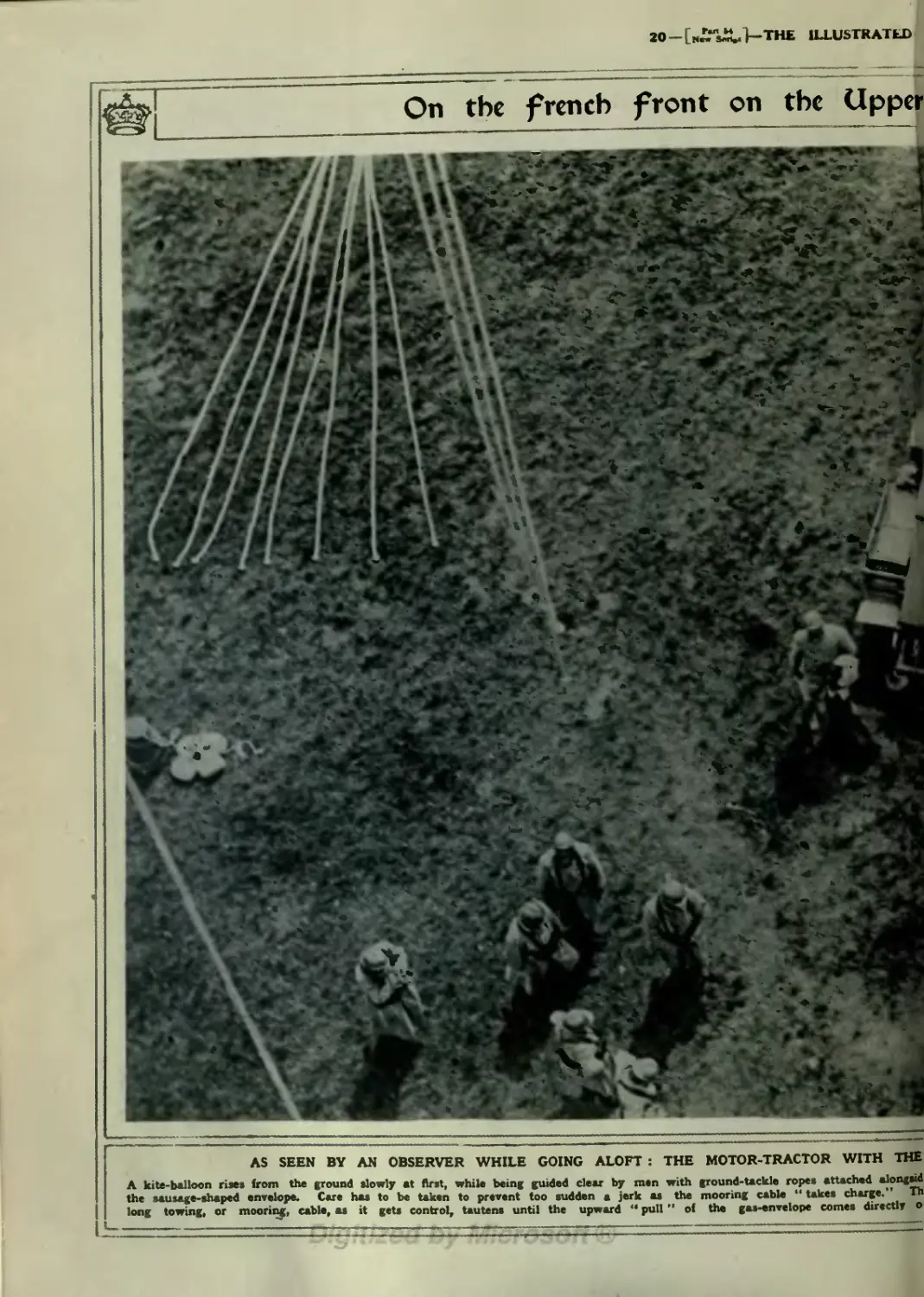

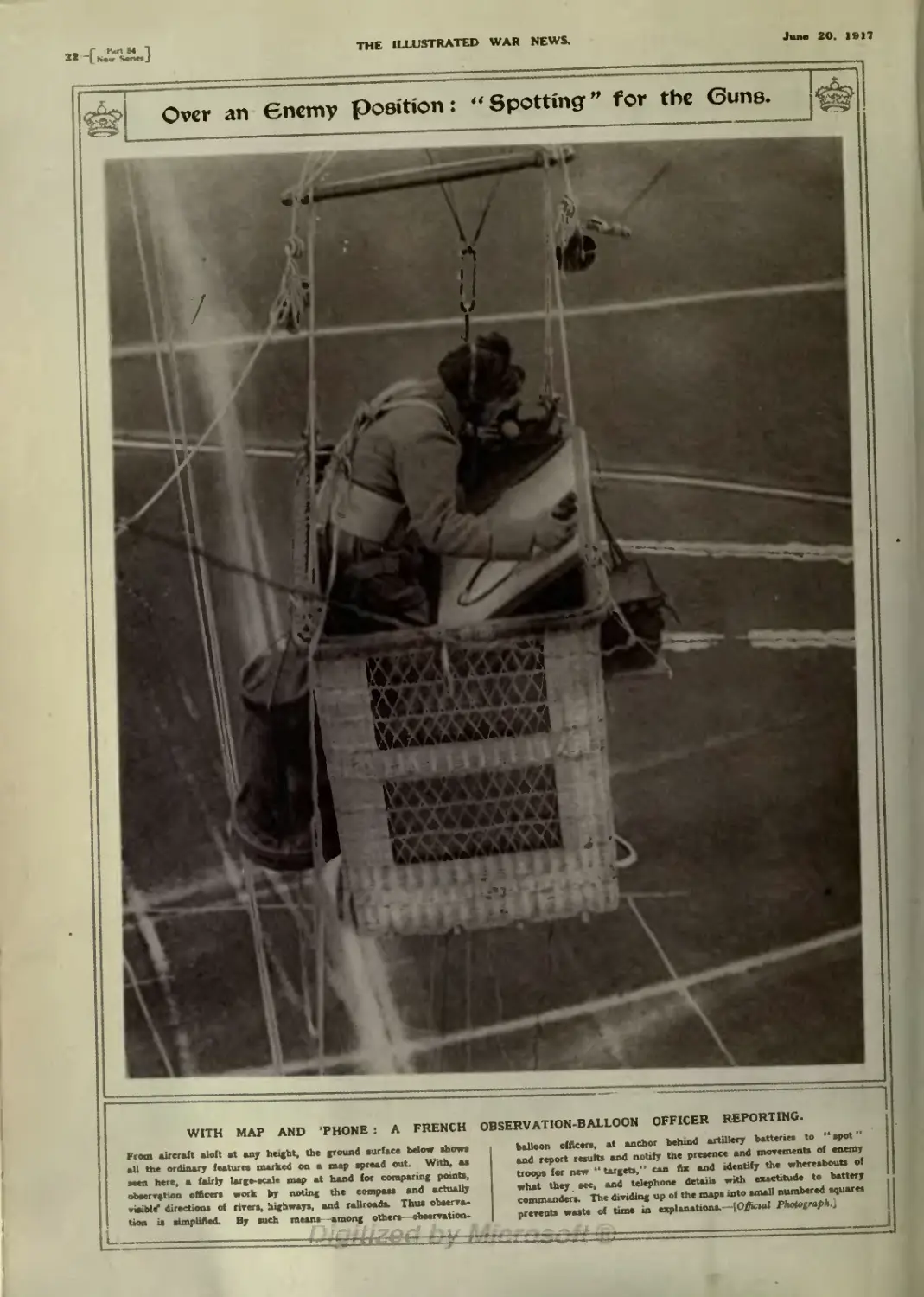
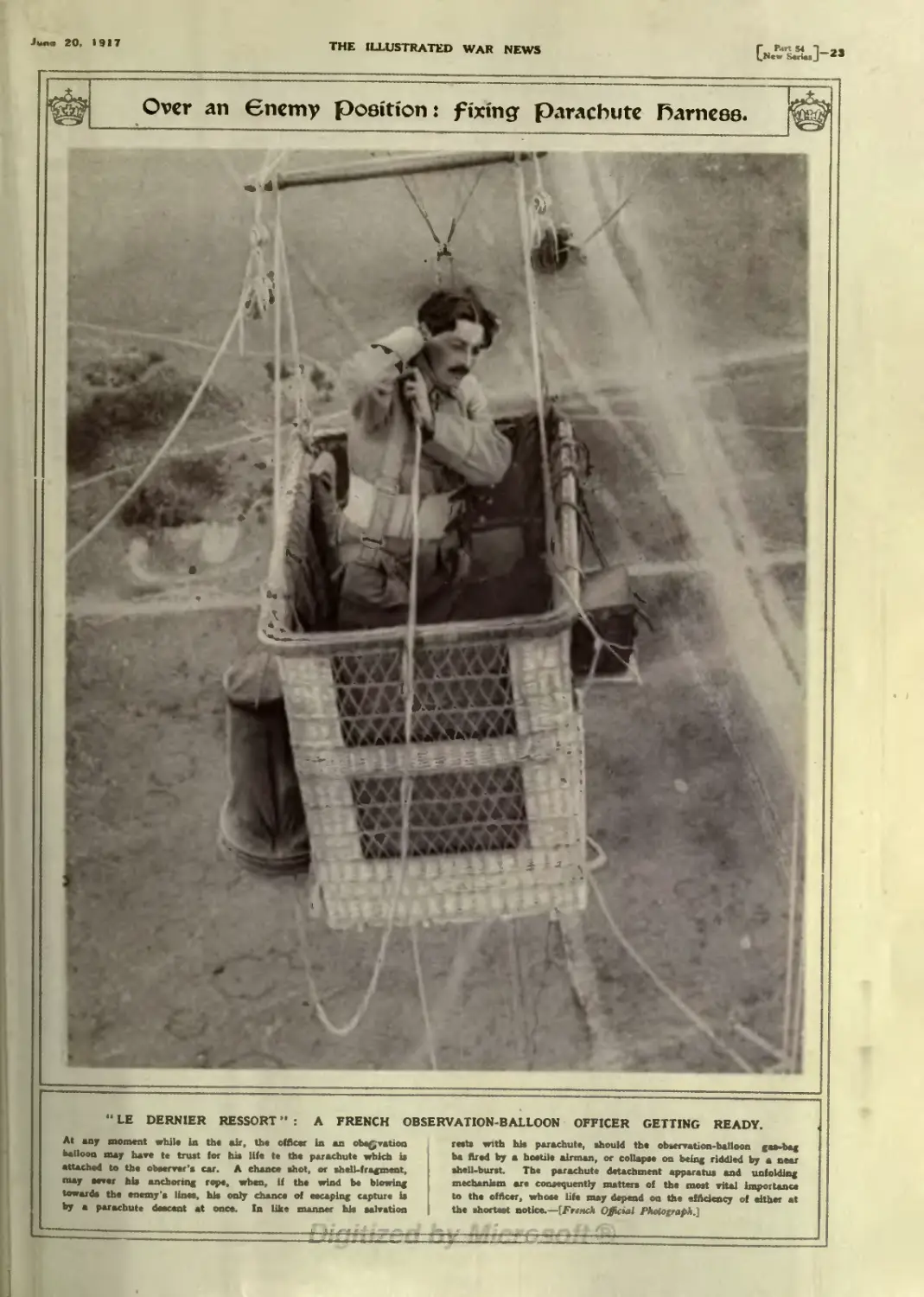
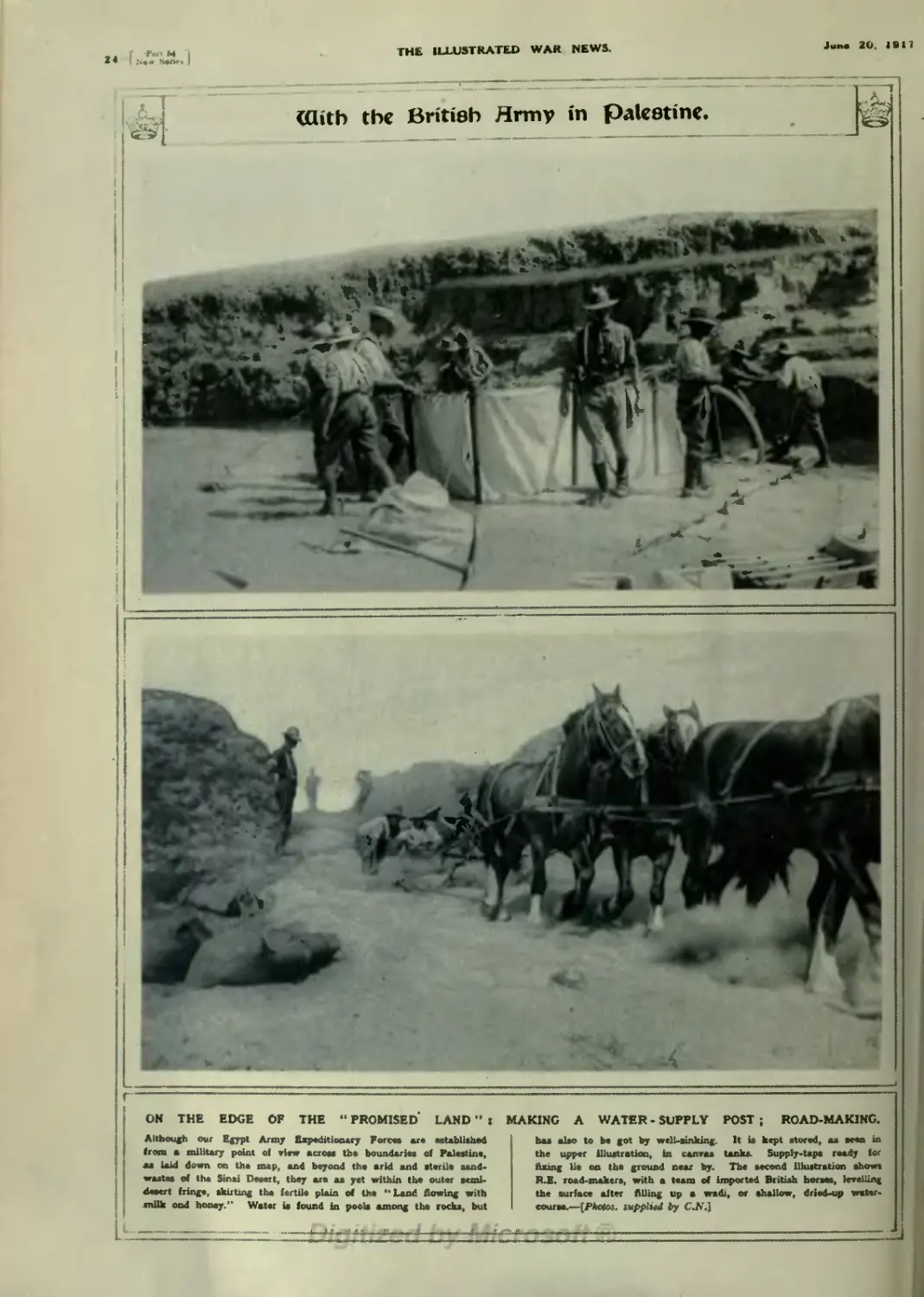











Теги: military news
Год: 2007




Текст
                    to
of tlje
of
Dr. P.K. Menzies

mniTmmniMiiii'iiiiiiNimiimnmiiiiiimiimiiiiiiiiiiiiiiimiiiiiiimiimiiimiiiiiimmim^^
THE
ILLUSTRATED
WAR NEWS.
Being a Pictorial Record of the Great War.
VOLUME 5 K3
PARTS 4960. (May 16th, 1917, to Aug. 1st, 1917.)
'Published by the ILLUSTRATED LONDON NEWS AND SKETCH, Ltd.,
172, Strand, London, W.C. 2.
iiMiiiiiiiiiiiiiiiiiiiiiiiiii'iitiiiiiiiitiiiiiiiiiiiiiiiiiiiiiiiiiiiiiiiiiiiiiiHiiiiiiiiiiiiiniiiiiiiiiiiiiiiiiiiiiiiiiiiiiiiiiiiiii

812317
LONDON :
THK ILLUSTRATED LONDON NEWS AND SKETCH, LIMITED,
t72. STRAND, LONDON, W.C. 2.

The Illustrated War Newt, May 16, 1917,-Part 49. New Series
CD* Illustrated War
Photo. C.t*
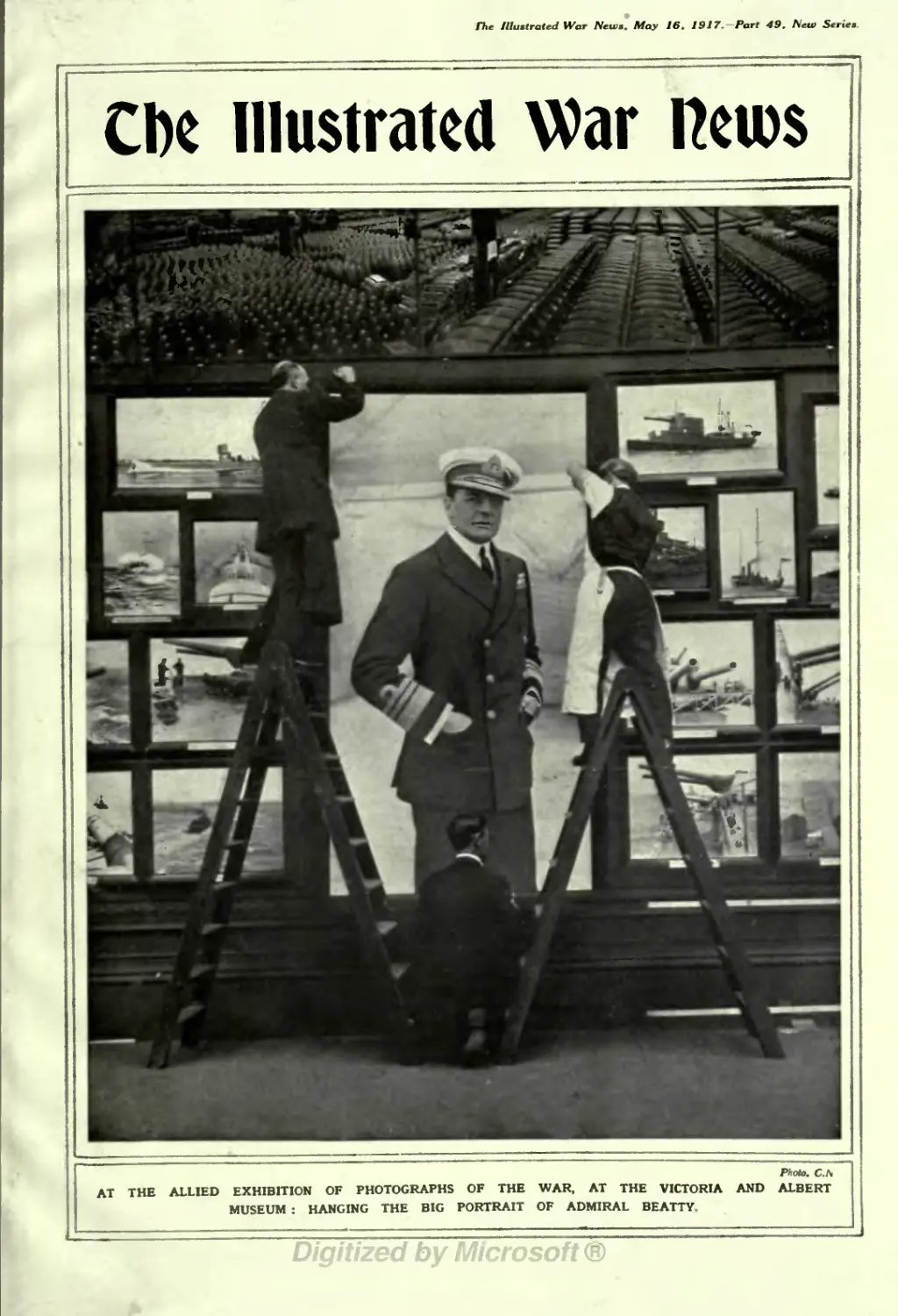
AT THE ALLIED EXHIBITION OF PHOTOGRAPHS OF THE WAR, AT THE VICTORIA AND ALBERT
MUSEUM : HANGING THE BIG PORTRAIT OF ADMIRAL BEATTY.

HP.crt HI 1
N, - -.-Mr. I
THE ILLUSTRATED WAR NEWS.
May 16. 1917
By W. DOUGLAS NEWTON.
WHY H1NDENBURG FIGHTS HARD-THE LEFT FLANK OF THE SUBMARINES-
BOTH FLANKS TESTED.
IT is not, perhaps, a new thing to say that the
battle going on in the West is the most
critical encounter in the war, but certainly each
d.iy doos bring us a new knowledge of its por-
tentousness, and certainly, as the fighting becomes
more desperate, we grow more to realise how this
great clash may very well be the most crucial of
all battles in the decline and fall of Germany.
From the very desperation of the resistance we
are beginning to recognise that there is more than
Hindenburg in it, and more than his Line. And,
(that may come through those flanks of his which
were, suddenly and unexpectedly, exposed to
crucial danger by the brilliant advances of the
British across the Vimy heights and the French
over the crests and plateaus running through
Craonne to Moronvilliers), though he is righting
to save the situation on the Hindenburg Line, he
is also fighting to save the bigger situation that
involves the fall or survival of his Empire by also
saving the day in France. It may even be
found and found very shortly that the whole
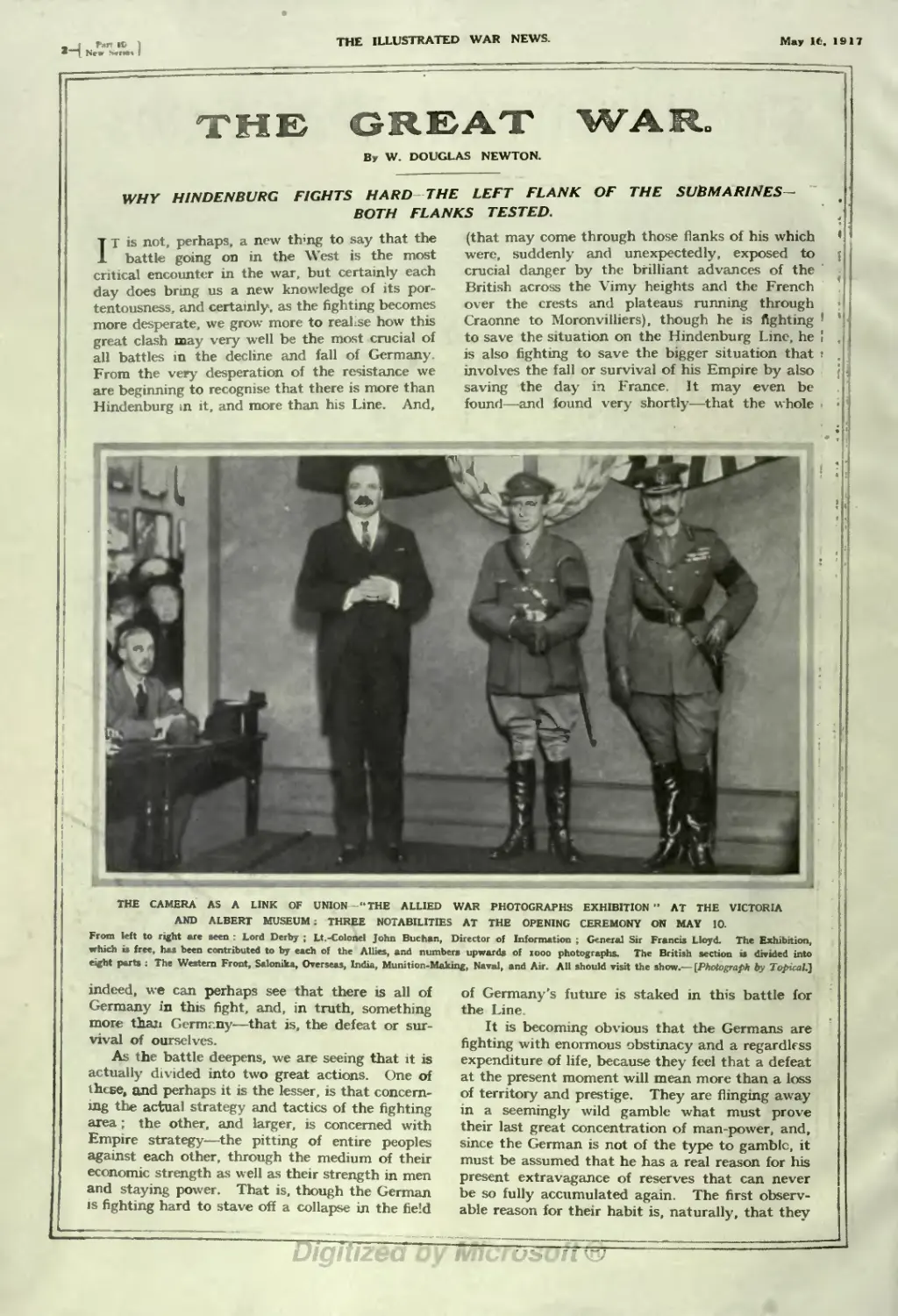
THE CAMERA AS A LINK OF UNION- "THE ALLIED WAR PHOTOGRAPHS EXHIBITION" AT THE VICTORIA
AND ALBERT MUSEUM : THREE NOTABILITIES AT THE OPENING CEREMONY ON MAY 10.
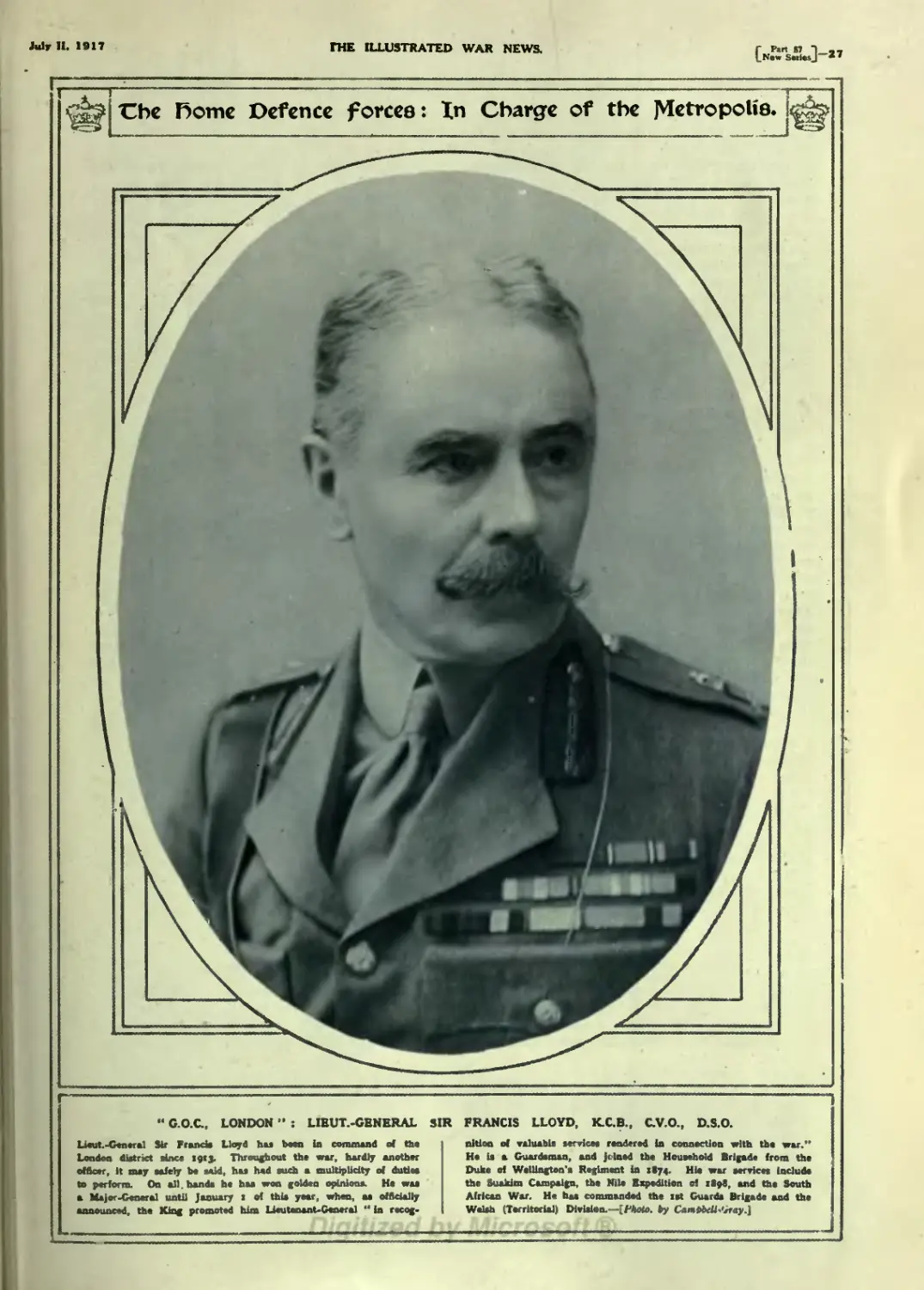
From left to right are seen : Lord Derby ; Lt. -Colonel John Buchan, Director of Information ; General Sir Francis Lloyd. The Exhibition,
which is free, has been contributed to by each of the Allies, and numbers upwards of 1000 photographs. The British section is divided into
eight parts : The Western Front, Salonika, Overseas, India, Munition-Making, Naval, and Air. All should visit the show. [Photograph by Topical.]
indeed, we can perhaps see that there is all of
Germany m this fight, and, in truth, something
more tliaii Germany that is, the defeat or sur-
vival of ourselves.
As the battle deepens, we are seeing that it is
actually divided into two great actions. One of
these, and perhaps it is the lesser, is that concern-
ing the actual strategy and tactics of the fighting
area ; the other, and larger, is concerned with
Empire strategy the pitting of entire peoples
against each other, through the medium of their
economic strength as well as their strength in men
and staying power. That is, though the German
is fighting hard to stave off a collapse in the field
of Germany's future is staked in this battle for
the Line.
It is becoming obvious that the Germans are
fighting with enormous obstinacy and a regardless
expenditure of life, because they feel that a defeat
at the present moment will mean more than a loss
of territory and prestige. They are flinging away
in a seemingly wild gamble what must prove
their last great concentration of man-power, and,
since the German is not of the type to gamble, it
must be assumed that he has a real reason for his
present extravagance of reserves that can never
be so fully accumulated again. The first observ-
able reason for their habit is, naturally, that they

May 16. 1917
THE ILLUSTRATED WAR NEWS.
CPart 49 "I ,
New Series J *
fear that the British and French will turn the line
which they hoped would hold them in security for
many months. But that reason gives rise to
another. Why should they be so anxious to delay
us. and delay us on this particular run of front ?
The answer to that is twofold. It is likely that
they hoped- to hold us in order to launch an
the possibles from the factories as well as from
the previously rejected. In this process she hts
mustered for this third year of war as many men
as she has had at any time under arms in the
war even, perhaps, more men. But beyond her
present accumulations she has little to draw
upon. She has her yearly classes of, roughly,
500,000 men each, but already some
of the future classes have appeared
in the field already she has got
ahead of her income in this respect.
She is then, perhaps, as strong as
she was, if not stronger ; but she
holds that position for the last time.
In verity this is her last chance. She
must make the most of it if she is to
succeed, for, if she fails, inevitably
she goes under.
Her last chance is no longer in the
battlefield. At the best, she cannot
hope to attain decisive ends against
an Alliance that can balance, and
probably exceed, her strength man
for man in the firing line ; that can
outweight her in guns and ammuni-
tion ; and, at the worst, could sit
down and pin her line to trench war-
fare until America, with her almost
inexhaustible strength, joined in the,
battle against her weakened fronts.
Even if, by' lucky chance, she
gained some big success, in a war
that is world-wide that success would be merely
local as her success against Belgium, North
France, Russia, Serbia, and Roumania have
only proved local and the Allies would merely
wait until their gathering forces were strong
enough to strike again. No ; success on the battle-
field is in practical politics (whatever it is in
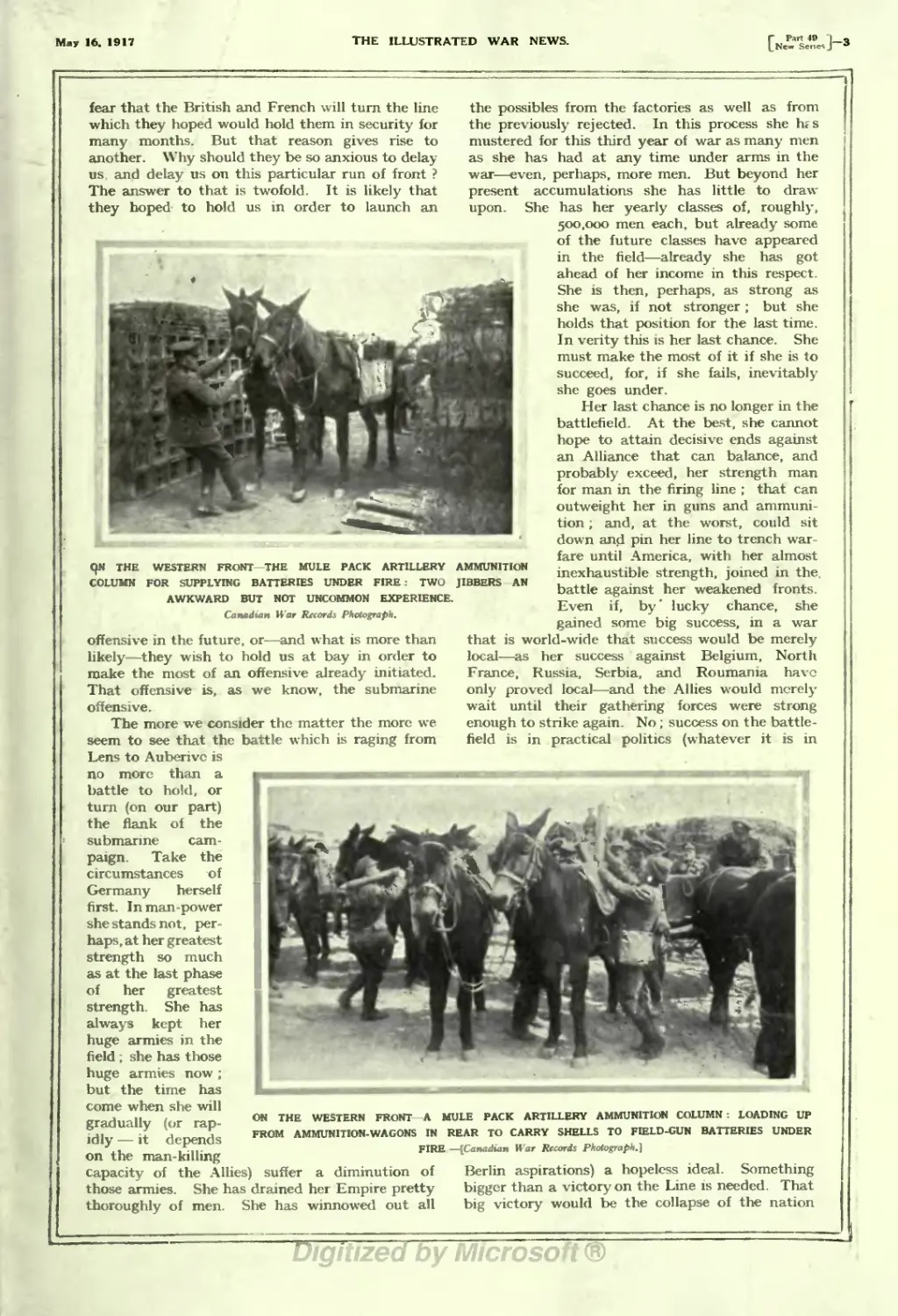
AMMUNITION
JIBBERS AN
QN THE WESTERN FRONTTHE MULE PACK ARTILLERY
COLUMN FOR SUPPLYING BATTERIES UNDER FIRE : TWO
AWKWARD BUT NOT UNCOMMON EXPERIENCE.
Canadian War Records Photograph.
offensive in the future, or and what is more than
likely they wish to hold us at bay in order to
make the most of an offensive already initiated.
That offensive is, as we know, the submarine
offensive.
The more we consider the matter the more we
seem to see that the battle which is raging from
Lens to Auberivc is
no more than a
battle to hold, or
turn (on our part)
the flank of the
submarine cam-
paign. Take the
circumstances of
Germany herself
first. In man-power
she stands not, per-
haps, at her greatest
strength so much
as at the last phase
of her greatest
strength. She has
always kept her
huge armies in the
field ; she has those
huge armies now ;
but the time has
come when she will
eraduallv (< r rao ON THE WESTERN FRONT- A MULE PACK ARTILLERY AMMUNITION COLUMN : LOADING UP
d d" FROM AMMUNITION-WAGONS IN REAR TO CARRY SHELLS TO FIELD-GUN BATTERIES UNDER
FIRE. [Canadian War Records Photograph.}
on the man-killing
capacity of the Allies) suffer a diminution of Berlin aspirations) a hopeless ideal. Something
those armies. She has drained her Empire pretty bigger than a victory on the Line is needed. That
thoroughly of men. She has winnowed out all big victory would be the collapse of the nation

Part 4 1
. N Sc
THE ILLUSTRATED WAR NEWS.
May 16. 1917
which is, at the present time, the keystone of the
Alliance. That nation is, of course, England, and
the method of bringing about collapse must be a
sea method. Since the German High Seas Fleet
is t . n tirely incapable of the task, it is the submarine
that muse bring victory.
The duty and, in fact, the determination ot
the Germans on land is to fight to help the battle
of the submarine. And the way this can be done
is first by fighting a delaying action that is, by
staving off a defeat that would be shattering to
Germany before the submarines won their day;
and secondly, by holding secure the communica-
tions of the submarines in other words, by
retaining their bases, the ports along the sea-
coast It is, indeed, obvious that Hmdenburg s
massive resistance and Haig's implacable attack
are extraordinarily concerned with the hold on
the coast. Haig's main line of thrust that is
entering and shaking the Wotan line from Queant
its work, to keep the coast, and to prevent his
own immediate flanks from collapse are the
reasons, then, why Hmdenburg is using up his
irreplaceable reserves in such lavish fashion. He
is forced to do this. He must make the most of
his last chance, though he must be extremely
chagrined by the knowledge that greater ability
than his own has forced him to adopt this pro-
cedure. For again it must be pointed out that
the Germans could have done all they are fighting
to do now from the comparative immunity of a
carefully prepared line if the Allies had been lax
enough to allow them. If the Allies had not dis-
organised the German retreat in the initial stages,
and then threatened it with calamity on the flanks,
the enemy could have delayed us (or would have
tried to do so) along their new front, which also
secured Lille and held tight the sea-coast. Now
the whole plan, including the submarine plan, is
threatened. There is nothing for it but to fight.
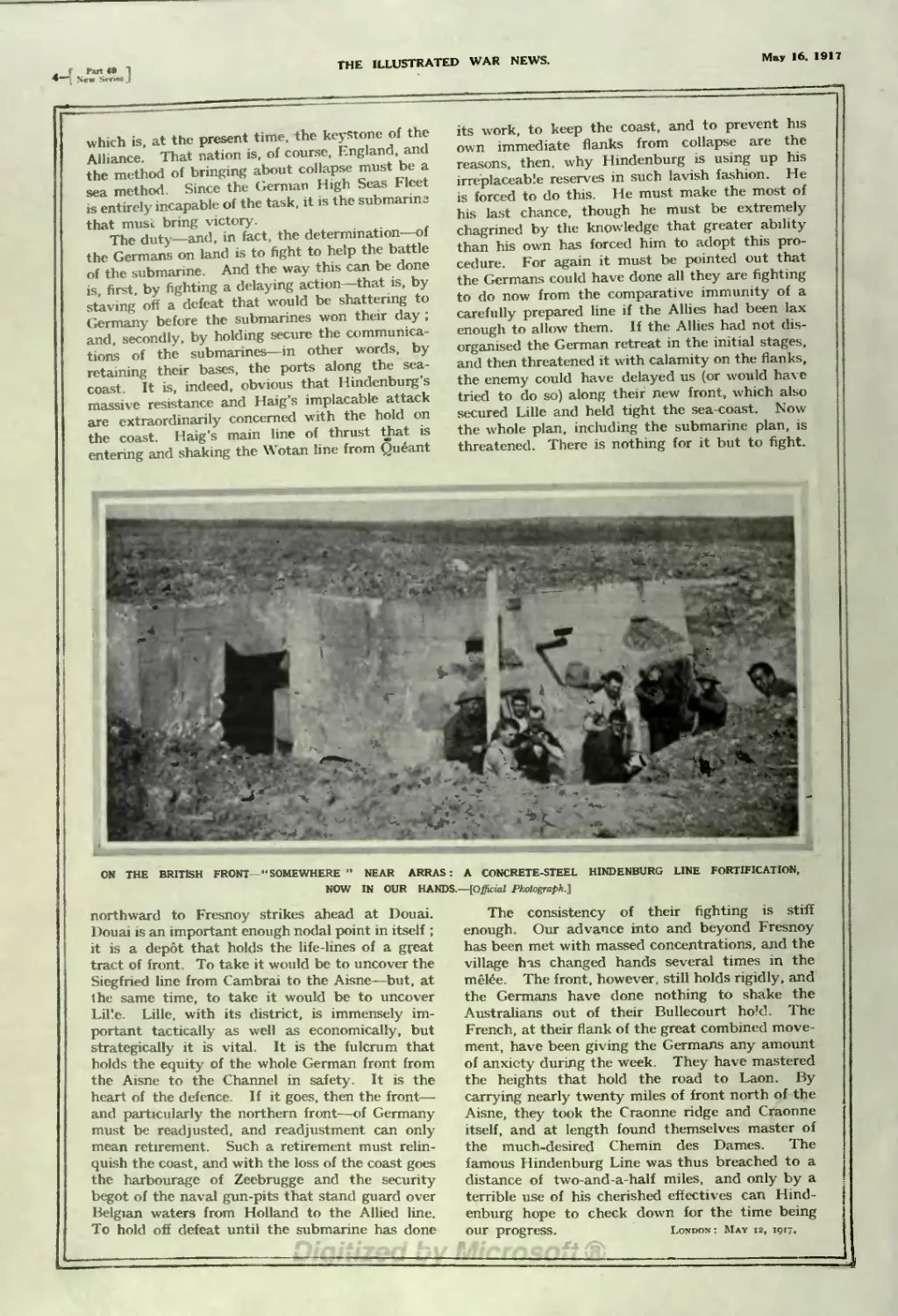
ON THE BRITISH FRONT " SOMEWHERE " NEAR ARRAS:
NOW IN OUR HANDS.
northward to Fresnoy strikes ahead at Douai.
Douai is an important enough nodal point in itself ;
it is a depot that holds the life-lines of a great
tract of front. To take it would be to uncover the
Siegfried line from Cambrai to the Aisne but, at
the same time, to take it would be to uncover
Lil!e. Lille, with its district, is immensely im-
portant tactically as well as economically, but
strategically it is vital. It is the fulcrum that
holds the equity of the whole German front from
the Aisne to the Channel in safety. It is the
heart of the defence. If it goes, then the front
and particularly the northern front of Germany
must be readjusted, and readjustment can only
mean retirement. Such a retirement must relin-
quish the coast, and with the loss of the coast goes
the harbourage of Zeebrugge and the security
begot of the naval gun-pits that stand guard over
Belgian waters from Holland to the Allied line.
To hold off defeat until the submarine has done
A CONCRETE-STEEL HINDENBURG LINE FORTIFICATION,
-[Official Photograph.]
The consistency of their fighting is stiff
enough. Our advance into and beyond Fresnoy
has been met with massed concentrations, and the
village has changed hands several times in the
melee. The front, however, still holds rigidly, and
the Germans have done nothing to shake the
Australians out of their Bullecourt hold. The
French, at their flank of the great combined move-
ment, have been giving the Germans any amount
of anxiety during the week. They have mastered
the heights that hold the road to Laon. By
carrying nearly twenty miles of front north of the
Aisne, they took the Craonne ridge and Craonne
itself, and at length found themselves master of
the much-desired Chemin des Dames. The
famous Hindenburg Line was thus breached to a
distance of two-and-a-half miles, and only by a
terrible use of his cherished effectives can Hind-
enburg hope to check down for the time being
Our progress. LONDON : MAY 12, 1917,

Mar 16. 1917
THE ILLUSTRATED WAR NEWS.
f Prt 1_ 5
LNw Series J
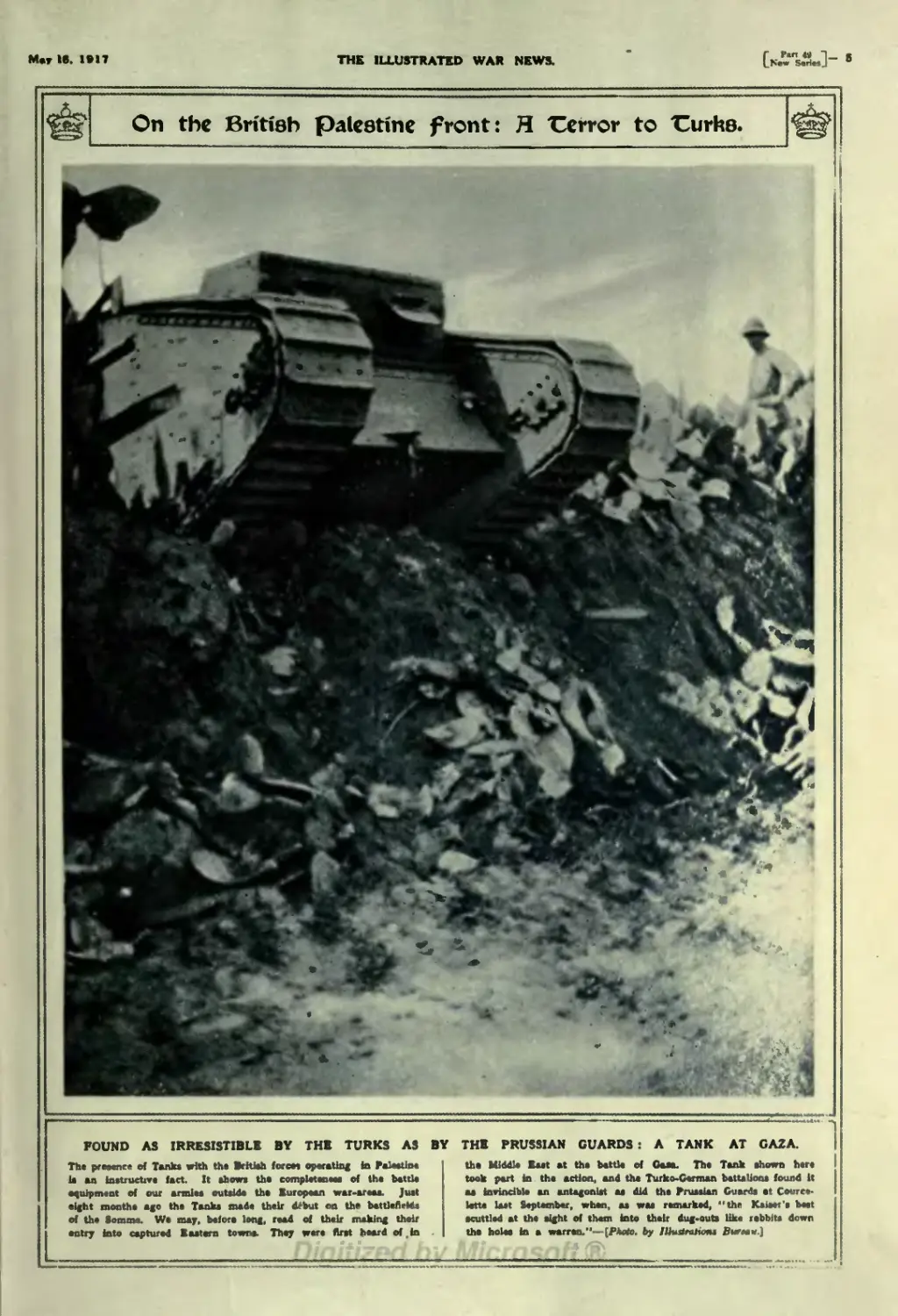
On the British Palestine front: H terror to TTurhs.
FOUND AS IRRESISTIBLE BY THE TURKS AS BY THE PRUSSIAN GUARDS : A TANK AT CA2A.
L
Tht pretence of Tanks with tht Britiih form optratlng in P.le.tin-
is in instructive fact. It shows th compltttnets of tht battle
Kjuipm-nt of our armlea outside thi European war-arau. Juit
tight montha afo the Tanka made their d>'-but on tht battltneMs
o( tht Sommc. Wt may, before lonf, read of thtir making thtir
entry into capturtd Eaittrn towna. Thty wtrt flrtt heard of in
tht Middle Rail at tht battle of Gala. The Tank shown htrt
took part In tht action, and tht Turko-Ctrman battalions found It
a invincible an antagonist aa did tht Prussian Guards at Courct*
Itttt last September, when, as was rtmarktd, "thft Kaiatr's bttt
scuttled at tht sight of thtm into thtir dug-outs like rabhlts down
tht holts in a warrtn." [Photo, by Illustrations Bureau.]

THE ILLUSTRATED WAR NEWS.
M y 16. 191'
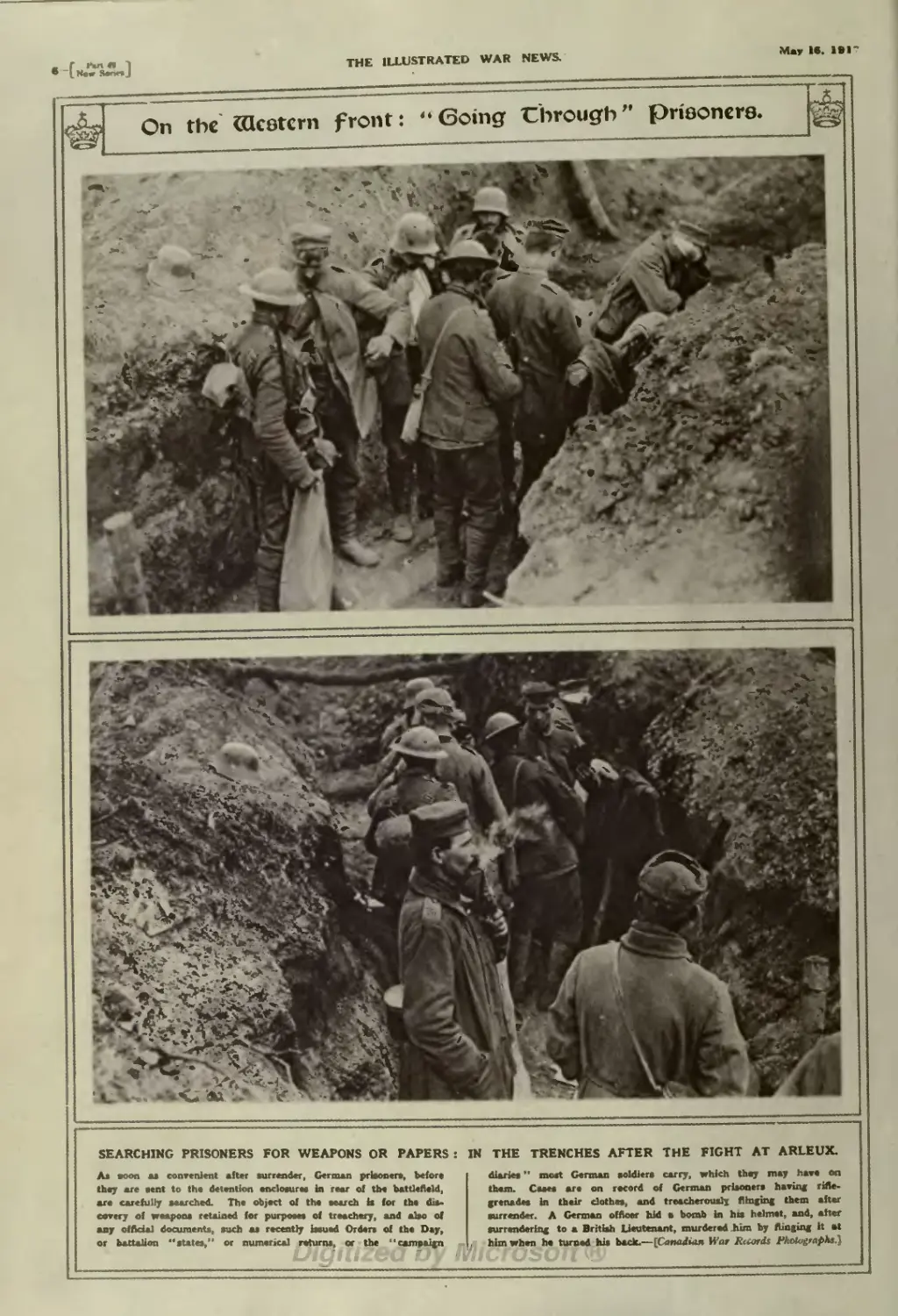
On the Western front: -Going through" prisoners.
SEARCHING PRISONERS FOR WEAPONS OR PAPERS : IN THE TRENCHES AFTER THE FIGHT AT ARLEUX.
As soon * convenient after surrender, German prisoner*, before
they are lent to the detention enclosures in rear ol the battlefield,
are carefully searched. The object of the search is for the dis-
covery of weapons retained for purposes of treachery, and also of
any official documents, such as recently issued Orders of the Day,
or battalion "states, ' ' or numerical returns, or the ' ' campaign
diaries " most German soldiers carry, which they may have on
them. Cases are on record of German prisoners having rifle-
grenades in their clothes, and treacherous!? flinging them after
surrender. A German officer hid a bomb in his helmet, and, after
surrendering to a British Lieutenant, murdered him by flinging it at
him when he turned his back. [Canadian War Records Photographs.}

May 16. 1917
THE ILLUSTRATED WAR NEWS.
[Pare 4* 1
N-w S,r,,, I
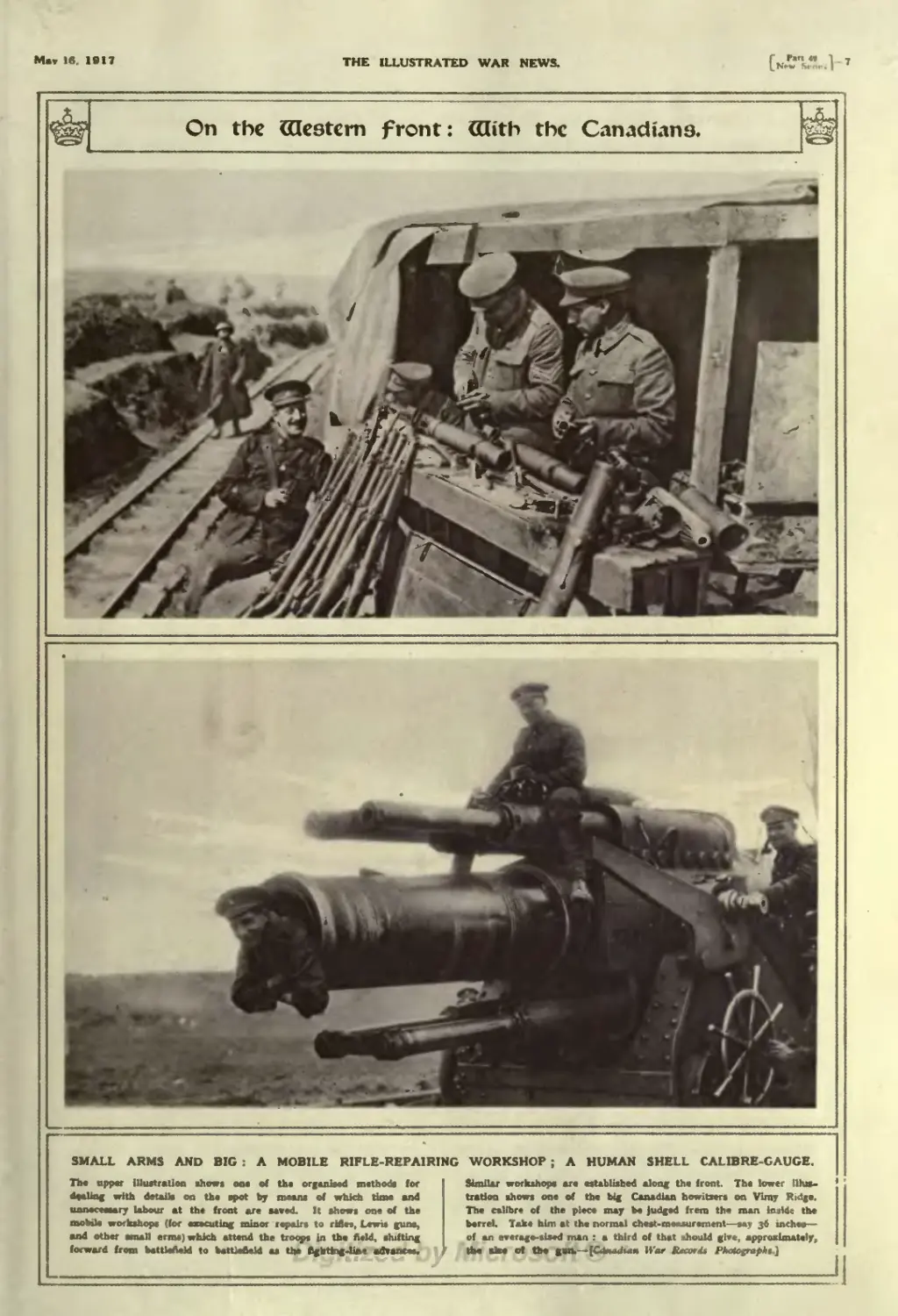
On the Western front: CHith the Canadians.
SMALL ARMS AND BIG : A MOBILE RIFLE-REPAIRING WORKSHOP ; A HUMAN SHELL CALIBRE-GAUGE.
The upper illustration shows one of the organised 1 methods (or
dealing with details on the spot by means of which time and
unnecessary labour at the front are saved. It shows one of the
mobile workshops (for executing minor repairs to rifles, Lewis guns,
and other small arms) which attend the troops in the field, shifting
forward from battlefield to battlefield aa the ftghting-line advances.
Similar workshops are established along the front. The lower Illus-
tration shows one of the big Canadian howitzers on Vimy Ridge,
The calibre of the piece may be judged from the man inside the
barrel. Take him at the normal chest-measurement- say 36 inches
of an average-sued man : a third of that should give, approximately,
the size of the gun.--[Cuiw*/)u War Records Photograph.]

. f hm t )
IN.. s.nwj
THE ILLUSTRATED WAR NEWS.
Mar 16. 1917
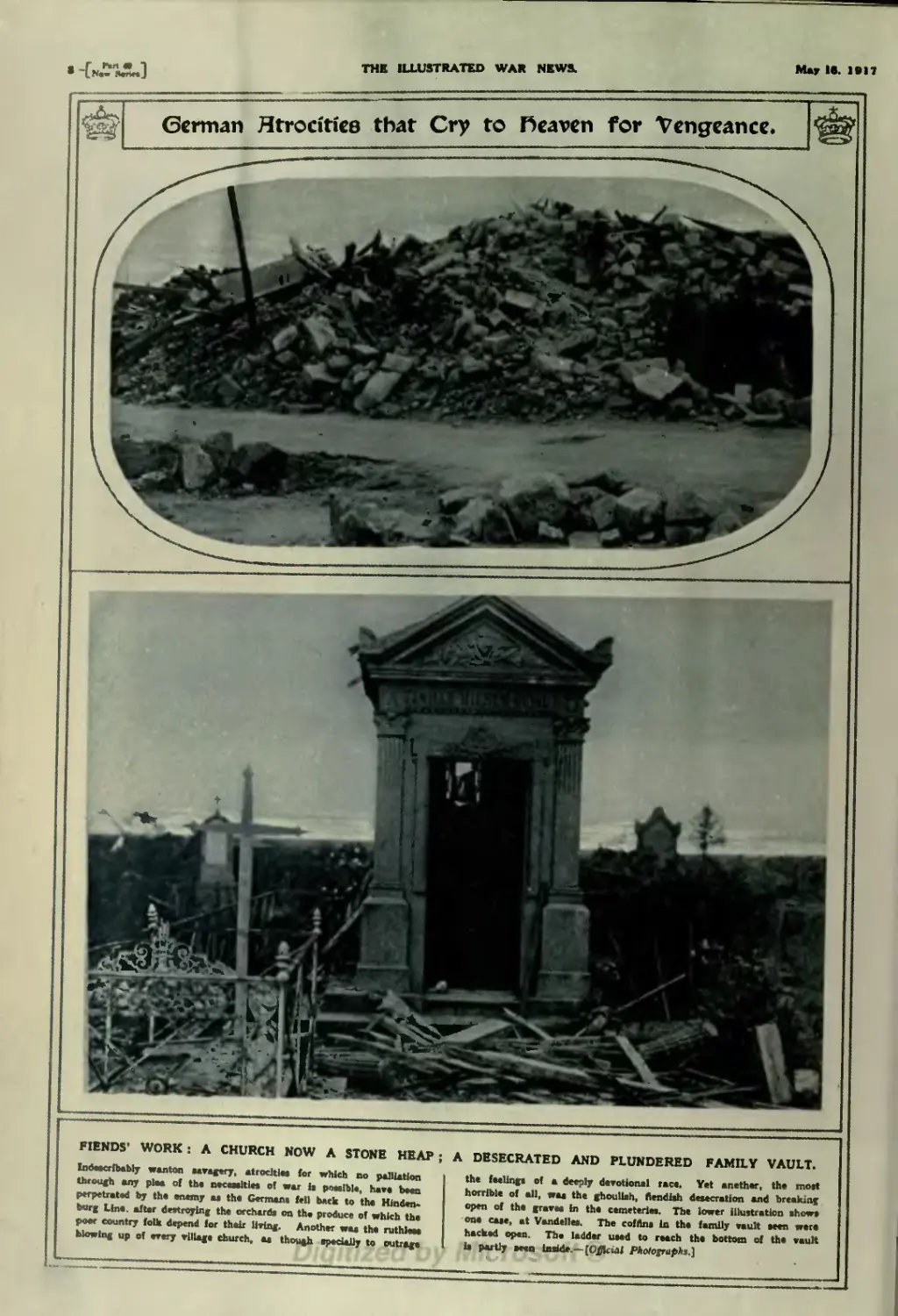
German Htrocftics that Cry to Reaven for Vengeance.
:. LT^LT: sTMrE .' * ~ -
wanton u*frj. atrocitle, for which no palliation
through any pie. of th neceMitie, ( war |. pOBib]
prrp. M b, the , nemy lhe Cermin , b , P ck ,
br Lin., ., dMtroying th orchard, on th. produce of which
poor country f. lk d ^ nd lor lheit 1|ri Ano , P her ^
up of wnr ,m.g, church, U ,hou,h ,pUU, ,
th* hclinfi of a deeply derotlon.l race. Yet another, th. moit
of kit, M the houll.h, flendiih deiecr.tion n<l bre.kins
open of the (rare, in the cemeterle,. The lower illustration .how
.ewe, at Vandelle.. The coffin, In the family Tault ,een were
sa open. The ladder ud to reach the bottom of the vault
ii partly ,een lnlde. [Official Pkotographs.]

Mar 16. 1917
THE ILLUSTRATED WAR NEWS
f Part 49 1 .
(.New Scrios I '
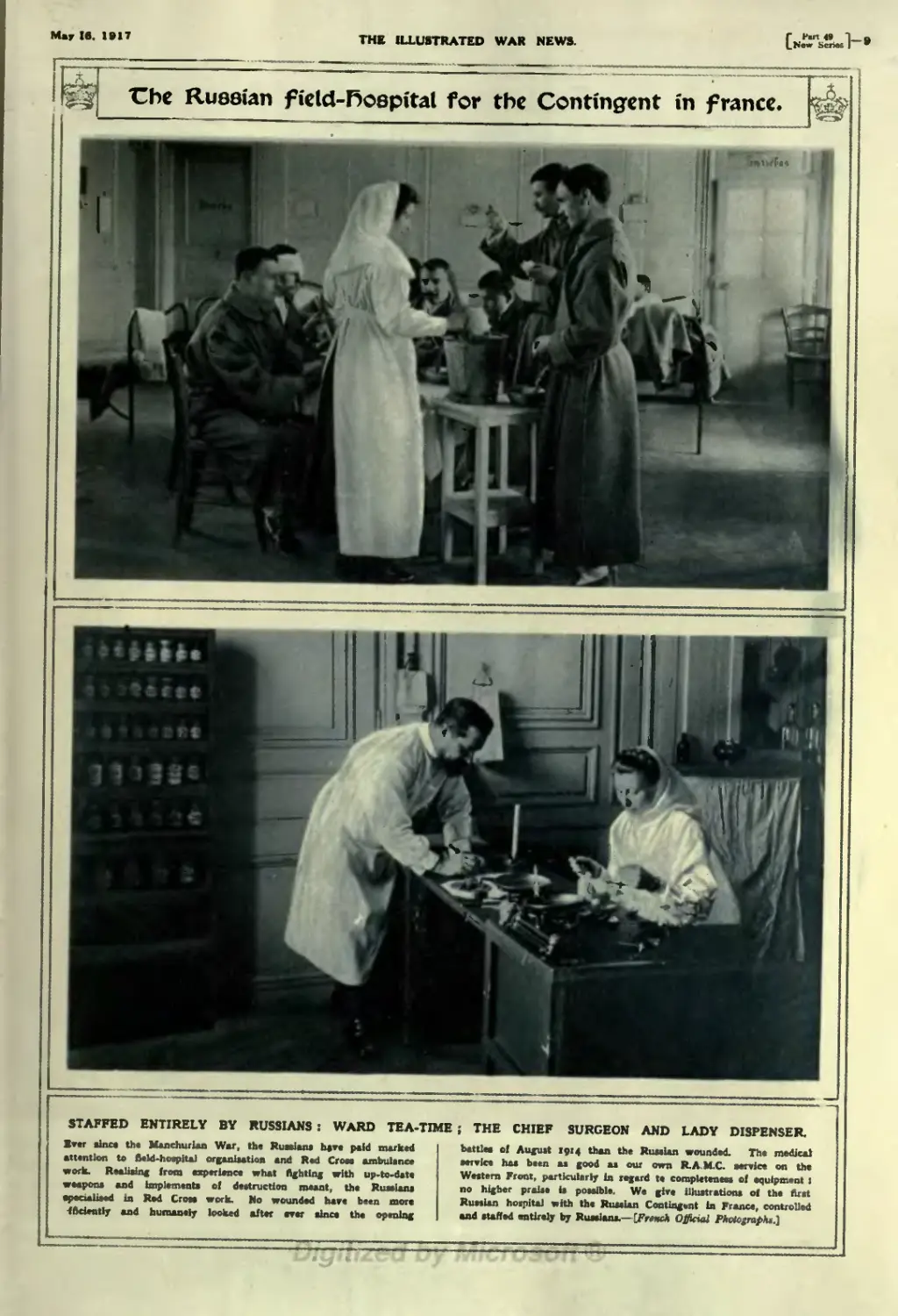
TThc Russian fieUl-fiospital for the Contingent in f ranee.
STAFFED ENTIRELY BY RUSSIANS; WARD TEA-TIME; THE CHIEF SURGEON AND LADY DISPENSER.
Erer since the Manchurian War, the Russian* hare paid marked
attention to neld-hoipital organisation and Red Crow ambulance
work. Realiiing from experience what lighting with up-to-date
weapon! and implement! o( deitruction meant, the Russian!
pecialued in Red Crou work. No wounded hare been more
Inelentlr and humanely looked after erer line* the opening
battle of Augutt 1914 than the Ruuian wounded. The medical
lervice hai been ai good ai our own R.A.M.C. lervice on the
Weitern Front, particularly in regard to completeneii of equipment :
no higher praie is pouible. We gire illuitrationi of the firit
Ruifian hospital with the Ruuian Contingnt in France, controlled
and itaffed entirely bjr Ruwlana,- [French Official Photographs.}

,0 THE ILLUSTRATED WAR NEWS. M.y 1. 11
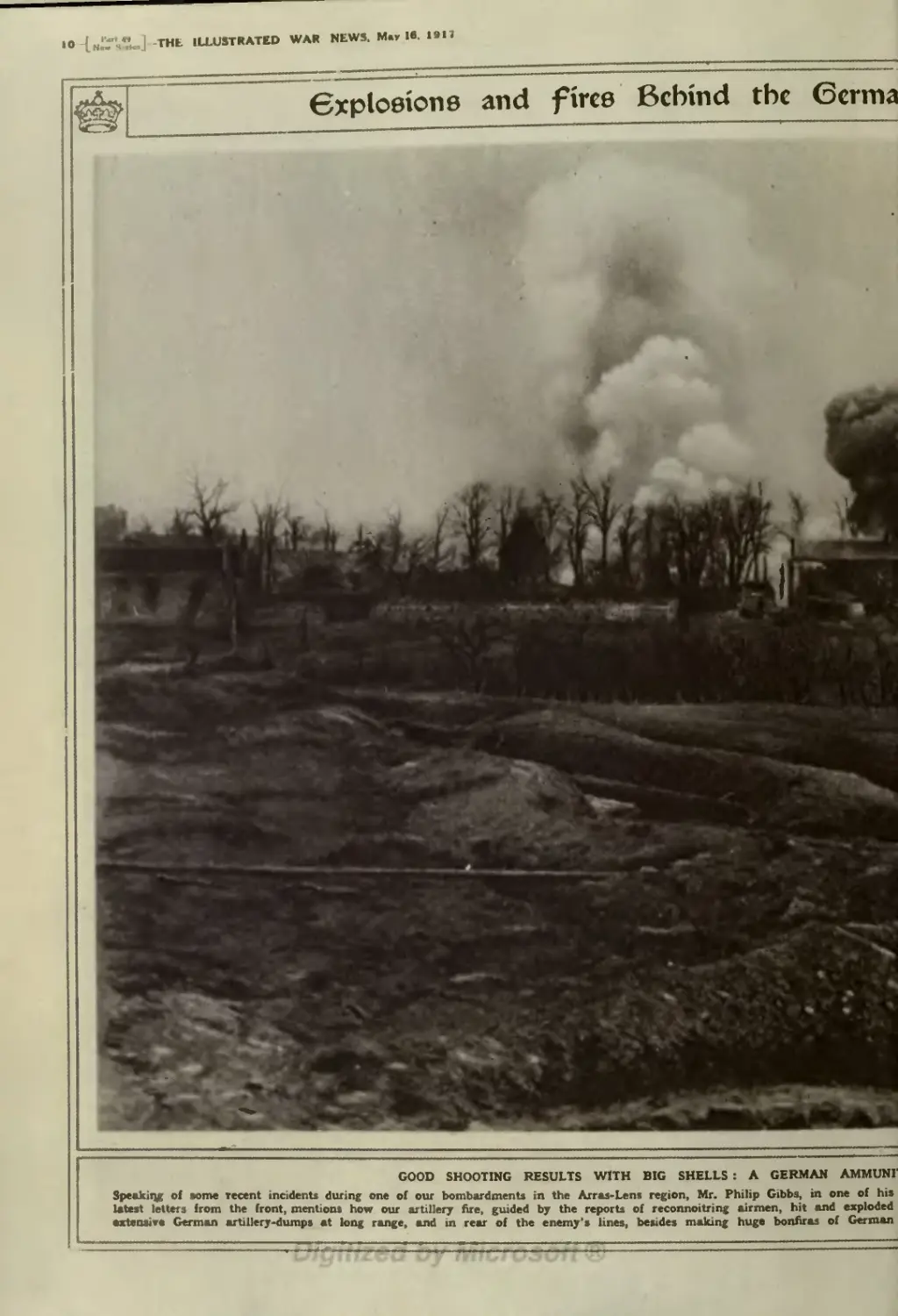
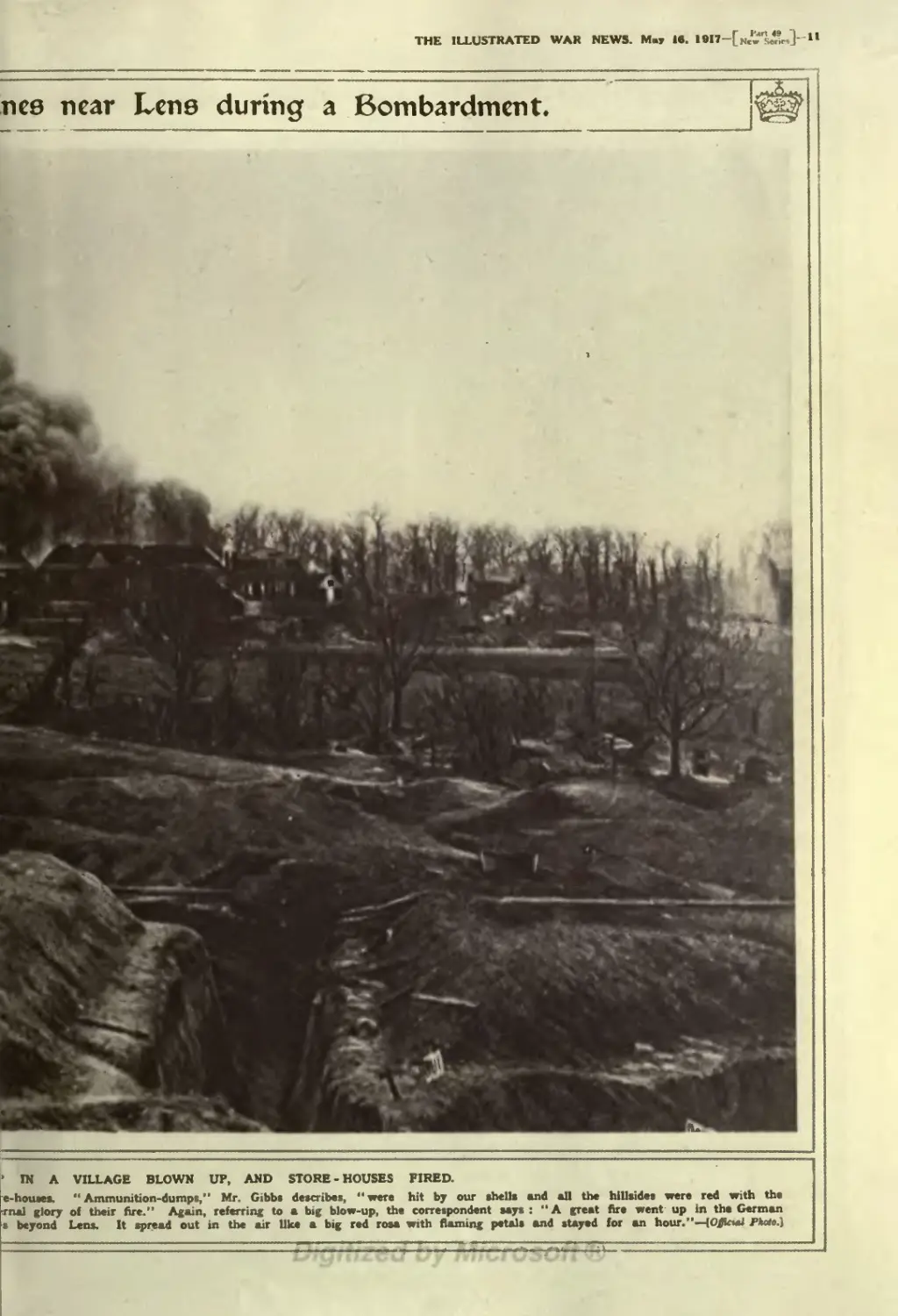
explosions and fires Behind the Gcrma
GOOD SHOOTING RESULTS WITH BIG SHELLS : A GERMAN AMMUNI
Speaking of some recent incidents during one of our bombardments in the Arras-Lens region, Mr. Philip Gibbs, in one of hij
latest letters from the front, mentions how our artillery fire, guided by the reports of reconnoitring airmen, hit and exploded
extensive German artillery-dumps at long range, and in rear of the enemy's lines, besides making huge bonfires of German

THE ILLUSTRATED WAR NEWS. MM 16. 1917- [NCW"^.-,
nee near Lens during a Bombardment.
I
IN A VILLAGE BLOWN UP, AND STORE- HOUSES FIRED.
e-houws. "Ammunition-dumps," Mr. Gibb describes, "were hit by our shells and all the hillsides were red with the
rnal glory of their fire." Again, referring to a big blow-up, the correspondent says : "A great fire went up in the German
s beyond Lens. It spread out in the air like a big red rose with flaming petals and stayed for an hour." (Official

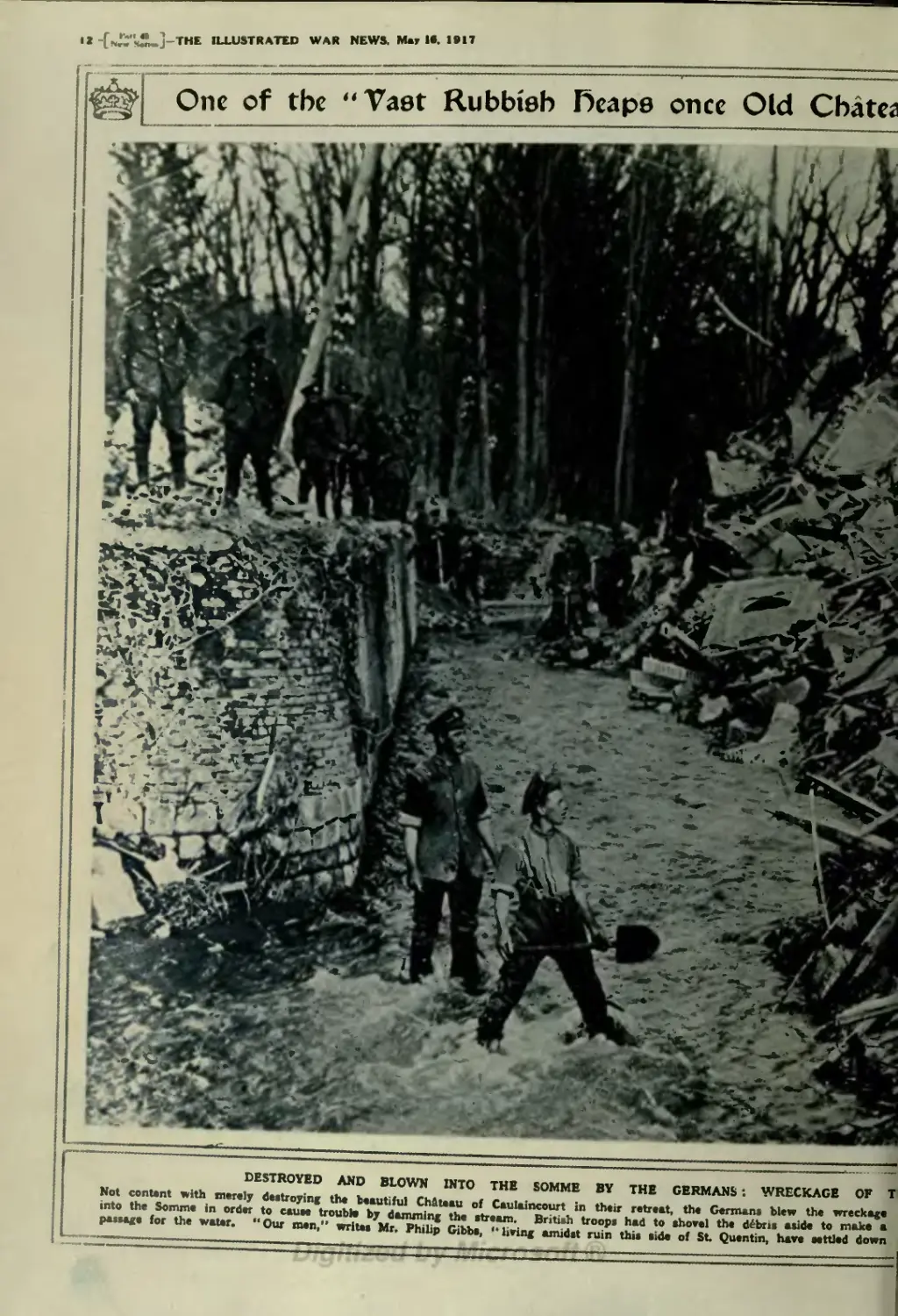
'* -(\i"s.]-THE ILLUSTRATED WAR NEWS, May 18. 1917
One of the "Vast Rubbish Reaps once Old Cbatea
, ''" Ord " t0
for th. w.t.r. "Our m.n," wriu. Mr.
Gibb.
Clbbt '
SOMME BY THE GERMANS : WRECKAGE OF T
n their retreat, the Germans blew the wreckage
troops had to shovel the debris aside to make a
amidst ruin this side of St Quentin, have settled down

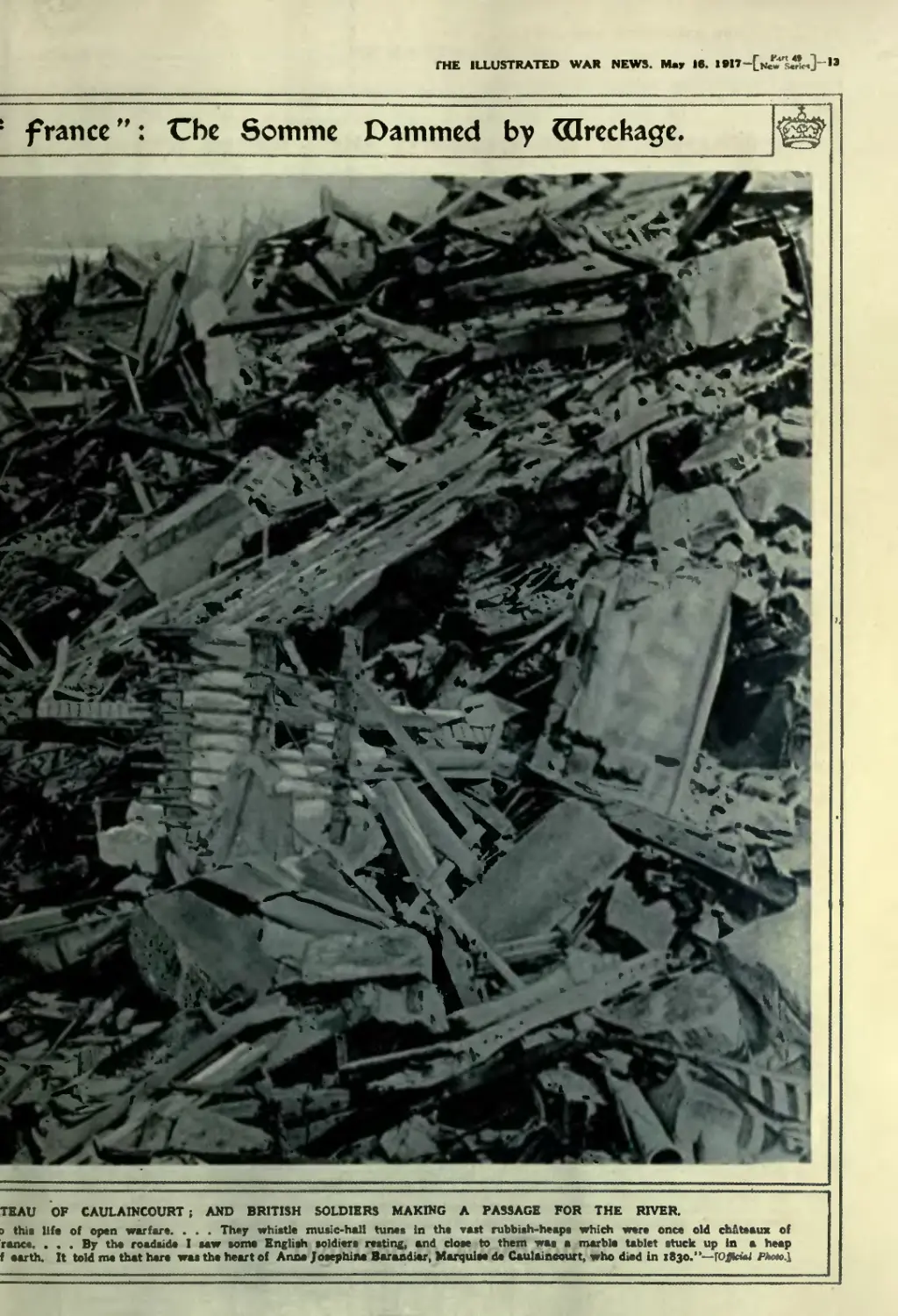
THE ILLUSTRATED WAR NEWS. M., 16. I9I7-[ N / w ' r s. 4 rk,]- 13
f ranee " : TTbc Somme Dammed by Cdreckage,
TEAU OF CAULAINCOURT ; AND BRITISH SOLDIERS MAKING A PASSAGE FOR THE RIVER.
3 this life of open warfare. . . . They whittle music-hall tunes In the vast rubbish-heaps which were once old ch&teaux of
ranee. ... By the roadside I saw some English soldiers resting, and close to them was a marble tablet stuck up in a heap
f earth. It told me that here was the heart of Anne Josephine Barandier, Marquise de Caulaincourt, who died in 1830." {Official Pkoto.l

THE ILLUSTRATED WAR NEWS.
Mar 1C. 1917
ROMANCES OF THE REGIMENTS: XLIX.-THE 2ND D.C.L.I.
HOW HOMER SAVED THE REGIMENT.
THIS story is no cunning argument in favour
of the retention of the ancient classics, now
in some disrepute. For the Homer who is the
hero of the tale was not the blind old bard of
Chios' rocky isle, but, as Punch said (with refer-
ence to the Homeric Question), " another man of the
same name." His full name was Thomas Homer,
and he had this much in common with his great
godfather
that his deeds
were Homeric,
and worthy to
be sung by the
father of mar-
tial poetry.
Thomas
Homer began
life as a me-
chanic in Bir-
m i n g h a m,
where he served
his apprentice-
ship in a small-
arms factory.
Becoming an
expert gun-
smith, he in
1826 entered
the 46th Regi-
ment, later the
South Devon,
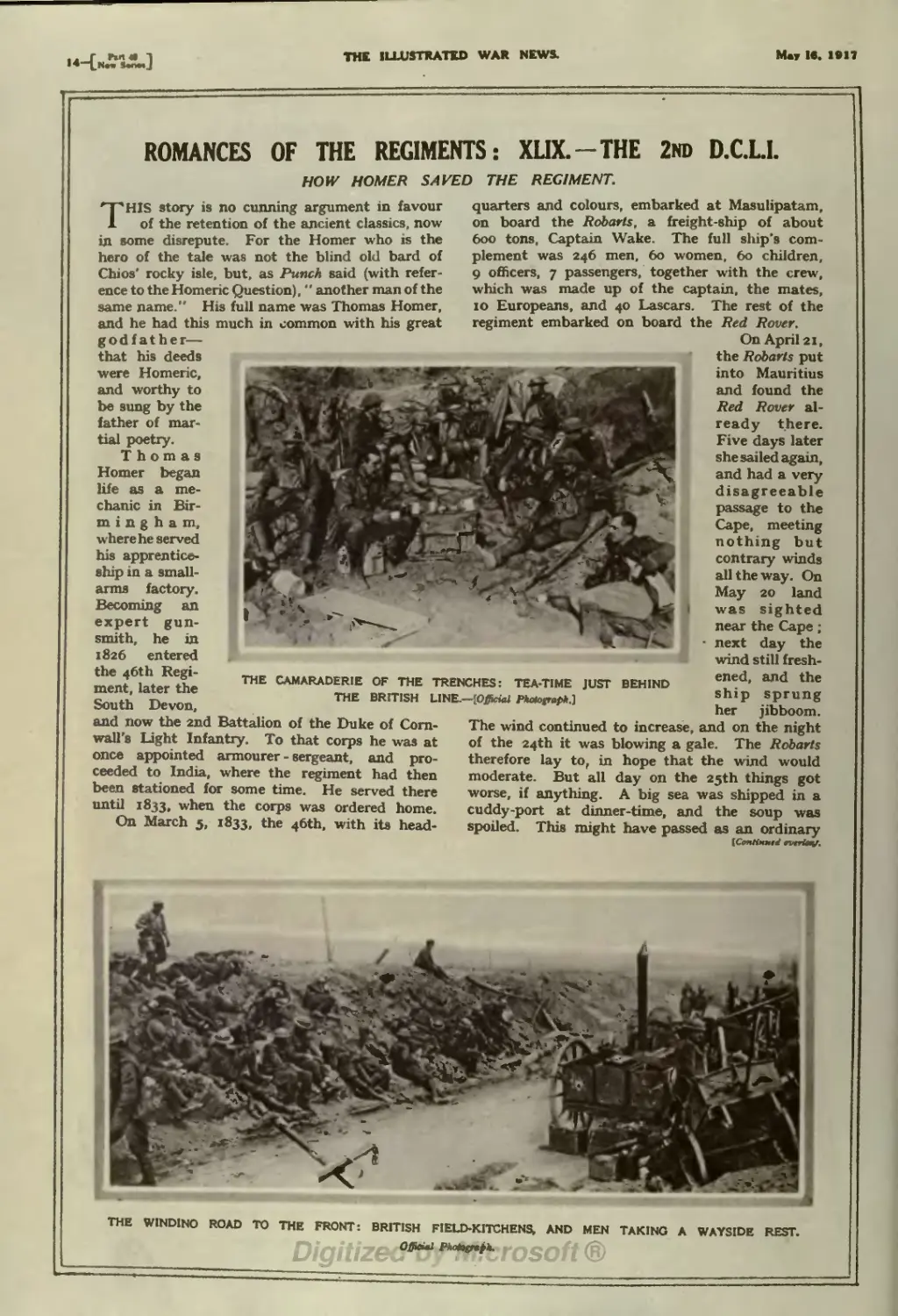
THE CAMARADERIE OF THE TRENCHES: TEA-TIME JUST BEHIND
THE BRITISH LINE. [Official Pkolograpli.)
and now the 2nd Battalion of the Duke of Corn-
wall's Light Infantry. To that corps he was at
once appointed armourer - sergeant, and pro-
ceeded to India, where the regiment had then
been stationed for some time. He served there
until 1833, when the corps was ordered home.
On March 5, 1833, the 46th, with its head-
quarters and colours, embarked at Masulipatam,
on board the Robarts, a freight-ship of about
600 tons, Captain Wake. The full ship's com-
plement was 246 men, 60 women, 60 children,
9 officers, 7 passengers, together with the crew,
which was made up of the captain, the mates,
10 Europeans, and 40 Lascars. The rest of the
regiment embarked on board the Red Rover.
On April 2 1 ,
: - . ^ the Robarts put
into Mauritius
and found the
Red Rover al-
ready there.
Five days later
she sailed again,
and had a very
disagreeable
passage to the
Cape, meeting
nothing but
contrary winds
all the way. On
May 20 land
was sighted
near the Cape ;
next day the
wind still fresh-
ened, and the
ship sprung
her jibboom.
The wind continued to increase, and on the night
of the 24th it was blowing a gale. The Robarts
therefore lay to, in hope that the wind would
moderate. But all day on the 25th things got
worse, if anything. A big sea was shipped in a
cuddy-port at dinner-time, and the soup was
spoiled. This might have passed as an ordinary
ICcnHnxn '
THE WINDING ROAD TO THE FRONT: BRITISH FIELD-KITCHENS, AND MEN TAKING A WAYSIDE REST.
Official Pkotograpli.

MT IB. 1817
THE ILLUSTRATED WAR NEWS.
r part t ~L,i
I New !.<-rta I '
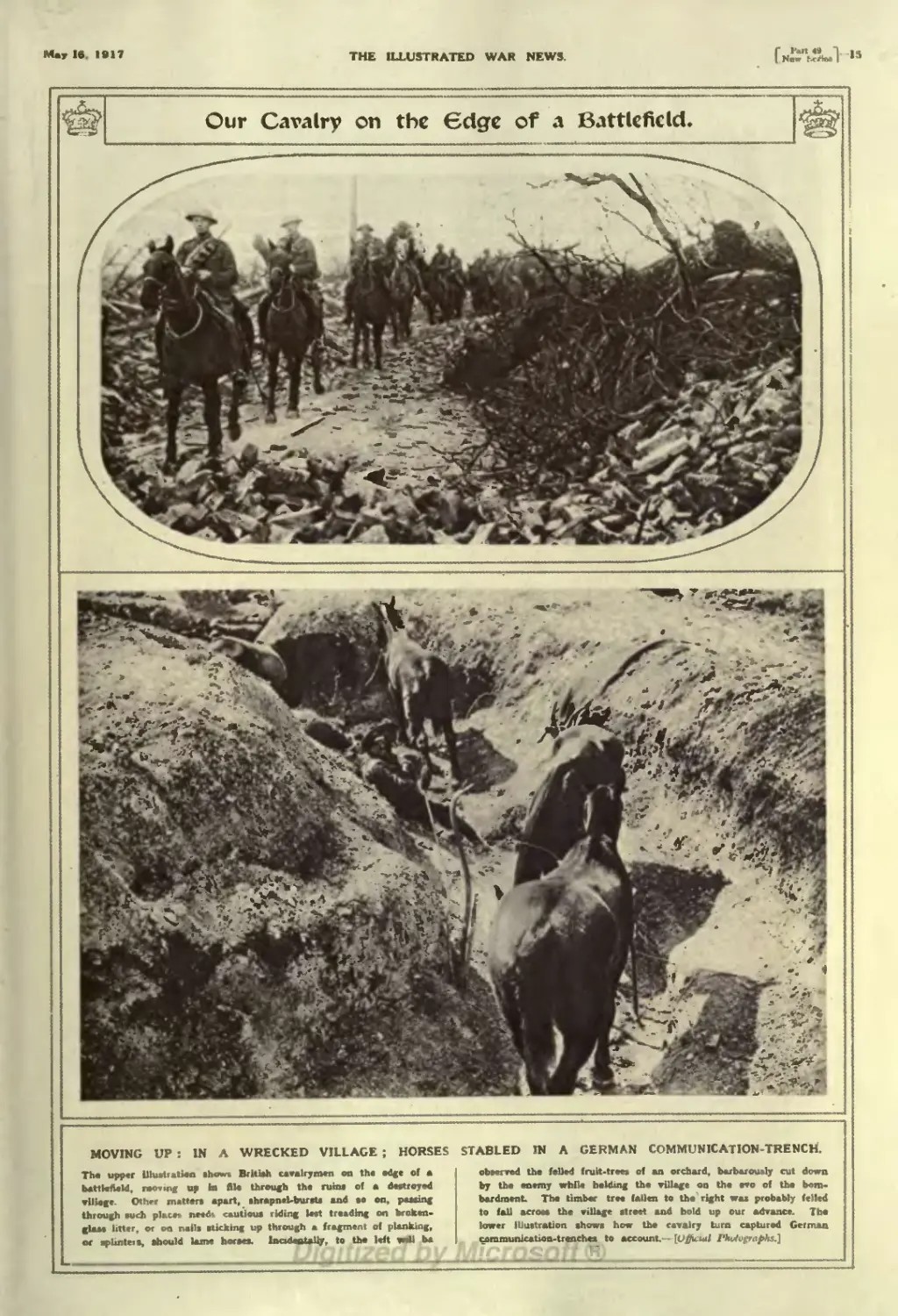
Our Cavalry on the dgc of a Battlefield.
#** to - ..
a|f&i
WRECKED VILLAGE ; HORSES STABLED IN A GERMAN COMMUNICATION-TRENCH.
MOVING UP : IN A
The upper illustration shows British cavalrymen on the edge of a
battlefield, rnnving up in Ale through the ruin* of a destroyed
Tillage. Other matters apart, shrapnel-bursts and *o on, pawing
through such pUtes nted<> cautious riding lest treading on broken-
glast litter, or t>n nails sticking up through a fragment of planking,
or splintris, should lame horses. Incidentally, to the left will be
| observed the felled fruit-trees of an orchard, barbarously cut down
by the enemy while holding the village on the eve of the bom*
bardment. The timber tree fallen to the ' right was probably felled
to fall across the village street and hold up our advance. The
lower illustration shows how the cavalry turn captured German
communication-trenches to account. [Ojfatal

THE ILLUSTRATED WAR NEW*.
M.r 16. 1917
accident of seafaring, but the outlook generally
was not happy.
The vessel was close-reefed, with hardly i
stitch of canvas showing, and so she held on t
about eight o'clock in the evening, at which time
she was on the edge of L'Agulhas Bank, lat.
37 south, and long. 22 west. The seas were now
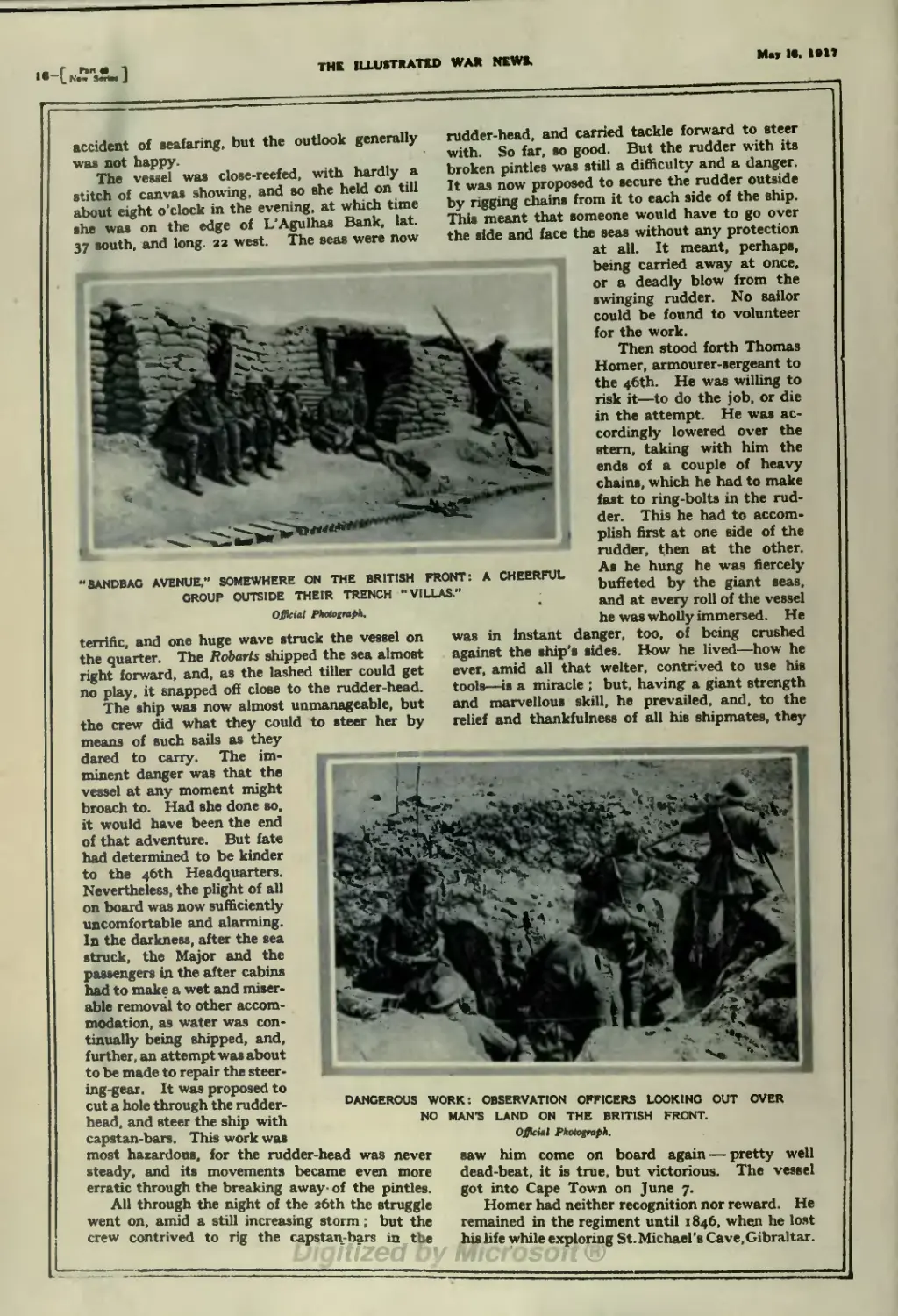
"SANDBAG AVENUE," SOMEWHERE ON THE BRITISH FRONT: A CHEERFUL
CROUP OUTSIDE THEIR TRENCH "VILLAS."
Official Photograph.
terrific, and one huge wave struck the vessel on
the quarter. The Robarts shipped the sea almost
right forward, and, as the lashed tiller could get
no play, it snapped off close to the rudder-head.
The ship was now almost unmanageable, but
the crew did what they could to steer her by
means of such sails as they
dared to carry. The im-
minent danger was that the
vessel at any moment might
broach to. Had she done so,
it would have been the end
of that adventure. But fate
had determined to be kinder
to the 4&th Headquarters.
Nevertheless, the plight of all
on board was now sufficiently
uncomfortable and alarming.
In the darkness, after the sea
struck, the Major and the
passengers in the after cabins
had to make a wet and miser-
able removal to other accom-
modation, as water was con-
tinually being shipped, and,
further, an attempt was about
to be made to repair the steer-
ing-gear. It was proposed to
cut a hole through the rudder-
head, and steer the ship with
capstan-bars. This work was
rudder-head, and carried tackle forward to steer
with. So far, so good. But the rudder with its
broken pintles was still a difficulty and a danger.
It was now proposed to secure the rudder outside
by rigging chains from it to each side of the ship.
This meant that someone would have to go over
the side and face the seas without any protection
at all. It meant, perhaps,
being carried away at once,
or a deadly blow from the
swinging rudder. No sailor
could be found to volunteer
for the work.
Then stood forth Thomas
Homer, armourer-sergeant to
the 46th. He was willing to
risk it to do the job, or die
in the attempt. He was ac-
cordingly lowered over the
stern, taking with him the
ends of a couple of heavy
chains, which he had to make
fast to ring-bolts in the rud-
der. This he had to accom-
plish first at one side of the
rudder, then at the other.
As he hung he was fiercely
buffeted by the giant seas,
and at every roll of the vessel
he was wholly immersed. He
was in instant danger, too, of being crushed
against the ship's sides. How he lived how he
ever, amid all that welter, contrived to use his
tools is a miracle ; but, having a giant strength
and marvellous skill, he prevailed, and, to the
relief and thankfulness of all his shipmates, they
most hazardous, for the rudder-head was never
steady, and its movements became even more
erratic through the breaking away' of the pintles.
All through the night of the z6th the struggle
went on, amid a still increasing storm ; but the
crew contrived to rig the capstan-bars in the
DANGEROUS WORK: OBSERVATION OFFICERS LOOKING OUT OVER
NO MAN'S LAND ON THE BRITISH FRONT.
Official Photograph,
saw him come on board again pretty well
dead-beat, it is true, but victorious. The vessel
got into Cape Town on June 7.
Homer had neither recognition nor reward. He
remained in the regiment until 1846, when he lost
his life while exploring St. Michael's Cave, Gibraltar.

M., 16, 1017
THE ILLUSTRATED WAR NEWS.
r fun m i , ,
|_Ne series J~ <
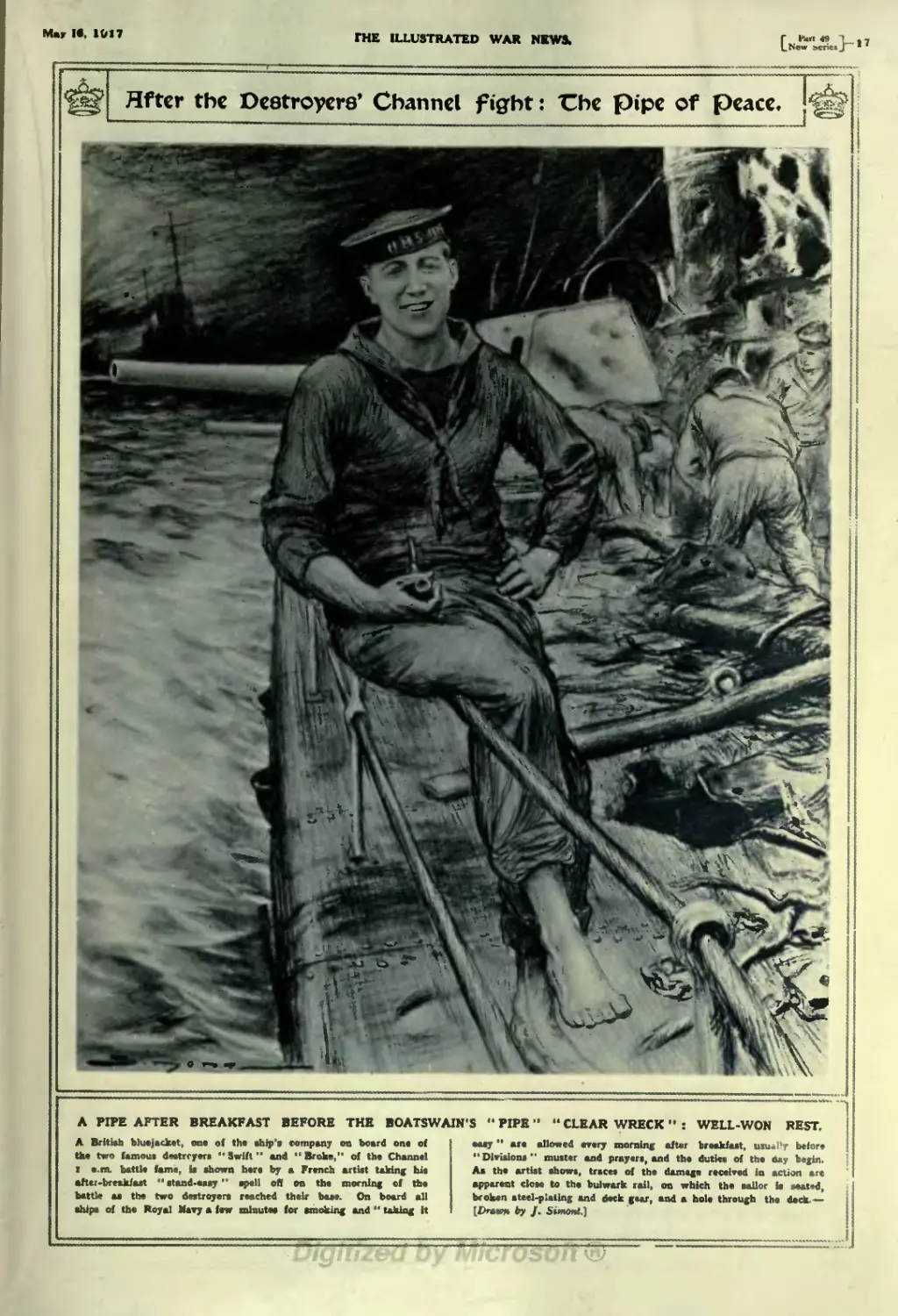
Hf ter the Destroyers' Channel fight : "Che pipe of peace.
J
A PIPE AFTER BREAKFAST BEFORE THE BOATSWAIN'S "PIPE" " CLEAR WRECK ": WELL-WON REST.
A British bluejacket, one of the (hip's company on board one of
the two famoui destrryers "Swift" and "Broke," of the Channel
I a.m. battle fame, ii ihown here by a French artiit taking hit
after -breakfast "stand-easy" spell off on the morning of the
battle aa the two destroyer* reached their base. On board all
ihipt of the Royal Nary a lew minute* for smoking and " taking it
ey " are allowed erery morning after breakfast, usual'y before
"Divisions" mutter and prayeri, and the duties of the day begin.
Ai the artist shows, traces of the damage received in action are
apparent close to the bulwark rail, on which the sailor it seated,
broken steel-plating and deck gear, and a hole through the deck.
\_D*awn by J. Simont.}

pn n T
Nr
FHE ILLUSTRATED WAR NEWS.
Mar 16. 1917
Queen Hmong our JSaval Reroes,
QUEEN MARY AT PORTSMOUTH : HER MAJESTY DISTRIBUTES DISTINGUISHED SERVICE MEDALS.
The Queen, accompanied by Princess Mary, visited Haslar Naral
Hosjutil at Portsmouth on May 9, visiting several of the wards
and presenting Distinguished Service Medals to inmates to whom
they had ben awarded in recognition of their brave deeds. Our
first phut >grph shows her Mmjeity presenting the medal to
L.S. Duncan ; in No. 2, the Queen is seen pinning the medal on
the breast of Lce-Corpl. R. D. Hale ; and in No. 3 her Majesty
is s own decorating Sergt. F. W. Hemmings, of the Royal Marine
Ligui Infantry, with the medal, for service in the Cameroons.
Queen Mary made a tour of various wards, and displayed her
customary keen interest in the details of the work which is done
at the Haslar Hospital. [Photos, by C.N.]

Mar I*. 1917
THE ILLUSTRATED WAR NEWS.
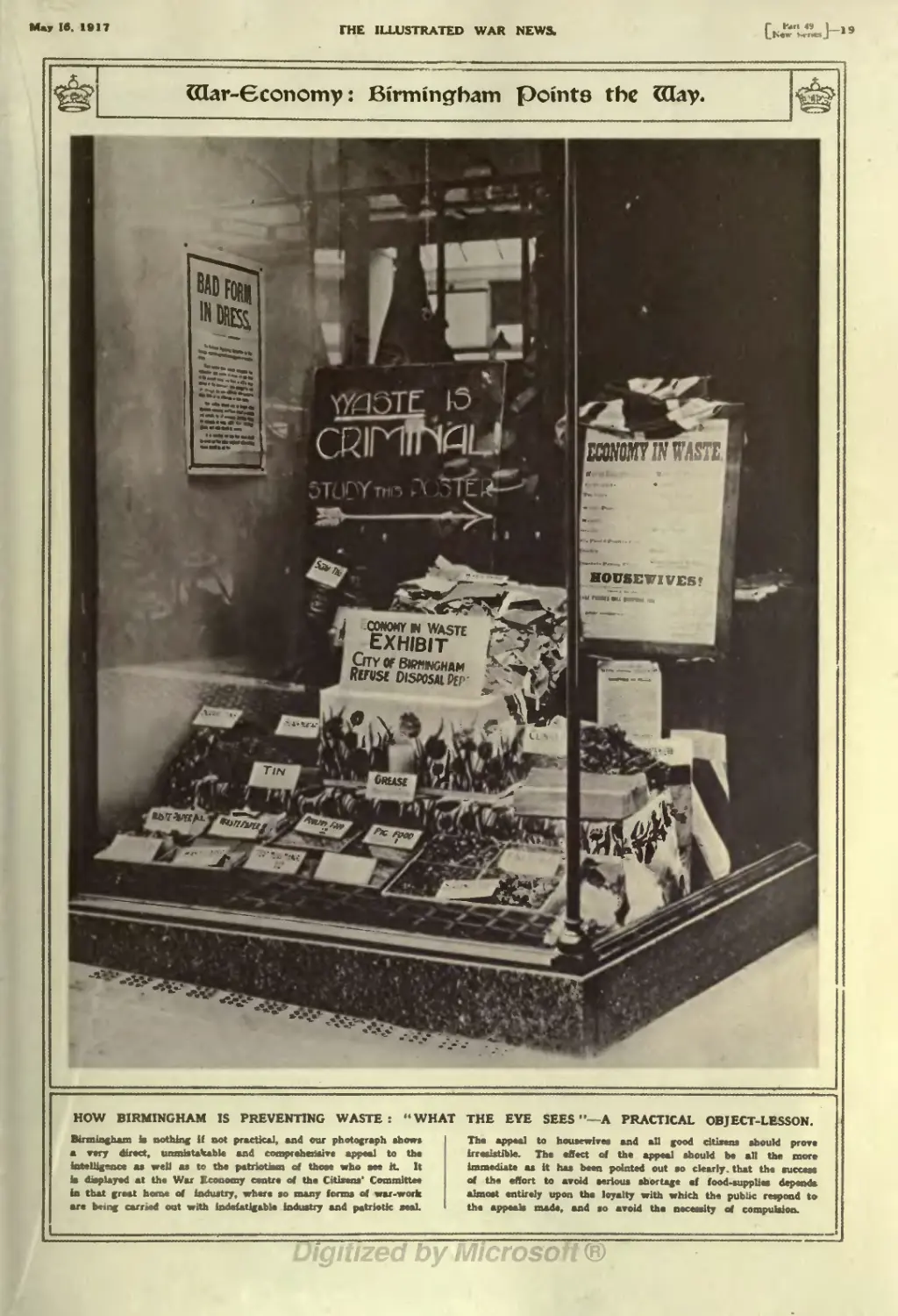
QIar-economy : Birmingham points the Cday.
HOW BIRMINGHAM IS PREVENTING WASTE: "WHAT THE EYE SEES "A PRACTICAL OBJECT-LESSON.
Birmingham it nothing if not practical, mnd our photograph shows
A very direct, unmistakable and comprehensive appeal to the
intelligence at well as to the patriotism of those who see it. It
is displayed at the War Economy centre of the Citizens' Committee
in that great home of industry, where so many forms of war-work
are bring carried out with indefatigable industry and patriotic zeal.
The appeal to housewives and all good citizens should prove
irresistible. The effect of the appeal should be all the more
immediate at it has been pointed out so clearly, that the success
of the effort to avoid serious shortage of food-supplies depends
almost entirely upon the loyalty with which the public respond to
the appeals made, and to avoid the necessity of compulsion.

20 - [ N e P .'". *"., 1- THE ILLUSTRATE
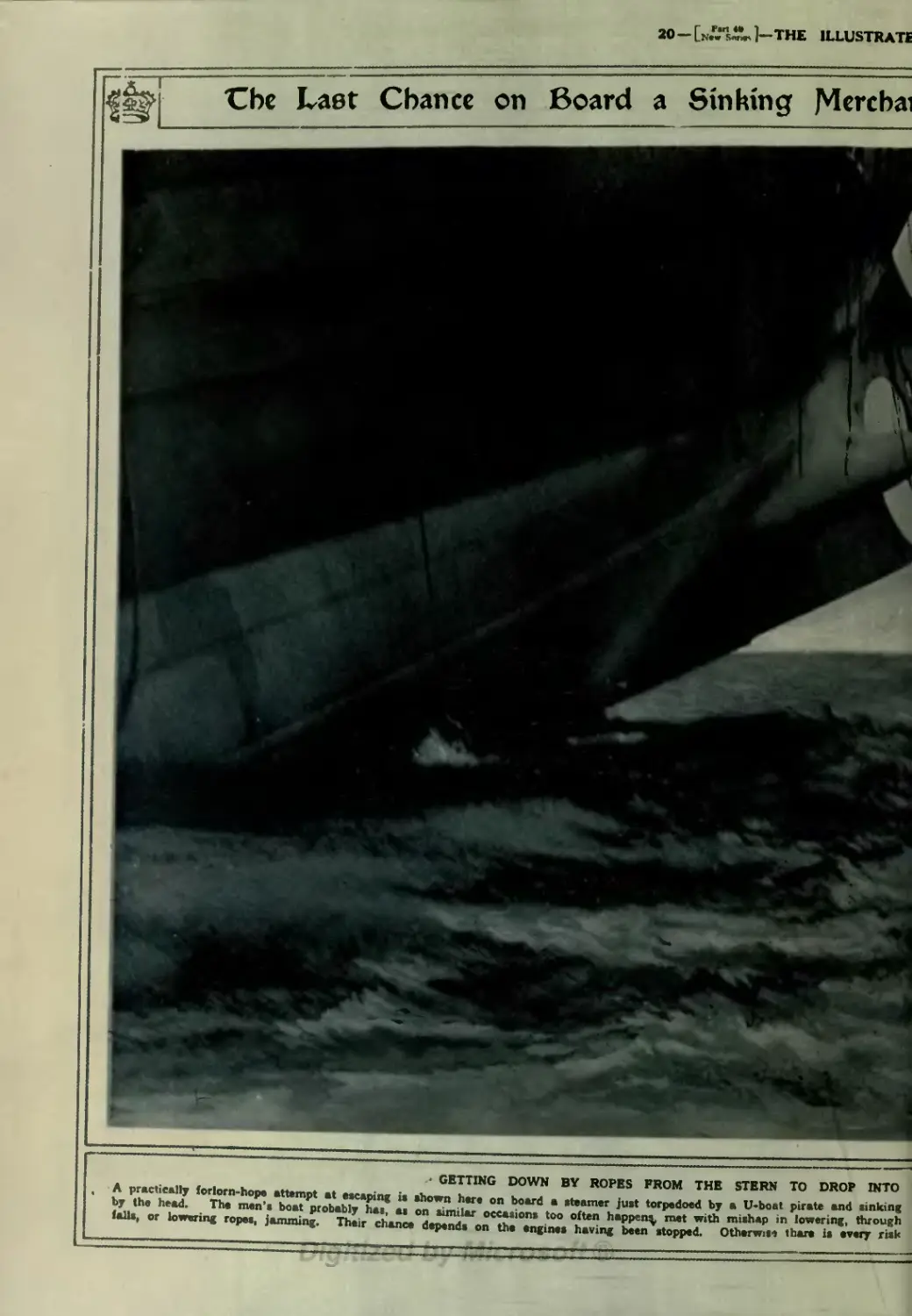
Laet Chance on Board a Sinking Mcrcbai
A practically forlorn-hop. attempt at escaping i, ^ T "T R PES "^ E *" ""^ T
by the brad. The men's boat probably has "m*l * "" J ' tor P edoe<1 bv U- bo ' Pit* nd sinking
falls, or lowering ropes, jamming. Their chance A wons too often happen^, met with mishap in lowering, through
g *** on the "'" having been stopped. Otherw.so there is every risk

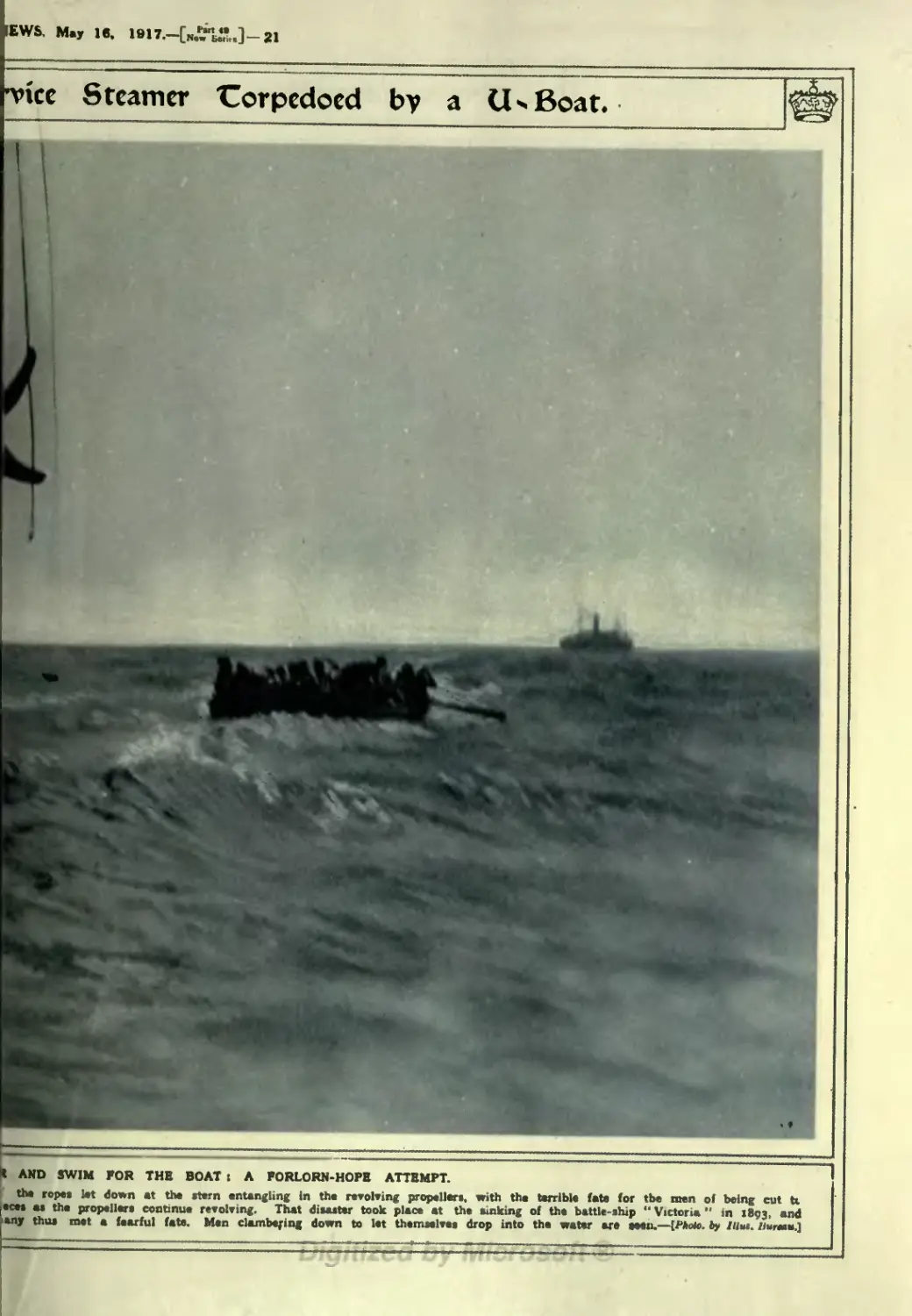
IEWS. M.y 16.
vice Steamer Torpedoed by a U>Boat.
ML.'
.
I AND SWIM FOR THE BOAT : A FORLORN-HOPE ATTEMPT.
the ropei let down at the stern entangling in the revolving propellers, with the terrible fate for the men of being cut U.
t i the propelleri continue revolving. That disatter took place at the linking of the battle-ship "Victoria" in 1893, and
any thus met a fearful fate. Men clambering down to let themselves drop into the water are seen. [Photo, by /HIM. Hunan.}

-[ N ''J '?:.*.') 'THE ILLUSTRATED WAR NEWS, M.T 16. 1917
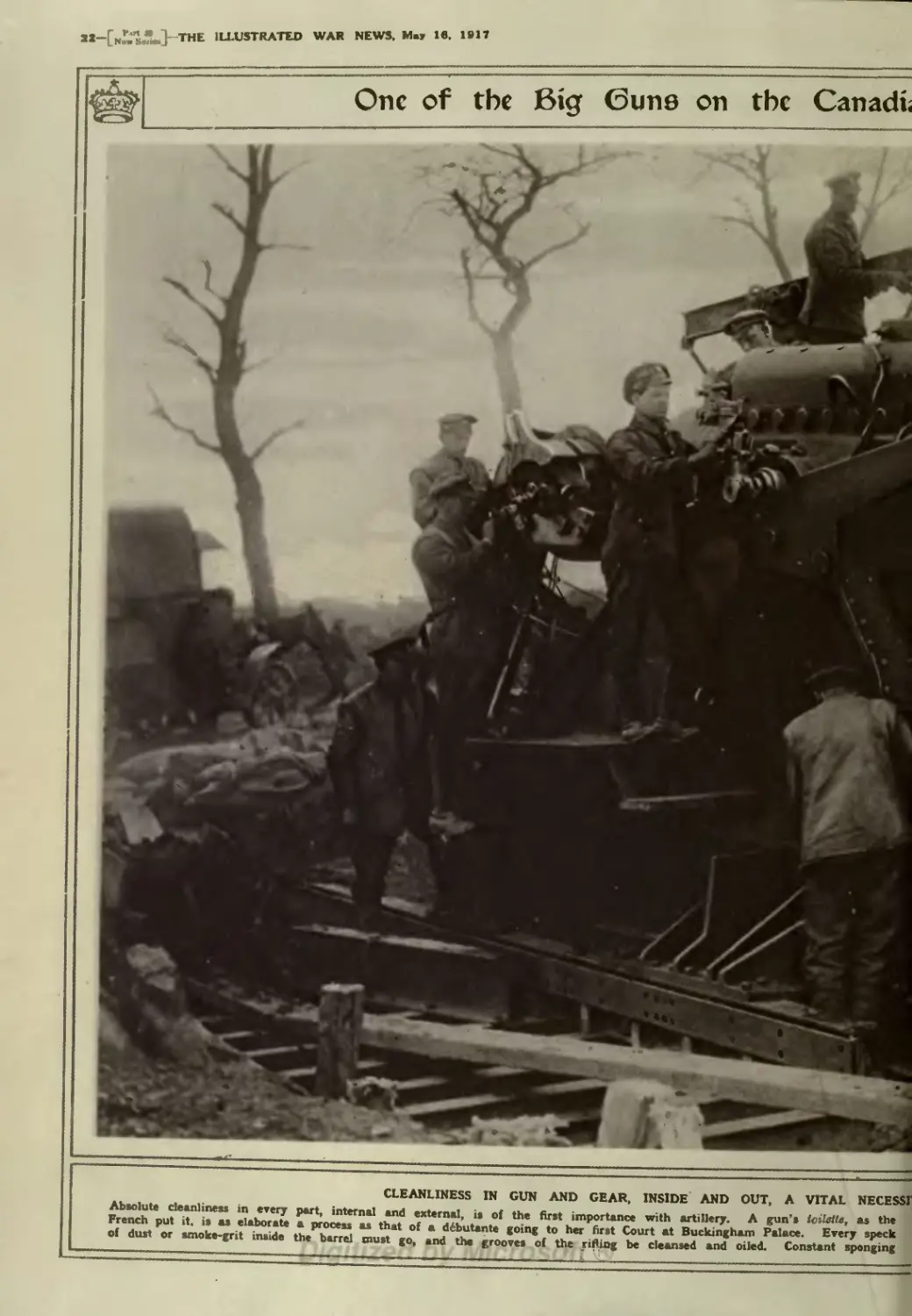
One of the Big CJune on the Canadi;
CLEANLINESS IN GUN AND GEAR, INSIDE AND OUT, A VITAL NECESSF
Ib e o7.7e a^o" th'a"" of" a '& t" t" ^ ^ ^^^ with "^"^ A gun's toiU,., a, the
of dust or smoke-grit inside the barrel mult I ^ i gomg to her first Court at Buckingham Palace. Every speck
)a " el must g0 ' and * K roo ' o' the rifling be cleansed and oiled. Constant sponging

THE ILLUSTRATED WAR NEWS. M 16. 1917.
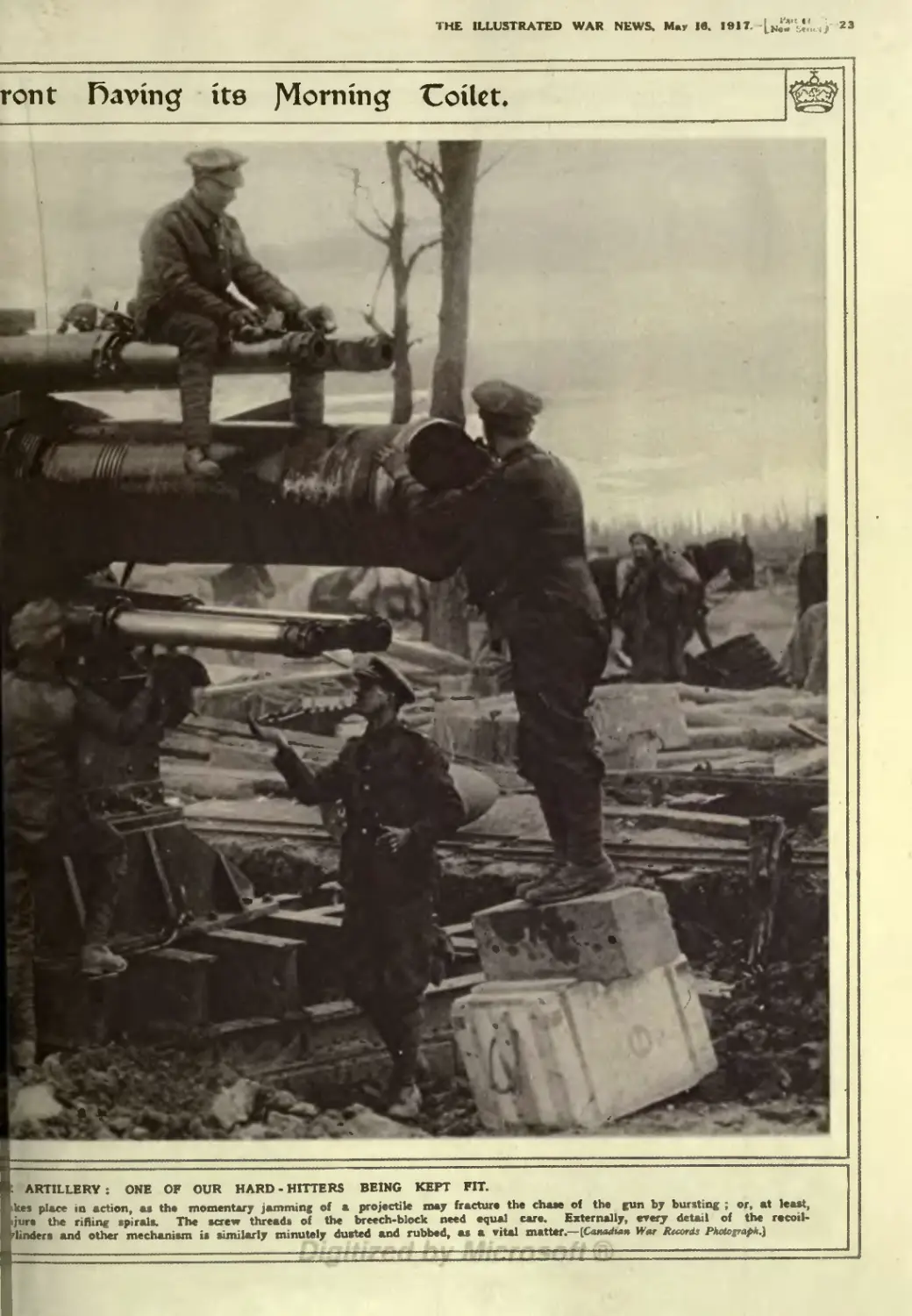
ront Having its JVIorning tloiUt.
ARTILLERY : ONE OF OUR HARD - HITTERS BEING KEPT FIT.
ikes place m action, as the momentary jamming of a projectile may fracture the chase of the gun by bursting ; or, at least,
jure the rifling spirals. The crew threads of the breech-block need equal care. Externally, every detail of the recoil-
Minders and other mechanism is similarly minutely dusted and rubbed, as a vital matter. [Canadian War Records Photograph.}

TOE ILLUSTRATED WAR NEWS,
Mar 16. 1817
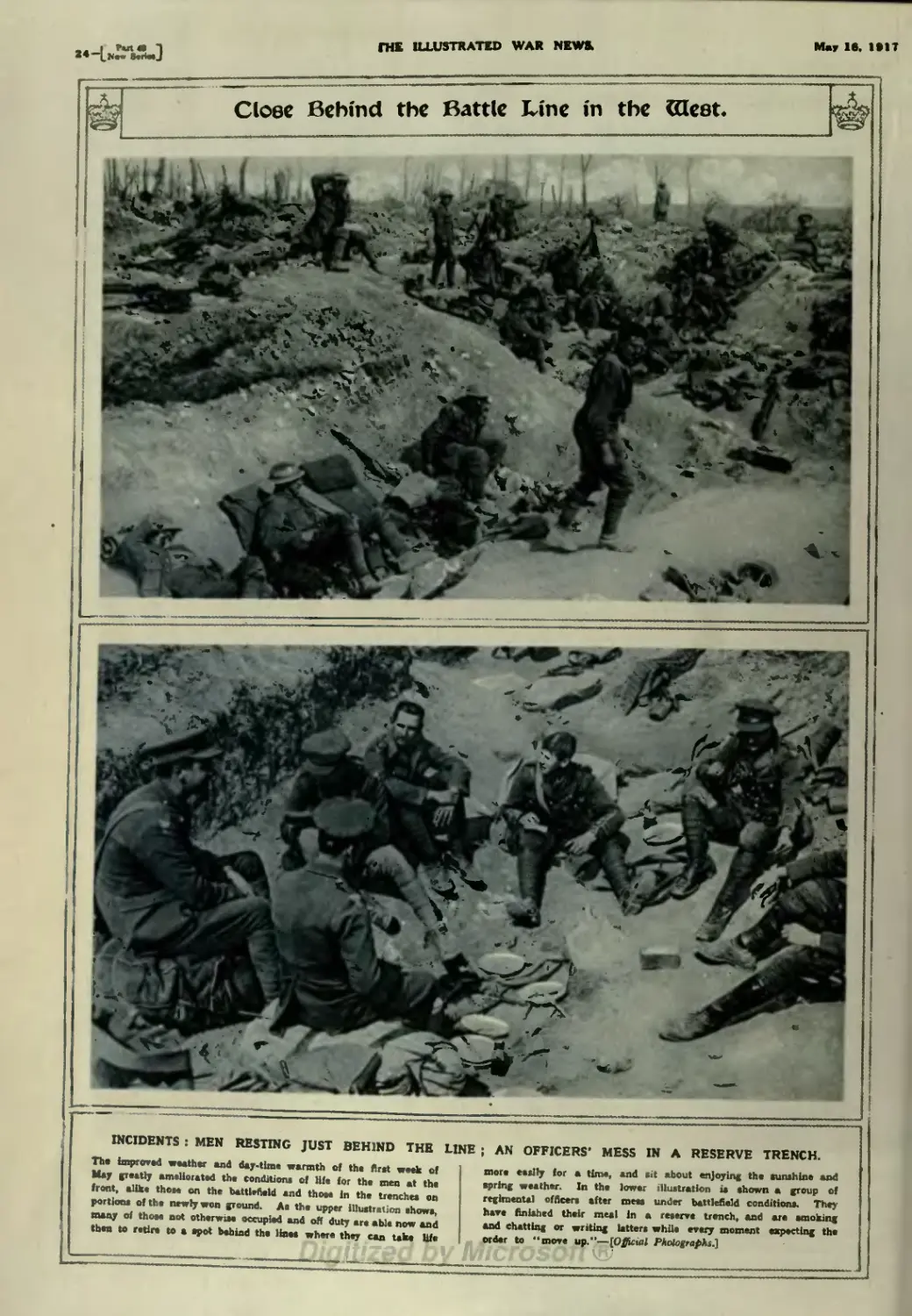
Close Behind the Battle Line in the dest.
INCIDENTS: MEN RESTING JUST BEHIND THE LINE; AN OFFICERS' MESS
The Improved wwther .mi d.y.,| m , warmth , ,, ,
t .rn.lior.ted the conditions of life for the men .t the
CM, .Ilk, tho.e on the b. t Uen,.d .nd those in the trench,, on
Tt.on. of the n^-lywon ground . A , , he upper il]ujtralion
nT o< ,ho not otherwi.. occupied i duty , r , . blt now <
th ,o reur. t. . ,pot brtind th. line. wh ,r ,h.y c to uk. W.
A RESERVE TRENCH.
more e.nlly for * time, .nd sit .bout enjoying the luruhine and
prmj weather. In the lower ilkutr.tion i ihown . group of
regiment.! officers fter mes under b.ttlefield conditioru. They
h.ve finished their me.) in . reserve trench, and .re smoking
wid ch.tting or writing letters while every moment expecting the
order to "move up." [Official Photographs.']

Mar 16. 1917
THE ILLUSTRATED WAR NEWS.
r .fart 48 T ..
LNwr Series J~ 2S
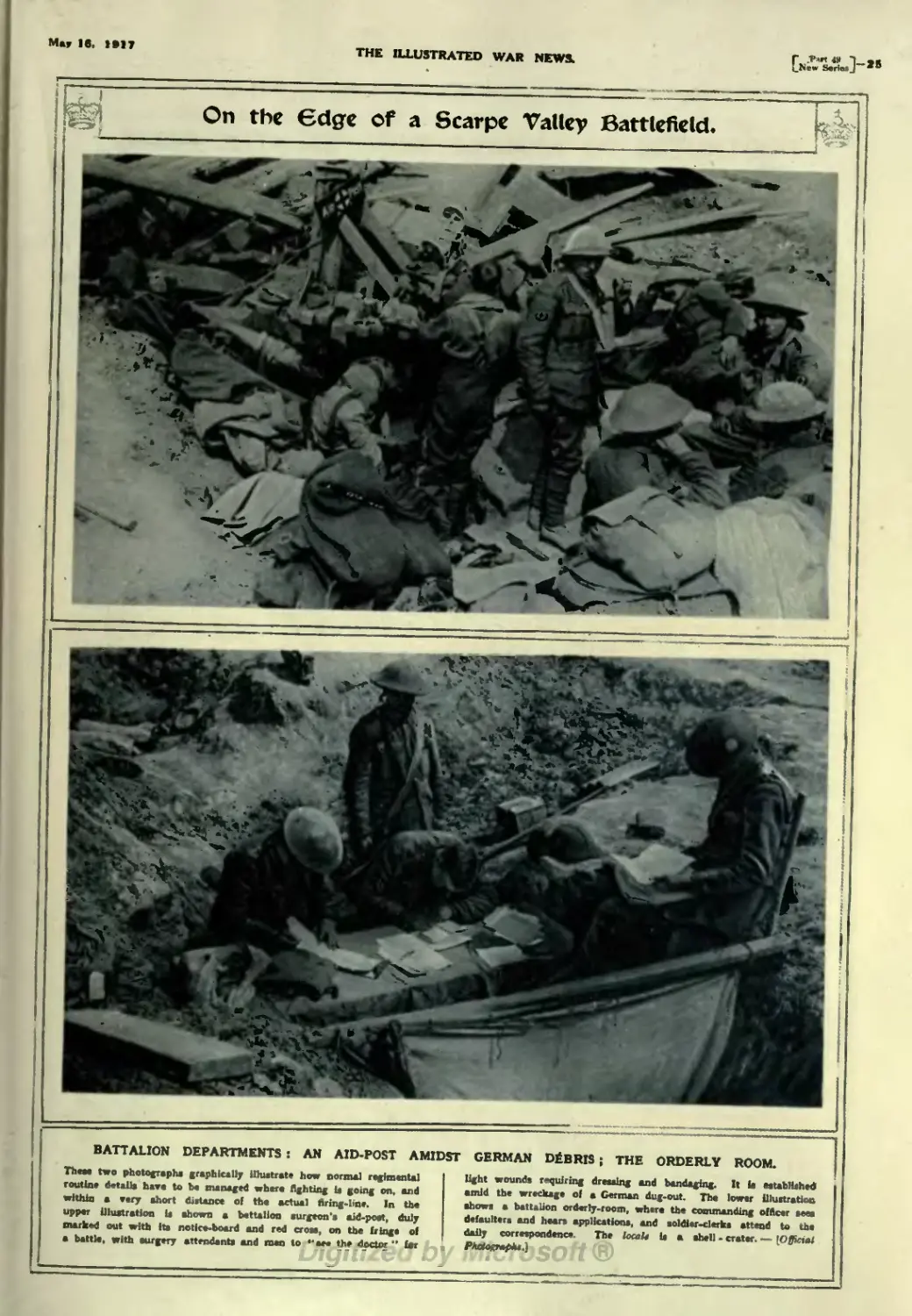
On the edge of a Scarpe Valley Battlefield.
BATTALION DEPARTMENTS: AN AID-POST AMIDST GERMAN DEBRIS; THE ORDERLY ROOM.
These two photographs graphically Illustrate how normal regimental
mtine detaili h.re to b managed where fighting is going on, and
within a ery short distance of the actual firing-line. In th
upper illuttration it ihown a battalion lurgeon'. aid-port, duly
marked out with its notice-board and red CTOM, on the fringe of
a battle, with turgery attrndanti and men lo "lee the doctor" for
light wounds requiring dressing and bandaging. It i, eatablijhed
amid the wreckage of a German dug-out. The lower illustration
shows a battalion orderly-room, where the commanding officer se.
defaulters and hears applications, and soldier-clerks attend to the
daily correspondence. The locale is a shell - crater. l
Photographs.]

THE ILLUSTRATED WAR NEWS.
M.r 1C. 1817
FOOTNOTES TO ARMAGEDDON : XL.-THE PRIZE.
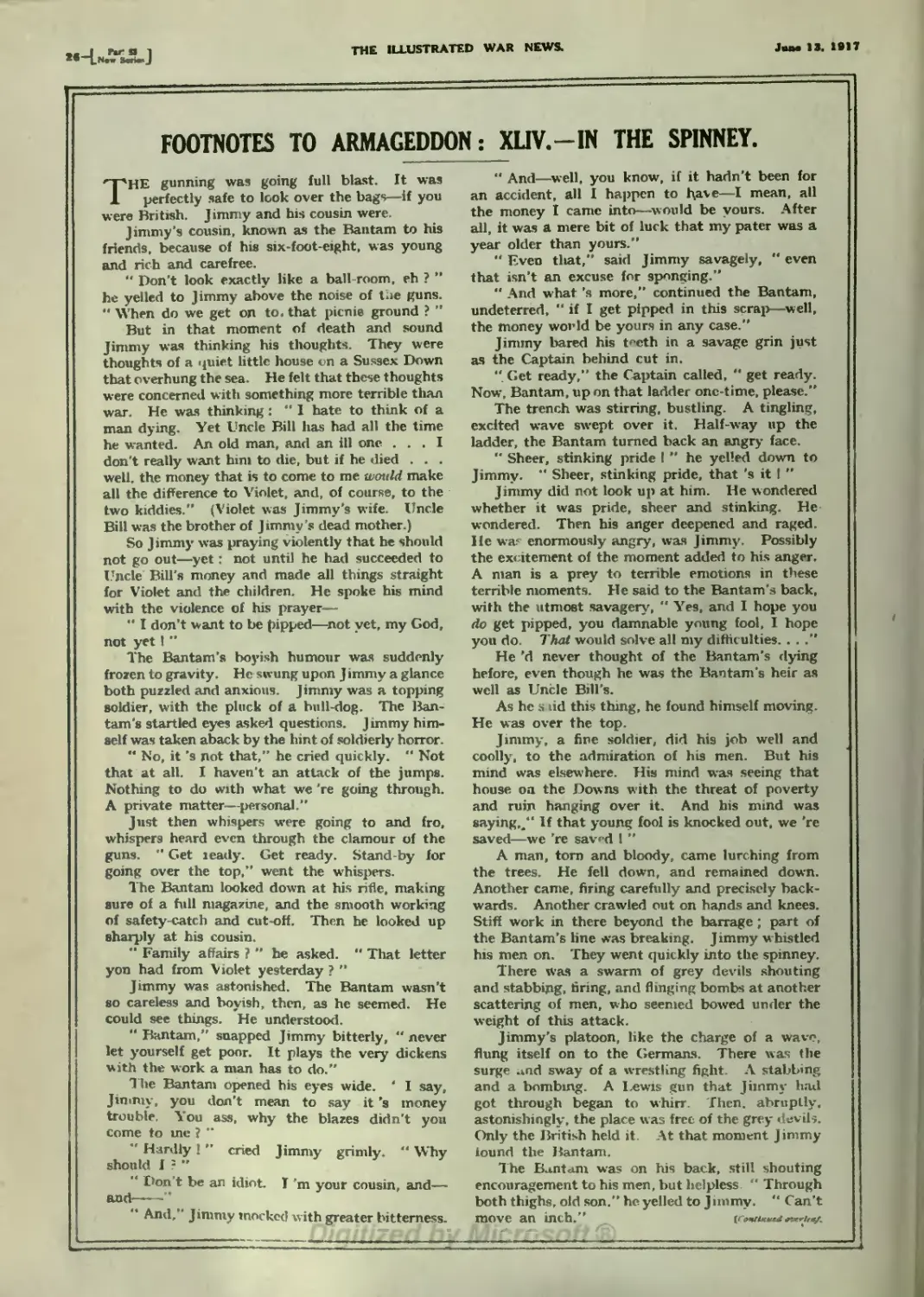
WILLIAM and Jim joined up because Betty
agreed with the Daily Hail, inasmuch as
she " thought they ought to go." William and
Jim would have valued some considerable time
for reflection, but it was Betty or the pit of
Abaddon or, if you like, khaki or the Outer
Darkness and William and Jim reached the
Recruiting Table of the
Toughs dead-heat.
From that moment
life was a contest of
enormous strenuosity,
in which William tried
to go one better than
Jim. and Jim tried to
shoot ahead of William,
all for the sake of
Betty. Betty was out
for the bravest and
best man in the world.
Betty had stated that
only big things would
win her. Betty had
hinted that she would
offer herself as prize to
the victor. William
knew he had been a
victor since birth. Jim
guessed that what he
didn't know about
victoring could be put
into a monkey-nut shell. They began to force
the pace to get ahead of each other.
Jim scored first blood. When Jim got his
stripe William realised that luck could put a
hearty man at extreme disadvantage. Betty, he
found, had a
clinging affec-
tion for a
striped arm.
He began to
dream of
banns being
read out, and
to consider his
own suicide
he thought it
BATTLEFIELD HORSEMANSHIP: A BRITISH CAVALRY
OFFICER NEGOTIATING A MINE -CRATER SLOPE ON
A BLOWN-UP HILLSIDE ROAD. [Official Photograph.]
craze, turned the heads of even the nicest girls.
What was mere worth with a stripe on its arm,
after all ?
William followed this advantage up rather
cleverly by raising himself to full corporal. This
was a desperate blow for Jim. Betty said very
distinctly that she only had time for men who did
the biggest things. She
declined a suggestion
of Cinema with Jim.
Jim's gloom became
bitter. He guessed it
was all up with him.
He contemplated the
Road to Ruin, and
seriously thought of
taking to drink as the
only anodyne. In the
midst of his melan-
choly he performed
wonders with his work,
and quite suddenly two
stripes were blossoming
on his arm and a shoot-
ing " proficiency " was
his. He met William
on the level, and stared
him eye to eye.
Betty took to hang-
ing between two arms
at this critical junc-
ture. The judgment of Helen is much more
guarded than the judgment of Paris. Betty be-
came baffling. She treated them both alike.
She admired them both but she was still the
prize for the man who did the biggest things.
W T i 1 1 i a m
thought of
waylaying his
sergeant, deal-
ing with him
so that he
would have to
go to hospital,
and thus step-
ping into the
would be best
to do a suicide
on the church
steps. So
much more
dramatic than
confetti or an
old shoe.
But he was
a sticker. Jim
soon found
that out. All
at once Wil-
liam was in a bombing school, and there was
an aching void on the arm where Betty had
been wont to cling. It was Jim's turn for gloom.
He saw at once how mere fashion, how the latest
THE 'WAY THE NEEDS OF OUR FIGHTING LINE MEN ON THE WESTERN
FRONT ARE LOOKED AFTER: A DRINKING-WATER SUPPLY CART ON
ITS TRENCH ROUND. [Official Photograph.]
vacated rank.
That would
give him first
place with
Betty. He
hesitated
first, because
hedoubtedthe
vulnerability
of sergeants ;
and second,
because he
rather liked
the sergeant.
Jim thought of putting something lethal in his
sergeant's beer for the same great cause ; but he
could never bring himself to spoil good drink.
So both went on being treated level by Betty.

Mar 16. IS 17
THE ILLUSTRATED WAR NEWS.
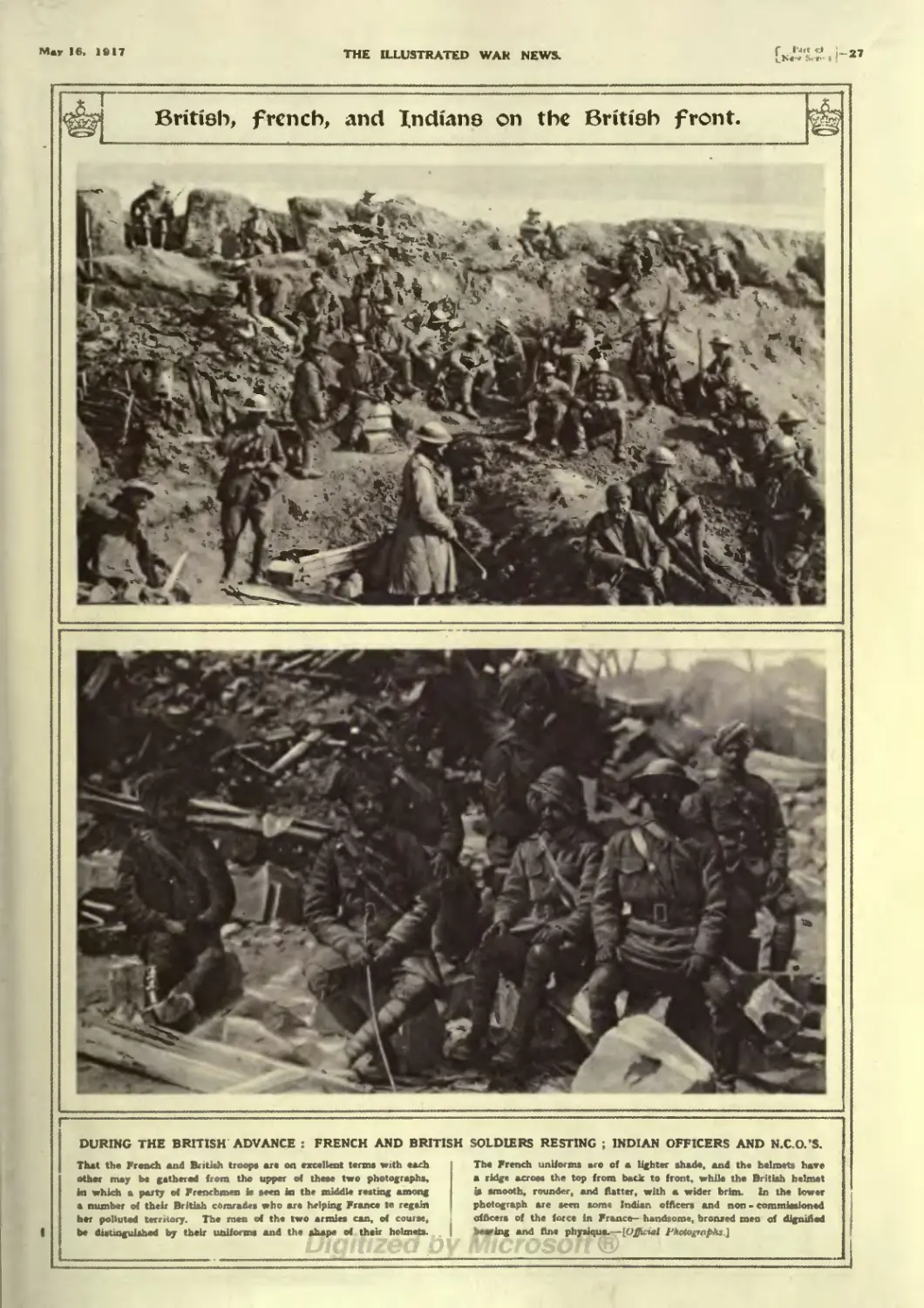
British, french, and Indians on the British front.
DURING THE BRITISH ADVANCE : FRENCH AND BRITISH SOLDIERS RESTING ; INDIAN OFFICERS AND N.C.O.'S.
That the French And British troops arc on excellent trnu with each
other may be gathered fiom the upper of these two photugraphs,
in which a party of Frenchmen is seen in the middle resting among
a number of their British comrades who are helping France to regain
htr polluted territory. The men of the two armies can, of course,
be diituiguUhed by their uniforms and the shape of their helmets.
The French uniforms are of a lighter shade, and the helmets hare
a ridge across the top from back to front, while the British helmet
is smooth, rounder, and flatter, with a wider brim. In the lower
photograph are seen some Indian officers and non - commissioned
officers of the force in France handsome, bronzed men of dignified
bearing and fine physique. [Official Photographs.}

M
THE ILLUSTRATED WAR NEWS.
Mar 16. 117
And Betty went on hinting that she would only
marry a really notable man.
They went to the front like that. Betty was
still the same. She still urged each to exceed
each. And each vowed by all that is ardent in
love that Betty should marry the notable fellow,
which was him.
But the dead - level
business dogged their foot-
steps. Neither became a
greater man than the
other. Jim captured a
German Lieutenant and
sent his helmet home to
Betty. Betty cooed to him
in her letters. William
rounded up a machine-gun
detachment, and sent all
the helmets home. Coo-
ing off with Jim, on with
William. William got a
slight scratch nothing
that took him home ; but
it could be seen, from the
letters he read out to Jim,
that the wedding was
settled all save the date.
Jim exerted himself, car-
ried a number of messages
under fire, and his pals
the ruck ; but soon Betty and his ardour pushed
him forward. With a handful of men, he worked
his way up to a forward position which the bombers
had won. With that handful he held on to that
position when he should have cut and run by all
the rules of Germany. A great piece of work.
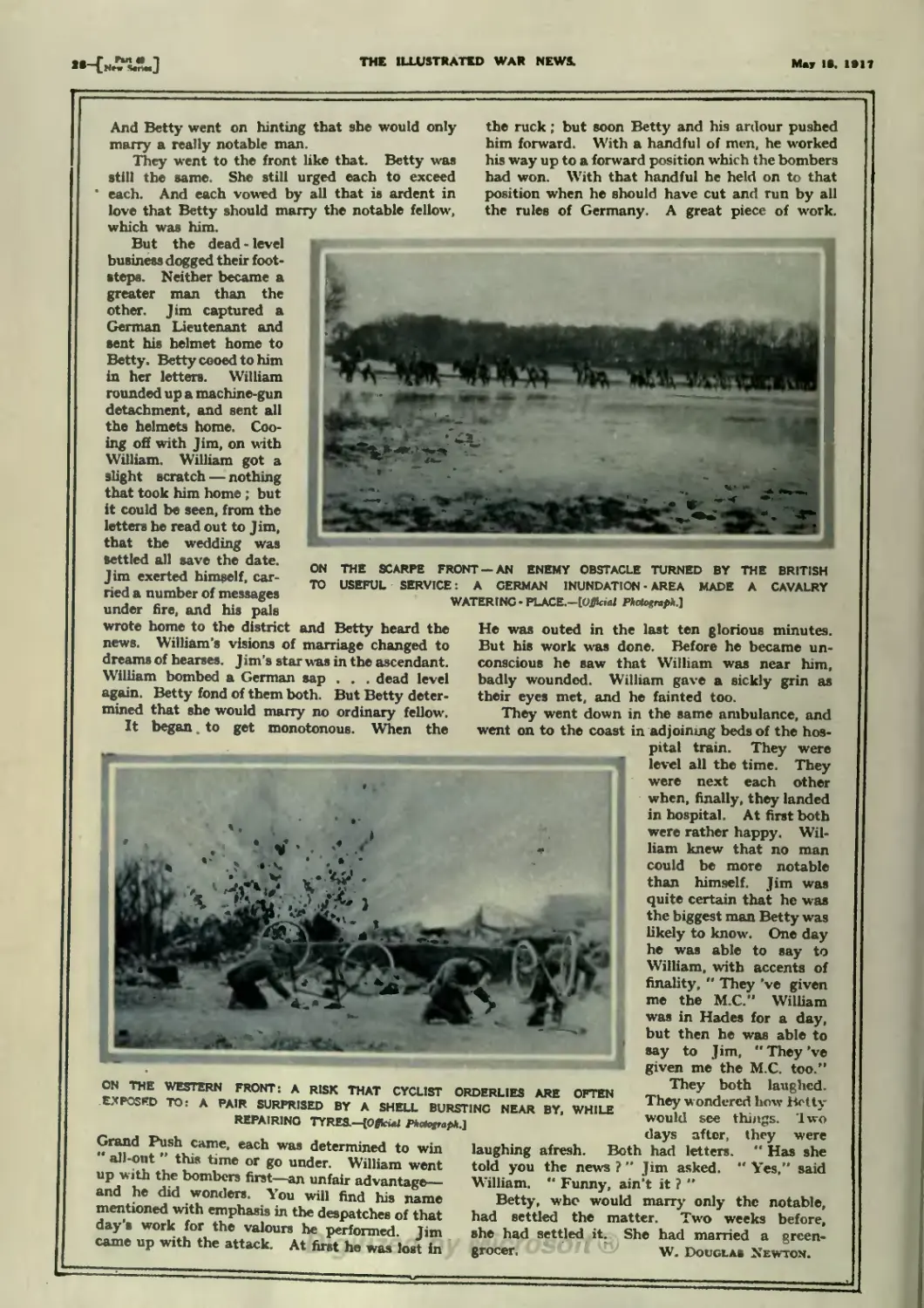
ON THE SCARPE FRONT AN ENEMY OBSTACLE TURNED BY THE BRITISH
TO USEFUL SERVICE : A GERMAN INUNDATION AREA MADE A CAVALRY
WATERING- PLACE. lOfficial Photograph.]
wrote home to the district and Betty heard the
news. William's visions of marriage changed to
dreams of hearses. Jim's star was in the ascendant.
William bombed a German sap . . . dead level
again. Betty fond of them both. But Betty deter-
mined that she would marry no ordinary fellow.
It began . to get monotonous. When the
: WESTERN FRONT: A RISK THAT CYCLIST ORDERLIES ARE OFTEN
TO: A PAIR SURPRISED BY A SHELL BURSTING NEAR BY, WHILE
REPAIRING TYRES. [Official Photograph.}
Grand Push came, each was determined to win
" all-out " this time or go under. William went
up with the bombers first an unfair advantage
and he did wonders. You will find his name
mentioned with emphasis in the despatches of that
day's work for the valours he performed Jim
came up with the attack. At first he was lost in
He was outed in the last ten glorious minutes.
But his work was done. Before he became un-
conscious he saw that William was near him,
badly wounded. William gave a sickly grin as
their eyes met, and he fainted too.
They went down in the same ambulance, and
went on to the coast in adjoining beds of the hos-
pital train. They were
level all the time. They
were next each other
when, finally, they landed
in hospital. At first both
were rather happy. Wil-
liam knew that no man
could be more notable
than himself. Jim was
quite certain that he was
the biggest man Betty was
likely to know. One day
he was able to say to
William, with accents of
finality, " They Ve given
me the M.C." William
was in Hades for a day,
but then he was able to
say to Jim, "They've
given me the M.C. too."
They both laughed.
They wondered how .Hotly
would see things. Ivro
days after, they were
Both had letters. " Has she
laughing afresh.
told you the news ? " Jim asked. " Yes," said
William. " Funny, ain't it ? "
Betty, who would marry only the notable,
had settled the matter. Two weeks before,
she had settled it. She had married a green-
grocer, w. DOUGLAS NEWTON.

Ma, 10. )17
THE ILLUSTRATED WAR NEWS.
Cl'.irl t , _.
New SrtesJ-*
On the Balhan front and eastern Mediterranean.
HHft
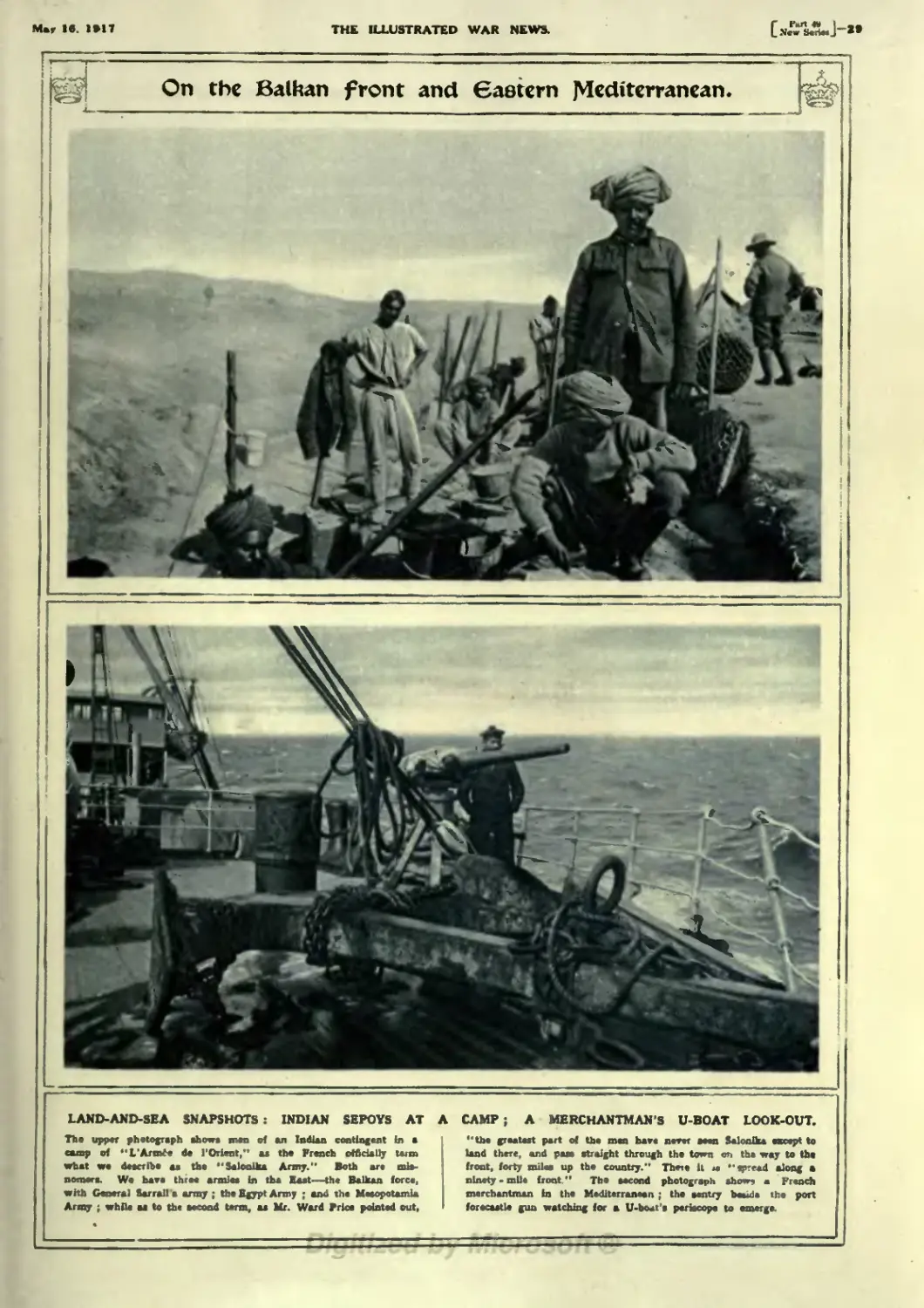
LAND-AND-SEA SNAPSHOTS : INDIAN SEPOYS AT A CAMP ; A MERCHANTMAN'S U-BOAT LOOK-OUT.
"the greatest part of the men have nerer seen Salonika except to
land there, and pan straight through the town on the way to tbl
front, forty miles up the country." Thett it .. "ipread along a
ninety, mile front." The second photograph show* French
merchantman in the Mediterranean ; the sentry beaide the port
forecastle gun watching for a U-boat's periscope to emerge.
The upper photograph showi men of an Indian contingent In
camp of "L'Arm.'e dt 1'Oiient," u the French officially teim
what wt describe ai the "Salonika Army." Both are rois-
nomerf. We have three armies in the East the Balkan force,
with General Sarrail'i army ; the Egypt Army ; and the Mesopotamia
Army ; while u to the second term, as Mr. Ward Price pointed out,

so
THE ILLUSTRATED WAR NEWS.
M.y 16. 1917
OTitb the Belgian Hrmy: Che Carrier-pigeon Service.
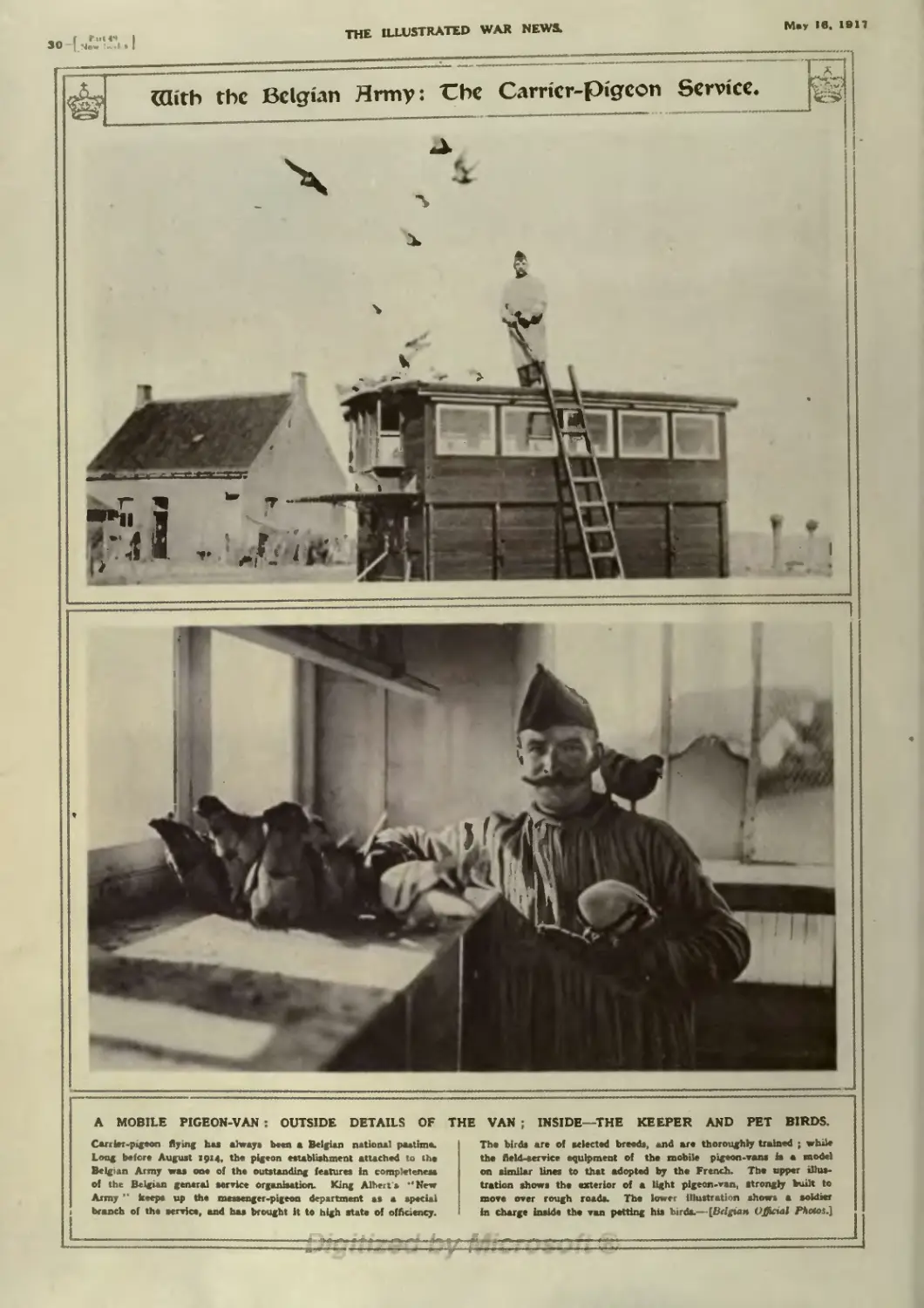
A MOBILE PIGEON-VAN : OUTSIDE DETAILS
Carrier-pigeon flying has always been a Belgian national paktime.
Long before August 1914, the pigeon establishment attached to the
Belgian Army was one of the outstanding features in completeness
of the Belgian general service organisation. King Alt..-. it "New
Army " keeps up the messenger-pigeon department as a special
branch of the terries, and has brought It to high state of efficiency.
The birds are of selected breeds, and are thoroughly trained ; white
the field-service equipment of the mobile pigeon-Tans is a model
on similar lines to that adopted by the French. The upper illus-
tration shows the exterior of a light pigeon-Tin, strongly built to
more over rough roads. The lowrr illustration shows a soldier
in charge inside the Tan petting his birds. [Btlgian Official Photos.}

My 16. 1917
THE ILLUSTRATED WAR NEWS.
Cl'art 1 ,
New Setie>J 31
On the Western front: OUtb the Canadians.
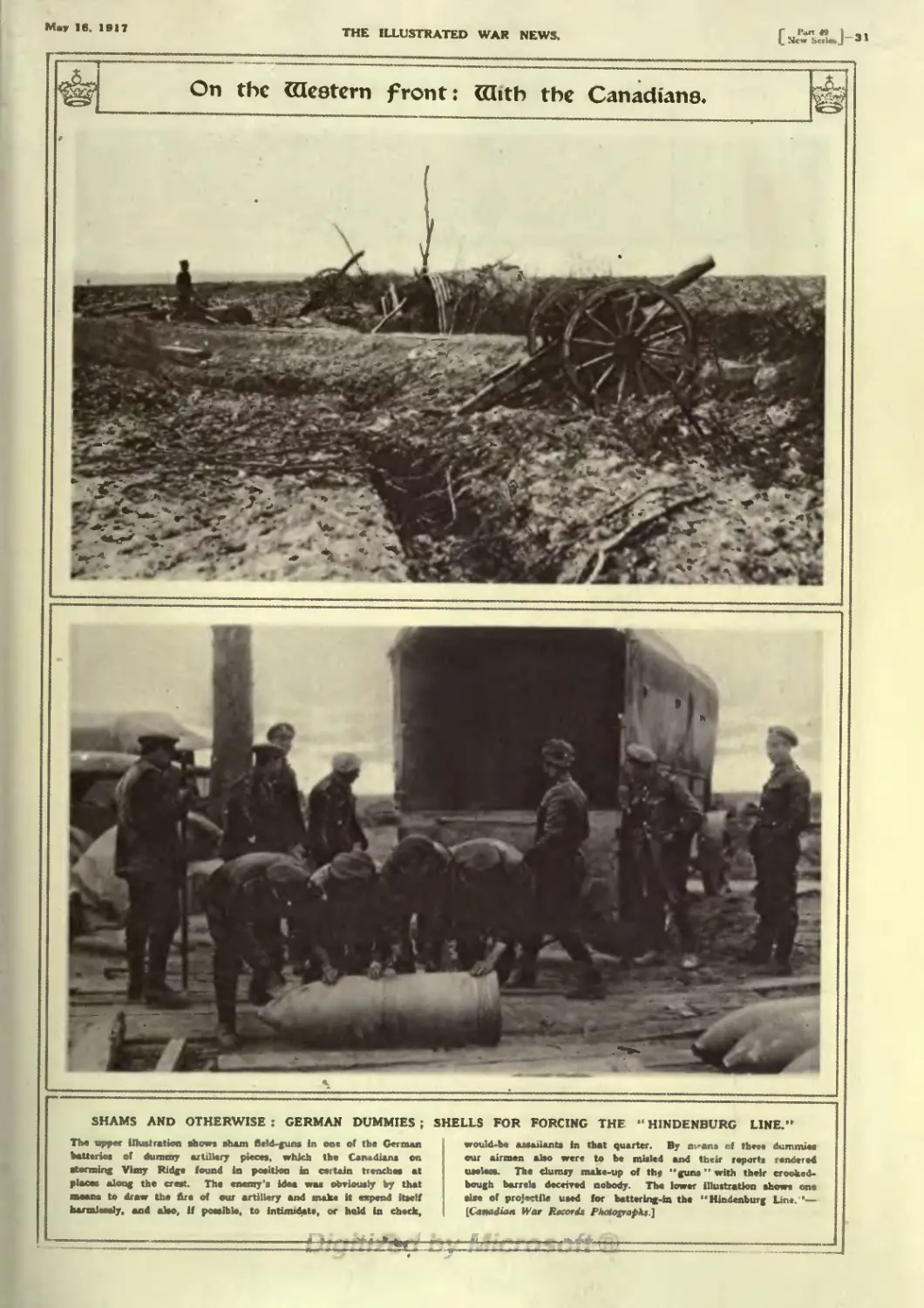
SHAMS AND OTHERWISE: GERMAN DUMMIES; SHELLS FOR FORCING THE " HINDENBURG LINE.'
The upper illustration shows sham field-guns in one of the German
batteries of dummy artillery pieces, which the Canadians on
storming Vimy Ridge found in position in certain trenches at
places along the crest. The enemy's idea was obviously by that
means to draw the Are of our artillery and make it expend itself
harmlessly, and also, if possible, to intimidate, or hold in check,
would-be assailants in that quarter. By m'ans of (hue dummies
our airmen also were to be misled and their reports rendered
useless. The clumsy make-up of the "(uns"w!th their crooked-
bough barrels deceived nobody. The lower illustration shows one
size of projectile used for batterinf-in the "Hindenburg Line. '
[Canadian War Records Photographs.]

I
-(.
Pit4 I
New Serin I
THE ILLUSTRATED WAR NEWS.
Mar 16 1*17
Olith the British Mesopotamia Hrmy
et
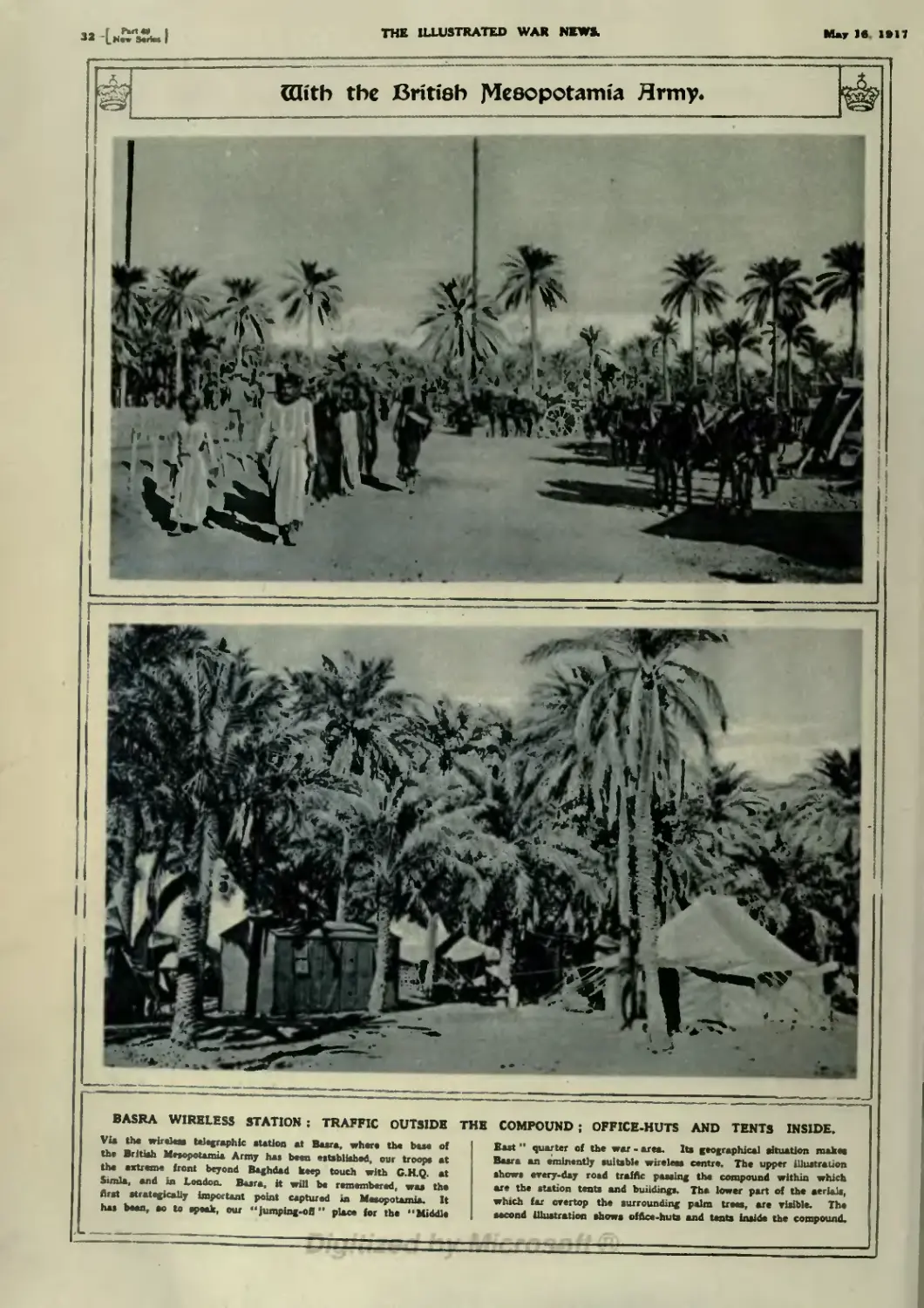
BASRA WIRELESS STATION: TRAFFIC OUTSIDE THE COMPOUND; OFFICE-HUTS
Via the wtrclcii telegrphlc itation at Bura, where the base o<
th Brituh Mnopoumia Army hat been eitablUhed, our troopi at
the extreme front beyond Baghdad keep touch with C.H.Q. at
S.mla, and in London. Baira, it will be remembered, wu the
trategically important point captured in Mesopotamia. It
hae been, to to .peak, our "jumping.ofi " place for the "Middle
AND TENTS INSIDE.
Bait" quarter of the war - area. It geographical jituation make*
Basra an eminently suitable wireleas centre. The upper illustration
shows every-day road traffic passing the compound within which
are the station tenti and buildings. The lower part of the aerials,
which far overtop the surrounding palm trees, are visible. The
second illustration shows office-huts and tents Inside the compound.

Mar 1C. t17
THE ILLUSTRATED WAR NEWS
r i>tt 49 1 -,
} New SnioJ J 33
CKith the British Mesopotamia Hrmy.
T
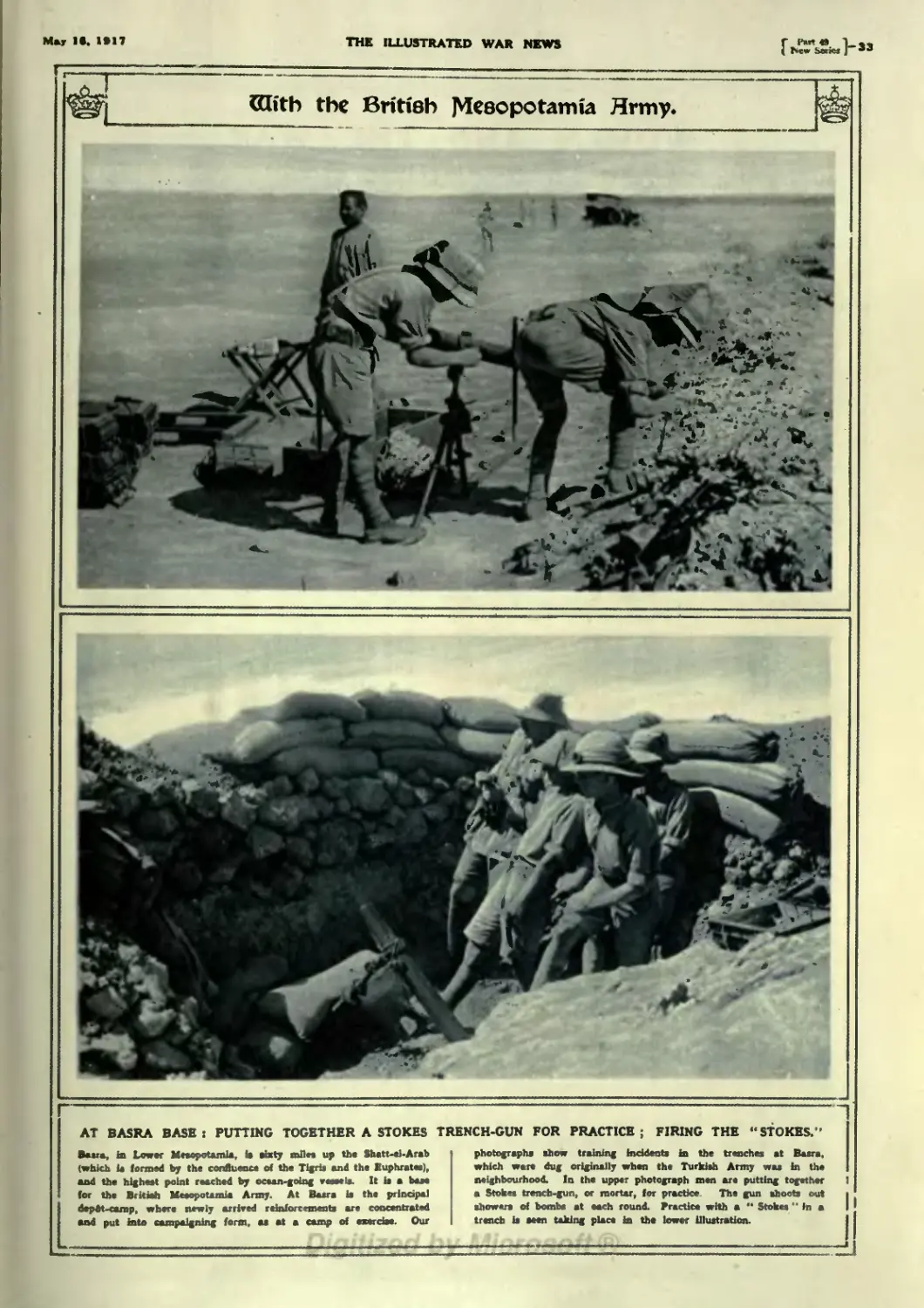
AT BASRA BASE: PUTTING TOGETHER A STOKES TRENCH-GUN FOR PRACTICE; FIRING THE "STOKES."

Bur*, in Lower Mesopotamia, is sixty miles up the Shatt-el-Arab
(which i* formed by the confluence of the Tigris and the Euphrates),
and the highest point reached by ocean-going vessels. It is a base
for the British Mesopotamia Army. At Basra is the principal
depAt-camp, where newly arrired reinforcements are concentrated
and put into campaigning form, as at a camp of exercise. Our
photographs show training incidents in the trenches at Basra,
which were dug originally when the Turkish Army was In the
neighbourhood. In the upper photograph men are putting together
a Stokes trench-gun, or morUr, for practice The gun shoots out
showers of bombs at each round. Practice with a " Stokes " in
trench is seen taking place in the lower Illustration.
J

THE ILLUSTRATED WAR NEWS.
Mar 16. 1917
r
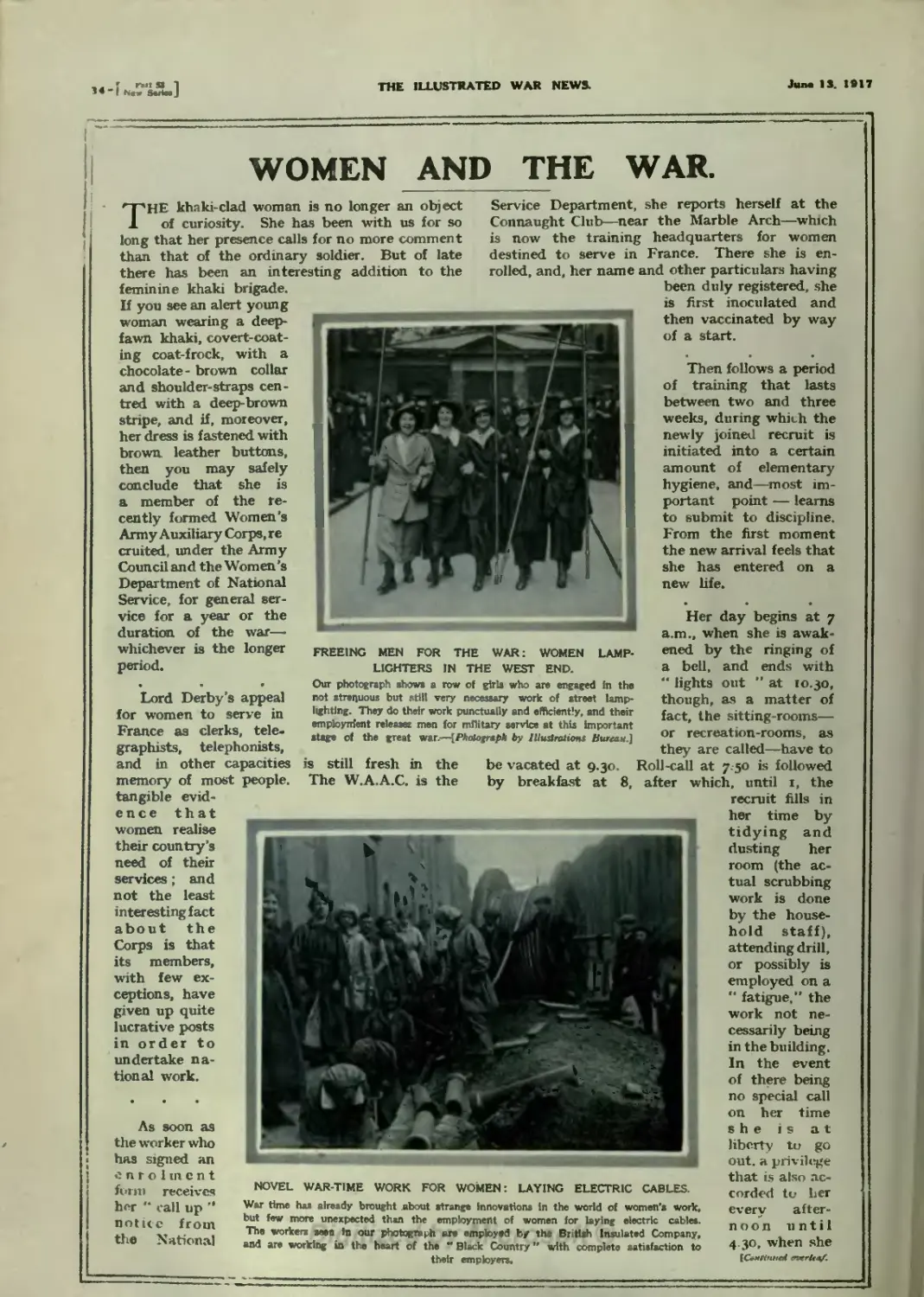
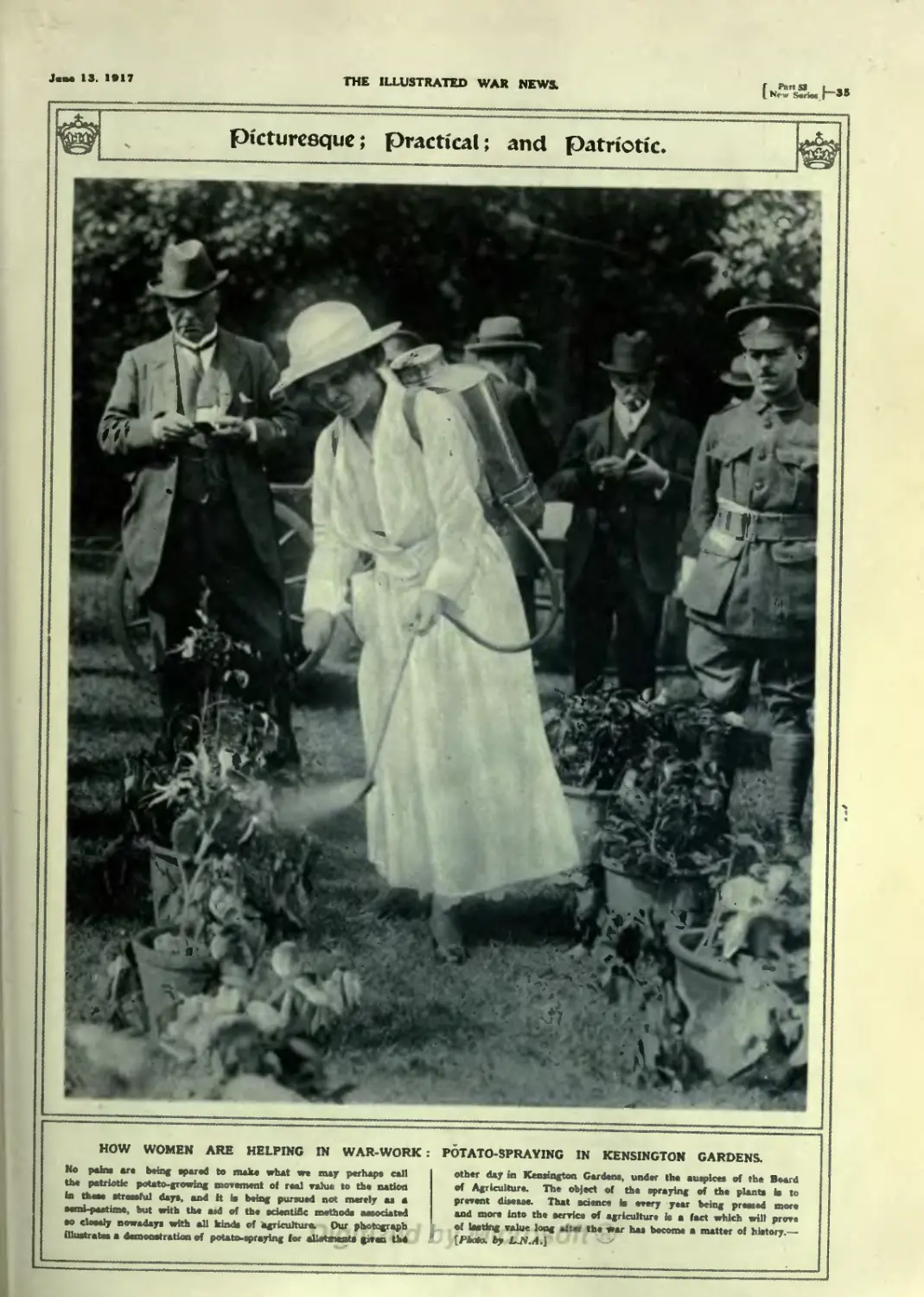
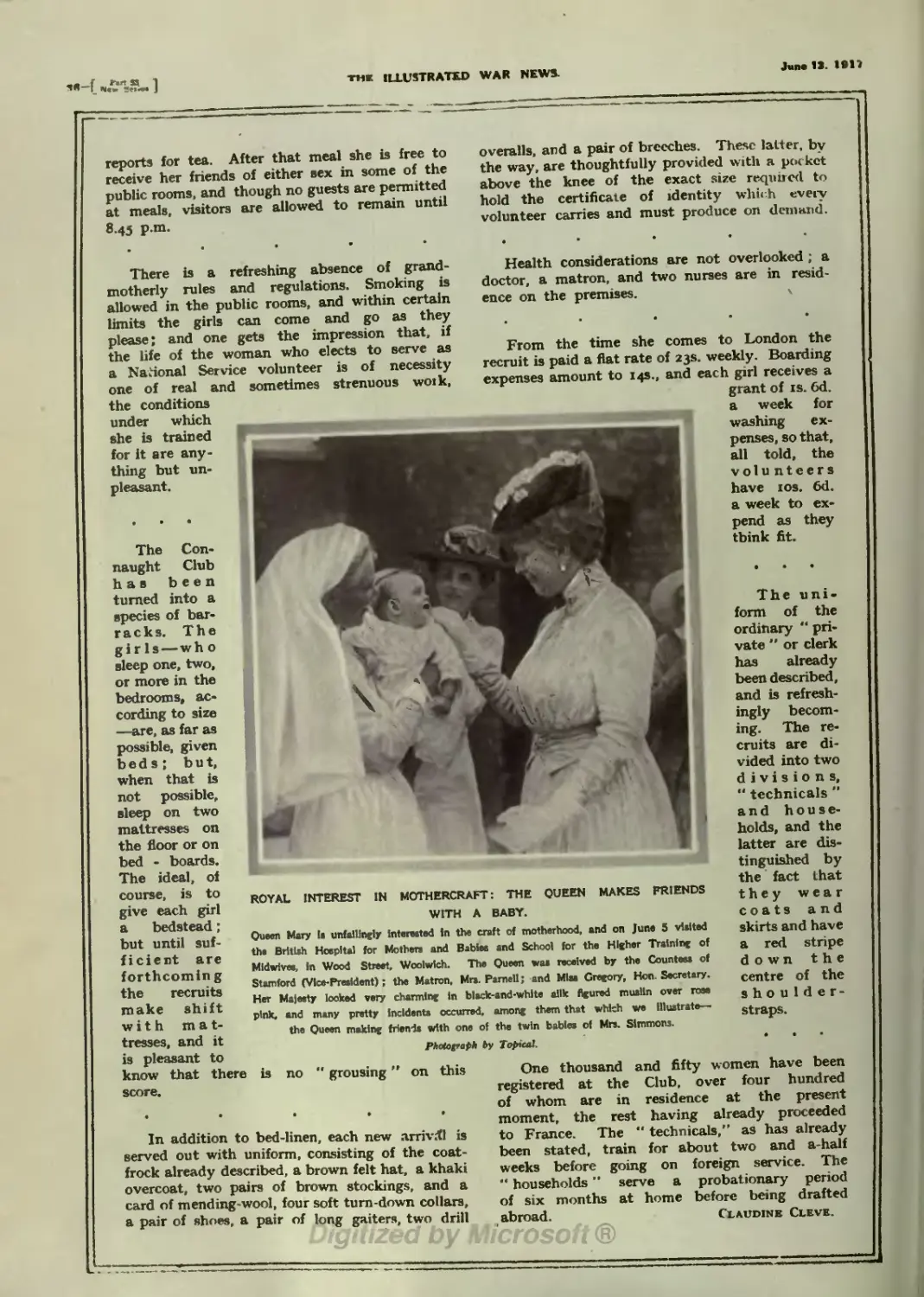
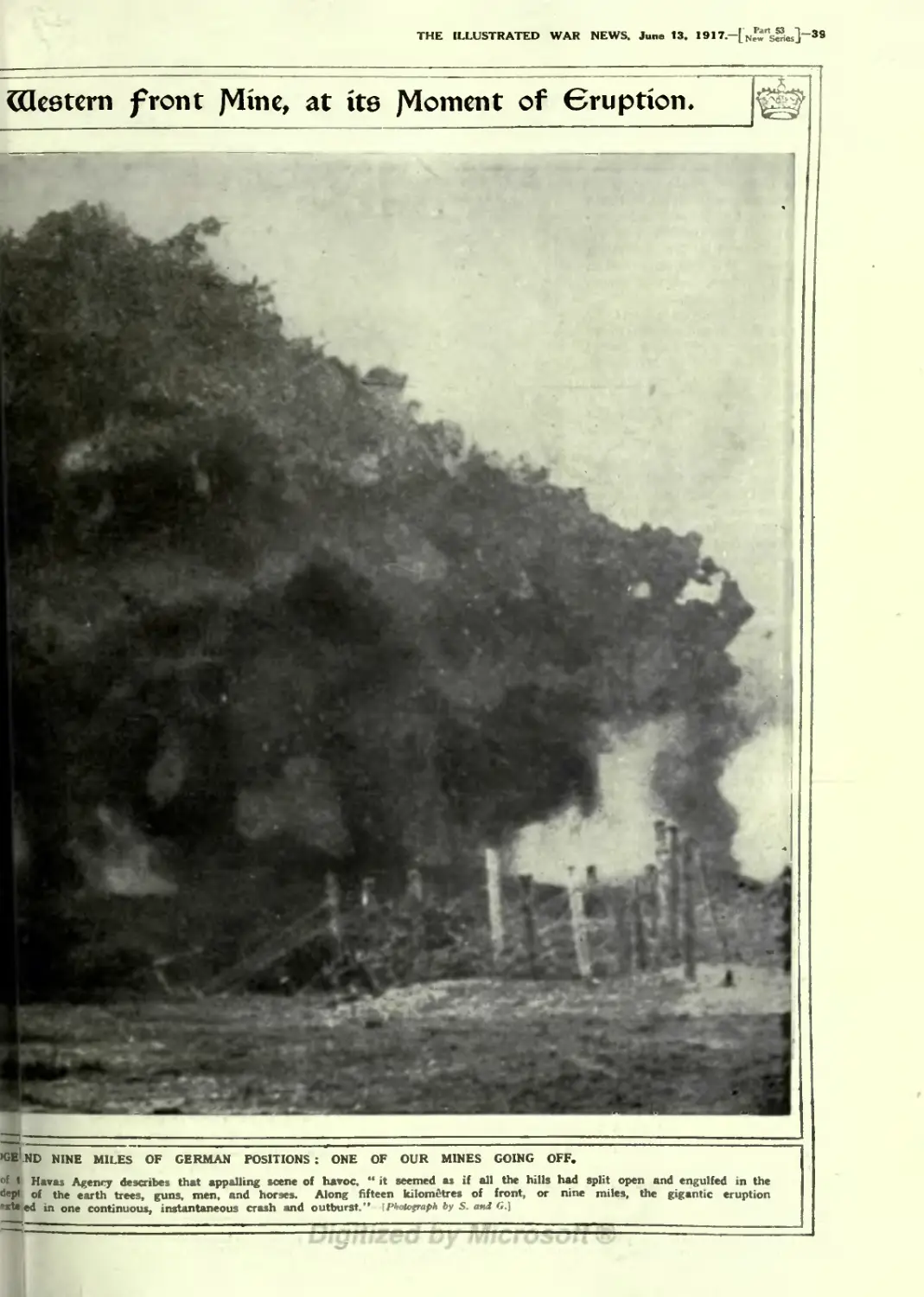
WOMEN AND THE WAR.
WOMEN have responded well to the call for
their services on the land, and already
several thousand have enrolled in response to the
call issued by the Women's Department of
National Service. But there still remain a large
number who, though prevented by home ties or
other duties
from devoting
the whole of
their time to
work of this
description, are
ready and
anxious to " do
their bit" and
a very useful
"bit" as land
workers. Acer-
tain amount of
training is, of
course, essen-
tial for all
those, except
the already ex-
perienced, who
desire to en-
gage in land
work ; and,
with the special
object of pro-
viding useful,
short, war-time courses of instruction in agricul-
tural subjects for women who wish to work on
the land, but are unable to fulfil all the conditions
of National
Service, two
training centres
have lately
been opened by
the Committee
of the Women's
Legion, the or-
gan isa t io n
which, under
the guidance of
the Marchion-
ess of London-
derry, has al-
ready provided
numbers of
trained and
efficient women
for the service
of the State.
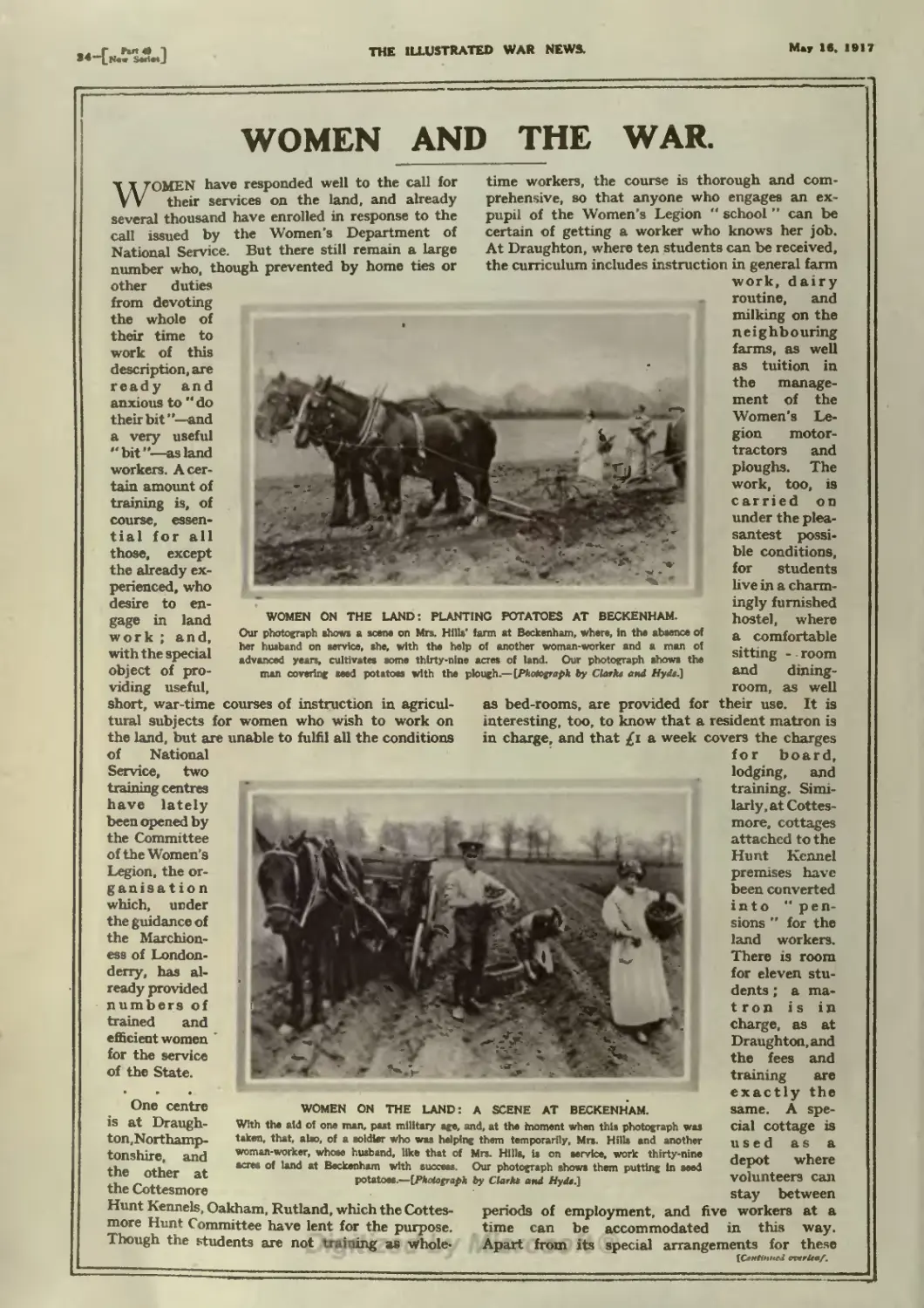
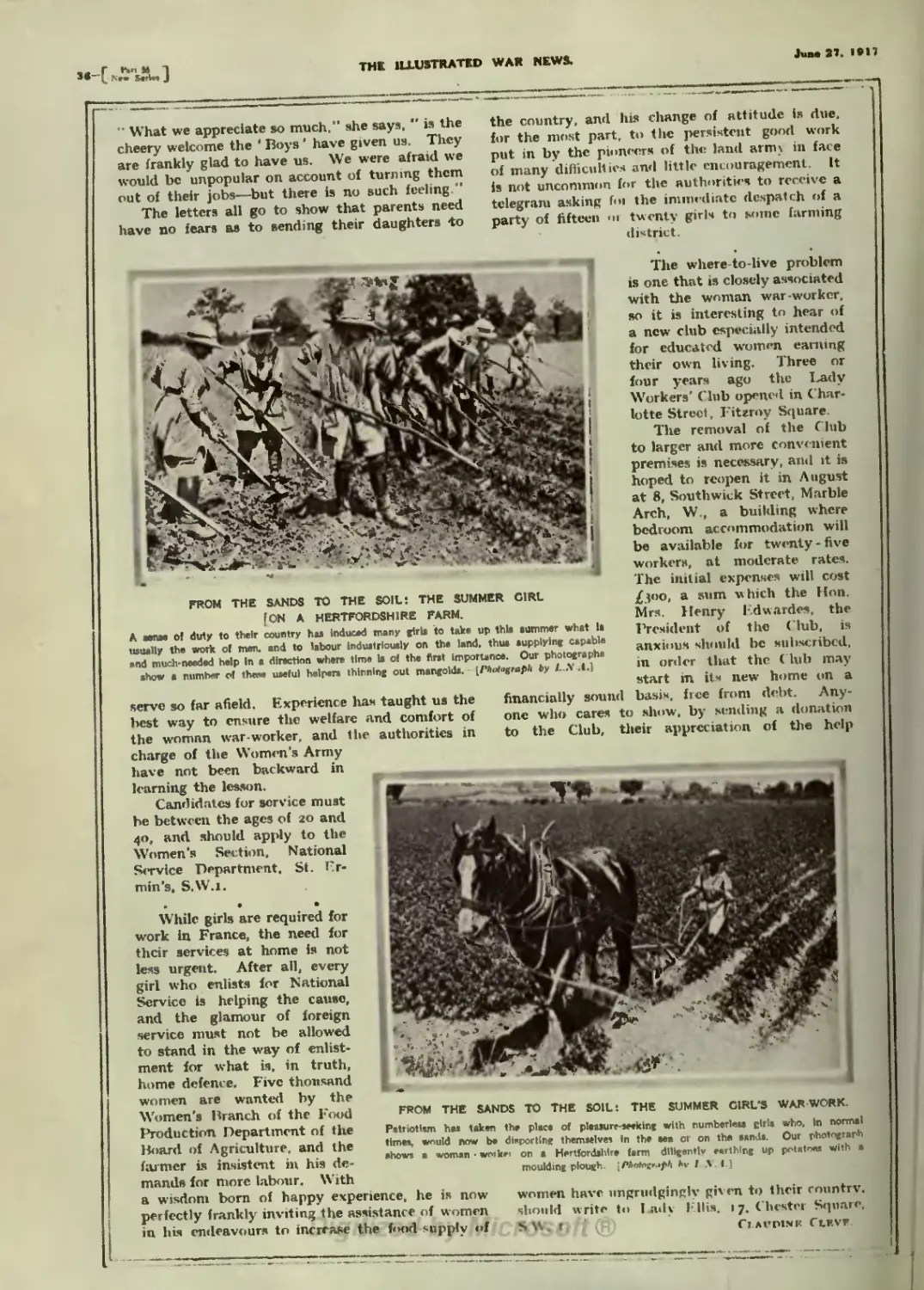
WOMEN ON THE LAND: PLANTING POTATOES AT BECKENHAM.
Our photograph shows a scene on Mrs. Hills' farm at Beckenham, where, in the absence of
her husband on service, she, with the help of another woman-worker and a man of
advanced years, cultivates some thirty-nine acres of land. Our photograph shows the
man covering seed potatoes with the plough. [Photograph by Clarke and Hyde.}
One centre
is at Draugh-
ton, Northamp-
tonshire, and
the other at
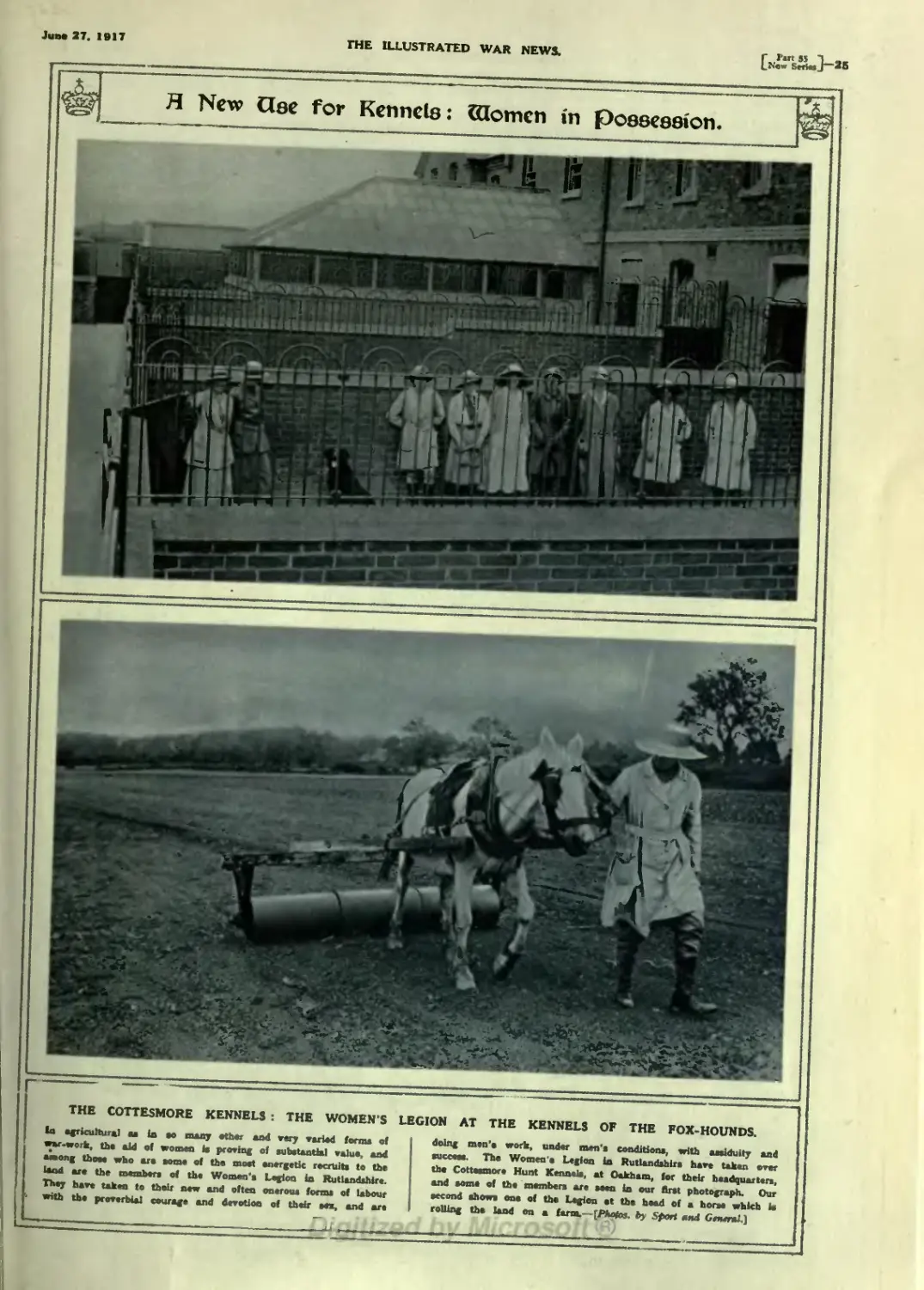
the Cottesmore
Hunt Kennels, Oakham, Rutland, which the Cottes-
more Hunt Committee have lent for the purpose.
Though the students are not training as whole-
WOMEN ON THE LAND: A SCENE AT BECKENHAM.
With the aid of one man, past military age, and, at the moment when this photograph was
taken, that, also, of a soldier who was helping them temporarily, Mrs. Hills and another
woman-worker, whose husband, like that of Mrs. Hills, is on service, work thirty-nine
acres of land at Beckenham with success. Our photograph shows them putting in seed
potatoes. [Photograph by Clarkt and Hyde.]
time workers, the course is thorough and com-
prehensive, so that anyone who engages an ex-
pupil of the Women's Legion " school " can be
certain of getting a worker who knows her job.
At Draughton, where ten students can be received,
the curriculum includes instruction in general farm
work, dairy
routine, and
milking on the
neighbouring
farms, as well
as tuition in
the manage-
ment of the
Women's Le-
gion motor-
tractors and
ploughs. The
work, too, is
carried on
under the plea-
santest possi-
ble conditions,
for students
live in a charm-
ingly furnished
hostel, where
a comfortable
sitting - . room
and dining-
room, as well
as bed-rooms, are provided for their use. It is
interesting, too, to know that a resident matron is
in charge, and that 1 a week covers the charges
for board,
_^_________._ M lodging, and
training. Simi-
larly, at Cottes-
more, cottages
attached to the
Hunt Kennel
premises have
-, ; ""fl^^^^P^ been converted
into " pen-
sions " for the
land workers.
There is room
for eleven stu-
dents ; a ma-
t ron is in
charge, as at
Draughton, and
the fees and
training are
exactly the
same. A spe-
cial cottage is
used as a
depot where
volunteers can
stay between
periods of employment, and five workers at a
time can be accommodated in this way.
Apart from its special arrangements for these
[Contintte.i murUaf.

Mar 18. 1817
THE ILLUSTRATED WAR NEWS
r Pa" A) ~\_
J New Serio> J
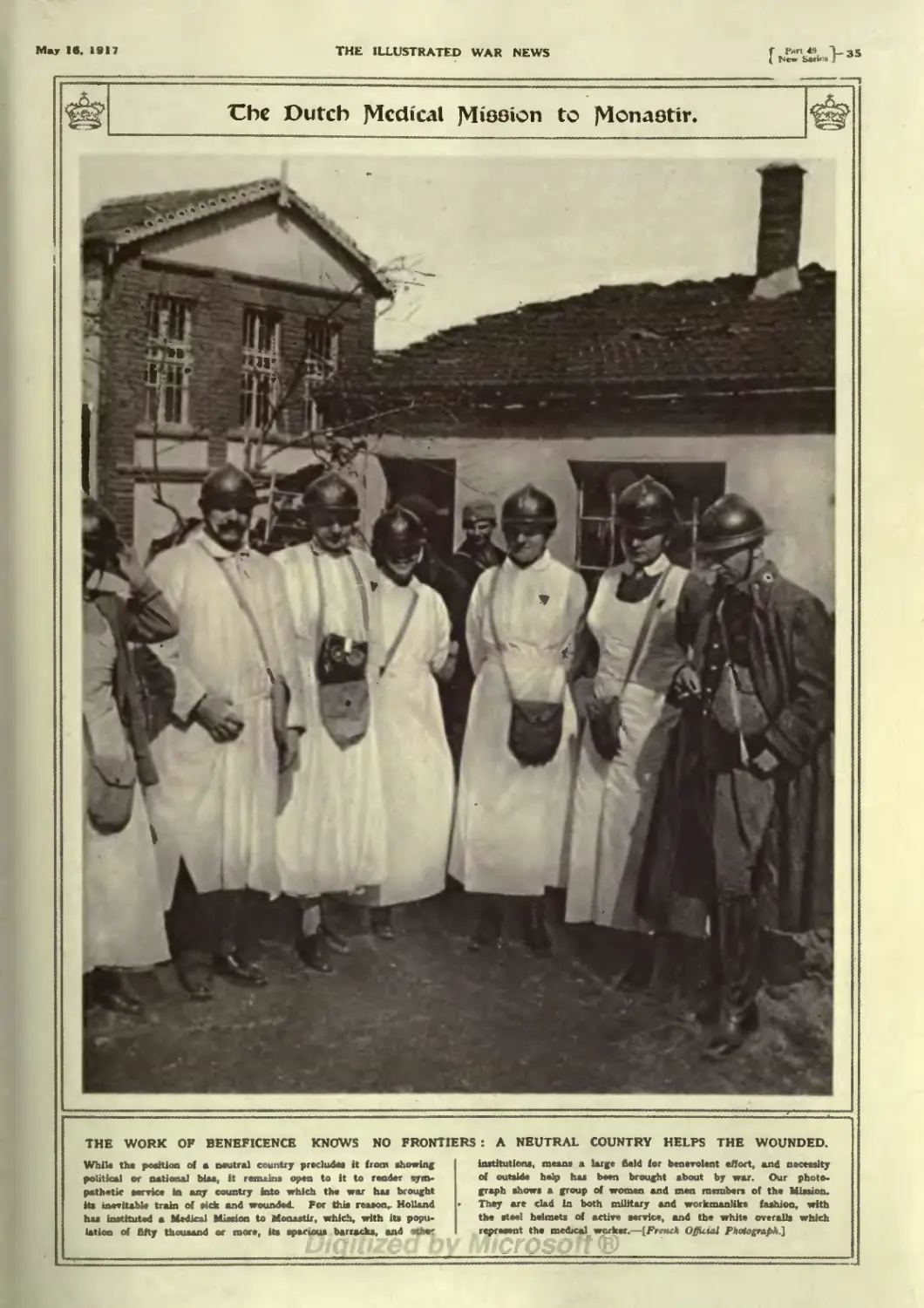
Che Dutch JMcdical JVHssion to Monastir.
THE WORK OF BENEFICENCE KNOWS NO FRONTIERS : A NEUTRAL COUNTRY HELPS THE WOUNDED.
While the position of a neutral country precludes it from showing
political or national bias, it remains open to it to render sym-
pathetic service in any country into which the war has brought
its inevitable train of lick and wounded. For this reason, Holland
has instituted a Medical Mission to Monastir, which, with its popu-
lation of fifty thousand or more, its spacious barracks, and other
institutions, means a large field for benevolent effort, and necessity
of outside help has been brought about by war. Our photo-
graph shows a group of women and men members of the Mission.
They are clad in both military and workmanlike fashion, with
the steel helmets of active service, and the white overalls which
represent the medical worker. [French Official Photograph.]

THE ILLUSTRATED WAR NEWS.
M.T 16, 1917
workers, the " Legion," acting in concert with the
Board of Agriculture, has provided the Rutland
Women's War Agricultural Committee with
accommodation for seventeen National Service
volunteers in buildings that adjoin the Cottesmore
Kennels. Women wishing to undergo the short
course of agricultural training offered by the
Women's Legion should apply to Mrs. Alan
Bellingham, Agricul-
tural Section, Women's
Legion, 113, Victoria
Street, S.W. i.
For sheer useful work
it would be difficult to
beat the record of the
Women's Defence Re-
lief Corps. Founded by
' Mrs. Dawson Scott, the
novelist, in September
1914, its object, as its
name implies, was to
provide substitutes to
undertake the work of
men during the absence
of the latter on military
service. In order to do
this the more efficiently,
the members learnt
motor - driving, signal-
ling, first aid, and other
subjects, and it was not
long before companies
of the Corps were work-
ing under the direction
of local Mayors in Man-
chester, Bolton, Stock-
port, and other North-
ern towns, as
well as in
Bexhill, Bris-
tol, and St.
Albans, help-
ing in hos-
pitals, or at
war depots,
or at war
meetings, as
well as stimu-
lating recruit-
ing by every
means in
their power.
Shortly
after the
formation of
the Corps, the
organisers,
foreseeing the
shortage of
land labour,
concentrated
.attention on
the matter,
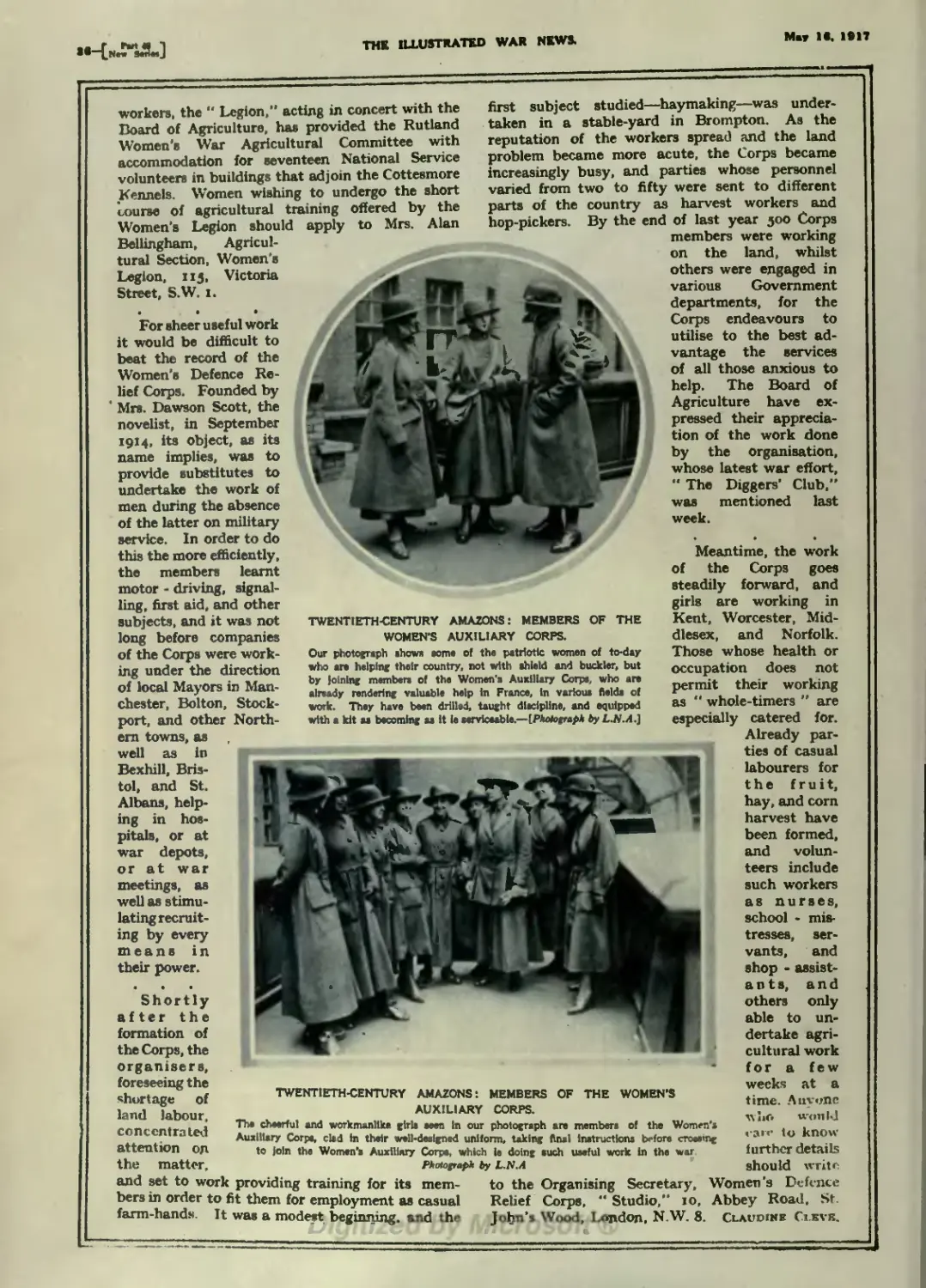
TWENTIETH-CENTURY AMAZONS: MEMBERS OF THE
WOMEN'S AUXILIARY CORPS.
Our photograph shows some of the patriotic women of to-day
who are helping their country, not with shield and buckler, but
by lolning members of the Women's Auxiliary Corps, who are
already rendering valuable help In France, In various fields of
work. They have been drilled, taught discipline, and equipped
with a kit as becoming as It is serviceable. [Photograph try L.N.A.]
TWENTIETH-CENTURY AMAZONS: MEMBERS OF THE WOMEN'S
AUXILIARY CORPS.
The cheerful and workmanlike girls seen in our photograph are members of the Woman's
Auxiliary Corps, clad in their well-designed uniform, taking final instructions before crowing
to join the Women's Auxiliary Corps, which is doing such useful work in the war
Photograph by L.N.A
and set to work providing training for its mem- to the Organising Secretary, Women's Defence
bers in order to fit them for employment as casual Relief Corps, "Studio," 10, Abbey Road, St.
farm-hands. It was a modest beginning, and the John's Wood, London, N.W. 8. CLAUDINE O.I.EVE.
first subject studied haymaking was under-
taken in a stable-yard in Brompton. As the
reputation of the workers spread and the land
problem became more acute, the Corps became
increasingly busy, and parties whose personnel
varied from two to fifty were sent to different
parts of the country as harvest workers and
hop-pickers. By the end of last year 500 Corps
members were working
on the land, whilst
others were engaged in
various Government
departments, for the
Corps endeavours to
utilise to the best ad-
vantage the services
of all those anxious to
help. The Board of
Agriculture have ex-
pressed their apprecia-
tion of the work done
by the organisation,
whose latest war effort,
" The Diggers' Club,"
was mentioned last
week.
Meantime, the work
of the Corps goes
steadily forward, and
girls are working in
Kent, Worcester, Mid-
dlesex, and Norfolk.
Those whose health or
occupation does not
permit their working
as " whole-timers " are
especially catered for.
Already par-
ties of casual
labourers for
the fruit,
hay, and corn
harvest have
been formed,
and volun-
teers include
such workers
as nurses,
school - mis-
tresses, ser-
vants, and
shop - assist-
an t s, and
others only
able to un-
dertake agri-
cultural work
for a few
weeks at a
time. Anyone
xvho wxmU
ran' to know
further details
should writi^

May 16. 1917
THE ILLUSTRATED WAR NEWS.
tPart 43 T ..
New Series J J '
By W. DOUGLAS NEWTON.
A BETTER SITUATION IN RUSSIA-THE FOOD QUESTION-VENEZEL1STS FIGHTING.
THE general news of the week is political and
economic rather than military, and it is
rather vague at that. The news that concerns
the political situation in Russia is, to British
minds, the
most complex.
It seems a fact
that the enemy
is making an
attempt to in-
troduce the
subject of
peace measu res
to, what it con-
siders, the
pacifically ten-
ding end as yet
not fully de-
finitive Pro-
visional Gov-
ernment of
Russia. The
Social Demo-
crats of both
sides have been
arced to meet,
and we have
seen a list of
terms sug-
gested by the
German power behind the German Social Demo-
crats. At the same time, we have had several
very definite statements from Russian statesmen,
and we have news that the Provisional Govern-
ment and the Council of Workmen's and Soldiers'
Delegates have come to a practical compromise ;
thus our Eastern Ally has made her position by
this declara-
t i on, more
settled. It is,
of course,
necessary when
considering the
internal condi-
tion of Russia
to bear fully in
mind the huge
social upheaval
she has under-
gone, and to
unders t and
that much that
seems indefin-
ite is the result
of all the cross-
currents set
loose by the
Revolution,
which may, and
probably will,
settle down to
broader and
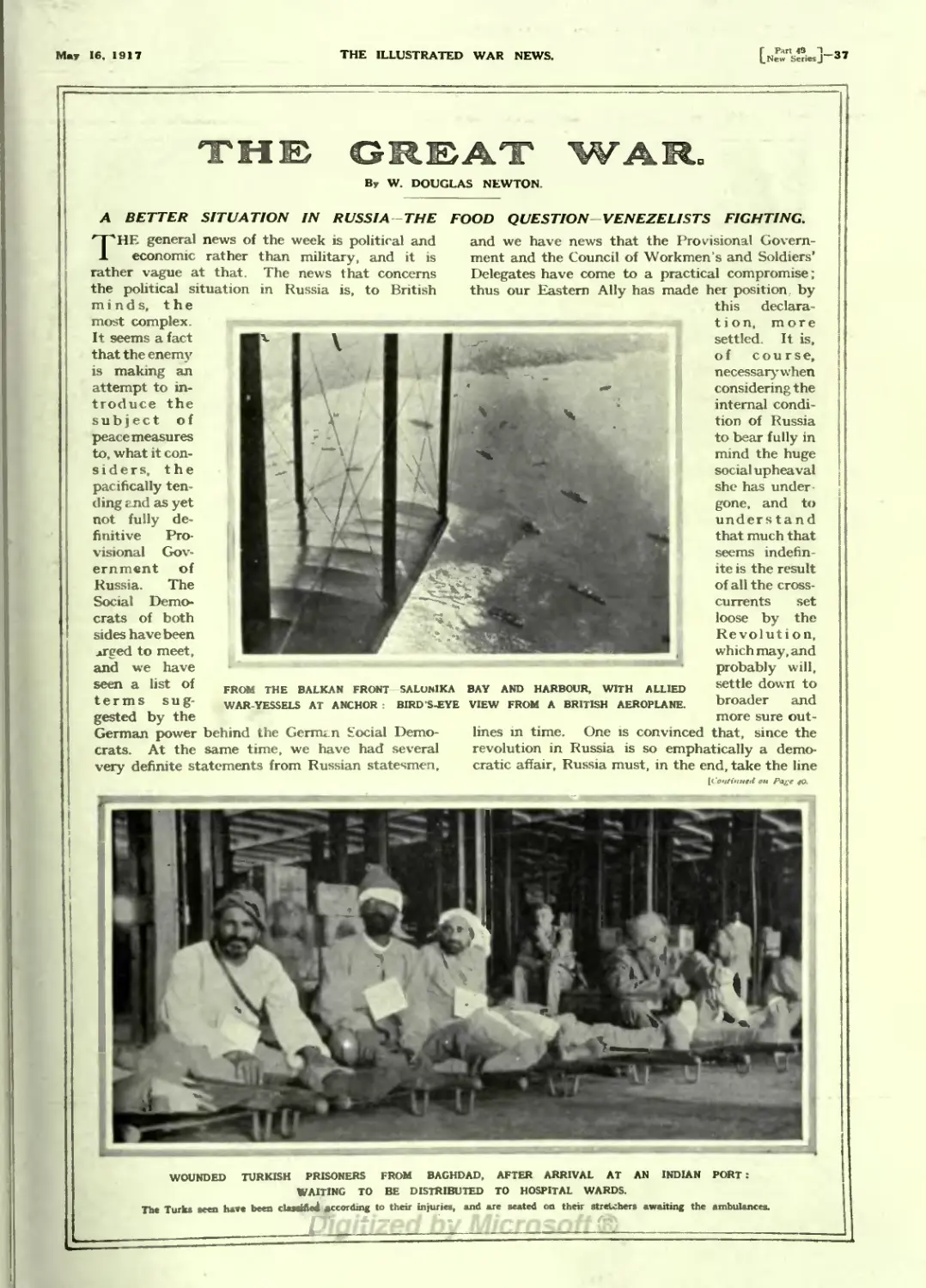
FROM THE BALKAN FRONT- SALONIKA BAY AND HARBOUR, WITH ALLIED
WAR-VESSELS AT ANCHOR : BIRD'S-EYE VIEW FROM A BRITISH AEROPLANE.
more sure out-
lines in time. One is convinced that, since the
revolution in Russia is so emphatically a demo-
cratic affair, Russia must, in the end, take the line
[Co'irtmitit OH Page 40.
WOUNDED TURKISH PRISONERS FROM BAGHDAD, AFTER ARRIVAL AT AN INDIAN PORT :
WAITING TO BE DISTRIBUTED TO HOSPITAL WARDS.
The Turks seen have been classified according to their injuries, and are seated on their streUhers awaiting the ambulances.

r P, . -THE ILLUSTRATED WAR NEWS. M.T 16. 1917
38 |_ Nw *' :
<flitb the British on the (flestern front
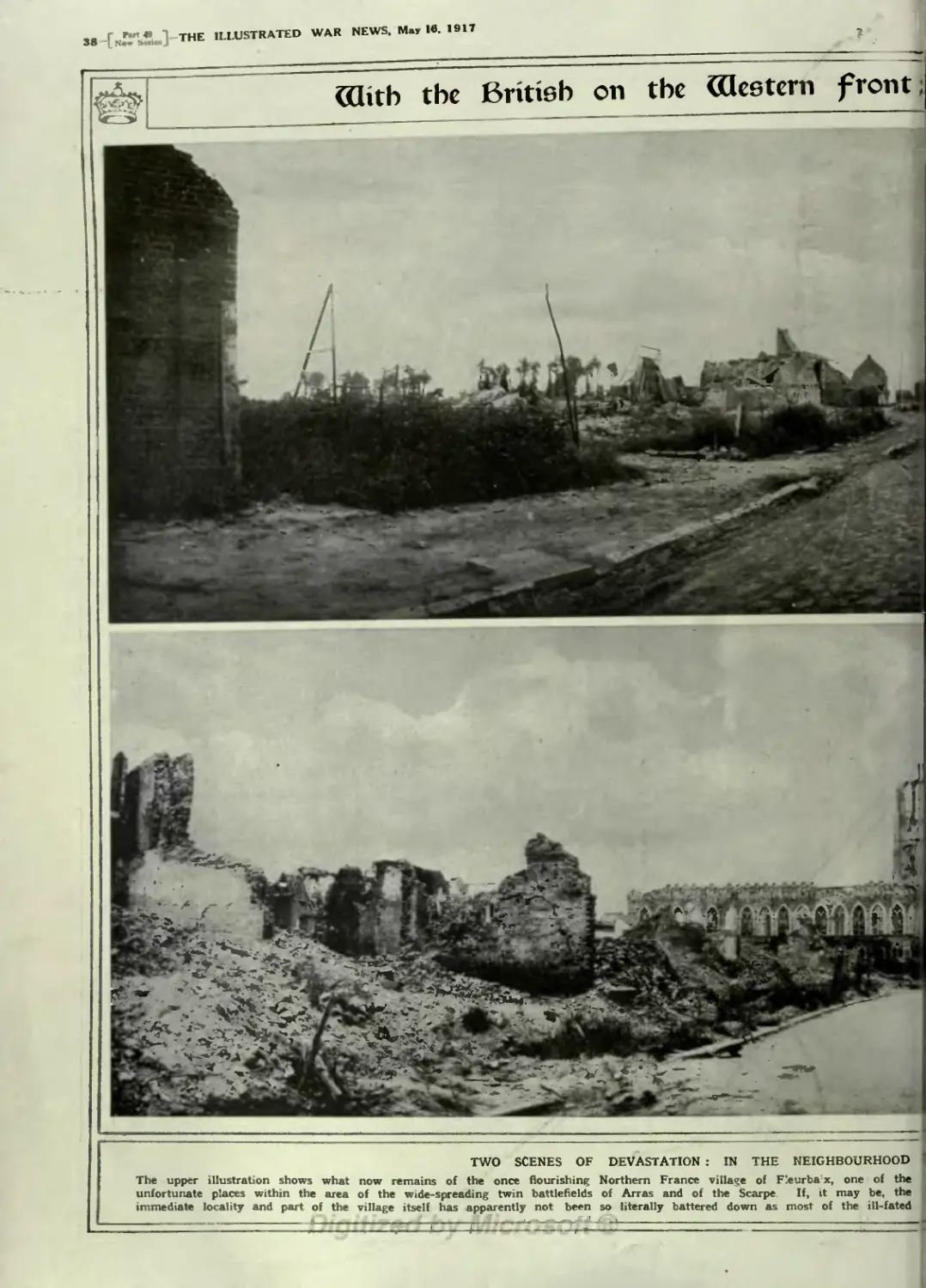
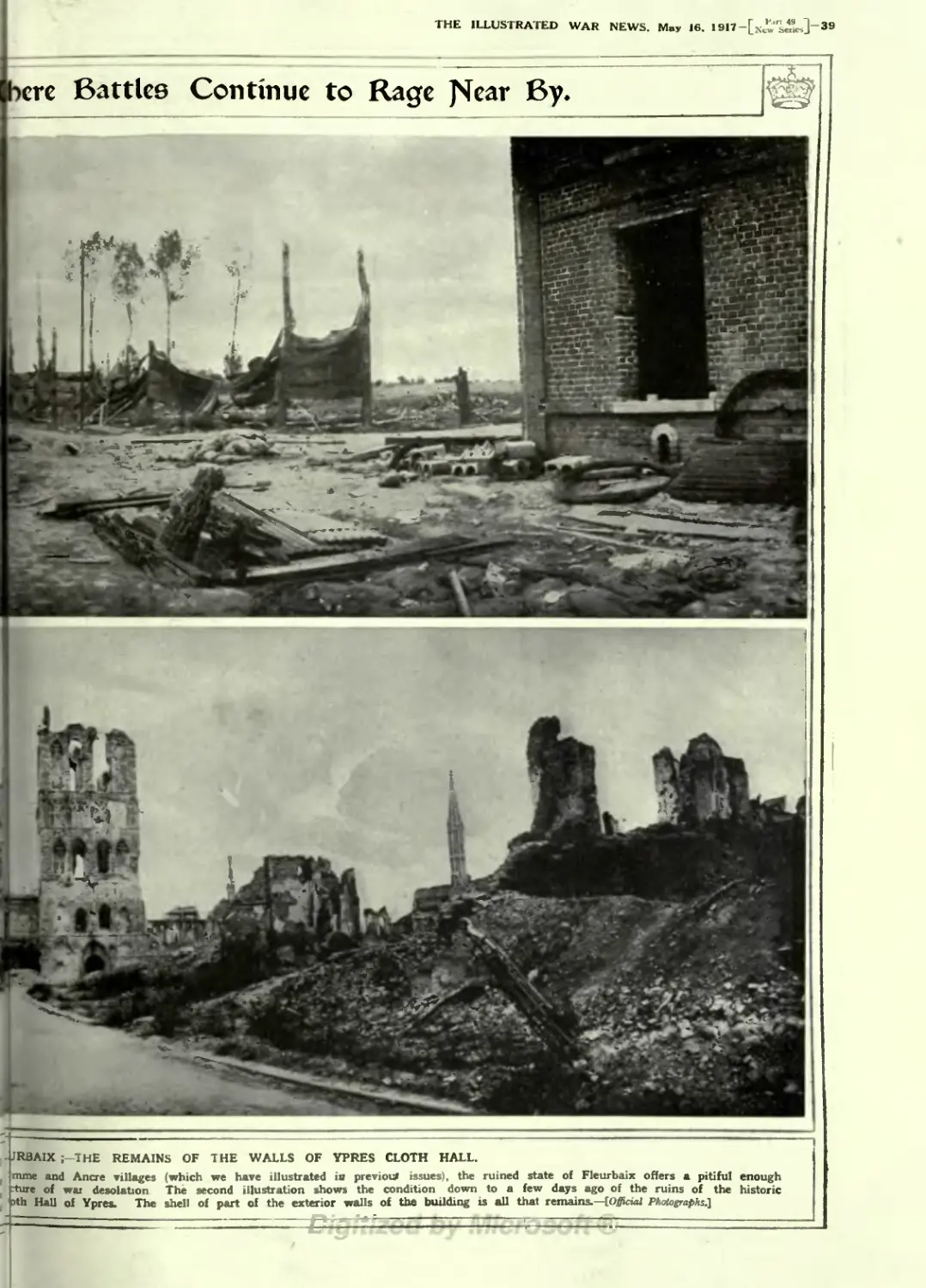
TWO SCENES OF DEVASTATION : IN THE NEIGHBOURHOOD
The upper illustration shows what now remains of the once flourishing Northern France village of F!eurba ; x, one of the
unfortunate places within the area of the wide- spreading twin battlefields of Arras and of the Scarpe. If, it may be, the
immediate locality and part of the village itself has apparently not been so literally battered down as most of the ill-fated

THE ILLUSTRATED WAR NEWS. May 16.
Battles Continue to Rage J^ear By,
JRBA1X ;-THE REMAINS OF THE WALLS OF YPRES CLOTH HALL.
mme and Ancre villages (which we have illustrated IB previous issues), the ruined state of Fleurbaix offers a pitiful enough
of war desolation The second illustration shows the condition down to a few days ago of the ruins of the historic
bth Hall of Ypres. The shell of part of the exterior walls of the building is all that remains. [Official Photographs.]

40
I Part 4> 1
L Sew bcf.es J
THE ILLUSTRATED WAR NEWS.
May 16. 1917
and fight on for the cause which all the great
democracies of the world are fighting. It would
seem .Logical if Russia has had her revolution
simply to give the greatest autocracy that is,
Oonnanv- -U <*ainst the newly banded array
,,f liberal countries. For it is a certain thing that,
if Russia made any
kind of peace \\ith
Germany, she would
by doing so release
many divisions for
use against the West
that is, against
France, Britain, and
no\\ America. Such
a step by Russia is
not likely, and ir any
case this very aspect
of the matter seems
to make it illogical.
Such a step would
be the freeing of her-
self at the expense
of others. General
Alexeieff has taken
a strong line, and
speaks for the con-
tinued determination
of the Army. Accord-
ing to a Reuter tele-
gram from Petro-
grad, it is stated that
ment has relieved General Russky from the Chief
Command of the Army on the Northern Front.
General Russky remains a Member of the Council
of the Empire and of the War Council." With
regard to that, it is well known that General
Russky 's health has been indifferent for a con-
siderable time past.
question that, more than any other, is the danger,
and Lord Devonport tells us that, though we shall
have to exercise extreme economy, we should be
able to win our way through the difficult months
that lay between ourselves and the harvest. Of
meat, butter, and other substitutes there is,
ON
THE FRENCH FRONT NEAR COURCY : A "CAVALIER " BARRICADE FLANKING THE AISNE
AND MARNE CANAL NORTH OF RHEIMS.- -(French Official Pl.olagraph.]
' The Provisional Govern-
apparently, no very great pinch, though there is
some dearth.
There is little or no news from the fronts
outside the West this week. Russia is still quiet.
On the Carso front there is an air of briskness,
much local fighting and a certain quantity of
artillery work marking the battle here. In
Macedonia, on the night of May 8-9, our troops
attacked from a
point south-west of
Lake Doiran on a
front of four miles.
On the left the
enemy's trenches
were captured on a
front of two miles,
to a depth of five
hundred yards. On
the right the Bulgar
positions were
stormed between the
lake and the Petit
Couronne, on a front
of one mile, but
heavy counter-
attacks by the
enemy, who was in
superior numbers,
compelled our forces
to retire on this sec-
tor to their former
positions. Near
Ljamnitza the Vene-
ON THE FRENCH FRONT TAKING NOTE OF ENEMY POSITIONS FROM A TRENCH : A FRENCH
GENERAL AND HIS STAFF. [French Official Photograph.]
While the food situation yet continues grave, zelists, fighting in line with the French, attacked
we have had some reassurance from a speech of with the greatest gallantry, and took Bulgarian
Lord Devonport. It is still, one realises, the grain trenches on a front of three miles.
LONDON; MAY 12, 1917.
LONDON. Published Weekly at the Office. 177 . Strand, in the Parish of St. Clement Danes, in the County of London, by THE Ti M"=TRATBD LONDON NKWS AND SKETCH. LTD..
172, Strand. afreaid ; and Printed by THF iT.l.l^TRATHn LONDON NHWS A~n SKFTTH. LTD.. Milford Lane. W.C. 2-WEDNBSDAY. MAY 16. 1917-
Entered as Second-Class Matter at the New York (N.Y.) Post Office. 1916.

The Illuttrated War News, May 23, 1917. Part SO, New Serlet.
Cbc Illustrated War
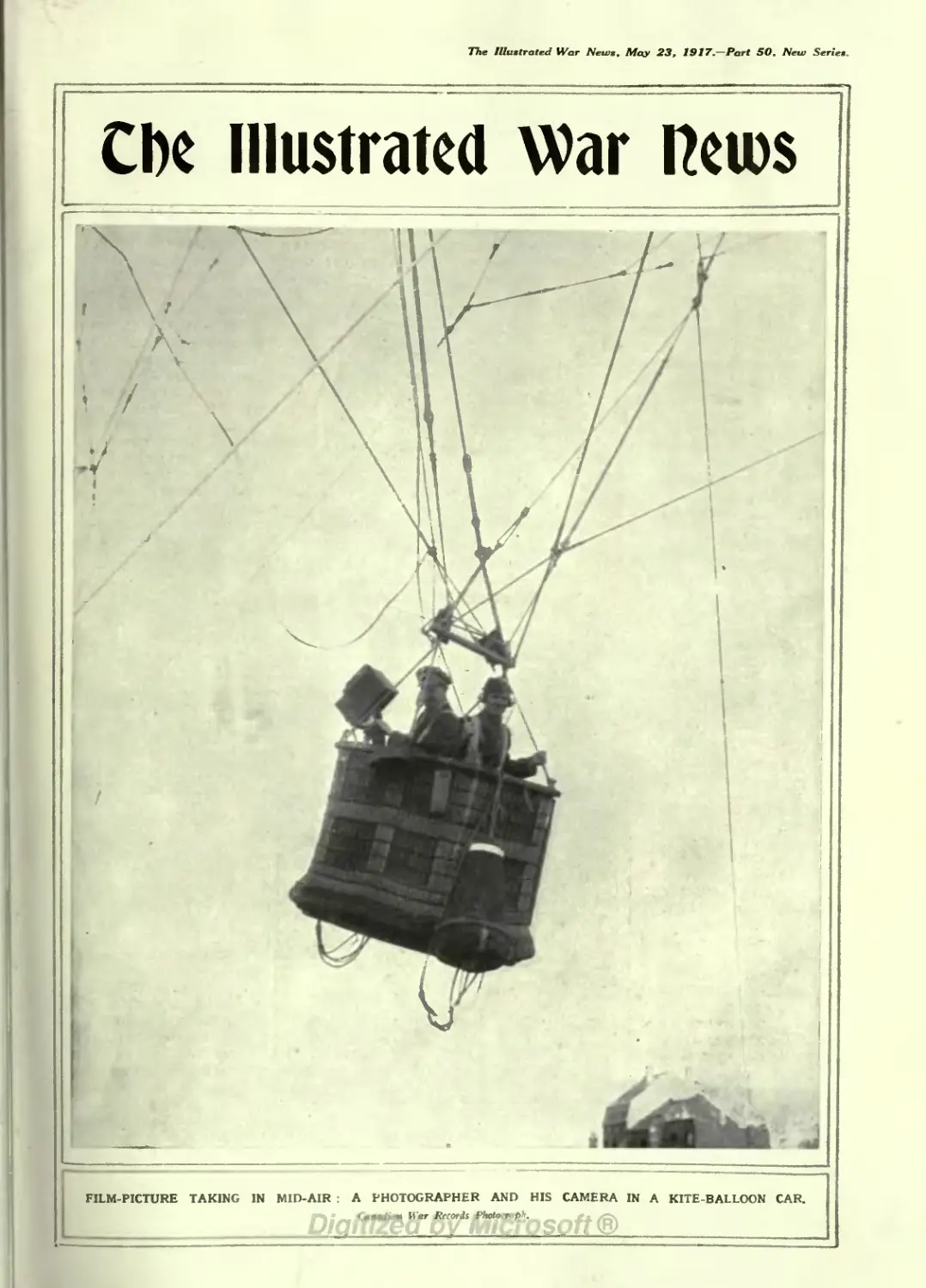
FILM-PICTURE TAKING IN MID-AIR : A PHOTOGRAPHER AND HIS CAMERA IN A KITE-BALLOON CAR.
Canadian War Records Photograph.

l'.ir .-. 1
'- Sew Series I
THE ILLUSTRATED WAR NEWS.
May 23. 191:
.- s ,
THE
DAY'S PROGRAMME -SYSTEMATIC FIGHTING,
THE ITALIAN MOVEMENT.
RCEUX AND BULLECOURT
IF proof were required that the operations of
the Allies are proceeding " according to
pian." it could not be better supplied than by an
anecdote of the recent struggle for the sternly
debated ground at Kceux.
That point, so long a bone of
the deadliest contention, was
taken as last, almost un-
awares, by some Irish and
Scottish troops who may be
said to have strayed into the
place. Finding their oppor-
tunity, they seized it. The
inwardness and the moral of
the story lies, however, in the
sequel, for, when the occupa-
tion was reported to Head-
quarters, Headquarters was
surprised and doubtful, for
" Rceux was not in the day's
programme."
The incident is inspiring,
for it means that the Allies'
advance is only in a sub-
sidiary way affected by the
enemy's resistance. He may
by reckless sacrifices hold up
the Allied troops here and
there for a time, but Sir
Douglas Haig has plainly
wrested the initiative from
Hindenburg. He has his pro-
gramme, and, where
he chooses to strike,
there he will strike
at his own appointed
hour, and the Ger-
man will retire, as
he loves to repeat,
" according to plan."
He speaks the truth,
save in one particular
the plan is Haig's,
not Hindenburg's.
Relatively, the
week's fighting has
not been spectacular
as the spectacular is
now measured. It is
the misfortune of
those who would esti-
mate the operations
from afar that the
scale is too vast
for any outsider to
appreciate. Only the
Supreme Command,
working in secret
with large maps and
complete informa-
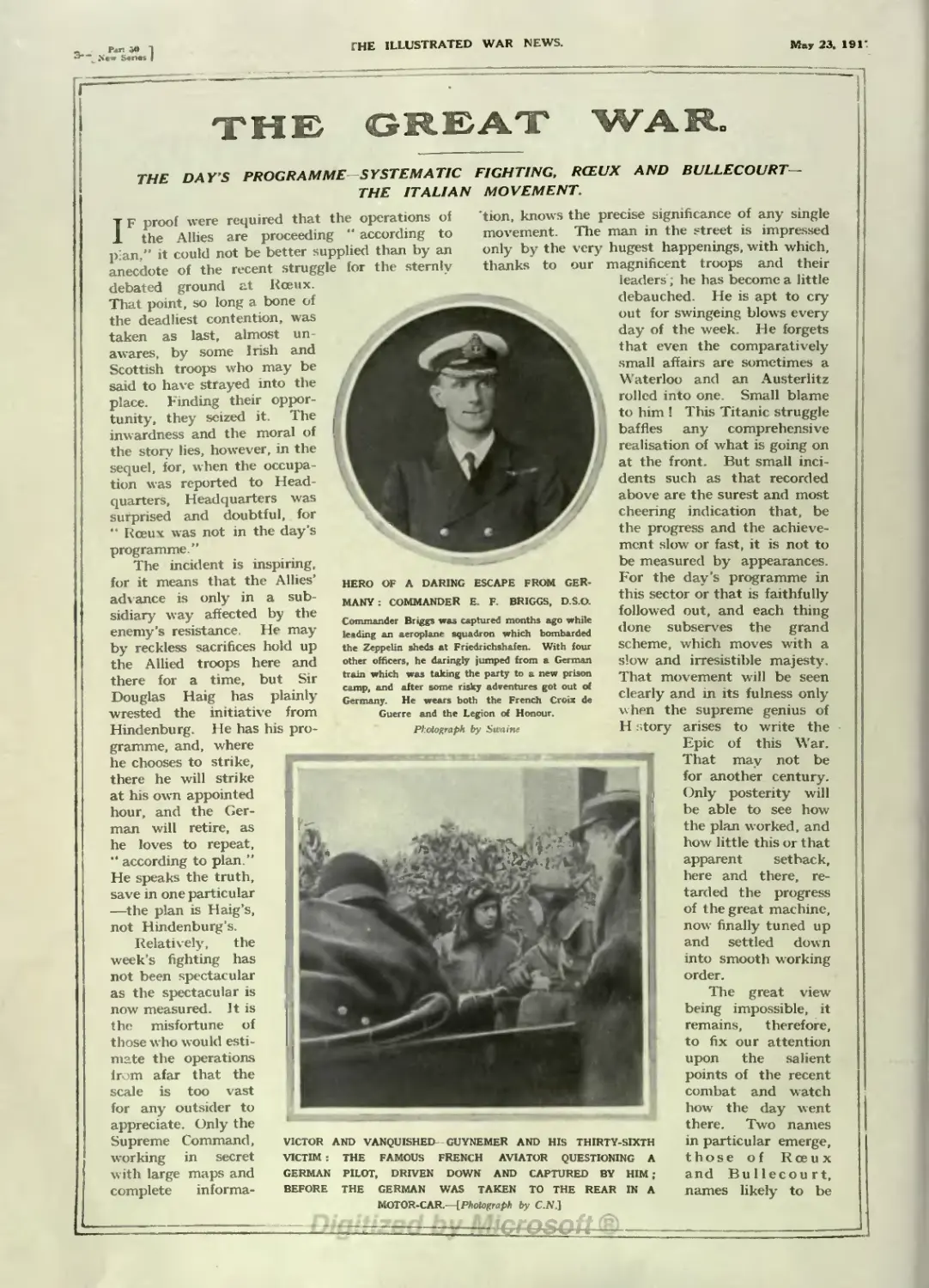
HERO OF A DARING ESCAPE FROM GER-
MANY : COMMANDER E. F. BRIGGS, D.S.O.
Commander Briggs was captured months ago while
leading an aeroplane squadron which bombarded
the Zeppelin sheds at Friedrichshafen. With four
other officers, he daringly jumped from a German
train which was taking the party to a new prison
camp, and after some risky adventures got out of
Germany. He wears both the French Croix de
Guerre and the Legion of Honour.
Photograph by Swaine
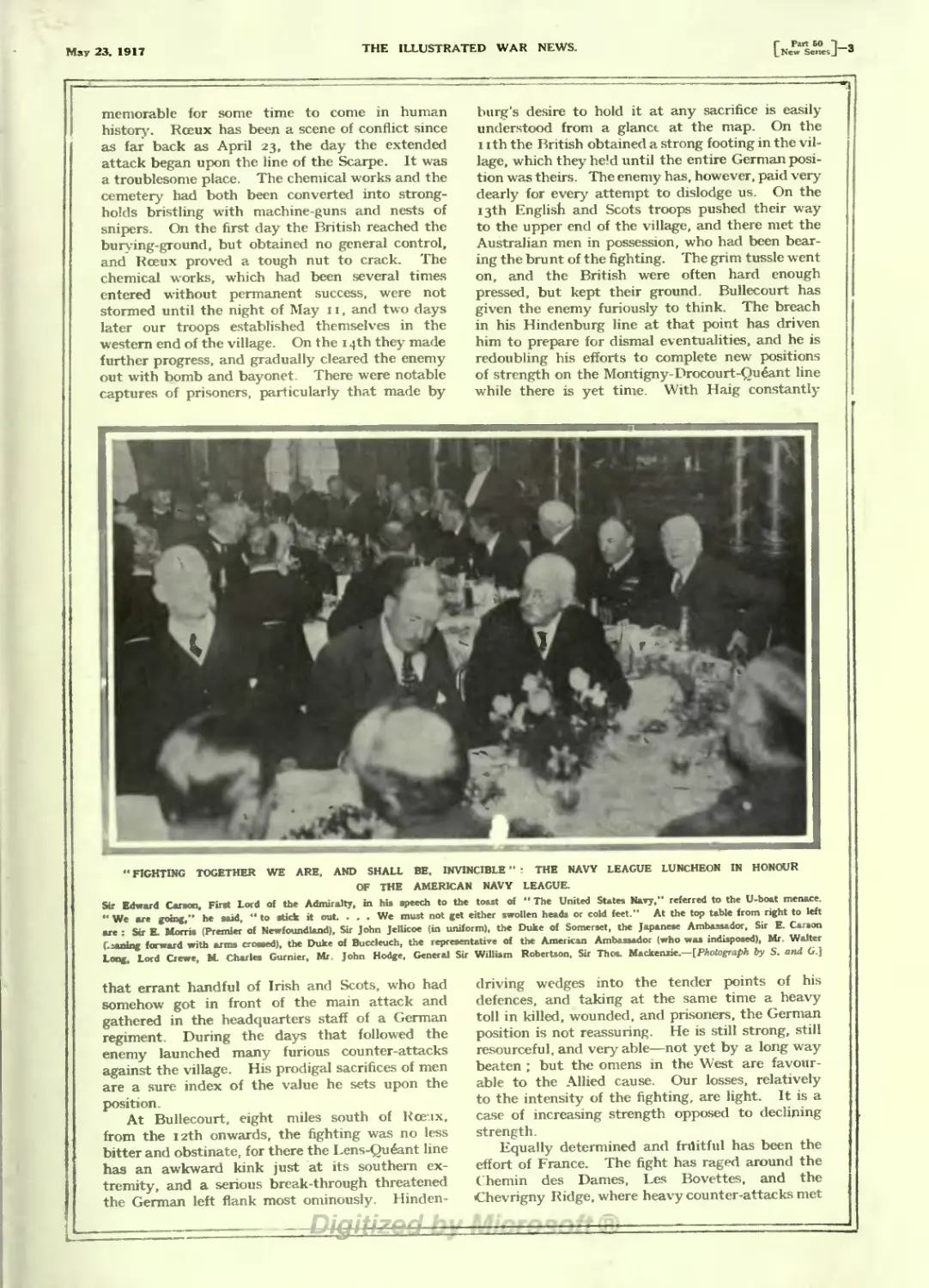
VICTOR AND VANQUISHED- GUYNEMER AND HIS THIRTY-SIXTH
VICTIM : THE FAMOUS FRENCH AVIATOR QUESTIONING A
GERMAN PILOT, DRIVEN DOWN AND CAPTURED BY HIM ;
BEFORE THE GERMAN WAS TAKEN TO THE REAR IN A
MOTOR-CAR. [Photograph by C.N.]
tion, knows the precise significance of any single
movement. The man in the street is impressed
only by the very hugest happenings, with which,
thanks to our magnificent troops and their
leaders ; he has become a little
debauched. He is apt to cry
out for swingeing blows every
day of the week. He forgets
that even the comparatively
small affairs are sometimes a
Waterloo and an Austerlitz
rolled into one. Small blame
to him ! This Titanic struggle
baffles any comprehensive
realisation of what is going on
at the front. But small inci-
dents such as that recorded
above are the surest and most
cheering indication that, be
the progress and the achieve-
ment slow or fast, it is not to
be measured by appearances.
For the day's programme in
this sector or that is faithfully
followed out, and each thing
done subserves the grand
scheme, which moves with a
slow and irresistible majesty.
That movement will be seen
clearly and in its fulness only
when the supreme genius of
H story arises to write the
Epic of this War.
That may not be
for another century.
Only posterity will
be able to see how
the plan worked, and
how little this or that
apparent setback,
here and there, re-
tarded the progress
of the great machine,
now finally tuned up
and settled down
into smooth working
order.
The great view
being impossible, it
remains, therefore,
to fix our attention
upon the salient
points of the recent
combat and watch
how the day went
there. Two names
in particular emerge,
those of Rceux
and Bu 1 lecou r t,
names likely to be

May 23. 1917
THE ILLUSTRATED WAR NEWS.
r
I Ne
Part 6
Senes
,
3
memorable for some time to come in human
history. Rceux has been a scene of conflict since
as far back as April 23, the day the extended
attack began upon the line of the Scarpe. It was
a troublesome place. The chemical works and the
cemetery had both been converted into strong-
holds bristling with machine-guns and nests of
snipers. On the first day the British reached the
burying-ground, but obtained no general control,
and Rceux proved a tough nut to crack. The
chemical works, which had been several times
entered without permanent success, were not
stormed until the night of May 1 1 , and two days
later our troops established themselves in the
western end of the village. On the 1 4th they made
further progress, and gradually cleared the enemy
out with bomb and bayonet. There were notable
captures of prisoners, particularly that made by
burg's desire to hold it at any sacrifice is easily-
understood from a glanct at the map. On the
nth the British obtained a strong footing in the vil-
lage, which they held until the entire German posi-
tion was theirs. The enemy has, however, paid very
dearly for every attempt to dislodge us. On the
1 3th English and Scots troops pushed their way
to the upper end of the village, and there met the
Australian men in possession, who had been bear-
ing the brunt of the fighting. The grim tussle went
on, and the British were often hard enough
pressed, but kept their ground. Bullecourt has
given the enemy furiously to think. The breach
in his Hindenburg line at that point has driven
him to prepare for dismal eventualities, and he is
redoubling his efforts to complete new positions
of strength on the Montigny-Drocourt-Queant line
while there is yet time. With Haig constantly
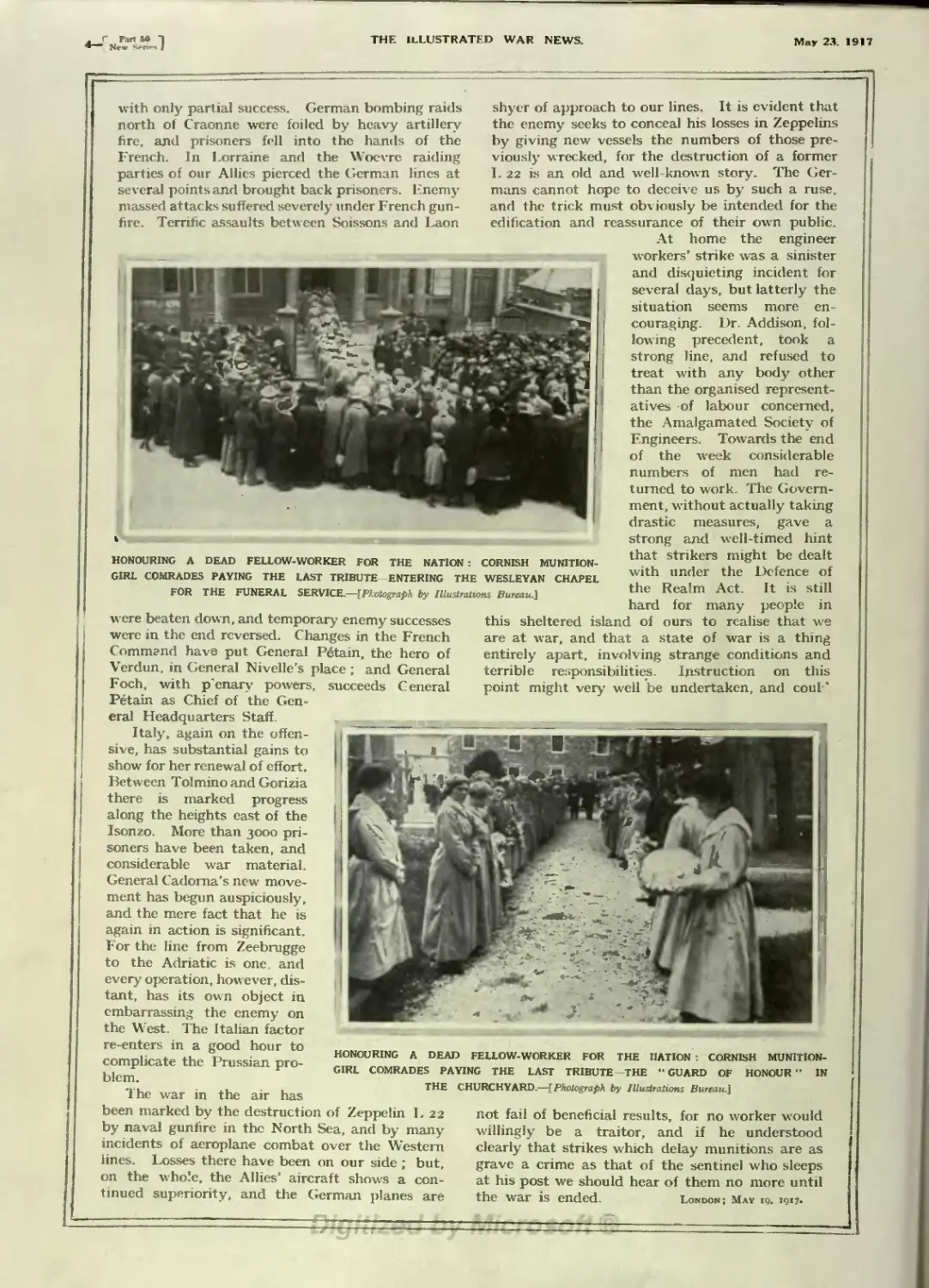
'FIGHTING TOGETHER WE ARE, AND SHALL BE, INVINCIBLE": THE NAVY LEAGUE LUNCHEON IN HONOUR
OF THE AMERICAN NAVY LEAGUE.
Carson, First Lord of the Admiralty, in his speech to the toast of " The United States Navy," referred to the U-boat menace,
oing " 'he said, " to stick it out. ... We must not get either swollen heads or cold feet." At the top table from right to left
Sir Edward Cars'
are Sir E^orris (Premier' of Newfoundland), Sir John Jellicoe (in uniform), the Duke of Somerset, the Japanese Ambassador, Sir E. Carson
( ruling forward with arms crossed), the Duke of Buccleuch, the representative of the American Ambassador (who was indisposed), Mr. Walter
Long Lord Crewe M. Charles Gurnier, Mr. John Hodge, General Sir William Robertson, Sir Thos. Mackenzie. [Photograph by S. and (,.}
that errant handful of Irish and Scots, who had
somehow got in front of the main attack and
gathered in the headquarters staff of a German
regiment. During the days that followed the
enemy launched many furious counter-attacks
against the village. His prodigal sacrifices of men
are a sure index of the value he sets upon the
position.
At Bullecourt, eight miles south of Rceux,
from the I2th onwards, the fighting was no less
bitter and obstinate, for there the Lens-Queant line
has an awkward kink just at its southern ex-
tremity, and a serious break-through threatened
the German left flank most ominously. Hinden-
driving wedges into the tender points of his
defences, and taking at the same time a heavy
toll in killed, wounded, and prisoners, the German
position is not reassuring. He is still strong, still
resourceful, and very able not yet by a long way
beaten ; but the omens in the West are favour-
able to the Allied cause. Our losses, relatively
to the intensity of the fighting, are light. It is a
case of increasing strength opposed to declining
strength.
Equally determined and fruitful has been the
effort of France. The fight has raged around the
Chemin des Dames, Les Bovettes, and the
Chevrigny Ridge, where heavy counter-attacks met

. r Part iO T
4 NY..
THE ILLUSTRATED WAR NEWS.
May 23. 1917
with only partial success. German bombing raids
north dl ( laiiiuie were foiled by heavy artillery
fire, and prisoners fell into the hands of the
French. In Lorraine and the Woevre raiding
parties of our Allies pierced the German lines at
several points and brought back prisoners. Knemy
massed attacks suffered severely under French gun-
fire. Terrific assaults between Soissons and Laon
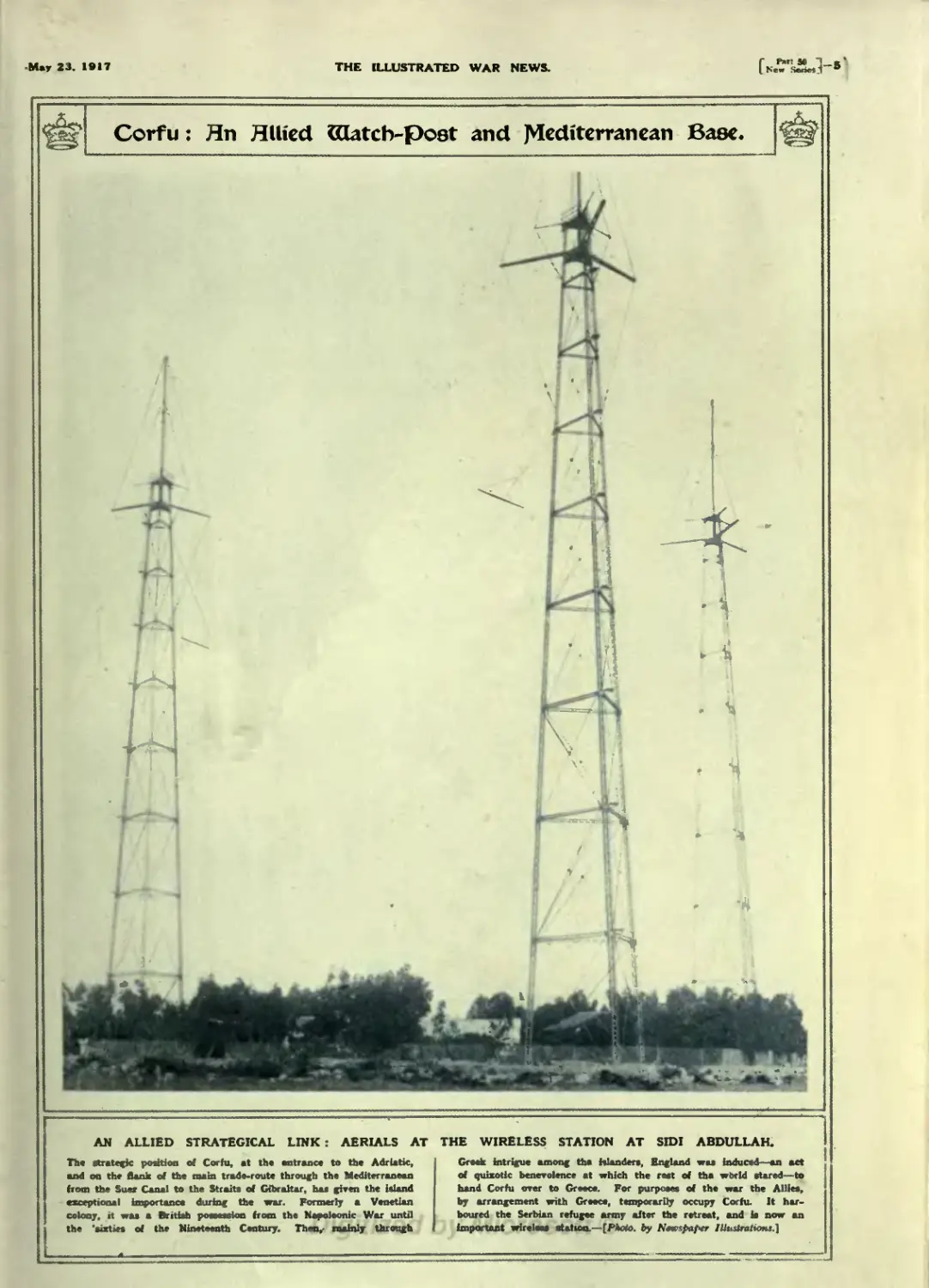
HONOURING A DEAD FELLOW-WORKER FOR THE NATION : CORNISH MUNITION-
GIRL COMRADES PAYING THE LAST TRIBUTE ENTERING THE WESLEYAN CHAPEL
FOR THE FUNERAL SERVICE. [Photograph by Illustrations Bureau.}
were beaten down, and temporary enemy successes
were in the end reversed. Changes in the French
Command have put General Petain, the hero of
Verdun, in General Nivelle's place ; and General
Foch, with p'enary powers, succeeds General
Petain as Chief of the Gen-
eral Headquarters Staff. ,^
Italy, again on the offen-
sive, has substantial gains to
show for her renewal of effort.
Between Tolmino and Gorizia
there is marked progress
along the heights east of the
Isonzo. More than 3000 pri-
soners have been taken, and
considerable war material.
General Cadorna's new move-
ment has begun auspiciously,
and the mere fact that he is
again in action is significant.
For the line from Zeebrugge
to the Adriatic is one. and
every operation, however, dis-
tant, has its own object in
embarrassing the enemy on
the West. The Italian factor
re-enters in a good hour to
complicate the Prussian pro-
blem.
The war in the air has
been marked by the destruction of Zeppelin L 22
by naval gunfire in the North Sea, and by many
incidents of aeroplane combat over the Western
iines. Losses there have been on our side ; but,
on the whole, the Allies' aircraft shows a con-
tinued superiority, and the German planes are
shyer of approach to our lines. It is evident that
the enemy seeks to conceal his losses in Zeppelins
by giving new vessels the numbers of those pre-
viously wrecked, for the destruction of a former
L 22 is an old and well-known story. The Ger-
mans cannot hope to deceive us by such a ruse,
and the trick must obviously be intended for the
edification and reassurance of their own public.
At home the engineer
njOMmBnMBMag workers' strike was a sinister
and disquieting incident for
several days, but latterly the
situation seems more en-
couraging. Dr. Addison, fol-
lowing precedent, took a
strong line, and refused to
treat with any body other
than the organised represent-
atives of labour concerned,
the Amalgamated Society of
Engineers. Towards the end
of the week considerable
numbers of men had re-
turned to work. The Govern-
ment, without actually taking
drastic measures, gave a
strong and well-timed hint
that strikers might be dealt
with under the Defence of
the Realm Act. It is still
hard for many people in
this sheltered island of ours to realise that we
are at war, and that a state of war is a thing
entirely apart, involving strange conditions and
terrible responsibilities. Instruction on this
point might very well be undertaken, and couF
HONOURING A DEAD FELLOW-WORKER FOR THE 1IATION : CORNISH MUNITION-
GIRL COMRADES PAYING THE LAST TRIBUTE THE "GUARD OF HONOUR" IN
THE CHURCHYARD. [Photograph by Illustrations Bureau.]
not fail of beneficial results, for no worker would
willingly be a traitor, and if he understood
clearly that strikes which delay munitions are as
grave a crime as that of the sentinel who sleeps
at his post we should hear of them no more until
the war is ended. LONDON; MAY i<>. 1917.

Mmr 23. 1917
THE ILLUSTRATED WAR NEWS.
f P*nst "]_
I New Series _1 a
Corfu: Hn HUied Cdatch-post and Mediterranean Base*
AN ALLIED STRATEGICAL LINK : AERIALS AT THE WIRELESS STATION AT SIDI ABDULLAH.
The strategic petition of Corfu, at the entrance to the Adriatic,
and on the flank of the main trade-route through the Mediterranean
from the Suez Canal to the Straits of Gibraltar, has giren the island
exceptional importance during the war. Formerly a Venetian
colony, it was a British possession from the Napoleonic War until
the 'sixties of the Nineteenth Century. Then, mainly through
Greek intrigue among the islanders, England was induced an act
of quixotic benevolence at which the rest of the world stared to
hand Corfu over to Greece. For purposes of the war the Allies,
by arrangement with Greece, temporarily occupy Corfu. It har-
boured the Serbian refugee army after the retreat, and is now an
important wireless station. [PAoto. by Newspaper Illustrations.]

f Pan 90 1
I.N.w StrmJ
THE ILLUSTRATED WAR NEWS.
Mar 23. 191 :
Destruction and Construction in Cttar.
ON THE BRITISH FRONT: THE WRECKED CHURCH
In war the processes of destruction and construction keep up an
endless competition. The Germans are pastmasters of the former,
especially the demolition of sacred and historic building*. " Nothinf
in all this desolation," writes a " Times " correspondent, " is sadder
than the wilful and useless destruction of churches. . . . What
remains of the churches [in certain Tillage.] Taries from ragged
stumps of blackened walls, just marking the outline of the building,
to mere shapeless htaps of rubbish. In most . . . British soldiers hare
been at work . . . gathering from the wreckage such mutilated figures
of saints or other holy things aa can be found . . . and placing them
where they can be cared for." Willerral was captured by Canadians
after Vimy. [Pkotes. by Canadian War Records.]

Mar 23. 1917
THE ILLUSTRATED WAR NEWS.
f Part 90 1_7
[.New SriesJ
TThc pneumatic principle in French Hrtillery.
THE VICTORIOUS FRENCH ARMY: A PNEUMATIC BOMB-THROWBR IN POSITION IN A TRENCH.
WITH
Trench.mortars and bomb-throwers of various types play an Important
part, as has often been pointed out, In modern warfare. The different
mechanical appliances used for throwing bombs and grenades from
trench petitions into those of the enemy, at short range, have to a
considerable eitent been evolved and perfected as a result of ex-
perience in the present war. Some of the machines that have
been employed were practically reriTali or derelopmentt o< ancient
catapults and similar devices. In others, again, as In the case of
that here illustrated, modern scientific method* of propulsion hare
been adopted. The French hate shown themselret particularly in-
genious with new kinds of bomb-throwers. In this Instance, It will be
teen, the apparatus works on the pneumatic principle. (Pluto. C.N.}

ILLUSTRATED WAR NEWS, M.y 23, is IT
HUied Octics of Victory: frencb Infantry pureui
ON A FRENCH BATTLEFIELD IN CHAMPAGNE : INFANTRY FOLLOWING UI
The close co-operation of infantry and artillery on lines proved effective by the battlefield experiences of the war, has been a
prmc,pal factor in brmgmg about the continued successes of the Allies on the Western Front. It has been so alike with us
orward movements in the Somme Valley and on the Scarpe, and with the French armies everywhere. A French

THE ILLUSTRATED WAR NEWS. May 23. I9l7.-[ Ne p ; It s S]-'?
Snemy Supported by Shell fire in Hdvance.
IN ENEMY ATTACK, WHILE THE GUNS PREVENT THE ENEMY RALLYING.
uit, after a recent battle in Champagne, is shown opening here, as the caption on the back of the official photograph notes,
r the beating-off of a German attack. Infantry the advanced front lines in widely extended order, with groups of supports
iwing are shown. Ahead is seen the smoke of the French shells covering the advance. {Fnnch Official Pkoto&aph.}

10-L'sv,. -THE ILLUSTRATED WAR NEWS. M.r 23. 1917
The Opening
A U9-MM. BATTERY READY TO FIRE : SCl|
~^^ &f^ Szj^f^^ th u pp r p."- 4 f * J uii n ^p' '
*" d th * ir m P 1 e m nt " utilWn, th. cr..rorn^V".V.fo a iiagl th Th^ 1P iun"o Cto te.^

THE ILLUSTRATED WAR NEWS. Ma 2. 181 ?.-[,.. s.rt~ I '
Spring Offensive,
TREES AND SHRUBS IN AN ALPINE VALLEY.
the branches of a sm.ll clutter of tree,. The uphill nature of the battle they are taking part in may be
y precipitou. mountain-id., in the background, with, coming down on the extreme left a rarme half-choked
| The gun. are i4 9 -mm., or 6-inch, gun., firing roo-lb. shell., and ranging up to a dozen ot to a
w,th

.- r iv so ~\
12 ' -... Srr,c. I
THE (U-USTRATED WAR NEWS.
May 23. 1917
fj dith the frcnch on the Qlestern front: Ht the Outposts,
ALERT: A LOOK-OUT AMONG FACTORY RUINS; SENTRIES
The capability of .dapting himself to .ny circumstance, on cam-
P*n . . tr.it in the character of the French soldier which i,
proverb,.!. One unce of it i. .hown in th , upper illultr . ti()n>
wh,ch . look-out m U in . rough-.nd-re.dy lurking
pUce of h own devi,ing. It i5 rn.de of ,heet-iron pl.tes wd
imp. of onvu on b.tten., Mt up in the wrecked buement of .
THE AISNE NEAR SOISSONS.
bombrded f.ctory. All .bout are fallen iron pillars and girders,
broken steam-pipes, machinery, and heaps of masonry rubble. In
the lower illustration is shown a French outpost, known as the
"Poste de I'Aquarium," close beside the banks of the Aisne on
the outskirts of St. Vwst, . suburb of the city, built on the right
bank of the river. [Frmch Official Photographs.}

Mar 23. 1917
THE ILLUSTRATED WAR NEWS.
CPart SO ~1_I
New Scries I I3
German fiowitzers Sic arc Using Hgainst the enemy.
>>&*
&&
HARD-HITTERS : A PAIR OF EX-GERMAN " HOWS '
The capture of Vimy Ridge came on the enemy, in common par- |
lance, at an " eye-opener. ' ' To read published extracts from
German paper., the news startled the German General Staff 1u if
we suddenly heard that Dover Castle and forts had been seized.
The surprise, particularly in the section stormed by the Canadians,
was so complete that German field - batteries and big 8 and 9 - inch
' ; OVERHAULING MECHANISM OF A CAPTURE.
howitzers alike were taken intact, the gunners being either
bayoneted on the spot or bolting without waiting even to carry
off the breech-blocks, or otherwise disable their pieces. The result
was that we quickly turned their own guns on the enemy, using
the abundant supplies of German shells for guns of almost erery
calibre left behind. [Canadian War Rt -cords Photographs.]

. r
I
r*n 10 I
,N. SentiJ
THE ILLUSTRATED WAR NEWS.
May 23. 1917
ROMANCES OF THE REGIMENTS : L.-THE HIGHLAND LIGHT INFANTRY.
THE OLD SUBALTERN.
IN former days the old subaltern was more
usually met with than he is now. Not that
promotion is generally easier, but in the first steps
men do not stick quite so hopelessly as was once
the case. At the present time, when lieutenants
must be young or nothing, the old subaltern is in
theory unacceptable, but in practice it is other-
wise, for many
men of full
years, and even
of more than
military age,
have taken lieu-
tenants' com-
missions and
have served as
bravely as the
hottest junior.
It was ever
thus, and down
from the days
of the Peninsu-
lar War comes
the story of
Lieutenant
Donald Ross,
of the 7 1 st, now
the Highland
Light Infantry,
who at Alva
gave the regiment something to talk about.
A detachment of the yist had been told off to
occupy the castle of the Dukes of Alva. The
building had been founded by the Moors, and the
Dukes of Alva had added considerable additions,
of which several were modern and of palatial style.
But when the British came to occupy the place
they found the Moorish building in ruins and the
later part to a great extent destroyed by fire,
although some fine ceilings and frescoes still
proved its former magnificence, There were also
A FEW OF THOUSANDS: GERMAN PRISONERS ON THE MARCH
ON THE FRENCH FRONT. [Fnnclt Official.]
some remains of a superb Moorish staircase. The
7ist at once set about putting the place into such
a state of defence as was possible. Its former
defences were destroyed, but fair shelter for troops
was hastily improvised.
While the British occupied this post there oc-
curred a curiously dramatic incident. On Dec. 10,
1812, the Duke
of Wellington
suddenly ap-
peared at Alva.
He had come
to reconnoitre
the enemy's
army from the
tower of the
castle. Having
seen their own
Commander-in-
Chief, the gar-
rison at Alva
were in a few
minutes to see
another great
man Soult.
For, as the 7ist
looked out from
their eyrie, they
observed a great
movement in
the French lines, and then Soult, surrounded by
a brilliant Staff, appeared well within cannon-
shot, it was said, but the garrison had no guns.
Evidently the French intelligence service was
good, for Soult took post on rising ground
and made his observations at leisure and un-
molested. The 7ist contrasted the splendour of
the Marshal's appearance and entourage with the
plainness of the Duke's, for Wellington, in his
simple blue surtout, had come to Alva attended
only by a Staff officer.
"'
ON THE FRENCH FRONT: THE FUNERAL CORTEGE OF A FRENCH CAPTAIN.
French Official.

Mar 23. 1917
THE ILLUSTRATED WAR NEWS.
tJ"rt si] l_i
New Series I *
Che Royal "Cour of Inspection among
^ V BLjfe.
NOTABLE INCIDENTS : WORKERS CHEERING ;
Ai to the popularity among the munition-workers of the King
and Queer.'* round of visits there can be no question. The
warmth of their welcome could not have been improved on, and
our upper illustration shows one case in which the men-workers
broke through the official cordon to cheer their Majesties. Chester
Castle was the scene of the ceremony shown in the lower illua-
tration. There the King prm.iird medali to wounded men and
relatives of the fallen. The special feature was the King's presen-
tation of the D.S.O. to the Duke of Westminster, the popular mag-
nate of Cheshire (Men on the right on the dais), for his brilliant
armoured-car dash into the desert to je&uie the crew of a British
patrol vessel from the Bedouin tribesmen. [Photos, by *"..V.]
r

. . r PR M
'-(.New Set*
THE ILLUSTRATED WAR NEWS.
M.y 23. 1817
The two great opponents, who were afterwards
to meet amicably at Queen Victoria's Coronation,
had hardly gone their several ways when the
French sharpshooters closed in on the defences
and began one of their usual attacks. But the
British, as ever, found these affairs excellent
sport, and many a life was risked
to watch the manoeuvres of the
antagonists in the open.
The doughtiest of the sports-
men was old Lieutenant Donald
Ross, a rough diamond, a capital
shot, and as keen as any boy. On
the very day of the Duke's visit
he was in command of a picket in
the castle ditch. His post over-
looked a stretch of level ground,
quite without cover for a con-
siderable distance. Out on this
plain French Lancer videttes were
patrolling singly, at intervals of
from 100 to 200 yards from each
other, and just out of range of
small-arms.
Mr. Donald, " takkin" a canny
keek ower the parapet" at these
gentry, thought he would like to
try a shot at them. He might,
perhaps, pick one of the fellows
off and make a prize of his
horse. If only they would not
keep so carefully out of range !
Not much beyond, but just enough to suffice
and to be very provoking. However, if the
mountain would not come to Mahomet, etc.
So, picking up his favourite rifle and entirely
neglecting to take more than one cartridge,
towards the Lancer, and made signs for him
to approach.
By this time the garrison had got wind of
something stirring afoot, and the castle walls were
thronged with spectators, hugely interested.
Donald walked on. At first the vidette took not
CHINA BREAKS DIPLOMATIC RELATIONS WITH GERMANY: CHINESE
TROOPS RENDERING HONOURS TO THE CHINESE FLAG HOISTED OVER
THE GERMAN POLICE STATION IN THE GERMAN CONCESSION AT
TIENTSIN. [Photograph supplied by Newspaper Illustrations.]
this giddy old subaltern put his head up,
and then, seeing that the nearest vidette had
gone farther apart than usual from his comrades,
coolly walked out of the ditch. He walked
CHINA BREAKS DIPLOMATIC RELATIONS WITH GERMANY: CHINESE
ON THEIR WAY TO TAKE POSSESSION OF THE GERMAN CONCESSION
AT TIENTSIN. [Photograph supplied by Newspaper Illustrations.]
the slightest notice of him ; but, when the Scot
had advanced about two hundred yards, the
Lancer suddenly put spurs to his horse and
dashed forward at a gallop.
Donald dropped on one knee, and, levelling
his piece, awaited the onset of his
adversary. The spectators' in-
terest now rose to fever pitch, and
some, expecting to see him run
through in a second or two more,
cursed the Lieutenant for a fool.
But Donald knelt motionless,
taking steady aim. The point of
the lance drew nearer and nearer.
It was a case either of a sure
and deadly shot or a spitted
Lieutenant. Which was it to
be ? The spectators waited,
breathless. No shot rang out,
for the Lancer, suspecting from
Donald's cool and unwavering aim
that he had probably to deal with
a dead shot, thought better of it.
Suddenly he wheeled about and
scampered off at top 'speed.
Donald, remembering that his
only cartridge was in his gun,
wisely refrained from wasting it
in a flying shot at the Lancer,
for he remembered that he had
some way to get back, and he
might yet need his ammunition
Should the Lancer return or should other enemies
appear. He got up accordingly, and, with as
much deliberation as he had set out, walked
back and rejoined his party in the ditch.

May 23. 1917
THE ILLUSTRATED WAR NEWS.
r Part SO 1_17
(.New Series J 1
TThc Royal TTour of Inspection among jMunition Cdorhers.
S?C
AT ONE CENTRE : THE QUEEN SEEING WOMEN
In order that erery section of the munition establishments Tisited
by the King and Queen during their tour might be seen, and the
workers see their royal risitors, at points in the works, their
Majesties temporarily separated, and went round certain departments
independently. The Queen is seen in the upper illustration watching
women-workers with trucks of T.N.T. high-e*plosiTe boxes. Some
T.N.T. MAKERS ; THE KING IN A CABLE WORKSHOP.
rt clapping hands to welcome her Mmjety. In mi nun; C4Mt
a* pomble, tht Queen spoke to the women, asking after their work
and health. In the lower illuitrttion the King U teen going
through a chain-making workshop, paeeing links of great war-ehip
cablee lying in heape awaiting rarious proceeeee preliminary t being
lhackled together and completed for issue. [Pkotos. by C.iY.j
|

>-LN.. s.r*.J-THE ILLUSTRATED WAR NEWS. Mar 23. 1917
Roval TTour among JYIunitton Qlorkcrs in
THE KING AND QUEEN WATCHING WORKERS ENGAGED IN ONE OF Tl
king yard on the Mersey where, before the war, sv
armour-plated, eng.ned, and equipped re.rtv for .. T h,t will *iv an idea

tit ILLUSIKAItU WAK NEWS. M 23, 1917. L Ne V SeiiJ~ l *
tb: Ht a Great establishment on tbe Mersev,
)OCKS OF THE ESTABLISHMENT : LOOKING DOWN ON A BUSY SCENE.
urcei of the establiihment. Their Majettiei, with thir entourage, moved about among the workeri without ceremony
round them all the time. They are Men here looking down into the depths of one of the vast toy dock* of the
d watching, the buiy icene of munition- workeri enraged below on the "floor" of the dock. IPIutoempk >y C.N.]

20 -
I-THE ILLUSTRA1
Behind the Canadian Lines :
THE FLASH OF A DISCHARGE REFLECTED ON THE SMOKE AFT
Assisted by reports during the day-time from reconnoitring airmen, " spotters " and observers in stationary " sausage " b
instructions from forward observation-officers, and by means of the map, long-range heavy-gun firing on the German p
proceeds all night as in the day-time, with equally destructive results for the enemy. The marksmanship in night bombar

NEWS. May 23, 1917.-[ N ^"s^]- 21
with a Bia LongsRange J^aval Gun.
ONE OF OUR BATTLE-SHIP TURRET-GUN TYPE GIANTS IN ACTION.
is enemy prisoners have told, and as diaries found on captured German officers corroborate, is no less effective after dark.
Searchlights from positions nearer the enemy's lines help in showing up the damage done, places that need further " attention,"
nd at times assemblies of the enemy. The reflection of the flash of a discharge is shown tbovt. (Canadian War Records Photograph.}

THE ILLUSTRATED WAR NEWS.
HtMtttce in eae-Maehs: Blach match Sports.
I
NEAR THE FRONT: A GAS-HELMET " V.C. " RACE; THE DIVISIONAL COMMANDER, AND "RIP.'
During a period of rest from duty in the trencha, the Black
Watch recently held athletic ports somewhere behind the Britiih
Jront. The upper photogiaph ihowi a picturesque item among the
erects the start of a "V.C. " race run in gas-masks. A "V.C. '
race, which is o. frequent event in military sports, is one in which
the competitors have to effect a rescue of someone in * supposed
position of peril. The novelty on this occasion consisted, of course,
in the wearing of the gas-helmets. In the lower photograph
seen the Divisional Commander, accompanied by personage also
of great popularity namely, the Division's pet collie "Rip."
Scottish troops have greatly distinguished themselves in the Battle
of Arras. [Photos, by Canadian War Records.]

Mar 23. 1917
THE ILLUSTRATED WAR NEWS.
CfMStl _ - ,
New Sem *
H typical Shell-Burst in a Wrecked Village.
A COMMONPLACE OF WAR ON THE WESTERN FRONT: A SHELL BURSTING
The bur.tin f of .helb i. M occurrence ,D frequent .t the front
it may be called 4 commonpl.ce of war, for in the fightm,
' the term applie. to thing, rery different from tho K u.ually
connoted by it clwhere. Thi. p^ticul., .hell, photograph^!, it
remarked, at a range that indicate, great courage on the
the man operating the camera, Men exploding in a
IN VIMY.
ruined .treet of the Tillage of Vimy, wiVh fell into the h.nds of
the Canad,an. after their heroic capture 01 the ridge nam,* ,,i
t may be auumed, perhap., though it it not .Uted in tl;e
nformation .upplied lth the photograph, that the .hell here ,hvrn
i. a German one. fired into Vlmy after the enemy i,ad been ex.
pelled. [Photo, by Canadian War Rtcords.}

THE ILLUSTRATED WAR NEWS.
Mar 23. 1917
__
Mvatcnous Niht 6ombinsnof_a Dutch tfcwn.
WORK OF THE UNKNOWN AEROPLANE : A TOTALLY
In the trly houn of the list day a! April, the mull Dutch
fijhing town of Zierikiee, situated on the tout not fir from the
Btlgi.n frontier, wu subjected to bombardment from orerhead by
an aeroplane of unknown nationality. Three people, a man and
woman and their child, were killed outright, and a number of
houae> were aererely damaged, tome being entirely demolished. Six
DUTCH FIREMEN
DUTY.
WRECKED HOUSE
bombs in all fell. It hat been established, after an official inquiry,
that no British aircraft wai concerned in the affair. The aeroplane
pilot, it it stated by the Dutch papers, used searchlights to direct
his operations, and the glare of these caused a panic among tt
inhabitants of Zieriksee as the bombs came crashing down in quick
succession. [Pluto, supplied by C.N.]

May 23. 1917
THE ILLUSTRATED WAR NEWS.
T P*rt w "I ,r
!_New Series j~ 25
Che Mysterious Night Bombing of a Dutch TTown.
WORK OF THE UNKNOWN AEROPLANE : ROOF
Immediately it wu reported that bomb, had been dropped on
Zierikaee from an aeroplane of unknown nationality the attack
taking place on a dark night the British Government let on foot
a ttrict inquiry in order to make sure that none of our aircraft
were concerned in the matter. The official inquiry, which wa> of
an exhaustive nature, haa refulted in a report, which hit been
WRECKAGE ; FISHERMEN'S WIDOWS SEARCHING.
published through Reuter's Agency, to the effect that it wu
impossible, as had been luggetted in Holland, that the attack was
due to a mistake on the part of any British airman. It exonerates
our airmen completely, the whereabouts of all being ascertained
proving that the nationality of the aeroplane could not possibly hare
been British. [Photos, supplied by C.N.]
J

THE ILLUSTRATED WAR NEWS.
M.r 23. 1917
POOTHOTES TO ARMAGEDDON: XLI.-UKE A DREAM.
T IKE a dream, thought Private Clark, really
L-, like the best kind of dream even the
sergeants were affable.
The Orderly dog smiled on him cheerily.
Orderly dog was glad to see him about, looking
6 ' Not too well," said Clark quickly, and the
Orderly grinned. He said that Private Clark need
have no qualms. They were all right to-day,
really human and pleasant and sympathetic,
also said that he would push Clark on.
waiting around now," he said. "No standing
about for hour after hour, an' then being told 1
come agin for another wait of hour after hour.
It '11 all go through slick, without irritation.
And Clark need not be nervous. It would be all
8 The sergeant was the same. He was bright
" Private Clark from the Ancre ? Hope you
haven't been standing in. that draught too long.
I '11 see somebody about it if you think you have.
That sort of thing can't be allowed. Now, let mi:
have your papers. I '11 tell the Board, and
they '11 see you at once."
By the time Clark got to the Board he knew
it had all been beautifully arranged for him.
There was going to be no trouble. Everything
was to go forward smoothly. He smiled as he
remembered other Boards. Those other M.C
hadn't nodded to him and been cheery like these.
This one was just the sort of Board a man would
ask for It treated him quite human. The
doctors didn't look at him as though they thought
he had been stealing, or was going to murder
someone. And no eye had a " dope "-suspecting
glint. They were ready, he saw, to listen to a
ON THE BRITISH WESTERN FRONT: THE CAMP OF AN ANTI-AIRCRAFT GUN -CREW.
Official Photograph.
and smiling, as though privates were the sort of
people he really' loved. He told Clark they
would soon put him all right. There 'd be no
nouble. They 'd finish the whole matter in a
U.V . perhaps two that is, the papers would go
I'.ioii^'h qui.-kly. and there would not be more
i>Mi: i(u:r. o.' s;iy six, forms to fill and sign. He 'd
IK trie ot the barracks to-morrow at the latest.
" \Viiv ,-i.oiiM we kcrp you hanging about ? "
said liio sorgcAnt. " t know it docs happen ; but
why should \vc do it ? After all. it 's only right
that we should get tilings settled for you as soon
as we can after al! you 'vc gone through. After
all, you deserve a good time."
When he had stripped, another sergeant saw
him standing about. He ran across.
reasonable, honest man. More, they were eager
to listen to him. Clark knew he had struck the
one Board in the world a private wants to meet.
The Senior M.O. come over and sai-1
" Well, Clark. I 'm sorry to see you 'rr. not.
looking at all fit."
Clark thought what a. fine, discriminating man
he was. He explained that what he had gone
through on the Ancre regular broke a man up.
" Of course," said the M.O. " A terrible
strain for a man of your constitution. It was
really unfair to send a man like you there.
Doctors ought to realise that some men arc
different."
" That 's true, Sir," Clark answered with
splendid humility. " I knew all along I wasn't
[Contitttftt overleaf.

Mar 23. 1917
THE ILLUSTRATED WAR NEWS,
Part 60 "I .,
New series j 27
The Intense Struggle for Hir Supremacy.
A " BIRD " TO THE BRITISH : A GERMAN BIPLANE BROUGHT DOWN BEHIND THE CANADIAN LINES.
Thfc tar tht struggle in tht *ir has redoubled In Intensity <i the
iiupjrtanc* of aerial reconnaluance hu been more and more
lealiMd. "On th essential (Uyi In the battle* of Arraa and the
Somme," laid Lord Derby the other day in opening the official
Air Set.icrs 1 Exhibition at Liverpool, " the supremacy of the air
wai ouri abMluuly." No fewer than 717 aeroplane* enemy and
Allied- were broujht to earth on the Western Front during April,
in air fighti or by gun-fire. This big total comprised 309 Gtrmnn
machines, 147 British, and, according to German reports, sol
French and Belgian Of thf 369 German aeroplanes brought down,
British airmen accounted for 263, and British anti-aircraft gunneri
for 6. [Pkolos. by Canadian War Ktcardi.]

THE ILLUSTRATED WAR NEWS.
May i.-, 1917
built for that sort of thing. But there you are
mine not to reason why . . ."
" I understand," said the M.O., and the
others murmured sympathetic assent. " Well,
now, let 's have your case. Tell us what is
the matter with you ? "
" Bad," echoed Clark. " I can scarcely see
with it on some days. Can't even get me rifle-
sights in line. It 's crool unfair to send a man
out with a bad eye like mine to fight Huns. It 's
such a handicap."
" It 's a scandal ! " said the M.O. He
turned to the other mem-
bers of the Board. " You
see how it is. We have no
alternative. This man is unfit
for the Army totally unfit.
He should never have been
taken, and we are only doing
our duty by the country and
Lloyd George in chucking him
out. We will give him a com-
plete discharge. He must leave
the Army in ten minutes' time,
and go in for a complete and
long rest. That is the only
thing that can be done. You
all agree yes, .1 thought
you would. A more satisfac-
tory . . ."
" Rouse up ! " said a harsh
voice in Clark's ear. " Sleepin'
like the blinkin' beauty you
are'! Get a move on you
quick. There 's a front-line
parapet down, an' you 've
"Well, Sir, there's pains in my legs, an' in gotter put it up with others."
my back. Crool pains. An' I can scarcely lift But i - v e just been . . . Clark's sleepy
my arm at times. I don't know what it is. It eyes O p en ed. He saw the fair familiar outline of
comes sudden . . ." billets. He cursed.
" Rheumatism, undoubtedly," said the M.O. j say corpr'l, I ain't well. Bad pains in th 1
The rest agreed ; two considered
that Clark's was as bad a case
of rheumatism as they had met
in the course of their profes-
sional careers. The M.O. asked
if there was anything else.
" Well," said Clark, " there 's
my ear. It 's deaf. Bin deaf
since a child, it has. It can't
be cured, my doctors have said.
I can scarcely hear you speaking
at all. Sir."
" Yes, yes ; I had noticed,"
said the M.O. " Undoubtedly
a very bad deafness. And
your heart is that quite
strong ? "
" It 's all right if I 'm not
driven ; but when I 'm driven
it 's very dangerous. Palpi-
tates. And I have to sit down
and rest if there 's any hard
work like digging. My heart 's
really bad, Sir, as you will find
if you try it."
" No, no," said the M.O.
ON THE BRITISH WESTERN FRONT: A BIO WATER -DEPOT.
British Official.
ON THE BRITISH WESTERN FRONT: A FIELD -OVEN MADE WITH
THE AID OF OIL-DRUMS. [Official Photograph.}
There 's no
need at all. We take your word for it.
We know very well you are speaking the
truth."
" I don't like the look of your right eye,
Clark," said another doctor. " I 've been watch-
ing it. It seems to me to be bad, too."
leg. Very bad. Can't move me arm, neither.
I 've gotter go sick."
" You 've gotter show a leg, quick ! " snarled
the corporal. '' None of yer perishin' old
soldier with me. Sick ! It 's me wot 's
sick sick to bloomin' death o' yer blinkin'
malingering ! " W. DOUGLAS NEWTON.

Mar 23. 1917
THE ILLUSTRATED WAR NEWS.
f Part sa
l_N< Series
for fighting dndcrwater and Hir pirates and Raiders
FRENCH ADAPTATIONS: A "75" PREPARING
The famous French battlefield gun, the " 75," is seen in the upper
illustration being utilised in a new role at sea, as an anti-
submarine gun. It is employed to defend French transports. With
firing capacity of twenty-fire shots a minute, and capability of
planting shells on the target in succession without need of relaying,
" 75's " are ideal weapons. They are mounted at the bows and
FOR A U-BOAT ; ANTI-AIRCRAFT MITRAILLEUSE.
stern, on naval traversing carriages which train readily to take in
a wide sweep of horizon. Look-outs watch the sea continually,
and at the first suspicious sign on the surface, the counter-attack
opens. A French anti-aircraft mitrailleuse of special deadline** is
shown in the second illustration, with an Allied Army aeroplane in
the background. [French Official Photographs.]

THE ILLUSTRATED WAR NEWS.
M.y 23. 1917
Commander-in-Cbief of the d.S. "Htlantic" fleet.
SIR DAVID BEATTY'S COADJUTOR IN " MAINTAINING THE CHIVALRY OF THE SEA " : ADMIRAL MAYO.
Admiral Mayo commands the American "Atlantic Fleet," One
point in connection with the American Fleet's entry into active
wr operation it the exchange of cable messages between Sir DaTid
Beatry and Admiral Mayo, at officially recorded by an Admiralty
communique. " Sir David Beany to Admiral Mayo, In command
of the U.S. Atlantic Fleet.- -The Grand Fleet rejoices that the
Atlantic Fleet will now share the task of preserving the liberties
of the world and maintaining the chivalry of the sea. David
Beatty, Admiral. Admiral Mayo to Sir David Beatty. The U.S.
Atlantic Fleet appreciates the message from the British Fleet, and
welcomes the opportunities for work with the British 'Fleet for the
freedom of the seas."

Mar 23. 1817
THE ILLUSTRATED WAR NEWS.
f I'l-rt SO 1 - .
LNW Serie.J~ S1
Commanding the d.S, Sea forces in Guropean Cdaters.
AMERICA'S NAVAL COADJUTOR WITH THE ALLIED COUNCIL OF WAR : REAR-ADMIRAL SIMS.
R*tr-Admir*l Sim* U th- na-ofncr of the U.S. Navy in command
of the American s*a-s* *:<: forces on this tide of the Atlantic.
He was sent to Europe 4t the time of the American Declaration f
War with Germany, to consult with the n! authorities of the
Allies, and has held conferences at the Admiralty in London, aad
with Ministers of Marine abroad, to ensure a close and complete
co-ordination of forces, in particular in regard to the policing
of the Atlantic trade-routes against Germin submarines. The
Admiral was Naval A.D.C. to President Roosevelt, and had a
principal hand in the modern reorganisation of the U.S. Fleet. He was
born in Canada, and has seen service all over the world, be&Ides
serving as Naval Attachr in Paris and Petrograd. [Photo, by iti/f-ny.j

THE ILLUSTRATED WAR
Mar 23. 1917
Che King's Northern tour: Visiting * ^. S.
ON
THE GUN-DECK: " JACKIES " PARADED; THE KING AND THE CAPTAIN; A U-BOAT HITTER
Ally and went on to the special gun-deck and saw the formidable
pieces which America considers essential for the protection o
commerce." The gunners, American Navy bluejackets-" Jackies,
as they call them in the States some twenty of whom were
board each ship, were inspected by the King, and their officers
presented to his Majesty. [Photos, by Topical and C.NJ
An interesting and timely incident of the King's Northern ir-r
took place at Liverpool, in the shape of a visit by his Majesty to
two armed American liners. " Hearing that American liners,
including a very famous one, which has already had war experiences,
were in port," says the correspondent of the " Daily Telegraph," " the
King visited both, chatted with the officer representing our newest

Mar 23. 1917
THE ILLUSTRATED WAR NEWS
Officer for the U.S.
t irti
a/ >r
f Part SO T_ .-
( New Series p 33
The lady en m our photograph, energetically cwrying out her
. recru.tmg officer for th. U.S.A. Nary, i. , taut and
n in her attire that it i, only th, fact that .he i, per.u.ding a
mg American to join the Nary that may recall to ,ome an
ldy and a drummer - boy, in Georgian cottume, are
beatmg up " for Volunteer.. Mr.. Fanni, Hunt Deni. ha. the
rtinct,on of being the fir.t woman nar.l recruiting officer to the
She took up the work last autumn. Her recruiting office
ent located at th, entrance to Central Park, at Columbu. Circle
and 6oth Street. She i, .een with a petty officer and a Jack "
id a proapectire recruit. {Photo, by Central Nms Photo. Smice.]

. . r prt so
'*-[ New $<
THE ILLUSTRATED WAR NEWS.
M.r 23. 1917
WOMEN AND THE WAR.
'INHERE must be many women who have felt
1 a desire to do war work of a more serious
kind than the ordinary canteen serving, who yet
do not see their way to giving up occupations in
which they are already engaged in rendering
valuable service to the country. Of such women,
indeed, many work too hard to be able to afford
the energy required for night
occupation ; but they would
be only too -glad to spend
their summer holidays in
healthy and useful work
rather than in lounging at
the seaside. To such as
these the appeal for women
land workers issued by the
National Political League
Land Council will be of
especial interest, for, unlike
the volunteers who enrol at
St. Ermin's Hotel, those who
offer their services at the
Council's address Bank
Buildings, 16, St. James's
Street, S.W. I are not
necessarily required to " sign
on " for the duration of the
war. Indeed, the appeal just
issued is made to those who
can only spare time for tem-
porary work, though in no
case can the names of those
who cannot stay at least two
weeks be registered as suit-
able for enrolment in the Summer Land Army.
ENGAGED ON LEGAL WORK IN THE
CANADIAN WAR DEPARTMENT IN LONDON :
MISS WINIFRED WILTON, SOLICITOR.
Photopapk by Central Press.
The Land Council wishes it to be known that
it is now ap-
pealing for ,
5000 strong
women will-
ing to take
the summer
season's work.
Groups for
market gar-
dening, early
fruit, and the
later harvests
hay, corn,
and fruit -
picking are
already being
organised.
The demand
this year is
very great.
During the
last fortnight
or so applica-
tions for
several hundreds of
ceived all of them
been sown this season, and much more IKM!
brought into cultivation. The harvest of these
seeds has to be reaped, and much of the burden
of the work that is now so vital to the country's
very existence will fall on the shoulders of the
women, thousands of whom will almost certainly
be required for the purpose.
Most people will remem-
ber the " Brownies," whose
pioneering effort at Evesham
last year met with such great
and well - deserved success.
The experiment is to be re-
peated this year, with the
difference that not one, but
several groups of land
workers are to be formed for
different parts of the country.
Dress, pay, and living accom-
modation are matters that
will immediately suggest
themselves to the inquiring
mind of the practical. As to
the first, workers wear the
Land Council uniform, which
they provide themselves.
This consists of knickers
and an overall of red-brown
cloth, or similar inexpensive
material ; a blouse, either
white or of the same stuff ;
and the khaki Land Council
armlet, with its mauve
triangle and white central disc bearing in black
the words " Land Army." The pay, though it
can hardly be called excessive, is adequate for
living e x-
penses, being
eighteen shil-
lings a week,
though in the
fruit - picking
season a
quick worker
can earn as
much as
twenty-seven.
Living ex-
penses have
increased
pretty con-
sid erably
since last
year ; but,
even so, the
authorities
are confident
A JOAN OF ARC PROCESSION AT ORLEANS: THE PAGEANT PASSING f being able
THROUGH THE TOWN. [Photograph by C.N.] to " run tne
messing"
women have been re- arrangements at a cost that will work out at a
from farmers who had few shillings per head less than the wage earned.
Land Council workers last year. More seed has As far as lodging arrangements go. the Council

23.
THE ILLUSTRATED WAR NEWS,
i New ScrioiJ- 3S
z^z~z^^'*-~->**^s
>f th 4( .,ti of IK. "' in * Ph'M, a one | .-.Mi., i- . *"c.wuMEN

THE ILLUSTRATED WAR NEWS.
M.T 23. 1917
exercise every care to see that workers are only
sent to suitable quarters, and in the case of
summer camps there is a Camp Captam to super-
vise the general arrangements. More than that
the farmers who are applying for the services of
the women are offering to do all they can for the
comfort of the workers, whose help they have
THE ROYAL VISIT TO MUNITION-MAKING DISTRICTS: GIRL MUNITION
WORKERS CHEERING THE KING AND QUEEN.-tWofr.** *
learnt to appreciate. Canteens will be organised
for all the larger groups, and definite arrange-
ments for food made in the case of the smaller
ones and volunteers are asked to send in their
name's at once in order that hasty grouping may
be avoided . By the way, all women who volunteer
must join the Land Army, pay a membership fee
of 28. 6d., and wear the armlet, which costs is.
Another point to be borne in
mind is that the earlier in the
season the volunteer elects to offer
her services the more opportuni-
ties she has for gaining valuable
experience in the care of fruit
and vegetables ; and farmers also
should apply in good time if they
want their requirements ade-
quately met. Both farmers and
intending workers should apply to
the Secretary, the National Land
Council, Bank Buildings, 16, St.
James's Street, London, S.W. I,
where also as many workers as
possible should apply personally.
war has been brought to an end. Those women
who wish to undertake agricultural work for the
duration of the war are first given the free " war
course" training to initiate them into the
rudiments of the new work. Occasionally, in-
experienced hands are " placed " with others on
a farm where the owner agrees to give the train-
ing provided payment for work is
not expected for the first two or
three weeks. In every case the
Council endeavours to ensure the
happiness and comfort of those
who enrol under its banner, and
its work in training and providing
women for the land is of immense
value to the nation, and cannot fail
to benefit women in the future.
The Y.W.C.A. wants 50,000.
On the face of it, the demand
seems a strange one when we are
engaged in a war the expenditure
on which runs into many millions
a day. But there is a close con-
nection between the needs of the
Y.W.C.A. and the British Army
in the field. The welfare of the
latter is all-important, but much
of it depends on the welfare of the
army of women which, so to speak,
forms the second line of defence.
The opening of munition factories all over the
country has led to an influx of women in the labour
market, and consequently effected an enormous
change in industrial and commercial conditions.
Not the least difficult problem raised by the
changed state of affairs is the question of housing
the workers, and it is for the purpose of supplying
rest-rooms, canteens, and hostels for their especial
It is interesting to know that
the work of the Land Council is
not undertaken merely " for the
duration of the war." The tern- THE ROYAL
porary camps for women workers TALKING TO
and the placing of " war " hands
on farms are, of course, labours that are the direct
outcome of war-time conditions. But, above and
beyond this purely temporary scheme, the Land
Council is endeavouring to further women's
interests as workers on the land long after the
VISIT TO MUNITION-MAKING DISTRICTS: THE QUEEN
A NURSE AT A HOSPITAL [Photograph by Illustrations Bureau.]
benefit that the sum mentioned is required, and
contributions towards it will be gladly received
and should be sent to Miss E. Picton Turbervill
or Lord Sydenham at 26, George Street, Hanover
Square, London, W. CLAUDINE CLEVB.

May 23. 1917
THE ILLUSTRATED WAR NEWS.
r Part 50 1 _
[New SericsJ-37
77/ RUSSIAN CRUX-SALON1KA-THE SEA AFFAIR-AMERICAN SHIPS ARRIVE.
RUSSIA, left in the lurch by the fallen
reactionaries, must be allowed time for
recovery before she can show any strong forward
effort in the field. That the day will dawn again
cannot be doubted, but the time is not yet. The
best that can be hoped from her in military
undertakings is that she can make sufficient
show of resistance to prevent the detachment
of any considerable German force from service
on the Eastern front to reinforce the \Yest.
Meanwhile, her internal troubles are not at an
end, and the situation is anxious. On May 13
This entry of the Socialist element may mean a
truce with the irreconcilables and smoother work-
ing. But the situation remains somewhat obscure,
and the best friends of Russia earnestly trust that
her new democracy may not drift into the im-
possible position of a virtual ally of German
autocracy. The Provisional Government, happily,
remained firm in its resolve to permit no pre-
mature or indecisive peace. If that line can be
successfully maintained by the Coalition, the work
of reconstruction has at least a chance of escaping
disaster. The rest is on the knees of the gods.
AT VIMV RIDGE : CANADIANS FIRING A CAPTURED GERMAN GUN AGAINST THE GERMANS.
Canadian War Records.
M. Gutchkoff, Minister of War and Marine,
resigned, feeling that he could no longer exer-
cise his functions as they should be exercised
for the defence of his country. He spoke
of conditions which deprived him of proper
authority, and gloomily declared that " our
Motherland is on the edge of the abyss." While
he believed in democracy, he feared that authority
was in danger of falling into the hands of irrespon-
sible persons. His resignation was followed by
the formation of a Coalition Ministry in which the
Provisional Government, the Executive Committee
of the Duma, and the Executive of the Council of
Workmen's and Soldiers' Delegates will combine.
On the Salonika front the British have
advanced their line to the west of Lake Doiran
towards Krastali, and Bulgarian counter-attacks
were beaten off with heavy losses. On the
Struma sector some villages have been captured
and some prisoners taken. Aeroplanes have
carried out successful bombing raids on the
enemy's camps. The Venezelist and French
troops have also been engaged near Liumnica, and
carried two strong enemy positions ; and the
whole Serbian front has been actively engaged.
German comment on 'these operations confines
itself to recording an increased intensity of artillery
fire, and makes no definite claims one way or the
(Cotttinuid an Page 40.

THE ILLUSTRATED WAR NEVS
May 23. 1917
On the Western front : Ht a Kite-Balloon Camp
AN ASCENT: "GASSING'' A "SAUSAGE" ENVELOPE; OBSERVERS PUTTING ON PARACHUTE "HARNESS."
Kite-balloons are in essentials practically only gas-bags similar to
the familiar globular -shaped balloons, elongated into the form of
a sausage. T hat does away with the main defect in the older
balloons which affected their war-usefulness the rotary motion
of the balloon in a breeze. A loose, open, bag-shaped appendage
is attached at one end of the gas-containing envelope of the kite-
balloon. It is kept facing the direction of the wind, and acts as
a "steadier." Thus the balloon remains steady, and the observers,
in the light basket-car suspended several feet below the "sausage,"
watch and work under, to all intents, motionless conditions. In
case of accidents (such as a shell-fragment cutting the cable by
which the kite - balloon is held fast, anchored, as it were, to its
\Ccn'nn.f,i opposite.

Ma;- 23. 1917
THE ILLUSTRATED WAR NEWS
r Part 50 1_oq
I New Series J 39
On the Olestern front: Ht a Kite-Balloon Camp.
GOING UP : THE MOORINGS AND MOTOR CAR WITH WINCH MACHINERY FROM OVERHEAD.
motor -vehicle below) parachutes form part of the car's equipment.
By their means, should mishap befall, and the balloon go adrift
on the wind towards the enemy lines, the aeronauts have a ready-
to-hand way of escaping. They go up "harnessed" with belts,
straps, etc., that attach them to the parachutes, each to each, so
that it is only necessary to disconnect the parachute from the
balloon and jump out. A motor-vehicle fitted with steam cr
electric winches to haul in or let oat cakle, to haul down the
balloon bodily when required, or to tow it from place to place,
is employed with each kite-balloon un't. What the observers see of
it and of men on the ground while ascending, is shown on this
page an interesting bird's-eye view. --[Canadian War Records Phoios.}

I Part t
40 i_ New Ser.<-
THE ILLUSTRATED WAR NEWS.
Miy 23. 1917
other: from which it would appear that the en-
eniv found little to encourage him. News from
Mesopotamia is scanty, and is chiefly concerned
with a Russian retirement before strong Turkish
reinforcements. The British, however, are con-
tinually progressive, and railway communication
WITH THE CANADIANS ON
THE WESTERN FRONT
Canadian War Records.
has been reopened between Baghdad and Samarra.
The sea affair once more shows " a certain
liveliness " in several directions. Zeebrugge has
been heavily bombarded by British war-ships, and,
although exact particulars are witheld, the damage
seems to have been considerable. There are
rumours that the mole has been destroyed. In
any case, the operation
cannot have failed of
some salutary effect, and
it is not improbable
that the cheering de-
crease in submarine
damage to shipping
during the past week
may be to a great ex-
tent the result of this
active naval policy. The
shipping losses for the
period in question have
fallen by one-half, which
is satisfactory, but must
not be taken as an
excuse to relax vigilance
in the economy of food.
The most interesting
naval event is the entry
of the American fleet
into active warfare. A
flotilla of United States
destroyers has come over
to co-operate with the
British Navy, and is now
in home waters. Mes-
sages of cordial greeting WITH A KITE-BALLOON :
have passed between
Sir David Beatty and Admiral Mayo of the U.S.
Atlantic Fleet. The flotilla is under the command
of Rear-Admiral Sims, U.S.N. The arrival of the
American auxiliaries will have far-reaching effects
upon the conduct of the war at sea, and is a
substantial earnest of further support. For the
people of the United States it
means a quickened interest in the
fight that is to make " the world
safe for democracy," and from this
time onwards the war will have a
new meaning for the Americans.
The changes at the Admiralty have
now been completed, and greater
freedom is given to those members
of the Board whose province is
strategy to devote themselves to
the duties for which they are par-
ticularly fitted. It is claimed by
some optimistic observers that the
recent increased activity in harry-
ing the enemy is the direct result
of this beneficial reconstruction.
Perhaps it is too soon to draw such
sweeping inferences, but the change
is, in design, all to the good, and
the ensuing weeks and months will
provide a sure test of its practical
efficiency. Too eager a desire for
action may not always be sound
policy, but there was, perhaps, a
tendency to rely too much on " sea-power " in
its passive significance. There is " beard-singeing "
to be done as well, and our incomparable sailors
are keen and able to carry on at that game as
soon as their commanders see the right moment.
And they will do it in old Francis Drake's
best Style. LONDON: MAY 19, 1917.
A KITE-BALLOON RISING.
I
FIXING A 500 - FOOT FLAG
Canadian War Records.
TO THE CABLE.
LONDON : Published Weekly at the Office. 173. Strand, in the Parish of St. Clement Danes, in the County of London, by THE ILLUSTRATED LONDON Nw ~n SKFTCH. LTD.,
i72,,Strand. aforesaid ; and Printed by THF IIXU^TRATRD LONPON NRWS AND SKETCH. LTD.. Milford Lane. W.C. 2 WEDNESDAY. MAV 13. 1917.
Entered as Second-Class Matter at the New York (N.Y.) Post Office, 1916.

TTie Illustrated War New,. May 30, 191 7. -Part 51, N f .,, Serie,.
Cbc Illustrated War Rcius
THE WATCH ON THE AISNE: A GATEWAY UNDER THE RAMPARTS AND BRIDGE
DITCH OF A FORT IN THE AISNE SECTOR OF THE FRENCH FRONT

- r
2 LNC
THE ILLUSTRATED WAR NEWS.
May 30, 1917
A GOOD THREATENING POSITION-SIEGFRIED AND WOTAN-VIVE LA FRANCE >-
AVANTI ITAL1A!-AIR-FIGHTING-THE STRIKES.
THE balance of results for the past week
continues in favour of the Allies, and the
fighting has been marked by a steady consolidation
of positions gained. There has been no grand
forward sweep towards the famous towns which
our forces have now been watching for nearly
two months, but Sir
Douglas Haig can
afford to wait. His
movements are calcu-
lated with an eye to
strict economy in life
and limb, and he will
yield to no tempta-
tion to try a dramatic
push towards the line
of the Meuse until he
is certain that his ex-
penditure of men and
munitions is likely to
be commensurate with
the desired results.
But, if progress in
kilometres gained is
only gradual, it is
substantial in many
ways. The enemy's
line has been eaten
into on a wide front, and the moral gain is
incalculable.
The day preceding Sunday, May 20, brought
no event of special interest. A successful raid
north-east of Gouzeaucourt, to the south-west of
Cambrai, resulted in the capture of some prisoners
and a machine-gun ; while German raids east of
Loos, north-east of Armentieres, and east of Ypres
ON VIMY RIDGE : A BRITISH CAR PASSING OVER THE OLD
GERMAN FRONT LINE. [Canadian War Records.]
were repulsed. There was a fierce enemy can-
nonade north-east of Epehy and on both banks of
the Scarpe, but otherwise nothing notable in this
region. Early on Sunday morning, however,
there were other minor affairs near Epehy and
north of Neuve Chapelle : about the same time
a substantial success
was obtained on a
further section of the
Hindenburg Line (the
existence of which, by
the way, the enemy
now denies). There a
line of more than a
mile in extent, front-
ally, fell into British
hands and was
strongly held in spite
of strenuous counter-
attacks, in which the
enemy suffered very
severe losses. The
precise point of the
success lies between
Fontaine-les-Croisilles
and Bullecourt, and
was in effect a con-
tinuation of the oper-
ations at the latter famous point d'appui, which
has become, as it were, a guarding rook on Haig's
chess-board. On the following day the position
was secured with little interference from the
enemy, and the Commander-in-Chief was able to
report that we now held the whole of the Hinden-
burg Line from one mile east of Bullecourt to
Arras. This momentous announcement, contained
CAPTURED AT ARLEUX : GERMAN PRISONERS ON THE MARCH. [Canadian War Records.]

May 30. 1917
THE ILLUSTRATED WAR NEWS.
T Part 51 1 _
LN<- Ser.es J 3
in two lines of the official communiqu<, was given
as the merest incident of the day's fighting ; but it
is an achievement of far-reaching consequence,
and will one day be recognised as another nail^
and a big one, driven into the wooden idol.
The next day saw renewed enemy activity
with his big guns in the direction of the Arras-
Cambrai road, and west of Lens ; and at the same
time the British raided his positions around Epehy
and Armentieres. On the previous afternoon a
big ammunition dump north-east of Queant was
blown up, as a further encouragement and
delicate reminder to the enemy that the Allies are
not without interest in his war-material, and are
always ready to save him the trouble of sending it
over or removing it to the rear. The day closed
quietly with some neat bombing raids east of
to our own. They have sustained heavy attacks
of artillery, asphyxiating shell, and liquid fire.
The struggle has been fierce once more on the
Chemin des Dames, about the line La Bovelle-
Hurtebis?, and on the California Plateau. Minor
successes were scored at the Laffaux Mill, and in
several cases the French fire prevented the develop-
ment of massed^ attacks. ..On the following day
there was great activity on the Aisne and Cham-
pagne front between Soissons and Rheims, con-
sequent on a severe enemy bombardment which
began on the igth. Massed attacks came on in
successive.' waves, and a few ,of -the advanced
troops came info touch with the French, but were
beaten back, except upon a small 2oo-yards front
north-east of Cerny. There was a brilliant opera-
tion on the Moronvilliers massif, and several lines
AT THE CONNAUGHT ROOMS, IN GREAT QUEEN STREET : AMERICANS OF MILITARY AGE REGISTERING.
The American Society in London has been registering Americans at the Connaught Rooms since the United States declared war against
Germany. This photograph was taken when five or six young Americans were registering.
Vermelles. Similar raids were carried out on the
morning of Wednesday, the 23rd, and in one of
these at Gavrelle the Germans lost considerable
numbers, while the British escaped scot-free.
The net result of these operations is to leave
the Germans little or no foothold on the line from
which they hoped so much when they fell back
upon it in the earlier stages of the Battle of Arras.
The line itself is said to be pulverised out of
recognition, in which case the denial of its existence
may be received as true. The next refuge is
supposed to be the Wotan Line, which branches
off at Qu6ant and runs north to Drocourt.
The enemy has no lack of men. During these
last weeks he has brought against us and the
French no less than ninety divisions. The French
have been very active in fighting of a similar kind
of German trenches were carried on the northern
slopes of Mont Carnillet and on the Casque and
the Teton. The French have got possession of all
the important observation posts in this region, and
were thus enabled to bring the German attacks
under a withering fire, before which they melted
away, leaving piles of dead and at least 800
prisoners. The German reports confessed to the
severity of the fighting, and claimed the usual
repulses, but did not deny the local footing which
the French had obtained upon the heights. On
the same ground the German infantry again
attacked, and Rheims was once more heavily
bombarded. It is the ardent desire of our
gallant Allies to deliver what remains of the
Martyr City, but that will not be accomplished
until they are in a position to carry the height

.1- Part it
4 L Ntw S-.i~
THE ILLUSTRATED WAR NEWS.
My 30. 3917
of Xoscnt I'Abbesse, from which the German
nuns do their abominable work.
\, tlu- iropeniiifi of the French Chamber on
Mlv ,- many int.-rprllatums were made upon
; mnv questions, particularly those of strategy the
52gl command, and supply. M. Ribot in
a porous spe.n-h, urged the postponement
discussion on military matters until the Minister
ON THE SOMME FRONT: A CANADIAN HEAVY HOWITZER.
Canadian War Records.
of War should make his explanations, but he was
ready to go at once into the questions of the food
and coal supply. The Government admitted
mistakes, which had necessitated the changes in
the command, for which it as-
sumed full responsibility. He r . ..?
concluded with an eloquent con-
fession of faith in the determina-
tion of Russia to uphold the cause
for which all the Allies are fight-
ing, and he read a message from
M. Terestchenko recalling the
gratitude which Russia felt to-
wards France for the way in which
she had d" wn the German attack
against her own borders and had
given Russia a breathing space.
Italy, game and determined,
proceeds with the good work o*
beating up the Austrian quarters
in Alpine eyries. There the fight-
ing is, perhaps, the most pictur-
esque of any front. It is more
open, despite the tremendous
difficulties of the terrain, and the
spectator has something to fill
and fascinate the eye. From
points of vantage he can watch
the development of individual operations from
start to finish, and, making due allowances
for the vast differences of scale, he has before
him a picture more resembling the wars of
old times than the mud-bound welter in other
areas. The gains on Kuk have been secured, and
on Monte Santo the last Austrian salient has been
pushed back from the top. The Italian artillery
is once more proving its marvellous efficiency,
bides its time, and then overwhelms the enemy
with an annihilating storm. There has been a
vigorous reply on the Trentino front, where the
\ustrians have attempted a diversion against
Lombardv The line chosen is that between the
valleys of' the Terragnolo and the Adige. The latter,
" the gateway of the Goths," as
Kuskin called it, has always been
a temptation to the northern in-
vader ; it was, with that of the
Inn, the open road of Theodoric.
But these tentative attacks have
been held, and General Cadorna is
not the man to be flurried by
side issues. His objective is Lai-
bach and Trieste, and to that he
bends his unwavering energies.
On the Western front there are
reports that at least seventeen
German aeroplanes have been de-
stroyed in three days, and fourteen
were driven down out of control.
The enemy lost also four captive
balloons. Against this we have to
set the loss of fourteen of our ma-
chines. These casualties are in-
evitable, but the sacrifice is in no
way disproportionate to the gains.
The engineers' strike is now
almost at an end, and this desirable
consummation was doubtless helped by the action
of the Government, which at the end of last week,
after long patience, put the law in motion and had
a number of the leaders arrested. On the improve-
PASSING CANADIAN CORPS' HEADQUARTERS IN FRANCE: CANADIAN
TROOPS ON THE MARCH. [Canadian War Records.]
ment in the situation which followed almost at
once, the defendants were released on their own
recognisances, on condition that they should take
no further part in the strike. On Wednesday the
men were again at Bow St., when the prosecution
was definitely withdrawn, the men being released
on signing a declaration of future good conduct.
LONDON: MAY 25, igiy.

Mar 30. 1917
THE ILLUSTRATED WAR NEWS.
r Han 51 1_
LN SeriesJ s
"Che Chief Soldier of england'a Oldest Hlly.
THE PORTUGUESE MINISTER OF WAR'S VISIT TO LONDON ON DUTY : GENERAL NORTON DE MATTOS.
General Norton de Muttos, the Portugutte Minister of War, hu
been visiting Paris And London on military duties in connection
primarily with the Portuguese Contingent terring with the Allie*
on the Western Front. He i> teen here, a; photographed while in
London the officer lacing the reader, with a 'General'i crossed
word and blton on the cap-band, and ttars denoting hit rank on
the ilervn. The General ha British blood in his reins, being
descended on one side from a family named Morton which settled
in Portugal early in the nineteenth century. He hat seen con-
iderable war service on the frontiers of the Portuguese African
colonies, and became Minister of War in 1915. I* is due to him
that the Portuguese Contingent it in high efficiency. [Photo. Topical.}

r - "I THE ILLUSTRATED WAR NEWS. M.r SO. 15-17.
Series J
On tbo Hrrae front: TTbc Vimv
X
WHY VIMY RIDGE WAS ALL - IMPORTANT : THE FAR-REACHING VIEW
From the illustration, one may gain an id?-i of the commanding position of Vimy Ridge, on the Arras battle-front, and car
appreciate the importance not only of its taking for Sir Douglas Haig, but also of the value that the enemy placed on it!
retention. With that we may appreciate the magnificent dash and daring of the men Canadians at certain points

THE ILLUSTRATED WAR NEWS, May SO. 1917.
Command of View ' over the Bnemy'e "Terrain.
S CREST, OVERLOOKING IN MIDDLE-DISTANCE THE RUINS OF VIMV VILLAGE.
British linesmen at others who stormed the Ridge, so to speak, at a bound forward, and then, fighting onward steadily,
eventually drove the Germans off its entire length. They har 1 to " rush " a maze of trenches, fortified posts, and batteries of
guns, captured with their ammunition ready to use against their former possessors. [Canadian War Records Photograph.]

THE ILLUSTRATED WAR NEWS.
May 30. 1917
" Behind the Lines": British Sports on the Western front.
CAVALRY SPORTS
The combined strength of the British soldiers love of cold water
and of athletic sports made the recent aquatic sports held behind
the line on the Western Front an incident of unqualified pleasure
a!ik* to those who took part in them and those who merely looked
on. There is a very homelike look about the placid, sunlit stream,
whjrh roifht fcav< rtTuad*d MW ftf tkr n**r. <..' T>*nrcs W~L-
DIVING COMPETITION BY BRITISH TROOPS.
water, and the whole scene must have been a welcome relief from
the toil and danger which each day brings. Th diving com-
petition drew much applause from the onlookers. It was a fine
display of strength and symmeny, and was watched with a close
attention which also awarded the clivers something very like an
oration. [Offlci-il ^holograph*. }
.. J

Mar 30. til 17
THE ILLUSTRATED WAR NEWS
.
s.
Behind the Lines": British Sports on the Western f ront. j
j 1 ' r ' i
CAVALRY SPORTS IN FRANCE : THE GREASY POLE COMPETITION j THE COLONEL CROSSING THE RIVER
Tht even the great war has its lighter side, and the bow of
Ulysses is not always bent, U evidenced by these interesting
picture* of opn-air life and athletic recreation enjoyed in the.
spells of leisure which (all, none too frequently, to the lot of our
brave luldien in France. It must carry the thoughts at many of
our men homeward to the centuries-old rough-and-tumble game of
climbing the greasy pole in some peaceful Thames backwater, and
the thought of " Blighty " and its associations will spur them on
to further heroic efforts. In our second photograph we turn from
irresponsible gaiety to dignified gravity, and see a British Colonel,
whose every hour is weighted with responsibilities, crossing the
stream In which the sports were held. [Official Phvtograpki.}

, . I 1MII SI "I
10 | N. SitwJ
THE ILLUSTRATED WAR NEWS.
Mar 30. 1917
OTorh and play on the frcnch front
FRENCH SOLDIERS ON AND OFF DUTY: WORK ON ROAD MAINTENANCE; A CANINE PAS DE DEUX.
JuU u "11 work tod no play makes Jack a dull br," o the
soldier's efficiency U maintilned by a Judicioui alternation of work
nd real. CAKI In point on ;ht French front are illustrated in
these photograph*. The uiper one, taken in Alsace, shows a
party of French soldiers engaged on the extraction of itone for
the upkeep of roads, a rery important matter in connection with
transport and the movement of troops. Road-repair behind th
front goes on continuously, owing to the heary traffic of war and
damage caused by shell and mine explosions. In the lower
photograph, taken at Noyon, some poilus are seen amusing them-
wires with the comical antics of two terriers. The French dog, it
seems, is a comedian as well as a soldier. [Fnnch Official

May 30. 1917
THE ILLUSTRATED WAR NEWS
f Km 51 T_ . ,
I New Swiet f~l I
Guns to Keep Raiding Hustrian Hirmen from Venice.
ITALIAN NAVAL CO-OPERATION : 'A SEAMAN'S ANTI-AIRCRAFT BATTERY ON THE LAGOON.
Since the Austrian aviators' bomb-dropping attacks on Venice earlier
in the war, in one at least of which irreparable damage WF done
by the utter destruction of one of the marvellously painted ceilings
of one of Venice's older churches, additional and exceptional
measures hare been taken still further to protect Venice from
attacks, and make it more risky than before for the enemy to
approach. From the first days of the war, numerous anti-aircraft
Stations have existed at points of vantage round the city, both on
land and afloat, but these have been added to and improved with
all the ingenuity of Italian engineers and artillery. The Italian
Navy takes a hand in the work, and we show an advanced naval
anti-aircraft battery on the Lagoon. (Photo, by .41 fieri. I

J" 51 ~]
.
THE ILLUSTRATED WAR NEWS.
M.r 30. 1917
Some of the 440,000 JMen enrolled in Canada
BACK FROM THE TRENCHES FOR A REST : CANADIAN TROOPS MARCHING THROUGH A FRENCH TOWN.
Sir Robert Borden, Premier of Canada, announced a few dy
ago that he proposed to introduce * Bill for conscription, which,
be laid, waa the only way to maintain the essential reinforcements
for the Canadian troops in the field that he had promised them.
Canada has already made a splendid contribution, by roluntary
means, to the Empire's man-power for the war. Some recent
statistics gave the total enlistment for oversea service as 407,303,
and the number of Canadians who have come to Europe as over
300,000. Including contingents for various services, more than
420,000 men have been enrolled in Canada, or, with the addition
of British, French, Russian, and Italian reservists from the
Dominion, over 440,000. [Photo, by Canadian War Records.}

Mar SO, 1917
THE ILLUSTRATED WAR NEWS.
P .T*rt51 "I.*
(.New SeriM J '
prince Hrthur of Connaught and the Canadian Commander.
EXAMINING A GERMAN NAVAL SHELL : PRINCE ARTHUR OF CONNAUGHT AND GEN. SIR JULIAN BYNG.
Prince Arthur of Connanght, it may be recalled, was a few w*ks
ago appointed a General Stafl Officer, and Grade. He is a Major
hi the Drafoon Guards. He is here seen 'on the right) lifting
the wicker eaa* from a big German naval shell among the spoils
recently captured by the Canadians. In the centre is the Com-
man'Vr .f the Canadians, Lieut. -General Sir Julian Byng, whom
Lord Northcliffe has described as " one of the ablest, as well as
one of the best-liked generals in the whole war/' adding that
" He was in the Soudan Expedition, went through the South
African Campaign, was commander of the entire Egyptian Army,
earned distinction in the Dardanelles, and is now the idol of the
Canadian Corps.* - -[Photo, by Canadian War Rtcords.}
--- ..I. "- '

THE ILLUSTRATED WAR NEWS.
M.T 30. 1917
ROMANCES OF- THE REGIMENTS : LI.-THE KING'S LIVERPOOL.
THE BURNING OF THE COLOURS.
NOT many months after the Battle of Waterloo,
the officers and men of the 2nd Battalion,
8th Foot, the King's Regiment, were in doleful
dumps at Portsmouth. The order had gone
forth for a sweeping reduction of Army estab-
lishment, and the 2nd Battalion of the 8th knew
that its days were numbered. Ever since the
Peace there had been a public outcry for a
smaller standing Army, and the supernumerary
battalions were
naturally the jrv
first victims. The
King's felt that
Waterloo had
been to them a
fatal victory. In
it they had
borne no actual
part, for they
had been on ser-
vice in America,
but all the same
the removal of
the Bonaparte
Bogey and its
consequences
flung the corps
into the deepest
dejection, for no
man knew where
and when he
ON THE ROAD TO SOISSONS: GERMAN PRISONERS UNDER
FRENCH ESCORT. [Frtnch Official Photograph.]
would again find employment. Nearly all the
officers were under five-and-twenty. They rushed
to the extremes common to youth, thought
themselves broken meu, and viewed the world
through the dullest spectacles. They gathered in
groups about the barrack-yard, and met in each
other's quarters to discuss the dismal situation,
and wonder idly what was to become of them.
So the time passed until the evening that saw
the officers sit down to their last dinner in
their own mess.
It \vas a glum meal. They kept the bottle
going freely, however, and although they did not
arrive at cheerfulness, they reached at length a
state of mind which had curious consequences,
seemingly disadvantageous at first to men already
down on their luck, but as it turned out, no bad
thing for the unfortunate unemployed.
The state of mind in question cannot -be
separated very easily from maudlin sentimen-
tality, although
it had its origin
in something
dignified the
regiment's pas-
sionate devotion
to its colours.
Being, however,
unstrung by
several weeks of
private melan-
choly and public
dinners, the
officers had be-
come a little un-
settled, and the
eloquence of one
of the Grenadier
Company quite
upset their bal-
ance. His words
may be given
verbatim, as a curious example of the bombastic
style which the period endured.
" And our colours," said the officer, " what is
to become of the colours that I have so often
borne in the field, and that after a march have
so often caused my shoulders to ache ? If we
are no longer to exist as a corps, why should they
be left behind us ? "
" True," replied a hot-headed youth of the
Light Company, " why, when we have ceased to
be, should they not cease to exist also ? Besides,
IN THE VILLAGE OF VIMY: IN THE MAIN STREET.
Canadian H'ar KtcorJs.

Mar 30. 1*17
THE ILLUSTRATED WAR NEWS.
T Part 91 -|_i
I New S*rl I ls
OTitb the British in Sgypt: Indian Camel Sowars.
i
j
AN INDIAN FORCE IN EGYPT THAT HAS SEEN SERVICE : SOWARS OF THE CAMEL CORPS.
If the British M'.iseum had not b*n closed, and on* went there
pownted 01 power* of btinfinj back to life one of the Egyptian
mummi* t and showed him the above picture of a Camel Corp*
trooper or " icwar," the mummy would recognise it. " We had
such," he wouid reply in effect, " 'n my time," The Phaiftatif
of the dayi of Jotcph and earlier had camel corps iu their Mttuea.
at had the Medes and Peralani, and Auyrfans. Napoleon rerired
camel corpt, attaching one to hit urmjr in Egypt. We ue-i camet
<orp* under Sir Charles Napier In Scind.*., a*rntyo<id yrars jo,
and in Eypt In Lord WoUeley's campi|ni. The Bfitiili Ar r.y
now in E^ypt hu i*!vral camelry squadrons which have done
noteworthy service, particularly in the Sinai De*e. . campai(
,ijn.

U_f fin a -I
{. N. -;.r,. .!
THE ILLUSTRATED WAR NEWS.
May 30, 1917
I should like much to know what will become of
them now that we are no longer a regiment ? "
" Shall 1 tell you ? " remarked an old captain ;
" they will be sent to the agents, and whenever
the office clerks are at a loss for a brush or a
duster, our poor old colours will be taken to
supply the place."
Thereat another fervent captain smote the
table with his fist, to the peril of glasses and
BROUGHT DOWN BY THE ITALIANS LAST MONTH:
OF AN AUSTRIAN AEROPLANE. [Italian Offirial
decanters. " By heaven," he roared, " that
shall not be."
" Never," cried another, " it is quite enough
that we are to be reduced and thrown upon the
world to eke out our existence as we may, without
having the additional mortification of knowing
that our colours are to be
polluted in this manner. What
say you. Colonel ; shall such
an insult be offered to the
colours of the King's Regi-
ment ? Rather let us divide
them amongst us,"
The younger members of
the company were now in
that excitable state when any
proposal agreeable to the
company's fancy is eagerly
acted upon without reflection.
It is true the Colonel's per-
mission had been formally
asked, but nobody seems to
have waited to make sure
that it was given. It was
certainly not given, but
already an officer had been
sent for the colours, the
appearance of which still
further excited the devotees.
Every man except, presum-
ably, the Colonel, who may of
may not have kept his head,
for the record is obscure seized his dessert knife
and fell upon the sacred emblems. In less time
than it takf S to tell, the colours were cut to shreds
and each officer took his souvenir. It is to be
feared that there was something like a scramble
at the end, as some came off with very little.
" And the poles ? What shall we do with
the poles ? " asked the prime mover, the Grenadier.
" They shall be my charge," said Captain
, with solemn emotion ; " you may rely
upon it the agents shall see as little of them as of
the colours themselves, and if the one are out of
all risk of being used as
substitutes for brooms, the
others will never serve them
as broom handles."
Thereupon he hacked the
poles with a large carving-
knife, broke them into short
pieces across his knee, and
put them with their tassels,
and what remained of the
flags, into the mess-room fire.
He then called for a small
vessel to receive the sacred
ashes.
Next day the story was
all over Portsmouth, and the
cold morning light put a
different complexion on the
affair. It did not seem quite
so heroic and magnificent
now. Out came a severe
General Order by the Duke
of York, condemning the
officers' action and censuring the Colonel. The
spirits of the and King's now went down to zero.
No hope of further employment for any of
them ! But the Duke, for all his assertion of
discipline, understood the feelings that prompted
the folly, and to their surprise, within a very
THE WRECKAGE
Pliotngr aph.}
THE ARRIVAL OF
FRONT : NURSES
A UNITED STATES MEDICAL UNIT FOR THE WESTERN
DRIVING TO THEIR HOTEL IN LONDON IN BRAKES.
rkotograpll by Sport an.i General.
few months, they were all gazetted again, and
the Colonel was appointed to th.' command of
a distinguished regiment in India.

M.r 30, 1917
THE ILLUSTRATED WAR NEWS.
f Part SI |_. .
LNew series J ' '
On Guard over prisoners in Southern france.
SPAHIS AT THE MEDIAEVAL CASTLE OF LES BAUX, BOUCHES DU RHONE : POSTING SENTRIES.
All wrer the department of the " Bouches du Rhone," in Southern
France, are depot* of prisoner*. Some are Germans, ome (as we
hare illustrated previously) Bulgarians shipped to France for safer
keeping from Salonika. The prisoners are kept in custody under
various conditions of internment ; some in barbed-wire-enclosed
hut encampments, others in certain of the still habitable mediairal
castles, mostly perched on rocky eminences difficult to escape from,
where the " bad, bold Barons " of the times of Louis XI. and
"Charles the Bold" of Burgundy built their fastnesses. In most
cases, the ruins of the buildings are sufficiently intact to serre as
prisoner-barracks. Spahis are on duty in some, as seen here at the
old Castle of Les Baux. (French Official Photogtapk.}

ILLUSTRATED WAR NEWS. Ma, SO. 19!7
On C3uard over prieoncre of ftlar i
LES
SPAHIS DOING DUTY AS GUARDS AT THE MEDIAEVAL CASTLE OF
The ruins of the ancient medival castle of Les Baux stand on an isolated mass of rocks in the French Department of
Les Bouches du Rhflne, one of the most southerly of the departments, named from the Rh&ne estuary.
and Aries are its three principal cities. The castle (of which the enceinte, the outer walls, and some of the inner bu.ld

THE ILLUSTRATED WAR NEWS. M.r 30. 1I7.-[ K / W s , rl ,
Southern france
-RHONE : SQUADRONS PARADED FOR INSPECTION ON THE HILL SLOPES.
is used as a prisoners' depot, and qudrons of Spahis are on guard over the caotive
'- 8 LT'2 USed ' r " C0rti ? 6 PriSOne " t0 P ' aCe5 f internment 4 " d k P'" wauh then p
f German pr.soner, from the front are .Iw.y, pa S5 ing along the country road S .-[F,:* ojfcU f

ILLUSTRATED
On the f rencb front : 1
BUILT FOR FOLLOWING UP RAIDING GERMAN AIRCRAFT, AND KEEPING 1
Anti-ircraft quick-firing guns, some of fairly large calibre, mounted on fast and extra-stoutly built motor-cars, as mobile platfori
have been used on the Western Front for a considerable time, and have done, on occasion, exceptionally useful service, particula
for the French. The gun-teams and ammunition accompany each gun on other motor-cars. It was one of these anti-airci

NEWS. May 30, 1917.-[ N "sV)-2i
fltiti^Hircraft Motor s(3un.
JN ER CONTINUOUS FIRE : tAYING A QUICK-FIRER ON AN APPROACHING ENEMY.
inotor uniu that, as we illustrated at the time, brought down a Zeppelin with a " 75 " on the car, while out on a raiding cruise
gainst Paris. The unit was set on the trail by a telephone message, intercepted the raider, and fired shell after shell at it, until
hit, and, bursting, set the gas-bag on fire, bringing the Zeppelin, a blazing mass, to earth. [HutogrtpH by C.N.]

I fil
22-|_N.w
THE ILLUSTRATED WAR NEWS.
H DOT* Show on the British Western front.
SPORT BEHIND THE LINES : MASSED PIPE!
The lore of horieflwh and of racing which is so characteristic of
the British is in no way weakened by the Iact that the taste has
to be gratified under war conditions, and the Horse Show behind
the line* in France, of which we give photographs, was a complete
success. Massed pipes, shown in our first photograph, proved a
most important and popular eTent, and our second picture shows
A WILL
ITS OWN.
A HORSE WITH
that the day WAS also not without its amusing feature*, one af the
horses not only refusing to jump, but driving the spectators from
the ropes. It is not always that horses are quite as amenable to
the requirement! of discipline as ar? their masters. Just now,
eren equine insubordination cannot pass wholly unnoticed, a " /"
re at war." [British Officul Photograph.}

MM SO. 1917
THE ILLUSTRATED WAR NEWS.
H fiorsc Show on the British Cdestem front*
BRITISH SPORT IN THE WEST OF FRANCE : THREE PRIZE-WINNERS ; " WELL OVER !
Deapite the stern conditions of war, the Hon Show most
thoroughly British of ell kinds of sport h*ld recently on the
Western Front was * huge success. It would take more than
the sound of the gum to affect the national lore of horseflesh
and the tports of which it is the cause, and the meeting, held in
luch circumstances, afforded Tast satisfaction to ofncen and men
alike. All men, it has been said, are equal on the turf. Our
first photograph shows three teams of artillery mules which wan
prizes-mil earned too by the dogged patience with which they
and their kind do their work ; and our scoind pklure, " Welt
over ! " telU its ittoty without words- a story appealing to Alt
lorers of sport.- -[ttrj'fuA Official Photograph.}
Li-:

On the frencb
SMOKE CREATED TO COVER AN ATTACK: FRENCH TROOPS APP
According to war-correspondents' recent letters, smoke is being made use of in the present year's campaign a .screen hot
in oHensfve and defensive action, more than ever before. We employ smoke-producmg projectiles la^j * nd "^^
do the French, in conjunction with shell-barrage fire in order to screen and cover every infantry

THE ILLUSTRATED WAR NEWS. M.r 30. I9I7.-[ N< ^' r : ie 5 1 ? < .,]-25
Moving dp under Cover of a Smoke-Shell Ban-acre. I
, 1 --I-J-I-L.-JJ ri I 1.1... rrr I .... i- r -.-|.__ ^^ ! 5lf""~T^ !
<EMY ON THE RIDOE IN FRONT. SCREENED BY A SMOKE-BARRAGE.
side, used similar smolce-scrwn Uctics extensively during his retreat on the Somme. and since, in the fighting in the Scarpe
has employed smolce-shells Ireely. They explode, or rather, open out comparatively noiselessly, and give off
fat " puffs, or clouds, of greasy smoke of an ash-grey colour, which drift close to the ground surface

THE ILLUSTRATED WAR NEWS.
Mr SO. 1917
FOOTNOTES TO ARMAGEDDON: XLII.-NO HANGING UP THE GUN.
MEN came out of the dug-outs in a jerky
swarm. Their movements were the move-
ments Of footballers coming out of a pavilion
bobbing and nervous.
The officer at " Signals " blew words at them
through his megaphone. The words seemed to
lash them, and
they ran. A man
jumped at the
howitzer. He ex-
amined it scru-
pulously. It was
all right. Nobody
had stolen his
sights.
An officer came
up. He kicked
the ground. There
was a little puff
of loose dust. He
looked with an-
guish at the gun-
crew. Old Jim
scowled at the
nearest young 'un.
He asked why, in
the name of St.
Peter and Lloyd
George, water had
No. i and No. 2, having been commended for
their discretion in lobbing shots, were told to do
their best with four shots at " x x " range. The
man next Old Jim looked ahead and saw nothing
but the slope of a pepper-coloured hill. He
mentioned to Old Jim that really 'e liked to know
wot 'e was firing
at.
Old Jim said
he thought he
knew. They wos
firing at Germans.
The other man
thought not for
the first time
that these old
soldiers were a
blinkin' lot of
oysterish fools.
He thought their
years in the
Army had made
them dull.
After four
shots, the charm-
ing fellow at the
AN ENEMY WEAPON TURNED AGAINST THE ENEMY: A GERMAN
GUN BEING FIRED AGAINST THE GERMANS.
Australian War Records.
not been flung
down. Water was flung on to the dust beneath
and about the howitzer's caterpillar-wheels.
The officer with the megaphone mentioned that
he would be
touched to the
heart if No. r
gun would
fire. No. i
gun obliged.
The men
put their fists
in their ears
save Old Jim,
who had natu-
ral asbestos
ear - drums
and they
stood away.
The howitzer
flicked a spit
of fire and
fume, gave at
the knees, and
staggered
back.
The officer
at the mega-
phone asked if
No. 2 would
do him the honour to lob a something " Four-
five " yards further than No. i.
No. 2 was delighted.
Old Jim settled his feet, began the job of
heaving shells along.
that, if they didn't
mind. . . . The
men straightened
up and looked at the hill. The officer who had
hung about the gun, as though he were afraid it
would run away if he turned his back, sighed
perhaps with
relief. He
went over to
" Signal s,"
came back,
looking wor-
ried. He
spoke to the
sergeant near
the gun, and
the sergeant
cast a quick
look at the
line of shells
lying on the
ground. That
seemed to re-
lieve him. He
spat on his
hands, as
though that
would help
him, and spoke
to the layer.
The layer im-
AT ONE OF THE CRATERS MADE BY THE GERMANS TO RETARD OUR
TRANSPORT ON THE MAIN ROAD NEAR BAPAUME : AN AUSTRALIAN
WAGON CROSSING AN IMPROVISED SLEEPER - LOG ROAD ACROSS THE
CRATER, [Australian Official Photograph.}
mediately
pulled his belt in a hole and hitched his breeches
higher. The layer also spoke his mind to the
man next him.
The megaphoner said, rather urgently, that the
whole battery must now do wh;, it had done
[CimA

Mar 30. 1917
THE ILLUSTRATED WAR NEWS.
German entanglements in the Bed of a Drained Canal,
ATTEMPTS TO BAR THE FRENCH OFFENSIVE : THE AISNE AND MARNE CANAL EMPTIED AKD WIRED.
White at certain places facing the French (ront, Ihe Ccrmanj
dammed the rivers to form widespreading inundatloni antl hold bade
th< French atttmuit, elsewhere they cut the I- ink* of the canal
linking the Aiine and Mirne, drained off the water, and blocked
the wide canal bottom with baibed-wir entanglements. The canal
!>*nJu on one tide screened the obstruction from direct artillery
fire by the French j on the other, the enemy entrenched themselves,
using the wire entanglement in the bad of the canal as a barrier
to infantry attack. It did not avail, however. The French broke
through at selected points, and itormed the German potltiom on
the far bank. One place where they forced their ay across, is
shown in our illustration. {F* Official '
j

THE ILLUSTRATED WAR NEWS.
May SO. 1917
before, only more so. The livelier they were the
l-rtter it would please him. And they would
kindly not stop until he asked.
The howitzer began to dance in and out and
spit. The men about it danced back and ran
in again unceasingly. The man next Old Jim
said
" The Peckhams are getting it
in the neck. Big attack. The
Peckhams you know." He
looked at Old Jim. Old Jim gave
him the latest in shells. The
other passed on the shell.
" Boo-oomp ! " said the how-
itzer, and came back nattily ;
but it wasn't sharp enough.
" The Peckhams, you know,"
said the other, watching Old Jim
anxiously.
" I 'card," he said, and he
cradled his hands for the shell
which was to come to him. The
other man fumbled a little as he
passed it along, and he was cursed.
Old Jim's ears twitched.
" The Peckhams, you know,"
said the other. " Ain't that
young Alf's lot ? "
Old Jim handed him a shell.
" Don't tork so much. 'Anging up things."
The howitzer bumped and charged back again.
The other man fell to dignified silence. He
took the shells as they were placed in his hands.
He handed them on with a haughty air. He
thought Old Jim was the outside -edge of
blighters. He had only taken a kindly human
interest and he was "'anging up things"!
looking at the old fellow. Old Jim stood at ease,
calmly looking at the stretchers. A horrible and
unnatural calmness, the " other man " thought.
The howitzer bumped and kicked, and ran at
the elusive men. It bumped quicker, ate shells
quicker. The " other man " seemed to be always
ON
SIGNS OF ARTILLERY WORK DONE DURING THE ATTACK ON VMY
: A FEW OF THE " EMPTIES " BY THE ROAD - SIDE.
Canadian War Records.
The howitzer fired steadily. The nice officer
ith the megaphone suggested that a wait of a
few minutes would not be amiss. They waited
The " other man " was still very haughty in the
matter of Old Jim. \\hen the hearers began to
pass ha. k between the guns he could not help
THE WESTERN FRONT : LOADING AMMUNITION ON TO TRUCKS
OF A LIGHT RAILWAY. [Canadian War Records.}
turning and bowing and snatching a shell from
Old Jim. Old Jim was working like a clock.
Old Jim coughed there was a nasty, rasping
strangle in the cough. The other man passed the
shell and looked up quickly.
Twenty yards away the bearers had placed a
stretcher on the ground while they rested. There
was a very young man on the stretcher. He was
extraordinarily quiet. He was
also extraordinarily livid. Over
his legs and body was an over-
coat. It was put there too care-
fully. Obviously it was there to
cover things, not to keep the still
lad warm. The " other man "
looked at. the face of the lad on
the stretcher and gasped. He
turned quickly to Old Jim.
Old Jim gave him a shell.
" My Gawd ! " said the other
man. He handed on the shell.
Then he turned to Old Jim.
" My Gawd, your boy young
Alf ! " Old Jim handed him a
shell.
The howitzer spat and coughed,
and ran back.
The other man turned to Old
Jim. O]d Jim's face was white
and it was sweating- h> handed
a shell.
"My Gawd, your lad Alf! "
The " other man " fumbled the shell as he passed.
" Don't tork so blinkin' much," said Old Jim,
in a strangled voice. ' No 'angina up no 'anging
up the gun. . . ."
His voice cracked. He handed on a
w. DOUGLAS NEWTON.

Mar 30. 1917
THE ILLUSTRATED WAR NEWS.
C4Vrt 51 1
X.-w Serfcj 29
Olith the Russians on the eastern front.
I
POSTED IN A FIR-GROVE AND SCREENED AGAINST ENEMY OBSERVATION : AN ARTILLERY STATION.
The Russian armies which are aliened along the Eastern Front
from the Baltic to the Black Sea arc as completely equipped with
erery campaigning " requisite " to use a tradesman's catalogue-
term as any other of the force* operating with the Allies in the
Add. They hare been trained and thoroughly " schooled " in
certain methods of fighting in rogue on the Western Front. The
Russian artillery hare recently giren the Germans facing the
in particular in the Riga section a rery satisfactory taste of their
quality, and as soon as the after-effects of the Revolution hare
been shaken off will no more. A Russian field-gun posted in a fir*
grove, screened against observation alike from direct riew and
from German aeroplanes, is shown here prepared for action.

THE ILLUSTRATED WAR NEWS.
M* 30.
rncth the Russians on the eastern front
AVIATION DEPARTMENT GLIMPSES : A RUSSIAN
The upper illustration shows a corner in Russian aviation camp
en the Eastern Front, with, in the background, a Russian aero-
plane, bearing the distinguishing circular tricolour badge, common
to all the Allies, painted on its planes. In the lower illustration
we get a glance at a Russian "kite," or observation-ballocn,
ensconced securely under cover from the enemy's view in a fir
AEROPLANE ;
wood. One of the "kites," filled with gas, is seen to the rifht,
ready to go aloft at short notice. To the left is seen, among the
trees, a, reserve " ballonette " of gas for filling the larger kite-
balloon. As they have repeatedly proved on the Eastern Front,
the Russians make excellent flying men, and their aviation estab-
lishment, even before the war, was noted for its efficiency.
L.

Mar 30. 1917
THE ILLUSTRATED WAR NEWS.
Cfrt SI '] .
Nev. Strits J 3 '
Slith the Russians on the eastern front.
IN REAR : TEA AT A RED CROSS DEP^T ; COLLECTING FOR FALLEN REVOLUTIONISTS' FAMILIES.
Russian soldiers off duty, tent back tor a brief rest on relief from
their normal spell of ten days' trench duty at the extreme front,
are seen in the upper illustration, having tea with convalescent
comrades In camp at a Red Cross depfit not many miles in rear.
The picture fives an excellent idea of the care that is taken of
the men by their own authorities when in the Acid, who are further
materially aided by the patriotic roluntary societies, and by the Allied
Red Cross organisations. In the second illustration, we art shown a
soldiers' gathering at a cantonment in rear of the Russian fighting
line at which subscriptions are being collected for the families erf
soldiers who fell during the Revolution. Flags and streamers hoisted
in honour of the Revolution are seen flying.

-l
THE ILLUSTRATED WAR NEWS.
May 30. 1917
In eastern CCUr Hreas: the Bathans and Mesopotamia.
..
TO SAVE LIFE : A BRITISH RED CROSS CAMP ; LAUNCH OF A MAHARAJAH'S RED CROSS SHIP.
The upper photograph shows in English ambulance camp on the
Balkan Front. Both the nationality and the purpose of the
encampment are clearly marked out by flaji, although unfortunately
the Red Cross affords little protection against enemy bomb-dropping
aviators. The lower illustration shors the launch, at an Indian
port, of a hospital - ship, the "Nabha," designed by Messrs.
Thornycroft, of London, since gone up the Tigris. The "Nabha"
is the gift of the Maharajah of the Sikh State of Nabha, who has
been among the foremost in his gifts to the Empire during the
war. She is marrellously fitted up with complete hospital appli-
ances and an ice-making plant ; and, in order to navigate the
river in the dry season, is of only 2 ft 9 in. draught.

Mar SO. 1917
THE ILLUSTRATED WAR NEWS
r prt si T_.,
(.New SeriejJ- 33
.> m i'j- .
On the frencb front: Hnotber "Sbochcr" for the enemy. jf
OUR ALLIES' ADAPTATION OF A BRITISH WAR-MASTERPIECE : A FRENCH TANK GOING INTO ACTION.
The deadly and destructive efficiency of the BritUh " Tanks " on above photograph, making its wy ponderously forward under fire
the battlefield, and the " moral and Intellectual damage " they to support an infantry attack. The general principles in the con-
have caus-d to the enemy's nerves ever since their first appearance struction of the French " Devil. Juggernauts," as a German prisoner
fa action, has led our Allies on the Western Front to adopt a is said to have called them, differ only in certain details and
similar engine of war, constructed on French lines. One of the measurements from those followed by the originators of the British
French twentieth-century " maatodona of war" ia shown in the prototype of the deadly machines. -[Photo, by Alttri.]

I
-
Part | I
r. snJ
THE ILLUSTRATED WAR NEWS.
M.y 30. 1917
WOMEN AND THE WAR.
A NOTHER stage in the development of the
XX Food Economy Campaign was reached last
week by the opening of the first central kitchen
organised by the Ministry of Food at IO.JA. West-
minster Bridge Road. Primarily it may be said
to owe its existence to the energies of Mrs. C. S.
Peel, the Woman
Director at the Food
Ministry, and Mrs.
Pember Reeves.
Charity has nothing to
do with the new enter-
prise, which, as the au-
thorities frankly state,
is intended to bring
decently cooked, nour-
ishing food within the
reach of all who care
to come and fetch it,
at prices that will vary
according to those that
rule in the market.
The idea of a pub-
lic kitchen where food
for a whole family
may be bought ready
for eating, though new
to this country, is one
that will very likely
spread quickly, now
that war - time con-
ditions have made the " servant problem " even
more difficult of solution than ever.
allow false
pride to stand mmm ^ ^___
between them
and the con-
sumption of
food prepared
in the West-
minster Bridge
Road estab-
lishment will
be acting in
direct opposi-
tion to the
nation's best
interests. One
of the prin-
cipal objects
of the insti-
tution is to
avoid waste
an object
which can be
far better
THE QUEEN AND THE FOOD PROBLEM: A SCENE IN
A PUBLIC KITCHEN RUN BY THE MINISTRY OF FOOD.
A busy time at the public kitchen in Westminster Bridge Road,
opened by H.M. the Queen, is seen in our picture of Inhabitants
of the district waiting their turn to be served.
Photograph by Sport anil Central.
Those who
THE QUEEN
AND THE FOOD PROBLEM: WORKERS IN A PUBLIC
KITCHEN OPENED BY HER MAJESTY.
Good housewifery has always been valued by Queen Mary, who is ever ready to lend her
help to any work connected with the food question, and her Majesty last week opened the
public kitchen run by the Ministry of Food, at 104a, Westminster Bridge Road, of which, with
some of the cooks, we give an illustration. [Photograph by Sport and General.}
achieved when
cooking forty
dinners than
when cooking
four. The materials bought will be of the best,
and the cooking will be to correspond, and it is
estimated that at least 10,000 meals a day will
be prepared. Joints and fish, stews, cold meats,
made-up dishes, and puddings of various kinds
are included in the daily menu, sample dishes of
which, with the prices marked in plain figures,
are placed in the window each day.
London's first woman taxi-cab driver will soon
make her d6but, for
the pioneer girl passed
her first knowledge-of-
London examination at
Scotland Yard about
ten days ago. Inci-
dentally, her success is
an instance of the pa-
tience and perseverance
women bring to bear
on difficult problems
they have decided to
master. It was only
attained after seven
preliminary failures,
yet even so she has
defeated the test ex-
amination after a pe-
riod of coaching that
lasted less than three
months, and many
men are not ashamed
to admit that it has
taken them longer.
But a mere thorough
and comprehensive ac-
quaintance with London, its clubs and police-
courts, lunatic asylums and hospitals, to say
nothing of its
streets and
squares, is not
in itself suffi-
cient to en-
title one to
the driver's
seat on a taxi-
cab, and the
pioneer taxi-
woman is now
busy learning
the topogra-
phy of the
London sub-
urbs, or at
least how to
get to them ;
and as the
places a
knowledge of
which is re-
quired by the
law include
Brighton, As-
cot, Watford,
Henley, and
a few other equally distant centres, it will
readily be seen that the authorities do not part
with a licence until it has really been earned.
Another interesting point about the first feminine
(CtmtinHtit trtmrteaf.

MT 30. 1917
THE ILLUSTRATED WAR NEWS
f fn 51 T_ -,
I New StrlM.)- 35
Hmcrican Hmazons for Rome Defence.
PIONEERS IN THE U.S.A. : A MEMBER OF THE WOMEN'S MILITAi :'.' RESERVE FOR HOME DEFENCE.
A OTlry organisation, the Women's Military Reserve, it taklng
iu dutift rery seiicuily, tnd the mrmb-rs are both plucky and
picturetqut. They are driMinf iylcmticlly and auiduoualy at
the Firjt ArtiUety Armoury, and It il inspiring to iee the twenty'
Are young ladiei mounted on spirited hortn. and equipped with
abret, carbinet, and iix-hooteri. They handle their mounts w-ll.
and go through the drill with a precision which need not fear
comparison with male regular cavalry. They first wore conven-
tional riding skirts, then divided skirts, and finally riding breeches
and long coats. The members of the corps are no mere seekers after
a new recreation, but are fully prepared to put their organisation
at the service of their country. \Pkoto. by Press Illmtralinf Stri ice.}

THE ILLUSTRATED WAR NEWS.
Mar SO. 1917
candidate for the job is that, of thirty women
*o originally started to take the instructional
course, she is the only one who has " stuck it out.
As a nation we are not credited with having
much musical sense, nor, with a few exceptions,
of being capable of appreciating the merits of any-
A RESTAURANT ON WHEELS: BOYS DISTRIBUTING THE FOOD
IN THE N.W. DISTRICT.
kitchen has been esta
thing more classical than a " popular " song
which, in plain English, means we are almost
wholly devoid of any real musical merit. But,
whatever may be said of those
who remain at home, the war
has shown that music good
music is a real and vital neces-
sity for the soldiers in the fight-
ing zone. It is difficult at a dis-
tance to realise the horrors of
war, and still more difficult to
imagine the dreary monotony of
an existence that is spent partly
in the trenches and partly in
billets in a strange country, and
devoid, besides, of those forms of
amusement which are a common-
place at home. It was not until
the war had been in progress for
some months that the reiterated
appeals for mouth-organs and
other and similar noise-making
implements brought home to a
rather amused public the fact
that relaxation and diversion
were quite as necessary to the
soldier in the field as to his com-
rades being trained to take their
places in the firing line.
'"The Y.M.C.A., as everyone knows, has done
splendid work among our fighting men abroad, but
none more valuable than that carried on by the
Ladies' Auxiliary Committee of that body, whose
object is to provide concerts for the men at the
front. " The Concerts for the Front " scheme
first took definite shape in February 1915. with
Miss Lena Ashwell as organiser, and a week or
two later, the preliminary difficulties having been
cleared away, the first concert party, with a really
good programme at its back, took place. We have
the word of Miss Lena Ashwell that the first party
was an experiment in every way,
and that the chief anxiety of the
performers was as to whether their
repertoire would amuse or bore
the audience for whom it had been
selected. The warm welcome given
to the pioneers speedily showed
that good music was what was
required, and ever since the in-
augural venture the " Concerts at
the Front " scheme has been car-
ried on with ever-increasing suc-
cess. The work is not a picnic by
any means. The party gives three
concerts a day, and remains on
tour from three to four weeks at a
Stretch ; and just how assiduously
the work is carried on may be
gathered from the fact that over
three thousand entertainments had
been given by the end of last year
in the Western battle area alone.
Last year the "Concerts" en-
larged their sphere of operations,
and a party sailed in February for
the Eastern Mediterranean to visit
the military hospitals in Malta and the troops at
the Eastern base camps, and, to the great satis-
faction of those most concerned, the Navy came
A RESTAURANT ON WHEELS: A BOY CHEF, IN CAP AND APRON,
PREPARING FOR THE DAY'S CAMPAIGN.
In St John's Wood there has been established a kitchen where schoolboys and girls are
taught cooking, the lesults being subsequently sold from barrows to residents in the
neighborhood. [Photograph by Illustrations Bureau.']
in for a share of its attentions. The demands for
these concert parties increase every day, and any-
one who would like to help appease them may
send a cheque to Miss Lena Ashwell, 36, Grosvenor
Street, London, W. CLAUDINE CLEVE.

May 30. 1917
TH ILLUSTRATED WAR NEWS.
RUSSIAN POLICY THE BALKAN FRONT THE TIGRIS CAMPAIGN
FRENCH NAVAL ACTION.
T ITTLE or no military activity falls to be
J / recorded on the Russian front. On the
European line fusillades are mentioned, without
detail or statement of precise locality ; and from
the Caucasian front there is a meagre message
telling of an attack by Kurds on the trenches
south of Erzinjan, repulsed under our Allies' fire.
But in a political sense the Russian news of the
to the meaning of discipline, which is based on
honour, duty, and reciprocal respect. Military
discipline he had never experienced ; but, never-
theless, he proposed to introduce an iron discipline
into the army, and he felt confident of success.
It was necessary not only at the front, but
throughout the whole country. He would shortly
visit the trenches, and he asked for a message to
HIS MAJESTY'S PIGEON SERVICE ON THE WESTERN FRONT : A BIRD LEAVING A TRENCH WITH A MESSAGE.
Canadian War Records.
week has been full of interest and reassurance.
The new War Minister, M. Kerensky, has addressed
the Congress of Peasants' Delegates, calling upon
soldiers, sailors, and officers to make a last heroic
effort. He asked them to help him to show the
world that the Russian Army is not a demolished
temple, but strong and formidable, capable of
making itself respected and of defending the free
Republic of democratic Russia. He said that it
might appear strange that he, a civilian, should
have undertaken the work of restoring order to
the Russian Army, but he was himself no stranger
the soldiers, telling them that everyone was will-
ing to face duty in a spirit of self-sacrifice. He
also issued an Order of the Day, announcing that
the country is in danger and calling upon everyone
to do what he can to avert it. Deserters were
enjoined to return to the colours by May 28, on
pain of severe punishment.
The Provisional Government has issued a
declaration of its determination to persevere with
the war. " The Allies must not be defeated," and
all idea of a separate peace must be put aside.
The Government would work for the same aims
[Continued on Page 40.

WAR NEWS - May 3 4 1917
on which the fate of Battles Depen
WHERE ARMY ELECTRICIANS AND TELEPHONE LINESMEN ARE ON DUTY DAY AND N
The lives of thousands of men and the fate of battles extending over miles of country may depend, and do depend, on U
working efficiency of the telephone system all along the front. Exchanges are numerous and link battery positions, battalion
brigades and divisions, army corps and armies, not only together, but with the Commander-in-Chief's headquarters. An id

THE ILLUSTRATED WAR NEWS. May 30. 1917.-I Ne l S" s *J ies ]-39
..
Surgery ' to Keep the Hrmy JVerve System " fit/'
IVSTERN FRONT TELEPHONE-TESTING STATION WITHIN RANGE OF THE ENEMY.
e elaborate web of multitudinous separate wires needed for the working of the field-telephone service on the Western Front,
ell suggested by the telephone-posts loaded with insulators at thej telephone-testing station shown here. The station is
itn range of enemy shell-fire, as the low sandbag roofed and walled shed makes evident. [Canadian War Records Phoioerapli.]

40
THE ILLUSTRATED WAR NEWS.
May 30. 1917
as are pursued by the Allied, free, self-governijis
nations, and would seek a joint reaffirmation of
policy.
\Vithin three days' time this re.solve had borne
fruit, and Russia had
sent to France the f*~
fraternal message which
is recorded in the for-
mer part of this article.
Simultaneously \viththis,
M. Terestchenko tele-
graphed to America, ex-
pressing Russian solid-
arity with the views
of the United States in
the conduct of the war.
He said that American
sentiment was heartily
re-echoed in free Russia,
now mistress of her own
destiny
Together with these
measures and declara-
tions, the work of army
reform has made a pro-
mising beginning. M.
Kerensky hastened to
visit the various head-
quarters, and there,
after called Generals
Romanovski and Arch-
angelski to the Head-
quarters Staff at Petro-
grad. Both officers have
a distinguished record, and the former has
youth on his side. He served with distinction
against Japan,
and in that VWWMMBOT
war co m-
manded a
brigade. Arch-
angelski will
be M. Keren-
sky's personal
counsellor in
the reorganis-
ation of the
army.
Meanwhile,
the army itself
gives signs of
new determin-
ation. General
Alexeieff has
made a stir-
ring patriotic
speech to a
Congress of
600 officers
at Petrograd,
emphasising
the need of
union for the
welfare of the
country. The President replied that every-
thing would be done to give the army back its
combativeness.
INTERESTED IN A CAPTURED GERMAN TREN'CH-MORTAR :
SIR JULIAN BYNG, AND MAJOR PRINCE ARTHUR OF
CONNAUGHT. [Canadian War Records.]
THE LEADER OF THE CANADIANS : LIEUT.-GENERAL SIR JULIAN BYNG
INTERESTED IN ONE OF THE NUMEROUS GUNS CAPTURED AT VIMY RIDGE.
Canadian War Records.
A review of the Tigris campaign since the
capture of Baghdad on May n shows that all
the objects immediately in view at that date
have been completely realised. These were the
continued pursuit of
the 1 8th Turkish Army-
Corps, the capture of
the Samarra railhead,
the interception of the
1 3th Turkish Army
Corps, its isolation, and
the control of possible
inundations north of
Baghdad. The I3th
Corps was defeated three
times, the i8th five
times, and the latter
force was driven back
sixty miles.
In the Balkans very
little of importance has
happened, beyond the
repulse of heavy enemy
counter-attacks on the
Struma front, where a
new line was lately-
established. Our naval
airmen have bombed
the aerodrome and camp
at Drama.
Silence about naval
operations does not
mean inaction, but the
only outstanding sea
incident is a brisk affair between French and
German torpedo-boats off Dunkirk. After a
short fight,
the enemy fled
at full speed
to Zeebruggc.
One Fren'ch
vessel was
very slightly
damaged. F.x-
perts regard
this engage-
ment as a sign
that the re-
cent bombard-
ment of the
German - base
may have to
be repeated
with interest.
The port is
evidently not
yet out of
commission.
An air crafc
raid over cer-
tain Eastern
counties hv
four German
airships proved
as futile as former raids. In the matter of
casualties one civilian was killed, while very
little damage was done. LONDON: MAY 25, 1917.
LONIION : Published Weekly at the Office. .71. Strand, in the Parish of St. Clement Danes, in the County of London, by THP. II LUSTRATHD LONDON NRWS NI> SKETCH LTD
I 7 a. Strand, aforesaid ; and Printed b y THE ILLUSTRATED LONDON NEWS ANn SKETCH. LTn.. Milford Lane. W.C. 2-WEDNBST.AV. MAY 30. ,9.7.
Entered as Second-Class Matter at the New York (N.V.) Post Office, 1916.

The /lluitrated War Newt. June 6, 1917.-Part 52, New Serie*.
CD* Illustrated War
Photo. C.N.
THE KING AND QUEEN'S VISIT TO HENDON AERODROME ON MAY 31 : THE KING CONGRATULATING
CAPT. B. C. HUCKS AFTER LOOPING-THE-LOOP TWICE WITHIN A MINUTE.

r Part 59 T
t New Scries I
THE ILLUSTRATED WAR NEWS.
June 6. 1917
DURING the week now under review, the
Western Front has been comparatively
calm, in so far as large operations are concerned ;
but the British have been by no means inactive
THE FOLKESTONE AIR-RAID-GENERAL PETAIN PEGGING AWAY-
CADORNA'S CARSO THRUST.
varying gains and losses, but with a substantial
balance in our favour. The chief and most
moving incident of the hour has been the daylight
air-raid on Folkestone. It had long been believed,
by those who know something of
aerial warfare, that sooner or later
the enemy would attempt an at-
tack in force with aeroplanes in
daylight, and that this woald
surely prove more effective than
the midnight gropings of uncertain
and unwieldy Zeppelins. Between
5.15 and 6.30 on the evening of
May 25, sixteen enemy aeroplanes,
flying in ordered groups at a very
great height, appeared over the
town, and dropped a large number
of bombs, of which many fell in
a crowded shopping thoroughfare.
Twenty - seven women and 23
children were killed ; 43 women
and 19 children were injured,
and the total casualties numbered
76 killed and 174 injured. Aero-
planes of the Royal Flying Corps
went up in pursuit, and before
the enemy aircraft had reached
the French coast, they were
engaged ' by the fighting squad-
rons of the Royal Naval Air Service from
Dunkirk. It was reported that three of the
enemy machines were shot down. If the ob-
ject of these raids, which do no military
ON THE FRENCH WESTERN FRONT : A FRENCH CAMP ARTESIAN - WELL
SHED, PLACED FOR COVER AMONG THE TREES OF A WOOD, TO EVADE
AERIAL OBSERVATION. [Photograph' supplied by Alfieri.}
in alarums and excursions designed to harass the
enemy's nerves. Frequent raids have again been
carried out, and our line has been somewhat
advanced west and north-west of Fontaine-les-
Croisilles, and on the Scarpe.
Similar persistent work, with __._;
bombs and great guns, has been
done with good effect north-west
of St. Quentin, and hostile at-
tacks have been repulsed. The
gain of prisoners, although small,
is constant and always salutary.
South-west of Lens and west of
Messines, other enemy attempts
have been foiled, and successful
raids were made in the neigh-
bourhood of the famous Ploeg-
steert Wood, rechristened by
Thomas Atkins, and known to
him for the rest of his days, as
" Plugstreet." Some geographer
should draw for us the Slang Map
of Flanders. It would be most
useful to the historian, and also
to those who will, in time to come,
listen to Thomas when he fights
his battles o'er again. In the
West the airmen have been parti-
cularly busy, and every official
report has its story of aeroplane
combats, with the usual tale of
AUSTRALIANS IN A CAPTURED TRENCH OF THE " HINDENBURG LINE " :
RESTING AWHILE AMONG ABANDONED GERMAN HAND-GRENADES AND A
TRENCH BOMB-THROWER.
The pattern of short-handled, can-shaped grenades shown here is that specially used by
the Germans. The long barrel of the bomb-thrower appears in the foreground, leaning
against the trench parapet.

June 6. 1917
THE ILLUSTRATED WAR NEWS.
T- Part M "I -
I New Series J~3
damage, he to keep defensive aircraft and anti-
aircraft guns in this country, it is somewhat
belated, for the sources of supply are now
adequate both for the requirements of the forces
both at home and abroad. The toll of twenty
per cent, taken upon the raiders is not light, and
future attempts of a similar kind will certainly
meet with far severer punishment, for the success
of the attack was largely due to surprise.
On the French front, our Allies keep pegging
away, much in the same manner as that which
has characterised Sir Douglas Haig's recent
operations. No opportunity of giving the enemy
trouble is lost ; and his brief comments on cur-
rent events prove that he is not eager ^ to enlarge
upon the situation. On the Chemin des Dames,
the French artillery continued active, and raiding
the Teton positions in Champagne continued
obstinate, and the enemy made repeated attacks,
which bore no fruit. Around Hill 304 and the
Mort Homme, bombers achieved much destructive
work. To the far south, in Alsace, a French
detachment gained the second line of the German
trenches and brought back prisoners. They
reported having seen many enemy dead in the
position. On both British and French fronts
the net result of the week's work has been steady
consolidation of gains, in view of the next great
combined effort.
If these operations have been of the relatively
quiet kind useful spade-work of which no vivid
details are given it has been far otherwise on
the Italian front. Within the actual period
under discussion, perhaps. General Cadorna's
ON BOARD A FRENCH WAR-SHIP: " ATTENTION ! "TRAINING THE CREW'S DOG-MASCOT. [French Official Photograph.}
parties gave no rest to the German positions at
Vauclerc Mill, the region about Chevreux Wood,
Coucy, and south-east of Rheims, and near
Bezonvaux. Near Braye-en-Laonnois, the enemy,
after severe bombardment, launched a heavy
massed attack, and for a time obtained a footing
in part of an advanced trench-system ; but most
of these elements were recaptured, with a loss to
the Germans of 55 prisoners and 2 machine guns.
The punishment in this region was otherwise
severe, and it was reported that two German
battalions were almost completely destroyed. The
French losses amounted only to 30 in all, a suf-
ficient testimony to the value of the artillery
screen, and to the skill and judgment of the
commanders.
Subsequent fighting led to an extension of
the French position on both sides of Mont
Cornillet, where 120 prisoners, including 2 officers,
were taken. The struggle for the Casque and
magnificent effort had practically finished for
the moment, but it is only now that the fuller
details of his tremendous advance are available.
The fighting on the Isonzo line has afforded one
of the most splendid and stirring battle-pictures
of the war. The Italians, full of the fiery ardour
of their race, have swept on from strength to
strength, laughing at Alpine barriers, and know-
ing no check to valour. Their deeds fulfil that
prophecy of Petrarch's, with which Machiavel'i
closes " The Prince "
Valour against fell ire
Will take up arms and speed the victory sure :
Certes, the ancient fire
That stirs the Italian heart, for ever shall
endure I
The hill country around Gorizia from the sea to
Plava bears witness to that endurance. On
the 25th, the Italians won their way to the foct
of the Hermada, the last great bastion between

Part 5 T
>. Sries |
THE ILLUSTRATED WAR NEWS.
June 6. 1917
them and Trieste. There the struggle has been,
of a splendour only faintly reflected in even the
most glowing descriptions of those who saw it.
On the evening of the 2jth they had broken their
way into the Austrian defences between Monte
Timavo and a point east of Jamiano, and were
climbing up towards Mendeazza. Beyond that
the ground falls away for a final spring to the
WITH THE FRENCH TROOPS ON THE AISNE : ANNAMITES STEEL-HELMETED
AND WEARING CAMPAIGNING KIT WHO ARE FIGHTING IN THE BATTLE-
LINE, EXPLORING A CAPTURED GERMAN TRENCH. [French Official Photograph.]
summit, and along that depression the foremost
Italian line has been secured. The Hermada,
laboriously fortified, was believed by the enemy
to be impregnable, but his confidence has received
a rude blow from the Italian artillery, with which
British gunners on land and on
monitors have been proud to co-
operate. Trieste is not yet won,
and much remains to be accom-
plished before it falls, but the re-
cent forward movement has been,
in its degree, a decisive stroke.
What it has done cannot be un-
done, however toilsome may be
the later stages of the fight for
Italia Irredenta. While this mem-
orable thrust was in progress on
the extreme south of the Italian
front, the more northerly sectors
were also active. East of Gorizia
and of Plava the pressure has been
steadily maintained, and close
touch has been kept between all
the forces engaged. It is not in
fighting alone that the Italian task
is arduous and the effort magni-
ficent, for as a feat of engineering
this Alpine campaign is unique.
The word Titan has been worked
threadbare in this war ; but, with-
out using it again, it may be said with truth that
our wonderful Allies have heaped Ossa upon Pelion
in order to scale Olympus. The Austrians on their
part have put up a fine fight, and their losses must
have been tremendous. We hear of mountains
thick strewn with dead and wounded, but of these
can only guess the numbers by the proportion of
prisoners taken over 23,000. It is a new and
gratifying departure in the Italian war-news that
the names of commanders of regiments engaged,
and of the places where they distinguished them-
selves, are now made known. It is a something to
be relieved in this manner from the cold imper-
sonality which has made many
stories of the war so hard to
realise. The reports have a note
of life and movement ; there are
galloping horse artillery and the
brisk movement of older wars.
It has been as hard to hold the
Italians back as Pansa and
Hirtius found it to restrain the
legions at the battle of Mutina.
They have even had to be
threatened with punishment to
curb their eagerness. There is
word of an Austrian council of
war at Laibach, at which the
deliberations must be grave, with
Cadorna within ten miles of
Trieste. Meanwhile, near Arras,
the Kaiser has addressed some
regiments, and has committed
himself to the very safe state-
ment that the duration of the .
war is in God's hands, and it
is not the Germans' business
to ask questions about it.
Mr. Balfour has finished his mission to the
United States, where he has done work of in-
calculable value work that no other living
statesman could have accomplished. He then
OFFICIAL FOOD-GROWING IN FRANCE IN THE GARDENS OF VERSAILLES
AND THE TRIANON : AN ANNAMITE WORKING PARTY STARTING OUT FOR
A DAY'S VEGETABLE PLANTING. [French Official Photograph.]
went to Canada. Mr. Balfour, speaking at
Toronto, said that he had left on the other
side of the border " a nation of friends."
In Canada he had come among friends and
Countrymen. LONDON : JUNE 2, 1917

'..!, s. 191;
THE ILLUSTRATED WAR NEWS.
r > u . ,
(_.\. <,. ,. ^
Our Troops at Sea: Ht a Transport Gymkhana*
RELIEVING THE MONOTONY OF A LONG VOYAGE : TWO POPULAR PROGRAMME ITEMS ON BOARD.
To T*ry the inevitable monotony of life on board tr""-ihip during
long voyages, almost every afternoon and evening after the daily
drills, "orderly room," musters, and kit and quarters' inspections,
matters which form the routine of military life at sea, which
usually are over by noon, entertainments are organised. They
*re taken up with keen eagerness by the men. Concerts, or
"sing-songs/' art constantly got up ; while on other occasions, by
way of variety, athletics on deck and the equivalent on board ship
of gymkhana side-show*, in the shape of tugs-of-war, wrestling
and boxing matches, pick-up races, "cock fighting" on poles over
canvas "baths " of water, and so on, And favour. Officers
generally act as umpire*. [Photos, by S. and G.\

THE ILLUSTRATED WAR NEWS.
JUDC 6. 1I7
Our horsemen and "hows" in Mesopotamia.
TERRORS TO THE TURKS : INDIAN CAVALRY HORSES AND SOWARS IN CAMP ; A HOWITZER BATTERY.
In the upper illustration the picketed horses of an Indian cavalry
patrol, apparently not long in from a ride round, judging by some
of the horses still being saddled, are seen on the outskirts ol the
cavalry lines at one of our forward camps in Mesopotamia. Sowars,
in camp undress, are attending to them, wisping them down and
*o forth. Our cavalry in that war-area hare "punished" the
enemy severely and repeatedly, as the published accounts of their
pursuit of the Turks along the Tigris to Baghdad hav told. The
lower illustration shows some of the "hows," th* Serv*r vernacu-
lar for howitzers, which look part in driving IK*- 7m ks in the
rout from Kut-eI*Amara to beyond Baghdad AS landed *i f :> their
wagons besidt the Tigris on arrival "up country. "

Jun. 6. 1917
THE ILLUSTRATED WAR NEWS.
Part K -1-
l_New SetresJ '
Some of India's fine fighters in Mesopotamia.
TURKISH SPOIL AND THE SPOILERS : PATHANS OF AN INDIAN BATTALION WITH A CAPTURED " MINNIE."
Pathan srpojrs Afghans from the Indian frontier, who form some
of the most distinguished regiments of the Indian Army together
with a native Metopotamian Arab boy camp* attendant, are shown
in the abovf photograph. One cf the sepoys ii r ..ding up a Urge
German .M-T ,/,?, captured from the Turks in the KuUBaKhdail
can.t-aifn, long -bar relied trench beimb-thtowpr. "Minnie" is the
name for them in camp parlance, a British clipped rendering of
the original German name. For absolute fearlessness under ftre
and daring recklessness in hand-to-hand fighting, no Asiatic warrior
excels the Afghan. As soldiers they are quick-sighted, ready-
witted mark&ftiert, the toughest of campaigners, and equal to the
best with "cold steel."

ILLUSTRATED WAR NEWS. Jn. 6. 1S17
Kamcradt" Our Victorious frcncb
GERMAN SOLDIERS SURRENDERING AND BEING SEARCHED : A SCENE IN THE EOT
Thousands of German prisoners have fallen into the hands of the French during their recent offensive. As far back as May ^
* French communique'' stated : " We increased the number of our prisoners, which now exceeds 8200. This total brings up
to about 20,000 the number of piisoners whom the Frenrh troops have cap+nrr.d in thp course of *he hattl*- begun on April 16.

THE ILLUSTRATED WAR NEWS. Junn 8. l17.-[ Ne w"sCTi.J
5omc of their Thirty Thousand German Prisoners.
.PTURED FIRST -LINE TRENCHES DURING THE RECENT FRENCH OFFENSIVE.
Probably since May 7 the number has grown to well over 30,000. On May 14 a " Times " correspondent with the French
Army said that " from April 9 to May 12, the French and British have taken 49,379 prisoners." Practically every day since
the French have captured further prisoners, including 1000 taken in Champagne on May ao.lPkotogmpk by C.N.]

"'"" sl 1
Ne S**Kj
THE ILLUSTRATED WAR NEWS.
Jun. 6. 1917
forerunners of the Grand fleet : QIar-Ships of HU Hgest.
Thanks to the unearthing in a wtll-prnrrved state of the celebrated
"Viking ship" at Gokstad, in Norway, in 1880, it is possible to
form a fairly trustworthy idea of the appearance of war-ships of
our earliest national Navy in the times of King Alfred. The Vikings
of Norway and the Danish raiders along the English coasts built
vessels of similar type, and Alfred adopted the Danish model in
the vessels of our earliest war fleet. These were seaworthy and
capable of navigating Northern waters even in rough weather during
at least three parts of the year. They were propelled both by cars
and sails using sails for cruising, and oars for ranging alongside
an opponent and boarding, and had lightly built platforms for men-
at-arms at either end.

Jun. 8. 1917
THE ILLUSTRATED WAR NEWS
Cl'ati SI ~\_ | i
Ne Serifs \ * *
j
forerunners of the Grand fleet: OTar-Ships of HU Hges-Xl. ^
i I ^
BATTLE-SHIPS OF THE EARLY PLANTAGENET PERIOD : ONE OF CCEUR-DE-LION'S WAR-CRUISERS.
The wir-ihipt of Alfred, u thown in the Ant article at thii series,
carried light platform* at bows and stern, for the javelin-men, spear-
and axe-men hoarder*. At ftrtt lightly constructed for temporary
use onlv. the platforms were enlarged into permanent castellated
tiuctuiei, u seen in the abort illustration of ships of our second
naral period, between the Conquest and the Cruaade*. The per-
manent structures, as their form suggested, were called "Castle*"
one the "Forecastle," and the other the " Aft - castle." The
second term ha* died out ; the former survives, and its origin is as
here stated. Oars, it will be observed, had given way to sail power
and the hull* were made broader. Missile tactics at close rangr,
with a Anal appeal to boarding, wa* the usual fighting method.

1-[N1&.]- THE ILLUSTRATED WAR NEWS, Jun. e. 1917
the Hmerican flag placed in St. paul's: TTbe Sta
THE STEPS OF ST. PAUL'S
Sine* the United States entered the war, the title of the American Legion has been given, unofficially, to five battalions of
the Canadian Army, formed of those Americans who crossed the border and enlisted in the first Canadian Expeditionary Force.
On May 30 the Legion deposited its colour! in St. Paul's Cathedral, the ceremony being memorable also as the first in which,

THE ILLUSTRATED WAR NEWS. Jn 6. 1917 [ Ne 'Ts. l !L]-13
i Stripes Beside the dnion 7ack at the Cathedral
DEPOSITED IN THE CATHEDRAL : AN IMPRESSIVE CEREMONY IN LONDON.
ring the war, American and British troops have attended Church service together. The colours were handed to Dean Inge
colour party of American citizens who had come over in the first Canadian Division. After being laid on the altar, the
'ours were carried thence, amid the singing of "Onward, Christian Soldiers," to the north transept, [Photograph by t..V..-f.]

. r
14 LN.
THE ILLUSTRATED WAR NEWS.
June 6, KIT
ROMANCES OF THE REGIMENTS: LII.-THE 7TH LIGHT DRAGOONS.
THE REMARKABLE EXPLOIT OF SERGEANT THORNTON.
ONE day in the Peninsula Sergeant Thornton,
of the 7th Light Dragoons (now the
7th Hussars) received a message from his Colonel,
Lord Anglesey, that he had a confidential mission
for him to undertake. The
Colonel wished a despatch
taken to the Commander-
in -Chief, and, owing to the
position in which the 7th
then lay, this could only be
done by a messenger in dis-
guise. Thornton, who al-
ready had won a reputation
for such perilous errands,
was more than eager to seize
this fresh chance of distinc-
tion. He was particularly
well fitted for the task, for
not only was he a daring
fellow, but he spoke French
and Spanish fluently. One
has a suspicion, although
the record is silent on the
point, that he was a gentle-
man ranker. At any rate,
he was no ordinary man.
He exchanged his uni-
form for a peasant's costume
covered with a loose over-
garment, and, thus disguised,
made his way successfully
to Lord Wellington's quar-
ters, delivered his despatch, and set out to return.
But about nightfall he was overtaken by a tre-
mendous storm. He was then at the foot of a
lonely moun-
tain, with no
shelter near
except the
dilapidated
house of a
Spaniard, a
dealer in
wine, brown
bread, and
hard cheese,
who was
understood
to be a very
active guer-
illa warrior.
Friend
though this
person might
be, Thornton
did not relish
the idea of
making him-
self known
to him, but
the weather left him no choice ; he asked and
received shelter, determined to move on as soon
as the weather cleared or daylight returned.
A NECESSARY CAUTION: A NOTICE-BOARD
BY AN UNEXPLODED SHELL AWAITING
THE SALVAGE OFFICER ON THE SALONIKA
FRONT. [Official Photograph.}
A SPANISH VISIT TO
OFFICERS CHATTING
The Spaniard, though courteous and hos-
pitable, was suspicious. So was his guest.
Thornton finished his supper, and then, throwing
off his overcoat, he flung himself down on a bundle
of skins in a corner free
from the drip of rain
through the roof. Very
soon he was asleep to all
appearance, but with one
eye open for his host's move-
ments, which he did not
like. Dog-weary, however,
he was overcome by sleep
at last, and was awakened
by a furious kicking at the
crazy door of the hovel and
by loud demands for admis-
sion. Threats were added
in case of a refusal. Before
Thornton had time to con-
ceal himself, the Spaniard
opened the door, and in
rushed a French officer of
Cuirassiers, with four of his
men, all dripping wet and
sadly out of humour. They
brought in their horses,
tethered them in a corner,
and, with renewed threats
of violence, compelled the
Spaniard to produce food.
For some time Thornton
escaped notice, but as the firelight grew stronger
he was discovered and ordered to move, ' the
Frenchmen having taken a fancy to the skins
which formed
Ser-
n t 's
couch. See-
ing that the
visitors did
not seem
to trouble
about him,
he sat down
again in his
corner and
once more
pretended to
go to sleep,
all the time
keeping an
ear open for
his': enemies'
conversation.
He learned
that they
had been
separated
from an es-
cort guarding provisions and treasure which had
been plundered from the Spaniards at Madrid.
The horses now became restive, and Thornton was
the
g e a
THE BRITISH LINES ON THE WESTERN FRONT:
WITH SIR HENRY RAWLINSON. [Official Photograph.]

Jun. 6. 1917
THE ILLUSTRATED WAR NEWS.
Grand fleet Days at Sea: fl Captain's Sunday Inspection.
GOING ROUND : THE UPPER-DECK MUSTER BY DIVISIONS ; PASSING DOWN DIVISIONS WITH OFFICERS.
All on board chip go to quarter* for "Captain's Inspection" every
Sunday. The ceremony, according to the immemorial usage of the
tlaTj, usually lakes place a little time after Veakfast. before the
Church Pennant is hoisted, and Church "rigged" for Morning
Prsyer, and the chaplain's iftmon. The after-breakfast interval
is usually spent by thr men in a "wash and brush up." and
felting into "Sunday best." Divisions muster, each under its
Lieutenant in charge, on the upper deck bluejacketa, marines,
stokers, and so on, separately. Each officer of a Division reports
to and follows the Captain along his Division, the Captain stopping
to draw the officer's attention to any detail that ii amiss. Betn-
dk anil everywhere below are than viiited. \Ogkutl Phim*.]

THE ILLUSTRATED WAR NEWS.
June 6, 1917
ordered to see to them. As he moved too slowly
to please the Cuirassiers, he was quickened by a
stroke across the shoulders from a sheathed sabre.
This he took patiently, and attended to the horses ;
thereafter, unbidden,
he wiped the wet
from the officer's ac-
coutrements, was told
that he was a brave
gar(on, and was re-
quested to wipe
down the officer's
coat and waistcoat
also. To do this he
went to a side door,
where he encountered
the glistening eyes of
the landlord, who
seemed like a tiger
about to spring.
" Not yet," whis-
pered the Dragoon
in Spanish, and the
man drew back.
Thornton was now
entrusted with the
officer's pistols, of
which he renewed
SHOT DOWN ON THE SALONIKA FRONT: A GERMAN
TWIN-ENGINE BIPLANE FALLEN IN THE BRITISH LINES.
Photograph by Newspaper Illustrations.
the priming from a small silver powder-horn.
When he made as if to return the weapons, the
officer asked him if there were many English in
the neighbourhood.
" None nearer than six leagues," replied
Thornton. " They are short of provisions, and
foraging parties are plundering us. I wish I had
an Englishman at the muzzle of each pistol."
" Ha, ha, mon ami," said the officer briskly,
" the French are your best friends the brave
French ; they "
As he spoke, a ball from his own pistol crashed
through his brain, and at the same instant shots
and, clubbing them, set upon the Sergeant, who
snatched up one of the dead Frenchmen's sabres,
and gave his opponents a taste of British swords-
manship. The landlord's knife accounted for one ;
Thornton cut down
the other. Thornton
hastily went through
the officer's pockets
for papers, and then,
reloading both the
pistols and putting on
the officer's sword, he
mounted the dead
man's horse and set
off. Thornton put his
horse to the gallop,
and before daylight
reached his own regi-
ment, where he told
his story. The weather
was still very bad, but
in a moment or two
the trumpet sounded
" Boot and Saddle."
The news of the Ser-
geant's adventure ran
through the camp,
and not a man mur-
mured at being turned out in the wet and chilly
dawn. Everyone was eager to get at the convoy.
A smart trot of two hours brought the ;th up with
the retreating French, who had lost their way
among the mountains and were all but disorganised.
The appearance of the British turned the retreat
into a rout, and the confusion was increased by the
long shots of the Spanish guerillas. The landlord
had lost no time in getting his friends to work.
The action was short and sharp. The British
recaptured a very valuable booty, together with a
General Officer and his family, who were returning
to France with the escort. Thornton was made an
PREPARING WASTE GROUND FOR VEGETABLE - GROWING : MEMBERS OF A NEW YORK GARRISON
AS AGRICULTURISTS.
The waste ground is being utilised for vegetable-growing by order of the United States Secretary of War.
Photograph by American Press Association.
from the landlord and his wife sent two of the Ensign of infantry, but before long he was back
Cuirassiers down mortally wounded. The other in the cavalry with a Lieutenant's commission.
Frenchmen fired their carbines without effect, He died a hero's death at Waterloo.

Juno . 1917
THE ILLUSTRATED WAR NEWS
r Part S2 "1 . ,
L New Series J '
ith the Grand fleet during firing exercise at Sea,
BY NIGHT : SIX-INCH GUNS FIRING ; TWELVE-INCH GUNS AT NIGHT PRACTICE.
BY DAY AND
These Iwo illustrations show upper-deck riews on board a battle-
ship durinf firing exercise, or target practice one by day, and
the second by night. In the upper illuitration {in the background
of the photograph, to the rifht), two 6-incb loo-pdr. goat of the
ihip'i anti-torp*do-cra(t " Kconduy armament" are teen ftrinf
on the ihip't broadsidr, amidshipi. The lonj barrel o< a frtat
15-inch fun, one o| the ship's "main armament " battery, which
is mounted in the turrets, projects across the foreground, pointed
for broadside firing. In the lower illustration, 12-inch guns, which
form the principal turret armament of certain Dreadnought* and
pre-Dreadnoughts, art shown during night firing. The instantaneous
flash of the discharge lights up ererything.-I^/Scioi Phalograpks.)
I

I-[N"S-]-THE ILLUSTRATED WAR NEWS. JUB. e. IIT
Our Cavalry on the gtcetcmMFront : IMtcdJUady t
THEIR HOUR FOR RIDING DOWN THE GERMANS EVER DRAWING NEARER : BRITISH CAV
The " Hindenburg Line," as we break through it, is found to consist to some extent of more or less disconnected works
parts, the rapidity of the British advance seems to have precluded the enemy from connecting up his defences. Key positu
and naturally strong ground overlooking the Scarpe Valley, have been made sufficiently formidable, but for want i

THE ILLUSTRATED WAR NEWS. Juo, 6. 181 7.- ["*!]- 1
press Orougb, during an Infantry Hction Hbead.
ILLOWING CLOSE AFTER EACH MOVE FORWARD OF OUR VICTORIOUS INFANTRY.
the line have, owing to the incessant British attacks, been left comparatively weakly entrenched. At the back of the
Line " expands the "Plain of Douai." There, once the frontal defences are pierced, our cavalry may reasonably
opportunities to advance in lorce. Meanwhile, they follow close after our advancing artillery and infantry. [Ofkial fkato]

20 I NlSVi,. I - THE ILLUSTRATI
fireworks' of <Qar: tTbc Scene Over th
MORE AWE-INSPIRING EVEN TO LOOK AT THAN VOLCANOES IN ERUPTION : WATCHIN
A night bombardment of th* German lines is ihown here in progress, the drawing being made from an eye-witness's material. <
:nts, as those in the British lines describe, offer the most marvellous spectacular displays of pyrotechnics imaginab
at-domg the most grandiose peace-time fireworks for vivid, awe-inspiring magnificence. The horizon ahead appears bl

t NEWS; Jun e,
- 21
rrman Lime during a JVigbt Bombardment.
IERY BLASTS OF EXPLODING PROJECTILES THAT PRECEDE OUR INFANTRY ATTACKS.
TwTy "ulen ' C . ontinuo . uf "* hti ?* ol <* d " zlin K hu . '< """h amazing shapes of ever-changing colour, intermingle, pass
dart up afresh At one moment appear tree-like shapes of smoke, wreathed and contorted. Then spurt up volcan.c
coloured light, while rocket, scatter red flares, green flares, blue flares, and liquid-fire discharges show spouting torren s

-[i"s.1L]- THE ILLUSTRATED WAR NEWS. Jne 6. 1917
Hfter "HrtiUerv Hctivitv' on
Dames
A SCENE OF HEAVY FIGHTING RECENTLY BETWEEN THE FRENCH AND THE
The Chemin des Dames has been as prominent in recent French official reports as Vimy Ridge was at one tims in the British.
The guns both French and German, have been particularly busy there. For example, ,n a French <oinmun.qui of IM
it was stated : " On the Chemin des Dames the night was marked by great activity of the art.llery on both s,de m tl

THE ILLUSTRATED WAR NEWS. Ju, . 1917 [j^sS..]
Urcckcd German Hmmumtion-Cdagons Hbandoned.
EN-DOWN ARTILLERY-WAGONS ON THE CHEMIN DES DAMES, CAPTURED BY THE FRENCH.
north-west of Brye-en-Laonnois, notably towards Le Pinthi-on." Again, on the 26th, a French report said: "
n des Damei the enemy's artillery, effectively countered by ours, showed great activity from north of Jouy to
. . .There were intermittent artillery actions." Our photograph shows Germai artillery wagons captured by the
On the
east of
French.

THF
NKVVS. J,,,i b l I'
.
Body Hrmour for the M^ dern
THE REVIVAL OF MEDIAEVAL FIGHTING METHODS ON MODERN LINES : TESTING
"A suit of armour that turns a bullet at a distance of sixty feet," writes an American correspondent, "has been perfected
by Dr. Guy Otis Brewster, of Dover, N.J. Twice in two days Dr. Brewster, wearing his metal suit, permitted a man arme<
with a Springfield -30 to pepper him with shots at that distance, and so well did the suit ' stand up ' to all claims made f

THE ILLUSTRATED WAR NEWS. Jun. 6. 1917.-[ N " S *S]-ZS
merican Invention Subjected to a Ricforous TTest.

R'ECTIVE EFFICACY OF A SUIT OF ARMOUR WITH SHOTS FROM A SPRINGFIELD RIFLE.
th*t not even a dent showed in it after the tests. Army and National Guard officers witnessed the demonstrations, and, u a
ult of their findings, it is not at all unlikely that Dr. Brewster's invention will be adopted by the War Department for the
e of our forces In the trenches in Prance." The photograph was taken during the official tests. [Pliolografk by C.N.]

THE ILLUSTRATED WAR NEWS.
J.n. 6. 1917
FOOTNOTES TO ARMAGEDDON: XLIII.- BECAUSE OF WAR.
THE Veteran sat back on his blankets and
looked Sphinx-like but interesting. Not
given to " chewing the rag," the Veteran nor,
indeed, any other form of military and civilian
eloquence ; only the three gold braids on his left
sleeve, and the calm efficiency with which he
could " swing the lead "
(that is, the art of avoiding
work), impressed the world
of twelve that made up his
tent. He had reduced effort
to the absolute minimum,
even in talking and appar-
ently in smoking. The
Veteran's pipe and Tenny-
son's brook both went on
for ever.
The one thing he did not
talk about was the war.
Soldiers have no concern
with war. There are the
" square," fatigues, and
rations to occupy their minds
with larger things. However,
as the Veteran had been to
the war, he was forced to
mention it at times.
Somebody asked him how
the first of the gold braids
arrived. The Veteran " had
him " at Loos a bit of
" Hot fighting ? "
" Some had it hot, some didn't."
" How about your battalion ? "
" Oh, we got what come to us." Then,
as an after - thought, "It was fair sharp
while it lasted."
.
IN THE PRESENCE OF THE KING OF THE BELGIANS: GENERAL ALLENBY
DECORATING THE COMMANDER OF A BELGIAN HEAVY BATTERY WITH
THE D.S.O. {Official Photograph.]
shrapnel ; the second was from a trench - mortar
shell in trench work ; and the last was presented
by an Emma Gee in the first days of the
Somme. A clean wound this latter that kept
him in hospital for a period lamentably short.
ON THE WESTERN FRONT: THE KING OF THE BELGIANS AT AN OLD
GERMAN MACHINE-GUN POSITION.-[0^; Photograph.}
" Loos," insisted an Eager One, " Loos must
have been a devil of a fight."
1 Aye champion," agreed the Veteran be-
tween puffs.
" And the trenches ? Pretty stiff work in the
trenches, isn't it ? "
" Aye, it 's cruel 'ard. Roometicks, you gets."
" And mud.? "
" Ay, a fair dog's life."
" What was the Somme
like ? "
" We give it 'em fair
stiff, you see. But they give
it us 'ard, you see. A fair
'ard fight that was on the
Somme. Them machine-guns
is crool things."
The Veteran resolved him-
self behind his Delphine
mask of smoky silence. He
had reduced three great
phases of war to tabloid
form. The Eager One felt
baffled. He was of opinion
that those who have seen
great things and lived
greatly in great events
should thrill the heart with
their memories. The Veteran
thrilled " nowt " ; his most
intense thought was what
would be the ration for
tea.
The Eager One suggested that the Veteran
must have had immense experiences He
must have seen things happen before his very
eyes that amazed him beyond anything he

June 6. 1917
THE ILLUSTRATED WAR NEWS.
r r*r< w ~t_2
|_New -eri j 2
H British TTrench Dressing-Station in the Balkans.
WHERE OUR FORCES RECENTLY ADVANCED : TENDING WOUNDED AT A FRONT-LINE DRESSING-STATION.
I
"One c.f the keyt to the enigma of the Balkan campaign," wrot
Mr. G. Ward Pi ice a few days ago from Salonika, "is that
has always had a rear as well as a front. The Greeks behind ha
engaged the attention of the Higher Command almost as much as
the Bulgarians and Germans in front. The approach of the ho
season, which is l*ound to limit operations in Macedonia, and th
approach of the harejt in Thessaly, to which King Constantine
looks to give him another eight months' independence of imported
food, will doubtless bring this dual nature of the Balkan cam-
paign-military and political- once again into prominence." It
may b recalled that counter-attacks on the new British position-:
on the Struma front were repulsed on May 18. -[Official P/tutogriifili .1

i
J
THE ILLUSTRATED WAR NEWS.
Jan* . 1917
had experienced in his life. Things must have
happened to him transcending all written
romance.
The Veteran thought that was true enough.
A man saw some funny things in the firing
line. Quite a number of funny things. The
ON THE BRITISH WESTERN FRONT: LAYING A RAILWAY LINE ON GROUND
JUST CAPTURED FROM THE GERMANS [Official Photograph.]
Veteran's difficulty was that he didn't remember
any of them.
Not good enough, any of this, for the Eager
fellow. He was astonished that war and soldiering
had brought nothing into the sedulously ordinary
existence of the Veteran.
" But really soldiering must have given
you something new. It 's such a change for
a man like you. Haven't
you come upon anything
extraordinary or strange or
rather striking since you
have been a soldier ? "
The Veteran took his pipe
from his mouth. " Aye,
that 's true. I 've seen
things since I 've been a
soldier that I never saw
afore."
" Of course," insisted the
Eager One, " you must have
seen things."
" Aye," nodded the Vet-
eran, " I 've seen rare things.
I 've seen flowers I "
" What ? " gasped the
Eager One.
" That 's it. I 've seen
flowers a rare lot of
flowers many of them such
as I Ve never seen before.
You see, I live in Man-
chester, and I work in Manchester, an' I
haven't gone about not as you 'd say much.
'Ouses and the mill, that was what I saw
out in Manchester. When I become a soldier
I saw the flowers. All the flowers everywhere.
I joined in winter, and the barracks were
in country ; muddy brown it was, but it come
green and the trees got green goldy at first
against the black, and then a rare green. Oh,
a rare green 1
" Then the bushes got white flowers all over
them, and yellow a regu-
lar blaze of white and
yellow. And there was all
the lilac. I 've seen lilac,
but not bushes full just
as if the flower was on fire
against the green.
" An' 'ave you see the
fields of fruit-trees with
the little flowers all over
the trees whole fields of
trees white and pinky, all
over lik,e a foam, an' then
dropping like a sort of
snow ? And the bobbins
of pink and white on the
chestnut-trees that blossom
falls in patches like carpet
on the roads.
" Oh, I Ve seen flowers
before, you see, but this
was all the world full with
flowers. Flowers even in
the grass, white and yel-
low and gold. And everything so green about.
It 's a rare sight, all that, to a man who has
lived in houses.
"I've seen it twice here in barracks and
camp, and over there in France, where the
flowers grow up under the guns, and you see
the dead Germans over the trench being hidden
by the grass that has flowers in it too.
ON THE BRITISH WESTERN FRONT: LAYING A RAILWAY LINE ON GROUND
JUST CAPTURED FROM THE GERMANS. [Official Photograph.}
" That 's one thing I 've had out of war.
I might have lived until I died among the
houses ; but, being a soldier, I Ve 'ad my
chance to see the flowers."
W. DOUGLAS NEWTON.

1917
THE ILLUSTRATED WAR NEWS.
H H Key-Map explaining General Cadorna's Httach.
SM/lfwC ^''V "' Zakrli^ ^(ifipV
NKSk *!!?& V4../3EK
O.& ^'' M& \,,si$>jJi\,&'j. ^iral o K6uJf'^L > ^'*%aB
^X^2&i^n,^ft "ir
-j^ itf t A /T^ . 3 .C* /t?
nrlnb-^'U v*^c^.w i i i ^p^^~'^n!7 "u^ jj /c: ?
^f^^^^^^MS^' ,>
^^^n^^i^, :\, i
-'7 TV \1L JK^ra&tyiw^ CM
C 5 !^ ":"g
r^fiSSrw
pcntRbeP 'CvU'- ^#^ o j ; to?^^V Senove
^^f
wn^JS&MBlSaSi
rfSr: =^%srfe^
|^gj ov '' w 9^^*,
THE ITALIAN ADVANCE ACROSS THE CARSO : EVERY PLACE WHERE THERE IS FIGHTING.
Die entire Italian Ctrto front, the Incalt of General Cadorna's great
May push forward, ta ahown her* at a jlance, with, in tfettil, the
names and exact poaitiona of the place* that are figuring from
day to day in the Italian communiques and correspondents'
narratire*. At time of writing (June I), the Italian battle-front
uttnds from Plan and the Monte Kuk. on the Isonzo, ten
to twelre miles north of Corisit, to the Faite Hril hills, Kostan-
jerica, Selo, and Jamiano, and thence along the slopes of Hermada
to the sea at S. Giovanni and Duino. The British monitor bom-
bardment was directed against places twenty miles further east,
against the depots at Contevello and Prosecco, four miles from
Trieste. The ships fired from, between Pta Sdobba and Miramora.

,n
SO
THE ILLUSTRATED WAR NEWS.
TT
Spahis at the french front on the Hisne
PARADED BEFORE A DISTINGUISHED SWISS COLONEL : GOING PAST BY SQUADRONS ; THE DEFILADE.
The Spahis, or Algerian native light cavalry, art the mounted
counterpart of the Algerian native light infantry, the 'lurcos.
They are on duty in various military capacities all over France.
Some escort columns of German prisoners to internment camps,
and, being strict disciplinarians on the line of march, fearless riders
over the roughest ground, Arabs, and mounted on fast Arab horses,
Li-:
their captives know better than to attempt running away. Others
watch certain old chateaux used as prisoner barracks. Most of
the Spahi regiments, however, are at the front in Northern France,
and the survivors of the German Uhlans who met them in the
field during the cavalry righting in August and September 1914,
hardly wish to repeat the experience. [French Official Photographs.]

June 6. 1917
THE ILLUSTRATED WAR NEWS
tTbe TTurco Battle-flag Badge of the "Spread Rand,
ON DRUM-BANNERS AND COLOURS: TURCO REGIMENTAL DRUMS; "SPREAD HAND" COLOURS.
The upper illustrition shows drummers ft a Tutco regiment on
par a dr. th* men on the left bearing the badge of the Spread Hand
on thrir '1: urn-banners. The same badge appears on the tricolour-
edged "Unions," or company-colours, also of a Turco regiment,
in the lower illustration, which have Moslem crescent-topped flag-
poles, as has the regimental standard or "Drapeau." The mark
of a "Spread Hand" with fingers eitenrled, is a mystic sign of
widespread prevalence in the Moslem world adopted to ward off
eril spirits, based on the ancient Asiatic belief that the hand is a
"spirit entry." Mahomet himself is said to have adopted th
stamp of a hand for attesting documents, and the extension of the
sign as an amuUl ia . . . eomprehuibI..~[FrwA Official /*<*.]

JZ-I *'"s*riT- rHE ILLUSTRATED WAR NEWS. Jun. 6. 1917
Cbc Goal of Italy's Great Offensive on tl
ARMY FROM THE ISLANDS OPPOSITI
LONG VISIBLE TO THE ITALIAN
Trieste, the principal goal of the great Italian offensive on the Julian front, has long been visible to the Italians. Wntu
from Grado a few weeks ago, Mr. Perceval Gibbon says : " I looked across the northern narrows of the Gulf of Tries
the great ragged profile of the Carso Hills, where bursting shells spouted like geysers . . . further south, Trieste itself, flowin

THE ILLUSTRATED WAR NEWS. Jim. , 1917.-[ N .^sJ!?,]- 33
ulian f ront: Trieste, " the Hustmn portamoutb/'
i=^ ^
F; RAI. VIEW OF TRIESTF, THE GREAT SEAPORT OF "ITALIA IRREDENTA.'
ranks of white facades down the hills to a wine-dark sea. Upon all the Italian front, the nature of the country gives a
th* itrnnce proximity of the rnemy A' hundreds of points the belligerents look into each other's lines, but nowhrrf
I'-niAi- n>iphbniirhno<l ^rnnr hn h*rr. where the glasses reveal even the trams in the streets.'
, b-y < . \ M

THE ILLUSTRATED WAR NEWS.
June 6. 1917
WOMEN AND THE WAR.
" '"pHIS is not a men's war," writes Lady
1. Jellicoe in the foreword to a volume,
" Women War- Workers," recently published by
George P. Harrap and Co., " as wars have been
hitherto, but one in which both sexes throughout
the Empire must
share the burden
and responsibili-
ties." It is some
time now since we,
as a nation, awoke
to the fact that
ultimate victory in
the conflict now
raging was de-
pendent not merely
on actions won or
lost in the actual
battlefield, but also
in the readiness to
co-operate in neces-
sary war-measures
and the determina-
tion to win shown
by the nation as a
whole. Behind the
Army mobilised for
service at the front
stands the army
of men as well as
women mobilised
for equally import-
ant service at home.
WOMAN-WORKERS IN A LONDON GAS-WORKS:
LOADING COKE VANS.
Women have not always been credited with the amount of physical strength
which many of them actually possess. Our photograph of women workers
loading a coke van with sacks holding 1 cwt. each is plain proof that their
strength has generally been under-rated. [Photograph by Sport and General,]
It is almost difficult to remember a time when
our " 'bus " tickets were not punched and handed
over by a wo-
man in a neat
blue uniform
and leather
leggings. In
point of fact,
the "conduc-
torette/'togive
her the name
affectionately
bestowed by
an appreciative
public, is only
just over a
year old,
though her
coolness and
skill in man-
aging " diffi-
cult" c u s-
tomers, as well
as her general
all-round effici-
WOMAN-WORKERS IN A
COKE HOLE WOMEN
LONDON GAS-WORKS:
QUENCHING COKE.
No limits are set by women who have undertaken men's work for the war period to their
determination to be of real, practical help, and our photograph shows two of them
ency, suggest a
much longer
period of prac-
tice. But something more than a mere readiness
to serve stands between the eager volunteer and
the conductor's platform. A medical examination,
at anything but an easy task. [Photograph by Sport and Central.}
and a stiff one at that, is the first step on the road
to this service in the national interest. When
that obstacle has been satisfactorily negotiated,
the next step is a licence, for which she pays five
shillings, from Scotland Yard, and armed with
which she is ready
to take the prelimi-
nary instruction
given at the vari-
ous training cen-
tres. Though short
the course lasts
a fortnight the
syllabus is compre-
hensive, and covers
everything that it
is considered neces-
sary for a com-
petent "conductor-
ette " to know.
The issue of
tickets, a know-
ledge of London
and outlying 'bus
routes, instruction
in " "bus" etiquette
as it affects the
stopping of the
vehicle, and hints
on how accidents
happen and how
they may be
avoided are all in-
cluded in the curriculum, as well as the right and
only way to get on or off a motor-omnibus.
The final
MMBHNraBMBBMHiHM*i^ stage is a trial
trip on a vehi-
cle with genu-
ine passengers,
from whom the
novice, under
the eagle eye
of one of her
" teachers,"
collects real
fares, and then,
her training be-
ing complete,
she is ready to
take her place
on any "route"
on which her
services may
be required.
Appointment
to a definitely
salaried post,
however, does
not always fol-
low hard on the heels of a finished training course.
It would, however, be a mistake to suppose
that the conductorette's life is a dreary round of
\CpMCimifd overleaf.

Jun. 6. 1917
THE ILLUSTRAlti/ WAR NEWS.
r Part 52 ~\ .
LN Series J 35
More phases of OToman's COar-dorh.
ADAPTING THEMSELVES TO THE TIMES : SOME UNUSUAL FORMS OF WOMEN'S WORK.
Our fiiit illustration shows a number of girlt and women engaged
upon work of which the l<x,tlc ii more unconventional than the
work itself. They are teen rtanding on the top of a gasometer
at a gas worka in London, where they are engaged in painting
the roof of the capacioui gaa-hotder. The second photograph is
mote picturesque, if not more unusual, than the Arst. It shows
a company of feminine foresters cycling cheerily from the cottages
which are their present home, to the forest where they daily
spend many busy hours at the works of preparing pit-propswork,
of course, which would ordinarily fall to the share of men. In
present conditions, women carry out the work with unfailing indus-
try. [PAoto. No. i by Sport and General; No. i by L.N.A.]

- r P.rt B 1
[_N StietJ
THE ILLUSTRATED WAR NEWS.
June 8. 1917
duty robbed of any human interest. Not the
least interesting part of the article devoted, in the
volume already mentioned, to a description of her
life is that which deals with the measures taken
to ensure her physical well-being. Definite times
for starting and finishing her work being im-
possible to arrange, she has to " take her chance,"
WOMEN-WORKERS IN A LONDON GAS-WORKS: BLACKSMITHS' STRIKERS.
No work demanding even considerable muscular strength and effort is shirked by the
women who have taken up the tasks which, in other than war time, would fall to
the lot of men. Our photograph shows some blacksmiths' strikers at work in a
London gas-works. [Photograph by Sport and General.}
and private arrangements, of necessity, do not
therefore occupy much space during her working
hours. Dinner-time is the time when it happens
to be most convenient to have it, and if the
" relief " comrade fails to put in
an appearance the hungry one has
to begin her journey over again
dinnerless and hungry. In this
connection it is interesting to.
note that one at least of the
employing companies make
special arrangements by which
their girls are able to have a
"wash and brush up," and well-
cooked meals at cost-price, at
restaurants in the near neigh-
bourhood of halting stations.
Finally, there are supervisors,
whose work it is to superintend
the welfare of the girls, and who
now and again board " 'buses "
to see that things are going well
with their charges.
and clothing." You are asked to give all your
waste material that contains wool that it may be
spun into yarn. It will eventually make blankets
and other requisites for the Army and Navy.
Clothing of all sorts, however badly worn, pieces
of carpet or felt, old chair covers, cuttings, etc.,
are all useful for this purpose.
Waste-paper, too, is wanted
for the manufacture of shells, and
box boarding. Cardboard plays a
vital part in the manufacture of
shells, and box boarding helps to
line soldiers' huts. Cotton is
needed for the manufacture of
paper. The waste should be
sorted into woollen fabrics, in-
cluding woollen clothes with cot-
ton linings which should, if pos-
sible, be removed. Knitted and
woven cottons socks, vests, etc.
should be placed by them-
selves. Cotton fabrics should be
placed in another lot. Most
women can help in one, if not in
all three, of the ways mentioned
above, and have the conscious-
ness that by so doing they are
helping to add to our blanket
and clothing supplies, to our
stores of ammunition, timber,
and paper ; and also setting free
ships for carrying food. House-
wives who have collected bags of woollen or cotton
waste material and want to get rid of them without
any delay should send them to Mrs. Granville
Streatfeild, Room 531, St. Ermins Hotel, S.W. ; or
The Women's Department of
National Service are anxious to
impress on the women of F.ng-
land the necessity of preserving
scraps of wool, cotton, and
waste paper. Possibly the
women to whom an appeal has
already been made have failed to grasp the fact
that such saving is necessary. The authorities
are quite explicit on the matter. They say,
ool is noi'ilrd for Army and Navy blankets
WOMEN-WORKERS IN A LONDON GAS-WORKS: REMOVING GRIT
SUPPORTS IN OXIDE PURIFIERS.
The girls and women who have taken up men's tasks in order to free them for
service, are doing their various forms of work in a very satisfactory manner. Our
photograph shows some of them removing grit supports in oxide purifiers.
Photograph by Sport and General.
paper, as well as cotton and wool waste, is received
at the National Service Department, Waste Col-
lection Dep6t, care of Mrs. Cairns, 169, Grosvenor
Road, Fmbankment, S.W. CLAUDINE CLKVE.

Jc-ne 6. 1917
THE ILLUSTRATED WAR NEWS.
f P
|_N>
1USSIA HECUPEBATING-THE IMPROVEMENT IN THE SHIPPING CASUALTY RETURNS-
BRAZIL- U.S. COMBATANTS IN FRANCE.
otherwise hindering transport. This is all being
mended, and the army has come to realise the
need for a strong and successful offensive. The
preparations for a new military movement are
said to be more complete than has been generally
supposed. The
deficiency was,
it is said J greater
in discipline
than in mate-
rial ; and the
War Minister's
strong appeal for
A FFAIRS in Russia are full of encouragement
-Tl for the future of the new democracy.
There is still; and must be for many a day to
come, acute differences of opinion, but the dangers
of civil war are manifestly less, and the nation
would appear to
be concentrating
its energies on
finding a stable
form of govern-
ment, under
which it can
devote itself to
the first of all
tasks the de-
^eat of the
enemy. M.
Kerensky, w ho
made an auspi-
cious beginning
a fortnight ago
with the work
of reconstituting
the army, has
visited the front
as he promised,
and has had a
most enthu-
siastic reception
from all ranks.
His influence has had an excellent effect in com-
posing differences, and discipline has been restored.
Men were openly deserting and clamouring to be
taken home. On the railways, others were un-
coupling trucks of fodder and foodstuffs, and
WITH THE BRITISH ARMY ON THE PALESTINE FRONTIER : AT THE OASIS
OF ROMANI-A TEAM OF HORSES ACCLIMATISED TO SERVICE IN THE
DESERT. [French Official Photograph ]
order, and the
salutary meas-
ures he has
taken to see that
it is enforced,
have produced
a much healthier
tone both in
the trenches and
at home. A
notable event of
the week has
been General
Smuts' remark-
able speech at
the Russian
Exhibition in
He said that our attitude towards
London.
t'iiLH'n_ HJVV ctl iJS
Russia, so far from being critical, was deeply
sympathetic ; our sympathy was almost too deep
for words. Were the war to have no other effect
than that of winning Russian freedom, it would
\Conlinuect on Page to
WITH THE BRITISH ARMY ON THE PALESTINE FRONTIER: AT ROMANI CAMP-MULE-TEAM SLEIGH-TRANSPORT
ACROSS THE SMOOTH DESERT SAND. [French Official Photograph.]

..>-THE ILLUSTRATED WAR NEWS. June 6, 1917
extemporieed Battldkld Quartcr^_Ondcrgroun|
WHERE ENEMY AIRCRAFT CANNOT FIND THEM: A MINE-H
The temporary quarters of a number of British soldiers inside a mine-crater, on the edge of a battlefield on the Westerr
Front, are shown here as viewed from above. The men are comfortably stowed below the surface, sle epmg ; o [
They have gone to ground like rabbits in a warren, which, in a general way, on a gigantic scale, the pla<

THE ILLUSTRATED WAR NEWS. June 6. 1917.-[ Nc P rt s *; ies ]-3g
elters on the Slope Inside a Mines Crater.
:ilED'BY SOME OF OUR MEN TO "TURN DJ " AND GET A SLEEP.
"embles. The surface, or upper crust of the ground, appears superficially unbroken at the place, which is the sloping side
' a crater, except for " blow-holes," through which gaseous vapours from the explosion came up. Below, the earth is honey-
'-nbed with lateral fissures and wide clefts, leading from the place where the mine exploded. [Official Photograph.]

I- Par: 53 T
IO i Sew Scries I
THE ILLUSTRATED WAR NEWS,
June 6. 1915
not have been waged in vain. It is announced
that the Right Hon. Arthur Henderson, M.P.,
is now in Russia on an important mission.
The chief naval news is that of an encouraging
WITH THE BRITISH ARMY ON THE PALESTINE FRONTIER : AT EL ARISH^
TURKISH PRISONERS AT RATION TIME. [French Official Photograph.}
diminution in shipping losses for the week ending
May 27. It is the smallest list of casualties due
to enemy submarines which has been published
for some weeks. Twenty-one vessels, large and
small, are reported sunk ; while seventeen have
been unsuccessfully attacked. There is a sub-
stantial increase in arrivals and a slight increase
in the number of sailings from
ports in the United Kingdom.
The number of ships unsuccess-
fully attacked is almost double
that of the week immediately
preceding ; only two fishing-
boats have been sunk, and one
vessel of less than 1600 tons.
Against this, however, there
must be put the fact that the
eighteen other vessels sunk
were of ovftr 1600 tons bur-
den. There has been, too, the
belated announcement of the
loss in the Mediterranean on
May 4 of the troop-ship Tran-
sylvania. The vessel was tor-
pedoed ; 413 persons lost their
lives. On May 26, also in the
Mediterranean, His Majesty's
hospital - ship Dover Castle,
formerly a Union Castle liner,
was twice torpedoed and sank.
The whole of the hospital staff
and the patients were saved,
In Palestine there has been a dashing cavalry raid
on the railway near Beersheba. From Salonika
there is no recent news of importance. In East
Africa German forces have broken south from the
marshy country of the Rufiji
Valley, and, crossing the Rov-
uma, have entered Portuguese
territory.
Items of news from other
parts of a world at war include
a declaration by M. Venezelos
that he will countenance no
reconciliation with King Con-
stantine. He rejects all such
ideas firmly, flatly, and
finally," and has in a terse
phrase or two summed his
Majesty up and set him in his
right place in the present
scheme. That place is no more
than that of a mere party
leader. M. Venezelos's other
descriptions are couched in less
diplomatic language. Brazil
has now definitely abandoned
neutrality, and is setting her-
self to the work of self-defence.
The Brazilian Government will
make no formal declaration of
war. That is unnecessary. The acts of violence
inflicted upon Brazilian shipping constitute a
state of war. America pursues her campaign of
awakening those in the Middle West who are still
not quite alive to the situation. The question of
a United States armed force entering the con-
flict at an early date is still indefinite, but a
WITH
THE BRITISH ARMY ON THE PALESTINE FRONTIER : AT EL ARISH^
TYPICAL TURKISH ANATOLIAN PRISONERS IN THEIR CAMP._[F TOK ,, official Photo.}
and all the crew, except six men missing, who
are believed to have been killed by one of the
explosions.
Other fronts have shown little activity. In
Mesopotamia there has been no change in the
situation since the last detailed report on May 16.
detachment of young American Red Cross
workers, already in France, have voluntarily
joined the combatant ranks, and, after training,
have gone up to the front. They are the first
organised body of American citizens to take the
field as combatants. LONDON : JUNB 2, 1917.
LONDON , Published Weekly at the Office. 172. Strand in the Parish of St
172. Strand, aforesaid ; and Printed by THR ILLUSTRATE 'l
Entered as ES
m
" C """' y "' '- ond "'
'-' "STRATau LONDON NKWS .ND SKETCH. LTD.. -
W.C. ,-WHON.SD.v. , , ,,

The Illustrated War Newt. June 13, 1917. Part S3. New Series.
CDe Illustrated War Rcios
Photo. Lafayette.
THE VICTOR AT MESSINES : GENERAL SIR HERBERT PLUMER, K.C.B., COMMANDING SIR DOUGLAS
HAIG'S SECOND ARMY, AT YPRES.

THE ILLUSTRATED WAR NEWS.
June 13. 1917
THE
THE MESSMES-WYTSCHAETE VICTORY-THE MEDWAY AIR - RAID-ITALY'S WRESTLE.
THE phase of relatively minor operations on
the British front continued through the
opening days of June, and the first week of the
month saw no change
in the character of the
fighting. Throughout
the Arras -Ypres sector
the general activity was
maintained. The fami-
liar and famous names
of La Bassee, Neuve-
Chapelle, and Vermelles
reappeared in the official
records, and the reports
of raids about Armen-
tieres, Messines, and
Wytschaete further re-
vived interest in the
more northerly part of
the British line. In the
districts named fighting
of a desu'tory kind
continued through June
5th, with some gain of
ground south of the
Souchez river. Mean-
while, the artillery con-
tinued very vigorous,
and was admitted by the
enemy to have " reached
the utmost degree of
violence." Wednesday, June 6, saw a consider-
able development of the work accomplished on the
days immedi-
ately preced-
ing. An attack
begun the pre-
vious evening
was pushed
vigorously all
day, and before
another night
closed Sir
Douglas Haig
was able to
report that all
the objects de-
sired had been
attained. The
enemy's posi-
tions on the
western slopes
of Greenland
Hill were cap-
GETTING READY FOR THE COMING OF NIGHT-FLYING
GERMAN AIRCRAFT : TRAINING A SEARCHLIGHT PRO-
JECTOR IN A VILLAGE BEHIND THE AISNE FRONT ON
THE ANTICIPATED LINE OF THE ENEMY'S APPROACH.
French Official Photograph.
tured on a front
of about a mile,
and 162 prison-
ers were taken.
Greenland Hill,
as the soldiers call it, lies about a mile north-east
of Rceux. It has been partially in our hands since
A " MASKED " BATTERY ON THE AISNE FRONT : FRENCH 199'S "
(APPROXIMATELY, 75-INCH GUNS) BIDING THEIR TIME, SCREENED BY
ROADSIDE TREES. [French Official Photograph.]
April 28 From the summit the Germans com-
manded good observation of our lines. When the
occupation of the crest is complete, the British
can survey the German
position up to Douai.
Past the foot of the hill
on the east runs the
Drocourt - Queant
" switch-line " on which
the safety of Douai de-
pends. To follow these
gradual operations care-
fully with the aid of
good maps is to realise
the systematic delibera-
tion of the British Com-
mand, which hurries no-
thing, but goes through
the appointed work of
the day in a punctual
and business-like man-
ner, always placing
something substantial to
credit, and accumulating
capital for the next
grand adventure.
On June 7, Sir Her-
bert Plumer and the
Second Army at Ypres
struck a blow the effects
of which are likely to
be very far-reaching. It means the launching of
a new offensive between Ypres and Armentieres.
The main ob-
. jective was
the taking of
the Messines
Ridge. It was
heralded by
continuous
mine-explosions
over a front of
nine miles,
hundreds of
tons of explo-
sives being ex-
ploded simul-
taneously. Fol-
lowing on that
the enemy's
positions were
stormed, in-
cluding strongly
fortified woods
and positions.
A second gen-
eral attack
later in the
day carried our
lines still further forward. Said Sir Douglas Haig
in his despatch on the afternoon of the 8th :

Jnne I .. 1917
THE ILLUSTRATED WAR NEWS.
r
|_N
Part 53 -)
ew Series J
" The position captured was one of the enemy's
most important strongholds on the Western
Front. By nightfall we had gained the whole of
the day's objectives. The great numbers of
German dead lying in the captured positions
prove the severity of the enemy's losses. Our
own losses were light. Following on the great
care and thoroughness in the pre-
parations made under the orders
of General Sir Herbert Plumer,
the complete success gained may
be ascribed chiefly to the destruc-
tion caused by our minss, to the
violence and accuracy of our bom-
bardment, to the very fine work
of the Royal Flying Corps, and to
the incomparable dash and cour-
age of the infantry. The whole
force acted with perfect combina-
tion. Excellent work was done
by the Tanks, and every means of
offence at our disposal was made
use of, so that every arm and Ser-
vice had a share in the victory."
The war in the air has again
also afforded several highly in-
teresting incidents. A period of
great aerial activity on the West
front and over the North Sea has
seen the British flying -men ac-
count for 62 enemy machines, at
a loss to themselves of only 20
machines. These enemy losses include the
splendid " bag "of 10 German aeroplanes out
of the 1 8 which, at 6.15 on the evening
of June 5, raided the Thames Estuary. They
of naval importance were heavily bombed. The
material damage to the town was not great, and
the naval establishment suffered little or nothing.
But there was loss of life : 12 persons killed, and
36 injured. For this, however, the enemy paid a
heavier proportional price than he has paid for
any former raid. The hostile aeroplanes were at
C_
THE MORNING TOILETTE OF A 240-MM., OR 9-INCH, FRENCH LONG-RANGE
GUN ON THE AISNE FRONT : SPONGING OUT THE BARREL. [Frenck Official Photo.}
were first observed by a R.N.A.S. patrol off
Ostend, well out to sea, were engaged without
decisive result, and chased to the British coast.
Flying in over Essex, the raiders, after dropping
some almost futile bombs in that county, passed
over to the Kentish coast and made an attack in
force upon the Medway, where a town and a place
AN ANTI-AVIATIK "KNOCK-OUT" PIECE ON THE FRENCH FRONT: A QUICK-
FIRING FIELD-GUN MOUNTED ON A STEEP INCLINE INSIDE A TRENCH DUG-OUT.
French Official Photograph.
once embarrassed by anti-aircraft gun-fire which
seems to have been the most effective hitherto
known. Two German machines were shot down
before they got well clear of the British
coast, two were intercepted and
destroyed between Kent and
Dunkirk, two were destroyed off
Ostend, and four more driven
down. Two German airmen were
taken prisoner. One, an ex-pastor,
has died of his injuries. His ob-
server had his arm blown off by
the shell which brought their
machine down. If the daylight
aeroplane raids mark an increase
in the enemy's confidence and
daring, and prove his undeniable
skill, the dexterity is by no means
all on his side, as this swift and
salutary punishment has given
him unpleasant cause to realise.
He has had other reminders from
eur airmen during these recent
days. Ostend, Zeebrugge, Bruges,
and Ghent have been heavily
bombed, and aerial photographs
prove that Ostend dockyard
works have been seriously dam-
aged. Bruges Harbour has also suffered.
On the French front duiing this period, there
has been nothing of the first magnitude to record,
although every day has brought its tale of stubborn
fighting. The principal news came from the
sternly contested Chemin des Dames, where both
French and German artillery was very active on

THE ILLUSTRATED WAR NEWS.
June 13. 1917
that eight-mile-long stretch of front which runs
parallel to the road and a little to the north of it,
from Cerny to Craonne and Chevreux. The big-
gun practice was especially heavy north of
Laffaux, near Hurtebise, and on the California
Plateau and Craonne. This was preliminary to
heavy massed attacks which the enemy launched
on June 3 against the California and Vauclerc
Plateaux, on the ex-
treme east of the
line just mentioned.
Five successive at-
tacks in force were
directr : against
those positions
three on the Califor-
nia and two on the
Vauclerc table-lands.
The enemy, thanks
to his liquid fire, was
able for a short time
to occupy some por-
tions of advanced en-
trenchments. A bril-
liant French counter-
attack drove the Ger-
mans out with severe
loss before the end
of the day. On the
west of the line under
discussion, at Braye-
en-Laonnois, and on
the east at Chevreux,
the artillery was active from time to time. On
the 6th the cannonade became very intense, and
north of Braye several furious attacks followed the
TROPHIES WON BY THE FRENCH IN THE GERMAN TRENCHES:
A POILU SELECTING A SOUVENIR FROM A SCRAP-HEAP OF
BATTLEFIELD GLEANINGS AND ABANDONED GERMAN EQUIPMENT
DETAILS. [French Cfficial Photograph.]
Germans. IS'inc miles east of Rheims the
Germans still struggled to regain the positions on
the Teton, the Casque, and the Mont Haut, that
chain of uplands just south of Moronvilliers so
long disputed. Elsewhere there was little to note
except various futile enemy coups-de-main in the
Vosges, south of the Col de Ste. Marie. The
enemy has said very little about all these opera-
tions on the French
and British fronts,
except to exaggerate
the number of pris-
oners. These he has
just doubled. An
official British report
gives our captures
for the month of
May as 3412 Ger-
mans, including 68
officers, together with
one field-gun, 80 ma-
chine-guns, and 21
trench-mortars.
Italy has been
waging a stern fight
to hold her recent
conquests. Between
the Brestovica Val-
ley and the sea the
Austrians have made
determined efforts to
neutralise the great
threat to the Her-
mada. They attacked Fajti under heavy cur-
tain fire, with picked storming troops, Alpen-
schiitzen and Hungarians, but were at length
FORCING THE WAY FORWARD ACROSS THE OPEN CHALK
BATTERY IN POSITION, AWAITING THE ORDER TO
DOWNS OF CHAMPAGNE : A FRENCH HEAVY-GUN
' COMMENCE FIRING. "[French Official Photograph.]
artillery preparation. Some portions of trench
were lost, but as a whole the French line remained
unaltered.
In Champagne the week's fighting opened with
fierce attacks by the enemy, with the usual ebb
and flow of fortune, but no real advantage to the
terribly punished by the Italian artillery and the
Tiber Brigade. The battle continued all day on
the 6th along the slopes of the Hermada, and the
Italians had to yield some ground before an attack,
into which the enemy flung his full weight.
Cadorna's row is long, but he will hoe it.
LONDON : JUNK p, 1917.

June IS. 117
THE ILLUSTRATED WAR NEWS.
r Part 53 "I .
(.New scriJ~ 8
In an Hustratian Camp at the front in france.
BACK AFTER A HARD TIME IN THE FIRING LINE : AT EVENING BEFORE TURNING IN.
Two Australian soldiers back in camp from * battlefield on relief
lor a short spell after trench duty, are Ken here at evening
harm; a rest and talk over the experiences of the last fight. The
locale is in * camp near Fancourt, where the Australians hare
had some hard fighting. The artist is Mr. Will Dyson, the well-
known cartoonist, an Australian by birth, born in 1683, at Ballarat,
of gold-mining fame, who has ben making some remarkably fine
drawings from prso".a! observation at the front, for the Australian
Contingent. A selection of Will Dyson's drawings at the front
appears in the issue of the " Illustrated London News " of June 9
the current issue. It may be interesting to add that Mr. Dymon't
wife, formerly Miss Ruby Lindsay, ia also aa Australian artist.

ILLUSTRATED WAR NEWS. J.n. 13. 1917
On Board a British transport : LifcsBcltcc
IN CASE OF THE SHIP BEING MINED OR TORPEDOED AND SINKING QUICKLY : SENTR I
When disaster from torpedo or mine overtakes a troop-ship, all sentries have to remain at their posts to the end, or until
relieved, either individually, or more usually, on general orders to quit being megaphoned from the bridge, or otherwise
circulated. Many heroic soldiers on sentry have gone down with their ships, dying as the Roman sentry at Pompeii died

THE ILLUSTRATED WAR NEWS. Jun. 13,
Sentries being posted for Duty at a Gangway,
STAY AT THEIR POSTS TO THE
Is post in tht historic catastrophe. In case of sudden disaster (when everybody else would be getting on
cmg for their boat-stations) during which time the sentries' presence at their posU is of the first impon
invariably mount guard with life-belts on, ai seen in the above illustration. [Pkoto, by C.N.]
their life-belts
importance, transport

53 "I
swiwj
THE ILLUSTRATED WAR NEWS.
June 13. 1917
On the Cdestern Battle-front: Incidental Observations.
EVERY-DAY ITEMS : A BRIDGE DESTROYED BY GERMANS REPLACED ; A GUN GOING FOR REPAIR.
Whenever the German* fall back, and they have time, alt possible
*teps are taken to render useless thr means of communication and
transport routes they abandon. The thoroughness with which the
enemy carry out such destructions is a tribute to their organisation.
In addition to the mining of roads, etc., almost every railway
culvert is blown up, and every bridge destroyed even small bridges.
The replacing of these by temporary structures falls on our engineer
and construction corps, and they do their "job " with such celerity
that the enemy's trouble in destruction is mostly found to have
bn hardly worth while. In th* lower illustration a raptured German
gun is s*n being carted to a workshop behind our front, to he
made fit for usr against its former owners. -[t ' it M titan It a* Rscftrdi.l

Jan. 13. 1917
THE ILLUSTRATED WAR NEWS
r Pans)
(_ New Serlo
The Madonna and Child of Hlbert Still dp.
AFTER BEING UNDER FIRE FOR THIRTY-TWO MONTHS : THE BELFRY-TOWER AND FAMOUS STATUE.
According to this rery recent photograph, ih owing the remain*
of a de^tiuy-J house in the town of Albeit, and its burned-out
parish church and shell-mangled belfry-tower, the now world-
celebrated itatue of the Virgin and Child still remain* in the same
horitontal attitude on top of the belfry-tower in which it ha* been
fur more than two and a-half years. Bvtr since October 1914.
the town of Albert has been well within the battle-rone, and has
from time to time been aavigely shelled at long range by tbt
German*. Yet the statue still remains on high in Its extraordinary
position, in the attitude that it aatumed from a German shell
bursting at its bate, thirty-two months ago, when the enemy , ( first
opened Are on Albert. [Canadian War Rtcordt.}

Ptt S3 T
vc. hftsaj
THE ILLUSTRATED WAR NEWS.
June 13. 1917
One of the "Coastwise Lights of Cngland."
AVAILABLE FOR SIGNALLING ON OCCASION : A SEARCHLIGHT APPARATUS FOR DOUBLE PURPOSES.
Touch with isolated stations or look-out pott* ashore, whence con-
stant Lommuniolion with headquarters takes place, is maintained
by tlii- varioui vessels on duty round the coasts by many method!.
Wirrless telegraph itationi are Tery largely made use of, particularly
by regular Navy daft. In many cues trawlera and coasting craft
employ the old method at visual signalling. At nifht, at tame
points, signals and messages are flashed by ordinary searchlight
apparatus, sending messages between shore and ship by means o(
flashes, according to a code signal system. In the Navy electric
lamp flash-light message-sending by mean: of mast-head screen
and shutter mechanism, has long been used. "Winking Jimmy
sailors call signalling with lamps. [Phulo. by C.N.]
:.dLI

JUM 13.
THE ILLUSTRATED WAR NEWS.
r Part 53 -\ , .
(.New series J It
H Catcher Round our 'Tight Little Island."
ABOUT TO GO UP ON PATROL DUTY : A R.N.A.S. DIRIGIBLE READY FOR THE WORD " LET GO.'
One of our ie>-co*st watch-dogs, one of the smaller dirigible! ux4
by the Royal Naval Air Service for patrolling duty in home water*,
is shown in the above illustration. The R.N.A.S. dirigibles hare
regular beats, on which they keep ever on the more to and fro,
very much ai aentriei on land pact up and down. They patrol
keeping a certain general distance off shore, maintaining the while
a lynx-eyed watch over the sea below, for indications of enemy
submarines or German coast-raiders, in the shape either of ships
or of aeroplanes. As it known to most people, it is possible to
see 40 feet or so below the surface from any height above the
sea. U-boats moving below the surface or lying on the sea-bottom
in shallower places, can thus be spotted. [Pkoto. by C.N.]

ILLUSTRATED WAR NEWS. Jn. is. 1917
Our <flarsime Coastguard: hatching
UNITS OF OUR HOME DEFENCE ORGANISATION OF WHICH THE GERMANS HAVE RECENTL
Overhead, towards the background, is seen one of the coast-watch dirigibles of the Naval Air Service that daily scout to
detect and attend to U-boats prowling under water among other duties. For mercantile seamen and others afloat are
the twentieth-century representatives of Dibdin's" sweet little cherub that sits up aloft to keep watch for the life of poor Jack,

THE ILLUSTRATED WAR NEWS. June 13.
the Sea and protecting the Land.
H/ EXPERIENCE : A R.N.A.S. DIRIGIBLE ON PATROt ; TWO ANTI - AIRCRAFT GUNS.
1 the Nelson- t-r.M ballad had it. They do not, however, " lit " still --they are ever on the move, and cover mile< in their
ally patrol " there and back." In the foreground ar-: seen two coast-defence anti-aircraft guns, on their pivot mountings for
lmo<t vrtical fire. Weapons, of the kind are credited with " bagging" two of the aeroplane-raiders of June 5.-- fPAnl<. by C.N.]

. Nw Serin J
THE ILLUSTRATED WAR NEWS.
JUIM 13. 1917
ROMANCES OF THE REGIMENTS: LIIL- THE 73RD.
THE CAPTURE OF SIR DAVID BAIRD.
' T ORD help the man that 's chained to our
i -j Davie ! " The drily humorous exclama-
tjpn of Sir David Baird's mother when she heard
the precise particulars of her son's captivity in
India holds an honoured place among memorable
sayings of Scottish ladies of the old school. It
was a tribute at once to her own Spartan mother-
hood and to
the liveliness of
Captain David
Baird himself.
That stirring
young man,
after serving
as Ensign and
Lieutenant in
the 2nd Foot
at Gibraltar,
was in 1778
gazetted to the
Grenadier Com-
pany of the
73rd Regiment,
later re-num-
bered as the
7ist. He had
hardly received
his appoint-
ment when he
DOING INVALUABLE WORK AS AIR-SCOUTS IN A DANGEROUS QUARTER:
ONE OF THE SMALLER ROYAL NAVAL AIR SERVICE DIRIGIBLES OUT-
SIDE ITS HANGAR PREPARING FOR AN ASCENT.
Photograph fry C..V.
was ordered to India, where he made an im-
perishable name, and saw the corps to which he
belonged pass, as far as personnel was concerned,
out of v existence. For Sir David remained the
last survivor of the original 73rd.
Baird arrived in Madras in 1780, just after
Hyder Ali had burst into the Carnatic like a
mountain torrent, and the 73rd received immediate
orders to proceed on active service. Hyder laid
siege to Arcot, thus cutting off a detachment
under Colonel Baillie in the North Circars from the
main British Army. Baillie had orders to join
Monro with the main army at the Mount, and
Monro made a forced march to meet" him at
Conjeveram. On this Hyder raised the siege, and
threw himself across Baillie's path. He attacked
Baillie, who
defeated him,
but from want
of cavalry the
dwindling Brit-
ish force could
not follow up
the success.
The position
was so serious
that a council
of war was
held at head-
quarters, and
it was decided
to send Baillie
a reinforcement
under Colonel
Fletcher. This
relief was
formed of the
Grenadier and
Light Companies of the 73rd, under Captain
Baird, with two other companies of European
Grenadiers and eleven companies of Sepoys
about a thousand men in all. They had ten
guns. An offer of four additional six-pounders
was refused by Fletcher, who wished to have as
little encumbrance as possible, for he pinned his
faith to a surprise.
Hyder, however, had a magnificent intelligence
' -Tetita/,
' D ^' T N ! TE ENTRY INT E WAR - A USEFU1 - SET-OFF TO U-BOAT SINKINGS: GERMAN LINERS.
NTfcRNtD AT PERNAMBUCO, TAKEN OVER BY BRAZIL FOR THE SLRViCE OF THE ALLIF,S
Semw. .hip, m , Bmilian harbours, and U far i, known .1 , ime o( writmg Ih. vs,b a , mostly of jurt th.
onruge required no*, an< tn practically undamped

June 13. 1917
THE ILLUSTRATED WAR NEWS
f Pun 88 1 . .
(_ New Series J~ s
,
Olorh that Goes on Day and Night.
' S RAKING FRITZ " : A HOWITZER BATTERY ; BETWEEN ROUNDS GETTING THE
We ihow a ha:trir ol howitzer! In action, " tlnflnj Friu," u they
T atrou the water. They art firing or*r riling fround ihort
way in front, w ich lormi the bKlcpound o< the photograph.
Beyond, out of tight from Ihe riew-potnt of the camera, ii a wid,
open expanie xamed wltli thr trenches of the Britiih lir in
Kat quarter. Th.ie. lying clote under ewer behind the parapet*
until the gunners haTe done their work of bombarding the enemy 'i
positions yet further in advance, our infantry await the order.
"Up and wer," and the storming .,! the Germnn works. In the
lower illustrations the pm-team of a howiuer are shown between
rounds, 'stripped to the 'buff," getting that oiece ready (or itf
next shot. (Official

i _r r
M-(.NH
r " n **
THE ILLUSTRATED WAR NEWS.
Jan* IS, 1917
department, and knew everything the British
numbers, their artillery, their proposed route, even
their time of starting. HP therefore despatched a
strong force to intercept Fletcher ; but he nd
Baird distrusting their native guides, suddenly
changed th.-ii line of advance, and, making a wide
circuit through rice-fields and swamps, contnved
to effect their junction with Baillie. Foiled so far,
WITH SIR STANLEY MAUDE IN MESOPOTAMIA DURING THE ADVANCE FROM
KUT TO BAGHDAD: A SIKH BATTALION RETURNING TO CAMP AFTER FIERCE
FIGHTING, TO REST AND BE REINFORCED. [Photograph by C.N.]
Hyder now set about making sure that the com-
bined British force should not return. He himself
surveyed the road by which they must march ; he
had it blocked, and enfiladed with several bat-
teries. He placed ambuscades of his best troops
on either side, and brought up almost his whole
remaining force as support, which he commanded in
person. Fletcher walked
straight into the trap.
At dawn, while the
British column was pass-
ing through a narrow
i* file, a battery of twelve
guns poured a discharge
of grape into the right
flank. The British faced
about, only to receive a
similar salvo upon their
rear. They had no choice
but advance, whereupon
other batteries opened,
and within half-an-hour
the British were exposed
to the fire of fifty-seven
pieces, which swept every
part of the column.
They held fast, however,
Baird and his Grenadiers
making a splendid fight ;
but at seven in the morning they were attacked
by 25,000 cavalry, thirty regiments of native in-
fantry, and Hyder's European corps, the artillery
meanwhile never slackening its fire. Even this
did not shake the resolution of the British, who
displayed tactics of the kind by which Mac-
donald won Omdurman, and Hood defeated the
Vladimir and Kazan Corps at the Alma. The
British under Baird met the successive onsets
by a continual change of front, to the as-
tonishment of the Europeans in Hyder's army,
who saw their opponents, amid a tempest of fire,
altering their formations as if on a ceremonial
parade.
The ten British guns were magnificently
served, and began to make an impression. After
three hours' hard pounding, the enemy, despite
his overwhelming num-
bers, showed signs of
wavering. The finest of
the Mysore cavalry,
charging again and
again, retired each time
with many empty sad-
dles, and were at length
beaten. The right wing,
the pick of Hyder's
troops, began to give
way, and general dis-
order seemed imminent.
Hyder gave the word
for a retreat, and the
French artillery officers
began to remove their
guns.
Then Fletcher and
Baird had a piece of
the cruellest bad luck.
At the very moment
when victory seemed assured, the ammunition-
wagons blew up with two tremendous explosions
right in the centre of the British line. The
artillery was completely put out of action, and
one face of the column was exposed. The
enemy took fresh courage, and fell on again
with renewed fury. Baird "s Sepoys perished
WITH SIR STANLEY MAUDE IN MESOPOTAMIA DURING THE ADVANCE FROM
KUT TO BAGHDAD: SOME OF THE TURKISH GUNS AND MACHINE-GUNS
TAKEN IN THE FIRST VICTORY AT KUT [Photograph by C.N.]
almost to a man. He then rallied his remain-
ing Europeans, gained, a little height, and there
formed another square. Without powder, they
sustained the combat with cold steel alone, and
beat off thirteen successive attacks ; but increas-
ing numbers and a charge of elephants compelled
them at last to surrender. Fletcher fell. Baird
and Baillie, the former wounded in four places,
at last gave up the unequal struggle.

June 13. 117
THE ILLUSTRATED WAR NEWS.
Behind the Lines on the British Western front.
REST AND REFRESHMENT : A GAME
There are Itw " houri of ease " (or our brave soldiers at the
Front, but eren there, amid the din and detraction of wr, there
come intervals, brief but welcome, in which there is a respite (rom
the active hostilities which seldom cease, and the opportunity i<
Uken to snatch a welcome meal or to play an equally welcome
of cards. If it were not for these little spells of rest,
AT CARDS ; AN AL-FRESCO LUNCH.
refreshment, and simple recreation, the strenuousness of the war
would be intolerable, but *ven at the Front there are mitijant as
well as militant moments. Happily, the British soldier is a born
optimist, and usually endowed with the faculty of making the best
at thing! qualitiej in which all sorts and conditions of our men
ar never lacking. [Official

WAR NEWS< JuM 1St "
jSkcessarily exposed to Battlefield Risks : Hi
THE ENEMY'S RANDOM FIRING DURING ACTION : A GERMAN H|
A British Advanced Field Dressing-Station, where men brought in direct from the battlefield are attended to before transference
further back, is seen here under fire. A German high-explosive shell is shown bursting close by not necessarily, however,
aimed to fall there probably a chance-fired shot. Advanced Field Dressing-Stations, from the nature of the role they fill,

ILLUSTRATED WAR NEWS, Jim. 13. 1917 [ N c'w"c 5 LJ-
Advanced field Dressing-Station under fire.
ICPLOSIVE SHELL BURSTING CLOSE TO ONE OF OUR R.A.M.C. POSTS

20 - [ aStSm I - THE ILLUSTRATED
British <Qc9tern front Httack : German
WRECKED BY SHELL-FIRE AND CARRIED BY OUR BAYONETS : 0!'
That the enemy should have boasted that the " Hindenburg Line " was impregnable seemed justifiable when one looks at t'i
massive and solid debris of some of the fortifications as shown here. We see the place after its capture, with its brick-tin
trenches half-choked up with battered iron and masonry, and strewn over with great slabs of the stonework used to constru

NfcVS. June 13, 191 7.-[ ..N.'- s^J- 21
rcncb Oug=Out9 in a Captured tTrcncb Line.
LINE. 1
e walls of the place, and cover the dug-outs. It was one of the strong points in the Hindenburg Line, sheltered by a wood
t failed to bar the way to our stormers following up the gun-fire. The shells from our batteries would appear, looking at
he comparatively little injury shown by the surroundm;; trees, to have rained down at a steep angle.- [Canadian War Records.}
. ,

M-[ N "s?nJ-THE ILLUSTRATED WAR NEWS, Jun
tfbe British Olcetcrn front Httach : bc
SHELLED BY ARTILLERY AND STORMED BY INFANTRY :
The German headquarters underground station, the entrance to which is photographed here, was stormed by our men.
shows better than any description the elaborate fortifications at some of the positions our men are t
nlce resembles a permanent work in a regular fortress, rather than an entrenchment in a line of field defences.

THE ILLUSTRATED WAR NEWS. J.n. 13.
Sort of fortifications our JVlen are Oking.
SEKMAN '-EADQUARTER-STATION DUG-OUTS OF THE HINDENBURG LINE.
-"'""^."fti"' u nd , ' K* ba) ; onets of inf ""y 0"d the remnant of enemy out It may be taken a. typical of what we find
the Hmienburg L.ne at key .position,. T: .- place, with it, heavy .tone pillars, .ton. and concrete waHs anTsoli
f roof, looks a, permanent M y medieval .tone castle fortification. Yet we .tormed it-[taJ* Ha'VIl ]
bomb-proof

ILLUSTRATED WAR NEWS. Jun. 13. 1917
H OlUl Dyson Drawing of Huetralians od
A quartette of officers are
seated at
Dyson, of
IN THE "WAIT TILL THE CLOUDS ROLL BY" SPIRIT: OFFICERS PASSU
n here in a dug-out at the front, having a quiet game at cards during a German bombardment-
rs a&.'asn tsnt--- -" s

THE ILLUSTRATED WAR NEWS. June 13. 117.~ [";*!,]-*
the (Qestern front : Cards in a Dug^Out
TIME UNTIL THE GERMAN SHELLS CEASE BURSTING OUTSIDE
note an old story from memory, Clive was with, on the eve of a battle, when his second in command, some way off
e enemy, wrote to ask if he might begin action. Clive simply scribbled on the back of the letter and returned it.
Forde," he wrote, " attack at once I will send you the formal order to-morrow." Then he went on with the game!

-.1 Ttra 1
*~IN.W Sri-J
THE ILLUSTRATED WAR NEWS.
13. 1917
FOOTNOTES TO ARMAGEDDON: XLIV.-IN THE SPINNEY.
THE gunning was going full blast. It was
perfectly safe to look over the bags if you
were British. Jimmy and his cousin were.
Jimmy's cousin, known as the Bantam to his
friends, because of his six-foot-eight, was young
and rich and carefree.
" Don't look exactly like a ball-room, eh ? "
he yelled to Jimmy above the noise of tiie guns.
" When do we get on to. that picnie ground ? "
But in that moment of death and sound
Jimmy was thinking his thoughts. They were
thoughts of a quiet little house on a Sussex Down
that overhung the sea. He felt that these thoughts
were concerned with something more terrible than
war. He was thinking : " I hate to think of a
man dying. Yet Uncle Bill has had all the time
he wanted. An old man, and an ill one ... I
don't really want him to die, but if he died . . .
well, the money that is to come to me would make
all the difference to Violet, and, of course, to the
two kiddies." (Violet was Jimmy's wife. Uncle
Bill was the brother of Jimmy's dead mother.)
So J immy was praying violently that he should
not go out yet : not until he had succeeded to
Uncle' Bill's money and made all things straight
for Violet and the children. He spoke his mind
with the violence of his prayer
" I don't want to be pipped not yet, my God,
not yet 1 "
The Bantam's boyish humour was suddenly
frozen to gravity. He swung upon J immy a glance
both pu/zled and anxious. Jimmy was a topping
soldier, with the pluck of a bull-dog. The Ban-
tam's startled eyes asked questions. Jimmy him-
self was taken aback by the hint of soldierly horror.
" No, it 's not that," he cried quickly. " Not
that at all. I haven't an attack of the jumps.
Nothing to do with what we 're going through.
A private matter personal."
Just then whispers were going to and fro,
whispers heard even through the clamour of the
guns. " Get icady. Get ready. Stand-by for
going over the top," went the whispers.
The Bantam looked down at his rifle, making
sure of a full magazine, and the smooth working
of safety-catch and cut-off. Then he looked up
sharply at his cousin.
" Family affairs ? " he asked. " That letter
you had from Violet yesterday ? "
Jimmy was astonished. The Bantam wasn't
so careless and boyish, then, as he seemed. He
could see things. He understood.
" Bantam," snapped Jimmy bitterly, " never
let yourself get poor. It plays the very dickens
with the work a man has to do."
The Bantam opened his eyes wide. ' I say,
Jitiiniy, you don't mean to say it 's money
trouble. You ass, why the blazes didn't you
come to me ? "
" Hardly " cried Jimmy grimly. " Why
should I "
" Don't be an idiot. I 'm your cousin, and
and "
" Ami." Jimmy mocked with greater bitterness.
" And well, you know, if it hadn't been for
an accident, all I happen to have I mean, all
the money I came into would be yours. After
all, it was a mere bit of luck that my pater was a
year older than yours."
" Even that," said Jimmy savagely, " even
that isn't an excuse for sponging."
" And what 's more," continued the Bantam,
undeterred, " if I get pipped in this scrap well,
the money world be yours in any case."
Jimmy bared his teeth in a savage grin just
as the Captain behind cut in.
".Get ready," the Captain called, " get ready.
Now, Bantam, up on that ladder one-time, please."
The trench was stirring, bustling. A tingling,
excited wave swept over it. Half-way up the
ladder, the Bantam turned back an angry face.
" Sheer, stinking pride I " he yelled down to
Jimmy. " Sheer, stinking pride, that 's it I "
Jimmy did not look up at him. He wondered
whether it was pride, sheer and stinking. He
wondered. Then his anger deepened and raged.
He wa? enormously angry, was Jimmy. Possibly
the excitement of the moment added to his anger.
A man is a prey to terrible emotions in these
terrible moments. He said to the Bantam's back,
with the utmost savagery, " Yes, and I hope you
do get pipped, you damnable young fool, I hope
you do. That would solve all my difficulties. ..."
He 'd never thought of the Bantam's dying
before, even though he was the Bantam's heir as
well as Uncle Bill's.
As he s lid this thing, he found himself moving.
He was over the top.
Jimmy, a fine soldier, did his job well and
coolly, to the admiration of his men. But his
mind was elsewhere. His mind was seeing that
house oa the Downs with the threat of poverty
and ruin hanging over it. And his mind was
saying,/' If that young fool is knocked out, we 're
saved we 're savd 1 "
A. man, torn and bloody, came lurching from
the trees. He fell down, and remained down.
Another came, firing carefully and precisely back-
wards. Another crawled out on hands and knees.
Stiff work in there beyond the barrage ; part of
the Bantam's line was breaking. Jimmy whistled
his men on. They went quickly into the spinney.
There was a swarm of grey devils shouting
and stabbing, firing, and flinging bombs at another
scattering of men, who seemed bowed under the
weight of this attack.
Jimmy's platoon, like the charge of a wave,
flung itself on to the Germans. There was the
surge .tad sway of a wrestling fight. A stabbing
and a bombing. A Lewis gun that. Jimmy had
got through began to whirr. Then, abruptly,
astonishingly, the place was free of the grey I'svils.
Only the British held it. At that moment Jimmy
lound the Bantam.
The Bant.im was on his back, still shouting
encouragement to his men, but helpless " Through
both thighs, old son." he yelled to Jimmy. " Can't
move an inch." it'<mti**c<t mrim/.

June 13. 1917
THE ILLUSTRATED WAR NEWS.
rPart 53 1 _
Ne. SirarcJ 27
Notes by the day on ttoo fronts.
" SPORT " AND MUD : A TORTOI.< " DERBY " IN THE BALKANS ; HELD UP BY
INUNDATIONS.
The upper illustration shows some French soldiers, oH duty, trying
to while away the ennui of a dull afternoon in a camp on the
Balkan Iron! by collectinf a number of tortoises that abound in
tome localities, and making them " race " Methods of making a
tortoise " sprint " are shown by tTuchint; him up by banging
a stick on the ground cloe behind and by leTcring him
forward. The lower illustration shows the state of the roads in
the districts on the Aisn front, where the Germans a. few weeks
ago, by damming tributary streams and cutting canal banks and
opening sluices, inundated a wide stretch of country in the hope
of by luch means holding iack the Kay advance of the French.
It did not succeed. [Photos, supplied by Al/itri.]

Series J
THE ILLUSTRATED WAR NEWS.
June 13. 1917
Jimmy ran up to him, and saw it was so.
" You '11 have to go back," the Bantam was
shouting. " You can't do anything here."
Jimmy knew that. He was realising also that
the Bantam was doomed, unless. . . . The
Jirfnlatn was doomed. He couldn't get away.
Ht- would be killed, and Jimmy would live, as he
wanted to Hve.
" For God's sake, get away ! " yelled the
Bantam. "You can do no good. Jimmy -no
good at all. Sheer off <juick . . ."
No, he could do no good, that was a fact.
He couldn't carry a big man like the Bantam
through this awful tangle, through that terrible
barrage. Besides, he owed it to his men to go,
to his country, to Violet and the children. It
was Fate. It was Providence working out its
own end. He gazed down at the Bantam. The
And then, two or three days later, they were
sitting up in hospital and being good. And
Violet had been, and the Bantam, who had never
gone down into the dark waters of swooning, was
even more cheerful than nature made him.
Jimmy didn't know whether he ought to be
cheerful or not. He remembered his anxiety about
Violet and the children and the house and the
only satisfaction he could feel was that, anyhow,
ho was still alive. He was thinking this one day,
when the Bantam said to him quite suddenly
" I say, old thing, I don't want to barge in on
your private thoughts ; but, you know, there
isn't any reason for you worrying in fact, there
wasn't any reason at the time."
" Eh ? " gasped Jimmy.
" I mean about that personal matter. You
know the money difficulties, and all that."
THE "MANLY ART" BEFORE AN ALL - KHAKI AUDIENCE IN ENGLAND: A SOLDIERS' CHAMPIONSHIP
BOXING MATCH IN ORTHODOX FORM AT ONE OF THE TRAINING CAMPS IN ENGLAND.
The only person In civilian garb Is the referee, Mr. Eugene Com. who is seen seated at his table to the right centre of the photograph.
Pholngiafk by Centra} Pre^s,
Bantam, with his curious and acute eyes, was
looking up at him. Then he shouted again
" My Lord, man 1 My hat, they 're coming !
Run . . . nin . . ."
Jimmy dropped beside the Bantam. He
jerked the cut-off free. He began firing steadily
at the oncoming Germans. It was useless, but
He never quite knew how they got him out
or the Bantam either. There seemed to be a
whirling sort of mix-up. He felt a terrible blow
and then odd and unexpected figures came swarm-
ing into the fight. Afterwards, he found out that
some of the British had won the trench just below
. the spinney, and had bombed their way alimg its
length driving out all the Germans.
" You think not," said Jimmy, rather pain-
fully, for his memory made him feel mean.
" No thinking about it I know," said the
Bantam decidedly.
" You 're not going to offer a loan again ? "
said Jimmy nervously.
" Not on your life." said the imperturbable
Bantam. " You see, there 's no need."
Jimmy sat up. He stared at the Bantam,
Then he said
" So was that what Violet told you ? . . . When
did Uncle Bill die ? "
The Bantam regarded the window studiously.
" On the 3ist," he said softly. " Two days
before that business in the spinney."
W. Honor. AS NKWTON.

June 13. 1917
THE ILLUSTRATED WAR NEWS
r v*n IB "|_
!_New Series j
Che Hcrial Hctivity on the Htliea* Olcstcm front.
A FRENCH ADJUTANT'S TWELFTH ! A GERMAN 'PLANE TAKING FIRE AS IT FELL ; BURNT OUT.
A sight that U frequently to be witnessed on the Western Front in
these days of incessant and fierce aerial squadron fighting, as both
British and French official communiques record, it seen in these
illustrations. They show the first phase and the last after the
bringing.down in flames of a large ( German " Albatross " biplane
In the open, not far behind the Allied baale line. The victor <m
the occasion was a French warrant. officer, Adjutant Madou when
name recently figured in the War Ministry return for the second 1
fortnight in Mty of specially distinguished airmen., as hartug
brought his total " bag " to twelve enmv craft. In tli* piiod,
34 German planes were brought down and 57 others driven down
"**rious>y damaftd." [Pkatos. supplied by AtJUri.]

r*nia
THE ILLUSTRATED WAR NEWS,
Jan. 13. 1917
forerunners
of the Grand fleet: GUr-Ships of HU Hges-l
WHEN GUNS
WERE FIRST MOUNTED ON BOARD: A FIFTEENTH-CENTURY BATTLE-SHIP.
In the previous issue we illustrated the earliest types of English
ship! of war of which we hare record, a fighting ship of King
Alfred'! Beet, and one of the Coeur-de-Lion period. Here we see
war-ship of the intermedUte period between the Reels of Henry V.
and " King Maker " Warwick, which fought the German Hansa
Confederation fleet in the North Sea, opposing Germany's first semi-
piratical efforts against English commerce, and the" Royal Navy
fleet of the Tudors. Single masts, with one square sail, had
given place to two or three masts ; the open- decked " fore " and
" aft " castles had become stoutly planked, do-.i!-in structures ;
and, most notable innovation of all, cannon were regularly mounted
on the Bw deck amidships, firing through openings in the bulwark*.

Juno IS, 1917
THE ILLUSTRATED WAR NEWS
f Part 53 -|_ a ,
LN.W SetietJ 3I
Grand fleet Days at Sea: fighting Kit*
MODERN WAR-TIME KIT ON BOARD SHIP : COMMANDER CHETWODE, R.N. ; AND A BLUEJACKET.
The seamen of the British Navy fought in many "rigs," or varieties
of cottumr, in the battle* of the put. As far as we know, Drake's
men fought in morions and half-armour ; Blake's, in buff coats ;
Rodney's and Nelson's men stripped to their trousers. To-day
part of trery ship's crew get into garments that are as far removed
from the conventional man-of-war 's-man uniform a* it is possible
to imagine. The two figures seen here art ihost of an ofncei and
one of his men [Commander Chetwode, R.N. (left), and a seaman
of his ship], attired for special duties in garb that would strike the
denizens of Portsmouth Hard dumb with wonder or block the
Strand with a gaping crowd, were they to show themselves in either
place. [Naval Official Photograph.}

. r "'"' sl 1
32 [ .s'. w Scr.,-, I
THE IU-USTRATED WAR NEWS,
June. 13. 18J7
On the Western
Battle-front: Incidental Observations.
BITS-: HOWHZERS BEH:ND A RAILWAY EMBANKMENT; BRIT.SH SENTRY, GERMAN
_!_. Tt.- _.*). rntl* WtMtfht 01 tlaC
CAMERA
A Britith howiuer battery i> hown In the upper illustration in
the act of taking up a new Bring position, by the h.gh embank-
ment o( a French railway line in the neighbourhood ol Arras.
When retreating, the German, mined the embankment, and
K ap made by the explosion made the deep dip seen in the per-
mnent-way lrl. The gun, and another to the right, hat halted
a, the firing-point, (Mon. The ponderous weight of
ammunition-wagon, m.y be judged by the number, of men
ai-ropes. In the lower illustration we see the Brmh tenant
of a black-red-and-white diagonally striped German sentry
. captured town. Note the aircraft alarm-siren be,ide tl
bolt. [Canadian War Records.]

June 13. 1917
THE ILLUSTRATED WAR NEWS.
f PrtSJ I __
l_New Strait \ 33
food for the Guns:
Shortage of Shot and Shell.
EVER IN DEMAND : AN ARTILLERY BATTERY AMMUNITION PEPOT IN DAILY SERVICE IN FRANCF.
Scents like thU are to be witnessed day after day At numbers of
(ail-heads where ammunition "dumps" hare been established
behind the lines In Northern France. That the place shown is
o,ull near the battlefield area is erident from the presence of
Acid-battery ammunition-wagons and limbers, with their horses in,
and only halting long enough to load up and be off again, back
to the juris. The enormous quantities of ammunition >o hand art
well shown by the stacks of cases piled up, seen to tht left of the
illustration. Artillerymen busily occupied in rapidly Riling tht
" netta " of circular pigeon-holes which comprise the limber and
wagon "bodies," slipping a cartridge into each "shot locker," are
seen to the right f( aiiailinH U'nr A',,,,,,;.

,
M~l IM
r.n 51 1
THE ILLUSTRATED WAR NEWS.
June IS. 1917
WOMEN AND THE WAR.
THE khaki-clad woman is no longer an object
of curiosity. She has been with us for so
long that her presence calls for no more comment
than that of the ordinary soldier. But of late
there has been an interesting addition to the
feminine khaki brigade.
If you see an alert young
woman wearing a deep-
fawn khaki, covert-coat-
ing coat-frock, with a
chocolate- brown collar
and shoulder-straps cen-
tred with a deep-brown
stripe, and if, moreover,
her dress is fastened with
brown leather buttons,
then you may safely
conclude that she is
a member of the re-
cently formed Women's
Army Auxiliary Corps, re
cruited, under the Army
Council and the Women 's
Department of National
Service, for general ser-
vice for a year or the
duration of the war
whichever is the longer
period.
LAMP-
Lord Derby's appeal
for women to serve in
France as clerks, tele-
graphists, telephonists,
and in other capacities is
memory of most people,
tangible evid-
ence that
women realise
their country's
need of their
services; and
not the least
interesting fact
about the
Corps is that
its members,
with few ex-
ceptions, have
given up quite
lucrative posts
in order to
undertake na-
tional work.
As soon as
the worker who
has signed an
enrolment
Jt'Uii receives
lior " call up "
notice from
the National
FREEING MEN FOR THE WAR: WOMEN
LIGHTERS IN THE WEST END.
Our photograph shows a row of girls who are engaged in the
not strenuous but still very necessary work of street lamp-
lighting. They do their work punctually and efficiently, and their
employment releases men for military service at this important
stage of the great war. [Photograph by Illustrations Hurwu.]
still fresh in the
The W.A.A.C. is the
Service Department, she reports herself at the
Connaught Club near the Marble Arch which
is now the training headquarters for women
destined to serve in France. There she is en-
rolled, and, her name and other particulars having
been duly registered, she
is first inoculated and
then vaccinated by way
of a start.
Then follows a period
of training that lasts
between two and three
weeks, during which the
newly joined recruit is
initiated into a certain
amount of elementary
hygiene, and most im-
portant point learns
to submit to discipline.
From the first moment
the new arrival feels that
she has entered on a
new life.
Her day begins at 7
a.m., when she is awak-
ened by the ringing of
a bell, and ends with
" lights out " at 10.30,
though, as a matter of
fact, the sitting-rooms
or recreation-rooms, as
they are called have to
be vacated at 9.30. Roll-call at 7.50 is followed
by breakfast at 8, after which, until i, the
recruit fills in
her time by
tidying and
dusting her
room (the ac-
tual scrubbing
work is done
by the house-
hold staff),
attending drill,
or possibly is
employed on a
" fatigue," the
work not ne-
cessarily being
in the building,
In the event
of there being
no special call
on her time
she is at
liberty to go
out. a privih^e
that is also ac-
NOVEL WAR-TIME WORK FOR WOMEN: LAYING ELECTRIC CABLES.
War time has already brought .about strange innovations in the world of women's work,
but few more unexpected than the employment of women for laying electric cables.
The workers seen in our photograph are employed by the British Insulated Company,
and are working in the heart of the " Black Country " with complete satisfaction to
their employers.
corded to her
every after-
noon until
4.30, when she
[Continued ovtrUaf.

JUIM 13. 1*17
THE ILLUSTRATED WAR NEWS
picturesque; practical; and patriotic.
HOW WOMEN ARE HELPING IN WAR-WORK: POTATO-SPRAYING IN KENSINGTON GARDENS.
No pain, are being spared to nuke what we may perhaps cll
the patriotic potato-growing movement o( real ralut to the nation
in these stressful d.jn, and it is being pursued not merely as a
semi-pastime, but with the aid of the icientinc methodi associated
so cloKly nowadayi with all kindi of agriculture. Our photograph
illuitrte a demonitration ol potato-ipragring for allotmenta giren the
other day in Kenilngton Garden., under the auipicei o( the Board
of Agriculture. The object of the tpraying of the plant. It to
prevent disease. That science is eery year being pressed more
and more into the serrice of agriculture is a fact which will prore
of lasting ralue long after the war has become a matter of history.-
{PluXo. by L.N.A.}

*-(. .'"?-. ]
THE ILLUSTRATED WAR NEWS.
Jun. 11.
reports for tea. After that meal she IB free to
receive her friends of either sex in some of
public rooms, and though no guests are perrmtt
at meals, visitors are allowed to remain until
8.45 p.m.
There is a refreshing absence of grand-
motherly rules and regulations. Smoking
allowed in the public rooms, and within certain
limits the girls can come and go as
please; and one gets the impression that, i
the life of the woman who elects to serve as
a National Seivice volunteer is of necessity
one of real and sometimes strenuous work,
the conditions
under which
she is trained
for it are any-
thing but un-
pleasant.
The Con-
naught Club
has been
turned into a
species of bar-
racks. The
gir Is who
sleep one, two,
or more in the
bedrooms, ac-
cording to size
are, as far as
possible, given
beds; but,
when that is
not possible,
sleep on two
mattresses on
the floor or on
bed - boards.
The ideal, of
course, is to
give each girl
a bedstead ;
but until suf-
ficient are
forthcoming
the recruits
make shift
with m a t-
tresses, and it
is pleasant to
know that there
score.
overalls, and a pair of breeches. These latter, by
the way, are thoughtfully provided with a pocket
above the knee of the exact size required to
hold the certificate of identity which every
volunteer carries and must produce on demand.
Health considerations are not overlooked ; a
doctor, a matron, and two nurses are in resid-
ence on the premises.
From the time she comes to London the
recruit is paid a flat rate of 23*. weekly. Boarding
expenses amount to I 4 s., and each girl receives a
grant of is. 6d.
a week for
washing ex-
penses, so that,
all told, the
volunteers
have los. 6d.
a week to ex-
pend as they
think fit.
The uni-
form of the
ordinary " pri-
vate " or clerk
has already
been described,
and is refresh-
ingly becom-
ing. The re-
cruits are di-
vided into two
divisions,
" technicals "
and house-
holds, and the
latter are dis-
tinguished by
the ' fact that
they wear
coats and
skirts and have
a red stripe
down the
centre of the
shoulder-
straps.
ROYAL INTEREST IN MOTHERCRAFT: THE QUEEN MAKES FRIENDS
WITH A BABY.
Queen Mary Is unfailingly interred In the craft of motherhood, and on June 5 visited
the British Hospital for Mothers and Babies and School for the Higher Training <
Midwives, in Wood Street, Woolwich. The Queen was received by the Coun
Stamford (VIce-President) ; the Matron, Mrs. Parnell; and Mis. Gregory, Hon. Secr<
Her Majesty looked very charming In black-and-white silk figured muslin over
pink, and many pretty Incidents occurred, among them that which we i
the Queen making friends with one of the twin babies of Mrs. Simmons.
Photograph y Topical.
thousand and fifty
is
no " grousing " on this
In addition to bed-linen, each new arrival is
served out with uniform, consisting of the coat-
frock already described, a brown felt hat, a khaki
overcoat, two pairs of brown stockings, and a
card of mending-wool, four soft turn-down collars,
a pair of shoes, a pair of long gaiters, two drill
One thousand and fifty women have been
registered at the Club, over four hundred
of whom are in residence at the present
moment, the rest having already proceed<
to France. The " technicals," as has already
been stated, train for about two and a-half
weeks before going on foreign service.
" households " serve a probationary period
of six months at home before being drafted
abroad. CLAUDINE CLKVE.

June 13. 1917
THE ILLUSTRATED WAR NEWS.
r Part S3 I __
LNew Series J~ 3 7
SHIPPING LOSSES STILL FEWER-NAVAL OPERATIONS-RUSSIA -AMERICA'S GENERAL.
ONCE more it is possible to congratulate the
Admiralty on the returns of losses due to
submarines. For the week ending June 3 the
number of large vessels sunk was smaller than it
has been in any one week for two months past.
There was a slight increase in smaller vessels sunk,
but the previous week the losses in that class were
exceptionally few not
more than three in all.
The present figures are :
large vessels, 1 5 ; vessels
under 1600 tons, 3 ;
fishing-boats, 5 ; vessels
unsuccessfully attacked
by submarines, 1 7. The
recent series of returns
is full of good augury.
The principal naval
news of the week is the
severe bombardment of
Ostend by British war-
ships, which took place
early in the morning of
June 5. The harbour
and workshops were
seriously damaged. At
the same time, sea-
planes, as noted in the
earlier part of this
article, dropped many
tons of bombs on the
harbour works- at
Bruges and Zeebrugge. It was expected that the
bombardment of three weeks ago would be
repeated at any early date with interest, and
such has been the case. Evidently the enemy's
harbours of refuge are not quite so comfortable
THE EQUIPMENT OF OUR TROOPS ON THE PALESTINE
FRONTIER: " SAND . SHOES " WHICH MAKE MARCHING
EASY ACROSS THE DESERT SAND A SCOT POSING HIS
FOOT-GEAR BEFORE THE CAMERA.-[/>*otogra/>* by Topical.]
as they were, for at the very time when our
vessels were doing their best to help Ostend back
to respectability, Commodore Tyrwhitt, on his
lawful occasions with his light cruisers and
destroyers in these waters or thereabouts, got his
eye upon a welcome and not very usual sight
six enemy destroyers on the high seas. Tyrwhitt
opened at long range,
the time being about
two a.m., and for two
solid hours he chased
and hammered, while
the enemy did his best
to get away. Accord-
ing to plan, he had
turned tail the moment
he saw the Commo-
dore, for a good Hun
sailor-man must keep
his custom of the sea,
no less than his wicked
foe. Before the chase
ended a neat long-shot
sent one of the German
destroyers to the bot-
tom. A British boat
picked up seven of
the crew, and it was
ascertained that the
lost German vessel
was S 20, one of the
five - year - old series
built by Schichau at Elbing. They are of 570
tons, and carry a crew of 73. These are
among the best destroyers Germany possesses.
Another boat was badly damaged. Our ships had
no casualties, and like good fortune was with the
{Continued on Page
BY ROYAL COMMAND -WAR-TIME POTATOES REPLACE THE PEACE-DAY FLOWERS OF JUNE: IN THE ORNAMENTAL
GROUNDS FRONTING THE APPROACHES TO BUCKINGHAM PALtiCE.-[PI,otogr a ph by S. and C.]

. r rtH l-THE ILLUSTRATED WAR NEWS, June 13. 1917
38 [ \ t - SrftanJ
annihilation Immediate, Concentrated, and Complete
AS AT THE VOLCANIC EARTHQUAKE-LIKE OUTBURST WHICH BLEW UP ME HI
The terrific and gigantic explosion on the morning of June 7 of nineteen mines filled with over 500 tons of explosives, whicl
at one blast, levelled as mounds of dust and debris Messines Ridge and the neighbouring German fortified positions at Wytschaeti
was to all intents a succession of volcanic outbursts such as that seen above, which took place elsewhere. As a corresponds |

THE ILLUSTRATED WAR NEWS. June 13. 1917.-[ Ne P "sS es ]-39
Glestern front JYline, at its JYIoment of Gruptioir
E'.NC NINE MILES OF GERMAN POSITIONS : ONE OF OUR MINES GOING OFF.
t Havas Agency describes that appalling scene of havoc, " it seemed as if all the hills had split open and engulfed in the
dept of the earth trees, guns, men, and horses. Along fifteen kilometres of front, or nine miles, the gigantic eruption
"xte ed in one continuous, instantaneous crash and outburst." ' Phntoerafk by S. and G.]

- r Part 51 T
40 | New Series |
THE ILLUSTRATED WAR NEWS
June 13. 191'
bombarding vessels at Ostend, although the heavy
land batteries returned our fire. A curious story
comes from Amsterdam of a collision under water
between a British and a German submarine. The
British boat rose to the surface, bringing with her
the German, which lay across her bows. The
German then glided off, and both
vessels got under way and separ-
ated. If the incident has not
been devised by Mr. Benjamin
Trovato, it is unprecedented in
naval warfare, and well worth
a note in passing.
Rumour has again been busy
about Russia, and curious stories
of anarchy flew about during
the earlier part of the week.
These probably were an ex-
aggerated echo of the disturb-
ances at Kronstadt. That the
pacifist section has been too
busy is evident from the notes of
warning which underlie recent
speeches by M. Ribot in the
French Chamber, and a letter
written at Petrograd by Mr.
Arthur Henderson, M. Albert
Thomas, and M. Vandervelde.
M. Ribot stated in the plainest
terms that France must secure
the restoration of Alsace and
Lorraine, the suppression of
German militarism, and the
liberation of Europe. The French Chamber, in a
note of greeting, has called upon Russia to co-
operate with the other democracies to attain these
ends, and expressed confidence in the result. Mr.
Henderson, M. Thomas, and M. Vandervelde sent
to the Committee of Workmen's and Soldiers'
the German Socialists until they had formally
broken with the aggression of Imperialism and
with the Kaiser. General Brussiloff has suc-
ceeded General Alexeieff as Commander-in-Chief.
In that appointment some who profess to view
Russian affairs with expert knowledge see good
THE GARDENS OF VERSAILLES PALACE AND THE TRIANON BEING MADE
AVAILABLE FOR NATIONAL FOOD PRODUCTION PURPOSES : TWO TONKINESE
SOLDIERS ATTENDING TO A TOMATO BED. [French Official Photograph.]
THE GARDENS OF VERSAILLES PALACE AND THE TRIANON UNDER CULTIVATION
AS VEGETABLE-GROWING PLOTS : AN ANNAMITE SOLDIER SQUAD AT WORK
ON WHAT WAS ONCE ONE OF THE TRIM AND STATELY LAWNS.
French Official Photograph.
hope for the future of the Army ; but the whole
situation can be resolved only by time and
patience. Pessimism is out of place, but he who
would prophesy about the upshot of affairs in
Russia to-day takes large risks. Meanwhile,
cordial support and sympathy, and perhaps a
clear and influential lead, is what
this country owes to the newest
of democracies, now suffering
badly from growing-pains.
On the more distant fronts
little is stirring. British aviators
have bombed the Turkish camps
at Gaza, and at Salonika trench-
bombing raids were made on
Tomato Hill, south-west of Kras-
tali. Airmen were busy there
also. There is no change on the
Mesopotamian front, except that
of an excellent improvement i.i
the health of the troops. The
number of sick is sixty per
cent, less than it was for the
same period last year.
American recruiting goes
bravely, and there has been a
magnificent enrolment. It is now
definitely decided that General
Pershing (who has arrived heie)
will lead the first expeditionary
force in the autumn. Lord
Delegates a letter pointing out the inadvisability
of the proposed International Conference at
Stockholm. There must be no conference with
Northcliffe, at the British Cabinet's request, has
undertaken the task of carrying on Mr. Balfour's
good work in the United States. -LONDON: JUNK 9, igi?.
LONDON : Published Weekly at the Office. 172. Strand, in the Parish of St. Clement Danes, in the County of London, by THE ILLUSTRATED LONDON NEWS AND SKETCH, LTD.,
iTVStrand. aforesaid ; and Printed by THE ILLUSTRATED LONDON NFWS AND SKETCH. LTD.. Milford Lane, W.C. 2-WEDNBSDAV. JUNE 13. 1917.
Entered as Second-Class Matter at the New York (N.Y.) Post Office. 1916.

The Illustrated War Newt, June ?O, 1917. -Part 54, New Seriei.
Che Illustrated War
French Officml Pt.olo.
THE AMERICAN GENERALISSIMO'S ARRIVAL IN FRANCE : GENERAL PERSHIMG AT THE WINDOW OF
HIS RAILWAY CARRIAGE EN ROUTE TO PARIS.

- r
.'i
I . I
ir . I
THE ILLUSTRATED WAR f.LWS.
.'ur 2C. 1917
77/E /M//J OAT LONDON HA1GS GROWING CONFIDENCE THE ENEMY FALLS BACK-
FINE BRITISH A1R-WORK-THE FRENCH AND ITALIAN FRONTS.
THE interest of the week culminated for
people at home in the most serious aero-
plane attack yet delivered on London. This
took place between eleven and twelve o'clock on
the morning of June 13, and is a further develop-
ment of the enemy's recent policy of daylight
raids from the air, which he seems to regard as
advantageous. He does, it is true, inflict some
damage, but as a means of terror, his efforts are
singularly futile. London took the attack coolly,
fell on an elementary school in a working-class
neighbourhood. A class-room full of children of
from five to seven years of age was utterly wrecked.
Here many children were killed and about fifty in-
jured. One hundred and twenty children were in
the final casualties list. Many warehouses were
damaged by explosions and the resulting fires. The
total list of casualties put the number of killed at
104, of whom many are children and women. The
total of killed and wounded reached 527. Lord
AT ONE OF THE BIGGEST MUNITION-WORKS OF ITS KIND NEAR LONDON : FIELD-MARSHAL THE DUKE OF CONNAUGHT
ON AN INSPECTION.
His Royal Highness was received by Mr. S. J. Waring and Mr. A. M. Joshua ; and spent an hour and a-half inspecting the works
He chatted with many of the workers. On leaving, he complimented Mr. S. J. Waring on his great achievement in organising this
enormous munition business, where 10,000 people are employed.
and there was nothing approaching panic. Mili-
tary damage there was none, and the chief result
of this piece of wanton ferocity was the usual
melancholy toll of innocent young lives.
The raid was carried out by about fifteen hos-
tile aeroplanes, flying at so great a height as to
be almost invisible. They crossed the Thames
from the Kent to the Essex coast, and headed for
London, separating when they had got about
half-way. At 11.30, or thereby, the raiders were
over the East End, on which they dropped
numerous bombs in rapid succession. One bomb,
falling on a railway station, hit an incoming
train, killing 7 persons, and injuring 17. Another
French announced that no damage at all was done
to military or naval works or stations. A few
bombs were dropped near the North Foreland
and in Essex, the only result being injury to
four persons. The raid, which took place in
brilliant sunshine, lasted for about fifteen minutes.
There was little to be seen except the puffs of
smoke from the anti-aircraft shells ; but the
little that was visible was watched with the
keenest interest.
The raiders were engaged by the guns of the
East London defences, and a large number of
aeroplanes of the Royal Naval Air Service and the
Royal Flying Corps went up in pursuit as soon

June 20. 1917
THE ILLUSTRATED WAR NEWS.
[" Part 54
I New Sen
as the enemy was reported off the coast. The
result of these combats is, at the time of writing,
not clearly known.
It is now possible to survey the gains of the
glorious 7th of June, a day which has brought a
note of new encouragement into the news of the
war. Our commanders have hitherto used only
the most restrained language in speaking of work
accomplished, but while there is still no jubilation,
Sir Douglas Haig
has at last al-
lowed himself to
speak in a tone
of high confid-
ence. Messines
he has called " a
long step towards
final victory," a
'' complete de-
feat " for the
Germans. He has
alsb shown that
tjie enemy was
not taken un
a'wares, and had
to ' accept what
h'e . was given
where he stood.
The total cap-
tures at Messines
from June 7 to
^4 kre now known
tx> 'include 7342 German prisoners, among whom
are 145 officers. Into our hands have also fallen
4^7 guns, 242 machine-guns, and 60 trench-mortars.
Once more a period of comparative quiet has
Descended upon the Ypres sector, but daily we
enlarge our gains of ground, creeping on gradually,
seizing here an enemy post, and there a stretch of
trench. By the close of the week that followed
the battle, our line had been advanced towards
Warneton 2000 yards beyond the point to which
the first thrust carried us. And otherwise our hold
ON THE WESTERN FRONT : WOUNDED UNDER ROUGH AWNINGS,
;JEAR MESSINES. [Official Photograph.]
on the Ridge is invaluable. It has been worth
waiting and toiling to attain. And the enemy
knows what he has lost. He has fallen back to
a new position, and has withdrawn his heavy
guns to extreme range. Our troops pursued the
enemy closely.
For days before the capture of the Messines
Ridge, the air had been tense with expectancy of
great things to come. Many signs not openly
alluded to in the
public prints
pointed to a re-
newal of activity
on the Ypres sec-
tor, quiescent for
more than two
years ; and it
was clear from
the tone of the
enemy's an -
nouncements
that he felt him-
self more than
ordinarily threat-
ened in that re-
gion. His posi-
tion, strong be-
yond belief, had
been prepared by
patient, mole-like
labour until it
seemed that no-
thing short of a superhuman effort could
wrest it from his grasp. Around Messines and
Wytschaete he occupied rising ground which gave
him the utmost advantage, for he could command
the British lines so completely that our men,
looking down at length from those hard-won
heights, marvelled that they had ever been able
to live and work in their own trenches through all
these weary months of waiting. Thanks to the
engineer and the miner, to the man with the
spade often an Australian miner they had won
KEEPING THE HEALTH OF THE TROOPS IN GOOD ORDER : INCINERATORS IN WHICH ALL RUBBISH IS BURNT.
Official Photograph.

THE ILLUSTRATED WAR NEWS.
June 20. 1917
through to make that superhuman effort, now
crowned with victory, and deal the enemy a
terrible blow.
Amid all the splendid work of the one-day
battle nothing was finer than that of the airmen.
Not only did they " spot " for the guns to
admiration, enabling our artillerymen to silence
no fewer than seventy-two enemy batteries, but
they flew low often no higher than 500 feet
and harassed marching German columns with
machine-gun fire, chased troop-trains, and gener-
ally proved themselves most efficient hornets.
During the six days that preceded the battle they
destroyed twenty-four enemy aeroplanes and
drove down twcntv-three others out of control.
explosive shell. It wrecked the works, and of the
three battalions no man answered the call of a
German officer who was outside on the hill when
the shell exploded. Hard pounding and sporadic
attacks and raids have been reported also from
the Woevre, the Argonne, and around Belfort.
Similar in character to the recent French
operations, but perhaps relatively of greater
intensity, has been the fighting on the Italian
front. All along the line from the Julian Alps to
the sea the Austrians pressed hard, and the
Italians had at times to give ground. This is the
inevitable result of the detachment of German
and Austrian forces from the Russian front. The
enemy must also have received a considerable
ON MESSINES RIDGE AFTER THE BRITISH VICTORY : A SMASHED-UP GERMAN TRENCH WITH ENEMY DEAD.
Official Photograph.
In the battle itself their services were no less
remarkable and valuable.
The weekly audit of fighting on the French
front is very similar to the preceding period. On
the Chemin des Dames and east of Rheims there
has been a continuance of the artillery duel, and
of fierce German attacks successfully held or
beaten back with loss. In the former of the two
regions mentioned, the names of Cerny, the
California Plateau, and the Laffaux Mill again
appear, and in "the latter there has been activity
once more around Mont Cornillet. From the last-
named comes a story, somewhat belated now but
worth repeating, of an extraordinary piece of
French artillery practice. Under the hill were
three great galleries capable of holding three
battalions. The only vulnerable point of these
shelters was a vertical ventilating shaft serving all
three. Plumb into this shaft, at a range of ten
miles, the French dropped a 4Oo-mm. high-
reinforcement in guns. Later, there was a con-
siderable Italian success in the Trentino, with
the usual enemy counter-claims. Both sides are
locked in a deadly grip. While the combat
swayed locally, neither side had any substantial
gain, and towards the end of the week the only
news was that of a general lull, with occasional
outbursts of artillery firing. It was admitted that
the Italian hold on the lower slopes of the Hermada
had been relaxed for the moment, and some of the
advantage gained in the great forward movement
may have to be discounted for a time. But there
is no cause for dejection. It is only a case of
reculer pour mieux sauter, in the case -of troops so
fiery and impetuous as those Cadorna leads. And
it only requires a useful diversion elsewhere to
enable the Italians to build yet more surely upon
the foundations they have laid so well. It is
reassuring to learn that their losses are relatively
light. LONDON : JUNE j6. 1917.

June 20. 1917
THE ILLUSTRATED WAR NEWS.
F Pt 54 T
I New sriij
,-
(flith our Gunners in the jMesstnes Httach.
For upward! of a week our battertea, "hearies," howiUers, field-
trtillry batteries, rained a ncrer-caalnf storm of thells on the
German position* alonf the nine mile* ot the Mntinc* Ride*. The
'>' il'fnfrr vnt on from hour to hour. Th British fiuu not only
^<1 th* German trenches, but also maoV a wide bftrrafC
rar Thus neither reinforrernentx nor tuppUs* could reach th
To keep our batteries " fed " meanwhile was & herculean
taak. In tome cases, field batteriea fired off their shells so fast
that emergency strings of wheel-barrow men had to be employed
to supplement the wtjoni We see one here, toiling In the heat,
stripped, and wearing, for the fun of the thlnff, a German st**l
helmet trophy. \Official

i-UTs^]
THE ILLUSTRATED WAR NEWS.
June 20. I!' 17
t;ypes of the German prisoners Captured at JMessines.
IDENTIFIED BY HIS SHOULDER-STRAPS : ONE OF THE MEN OF A WORTEMBERG REGIMENT.
The German prisoner Ken here U a Wlir temberger. He belongs,
a the regimental number on the ihoulder wrap of hit tunic
" 12 " shows, to the regiment 10 numbered, which form part of
th Thirteenth Army Corps, the Wuitemberg corpi, the head-
quartets of which, in normal time, are at Stuttgart. The dept
and headquartert of the uoth are at Weingarten. A> far at
enemy vindictiveness goes, we have found the WOrtembergers, next
to the Saxons, the least sarage and brutal of our foes. At tht
same time they haTe had severe handling at our hands on several
occasions, notably in the first battle of Ypres, when their third
failure to break through to Calais brought up the Prussian Guard,
to be severely hammered and flung back.--lO^w-<i/ Phntogrnpti ,]
= y

June 20. 1917
THE ILLUSTRATED WAR NEWS.
CPurt M '1 i
New scrisj 7
TTypes of the German prisoners Gaptured at jMesstnes.
TAKEN AT RANDOM : A SAMPLE IN PHYSIQUE OF THE ORDINARY GERMAN LINESMAN.
The bulk of the German prisoners captured after the aaaault on
nd carrying ol the Mtssines Ridge and Wytachaete, art undr-
itood ft> bt Barariana, Thtrt waa alto a certain number of
Prussian* and Wfirtrmberfcis. Theae last belonftd mostly to the
laoth and Mist R>|imen<i, at Mr. Philip Cibba mentions. The
Bavarians, in especial, appear to hare niflered most severely under
our euniahlnf bombardment preliminary to the flrlnf of the mines,
the barrage Are cutting the garrison of the position oft from
expected relief diTlaions due to occupy the Mnainea Ridge position
at the end of May. There is a species of poetic justice about the
treatment of the Bavarians, In view of Prince Rupprecht's ferocity
in hi. war speeches against the British.- (Official

fv Ia " M ^l-THE ILLUSTRATED WAR NEWS. Jun. 20. 1917
^ I >r* S^rw* I
Some of the 7000 German prisoners Ohen
WAITING TO BE SEARCHED, TICKETED, EXAMINED, AND SORTED OU
Mr. Percival Phillips, the war correspondent, thus describes the appearance of the prisoners taken at Messines, on their arrival
at the detention enclosures in rear of the battlefield. "They were," he says, "of all sizes, ages, and condition of health
nd n*r*v being marshalled by their own non-commissioned officers, who continued their duties in the same harshly

THE ILLUSTRATED WAR NEWS. June 20. II.-[N"SL ]-
at the Hssault and Capture of JVIessines.
IN ONE OF THE PRISONER "CAGES" IN REAR OF THE BATTLEFIELD.
authoritatire manner, under the direction of a British sergeant, as they had shown under their own officers only a few hours
before. All were extremely dirty. There was the usual proportion of spectacled clerks, square-headed peasants, elderly artisans,
and young boys, all extremely disciplined and obedient to the orders of their officers." {Official Pkotograpk.]

THE ILLUSTRATED WAR NEWS.
June 20. 1917
On the frcnch Marne front: Hnti-Hfrcraft Defences
NIGHT METHODS : A SEARCHLIGHT IN
Enemy aviatort, Attempting night expeditions acrou the French
llnee in the Upper Marne lector, are well catered (or by the
French, in regard to arrangcmenti (or giving them a warm recep-
tion. Prom all manner of placet, learchllght projector! iweep
the iky between duak and dawn. We Me one luch warchllght
potted in the middle of a cornfield. In a recent iwue we ehowed
A CORNFIELD ; TO INDICATE ENEMY
another, by the roadatde on the outikirta of a Tillage. Some time
before the night-ralderi are in view their advent it detected by
meant of tpecial tound-concentratlng appliance*, tuch s that
ihown In the tecond iHuttration. Thete localiie the direction of
approach, to that the French counter-attacking airmen and anti-
aircraft ttationt may be warned. [French Official Photographs.}

June 2O. 1917
THE ILLUSTRATED WAR NEWS
f !>" M
| M. Scri
Hn Hmcrican dr.it formed in france.
EQUIPPED FOR FIGHTING: ASSEMBLING FOR AN INSPECTION; THE PARADE SALUTING "OLD GLORY."
Incident! *t a rectnl parade o( Amric>nt under arm* in Fiance
are shown her. At has ben ittted, M won as possible after
<h United SUtei declaration of war with German;, man? American!
*er*inf with the French Armj in th Foieifn Ltjion, with French
Tlatlon corpi, or u auxtliarita attachtd to othei corpi or forMt
obtained (wrmiMJon from their own and " French authorities
to join and make up a separate unit of Americans. Other
Americans hare come otr and enrolled. In the upper illustration
members ol one of the first unit formed, equipped as infantry, and
wearing French-pattern steel helmets, are shown falling in for
inspection. In the lower illustration, the parade is shown salutinf
the Stars and Stripes. [Photos, by Alfcri.]

12
r*ii |
N.w Sri~J
THE ILLUSTRATED WAR NEWS.
Juno 20. . dl ,
CQh.ic the Guns prepared for the
Hssault.
WITH THE INFANTRY: SHELL-HOLE PONDS AS WASH-PLACES ; LAUNDRYING
While our gunners are pounding at the German trench-lines
elected lor the next oflensiTe, the infantry hare, during the
interral, a breathinf ipace. Between, lor example, the artillery
opening ftre on the Mewines Ridge potitioni and the final "cease
fire" order to the guru being iuued juit belore the minei were
exploded and the infantry charged forward from their fire-trenchei,
BY THE SCARPE.
six days elapsed. There, and on the Scarpe, while the bombard-
ment was proceeding, tome of the infantry engaged in the la>t
battle' "rested" a short way from the battle-front, on relief by
fresh troops. They occupied themselves in many cases as seen in
this pair of illustrations. In the upper, ponds from rain filling up
shell-holes are being used as washing-places, [Official PliotograplK.]

June 20. 1917
THE ILLUSTRATED WAR NEWS.
r Km 54 T_ , ,
) New Series J~ 3
On a Battlefield in the Scarpe Valley.
LOOKING ROUND : A GERMAN GUN EMPLACEMENT STORMED AT BLANGY ; SETTING TIME-FUSES.
In the upprr illustration is seen one of the German heary-gun
emplacements in an elaborately fortifled position captured by us
round Blmngy, a Scarpe Valley Tillage on the outskirts of Arras,
stormed with bomb and bayonet. In spite of the apparently im-
pregnable appearance of the works, a portion of which, comprising
'h far'ma-like gun-emplacement platforms, with recesses for shell
store-rooms, Is seen here, the position was carried and the enemy
forced back. "The fighting round Blangy," describes Mr. Philip
Cibbs, "was rery stiff, but our men smashed their way through
and through." In the lower illustration a party of artillerymen
fuse-setters, in rear of their battery, are shown adjusting the time-
fuses of shells about to be used. \Official Photographs.]

THE ILLUSTRATED WAR NEWS.
June 20. 1917
ROMANCES OF THE REGIMENTS: LIV.-THE 59m
AN INCIDENT OF BHURTPORE.
ONE morning in 1826, during the siege of
Bhurtpore, Lieutenant and Adjutant Car-
michael, of the 59th Foot (now the 2nd East
Lancashire Regiment), had orders from Brigadier-
General Nichols to undertake a risky piece of
reconnaissance. The previous evening a big mine
had been sprung by the British at least, it was
considered a big mine in those days, although it
would now seem a mere pop-gun affair compared
with the terrible blow of a fortnight ago at
Wytschaete. In any case, it impressed the
engineer who told the following story sufficiently
to make him record as something noteworthy that
the mine contained eleven or twelve thousand
pounds of gun-
powder. It
blew out a
satisfactory
breach, and
next day the
British officers
were taking a
good look at
the result when
Carmichael,
who was act-
ing A.D.C. to
the Brigadier,
came up, ap-
parently very
well pleased
with himself.
He thumped
Captain Davis,
of the Engin-
eers, on the
back, saying,
"Are you
ready will
you go with
me ? " Davis
asked where.
" Oh," replied
Carmichael,
" the General
wishes me to
go up to the
top there to
GENERAL PERSHINC'S STAFF N.C.O.'S AND CLERKS, QUARTERED IN
THE GUARDS' BARRACKS AT THE TOWER, BEING GIVEN A LOOK
ROUND LONDCfrt: ON A RIVER EXCURSION TO HAMPTON COURT.
Photograph by C.N.
find out what the Jats have made behind."
As he spoke, he pointed to the breach. " I '11
take some fellows with me," he added.
Captain Davis was quite ready for any fun
that might be going, and said so. While Car-
michael chose three men of the Grenadier Com-
pany of the 5Qth and three Gurkhas, Davis was
loading his double-barrelled fowling-piece with
such comparatively light and irregular weapons
did our forefathers take the field. With these
preparations, they dashed over the mined part of
the trench into the ditch, and went forward in
the highest spirits. The three Grenadiers had a
bomb each, which they used at once as they
rushed on ahead, and when their officers gained
the top of the breach the men were using their
muskets. The space they had to cross was about
seventy yards of crumbling earth, ground to the
finest dust by the recent explosion. Into this dust
they sank knee-deep. The passage to the summit
was entirely commanded by two circular bastions,
one on the right flank, the other on the left, about
equi-distant from the breach and well within pistol-
shot. On each bastion were two guns, both well
served, and trained on the breach. As the little
party advanced, clambering down one slope of
the ditch, across the ditch itself, and up the
steep slope on the other side, the guns got
off several rounds ; and the moment the heads
of the British
came into full
view the na-
tive match-
lock men got
to work and
blazed away
furiously. Hit
or miss it
mattered not
how they
aimed, so long
as they made
a noise and
shouted.
The pull up
was fearful,
especially for
Captain Davis,
who was a
heavy man.
He went rather
too far to the
left, and got
into difficulties
among a heap
of stones. One
of the little
Ghurkas, who
was quite un-
blown and
grinning as
merrily, as if
he had been
out rat-hunting, came running back, saying,
" Here 'tis, take my hand." The Captain took
it with great good -will, and in a second was
hauled up to the top. Right in front of him he
found the Grenadiers very busy. Carmichael was
right forward in the entry of the breach, also busy.
They rather spoiled Davis's view. From where he
stood he could see nothing but the cotton -clothed
natives firing away. " I can see nothing for these
fellows," he bawled to Carmichael, at the same
time letting fly with his fowling-piece.
" Then come up here," said Carmichael. Up
went Davis, and stood by the other's side on a bit
of stone-work, from which he took a good look
forward with his expert Sapper's eye. " I can't
[Continued tn'rrltaj.

June 20. 1917
THE ILLUSTRATED WAR NEWS.
forerunners of the Grand fleet: Cdar-Ships of HU Hges-IV
THE " SUPER-DREADNOUGHT " OF OUR FIRST " ROYAL NAVY " : THE " GREAT HARRY."
King George's Royal Navy, our "tart shield" of to-day, u a
national institution dates from Henry VIII., who, whatever his
moral and marital shortcomings, wa the first monarch to realise
practically that sra-pr.wer was all in all for England. In his
reifn our supremacy ...t sea was first asserted. The "Great Harry "
was also known '.t the "Henri Grace a Dieu," The "Greet
Harry " fixed the standard type in essentials for all war -ship*
down to the last wooden "liners" of Queen Victoria's reifn.
Port-holes first appeared in the "Great Harry" enabling pint to
be mounted on two or more decks. The illustration is based on
a contemporary drawing, now preserved in the Pepys Library
Magdalene College, Cambridge.
J

THE ILLUSTRATED WAR NEWS.
Jun 20. 191?
st-e anv entrenchments," he said at last to his
companion. All the visible ground was like a
ne^ly ploughed field, the effect of the breaching
bal.te.ry. Apart from other excitements of the
moment, the officers had one little worry what if
a Ghurka should take a fancy to
the head of any of the Jats ?
Then certainly the whole affair,
instead of being, as intended, a
quiet little professional inquiry
of the coolest description, would
most probably end in an im-
promptu attack, which was in no
way desirable. There were Irish-
men, too, among the Grenadiers,
ready for any Donnybrook.
The affair remained, however,
quite " quietly professional."
The Jats stood up gamely to the
party's bombs and musketry fire,
at the length of not more than a
musket and a half. As yet no
one had been hurt. Then Car-
michael's men, having come to
the end of their ammunition,
began to stone the poor Jats un-
mercifully. The Lieutenant now
thought that it was time to get
a move on. He shouted, " That
will do come down ! "
gave chase, stoning the party vigorously ; but
the riflemen in the trenches gave them such
a peppering that they soon turned tail and
made off.
At the bottom of the bastion Davis heard a.
TROOPS THAT WE MAY HEAR MORE OF BEFORE LONG THE IN-
CREASING ACTIVITY ON THE BELGIAN FRONT: HAULING AMMUNITION-
CARTS ACROSS THE DUNES WITH DRAG ROPES.
Belgian Official Photograph.
As he Spoke, he led the way down the breach,
the ground going with him in a landslide. Their
descent was much quicker than their ascent
had been. A body of the enemy, who had
PORKS THAT STRIKE AND SLAY - AT A FRENCH AERODROME ON
THE MARNE FRONT: THE COMMANDANT OF A FAMOUS AEROPLANE
SQUADRON, THE MACHINES OF WHICH ARE BADGED AS SEEN AND
NAMED COLLECTIVELY " L'ESCADRILLE DES CICOGNES."
The " S'orlcs " squadron, the name by which all France knows it, has as a leader the
ir."-rH Guynemer. It has been officially honoured for its exploits. It accounted for
20 <-Hr. s and an observation kite at Verdun, and 63 aeroplanes and two observation
H'w in si* months on the Somme. JFrtnct Ofli*ai n^^e'afi.]
hitherto been much too shocked at Carmirliael
and ri.mp.iny's impudence to do much be-
vcri-t -Urine, now recovered their wits and
cry : " Oh, Captain Davis, Sir, I 'm hit " and
down went one of the Grenadiers, rolling in
mortal agony. The poor fellow was a big, heavy
man, and the Captain had no easy task to
help him. Davis himself had
recently broken his collar-bone,
and was still suffering great
pain in his left arm. The
ground too was, as had been
said, of the very worst ; but he
returned, lifted the wounded
Grenadier in his arms, and bore
him, under a galling hail of
grape-shot and matchlock balls,
across the whole breadth of the
ditch to cover.
There a dhooly was obtained
and the wounded man was taken
to hospital, where he died very
soon after. His cries of " Oh,
Captain Davis, Captain Davis,"
haunted that gallant officer for
some time afterwards.
The Brigadier, who had
watched the whole affair through
his glass, was extremely pleased
with the way in which it had
been carried out. Carmichael
was handsomely commended in
Orders a day or two later ; but,
by one of those inexplicable
oversights and injustices which
'/>*.! too often try brave men, Cap-
tain Davis entirely escaped
recognition, and that although he had performed
a deed which a generation later would have
earned him the Victoria ("ro'is.

Juii* 20. 1I7
THE ILLUSTRATED WAR NEWS.
( I .< M . .
I New born- I * '
On the edge of a Scarpe Valley Battle.
DURING FIGHTING: SAPPERS "SAPPING" A COMMUNICATION-TRENCH; DESPATCH-RIDERS RESTING.
The upper Illustration shows party of the Sappers the familiar
name in the Armr (or the Rojl Engineeri t \vft- h4 at work
4urin a battle in the Scarp* Vail*; digjmf a >i(-ut communica-
tion-trench to connect the Bring trenches with the reterre trenchea
in rear. They are toiling in the June heat, iteel-helmeted, a> per
regulation, but otherwix taking their chance* of body woundl Irom
ihrapnel bulleU, "itripped to the buff," as their comrade* worked
in the Gallipoli trenches under the scorching sun of the Eastern
Mediterranean in the "dog day* " of 1915. The lower illustration
showi another Scarpe battle-area incident motor-cyclist despatch-
carrien snatching a few minutes' rest after delivering theii
messages, and in waiting to carry others back. {Offieial Pkotos..

it-wnsur
H.LUSTRATED WAR NEWS, Jun. 20. 1917
on the Battlefield, and
ON ITS WAY BY ROAD, TO GIVE THE ENEMY A SHAKING UP : ONE OF THE NEW-TYP1
The French "Tanks," or "Chars d'Assaut," made their battlefield debut in April. Representations of the type then employed
hare appeared both in the "Illustrated London News" and in our own issues. The Tanks then shown were of the first
model experimentally adopted, of comparatively small size, built for special purposes, and made as " light " as such mastodons

THE ILLUSTRATED WAR NEWS. Jun 20.
their British Counterparts : The J^ew f rench
'RENCH TANKS WHICH MADE THEIR DBUT IN THE MAY OFFENSIVE IN CHAMPAGNE.
could be. The newer type, heavily gunned, extra stoutly armoured, and of bulkier dimensions, one of which is shown abo7e,
first appeared in action in May, when their achievements were described as being in every regard " most successful," although
> they were stormed at by shells from German batteries specially told off to attack them, guided by " spotting " aeroplanes.

20 - [".. i-THE ILLUSTRATED
On the frencb front on the Upper
AS SEEN BY AN OBSERVER WHILE GOING ALOFT : THE MOTOR-TRACTOR WITH THE
A kite-balloon rises from the ground slowly at first, while being guided clear by men with ground-tackle ropes attached ) on 8*'*
the sausage-shaped envelope. Care has to be taken to prevent too sudden a jerk as the mooring cable " takes charge.
long towing, or mooring, cable, as it get* control, tautens until the upward "pull" of the gas-envelope comes dir<

NEWS. June 20.
irnc: During a Kite6alloon Hecent.
|:ABLE APPARATUS, AND JUST-DISCARDED ANCHORING GROUND-TACKLE LAID OUT.
L7 TV, ,1 " " WOU u nd ' " i paid OUt by m * chin ry i" * ttendnt motor-tractor until the required altitude has
The utlr.t.. .how, . ob^rver', yiew of the tractor, and attendant, on the ground, as the balloon rists
h llf her. The cable ,, *. ls! u, ng at the near end of the tractor, and extending upwards.-^* O^,,'.
1
I '

21 -| N .1"i
THE ILLUSTRATED WAR NEWS.
June 20. 1917
enemy position: -Spotting" for the
'
WITH MAP AND 'PHONE : A FRENCH
From aircraft aloft at any height, the ground surface below shows
ill the ordinary features marked on a map spread out. With, as
sn here, a fairly large-scale map at hand for comparing pomts,
observation officer, work by noting the compass and actualrj
risible' directions of rivers, highways, and railroad*. Thus obserr
lion is simplified. By such means among others observatior
OBSERVATION-BALLOON OFFICER REPORTING.
, waste of time in expian.tions.-lO^wl - ** -'

Juno 20, 1917
THE ILLUSTRATED WAR NEWS
CP-m 54 1 _
New Stri.sJ- 2
Over an enemy position: fixing parachute Rarness.
"LE DERNIER RESSORT " : A FRENCH OBSERVATION-BALLOON OFFICER GETTING READY.
it may moment while in the air, the officer in ui obsTation
balloon may hare to truit lor hii life to the parachute which is
tached to the obserrer's car. A chance ihot, or shell-frafment,
may MTU hit anchoring rope, when, if the wind be blowing
towards the enemy's lines, his only chance of escaping capture is
by a parachute descent at once. In like manner his salration
rests with hi parachute, should the obwrTation-balloon gas-oaf
IK fired by a hoatile airman, or collapse on being riddled by a near
shell.burst. The parachute detachment apparatus and unfolding
mechanism are consequently matters of the most rital importance
to the officer, whose life may depend on the efficiency of either at
the shortest notice. [French Official Photograph.}

.,., sw,
THE ILLUSTRATED WAR NEWS.
Jun. 20. 1911
Olitb the British Hrmy in Palestine
ON THE EDGE
Although our Egypt Army Expeditionary Forces are established
Irom a military point of view across the boundaries of Palestine,
as laid down on the map, and beyond the arid and sterile sand-
wastes of the Sinai Desert, they are a* yet within the outer semi-
desert fringe, skirting the fertile plain of the "Land flowing with
milk and honey." Water is found in pools among the rocks, but
___ ______________________
has also to be got by well-linking. It is kept stored, u seen in
the upper illustration, in canvas tanks. Supply-taps ready for
fixing lie on the ground near by. The second illustration shows
R.E. road-makers, with a team of imported British horses, Serening
the surface after Ailing up a wadi, or shallow, dried-up water-
course. [Photos, supplied by CJ).}

Juris 20, 1917
THE ILLUSTRATED WAR NEWS
r Part M ~|_ e
IN..- Serie.J 25
&
tTbe
SCLir :
H
Burial
Service
at
Sea.
&
'UNERAL OF AN AUSTRALIAN SOLDIER WHO DIED ON HIS WAY TO ENGLAND: THE LAST
with the difnity of death, and .mid the item solemnity
I the surroundings of a burial at aea, an Auitralian aoldier wat
uried after hii death on a transport-ship bound for Bnjland.
tu'tque and impresie, the scene recall, something of that
loric f,, n ral at lea chronicled in Wolfe's poem: "The Burial
Sir Jihn Moore He lay like a warrior takinf hi. rest " and
RITES
it mijht be said, too, of this son of the Old Country, and those
who fare him rererent burial, "We carred not a line, and
raised not a stone. But we left him alone with his flory." Our
photofraphs show the ship crowded for the solemn ceremony, and
the final committal of the body to th tttf. [Pliolas. oy /I/u-fri.
riVm< Rureatt }

..
!
THE ILLUSTRATED WAR NEWS.
Jun. 20. 1917
DEPOT DAYS: I. -"CHUMS."
WHEN Jack London came to England many
years ago to study the working people, he
found it a delightful thing to be addressed by that
staunch word " mate." It is a good word,
" mate." It is possible it is still a fashionable
salutation in some circles. In the Army, how-
ever, we go one better. " How goes it, chum ?
we say, and at once
we are comrades in all ^N^^^^^^^BMH
things down to the
last Woodbine and
the loan of " Soldiers'
Friend."
It is a sturdy ad-
dress, this " chum."
It is easy to taste its
full flavour and mean-
ing when, burdened
with Blankets, Army,
two, and treading like
Agag or any other
" civvy," you face the
world of a tent that
does not want you,
that hates the sight
'of you, that is moved
to wrath at your in-
ordinate linear and
avoirdupois measure-
ments. You learn that
you have been sent to
a tent already holding
seventeen desperate,
large men. A little later you learn that every
tent holds seventeen large, desperate men when
somebody else is sent to sleep in it, but just then
you are dismayed. You recognise that you are
an evil-liver and a betrayer of tents. That your
lot is abomination. . . . But the corporal has
commanded you to Tent X 6. ... You stick it
out . . . and a voice calls out, " All right,
chum ; stick your blankets down "ere."
ON THE A1SNE FRONT WITHIN RANGE OF RAIDING
ENEMY AIRCRAFT: AN ARMOURED TRENCH - CUPOLA
FOR THE SENTRY'S SHELTER DURING AN ATTACK.
French Official Photograph.
Chum you are, and in you go ; and the eight
occupants of Tent X 6 spend a joyous ten minutes
in explaining how you will be frozen dead to-night
with only two blankets and giving you of their
surplus to make a really comfortable bed. Yes,
you are chum all right " My blanket is thy
blanket, and thy pillow shall be my spare kit-bag."
As a matter of real
truth you do not make
up a comfortable bed.
Your two blankets have
become six, but if you
possessed sixty (which
would worry any cor-
poral badly) you would,
of your unaided self,
spend a gruesome
night, feet indelicately
in the air and a twenty-
knot draught driving
at the small of your
back. Blankets may
seem simple, innocent
trifles to you ; you
put them down one on
top of the other, creep
under them, sigh con-
tent, and find it is
your pair of knees that
look so strange and
forlorn in the chilly
night air
" Do it like this,
chum," says one of your eight chums by
spontaneous enlistment, and he takes those
ordinary uninspired blankets and with a sort of
breathless magic manipulates them into a bed
so exquisite that even the fattest man may turn
himself over and move his knees, and yet
remain the night long unbitten by draughts.
There is a just and perfect way with Army
blankets, as there is a just and perfect way with
WHERE A ROAD RUNS WITHIN POSSIBLE VIEW OF THE ENEMY: ,A SCREENED -OFF HIGHWAY
IN CONSTANT USE ON THE AISNE FRONT. [French Official Photograph.}

June 20. 1917
THE ILLUSTRATED WAR NEW&
L Purr 54 |_
New Series.)-
Hn Improvised River Raft in Mesopotamia.
DEVISED BY AN OFFICER SERVING IN MESOPOTAMIA : A RAFT ON THE RIVER.
The campaign in Mesopotamia has gtven rise to various new kinds
o< river craft for me on the Tijru and the Euphrates. Only tht
other day, it may be recalled, the King inspected a novel type of
motor-driven hospital-boat built for service on the Tifrit. In the
above photograph we see a craft of a simpler sort, constructed on
the spot from the design of a British officer. The photograph
shows the end view of the raft, which a twice as long as It is
broad. It went through many tests. The particular object for
which it was made is not stated, but doubtless such rafts would
be found useful for transport purposes. It will be noted that the
occupants are Indians, one of whom is propelling the raft with a
pole, like a punt.
,J

THE ILLUSTRATED WAR NEWS.
Junr 20 1417
the Army mule, cook's orderlies, and the Army
biscuit . . . but no, this is not a treatise on the
Fine Arts.
It is good to be a chum. Razors and soap
and " butties " of ration bread, and good advice
about " swinging the lead," and the great world
of Tent X 6 and the hearts of it are yours for
ever or after the duration of the war. And when
AT A FRENCH RESERVE ARTILLERY PARK ON THE AISNE FRONT :
WAITINb TO BE TAKEN FORWARD.
Frnifh Official Photograph.
one surveys the terrors anrt intricacies of a new
kit your chums are true chums indeed. Take
merely the matter of puttees. A puttee seems a
callow enough thing. It is not. I must warn you
against the deceit of puttees. It" is as profound
and as complicated as the tenets
of Theosophy, and ascending
spirals bewilder one in both.
Chums are splendid fellows in
this matter. It is well, though.
to rely on them for first prin
ciples only. You see, every
chum has his way yet the legs of
two chums are rarely akin . . .
there was one small recruit who
took his lessons in spiralling
up'ard from a six-foot chum.
Only promptness in action of a
third ' party saved him from
strangling himself.
Chums we are all the time.
It is a chum who saves you from
the sergeant by swinging you
back to place when, having been
gl\en the order to form fours,
you form a blot on the parade-
ground instead. It is a chum
who teaches you that the best
way to wash an Army shirt in
cold water is to use your clothes-brush and
much indeed, all your vigour on' the neck-
hand (on the principle that the neck-band, being
of linen, has an inhuman magnetism for the
>ye on kit inspection Kit inspecting
, apparently sro m.thing but n<vk hnn-lsl
'mm uh,. l<-t. v...i know that th.- WRJ
you want to do up your boot-laces is a way that
will cause " trouble." It is a chum, also, who will
have your boots if you are not very spry.
He means no ill. He will give you anothe
pair of boots instead, but beware of him. You
will know him by his solicitude. He will gaze at
your boots, one new pair, one repaired, and he
will tell you what a " posh " pair of " repaired "
boots you have got. This will
surprise you. For yourself, your
heart has found a great affection
for the new ones. They have a
line, a dignity ; they are a noble
pair of boots. The massy steel
hobnails and the Bessemer
armoured heel fill you with
mediaeval joy. Those boots hit
your solicitous chum just like
that, but he dissembles. He just
says that they will hurt your
feet. He just says that they will
burn your feet shockingly. He
will just tell you an anecdote of
a boy two tents away who was
practically crippled by boots of
quite the timbre and verve of
your boots. New boots are very
cruel to recruits. They bite
them. They are brutal with
corns, they gore the heels, they
blister just under the ball of the
big toe, they are simply ruthless
. Well, don't be silly about it.
with toes.
When he explains that what you want really is
a pair of boots that have been softened by use,
that have been made comfortable by constant wear
on reasonable and attractive feet when he says
FRENCH
A BIG
RESERVE ARTILLERY PARK ON THE AISNE FRONT:
BOMB- THROWER FOR TRENCH I 'NF SFPVTF
rrrnch nf/L-inl Phmaera />*
that, answer promptly that you take a size smaller
than ho does \ n d he won't mind. He 's a
(hum He has. however, the boot -exchanging
habit \\Tienevrr hr sr-o s boot* new hoots, some
atavisti. mtin< I drives him to bargain t<> offer
his on-, [>,., instead FL- H ,o (hi- ..)>,,,, t twice
AS XFWTON.

June 20. 1817
THE ILLUSTRATED WAR NEWS.
King George and the Hir Raid.
HIS MAJESTY'S CONSIDERATION FOR HIS SUBJECTS: THE KING VISITS HOSPITALS
The lut of the r.id.r. h.d scarcely jot out ol tifht Mat, the
King, with hii unfailing .nd erer.ready ijrmpthy with hit ptople,
dered hii er and nude a tour round the .re. ruited by the
Jomben on June 13. There wu little formality about the royal
Wt., the King ihowinf "r lympathy In the earetul inquiries
which he made, and al*o a practical knowledfc and interest which
IN LONDON.
lent to thoae enqulriea and to hi* M.JMty'. commenta a >peci.l
ralue. In erery eae the King made hi. iaiocmal. tour of the
hoepiul. to which nifferers by the raid had been remored, accom-
panied by Lord Cromer, and attended by Major Reginald Seymour,
and by olficUU who were in a poaition to furni.h precise detailt
[Plwto.No. i by Illustrations Buriau; No. i by Newspaper lUustnUirm,

JO
, ,' M I
-( New SeriMj
THE ILLUSTRATED WAR NEWS.
June 20. 1917
the french on the Upper Mamc front
7- * - - ^:L ":r,,,ri:v:i.T:
The Battle ol the Marne in September 1914 " (ought acroa. the
rirer in in middle portion, to the et of Paris. In the region
the Upper Marne, which eWend. to the no.th-ea and t
Ardenne. and ,h, Belgian frontier, the French have faced th,
, my .inc. ewly in the war, both aide, being entrenched along
. long line ol ,trongl y fortified po.itlona, An lnc,t art.Mery
ta ,. ,. continu.,,, raging the, .Hh. ..
nle.1 in ,h H. < ri^-l^^ OfM

June 20. 1917
THE ILLUSTRATED WAR NEWS.
Cl"."l Ml.
New ScrVsJ" 31
<Cbe effect of .1 Single Shell-Blast.
STROYED AT A STROKE : THE DOORWAY
Th. (.tewar , htM in /ormr tim- |h< door of the main
Irance to Ur, monastery. It enclowd a htarily framed and
l.dl T built door wch u Kuropean holidar i.ilori befot. the war
remarked on aa ihowinj how itoutly the nudiaeral buildtri
their work, and the monaitic precautioru of thoM time, when
i Houm were u>ed a. lanctuarle*. An enemy .hell
OF A MONASTERY AFTER A SHELL-EXPLOSION,
burrtlnf clow in front of the (atewajr, .imply blew in the entire
door end doorway bodily, a. ihown here, .muhine; the woodwork
off it. heary hinge .upport.. Sereral of nich monaiterie., on eminence,
raonf the foothill, of the Balkan, and in Macedonia, are of Mrrice
for homing .oldien. A French loldwr U seen here in front of
the ( ateway arch. [Pluto, by Ncwspaptr lUx-.tr,iti,-n.'

i- Ttn M "1
32 L.-..W SwiesJ
THE ILLUSTRATED WAR NEWS.
Jun. 20. 117
ON THE
The King
TEES, ON BOA.D * TUO .Y W G THE ROV*L STAKDARD , V,S,T,
M.iolia are seen during * rot
rtog the firit <Uy of their tour round
l**- C,t, mad, . o. . tu. .or p.m
to mother to in.o.c, cerUin Durham r,rd.
A. *. in * upper iUuUr.tion, Ib. to, [ flJh.
, according to Immemorial cuitom with all Te
king U . board. In the cond iUu.Ua.ion. thr
are n during . round of ipct,o n . pamg alongd.
M* in building dock in a grt .hipy<l where
a, well a. n .ood-cryg ahip. . under conrtructi.
d day. In all, during the nr., day, the Kmg and Que.
.. e,tima,l, trard OT tn mil- on l******?*
and munition-work. und th. hot Jun. n.-[P*<*>s. by C

lun 10. I BIT
THE ILLUSTRATED WAR NEWS.
f !'<rt M
(.Kav s-ri
Che Royal Inspection of North-east Coast Shipyards.
POINTS OF INTEREST : WATCHING SHIPS' PLATES RIVETED ; MODEL OP
"E!n busy eaUbliahmenta," writo a "Time.-" correapondent
their MajeiUet' tlrit day'i tour among the hlp-cwutruction
yrd of eeruin district on the North. But Com, " wwe iitd
durinf itrrauout morninf and tftrrnoon It wi the Kinf'i
dlre to ice the ^eopl- at work, and there wai an ntlr abunce
f ceremony In the wnrki and the yard, the royal party walked
amonf periplrini and grimy nfineri and riTetera, and saw the
toll that foca to the conitructlon of ihipa." Brerywhere was "the
imprenion of Hreleia merjy, unfrudfing toil, and wideeprwut
actirity, whirh it jirinf ui new ihlpa to make food the lonf '>-
enemy haa rauaed, and to ensure that th nation iha'l jft it,
gOOdt.." rkntlt. hy f \'

. r p
34-|_N.
THE ILLUSTRATED WAR NEWS.
Jun. 20. 1917
WOMEN AND THE WAR.
BEGUN in faith, carried on in hope, and still
existing to a great extent on charity, the
Children's Aid Committee, 50, South Molton
Street, London, W., is not the least interesting
CORNISHWOMEN'S CONTRIBUTION TO WAR-WORK: PREPARING SPHAGNUM
MOSS, FOR BANDAGES.
Sphagnum moss is lately used for surgical dressings. Our photograph shows ladies
at work cleaning moss grown on the Prince of Wales's Duchy of Cornwall Estate, at
Princetown, on Dartmoor. The moss is conveyed from the moors, over steep and rough
hills, on pack ponies, to Princetown, the centre for receiving, cleaning, and sublimating
the moss. All expenses are paid by the Duchy. The ladies are voluntary workers,
and include Mrs. A. E. Barrington, wife of the Estate Steward, and Mrs. Reade, wife
of Major Reade, Governor of Princetown Prison. (Piwtograpk fry Sport and General.]
of the many organisations whose existence is
directly due to the war. Whilst others were busy
with philanthropic schemes they
chiefly ran to " workrooms " in
those days to remedy the indus-
trial distress which everyone was
convinced would follow the war,
there was a danger that a very
real need might be overlooked.
In the mass of philanthropic
effort there was no organisation
to deal exclusively with children
until the Children's Aid Com-
mittee, started by Miss Margaret
Douglas and a few friends, came
into being in August 1914.
The object was to provide hos-
pitality for English children whose
parents were in difficulty or dis-
tress through the war, and a start
was made, on what has since
grown into a widespread under-
taking, with a capital of exactly
thirty shillings. In the first in-
stance, it was decided to appeal
for hosts to whom the children,
should any such be found, could
be sent ; and on Aug. 13, less
than a fortnight after Great
Britain's declaration of war on
Germany, the first " guests " were despatched
two out of the four children of a widower
reservist who was one of the first to be re-
called to the Colours.
Thenceforward the work ex-
panded almost automatically.
Offers of hospitality poured in
from homes of every class, the
children themselves came in with
almost equal rapidity, and it soon
became evident that the Com-
mittee must " scrap " their modest
ideas in favour of an altogether
more comprehensive scheme. In
less than two years, 1555 children
had been helped ; the number has
now risen to 2300, and is still
growing and, of course, a corre-
sponding growth in the funds is
essential if the work is to be
efficiently carried on.
Working with a complete and
refreshing absence of red tape, the
Committee rather prides itself on
the promptness with which it
deals with all applications for
help, and the almost invariable
success with which its efforts have
been attended. It has been at
work for almost three years, and
the children with whom it has
dealt in that time have included
whose ages have ranged from ten
years. t)f that number only thirty
\Cotiiintied tnxrUaf.
boys and girls
days to fifteen
CORNISHWOMEN'S CONTRIBUTION TO WAR WORK: MRS. A. E. BARRINGTON
(LEFT), MANAGING THE SUBLIMATING MACHINE.
The picking and treatment of sphagnum moss, which is so largely used in surgical
dressings, are being done assiduously on the Prince of Wales's Duchy of Cornwall Estate.
The details are carried out by voluntary workers, and Mrs. Barrington, who is seen in
our photograph managing the sublimating machine, is the wife of Maior Barrington,
Steward of the Royal Estate [Photograph by Sport and General.}

Joe 20. 1917
THE ILLUSTRATED WAR NEWS.
H Red-Cross Rut off Piccadilly: Voluntary dorhcrs.
TO BE OPENED BY THE PREMIER'S DAUGHTER-IV-LAW : THE RED CROSS HUT AT THE EMPRESS CLUB.
On the roof of the Empreti Club, Dorer Street, Piccadilly, there
hai been erected a large and commodioui Red Crou Hut, presented
by Mr. Thorrui McAlpine, of the Miniitry of Munition!, to the
Emergency Voluntary Aid Committee. It will be opened on June *l
by Mn. Richard Lloyd George, who ia the daughter-in-law of the
Prime Miniiter and aiater of Mr. McAlpine. the donor. The hut
u completely fitted, and it itaffed by t band of earnest workeri.
who are Men In our photo(raph>, and iu central potition will
make It of exceptional utility. Huts luch u this ar< of the
utmoit ralue and ferrice to men who are probably almoat com-
plete ttransera to London, and would not know where to turn
for aid in an emergency.- (Pluto,, by Topical.]

. r fM M i
< . . <;-.- J
THE ILLUSTRATED WAR NEWS.
Jun. 20. Itl7
have given cause for anxiety by their behav.our.
a fact that is the more remarkable when one
remembers that not a few of the little puests
have come from the poorest homes and mos
sordid surroundings.
Homes are carefi'lly selected, and periodical
visits of inspection paid to see that all is well,
and the staff of twenty-five workers who help to
carry on the good work, give their time and
services for " love." The following story serves
as an instance of the quickness with which
negotiations are " put through." Not long ago,
a soldier called at 50, South Molton Street, with
a letter of introduction from the War Pensions
nursery does wonders with soap, hot water, and
new clothes, and the grubbiest urchins come out
fresh and clean as a result of her ministrations
The preparation process is completed by a label
with their name and place of destination written
upon it being fastened to their persons, while a
neat brown paper parcel, containing the rest
their outfit, constitutes " luggage."
Though it started originally with the intention
of helping the children of any families in distress
through the war, the Committee now, in fact,
deals almost exclusively with the children of
soldiers and sailors, the reason being that the
working classes have not been as adversely-
WORKERS ON THE LAND: WOMEN GATHERING GOOSEBERRIES.
Very mtny women ar. now. and mor, will be. engaged in fruit-pickm*. They make picturesque flgur in the orchards, and are quick and
reliable workers. <P*<X"K"'/'* *V Sfinrt and dtnnul ..
Committee. It was Monday morning, his wife
had died on Sunday night, leaving him with five
children to look after and " settle," and loss than
throe days in which to do it, for his leave- expired
on Wednesday. On Tuesday morning a Com-
mittee official fetched the children away ; on
Tuesday afternoon they were en route for a
country home where they still await the day
when their father can give them one of their own.
If you go to 50, South Molton Street, almost
any afternoon in the week, except Saturday, and
obtain permission to enter the nursery, you will
probably soc two or three specimens of the child-
guests being prepared for despatch to their
destinations. It is not seldom a real work of
heroism to make the children clean, presentable,
and in general " fit to be seen.' Rut the young
woman in white rap and apron who rules in the
affected by the war as was once feared would
be the case. It was, however, no part of the
scheme of the organisation to hold itself aloof
from other agencies, and both the Soldiers' and
Sailors' Families Association, as well as War
Pensions Committees, owe not a little to the help
they have generously given. The State allow-
ance for motherless children, however, does not
err on the side of extravagance, and, in the case
of younger children, is inadequate to pay even
the most modestly estimated " boarding out "
and clothing expenses. It is here that the C.A.C.
steps in to supplement its advice and help with
money to bridge the gulf that yawns between
the Government grant and the actual expenses
that have to be incurred on behalf <'f each child,
and any sums to help the work \viH be gratodilly
received at the headquarters office.
It is work that needs itionev if it is to be
lone satisfactorily'. ( 'i vl t\v ( i FVI
,

June 20. 1917
THE ILLUSTRATED WAR NEWS.
Lrart 04 I - _
New Series J~ 37
Leaving ]My Son Htexander on the throne."
LEFT BY KING CONSTANTINE ON THE THRONE OF GREECE : HIS SECOND SON, PRINCE ALEXANDER.
In hi. farewell message to Greece on leaving Athens, King Con-
stantme sa,d : I am leavmg my dear country with the Crown
Prmce leav.ng my son Alexander on the throne." It was stated
that Prmce Alexander took the Oath to the Constitution a, King
Alexander I. on June 12, and subsequently uued a proclamation
,o ,h, effect tha. he wou.d carry ou, his father', wishes. King
Alrcn.hr was born at T.toi Pal.ce on August 2 ,893 and is thus
in his twenty-fourth year, three years younger than his brother
George, the Crown Prince. The new King holds the rank of captain
in the ,st Regimen, of Artillery in ,h, Greek Army Though
his mother, Queen Sophie, he is, of course a n- D hew o
German Emperor. He is unmarried.-IpZ. S L^X Vanky T

THE ILLUSTRATED WAR NEWS
June 20, 1917
I
\
NAVAL REPORTS TINO GOES AT LAST -THE RUSSIAN RIDDLE
SUBSIDIARY ITEMS.
NAVAL news has been scanty during the week,
and no operation of any outstanding
importance falls to be reported. The naval air-
men have, however, bombarded an enemy aero-
drome at Nieuwminster, about fifteen miles south-
west of Blankenberghe, on the Belgian coast, and
the damage was considerable. All our machines
returned safely. From the Baltic comes a dim
rumour of an engagement between German and
Russian vessels, but precise details are awaiting.
The weekly returns of ships sunk by submarines
new supplies of grain, they could have laughed at
the Blockade for many months. But it was not
to be. The Allies have at last secured unity of
opinion for strong action. British troops landed
in Thessaly to support M. Jonnart's work, and on
Wednesday (the i3th) King Constantine acknow-
ledged that the game was up. " In the interests
of Greece " the ironic truth of the royal declara-
tion is delightful Constantine the Pro-German
" designated as his successor " his second son,
Prince Alexander. With the Crown Prince, his
A BRITISH DAY-TIME HALT DURING AN ADVANCE IN PALESTINE : IN THE VALLEY OF THE DRIED-UP BED
OF THE WADI GHUSZE, FIVE MILES FROM GAZA.
The soldier seen with arm uplifted, in the centre of the foreground is pointing to an aeroplane approaching from the direction of the
enemy. Nobody appears to be much perturbed. [Photograph by C.N.]
show an increase to set against the gratifying
reduction of the two previous weeks. On the
morning of the I4th, Zeppelin L 43 was brought
down in the North Sea and destroyed by our naval
forces.
The best news of the hour from the Eastern
Mediterranean has been the long-desired deposition
of King Constantine. He is said politely to have
" abdicated," which is as may be. The happy
dispatch, as far as it goes, was led up to by the
announcement that the guarantor Powers had
appointed a High Commissioner for Greece,
M. Jonnart, who was specially entrusted with the
work of securing control of the Thessalian harvests,
now ready to be reaped. Had the perjured ex-
King and his precious camarilla got hold of the
Majesty goes into exile it is said to Switzerland.
And so, we trust, ends a very ugly chapter of
Greek history, with at least a glimmering hope of
better things. It was expected that M. Venezelos
would be recalled to power, and that he could see
his way to work harmoniously with the new King.
The great Cretan may be trusted to do his best for
his country ; but the Greeks have much lee-way
to make up before they can hope for a voice in the
counsels of settlement. If any man can lead
Hellas back to the straight path, it is Venezelos,
and he alone. It is to be hoped that his efforts
will be unembarrassed by small intrigues, and that
he may yet crown the work of his life by seeing
Greece, which he rescued from material bank-
ruptcy, restored also to spiritual solvency and
[Continued overlraf.
i

June 20. 1917.
THE ILLUSTRATED WAR NEWS.
I' Part 53 1 _
l_New Scries j~3
General persbing's Hrrival in france.
DISEMBARKATION : SALUTING THE U.S. NATIONAL
In the upper illustration we see General Pershing and his Stafl
standing at the salute on board the vessel that carried them to
France on June 13. It is just before going on shore, while the
rench military band with the guard of honour on the quay
played the American Hymn. A number of British officers and
soldiers (seen in the illustration) crossed to France by the same
HYMN; INSPECTING THE GUARD OF HONOUR.
boat The lower illustration shows General Pershing on the quay
passing along the front of the guard of honour, while inspecting
f honour was furnished by French Territorials of
le garrison at the port. "I realise more deeply now we have
landed on the soil of France, what our entry into the war means "
General is credited with l T ing.-[F* Official Photograph'^

THE ILLUSTRATED WAR NEWS
June 20. I
playing her ancient part as a champion of liberty.
The most melancholy part of the recent reign of
chicane, treachery, and toadyism to a tyrant
A RED CROSS
SCOTTISH WOMEN'S
UNIT WHOSE FAME IS UNIVERSAL : THE
HOSPITAL IN CAMP NEAR MONASTIR.
The Scottish Women's Hospital has rendered invaluable service to the wounded and others, all
through the Balkan campaigns, and from before the terrible Serbian retreat earlier in the war.
Freud: Official Photograph.
Power has been the reflection that such things
were acquiesced in by the country which stood up
alone before the Persian invader, and, beating him
back, gave Europe all that
made Western civilisation
possible and beautiful.
It could be wished, how-
ever, that Constantino's
withdrawal had more as-
surance of finality than it
apparently has at present.
From Russia come
scattered reports of some
imminent military move-
ment, but nothing definite.
General Danikin has re-
placed General Gourko as
Commander - in - Chief on
the European front, and
M. Kerensky is still hard
at work at the restoration
of discipline in the army.
Some mutinous regiments
have been brought to order
by force of .arms, and the
general* impression of a
healthier tone among the
troops is maintained. The
social and political situ-
ation still trembles in the
balance. Mr. Henderson
has addressed a great assembly of Russian
troops, and had a most enthusiastic reception.
Messrs. Ramsay Macdonald and Jowett, who
were to sail under passport on a philo-
sopher's mission to Russia, could not proceed,
as the crew of their steamer refused to sail
with such potential
Jonahs. The incident was
significant of that popular
horse-sense which acts as
a wholesome corrective to
the subtleties of poli-
ticians. Mr. Macdonald has
said that he had no wish
to go to Russia, and that
he consented only at the
express wish of the Gov-
ernment !
General Pershing, with
the first little instalment of
the United States fighting
forces, has finished his
flying visit to London and
is now in Erance, where
he had a very cordial
reception. Before he left,
General Pershing lunched
with the King at Bucking-
ham Palace on June n.
On the same day the
American officers con-
ferred with Lord Derby
and Mr. Balfour at the
War Office.
From the Balkan front
there has been news only
of activity in the air, some repulses of enemy
coups-de-main, and an occasional artillery fight.
There is, however, no movement to report ; and
A NORTH-COUNTRY GOOD SAMARITAN OF THE RED CROSS : ONE OF THE WORKERS
OF TE SCOTTISH WOMEN'S HOSPITAL IN THE BALKAN CAMPAIGNS BESIDE
HER AMBULANCE.- [French Official Photograph.)
from Palestine and Mesopotamia the report is
equally uneventful. No doubt the intense heat
hampers activity. LONDON : JUNK 16, 1917
LONDON: Published Weekly at the Office. 172. Strand, in the Parish of St. Clement Danes, in the County of London, by THH ILLUSTRATED LONDON NEWS AND SKETCH. LTD..
172. Strand, aforesaid ; and Printed by THE ILLUSTRATED LONDON NHWS AND SKETCH. LTD.. Milforri I. me. W.C. 2 WEDNESDAY. JUNE 20. 1917.
Entered as Second-Class Matter at the New York (N.Y.) Post Office. 1516.

The Illustrated War News, June 21, 7977. Part S3, New Series.
ClK Illustrated War
Photo. Elliott an.t l-ry.
THE NEW COMMANDER OF THE CANADIAN ARMY AT THE FRONT :
MAJOR-GENERAL SIR A. W. CURRIE, K.C.M.G., C.B.

KPart 55 "I
New Seiie* I
THE ILLUSTRATED WAR NEWS.
June 27. 1917
FAVOURABLE OMENS -THE ENEMY VISIBLY SHAKEN-NEW ACTIVITY
ON THE BELGIAN FRONT-THE TRENTINO SUCCESS.
THE omens on the Western Front were at the
end of the week increasingly favourable, in
spite of some local checks. These small setbacks,
however, have to be expected in such a struggle
a^ the present, and
they can bring no real
encouragement to the
enemy, who knows by
this time that the iso-
lated successes which
he spends so much to
obtain can be only
temporary. Sooner or
later, he has to relin-
quish what he wins by
his desperate counter-
attacks. This has been
especially clear in the
operations of the last
seven days.
Our previous arti-
cle closed with the
news that the enemy
was undeniably in re-
treat on the Messines
front. On the evening
of June 14 the British
attacked once more on
the south and east of
Messines and astride the Ypres-Comines Canal,
pressing the Germans steadily back and easily
overcoming their resistance. The result of these
operations was
that the Brit-
ish occupied
the German
front trenches
from the Lys
to the War-
nave, and on
the seven-mile
front from the
Warnave to
Klein-Zillebeke
had moved for-
ward for a
clear addi-
tional thou-
sand yards.
The same night
the trenches
north of Lens
werevigorously
raided. The
THE CALL TO THE COLOURS IN THE UNITED STATES :
TWO OF THE EARLIEST RECRUITS (CARRYING THEIR KITS)
TO ENLIST FOR SERVICE IN FRANCE.
AFTER THE BIG PUSH AT MESSINES RIDGE : BRITISH TROOPS
ON THE ROAD TO THE CAPTURED GROUND. [Official Photograph.]
day's captures,
both on the
Lens and Arras
sectors, included at least 150 prisoners, one
howitzer, and seven machine-guns. Early on the
morning of the 15th Bullecourt and the region to
the north-west of that famous village was again a
scene of activity. There the British attacked and
captured a further portion of the Hindenburg Line
still held by the enemy. The resistance was
stubborn, and the
H^BHMMHMHBHMHBBR* enemy suffered
severely ; some 43
prisoners fell into our
hands. Simultaneously
there was raiding by
our men east of Loos
and on the Lys ; while
the artillery of both
sides was active north
of the Scarpe and at
several points between
Armentieres and Ypres.
In the afternoon the
enemy made a deter-
mined attempt to re-
cover the positions he
had lost two days
earlier south of the
Ypres-Comines Canal.
After heavy artillery
preparation, he
launched his assault,
and a few Germans
reached the British
advanced trenches, only to be killed or driven
off. The attack came to nothing. Meanwhile,
north-east of Bullecourt fighting continued, and
the British re-
ported pro-
gress. On the
following day,
Sunday, the
British carried
out a raid
north of Gou-
zeaucourt.
Up to the
i 7 1 h these
combats went
steadily in our
favour ; but on
the morning of
the i 8th the
enemy made a
new and more
determined
effort to the
s nth of Arras.
He bombarded
vigorously, and
then attacked
our advanced
positions before Infantry Hill. After severe fight-
ing, the British had to give a little ground at cer-
tain points, although the main position remained

June 27. 1917
THE ILLUSTRATED WAR NEWS.
cw Series J
-3
unaltered and secure. The same night parties of
our troops vigorously raided the enemy's lines at
Le Verguier, north-west of St. Quentin, near the
Bapaume-Cambrai road. Damage was done to
dug-outs, and some prisoners taken. On the 2oth
all the advantage gained by the enemy at Infantry
Hill was neutralised, and every position retaken
by him on the i8th was recovered by the British,
who established themselves firmly at these points.
During these operations the declining moral of the
Germans became increasingly apparent, and it was
asserted by observers not given to undue optimism
that there were unprecedented signs of " dry-rot "
in the enemy ranks.
Description in detail of the French operations
during the earlier part of the same period would
seem very like a repetition of last week's account.
that count for a great deal in the general scheme
of reduction. The day comes when every nibble
tells. And it must be remembered that what
seems a nibble in this war would have been a big
bite, if not a wholesale swallow, in former cam-
paigns. The wanton and purposeless bombard-
ment of Rheims continued, and on that day (the
1 8th) 2000 shells fell in the city. Next day the
Cornillet-Blond gains were fiercely disputed by the
enemy, whose attacks were easily broken up.
Similar incidents occurred there on the 2Oth, and
French and German guns were very lively also
about Mont Teton. There was brisk shelling also
on the Verdun front, at Vacherauville and Cham-
brettes.
During the igth and aoth the fight extended
still further to the north, and the Belgian front
AN IRISH PATRIOT'S RESTING-PLACE NEAR THE FRONT : MAJOR REDMOND'S GRAVE IN A CONVENT GARDEN.
Major William Redmond, who was mortally wounded in the battle of Messines Ridge, and died a few hours later, at a field hospital of
the Ulster Division, was buried in the garden of a convent at Loecre, a village some miles from the front. The village children placed
flowers on the grave, which is carefully tended by the nuns [Official Photograph.]
The fighting was of precisely the same character
heavy shelling, vigorous raiding, and little or no
change in the general situation. On the night of
the i6th-i7th the artillery duel at Hurtebise
reached a pitch of extreme intensity, and a
German massed attack followed the preparation.
Some advanced posts were penetrated and a small
sector was held ; but the main attack was driven
back with loss. Next day the artillery continued
active on the Craonne-Chevreux sector of the
Chemin des Dames ; and in Champagne, between
Mont Cornillet and Mont Blond, a detailed
operation was carried through by our Allies with
complete success. They attacked a system of
German trenches which formed a salient in the
French lines, and completely mastered it. This
is one of those apparently minor undertakings
became active. Hostile raids and artillery engage-
ments took place east of Ramscapelle, and near
Dixmude, Lizerne, and Steenstraete. On the
40-mile line between Armentieres and the coast
the British artillery fire was general. The British
official message disclaimed any event of special
interest, which is in itself always interesting, and
sends the observer to study the German despatches
for the same period. And, sure enough, through
Amsterdam came a simultaneous message an-
nouncing the " great intensity " of the British
fire, " particularly marked " near Wytschaete. A
Dominion officer of artillery, now in this country
on leave, says that the stuff we are putting over
to the enemy is more than human flesh and blood
can stand. The Germans' condition has been
described, in the language of the prize-ring, as

THE ILLUSTRATED WAR NEWS
June 27. 1917
distinctly " groggy," and recent ****>**
hesitate to admit the shattering power of the Alh.
eex of our own and of the French and
Italian airmen and anti-aircraft gunners continue
to be remarkable. On June
1 8, 19, and 20 the French
destroyed 14 German aero-
planes and a captive balloon,
and drove down 7 enemy
machines seriously damaged.
The aviators also bombed the
railway station at Bensdorp,
factories at Hayange, Joeuf,
and Moyeuvre, blast-furnaces
at Barbach and in the Valley
of the Sarre, six other rail-
way stations, and some
munition depots near Laon ;
13,000 kilos of high-explosive
were used in these raids. In
the Trentino the Italians
made a raid with numerous
machines, and dropped 400
aerial torpedoes, a total
weight of many tons, on
enemy works. Between June
17 and 20 British airmen
and anti - aircraft gunners
destroyed 13 enemy machines
and drove down 19 out of
control on the Western front ;
7 of our machines failed to
return. On the morning of
the 17th two Zeppelins raided
East Anglia. One (Z 48) was
brought down in flames ; the
other escaped,
but was said to
be damaged.
The chief
centre of in-
terest on the
Italian front
has been the
Trentino,
where an ex-
tensive opera-
tion was begun
as far back as
June 10. The
Austrian s,
when they re-
treated last
year, left an
outlet on the
plateau of
Asiago, be-
tween the Val
d'Assa and the
massif of Cima
12. There their
positions were
GERMAN WAR ART : A SILVER STATUETTE
OF A BOMBER PRESENTED TO KING
LUDWIG III. OF BAVARIA, AS HONORARY
COLONEL OF TEN REGIMENTS FOR FIFTY
YEARS.
Reproduced from a German illustrated paper.
HAPPIER
GERMAN
strongly fortified and screened by entrenchments.
The chief point of strength in this system was
Mount Ortigara, between the Asiago plateau and
the Val Sugana. On the loth the Alpini occupied
the -\gnello Pass and climbed to the crest of
HU1 MOI a peak of Mount Ortigara. From
the 1 3th to the I 5 th the Austrians made furious
efforts to retake this peak, but every attack
; .Hspersed as it was delivered. The fiercest
struggle raged from dawn to
noon on the i.^th. The
Italians had already occupied
trenches on the summit of
the neighbouring height,
known as Hill 2105, and they
also held trenches on its
southern slopes, connecting it
with the Ponarix ridge. On
the igth they moved forward
in several columns, disposed
concentrically, and made
themselves masters of Mount
Ortigara, capturing 93 Aus '
trians belonging to the Kaiser-
jager and mountain corps.
The Italians continue with-
out reserve their excellent
custom of naming the regi-
ments particularly distin-
guished in any affair. The
honours of Mont Ortigara are
with the 52nd Division of
Alpini and the units of the
Piedmont and Bersaglieri
Brigades. On the 2oth
Alpini carried the summit
of Hill 2668 on the Piccolo
Lagazuoi, after a big mine-
explosion.
At the reopening of the
Italian Chamber, Baron Son-
n i n o , the
Foreign Min-
ister, hoped
that Russia
would see
where her real
interests lay.
Roumania, he
said, was on
the point of
resuming the
offensive.
Italy's pro-
clamation of
the independ-
ence of Alba-
nia was in ac-
cordance with
the principles
of Italian al-
liances. The
enemy must
pay for his in-
iquities. Maz-
zini and Gari-
baldi would
turn in their graves if Italy accepted a peace which
would dishonour her dead soldiers. He concluded
a long speech with the words : " We want peace,
but a just peace." LONDON: JUNK 22, 1517.
THAN THEY WERE UNDER OUR SHELL-FIRE AT THE
PRISONERS LOADING HAY ON AN ESSEX FARM UNDER
Photograph try Sport and General.
FRONT :
GUARD.

ST. 1917
THE ILLUSTRATED WAR NEWS.
r r>n i I
| N. >*..! 5
Che Strong Man of the HUies in Greece.
HIGH COMMISSIONER OF THE PROTECTING POWIRS OP GREECE : M. CHARLES JONNART.
M. CharlM C. A. Jonnart rr!rd 41 SaUmli on Juno 6 M Hlfh
Cummlnlontr of th ProOctinj Powirl o( Cruet Frnr, Crut
Britain, and Kuuia- and loon iucc.dd in iflKlInf th> diparlurt
of Kin( Conitanlln* and olhtr mtattirn nHMwry (or thi laMy
of the Allied lorcn In th< Balkarn. M. Jonnaft, ho li 59, and
> mrnibw of th Frtnch Snt. wai blthtrto chlWIy known (or
bli admlnlitratlon In Al|rla, o( which hi wai Gornor.r.nral
durln( lyoo and ajaln from 190} to 1(11. In I*>J hr wai
Forolfn Mlnlitw In thi wcond Brland Cablntt. Formerly h< wai
Ooputr (or Iho Pai d* Calato, and In tloj Mlnlitrr (or Fubllc
Work* H wai a ftrional (rltnd of Kln| Edward, who during
M>dltrranan cruliM ?Wtd him at AlfloM. I /./> ! Hr*g,r

ILLUSTRATED WAR NEWS. Jun. 27. 1917
The British (Jlestern front Offensive Hgainst
TO SHROUD ATTACKING TROOPS, BAFFLE ARTILLERY AIMING, AND RED
Smoke-screen tactics have come into general employment of late. They are being used more than ever in the actions of
the present summer, now that the fighting has largely altered in character from trench-warfare to battles of movement across ,
fairly open ground. The Germans first employed smoke-screens on a large scale during their retreat " according to plan "

THE ILLUSTRATED WAR NEWS. Jun. 27. 19I7.-[ N ^" t s","'-7
the fiindenburg Line; StnokcsScrccn Octics.
seen practi^ng.-[.V Z./a,W

THE ILLUSTRATED WAR NEWS.
June 27. 19 J 7
On the Battlefield beyond
UNDER FZRE: AN AMMUNITION PACK-TRAIN FOLLOWING THE FIRING; A GERMAN SHELL-Bt
Munition railway train, follow the righting M dowry a, poible,
nd th rail-head keep, wer being ihifted on, acrou the bttleflld
of a dy or two before. From ri!hed to the fringe of the ground
or which fighting is actually proceeding, wagont, both honed and
motor, are ud aa far u the broken-up and ahell-holed ground
allowi them to progreu. Where wagons cannot go, and acroia
the ftre-,wept .one immediately in rear of the trenche. or the
advancing troop., pack tran.port, a. n in the upper ,1
take, on the load. -mule, or hor, carrying neld-art.llery .hell,
in pack-aaddle pocket,, or tout of rifle cartridge, for the mfantry.
The lower illu.tration ,ho a German big .hell bur.ting o
road. [Brills* Official Pkotogmph and Australian Official K

Juno 27. 1917
THE ILLUSTRATED WAR NEWS.
I" I'urt M I '
l_New Series J~
On the Battlefield beyond Mcsaines.
CLOSE TO THE FIRING-LINE: ANZACS BRINGING UP SAPPERS' STORES; ALL LEFT OF
Anrac teams rith engineer Horn and repair equipment art seen
in the upper illustration hastening forward by Messlnes Ridge
towards the nuar-line. The wa|onj art carrying Morn and
implemenu lor IRC men in the adtanud po.itloni o lortify the
ground gained againd the German counUr-atlack. In the cait of
Meuinet baule, our men had more time than uual (or the work.
A FARM.
The enemy't moral wai apparently 10 ihaken at their loeam and
the rough huttlmg ,1 from poiitlon. deemed impregnable that
houn went by before the counter-attack which wa. .harply beatw,
back. In the lower Illiutration i en all that remaina of a
,armhou-ruin. on which ha. b n placed, "in memorlam," the
-board. ^ustntliuH Official and Bri/>s Uffiital Photograph.]

lO-[N.'r s . 8 ? 1 ..J-THE ILLUSTRATED WAR NEWS. J. 27. ItIT
On the Belgian front: In Nieuport wbiU
PROTECTED BY INUNDATION FROM GERMAN INFANTRY, BUT A TARGET FOR
Nieuport lies just within the Belgian front, close to the sea-coast. Although beyond reach of German infantry attacks owing
to the barrier of inundations that cover the approaches to Nieuport and the vicinity, the Jown lies w.thm W^W^ the
German batteries which confront the entire Belgian line, and is constantly under fire.
ft- f+ t- K mm
The Germans at i

1HE ILLUSTRATED WAR NEWS. Jan. 27. 1917- [.ve"s'* M ]- > >
Clndergoing One of Its Constant Bombardmente.
JRY: GERMAN SHELLS BURSTING ON AND ROUND THE WRECKED NIEUPORT GAS-WORKS.
have thing, all their own way. There are heavy Belgian batteries near Nieuport which reply to the
n the above r' 7 ia " sfa - Ctor7 effect ' Scen " in Nieuport, while the place is undergoing one of its "bad
ahons, the German gunner, making the wrecked gas-works their target-[B^ B official
vigorously,
are showm

. t
I .'
THE ILLUSTRATED WAR NEWS.
Juno 27. 1917
On the frencb front on the tipper JVIarne
WITH THE ANNAMITES: A CAMP LAUNDRY; UNLOADING AMMUNITION AT A RAIL-HEAD DEPOT.
There are, of course, men of more nationalities, of different race., and the Sahara, "blacks" from Senegal and the Gambia, an*
iting under the British flag than under any other flag at the fighting side by side under the Tricolour with men from the Far
Ime, bit In this respect France comes a "good second," East, some of whom are shown in the above illustration, and who
i and Asia contribute to the French armies with regiments pass under the general name of Annamltes. They belong to the
>any colours and creeds. Algerian Arabs and Moorish tribes- French Indo-Chinese group of colonies, lying between China proper
from the Atlas Talleys, Soudanese from the Lake Tchad country and Slam, and the region of Malaya.--[f ,<*ck Official Photo, r apk.

fun., 27. 1917
THE ILLUSTRATED WAR NEWS
T Part 55 1 , .
(_ New Sstifj f~ 3
On the frcnch front on the Upper JVLirne.
WITH THE ANNAMITES : A CAMP-SIDE BROOK
when in their own country, either along the aeaboard, or
in Tillages bn ( the manj riTr tad tributwy itrumi Iht
interict Tonkini nd Annm, the Annmit ioldler-bttlion and
lbourlni K)ud in Fr.nce are acrupuloui in attendinf to personal
clunlinen. The coniUnt TtaiU in Humbert of men oB duty alonj
lh brooki and itreamt near their campt, both /or " laundrylnf "
AT WHICH THE MEN PERFORM ABLUTIONS,
and lor body-waihine, 'orm a charaeterUtic feature In thoae neijh-
bourhoodi. Orderly and hard-workin t ., , ru | e . lhe Annamitea
in Prance, in addition to <cldiin( at the front and in the trMichei-
they had their ' baptiim of fire " at Verdun -are employed at
cam? carpenteri, munition-workeri, and Tegetable-|rower at we
hare Illuatrated pr.riouily. [French Offi-M fhatugrapli .}

.
14
r>n u -i
THE ILLUSTRATED WAR NEWS.
27. 1917
ROMANCES OF THE REGIMENTS: LV.-THE ROYAL IRISH.
QUARTERMASTER JACKSON'S EXPERIENCE.
THE 4th Dragoon Guards, the Royal Irish,
formerly his Majesty's 4th Regiment of
Horse, or the " Blacks," otherwise " the Virgin
Mary's Guards " such are the many names and
nicknames of the corps formed their Irish con-
nection during the thirty years following the
conclusion of the Marlburian campaigns. For
three decades the regiment remained on the
Irish establishment, and came to be composed
almost entirely of
Irishmen. There
were, in fact, only
two or three men
of any other nation-
ality among the
officers, or in the
ranks. The 4th was
a happy hunting-
ground ' for cadets
of ancient families,
and thirty guineas
was often paid for
the privilege of be-
coming a trooper.
The regiment was
proud of its aristo-
cratic personnel,
and once, when it
was hastily in-
spected by George
ON THE WESTERN FRONT VICTORS AND THEIR TROPHIES:
MEN OF AN ULSTER CORPS IN CAMP, POSING FOR THE
CAMERA WITH GERMAN TRENCH - HELMETS ON.
Official Photograph.
II. as it was on its way to active service in
Flanders, Sir John Ligonier, afterwards Lord
Ligonier, the commanding officer, alluded to this
distinction. The regiment, caught on the march,
had had no time to rub up for the review, and
made a rather ill-appointed appearance beside
two crack corps, fresh from their cantonments.
Their horses, taken up after they had crossed
over from Ireland, were particularly weedy.
" Ligonier," said the King, " your men have the
air of soldiers ; their horses, indeed, look poorly ;
how is it ? "
" Sire," replied Ligonier, " the men are Irish
and gentlemen ; the horses are English."
But to our tale. About 1732, the Quarter-
master of the regiment was one Jackson, a person
of some condition
but of no great
fortune. He had
a son, and in the
year in question
the boy was of an
age to be started
in the world. For
some reason un-
known, the Quarter-
master could not
put him into the
Royal Irish there
is just a hint in
the record that the
want of means was
the barrier so the
young fellow was
sent on board a
man - of - war in a
fleet going to the
Mediterranean. The youth, who thus began life
as a sailor, was in time to return to the heredi-
tary fold, but before that should come to pass,
he was to see many strange adventures. He
formed one of a raiding party which made a
descent on the coast of Spain. The party was
surprised, and young Jackson was taken prisoner
[Continued ntrleaf.
KJI
W a <V
.
,ON THE WESTERN FRONT - IRISHMEN JUBILANT AFTER VICTORY: CHEERING AND WAVING
BATTLEFIELD SPOILS ON RETURN TO CAMP. [Official

Jun. 27. ItlT
THE ILLUSTRATED WAR NEWS
f Pirn 88 T_ , .
(. New Strict ) ' *
Che Battle of JVkssines Rfdge.
ON THE BRITISH BATTLE-FRONT : A VIEW OF MESSINES RIDGE ; AND A CAPTURED GERMAN GUN.
A general riew of the famous Meeslnes Ridge, captured by the
British in the recent battle, ij given in the upper photoffaph, which
showt it a< leen from the British trenches. The capture of the
Ridge wu of great importance because It transferred from the
enemy's hands to our own a position affording wide obterratirm.
In a German Army Order issued before the battle, it wu ordained
that "the enemy must not get the Messines Ridge at any price."
Nevertheless, ths "enemy" got it. The lower photograph shows
some of our men hauling out a captured German gun near
Wytschaete, which fell to the Irish, Between June 7 and 13 the
British forces captured 47 German guns, 242 machine-guns, and
60 trench-mortars. [Australian and Uriti\h Official Photographs,}

U_r
L
rr M i
" sriJ
THE ILLUSTRATED WAR NEWS.
Jun. 27. 1617
by the Spaniards. For twelve months he lay in
gaol, and at length, in order to obtain his free-
dom, he consented to enlist in the Spanish Army.
Being detailed for duty on the coast, he was
captured by the Barbary pirates, and carried to
Oran. That meant only one fate : he was
ON THE WESTERN FRONT DURING THE BOMBARD-
MENT OF MESSINES RIDGE: AN AUSTRALIAN INFANTRY-
MAN WATCHING THE FIRING UNDER A TRENCH
ANTI-AIRCRAFT SCREEN. [Australian Official.}
destined for slavery, and to make his appear-
ance in the slave-market.
Among the visitors to the market on that day
there was, fortunately for the Quartermaster's
son, one who looked at him with especial curi-
osity. This was no less a person than the British
consul, who suspected a fellow-countryman. He
spoke to the slave, and finding that he was,
indeed, a subject of King George, purchased
him, took him home, and made him major-
domo of his household.
At length he took his discharge, and, returning
to Ireland, found his father, the old Quartermaster,
still alive, but getting past his work. The elder
Jackson now saw his chance of procuring his son
an appointment impossible at an earlier date.
With Lord Ligonier's permission he resigned his
warrant Quartermasters were not in those days
commissioned officers in favour of his son, and
the wanderer and ex-slave found himself in the
post of purveyor - general to a famous regiment.
Some time later, Quartermaster Jackson the
Second, holder of an office that had become in a
sense hereditary, happened to be on duty with
the Royal Irish in Dublin. One day, as he passed
through the Castle yard, he took a second look
at the sentinel at the gate, for it seemed to him
that the man turned his face away, as though he
would avoid observation. This struck Jackson
as peculiar, but at the moment he could assign
no reason. The man was not of his regiment ;
he might have turned away accidentally. Still,
Jackson was somehow impressed. He could not
forget the incident, and he returned to his own
quarters still puzzling over the affair. The man
was nothing to him, but for all that he could not
forget him. Next morning the matter was as
fresh as ever in his mind ; the Quartermaster had
grown uncomfortable about it all. Did he know
the sentinel, or did he not ? He had some dim
recollection he could not place. It got between
him and his work. Best clear it up. So back
he went to the Castle and made inquiries. The
result was an interview with yesterday's sentinel,
as soon as the guard, still on duty, had been
relieved.
" I seem to know your face," said Jackson ;
" please tell me if we have ever met before, and
where ? "
The sentinel was much disturbed. " We
have met," he replied, " in the slave-market at
Oran."
" What ? Then, you are is it possible
you are ? "
" An unfortunate man, Sir ; formerly the
British consul at Oran. Not long after you left
me, my affairs fell into confusion. I outran my
allowance, overdrew my account, was recalled,
and obliged to return to England, which I reached
penniless. I was glad to enlist with the first
recruiting party I fell in with, and began life
again with a knapsack on my back, to see what
fortune it may contain."
Jackson, like the warm-hearted Irishman he
was, was greatly touched. He interested himself
ON THE WESTERN FRONT DURING THE BOMBARD-
MENT OF MESSINES RIDGE: AN AUSTRALIAN OFFICER
WATCHING THE EFFECT ON THE ENEMY'S LINES FROM
A TRENCH, THROUGH A PERISCOPE. {Australian Official.]
in his former benefactor's welfare, and had him
discharged from his corps, whereupon he had him
appointed to the gentlemanly ^th as a trooper.

lunc 27. 1917
THE ILLUSTRATED WAR NEWS.
Battle and a fiorae Show at the front,
NEW ZEALANDERS AT THE FRONT : TROOPS ATTACKING ; A PRIZE-WINNER AT THEIR HORSE SHOW.
In the Battle of Messines Rtdgf both home and oversea* troops
took a valiant share. " It la to the New Zealandtrt," uid the
"Times," "that the honour of winning the village of Mestines
fell, *ud th-v did >tiir work, aa always, cleanly and well. . . .
Between the New Zealand, Australian, and Irish troops were the
sUunch English regiments." In the upper photograph New Zea-
landers are shown attacking. One gallant fellow, it will be seen,
hat fallen, whether killed or wounded we cannot say. The casualties
were regarded as light compared with results and the enemy's loian.
The lower photograph was taken at a horse show held by the Nrw
Zealand Division, and shows a Aeld ambulance horse that gained
a priie. - '.Vnr Zealand Official

Beyond the enemy's
SADBAG-PROTECTED SHELTERS AND FORTE

THE ILLUSTRATED WAR NEWS, June 27. lpn-[l < U5J-
H Result of JVkssines Ridge Victory.
THE YPRES SUPPORT-LINE POSITION NEAR KEMMEL HILL AND VILLAGE.
bbf dest Tnd ,^ h h H ^ spc,lly protected by immensely thick-roofed, ..ndbag-built shelter.. As Mr. Philip
le neighbourhood were m full v.ew from the enemy's positions on Messines Ridge. "The enemy could
>f our men unless they moved underground or under cover of the foliage on Kemmel Hill."-[O^J/ PHoU,

20 ts..'"s".V l-THt ILl.Ui,
the fierce Cloee^Quarter fight that fimebd
TllftOuaH M65SJNES RO,N S
HAD BEEN 6REflCH60
THAT FOLLOWED THE MINE-EXPLOSIONS
one point of view might be dMcriM I ".-T ut.nus
-

. June 27. I 1 7. -!>:;'!... J 21
be German Resistance on JVIcesines Ridge.

L VANTAGE-POINT WHILE THE LEWIS GUNS COME HURRYING UP.
the idge - Th< Gern1 " 1 ' who
rucd by
dealt
it
scenet.

ii-Csri'si'
THE ILLUSTRATED WAR NEWS.
June 21. 1S17
One of the "eyes" of the Grand fleet
SCOUTING ABOVE AND BELOW WATER : A KITE-BALLOON BEING TOWED BY
A "drifter " on patrol service is seen here performing the same
work for * sea-scouting kite-balloon that a land service observation
balloon'* motor-tractor does for its "kite." The drifter is towing
the balloon for the observation officer to traverse and examine a
stretch of surface independently of the if ret ion of the wind.
Besides scouting on all sides, from any height above water, observers
can make out objects under water such as submarines ; whether
moving with periscope submerged, or lying on the sea bottom, on
sand, down to depths of forty or fifty feet. That is about the
lowest submergence at which submarines ordinarily lie when in watt near
the track of shipping. At the same time a wide expanse of horizon
can be reconnoitred and reported on continuously. [Official Photo. \

June 27. 1917
THE ILLUSTRATED WAR NEWS.
CPim 45 T _,
New Eerie, j 23
CQitb the Grand fleet at Gunnery practice.
PASSING ORDERS TELEPHONED FROM THE CONTROL-TOP : RANGE- REPORTING TO FUZE-SETTERS.
From the control-top in a war-ship, the funt on board in all the
batteries, heavy and quick-firing, except the smaller calibres of
these last, can, if desirable, be "fought" with only comparatively
subsidiary handling on the part of th actual funs' crews. Ranges
are determined by means of instruments in the control-top, and tele-
phoned down to the batteries on deck through intermediate messengers,
as seen here, for the fuze-setters to set the tuxes by. In the
illustration, a man is receiving orders from the control-top during
firing practice, and passing on the range to the setters of the shell
fuses in the batteries in caafmates, or in the turrets or barbettes.
In action his station would be' in a less exposed situation, somewhere
"behind armour." [Official Photograph.]

.- 1 1HE ILLUSTRATED WAR NEWS. J-o- ir. !
Ne* : ' "*t J
SUPPLIES AT SEA FROM AN "OILER" ALO

THF .LLUSTRATED WAR NEWS. Jan. 27 .
lacc tb
IPES FILLING A SHIP'S TANKS FROM ON DECK.

-I ffn U -I
! l.N Serin J
THE ILLUSTRATED WAR NEWS.
JUM 27, 1917
DEPOT DAYS: II.-THE POLITE PEOPLE.
IF you have got it into your head that we are
a rough and hearty and (even) brutal soldiery,
you will have to go somewhere and have your
prejudices extracted. I believe there are people
who still think little white thoughts like that in
fact, I have met them. I have been in railway
carriages, and have seen the wilting and with-
drawal of delicate human beings at the sight of
khaki. And there are others
of the reckless breed who
seem to have the same
ideas about us, but who
are determined to be good-
humoured in the matter,
and treat us as good tame
bears should be treated.
Between these two schools
there is a real lot of human
humanity, of course ; but,
truly, there are a fair num-
ber who don't know how
thoroughly polite we are.
Outside the Depdt some
of us may be boisterous
because we know the girls
expect it, and sometimes
our language (which we
don't notice ourselves) is
chosen from words mainly
unconnected with " Hymns
Ancient and Modern " ; but
inside the Depot we are
not so. I would like to lead Mrs. Whoever-She-Is
to Tent X 6, and let her watch us being perfect
little gentlemen. She would then write another
noble little
book of de-
portment, this
one on the
" Etiquette
and Good
Manners of
Soldiers, Pri-
vate." We
have a lot of
Etiquette, and
we are scru-
pulous about
it. In the
matter of our
Usages and
Customs the
Medes and
Persians have
nothing to
teach us hi
strict observ-
ance. You,
being, per-
haps, a quiet,
ordinary, and irresponsible " civvy," might not
think so. You would thrust yourself into Tent
X 6 without invitation, such is your ignorance
and note that was Private Pemberton sitting on
GUNNERY PRACTICE ON BOARD A DRIFTER ON
PATROL: TRAINING THE BOW GUN IN FIRING
AT SIGHT [Official Photograph.]
TORPEDO PRACTICE ON BOARD A DRIFTER ON PATROL: ABOUT TO PULL
THE LINE THAT FIRES THE TORPEDO.
Official Photograph.
a pedestal of army blankets. You would, as a
matter of fact, note nothing of the sort. Do you
know this Pemberton well ? No. You have not
even the right to call him " Golden Dome," as do
his boon companions. Therefore to you it is not
Private Pemberton who sits there. It is " Mister "
Pemberton. Mister don't forget that I As far
as I am aware, there are no privates in the British
Army. There are Jims and
^^^^ Dicks and Jerrys, and Noz-
zies and Spuds. And there
are " Misters."
There are quite a num-
ber of things to be careful
about in Tent X 6, and a
list of them would make
this article a catalogue.
But let us dwell on the
matter of beds. I believe
the Army Regulations give
us liberty about our beds.
Any time after six, so it is
said, we may " put down "
our blankets that is, make
up our beds. Understand,
we do not use our beds for
base and slothful luxury :
we do not get into them and
sleep until after Roll Call,
but we can get them down
and use them as couches of
gilded ease. But do we ?
We do not. Nobody has laid down the law, but,
all the same, we refrain from spreading and tuck-
ing in our blankets until the time of Roll Call is
upon us. We
keep back our
preparations
until everyone
else has a
chance to be
present, and
thus has it in
his power to
secure just
and reason able
room for his
feet. Some, of
course, break
the unspoken
law. These
Huns creep
back from the
Soldiers' In-
stitute early,
and put down
a bed that
causes others
to sleep on the
knees of their
neighbours. But the type is unpopular, and the
habit is unhealthy. We have robust thoughts
about such a man. And we always utter
them aloud. [<><*.** >**/:

June 27. 1917
THE ILLUSTRATED WAR NEWS.
r Prl 55 1, ,
LNw serteJj * '
forerunners of the Grand fleet : dat^Ships of HU Hges V
EMBODYING THE IDEAS OF HENRY VIII.'S NAVAL ARCHITECTS : A MID-TUDOR PERIOD BATTLE-SHIP.
The great battleship- type vessel teen here represents the acme in
naval construction Attained by the Tudor Nary prerious to the
Armada period. The ship might well pass for one of the older
Tudor ships that helped Elizabeth's newer fleet to defeat the
Armada in particular, the " Triumph," Frobisher's flag-ihip
f r o r which , it may be remarked , our battle-ship " T t iu mph , ' '
torpedoed at the Dardanelles after rendering notable service else-
where during the war, took the name, through a succession of
intermediate ' ' Triumphs. ' ' A number of modifications and sim-
plifications in structural details will be observed by comparing the
above drawing with that of the " Great Harry " in our previous
issue. The comparison shows the progress of fifty years.

- _r Fun M T
IB LNt Saeiiwj
THE ILLUSTRATED WAR NEWS.
JUD* 17. KIT
There are other observances. We don't borrow
money. We always pay on the nail for postage-
stamps. We never refuse a fellow-man an
envelope. Also it is recognised that we always
tidv the kit of a man if he has been " clicked " for
fatigue or is otherwise absent. Rigorously, too,
we will put down the be.l of a man who is expected
back that night from " leave," or who has a
i hum next me.' Our determination that every-
one should be t irly served leads to quarrelling
at times. We sit sixteen at a table. The two
men who sit at the end, whoever they are and
they are different at every meal, since we have
no set places serve out. They take up their
task at once, and without orders or quibbling,
and they till sixteen enamel plates and sixteen
enamel mugs each with as equit-
able a portion of food or liquid
as they can compute. We refrain
from touching the plates and mugs
until all are served ; then we tell
the men at the end which plates
contain less than the others, and,
happily if the dixie still contains
food, the lack is made up. if
no t_" Where 's that Tent Or-
derly ? " We are very strict
about rations and fairness. It is
not merely that we suffer or others
suffer ; this is a matter of law
and decorum affecting the whole.
Justice must be done here by
Depot Law no more and no less.
You do not realise how politely
precise we are until you see. us
cutting half-a-pound of butter first
into halves, then into quarters,
and then into eighths and six-
TORPEDO PRACTICE ON BOARD A DESTROYER ON PATROL: teenths. YoU have not en-
TRAINING A DOUBLE DECK TORPEDO-TUBE FOR FIRING. countered the soldier on his
official Photograph, noblest good form until you have
" late " pass. We have a broom too, and as a seen nim striving to divide a dixie of swimming
precaution we have inscribed on it " Stolen from and elusive rice into eqmtable halv.
Tent X 6 " ; but we never refuse to lend it when has to be precise in the observance
others desire to sweep their tent-
boards, though the borrowers, in
our opinion, be really derogatory
people. And, talking of brooms,
it is an understood rule that a
man must sweep up the mess he
has made with his boots, and
that he should do so in such a
way that his neighbours' blankets
do not suffer. We all do our share
of the cleaning-up ; we share what
public goods we have ; and, if one
good soul allows another to use
his shaving-water after he has ac-
complished his end, it is only on the
understanding that the borrower
shall empty and clean the mug.
It is probably a military ordin-
ance that forces men to take off
their caps in the dining marquees ;
but, even if it wasn't, we would
insist that every man should dine
in the decency of an uncovered
head. 1 have known shv civilians
keep their bowlers on just because
the tlay was icy ; such civilians are less icy than
the: day after we have called attention to their
luck of manners. In the dining marquees there
obtains also the law : " Thou shalt not be a
pig, and shalt have thy fair share of rations
that and that only, even as myself and this
TORPEDO PRACTICE ON BOARD A DESTROYER ON PATROL: A
TORPEDO SHOOTING OUT OF ITS TUBE AT THE MOMENT OF FIRING.
Official Photograph.
Fifteen pairs of inexorable eyes are fixed upon
him. Fifteen voices are ready to convict him
of the sin of gluttony. There are gluttons,
of course quite a number; but they are
known, and the road they travel is painful
and hard. W. POUGLAS NKWTON.

June 27. 1917
THE ILLUSTRATED WAR NEWS.
'Cover "-Making at Sea: SmoNc-Screcn evoluuona.
^r:r:!;/rrz,rr:z KE: m L -
~e.ttd by th. dtn, triilln,, bUck .moke ,in ol b r tht
""If oil in tht (urn.ce.. D.tro- er . ordin.ril r are Jound bt
lor th. purpow. Tht nr.t photo,r.ph .how. lnd,Tldu.l
pholograph .how. two unit, of
en tcltt
Ution .t ju.t <u
, M< B wnww(i (o clw
ton nd ertt contlnuou. belt or .moke. Th. Mcond
I
!i
rtow. d.tro r .r. ht.dln, in "lint .
chudn, th. dTection of , .mo
while

ILLUSTRATED WAR NEWS. J 27. 1917
for dse on the Cdeetem front
HANDIWORK OF A CANADIAN LUMBERMAN'S BATTALION FOR CUTTING DOWN T.f
Canada, in addition to furnishing the British forces in Flanders with army corps whose bnlhant doings on the
told by official observers, have rivalled the most heroic exploits of legendary heroes, has sent over battalion, of lu
or timber-cutting, to supply the need, of the troops in the field. Wood is wanted, both at the front and

THE ILLUSTRATED WAR NEWS. Jun . .
I817 _
tract on a Royal
I SA,C.,LL SKEDS CLEARS

THE ILLUSTRATED WAR NEWS.
June 27, 17
t:he Cast
end Mourns its Murdered Children.
n
There were pathetic .c.n. .t Poplar on June when MUM
c"dr.n (all but three aged ft year.) were ^ buried in *^Ea.t
London C*n*t* r T *" er * * e . .. w r ft r
by the Bifhoo of London, the BUhop of Stepney, Mid II
I Pooler A .tarteenth coffin conuinl fr.gm.nU of little bod.e.
unidentified. Among thow prnt were Lord Crr,., Chairman
London
Counci. ;
in h,i, cU^-room WM r.p, t n^ *, 0,. J l
in whi,., .nd .i bo,, in Scout." un-form. A

June) 27. 1BI7
THE ILLUSTRATED WAR NEWS.
London's Massacred Innocents Laid to Rest.
c.,,,^!; WER " STREWN GRAV S OF LITTLE VICTIMS
wreath, well over 500 hmd been Mnt (rom all p.rti ol the
auntry, by md,v,dul , r mp.thiier, Khool., ho.pit.1., factorlea, and
official bodiea. The Buhop ol London, who read menage (com
Kin f and Queen, t.id th.t durlnf the twenty-eijhl yeari he
.<! worked In London, thi. funetil .. the mo.t touchinf .ight
i hd teen. Spetkinf of the ntur*l IndifMtion liouied by
POPLAR.
Germany', war on women and children, he demanded ronr
deterrent naval and military action on the place, from which theae
air-ralder. came, and the .tronge.1 puniahment for the perpetrator,
and detigner. of theae raid., who were the murderer, of ,,
dren." While tailor, were carrying coffin, to the ,rave two aero
plane, appeared far up In the aky. [/*,, l,y L.KA anl Tnf: la l

rut H
THE ILLUSTRATED WAR NEWS.
Jun. 27. 117
WOMEN AND THE WAR.
NO one, not even the scared ones who are so
gloomy over the near prospect of " Votes
for Women," denies that the " gentle sex " have
truly " done their bit " in helping to win the war.
It is pretty safe, too, to assume that those pioneers
who, in the first instance, almost forced their
services on a short-sighted Government never
dreamed of the many and various opportunities
of usefulness that would arise as time went on.
A woman's army is actually in being. The
Women's Army Auxiliary Corps is under the War
Office, and hardly a
week passes with-
out an appeal for
further recruits ap-
pearing in the Press.
This does not mean
that women are
hanging back, but,
rather, that the au-
thorities are real-
ising the valuable
nature of their ser-
vices. The list of
people " wanted "
gives an interesting
insight into the
variety of " jobs "
that fall to the lot
of the " Army "
woman. Here are
some of the occupa-
tions in which there
is room for more
workers : Clerks for
the Forestry De-
partment, Army Pay Department, Ledger Clerks,
Typists, and General Clerks. Others needed in-
clude : Household Workers, Head Cooks, Cooks,
Cleaners, Orderlies, Telephone Clerks, Painters,
Body - Trimmers, Store-women, Electricians,
Acetylene Welders, and Draughtswomen. Could
anything show more conclusively than this list the
distance we have travelled from the sit -on -a-cushion-
and-sew-a-fine-seam existence that was once really
thought the fit and proper one for women ?
Letters received from members of the Women's
Army throw an interesting light on the life of
the rank and file. " We are situated," writes
one, " in a most beautiful spot. There are the
cornfields and woods all around us. ... Already
one letter has been sent to you describing our
luxurious huts, but
it is impossible to
describe how rip-
ping they are ; one
simply has to come
and see them to
realise their truly
homelike appear-
ance. The other girls
working here gave
us a royal welcome,
and we are quite
certain that we are
all going to be very
happy."
Here is another
impression : "Our
work is very inter-
esting, and keeps us
FROM THE SANDS TO THE SOIL: ON THEIR WAY
TO THE FIELD.
Ungrudgingly, as it their wont, the English girl has answered to the call of
the land, and has given up the pleasure of the seaside in order to supply an
urgent need on the land. Eager to free man for patriotic work of a mili-
tary kind, the summer girl of to-day has gone to the land, and is working
there loyally and well. Our photograph shows a band of willing women
war-workers on- their way to a field on a Hertfordshire farm.
Photograph by L.N.A.
before some very big people indeed. . . . We
have a nice big bedroom, with French windows
opening out French fashion on to a little balcony."
A third writer is chiefly impressed by the
reception accorded the company on arrival.
[Continued ovtrttaf.
busy the whole of
the time. ... I
have a special job
to do which requires
great care and
checking, as it goes
BOUND FOR FRANCE: A DETACHMENT OF THE WOMEN'S AUXILIARY FORCE.
The development nd prolongation of the war has lent ever - increasing value to the aid given by women, especially in France, and the
call foi helpers is not falling on deaf ears. Our photograph shows a detachment of the Women's Auxiliary Force marching from their
headquarters in London to the station. A number of them are carrying their packs. [Photograph by Topical.]

June 27. 1917
THE ILLUSTRATED WAR NEWS.
jlll Hi!
"
.
I

THE ILLUSTRATED WAR NEWS.
Jun* 27.
What we appreciate so much," she says, " is the
cheery welcome the ' Boys ' have given us.
are frankly glad to have us. We were afraid we
would be unpopular on account of turning them
out of their jobs but there is no such feeling.
The letters all go to show that parents need
have no fears as to sending their daughters to
FROM THE SANDS TO THE SOIL: THE SUMMER GIRL
[ON A HERTFORDSHIRE FARM.
A sense of duty to their country ha. induced many girl, to take up thl. .ummer what I.
HritTtta wo* of men. and to labour industriously on the land. thu. supplying capable
,nd much-needed help in a direction where time is of the ftrt Importance,
show a mimtwr of theM useful helper, thinning out mangold.. '
serve so far afield. Experience has taught us the
best way to ensure the welfare and comfort of
the woman war-worker, and the authorities in
charge of the Women's Army
have not been backward in
learning the lesson.
Candidates for service must
be between the ages of 20 and
40, and should apply to the
Women's Section, National
Service Department. St. Hr-
min's, S.W.I.
While girls arc required for
work in France, the need for
their services at home is not
less urgent. After all, every
girl who enlists for National
Service is helping the cause,
and the glamour of foreign
service must not be allowed
to stand in the way of enlist-
ment for what is, in truth,
home defence. Five thousand
svc .men are wanted by the
Women's Branch of the Food
Production Department of the
Board of Agriculture, and the
farmer is insistent in his de-
mands for more labour. With
a wisdom born of happy experience, he is now
perfectly frankly invitina; the assistance of women
in his endeavours to increase the food supply <>f
the country, and his change of attitude is due,
for the most part, to the persistent good work
put in by the pioneers of the land arrm m face
of many difficuHicn and little encouragement, it
is not uncommon for the authorities to receive a
telegram asking fi the immediate despatch of a
party of fifteen ... twenty girN to some farming
district.
The where-to-live problem
is one that is closely associated
with the woman war-worker,
so it is interesting to hear of
a new club especially intended
for educated women earning
their own living. Three or
four years ago the Lady
Workers' Club opened in Char-
lotte Street, Fitzroy Square.
The removal of the ( lub
to larger and more convenient
premises is necessary, and it is
hoped to reopen it in August
at 8, Southwick Street, Marble
Arch, W., a building where
bedroom accommodation will
be available for twenty - five
workers, at moderate rates.
The initial expenses will cost
300, a sum which the Hon.
Mrs. Henry Kdwardes, the
President of the Club, is
anxious should be subscribed,
in order that the Club may
start in its new home on a
financially sound basis, free from debt. Any-
one who cares to show, by sending a donation
to the Club, their appreciation of the help
A
FROM THE SANDS TO THE SOIL: THE SUMMER GIRL'S WAR-WORK.
Patriotism has taken the pl.co of pleasurf.weking wllh numbers. K M* who. ln normml
times, would now be dl.norline thmlv In the tea 01 on th san.ls. Our
"
iriow*
woman -
fi on Hertfordshire farm
moulding plough, [fliaine
diligently entthtn* up
kv / .V '
women have unRrudginqly givrn to their count, v.
should write t.. Lady F.llis. 17. Chester Square.
jv\\ i CI.AITPINK ("T.KVF

June 27. 1917
THE ILLUSTRATED WAR NEWS.
r Part 55 "I ,
\_tiew ScnesJ~ d
for Cdomen as caell as Men : fl
Order.
INSIGNIA OF THE ORDER OF THE BRITISH
The King has instituted two new Orders, both open to women as
well as men the Order of the British Empire, and the Order of
the Companions of Honour. The first two classes of the former
will carry, for men, the honour of Knighthood, and for women,
the title, "Dame." There are five classes each for men and
women. The badge worn by members of the first three classes
EMPIRE : THE BADGE AND STAR (FIRST CLASS).
is a silver-gilt cross enamelled pearl grey, with Britannia in the
centre in a crimson circle, and the motto, "For God and the
Empire." The badge for the fourth class is smaller, and that for
the fifth is in silver instead of silver-gilt. An eight-pointed silver
star ii to be worn by members of the first class, and a four-
pointed star by the second class. [Official Photographs.}

r Pa.t 55 1
38 L New Series J
THE ILLUSTRATED WAR NEWS.
June 27, 1917
SUBMARINE RETURNS-RUSS1AN PROSPECTS-TING AND ALEXANDER-
THE UNITED STATES.
FROM the high seas nothing has been reported
of vital moment, except the weekly return
of damage by enemy submarines. The statistics
are both good and indifferent. Of vessels over
1600 tons, 27 have been sunk, an increase of 5 on
the immediately preceding week and of 12 on the
week before that. Of vessels under 1600 tons
register, 5 have gone down, a decrease of 5 on the
previous week and an increase of 2 on the next
preceding period. Fishing-vessels have happily
gone scot free, and score a comforting duck's egg
as against 6 and 5 for the previous weeks.
Pleasanter reading is found in the returns of sail-
ings. The arrivals number 2897 and the sailings
an excellent example. He, at any rate, is
beginning in good time.
The Allies have been encouraged to take an
optimistic view of the Russian situation. M.
Kerensky and General Brusiloff are said to be
in complete accord. Under the War Minister's
vigorous hand the moral of the army is still
further improved, and the forces are said to be
completely equipped for a new offensive. M.
Kerensky has ordered all the provisionally released
reservists to work on the land until they are ordered
to rejoin the colours. He is in clos'e touch with
the peasantry, with whom he is popular by his
long association with the Toil Group, whose vice-
THE BRITISH IN BAGHDAD : THE ROAD BY WHICH THEY ENTERED KHALIL PASHA STREET, JUST MADE
BY THE TURKS TO COMMEMORATE THE FALL OF KUT.
By an irony of fate, the Turks finished the new road just in time for the British entry into Baghdad. As shown in the photograph,
houses were demolished in order to construct the road, which is the city's only broad thoroughfare. [Ojficint Photograph.]
2993, a total of 5890, as against 2767 and 2693 for
previous arrivals, and 2822 and 2642 sailings.
These figures do not include fishing and local craft.
Twenty-nine vessels have been unsuccessfully
attacked, as against 25 and 17. The tables do
not give the total tonnage lost, and it is therefore
impossible to gauge accurately the real extent of
damage done, except on a minimum estimate of
1600 tons for each ship lost, which is obviously
below the mark. The moral of the returns is no
relaxation in economy of food. Lord Rhondda
has succeeded Lord Devonport as Food Controller,
and the public looks to the new Minister for a
vigorous policy of thrift and a strong hand on
the profiteers. In this direction Mr. Hoover, the
Food Controller of the United States, is setting
chairman he is. His order is significant of his
recognition of the vital fact that the majority of
the army are peasants in uniform. M. Terest-
chenko, the Russian Foreign Minister, has spoken
hopefully of the complete understanding between
Russia and her Allies. The latter have made no
attempt to exert pressure on the new democracy,
and are willing to await the results of present
efforts. The Provisional Government, he added,
considers that its powers are valid only until the
meeting of the Constituent Assembly. General
Brusiloff has assured Sir William Robertson that
" Free Russian armies will not fail to do their
duty."
King Constantine has made a short stay at
Lugano. Evidently the free air of Switzerland is
[Continued (nrerlea/.

June 27. 1917
THE ILLUSTRATED WAR NEWS.
Bach from patrol: One of our Hirsbips.
RETURNING TO ITS SHED : A NEAR VIEW OF
These illustrations give between them an exceptionally interesting
view at close quarters of details of the observation-car of a British
dirigible airship of a kind which one sees most of in parts of the
country and off the coast. In the upper illustration airship
hangar-attendants are seen walking a just-descended airship off to
be stowed away in its shed. One of the airmen is seen remaining
A BRITISH DIRIGIBLE'S OBSERVATION-CAR.
in the rear seat of the car. The other has vacated the front seat,
and is seen standing, bareheaded, with his back to the reader, to
the left in the foreground of the illustration. In the lower illus-
tration we see the car nearly end-on and quite near. Its propeller
is in front, and under the after-end of the gas-envelope is the large
steering rudder. [Photos, by C.N.]

Part 55 "I
>, ser.es |
THE ILLUSTRATED WAR NEWS
June 27. 1911
somewhat trying for the ex-monarch. On his
arrival he was received with quiet and not dis-
respectful public salutations ; but later he was
hooted in the street by a hostile crowd, had to take
refuge in a cafe, and go home discreetly by a back
way. He was expected to leave almost immediately
for Thun. The young King Alexander, somewhat
unhappy in the wording of his first manifesto
in which he
hinted that he
would carry
on his father's
" sacred mis-
sion," what-
ever that
might be has
now sung a
slightly differ-
ent tune and
proclaims him-
self the faith-
ful guardian of
the constitu-
tional char-
ter." He is
also " con-
vinced of the
good inten-
tions of the
Powers." If he means the Entente, as opposed
to the Central Powers, he has the root of the
matter in him, and with care and strict attention
to business may yet do well. The really good
news from Greece is the imminent return of
M. Venezelos to power. A coalition Cabinet, with
Venezelist members, is to pave the way for this
consummation, devoutly to be wished.
A HAPPY BAND OF
MILITARY COLLEGE "
ROBERTSON AND
From the Salonika front the only important
event is the evacuation of the malarial Struma
region. Hostilities in that quarter had almost
entirely ceased ; no good end was to be served by
remaining, and the retirement was carried out with
the greatest deliberation, the Allies burning the
villages they left. In Thessaly the French troops
have acted with great promptitude, and took the
upper hand at
once in the
grain region.
At Volo, a
noisy Royalist
meeting was
broken up by
the searchlight
of a British
merchant-
cruiser.
From Meso-
potamiatcomes
a dismal story
of ill - treat-
ment by the
Turks of
British prison-
ers from Kut.
Many have
died of starva-
tion and the want of proper medical attention.
It would seem to have been an Eastern Witten-
berg, on the most approved German model.
The United States has inaugurated a vigorous
campaign of aeroplane building, and contemplate
a fleet of 10,000 machines. Major - General
Currie, C.B., is appointed to the command of the
Canadian forces. LONDON : JUNE 23, 1917.
ATHLETES : A RACE AT THE CAMBERLEY " ROYAL
SPORTS, ATTENDED BY GENERAL SIR WILLIAM
LADY ROBERTSON. [Photograph by Sport and General.]
DISCHARGED SAILORS ENTERTAIN WOUNDED SOLDIERS : JUTLAND HEROES GIVING A CONCERT AT A BIRMINGHAM
WAR HOSPITAL GARDEN-PARTY. [Photograph by T. Blyth Clayton.]
ON : Published Weekly at the Office, 172. Strand, in the Parish of St. Clement Danes, in the County of London, by THE ILLUSTRAT
172, Strand, aforesaid ; and Printed by THP II.MISTR- ATRT> LONDON NEWS AND SKETCH. LTD.. Milford Lane, W.C. 2
Entered as Second-Class Matter at the New York (N.Y.) Post Office, 1916.
ILLUSTRATED LONDON NEWS AND SKETCH, LTD.,
-WEDNESDAY. JUNE 27, 1917.

The Illustrated War News. July 4, 1917. Part 56, New Series.
Che Illustrated War
Photo. H. Waller Barthu.
THE NEW COMMANDER-IN-CHIEF OF THE EGYPT EXPEDITIONARY FORCE : GENERAL SIR E. H. H.
ALLENBY, K.C.B.

i Par :,(-. )
2 -[New Series I
THE ILLUSTRATED WAR NEWS.
July 4. 1917
THE BELGIAN FRONT RAIDING ACTIVITIES CLOSING ON LENS FRENCH SUCCESSES-
ITALIAN RESISTANCE INFERNAL MACHINES IN NORWAY.
HPHE news of increasing activity on the Belgian
1 front mentioned in our last week's article
was the prelude to the first official announcement
that British troops are now operating in Belgium
near the coast. For the past three weeks there
had been a gradual extension of serious fighting
to the northward, sector after sector coming into
prominence in regular succession, towards the sea,
and it occasioned i o surprise when at last the
authorities allowed it to be formally known that
of Epehy, Bullecourt, Roeux, Loos, and Hooge.
Of these raids the chief result was much neces-
sary killing of Germans. Between Vermelles and
Hulluch a bombing party remained over two
hours in the enemy's trenches, blew up his dug-
caits, and inflicted severe loss. They also captured
two trench-mortars and some prisoners. A few
more prisoners were taken near Warneton and
Lens, where ground was gained. These useful
undertakings were closely followed up during the
ON THE EGYPTIAN FRONT : CAMELS AT A SUPPLY DUMP. [Photograph by C.N.]
the British had assumed a still further respon-
sibility for the line of attack and defence. If it
meant nothing else, this would be sufficient proof
of a steadily increasing strength, of greater power
at command, and greater facility in its employ-
ment. During June 22 and the days immediately
following, the policy of vigorous raiding wa' con-
tinued at various points, and the enemy replied
with similar attacks south-east of Gavrelle and
of Armentieres. In these affairs our artillery
again proved its easy mastery, and the Germans
in every case failed to reach the British trenches.
The enemy artillery was active at the same time
near Havrincourt Wood, eight miles south-west
of Cambrai, north of the Scarpe, and in the neigh-
bourhood of Messines. On the 24th there was
continuous harrying of the enemy's trenches or>
the long seventy-mile line running from north-
west of St. Quentin to east of Ypres. The par-
ticular points of attack lay in the neighbourhood
26th on both banks of the Souchez River, and in
the evening substantial progress was reported on
a front of one -and -a -half to two miles. This
meant a very considerable stride towards Lens.
The enemy's positions astride of the Souchez
River had passed into British hands to a depth
of a thousand yards, and the village of La Coulotte,
south-west of Lens, had been occupied. Hostile
attacks ip force delivered during the same period
came to nothing, and a few more prisoners were
added to the general gathering in. Slowly but
surely the net closes. Of this there are visible signs.
On the further side of Messines the civilian popula-
tion is leaving the towns and villages. The Great
German Staff has retired from Courtrai to Ghent,
a distance of nearly thirty miles. Many of the
houses in Courtrai have been confiscated by the
military authorities. The Germans still toil hard
to strengthen the positions they hold in Flanders,
but plainly the tide of invasion ebbs.

July 4. 1917
THE ILLUSTRATED WAR NEWS.
f Part 58 T -
|_New Series J~3
In the operations just noted the British gained
the slopes of Hill 65, the most commanding posi-
tion on the Souchez sector. The credit of this
advance is with troops from the South Midlands,
who did the work easily. Against them was the
56th German Division, which had been ordered
to recapture the hill, and \\~sr> offered a rest be-
hind the lines if it succeeded. The German corps
fought hard, but never came
anywhere near its objective. pv^am^Ka^fma^
Everywhere in this region the
enemy continues his work of
destruction, blowing up roads,
plundering, and burning. Of
Lens itself only the shell is
believed to remain. Since
the capture of the Brasserie
Redoubt and the village of
La Coulotte, Lens has been
under British machine gun
and rifle fire. That alone
indicates the nearness of our
approach. From German
sources we learned on the
28th that Dunkirk had again
been bombarded, and that in
return the British batteries
shelled Ostend. The enemy
claimed also to have kept our
coast - ward trenches under
heavy fire. The whole tenour
of his admissions betrayed
extreme nervousness of the kind that usually
heralds some major operation on the part of the
Allies.
Following the fierce enemy attack on the
French front south of the Mont des Singes and
were delivered on these positions, and the Germans
launched their special " shock-troops," who lost
heavily, and made little impression except in the
centre of the sector assailed, where they pene-
trated into a salient north-east of Moisy Farm.
About twenty-four hours later, a sharp counter-
attack by the French recaptured the greater part
of the salient. During the 25th the artillery con-
NOW REPLACED IN A GOOD MANY SHIPS BY OILING : COALING A BRITISH
WAR-SHIP IN WAR-TIMEHOISTING COAL OUT OF A COLLIER. -[Official Photograph.}
north of Vauxaillon in the Soissons region, an
energetic counter-attack by our Allies gave them
important results at the end of last week. The
fighting continued, and developed into a fierce
artillery duel extending south of Filain and north
ON THE FRENCH FRONT : A ROAD AND ITS CAMOUFLAGE.
French Official Photograph.
tinued active, and after a short preparation our
Allies made a brilliant attack north-west of
Hurtebise on the Chemin des Dames. The ob-
jective, a particularly strongly organised enemy
crest overlooking the valley of the Ailette, was
reached in the first rush, and
the foremost German line was
captured out of hand. Flank
attacks, covered by violent
bombardment, upon the cap-
tured position followed at
once, but the French fire
smashed all opposition, and
300 prisoners remained in our
Allies' hands. The German
losses were also heavy in
killed and wounded. Simul-
taneous enemy attempts on
other points of the Craonne
region were beaten back, and
again the Germans had no-
thing substantial to show for
prodigal expenditure of men
and material. The accounts
from Champagne are of simi-
lar fighting : fierce enemy as-
saults, gaining a small initial
success, which is soon re-
versed and the situation
turned to the permanent advantage of the French.
Once more the attacks around Mont Teton and
Mont Cornillet have been severe 1 , but easily
repulsed. The remnant of Rheims was on the
24th once more bombarded, 1200 shells falling on
of Braye-en-Laonnais. Violent enemy attacks the town. Both on the Chemin des' Dames and

4-r*,Mft.1
THE ILLUSTRATED WAR NEWS.
July 4. 1917
in Champagne, the week's operations have been
eminently successful, and the heights of the Aisne
are being steadily reduced. A very important
part of the capture is the " Dragon's Cave," a
series of grottoes over 100 yards wide and about
300 yards deep, which had been most ingeniously
fortified.
The average results of air-fighting remain
steadily in our favour. Between June 22 and 26
British aviators destroyed fifteen German machines
in aerial combats,
while two machines ^
were brought down
by gun-fire. During
the same period the
airmen drove down
out of control sixteen
German aeroplanes, a
total of thirty-three,
as against nine ma-
chines of ours which
failed to return dur-
ing the same period.
A very belated an-
nouncement on June
28 at length let the
public into the open
secret that three Ger-
man airmen had es-
caped alive from Zep-
pelin L 48, which was
brought down in
flames in East Anglia
on June 17. One of the prisoners died after
being captured. One prisoner, the second in
command of the airship, was quite uninjured.
The two others had broken legs.
After the fierce and successful affair in the
Trentino, resulting in the capture of Mount
Ortigara, comparative quiet fell for a few days on
the Italian front. There was, however, only
a short lull ; fierce fighting was resumed on
the night of the 25th on the Asiago Plateau, the
enemy making determined attempts to recapture
the positions he had lost on Mount Ortigara. His
efforts brought him little but disastrous losses,
but he persevered, and the battle inclined this
way and that without going seriously against our
Allies on any considerable portion of their line,
although the enemy got a temporary foothold
here and there in the contested trenches and
positions. At the same time the Austrians tried
to carry out diversions on other parts of the front,
but these attempts were completely foiled. On
the Carso steady pressure is still exerted by our
Allies, who have
straightened and
somewhat advanced
their line south of
Versic, which lies
north-east of J amiono.
Their air - service is
never idle, and has
bombed the military
works at Nabrasina
and Prosecco, on the
Gulf of Trieste.
Events in Europe,
both within and with-
out the war area, have
recently been full of
unusual interest, even
of sensation. In Italy
there has been a po-
litical crisis, without
effect on the war.
Norway has been
scandalised by the
discovery at Christiania, in the luggage of
Baron von Reutenfels, the Kaiser's courier, of a
large quantity of infernal machines, cunningly
disguised as lumps of coal and fountain-pens.
These curiosities, it is understood, were intended
for the destruction of Norwegian and American
shipping. Reutenfels was arrested, and a German
Consul recalled. The incident has left a most
unpleasant impression upon the whole Scandina-
vian world. In Spain thers has been a serious
crisis, with threats of strikes and also of serious
trouble in high quarters. LONDON: JUNK 30, 19,7.
ON THE WESTERN FRONT : AUSTRALIAN OFFICERS WATCHING
THE EFFECT OF ARTILLERY-FIRE. [Official Photograph.]
HOEING A FIELD ON A FARM IN ESSEX: GERMAN PRISONERS OF WAR WORKING ON THE LAND.
Photograph by S. and G.

July 4. 1917
THE ILLUSTRATED WAR NEWS.
r Prt It I.
|_Nc Series J -
H Success in the Gast: H Red Sea fort Stormed.
. .
CAPTURED BY HIS MAJESTY'S SHIPS IN JUNE : SALIFAND ITS SALT-MINESTAKEN IN THREE HOURS.
In June, the Commander-in -Chief, E*st Indies, reported that hii
Majesty's ihips under his command had captured the fort at Salif,
alter a resistance of three hourt. One of our men was killed.
The fort if on the eastern shore of the Red Sea, in Kamartn
anchorage, iSo miles north of Perim, between Loheiya and Hodeida,
Ninety- four prisoners (Turks) were taken ; together with 3 machine*
guns, 3 mountain-guns, camels, harbour plant, and military store*.
The first of the photographs here reproduced shows native houses
at Salif, and camels laden with salt from the local quarries ; the
second, a part of the sea-front at Salif ; the third, British engineer-
ing works at Salif for the construction of a jetty near the salt-
mines.

THE ILLUSTRATED WAR NEWS.
July 4. 1917
Hmcrica's first Contingent with the HUicd forces
A FIELD-HOSPITAL STAFF ON THE WESTERN FRONT : TYPES OF THE MEN ; SOUNDING " DINNERS UP."
American volunteers have found war-work (or themselves in France
ever since the war began. A considerable number attached
thenuclvec at the outset to various ambulance sections ; some of
which they practically staffed entirely in particular, the ambulances
organised and equipped by American residents in France, or
maintained by gtner j subscriptions in the United States. Others
took combatant service. An appreciable number enrolled in certain
regiments, and others in the French Foreign Legion ; several hare
done good work as airmen. Immediately that America declared
war, United States Army hospital staffs of doctors, attendants, and
nurses, all under military regulations, crossed the Atlantic. They
landed, first, in England. [Official Photografhs.}

July 4. 1917
THE ILLUSTRATED WAR NEWS.
f Part M -\_,
' Nc SriesJ
Hmerica'8 first Contingent with the HUicd forces.
U.S. ARMY NURSES ON THE WESTERN FRONT : " SPOTTING " AN AEROPLANE ; THEIR PORTRAITS.
"!
A numerous staff of trained nurses, many enrolled from the leading
hosp.u , in the United States, hare come orer to Europe to lorm
a lection of the first American Contingent >ent to the war-area.
Many of the nunea, indeed, arrived in this country, n their way
w the Western Front, in adTance of the coming orer of General
Perihing and his Army Headquarters Staff. They lost no time in
getting across to the scene of operations, where their coming was
heartily welcomed, and duties, in some cases at advanced Red
Cross camps near the battle-area, were allotted to' them. The upper
illustration shows a party of the nurses on the outskirts of a
hospital camp over which aeroplanes occasionally those of thr
enemy pass and repasa. [Official Photographs.}
J

- I PattM I
8 -[New ,srun I
THE ILLUSTRATED WAR NEWS.
July 4. 1917
On Mcssincs Ridge: Ravoc of our Gun-fire.
v :,^,<^
;'-^a '
i i
A DEMONSTRATION IN DESTRUCTION : A FORMER GERMAN* LIGHT RAILWAY AND FORT IN A WOOD.
Extraordinary testimony to the inuring accuracy of our bombard-
ment which preceded the minr-rxplosions and assault of the German
positions along Messines Ridge is afforded in these illustrations.
It is, perhaps, particularly apparent in the scene depicted in the
upper illustration. That shows the fate of a German light railway
line under our shell-fire. Along its entire length, the German line
is battered to pieces in detail ; as it were, chopped up. Not a yard
remains intact, as though our shells came down along the length
of track in one extended row of bursting projectiles. The second
photograph helps us further to realise how the enemy's life on
Messines Ridge became unendurable, and understand the cries of
despair in letters found on dead and prisoners. {Official Photo.}

July 4. 1917
THE ILLUSTRATED WAR NEWS
f Part W 1
I New Sarin f *
On Messinea Ridge : Remains of the German Unea.
-''**'.
WORK OF OUR GUNS: AN ENEMY TRENCH WRECKED BY SHELLS; A COLLAPSED OBSERVATION-POST.
The upper photojraph ihowi the (Ute of the Gfrmin trenches in
places Along Messine* Ridiie, as the first "wave" of our storming
battalions found them, on charging forward after the mines had
hc< riplodtd. The surface trenches had been rendered untenable
.n* incessant hailstorm of shells during the six days and nights
preceding the infantry attack, and their garrisons, the sturtrors of
them, had been withdrawn underground into dug-outs. There hun-
dred* of them perished by a yet more appalling fateblown to pieces
in the ft-ry outburst, or entombed alive as the ground cared in on
them from the concussion of the explosions. A substantially built
German obserration-post, collapsed under shell-fire. is seen In the
lower illustration [i iffinal Ptiotnpapli,.]

. r PreM I
10 LN., sno I
THE ILLUSTRATED WAR NEWS.
July 4. 1917
Japanese Destroyers d-Boat-Runting in the Mediterranean^
AT MOORINGS IN A FRENCH HARBOUR BETWEEN CRUISES : TWO OF THE JAPANESE BOATS.
The first intimation to the public tht Japanese destroyer* were
assisting in the anti-U-boat campaign in the Mediterranean was
made officially in Parliament. "In view of the development of
the naval tituation," said Lord Robert Cecil, the Minister of
Blockade, the Japanese Government "had despatched a coniderable
force of light craft to the Mediterranean, where they were now
co-operating with the naval .forces, of Great Britain and those wf
the other Allies." More recently the Secretary of the Admiralty
announced: "One of the flotillas of Japanese destroyers In the
. Mediterranean, on the evening of June 12, encountered an enemy
submarine, and immediately attacked it, with, it is believed, good
success, and in all probability, sank it." [Photo, by Alfitri.]

July 4. lstr
THE ILLUSTRATED WAR NEWS
first to Disclose the Medical Debacle after Ctesiphon."
A COURAGEOUS OFFICER : LIEUTENANT-COLONEL ROBERT MARKHAM CARTER, I.M.S.
The Mesopotamia Commission Report Wales : " " We are reluctant
to describe the details of the condition in which many of the
wounded ar'ived at Basra '.(.. after the Battle of Ctesiphon, in
Norerober 1915], on account of their sickening horror, but we
deem it necessary to quote one witness on this subject, because it
brings home the appalling nature of the sufferings." The Report
then quotes some terrible details from the evidence of ' Majoi
Carter, I. M.S., who was in medical charge of the hospital-ship
Varela ' at Basra." Later, the Report says : "Major Carter, who,
as we have seen, was the first to disclose the medical aJbatU after
Ctesiphon, endeavoured to bring to the notice of the authorities in
Mesopotamia the real condition of the wounded." [Photo. L.X.A.]

THE ILLUSTRATED WAR NEWS.
July 4. 1917
frencb HrtiUcry and Sandbag " Hrcbitecture."
WITH THE FRENCH ^ON THE MARNE : A COLUMN OF HEAVY ARTILLERY ; A SANDBAG SHELTER.
The upper photograph shows a column of French heavy artillery the efforts of the French," said a "Times" correspondent recently,
ptiviig through a village in the Marne district. In the lower one "are chiefly concentrated in making good their footing in thn
is seen a fine example of French sandbag architecture, consisting dominating positions which they won in their great advance of
of a shelter against bombardment, very Wrongly constructed of April and May, and at the same time they are repulsing with
sandbags and great baulks of Umber, with a roof of corrugated great courage and uniform success the furious counts -attacks that
iron, and well-placed against a high bank. "For the moment, the Germans are constantly making." [French Official Photographs.]

July 4. 1917
THE ILLUSTRATED WAR NEWS.
CPart 91 -t .
NewSeri.,J
H JVaval Investiture by the King.
THE KING'S VISIT TO THE BATTLE-CRUISER SQUADRON: DECORATING VICE-ADMIRAL PAKENHAM.
riew of the ooen.*lr In*ttitur h*M k h* iri :., u.. i. i ,, j_
under corer, owm t to . thunderttorm ; the ,ond, on th for..
Liter deck of the fU,.,hip of the B.ttle^ruUer S,udron u
her. illu,tr.tl. Vice-Admir.1 P.kenh.m, wen knlln c , r^eirrd
K.C.B. After giving him the .ccol.de, the Kin pinned >h
ur on hit j.cket .ad placed the ribbon of the cron round hit
ck.. The new Knifht then kiued hand!. [Pluto, by G.P.U ]
In view of the open-Ir Inrettituree held by the King in Hyde
Prk, and later .1 Newcutle and Hull, when the public h.d n
opportunity of watchinf the procedure, it ii lntrretlnf to tee from
the .bort photograph how . timilar ceremony it performed on
bord . wr-hip. During hii recent rUit to the Grand Fleet,
BJa Majaty held two naval Innetirurea. The (Irit took place

14-i
Part &
Nr SorixJ
THE ILLUSTRATED WAR NEWS.
July 4. 1917
ROMANCES OF THE REGIMENTS: LVI.-THE DEVONSHIRES.
PADDY M'CUIRE. THE FIRE-EATER.
ONE of the queerest characters that ever
adorned the ranks of a British regiment was
an Irishman who served for a time in the old
11 tli Foot, later the North Devonshire, and no,w
the Devonshire Regiment. He passed out ot the
corps in peculiar circumstances, and was for a
time lost sight of, but at
length a chance encounter
made him known once
more to a British officer,
who thought it worth
while to collect some par-
ticulars of the humourist's
career and set them down
for the amusement of pos-
terity. The officer's name
and regiment are, unfor-
tunately, lost, as he pre-
ferred a modest anonymity,
and it is therefore impos-
sible to give him the credit
that is due for his re-
search. His story, how-
ever, remains a fresh and
interesting human docu-
ment.
One day, some years
after Waterloo, the officer
in question happened to
be in Paris, and was cross-
ing the Place du Carousst-1
in company with a lady.
As he passed near the arch
he was sur-
prised to hear
a voice ex-
claiming in the
rich brogue of
Cavan, " Dirty
weather, your
honour, for a
lady's coloured
shoes." The
officer turned
and found that
the voice came
from a French
Grenadier a
Cheval, a par-
ticularly fine-
looking fellow,
who was on
sentry duty
under the arch.
Much in-
trigued, the
officer, on re-
turning to his
hotel, asked his
servant, who
had been with
THE FRENCH ANTI-AIRCRAFT SERVICE ON
THE BALKAN FRONT: ONE OF A NEW TYPE
OF "ARCHIE" FOR WINCING ENEMY PLANES
SHELLING AN AVIATIK PASSING RIGHT
OVERHEAD. \Official Pltotattraph.]
The servant, an old soldier himself, who possessed
a minute and particular knowledge of the English
and Irish in the Froneh King's service, replied,
"Oh, Sir, that was Paddy M'Guire, a well-known
character in Paris and Versailles, who makes very
free with the English gentlemen. I remember
wli ii we lived in Versailles,
there was an inspection of
the garrison, and Paddy
was the General's orderly.
He saw Major Jones and
several other English offi-
cers on the Place d'Armes,
and without the least cere-
mony he asked the Major
if he thought the Iniiis-
killing Dragoons would be
a match for the Cuiras-
siers then on parade."
From this promising open-
ing the officer went on until
he had i .-I her an
outline of Paddy's history.
He found that this original
beinj; had begun his mili-
tary career in the Cavan
Militia, from which he soon
after volunteered into the
nth Foot. lie served
through sevrr.il t aniivip-ns
in Spain and Pon n
but iniind it prudent to
desert rath<-r than t.i.ke a
ON THE BALKAN FRONT AT AN INDIAN BATTALION CAMP: SEPOYS
SMOKING A " HUBBLE-BUBBLE," OR WATER - PIPE, MADE OUT OF A
PICKLE - BOTTLE.
" Hubble-Bubble " is the colloquial English rendering of the native name for the
kah-like pipe many Indian natives smoke. Three or four men often own one
between them. The ripe is passed round from man to man, each taking as many
whiffs as he wants, according to the customary Oriental -my. {Official rku;
him in the Place du Caroussel, whether he knew
anything of the sentinel who had accosted them.
was coming his
way for being
found drunk
upon his post.
He went, sad
to say, over to
the enemy, and
on reaching
his videue.s
was closely
questioned, but
could not or
would not give
any useful in-
formation as
to Wellington's
whereabouts
and strength.
He was well in-
fo rmed about
the numbers of
his own coq>s,
but regarding
the rest of the
army he was
entirely vague,
lie was quite
ready, however, to inform his captors that the
Spaniards and Portuguese were a " dirty.

July 4. 1917
THE ILLUSTRATED WAR NEWS.
I 1'art M "I , e
|_New Ser.es J~ 15
King's Visit to the Grand fleet at One of its Stations. |g|
DOING THEIR BIT " ON THE LAND '
PETTY OFFICERS ON ALLOTMENTS AN AT ANCHORAGE.
Man-o'-wr's men have always taken kindly to work " on the
land." at, before the war, hcliday visitors to seaside place* near
coastguard stations had many opportunitie* of seeing. Every
coastguard station has garden ground attached, and nothing WAS
commoner than to see the occupants, off duty, digging and planting.
For all ratings in the Grand Fleet, in the immediate neighbourhood
of harbours it uses, ground is provided as allotments, where petty
officers and men, during off-duty intervals, when their ships are
in port, work at vegetable - raising. The seamen take to digging
and planting with the same ultimate object as civilian allotment-
holders in the vicinity of our cities and towns do : all work at
food-production as a patriotic duty. [Photos, by C.N.]

i _r r> " i
~l_N> Seti^J
THE ILLUSTRATED WAR NEWS.
July 4, 1917
cowardly, beggarly lot of spalpeens, who ran
away at the first shot."
Taking the man for what he was, although he
would not adorn the Intelligence Department, the
French adopted him into the Cuirassiers, and after
the Peace, when the Royal Guard was formed, he
was drafted into the Grenadiers a Cheval. For a
ON ONE OF THE BUSH-SCREENED ROADS OF THE BALKAN FRONT:
WALKING UP A MOUNTAIN-GUN TO ITS BATTERY POSITION OVER AN
EXPOSED STRETCH OF GROUND. [Ojflcial Photograph.]
time he had to put up with a good deal of annoy-
ance and ridicule, for he was far too fond of the
brandy bottle, and his consequent scrapes laid
him open to victimisation. But he was the
essence of good-humour, and gradually lived down
the inconvenience. He also took measures to
ensure respect in another way.
All the time that Paddy took
teasing with a smile he was
quietly making himself proficient
with the small-sword, and one
day, when he felt that the hour
was ripe for a trial of his skill,
he surprised one of his tor-
mentors by a retort with tongue
and boot.
His antagonist at once chal-
lenged the Irishman, and they
met at a suitable place and time.
Paddy, being a strong, active
fellow, and by this time a toler-
able fencer, gained the victory,
and made a distinct impression
upon his comrades, who began to
look upon him as a person of
consequence.
This affair was only the first
of a series, for Paddy's love for
strong waters did not grow less,
and he was quarrelsome in his cups.
record. Being in France, he did as the French'
do and trusted to the rapier. His affairs of
honour brought him into high esteem, and
he became a regimental hero, which was not
good for him, as it always meant more and
more brandy.
But even the authorities smiled on the
gallant swordsman, and pro-
motion came in due course.
Luckier than Private Mulvaney,
who " was a corpril wanst "
and once only, Paddy was
actually raised to non-commis-
sioned rank three times, only to
be reduced again for his often
infirmity, said infirmity being
precisely an over -dose of the
medicine recommended by St.
Paul to Timothy for his stomach's
sake. Still, M'Guire persevered
in fighting, and in 1829 he was
concerned in an affray which took
place at Viroflay, near Versailles,
between the Grenadiers a Cheval
and some men of another corps.
Several lives were lost, and when
Paddy was questioned about his
share in the business he confessed
with modest diffidence, " Sure,
thin, I killed or wounded only
sivven av the Swiss." A moderate day's work,
in Paddy's opinion. About that time his bio-
grapher, who had now come to know Paddy well,
wished to improve his fencing, and asked Mr.
M'Guire who was the best master in the town.
" Sure," replied Paddy, with delightful simplicity.
He killed no
less than four of his comrades in single combat,
and added to these a gendarme, who, meeting him
by chance in a cabaret in Versailles, and, ignorant
of Paddy's handiness with the small-sword, had
ventured to sneer at the British soldiers' system
of boxing. It seems a pity that this insult was
not avenged with a round at fisticuffs, but of
M'Guire's proficiency in the noble art we have no
DURING A MOUNTAIN BOMBARDMENT OF AN ENEMY POSITION ON
THE BALKAN FRONT: ONE OF OUR FIELD-BATTERY GUNS IN ACTION.
Official Photograph.
" I killed the fellow about six months ago."
His sands were now almost run out. In 1831
Paddy, being overcome once more, fell from his
horse and was hurt past recovery. He was buried
in Versailles amid universal regret. Even then
romance clung about this Paladin, for it was
observed that a handsome young woman, of whom
nothing further is known, used to visit his grave
and strew it with flowers and laurel.

THE ILLUSTRATED WAR NEWS,
r Part 58 -\ . .
(.New SericsJ"" 1 '
Che King's Visit to the Grand fleet.
1
ON THE FLAG-SHIP'S QUARTER-DECK : HIS MAJESTY IN CONVERSATION WITH SIR DAVIP BEATTY.
The King, on tearing the Grand FlMt, Mnt the following message
to Sir Drid Btty : I wish to congratulate you and th Grand
Pint on the hijh standard ol preparedness I found on coming
among jrou. Merer hat the Britiih N.ry itood higher In the
wttmition of Iriend or foe. You can uture all nnkj and rating!
under rour command that their brothert throughout the Empire
estimation of friend or I
under rour command I
rely upon them with pride and confidence to defend our shores
and commerce. 1 thank you for your patient endurance that keeps
the British Nary erer ready to enhance the glories of its histork
traditions, and which secures to us and our Allies the ocean high,
ways of the world. May God's blessing rest upon you all .and
upon your work . George, R.I." (Pkota. by C.N.]

lt-[
ILLUSTRATED WAR
Ox King's Visit to the Gran*
ON BOARD ONE OF" THE HOSPITAL-SHIPS SERVING WITH
portion of the Grand Fleet W omitted b, the King during his recent informal stay with .the _ Fleet J _ .
"

THE ILLUSTRATED WAR NEWS. Jul, 4.
fleet at One of its Stations,
ESTY INSPECTING THE LASCARS AND BRITISH CREW OF THE VESSEL
deck or passing before
hip, formerly connected
right SPkolograph by C..V.;

20-[N"s,1-THE ILLUSTRATED
t:bc King's Visit to the
THE MA.XH-PAST OF BLUEJACKETS ON BOARD A FLAG-SHU
The march-past before the King, shown above, took plaue on board one of the flag-ships of the Grand Fleet Accompt i
the King were Prince Albert, Sir David Beatty, the Commander-in-Chief of the Grand Fleet, and other a<> oific
who are seen here marching past comprised bluejackets of i flag -ship's crew, numherinc several hundreds. Officers a

EWS. July 4, 1917.-[ N "siJ]-21
: lcet at One of its Stations.
ESTY ON THE QUARTER-DECK PLATFORM TAKING THE SALUTE.
)f :ertain light cruisen and mine-iweeperi also passed before the King, but below, on the ward-room flat, owing to the thunder-
itorm and torrential rain that came on in the middle of the ceremony. The flag-ship's company, as photographed, paued in
"oi from forward on to the quarter-deck, each pair saluting as they came in front of the King. (PMoirapk by C.N.]

ILLUSTRATED WAR NEWS. Joly 4. 1
"Che King's Visit to the <3rar
LIKE COUCHANT LIONS IN THEIR LAIR : A MOONLIGHT GLIMPSE OF PAll
The weather for part of the time during the Kins's risit to the Grand Fleet was in fickle mood, brilliant June sunshini
alternating with a thunderstorm on one day. and showers of pelting rain. At night there was mostly bright moonlight ; th|
conditions prevailing when the above photograph was taken. It is a quarter-deck scene on board one of our newest and mo'

lect at One of its Stations.
IE BATTLE FLEET LINES FROM THE QUARTER-DECK OF THE KING'S SHIP.
heavily armed super-Dreadnoughts ; as, incidentally, is shown by the gigantic bulk of th turret-guns, the fore - end of the
chase and muzzles of which project over the deck in the picture. Lines of equally powerful ships are moored at regulation
intervals on either side, some of which are seen here in dark, greyish-black silhouettes. [Photograph by C.N.]

. I' art
24 LN.- Sen
Part M 1
-J
THE ILLUSTRATED WAR NEWS.
July 4. 1917
Che King's Visit to the Grand fleet
KUB&
SOME INCIDENTS : THE KING AND THE JAPANESE NAVAL ATTACHE ; A MARCH-PAST.
One of the objects of the King's ruit to the Grand Fleet wu to
hold an Investiture and decorate, In the pretence of their brother.
officers, certain officers of the Grand Fleet, beginning with the
Commander-ui-Chief, Sir David Beatty, on whom the King conferred
the Grand Crow of the Bath. The Commanding Officer! of the
fleet then at the anchorage were presented to the King, on board
the various ihipi that the King visited, and the flag-ships. Among
the officers so presented was the Japanese Naval Attach*-, then with
the Fleet. A previous Japanese Attache was on board the "Queen
Mary " at the Brttle of Jutland. A special visit was also paid by
his Majesty to a certain mine-sweeper of special reputation, the
crew of which marched past the King. [Photos, by C.N.]

Julr 4. 1917
fHE ILLUSTRATED WAR NEWS.
r Part Si 1 -,
(.New Setitsj 25
King's Visit to the Grand fleet.
ON BOARD ONE OP OUR LARGEST SUBMARINES : HIS MAJESTY GOING DOWN THE HATCHWAY LADDER.
During the four days over which the royal visit to the Grand Fleet
extended, hii Majesty found time to go on board at least one of
practically every claw of ahip of war represented at the anchorage
M the Grand Fleet. F lag-ships, battle-squadron Dreadnoughts
without " flags," cruisers heavy and light, a submarine, and a mine-
sweeper, all had the honour of being inspected by the King per-
sonally, in spite of the vagaries of the weather, which, while fine
at intervals, was at other tinvs blustering and stormy. In the
above illustration, the King is seen going down the entrance hatch-
way ladder leading into the Interior of one of our newest sub-
marines, a vessel of the largest size. Ranged in two lines on deck
are men of the submarine's crew. [Photo, by

" T
SrtlJ
THE ILLUSTRATED WAR NEWS.
July 4. 1917
DEPOT DAYS: III.-WAR.
THE other day a delegation from Tent X 6
heard we British were at war.
It was Saturday, and a bread-and-dripping-tea
day at that. The last time we had bread-and-
dripping we also had raspberry-jam, so well,
we Tanked ourselves into "joy -suits" and
went out to track down a shop capable of
all that was human in buns. In the tea-shop
was a fat man
and a thin even-
ing paper. He
told us all about
this thing war.
I think he felt
it was his duty
to congratulate
the Army ; and
we were it. Or
maybe he had
an idea we were
just the sort . of
privates to be in
Sir Douglas Haig's
secrets, and he
might learn things .
He said, " Fine
work, eh ? "
Which was a
rotten thing to
say. How was
one to retort ? I
passed. " Tich,"
foil owi ng a
natural inclina-
tion, examined
the Food - Con-
troller portion on
his plate, and
admitted that
" fine " was a
very good word.
" I mean,"
said the fat man,
waving the thin
paper, " I mean
this offensive."
"Oh," we said
charmingly and
together ; and we
looked idiotic.
" In France,
you know, "urged
the fat man.
"Oh," we
said, much more
WITH THE CANADIAN LUMBERMEN'S BATTALIONS AT WORK ON
THE WESTERN FRONT: INSIDE ONE OF THE SAW-MILL SHANTIES-
SHAPING LOGS. [Official Photograph.}
WITH THE CANADIAN LUMBERMEN'S BATTALIONS AT WORK ON
THE WESTERN FRONT: TREE-FELLING IN THE FOREST-A TRUNK
SEEN COMING DOWN. [Official
I thought the fat man looked very distressed.
He was amazed all over.
" Vimy ! " he cried. " What on earth !
Messines Ridge, man Messines Ridge, I mean ! "
" Messines Ridge," I said. And " Tich " said
" Messines Ridge," and Pemby said it too. I
could gather from the fat man that he recognised
we were connected in no way with the Higher
Command at
least, not the
British Higher
Command. He
knew there was
something wrong
with us. He
proceeded to be
most patient. He
opened his paper
and showed us
thrilling head-
lines. He eluci-
dated. He said,
precisely and
carefully, " Cap-
tured the whple
position in a few
hours, you see I
Magnificent for-
ward movement,
you see ! With-
out a check.
Brilliant fight-
ing." He looked
deeply into my
eyes. I didn't
want to hurt his
feelings. I said,
" Good ! "
Pemby finished
his strawberry-ice
and ordered sau-
sage and butter-
beans. " Tich "
ate on dumbly.
The fat man
looked at us all
in rather a scared
way.
" Don't you
read the papers ?"
he asked, in a
whisper.
I had to think
before I answered.
charmingly and much more idiotically.
" A great advance. The Ridge captured
splendid ! "
This fired me. I was rather good at Ridges
until lately. There was a time when I knew all
about Ridges, and had ideas about them. I
answered very promptly
" Ah, yes ah, yes ; a useful capture. Vimy
Ridge gives us observation "
for I am truth-
ful. I admitted, " Yes ; I had read the front
page of the Chronicle as late as five days ago."
The fat man laughed desperately. " I say,
do you know there 's a war on ? " he demanded!
" We don't," I could tell him promptly.
" You see, we 're in the Army."
It sounds rather forced, I know ; but, actually,
it is true. Somehow we in the Army don't seem
to know there 's a war on. We don't think about
[CotittHtttd <
rleaf.

July 4. 1917
THE ILLUSTRATED WAR NEWS.
In a Malarial District on the Balkan front.
A LABOUR CORPS DRAINING THE DAUBATALI MARSH : CLEARING SWAMP VEGETATION ; SLUICE-DIGGING.
Fhe prevalence of malaria in the valleys and low-ly'n^, marshy
tracts all along the refion south of the Balkan foot-hills, in
Macedonia and extending westward towards Monastir, has Ion*
been a menace to the health of the Allied forces. As the papers
notified recently, the British troop* hitherto occupying the Struma
Valley hare thii summer actually had to be withdrawn, because of
- sickness from malaria in the district last summer, which played
havoc in our camps. Wherever practicable, sanitary engineering
operations are carried out by labour battalions, as seen here : the
cutting-down of rank marsh vegetation fringing the valley swamps,
and the draining of the marshy pools by running off the water to
the nearest streams which carry it away. [Official Photographs.}

-- r fj
28 LN,
THE ILLUSTRATED WAR NEWS.
July 4. 1917
the war at all. We think about hundreds of
things : food (No. i place for food), the drill-
square, " leave," the knotty problem of the Army
razor (ask any soldier friend about the problem of
the Army razor ; it is a matter of such epic
grandeur and scope that it cannot be written
down here), sergeants, politics, women, what
we will do when we are free of the Army,
the best means and methods of evading
fatigues, the genius of certain other privates
in the grave science of " swinging the lead,"
music-hall turns and songs, our ailments,
what we did in civvy life and the great
adventures we had there yes, we talk of
these and a thousand things ; but we never
notice war very particularly.
Indeed, I have come to the conclusion
that only " civvys " talk about war. It is
only the civilian who can work up a strange,
excited interest in battles, who can unravel
intricate military problems on daily - paper
maps, who is eager for the latest news, and
who lives frantically and wholly in, and by,
and for the war. It is only the " civvy "
who can say, " I think the Germans are
showing deterioration in morale," or " I don't
think the Germans will hold out much
longer. This latest move of Haig's threatens
the Kiel Canal, the Zander Voordenstrasse
nodal points, and the flank of the Behinden-
burg Line, as you will see by to-day's paper."
The soldier has only noticed in his paper
which he buys as the fit takes him that
caterpillars are eating up a devil of a lot of
green stuff in Yorkshire, that a man got ^1000
damages in a divorce case, that a breach-
of-promise case is spicy, that Tino has got it
There are men among us with one or two, or
more, of the gold badges of courage on their
sleeves. They talk about war less than any of
us. They do not sit and thrill us in that half-
hour of candle-light between roll-call and lights-
WITH THE CANADIAN LUMBERMEN'S BATTALIONS AT
WORK ON THE WESTERN FRONT: IN THE MIDDLE OF
A CLEARING-SKIDDING A TRUNK.-fqflicwl Photograph.}
in the neck, that beer is going to be lighter, and
that they have put up wages in the Lancashire
bleaching and dyeing trades.
WITH THE CANADIAN LUMBERMEN'S BATTALIONS AT
WORK ON THE WESTERN FRONT: AS IN THE FORESTS
OF NORTH-WEST CANADA RAILWAY-TRACK LAYING FOR
TIMBER TRANSPORT PURPOSES [Official Photograph.}
out. And we do not expect thrills from them.
Sometimes they do speak of the front ; but what
they tell us about the front, and what we expect
them to tell us, concerns not war, but work
and amusement. Are the chances of a good
time fruitful " over there " ? Do " they "
work you to death ? Is the grub good ?
How do corporals and other magnates treat
one ? Are billets attractive, and can one
get out into towns ? Perhaps that is a
sort of war-talk, but it is not the war-talk
of battles, victories, excitements, courage,
death, and wounds that the " civvy " de-
mands, and even ourselves when " civvys "
demanded. Excitement and thrills we do
have, of course : only just lately Bob came
in from Tent X 5, and kept us enthralled
for two hours with his experiences as a
passenger steward on various liners in pre-
war days ; and there was one night when a
man who knew South America so captured
us with tlie tales of what he had seen there
that we talked beyond " lights-out," and
were nearly dragged outside our tent (for
'' torking ") to stand in the rain by an
infuriated section policeman.
But war we rarely find food for conversa-
tion in war. Going into the Army has made
us drop out of it. And it bores us. As Jerry
said, when he came back from leave
" I 'm sick of this here war. I 'm
glad to get back out of it. They can't
think of any other bloomin 1 thing down
home." w. DOUGLAS NEWTON.

Julr 4. 1917
THE ILLUSTRATED WAR NEWS.
f Pan Si, I
l_Ne* Scries J '
Hn Hlpmc "O. pip" at 10,000 feet.
CAMPAIGNING IN THE HIGH ALPS : AN ITALIAN ARTILLERY OBSERVATION-POST IN THE TRENTINO.
Mr. Rudyard Kipling has vividly described the Italian fronts, from
personal experiences during his recent visit. More than once he
gives a picture of observation work in the mountains. Thus, in
one case : " The snow had just gone. . . . This commandant,
like the others, controlled an observation-post. . . . We looked
down, as the falcons do, into an Austrian town with a broken
bridge over a river, and lines of Italian trenches crawling towards
it across river-flats, all laid out map-wise, 3000 feet below." Again :
"The gallery came out on naked space, and a vertical drop of
hundreds of feet. ... At the wall-foot, the actual mountain,
hardly less steep, began." An Alpine "O.Pip" is very different
from those elsewhere, [Photo, of Droving supplied by Brocket,

, r e*
30 L N W
THE ILLUSTRATED WAR NtWS.
Belgian Hrmy engineers on the frendvfront.
ON THE SOMME : PILE-DRIVING TO CONSTRUCT A CENTRAL PIER FOR A WRECKED RAILWAY BRIDGE.
The Belgian Army engineer corps has always held a high position
for professional attainments among the so-designated "scientific
corps " of the Armies of Europe. Their skill and reconstnictior.nl
capabilities are proving of special utility at the present time in many
formt, one of which it shown here. The locality where a section
is seen at work, bridge rebuilding, i in the Somme Valley, at an
iron-girder railway bridge, which the enemy partially destroyed by
blowing up the centre pier between the two spans. By drivmg
piles into the river bed hammering them down by means of i
"monkey," or heavy weight working within the tall scaffolding
structure, which is alternately hoisted and let fall serviceable
central pier is formed. [Belgian Official Photograph.}

July 4. 1917
THE ILLUSTRATED WAR NEWS.
r Part 58 T o,
I New Seneij 31
& forerunners of the Grand fleet : Cdar-Ships of HU Hges VI.
REPRESENTED BY NAME IN THE NAVY TO-DAY : DRAKE'S ARMADA FLAG-SHIP, THE " REVENGE."
Specially named by Queen Elizabeth to signify the Protestant
rejoinder to the Massacre ol St. Bartholomew, the " Revenge "
was specially chosen by Drake lor hi* own fUg-hip against the
Armada ai being the embodiment ol the best up-to-date pointi of
a war-ship of the period. She was also the ship in which Sir
Richard Grenville fought his last fight ol "the One and the Fifty-
three." Special features of a late Tudor period battle-ship were a
long, low hull, compared with previous men-of-war ; nettings along
the waist bulwarks against boarders ; loopholed barricades across
the upper decks, closing in poop and forecastle, the " cage works "
ol the ship, as they were called ; heavy guns on the lower oVrks,
and numerous breech-loading small-bore quick-firers above.

THE ILLUSTRATED WAR NEWS.
4.
:::/- ;
Olith the Egyptian expeditionary force.
JH&4MH1
flwH
PALESTINE CAMPAIGN : WATER-BOTTLES ; AND A WATERING PARADE FOR CAMELS AND HORSES.
Up to the time of writing there hu been little newt lately of the
operations in Palestine, and the last War Office announcement, on
June 25, Hated that "there is no change in the gituation." An
interesting allusion to thit campaign was made recently by Baron
Sormino, the Italian Foreign Minister, in his speech on Italian
war policy, as quoted by the "Morning Post" from the Italian
Press, "Great Britain," he said, "has undertaken against Turkey
fresh and vigorous military action in Palestine, which has already
proved the valour of the British arms. A representative oi h
Italian flag is taking part with our Ally in this expedition." Our
upper photograph shows British soldiers filling their bottles at a
well j the lower one, a watering parade at a lake [Photos, ty C..V.]

Jul. 4. 1917
THE ILLUSTRATED WAR NEWS
|- Part M I _.
|_Ne SeriejJ 33
The Lighter Side of Military Training.
ATHLETIC SPORTS AT THE ROYAL MILITARY COLLEGE, CAMBERLEY : AN AMPHIBIOUS OBSTACLE-RACE.
Ldy Robertson dittributed the prUet. Our photograph illustrates
two amutlng incidenU in the ObtUcle Race, the climbing ol the
tlippery plankf, and the wim acroi. the lake, including a clamber
orer a double row of barrela on a floating obttacle. In the upper
photograph the men'i (acei are all in grim earnett, and lome
wearing a comical look o( deapair. (Photos, by Sport and Otntral.}
Recrtition, both outdoor and indoor, plays * nectmrjr part in
military training, u . meani of reliering the attain ol iterner
purmiu and aUo ol promoting good fellowthip and tiprit dt corps.
A cait in point was aflorded by the athletic iport. held recently
it th Royal Military College at Camberley. Gene al Sir William
Robertion, Chiel ol the Imperial General Stall, wa pretent, and

IHt ILLUSTRATED WAR NKWS.
Julr 4. 1917
WOMEN AND THE WAR.
EVE'S participation in the war, or the issues
arising as a result of it, are not confined to
this country. In France, too, the women are
playing their part and a very considerable part
too in helping to defeat the unspeakable Hun.
Women in this country, as was shown in a
previous article, have made great strides in the
engineering profession an occupation once con-
sidered fit for men only. The progress of French
women in this particular branch of industry is
equally interesting. Not long ago M. Clementel,
the French Minister of Commerce, decided that
in October, and three women have already entered
their names as students.
But, as far as the Central School is concerned,
it has been decided that would-be students must
be at least twenty-one years of age. The actual
amount of work put in at the school must be six
and a half hours a day, whilst from two to three
hours' work per day will also have to be done at
home in order to enable each pupil to keep abreast
of her work ; the course itself will take three
years to complete. As authorities are not seldom
conservative in their ideas, it is interesting to
NATIONAL WELFARE AND ECONOMY: THE OPENING OF THE EXHIBITION AT THE COUNTY HALL,
WESTMINSTER, BY THE MARQUESS OF CREWE.
Our photograph shows the openinf of the eighth, and largest. National Welfare and Economy Exhibition, by Lord Crewe, on June 25
t has been organised with great skill by the Public Trustee, and is most practical and comprehensive. The company included the
Japanese Ambassador, Lord Desborough, Major-General Sir Francis Lloyd, Dean Inge, and Sir W. Collins, M.P. A captured German
aeroplane is shown in the for^-round. [Photograph by L.N.A.]
women must be admitted to the Central School of
Art and Manufactures (1'Ecole Centrale des Arts
et Manufactures), whilst the School of Physics
and Chemistry has decided that its continued
existence is possible even if female students are
admitted within its portals.
The decision of the Minister of Commerce
means that any woman who chooses and can
qualify may embrace engineering as a career, in
just the same way as men have hitherto been able
to do, and there is no doubt that Frenchwomen
will be just as eager to seize upon the opportu-
nities thus offered as their English sisters. The
Minister of Education, with a promptness not
always characteristic of the heads of Government
departments, has improved the occasion by
arranging a special preparatory course for women
students at the Lycee Ferry. The course opens
know that M. Noel (the director of the Central
School of Art and Manufactures, and the Maire
of Noyon) is of opinion that women are likely to
do well in the new career now open to them.
Women probably thought the same thing long ago,
but it is always more satisfactory to be officially
blessed before embarking on a new undertaking.
The new students will not, however, when their
courses are completed, be the pioneers of engineer-
ing for women in France. There is at least one
distinguished French feminine member of the
craft in the person of Mile. Yvonne Odic, who
studied at the Mechanical Institute at Nancy.
By profession a mechanical engineer, she is now
employed on the staff of a firm of French ship-
builders.
Really the progress of women in France since
the war is a most interesting study. Though we
[Cotttintted mtrteaf.

July 4. 1917
THE ILLUSTRATED WAR NEWS.
CANADIAN WOMEN HELP IN THE WAR : A CANADIAN AMBULANCE DRIVER AT THE WHEE^
nad.an women. wrll .. H..I, lnt WHEEL
Cjuudian women, ,,, u , he . r hutb<lnd . thejr br(?ther
i. , dou,, .,., . nd , work , he WMlem Ffon
.1, mOT r C r, with . chrr re.dinm which lend, it
lu. Our fi,,t photo,r.ph .how, . C.di.n V.A D
Un dri r m . kjn j rea<Js . th , ^^ wh . ch jhe ;
ol,, work ; M d our cond pictur. i. of the Mm . driver
h -
which ^, carne. out her tk. The Rl Cross on
,ndi, that .he is .,,.ched to the mo benecem or.
the world, whose work w ner so T .l ual> ,e it '
more tribl, th.n w u i m ^i n . kl , ta the . of ,. ,
the "-

. r r*n M -i
-[ New Serin J
THE ILLUSTRATED WAR NEWS.
July 4, 1817
women here have succeeded, as far as one can see,
in securing the right to vote, none of us can claim
to be the assistant head of a Government depart-
ment unless, indeed, one includes the women's
side of the National Service Department, which
is, after all, one of the war mushrooms. But in
WOMEN-WORKERS IN DEVONSHIRE: GIVING SHEEP THEIR FOOT-BATHS
AT THE SEALE-HAYNE COLLEGE. NEWTON ABBOT.
Our photograph shows one of many forms in which women-workers on the land are
making themselves of real value in tending sheep. They are here seen giving their
charges their foot-baths, a point of much utility in keeping them In good condition.
Photograph by Sport and General.
France, it seems, they have a greater idea of
women's powers than in this country. At any
rate, M. Albert Metin, who is Under-Secretary
of State for Finance, appointed a woman as
assistant in his department the
other day. M. Leon Bourgeois, the
Minister of Labour, is also, it would
seem, an enlightened and intelligent
man. Mile. Milliard, who holds
diplomas from the Ecole de S6vres,
is now the assistant head of a de-
partment under his control.
There are, of course, any num-
ber of women employed in France in
munition works and other " war "
activities, as well as on the land.
But Feminists are not content with
leaving to-morrow to look after
itself, and Frenchwomen are al-
ready devoting a quite considerable
amount of time and thought to the
way in which female labour can be
utilised when peace comes once
more, and the demand for muni-
tions and engines of war will not
be so pressing. Evidently Eve in
France has no intention of relin-
quishing the advantages to which
she has established a right by sheer
hard work and capability, and not the least in-
teresting development in this connection is the
founding of L'Ecole Rachel, the object of which
is to develop the utility of women's work. Here
women are taught four trades which, it is believed,
will enable them to earn a comfortable livelihood
after the war. One is the finishing of orthopaedic
instruments and contrivances ; another is the re-
touching of photographs a work for which women,
by reason of their accuracy and delicacy of touch,
are especially well fitted ; the setting of artificial
teeth is a third (by the way, it is
^^^^^ satisfactory to remember that
women over here have been urged
to take up dental mechanics as a
profession) ; whilst the making of
small mechanical contrivances used
in surgery is also being arranged for.
The French, as we know, are a
gallant race. Not for nothing have
they been called the politest people
in the world, and Frenchwomen, as
a whole, must have been enormously
gratified at the speeches made at a
matin6e held not long ago at the
Sorbonne, and organised by the
Committee of " L'Effort de la
France et de ses Allies " with the
special object of doing honour to
women and expressing appreciation
of what their efforts have achieved
in the war. The virtues of the
women of Alsace and Lorraine, who
have kept loyal to their country
through over forty years of German
oppression, came in for special
praise. It is, of course, delightful
to be praised ; but the French are practical as well
as polite, and no doubt the men knew that mere
approbation would not be enough to satisfy their
women. It was satisfactory, therefore, to find M.
=*vas v
WOMEN-WORKERS ON THE LAND: SHEEP-SHEARING AT THE SEALE-
HAYNE COLLEGE, NEWTON ABBOT.
A new and useful field for the employment of women on the land Is that of sheep-
shearing, and it is found that they can clip one sheep each in most satisfactory
fashion. [Photograph by Sport and Genera!.}
Leon Barthou saying that when peace came men
would, in mere justice, owe to woman the place
which, in a spirit of self-sacrifice, she had tak.-n for
herself in war. Feminism in France would seem to
have a bright future. CLAUDINK CLEVE.

July 4. 1917
THE ILLUSTRATED WAR NEWS.
[Part 56 ~| .,
New Series J J '
Cdith the British Hrmy on the Palestine Border.
NEAR GAZA : SURF-BOATS WITH STORES ON A
One of the difficulties the Army on the Palestine border has had
to meet has been that from trouble* in landing. Owing to the
constant surf and shallowness of the water along the open beaches
of the sea-coast, it has been practically impossible to rely on
receiving regular supplies of stores and munitions by means of
transports. Rough weather, also, is prevalent for great part of the
CALM DAY ; " NAVVIES " AT A BLANKET ISSUE.
year, and storms spring up with little warning. Consequently the
Army has to bring its stores overland across the Sinai Desert, over
which, as we have illustrated, a railway has been laid by means
of native labour. Types of the " navvies " and road-makers for
general wheeled traffic in rear of the Army, are seen in the lower
illustration. [Official Photographs.}

_- r 1-...1 i
38 I >->,.,,,., J
THE ILLUSTRATED WAR NEWS.
July 4, 1917
THE KING AND THE GRAND FLEET U BOAT SINKINGS GREECE, RUSSIA,
AND MESOPOTAMIA U.S. TROOPS IN FRANCE.
THE only event of naval importance h; 1 :, been
the King's visit to the whole of the Grand
Meet. At the conclusion of his inspection his
Majesty wrote to Sir David lie.ittv congratulating
him and the Fleet on the high standard of pre-
paredness he had observed on coming among his
sailors. " Never," said the King, " has the
British Navy stood higher in the estimation of
friend or foe."
He assured all
ran ks and
ratings that
their brothers
throughout the
Empire rely
upon them
with pride and
confidence to
defend our
shores and
commerce. His
Majesty fur-
ther thanked
his seamen for
their patient
endurance that
keeps the Brit-
ish Navy ever
ready to enhance the glories of its historic
traditions, and which secures to us and our
Allies the ocean highways of the world. He con-
cluded with the prayer that God's blessing
might rest upon them all and upon their work.
Sir David Beatty, thanking the King in the name
of the Grand Fleet, said they were proud of the
confidence his Majesty reposes in them, more
especially as it is a confidence based upon intim-
ate knowledge of the Fleet and those who man
it. His Majesty left no branch of the service
unvisited, and paid particular attention to the
work of the trawler mine-sweepers.
WITH THE BRITISH IN MESOPOTAMIA
FOR TURKISH PRISONERS.-
The \\vek's return:; of damage by enemy sub-
marines are again lighter. Of vessels over 1600
tons 21 have been sunk ; under 1600 tons, 7 ;
while fishing - vessels once more show complete
immunity. The arrivals number 2876, the sail-
ings 20.23 ; 22 British vessels were unsuccessfully
attacked by submarine. Large vessels sunk show
a decrease of 6 from last week ; smaller vesselr, an
increase of 2.
Since Feb. 25
we have lost
636 vessels of
all registers.
The weekly
average for
that period is
20-6 large and
8-2 small;
fishing vessels,
6-5-
Atfairs in
Greece show
an encourag-
ing improve-
m e n t. M.
Venezelos, on
visiting the
Piraeus, found
the way open for his immediate return to
Athens, where he was received with the greatest
public enthusiasm. M. Zaimis resigned, and
M. Venezelos was at once asked to form a Ministry,
which he succeeded in doing without delay. He
is soon to undertake a campaign throughout the
whole of Greece to explain the situation to the
people. According to a Reuter telegram at time
of writing: "Although war has not yet been
declared against the Central Powers, the Govern-
ment considers that a state of war exists. ' ' The edu-
cative influence of M. Venezelos' mission and his
statement of the true interests of Greece will bring
[Cotitiintict o
A CORNER OF AN INTERNMENT CAMP
[Photographs supplied by S. and G.]
AT A PLACE CAPTURED IN JUNE BY HIS MAJESTY'S SHIPS: SALIF-A VIEW OF THE SALT . MINES.

July 4. 1917
THE ILLUSTRATED WAR NEWS.
f .Part *6 I
LNew Series J
<Zlitb the Hrmy on the Palestine Border.
CLEAR OF THE DESERT AT LAST : TROOPS TRAVERSING A WADY AMID FERTILE
The Israelites at the close of their forty years' wanderings to and
fro in the desert of Sinai can hardly have been more rejoiced than
are our men of the Egypt Expeditionary Force at the present time
at having themselves at length got through the desert. They are
now be> nd the outskirts of the Sinai peninsula, and clear of its
scrub-clad and rocky arid sand wcstes. At last they are enabled
DISTRICTS.
to march forward on firm brown earth, and bivouac n the midst
of green fields covered at this time of year with crops and verdure.
Water is to be found readily in the rock pools of the hills, and
the ancient wells of Southern Palestine on the line of march. In
the illustration troops are seen traversing a wady, or river-bed
valley, which screens them from tie enemy in front [Photo. C.N.]

r f*n s i
40 [New Series I
THE ILLUSTRATED WAR NEWS
July 4. 1917
about the desired result. The troops already on
active service in the north will remain on duty.
Several corps are being recalled from the Pelo-
ponnese, but not for immediate service in the
field. As a precautionary measure, M. Jonnart
has decreed a temporary occupation of Athens by
a portion of the French troops disembarked at
the Piraeus.
The Russian situation also holds encouraging
signs of increased steadiness and determination to
resume the offensive and fight to a finish for
a satisfactory
peace. General
Brusiloff has
made further
progress in the
work of restor-
ing the troops
to discipline.
Firing was re-
sumed on all
fronts, and
there was an
advance in the
Caucasus.
On the Bal-
kan front little
of note has
taken place.
There has been,
however, some
aeroplane
activity, and British aviators have bombed the
enemy's camps and ammunition dumps at
various points south of the Rupel Pass all to
the good.
In Mesopotamia our airmen have bombed
the few remaining Turkish river-steamers and
the enemy's camp at Tekrit. Direct hits
were observed, and all our machines returned
safely.
The Mesopotamia Report has been the subject
of vigorous discussion, and its severe tone was not
unexpected. That the matter should end with
the censures contained in the document is hardly
likely, but what action the Government may
ON THE FRENCH FRONT : THE COMMANDER OF THE ANNAMITES
IN HIS OFFICE.- [Frew* Official Photograph.}
take is still problematic. The Report is a dismal
record of culpability, and public opinion is not
likely to let the matter rest where it is.
The one dramatic event of the past week was
the landing of an American force, evidently of
considerable size, in France. Suddenly, on the
morning of June 26, the Americans' approach
was signalled to a certain French port, and at
once the Port-Commander's launch put off with
the French authorities and a number of Ameri-
can officers. Then appeared, black-hulled upon
"the horizon,"
a veritable
Armada of huge
trans port s,
escorted by a
flotilla of grey
destroyers."
Most conspicu-
ous was a huge
United States
cruiser with
curious upper
works. The
fl e e t drew
slowly in, and
at the stroke
of eight all
work at the
docks ceased for
a moment and
the troops came
to the salute. Hearty cheers went up as the
ships were berthed, and the General in com-
mand came ashore to be cordially greeted by
the French officers on the quay. The General
would give no account of his voyage except
that " they left in fine weather with a calm
sea, and had arrived ' on time.' He said he
was proud to command the first American
troops to fight shoulder to shoulder with the
heroes of the Marne and Verdun."
And thus America begins in strength to
discharge the obligatior laid upon her long
ago by Lafayette. We shall see the debt
paid. LONDON: JUNE 30, 1917.

t
WITH THE BRITISH FORCES IN EGYPT : A MILITARY FUNERAL IN THE DESERT.
Photograph by C.N.
LONDON Published Weekly at the Office, 171. Strand, in the Parish o! St. Clement Danes, in the County of London, by THE ILLUSTRATED LONDON NHWS *ND SKETCH. LTD,
172. Strand, aforesaid : and Printed by THE ILLUSTRATED LONDON NRWS AND SKKTCH. LTD.. Milford Lane. W.C. 2 WEDNESDAY. JULY 4. r9i7.
Entered as Second-Class Matter at the New York (N.Y.) Post Office. 1916.

The IlluitrateJ War Newt. July 11, 1917.-Part 57. New Seriet.
ClK Illustrated War llcu)$
A NEW FRENCH WEAPON : THE BRANDT GRENADE-THROWER, WORKED BY COMPRESSED AIR.
plMograph by C.H.

THE ILLUSTRATED WAR NEWS.
July 11. 1917
TOWARDS LENS-VERDUN ONCE MORE-FUTILE ENEMY SACRIFICES -THE HARWICH
RAID -ITALY-POLITICAL NOTES.
THE closing weeks of June will be remembered
in the history of the war as the period in
which the Allied armies began seriously to profit
by the patient preparation of years. Hitherto
there had been successes, great and splendid, but
these had always been followed by long pauses to
gr.1her new strength. But now supplies have
reached such a pitch of completeness and the vast
fighting machine is in such good working order
that, be the day's progress apparently great or
small, the pressure on the enemy is never for a
moment relaxed and becomes more severe every
figures are : 8686 German prisoners, including 1 75
officers ; 67 guns, including two heavy pieces ;
102 trench - mortars, and 345 machine - guns,
together with large quantities of other war
material.
On July 2 the enemy attacked sharply west
of Lens, and, after hard fighting, a little ground
was lost by our advanced posts. Next day the
British carried out successful raids west of Havrin-
court (south of the Bapaume-Cambrai road) and
north of Nieuport. Our advanced posts on the
Cojeul River were attacked, but the enemy was
NURSES ON THE WESTERN FRONT HOLDING AN AUCTION OF BATTLEFIELD RELICS ON BEHALF OF THE RED
CROSS ON BOARD A HOSPITAL CANAL-BOAT : BIDDERS WANTED FOR A GERMAN HELMET. [Official Photograph:)
hour. Of this the operations before Lens are
sufficient proof.
With methodical regularity " the in-taking of
Lens " to quote the phrase of Sir Dugald
Dalgetty, borrowed from Monro and Turner, the
quaint old chroniclers of the wars of Gustavus
Adolphus has justified itself, and if its final
significance that of the capture of the place be
still delayed, it is none the less certain. The
covering positions on both banks of the River
Sourhez have crumbled one by one before our
artillery, and the consequent infantry attacks,
delivered with magnificent dash, and happily at
small loss to our forces, have secured ground of
great tactical and strategic importance. Mean-
while, continuous raids were made in the Gonzeau-
court region and south of Armentieres, and sub-
stantial progress along the whole front in this
region still further increased the advantage which
was made possible by the great earlier operations.
The total captures of enemy men and material for
the past month have now been ascertained. The
easily driven off. Meanwhile, there was constant
gun-fire along the whole British front, bombing
raids at various points, and the visual incidents of
that routine warfare which fills in the spaces
between the great concentrated efforts. The
enemy, always careful of his adversaries' interests,
has publicly complained that the British have
destroyed much valuable French property at
Lens. Such wantonness is naturally very dis-
tressing to the thrifty German mind. On July 5
Sir Douglas Haig again moved forward at Holle-
beke, south-west of Ypres, on a front of 600 yards.
North of Ypres, at Wieltze and Nieuport, near the
Belgian coast, successful raids were carried out.
On the French front the corresponding period
was one of stubborn fighting. On the Aisne
violent bombardments by the Germans were
followed by determined attacks near Cerny, to the
south-east of Corbe'ny, and north-west of Rheims.
At Cerny the struggle was particularly sharp, and
there the attacks were several times repeated, in
spite of serious losses. The French artillery once

July 11. 1917
THE ILLUSTRATED WAR NEWS.
r
[Ne
Part 67 ~]
Series J
more destroyed the waves of advancing troops
before they could reach their objective. At the
same time, a new enemy offensive began west of
Verdun, on the Mort Homme-Avocourt line. The
front of the attack was about five miles long, and
centred on Esnes. Hill 304 was again threatened,
MAIMED SOLDIERS AT WORK AT THE ECCENTRIC CLUB HOSTEL, HACKNEY
ENGAGED IN MAKING LADIES' HAND-BAGS AND FANCY ARTICLES.
Platogntph try L.N.A.
and the combat raged with fierce determination
on both sides. One small post was continually
changing hands for twelve hours, until, at the fifth
consecutive loss, it had become useless to either
side, being no longer a posi-
tion, but a mound of scarred
and tumbled earth. The
French troops concerned
" were all wounded and badly
burned," but none of them
were taken prisoner. While
this outburst was in progress,
the artillery along the whole
French front from St. Quen-
tin to Verdun blazed up into
furious action, and Rheims
once more came under the
enemy's assiduous attention.
The city now receives not less
than 1000 shells per day. Next
day, July 2, the fighting fol-
lowed similar lines, without
special event, except the re-
capture of a line of trench lost
the previous day. The enemy
left many dead on the ground.
At the same time there was
an abortive attack towards
Flirey, in the Woevre. It was
remarked by military com-
mentators that this recrudes-
cence of German effort seemed
rather to result from appre-
hension of our Allies' next movement than from
any definite plan of campaign. On July 3 the
French made a splendid counter-attack, and
swept the enemy clean out of the ground he had
gained at fearful cost for a few hours. The
Germans are trusting less to initial massed at-
tacks, and try to destroy trenches before advan-
cing upon them. But by so doing they deprive
themselves of much - needed
shelter should they capture
the line, and their tenure of
ground won becomes ex-
tremely precarious. It does
not appear that the Crown
Prince's new thrust at Verdun
has done him much good, or
is in any way a well-considered
movement. The poilus had
the affair well in hand from
the outset, and gave the
" Victor of Longwy " no op-
portunity to add to his
dubious laurels.
On July 4 interest had
again shifted northward to
the Chemin des Dames.
Heavy assaults were launched
all night between the 3rd and
the 4th from Jouy to Craonne,
a line of about twelve miles.
Wave after wave of massed
troops was hurled against the
French positions east of Froid-
mont Farm, to the west and
south of Cerny, north of the Allies post, and on
the Casemates and the California Plateau. It
was the old story. The attacks either withered
as they came on under the French shell-fire, or,
TAKING CARE OF MUNITION-WORKERS' SMALL CHILDREN WHILE THE MOTHERS
ARE ON DUTY : LADY RHONDDA (IN FRONT ON THE RIGHT) AT THE
OPENING OF THE NEW NURSERY AT BRIDGE HOUSE, FULHAM PARK ROAD.
Photograph by L.N.A.
after a temporary success, gave ground before the
stern bayonet-work of a counter-attack. Nowhere,

THE ILLUSTRATED WAR NEWS.
July II. 1917
for all his sacrifices, did the enemy keep a single
yard of our Allies' positions. It is the game of
desperation, but he has still counters to throw
away, and throw them away he will until exhaus-
tion is reached. Latsr, the enemy's effort sank to
a bombardment of the French lines towards Royere
Farm, Hurtebise, and on the Vauclerc Plateau.
The aeiial war increases daily in incident and
importance, and our airmen home on leave claim,
with modest satisfaction, that they have at least
got a good grip on the enemy's aircraft. The
returns for June show a total of 392 machines
brought down. Our losses were 78 machines, as
against 230 of the Germans. The French during
the same period destroyed 41 machines, and drove
raiders returned to the French coast they were
intercepted by naval aircraft from Dunkirk, and
an engagement took place some distance from the
shore. Two of the enemy's machines were brought
down in flames, and a third was damaged, but
contrived to escape. Other machines were
attacked, but with what effect is not known. On
July 3-4 the aerodromes at Ghistelles and Nieu-
munster and the Ostend seaplane sheds were
heavily bombed by the R.N.A.S.
From the Italian front there is no news of the
first importance. In the Carso enemy raids,
affairs of patrols, and artillery activity, there and
on the Carnia, make up the sum of the fighting.
The Italian Senate lias been in secret session for
ON TOP, INSIDE, ANYWHERE ! THE NEW WAR-SPIRIT OF OUR RUSSIAN ALLIES : SOLDIERS STARTING FROM
PETROGRAD TO JOIN REGIMENTS AT THE FRONT.
There are no tunnels on the line from Petrograd to the nearer base-centres on the Eastern Front, the railway traversing the plains
of Eastern Poland.
down seven out of control. To these figures the
anti-aircraft gunners of all the Allied forces made
a creditable contributior. The returns prove a
clear superiority for the work of the British flying
men.
On the morning of July 4, at seven o'clock
enemy aeroplanes appeared over the East Coast
and bombed Harwich. At least fourteen German
machines formed the attacking squadron. They
approached in regular formation, flying at a height
of 15,000 feet, and were received by the fire of our
fighting aeroplanes and anti-aircraft guns. Al-
though low-lying clouds interfered with visibility,
the fire was so effective that the enemy's forma tion
was broken up, and the raiders did not attempt to
continue their voyage inland, but headed seaward
after dropping a number of bombs. Eleven
persons were killed, and thirty - six injured.
The material damage was not great. As the
two days, and the newly appointed Minister of
Marine, Signor Triangi, has resigned on account
of his health. The political situation in Rome is
still somewhat obscure, and the " Intervention-
ists " cause difficulties. But the Italian political
outlook is a thing quite apart from the conduct
of the war.
Mr. Lloyd George's speech at Glasgow did not
disappoint public expectation. Once more the
Prime Minister restated the objects for which the
Allies are fighting, and laid clown the peace terms
with no uncertain voice. " Let the nation keep
steady," he said ; " do not let the nation be
rattled. If we grip hard, we shall win." The Prime
Minister's words left the nation encouraged
and strengthened. He held out no false hopes ;
he did not disguise the gravity of the situation ;
but put new heart into the nation, and recon-
secrated its aims. LOVDON : JULY 7, 1917.

II. 1*17
THE ILLUSTRATED WAR NBWS,
Bar Notes from German 6aat Hfrica.
r
SERVICE AND SPOIL: A K.A.R. PATROL; A "STRAFE ENGLAND" BOARD, AND GERMAN GUN.
A patrol of the King's African Rifles, the hard-fighting " K.A R. "
rorpe which hu bean lighting throughout the war in German Bait
Africa, U seen in the upper illustration. The party Is halting for
report of scout, working through the bush in front, and alU
prepared against surprise, u the levelled Maxim on its tripod shows.
BritUh office are In charge. One is the second figure on
the left in front ; the other Ii In rut of the Maxim. The lowet
Illustration shows spoil captured at Dtr-es-Salaam on board a
British war.ship. The elaborately bluoned board with iu "Colt
atrafe Bngland " legend w.s found in the enemy'i trenches, at
was alio the howitier-type gun by which tha board stands. Th
" lefand ' Is getting both stale and absurd.

THE ILLUSTRATED WAR NEWS.
July II. 1 17
H Relic of Roman's
THE LADIES'
-GRILLE" IN PARLIAMENT: AN ANACHRONISM WHOSE REMOVAL IS PROPOSED.
The question of abolishing the absurd "grille" in the gallery ol
the Home ol Commons, through which ladies visiting the House
hare hitherto been obliged to watch the proceedings, ha often
been discussed, but it ha! required a world-war to bring the matter
to a head. It was stated recently that a Supplementary Estimate
would shortly be laid upon the table, and that a vote would be
taken on the subject, "without restraint from the Whips." Not
long ago a memorial in f.vour of removing the grille was s.gned
by the wives of 220 M.P.'s. An item of 5 -r.ot neceasarily the
actual cost of removal, but as a basis for debater-appears in I
Supplementary Estimate for this week. Our illustration shows the
view of the House obtained through the grille. [Photo, by C.N.]

July II. 1917
THE ILLUSTRATED WAR NEWS.
T l-rt 87 |
I. Now Series J
forerunners of the Grand fleet : COar-Sbips of HU Hges -VII.
THE FIRST ENGLISH TWO-DECKER : QUARTER AND STERN OF THE " ROYAL PRINCE."
Ih "Royal Prince" was the first man-of-war built with two
complete gun-decks : - , tunning the entire length of the ship,
and also the first on which elaborate decoration was displayed.
The largest prerious war-ship carried guns on tiers, only the lower-
molt of which tan as a, deck from stem to stern. Sir Walter
Riteigh designed the " Royal Prince," and James I. gare her the
name in 1609, in honour of his eldest son, Henry, Prince of Wales,
in whose honour, also, lavish gilded decorations were plastered all
oer the hull, particularly on the quarters and at the stern, as
*en abort. A bad sea-boat, and more a show-ship than anything,
she was rebuilt under the Commonwealth, and was finally taken
and burned in battle by the Dutch, In Charles the Second's time.

f l'.irtS7
*-LN seri
THE ILLUSTRATED WR NEWS.
Captured German photographs from Gaat Hfrica
These photograph) of war-incidents H German But Africa ware
taken by the Germans. They (orm part of torn* ipoil captured
by in. The upper oni shows the scene outside the German Com-
mandant'i residence at Moihi, a Mttlement on the railway, which
alt?, before the war, wa> a German military pott. Moihi U on the
slopes of Mount Kilimanjaro, on the southern border of British last
Africa. The photograph was taken at the reading of the Declara-
tion of War between Great Britain and Germany. Member* of the
local band are seen (with their backs to the reader) playing the
ineTltable " Deutschland iiber Alter" The lower illustration shows
the front of the " Hotel Afrlka " at Tanga, a German seapor'.
south of Mombasa, as decorated on the declaration of war.
I

J..|T 11. 1917
THE ILLUSTRATED WAR NEWS.
f l'.,r M
J .New ktiK
Captured Gcrm.in photographs from Bast Hfrfca.
INTENDED FOR THE FATHERLAND : GERMAN ASKARIS RECRUITS AND A TRAINED SOLDIER.
The aboT jbotofraphs belong to the tame batch of German natin warrior 'lrib from among whom the Germans draw lhair
Irrie* are leen on the right, as flrn recruited ; two with bowl and
arrows ; and one with a spear. Next is a* uniformed recruit in
training, and then a fully equipped, drilled Askari. A Carman
under-offlcer is on the right of all. Tht lower illustration shows
a chain-g.m; of recaptured German Askari deserters.
-wapht belong lo the same batch ol German
iurd in Eat Africa of which two namplw ar
rhown on another pa(. The upv^r " purpofta to hhow tht fnw
nuiUriil out of w)>rS tht G*:ia*n " Ailun," or n*tiv loldier, U
m*d'. tni! iptclmtn ol th< KUr'i black " cannon ttMit."
nlttr |;am( through the drill-ur(rant < handi Three men ol the

r P 57 ~\
10 LN.W SriJ
THE ILLUSTRATED WAR NEWS.
July 11.
Camp on the fflwttm. nom.
." , u ,
TROOPS OFF DUTY HOLDING A GYMKHANA, GOING TO J^^^ B
BOAT" RACE
Th pho.ogr.ph, .how oneway in which our troop.
rUe( from h bat.l.-front, pa their l.bur, ^d . keep , hn ^.
fit and in high .pirits. The locale U .t . mp on the Wester,
Front where . Division, after having done its part before the
IZ;, U under canva, pro ^. to rest ** recuperate un,,. ,.
turn to rejoin the advance come, round .gam. The .ports are
sec n , (
^J,

July 11. 1917
THE ILLUSTRATED WAR NEWS
f Hart S7 V , ,
[ P New Series J 1 1
Ht a British Divisional Camp on the Qlestem front*
TENT-PEGGING AT A CAMP GYMKHANA : A RIDER TAKING HIS PEG AT FULL GALLOP.
It must hare needfd some nerye on the part of th photographer
to take the abore photograph, to close in front of the horse at full
gallop must he have stood with his camera. To take the peg
while racing past at top speed, while the horse is going at a full
gallop, is the prime essential of the competition in tent-pegging,
and the rider pasaes on, hit or miss, at the gallop for several /aids
before he can manage to pull up or wheel round. All the com-
petitor's attention is concentrated on the peg as he nears it, his
reins loose. He can have no eyes for anything except the peg,
which has to be transfixed well in the centre and lifted clear. As
a test of horsemanship, for mounted regulars perhaps most of all,
tent-pegging is an invaluable exercise. [Official Photograph.}

r i MM ! 1
-|_Ne Sw.eJ
THE ILLUSTRATED WAR NEWS.
July 11. 1B1T
Hmerfcan Independence Day in parie
INCIDENTS : AMERICANS ARRIVING ; THE FLAG
A representative of th American forces landed In France, a. single
battalion wa selected to proceed to Paris for the special ceremonies
in connection with Independence Day, which, of course, had this
year for France a far deeper meaning than any similar observances
held thtre hitherto. The American battalion u seen In the upper
illustration matcbinc to barracks on its arrival in the French
OF THE FOREIGN
LEGION AT
shows
i picturesque and
also one of the special
capital. The second illustration
ceremony at the Invalides, which was
military feature of the day's proceedings. It the preroiUtlon
to the Governor ior preservation in the Musfte de l'Arm*e of t
flat hitherto borne by the American Company in the Foreign Legion.
now absorbed into General Pershing ' ior.-L/'B<Ji Official PMo^-i

11. IIT
THE ILLUSTRATED WAR NEWS.
Hmerican Independence Day in parts.
IK
FRONT OF GENERAL PERSHING'S QUARTERS : VISIT OF THE BAND OF THE GARDE REPUBL1CAINE.
fi* adrr-' at American Independence Day in Parii, July 4, wu
heralded by a r>fcla! tnd very approbate ceremony in the early
iixnioon of Iht day. It wai thf tailing o( the American Com-
ii-atntar-in-Chirfi reiidcntia! qunrteri In Paris by tnr band of th
Ci j R'publicatne, who there played the " R'.'ril en fanfare. " In
1!" oi-wtice of >n acclaimin( crowd, in honour of France'i di-
ti.iguiahed glMt, and coadjutor in armi In the fight lor the Liberty
r-i the World. While the American troop, ncept the reprt-
entatlre battalion tent to Parii for Independence Day remain in
their training camp.,, practising the new future* of battle-fighting
which thr wa- has introducH, Genera! Perilling and hit Staff are
established in the French capital - [Fntuk Official

THE ILLUSTRATED WAR NEWS.
Julr II; 117
ROMANCES OF THE REGIMENTS: LVII.-THE 78ra.
A SEA EXPLOIT OF A LAND FORCE.
IN the winter of 1816 the 78th Regiment went
through one of the most thrilling and perilous
experiences of its history. The occasion, however,
was not warlike, but one of those changes and
chances of our mortal life which throw men into
strange situations and test them in circumstances
for which their training has given them no special
preparation. The ;8th was, in fact, destined to
endure and survive a most disastrous shipwreck,
which proved its discipline and steadfastness as
completely as any adventure in the field.
On Sept. 1 8 a battalion of the 78th sailed
from the Samarang Roads in Java on board the
commanding officer, led the way and her example
encouraged the rest. Very few oars could be
found, and when the boats at last stood away the
remainder knew that the voyage to the island
'must be very slow and the return of the boats
in time a serious problem. Those who stayed had
only the gig left, as their one ark of safety, for
the jolly-boat had been stove in against the ship's
side.
As daylight grew the shipwrecked realised the
full horror of their situation. The Francis and
Charlotte was now pounding heavily on the reef
and threatening to go to pieces. About them
WITH OUR GUNNERS ASSISTING THE ITALIANS IN THEIR GREAT OFFENSIVE: ONE OF THE BRITISH HOWITZER
BATTERIES IN A SCREENED AND SANDBAG-PROTECTED POSITION. [Official Photograph.]
Princess Charlotte, but next day the vessel struck
a sunken rock and had to be abandoned. The
troops, with their wives and families, to the
number of 540 souls, were transferred to the
Francis and Charlotte (Captain Acres), in which
they set sail for Calcutta on the 2gth. All went
well until Nov. 5, when, at half-past two in the
morning, the ship struck on the outer reef of the
island of Preparis, sixty miles from the mouth of
the Rangoon River. The only chance of safety
was to carry the ship's company in the boats to
the island itself, distant about twelve or thirteen
miles. Discipline remained excellent, and with
great difficulty (for the sea had begun to run
high) the women, children, and sick men were put
into the long boat and the cutter. At first it was
no easy task to induce the women to go ; but
Airs. Macpherson, wife of Major Macpherson, the
were breakers, rocks, and a foaming current. The
only possible refuge was a small rock about fifty
yards astern. To this rock the gig was sent to
make fast a rope, the other end of which was fixed
to the mizzen-mast, and a raft was constructed
on which 100 men were removed to the rock. It
was now observed that the boats with the women
and children were drifting helplessly to leeward,
and very unlikely to make the shore. The gig
was therefore sent after them with a sail, which,
in the first hurry, could not be got out of the
hold. With this they made better progress.
Meanwhile, other rafts were constructed and made
fast to the rock, so that, if the vessel went to
pieces before the return of the boats, these pint
forms might be some help for those whom the
rock could not hold at high tide. While this work
was going forward the long-boat ainl the cutter
'

July II. 1917
THE ILLUSTRATED WAR NEWS.
I" Fart n ~\ ,
|_N Senotj 15
Soldiers in an Elizabethan School : In Bristol
City. Jg
WOUNDED SOLDIERS IN A HISTORIC BUILDING : THE BAND ; TEA IN THE GREAT DINING HALL.
A moit interesting link between the tixteenth and the twentieth
centuriei U afforded by our photographi, taken recently on the
occuion when the tcholari and old boys ol Briatol City School
entertained m hundred or more wounded toldien to tea. Our firit
photograph ihowt the drum-and-fill band of the School which
wu the gilt of Queen Bliwbeth to the City ol BrUtol- playing
marchlnf along the terrace at the fueati arrlre ; the aecond ahowi
then gueita aeated at tea in the old dining hall of the hittorlc
building. It ia Interetting to recall that Briatol was the birthplace
of Chatterton and Southey, and more 10 to think that the fine
Elliabethan apirlt iurTirei In the EngUahmen of to-day.- [/>*o(oi.
by Sport and Gtnaal.] '

THE ILLUSTRATED WAR NKWS.
July II. lit i
disappeared, to the great anxiety of all, and at
sunset Captain Acres took the gig and headed for
Preparis to find out the fate of the others. With
him, at the urgent request of the regiment, went
Major Macpherson.
The night was terrible, but the behaviour of
the men was generally excellent. Some few weak
souls mutinied and got
drunk, while the Lascars
became quite demoralised
and were of no further
use ; but these minor in-
cidents did not shake the
courage and determina-
tion of the rest. They
toiled to get the big raft
back from the rock, in
case the ship should break
up ; but it proved quite
unmanageable, and the
parting of a hawser foiled
this effort. The tide had
risen, and the sea had
swept one or two men off
the rock, so small pieces
of rope were sent to the
survivors, with orders to
make themselves fast.
The second raft over-
turned and partially broke
up, but all hands, work-
ing in a boiling sea, set to
work to secure it again,
and succeeded. The ship
was now eased consider-
ably with the cutting
away of two masts. All through the night they
strained their eyes to the shore, and at length
some welcome lights told them that some of the
boat-party at least had landed. They hung out
an answering lantern at the mainmast head, and
faced another
day of peril
and toil. At
dawn the long-
boat and cut-
ter returned
and took off
another i to
persons. Two
hours later a
ship hove in
sight, and the
shore party lit
a huge fire to
attract her at-
tention ; but
the vessel dis-
appeared.
Some provi-
sions were got
ashore in the
gig, and an-
ON THE FRENCH FRONT-TRENCH-MAKING BY
MACHINERY: AN END-ON VIEW OF A TRENCH-
EXCAVATOR, SHOWING THE SCOOPING - OUT
DIGGER.
another ship was sighted, and she sent a boat,
which rescued twenty-seven more survivors. In
the morning, however, this ship had also van-
ished. Next day the Prince Blucher, a British
vessel, stood in and sent boats to take off the
remainder, of whom a number had been by this
time swept away at high tide. The survivors
were greatly exhausted
and almost famished.
Once more the hearts
of the party sank, for
the Blucher stood away
from that dangerous
coast ; but her skipper,
Captain Wetherall, had
no inhumane purpose, and
all night he cheered the
unfortunates on shore
with frequent signal guns.
The day passed more
cheerfully, and at 5 p.m.
the Blucher's boats re-
turned, and the women,
children, and sick were
embarked to go out to
the ship. At 6 a.m. they
found her further off than
ever, for she had dragged
her anchors. The sea
rose, and the struggle to
reach the Blucher was
Herculean. It ended
safely, however, after
thirteen hours' pulling.
Ninety Europeans and
sixty Lascars still re-
mained on the island, and an effort to rescue
these failed, as a heavy storm had arisen, and
Captain Wetherall had no choice but to steer for
Bengal.
On his landing, nine days later, two Company's
cruisers were
despatched to
Trepans , and
the rest ci tlio
7 3th ware taken
nil on the
thirty - seventh
day after the
shipw reck.
They had lived
on a miserable
ration of pork
and biscuit,
eked out- with
some shell-fish
and wild
ducks. The
loss of life was
comparatively
small. This
struggle with
other party
was landed
from the
wreck. Then
ON THE FRENCH FRONT-TRENCH-MAKING BY MACHINERY: A TRENCH-
EXCAVATOR-GENERAL VIEW SHOWING THE VEHICLE HOUSING THE
DRIVING MACHINERY.
The Germans some seven or eight years ago during the autumn manoeuvres in
Prussia first introduced the trench-excavator, and the Russian and French
Armies followed suit.
the sea takes
virtual rank
with the vic-
tories of the
regiment.

J, I. K. 1917
THE II.I USTRATED WAR NEWS.
r p.!i i .-
I New Seiie>J~'7
france's foremost Hirman-a Champion flying Officer.
T
OFHCER OF THE LEGION OF HONOUR ON BRINGING DOWN HIS 45TH GERMAN : CAPTAIN GUYNEMER.
Captain Ctiyvin record itands at time of w. iting at 45
German a-.rnp!anei brought down. Four of thtm he uttled with
during one day two of the four bin* met. foujht, and beaten
-iihin an hour. He hai just been promoted Officer of the Legion
01 Honour a diatinction but ratrlf panUd to recipient* below the
lank uf Colontl Ournemer will ni-t be twenty.thrw until next
Chrittmat, anil it the jrounteit Captain in the French Arm;. Hli
tuccenej are attributable ai much to hi) marrelloui markmaiuhlp
as to hit daring and romplete mastery of the art of flying. In
one air-duel he actually killed the German pilot and obMmtion.
officer, and put the Avinik out of action with a single bullet. We
iw him anapihotted when about to itart on a flight

-[
ILLUSTRATED WAR NEWS. July II.
On the Hrras front near Lene: bc Sccnci
. *u
TAKEN BY CAVALRY; HELD BY INFANTRY AGAINST REPEATED COW
Monchy lies on a high pur of a ridg north-w..t of Len.. It was the scene of a series of fierce l>diry batt ' cs d " r '"{
the main battle of Arras. Monchy was desperately defended by the Germans. It was attacked by English a
infantry 'aided by some of our cavalry, who took the village with a brilliant charge. The position was mo;

THE ILLUSTRATED WAR NEWS. Julr II,
of One of the Very fiercest Battles*
TACKS AND DAYS OF GERMAN SHELL-FIRE : THE REMAINS OF MONCHY.
he enemy, and repeated counter-attacks were delivered to regain it The garrison, which heroically held th village and beat
back all the attack! after furious fighting, were largely Iriih. Between attack*, the Germans shelled Monchy remorselessly. 1
were fairly intact when we took it : tb illustrations show the ruins of Monchy after the last counter-attack-r^wf fMn.]

20 - [K"S.','"I-THE H.LUS PRATED
Hrtillevy Hctivity : Long-Rangc f rench (Sims,
MONSTER FRENCH GUNS IN ACTION : A TYPICAL SCENE DURING AN ARTILL V
Of the various types 'of guns used by the French artillery In the war, the "seventy-five" field-gun has become the most fame-
and it wonderful efficiency and achievements have been frequently described. It must not be forgotten, however, that the Frei
Army also possesses powerful guns of the heaviest calibre which have likewise proved their value. These larger pieces inch

NEWi. July U. 117. --f N.I' "' -,, 1 -21
(vaysJVIounted, in Hction on the (fleetcrn front.
IW!
-LONG-RANGE GUNS PHOTOGRAPHED AT THE MOMENT OF FIRING.
i howitzers and long-range gun, distinguished by their loni; barrels, such at thost illuitrated in tht above photierph, Uken
" Western Front. It will be noted that they are mounted on special trucks for running on railways, a method Um mkj
very mobile. The sire of these gum may be gauged by comparing them with the gunners. IPrinck nft.fj

Part 87 T
Nw S<mJ
THE ILLUSTRATED WAR NEWS.
July 11. 1917
H frencb Infantry Division at a Western front Review.
THE MARCH-PAST :" DIVISIONAL CAVALRY"; CHASSEURS, WITH ONE OF THEIR COMPANY " FANIONS."
distinct from the Min Army Cavalry Corns, which has " Cavalry
Divisions " for independent action. The flag carried attached to
hii rifle by a chusxur A pint, in the second illustration, is tailed
a " fanion," or "company colour." It is used during attacks to
show distant artillery how far ahead the men are, and prevent
their firing into them by error. [t'rench OffiiM Photographs.}
Troopt of a French infantry division are seen In the upper illus-
tration being reviewed not for from the fighting line, an inspection
that generally takes place, unless circumstances prevent, before troops
return to the battle-line from the rest camp. Evrry Infantry Division
has a cavalry force attached to it, at the disposal nf the commanding
General. They are officially styled " Divisional Cavalry," and are

July 11. 1917
THE ILLUSTRATED WAR NEWS.
OThcrc the Germans Recently Httacked Hgain : Verdun.
A HIGH VIEW-POINT AT VERDUN: FRENCH SOLDIERS ON THE TOP OP THE TOUR CHAUSSEE.
Th Germans recently began fresh leria of riolent (tucks against
the French near Verdun, on the left bank of the Meuw, in the
region of the Mott Homme and the Arocourt Wood. Our gallant
Allies, howerer, were able to hold their own, and their
... gum
inflicted heary lou on the enemy. Thus, in a French com-
mutuqu. regarding one of theM German efforts, it wat stated:
" The annulling wave* were smashed by our fire, and were unable
to reach our linet. The enemy did not renew hn attempta." Our
illuatration ihowi one of the two crenellated toweri of the Porte
Chauiaee at Verdun, an old fateway. partly dating from the fifteenth
century, that came to be uaed of late year. M a military prison.
Beyond it is a bridge orer the Meuie. \frcnch Official Pkotogmph.

I ' ! , ies |-THK U-LUSlRAfEU WAR NKWS, Jul II. H
M-lu,
Che JVlaster JVIove in Greece : TT
THE WAY TO OCCUPY THE PIR.CUS WITH THE WRITTEN CONSENT OF THE
Early on the afternoon of June rz, exactly an hour alter the expiration of the Allies' ultimatum to h Greek Governnx.
the first detachment of the Allied troops landed at the Piraeus from transports off the island of Satamis and at rive on '
evening of that day, the ex-King Conitantine left Athens. The landing was ordertd by the High Commissioner appointed f

THE ILLUSTRATED WAR NEWS, Jl II.
andtng of HUird Creeps at the pmeue.
HARBOUR.
^Allies, M. Jonnart, and took place with the written assent of the Hellenic Ministry. tt wj (fleeted without incident, Ur
marching to quarters in the northern part of the town. They refrained, by jrrier, from eolerini; Athens The troops
lnd were French, and were, it is stated, well received by the people of the Piraeus.

THE ILLUSTRATED WAR NEWS.
July 11. 1917
DEPOT DAYS: IV. -PARADES.
T) EFORE fate and the Recruiting Officer brought
Lj us to Tent X 6 our ideas about Parades
were visionary, grandiose, and even holy. You
have yourself seen the beautiful Parades of colour-
books and the cinema. You know Parades, the
sumptuous and magnificent lines of perfect men,
moving in rythmic unison ; how brave is the
colour and the well, we 'd seen all that too. We
looked forward to our Parades, and we thrilled.
We felt our unworthiness, but we were eager.
However, we have met them. We understand
about them. We know they are parades, and not
Parades. There
are no capital
letters. They
are indifferent
things, chilly in
the morning,
clammy at
night. They
are even mon-
sters, bugbears,
and trials to
the flesh. They
begin unnatur-
ally early, and
they go on.
They go on all
day. Onewould
have thought
that, having
got us up to
see the sunrise
(how we hate
Turner and
spring poets for
starting the
sunrise cul-
tus !), their
passion would
wane as the day
lengthened.
Never! When
" Lights out "
comes, we of
Tent X 6 know
well that some-
where amid the
arid vastnesses
of the Depot
someone is
parading. Also,
we are con-
is, in truth, nothing that the Orderly Room can
think of that cannot call forth a parade. It is
reported that the spider of the adage once fell
into the ink and then crawled over " Orders " just
above " Reveille." The Orderly Sergeant was not
even puzzled. He just said, " Ah, parade 4.30
to-morrow irtorning ! "
We parade for all our most simple actions.. We
parade for bathing, and we parade for meals. We
parade for route-marching, and we parade so that
we may show the evil things route-marching does
to our feet. We parade for fatigues, whether they
be building a
AS IS DONE WITH THE COLOURS OF REGIMENTS SPECIALLY DIS-
TINGUISHED IN ACTION: A FRENCH TROOP-SHIP DECORATED WITH
THE "CROIX DE GUERRE" FOR SINKING ENEMY SUBMARINES.
Napoleon Instituted the practice of awarding the Legion of Honour to regiment* en bloc,
and decorating their colours with the crow. In the present war several regiments have
received the Cross and the Medallle Mllltaire. The Legion of Honour was conferred
on Verdun also. The present is, as far as is known, the first case of a ship being
so honoured. The decoration Is seen affixed on the upper biidge canvas-screen overhead.
Photograph by Illustrations Bureau.
vinced" sergeants pass, in their sleep, to a beauti-
ful land of parade.
Parades, it might be said, are almost scriptural.
When a few of us are gathered together to do
dirty work under the " oldest soldier present," it
is not a gathering of miserable men. It is a
parade. When the whole force of the Depot is
drawn up in files of section and sub-section, to
receive a well-earned strafing for moral degeneracy
m drill that, too, is a parade. Between these
poles parades multiply and wax to excess. There
new War Office
or merely pick-
ing up cigar-
ette-ends from
the Depdt road.
We parade for
thedoctor,"ap-
plications "
in Tent X 6 we
do not "appli-
cate," so I
cannot explain
this for inoc-
ulation and for
vaccination,
and some of us
faint on these
parades, and
are paraded off
by as many
altruists who
can rush to the
rescue before
the sergeant
puts a stop to
desertion en
masse. We
parade for
washing and
mending
washing I
have d e-
scribed, mend-
ing is mainly
buttons. We
parade for tent-
board scrub-
bing, kit - in-
spection, fire-
alarm, "leave"
(oh, rare but comely parade) , measles (possibilities
of), hair-cut, defaulters, pay, and for " post-
ing " overseas. But, more than anything, we
Church Parade.
It has the air of being more than anything,
anyhow. Church Parade dominates all things. It
is the pope of parades. When it arrives on Sunday
we understand that here is the culmination of the
week. I don't mean to say we are overwhelm-
ingly devout in our creeds indeed, we seem
doubtful which of the several creeds we shall be

July II. 1917
fHE ILLUSTRATED WAR NEWS.
CPart S7 ~\ ,,
New Setis J 2 '
*=* i
i Che Rome Defence forces : In Charge of the Metropolis* b
, .,. J *^
" G.O.C., LONDON " : LIEUT.-GENERAL SIR FRANCIS LLOYD, K.C.B., C.V.O., D.S.O.
Lieut. -General Sir Francis Lloyd hu been In command of the
London district since 1913. Throughout the wr, hiidly another
officer, it may lately be Hid, hai had luch a multiplicity of duties
to perform. On all . handa he hu won gotten opinions. He waa
a Major-General until January I of this year, when, as officially
announced, the King promoted him Lieutenant-General " in recog-
nition of raluable services rendered in connection with the war."
He is a Guardsman, and joined the Household Brigade from the
Duke of Wellington's Regiment In 1874. His war services include
the Suakim Campaign, the Nile Expedition of 1898, and the South
African War, He has commanded the 1st Guards Brigade and the
Welsh (Territorial) Division. [I'koto, by CamtibtU-'iriiy.]

, r ton v >
2* -{_Nnr ScrklJ
THE ILLUSTRATED WAR NEWS.
JulT II. 1*1'
devout in this week, but Church Parade has that
bustle and air, that keenness in preparation which
call? lor the Givat Fffort in our lives. It is on
Crunch Parade that we make our deepest im-
fn.ton cm our C.O. He is struck by our per-
sonality at this time. He talks to us. He says,
" That" man there hair-cut I " " Those boots
aren't clean. You 've been sleeping in them,"
and " My patron saint, look at that mail's puttees !
How can we hope to hold the Messines Ridge ? "
There is also
another great fact
about Church
Parade that is,
the choice of re-
ligion for the day.
It is quite possible
you are thinking
we have already
chosen our religion ;
the " C. of E." or
" R.C." neatly in-
scribed on our mili-
tary record is, you
may feel, our final
word on the matter.
Not at all. The
final word of our
belief is decided by
the formula, " Who
goes first ? " Also
who, going first, re-
turns to Depot first. Sunday, if one has not
been " clicked " for fatigue, is a free day. The
religious denomination that goes early and leaves
off early is a creed of much virtue in our eyes.
When we came to Tent X 6, the Methodists went
first. " Methodists parade at 9.30." C. of E. at
II o'clock. The ordeal of the Third Degree was
put on Methodists. Was Methody a long-drawn-
CENERAL rERSHING IN FRANCE: THE AMERICAN COMMANDER-
IN-CHIEF SALUTING AT THE TOMB OF LAFAYETTE IN THE
CEMETERY OF P1CPUS. \Fnnch Official
out affair ? Was the chapel far ? Could one
hope to steal an hour or two of rest that the
C. of E.s could not liope to steal ? Apparently
so. Four hundred Methodists arrived on Church
Parade when the whistle blew at 9.30.
The number of Methodists on the section books
is fifty-six.
Craik. who was Methodist that Sunday,
returned to Tent X 6 panting and exhausted at
9.45. " What an escape ! " he gasped. " Nearly
clicked, that time."
" ISy Melhocly "
we asUcd. " No .
fatigue." The scr
geant, it appeared,
felt something must
be wrong. (Ser-
geants are fre-
quently like this.)
He had a simple,
manly way of sepa-
rating the goats
from the Method-
ists. He just num-
bered off the first
fifty-six. " March
these men to
chapel," he com-
manded. " The
rest, cook - house,
sanitary, and water-
wagon fatigue."
Craik went " R.C.," missed the first sitting,
and in the end, went " Plymouth Brethren."
There were only three, and they went off alone
into the mysterious unknown. Craik did not
give away the secret of their meeting-house,
but there was grass on his tunic when he
came back, and he did not sleep, as usual,
after dinner. \V. DOUGLAS NF.WTON.
GENERAL PERSHING IN FRANCE: THE AMERICAN COMMANDER-IN-CHIEF'S VISIT TO THE AVIATION CAMP
AT LE BOURGET, NEAR PARIS. -[French Official Photograph.}

July II. 1917
THE. ILLUSTRATED WAR NEWS.
r i-.it si i_, s
l.Nw SenetJ *"
ife
Che
JMaher
of
the
New
Russian Offensr
EXHORTING A REGIMENT TO STAND UP FOR RUSSIA : THE RUSSIAN WAR MINISTER AT THE FRONT.
" Warriors ' Our Motherland li In danger, and the freedom
**rured by the Revolution is In peril. Each djr lout adds to the
strength of our enemies, and only an immediate and decisive blow
ear. disrupt their plans. All nations must know tbat it was not
throufh weakness that we talked of peace. Let them know that
liberty augments our forces. In the name of liberty and future
prosperity, and for a lasting and honourable peace, I command you
to go forward." In such words M. Kerensky inaugurated the new
Russiui offeiuiT* which hu opened so brilliantly. For weeks he
has been riming the front, anj his addrras>s to the regiments in
CTery case acted with electrifying effect on the patriotism of his
hearers, officers and men alike. [Photo, by Illustrations Bureau.}

- r Prt SI \
SO l_Nw sriJ
THE ILLUSTRATED WAR NEWS.
July II, 1817
On the Italian front: Supplying tTrentino Outposts.
LADDER TRANSPORT : ITALIAN SOLDIERS CARRYING STORES TO POSTS ABOVE THE SNOW-LINE.
Even at this time of year, as every former-day tourist or visitor
to Switzerland or the Tyrol knows, the higher uplands of the Alps
are in many places covered with deep snow : literally, with the
"eternal snows," for, at the upper altitudes snow lies all the year
round. As we have illustrated in previous issues, the Alpine
battle-line for many miles in certain of the higher districts crosses
glaciers and snowfields over which the outposts of the contending
armies are continually skirmishing and exchanging shots. How
the Italians carry out the laborious and difficult task of supplying
these permanent pickets and stations above the snow-line with
commissariat stores, food, and ammunition, i. seen in the above
illustration, which shows a Trentino ladder-route [P/wto. by Drocheret.]
!

July II. 1917
THE ILLUSTRATED WAR NEWS.
Pan 67 1_ 3 ,
.W SerieiJ 3I
On the Italian front: H Clseful find.
AN ABANDONED AUSTRIAN AMMUNlTION-DEpdl BEHIND A MOUNTAIN RIDGE: AN ITALIAN "FIND."
At the Italians, In their step-by-step adrance among the mountains,
work forward Irom one captured Auttrian position to another,
they are constantly coming upon "finds" such as that shown in
the above illustration. A detachment of Italian infantrymen is
Mtn, after crossing the steep-sided ridge in the background, sud-
denly lighting on an Austrian artillery ammunition- depOt, com-
prising piles of boxen of shells, apparently safely housed in a dip
of- ground behind the ridge. As will be noted, over the topmost
rowM of boxes branches had been strewn by the Austrian* to hide
the cache from the eyes of Italian airmen cruising across the rid**-
Owing to the rapidity of the Italian infantry push uphill, there had
been no time to remore the ammunition. {Photo, by Broclurc*.i t

- ( N-.
THE ILLUSTRATED WAR NEWS.
July II. HIT
OUBE ALBXANDKA SHOWS MUCH 1KTEREST I THE WOME 1 A TALK WITH A WORKER.
Y -t n_ <*s.iuM-M*frh*r an<
L
That the members of our Royal Family take great deal rnor.
than a merely perfunctory interest in the actual and raluabl* work
which is being done by to many thousands of women and girls In
our munition-factories, k odious In our photographs, which wera taken
the other day during a visit jwvid to a factory by Queen Alexandra,
wno was accompanied by the Princess Royal, Piincws Maud, anil
r :l nceM Victoria. The altitude of the Queen-Moth.r and her
intent g a. the o, nation In progress vhown in our second
picture are proof, of the keen and virid interest which Que
Alendra take, in erery phase of th. work which i. btmg do.
by women who are helping to win th. war. In our fl
graph the womanly aid, of both th. Queen and th^ won, en and

Jlr II. 1917
THE ILLUSTRATED WAR NEWS.
Hlexandra at a factory
A SIGNIFICANT SCENE IN A FACTORY: ROYAL INTEREST IN THE WORKERS.
firl-worton ii. .trolly nnphMiMa. So tiger were the worken
their roril riiitor, th.t, it one time, there wu, fr * Itw
momnU, lime ri.k o( >n accident occurring ., ivm e ol the ,,rl
*-lr e^ernmi to Me Queen Alen<Jr., crowded out of door
rcini . brler, and c.uunj tome o( the r rb to (all. Queerl
lewndra showed concern u the incident, but, h.ppily, no red
hirrn w don., ind the r^.l , U itor w on chitting to an
elderly worker. It h ben the wme throughout the wir The
,trt .hown by Queen Alndr. ho been ,^,r,,d in . hundred
ayi, lor her Mljestjr hi. never r udged time or .Sort to .how

THE ILLUSTRATED WAR NEWS.
July 11. 1*17
WOMEN AND THE WAR.
JULY, usually the month of garden parties, is,
in this third year of the war, to be devoted
to garden fetes organised by the energetic
in the cause of sweet charity. Berkeley Square
saw the inauguration of the new order of things
at the end of June, when well-known people,
from Princess Beatrice downwards, sold butter
and eggs, cheeses and onions, carnations and huge
cucumbers that looked like nothing so much as
the snake in " The Magic Flute " with which,
by the way. Sir Thomas Beecham charmed a
Drury Lane audience the other day on behalf
of the Y.W.C.A. fund for providing huts for the
Women's Auxiliary Army in France.
Belgrave Square has likewise harboured great
ladies, dressed after the fashion of the " Cries of
scene of a rather more than usually ambitious out-
door entertainment, the object of which is to
augment the funds of the Blackheath War Hospital
Supply Depot, which, like other organisations of
the kind, needs money to enable it to cope
successfully with the demands made upon it.
Charity and economy are the two principal
topics of conversation these days, and, apropos of
the latter, a very special appeal is b?ing made to
women, as the holders of the nation's purse-
strings. What the exhibits at the partially com-
pleted London County Hall, Westminster Bridge,
can't teach one about economy is n.ot worth
learning ; and, to revert to Lord Crewe's Sleeping
Beauty simile, heaps of women have already been
busy helping to kiss the Princess Thrift, enshrined
"CANADA DAY" AT WESTMINSTER ABBEY: THE OUEEN IS RECEIVED BY BISHOP BOYD-CARPENTER.
On July 2, the King and Queen, and other members of the Royal Family, attended a. special service at Westminster Abbey, in com-
memoration of the fiftieth anniversary which fell on Sunday, July 1-of the Confederation of Canada, and to honour her sons who have
fallen In the war. The Abbey was crowded to the doors, and the service was most impressive. Bishop Boyd -Carpenter has long been a
favourite with the Royal Family. [Photograph by L.N.A.]
London " pictures, bent on selling " country
produce " at West-End prices in order that the
Belgravia Workrooms may continue their work
of making hospital supplies without interruption.
Only last Friday, too, the same Square provided
the siting for the garden fete in aid of the Lord
Koberta Memorial Workshops ; whilst Hampden
House was the scene of Lady Carson's al .fresco
effort on behalf of the sick, the wounded, and the
prisoners of the Ulster Division.
To-morrow, Thursday, July 12, the grounds
of Park Lodge, BUckheath Park, are to be the
within its walls, into life. How to make cakes
without the things we used to consider essential
in such fare, how to cook half-a-dozen dishes to
perfection on one small stove, and buy enough
food for six people for a sum usually expended on
one, are some of the lessons the exhibition aims
at teaching. Anyhow, it won't be the fault of
the London County Council if Englishwomen don't
develop into the most thrifty housekeepers in the
world.
But the show over Westminster Bridge does
not complete the tale of economy. A knowledge

Jly II. 1917
THE ILLUSTRATED WAR NEWS.
for fiospital funds: H picturesque Garden fgte.
IN AID OF A HOSPITAL WHERE MANY SOLDIERS ARE ; LORD LEVERHULME'S PASTORAL FTE.
End, Hampstead. The obj^rt of the ttte was to Aid the funds of
the Harnpstead and North West London Ctnr Hospital, and
there was a Urge attendance* of visitors, all of whom were cognisant
of the valuable work which the Hospital is doing. Our first photo-
graph shows pastoral dances on the lawn ; and tti- second, dancing
on the lake. [Photo*, by L.N.A.]
Lord Leverhulme, to whom Londoners in particular and the
nation in general owe the splendid gift of Stafford House, a great
London museum only second to the historic building in Bloomsbury,
U untiring in his benevolence, and our photographs show some
charming and rather unconventional scenes at the recent Garden
Flte held 'by him in the grounds of his beautiful house at NortA

._r i-
B -
THE ILLUSTRATED WAR NKWS.
Jul 11. 1917
of (.'Grrusu lore *.s. until <iuitc recently, sup-
r...,v.! to !>c something that women had by
uitrtact. Lately, however, we have grasped the
?dc! tivxt u is a subject which, like most other
)e:.sons, has to be learnt. The result is the
British College of Cookery at " Economy Hall,"
SOLDIERS OF TO-DAY VISITING AN ELIZABETHAN INSTITUTION:
WOUNDED MEN ARRIVING AT BRISTOL CITY SCHOOL.
Over a hundred wounded soldiers were recently entertained by scholars and old boys of
Bri.>t"l City School. This building was presented to the City by Queen Elizabeth, and
is one of its oldest and mort interesting and valuable institutions.
Photograph by Sport and General.
316, Regent Street, designed, as Lord Leigh said
at the opening ceremony, " to cover a field of
domestic education of the greatest importance at
the present moment." That same field includes
the kitchen, the home in general, as well as the
ever- interesting feminine wardrobe; and if only
women will consent to do it, there 's no reason
why there shouldn't be a vast drop in the annual
outlay on dress. For the art of renovating old
clothes is goin* to be specially taught, the
department beiii:; in charge of a specially
qualified instructress, who gained
her dressmaking experience in a
first -class London house; and
all excuse for extravagance in
dress vanishes when it is pos-
sible to make a new dress from
an old one with ingenuity and
a tassel or two, and the outlay
of a few modest shillings.
Economy Hall, too, is to be run
on thoroughly practical lines. A
general cookery course, as quite a
lot of women know by sad ex-
perience, often leaves the student
with a smattering of knowledge
about methods concerning the pre-
paration of all sorts of dishes, and
a complete mastery of no one
method. The college proposes to
change all that. The executive
have decided that students can
specialise in any particular branch
of cookery that they feel will be
u.s<-fu! tii tho.rc. If lessons in /nut-preserving
and pickling arc desm-.d, rlic-y uan be had
to the exclusion of other subjects. Similarly
with the cooking of meat. Uu- preparation of
vegetarian dishes, or any oihei branch 01" the
culinary art. There is another point worth
remembering. The learner is
net tied to attends nee on
any one day an arrnngfeincr.t
the convenience of which will
be duly appreciated by busy
women.
The Ivory Cross, one of the
latest war societies to be formed,
exists for the purpose of supply-
ing discharged service men, Home
Army men, men of the mercantile
marine, as well as the necessitous
poor, with artificial teeth a very
necessary, if somewhat prosaic,
work. It owes its foundation to
the energies of a woman, Miss
rietcher, and its supporters in-
clude Lady Robertson, wife of
the Chief of the Imperial Staff,
and Lady Beatty. Perhaps the
best clue to its work and ob-
jects is contained in the follow-
ing lines, especially written by
Mr. John Oxenham
And why ? Because,
In facing death,
We lost our teeth,
That you might eat
In peace your meat.
Now is it meet,.
That you should eat,
In peace your meat,
While we, who beat
Away defeat,
Go hungry [teeth ?
Through the lack of
CLAUDINK CLBV>.
Some could eat,
But have no meat ;
Some have meat,
But cannot eat ;
If you have meat
And you can eat,
Then to the Lord give
praise !
And think of us,
From field and fleet.
Who cannot eat
Though we have meat,
WOUNDED SOLDIERS IN AN ELIZABETHAN SCHOOL : BOYS SHOW
SOLDIERS ROUND THEIR DORMITORIES.
Tie soldier-visitors of the old boys and present schol.-rs at the Bristol City School were
much Impressed by the scrupulous cleanliness and order of the domiitoriet in the historic
building which Queen Elizabeth bestowed upon Bristol neaity four hundred years ago.
r/iotagraph by Sport ttrul Geiural.

July II. 1917
THE ILLUSTRATED WAR NEWS.
r Part 57 1 -,
|_New Series J 3
RUSSIA'S RETURN THE NEAR EAST-MESOPOTAMIA AND PALESTINE-
AMERICA BUCKLES TO.
THE event of the week under review has been
the reappeaiance of Russia as a serious
factor in the struggle. Even those who had the
firmest faith in Russia's ultimate return to the
arena were hardly prepared for the welcome news
which came through to London on the afternoon
of July i. Sooner than was expected, General
Brussiloff had made good his recent promise that
the soldiers of free Russia would do their duty.
It added another touch to a dramatic incident that
17,000. The objective is evidently Lemberg, but
that still lies fifty miles from Brzezany on the
Zlota-Lipa, and there is much stern conquest of
difficult ground to be accomplished before the
new Russian offensive can bear substantial fruit.
But in every way it is important. The Russians
are said to be well off for guns and shells ; and
the victory for a victory it is has sent a wave
of enthusiasm over the whole country, and has
done much to compose differences and reunite the
NATIONAL GUARD MARKSMEN : THE TEAM THAT WON THE MACKWORTH PRAED CHALLENGE CUP ; AND IN THE
CENTRE, SEATED, SIR HERBERT PRAED, DONOR OF THE CUP, WITH THE TROPHY AT THE PRESENTATION.
" A " Company, 5th City of I ondon National Guard won the trophy this year, which vas contested for by 266 teams of eight, drawn
from company units of Volunteer Regiments. The members were Corporal Barrett, Sergeants Cockerill, Killick, Martin, and Reynolds,
Private Butcher, Lieut. Cooper, Sergeant Sturgess. [Photograph by G.P U .}
people in their resolve to permit no partial and
deceptive peace. The movement had its imme-
diate effect on the enemy. Simultaneously with
the news of the renewed attack came a message
from Vienna announcing the presence there of
Hindenburg and Ludendorff, for a conference.
And this certainly mears some detachment, at
least, of German troops from the Western front.
Once more the shuttle will begin to play from
West to East and East to West. Reinforcements
were hurriedly thrown into the gap Brussiloff had
made in the Central Powers' line, and the advance
was checked, but only temporarily. Vienna
looked for no respite, and said so. Pat on that
announcement came news of a fresh attack on the
[CtntiHuetl en page f>.
the Russian Commander- in-Chief had taken up
his work at the very point where he was compelled
by inertia at headquarters and the consequent
shortage of material to leave it- off in August last.
He had again attacked on the Galician front,
on a line of twenty miles, the centre of which is
Brzezany, fifty miles south-east of Lemberg. Next
day the news was amplified, and the evening
papers announcing " Great Russian Victory "
were found not to have exaggerated. For
Brussiloft, attacking a mixed force of Austrians,
Germans, and Turks, had won a great initial suc-
cess, even against positions strengthened during a
ten months' lull. Hij prisoners numbered on the
first day 10,000, and later these were increased to

38-[-., P ,;' rt s,"....]-THE ILLUSTRATED WAR NEWS, July 1 1. 1917
The HUied " Coup " in Greece: frencb Cav<;
AN ARGUMENT THAT DECIDED KING CONSTANTINE TO ACCEPT THE ALLIES'
Describing the course of events in Athens on June 12, just before King Constantino left, and the efforts of his adherents
prevent his departure, the Athens correspondent of the "Times" writes? "2.10 p.m. The ultimatum has expired, but 1
King has "not gone yet. . . . These incidents render some show of force necessary on the part of the Allies, and troops

THE ILLUSTRATED WAR NEWS, July II. 191 T-f^"^]- -39
nd Olar JVlaterial Disembarked at the piranis.
'. AT THE PIRAEUS ON JUNE iz, AFTER THE LANDING OF FRENCH TROOPS.
disembark.
At 3 p.m. he says : " I have just seen the disembarkation of French soldiers at the Piraus and Phaleron
f ready " e f lt terras with , a the chi!dre " f ^ district." At 5 p.m. (wh.n the above photograph was
Stevens wr.tes : " I have just; returned from watching the advance-guard of these troops marching or f AthenT"

.- r Part 57 T
O I Nr Series I
THE ILLUSTRATED WAR NEWS,
July II. 1917
front from Dvinsk to Volhynia, and again on the
line attacked on July i around Koniuchy. These
movements were developing successfully. At the
iame time it became known that all was not
complete harmony between Germany and Austria
over the Austrian amnesty to political prisoners.
;
THE GREAT NEUTRAL STATE OF AFRICA ABYSSINIA : THE EMPRESS'S MINISTERS
OF STATE IN NATIVE FULL COURT-DRESS AT ADDIS ABEBA. [French Official Photograph.]
The Kaiser had hurried to Vienna, and there were
rumours of a new offer of peace.
On the Salonika front nothing of importance
has occurred. General Sarrail has visited Athens,
where he met with a
great popular reception.
M. Venexelos had an inter-
view with King Alex-
ander, and stated the
principles of constitutional
monarchy in a few quiet
but firm words. The King
said he fully understood
the position. The new
Greek Government is
taking stern measures to
limit the power of all
military officers, from
regimental commanders up
to the General Staff, and
many dismissals are
ordered. Russia had
objected to King Alex-
ander's nomination.
From the Mesopota-
mia front there is a con-
tinuance of reassuring news
regaiding the health and
spirit of the British forces.
Lord Hardinge has made
his defence befoie the
and very favourable light. General Allenby has
taken command in Palestine.
America buckles energetically to the fight.
She has begun a huga effort in shipbuilding, laying
down submarine-chasers of a special type. Her
expeditionary force was attacked in the Atlantic,
at the very point of rendez-
vous -an obvious proof of
enemy spy activity. Two
attacks were delivered on
the American side of the
transports' point of con-
centration, one on the
European side. The sub-
marines were, however,
successfully beaten off by
the fire of tho escorting
destroyers, and one sub-
marine was believed to be
sunk. The American war-
ships used a grenade which
is designed to explode at a
certain distance below the
surface of the water. After
the discharge of one of
these at a periscope, the sea
was covered with wreckage,
leaving little doubt that
the bomb had found its
mark. Tne gunnery of the
United States ships held
the enemy at a safe dis-
tance, and the speed of
their destroyers proved its efficiency. One of the
battles was fought under searchlights. At least five
torpedoes were discharged, but no American ship
was injured. The evident proofs of enemy espion-
THE GREAT NEUTRAL STATE OF AFRICA ABYSSINIA : THE PRESENT PRIME MINISTER
IN HIS ROBES OF OFFICE, ATTENDED BY HIS SUITE. [French Official Photograph.]
House of Lords, and, without altering opinion
as to the censures in the Report, has put the
general contribution of India to the war in a new
age have aroused the Americans to a new vigil-
ance, and steps were taken to detain a suspected
spy in high official circles. LONDON : JULY 7, 1917.
J
LONDON : Published Weekly
I73..Strand, afore:
: Office. 172. strand, in the Parish ol St. Clement Danes, in the County of London, by THK ILLUSTRATED LONDON NEWS AND SKETCH, LTD,
"d; and Printed by THE ILLUSTRATED LONDON NEWS AND SKETCH. LTD.. MUford Lane. W.C. 2 WEDNESDAY. JULY u, 1917.
Entered as Second-Class Matter at the New York (N.Y.) Post Office. 1916.

The Itluitrated War New*. July 18, 1917. Part S3, New Seriet.
Cfte Illustrated War
IN A DRESSING-STATION AT THE FRONT : A V.A.D. WORKER.
Photo&aph.

Pn IH -i
e Seri I
THE ILLUSTRATED WAR NEWS.
July 18. 1917
THE GREAT RAID ON LONDON - A SLIGHT SET-BACK IN FLANDERS ~ FRENCH
"STONE-WALLING" A GERMAN " CRISIS "-ESSEN BOMBED-MINOR INCIDENTS.
'T^HE greatest of air-raids on London, although
1 now ancient history as times go, falls within
the period to be reviewed this week, and deserves
briel mention, merely to keep the record. About
9.30 a.m. on July 7 a squadron of German aero-
planes, numbering probably twenty, crossed the
coast over Essex and the Isle of Thanet, and, after
dropping some bombs in Kent, flew to London,
which they ap-
proached from
the north-east,
Changing their
course, they
sailed north
and west and
crossed London
from the north-
w es t. The
public, still not
officially
warned, first
knew of the
danger when
the distant
report of anti-
aircraft guns
was heard. In
a minute or
two the noise
had swelled to
a diapason, and
very soon the
heavier explo-
sions of drop-
ping bombs left
no doubt that
the aircraft
overhead were
not friendly.
The din,
greater than
that of any
previous raid,
was perfectly
well heard
twenty miles from London, and sounded like a
not very distant thunderstorm. In the heart of
the City and in a working-class neighbourhood
damage was done and lives were lost. The
dead numbered 43 and the injured 197, rela-
tively a very light list of casualties. Through-
out the raid anti-aircraft guns shelled the enemy
vigorously, and British airmen gave chase and
engaged the hostile planes. Four raiders were
brought down. The public has not been com-
pletely satisfied by this, hitherto the severest, test
of our air defences, and considers that something
is still to be desired in efficiency. It was con-
sidered probable that, after all, the Government
10 2C
Railways
Koads
8ATTLB FRONT
Olshanitsa
o Qologun/ 1*
Iboroff Dabr^uodyo '
Jeziern
Przemyslany \
Pomorzanij
Dunayoffo
UnnO f
\lfybranookaf o
' L olauoff ** Strzeliska.
Hnrfasterzysk
Buczacz
Niznioff
n
o\P
lechoff KaJush
Ktetshouitse
GEORGE PHILIP & SON. LTD
THE NEW AND VERY SUCCESSFUL
AND DISTRICT, SHOWING
would reconsider its decision not to issue warnings,
and it has done so to some extent.
Slight advances were again made in the direc-
tion of Lens in the first days following July 7, and
the artillery was busy in that sector ; but Sir
Douglas Haig.'s messages were chiefly of the
' nothing further to report " order. Between
Nieuport and Dixmude the Belgian command
announc ed
liveliness along
their whole
front, and the
repulse of
enemy a t-
tempts. Mean-
while, the Ger-
mans hotly
bombarded
positions to the
rear of the
Belgian lines.
The inward-
ness of those
happenings will
probably be
understood by
the time these
words are in
print, but the
first definite
news regarding
them was not
all that could
be desired, for
on July 10 the
enemy had
scored a small
advantage in
the Dunes sec-
tor. After pro-
longed artillery
preparation,
the defences
near the coast
were levelled,
and the sector was isolated by the destruction
of the bridges across the Yser. Later, the in-
tensity of the enemy's gun-fire died down, and
the affair did not develop. It was entirely a
local success, counterbalanced by slight advances
elsewhere on our part. The enemy claimed
over 1000 prisoners.
Costly attacks by the enemy in force continued
to be the order of the day on the French front.
These our Allies held with their accustomed
steadiness, and made the Germans pay heavily.
On the Chemin des Dames various conflicts, par-
ticularly that between Les Bouvettes and the
Froidmont Farm, developed on a considerable
32 Fleet Street. EC.
RUSSIAN OFFENSIVE : LEMBERG
HALICH AND KALUSH,

July 18. 1917
THE ILLUSTRATED WAR NEWS.
r Part 5S I
IN.. s,-r..- s J-3
front and lasted several hours. The result was
stereotyped a few advanced elements of trench
systems lost at first, and then almost all regained
GEOR6E PHILIP 60N.L T .o
52. Fleet St..E.C.
THE GERMAN ATTACK ON THE BELGIAN FRONT :
THE NIEUPORT DISTRICT.
by French dash and persistence. Once more
around the Laffaux Mill and the Panth6on similar
struggles took place, but our Allies held every
yard of their positions there
and mastered the enemy's
masses, which they thinned
with their customary effec-
tiveness. Next day (the gth)
the French recovered the
greater part of the local
losses of the previous day.
In Champagne the artillery
continued active from time
to time ; and nothing further
was reported with regard to
the renewal of the thrust at
Verdun.
Reports as to the political
situation in Germany offered
more excitement. There was
talk of a crisis and of the
impending resignation of
Herr von Bethmann-Hollweg.
Herr Erzberger, of the Centre
or Catholic Party, made a
speech in the Reichstag, de-
manding sweeping reforms
and " peace without annexa-
tions or indemnities." He
drew a reply from the Imperial Chancellor de-
clining Erzberger's formula. Herr Helfferich also
replied, but Erzberger would not be put down,
and even asked for the institution of the
Parliamentary system. The Chancellor
condescended to hold conversations with
the National Liberals, the Democrats,
and the Social Democrats. For twenty-
four hours it seemed as if the Kaiser,
who had hurriedly returned to Berlin,
might have to give yet one more proof
of his versatility, and flash before the
world in the role of a quasi - Constitu-
tional monarch. There were " B.M.G."
rumours that "Bethmann Must Go." By
the third day the " crisis " better de-
served the name of a " fizzle." Helfferich
and Zimmermann were named as possible
victims. They were to depart, and cer-
tain Conservative Ministers were to make
room for " Liberals," not named, except
in the vaguest and most tentative man-
ner. It is believed that this movement
towards democratisation, whatever it may
mean and at present it can be little else
than a manoeuvre in the interests of
Kaiserism has resulted to a great extent
from Mr. Lloyd George's Glasgow speech.
For part of the week haze and low
clouds prevented great aerial activity on
the Western front, but several useful
operations were carried out. Two enemy
aerodromes were bombed by the British
on the night of July 10-11, all our ma-
chines returning safely. Details are now
known of the great flight of eighty-four
French aeroplanes to the Essen area and
other manufacturing districts of Ger-
Four of the machines were bound for
but only one of these reached its
but the other three gave a good
many.
Essen,
objective ;
WITH THE PORTUGUESE ON THE WESTERN FRONT : INFANTRY ON THE MARCH.
Official Photograph.

~. Ntw Series |
THE ILLUSTRATED WAR NEWS.
July IS. 1917
account of themselves on railway stations,
munition factories, and gun emplacements in and
around Treves, Coblentz, and Ludwigjshafen. The
extreme flight was of 450
miles. The Essen raid was
carried out by Sergeant Gal-
lois, who is older than the
general run of airmen. He
is thirty-eight years of age,
and before the war was a
hardware merchant at Mene-
tou-sur-Char. Being con-
sidered too old for the Dra-
goons, to which he belonged
on mobilisation, he was sent
to look after a hospital for
sick horses. This was very
little to his mind, and at last,
at his urgent request, he was
allowed to qualify for the
air-service. He gave a pic-
turesque account of his ad-
venture. In clear moonlight
he soared above the Valley
of the Rhine, keeping at an
average height of 4000 feet -
certainly very low, compared
with the German raiders'
practice. He was furiously
shelled as he crossed the
enemy lines, and was for a
time annoyed by fog ; but
kept his course, and accom-
plished his flight to Essen
and back in seven hours.
The industrial region is at
night one blaze of electric
light from the factories.
Essen itself threw up a glare
stretching for miles. Towards
that he laid his course, rising
as he approached
the town in order
to avoid the anti-
aircraft batteries.
He was again
fiercely bom-
barded, but luck
was with him.
Circling round, he
dropped his ten
bombs at inter-
vals of ten
seconds, and then
headed for home.
He had lost his
goggles, and by
the time he got
back was nearly
blind, and
doubted whether
he had really
reached France
once more ; but
again fortune fa-
voured the brave,
and he found
WITH THE PORTUGUESE ON THE WESTERN-
FRONT : GENERAL TAMAGNINI, COMMANDING
THE PORTUGUESE EXPEDITIONARY FORCE.
Official Pliotograpli.
WITH THE PORTUGUESE ON THE WESTERN FRONT : BAYONET-PRACTICE.
Official Photograph.
himself in the aerodrome from which he had set
out. Owing to his partial blindness, Gallois did
not make quite a perfect landing, and damaged
his machine slightly, but he
"V^l himself was entirely unhurt.
For the moment the news
from the Italian front sank
into secondary importance,
but Cadorna's forces were
never idle. Following the
practice on other fronts, the
Italians fill up the intervals
between their greater efforts
with that useful harrying of
the enemy which keeps him
continually uncomfortable,
and costs him ground and
men. In the Sief district,
which is in the Upper Cor-
devole, raiding parties sur-
prised an enemy advance
post and destroyed it. On
the Carso, north - west of
Selo, a similar small attack
gave our Allies another posi-
tion, which they occupied
and fortified. These minor
operations are typical of
what has been going on for
the flast week or two in all
the Italian sectors. All along
the Trentino front the en-
emy's artillery has, mean-
while, been active, but met
with a vigorous response.
On the Asiago Plateau, the
scene of the opening phases
of the great fight for Mont
Ortigara. movement of en-
emy forces were observed
and were most effectively
hindered by the
Italian gunners.
Similar feats were
performed locally
on the Carso.
There is nowhere
any slackening of
vigilance, and no
opportunity of
being troublesome
is omitted. A
stupid and quite
purposeless air
raid was made
by the Austrians
on Cividale, in
the Alps of
Friuli. No mili-
tary purpose was
to be 'served by
this attack, which
cost several civi-
lians their lives
and damaged a
few buildings.
LONDON : JULY 14, 1917.

Julr IS. 1917
THE ILLUSTRATED WAR NEWS.
Part SX 1
tw SeriJ
from a pioneer exhibition of OTar Drawings*
BRITAIN'S EFFORTS AND IDEALS IN THE GREAT WAR" SEEN IN ART: "A FITTING-OUT BASIN."
An important exhibition of war drawing? is now being held at the
Fine Art Society $ galleries, 148, New Bond Street, under the general
title of "Britain* Effort* and Ideali in the Great War," and con-
sisting of 66 lithographs by id prominent artist*. " Thi* exhibition
'to mot* the catalogue) i r a flnt attempt bv a number of British
artists working in unison to put on record ome aspect! of the
activities railed forth by the Great War, and the ideals by which
those KctKities are inspired. The collection, as a whole, represents
a wide diversity of outlook, both with regard to conception nd to
execution. ' ' The abort example is one of six drawings by Mr.
MuirheAd Bone on the subject of " Building Ships." [Front a
Lithograph by .\fuirhtarf Bone. Cofrvrigl,t strictly

THE ILLUSTRATED WAR NEWS.
the Western front: H
In a Backwater on
BETWEEN THE BATTLES: FISHING; AND ABOARD
A " BOAT " OF OIL-DRUMS.
The war-worn men on the Western Front must welcome with
rest unimaginable by those who know nothing of "war s alar,
he rare toterval. of rest and chaf*. which the ortune of war
.Hows them. There i, something peculiarly restful and soothmg
m T pursuit beloved of Iak Walton, and such an Interval as that
pictured in our photographs must come as a refreshing r<
t\D\Jjr\ms *
o( home Fishing from a wooden bridge, and paddling peacefully
on aTaft made of oi.-drum,, mu,t prove a p,e.,ant contrast to the
lr of the gun, and the recurrent peril "**"*%*&
I, i, good to know that such orportun.t.es do occur ,1
rarely and it is their rarity which makes them so welcome t
our brave fighting- men.- [O^w/ l>hoto s rpl:.

Mr 8. 1917
THE ILLUSTRATED WAR NEWS.
[^Independence Day- at
SS5 ' m ~- . TOttl
,1 ,__ """yor 01 rortimoiith. amidit th. h,,,i i "*-> ccn

P..rlM I
N Srio^J
THE ILLUSTRATED WAR NEWS.
July 18. 1917
On t* Olcefont: Courage
WAR CONTRASTS: A FRENCH GIRL VENDING HER
; AN ADVANCED DRESSING-STATION.
In her own w., .. ph** "C if .re,te," . HtU. French girl i,
, b. our IM phMp^h b,lm h nmy .h, 1, a .
<, her modt w.rc. to . litll. r.up of our .oldl.r, who
In the ruin. o . hou th.t h bn b.mb.rded .lmt
complete dtn,ction. Our ,ond ph.t0fr.ph .how, tl
|d ^ of w. r,prmtint M it doa. th pUcing of m.

July 18. 1917
THE ILLUSTRATED WAR NEWS
Pan M -1 ,
New Senw J~
| H tlranaformation Scene: Hn Odd "Refreshment-Room."
-
A GERMAN ATTACK TURNED TO GOOD ACCOUNT
To turn the tablei upon an arrogant and cruel enemr must alwayi
carry with il a certain aatiifaction, be the occasion and environ-
menl never to grim. It n not difficult, therefore, to imagine the
atilaction with which our practical soldier* fighting on the Wettern
Front, and finding themtelTU faced by (aping ihell-hole made
in a houae by an enemy theil, promptly turned it to practical and
ON THE WESTERN FRONT: A SHELL-HOLE CANTEEN.
pleaaant account, by making a canteen door ol It I The object
of the enemy wa> rery far from proriding rat or refreehment for
our brare and peritent troops, and the transformation of thii
outcome of an attack into a welcome and hospitable resort hat a
touch of that quiet humour nerer quite lacking in our much.tried
troops. [Official Photograph.}

- r Pa
10 |_Ne
artM 1
SriJ
THE ILLUSTRATED WAR NEWS.
July 18. 1917
Baghdad Cinder the British: River and Railway.
AT BAGHDAD AFTER ITS FALL : MONITORS ON
In the upper photograph one of our monitor! (on the left) is ien
lying in the Tigris off the British Headquarters at Baghdad. The
lower photograph shows one of the German engines on the Berlin-
Baghdad Railway at Baghdad Station, with a British officer on the
foot-plate. In his recent despatch, Sir Stanley Maude says : " On
the morning of March lo, our troops were again engaged with the
THE TIGRIS ; A CAPTURED GERMAN LOCOMOTIVE.
Turkish rear-guard within three miles of Baghdad, and our cavalry
patrols reached a point two miles west of Baghdad Railway
Station. . . . About midnight, patrols reported the enemy to be retiring.
The dust storm was still raging, but, following the Decaurille rail-
way,' our troops occupied Baghdad Railway Station at 5.55 a.m. . . .
Troops occupied the city, and the cavalry moved on Kadhimain."

July 18. 1917
THE ILLUSTRATED WAR NEWS
f Part 58 ~t .
i New SericjJ"! 1
British Hir photography in Mesopotamia.
1,: "" " M - ' - * , . THE ,,0..
.
front , Fr . n
"the o,h
.-.l. r,u,r, mor , ..ropune,." The .bo pho
,T r ," th ' Tifr ' i bout midway *"-"
th.t our urmen in Me. up oUmi. ,r lkme d in
,.ph,,
to r.d A t " ""I."" We " Wn Fr0nt ' They ""
ne of fh t rKM " ' al r "" >rt "'" : " Ur "P>" Bombed
>f the f rem.rn.ng Turkuh river ,t,.mtr.. obt.ining .t
le.=t on, d,rect h,t. ... On Ju n ho .,i,, Mrop ,. nM SS*2
1011 ' *** * ny dim ^- " * "** <^r
ropping 2 , bomb. . , ,.. .^ .f T J rj ,

THE ILLUSTRATED WAR NEWS.
Julr 18. 1617
tThc Gun in lar: t>o typical phases
ARTILLERY ON TWO FRONTS : A BRITISH GUN-PIT IN THE BALKANS ; A CAPTURED GERMAN GUN.
The gun it is whose voice utters the dominant note, both literally
and metaphorically, in modern warfare. In these photographs are
shown two contrasted examples of incidents that befall a gun on
active service. The upper illustration shows a British long-range
gun, with caterpillar wheels, just after being placed in position on
the Balkan front, near Salonika. The men in the foreground are
engaged in "digging-in" the trail of the gun. Above it if a
screen of foliage, and to the right a sandbag shelter, with a store
of ammunition. In the lower photograph is seen a German S'q-inch
gun captured by the British on the Western Front, in a gun-position
near Bullecourt. It ha evidently been overturned by our artillery
fire, and its trail is raised in the tit. [Official

Jul, 18. 1917
THE ILLUSTRATED WAR NEWS.
f Pan 58 "I , ,
(.New Series J~~ 13
In the U.S. J^avy: Methods of Randling Casualties.
ON BOARD THE U.S.S. "WYOMING": THE SYSTEM OF CLEARING WOUNDED FROM THE FIGHTING-TOP.
The United States Navy It playing a very imporUnt part in the war.
The flotilla o! dettroyeri which came over shmtly after America
became a belligerent, ii co-operating with the British ihipi in
dealing with the submarine menace. Since the atriral of that
flotilla the U.S. Nary ha performed another tery valuable exploit
in etcortinc acrow the Atlantic the traniporti cuntainini the
advance-guard of the American Army, and in succeufull? beating
otf attarka by German U-boats. Efficiency is the watchword of the
American Navy, and it it shown, not only in fighting, but in the
medical services and the system of handling casualties. Our photo-
graph illustrates a wrll-d*vied method of bringing a wounded man
down from the fighting-top. [1'Iioto. by /V,si ]llti,tf,iln^ t
J

THE ILLUSTRATED WAR NEWS.
July IB. 191-J
ROMANCES OF THE REGIMENTS: LVIII.-THE RIFLE BRIGADE.
AN AMAZING MARRIAGE.
NO British corps is richer than the Rifles in
personal memoirs of the kind so often laid
under contribution in this seiies of old tales re-
told, and therefore no apology need be offered for
returning once more to the Riflemen. Among
their chroniclers are Sir Harry Smith, Colonel
Kincaid, Edward Costelloe, and Rifleman Harris,
who seemed to possess a special genius for setting
down those side incidents of campaigning which
are more fascinating than strategical histories.
Their works are a
surprising proof of
the frequency with
which actual hap-
penings arrange
themselves accord-
ing to a well-de-
fined plot, and, were
the veracity of the
writers not unim-
peachable, they
might be suspected
of having borrowed
something of the
novelist's art.
After Waterloo,
Sergeant Edward
Costelloe, of the
Rifles, was quar-
tered at Moyauvre,
in the house of a rich old villager named Bernard
Loucle, who had three pretty daughters. When
Costelloe took up his billet he found the three girls
spinning, and was attracted in chief by the second
of them, Augustine, a fine creature with light hair
and a fair complexion. He soon made himself very
agreeable to the family, and used to steal kisses
from Augustine, who protested, but only in such
THE
WAR
a way as to tempt him to repeat his offence. She
was engaged to a French soldier, but he was absent,
and Costelloe did not trouble himself to consider
overmuch a person out of sight, and probably out
of mind. But one Sunday at dinner time enter
the rival, whom Costelloe recognised as a man
whose life he had spared at Badajos. The Hand
was overjoyed to meet the Briton, and, as the
Frenchman spoke a little English, the pair fell to
fighting old battles over again in great style.
. _~ The unwary lover
lauded Costelloe to
the skies, and con-
fessed how much
he owed him, little
thinking of the feel-
ings he was arous-
ing in poor Augus-
tine's bosom. Be-
fors long it was
clear that she had
transferred her alle-
giance. Old Loude
saw how the land
lay, and applied to
get Costelloe's billet
changed. But the
rascal still con-
tinued to see Au-
gustine in secret,
and at last she ran away from home and cast in
her lot with him. They were married by an
excommunicated priest. Augustine's father was
furious, and went to Cambrai to see the executor
ot soma little property his daughter held in her
own right. Of this he wished to deprive her, but
the law said no. He then appealed to the British
and French military authorities, who sent four
[Continued crvtrltaf.
FUNERAL OF M. SERGE BASSET, DRAMATIST AND
CORRESPONDENT: AT THE GRAVESIDE ON THE
WESTERN FRONT (Official Photii-raph.]
THE FUNERAL OF M. SERGE BASSET: THE CORTEGE; WITH BRITISH AND FRENCH OFFICERS AS MOURNERS.
Official Photograph.

July 18. 1917
THE ILLUSTRATED WAR NEWS.
r fun 58 T , -
I New Series J 15
funeral of a Gallant Cdar Correspondent: Serge Basset,
HOMAGE TO A BRAVE FRENCHMAN : SERGE BASSET, DRAMATIST AND WAR-CORRESPONDENT.
A brilliant war-correspondent and dramatist ha* been lost to France
by the death of M Serge BaiKt. Mr. Philip Gibbs writei : " It
wu to the lound of gum that the war-corretpondenti English,
American, and Ficnch with the British Armies in the Field walked
behind a fun-carriage bearing the body of a good and gallant
comrade who had died ... on the Aeld of honour. It wu the
body of Serge Baaset. ... I knew him a> kindly giant of a
man, with a fine gift of laughter and a mast gentle courtesy, and
I knew his distinction as a dramatist. . . . The church is still a
target for the enemy's fire, but near by was a little Salle de Thc4tr,
turned into a chapel. . . . They pinned upon the tricolour that corered
him, his Legion of Honour and Croix de Guerre." [Official fliolo.]

i rut si I
IN sriJ
THE ILLUSTRATED WAR NEWS.
July 18. 1917
gens d'armrs to reclaim the truant. Costelloe and
some comrades showed fight, but their corporal
persuaded them to desist, as they would be held
responsible for any ill usage the police might re-
ceive. So there was nothing for it but to let the
weeping Augustine return home under escort. She
was shut up in a room with barred windows, and
kept on very short commons, while a priest was
hired to win her from Costel-
loe. In vain. Love laughed
at locksmiths and the elo-
quent clergy. The lovers,
reunited, went to Colonel
Leach and begged permission
to remain together. Now
Wellington had strictly for-
bidden British soldiers to
marry Frenchwomen, but the
sight of Augustine in tears
and on her knees moved the
Colonel to see what could be
done. Permission was granted
by General Lambert, and the
romantic pair hoped for happi-
ness and peace. But old
Loude returned furiously to
the attack, and paid an un-
welcome visit to the Cos-
telloes' quarters. Augustine,
embracing her husband, cried,
tie te quitterai jatnais \ " Frenzied, the old man
seized a hammer and struck himself a violent blow
on the forehead, after which he lay for a time
insensible. The blow sobered him, and for a time
Paterfamilias gave no further trouble.
Some two years later the Rifle Brigade was
ordered home, whereupon Colonel Leach, not
her uncle at Cambrai, and her husband reluctantly
accompanied his regiment to England, promising
to send for his wife as soon as possible.
But fortune proved cross -starred. At Shorn-
cliffe, Costelloe, although only thirty, was dis-
charged on account of old wounds. He was at
Chatham, waiting for an order to pass the Board
at Chelsea, when one fine day who should appear
HELD IN RESERVE:
Man Edouard, je
BEING HIDDEN UNDER FOLIAGE, SO THAT ENEMY
"SPOT" THEM: A NEWLY ARRIVED BATTERY OF
French Official Photograph.
knowing the pair were legally though somewhat
irregularly married, said that Augustine must not
accompany the regiment to England. Costelloe
went accordingly to Cambrai, and begged the
executor to persuade Pere Loude to let Augustine
have part of her property. In return, Costelloe
offered to leave the service and go through a public
form of marriage. The result was a family row of
the most energetic kind. Poor Augustine went to
TRAVELLING SOUP-KITCHENS OF THE FRENCH ARMY.
French Official Photograph.
but Madame Augustine. " Edouard, man cher
Edouard," she exclaimed, " je tf auivrai pitrtout."
At Chatham they were blessed, and embarrassed,
by the arrival of an infant. At last it was
decided that Augustine should go back to France
and try if the sight of the child would soften
her father.
The question was, however, ways and means
_____________ for the journey. Costelloe
remembered that "-blood-
money," a bounty (now ob-
solete) paid to wounded men,
was due to him. After the
usual signing of endless Army
Forms and much wearing of
shoe-leather, the ex-sergeant
was awarded five pounds for
his wound at Waterloo, but
nothing for those he had
taken in the Peninsula. He
would not have got even this,
had it not been for the kind-
ness of Dr. Wellesley, the
Duke's brother, who interested
himself in the case. With
this pittance the Costelloes
went to Dover, and thence to
St. Omer, where they parted.
" Ne m'oubliez pas," said
Augxistine.
Penniless, Edward set out for England once
more, and scraped along as far as Calais. Here
his membership of the. Craft stood him in good
stead, for he met a brother Mason, who gave him
a free passage to Dover. On his return, Edward
wrote at once to Augustine, and waited eagerly
for her reply. None came. Time passed, and
his anxiety grew. Then, at length, he received
news, but it was of her death.
AIRCRAFT MAY NOT
FRENCH HEAVIES.

July 18. 1917
THE ILLUSTRATED WAR NEWS
Part 38 "I . ,
NCW serits J- 17
H Royal Visitor at Soutbend-pn-Sea.
ESCORTED BY AEROPLANES : PRINCESS MARY VISITS QUEEN MARY'S ROYAL NAVAL HOSPITAL.
Princeea Miry riuted Queen Mary't Roy.l Nv.l Hoipital >t
Southend, on July n, n<l h train wu eicorted by aeroplana '
Thii lifninunt (elur< muit undoubtedly become hiitoric. The
Prlncett wu tceied at th lUtion by the Mayor, Alderman Joieph
Prancu, and Mr. FranrU. Ihe M.yorejs. and Mr. Frd Donnithorne,
Secretary to the Committee ; and rode through the town in a
motor, a paue bein ( made at the CliHi Bandttand, where Mix
Winifred Robinion presented a bouquet on behiK o( the children
of the public elementary ichoola. Our flrit photograph ihowt Princeii
Mary thakinf hands with the younj lady who took the part of
the Prince, in an open-air ballet ; our lecond the Princeii and
the Hospital Commandant. [Pkolo. by apart unit General.]

- I I'irt SI I
18 -[New SmJ
THE ILLUSTRATED WAR NEWS.
July 18. 1917
Ht Rest: "dbere "Troops of fieroes dndistinguisbed Lie."
GRAVES OF CANADIAN TROOPS IN FRANCE : A QUIET RESTING-PLACE ; AND A SHELLED CEMETERY.
Our first picture shows lorat Canadian officers watching with sym-
pathetic regard the grares u( tome o( their conutdes who hare
giTen their lives (or the Empire, and whole resting-places are
indicated oy crudely cut crosses. There are many such simple
but sarred spots in the area of the great struggle on the Wester:
Front. Our second photograph is of a much-shelled cemetery,
battered and broken by the enemy's fire. One of our soldiers is
seen showing close interest in the grare of a German soldier who
had won the Iron Cross. Another German soldier's grare is
noticeable on the right. The scene is bleak and bare, but the
dignity of death rests on it, as on so many more parts of the
war area in the West. [Canadiun ir,:r AVoWs.]

Julr 18. 1917
THE ILLUSTRATED WAR NEWS.
[Km 51 T ,
NV. Sric,J 19
.A..
Canadians Before and Hfter Battle.
CANADIANS : OFF TO THE TRENCHES, WITH WIRE-CUTTERS ON RIFLES ; HAVING WOUNDS DRESSED.
These two photographs of Canadian troops on the Western Front j drea.ing.pojt. Incidentally, it affords examples of sereral kind* of
T>ical scenes before and after an engagement. In the bandages-foe tht fore-arm and hand, the temples, and the knee.
upper one, men are seen on their way up to the trenches. Most
of them have wire-cutters attached to their roles ; while the second
man from the left is carrying one in his hand. The lower illus-
tration shows wounded men being attended to at
The -cheerful smiles on the faces of the wounded are in contrast
to the serious expression of the dressers, and still more to the
resolute, grim, lookt of the men going up to the firing-line
Wv fetor* -

20 - tNi-kSL j-THE 1LLUSTKA ftD
Cbey Can Chew Up
A TANK ON THE BRITISH FRONT: ONE OF THE MONSTERS WHICH '
have been told of the Tanks, but hitherto nothing ^'

NfcWl, J u | y |8, 1817. T ."L]- *l
nto JMunitione": H Source of Military Humour. f<
.
i THEIR BACKS AND CATCH LIVE SHELLS IN THEIR CATERPILLAR FEET!
ting nuchine, which enables them to catch the Huns, fuld, count, and deliver them in quires, every thirteenth man being
own out a little farther than the others. The Tanks can . . . chew up barbed wire and turn it into munitions. They turn
er on their backs and catch live shells in their caterpillar feet." And so on. 'affinal

22-[ N w"sS,]-THE ILLUSTRATED WAR NEWS. Julr 18. 1917
H Change from Hunting "Tin Hurtlce" am
LIGHTER INTERLUDES IN THE LIFE OF THE NAVY IN WAR-TIME : MEN OF JB
We have no authority for applying the term, " Beatty's Regatta," to the occasion here illustrated, but as the Navy is fond of [
:etious expressions, perhaps it may be allowed to pass. The war has called into being much new naval slang. " The Navy,"
writes Mr. John S. Margerison, ' speaks a language of her own. . . . ' Tin turtles ' are submarines. ... A ship torpedoed f

THE ILLUSTRATED WAR NEWS. July 18, 1917- i^'t**,]
'(Sottstrafers": Hn event in Beatty's Regatta.
fH FLEET, TEMPORARILY OFF DUTY, ENJOYING THE DELIGHTS OF .YACHT-RACING.
the U-bots is said to be ' Lusitaniaed,' while a coast town which suffers bombardment is ' Lowestrafed.' The enemy, to the
1, are a!l ' Gottstrafers.' " As ' the above photograph shows, our gallant seamen are able occasionally to enjoy a change
hunting ' Gottstrafers ' and ' tin turtles,' and indulge in the more peaceful delights of yacht-racing [Official Naval Pkcto.}

THE ILLUSTRATED WAR NEWS.
July 18. 1917
Commy'8 friend, Tony: Portuguese at the front.
PORTUGAL'S SECTOR OF THE BRITISH FRONT : PORTUGUESE AT LEWIS-GUN DRILL ; FIELD-LIMBERS.
The Portuguese Expeditionary Force hai (or tome time held a
sector of the British front, and hat given a iplendid account of
itself. " The cordiality o( the relationship between British soldiers
and the Portuguese," writes a "Times" correspondent, "may be
taken as finally cemented by the fact that the latter now have a
nickname. . . . Custom is settling down tg the friendly mbnquit
ft 'Antonio,' which ii already beinj shortened to 'Tony,' ftt
counterpart to ' Tommy.' . . . They are natural fighters, very
eafer to learn these new-fangled fighting ways . . . and their shooting
is admirable." The upper photograph shows Portuguese machine-
gunners learning to handle Lewis guns ; the lower one. some
Portuguese field-limbers. {Official Hiotogrjfths.]
J

THE ILLUSTRATED
NFU-S
(P..i SB 1
NwStri.,J
H force whose Casualties include 132 " Gassed."
LEARNING TO COUNTERACT GERMAN POISON-GAS : PORTUGUESE TROOPS AT THE FRONT AT GAS-DRILL.
Th upper photograph ihowi Portuguese toldieri on the British
Iron! at an Instructional ichuol, trying on gas-helmets. In the
lower one some of the men are seen wearing gai-miiiki of the
"boa" type, completrljr covering the head, and harlng an air-
chamber flung from the thoulderi oer the cheit. with a tube that
ii held between the teeth. They are about to enter a testing-
chamber Ailed with gai. The Portuguese troopi hare already tuf-
fered from the effecu of the element which Germany introduced
into modern war. Their caiualtiei up to June n were officially
given, at Lisbon, at : " Killed, 41 ; wounded, 258 ; Cuted, 133 ;
Mining 14. ... The moral of the troopi it excellent ; in th opinion
of the Brituh Generalt, as good as possible." {Offifial Photm .]

THE ILLUSTRATED WAR NEWS.
July 18. 1917
DEPOT DAYS: V.- FRAGMENTS OF THE BRITISH ISLES.
WE form a sort of Duma in Tent X 6 a
Duma with the Soldiers and Citizens'
Society for ever sitting. I think I can say that,
for, while we think we are soldiers, the sergeant-
major's opinion is different, and terse. Call us,
then, soldiers and yet citizens, and all situations
are met. And we certainly . Duma a bit. We
discuss Great Britain and the world, and we go
on discussing ; and we settle things finally and
for all every night.
We have every right to air our opinions, for
we are a very representative crush of the national
manhood. Craik, indeed, has double right to air
his opinions he comes from Manchester.
Yes, we are a representative crowd of chums.
We have been plucked out of all manner of jobs
and circles and lumped together, twelve assorted
twelve different views on all subjects (Manchester
is so prolix), and can express every one decisively
and firmly. Craik is, I think, our Anarchist bloc
of the Left. He has a passion for the sinister and
the " behind the scenes." Ordinary explanations
of events do not satisfy Craik ; he will scent the
aroma of secret finance in the most innocent
project of well, a Coalition Cabinet. He also
knows how this war is going to end. It is all
mixed up with a Socialist of Machiavellian morals
(no ;' this was before Grimm), who would insert
himself into Germany under the domino of High
Finance, and automatically there would come
this revolution we have heard so much about.
Somehow Craik brings in the German High
Seas Fleet, if only to sink it ; and I believe
the British Army invades Germany from the
GREECE UNDER THE NEW REGIME : A GREEK BATTERY LEAVING FOR THE ALLIED FRONT.
Photograph fry lllurfrations Bureau.
specimens of the British Isles, into Tent X 6.
" Dad " was a sanitary hand before he joined, and
Collins was the head of a huge drapery business
and ran his own Daimler (both are cook-house
mates now), and Pemby was a motor- 'bus driver,
and Bunn was a platelayer, and Brunton was an
accountant, and the rest of us were everything
else. An astonishing assortment. Some of us
mightn't have known each other in " civvies " ;
but, Lord I we fit together as if we had all been
cut for dove-tailing. We are all extraordinarily
interesting to each other. We are all astonished
at the character and attractiveness each possesses.
Somehow, khaki, instead of clothing us, has
exposed us fully and revealed our charm.
This daily Duma-ing of ours brings out all our
qualities. Twelve of us there are, twelve different
views, firmly and decisively expressed on all
matters. Except Craik, that is, who has himself
Ems, or it may be through Finland. But it is
all a very bright affair, and Craik is thoroughly
definite about it.
Mr. James generally interrupts Craik with a
smile, confounds his arguments with five sentences
and a Scottish accent, and goes on to talk of
Scottish education. Mr. James is by way of
being that rather unexpected thing, a Scotch
Home Ruler. That is, he wants Scotland to have
the running of Scotland in Scotland. That
Scotland should be run from London he con-
sidered strictly against the Decalogue. A sur-
prising and charming man, Mr. James, the
quietest of all of us, and the most forceful. His
Scots accent is a delight, and he never lifts his
voice. There is no need he is always sure and
always impressive. I have never found out what
Mr. James was in pre-khaki days something
skilled, technical, and engineering, I think, but
[Canlintteti evtrleaf.

July 18. 1917
THE ILLUSTRATED WAR NEWS.
T Part
(.New Se
'Cbe Naval Side of the Mesopotamia Campaign.
MONITORS ON THE TIGRIS: H.M.S. " MOTU " (ABOVE); AND H.M.S. " SEDGEFLY " (AT SHEIK SA'AD).
Sir Stanley Maude tells, in hi* recently published despatch, of the the closest range from guns, machine-guns, and rifles, to which It
fine work done by the Naval forces on the Tigris towards the
capture of Baghdad. Thus he writes: "The Royal Navy, on our
left flank, co-operated with excellent effect in the bombardment of
the enemy's .position." And, again : "The gunboat flotilla, pro-
ceeding up-stream full speed ahead, came under very heavy fire at
replied vigorously. . . . Many of the enemy's craft were struggling
to get away, and the Royal Navy pressed forward in pursuit." A
number of the enemy's vessels were captured. After the British
troops had entered Baghdad, on March II, "In the afternoon the
gunboat flotilla anchored off the British Residency." [Photo\. Topical,}

THE ILLUSTRATED WAR NEWS.
July 18. 1917
it doesn't matter. His culture is real and mellow.
He does not discuss Burns, but he carries a volume
of Border ballads in his kit-bag. Mr. James's
neighbour is Jeny. He is called Jerry because,
really, he is more like Savonarola. He is a riiute
Savonarola though, for, if he is religious, he doesn't
impose it upon us. J remember, one night, some
of us were talking in a way that most of us felt
to be unnecessarily unpleasant. Jerry put his
hand over his eyes and said his prayers as usual.
That wanted a
lot of moral
courage, and it
served. The talk
stopped, we were
relieved and, I
think, rather con-
scious that we
hadn't Jerry's
pluck. Don 'trim
away with the
idea that we are
secret angels. We
are not only
thistalk exceeded
our estimate.
Curiously, Jerry
was better friends
with all of us
after that all of
us includes the
talkers. Jerry,
by the way, is
THE MESOPOTAM1AN CAMPAIGN: TURKISH PRISONERS OF WAR
BEING DISEMBARKED AT A PIER AT BASRA.
Plwlo&aph ty Topical Press.
rather a dangerous man to tackle. One of us
thought we knew something about financial matters
(not Craik this time) ; the way Jerry proved
that one of us knew very little about financial
matters was
positively
dazzling. But
Jeny was only
a contractor's
clerk before en-
listing.
"Dad," who
was a Sanitary
man, is our
veteran. He
is over forty,
and still will-
ing to work,
though drill
finds him with
about three
right hands to
turn about by.
He is Dorset,
and he doesn't
write to his
wife, but writes
to "she." Also,
some more. Evans is our spoilt boy. He was in
an O.T.C. one time, and we are not allowed to
forget it. He knows all about the war, from
Fox's puttees to the Messines salient. He is the
most eloquent among us, never letting a whisper
do where a shout will serve. He is enormously
young, quite smart, and knows how to evade good
honest toil better than the best men twice his
age. Pemby is young too, and he is chock full
of character. You will understand him when I
^^ tell you he is a
boy of eighteen,
can't see any-
thing to amuse
in " novels," and
lives exclusively
on diagrams and
text - books of
internal -combus-
tion engines. He
was born, I think,
highly skilled.
George Bernard
Shaw's modern
chauffeur is a
Victorian bungler
besides Pemby.
And he has had
a career eight-
een, and a life
already packed
into his years.
First a boy at a
THE MESOPOTAMIAN CAMPAIGN: TURKISH PRISONERS OF WAR PASSING
OVER A BRIDGE AT BASRA, GUARDED BY INDIAN INFANTRY.
Photograph by Topical Press.
most things are " un " to him: "I ses to un,
I ses." We are all fond of " Dad," and he
brings us butties of bread to fill up the chinks
before lights-out. " Tich " was a process en-
graver, and is now the friend of every man. The
most willing heart, has "Tich." He'll do any
job for any man, and come up smiling, to help
mill, then a break away from home in an attempt
to go to sea. Then factory life. Then mining,
with a bad accident in the pits that scarred him
for life; factory life again. Soon a serious
. operation in
hospital, his
life hanging on
a thread. After
that, motors
cleaning cars,
and then the
handling of
them ; later,
he takes out
motor - wagon-
ettes, and, later
still, works all
day and all
Sunday as a
"bus - driver.
Add many
adventures, a
passion for
exact know-
ledge in ma-
chinery, and
you have the
bov. He is a
fine, straight lad, handsome, with a strong brow
and equable eyes ; he sings with an almost per-
fect voice production, and his accent has the
cul'tured timbre of Wales. He is, I think, the
most individual of our Duma. His future
might be anything ; and I think he is capable
of making it everything. W. DOUGLAS NEWTON.

July IS. 1917
THE ILLUSTRATED WAR NEWS.
r F.M M -| _
I !-.< Ser.i j ' *"
Bast Hfrica: German prisoners in pontoons.
THE EAST AFRICAN CAMPAIGN : EMBARKING PRISONERS IN PONTOONS ; A LOADED PONTOON READY.
Thnc photograph*, which hare jut reached ul from But Africa,
uc of Intcrot u illustrating the type of pontooni, with high
bulwarks, or railing*, round (hem, ui for embarking German
prisoner!. The upper photograph shows the scene on a quay while
prisoners were beinf embarket on a pontoon lying ready alongside.
In the lower photograph a pontoon full of priionen, whole headi
do not come above the top of the bulwark*, may be seen ready to
be towed off. Some frtah new* about the Eait African campaign
was iwued by the War Office on July ll : "The operation! were
ucceufully carried through in moit difficult country and dtepite a
trong remittance. " During June the British force* at Lindi began
to clear the enemy from the chore* of the LukclecU Rirer e*tuary.

,_ r Pan i* I
SO |_Ncw senosj
THE ILLUSTRATED WAR NEWS.
July 18, 191
presented by flower-Sellers: H Strand
FLOWER-GIRLS AS A GUARD OF HONOUR : THE DEDICATION OF THE SHRINE AT ST. CLEMENT DANES.
A war-shiine was unveiled last week at St. Clement Dines, the
famous church in the Strand. It is the gift of the flower-sellers
of London ; and a number of flower-girls with their baskets formed
a guard of honour for Princess Beatrice when she left by the
western door of the church to perform the ceremony. Drawing
the curtains, the Princess said : "I unveil this shrine to the
honour and glory of God, and to the undying memory of these
noble living and glorious dead who went bravely forth to conquer
and to die for God, King, Empire, and the saving of Nations."
The Dean of Rochester dedicated the shrine. The first photograph
on the first page shows the Guard of Honour of Flower-Girls ;
the second, Princess Beatrice passing through the Guard of^ Honour.

air 18. 1917
THE ILLUSTRATED WAR NEWS.
r Pan 58 I , ,
I_ New Series J~ sl
presented by flower-Sellers: H Strand OTar-Sbrtne.
,
ANDpRURY
WAS
.BEAT
AT ST " CLE MENT DANES : FLOWER-GIRLS DECORATING THE SHRINE BEFORE THE UNVEILING

ILLUSTRATED WAR NEWS. July 18. 1917
from the JVIumtiori -factory to the Gnemy'e Lines:
WITH THE ARTILLERY AMMUNITION-LORRIES ON THE CANADIAN FRONT : UNLOADH
The adventures of a shell, from the time of its inception in munition - factory to the moment when its career reaches a
terrific end among .the troops of the foe, would, if told in detail, with all their attendant ramifications, make a strange and
tragic story. In the above photograph we see one stage in the journey of a big shell to the gun-positions at the front

THE ILLUSTRATED WAR NEWS. July 18.
)ne Stage in a Big Shell's "journey to the front.
|:LLS OP HEAVY CALIBRE BY MEANS OF A ROPE AND INCLINED PLANKS.
moment of its arrival in an ammunition-lorry at its destination. The method of conveying it from the car to the ground
clearly seen. One man, standing inside, lowers it gradually with a rope down inclined planks, while two others guide its
1, each holding in his other hand a wedge ready to arrest its momentum in case of need.- [Canadutn War Recorit Photo.]

THE ILLUSTRATED WAR NEWS.
July 18. 1917
WOMEN AND THE WAR.
'"THE war has developed masculine belief in
A the thews and sinews of women in a really
wonderful way. They are no longer regarded as
fragile creatures to be shielded from anything
likely to be harmful, " for their own good."
Rather have they developed, considering the cir-
cumstances, in the most
astounding fashion into
robust creatures capa-
ble of doing really use-
ful work for the sake
of their country.
It is not so long
since mention was made
in these articles of the
possibility of women
being required to fell
timber in the national
interest. Experiments
have, it appears, proved
that they are capable
of the work,- arduous as
it undoubtedly is, and
the Women's Depart-
ment of National Ser-
vice are asking for
strong, healthy women
to take up forestry.
To accommodate
those who volunteer,
two training centres are to be opened the one
at Newstead, Notts, the other at Barnham, near
Thetford, Suf-
folk ; and hos-
tels to house
about eighteen
women will be
provided in
each place. It
is interesting
to note, in
these strenu-
ous times, that
the timber-
women are not
to be asked to
do their own
hou sework ;
the domestic
arrangements
will be in the
hands of a
house staff.
WAR-WORK IN THE WOODS: LENDING A HAND
AT NEWSTEAD ABBEY.
" Bobby," the five-year-old son of Lady and the late Sir Arthur
Markham, is seen here lending a hand to one of the women
who are learning forestry under the guidance of experienced
workers on the historic estate of Newsteart Abbey, Nottingham.
Photograph by Alfieri.
of lady supervisors especially appointed for that
purpose.
The occupation, by the way, isn't quite so
simple as it may sound at first. The work includes
cross - cutting, topping, clearing undergrowth,
stacking, and all sorts
of other minor opera-
tions connected with
the felling and pre-
paration of timber, so
that it is quite clear
that only those women
who are healthy and
vigorous should apply
for enrolment as appli-
cants. Though experi-
ments have already
been made in this di-
rection, the training
about to be inaugur-
ated is, of necessity,
tentative in character,
as much, in the long
run, depends on how
women stand the work,
and the arrangements
it is proposed to make
will have to be modified
accordingly.
Meantime, the terms
of service, as drawn up by the authorities at St.
Ermin's, are as follows : In the first instance,
at any rate,
^B^^^^^^i^^mi^mm~.~~mmm volunteers will
be required to
enrol for the
felling and
preparation of
timber until
the end of
November of
the present
year, unless
the National
Service De-
partment see
fit to shorten
the period.
They will
have to go
wherever they
are sent, and
WAR-WORK IN THE WOODS: A FIRST LESSON AT NEWSTEAD ABBEY.
Our photograph shows some members of a party of fifteen girls who have gone to
Newstead Abbey, the seat of Lady Markham, widow of Sir Arthur Markham, to train
as wood-cutters under the tuition of experienced foresters. [Photograph by Alfieri.]
The work,
of course, re-
quires a pre-
liminary training. This will be taken under the
supervision of competent men foresters, whilst the
welfare of the workers themselves will be the care
continue in
their employ-
ment unless
the authori-
ties exonerate
them from further service. Clothes prices being
almost prohibitive, women who yearn to fell
trees will read with relief that it is not the
\Cotitimutt wtrtiaf.

July IS. 1917
THE ILLUSTRATED WAR NEWS.
r ran sa
I New Seri
H Cadet in the British T^a\>y: prince Charles of Belgium*
THE YOUNGER SON OF KING ALBERT IN THE BRITISH NAVY : H.R.H. PRINCE CHARLES THEODORE.
We have pleasure in publishing a new and interesting photograph
of King Albert's second son, in the uniform of a Cadet in the
British Navy. The young Prince is not yet quite fourteen, and, like
his royal parents and their elder son and their daughter, has,
since the outbreak of the war, made his home in England. Prince
Charles has been educated at Eton, and passed from the historic
school on the Thames to the Royal Naval College at Osborne, and
has now become a Naval Cadet. Prince Charles also bears the
title of Count of Flanders, and was born at Brussels on October 10,
1903. He was popular at Eton and , like his brother, Is very
English in his tastes. The Duke of Brabant has frequently
accompanied King Albert to the Belgian front [Photo, by Vandyk.]

P>n M
THE ILLUSTRATED WAR NEWS.
July 18. 1917
intention of the authorities to ask them to buy
the breeches, high boots (or boots and gaiters),
two overalls, and a hat that comprise the timber-
woman's uniform. They are to be provided
free, and so is the training'; while travelling
expenses, both to the centre of instruction and
The activities of the Women's Legion have
already been described. That energetic body has,
however, recently broken ground in a new
direction. It is now busy with the organisation
work of a scheme the object of which is to ensure
the bottling of a large quantity of fruit for the
use of our troops during autumn
and winter. The idea is this :
the Legion undertake to supply at
once, free of charge and carriage
paid, to those willing to help, any
number of seven-pound glass jars
fitted with the stoppers required
for the sterilising process.
Lady Londonderry, who is
President of the Legion, and
Lady Titchfield, who is Chairman
of the Fruit-Bottling Committee,
invite applications from- those de-
sirous of starting fruit - bottling
centres, and who will see that
the work is properly carried
out. Such should write for par-
ticulars and instructions to the
offices of the Legion, 115, Victoria
WOMEN ON THE FARMS: A SCENE IN EAST ANGLIA. Street, S.W. I.
The work of hay-making, as well as other forms of labour on the land, is being
largely carried out by women in East Anglia. Our photograph shows one hay- .
making with a horse-rake, on a Suffolk farm. [Photograph by Brown.}
The Legion, by the way, is
prepared to pay a fair price for all fruit bottled
in this way, and also to allow for the labour
the place of employment, will be paid by the
Government. Moreover, the volunteer will incur
no board and lodging expenses while learning her
work ; both will be free, though
no cash wages will be paid during
the three or four weeks that the
recruit is training for her job.
As soon as students are efficient
they will be employed on Govern-
ment work, either direct or by
contract. The idea is that they
should be employed on cross-
cutting, topping, and lopping trees
already felled. Only those who
prove themselves to be especially
fitted for it will be asked to under-
take the cutting - down work.
Wherever possible, payment will
be at the usual piece rates ; but,
if a time rate is rendered neces-
sary, it will only be adopted with
the consent of the workers.
and fuel employed in the sterilising process.
Every care will be taken to
ensure the comfort of the women
volunteers, whose accommodation,
as well as the general conditions of their
work, will be officially inspected and super-
vised ; whilst in the event of unemployment
free maintenance for a period not exceeding
three weeks will be allowed.
HOW WOMEN ARE HELPING IN FRANCE: WOMEN-MECHANICS
AT THE FRONT.
The women of France are doing valuable war-work in many directions. Our photo-
graph shows some who are working as mechanics in a French aviation camp near
the French front. \Pliotograpk by C.JV.]
One of the most gratifying, and, some would have
said at one time, the most surprising thing about
war-time is the success with which women are
doing work with which men only were associated
before the war. CLAUDINE CLEVE.

July 18. 1917
THE ILLUSTRATED WAR NEWS.
(- Part 58 1
l_New series] "

facing fearful Odds": H Brave British Hirman.
\
A
AN AIRMAN WHO FOUGHT 22 ENEMIES AI ONCE : SECOND LIEUT. JOHN E. R. YOUNG, R.F.C.
The raid upon London on July 7 gave many opportunities of
showing courage in the highest degree, such as that of Second
Lieut. John E. R. Young, who, "almost single-handed," flew
straight into the middle of the twenty-two enemy machines and
opened fire. " All the enemy machines opened fire also," says
his officer, in a letter to his father, Mr. W. S. Young, of Streatham,
" so he was horribly outnumbered. . . . There were 22 machines.
Each machine had four guns. Each gun was firing about 400
rounds per minute. Your son never hesitated in the slightest.
He flew straight on until, as I should imagine, he must have
been riddled with bullets. ... I cannot speak too highly of the
magnificent behaviour of your son." [Wrote, by Illustration* Bureau.]

. r r^< 58 1
38 1_ N,. Series J
THE ILLUSTRATED WAR NEWS.
July 18. 191 i
A TRAWLER'S FEAT- THE RUSSIAN THRUST.
IN the absence of great naval events, the most
noteworthy recent occurrence at sea has been
the smart work of the trawler Iceland (Lieut.
P. Douglas, R.N.R.), which on July g engaged
and destroyed two enemy seaplanes, and brought
four prisoners back to port. The two enemy sea-
planes carried torpedoes, and were out to destroy
craft in the North Sea, which is not the German
Ocean. One came down and discharged a tor-
pedo at a passing steamer, but missed, and tried
to rise. A shot from the trawler settled her
during the following days. The line of the Russian
advance takes, in reverse, precisely the route of
their retreat before von Linsengen in 1915. On
the loth they captured Halicz, on the Dniester,
the point at which their position was turned two
years ago. In the three days' fighting from the
8th to the loth inclusive, Korniloff's forces pushed
forward fifteen miles west of Stanislau, took that
town, crossed the Lomnica, and moved westward
towards Dolina and Stry. Halicz has an import-
ant bridge-head for which both sides have long
CAPTURED IN GERMAN EAST AFRICA : GERMAN PRISONERS ON A RAFT BEING TOWED TO A SHIP DEPORTING
THEM FROM THE COUNTRY.
business ; and then Lieutenant Douglas turned
his attention to the other, which had come down
to her consort's assistance. A second shot finished
her. The British boat then saved the enemy
crews, one of whom was severely wounded in the
right foot. It was a brilliant little exploit, well
worthy of the best traditions of those splendid
auxiliaries, the armed trawlers, which have proved
themselves over and over again to be made of the
best British seagoing stuff.
The lull which descended on the Russian front
after the great renewal of activity was due to no
exhaustion, and, if the enemy nattered himself
that Brussiloff "s effort was a spasmodic spurt, the
sequel must have undeceived him. For the
struggle was renewed by General Korniloff on
July 8, and was pushed without intermission
fought stoutly. Brussiloff had, indeed, got
so far a year ago, and might have recaptured
it then had he not been hampered by events
in Roumania.
The total captures for the three days' fighting
amounted to 150 officers and 10,000 rank and file,
together with about 80 guns, which include 12 of
heavy calibre. The material seized was in other
respects equally considerable. Taking the cap-
tures of the whole renewed offensive, then ten
days old, the prisoners number no less than
28,000, and the larger guns 107, exclusive of a
huge quantity of machine-guns and military
material of various kinds. The troops showed the
finest spirit, and the officers are said to have set
an example of extraordinary bravery. The battle,
developing on July n along the Dniester and the
\Cor.tinufd ovirlea/.

July 18. 1917
THE ILLUSTRATED WAR NEWS.
T Part 08 1
[Ne.vSeriesJ-39
T;be Shadowed Side of Iar: In a V.H.D. Station.
THE SHADOWED SIDE OF WAR : MEMBERS OF THE V.A.D. PURSUING THEIR KINDLY WORK.
The sterner sides jl war have their mitigating influences, for never
in the history of the world has so much help for the wounded
been available, and always at hand. The beneficent work of the
Voluntary Aid Detachment takes many forms, but every one of
their efforts is practical. Our photographs, with their glimpses of
the resource*, as well as the personalities of a V.A.D. dressing-
station, are very significant, and represent jast one out of innumer-
able places in which our wounded men get prompt and helpful
attention. The V.A.D., with its infinite variety of ways of helping
the wounded, is in happy contrast to the conditions which obtained
when Florence Nightingale visited the Crimea bringing comfort to
the wounded. [Offirifi! Mntocrupli,.}

Part 58 1
New Series 1
THE ILLUSTRATED WAR NEWS,
July 18. 1917
Lomnica, brought the enemy to Kalusz, a town
twenty miles south-west of Halicz. Out of this,
after a stubborn and bloody combat, the Russians
forced the enemy, who had his headquarters
there. Halicz was
occupied, and a further
large number of prison-
ers was taken. By this
success the road to
Lemberg was opened.
Progress at the same
rate as this remarkable
dash is hardly to be
looked for along the
fifty miles that lie
between the Russians
and that city of vari-
able fortunes, for the
road does not diminish
in difficulty as it
shortens ; but no finer
proof could be supplied
of the spirit, prepared-
ness, and " will to win "
of the forces of New
Russia than this mag-
nificent opening to the
new offensive. The
Republic ought yet to
be justified of her child-
ren. It is said that
even the ex -Tsar desires
to subscribe to the
Liberty Loan. In face
of " Korniloff's Eagles," as the swooping Russian
regiments are called, the Austrians, with their
German and Turkish friends, are doing just what
was to be expected they are, they say, retiring
" as planned."
Greece, preparing for her hour, " remains
quiet," as
Thucydides
would say, for
the moment,
as far as sensa-
tional events
are concerned ;
but the Gov-
ernment is
making satis-
factory pro-
gress. On the
Salonika front
the guns speak
contin ual ly,
although we
hear of no
pitched battle.
A report upon
the health of
the troops
shows improve-
me.nt. Dysen- ;
tery has fallen 13 per cent. ; enteric is almost
a vanishing quantity ; malaria has also decreased.
The Royal Naval Air Service has attacked the
Turko-German fleet in Constantinople Harbour.
ON THE TIGRIS : MONITORS AT AMARA.
THE FIGHTING IN MESOPOTAMIA : SOME OF OUR TURKISH PRISONERS
GUARDED BY INDIANS. [Pholofraph by C.V.]
Our airmen made out the notorious Gbben, and,
flying above her no higher than 800 feet, hit her
directly, as well as other ships. Heavy explosions
were observed on board the vessels. All our
aeroplanes returned
safely to their base.
The Mesopotamia
Report has been once
more discussed in Par-
liament, and a Judicial
Inquiry has been
promised. The pro-
posal, as outlined by
Mr. Bonar Law, was
not received by the
House with glowing
enthusiasm. The con-
stitution of the court
presents a serious prob-
lem. A court-martial
was obviously unsuit-
able for the trial of
civilians.
Once more the
weekly return of ship-
ping losses through
submarine attack is on
the right side. Of British
merchant - vessels of
1600 tons or over, 14
have been sunk ; but
this includes one of a
period in June. The
week's record is there-
last week. Under 1600
Unsuccessfully attacked,
6 just half the pre-
The total is 22, as
week. There is no
of vessels unsuccess-
fully a t -
^_ tacked. The
struggle be-
tween mer-
chant-sliipsand
subm ar i n es
has not be-
come more
acute, but it
is impossible
at present to
say to what
extent the
menace is in
hand. On the
whole, how-
ever, the dim-
inution is en-
cou raging.
Sailings num-
bered 2798,
arrivals 2898.
At this rate
the enemy is hardly overtaking his programme
of destroying 1,000,000 tons a month. It is one
more instance of the vaulting ambition that
o'erleaps itself. LONDON: JULY 14, 1517,
fore 13, two less than
tons, 3 also two down.
13. Fishing vessels,
vious week's lecord.
against 32 the previous
change in the number
' IN Published Weekly at the Office. 172. Strand, in the Parish of St. Clement Danes, in the County of London, by THE ILLUSTRATED LONDON NEWS AND SKETCH. LTD,
iTVStrand. aforesaid ; and Printed by THR II.I.USTRATHD LONDON NEWS AND SKETCH. LTD.. Milford l-ane. W.C. 2 WBDNBSDAY. JULY 18. 1917.
Entered as Second-Class Matter at the New York (N.Y.) Post Office. 1916.

The Illustrated War Newt, July 25, 1917. Part 59 New Seriei.
Che Illustrated War news
ON THE WESTERN FRONT : WATCHING A BOMBARDMENT NEAR WANCOURT.
Official Photograph.

Pan SB
THE ILLUSTRATED WAR NEWS.
July 25, 1917
THE KING AND QUEEN AT THE FRONT-THE HOUSE OF WINDSOR POLITICAL
CHANGES HEAVIEST AERIAL FIGHTING A PRINCE ON TRIAL.
AFTER the Navy, the Army. The world was
interested, but not surprised, to hear on
the morning of July if> that the King had returned
from paying a long visit (his fourth) to his soldiers
on the Western front.
Interest in the news was ^^^IBBMMBHHBB
heightened by the further
announcement that his
Majesty had been accom-
panied by the Queen, who
had made a minute in-
spection of the hospitals
while the King went up
to the line of fire. The
visit lasted for ten days,
during which his Majesty
was continually on the
move. One day he met
the King and Queen of
the Belgians on the little
strip of Belgian soil which
remains as an earnest of
reconquest to be. For a
long morning his Majesty
walked on foot up and
along Vimy Ridge, seeing
amid the wreckage of war
the traces of that tre-
mendous struggle. He
looked down upon I.ens, ,
and through his glasses caught a distant view of
the spires of Douai. At this point the King was
under fire. All works were thoroughly inspected
even the curious mystery-shop of camoufl'i-je,
PRINCE ARTHUR OF CONNAUGHT AS COMPETITOR
IN A HORSE SHOW BEHIND THE CANADIAN
LINES : WAITING FOR JUDGES TO EXAMINE HIS
WHITE CHARGER. [Canadian War Records Photograph]
message King George took leave of the troops,
congratulating them, commending their pluck and
endurance, and speaking of the future with quiet
confidence. " Under God's guidance, the final and
complete victory of our
__ _ _ - ^^^^^ cr.use is assured."
It was a week of re-
markable happenings, un-
warlike, yet the direct
result of war. No sooner
had the King returned
than he performed a most
picturesque and popular
act that of cutting his
family adrift from all
titular association with the
enemy and establishing
its native traditions. By
Royal Proclamation, dated
July 17, 1917, the King
determined that his House
and Royal Family should
be styled and known as
the House and Family of
Windsor. The Proclama-
tion was read at the
Royal Exchange on the
1 9th.
News from the field
has been somewhat over-
shadowed by political events at home and abroad.
The German crisis at length brought the resigna-
tion of Hcrr von Bethmann-Hcllweg to pass. He
was understood to go without any hope of return.
I
"CRASHED " AT TURRIACO : AN AUSTRIAN AEROPLANE BROUGHT DOWN BY THE ITALIANS. [Photograph by C.K.]
which recalls the tricks of Winstanley. On
leaving France, his Majesty decorated Sir Douglas
Haig with the Order of the Thistle, which no other
commoner has hitherto held. In a memorable
and Dr. Michaelis, Commissary for Food Supplies,
was appointed Chancellor in his stead. Michaelis
is pure bureaucrat, and does not belong to the
nobility This is an innovation in the choice of

July 25. 1917
THE ILLUSTRATED WAR NEWS.
Imperial Chancellors. The career of the Kaiser's
new chief adviser will be watched with interest.
Tn his first speech in the Reichstag, delivered on
July IQ, he spoke of a more stringent food control.
While Germany was changing her highest
official, the powers at Downing Street were busy
playing a small but not unimportant game of
general post. On the morning of July 18 the
public learned that Sir Edward Carson had left
the Admiralty and had become a member of the
War Cabinet, without portfolio. At the same
time. Dr. Addison had left the Ministry of
Munitions for the post of Minister (without port-
folio) in charge of Reconstruction ; Mr. E. S.
Montagu had become Secretary of State for India,
cannonades, attack, counter-attack in local areas,
without serious loss to ourselves or our Allies, and
at the same time without signal gain. The most
notable achievement of the French was on the
Meuse in the neighbourhood of Hill 30 _j, where on
July 17 a big fight developed, and our Allies, first
recapturing trenches lost on June 29, went forward
for a kilometre on a front of 2750 yards on both
sides of the Esnes-Malancourt Road. On the
Chemin des Dames the activity was chiefly on the
part of the artillery. On the igth the fighting
became fiercer on the Verdun front and near
St. Quentin.
Particulars of the Yser battle show that the
day was one of obstinate gallantry. The King's
IN A TOWN SHELLED ALL DAY BY THE GERMANS : WRECKED BUILDINGS AND A CANADIAN OFFICER'S CAR.
Canadian War Records Photograph.
in room of Mr. Austen Chamberlain (resigned) ;
Sir Eric Geddes, a war-time discovery and an
admirable one, had become First Lord of the
Admiralty ; last, and most sensational announce-
ment of all, the new Minister of Munitions was
Mr. Winston Churchill. It has long been whis-
pered that Mr. Churchill's return to office could
not be delayed, and his appointment, while frankly
criticised, is not looked upon as altogether a
mistake.
On the same date as these changes were made
known the Government finally decided to hold no
new Inquiry into the Mesopotamia campaign.
The military officers will, however, be dealt with
by court-martial.
While these events were occupying public
attention at home, no movement of the first
importance had taken place on the Western front.
The chronicle of fighting might almost be that of
any of the previous three weeks a tale of raids,
Royal Rifles and the Northamptons won new
glory for their corps. Two platoons fought till
the last man fell, and there were many individual
acts of heroism. The thrust of the Germans along
the dunes had been desperate ; but, although it
meant a certain setback, there has been no sign
of any ability on the enemy's part to follow it up
conclusively. Rather has his effort shewn a
distinct decline, until attacks had almost entirely
given place to a sullen bombardment of positions
coveted, but found to be impregnable.
On the extreme north, as on the sectors
further south, the rule so often stated here
obtains the enemy's fiercest and costliest efforts
can win only a temporary advantage. There is
no sustained drive behind them. That alone is
significant of many things of dwindling numbers,
failing material, and declining moral. On the
1 8th positions were recaptured at Monchy,
and raiding parties were active north and east of

. _r Part s ~\
4 { Ji f , s*r.l I
THE ILLUSTRATED WAR NEWS.
July 25. 1917
Ypres. At the time of writing, the gun-duel on
the coast had increased in intensity. A furious
attack south of Lombartzyde reached our trenches,
but the enemy was driven out again.
During the same period the British Western
front saw the heaviest air encounters yet recorded.
Fighting in large formations has
developed in a remarkable man- _ _ .. _ : ,
ner, as many as thirty machines
being simultaneously engaged.
These aerial combats were con-
tinuous, and achieved substantial
results. In one day's fighting
fourteen German aeroplanes were
brought down. Three of these tJ&Jf^AA
fell in our lines ; and sixteen other
enemy machines were driven
down out of control. Another
machine was shot down by a
direct hit from an anti-aircraft
gun. Nor was the usefulness of
aerial warfare confined to offen-
sive action alone. While these
battles were in progress between
scout-planes, other machines took
many photographs of the Ger-
man positions, and at the same
time the enemy's ammunition-
dumps, aerodromes, and railway
stations were heavily and suc-
cessfully bombed. The French
airmen were no less energetic,
and about the same time accounted for eighteen
of the enemy's machines, of which ten fell in
our Allies' front, while the rest were driven
down badly damaged within their own lines.
at 4.30 on the afternoon of the igth aerial smoke-
bombs were tried. The reports of these were
heard in Central London and the West End ; but
the range of the sound and its effectiveness as a
public warning remained problematic. The bang
could hardly be called arresting, and seemed as
EMPLOYING THEIR LEISURE IN POLISHING CARTRIDGE-BULLETS : CANADIAN
SOLDIERS IN THEIR TRENCHES. [Canadian War Records Photograph.]
The question of the air-defences of London has
been under the special consideration of the Pnme
Minister and of General Smuts, whose proposals
are being carried into effect. An experiment with
warning syrens was only doubtfully successful, and
NOT SO AGILE AS A TANK : A ROAD-MAKER IN DIFFICULTIES NEAR
THE BRITISH FRONT. [Canadian War Records Photograph.]
little impressive as an ordinary royal salute in
St. James's Park.
A curious but very significant incident of
French justice is the trial, in absence, of Prince
Eitel Fritz for crimes committed
on French soil. The tribunal is
the Court of the Oise Depart-
ment, before which abundant
evidence has been led. It is
now some time since French
jurisprudence announced that it
was competent to try the Crown
Prince as a common thief, and
would certainly do so when op-
portunity arose. That time has
not yet come ; but, with the
recapture of the occupied Oise
districts, witnesses are available
to prove the abominations of the
younger brother, whose name,
Eitel, is but Attila disguised.
The evidence will form a useful
contribution towards the long
reckoning that will yet be called
against the House of Hohen-
zollern.
Very little fighting of note has
occurred on the Italian front,
where both sides seem to be
marking time. But the Duke of
Connaught's visit has been a notable and pleasant
incident. His Royal Highness spent several days
with General Cadorna's forces, visiting the Isonzo,
Carso, and Trentino fronts, and the British bat-
teries and hospitals serving in Italy.
LONDON : TULV 21, iqij..
J

lulr 25. 1917
THE ILLUSTRATED WAR NEWS.
Part 59 1 .
-Vew Series J 5
Our (Palestine) front is excellently Organised."
^**JT T LL FED> WATEREDi AND MUNITIONED
no. our pMMMion. Th

, WAtBR.TROUOHS l PALESTIt

PmrtM
THE ILLUSTRATED WAR NEWS.
July 25. 1B17
Che King and Queen on the Western front.
THE ROYAL TOUR : AFTER DECORATING A FRENCH COLONEL ; AT A HOSPITAL ; THE LANDING.
The King and Quoit were in France (or ten dys. During that
time the King went about at the front, going art: the Vimy
Ridge, Messlnes, and other battteAeldi. At sereral placet he waa
within range of the enemy, and had to wear the danger-lone itMl
helmet aa he walked about among the . captured German trencher.
The Queen, meanwhile, visited at many of the war hoipltaU naar
the front as possible. His Majesty personally decorated many
officers, both British and French. In the first illustration the
King is seen shaking hands with a French colonel ; with the royal
escort of Lancers formed in a hollow square. The Queen is seen
at a hospital in the second illustration. In the third their Majesties
are shown, on arriral in France. {Official Photographs.]

July 25. 1917
THE ILLUSTRATED WAR NEWS.
trhe King on the Battlefield on Sdytsclwte Ridge.
e"*> .
**
HELMETED, AS HIS ANCESTORS WENT FROM ROYAL WINDSOR ; THE KING IN THE DANGER-ZONE.
" HU Majetty," aaid the "Court Circular" notification of the while folnf ortr the ground on the battlefleldi at Vim? Ridge,
royal rlalt to tht Weitern Front, on July 14, after the tali return to Meumei, and WyUchaete. Wearing Fleld-Marahal'i khaki fleldl
England of the King and Queen, " riiited General Headquarter! terrlce uniform, the King wore the steel helmet requlalte in
and all the different Army and Linn of Communication Areai." dangeroue area*. German ihella bunt not far away whilat the King
It waa not officially itated that hit Majeity when rblting Sir Herbert wa< making hia round, " taking," In the wordi of Mr. Philip Gibbi,
Plumer't army went well within the danger-tone, in particular, "the utual chancei of haphaurd ihella." [Official fliOografk.]

. r PartM 1
8 l_N* sri I
THE ILLUSTRATED WAR NEWS
July 25, 1917
Che King ditneseing Battlefield fighting JMethods.
REHEARSALS OF " THE REAL THING " : BARRAGE-FIRE
The upper illustration ihowl tht King watching an attack-formation
dtoplay at a training camp behind the lino which hit Majesty
Tlaittd. Tht artillery barrage-Art wai repreaenttd, describes Mr.
Philip Gibbi, the war-correspondent, by men who " came oer
the fieldi with black-and-red flags, and with d[um beating." That
a iucceeded by "the first wan of attacking troop. who followed
IN AN ATTACK ; TRENCH-MORTAR FIRING.
at that slow, dragging trudge which is described, aa a furiou
charge by those who have never seen modern war." The second
and third " waves " followed, and then the " moppers up" to clear
dug-outs of lurking enemy, and consolidate positions. In tht lower
illustration the King is seen watching the practice and effect of a
trench-mortar firing demonstration. [Official Photographs.]

July 25. 1917
THE ILLUSTRATED WAR NEWS.
r Part W 1 .
LN Srie,J~'
Che King at the front: Hdopted enemy Devices.
TRAINING-CAMP DEMONSTRATIONS : SMOKE-BARRAGE ; A FLAME-PROJECTOR AND BURNING-OIL ATTACK.
In the upper illustration hit Majesty it Ken witnessing a new form
of imoke-b.rr.ge to Mre life in action, an improvement on an
enemy practice. The demonstration took place at a training camp.
The continuous smoke-belt also tcrres to shroud tactical movements.
It is shown frinfinf the risinf (round In the background. The
lower iliu.tr.ticm vividly depicts a liquid-fire attack display shown
before the King. Says Mr. Philip Clbbs : "There was the sound
of rushing air, and there shot forth a blast of red flame out .of
black smoke to a great distance, and with a most terrifying effect.
It came from an Improved variety of a flame-projector machine
recommended by General von Arnim. Then the King saw the
projection of burning oil." \0fficiat Photopapk*.]

r pn si) "I
10 (_Nw StiJ
THE ILLUSTRATED WAR NEWS.
July 25. 1817
The Royal Cour at and Behind the front
i
INCIDENTS : THE QUEEN AT A V.A.D. HOSTEL ;
H Majesty In tht upper illustration is shown at a V.A.D. hostel
at one of the Red Cross camps the Tisited, being received with a
parade of members of the V.A.D. itaff. "Each day during the
Queen's tour, the Queen started early in the morning, filling the
hours In seeing all possible phases of the enormous work of the
-are of the sick and wounded, as well aa of the auxiliary employ.
THE KING AND PRINCE
A FALLEN AEROPLANE.
ment of women at the Base." A correspondent notes that "there
was not an indirldual man in any single hospital to whom the
Queen did not speak personally." The King and Prince are seen
in the lower illustration beside a British aeroplane, which fell shortly
before their car reached the place, happily without injuring the
airmen. [Official Photographs.}

July 25. 191 7
THE ILLUSTRATED WAR NEWS.
r Part S9 T
[New Sum-iJ
The Queen's ^our Behind the Cattle-front.
AT A NISSEN-HUT RED CROSS STATION : HER
Nissen Huts have become an institution of invaluable service In the
Red Cross and other camps where wounded and sick are housed
in Northern France. They take their name from a Canadian
officer who designed them on llnee suggested by travellers' sketches
of the former-day Indian "towns" which the Iroquois round Lake
Ontario built and occupied as permanent tribal residences. Nissen
MAJESTY LEAVING A HUT ; INSIDE A WARD.
Huts, with their half-boiler shaped roofs and sides, made their
appearance In the war first during the winter, being used as
barracks for Canadian battalions, easily put up and easily curled.
At the time they were first erected at the Front, we published
several views of the Nissen Hut encampments, covered and raised
well clear of the deep snow on the ground. [Official PMografln.]

. (- IMrt IW ]
I * ~ 1. N Si. '
THE ILLUSTRATED WAR NEWS.
July 25. 1917
Onto on the Battlefield: Hn enemy fantaey.
REALITY . MAKE-BELIEVE : A BRITISH TANK ACROSS A CAPTURED TRENCH ; FOR GERMANY.
British Tanks, luch u th*t shown in the upper illustration, hare
proved impregnable ijairut anything except heivy-gun, big-calibre
shells hitting (air and square. The risk is negligible, {or the
enemy's heary artillery have to fire from so far in rear as to make
accuracy impossible, particularly at an. "invisibly " painted moving
jbject such as a Tank. Never once have the enemy's infantry,
when swarming round the armoursd sides of a Tank in an advance,
been able to stand its furious fusillade. Hundreds of Germans have had
to surrender in despair to the Tanks at close quarters. Such a sheer
impossibility as the capture by infantry of a Tank appears pictured
In > German illustrated paper. We pillory the fantastic fiction
in our lower illustration. [Illustration No. I, Official Photograph.]

Jul- 25. 1917
THE ILLUSTRATED WAR NEWS.
forerunners of the Grand fleet : dar-Sbfps of HU Hges VIII.
OUR FIRST THREE-DECKER: CHARLES I.'S "SUPER-DREADNOUGHT," THE "SOVEREIGN OF THE SEAS.
"The Sovereign of the Sj " wu England's first thret-dtckcr.
Her general lines were followed for flrst-raters down to the last-
built of our " wooden walls." Charles I. built her on his own
initiative against the opinion of the leading naval architects, who
declared such a vessel impossible ; that no cables could hold her ;
and no port in England shelter her. The name was given to ex-
press the claim then first made to British supremacy of the seas.
The ship-money levy for her building produced Hampden's refusal
of payment, and Charles's quarrel with Parliament, with its sequel
on the scaffold. Renamed "Commonwealth," by Cromwell, and
" Royal Sovereign " at the Restoration, the ship lasted sixty years,
and fought in fifteen battles. She was burned at anchor.

.r rin w 1
*~T.Nw StrinJ
THE ILLUSTRATED WAR NEWS.
July 25. 1917
ROMANCES OF THE REGIMENTS : LIX.-THE LOYAL NORTH LANCASHIRE.
THE OFFICERS AND THE BRIGANDS.
ONE fine May morning in the year 1836
three officers of the 8ist, the Loyal Lincoln
Volunteers, now the Loyal North Lancashire
Regiment, set out from Gibraltar to make their
first excursion into Spain. They were in plain
clothes and unarmed, and looked forward to a
day's pleasant relief from duty, for, being but
recently arrived, they had been finding drills and
parades rather trying in the close climate of the
Rock.
As they rode along they were enchanted with
the scenery, which grew more beautiful with every
yard of the way. As they passed in single file
along a narrow path in a magnificent forest of
into the thick brushwood at the side of the path,
where they offered their watches, chains, and
loose change, which their captors seemed to think
very poor plunder. While they were grumbling
over it, the officer who had escaped was seen
returning, but his friends shouted to him to keep
clear, as he could thus be of most use. He there-
fore wheeled about once more, and, eluding pursuit,
made good his escape.
The villains made it plain to their prisoners
that any attempt to escape would have dis-
astrous results, and their leader went through a
pleasant pantomime with his knife to point the
moral. The officers were forbidden to look at
QUEENSBERRY RULES IN THE GRAND FLEET: TWO SHIPS' BOXING CHAMPIONS MATCHED AT A TOURNAMENT
ON BOARD WHILE THEIR SHIPS ARE IN PORT.
Th hlp whoso champions are boxing have been moored for the occasion close alongside one another, so that the crews of each vessel
can equally well Me the match mustered on the upper deck and supersti 'ucture. [OfficM Photograph.]
cork-trees they came suddenly upon five horse-
men, well mounted and armed, who filed past
them left to left. The leader of the band swept
off his sombrero and gave the British soldiers a
courteous greeting in sonorous Spanish, which the
excursionists returned as well as they could, and
rode on, thinking no evil. But suddenly, just as
the last of the five came opposite the foremost of
the officers, a wnistle was blown, the brigands
wheeled their horses about, unslung and cocked
their carbines, while one of the Spaniards dealt
the senior officer a furious blow on the back.
The officer who was tiding ahead struck spurs
into his horse, overturned the ruffian opposing
him, and got clear away. The two others showed
fight, but were soon overpowered and dragged
their captors' faces, and were commanded to
remain silent. Sentries were posted at the
approaches to the robbers' retreat, and a guard
with his carbine at the ready was set over the
prisoners themselves. After a time, the two
officers were mounted on one horse, and the party
plunged deeper into the forest, moving into the
unknown for many miles.
At length they halted. The brigands had, as
it appeared, resolved that the younger of the two
officers should ride back to Gibraltar, and should
return next day at noon with the ransom, 4000
reals. This he was to deliver at an appointed
place to a man who would be found there seated
on a white horse. To help identification and
prevent mistakes, this pious person was to bear
\Coiitittutd rwrltmf.

July 25. 1917
THE ILLUSTRATED WAR NEWS.
c:w SerioJ
Hftcr fieavy Rain on the KIcstcrn front.
HELMETE: AGAINST SHRAPNEL BULLETS : A
A t*Uinf idea of what a ihtll-burit with M|-C4libft projectile
charged with high-e*plotire can to when nich * ihill explodd a
little below the vurUce of the ground, nuy b |ined from this
illustration. It shows a Canadian soldier, from a reterve battalion
a abort way from a battlefield, splaahinf about as he bathe* in a
thall-hole which has been converted bjr heavy rainfall into quita a
CANADIAN SOLDIER'S SWIM IN A SHELL-CRATER
blf pool -almost a pond. The man i> shown wearing hit helmet,
poatlbly out of mere whim, but, it li more likely, to tare hit head
from a stray shrapnel-bullet dropping in his direction. At corre-
spondents hare related, tome of the larger calibre high-exploaivt
ahells make craters big enough to hold a horse and ctrt. [Cana*/tu
War Rtcorto.]

THE ILLUSTRATED WAR NEWS.
July 25. 1917
in his hand a crucifix. If the officer failed to
return, or should return with an armed force, the
remaining captive would be immediately butchered
in cold blood.
There was nothing for it but to comply wit]
these agreeable terms. The chances did not seem
very favourable ; but, such as they were, it was
best to take the risk. The two friends therefore
COMRADES IN ARMS ON THE SOUTHERN SERBIAN FRONTIER:
MEN OF SERBIAN, RUSSIAN, AND FRENCH REGIMENTS ATTENDING
A SERBIAN FETE IN A MOUNTAIN CAMP.
On the flag-draped camp-chairs In front are seated officers of the three nations, indis-
criminately, and easily distinguishable by their uniforms.-[F* Official Photograph.}
parted, in considerable doubt as to their next
merry meeting, if any. The march into the wilder-
ness was then resumed, and lasted for
seven hours. At midnight another halt
was called, and the prisoner, after being
bullied by the leader, who again used
his knife in dumb show, was given bread
and permitted to drink at a stream.
He was now allowed to lie down
to rest, under strict guard ; and one
of the brigands, who alone showed
some spark of humanity, questioned
the prisoner, not unkindly. He asked
whether he had relations in Gibraltar,
and whether hewas a merchant and rich.
He seemed disappointed that the cap-
tive was a soldier, whose pay compared
unfavourably with the ransom asked.
Meanwhile, the officer who had
first escaped had, with many trials,
reached the Rock, where the authori-
ties, on hearing his story, sent to the
Alcade of the town of San Roque, six
miles distant, and requested that
Spanish troops should be despatched
in quest of the brigands. This was
done, but the Spaniards took the matter in their
usual leisurely fashion, and di$ little good.
Then, after nightfall, arrived .the second
messenger, spent with hard riding and many
adventures, only to find the gates closed. He
sent in word, however, to the Town-Major, who
at once had the officer admitted and took him to
the Governor of Gibraltar. The ransom was
found, and at daybreak the young man set
out once more to search for the worthy with the
crucifix. When he reached the place he found
the Spanish soldiers there, making a huge fuss.
Plainly, the emissary of the brigands would not
appear.' The officer therefore waited until the
soldiers had gone into a little inn for dinner, and
then he sat down and began to chink the
doubloons in Ms hand by way of bait, but with-
out result. At nightfall he gave up
the quest, and with a heavy heart
returned to the Rock.
In the brigand camp the day had
passed amid alarms and excursions.
Scouts were sent out to watch for
the messenger, and when he did not
appear, the prisoner was kicked,
hustled, and even jumped upon by
one of the band, who was with diffi-
culty prevented from proceeding to
actual murder. The prisoner was
compelled to lie face downwards on
the ground, and thus, despite his
bruises, he fell asleep until morning.
He was aroused by a voice saying
a person had arrived from the Rock.
Silence followed. The robbers had
vanished. But near by stood the cap-
tive's horse, and a little distance off
sat a Spanish girl, who said she had
been commissioned to put the officer
on his road to Gibraltar. They went
on for some distance, and then the ex-
prisoner suspected treachery. For at a
distance of forty miles he had caught sight of the
top of the Rock. He was being led in the wrong
FOR TRANSMITTING AND PICK1NG-UP WIRELESS MESSAGES BETWEEN
POINTS OFF THE MAIN ROUTES ALONG THE FRONT: A FRENCH
TRAVELLING MOTOR-VAN WIRELESS-STATION AT A HALT BY THE
WAYSIDE ; WITH OPERATOR AND DRIVER. (French Official Photograph.]
direction. " Seflorita, a Dios ! " cried the officer,
and dashed away, never drawing bridle until he
was within twenty-eight miles of Gibraltar. For the
rest of the way he was kindly entertained by the
peasantry, and next morning, at ten o'clock, he
rejoined his regiment. Why he was released
without ransom no one could guess, unless the
brigands, disappointed of a catch of rich merchants,
thought the game, after all, not worth the candle.

July 25. 1917
THE ILLUSTRATED WAR NEWS.
f rut M"\ , ,
' New 5>ila< l~ *'
dnited States Sailors Reviewed by Lord french in Ireland.
m.
WHERE, AS A SUBALTERN, HE RODE A WINNER: LORD FRENCH REVIEWS U.S. SAILQRS AT CORK PARK.
During hi recent visit to Ireland, Lord French held review! of to recall, Lord French, In hil subaltern dart, rode the winning
troopi at various places, including Phoenix Park, Dublin, and the horte in some races held in the park. The upper photofraph thowl
Curragh. Our photographs were taken on the occasion of a reriew, the American sailors, who occupied the place of honour In the
held at Cork, of troops from the Southern District of the Irish column, marching past Lord French (seen on the left, saluting).
Command, and also of a detachment of men of the United States la the lower group American sailors and British soldiers are seen
Nary. The review took place in Cork Park, where, it a interesting fraternising In barracks. [Photos, by \mispapcr Illustrations.]
*
J

18-[ N P "sS]-THE ILLUSTRATED WAR NEWS, July 25. 1917
Ht a Canadian Long*. Range Battery
DURING A BOMBARDMENT OF THE ENEMY'S POSITIONS : TWO GUNSl
Two heavy poiltion-guni are seen here while shelling the enemy way in front. The nearer gun is in an improvised gun-pit i
where a former trench-line ran. A shell-cratr is utilised to provide cover below the ground-surface level for the gun and !
gunners. The imok* vapour from the last discharge, just a moment before, while dissipating, thickens the air, as observable

THE ILLUSTRATED WAR NEWS. Jolr 28, lI7-[ N *"sJ!L]->
Station on the Gdcrc of the Battlefield.
ION THE NEARER JUST AFTER FIRING, THE OTHER ABOUT TO FIRE.
towards the right of the photograph. The gun itself appears with its barrel recoiled to the full extent; the muzzle of the piece
ii seen after sliding back abreast of the cylinder-ends. The recoil apparatus pushes it forward again automatically to full length,
is the case with the second gun, shown off to the right and about to fire. [Canadian War Ktoords.]

20-[ N . P rsl-THE ILLUSTRATED W,
King's Visit to the (Hcstcrn front : 6
ENEMY SPOIL THAT WAS FOUND ON THE BATTLEFIELD: A
The King paid quite a long visit to Vimy Ridge. He was, it is stated, particularly interested in all he saw there, and also it
certain enemy relics which were shown him. One relic was that seen here a suit of German body-armour, apparently digne<
for wear at certain posts in the trenches. His Majesty walked over the ground at Vimy Ridge, and, in like manner, visited

EWS. July 25.
Bod l sHrrnour ^petted on Vimy Ridge.
rRENCH ARMOUR-SUIT, JUST INSPECTED BY HIS MAJESTY.
'
trench '"

ILLUSTRATED WAR NEWS, Jul, ZS. 1917
Rescued from further Outrage: Statues an
BEHIND THE CANADIAN LINE IN WESTERN FRANCE : SACRED STATUES ANE
One of the outrages perpetrated by the German invaders of France which have aroused feelings of righteous indignation upoj
the part of civilised nations has been the desecration, sometimes the nearly complete destruction, o
the objects of world-wide reverence and admiration. One of these outrages has been the bombardment i

THE ILLUSTRATED WAR NEWS. July 25.
Other Relics Saved from Hrrae Cathedral.
I PLACED FOR SAFETY IN A LITTLE CHURCH, BY THE CANADIAN SOLDIERS.
T ^' nC * " *" Cient Ca i Ul ' Art Ul '* " W "" P rinci P' *o" o' the department of the P.s de Calais The

ILLUSTRATED WAR NEWS. M, . "
Defences: f tenebCroop
Unbarbed
ENTANGLEMENTS AT A FRENCH "CENTRE DESTRUCTION " : SEN
CONVOLUTIONS OF WIRE
and convolutions, for the purpose of tripping up an .ttackmg enemy. At night, espec.ally, .1

THE ILLUSTRATED WAR NEWS, Jul, 25 .
It at a OaimngsScbool
F '* ! .to! BEING TRA ' NED m E C NSTRUCTION OF TRENC DEFENCES.
In the Battle of Verd'un^fo" example.^they"^ fSl^L. I!!!,.!" 1 ' 81 * 188 * h * Te fre 1 ue "y proved their mettle
t , ie nt

THE ILLUSTRATED WAR NEWS.
July 25. IB IT
DEPOT DAYS: VI. -FATIGUES.
T7ATIGUES aren't always so I mean that,
JT while some are extremely proper to their
name, there arc others that have the simple
charm and attraction of kindly things. I have
known a man in Tent X 6 to be taken of passion
with a fatigue. He adored this fatigue so
devotedly that, when his
time for serving on it was
up, he simply made up his
own party and marched
it down to the place of
fatigue. Being clever, he
got his party there before
the rightful squad. The
rightful party were threat-
ened with all manner of
torments by an indignant
sergeant who considered
they were trying to shirk.
My friend was very good
he suggested that perhaps
Orderly Room had made
a mistake. ... I think
he would have been on
this fatigue for " dura-
tion " had not an officer
found him asleep, with the
book by Rider Haggard
which constituted his chief
work, open on his lap.
Fatigues are all those
things that " have to be
done," and they range
from " cook-house," which
is very scummy when it is _
not coaly, to rolling the
cricket-pitch, which is indolent even Omaresque.
Between these poles are ranged all the military
arts of collecting, concealing, and obviating dirt.
There is also a very vital but most annoying
guild of fatigue that catches one either before or
immediately after breakfast a fatigue which,
since it is really necessary,
other people should cer-
tainly do. This is ration
fatigue. Ration fatigue
consists of a party of de-
jected men who march
down to the Store and
if you know Stores you
know what a long walk
that will be with a plain
deal Army table on their
shoulders. They come
back with that table
loaded with meat. A fine
thing, meat a happy
thing but I do not wish
to carry a minor mountain
of it on a table every
morning of my life. In
addition to the bier-
bearers of meat, other
melancholy lads carry
beans. This is, perhaps,
a cruelty ; it is quite
enough to inflict us with
beans at breakfast, dinner,
and supper, but to make
AN INCIDENT OF THE KING'S VISIT TO THE
WESTERN FRONT: HIS MAJESTY SPEAKING TO
AN AGED FRENCH LAND OWNER WHO HAS
PLACED HIS GROUND AT THE DISPOSAL OF us bear the sacks to the
OUR TROOPS FOR TRAINING PURPOSES. table is very much like
Official Photograph. demanding a fee for the
[ContiHxtit ovtvltal'.
HIS MAJESTY'S VISIT TO THE WESTERN FRONT: KING GEORGE, WITH KING ALBERT OF BELGIUM (ON THE
RIGHT, WITH HIS HAND AT THE SALUTE) INSPECTING A BELGIAN GUARD OF HONOUR DRAWN UP TO
RECEIVE THE BRITISH SOVEREIGN.
The regiment providing the guard of honour Is one of a number of specially distinguished Belgian corps, whose colours bear elided laurel
wreaths on their flag-polesswarded for services in the present war. [Official

.lulr 25. 1917
THE ILLUSTRATED WAR NEWS
r pan t -i _-
I New SerioiJ *'
Ht a anitcd States Camp in francc.
ON SENTRY-GO : A TYPICAL U.S. LINESMAN OF THE TROOPS NOW WITH GENERAL PERSHING.
I
On* would hardly care to be the German who, one day soon, may
hare to meet at close quarter* the athletic, eminently " buaineit-
like "-looking American soldier, photographed while tramping to
and fro on sentry-go at an American camp in France. And the
wont of it lor the enemy is that the keen-eyed, lithe, well-knit,
clean-limbed, essentially soldierly looking fellow aeen here ii only
typical of the average United State* Army linesmen. Not a few
are recruited from the prairie lands of the West, where men of the
hardiest breed have their habitat- -rough-and-ready and fearless
tighten. At has been stated, several battalions of General Per-
hing's present force in France arrived direct from the Texas and
Mexican frontier training grounds the antithesis of Potsdam.

THE ILLUSTRATED WAR NEWS.
July 25. 1917
privilege of being beheaded. There are other
stores to carry, of course plum and apple jam . . .
Fatigues have a spiritual quality as well as the
grittily physical. They enable one to realise that
woman should have a vote that is, they enable
one to realise what real hard graft man escaped
when he took up politics and commerce and art
and other things, and left woman to all the com-
forts of home life. In Tent X 6 we have mopped
Moors in our fatigues, scrubbed tables and forms,
cleaned plates have you ever cleaned
a bacony plate with cold water and the
advertisement page of the Daily Mail ?
Please try it on a cold morning ; it
needs art ; it needs even more than
that : it needs science and the courage
that wins V.C.'s we have cleaned
windows, swept rooms and passages,
fetched water, and have done the
unending tasks of housekeeping ; and,
having done that, we are agreed that
woman should have the vote should
have two votes, if she likes as long
as she will have mercy on us and con-
tinue doing this " mere woman's work. ' '
We ourselves know we could not stand
the strain. Again, fatigues are also
excellent things for one's social pride.
It is morally elevating to pick up
cigarette '' butts "and " match stales "
from a public road alongside a man
who tells you he prefers his five-seater
Daimler to his other two heavy cars.
You do not feel that it is a proud
moment to have this rich man beside
you you feel that, whatever his status
in life, he is extremely inferior to you in
one recognises until a corporal comes up and
looks exaggeratedly at your work. In a sad voice
the corporal asks you what trade you disgraced
before being called up. " Oh, a lawyer, were you,
hey ? Well, I was a strorberry-barrer man in the
City, and let me tell you that strorberry-barrers
will put the law acrost the lawyer in a couple of
shakes if 'e don't do 'is job better. Look at that
bloomin' woodbine paper ! Look at it ! Say the
General came erlong, and it blew up and tripped
THE DAILY PAPER-BOY WAR-ZONE VERSION: A FRENCH NEWS-
PAPER-BOY ON HIS ROUND IN THE CANADIAN LINES NEAR
THE FRONT TRENCHES.
The lad wears a soldier's steel helmet (several sizes too big for him) put on
when shells are bursting tn his neighbourhood. He goes about his work regardless
of the firing, and stows his helmet in his bag when outside the fhelled area no
doubt to relieve his head of the weight. [Canadian War Record*. I
the detection and snatching up of " butts." You
know at once that you belong to a superior genus.
Khaki and fatigues have put you both in your
right places. This is a very noble emotion, as
AN INCIDENT TO BE WITNESSED ANY DAY ON THE WESTERN
FRONT: THREE GERMAN PRISONERS (TWO CARRYING THEIR OWN
MACHINE-GUNS) ON THE WAY BY THEMSELVES TO A CANADIAN
COLLECTING - STATION.
It often happens that small parties of surrendered Germans are sent through .the
front line to the rear by themselves. No escort is needed. They dare not run
away, as too many of our men are passing and repassing, and they don't want to
go back to their own friends. [Canadian War Records.}
'is 'orse . . ." After a moment like
that one realises that khaki does not
level : it merely hides one's instinctive
aristocracy from the eyes of persons.
There are two ways of being
" clicked " for fatigue. The most
bitter is that in -which a section-cor-
poral wanders along the tent-lines
seeking out all those who have got
into their joy-rags for the purposes of
spending a charming evening in the
town. The corporal picks out the
most shining, the most neat, the most
fastidious of the joy-rags and calls out,
" Here you, get over to H.Q. and clean
all the chimneys." The other way is
subtly deceitful, because it is mixed up
with that pompous word, parade. The
sergeant on the parade-ground calls for
ten men. These ten men will parade
at 9.30. The ten men may think this
means free passes to London. Not
necessarily. It means a ten-hour
stretch of work m the mud of irriga-
tion-beds. He will call out, for in-
stance, for all " landscape gardeners
any men that understand scientific
planting, French culture, and the like ..." There
are usually some of the unwise among us. Three
or four men fall out they roll gravel-paths for
the rest of the week. W. DOUGLAS NEWTON.

K.l- 25. 1917
THE ILLUSTRATED WAR NEWS
T Fart 49 -|
[.New Soriejj-29
fieroes. . . . ^bese JMuddy fellows arc f ranee."
FRENCH TROOPS ON THE CHEMIN DES DAMES
Th Chemin des Dimti hai seen much desperate fighting ol late.
In the upper photograph we see a line of French infantry adiancing
there ; m the centre, machine-gunners in position, and on the right,
a bomber in the act of throwing a grenade. The lower photograph
shows two stretcher-bearers bringing in a wounded French officer,
while nearer the foreground are seen the helmets of men holding
A LINE OF INFANTRY ; STRETCHER-BEARERS.
trench. Writing recently from this front of the " heroic sacrifice
and endurance displayed by the Allied troops, Mr. C. H. Ferris
says : " ' Heroes 'how feeble are our best words before these
scorners of words. What matters ... is to recognise freely
that these muddy fellows are France, are England, will and should
mould the destinies of the next generation."

r M VTHE ILLUSTRATED WAR NEWS. J-IT zs.
3O I sw SnJ
s fvlunitioncrs at CHork
"liTTwORKSHOP AT AN~AmCRAFT FACTORY AND REPAIR-DEPOT : WOMEN
_ , * _-_._i_...,4 MM all lr!nrt OI WO
Exactly a> it taking place at the aircraft factories in Bnfload, w
in connection with the manufacture of aircraft. We see two
j t : ._j ..:r..n hnit-rnn*t oo the lilk casing which

THE ILLUSTRATED WAR NEWS. Jl, 25.
far Behind the frentb Qlestern front.
'CRADLES" FASTENING BOLT-ROPES ON AN OBSERVATION-BALLOON.

* "Ll-THE ILLUSTRATED WAR NEWS. J* 25. 1917
w Sww*J
Sbipe of the United Stat<
AT A FRENCH SEAPORT: AN AMERICAN BLOJ

THE ILLUSTRATED WAR NEWS. July 25.
ivy in the Cdcstcrn Htlantic.
IPARTY JUST COME ASHORE ON DUTY.
in the Weitern Atlantic with British contorts all under the command of Admiral Sims, who took charge of the station
flag ashore at Queenstown Admiralty House. Others came over escorting the American troops to France, and others
e since put in at French port*. A oartv of American bluejackets is seen in the above photograph. {Photograph by C.N.\

Mf
L
Pn M i
SrilJ
THE ILLUSTRATED WAR NEWS.
July 25. 1917
WOMEN AND THE WAR.
THE more one sees and hears of women's
work, the more one realises the truth of
Mr. Lloyd George's remark at Dundee that " It
would have been ut-
terly impossible for us
to have waged a suc-
cessful war had it not
been for the skill and
ardour, enthusiasm and
industry which the
women of the country
have thrown into the
work of the war."
A striking proof of
the large share women
are taking in the prose-
cution of the war was
afforded at the recent
exhibition held at the
Leeds Art Gallery,
where photographs and
specimens of the work
done by women in mu-
nition-factories were on
view. From them one
gained an excellent
bird's-eye view of the
rapid advance of women
in industry since the
outbreak of war. It
would probably surprise
even the most optimistic believers in women's
capacity for work to learn how far the sex has
progressed, not
only in the sim-
ple jobs, but in
the quite com-
plicated opera-
tions, many of
which are now
performed en-
tirely, or al-
most entirely,
by women.
Recent
events have
shown the im-
portance of an
increased sup-
ply of aircraft,
so it is interest-
ing to know
that women are
making great
strides in vari-
ous branches of
the work con-
nected with the
manufacture of
aeroplanes. The
THE QUEEN ON THE WESTERN FRONT: EXPLOSIONS
IN THE BRITISH WAR-AREA.
The King and Queen witnessed many of the stern realities of war
during their recent visit to the British West Front in France,
such as seen in our photograph. [Official Photograph.]
work now being done by women in this direction
includes a number of important processes con-
nected with the structure and fittings of the
machines, so that wo-
men, in a very literal
sense, have the lives of
many of our flying men
in their hands.
For instance, the as-
sembling and putting
together of an aileron
is work entrusted to
women, who also under-
take several of the
operations involved in
the structure of the
planes and body. They
can deal quite effec-
tively with propellers,
and are perfectly capa-
ble of taking charge of
the machines used in
connection with the pro-
duction of aero-engines
and metal component
parts ; and are entrusted
with the exacting and
responsible operation
known as oxy-acetylene
welding.
INTERESTED
THE QUEEN ON THE WESTERN FRONT: HER MAJESTY
IN SOLDIERS AT A WAYSIDE STATION.
H.M. the Queen manifested keen and sympathetic interest In our soldiers during her
recent visit, with the King, to the British Western Front, and our photograph shows her
Majesty speaking to some of our men at a wayside station in France. [Official Photograph.]
In addition to proving herself an adept in
operations that call for judgment and manipula-
tive ability,
woman has
shown herself
to be capable
of an amazing
amount of sus-
tained physical
effort of a kind
that would have
been thought
perfectly im-
possible until
the war came
to teach us that
women didn't
recognise the
word. Experi-
ence has shown
that, except in
rare instances,
women are able
to work in
foundries and
collieries, at
daubing coke-
oven doors, dis-
charging coke,
stacking and
\Contiitntd mti-leaf.

Julr 25. 1917
fHE ILLUSTRATED WAR NEWS.
r Part S9 ~] -,
I New Series J~ '
OTomen OTar-OIorhcrs on the Battle and Rome fronts.
EQUALLY ON DUTY AGAINST THE ENEMY : AMBULANCE-WOMEN IN FRANCE ; FOOD PRODUCERS.
war-work which bnr thii cUlm out. Th upper illustration ihowi a
number of women motor-ambulance drivers and nurses answering
the call to stand by at 4 railway depot In France on a train
bringing in wounded being signalled. In the lower illustration, a
farm wagon-load of woman land-workers in Worcestershire are
aetting out to work. (Photo. No. i, Official; No. 3, Alfitrf.]
Women working for the national cause on this side of the Straits
of Dorer, whether to ensure the feeding of the people or by
munition-making, or hospital and other work, may undoubtedly
claim to be, In spirit and effect, " at the front," doing their duty
to defeat the enemy, just as the others cloeer the actual firing-line.
In the illustrations above, we see contrasted examplea of woman's

- r Pin 99 T
(. Nf Series J
THE ILLUSTRATED WAR NEWS.
July 25. 1917
loading it into wagons; and receiving it from
aerial ropeways, without detriment to their
health.
Pictures at Leeds show them carrying molten
naphthaline in ladles, operating hydraulic presses,
attending to the hydraulic charging of the con-
tinuous furnaces, and, in general, doing all sorts
of new and unaccustomed duties, including
making cores in a foundry and general labouring
work.
Foundry work, by the way, is one of the latest
occupations which the war has discovered for
women. In other days, of course, it would have
been regarded as entirely beyond their physical
capacity. But necessity, which has dispelled so
many old illusions, has dispelled this one too, and
shown that women can do the work with the best
results. Here is an instance of feminine success
in this particular branch of engineering. It
occurred at a brass foundry in Northumberland,
where a young woman is now taking the place of
the foreman of the core-making shop. Her father,
who is now eighty-two years old, was in younger
THE QUEEN ON THE WESTERN FRONT : A CONVERSATION
WITH A HOSPITAL MATRON.
Hospitals, ambulance-stations, and kindred institutions for mitigating
the miseries of war, engaged much of Queen Mary's time during
her recent visit to the British Western Front, and our photograph
shows her Majesty conversing with the matron of a hospital.]
Official Photograph.
days foreman moulder in the factory. He was
accustomed to give his boys lessons on moulding
in the back garden of their home on summer
evenings, and his daughter, a girl with a well-
developed faculty of observation and a taste for
doing things, insisted on sharing these lessons
with the boys. She soon acquired such a grip of
moulding work that when the question arose as
to how labour in this foundry could be diluted,
THE QUEEN ON THE WESTERN FRONT: HER MAJESTY
GIVING HER AUTOGRAPH.
While making her historic tour in the war-area on the British
Western Front, Queen Mary graciously signed the book when visiting
some lady ambulance-drivers, in appreciation of their valuable work.
Official Photograph.
it was suggested that she should undertake the
supervision of all the brass core-making.
There was no question about her being quite
equal to the work ; but, to make things perfectly
smooth, the firm arranged that her father should
return to his old duties for a couple of weeks and
give her a thorough grounding in the duties of" a
foreman. The experiment was a complete success,
and to-day she is in sole charge of the core-making
shop. She engages her own girls and women
assistants, and issues her directions as to the
work, just as her own father did fifty years ago.
In iron loundries women are doing equally well.
They are operating moulding-machines using boxes
up to sixty pounds weight, and are now employed
to an increasing extent on simple floor-moulding.
Fettling and chipping rough castings, riddling sand,
mixing loam, and helping the moulders give them
many other opportunities of usefulness, of which
the skilled men have, with loyal ro-operatujn,
taken full advantage. CLAUDINE CLEVE.

July 25. 1917
THE ILLUSTRATED WAR NEWS.
P Part 59 1 . . 7
L New Series J '
THE "VANGUARD" DISASTER GERMAN SHIPS CAPTURED-SHIPPING LOSSES-
RUSSIAN CHECK-UNREST IN PETROGRAD.
THE naval record of the week under consider-
ation opened with news of a disaster the
blowing up of the first-class battle-ship Vanguard,
which occurred on July 9. She carried a crew of
about 800, of whom only 97 survived. As an
offset to this ill
news came the re-
port of a smart
little affair off the
Dutch coast, also
on the gth, when
some of our light
patrols attacked
and captured Ger-
man merchant ships
near Rotterdam,
from which port
the vessels sailed.
Signals to stop and
abandon ship were
disregarded, where-
upon the British
vessels opened fire.
Two of the Ger-
mans, badly dam-
aged, reached the
Dutch coast, but
other four fell into
our hands. There
is much to be done
in the way of at-
tacking such Ger-
man traders as still
dent is a gratifying
look-out for every
THE SAME OLD ENEMY "GAG," NOW A STANDING JEST
WITH THE ALLIES : WALL-WRITING AT THE GERMAN WIRE-
LESS STATION AT BAGHDAD, DESTROYED BY THE TURKS
BEFORE RETREATING.
Underneath the lettering some German had drawn a representation of
a German war-ship, as shown in the photograph. One of our men,
when passing by, added below the lettering : " Because you can't."
tempt the seas, and the inci-
proof that the Navy has a
chance. Our naval airmen
have again been busy in Belgium, and have
bombed aerodromes, docks, and canal-bank
dumps around Bruges ; also a railway junction
south of Ostend Harbour.
The Belgian coast, as a scene of extended
operations, comes
more and more into
the picture of the
war both by sea
and land. There
has been word also
of new enterprises
in the direction of
the great German
naval bases, and i i
the " wet triangle,"
or thereabouts, a
certain liveliness has
been apparent. The
returns of shipping
losses for the week
ending July 15 do
not greatly differ
from those for the
preceding seven
days. Fourteen ves-
sels over 1600 tons
have been sunk by
submarines, the
same number as
before. Of vessels
under 1600 tons,
4 have been sunk, making an increase of i ;
fishing vessels, 8, also an increase of i ; vessels
unsuccessfully attacked, 12, a diminution of 5 ;
\Cor.tinntd OH
IN MESOPOTAMIA AT A STEAMER HALTING-PLACE ON THE TIGRIS : TURKISH PRISONERS, CAPTURED IN ONE
OF THE BATTLES NEAR BAGHDAD, ON BOARD A BARGE WHILE BEING CONVEYED TO A PLACE OF DETENTION
AT AN ARMY BASE.

ILLUSTRATED WAR NEWS. July 25. 1917
On the frencb Cflestern front : Spabis C
PROVIDED WITH STEEL HELMETS AND CAVALRY-CUT UNIFORMS, LIKE OUR
This photograph shows a group of Spahis off duty, in a stable which is in use as a billet for a troop in a cantonment ne
the Western Front. It shows how Spahi regiments, quartered close up to the front, who may be turned out to ride off in
the battle-area at short notice, are now uniformed. On the walls of the stable are hanging steel helmets (put on over t

THE ILLUSTRATED WAR NEWS. Jul, 25, 1 91 7-[ Ne p ^ e 5 r ^ s "I- 3.
>uty Quartered in a Stable JVear the Battle-HreaT
THE WESTERN FRONT: SPAHIS AND THEIR MODERN FIGHTING-KIT.
cut. Only one
rily worn with the flowing robes of the
f

. r F *9 1
1C -| New Srries I
THE ILLUSTRATED WAR NEWS
July 25. 1911
L
of 70 ;
there is
arrivals of shipping, 2828, a decrease
sailings, 2920, an increase of 122. If
little to cause elation, there is, at the same time,
no cause for dejection. We could certainly desire
to see the curve falling more rapidly, but it is
MARCHES UNDER
WITH GENERAL ALLENBY'S ARMY ON THE PALESTINE FRONTIER :
AN " A.C. " UNIT BIVOUACKED IN THE SHADE OF A PALM-GROVE ; A
WELCOME RELIEF AFTER THE SANDY SINAI DESERT
A BLAZING SUN.
something that for several weeks it has been
practically stationary. Tirpitz, replying to an
admirer, says, " The U-boat war is extremely
effective, but needs time." That is, perhaps, the
best possible commentary on the submarine war.
Once again Russian affairs have trembled on
the razor's edge. JFor a moment
the great advanc in Galicia re- MI ' '" i i "
ceived a check, and Kalucz had
to be evacuated, owing to floods
and severe enemy pressure. A
series of positions won by Korni-
loff on the west bank of the
Lomnica had to be yielded, but
his forces were strong enough to
maintain all their recent gains on
the eastern bank, and the terri-
torial advantage gained in the
great forward movement was not
seriously discounted. On the igth
the enemy claimed to have pene-
trated the Russian positions on
a wide front. At Petrograd the
situation again became dis-
quieting for a few days. The
Extremists had stirred up in-
ternal strife, and some street
fighting took place ; but gradu-
ally the steadier elements pre-
vailed, and, at the time of
writing, the situation was re-
ported to be favourable to the
Provisional Government. The saner part of public
opinion, as expressed by the Soldiers and Sailors'
and Labour Committees, rallied to the cause of
order, and firmly condemned rowdyism. One fairly
obvious fact emerged from the trouble that it
had certainly been fomented by the enemy. It
was alleged that M. Lenin had been acting as the
paid agent of the German General Staff. The
Government, backed by the best-
di:p:>sed portion of the com-
munity, p'-oved itself capable of
strong action towards the dis-
turbers of the per.cc, and the
unrest in Petrograd did not alter
the resolve of the nation and
the army to fight to a satis-'
factory finish. Never have the
troops behaved with such mag-
nificent dash as that which they
have shown under the banner of
the Revolution, and, if the battle
in Galicia has swayed for a time,
it is not without clear promise
that the Russian masses are
steadily gathering up for a new
leap forward.
On the Balkan front the situa-
tion has been stationary. Beyond
artillery duels and an occasional
air-raid, there has been " nothing
doing." Affairs in Greece remain
somewhat in suspense, and the
relations between the King and
M. Venezelos have given rise to
rumours that the young Sovereign is not alto-
gether amenable to his advisers. From France has
gone out a strong hint, contained in a memoran-
dum of the Foreign Affairs Committee to M. Ribot,
emphasising the urgent duty of the protecting
Powers to carry out their policy of restoring order
IN MESOPOTAMIA, AT AMARA : ONE OF OUR NEW-TYPE RIVER
TRANSPORT-STEAMERS, WITH ARMY STORE-BARGES LASHED ALONGSIDE
AMIDSHIPS. IN READINESS TO UNMOOR AND PROCEED UP-STREAM TO
BAGHDAD.
and the respect for legality and the national unity
of Greece. The Powers have restored to Greece
the island of ThasOS. LONDON : JULY 21. 1917.
LONDON: Published Weekly at the Office, 172, Strand, in the Parish of St. Clement Danes, in the County of London, by THE ILLUSTRATED LONDON NEWS AND SKETCH,
172, Strand, aforesaid ; and Printed by THR II-LUSTRATRD LOKDON NF.WS AND SKETCH. LTD.. Milford Lane, W.C. 2 WEDNESDAY. JULY 25, 1917-
Entered as Second-Class Matter at the New York (N.Y.) Post Office, 1916.

The Illustrated War New., Aug I, / 9 / 7 ._/> or , eo Nf
CIK Illustrated War ttcius
LEARNING TO THROW BOMBS: STUDENTS AT AN O.T.C. IV THE UNITED STATES.
Photograph by Topical.

Pan 60 -)
ew Series /
THE ILLUSTRATED WAR NEWS.
Aug. 1. 1917
THE FOURTH YEAR OF WAR-THE HOHENZOLLERN GRAMOPHONE-FIERCE FIGHTING
IN THE WESTTHE HARWICH RAID -HUGE VOTE OF CREDIT.
AT the opening of the fourth year of war,
amid much that gives cause for anxiety in
the recent turn of affairs, elements of reassurance
are not wanting, but the necessity for turning
iron resolution to steel of the highest proof was
never greater. At
the time when our ._
last week's article
was written, few
particulars of the
new German Chan-
cellor's speech had
come to hand. The
full text as now
known is no sur-
prise. But, if, on
its face, the speech
proclaims Germany
still stiff and deter-
mined ; if it dissi-
pates dreams of a
speedy peace, it
betrays at the same
time a nation very
uneasy in its mind.
For it is impossible
to distinguish be-
ON THE WESTERN FRONT : A CANADIAN ENJOYING HIS " EATS "
FROM HOME. [Canadian War Records.]
tween Dr. Michaelis's tone of obstinate valour
and the bluster of a bully who sees that
his day is waning, and that his punishment,
though it may be delayed, cannot be averted.
It proves also that the so-called democratic move-
ment in Germany is the emptiest pretext a
after the speech was delivered, we shall deal in
another place. The Russian misfortune will have
a serious effect on the whole future course of the
war ; but, although it may inconvenience, it
cannot bring disaster to the Western front, where
the British and the
French, although
desperately assailed
in these recent days
pursue their resist-
ance as efficiently
as ever, and steadily
repair temporary
local reverses.
The policy of
continuous raids
was continued on
the 2ist and the
22nd south-west of
La Bassce and south
of Armentieres and
also at Greenland
Hill, north of
Roeux. Meanwhile,
in the Lombartzyde
sector the enemy
kept up a furious
bombardment, and the same held good near the
coast, and also north-west of St. Quentin and
south of Lens. Aerial bombardment of the
enemy's bases and raWway junctions was vigor-
ously carried out, and four German aerodromes
suffered severely. Next day a successful loc;-l
ON THE WESTERN FRONT: A CANADIAN BAND
hollow manosuvre of Kaiserism to buttress failing
power. For Dr. Michaelis before the Reichstag
was, from first to last, the gramophone of the
Hohenzollems. With the encouragement which
unlucky chance offered to the enemy immediately
GOING UP TO THE LINE. [Canadian War Records.}
operation was undertaken south of Avion, close
to Lens, at small cost to our troops, who brought
in a number of prisoners. The British penetrated
the enemy's trenches to a depth of 300 yards on
a 600 yards front, and did much damage to his

Aug. 1. 1917
THE ILLUSTRATED WAR NEWS.
r Partec -) _
l_New Secies J >
defences. Every day the strength of our artillery
attack increases, and the enemy has also massed
against these sectors an unparalleled number of
guns. The reply is, however, more than adequate,
and the enemy has described the artillery duel as
of " an intensity never reached hitherto." On
the 25th the British carried out a successful raid
south-east of Armentidres. Otherwise there was
" nothing to report." The latter phrase needs
no footnote now.
During the same period the air service accom-
plished a great deal of useful work, although
hampered at times by low visibility. On certain
of the days in question, however, the weather was
entirely good, and many combats in the air ended
in our favour. On the 23rd fewer German aero-
furious assaults." On their general line th-3
French maintained their positions. The enemy's
objective was the California Plateau, about a mile
and a half due south of Craonne ; the Casemate ;
Plateau, about a mile further to the south-west ;
and the positions still further to the west of that.
He was prodigal of men ; but, despite appalling
sacrifices, <gained only a slight advantage at one
point. This he attempted in vain to extend by
later attacks. As the day closed he ceased to
renew his assaults. The Crown Prince had staked
much on the success of these efforts, and it
became known in our Allies' lines that he is in
serious difficulties. The ordinary ranks think
that the " Shock-troops " are overpaid in decora-
tions, while the Shock-troops complain that they
FRIEND OR FOE ? A CANADIAN " DOMINION DAY " SERVICE ON THE WESTERN FRONT INTERRUPTED BY
THE APPROACH OF AN AEROPLANE. [Canadian War Records.]
planes ventured out, and the fighting was less
severe ; but even on a day of minor activity three
hostile machines were brought down and three
others driven down out of control. None of our
machines were missing. A complete return of air
fighting for the previous week showed that our
aeroplanes had brought down 42 enemy machines ;
the guns had accounted for 3. and 43 had been
driven down crippled ; 31 British machines wera
missing. High though the price of these successes
may be something over 35 per cent. it is not
too high, considering the net result.
Meanwhile, on the heights above the Aisne
fighting of the utmost violence has been in pro-
gress. On the 2Oth the enemy once more attempted
a heavy general assault on the plateaux beyond
Craonne and Vauclerc. After strong artillery
preparation, the enemy came on in waves, and was
met by our Allies in a hand-to-hand struggle,
sustained with magnificent valour. The French
" resistance and tenacity rose superior to the most
are not sufficiently supported by the others. The
continued lack of signal success has also had a
depressing effect on the enemy's spirits ; but that
does not mean any readiness to abandon his
scheme in the region of the Chemin des Dames.
On the 25th our Allies, by a brilliant counter-
attack, recaptured all the lost ground on the
California Plateau and the Casemates, and next
day they cleared the enemy entirely out of the
position. Every day sees the French more
resolute in the work of resistance and reconquest.
If the territorial gains have been for the moment
small, the bleeding of the enemy has been immense,
and that alone is an invaluable contribution to
final victory. It is in that result chiefly that the
significance of this long struggle for the Chemin
ries Dames lies, and on that account it has been
named " the new Verdun."
In Champagne and on the left bank of the
Meuse the chief work undertaken has been by the
artillery, which has maintained a fierce cannonade

f Part CO I
* New Series J
THE ILLUSTRATED WAR NEWS.
Aug. 1. 1917
on both sidr.. Round Hill 304 stubborn fighting
and frequent raids were again reported. On the
2^rd a long-range German gun dropped 100 shells
north of Nancy, without causing any loss of life
and doing only insignificant damage. Kheims
rr< cived 850 shells the same day ; the Moron-
villiers height was vigorously shelled by our Allies,
and an attack north-east of Mount
Cornillet was completely repulsed <---_
after a sharp fight. During the 25<h
and 20th the intensity of the artil-
lery combat increased, and the enemy
a;;aiu hurled himself desperately
against the French positions. Once
more he lost heavily, and achieved
nothing of importance.
On the morning of Sunday (the
22nd) the country districts around
London were startled at 8.30 by 1he
sound of what seemed to be a heavy
air-raid on the Metropolis. It con-
tinued for exactly nine minutes, and
seemed to consist entirely of large-
bomb detonations. The absence of
the bark of anti-aircraft guns pux/led
si ime listeners, who wondered whether
the hazy skies had given the enemy
only too good a chance to do his work
with impunity. On the other hand,
it was remarked by optimists that
the explosions might mean merely
another experiment with aerial signal-
bombs. Such was to some extent the case, and
the new trial proved most conclusively the range
and effectiveness of audible warnings, for at a
distance of twenty miles from town the noise was
as loud as that of the last raid. The warning was
not, however, altogether an experiment, but a
were dropped on these places ; twenty persons
were killed, and twenty-six injured. Some damage
was done to property. Anti-aircraft gun-fire split
up the enemy's formations, and his machines were
pursued out to sea by ours. One of the raiding
machines was brought down.
News from the Italian front is still of secondary
TO HIS
ON THE WESTERN FRONT : A FLOWER-LOVER ATTENDING
LILY NEAR THE FIRING-LINE.
Tne flower was found growing on what a few days ago was No Man's Land.
Canadian War Records.
definite notice to take cover. The enemy had been
on his way, sure enough ; but his aeroplanes,
fifteen in number, were driven back before they
could get beyond Felixstowe and Harwich. Bombs
FLORA ON THE BATTLEFIELD : A CANADIAN OFFICER PICKING
FLOWERS FROM AMONG BARBED WIRE, ON THE WESTERN FRONT.
Canadian \Var Records
interest. Patrols have been very active in the
Trentino between Chiesa and Astico, and minor
encounters have taken place, with results in our
Allies' favour. In the Carnia the Italian guns got
the range of enemy working-parties and dispersed
them. Exchanges of heavy shells were reported
from the Julian front. Air work was
undertaken against the enemy's bat-
teries on Mount Hernada, which were
successfully bombed. Some railway
depots near Trieste were also dam-
aged. These operations are typical of
the fighting, but the meagreness of
the reports does not mean any slack-
ening of effort. Baron Sonnino, the
Italian Foreign Minister, has allowed
what are understood to be his views
on Italy's war aims to be published in
the paper which reflects his opinions.
The journal is quite definite on the
question of Italia Irredenta ; it up-
holds Albanian independence, and
defines new boundaries ; and would
confirm to Greece the fruits of the
second Balkan War, on condition that
she should respect Albania and the
strategic interests of Italy. Should
there be a partition of Asia Minor, Italy
would not be prepared to renounce
what the imperialism of others should
deem necessary to itself. Which is th2
diplomatic way of crying " Shares ! "
In Parliament, on July 24, Mr. Bonar Law
asked for a Vote of Credit for ^650,000,000, the
largest sum ever asked at a single sitting by any
British statesman. LONDON: JULY i, 1917.

AUK. 1. 1917
THE ILLUSTRATED WAR NEWS,
Codv-Hrmour for Infantry: H 'Copic of the fioim
WEARING A GERMAN STEEL BREAST-PLATE AND ABDOMINAL PIECES : A CANADIAN'S TROPHY.
One ( the moil interesting battlefield curioi shown the King during
hii Majetty'i visit to th Wtern Front was a "mil" of German
bMiy-armour, found among other spoil after Vimy Ridge battle.
A tlmllar suit is shown here, worn by its finder, a Canadian
soldier. As teen, the steel breast-plate covers the body to the
waist, while below the abdomen is protected by quarter -ho ops of
steel, oTrr lapping to allow of a certain amount of flexibility of
movement. The illustration is In point also in riew of the newspaper
discussion as to the possibility of the provision of body-armour for
infantry sufficiently light to be wearable without overtaxing the
strength of the wearer, and yet stout enough to stop a bullet at
reasonable ranges. (Canadian War Records,}

. _r
6 (_
THE ILLUSTRATED WAR NEWS.
Au. 1. 1817
rhc anitcd States Hrmy: Oaining Camp Incidents
GETTING READY: CLEANING AND OILING RIFLES; BAYONET PRACTICE FINISHING OFF "TIRPITZ.'
Ai wu the cue In Enr,lnd during the autumn months of 1914
nd throujhout the greater part of thi following year, at the time
of the raiting and training of the battalions of tbe "New Army,"
called into existence in response to Lord Kitchener'* appeal, 10 in
the United Statti at the present time large camps of initruction
and training hare been eatabliihed to prepare Amerlca'i "New
Army " all over the country. These two photographs were taken
at one of the American camps, where both Regulars and recruits
are stationed. The upper illustration shows soldiers cleaning rifles
and oiling the locks. The lower illustration shows men giving the
coup dc grda to a dummy a sack stuffed with rope yarn labelled
"TirpiU."- [I'ress Illustrations Service Photographs.]

Aui. 1. 1917
THE ILLUSTRATED WAR NEWS.
f P" 60 1 -
(.New Series J~"
Chrough SbcU-e.p.
Udtn truck, u powible, jr.dienU are

WAR
General perebing's Ubiquitous Hctivitie*
MAKING A PERSONAL VISIT TO ONE OF THE LARGE FRENCH MUNITION-FACTORII
General Pershing is the leading figure in uniform of the officers seen filing .long the gangway beside the ,t*ed pite. of
shells-immediately following the guide, who is wearing a straw hat. The Amer.can leader ^SgTSit Ste5 proiectie,
himself The eitablishment shown is one of very many large munition-factor.es engaged in turning c

THE H.LUSTRATED WAR NEWS. A t . 1.
in Scdng Chings for Rimeelf in f ranee.
itUU
iipvvvr* *******
iwwr-^^^ / f

'LLERY PROJECTILES: GENERAL PERSHING

THE ILLUSTRATED WAR NEWS.
AUK. 1. 1917
"Che Camel Corps; and a River Mentioned by Isaiah f
BIVOUACKING IN BIBLICAL LANDS : THE CAMEL CORPS NEAR EL ARISH, BY THE RIVER OF EGYPT.
The upper photograph shows a bivouac of some non-commissioned
officers and mn of a company of the Imperial Camel Corps near
El Arish, on the Palestine border. The lower photograph is
described by our correspondent as follows : " Imperial Camel Corps :
Troops bivouacking on the River of Egypt two miles south of El
Arish. This river, mentioned four times in Isaiah, is now a
dry bed, except for two or three days each year, when its course
is filled by an excessive rainfall on the Mogara Mountains." la
Isaiah vii. 18, we read these curious words: "And it shall come
to pass in that day that the Lord shall hiss for the fly that is in
the uttermost part of the rivers of Egypt, and for the bee that is
in the land of Assyria."

Au 1. 1917
THE ILLUSTRATED WAR NEWS.
r Part 60 -) , ,
(.New SotKisJ 11
Cditb the Camel Corps on the Palestine Border.
WHERE A SUCCESSFUL BRITISH RAID RECENTLY OCCURRED : A BIVOUAC j TURKISH PRISONERS.
"On the night of July ao-2I our troop* successfully raided tht
enemy's trenches Boulh-wtit of Gaza. They killed I Turkish
officer and 101 men, and brought back 17 prisoners, a machine-gun,
and a trench-mortar, beiides rifles and other booty. This was tht
most important occurrence on the Palestine front since tht heavy
last April. On that occasion, it may be recalled, a detach-
ment of sixty mm of the Camel Corps (ought with the utmost
heroism and stopped a strong Turkish attack. "My Informant,"
wrote Mr. W. T. Mailer In describing tht fight, "declared that
every Camel Corps man In this section deserved the Victoria Cron."
The upper photograph shows a Camel Corps bivouac In the usual
square formation ; and tht lower ont, Turkish prisoners on camels.

. r p
ll-|.New
irteO "I
SnJ
THE ILLUSTRATED WAR NEWS.
Aug. 1. 1917
TThe OUnding-Clp Campaign in German Gaat Hfrica.
DURING THE RAINS : POLICE PONTOONING : A DESPATCH-CYCUST AND ASKARIS CROSSING.
L
General Smuts left East Africa on completing the main campaign,
when the principal of the enemy's last resisting forces had been
driven into the swampy , low-lying coast-belt of forest in the south-
east of the German colony. Soon afterwards the rainy season set
in, swelling and deepening the sluggish rivers and innumerable
meandering streams that seam the tract of counUy from north of
the Rufigi to the frontiers of Portuguese East Africa to the south.
Communication everywhere has meant crossing water every few
miles, mostly, by means of pontoons, towed or hauled across, and
in " dug-outs "hollowed tree-trunks, roughly shaped at bows and
stern. The "police" in the upper illustration are a semi-roititary
body, from Rhodesia, organised like the Cape Mounted Rifle*.

Am. I. 1917
THE ILLUSTRATED WAR NEWS.
CPatt fiO I . ,
N.w Sri.J 18
Che Cdinding-Ctp Campaign in German Bast HfHca.
MOTOR WORK AT THE FRONT : A TRANSPORT PARK ; WITH COL. MURRAY'S COLUMN IN A PURSUIT,
Ai recent despatches from German But Africa state, the relentless
preninf back of the remnants of still-resisting German troops is,
wherever the ground altowt, being carried on largely by armed
motor-car drives. As our forces close on the enemy, concentrating
in columns of attack from several quarters, the motor-car squadrons
outflank and turn the positions wherever the enemy make a stand.
Then, as the Germans retreat, they take up the pursuit. Whan
the complete story of the German Bast Africa campaign comes to
be written, the record of the motor-car squadrons In that field -of
operations will furnish adventures that may vie in "live' 1 interest
with any recorded in the war at large elsewhere. In addition to
fighting, there are tales also of meetings with wild betsts to be told.

u-U 1
Prt 60 ~|
w S.rinJ
THE ILLUSTRATED WAR NEWS.
Auc. 1. 1917
ROMANCES OF THE REGIMENTS: LX.-THE CONNAUGHT RANGERS.
THE WIT OF OTHER DAYS.
"C* XCELLENT as Grattan's Memoirs of the
JL./ Connaught Rangers are, in respect of a
chronicle of atrocious jokes they possibly hold
the palm. The gallant 88th boasted one or two
accomplished prac-
titioners in ponder-
ous joking, and
Grattan has taken
care that their
efforts should not
perish. The period
liked pufls, and a
little later Lamb
and Hood conse-
crated the pleasant
vice.
It had its uses
in campaigning.
During the painful
retreat from Burgos
and Madrid upon
Ciudad Rodrigo the
88th kept its spirit
unbroken. It was a
ALWAYS ON THE ALERT TO GET A "TIP" FROM THE
ENEMY: BRITISH OFFICERS EXAMINING THE MECHANISM OF
ONE OF THE SIGHTS OF A GERMAN TRENCH-MORTAR WHICH
regiment, says Grat-
tan; whose spirit it
was scarcely possi-
ble to break, and
the retreat " afforded them ample food for that
ready humour for which they were proverbial,
and for which they got full credit, but neverthe-
less they are still in arrear." There you have the
chronicler at the
game, with his
italics to point
, the mild jape,
unashamed. At
this moment
the 88th was in
rags, shoeless,
and altogether
poorly off for
pay. Then one
day came some
cash, 720 dol- '
lars, for Grat-
tan's company.
The sum was
all in dollars,
except a few
pieces-of -eight.
It was quite
unmanageable,
and Grattan had
to carry it all.
It was material
for a quite
heavy joke.
proof of the perfect way in which Lever caught
the tone of mess-room banter of that time.
The 88th was four months in arrear of pay at
the moment of the retreat. A young Ensign,
newly joined, hear-
ing that some cash
was going, came to
the Paymaster with
a humble petition,
although he had
already received
two months in ad-
vance.
" On what ac-
count Sir ? " asked
the cautious Pay-
master.
" On my ac-
count, Sir," replied
the ready rascal,
"for I have not
a farthing in my
pocket ; but as I
am told there is
' an issue ' I have
called upon you."
WAS CAPTURED INTACT. [Official Photograph.]
The regimental
habit was strong
on the Man of Money. Amid the worries of ac-
counts a Connaught Ranger must have his pun
at all costs.
" Is the ' issue ' in your leg, Sir ? " said he.
It was no
use trying to
put down even
a bantling of
the 88th, and
the Ensign was
a ready boy.
"No, Sir; I
have not as yet
put an issue in
either of my
legs, but if the
retreat con-
tinues much
longer I 'fear
I shall have to
do so, for they
are much
' puffed.' You
see I have
had nothing to
drink but water
and I fear an
attack of the
ON ONE OF THE BATTLEFIELDS ON THE WESTERN FRONT : A GERMAN
LIGHT RAILWAY ENGINE LEFT BEHIND DISABLED DURING ACTION.
Official Photograph.
" I was over-weighted. It was not,
on this race, weight for age ' but weight for
character ; and the ' young ones,' if good, had
an additional weight placed on them ! " This is
entirely in the Charles O'Malley vein, and another
dropsy."
The reply will repay study, and may reveal
to the attentive some very fine achievements in
the art of the far-fetched which do not meet the
eye at the first glance. Wonderful fellows,
the 88th ! \Canlinutd merit*!.

AMI. I. 1017
THE ILLUSTRATED WAR NEWS.
H Canadian in Command of the Canadians.
IN COMMAND OK THE CANADIANS ON THH WESTERN FRONT : MAJOR-CEN. SIR ARTHUR CURRIE, K.C.B.
Major-General Sir A. W. Currli, who hu taken up th command
cl th< Canadian Porcef on the Wntctn Front, la in Ontario nun.
H came over with the nut Canadian Contingent, and landed In
Fiance in January 1915, at that time at the head of a battalion.
He ipeedilv made hii mark before the enemy, and wai promoted
Brifadirr-General. Prom that rank he wai, In September 1915,
advanced to Major-General, and following on 'that, to General of
Dlvlalon In command of the lit Canadian Dlvltlon. He nicceedi
a brilliant and dlstlnguiihed officer In hit new command of the
entire Canadian Force, General Byng ; but the choice Is attrpitted
to be excellent, and every Canadian regards the new feader with
affection and complete confidence.- [Canadian War Records.}

THE ILLUSTRATED WAR NEWS.
Auc. 1. 1917
But the Paymaster was on his mettle. He had
taken every point as his petitioner went along,
and he had his answer pat.
" In that case," said the dispenser, " you must
be tapped, Sir."
" Very true," the Knsign agreed ; " hut I
should now like to bleed
you."
The Paymaster thought
this effort of the newly
joined sufficiently up to regi-
mental standard to deserve
a laugh. This gave the
neophyte new courage,' for
he saw he had made a hit,
and he resolved to profit by
it if he could. He left off
joking for a moment and
came down to stern business.
" I can give you a bill on
London, Sir, at sixty-one days
for any sum you may choose
to advance me."
The Paymaster also talked
itnembellished business for a
moment. " The date is too
long, Sir," he objected. " I
am not in the habit of cash-
ing bills that have so many
days to run before they are
payable."
It was no use. The habit
of the Connaught Ranger
was irrepressible. The En-
sign rose to great heights, or
sank to 'great depths one
can hardly decide which.
He had won, hands down. The Paymaster,
being an expert himself, was " delighted with the
wit of the young man." Thus Grattan ; although,
as Gilbert says, " we cannot call it very good,
however great our charity. It 's not the kind of
humour that is greeted with a shout." The
THE INDIAN WAR LOAN -A PICTURESQUE FEATURE VT CALCUTTA: THE
"SWAN WITH' THE GOLDEN EGGS " IN THE GREAT TANK IN DALHOUSIE
GARDENS.
The gigantic effigy of a swan, carrying two golden eggs on her back, was used with great
effect at Calcutta, where every endeavour was made to attract interest in the community,
alike British and native, to the War Loan. In the result, there, as elsewhere in India,
the Loan proved a complete success. Placards (two of which are seen in the photograph)
were plsced all round the tank setting forth the objects of the Loan, and tho advantage-;
to investors that It offered. [Phoh'ftapk bv Agacy.]
" But, Sir," he replied pressing his advantage
with a final and very' long shot, " you ought to
ON THE WESTERN FRONT -THE " LEICESTER LOUNGE " : MEN OF A LABOUR
BATTALION HAVING A SPELL OFF - DUTY OUTSIDE TEMPORARY REST
QUARTERS IN A VILLAGE SHOP NEAR A BATrLEFIELD.-tOflfcw; photograph.}
recollect that this is the month of November, and
those self same sixty-one days are the shortest of
the year."
reg'mental accountant was completely mollified
He advanced, without bill, note, or acknowledg-
ment, one hundred dollars.
Then the regimental his-
torian takes a hand. " This
'urn," he says, " would, I
have no doubt, have been
punctually accounted for had
the Ensign lived ; but he,
poor fellow, paid the debt of
nature the great debt
before we reached Portugal,
and consequently before he
could pay his friend ; and the
Paymaster died in Lisbon
shortly afterwards. It is a
pity that they could not have
been both placed in the same
grave. The commencement of
their acquaintance was a grave
one " (oh, Grattan.. Grattan
italics and all !), " and their
exit from this world though
buried some leagues distant
from each other was equally
grave." But worse is to come.
The record continues : " The
Paymaster was a rcgulai
' dust,' so was the Ensign and I have been obliged,
in putting the sod over each, to so from 'dust to
dnt.' " To which we may add a rear.- [Fn. / II \

W. 1. 1817
THE ILLUSTRATED WAR NEWS.
Part 60
New Series J 17
The milit T .uthoriti*
srtrjr
Ter T n MMf
,umm,r, , cour , e _
! !
n the^ .train of war. In
are preferred to indoor
H luch function. . athletic .port. boxing
hor,e .how, ,re of f.i,l r fr^u^, OC curreno
the line.. Not long .go, for exampl., thr wu . hor., ,ho
wh,c h pnnc Arthur Conr.u.ht *!,, hi . ch.rger ?nd d7r in '
h. Km,'. TO ,t the Au.t,.IUn. held . , ports me ti ' ", ^ "J
'"' t ' a "" le ' y " ri " in! ' - to-* "''--
Sometimes on thew occa.ion., a touch <
*

THE ILLUSTRATED WAR NEWS.
Am. 1. 1917
A*
German Defence Storks on the Hfene, "Taken by the frencb.
HELD IMPREGNABLE : A RAIL AND CONCRETE GUN-PIT ; BOMB-PROOF BARRACKS
Thwt Illustration, ihow elaborately fortified defence work, of th.
Bermani on tht Aline, which the French ieted poueulon of after
compelling the enemjr't haity ewcuatlon. In the upper Illuitratlon
l leen the Interior of Germtn gun-pit, where a heary piece WM
lounted. The roof It of Iron r.ili cloiely tet and covered deeply
lth etrth to be bomb-proof. The emplicemrnt It tolldly w.lltd
IN A WOOD.
with concrete, and flooring li laid for the gun to be travened.
At either elde are concreted magazine. patuge entrances. In the
lower Illuitratlon are teen the concreted bomb-proof roofed barrack
dug.oute of German reiervee, formerly quartered In the lame die.
trlet on the Altne front, In a practically undamaged condition aa
tha French captured them.- {French Official

Au. 1. 1917
THE ILLUSTRATED WAR NEWS.
ITaken by the french without fighting.
FORTIFIED WITH TREE-TRUNKS : A VILLAGE HOUSE MADE INTO
The front of . fort.fied houae, u the German, fortified it, in the
centre of a village in dutrict within the battle-zone on the Oiie
form the keep, or citadel, for the locality, i, ,hown in the Oil*.
t f,led, however, to erve it, purpoe, for the German
Truon of the village were compelled to.eracuat. it and retreat
without attempting iu defence, under prenure of a rictoriout
A GERMAN CITADEL.
the furth.r
T
h H K """ l "" "
man, had been at pains to make the house capable of a .tubborn
lefence , 8 , m , t musketry , rom ,, .,,,_ ^ ^^ of ^
wall and parapet formed of layer, of heavy, .olid tree-trunk, packed
do,, and firmly wedged t.g.th.-[F, w * Offic ia , Photograph.]

20- 1. J;" L,'?:, I THE ILLUSTRATED \
On the (Cleetern front: In a German
jfti-
TURFED OVER FOR CONCEALMENT, AND LOOPHOLED : A GERMAN STEEL-ARMOURED CUB
A .teei-armoured cupola, with a loopholed turret of a kind largely employed by the Germans in fortified pos^ons on the WesW
Front, !S seen hre, after the capture of the position by the Canadians. It is covered with turf to match the surr
cupola-turret armouring is of Krupp steel, three inches thick. Apparently the turret with its loopholes was intended 1

Ntws. AUK i, iau. | N .;.- ,;,"
.t,on that was Captured by Canadiane.
,*^:r- r BiocKMc ---*-, ;
t by the turr.t o,,u .. seem to * dud-out shelter, diooimr ,,n^.^,.
. w * VJXlTlC,!,!,
^S%BSSKreS3S-^
II

ILLUSTRATED WAR NEWS, Au. 1. 1917
H 'Cbom-Dcdgc of Glar's Growing : German Barbe
THE LATEST TYPE OF GERMAN ENTANGLEMENTS : A THICK MESH OF 1
The mechanism of war has developed in many directions since the great struggle began, three years ago. Even the familiar
barbed wire has taken on a new and more formidable shape, as our photograph shows, and its importance in field-defences
has not lessened. It is still a commonplace of the trenches. In a message from the British front on July 22, with regird

THE ILLUSTRATED WAR NEWS. Au,. !. 1917-[ N 'M. S }
-23

ir entangUrncntfi^Sbapcd like foliage,
near Hrraa
LEAF-SHAPED BARBS FOUND BY B R ,T,SHTROOPS ON THE AR RA S~F^T

I,.; aj
THE ILLUSTRATED WAR NEWS.
Aug. 1. IW17
The Cwo Most popular HUy-Namca in france.
j !
SOLDIERS' INSCRIPTIONS ON FRENCH GUNS
'LLOYD GEORGE" AND "AMERICA."
An interesting tribute to the personal popularity of Mr. Lloyd
George, the British Prime Minister, among French soldiers, is given
by this inscription of his name in chalk on the barrel of a gun
in a French heavy battery on the Western Front. As somebody
in Pans the other day said, in a letter published in the papers :
"To th* French, Lloyd George's is a name to conjure with."
The companion inscription, " Vive rAm/'rique," on another gun
of the same battery, testifies in like manner to the French Army's
appreciation ot the coming in of the United States on the side of
the Allies on behalf of Liberty, Equality, and Fraternity, and to
the relief of the heroically resisting nation whose aid in the past
enabled America to win her Independence. \l f kotos, by Wyndiunn.'

Au. 1. 1917
THE ILLUSTRATED WAR NEWS.
floral Spoil from the fringe of a Battlefield.
A NOSEGAY PICKED AMONG SHRAPNW. BULLETS AND SHELL-SPLINTERS : HOMELAND MEMORIES.
in their newspaper letters, making mention of how, in spite of
man's destructireness all round. Nature at erery opportunity go
her own way as best may be. Officers interested in Nature-studies
hare enumerated a Tarlety of rare species of wayside plants -hat
blossom freely just outalde the trenches, In No Man's Land and
along the communication-trenches. ;<a<lian War Rtrnrd'..}
Wild life, both of birds nd of flowers in profusion, continues to
flourish abundant!; in many places all orer the countryside among
the battlefields of Northern France and Flanders, in spite of the
continuous haoc of war, and the wholesale ploughing up of the
pound by shot and shell. Many of the correspondents on the
Wiitrn Front indeed, hae. on occasion, drawn attention to this

. f
l_
Pn H> 1
" Srl.J
THE ILLUSTRATED WAR NEWS.
Au,. 1. HIT
DEPOT DAYS: VII.-THE PSYCHOLOGY OF TENTS.
WE have been having rather bad weather at
the Dep6t, and I believe Britain has had
it too. But, while Britain has had rain by the
gutter-full, we have had it with lagoon effect.
You have seen Venice yes ? Well, we are
Venice. Craik, with the help of stones, mud, a
broom, and bad language from Pemby, tried to
make Tent X 6 at least a continent, with a frontier
at Tent X 5, but we remain Venice. At times
even, so protean are we, we are the Giant Bog of
Galway (I think it "s Galway). It has certainly
rained.
Nevertheless, the rain has given us new ideas
in life. It has given us a fine, rich war-cry.
The clarion call, '' For God's sake, don't touch
the tent I "
which we yell
when anyone
e n t e r.s, o r
when J erry,
who is like
that, brings
his head peril-
ously near the
canvas has
become a
household
word. The
rain has also
madeus aware
of our tent.
And a tent is
something to
be aware of.
A tent has all
the emotional
possibilities of
the most de-
termined psy-
cholog ical
novel.
You may
think a tent
is just a rag
on a stick.
You may
think that the
whole possi-
bilities of a tent are confined to the comic effort
of blowing down upon its inmates. You are
limited. The wonders of life are yet to be
unfolded to you. In the first place, a really
clever tent rarely blows down that is a foolish
ingtnue trick. A tent that properly under-
stands the business of suffocation just drops
down. It waits for the most unaccommodating
hour of the wettest night, stiffens itself, stands on
its toes, thrusts its pole resolutely through the
summit and down comes the whole caboose.
You can't put a tent that has fallen like that up
again. You 've got to mend it. Mending a tent
dressed in what amounts to one's native elements,
in heavy rain, is a subject which demands a new
Milton.
A PRINCELY REPRESENTATIVE OF OUR NEW ALLY: ONE OF THE
SIAMESE ROYAL FAMILY AMONG VISITORS TO RECENT BATTLEFIELDS,
On July 22 Slm declared war with Germany >nd Aiutrla. All German! and Auitrlnna
In the country were put under arrest and their business** closed. Nine iteamers, of a
total tonnage of 18,965, were tetied. {Official Photograph.]
The descent of tents, however, is but one facet
of their infinite variety. And it is their variety
which makes tents so much more attractive than
houses. Tents are not passive things, like
houses. They occupy the mind, and they keep
occupying the mind. Tents might be called the
feminine or, perhaps, the feline of houses. It
is no good being practical with a tent ; one has
to cosset it. It has to be patted and stroked, and
its ears have to be gently pulled, and one must
never scare it. If you give a tent a violent start
and Evans has a bad habit of this kind it will
gasp and rear, and all but faint on top of you.
Then, if the dew should be heavy you have to
scurry out or rather, Craik has to scurry out, for
Craik is our
scurrier and
loosen up
things. One
tent-rope not
slack would
mean disaster.
If it is dry
and breezy,
again Craik
has to scurry
outandtauten
up things. If
it is just mid-
dlingsoggy,
perhaps, or
loose in the
ground : again
Craik is oft,
this time with
a mallet, and
tent-pegs
have to b.e
hammered in.
Again, if the
t en t - po 1 e
doesn't like
its company,
;tnd becomes
groggy, it has
to be pinned.
If too much
demand has
its radius is
been made on the tent, and
beyond the umpty yards agreed upon be-
tween the W.D. and itself, there is danger
of its striking. If the flies round the bottom
have not been treated with respect, they
refuse to link up with their pegs, and there
is for you nothing but evil airs blowing under
the canvas all night. That means a cold in
the head in the morning. It would be easy to
go on talking of the caprices of tent for a con-
siderable time how it will accommodate twenty
and more at times, and at times fall down on two,
and little details like that. But I will return to
the tent in the rainy weather.
When 1 lived in a house I used to pity
those poor soldiers under canvas on this

Aug. 1. 1917
THE ILLUSTRATED WAR NEWS
r Pan 10 "I
L New SericiJ
Ht a Canadian Cdestcrn front Camp.
A CELEBRATED BRITISH BOXING CHAMPION'S DISPLAY : BOMBARDIER WELLS IN A SPARRING MATCH.
A notable figure in English sporting life before the wtr claimed hii
services, Bombudier Wells. Champion Hear? Weight of Great
Britain, is shown in this photograph of a sparring match at a
camp off-duty meeting in one of the Canadian sections on the
West-rn Front. Bombardier Wells- he holds higher N.C.O. rank
now u the tall figure facing the reader. Bombardier Wells joined
some time ago, as soon, he said, as he could make arrangements for
his mother. ' His brothers had all previously joined. Originn.ly
in the Royal Artillery (whence his rank and the sobriquet >:
" Bombardier "), Wells for a time acted as a drill. instructor In one
of the Welsh battalions of the " Kitchener Army," after that cross-
ing to France to take his place on service. [Canadian War Record.;,}

THE ILLUSTRATED WAR NEWS.
Au, 1. 1817
stormy night. Now, in Dep6t, I feel rather
like the sailors who felt for the people on
land in bad weather. True, one must not
touch a tent when it rains (though one can
should go. With our fingers fall of drip we
draw a line down the canvas until we have
brought it down to the foot of the tent.
We have fooled the leak. It will not, now,
touch the walls of many even quite modern come through and fall down upon " Tich,"
houses under similar circumstances), because a
touched tent means a leak. But it is that
fact that adds an exhilaration to canvas in
the rain.
It starts to rain. The first rush of the
downpour sends a light suggestive vapour of
AT THE INSPECTION OF A FRENCH INFANTRY DIVISION ON THE WESTERN FRONT
WITHDRAWN TO "REST" AND ABOUT TO RETURN TO THE FIGHTING - LINE : A
BATTALION WITH ITS TRANSPORT MARCHING PAST.
French Official Photograph.
as it would if we hadn't dealt with it : it
will send its streams of water down the line
we have drawn, and that water will end
futilely in the ground. That is one part
of the sport of living in a tent in the rain.
Another part is dressing (or undressing) in a
tent in the rain.
Have you ever
calculated how
many times an or-
dinary human being
can knock his head
against a sloping
roof in the ordin-
ary, everyday pro-
cess of pulling on
his trousers ? You
wouldn't believe me
if 1 told you the
figure. And I can-
not tell you the
figure because it
is beyond human
computation. The
feat of undressing is
so difficult that the
water into the tent. You admit, stoically,
not having been here before, that you are
just about to be flooded out. You reach
for your great-coat, but Mr. James looks up
calmly from Headon Hill (bob edition) and
tells you to wait until the canvas is soaked.
whole of Tent X 6
has to take part
in each single attempt. Only one at a time
removes Them. The rest are look-out men.
We look on with alert agony. At the
slightest danger we ;ill shout. The method
is successful, but lengthy. Jerry was a
victim to its rigours the other night. He
It will be all ri<;ht then. Only, for heaven's was the last to undress. Before he had reached
sake, don't touch
the canvas 1 He is
perfectly right.
Directly the canvas
is wet and full, the
spray stops. The
rain drums mel-
lowly, but impo-
tently. You can
go on reading John
Btichan (bob edi-
tion) with perfect
calm. Jerry comes
in and butts the
canvas with his
head. Jerry usually
butts the canvas
with his head. At
once the nin comes
in. Then there is
a great game. All
Tent X 6 concen-
AT THE INSPECTION OF A FRENCH INFANTRY DIVISION ON THE WESTERN FRONT
WITHDRAWN TO "REST" AND ABOUT TO RETURN TO THE FIGHTING LINE :
ARTILLERY AND MOUNTED TROOPS MARCHING PAST.
French Official Photograph.
trates on the leak. We track the drip to his second boot it was Lights Out. We are
its plarp of rntranre, then we put our fingers not allowed to talk after Lights Out. There
on it. \Ve put our finders on it, not to
Hppvr-* it. I'M in Irrul it to the wav it
was nothing for it Jorvy had to sleep in hir-
Hothcs. W. DOUGLAS NEWTON.

Aug. 1. 1917
THE ILLUSTRATED WAR NEWS
OAT FOR A HUN DRED .AKD. FORTy . ONE YEARS , THE ' .. RQyAL
m .hr.e.d.ck.r ",., ctaita ., l YAL CHARLES" OF 1672

. r f"< so I
-LN.W Serlotj
THE ILLUSTRATED WAR NEWS,
Au. 1. 117
On the Olestern front: Canada's " Dominion Day."
AT A CANADIAN CAMP : A REGIMENTAL THANKSGIVING SERVICE ; A CHAPLAIN ADDRESSING THE MEN.
The fiftieth anniversary of Canada's Dominion Day was celebrated
at the Canadian camps in France by special parades, and the
holding of religious services, at which all ranks not on duty were
present. In the upper illustration, a Canadian regiment near the
firing-line, wearing their steel helmets, is seen mustered on its
parading ground, the men all formed up In hollow square, with
pile4 drums to serve as altar in the centre. Near by are standing
two Army chaplains and the commanding officer, who is addressing
the men. In the lower illustration a Canadian regimental chaplain
is seen in the midst of an assembly of the men delivering an
address to the rank and file of the corps on Dominion Day.
[Canadian War Kuunts.l

Aut, I. 1817
THE ILLUSTRATED WAR NEWS.
f p.tteo -]_,,
(.New SerleiJ 31
Co Reroe8 ^ the Southern Cross.
the .bo,. mu.,,.ion w.
G.M g h '
1. ho, of m. ra or .rt.d ,. ,h. f., Im ,;, ,
Anc D,T,.,on. The mnor. h b..n . rKlrt in . loldier> ,
em.t.ry m the n.,ghbourhood of cnp in . c .ruin loalily on
h. W,. m Front, the m. .nd wher M boutt of which m., not
duclosed. As , her., ther. wu . nirn-ou. In full force of
ill th. Anz troop,, officer. Md m.n, who w.r. .vail.bl. within
con.rn.nd on ,. d.y. A. .Uo ,.., , h . memorilU ,.,,,, ,,
form of . ., .l.b of white m.rble, with embl.matic c.rvinr
^ar,ng .n inscription recording it. d.dic.tion .nd th. purpo,.
of it. erecuon.-[0^iaf Photograph.}

I r -"
1 Nt S
THE ILLUSTRATED WAR NEWS.
Aux. 1. 1917
On the British Cdcstcrn front: Red Cross Quarters.
HOUSED IN A DUG-OUT : OUTSIDE AN ADVANCED DRESSING-STATION CLOSE TO THE FIRING-LINE.
Advanced Dressing-Stations, which have, of necessity, to be situated
as near the fighting as can possibly be managed, have, as a con-
sequence, to find quarters In any sort of place where cover for the
wounded, while being attended to, at least from direct enemy
fire, and some sort of shelter for the staff, can be readily obtained.
Thty are pushed forward to the very fringe of the battlefield, so
I-..
as to be within as easy carrying distance for the stretcher-bearers
as circumstances permit. In the above illustration we see the
entrance to one such Advanced Dressing-Station, which has occupied
a dug-out under a wrecked house. Its whereabouts is indicated
to any who may be in search of the station by the red cross on
a notice-board. [Official Photograph.]

Au, I. 1917
THE ILLUSTRATED WAR NEWS.
r Km 60 1 , ,
Lm* MrinJ*-!)
British Hrmourcct Cars with the Russians.
Commander Locker La
motor-car squadron fl(htin|
Th. squadron i, w,th the central group of Eaitem Front armiei
' "c^'Vn""""' t00l< Pl1 " ta U "' rtun " l 7 -"'"editable cir^
'. In one action, at a Mornin| Pott" PetroJrad'Vor're!
!o flh, ' 7 remaine " behlnd "" " t
, n* "' r - gUard >C '" n ' " ld "" P th Germ M ,dnce
u,fully for . time. Thne Briti sh c.r. were ,b,o,utel, .Ion,
fn the .drancinj force, of the Germans and the retlrin,
the Ru.,,.n. . nd lhey wer , flrin , ItMdil> , '
Happ,l r , they came throujh with little loM.-t/'fcyo. ^ K U < v ll ]

Prt SO "I
!w Sri<J
THE ILLUSTRATED WAR NEWS.
AM. 1. 1917
WOMEN AND THE WAR.
" TT /OMEN'S Sphere " has enlarged so much
VV since the war, and grows so rapidly
every day, that it is not easy to keep pace with
its development. We hear very little these days
about women's unfitness for differing forms of
work. It is true that still, now and again, oppo-
sition is offered to the " dilution " process, from
those reluctant to see women enter trades once
reserved exclusively for men. On the whole,
however, the principle that woman is, during
war-time, at any rate, fitted for just whatever
work she proves herself capable of doing, is
pretty generally accepted.
At first sight it would seem that work in a
shipyard offered but little scope to women, where
which they either weld vessels or cut plates ; and
they use the electric welder equally well.
There is, however, more of women's work in
shipbuilding than the processes already men-
tioned. They make all sorts of brass fittings and
mountings for engines and boilers, and take an
important part in both the manufacture and
fitting of the tubes of which the heating surfaces
of boilers are made.
Experts are of opinion that women may play
a yet more important part in the construction of
the ships that are so necessary to our existence.
When the difficulties, which are by no means
insuperable, in the design of ferro-concrete ships
WOMEN - WORKERS WITH THE GRAND FLEET: NURSES FROM A HOSPITAL-SHIP
TAKING THE PADRE FOR A ROW.
it seems natural to suppose there would be less
need of the light touch than of the heavy blow.
But even in engineering, things are not always
what they seem, and Eve is taking a considerable
and daily increasing part in a large number of
branches, both of construction and fitting.
Engine and pump making are two of the
departments in which women are employed, a
form of activity that includes also a very large
variety of machine work. That is not all. Much
of the drilling and riveting done by machines on
various parts of the framework of the structure
is done by feminine hands. Further, women
have become skilled in welding operations carried
on by the help of the oxy-acetylene flame, with
have been overcome, a wide field of industry in
this connection may be thrown open to women.
Once the initial obstacles are overcome, it is said
that no vessels can conceivably lend themselves
more readily to standard and rapid manufacture
than those of ferro-concrete ; and that in the
construction of such ships " there is literally
nothing that is outside the demonstrated scope
of women's powers," which is high, even if well-
deserved, praise for Eve.
There is just one more department of women's
work connected with shipbuilding that deserves
special mention. We are so used to taking their
labours as a matter of course these days that we
-are occasionally apt to overlook the vital character

Auc. I, 1917
THE ILLUSTRATED WAR NEWS.
l_N'ew Series J 35
Chc_Hccc89ion of the Third Rajah of Sarawak.
rr :,-r;.:v

.
S6 [
THE ILLUSTRATED WAR NEWS.
Aut. 1. 1917
of much of it. How *nany people, I wonder,
know that women are capable of undertaking,
and do, in fact, undertake, the work connected
with the electric wiring of his Majesty's battle-
-hips. A thrilling thought, isn't it ?
Turning out bedrooms and paper-cupboards
hardly suggests itseli as an occupation even
remotely connected with the war and the winning
of it, though as a matter of fact, the three are
closely related. There is, say, in the Women's
Department of National Service, an increasing
and grave shortage of wool and cotton material,
and of paper pulp for national needs. Here is a
rhance for those Englishwomen who, from one
cause or another, are not able to help their
collections. Approved expenses, too, will be paid
and transport will be arranged for when necessary.
Those anxious to help should write to the Officer
in Charge of the Wool and Waste Collection,
Room 531, National Service Department, St.
Ermin's, S.W.I. ,
Last week women gave a demonstration of
their capabilities as land-workers, and probably
not a few farmers in the country to-day are
wishing that they had not been quite so hasty in
letting prejudice against women's work override
their own common-sense. The Women's Farm
Competition, organised by the Hertfordshire and
Essex Women's War Agricultural Committees,
held in Bishop's Stortford last week, was not only
A GIRL-MUNITIONERS' FETEt THE FANCY-DRESS COMPETITION BEFORE A JURY OF WOUNDED SOLDIERS
. GIRLS UNDER FIFTEEN BEING JUDGED. (PliotognpH by CM.}
country as actively as they would like. If they
cannot work, they can at least help to clothe
our soldiers and sailors, and in the manufacture
of munitions and hut linings. There is in most
households a good ^leal of waste woollen and
other materials that housewives would be only
too glad to get rid of, and the National Service
authorities only too delighted- to obtain. The
wool and waste collections referred to in a previous
article have been so successful that Mrs. Tennant
is now anxious to extend the scheme throughout
the country. Women are wanted to help in the
organisation work in regard to stimulating in-
terest and a i .nging for local collections. The
only sacrifice involved is the expenditure of a
little time and trouble. The authorities will
supply leaflets for distribution, and sacks for the
the biggest, but easily the most successful,
demonstration of women's farm-work ever held
in the country. From eleven o'clock onwards,
women from all parts of England gave practical
proof of their skill in all branches of work con-
nected with farming. One is apt to think of
farm - girls as the picturesque sun-bonneted
maidens with whom we are familiar on the musical-
comedy stage. But pretty as the sun-bonnets
and immaculate prints were, the drab-coloured
breeches and gaiters with the covering tunic,
affected by the girl on the land to-day, are
equally attractive if a little less picturesque.
But then carting manure, harnessing horses
to carts and harrows, hoeing, killing poultry, and
milking, are more serious pursuits than usual for
the musical-comedy land-girl. CLAXJDINE CLEVE.

Am 1. 1917
THE ILLUSTRATED WAR NEWS.
f Part 60 -| ,
LNew fiepe,J-3
k"
CHoman's Corps of the Russian Hrmy,
A NOTABLE CHIEF : " BOBSKI BATTALION " WOMEN ; THE LEADER'S MEDALS.
The " Bobski Battalion," members of which are shown in the upper
photograph, is one of the recently raised corps in the Revolutionary
Russian Army, comprised of women. Some of them have been
organised and staffed independently as separate units. Others have
been raised and attached as extra battalions to previously existing
line regiments. A Russian line regiment ordinarily comprises three
cr four battalions. The Commandant of the " Bobski Battalion/'
shown in the lower photograph, is a Siberian peasant woman. Her
husband was killed early in the war, whereupon she wrote asking
leave to take his place in the ranks. Allowed to go, she won
several decorations for bravery. She has now raised a woman
corps for her regimen , and has gone again to the front.

. r Part 60 1
38 \_Ne* Series J
THE ILLUSTRATED WAR NEWS.
Aug. 1, 1917
THE RUSSIAN DISAPPOINTMENT-GREEK AFFAIRS OUTLYING WAR AREAS.
THE fruit of evil counsels, ripened by
C.i-rman gold, has come near costing Russia
all the glory she has gained in the present war.
That fate may yet be averted, but for the moment
the recent splendid achievements of Brusiloff and
Korniloff in Galicia are nullified. Against the
gallantry of the Russian divisions who went
forward from Stanislau to Kalutz with such
impetuous valour has to be set the pusillanimity
of the regiment
which on July 10
refused to obey
orders and retired
under no armed
pressure from the
enemy. The dis-
affection spread
rapidly, and the
enemy poured into
the gap bef o re
Tarnopol, 1 while re-
volutionary regi-
ments formed them-
selves into debat-
ing societies to dis-
cuss their attitude
towards authority.
In three days the
Russian front had
been driven in to a
depth of thirty miles, and Tarnopol was lost.
It is a dismal story, painfully significant of the
gulf that remains fixed between military necessity
and political considerations. Fortunately, the
better-minded section of the Russian people and
of the Revolutionary Committees rallied to
M. Kerensky, and exhorted him to take drastic
ON THE WESTERN FRONT : THE MASCOT OF THE ROYAL
WELSH FUSILIERS READY TO PARADE. [Official Photograph.}
measures. The Provisional Government also
received the loyal support of the Committees,
and so far gave the best guarantee of order.
Kerensky revived the death penalty for the
duration of the war, and the sternest measures
were taken with deserters and traitors. Lenin,
the paid agent of the enemy, is said to have
been arrested in Finland. He is said to have
asked for arrest to save himself from his
adversaries. By
July 26 order had
been restored in
Petrograd, and there
was better news
from the Galician
front. Some loyal
Cossacks had
temporarily arrested
the advance on
Tarnopol, and, al-
though they could
not save the town,
had given time for
its evacuation and
for the blowing up
of bridges and
munition depots. It
appears that the
British armoured
cars and trench-
mortar sections serving in Galicia have done
invaluable service in covering the Russian
retreat. They removed stores while time
remained, and then came into action with self-
sacrificing bravery in support of the Cossacks.
Our losses were fortunately slight one officer and
four men wounded. The Commander-in-Chief
[Continued overUaf.
ON THE WESTERN
FRONT : CUTTING AND COLLECTING CLOVER
Official Photograph.

Au?. 1. J9I7
THE ILLUSTRATED WAR NEWS.
on the Astern front.
-: r -
IP*
m
C**"
<" ^.
MAIL-DUMP: LETTER-BAGS
' .111.1 .
PARCELS FOR A CAMP OFF THE ROAD; SOR TIN G LETTERS.

- f Part 60 "I
O L New Scrip* I
THE ILLUSTRATED WAR NEWS
Aug. 1. 19>7
personally congratulated Commander Locker- dictator, Kerensky can be confirmed in single
I .amp-ion", and presented twenty-six Crosses of control a parlous situation may yet be saved. It
SI George to his men. How far this piercing of is an ironical paradox that the overthrow of
the front may be retrieved this year is an open absolutism should have called for a temporary
question. In Russia there is sufficient reserve absolutism as the only medicine for a newly
of resolute men to turn the tide ultimately, liberated people imperilled by the abuse of free
speech.
The Balkan Conference opened
in Paris on July 25. Mr. Lloyd
George, Mr. Balfour, and General
Smuts were the British dele-
gates. Absolute secrecy \vas
observed as to the deliber-
ations.
On the 26th the Greek
Chamber was reopened at
Athens. Amid cries of " Long
live free Greece," M. Venezelos
read the decree convoking the
Chamber, and received the
congratulations of Deputies. The
House then adjourned for some
days, when it reassembled to
elect officials.
An event of the week has
been the re-entry of Rumania
into active fighting. In the
eastern Carpathians the Russo-
Rumanian artillery and infantry
rendered signal service and
pierced the enemy's line on a wide front.
From East Africa there was news of heavy
fighting, and some successful movements were
reported from Palestine. On the Salonika
front there was no incident of major import-
ance. The world war still extends. The latest
entrant is Siam, which is vigorously preparing
ON THE WESTERN FRONT : MAKING A DRESSING-STATION NEAT.
Official Photograph.
but the shock will be felt to some degree on
all fronts.
For the moment the Galician line is no
longer a solid wall, but a crazy fabric to which
anything might happen. Bad as the incident
is, it does not, however, give the game against
Russia entirely into the enemy's hands, nor
does it relieve him from the
necessity of keeping his force
on that front at as great
strength as he can afford. It
will not, therefore, permit him
to detach sufficient troops to
affect the Western situation
seriously if, indeed, he can
detach any at all for that
purpose. But the next few
weeks will be the most critical
yet encountered in the fortunes
of the young Russian democ-
racy. Perhaps its fearful object-
lesson in the dangers of employ-
ing dialectic where blows should
be the only argument, may
prove the salvation of the
republic. Therein one may trace
a sign of hope. Such a lesson
was required, and, although
it has been dearly bought, it
may be none the less provi-
dential. Regiments cannot be
ON THE WESTERN FRONT : THE SITE OF A CAPTURED VILLAGE MARKED
WITH A SIGNBOARD TO SHOW WHERE IT STOOD. [Official Photograph.}
commanded by committee, as Russia now knows
to her cost. The military analogy may have
to be extended, for the time, to the State a
difficult problem in the first hours of a demo-
cratic regime but if, without the name of
to oppose Germany. All enemy businesses in
the country are to be wound up at once. Herein
the indolent East is smarter than the pro-
gressive West. Also the German ships interne 1
have been seized. LONDON : TULV 28, 1917.
LONIION : Published Weekly at the Office. 172. Strand, in the Parish of St. Clement Danes, in the County of London, by THR ILLUSTRATED LONDON Np.ws AND SKETCH. LTD,
173, Strand, aforesaid: and Printed by THK II.I.USTRATPTI LONDON NHWS AND SKP.TCH. LTD.. Milford I.ane. W.C. 2 WEDNESDAY. AUG. I, 1917.
Entered as Second-Class Matter at the New York (N.V.) Post Office. 1916.

The Illustrated war news
PLEASE DO NOT REMOVE
SLIPS FROM THIS POCKET
UNIVERSITY OF TORONTO
LIBRARY
l_