/






Текст
PROG 145
ISSUE 145 24.11.23
IT’S ON HERE
EBET ROBERTS/REDFERNS/GETTY IMAGES
IF IT’S IN THERE
COVER
FEATURE
“To this day,
I really miss
Chris and
Alan; I just
loved playing
with them.”
Yes p28
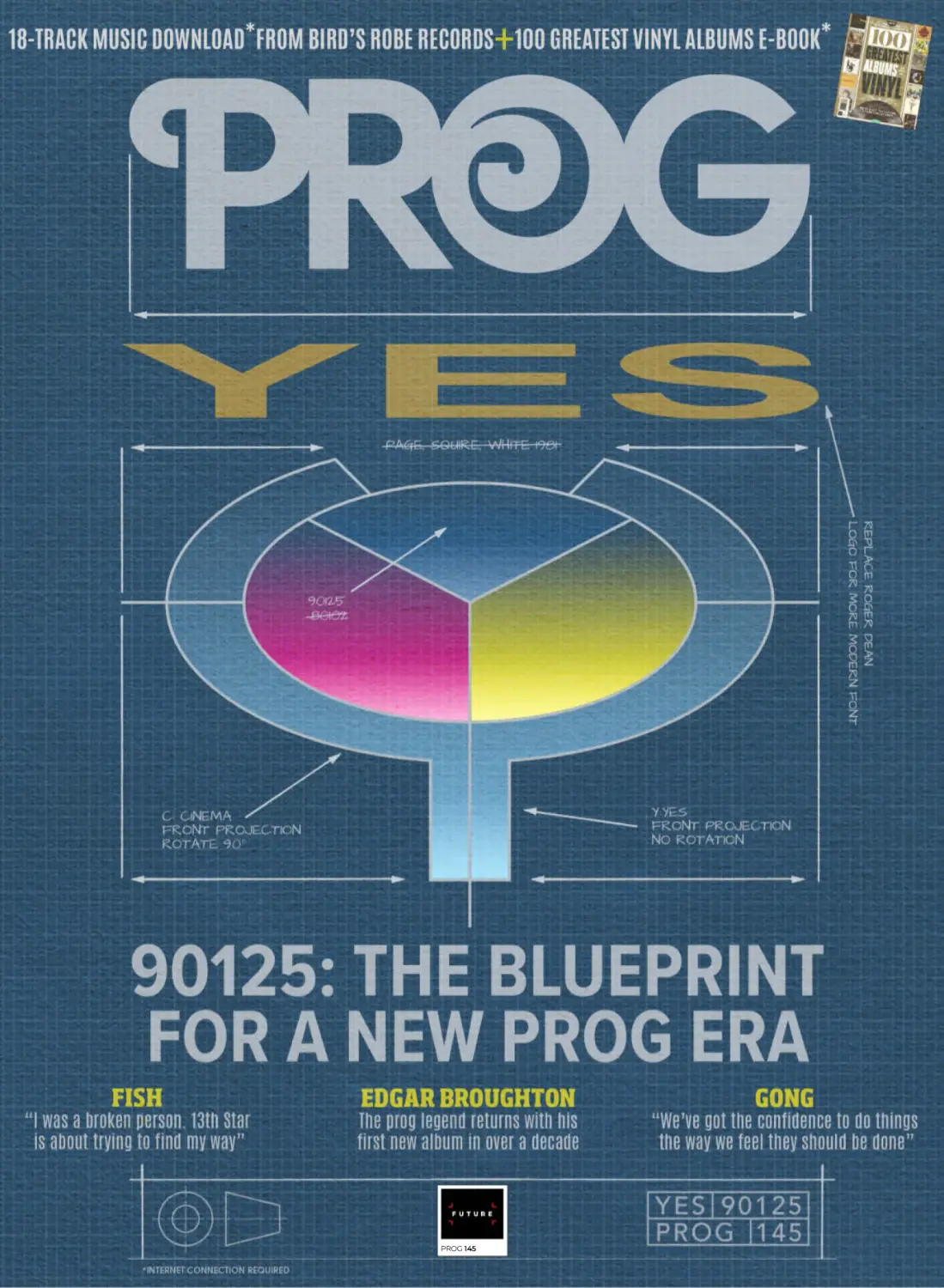
How 90125 ushered in a new era for both Yes and progressive rock…
FEATURES
Fish ______________ Pg 42
REGULARS
PROG PRESENTS…
pg 7
Get your free 18-track Bird’s Robe downloadable
sampler here.
BLOODY WELL WRITEpg 10
Missives and musings from Planet Prog.
THE INTRO
There’s not too many fond memories as
the big man looks back on the making of
the newly reissued 13th Star.
Christina Booth ____Pg 46
The Magenta singer’s third solo album,
Bar Stool Prophet, comes with a warning!
pg 12
Steve Hackett releases his first concept album for
over 40 years, plus all the latest news from Porcupine
Tree, Caligula’s Horse, No-Man, Elbow, Pallas, Louise
Patricia Crane, Storm Deva and loads more…
Q&A
pg 26
UK prog and fusion guitarist Nick Fletcher talks
musical inspiration and his new album, Quadrivium.
PRESS/AL STUART
THE PROG INTERVIEW pg 78
Edgar
Broughton
looks back on
an event-filled
career with
the Edgar
Broughton
Band and
discusses his
first new solo
album in more
than a decade.
THE MUSICAL BOX
pg 84
Peter Gabriel’s long-awaited i/o takes top billing this
month and we review the latest from King Crimson,
Greg Lake, Moon Safari, Yes, McDonald and Giles,
Peter Hammill, Magma, Andy Partridge, Nektar, Muse,
Trevor Horn, Mariusz Duda, Matt Berry and more!
TAKE A BOW
pg 102
This month we’ve been to Summer’s End and
ProgStock festivals and seen gigs by Hawkwind, Roger
Waters and The Flower Kings, to name but a few.
MY PROG
pg 114
Temples On Mars singer and guitarist James
Donaldson discusses a prog world full of Pink Floyd,
Tool, Karnivool and the Pet Shop Boys!
Gong _____________ Pg 50
Kavus Torabi continues to steer Gong
along a particularly cosmic path on
Unending Ascending.
The Emerald Dawn__ Pg 54
The Cornish prog quartet explore the
concept of time on their latest release.
Bruce Soord _______ Pg 58
The Pineapple Thief frontman opts for
introspection on his third solo album.
Myrkur ___________ Pg 62
Danish artist Amelie Bruun discusses
how motherhood has changed her whole
approach to making music on Spine.
Tiger Moth Tales____Pg 66
Mainman Peter Jones picks up the
acoustic guitar for The Turning Of
The World.
Green Lung ________ Pg 70
The young London rockers make an
increasingly proggy noise on This
Heathen Land.
Southern Empire ___ Pg 74
The Australian prog rockers introduce
new singer Shaun Holton on current
release, Another World.
Discovering
What’s on your free Bird’s Robe digital album
Download the 18-track sampler from birdsrobe.bandcamp.com
1 Closure
In Moscow
Better Way
Taken from Soft Hell
PRESS
PRESS/JEFF ANDERSON JNR
Toehider.
Scan here to download or
follow the instructions
on the right
3Sleepmakeswaves
Batavia
Taken from These
Are Not Your Dreams
4 Arcane
Promise (Part 2)
Taken from
Known/Learned
Taken from I Like It!
PRESS/DALLAS MAURER
B
ird’s Robe Seims.
has been
dedicated
to the
promotion and
continuation of
progressive and
experimental
music in Australia
and around the world since 2008. Formed
by Michael Solo and Alexander Tulett, the
label has grown to accommodate artist
management, bookings, releases, publicity
and tour promotion both nationally and
internationally.
Prog, post-rock,
art-rock, popprog, jazz-metal,
avant-garde,
Closure In Moscow.
psych-rock,
post-metal, electronica, chiptune,
noise-rock, fusion, tech-rock, crescendocore, new dirt and experimental rock are
just some of the many descriptions used
to define the music we enjoy
and promote. The one thing
it all has in common: it’s
music we like. Give it a listen
and we hope you’ll like it too.
2 Toehider
He’s There
And Then He
Does That
5 We Lost The Sea
6 Hemina
7 Kodiak Empire
8 Svntax Error
A Beautiful
Collapse
Strike Four
Animist
Broken
Nightmares
Taken from
Triumph & Disaster
(Single Version)
Taken from
Romancing
The Ether
Taken from The
Great Acceleration
9 Mushroom Giant
10 Pirate
11 Hence Confetti
Earthrise
B Minor
New Homes
Taken from
In A Forest
Taken from Pirate
Taken from
Hence Confetti
Taken from The
Vanishing Existence
12 Captain
Kickarse And
The Awesomes
Always On
Your Person
Taken from
Falsimilies From The
Facts Machine
13 Solkyri
14 Pluto Jonze
15 Meniscus
16 Clayhands
Pendock And
Progress
Awe
Simulation
Godolphin
Taken from Awe
Taken from
Refractions
Taken from
Is This Yes?
Taken from
Mount Pleasant
How to download your free digital sampler
from Bird’s Robe
1. Visit birdsrobe.bandcamp.com and click on the Prog Magazine 2023
sampler.
2. Click ‘Buy Digital Album’ and enter ‘0’ as the price.
3. Enter your email address and country, then download the album to
your computer.
4. Enjoy your new music!
Discover more music from Bird’s Robe by visiting www.birdsrobe.com.
17 Tangled
Thoughts Of Leaving
(Quakes)
Taken from Failed
By Man And Machine
18 Seims
Elegance Over
Confidence
Taken from Four
progmagazine.com 7
SCAN HERE TO GET OUR
WEEKLY NEWSLETTER
You can subscribe
to Prog at www.
magazinesdirect.com.
See page 112 for
further details.
Jerry Ewing – Editor
FIND
US
ONLINE
AT
progmagazine.com
Get your daily fix of prog
news and features at
www.progmagazine.com
29
E
N SAL
O
Download your
FREE e-book,
100 Greatest
Albums To Own
On Vinyl from
www.bit.ly/
vinyl_bookazine
I
XT SS
DEC
UE
Stream the Prog 145
playlist at
www.spoti.fi/3QkrCPv
ello and welcome to the latest issue of Prog.
So, 90125 is 40 years old, then. And it seems like
only yesterday that I was unwrapping a pristine
vinyl copy on Christmas Day in 1983! True, the 80s
was a turbulent time for some Yes fans, from seeing
Buggles join the band for Drama to suddenly finding their prog
heroes top the US singles charts. But, it was a necessary step in
the evolution of the band as well as progressive music. Stephen
Lambe’s intriguing cover story, which starts with Chris Squire
and Alan White jamming with Jimmy Page, charts the creation
of the album as Yes became a major musical force once again.
You’ll find it on p28.
Elsewhere in this issue, Edgar Broughton discusses his eventful
time as head of the Edgar Broughton Group and his first new
solo album for more than a decade, Fish recalls the less-thanhappy time creating his ninth solo album, 13th Star, and Kavus
Torabi explains how the new Gong album, Unending Ascending, is
part of a new trilogy for the band.
Also in the issue, Bruce Soord, Tiger Moth Tales, Southern
Empire, The Emerald Dawn, Christina Booth, Green Lung,
Myrkur, Nick Fletcher and more bring us up to speed with their
new releases.
I hope you enjoy the Rodney Matthews 2024 calendar that
comes with this issue (UK retail and subscribers only). One of
the brightest and most evocative UK artists, I’ve grown up with
Rodney’s work over the years and it was a real delight working
with him and many of the iconic images, which I’m sure you’ll
all recognise. There’s also the Bird’s Robe Records sampler –
download details on p7. They’re a great Australian label who
boast the likes of Sleepmakeswaves, Toehider, Hemina, Seims
and Closure In Moscow, to name but a few of their great bands.
We’re back on December 29 for the final issue of the year.
Until then, stay safe and prog on…
NE
Ed’s Letter
Letters
Send your letters to us at: Prog, Future Publishing, 121-141 Westbourne Terrace, London, W2 6JR, or email prog@futurenet.com. Letters may be edited
for length. We regret that we cannot reply to phone calls. For more comment and prog news and views, find us on facebook.com under Prog.
ONE FINAL GLIMPSE?
As a long-time fan of Jethro Tull,
I enjoyed the story on The Broadsword
And The Beast anniversary edition [Prog
143]. Bought the box set and enjoyed
all of it, especially the Steven Wilson
remixes. Beautiful packaging as usual and
great bonus tracks.
Now, there’s one thing I want to bring
up and I think it needs to be taken care
of while the protagonists are still young
enough: Ian needs to reintegrate Martin
Barre in the band. The last few guitar
players in Tull are really good and are
clearly doing the job. Saw Florian in
Emerson: a musical genius
who brought joy to so many
of our readers.
Prog 144 with the
late Keith Emerson
on the cover.
BRIAN RASIC/GETTY IMAGES
GONE BUT NEVER FORGOTTEN
Music can take the listener on emotional
journeys, so I was delighted to see the
article on my hero Keith Emerson in
Prog 144. It was fascinating to see the 30
tracks chosen by fans, family and friends.
There were no major surprises, but for
me there were three significant absences
from the list that, in my humble opinion,
I would like to have seen included.
It is solely through ELP and The
Nice that my interest in classical music
was born and the Five Bridges album is
one of my all-time favourites. Is there
anything that screams prog as much
as that opening suite, with the band
playing alongside the orchestra, fusing
classical, rock and jazz, to produce 20
minutes of epic, exhilarating music? And
no Lucky Man! With what was surely
the first-ever recorded synthesiser solo,
that introduced us mere mortals to the
weird, wonderful, and unlimited sounds
of the Moog, which Keith had been at the
forefront [of] in its formative years.
Finally, I would include Honky Tonk
Train Blues, just to share the sheer fun
and exuberance of a master pianist.
There’s rarely a day I don’t think of
Keith, so it was reassuring to read Rick
Wakeman’s statement that “people will
still be discovering Keith’s music in a 100
years’ time”. I hope so. Oh, how I love and
miss you, Keith Emerson.
Sam Palmer, via email
Our feature on The
Broadsword And
The Beast – an
album that still
divides opinions!
Montreal a few years back and he could
certainly play guitar. But, Tull is Martin
Barre and Ian Anderson. Simple as that
and to deny the fans the joy of seeing
them both on the same stage is simply
not right.
Get along, boys. Figure out your
differences and give us one last glimpse
of the fabulous team you were.
Mario Lefebvre, Montreal, Canada
A BEAST TOO FAR
The 40th anniversary (Monster Edition)
of Tull’s The Broadsword And The Beast is
just another example of record companies
(or indeed the songwriters) extorting
money from record-buying fans like
myself and countless other older fans.
This particular ‘book’ set is the most
expensive by far (yes, I know there are
eight discs and an extensive book –
10 progmagazine.com
although you need a magnifying glass
for us seniors to be able to read said text)
yet it could easily have been less bulky
and cheaper. Many of the extra tracks
included have appeared elsewhere, and
any true fan would have these, some
more than once. (And let’s face it these
‘box’ additions are targeted to a particular
fan. Your casual record buyer is certainly
not going to spend the sum asked for, for
these sets.)
Discs four and five were of a concert(s)
in Germany and, again, the majority
of this appears on Hard Times Of Old
England released in 2021 (albeit on
a different label). It can be argued that
these are ‘bootleg’ recordings but they
are being sold through [record stores].
This is not the first time this has
happened and it will again if the ‘book’
editions continue with Under Wraps.
M
LETTER
any thanks for the great pieces on
Keith Emerson in Prog 144.
As a kid his music helped me to bond
with my dad, especially during the
family misery and chaos of two warring
parents, soon to be divorced. But Dad was
impressed when he heard the classical
refrains as I played Five Bridges and Elegy
by The Nice. It led to simple, happy
times, together, discussing music. With
all the bitterness raging in the home,
those moments became an oasis of calm
and joy.
One of the posters on my wall was of
Emerson, one hand raised above a beloved,
if somewhat battered, Hammond organ.
However much I loved Hendrix, Emerson
was the man.
Then I eagerly bought the ELP debut
album, with my hard-earned pocket
money, and grabbed each successive
studio album as they were released.
I remember playing the floppy vinyl
sampler of Brain Salad Surgery that came
free with NME just a week before the
album’s release.
In his excellent article, Rick Wakeman
notes that, despite his other fine skills
around music, it was playing that always
came first. Therefore, the neurological
problems hit him especially hard. It
dogged him through his later career
and made playing at a virtuoso level
increasingly difficult, triggering bouts of
depression. It seems this eventually led
to his sad and brutal end.
He was an exceptional keyboardist who
loved to entertain with his hair-raising,
breathtaking playing. This is what he
was put on Earth to do. He was a one-off
original, setting his standards at a level
few others could reach. When he felt no
longer able to achieve this, then, for him,
it seemed to challenge his whole reason
for existence. Sometimes there is
a terrible and tragic price exacted on
a person of genius.
Nigel Leaney, Reading
This issue’s star letter wins a goodie bag* from burningshed.com *Contents may vary
Future PLC, 121-141 Westbourne Terrace, London,
W2 6JR
Email prog@futurenet.com
twitter.com/ProgMagazineUK
threads.net/@progmagazine
instagram.com/progmagazine
You can also find us on facebook.com under Prog
Editorial
Editor Jerry Ewing
Deputy Editor Natasha Scharf
Art Editor Russell Fairbrother
Production Editor Vanessa Thorpe
News Editor Julian Marszalek
Reviews Editor Dave Everley
Associate Editor Jo Kendall
Content Director Scott Rowley
Contributors
Jeremy Allen (JA), Joe Banks (JB), Mike Barnes (MB), Jordan
Blum (JMB), Chris Cope (CC), Daryl Easlea (DE), Dave Everley
(DEV), Cheri Faulkner (CF), Ian Fortnam (IF), Paul Ging (PGI),
Grace Hayhurst (GH), Cedric Hendrix (CH), Rich Hobson (RH)
Rob Hughes (RH), Emma Johnston (EJ), Jo Kendall (JK), Hannah
May Kilroy (HMK), Stephen Lambe (SL), Dom Lawson (DL),
Fraser Lewry (FL), Dave Ling (DML), Gary Mackenzie (GMM), Joel
McIver (JMI), Emily MacNevin (EM), Rhodri Marsden (RHM),
Julian Marszalek (JM), Chris McGarel (CMG), James McNair (JMN),
Grant Moon (GRM), Alison Reijman (AR), Chris Roberts (CR),
Paul Sexton (PS), Johnny Sharp (JS), Sid Smith (SS), Francesca
Tyer (FT), Phil Weller (POW), David West (DW), Rich Wilson (RW)
Cover image
Image: Magictorch
Advertising
Media packs are available on request
Commercial Director Richard Hemmings
richard.hemmings@futurenet.com
Advertising Sales Director – Music Lara Jaggon
lara.jaggon@futurenet.com
Account Director Steven Pyatt
steven.pyatt@futurenet.com
Account Director Kyle Phillips
kyle.phillips@futurenet.com
Account Manager Lawrence Cooke
lawrence.cooke@futurenet.com
International Licensing and Syndication
ProgǣɀƏɮƏǣǼƏƫǼƺǔȒȸǼǣƬƺȇɀǣȇǕƏȇƳɀɵȇƳǣƬƏɎǣȒȇِÁȒˡȇƳȒɖɎ
more contact us at licensing@futurenet.com or view
our available content at www.futurecontenthub.com.
Head of Print Licensing Rachel Shaw
Subscriptions
Online orders & enquiries www.magazinesdirect.com
UK order line & enquiries 0330 333 1113
Overseas order line & enquiries +44 (0) 330 333 1113
Email enquiries help@magazinesdirect.com
CRM Director nȒɖǣɀƺ(ɖƳˡƺǼƳ
ROB VERHORST/REDFERNS/GETTY IMAGES
Subscription delays
Disruption remains within UK and international delivery
networks. Please allow up to 7 days before contacting us
about a late delivery to help@magazinesdirect.com
Circulation
Head of Newstrade Tim Mathers
Production
Group Head of Production Mark Constance
Production Manager Keely Miller
Senior Ad Production Manager Jo Crosby
Ad Production Coordinator Emma Thomas
Digital Editions Controller Jason Hudson
Management
SVP Consumer – Kevin Addley
MD – Music, Photography & Design Stuart Williams
Head of Design – Music Brad Merrett
Printed by William Gibbons & Sons Ltd
Distributed by Marketforce UK Ltd.
121-141 Westbourne Terrace, London
W2 6JR. For enquiries, please email:
mfcommunications@futurenet.com
www.marketforce.co.uk
ISSN 2045-2260
The three DVDs could have been replaced
with one Blu-ray! And why no visuals?
Having said all this it’s a million times
superior to the rubbish disguised as prog,
I’m referring to The Zealot Gene and
RökFlöte. The former only did as well as
it did because fools like me thought, after
all these years, that we were going to get
an incredible album. How wrong could we
be? It’s very short too, obviously geared
to the album market, but you would have
thought after so long Ian Anderson could
have made it at least an hour – but can
you imagine an hour of that? And to top
it all, after a year (if that) he did it again!
They should have been solo outings and
not under the banner of Tull. And why oh
why doesn’t he get someone else to sing?
It means when he goes to the big gig in
the sky Tull will be no more, he should
take a leaf out of Yes’ book.
Martin Willgrass (a lifetime fan of Jethro
Tull since 1968), via email
Innovative guitarist,
Allan Holdsworth.
TRUE VISIONARY
I’m writing to encourage Prog to do
a cover story on Allan Holdsworth. The
anniversary of his death (April 15, 2017)
came and went last year with no tributes
from any of the major music periodicals.
His musicianship speaks volumes and,
excuse the pun, volumes could well be
written about his technique alone (not to
mention his innovative chordal playing).
He played with some of the most
well-known and seminal prog and fusion
bands (Soft Machine, Gong, UK, Bruford,
Tony Williams, etc.) and in addition Allan
was probably the most down-to-earth
guy (I met him at BB King’s nightclub in
NYC back in 2005) and stayed true to
his musical vision right up until the day
he passed.
Marc C, via email
Thanks for your email, Marc. We’re big
Holdsworth fans here so we’ll definitely keep
this in mind. – Dep. Ed.
We are committed to only using magazine paper, which
ǣɀƳƺȸǣɮƺƳǔȸȒȅȸƺɀȵȒȇɀǣƫǼɵȅƏȇƏǕƺƳًƬƺȸɎǣˡƺƳǔȒȸƺɀɎȸɵ
and chlorine-free manufacture. The paper in this magazine was sourced
and produced from sustainable managed forests, conforming to strict
environmental and socioeconomic standards.
All contents © 2023 Future Publishing Limited or published under licence. All
rights reserved. No part of this magazine may be used, stored, transmitted or
reproduced in any way without the prior written permission of the publisher.
Future Publishing Limited (company number 2008885) is registered in England
ƏȇƳáƏǼƺɀِ«ƺǕǣɀɎƺȸƺƳȒǔˡƬƺيªɖƏɵRȒɖɀƺًÁǝƺȅƫɖȸɵً ƏɎǝ ÈِǼǼ
information contained in this publication is for information only and is, as far as
we are aware, correct at the time of going to press. Future cannot accept any
responsibility for errors or inaccuracies in such information. You are advised to
contact manufacturers and retailers directly with regard to the price of products/
services referred to in this publication. Apps and websites mentioned in this
publication are not under our control. We are not responsible for their contents
or any other changes or updates to them. This magazine is fully independent
ƏȇƳȇȒɎƏǔˡǼǣƏɎƺƳǣȇƏȇɵɯƏɵɯǣɎǝɎǝƺƬȒȅȵƏȇǣƺɀȅƺȇɎǣȒȇƺƳǝƺȸƺǣȇِXǔɵȒɖ
submit material to us, you warrant that you own the material and/or have the
necessary rights/permissions to supply the material and you automatically
grant Future and its licensees a licence to publish your submission in whole or
in part in any/all issues and/or editions of publications, in any format published
worldwide and on associated websites, social media channels and associated
products. Any material you submit is sent at your own risk and, although every
care is taken, neither Future nor its employees, agents, subcontractors or
licensees shall be liable for loss or damage. We
assume all unsolicited material is for publication
unless otherwise stated, and reserve the right to
edit, amend, adapt all submissions.
Future plc is a public
!ǝǣƺǔ0ɴƺƬɖɎǣɮƺ ǔˡƬƺȸ Jon Steinberg
company quoted on
Non-Executive Chairman Richard Huntingford
the London Stock
!ǝǣƺǔIǣȇƏȇƬǣƏǼƏȇƳ³ɎȸƏɎƺǕɵ ǔˡƬƺȸ
Exchange (symbol: FUTR)
Penny Ladkin-Brand
www.futureplc.com
Tel +44 (0)1225 442 244
progmagazine.com 11
IF IT’S OUT THERE, IT’S IN HERE
STEVE HACKETT
GETS CONCEPTUAL
Almost 40 years since his last concept album,
the celebrated guitarist’s new album draws
inspiration from his own early years.
Steve Hackett is to release The Circus
And The Nightwhale on February 16 via
InsideOutMusic. It’s his first full-blown concept
album since his 1975 solo debut, The Voyage
Of The Acolyte, and the narrative, which is
based on the rites of passage and adventures
of a character named Travla, is, to all intents
and purposes, autobiographical.
“It starts off in 1950 and then it’s a travel
through time and personal experiences,”
Hackett explains. “Lyrically it’s a description
of my first impressions of the world, and then
certain characters that I met. But then it
moves into more and more fantastic and
imagined situations.”
Hackett rates Genesis’ narrative
concept album The Lamb Lies
Down On Broadway as “one of
the finest prog rock albums
of all time”, and plans
to play highlights
live in 2024.
However, he
And then there was me: Steve
Hackett draws on his own
experiences for his new album.
12 progmagazine.com
“I’m still in love
with the sound
of the guitar and
the potential of
where it can go.”
progmagazine.com
PORCUPINE TREE
RELEASE LIVE SET
This month, Intro
was compiled by
PRESS/CARL GLOVER
Closure/Continuation Live captures 2022
Dutch show in variety of formats.
Porcupine Tree’s
live celebration
is to be released.
Porcupine Tree’s surprise comeback album, 2022’s
Closure/Continuation, is being followed up by a new
DVD/Blu–ray recording of the subsequent tour.
Closure/Continuation Live, filmed at Amsterdam’s 17,000–
capacity Ziggo Dome on November 7, 2022, will be released on
December 6 via Music For Nations. Available on CD/Blu–ray,
a CD/Blu–Ray box set and four–LP vinyl editions, the 21–track set
features every song from the recent album, plus such classics as
Blackest Eyes, Fear Of A Blank Planet and Trains.
“The first night of the tour in Toronto, the audience just went
berserk when we walked onstage,” says drummer Gavin Harrison.
“They cheered for five minutes before we even played a note.”
The tour saw the band playing their biggest-ever UK headlining
show at Wembley Arena.
“I always thought if we came back, we’d do Wembley or the 02
rather than four or five nights at the Hammersmith Apollo,” says
keyboardist Richard Barbieri. “We were looking at the O2, but it
wasn’t available.”
The success of Closure/Continuation raises the question of
whether Porcupine Tree have plans for another album or tour.
“We’re not averse to the idea,” comments Harrison, “but we
haven’t got any plans.”
“We wouldn’t just go out and do the same thing over and over
again,” adds Barbieri. “It would depend on whether we had new
music. Are we writing new music? No.”
See www.porcupinetree.com for more information. DEV
PRESS/TINA KORHONEN
says the trials and tribulations of its protagonist,
Rael, had little or no influence on the unfolding
story of The Circus And The Nightwhale.
“I’ve got to do what comes naturally and it’s
better not to start off with a concept than
commission yourself from the word go,” he
explains. “If you’re playing from the heart or
just having fun, you’ve got a better chance of
doing something that’s honest. And then
maybe, one or two tracks in, you realise where
you’re headed.”
The lyrics are co-written by Hackett’s wife
and long-time collaborator, Jo.
“Having a narrative stretches you,” he says.
“It takes you outside your comfort zone, and
you’re also having to come up with a score for
a ‘film for the ear’ to bring the lyric to life.”
The Circus And The Nightwhale took two years
to record between touring commitments and
features Hackett’s regular band, plus Amanda
Lehmann on vocals, John Hackett on flute, guest
drummer Nick D’Virgilio and Malik Mansurov
on the tar. “There are some extraordinary
performances,” Hackett says.
As a time-travelling journey, the album
incorporates a number of different musical
styles beginning with an evocation of the postwar era, when, as Hackett says, “the world was
in chaos, but [culturally] it was still being
controlled, so I wanted to get that feeling across
where rock’n’roll literally had to burst out.
“John Lennon said he thought that Genesis
were true sons of The Beatles,” Hackett adds,
and he identifies their influence on the album:
“I think music was never the same after Sgt.
Pepper’s… , and it comes into my mind with the
idea of trying to get all these eras of song
together on one album.”
Enter The Ring features sections of
12-string guitar, with vocal harmonies
between himself and Lehmann.
“There’s a Genesis feel but it’s taken
onto another level,” he explains. By
contrast is the “rock noir” of Get Me Out!
“There are lots of moments when the
action hots up and I want to be able to
do things at great speed, and Rob
[Townsend] is doing
extraordinary runs on sax. The
album is very energised and
full of great playing too.”
Hackett uses effects and
multi-tracking to increase
the sonic possibilities of
his guitar.
“And it does sound huge,”
he enthuses. “I know
guitarists will like it.”
Jeff Beck, whom he admired,
passed away while Hackett was
recording. “I kept thinking to
myself, is this something he would have liked?
Because he always managed to do the unusual,”
he says. He also notes that Beck said that he’d
always tried to be “naughty” in his playing. “I’m
still in love with the sound of the guitar and
the potential of where it can go.”
See www.hackettsongs.com for more
information. MB
Jeremy Allen
Mike Barnes
Dave Everley
Jerry Ewing
Cheri Faulkner
Stephen Lambe
Rhodri Marsden
Julian Marszalek
James McNair
Matt Mills
Natasha Scharf
Phil Weller
LOUISE PATRICIA CRANE
SINGLE HERALDS ALBUM
Covers of King Crimson and Johnny Winter lead the way.
Enigmatic Northern Irish singer-songwriter Louise Patricia Crane has
released a new digital double A-side in the shape of her versions of King
Crimson’s Ladies Of The Road and Johnny Winter’s Dirty. Available via streaming
and download platforms, it marks her first new material since the release of her
debut album, Deep Blue, in 2020. The tracks feature musical contributions from
Jakko Jakszyk and Mel Collins, the latter of whom played on the original version of
Ladies Of The Road in 1971.
Speaking of Dirty, Crane says, “This is a song
I wish I’d written. It conjures up colours in my
mind. It spoke to me most because it was
uncharacteristically dreamy. Lyrically it felt sensual
and dark; amusingly so… grim fantasies of
murdering one’s spouse – but ultimately of stark
self-reflection; it got under my skin.”
Louise Patricia Crane’s second, as yet untitled,
new album is scheduled for release in the spring.
See www.louisepatriciacrane.com. JM
Conjuring colours in her ne.
mind: Louise Patricia Cra
PRESS/OLIVIA BEST
Prog
news
updated
daily
online!
INTRO
PALLAS ARE BACK
WITH NEW ALBUM
Cast of thousands:
Elbow gear up for
a very busy 2024.
Reunited with singer Alan Reed, new LP
The Messenger is “their darkest album yet.”
Scottish neo-proggers Pallas caused much furore when
Alan Reed, who fronted the band between 1986 and
2005, announced his return to the fold in February. Now the
band, reacting to the darkness of recent times, will release
their eighth album, The Messenger, on December 15. Written
and recorded across continents, with guitarist Niall
Mathewson having relocated to Cambodia, it’s described by
Reed as “the album of our careers”.
Reed replaced original singer Euan Lowson and
spearheaded the band across four albums, including 1986’s
seminal The Wedge, before parting ways after 2005’s Dreams
Of Men. While he says his return to the band has been
“a surprise to me as much as anybody else,” the singer
reveals it was the quality of their early demos that enticed
him into the reunion.
“If I hadn’t felt it was good quality music, I would not
have been involved,” he states, matter-of-factly.
“I’d heard the previous two albums they’d done without
me and I didn’t find them cohesive. When I heard the
demos for this album, I went from healthy sceptic to fully
positive; it sounded like Pallas again.”
Of its origins, Mathewson says: “I originally started
writing for the album about four years ago. It started very
upbeat, but during Covid, from my perspective, everything
changed and would never be the same again, so my writing
took a darker turn. Now the album is more about mortality,
death and responsibility.”
It’s resulted in what Reed defines as “Pallas’ darkest album
to date; and they’re all pretty dark!”
He adds, “They’re a band that attracted me in the first
place, as a fan, for being very dark. Pallas has always had one
foot in the real world and on this album we’ve found a way
of doing that better than ever before. There was a common
resolve to get our shit together and say something about the
state of the world.”
While future live performances are
unlikely, Mathewson confirms that
a follow-up “is mostly written”.
The Messenger will be available as
a Digipak CD and a special-edition
36-page Digibook.
“There was
“I’m very proud to be part of this
a common
album and to be back in the band,” Reed
resolve to say concludes. “It’s a wonderful thing to be
something
involved with.” POW
about the state
of the world.”
14 progmagazine.com
For more information and music, visit
www.pallasofficial.bandcamp.com.
ATOM HEART
SPECIAL
INCOMING
Pink Floyd have
announced the
release of a special
edition of their
1970 album Atom
Heart Mother – the
band’s first-ever No.1
album – through
Pink Floyd Records
on December 8. The
reissue, originally
released in Japan
in 2021, features
footage of the Atom
Heart Mother suite
performed at the
Hakone Aphrodite
Festival in 1971.
For more visit
www.pinkfloyd.com.
NEW ALBUM AND
TOUR FROM ELBOW
Expect some “very big songs” that have
been written with arenas in mind.
With Elbow set to return with a brand-new, as yet untitled
album and a seven-date arena tour next year, frontman Guy
Garvey has admitted that the new record – the band’s 10th – has
been written specifically with large venues in mind.
“It’s hard not to,” says Garvey. “We haven’t played very much
in the last few years. Because of Covid and the intimate nature of
the last album, Flying Dream 1, we just decided to have a year off
to hang out with our families for a bit. So in making the record we
have, without even discussing it, had these shows in mind.”
While one of the songs has been inspired by their experience
of supporting Foo Fighters (“real gentlemen”) in front of 90,000
Mexican fans, others have very different influences.
“There’s brevity with this album,” reveals Garvey. “There’s
nothing over five minutes, but the songs are big and they’re
groovy. It’s got everything from Meters–like back alley moves to
some pretty hectic, almost Afrika Bambaataa-style grooves across
it. And then in other places, I sound a little bit like Peter Gabriel.
It’s all over the shop!”
He adds, “The last record was so considered and this couldn’t
be more different, really.”
Elbow take to the road in May 2024 to play Brighton Centre
(7), London The O2 (9), Birmingham Resorts World Arena (10),
Glasgow OVO Hydro (11), Leeds First Direct Arena (12), Manchester
Co-op Live (14) and Nottingham Motorpoint Arena (15).
See www.elbow.co.uk for more information. JM
CHELSEA WOLFE RETURNS
WITH NEW STUDIO ALBUM
The mysterious singer is also set to play London in April.
Darkly enigmatic musician Chelsea Wolfe has announced she will release her
latest album, She Reaches Out To She Reaches Out To She, through Loma Vista
Recordings on February 9.
Wolfe’s seventh studio album and first for her new label represents a rebirth.
“It’s a record about the past self reaching out to the
present self reaching out to the future self to summon
change, growth, and guidance,” she explains. “It’s a story of
freeing yourself from situations and patterns that are
holding you back in order to become self-empowered. It’s an
invitation to step into your authenticity.”
The album follows the September release of single
Whispers In The Echo Chamber. Wolfe will undertake a
lengthy North American tour in support of the new album,
but will venture over to the UK for a show at London’s
The empowered
Heaven on April 21.
Chelsea Wolfe.
See www.chelseawolfe.com for more. JE
PRESS/EBRU YILDIZ
Pallas are back to chronicle
the darkness of the world.
PRESS/PAUL MACKIE
PRESS
INTRO
extras
INTRO
CALIGULA’S HORSE
COME RIDING BACK
Charcoal Grace is the Australian band’s first
album of new material in four years.
Australian prog rockers Caligula’s Horse have
announced their first album in four years. Charcoal Grace
will come out on January 24 via InsideOutMusic. The ninesong, hour-long LP will be a more progressive effort than
2020 predecessor, Rise Radiant, with a loose concept related
to the band’s experiences during the pandemic. Lead single
Golem is currently available to watch on YouTube and via
streaming services.
“We jokingly refer to Charcoal Grace as, ‘What did we
learn in the pandemic?’” guitarist, composer and co-founder
Sam Vallen tells Prog. “There’s a continual thread of that
throughout the record. Either it’s looking out and seeing
things you hoped you wouldn’t see in society, like the
people who immediately became 100 per cent individualist,
or looking internally. How do you be an artist in this world
and interact with it in a creative sense?”
Charcoal Grace is bookended by 10-minute The World
Breathes With Me and 12-minute Mute, while the title track
itself is the band’s longest song to date. Split into four parts,
it clocks in at a total of 24 minutes, with lyrics that explore
the themes of child abuse and forgiveness.
“Those elements are more implied than directly stated,”
says Vallen. “The cliché in western culture is that forgiving
is always good, and [the title track] is an exploration of that
idea: for someone who’s had a horrible experience with
a parent, there’s a lot of subtext to that. There’s an extended
metaphor there, as well, for the pandemic, especially for
some of the ways people experienced relationships within
the pandemic.”
Caligula’s Horse will support the release of Charcoal Grace
with a run of North American shows, which commence in
Washington DC, on January 31. The 19-date tour will
continue through the US and Canada before finishing in
Vancouver on February 25. Vallen states that he hopes the
touring cycle for the album will continue to be prolific
throughout the rest of the year as well.
“We’ve got a bunch of new, really
amazing people that we’re working
with,” he says, “and right now, we’re
staring down the barrel of 2024 being
a really full year of touring. I don’t know
“We’re staring exactly when we’re going to be
down the
announcing some of this stuff, but we’re
barrel of 2024 going to be busy. It’ll be like the old days
being a really [before the pandemic] again!” MM
full year
of touring.”
16 progmagazine.com
See www.caligulashorse.com for more
information and news.
HAWKWIND
TO REISSUE
80S SINGLE
Venerable space
rock institution
Hawkwind are set
to re-release their
live 1980 single,
Shot Down In The
Night on December
1 via Atomhenge.
Reformatted on
10-inch yellow vinyl
that plays at 45rpm,
it comes packaged
in fully restored
artwork. And, as with
the original single,
the B-side is the live
version of long-time
favourite Urban
Guerilla. See
www.hawkwind.com
for more.
No-Man: the big hair years.
NO-MAN ANNOUNCE
BOX SET OVERVIEW
The early years of the Steven Wilson and
Tim Bowness band are lavishly curated.
Steven Wilson’s expanding legion of fans are set to be
spoiled for choice with the release of No-Man’s CD box set,
Housekeeping: The Oli Years, 1990–1994, which is out January 26
via One Little Independent Records.
Containing the band’s first two albums, Loveblows & Lovecries
(1993) and Flowermouth (1994), the deluxe five–CD box set is
augmented by 1992’s singles compilation, Lovesighs as well
as Radio Sessions 1992–94, which includes specially recorded
versions of Break Heaven, Housekeeping and Heartcheat Pop for
then–Radio 1 DJ Nicky Campbell as well as Days In The Trees and
Lovecry for Greater London Radio among others. The set’s fifth
disc, Swagger, reveals a different side to No-Man. Chronicling the
period between the band’s first studio experiments and just prior
to being signed in 1991, the collection contains six unreleased
songs as well as early versions of Flowermouth, Swirl and Bleed.
Formed in 1987 by multi-instrumentalist Steven Wilson and
singer Tim Bowness, the band’s line–up also included violinist
Ben Coleman and contributors to their albums reads like a ‘who’s
who’ of prog. These include bassist Colin Edwin, drummers Chris
Maitland and Gavin Harrison and keyboardist Richard Barbieri of
Porcupine Tree, as well as King Crimson’s Robert Fripp, drummer
Pat Mastelotto and saxophone player Mel Collins, while electronic
artist Roger Eno and Dead Can Dance singer Lisa Gerrard also get
a look in.
See www.no-man.co.uk for more information. JM
STORM DEVA ANNOUNCE
SELF-TITLED DEBUT ALBUM
The duo catch lightning in a bottle for a December release.
Up-and-coming proggers Storm Deva have announced the release of their
eponymous album via Storm Deva Records via Bandcamp on December 1.
Headed by singer, pianist and composer Carollyn Eden and multi-instrumentalist
Stuart Clark, the duo are joined on the record by cellist Hannah Reeves, drummer
Robert Brian and Dan Giles on bass guitar.
Blending their love of rock, classical music, folk and world influences, the band
say that the album’s nine songs “range from the intimate
to the epic”, with guitarist Stuart Clark adding fondly of
his musical partner, “Carollyn’s gift is her ability to take
the listener to the very heart of the moment that has
inspired her.”
Eden is equally effusive of Clark: “Stuart responds to
music viscerally and his ability to connect to a song’s heart
and its every detail is a joy to experience.”
Storm Deva: gale-force
See www.stormdeva.com for more information and to
prog coming your way.
pre-order. JM
PRESS/CJANSENPHOTOGRAPHY
Caligula’s Horse
are to return with
a new album.
PRESS/JACK VENABLES
PRESS
INTRO
extras
FAD GADGETS
MY PROG HERO
Just like heaven: Can inspired the
young Lol Tolhurst to get playing.
PRESS/SPOON RECORDS
Inspiring the wider music world…
Rhodri Marsden on three
of the latest must-have
gizmos currently putting
the prog in progress.
MEZE AUDIO 109 PRO PRIMAL
The Romans said “festina lente”, the
Greeks “speûde bradéōs”, the British
“more haste less speed” (or, more
commonly, “don’t screw it up”). The
motto of Romanian audio firm Meze is
“Graba strică treaba”, which means the
same thing, and
gives some
indication of their
diligent approach
toward making high–
end audio products.
I’m a sucker for tech embedded in
wooden enclosures crafted by artisans in
the foothills of the Gutâi Mountains, so if
you could grab those walnut earcups
anointed with linseed oil and get them
on my head, that would be great. Ta!
www.mezeaudio.com
Bluetooth speakers are ten a penny
these days, but none of them are as
monstrously huge and powerful as the
range made by Soundboks. I vaguely
remember dismissing these
gargantuan things as a novelty in
the past, but their commitment
to the cause is wholehearted,
so I’m having to reevaluate.
These things can pump out
sound at 126db for six hours
(quite an achievement, if
sonically exhausting) but as
well as Bluetooth connectivity
they also have a “pro panel” with
XLR inputs, allowing them to
double as mini PA speakers for
small gigs.
www.soundboks.com
WOOVEBOX
If, in the Middle Ages, you’d have walked
to the town square and announced to
the milling throng that you owned
a pocket-sized device weighing just 68
grams that was capable of slicing and
chopping samples,
arranging them
using a 16-step
sequencer and
manipulating them
with various filters
and effects, you’d
have been quickly marched off and then
burned at the stake. Fortunately it’s
2023, so the only thing you really have to
worry about is how long the Woovebox’s
battery lasts (10 hours, apparently).
www.woovebox.com
PRESS
LOL TOLHURST
SOUNDBOKS 4
The Cure’s co–founder and ex-drummer recalls being blown away by ELP
and how krautrock pioneers Can gave him permission to play.
“The second band I ever saw was King
were at all, but looking back, they were
Crimson. It was a free concert in Hyde
everything that you’d imagine them to be.
Park in 1971. I was about 12 or 13. I always
I’m sure that I saw them with [The Cure’s
remember King Crimson because I’d just
original bassist] Michael Dempsey and it was
discovered In The Court Of The Crimson King.
the start of permission for things. We’d see all
That’s where things went a bit further because
these really highly polished bands who were so
I liked Greg Lake’s singing, and so my first indoor
far away from what I thought I could ever do.
concert was ELP at the Empire Pool, Wembley.
The Cure had just started playing but when we
Fast-forward 45 years: Keith Emerson lived in
saw Can, I thought they did what we did in our
my neighbourhood in LA. It would’ve blown my
rehearsals; they sort of jiggled around for a while
teenage mind to think that I would be going to
until someone found something and took hold
have Sunday lunch regularly with my old hero.
of it and the rest went, ‘Okay! Great!’ Can were
Deep Purple’s Glenn Hughes had introduced us.
more sophisticated, obviously, but it wasn’t that
I told him about seeing ELP at Wembley and he
far away from our own experience and that was
told me that his son’s favourite band was The
definitely the link.
Cure. And I’m like, ‘Wow! Full circle!’
Jaki Liebezeit’s drumming was
I used to go to the Croydon
incredible and he said that you have
Greyhound regularly because it was
to ‘play monotonous.’ I got it; I’d be
easy to get the train from Crawley
listening to a 10-minute track and
and be there in about 30 minutes.
he’s playing the same thing but he’s
“Can was the inside of it and that was the
Every Sunday we’d go and see
start of
whoever was playing. I must have
connection for me!” JM
permission
seen Stray about 800 times; they
of things
seemed to be on every other week
Los Angeles by Lol Tolhurst x Budgie
for The Cure
there! But Can were on one time and
x Jacknife Lee is out now on PIAS. For
and that was more info see www.facebook.com/
it was great. It was in 1975 and
I was 16. I had no idea who they
loltolhurstxbudgiexjacknifelee.
the link.”
PROG
IN
BRIEF
Australian prog guitar
virtuoso Plini (right) has
announced the release of his
new EP, Mirage, on December
1. The five-track also features
a guest appearance from
Animals As Leaders leader
Tosin Abasi. For more info
see www.plini.co.
Prog veterans Nektar are to
get the reissue treatment
when their 1973 classic,
Remember The Future, is
released as a four-CD/Blu–ray
box set via Esoteric on
November 24. Rare live
footage is included. Info at
www.nektarsmusic.com.
Dutch lute player, composer
and sometime Jim Jarmusch
collaborator Jozef van
Wissem releases his new
album The Night Dwells In
The Day via Incunabulum
Records on January 19. For
more information, go to
www.jozefvanwissem.com.
progmagazine.com 17
Limelight
PRESENTS
NEW MU
SIC
Listen to
SKÁLD
all this mont
h on
R A D IO
co m/ lis ten
/
PRESS/DIE FRAU
pr og zil la.
SKÁLD
Skáld promise to
provide ethereal,
medieval folk vibes.
French prog-folk collective take Nordic mythology on a vibrant sonic adventure.
CHRISTOPHE VOISIN-BOISVINET spent his
childhood in the Loire Valley in central-western
France: a stunning, rural region defined by its series of
sky-piercing castles. So it really shouldn’t be a surprise
that he grew up to be the multi-instrumentalist of
a historical progressive folk collective.
“As a child, I was introverted and surrounded by
these medieval ruins and fortresses,” the mastermind
behind Skáld tells Prog – or, more specifically, his
interpreter tells Prog, since he speaks in French. “I used
to play in these special places a lot by myself. My
parents say that I’d always ask things like, ‘Why don’t
we tell stories about our past? What were things like
before?’ So I’ve always had a link with medieval culture.
I think that’s the time when I also got into music.”
A number of the castles that line the Loire Valley
were built in the Middle Ages with the goal of fending
off the Vikings and Normans invading France.
However, the Nordic culture lives on in the country
through Voisin-Boisvinet and his songs. Skáld’s most
recent album, Huldufólk, is dedicated to the folkloric
“secret people”: supernatural beings that are similar to
humans, yet invisible.
“In Iceland, the huldufólk exist as a cultural
phenomenon,” Voisin-Boisvinet explains, “but it’s
become quite cutesy, with lots of different elves and
trolls. I wanted to distance myself from that and focus
on what we, now, don’t or can’t see. I think people
used to be able to see a space where nature and divinity
came together, so I’ve dedicated this record to that
aspect of the huldufólk.”
Voisin-Boisvinet and his band, which on the
album includes three other musicians and eight
PROG FILE
vocalists, pay tribute with aptly ethereal-sounding
but percussion-led folk. Although Skáld’s leader says
the songs are artistic imaginings and not necessarily
replicas of age-old melodies, the likes of Troll Kalla
Mik and Hinn Mikli Dreki evoke images of Viking
battles and mystical rituals.
Skáld officially formed in 2018, although VoisinLINE-UP
Boisvinet says the idea dates back to six years prior.
Christophe VoisinBoisvinet (percussion, He acknowledges that, in the process, he stepped
into a Nordic and prog-adjacent folk space already
horn, keyboards,
programming); Ravn
dominated by Wardruna and Heilung. “For me, the
(talharpa, moraharpa,
master of this area is Wardruna,” the musician says,
gudok); Nicolas
“and I’ve been fortunate enough to share the stage
Montazaud
(percussion); Aliocha
with Heilung. But what sets us apart is that we
Regnard (nyckelharpa); are not dark. For example, if we wrote a song about
Laetitia Marcangeli,
a wolf, it’d be about how to tame the wolf and defuse
Marti Ilmar Uibo,
Michel Abraham,
that situation.”
Adeline Bellart,
True to that spirit of differentiating himself from
Steeve Petit, Julien
the pack, Voisin-Boisvinet also says that Skáld’s
Loko, Lily Jung,
Kohann (vocals)
tunes will only grow more avant-garde and
SOUNDS LIKE
expansive as the band goes onwards. “One of my
A time capsule to the
aims is to continue with lots of different voices:
Middle Ages, built out
more voices, different timbres, different pitches.
of ancient percussion
And another thing I’m interested in is sounds
and mystical vocals
directly from nature. I want to include the musicality
CURRENT RELEASE
of water on stone, as well as other northern
Huldúfolk is out now
via U Music
European languages.”
WEBSITE
He concludes by adding: “I don’t want to just be
www.bio.to/skald
Old Norse.” MM
”I’ve shared
the stage with
Heilung. But
what sets us
apart is that we
are not dark.”
progmagazine.com 19
INTRO
ALL AROUND THE WORLD
Our far-out trip to far-flung prog
MIDLAKE
(Bella Union, 2006)
For one of the most acclaimed indie records of its era, the
second LP by Denton, Texas’ Midlake has some seriously
proggy credentials. A concept? Check. Esoteric-sounding title?
Hell, yeah. Cover art mysterious and alluring enough to rival
Hipgnosis’ oddest images? Check. The Trials Of Van Occupanther
doesn’t have any Mellotron or flugelhorn, but it does have
autoharp, dulcimer and some gorgeous flute courtesy of the
band’s then-frontman and chief songwriter, Tim Smith. Better yet
it’s a world unto itself: a magical and mysterious place in which
the listener can lose themselves.
Opener Roscoe – a Fleetwood Mac–ish gem later given a seven–
minute, psychedelic remix by DJ Erol Alkan, AKA Beyond The
Wizard’s Sleeve – is immediately transporting. Its lyrics takes
a fond look back at stonecutters in a late 19th-century pioneering
community, and elsewhere, too, these beautifully wrought,
lyrically arcane–sounding songs fantasise about a simpler, less
acquisitive existence in the pre-industrial world. ‘Did you ever
want to hand over all of your things and start over new?’ runs part
of the piano and woody analogue synth–ornamented Bandits.
Elsewhere, this great American pastoral has songs alluding to
300-year-old giants (We Gathered In Spring) and unreachable,
daydreaming girls (Chasing After Deer).
Most intriguing of all, though, is Van Occupanther the song,
a perfectly-weighted ballad, which concerns the album’s titular,
seemingly put upon hermit. Who is this enigmatic character who
busies himself with ‘years of calculations’ as he ferries around
buckets of water, avoiding other members of his community?
We’re never quite sure, but we assume the guy in the sinister,
hand–crafted panther mask on the album’s cover is meant to be
him. We also sense Van Occupanther’s inherent sadness and learn
he has an unrequited crush on a woman ‘who never mentions
a word to me.’ It’s certainly hard not to empathise.
Tim Smith would leave Midlake after their next LP, 2010’s The
Courage Of Others, but on The Trials Of Van Occupanther, his
bandmates seem wholly in tune with his oddly singular vision. As
Smith sketches out these wistful, hugely evocative tales in his
wounded, emotive baritone, Paul Alexander proves an especially
inventive and kinetic bassist, while guitarist Eric Pulido’s feralsounding guitar solo on Head Home is a beautifully barbed and
well executed ambush.
Circa The Trials of Van Occupanther, Midlake’s studio listening
mostly comprised 70s records by Fleetwood Mac, Jethro Tull, Joni
Mitchell and Neil Young. It was reportedly a very taxing LP to
make, but the magnificent results speak for themselves, and, even
today, the record’s beautiful mysteries remain intact. At the time,
none other than The Modfather himself, Paul Weller, was one of
the many who declared himself a fan, and that made perfect
sense. Here, after all, was a record that really took things back to
the wild, wild wood.
JAMES MCNAIR
20 progmagazine.com
Under The Surface combine
influences from across the ages.
UNDER THE SURFACE
Bringing together three generations of musical experience,
the improvisational Dutch trio alter states of consciousness.
The worst thing that can happen
Utilising Lijbaart’s extensive
when sending a speculative mail is
contacts, Under The Surface were
reading the word “no”. Fortunately for
soon playing festivals in Mali, Cuba,
young Dutch singer Sanne Rambags,
Mexico, India and China as well as
the answer was in the affirmative when
Europe. Crucial to the development of
she approached seasoned jazz drummer
the band’s sound is the generational
Joost Lijbaart and experienced guitarist
spread of the three principals – Sanne
Bram Stadhouders with a view to
Rambags is 29 years old, Stadhouders
working together on a new project.
is 35 while Lijbaart is the oldest at 56.
“Eight years ago, she was selected by
“If you play with people from
the Beaux Jazz initiative to do an
a different generation, they grew up
experimental concert with two
with different music, so they bring in
musicians who are on a different path
different stuff,” says Lijbaart.
in their career,” explains Lijbaart of
“From there, you can do different
Under The Surface’s origins. “So we
experiments,” agrees Stadhouders.
did a gig and I thought, ‘This is cool.’”
Across three albums – Under The
Organising a recording session,
Surface (2017), Trinity (2019) and Miin
Lijbaart knew that the trio had hit on
Triuwa (2022) – Under The Surface’s
something special. They fused
music is suffused with both
elements of folk, jazz and ambient
a shamanistic and spiritual quality.
music among other influences with
“When you improvise, you basically
Rambags’ ethereal vocals to create
play what you don’t know,” says
largely improvised sounds
Lijbaart. “And the only way to
characterised by
do that in a good way is to
a universality that easily
get rid of your ego and be
crosses borders.
in a moment. A lot of
Says Stadhouders,
people in spiritual
“With a lot of nonconnections try to be in
“Our music
western traditions, music
the moment and we do
brings other
is about bringing yourself
that on the stage.” JM
people to a
and other people to
different state See triounderthesurface.com
a different state of mind
of mind.”
and this is what we do.”
for more information.
PRESS
THE TRIALS OF VAN OCCUPANTHER
Limelight
JERBOAH
Eclectic combination of jazz rock and art-pop from multinational quartet.
PRESENTS
NEW MU
SIC
Listen to
JERBOAH
all this mont
h on
R A D IO
pr og zil la.
co m/ lis ten
/
”We all come
from different
musical and
cultural
backgrounds.
That’s
something that
we cherish.”
Jerboah are happy to
sing about important
things… with a few
jokes thrown in.
PRESS/ALYSHA CLEMENS
THOSE WHO CLAIM to play without musical boundaries
important as we sometimes need to balance out the heavy
very rarely follow through on such declarations. But one group
subjects with lighter material.”
of musicians that seem to buck the trend are AmsterdamIt’s hugely encouraging that a group of such eclectic
based quartet Jerboah. A live set by them feels like a trip
multinational musicians can come together successfully in
through the history of popular music. Not that the band are
such a musical melting pot as Amsterdam.
entirely free of labels, as EWI (electronic wind instrument)
“There are a lot of international residents coming here,”
player Dodó Kis explains: “We describe ourselves as genresays Kis. “Amsterdam has something of an equal mix of
bending worldbeat and post-pop.”
international residents and Dutch.”
Jerboah’s instrumentation is highly unusual. Guitar
Jeffery elaborates. “It’s just so natural to have this
PROG FILE
and drums combine with the recorder and vocal
cultural and musical mix – I can’t imagine anything
talents of Brit Sarah Jeffery, while Kis’ EWI provides
else,” she says. “So that’s why when something like
both bass lines and synth-style solos. This unexpected
Brexit happens, we want to sing about that. It should
configuration evolved from the band’s original 2014
be that anybody from anywhere should be able to
line-up, which was augmented in 2016 when Kis and
use any type of music they want and make
Argentinian drummer Marcos Baggiani joined. It was
something wonderful.”
this ensemble that recorded the EPs Bristly and Gnaw,
The band’s trip-hop inspired reinterpretation of
LINE-UP
Sarah Jeffery
but it took a global event to bring about major change
Bronski Beat’s 1980s synthpop hit Smalltown Boy
(recorder, vocals), Dodó is especially striking. Jeffery reveals why they chose
in their sound.
Kis (EWI, recorder,
Says Jeffery, “When the coronavirus came along
to cover it. “We all thought we’d give it a go,
vocals), Marcos
and stopped everything, Jerboah reconfigured and we
particularly as it’s a pride-acceptance song. We also
Baggiani (drums,
vocals), Guillermo
reformed it in a fresh way.”
have another piece called Unicorn, which is about
Celano (guitar)
“We all come from different musical and cultural
bisexual rights. These issues are important to us.”
SOUNDS LIKE
backgrounds,” Kis continues. “That’s something that
Smalltown Boy is among the new live tracks
A wonderfully eclectic
we cherish. The genre-bending allows us to combine
available on YouTube, and given that the band’s last
mixture of fusion and
free jazz combined with studio recordings came out in 2018, it’s perhaps
all of that without compromising. We all listen to
issue-led art-pop
many different types of music and we don’t want to
unsurprising that more new material is on its way.
CURRENT RELEASE
restrict ourselves from bringing all those influences
“We actually have a full album recorded,” says Kis.
Bristly and Gnaw
into the band.”
“It’s
in the final mixing mastering stage. We have
EPs are out now
Jeffery agrees: “We write songs about subjects that
a video for a song of Marcos’ called Walking that’s
via Bandcamp
we’re really passionate about, like the despair of
almost finished. That will be out soon. Then we
WEBSITE
climate change or just the feeling you get when you
hope to have an album out in the spring of next
www.jerboahmusic.
don’t want to go out and see anybody. Humour is also com
year.” Watch this space! SL
progmagazine.com 21
What got us all
grooving this month…
US, THEM & YOU
RICK
WAKEMAN
PROG BOX!
The prog top 30 albums
Compiled by
October 2023
1
2
3
4
5
6
7
8
9
10
11
12
13
14
15
16
17
18
19
20
21
22
23
24
25
26
27
28
29
30
STEVEN WILSON The Harmony Codex (SW RECORDS)
ROGER WATERS The Dark Side Of The Moon Redux (COOKING VINYL)
GOAT Medicine (ROCKET RECORDINGS)
XTC The Big Express (APE HOUSE)
BRUCE SOORD Luminescence (KSCOPE)
PUBLIC SERVICE BROADCASTING This New Noise (TEST CARD)
TREVOR RABIN Rio (INSIDEOUTMUSIC)
T
SIGUR RÓS Átta (BMG)
TESSERACT War Of Being (KSCOPE)
PINK FLOYD Animals (2018 Remix) (PINK FLOYD RECORDS/RHINO)
STEVE HACKETT Foxtrot At Fifty + Hackett Highlights: Live (INSIDEOUTMUSIC)
MIKE OLDFIELD Tubular Bells – 50th Anniversary Edition (UMC)
TAME IMPALA Lonerism (FICTION)
JETHRO TULL The Broadsword And The Beast (PARLOPHONE)
POLYPHIA Remember That You Will Die (RISE)
ROGER WATERS The Lockdown Sessions (SONY MUSIC)
HAWKLORDS Space (HAWKLORDS)
JETHRO TULL RökFlöte (INSIDEOUTMUSIC)
KING GIZZARD & THE LIZARD WIZARD PetroDragonic Apocalypse (KGLW)
WITHIN TEMPTATION Bleed Out (FORCE MUSIC)
JOHN LODGE Days Of Future Passed – My Sojourn (KEEPING THE FAITH)
MOGWAI The Hawk Is Howling (Remastered) (ROCK ACTION)
THE FLOWER KINGS Look At You Now (INSIDEOUTMUSIC)
here’s no
denying Rick
Wakeman’s prog
credentials, and
now five years’
worth of his solo
material has been
compiled into
a limited-edition box.
The Prog Years 1973-1977
is available in a selection of formats including this very limited deluxe 32-disc CD
and DVD package, which one lucky reader will win in this month’s competition.
The set includes CD versions of the keyboard player’s studio albums: Six Wives Of
Henry VIII, Journey To The Centre Of The Earth, The Myths And Legends Of King Arthur
And The Knights Of The Round Table and No Earthly Connection, along with the
soundtracks White Rock and Lisztomania. But that’s not all, because this special
collection also encompasses rare live material, demos, alternative mixes and live
footage from one of Wakeman’s most successful eras, as well as a hardback book,
postcards, posters, replica programmes, press photos and reproduction press releases.
It’s the perfect collection for the Rick fan who had everything… until now!
To be in with a chance of winning this star prize, visit www.bit.ly/PROG145 and
answer the following question:
Wakeman’s 1977 soundtrack for the White Rock documentary borrows
parts of another composition from which of his earlier studio albums?
a) Six Wives Of Henry VIII
b) Journey To The Centre Of The Earth
c) The Myths And Legends Of King Arthur And The Knights Of The
Round Table
For more information see www.rwcc.com
FAMILY Fearless (ESOTERIC)
YES Mirror To The Sky (INSIDEOUTMUSIC)
THE FLAMING LIPS Yoshimi Battles The Pink Robots (WARNER MUSIC)
MARILLION Seasons End (Remastered) (PLG)
PORCUPINE TREE Deadwing (TRANSMISSION)
PUBLIC SERVICE BROADCASTING Inform Educate Entertain (TEST CARD)
TERMS AND CONDITIONS: This competition will be open from November 24–December 29, 2023. By entering
you agree to our competition rules (available at www.futureplc.com/competition-rules). Entries limited to
one per household regardless of the form of entry. Use of automated devices as methods of submission are
not valid forms of entry. The winner will be selected at random from all correct entries received by the closing
date. No employees of Future Publishing or any of its group companies or the employees of any entity which
has been involved with the administration of this competition or any member of their households may enter
this competition. The winner will be notified by Future by email after the closing date. If a winner has not
responded after 28 days, an alternative winner will be drawn.
JONATHAN WILSON Eat The Worm (BMG)
FIND OUT MORE AT WWW.OFFICIALCHARTS.COM
Now our turn…
The Editor
Jerry Ewing
The Art Guy
Russell Fairbrother
The Deputy Ed
Natasha Scharf
The Musician
Guy Garvey
The Writer
Joel McIver
The Reader
Dmitry M Epstein
CALIGULA’S HORSE
GREEN LUNG
SPURV
YETI LANE
OZRIC TENTACLES
DIO
Charcoal Grace
This Heathen Land
Brefjære
The Echo Show
Lotus Unfolding
Magica
INSIDEOUTMUSIC
NUCLEAR BLAST
PELAGIC
SONIC CATHEDRAL
KSCOPE
SPITFIRE
22 progmagazine.com
Limelight
PRESENTS
NEW MU
SIC
Listen to
ZAHN
all this mont
h on
R A D IO
co m/ lis ten
/
PRESS/LUPUS LINDEMANN
pr og zil la.
ZAHN
Zahn cast a curious
eye over the German
caravanning habit.
Experimental Berliners bear their post-rock teeth on motorik beats.
BERLIN’S ZAHN LIKE to have their cake and eat it. As hard
When he’s not playing guitar with his bandmates in Zahn,
as the boney incisor they named themselves after (‘zahn’
Gebhard stands in as a live auxiliary man for Berlin’s most
means ‘tooth’ in German and is pronounced with an ‘s’ rather
influential noise punks Einstürzende Neubauten.
than a ‘z’ sound), they are the purest distillation of the
“I don’t hit things,” he declares. “I play the keyboards and
instrumental power trio, but also an experimental electronic
everything that doesn’t need to be hit. I reproduce everything
outfit at the same time.
that they can’t reproduce onstage that’s been done in the
“We deliberately decided to be just three people,”
studio with strings and organs.” Playing in Zahn is his main
confirms guitarist Felix Gebhard. “It’s the essence
job and that goes for bassist Chris Breuer and
of a rock group. But then, of course, we add a lot of
drummer Nic Stockmann, who also play in Heads.
PROG FILE
stuff on top when we’re at the studio.” Accordingly,
On Adria the trio have expanded their sound
a crunchy rocker like Zehn is overlaid with patches
compared with their self-titled debut from 2021.
of ominous synth drones, while Zebra combines
Zahn’s music has often been described as krautrock,
industrial pistons with Cluster-like synth garnishment
though Gebhard is not so sure. He says he has a “hard
leading to digital enlightenment.
time” with the term.
Zahn’s second album Adria is a punishing-yet“I just think that krautrock is something that
LINE-UP
controlled 80 minutes of instrumental post-rock
happened in the past, but it’s easy to describe a
mayhem, a loose concept album about German mobile Felix Gebhard
certain style of repetitive rock music as krautrock. No
(guitar/electronics),
homes gravitating towards the Adriatic Sea during
two krautrock bands sound alike: Neu! doesn’t sound
Nic Stockmann
the summer (caravans in that part of the world often
like Can and Can doesn’t sound like Kraftwerk.”
(drummer),
Chris Breuer (bass)
carry an ‘Adria’ sticker). Gebhard says it’s open to
Zahn are nevertheless influenced by all of the above
SOUNDS LIKE
interpretation, but the title might convey the sense
– by a process of osmosis – and Gebhard describes
Jaki Liebezeit and Dieter himself as a second-generation prog fan, too. By that,
of freedom that holidaying brings, or it might just as
Moebius revived,
easily embody the pathos of being trapped in the
distilled and fed through he means that while he has Genesis albums at home,
system: uniformly taking your two weeks’ leave before a Marshall stack
it’s groups such as the kaleidoscopic and sponge-like
returning to graft for The Man.
Motorpsycho from Trondheim in Norway that really
CURRENT RELEASE
“You can definitely hear that pathos in the final track Adria is out now via
send him into a spin (ergo, he’s influenced by them,
Crazysane Records
Idylle,” he admits, “where we surfed on some sad
while they take from first-generation prog).
WEBSITE
feelings that maybe evoke nostalgia. But it was always
“Why this band isn’t world-famous I will never
zahn3.bandcamp.com
more of a loose concept than anything.”
understand,” he says, shaking his head. JA
”We
deliberately
decided to
be just three
people. It’s
the essence of
a rock group.”
progmagazine.com 23
Limelight
PRESENTS
NEW MU
SIC
Listen to
SPURV
all this mont
h on
R A D IO
co m/ lis ten
/
PRESS/JØRN VEBERG
pr og zil la.
Spurv: not fond of
jam sessions, but love
a bit of storytelling.
SPURV
Norwegian six-piece take post-rock to explosive new heights.
“THE THING I admire most in other bands and musicians,
“What we don’t do is jamming and making music together
and strive to achieve myself, is an acute attention to
in the rehearsal space,” Pedersen says.“We simply can’t do it.”
composition – and how albums function as a whole and not
Prog wonders why this might be. “We have tried, and it just
merely as collections of independent songs,” guitarist and
becomes boring, standard music, easily identifiable as being
main composer Gustav Jørgen Pedersen explains, after
in the style of Russian Circles, Explosions In The Sky
Prog asks what sets Norwegian post-rockers Spurv
or MONO.”
PROG FILE
apart from their peers in an oversaturated market.
Far from being generic in composition, Brefjære
According to him, Spurv exist in “a genre of music
tells the story of four main “characters”: a birch tree,
that has been very codified over the last decade or so”.
a mountain, a butterfly, and the wind engaging in
The difference is that they’ve found a space in which
conversation. “The birch tree asks the mountain
to exist almost uniquely, due to their hypnotic yet
why the wind blows; it is, in a sense, a symbolistic
enthralling combination of post-rock and orchestral
myth about the nature of human beings,” Pedersen
magnificence, which is captured on their recent fourth
tells us. “Where the different characters can be said
LINE-UP
album, Brefjære. “I think there’s no reason to listen to
to represent different timescales, from the relative
Gustav Jørgen
the same chord progressions played over and over
short lifespan of an individual to the long-lived
Pedersen (guitars),
again,” Pedersen continues, “accompanied by the same Herman Otterlei
cultural phenomena that each and every one of us
(guitars), Hans-Jakob carry throughout our lives and deliver over to future
sounds and the same drum beats.”
Jeremiassen (bass),
The collective take a more considered approach to
Simon Ljung (drums), generations.” Pedersen describes this idea as
Eirik Ørevik Aadland a “dramatic narrative” and it’s difficult to find flaws
their craft. After a stringent composition process –
which involves Pedersen’s initial writing and a follow- (guitars), Simen
in his explanation.
Eifring (trombone)
up co-composition with guitarist Eirik Ørevik
Spurv have an impressive list of credits for
SOUNDS LIKE
Aadland and trombonist Simen Eifring – comes the
Brefjære,
which even includes a 14-piece choir, and
A cascading wall of
improvisation. Ole-Henrik Moe (cello) and Kari
it’s all down to the musician’s belief that “more is
post-rock tinged
Rønnekleiv (violin) joined Spurv in the studio for their with orchestral
more”. Minimalist is never a word you could use to
resplendence that
previous album, 2018’s Myra, with “awesome” results
describe them, so fans of their eclectic, collaborative,
engulfs the listener
from improvisation, Pedersen tells us. “This time, we
maximalist approach will be pleased to learn that
over and over again
asked Ole-Henrik and Kari again, as well as
Spurv will be continuing work on their next record
CURRENT RELEASE
[Norwegian Grammy Award-winning violinist] Inger
following their recent tour with This Will Destroy
Brefjære is out now
Hannisdal and Jørgen Bagheera Apeness [vibraphone],” on Pelagic
You and The Ocean. “We’re hoping it’ll take less
WEBSITE
he explains. They were invited to the studio to simply
than five years this time,” adds Pedersen with
www.spurv.net
“respond” to the music Spurv had already recorded.
a smile. CF
“There’s no
reason to
listen to the
same chord
progressions
played over
and over.”
progmagazine.com 25
INTRO
How would you describe your chemistry with John Hackett?
We started out as a flute and guitar duo playing baroque repertoire
– Bach, Handel and Vivaldi, and some of John’s own tunes. He’s
also a singer and songwriter and we have a lot in common in that
we both feel we don’t really fit in too many places. We straddle
both camps of classical and progressive rock – and I’m more fusion
as well. John also loves melody, so even though I go off on a tangent
sometimes, I think he appreciates the melodic aspect that I bring
to the John Hackett Band.
I don’t like to be put in a box as a blues, rock, jazz or classical
guitar player. I’m always listening and trying to incorporate lots of
things into what I do. One of the great things about being involved
in progressive music is that it encompasses all that and most of the
listeners are broad-minded.
NICK FLETCHER
The jazz rock guitarist and John Hackett Band member
discusses his classical influences and the threads
of mysticism that run through his work.
Words: Mike Barnes Portrait: Liv Roberts
nitially drawn to rock music, Nick Fletcher was inspired
by Julian Bream and Andrés Segovia to study classical
guitar at Huddersfield School Of Music. And although
“for a teenager it wasn’t the coolest thing to do”, he felt
justified in that Steve Hackett and Jan Akkerman had
also explored that style.
On graduating in 1981, Fletcher played electric guitar
in a prog band, Plan B, with keyboardist Dave Bainbridge,
but they struggled to gain recognition. From 1990 there
followed a period of 25 years spent teaching and
composing classical guitar music, with solo albums,
and duets with flautist John Hackett. In 2015 Fletcher
took up the electric again and has played and recorded with the
John Hackett Band and released a number of prog/jazz fusion solo
albums. The most recent, the instrumental Quadrivium, released on
Rough Draft Audio in September, features Bainbridge and Caroline
Bonnett on keyboards and former Jeff Beck drummer Anika Nilles.
Would you say your classical guitar training informed your
electric playing?
Yes, having that background made playing the electric guitar
easier and also gave me a greater understanding of the instrument;
how the notes fitted together on the fingerboard. It helped me
enormously to unlock the guitar.
Which electric guitarists influenced you?
From the late 60s, there was a wave of incredibly talented players:
Steve Howe, Jan Akkerman, David Gilmour, Steve Hackett, Jeff
Beck, Jimmy Page – the list goes on. I was fortunate to grow up in
an era when I could assimilate that. John McLaughlin
became a big influence, and Allan Holdsworth –
his concept and approach to playing the guitar was
very different and resonated with me.
Some people think of melody as being
something
succinct that you can sing, but
“If it wasn’t
[Holdsworth’s
playing] is more like a baroque
for Steve
melody, which can go on for a long time but has
Hackett,
fluency and coherence. I’ve never learned guitar
I wouldn’t have
licks to create a solo, I just think in terms of
travelled the
classical route.” melody, follow my nose and see where it goes.
26 progmagazine.com
Your website bio claims that your 2021 album Cycles Of
Behaviour was influenced by Camel, Stravinsky, Ravel and
Herbert Howells. That’s quite a mix! Can you discern a thread
that runs through all that music?
Yes, definitely. I have quite a modal approach to writing. I like more
plaintive-sounding music, which is based upon modes, and the
composers that you mentioned, that’s very much what they do.
I also use a lot of polytonality, where you incorporate two or more
different keys simultaneously within a harmonic structure. And
on [Quadrivium] I do that more than I have done before. There are
odd time signatures, which you find in Stravinsky’s writing as
well. And in Caravan and Camel’s music back in the 70s there was
a huge amount of very concentrated, well-written melody.
Quadrivium was inspired by Plato’s philosophy and is
conceptually pretty weighty. Did the idea or the music
come first?
I’d been writing the music for a while, but it didn’t feel too
coherent. But the whole notion of Quadrivium, or the ‘Four Noble
Arts’, sparked something off in my imagination. And I thought,
“This would be interesting to explore in music that takes the
listener on a journey.” I like to have a unifying concept, some kind
of narrative that draws the music together.
You’ve recorded albums of hymns and have explored
mysticism and esoteric philosophy, and that spiritual
dimension seems important to your music.
On the new album there’s that element as well. [Prelude] A Wave
On The Ocean Of Eternity is almost a quote from the philosopher
Alan Watts, whose writing sparked my imagination for that track.
And there are a couple of Eastern-sounding tracks, which are
moving into Shakti/Mahavishnu territory. And that’s partly
because I wanted to explore Hindu mysticism, something else that
I’m very interested in. So you’re right, it comes through in my
music, because it’s a part of who I am and what I want to express.
Is there any chance of audiences getting to see the Quadrivium
band play live?
It would be a dream come true, but it’s too expensive to put
on the road. But the John Hackett Band are halfway through
recording a new album, which is planned for release in late January.
And then next year we’ve got gigs all over the country to promote
that album.
Steve Hackett said that you are “probably the best jazz rock
guitarist in the country” – quite some accolade.
To have your guitar hero saying those things is just great. I was
very moved by that. And if it wasn’t for Steve, I wouldn’t have
travelled the classical route. As a 15-year-old boy listening to The
Voyage Of The Acolyte I was in awe of Steve’s writing and playing
and also thought to myself, “Blimey, he’s got a brother who plays
the flute brilliantly!” And then years later to find myself being
friends with Steve and playing with John was almost surreal.
We’ve had a good collaboration and it’s been a fantastic experience.
Quadrivium is out now via Rough Draft Audio.
See www.nickfletcherguitarmusic.com for more information.
progmagazine.com 27
They were Yes before
and they were Yes after.
But what on earth
happened in between?
The short-lived Drama era
in 1980 was almost the
death of Yes. Yet three
years later, the heroes of
British progressive rock
had been completely
reinvented with massive
worldwide success. In
90125 they had their
biggest-selling album
and a worldwide hit single.
On the record’s 40th
anniversary, we look back
on how a new band
without a deal became
an 80s success story.
Words: Stephen Lambe
Main image: Ebet Roberts/
Redferns/Getty images
MOVING
THROUGH
SOME
28 progmagazine.com
I
n January 1981, Yes met at Steve Howe’s house in
Hampstead. The previous year had been a fraught one
for the band: following the departure of Jon Anderson
and Rick Wakeman, the three remaining members –
Chris Squire, Alan White and Howe – had recruited
Trevor Horn and Geoff Downes from the new-wavers
The Buggles. The resulting album, Drama, remains a fan
favourite, but was created under extreme pressure with
a US tour only months away. During the shows that
followed, Horn frequently struggled to fill Anderson’s shoes.
All was not well.
“I told Chris that it
sounded a bit like Yes.
To which Chris said,
‘That’s why you’re here.’”
Jon Anderson
– How 90125
Saved Yes
progmagazine.com 29
MICHAEL PUTLAND/GETTY IMAGES
Horn was effectively fired after the
something of an unsung classic in the
tour, and Squire and White announced
Yuletide sing-along genre.
a plan to form a new project with
Although XYZ never recorded an
Jimmy Page of Led Zeppelin. This left
album, it’s clear that the two former
Howe and Downes holding the baby,
Yes men had music in mind that was
with no appetite to continue as Yes.
a little more contemporary in tone,
Within months, the remaining duo
even compared to the energetic prog
joined forces with John
of Drama. Some pieces from
Wetton and Carl Palmer
those rehearsals would
to form Asia, while Horn
wind up on later Yes
made the second Buggles
albums: the Squire song
album and started a
Telephone Secrets, which
production career. Thennever found a home with
manager Brian Lane was
Yes, shows a band
horrified: he’d lost Yes
combining musical chops
and the band went on to
with commercial
lose their record contract
aspirations. This would
Z/
XY
e
th
of
with Atlantic.
become
the template for
py
co
A bootleg
The few months that
their new band, Cinema.
Cinema sessions.
White and Squire spent
Meanwhile, South
rehearsing with Page as part
African guitarist Trevor Rabin was
of XYZ are the stuff of legend. Page,
also at something of a crossroads.
himself reeling from the death of
Following fame in his homeland as
John Bonham just months before,
part of Rabbitt, he had moved to the
was initially enthusiastic and the trio
UK and released three solo albums
pooled material, producing several
on the Chrysalis label before
demos. It didn’t take long, however,
a songwriting development deal with
before the relationship began to fall
the new Geffen label led to him
apart, scuppered by both musical and
suddenly moving to California.
managerial disagreements. At a loose
However, things started to turn sour,
end once more, the pair teamed up
and after a period rehearsing, ironically,
with lyricist Peter Sinfield and
with Howe and Downes’ Asia in
recorded a Christmas single, Run With
London, he was unceremoniously
The Fox, which was released towards
dropped by Geffen. However, Rabin
the end of 1981. It’s since become
wasn’t short on interest.
30 progmagazine.com
August 1980 line-up, L-R:
Alan White, Geoff Downes,
Chris Squire, Trevor Horn,
Steve Howe.
“I started sending out demo tapes,”
he remembers. “The irony is that I sent
out all this material that was going to
end up on 90125, like Owner Of A Lonely
Heart and Changes, and they were
rejected. I’ve still got the letter from
Clive Davis at Arista saying, ‘While we
feel your voice has Top 40 appeal, we
feel your song [Owner…] is too left-field
for the marketplace today.’”
Other offers came in.
“There was talk of a band with Keith
Emerson, Cozy Powell and Jack Bruce,
but that idea didn’t move forward,”
Rabin remembers. “Then Ron Fair,
a fantastic A&R guy at RCA, offered
me a solo deal, so it was that: the band
with Keith and Jack or the possibility
of a band with Chris Squire and Alan
White via Phil Carson at Atlantic, who
had also heard the demos. In the end,
Phil – who’s a pretty persuasive guy
– called me up and said, ‘Come on,
stop fucking around.’ So the next thing
I knew, I was in a sushi restaurant in
Shepherd’s Bush [west London] getting
to know Chris and Alan.”
DAVID WATKINSON
The band, then known as
Cinema, share a laugh
between rehearsals
at John Henrys.
At the end of the evening, the trio
went back to Squire’s house in Virginia
Water in Surrey and had what Squire
referred to as “the worst jam in
history”. Rabin agrees: “It didn’t sound
great, but it felt so right.”
Squire, Rabin and White found
themselves in another development
deal financed by Phil Carson
personally, with the freedom to work
on material at their own pace at John
Henrys rehearsal studio in Islington,
north London. Carson already had a
long history with Yes. As an executive
at Atlantic, it was he who had
convinced the label to re-sign Yes after
their second album, Time And A Word,
flopped in the US. He’d also introduced
Yes to long-time engineer Eddie Offord
and had stayed in close touch with the
band, especially Chris Squire,
throughout their success in the 1970s.
But the group needed a keyboard
player, and both Carson and Squire saw
the logic of bringing in Tony Kaye, Yes’
original keys man. Carson confirms
that even at this early stage, it was in
his mind that Yes should be revived
while the band rehearsed.
“Part of my job is being a marketing
guy. A new band is difficult to sell.
An established one is much easier,” he
acknowledges. So, having Kaye in the
“The next thing I knew,
I was in a sushi restaurant
in Shepherd’s Bush getting
to know Chris and Alan.”
Trevor Rabin
band would take the line-up closer to
being Yes from day one. As a bonus,
Kaye had a certain charisma, and the
way he played would also suit the new
band. Squire, however, had the job of
selling the idea to Rabin.
“Chris suggested Tony,” says Rabin.
“I didn’t know him, but Chris said that
he was a ‘meat and potato’ keyboard
player, a real Hammond guy. He said to
me: ‘I think he’ll be right for the band
because you’re a little fancy!’”
They called themselves Cinema and
started to rehearse material that both
Rabin and Squire had originated. As
rehearsals went on, Kaye also began to
contribute. “We rehearsed some of my
songs,” Rabin remembers, “and there
was also a song called Open Your Doors,
which Chris had written, that had Alan
on electronic drums. We also played
the song that we used as the intro to
Owner… live, called Make It Easy.”
Despite the four-piece’s chemistry,
there was talk of a fifth member.
“During the rehearsal process, Chris
mentioned bringing in a singer and
suggested Trevor Horn,” Rabin recalls.
“I was confused. Chris had told me
that, during the shows, he started at
the front of the stage, and by the third
song, he was standing beside the
drums. I said, ‘What for?’ Chris said,
‘He could sing, you could sing, I could
sing. It might be good.’ But I just knew
him as a pop producer. He turned up
to rehearsals with a guitar. I said,
progmagazine.com 31
ALL PHOTOS: DAVID WATKINSON
‘Is that a prop, or are you going to use
it?’ We just didn’t hit it off at that point
at all. Within 24 hours, I told Chris
that it wasn’t working for me. I loved
working with Chris, Alan and Tony,
but I was ready to pack it in and come
home. Then, suddenly, Trevor wasn’t
there, so we carried on with everything
going smoothly.”
Rabin also remembers the music
becoming more complex. “We were
having such fun playing together, and
we were introducing some interesting
time signatures and some exciting
chordal left-turns into the music.”
Eventually, the band invited others
to hear what they were doing. Yes fans
Jon Dee and David Watkinson, both
involved in the fanzine scene, were the
only members of the public invited to
watch the rehearsals at John Henrys
in 1982. By that time, the group had
worked up some live tracks that
appeared complete, yet none of these
songs would appear on 90125. They
played three pieces: Carry On, Make
It Easy (which was then called Take
It Easy) and Squire’s Open Your Doors.
Between each, Kaye also rehearsed the
keyboard introduction to what would
become Hearts.
With the rehearsal period drawing to
a close, the next question was: who was
going to produce the Cinema album?
32 progmagazine.com
Cinema rehearsals at
John Henrys Studios,
London, 1982.
Inset: A very happy
Chris Squire sits by the
mixing desk.
Canadian Bob Ezrin, best known for
his work with Alice Cooper and with
Pink Floyd on The Wall, was the
favourite for some time, with Queen
producer Roy Thomas Baker and
Rabin’s old mentor, Mutt Lange, also
in the frame. Rabin remembers a long,
boozy dinner with all of them. The
three legendary producers got along
famously, but nothing was decided
and so the search continued.
In the end, Squire decided to ask
Trevor Horn to take the recording on.
Horn was by no means convinced.
After all, he had been ousted by the
band the year before, and while he bore
no grudge, his wife and manager Jill
Sinclair did. Furthermore, by now, he
was an up-and-coming pop producer,
acclaimed for his work with pop duo
Dollar and on ABC’s award-winning
debut, The Lexicon Of Love. Why would
he get involved with a bunch of old
rock stars who didn’t even have
a record deal? Luckily, Horn remained
a Yes fan and Squire’s charm was
legendary. That charm was also needed
to convince Rabin.
“Chris said, ‘I know you and Trevor
Horn won’t ever play onstage
“During the rehearsal process,
Chris mentioned bringing in a
singer and suggested Trevor Horn.”
Trevor Rabin
progmagazine.com 33
DAVID WATKINSON
together, but how
do you feel about
him producing us?’
I said, ‘Who? The
Dollar guy?’ I was
really apprehensive,
and Tony Kaye
wasn’t into the idea
at all. In the end, I just
decided to get my head down to make
the album work.”
It turned out to be the right decision,
and Rabin and Horn would later form
a strong bond in the studio.
With discussions continuing and
with Rabin briefly back at home in Los
Angeles, Horn paid him a visit to hear
his songs. The producer maintains that
while Rabin was in the bathroom, he
heard a demo of Owner Of A Lonely
Heart at the end of the tape and realised
it had the potential to be a massive hit.
“One inaccurate thing that keeps
coming up is that Owner… was lost in
some sort of bad cataloguing on my
part,” says Rabin. “It’s not the case.
Back when RCA wanted to sign me as
a solo artist the year before, that was
the song they were really hot on, and
I knew that it would be a flagship track.
Trevor Horn says he had to talk us into
doing it, but that’s not quite true.”
While the band hadn’t rehearsed it
as Cinema, Rabin always had it in
mind, choosing to tackle the songs
with more complex arrangements first.
Horn, however, maintains that
recording that potential chart-topper
was the thing that convinced him to
produce the album in the first place.
34 progmagazine.com
ecording began
in London with
Gary Langan as
chief engineer, but
Horn struggled
initially. Having
already dealt with
new technology and
relatively pliable artists, he now had to
deal with experienced musicians with
opinions of their own. Horn began to
feel that this project was a ship beset
by high seas.
Although their relationship was
certainly improving, Horn and Rabin
locked horns over the approach to
recording Alan White’s drums. Robert
‘Mutt’ Lange, Rabin’s colleague from
South Africa, was best known for
producing AC/DC and Def Leppard
R
Fanzine Yes Music sent
their editor, Jon Dee,
and photographer
David Watkinson to the
rehearsals for Cinema;
those photos are
included here.
Perfecting their sound
at John Henrys, London.
Rabin’s song; he wrote the chorus and
the main verse melody, although a
conventional middle eight was dropped.
Anderson and Squire also made
contributions. Horn, however, has
always claimed to have rewritten parts
of the verses, saying that Jon Anderson
sang the song as soon as he appeared in
the studio, and was then surprised to
be asked to re-record it after Horn had
changed it. However, Rabin insists that
Horn had no part in the writing process
and that he never should have agreed to
adding his name to the credits. Rabin
was understandably careful about
giving up his share of the publishing,
so when Jon Anderson later made some
changes to the song, Phil Carson had to
persuade Rabin to give up a portion of
the publishing to Anderson.
“Chris called me and wanted me to hear
some of the music he’d been making.
We sat in Chris’ Bentley and he played me
some of the songs.”
Jon Anderson
with a drum style that Horn felt was
wrong for such an expressive player as
White. Rabin was given an opportunity
to record the drums in Mutt’s style,
which didn’t work, and the South
African accepted defeat.
There is genuine contradiction over
the ownership of Owner Of A Lonely
Heart, particularly considering its
massive, ongoing success. It’s mainly
Carson remembers, “I sat down
with Trevor Rabin and his lovely wife
Shelley, who is very astute. She asked
if Trevor would make more money if
we did this. I said he would. So she
allowed me to give Jon the credit.”
What Horn is responsible for is the
originality of the final arrangement.
First, he got the band to play the
song straight without any
progmagazine.com 35
embellishments, which according to
Horn wasn’t easy and produced a small,
if brief, mutiny. Then there was the
drum sound. Yes had never recorded
over a click track or a drum machine.
However, Horn insisted on
programming the drums so that White
could play over them. To his credit,
White did, with the snare tuned high
in the style of Stuart Copeland of The
Police, whose drum sound Horn loved.
White remembered Horn gradually
taking away more of his kit so that all
he was left with was a hi-hat, snare
and bass drum. This didn’t please
everyone, with Nu Nu Whiting,
White’s roadie, commenting that his
drums sounded like “a pee on a barrel”.
36 progmagazine.com
Rabin’s guitar solo, played in fifths
for a slightly off-kilter tone, was
improvised in the studio, while the
famous horn stabs, often misheard as
orchestral, were taken from a cassette
that had been transferred onto the
“Part of my job is being
a marketing guy. A new
band is difficult to sell.
An established one is
much easier.”
Phil Carson
Fairlight sampler. They had originally
been used on the Malcolm McLaren
album Duck Rock, which Horn had just
produced. The random musical effects
that make the record so unusual were
played on the Fairlight by Alan White.
Recording progressed at the two
Sarm studios in London, with a further
session at George Martin’s Air Studios.
It was there that the Grammy-winning
instrumental Cinema was recorded. It
was originally intended to open a long
track called Time, which was never
recorded in full. Due to how expensive
the studio was, Horn begged Squire,
famed for his terrible timekeeping, to
arrive on time. In true style, he was five
hours late.
Tony Kaye and Trevor Rabin in the
spotlight at the Rosemont Horizon,
Rosemont, Illinois, March 8, 1984.
The Songs That Didn’t Make It
Eighteen months passed between the first
Cinema rehearsals and the end of recording
90125. Although many songs were
rehearsed, and even recorded, not all of them
made the final album.
TIME
This long track is one of the most famous ‘lost’ Yes pieces.
Rabin explains: “It’s on a Reevox somewhere; I think Alan had it.
Time was kind of successful, but we never put it on the album.
It would have included Cinema.” Very few copies of the demo
exist, although those who have heard it suggest that it may not
be the lost classic its reputation implies.
MAKE IT EASY
This is the best-known of the outtakes, as it first appeared on
the Yesyears box set in 1991. An excellent Trevor Rabin song,
very much in the style of his solo material, its intro is well known,
having been played live many times by Rabin incarnations of the
band as the opening to Owner Of A Lonely Heart. Despite many
attempts to place the song, including as part of Time, it never
found a resting place on 90125.
IT’S OVER
A Rabin song with a Zeppelin-esque riff and a neo-classical
section that hints at prog without fully embracing it, this is
another track in the mould of solo Rabin. It’s good, though
doesn’t feel suitable for Jon Anderson’s voice, which might
explain its exclusion from the finished album.
RED LIGHT, GREEN LIGHT
While the band were in Air Studios in London, this song was
recorded but not considered good enough for the album. It did
live on, however, as Alan White’s drum part was looped by
engineer Gary Langan for the hit Art Of Noise track, Beatbox.
CARRY ON
An up-tempo Rabin-sung track that was rehearsed by Cinema.
It was one of the three songs played to Yes fans and record
executives when they came down to see the band play at John
Henrys rehearsal studio in London, in 1982.
OPEN YOUR DOORS
PAUL NATKIN/GETTY IMAGES
Whereas much of what didn’t make the final cut originally came
from Rabin, this unusual piece was sung by Chris Squire. It’s very
much in the style of early 1980s pop, with electronic drums and
an insistent, funky guitar line. It sounds nothing like Yes. SL
At this point, the band remained
unsigned. Phil Carson was still
financing the entire venture himself,
and both Kaye and Rabin, who had
homes in California, were living with
him in London.
“Nobody at Atlantic in the USA gave
a shit,” Carson remembers of his
mentorship of Cinema. “They didn’t
stop me doing it, but they were totally
against it.”
But there was more turbulence to
come. Horn was growing gradually
more dissatisfied with Kaye’s
performance in the studio, and after
a lengthy session trying to record the
Hammond solo for Hearts, Horn
snapped. Recording was paused while
arguments raged, but in the end, the
producer got his way, and Kaye
returned to the USA. Rabin, who
remained loyal to Kaye – but who had
also shown his considerable prowess
when he suggested a part for Changes
to Horn – was then enlisted to play
most of the keyboards on the album.
Horn insisted that he wasn’t trying to
fire Kaye from the band, only the 90125
sessions, but understandably, Kaye
took it hard and quit.
Recording continued nonetheless
and the album was completed.
However, with Carson still financing
everything, the idea of getting Jon
Anderson back into the band began to
gain traction. Horn and Carson were in
favour, while Squire and White were
resistant, although Carson insisted
that the band were a much better
commercial prospect with Anderson
on board. Feelers went out and an
approach was formulated. Carson, who
had always had a good relationship
with Anderson, was the first to make
contact but didn’t have a current
number for the vocalist.
“I got hold of Jon’s roadie, who said
that Anderson was in a call box on
the King’s Road in Chelsea waiting for
a call from him right there and then.
He gave me the number and I called
Jon instead. Even though there had
been a lot of bad blood, Jon expressed
interest but demanded that Chris call
him.” Squire took some persuading but
eventually agreed.
“Chris called me and wanted me to
hear some of the music he’d been
making,” recalls Anderson, who
progmagazine.com 37
The Video Age
Yes and promotional clips were always uneasy bedfellows. But in 1983,
with MTV all-important, the band had no choice but to embrace the video
revolution, with varying results…
Anderson chats to MTV’s JJ Jackson
during an interview at MTV Studios,
New York, in August 1982.
generally available, another has
Tony Kaye wearing a pink tie rather
than a grey one, while yet another
features Anderson alone. Godley
and Creme gave each version
a bizarre, Pythonesque name, such
as Tribute To Jeremy (version
three); Endless Infatuations
(version four); Surgeon’s Dilemma
(version eight); and Lords Of The
Galaxy (version 10).
“The basis of this video is one
shot,” said Creme at the time, “with
the band intentionally made to look
as bland and undemonstrative as
possible. Your perception of the
video will be altered because it will
be upside down.” He’s not wrong.
The directors initially wanted to
was in London visiting family at the
time. “We sat in Chris’ Bentley and
he played me some of the songs. It was
clear that Trevor Rabin could play, and
I was impressed that Trevor Horn was
on board as I’d liked Duck Rock. Chris
played me Owner… and asked me if I’d
like to come in the day after to sing it
and work on the verses, as they hadn’t
got them together at that point.”
Anderson obliged and went to the
studio to track the vocals. “I told Chris
that it sounded a bit like Yes. To which
Chris said, ‘That’s why you’re here.’”
After a difficult meeting with Horn,
who had replaced him on Drama,
Anderson agreed to come on board.
“I spent two or three weeks working
on the album, adding bits here and
there, especially on Hearts, which
I really like,” he remembers.
Despite Cinema’s updated line-up,
Rabin still has a strong vocal presence
on the album, particularly on Owner…,
Changes and Leave It. Squire is
showcased on the song he originated,
It Can Happen, and also Changes, where
his harmony vocals with Anderson are
38 progmagazine.com
hang the band themselves upside
down, but much to their relief, the
idea was scuppered by Rabin’s
ongoing recovery from the spleen
operation, which had already
delayed the 90125 tour.
MTV showed the variations one
per day, leading up to a broadcast
of 15 back-to-back on April 1, 1984.
One take, shot late in the day, has
the band miming to the entire song
with their backs to the camera,
during which the directors quietly
usher the crew out. When the band
turn around, the studio is empty
save for a cameraman. They take
the joke in their stride; Anderson
can be heard giving a single-word
response: “Beautiful.” SL
enough to melt any old Yes
fan’s heart. Anderson says
that Rabin’s vocal role
“was mainly diplomatic”
since Rabin had written
so much of the material,
but Rabin was initially
shocked to have
Anderson involved.
Rabin remembers
telling them: “‘To
rephrase what you’re
saying, you want to fire me as the
singer?’ I meant it semi-tongue-incheek. I’ve never been too proud or
jealous about being the singer.”
Ever the pragmatist, he saw the
sense in handing the vocals over to
DAVID WATKINSON
es filmed four videos to
promote the singles from
90125. For Owner Of A Lonely Heart,
Storm Thorgerson of Hipgnosis was
selected to direct. Teasing us with
a live performance of the first verse
and chorus, we are then plunged
into an expansive dystopian thriller
featuring British character actor
Danny Webb. The band, including
a guest appearance from Eddie
Jobson, are involved, transforming
into animals. It’s wildly expensive
and pretentious as hell, but even
so, it’s been viewed 47 million times
on YouTube. With Kaye back,
a second video for the song was
filmed on the cheap; this time the
band performed in a studio desert
set. With the budget stretching only
to four stuffed parrots, this version
seems to have been disowned by
everyone, with good reason.
With the third single It Can
Happen given a more conventional
80s performance approach, the
middle release Leave It saw Yes
move to a single-day studio shoot
with award-winning video pioneers
Lol Creme and Kevin Godley. In
a mixture of bold creativity and
tongue-in-cheek performance art,
the directors shot the band
standing side-by-side in grey suits
while they lip-synced to the song
18 times in one day. But there were
bizarrely subtle variations to each
take, so while version 11 is the mix
GARY GERSHOFF/GETTY IMAGE
Y
A news item in Sounds
announcing Jobson’s
sudden departure.
“Eddie was a great player,
but he was not a big
enough name. We
needed to get Tony back.”
Phil Carson
Anderson. Now that Anderson was in
the band and Owner… was in the can,
Carson was desperate to get Atlantic
on board too and was ready to play the
track to label boss Ahmet Ertegun, but
it wasn’t as easy as he hoped.
“Fortunately, Ahmet was visiting
Paris,” Carson recalls. “I grabbed a
cassette of the track and sent it to the
Paris office. I told Ahmet I was going
to be on the next plane. So I got to his
hotel and all we had to play it on was
this tiny cassette player. It wasn’t even
a boom box; it was a mono player. To
make matters worse, the battery was
pretty flat so the tape kept skipping.”
In the end, Ertegun liked what he
heard, to Carson’s immense relief.
“He believed what I was saying about
the band’s potential, agreed to sign
them and I got all the money I’d
invested back, much to the displeasure
of the hierarchy at Atlantic USA.”
The final mixes for the album were
completed without Tony Kaye. Cinema
needed a keyboard player, and quickly,
so Eddie Jobson, a virtuoso player with
an excellent pedigree having been in
Roxy Music, UK and, most recently,
Jethro Tull, was approached. Although
he remained in the band very briefly,
he appears in many of the promotional
photographs at the time and is
discussed in glowing terms by former
Yes members, especially Anderson.
Now that the album and the line-up
had been finalised, there came the
issue of artwork. A traditional Roger
Dean cover was never considered;
instead artist Garry Mouat, who had
already worked with Trevor Horn and
specialised in computer-generated art,
was asked to produce a contemporary
new cover design. Such a bold image
was considered appropriate, as his style
fitted in with the modern production
techniques the band were using
sonically. When he created the first
image, the band were still called
Cinema, so the grey Y that is wrapped
around the middle ellipse was
originally missing its tail and was on
its side, creating the C of Cinema.
Initially, the album was to have
a traditional title, but in keeping with
the radical, minimalist tone, the record
was simply named after its catalogue
number, that being 80102. However,
when Carson realised that the number
was not available across all territories,
90125 became the title.
With the name Cinema starting to
gain traction, several other bands
smelled big bucks and tried to sue,
although, as Rabin noted, they never
tried to sue each other. For a short
while, the band were also to be called
Ice, but ultimately reverting to Yes was
a far simpler option.
Owner Of A Lonely Heart was the
obvious lead single for the new-look
Yes. The Storm Thorgerson-directed
The single’s release was followed by
90125 itself, which was a huge success.
It reached No.5 in the US Billboard 200
and No.16 in the UK album chart, good
for a territory in which the band were
still considered to be unfashionable
rock dinosaurs. Two further singles
were released: Leave It, a hit in the USA,
with a video by Godley and Creme,
and It Can Happen, with a more
conventional (if very 80s) performance
video. Bold dance remixes were also
created for Owner… and Leave It to
appear on the 12-inch versions.
Although released on CD later in
1984, 90125 is a masterwork of
sequencing for vinyl. It hits the listener
hard with the big single and follows it
up with the bombast of Hold On,
created from a combination of sections
from two Rabin demos. Despite the 80s
hard-rock vibe, there are plenty of Yesisms in this track, particularly in the
complex à capella vocal passage before
the final chorus. Squire’s It Can Happen,
which stems from the Cinema
rehearsal period, is one song that took
on a new life when Anderson became
involved. The Cinema version was
released on the Yesyears box set in 1991,
and the contrast is remarkable with
Squire’s conventional verse replaced by
something a lot more surreal, building
tension which is released by the
Yes with gold records at
Ahoy, Rotterdam on
July 1, 1984. L-R: Alan
White, Jon Anderson,
Hans Tonino (of WEA/
Warner Records), Tony
Kaye, Trevor Rabin,
Chris Squire.
The album’s cover,
designed by computer
whiz Garry Mouat.
Squire-sung chorus. This combination
of Anderson’s lyrics and Horn’s
production gives the song an extra
boost that was missing from the
Cinema version. Side one ends in epic
fashion with the show-stopping
Changes. Rabin’s demo contains the
basic verse and chorus, while the song’s
proggy mallet percussion opening
section was written by White and
embellished by the band, the song
further enhanced by Anderson’s
pensive middle eight. Outside Owner…,
Changes remains the best-loved track
on 90125 and with good reason.
Side two opens with the
instrumental Cinema, recorded live
with Kaye still on board, before the
second single, Leave It. This was the
last song to be written for the album,
mainly by Squire and Rabin, and is
the only piece without live drums.
Anderson has no writing credit, but his
percussive lead vocal in the second
verse contrasts beautifully with Rabin’s
smoother tones in the first. Our Song,
also much rehearsed by Cinema, is
made glorious by Anderson’s lead vocal
over the band’s mobile arrangement.
Rabin’s City Of Love, written about his
accidental trip to the wrong address in
Harlem in New York, is the heaviest
Yes ever got, but features a powerful
vocal melody and performance
ROB VERHORST/REDFERNS/GETTY IMAGES
video was filmed in London with
Jobson included in the shoot. Once the
initial promotion had finished, Jobson
returned to his home in the USA to
prepare for the tour. But Carson, who
hadn’t been involved in the decision to
fire Kaye from the recording sessions,
wasn’t happy with the situation. He’d
played no role in bringing in Jobson and
was concerned whether the keyboard
player was suitable for the band.
“Eddie was a great player, but he
wasn’t a big enough name. We needed
to get Tony back,” Carsons says.
Kaye was approached and agreed to
return. According to Jobson, he was
told that not only would there now be
two keyboard players but that his rig
had already been designed without
consulting him. He decided to move on.
Owner Of A Lonely Heart was released
in late October 1983 and started a slow
rise up the US charts, finally reaching
the No.1 spot for two weeks in January
1984. While it only hit the top spot in
the USA, the single did well in most
other territories, although in the UK
and Ireland it was a relatively small hit,
reaching No.28 and No.30 respectively.
With a rather unpleasant “maggot”
scene removed and Jobson now out of
the band, all his scenes were cut from
Thorgerson’s video, except for a couple
of glimpses.
progmagazine.com 39
from Anderson. The album closes with
another epic in Hearts, which developed
from a keyboard idea by Kaye but
features the starkest contrast between
Rabin’s hard-rock style and Anderson’s
free-form lyrics. It really shouldn’t
work, but it does.
Anderson’s contributions are fairly
easy to spot, not just via his distinctive
vocals but also in his melodies and
lyrics. Of the nine tracks, he manages
seven writing credits, which isn’t too
bad for three weeks of work. But Horn
must take huge credit for balancing all
these elements into something that
worked across the entire album. As an
exercise in banging square pegs into
round holes, it’s remarkable.
t was inevitable that the band would
tour in support of the album and this
involved visiting the sort of venues
that Yes had traditionally played in the
1970s – big arenas in the USA, with a
similar schedule in Europe planned for
the summer of 1984. The audio system
was designed by Clair Brothers, the
US-based audio company that had
worked with the band in the 1970s.
Cash was thrown at the visuals, too.
Yes were truly back in the big time.
But there were a couple more stings
in the tail. The early dates of the tour,
planned for late January 1984, were
postponed when Rabin suffered an
unfortunate injury.
“My wife and I went to Florida just
before the tour, and I had an accident
in a swimming pool,” he remembers.
“A woman came down a slide and hit
me, which led to my spleen being
removed. We’d decided to celebrate as
we’d just heard that Owner… had gone
to No.1 and that the album was Top 5.
So the tour was delayed.”
Rabin took a few weeks to recuperate,
which also meant time off from
practice. “In the meantime, I’d barely
played the guitar, and I certainly hadn’t
played any of the older Yes stuff,” he
says. “I had never wanted to call the
band Yes in the first place, so now
I was stuck with playing some of the
old Yes tunes in what I considered to be
a new band. Chris reassured me, ‘You
choose what you want to play.’ On the
plane to rehearse in Philadelphia, I came
up with some ideas. I was concerned
that my guitar style was totally
different from Steve Howe’s, so Chris
also said, ‘You do it your way. It’ll make
the band sound like its own thing.’
That made me feel warmer, and it made
the tour much easier.”
With Yes rehearsing and the setlist
chosen, another problem arose. The
songs were too memory-hungry for
one keyboardist, so enter Casey Young:
an award-winning synthesiser-player
with a growing portfolio of clients and
a reputation for creative rig creation.
He had been brought in to design
I
40 progmagazine.com
“I had never really wanted to call the band
Yes in the first place, so now I was stuck with
playing some of the old Yes tunes in what
I considered to be a new band.”
Trevor Rabin
Kaye’s keyboard set-up so that they
could play the songs from 90125
accurately. However, not only had
Kaye’s presets become overloaded, but
he could only play so much with the
two hands at his disposal. Squire, ever
the opportunist, suggested a surprised
Young. After further persuasion from
Anderson, Young agreed to “run away
with the circus” and join the band on
tour, his rig set up underneath the
stage. Young’s position below decks
came about more for practical reasons
than for egotistical ones, since the
stage set, stark and sleek in the 1980s
style, had already been designed by this
point. Later in the tour, when the band
played open-air shows on other people’s
stages, Young played on the same level
as the band, if somewhat apart.
What Young actually played
developed over time. Initially, he was
mainly triggering vocal enhancements,
such as on Changes, but when Anderson
suggested he acquire a vocoder, he had
parts thrown at him constantly.
KPA/UNITED ARCHIVES VIA GETTY IMAGES
Anderson sometimes asked him to play
new parts with a minute’s notice and
he often had to double Rabin’s guitar
lines, which took some concentration.
Young was grateful not to have to
“perform” as the other musicians were
required to. Indeed, while for most of
the band playing these shows was in
their DNA, for Rabin it was something
of a culture shock that saw him
overcompensating early on in the tour.
“After the first gig, I remember Nu
Nu Whiting saying that I should have
a satchel [as in AC/DC’s Angus Young
style] as I’d been jumping around so
much,” he says. “So I calmed down
a bit after that.”
The setlist for the 9012Live tour
remained fairly static, but songs moved
around and the terrific Our Song
wandered in and out. But the rest of the
album was featured in a well-balanced
show. Proceedings began with Cinema
seguing into Leave It (with White
The band appearing on
a German show in 1984.
Bet they got sand in
their shoes.
playing electronic drums), followed by
the more bombastic Hold On. Initially
played towards the end of the set,
Hearts was later switched to the first
half, with the show-stopping Changes
played mid-way through. Owner… and
It Can Happen were performed late on,
with an extended City Of Love often
closing the main set. Starship Trooper
was sometimes played before the
inevitable encore of Roundabout. The
older material was mainly taken from
1971’s The Yes Album. This made sense
since they were the pieces that Kaye
had last played on with Yes, but were
also the songs that best suited Rabin,
who has always professed a love for
Perpetual Change in particular. Only
And You And I and the encore
represented other areas of the band
beyond Anderson and Squire’s solo
sections. Squire and White’s Whitefish
would include The Fish (as usual) but
also segments of Tempus Fugit from
Drama and Sound Chaser from Relayer,
while Anderson would sing Soon.
The initial leg of the tour took in
North America from February to May
1984, and after a few weeks’ break, the
band reconvened in Europe for the
summer, arriving in the UK in July.
A further two-month jaunt around the
USA and Canada up to October was
followed by the first Rock In Rio at the
purpose-built Citade Do Rock in Rio de
Janeiro early in 1985. Almost 1.4 million
people attended this 10-day festival,
which saw Yes, Queen, George Benson,
Rod Stewart and AC/DC each headline
two nights. After further dates in
Uruguay and Argentina, the tour
officially came to an end in February,
a year after it had started.
The shows were documented in
a somewhat strange fashion; the VHS
9012Live was released later in 1985.
Directed by Steven Soderbergh, who
would go on to fame later in the decade
as a movie director, the video captured
a well-shot, if shortened, version of the
shows from Edmonton, Canada in
September 1984 and combined the live
performance with video effects and
vintage movie footage in a way that has
dated badly. This footage, and that
from another show from Dortmund
earlier on the tour, gives a good
example of the scale and excitement of
these performances. Anderson, Squire
and White’s stage personae are well
represented, despite their bold attire,
with Squire in particularly fine form.
Kaye also oozes charisma. “On stage, he
was perfect for the band,” says Rabin.
However, it’s the guitarist who steals
the show, his youthful persona very
different from Steve Howe’s more
studious stage character. On City Of
Love he’s particularly effective, and it’s
obvious that playing Howe’s parts in
his own style on the older songs offered
him no particular difficulties.
An accompanying live LP, 9012Live:
The Solos features good live versions of
Hold On and Changes, and then all the
solo spots from the five musicians.
This was an odd choice, to put it mildly,
perhaps designed as a companion piece
to the VHS rather than a standalone
live album in its own right. Better
might have been an album that
featured the songs that didn’t make it
onto the video, such as Yours Is No
Disgrace, Hearts or Roundabout. Or even
better, a traditional double live album
documenting most of the set.
Did 90125 save Yes? The answer
seems clear. Rabin has always felt the
album would have still done well had it
been released as Cinema and without
Anderson, and Carson believes Owner…
was good enough to be a hit without
the Yes vocalist. However a record deal
was far from certain until the very last
minute. Although Anderson’s solo
career at that point had hardly set the
charts alight, his work with Vangelis
had produced two hit albums and two
big hit singles in I Hear You Now and
I’ll Find My Way Home. Anderson was
a commercial bet, not just because he
was the previous lead vocalist of Yes
but because he was still in the public
eye. Nonetheless, there’s little doubt
that the fairy dust he sprinkled over
the album enhanced it creatively as
well as commercially, even though
Carson is surely the unsung hero of
90125, personally bankrolling Cinema
for many months.
Without 90125 it’s possible that Yes
might well have reformed eventually,
like so many bands from the 1970s.
However, it’s also very likely that the
album’s success and the additional fans
it generated, many of whom went back
and discovered earlier material, gave
the group a shot in the arm that
remains in their immune system today.
Despite the very 1980s production
techniques and a certain antipathy,
even snobbery, among some fans of the
1970s era towards the 1980s version of
Yes in general, the album has aged
remarkably well. Like all the best music
from that colourful decade, it’s the
material that ensures its longevity.
There isn’t one poor track on the
album, and the way it’s sequenced
makes it a wonderful one-sitting listen.
For Rabin, this period in his life
remains one he remembers fondly: “To
this day, I really miss Chris and Alan;
the three-piece juggernaut, as I used to
call us. I just loved playing with them.”
90125 was a product of its time, but
its success is the result of a unique
combination of creativity, commercial
savvy and good fortune. Happy 40th
anniversary!
Yessingles is out now via Rhino. The
Classic Tales Of Yes Tour resumes
in 2024. See www.yesworld.com for dates.
progmagazine.com 41
F
ish wants to make something clear.
“If you go on Wikipedia, it goes,
‘Blah blah blah… It’s about the end
of a relationship.’ But it wasn’t
about that. It was about me, about
a time in my life when I was just lost.
Absolutely fucking lost.”
The singer is speaking to Prog via Zoom
from his home-come-studio in East Lothian.
The ‘it’ he’s referring to is 13th Star, his ninth
solo album and 13th in total, including the four
he made with Marillion. Originally released in
2007 and just reissued in deluxe box set form,
the narrative around it is that it’s Fish’s ‘breakup record’, written about his brief, turbulent
relationship with then-Mostly Autumn singer
Heather Findlay, which ended dramatically
a few months before their planned wedding.
There’s an element of truth in that, but
it’s also far from the whole story. Fish had
actually been wandering in the wilderness
personally, professionally and financially for
a good few years prior to 13th Star and the
break-up that would inadvertently come to
define it. Listening to it today, it crackles
with pain, anger and desperation. ‘I’m running
out of options, I’m running out of road, got no
sense of direction, sliding out of control,’ he
muttered ominously on the spoken-word
By his own admission, when Fish originally released 13th Star in 2007, his life
was a mess. Broke, directionless and dumped just before his wedding, the Scottish
singer-songwriter was close to rock-bottom but had turned his frustration and
grief into an album that contains some of his finest solo material. To coincide with
the record’s deluxe reissue, Fish looks back on the turmoil that inspired it.
Words: Dave Everley Images: Tony Marsh
42 progmagazine.com
“It was about me,
about a time in my life
when I was just lost.
Absolutely fucking lost.”
Fish turned a fiery
period of his life into
a fine, fiery album.
progmagazine.com 43
44 progmagazine.com
Grinning and bearing
it back in 2006.
PRESS/FISH ARCHIVES
introduction to Openwater, which encapsulates
his life at the time.
“I was a broken person,” he says now. “It’s
an album about navigation and trying to find
my way. The open sea, the stars, compass
points… Those things were all over it.”
With hindsight, the big man’s career had
been an uphill struggle since it began. The
release of his debut solo album, 1990’s Vigil In
A Wilderness Of Mirrors, was delayed to allow
his ex-bandmates to get out of the gate ahead
of him with Seasons End, their first record
with new singer Steve Hogarth. Since then
he’d endured a bumpy ride at the hands of the
music industry, prompting him to establish
his own labels, Dick Bros Recording Company
and, later, Chocolate Frog Records, to give him
some sort of control over his music and career.
By the mid-2000s, that struggle had become
even more difficult. A costly divorce from his
first wife at the start of the decade had almost
wiped him out financially. No less devastating
was the discovery in early 2005 that his office
manager had been siphoning off mail-order
payments into a separate account she’d set up.
Fish was awarded £168,000 in damages after
filing a civil suit against her.
“She disappeared,” he says. “It was a fucking
mess. But the way I look at things, if you just
fall to the floor and lie there, you’re just going
to take a kicking. I had to stand up and fight
my way through it the best way I could.”
Fish had always channelled the drama in his
life into his music; this would be no exception.
The idea for the album that became 13th Star
began swirling around his head in 2006,
shaped by recent circumstances in his life.
There were the financial body blows he’d
taken, but also a more general sense that he
was stuck in an endless loop that was leading
nowhere. His most recent albums, 2001’s
Fellini Days and 2003’s A Field Of Crows, had
barely moved the needle career-wise, and
while the Return To Childhood tour, which
found him revisiting Marillion’s 1985 album
Misplaced Childhood, was hugely successful,
even that felt like being stuck on a hamster
wheel, doing the same thing over and over.
Then there were the relationships he’d
embarked on in the wake of his divorce that
had led nowhere.
“My life had no direction,” he says. “I was
lost personally, without a shadow of a doubt.
And from a writing perspective, I knew that’s
what I wanted to write about: being lost.”
The period around 13th Star at least provided
two fixed compass points. Bassist Steve
Vantsis had been playing in Fish’s band since
1999’s Raingods With Zippos, though he hadn’t
been directly involved in the songwriting
process. But now the singer needed someone
to step up on that front, and Vantsis proved
the perfect person for the job.
“When he started coming up with ideas,
I thought, ‘Wait a minute, I can work with
these,’” says Fish. “He was bringing in lovely
little acoustic riffs and bits and pieces, but at
the same time he was bringing in different
stuff – loops and sequencers.”
The other steadying force in the process
was producer Calum Malcolm, who had made
his name working with The Blue Nile, Prefab
Sprout and Hue And Cry. When Fish had set
up his home studio, Funny Farm, in 1991, he’d
turned to Malcolm for advice, and the latter
had done some mastering work for him. When
previous producer Elliot Ness moved to Israel,
Malcolm was the ideal replacement.
“Calum’s a beautiful person, he’s not
somebody you ever get angry with,” says Fish.
“He was a good buffer between Steve and me,
because things did get prickly at times,
you’re trying to fill a hole in yourself. It’s the
worst thing you can do, and that’s what I did.”
So it proved. Foreshadowing the turbulence
to come, their relationship ended after a few
months (Fish, 19 years older than Findlay and
already the father of a teenage daughter, puts
this down to his reluctance to commit to
having children with his new partner). But by
the end of 2006, their relationship was back
on, and even more intense than before. On
“Regrets are a waste
of time. You learn from
your mistakes, and
that’s what I did there.”
especially as we got into the later stages of
writing and the relationship exploded.”
There was one other key presence in the
period leading up to 13th Star. Fish met Heather
Findlay at an awards ceremony in December
2005, and their initial flirting soon turned
into a relationship.
“After my divorce, I’d bounced around these
hole-in-the-heart relationships,” he recalls.
“I needed stability. But the one thing I know
now is never get involved with someone when
Valentine’s Day 2007, he proposed to Heather
Findlay on Micklegate in York. She accepted,
and a wedding date was set for August.
Suddenly, it seemed like Fish had found the
direction he craved.
Musically, too, things were moving forwards.
The singer and Steve Vantsis had been working
on several of the songs that would appear on
13th Star, among them the album’s eventual
opening track, Circle Line, which found the
singer using the titular London Underground
With Steve Vantsis
in the studio in
May 2007.
swinging between passion and tension. There
route as a stand-in for the frustrating lack of
were frequent arguments. The final straw, says
direction in his own life, and the powerful yet
Fish, was when he asked his fiancée to sign
graceful love song Arc Of The Curve, which
a prenuptial agreement. She refused. When
today stands as one of Fish’s finest solo songs.
he brought up the issue again, Heather
Two of Fish’s lyrics were inspired by
announced she was calling off the wedding.
a holiday he and Findlay had taken to Egypt
With the recording of 13th Star due to begin
during the first part of their relationship.
in just a couple of weeks, Fish had two options:
Manchmal (German for ‘sometimes’) was based
cancel the sessions or plough on regardless.
on the old fable of the turtle and the scorpion,
Cancelling was never going to happen.
in which the former carries the latter across
“After the relationship
a river, only for the scorpion to
exploded, I was not in a good
sting it halfway across.
state of mind. Trying to get my
“That would become very
head around writing an album
relevant,” he says, drily.
was difficult, and Steve was an
The other song sparked by
anchor in the studio. He could
their Egyptian trip was 13th
have walked away and said,
Star itself. Fish’s lyric was
‘I’ll come back in three months
inspired by the yellow stars
when you’re over this.’ But it
he’d seen painted on the blue
was a case of: ‘No, we’ve got to
roofs of the ancient tombs in
make an album.’”
the Valley Of The Kings –
Mired in the misery that
a direct connection to the theme
comes in the aftermath of
of navigation and direction that 13th Star, reissued and shining afresh.
a break-up, Fish retreated to
would come to define the
his greenhouse – nicknamed The Bluehouse
album. He later claimed that the number 13
“because it was painted blue, not because
represented the 13 women he’d had significant
I was blue” – to finish off lyrics. “I’d take CDs
relationships with in his life.
out there and listen to them,” he says. “Just me
“Ah, that was bollocks,” he says now. “It was
on my own with a bit of paper.”
something I made up for the press. It worked,
Some of the new lyrics he came up with
though. Plus 13 is my lucky number.”
seemed to reflect the tumult in his life. Where
Except it didn’t seem so lucky this time.
In The World predated the split, but changed
Sessions with musicians including regular Fish
to become a portrait of someone paralysed by
guitarist Frank Usher, Mostly Autumn guitarist
loss. It begins with the line, ‘This time last year
Chris Johnson and keyboard player Foss
I was in love…’ before seemingly addressing his
Paterson, plus Vantsis and producer Calum
break-up: ‘Before I knew it you had disappeared/
Malcolm, were due to begin on June 4, 2007.
Without a word, you stole my dream.’
However, things were thrown into turmoil just
“I did feel self-conscious about that lyric,”
a couple of weeks before that when Findlay
he admits now. “It was very self-pitying.”
walked out on both Fish and their relationship.
Other songs took on a different cast, not
Talking about it today – and writing about
least Square Go (‘My soul a glacier, I move alone’),
it extensively in the liner notes to the 13th Star
which was written from the perspective of
reissue – Fish says he should have seen it
a disillusioned ex-squaddie but could have
coming. Theirs was a tumultuous relationship,
easily been a snapshot of Fish’s own mindset
at the time.
It wasn’t all darkness and despair. Zoë 25,
originally titled Micklegate after the place
where Fish had proposed to Findlay, was his
attempt to capture the same sense of transient
love that Ray Davies did with The Kinks’
Waterloo Sunset. The title character was
inspired by the Page 3 girl Zoë McConnell,
who he’d spotted in a copy of The Sun that had
been left lying around the studio, resulting
in a song that played out like a more sweethearted, less desolate update of the Marillion
song Chelsea Monday. (Fish tracked down and
met the real-life Zoë, who politely declined to
appear in the video for the single.)
Mostly, though, 13th Star was an album of
emotional synchronicity. Fish’s attempt to
write a record that reflected the directionless
state of his life had been reflected back on him.
“It just matched up,” he says. “A lot of these
things were already in place, then something
comes along that colours it in a different way,
gives it a different perspective.”
Nor was the turbulence that shaped his life
over. Towards the end of the tour in support
of the album, he discovered he had a growth
on his vocal cords, necessitating surgery. And
then there was the short “joke” of a marriage
to a woman he’d met in Vietnam (“Talk about
being on the fucking rebound,” he says). The
flip side is that the same period also saw him
reconnect with an old German friend, Simone,
whom he’d first met in the 1980s. By 2010,
they were in a relationship and married seven
years later; they’re still together.
And 13th Star itself? He says he has no idea
what Findlay thought of it: they’ve not spoken
since the end of their relationship.
“I don’t even know if she’s listened to it,”
he says.
For all the tumult that surrounded it, Fish
himself remains proud of the album.
“Regrets are a waste of time,” he says.
“You learn from your mistakes, and that’s
what I did there.”
PRESS/FISH ARCHIVES
PRESS/FISH ARCHIVES
A visit to Egypt’s Valley
Of The Kings shaped
the album’s title.
13th Star (2023 Remix) is out now via Chocolate
Frog. See fishmusic.scot for more information.
progmagazine.com 45
Magenta’s lead singer Christina Booth is back with a new solo album, Bar Stool Prophet.
Emotional and uplifting, haunting and lyrical, the album’s 10 tracks explore themes ranging
from politics, war and religion to ageing, life and death. Prog catches up with Booth to
discover more about the inspiration behind her latest music.
Words: Francesca Tyer
“F
or me, music transcends
everything,” begins Magenta’s
Christina Booth. “It has the
ability to connect people and
brings a sense of hope.”
The Welsh vocalist and singer-songwriter
recently released her long-awaited third solo
album, Bar Stool Prophet. Its 10 songs’ various
themes are tied together by the belief that it’s
never too late to alter the course of one’s life
– and that concept is encapsulated by the final
track, Rise Again. With an emotionally charged
harmonica solo by Steve Hackett (yes, that
Steve Hackett), the spine-tingling composition
is one of Booth’s favourites.
“No matter what, you pick yourself up and
get on with it,” she explains of the lyrics.
“There’s always something better around the
corner. I put a lot of myself into the lyrics,
though they’re not always about things that
have happened to me.”
New album Bar Stool Prophet, almost a decade in the making.
Booth composed Bar Stool Prophet’s title
track following the death of a friend, and her
lyrics explore the dark side of alcohol and the
damage it can cause.
creation of these songs, and of the entire
album, was not only a cathartic experience
for the singer-songwriter, but also a way to
connect with her listeners in meaningful ways.
“I share a lot of what I feel through
songwriting,” she reveals. “A problem is made
a lot easier by sharing it. It’s such a powerful
thing to make a connection with people.”
Booth’s own connection with music
developed in early childhood. She recalls
performing for family members and, in later
years, attending punk concerts with her sister.
It took some time, however, before her own
singing abilities were realised.
“I loved to sing, even when I was very
young. I didn’t really discover that I could
sing, or that people would want to listen to
me, until I was 19 or 20.”
Booth reflects on the extent to which her
parents’ musical tastes influenced her own.
She recalls her mother listening to Ella
“I share a lot of what I feel through songwriting –
a problem is made a lot easier by sharing it. It’s such
a powerful thing to make a connection with people.”
The pure, lilting quality of Booth’s voice
exposes the layers of emotion behind her
harmonies and lyrics. She speaks about the
darker side of her music and her desire to
blend those heavier melodies and themes with
something more uplifting.
“I find it easier to write melancholy songs,”
she confesses. “Happier songs sound a bit twee
when I do them. I hope the emotion comes
through in my songs. However, even if some
have dark undertones, I try to bring hope.”
46 progmagazine.com
“Within a couple of minutes of knowing that
he’d died, I started writing the song,” she recalls.
“His death made me think about people we’ve
lost over the years through alcohol. Drinking is
part of our culture in the UK and it’s celebrated,
which is fine, but it also ruins lives.”
It’s not the only song with emotional
undertones on the album. Riptide is about her
sister’s near-drowning experience, and Sail
On Sister Geneviève is inspired by the death of
a 28-year-old woman from leukaemia. The
Fitzgerald and her father to Johnny Mathis,
among others.
“It was a lot of the old singers,” she explains.
“I still love that kind of music, but I’ll listen to
anything if I like it. If you limit yourself to one
kind of music, you’re going to miss out.”
Despite her passion for music, Booth never
undertook any formal vocal training, but did
receive some vocal support while struggling
with coughing fits during the recording of
Magenta’s second album, Seven.
Cathartic artist:
Christina Booth writes
and sings from the heart.
progmagazine.com 47
“I lost my confidence and had singing
lessons for a couple of months to reassure me
that I wasn’t damaging my voice,” she says.
The voice is a fragile muscle, especially when
strained due to a lack of practice or unavoidable
factors like illness or ageing, and the latter is
a theme explored in the track Breakthrough.
“Your voice changes as you get older – you
have to adapt,” Booth states. “I’m still raging
that my body won’t respond the way it used
to, but there are good things as well. You
become more accepting.”
Booth also refers to the strain put on her voice
during her breast cancer treatment nearly 10
years ago and, more recently, because of Covid.
Alongside guest performances from Steve
Hackett, she’s joined by Chimpan A’s Steve
Balsamo and Magenta pals Dan Nelson, Jiffy
Griffiths, Chris Fry and long-term collaborator
and multi-instrumentalist Rob Reed.
“I usually start by scribbling lyric ideas down
and then I work around the vocal melody,” she
reveals of working with Reed. “I’m ashamed
that I don’t play an instrument well enough to
do my own complete composition. I then hand
the music over to Rob and he’ll start building
on it and then we’ll work through it together.”
Booth met Reed through mutual friend
Robert Cottle and the pair started working
together under the banner of Trippa. She
“At one point, I didn’t have the desire to
sing at all, the record deal experience spoiled
it,” Booth recalls. “The gig restored my faith.
This, to me, was what music was about.”
With Bar Stool Prophet out now, she’s
ramping up the promotion and has set her
sights on some live shows. She also has plans
to explore new ways of working.
“I’m hoping to write with a few other
people. I love working with Rob but I wonder
what it would be like to try something else, to
push me out of my comfort zone. I want to do
something with my sister. We had an acoustic
band years ago, the Sisters Of Murphy.
Murphy was our maiden name.”
“Music is still a mystery to me,”
says Booth. But who doesn’t
love a good mystery, eh?
“I find it easier to write melancholy songs.
Happier songs sound a bit twee when I do them.”
“All of us were inactive – you could sing as
much as you wanted around the house, but it
wasn’t the same.”
Although she launched her solo career in
2010 with Broken Lives & Bleeding Hearts, its
follow-up, The Light, wasn’t released until
2015 and Bar Stool Prophet has been nearly
a decade in the making. First conceived in
2018, its release was pushed back due to the
pandemic, creating a distance between the
original demos.
“I almost had to acquaint myself with the
tracks, even though I’d written the lyrics.
It was bizarre,” she says.
48 progmagazine.com
explains how close they were to securing
a record deal before things started to fall apart.
“It’s one of those things you look back on
and wonder what really happened there. I was
asked to lie about my age and I just thought,
‘I can’t be doing this anymore.’ It wasn’t fun.”
Despite this, the record deal falling through
led Booth and Reed on to new adventures. Reed
invited Booth to do some vocals for his thenstudio project Cyan, and shortly afterwards,
Magenta were born. Two years after the
release of their 2001 debut album, Revolutions,
they were invited to perform their first official
show at Baja Prog, a festival in Mexico.
Booth’s passion for music shines through in
her new material. Music still holds great power,
one that she seeks to share with her listeners.
“Music is still a mystery to me,” she says.
“A song can take you back to a particular
moment. You might not understand the
language a song is in, but it can bring people
together. It lets them know they are not alone.
I’ve made great friends around the world
through music.”
Bar Stool Prophet is out now via Tigermoth
Records. See www.tigermothshop.co.uk for
more information.
MISSION
When Gong’s founder Daevid Allen died in 2015, many of the veteran act’s fans assumed they
were gone for good – but the truth is that the Kavus Torabi-led Gong are better than ever, just
as Allen knew they would be. “He always loved to throw a grenade into situations!” says Torabi,
beckoning us into the caverns of the mind.
Turning the Allen key: Joel McIver Portrait: Layla Burrows
D
o I ever feel any pressure?
Only if I read comments on
the internet!” jokes Kavus
Torabi, singer and guitarist
with Gong, the psychedelic
act and later prog-rock institution
founded in 1969 by Daevid Allen.
Before he died – or decoupled from the
physical realm, as he would no doubt
have put it – Allen tasked Torabi and
the band with taking Gong to the next
level, wherever in the universe that
might be. Of course, not every Gong
fan agrees with that decision.
“Every single person who likes Gong,
whether that’s old Gong or new Gong,
will have their own take on what the
band should be,” continues Torabi. “I’m
the same about the bands that I like, so
I get it. At the same time, you have to
be confident about what you’re doing,
and we are. Fabio Golfetti, our guitarist,
has been working with Daevid since the
80s. He’s really grounded and really
aware, so if Fabio thinks something is
good, I know it’s good.”
Not that the new band have anything
to worry about on that score. Since
Allen succumbed to cancer eight years
ago, Torabi and Golfetti – plus bassist
David Sturt, sax/flute player Ian East
and drummer Cheb Nettles – have
fulfilled their late boss’s wishes with
ease. Unending Ascending is the Torabifronted band’s fourth album without
Allen: even more so than its enjoyably
surreal predecessors, it pays deft
homage to the original Gong sound.
Anyone familiar with the beautifully
warped Radio Gnome Trilogy albums
from Allen’s imperial period – Flying
Teapot (1973), Angel’s Egg (also ’73)
“
50 progmagazine.com
and You (1974) – will hear echoes from
that far-off era in the new songs. Sure,
the insane humour of those early LPs
has been toned down, and the new
sound is pristinely digital as opposed
to organic and analogue, but otherwise
it’s pretty much Gong as we used to
know it. How did they pull this off?
Torabi, whose former membership
of the much-missed Cardiacs makes
him no stranger to unhinged music,
explains. “It’s funny: the first thing is
that we have to not think about that
too much. We’ve all met fanboy
characters who get very obsessive
about every single Gong track and say,
‘Why don’t you do this?’ If any of us
were like that, we’d find it a little bit
overwhelming and a lot of pressure.
So because we’re not like that, we’ve
got the confidence to do things the
way we feel they should be done.
“The other thing is that Unending
Ascending is the second of a loose
trilogy of albums, joined by three
key themes. The universe is one of
them, the moon is another, and water
is the third. We didn’t realise that
the last album [The Universe Also
“Every single
person who likes
Gong, whether
that’s old Gong
or new Gong,
will have their
own take on
what the band
should be. I’m
the same about
the bands that
I like, so I get it.”
progmagazine.com 51
52 progmagazine.com
PRESS/ KATIE DAVIES
Collapses, 2019] was going to be the
first instalment of a trilogy, but as we
were making the new one and its
themes emerged, we thought, ‘This
feels like it’s carrying on from the last
album.’ Because of that, we’re now
starting to make plans for what the
third album will be like.”
Dig into Unending Ascending and
you’re in for quite a journey. All Clocks
Reset, the album’s second single, nods
directly to the jazzier elements of
Angel’s Egg, while its predecessor, Tiny
Galaxies, resembles a sinister, musichall relic. Put the big headphones on
and sit back for Ship Of Ishtar, nearly
nine minutes of widescreen choral
ambience. It’s the beating heart of
this compelling album, and begs the
question: how much does the new band
look to the future, and how much does
it look back to Gong’s golden age?
“God, this sounds pretentious,”
Torabi chuckles, “but hey, this is prog
rock, right? Gong was a vehicle for
Daevid’s mystical visions: this band
has always been about that. Now it’s
a platform for me to talk about my
visions of eternity, and my
metaphysical ideas beyond the physical
realm. Not that Gong is about me –
with my own songs, and with my other
band Knifeworld, there’s a bit more
navel-gazing and a bit more about my
own life – but you can’t do that in
Gong: you’ve got to dissolve any egos.”
It’s important to understand that the
new Gong are a different beast to the
old one, despite the sonic similarities
we’ve just mentioned. It’s important
because that’s what Daevid Allen
wanted for the band he founded – for
them to move forward, not stagnate
into nostalgia. He and Torabi were,
it turns out, not particularly similar
as people, as the latter explains.
“I’ve never enjoyed confrontation,
but Daevid liked to shake things up.
He was always throwing a grenade
into situations. He did that all the way
through Gong because he didn’t like
things to stay the same. I don’t want
to say that he thrived on confrontation,
exactly, but he liked fucking things
up a bit. When he asked me to join
the band, I thought, ‘This guy is older
than my dad, but he’s so in the moment
and so aware.’”
He then draws an unexpected, but
welcome, comparison.
“Daevid was extremely inspiring:
very funny and very astute, with a
sharp mind. He wasn’t ostentatious,
but you’d know if he was in the room
because he had an extraordinary energy
about him. You know, he reminded me
a lot of Tim Smith of Cardiacs.”
If you’re struggling to connect the
lysergic fantasies of Gong with the
sharp-edged art-rock of Cardiacs, who
are sadly no longer active thanks to the
premature demise of their leader, Smith,
“Music has a supernatural
quality to it which seems to
be beyond the material realm:
it’s more important than that.
It has a lot to do with something
that is a lot higher than us.”
Going up: new album
Unending Ascending.
in 2020, don’t worry: we’re finding it
tricky too. Torabi is convincing on this
point, though, explaining, “Believe it
or not, Tim was a huge fan of Daevid’s.
They both had the same sort of
presence. The big difference between
them was that Tim was quite benign,
although he was very driven: he would
never rock the apple cart.”
How have Torabi and his
band moved Gong away
from their old sound? That’s
what Allen wanted, and so
that was the challenge they
faced – a tough one, given
that they have an embedded
fanbase to please.
“There’s a couple of
answers to that question,”
says the singer. “The first
is that when I joined Gong, some
decisions had to be made. I was already
in my early 40s when I joined, and I’d
already done Cardiacs, which was my
favourite band of all time, so I didn’t
feel too overwhelmed – but it wasn’t
easy. One of Daevid’s core ideas was
the Radio Gnome Trilogy vision of
Zero The Hero And The Witch’s Spell
and The Pot Head Pixies and that whole
mythology. Now, that was his vision
– but it’s not mine, and it would feel
bogus to take that story and make our
version of it, because that was very
much the vision that Daevid had.
“The other thing is that I’m pretty
good with humour in real life, but
I can’t do humour in music very well.
I know that humour was a big part of
Gong before, and it’s not that we’ve
sacrificed that part of it, or that what
we’re doing is totally po-faced. I just
don’t have that kind of ability for
wordplay that Daevid had: he was
brilliant at that. Still, hopefully I’m able
to write lyrics that are romantic and
poetic and fantastical. Some people
have said, ‘The music’s too serious
now.’ But I can’t do funny music: again,
it would be inauthentic if I did.”
Talking of authenticity, how does
Torabi prepare his mind for composing
songs as left-field as these? Gong’s
music may sometimes be whimsical,
and it’s often beautiful, but it’s always
real, which means that it takes effort.
“I’ve had the kind of mystical
experiences on psychedelics that
religions get formed on,” he explains.
“I always used to be really self-
conscious and I would never have
talked about this stuff publicly before,
so I’d always be quite vague when
questioned about it, but Gong has
enabled me to be much more upfront
about my – and I use this phrase
advisedly – spiritual beliefs.”
And what is the doorway to this
awareness – our old friend, acid?
“Sure, but I’ve always gone in with
intent: I’ve never said, ‘Let’s bang
down a few beers and do a tab.’ It’s
always been about fasting for the day,
cleansing the house and going in with
intent. That’s been a big thing for me.
Also, I wouldn’t go as far as to say
that psychedelics are the only game
in town, because as I understand it
transcendental meditation will allow
you to access the very nub of things
Gong, 2023 version:
still going strong with
a whole new vision.
too. The important thing is that I’ve
always used psychedelics respectfully.”
This brings us to the deeper mission,
and indeed the deeper meaning, of
Gong. This isn’t just a band that make
songs, or not as Torabi sees it, anyway.
This is about a profound understanding
of the human condition.
“Music has a supernatural quality
to it which seems to be beyond the
material realm: it’s more important
than that,” he explains. “It has a lot to
do with something that is a lot higher
than us. For me, the first aim of the
project of living is to make peace with
mortality, because we’re all going there.
Ultimately that ties in with music,
which has always been an obsession for
me, going back as far back as I’ve been
conscious. I tried to put everything
together – psychedelics, music, dreams
– and then I started reading mystical
texts, which started describing exactly
what I’d experienced.”
He adds, “It turns out that there’s no
such thing as coincidences, because
everything is synchronicity. It’s about
letting yourself be in a flow state and
letting things that feel right come in.
Even when it came to joining Gong,
the band that I was listening to while
tripping as a teenager, and thinking,
‘These riffs are really great!’ and then
being asked to join… It all makes sense.”
Maybe there is something at work on
another plane here. How else do you
explain the fact that Gong’s audience
is just as progressive as the band? You
won’t find many fans complaining
about the new line-up’s live
performances – a rarity for a group
with this much heritage behind them.
“There’s a very forward-thinking
mood in the band, and we’ve noticed
it in the audiences too,” confirms
Torabi. “As the years have passed,
our setlists have moved from, say, 50
per cent old songs, to 30 per cent old
songs, and that genuinely hasn’t been
a deliberate move on our part. After
a festival recently, one or two people
said, ‘That was a bit brave, not doing
any old songs.’ But we hadn’t even
considered it – and the set went down
really well.”
Torabi still loves the classics, though.
“We always used to do Master Builder:
it has the greatest riff ever and was the
bridge between old and new Gong. And
we often do You Can’t Kill Me because
it has a long improvised section in the
middle – and also because the title
very much sums up what Gong is all
about. Clearly, we can’t be killed.”
Wherever Daevid Allen is now, we bet
he’s smiling. Mission accomplished.
Unending Ascending is out now via
Kscope. Gong continue their co-headlining
tour with Ozric Tentacles in March 2024.
Head over to www.planetgong.co.uk for
more information.
progmagazine.com 53
“Ours is not the sort of
music to have on while
you are cooking or having
a conversation.”
Ally Carter
The Emerald Dawn take
a break from the studio
to reflect on In Time.
54 progmagazine.com
Cornwall-based symphonic proggers The Emerald Dawn explore the idea of time, both sonically
and lyrically, on In Time, their latest album. Prog catches up with band founders Ally Carter and
Tree Stewart at their Kernow hilltop base to find out more about the complex ideas and themes
behind the new work.
Words: Alison Reijman Images: Brian Peachey
O
urs is not the sort of music to
philosophical influences to expand the band’s
have on while you are cooking
elaborate, ethereal sound. There are many
or having a conversation,”
spine-tingling moments throughout In Time,
muses Ally Carter, summing
which, unlike previous albums, starts with the
up The Emerald Dawn’s alllongest, most complex track: Out Of Time
enveloping, otherworldly style of prog.
unfolds across five suites.
That’s certainly true of the band’s fifth studio
“The previous two albums ended with
album, In Time, which takes a metaphysical,
a very long track,” says Carter. “So we thought
mythological look at the concept of time via
it was a good idea not to mirror that again and
three tracks of differing length and sensibility.
reversed the order. In terms of the story, it
They’re an eclectic quartet, as well. Multimakes more sense for it to come first. It starts
instrumentalist and vocalist Tree Stewart is
with the idea of taking a moment in time and
also a professional circus performer, while
making it last forever. Then we say it’s all in
guitarist, keyboard player and saxophonist
the head anyway, as sometimes it drags,
Carter was a Professor of Philosophy. Bassist
sometimes it’s fleeting – and finally, the last
David Greenaway’s extensive career has
track says, ‘No, we’re all getting older, so time
included playing in a comedy musical duo and
is trundling along as we all approach death.’”
he’s now with a Blondie tribute band, while
But there’s much more to it than that.
drummer Tom Jackson, who teaches drums,
“The album explores how we experience
graduated from the University of Plymouth
time,” says Stewart. “Out Of Time is about
with a degree in Contemporary World Jazz.
a moment that’s so beautiful you want it to last
Prog catches up via Zoom with Carter and
forever, and then we develop the concept that
Stewart in their Cornwall
if it does last forever, maybe it’s
kitchen to talk about their
not as good as you’d like it to be.”
creative process, which involves
“It also looks at how disruptive
all four bandmembers.
it can be if you try to hang on it
“Tree and I are obsessed with
longer than it should,” continues
the narrative; Tom and David
Carter. “We started running with
are obsessed with the music,
the idea, imagining what time
so we all meet at some point!”
would think if you stole moments
says Carter with a laugh.
from it. After the song’s opening,
United in their belief and
a sequence is repeated several
vision, they use their collective
times and it’s rapidly changing
musical experiences and
Stewart’s artwork on the new album. time signatures – 7/8, 6/8, 5/8,
“
progmagazine.com 55
L-R: Tree Stewart,
Tom Jackson, David
Greenaway, Ally Carter.
4/8. That’s removing a beat from each bar, so
it’s stealing moments in time.
“Then we mythologised by adding the
ouroboros: a big snake, which is a symbol of
time that devours its own tail, in a Middle
Eastern-sounding section. He’s not happy that
you’ve been stealing his moments, so gives
you a good telling off!”
Second track Timeless, Stewart says, uses
another complex technical musical process.
“That one is more about the elasticity of
time and how people experience it. It can be
a moment that lasts forever, but usually
horrible moments seem to last longer and
beautiful moments are fleeting. This is
a mirror composition that comes in and goes
out the way it came in.”
Cue another mythological reference as
Timeless features Janus, the Roman god of
beginnings and duality, who looks forwards
and backwards at the same time.
“Hence the mirror structure from the middle,
which you can see forward or in reverse,
depending which way you look,” says Carter.
Closer The March Of Time has a completely
different vibe.
“Tom put a lot of work into writing a basic
progression, getting a marching feel to it at the
beginning with a pattern building up and
running through it,” says Carter. “We keep
that militaristic feel until we break into
something completely different.”
The band are conscious their labyrinthine
compositions take listeners on varied sonic
journeys. Says Carter: “There’s a funny story
about when our first fan listened to our first
album, and we asked him what he thought
of it. He said, ‘I see spaceships.’ Well, half of
it is about a forest and as environmentalists,
spaceships are not the number-one thing on
our agenda. We asked him what he thought
of the second album and he said, ‘More
spaceships, just darker!’”
There are no spaceships on the stunning
album cover artwork, either. Instead, it shows
56 progmagazine.com
“Out Of Time is about
a moment that’s so beautiful
you want it to last forever,
and then we develop the
concept that if it does last
forever, maybe it’s not as
good as you’d like it to be.”
Tree Stewart
an extinguished candle, its wisps of smoke
framing a medieval door within a castle setting.
“I always do the painting during the
recording process,” Stewart’s explains. “When
I am not with these guys in the studio, I’m in
the art studio or in the recording studio
painting, so it is quite a full-on experience.
“My mum died in January, so the process
of painting and doing an album about time
was pretty epic and a mad journey for me.
Whatever happens in my life seems to coincide
with the album. I tried not to be too obvious
in what I painted as whenever people create
artwork about time, you’re going to get a clock
or an hourglass, or a sundial. I didn’t want the
front cover to be so obviously a clock.”
Since the release of previous album To
Touch The Sky in 2021, The Emerald Dawn’s
reach has grown and their live schedule has
become busier. They recently took the
opportunity to preview material from In Time
at events including Fusion, Prog For Peart and
this year’s Sunday In September, which
allowed them to reach an even bigger crowd.
“The festivals are really great because there
is a big audience at them. It’s a prog audience
and they want to see prog,” says Stewart.
They’ve played shows with Prog Limelight
band EBB in Southampton and Exeter, too.
“They are incredibly professional, such
a wonderful team and an absolute delight to
share a stage with,” says Carter.
One of the features of their live shows is
Stewart’s dazzling display of contact juggling,
something she’s been practising for 22 years.
“I learned it when I was doing performing
arts stuff. It’s not always appropriate for every
gig, but people say it really goes with our
music and the journeys we take people on.
They like it, so we include it when we can. It is
amazing to do it with the band, as we work so
well together. I can do flourishes, which Tom
picks up on the cymbals. It’s really special.”
Next year will see them resume their busy
live programme through a rescheduled
northern tour with EBB, Ghost Of The
Machine and Long Earth. They’re also the
Saturday night headliners at the Soundle
Festival in Peterborough in June. However, the
overriding takeaway from speaking to the band
is the great mutual respect between them.
“When we began, it was Tree, me and
a drum machine,” Carter enthuses. “When
Tom joined, he added a load of stuff you could
never programme a drum machine to do.
When David joined the band, it was never on
our radar that you could add those elements
to our music, because there is so much variety
and skill to his playing, which takes it to
a completely different place. I never imagined
we would sound as good as we do now.”
In Time is out now via Wild Thyme Records. See
www.theemeralddawn.net for more information.
Lonely hotel rooms, deathbed reflections and the undeniable lure of strings have all fed into
the making of the third solo album from The Pineapple Thief’s driving force, Bruce Soord.
He takes Prog inside the creative process that spawned Luminescence, taking care not to let
his brain explode in the process.
Words: David West Images: Carl Glover
F
inding the right words was really
difficult,” says Bruce Soord.
The Pineapple Thief bandleader’s
third solo album, Luminescence,
finds Soord in an introspective,
reflective mood. It’s an LP to slowly savour
and absorb, qualities that may reflect its
lengthy gestation as the music was written
and recorded across a period from January
2021 to June 2023.
“It’s one of those things where I would dip
in,” he says. “I’d work on it for a month or so
and then be distracted with touring, Pineapple
Thief, things like that.”
And songwriting isn’t a tap to be turned on
and off at will.
“Sometimes it happens, sometimes it
doesn’t,” he adds. “It’s one of those things you
just can’t force. I spent months chasing my
tail. I was writing loads of songs but none of
it seemed to be very coherent. Even though
I had all these ideas, it didn’t really come
together until the beginning of this year. I gave
myself a kick up the ass, went for a long walk,
came back and realised what I had to do to
finish the record.”
During the lockdowns, Soord performed
solo livestreams with just an acoustic guitar
and a looper pedal, an experience that helped
him clarify his sound and identity as a solo
artist outside The Pineapple Thief. The
acoustic guitar is central to the sound of
Luminescence, providing the backdrop for
Soord’s musings and meditations on life, love
and the tribulations of the modern world.
“
58 progmagazine.com
Even as the music was flowing, finding the
right lyrics to express his thoughts remained
a daunting part of the creative process.
“It just takes me ages; you can’t sing any old
crap, as much as I wish I could,” he says. “It was
formulating how I was going to get what I was
feeling out lyrically; that’s what took the time.”
The album’s first single, Dear Life, concerns
“analysing the meaning of life, what the hell it
is all about and trying to find some purpose,
especially as I’m getting older,” says Soord.
But he doesn’t want to turn all his attention
inwards, even if it proves a wellspring of
inspiration for creativity. “I’m in my studio
now and I could spend all day consumed by
this concept of thinking about the past,
mistakes, finding peace, all that kind of stuff,
and it would be exhausting,” he says. “I’d be
like, ‘This is not how I want to live.’ You can’t
think like this all day long, it’s just ridiculous.
By the end of the day, my brain is going to
explode. I’d go back in the house and try to
forget about it all. So it was a bit weird, but
I can’t help finding inspiration in that world.”
It wasn’t all gazing inwards: sometimes
inspiration emerged from specific locations.
“There’s a track called Olomouc, which
is a town in the Czech Republic. I wrote
that in the town on tour with The
Pineapple Thief,” says Soord. “We
had a day off. I had my guitar in
the hotel room, staring out the
window, and wrote most of the
song with the odd snippet of
words here and there.”
Finding Luminescence:
Soord ponders the
meaning of life.
“You can’t sing
any old crap, as
much as I wish
I could. It was
formulating
how I was going
to get what
I was feeling
out lyrically,
that’s what
really took
the time.”
progmagazine.com 59
Like sitting alone, gazing out a window
far from home, Luminescence is distinctly
melancholic. One underlying thought
informing the album was the notion of looking
back over life from your deathbed. However,
Soord doesn’t want this to be a gloomy
experience for the listener, hoping that there’s
a positive message in this idea of considering
what’s truly important, a thought that felt
pertinent during the pandemic.
“I was reading how all of a sudden the
spectre of death was suddenly much more
vivid for a lot of people,” says Soord. “How are
you going to feel when you look back on your
life? Are you going to have your priorities
straight? If you think about that in your
everyday life, it can really help you get a sense
of perspective.”
It’s about resisting the impulse that’s so
much a part of contemporary society to rush
through life, without ever pausing for breath.
“Before you know it, everything has passed
you by, and then you think, ‘Shit, what was
really important?’” The answer is the people
that we care about and who care about us.
to do it?’ Then I thought, ‘Sod it.’ I thought,
if you’re going to do strings, you’ve got to do
them properly.”
So, it was off to RAK Studio 3 in north
London to work with string arranger Andrew
Skeet, of chamber pop act The Divine Comedy
and a veteran of film and television scores.
“Ninety-five per cent of the advance from
the label went on doing strings,” says Soord.
“I’m glad I did it – it really made a difference
to the record. I’m very lucky that I was able to
finance it. When I look back on my career, it’s
times like that when I realise, ‘Oh God, yeah,
I can go to RAK Studios,’ and there were some
of the best players you could find playing over
my music. It always makes me emotional;
I do get a bit emotional in the control room
watching them play.”
With Skeet’s sumptuous strings,
Luminescence cuts a very different musical
profile to the sound of an amplified prog rock
band with The Pineapple Thief. The album’s
acoustic arrangements provide an opportunity
for Soord to put not just his lyrics but his
singing firmly in the spotlight.
almost the same as when you have a deep
conversation with a friend to let things out;
it’s the same thing, that’s how I feel when I’m
writing these words and singing them.”
The deluxe edition of Luminescence includes
an entire second disc of new material titled
Our Ship Sails At Dusk – something that was
actually an unintended side-product of the
creative process.
“When I’d finished the main disc, which
was coherent and told a story, I had all these
other songs lying around,” says Soord.
“I thought rather than just let them waste
away on my hard drive, I’d finish them and put
them on the second disc. I thought it’s almost
like a double album in a way.”
And the songwriter doesn’t rule out the
possibility of the songs on Our Ship Sails At
Dusk finding their way into a future live set
or cropping up somewhere else.
“My label Kscope, they have a tendency
down the line to say, ‘Ah Bruce, you know that
bonus disc? Everyone is asking if it could be
reissued on vinyl…’ So they tend to have a way
of creeping out of the woodwork in the future.”
“It’s not until I’ve finished a record that I think,
‘Oh my God, this is going to be released and
people are going to hear this. I might have to go
out onstage in front of all these relative strangers,
singing my heart out about all these personal,
private things I’ve been thinking about!’”
“Really obvious stuff,” says Soord, “but it’s
difficult to remind yourself that that is the
important thing. The flipside of that is of
course it’s not that simple. We take part in the
rush and the chaos of life because we all need
homes and money.”
Working away in his own studio space while
ruminating on the purpose of existence can
make for a solitary experience. However,
Soord relies on his family for feedback which,
in this instance, led him to add another layer
to the arrangements.
“I’d actually finished the record and I was
quite pleased with it,” he says. “I was aware
that it was really quite stripped back, and
I burned it on CD and put it in the car,
because that’s where my wife first hears
what I’m doing. I’ve got twin boys, they’re
16. My kids were in the car and [one of them]
said, ‘Dad, your album… I think it would
really, really sound better with some strings.’
I was like, ‘What are you talking about?
It’s finished!’”
But the idea of strings, once planted, only
kept growing.
“I went to bed and I was tossing and
turning: ‘Shit, he’s right, he’s bloody right.
One, it’s finished, so mentally I’m gone; two,
strings are expensive and when am I going
60 progmagazine.com
“One thing I’ve realised over the last five or
six years is that my voice has become much
more of a focus in my songwriting, whereas
before I was a guitarist,” he says. “There are
a lot of people like this, they’re a guitarist or
songwriter and they sing out of necessity.”
Part of this development has been learning
to respect the voice as an instrument in its
own right.
“That was my biggest failure – I didn’t take
it seriously enough,” he continues. “The latter
half of my career, my voice is a lot stronger.
It’s nice to be able to strip it right back so the
voice is much more of the key to the song.”
That focus on the voice and the lyrics brings
with it a certain sense of vulnerability for an
artist, as there’s nowhere to hide in the music.
“It’s always a real contradiction – why do
people like me do it, put yourself out there like
that?” he says. “When I’m writing and I’m
singing here in my studio, it’s not until I’ve
finished a record that I think, ‘Oh my God,
this is going to be released and people are
going to hear this. I might have to go out
onstage in front of all these relative strangers,
singing my heart out about all these personal,
private things I’ve been thinking about!’
“It doesn’t really make a lot of sense. I still
can’t explain it. Maybe it’s cathartic. It’s
When it comes to taking Luminescence out
live, Soord confesses that he’s “absolutely
quite terrified. When I wake up at four o’clock
in the morning, as we all do, and the world is
caving in on your head, I think, ‘Oh my God,
I’ve got to go on tour! How am I going to do it?
Will I be able to pull it off?’”
He did one show playing his solo material
in January 2021 and had plans for more before
everything shut down. But Soord finds
encouragement in his fanbase.
“I’ve got really nice followers, the people
who come to my shows and who I interact with
on social media. They’re really, really nice,” he
says. “I don’t get any toxicity, so it makes my
job easy. When I did the livestreams during
lockdown, I wasn’t particularly well prepared.
I just said, ‘Look, I’m going to do this, come
and watch if you want.’ Then I thought, ‘Shit,
what am I going to do? I can’t remember how
to play these songs!’ It would all be a bit stopstart and I’d make loads of mistakes, but
I think it’s how you deal with that kind of
thing. And I got the impression that everyone
was kind of enjoying the fact that it wasn’t
super-slick. That’s part of the fun.”
Luminescence is out now via Kscope. See
www.brucesoord.com for more information.
“I do get a bit emotional
in the control room,”
Soord admits.
progmagazine.com 61
On the follow-up to 2020’s more traditional
Folkesange, Myrkur’s Amalie Bruun has created
an experimental album of contrasts that takes
the listener on a journey through motherhood
and bereavement. Bruun tells Prog about the
healing power of Spine and the life changes
that inspired it.
Words: Cheri Faulkner
Images: Gobinder Jhitta
62 progmagazine.com
he journey into motherhood can
be a tumultuous one. Combine
that with losing someone close
and you might find a strong need
to redefine yourself in a brand-new
era of your life. Just ask Myrkur, real
name Amalie Bruun, who is returning
with her fourth studio album, Spine.
“I had a child [since the release of
Folkesange] which is about as big
a change as it can be,” she says. “I had
to find myself in that new life and
that new role, and I went through
a long period of not even wanting to
play any music.”
Bruun speaks of the adjustment to
motherhood that saw her struggling to
connect with her music – she didn’t
write anything new for over a year.
“I went through a lot of changes and
growth,” she explains. “That led me
to feel inspired to write Spine and that
became a healing process for me.”
Prog speaks with Bruun openly
and frankly about the difficulties of
becoming a mother, of intertwining
your life before with your new life,
and maintaining your self-identity
– to which she nods knowingly.
“Someone told me that if your life
before becoming a mother had very
little to do with the concept of being
a mother or attending to somebody
else, then it can be even harder,” she
explains. “I’ve just always been kind
of a loner, you know?”
She elaborates further and explains
that before having her child, she would
only really worry about her music.
“That’s why it was an even bigger
change, creating a life and then being
entirely responsible, and all I can think
about is this new baby. That was
a really tough change for me to find my
ground to stand on after that.”
It’s not just motherhood that Bruun
has had to adapt to, though, as she
sadly also lost her father between
releasing albums. “A lot of big things
happened in my life that sent me on
this hurricane, whirlwind trip, but in
order to grow and reach the next level
you need to become a new you in a way.
That’s always painful, but worth it.”
This huge shift in Bruun’s personal
life is reflected throughout Spine,
which is far more personal than its
predecessor. “It differs in every which
way possible,” she shares, a claim that
would be outlandish to deny. Where
Folkesange was an acoustic folk record,
Spine blends folk, dark metallic traits
and Bruun’s personal touch to offer
something intricate and unique. This
shift is not only audible but thematic
too, as Folkesange focused on tradition
and was very much rooted in the past,
whereas Spine looks to evolution: the
future and stories yet to be told.
“I don’t think I could have written
Spine without doing Folkesange,” Bruun
explains. “It was written in a fever
progmagazine.com 63
“I don’t think I could
have written Spine
without doing
Folkesange.”
Bruun sees herself as a
moth seeking a flame.
64 progmagazine.com
dream I barely remember because of
the state my head was in at the time.”
There’s a grit and a darkness on
Mothlike, for example, that feels even
more intimate and insightful after
learning about the writing process.
“With that particular song, it was
based on my personal experience at
the time, which was a mix of complete
insomnia and just this fever dream,”
she says. “It was a very physical
experience of having no peace, just
feeling so uneasy all the time, and
trying to adapt to being a mother.”
The personal journey Bruun
embarked upon began to be reflected in
physical manifestations, too.
“We had, all of a sudden, a lot of
moths in our house, so quite literally
I was living with moths in the night.
I almost wished I was one of them:
I felt this spirit, this compatibility.”
This representation of Bruun’s
mental anguish has stuck with her ever
since: “They’re out all night looking for
that light, flickering around, and I felt
that, too.”
Opening track Bålfærd takes its title
from the word for a Viking funeral, and
her personal life continues to manifest
into Spine’s title track. “I put a close to
the chapter of Folkesange,” she says,
“and went into my new chapter of my
own mythology, if you will.”
The album is deliberately left open
for the listener’s own interpretation.
“I don’t really have a desire to overinterpret or tell people what to feel, but
what went through my head was a lot
of feelings of isolation and trying to
reconnect with the human world, the
human race,” she says.
Bruun explores the rise of artificial
intelligence and “this kind of bionic,
new, weird race” that we’re becoming
a part of. “I don’t know what this is.
We’re moving away from what makes
a human being human, and the human
experience, at such a high speed that
I don’t think people realise the lizard
brain hasn’t been able to keep up.”
She’s referring to the rise of
technology and the tech giants that she
says have been “saluted as the heroes”
for decades now. There’s hope in her
voice when she speaks of the way the
human race is realising that this
process has been on fast-forward, but
believes there’s still a narrative at play
that states that “anything new and
progressive is good” while maintaining
that a lot has been lost during that
development period.
“I think a lot of people are left feeling
empty and isolated, with a loss of
meaning and purpose. That’s
something I felt the need to write
about, but in a hopeful way. I think this
album is hopeful, and not muddy and
blurry.” This reflects back in her lyrics:
‘Talk to me like humans do,’ Bruun says,
felt like something she “really needed
to say”, and links it to the theme of the
human experience.
Although the Danish singersongwriter says Spine is her “most
personal work yet”, she hasn’t always
wanted to be associated with Myrkur
as a project. In fact, in the beginning
she tried to remain completely
anonymous. “I didn’t really have a
long-term plan with Myrkur,” she says.
“I just wanted to send out one demo EP,
but it came out right away.” An eagleeyed fan put two and two together after
Bruun let slip about creating new music
in an interview. “Then I didn’t see the
point in trying to keep hiding it,” she
says. “I grew into the project, taking
more and more ownership of it.”
After emphasising the intimacy and
the personal experience she drew from
to create Spine, Bruun concludes:
“That’s the first time, to this extreme
degree, that I have been honest and
needed to write something personal.
It was a way of healing from everything
I was going through at the time.”
Spine is out now via Relapse. See
www.myrkurmusic.com for more.
“Nine years I’ve
been doing this
prog stuff, and
I still have to
pinch myself and
think that people
actually want
to come and pay
to hear this.”
66 progmagazine.com
From the personal lyrics to the focus on the acoustic guitar, Peter
Jones has gone back to basics with his latest Tiger Moth Tales
album, The Turning Of The World. But as the multi-instrumentalist
and vocalist tells Prog, it’s an album that he needed to write.
Words: Chris Cope Images: Andrew Lawson
I
“
’ve been saying to everybody, and
I probably should stop saying it
because it’s probably going to put
some people off… but it’s not the
proggiest album that I’ve done,”
says Tiger Moth Tales mainman Peter Jones
somewhat sheepishly about his new record,
The Turning Of The World. “But it was just an
album I felt I had to write.”
Sometimes, needs must. With lyrics often
focusing on the rudimental topic of coming
to terms with the constant cogs of change,
and songwriting that stemmed from the
six strings of an acoustic guitar rather than
any elaborate keyboard wizardry, it’s fair to
say Tiger Moth Tales’ eighth album merits
the stripped-back tag despite being labelled
the “companion” to 2020’s The Whispering
Of The World.
While prog fans with a penchant for
pandemonium may feel a little left out of the
party, the brain-gnawingly catchy tunes and
smooth melodies, mixed with just enough
out-the-box thinking and divergence, sees
Tiger Moth Tales at their most impactful yet.
Well, take the term ‘their’ lightly; Jones
wrote, recorded and produced everything,
sang and played every instrument – guitar,
keys, drums, whistles, sax and more. The only
outside input are Robert Reed and Christina
Booth’s backing vocals on the yearning
We’ll Remember, which is a tribute
to the late Big Big Train
vocalist, and Jones’
previous collaborator,
David Longdon.
“I have had
a couple of guest
players in the past, guest performers, and I’ve
had guest writers on a couple of the albums,”
Jones says, down the line from his home in
Nottinghamshire. “But this was all me.
I wanted to go back to writing with a guitar,
because back in the distant days before [2014
debut solo album] Cocoon, before I started
doing prog, I used to do a lot of my writing
on the guitar.
“This is back in my sort-of bachelor days,
and I tried to make some kind of pop career.
I would do a lot of the writing on the guitar,
because it was just there on the wall. I would
wake up at three o’clock, four o’clock in the
morning. I’d get the guitar off the wall, and
something would always come. I don’t do that
so much with the prog stuff.
“A lot of it is kind of complicated and I’m
not that good a guitarist, so I tend to write
mostly on keyboard, which is my main
instrument for prog. But this time around,
I really wanted to do an acoustic, guitar-based
album. I think that dictated what the songs
were going to be like. It was something that
I wanted to do – to be able to just pick up
the guitar round the campfire or in the pub
or whatever – I wanted to play these songs
properly on the guitar. So that’s why it’s more
stripped back.”
At the spine of the album, which was
recorded on an old eight-track cassette set-up,
is a juxtaposition of joy, and reflection. Take
So Wonderful To Be Alive, for example: a peppy
tune that gives Jones the platform to reflect
on a “bunch of good memories, right from
when I was a kid, right up to my wedding day”,
or the title track, the earworm The Turning
Of The World, which tackles the universal
topic of change.
But then there’s You Reached For My Hand,
or the aforementioned Longdon tribute. It’s
personal stuff, but it touches on topics that
tend to have the most impact.
“My dad was very seriously ill at the end
of last year, and then quite a long way into
this year he was in hospital in an induced
progmagazine.com 67
Jones played all the
instruments on his new
record (not at the same
time, obviously).
Real life stories, with real emotions. Jones
says you can “really have fun” with progging
out on fantasy lyrics or telling other people’s
stories and conjuring up different worlds.
“But with this album it’s definitely a lot
more personal,” he reflects. “It’s funny
because people seem to react more to the
albums that are personal to whoever made
them, because somehow it seems to connect
with stuff that they’ve experienced as well.”
Jones’ journey to prog is fairly well known;
from rubbing shoulders nearly 20 years ago
with Simon Cowell on the talent show The
X Factor as part of pop vocal duo 2 To Go,
to channelling a love of acts like Genesis into
creating neo-prog epics with Tiger Moth
Tales. Nowadays, he also provides keyboards
for Camel and Francis Dunnery’s It Bites –
and is part of Red Bazar and Cyan. To keep
the bills paid, he still plays club and pub gigs,
performing covers from the 60s to the modern
day, and has done for more than two decades.
Jones isn’t too keen to dwell on his stint on
The X Factor, where the cut-throat nature of
TV stung.
“It seems like a lifetime ago,” he says. “It’s
all part of life’s experience. The TV thing is
kind of overrated, but we did the live arena
tour after that, which was a lot of fun. I think
we did 10 arenas, so that was a nice touring
experience. It’s a different audience now and
not quite the arenas anymore, but doing the
stuff I do now is more fulfilling.
“Nine years I’ve been doing
this prog stuff, and I still have
to pinch myself and think that
people actually want to come
and pay to hear this. And then
of course doing stuff like the
Camel tours that I’ve done,
that’s on a whole different level.”
The cogs, meanwhile, are
already turning for more Tiger
Moth Tales material. Like a burst
New album The Turning Of The World. dam, there is no stopping Jones
when he’s in full flow. Having
already released records about winter and
spring, there’s still two seasons in his “back
pocket”, he hints with a smile. But the musician
says he may also look to revive an album he
started back in 2005 that never got finished.
Add those to the other jobs, and there’s plenty
going on in the life of Peter Jones. But you get
the feeling he wouldn’t have it any other way.
“Sometimes I think my head is spinning
and I don’t know what the hell I’m doing, and
I’m trying to juggle too many things,” he
concedes. “I don’t make that easy on myself
– I agree to all these things, so I’ve got no one
else to blame. There have been times when it
does get a bit much. But at the end of the day,
I’m making and contributing to music that
I love, and working with some amazing people,
and ultimately I’m a very lucky lad. I never
thought I’d be doing all this stuff.
a bit later when I was thinking back to all that,
“I never thought that prog would be some
and it came very quickly and naturally – as
sort of positive career move, back in 2014.
some songs do. Some songs I can be fretting
It’s been amazing what’s happened since.”
over for weeks, and months and years, even.
That one came out very quickly and easily. It’s
The Turning Of The World is out now via White
a short song, but it says what it needs to, and
Knight Records. See www.tigermothtales.com for
how we’re all so glad that he came through it.”
more information.
“With this album, it’s
definitely a lot more
personal. People seem
to react more to the
albums that are personal
to whoever made them.”
coma,” Jones says about You Reached For My
Hand. “There were a lot of times when we
didn’t know if he was going to make it, and
obviously that was a terrible time for us to go
through, and for him.
“As a family we don’t go overboard with the
emotional outpouring, and so it wasn’t until
68 progmagazine.com
Green Lung: not just
another rock band.
Heavy music is often associated with industrial clamour. Green Lung, however, are imbuing sturdy
rock with folk and fairy tales from the English countryside on their third album, This Heathen Land.
In the process, they want to emulate the prog-inspired ambition of 70s icons Deep Purple and Rainbow.
Prog catches up with guitarist Scott Black and vocalist Tom Templar to find out more.
Words: Matt Mills Images: Andy Ford
70 progmagazine.com
S
cott Black spent his childhood
immersed in the myths of the
English countryside. The Green
Lung guitarist grew up in rural
Devon and used to pass the
time playing with his friends in
a disused quarry. Back at home, he’d
get told that the quarry was stalked
by a woodwose: a hair-coated wild man
straight from Arthurian fables. And
this wasn’t just a bedtime story that
grown-ups invented for children’s
ears, either.
“Even the old blokes at the pub
that your dad would hang out with
used to talk about it,” the musician
remembers on a video call with
Prog, on which he’s joined by lead
singer Tom Templar. “Growing up
very close to Dartmoor, before the
internet, all of those legends seemed
very plausible.”
Since Green Lung formed in 2017,
they’ve presented a distinctly folklore-
inspired take on classic rock. Their
full-length debut, Woodland Rites,
juxtaposed the riffing of Black Sabbath,
who formed amid the smog of
industrial Birmingham, against lyrics
about forest rituals and witches’
covens. Their 2021 follow-up, Black
Harvest, was self-categorised as the
soundtrack to the folk-horror film
inside the band’s heads, and now This
Heathen Land pushes the five-piece
both deeper into the countryside and
farther from comparison to any
singular band before them.
Green Lung’s third album is a
convergence of swaggering hard rock,
theatrical organs and quiet, occult folk
music. It’s what would happen if Risingera Rainbow lured Atomic Rooster to
a pagan ceremony in the heart of an
English forest. Second single Maxine
(Witch Queen) pays tribute to Cheshireborn priestess Maxine Sanders, and is
driven by danceable drum beats and
twirling, prog-like keyboards. The
Ancient Ways is a cavalcade of protometal riffs dedicated to Crockern Tor
and Wistman’s Wood (“haunted”
landmarks in Black’s native Devon),
while Song Of The Stones uses folky
acoustic guitars and retells the 1892
Grant Allen ghost story Pallinghurst
Barrow. In simply pulling the genre
from the cityscape, Green Lung are
making 70s-indebted heaviness fresher
than it’s sounded in a generation.
“Black Sabbath and Judas Priest are
[just two of the] bands we like, and
they sit in that city, industrial context,”
Templar explains. “But it’s not like
we’re a bunch of ‘metal or die’ guys. We
listen to a really broad range of stuff.
In prog and in folk, there’s tons of it:
a million prog rock bands have sleeves
where they’re in a wood or by a river.”
Black adds, “We very specifically
wanted to make This Heathen Land
a love letter to albums produced by
“I want us to be a band who create
a world that, sonically and lyrically,
stands on its own.”
Tom Templar
progmagazine.com 71
Martin Birch [in the mid-1970s], like
Deep Purple’s Stormbringer and all the
Rainbow albums. It was a time when
metal hadn’t calcified into what it
became. It was pre-New Wave Of
British Heavy Metal, with weird synths
and a lot of prog influence everywhere.
There were a lot of eccentric musical
choices that we wanted to evoke on
this record.”
While countless rock fans are
nostalgic for the era of music that
Green Lung are emulating, Black and
Templar aren’t among them. The duo
are only 33 and 34, respectively,
meaning that the halcyon days of
Green Lung, L-R: Matt
Wiseman, John Wright,
Tom Templar, Joseph
Ghast, Scott Black.
“There were a lot of
eccentric musical choices
that we wanted to evoke
on this record.”
Scott Black
Sabbath, Rainbow and 70s prog
happened a decade and a half before
they were born. But, again, it was their
upbringing in the country that gave the
pair an appreciation for the classics.
“I grew up in rural Norfolk with
fuck-all to do,” Templar laughs. “My
friends were listening to Black Sabbath,
Deep Purple and all the old-school shit,
because it’s still there in those kinds of
places. If you walk into a pub in rural
Norfolk, you’ll probably see an AC/DC
tribute band onstage – it’s still there!
“My dad used to play me Neil Young
and Leonard Cohen, which I totally fell
72 progmagazine.com
This Heathen Land,
Green Lung’s latest.
in love with,” the singer continues,
“and I remember buying a compilation
from Woolworths that had Metallica
on it. I only just got into [2000s metal
band] Lamb Of God, so I’ve always
been 20 years behind!”
Meanwhile, 300 miles away in the
West Country, Black initially had more
contemporary tastes. He got into the
nascent angst of nu metal and 90s/00s
metal as a pre-teen, including bands
such as Limp Bizkit, Linkin Park and
Machine Head.
“I asked my nan for a Machine Head
CD in 2002 – and she got me Machine
Head by Deep Purple,” the guitarist
says with a laugh. “At first, I hated it,
but I gradually fell in love. It did a hard
reset on my metal journey.”
“When you really get into metal, you
tend to pick yourself a sub-sub-subsubgenre,” adds Templar. “I was a doom
guy. Sabbath loomed so large, and that
era was still influencing [newer] bands
like Cathedral and Electric Wizard. It’s
a weirdly backwards-looking genre.”
The pair began playing with bands
in their respective hometowns, but
the constraints of rural life soon began
to show, for both their careers and
musical futures.
“In the small town I grew up in, the
employment opportunities were the
local bakery or being a tradesman,”
Black remembers.
The guitarist upped sticks to London
to study, and eventually corralled the
instrumental players of what would
become the first Green Lung line-up.
Unable to find a singer, the four-piece
considered ploughing on without
vocals altogether – but, laughs Black,
“We were nowhere near good enough
to do that kind of thing.”
Templar also moved to the capital.
When he did, he brought with him
ideas that he’d first come up with back
in Norfolk: they tapped into the occult,
folkloric aura that would later become
a signature of Green Lung.
“When I was moving from my
parents’ house, I found a bunch of old
lyrics that weren’t that far from Green
Lung, even then,” he recalls. “It sat with
me. A lot of that British folklore stuff,
it’s done in a twee, silly way. I’m not
saying that Green Lung isn’t sometimes
silly, but [I needed to] land it in this
place where it felt mysterious, exciting
and interesting; not the Morris-dancey,
‘hey-nonny-no’ end of folklore.”
The singer and the rest of the band
were able to link up over the internet.
From there, they evolved from
traditional stoner doom to the
ambitious, genre-splicing rock they
play on This Heathen Land organically,
as Green Lung grew their audience and
began to take their music seriously.
“We started the band with the idea
of just playing small pub venues,” says
Black. “When we made Woodland Rites,
we’d never played to more than 10
people, so we made it thinking, ‘Let’s
just do a catchier Sabbath album.’ When
people start paying attention, you start
to think about what it is you’re doing.”
And momentum snowballed quickly.
Between Woodland Rites and Black
Harvest, Green Lung signed to indie
label Svart (home to such prog alumni
as Ianai and Onségen Ensemble), then
with the announcement of album
number two were profiled in The
Guardian and reached the top of the
Bandcamp pre-order charts. In the
run-up to This Heathen Land, they leapt
to Nuclear Blast Records, meaning
the band now share a roster with
Nightwish, Enslaved and Cellar Darling.
As for what they’ll evolve into, Green
Lung have no clue.
“There’s a British folk singersongwriter called Richard Dawson who
said something that really resonated
with me,” says Black. “And that’s that,
after you release a record, you need
to just let it be. You need a bit of
a honeymoon period. So, honestly,
I have no idea what’s next.”
No matter what they make going
forward, though, Templar wants Green
Lung to be remembered as having
built their own unique thematic and
musical universe.
“I want us to be a band who create
a world that, sonically and lyrically,
stands on its own,” he says. “Sometimes
people text me photos of a load of
reindeer that inexplicably died in
a circle and say, ‘This is so Green Lung!’
I’m just like, ‘Yeah! This is working!’”
This Heathen Land is out now via
Nuclear Blast. See www.greenlung.co.uk
for more information.
After a few years away,
the new-look Empire
is striking back.
It’s been five years since Southern Empire’s critically acclaimed
Civilisation was released and now the Australian five-piece are back with
Another World. Keyboard player Sean Timms and new singer Shaun Holton
reveal what was going on behind the scenes, and why the current line-up
are looking forward to a vibrant future.
Words: Rich Wilson Images: Damien Steele Scott Photography
74 progmagazine.com
Sean Timms
ive years ago, Adelaide-based Southern
Empire created unbridled momentum
with the release of their well-received
Civilisation album. The band completed
a tour of the UK and Europe that
garnered themselves more attention, before
a radio silence fell over recent years. That
leads to the understandable question of what
exactly happened?
“Well, it certainly wasn’t our intention,”
recalls keyboard player and project leader
Sean Timms. “Things were going really well
for the band and we wanted to capitalise on
that. We got back to Australia and then Covid
hit, which took everybody out for a while.
I have a recording studio and because
musicians couldn’t play live, the studio got
really busy. Anyway, we finally got the album
completed. It was all recorded, everything was
ready to go. All I needed to do were a few
finishing touches on the mixes and
master the album.”
At that point, the plans were
somewhat placed on hold when it
became apparent that not all the
band were as enthused with the
project as Timms. Specifically
frontman Danny Lopresto,
who was noticeably
incommunicado from
group discussions.
“I wasn’t getting much
of a response from Danny,
so I chased him up and
asked what was going on,”
he remembers. “He said
that he wanted to see me
in person to talk it through.
Basically, he had decided
to move on for a variety of
reasons and even though it
was amicable, his reasoning
was a little bit nebulous.
I think that because it had
been so long between doing
the tour and finishing the
album, he had lost a little bit
of interest. He also had some
other avenues that he was
wanting to pursue with his
covers band.”
With the album already
fully recorded, the departure of
Lopresto caused an understandable,
initial panic. A new singer needed to
be recruited speedily to re-record
Lopresto’s vocals. Guitarist Cam
Blokland suggested that local frontman
Shaun Holton could be the perfect
addition. Holton had a strong progressive
background, having already released
a well-regarded album under the moniker
of Projected Twin in 2008. Stints in various
Adelaide cover bands followed before the
pandemic clinically removed that source of
income. With a young family to support,
Holton had taken a financially enforced step
back from the music scene.
“I got this job at a call centre,” he recalls
with a sigh. “You would get up in the dark,
drive an hour and a half to a dark call centre
with no windows and then drive home in
progmagazine.com 75
Southern Empire, L-R:
Brody Green, Sean Timms,
Shaun Holton, Cam
Blokland, Jez Martin.
the dark. I basically spent nine months living
in the dark. I had completely signed myself off
of music when I got a call from an unknown
number. I wasn’t answering the phone at the
time because I was avoiding debt collectors.
Fortunately, Sean left me a message, I called
him back and he gave me the rundown about
Danny leaving the band.
“I had been a big prog fan for decades, but
I really only knew of Southern Empire through
my mate Cam. Although we never worked
together, Cam has been a supporter of me for
a long time and he kept putting my name
forward for things. I was really hesitant.
I didn’t know Southern Empire and I also
didn’t really know who I was talking to, either.
I knew Sean was a local producer but I didn’t
When I started doing prog around 15 years
ago, I loved Porcupine Tree and Opeth, and my
dad had lots of Pink Floyd LPs. To hear myself
in the mix of this epic piece of music was a bit
of a dream realisation. That was the moment
for me, when I realised that this was just what
I wanted to do.”
Holton’s admission of emotion is entirely
understandable. With Another World Southern
Empire have again created an album that is
replete with their usual lush keyboards and
shrewd changes of tempo, which have
infiltrated their recordings to date. Aside from
a new singer, there are some other noticeable
changes, with the production sounding
particularly crisp and material benefiting from
the input of bandmembers other than Timms.
Shaun Holton
fully realise that I was talking to the musical
genius that I’m working with now. I happened
to be home from work one day and I put the
album on. I was listening to it, but I was in a
bad mood. My wife was listening and she said,
‘Are you going to do it?’ I told her that a year
ago I would have, but that I didn’t really think
I could get into this right now. She pretty
much shook me and said, ‘You are doing this!’”
Domestically persuaded, Holton arranged
to visit Timms’ studio and added his vocals
to one of the tracks.
“Sean gave me the opportunity to pick
a song,” he says. “We bashed it out pretty
quickly and then maybe a week or so later, he
sent me back the mix. I got about halfway
through the song and I just started crying.
76 progmagazine.com
“With the first album [Southern Empire]
and Civilisation, there were tracks on there
that were initially written for an abandoned
Unitopia project,” he explains. “So, it was
a mishmash of my style, writing for a different
kind of band. With this album, I was
specifically writing for this band. Essentially
Southern Empire is a little heavier, so I pushed
that a little further. For the first two albums,
it was predominantly my writing but this
time, I asked Cam if he had anything else.
We just sat in my studio and he played me
Hold On To Me and I just thought that was
such a sensational piece of music. He also
tracked a song called Butterfly, which I felt
I could make into something and that became
the last track on the album. Brody [Green,
drummer] came up with rhythmic ideas and
he was very creative. Before he left, Danny had
started to come up with some lyrical ideas and
guitar sections, which is why he is credited
with a co-write. So there probably is a little bit
of a change in style, plus we have a brilliant,
incredible, new lead singer.”
Aside from Unitopia, Timms is also known
for his work with Guy Manning in Damanek,
with both releasing albums this year.
However, with both those projects now
appearing to come to an end, he states an
intention to solely focus on propelling
Southern Empire to write and record new
albums. “My first passion and main priority
has always been Southern Empire since it
started,” he explains. “It satisfies all of the
musical ambitions and aspirations that I have
as a keyboard player, writer and producer. It’s
definitely not going to be another five years
between albums. This is also the last Unitopia
album that I will do and it was good to leave
Unitopia on a positive note. I think that the
Damanek trilogy is complete. That’s not to say
there won’t ever be any other Damanek, but
there’s nothing in the pipeline. That means
I can concentrate wholly and solely on original
music for the next Southern Empire record.”
For Holton, that excitement has also been
tinged with a sense of nervousness as to how
fans of Southern Empire would react to his
involvement. Fortunately, the online reception
to promo videos from the new album have
been exceptionally positive.
“I was quietly shitting my pants,” he laughs.
“People love Danny both inside and outside
of the prog community, so musically I’ve had
a massive set of shoes to fill. Having been
a rabid young fan of prog, I totally understand
what it’s like when it’s not right. I was proud
of my contribution and I love the album, but
I had no idea if people were going to be happy.
The reception has been awesome, which it
didn’t have to be, so I’m very, very happy.”
Another World is out now via GEP. See
www.facebook.com/southernempireband for
more information.
NEVER MISS AN ISSUE
BIG SAVINGS ON OUR
BEST-SELLING MAGAZINES
£18.75
£18.75
£13.75
£13.25
Every 3 months saving 19%
Every 3 months saving 19%
Every 3 months saving 34%
Every 3 months saving 35%
£14.75
£12.50
£14.50
£14.75
Every 3 months saving 35%
Every 3 months saving 35%
Every 3 months saving 35%
Every 3 months saving 35%
•Never miss an issue with letterbox friendly delivery.
•Get your copy for less than you pay in the shop.
SUBSCRIBE TODAY
Go online: www.magazinesdirect.com/B26V
or Call: 0330 333 1113 Quote B26V
TERMS AND CONDITIONS: Offer closes 31st December 2023. All prices are discounted from the full subscription rate advertised on
each title, includes postage and packaging and are correct at the time of going to press. If the magazine ordered changes frequency
per annum, we will honour the number of issues paid for, not the term of the subscription. For full terms and conditions, please visit
magazinesdirect.com/terms. For enquiries and overseas rates please call +44(0) 330 333 1113. Lines open Monday-Friday 8.30am-7pm and
Saturday 10am-3pm UK time. Calls to 0330 numbers will be charged at no more than a national landline call and may be included in your
phone provider’s call bundle.
EDGAR
BROUGHTON
Words: Rob Hughes
F
GAB ARCHIVE/REDFERNS/GETTY IMAGES
ounded in Warwick in
1968, the Edgar Broughton
Band came to embody
a distinct facet of the
British counterculture.
Their intense songs often
dealt in socio-political issues,
earning them a reputation as
a confrontational bunch with
a happy habit of extending the
middle finger to authority.
78 progmagazine.com
Led by singer/guitarist Rob
‘Edgar’ Broughton, with brother
Steve on drums and bassist
Arthur Grant, their music was just
as uncompromising. Psychedelia,
heavy rock, beardy prog and
experimental folk were locked
in an uneasy embrace, usually
crowned by the kind of low vocal
rasp that saw Broughton routinely
compared to Captain Beefheart.
They issued a string of
ambitious studio albums along
the way, from 1969’s deeply
weird Wasa Wasa to the stringsenhanced sophistication of 1971’s
Edgar Broughton Band and on
through the more expansive
terrain of Oora (1973) and Bandages
(1976). The band finally bowed out
in 1982 with Superchip, a mostly
synth-led concept piece about
sinister governmental control.
Broughton spent much of his
subsequent time as a youth and
The Edgar Broughton
Band circa 1970.
Little did [EMI]
know that we
were paving the
way for them
having to
deal with the
Sex Pistols in
the future.
community worker in south
London, reviving the EBB only
occasionally for live gigs. They
reformed in earnest in 2006,
with Broughton’s son Luke as an
extra player, prompting a steady
run of shows that lasted another
four years.
Broughton Snr has been active
as a solo artist ever since, though
his recorded output has been
disappointingly thin. He’s now
started putting that to rights with
the remarkable Break The Dark.
Largely recorded at home during
the Covid lockdown, it’s an
unexpected treat, reliant on
electronica, minimal guitar
textures and strings. He’s been
judicious with hired help, bringing
in EBB’s Arthur Grant, cellist
Calle Arngrip and distinguished
producer John Leckie (who began
his career as a tape op on Wasa
Wasa) to handle the mixing.
“Getting John involved was
really special,” Broughton tells
Prog. “I can honestly put my hand
on my heart and say this album
really was a labour of love. And
I think some of it’s beautiful.
There’s some dark stuff in there,
but there’s real hope as well,
PRESS/AL STUART
Signed to Harvest, the
Every month we get inside the mind of one
progressive arm of EMI, they
of the biggest names in music. This issue it’s
quickly became known as
Edgar Broughton. Leader of his titular band,
a ‘people’s band’, playing free
festivals and a steady stream of
Broughton’s musical career began in earnest in
benefit gigs for any number of
the late 1960s when The Edgar Broughton Blues
worthy causes. Arrests,
Band swapped blues for the emerging
fines and court
appearances were not
psychedelic sounds of the age, setting
uncommon during
them on a more progressive path than
the Edgar Broughton
first intended. Although the band’s initial
Band’s 70s heyday,
though nothing
phase came to an end in the early 80s,
appeared to dissuade
the multi-instrumentalist and vocalist
them from their
has released a handful of solo albums,
objectives. Their
fanbase only
including his latest, Break The Dark, which w album Break The Dark.
Ne
became more
sees him reuniting with members of the
committed, while the anthemic
EBB’s alumni. Here, he discusses his former
Out Demons Out (inspired by
The Fugs’ mock exorcism of the
band’s heyday, making a “Sunday afternoon”
Pentagon) sought to unite the
album, and reveals why he thinks politics has
disaffected in a way that was
a place in music.
both cathartic and convivial.
Edgar Broughton: calming
down in his later years…
but not by much.
progmagazine.com 79
I think. For the last couple of years,
until very recently, I’ve sort of
worked at it as a day job. I’d get out
of bed, cross the room, turn the
laptop on and start. Sometimes
I’d just be there in my pants!”
Thankfully, Broughton is fully
clothed for today’s Zoom call
with Prog. Over the next hour,
he revisits his early years as
a “bolshy” outsider and charts the
band’s controversial career, plus
the deeply personal journey that’s
brought him to the new album.
How did Break The Dark
take shape?
I wanted to do something different.
There’s traces of the Edgar
Broughton Band in there, but this
was really a kind of reinvention.
How did recording at home affect
your approach to these songs?
Having no studio costs brought
a certain freedom. It allowed me
to scrap and revisit songs. Sound
Don’t Come, for example, is about
Mick Farren. I did a gig at London’s
Borderline [July 2013], where Mick
was also playing with his band,
survivors of The Deviants, that
whole crew. I knew him from way
back. He’d reviewed a box set of
the Broughtons and said it was
“inane hippie nonsense”. I thought
that was a bit naughty, so I was
determined to go up to him at this
gig, with my little bottle of brandy,
and say, “Mick, you look terrible.
Oh man, what’s happened to you?
Would you like a drink?” It was
mostly thought of in fun. But
Edgar Broughton
on July 8, 1973.
word loosely, it’s important to
know where you stand and what
you believe in. I grew up in
a socialist household and I’ve
always valued what I’ve got and
cared about people who haven’t
got anything. I like to think that
I’ve championed the underdog
wherever possible.
Was that something you wanted
to explore when you started the
Edgar Broughton Band?
It was partly about me feeling that
I was a square peg in a round hole
and I wanted to explore why. I was
a bit sort of bolshy at school and
everywhere, really. I was quick to
express my opinions and challenge
people. When we started the band,
and after we’d moved on from
EVENING STANDARD/HULTON ARCHIVE/GETTY IMAGES
Brothers Edgar Broughton (left)
and Steve Broughton in 1971.
Is that Half Light?
Yeah. The middle part of Half
Light has a kind of guitar solo
and a drum, almost like a ghost
drummer that suddenly starts
playing a second kit. Quite heavy.
I tried to make it sound like how
Steve would’ve played it.
80 progmagazine.com
when I saw him, he had an oxygen
bottle with him. He could hardly
talk. He went out onstage, they
started some music, I heard a bit
of a verse, then they stopped. Mick
had collapsed. He died onstage.
So I wrote this song, but it wasn’t
working. In the end I made this
really sketchy thing with a quiet
vocal as a guide. I still wasn’t sure
it was good enough to be on the
album, but John Leckie
said, “This is great,
this could be a single!”
loving The Shadows and blues and
stuff like that, it crept into my
writing. I started to improvise
things like [14-minute opus] Dawn
Crept Away, from Wasa Wasa. Not
so many years ago, somebody
asked our guitarist, Andrew
[Taylor], what it was all about.
He said, “It’s some kid screaming
his head off in pain.” That’s the
kid I was. I was really mixed up
and out of kilter with
most everybody
else, including other
musicians, who
You mentioned
would’ve said I was
a punk if the term
Break The Dark’s
had been invented.
political edge.
From when I was a kid
Were you always
onwards, I suffered
politically engaged?
from depression and
I think so. For an
1969’s weird W
asa Wasa albu
little panic attacks.
artist, and I use the
m.
MICHAEL PUTLAND/GETTY IMAGES
I’ve always loved electronic music
and programming and messing
around with stuff – it felt like time
to combine it all. I also wanted to
send out several messages that
might take some consideration.
Sort of positive, but also realistic.
There’s such a mixture of subjects,
from ballads to quite political
stuff to very personal things.
There’s a song about Steve, for
example. [Steve Broughton passed
away in May 2022.]
And did being in a band help
express those issues?
Yeah, it did. It gave me a place
to be, amongst my peers. Finally,
I had found a sort of niche in
life. By the time we played Hyde
Park to all those thousands of
people [June 1969, headlined
by Blind Faith], I was at home,
that was my living room. I was
absolutely comfortable there and
I loved it.
Musically, what prompted
that switch from blues to
something heavier, weirder and
more psychedelic?
I loved the sound of the blues –
Howlin’ Wolf, Muddy Waters –
and I could emulate it in the same
The BBC did
a thing called
Heavy Metal
Britannia [2010]
and they also
did a prog one.
And I was in
both of them.
I thought that
was rather nice.
way that Eric Burdon could. But
then there was that kind of
revolution that started on the
west coast of America, where
people started to write stuff
that was pertinent to their lives.
I think that’s when the switch
happened. It seemed almost
necessary, or incumbent upon
me, to start writing poetry about
how I saw things, as opposed
to just keep singing the blues.
I’ve always had a thing about
being a museum. In the early
days, me and the guitarist used
to go to the Rose & Crown in
Warwick. There was a chap
there with elbow patches and
a regimental tie. I looked at him
and said, “Y’know what, I will
never, ever be like that.”
progmagazine.com 81
You were often associated with
other so-called ‘community
bands’ like The Deviants, Pink
Fairies and Hawkwind, but there
was always something very other
about the Edgar Broughton Band.
Compared to most of them, we
had melodies, along with things
like Love In The Rain, Out Demons
Out and stuff that was sort of
pseudo metal. We had Evening
Over Rooftops and Hotel Room,
which Tony Blackburn played five
times in one week. He said, “I’m
not sure I like these people, but
I love this record!” We were blown
away by that. Whereas The People
newspaper was saying things like,
“They’ve just come back from
playing in Germany. They should
go back and stay there. We don’t
want them in this country.”
Did you feel much affiliation to
progressive music?
We did. But we didn’t try to be
like any of those bands at all.
The BBC did a thing called Heavy
Metal Britannia [2010] and they
also did a prog one. And I was in
both of them. They said it was
because they didn’t really know
which we were. I thought that
was rather nice, actually, because
I think there’s some Edgar
Broughton Band stuff that’s really
prog in that early era of the band.
But there’s something else as well,
which I think is very eclectic.
JOHN RODGERS/REDFERNS/GETTY IMAGES
L-R: Ringo Starr, Lulu, David Bowie and Edgar
Broughton at the Ziggy Stardust retirement
party at the Hotel Café Royal on July 3, 1973.
82 progmagazine.com
in Germany, at the Aachen
football stadium [Aachen Open
Air Pop Festival, July 1970]. Some
police were in the directors’ box
with infrared binoculars, while
others were in the stadium,
dragging people out by their hair
for smoking dope. A young
woman came past me with her
head bleeding, with
You also explored
two great big coppers
that other prog
marching her out. So
signifier: the
we did Out Demons
concept album.
Out as soon as we
1982’s Superchip
imagines
went on, pointing
a dystopian future
to the cops in the
where people have
directors’ box. And
been implanted
the crowd all started
with microchips…
to turn and point
ncept album. too. Over and over
co
’s
Yeah, I think that’s
82
19
:
p
hi
Superc
as close as we got to
again, in English,
a concept album. Some of it
I said: “Unless you stop doing
forecasts certain things that
what you’re doing, nothing else
have actually happened since, all
will continue. And the whole
kinds of bits and pieces. I think
crowd will resist what you’re
it was ahead of its time in a way.
doing.” The police stayed there
Certainly in terms of a group of
for about 10 minutes while the
people who only want to rip the
crowd was shouting, “Out
world off and exploit us all.
Demons Out!” and in the end
they gave up and walked down
You’re probably best known for
the stairs. After that, they were
1970’s Out Demons Out, which
as reasonable as you might expect
became a kind of communal
at any festival. So we used to do
exorcism at live shows. Was that
that. We’d sometimes direct it at
song an experiment to see how
something that was going on, or
far you could blur the distinction
in a town where something was
between band and audience?
a big issue. But at the same time
Sometimes it really was.
it was a cathartic thing, almost
I remember playing a festival
a sort of exercise for people.
And much more attuned to
people like The Fugs or Pearls
Before Swine. I love Balaklava
[1968], that was very influential.
So it really was a mixture. But
I certainly would identify with
prog bands. We felt part of
that movement.
Didn’t David Bowie get involved
at one point?
We knew David from when he
had his little Arts Lab in Bromley,
with people like the Strawbs and
that sort of crew. We once shared
a bill at the Dome in Brighton
[1969]. I just remember hearing
Space Oddity [while] backstage,
and we all went out there to listen
to this thing. Just this little
beautiful guy sitting on a stool,
singing, by himself. It was
absolutely spellbinding. Anyway,
David came onstage with us at
the end to do Out Demons Out.
The council turned the power off
in the middle of it, because we’d
overrun, but we carried on with
drums and tambourines and
congas. And of course, Dave is
happily shouting his head off
with me at the front of the stage.
Afterwards, we both received
a letter from Brighton council,
banning us for life from ever
appearing at the Dome again. We
went to see lots of gigs of David’s
and I nearly got to play on one of
his albums, on Candidate [from
1974’s Diamond Dogs]. But he had
a bit of a breakdown and went to
Switzerland instead.
Did you enjoy all that
confrontational stuff?
I did. There was this phrase going
around when I was a kid, very
Victorian: ‘Be seen and not heard,
speak when you’re spoken to.’ To
my parents, that was anathema.
That was absolutely the wrong
thing to say about anything. And
of course, in a rock band, there
are loads of opportunities where
you can say, “I’m not having
that, that’s not right.” We just
addressed things that we thought
were really unfair. Some people
took it a bit seriously. They
thought that we were politicians,
or aspired to be. It was all like,
“What are you going to do next,
Edgar?” “Well, we’re not going to
storm the Bastille! We’re a rock
band!” But we just happened to
espouse these particular views
about certain things, like we
supported Release [legal advice
charity for those charged with
drug possession]. We did
hundreds of benefits, which made
people in the business say: “You’ll
ruin everything. You’ll never get
gigs, because you play for free too
much.” It was ludicrous. What’s
wrong with free music?
Back then you were mobilising
your fanbase and creating
PRESS/AL STUART
Let loose with the paint
cans again, Edgar?
a community, which is an idea
that many artists have since
adopted in the internet age. You
were way ahead of the curve…
Yeah, I think we were, certainly
in terms of little publicity things.
We used to carry cans of paint in
boxes and give them to people.
Hence, throughout the UK, there
is still the odd bridge or wall with
‘Out Demons Out’ written on it.
I quite like that. But if we’d had
the internet that would really
have been something.
One notorious example took place
at Keele University in 1970. What
exactly happened that night?
There were massive
demonstrations going on at Kent
University in Ohio, where the
National Guard had shot and
killed some students. And Keele,
in solidarity, were putting
together a series of sit-ins and
asking bands to play for them.
The problem was that we played
in what was a newly refurbished
refectory. We gave out all this
paint and the students covered it
with graffiti. And I have to say –
and I did say this in court later
– that it was the most intelligent
graffiti I’d ever seen. I knew it
was a bit cheeky, but I asked the
judge if I could have a copy of the
evidence photographs, which he
didn’t like at all. But we didn’t
care. We went to court for free
concerts as well, like at Redcar
and Brighton. Poor old EMI. They
must’ve been tearing their hair
out over us, but little did they
know that we were paving the
way for them having to deal with
the Sex Pistols in the future.
After the band split for a time
in the early 80s, you became
a youth worker at Wandsworth
Tony Blackburn
played Hotel
Room five
times in one
week. He said,
“I’m not sure
I like these
people, but
I love this
record!”
Borough Council. What did you
learn from that experience?
Working with people, you do
start to learn at least what
somebody might be going
through. You become more
sensitive to things and less
judgemental. And I think that
gives you an edge. One of the
highlights was when some kids
came to us and said, “We want
a radio station.” So we got
a licence, put a studio together
in Wandsworth and for three
years we ran Fundamental FM,
managed by young people. We
used to get top DJs on Saturday
nights. We won the first Philip
Lawrence Award For Crime
Prevention by young people.
And we had a visit by Princess
Anne. [Respected current affairs
broadcaster, Sir] Trevor McDonald
did an interview and we did
breakfast telly. It was a really
successful thing. There was also
a stage when I was part of a couple
of guys running young men’s
groups, exploring the issues of
being male and all kinds of stuff.
So how did that period influence
your return to music later on?
Well, I didn’t really leave music.
We were still functioning as the
Edgar Broughton Band, but I think,
if it influenced anything artistic
in me, it’s Break The Dark. I didn’t
want to be that shouty Edgar
Broughton anymore. You don’t
really want to sit down on
a Sunday afternoon and listen
to an album that’s too raucous.
I wanted to make something that
you can listen to anywhere. And
I think all the experience of that
work changed me quite a lot.
Maybe when you get older, you
do calm down, although there’s
bits of me that haven’t at all.
Unfortunately, perhaps! But there
are parts that really have. And
it came from a lot of those
experiences of working with
people and thinking about
a better way to communicate.
And you’re planning to take
Break The Dark on the road?
Yes. At the moment, it’s about
what’s affordable and practical
and achievable. I’m certainly
looking at something in April
next year, where I’d like to work
with a cellist, and my son Luke,
and perhaps a couple of other
people. More of an ensemble,
a quartet or quintet. Maybe
even with no drums, maybe
programmed stuff. I want it to
be quite different from anything
I’ve ever done before. I just don’t
want to rock out with a strap
around my neck, y’know.
Break The Dark is out now via
Esoteric. See www.edgarbroughton.
com for more information.
progmagazine.com 83
Edited by Dave Everley
prog.reviews@futurenet.com
PETER GABRIEL
The ex-Genesis singer returns to the big time with his first album in 21 years to reassert his place as
the doyen of cerebral art-pop.
Words: Jeremy Allen Illustration: Pete Fowler
T
he last time Peter Gabriel released
a whole album of original material
was in 2002. Tony Blair was prime
minister, Wikipedia was just getting
started, and the Twin Towers in
New York had barely been down a year. Given
the passage of time, one has to wonder about
the voice, which tends to weaken and lose
precision when a singer crosses the threshold
into senior citizenship.
Thankfully there are no such worries with
i/o, Peter Gabriel’s 10th solo studio album,
with his soulful larynx projecting even more
gracefully than he did on Where The Sour
Turns To Sweet, the opening track of Genesis’
1969 debut album From Genesis To Revelation.
Moreover, he has the same range he drew
upon for Supper’s Ready – the surrealist prog
opera from his old band’s fourth album Foxtrot
– still at his disposal. Genesis themselves
closed for business last year, so to hear Gabriel
soaring undiminished feels like something of
a miracle.
And there’s more good news. He can still
write songs that turn the head and stir the
heart, even if it takes him a little longer these
days. Playing For Time, a ballad about mortality
that begins with a motif from Chopin’s Marche
Funèbre and takes in the hymnal shapes of
an old spiritual, feels like a song for the ages.
It has the gravity of a Blood Of Eden or even
a Don’t Give Up, though where those songs
were performed with Sinéad O’Connor and
Kate Bush, respectively, here it’s Gabriel on
his own.
Most of the songs on i/o have already been
released, drip-fed throughout the year to
coincide with the lunar cycle. Accompanying
each track has been specifically commissioned
art, created by some of the world’s most
renowned artists, including Ai Weiwei, Olafur
Eliasson and Cornelia Parker.
The first of these singles was Panopticon,
here taking its place as the album’s opening
track. As the portmanteau title suggest, it
references both philosopher Jeremy Bentham’s
84 progmagazine.com
i/o
VIRGIN MUSIC
To hear Gabriel
soaring
undiminished
feels like a miracle.
cylindrical prison, the panopticon, and the
digital moguls who harvest our data and spy
on us. It’s a barnstormer in the Gabriel
songbook: cogent, catchy and thoughtprovoking, and also a signifier of i/o’s
big themes.
And so it proves: there are songs about
terrorism (Live And Let Live), injustice (The
Court), locked-in syndrome (Road To Joy) and
interconnectivity (i/o itself), all released as
singles over the past 12 months. Despite their
dark themes, these songs are really about
uplift in difficult times, and in each case we’re
in the safest of waters musically. Gabriel did
apparently attempt to collaborate with EDM
luminary Skrillex, a journey outside of his
comfort zone that perhaps mercifully remains
unreleased. Instead, we get the heartwarming
This Is Home, about domesticity and composed
in reaction to Skrillex’s suggestion to write
a banging tune about partying all night.
Punishing beats are eschewed for a Swedish
male voice choir and the orchestral
arrangements of John Metcalfe.
So far, so solid, though with Gabriel there
always has to be some kind of innovation. In
this case, i/o offers different mixes for each
track by two of the world’s most celebrated
engineers: Mark ‘Spike’ Stent (Madonna,
U2, Ed Sheeran) who Gabriel describes as
a “painter”, providing the Bright-Side mixes;
and Tchad Blake (Elvis Costello, U2, Sheryl
Crow), “a sculptor”, brings the Dark-Side
mixes. They’re available to buy separately on
vinyl, while the CD version includes both plus
a Dolby Atmos mix by Hans-Martin Buff with
the In-Side mix for anyone whose living room
boasts an overabundance of hi-tech speakers.
In truth, what could have been an
interesting exercise in exploring the minutiae
of mixing actually falls down given how
similar the results are between Spike’s
version and Blake’s version. Clearly both have
done sound professional jobs that make the
best of the rich resources available, making
‘bright’ and ‘dark’ essentially misnomers,
given that neither feel particularly bright or
dark. The release of both versions of Olive Tree
in August was supposed to highlight
the variables but merely confirmed that most
people are more interested in the song than
the production. Only audiophiles with
especially attentive ears are likely to pick out
discernible differences, with the contrasts
all but negligible to the rest of us. Still, given
the elephantine gestation period of this
album, we’ll take it in whichever format we
can get it.
Gabriel recently joked that fans receiving
a song each full moon was like them “getting
a Lego piece each month”. By that measure, i/o
is a veritable sonic Legoland, albeit one for
grown-ups, given the weighty themes. The
world has changed since 2002, mostly for the
worst, but it’s a better place with i/o in it.
MATT BERRY
35 TAPES
Simplicity KPM/ACID JAZZ
Fabric Of Time APOLLON
Multi-talented actor/musician records for legendary library label.
Norwegian progophiles continue to channel classic influences.
O
M
att Berry’s trajectory over the past 20 years is pretty
extraordinary. Starting off with scene-stealing roles
in prog-friendly comedies Garth Marenghi’s
Darkplace and The Mighty Boosh, he’s rapidly progressed to
alternative national treasure, starring in the shows Toast Of
London and What We Do In The Shadows. Yet in parallel to his
acting career and OTT thespian persona, he’s also proved to
be a musical polymath, releasing a series of albums that cover
Walks in the footsteps
of Alan Hawkshaw
and Keith Mansfield.
bases including folk pop, ambient, psychedelia and jazz rock.
His latest project is a hook-up with library music label KPM,
another national institution that’s provided the classic theme
tunes to numerous TV shows, from Grandstand and World Of
Sport to Grange Hill and Captain Pugwash.
Walking in the footsteps of revered KPM composers such
as Alan Hawkshaw, Keith Mansfield and John Cameron must
have been a little daunting for Berry, but as an aficionado of
vintage gear and the library music aesthetic, he pulls the
project off with some aplomb. Simplicity is a collection of
short, snappy instrumentals packed with hooks and energy,
designed to be repurposed by any TV company that needs
music for its latest production. As such, the tracks are entirely
utilitarian and skip between genres with unself-conscious
ease. Berry performs everything himself save for the drums,
with Craig Blundell whipping up a flurry of snares and hats.
Top Brass kicks the album off, its funky beat and throbbing
bass enhanced by staccato strings and horns to create
maximum excitement. It’s the type of orch rock mash-up
that feels completely natural, and could teach prog bands
who dabble in this territory a thing or two. Driving Seat has
a propulsive, One Of These Days-style undercarriage, while
Set The Scene begins with some moody synth before the
tempo picks up with a groovy squall of organ. What’s great
about these tracks is their sense of immediacy, as though
they’ve been lovingly dashed off in a few hours of available
studio time, in homage to the way that library musicians
often had to work.
Simple Basics sounds like it could be the theme to a current
affairs show for kids before moving into spacier territory,
with jazzy guitar and Philly strings building to a great climax.
Too Many Hats is even wilder, encompassing chin-stroking
piano and synth, a tango section and some Shaft-esque wahwah. And Telescopic rounds things off nicely with tense
thriller vibes, all drifting Rhodes and stalking bass as an
assassin lines up their latest target…
Simplicity is great fun and another string to Berry’s already
impressive bow.
JOE BANKS
86 progmagazine.com
n their third album
release since forming
in 2018, this Oslo-based
collective of seasoned
musicians seem to be finetuning their patchwork
of vintage 70s prog
inspirations and perfecting
the skill of making
a musical magic eye picture
– something that appears chaotic on
first encounter but weaves together
beautifully once the brain tunes in.
When the listener is confronted with
a lurching, three-legged time-signature
there’s a fear that we’re heading for
uninspiring generic prog territory,
and on initial listens, it then feels as
if they’re drifting along without much
of a prominent melodic
thread to follow. But then,
when the central songcraft
of Whistling For The Wind
starts to cut through, and
Jarle Wangen’s yearning
vocal melody makes its
mark on Crawling, the
arresting guitar skytrails
from Morten Lund suddenly
make sense and the Banksian piano and
Wakeman-style synth trills of the title
track prick up the ears along with
Hackett-like fret interjections. The
duetting vocal contribution of Bel
Canto’s Anneli Drecker in the album’s
closing passages make for an earpricking finale, and the temptation to
go round again becomes irresistible. JS
A FLYING FISH
El Pez Que Voló – Act I APOLLON RECORDS/GYMNOCAL INDUSTRIES
Kaleidoscopic lunacy from Mexico’s premier space opera operatives.
T
here’s a lot going on in
El Pez Que Voló – Act I,
a concept album from
A Flying Fish, who are
either a Mexican prog band
or an “interdimensional
storyteller” named
Râhoola, depending on
who you believe. It’s
complicated. And so is the
concept, which involves Teezûck,
a depressed half-bird/half-fish creature
who journeys to seek his destiny after
receiving a stellar vision.
The spectre of Devin Townsend
looms large, as if Ziltoid The
Omniscient’s Monterrey franchise has
turned in its annual report. There’s
Disney strings, party whistles, silly
voices, various clangs and
gurgles and a brief flurry
of space samba – bits of
A He-Kuree Dream sound
like Ary Barroso’s Aquarela
Do Brasil played by the
cantina bar from Star Wars.
At other times, the music
sounds like it was written
for the West End stage but
swiftly discarded for being too freakish.
Occasionally the melodies threaten
to bounce into Andrew LLoyd Webber
territory, but are saved by a demented
instrumental interlude or a choir that
sounds like it’s been busy crushing
galaxies. And from time to time – as on
Mama, Papa! – it’s also rather beautiful.
Roll on Act II. FL
AIRBRIDGE
Openings AIRBRIDGEPROG.BANDCAMP.COM
Reformed Norwich neo-proggers continue their belated return.
W
hen these veterans
of the early 80s
Marquee scene released
their album Memories Of
Water in 2021, it was no less
than 38 years after their
sole previous long-player.
On this significantly less
belated follow-up, they
retain a certain likeable yet
frustrating amateurish feel, such that
much of Openings resembles hippyish
whimsy and sung-talk musings light on
inviting access points. Lorenzo Bedini
and Dave Dowdeswell-Allaway share
vocals and their reedy tones fail to lift
meandering, free-form tunes – even
when they bank up vocal tracks with
a guest singer on the à capella That Big
Small Step. Elsewhere, the
instrumentation frequently
sounds loosely arranged
and shambling. Brighter
spots are penultimate track
Europa, which builds from
evocative acoustica into an
anthemic soft rock swell
backed by choirs and
orchestral accompaniment.
A contrasting charmer is Hey There!,
sung by Dowdeswell-Allaway from the
point of view of his nine-year-old self,
a Caravan-esque ditty laced with
nostalgic humour. Yet elsewhere when
they play for laughs, Dead Man’s Porn
ends with heavy breathing suggestive
of, well, guess what? An eccentric,
uneven affair. JS
MARIUSZ DUDA
DAVID CROSS BAND
AFR AI D KSCOPE
Ice Blue, Silver Sky NOISY/CHERRY RED RECORDS
Riverside frontman suggests AI might not be so scary.
The sum is greater than its parts on this remarkable British prog album.
T
he first release from
the ex-King Crimson
violinist under the David
Cross Band banner since
2016, Ice Blue, Silver Sky
proves worth the wait.
Opener Nurse Insane
delivers an echoing thump,
a brief burst of à capella
vocals and a lengthy collage
of dialogue against a small string
ensemble, before it explodes into
a heavy rock stormer of a song, rather
establishing the ground for the album
as a whole.
Old Crimson tracks Exiles and
Starless are given new treatments. The
latter remains close to the original with
some additional explorations during the
middle section. Cross has
reimagined Exiles before,
but here it becomes
a somewhat different
journey again with a lush,
strings-based ballad-like
intro segueing into a violin
solo against an ambient
space-rock synth arpeggio.
In both cases, vocalist
Jinian Wilde does a marvellous job,
capturing some of the essence of John
Wetton’s delivery while putting his own
stamp on the tracks.
Covers aside, this is certainly no
quasi-Crimson tribute – Cross and his
band find a sound very much their own,
massively entertaining yet thoughtful,
accessible yet intriguing. GMM
ROGER ENO
The Skies, They Shift Like Chords… DEUTSCHE GRAMMOPHON
Haunting and moving post-ambient compositions.
T
he phrase ‘slow burn’
might have been
designed for Roger Eno.
With a richly diverse
40-year back catalogue, it’s
really only since 2022’s The
Turning Year, his ravishing
solo debut on the Deutsche
Grammophon classical
music label, that he’s been
getting anything like the mainstream
attention he really deserves.
His latest release for the label again
features the signature sound of his
sedate piano. Variously evoking a slowly
dissolving montage of images and
feelings, it’s surprisingly emotional.
Simple yet telling melodies dominate
pensive tunes adorned with restrained
orchestral shading, dustings
of harmonic atmospherics
and melancholic clarinet
that pull at the heartstrings.
Some conjure grey
hinterlands, while others
are illuminated with
a hopeful radiance. Often
bringing to mind that
graceful state in which the
music of Erik Satie, Arvo Pärt and
Harold Budd resonate, the silvery
thread of a solitary vocal performance
by Eno’s daughter, Cecily, tethers the
spiritual to the temporal.
For an album whose underlying
concepts explore the notion of
transience, Eno has sculpted something
that’s both tangible and lasting. SS
NICK FLETCHER
Quadvirium ROUGH DRAFT AUDIO
Superb jazz rock musings from British guitarist.
H
aving spent almost
three decades working
successfully as a guitarist,
composer and producer in
the world of classical music,
Nick Fletcher has enjoyed
growing recognition in
recent years for his prog
credentials as a talented
and versatile player, both as
a member of the John Hackett Band for
and his collaborations with other artists.
Quadvirium sees him team up with
former Jeff Beck drummer Anika Nilles,
ex-Bill Bruford’s Earthworks bassist Tim
Harries and keyboard player Caroline
Bonnett to produce high intensity fusion
(Overture To The Cosmos, Fifth
Parallel), smooth electric jazz
(Aphelion, The Helix) and
dreamy melodic ambience
as heard on the two-part
Ziggurat Of Dreams.
Channelling such
visionary guitarists as Pat
Metheny, John McLaughlin,
Allan Holdsworth and even
David Gilmour – opener
A Wave On The Ocean Of
Eternity is really quite Floydian –
Fletcher covers much ground here.
There is an overarching high concept
with every track being inspired by one
of Plato’s Four Noble Arts: maths,
geometry, music and astronomy.
Technically adept yet never feeling
clinical or forced, this is cerebral music
with a very human heart. GMM
I
t’d be easy to begin this review with a joke about AI
writing it, but Prog is too classy for such an open goal. And
indeed Mariusz Duda’s instrumental album is, he’s said,
not intended to confirm society’s much-voiced fears about
the growth surge of artificial intelligence in recent times.
Although that title, or specifically its typography, rings of
“wake up, sheeple” bumptiousness, he eschews the obvious
route and, overall, embraces the idea of new tools and “the
Electronica with
phases of shivering
ominousness.
future”. At least he does in his accompanying statements.
As an instrumental work, the album takes on its own identity,
shapeshifting frequently. Let’s just hope it doesn’t lock the
fridge or empty the bank account while we’re distracted by it.
Duda has established his musical career outside of
accomplished Polish rock band Riverside with his mercurial
Lunatic Soul project, and now he releases under his own
name. His last offering, The Lockdown Trilogy, inspired by
a youthful fondness for Tangerine Dream and Jean-Michel
Jarre, was paranoid, intimate and wilfully unsettling. While
it’d be glib to suggest the changeable weather of this album
constitutes a warmer, more welcoming work, it does often
lean that way. Apparently motivated by exploration of
ChatGPT, Midjourney and deep fakes, it’s electronica with
phases of shivering ominousness and chilly doubt, but also
spells of receptive, wide-eyed wonder.
And while Duda plays almost everything, the guitar solos
from Mateusz Owczarek are a crucial element, coming in
sparingly but conveying an effect which yields something
human, emotive and reassuring. As if the robots are smiling
and those smiles are convincing rather than uncanny.
The opening Taming Nightmares is a red herring, with
spooky emissions (are those dogs barking?) and horror-movie
drones and bleeps suggesting we’re in a twitchy twilight zone.
This settles, though, into a cycle of electronics with a halfloping, half-limping gait. Good Morning Fearmongering is more
mischievous and upbeat, while Fake Me Deep, Murf similarly
seems more fascinated by tomorrow’s technology than wary
of it. Such tracks can be enjoyed without pondering Duda’s
declared themes, but I Love To Chat With You, with treated
voices wobbling in and out, is more explicitly on subject.
Why So Serious Cassandra, with bouncy beats and velvety
synth swathes, emphasises that Duda is opening channels,
not calling for a ban on androids. The finale, Embracing The
Unknown, with keyboard notes introducing an edifice of
percussive grandeur, is a stirring summing-up. His advocacy
for AI is compelling. Let’s just hope musicians don’t come to
look back on it as the serpent in Eden.
CHRIS ROBERTS
progmagazine.com 87
TREVOR HORN
THE FUSION SYNDICATE
Echoes – Ancient & Modern DEUTSCHE GRAMMOPHON
A Speedway On Saturn’s Rings PURPLE PYRAMID/CLEOPATRA
Maverick producer’s ongoing journey through cover versions.
A prog/rock journey through the fusion firmament with a cosmic crew.
M
T
he last album to feature Trevor Horn’s name above
the door, 2019’s Reimagines The Eighties, found the
unofficial Global MD Of Shiny Left-field Pop covering
a host of decade-specific tracks from the likes of David
Bowie, Bruce Springsteen and his own past collaborators with
Grace Jones, Frankie Goes To Hollywood and Yes, with help
from an all-star array of guest vocalists ranging from Robbie
Williams to Steve Hogarth.
Steve Hogarth is
a revelation on a cover
of The Cars’ Drive.
This follow-up takes the same approach, but tweaks the
time frame slightly, allowing a handful of tracks from the
1990s and beyond. The cast list included this time finds
Hogarth and fellow returnee Seal joined by an impressive,
if seemingly random, array of singers ranging from Iggy Pop
and Marc Almond to Rick Astley and lockdown showbiz
royalty Toyah and Robert Fripp.
Horn has reduced the tempo of a lot of the songs here,
detuning the musical excess of previous decades and lending
it the effect of a dream-like state. This works fantastically
well on Pat Benatar’s Love Is A Battlefield, with Marc Almond
revoicing it as a skeletal torch ballad over pulsing synths and
swooning strings; Tori Amos adds vulnerability to rapper
Kendrick Lamar’s 2012 single Swimming Pools (Drank); and
Lady Blackbird – who has been dubbed ‘The Jazz Grace Jones’
– stamps her authority all over Slave To The Rhythm.
So far, so art-pop. But there are links to Trevor Horn the
prog maven, most notably in the shape of the splendid,
downbeat version of Yes’ Horn-produced Owner Of A Lonely
Heart. The producer himself sang a version of the same on
Reimagines The Eighties, but here he delegates the job to Rick
Astley, who turns in a soulful vocal. Steve Hogarth is
a revelation on The Cars’ Drive (Horn has suggested the
Marillion singer has a voice like that of Harry Nilsson, and
he’s not wrong). And in one of the greatest pairings on the
album, Frankie Goes To Hollywood’s Relax is deconstructed
by the inseparable Toyah/Fripp tag team. The only
disappointment here is Iggy Pop’s take on Depeche Mode’s
Personal Jesus – a by-numbers version that doesn’t capture
the genius of any of the parties involved.
Echoes – Ancient & Modern closes in true ‘And this is me…’
style, with Horn singing his only vocal. His take on Avalon is
rather beautiful, reminding the listener just how few people
cover Roxy Music songs (maybe because Bryan Ferry’s voice
is so definitive). It’s a fine sign-off for a record that delivers
exactly what listeners would expect – exquisitely crafted
covers delivered with elan, painstakingly produced with
plenty of heart.
DARYL EASLEA
88 progmagazine.com
asterminded and
composed by multiinstrumentalist Fernando
Perdomo, this follow-up
to The Fusion Syndicate’s
self-titled 2012 debut is
a collection of instrumental
jazz/rock cuts with a core
rhythm section of Chester
Thompson on drums and
bass from Jah Wobble, plus a lengthy
and varied guest list of other musos.
Although varied in pace and mood,
the main emphasis is more rock than
jazz. The tracks here mostly set up
grooves, chord progressions and
foundation riffs, which act as
springboards for lengthy, sometimes
incendiary, occasionally indulgent,
guitar and keyboard soloing
from some stellar names –
Al Di Meola’s angular
melodies and bursts of
shredding on the title track
are terrific and Rick
Wakeman’s contributions to
the vaguely threatening IO
are veritable prog manna.
A peculiarity here is the
only actual song, a cover of Gil Scott
Heron’s The Bottle, which, while
respectful to the original, does feel like
it was destined for a different album.
The CD version comes with four
bonus tracks, remixed from the debut
album, which are decidedly more
jazz-orientated and exploratory/
improvisational in nature. GMM
GLASS HAMMER
Arise ARION RECORDS
Satisfying but safe adventure from the veteran prog rock ensemble.
I
t’s only been a year since
Glass Hammer released
their last album, At The
Gate, yet they’re already
back with another batch
of tunes. A sci-fi concept
record, Arise – an acronym
for Android Research
Initiative for Space
Exploration – delivers what
fans expect but not much more.
Prelude Launch Of The Daedalus
is enjoyably mysterious and vibrant
thanks to its array of cosmic textures
and suspenseful percussion, whereas
its sparser instrumental sibling Mare
Sirenum is wonderfully touching. Both
pieces demonstrate Glass Hammer’s
knack for crafting intriguing and
complex soundscapes,
just as rockers Wolf 359
and Arion (18 Delphini B)
incorporate multiple
vocal styles and lively
instrumentation for some
dynamic compositions.
It’s likeable yet
undeniably familiar. Throw
in the simultaneously bland
and chaotic ballad Lost, the generic
metal pastiche Proxima Centauri B, and
self-indulgent closing jam – The Return
Of Daedalus – and roughly one-third of
the collection even outstays its welcome
halfway into the experience. Arise is
certainly a good record overall, but its
inability to explore fresher musical
territories is disappointingly ironic. JMB
HARP
Albion BELLA UNION
Former Midlake singer Tim Smith and wife Kathi Zung’s prog folk debut.
M
idlake’s 2006 concept
LP The Trials Of Van
Occupanther and its folkier,
Pentangle and Fairport
Convention-influenced
follow-up The Courage Of
Others were largely the
brainchild of Tim Smith.
His wistful, evocative
songwriting has sometimes
seemed to yearn for ancient, more
mystical times, and Albion – the Denton,
Texas-raised Smith’s romantic take on a
Britain long gone – has an old soul, too.
Cloaked and ghostly-looking on the
cover, Smith employs flutes and
12-string guitars to wonderful effect.
The plaintive ache of his voice is the
perfect vehicle for the cryptic,
autumnal-sounding I Am
The Seed and Daughters Of
Albion, while Smith’s wife
Kathi Zung programmed
the mostly naturalisticsounding drums.
Smith has cited The
Cure and Cocteau Twins
as inspirations on Albion,
but their influence is
worn lightly, only really audible on
the odd flanged or chorused guitar.
Instrumental Moon, meanwhile,
conjures Steve Hackett circa Voyage
Of The Acolyte, while choral-led closer
Herstmonceux, named after a medieval
castle in East Sussex, is just wonderful;
wide-eyed and earnest in the best
possible sense of the word. JMN
MOON SAFARI
JEAN-MICHEL JARRE
Himlabacken Vol 2 BLOMLJUD RECORDS
Oxymoreworks SONY
Veteran sage of synths still vibrant on dancefloor-friendly collaborative album.
A
t 75, French composer
Jean-Michel Jarre is
still more intrigued by the
future than the past. His
2022 album Oxymore was
fascinated by spatial 3D
sound and sampled the
musique concrète of Pierre
Henry to make a risky,
challenging proposition.
This sort of spin-off endeavours to push
it further, although bringing in big guest
names offers a way in for previously
intimidated listeners.
Nine tracks are reworked with
collaborators ranging from Dutch DJ
Armin Van Buren to Russian-born
turntablist Nina Kraviz. Brutalism Take
2 opens a dialogue with Depeche Mode’s
Martin Gore, and it doesn’t
shy away from a backbeat
of crunching heaviness.
Brutalism Reprise with
Deathpact, on the other
hand, teases out the techno
hypnotism of the blueprint.
Brian Eno visits for Epica
Extension, which eventually
edges into contemporary
rhythms Eno may have picked up from
his Top Boy project. Synthy Sisters Take
2, with Adiescar Chase, is a warm,
rippling moment of reflection, although
the Van Buren team-up, Epica Maxima,
has at least half an eye on the
dancefloor. The overall takeaway is that
Jarre continues to coax electronica any
which way he chooses. CR
DAVE KERZNER
Heart Land Mines Vol 1 SONICELEMENTS.BANDCAMP.COM
Versatile American’s fourth solo set.
D
ave Kerzner has been
a central figure on the
US prog scene for the best
part of three decades. His
various endeavours range
from music software
company Sound Reality Inc
to his work with everyone
from Keith Emerson to
Francis Dunnery.
Amid all that, he’s continued to work
on his own compositions, and this
fourth studio set under his own name
is inspired by a road trip across the
US that he took in the late 1990s, as
explained on sweet acoustic opener
True Story Pt 1, which segues into the
stirring, Alan Parsons-style drama of
Eye Of The Storm. The wistful nostalgia
of Back To One and the
heartbroken Genevieve are
equally charming, even if
his fondness for well-worn
phrases (the titular lady
is a ‘wolf in sheep’s
clothing’ who ‘will turn your
heart to stone’) borders on
cliché at times.
When he dabbles in
country pop pastiche, mocking music
biz wannabes on Dreaming In LA and
lairy barroom blues rock on Dirty Girl,
he has a more Marmite appeal, but he’s
playing to his strengths when he echoes
Yes’ banks of vocal harmonies on
Pushed Me Out, or blends Floydian
resignation with Porcupine Tree-style
staccato riffing on Manic Calm. JS
MOSTLY AUTUMN
Studio 2 MOSTLY AUTUMN RECORDS
Folk rockers live from Abbey Road.
M
ostly Autumn were
understandably
excited when they got the
chance to record a live
album in the legendary
Studio 2 of London’s Abbey
Road, where The Beatles
made their greatest
recordings. Yet a less
sentimental observer might
ask: what’s in it for us? After all, the
net result comes without either crowd
atmospherics or the galvanised
performance that can result from it.
As it is, though, the York-based band
still sound as if the setting has drawn
out new facets of their music. Without
the extra sonic swell surrounding it,
Passengers doesn’t have quite the same
quiet-loud drama as the
original, but its more lowkey performance lets
the song breathe more
organically. Silver Glass
sounds all the more alluring
due to the less performative
vocal approach Olivia
Sparnenn-Josh adopts,
while husband Bryan Josh’s
soloing has an extra emotive quality.
Then one of the band’s oldest songs, the
10-minute Heroes Never Die, benefits
from Josh’s voice and guitar-playing
having matured since the original was
made. And if, overall, these takes don’t
have the same production polish as the
originals, the stirring passion behind
them is all the more keenly felt. JS
Swedes map out belated successor to 2013’s conceptual gem.
M
oon Safari’s Himlabacken Vol 1 hit big with fans
of symphonic prog upon its release in 2013.
Anticipation of a follow-up changed from ‘keen’
to ‘hoping forlornly’ as the years passed. But it’s finally here.
And there’s so much care and attention to detail in the new
album, it’s like perusing a map of Middle-earth on the
frontispiece of a particularly grand hardback edition of
The Lord Of The Rings. Continuing the epic and episodic
A worthy successor
to the debut after
all these years.
theme of sunny childhood memories, this sequel is presented
as a continuation of its predecessor. And while Vol 2 extends
some of the cheerful motifs of childhood reminiscence, it also
adds reflective, darker, ‘growing up’ moments.
Opener 198X (Heaven Hill), the subtitle of which is the
literal meaning of ‘Himlabacken’, is thoroughly positive prog.
Warm, bright 1980s synths are overlain by ultra-chirpy
Freiheit-meets-Queen harmonies that almost make the
perkier moments of Spock’s Beard’s catalogue sound dour.
The 10-minute-plus Between The Devil And Me also radiates
a fervent sparkiness, with instrumental pyrotechnics and
a vocal blend that recall prime-time Styx. The more compact
Emma Come On has monophonic keyboard shrieks and spirals
of guitar that scream pure 1970s FM-radio gorgeousness.
Any danger of overkill is avoided via these set pieces being
offset by the likes of Beyond The Blue, a shorter, calmer vocal
meditation that deserves to be accompanied by aerial shots of
– to quote the sleeve notes of Yes’ Tormato – “faraway places
with strange-sounding names”.
But even the many widescreen moments are mere amusebouche to the colossus that is the fabulously named, 21-minute
Teen Angel Meets The Apocalypse. This has everything a selfrespecting 21st-century prog opus should. Stately swathes
of melodic guitar begin the musical journey, followed by
stomping-goblin work-song chants, fierce Hammond work,
Rick Wakeman-riding-a-plesiosaur keyboard soloing, and
lashings of vocal duelling between Petter Sandström and
Simon Åkesson. There’s even a jaunty McCartney-ish
interlude at 13 minutes in, strongly redolent of the ingenuity
he experimented with on 1971’s underrated, prog-friendly
Ram. This all leads up to Pontus Åkesson’s Hackett-meetsGilmour solo break sweeping in, followed by a glorious choral
denouement. ‘We don’t need religion, ’cos we’ve got rock’n’roll,’
they sing in unison.
It was a potentially tricky task, but Moon Safari can
consider Himlabacken Vol 2 a very worthy successor after all
these years. Let’s hope the next entry in their catalogue won’t
be delayed until 2033.
PAUL GING
progmagazine.com 89
UNPROCESSED
BILL NELSON
… And Everything In Between UNIVERSAL
All The Fun Of The Fair SONOLUXE
Technical prog metallers return with their boldest album yet.
Prolific maestro revs up a rollercoaster.
L
G
ermany’s Unprocessed have made a name for
themselves over the past decade by creating raw,
technical, prog metal soundscapes that are accessible
yet impressive. Their third full-length album, …And
Everything In Between sees them push their sound to its limits
and back again. Opening track Hell is as true a manifestation
of the underworld that a band could achieve within the limits
of prog, with naughty guttural vocals intertwined with
Futuristic and bold,
the sound of a band
shifting into top gear.
contrasting sweeping riffs that reach angelic heights.
Combine that with Manuel Gardner Fernandes’ soaring clean
singing and what results is a potent cocktail of addictive
modern prog.
Unprocessed demonstrate their versatility with Abysm,
which initially evokes Sleep Token, with a stripped-back,
eerie synth and melodic vocal which echoes throughout.
Moments of silence pierce the soundscape abruptly before
the chorus crashes in, surrounded by distorted guitars and
thunderous drum-fills that shatter the earth, and by the time
the harsh vocals join the cacophony of noise, it’s almost on
the precipice of becoming overwhelming before everything
dies down and the band lay out a warm, cosy, proggy blanket.
Abysm is the track to keep hitting repeat on. It’s so complex
and diverse while staying true to Unprocessed’s roots. This
is a masterclass in how to evolve as a band.
Gone is the pristine shine that dominated Unprocessed’s
back catalogue. Crucially, they’ve also ditched the pseudo
R&B element that they tried so hard to incorporate in
predecessor Gold. It’s replaced with a grit, a determination,
an almost vitriol that is a welcome arrival. Unprocessed aren’t
here to be indifferent or dispassionate, and tracks such as lead
single Thrash demonstrate this with the frenetic pace and
screamed vocals of a calibre the German outfit has fallen
short of delivering in the past. Die On The Cross Of The Martyr
delivers infectious hooks that deserve repeat plays, and a
surprise appearance from Polyphia’s Tim Henson and Scott
LePage elevates the album to new heights, as their recent
tourmates add their own touch of opulent yet intrepid prog
to the mix. The final extended distortion of Purgatory is cut
abruptly short to a repetitive, monotone thud to bring a
striking end to a striking album.
For a band who previously relied on pretty riffs and delicate
vocals, Unprocessed have taken a huge risk on their third
album, hurling the listener around like a malfunctioning
fairground ride and returning them to safety just before it
gets overwhelming. Futuristic and bold, …And Everything In
Between finds them shifting into top gear.
CHERI FAULKNER
90 progmagazine.com
ike stray dodgems
hijacking the waltzers,
Bill Nelson’s latest album
is a hectic, thoroughly
unpredictable adventure.
The bulk of it was initially
surplus material from this
year’s Marvellous Realms,
though four newly written
tracks have muscled in.
It’s mostly song-based, with
a smattering of instrumentals. This
being Nelson, the songs tend to defy
obvious structures and spin off in faintly
crazed directions, careering into the
candyfloss stall. It’s always a blast;
often exhilarating. He’s made both
introspective and flamboyant music in
his time: this comes close to grinning.
From the feedback swirl
and reverse-guitar buzz of
Beams Of Light, the heat
is on. Beep Beep Beep is
a pop shuffle with Nelson
essaying a half-spoken,
half-crooned vocal style,
which sits well among the
flurries of guitar noodling.
And there is a lot of
noodling on this album, but as it’s Bill
Nelson doing it, it never gets boring.
The tracks all take surprise twists, like
the loopy gravitas of Roundabouts And
Swings or the peculiarly charged energy
of Chelsea Flash. A sea of tranquillity
arrives with The House Of Morpheus,
but overall this is a feverish frolic from
the evergreen Yorkshireman. CR
THE OCULIST
Cautionary Tales WEARETHEOCULIST.BANDCAMP.COM
Neo-prog with a shiny metallic edge.
T
he Oculist finds
ex-Karnataka keyboard
player Çağrı Tozluoğlu
teaming up with vocalist
and guitarist Adam Dunn
for an album of metaltinged prog. Musically,
it’s very much in
a contemporary prog vein,
with bright production and
arrangements that frame Tozluoğlu’s
bubbling, tumbling synth lines against
Dunn’s steady riffing.
It’s Dunn who really brings out the
metal side of the record, particularly
when he swaps clean singing for
a deeper, growlier delivery. Long Haul
finds him approaching a black metal
snarl, although the music remains
situated in heavy prog rock,
which all makes for
a distinctive contrast. At the
other end of the spectrum,
Lavender is a pleasing
ballad with a guest
appearance from vocalist
Kerry O’Dowd, and Dunn
swaps weighty riffs for an
acoustic guitar.
Some tracks would benefit from
a trim as The Oculist often seem to settle
into a holding pattern on a groove, but
the only song that doesn’t land is King
Fool, a maze of odd measures that
wants for a memorable hook. Stronger
is the album’s closing track Swan Dive,
an energetic prog metal showcase from
this promising new duo. DW
POLAR SON
Wax/Wane POLARSON.BANDCAMP.COM
Atmospheric Brightonians mix math and post-rock on their well paced debut.
W
hen these young Brits
first appeared as
Porshyne in 2017, they held
much promise. Nestled in
the middle of a three-part
Venn diagram of post-rock,
math rock and prog, their
sound flirted equally with
underground and
mainstream audiences.
They’ve re-emerged after
a pandemic-related hiatus as Polar Son,
sounding reinvigorated. Intricate,
Radiohead-style moodiness and
bubbling electronic undercurrents are
newly added flavours that contribute to
their atmospheric yet frenetic whole.
Opener Youth, which is all posthardcore fury, groove and oscillating
guitars, proves to be a red
herring as the record’s
blueprint is largely one of
slow-burning, calculated
craftsmanship.
Gangrene skits across
ghost note-laced drums
and vocalist Fergal Eoin
Lynden’s carefully
careening melodies, while
Ends Up The Same’s resonant acoustic
guitars delicately subside for a patiently
executed and agitated climax. Listen’s
unsettled melancholia and Interlude’s
post-traumatic tenderness deliver
stylish, slow-motion crescendos.
This is the fresh start the band
needed. If they stick around, their
future is blindingly bright. POW
PSYCHEDELIC PROG
Take a trip with Rob Hughes as he seeks out
the latest mind-expanding music.
RAZE REGAL & WHITE DENIM INC.
Raze Regal & White Denim Inc. BELLA UNION
Wild influences collide when psychedelic jazz-soul guitarists team up.
A
nyone following Austin,
Texas band White
Denim over the last two
decades will be aware of
their wide musical palette,
from rock to indie to psych
to boogie to prog, giving
King Gizzard a run for their
dollar in attempting to
adopt almost every genre
under the sun.
Vocalist-guitarist James Petralli
has teamed with Raze Regal, an older,
encyclopaedic guitarist who played with
the excellent prog-pop art-rockers Once
And Future Band. Their partnership is
founded on a mutual appreciation of
soul, jazz fusion, blues and XTC. Is the
latter apparent? Partially, on the itchy
groove of Ugly Man Suit
and the third-way guitar
approach in tracks such as
Idle Later, but generally the
mood is more Dukes Of
Stratosphear in terms of
60s composition and
experimental texturing,
with 10cc, Steely Dan,
MGMT and Flaming Lips
coming across in various waves beneath
a woozy psych production job.
It’s a melting pot of eras and styles
that’s a real mood elevator. Sax, synths
and marimba add accents beneath
Petralli’s soulful vocals as drummer
Jeff Olsen energetically creates
momentum, and other White Denim
family members provide support. JK
RAINBURN
Vignettes RAINBURN.BANDCAMP.COM
Bangalore proggers bring fire and focus on second album.
R
ainburn have been
pivotal players in India’s
progressive scene and
Vignettes proves they’re
worthy torch-bearers for
the movement. They’ve
a changed line-up from
2018’s debut album,
Insignify, with guitaristvocalist Vats Iyengar
accompanied by Saakallya Biswas
(guitars) and Neilroy Miranda (drums),
though the fat-free songwriting and
prog mini-epics remain.
Listen Through The Noise’s gliding
vocal hooks mask the wonky riffs that
snake beneath it, while Outrage-Seeking
Generation Z Brain fuses odd rhythmical
patterns with a sizable grunge rock
chorus. There’s an
eagerness to explore new
territories too, with the
cocktail reception funk of
Party People featuring
a luxurious sax solo.
Siesta unfurls a singular,
shimmery guitar for an
iridescent interlude before
Bad Cop/Bad Cop’s
adrenalised clangour, showcasing both
extremes of their sound. Elsewhere,
False Positive hitches witty-yet-cynical
lyrics to lofty gang vocals and angry,
oppressed outbursts for an actionpacked four minutes. It typifies
Vignettes’ finely executed marriage of
sonic exploration with captivating and
contained songwriting. POW
PHILIP SELWAY & ELYSIAN COLLECTIVE
Live At Evolution Studios BELLA UNION
Radiohead man revisits this year’s Strange Dance, plus extras.
W
hile many of his
contemporaries are
in the habit of offering
expanded ‘deluxe’ versions
of their albums just a few
months after the original
release, Radiohead
drummer Philip Selway has
chosen a different path.
Following this year’s
acclaimed Strange Dance, here are six
live-in-the-studio readings of songs
from the album plus a couple of extra
cuts, as rehearsed for his recent tour
with a string quartet and percussionist
Chris Vatalaro.
Check For Signs Of Life doesn’t miss
the skittering beats redolent of his
main band, which seemed a touch
superfluous on Strange
Dance, and his vocals are
less whispered on that
track, as they are on Little
Things. It makes them
arguably more affecting
for it, while elsewhere the
tumbling piano lacing
People Of The Sea, from his
soundtrack to Carmilla,
makes an entrancing deep cut. The
previously unreleased acoustic paean
Song For Us is another low-key but
captivating moment.
So it’s a sibling release that’s
a tempting prospect in its own right,
though it could be worth waiting to see
if both albums get repacked together in
the near future. JS
U
S experimentalist Kip Uhlhorn
has been Cloudland Canyon’s pilot
for over 20 years now, navigating
psychedelia, alt-rock, ambient drone and
more besides. Cloudland Canyon (Medical)
finds the sometime Wayne Coyne and
Sonic Boom collaborator take AI as his
primary inspiration, creating electro-based
pieces that pulse and fizz in all the right places.
Giorgio Moroder haunts the post-techno Internet Dreams,
there are echoes of John Carpenter in LV MCHNS and
the skittery Future Perfect (Bad Decision) owes a great deal
to Neu! and Harmonia.
On a similar tack, LA-based Hooveriii (pronounced
‘Hoover 3’) have largely dispensed with
their usual guitar-rock and broken out
the synths for fourth album Pointe (The
Reverberation Appreciation Society/
Levitation). Taking cues from obscure
60s psych pop and Tangerine Dream,
Bert Hoover’s band cook up driving
grooves, blissful ambience and infectious
cosmic disco. They’ve not quite given up
old habits though, as proven by distorted nine-minute epic
The Ship That I Sail.
Fellow Californians Mondo Drag also tilt at something
grand and explosive on Through The
Hourglass (RidingEasy), namely prog-friendly
centrepiece Passages. Their first album in
eight years finds singer/keyboardist John
Gamiño taking stock of loss, grief and
creative stasis on an introspective set that
veers between the slo-mo stonerisms of
Burning Daylight Pt 1 and the melancholic
Death In Spring.
For unhurried dream pop, look no further than Mexico
City duo Estrella del Sol and Sebastian
Neyra, aka Mint Field. Drummer Callum
Brown (of our very own Ulrika Spacek) is
aboard too for Aprender A Ser (Felte), whose
English translation – ‘Learn To Be’ – is
a perfect descriptor for its horizontallyinclined songs, be it the shoegazing El
Suspiro Cambia Todo or the rhythmic surges
of Puerta Abierta.
By contrast, Anton Barbeau’s Morgenmusik/Nachtschlager
(Gare du Nord) serves up a banquet of self-styled “preapocalyptic psychedelic pop”. A double album recorded in
both Berlin and Sacramento, its musical
remit is equally wide, embracing hairy freak
folk, avant-rock and hallucinogenic funk –
all tied together by fake ads for Granny’s
Gummy Crumpets, KANT FM and other
delights. Guests include XTC’s Colin
Moulding, Julian Cope ally Donald Ross
Skinner and ex-Soft Boys/Egyptians Andy
Metcalfe and Morris Windsor.
Arguably the best of this month’s bunch, however, is Spirit
(Heavy Psych Sounds), the second solo effort from DanishFrench singer-songwriter Emile. Away from his other gig
with acid rockers The Sonic Dawn, Emile Bureau proves
himself a psych-folk connoisseur, delivering spectral songs
centred around acoustic guitar, embellished
with trippy organ and bucolic Eastern
flavours. The late 60s counterculture serves
as chief nourishment, as evinced by the
fabulous Nocturnal and adventurous
highlight, Thunderbird.
progmagazine.com 91
THE WITCHING TALE
SIMPLE MINDS
What Magic Is This? BELLISSIMA RECORDS
New Gold Dream – Live From Paisley Abbey BMG
Second helping of eeriness from Katharine Blake and Michael J York.
Faithful, if ultimately pointless, recreation of a timeless classic.
R
S
omething strange this way comes to transport all those
who encounter it to an unsettling yet oddly welcoming
realm where supernatural beings and forces dance and
walk among us. Which shouldn’t come as too much of
a surprise knowing that pair casting these irresistible spells
are singer Katharine Blake, the driving force behind Mediæval
Bæbes and the recently resurrected Miranda Sex Garden, and
multi-instrumentalist Michael J York, whose own magic
Elicits memories of
the nation’s more
creepy TV shows.
touch is imprinted on the music of outliers Coil, Current 93
and Téléplasmiste as well The Utopia Strong with
co-conspirators Steve Davis and Kavus Torabi.
Posing by a pair of impressive standing stones for the
album’s cover, Blake and York have moved on from the cowldraped couple that adorned the artwork of their eponymous
debut album. Eliciting memories of the more creepy TV
programmes that inveigled their way into the nation’s living
rooms – see Escape Into The Night, Timeslip and John Mills in
Quatermass – the music contained across the nine tracks here
transcends what’s being hinted at. Little wonder, then, that
Blake’s lyrical inspirations are the horror and sci-fi movies
that she loves so much.
But it’s not just those themes that beguile; it’s also the
music. Using a wide variety of instruments including synths,
bagpipes, the double reed duduk and electric guitar, York is
joined by Charlie Cawood’s lyre, gothic lap harp, zither,
guzheng, taishogoto and Catherine Gerbrands’ musical saw.
The result is the kind of weirdness that ran through the
works of HP Lovecraft. Almost floating like an apparition,
the music – at first listen – appears to be disconnected with
Blake’s concerns but, like a séance that brings together the
living and the spirits of the dead, soon fuses with Blake’s
ethereal voice while somehow still standing apart from it.
Witness They Will Come, wherein Blake sings of parasitic
alien invaders who can only feed on humans while they sleep.
Is the music running counter to the singing? Or is it a strange
fusion that manifests and reveals itself with repeated listens?
Elsewhere, Born In A Moment Again is a tentative dance that
shows its true fusion as a reward for working with it. So
while this isn’t physically active music, the mind is alert
throughout. And yet the moment the psyche surrenders, all
becomes clear. Most immediate is the ritual sacrifice at the
heart of Within Her Flame that runs with the baton passed on
by Manuel Göttsching’s experiments with repetition.
But stick at it. What Magic Is This? is filled with an eldritch
sensibility, and the rewards it delivers are commensurate
with the work put in.
JULIAN MARSZALEK
92 progmagazine.com
eleased in 1982, Simple
Minds’ fifth album, New
Gold Dream (81-82-83-84),
was the moment the
Scottish band emerged
from the electronic/artrock underground to
achieve chart success by
evolving their sound to
embrace emotion, warmth
and feel. It remains their aesthetic
zenith, a yardstick for both themselves
and students of the era.
Recorded live for a one-off
performance in Scotland’s 12th-century
Paisley Abbey for Sky Arts, the show is
now transposed from its audio-visual
origins to CD and vinyl formats, and
downloads for those with a more Zen-
like approach to finding
space for just one more
record. But shorn of the
accompanying visuals,
this new live reading fails
to add anything to an
album that’s nigh on
impossible to improve.
This isn’t a criticism of
the playing, though. Charlie
Burchill’s guitar chimes and shimmers
elicit reassurance as Someone
Somewhere In Summertime kicks in and
Jim Kerr’s rich vocals have weathered
the years well. Berenice Scott’s nimble
recreation of Herbie Hancock’s keys on
Hunter And The Hunted are a delight,
but the sense of occasion is diminished
without the full context in evidence. JM
STORM DEVA
Storm Deva STORMDEVA.BANDCAMP.COM
Symphonic debut from composer Carollyn Eden and astro-scientist Dr Stuart Clark.
C
reative and romantic
partners Carollyn Eden
and Dr Stuart Clark met
in 2012 at an interactive
science theatre event, and
first played together in
2017 in the earthy environs
of Leicester Square pub
The Spice Of Life. But Storm
Deva is no whirlwind affair.
The duo have put much time and detail
into this debut, carefully connecting
their shared influences of progressive
rock, folk and classical music and
engaging John Mitchell as producer.
Eden’s strong, expressive soprano
and piano work leads each track, from
the forceful Carpe Diem – which has
the merest hints of Ghost and Opeth –
onwards. Soon Clark’s love
of guitar emerges with
some deft electric soloing
on the title track and
Garden Of Wisdom.
Throughout, the song
stories depict
transformation,
empowerment and release
in dramatic settings of
multi-tracked harmonies and
orchestration. Kate Bush and
Iamthemorning are influences as Eden’s
vocals flutter and fly on tracks such as
Believing, but reined in as a chamber
ensemble, with faint nods to musical
theatre works such as Wicked.
Ambitious but not overcooked, it’s
a promising start, at last. JK
TEETH OF THE SEA
Hive ROCKET RECORDINGS
Boundary-pushing electro-rock trio return with waspish sixth LP.
A
fter 17 years in the
field, Teeth Of The Sea
have by now established
themselves as one of the
key players in the UK’s
experimental underground
scene. From their origins as
purveyors of noisy space
rock/post-punk with proggy
overtones, they’ve honed
their sound to arrive at the formidable
post-psychedelic electronica of Hive.
Some of the songs were inspired
by a live soundtrack that the band
performed to a documentary about the
Apollo missions. Artemis is one such
piece, its sonar blips and metallic
music-box melody emboldened by a
cascading fanfare of trumpet. Get With
The Program is TOTS at
their darkest, an alarm
siren arpeggio and growling
voice asking us, ‘How do
you feel?’ evoking the panic
room of modern life.
The flipside to this is the
glimmering synthpop of
Butterfly House, featuring
drowsy, seductive vocals
from guest Kath Gifford and some
fretboard histrionics, bringing a strong
80s vibe in the best possible way.
Liminal Kin is a Warp-esque judder of
bass and chimes that could be a
Radiohead deep cut, while Megafragma
crackles with nervous energy and
intimations of an insect apocalypse.
A superbly imaginative set. JB
EXPERIMENTAL PROG
Ambient, electronica and oddities through the
monocle of Jo Kendall.
THAT JOE PAYNE
Bread And Circuses THATJOEPAYNE.BANDCAMP.COM
Former Enid frontman’s glossy, 80s-style second LP is a wry feast.
N
amed after the Roman
term for gaining
common denominator
approval, That Joe Payne’s
second full studio album
might seem a glossy,
sumptuously-produced
80s-style package on the
outside, but inside, Payne’s
sentiment has more bite.
The AOR-ish pop thrills of opener
Falling In Love Is Easy are slathered in
Asia-esque harmonies and cowbell.
Things turn darker with River Run Dry’s
Lil Nas X-meets-Peter Gabriel groove
and the diva torch song My Heart – lest
we forget, Peter Hammill was once
called the Shirley Bassey of prog.
A twinkling, introspective Plastic Grass
recalls Taylor Swift with
a Supertramp Rhodes twist,
before Payne’s Cabaret side
emerges on the highkicking empowerment
anthem Live The Dream.
It’s perfectly paired with
Despite Everything,
a soaring fantasia centred
around a relationship with
a narcissist.
The sweetest-sounding song is
Fucking Fucked – the line ‘when you are
bent over/you might find your four-leaf
clover’ raising one of many laughs –
before the title track pulls out all
orchestral and harmony-led stops for
a Beatlesy, sweeping finish full of Pride.
A colourful, confident and class act. JK
VVON DOGMA I
The Kvlt Of Glitch VVONDOGMAI.BANDCAMP.COM
A wonderfully zany synth/prog metal experiment from the ex-UneXpect bassist.
C
anada’s UneXpect were
a striking avant-garde
metal group, so it was
inevitable that ex-bassist
Frédérick ‘ChaotH’
Filiatrault would go on to
lead his own eccentric
band. Vvon Dogma I’s debut
LP is a resourcefully hectic
and bizarre trip reminiscent
of his prior project, as well as artists
such as The Dillinger Escape Plan and
Devin Townsend.
VDI immediately establishes an
infectious hook of aggressive rhythms,
intricate guitar work and dystopian
cyberpunk themes via opener The
Void. It’s an ever-changing theatrical
assault that rarely lets up, and
fortunately, the quartet
are able to sustain that
core gimmick in innovative
ways during the rest of
the journey. Tabula Rasa
is a definite highlight due
to its mesmerising synth
patterns, whereas Day Of
The Dead is complemented
by poignant textures,
interlude Hivemind is nightmarishly
industrial, and both Hurt and Triangles
And Crosses are compellingly dynamic
and melodic.
Throw in an unexpected take on
Radiohead’s 2 + 2 = 5 and The Kvlt Of
Glitch is a wholly inventive ride that’s
sure to please fans of daringly abrasive
and unconventional music. JMB
ZAHN
Adria CRAZYSANE
Never mind the concept, check out the sounds.
M
uch like the proverbial
tree and how much
noise it may or may not
make collapsing if no one
is there to hear, can an
instrumental album hold up
if it comes accompanied
with or without a concept?
Zahn, a German
supergroup of sorts
containing members of Heads and Muff
Potter, would have us believe that this,
their second album, is inspired by
European camping vacations and the
arduous journeys experienced. Not that
any of that comes through the music,
a thrilling collision of post-rock,
electronic throbs, krautrock, noise rock
and, as suggested by the potentially
mythical concept, a distinct
sense of mischief.
What works in Adria’s
favour is the sheer scope
of ideas spread over its
11 tracks. With its gently
floating synth hovering
over a gloriously distorted
bass guitar, opener Zebra
might suggest an easy
experience but the 11-minute epic
Faser soon kicks such fanciful notions
into the long grass. Drawing on the
repetition favoured by their
antecedents, it soon explodes into aural
violence while Schmuck’s denouement
is every bit as shocking as it is thrilling.
Concept or not, Adria stands proudly on
its own terms. JM
H
e’s sought-after as a contributor to
records and live shows by a diverse
range of famous acts such as St
Vincent, kd lang and Roseanne Cash, but for
his own debut album, Memorial (Colourfield),
Californian musician Rich Hinman
showcases trippy ambient jazz on his
instrument of choice, pedal steel. It can still
have a country edge (Buddy), but also be easy
listening (Sky Lounge), immerse itself fully in sound FX-filled
electronica, as on the title track, or pluck around with the
wily Page & Plant-affiliated Section string quartet (The
Raising Of A Large Barn).
Sheffield-based saxophonist-sound artist
Hervé Perez turns live online improvisations
into work permanently available on his
Bandcamp page. There are 12 previous
installments already up there; the latest, Nada
#13 (nexttime.bandcamp.com), sees Perez
mixing electroacoustic extemporisations
with field recordings taken from the natural
world for a mindful, meditative listening
experience reflective of the season. It really is quite a lulling/
balancing exercise.
Following 2018’s excellent Cylene I,
François J Bonnet & Stephen O’Malley’s
Cylene II (Drag City) develops their metallic
ambient instrumental pieces further. The
shifts here aren’t as glacial as in O’Malley’s
celebrated avant-garde doom band Sunn O))),
but instead stately, as on Ghosts Of
Precognition or the black metal-like Troisieme
Noire. Immersive, sonorous concrète
vibrations from two masters of soundscaping.
William Eggleston’s saturated snapshot aesthetic leapt
out of the Pop Art movement of the 60s, documenting dayto-day southern American life. (Unfamiliar?
See the cover to Radio City by Big Star.) In 2017,
the then-78-year-old artist released his first
album, Musik, comprised of off-kilter but
melodic synthesiser improvisations recorded
in the 80s. Things have moved a little quicker
since then, and his follow-up, 512, is a calmer
set, Eggleston’s gentle piano style thoughtful
and dreamily evocative next to sax and fiddle,
with Brian Eno on board to help land Improvisation in
a familiar …Airports setting.
Bringing the noise are New Age Doom
& Tuvaband and their collaboration There
Is No End (We Are Busy Bodies). Here the
Vancouver metal duo meet Norwegian indie
vocalist Tuva Hellum Marschhäuser for an
avant-garde, ethereal and jazzy release that
veers from the bombastic raga of In The
Beginning to the sleepy trip-hop crunch of
the titular final track.
A perfect fit for spooky season, New York
composer’s Lea Bertucci’s Of Shadow And Substance
(Cibachrome Editions) consists of two tracks. On the first,
Vapours, Italy’s string ensemble Quartet
Maurice improvise around the title concept,
tipping into breathing and hysteria, which is,
frankly, bloody terrifying. The eponymous
second track ramps up the drama in a much
creepier way, phantom thuds, piano drone and
harp teases further scaring the bejesus out of
us then fading away. Prog might sleep with the
light on for a few months now, ta.
progmagazine.com 93
PETER HAMMILL
EMERSON PALMER & BERRY: 3
In A Foreign Town/Out Of Water 2023 ESOTERIC
Rockin’ The Ritz: Live 1988 ROCKBEAT
Two mid-period PH gems reborn.
Vintage live album from the two-thirds of ELP.
C
I
f Peter Hammill has taught us anything over the years,
it’s that his songs should always be regarded as works in
progress. With an astonishing number of solo albums
under his septuagenarian belt already, not to mention the
entire Van der Graaf Generator catalogue, prog’s most prolific
rebel has little to prove. Instinctively focused on whatever his
wayward creative urges will do next, he has rarely looked
backwards, preferring instead to let old songs grow and
mutate through live performance.
He hauls some of his
most polarising work
into the 21st century.
These new, re-recorded and reworked versions of two
mid-period classics travel along similar lines, as Hammill
gently hauls some of his most polarising work into the
21st century. Released in 1988 and 1990 respectively, In
A Foreign Town and Out Of Water are hardly outliers in the
Hammill discography, but thanks to the influence of what
was then new technology, both suffered from a certain sonic
inelegance; with clunky drum machines and chintzy synth
sounds proving a distraction from the brilliance of the songs
themselves. More than 30 years on, Hammill has allowed
himself some revisionist studio tinkering, and the results are
glorious: a vivid, three-dimensional update, with significant
elements of the original records retained, but with new vocals
and instrumentation, and a more rounded sonic identity.
Perhaps the biggest surprise here is how painfully relevant
many of the songs on In A Foreign Town have remained.
A dark and edgy six-minute sprawl, Hemlock is Hammill at
his most vitriolic and incensed, as he rails against Cold Warthinking and the eternal spectre of war. Sparse and creepy on
the original album, it has lost none of its furious bite and is
more pertinent than ever here: ‘The Earth is flat and pigs can
fly/Swallow hard and believe the lies,’ 2023 Hammill spits,
clearly more rageful about the state of things than he ever was
in 1988. Similarly, anti-Apartheid polemic Sun City Nite Life
(‘It’s a rich man’s world/Kick those beggars and fools’) and the
languorously seething Tory takedown Smile (‘A smile has set
upon this land/Ooh, a selfish grin of ignorance’) hit home with
renewed power, particularly given their newly full and broad
sonic values. Time To Burn, a tribute to Hammill’s late
manager Tony Stratton-Smith, is profoundly poignant,
even in its album-ending instrumental form.
Out Of Water was a less clunky and more band-orientated
album than its predecessor, but it still benefits hugely from
Hammill’s revamp. In particular, new takes on opener
Evidently Goldfish and devastating finale A Way Out outstrip
the originals’ impact by some distance. Two great albums,
deftly transformed.
DOM LAWSON
94 progmagazine.com
arl Palmer has
described the shortlived 3 project as
a stepping stone to
the reunion of Emerson,
Lake & Palmer,
which can feel like
damning with faint
praise. The group
released one album, To
The Power Of Three, in
1988, belatedly followed
by two live recordings that arrived in
2015 and 2017.
Recorded in New York, Rockin’ The
Ritz is the latter of those two, now
making its debut on vinyl with new
cover artwork. It was originally released
as a two-CD set and the transition to
a double LP format required the
trimming of two songs. It’s revealing
that the tracks that failed to make the
cut, Runaway and Lover To Lover, were
original 3 compositions from their 1988
album, rather than any of the better
known and more beloved ELP material.
The studio album was very much
a product of its time, with 80s hard rock
production and songwriting, and those
qualities inform the live presentation
of the music. Palmer has no bottom,
resonant heads on most of his drum kit,
an approach which
was all the rage at the
time but that sucks
most of the tone out of
the drums. Palmer is
such a powerful player
that his drums are
always punchy and
loud, it’s just a shame
they don’t possess
warmth or depth.
The album doesn’t
seem to have been remixed and
remastered for the vinyl release, which
is a missed opportunity. It’s not a great
mix: Robert Berry’s bass lines are often
swamped by Keith Emerson, whose keys
dominate the sound, and the three
instruments don’t feel comfortably
bedded in together. There’s no excess
tinkering in post; Berry hits some dud
notes in Eight Miles High, all left
untouched by Auto-Tune. Emerson
regularly steals the show, impressing
with his performance of Alberto
Ginastera’s Creole Dance and letting
rip in Hoedown.
The band are clearly enjoying
themselves, although this is unlikely to
supplant Welcome Back My Friends…
as anyone’s favourite ELP-adjacent
performance. DW
CYNIC
Uroboric Forms – The Complete Demo Recordings SEASON OF MIST
Prog metal pioneers revisit their earliest adventures.
O
riginally released
in 2017, Uroboric
Forms brings together
all the demos made
by Cynic prior to their
eventual signing with
Roadrunner Records and
releasing their landmark
debut album Focus in
1992. Formed in Florida
in 1987 by singerguitarist Paul Masvidal
and late drummer Sean Reinert, the
young band emerged as part of the then
flourishing US death metal scene, but
with an approach that gradually set
them apart from their peers.
Even as precocious teenagers,
Masvidal and Reinert were aiming high.
Nonetheless, the band’s first two demos
– ’88 Demo, which was recorded on
a boom box while the band were still at
high school, and 1989’s Reflections Of
A Dying World – are rough and primitive
affairs, at least by Cynic’s latter-day
standards. Audibly influenced by Chuck
Schuldiner’s pioneering extremists
Death, but with a Voivod-like quirkiness
that hinted at bolder aspirations,
songs like Extremes and Once
Misguided bear little resemblance to
the cerebral rush of Focus, but in death
metal terms Cynic were
already several yards
ahead of the pack.
By the time of ’90
Demo and Demo 1991,
Masvidal’s innately
adventurous songwriting
had blossomed
into something
extraordinary. Cynic
assimilated elements of
jazz fusion and ultraintricate art-metal into their sound,
resulting in highly evolved death metal
fare like Uroboric Forms and The Eagle
Nature, both of which appeared in
refined form on that epoch-mashing
debut two years later.
These early versions lack the
production gloss and meticulous
precision of their Focus counterparts,
but the febrile creativity and
remarkable virtuosity that informed
those later recordings are more than
apparent here too. Meanwhile, songs
that never made it to albums like
Thinking Being and Cruel Gentility
neatly plug gaps in Cynic’s evolution
from metal kids to cerebral mavericks.
This is the perfect, elucidatory
companion to this year’s Focus rejig,
ReFocus, as a result. DL
GREG LAKE
KING CRIMSON
Magical MANTICORE RECORDS
Music Is Our Friend PANEGYRIC
Final show from progressive rock leviathans captured in all its glory.
I
f discipline has always
been important to
Robert Fripp, a man
who sticks rigidly to
a quotidian cold shower
regime, then
responsibility is also
high on his priority list.
Toby Amies’ penetrating
In The Court Of The
Crimson King
documentary from last
year revealed Fripp’s exacting standards
are partly in response to audience
expectation, which can only mean
pain for King Crimson’s constituent
members. “I actually like having some
major hard-arse making it as good as it
can be,” admitted drummer/keyboard
player Jeremy Stacey during the film.
Music Is Our Friend is pretty much
as good as a live recording can be.
Captured during Crimson’s seemingly
final show at The Anthem in Washington
DC in 2021 and released as a CD
bootleg, it’s getting a limited edition
three-LP upgrade. It’s an exhilaratingly
taut execution of some of the group’s
most noteworthy material. With the
tour beset by problems, postponements
and one band member being winched
off to hospital in a helicopter, it only
adds to the ecstatic
sense of relief at the
denouement. North
America, too, is not
a bad place to conclude
things should this really
be the final curtain.
From the audio vérité
of the 1975 live album
USA to this three-LP set,
North America has been
good to King Crimson,
offering up key members like Adrian
Belew and the ever-durable Tony Levin.
Moreover, the outsider’s perspective of
prog as a genre assumes an insider’s
proficiency of European scales and so
forth, though King Crimson were always
more convincing than most sliding
indecorously into the blue notes of
American jazz, a fact hammered home
here on the intro of Neurotica and
during the reinstated middle section
of Larks’ Tongues In Aspic Part II. The
instrumental break in 21st Century
Schizoid Man (the first and last song
ever played by King Crimson across
the Atlantic, incidentally) is truly
transcendental, even with an extended
drum solo somehow wedged in there.
Major Hard-Arse no doubt took the
night off after this one. JA
MCDONALD AND GILES
McDonald And Giles PANEGYRIC
Inaugural ’71 curio from former Crimson co-founders.
I
t took under a year for
King Crimson’s original
line-up to progress from
formation to implosion.
Their success was so
swift that they’d neither
time nor motivation to
bend to each other’s
differing artistic
ambitions, so they split.
Multi-instrumentalist
Ian McDonald and
drummer Michael Giles’ next move was
to recruit the latter’s younger bassist
brother Peter to record the unfussily
titled McDonald And Giles. Essentially
a Crimson lite album – rich in invention,
but lacking their old band’s intrinsic
darkness – McDonald And Giles is often
dismissed as a footnote but is easily the
equal of Crimson’s first entirely M&Gfree album, the jazz-rock-infused Lizard.
Suite In C, a pastoral song cycle that
revolves around the Canterbury-tinged
baroque pop accessibility of its
‘Turnham Green’ section, a Steve
Winwood keys cameo parachuted in
from Traffic’s John Barleycorn Must Die
and actual strings and brass.
Flight Of The Ibis, echoing the
melody of Cascade And Cadence
(released the previous year on
Crimson’s In The Wake
Of Poseidon) follows,
an ethereal Floyd-alike
love song that
unintentionally
showcases the elder
Giles’ unique,
unmistakable drum
style, before decidedly
pretty, percussion-free
acoustic bon-bon Is She
Waiting lights the way
to album highlight Tomorrow’s People.
With an opening segment redolent of
Studio 69, Alan Hawkshaw’s punchy
Dave Allen At Large theme, Tomorrow’s
People’s sax-driven groove breaks down
into a much-sampled (most famously by
the Beastie Boys in Body Movin’) drum
figure one imagines clattering through
Tony Visconti’s subconscious as he set
to work on T.Rex’s Electric Warrior.
Closing 22-minute, six-movement
epic Birdman employs Beach Boysinspired à capella before perking up,
jazzying out and ultimately – and
satisfyingly – concluding in weary
reflective resignation that predated
Roy Harper’s When An Old Cricketer
Leaves The Crease. A period piece,
perhaps, but prog’s l’age d’or was
a period without peer. IF
Epic seven-CD box celebrating the prog legend’s solo endeavours.
I
t seems remarkable that Greg Lake – one of rock’s
classiest, most regal-sounding singers, and a man who was
a match for any one of the genre’s greats – made just two
studio solo albums before his sad passing to pancreatic cancer
in 2016 at the age of 69. As Prog Editor Jerry Ewing points out
in his detailed sleeve notes for this extensive box set, Lake
knew that anything he recorded was unlikely to stand
shoulder to shoulder with the masterful LPs he made with
The most fascinating
tracks are by his
pre-fame bands.
King Crimson and ELP; works that were part of the very
fabric of prog’s late-60s/early-70s reign. Indeed, if Lake felt
his muse had gone AWOL, he was perfectly content to down
tools, “remain silent”, and turn his attention to family life in
rural Dorset instead.
Magical has plenty to cherry-pick from all the same. Lake’s
brief stint replacing John Wetton in supergroup Asia; his ace,
1975 Yuletide critique of commercialism, I Believe In Father
Christmas; his, on the face of it, unlikely recordings with
AOR giants Toto, and his fleeting Ride The Tiger project
with keyboardist Geoff Downes – these and many other
Lake ventures are thoughtfully plundered, revealing his
considerable breadth as a singer, songwriter, bassist
and guitarist.
Featuring both Nuclear Attack – the Gary Moore penned/
propelled riffer, which flagged 80s fears of mutually assured
destruction – and the extraordinary coup that was Love You
Too Much, Lake’s roots-rock co-write with Bob Dylan and
Helena Springs, Lake’s eponymous 1981 solo album material
is a highlight. Magical also teases out his longstanding gift as
an acoustic balladeer, hence various live takes on ELP classics
C’est La Vie and Lucky Man, and a cover of The Beatles You’ve
Got To Hide Your Love Away.
The esteem in which Lake’s talent was held by his
contemporaries is reflected in the line-up of Ringo Starr’s
All-Starr Band he toured with in 2001 – it also featured
Supertramp’s Roger Hodgson, Mott The Hoople’s Ian Hunter
and Prince’s favourite drummer, Sheila E. Yet some of the
most fascinating tracks here are by Lake’s pre-fame 60s bands
The Shame and Shy Limbs, both of whom dealt in more-thandecent pop-psych.
Wonderful, too, that disc four, part subtitled Deeper Into
The Mine, An Official Greg Lake Bootleg, has Gary Moore
bringing rip-roaring fusion energy to ELP’s Fanfare For The
Common Man. And even if Lake and Toto’s You’re Good With
Your Love sounds like some long-lost US sitcom theme from
the 80s, it grooves mightily. All told, this is a worthy tip of
the hat to the great man.
JAMES MCNAIR
progmagazine.com 95
MUSE
Absolution: XX Anniversary Edition WARNER
Teignmouth trio’s apocalyptic rock epic gets the box set treatment.
M
use’s third album
was released in the
midst of internal and
external turmoil, and it
shows. The conspiracy
theory-incubating
horrors of 9/11 coincided
with the band being
dumped by US label
Maverick. The album
that emerged,
Absolution, swung
between liberation, paranoia and
tinfoil-hatted delirium.
Where its predecessor, Origin Of
Symmetry, had ramped up the ambition
and guitar heroics in the wake of wheyfaced debut album Showbiz, Absolution
strapped everything to a rocket and
blasted it all off into space. Yet epic
tunes such as Stockholm Syndrome, the
dizzying Hysteria and the high-kicking
Time Is Running Out are still
underpinned with an existential dread
that was all too earthbound.
Absolution is epic in every respect
except length. The longest track here is
Butterflies And Hurricanes, five minutes
of crashing piano chords and spiralling
riffs. But what tense, nervous ballad
Sing For Absolution and pocket-rocket
The Small Print lack in duration, they
make up for in grandeur.
If only the same thing
could be said for the
deluxe version of this
20th-anniversary
reissue. While the
packaging is impressive
– three silver vinyl LPs
and a couple of CDs
housed in an embossed
box with a 40-page book
– the musical contents
are less essential. The original album
is accompanied by a measly 11-track
bonus disc featuring a mish-mash of
early versions and less-than-stellar live
tracks. Devotees may be happy with a
piano/vocal take on Apocalypse Please
or a live rendition of Endlessly, but it
doesn’t add much to the myth of an
album that deserves mythologising (the
fact that the music is duplicated across
the CDs and vinyl LPs doesn’t help).
Of more interest is writer Mark
Beaumont’s in-depth essay in the
hardback book, not least for Matt
Bellamy’s confession that he “lost my
mind” in a conspiracy theory rabbit
hole. Whether that makes it worth
throwing down upwards of £100 for the
whole thing is between Muse die-hards
and their bank managers. DE
NEKTAR
Remember The Future: Expanded Edition ESOTERIC
Fiftieth-anniversary reissue for underrated triumph.
N
ektar’s fourth album
is unlike any of their
others. In their 70s
heyday they were
generally a pretty good
jam band, swerving
between prog, space
rock and psychedelia.
Englishmen who formed
the group in Hamburg,
they sometimes even
got misidentified as
krautrock. Yet in 1973 they experienced
a surge in popularity as Remember The
Future, a concept album involving
extraterrestrials, a blind boy and
something about profound human
enlightenment, entered the Billboard
Top 20 and wowed floating voters.
They never quite matched it afterwards,
but a photograph of Ian Curtis, pre-Joy
Division, wearing a Nektar T-shirt,
meant their fade from fashion was
leisurely and dignified.
Remember The Future is essentially
one continuous 36-minute piece of
music (split over two sides). More
melodic and accessible than other
tripper, twitchier Nektar stuff, its
refrains and motifs drift in, out, around
and back again. It’s almost the platonic
ideal of a progressive rock album of the
era, in that everything
flows, every switch-up,
rise or fall fits
seamlessly within the
whole. There are spells
of beauty and of fire.
Harmonies are diligently
crafted to emulate
Crosby, Stills & Nash,
but the rock-out sections
let rip and fly. There’s
even an undercurrent
of gentle wah-wah funk at times, and
until the very last minutes, where it
succumbs to the urge to growl instead
of purring, it’s unerringly delightful and
very close to exquisite.
The concept is entertainingly
bonkers, but it’s indisputable that in
its save-the-environment message it
really did, uh, remember the future.
For its half-century, it returns as a wellcurated four-CD/Blu-ray package
offering new surround sound and stereo
mixes, which tidy up the crispness,
enhancing rather than simply fiddling
with the original. There’s a German live
concert from 1974 (where they mainly
play other material, though Part One
gets a run-through), and video content
including two Whistle Test work-outs.
An underprized classic of the genre. CR
MAGMA
Une Histoire De Mekanïk – 50 Years Of
Mëkanïk Dëstruktïẁ Kömmandöh PROPHECY
Seven-LP box celebrates 50-year-old Zeul classic.
W
hen Magma’s third album was released in May
1973, the UK charts were dominated by new titles
from Alice Cooper, David Bowie, Led Zeppelin,
Pink Floyd and Gilbert O’Sullivan. That fact stands as
a stark reminder of just how alien and experimental the
French collective’s music was. While their cult following may
have broadened in the 50 years since its release, the album’s
Without a doubt,
it’s a thing of beauty
and quality.
brooding strangeness remains defiantly undiminished. Both
then and now, there’s still nothing beyond the sonic worlds
created by drummer and founder Christian Vander that
sounds quite like it.
This limited edition seven-LP box may not be cheap but
it’s immensely satisfying, containing eight performances, six
of which appear on vinyl for the first time. It’s packaged with
a huge flag bearing the Magma logo and, more substantially,
a 12-inch by 12-inch hardback book filled with archive photos,
record company PR sheets and copious press clippings with
a majority hailing from the French music papers. Without
a doubt, it’s a thing of beauty and quality.
Away from a specially remastered edition of the studio
version, Mëkanïk Dëstruktïẁ Kömmandöh comes vividly to
life as it assuredly moves from being a work in progress on
the earliest live recording from 1972 to a mature opus in
a previously unreleased recording from 2021, evidencing the
music’s evolution as each incarnation performs it.
Perhaps the most extreme example comes on the fourth LP,
given over to two different performances, the previously
unreleased Les Voix De Magma from 1994 and 1995’s Babyaga
La Sorcière. Side one has a choir backed only by Simon
Goubert’s propulsive grand piano. Despite the stripped-back
setting, the melodic and rhythmic fuel driving this work
burns just as fiercely as on the flip side where a vast children’s
choir, massed brass, wind and percussion sections combine
to remarkable operatic effect. Eschewing the Wagnerian
overtones, the fifth LP, recorded in 2000, leans more towards
a jazz-rock vocabulary as bassist Phillipe Bussonnet and
guitarist James Mac Gaw delight in some fretboard fireworks.
Each LP stands as a testimony to Christian Vander’s
inspired creativity, ushering in a living, breathing
composition whose mantric repetition runs through it like
some rogue mutating code or magical incantation. With every
single disc teeming with a cathartic jubilance, the answer to
the question as to whether seven versions of one piece might
border on overkill is resolutely and resoundingly no.
SID SMITH
progmagazine.com 97
THE UK’S BIGGEST HEAVY METAL MAGAZINE
Available
from all good
newsagents and
supermarkets
NEW
ISSUE
ON
SALE
NOW
THE BIGGEST BANDS. THE HEAVIEST MUSIC.
WORLD-EXCLUSIVE INTERVIEWS.
BUY
YOUR
ISSUE
TODAY
PRINT EDITION AVAILABLE FROM
HTTPS://TINYURL.COM/METALHAMMERMAG
DIGITAL EDITIONS AVAILABLE ON IOS AND ANDROID
WWW.METALHAMMER.COM
/metalhammer
/metalhammeruk
/metalhammer
SPOCK’S BEARD
Feel Euphoria INSIDEOUTMUSIC
Expanded 20th-anniversary reissue of the D’Virgilio-fronted seventh album.
T
he first in a series
of vinyl reissues of
albums released by the
Nick D’Virgilio-fronted
incarnation of
Spock’s Beard, this
20th-anniversary edition
of the band’s seventh
album takes the form
of two weighty LPs,
retaining the original
running order and
adding two bonus tracks from the
original limited special-edition CD.
Feel Euphoria itself marked the start
of a new chapter for the US band. With
the departure of frontman, keyboardist
and main songwriter Neal Morse in
2002, Spock’s reached for an internal
solution: elevate drummer D’Virgilio to
lead vocalist and immediately head to
the studio. Released less than a year
after their former frontman’s swan song
Snow, Feel Euphoria was a fresh start
and a message of reassurance for
disconcerted fans. Shaking things up
from the start with the decidedly
un-Morse-like opener Onomatopoeia,
a snarling, hard-edged rocker, the band
embrace newfound freedom. A longterm songwriting partnership was
established between non-musical
members Stan Ausmus
and John Boegehold,
and the band
themselves turn in
exceptional individual
performances. There’s
experimentation with
sounds and approach –
Alan Morse’s guitar solo
on fan favourite Ghosts
Of Autumn sound unlike
almost anything he’d
done before and there’s a prominent
synth-bass during the intro to the multipart suite, A Guy Named Sid. If there
was any scepticism about this new
version of the band, Beard, the lengthy
instrumental at the heart of East Of
Eden, West Of Memphis and the
climaxes of Judge and Change sections
of A Guy Named Sid demonstrate that
this band could be as bold, borderline
transcendental and progtastically
glorious as they ever had.
As a proof of concept for a Neal
Morse-less future, Feel Euphoria stands
as a heartening success. Subsequent
albums would arguably be more
consistent in quality and a touch more
coherent, but the band’s resilience and
willingness to take big risks still deserve
respect two decades later. GMM
DEVIN TOWNSEND
Infinity (25th Anniversary Edition) INSIDEOUTMUSIC
Townsend’s soul-baring blueprint remastered and expanded.
T
he cover for this 25thanniversary edition
of Devin Townsend’s
third solo album tells
a story. Replacing the
original nude shot of the
younger artist – nervous
smile, hunched over,
lean but losing his hair
– is a modern update
where the now baldand-proud Canadian sits
upright, looking buff and assured after
a lifetime’s journeying.
Townsend’s grappling with devils
(and angels) is well-documented and
when Infinity was released the artist
was moving from his frantic, extreme
metal persona of Strapping Young Lad
to a more progressive plane, although
still fuelled by a bevy of loud guitars.
Pop, ambient and experimental
soundscapes had been introduced by
1997’s Ocean Machine: Biomech LP but,
according to Townsend, not taken
seriously. The process was a struggle
and without a label to release it,
Townsend created his own.
By this time, Townsend was unwell,
and a bipolar diagnosis and hospital
care led to Infinity, and a pathway to
survival. A blueprint for Townsend’s
dualities in preference –
loudness and quiet, light
and darkness, euphoria
and despair, stupidity
and enlightenment –
Infinity shone like no
other in the prog metal
firmament, and
Townsend’s production
chops were sharpened.
It was an extraordinary,
widescreen listen then
as it is now, and quasi-classical at times
– as on the overture, Truth – with Ligeti,
Glass and Handel referenced in tracks
such as Soul Driven Cadillac as well as
crime jazz on Bad Devil and Primus/
Zappa on the super-annoying Ants.
Revisited for its jubilee, demo tracks
have been added from the Christeen EP.
Om is insistent and bouncy, Sit On The
Mountain’s a beefy pop tune and
Processional a throat-shredding,
11-minute cosmic rock opera. Love-Load
is an electronic ADHD headbanger
thankfully moderated by the acoustic
Sister and Hide Nowhere, and the
1996 demo, Man, the latter three
available on Infinity’s 2000 deluxe
edition. While these are interesting to
hear, though, Infinity has continuity
enough in itself. JK
YES
The Yes Album: Super Deluxe Edition RHINO
Prog icons’ third album gets a belated 50th-anniversary celebration.
E
ven without the whistles and bells that come with this
expanded box set, The Yes Album occupies a special place
in the band’s venerated canon. It’s a snapshot of the
growing maturity of both the nascent prog scene and Yes
themselves, as evocative of the era as an army greatcoat.
Originally released in 1971, it was Yes’ third album. The
band’s first two records had been respected but not loved and
that changed here. The Yes Album is one of those rare records
Each member marvels
at their bandmates’
virtuosity.
where the listener can feel the wind in the performers’ hair,
each member marvelling at his bandmates’ abilities and
virtuosity. Conventions and track lengths were challenged,
yet there was an economy in their excess, with everything
kept on point and pretty much flab-free. It’s a world away
from the over-reach of Tales From Topographic Oceans, released
just two and a half years later.
Where its two predecessors, Yes and Time And A Word,
were the sound of a band seeking a sound, this was truly the
start of Yes’ great adventure. New boy Steve Howe may have
replaced original guitarist Peter Banks, but he slotted in
perfectly with new bandmates Jon Anderson, Chris Squire,
Bill Bruford and Tony Kaye. All five had earned their spurs
sweating and toiling away on the London club scene: the
music they made together was the imagined sound of
America’s west coast filtered through Soho and, in the case of
Anderson, Accrington.
This belated 50th-anniversary edition bulks out the
original release with Steven Wilson’s latest Atmos mixes, as
well as his impressive, and fascinating, instrumental mixes.
There’s also a disc of rarities – including edited, extended
and mono versions of existing tracks. But it’s the disc of
unreleased live material that truly captures the excitement
of this line-up of Yes in full flight, not least the half-dozen
tracks recorded at the Yale Bowl in New Haven, Connecticut
in July 1971, where Yes were apparently opening for Grand
Funk Railroad. The musicianship here is off the chart,
testament to the connection these five travellers had.
“It’s nice to play in front of so many people, I’ll tell ya that,”
says Jon Anderson, in that inimitable Lancashire accent.
“Have a good time with Grand Funk,” adds Steve Howe, the
model of English politeness.
Crowds that size would soon become commonplace for Yes,
as Fragile and Close To The Edge propelled them to stardom in
the US and back home. But while The Yes Album remains the
gateway to something far more intricate and detailed, it
stands as a celebration of the directness and magic of the
band that made it at that precise point in time.
DARYL EASLEA
progmagazine.com 99
POPARTERY
QUEENSRŸCHE
Andy Partridge PANEGYRIC PUBLISHING
Ross Halfin RUFUS PUBLICATIONS
Book of ex-XTC man’s art is as vibrant as his music.
Visual chronicle of a band building their empire.
T
his photobook from
veteran rock photographer
Ross Halfin captures the
Seattle prog metal pioneers
in all the pomp and glory of
their heyday. The images span
roughly a decade, from the
permed and crimped 1980s
through to the earthier
Promised Land era circa 1994.
However, the bulk of it is focused on the
period of their twin peaks, Operation:
Mindcrime and Empire.
While the images aren’t strictly
chronological, they effectively chart
the band’s rise from hot prospects to
arena headliners. There’s a broad
mixture of shots, including some
particularly spectacular, colour-
drenched onstage photos,
alongside portraits and
candid moments. There are
reminiscences from original
members Geoff Tate, Chris
DeGarmo, Michael Wilton and
Eddie Jackson; former band
managers Peter Mensch and
Cliff Burnstein; tour manager
Howard Ungerleider; and
producer Peter Collins to provide
a broader perspective.
But this isn’t a biography. It’s
a showcase for Halfin’s work that
celebrates the creative partnership
between the band and the photographer,
and a reminder of that glorious period
when Queensrÿche had the world at
their feet. DW
SOFT MACHINE: EVERY ALBUM, EVERY SONG
Scott Meze SONICBOND
Softs’ back catalogue summarised.
I
t’s been 17 years since
Graham Bennett’s Soft
Machine biography, OutBloody-Rageous, was first
published so this book,
chronicling their studio output
from 1968’s psych-pop debut
up to 2023’s Other Doors,
should be welcome news.
Sadly, it turns out to be
a very mixed bag. The workmanlike
descriptions of the music itself appear
limited and cursory with the author’s
assessments sometimes contradictory
and confused. The Mike Ratledgepenned Teeth aside, the rest of
1971’s Fourth is dismissed as being
forgettable, filler, and, in the case of
Virtually, “a failed experiment”, which
the author then argues isn’t
really an experiment at all,
because it doesn’t match his
own expectations of composer
Hugh Hopper. Some of his
other judgments also appear
wilfully contrarian. Describing
the joyous bursts of melodic
tension and release
underpinning Mike Ratledge’s
beautifully executed soloing during
Block from 1973’s Seven as “another
organ scribble” suggests the impression
the writer had somewhere else to be.
Ultimately, all of this is Scott Meze’s
personal opinion but Soft Machine’s
music, both good and bad, deserves
something more insightful than what’s
on offer here. SS
WISH YOU WERE HERE:
A PEOPLE’S HISTORY OF PINK FLOYD
Richard Houghton SPENWOOD BOOKS
A front-row view of Floyd’s career, from beginning to end.
W
ith the key events in Pink
Floyd’s career detailed,
dissected and analysed
countless times over, fresh
perspectives are hard to find.
But this updated version of
Richard Houghton’s 2019 book
Pink Floyd: I Was There takes
a simple yet effective tack:
speak to those who saw the
band at various points in the career.
Houghton admits there are gaps in
the chronology, though he’s tracked
down more than 400 people who
witnessed them over the decades,
starting with a March 1966 show at the
Marquee Club (for which they changed
their name from The Tea Set to The Pink
Floyd) to the last time Waters,
Gilmour and Mason shared
a stage, during a 2011 Waters
show at London’s 02 Arena.
For every big event (The 14
Hour Technicolour Dream, Syd
Barrett’s last gig, the shows in
Pompeii and Venice 18 years
apart), there are dozens long
forgotten, such as Barbecue
’67 (held in a tulip bulb auction hall in
Spalding, and considered to be the first
rock festival) or the Animals-era gig in
Cleveland where the band threatened
to leave the stage because fans were
refusing to let go of the cable that
held the inflatable pig, Alfie. A vivid,
fascinating alternative history. DEV
A
“
glutton for visuals from an early age, I must have
soaked in stuff from every source,” writes Andy
Partridge, discussing one of his paintings here.
Indeed, his art is generally a riot of strong shades, with the
colours turned up to 11. As such, his painting to illustrate the
XTC classic This Is Pop, clearly influenced by Peter Blake, uses
emphatic reds and yellows to embolden an image of an arm
mainlining music, playing on the word “needle”, addicted to
the sounds a seven-inch single can make. With his senses
working overtime, Partridge’s 122-page high-quality book
offers a collection of 56 such graphic watercolours, inspired
by his songs, accompanied by his thoughts and observations.
He’s not reinvented
the wheel, but is
having fun spinning it.
The project is a chance spin-off of his 2016 book
Complicated Game, which saw Partridge hand-painting a cover
for each copy of a limited edition. He soon realised he’d
undertaken a massive task, but grew to enjoy it immensely.
Each work was postcard-sized, but is here reproduced at
double those dimensions, which boosts their clarity and
impact. As for the songs chosen, he states that this doesn’t
mean they’re his favourites, but that they’re the ones that
clicked with something within his adopted painterly muse.
Thus what he describes as “this insane colour whirl”
embraces the happy and sad, the pensive and energetic, in
a manner comparable to the various thrusts of his music.
Rainbeau Melt was the first he tackled, and gives us a pleasedlooking toucan sharing a double rainbow from the paint pots
he carries and spills. Lively and madcap, it’s an effective
mission statement for the book’s contents. There is perhaps
something of Marc Chagall in all these assertive colours
and floating, flying, dreamlike background characters.
Equally, the more direct pop art images borrow
unapologetically from Americans Roy Lichtenstein and
Jim Dine, and Brits Richard Hamilton and Joe Tilson. If it
sounds pretentious to cite such references, it’d be naïve not
to acknowledge their influence. Partridge isn’t claiming to
have reinvented the wheel; he’s simply having fun spinning it.
The results are very enjoyable.
There are darker hues in such pieces as 1000 Umbrellas,
where a big sign unambivalently reads “Misery Ahead”, and
Red – “I was young and I was angry” – co-opts Munch’s
The Scream. Yet a feeling of play, rather than introspection,
dominates overall. Easter Theatre is cheekily rude, Jumping
In Gomorrah fuses Cab Calloway and Satan, and Then She
Appeared explicitly honours Alan Aldridge. Skylarking with
style, Partridge has acquitted himself productively and
pleasurably here.
CHRIS ROBERTS
progmagazine.com 101
Great gig…
from the sky!
ROGER WATERS:
THE DARK SIDE
OF THE MOON
REDUX
VENUE
DATE
THE LONDON PALLADIUM
08/10/2023
PRESS/KATE IZOR
A
side from a few nods, Prog has always
been disappointed that, since London
Palladium’s recent incarnation as one
of the best gig venues in Europe, more artists
haven’t really pushed the fact they’re playing
there on a Sunday night. Not so Roger Waters:
being Mr Showbiz himself, he trots on in a pink
jacket and treats the audience to not only
a Bruce Forsyth impression (“Nice to see you,
to see you, nice”) but also a Max Bygraves one
(“I wanna tell you a story”). Waters, of course,
is not known for his mirthsome light
entertainment, being one of the most
controversial figures in popular music. What
should be an intimate celebration – the first
time he’s publicly played a venue of this size in
Britain since 1974 (ironically on the tour that
put the original The Dark Side Of The Moon to
bed), and one of only two shows where his new
The Dark Side Of The Moon Redux version will
be performed – is overshadowed by the
antisemitic controversy that surrounds Waters.
That this takes place on the first full day of the
Israel-Hamas war makes it difficult to divorce
the horrors of the outside world from the
night’s performance.
Waters deals with his critics quickly and
simply with a curt “Fuck ’em.” He then goes on
to thank theatre owner Andrew Lloyd Webber
for letting the show go ahead despite protests.
London. These are balanced out by a surreal
Prog wonders if the impresario has
fictional tale of New Year’s Eve 1959
ever heard It’s A Miracle from
in Cambridge, and then one about
Amused To Death, but different
a duck called Donald befriended
times call for different allies.
by Waters. If this had all been
After a few heartfelt words for
delivered in a punchy 15-minute
WikiLeaks founder Julian
laff-riot, it would have been fine.
Assange, Waters saunters into
At a languorous 45 minutes,
“That this
four unbilled, sometimes
Waters seems aware he may have
takes place on been wearing out his welcome with
fascinating, sometimes bizarre
the first full
excerpts from his forthcoming
random precision and his huffy
day of the
autobiography, allegedly titled See
mood permeates. Most of the great
Israel-Hamas
You On The Dark Side: Memoirs Of
comics who have worked that stage
war makes it
A Lanky Prick. Used to addressing
have understood the value of
hordes in arenas, Waters sits
timing, leaving a crowd wanting
difficult to
hunched at a table reading from
more. His dealing with hecklers
divorce the
his laptop, uncomfortable and
horrors of the (“Fuck off!”) shows he doesn’t have
seemingly unrehearsed.
outside world the off-the-cuff bon mots required
There are some marvellous
for such intimate audiences.
from the
details about Syd Barrett and
Finally the band come on and
night’s
when the fledgling Pink Floyd
play two songs: the powerful The
performance.” Bar – previewed at his This Is Not
were Mike Leonard’s lodgers at
Stanhope Gardens in north
A Drill concerts – with all its
“Did you hear the
one about the duck
named Donald?”
102 progmagazine.com
ing!
Critics? Not listen
of
A revelation: partnd.
Waters’ live ba .
That’s one way to sile
those chatting at the nce
back!
trademark minor chords; then redemption
arrives in the unexpected inclusion of Mother,
featuring gospel performer Johnny Shepherd
singing the chorus. Gags over, lecture done,
new song withstood, the audience – some
of whom have clearly crossed oceans to
be there – get a brick from
The Wall, and the theatre roof
is raised accordingly.
As the interval beckons,
Waters says there will be
a 20-minute explanatory film
before The Dark Side Of The Moon Redux
is played. Most of the audience don’t need
this sledgehammer/nut explanation of the
reason we’re all here, and it adds to the degree
of restlessness. When …Redux finally happens,
it’s superb. The idea of the 80-year-old Waters
having a conversation with his 29-year-old
former self is a very good one. Simple lighting,
with an illuminated prism extended into the
theatre roof, and the words of the new passages
Roger Waters raises
the Palladium roof.
projected onto gauze are the only spectacle
tonight. The band – including producer Gus
Seyffert on bass, Jonathan Wilson on guitar and
Joey Waronker on drums – are a revelation, but
it’s the six-piece string section that wins it.
Gabe Noel’s arrangements are power-charged;
they swoop and swing, reminiscent of JeanClaude Vannier’s magnificent work on Serge
Gainsbourg’s Histoire De Melody Nelson.
“I’m becoming a luvvie,” Waters says as he
sashays across the famous stage. The band are
drilled to perfection, the simplistic staging is
potent, but his memoir reading was as if he’d
argued there was no need to rehearse, as he’d
wing it. He mentions Harold Pinter, but it’s
another writer that springs to mind as Prog
wanders out into the unseasonably warm
October evening – Dylan Thomas. There’s little
chance that Roger Waters will ever go gentle
into that good night.
DARYL EASLEA
with
Minimal lighting
maximum effect.
An
conversation artist in
with
29-year-old sehis
lf.
Don’t stare for too
long – you’ll be
lost for eternity!
HAWKWIND
THE FIERCE & THE DEAD
VENUE
DATE
SUPPORT
THE BLACK HEART, LONDON
14/10/2023
IN VIOLET
VENUE
ROYAL ALBERT HALL, LONDON
DATE
29/09/2023
SUPPORT THE CRAZY WORLD OF ARTHUR BROWN
T
104 progmagazine.com
A
rthur Brown
is a national,
international
and cosmic treasure.
Why he’s not a Knight
The event had quite an effect on
Of The Realm, or the
him – “DikMik and Del invented
Government’s official
techno!” he says – with another
Charismatic Authority/
element making an impression.
Grand Druid Of
“There was this wooden box at
Freakdom, is a mystery
the front of the stage, a naked
but he is the God
female dancer emerged from it.
Of Hellfire, at least.
Imagine the effect on a 17-yearTonight, surrounded
old boy…”
by Day-Glo mannequin
There’s no Stacia or Miss
props – and in his
Renee dancing tonight and Del,
trademark facepaint
Lemmy and DikMik are long
and various sequinned
gone. But the stage is adorned
britches, boots and
with Barney Bubbles’ zodiac
capes – he and his
flags and the stage gear decorated
excellent bluesy Crazy
ly
Arthur Brown: tru
with pyramids and other Space
World warm up for his
the God Of Hellfire.
Ritual symbolism. The electronic
long-standing friends
wizard-in-chief is Tim Lewis –
and collaborators.
aka Thighpaulsandra, previously
A lithe spirit, Brown navigates
of the parishes of Julian Cope,
his vocal parts near-faultlessly,
Coil, Spiritualized and his own
taking in the Fire suite, and,
solo work – and he relishes his
movingly, his beautiful 2007
role as cosmic conductor, ensuring
ballad Voice Of Love and Kingdom
“Even during
Come’s psychedelic soul epic
the extensive Hawkwind’s (rocket)ship is
super-tight, injecting some of
Sunrise. He finishes with
jam sections,
the proggiest Moog widdle that
a mesmerising Time Captives,
this
band has ever had. As a special
from 1973’s Journey album,
incarnation
guest there’s EDM and pop
experimental electronica where
of Hawkwind
maestro William Orbit on
Suicide meets kosmische,
is arguably the auxiliary keys and guitar
sparking the cosmoscope to
tightest and
(although it’s hard to discern
evoke space and time in historical
most dynamic his parts in the mix), dressed in
and spiritual senses. Our minds
a tie-dye two-piece and grinning
duly blown, he floats off to
they’ve
from ear-to-ear, chuffed to be
emphatic cheers.
ever been.”
performing with his teenage
During the interval, an older
heroes (Orbit shares west London
gentleman with short back-andanarcho-squat roots with the group, before his
sides in a white shirt and suit plonks himself
work with Madonna, U2 et al).
down next to Prog. He introduces himself
as Ian, a former student and Ents Officer at
William Orbit: belate
Luton College Of Technology in the early
d
teenage kicks.
70s. In late 1971 he booked Hawkwind for
an enormous £750, at a ticket price of 75p
when it was “about Lemmy’s fifth gig” and
in the lead-up to the Space Ritual shows.
What looked like becoming a disaster when
only 200 tickets were sold in advance turned
to triumph after 2,000 people showed up.
PHOTOS: CARSTEN WINDHOORST. EXCEPT WILLIAM ORBIT: PRESS/JOHN CHASE
here’s not much room to manoeuvre
in Camden’s Black Heart tonight,
either onstage or in the less-thanspacious venue itself. The last time The
Fierce & The Dead played here was
2018, and Prog remembers it was pretty
busy back then. Tonight the UK quartet
have a brand spanking new album – the
excellent News From The Invisible World
– to celebrate and the mood is very
much upbeat.
Before that however, young London
quintet In Violet cram themselves onto
the tiny stage and make a very big
noise. It’s a potent brew: a dash of space
rock here, rocking electronica there.
Occasionally they make this writer
think of that photo of Ian Curtis in that
Nektar T-shirt and wonder what Joy
Division might have sounded like in an
alternate reality. It’s an experimental
sound that won’t be for everyone,
but we’ve been listening to them on
Bandcamp ever since!
The Fierce & The Dead are, as you’d
expect, in upbeat form. Understandably
they play all bar one track from the new
album, kicking off with four new songs:
The Start (we see what they did there!),
Shake The Jar, Golden Thread and the
poptastic Photogenic Love. They all
feature the vocals of bassist Kev Feazey,
which give the audience a chance to see
how the band have evolved as a live unit
now they’ve been added to the mix.
TF&TD have always been able to rock
out but tonight is wall-shakingly loud,
which means some of the nuance you
hear on record is lost in a quite frankly
appalling sound mix. But Feazey has
a great voice that suits the uplifting
and anthemic nature of the new music,
even if he does cock up the beginning
of Photogenic Love forcing a restart.
Not that this fazes the band, who are
full of their usual self-deprecating wit,
sometimes delivered back in that rather
witless ‘Look at me, I’m a friend of the
band’ approach always beloved by some
audience members.
Oldies such as Flint and Part 2,
both from 2016’s excellently titled If It
Carries On Like This We Are Moving To
Morecambe, offer up the more intricate,
lengthy post-rock side of the band, as
does material from The Euphoric – 1991
and Parts 7 & 8. They also highlight the
band’s evolution into a musical force
with a wider-ranging appeal than when
they first appeared with Spooky Action
back in 2013. It’s been a slow-building
success story, hampered by hurdles
along the way, but both tonight’s
showing and News From The Invisible
World point to everything moving very
much in the right direction.
They end with the rolling, ebullient
Truck and depart to equally upbeat
cheers. “Next London show will be in
a bigger venue with appropriate sound,”
they announce several days later. Both
are required. Then watch them fly!
JERRY EWING
Magnus Martin bri
fiery guitar to the ngs
mix.
Doug MacKinnon:
Lemmy-like bass.
BRUCE SOORD
VENUE
DATE
NELL’S, LONDON
14/10/2023
T
King of the fill:
.
Richard Chadwick
Tripping the
light fantastic!
There’s just a light
sprinkling of Space Ritual tracks – Born
To Go, Master Of The Universe, Welcome To The
Future – in a setlist almost identical to their
current tour sounds; a little disappointing given
the show’s coincidence with release of the mega
box set reissue. That said, what power Dave
Brock’s band display tonight, as dazzling as
their whirling laser show.
They lift off with Levitation and keep the
pulse going through You’d Better Believe It,
The Psychedelic Warlords and Spirit Of The
Age. Richard Chadwick is an extraordinary
drummer, not just a timekeeper, but expressive
with his fills throughout gruelling metronomic
workouts and handy on vocal harmonies too.
He’s the cornerstone to the multiple junctures
of Hawkwind manoeuvring a glorious glide to
the vanishing points of tracks such as Rama
(The Prophecy) and Right To Decide.
Even during the extensive jam sections and
the slower numbers such as Underwater City
and Peace, this incarnation of Hawkwind –
buoyed by Magnus Martin’s fiery guitar and
vocals and Doug MacKinnon’s Lemmy-like bass
attack alongside Captain Brock’s unrelenting
rhythm style – is arguably the tightest and
most dynamic they’ve ever been.
Arthur Brown returns to narrate Ten Seconds
Of Forever – which does seem to stretch to an
eternity, breaking the thrilling, propulsive
Brainstorm in two – but it’s a gully in a landscape
that’s Om rock par excellence, a ritual that’s
currently not to be missed.
JO KENDALL
r
Dave Brock: maste
of ceremonies.
Thighpaulsandra ke
everything super-t eps
ight.
And we have
lift-off!
here’s a horizontal A4 sign hanging
at the foot of the stairs leading up
to the snug and tasteful environs of
Nell’s, a venue in West Kensington that
could easily double as a members’
club in a 70s crime thriller. Deliberately
hung at eye level to make it impossible
to ignore, it politely requests that
patrons refrain from talking during
the performance. A real shame, then,
that there’s a tiny but vocal minority
that choose to ignore it. And – given the
introspective nature of the music
on offer tonight – more than a little
ironic that some of the jibber-jabber
emanates from Bruce Soord’s own
crew, who are asked to tone it down
by a couple of disgruntled fans.
Soord himself proves to be a genial
host, even if some of his spoken
introductions tail off inconclusively
and are bailed out with the words,
“So I wrote a song about it.” That said,
the overwhelming majority of the crowd
gathered here tonight are more than
happy to let the music do the talking
and so Soord and his band oblige over
the next 80 minutes or so.
The final night of the tour in support
of his recently released third solo
album, Luminescence, is the only UK
date after Tonbridge’s Walled Garden
Festival in September was cancelled.
The sense of occasion certainly isn’t
lost on Soord, who plays with palpable
sincerity and, with the set leaning
heavily on the new record, it soon
becomes evident that the new songs
have already embedded themselves
into the collective muscle memory.
Initially taking the stage alone, the
musician gently ushers in the show
with the delicate Instant Flash Of Light,
and it’s met with smiles of delight
and recognition.
While the songs on Luminescence
are very much studio creations, here
they are given a whole new lease of
life thanks to the contributions of The
Pineapple Thief bassist Jon Sykes,
and drummer Tash Buxton-Lewis.
Lie Flat expands from its recorded
origins with Buxton-Lewis taking the
brushes to her kit to add gentle yet
insistent beats. For his part, the
rounded low-end sees Sykes frequently
closing his eyes as if in deep meditation
as he allows the music around him
to fill both mind and body. Elsewhere,
and as on the album, Rushing, Stranded
Here and Read To Me are blended into
a single piece of music that’s played
as a suite, and Soord’s ability as
a storyteller is the glue that binds the
songs together.
The dips into his past are warmly
received. All This Will Be Yours –
inspired, he tells us, by the descent
of his neighbourhood into something
less than savoury – sees the trio locking
in as one, but it’s Soord’s search for
inner calm – witness Find Peace – that
lingers, regardless of the chitter-chatter.
JULIAN MARSZALEK
progmagazine.com 105
PROGSTOCK
FESTIVAL
L.O.E
VENUE
DATE
SUPPORT
THE TRADES CLUB, HEBDEN BRIDGE
20/10/2023
MAEBE
VENUE
DATE
S
106 progmagazine.com
WILLIAMS CENTER, RUTHERFORD, NJ, USA
06/10/2023-08/10/2023
The Mahavishnu
music festival is an
Project take flight.
embarrassment of
Patrick Moraz:
unbelievable!
riches, particularly
when it comes to progressive
rock. Not only does the
attendee have a chance to
enjoy several of their favourite
acts simultaneously at the
same venue, but they’re also
afforded the opportunity to
see and hear others that may
not be as familiar. It’s the
proverbial win/win.
Such is the case at
the Williams Center in
Rutherford, New Jersey,
where artists and fans have
gathered for the ProgStock
Festival. Here, the music can go in any
McStine then joins the Matt Dorsey Band,
direction, and chances are it will. For the
who are up next. Dorsey’s set is full of fervour
next three days and evenings, prog fans
and enthusiasm that keeps the
will revel in the ambitious music form
audience completely engaged.
they know and love.
The final sets of the day belong
ProgStock 2023’s line-up
to multi-instrumentalist/vocalist
presents itself like a multi-course
Rachel Flowers, who treats us to
meal. On Friday, the show opens
a solo keyboard performance, and
with New York City groups Ad
Dave Kerzner, who plays material
Astra and the Travis Larson
“ProgStock
from his new album, Heart Land
Band, both of whom offer tasty
2023’s line-up Mines Vol. 1, before he and his
guitar-based instrumental musings
presents itself band launch into the entirety
that loosen us up for the ultimate
like a multiof Dimensionaut by Sound Of
guitar outburst that comes
course
meal… Contact, which celebrates its 10th
courtesy of the evening’s headliner,
A three-day
anniversary. While the music
The Mahavishnu Project. They
doesn’t duplicate the album per se,
regale us with a recreation of Birds
dessert!”
it is still remarkably well executed
Of Fire, currently celebrating its
50th anniversary.
Day two’s musical banquet unfolds over the
Randy McStine:
course of some 12 hours. Keyboardist Erik
loopy goodness.
Nordlander (Rocket Scientists) knocks us out
with a solo performance, followed by Aziola
Cry, a Chicago-based instrumental trio led by
the touch guitar work of Jason Blake. Their
performance proves to be one of the highlights
of the weekend.
The middle set features Randy McStine,
who’s fresh from his recent gig with Porcupine
Tree. He performs solo with the aid
of loops and other effects that
accompany his soaring singing voice.
A
DAVE KERZNER, THE MAHAVISHNU PROJECT AND UNITOPIA: GREGORY RAWRYSZ.
RANDY MCSTINE, RACHEL FLOWERS, PATRICK MORAZ, MYSTERY, DAVE BAINBRIDGE AND SALLY KINNEAR: CEDRIC HENDRIX.
torm Babet threatens to make
tonight’s show, the belated album
launch for L.O.E’s debut, The World
& Everything In It a washout. But the
droves that make it to Hebden Bridge,
despite the weather-beaten travel
chaos, show that a bit of rain won’t stop
northerners from having a good time.
Beneath the venue’s arched ceiling,
Bristol’s Maebe amalgamate math, djent
and post-rock across an action-packed
30 minutes. Michael Astley-Brown, the
brainchild of the project, which is now
starting to transition into a full band,
leads from the front, his movements as
energetic as the kaleidoscopic sounds his
fingers conjure. The jaunty math grooves
of Harsh Realm thrive in the live setting,
while Tautology offers light and shade
via eloquent and dynamic interplay
between bandmembers. Atmospheric
post-rock flavours sit at the heart of
Maebe’s songwriting, but it’s their
delicate seasoning of other sub-genres
and styles that makes them so engaging.
You Are The Host Now, named after the
Zoom prompt to a random participant
when the host’s connection drops,
slithers through the venue with an
unsettling demeanour. Astley-Brown’s
playing is often incendiary, but here
his minimalist melodies are hugely
impressive, adding sweetness to the
song’s sour tonality. It’s a successful first
foray up north for the band as they
build on their humble beginnings.
One of the most evocative qualities of
L.O.E’s debut album are the vast array
of spoken-word samples that ice their
glittering, emotional compositions, but
they’re sadly buried in the mix tonight.
It’s hard to appreciate what they’re
saying and how they complement the
music, especially for the uninitiated. It’s
a credit to the band’s performance that
it doesn’t ruin the evening. People Like
People Like Them is a tender opener,
awash with reverb and hinged on an
oxymoronically bleak-yet-sanguine hook
that breaks through their wall of sound.
Secret Societies Rule The World follows,
blending a creepy, horror film palette
with gilt-edged riffs. It’d be easy to say
L.O.E are too absorbed in their playing
to be an entertaining watch, however
with the sepia-tinted videos that play
out behind them, such absorption allows
the audience to sink deeper into their
music. Consequently, their set – the new
album in its entirety – flies by, with the
sparkling tapped guitars and oceanic
atmospheres of People Have The Power
and the grizzly, agitated thump of
Lament illustrating the record’s totality.
For their finale, they offer a taste of
album two in The Beginning After The
End. It hints at a grittier approach to
their philosophic instrumentals, as,
sheltered away from the storm that
strikes this small Yorkshire town, both
bands prove the future of British postrock is in safe hands.
PHIL WELLER
Rachel Flowers:
a solo treat.
Unitopia and Chester
Thompson see us
into the night.
BRIDGET ST JOHN
VENUE
CAFÉ OTO, LONDON
DATE
15/10/2023
SUPPORT EMMA TRICCA
B
thanks to help from Dorsey,
McStine and guitarist/bassist
Fernando Perdormo. The
audience are highly receptive
and greet each tune with
enthusiasm. It’s a nice way
to wrap up the evening.
Sunday’s meal is served in
the form of the duo of Dave
Bainbridge and Sally Minnear,
who provide soaring vocals
accompanied by stringed
instruments, keyboards and
percussion. Canadians Mystery
might just help us cope with
the loss of Rush from the
concert stage. The band’s power
and passion connect with the
audience in fine fashion. The
main course is a solo performance
from acclaimed keyboardist
Patrick Moraz, whose wizardry
is displayed by moving deftly from piano to
synthesisers at any given moment. The set
can be perfectly described by his favourite
word, “Unbelievable!”
ProgStock comes to a close with a passionate
set from Australia’s Unitopia, who are
accompanied by drummer supreme Chester
Thompson. He plays in a most subtle
and tasteful fashion, almost the
opposite of his boisterous work
with Genesis and Frank Zappa.
The band play well into the wee
hours before sending us home
stuffed and more than satisfied.
Festivals like ProgStock offer
the perfect opportunity for fans
of the genre to gather in solidarity,
share experiences, buy lots of
merchandise, meet and greet
the artists, and take in the work
Dave Kerzner and his
band take us to another
Dimension(aut).
Bainbridge and
Minnear soar.
of artists they might not otherwise get to
see on tour. Even the technical glitches that
temporarily bring the final set to a halt before
it could start don’t dampen the crowd’s
enthusiasm. It’s a satisfying meal indeed.
In fact, it’s a meal that could be viewed as
a three-day dessert!
CEDRIC HENDRIX
the void
Mystery: helping to fillexcellent
left by those other ggers.
Canadian pro
efore tonight’s concert Prog
overhears an audience member
saying that while he hadn’t heard much
by Bridget St John, she’d come from
an era of great music. Indeed. St John
was part of a 70s UK folk scene that
produced a huge amount of invention
and spawned many hybrid forms.
When she recorded for John Peel’s
Dandelion label in the early 70s, the
DJ rated her as Britain’s best female
singer-songwriter. To proggers she
might be familiar for her collaborations
with Kevin Ayers (Shooting At The
Moon) and Mike Oldfield (Ommadawn).
Following 1974’s Jumblequeen, she
moved to New York, and her releases
have been sporadic. Tonight’s set
includes some more recent songs, one of
the most compelling being The Hole In
Your Heart, written in response to 9/11,
and she sings it wonderfully, climbing
up through the melody’s wide intervals.
St John has often been compared to Nico,
due to the breathy depth of her voice, but
it sounds a tad lighter now. Her guitar
work is dextrous and flowing and she’s
a charismatic performer, drawing us into
her world. She pays tribute to three of
her late friends and “brothers in song”,
singing Nick Drake’s One Of These
Things First, a gorgeous version of John
Martyn’s Back To Stay that she recorded
on her 1971 baroque-folk masterpiece
Songs For The Gentle Man, and Rabbit
Hills by Michael Chapman, whom she
recorded with on his 2017 album, 50.
In support is the UK-based Italian
singer-songwriter Emma Tricca. It’s
a simpatico pairing, sparked by NY
engineer Ernie Indradat, who’d worked
with both musicians. An introduction
led to the women meeting, swapping
ideas and booking a small tour. Tricca’s
set is short and sweet, her guitar style
also reminiscent of Chapman and
Drake and her voice, although tidily
enunciated, is a velvety jazz-folk mezzo
reminiscent of Billie Holiday that the
audience leans into to catch each word
on songs such as the waltzy Devotion,
the bluesy trill of Julian’s Wings, and the
Simon And Garfunkel-like Lost In New
York. Tricca’s latest album, Aspirin Sun,
has abstract textures and psychedelic
effects added, particularly the
10-minute stand-out, Rubens’ House
(recalling a visit to the painter’s
stunning Antwerp home). Tonight that’s
stripped away, but the track, with its
busy arpeggios offset by dreamier
passages, is just as eerie and hypnotic.
Tricca returns to the stage to duet
with St John on her own composition,
Rubies – which she wrote years ago with
St John in mind, and was recently
recorded in New York with Indradat –
and remains for the closing Ask Me No
Questions. Their harmony singing and
guitar styles work so well together that
a full-blown collaboration should be
encouraged, or even demanded.
MIKE BARNES, JO KENDALL
progmagazine.com 107
SUMMER’S END
FESTIVAL
VENUE
DATE
THE DRILL HALL, CHEPSTOW
04/10/2023-06/10/2023
C
hepstow, along with large parts of the
UK, is currently bathed in unseasonal
temperatures in the 20s. It’s just the kind
of late summer boost everyone needs, although
the repercussions for an audience of prog fans
gathered together in a building erected in the
early 1900s, when construction made
a mockery of today’s flimsy efforts, and air
conditioning was merely the draught that
would blast through an open door, are, to say
Maer make their
the least, somewhat stifling.
live debut…
Summer’s End ’23 is not only bathed in
sunshine, but a cheery bonhomie too. The bar
and kitchen do brisk business all weekend and
guitarist Liam McLaughlin adds bite to their
there’s someone selling an excellent record
compositions, which are driven by Gleb
collection and sharing the profits with the
Kolyadin’s stunning piano. Cellar Darling are
organisers (and from which Prog relieves the
a heavier proposition, although more folk prog
vendor of a hefty slab of 70s pomp
meets heavy rock and definitely not
rock obscurities). It’s this sense of
metal. Sometimes Merlin Sutter’s
community that truly makes these
thunderous drums threaten to
weekends so special for those
overshadow the finer musical
attending, both regulars and
moments, exemplified by
newbies, of which we’re seeing
“The sense of Murphy’s acute musicianship and
more and more.
soaring vocals, but ultimately it’s
community
Maer, the project featuring
the light and shade the band offer,
truly makes
Cellar Darling’s Anna Murphy
such as on the epic Dance, that
these
and Iamthemorning’s Marjana
offers something richly satisfying.
weekends so
Semkina, kick things off on Friday
They’ll have made plenty of new
special for
evening with their first-ever live
fans tonight.
both regulars
performance. They play both
Rare is the occasion that any
and newbies,
singles released to date, Sister
act suffers unduly at Winter’s
of which we’re or Summer’s End, but Saturday’s
and the recently released Poisoned
Waters, and both are quite
openers, Dutch symphonic band
seeing more
delightful. The singers’ voices
Realisea, are dreadful. Whether
and more.”
combine beautifully, the backing
they’re under-rehearsed or simply
musicians adding a dark prognot very good, they really miss the
tinged folkiness to their sound, and they
mark. You’d expect better from Silhouette
leave everyone wanting more. Which is what
frontman Brian de Graeve, but his vocals are
Iamthemorning give them in a set that
frequently as off as Rindert Bul’s guitar sounds,
touches upon all the duo’s releases and features
while the far better vocals of Marjolein de
Semkina dancing around the stage as live
Graeve are used far
too sparingly. Their
s,
os
Cr
David
Lark-ing about. woe is compounded
by the fact that
EBB, following, are
excellent. There’s
IMAGES: CHRIS WALKDEN
EBB find their flow,
with great style.
108
always one band that grabs the audience
at these events and makes it their own;
The Emerald Dawn and Ghost Of The Machine,
for example. And now it’s the Scottish proggers’
turn. Presented by our friends at
Progzilla Radio, the sextet are both
fun and enthralling, not least with
the visual representations of vocalist
and spoken-word artist Kitty Biscuits,
and driven by Erin Bennett’s passionate
vocals and driving guitar. They are the band
of the weekend. By contrast Dutch prog metal
quartet Day Six are probably the heaviest act
of the day, and by no means bad, but they just
don’t have the impact of EBB.
David Cross needs little introduction to prog
fans, having played on some of King Crimson’s
finest albums, and tonight he and the David
Cross Band perform 1973’s Larks’ Tongues In
Aspic in full. Indicative of Crimson, it’s not
always easy on the ear, certainly compared with
some of Cross’ band’s own tunes, although we
should be grateful it’s not Lizard they’d opted
to play, but guitarist and vocalist Jonathan
Casey shines. As for headliners Karnataka,
Prog was left somewhat unmoved by the band’s
appearance at last year’s Winter’s End, but here,
standing in for Oliver Wakeman, they’re almost
a different band. It helps being able to draw on
talent like Luke Machin (guitar) and Rob
Wilsher (keyboards), but it’s vocalist Sertari
who holds the show together now. Oozing
a confidence missing last year, possibly
Cellar Darling (loudly)
drum up support.
…And merge into
Iamthemorning.
Day Six provide t.
some heavy weigh
Karnakata rule the stage.
progmagazine.com 109
Third Quadrant:
welcome 80s
throwbacks.
nds
Folk, anyone? Ha e.
Of The Heron oblig
Comedy Of Errors show
us who’s (Hugo) boss.
engaging. There’s a charming story here of
thanks to having her first album with the band,
a band originally formed in the 80s and who
Requiem For A Dream, under her belt, she’s in
regrouped in 2012, reflected brilliantly in the
total command on the Summer’s End stage and
cover of a CD they hand to Prog, showing the
it’s quite a sight to behold.
current line-up outside their local
On Sunday the organisers throw
on the front, and their youthful
everyone a delightful curveball
counterparts in the 80s standing
with the delicate and intricate
outside the same pub! Their music
music of Hands Of The Heron.
captures a certain time and spirit
The all-female trio from Bristol
and hits exactly the right spot for
are the perfect tonic to ease the
“Threshold are a Sunday afternoon.
audience back in for another day
slick but not
Galahad profess to being nervous
full of music. It’s largely folk, but
flash,
fun but before they make another
clever enough to appeal to a room
not showy and Summer’s/Winter’s End bow. The
full of proggers and delivered with
a fitting end to band are about to release an
a gentle grace and humour that
means everyone loves them.
another great excellent new album, The Long
Goodbye, and surely have enough
Third Quadrant are
weekend.”
appearances at this festival under
expectedly louder, but no less
their belts, but as Stuart Nicholson
Big finish: points out, it’s actually their first gig
Threshold. since lockdown. You wouldn’t know it,
however. From the minute they spring
into Alive it’s more than clear that
Galahad are on it. It’s a pretty modern
set, given the band’s longevity, with
nothing predating 2006’s Empires Never
Last, from which we get the title track
and This Life Could Be My Last. They’re
two of the shorter songs in an epicladen set from which The Last Great
Adventurer and the particularly emotive
title track of the new album really stand
out. By the time they close with an
uplifting Seize The Day, it’s a proper
party atmosphere.
Galahad bounce
back with their first
post-lockdown show.
110 progmagazine.com
Comedy Of Errors can’t quite maintain
Galahad’s momentum but the Glaswegian
sextet are on familiar ground and their melodic
neo-prog acts as an ideal buffer between
Galahad’s storming set and the rocking prog
of Threshold to come. Vocalist Joe Cairney
is probably the first musician at Summer/
Winter’s End to perform clad in Hugo Boss,
and there’s a sophistication to the band’s sound
that delights the audience.
And so UK prog rockers Threshold close the
evening with an assured set not dissimilar to
their O2 Academy Islington show back in May.
It’s slick, engaging and fun. Singer Glynn
Morgan cuts an increasingly assured figure
while guitarist (not to mention producer of
choice) Karl Groom and bassist Steve Anderson
throw the shapes. Behind them drummer
Johanne James is a blur, while keyboard player
Richard West is an assured figure. It’s a classy
showing, slick but not flash, fun but not showy
and a fitting end to another great weekend.
JERRY EWING
THE FLOWER
KINGS
TOOL
VENUE
DATE
EMPIRE POLO CLUB, INDIO, CA, USA
08/10/2023
T
VENUE
DATE
DINGWALLS, LONDON
20/10/2023
e Fröberg showcases
Hass
iven that tonight’s show is one of only
his impressive voice with
two UK appearances by The Flower
Michael and Roine Stolt.
Kings – one of the pre-eminent
symphonic prog bands of the last couple of
and Day For Peace from the latest album,
decades – since the pandemic, it might be
for instance.
reasonable to expect that this gig would be
Unfortunate hitches aside, the band deliver
a hot ticket. However, although the audience is
more than two hours of their finely crafted,
healthy, it’s far from heaving, with interested
superlative and often joyous music curated
parties including Robin Boult (Tilt, ex-Fish,
from across their career, including Big Puzzle
among others) and Marillion stalwart and
from their 1995 debut album, Back In The World
TFK guitarist Roine Stolt’s Transatlantic
Of Adventures, and the mellifluous dynamic
compatriot, Pete Trewavas, also in attendance.
pulse of Beginner’s Eyes from Look At You Now.
With a new album, Look At You Now just
Larsson shines on many tracks – his solo on
out and keyboard player Lalle Larsson added to
The Dream is terrific and he gets two extended,
the line-up, they take to the stage and ease both
completely solo spotlights utilising mainly
the audience and themselves in with the
piano that enthral a receptive crowd. Special
reggae-tinged Ghost Of
mention goes to Hasse Fröberg as well, who
The Red Cloud, following
demonstrates his truly
The band’s impressive voice
that up with a medley
musical heart, particularly when he
featuring the cinematic
Roine Stolt.
strains and glorious
gets into the emotive
synths of Deaf, Numb
refrains of Church Of
& Blind and sections
Your Heart and during
from the lengthy epic
the magnificent full
Garden Of Dreams.
version of Stardust We
It’s clear the band
Are, which closes the
are experiencing
main set.
some technical and
Of course, master of
equipment issues
ceremonies and The
on stage, which
Flower Kings’ musical
continue on and off
heart, Roine Stolt, is
throughout the show.
never less than thrilling
Being consummate
on guitar and, although
professionals, while
suffering the most from
mildly irritated by
the technical difficulties,
these difficulties (apparently
he turns in expressive and
the result of having to use a great
gorgeous solos throughout.
deal of borrowed/rented backline
The title track from Paradox
and instruments) the effect on
Hotel acts as a suitably fulsome
“A show that
their performances is minimal.
and powerful encore and the band
doesn’t go
However, it undoubtedly
take their bows. A show that
entirely to
interrupts the flow and
doesn’t go entirely to plan perhaps
plan, but
momentum of the set, with
and, with so much material to
The Flower
perhaps a bit more banter
choose from, a set that can only
Kings remain
and unplanned gaps between
ever scratch the surface of their
a potent
songs than intended – there’s
impressive back catalogue, but
force within
almost five minutes of meandering
The Flower Kings remain a potent
in the middle of the set before
modern prog.” force within modern prog.
launching into The Dream
GARY MACKENZIE
G
Despite technical
issues, The Flower
Kings still put on
an excellent show.
KEVIN NIXON
ool have come a long way from the
alt-metal agitants that emerged
from Los Angeles in the early 1990s,
but the provocateur spirit still looms
large as they take the stage at
California’s Power Trip festival. After
three days of bells-and-whistles
rock’n’roll from some of the planet’s
biggest rock and metal bands – in near
40-degree heat, no less – ponderous,
meditative prog might not be
everyone’s cup of tea, but certainly
makes for a transcendent experience
amid the mountain and desert views.
“You smell delicious,” intones
frontman Maynard James Keenan in
a rare conversational moment.
Otherwise, Tool are all anti-rockstar
bullshit. Spotlights highlight guitarist
Adam Jones, bassist Justin Chancellor
and drummer Danny Carey, while
Keenan looms in the shadows behind,
his Mohican giving the impression that
Stripe from horror movie franchise
Gremlins has had a growth spurt.
But it’s not just the band the eyes
are drawn to. A kaleidoscopic
extravaganza cast across the giganto
screens of the Power Trip stage make
it feel like the TARDIS has been left
unlocked as the musicians come
juddering to life with Jambi, while The
Pot teases a massive singalong early
on as Keenan’s voice is joined by
a chorus of several thousand. Fear
Inoculum bathes everything in ominous
red light, concentric shapes and gigantic
eyeballs falling just short of a full-blown
psychedelic freakout as the band grow
ever-more intense.
As though sensing he’s onto
something resembling commerciality,
the vocalist switches gears. Rosetta
Stoned’s account of meeting aliens
on LSD becomes hyper-charged with
incoherent paranoia, while blinking
drones flying overhead make it look
like ET himself couldn’t resist swooping
in for a closer look.
Then the real laser show begins.
Slipping into the well-worn path of
meditative grooves and dexterous
melodies, notes are twisted and
stretched to breaking point as though
fed past an event horizon. Pushit might
explode with sudden fury, but Forty
Six & 2 and Pneuma are practically
glacial, Tool embracing their inner
Pink Floyd fanboy for an audio-visual
spectacle that is somehow both
indulgent and resplendent.
With the motor-starting riff to
Invincible, Tool re-tether themselves to
the earthly plane for a final, insistent
stomp around the stage, the grooves
of Stinkfist, Swamp Song and Ænema
showing they can play the big rock
show game when they want to. But
then, why would they? Stacked against
the likes of stadium-fillers AC/DC and
Guns N’ Roses, Tool are aliens on an
already rarified field, interstellar trolls
of the highest order.
RICH HOBSON
progmagazine.com 111
THE PERFECT
CHRISTMAS GIFT
SUBSCRIBE TO
& RECEIVE A FREE PAIR OF
BOOMPODS HEADPODS PRO†
Wireless fully adjustable
premium headphones with
three equaliser settings.
+Wirelessly enhance audio with
the BOOM button
+ Over-ear design with
PILLOWFOAM™
+ Foldable and mic with play/
pause controls
+ 12-hour battery, two-hour charge,
and universal compatibility
+ Ready for travel
WO
RTH
£39
.
9
RRP 9!
BENEFITS OF SUBSCRIBING
STAY IN THE KNOW with the stories behind classic albums and
tours, and all the latest from the world of modern progressive music
FREE
delivery direct
to your door
SAVE
money on
shop price
CHOOSE YOUR PACKAGE
PRINT MAGAZINE + FREE GIFT
DIGITAL MAGAZINE
ONLY £23.49
every 6 months by Direct Debit*
ONLY £19.99
every 6 months by Direct Debit
SAV
37 E
E
V
SA %
%
41
SUBSCRIBE ONLINE
www.magazinesdirect.com/XG95
OR CALL US
0330 333 1113 and quote XG95
(Lines are open Monday-Friday 8:30am-7pm, Saturday 10am-3pm UK Time)
Terms and conditions: Offer closes January 29, 2024. Direct Debit offer open to new subscribers only. Offer is available to UK subscribers only. *£23.49 (print magazine),
£19.99 (digital magazine) by 6-monthly payments via UK Direct Debit. This price is guaranteed for the first 12 months and we will notify you in advance of any price changes.
All gift subscriptions will start with the first available issue on-sale after December 2023. If you would like your gift subscription to start with an earlier issue, you can choose an
earlier issue when ordering or you can contact customer services. Orders purchased for yourself will start with the next available issue – please allow up to 6 weeks for
delivery (up to 8 weeks overseas). The full subscription rate is for 12 months (10 issues) and includes postage and packaging.† Your gift will be delivered separately within
60 days after your first payment has cleared. Gifts only available to subscribers on the UK mainland. Gifts not available with a digital subscription. In the unlikely event that
we run out of this gift, we promise to offer you an alternative gift of the same value. Payment is non-refundable after the 14-day cancellation period, unless exceptional
circumstances apply. For full terms and conditions, visit www.magazinesdirect.com/terms. For enquiries, please call +44 (0) 330 333 1113. Lines are open
Monday-Friday 8:30am-7pm, Saturday 10am-3pm UK Time (excluding Bank Holidays), or email help@magazinesdirect.com. Calls to 0330 numbers will be
charged at no more than a national landline call, and may be included in your phone provider’s call bundle.
to go to the gym three times a
week and run at least twice. Being
a dad to young boys, singing and
moving around on stage requires
a base level of fitness. I also love
watching rugby.
Where’s home?
Originally New Plymouth, New
Zealand, but now London, UK.
First memory of prog?
I found The Dark Side Of The
Moon in my dad’s vinyl collection
as a teenager and was obsessed
with it for months. I thought
I was really blazing a trail as none
of my friends had heard it, but
found out soon enough that
Floyd were one of the biggest
prog bands ever!
Ever had a prog-related date?
I took my wife to see Tool.
Does that count?
What the most important piece of
prog music?
I’m going to go with Queen’s
Bohemian Rhapsody. Sure, there
are bands that define the genre
more as a whole, but this is one
huge slab of prog rock that’s
known the world over.
First proggy album you bought?
Well, when I got into music, CDs
and cassettes were overlapping,
so my friends and I made lots of
mix tapes. We were into heavier
stuff but Peter Gabriel, Genesis,
Marillion, Floyd and Rush all
featured in there somewhere.
Tell us about
a good book!
Back to my
fascination
with the culinary
world: Anthony
Bourdain’s Kitchen
Confidential. An
oldie but a goodie!
Your first proggy gig?
Tool in Wellington, 2002, in
support of their Lateralus album.
Blew my fucking head off!
The best gig you’ve ever seen?
Meshuggah at Download
Festival, 2018. In terms of sound,
sheer tightness and musicianship
it was face-melting. I was
standing just in front of the
sound desk and was just like,
“Wow!” I’ll never forget that set
and the feeling it gave me.
Your latest prog discovery?
Bantamweight are a duo from
LA that our guitarist Gerald
Guilty pleasure:
the Pet Shop Boys.
The prog muso you’d most like to
work with?
Drummers are awesome, and I’ve
loved Josh Freese [A Perfect
Circle, Devo, Nine Inch Nails]
since forever. I was lucky enough
to work with him on some tracks
a while back and would definitely
like to do it again, but I think he
might be a bit busy with the Foo
Fighters right now!
JAMES DONALDSON
(TEMPLES ON MARS)
The great and good of progressive music give us
a glimpse into their prog worlds. As told to Grant Moon.
[Gill] introduced me to.
They’ve only released
a handful of singles so far,
but are very cool.
Prog hero?
Maynard
James
Keenan.
He’s had
Any guilty musical pleasures?
high-quality
I love a bit of Pet Shop Boys!
creative
Not pants:
output for so
Maynard
What’s your favourite venue?
many years,
James Keenan.
I love the O2 Arena in North
over a range
Greenwich as a spectator, and
of outlets, and
the dream is to play a show there
he maintains an excellent work
one day.
ethic. He also knows how to
cook, make wine and wrestle!
Outside of music, what do you
enjoy doing?
Cooking, spending time with my
family, walks in the country. I try
PAUL BERGEN/REDFERNS/GETTY IMAGES
Every Sound Has
A Colour In The Valley
Of The Night by Night
Verses. We opened
for them at their
London show in
February 2020. They
sold the place out and
totally ruled their instruments.
PRESS/ANDY FORD
And the last?
Which prog album gets you in
a good mood?
Sound Awake by
Karnivool. Right
from the opening
notes of Simple Boy,
which has the
dirtiest bass line
and drum beat.
A very classy record.
Your favourite prog album cover?
Tool’s 10,000 Days. The glasses
and 3D artwork concept –
simplicity and genius all at the
same time.
MIKE PRIOR/GETTY IMAGES
Finally, what are you up to at
the moment?
114 progmagazine.com
Tool was
my first
prog gig
and they
blew my
head off!
Getting ready for Temples On
Mars’ last show of 2023, at
Ampliyuletide Festival in
Gloucester, December 16. And
we’re finally organising the last
bits for the release of our second
album. Such a long process, but
we got there in the end!
See www.templesonmars.com
for more information.
9000
9001