/





































































































































Текст
                    Also in the Pan Grand Strategy Series
OVERLORD
Max Hastings
THE KOREAN WAR
Max Hastings
BOMBER COMMAND
Max Hastings
THE DAM BUSTERS
Paul Brickhill
THE SOMME
A. H. Farrar-Hockley
THE OTHER SIDE OF THE HILL
B. H. Liddell Hart
IMPERIAL WAR MUSEUM BOOK OF 1918
Malcolm Brown
CHRISTMAS TRUCE
Malcolm Brown & Shirley Seaton
DEFEAT INTO VICTORY
Field-Marshal Viscount Slim
IMPERIAL WAR MUSEUM BOOK OF
WAR BEHIND ENEMY LINES
Julian Thompson

HARRISON E. SALISBURY
THE 900 DAYS
THE SIEGE OF LENINGRAD
PAN GRAND STRATEGY SERIES
PAN BOOKS

First published in the United Kingdom in 1969 as
The Siege, of Leningrad by Martin Seeker & Warburg Limited
This edition published 2000 by Pan Books
an imprint, of Macmillan Publishers Limited
25 Ecclestnn Place, London SW1W 9NF
Basingstoke and Oxford
Associated companies throughout the world
www.macmillan.co.uk
ISBN 0 330 39282 4
Copyright © Harrison E. Salisbury 1969
All rights reserved. No part of this publication may be
reproduced, stored in or introduced into a retrieval system, or
transmitted, in any form, or by any means (electronic, mechanical,
photocopying, recording or otherwise) without the prior written
permission of the publisher. Any person who does any unauthorized
act in relation to this publication may be liable to criminal
prosecution and civil claims for damages.
5 7 9 8 64
A CIP catalogue record for this book is available
from the British Library.
Printed and bound in Great Britain by
Mackays of Chatham pic, Chatham, Kent
This book is sold subject to die condition that it shall not,
by way of trade or otherwise, be lent, re-sold, hired out,
or otherwise circulated without the publisher’s prior consent
in any form of binding or cover other than that in which
it. is published and without a similar condition including this
condition being imposed on the subsequent purchaser.

To the people of Leningrad

Introduction
EACH PASSING YEAR DEEPENS OUR REALIZATION OF THE
triumph of man’s spirit marked by the survival of the great city of Leningrad under
the 900-day siege imposed by Hitlers legions in World War II.
Nothing can diminish the achievement of the men and women who fought on
despite hunger, cold, disease, bombs, shells, lack of heat or transportation in a city
that seemed given over to death. The story of those days is an epic which will stir
human hearts as long as mankind exists on earth.
This narrative has itself come to play a role in the Leningrad drama. Published
on the 25th anniversary of the lifting of the siege, it has been printed in translation
in almost every country around the world. It has been hailed in America, in
Europe, and in Asia for its celebration of the extraordinary heroism of the people
of Leningrad, whose conduct shines like a beacon in a world which is often murky
and not precisely heroic.
Only in one great country has The 900 Days not been published. That country is
the Soviet Union. True, a Russian-language paperback edition was published —but
in the United States. True, there are few citizens of Leningrad who are not aware
of The 900 Days and tens of thousands of them have read its words and treasure
them. Nowhere has The 900 Days been read more avidly and with deeper insight
and appreciation than in Leningrad. But it has not been published there. Instead it
was instantly attacked by the official Soviet propaganda agencies. Pravda pub¬
lished a full-page attack, charging that The 900 Days besmirched the heroism of
Leningrad and demeaned the role of the Communist Party in the city s defense. It
was, Pravda declared, one more volley in Americas cold-war attack on the Soviet.
The name of the venerable Marshal Georgi K. Zhukov was signed to these
words —an ironic touch since Zhukov himself had been one of the most savage
critics of the blunders and misjudgments (of Stalin and the Party) which led to
Leningrad being subjected to the terrible siege.
The drumfire of fatuous polemics was kept on for several years in article after
article. In fact, with the 40th anniversary of the end of World War II this theme
reappeared in several Soviet commentaries on American “distortions” and “disinfor¬

inii	• Introduction
mation” about the war on the Eastern Front in World War II. For many years the
author was unable to obtain a visa to return to the Soviet Union, and Leningrad
specifically. He was for practical purposes declared “persona non grata.”
This, as Pravda itself would say, “was not accidental.” Although the great bulk of
information in The 900 Days is drawn directly from Soviet sources, supplemented
by the author’s personal observations of Leningrad when he went there in the days
of the lifting of the siege and from interviews of survivors, the valuable and often
surprisingly frank reminiscences of military figures published in Moscow and
Leningrad at the end of the 1950s and early 1960s quickly dried up.
That source of accurate and revealing information about the siege was a by¬
product of the relative liberalism of the regime of Nikita S. Khrushchev. When he
was supplanted in 1964 by Leonid Brezhnev, it halted. The lid was hammered
down. From that day forward the revelations about what happened at Leningrad
were suppressed. The story was tidied up. No more blunders. No more intrigue.
No more stupidity by Stalin and his generals. Death tolls and suffering were soft-
pedaled. In fact, for a long time nothing of consequence was published about
Leningrad. Leningrad writers who wanted to write about the heroic event found
endless difficulties with their own literary censors. Several Leningraders who
assisted with materials for The 900 Days encountered special handicaps. One elder¬
ly historian found his own work held up until a rival writer published a potboiler
on the same subject. A prescription for medicines to treat his heart condition was
blocked until he was near death.
Copies of The 900 Days sent to residents in Leningrad who helped with the
book were seized by customs. American tourists who brought it in their baggage
found it again and again confiscated. When I congratulated a young Soviet
diplomat who proudly said he possessed a copy, I asked him how he got it. “Oh,”
he said, “I have a friend in customs.” One Leningrader who had contributed time
and material to The 900 Days first saw the finished book in the hands of an
American tourist walking down Nevsky Prospekt. He shyly asked if he couid look
at the book and then asked the tourist if he would part with it. Unfortunately the
tourist, not understanding what was at stake, declined to part with it even when
the elderly Leningrad man said: “I’m in that book.”
After all these years no work like The 900 Days has been published in Leningrad.
There was a flurry of reminiscences, some very touching, a fine collection of inter¬
views of individuals, some sensitive poetry —but the best historical and personal
accounts came out twenty-five years ago and are drawn on in this volume.
Leningrad did not fit the propaganda picture of the war. Its epic was sui generis.
The people played more of a role than the Party (this was one of the major
criticisms of The 900 Days in Moscow). It suffered not only from poor planning
and conflicts among high military and party figures but also from Stalin’s prejudice
against or even fear of Leningrad. Historically, Stalin seems to have felt that
because Leningrad (under the name of Petrograd) gave birth to the 1917 Revolu¬
tion, the city might ultimately rise against him. In a sense, this reflected an historic

Introduction • ix
prejudice of Moscow against the new capital which Peter the Great built to be his
“window on the west.”
Nor has Moscow’s antagonism toward Leningrad declined with the death of
Stalin, the fall of Khrushchev, and a succession of lesser Soviet leaders. There is
considerable evidence that it exists to this time. During the regime of Politburo
member G. V. Romanov as Party Secretary of Leningrad, extraordinary hostility
toward the survivors of the 900 Days began to be manifest. It was widely believed
in Leningrad that Romanov hoped to remove from the city its very large number
of invalids, disabled, and prematurely retired citizens—the victims and survivors of
the blockade. They were regarded as an economic drag on the city, unable to take
their places at the work benches and on the assembly lines —costing the city
heavily, moreover, in medical expenses and pensions.
At the same time hundreds of millions of rubles were spent in restoration and
rehabilitation operations of the great palaces and structures destroyed by the
Germans. None of these restorations was more impressive than the extraordinary
work carried out at Peterhof. This magnificent palace and its grounds had been
almost totally demolished. The wrecked palace was still burning when the writer
first saw it in the early days of February, 1944. Today it is hard to believe that it
had ever been touched by Nazi hands. Not only has the facade been put back just
as it was in the heyday of the Czarist regime, but the gutted interior has been done
over as nearly as possible, even down to the bric-a-brac. Many Americans and
Russians who saw the burning palace in 1944 felt it should be left in ruins as a
monument to Nazi brutality.
Peterhof is not alone. Work still goes forward in a program which obviously has
as its goal the restoration of Leningrad to its past beauty and glory —but this time
only as a kind of living museum. The important governmental, party, artistic, and
scientific functions have for the most part (except for the Palace and Hermitage
collections) long since been transferred to Moscow. Even the famous Kirov ballet
has become kind of a feeder station for the Bolshoi in Moscow.
Historically speaking, no really new revelations have been turned up about
Leningrad and the siege. Details have slipped out here and there, but nothing of
even secondary consequence. The story as told here is complete. Of course, the
details of human suffering and sacrifice can never be collectcd in toto. Many
Leningrad survivors have come forward with their stories since the original
publication of The 900 Days. Some day there may be a revised edition which will
take account of these.
There has been one major development. The great Piskarevsky cemetery, with
its hundreds of thousands of Leningraders buried in the mass grave, has become a
place of genuine national popular pilgrimage. And a new popular custom has come
into being. Young couples with their wedding parties come straight from the
marriage “palaces” in their bridal gowns and formal dress to lay wreaths in tribute
to the dead. Thus, the living generation pays tribute to the dead. And so the
generations go on. Leningrad and the siege will not be forgotten. As Olga Berggolts

x • Introduction
cautioned, “Let no one forget; let nothing be forgotten.” And nothing will. The
stones of Piskarevsky make that certain and, in the words of one man born in
Leningrad and a survivor of the siege: “Your book is destined to be a monument to
our dead, more fine and durable than the stone statues in Piskarevsky Cemetery”
That is a tribute which to this author is finer than any prize in the world.
HARRISON E. SALISBURY
New York City
April, 1985

Contents
PRINCIPAL PERSONAGES	XIV
PART I. The Night Without End
1.	THE	WHITE NIGHTS	3
2.	NOT	ALL SLEPT	12
3.	THE	FATEFUL SATURDAY	21
4.	THE	NIGHT WEARS ON	30
5.	DAWN, JUNE 22	40
6.	WHAT STALIN HEARD	55
7.	WHAT STALIN BELIEVED	67
8.	CLOUDLESS SKIES	82
9.	A MATTER OF DETAIL	92
10.	ON THE DISTANT APPROACHES	98
11.	THE RED ARROW PULLS IN	I IO
12.	EVEN THE DEAD	119
PART II. The Summer War
13.	THE DARK DAYS	133
14.	ZHDANOV IN ACTION	142
15.	THE	WHITE SWANS	150
16.	THE	RED ARMY RETREATS	158
17.	THE	FIRST DAYS	168
18.	THE	LUGA LINE	180
19.	THE	LUGA LINE CRUMBLES	194
20.	THE	ENEMY AT THE GATES	202
21.	STALIN ON THE PHONE	214
22.	THE	TALLINN DISASTER	221
23.	THE	RUSSIAN DUNKIRK	233

xii . Contents
24.	THE	NORTHERN	CRISIS	243
25.	THE	LAST DAYS	OF SUMMER	251
26.	WILL THE CITY	BE ABANDONED?	260
PART III. Leningrad in Blockade
27.	THE CIRCLE CLOSED	273
28.	THE	BLOOD-RED	CLOUDS	288
29.	NOT	ALL WERE	BRAVE	300
30.	A HARD NUT TO CRACK	308
31.	ZHUKOV IN COMMAND	31*6
32.	BLOW UP THE CITY!	327
33.	“they’re digging in!”	338
34.	the king’s fortress	353
35.	DEUS CONSERVAT OMNIA	362
36.	SEVEN MEN KNEW	376
PART IV. The Longest Winter
37.	“when WILL THE BLOCKADE BE LIFTED?”	393
38.	THE	ROAD OF LIFE	407
39.	THE	CITY OF DEATH	423
40.	THE SLEDS OF THE CHILDREN	435
41.	A NEW KIND OF CRIME	447
42.	THE	CITY OF ICE	460
43.	THE LENINGRAD APOCALYPSE	473
44.	“T” IS FOR TANYA	484
45.	THE ICE ROAD TO THE MAINLAND	497
46.	DEATH, DEATH, DEATH	506
PART V. Breaking the Iron Ring
47.	AGAIN, SPRING	521
48.	OPERATION ISKRA	535
49.	THE 900 DAYS GO ON	551
EPILOGUE
50.	THE LENINGRAD AFFAIR	571
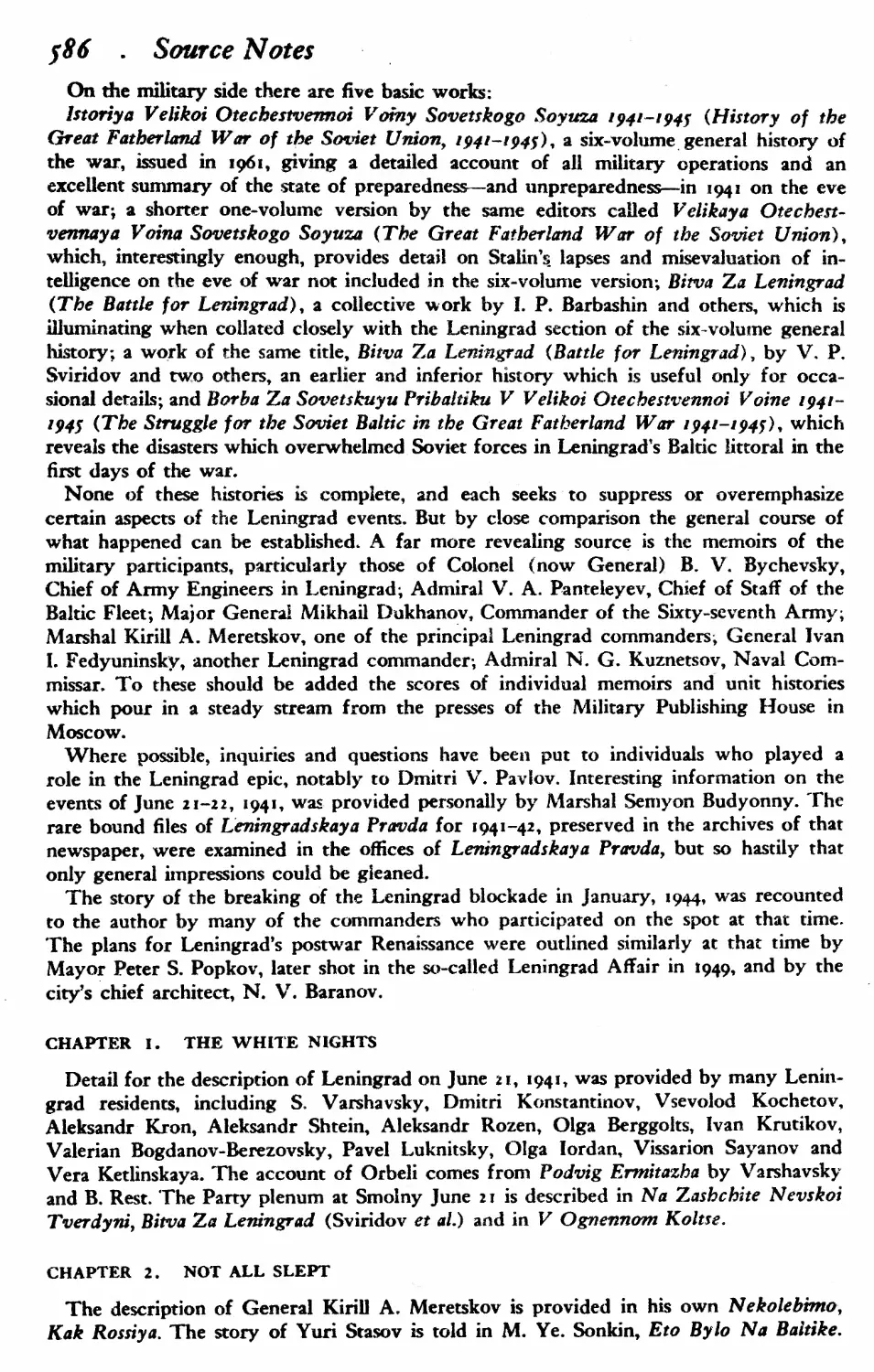
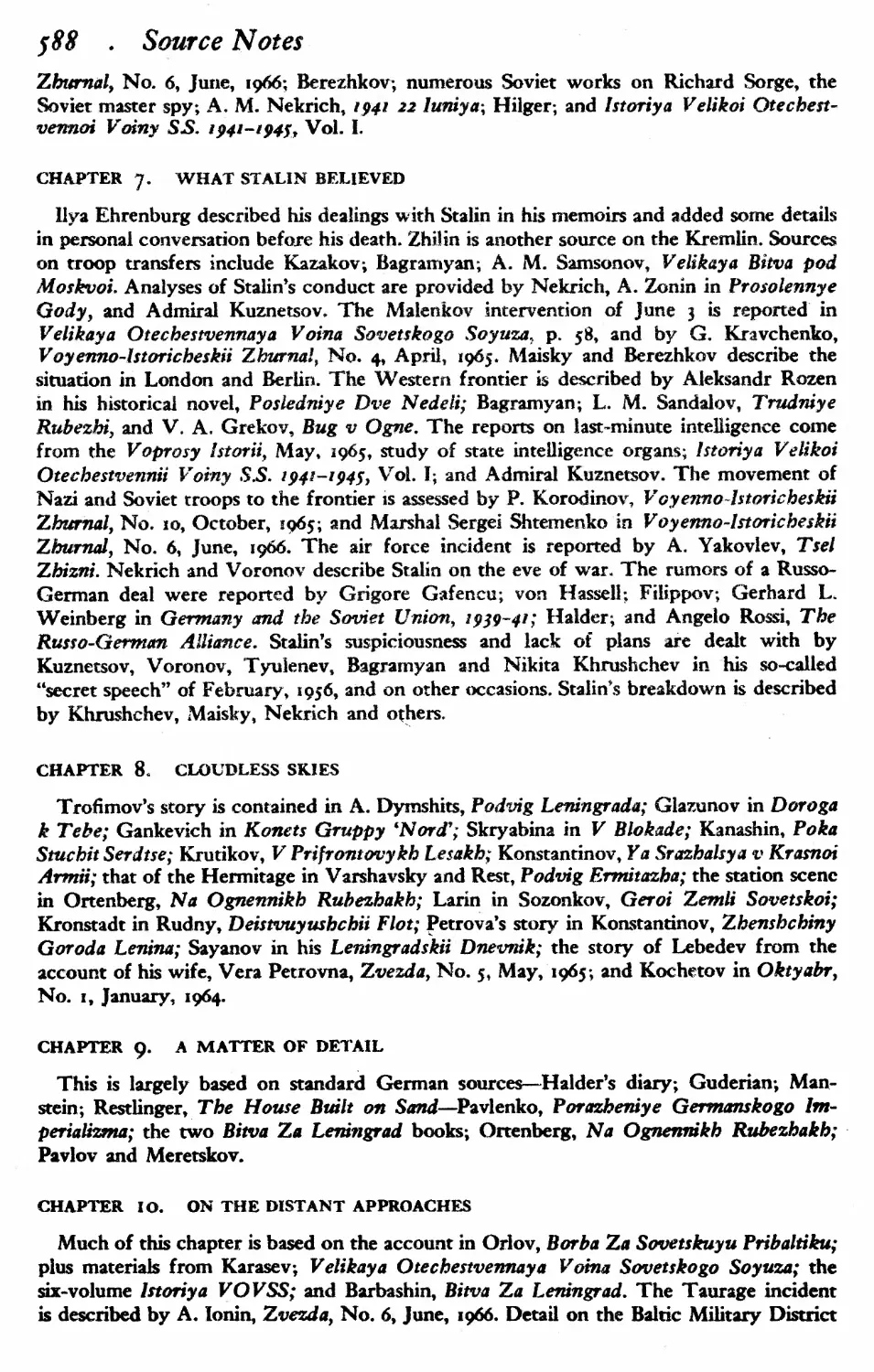
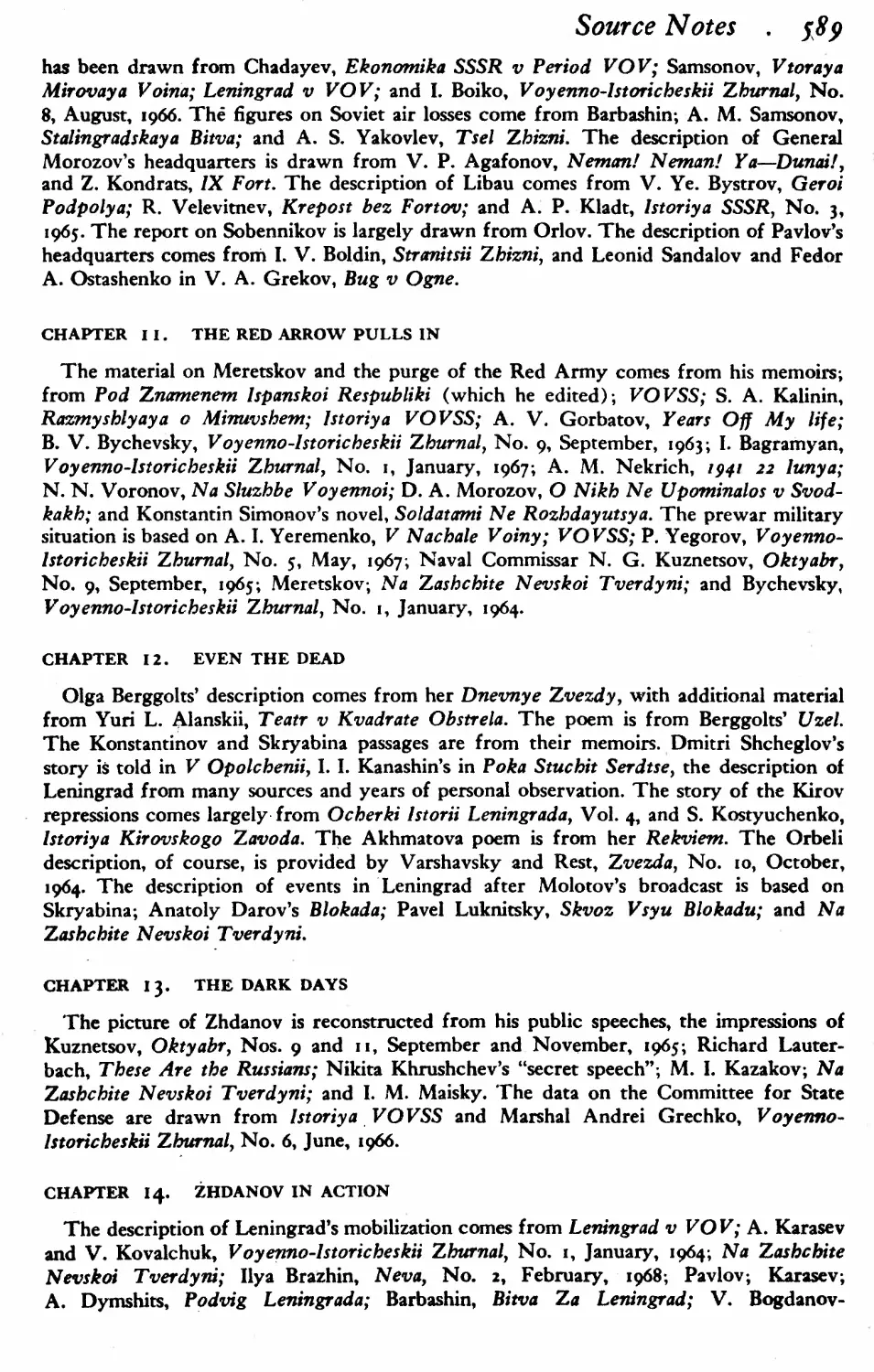
SOURCE NOTES	585
BIBLIOGRAPHY	597
INDEX	6ll

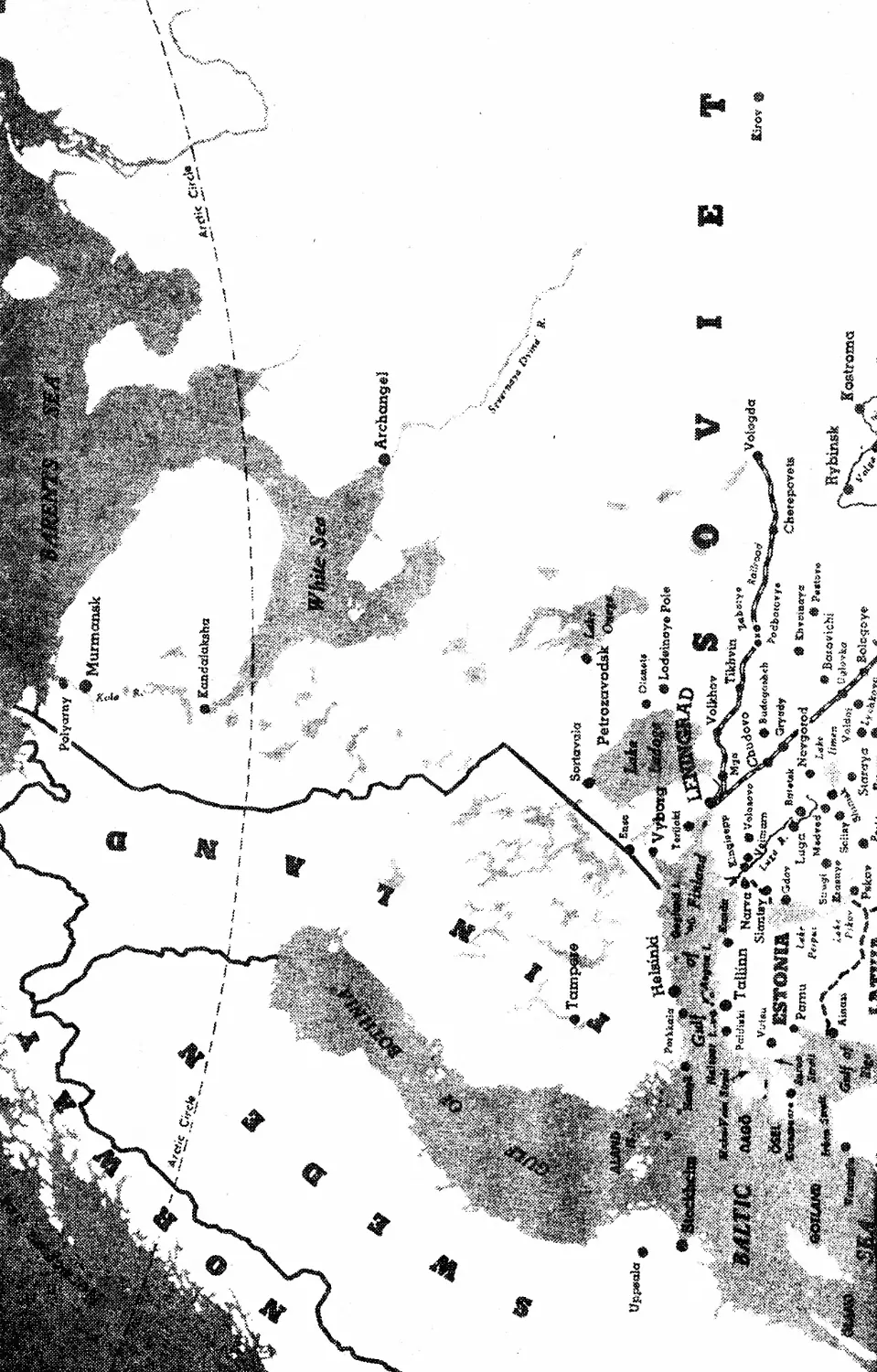
Maps
Western U.S.S.R. & Eastern Europe
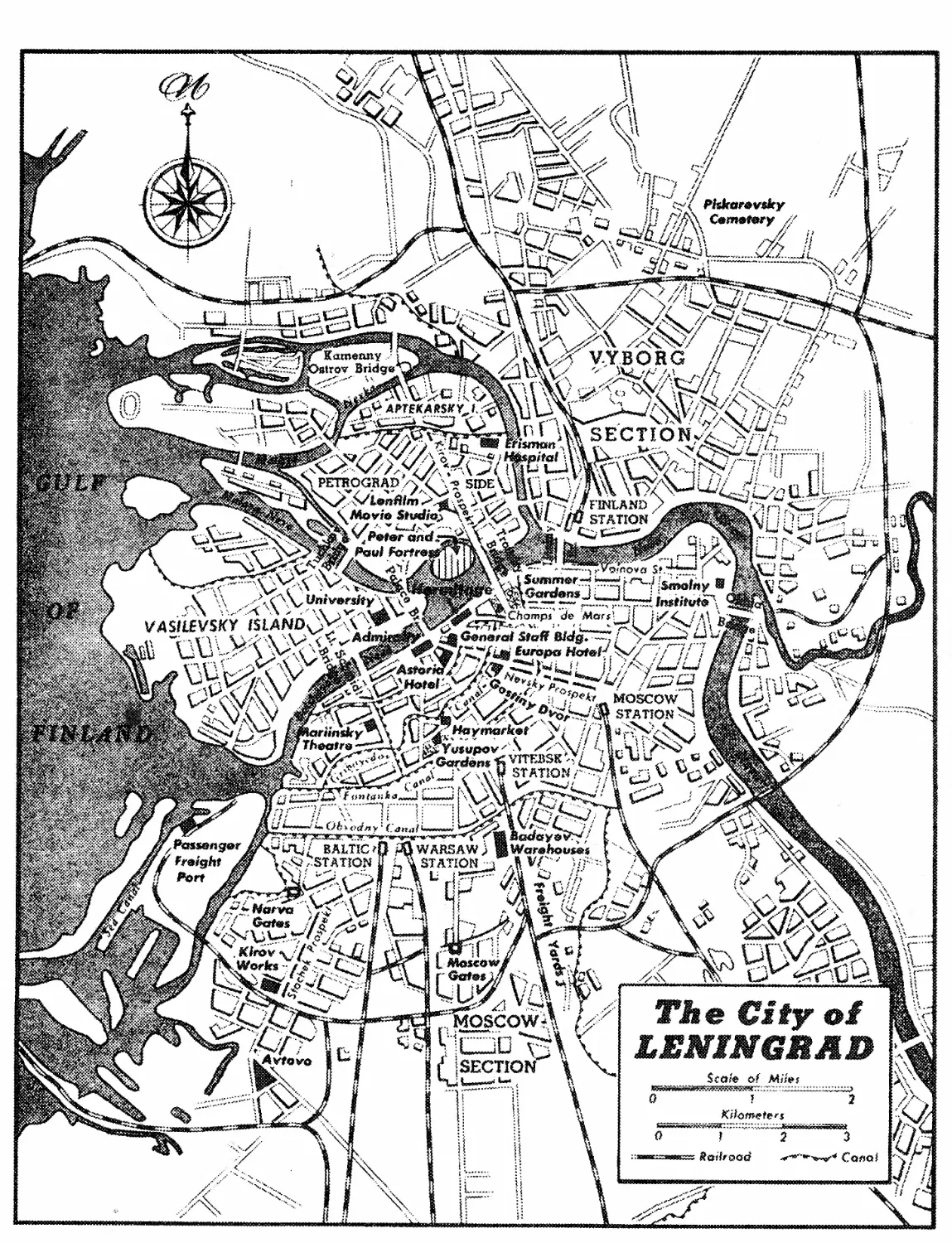
The City of Leningrad
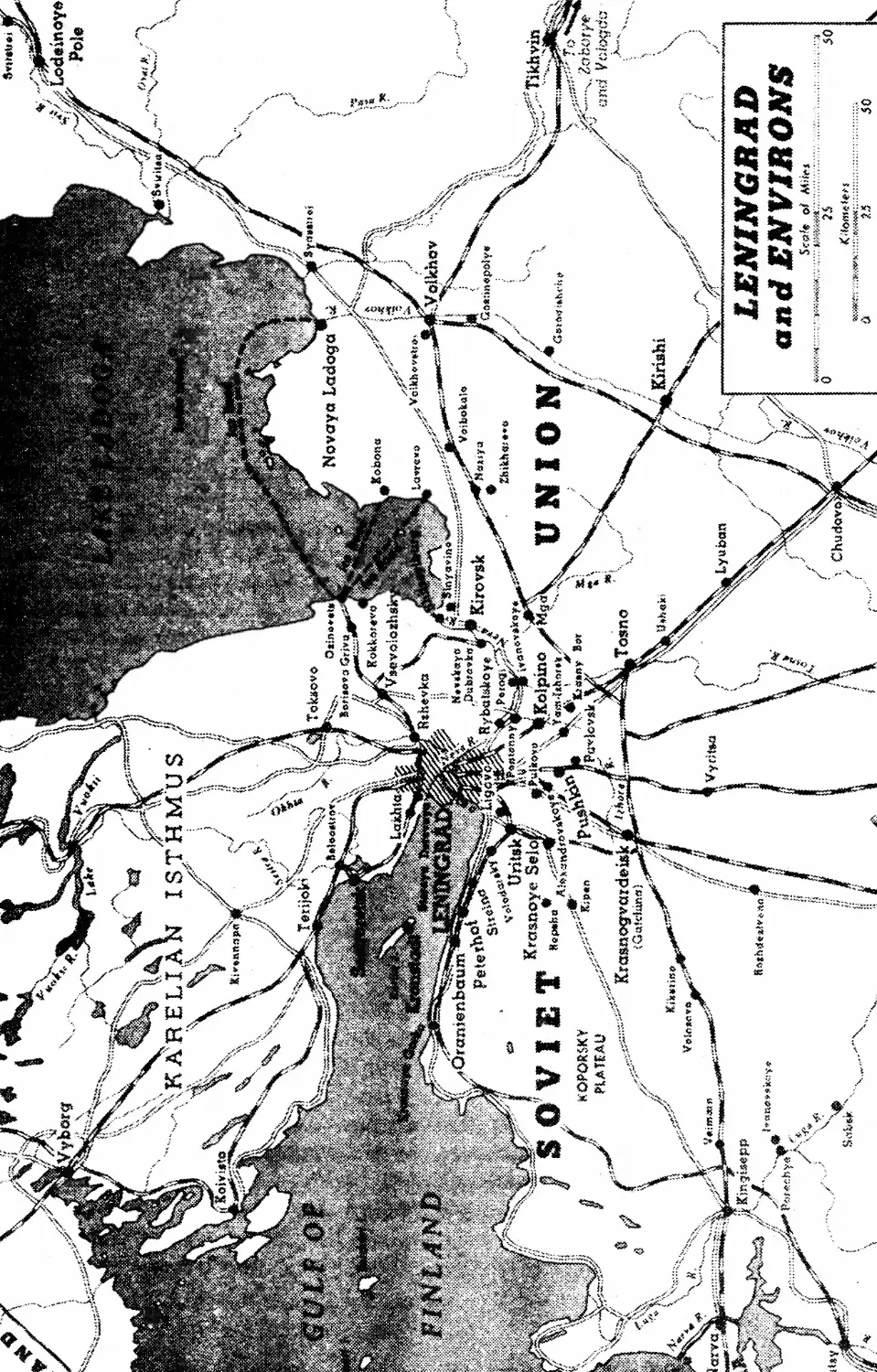
Leningrad and Environs
pages xvi-xvii
page 6
page 96

Principal Personages
Akhmatova, Anna: Leningrad poetess, victim of oppression after World
War II.
Berggolts, Olga: Leningrad poetess and vivid diarist, survivor of the block¬
ade.
Beria, Lavrenti P.: Stalin’s chief of secret police.
Budyonny, Marshal Semyon: Early Red Army cavalry commander, named
to head “Reserve Army” the night the Nazis attacked Russia.
Bychevsky, Colonel B. V.: Chief of Army Engineers in Leningrad.
Dukhanov, General Mikhail: Former Leningrad staff commander, chief
of Sixty-seventh Army.
Fedyuninsky, Marshal Ivan I.: Commander of important Leningrad front
operations.
Govorov, Marshal Leonid: Artillery specialist and commander of Leningrad
front from April, 1942.
Inber, Vera: Moscow writer who spent the blockade in Leningrad, diarist.
Ketlinskaya, Vera: Leningrad writer, close friend of Olga Berggolts.
Kochetov, Vsevolod: Cub reporter on Leningradskaya Pravda at start of
war, diarist.
Kuznetsov, Aleksei A.: Party Secretary in Leningrad, No. 2 to Leningrad’s
Party boss, Andrei A. Zhdanov.
Kuznetsov, General F. I.: Commander of Special Baltic Military District
(Northwest Front) at start of war.
Kuznetsov, Admiral N. G.: Naval Commissar at start of war, prolific writer
of memoirs.
Luknitsky, Pavel: Leningrad correspondent of Tass news agency, diarist.
Malenkov, Georgi M.: Member of Communist Party Secretariat, alternate
xiv

Principal Personages . xv
member of Politburo, bitter rival of Leningrad Party leader Andrei A.
Zhdanov.
Meretskov, Marshal Kirill A.: Leading commander on Leningrad front.
Mikhailovsky, Nikolai: War correspondent attached to Baltic Fleet.
Molotov, Vyacheslav M.: Member of Politburo, close associate of Stalin.
Panteleyev, L. (Alexei) : Resident of Leningrad, writer, diarist.
Panteleyev, Admiral Yuri A.: Chief of Staff of Baltic Fleet.
Pavlov, Dmitri V.: Leningrad food chief, chronicler of the blockade.
Popkov, Peter S.: Mayor of Leningrad, associate of Zhdanov.
Rozen, Aleksandr: Writer, diarist.
Sayanov, Vissarion: Leningrad writer, diarist.
Shtein, Aleksandr: Leningrad playwright, diarist.
Stalin, Iosif: Soviet dictator.
Tarasenkov, A. K.: Soviet war correspondent, Leningrad diarist.
Timoshenko, Marshal Semyon K.: Soviet Defense Commissar at war’s start.
Tributs, Admiral Vladimir F.: Commander of Baltic Fleet.
Vishnevsky, Vsevolod: Naval correspondent, playwright, diarist.
Voronov, Marshal Nikolai N.: Soviet chief of artillery, adviser on Lenin¬
grad front.
Voroshilov, Marshal Kliment: Associate of Stalin’s, commander of the
Leningrad front until September 11, 1941.
Zhdanov, Andrei A.: Party Secretary and boss of Leningrad, leading candi¬
date to succeed Stalin.
Zhukov, Marshal Georgi K.: Leading Soviet commander, in charge of
Leningrad front September 12-October 7, 1941.

Let no one forget;
Let nothing be forgotten.
—Olga Berggolts

PART I
The Night Without End
Let this tale live forever
In our hearts, forever heard!
Let its memory he our conscience.

1 ♦ The White Nights
COLD AND WIND, COLD AND WIND—THIS WAS SPRING 1941
in Leningrad. There had been snow as late as May Day, and the sodden
demonstrators slogged past the Winter Palace in wet boots and soaking coats.
The cold persisted into June, and it seemed that the Baltic fogs would never
lift. Not that this was unusual. Peter the Great did not found his brooding
capital on the Neva marshes with any concern for climate or comfort in
mind.
The weather began to change with thunderstorms on Thursday, June 19,
and again the next day. Finally on the summer solstice, June 21, the sun broke
through and sudden bright blue skies blessed the city. Leningrad lived by
Pushkin’s aphorism that “our northern summer is a caricature of a southern
winter,” and the solstice by tradition was a special day—the year’s longest
day, a day which had no end, the whitest of “white nights,” when midnight
is less than dusk and night never falls.
The shift in the winds, the soft warmth of the sun, the alchemy which
transformed the Neva from gray to sparkling blue, the flowering of the
limes, the forsythia, the jasmine, brought a holiday mood to the city. In the
cream and yellow eighteenth-century buildings of the old university, exam¬
inations were finished on the twenty-first of June and classes dismissed.
Youngsters in pressed blue suits and girls in white voile flowed across the
Palace Bridge from the University Embankment for their gulyaniyey the
promenade of the White Nights, the singing to bay ms and guitars, the
rendezvous at cafes along the Nevsky Prospekt, the meetings at the Caf6
Ice Cream at eleven, at the Green Frog at midnight, at the comer by Elise-
yev’s store at 1 a.m. All evening long there were lines outside the Astoria
Hotel and the Europa. Within youngsters fox-trotted to the current hit,
“We’ll Meet Again in Lvov, My Love and I,” a song which Eddie Rozner
and his Metropole Hotel Jazz Band had made popular.
It had been an uncertain spring in Leningrad—not only because of the
weather. Precarious peace prevailed in the Soviet Union, but with World
3

4 . PART I: The Night Without End
War II deep into its second year who could say how long the peace might
last? The government assured Leningrad (and the rest of Russia) that the
Nazi-Soviet pact, signed on the war’s eve in August, 1939, would guarantee
the country against attack. At the meetings of Party cells in the Leningrad
factories Communist propagandists stressed again and again that under the
treaty each nation pledged itself to carry out no aggression against the other.
Any suggestion to the contrary, they hinted, was almost tantamount to
treason. Pravda editorials hailed the unprecedented era of collaboration in
which Russia shipped wheat and oil to the Third Reich in exchange for
machinery (and war materials). But the men and women of Leningrad still
worried. They harbored a gnawing distrust of the Nazis. Nothing in the
course of the war had indicated they could put real confidence in the pledges
of Adolf Hitler, no matter what Stalin said. After Poland had been parti¬
tioned between Germany and Russia in the autumn of 1939 they had watched
the Nazi Panzers quickly overrun Denmark, Norway and France in 1940,
and they had been stunned by the savage blitz of the Luftwaffe on England.
These demonstrations of Nazi power brought consternation to ordinary
Russians.
What made the spring of 1941 more nervous for Leningrad was the new
campaign of the Wehrmacht—the quick, successful war against Yugoslavia,
the swift conquest of Greece, the occupation of Crete, the threat to the Suez
by Rommel’s fast-moving desert forces.
Now that they had mastered the continent of Europe, where would the
Nazis strike next? England was the obvious answer, but from time to time
Leningrad heard rumors that Russia was next on Hitler’s list. Moscow denied
these reports (the most recent denial had been only a week ago), and no
one was likely publicly to challenge Stalin’s confident assurances about the
pact with Berlin. Far safer to accept the Party line and bury deep within
one’s consciousness any reservations. Yet the concern persisted in many
minds. If—contrary to all pledges, promises and assurances—Hitler did
attack Russia, Leningrad would not escape. The city was military by history
and military by tradition, founded by Peter the Great in 1703 as a bastion
against the Swedes, the Poles, the Lithuanians, the Finns and the Germans,
who century after century had fought to breach the gateway to the Russian
lands.
But few of those who began their vacation exodus to resorts in the islands
of the Gulf of Finland, to the new seashore and lakes that had been won
from Finland in the winter war of 1939-40, were giving serious thought at
that moment to the Nazi menace. The day was too lovely, the portents reas¬
suring. To most Leningraders it seemed that their city was more secure than
it had been for many years, more secure than it had been since Lenin was
compelled “temporarily” to transfer the Russian capital back to Moscow in
1918 in the face of a threat that the Germans would overrun it. The “tem¬
porary” transfer had become permanent when Finland, Latvia, ‘Estonia and

The White Nights . 5
Lithuania split off from Russia after 1917, leaving the Finnish-Soviet frontier
hardly twenty miles from Leningrad and exposing the city to easy conquest.
Now, thanks to the winter war with Finland, Leningrad had a little room
for maneuver. Indeed, that room had been the objective of the brutal Soviet
attack on her small northern neighbor. The frontier had been pushed back
many miles, and when Stalin forced the Baltic states to return to the Soviet
Union in the summer of 1940, Leningrad had been given a new protective
shield along the Baltic coast.
With the perfect weather of the summer solstice the city rapidly emptied.
The staff of the newspaper, Leningradskaya Pravda, had acquired a villa at
Fox’s Bridge on the Gulf of Finland about twenty miles north of Leningrad.
They had their material for the Sunday morning issue of June 22 well in
hand by Saturday afternoon—nothing of consequence was going on—and
most of the staff managed to get away early in the afternoon for the resort.
Not everyone was able to leave Leningrad. Iosif Orbeli, director of the
great Hermitage Museum, a man whose Jovian beard made his friends think
of an Old Testament prophet, spent the day at his desk in the vast galleries
on Palace Square. A dozen problems concerned him. There was his new
Department of Russian Culture, just established May 26, after a long effort.
Packing cases with at least 250,000 exhibits for the new section jammed the
storage area and blocked the emergency exits. There were expeditions pre¬
paring for a summer in the field, and at the museum a painters’ crew had
put up a scaffolding after the May 1 holiday but work had not yet begun.
Now, the year’s busiest season was at hand, and Orbeli was angry at the
delay. He telephoned the Construction Trust. They tried to put him off,
promising to start painting at the “earliest possible moment,” but he did not
hang up until he got a firm date. The work was to start Monday, June 23.
Orbeli left his office late. He expected a large crowd on Sunday. Every¬
thing had to be in order. On his desk, marked in blue pencil, was a copy of
Saturday’s Leningradskaya Pravda. The item Orbeli had encircled was head¬
lined: “Tamerlane and the Timurids at the Hermitage.” It described two
halls devoted to artifacts of the Mongol era. That would bring extra visitors
on Sunday, Orbeli knew. Interest in Tamerlane was running high in Lenin¬
grad. A week ago a scientific expedition had arrived in Samarkand to
examine the Gur Emir mausoleum where Tamerlane was buried. It was
gathering material for the celebration of the five hundredth anniversary of
Alisher Navoi, the great poet of the Tamerlane epoch. Each day Lenin¬
gradskaya Pravda had printed a dispatch from Samarkand, telling of the
progress of the work. On Wednesday the Tass correspondent described the
lifting of the slab of green nephrite from Tamerlane’s sarcophagus. “Popular
legend, persisting to this day,” wrote the Tass man, “holds that under this
stone lies the source of terrible war. . . .” The story brought chuckles to
many readers. Such a fantastic superstition—to believe that by moving an
ancient stone war could be unleashed in the world. On Friday Leningrad-

The White Nights . 7
skaya Pravda reported that Tamerlane’s coffin had been opened. Examina¬
tion of the skeleton showed that one leg was shorter than the other. This
verified the tradition that Tamerlane was lame.
There was no story from Samarkand in the Saturday paper. Perhaps,
mused Orbeli, that is why they printed the item about the exhibit at the
museum. He locked his office, bade good night to the guard at the service
entrance and walked out into Palace Square. It was, Orbeli thought, the
most imposing architectural ensemble in the world—the magnificent Winter
Palace and the Hermitage along the Neva embankment, the massive General
Staff building and arch across the square and in the center the column com¬
memorating Alexander I. It echoed empire. It had echoed empire since the
day when Peter began to sink massive piles into the morass of the Neva
estuary at the cost of tens of thousands of lives, to build first his fortress,
the gravelin and bastion hulk of Peter and Paul, then the Kronstadt naval
base on one of the hundred islands of the Neva Delta and finally to erect
the palaces, the boulevards, the grandiose squares which evoked such flam¬
boyant comparatives—the second Paris, the Venice of the North. Just as
Petersburg came to call Catherine II the Northern Semiramis, ultimately
her capital acquired the denominative which Orbeli most treasured—the
Northern Palmyra; Semiramis and Palmyra—the ancient romance and mys¬
tery of Asia Minor transmuted into the ice and winter of the Russian north.
St. Petersburg, Petrograd, Leningrad, Palmyra—whatever its name, surely
there was no city its equal even though at the moment the view from Peter’s
“window on the West” might be somewhat obscured by Stalin’s tyranny.
Orbeli strolled toward the Admiralty with its graceful spire. Across the
Neva rose the answering spire of the Peter and Paul Fortress and the fa£ade
of the university buildings on the Petrograd side of the river. He turned
toward the Nevsky Prospekt, the great boulevard which the poet Aleksandr
Blok thought “the most lyric street, the most poetic in the world,” where
as nowhere else there was a mystery to the women, a dark handsomeness in
their appearance, a ghostliness in their promise. Always the city had deeply
moved those who saw it. To some it was oppressive, mystical, tragic; to
others ethereal, magical, miraculous. To Lenin it was a sweated slum, ripe
for agitation, intrigue, revolution. To the Romanovs it was the capital of
the world, the seat of absolute authority, the mandate anointed by the bless¬
ing of the Orthodox faith.
Always the city evoked superlatives, swaying the beholder by the
majesty of its spaces, the richness of its planes, the interplay of water and
stone, of granite piles and slender bridges, lowering skies and the endless cold
and snow of winter. It was Russia’s workshop, Russia’s laboratory, the cradle
of Russian scholarship and art. Here Mendeleyev discovered the periodic
table of the elements. Here Pavlov worked with his dogs on conditioned
reflexes. Here Mussorgsky wrote his wild, dark music, Pavlova’s fairy feet
won the hearts of the grand dukes and the Imperial Ballet spawned Bakst,
Diaghilev, Fokine and Nijinsky.

8 . PART 1: The Night Without End
Leningrad was the capital of Russian creative life. On this Saturday, June
21, work went on all day in the rehearsal rooms of the State Ballet School
on Alexandrinsky Square. The grande dame of Russian ballet, Agrippina
Vaganova, was a strict taskmistress. On Sunday the twenty-second the corps
was presenting a program at the Mariinsky Theater to mark the thirtieth
anniversary of the debut of the ballerina Ye. M. Lukom. The graduation
performance by Madame Vaganova’s 1941 class of the ballet Bela was sched¬
uled for Wednesday the twenty-fifth. All day Saturday work at the barre
went on, hour after hour. Madame Vaganova was sixty-three, but she had
lost none of her vigor and, as one of her ballerinas noted, “Madame Vaga¬
nova was strict as ever.”
Karl Eliasberg, director of the Leningrad Radio Committee Symphony,
returned to his apartment on Vasilevsky Island rather late that Saturday.
He, too, was busy all afternoon with rehearsals. Now he sat down to read
the paper and noticed that an exhibition was opening on Sunday in the
Catherine Palace at Pushkin to mark the one hundredth anniversary of the
death of the poet Lermontov. He decided to attend it. Another musical
figure, the composer Dmitri Shostakovich, had quite different plans. Shosta¬
kovich was a football fan. Saturday afternoon he bought tickets for the
Sunday, June 22, game at Dynamo Stadium.
There was much activity on Saturday at the rambling studios of Lenfilm
across the Neva on the Petrograd side. There at No. 10 Kirov Prospekt on
the site of the old Aquarium Gardens (where an ice palace had delighted
generations of Petersburg youngsters) a film about the composer Glinka
was about to get under way. Lyudmila, wife of the playwright Aleksandr
Shtein, spent the day making beards for patriarchical boyars, fitting cos¬
tumes for Chernomor, Ruslan and Lyudmila, putting into shape the delicate
old Russian headdresses, called kokoshniki. Shooting would begin on Mon¬
day. Shtein was not with his wife. As an officer in the army reserves he had
been called up in early spring for three months’ service. He had finished his
tour of duty a few days earlier and had gone to relax at a new writers’ resort
in the formerly Finnish section of Karelia, a few miles north of Leningrad.
He spent Saturday night sitting on a rambling wooden porch, talking
through the endless twilight with a fellow playwright, Boris Lavrenyov. The
evening was tranquil, but later Shtein remembered seeing rockets on the
distant horizon and, as he was going to bed about 4 a.m., he thought he
heard the drone of airplane engines out over the Gulf of Finland.
All day Saturday there had been comings and goings at Smolny, the
rambling complex of classic Russian buildings along the Neva River, once
a school for noble gentlewomen, but since 1917 a symbol of revolution. It
was here that Lenin and his Bolsheviks set up their command post for the
November, 1917, coup (Tetat, and here, since that time, the Leningrad Com¬
munist Party apparatus had had its headquarters.
On this Saturday the Leningrad City Party was holding what was called

The White Nights . 9
an enlarged plenary session—a general meeting at which secretaries of the
city organization, factory directors, economic specialists, labor union repre¬
sentatives and city officials were discussing several important questions—the
carrying out of directives which had been approved at the Eighteenth All-
Union Party Conference and new plans for industrial construction.
The meeting in the Smolny Assembly Hall, the room in which Lenin
proclaimed the victory of the Bolshevik Revolution, did not end untiK^eve-
ning. Some delegates headed home. Others joined the casual strollers on the
city’s broad boulevards, sauntering idly in the filtered midnight light. They
paused to stare in curiosity at posters plastered on lamp posts advertising
Romeo and Juliet, the Prokofyev ballet in which Galina Ulanova was danc¬
ing at the Mariinsky Theater the next day. Other posters read: “Anton
Ivanovich is Angry . . . Anton Ivanovich is Angry.” Not all the delegates
recognized this as a teaser for a new movie which was to open soon at the
leading houses. They shook their heads in puzzlement and wandered on to
peer into the bright shop windows of Nevsky Prospekt.
The top personnel at the meeting did no strolling. They went straight to
their offices and waited beside telephones in case of a call. Just before they
left Smolny the word had quietly been passed: “Don’t get too far away.
There may be something coming up tonight.”
They had been offered no clue as to what might be happening. Disciplined
to carry out Party orders meticulously and without question, they now sat
by their telephones, smoking cigarettes, poring over the mountains of paper
that perpetually overwhelmed them and wondering what was in the air. Not
all went to their offices. Mikhail Kozin, Party organizer for the great Kirov
steel works, drove to his summer cottage at Mill Stream, a few miles outside
Leningrad, to spend the night with his family. He had no telephone in the
country, but his chauffeur went back to the factory, ready to alert him if
anything happened.
In the suburb of Pushkin, the old imperial village of Tsarskoye Selo, the
soft air and pale light attracted scores of young couples to the linden alleys
and stately parks surrounding Rastrelli’s exquisite Catherine Palace. Here
where the poets Alexander Pushkin and Aleksandr Blok once lived, a new
generation of Russian youngsters, many of them fresh from graduation
exercises, strolled through the long night. As they passed the squat buildings
known as the Half-Moon near the gates of the palace they paused. From
the open windows of the Half-Moon came the haunting sounds of a Skrya-
bin sonata. It was the composer Gavriil Popov and his wife, playing two
grand pianos in adjoining rooms, separated only by curtains. Popov’s opera,
Alexander Nevsky, was at that moment on the rehearsal schedule of the
Mariinsky Theater, being prepared for an autumn premiere.
The Catherine Park was a nest of creative artists. Nearby the composer,
Boris Asafyev, was at work, instrumentalizing his opera The Slav Beauty,
commissioned by the Baku Opera Theater for the forthcoming Nizami festi¬

io . FART I: The Night Without End
val. In an adjacent apartment the novelist Vyacheslav Shishkov, back a day
or two from a vacation in the Crimea, sat at his desk, correcting proofs of
a long historical novel.
All winter the young writer Pavel Luknitsky had worked in die same house
with Shishkov—it was Alexei Tolstoy’s old villa, now a writers’ rest home.
On June 16 Luknitsky, thin, dark, handsome, intense and as yet unmarried,
finished his novel and sent it off to the publisher. Now he was in Leningrad,
wondering what to do with his summer. Possibly he would go to the new
writers’ resort in Karelia. There were lovely grounds there and a beach. In
any event he thought he would accept an invitation he had received in the
mail the day before. The writers* organization was sponsoring a tour of the
old Mannerheim fortified line across Karelia which had lain in Soviet hands
since the winter war. Special buses would leave promptly at 7:30 a.m.,
June 24.
In a big house at No. 9 Griboyedov Canal, not far from the Nevsky
Prospekt, the poet Vissarion Sayanov talked through Saturday night with
an old friend, a factory worker whom he had met during the winter war
with Finland. Sayanov had been a war correspondent, his friend a political
officer with a reconnaissance unit. Over a bottle of vodka they recalled
the bitter cold in the Finnish forests, comrades who had survived and some
who hadn’t. It was a leisurely, reminiscent evening, and they did not separate
until long past midnight
Sayanov, a middle-aged poet with a round face and gold-rimmed spec¬
tacles, walked a bit with his friend before turning back to go to bed. The
city was quiet in the hours before morning—quiet but lighted by a refracted
luminosity which flattened the colors, melted out the shadows and washed
the great stone buildings with eggshell tints. From a distance	came the sound
of young voices. They were singing a popular Soviet song:	“Daleko	.	.	.
daleko .. . Far away ... far away,” a plaintive song of a lover far from his
sweetheart and home. The chant rose clear and fresh, and down the street ap¬
peared a band of students, the girls’ dresses white against the darkness of the
pavement, the boys in light shirts and navy-blue trousers. Their arms were
linked and they slowly walked, singing with a beauty that was rare and un¬
earthly.
For the most part Leningrad now slept, except for wandering youngsters.
Over on the Petrograd side the writer Vera Ketlinskaya, walking home along
the Kirov Prospekt, watched a slim young boy pause and lift a girl to his
shoulders so she could pick a spray of jasmine from an overhanging limb.
The boy and girl came up to the Kamenny Ostrov Bridge over the Malaya
Neva River. The draw was raised and they waited at the embankment, the
girl shivering in the coolness of the night. When the boy tried to put his
arm around her, she pulled away willfully and said: “One thing I would
never be so stupid as to do is to marry you!”
“Why not?” the boy asked in despair. “Why not?”

The White Nights . n
“That’s what I’m trying to understand myself,” the girl said.
Finally, the drawbridge was let down. The boy and girl silently crossed
over, the girl still holding the sprig of jasmine. They parted at the comer;
then the girl called back: “Fedya!”
“What?” the boy replied.
“Nothing. Come by day after tomorrow. I’ll give you back your books.”
“All right,” the boy said. “Leave them with your mother if you’re not
home. I’ll drop in during the afternoon.”
The young couple vanished. Now the avenue stretched empty and quiet.
Leningrad was sleeping through the night that was no night . . . the longest
of the white nights.

2 ♦ Not All Slept
NOT EVERYONE SLEPT THAT NIGHT.
Not Army General Kirill A. Meretskov, Deputy Commissar of Defense,
who boarded the Red Arrow express in Moscow at midnight, June 21, on
an urgent mission to Leningrad. Hour after hour he stood looking out the
window of his polished-mahogany compartment with its heavy brass fittings,
its Brussels carpet, its French plumbing. He was riding in an old Interna¬
tional car of the French Wagon-Lits Company, a heritage of the imperial
past. North of Moscow the searchlight of the Red Arrow’s locomotive cut
through the dusk and, then, as the train hurtled down the straight course
laid out by the engineers of Czar Nicholas I, the horizon slowly lightened.
Meretskov knew this country well. During the years 1939-40 he had headed
the Leningrad Military District. It was he who commanded the Soviet troops
in the winter war on Finland. He had known Leningrad since the days of
the Revolution. Almost every mile of broken birch and fir forest between
Moscow and Leningrad was familiar to him.
As the landscape spread out in the cool light, he stared from the window,
watching the sun rise in a pale-blue sky. The train plunged through the deep
green of the forest and then out across watery marshes. Suddenly he heard
the wheels echo hollowly on a bridge, and before him appeared the quiet
waters of the Volkhov River. Then again swamps, more fir forests, more
swamps.
General Meretskov felt a sense of mounting excitement as he saw the
Leningrad land again, excitement and a sense of concern, a sense of pride
and a sense of history, Pushkin’s line ran through his mind:
Show your colors, City of Peter,
And stand steadfast like Russia. . . .
He watched silently at the window, his face tense and thoughtful as the
train sped on toward Peter’s capital. There was much to be done as soon
as he arrived.
12

Not All Slept . 13
In the barnlike Leningrad offices of the Baltic Merchant Fleet beside the
Neva passenger-freight port a conviction grew on Saturday, June 21, that
something strange was afoot. Exactly what no one was certain. Most dis¬
turbing was the silence in Moscow, the silence of the People’s Commissariat.
It had begun on Friday. When Nikolai Pavlenko, deputy chief of the
Political Department, came to his office Friday morning, he found a cryptic
radiogram on his desk signed “Yuri.” The message—sent in the clear—had
been received just before dawn. It said: “Being held. Can’t leave port. Don't
send other ships. . . . Yuri . . . Yuri. . . German ports holding Soviet ships.
... Protest. . . . Yuri. . . Yuri . . .”
The message almost certainly had been transmitted from a Soviet freighter,
the Magnitogorskt which was unloading cargo in the German port of Dan¬
zig. The radio operator of the Magnitogorsk was Yuri Stasov, and the mes¬
sage center recognized his characteristic sending style.
What did it mean? What should be done? The Magnitogorsk did not
respond to wireless messages. There were five other Soviet ships in German
ports. No word from them either. The “Yuri” message was relayed to
Moscow. No reaction.
Pavlenko didn’t leave the matter there. He telephoned Aleksei A. Kuz¬
netsov, secretary of the Leningrad Regional Party Committee, and asked
for guidance. Kuznetsov suggested that precautions be taken but warned
that “the question evidently is being dealt with in Moscow.” For the moment
nothing could be done about ships already in German waters, but the fleet
authorities decided not to send any more to the west until they knew what
was going on. The motor ship Vtoraya Pyatiletka and the steamer Lunachar¬
sky, bound for German ports, were told to stand by in the Gulf of Finland
and be prepared to put into Riga or Tallinn.
All day Saturday the Merchant Fleet waited for instructions from Mos¬
cow. None came. Pavlenko consulted Secretary Kuznetsov again. He agreed
that the Vtoraya Pyatiletka be diverted to Riga and the Lunacharsky re¬
turned to Leningrad. It was an unusual demonstration of initiative for Soviet
bureaucrats—to act without orders from Moscow. Meanwhile, ships in Baltic
waters were told to keep in constant communication with Leningrad.
Toward evening the chiefs of the Merchant Fleet met. Sunday was a free
day, but -they decided that top personnel should come to work. The others
would stay in town, ready for a quick call in an emergency. The chief
administrative and political officers and their deputies, including Pavlenko,
remained at their desks most of the evening, then went home.
The Leningrad Military Command embraced a vast area. In event of war
it would become the command center for the region extending from the
Baltic Sea to the Arctic reaches of the Kola Peninsula. Subordinate to it, so
far as land operations were concerned, was Admiral Arseny G. Golovko,
commanding the Northern Fleet at Polyamy on the Murmansk shore. Ad¬

14 . PART I: The Night Without End
miral Golovko had been reporting more and more alarming intelligence. For
the past week flights of German reconnaissance planes had been observed
over Soviet installations. What should he do? The response was: “Avoid
provocation. Don’t fire at great altitudes.”
Golovko grew increasingly restive. On the previous Wednesday, June 18,
Lieutenant General Markian M. Popov, commander of the Leningrad Mili¬
tary District and Golovko’s immediate superior under the interlocking
Soviet command system, had arrived in Murmansk. Golovko hoped for en¬
lightenment, but none was forthcoming. Popov confined himself to questions
of construction of fortifications, new airdromes, supply depots and barracks.
If he had any intelligence on the current situation, he did not divulge it.
“Apparently he knows no more than we,” Golovko noted in his diary on
June 18.
Sad. Such vagueness is not a very pleasant perspective in case of sudden
attack. In the evening Popov left for Leningrad. I accompanied him to
Kola. He treated us to a farewell beer in his special car and that ended our
meeting.
From Moscow nothing definite either. The situation remains unclear.
It got no clearer on Thursday, June 19. There were more German over¬
flights. Nothing on Friday. On Saturday Moscow’s Stanislavsky Musical
Theater, starting its summer tour of the provinces, was presenting Offen¬
bach’s La Perichole in Murmansk. Golovko decided to attend. He took his
Military Council member, A. A. Nikolayev, and his Chief of Staff, Vice
Admiral S. G. Kucherov, with him. The theater was filled. There were
standees.
Golovko relaxed and let the music push his worries out of his mind. So,
he thought, judging by their expressions, did his aides.
The audience seemed at ease, possibly because Golovko and his staff were
present. “The situation can’t be so bad—the chiefs are here.” This is what
he read in the faces of the spectators as they promenaded in the lobby
between the acts.
All the way back to headquarters he, Nikolayev and Kucherov talked
about the operetta. Arriving at headquarters a little before midnight, he
ordered tea and sat down for the late-evening situation report.
At the Leningrad defense command installations at Kingisepp, on the
Moonzund Archipelago of the Estonian Baltic coast, Major Mikhail Pavlov¬
sky spent Saturday, June 21, at Coastal Defense Headquarters. He had been
receiving reports of unusual German activity for days, but nothing new
came in on Saturday. As he was leaving the office, a friend in the 10th
Border Regiment, Major Sergei Skorodumov, telephoned.
“How about getting your better half and coming to the theater? The
NKVD song-and-dance ensemble is giving a concert and I’ve got tickets.”

Not All Slept . 15
Pavlovsky said he would have to check with his wife.
“Any incidents today?” he asked.
“Absolutely quiet,” Skorodumov replied.
The two couples went to the concert. Afterward they walked home. The
city was still. Most people had already retired for the night although it was
still full daylight on the Baltic.
Pavlovsky and his wife were undressing and talking about an excursion
to the country on Sunday when the telephone rang. It was headquarters
calling Pavlovsky back to his post.
“What is it?” Pavlovsky’s wife asked.
“I don’t know, Klavdiya,” he replied. “I don’t know anything at all.
Maybe it’s a training maneuver.”
He kissed his wife and, opening the door carefully so as not to disturb
the sleeping children, walked out of the house. The hour was just before
midnight.
What was happening in the Leningrad area was duplicated in other frontier
regions.
June 21 found Army General Ivan I. Fedyuninsky in command of the
15th Rifle Corps, based on Kovel and defending the Bug River sector of the
Central Front. His concern had mounted since Wednesday the eighteenth,
when a German soldier deserted to his lines and reported that the Nazis were
preparing to attack Russia at 4 a.m., June 22.1 When Fedyuninsky reported
this information to his chief, Fifth Army General M. I. Potapov, he was
curtly told: “Don’t believe in provocations.” But on Friday, returning from
regional maneuvers, Fedyuninsky encountered General Konstantin Rokos*
sovsky. Rokossovsky, commander of a mechanized corps attached to the
1 An extensive literature has grown up around this incident, and there is controversy
as to precisely when the deserter made his way to the Soviet lines. The operational
journal of the 90th Border Guards unit reports that at 9 p.m., June 21, its fourth unit
detained a German who had come across the lines. He gave his name as Alfred Liskof,
member of the 222nd Infantry Regiment of the 74th Infantry Division. He surrendered
himself at Vladimir-Volynsky, declaring the Germans had been ordered to attack at
4 a.m. He had heard this from his superior, a Lieutenant Schultz, and also had observed
troops being disposed for the attack. The information was transmitted by direct wire
by a Major Bychevsky to the chief of the Ukraine Border Command at Kiev and was
relayed to the Army Command of the Fifth Army at Lutsk. The information was also
passed to the commanders of the 87th Infantry Division and the 41st Tank Division at
Vladimir-Volynsky. A. B. Kiadt, writing in Istoriya SSSR, No. 3, 1965, suggests Fedy¬
uninsky was referring to this deserter and that he mistakes the date. Nikita Khrushchev
in his “secret speech” of February 25, 1956, mentions a deserter who brought over in¬
formation on the night of the attack (probably the same Liskof). He says the informa¬
tion was relayed to Stalin on the evening of June 21 but that Stalin ignored it. Liskof
became famous in the early days of the war. He was made to issue a statement calling
on German soldiers to overturn the Hitler regime. Great posters were plastered up
bearing his portrait on one side and the legend: “A mood of depression rules among
German soldiers.” Dmitri Shcheglov saw the posters on the Leningrad streets June 28.
(Dmitri Shcheglov, V Opolchenii, Moscow, i960, p. 8.)

16 . PART I: The Night Without End
Fifth Army, did not shrug off the signs of imminent Nazi attack. Indeed,
he shared Fedy uninsky’s concern.2
It was late Saturday night before Fedyuninsky retired, but he could not
sleep. He got up and smoked a cigarette at an open window. He looked at
his watch. The time was i: 30 a.m. Would the Germans attack tonight? All
seemed quiet. The city slept. The stars sparkled in a deep azure sky. “Can
this be the last night of peace?” Fedyuninsky asked himself. “Will the
morning bring something else?”
He was still pondering this question when the telephone rang. It was his
chief, General Potapov. “Where are you?” Potapov demanded. “In my
quarters,” Fedyuninsky replied.
Potapov told him to go immediately to staff headquarters to stand by for
a call over the special high-security line—the so-called VC telephone.
Fedyuninsky did not wait for a car. He threw a coat over his shoulders and
ran to staff headquarters. He found the VC line out of order. He got through
on the ordinary phone, and Potapov ordered him to put his division on
alert. “But don’t respond to provocations,” Potapov insisted. As Fedyuninsky
put down the receiver he heard a fusillade of pistol shots—the car which
had been sent to bring him to staff headquarters was being fired on by Nazi
diversionists who had slipped across the frontier.3
Vice Admiral Vladimir Tributs, commander in chief of the Baltic Fleet,
charged with the defense of Leningrad’s sea approaches, had watched events
through the dismal spring of 1941 with unconcealed apprehension. More,
perhaps, than any other single Soviet officer, Tributs was apprised of the
activity of German planes, German submarines, German transports, German
agents and German sympathizers. Somewhat against his inclinations (because
of security problems and the difficulty of constructing a new fleet base),
Tributs had advanced Baltic Fleet headquarters from its historic seat at the
Kronstadt fortress in Leningrad to the port of Tallinn, two hundred miles
to the west. The shift had taken place when the Soviets took over the Baltic
states in the summer of 1940. It gave Admiral Tributs an observation post
within the newly acquired, only partially assimilated Baltic areas. He began
to report the arrival of German troops at Memel, just across the new Soviet
Baltic border, as early as March, 1941. In the same month German over¬
flights became a daily phenomenon at most Baltic bases. By June, Admiral
2 Rokossovsky’s concern was not deep enough to keep him from planning a fishing
trip on the weekend of June 21-22. At the last minute a concert was scheduled for
Saturday night at his headquarters in Novograd-Volynsky, so that instead of being
away he was on hand to alert his commanders. But they were ordered to go to their
units only “after the concert.” (N. V. Kalinin, Eto v S&rdtse Moyem Navtexda, Moscow,
1967, pp. 8-9.)
3 A number of similar attacks were reported, including another in Fedyuninsky’s
command. Grigori Baklanov describes such an incident, probably based on Fedyuninsky,
in his novel, lul 41 god a, but makes it occur on the night of June 21, rather than in the
early hours of June 22. (Grigori Baklanov’ lul 41 go da, Moscow, 1965, pp. 114 >115.)

Not All Slept . ij
Tributs estimated at least four hundred German tanks had been concentrated
just a few miles from the Soviet Baltic border.
Even more suggestive was the conduct of German engineers engaged in
work for the Soviet Navy. The Russians had purchased from Germany late
in 1939 an unfinished cruiser, the Liitzow. The Russians towed it to Lenin¬
grad in the spring of 1940 for completion in the great Baltic shipyards. Sev¬
eral hundred German specialists were working on the Liitzow. In ^.pril
parts and supplies failed to arrive on schedule from Germany, although the
Germans previously had been remarkably punctual. Tributs mentioned the
delay to Admiral N. G. Kuznetsov, the Naval Commissar, who talked to
Stalin about it. But Stalin merely suggested keeping an eye on the situation.
A little later the German engineers began to return home on one pretext
or another. By the end of May only twenty remained in Leningrad, and by
June 15 the last had vanished.
Simultaneously, German ships disappeared from Soviet waters. By June
16 not one remained.
Tributs was so worried that on Thursday, June 19, he convened his Mili¬
tary Council and decided to order a No. 2 Combat Alert for the Baltic Fleet.
Chief of Staff, Vice Admiral Yuri A. Panteleyev, started to scribble out the
orders while Tributs telephoned Admiral Kuznetsov in Moscow.
“Comrade Commissar,” Tributs told Admiral Kuznetsov, “we have ar¬
rived at the view that an attack by Germany is possible at any moment. We
must begin laying down our mine barrages or it will be too late. And I
think it essential to raise the operational readiness of the fleet.”
Tributs listened to Kuznetsov a moment, then hung up.
“He agrees to the alert,” Tributs told Panteleyev, “but orders us to be
careful and avoid provocation. And we will have to wait on the mine laying.
Now, let’s get to work. . . .”4
On the evening of June 21 Leningrad’s sea frontiers—the Baltic Fleet, the
shore bases, the coastal artillery as far west as Libau (Lipaja), the island
sentries in the Baltic, the new leased-area fortress of Hango, the submarines,
the patrol craft and other sea-borne units—all were on a No. 2 Alert, just a
step below all-out readiness for action. Live ammunition had been distributed.
Leaves had been canceled. Full crews stood at their posts.
Tributs himself and his staff had left the Old City and moved into their
4 Kuznetsov’s memoirs imply that the initiative for the No. 2 Alert came from him.
In any event, Kuznetsov did issue orders June 19 for a No, 2 Alert not only for the
Baltic Fleet but also for the Northern Fleet and the Black Sea Fleet. The order was
issued by the Military Council of the Baltic Fleet, according to K. L. Orlov, Borba Za
Sovetskuyu Pribaltiku v Velikoi Otechestvennoi Voiney 1941-1945, Vol. I, Riga, 1966.
(N. G. Kuznetsov, Nakanune, Moscow, 1966, p. 109; Orlov, p. 52.) The Germans had
already begun to lay mines in the Gulf of Finland, but this was not detected by the
Baltic Fleet patrols. Vice Admiral N. K. Smirnov blames the delay in establishing a
Soviet mine barrage for the loss of the mine layer Gnevny and the damaging of the
cruiser Maxim Gorky by German mines in the Gulf of Finland. (N. K. Smirnov,
Matrosy Zashcbishchayut Rodinu, Moscow, 1968, p. 18.)

18 . PART 1: The Night Without End
war command post, an underground shelter outside Tallinn. Tributs got one
more alarming report. This came from a sentry ship, the submarine M-96,
on duty near the entrance of the Gulf of Finland. Captain A. I. Marinesko
reported sighting a convoy of thirty-two transports, many under the Ger¬
man flag, near the Bengtsher lighthouse around 4 a.m., June 21.
That evening Tributs was in constant touch with Admiral Kuznetsov in
Moscow. The Naval Commissar was an experienced military man. He had
served in the navy since boyhood, and in the mid-1930’s he went to Spain
to advise the Spanish Navy in the Civil War. He shared Tributs’ alarm but
felt powerless to act in absence of instructions from the Supreme Command.
He had put the fleets on the No. 2 Alert on his own responsibility, techni¬
cally calling it a “training” maneuver. In fact, it was a precaution against
sudden war.
Tributs and Kuznetsov conferred after the evening situation report by
Deputy Naval Chief of Staff V. A. Alafuzov (Chief of Staff Admiral I. S.
Isakov had gone to Sevastopol for the Black Sea maneuvers).
Tributs told Kuznetsov he considered the situation so grave he and his
staff proposed to stay at their command post through the night. Kuznetsov
repeated that his hands were tied as far as further action was concerned.
The two officers concluded their talk in a mood of frustration.
Kuznetsov’s worry grew during the evening as he talked with the Black
Sea Command at Sevastopol and the Northern Command at Polyarny, and
he, too, decided to stay at his post all night. Again he telephoned the fleet
commanders, cautioning them to be on the alert.
“At the High Command until late in the evening of June 21,” Kuznetsov
noted in his memoirs, “all was quiet. No one called me and no one expressed
any interest in the preparedness of the fleet.”
Sometime between 10:30 and 11 p.m. Kuznetsov got a call from Marshal
Semyon K. Timoshenko, the Defense Commissar, who said: “I have some
very important information. Come over here.”5
Together with his deputy, Alafuzov (who was considerably worried
because his uniform was badly rumpled and there was no time to change),
Kuznetsov hurried out of his office. The Defense Command was just down
Frunze Street from naval headquarters, and the two men walked to Timo¬
shenko’s office, located in a small building across from entrance No. 5 of
the Defense Commissariat.
“After a muggy hot day,” Kuznetsov recalls, “there had been a short brisk
shower and now it was a bit fresher.”
5 Kuznetsov has written several versions of this evening. He gives the time of this
call as 10:30 in one version and 11 p.m. in another. Probably it was closer to 11 p.m.
Kuznetsov spent only a few minutes with Timoshenko and was back in his own office
and on the phone to Tributs by about 11:30 p.m. (N. G. Kuznetsov, “Pered Voinoi
Oktyabr, No. n, November, 1965; N. G. Kuznetsov, “Pered Velikim lspytaniyem,”
Neva, No. 11, November, 1965; N. G. Kuznetsov, “Stranitsy By logo,” Voprosy 1st or it.
No. 4, April, 1965; N. G. Kuznetsov, “Osazhdenny Leningrad * Baltiiskii Flot,” Voprosy
Istorii, No. 8, August, 1965; N. G. Kuznetsov, Nakanune.)

Not All Slept . 19
Young couples were strolling, two by two, on the boulevard, and some¬
where nearby a dance was in progress. The sound of a phonograph came
from an open window.
The two men bounded up the staircase to the second floor of the Defense
Commissariat. A breeze rustled the heavy magenta curtains, but it was so
stifling that Kuznetsov unbuttoned his jacket as he strode into Timoshenko’s
office. At the table sat General Georgi K. Zhukov, Chief of the General
Staff. Marshal Timoshenko was dictating a telegram and Zhukov was filling
out a telegraph blank. He had a pad of blanks in front of him and had already
used up more than half of them. Obviously, the two had been at work for
some hours.
“It is possible that the Germans will attack, and it is necessary that the
fleet be in readiness,” Timoshenko said.
“I was alarmed by the words,” Kuznetsov recalls, “but they were not in
any way unexpected. I reported that the fleet was already in a state of the
highest military readiness and awaited further orders. I stayed for some
minutes to get the situation precisely, but Alafuzov ran back to his office in
order to send urgent radiograms to the fleet.
“Only let them be on time, I thought, as I returned to my quarters.”
Kuznetsov immediately telephoned Tributs.
“Not more than three minutes passed,” Kuznetsov writes, “when I heard
on the telephone the voice of Vladimir Filippovich Tributs.
“ ‘Don’t wait until you receive the telegrams which are on the way. Put
the fleet on Operative Alert No. i—combat alert. I repeat—combat alert.’
“Exactly when the Defense Commissariat had received the order, ‘Be
ready to repel the enemy,’ I do not know,” Kuznetsov reports. “But I re¬
mained without information until u p.m., June 21. At 11:35 p.m. I con¬
cluded my conversation by telephone with the commander of the Baltic
Fleet. And at 11:37, as is recorded in the operational journal, the Combat
Alert No. 1 had been announced—that is, precisely within two minutes all
units of the fleet began to receive the order to ‘repel possible attack.’ ”e
6 Apparently Kuznetsov transmitted two telegrams. He gives the text of the first, a
simple, urgent order, as: “SF KBF CHF PVF DRF Combat Alert No. 1 urgent Kuznet¬
zov.” The initials designate the Northern, Baltic and Black Sea fleets and the Pinsk and
Danube River flotillas. The second message was fuller. It said: “In the course of 22 and 23
June sudden attack by Germans is possible. German attack may begin with provocational
action. Our task not to give rise to any provocation which might increase complications.
Simultaneously fleets and flotillas must be in full combat readiness to meet sudden blows
by Germans or their allies. I order: transfer to Combat Alert No. 1, carefully camou¬
flaged. Carrying out of reconnaissance in alien territorial waters is categorically for¬
bidden. No other actions are to be taken without special permission.”
According to Panteleyev, whose task it was to transmit the Combat Alert to all
units of the Baltic Fleet, the No. 1 Alert had been acknowledged by all commands by
1:40 a.m., Sunday, June 22. Kuznetsov says that the Combat Alert No. 1 was announced
within twenty minutes of his telephone conversation with Tributs at Hango, the Baltic
bases and other installations. (Kuznetsov, Oktyabr, No. n, November, 1965, p. 167.)
Another reference by Kuznetsov says all the fleets were on No. 1 Alert by 4 a.m.
(Kuznetsov, Voprosy Istorii, No. 8, August, 1965, p. no.) The individual reports indicate
that Libau and Ventspils went on No. 1 alert at 2:40 a.m. Admiral Golovko reported that

20 . PART 1: The Night Without End
The night that was no night wore on.
Later Kuznetsov was to write:
“There are events that cannot be erased from memory. Today, a quarter
of a century has passed and I precisely remember the experiences of that
tragic evening of June 21-22.”
all his Northern Fleet units had been alerted by 4:25 a.m. The Black Sea Fleet reported
Sevastopol on No. 1 Alert by 1:15 a.m. and all units by 2 a.m. The Danube Flotilla
reported itself on No. 1 Alert at 2:22 a.m.
One account, that of the official Soviet history of the war in the Baltic, suggests the
No. 1 Alert was issued by Kuznetsov at the strenuous urging of Admiral Tributs, who
was said to have telephoned Kuznetsov repeatedly on the night of June 21 requesting
such a measure. This same account asserts (possibly mistakenly) that the longer telegram
from Kuznetsov was not received until 2:30 a.m. and that its text read: “ ... on Monday
23 June a sudden attack by Fascist Germany is possible but it is also possible that it will
be only a provocation.” (I. I. Azarov, Osazhdennaya Odessa, Moscow, 1962, p. 12; N.
Rybalko, Voyermo-lstoricheskii Zhumal, No. 6, June, 1963, p. 63; Kuznetsov, Neva, No.
ii, November, 1965, p. 157; V. Achkasov, Voyenno-lstoricheskii Zhurnal, No. 5, May,
1963, p. 104; 1.1. Loktionov, Dunaiskaya Flotiliy-a v Velikoi Otechestvennot Voine, Mos¬
cow, 1962, p. 15; G. F. Godlevskii, N. M. Grechanyuk, V. M. Kononenko, Pokhody
Boyevye, Moscow, 1966, p. 81; Orlov, op. citp. 52.)

3 ♦ The Fateful Saturday
TWENTY-FIVE YEARS AFTER THE SATURDAY OF JUNE 21,
1941, Admiral Kuznetsov was still trying to reconstruct what was happening
behind the scenes in the Kremlin, in the Defense Commissariat, in the highest
circles of the Soviet Government.
He recalled the day as an unusually quiet one. Ordinarily his telephone
was busy with calls from commissars and high officials, especially from those
whom he liked to call the “fidgety ones,” Vyacheslav A. Malyshev and
Ivan I. Nosenko, the chiefs of the defense industries. The calls would come
in a steady stream until about 6 p.m., when the top officials usually went
home for dinner and a little rest before returning to their offices. They were
in the habit of staying on duty until 2 or 3 a.m. in the event of a call from
Stalin, who worked through most of the night. A commissar who was not
at his desk when a call from the khozyain/ or boss, came through was not
likely to be a commissar the following morning.
But Saturday was quiet. Neither Malyshev nor Nosenko called. It was
Kuznetsov’s impression that since it was Saturday, normally a half-holiday,
and moreover a fine day, warm and summery, most of the chiefs had taken
the afternoon off and gone to the country. In late afternoon he telephoned
Defense Commissar Timoshenko. “The Commissar has left,” his office said.
The Chief of Staff, General Zhukov, was not in his office either.
Was anything happening in Moscow? Did the whole glorious June day
drift by without the Kremlin paying heed to what was afoot?
In one government office there was no quiet. This was the Foreign Com¬
missariat, located in a rambling group of decaying buildings on Lubyanka
Hill, across a small square from the red-stone headquarters of the NKVD.
Since he had relinquished the premiership to Stalin on May 6 Foreign Com¬
missar Molotov had concentrated on diplomatic duties. However, he retained
1 Khozyain is the old Russian word for “master” or “landlord.” This is what serfs
called their owner. It was customary for bureaucrats to use this term in referring to
Stalin.

22 . PART I: The Night Without End
a suite in the Kremlin, as Deputy Premier, and divided his time between the
two establishments, usually working days in the Narkomindel (Foreign
Office) and evenings in the Kremlin.
Some time on Friday night, or early Saturday morning, Molotov, acting
on orders from Stalin himself (very probably after a long and heated argu¬
ment within the Politburo), had drafted careful instructions which were
telegraphed in cipher to the Soviet Ambassador in Berlin, Vladimir G.
Dekanozov.2
Dekanozov was instructed to request an immediate meeting with Foreign
Minister Joachim von Ribbentrop to present a note verb ale, protesting the
increasing German overflights of Soviet territory. These were said to have
numbered 180 in the period between April 19 and June 19, some of them
penetrating to a depth of sixty-five to a hundred miles.3
Dekanozov was then supposed to draw von Ribbentrop into a discussion
of the general state of Soviet-German relations, expressing concern over
their apparent deterioration, noting the rumors of possible war and voicing
hope that conflict might be avoided. Dekanozov was to assure von Ribben¬
trop that Moscow was ready for conversations to ease the situation.
The coded instructions to Dekanozov were received in the Berlin Embassy
early Saturday morning. In Berlin, as in Moscow, the weather was fine.
Berliners were preparing to leave town by afternoon. Many were heading
for the Potsdam parks or the Wannsee, where the bathing season was getting
under way.
The atmosphere in the Soviet Embassy was serene. I. F. Filippov, the Tass
correspondent in Berlin, dropped in after attending the usual dull Saturday
morning press conference at the Nazi Foreign Office. He found Dekanozov
listening to a report from the Soviet press attache on the contents of the
morning German press. Filippov told the Ambassador that the foreign news¬
men had questioned him about rumors of a German attack on Russia. He
said that some were considering staying in Berlin for the weekend because
of the possibility of news.
“It didn’t seem to me that the Ambassador took my news very seriously,”
Filippov recalled in his memoirs. Dekanozov did detain him after the others
had left, however. He asked Filippov what he thought of the rumors. Filip¬
pov told the Ambassador that the many facts which the embassy already
had in its possession required that the rumors be taken seriously. But the
2 Dekanozov, for many years an official of the Soviet Security Service and close as¬
sociate of Lavrenti P. Beria, Soviet security chief, was named Soviet Ambassador in
Berlin after accompanying Molotov to Berlin for the conference with Hitler and Rib¬
bentrop in November, 1940. Dekanozov was executed with Beria on December 23, 1953.
8 The figure of 152 violations of the Soviet air frontier from January 1, 1941, to the
beginning of the war is given in the official Soviet military history. (P. N. Pospelov,
Utoriya Velikoi Otechestvennoi Voiny Sovetskogo Soyuza, 1941-194$, Moscow, 1961, Vol.
I* P* 479*) The Ukrainian and Byelorussian commands reported 324 overflights from
January i to June 20, 1941. (V. V. Platonov, Eto Bylo Na Buge, Moscow, 1966, quoting
Krasnaya Zvezda, April 14, 1965.)

The Fateful Saturday . 23
Ambassador assured him: “There’s no need for a panicky mood. That is
just what our enemies want. You must distinguish between truth and
propaganda.”
Filippov left the Ambassador after telling him he was planning a trip to
the Rostok area on Sunday. The Ambassador thought that was a fine idea,
and he said he hoped to go for a drive as well.
If Dekanozov was disturbed by Moscow’s instructions that he seek an
urgent conference with Ribbentrop, he betrayed no sign of it in talking
with Filippov.4
Valentin Berezhkov, first secretary of the embassy, was instructed to call
the Wilhelmstrasse and arrange for the meeting with Ribbentrop. However,
the duty officer at the Wilhelmstrasse advised him that Ribbentrop was out
of town. Berezhkov then tried to reach Baron Ernst von Weizsacker, State
Secretary of the Foreign Office. He was also unavailable. Berezhkov called
a little later. No one in a responsible position could be found. He kept call¬
ing at intervals. Finally, about noon, he got Dr. Ernst Wormann, head of
the Political Division of the Foreign Office. Wormann was no help.
“It seems to me,” Wormann said, “that the Fiihrer must be having some
important meeting. Evidently, they are all there. If your matter is urgent,
turn it over to me and I’ll try and get in touch with the chiefs.”
Berezhkov replied that Dekanozov had instructions to talk to Ribbentrop
and no one else.
Meanwhile, Moscow began to place urgent calls to the Soviet Embassy in
Berlin. Molotov was demanding action. All that Berezhkov could report was
that every effort was being made to reach Ribbentrop—without result.
The afternoon wore on in an atmosphere of growing nervousness. Evening
fell—and still no Ribbentrop. The rest of the embassy personnel went home.
Berezhkov stayed on. Mechanically, every thirty minutes he telephoned the
Wilhelmstrasse.
The windows of the Soviet Embassy gave onto the Unter den Linden.
Berezhkov sat by his telephone and gazed out on the boulevard, where, as
on all Saturdays, the Berliners paraded under their beloved lime trees—girls
and women in bright summer prints; men, mostly middle-aged, in dark,
rather old-fashioned suits (the youngsters were all in the army); the inevit¬
able policeman in his ugly Schutzmarm helmet leaning against the wall at the
embassy gate.
On Berezhkov’s desk lay Saturday’s copy of the Volkischer Beobachter.
In it was an article by Otto Dietrich, Hitler’s press chief, expounding on the
“threat” which still overhung Hitler’s plans to create a thousand-year Reich.
“It was hard,” Berezhkov recalls, “to keep from thinking of the rumors
4 According to Izmail Akhmedov, a Soviet security agent assigned to the Berlin
Embassy in May, Dekanozov got a report from an agent on Saturday naming the next
day, Sunday, as the rime of attack but told his staff to forget it and go on a picnic
Sunday. (David Dallin, Soviet Espionage, New Haven, 1955, p. 134.)

24 . PART I: The Night Without End
flying through Berlin and that the latest date given for the attack on the
Soviet Union—the twenty-second of June—might this time turn out to be
correct.”
He thought it more and more strange that in the course of the whole day
it had not been possible to get in touch with either Ribbentrop or Weiz¬
sacker, who ordinarily was quick to receive the Soviet Ambassador when
the Minister was out of town.
Berezhkov continued his telephoning. Each time the duty officer repeated:
“I still have not been able to reach the Reich Minister. But I have your re¬
quest in mind and am taking steps....”
Finally at 9:30 p.m. Dekanozov was received by Weizsacker.5 The Soviet
Ambassador presented his complaint about the Nazi overflights. Weizsacker
replied briefly that he would refer the note verbale to the appropriate au¬
thorities and added that he had been informed of wholesale overflights by
Soviet, rather than German, planes, and that “it was therefore the German
and not the Russian Government that had cause for complaint.”
Dekanozov attempted to broaden the conversation and bring up the gen¬
eral subject of Moscow’s anxiety over the course of Soviet-German relations.
He was not successful.
Von Weizsacker’s terse minute to von Ribbentrop conveys the measure of
Dekanozov’s failure:
When Herr Dekanozov tried to prolong the conversation somewhat, I
told him that since I had an entirely different opinion than he and had to
await the opinion of my government, it would be better not to go more
deeply into the matter just now. The reply would be forthcoming later.
The Ambassador agreed to the procedure and left me.
Saturday, June 21, was a fine day in London. It was both sunny and warm,
a combination that is “not very frequent” in London, as Ivan M. Maisky,
Russia’s Ambassador to the Court of St. James’s, noted in his memoirs.
Maisky hurried through his work in the Soviet Embassy at No. 18 Ken¬
sington Palace Gardens and by 1 p.m. was on his way with his wife to the
Bovington home of Juan Negrin, Premier of the Spanish Republic from
1937 t0 *939- For the last year Maisky and his wife had spent almost every
weekend at Negrin’s house, about forty miles outside London.
The Maiskys got to Bovington a little after two.
“What’s the news?” Negrin asked as they shook hands.
Maisky shrugged his shoulders.
“Nothing special, but the atmosphere is threatening and at any moment
we can expect something,” he replied. He had in mind, of course, an attack
by Germany on Russia.
5 Berezhkov omits any mention of Dekanozov’s name or of the Dekanozov-Weiz-
sacker meeting. Because of his execution in 1953 Dekanozov apparently has become
an unperson.

The Fateful Saturday . 2j
Trying not to think of the many reports he had sent to Moscow warning
of the likelihood of a German attack, Maisky changed his diplomat’s dark
pin stripes for summer flannels and went for a stroll in the gardens. He sat
on a bench in the green lawn and put his head back to soak in the warm
sunshine. The air was filled with the intoxicating scents of summer, but try as
he would he could not get out of his mind the dangers of the moment.
Suddenly he was summoned to the telephone. The embassy secretary in
London told him that Sir Stafford Cripps, the British Ambassador in Moscow
who was then home on leave, wanted to see him immediately.
Maisky got into his car and was back in London within the hour. Cripps,
in some excitement, was waiting for him in the embassy.
“You recall,” Cripps said, “that I have repeatedly warned the Soviet
Government of the nearness of a German attack?6 Well, we now have
reliable evidence that the attack will be made tomorrow, on the twenty-
second of June, or in an extreme case on the twenty-ninth of June. I wanted
to inform you of this.”
Maisky dispatched an urgent cable to the Foreign Commissariat. The time
was about 4 p.m. (7 p.m. Moscow time). Then he went back to Bovington,
to the quiet country, to the tennis courts, to the scents of summer, there to
spend an almost sleepless night.
In view of the three-hour difference in time between London and Moscow,
Maisky’s urgent cable could not have been decoded by the Foreign Com¬
missariat earlier than 8 p.m., possibly not until after 9 p.m., Moscow time. At
that hour Molotov still had no word from Berlin concerning Dekanozov’s
effort to talk to von Ribbentrop.7
Possibly stimulated by Maisky’s cablegram or, more probably, despairing
at Dekanozov’s lack of success in getting through to von Ribbentrop, Molo¬
tov called the German Ambassador, Count Friedrich Werner von der Schu-
lenburg, to come to his Kremlin office at 9:30 p.m.
Molotov and von der Schulenburg had had frequent meetings during the
heyday of the Nazi-Soviet pact. Now talks had become more rare and
contacts between the Russians and the Germans were being carried on at
lower levels. The summons to the Kremlin came as a surprise to Schulen-
burg.
Molotov opened the conversation by registering his complaint about air¬
craft violating the Soviet frontiers. But this, von der Schulenburg quickly
realized, was only a pretext for a general discussion of relations, particu-
6 His most recent warning had been on Wednesday, June 18.
7 Dekanozov’s interview with von Weizsacker did not occur until 9:30 p.m. Berlin
time (11:30 p.m. Moscow time). Dekanozov reported the results of his talk by urgent
cable, which could hardly have been transmitted and decoded before 1 or 1:30 a.m.
Telephone connections between Moscow and Berlin normally were very fast—not more
than ten or fifteen minutes, or a maximum of thirty minutes, being required to put
through a call. Customarily, however, the embassy reported by telegraph. (Berezhkov,
personal communication, March, 1968; I. F. Filippov, Zapiski o Tretiyem Reikhe, Moscow,
1966, p. 24.)

26 . PART I: The Night Without End
larly of what Molotov described as indications that the German Government
was dissatisfied with the conduct of the Soviet Government.
Molotov mentioned rumors that war was impending between the two
countries and added that he could not understand what grounds there might
be for German complaint. He asked Schulenburg to enlighten him as to the
trouble. .
“I replied that I could not answer his question, as I lacked the pertinent
information,” Schulenburg reported in an urgent telegram to Berlin which
he sent off at 1:17 a.m., Sunday morning. It was the last message the German
Embassy in Moscow was to file for many years.
Molotov continued to press the matter, saying he wondered if there might
not be something to the rumors of impending war. He had been informed,
he said, that all German business people had left the country and that wives
and children of embassy personnel had also departed.
Von der Schulenburg, an honest, principled man, was embarrassed. He
knew from his own private sources (but not yet officially) that war was im¬
minent. Deeply alarmed at what was going on in the Reich, he had sent a
trusted agent to Berlin who had returned only the previous Sunday, bring¬
ing word that the likely date of attack was June 22,
The Ambassador had no ready answer for Molotov. He said rather lamely
that the German women and children had gone home for vacation, that the
climate in Moscow was very severe. Not all the women had left, he added,
an allusion to the wife of Gustav Hilger, second secretary of the embassy,
who accompanied Schulenberg to the interview.
At this point, Hilger recalled, Molotov gave up the effort, shrugged his
shoulders and the interview was at an end. The Germans drove back to
their embassy in the late evening twilight. An excursion boat was moving
down the Moskva River, blazing with light, a jazz band blaring out an Amer¬
ican song.
Admiral Kuznetsov became convinced in later years that some time
after noon on Saturday Stalin finally realized that conflict with Germany,
if not inescapable, was more and more likely. Kuznetsov’s theory is sup¬
ported to some extent by the evidence of Army General I. V. Tyulenev,
who in June, 1941, was in command of the Moscow Military District.
General Tyulenev was a Red Army veteran. He had commanded the
Soviet troops which took over the Polish areas adjacent to the Ukraine in
1939. He had won his spurs in the Givil War. He had served in the Czar’s
Army and had been with the Red Army’s 1st Cavalry.
As Moscow commandant he was in close touch with Stalin and the
Kremlin. He was well briefed on the threatening situation on the Western
frontiers. He knew there had been hundreds of Nazi overflights. He knew
that Soviet forces had been forbidden to respond to such incidents, and he
was uneasy about the situation. However, like many other officers, his con-

The Fateful Saturday . 27
cem was eased by a Tass communique published June 14 denying there was
any basis for rumors of impending war. As he said, “It was impossible not to
believe our official organs.”
Some time on Saturday8 General Tyulenev was told that the Kremlin was
calling. When he picked up the receiver, he heard the harsh voice of Stalin,
who asked: “Comrade Tyulenev, how are we fixed so far as antiaircraft
defense of Moscow is concerned?”
Tyulenev gave him a brief outline of the status of air precautions as of
that Saturday.
Stalin then said: “Considering the disturbing situation, you should bring
the Moscow antiaircraft forces to 75 percent readiness for action.”
That was the end of the conversation. Tyulenev asked no questions, but
he called his chief of air defense, Major General M. S. Gromadin, and told
him not to send the AA batteries to summer camp, but to order them on
full alert.
Another decision was made June 21—although possibly by coincidence.
A unified fighter command for Moscow air defense was set up and orders
for its operation were signed and given to Colonel I. D. Klimov. It was
designated as the 6th Fighter Corps but did not actually become operative
until after war had begun. It ultimately comprised 11 fighter squadrons with
602 planes. On June 22 its strength was zero.
Before leaving for the day General Tyulenev checked with Defense
Commissar Timoshenko, who advised him there had been more evidence of
German war preparations: there were suspicious activities at the German
Embassy; many of the embassy personnel had left, either departing the
country or driving out of Moscow. Tyulenev telephoned General Staff
headquarters as well. He was told that Soviet border commanders reported
a quiet day but that intelligence sources continued to indicate an imminent
German attack. The information had been relayed to Stalin, who said there
was no point in stirring up panic.
Stalin’s question about the Moscow air defenses did not arouse alarm in
General Tyulenev’s mind. He had his chauffeur drive him to the quiet little
side street, Rzhevsky Pereulok, where he lived with his wife and two chil¬
dren. He glanced at the newspaper, Vechemaya Moskva, as he drove through
the main streets. No special news. He noticed that posters had been put up
for Leonid Utyosov’s first summer jazz concert at the Hermitage Park. On
Monday a movie was opening—The Treasure of the Gorge. The General
heard some youngsters singing from an open window, one of the new pop¬
ular songs: “Lyubimy gorod . . . beloved city.”
He wondered what to do on Sunday, Should he spend the day at his
summer villa at Serebrany Bor, just outside Moscow, or should he take the
youngsters to the opening of the water stadium at Khimki?
8 Kuznetsov gives the time as i p.m. Tyulenev’s memoirs merely indicate Saturday
afternoon.

28 . FART I: The Night Without End
He decided to postpone a decision until morning and, picking up his wife
and children in Rzhevsky Pereulok, drove on out to his dacha.
Tyulenev’s account leaves no doubt that if Stalin reached the conviction
on Saturday afternoon that war with Germany was imminent, he did not
communicate a feeling of urgency to his military associates. No evidence has
come to light that he took other precautionary action on Saturday afternoon
until after 5 p.m., when Marshal Timoshenko and General Zhukov were
summoned to the Kremlin.
There a meeting of the Politburo was discussing the possibility that the
Germans might attack either Saturday night or on Sunday. Marshal Semyon
Budyonny is the only source for what happened, but his account conveys a
sense of the unreality of the occasion.9 Those present were called upon to
offer their views of what should be done. Budyonny suggested that all armies
east of the Dnieper be ordered to start moving in the direction of the fron¬
tier. Once they were in motion, he said, “it doesn’t matter what happens.
Whether the Germans attack or not, they will be in position.”
It seems not to have occurred to Budyonny or any one else at the meeting
that such a plan would put thousands of troops in motion on highways and
railroads, an easy target for the German dive bombers.
Budyonny’s second proposal was to “take all the ropes off the planes” and
put them on a No. 1 Alert. In normal Soviet practice the planes were
secured to the ground by ropes and wires. Budyonny’s proposal meant that
they would be freed and that the Soviet pilots would sit in readiness for
take-off in their cockpits.
Budyonny’s third proposal was that a line of deep defense be set up on
the Dnieper and Dvina from Kiev to Riga. He proposed that the popu¬
lation be mobilized with spades and shovels to transform the banks of the
rivers into an impassable tank barrier. He thought that such a defense line
would probably be needed because the Germans were in a stage of full mili¬
tary readiness whereas the Soviet forces were in the opposite condition.
There was some discussion, and then Stalin intervened: “Budyonny seems
to know what to do, so let him be in charge.”
Budyonny forthwith was named to command the Soviet Reserve Army
with the construction of the Dnieper defense line as his immediate assign¬
ment. Georgi M. Malenkov was made his political commissar. The appoint¬
ment came nine hours before the Nazis attacked. Budyonny had nothing
with which to carry out his task—no staff, no troops, no equipment, nothing.
He hurried off to army headquarters on Frunze Street and told Malenkov
he would telephone him as soon as he had a staff put together.10
9 There is no reference to this meeting in the memoirs of such high military figures as
Tyulenev, Kuznetsov, Voronov and Zhukov. Nor is it mentioned in official Soviet
histories. Budyonny did not indicate precisely who was present. (Budyonny, personal
communication, July, 1967.)
10 Many Soviet sources confirm that Budyonny was named Reserve Forces Commander
and instructed to move reserve forces to the Dnieper River line. The Politburo decision
of June 21 is reported by V. Khvostov and A. Giylev (Konrmunist, No. 12, August, 1968).

The Fateful Saturday . 29
At that time, or so Admiral Kuznetsov believes, Stalin must have decided
to put Soviet armed forces on a state of combat alert and to order them, in
case of need, to oppose a German attack by force.
Such a decision by Stalin, Kuznetsov concluded, would explain the pile of
telegraph blanks which he saw in front of Timoshenko and Zhukov when he
was summoned to the Defense Commissariat at 11 p.m. Saturday evening.
They had been working for hours at Stalin’s instructions, Kuznetsov be¬
lieved, drafting orders to put the commands on the alert. These orders were
not actually dispatched until about 12:30 a.m. on the twenty-second. So
the possibility exists that whatever instructions Stalin may have given at the
Politburo meeting were contingent on developments in the course of the
evening, such as a possible talk with Ribbentrop.11
One more action was taken. Special representatives of the High Command
were dispatched to border military districts and to the fleets to warn them
of the dangers and instruct them to put their units on combat alert.
It was this mission which put General Meretskov on the Red Arrow to
Leningrad Saturday night. But since the High Command’s emissaries were
sent by railroad trains which would not arrive at the command points before
some hour on Sunday (and in some cases not before Monday)12 it would
hardly seem that the Kremlin was convinced that German attack was only
hours away.
Indeed, the texts of the warnings which Timoshenko and Zhukov sent out
(many of which arrived hours after the German attack) were only cau¬
tionary. They instructed the units to be alert, but they prohibited forward
reconnaissance into enemy territory. And they warned sternly against provo¬
cations.
A serious question arose in Admiral Kuznetsov’s mind that Saturday night.
“I could not throw off some grievous thoughts,” he recalled. “When had
the Defense Commissar [Timoshenko] learned of the possible attack of the
Hitlerites? What time had he been ordered to put the forces on combat
alert? Why had not the government [Stalin] instead of the Defense Com¬
missar given me the order putting the fleet on combat alert? And why was
it all semiofficial and so very, very late?”
Twenty-five years later the Admiral’s questions still awaited a full answer.
11 This view is supported by the fact that at 4 a.m., June 22, an urgent message
was sent by Molotov to Dekanozov, reporting the contents of the Molotov-Schulenburg
talk and specifically asking Dekanozov to raise with Ribbentrop or his deputy the three
questions to which Schulenburg did not respond: what reasons Germany had for being
dissatisfied with her relations with the Soviet Union, what the basis was for the rumors
of impending Soviet-German war, and why Germany had not responded to the Tass
statement of June 14. (V. L. Izraelyan, L. N. Kutakov, Diplomatiya Agressorov, Moscow,
1967, p. 184.) Dekanozov was never to have an opportunity to raise the questions.
12 Marshal G I. Kulik, another Deputy Defense Commissar, was sent to the Special
Western Military District. He did not arrive at Bialystok, headquarters of the Tenth
Army, until late Monday, June 23. By that hour he seemed to General I. V. Boldin to
be dazed and at sea. Marshal Kulik reached Bialystok only a few hours before Major
General M. G. Khazelevich of the Tenth Army was killed and his army virtually
destroyed. <1. V. Boldin, Stramtsii Zhizn, Moscow, 1961.)

4 ♦ The Night Wears On
WHEN THE BALTIC FLEET COMMAND GOT WORD FROM
Admiral Kuznetsov that the Germans might attack in the early hours of
Sunday morning, it came as no surprise. In fact, as Admiral Panteleyev,
Chief of Staff, recalled, they had been expecting “minute by minute that the
next telegram or telephone call would bring the dark word—war!”
It was almost midnight Saturday when Panteleyev was summoned to join
his superior, Fleet Commander Admiral Tributs. “It’s happened,” he thought
as he hurried out of the big war room to the Admiral’s private office. There
he found Tributs with his Military Council member, Commissar M. G.
Yakovlenko. Tributs was leaning back in his black-leather chair, nervously
tapping his knee with a long pencil. He displayed no other sign of emotion.
“I’ve just talked with Kuznetsov,” he said without preliminaries. “Tonight
we must expect an attack by Germany.”
Panteleyev dashed back to his desk and started sending alerts to all fleet
units, to the Fleet Air Staff and the Administration of Rear Services and
Supplies.
Actually, the fleet was not in bad shape to meet the emergency. Some
progress had been made in preparing the Leningrad sea approaches to repel
German attack. As early as May 7 Admiral Tributs decided to post patrol
ships at the entrance of the Gulf of Finland and at all naval bases in order to
intercept Nazi submarines or surface vessels. However, the cold weather,
the late break-up of the ice and the persistent fog delayed Admiral Tributs
in making his dispositions. It was not till the second half of May that one
submarine, the S-7, took Ration in the Irben Strait, which gives access to the
Gulf of Riga. On May 27 the patrol submarine S-309 assumed a position at
the mouth of the Gulf of Finland. At the same time picket ships were posted
at Hango on the Finnish shore across the Gulf of Finland from Tallinn, at
Libau (Liepaja), the westernmost Soviet harbor, only seventy miles east of
the Soviet-German frontier, and at Tallinn and Kronstadt.
Before June 1 all Soviet cruisers and most of the mine layers and sub¬
marines, as well as the floating submarine base, had been pulled back from
30

The Night Wears On . 31
Libau to Ust-Dvinsk, the fortress and naval base near Riga, where antiair¬
craft protection was superior to that in exposed Libau. The Oka, a special
mine layer equipped to put down antisubmarine nets, was sent from Libau to
Tallinn, and the battleship Marat was returned from Tallinn to its old base at
Kronstadt.
Neither the Baltic commander, Admiral Tributs, nor his superior, Admiral
Kuznetsov, had much taste for Libau. It was an open harbor only a few
minutes’ flight from the German air bases in East Prussia, and the naval
commanders did not regard it as suitable for wartime use. The Russian
Imperial Navy had taken the same view. Under the imperial war plans all
warships were evacuated from Libau on the opening day of World War I.
When Libau fell into Soviet hands with the incorporation of the Baltic
states into the Soviet Union in July, 1940, Stalin raised the question of what
to do with it. He wanted to put a battleship there. Admiral Kuznetsov
argued vigorously against this. Stalin listened silently and in the end agreed
to station only light naval vessels, principally a submarine brigade, at Libau.
At the same time, as a sop to Stalin, two old battleships, the Marat and the
October Revolution,* were transferred from their secure, well-equipped base
at Kronstadt to the new Tallinn base. There they stood in the open roadstead,
awaiting the construction of a protective mole. This work, in the hands
of the NKVD (police) labor force, was proceeding with utmost dilatoriness
(as was most base and fortification work in the Baltic areas).
In April Admiral Panteleyev and several other fleet commanders went to
Riga to confer with the recently formed staff of the Special Baltic Military
District, which was commanded by Colonel General F. I. Kuznetsov. The
army and naval commanders sat long over their maps. In the eight months
since the Baltic states had been absorbed by the Soviets much had been done,
but much remained to be done. Fortifications along the new frontier were
far from complete. The Baltic District was short of troops, short of tanks,
short of antiaircraft guns, short of planes. Work on airfields for the new fast
fighters and long-range bombers (which they hoped to receive) was going
very slowly. Worst of all, the army men said that since the construction was
in the hands of the police there was no way to speed it up.
The naval men had equally serious complaints. The new coastal artillery
batteries, including those designed to defend Libau from sea attack, were far
behind schedule. The new naval bases on the Baltic coast were just being
organized. Even the facilities at Riga were not ready and would not be until
May 25. Eighty percent of the naval aircraft had to be stationed at rear bases,
far from the potential war theater, because the airstrips had not been finished.
One officer who inspected the advance fortifications was shocked to find
that concrete gun pits were sited so close to the frontier that they had no
1 Originally called the Petropavlovsk and the Gangut, these 2 3,000-ton ships somewhat resembling
World War I Italian battleships were part of the Czarist Navy’s 1909 building program, the first
large-scale imperial construction after tne 1905 defeat by Japan. They carried twelve 12-inch guns.

$2 . PART I: The Night Without End
protective mine fields or barriers in front of them. Others lacked any means
of swinging guns in directions other than to the west—they would be useless
once an attacker got behind them. Some embrasures were too narrow to con¬
tain the weapons they were supposed to receive.
By May the shore batteries at Libau had been installed, but there was no
protection from the land side. The naval commander was responsible for
defense against sea attacks, but land action was in the hands of the army’s
Special Baltic Military District. Coordination between the two services had
not been worked out. Army GHQ was at Riga, that of the navy at Tallinn,
180 miles away. The question of supreme command in case of war was not
settled. The situation was similar at all Baltic bases in the Leningrad Defense
area with the exception of Hango, where the navy hail been given supreme
command.
The army’s attitude was epitomized by the Baltic Military Commander,
Colonel General F. I. Kuznetsov. When Admiral Kuznetsov sought to
discuss with his army namesake a project for constructing a defensive ring
on the land approaches to Libau and Riga, General Kuznetsov exclaimed in
indignation: “Do you really think we would permit the enemy to get to
Riga?”
Only after repeated urging by Tributs, a lively, energetic, impetuous and
highly qualified naval officer who could not conceal his feeling of alarm, was
the 67 th Infantry Division sent to man the land defenses of Libau. But this
was on the eve of war, and formal liaison between army and navy was still
unresolved as late as midnight, June 21.2
In view of these conditions Admiral Tributs’ proposal that he move his
ships out of the dangerously exposed port of Libau made elementary com¬
mon sense. But there was a major obstacle. Stalin held a different opinion.
Stalin had wanted to station a battleship in Libau in the summer of 1940, and
he might not welcome the further weakening of the base.
“We were aware that this force was too much for Libau, and when the
war threat grew, it was proposed to transfer some of the ships to Riga,”
Kuznetsov observed. “Because Stalin’s viewpoint was known I was not will¬
ing to issue an order for this without higher sanction.”
Kuznetsov procrastinated but finally agreed to bring the matter up in the
Supreme Naval Council in the presence of Andrei A. Zhdanov. Zhdanov, a
pasty-faced Party functionary of forty-five, was one of the most powerful of
Stalin’s associates. In 1941 his prestige was so high that many spoke of him
as a possible successor in the event of Stalin’s death. He was the Party chief
of Leningrad and, as such, in general charge of the Baltic region and the
Politburo member most concerned with naval affairs. In the curious con¬
fusion of Kremlin responsibilities Foreign Minister Molotov in his dual role
2 Libau had neither the organization nor the forces to meet a German attack in the
opinion of Vice Admiral N. K. Smirnov, Political Commissar of the Baltic Fleet. (N.
K. Smirnov, Matrosy Zashchishchayut Rodinu, Moscow, 1968, p. 20.)

The Night Wears On . 55
as Deputy Chairman of the Council of People’s Commissars was charged
with ministerial responsibility for the Soviet Navy, but it was Zhdanov, the
Leningrad leader and active aspirant for Stalin’s mantle, who as secretary of
the Central Committee was in political (and actual) charge of most naval
matters.
Half an hour before the Supreme Naval Council met in late April or
early May Zhdanov appeared in Kuznetsov’s office.
“Why and what do you want to transfer from Libau?” he asked.
Kuznetsov was ready with his facts and figures. He told Zhdanov the
Soviet warships were “like herrings in a barrel” at Libau and that there was
a fine base near Riga from which the ships could operate easily in any di¬
rection.
Zhdanov was noncommittal. “Let’s see what the others say,” he grunted.
No dissent was voiced in the Council, but Zhdanov insisted that the decision
be referred to Stalin.
Kuznetsov sent his report to Stalin but got no reply. He had kept a carbon
and decided to take the matter up personally with the dictator the next time
he had a chance. In mid-May he managed to get Stalin’s approval. He im¬
mediately telephoned Tributs: “Go ahead. We have received approval.”
Admiral Tributs continued to worry about the two battleships at Tallinn.
The port was open to attack from the north. Neither booms nor nets had
yet been placed to protect the battleships from torpedoes. He requested
permission to transfer the ships to Kronstadt. It came through on the eve of
war. By the evening of June 21 the Marat had safely made its way back to
Kronstadt, but the October Revolution still stood in the Tallinn Roads and
was not pulled out until early July .
The night of June 21-22 was cool on the Tallinn shore. When Admiral
Panteleyev stepped outside the fleet command post after sending off his
messages putting the command on the alert, he found a raw wind blowing
off the sea. From the nearby fields came the scent of uncut hay. Here, as in
Leningrad, it was barely dusk, although the hour was past midnight.
Already the trawler Krambol had put out to strengthen the patrol off
Tallinn. The Chief of Rear Services, Major General Mitrofan I. Moskalenko,
had asked Moscow for permission to divert the tanker Zhelesnodorozhnik, en
route to Libau with a load of fuel oil, to Ust-Dvinsk and Tanker No. 11 from
Kronstadt to Tallinn. Fuel supplies were short in both places, and if war came
each would badly need it. Two hours later permission came in.
At 1:40 a.m. Panteleyev received confirmation that the entire fleet and its
bases had gone on No. 1 Combat Alert. The Libau commander had been
given orders to send his remaining type-M submarines (except three on
patrol duty) to Ust-Dvinsk and his other craft to Ventspils, further north on
the Latvian coast. The commander of the Hango base was ordered to send
his submarines and torpedo boats across the Gulf of Finland to the base of
Paldiski, west of Tallinn. There were in the Tallinn Harbor some new

34 • PART I: The Night Without End
ships, not quite finished. Tributs ordered those fit for immediate service in¬
corporated into the fleet in the morning. Those not ready for duty were to
go back to the Leningrad shipyards immediately.
After telephoning Tributs just before midnight Kuznetsov placed calls to
Golovko at Northern Fleet headquarters at Polyamy and to the Black Sea
Fleet at Sevastopol.
The Black Sea Fleet had just concluded spring training exercises. Kuznet¬
sov had been in doubt whether to permit the maneuvers, but decided that if
war came the fleet might as well be at sea as at its bases.
The exercises concluded June 18, and on June 20 the fleet was back in
port in Sevastopol, where a seminar on the maneuvers was scheduled for
Monday, June 23.
The fleet had gone on a No. 2 Alert as soon as it reached harbor. However,
on Saturday evening many officers and men were ashore, strolling along the
Grafsky embankment. Cutters and barges busily plied back and forth be¬
tween ships and shore. A big concert was in progress at Navy House, with
Fleet Commander F. S. Oktyabrsky in attendance. At the movie house on
Red Fleet Boulevard a Soviet version/of the Fred Astaire-Ginger Rogers
picture called by the Russians Musical History was playing.
Some Moscow officers who had come down for the maneuvers had already
left, but Rear Admiral I. I. Azarov, chief of the navy’s Political Depart¬
ment, a salty sea dog who had spent his life in the navy, was still in Sevasto¬
pol. He spent the evening in the summer garden restaurant at Navy House
with an old friend from the Baltic Fleet, Aleksandr V. Solodunov, now in
charge of hydrographic studies for the Black Sea Fleet. The two men drank
beer, told stories and had no thought of going to bed. The next day was
Sunday. They would sleep late.
Suddenly Azarov noticed the director of Navy House and another officer
speaking to a group of commanders at a neighboring table. The men grabbed
their uniform caps and hurried out. As they passed Azarov’s table one
leaned over and said: “No. 1 Alert has been announced.”
Azarov went straight to headquarters. He found that Chief of Staff I. D.
Eliseyev had been on the point of going home when Kuznetsov’s warning
call came through. The officer of the day, Captain N. G. Rybalko, had spent
a quiet evening. At 10:32 p.m. he telephoned the Inkerman and Kherson
lighthouses and ordered the lights turned on so that a tug could tow the
nightly garbage scow from the harbor.
Now, a little after 1 a.m., as Azarov stood in the office he could see from
the windows the lights of the city begin to dim in accordance with the No.
1 Alert. A siren sounded and there were signal shots from batteries. The
radio loudspeakers began to call sailors back to their posts: “ Vnimaniye . . .
Vnimaniye ...”
City authorities, thinking another practice alert was under way, telephoned
staff headquarters, protesting the blackout: “Why is it necessary to black

The Night Wears On .
out the city so quickly? The fleet has just come back from maneuvers. Let
the people have a chance to rest.”
They were told to obey orders and not to ask questions. Meanwhile, navy
headquarters called the power station and the main switch was thrown. The
city sank into darkness.
The city and fleet were fully blacked out, but from the sea still shone
the beams of the two lighthouses. Telephone connections to the lights, it
developed, were out of order, possibly sabotaged. Finally, a motorcyclist
was dispatched and the lights were shut off. .
Here and there antiaircraft batteries fired a round of tracer bullets to
test their weapons. Fighter planes revved up their motors. Sailors and com¬
manders streamed back aboard their ships to the signal “General Quarters”
issued at 1:55 a.m. By 2 a.m. Officer of the Day Rybalko noted that the
fleet was in readiness to meet attack.
At about 3 a.m. or a little later the acoustic listening posts on the coast at
Yevpatoriya and Sarych Cape reported the sound of airplane motors. Officer
of the Day Rybalko checked with the Fleet Air Command and the Air Force.
No Soviet planes were in the air. Lieutenant I. S. Zhilin of the Antiaircraft
Command telephoned, asking permission to open fire at “unknown planes.”
Rybalko called the fleet commander, Admiral Oktyabrsky.
“Are any of our planes in the air?” Oktyabrsky asked.
Rybalko replied: “No, none of our planes.”
“Bear in mind that if there is a single plane of ours in the air you will be
shot tomorrow,” Oktyabrsky rejoined.
“Comrade Commander,” Rybalko persisted, “may we have permission to
open fire?”
“Act according to your orders,” snapped Oktyabrsky.
Rybalko turned to Vice Admiral Eliseyev. The answer was so equivocal
the young officer did not know what to do.
“What answer shall I give Zhilin?” Rybalko asked.
“Give him orders to open fire,” Eliseyev said decisively.
“Open fire,” Rybalko told Zhilin.
Zhilin understood the personal risks of such action.
“Bear in mind,” he said, “that you are taking full responsibility for this
order. I am putting this note into my operations journal.”
“Write what you want,” shouted Rybalko, “but open fire on those planes.”
Almost without interval the roar of planes approaching Sevastopol at low
altitude was heard, followed by the chatter of antiaircraft guns, the whine of
bombs, the searing stab of powerful searchlights. Planes began to fall in
flames. Battery No. 59 brought down the first. The crash of bombs rumbled
over the harbor.
It was now some time after 3 a.m., Sunday, June 22.
By 3 a.m. in Moscow Admiral Kuznetsov had stretched out on a leather
divan in the comer of his office. He could not sleep. He kept thinking of the

36 . PART 1: The Night Without End
fleets, of what might be in progress. He had great difficulty in keeping from
picking up the telephone and again calling Admiral Tributs for it was the
Baltic Fleet that gave him the gravest concern.
However, he managed to restrain himself by repeating Moltke’s aphorism
that once you have given the order for mobilization there is nothing to do
but go to sleep for now the machine is working on its own. But he could
get no sleep.
A strident ring from the telephone brought him to his feet. It was now
fully light.
He lifted the receiver.
“The Commander of the Black Sea Fleet is reporting.”
Kuznetsov knew from Oktyabrsky’s excited voice that something unusual
had happened.
“An air attack is being carried out on Sevastopol,” Oktyabrsky gasped.
“Our antiaircraft guns are beating off enemy planes. Some bombs have fallen
in the city. . . .”
Kuznetsov looked at his watch. The time was 3:15. It had started. He had
no doubt. The war had begun.3
He took up the phone again and asked for Stalin’s office. A duty officer
answered: “Comrade Stalin is not here, and I don’t know where he is.”
“I have a report of exceptional importance which I must give immediately
to Comrade Stalin personally,” Kuznetsov said.
“I cannot help you,” the officer replied, hanging up quietly.
Without replacing the receiver Kuznetsov called Defense Commissar
Timoshenko. He repeated precisely what Oktyabrsky had told him.
“Do you hear me?” Kuznetsov asked.
“Yes, I hear you,” Timoshenko replied calmly.
Kuznetsov hung up. A few minutes later he tried another number in an
effort to get to Stalin. No answer. He called back the duty officer at the
Kremlin and told him: “Please advise Comrade Stalin that German planes
are bombing Sevastopol. It’s war.”
“I’ll do what I can,” the officer replied.
A few minutes later Kuznetsov’s telephone rang.
“Do you understand what you have reported?” The voice was that of
Georgi M. Malenkov, member of the Politburo and one of Stalin’s closest
associates. Kuznetsov thought Malenkov sounded displeased and irritated.
“I understand,” Kuznetsov said, “and I report on my own responsibility.
War has started.”
3 Kuznetsov’s riming of events on the night of June 21-22 leaves much to be desired.
He gives different times in different versions of his memoirs. For example. Vice Admiral
Azarov says he heard the first burst of antiaircraft fire at Sevastopol at 3:30 a.m.
Officer of the Day Rybalko timed the first burst at 3:13 a.m. Admiral Kuznetsov, ap¬
parently basing himself on Rybalko’s notes, gives the time of the approach of German
planes as 3:07 a.m. It probably would have taken Oktyabrsky’s call at least ten minutes
to get through to Moscow. Thus it probably was closer to 3:30 a.m. that Kuznetsov got
the call from Sevastopol.

The Night Wears On . 57
Malenkov did not believe Kuznetsov. He rang up Sevastopol himself and
got through to Admiral Oktyabrsky just as Azarov entered the com¬
mander’s office. Azarov heard Oktyabrsky’s end of the conversation.
“Yes, yes,” Oktyabrsky was saying. “We are being bombed. . . .”
As he spoke, there was a resounding explosion. The windows rattled.
“Just now,” Oktyabrsky shouted excitedly, “a bomb exploded quite close
to staff headquarters.”
Azarov and a friend exchanged glances.
“In Moscow they don’t believe that Sevastopol is being bombed,” the
friend said. He was right.4
Within an hour Timoshenko telephoned General Boldin, Deputy Com¬
mander of the Special Western Military District, four times. Each time he
warned against acting against German provocations, even when Boldin told
him his troops were being attacked, towns were burning and people dying.
Marshal Nikolai Voronov, Chief of Antiaircraft Defense, had stayed at
his desk, on orders, all evening long. About 4 a.m. he received the first word
of the bombing of Sevastopol and of attacks on Ventspils and Libau. He hur¬
ried to Timoshenko and found L. Z. Mekhlis, Chief of the Army Political
Administration and a close colleague of Police Chief Lavrenti P. Beria, with
him. Voronov reported on the bombings. Timoshenko then gave him a big
notebook and told him to write down what he had just said. Mekhlis stood
behind Voronov, checking the statement word by word, and ordered him
to sign it. Voronov was excused without any instructions, any orders, at a
moment when, as he observed, every second, every minute counted.
“I left the office with a stone in my heart,” Voronov recalled. “I realized
that they did not believe that war actually had started. My brain worked
feverishly. It was clear that the war had begun whether the Defense Com¬
missariat admitted it or not.”
He got back to his own office to find his desk heaped with telegrams re¬
porting Nazi air attacks from the Gulf of Finland to the Black Sea. A young
woman duty officer, wearing a beret, a revolver at her belt, dashed in from
the next-door headquarters of the Armored Forces Administration. In the
“secret safe” of the administration, she said excitedly, there was a big packet
with many seals on which was written: “Open in Case of Mobilization.”
Mobilization hadn’t been announced, but the war had begun—what should
they do? Voronov said, “Open the packet and get to work.” He turned to
his own officers and began to issue orders.
War had indeed begun, but when General Zhukov, Chief of Staff, reported
4 Marshal Budyonny disputes this. “There wasn't a single small child who didn't believe
the Germans were getting ready to attack ” he insists, ‘if Stalin didn't believe this, then
why was I appointed nine hours before to command the Reserve Army?" He insists
there was no quesdon of disbelieving the bombing reports. He heard them about 4 a.m.
and called Admiral Kuznetsov to obtain confirmation. As for difficulties in getting
through to Stalin, everyone was trying to telephone him and naturally some of the
calls were taken by duty officers. (Budyonny, personal conversation, July, 1967.)

38 . PART I: The Night Without End
to Stalin that the Germans were bombing Kovno, Rovno, Odessa and Sevas¬
topol, Stalin still insisted it must be a provocation by the “German generals.”
He clung to this conviction for hours.
As the sky brightened outside the windows of Kuznetsov’s office, he
waited for orders from someone announcing a formal state of war—or at
least for instructions to advise the navy that the attack had started. Nothing
happened. His telephone did not ring. It was evident, as he later was to note,
that hope for avoiding war still lingered. He could put no other interpreta¬
tion on the curious response to news of the attack on Sevastopol.
Kuznetsov could contain himself no longer. He dispatched to Admiral
Tributs and his other commanders a curt order. It said: “Germany has begun
an attack on our bases and ports. Resist with force of arms any attempted
attack by the enemy.”
In fleet headquarters at Tallinn Admiral Panteleyev was at his desk in
the long, vaulted, coastal artillery gallery which served Tributs as the war
room of his combat command post. The gallery dated back to World War
I times. It was completely underground. There were no windows. The only
illumination was provided by naked strings of electric light bulbs.
Along one wall stood small desks for the telegraph and radio operators. In
the center of the chamber was a big situation board with maps of the Baltic
area.
Panteleyev’s desk was at the entrance of the noisy room. Officers were
coming and going. The telephones rang constantly. His task was to filter the
reports, passing on the most urgent to Admiral Tributs. Captain F. V. Zozulya
called from Kronstadt. “They’ve dropped sixteen mines at the entrance to
the Kronstadt Roads,” he said. “But the channel remains clear.” A report came
in from Libau. Captain Mikhail S. Klevensky reported that shortly after 4 a.m.
bombs had been dropped on the military quarter of the city and around the
airfield.
The Baltic Merchant Fleet relayed a message from V. M. Mironov, captain
of the steamer Luga. He was returning to Leningrad from Hango. About
3:30 a.m. his ship was attacked by a German plane. A score of bullets were
fired, and Sergei I. Klimenov, a sailor, was slightly wounded. About the same
time the Latvian steamer Gaisma, en route to Germany with a cargo of
wood, was torpedoed in an attack by four German cutters off the Swedish
island of Gotland. The action occurred about 3:20 a.m. The Germans
turned their machine guns on the Soviet sailors in the water, killing several,
including Captain Nikolai Duve. These probably were the first casualties of
the Soviet-German war.
Panteleyev looked about. Officers were barking orders. The clock on the
wall pointed to 4:50 a.m. He received a call to report to Admiral
Tributs. Panteleyev found him striding briskly to his desk, long pencil in
hand. The Admiral raised his tired eyes to Panteleyev, who silently handed

The Night Wears On .
him a telegraph blank. The Admiral slowly filled in the blank, reading aloud
to Panteleyev as he wrote:
“Germany has begun to attack our bases and ports. Resist the enemy
with force of arms. ...”
He sighed, then affixed his signature with a bold stroke. Officer Kashin
grabbed the telegram. In an instant it was humming through the air and by the
wires to every base and ship in the Baltic.
By 5:17 a.m. word had reached every Baltic unit: “Resist German attack.”
Thus, in at least one sector, the vital sea approaches to Leningrad, Soviet
forces knew that war had started; that the Germans had attacked; that they
must resist with all strength.
Panteleyev went back to his desk. He felt relieved. The die was cast. War
had begun. He listened to the hurried chatter of the telegraph keys as the
operators tapped out the orders to the fleet. Then he went up the stone
staircase and out into the open air.
The sun was rising. The sea was quiet. In the Surop Strait a tug was
hauling a string of barges toward Tallinn Harbor. Aboard the tug the sailors
were impatient. Harbor and home were in sight. Of war they as yet had no
knowledge.

5 ♦ Dawn, June 22
ON THE MORNING OF JUNE 22 THE LENINGRAD MILITARY
Command was housed, as it had been for more than a century, in the grand¬
iose ensemble of the Russian General Staff building, ten years in construction
—from 1819 to 1829—probably the finest of Rossi’s architectural achieve¬
ments. Placed at the head of Nevsky Prospekt, opposite the Winter Palace,
the General Staff building was formed of two wings, joined by an arch
dedicated to the Russian victory over Napoleon in 1812. The central entrance
was 40 feet wide and towered 75 feet high. Some 768 windows sparkled
from three tierlike stories.
A week ago, on June 15, Colonel (now Lieutenant General) B. V.
Bychevsky, chief of the Leningrad District Engineers, had returned to this
monument to Russian military glory from a trip to inspect the fortified zone
being built to protect Russia’s newly leased Hango military base from attack
from the Finnish mainland. He found the work progressing fairly well and,
as he drove back to Leningrad, was happy to see that the Pioneer camps and
children’s homes in Karelia were beginning to fill up with summer guests.
The forest seemed particularly green and fresh after the cold, wet spring.
Bychevsky, young, vigorous, blue-eyed and slightly balding, knew that
Leningrad had received disturbing intelligence, particularly from naval units
and points along the Finnish border, of the arrival of German troops in
Finland. However, the tempo of activity in the General Staff building did
not seem to have quickened. Lieutenant General Markian M. Popov had
gone off on a field trip, as scheduled. His departure left the building half-
empty since most of the senior aides and lieutenants had accompanied him.
When Bychevsky arrived at headquarters on Monday morning, June 16, he
had never seen it more peaceful. His own deputy had gone off with General
Popov. The weekend war news from Western Europe could not have been
more dull. About the only item of passing note was an announcement by the
U. S. State Department of the sinking of the freighter Robin Moore by a
German submarine off the Brazilian coast.
40

Dawn, June 22	.	41
What had eased the atmosphere in Leningrad (and throughout the Soviet
Union) had been the publication in Saturday’s papers of an official statement
by Tass, dated Friday, June 13.
The statement (given in advance to the German Embassy for transmission
to Berlin) denied rumors of impending war between Russia and Germany.
It said such rumors had been current before the recent departure from Mos¬
cow of the British Ambassador, Sir Stafford Cripps, and had become
especially widespread since his arrival in London. The implication was that
the rumors had	been inspired by Cripps or the British.
The reports,	Tass continued, alleged that Germany had	made	various
territorial and economic demands on Russia; that Russia had rejected the de¬
mands; that as a result Germany had begun to concentrate	troops	on	the
Soviet frontier	and that now Soviet troops were being gathered	on	the
German frontier.
“Despite the obvious absurdity of these rumors,” Tass declared, “respon¬
sible circles in Moscow have thought it necessary, in view of the persistent
spread of these rumors, to authorize Tass to state that they are a clumsy
propaganda maneuver of the forces arrayed against the Soviet Union and
Germany which are interested in the spread and intensification of the war.”
The statement added that
in the opinion of Soviet circles the rumors of the intention of Germany to
break the [Nonaggression] Pact and to launch an attack against the Soviet
LTnion are completely without foundation, while the recent movements of
German troops which have completed their operations in the Balkans to
the eastern and northern parts of Germany must be explained by other
motives which have no connection with Soviet-German relations ... as a
result all the rumors according to which the Soviet Union is preparing for a
war with Germany are false and provocative.
In the face of this declaration the worries of many commanders had been
allayed. “Moscow knows what it’s doing,” some said. Others insisted that
Stalin must be right because Stalin always had all the facts in his possession.
Especially comforting was the circumstance that not even in the secret
meetings of the Party elite had there been any mention, any warning, any
suggestion that war might be near.
The atmosphere in Leningrad eased even more when word spread that
Party Secretary Andrei A. Zhdanov, chief of both the Leningrad City and
the Leningrad Regional Party organizations, member of the Military Council
of the Leningrad District, secretary of the Central Committee of the Com¬
munist Party and right-hand man of Stalin himself, was leaving for his
summer vacation.
On Thursday, June 19, Zhdanov left by train for his favorite holiday spot,
Sochi on the Caucasian Black Sea coast. Sochi, a resort of white villas, semi-
tropical shrubbery and a rather stony beach, was also Stalin's retreat.

42 . PARTI: The Night Without End
Zhdanov often joined him there for two or three weeks at a time. The fact
that Zhdanov had gone to Sochi seemed to many a guarantee that nothing
of consequence would happen. This view was supported by the press. The
only news from Berlin in Thursday’s Leningradskaya Pravda was an an¬
nouncement of the signing of a German-Turkish friendship pact.
Bychevsky drove out to Karelia every day to check on fortifications
work. He was there on Friday when he got a call from Major General
Dmitri N. Nikishev, Leningrad Chief of Staff.
“Come back immediately,” Nikishev said. “Hurry.”
“Fm glad I found you,” Nikishev said, when Bychevsky arrived at the
General Staff building three hours later. “The situation, my friend, is getting
a little complicated. The Finns along the Karelian isthmus are beginning to
get ready for action. We have got to begin military protection of the fron¬
tier. Is that clear?”
“Not exactly.”
“Prepare your engineers to lay mine fields along the frontier.”
Bychevsky protested that his personnel were occupied in work on fortifica¬
tions.
“Take them off that!”
“And do you have orders from Moscow to that effect?” Bychevsky re¬
joined. “I don’t see how I can halt work on the fortifications.”
“I don’t care what you think,” Nikishev snapped. “There’s no time to
wait for orders. Just plain work is what’s needed. Collect all the mines there
are in the stores and issue them to the troops. Meanwhile, we’ll write the
orders to the army.”
Nikishev stalked off and locked himself in his office with his intelligence
staff and operational chiefs. Bychevsky pulled out of his files the contin¬
gency plans for mining the frontier and began to draft orders for the
Fourteenth, Seventh and Twenty-third armies. These were the forces of the
Leningrad Military District which were deployed along the eight-hundred-
mile Finnish frontier from the Barents Sea to the Gulf of Finland. It was
no small task to mine this long border.
Meantime, Nikishev ordered Lieutenant General P. S. Pshennikov, com¬
manding the Twenty-third Army, which covered the Karelian isthmus just
north of Leningrad, to move one division from the rear to a forward position
at Vyborg on the Finnish frontier.
The southern and western approaches to Leningrad Province were not
the defensive responsibility of the Leningrad Military District. When the
Baltic states were incorporated into the Soviet Union in 1940, these areas
had been split off from the Leningrad Command and put under the new
Special Baltic Military District with headquarters at Riga. The Leningrad
Command had no troops south or west of the city except for some artillery
units that had gone to summer training camps.
In recent weeks, however, on orders from the General Staff, Bychevsky

Dawn, June 22 . 4$
had been concentrating his attention on building a fortified zone in the
region of Pskov-Ostrov for the Special Baltic District. These fortifications
lay about 180 miles southwest of Leningrad along the Velikaya River. The
zone was designed as a defense in depth against attack on Leningrad from
the southwest.
All day Friday Bychevsky worked on plans for the new mine fields on the
Finnish frontier. Although he ordinarily kept in touch with Major General
V. F. Zotov, chief of engineers of the Baltic District, he was too busy on
Saturday to telephone him. Later Zotov told him that on Saturday he, too,
was working on mine fields. He started to lay mines along part of the East
Prussian border and mobilized some of the local populace to dig trenches
and dugouts. However, he was compelled to halt when cows from a collec¬
tive farm got into the fields and started touching off mines. He was told to
quit for fear of spreading panic.
Bychevsky did not leave the General Staff building until late on Saturday.
He had been home hardly an hour when the duty officer telephoned and said
an alert had been announced. Back at General Staff, Bychevsky found offi¬
cers milling around, trying to find the reason for the call. No one seemed to
know. Nikishev made no announcement. Bychevsky did manage to learn
that it was connected with an alarming situation on the frontier. He told his
engineering aides to hold themselves ready to leave at a moment’s notice to
join the units along the frontier.
What was going on behind the scenes?
With the Leningrad Military Commander, Lieutenant General Popov, in
the field (along with most of his top commanders) and Party Secretary
Zhdanov on vacation, the situation was difficult. No second- or third-echelon
Soviet official was accustomed to acting without precise instructions from
above. These had not been forthcoming.
The man in charge of Leningrad on June 22 was Zhdanov’s deputy, Party
Secretary Aleksei A. Kuznetsov, a thin intense man with dark, deep-set blue
eyes. Intelligent and alert, Secretary Kuznetsov had become aware in the
course of Saturday that a possibly dangerous situation was building up on
the frontiers. He knew that for weeks the Germans had been continuously
violating the air frontiers. He knew that the Soviet base at Hango had
reported landings of German troops in Finland. He knew that all German
freighters to the last ship had cleared out of Leningrad, many of them not
even waiting to load cargo. He had been consulted by the Baltic Merchant
Shipping Administration about the apparent detention of Soviet ships in
German waters, and it was he who had quietly approached the chief officials
of the Leningrad Party as they left the meeting at Smolny on Saturday
evening and warned them to stay close to their telephones in case of an
emergency. He also went to Colonel Ye. S. Lagutkin, Chief of Antiaircraft
Defense, and asked him where he was planning to be on Sunday.
“What’s the matter?” Lagutkin asked.

44 • PART I: The Night Without End
“We’ve got to be alert,” Secretary Kuznetsov replied. “The situation on
the frontier is alarming.”
Further than that Kuznetsov did not feel he could go without exposing
himself to charges of panic, but he did ask several top officials to join him at
Smolny about midnight. It was, he thought, a pity that Zhdanov should be on
vacation.
Precisely what time the Leningrad Military District received the circular
telegram from Defense Commissar Timoshenko and General Zhukov order¬
ing a combat alert is not known. The standard Soviet sources assert the tele¬
grams were not sent out by the Defense Commissariat in Moscow until
12:30 a.m. They were dispatched to the Leningrad, Special Baltic, Western,
Kiev and Odessa Military Districts. It seems likely that the alert reached the
Leningrad military staff a little before 2 A.M.1
It was about 2 a.m. when Leningrad staff officers began to be recalled to
the General Staff building and General Nikishev and several of his aides
went to Smolny, where Party Secretary Kuznetsov had summoned a meet¬
ing of the top officials of the city.
One after another the Party chiefs arrived. They quickly mounted the
stairs to Kuznetsov’s third-floor office. It was brilliantly lit, but the shutters
had been carefully drawn. Here were the oblast or regional Party secretaries,
the City Party leaders, the Chairman of the Leningrad City Soviet, Mayor
P. S. Popkov, General Nikishev and his associates.
As each man arrived, he was motioned to a place at the long table with
its cover of crimson baize. Secretary Kuznetsov sat at the head of the table
smoking quietly. He said nothing until all had arrived. Then, glancing at his
watch, which showed almost 3 a.m., he said, “Let’s begin, comrades.”
Nikishev read to the assembled group the telegram transmitted from Mos¬
cow. It warned of the possibility of sudden attack on the twenty-second or
twenty-third in a number of border areas, including the Leningrad region.
The attack, the telegram stressed, might begin with a provocative action.
Soviet military forces were strictly warned against giving any provocation,
but must be in full preparedness to meet the blow of the Germans.
In contrast to the brief warning given to the navy, the land and air forces
received detailed orders—all to be carried out before dawn. In the case of
Leningrad, of course, dawn had arrived before the orders.
The orders provided:
A. In the course of the night of 22.6.41 secretly occupy firing points
in fortified regions on the state frontier.
B. Before dawn 22.6.41 disperse to field airdromes all aircraft, including
military, under careful camouflage.
1 The navy alert telegram took one to two hours for delivery. The army telegrams
probably took longer. The warning did not arrive at Fourth Army headquarters at
Kobrin until nearly 5:30 a.m. One source claims the telegrams were sent at 11:45 P M-
but in cipher, which caused further delay. (V. Khvostov, A. Grylev, op. cit.)

Dawn, June 22 . 4$
C. All units to be put on combat alert; troops to be dispersed and camou¬
flaged.
D. Antiaircraft defenses to be placed on combat alert without supple¬
mental increase in staff. Prepare all measures for blacking out cities and
objectives.
Take no other measures without special authorization.
At the conclusion of the reading there was silence. Finally, someone asked,
“How shall we understand the telegram? Does it mean war?”
“War—possibly,” was Secretary Kuznetsov’s cautious reply.
Obviously the Leningrad Military Command could not have carried out
the orders during the 100 to 130 minutes that intervened between their
receipt and the onset of German attack. The caution concerning secrecy
and camouflage was made ludicrous by Leningrad’s “white nights.”
As a matter of fact, the meeting in Secretary Kuznetsov’s office was still
in progress when he was called to the telephone by Moscow. The hour was
close to 5 A.M.
Moscow advised him that German planes had bombed Kiev, Minsk, Sevas¬
topol, Murmansk. Kuznetsov made the announcement with his customary
complete lack of emotion.
While Smolny deliberated, the officers at General Staff remained in a
state of nervous anticipation. They consulted one another and waited for
orders. The same scene was enacted at other Soviet military commands,
where officers, suddenly tumbled out of their beds by the word “Alert,”
found themselves assembled without clear ideas of what was going on or
what to do.
On Leningrad’s approaches the Special Baltic Military District, com¬
manded by Colonel General F. I. Kuznetsov, was charged with guarding
against attack from East Prussia. General Kuznetsov’s units were scattered
over an area of hundreds of miles. Many were in summer training camps,
others were moving to new assignments.
General Kuznetsov was a very senior officer with great theoretical knowl¬
edge but little practical experience in command. He had been an instructor
for some years at the Frunze Military Academy. Later, he was to command
the Central Front briefly and then the special Fifty-first Army participating
in the defense of the Crimea. His record on all these assignments was medi¬
ocre. He was characterized by his colleagues as a man of indecision, a poor
organizer who was gifted with such aplomb that he was almost impervious
to suggestion and incapable of swift reaction in an emergency. It would have
been difficult to find a man less competent to deal with the fluid and chaotic
situation which began to unfold on the morning of June 22.
The situation in the Baltic Military District reflected Kuznetsov’s weak¬
nesses. One of his officers, Major General M. M. Ivanov, commander of the
16th Rifle Corps, had quietly instructed his corps to occupy defenses along

46 . PART 1: The Night Without End
the frontier and had brought shells up to the front lines. Kuznetsov ordered
the ammunition returned to the supply depot. Ivanov disregarded the order,
and when the Germans attacked his corps they were beaten off.
Kuznetsov was so dilatory that not until June 15 did he request Moscow
to hurry up with the delivery of 100,000 antitank mines, 40,000 tons of
explosives and 45,000 tons of barbed wire that had been ordered long ago.
He called for a blackout of Baltic cities and military objectives on June
18, but when General Zhukov in Moscow ordered him to cancel the black¬
out, Kuznetsov meekly obeyed and the lights stayed on in Riga, Kaunas,
Libau, Siauliai, Vilnius, Dvinsk (Daugavpils) and Evgav.2
Ordinary summer maneuvers began early in June. Kuznetsov and his staff
set up a special field headquarters near Panevezys on the eve of the war.
On the evening of June 21 a large group of political workers from the
Central Political Administration of the Red Army visited almost every unit
of the Eleventh Army, one of the three commanded by Kuznetsov. The
political workers assured officers and troops that there would be no war and
that the rumors were simple provocations. Influenced by these views,
emanating from Moscow, some commanders canceled precautionary instruc¬
tions which they had given earlier. Work on laying down a mine field near
Taurage was suspended.
At about 2:30 a.m., June 22, Kuznetsov, having received the alert sent
out by Timoshenko, ordered his armies to occupy their forward positions,
to issue live ammunition, to lay down mine fields and tank traps and prepare
to repel any major action by the Germans—but not to fire on German planes
or respond to provocations. Not many front units got the order before they
found themselves engaged in what seemed to them completely mysterious
combat.3
Lieutenant General P. P. Sobennikov commanded the Eighth Army of
the Special Baltic Military District. He was charged with defense of the
East Prussian littoral, the coastal areas. To the greater part of his forces,
Sobennikov was to recall, the attack came completely without warning.
During the predawn hours he managed to issue orders to some units to begin
moving up to the frontier. But the troops from the rear had no notion of
2 The authors of the official fiftieth anniversary volume on the Soviet armed forces
make the asserdon that commanders of border districts were ordered between June
14 and 19 to put their frontier troops into field dispositions and instructed on June 19
to camouflage airports and military installations. No source for this order is cited nor
is a text given. The recollections of field commanders and the operational journals of
border units indicate that when efforts were made to move to a higher degree of pre¬
paredness on the eve of the war, very sharp, very serious reprimands were forthcoming
from Moscow. (V. D. Ivanov, editor, $0 Let Sovetskikh Vooruzhennykh Sil SSSR,
Moscow, 1967, p. 250.) V. Khvostov and A. Grylev (op. cit.) claim border commands
were ordered to field headquarters June 19.
3 One German Army unit intercepted Soviet field messages saying, “We are being
fired on. What shall we do?” Headquarters replied: “You must be crazy. Why is your
signal not in code?” (John Erickson, The Soviet High Commandy London, 1962, p. 587.)

Datum, June 22 . 47
what was going on to their west, where the German attack had already
started.
In the General Staff building in Leningrad the situation was not quite so
catastrophic. General Nikishev rushed back to headquarters from Smolny
and at about 5 a.m. called in his waiting commanders and staff.
“It’s'war, comrades,” he said. “Fascist Germany has attacked us. Proceed
to carry out the mobilization plans.”
The commanders dashed to their offices. With trembling hands they fitted
keys into the locks of the big war safes and drew out the sealed red packets
containing the mobilization orders and ripped them open.
“Suddenly,” Bychevsky recalled, “there loomed before us heaps of unfin¬
ished business. Two engineer regiments and one pontoon regiment had to
be reorganized into individual battalions and prepared for dispatch to rein¬
force army units. We had to break off work on laying the concrete in the
fortified regions.”
Even then not all the officers were prepared to act.
Major Nikolai Ivanov said doubtfully, “Maybe we should not hurry with
this? After all we haven’t any orders from Moscow.”
Bychevsky sternly instructed Ivanov to carry out his orders. All available
steel and cement must be thrown into second-line fortifications.
Ivanov thought a minute. He cleaned his glasses with a white handkerchief.
“That means it’s war!” he said decisively. “All right. We’ll fight.”
Another officer who had been summoned hurriedly to the General Staff
building was General Mikhail Dukhanov, soon to become known as the
heroic commander of the Sixty-seventh Army, one of the toughest fighting
units on the Leningrad front. Dukhanov was an old cavalry man. His career
dated back to czarist times. In recent years he had been an inspector of Soviet
military academies.
He was roused from sleep by a phone call and found a staff car wait¬
ing on the street outside his building before he was dressed. The streets
were empty of traffic as he whirled down Profsoyuz Boulevard and past
the Admiralty, sputtering about “fools who call training alerts in peace¬
time.”
In his office he had hardly stopped sputtering wrhen word was passed along
of the German attack. Automatically he looked at his calendar and was sur¬
prised to see staring at him in red letters the new date: “June 22 Sunday.” The
year, 1941, was in black letters. His adjutant had torn off Saturday’s leaf
before leaving the previous afternoon.
Within the hour Dukhanov had his orders. He was to go to Kingisepp,
sixty-five miles to the southwest, with instructions for the 191st Infantry
Division to deploy along the Finnish Gulf coast and protect the sandy shore
from Kunda to Ust-Narva against possible troop landings.
Dukhanov’s chauffeur awaited him outside the General Staff building.

48 . PART I: The Night Without End
Dukhanov looked across the broad Palace Square, freshly washed. The rosy
tints of sunrise were reflected from the windows of the Winter Palace and
shafts of sunlight threw the gray statues into sharp relief. The tip of the
Alexander I column was caught in the sun’s rays. Not a person was in
sight.
Dukhanov took his place in the front seat of his car, the driver beside him.
From under the great arch of the General Staff building a boy and girl
appeared. The boy put his arm around the girl and tenderly kissed her. The
girl’s happy laughter sounded gaily in the quiet morning air.
Soon, thought Dukhanov, that charming laugh will be stifled by the grim
word “War!” He turned to his chauffeur. “Let’s go! It’s a long way.”
It was still early morning when Dukhanov arrived at 191st Division head¬
quarters. The duty officer mechanically saluted: “Nothing of importance
has happened.”
All through his discussion with the 191st Division commander Dukhanov
could not get those words out of his mind. “Nothing of importance has
happened.”
It was a troubled night in the solid stone house on Leontiyevsky Pereulok,
a narrow lane which leads from Gorky Boulevard through the old Moscow
merchant quarter to emerge at the Nikitsky Gates. The house, at No. 10,
with its sturdy columns guarding a massive door, was heavily curtained.
From the street there was no sign of unusual activity, but there had been no
sleep in the German Embassy that night. After returning from his mid-
evening Kremlin conference with Molotov the Ambassador, Count von der
Schulenburg, sat down with his trusted friend and confidant, Gustav Hilger,
to draft what was to be his last dispatch from Russia.
The task was a painful one. For days the embassy had been destroying its
secret files and documents. Schulenburg knew that only a sudden and un¬
expected turn of events could keep Germany from going to war against
Russia—in all likelihood before dawn. The prospect filled him with gloom.
Hilger shared his despondency, indeed felt it even more keenly. Hilger had
been bom in Moscow, son of a prosperous German merchant family, and
had devoted his life to Russia. He was almost as Russian as he was German.
He and the Ambassador had done everything in their power to halt the
onrush of war. They had even taken their lives in their hands and attempted
to warn the Russian Ambassador to Berlin, Dekanozov, when he chanced
to be in Moscow in mid-May. They told him as plainly as they dared that
Hitler was preparing to attack. This was treason, they knew, and they would
be shot if Hitler ever learned what they had done, but the danger to Ger¬
many of the prospective war was so great, in their belief, as to justify the
risk. Dekanozov, with that stubbornness of which only Stalin’s best-trained
lackeys were capable, shut his ears to von der Schulenburg. He insisted he
could not talk of such matters; only Molotov was competent to listen.

Dawn, June 22 . 49
Finally, von der Schulenburg and Hilger, utterly balked, gave up their
perilous effort.4
Now on this evening of June 21-22 von der Schulenburg drafted a tele¬
gram to the Foreign Office in Berlin, reporting the curious conversation he
had had an hour before in the Kremlin with Molotov, patiently explaining
to his chiefs Molotov’s almost pitiful effort to open up at this hour (when
Hitler’s armies already were moving to the frontier for their dawn assault)
new conversations aimed at appeasing whatever appetites Hitler might have.
Neither Schulenburg nor Hilger had hope that this cablegram would
affect Berlin’s action. Both knew the die had been cast. Yet they were deter¬
mined to play out the game.
The cable was drafted, encoded and sent to the message center. It was
timed at 1:17 a.m., and the Ambassador went to his residence to await events.
One of his aides, Gebhardt von Walther, went with him. Hilger remained
at the embassy. There were few persons left there. Not only the women
and children and German businessmen, but the German experts in Russia
on various missions (many of them in connection with the supplies Russia
was providing to the Nazis) had gone back home. The German technicians
who had been working in Leningrad to supervise the completion of the
new cruiser Liitzow had vanished. The naval attache, Captain von Baum-
bach, in charge of the Liitzov) work had left that very evening—the last
to go. The consulates had packed up. Everyone had been rounded up except
a small group of Germans aboard the Trans-Siberian express, bound from
Tokyo to Moscow.
Now it was the morning of June 22. The Ambassador had known for a
week that this was the date set for the attack. He knew that the hour was
supposed to be 4 a.m. Walther had brought this information from Berlin
only the day before. Suddenly, the duty officer telephoned. A long telegram
was starting in from Berlin. There was hardly any doubt what it might be.
The Ambassador arose with a sigh and returned to his chancellery. The time
was 3 a.m. The message was prefixed: “Very Urgent. State Secret.” It was
for delivery to the Ambassador personally.
As soon as von der Schulenburg read the opening words he knew what
the remainder would say. It began:
(1)	Upon receipt of this telegram, all of the cipher material still there is
to be destroyed. The radio set is to be put out of commission.
4 V. I. Pavlov, who served as Stalin’s principal translator at the Big Three conferences
in World War II, accompanied Dekanozov as interpreter. In personal conversation with
Dr. Gebhardt von Walther, then a secretary of the German Embassy in Moscow (in
1967 West German Ambassador to Moscow), he still insisted twenty-five years later that
the Russians thought the warning by von der Schulenburg was a “blackmail” attempt.
Walther, who was present at the Dekanozov-von der Schulenburg talk, recalled that
Pavlov telephoned him the day after the fateful interview, asking him “how the con¬
versation should be understood.” Walther assured him the Ambassador’s words should be
taken just as they had been spoken. (Walther, personal conversation, June 16, 1967.)

jo . PART I: The Night Without End
(2)	Please inform Herr Molotov at once that you have an urgent com¬
munication to make to him and would therefore like to call on him im¬
mediately 5
The weary Ambassador turned to Hilger and Walther. The men shook
their heads. The message was long. It took nearly two hours to transmit and
decode. A clerk was ordered to telephone the Kremlin. The Ambassador’s
limousine was brought around front again.
A little after 5 a.m. von der Schulenburg and Hilger were moving swiftly
down Herzen Street toward the Kremlin. Their car swung right on the
Mokhovaya and then made the left turn up the raised approaches beside the
Alexandrinsky Gardens to the Borovitsky Gate of the Kremlin. The city
slept, but it was already almost full daylight. Beyond the rose-brick Kremlin
walls the Moskva River flowed softly and smoothly, its waters mirror-calm.
The air was heavy with the scent of acacia and early roses from the Alex¬
andrinsky Gardens.
The Kremlin guards brought their hands up to their blue-and-red caps in
a smart salute, glanced at the diplomats and waved them inside.
Von der Schulenburg and Hilger entered Molotov’s offices in the cream-
and-yellow Government Palace just about 5:30 a.m. Molotov, tired, worn
and dour, showed them to seats at a long table covered by green baize. Von
der Schulenburg drew out his message and began to read: “The Soviet
Ambassador in Berlin is receiving at this hour from the Reich Minister for
Foreign Affairs a memorandum—”
Unable to contain himself Molotov blurted out: “Heavy bombing has
been going on for three hours!”
Von der Schulenburg looked up from his papers but said nothing. He
droned on for ten minutes and concluded: “Thereby the Soviet Government
has broken its treaties and is about to attack Germany from the rear, in its
struggle for life. The Fiihrer has therefore ordered the German armed forces
to oppose this threat with all the means at their disposal.”
Several moments of complete silence followed. Molotov seemed to be
struggling to maintain his stony demeanor. Finally he said, “Is this supposed
to be a declaration of war?”
Schulenburg lifted his shoulders helplessly.
Molotov then spoke with indignation. He said the message could be noth¬
ing but a declaration of war since German troops had already crossed the
border and Soviet citizens had already been bombed. He called the Nazi
action a “breach of confidence without precedent.” He said Germany had
attacked Russia without reason, that the excuses given were nothing but
pretexts, that the allegations of Soviet troop concentrations were sheer
nonsense, that if the German Government had felt offense, it merely needed
to send a note to the Soviet Government instead of unleashing war.
5 The text is from the German Foreign Ministry files. Hilger is quoted as saying it was
not received in precisely this form in Moscow. But no other text has been discovered.
(Documents on German Foreign Policy, Series D, Vol. XII, p. 1063.)

Dawn, June 22 . 51
“Surely we have not deserved that,” said Molotov.
The Ambassador replied with a request that the embassy staff be permitted
to leave the Soviet Union in conformity with international law. Molotov
icily rejoined that the Germans would be treated with strict reciprocity.
The Ambassador and Hilger shook hands with Molotov and re-entered
their car. As it purred down the gentle slopes and out of the Kremlin com¬
pound, they saw, Hilger later recalled, a number of cars arriving. He thought
he recognized several high-ranking generals in the machines.
The Germans drove in silence back to the embassy, which lay less than
five minutes from the Kremlin. It was a region of Moscow with which
Hilger had been familiar since boyhood. As he passed through the streets,
he thought with sinking heart that he would never see them again.6
The telephone in the Soviet Embassy in Berlin rang at 3 a.m., awakening
Counselor Valentin Berezhkov from a restless sleep. A voice that was un¬
familiar said that Foreign Minister Joachim von Ribbentrop was in his office
and wished to see Ambassador Dekanozov immediately. The unknown voice
and the official tone of the language struck a sudden chill into Berezhkov,
but he shook off his apprehension and said he was pleased that the Foreign
Minister was prepared to receive Dekanozov in response to his repeated
requests.
“We know nothing of any requests,” the voice said coldly. “I have been
instructed to advise you that Reich Minister Ribbentrop wishes to see the
Soviet representative immediately.”
Berezhkov said it would take a little time to rouse Dekanozov and get the
car sent around. He was told that Ribbentrop had sent a car which was
already outside the Soviet Embassy.
When Berezhkov and Dekanozov emerged on the Unter den Linden,
they found a black Mercedes waiting. A uniformed officer of the SS Toten-
kopf Division, death’s head gleaming on his cap, escorted them, together
with a Foreign Office protocol officer, also in uniform. Over the Branden¬
burg Gates the first rays of the sun were already visible. It was going to be
a fine, clear, warm day.
Entering the Wilhelmstrasse they saw a crowd. Floodlights illuminated
the entrance to the Foreign Office. There were cameramen, movie crews,
journalists, officials. Berezhkov’s sense of alarm deepened. The two Russians
walked up the long staircase and down a corridor to Ribbentrop’s suite.
The corridor was lined with uniformed men who snapped to a smart salute
and clicked their heels. They turned to the right into Ribbentrop’s office,
•While von der Schulenburg and Hilger were at the Kremlin, Walther gathered
up some of the embassy personnel from their homes and brought them to the embassy.
He then went to the railroad station to await the arrival of the Trans-Siberian in order
to escort the German party from the train to the embassy. While he waited there,
an NKVD officer appeared and politely told him that he must return to the German
Embassy. Walther did so. The Russians did not even bother to accompany him. The
German diplomats in Moscow were treated throughout with complete courtesy. In con¬
trast, the Soviet personnel in Berlin and elsewhere in Germany were subjected to rude
and even brutal treatment. (Walther, personal communication, July, 1967.)

52 . PART I: The Night Without End
a vast room with a desk at the far end where Ribbentrop sat in his gray-
green minister’s uniform. To the right of the door was a group of Nazi
officials. They did not move when the Russians entered. Dekanozov walked
silently across the long room, and Ribbentrop finally rose, silently bent his
head, offered his hand and invited the two Russians to sit at a round table
nearby. Berezhkov noticed that Ribbentrop’s face was bloated. It was muddy
in color and his eyes were bloodshot. He swayed a bit as he walked, and
the thought entered Berezhkov’s mind: “The man is drunk.” As they sat at
the table and Ribbentrop began to speak, slurring his words, it was obvious
that he was, in fact, intoxicated.
Dekanozov had brought the text of his latest instructions from Moscow
with him. But Ribbentrop brushed the subject aside. It was another matter
that he wished to discuss. The German Government had become aware of
concentrations of Soviet troops along the German frontier. It was apprised
of the hostile attitude of the Soviet Government and the serious threat this
presented to the German state. The Soviet forces had repeatedly violated
the German state frontiers. He presented Dekanozov with a memorandum
detailing the Nazi allegations. The Soviet Government was preparing to
strike a deadly blow at the Nazi rear at a moment when it was engaged in
a life-and-death struggle with the Anglo-Saxons. The Fuhrer could not
endure such a threat and had ordered appropriate military countermeasures.
Dekanozov interrupted. He said that he had been seeking an interview
with Ribbentrop, that his government had instructed him to raise certain
questions concerning Soviet-German relations which required clarifica¬
tion.
Ribbentrop cut Dekanozov off sharply. He had nothing to add to what
he had said except to say that the German action was not to be regarded as
aggression. He rose a bit unsteadily and said: “The Fuhrer ordered me to
announce to you officially these defensive measures.”
The Russians rose. Ribbentrop said that he was sorry that matters had
arrived at this pass for he had earnestly sought to put relations between the
two countries on a sound and sensible basis. Dekanozov said he, too, was
very sorry. The German Government had a completely erroneous concep¬
tion of the position of the Soviet Union.
As the Russians neared the door, Ribbentrop hurried after them. Speaking
very rapidly, the words tumbling one after the other in a hoarse whisper,
he said, “Tell Moscow that I was against the attack.”
The Russians walked out into the street. It was fully light. The cameras
clicked. The movie cameras whirred. Back at the embassy they tried to call
Moscow. The time was 4 a.m. (6 a.m. in Moscow). The telephone connec¬
tions had been broken. They tried to send a messenger to the telegraph
office. He was turned back. Berezhkov slipped out the rear door in a small
Opel Olympia. He managed to make his way to the main post office and
handed in his telegram to a clerk.

Dawn, June 22 . 55
“iMoscow!” the clerk said. “Haven’t you heard what has happened?”
“Go ahead,” Berezhkov said. “Send it anyway.”
The telegram never arrived in Moscow.
What took place in the Kremlin once the formal declaration of war—
despite its Hitlerian perversity—had been delivered is still not easy to de¬
termine.
Directive No. 1 of the Defense Commissariat signed by Marshal Timo¬
shenko and General Zhukov was not issued until 7:15 a.m., after the German
attack had been under way for nearly four hours. It was received in Lenin¬
grad at General Staff headquarters at 8 a.m. The order was a curious one.
It did not define Russia and Germany as actually being in a state of war.
It read like the document of men who were by no means certain that they
were dealing with actual war. Little wonder that the Soviet armed forces
were confused.
The Soviet commanders were instructed to attack and exterminate enemy
troops which had entered Soviet territory, but they were barred from cross¬
ing into German territory. They were permitted air reconnaissance and
attacks but only to a depth of sixty-six to a hundred miles. Permission was
given to bomb Konigsberg and MemeL Flights over Rumania or Finland
were forbidden without special permission.
If this was war, then surely it was limited war. When the Leningrad com¬
manders read the prohibition on flights over Finland, they were dumfounded.
They had already shot down at least one German plane based in Finland.
Colonel Bychevsky met one of his old Leningrad colleagues, P. P.
Yevstigneyev, chief of intelligence, in the General Staff corridor.
“Have you read the order?” Yevstigneyev asked.
“I read it,” Bychevsky said. “What do you think, Pyotr Petrovich, will
the Finns fight?”
Yevstigneyev snorted. “Of course they will. The Germans are heading
for Murmansk and Kandalaksha. And Mannerheim is dreaming of revenge.
Their aviation is already in action.”
In Moscow Admiral Kuznetsov grew more and more nervous as the hours
rolled by. He had two major concerns—possible landing attempts in the
Baltic behind the Soviet lines and German air attacks on his Baltic naval
bases. And what was most alarming was the silence of the Kremlin. The last
communication he had had was Malenkov’s surly call displaying anger and
distrust of Kuznetsov’s report of the German attack on Sevastopol. No
orders came to Kuznetsov from the Kremlin, none from the Defense Com¬
missar. Although on his own responsibility he had ordered his fleets to
oppose the German attack, it was not enough simply to “oppose the enemy.”
It was time to direct the Soviet forces to strike counterblows as swiftly and
effectively as possible.

54 . PART I: The Night Without End
Yet he, the most independent of the Soviet commanders, was not willing
to order this on his own responsibility.
“The fleet could not do this alone,” he noted. “There had to be agreed
plans and unity of action by all the armed forces.”
He knew his fleets were ready; he was confident they would meet the
challenge. But what really was going on in Libau, in Tallinn, in Hango and
throughout the Baltic approaches to Leningrad?
The morning flowered—beautiful, sunny, fresh. Finally about ten o’clock
Kuznetsov could no longer contain himself. He decided to go in person to
the Kremlin and report on the situation. He found the traffic light as he
drove down Komintem Street. Not too many people in the center of town.
Everyone, he thought, was already on his way to the country. A normal
peacetime scene. Here and there a fast-moving car, sending pedestrians
scurrying with the horn.
At the Kremlin it was quiet. The flowers, newly set out in the Alexandrin-
sky Gardens, blazed with purple and red. The walks had been freshly raked
with reddish sand for the benefit of Sunday strollers. Elderly babushkas with
their grandchildren were already sunning themselves on the park benches.
The guards at the Borovitsky Gate, in their parade white jackets and blue
trousers with the wide red stripes, snapped to a salute, glanced into the car
and waved it on. The Admiral’s machine speeded up the incline and whirled
into the courtyard outside the Government Palace.
Kuznetsov peered in all directions. No cars. No strollers. No signs of
activity. Nothing. One car was coming out. It halted to let the Admiral have
the right of way in the narrow drive.
“Apparently the leadership has met somewhere else,” Kuznetsov decided.
“But why hasn’t there yet been any official announcement about the war?”
Where could the leaders be? What was going on?
He was still pondering this question when he got back to the Naval Com¬
missariat.
“Did anyone call?” Kuznetsov asked his duty officer.
“No,” the officer replied. “No one called.”
Kuznetsov waited all day. No one called from the government. He did not
hear from Stalin. Not until evening did Molotov telephone to ask how the
fleet was making out.

6 ♦ What Stalin Heard
THE GREAT WHITE MARBLE-AND-GILT HALL OF ST. GEORGE
in the Kremlin Palace was thronged with Soviet military men. It was Decem¬
ber 31, 1940, and several hundred top army commanders had been meeting
in Moscow for the past fortnight, discussing urgent matters. The big ques¬
tion in the minds of all, as General M. I. Kalinin, commander of the West
Siberian Military District, recalled, was: Will Germany attack and when
can we expect it?
“It was obvious that the Fascists were in a hurry,” he recalled. “They
were doing everything they could to test our strength.”
Up to New Year’s Eve nothing had been said officially about Germany,
but tonight the officers had been told that Stalin would speak. Most of them
anticipated he would use the occasion to warn that war with Germany was
possible within a few months. This was the gossip as the officers strolled
about the parquet floor, looking up at the white marble tablets on which
were engraved the golden lists of holders of the St. George’s cross, the
highest czarist military decoration, Russian equivalent of the Victoria Cross.
Although the czarist regime had long since fallen, the names of the great
Russian military heroes had remained on the walls without change.
Suddenly came a stir. Stalin appeared. He walked to the upper end of the
hall from the interior reception rooms of the palace and stood there mechan¬
ically clapping his hands in the customary Russian way during the prolonged
applause. Finally, it died down and the officers waited expectantly. Stalin
smiled cryptically. “5 novym godont/” he said. “S novym schastyem/—
Happy New Year! The best to you all!”
He spoke a few more words of formal welcome, then turned the reception
over to Marshal Kliment Voroshilov and walked out. Voroshilov offered a
slightly warmer New Year’s greeting, and that was all. The reception was
over.
The officers straggled out of the Kremlin into the snowy night puzzled.
They returned to the Central House of the Red Army for a rousing cele-
55

. PART I: The Night Without End
bration, punctuated by more vodka toasts than some of them could re¬
member.
“Evidently, this isn’t the time to talk about the matter,” Kalinin and his
comrades concluded. They asked no more questions. They had long since
learned that Stalin was an enigma and that questions were not only futile
but often dangerous.
The military meeting went on until January 7. Lesser commanders then
returned to their posts, and a war game was run off between January 8 and
11 for top-ranking officers. This was followed by a conference at the
Kremlin on January 13 in which Stalin and the Politburo participated. To
this restricted audience Stalin did mention the gathering signs of war but
offered no indication of when he thought it might break out. He talked in
general terms. He spoke of the possibility of two-front war—with Germany
on the west and Japan on the east—for which Russia must be prepared.
He thought that the future war would be one of maneuver, and he proposed
to increase the mobility of infantry units and decrease their size. Such a war,
he warned, would be a mass war and it was essential to maintain an over-all
superiority in men and material of two to one or three to one over a possible
enemy. The employment of fast-moving motorized units, equipped with
automatic weapons, demanded exceptional organization of supply sources
and great reserves of material. Some of his listeners were astonished to hear
him expound at length on the wisdom of the czarist government in laying
in reserves of hardtack against possible war. He praised hardtack highly,
called it a very good product, very nourishing, especially when taken with
tea.
Other listeners were deeply disturbed at Stalin’s pronouncement (faith¬
fully approved by the meeting) that a superiority of at least two to one was
required for a successful offensive not only in the area of the principal
breakthrough but on the whole operational front. The application of such
a doctrine would require numbers, equipment and rear support far beyond
anything heretofore contemplated. The Soviet commanders agreed that
overwhelming superiority was needed in the breakthrough area, but they
did not see why such great numerical concentrations were required on the
nonactive parts of the front as well.
They were even more disturbed that the plans and estimates for bringing
the Red Army up to strength to meet the German threat were not intended
to be completed before early 1942. War might not wait that long.
The corridors of the Kremlin and of the Defense Commissariat on Frunze
Street sputtered with rumors, but the actions flowing from the meeting
carried no feeling of crisis or urgency. There was another big shake-up of
commands. Marshal Meretskov was replaced as Chief of Staff by General
Zhukov, principally because Meretskov made a poor impression at the Krem¬
lin when he gave his report on the war games on January 13.1
1 Meretskov was scheduled to deliver an evaluation of the military exercises at the
Defense Commissariat January 14. Stalin suddenly telephoned and ordered the discus-

What Stalin Heard . J7
General M. P. Kirponos was shifted from Leningrad to Kiev, and General
Markian M. Popov was brought back from the Far East to take Kirponos’
post in Leningrad.
The great mistake of January, 1941, in the opinion of Soviet marshals who
survived the ^ar, was that Stalin simply refused to believe that a German
attack was near and therefore did not order the drafting of urgent plans.
Not that Stalin was lacking concrete evidence of German intentions. It
had already begun to pile up impressively. The earliest hint of what the
future held may have been a report of the Soviet intelligence agency, the
NKGB, to the Kremlin in July, 1940, revealing that the Nazi General
Staff had asked the German Transport Ministry to provide data on rail
capabilities for movement of troops from west to east. It was at this time
that Hitler and the General Staff first began seriously to examine the ques¬
tion of an attack on Russia, and by July 31, 1940, the German planning was
in full swing.2
There is no indication that Stalin or any other high Soviet official paid
heed to the early intelligence warnings. Indeed, it was not until after Molo¬
tov’s frosty conversations with Hitler in Berlin in November, 1940, at which
Nazi-Soviet differences over spheres of influence and plans for dividing up
the world became obvious, that talk began to be heard among some Soviet
military men of a change in relations with Germany which might bring
war. Marshal A. M. Vasilevsky, who accompanied Molotov to Berlin, re¬
turned convinced that Germany would attack the Soviet Union. His opinion
was shared by many of his colleagues. Vasilevsky believed Molotov reported
to Stalin the general conviction that Hitler sooner or later would attack and
that Stalin did not believe him. Draft plans for the strategic deployment of
the Soviet armed forces in case of German attack were twice laid before
the Soviet Government by the High Command in the fall of 1940 but were
not acted upon. As early as September, 1940, Soviet commanders along the
Western Front were talking about Hitler’s “Drang nach Osten” and his
habit of carrying around in his pocket a picture of Frederick Barbarossa.
WTar games predicated on a German attack were discussed, but the generals
were reprimanded by their political superiors for “Germanophobia.”
It was not healthy for military men to speak their minds openly about
Germany so long as Stalin clung to his conviction that Hitler would respect
sions held at the Kremlin a day earlier. Meretskov’s data were incomplete, his notes
skimpy apd his presentation unavoidably halting. Whether the change of plans was a
political trick on the part of Stalin or an intrigue by someone in the Kremlin is not
clear. Zhukov was named immediately (January 14) to replace Meretskov, although
public announcement was deferred to February 12. (A. I. Yeremenko, V Nachale Voiny,
Moscow, 1964, p. 45; Kuznetsov, Oktyabr, No. 11, November, 1965, p. 149; M. I. Kazakov,
Nad Kartoi Bylikh Srazhenii, Moscow, 1965, pp. 61-66.) Marshal Bagramyan is mistaken
in claiming that the Zhukov appointment was announced in the papers of January 15.
His memory seems to have played him a trick. (Bagramyan, Voyenno-lstoricbeskii
Zhumal, No. 1, January, 1967, p. 55.)
2 The earliest published reference to Nazi planning for the war in the East is Haider’s
diary entry for July 22, 1940.

$2 . PART I: The Night Without End
the Soviet-German pact. Occasionally, after the Hitler-Molotov talks Stalin
or Molotov remarked that Germany was no longer so punctual or careful
about fulfilling her obligations under the pact. But no serious significance
seemed to be attached to this.
Hitler gave approval to Operation Barbarossa, the military plan for attack¬
ing Russia, on December 18. At noon the next day he received the new
Soviet Ambassador, V. G. Dekanozov, who had been cooling his heels in
Berlin, waiting to present his credentials for nearly a month. Hitler received
Dekanozov with great courtesy, apologizing that he had been “so busy with
military affairs” that he had not had time to meet with him earlier. A week
later, on Christmas Day, the Soviet military attache in Berlin received an
anonymous letter, saying the Germans were preparing for an attack on
Russia in the spring of 1941. By December 29 Soviet intelligence agencies
had in their hands the basic facts about Barbarossa, its scope and intended
time of execution.
Toward the end of January the Japanese military attache, Yamaguchi,
returned to Moscow from Berlin. He gave a member of the Soviet naval
diplomatic service his impressions of Germany. The Germans, he said, were
extremely dissatisfied with Italy and were seeking another field of action.
“I do not exclude the possibility of conflict between Berlin and Moscow,”
Yamaguchi said.
This information was reported to Marshal Voroshilov January 30, 1941.
Before the end of January the Defense Commissariat had become suffi¬
ciently concerned to begin drafting a general directive to the border com¬
mands and the fleets which would for the first time name Germany as the
likely opponent in a future war.
At about this time the Chief Political Administration of the Army pro¬
posed to Zhdanov—who was in charge of Party ideological work—that they
shift the basis of army propaganda to a stronger line. They warned that a
mood of overconfidence was being fostered by excessive emphasis on the
theme of the “all-victorious strength” of Soviet forces and the constant
implication that Russia was too powerful for anyone to attack her. The
Political Administration wanted a line emphasizing vigilance, the need for
preparedness and the danger of attack. But Stalin categorically forbade this
approach for fear it would be regarded by the Germans as Soviet prepara¬
tion for an attack.
In the first days of February the Naval Commissariat began to receive
almost daily reports concerning the arrival of German military specialists in
the Bulgarian ports of Varna and Burgas and of preparations for the instal¬
lation of shore batteries and antiaircraft units. This information was reported
to Stalin February 7. At the same time the Leningrad Command reported
German movements in Finland and German conversations with the Swedes
concerning transit of their troops.
About February 15 a German typographical worker appeared at the

What Stalin Heard . S9
Soviet Consulate in Berlin. He brought with him a German-Russian phrase
book which was being run off in his printing shop in a very large edition.
Included were such phrases as: “Where is the chairman of the Collective
Farm?”; “Are you a Communist?”; “What is the name of the secretary of
the Party committee?”; “Hands up or I’ll shoot”; “Surrender.”
The implications were obvious.
The embassy in Berlin noted that more and more little items were appear¬
ing in the German press about “military preparations” on the Soviet side
of the German border. Such ominous news releases had preceded the Ger¬
man attacks on Poland and Czechoslovakia.
There was no sign that any of this intelligence disturbed Stalin’s Olympian
composure.
On Red Army Day, February 23, the Defense Commissariat issued the
directive ordered by Meretskov naming Germany as the probable enemy
and instructing the frontier regions to make appropriate preparations. How¬
ever, by this time Meretskov had been replaced as Chief of Staff by Zhukov,
and little was done by the new chief to follow the order up. It was decided
to organize twenty new mechanized corps and many new air units, but little
progress was made because the needed tanks, planes and other material were
not available.
The daily bulletins of the General Staff and of the Naval Staff now began
to carry items about German preparations for war against Russia. At the
end of February and in early March German reconnaissance flights over the
Baltic became an almost daily occurrence. The State Security organs ob¬
tained information that the German attack on the British Isles had been
indefinitely postponed—until the end of the war against Russia.
The German flights were so frequent over Libau, Tallinn, the island of
Osel and the Moonzund Archipelago that the Baltic Fleet was given per¬
mission by Admiral Kuznetsov to open interdictory fire without warning.
Kuznetsov’s directive was approved March 3. On March 17 and 18 German
planes appeared over Libau and were fired on. Nazi planes also appeared
over the approaches to Odessa. After one such incident Admiral Kuznetsov
was summoned to the Kremlin. He found Police Chief Beria alone with
Stalin. Kuznetsov was asked why he had issued the order to fire on the
German planes. When he attempted an explanation, Stalin cut him off with
a stiff reprimand and instructions to revoke his order. He did so on April 1,
and the German reconnaissance flights resumed in force. Kuznetsov’s actions
had violated orders issued by Beria forbidding border generals or any mili¬
tary units to fire on German planes.3
The intelligence data piled up. The State Security forces obtained a report
3 Not long thereafter a German reconnaissance pilot made a forced landing just
outside Libau Harbor. His plane was towed in, he was given a dinner, his plane was
refueled and he was sent off with a hearty greeting—on special orders from Moscow.
(Orlov, op. cit., p. 36.)

6o . PART I: The Night Without End
in March concerning a meeting of Marshal Antonescu, the Rumanian dic¬
tator, with Bering, a German official, at which the question of war against
Russia was discussed. On March 22 the NKGB received what it regarded as
reliable information that “Hitler has given secret instructions to suspend
the fulfillment of orders for the Soviet Union.” On March 25 the NKGB
compiled a special report of its data on the concentration of German forces
in the East. This disclosed that 120 German divisions had now been moved
to the vicinity of the Soviet Union.
The NKGB had one truly remarkable source. This was the master spy,
Richard Sorge, a German Communist and intelligence agent, who had for
some years been in Tokyo, ostensibly as a correspondent for German news¬
papers but actually a Soviet spy of unmatched capability and insight. Sorge
had made himself a close confidant of the German Ambassador in Tokyo,
Hermann Ott. Thus he was privy to the most intimate German military
and diplomatic information.
Utilizing a secret wireless station—and an elaborate courier system—Sorge
sent back to Moscow a stream of incredibly accurate information about both
Japan and Germany. In 1939 he transmitted 60 reports totaling 23,139 words,
and in 1940 his volume was about 30,000.
His first message to Moscow reporting German preparations for an eastern
offensive was dispatched November 18, 1940. Month by month his reports
accumulated more data: that in Leipzig a new German reserve army of forty
divisions was being formed (on December 28, 1940); that eighty German
divisions had been concentrated on Soviet frontiers; that twenty divisions
which had participated in the assault on France had been shifted to Poland.
On March 5 Sorge was able to transmit to Moscow a sensational item. He
sent off a microfilm of a telegram from Ribbentrop to Ambassador Ott
which gave the date of the German attack as mid-June.
Did this mass of data obtained by Soviet intelligence agencies, particularly
those agencies controlled by Police Chief Beria, actually reach Stalin,
Zhdanov and other members of the Politburo? Some Soviet military figures,
in the virulence of their hatred for Beria, have hinted that he suppressed or
distorted these materials.
This is possible. It is also true that Dekanozov, the Soviet Ambassador in
Berlin, was a close associate of Beria’s and thus in a position to color, slant
or suppress information on Beria’s instructions. Another Beria henchman,
Bogdan Kobulov (one of the six police officials executed with Beria Decem¬
ber 23, 1953), was Counselor of Embassy in Berlin and in charge of intelli¬
gence operations. There is evidence that Dekanozov did, in fact, minimize
reports indicating German preparations for attack. Andrei Y. Vishinsky, a
Beria lieutenant, had been installed in the Foreign Commissariat as Molotov’s
chief aide. Vishinsky’s influence may have been weighted against finding
cause for alarm. However, these men could not have kept the military intel¬
ligence reports from reaching Stalin.

What Stalin Heard . 61
Marshal F. I. Golikov was chief of intelligence for the General Staff from
mid-July, 1940, until the beginning of the war. He insists that all reports
bearing on German plans were forwarded to Stalin and that they clearly
indicated that an attack was being prepared.
Some of Golikov’s critics contend that while he forwarded the reports he
labeled them of “dubious authenticity” or suggested that they came from
agents provocateurs, However, it is probable that it was precisely the “dubi¬
ous” reports which would particularly appeal to Stalin’s suspicious mind.
The evidence indicates that Stalin, Zhdanov and the others received the
intelligence but consistently misinterpreted it, regarding it as provoca¬
tive or indicative of a situation less immediately pressing and thus fitting
Stalin’s concept of an attack by Germany not earlier than autumn 1941 or
spring 1942.
“It was clear that the General Staff did not anticipate that war would
begin in 1941,” Marshal Voronov, wartime head of Soviet artillery, con¬
cluded. “This viewpoint emanated from Stalin, who beyond reason believed
in the nonaggression pact with Germany, who had full confidence in it and
refused to see the obvious danger which threatened.”
It took a strong will to ignore all evidence. For months there had been a
stream of worrisome reports from the Soviet military attache, in France,
Major General I. A. Susloparov. The Germans had systematically restricted
Soviet Embassy activities, and in February, 1941, the embassy was shifted
from Paris to Vichy, leaving only a consulate in Paris.
In April Susloparov sent word to Moscow that the Germans planned to
attack Russia in the last days of May. A bit later he advised that the attack
had been delayed a month because of the difficult spring weather. By the end
of April Susloparov had obtained information about the impending attack
from his Yugoslav, American, Chinese, Turkish and Bulgarian colleagues.
All these data were forwarded to Moscow by the middle of May.
In April a Czech agent named Skvor reported that the Germans were
moving troops to the border and that the Czech Skoda plant had been given
instructions to halt deliveries to the Soviet Union. Stalin red-inked the re¬
port: “This informant is an English provocator. Find out who is making this
provocation and punish him.”
An account quickly reached Moscow of an incident in Berlin at a recep¬
tion at the Bulgarian Embassy. The chief of the German Western press
department, a man named Karl Bemer, got drunk and shouted out: “Inside
of two months our dear Rosenberg will be boss of all Russia and Stalin will
be dead. We will demolish the Russians quicker than we did the French.”
I. F. Filippov, the Berlin Tass correspondent, heard of the incident almost
immediately and also that Bemer had been arrested as a result of his loose
talking.
The reports came not only from Soviet sources. As early as January
Under Secretary of State Sumner Welles warned the Soviet Ambassador in

62 . PART 1: The Night Without End
Washington, Konstantin Umansky, that the United States had information
indicating the Germans were preparing war against Russia in the spring.
On April 3 Winston Churchill, through Sir Stafford Cripps, the British
Ambassador in Moscow, sought to warn Stalin that British intelligence data
indicated the Germans were regrouping to attack Russia. Sir Stafford had
difficulty in relaying the message, in part because of touchy Soviet-British
relations. He had instructions to hand the message to either Molotov or
Stalin. In the end he gave it to Vishinsky, who may or may not have passed
it higher.4
Toward the end of April Jefferson Patterson, then the First Secretary of
the American Embassy in Berlin, invited Valentin Berezhkov, First Secretary
of the Soviet Embassy, to cocktails at his pleasant Charlottenburg house.
Among the guests was a German Air Force Major who was introduced as
having just come home on leave from North Africa. Toward the end of the
evening the Major sought out Berezhkov.
“There’s something Patterson wants me to tell you,” he said. “The fact
is I’m not here on leave. My squadron was recalled from North Africa, and
yesterday we got orders to transfer to the east, to the region of Lodz. There
may be nothing special in that, but I know many other units have also been
transferred to your frontiers recently. I don’t know what it may mean, but
I personally would not like to have something happen between my country
and yours. Naturally, I am telling you this completely confidentially.”
Berezhkov was taken aback. Never before had one of Hitler’s officers
passed on this kind of top-secret information. The embassy had been repeat¬
edly warned by Moscow to avoid provocations, so, fearful of a trap, Berezh¬
kov did not attempt to draw out the officer. He did, however, relay the data
to Moscow.
Berezhkov’s report went forward with a stream of similar information
from the Berlin Embassy. Beginning in March the embassy heard a series of
possible dates for the invasion—April 6, April 20, May 18 and June 22. All
of them were Sundays. The embassy became convinced a multiplicity of
dates was being deliberately circulated as a smoke screen.
4 Churchill drafted a brief, cryptic warning which he wished, conveyed personally to
Stalin by Cripps. This was dispatched with covering instructions to Moscow by Eden,
a few days after April 3. Cripps did not respond to the instruction until April 12, when
he advised London that he had just sent Vishinsky a long personal letter along similar
lines. He objected that if he forwarded the message from Churchill it would only confuse
matters. After some back-and-forth between Churchill, Eden and Cripps, the message
was finally delivered to Vishinsky for Stalin on April 19. On April 23 Vish'insky con¬
firmed that it had been given to Stalin, but nothing further was ever heard of the
matter. Whether or not the information got to Stalin, it seems to have gotten to Hitler.
A top-secret communication from the German Foreign Office to the German Embassy
in Moscow on April 22 reported the contents of Cripps’s communication and said it had
been delivered April 11. The Germans must have had a spy in the Soviet Foreign
Office or, possibly, in the Soviet Embassy in Berlin, which may have been informed
of Cripps’s letter. (Churchill, The Grand Alliance, Boston, 1950, pp. 356-361; Documents
on German Foreign Policy 1918-45, Series D, Vol. XII, p. 604.)

What Stalin Heard . 63
It did not escape embassy notice that the German press, after several years,
was again serializing excerpts from Mein Kampf. The passages republished
were-devoted to Hitler’s “Lebensramri’ theories, the need for expansion to
the east. Was the German public being prepared for events to come? This
conclusion fitted other data coming into the hands of Soviet diplomats.
March and early April, 1941, were a tense period in relations between
Germany and Russia. This was the moment in which Yugoslavia with tacit
(or more than tacit) encouragement from Moscow defied the Germans and
in which the Germans moved rapidly and decisively to end the war in
Greece and occupy the whole of the Balkans. When Moscow signed a treaty
with Yugoslavia April 6—the day Hitler attacked Belgrade—the German
reaction was so savage that Stalin became alarmed.5 He ostentatiously closed
down the diplomatic missions of countries occupied by the Germans (Bel¬
gium, Greece, Yugoslavia, Norway, Denmark) and even gave diplomatic
recognition to the fleeting pro-Nazi government of Rashid Ali in Iraq. He
seized on the departure of Japan’s Foreign Minister Matsuoka (who had
just concluded a friendship pact with Molotov) for a demonstrative gesture
toward the Germans. At the Kazan railroad station ceremonies for Matsu-
oka’s departure April 13 he threw his arms around Count von der Schulen-
burg’s shoulders and declared: “We must remain friends and you must do
everything to that end.” He then sought out the German military attache,
Colonel Hans Krebs, and blurted: “We will remain friends with you—in
any event!” It was on this same ebullient occasion that Stalin embraced
Matsuoka and proclaimed: “We, too, are Asiatics!”
The diplomatic significance of Stalin’s conduct was not lost on Schulen¬
burg, who promptly telegraphed a report to Berlin. Stalin’s conduct may
have been influenced by a report submitted to him and to Molotov by the
NKGB on April 10 summarizing a conversation between Hitler and Prince
Paul of Yugoslavia. Hitler was described as telling Prince Paul he would
open military action against Russia at the end of June.
It may have been Stalin’s fear of growing German hostility that led him
to speed deliveries of Soviet supplies to the Germans. These deliveries rose
to new highs in April—208,000 tons of grain, 90,000 tons of oil, 8,300 tons
of cotton, 6,340 tons of copper, tin, nickel and other metals, and 4,000 tons
of rubber. For the first time the Russians began to transport rubber and
other materials ordered by the Germans via the Trans-Siberian line by spe¬
cial express train. Much of this materiel, including the rubber, was purchased
abroad and was destined, of course, to be used by the Nazi forces in their
attack on Russia.
The stream of messages, microfilms and dispatches coming to the NKGB
5 The treaty was signed in Moscow at 1:30 a.m., April 6. The Germans attacked
Yugoslavia at 7 a.m., April 6. Possibly in the knowledge that German attack was im¬
minent, the treaty was backdated to April 5. (Henry C. Cassidy, Moscow Dateline,
Cambridge, Mass., 1943, p. 10.)

64 . PA RT I: The Night Without End
from Sorge by this time was reaching imposing dimensions. During the
absence of Ambassador Ott (who had accompanied Foreign Minister
Matsuoka to Berlin and Moscow) Colonel Kretschmer, the German military
attache in Tokyo, received word of Germany’s intention of attacking
Russia. Sorge dispatched a message dated April 11 which said: “Representa¬
tive of General Staff in Tokyo reports that immediately after the end of
war in Europe war will begin against the Soviet Union.”
Throughout April the daily bulletins of the Soviet General Staff and the
Naval Staff reported German troop movements to the Soviet frontier. The
May i information bulletin of the General Staff to the frontier military
districts summarized the situation in these words:
“In the course of all March and April along the Western Front from the
central regions of Germany the German Command has carried out an
accelerated transfer of troops to the borders of the Soviet Union.”
Such concentrations were particularly visible in the Memel area across
the Soviet-German frontier from the advanced Baltic base of Libau.
The movements were so obvious along the central Bug River frontier
near Lvov that the chief of frontier guards asked Moscow for permission
to evacuate the families of his troops. Permission was categorically refused,
and the commander was rebuked for his “panic.”
German overflights of Soviet territory continued to increase, and the
German charge in Moscow, Tippelskirch, was summoned to the Foreign
Commissariat April 22 and presented with a stiff protest. The Russians
claimed there had been eighty overflights from March 28 to April 18, in¬
cluding one in which a German plane had been forced down near Rovno
April 15 and found to be carrying a camera, exposed film and a topographi¬
cal map of the U.S.S.R. The Germans were warned of “serious incidents” if
the flights continued, and they were reminded that Soviet instructions to
border forces not to fire on German planes might be withdrawn.
Rumors of Soviet-German war were so persistent in Moscow (being fed
by every traveler and diplomat arriving in Russia who had passed through
Germany) that German diplomatic and military personnel begged Berlin
for some excuse, however lame, with which to combat them. The efficient
network of Soviet secret police informers reported all the rumors to the
NKGB.
Now there came from Richard Sorge what could only be described as
final confirmation of German plans. In a telegram sent by secret wireless
from Tokyo May 2 Sorge reported:
Hitler has resolved to begin war and destroy the U.S.S.R. in order to
utilize the European part of the Union as a raw materials and grain base.
The critical term for the possible beginning of war:
a. The completion of the defeat of Yugoslavia.
b. Completion of the spring sowing.
c. Completion of conversations between Germany and Turkey.

What Stalin Heard ,	6$
The decision regarding the start of the war will be taken by Hitler in
May. . . .
Stalin received from his intelligence forces on May 5 a report which
said: “Military preparations are going forward openly in Poland. German
officers and soldiers speak openly of the coming war between Germany and
the Soviet Union as a matter already decided. The war is expected to start
after the completion of spring planting.”
Sorge’s messages tumbled one after the other. In a day or* two he was re¬
porting: “A group of German representatives returning from Berlin report
that war against the U.S.S.R. will begin at the end of May.” On May 15 he
gave the date specifically as June 20-22. On May 19 he reported: “Against
the Soviet Union will be concentrated 9 armies, 150 divisions.”
By this time Admiral Kuznetsov had ordered his Northern Fleet to carry
out reconnaissance as far west as Cape Nordkyn in Norway, to strengthen its
naval patrols and reinforce its fighter and A A (antiaircraft) crews. He sent
similar orders to other fleet units.
He issued the order a day after the Soviet naval attache in Berlin, Admiral
M. A. Vorontsov, advised Moscow that he had obtained a statement by an
officer attached to Hitler’s headquarters to the effect that Germany was
preparing to attack Russia through Finland and the Baltic states. Moscow and
Leningrad were to be attacked by air and paratroops landed. Madame Kol-
lontai, the Soviet Minister in Stockholm, reported in mid-May that German
troop concentrations on the Russian frontier were the largest in history.
A deputy military attache in Berlin named Khlopov reported on May 22
that the attack of the Germans was scheduled for June 15 but might begin in
early June. The military attache, General Tupikov, was sending almost
daily reports of German preparations.
The top personnel of the Soviet Embassy in Berlin met in early May and
analyzed all the information available concerning German preparations for
war. They drafted a report which concluded that the Germans were almost
ready and on a scale that, considering the concentration of troops and ma¬
teriel, left no doubt that an attack on Russia was to be expected at any mo¬
ment. This report was sent to Moscow but not until late in the month.
Possibly it was deliberately delayed by Dekanozov.
There was no diminution of the information from Sorge. He obtained
from the German military attache in Tokyo a German map of Soviet mili¬
tary dispositions, indicating the German plans for assault, and advised that
the general German objective was to occupy the Ukraine and impress one to
two million Russian prisoners of war into their labor force. He sent informa¬
tion that 170 to 190 divisions were being concentrated, that the assault
would begin without an ultimatum or declaration of war and that the Ger¬
mans expected total collapse of the Red Army and the Soviet regime within
two months.

66 . FART I: The Night Without End
About June i Admiral Vorontsov, the naval attache in Berlin, advised
Admiral Kuznetsov in Moscow that the Germans would attack about June
20-22. Kuznetsov checked to be certain Stalin received a copy of the tele¬
gram. He did.
On June i Sorge sent another message from Tokyo explaining the German
offensive tactics which were to be employed: strong reliance on cutting off,
surrounding and destroying isolated Russian units.
Stalin could not have had more specific, more detailed, more comprehen¬
sive information. Probably no nation ever had been so well informed of an
impending enemy attack. The encyclopedic mass of Soviet intelligence
makes even the imposing data which the United States possessed concerning
Japan’s intention to attack Pearl Harbor look quite skimpy.
But the Soviet experience reveals that neither the quantity nor the quality
of intelligence reporting and analysis determines whether a national leader¬
ship acts in timely and resolute fashion. It is the ability of the leadership to
comprehend what is reported, to assimilate the findings of the spies and the
warnings of the diplomats. Unless there is a clear channel from lower to top
levels, unless the leadership insists upon honest and objective reporting and
is prepared to act upon such reports, regardless of preconceptions, prejudices,
past commitments and personal politics, the best intelligence in the world
goes to waste—or, even worse, is turned into an instrument of self-deceit.
This was clearly the case with Stalin. Nothing in the Bolshevik experience
so plainly exposed the fatal defects of the Soviet power monopoly when the
man who held that power was ruled by his own internal obsessions.

What Stalin Believed
WHAT WAS STALIN THINKING DURING THE LONG, COLD
Russian spring of 1941, as the intelligence data piled up, as the evidence that
his erstwhile partner, Adolf Hitler, was—in contradiction to his sworn
pledges—preparing to attack the Soviet Union?
Certainly, Stalin knew that times were changing, that the heyday of the
Nazi-Soviet entente had passed.
The novelist Ilya Ehrenburg had returned to Moscow from Paris after
the fall of France. He was a violent Francophile, and the Nazi rape of France
had deeply moved him. He was writing a novel about the French events,
called The Fall of Paris. Because of the Nazi-Soviet pact no Moscow pub¬
lisher would touch it. The censorship would not even clear his chapters for
serial publication.
At his wit’s end Ehrenburg sent a copy of the book to Stalin, hoping that
he might get some support. One morning in April his telephone rang. It was
Stalin. Ehrenburg was flustered. His daughter’s dog was yapping. He had
never spoken to Stalin before. Stalin said, “We’ve never met, but I know
your work.” Ehrenburg mumbled, “Yes, I know yours, too.”
Stalin told him he had read the manuscript and that he would try to help
get it through the censorship. “We’ll work together on this,” Stalin said.
The politically sophisticated Ehrenburg knew that this meant only one
thing: war. Stalin was preparing for war with Germany.
Ten days later Stalin gave a reception in the Kremlin to young officers
graduating from the Soviet military and naval academies. It was May 5. He
spoke for forty minutes and mentioned the threat of war in serious terms.
He indicated he did not believe the Red Army was yet ready to fight the
Wehrmacht. “Keep your powder dry,” he said, warning the officers to be
prepared for anything.
One account of the speech quotes Stalin as observing that the next few
months would be critical in relations between Germany and Russia and that
he hoped to stave off war until 1942. But in 1942, he indicated, war was
67

68 . PART 1: The Night Without End
certain to come. Another account suggested Stalin sought to prepare a “new
compromise” with Germany.1
The next day, May 6, Stalin for the first time in his career assumed gov¬
ernmental office. He became Premier in place of Molotov, who was made
Deputy Premier and continued as Foreign Commissar. Stalin ordered certain
precautionary steps in this period. Instructions were issued in May for the
transfer of a number of reserve forces from the Urals and the Volga region
to the vicinity of the Dnieper, the western Dvina and border areas.
Some Soviet students find in Stalin’s conduct in May contradictory signs:
on the one hand he clung to his old dogma that there would be no attack;
on the other he began to display concern lest the Germans actually would
move against Russia.
How the situation looked to others may be judged by the tart comment of
Aleksandr Zonin, a Soviet naval writer, speaking of the atmosphere of that
time:
“Everything clearly shouted that Hitler soon would break his treaty. It
demanded the supercilious blindness of Nicholas I or the pompous naivete
of an actor to insist with confidence that there would be no war, to declare:
‘Be quiet. We will decide, we will announce when the time has come to
mowr down the weeds.’ ”
The epidemic of rumors about German attack, the visible evidence along
the frontiers of concentrations and overflights, began to affect the morale of
the armed forces. The Chief Naval Political Commissar, I. V. Rogov, re¬
ported “unhealthy moods” among fleet personnel. Rogov was a strict, de¬
manding man. His nickname was “Ivan the Terrible” (his name and
patronymic were “Ivan Vasilyevich,” the same as those of the terrible Czar).
He was in the habit of shifting his staff without explanation from one fleet
to another, from the Arctic Command to the Black Sea, from the Danube to
the Pacific. He arbitrarily promoted men “by two”—two ranks—and de¬
moted them “by two” with equal arbitrariness. His eyes were slightly
hooded, and he had heavy black eyebrows. He was suffering from a heart
1 This reconstruction of Stalin’s speech was obtained by Alexander Werth from
Soviet sources. It coincides closely with several other evaluations of Stalin’s attitude. For
example, Stalin told Lord Beaverbrook in October, 1941, that he never doubted that war
would come but hoped to hold it off for six months or so. Margaret Bourke-White, who
was in Moscow in May, 1941, heard that the theme of Stalin’s talk was: “Germany is
our real enemy.” She found gossip about the speech general in Moscow. The Soviet
censorship killed dispatches on the topic, and one correspondent, she said, was expelled
within a week for smuggling out the story. The suggestion of a “new compromise” was
contained in a version of the remarks obtained by the German DNB correspondent and
forwarded to Berlin by the German Embassy June 4. Some Soviet commentators suggest
that the flight of Rudolf Hess from Germany to England on May 8, 1941, tended to
disorient Stalin, reinforcing in some manner his Anglophobia. (Alexander Werth,
Russia at War, 1941-1945, New York, 1965, pp. 122-123; Gustav Hilger and Alfred G.
Meyer, The Incompatible Allies, New York, 1953, p. 330; Nazi-Soviet Relations, 1939-
1941, Washington, 1948, p. 337; Henry C. Cassidy, Moscow Dateline, Cambridge, 1943,
p. 2; Margaret Bourke-White, Shooting the Russian War, New York, 1942, p. 31; Docu¬
ments on German Foreign Policy, Series D, Vol. XII, p. 964.)

What Stalin Believed . 69
complaint, but none of his associates were aware of this. Now this stern,
self-contained, imperious man lacked confidence in what line to take.
“What are we going to do about all the talk that the Germans are pre¬
paring to attack the Soviet Union?” he asked Admiral Kuznetsov. The
difficulty lay, of course, in the dichotomy between the rumors and the bland
tone of the press. Persons who talked of war were branded “provocateurs.”
Rogov and Kuznetsov decided to order their political workers to hew to the
line that vigilance must be heightened and that Germany was the probable
enemy.
This was done in the navy. But it was not done generally in the military
and for an excellent reason. On June 3 a meeting of the Supreme Military
Council was convened in Moscow to approve a draft of instructions for the
army’s political workers which would emphasize the need of vigilance and
the danger of war. Stalin’s close associate, Georgi M. Malenkov, attacked
the draft in the sharpest terms, contending that it sought to prepare the
troops for the possibility of war in the nearest future. Such a presentation, he
said, was entirely unacceptable.
“The document is formulated in primitive terms,” Malenkov sneered, “as
though we were going to war tomorrow.”2
Stalin supported Malenkov’s opinion, and the instructions were not issued.
The official attitude was unchanging: all rumors and reports of war were but
a British trick to sow trouble between Russia and Germany.
The strongest support for the conclusion that Stalin remained confident
even on the eve of war in his ability to prevent its outbreak is provided by
the fact that on June 6 he approved a comprehensive plan for the shift-over
of Soviet industry to war production. This timetable called for completion
of the plan by the end of 1942! It was an excellent, detailed schedule, calling
for the conversion of large numbers of civilian plants to military purposes
and the construction of much-needed defense facilities.
“Stalin underevaluated the real threat of war against the Soviet Union
from the side of Fascist Germany and did not believe in the possibility of
attack on the U.S.S.R. in the summer of 1941,” the Soviet economist Krav¬
chenko commented after a careful examination of the Soviet economic
military plans of the period. As of June 22, 1941, the Soviet Air Force had
on hand only 593 new-model fighters and bombers. Only 594 of the power¬
ful new 6o-ton KV tanks and 1,225 t^e serviceable new medium T-34
tanks had been put in the hands of the army.3
2 Velikaya Otechestvennaya Voina Sovetskogo Soyuza, 1941-194$, Moscow, 1965,
p. 58. Survey, June, 1967, mistakenly dates this discussion June 17, 1941, and makes the
argument take place between Malenkov and Kuznetsov.
3 Kravchenko concluded that the “cult of personality” adversely affected Soviet
military preparations throughout the prewar period. There were great delays in put¬
ting new military items into production. For example, in 1940 Germany produced
10,2jo planes of advanced design; England 15,000. The Soviet turned out only
64 YAK-i’s, 20 MIG-3*s and 2 PE-2*s. In 1940 only 2,794 tanks were produced, mostly

7o . PART I: The Night Without End
“Stalin never believed in the possibility that Germany would attack the
U.S.S.R. in June, 1941,” concluded Marshal Andrei Grechko, onetime Chief
of Staff.
On the very day (June 6) that Stalin approved the plan for converting
Soviet industry to a wartime basis by the end of 1942, the NKGB put before
him an intelligence evaluation that German concentrations on the Soviet
frontiers had reached the four-million mark.
Warnings came from all directions. There were more from London. Lord
Cadogan, permanent Under Secretary of the Foreign Office, on June 10
called in Ambassador Maisky.
“Take a piece of paper,” Cadogan said, “and write down what I’m going
to dictate.” He proceeded to list for Maisky (with dates and military desig¬
nations) the identity and location of units the Germans had concentrated on
the Soviet frontier. Maisky sent the data by urgent cipher to Moscow. The
only response Maisky ever got—if it was a response—was the June 13 Tass
statement brushing aside rumors of Soviet-German war as a British provoca¬
tion.
The Soviet Embassy in Berlin noted a curious and alarming circumstance.
Near the embassy on Unter den Linden stood the studio of Hoffmann,
Hitler’s court photographer, the man who took the pictures of Eva Braun.
Hoffmann had a display window in which he put up maps of European
theaters in which operations were contemplated. In the spring of 1940 he
put up maps of Holland and Scandinavia. In April, 1941, it was Yugoslavia
and Greece. Toward the end of May a huge map of Eastern Europe,
the Baltic states, Byelorussia and the Ukraine appeared. The hint was ob¬
vious.
Yet Moscow showed no signs of alarm. Large numbers of Soviet person¬
nel, their wives—even pregnant wives—and children continued to arrive in
Germany after June 1.
The consequences of Malenkov’s intervention against realistic political
instructions for the army quickly assumed a sinister aspect. Officers who
continued to warn about German attack or speak out on the danger of war
were branded as provocateurs. Some were arrested. Others were threatened
with arrest.4 Political commissars were sent out from Moscow. They de¬
old model T-26’s and BTs. Only 243 6o-ton KV’s and 115 T-34*s were built.
The production of the 45-mm antitank gun was phased out, but the 57-mm gun had
not yet been put into production. Only 2,760 antiaircraft guns were manufac¬
tured. (G. Kravchenko, Voyeimo-lstoricheskii Zhumal, No. 4, April, 1965, p. 37.)
In the first half of 1941 production of T-34*s rose to 1,110, according to I. Krapchenko.
(Voyermo-Istoricbeskii Zhumalf No. io, November, 1966, p. 48.) In the first half of
1941, 1,946 MIG~3*s, YAK-i’s and LAGG-3*s were produced, as well as 458 PE-2's and
249 IL-2 Stormoviks. (A. Yakovlev, Tsel Zbizni, Moscow, 1966, p. 239.)
4 Aleksandr Rozen’s novel, Posledniye Dve Nedely, Moscow, 1963, treats this subject
extensively. The Soviet critic A. Plotkin finds Rozen’s account fully justified by the
historical data. (A. Plotkin, Literatur a i Voina, Moscow-Leningrad, 1967.)

What Stalin Believed . 7/
scribed Stalin as carrying out the most delicate balancing act in order to
avoid war. “Stalin,” one said, “can walk so quietly he doesn’t even shake
the china.” They referred to Bismarck’s dictum that Germany could not
fight a war on two fronts.
This atmosphere produced disaster. For instance, on the vital Bug River
frontier, defended by the Fourth Army, more than 40 German divisions
had been identified by June 5. It was known that at least 15 infantry, 5 tank,
2 motorized and 2 cavalry divisions were massing in the direction of Brest-
Litovsk. Yet, on June 10, after getting the latest evaluations from Army Gen¬
eral D. G. Pavlov at district military headquarters in Minsk, General A. A.
Korobkov assured his associates that Moscow did not fear German attack.
Marshal Ivan K. Bagramyan was then a colonel attached to the Kiev
Military District and Deputy Chief of Staff. By late May he had intelligence
reports that the Germans were moving all civilians out of border areas. On
June 6 the Germans replaced their border guards with field troops and put
military directors in charge of all hospitals. An estimated two hundred troop
trains a day were arriving at the Ukraine frontier, and the rumble of truck
traffic all along the border was sufficient to keep residents from sleeping at
night.
Colonel General M. P. Kirponos, the Kiev commander, ordered some of
his troops to occupy sections of the frontier fortifications which had not yet
been completed. The move had hardly started when the Chief of Staff,
General Zhukov, telegraphed peremptory orders from Moscow: “The chief
of NKVD border troops reports the chief of the fortified region has received
orders to occupy the forward works. Such action may quickly provoke the
Germans to armed clash with serious consequences. You are ordered to re¬
voke it immediately and report specifically who ordered such &n arbitrary
disposition.” According to one version, this intervention was directly in¬
spired by Police Chief Beria.
Actually, a good deal was being done in Kirponos’ command to prepare
for possible war. Bagramyan had been working since winter on plans for
meeting any threat to the Western border. A variant had been approved in
early February and sent to the General Staff in Moscow, but delay followed
delay and revision followed revision. Not until May 10 was the plan ap¬
proved by the Kremlin.
At the same time, on May 5 the frontier districts got new directives about
disposition of their forces for defense, providing for concentration of heavy
reserves, especially tanks in a deep interior defense region. The Kiev Com¬
mand was instructed to prepare to receive large reinforcements from the
Caucasus, including the 34th Infantry Corps of five divisions, headed by
Lieutenant General M. A. Reiter, and three divisions of the 25th Corps. This
group was transformed into the Nineteenth Army, and Lieutenant General
I. S. Konev was placed at its head. A bit later the district was advised that it
would receive the Sixteenth Army headed by Lieutenant General M. F.

12 . PART I: The Night Without End
Lukin from the Trans-Baikal district. It was due to arrive between June 15
and July io.5
Did Stalin still believe that Germany was not planning to attack or that,
if she did harbor such plans, he could outmaneuver Hitler?
Admiral Kuznetsov visited the Kremlin June 13 or 14. He saw Stalin for
the last time before the outbreak of war. He gave him the latest intelligence
evaluations from each fleet, advised him that the Black Sea Fleet was about
to begin maneuvers and that the Germans had for all practical purposes
abandoned work on the unfinished cruiser Lutzow in Leningrad. He sub¬
mitted a report on the number of German ships in Soviet ports and a chart
drawn up by his Chief of Staff showing how quickly these numbers had
fallen. Kuznetsov felt that the chart provided dramatic evidence of German
preparations for war and of the little time that remained. Should not orders
be given to Soviet ships to avoid German waters? Kuznetsov wanted to put
the matter to Stalin, but, as he recalled, “it appeared to me that my further
presence was clearly not desired.” He left Stalin’s office without a question
having been raised about preparing the fleets for action. There was no evi¬
dence that his presentation was ever followed up.
This was the day that Stalin approved publication of the Tass statement
implying that rumors of war were a British trick. Kuznetsov believed that
Stalin’s intense suspicion of the British (and to a lesser extent of the Amer¬
icans) blinded him to the validity of the intelligence evaluations he received.
Anything that came from Churchill or the British was, Stalin was certain,
part of a scheme to draw him into war. Thus, when Ambassador Maisky in
London passed on British information about the divisions Germany had con¬
centrated on the Soviet border, Stalin rejected the data. He took the same
attitude when Maisky reported on June 13 that the British were ready to
send a military mission immediately to Moscow in event of German attack
and when Maisky advised on June 18 that Cripps had told him the German
attack was imminent and that the Germans now had 147 divisions on the
Soviet frontier.
By curious irony Richard Sorge in Tokyo turned over to his wireless
operator the last message he was to send before the outbreak of war on the
very day he read in the Japanese press the Tass statement of June 13. Sorge
had received a message from Moscow on June 12 strongly doubting the
validity of his earlier reports of German preparations for attack. Sorge ex¬
pressed to a colleague his concern. He wondered whether Stalin could be
doubting his information. He dictated a new telegram, saying: “I repeat:
5 On June 13 General M. I. Kazakov, flying from Tashkent to Moscow, saw below
him on the Trans-Siberian railroad, train after train, headed west. He recognized the
trains as troop convoys. He knew they did not come from Central Asia (his own
command) and deduced that a large-scale movement from Eastern Siberia or Trans-
Baikalia was in progress. The next day his guess was confirmed when he met General
Lukin, the Trans-Baikal commander, in the Defense Commissariat. (M. I. Kazakov,
op. cit., p. 68.)

What Stalin Believed . 75
nine armies of 150 divisions will attack on a wide front at dawn June 22,
1941.” The message was signed with his customary code name, “Ramsey.”6
In the opinion of Soviet historians none of the intelligence data altered the
fixed opinion of Stalin and his closest associates, Zhdanov, Beria and Malen¬
kov, that there would be no immediate Nazi attack. Order after order in the
last ten days before the war forbade moves along the frontier lest they be
interpreted by the Germans as provocations.7
Not even when German reconnaissance planes accidentally landed at
Soviet airports June 19 was Moscow’s evaluation shaken. True, that same
day General Kirponos was instructed to advance his command post to Ter¬
nopol, closer to the border. The shift was to be made June 22. But no orders
came through to move up troops or put planes on the ready.8
Political workers in the army were briefed to carry out a new line which
was said to reflect the intentions of the Tass communique. There were three
main points: first, talk of war is pro vocational; second, the communique
proves that there is no disagreement with Germany; third, thanks to Stalin’s
policy peace has been secured for a long time.
These views certainly were shared by both Stalin and Zhdanov. Zhdanov
was Chief of the Party’s Propaganda and Agitation Department. The Party
line of “No War” was being laid down under his strict guidance.
Only in the navy did it prove possible to maintain some vigilance. There,
due to Kuznetsov and his chief political officer, I. V. Rogov, the line of im¬
minent danger and possible attack by Germany continued to be presented in
lectures to the troops.9 But not without repercussions. When the Deputy
Political Chief Kalachev lectured along these lines to the Military Medical
Academy in Leningrad, a letter quickly turned up in Moscow complaining
that the press spoke of peace and Kalachev of war.
6 The date of transmission is given as June 17 by M. Kolesnikov. (Takim Byl
Rikhard Sorge, Moscow, 1965, p. 171.) Sorge’s information was transmitted to Stalin.
(P. N. Pospelov, Velikaya Otechestvennaya Voina Sovetskogo Soyuza, 1941-1945,
Moscow, 1965, p. 58.)
7 The Soviet Defense Ministry’s study of the Communist Party’s role in World War
II flatly says that Stalin had ample and excellent intelligence data on the date when
he could expect war. He ignored it, and so, asserts the ministry, did Marshal Zhukov
and the responsible Defense Chiefs. (I. M. Shlyapin, M. A. Shvarev, I. Ya. Fomi-
chenko, Kommunisticheskaya Partiya v Period Velikoi Otechestvennoi Voiny, Moscow,
1958, p. 42.)
8 General Bagramyan was in command of the headquarters detachment which left
Kiev for Ternopol on the morning of June 21. He had been too busy to read the papers,
and en route he looked at Red Star, the army paper. Nothing alarming struck his eye,
but he was seriously disturbed by the intelligence reports from the frontier. About
5 a.m. the morning of the twenty-second his column passed through Brody, just as the
fighter field was bombed by Nazi planes. The headquarters detachment arrived at
Ternopol between 6 and 7 a.m. after going through two Nazi air attacks. (Bagramyan
Voyenno-lstoricheskii Zhumal, No. 3, March, 1967, p. 61.)
9 Vice Admiral V. N. Yeroshenko recalls that the Black Sea Commander, Admiral
F. S. Oktyabrsky, visited the refitting yards at Nikolayev in mid-June to warn his
commanders of the imminence and possibility of a Nazi attack. (V. N. Yeroshenko,
Lider Tashkent, Moscow, 1966, p. 22.)

74 . PART I: The Night Without End
Rogov sent a strong group of propagandists to lecture to the Black Sea
Fleet during their maneuvers. The group was headed by Vice Admiral I. I.
Azarov. The Party line was to warn the sailors of the threatening situation
with Germany. On the very day Azarov spoke before the personnel of the
cruiser Krasny Kavkaz, Tass denounced war rumors as a provocation.
Captain A. V. Bushchin came to Azarov and said: “Comrade Commissar,
you will have to speak again before the command and tell them whom to be¬
lieve. Are those who talk of the nearness of war provocateurs or not?”
It was a difficult moment for Azarov, but he held to his position, telling
the men the Tass communique was solely for foreign consumption.
Throughout the Black Sea maneuvers alarming naval reports came in.
The Danube flotilla commander advised that Nazi military engineering work
was being pressed night and day on the west bank of the river. Deserters said
that military action was expected by month’s end. Marine units were seen
at Rumanian ports and German officers along the Danube. Daily calls from
the Baltic commanders told of German ship and plane movements.
The NKGB reported to Stalin personally June 11 that the German Em¬
bassy in Moscow had on June 9 received instructions to prepare to evacuate
its quarters in the course of seven days. There was evidence that the embassy
was burning documents in the basement. Five days later the NKGB reported
that German troops concentrated in East Prussia had been ordered to occupy
take-off positions for attacking Russia by June 13. Then the date was
changed to June 18.
By this time rumors had begun to circulate among high staff officers of
warnings which Stalin had received from Churchill and Roosevelt. Tension
in the Defense Commissariat was high.10 Marshal A. M. Vasilevsky told a
questioner June 18: “Things will be all right if Germany doesn’t attack in
the next fifteen or twenty days.”
On what did Vasilevsky base this remark? In part, certainly, on the move¬
10 However, General Kazakov was astonished to find Defense Commissar Timo¬
shenko and General Zhukov spending Wednesday night, June 18, watching a long—and
poor—German documentary film rather than coping with urgent defense problems. Two
days later, June 20, General P. I. Batov was received by Timoshenko and given a new
command—the land defenses of the Crimea. Batov had heard much talk and rumor of
German preparations for attack, but Timoshenko assured him there was nothing danger¬
ous in the frontier situation and that Batov’s apprehensions were groundless. Batov
received no special instructions, no contingency orders in the event of war, no plans
for cooperation with the Black Sea Fleet nor for preparing the Crimea for military
operations. “This was the twentieth of June, 1941,” Batov wryly recalls. (P. I. Batov,
V Pokhodakh i Boyakh, Moscow, 1966, p. 7.) On the other hand, on June 19 General S.
I. Kabanov, in charge of the Soviet base at Hango on leased Finnish territory, learned
that the Soviet military attache in Helsinki and the Soviet political representative had
suddenly removed their families from a country villa near Hango. He guessed correctly
that they acted in the belief that war was imminent. (Vice Admiral N. K. Smirnov,
Matrosy Zashchishchayut Rodinu, Moscow, 1968, p. 16.) Admiral N. G. Kuznetsov
claims S. I. Zotov, the Soviet emissary in Finland, warned Kabanov June 19 of the
impending Nazi attack. (Oktyabry No. 8, August, 1968, p. 164.)

What Stalin Believed . 75
ment of reinforcements to the west, which was now, belatedly, under way
on a fairly large scale. There had been a steady build-up of Soviet forces,
roughly parallel to that of the Germans.
The German troop movement had been carried out in three stages. About
thirty divisions were sent to East Prussia and Poland in the fall of 1940.
This force was built up to seventy divisions by mid-May. In the same period
Soviet forces in the west were increased to about seventy divisions, but with
the difference that the Soviet divisions generally were not at war strength
nor disposed in frontier positions.
The Germans began heavy troop movements May 25, sending in about
one hundred military formations each twenty-four hours. The Soviet rein¬
forcements, ordered in mid-May, soon began to arrive in the west. These
movements were carried out on an urgent basis, troops being moved without
equipment and arms. They were concentrated on the line of the western
Dvina and the Dnieper from Kraslava to Kremenchug. This was the desti¬
nation of Konev’s troops from the north Caucasus and Lukin’s Trans-Baikal
army. They were assembling at Shepetovka, southeast of Rovno. But only
slowly were the frontier troops advanced to border positions.
The movement of troops from the interior was to be completed only in
the second half of July—the critical period to which Vasilevsky referred.11
By June 21, 1941, the Soviet had deployed about 2.9 million troops in the
Western defense districts against an estimated 4.2 million Germans. The total
strength of the Soviet military establishment had been strongly expanded
from the 1939 level—up to 4.2 million in January, 1941, against 2.5 million
in January, 1939. The total stood just below 5 million June 1. The air force
had been tripled and land forces increased 2.7 times. The army had 125 new
rifle divisions.
But the numbers were deceptive. The army had only 30 percent of the
automatic weapons provided by the table of organization; only 20 percent
of the planes were of new modern types and only 9 percent of the tanks.
When General S. M. Shtemenko took over the 34th Cavalry Division in
July, 1941, he found it had no arms whatever. He finally got some 1927
vintage cannons but was unable to obtain enough rifles or ammunition to
11 The strategic deployment of troops to cover the Soviet frontiers was carried out
according to plans which had been worked out by the General Staff in autumn 1940.
However, the very extensive movements up to the western Dvina and Dnieper river
lines were not designed to be completed before the latter part of July. By that time the
Red Army was fighting for its life around Smolensk. (General V. Ivanov, Voyenno-
Istoricheskii Zhurnal, No. 6, June, 1965, p. 80; P. Korodinov, Voyenno-Istoricheskii
Zhumal, No. 10, October, 1965, p. 30.) General S. M. Shtemenko reports that five armies
had been ordered to move from the interior to western areas: the Twenty-second under
General F. A. Yermakov, the Twentieth under General F. N. Remizov, the Twenty-
first under General G. F. Gerasimenko, the Nineteenth under Konev and the Sixteenth
under Lukin. (S. M. Shtemenko, Generalnyi Shtab v Gody Voiny, Moscow, 1968, p. 26.)
V. Kvostov and A. Grylev (op. cit.) contend the Trans-Baikal and Far East commands
were ordered April 26 to prepare to send a mechanized corps and two infantry corps
west.

76 . PART I: The Night Without End
equip his troops. There were no antitank guns—nothing but Molotov cock¬
tails (gasoline bottles with wicks). He got twelve antitank guns, but not until
October, 1941.
The chiefs of the Soviet Air Force and the air construction industry were
hastily summoned to the Kremlin in early June and denounced for failure
to develop a system of camouflaging Soviet planes. Stalin had learned,
through a letter from an aviator, that air force planes along the Western
border were parked in parade formation at the airdromes, gleaming in alumi¬
num, beautiful targets for attack. No one had ever given the question of
camouflage the slightest thought. The Air Construction Commissariat was
ordered to come forward with a comprehensive plan for camouflage within
three days. The plan was submitted in early June but had not been carried
out, except in part, by the time the attack started.
Thus some precautions, even though sluggish, were being taken.
Is it credible in the face of all the evidence that Stalin genuinely believed
Germany would not attack—or that he could stave off the attack by a diplo¬
matic maneuver?
It seems not only possible but certain. In mid-June Major General A. A.
Korobkov of the Soviet Fourth Army on the Bug River told his commanders
that the higher-ups in Moscow were inclined to interpret the German con¬
centrations as a blackmailing maneuver, designed “to strengthen the argu¬
ment of Germany in the decision of some political discussions” with the
Soviet Union.
The Soviet historian A. M. Nekrich observed that if this represented
Stalin’s view, he had no real idea of what was going on in the world.
This seems to have been the case. Marshal Voronov is certain that Stalin
persisted to the end in believing that war between Russia and Germany
could only arise as a result of provocations, not by Hitler, but by “military
revanchists.” In other words, Stalin trusted Hitler but not his generals!
There were some final efforts by field commanders to take the necessary
steps before it was too late. General M. P. Kirponos, the commander in
Kiev, became convinced a week or so before June 22 that war was coming.
He sent Stalin a personal letter asking permission to evacuate from frontier
regions along the Bug River 300,000 civilians, to prepare defense works and
set up antitank barriers. To this the reply was the same as all the others: This
would be a provocative act. Do not move.
There is a possibility that Stalin thought he had an ace in the hole. Begin¬
ning about mid-May there circulated in both Moscow and Berlin rumors
that Russia and Germany were exploring the possibility of reaching a new
economic and political accord. Grigore Gafencu, the Rumanian Minister in
Moscow, thought there might be substance to the reports. He heard that
the Germans had made very stiff demands—the right to exploit the Ukraine,
the turning over of all Russia’s airplane production and other proposals
which sounded outrageous. But some felt Stalin was ready to pay an ex¬
tremely high price to avoid war.

What Stalin Believed . 77
Ulrich von Hassell, the famous German diplomat and diarist, in Berlin
heard much the same thing, There were, he noted in his diary, “whispers
everywhere that Stalin will make a kind of peaceful capitulation.” Von
Hassell was skeptical of this, and so, he noted, was Weizsacker. Von Hassell
was certain Hitler was going to carry out his campaign against Russia.
But as time passed, as German preparations for war mounted at an ever-
faster tempo, the rumors did not die. They grew. Von Hassell again took
note of them, just after the fateful Tass communique of June 13. His entry
for June 15 reported: “With astonishing unanimity come rumors—in the
opinion of ‘knowing men* spread for propaganda (why?)—that an under¬
standing with Russia is imminent, Stalin is coming here, etc.”12
Was this Stalin’s ace in the hole? Did he plan, if worse came to worst, if
Hitler was really preparing to attack, to make the pilgrimage himself? To
emulate Ivan Kalita (Moneybags), the medieval Czar, who solidified his
power by making the submission to the great Tatar Khans, by accepting
the yarlik? Did he harbor the intention of going to Berlin at the last moment
and buying his way out of the cul-de-sac into which his policy had led his
country and himself?
Some curious evidence points in this direction.
On June 18 Ambassador Dekanozov in Berlin asked to see Weizsacker.
The Soviet Ambassador was received, but, according to one account, “noth¬
ing important resulted” because Weizsacker had no instructions.
Weizsacker’s own report stated that Dekanozov brought up only “a few
current matters.” He described Dekanozov as chatting “with complete un¬
constraint and in a cheerful mood” about such trivialities as Weizsacker’s
recent trip to Budapest and the situation in Iraq. He got into no detailed dis¬
cussion of Soviet-German relations.
On June 20 Haider placed a cryptic note in his diary: “Molotov wanted
to see the Fuhrer on June 18.”
Was this subject raised in the Dekanozov meeting on the eighteenth? Was
there an eleventh-hour effort to arrange a Hitler-Stalin meeting? The Italian
Ambassador in Berlin, L. Simoni, heard rumors of a Stalin trip for the pur¬
pose of making last-minute concessions.
This hypothesis is given support by the fruitless efforts of Molotov and
Dekanozov to get into meaningful discussions with the Germans on the
evening of June 21, when the preparations for attack could hardly have
been overlooked by a ten-year-old child.
As good a portrait of Stalin in these days as is available is that drawn by
Admiral Kuznetsov. In the Admiral’s view, Stalin unquestionably expected
war with Hitler. Stalin regarded the Nazi-Soviet pact as a time-gaining stop¬
gap, but the time span proved much shorter than he anticipated. His chief
mistake was in underestimating the period he had available for preparation.
“The suspiciousness of Stalin relative to England and America made
12 I. F. Filippov, Tass correspondent, heard these rumors from Schneider, editor of the
National Zeitung, in the latter part of May. (Filippov, op. citp. 194.)

78 . FART I: The Night Without End
matters worse,” Kuznetsov concluded. “He doubted all evidence about
Hitler’s activity which he received from the English and Americans and
simply threw it to one side.”18
The suspiciousness of Stalin complicated matters in other ways. It was
not ordinary suspiciousness, but what Kuznetsov called the “sick suspicious¬
ness peculiar to [Stalin] at that time.” And under its influence Stalin not
only rejected the plain evidence before him but refused to share with anyone
whatever plans he had for the conduct of war should it break out.
“I did not know in that time [the eve of the war] whether we had any
kind of operative-strategic plan in case of war,” observed Marshal Voronov,
one of the highest officers in the Soviet Army. “I only knew that the plan
for artillery and combat artillery tactics had not yet been approved, although
the first draft had been worked out in 1938.”
It was not possible for responsible commanders in the General Staff or the
High Command to take even ordinary precautions. They had no war plans
—except offensive plans for carrying war beyond the frontiers of the Soviet
Union. They had no contingency plans for liaison between staffs. They had
no prepared schemes on which to fall back in event of sudden Nazi attack
because Stalin had decreed that there would be no Nazi attack. If a dictator
decrees that there will be no attack, an officer who prepares for one is liable
to execution as a traitor.
The men around Stalin were so dominated by him that when the crisis
came, in Admiral Kuznetsov’s words, “they could not take in their hands the
levers of direction.”
“They were,” he noted, “not accustomed to independent action and were
able only to fulfill the will of Stalin standing over them. This was the tragedy
of those hours.”
General Tyulenev, commandant of the Moscow area, and Marshal Voro¬
shilov met in the Kremlin on the morning of June 22 a few hours after the
German attack.
“Where has the combat command post been prepared for the Supreme
Command?” Voroshilov asked.
Tyulenev noted that the question “considerably embarrassed me.”
And with good reason. No underground bomb shelter for the Supreme
Command existed. None had ever been provided. No orders had been given
to Tyulenev. Neither Stalin nor his associates of the Politburo nor his top
generals had lifted a finger to prepare for this simple eventuality. Admiral
Kuznetsov had provided a concrete shelter for the Navy Commissariat. But
he did so without orders and at his “own risk and fear.”
In the end Tyulenev gave to the Supreme Command his own Moscow
District Command underground headquarters.
13 Marshal A. M. Vasilevsky noted that the more the evidence of German preparations
for war mounted, the more firmly Stalin denied its authenticity. (M. Bragin, Novy Mir,
No. 9, September, 1961, p. 268.)

What Stalin Believed , 79
An even stranger circumstance: On Tuesday, June 24, a group of naval
political workers arrived at Kronstadt from Moscow. These men had been
studying in the Military Political Academy in Moscow. They heard about
the war on June 22 while eating their Sunday midday meal. Two hours
later they were assembled by the director of their courses, a battalion com¬
missar, in a building on the Bolshaya Sadovaya. They were told to collect
their things and meet at 6 p.m. at the Leningrad railroad station. They were
being sent to the front.
Each man was told to pack a white uniform, starched shirt and collar,
and complete parade paraphernalia. They were told that victory would be
forthcoming very soon and they must be prepared for the celebration.
The men, following instructions, arrived with their parade uniforms. It
was a long time before they had a chance to use them.
What possible motivation could there have been for these orders? Whence
did they come?
Stalin’s authority was so great that it went unchallenged until a fortnight
or so before the attack. Only then did some officers begin to speak cau¬
tiously, questioning what was happening, But it was too late. And there were
still too many commanders who took the attitude: since there are no orders
from Moscow to prepare for war, there will be no war.
Thus it went to the end, Stalin trying in the final hours to stave off attack
by ordering his armed forces not to fire at German planes, not to approach
the frontiers, not to make any move which might provoke German action.
He held this conviction so stubbornly that (as Khrushchev was to point
out) when the firing started on the morning of June 22, Moscow still ordered
the Soviet forces not to return it. Even then Stalin sought to convince him¬
self that he was only contending with a provocation on the part of “several
undisciplined portions of the German Army.”
Between 7:15 a.m. of June 22, when the Defense Commissariat first offi¬
cially advised the armed forces to resist the German attack, and the speech
to the Russian people at noon by Molotov informing them that war had
started, Stalin was still trying to stave off war.14
Russian historians make several allusions to the fact that even after the
attack Stalin was casting about for diplomatic means of averting the fatal
collision. “Only when it became clear that it was impossible to halt the
enemy offensive by diplomatic action,” says Karasev, one of the most precise
14 A. Yakovlev, one of the Soviets’ leading military aircraft builders and Deputy
Commissar of Aviation Construction at the moment of the outbreak of war, writes: “It
is perfectly incomprehensible why our troops were forbidden (in Timoshenko’s 7:15 a.m.
directive) to cross the frontier without special permission.” He called the directive
“more than cautious, even confusing.” “Why was the air force forbidden to attack at a
depth of greater than 100-150 kilometers into German territory? War had already
started, but the command didn’t know what it was: An isolated incident? A German
mistake? A provocation? Not to mention that the Commissar’s directive was extremely
tardy and didn’t reflect knowledge of what was happening at the front.” (A. Yakovlev,
Tsel Zhizni, Moscow, 1966, pp. 240-240,)

80 . PART I: The Night Without End
of Soviet historians, “was the government announcement about the attack
of Germany and the start of war for the Soviet Union made at noon.”
What was this “diplomatic” action? There is a clue in the Haider diary,
which notes under date of June 22:
“Noon. Russians have asked Japan to act as intermediaries in the political
and economic relations between Russia and Germany and are in constant
radio contact with the German Foreign Office.”15
The evidence is overwhelming that the Nazi attack came as a total sur¬
prise and shock to Stalin. Describing Stalin’s reaction to the events of June
22, Nikita Khrushchev pictured him in collapse, thinking “this was the end.”
“All that Lenin created we have lost forever,” Stalin exclaimed. In Khru¬
shchev’s words, Stalin “ceased to do anything whatever,” did not for a long
time direct military operations and finally returned to activity only when
the Politburo persuaded him he must because of the national crisis.
Ivan Maisky paints a similar picture. From the moment of the Nazi attack,
he says, Stalin locked himself in his office, refused to see anyone and took
no part in the affairs of government. For the first four or five days of the
war Ambassador Maisky in London was without instructions from Moscow,
and “neither Molotov nor Stalin showed any signs of life.”16
15 Dr. Gebhardt von Walther, now German Ambassador to Moscow and then a
secretary in the German Embassy, regards it as inconceivable that Stalin could have
supposed the attack to have been made by Nazi generals, acting without Hitler’s orders.
He regards it as equally impossible that the Russians should have made an effort to con¬
tact Berlin through the Japanese. At the same time he feels certain Stalin believed until the
last that Hitler was trying to blackmail him and that war could be averted. (Walther,
personal conversation, June 16, 1967.)
18 The question of Stalin’s leadership and the precise assessment of responsibility for
the terrible failures of policy and intelligence in the months before the Nazi attack is
one of the most sensitive topics in Soviet historiography—so sensitive as to reveal clearly
the role Stalin and his conduct still play in Kremlin politics. For example, Maisky spoke
freely of his doubts about Stalin and his alienation from Stalin’s policies in the version of
his memoirs published in Novy Mir (No. 12, December, 1964), But when the book
version of the memoirs appeared six months later, Maisky’s expressions of doubt regard¬
ing Stalin’s leadership had vanished. And Maisky’s description of Stalin’s difficult, labored
broadcast of July 3, 1941, was sharply censored. (I. M. Maisky, Vospominantya Sovet-
skogo Posla, Moscow, 1965, pp. 140-147.) Also compare Admiral N. G. Kuznetsov’s
account of 1965 and that of 1968, in which Stalin’s collapse vanishes! (Oktyabr, No. 11,
November, 1965, and Oktyabr, No. 8, August, 1968.)
Even more striking is the controversy over the work of one of the ablest Soviet his¬
torians, A. M. Nekrich. Nekrich published in 1966 an intensive study of the pre-June
22, 1941, events, called 1941, 22 lyunya. Nekrich presents an account of the warnings,
intelligence reports and growing concerns of the front commanders over the mounting
evidence that Hitler was preparing to attack. He concludes that Stalin consistently dis¬
counted this evidence and continued to assume that no attack was likely before autumn
1941 or spring 1942. Nekrich’s work was reviewed favorably in Novy Mir (No. 1,
January, 1966, p. 260), which called it “clear, intelligent and interesting” and highly
recommended the book to the general public. Nekrich’s work was published under the
auspices of the Marxism-Leninism Institute, the highest Marxist scholarly institution in the
country. It was translated in other Eastern European countries, where it was reviewed
in glowing terms. Then, after an acrimonious discussion under the auspices of the
Institute of History in Moscow, Nekrich was expelled from the Communist Party in
June, 1967, and his work was severely censured. It was plain that twenty-five years after
the events the moves and countermoves of the period 1940-41 still possessed major sig¬
nificance in Soviet contemporary politics.

What Stalin Believed . Si
Why was Hitler’s assault such a stunning surprise to Stalin?
The real question, as Marshal Andrei Grechko puts it, was “not so much
one of suddenness as of evaluation.”
“Probably,” Marshal Bagramyan remarks dryly, “certain figures among
Stalin’s entourage shared this evaluation.”
The record strongly suggests that Stalin, Zhdanov and his associates were
living in a world turned inside out, in which black was assumed to be white,
in which danger was seen as security, in which vigilance was assessed as
treason and friendly warning as cunning provocation. Indeed, had anyone
in the inner circle suggested to Stalin that his estimate of the situation was
mistaken, he would, in all probability, have been ordered to the firing squad.

8 ♦ Cloudless Skies
EARLY SUNDAY MORNING, JUNE 22, FYODOR TROFIMOV, A
veteran Leningrad Harbor pilot, rose to carry out a routine assignment. He
was to pilot the Estonian passenger-freight steamer Ruhno out of Leningrad
Harbor. The Ruhno was sailing that morning for Tallinn. Trofimov
emerged from the bunkhouse of the pilot station to find the sun not yet as
high as the tall banks of the nearby Leningrad grain elevators. There was
only a breath of wind off the gulf, but the air was clean and smelled of the
morning. In the quiet harbor oil slicks lay on the water without a ripple.
A launch was waiting for Trofimov. He shook hands with the boatman
and directed him to Pier 21, where the Ruhno waited. There were few
ships in the Barochny anchorage. They passed the northern breakwater and
then slowed to permit a big excursion boat to enter the Sea Canal. Early
though it was, a band was playing on the boat’s deck and pretty girls waved
and shouted. Trofimov lifted his cap and waved back. The launch passed
under the bow of a high Danish refrigerator ship, and ahead loomed the
Ruhno, its name neatly painted in white letters; below that, in gold, was
lettered its home port, Tallinn. The Ruhno was a beautiful small ship, more
like a yacht than a commercial vessel. It was rich with mahogany and bright
with gleaming white work. It was on the regular Tallinn-Leningrad pass¬
enger run.
Trofimov boarded the Ruhno, introduced himself to the young captain
and soon headed the ship into the Gutuyevsky basin. The sun was rising
over the city now, burnishing the cupolas with gold. High above gleamed
the great dome of St. Isaac’s and the needle spire of the Admiralty.
Hundreds of times Trofimov had taken the familiar route from the port
to the lee of Kronstadt, where he would be dropped and the Ruhno would
head into the open gulf. His task was to guide the ship into the Sea Canal
which traversed the shallow Neva estuary, a distance of fifteen miles, taking
the ship out the invisible sea gates of Leningrad and setting it on course. As
the Ruhno entered the Neva inlet, an overladen barge with sand from
82

Cloudless Skies . 83
the London banks in the Gulf of Finland appeared. Trofimov had to slow the
Rukbno to keep from swamping the barge. He shouted a curse at the barge
captain, then picked up speed.
The harbor was unusually beautiful on this Sunday morning. Dozens of
white sailboats dotted the horizon. As the sun rose higher, it grew warmer.
The green forests of Strelna came into view and the Ruhno passed the first
Sergyevsky buoy. No ships appeared. Trofimov loosened his collar. He was
beginning to feel drowsy and he cushioned his chin in his hand. As he did
so, he smelled the meerschaum and resin imbedded in his palm. He was
about to tell the Ruhno's captain how he loved the smells of the sea when
the world exploded before his eyes. He lost consciousness. Gradually, he
regained his senses to find himself covered with blood. His head hurt. What
had happened he could not guess.1 The sun still shone brightly and the green
woods of Strelna lay off to the north. From somewhere in the distance he
heard the shout: “All hands abandon ship!” There was a roar of escaping
steam. The ship was beginning to sink. Suddenly Trofimov noted the posi¬
tion. The center of the channel! Should the Ruhno sink there, Leningrad’s
port would be completely blocked. He pulled himself up to the bridge. If
only the steering chain still worked. He yanked it. At first no result. Then,
as he watched, the nose of the ship swung slowly and the Ruhno headed
for the channel side. Slowly, slowly the ship inched forward. Slowly, it lost
speed. Slowly, it sank lower. A moment before it went under, Trofimov
leaped. He was pulled into a lifeboat as the Ruhno nosed down on the very
edge of the canal.
The hour was still well before noon, and the sun stood high in a blue and
cloudless sky.
Summer had hardly begun when Ilya Glazunov went with his mother, as
they did each year, from the big apartment in the gloomy Petrograd Quarter
to their country cottage, a few miles beyond Detskoye Selo, in the forest
south of Leningrad. The little boy loved the Russian countryside. Here he
had drawn his first conscious breath. Here he had heard his first rooster
crow, seen his first pine trees, first watched white clouds lazily float across
blue skies.
Sunday, June 22, brought the kind of morning country boys like best—
warm, sunny, lazy. It was sheer joy to get up, to stretch, to run down the
dirt road and feel the soft dust under tender bare feet.
Ilya and some friends had found a quiet comer—an old courtyard, strewn
with lumber and broken bricks. Clotheslines stretched across it, and bulky
chemises and purple undershirts fluttered in the breeze. Along the blind
wall at the back of the court a tethered goat was nibbling the new grass.
1 The Germans had sown mines in the Leningrad waters during the night of June
21-22. The Ruhno was one of the first victims. The Merchant Fleet at this hour had
still issued no warning to pilots or captains of possible German action.

84 . PART I: The Night Without End
The youngsters were playing soldier—White Russians against Red Rus¬
sians. Finally they paused to catch a breath. One boy looked out through a
chink in the wall to the street. A crowd was gathering at the corner—the
biggest crowd he had ever seen. The boys raced through the courtyard and
into the street just as a voice began to speak from the radio loudspeaker, set
up on the telephone pole.
Vladimir Gankevich was up early on Sunday morning. This was an im¬
portant day for Vladimir—the day of the track and field meet between
teams representing Leningrad and the Baltic republics. Vladimir was a star of
the Leningrad team, second only to the champion, Dmitri Ionov. The two
were a dual entry in the running broad jump, and Vladimir was determined
to make a fine showing.
He ate a light breakfast of bread and cheese, washed down with tea, and,
putting his sweatshirt and shorts in a canvas bag, left the house about eleven
o’clock. There were only a few people at the stop where he got on the bus,
but Vladimir paid little attention. He was thinking about the meet. It was
going to be a warm day. Already the sun felt hot. He hoped there might
be a breeze off the gulf before the competition started.
He got off near the stadium and hurried toward the dressing rooms.
Gradually, he became aware of something strange. There was no one in
sight! Certainly he hadn’t got the date wrong. He was looking around in
some confusion when he heard the sound of running steps. It was his younger
brother, Kostya.
“Vladimir!” the boy shouted. “Vladimir! There’s news.”
Yelena Skryabina planned to visit nearby Pushkin that Sunday with her
neighbor, Irina Klyuyeva, to see a sick child. Her older boy, Dima, and his
inseparable friend, Sergei, were going to Peterhof, the palace which Peter
and Catherine built to rival Versailles. This was the day that the Peterhof
fountains, the famous golden Samson, and the long cascade down to the
Baltic seashore was to open. Madame Skryabina was hurrying to finish her
work on the typewriter when the telephone rang. It was her husband calling
from his office. He had only a moment—no time to explain. He told her
not to go out and to keep Dima at home. Then he hung up. But Dima had
already left. What had happened? Madame Skryabina turned on the radio
to see if there was any news.
The youngsters in Gryady, a little railroad town eighty miles southeast of
Leningrad, stayed up most of Saturday night, singing and dancing at their
high school graduation party, and most of them decided to gather on Sunday
for a picnic at the lake. Ivan Kanashin said he’d meet his chum Andrei Piven
at noon. The friends soon would separate, for Andrei planned to spend the
summer working with a geological expedition surveying peat deposits around
Gryady. Ivan was entering the engineering institute. It was almost breakfast

Cloudless Skies . S$
rime before Ivan went to bed, and when he felt his mother shaking his
shoulder, he closed his eyes firmly and turned his head to the wall. His
mother shook him again and said, “Wake up, Ivan. Wake up.” There was
a strange note, something like terror, in her voice. Suddenly Ivan found
himself wide-awake. The sun was streaming into the room and his mother
was speaking to him,
Ivan Krutikov, a lathe operator, loved Leningrad’s white nights—the scent
of the cherry blossoms, the heavy fragrance of the lilacs, the strolling all
through the night. He and his friend Vasya Tyulyagin worked on the Satur¬
day night shift, and Sunday morning they didn’t feel like going home. They
went to the park at Pushkin and, toward noon, rented a boat and rowed
about the idyllic little lake in the warm sun. They felt relaxed, tired and
drowrsy. Suddenly they noticed people running toward the great Cameron
Gallery, the loveliest wing of the Catherine Palace.
The two young men pulled at the oars. Something had happened! As they
drew' near the shore, they could hear a voice talking over the radio loud¬
speaker.
It was quiet in Dmitri Konstantinov’s apartment. His relatives had gone to
the country. In two weeks he would finish his studies at the institute and
take a vacation. This morning he occupied himself with household chores. He
and a neighbor had tickets for the performance at the Maly Opera Theater
where The Gypsy Baron was playing—one of the season’s successes.
Konstantinov was about to leave to meet his friend when the telephone
rang.
“Did you hear?” his friend said. “Shall we go to the theater or not? I’m
almost out of my mind.”
“What are you talking about?” Konstantinov asked.
“What’s the matter with you?” his friend responded. “Haven’t you
heard?”
“No.”
“Well, it’s like this ”
The expanse of Palace Square still glistened from its morning washing as
the guards and guides of the Hermitage Museum began to arrive at the em¬
ployees’ entrance, across the square from the General Staff building.
The barometer beside the door stood at “clear.” The weather bureau
predicted a fair, bright day. Already the sun was high over the blue Neva,
and the wet paving stones reflected in aquarelle tints both the sun and the sky.
The museum workers straggled in through the service doors. One set of
steps led up to the galleries. Another, small and curving, led to a room below
where, once or twice a year, members of the staff assigned to air-raid pro¬
tection gathered for a Civil Defense drill.
Today the staff, as it arrived, went down the narrow, curved staircase. A

86 . PART I: The Night Without End
drill had been called. They were issued helmets, gas masks, first-aid kits, and
told to wait.
Time passed slowly. The room was close. It was tiring. No one knew why
the drill had been called. Then someone said the radio would announce an
important government communique. About what? Nothing but music was
to be heard on the radio.2
The museum workers looked at the Sunday issue of Leningradskaya
Pravda. Just the same old war news from Europe, Africa and Asia. A new
dispatch from Samarkand: “Today work is continuing in the Gur Emir
mausoleum.”
Eleven o’clock struck. The doors of the Hermitage swung open. Within
minutes thousands of visitors scattered through the great hails. The guides
began to take their groups around. They moved from room to room . . .
the ceremonial apartments of the Winter Palace, the military gallery dedi¬
cated to the War of 1812, the Renoir collection, the Degas’, the great Rem¬
brandt galleries, the collections of Leonardo da Vinci and Raphael. Finally,
one guide, somewhat weary, brought some visitors to the Tamerlane rooms.
It was past twelve now, and below in the crowded room where museum
guards, scientific workers, researchers and museum staff had gathered the
radio was bringing the news.
All the Leningrad railroad stations were crowded that morning, most of
all the Finland Station. It was here that Lenin was greeted on his return from
Switzerland via Germany in the famous sealed train to Russia on April 16,
1917. Here he spoke from an armored car to the throngs of his revolutionary
supporters. On this lovely June morning few of those who streamed to the
Finland Station had thoughts of revolution in mind, although there were
as always fresh flowers in a vase below the bust of Lenin which marked the
historic spot. Crowds were buying tickets and cramming aboard trains for
the resorts just north of the city along the Finnish Gulf and in Karelia—
Sestroretsk and Terijoki. They bought ice-cream sandwiches from white-
aproned morozhenoye girls as they waited for the trains to pull out and
dropped twenty-kopek coins into the cap of the blind beggar who slowly
made his way through the crowd, mournfully singing to the accompaniment
of his accordion. Trains were leaving every half-hour, and there wasn’t a
seat to spare. There were families with picnic baskets and young people
with guitars and light haversacks over their shoulders.
Others were coming into Leningrad. The suburban train from Oranien-
baum was filled with seamen from the training ships. Among them was
2 A “practice” Civil Defense exercise was called by the Leningrad Antiaircraft Defense
Command for 10 a.m., Sunday morning. The drill was ordered by Colonel Ye. S. Lagut-
kin of the Leningrad Antiaircraft Command because he could get no orders from the
Chief Antiaircraft Command in Moscow, a branch of the Ministry of Internal Affairs,
one of the police ministries directed by Lavrenti P. Beria. Lagutkin was told to act on
his own discretion. In order to get the AA units to their posts in the event of German
attack he ordered the "practice” alert. (Na Zashcbite Nevskoi Tverdym, p. 11.)

Cloudless Skies . #7
Ivan Larin, captain of the thirty-five-ton trawler, KTS-706, one of a squad¬
ron whose command was based on the famous old cruiser Aurora, now tied
up at Oranienbaum. The Aurora was the naval hero of the Revolution—
the ship whose guns opened fire with blanks on the Winter Palace on the
evening of November 7, bringing about the surrender of the Kerensky sup¬
porters still holding out within the palace.
Larin, a veteran of service in the Pacific and the Black Sea, was planning
to spend Sunday with his wife and three children in the little house where
they lived in Okhta. The suburban train glided to a smooth stop at the
Baltic Station. Larin stepped off with a firm quick stride and was nearing
the entrance when he saw a crowd gathered around a radio loudspeaker. He
made his way in that direction.
The naval fortress of Kronstadt was a special place, more like a great
floating battleship than a city. It had its own life, its own customs, its own
traditions. On the morning of Sunday, June 22, it was holding a holiday
fete. On the Field of Bulls, an ancient pasture on the western side of Kron¬
stadt, the traditional spring carnival was opening. From early morning
buses had plied back and forth between the “city” of the fortress island and
the field, bringing the sailors and their families to the gulyaniye.
There on the open meadows had been set up pavilions, bazaars, sideshows
and entertainments. There were orchestras for dancing and buffets well
supplied with beer and vodka.
During the night, of course, most of the garrison at Kronstadt had heard
some shooting. There were rumors about. But it was always like that with
a garrison: training, exercises, threats and rumors of war.
The bands were playing, the Field of Bulls was bright with girls in their
holiday dresses and sailors in their Sunday whites. Suddenly over the crowd
came a hush. A voice on the radio loudspeaker was saying: “ Vnimaniye . . .
Vnimaniye . . . Attention . . .”
Mariya Petrova was an actress. She had pondered before giving up the
stage for the new and untried field of radio. Now, after ten years in radio,
she was happy in her decision. She felt that her audience was far greater
than it would have been on the stage. Her specialty was reading aloud
fairy tales, verses and stories, both for children and grownups. She had read
the stories of the Brothers Grimm, Hans Christian Andersen, Samuil Mar¬
shak, Komei Chukovsky, Lev Kvitko and Gaidar. She also read childhood
tales by Leo Tolstoy, Anton Chekhov and Gorky.
She had looked forward to this Sunday. Early in the morning she was to
read a chapter from a new story by Lev Kassil called “The Great Adver¬
saries.” Then she and some friends from Radio Leningrad were going to the
country. Soon her vacation would start and she would join her little daugh¬
ter, Larisa, at the dacha in Rozhdestveno.
She gave her broadcast, met her friends, and they started out to the

88
PART I: The Night Without End
country. As they drove through the bright June day, they sang and joked
about where to spread their picnic lunch in the birch forest.
They noticed that there seemed to be many more cars than usual on the
highway, and all headed back toward Leningrad. There was something
alarming, something strange, about it. No other cars were leaving the city.
Finally, a truck driver leaned from his cab and shouted: “Haven’t you
heard the radio?”
Vissarion Sayanov answered the doorbell on Sunday morning in time to
take his mail from the hands of the red-cheeked postgirl. He was pleased
at what he found, the kind of mail an author enjoys—a letter from a man
who had been an aviator in the Russian Air Force in World War I.
The retired aviator lived now in a little town in northern Russia. He
enclosed a photograph album of pictures from World War I. One showed
a Russian village on which a German plane had dropped four bombs in
1915, one of the earliest air attacks of the war. The writer suggested that
Sayanov might use the pictures if he were to republish his novel about the
war in the air during 1914-17.
There was something even more interesting in Sayanov’s mail—proof
sheets from the magazine Zvezda of his poem about General Kulnev, who
died leading the Russian rear guard against Napoleon.
Sayanov glanced down the sheets. His eye caught a passage:
The year 1812 . . . the month June . . . Uneasy
Were those days ... a time of change and of alarm. . . .
And what up to now had been a small
War now became a great war.
The enemy attacked Russia. . . .
Sayanov spread out the sheets and patiently began to read line by line,
checking the proof against his manuscript. Engaged in this pleasant work
he lost all sense of time. The telephone rang and he picked it up, his eyes
still on the manuscript.
“You haven’t heard anything yet?” a friend asked breathlessly.
“About what?” he said.
“About the war ...”
Sayanov turned on the radio. A military march was playing. He threw
open the window. The sky was cloudless. Along the wide Leningrad boule¬
vards strolled men in their pressed Sunday suits, girls in summer dresses,
youngsters in blue sport shirts, swinging tennis rackets as they hurried to
the courts. On the Neva he could see launches cutting through the water,
white sailboats bending to the wind and seagulls swirling around the bridges.
Sayanov thought of St. Petersburg as it had been in imperial days, of
Petrograd as it became during the war against the Kaiser, and of the Lenin¬
grad it now was.

Cloudless Skies . 89
Like all Leningraders, he loved his city. Each time a Leningrader returned
from an absence it was with the excitement of a young lover again meeting
his love. How difficult to be separated from it for long!
Generation after generation the city had been celebrated by its poets.
Never had they lacked passion. Innokenti Annensky called the city “Peter’s
cursed error.” Pushkin wrote in awe and terror of the giant Peter, of his
will, of his iron purpose in building the great capital in the marshy wastes
of the Neva estuary, heedless of life, heedless of cost, heedless of flood, of
storm, of cold, of sickness, of suffering and of death. To Dostoyevsky it
was a double-imaged city, a city of fog and of abyss ... the bronze horseman
in the marsh . . . the edge of Russia. It was Russia and it was not Russia.
It was the place at which Russia faded into infinity, the boundless sea, the
invisible barrier between the end of Russia and the beginning of Europe.
All this and more passed through Sayanov’s mind as he looked out the
window and across the golden spires, the needle point of the Admiralty,
the upward-thrusting blade of the Peter and Paul Fortress, the dome of St.
Isaac’s, the terrible gold and tatterdemalion enamel of the Church of the
Blood, the cathedral erected at the spot along the Catherine Canal where
Alexander II lay shattered, his body broken and bleeding from the assassin’s
bombs.
And now, as so often in the past, as in 1919 when workers battalions
marched out to stem the German tide, as in earlier times the Russians
marched and countermarched in endless military minuet against the Poles,
against, the Lithuanians, against the Baltic knights, the Swedes and all the
rest, the terrible sound of war was clamoring down the broad avenues.
Sayanov heard a band strike up a military march, and from the distance
came the shout of a command and the sound of cheering. Somewhere closer
a woman sobbed, low and continuously. Russia was at war.
There was a warm breeze blowing off the Gulf of Finland when Aleksei
Lebedev, a young poet (he was also a junior officer in the navy), and his
wife, Vera, finished their late breakfast at a friend’s cottage. The water was
cold, but Aleksei went for a dip nonetheless. It was bracing after the drink¬
ing, dancing, toasts and laughter of the evening. Aleksei had recited poetry.
He was a solidly built young man with a face some found .sullen or even
gloomy, but he had been gay and relaxed at the party. Later he and Vera
had strolled in the luminous Leningrad night. They talked of the future, of
their plans, of their love. He read to her some verses:
In June, in the northern June,
When no lantern is needed:
When from the sharp-edged dunes
The sunset rays never fade:
And the resin heather bares
Its lilac colors to the

9o . PART I: The Night Without End
Warm closeness of twilight
And the moon’s brilliance again beckons
Us to sea aboard a black schooner—
Then I love you. I love you
In June. In the northern June.
As he spoke, the air seemed unearthly still. The birches, their trunks pale
and ghostly, their leaves spring-green, did not quiver. A light fog crept over
the mirrored waters of the Gulf of Finland.
Now in the morning sunlight the couple walked into the forest and found
a quiet glade. They stretched on the new grass. Aleksei had a volume of
Jack London in his pocket. He drew it out and asked Vera to read, resting
his head against her knee. Presently, she saw that he had drowsed off. She
put down the book and, careful not to disturb him, moved so that she could
watch him. She rested there, gazing at the sleeping poet for a long time. She
had almost drowsed off herself when a young girl she had never seen before
ran into the glade.
“Haven’t you heard the radio?” the girl asked. “It’s war!”
War. Vera’s heart trembled. She softly touched Aleksei with her hand
and said very quietly, “War, Alex, war.”
He was wide-awake instantly.
“Well, it’s begun,” he said, clenching his teeth. “And we’ll fight them.”
Not far distant—at the resort villa owned by Leningradskaya Pravda at
Fox’s Bridge—Vsevolod Kochetov, a brash cub reporter, and some of his
seniors were playing volleyball on the court to the rear of the house, sur¬
rounded by pines. It was noon—almost time for lunch—when someone
brought the word: War!
These were newspapermen. They didn’t stop to ponder implications or
complications. They had only one thought: to get back to Leningrad, to
get to the paper as fast as possible, to cover the story.
Within minutes a dozen or more of them were running toward the high¬
way, the Leningrad-Vyborg road. They halted a passing ton-and-a-half
truck and ordered the nonprotesting chauffeur to take them to Leningrad,
to No. 57 Fontanka Street.
The men stood in the back of the truck. There was no conversation. Each
was lost in his own thoughts. Near Novaya Derevnya where the road turns
off to the Serafimov Cemetery the truck met a funeral procession—a white
hearse, a coffin covered with red cotton, white horses with black funeral
draperies. Behind the coffin walked the weeping relatives, and behind them
a group of fifty friends. A band played Chopin, rather raggedly. The pro¬
cession brought a somber hush over the newspapermen—except for one
cynic who, motioning toward the coffin, said from the side of his mouth,
“Reinsurer!”
It was the kind of a remark which sounded vaguely funny, vaguely gauche

Cloudless Skies . pi
in Russia, where the perpetual preoccupation of bureaucrats was to “rein¬
sure” themselves against any possible eventuality.
The truck rumbled on, and by late afternoon the newsmen were in their
office. The editor and his chief assistant were waiting. None of them knew
any more than the radio had reported. But all were ready to get to their
task—the publication of a special edition of the Leningradskaya Pravda, the
first “extra” that had ever been issued.

9 ♦ A Matter of Detail
THERE WERE PRACTICALLY NO QUESTIONS LEFT FOR
decision when Adolf Hitler summoned his High Command to meet on June
14 in the Reich Chancellery in Berlin for a final preview of Operation
Barharossa. Field Marshal Walther von Brauchitsch had returned the day
before from another inspection of the forces in East Prussia, his second
within a month. He was accompanied by General Adolf Heusinger. Von
Brauchitsch reported that the troops gave a “pleasing impression.” Staff work
generally was very good. Chief of Staff Colonel General Franz Haider had
also been in the East and found the arnies in excellent spirits. Their prepara¬
tions, he noted, would be completed by June 22.
Hitler shared the general optimism. He addressed the commanders for an
hour and a half with his customary fervor, dwelling at length on the reasons
why it was necessary that Russia be destroyed.
The text of Hitler’s remarks has not been preserved, but several listeners
recorded their impressions. Haider noted in his diary:
“After luncheon the Fuhrer delivers a lengthy political address in which
he explains the reasons for his intention to attack Russia and evolves his
calculation that Russia’s collapse would induce England to give in.”
General Heinz Guderian, the Panzer general and one of the forty-five
general officers present, recalling Hitler’s address, said: “He could not defeat
England. In order to bring the war to a close he must win complete victory
on the continent. Germany’s position on the mainland would be unassailable
when Russia had been defeated.
“The detailed presentation of the reasons that led him to fight a preventive
war against the Russians was unconvincing.”
Field Marshal Erich von Manstein described Hitler’s strategic aims as
based primarily on political and economic considerations.
“These were,” he noted, “(a) the capture of Leningrad (a city he regarded
as the cradle of Bolshevism), by which he proposed to join up with the
Finns and dominate the Baltic; and (b) the possession of the raw-material
92

A Matter of Detail . 93
regions of the Ukraine, the industrial centers of the Donets and later the
Caucasus oil fields.”
After the meeting General Erich Hoppner, commander of the 4th Panzer
Group which was to lead the armored assault on Leningrad, told a friend,
“Now I am really convinced that the war against Russia is necessary.”
No one at the staff conference seems to have found irony in the fact that
the final confirmation of plans for the war was given on the precise day that
the Soviet (but not the German) press published the Kremlin’s agonizingly
detailed Tass denial that there was any basis for rumors of a Soviet-German
war.
Not everything went entirely smoothly, however. One argument arose.
At what hour should the German offensive begin? Von Brauchitsch, having
just returned from talks with his field commanders, argued that the attack
should coincide with sunrise, which on June 22 in East Prussia would be at
3:05 a.m. In accordance with von Brauchitsch’s view the decision was taken
to start operations at 3 a.m. instead of 3:30 or possibly 4 a.m.
The matter did not end there, however. Three a.m. on the Baltic shores
of East Prussia would be virtually full daylight. Not so, farther south—
there at 3 a.m. it would still be dark.
The German attack forces had been divided into three groups: Army
Group Nord, Army Group Center and Army Group Slid. The commanders
of the Center and South wanted a later H-hour, 4 a.m. at the earliest. On
June 20 the argument was still going on. Like so many military questions
it was finally resolved by compromise. The jump-off was fixed for 3:30
a.m.
The general objective of Operation Barbarossa, as outlined in Hitler’s
draft of December 18, 1940, was to occupy Russia up to a line drawn from
Archangel to the Volga, to crush it as a military power, and to turn Soviet
territorial, agricultural and raw-materials resources to the use of the German
war machine.
The ultimate target was Moscow, but the plan did not call for direct
frontal assault on the Soviet capital. Barbarossa provided that Moscow would
be attacked only after the fall of Leningrad.
Leningrad had a peculiar fascination for Hitler. In part this arose out of
his view that the city was the mainspring and incubator of the ideology
against which he was leading the holy Nazi crusade. Another source of his
feeling was the ancient Teutonic mystique concerning the Baltic. For cen¬
turies the Germans had regarded the Baltic as their sea. Once they had con¬
trolled it through the militancy of the Teutonic knights and the cunning
of the Hanseatic League. Hitler saw Leningrad not only as the birthplace
of revolutionary Communism but as St. Petersburg, the fortress capital
which Peter I built as the foundation for Russian power in the Baltic.
Thus, in the original draft of Barbarossa, and in the variants of German
military plans which would develop during the fateful summer of 1941,

94 . PART 1: The Night Without End
Leningrad and the Baltic became for Hitler an idee fixe, a preoccupation
which never left him.
Leningrad must be captured; the Baltic littoral must be secured; Soviet
naval power must be destroyed; Kronstadt must be leveled. Then—and only
then—would Hitler permit the assault on Moscow.
Thus Hitler stipulated on the eve of the war that the first German objec¬
tive was to drive straight across from East Prussia, liquidating the Soviet
positions along the Baltic, eliminating the bases of the Baltic Fleet, annihilat¬
ing the remnants of Soviet naval power and capturing Kronstadt and Lenin¬
grad.
Then, having linked arms with the Finns, the Nazi armies would sweep
down from the north while the main German forces closed in from the
west. Moscow would fall in a gigantic pincers movement.
The army group assigned to capture Leningrad, Army Group Nord, was
commanded by Field Marshal Ritter von Leeb, the senior German com¬
mander who had led the successful assault on the Maginot Line. Von Leeb,
then sixty-five represented the Prussian old guard. He was no favorite of
Hitler’s and, indeed, was cool to the Nazis. But he had proved an able com¬
mander in the takeover of the Sudetenland, and he won promotion to Field
Marshal and the Knight’s Cross for his Maginot achievement.
Von Leeb was given two armies, the Sixteenth commanded by Colonel
General Ernst Busch, and the Eighteenth, commanded by Colonel General
Georg von Kiichler. In addition, he had the 4th Armored Group led
by General Hoppner and the First Air Fleet, commanded by Colonel
General Keller. Von Leeb had at his disposal probably 29 divisions, includ¬
ing 3 armored and 3 motorized divisions, numbering more than 500,000
men.1 These forces mustered more than 12,000 heavy weapons, 1,500 tanks
and about 1,070 planes. Von Leeb commanded roughly 30 percent of the
forces which Hitler committed to Operation Barbarossa.
According to the plan of operations, von Leeb was expected to capture
Leningrad within four weeks, that is, by July 21.
Von Leeb’s attack was designed as a double-pronged offensive. The Eight¬
eenth Army had been concentrated close to the Baltic coast, with its main
strength packed into a sixty-mile front from Memel, on the Baltic, to Tilsit
on the south. It was to strike along the Tilsit-Riga highway, forcing the
western Dvina at Plavinas, southeast of Riga, and then head dagger-straight
northeast to Pskov and Ostrov on the distant southwest approaches to
Leningrad. This thrust would cut communications between the Baltic states
and the main Russian fronts.
1 Some Soviet estimates make it 42 or 43 divisions, 725,000 men, 500 tanks, 12,000
weapons and 1,200 planes. Dmitri V. Pavlov, Leningrad v Blokade (Moscow, 1958),
uses the figures 500,000 men and 29 divisions; the authoritative Na Zasbchite Nevskoi
Tverdyni (p. 37), says 29 divisions, including 3 tank, 3 motorized. A. V. Karasev,
Lemngradtsy v Gody Blokady (Moscow, 1959, p. 30), makes it 43 divisions, including
7 tank and 6 motorized, and 700,000 men. German sources give the figure of 28 divisions.
(Orlov, op. cit.y p. 40.)

A Matter of Detail . pj
At the same time the Sixteenth Army, just to the south, was positioned
east of Insterburg where von Leeb set up his headquarters. Its lines spread
south almost to the Neman River. Its task was to smash east on a broad front
to Kaunas, then drive northeast to the western Dvina and secure a crossing
at Dvinsk (Daugavpils).
Once these maneuvers were carried out, von Leeb would have flanked
the whole center of the Russian defense system. He would be within striking
distance of enveloping Leningrad from the south, the southwest and the
west.
The hammer of von Leeb’s drive was provided by the 4th Panzer Group,
one of the finest armored forces in the Wehrmacht, commanded by Hopp-
ner. The 4th Panzer was a powerful striking group. It was composed of two
corps. One was the 56th, commanded by Field Marshal Erich von Manstein,
and including the 8th Panzer Division, the 3rd Motorized Division and the
290th Infantry. The second was the 41st Panzer Corps, commanded by
General Georg-Hans Reinhardt, comprising the 1st and 6th Panzer divisions,
the 36th Motorized Division and the 209th Infantry. The SS Death’s Head
Division was to follow the Panzers in a mopping-up operation.
The 4th Panzer Group was directly attached to Field Marshal von Leeb.
It constituted an independent striking force, although its actions were care¬
fully coordinated with the two field armies, the Sixteenth and Eighteenth.
The task of von Manstein’s 56th Panzer Corps was to slash out of the flat
pine forests north of Memel and east of Tilsit and head break-neck for
Dvinsk, 175 miles to the northeast. His first objective was the Dubisa River
bridges at Argala, fifty miles to the east. Von Manstein remembered the
country well from fighting over it during World War I.
At a few minutes after 3 a.m., June 22, his Panzers broke across the
frontier with a rush which overwhelmed the weak resistance on the border.
Soon the tanks encountered a pillbox system which slowed them a bit.
Nevertheless, by 8 p.m. Sunday evening General Brandenberger, com¬
manding the 8th Panzer Division, secured the two Dubisa River crossings at
Argala, according to plan. The shattered Soviet forces had no time to destroy
the bridges. Behind Brandenberger’s tanks the 3rd Nazi Motorized Division
and the 290th Infantry had crossed the frontier by noon and were moving
rapidly in the path cleared by the armor.
The 41st Panzer Corps under General Reinhardt was to drive to the Dvina
at Jekabpils (Jakobstadt), an old fortress town which was the midpoint
between Riga and Dvinsk. The corps was held up temporarily by stiff re¬
sistance around Siauliai, but the Soviet units were quickly crushed.
The armored forces moved with a rapidity which astonished even veteran
commanders like von Manstein. By the twenty-fourth, his 56th Corps had
seized the river crossings near Ukmerge (Wilkomierz), 105 miles inside
Soviet territory and less than 80 miles away from Dvinsk on the main high¬
way. By early morning of the twenty-sixth the Panzers were outside Dvinsk,
and by 8 a.m. they had captured the two big Dvinsk bridges intact.

A Matter of Detail . pj
The 3rd German Armored Corps under General Hoth, part of the Nazi
Army Group Center, just to the south, drove to the Neman River so rapidly
that it was able to capture the bridges at Alytus and Myarkin, forty
miles south of Kaunas, before the Soviets could demolish them.
This feat turned the Soviet Neman River line which protected Kaunas
and made the fall of the city inevitable.
Small wonder that Hitler’s Chief of Staff, Colonel General Haider, sum¬
ming up the first hours of the Nazi attack, wrote in his operational diary:
The offensive of our forces caught the enemy with full tactical sur¬
prise. Evidence of the complete unexpectedness for the enemy of our
attack is the fact that units were captured quite unawares in their barracks,
aircraft stood on the airdromes secured by tarpaulins, and forward units,
attacked by our troops, asked their command what they should do.
We may anticipate even more influence from the element of suddenness
on the further course of events as a result of the rapid movement of our
advancing troops.
In view of what had happened in the opening hours of the war Haider’s
statement must be regarded as a marvel of understatement. The Nazi per¬
formance in the initial phase of the attack gave Hitler every reason for
self-congratulation. He had taken his enemy once again completely by sur¬
prise. The pattern of the blitzkrieg, the lightning war, which first had been
demonstrated in Poland, then refined in Scandinavia, the Low Countries and
France, was being spectacularly repeated. The optimistic forecasts that
Russia would simply fall apart under a few weeks’ pounding by the Panzers
and the Luftwaffe seemed on the verge of fulfillment. There was no one in
the Fiihrer’s headquarters in those exciting days who was likely to recall
the ominous precedent of Napoleon’s Russian venture. Once again the genius
of the Fiihrer was being proclaimed by the triumph of his strategy and
arms.

10 ♦ On the Distant Approaches
THE GERMANS HAD SELECTED THE TILSIT-RIGA HIGHWAY
as one of the main avenues of their thrust toward Leningrad. The highway
crossed the Soviet-German border at a town called Taurage on the Ura
River.
Taurage held a central position in the shield which was being created by
Colonel General F. I. Kuznetsov’s Special Baltic Military Command as a
protection against any thrust toward Leningrad across the Baltic states. This
command, set up after the absorption of the Baltic states into the Soviet
Union in the summer of 1940, was supposed to hold back an attack hun¬
dreds of miles to the west of Leningrad.
Despite its obvious importance, Taurage was garrisoned on the evening
of June 21 only by special police border troops rather than by regular Red
Army units. Some time during the evening a border patrol intercepted a
letter which said the Germans planned to attack either Saturday night or
Sunday morning. At about 2 a.m. June 22 Lieutenant Colonel Golovkin of
the border force ordered his men to battle stations. They could plainly hear
the noise of heavy machines, obviously tanks, across the river. It was a cool
night and quiet except for the clank of heavy equipment on the German
side where no lights were showing.
At 4 a.m. came a roar like thunder. A shell smashed into the command
post at Taurage, and a second knocked out the switchboard. Over a field
telephone came a cry from a border sentry: “Osoka calling. Osoka calling.
Germans have crossed the frontier. This is Osoka. It’s war. I see tanks. Many
tanks.”
The border guards blew up the bridge across the Ura but did not have
the strength to offer much opposition. In the commandant’s office they were
busy burning secret papers and getting the money out of the office safe.
At about 2 p.m. the frontier guards managed to make their way to Skaudvile,
about seven miles east of Taurage. Low-flying Nazi planes strafed them, and
they fired back with pistols and machine guns. They had no antiaircraft
weapons.
98

On the Distant Approaches . 99
Not until 4 p.m. did they get their first communication from the regular
Red Army Command. It was a message from 125th Division headquarters,
ordering them to set up roadblocks, to liquidate the Nazi “intruders/’ to
hold up disorganized units and soldiers and halt the spread of panic. The
description of the Germans as “intruders” suggested that even twelve hours
after the war had started the 125th Division commander was not sure Russia
really was at war.
The border guards did their best with the “intruders,” but “it wasn’t easy,”
one survivor recalled.
The weight of the Nazi attack was so heavy that it simply crushed many
Soviet units in its path. This was the fate of the 125th Division. It was
attacked by three German armored divisions of the 4th Nazi Panzers and
three infantry divisions. It fell apart. Within hours it had no tanks, hardly
any antiaircraft guns, little transport and was running out of hand grenades.
Helplessly, it staggered back to the rear.
The 125th Division was part of the Soviet Eleventh Army, which was
commanded by Lieutenant General Vasily I. Morozov, a handsome, quiet,
self-controlled, mustached officer of great experience. He had an able staff,
headed by Major General Ivan T. Shlemin and Ivan V. Zuyev, a political
commissar who had served in Spain.
The Soviet Eleventh Army was one of three which made up the Baltic
Military Command of Colonel General F. I. Kuznetsov. Kuznetsov was a
very senior Red Army officer, but he had never seen active combat. His
Chief of Staff was Lieutenant General P. S. Klenov and his Military Com¬
missar was P. A. Dibrov.
The Germans possessed a superiority over Kuznetsov of about three to
one in infantry and two to one in artillery. In armor the two forces were
roughly equal.2 However, the figures were deceptive. Kuznetsov had dis¬
persed his troops widely through the whole Baltic area. Many units were 100
to 300 miles to the rear. Only seven divisions were in the frontier region,
and most of them had only one regiment in line, the rest being in barracks
and camps, 25 or 30 miles away. This reflected the general situation on the
Western Front, where of a total of 170 Soviet divisions facing the Germans
only 56 were in the first echelon on June 22.
Not only were troops badly positioned (Stalin specifically had refused
requests by Kuznetsov to concentrate his forces on the frontiers), but the
fortified regions on the new state borders were far from complete—only
50 percent by one estimate. Many heavy forts were not due to be ready
until 1942 or even 1943. A visitor on the eve of June 22 was shocked to find
Baltic frontier works which supposedly had been finished but had no weap¬
2 The authoritative Soviet study of the Baltic campaign gives the German superiority
as 1 j66 to 1 in divisions, 1.3 to 1 in armor, iJ to 1 in weapons, 1.37 to 1 in planes.
(Orlov, op, cit^ p. 40.)

wo . PART 1: The Night Without End
ons in place except for a few gun positions fitted out for “show” to inspec¬
tors sent out from Moscow.
Kuznetsov’s frontier commanders were excellently informed as to German
forces concentrated across the border from their lines. Often they knew
not only the numbers but the designations of the units and names of German
commanders. But they could not obtain orders to position their troops prop-
erly to meet an attack.
Nor did Colonel General Kuznetsov have any detailed plan of action
in event of German attack. It was no accident that the very suggestion to
set up plans to defend his Riga General Headquarters struck him as un¬
thinkable. Like most commanders in the field, as well as the Supreme Com¬
mand in Moscow, he was dominated by Stalin’s official doctrine that “war
will be fought on alien territory with a minimum of bloodshed.” This thesis
had been preached for years both in the military academies and in the Com¬
munist Party. The Soviet Army, the Soviet Government and the Soviet
people had become accustomed to thinking that if war came their armies
would strike quickly to the west and carry the attack to the enemy. Com¬
paratively little attention had been given to defense tactics or to problems
which might be encountered as a result of Nazi blitzkrieg tactics.
Thus Colonel General Kuznetsov was by no means ready militarily or
psychologically for the crisis which arose. Many—possibly half—of his
officers were on leave. More than half the border units were understrength
and had only a fraction of the arms and equipment called for by the table
of organization.
Almost all Kuznetsov’s tanks were old models—1,045 out °* a tota*
1,150. And 75 percent of these needed repairs, Three-quarters of his planes
were five or more years old and almost unserviceable. Many guns had no
mechanized transport, and most of them were not powerful enough to match
the German artillery or German tanks. In the 12th Mechanized Corps 16
percent of the tanks were out of service, being repaired. In the 3rd Corps
the percentage was 45. An authoritative estimate placed only five of the
thirty divisions which saw service on the Northwest Front as fully equipped.
The remainder were 15 to 30 percent below level in personnel and equip¬
ment.
The new fortified system was not complete; the old installations in the
Pskov-Ostrov area had been dismantled; the new airfields had not yet been
finished and many old ones were being reconstructed. There was a shortage
of shells, ammunition and spare parts. This situation prevailed throughout
the Soviet Army.
When Marshal A. I. Yeremenko took command of the 3rd Mechanized
Corps, he found it had only 50 percent of its authorized tanks, mostly old
T-26’s. He had hardly any new T-34’s, which became the work horses of
World War II, and only two new KV 6o~ton tanks, which were superior
to anything the Germans possessed. The 7th Mechanized Corps, constituted

On the Distant Approaches .	101
on July i, had 40 of its rated 120 KV tanks and none of the rated 420 T-34’s.
The Western Front entered the war with 60 percent of its allotted rifles,
75 percent of its mortars, 80 percent of its A A guns, 75 percent of its artil¬
lery, 56.5 percent of its tanks and 55 percent of its trucks. The ratios in
Kuznetsov’s Special Baltic District were about the same.
General Kuznetsov had available for the protection of Leningrad’s ap¬
proaches two principal armies—the Eighth, commanded by Major General
P. P. Sobennikov, and the Eleventh, commanded by Lieutenant General
V. I. Morozov, and the understrength Twenty-seventh Army, commanded
by Major General A. Ye. Berzarin. The Twenty-seventh Army was located
east and north of the Dvina. The Eighth Army defended the coastal sector
which was attacked by the Eighteenth German Army. The Eleventh
Soviet Army was just to the south, where it met the brunt of assault by the
German Sixteenth Army. The heaviest blow of the 4th German Panzers
struck at the hinge of the Eighth and Eleventh Soviet armies.
The German intelligence estimated Kuznetsov’s forces at 28 divisions,
including 2 armored, 2 cavalry and 6 mechanized.3
Because of the indecisiveness of Colonel General Kuznetsov and his reluc¬
tance to give precise instructions there was a vast variation in the state of
preparedness of his subordinate commands on the eve of the war.
Lieutenant General Morozov of the Eleventh Army had been convinced
that war was coming and coming very soon. Acting on his own initiative,
Morozov ordered a number of precautionary steps for his Eleventh Army,
only to bring down Moscow's wrath. A special investigating commission
appeared at his headquarters at Kaunas to inquire into charges that he and
his political aide, Commissar Zuyev, were exaggerating the war threat and
creating dangerous tensions.
Morozov was compelled to soft-pedal his preparations, but after the Tass
communique of June 13 he took the risk of resuming them because activity
by the Germans was so open and so obvious—daily overflights by Nazi
reconnaissance planes, the arrival of more German units on the frontier, the
drone of Nazi motor transport, day and night, audible at his forward posi¬
tions.
Finally, on June 18 Colonel General Kuznetsov issued Order No. 1, which
instructed his forces to move to a higher degree of preparedness. Morozov
summoned his Military Council and directed the 16th Rifle Corps, compris¬
ing the 188th, 5 th and 33 rd Rifle Divisions, to occupy their forward posi¬
tions. He gave similar orders to the 128th Infantry Division. The four
divisions were instructed to leave only a single regiment each in the Kasly-
Rudy area, about thirty miles east of the frontier, where most of them had
3 John Erickson, The Soviet High Command, estimates them at 28 rifle divisions, 3
mechanized corps, 4 cavalry divisions, 7 mechanized brigades, 1,000 tanks. Pavlov {op. cit.y
3rd edition, p. 10) gives the figures as 12 rifle, 2 motorized, 4 armored divisions. Orlov
{op. cit.y p. 40) makes it 22 divisions, including a separate rifle brigade.

102 . PART I: The Night Without End
been engaged in summer training exercises since early June.
However, the orders came so tardily that at the moment of the Nazi attack
the bulk of Morozov’s troops were still in the training areas. For instance,
his 188th Division met the attack with only four rifle battalions and one
artillery unit on the line—all the rest were still in the Kasly-Rudy camps.
Simultaneously, Morozov moved his command post from his headquarters
in the heart of Kaunas, an ancient Baltic city of round stone towers and
crenelated walls, to Fort No. 6. This fort had been built before World
War I at the bend in the Neman River between Zhalyakalnis and Pyatrashu-
nai, just east of the old city. It was of sturdy construction, designed to with¬
stand heavy bombardment by the World War I Big Berthas. There were
reinforced-concrete bunkers, underground shelters and walls protected by
thirty to forty feet of brick-and-earthen barriers. Morozov felt it should
be secure against any dive-bombing attack by the Nazis.
Fort No. 6 was one of two built by the czarist regime before 1914 to pro¬
tect Kaunas. The other, Fort No. 9, was located about five miles out of
Kaunas in the Zhamaitsk highway leading to the Baltic coast. Fort No. 9
was even more powerfully built than Fort No. 6, possessing very deep
bastions, concrete pillboxes and heavy gun positions.
Despite the excellence of their construction both forts had fallen almost
immediately in World War I. In fact, Fort No. 9 surrendered without ever
firing a shot.
In the intervening years Fort No. 9 had been turned into a high-security
prison by the Lithuanian Government, and it was used for the same purpose
by the Soviets when they took over Lithuania in the summer of 1940.
Both forts were soon to acquire sinister names. Fort No. 9 became, under
the Nazis, the chief death camp in the Baltic region, a rival of Auschwitz
and Dachau. Here an estimated 80,000 Lithuanians, Jews, Russians, Poles,
French and Belgians were to die in the gas ovens. Fort No. 6 was utilized
by the Nazis as Prisoner of War Camp No. 336. Some 35,000 Soviet military
passed through its heavy steel gates. Only a handful emerged. A prison
“hospital” was set up at Fort No. 6. In eleven months, from September, 1941,
to July, 1942, 36,473 Soviet prisoners were admitted. Of that number 13,936
died. At the end of the war 67 mass graves were found in the vicinity of
Fort No. 6, in one of which, according to German records, some 7,708
individuals had been buried.
These horrors lay in the future. For the moment, it seemed on June 18 a
wise precaution to General Morozov to move his headquarters to this more
secure place—secure not only from Nazi air attack but from sudden assault
from the population. Neither Morozov nor his staff were under illusions as
to the reliability of Kaunas in event of German attack. Manifestations by the
Lithuanian nationalists occurred almost daily. Sometimes it was just an old
woman, caught sewing on a Lithuanian flag. Other times it was a shot in the
dark that took the life of a Soviet officer.

On the Distant Approaches .	/03
Major V. P. Agafonov, a communications officer, was occupied all day
June 19 installing his equipment in Fort No. 6.
Late that evening Lieutenant Colonel Aleksei A. Soshalsky, chief of intel¬
ligence, told Agafonov he was concerned about German preparations for
attack. Word was circulating that the date had been fixed for Sunday, June
22. Agafonov reminded him that there had been earlier rumors of June 15,
but Soshalsky was not reassured. He pointed out that only that day had they
found the communications lines of the 188th Division cut.
Agafonov was worried about the safety of his two children. But he was
fearful that if he tried to send them to the rear he would be branded a
“panicmonger.” He knew, too, that General Morozov had just sent his own
daughter to a summer camp almost on the frontier.
On June 21 Colonel General Kuznetsov came down from his Baltic field
headquarters near Panevezys, about three hours’ drive due north of Kaunas.
He was disturbed about the orders Morozov had given for moving troops
into border positions. Moscow was insisting again that nothing be done
which might be interpreted by the Germans as a provocation. It was this
fear, not worry over the concentration of Nazi divisions, which preoccupied
the Kremlin.
“Aren’t you carrying out your concentrations along the frontier too
openly?” Kuznetsov asked. “Don’t you think they are going to smell this
out on the other side of the line? If they do, there will be unpleasant con¬
sequences.”
“We’ve done everything possible,” said General Shlemin, Morozov’s Chief
of Staff, “to assure that our movements will not be noticed.”
“I hear,” Kuznetsov said, “that ammunition is being provided to the
troops.”
“That’s correct.”
“Well,” said Kuznetsov, “be careful with it. One accidental shot from
our side may be used by the Germans as an excuse for a provocation.”
“We understand,” General Shlemin replied. “Our people have been
strictly cautioned.”
The tall, dignified Kuznetsov and the small, shaven-headed Shlemin stared
at each other a moment. Then Kuznetsov nervously pulled on his gloves,
muttering, “What a muddled situation . . . fantastically muddled . ..”
He strode off to his car, sat there a moment as though about to say some¬
thing more, then slapped his hand on his knee and drove off.
Major Agafonov hurried ahead with his work at Fort No. 6. He labored
all day and into the evening Saturday, June 21. He was too busy to attend
one of the many meetings held that night in almost every Eleventh Army
unit by a special team of political commissars, sent out by the Central
Political Administration of the Red Army in Moscow. This team was in¬
structed to carry out seminars throughout the Eleventh Army, assuring the
troops that war with Germany was not imminent. The exercise had been

104 • PART I: The Night Without End
ordered to dampen down the vigilance and “militancy” of the Eleventh
Army.
Major Agafonov worked well past midnight. There was nothing new
from the frontier, all quiet as far as he knew. He finally got his telegraph,
radio and telephone positions manned and connected.
It was nearly 3 a.m. when he and General Shlemin started for their bar¬
racks to get a little rest. They ran into Colonel S. M. Firsov, chief of engi¬
neers for the Eleventh Army. Firsov was angry. He had obtained from the
Baltic Military District a shipment of about ten thousand mines, which
he proposed to emplace along the frontier, protecting areas of possible
German tank assault. He had started on Saturday laying out the mine fields.
But the chief of engineers of the district, Major General V. F. Zotov, had
ordered him to halt.
“Apparently,” he said with a grim smile, “I’m in too much of a hurry.”
Firsov put the blame on Zotov. Actually, the orders came from higher
up and were part of the effort by Moscow to “cool” the Eleventh Army
and the Baltic Military District in hopes of averting a German attack.
Few hopes could have been more vain. Within two hours Agafonov was
routed from his sleep. He raced to the command post, deep in the interior
of Fort No. 6. Every telegraph, telephone and wireless receiver was jangling:
“The enemy has opened strong artillery fire. . . . The enemy is attacking
our forward positions. . . . Artillery fire on our positions. . . . German tanks
are attacking. ... We are beating off a German infantry assault. . . .”
One telephone operator threw up his hands. “Comrade Major! I quit!
Everyone is swearing at me, threatening me with arrest. ... I don’t know
what to do.”
The training camp at Kasly-Rudy was under air attack. General Shlemin
made his first report to Colonel General Kuznetsov at Baltic headquarters:
“All units are occupying defenses along the frontier line. All along the line
the enemy has opened fire. . . .”
A radio operator reported: “No contact with the 128th Division.” This
was serious business. Major Agafonov set to work to restore communica¬
tions. Finally a brief flash came in from the 128th Division: “German tanks
have surrounded headquarters.” Nothing more. General Shlemin attempted
to get through to the 5th Tank Division near Alytus, a key crossing of the
Neman River just north of the 128th Division position. The radio operator
tried again and again: “Neman! Dunai calling. Alytus! Alytus! Alytus!
Dunai calling!” But Alytus did not answer. Nor did it answer for the rest
of the night. A courier was sent by car to Alytus, forty miles away. He did
not return.
General Morozov grew more and more concerned.
“German tanks are advancing on Alytus,” he said. “If they seize the bridge
there, they will turn the flank of our army.”
He was pondering the situation when Lieutenant Colonel Soshalsky en¬

On the Distant Approaches .	105
tered the room. He walked up to Morozov and whispered hoarsely, “Vasily
Ivanovich, the Germans have broken into the children’s camp. The chil¬
dren—”
“What about the children?” Morozov asked, his tone still hopeful.
“I can’t tell you,” Soshalsky cried. “The children . . . the tanks.”
Major Agafonov’s children were in that camp. So was Morozov’s daugh¬
ter, Lida.4
Still no word from Alytus.
At 6 p.m. the evening of June 22 Major Agafonov himself set out to try
to reach Alytus. A few miles out of Kaunas he met a blue tourist bus bring¬
ing back twenty commanders from a vacation in the countryside. No point
in going any farther, they told him. Alytus was occupied by the Germans.
It was, indeed. Four armored and four infantry divisions, including nearly
five hundred German tanks, forming the 3rd Nazi Tank Group of Army
Group Center, had smashed across the Neman, splintering the 128th Rifle
Division and badly bruising the 126th. The 5th Soviet Tank Division, moving
up to protect Alytus, was caught in motion and found itself cut off and
surrounded. The blow crushed the hinge between the Eleventh Army and
the Central Front and threatened to isolate the Eleventh Army from its
neighbor to the north, the Eighth Army. Before nightfall on Sunday, June
22, the Germans had secured excellent crossings of the Neman River at
Alytus and a few miles farther south at Myarkin.
The fate of Kaunas was sealed. By the time Major Agafonov got back
to Fort No. 6 he found that headquarters was being shifted to Kaisiadorys,
about twenty miles to the east. He had two hours to tear out his installations.
Before morning a new system must be operating from Kaisiadorys. He pro¬
posed shifting over to wireless, but this was forbidden. The Germans had
captured the staff of the 128th Division, including the commander, General
Aleksandr Zotov. Presumably they had captured the Soviet ciphers. Wireless
was to be used only in the direst necessity. The 5 th Tank Division had still
not been heard from, and the whole of the 16th Corps was retiring to
Jonava, twenty miles northeast of Kaunas. The city was being abandoned
without a battle. Left behind were the families of the army men, Major
Agafonov’s among them.
The German attack caught the Soviet Air Force in the Special Baltic
Military District on the ground. It was, in the words of Lieutenant General
P. P. Sobennikov, Commander of the Eighth Army, virtually destroyed in
the first two or three hours of war. Lieutenant General P. V. Rychagov,
Air Commander of the Baltic District, was ordered to Moscow and shot.
Lieutenant General of Aviation Kopets, Chief of the Soviet Bomber Com¬
mand, committed suicide June 23. He had lost 800 bombers to a handful by
4 In 1944 General Morozov by great good fortune found his daughter. She had made
her way into Latvia and there had survived the Nazi occupation. (Boris Gusev, Dmitri
Mamleyev, Smert Komissara, Moscow, 1967, p. 84.)

io6 . PART I: The Night Without End
the Germans. In the first day of war the Western and Special Kiev Military
Districts lost half their air strength. Soviet losses to 1:30 p.m. on June 22
were put at 800 by Haider. At that hour the Nazis had lost 10 planes. The
total Soviet loss on the first day was 1,200 planes—900 on the ground and
300 in combat.
The speed and impact of the German assault had a catastrophic effect on
communications within the Baltic Command. Before noon on June 22 Gen¬
eral Kuznetsov had lost contact with almost all his forward units. Reinforce¬
ments were headed for fronts which no longer existed and were wiped out
by German armor scores of miles from where the enemy was supposed to
be found. The closer to the frontier, the worse the situation.5
The Germans had little difficulty in overpowering individual Soviet units
which they encountered near the frontier. Most of the troops had neither
instructions nor battle plans. All they could do was fight back with any
weapon that was at hand.
At many points in the first hours of war the only opposition was put up
by the paramilitary frontier police, the NKVD Border Guards, whose nomi¬
nal commander was Lavrenti P. Beria, Stalin’s sinister chief of secret police.
This was the case in the region just north of Memel, where the Germans
crossed the frontier, advancing toward Palanga, key to the Nazi push up
the Baltic coast to the port of Libau.
By 6 a.m. Palanga, defended only by the 12th Border Guards, was in
flames and battle was raging in the streets. By 8:45 a.m. the 12th Border
Guards reported Palanga had fallen and they were retreating.
At noon the 24th and 35th companies of the 12 th Guards had been driven
back along the road toward Libau. Up to this time—after eight hours of
heavy combat—no regular Red Army units had come to the aid of the
border forces. The reason is quite clear. They had simply been wiped out.
Soviet historians trying to reconstruct the battle have little to work with.
Destruction of the units was so complete that not even their operational
journals have survived.
Libau was the second largest port in Latvia. This was the port which the
Baltic Fleet Commander, Admiral Tributs, considered indefensible because
of its closeness to East Prussia and from which all major fleet units had been
withdrawn shortly before the German attack. Colonel General Kuznetsov
had reluctantly assigned the 67th Division to defend the city only a few
5 Typically, Colonel General I. Lyudnikov, commanding the 200th Rifle Division, was
moving his troops on forced march to a concentration point six to ten miles northwest of
Kovel. About midnight June 22 he heard heavy aircraft overhead. At 3:40 a.m. a flight
of nineteen German JU-88’s, their black swastikas plainly marked, appeared just north
of his column. At about 4 a.m. he heard heavy firing to the west, and five minutes later
nine JU-88’s attacked Lyudnikov’s 661st Regiment. Lyudnikov had no orders. He put
his troops under cover and told them not to fire on any planes without special instruc¬
tions. He got through to 31st Corps about 6 a.m., but his commander, Major General A. I.
Lopatin, had no instructions. All day Lyudnikov waited for orders. None came. (I.
Lyudnikov, Voyenno-Istoricheskii Zhumal, No. 9, September, 1966, pp. 67-69.)

On the Distant Approaches .	107
days earlier. Major Qeneral N. A. Dedayev of the 67th had two regiments—
the 56th and 281st—and a scattering of sailors and coastal artillery at his
command.
Not until June 21, less than twenty-four hours before the attack, had
Major General Dedayev’s artillery commander, Colonel Korneyev, sat down
with his naval counterpart, Captain Kashin, and worked out the coordinates
for the artillery defense of Libau.6
Acting on his own and largely because of nervousness engendered by
reports from naval intelligence, Major General Dedayev on the evening of
the twenty-first ordered those units of his 67th Infantry which were not
engaged on construction work (most of his troops were so employed) out
of their barracks on military exercises. Three battalions moved from town
to the banks of the Barta River and set up a camp. General Dedayev spent
most of the evening driving about Libau and its military installations, trying
to convince himself that all was in order. Returning to headquarters in late
evening he heard that Captain Mikhail S. Klevensky, the Naval Commander,
had received a warning from the Baltic Fleet Headquarters of possible action
that night.
Dedayev listened to the 11:30 p.m. news from Moscow. There was nothing
special. The Spassky chimes played the Internationale. Not until 3 a.m. did
a message come through from Colonel General Kuznetsov at Baltic Military
Headquarters, alerting all units to occupy forward positions with full field
ammunition, prepared for action, but to avoid provocations and not to open
fire on overflights of Nazi planes.
General Dedayev went straight to the naval base and spent an hour with
Captain Klevensky, working out a triple system of defense lines around
Libau It was the first time they had sat down to work out a joint defense
plan. On his way back to headquarters Dedayev heard the drone of planes.
It was three waves of JU-88’s coming in from the sea.
No one fired on them. They swung over the city, suddenly dove, dropped
their bombs and zoomed away. Only then did the ack-ack guns protecting
Libau open fire.
General Dedayev checked the reports from all his units. It was obvious
that the Nazis were driving hard toward Libau. He telephoned General
Berzarin of the Twenty-seventh Army, his commander in chief. Berzarin’s
answer was curt. Dedayev was on his own. The Germans were attacking on
the whole frontier. Hold on with what you have. Fight to the last man.
The General sighed. He would do what he could. But the odds were very
long.
The situation of the Eighth Army was even worse. Lieutenant General
P. P. Sobennikov had received the alert from Colonel General Kuznetsov so
8 R. Velevitnev, A. Los, Krepost bez Fortov, Moscow, 1966, p. 27. Another account
gives the date of the meeting as June 20. (Na Strazhe Morskikh Gorizontov, Moscow,
1967, p. 146.)

108 . PART I: The Night Without End
tardily that many Eighth Army units found themselves being attacked by
German armored units even before they knew that war had started.
Sobennikov’s 48th Infantry Division, commanded by Major General P. V.
Bogdanov, moving toward the frontier from Riga, early Sunday morning
was marching in parade order behind its band in the region of Raseinyai.
Martial music filled the air. Suddenly, “not knowing that war had started,”
the 48th Infantry was hit by German attack bombers. A little after noon the
division was attacked near Erzhvilkas by German armor which had broken
through at Taurage. The 48th Infantry had nothing but rifles and hand
grenades with which to fight. At 10 p.m. Bogdanov advised headquarters that
he had lost 60 to 70 percent of his forces and had run out of ammunition.
One of Sobennikov’s heavy artillery units, advancing to the front by rail,
at dawn on Sunday morning witnessed an attack on the Soviet airdrome
at Siauliai. The artillerymen saw the German planes, watched the bombs
fall and fires break out, but thought it was all a training exercise.
* Actually,” Sobennikov observed, “at this time almost all the air force of
the Special Baltic Military District was being destroyed on the ground.”
Within twenty-four hours of the outbreak of war Sobennikov reported to
Colonel General Kuznetsov:
“The Army [the Eighth] is in a helpless situation. We have no com¬
munications with you, nor with the rifle and mechanized corps. I beg you
to do all that you can to provide me with fuel. As for what depends on me
—I am doing it.”
The problem of the Soviet command in the first hours of the war was
compounded by the fact that at higher echelons there persisted the strange
feeling that this might not be war. The commander of the 125th Division was
not alone in this. General Fedyuninsky, who commanded the 15 th Soviet
Infantry Corps along the Bug River, had the definite impression that many
hours after the German attack his chief, General M. I. Potapov of the Fifth
Army, was “still not quite sure that the Nazis had started a war.”
The same atmosphere prevailed at the headquarters of the Special Western
Military District at Minsk, where Army General D. G. Pavlov was attending
the theater June 21 when the first reports of an attack came in. “It can’t be,”
he said. “It’s just nonsense.”
Colonel General Leonid M. Sandalov was chief of staff of one of the
armies of Pavlov’s command—the Fourth Army with headquarters at Kobrin
near the Bug River. Sandalov reported to Pavlov repeatedly during the night
of June 21-22 signs of German preparations for attack. The same information
had come in from all the frontier points, including the Brest garrison. This
information was sent both to Pavlov and to the General Staff in Moscow.
At 2 a.m. Kobrin and many other points reported interruptions of com¬
munications. A Fifth Column was at work. This information, also, went to
Pavlov and to Moscow.
Nonetheless, at 3:30 a.m. Pavlov telephoned the Fourth Army commander,

On the Distant Approaches . lop
Major General A. A. Korobkov,7 that a “raid by Fascist bands” might be
expected on the Bug River frontier during the night. Korobkov was ordered
to give no provocation, to seize the “bands” if possible, but not to pursue
them across the frontier.
Pavlov did order the 42nd Division moved up to fortified positions and
told Korobkov to issue a general alert.
Within the hour Lieutenant General V. I. Kuznetsov, Commander of the
Third Army, communicated with Pavlov, using the radio since telephone lines
had been severed. He reported that the Germans were attacking on a wide
front and bombing Grodno. Similar information came from Major General
K. D. Golubev commanding the Tenth Army at Bialystok.
Pavlov told his deputy front commander, Lieutenant General I. V. Boldin,
that he “couldn’t quite make out” what was happening.
With the telephone at Pavlov’s headquarters constantly ringing with
reports of German attacks, Defense Commissar Timoshenko called from
Moscow and ordered Pavlov to take no action against the Germans without
prior notification to Moscow.
“Comrade Stalin has forbidden opening artillery fire against the Germans,”
Timoshenko said.
The confusion grew worse and worse as the day wore on. Unable to get a
picture of what was going on at the front, General Boldin proposed to fly to
Tenth Army headquarters at Bialystok. But the airports had been bombed.
No planes were available. He decided to drive despite reports of Nazi
paratroop landings. He managed to get to Tenth Army headquarters Sunday
evening. By this time the Tenth Army had been moved out of Bialystok to
escape savage German dive-bombing. General Golubev reported that his
Tenth Army had almost ceased to exist. He was unable to get through to
forward units and had only occasional communication with General Pavlov
at Minsk.
“It’s hard, very hard, Ivan Vasilyevich,” General Golubev told Boldin.
“Where there is a chance of clinging to something we hold on. The frontier
guards are fighting well, but few of them are left and we have no way of
supporting them. And this is the first day of the war! What will happen
next?”
7 General Korobkov was removed from his command July 8 and shot a few days later
as a penalty for permitting the destruction of his army by the Germans.

11 ♦ The Red Arrow Pulls In
WITH A HISS OF STEAM AND A SLOW FINAL TURN OF THE
driving wheels the Red Arrow express came to a halt in the train shed of
Leningrad’s October Station. A small delegation of officers had arrived a
few minutes before, and now they stood on the platform, waiting for
General Meretskov to emerge from the International sleeping car, the last
car on the train. The hour was 11:45 a.m., June 22. The usual Sunday morn¬
ing bustle filled the station.
There had been little sleep for Meretskov during his night-long journey
to the north. His mind was filled with deep worries. All day Saturday he had
worked in the Defense Commissariat, sharing the rising concern of his col¬
leagues over the threatening reports. At midevening he had been instructed
to go immediately to Leningrad to act as the High Command liaison in
carrying out urgent preparations for meeting a German attack which might
come at any time, possibly within a few days.
Few Soviet commanders were more familiar than Meretskov with modern
warfare. He had been a military adviser in Spain during the Civil War, along
with men like Marshal Rodion Ya. Malinovsky (Comrade Malino), the
artillery specialist; Marshal N. N. Voronov; Tank General A. I. Rodimtsev
(Captain Pavlito); the Navy Commissar, Admiral Kuznetsov; and Generals
P. I. Batov, Georgi M. Shtern and Dmitri G. Pavlov. Indeed, Meretskov, as
“Comrade Petrovich,” had been an architect of the great Loyalist victory at
Guadalajara.
Meretskov, an imposing, bulky man (his blond complexion, his wide
Slavic face and his bearlike figure had looked almost comic in the beret and
wide cape which he affected in Spain), had acquired a healthy respect for
Nazi military power and the striking force of Nazi Panzers on the battlefield
of Spain.
None knew better than he the strengths and weaknesses of the Soviet
Army. He knew, of course, as did every Red Army officer, the terrible
toll taken by the purges of 1937-38. The roll of the victims was endless—
110

The Red Arrow Pulls In at
three of the five Soviet marshals who at that time held this rank: M. N.
Tukhachevsky, V. K. Bliicher and A. I. Yegorov; every officer who then
commanded a military district, including such men as I. P. Uborevich and
I. E. Yakir; two of the four fleet commanders, Admirals V. M. Orlov and
M. V. Viktorov. Every commander of an army corps had been shot. Almost
every division commander had been shot or sent to Siberia. Half the regi¬
mental commanders, members of military councils and chiefs of political work
in the military districts had vanished. The majority of military commissars
of corps, divisions and brigades had been removed. One-third of the
regimental commissars had been lost. How many individuals did this total?
Not Meretskov nor any surviving high officer could estimate the number.
Certainly one-third to one-half of the 75,000 officers in the Red Army in
J938 had been arrested. The percentages were far higher in upper ranks.
Among Meretskov’s companions in Spain the casualties were striking.1
The results could everywhere be seen. By the beginning of 1940 more than
70 percent of the divisional commanders, almost 70 percent of the regimental
commanders and 60 percent of the political commissars were newly pro¬
moted. In the autumn of 1940 a tally of 225 regimental commanders dis¬
closed not a single officer who had completed a course in a higher military
institution. Only twenty-five had even been to military academies (high-
school grade). The remainder of the two hundred had only finished courses
for junior lieutenants. The results were appalling. In the army as a whole
only 7 percent of the officers had had higher military education; 37 percent
had never even had a course in a military institution.
When Lieutenant General S. A. Kalinin arrived at Novosibirsk in 1938 to
take up his duties as commander of the Siberian Military District, he was
astounded to be met by a captain, serving as acting commander. The captain
was the highest-ranking man left in the command. The Chief of Political
Administration, Captain V. V. Bogatkin, had arrived in Novosibirsk a few
months earlier. On the very night of Bogatkin’s arrival two NKVD men
called with orders for the arrest of the Siberian District Commander. Bogatkin
put the NKVD men off, flew to Moscow the next day and at great personal
risk got the orders for arrest withdrawn.
To be sure, some commanders had been returned from exile.2 Marshal
Konstantin Rokossovsky, soon to become the hero of the defense of Moscow,
had come back from Siberian exile, having successfully overturned false
evidence, supposedly given by a Red Army Commander, Adolf Yushkevich,
* Meretskov himself was named by Khrushchev among officers who had suffered from
the purge, but whether this occurred on his return from Spain in 1937 or later is not
certain, By 1938 Meretskov was in good standing and was made commander of the
Leningrad Military District. Robert Conquest is mistaken in saying Meretskov was
released from prison in 1939. (Robert Conquest, The Great Terror, New York, Macmillan,
1968, p. 488.)
2 But in October, 1941, and again in the summer of 1942 some of the Red Army officers still held
in the camps were shot at Stalin’s order, perhaps in panic because of the disasters at the fronts. After
his “interrogation” in 1938 Marshal Rokossovsky had no fingernails left on one of his hands.

112
PART 1: The Night Without End
who had been dead for more than ten years at the time he allegedly gave his
testimony. General A. V. Gorbatov, a magnificent commander, survived two
years of physical torture by the NKVD and exile to one of the worst camps
in the Far East. On March 5, 1941, at 2 a.m. he was released from prison.
That very day he was named by Marshal Timoshenko to command the
25th Rifle Corps in the Ukraine. Timoshenko himself, now Defense Com¬
missar, had been denounced as an “enemy of the people” in 1938 at the
spring Communist Party conference in Kiev. It took intervention by
Khrushchev to keep the Commissar from the black wagons of the secret
police. As late as May, 1941, when General Leonid A. Govorov (who had
been Meretskov’s chief of staff with the Seventh Army during the Finnish
war and whose name soon would be inextricably linked with that of
Leningrad) was appointed chief of the principal artillery school, the Academy
named for Dzerzhinsky, the secret police put him on the list for arrest. The
charge was that he fought in the White Russian forces under Admiral
Kolchak. In a sense, this was true. Govorov, a poor peasant lad in the
Vyatka Gubernia, was impressed into the Kolchak army when his village
was captured by the Whites in 1918, but at the first opportunity he led his
comrades over to the Communist side. Personal action by Mikhail I. Kalinin,
the Soviet President, spared Govorov from possible execution.
Marshal Ivan Bagramyan had a similar experience. In December, 1940, he
was named deputy chief of staff to Marshal Georgi K. Zhukov, then com¬
mander of the Kiev Military District. In January, 1941, he was summoned
before the new District Commissar, Nikolai N. Vashugin, who coldly in¬
formed him that he had an “uncertain” past. Bagramyan was outraged.
“What’s bad about my biography?” he demanded. “My father was a worker,
my brothers, too, and I have always honestly served my country.”
Vashugin charged that Bagramyan had fought for the Dashnaks, the
Armenian nationalist movement. Bagramyan managed to show that he led a
local Communist uprising against the Dashnaks rather than the reverse.
On the very eve of war, in the first days of June, B. L. Vannikov,3 Com¬
missar for Arms Production, was arrested, after an ugly dispute over weapons
production that involved Stalin, Andrei Zhdanov and G. I. Kulik, then head
of the Chief Artillery Administration. B. I. Sharurin, another Soviet arms
specialist, narrowly escaped arrest. Kulik was an associate of Police Chief
Beria. He was responsible for Vannikov’s arrest and was blamed by Red
Army commanders for a variety of errors. Vannikov described him as
“incompetent and light-minded.” Marshal Voronov, who worked with him
on artillery matters, called him “disorganized.” Kulik’s style was called
“Prison or a Medal.” If a subordinate pleased him, he got an award; if
not, he went to jail. The constructors of the best Soviet tank, the 60-ton KV,
blamed Kulik for endless delay in acting on their proposal to fit the machine
with a diesel motor. Finally, at personal risk, they went ahead with a diesel-
motored machine after General D. G. Pavlov (soon to be shot for the
3 Vannikov’s memoirs, first suppressed, now are being published in a highly tendentious
version (Voprosy Istorii, No. 10, October, 1968, p. 116).

The Red Arrow Pulls In . 113
disaster which befell Soviet arms on the Western Front), who had seen
tank warfare in Spain, warned that a gasoline-powered tank was nothing but
a “flaming torch.”
It was not only officers who were caught up in these tragic events. Colonel
D. A. Morozov, serving in the east in 1938, recalled going into a big grocery
store. The wife of General Georgi Ye. Degtyarev4 was coming out, tears
streaming from her eyes. “What’s happened?” he asked. “They won’t sell
anything to me,” she replied. Her husband had been arrested as an “enemy
of the people” a few days before. Morozov went into the store with her and
bought the food she needed. He heard the clerks whispering, “There goes
another. They’ll get him next.”
Now, as Meretskov well knew, the Soviet Army faced its most critical test.
To say that it had not been affected and would not be affected by the tragic
events of the past two or three years was ridiculous. The cream of the
military cadres, the best and most experienced commanders, had been
eliminated, and the morale of the remainder had suffered wounds which
would require years in the healing—if, indeed, this generation was ever to
recover.
Speaking long after these tragic events, Konstantin Simonov, the Russian
novelist, who came to know the Red Army as did few other individuals,
concluded that the performance of the Soviet Army against the Germans
in World War II had to be examined through the “prism of the tragic
events of 1937-38.”
“The matter is not only that in these years we lost a pleiad of major
military leaders,” he said, “but that hundreds and thousands of honest people
among the higher and middle echelons of commanders were subject to repres¬
sion.
“The matter lies in the spirit of the people who remained to serve in the
army, in the force of the blow that had been dealt against them. At the
beginning of the war this process had not yet been finished, it was still going
on. The army found itself not only in the most difficult of times incompletely
rearmed but in a no less difficult period with its moral values, confidence
and discipline incompletely restored after the destructive events of 1937-38.”
If thoughts of his martyred comrades and of the strength which they
might have brought to the Soviet Army this moment passed through the
mind of Meretskov, it would hardly be surprising.
And he had other food for thought. Leningrad was inextricably connected
with his personal fortunes. He had commanded the Leningrad Military
District in 1938, and he held this post at the outbreak of war with Finland
November 30, 1939. It was upon his shoulders and the striking force of his
Seventh Army that the task of bringing the Finns to terms had initially
fallen.
The early period of the Finnish war had not gone well for the Russians—
4 Degtyarev was released from camp in time to take his place in the Fifty-fourth Army,
which defended the Leningrad supply route.

ii4 • PART I: The Night Without End
or for Meretskov. This was not exactly his fault. Plans for the Finnish cam¬
paign had originally been drafted in detail by the Chief of the General Staff,
Marshal Boris M. Shaposhnikov. They were based on careful estimates of
Soviet capabilities and took into full account the strength of the Mannerheim
Line and the fighting potential of the Finnish Army. Shaposhnikov calcu¬
lated (correctly) that the Red Army would meet strong and stubborn op¬
position from the Finns and that a major offensive would be required.
Stalin was furious when Shaposhnikov submitted his plan to the Supreme
War Council. He said Shaposhnikov underestimated the Red Army and
overvalued the Finns.
The Shaposhnikov plan was junked and the task was turned over to the
Leningrad Military District, headed by General Meretskov. Acting quite
possibly on Zhdanov’s advice, Stalin decided to set up a Finnish government
in exile under the veteran Russian-Finnish Communist, Otto Kuusinen. Stalin
was certain that a demonstration by Russian border troops and the propa¬
ganda of the Finnish “liberation” movement would bring the Finns to their
knees. What Meretskov thought is not known. He was given two or three
days to draw up a plan and then was sent into action.
Less than a month’s fighting demonstrated the unreality of Stalin’s con¬
ception. On January 7, 1940, Marshal Timoshenko took command of the
Finnish front. Meretskov remained in charge of the Seventh Army. He en¬
listed the cooperation of Zhdanov in developing a new and effective mine
detector, capable of locating Finnish mines under the ice and snow. He also
developed a better means of reducing Finnish concrete defenses, principally
by point-blank fire of heavy-caliber 203-mm and 280-mm cannons. As an
outgrowth of these activities he established a firm and—as it was to prove—
an enduring friendship with Zhdanov.
With Timoshenko’s takeover new troops were brought in, Shaposhnikov’s
original plans were put into motion, and on March 12, 1940, the war came
to an end with the signing of a treaty which pushed the Soviet frontier
about a hundred miles north of Leningrad and gave Russia what she had
originally wanted, a thirty-year lease on the Hango Peninsula (to guard the
Gulf of Finland approaches to Leningrad) and a few minor territorial con¬
cessions.
Meretskov could consider himself fortunate. He came out of the bitter
March, 1940, post-mortem by the Central Committee on the Finnish opera¬
tions in fairly good order. Many had been sharply criticized, especially the
Defense Commissar, Marshal Kliment Voroshilov. L. Z. Mekhlis, Beria’s
secret police crony, who was sent by Stalin to advise the Ninth Soviet
Army, arrested many commanders and sought to shift the blame from him¬
self but underwent some criticism as well.
A series of decisions flowed from the spring post-mortem, many of them
useful and sound. Young commanders with battle experience in Spain, the
Manchurian border war with the Japanese at Khalkin-Gol and the Finnish

The Red Arrow Pulls In
"5
campaign were promoted to new responsibilities.5
The fact that Meretskov was given only three days to work out a plan for
his offensive against Finland probably saved him from serious consequences.
In any event, he was promoted to the rank of full general in June and became
Chief of Staff in August, 1940.
Now, in the last minutes before his arrival in Leningrad, Meretskov could
look back on the past two years and, speaking as a military man, find much
for which to be thankful.
The defensive position of Leningrad, for example, was infinitely better,
at least on paper, than it had been in 1939. Before 1939 the frontier had lain
only twenty miles to the north. Leningrad had been within long-range artil¬
lery fire from the Finnish frontier. The sea approaches had been equally vul¬
nerable. Finnish forts commanded the entrance to the Gulf of Finland from
Hango and the nearby shore. Soviet warships came in and out of the Kron¬
stadt base at their peril.
The situation along the Baltic littoral in 1939 was equally dangerous.
Now, with the incorporation into the Soviet Union of the Baltic states, the
frontiers had been pushed four hundred miles to the west. There was depth
for maneuver, breathing space. Leningrad no longer lay open to attack by
enemy planes based only a few minutes’ flight to the west or north.
The Baltic Fleet had new bases two and three hundred miles closer to the
enemy.
Leningrad again might be regarded as a secure military bastion, the
bastion Peter intended it to be.
Today—or so it might well seem to a military man like Meretskov—
thanks to the foresight of Stalin and Zhdanov, Leningrad once more stood
strong and powerful, a defensible position even under conditions of modern
warfare.
But, to be sure, a thousand things must be done. Work on the fortifica¬
tions must be speeded. Troops must be moved to the frontiers. Airports
must be put in working order. Guns must be installed in forward positions.
All of this must go ahead at fever pace because at any moment the German
attack might start. Yet, at the same time, every effort—and these were the
last words from Timoshenko and Zhukov before Meretskov took leave of
them in the Defense Commissariat Saturday night—every effort must be
made to avoid action which might provoke a German attack. In no case
must fire be opened upon a German plane. And no unusual move—of any
kind—was to be taken without prior consultation with Moscow.
How would Russia emerge from the crisis? How ought he to begin in
5 Following the April post-mortem into the Finnish campaign Marshal Timoshenko
replaced Marshal Voroshilov as Defense Commissar. A special commission headed by
Zhdanov and N. A. Voznesensky, Soviet Planning Chief and a close associate of
Zhdanov’s, was set up by the Party Central Committee to seek to strengthen the army,
improve its vigilance and fighting ability and heighten its political awareness, (jo Let
Sovetskikh Vooruzhennykh Sil SSSRy p. 244.)

n6 . PART I: The Night Without End
order in the shortest possible time to bring the Leningrad Military District
to the peak of fighting effectiveness? What steps had to be taken to
strengthen the city’s defenses? And what had been happening along the
troubled frontier as he traveled north through the long white night?
The questions chased around and around in Meretskov’s head as he
watched the approaches of the October Station glide past the open window
of his compartment. He rose and went to the corridor. An aide carried his
briefcase and bag. The train came to a gentle stop, and Meretskov stepped
onto the platform.
The Leningrad officers saluted. Meretskov was surprised to see that Gen¬
eral Popov, the district commander, was not on hand—contrary to protocol.
From the solemn faces of the welcoming delegates he could see that some¬
thing had happened.
“Well?” Meretskov asked.
“It’s started,” one of them replied.
The group walked swiftly through the side entrance of the station to the
military limousine which waited, its motor running. Meretskov took the
customary seat of honor, next to the chauffeur. The others piled in back,
two on jump seats. The car moved swiftly forward, circling the square and
down the Nevsky Prospekt. The Prospekt was alive with pedestrians, going
in and out of the great stores, sauntering down the street, basking in the
warm sun. At the kiosks yellow daffodils and pink cherry blossoms were on
sale. No one gave heed to the black Packard as it whirled past Eliseyev’s
grocery store, past the bright-windowed shops of the Gostiny Dvor, past
the clock tower of the City Hall, the circular facade of the Kazan Cathedral,
past the Admiralty, through Palace Square and on to Smolny Institute, the
Party headquarters.
Here Meretskov and his colleagues listened to the government broadcast
at noon which brought to the still peaceful city the news that Russia had
been at war since 4 a.m.
The eloquent words of Molotov—“Our cause is just. The enemy will
be beaten. We shall triumph”—still echoed from the loudspeakers when
Meretskov sat down with the Leningrad Military Council. Absent was
Andrei Zhdanov, the city’s boss, the master of every detail of Leningrad’s
fate. Absent, too, was Lieutenant General Markian M. Popov and most of
the top Leningrad commanders.6
Those who met in the council room to determine what first steps must
be taken to secure Leningrad’s defense were: General Meretskov; A. A.
Kuznetsov, Party Secretary and Zhdanov’s first deputy; Deputy Commander
•Colonel B. V. Bychevsky, chief of Leningrad engineering troops, in one context
reports that Popov returned to his command post from a field trip about 10 a.m. Sunday.
In another he speaks of getting orders from Popov on the General’s return June 23. Had
Popov been in Leningrad, he certainly would have attended the Council, which did not
meet before 1 pjvi. The Leningrad Party history says he was not present and that
General Pyadyshev presided in his place. (Na Zashchite Nevskoi Tverdym, p. 16.)

The Red Arrow Pulls In . 7/7
of the District, General K. P. Pyadyshev; Terenti F. Shtykov, a Leningrad
Party secretary closely identified with military and security questions; N. N.
Klementyev, political officer for the Leningrad Military District (who had
been in the field with Popov but returned ahead of him); and General D. N.
Nikishev, Chief of Staff and the man who had taken such action as had been
accomplished for the city’s defense.
Four major decisions were made that afternoon by the Military Council,
and each was to play a vital role in Leningrad’s defense.
First, the Pskov-Ostrov fortifications 150 miles southwest of the city were
to be completed immediately. Second, a new fortified line was to be built
along the Luga River, about 120 miles southwest of the city from Lake
Ilmen to the vicinity of Kingisepp. Third, the fortifications north of Lenin¬
grad, along the old (not the new) frontier with Finland, were to be put into
full defensive order. Fourth, a new defense line was to be built in the
Volkhov region, southeast of the city.
There was one notable feature about the decisions. Each was predicated
upon the necessity of defending Leningrad in depth, of protecting the city
against an encircling attack which might overrun the half-finished fortifica¬
tions along the new frontiers to the west and to the north.
Thus on the very first day of war the acting commanders of the Leningrad
front sought to correct what had suddenly smashed into their consciousness
as the weakness inherent in the whole new concept of Leningrad’s defense.
Because for so many years Leningrad had lived with a frontier only twenty
miles to the north, because it had been obvious for so long that an enemy
to the north might almost instantly overwhelm the city, almost all of the
Leningrad defense precautions had been concentrated to the north.
The splitting off from the Leningrad Command of direct responsibility
for defense of the Baltic littoral and the creation of the Special Baltic Mili¬
tary District were evidence of Leningrad’s preoccupation with the threat
to the north. The Baltic Command was to provide a shield for the state
frontiers, four hundred miles to the west. It was to protect the new states
of Lithuania, Latvia and Estonia from attack. It was to keep an aggressor
from plunging through the littoral and jabbing deep into the Russian heart¬
land.
Now on this afternoon of June 22 the Finnish frontier, however danger¬
ous, was still quiet. It had not gone into action. But from the southwest the
din and clatter of the German Panzers had already begun.
Leningrad had not one division, not one regiment, not one active military
unit deployed to the south or southwest of the capital.
What if the Germans broke through those new frontiers so far west?
What then?
All the decisions taken by the makeshift Leningrad Military Council were
designed to cope with this new and unforeseen danger. From now on all
powers connected with defense, with social order, with state security, were

u8 . PART I: The Night Without End
concentrated in the hands of the Military Council. It formed a junta with
powers of life and death over Leningrad.
These first-hour decisions would go far to spell the difference between
success and failure of the German drive to capture Leningrad.

12 ♦ Even the Dead
THE PEOPLE—IN THE STREETS, IN THE PARKS, IN THE SHOPS,
in the working factories—listened to Molotov’s broadcast at noon, announc¬
ing the outbreak of war with rapt attention. He spoke flatly in his usual
unemotional way. Only an occasional tremor revealed his tension. He began:
“Men and women, citizens of the Soviet Union, the Soviet Government
and its head, Comrade Stalin, have instructed me to make the following
announcement: At 4 a.m., without declaration of war and without any
claims being made on the Soviet Union, German troops attacked our coun¬
try, attacked our frontier in many places and bombed from the air Zhitomir,
Kiev, Sevastopol, Kaunas and other cities. . . . This attack has been made
despite the fact that there was a nonaggression pact between the Soviet
Union and Germany, a pact the terms of which were scrupulously observed
by the Soviet Union. We have been attacked although during the period
of the pact the German Government had not made the slightest complaint
about the U.S.S.R.’s not carrying out its obligations. . . .
“The government calls upon you, men and women citizens of the Soviet
Union, to rally even more closely around the glorious Bolshevik Party,
around the Soviet Government and our great leader, Comrade Stalin. Our
cause is just. The enemy will be crushed. Victory will be ours.”
Only a few wondered why it was Molotov, not Stalin, who spoke to the
country. And certainly none, outside the tightest, inmost circle of the
Kremlin, suspected the truth—that Stalin had been thrust into traumatic
depression from which he would not emerge for many days and weeks.
What people did realize was that war had started. By 1 p.m., a few minutes
after Molotov’s speech, queues, especially in the food stores, began to grow.
At the State Savings Banks lines formed. Depositors wanted their money.
The women shoppers in the gastronoms or grocery stores started to buy
indiscriminately—canned goods (which Russians do not like very much),
butter, sugar, lard, flour, groats, sausage, matches, salt. In twenty years of
Soviet power Leningraders had learned by bitter experience what to expect
119

120 . PART I: The Night Without End
in time of crisis. They rushed to the stores to buy what they could. They
gave preference to foods which would keep. But they were not particular.
One shopper bought five kilos of caviar, another ten.
At the savings banks the people clutched worn and greasy passbooks in
their hands. They were drawing out every ruble that stood to their accounts.
Many headed straight for the commission shops. There they turned over
fat packets of paper money for diamond rings, gold watches, emerald ear¬
rings, oriental rugs, brass samovars.
The crowds outside the savings banks quickly became disorderly. No one
wanted to wait. They demanded their money seichas—immediately. Police
detachments appeared. By 3 p.m. the banks had closed, having exhausted
their supply of currency. They did not reopen again until Tuesday (Mon¬
day was their closed day). When they opened again, the government had
imposed a limit on withdrawals of two hundred rubles per person per month.
The food and department stores stayed open. So did the commission shops.
Many persons had hoards of paper rubles hidden at home. They took the
money and bought anything which had a hard value.
Leningrad housewives cleaned out many smaller grocery stores on Sunday
afternoon. It was their second recent experience in food hoarding. They had
descended like locusts on the stores at the time of the winter war with
Finland. Hoarding was an old Russian custom. No one who had lived in
Leningrad since World War I had much confidence in the government’s
ability to maintain normal supplies of food. The story of every past war—
and not a few peacetime years-—had been one of short supplies and hardship.
There was a run on vodka stocks. By midevening bottle supplies were
exhausted. Not a few cafes and restaurants sold out, too. The vodka was not
for immediate drinking. It was also being hoarded.
In the factories and offices mass meetings were called. Many big factories
were operating that Sunday, among them the Elektrosila, the Krasny
Viborzhets, the Skorokhod, because the city was experiencing a power
shortage and Sunday operations had been instituted to spread the load. Party
secretaries at these plants got a warning call from Smolny about 9 a.m., and
in many of them there were secret meetings of key Party workers before
11 a.m. Then, after Molotov’s radio speech, public meetings for all the plants
were held.
That Sunday afternoon, Olga Berggolts was sitting in her flat in Lenin¬
grad. She lived in a curious apartment built as a cooperative early in the
1930’s by a group of young (very young, it now seemed) engineers and
artists. The official name of the building at No. 9 Ulitsa Rubinshtein was
“The Communal House of Artists and Engineers.” But to all Leningrad it
had long been known as the “Tears of Socialism.” It was an unusual house—
a monument to the burning passion of the writers and engineers in the early
days of the Revolution to have done with the hideous trappings of bourgeois
existence. There was nothing in the “Tears of Socialism” to remind one of

Even the Dead .	121
old, outmoded ways. No kitchens. No mops. No place in the whole building
for cooking or individual meals. No entryways with coat racks. No coat
racks—except for communal ones.
The house had been built for collective living of the most collective kind.
Its architecture was pseudo Le Corbusier. Leningraders liked to joke that in
the “Phalanstery on Rubinshtein” no families were permitted.
The jokes long since had gone as stale as the experimental theories of
communal existence. But Olga Berggolts and most of the inhabitants of the
building had a desperate fondness for it, despite its crankiness. It was, in a
sense, a link to their youth and to a time of enthusiasm which now seemed to
belong to a different age and even to a different generation and different
people.
It was not merely that communal living had turned out to be a more de¬
pressing fad than anyone could have imagined. It was all the rest that had
happened during the 1930’s. Olga Berggolts was a poet, a child of the Revo¬
lution, a woman of talent and of courage, a woman whose clear blue eyes
saw the world with a sad honesty taught by the harsh Russian life, a woman
whose wide Russian brow bore the imprint of suffering, a woman whose
gentle tenderness had been forged in sorrow and injustice. As a schoolgirl
on the day of Lenin’s funeral, at 4 p.m., Sunday, January 27, 1924, Olga
Berggolts stood with a friend outside the old house near the Narva Gates
where she lived. She listened to the din of the factory whistles, the blast of
the steam locomotives, the bells and the sirens which at that moment sounded
all over Russia in tribute to Lenin. When quiet returned and the air still
seemed to vibrate with the departing echo of the sound, she turned to her
friend and announced: “I’m going to join the Young Communists and be a
professional revolutionary. Like Lenin.”
By the 1930’s that brave resolution was being sorely tested. The thirties
took from her two daughters, one dying after the other. And then came
what she still called the “heavy experience” of 1937-39, the years in which
she was in prison and labor camps, one of the countless victims of Stalin’s
endless purges.
Before the years in prison she had been a lyric poet, a writer of verses and
stories for children. But prison brought her to maturity, as a woman and
as an artist. Now on this lovely June 22 Olga Berggolts put down on paper
her thoughts—a poem which was not (and could not be) published for many
years. She tried to express what she felt for her country, for her Motherland,
for herself:
I did not on this day forget
The bitter years of oppression and of evil.
But in a blinding flash I understood:
It was not I but you who suffered and waited.
No, I have forgotten nothing,
But even the dead and the victims

122 . PART I: The Night Without End
Will rise from the grave at your call;
We will all rise, and not I alone.
I love you with a new love
Bitter, all-forgiving, bright—
My Motherland with the wreath of thorns
And the dark rainbow over your head. , . .
I love you—I cannot otherwise—
And you and I are one again, as before.
In those hours after the German attack became known many citizens of
Leningrad were subjecting themselves to a new examination of conscience,
a difficult and searching inquiry into the precise nature of their feelings.
Not all were like Olga Berggolts; not all were able to put behind them
the cruelty, the suffering, the savagery, the smashed dreams and the broken
illusions of the past decade; not all were able to feel in this fateful hour that
patriotism and the Motherland came first. There were those who privately,
or perhaps not so privately, saw in the German attack a cause for rejoicing.
The Germans, they thought, would liberate Leningrad and Russia from the
rule of the hated Bolsheviks.
It is not likely that anyone will ever know how many of these dissidents
there were, but certainly some thousands of people in that first moment did
not view the German attack as sheer tragedy. Dmitri Konstantinov, who
went on to become a Red Army commander and who fought through the
most savage Leningrad battles, was one whose thoughts were a mixture on
that Sunday afternoon.
The idea of war was terrible, but he could not turn his mind away from
the past decade—the executions, the exiles, the arrests, the terror, the in¬
former, the fear, the midnight knock on the door. How many now lan¬
guished in Stalin’s prisons and camps? Possibly twenty million, he thought.
Might not the war bring freedom to them? Might not this new horror bring
in its train some good? Might it not lift from Russia’s back the savage
burden of the Bolsheviks and give the nation a chance for a new, normal,
humane life?
The answer was beyond discovery. He well knew the agony of modem
war. He knew, too, the bestiality of Hitler, his racist theories, the insane
pretenses of Mein Kampf. Which would bring the worse tragedy to Russia
—Stalin or Hitler? Who could say?
That evening Konstantinov and a friend went to the Maly Opera Theater
and sat through the performance of Gypsy Baron. The theater was two-
thirds full. During the entr’acte the audience promenaded in the foyer. But
there was not the usual animation. People were silent or spoke in hushed
whispers.
After the performance Konstantinov and his friend walked as far as the
Troitsky Bridge. It was full daylight, of course, but automobiles had begun
to show dim blue headlights. Blue lights had been installed on the streetcars
and in the entrance halls of buildings.

Even the Dead . 12$
The Neva flowed quietly and grandly past the great buildings of the city,
washing the granite embankments with its restless current.
The talk of Konstantinov and his friend was gloomy. They would, of
course, go into the army and fight for their country. But what would the
future bring?
In the communal apartment where Yelena Skryabina lived there lived as
well a microcosm of Leningrad. Across the hall resided Lyubov Nikolay¬
evna Kurakina. For the past two years Lyubov’s husband, a dedicated
Communist and Party worker, had languished in prison, convicted as an
“enemy of the people.” He was still there. His wife, a staunch Communist,
had wavered in her convictions during the imprisonment of her husband,
but on Sunday evening her Communist feelings flowed back in full vigor.
She forgot the injuries she had suffered and treated her neighbors to a windy
oration about the invincibility of Soviet Russia.
Listening from a perch on a tall chest was another neighbor, Anastasiya
Vladimirovna. She smiled sarcastically at the oratory of Lyubov. She had
never bothered to conceal her hatred for the Soviet regime. With the onset
of war she saw for the first time hope of rescue from the Bolsheviks.
Yelena Skryabina shared not a few of Vladimirovna’s sentiments. But she
was wise and experienced enough to know that the future held no simple
or easy choice. She, like most of her countrywomen, was a Russian patriot.
She could not wish for Russia’s defeat at the hands of an hereditary enemy.
Yet she knew that such a defeat might well be the only way of ending a
regime which was cruel, eccentric and vicious.
The question was different for Dmitri A. Shcheglov, a writer and a firm
Party member. He had come back Saturday night from Petrozavodsk in
Karelo-Finland, where he had gone for the premiere of a new play, The
Treasure of Sampo. In the train compartment a Red Army colonel and a
major were talking about the large numbers of German troops in Finland.
The talk left him worried. He was not too surprised when his wife, who had
gone to the theater where she worked, telephoned on Sunday and told him
about the war. His wife was going on to a Party meeting.
Shcheglov sat for a time, trying to decide what to do. It was quiet. The
clock ticked monotonously. Probably this is the last quiet moment in a long
time, he thought. His daughter came into the room.
“What shall we do?” she asked.
By this time his mind was clear. “Go on the same as every day,” he said
firmly, little knowing that within ten days he would be signing up for the
front in the People’s Volunteers.
It was different, too, for youngsters like Ivan Kanashin and Andrei Piven
in the town of Gryady in the Leningrad region. The two boys found most
of their high school graduating class gathered in the central park a little
after noon. The whole town was there as well. Grigori Vasilyevich Vol¬
khonsky, the Soviet deputy, was making a patriotic speech.
When the talk was over, the youngsters conferred excitedly. What should

124 • PART I: The Night Without End
they do? Where should they go? They were seventeen, too young for the
Red Army, But there must be some place. They headed for Malaya Vishera,
the nearest larger town. There they were sure they would be able to volun¬
teer. They went to the Communist Youth office. Dozens of youngsters were
ahead of them. Only seventeen-year-olds were accepted. Exactly what their
duties would be none knew. But Andrei Piven, Kolya Grishin, the best foot¬
ball player in school, Misha Vasilyev and Ivan Kanashin signed up. They were
told to go home, collect some clothes, say good-bye and report for duty on
Tuesday. Their parents cried, but there were no clouds in the minds of the
youngsters. They were off to serve their country.
The reasons for the doubts, the torment, the hesitations, the mixed mood
of so many Leningraders were deeply rooted and profoundly tragic.
From the moment of its founding by Peter on May 16, 1703, Leningrad,
or Petrograd, or St. Petersburg—whatever name it had borne—had been a
special city and its people a special people. The character of the northern
capital was fully formed long before the 1917 Revolution, and it was this
character which gave to that Revolution its essential spirit.
In St. Petersburg for a hundred years before 1917 the Revolution had been
in gestation. The tragic failure of the noble young officers who in 1825
sought to bring the government enlightenment within the framework of
czarism by converting it to European parliamentarianism—-the ill-fated
Decembrist movement—had been the initial effort by the northern capital
to propel the Romanovs out of medieval tyranny.
When the Decembrists failed (and were executed or exiled with their
young wives to the most remote and harsh lands of the Empire, east of
Irkutsk to the dismal mines of Petrovsky Zavod), their example lived on as
an inspiration for generation after generation of Petersburg youth.
To this was joined the legend of Pushkin, the poet whose Byronesque
image became the ideal of Russian youth. Pushkin was a martyr in the same
cause. There was hardly a youngster in “Piter” (as they called their northern
capital) who did not believe that Czar Nicholas I had a hand in provoking
the quarrel which led to Pushkin’s fatal duel and death.
Decade succeeded decade through the nineteenth century. Each brought
to St. Petersburg new martyrs, new revolutionaries, new idols. The roll grew
too long to recite—Alexander Herzen, Belinsky, Dobrolyubov, Cherny¬
shevsky, the young men and women of the Narodnya Volya—the People’s
Will. The anarchists, Bakunin, the assassins, young Aleksandr Ulyanov,
Lenin’s older brother, the writers, the Dostoyevskys, the Turgenevs, the
Chekhovs, the Tolstoys. Not all lived or worked in “Piter.” But they con¬
tributed to its spirit.
The city grew great. It was Russia’s window on the West—the center of
the most advanced, the richest, the most cultured, the most revolutionary
society of the land and a burgeoning industrial center. Here the new Russian
industrial aristocracy had its birth. Here rose the smoky chimneys of the

Even the Dead .	12$
Putilov steel works. Here became established the big foreign entrepreneurs,
Siemens and Hals, Thornton, Langesippen, Laferme, Grapp, James Beck,
Stieglitz, Maxwell, Frank, Singer Sewing Machine, International Har¬
vester, McCormick.
On the Nevsky Prospekt, great billboards proclaimed the virtues of the
Singer Sewing Machine. The Equitable Life Insurance Company occupied
handsome quarters, and nearby were the stores of the Bessels and the brothers
Mory.
It was here that the Academy of Sciences had been founded by Peter and
developed by Catherine. Here the flower of Russian science and scholarship
—Lomonosov, Mendeleyev, Sechenov and the great Pavlov—had lived and
worked.
St. Petersburg was an imperial city, the Imperial City. It had been created
in imperial scope, Its architecture, its buildings echoed this theme. Peter and
Catherine and their successors consciously and devotedly sought to erect on
the Neva a capital grander than any in the world. In this they in large meas¬
ure succeeded. The great ensembles, the long promenade of palaces along the
Neva embankments, the network of canals and small streams—the Fontanka,
the Moika, the Catherine Canal, Nevsky Prospekt and the palaces of the
Stroganovs, the Anichkovs, the Engineers Castle, the Tauride Palace, the
Champs de Mars, the Summer Gardens, the more distant grandeurs of Peter¬
hof, the Catherine Palace at Tsarskoye Selo—all this made “Piter” a magical
and remarkable metropolis.
Yet the capital not only was built on a dismal marsh which had claimed the
lives of thousands of the laborers whom Peter assigned to it; it was erected
upon the ramshackle, shoddy, cruel foundations of czarist despotism com¬
bined with the worst oppressions of the early industrial era. Poverty, starva¬
tion, beggary, prostitution, all the diseases of malnutrition and the afflictions
of illiteracy marked the slums and the workers’ quarters of the Petrograd side
and the Vyborg quarter.
Out of this breeding ground and the incredible decadence of the court
of Nicholas II in its last phases of Rasputin and World War I the Russian
Revolution had been born.
It was born as every Leningrader knew (and took pride in) in Petrograd.
It was born of Petrograd suffering, Petrograd spirit, the Petrograd milieu.
And it was born, as it were, spontaneously. No one organized it. No one
plotted it (although generations of young Russians had plotted revolution
for years, they had no hand in this). It took its origin from the despair and
rebellion of women, standing in queues at the bread shops, day after day,
only to receive no bread. Finally, in March of 1917 (February 26 by the old
Russian calendar) these feelings boiled over.
Within three days the structure of the Russian imperial rule collapsed
like a punctured puffball. All that remained was a little dirty powder in
the palm of the hand.

126 . PART I: The Night Without End
Petrograd was the site and scene of the second revolution—the Bolshevik
Revolution. It was to Petrograd that Lenin returned, to the Finland Station,
on that April day of 1917 to proclaim his Maximalist demands—revolution,
no quarter to the provisional government, all power to the Soviets—the
demands which so disturbed, frightened and surprised his home-grown
followers like Stalin and Molotov, the young men of the Bolshevik move¬
ment who really did not know what Bolshevism was until Lenin had defined
it with his quick, dark brush strokes.
Here Lenin brewed his coup d'etat and rode to power over the backs of
Kerensky and his provisional moderates, who fell almost as easily as had
imperial czardom.
It was a Petrograd tragedy, still deeply felt by its citizens, that in
the hour of desperate German threat in March of 1918 Lenin “temporarily”
removed the seat of Soviet Government to Moscow.
More than twenty years had now passed on this June 22, 1941, and the
Soviet capital was still in Moscow. The years had not been easy for Lenin¬
grad. Even before Lenin’s death in 1924 the change had begun. With Moscow
as the center, the Revolution took on a different tone, a different content.
Perhaps this was inevitable. Perhaps it would have happened even if the
capital had not been moved to Moscow. But no one in “Piter” felt quite
sure of this.
For the fact was that for two hundred years a struggle for the soul of
Russia, for the leadership of the great Slav land, had been in progress.
On the one side were the Muscovites, dowdy, greedy, rude, vigorous, led
by the conservative Orthodox clergy and the grasping Moscow merchant
class, the “meshchanstvo,” the tough, heavy-handed, vodka-drinking fami¬
lies which had risen from the peasantry over the backs of their own kind,
conservative, set against change, isolationist, fearing and hating Europe,
fearing and hating St. Petersburg, which symbolized for them all that was
new, progressive, stylish—and dangerous.
And on the other side was St. Petersburg, its eyes on the brilliance of
Paris and Rome (although its heart might still be on the Volga), its style
set by the West, ecumenical, industrial, heavily foreign (French, not Rus¬
sian, was the language of society), looking down on backward, muddy,
dusty Moscow as the back country from which it had sprung, regarding
Moscow as the symbol of red tape, backwardness, crudeness, vulgarity,
provinciality.
With the transfer of the capital back to Moscow, Leningrad began to feel
the change—and to fear it a little. For two hundred years “Piter” had lorded
it over Moscow. Now it was Moscow’s turn.
And so it proved to be—with a vengeance, the vengeance of a paranoid
and dictatorial ruler whose like Russia had not seen since Ivan the Terrible.
The first signs became evident within a year or two of Lenin’s death—in
the sharpening struggle between Stalin and the Old Guard Bolsheviks, among

Even the Dead . 12 j
whom was numbered Grigori Zinovyev, the Party boss of Leningrad, one of
Lenin’s closest associates, the second or third most influential man in Russia.
Zinovyev fell in 1927, and Leningrad saw that its fears of Moscow were
not without foundation. Still, at first the change was not too great. Stalin
was involved in launching the first Five-Year Plan and embarking on the
tragic and bloody collectivization of the peasants. Leningrad stood aside
from these massive conflicts. Moreover, she had developed a new and bril¬
liant leader, Sergei Kirov, an adherent of Stalin’s but an attractive, able man
who was winning the heart of Leningrad and the support of members of the
Central Committee who had been frightened and appalled by Stalin’s heavy-
handed ruthlessness. Indeed, it was rumored that at the great “Congress of
Victors,” the Party Congress in January, 1934, at which the worst troubles
of both industrialization and collectivization seemed over, Kirov had gotten
more votes than Stalin in the elections to the Central Committee.
Then on December 1, 1934, occurred an event which was to mutilate life
in Leningrad for years to come. On that day a young man named Leonid V.
Nikolayev walked into Kirov’s office in Smolny and shot him dead.
That act unleashed upon Leningrad such terror as the world had not
seen since the Paris Commune, and not even then. Thousands were arrested.
They were shot or sent to concentration camps, labor camps and so-called
“isolator prisons.” They were so numerous that they came in later years to
be nicknamed “Kirov’s assassins.” Swept into the net with these Leningraders
(the arrests heavily concentrated among young people, intellectuals, anyone
who might by remote classification have indicated in the past any lack of
sympathy for the regime), of course, was Zinovyev and with him most of
the Old Bolshevik opposition to Stalin.
In fact, the Kirov assassination was the keystone to the terror of the
1930’s. It was on the day of Kirov’s assassination that the secret police were
given special powers, never before granted, under which they could sen¬
tence and execute by administrative process anyone in the Soviet Union.
From this assassination flowed the whole regime of terror which bloodied
Russia from one end to the other in the ensuing years, continuing up to the
start of World War II (although beginning in 1939 a damper was placed
on word of arrests—the formality of trial long since had been dispensed with
—and many persons, even in Russia, were not quite aware that the purges
were continuing).
Nowhere did the terror strike more harshly than in Leningrad.
In Leningrad occurred the worst repressions of 1937-38. Hundreds of
leading Party members and important officials were wiped out—among
them four secretaries of the city and regional Party committees, four chair¬
men of the city executive, the head of the young Komsomols and dozens
of other top Party figures.
The story of the purge in just one Leningrad factory—the great Red
Putilov steel works—has been painstakingly pieced together. The first blows

128 . PART I: The Night Without End
fell on all who had in any manner been connected with the old Zinovyev
group. The plant had hardly been rechristened in Kirov’s name before the
deputy director, the chief of the Party committee and the foremen of a
dozen shops were summarily thrown out of the Party and out of their
jobs. In January, 1935, more than 140 persons were discharged—and then
arrested—on grounds they had some past connection with the czarist regime,
with former industrialists, businessmen, shopkeepers or well-to-do farmers.
In short order another 700 persons were rounded up under the category of
“class enemies.”
Production declined. Every failure to meet a quota and every mistake was
blamed on “enemies of the state,” either already unmasked or about to be
unmasked.
The plant director, Karl Martovich Ots, an honorable man, one of the
outstanding industrial executives in the Soviet Union, attempted to maintain
some order, to protect his personnel from the waves of arrest and vilification.
But it was hopeless. One day a T-28 tank was being checked out for delivery
to the army when a bolt was found missing. Demands were made to bring
the “enemy saboteurs” to light. Ots knew that the fault lay with a mechanic
who had simply forgotten to screw in the bolt. At personal risk, Ots refused
to permit a witch hunt. But it was like attempting to hold back the tide with
a sand pail. A purge of Party members in the factory was carried out, in
which more hundreds vanished.
The pace of arrests slackened a bit in 1936, then resumed with a rush in
1937. Into the maw vanished Ots, who had just been named to head the great
Izhorsk factory and for whom a gleaming tablet of honor had been erected
in the reception room of the Kirov plant. Along with him went his successor
at the Kirov works, M. Ye. Ter-Asaturov, the heads of the bookkeeping de¬
partment, the tank production units, the personnel department, the machine-
tool shop and dozens of others. Not to mention former Kirov plant workers
who had risen to high government and Party posts—the Mayor of Lenin¬
grad, Aleksei Petrovsky; the secretary of the Neva Party region and the
Novosibirsk Party secretary, Ivan Alekseyev.
Most of the chiefs of big industrial organizations were shot, among them
Ots, Ter-Asaturov, and I. F. Antyukhin, head of the Power Trust. Almost
every Leningrad industry lost its director and most of its top personnel. The
Leningrad military command was wiped out with the execution of the
District Commander, General P. Ye. Dybenko, and the commander of the
Baltic Fleet, Admiral A. K. Sivkov.
A new Party leadership was installed and Zhdanov was brought in from
Nizhni-Novgorod (now Gorky) for that purpose. Zhdanov, a powerful,
ambitious man, never won the love of Leningrad, but by the outbreak of
World War II he had stamped his mark on the city and was to impress it
even more indelibly as the war went on.
Not only did the purges start in Leningrad. It was in Leningrad that they

Even the Dead .	129
were given their characteristic leitmotiv of macabre paranoia. For, as was
obvious even at the time, long suspected by Leningraders, and confirmed
after Stalin’s death, the assassination of Kirov was not the act of a single
disgruntled, deranged individual. There was something very, very peculiar
about the murder. It was, in fact, inspired or contrived by Stalin himself.
The murder was arranged by Stalin’s own police, and among the first vic¬
tims of the post-assassination purge were the police officers who had a hand
in setting up the situation which made Kirov’s killing possible.
It was this circumstance—the impelling evidence that Moscow now had
ascendancy over Leningrad; the tangible clues of a persisting fear, if not
hatred, of Leningrad on the part of Stalin; the general atmosphere of terror,
banality and vulgarity which had been brought to the Soviet scene by Stalin
—which created in Leningrad at the outbreak of war an atmosphere of un¬
usual inwardness and self-examination.
There were few Leningraders of intellectual capacity who would not have
viewed the overthrow of Stalin with emotions ranging from grim satisfac¬
tion to unrestrained delight. But few were so unsophisticated as to suppose
they would be confronted with a simple choice. The alternative of Hitler—
even though they had not yet experienced directly the horrors of Nazism—
was not really a viable alternative to the horror of Stalin.
With occasional exceptions, therefore, it could be predicted on June 22
that Leningrad and the Leningraders would close ranks and defend their
great city with the patriotism and love which had always been their strong¬
est characteristic.
It was, after all, their city and their Russia, and for those of revolutionary
spirit it was their Revolution—not Stalin’s. Leningrad was steadfast. As their
greatest poetess, Anna Akhmatova, had written in a time of incredible
tragedy only a year or so before:
No, I lived not under foreign skies,
Sheltering under foreign wings:
I then stayed with my people,
There where my people, unhappily, were.
Leningrad would, when all was said and done, fight—fight to the best of
its capacity and hope that victory might bring a better day.
This, quite naturally, was the mood of Iosif Orbeli, director of the Her¬
mitage, that Sunday afternoon. He slammed the door of his office and
charged up the staircase to the long corridor that flanked the galleries. He
strode forward, looking to neither one side nor the other. But he was on no
urgent mission; he was simply working off anger, He had telephoned the
Committee on Arts in Moscow half a dozen times in the past two hours,
trying to get instructions, or clearance to go ahead with the evacuation of
the Hermitage. That it must be evacuated he had no doubt. Already German
bombers had attacked a dozen cities. At any moment they might appear over

i3o . PART I: The Night Without End
Leningrad. He stopped a moment and looked out across the Neva. He saw
beyond the spire of the Peter and Paul Fortress a fat gray sausage—one of
the first antiaircraft balloons rising into the air. Orbeli made up his mind. He
told the guards to close the museum halls and admit no more visitors. Then
he went to his office and summoned his colleagues. Moscow hadn’t called
yet. All right. He would go ahead without Moscow. Forty of the most
precious treasures—the Leonardo da Vincis, Raphaels, Rembrandts and
Rubenses—would be taken from the walls and carried down to stone vaults
in the cellars. Plans would be made for evacuation. If it wasn’t possible to
begin packing this afternoon, then the work must start first thing Monday
morning.
Suddenly he looked at the calendar. It still showed Saturday’s date. Me¬
chanically, he tore off the Saturday sheet. The new date, Sunday, June 22,
appeared.
Orbeli looked up. A thought had come to him: “Napoleon, if I’m not
mistaken, attacked Russia also in June—was it the twenty-fourth of June?”
The thought of Napoleon changed Orbeli’s mood. He smiled, looking a bit
like Mephistopheles when he did so. Napoleon and now Hitler. Not a bad
precedent to bear in mind.

PART II
The Summer War
Beat9 heart!
Hammer away—no matter how tired.
Listen!
The city has sworn that the enemy wilt not
enter.

13 « The Dark Days
THE FIRST DAYS OF WAR SET IN TRAIN A DEADLY SEQUENCE
of events within the Kremlin. Two men shared primary responsibility for
the catastrophe which struck Russia—Iosif Stalin and his Leningrad lieu¬
tenant, the man whom most believed he had chosen as his successor, Andrei
Zhdanov.
It was Stalin who had held his country on the path of collaboration with
Nazi Germany, who had refused to believe on the war’s eve that Hitler
would betray him and who was confident down to the last hours that, if
Germany was bent on attack, some way out could be found, even if a huge
price had to be paid.
It was Zhdanov who had been the architect of Stalin’s policy vis-a-vis
Germany, the man who had conceived the idea of opening a diplomatic
initiative with Germany, the man who had said again and again, after the
outbreak of war in 1939, that Germany “cannot and will not fight on two
fronts.”
Now the Nazi attack sent Stalin into a state of psychic collapse which
verged on a nervous breakdown. He was confined to his room, unable or
unwilling to participate in affairs of state. And Zhdanov was neither in Lenin¬
grad nor in Moscow; he was on vacation in the Crimea. For days the great
Soviet state was virtually leaderless, drifting like a rudderless dreadnought
without a pilot, in the face of mortal danger.
Zhdanov’s responsibility for the crisis was deep. It was he who had first
publicly sounded a note of skepticism over the possibility of Russia’s reach¬
ing agreement with England and France on the eve of war in 1939. It was
he who wrote and published in Pravda on June 29, 1939, an article in which
he expressed what he described as his “personal views” that England and
France were not serious about an alliance with Russia, that they were en¬
gaged in a maneuver to entrap Russia into war with Hitler. He conceded
that “some of my friends” disagreed with this assessment but added that he
would attempt to prove its validity.
*33

i. PART II: The Summer War
The fact that Zhdanov had been named by Stalin to be chairman of the
Party Central Committee Department of Propaganda and Agitation and was,
of course, generally known to be Stalin’s heir apparent left no doubt as to the
significance of the article. It was a warning to the West that Russia might
look elsewhere for arrangements to guarantee her security and was so inter¬
preted by the Germans, already deep in preliminary conversations with the
Russians. With the signing of the Nazi-Soviet pact on August 23, 1939,
Zhdanov emerged as the author of the new Soviet policy of alignment with
Germany. Diplomats in Moscow called him the “architect” and Molotov the
“builder” of the German-Soviet treaty.
The exact nature of the divisions within Stalin’s Politburo over the Ger¬
man pact has never been revealed. That there were differences was never
doubted and, indeed, was explicit in the wording of Zhdanov’s article of
June 29, 1939.
The Politburo under Stalin (and after him) was the scene of acute rival¬
ries, tensions and ambitions. Zhdanov was the rising star, but there were
other men of great power and skill in intrigue. There was Beria, the police
chief, who was busy completing the “purge of the purgers”—the liquidation
of the old police apparatus which had carried out the final phase of Stalin’s
mad repression of the 1930’s, the so-called “Yezhovshchina ” Beria had come
up to Moscow from Stalin’s native Georgia in December, 1938, after a
decade as chief of politics and police in his native Caucasus. Now he was
bidding for broader powers and already had deeply involved himself with
foreign affairs. One of his closest lieutenants, Dekanozov, had been installed
as First Vice Commissar of Foreign Affairs under Molotov, and in No¬
vember, 1940, Dekanozov was sent to Berlin as Soviet Ambassador, there to
remain during the last fatal months. Another Beria lieutenant, Andrei Y.
Vishinsky, the infamous prosecutor of the purge trials, had also been placed
in the Foreign Commissariat as deputy to Molotov.
There was another powerful contender for influence within the Politburo.
He was Georgi M. Malenkov, then the newest of Stalin’s secretaries, a daring
young man who was being set into very rapid orbit by Stalin. Malenkov,
too, was deeply involved in the new German policy.
In political prestige Zhdanov held many advantages over Beria and Ma¬
lenkov. He had occupied a high Party post since December, 1934, when
he was summoned from the comparative obscurity of provincial Nizhni-
Novgorod on the Volga to take over leadership of Leningrad after Kirov’s
assassination. Zhdanov was Stalin’s choice to bring stability and order to the
city of the Revolution’s birth, a city and a milieu which Stalin found
difficult, unfamiliar and dangerous.
Stalin’s relationship to Leningrad was anomalous. While he had lived in
Petrograd and St. Petersburg, as an underground Bolshevik and briefly as a
very junior editor of Pravda before World War I, he never visited it between
the time of Lenin’s death in 1924 and that of Kirov in 1934. Actually, Stalin

The Dark Days .
rarely left Moscow for any reason except for vacations to the Crimea or
Sochi. He made one trip to Siberia during the 1920’s. He visited his native
Georgia two or three times, principally to see his mother. Aside from these
excursions he usually kept to a narrow path that led from the Kremlin to
his dacha on the Mozhaisk Chaussee and back again.
There were many who thought that Stalin felt that the northern city might
challenge, and perhaps had already challenged, his power. Possibly a lurking
feeling of inferiority toward Leningrad’s superior culture and vivid revo¬
lutionary tradition may have played a role in Stalin’s attitude toward that
city.
Zhdanov had built himself into Stalin’s confidence in his six or seven years
in Leningrad. He not only was unchallenged in Leningrad; he was extra¬
ordinarily close to Stalin. He often spent weeks at a time in Moscow or
accompanying Stalin on extended stays in the Crimea or in Sochi. Stalin
seemed to like Zhdanov and the Zhdanov family and even entertained hopes
for a closer association—ultimately fulfilled when his daughter, Svetlana,
married Zhdanov’s son, Yuri.
Zhdanov played a special role with Stalin in the launching of the most
savage of the purges of the 1930’s. Khrushchev made public in his secret
speech of 1956 a telegram dispatched over the names of Stalin and Zhdanov
from Sochi September 25, 1936, to the other members of the Politburo in
Moscow.
The telegram said:
We deem it absolutely necessary and urgent that Comrade Yezhov be
nominated to the post of People’s Commissar for Internal Affairs. Yagoda
[the police chief who carried out the earlier phase of the purge] has defi¬
nitely proved himself to be incapable of unmasking the Trotskyite-Zinov-
yev bloc. The OGPU is four years behind in this matter. This is noted by all
Party workers and by the majority of the representatives of the NKVD.
Khrushchev’s implication was explicit. Zhdanov shared with Stalin full
responsibility for launching the worst of the purges—the Yezhovshckina.
Zhdanov was a dark-haired man with brown eyes and, in his early years,
considerable physical attraction. But as with many Soviet functionaries the
ceaseless hours of work (often at night because of Stalin’s habit of keeping
late evening hours), the lack of physical exercise, the multitude of cere¬
monial banquets took their toll. By the eve of the war Zhdanov was over¬
weight, pasty-faced and prey to severe asthmatic attacks. He was a chain
smoker, lighting one Belomor after the other until the pepelnitsa on his desk
was cluttered with stubs. He was forty-five years old and had come a long,
long way from his boyhood in Mariupol on the Black Sea shores. Like many
prewar Bolsheviks his background was bourgeois. His father was an inspector
of schools and possibly a member of the “white” or secular Orthodox clergy.
Zhdanov’s preoccupation with foreign affairs dated from 1938, when he

i)6 . PART II: The Summer War
became head of the parliamentary Foreign Affairs Commission. He had
watched the events of the 1930’s with concern. He was acutely aware of the
threat which Hitler posed. But he was also confident that a policy could be
devised which would avert that threat—at least for a time.
Speaking with Admiral Kuznetsov during a long trip which the two
made to the Soviet Far East between March 28, 1939, and April 26, 1939—at
a time when the air was filled with repercussions of Hitler’s takeover of
Czechoslovakia and his occupation of Memel—Zhdanov expressed conviction
that Europe was headed for war. He said that he doubted that “such a fatal
turn of events” could be avoided.
Admiral Kuznetsov, who shared this opinion, was alarmed. The Soviet
Union was just embarking on a very ambitious long-term program of naval
construction. Would there be time to complete it if events were hurrying
toward so fateful a conclusion?
“The program will be completed,” Zhdanov said firmly.
Kuznetsov (unknown to himself, he was being sized up by Zhdanov, who
was soon to recommend to Stalin that the Admiral be named Navy Com¬
missar) formed a favorable opinion of Zhdanov during the long train journey.
The two spent hours, sitting in their compartment, gazing out as the Siberian
taiga flowed past, discussing politics and personalities. Kuznetsov had headed
the Soviet naval mission to the Spanish Republicans during the Civil War.
There was talk about Spain and of men whom Kuznetsov had known well
there—Marshal Kirill Meretskov, Marshal N. N. Voronov, General D. G.
Pavlov and others. Zhdanov was a font of questions concerning naval com¬
manders. Kuznetsov spoke his mind freely and frankly. The two men were
delighted to find that in most instances their views coincided. Occasionally,
however, a chill came into the conversation—or so it seemed to Kuznetsov
as he looked back twenty-five years later. Once Zhdanov casually remarked
that he had never dreamed that Admiral M. V. Viktorov, former fleet com¬
mander in the Baltic and the Pacific, could be “an enemy of the people.”
The names of other naval “enemies of the people” swam in and out of the
conversation. Judging by his tone of voice, Kuznetsov recalled, Zhdanov’s
feeling in these matters was one of surprise. Certainly there was no hint of
skepticism or disbelief.
Zhdanov spoke little of himself. As the train crossed the long bridge over
the Kama River at Perm, he remarked that he had fought over this territory
in the Civil War days and had started his Party work in this region.
“In general,” he remarked, “I am more of a river man than a seaman. But
I love ships and enjoy naval affairs.”
At the end of July, 1939, almost on the eve of war and of the Nazi-Soviet
pact, Zhdanov accepted Admiral Kuznetsov’s invitation to join him on a brief
cruise in the Baltic. They boarded a cruiser at Kronstadt and headed out to
sea. Kuznetsov drew to Zhdanov’s attention the fact that they could not go
a hundred miles without threading their way through Baltic islands—Seiskari,

The Dark Days .	137
Lavansaari, Gogland—all belonging to Finland, all potential enemy bases in
event of war, all in a position to observe the slightest move by the Leningrad
fleet. The next day they sailed past Tallinn and Helsinki, two great ports
long linked to the glory of Russian naval power, now both in other hands,
Estonian and Finnish. Two senior commanders who had served in the
Imperial Navy in World War I, L. M. Galler and N. N. Nesvitsky, pointed
out to Zhdanov the area in which mine fields had been laid down in 1914,
from the island of Naissaar off Estonia to the Porkkala peninsula in Finland,
to bar German access to the Russian bases at Kronstadt.
The talk with Zhdanov centered not on ancient history, however, but on
the problems which would confront the Baltic Fleet in event of war. The
Baltic Fleet was Russia’s strongest. But how could it get to sea? Even when
the ships were at anchor at Kronstadt, they lay under direct observation
from the Finnish shore near Sestroretsk. A man with a pair of binoculars
could see exactly which ships were at harbor, when they were preparing to
go to sea and when and if they returned. What would happen if war should
come?
The admirals and Zhdanov may well have talked about the possibility of
coercing Finland, by military threat or diplomatic maneuver, into making
concessions which would increase the security of the chief Russian naval
base, Kronstadt, and the chief Russian fleet, the Baltic.
There is no record of such conversations. But the topic must have come
to mind. The admirals were showing Zhdanov the kind of protective barriers
the czarist Imperial Navy possessed. They would hardly have been human
had they not suggested that the time was at hand when the Soviet Union
must have similar protection for the Soviet fleet.
It seems logical to suppose that the genesis of the winter war with Fin¬
land, which lay only a few months distant, can be found in this pleasant
summer cruise in the wooded islands and blue waters of the Gulf of Finland.
For Zhdanov was destined to play the leading role in that war. If he was
not the inspirer of the policy which led to hostilities with Finland, he was the
man who was charged with the ill-fated effort to carry it out, using the local
forces of his Leningrad Military District.
To many of his associates Zhdanov was a difficult, domineering individual.
They found little in his character to attract them and seldom had occasion
for personal or confidential chats with him. In the memoirs of men who
worked with him through the long, difficult years of World War II in
Leningrad there is a paucity of anecdote and an absence of warmth, but
much respect for his ability to carry enormous burdens of work and re¬
sponsibility. It is likely that many of those in the higher echelons of govern¬
ment and Party were reluctant to come too close to Zhdanov, fearing his
power and his role in the terrible and self-destructive purges. Admiral Kuz¬
netsov was in a somewhat different situation. He had not infrequent op¬
portunities for probing Zhdanov’s views. In a way he was Zhdanov’s protege,

138 . PART II: The Summer War
and he was thrown constantly with Zhdanov in his work on naval questions.
During most of 1940 Zhdanov held firmly to the belief that both sides in
the West were fully enmeshed in war. There was nothing to fear from them.
The Soviet Union could quietly go ahead with its own business.
During the December, 1940, military seminars held in the Defense Com¬
missariat every member of the Politburo attended some sessions, but Zhdanov
was in constant attendance. Later on, staff members recollected that he was
present at almost every meeting.
By February, 1941, Admiral Kuznetsov was filled with concern over
Soviet policy, over the reliability of the Nazi-Soviet pact, over the growing
possibility of a Nazi attack. He sought a private talk with Zhdanov and
specifically asked him why he thought the Germans were moving troops to
the east and whether they were not preparing for war.
Zhdanov held to his previous position. He insisted that Germany was in
no condition to fight on two fronts. He cited the German experience of
World War I and contended that this demonstrated clearly that Germany
did not have the strength to conduct war in the east and the west at the same
time. He cited the well-known views of Bismarck to back up his evaluation.
As for German reconnaissance flights and troop movements, he suggested
they were either precautionary measures by the Germans or a kind of psy¬
chological warfare, nothing more.
Kuznetsov pressed his points. He noted that the Germans were moving
troops to Rumania and Finland and flying over Hango and Polyamy.
Zhdanov did not budge. Kuznetsov could not understand the Leningrad
chief. Perhaps Zhdanov based his confidence on private knowledge of the
enormous defense works which were being undertaken on the Western
frontiers.1 Perhaps he knew something from Stalin which was top secret.
Many Soviet general officers believed that Stalin had convinced himself
Hitler would not attack Russia until he had finished with England. Whatever
may have been his reasons, Zhdanov did not explain them. Kuznetsov never
understood the basis for Zhdanov’s evaluation. That it remained unchanged
up to the eve of war was, however, demonstrated by Zhdanov’s action in
leaving Leningrad on June 19. It was not conceivable that he would have
departed the northern capital at that moment had he believed German at¬
tack was imminent.
Zhdanov’s authority in Leningrad was very nearly as absolute as that of
Stalin in Moscow—subject always, of course, to the diktat of Stalin.
This meant, in effect, that not the smallest detail of Leningrad business was
transacted without Zhdanov’s approval. He had several capable assistants,
1 These works were, indeed, conceived on a vast scale. By spring of 1941 a force of
135,714 workers was engaged on the task, including 84 special construction battalions,
25 construction regiments, 201 engineer and sapper battalions, etc. However, by the out¬
break of war fewer than 1,000 of 2,300 major artillery emplacements had been completed
or equipped. (Review of N. A. Anfilov, Nachalo Velikoi Otechestvermoi Voiny, Moscow,
1963, Voyermo-lstoricheskii Zhumal, No. .8, August, 1963, p. 84.)

The Dark Days .	139
headed by his principal deputy, Party Secretary A. A. Kuznetsov. Kuznetsov,
young, vigorous, energetic, kept the city at his fingertips. He was a com¬
petent deputy. But he was trained never to act without authority from above.
The totality of this prohibition on independent action became evident only
in the emergency on the eve of the war. Because of the absence of Zhdanov
from Leningrad, Secretary Kuznetsov found himself literally incapable of
taking the normal steps which a deputy would be expected to carry out.
In his total subordination to Zhdanov he reproduced, in miniature, the
total subordination of the members of the Politburo to Stalin’s dictatorship.
In Leningrad no one challenged Zhdanov. In Moscow no one challenged
Stalin. Out of this absolutism, medieval in concept, was to flow the principal
source of the tragedy in Russia’s military ordeal, now beginning.
Without Stalin who was to lead? The Defense Commissariat was so much
Stalin’s creature that Timoshenko and Zhukov could hardly be expected to
give genuine shape and movement to an extraordinarily complex military
effort. A new Stavka, or Supreme Command, was set up June 23, but it was
nothing but a paper reorganization of the existing High Command. Of
course, mobilization of the country’s manpower was fairly simple since, in
general, it must follow predetermined lines. But strategy, tactics and diplo¬
macy were another matter. New arrangements, new treaties were pressing.
Yet Russia’s diplomats got no instructions for at least a week—clear evidence
of the total paralysis of the decision-making apparatus.2
Admiral Kuznetsov was a member of the Stavka and has given a picture
of its “work” in the early days of the war. Stalin was not present at any
meetings in June and probably not until nearly the middle of July.3 Marshal
Timoshenko, Defense Commissar, acted as chairman of the Stavka, but the
role was only nominal. “It was not difficult to observe,” Kuznetsov recalled,
“that the Defense Commissar was not prepared for the role that he had to
play. Nor the members of the Stavka either.”
The function of the Stavka was not clear. It had little connection with
reality. The members of the Stavka were not subordinate to Timoshenko.
Instead of Timoshenko calling upon them for reports, they demanded that
he report to them what he was doing. The Stavka’s deliberations concerned
only land armies. Only once did Kuznetsov report on naval matters. That
was when he advised the Stavka that the cruiser Maxim Gorky had been
2 Maisky in London was dumfounded at his inability to get any response from the
Foreign Commissariat.
3 Marshal Andrei Grechko spent the first twelve days of war in the General Staff. It
was his task to keep the operations map up to date—no easy matter. He reports that
General Georgi K. Zhukov, then Chief of Staff, frequently came to the operations room,
studied the map, then took it off to Stavka “to report to I. V. Stalin.” It does not seem
likely, in fact, that Stalin participated in Stavka decisions during this period. (Grechko,
Voyenno-Istorischeskii Zhurnal, No. 6, June, 1966, p. 12.) Incredible as it may seem,
Admiral Kuznetsov in a new version of his memoirs published in 1968 insists that Stalin
worked “energetically” on June 22 and 23 and that he saw him at a Kremlin meeting
June 24, (Oktyabrt No. 8, August, 1968, p. 138.)

140 . PART II: The Summer War
damaged by a mine and that Soviet forces had abandoned Libau. Zhdanov
was a permanent member of the Stavka, but his post seems to have been
more ceremonial than real.
The first clear-cut action to emerge from the Kremlin was a series of
decrees dated June 27, 29 and 30. Those of June 27 and June 29 were general,
designed to mobilize the resources of the country. But the wording was
suggestive of the difficulty in which the uncertain leadership found itself.
The decrees emphasized that despite the “serious threat” to the nation a
number of Party, government and social organizations had not yet realized
its gravity.
The next day, June 30, a decree was promulgated naming a Committee for
State Defense, headed by Stalin. The members of this committee were
Molotov, Marshal Voroshilov, Georgi Malenkov and Lavrenti Beria. There
is no evidence that Stalin participated actively in their decisions. On June
27 the British Ambassador, Sir Stafford Cripps, returned to Moscow from
London with Lieutenant General F. N. Mason-Macfarlane and other military
specialists for high-level discussions. To his surprise, he and his group were
received by Molotov rather than Stalin.4
The Committee for State Defense, in essence, was a junta. It was given all
powers of state, and from what is apparent about Stalin’s condition it appears
to have been a junta to run the state with or without Stalin. Its membership
is a prime clue as to what was happening within the Kremlin, who was in a
position of power, who was not.
Voroshilov’s membership on the committee may be disregarded. At no
time in his long career did Voroshilov display political initiative. He was
Stalin’s crony and creature, and by July he had been sent off to take com¬
mand in Leningrad. The active members of the junta were Molotov, Malen¬
kov and Beria. Molotov’s role may have been equivocal. Those of Beria and
Malenkov were not. These two men were not even full members of the
Politburo, the highest political organ of the Communist Party. They were
very junior. Indeed, they were among the newest candidate members of
the Politburo—a very junior status. Beria had attained that stature
only two years earlier when Stalin brought him up from Georgia to head
the secret police. And Malenkov had been made a candidate member only
in February, 1941, a scant four months previously. The core of the junta,
thus, was Molotov, Beria and Malenkov, but the two junior members were
in a position to outvote the senior one, Molotov.
How these two junior men were able to insinuate themselves into a posi¬
tion of such great influence is not precisely clear. But despite his junior
status Beria controlled the police and was an extremely powerful man. The
police had infiltrated the Red Army and held a major role in the Foreign
4 Stalin’s first quasi-public appearance was a radio broadcast July 3 at the unlikely hour
of 6:30 a.m. He received the British group July 12, his first meeting with nonintimates
after the outbreak of war. (Cassidy, op. cit., pp. 57-66.)

The Dark Days . 141
Service, in the espionage service and in the Party itself. It is likely that the
alliance of Beria and Malenkov, which came fully to light only after Stalin’s
death in 1953, had already been forged. In a time of crisis the security forces
in any country come to the fore. With Russia at war and in deathly peril,
with Stalin incapable of conducting affairs, Beria and Malenkov turned
matters to their personal advantage.
If the precise mechanism which they employed is not clear, one thing
is plain. While Nazi Panzers ripped apart the country and Stalin was locked
in his room in a state of nervous collapse, intrigue, plots and maneuvers held
the day within the Kremlin. When the Florentine byplay was over, Zhdanov
had lost his role as Stalin’s heir. He was dispatched back to Leningrad to
link his personal fate with that of the northern capital, sink or swim.5
It is more than possible that his colleagues saddled Zhdanov with respon¬
sibility for the incredible disaster of Soviet foreign policy, of which he had
been a leading architect—for the gargantuan error in miscalculating Hitler’s
appetites and psychology. The question may even be posed whether Malen¬
kov and Beria—both of whom opposed putting Soviet forces on combat alert
and both of whom (with Molotov) had full access to the intelligence warn¬
ings of the German attack—did not deliberately permit their country
to drift into war with Germany out of some motive of intrigue or
ambition. Kremlin politics bars nothing—nothing in the realm of possible
goals, nothing in the realm of possible means. Malenkov and Beria may have
seen a chance to seize the government and, possibly, negotiating behind
Stalin’s back, to extricate Russia from the war by suing for peace with Ger¬
many. The cost would be enormous, but their hands would inherit the
power.
Whatever the game, whatever the motive, with the creation of the junta
the senior members of the Politburo were deliberately excluded from the
inner circle. L. M. Kaganovich, A. A. Andreyev (long since forgotten, but
in those days often spoken of as a possible successor to Stalin), Anastas
Mikoyan, Kalinin, Khrushchev, and the candidate members, N. M. Shvemik,
Nikolai Voznesensky and Aleksandr Shcherbakov—all were excluded.
But most notable was the exclusion of Zhdanov. Later on, all this would
change. Stalin would resume his primacy. Mikoyan, Kaganovich, Bulganin
and Voznesensky would be added to the State Defense Committee. It would
cease to be a junta. But Zhdanov would never be named to the charmed
circle.
5 Undoubtedly Zhdanov was severely handicapped by his absence from Moscow and
Leningrad. By the time he got back from the Crimea the basic decisions probably had
been made.

14 » Zhdanov in Action
ON THE STREETS OF LENINGRAD THERE WAS EVERY SIGN
that the people were rising in patriotic anger to meet the German threat.
Troops paraded down Nevsky Prospekt, singing as only Russian soldiers
can sing:
Rise up, mighty land,
Rise up for the deadly battle. . . .
Let noble anger
Boil like a wave.
We march to the People's War,
The Holy War. . . .
Mobilization points swarmed with volunteers—100,000 the first day,
212,000	within a week.1 Leningradskaya Pravda patrioteered in every col¬
umn. The leading Party workers were summoned to Smolny on Monday,
June 23. Party Secretary Aleksei Kuznetsov ordered them within one hour
to submit estimates of the number of workers needed for war production.
Another Party Secretary, Ya. F. Kapustin, ordered all essential industry to
go onto an eleven hour day.
But behind the facade of convention and cliche there were gaps in the
accomplishment.
Not everyone put patriotism first. Some local Party organizations in the
Leningrad area were very slow to turn over tractors and trucks, which were
being mobilized for military use. Often they turned over machines which
were decrepit or out of repair and held on to the best ones for themselves,
The first days were filled with rumor and alarm. The vagueness of the
communiques concealed the enormity of the disaster at the front. Yet that
very vagueness gave rise to the most disquieting rumors.
1 It had originally not been planned to start mobilization until midnight, June 22-23.
But so many men appeared at the mobilization points that enrollment was begun at many
of them on the evening of June 22. The Party sent 14,000 Komsomols to help handle the
crowds. (Na Zashchtte Nevskoi Tverdyni, pp. 17-18.)
142

Zhdanov in Action . 143
Two days after the start of the war Ilya Brazhin, a correspondent, went
to the October Station to catch a train for Murmansk. He had to wait in
line five hours to buy a ticket. The station was calm but jammed with
patient, resigned people, mostly women and children. When the train finally
pulled up, it was filled within minutes. No one had any real idea of how
the war was going. Some had heard rumors that Brest had fallen (Brest
already lay a hundred miles behind the German lines, although a small
fortress was still holding out). Others had heard that Helsinki had fallen
(actually, war between Finland and Russia did not start until the next day,
following savage bombing attacks, largely by Soviet naval planes, on bases
from which German aircraft were operating).
Thousands of parents sent their children out of Leningrad in the first few
days of war, most of them to summer camps west and southwest of the city
—to Luga, Tolmachevo, Gatchina—points which were to be directly in the
path of German advance. But, of course, no one supposed the enemy might
get this close. The danger they feared was the kind of bombing London
had suffered. Most of the children were sent off in large groups without
their parents—a circumstance which complicated the task of re-evacuation
when that became necessary. Within a few weeks thousands of these chil¬
dren (and many of their parents) would be lost in the advance of the Ger¬
man tanks. Many were killed during evacuation. One trainload of more
than two thousand youngsters was bombed at Yedrovo with very heavy
casualties. A similar incident occurred at Lychkovo. As parents heard rumors
of the attacks, they pressed authorities for word of their children, many of
whom they were never again to see.
The Leningrad authorities had decided at the end of June to remove
392,000	children from the city. They managed to send out 212,209 m one
week, June 29-July 5, of whom 162,439 went into the nearby country and
the remainder largely to Yaroslavl. At best estimates, about 115,000 children
were re-evacuated from the path of German advance. But thousands fell
into German hands.2
No one in the early weeks could visualize what the war would bring. In
many villages of the Leningrad region Party officials took no defense or
evacuation precautions at all.
The great Nazi blitz of London was the horror which filled the minds of
most Leningraders, official and unofficial. At any moment, they feared, the
Luftwaffe might launch its attack. True, the first nights of the war were
comparatively peaceful. No major Nazi attempt on the city was made. But
the threat was omnipresent. German planes had been seen frequently in the
vicinity of Leningrad, and the first alert had been sounded at 1:45 a.m.,
June 23. A group of twelve German JU-88’s flew over the Leningrad area,
2 The figures on evacuation vary. One estimate puts the total of children sent out of
the city at 235,000, of whom 164,000 went into nearby areas. (Na Zashchite Nevskot
Tverdyni, pp. 25, 49.)

PART II: The Summer War
of which five were claimed to have been shot down.
By nightfall of the first day of war 14,000 air-raid workers had been as¬
signed to posts. The Leningrad City Council quickly ordered the creation of
10,000	special fire-fighting units in factories, offices, stores and apartment
houses. A twenty-four-hour, round-the-clock watch was established on the
roofs of most buildings. Anything burnable was removed from 18,000 attics.
The fire department built new concrete water-storage basins with a capac¬
ity of 220,000 cubic yards and installed 500 new water hydrants. It set up
156 fire-fighting platforms and 142 stationary fire reservoirs.
These were the facilities which played a major role in preventing destruc¬
tion of the city by fire when the Luftwaffe offensive was launched in
September.
Leningrad was not only the target of the German offensive. It was a great
industrial city, making a major contribution to the Soviet war effort. It had
520 factories and 780,000 workers. It produced 91 percent of Soviet hydro¬
turbines, 82 percent of turbine generators, 58 percent of steam turbines, 100
percent of direct-current boilers, one-fifth of the country’s machine tools
and 10 percent of the total Soviet industrial production. It made much high-
quality paper, cloth, yarn, shoes and textiles. It was particularly important
in specialized engineering and metalworking—the kinds of industry which
had No. 1 priority in the war effort. The Kirov works, founded by the
Pudlov family, was the greatest machinery plant in the country. It turned
out the new heavy KV tanks—6o~ton monsters of whose existence the Ger¬
mans did not dream. The same tanks were produced in the famous Izhorsk
metallurgical combine. Other factories made armor plate, heavy artillery,
signal equipment, radio transmitters, aircraft. The Baltic shipyards built and
supplied the Soviet Fleet.
Typically, Moscow seemed more concerned about the security of these
establishments than the defense of Leningrad. On Monday the twenty-third
I. M. Zaltsman, director of the Kirov plant, was instructed by Moscow to
proceed as quickly as possible to Chelyabinsk in the Urals and investigate
whether production of the KV tank could be shifted to the Chelyabinsk
tractor works. On Tuesday morning Zaltsman and his chief engineer, Z. Y.
Kotin, landed in a special plane on the grounds of the Chelyabinsk factory.
They inspected the tractor works, consulted the engineers and sent back
their opinion within two days.3
If, the Kirov men reported, their cadres of workers and special equipment
were shipped to Chelyabinsk, the plant could within two or three months
3 One account (S. Kostyuchenko, Yu. Fedorov, I. Khrenov, “Sozdateli Grozny kh
TankovZvezda, No. 5, May, 1964, p. 168) gives the impression that Zaltsman and Kotin
went to the Urals at the order of Stalin, returned in two days to Moscow and that Stalin
proposed that the factory be evacuated. Stalin is quoted as saying: “You’ll not be able
to work fin Leningrad] anyway once the air raids and shelling begin.” Actually, the
conversation with Stalin must have occurred much later than June, probably not before
late July or August. Zaltsman and Kotin are represented as opposing any evacuation as
premature. Stalin is said to have agreed to defer the idea. There is no evidence that Stalin
participated in any decisions whatever from June 22 until some time in early July.

Zhdanov in Action . 14.5
produce fifteen KV tanks a day. They opposed an immediate move, and
Moscow acquiesced to their view—one in a lengthening train of miscalcula¬
tions which within weeks was to bring Leningrad, and the whole nation
with it, to the brink of disaster.
Instead, on June 25 Moscow ordered the Kirov plant to get the KV tanks
into serial production immediately. Parts and sections were subcontracted
to fourteen other Leningrad factories, and by July the plant, on a twenty-
four-hour shift, had doubled production. It had cut assembly time for the
KV to ten hours.
It was not until June 27 that Zhdanov got back into action in Leningrad.4
He had been absent since June 19, and the war had been in progress for five
days before he returned to take over the direction of the affairs of the city
of which he was the leader. Meetings began immediately at Smolny and
went on far into the night. Four thousand Party members were sent on that
day to join military units to stiffen morale.
The great Smolny ensemble on the Neva embankment began to take on
a shape and form which made it almost unrecognizable to visitors. Camou¬
flage nets were strung over it and spattered with brown, green and gray
paint. Many nets were sewn in the Leningrad theaters, and among the seam¬
stresses was Galina Ulanova, the famed ballerina. From the air, it was hoped,
the Germans would mistake the site for the Summer Gardens. When Lieu¬
tenant General A. V. Sukhomlin was driven there for the first time, he asked
the sentry, “Am I at Smolny?” “Yes, this is Smolny,” the guard said im¬
passively. Sukhomlin saw nothing familiar about the buildings. The needle
spire of the Peter and Paul Fortress gave the camouflage command great
difficulties. They had no time to erect a wooden scaffolding. Finally, an
engineer clambered up the interior stonework to a height of three hundred
feet and found a narrow window which gave onto an outside ladder leading
to the top. A workman managed to scale the ladder and put up a rigging
from which the spire could be covered.
The Admiralty tower presented even greater problems. An effort was
made to drop a rigging onto it from one of the AA balloons. But after two
weeks of failures amateur Alpinists, including a music teacher, Olga Fersova,
were rounded up. They scaled the tower and splashed the gilded surfaces
with dirty gray paint. (It took several years’ effort and enormous expense
to remove the camouflage at the war’s end. Scientists experimented with
various solvents, and fire towers tried to wash the paint off without success.
Finally, Alpinists were called upon again and, protected by great nets, man¬
aged to remove the camouflage with chemical solvents.)
Whether the German planes were fooled by these efforts is hard to say,
4 Bychevslcy, who reports Zhdanov’s departure on vacation June 19, does not give
the precise date of his return but mentions it in a context that suggests June 27. There
is no mention in the standard Soviet references of Zhdanov participating in Leningrad
decisions before June 27. Na Zashchite Nevskoi Tverdyni (hereafter referred to as N.Z.),
which is most detailed, first mentions Zhdanov’s presence in Leningrad as on June 27
(P. 35> •

146 . PART II: The Summer War
but Soviet airmen insisted loyally they could no longer recognize Smolny,
the Winter Palace or the General Staff building.
On the last Friday in June Zhdanov called in one group after another.
Workers from the City and District Party organizations were directed to
organize a vast cooperative effort with the military. Factories were ordered
to carry out four hours of military drill daily in addition to their eleven-hour
working shift.
Zhdanov must have been aware by this time of the enormous losses in
manpower being suffered on the Leningrad fronts—the virtual destruction
of the Eleventh Army, the cruel damage to the Eighth and the melting away
of the understrength Twenty-seventh Army. He ordered that a People’s
Volunteer Corps be formed—a civilian army that would be given summary
training and sent to the front or used as a security force in the rear. Later,
other Russian cities adopted the device, but it originated in Leningrad.
The task was placed in the hands of L. ML Antyufeyev, a Party propa¬
ganda officer, and N. N. Nikitin, chairman of the Volunteer Air Society.
It was decided to enroll 200,000 Volunteers aged eighteen to fifty. In its
first days it was called the “Volunteers’ Army,” the “People’s Army” or the
“Army for Destroying Fascism.” Later it got the formal name “The Popu¬
lar Draft.” Major General A. I. Subbotin, one of the Leningrad Party sec¬
retaries, was named commander. Arms and officers were to be supplied by
the regular army. No thought was given to uniforms.
Once Zhdanov got moving, he moved fast. On July 1—the day after the
State Defense Committee, nominally headed by Stalin, was announced-—
Zhdanov set up his own Leningrad Defense Committee, headed by himself
and including Party Secretaries Kuznetsov, Shtykov, Chairman N. V.
Solovyev of the Regional Soviet and Mayor P. S. Popkov of the City Soviet.
This became known as the “Big Five.” It was empowered to handle almost
any operational question in the Leningrad area. Zhdanov set up “quartets”—
four-man committees to handle regional and city industrial matters. Troikas
were formed in each region of the city. Another troika was set up to handle
questions relating to the Young Communists. Many other extraordinary
dictatorial groups were also used by Zhdanov to speed the war effort.
The conversion of the city to military production went forward rapidly.
By the beginning of July 5 factories had begun to produce artillery and
11 were turning out mortars, 12 were making tanks and armored cars, and
14 were producing flame-throwers. Mass production of grenades had begun
in 13 plants, including a toy factory and a stove works. Antitank mines were
being made by musical-instrument shops and perfume factories. By August
one million Molotov cocktails had been turned out by Leningrad distilleries,
filling their bottles with alcohol or gasoline.
But the production of materials for the front encountered ever-increasing
difficulties as raw materials and semifinished products failed to be delivered
to Leningrad, as factory workers were mobilized into the army, the People’s

Zhdanov in Action . 147
Volunteers and fortifications work, and as some factories began to be evacu¬
ated to the east.
Mobilization of the regular army went well in Leningrad. Two hours
after mobilization was announced 91 percent of the men in the Moscow
region had reported for duty, and within six hours 98.2 percent had shown
up. In the first week of war 212,000 Leningraders signed up to volunteer
for military duty, subject to acceptance and physical examination. The
numbers ultimately enrolled in the People’s Volunteers are stated differently
by different authorities, but it was between 160,000 and 200,000. By the
end of enrollment the first day, June 30, 10,890 had signed up. By July 4
the number reached 77,413. In addition, about 90,000 (mostly underage
youngsters) were enrolled in auxiliary police detachments.
The first topic which Zhdanov had raised on his return to Leningrad was
fortifications. He told an assemblage at Smolny headquarters that “three-
quarters of our effort” must be put into the rapid creation of a network of
defense works around Leningrad.
This had also been on the mind of General Popov, the Leningrad com¬
mander, the moment he got back to Leningrad from the inspection tour
he was making when war broke out. He ordered a secondary defense line
built along the Luga River, about a hundred miles southwest of the city.
He placed Colonel Bychevsky in charge of this work and named General
Konstantin P. Pyadyshev, deputy Leningrad commander, to head what
would soon become the Luga Operating Group, a special army to defend
the to-be-created line. The Military Council gave approval to the project
June 25 at a meeting attended by General Popov, Military Council Member
N. N. Klementyev, and Party Secretaries Kuznetsov and Shtykov.
Bychevsky now had far more fortifications work than he could carry out.
He and his deputy, Colonel N. M. Pilipets, checked the supply depot. There
were 57,000 mines on hand, of which 21,000 were antitank mines. The three
armies needed at least 100,000. That meant production of 300 to 350 tons
of explosives a day. They called the Leningrad Explosives Trust. It could
provide only 25 tons, and this was ammonal, not TNT. There were, it trans¬
pired, only 284 tons of TNT in the Leningrad supply depots—a shortage
which was soon to call into play the ingenuity of Professor A. N. Kuznetsov,
who invented a substitute using sinal, a mixture of saltpeter and sawdust. It
was christened “AK.” This was the first shortage to be discovered in
Leningrad. It was not to be the last.
Bychevsky and Pilipets telegraphed Moscow. They got back the answer
they might have expected: “To cover your needs from the Center is im¬
possible. There are more important fronts than yours. Use your local
resources.” They explained the situation to Mikhail V. Basov, chief of the
industrial department of the Leningrad City Party. Basov was a businesslike
man of few words. At this point he had been working for forty-eight hours
without sleep.

148
PART II: The Summer War
“The picture is clear,” he said. “Will 100,000 mines the first five days be
enough?”
It would be fine. Basov ordered 40,000 from the Aurora factory and
60,000	from the Woodworking Trust. If he couldn’t find enough explosives
at the Explosives Trust, he would get some from local construction outfits.
The Leningrad population was drafted into the fortifications work. Every¬
one without a job was ordered to put in eight hours a day, digging trenches
and constructing shelters. Factory workers were supposed to work three
hours a day—after an eleven-hour shift on the production line. Actually,
the whole idea of a “working day” had vanished. Everyone in the city was
devoting fourteen, sixteen or eighteen hours a day to production and ipilitary
tasks.
The Leningrad Soviet Executive approved a decision under which ordi¬
nary citizens of Leningrad, Pushkin, Kolpino and Kronstadt would be
mobilized for obligatory labor on field fortifications, trenches and tank
barriers.
The Military Council of the front ordered all large civilian construction
work in the Leningrad area halted. The labor forces and equipment were
sent to work on fortifications. The biggest crew was that engaged in build¬
ing the Leningrad subway system. Led by Chief Engineer I. G. Zubkov,
this organization was placed at the service of Bychevsky to build the pro¬
posed iron ring around the city. Work on the Upper Svir hydroelectric
station, the ENSO power plant and the ENSO power line was halted also.
One more decision was made by Zhdanov that fateful Friday, June 27.
Henceforth no factory whistle, no locomotive bell, no church chime was to
sound in Leningrad except to signal air-raid alarms. Little did Zhdanov
realize that the day lay not far ahead when no whistle could sound—because
there would be neither steam nor electricity in the city.
Thus, when on the ninth day after the outbreak of war a thirty-one-car
train pulled by two engines moved out of the freight station of the October
line at dawn, carrying more than half a million precious objects from the
Hermitage Museum, no whistles blew, no bells rang.
First, a pilot locomotive went ahead to clear the tracks. Then came the
long train: two powerful locomotives, an armored car in which the most
valued objects were carried, four linked Pullmans for other special treasures,
a flatcar with an antiaircraft battery, twenty-two freight cars filled with
canvases, statues, objects of art, two passenger cars-—one for museum work¬
ers, headed by Art Scholar Vladimir T. Levinson-Lessmg, another for the
military guard—and finally, at the rear, another flatcar bearing another anti¬
aircraft battery.
The train originally had been ordered to move out units of the great Kirov
defense plant. Then plans changed. Evacuation of the Kirov plant was
delayed, and the formidable aggregate was turned over to Professor Orbeli.
Since Tuesday morning, clad in blue overalls speckled with cotton wisps

Zhdanov in Action .	149
from packing stuffs, Orbeli had been overseeing the loading of his treasures
— Rembrandt’s Holy Family, delicately removed from its frame by Nikolai
Mikheyev, and packed in a box strengthened with planks and protected by layer
upon layer of paper; all the Titians, the Giorgiones, the Rubenses, the Murillos,
the Van Dycks, the Velazquezes, the El Grecos, Da Vinci’s Madonnas —the
Madonna Litta, the Madonna Benois;• those of Raphael —the Madonna Alba, the
petite Madonna Conestabile — all in their golden frames; and Rembrandt’s Return
of the Prodigal, a massive 12-foot 6-inch by 9-foot 10-inch canvas in its own
heavy case. Three ministers had observed the packing from Orbeli’s office—the
Minister of Interior (the NKVD): the Minister of State Security (the NKGB),
and the Chairman of the State Committee for Cultural Affairs—each concerned
not so much with evaluation but to make certain no one stole anything.
On the train traveled the museum’s great Pallas Athena and the magnificent
museum collection of diamonds, precious stones, crown jewels and ancient arti¬
facts of gold. Along with them went the marble Venus acquired by Peter I, the
Venus the old boyars called the “white devil.” And here, too, were Rastrelli’s
sculpture of Peter and his collection of wax figures, packed in great crates marked
in black letters: “Wax Figures —Do Not Drop.”
The tons of boxes had been stacked in the great Hermitage Hall of Twenty
Columns, sometimes called the Hall of Money. Soldiers and sailors loaded them
on the trucks which drew up in an endless column beside the Winter Palace and
the Hermitage all through the night of July 1. The trucks rumbled down the
Nevsky Prospekt in the semidusk, for the white nights had not yet ended in
Leningrad.
Never had so valuable a train been loaded. As it moved slowly out of the
October freight station, Orbeli stood beside the lamp post at the end of the plat¬
form. His hat rested on his breast and tears ran down his cheeks. Not until the
last car, the flatcar with the AA guns on it, had disappeared, did he turn and
walk down the platform. Half a million treasures had been dispatched. A million
more still awaited exit.
The prompt, efficient evacuation of the Hermitage was due almost entirely to
the foresight and courage of Orbeli. Although almost all the Armenians in
Leningrad had been purged by Stalin in 1938 Orbeli stood and fought for the
Hermitage. He managed by a personal letter to Stalin to block the sale of many
priceless Hermitage paintings abroad and he insisted on making detailed plans for
evacuation of the Hermitage treasure as early as 1939 long before the German
attack.

15 ♦ The White Swans
THE MEN WORE ICE-CREAM SUITS AND THE D&COLLETAGE
of the ladies sparkled with diamonds. They sat under the striped awnings
at the Gloria and the Golden Swan, chatting lazily, eating parfaits and sip¬
ping colored drinks through straws. Nothing in the world seemed to bother
them. There was no need to hurry. They sat, shaded from the sun, and
watched behind their dark glasses. They sat waiting. . . .
They were waiting, thought Nikolai Mikhailovsky, a correspondent who
had just arrived in Tallinn, for the Germans and they cared very little
whether anyone noticed or not. Across the street someone was putting up
fresh posters. They read: “Comrades! Stand as one in the defense of our
freedom and our life.,’
Down the street hurried military cars daubed with mustard paint. Trucks
rumbled by. Crowds walked along the boulevard, staring at the bulletins
posted in the windows.
Did the men in the ice-cream suits notice what was going on? Mikhailov¬
sky did not think so. He strolled through Kadriorg Park. The swans sailed
proudly across the pond, their necks a curve of snowy white. A little stream
splashed over the rocks and pigeons pouted on the newly swept walks.
Chattering squirrels leaped in the trees.
It seemed so quiet, so peaceful.
But no one knew better than Mikhailovsky how false was the illusion of
peace and security. He had spent a good deal of time in the prewar months
in the Baltic states. He knew the danger that lay below this glittering sur¬
face. By day the shops were filled and people strolled lazily in the parks.
By night shots rang out—the Fifth Column at work. The Russians took no
chances. The naval writer Vsevolod Vishnevsky went around armed, as
he said, like a cowboy with an automatic in a holster and a carbine on his
back. Anatoly Tarasenkov, another writer, carried grenades in his gas mask,
a rifle under his arm and, Vishnevsky joked, wanted a small cannon, too.
Soviet rule was far from secure. The strictest security precautions pre¬
vailed. You had to have a special visa to enter the Baltic states from Russia,
150

The White Swans . /y/
and they were hard to get. There were checks on the frontiers between each
Baltic state to control movements from Latvia to Estonia, from Lithuania
to Latvia.
Many Russians hesitated to enter the Baltic area, fearing the general state
of insecurity. Some wives of naval officers refused to accompany their hus¬
bands to Riga. They had heard too much about the Latvian nationalists, about
terrorists, snipers and bombings.
Beginning on June 13, at the very moment when the Tass communique
was denying rumors of war, special detachments of the Soviet secret police
had been concentrated in the principal Baltic cities. That day and each day
thereafter they carried out mass arrests. In Lithuania possibly 35,000 persons
were taken into custody. The number arrested in Estonia and Latvia was
on the same order. The total was close to 100,000.
The police rounded up members of non-Communist parties, former mili¬
tary and police officers, priests, ministers, businessmen and well-to-do
farmers. Persons who had been arrested in the early months of Soviet rule
were taken from their prison cells and loaded on trains for the long journey
east to Siberian prison camps.
The purge was far from complete when war broke out. Many remained
in prisons in Vilnius, Kaunas, Riga and Tallinn, awaiting transport to the
east. Nor was care taken by the police as to who was arrested. Soviet pub¬
lications later delicately noted that “in conditions of the Stalin cult of per¬
sonality not a few mistakes were perpetrated.”
Vladimir Rudny, a young Moscow newspaperman, witnessed the action
in Riga. On June 17 the entire Riga Party organization was mobilized to
assist in the arrests. Among those mobilized, as later became evident, were
secret members of the Latvian underground, who protected their cohorts
and managed to send to prison persons either neutral or inclined to the
Soviet cause.
Late in the evening, walking through the Riga streets, Rudny heard firing.
A colonel of the Latvian nationalist army was shooting it out with an NKVD
detachment, trying to save a cache of arms and radio transmitters.
As Rudny watched the battle, a young Latvian woman came up and they
fell to talking. She warned Rudny to get out of Riga, saying she knew that
war was about to start and that the Germans would quickly be in Riga.
Rudny replied in anger. That kind of rumor spread panic. That was why
the arrests were being made, to round up the Fifth Column so there would
be no repetition of events in Spain.
“Do leave, I beg you. Do leave,” the woman insisted and melted into the
darkness.
Later Rudny met two colleagues—Vyacheslav Susoyev and the play¬
wright Sergei Mikhalkov, a man of extraordinary thinness and height—six
feet five inches tall and weighing, then, only 150 pounds.
To Rudny’s amazement, Mikhalkov also said war was only a few days
distant.

152 . PART II: The Summer War
“Nonsense,” snapped Rudny. “That’s a fairy story for beginners in Civil
Defense.”
“Wait and see,” said Mikhalkov calmly. “Time will tell.”
The trio were drinking wine in the ancient cellar of the Fokstrotdil. Noth¬
ing more was said. But Rudny was never to forget the conversation.
Soviet authorities did not explain to the population what was going on.
Panic and rumors spread. The NKVD sent off to Siberia a considerable
number of Soviet supporters and left untouched many bitter opponents.
The result fanned the hatred already felt by many Balts for their Soviet
masters. The round-up underlined the dichotomy with which the Soviet
leadership viewed the possibility of conflict—on the one hand acting with
hysterical haste to prepare for war and on the other banning talk of war as
virtual treason.1
The Latvians, Estonians and Lithuanians had welcomed the Soviet take¬
over in 1940 with little enthusiasm. They enjoyed independence. Their feel¬
ing of nationalism was strong. It was reinforced by passionate anti-Com-
munism and, quite often, chauvinistic hatred for Russians.
For a thousand years the Baltic states had boasted a strong German
minority. The Germans played a leading role in cultural, economic, political
and military life. Even in St. Petersburg the Germans had been an important
factor. Many settled there in the time of Peter and Catherine. The German
influence in the Romanov court had been profound and was blamed by many
for the final collapse of the czarist dynasty.
At the time of the Soviet takeover the German minority in Latvia num¬
bered 60,000, passionately pro-Hitler and banded together in 268 Nazi or¬
ganizations. Some 52,000 of these Germans were repatriated in October-
December, 1939, but official German missions had been established in both
Riga and Tallinn, and as late as March 7, 1941, Berlin was still trying to get
consular status for them.
In all the Baltic states fiercely nationalistic anti-Soviet organizations re¬
mained in the underground along with a network of German spies. Soviet
intelligence agents had been at war with them for months. They uncovered
one spy in the code room of the Latvian Ministry of Foreign Affairs. From
July, 1940, to May, 1941, the NKGB rounded up 75 underground nationalist
groups in Lithuania. Throughout 1940 and the first quarter of 1941 the
NKGB took into custody 66 resident German intelligence agents and 1,596
individual operatives. Of this number 1,338 were in the western areas, the
Baltic states and the Ukraine.2
1 When Operational Alert No. 1 was received in Kingisepp after midnight on June 22,
Major Pavlovsky asked his commander, General Eliseyev, whether something might have
miscarried with the Germans. Eliseyev sharply replied: “Do you understand what you
are saying? Get hold of yourself. Words are not sparrows.”
2 The figure of 5,000 in the 1939-41 period is given in Istoriya VOVSS, Vol. I. Red Star
used the same figure for the eleven months before the war (May 14, 1965). (V. V.
Platonov, Eto Bylo Na Buge, Moscow, 1966, p. 24.)

The White Swam . if)
In preparation for the attack on Russia the Germans established in 1940
a special organization known as Brandenburg-800 to carry out diversionary
operations behind the Russian lines—the destruction of bridges, blocking of
tunnels, capture of rear fortifications and similar objectives. It was to operate
in liaison with agents already inside the Soviet Union-nationalist and other
anti-Soviet groups.
“At the disposal of the staff of the German Army,” reported Admiral
Canaris, chief of German intelligence, on July 4, 1941,
there has been made available a large number of groups of agents of the
native population, that is, Russians, Poles, Ukrainians, Finns, Estonians, etc.
Each group numbers 25 or more men. At the head of each group is a
German officer. The groups use captured Soviet arms, military trucks and
motorcycles. They are capable of penetrating the Soviet rear to a depth of
35 to 200 miles ahead of the advancing German armies to which they re¬
port by radio the results of observations, devoting special attention to the
collection of information on Russian reserves, the condition of railroads
and highways and also all measures being carried out by the enemy.
Among the nationalist groups in Lithuania were the Union of Lithuanians,
the Front of Lithuanian Activists and the Committee for Rescuing Lithuania.
In Latvia they included the Perkinkrusts, and in Estonia the underground
Legion of the East and the Committee of Rescue, otherwise known as the
Izmailites and the Kaitzelites. The Estonians before the outbreak of war had
organized so-called Erna battalions to carry out diversions behind the lines
of the Red Army.
In prewar weeks tension was high in Latvia. Several mysterious forest fires
were attributed by Soviet police to Latvian nationalists. In many villages the
kulaks or richer peasants were in open rebellion against the Soviet Union.
Agitation against the regime was widespread. There had been interference
with spring sowing and growing reluctance on the part of poor peasants to
join in Soviet agricultural projects. Sabotage was reported in sawmills. From
the pulpits priests and ministers were giving frank voice to their antagonism
to Soviet power.
Nowhere was the situation sharper than in Lithuania. The Lithuanian
Activist Front had been established in Berlin November 17, 1939, by Colonel
Kazys Shkirpa, former. Lithuanian military attache in Germany. He formu¬
lated a program for liberation of Lithuania and on March 24, 1941, smuggled
into Lithuania directives for carrying out an uprising to be timed with the
German attack on the Soviet Union.
LAF cells of three or five persons were assigned individual tasks—the tak¬
ing over of police stations, seizure of telephone exchanges, etc.
By the eve of the war the LAF estimated its membership at 36,000. It was
damaged by the Soviet round-up of June 14, but not seriously. Two com¬
mand centers were established, one in Vilnius and the other in Kaunas.

. PART II: The Summer War
There were other nationalist organizations active in Lithuania: the Lith¬
uanian Defense League, the Iron Wolf at Sakiai, the Lithuanian Freedom
Army in Siauliai and the Union of Lithuanian Freedom Fighters.
The dissident Balts were encouraged by the overt Nazi preparations for
attack. By mid-June the Nazis hardly bothered to conceal their work along
the Baltic frontier. Engineers labored openly, setting up fire points and
observation posts, strengthening bridges on roads leading to the Soviet
frontier and putting down pontoons along the streams. In some places new
mine fields were laid, in others old ones were taken up. Beginning about
June 17 groups of German officers in cars began to cruise along the border,
studying the terrain and the deployment of Soviet troops. On the night of
the twentieth a skirmish was fought near Buraki, where a group of German
scouts tried to force their way into Soviet territory. Three were killed and
two captured.
With the outbreak of war the Baltic states were quickly in turmoil. Soviet
authorities were so uncertain of the population that they made no effort to
order mobilization, fearing that they could not rely on such forces. As a
result even elements loyal to the Soviet Union had no weapons and no means
of defending themselves against the Germans or anti-Soviet Latvian, Lith¬
uanian and Estonian nationalist bands.
The former Lithuanian, Latvian and Estonian armies had been incor¬
porated into the Red Army, where they formed three territorial corps, the
29th (Lithuanian), the 24th (Latvian) and the 22nd (Estonian). Each con¬
sisted of two rifle divisions with corps artillery, communications and engi¬
neering units. Most of these were at summer camps when war broke out,
and none played a role of consequence in the defense of the Baltic littoral—
probably because the Soviet command had grave doubts of their loyalty.
Neither the Baltic armies, commanded by Colonel General F. I. Kuznetsov,
nor the Baltic Fleet, under Admiral Tributs, had plans for evacuation of
their forces or of the civilian population. There were no plans for carrying
out any operations whatever on Baltic soil. All the Soviet war plans called
for carrying the war to the enemy’s territory. There was nothing in the
directives about fighting on the home ground.
Within twenty-four hours the radio station at Kaunas had been seized by
the Lithuanian underground organization. At 11:30 a.m. Radio Kaunas pro¬
claimed Lithuanian independence. It announced the formation of a new
government headed by Shkirpa, with General Rastikis (who was also in
Berlin) as Minister of National Defense.3 Lithuanian underground groups
seized the police stations, captured the prison, freed political prisoners and
3 Shkirpa got a cool reception at the Wilhelmstrasse when he reported these develop¬
ments later in the day of June 23. He was dressed down for not consulting the Foreign
Office, and German anger was not ameliorated when he plaintively noted that he had
sent a memorandum June 19 oudining the whole plan. In the end the Germans did not
permit independent or puppet governments to be set up in any of the Baltic states.
{Documents on German Foreign Policy, 1918-4Series D, Vol. XIII.)

The White Swans . /yj
took control of the automatic telephone station. Fighting between the Lith¬
uanians and Soviet troops was severe. Some two hundred Lithuanians were
killed in the Kaunas battle and possibly two thousand in other cities and
villages.
By the time Colonel General Georg von Kiichier marched into Kaunas
June 25 in parade formation at the head of the Eighteenth Nazi Army, the
Lithuanian rebels controlled the city. The Lithuanians estimated that nearly
100,000	persons joined the uprising.
Only too swiftly did it become apparent that the glacis which the Soviets
had hoped to create in the Baltic states as a reliable defensive zone and pro¬
tection to Leningrad was a deadly trap.
Nothing was secure within it. The Russians found themselves over¬
whelmed at the front by the swift German Panzer thrusts. They were cut
off from communication from their headquarters and isolated in hostile
country where every village might contain an ambush and every street
corner might conceal deadly peril. German paratroops dropped into the
countryside. German agents, native patriots, bands of dissident elements
seemed to spring out of the very ground.
Major M. P. Pavlovsky served in the coastal command at Kingisepp in
the Moonzund Archipelago of Estonia. For weeks before the war he had
been alarmed by the attitude of the local population. A German agent named
Rosenberg had been arrested among the workers building emplacements for
the 315th, 317th and 318th batteries of 180-mm coastal guns. German officers
had appeared in the midst of the new fortified areas—a grave-location team,
it was said, come to make arrangements about transfer to the homeland of
the bodies of German soldiers killed in World War I. There was difficulty
in getting reliable local labor to work on the batteries. At night around
Tallinn there were bursts of gunfire.
With the outbreak of war Pavlovsky’s worst apprehensions about the local
populace were confirmed. That Sunday evening a young Soviet commander
was shot and killed as he emerged from a restaurant in Kingisepp. The next
morning anti-Soviet leaflets showered through the streets of Kuressaare,
They called on the population to assist the advancing Nazi armies. Armed
bands appeared near Virtsu and Lihula. Radio messages in cipher to Nazi
agents were intercepted. The Germans dropped a battalion of troops by
parachute near Pamu.
At any moment a Soviet unit might be struck from the back.
The situation at Riga was even worse. The Germans bombed the city in
the first hours of the war and anti-Soviet skirmishers quickly took positions
in the streets. There were practically no troops to maintain order—only
infantry cadets and an NKVD regiment. The other military elements in the
city were not combat forces-—the staff of the Special Military District, rear-
echelon forces and a staff regiment.
When the Germans dropped parachutists in Riga, there weren’t enough

i$6 . PART II: The Summer War
Soviet patrols to cope with them. Bands of workers were mobilized to help
out, and a dozen battles were fought in the city in an effort to restore order.
A squadron of mine layers under Vice Admiral V. P. Drozd came into
Riga Monday night, June 24. They found fires raging and random shooting
near the harbor.
Drozd ordered his sailors to bend all efforts to loading the ships with mines
and ammunition. Even engineers and machinists were pressed into duty.
The firing came closer and closer.
“Who was shooting and why they were shooting no one knew,” Drozd
told companions later. “We did not knowr how the fires had been set. Our
troops had already left the city. There were no Soviet police. Persons
brought in rumors that the Germans were entering the city. My sailors
captured two provocateurs at the very gates to the depot. But to whom
should they turn them over?”
The moment Drozd had reloaded his squadron he went back to sea.
“It’s much more peaceful at sea,” he observed.
To Admiral Tributs, the Baltic Fleet Commander, it was apparent that
the new advanced positions in the Baltic states were so insecure as to endan¬
ger the whole fleet. All the reservations he had offered to Stalin’s insistence
upon the forward Baltic bases had proved well founded.
Admiral Tributs concluded that Riga would prove no more secure than
Libau and Ventspils, which fell in a matter of two or three days. The Riga
authorities, panicky at the hostile attitude of the Latvians, had almost ceased
to function. The Aisargi, the Latvian nationalists, began sporadic firing from
rooftops. German paratroops and saboteurs threatened the naval base at
Ust-Dvinsk. Tributs gave orders to evacuate Riga.
But this presented difficulties. The Germans had heavily mined the Irben
Strait, and Admiral Drozd did not have enough mine sweepers to clear a
path for his retreating squadron. The only mine-free route to the east and
Tallinn lay through the narrow, shallow Muhu-Vain Strait, separating the
coast from the Moonzund Islands.
Drozd’s small craft could navigate this channel easily. But there were
heavily laden transports and the 7,ooo-ton cruiser Ktrovf put on duty in
1936, Soviet-built, Drozd’s flagship, the pride of the Baltic.
Heavy ships had not used the passage since World War I when the Rus¬
sian battleship Slava traversed the shallow waters, fleeing German attack.
Later, blockships, filled with cement, had been sunk in the channel.
The choice was difficult. But rather than risk the German mine fields,
Drozd determined to squeeze the Kirov through the shore channel. Draggers
and trawlers were put to work deepening its shallowest portions. Cargo was
shifted to smaller ships. Finally, the Vtoraya Pyatiletka (which had been
bound for Germany on the night of June 21-22) managed to scrape through.
Only the Kirov and the powerful icebreaker, the K. Voldemars, remained
in Riga. Drozd could wait no longer. The Germans had reached Riga’s out¬

The White Swans . 757
skirts by June 27. On the night of June 29, with work on the northern part
of the channel unfinished, Drozd led his remaining ships, escorted by the
destroyers, Stoiki, Smetlivy and Grozyashchi, into the shallow path.
Later, Drozd called the trip worse than any battle he had ever fought.
All started well. But as they reached the point where the World War I
blockships had been sunk, the cruiser scraped bottom, first on sand, then
on the cement. It came to a full stop.
“We on the bridge shuddered. But we had to hurry,” Drozd recalled,
“while it was still dark. Again I ordered slow speed ahead. The cruiser moved
a little.”
Buoys with tiny lights had marked the course of the dredged channel.
The cruiser steered a painful path along this route. At midnight it ran com¬
pletely aground. Tugs finally freed it. But almost immediately the cruiser
headed into a shoal, nose on. It took three hours to get off.
The next day with Drozd4 still on the bridge the Kirov sailed into Tallinn.
The fleet got out of Riga just in time. On June 29 a Nazi tank group
broke into Riga on the Bausky Chaussee and raced for the bridge across the
Daugava (or Dvina) River. Two bridges had been destroyed, and the Ger¬
mans made for the railroad bridge, which was intact. A ton of high explo¬
sive had been placed under it, but when the plunger was pushed, the charge
did not ignite.
The Russians threw together some units from the 10th and 125th rifle
divisions and the NKVD regiment. With the support of an armored train
they managed to smash three German tanks which got over the bridge. Then
a second and successful effort was made by Lieutenant S. G. Baikov and a
detachment of seven sappers to blow it up. Baikov was killed in the explo¬
sion.
Foiled in their attempt at direct entry, the Nazis circled around to the
east. The broken Soviet forces hastily pulled out of Riga and hurried down
the Pskov highway to Sigulda. On July 1 the German 26th Army Corps
victoriously marched into Riga.
Ten days of war, Admiral Panteleyev noted. The fleet had lost the whole
Baltic littoral up to Tallinn, and now it must prepare to fight for its life for
its principal base.
For all the work that filled almost every hour of day and night, the minds
of Panteleyev and his fellow officers could not shake off the remorseless
question: What had happened at the front and why had the retreat been
so sudden and so deep?
4 Drozd died in an unusual accident in the winter of 1941-42. Driving on the ice from
Kronstadt to Leningrad, his car fell into a bomb hole and he drowned. (Kuznetsov,
Oktyabr, No. 8, August, 1968, p. 170.)

16 ♦ The Red Army Retreats
TO MANY—IF NOT MOST—LENINGRADERS, LULLED BY YEARS
of propaganda about Soviet military might, it seemed certain that within a
few days the Red Army would turn the tables on the Nazi invaders and
begin to drive them back toward the frontiers of the Third Reich. This
seemed a plausible conclusion from the stories which were published by
Leningradskaya Pravda, quoting shot-down pilots as saying the German
soldiers did not want to fight, that the German workers had set fire to Nazi
naval stores at Kiel and that Finnish troops were deserting to the Red
Army lines rather than carry out orders given them by their commanders.
Even the Leningrad military had no sense of the colossal disaster which
was beginning to unfold. General Dukhanov discovered this a couple of
days after the outbreak of war when talking with Colonel G. V. Mukhin,
chief of the Leningrad Infantry Academy, a fine officer and a man soon to
add his name to the honor roll of Leningrad’s defenders.
Dukhanov was shocked to find that Mukhin imagined that the tide would
soon turn along the frontier. Mukhin had not been able to grasp from
reading the official communiques that the German armies were already one
hundred miles within the Soviet borders. The truth was that by the evening
of June 23 the redoubtable 4th Nazi Panzers had blasted an eighty-five-mile
wedge between the Soviet Eighth and the Soviet Eleventh armies, By June
25 Nazi units were ninety miles inside the Baltic Military District (the name
had now been changed to the Northwest Front) in the direction of Dvinsk
and 150 miles inside Russia in the direction of Vilnius and Minsk. No one
in Leningrad knew this. Not even the command in the General Staff
building. The press continued to stress that German proletarians in the
Nazi Army would rise against Hitler and aid a Soviet victory and that the
spirit of the German Army had been crushed. Some factory papers even
treated the war as a joke, and as late as July the magazine Leningrad
printed a poor limerick treating the whole thing as a kind of gigantic prank.
If confusion was profound in Leningrad, it was almost total at the High
158

The Red Army Retreats .
Command in Moscow. It had prevailed since the start of the war. On the
evening of June 22 orders were issued at 9:15 p.m. to all front commands to
launch an immediate counteroffensive to drive the Germans back inside
Germany. The Baltic Command, acting in coordination with the Western
Front, within twenty-four hours was to drive the Germans across the border
to the region of Suwalki. Only a headquarters completely at sea could have
issued such an optimistic order.1
Unreal as were these instructions, General Kuznetsov attempted to carry
them out—with one change. He shifted the direction of the operation from
Suwalki to Tilsit. A war game based on an offensive toward Tilsit had been
carried out recently, and his commanders were familiar with the terrain.
Moreover, he had issued orders for an attack toward Tilsit ten hours earlier
and could not countermand them. The shift toward Tilsit meant there would
be no cooperation with the Central Front offensive, but he did not seem to
have thought of that.
The operation was doomed to failure. There wasn’t time to prepare, there
was little air strength, artillery was out of ammunition and had no motive
power, and tanks were short on fuel. Kuznetsov had only tenuous communi¬
cation with his armies, and his armies had little connection with their
divisions.
An heroic attempt by Sobennikov’s Eighth Army was made to carry out
the counteroffensive. But the hastily collected tank force of the Eighth
Army collided head on with the 4th Nazi Panzers. Most of the precious
Soviet armor was destroyed.
One unit involved in the desperate action was the 28th Soviet Tank
Division, commanded by Colonel (later Army General) Ivan D. Chernya-
khovsky, a talented armored specialist. He got his orders while his forces
were moving headlong toward the front. He had time for neither reconnais¬
sance nor preparation. With his 55th Tank Regiment already involved in a
fire fight with the German 1st Tank Division, Chernyakhovsky decided to
try to advance toward Siauliai with the aid of the remnants of the 125th
Rifle Division.
He attacked at 10 p.m., June 23, and drove the Nazis back three miles.
A company of Nazi motorcyclists was wiped out on the Kaltinenai-Raseinyai
road. Just to the north the Soviet 2nd Tank Division attacked a Nazi tank
column advancing along the Tiisit-Siauliai highway.
The battle developed rapidly into the first large armored encounter on
1 “Now, it is not difficult to note that the decision of the Supreme Command of the
Soviet Army taken on the evening of the first day of war did not correspond to the
actual existing situation. Moreover, it simply did not provide for concentrating forces
and organizing a very complicated operation,” comments Major General P. Korkodinov,
a conservative and thoughtful Soviet military critic. (Voye7mo-lstoricheskii Zhumal,
No. 10, October, 1965, p. 33.) Because of broken communications the High Command,
had only a most imperfect picture of the front-line situation. (Shtemenko, op cit., pp.
28-29.)

160 . PART II: The Summer War
the Northwest Front, ranging over an area of about forty miles from
Kaltinenai to Raseinyai. Nearly 1,000 tanks took part. The 2nd Soviet Tank
Division wiped out more than 40 Nazi tanks and 18 guns near Skaudvile.
But before the day was over the 2nd Division had been surrounded by the
41st German Motorized Corps. With the support of the 12th Soviet Mech¬
anized Corps, it fought its way out with terrible losses.
Chemyakhovsky’s 28th Division started June 25 with 84 tanks, mostly old
ones. By nightfall it had lost all its armor. It was no longer an armored
division, merely a shell of shattered combat units. Moscow hastily yanked
the crack 21st Armored Group out of the Stavka pool and ordered it to try
to hold the north bank of the western Dvina (supposedly about seventy-five
miles to the rear of the fighting line).
The 21st Armored was commanded by Army General D. D. Lelyushenko,
a tough and experienced tank officer. Lelyushenko had organized this corps
in the spring of 1941 and had chosen very good officers. Nikolai I. Voikov,
a man with great theoretical background as well as combat experience,
commanded his 42 nd Tank Division. The 46th Tank Division was com¬
manded by Vasily A. Koptsov, who had won his spurs in tank actions against
the Japanese at Khalkin-Gol. He was one of the best young commanders in
the Red Army. The commander of the 185th Motorized Division was Pyotr
L. Rudchuk, whom Lelyushenko had known as far back as the Civil War
days when both served in Budyonny’s famous First Cavalry Army.
Lelyushenko’s force was well trained and comparatively well armed, al¬
though he had only 97 old tanks instead of the 400 new KV’s and T-34*s
which were due to be issued.2 When war broke out, Lelyushenko recalled
with bitterness a conversation he had had a month earlier with Lieutenant
General Yakov N. Fedorenko, chief of the Armored Forces Administration
of the Red Army. Fedorenko assured him that his corps would get its full
quota of tanks by 1942.
“And if war comes? ” Lelyushenko asked.
“The Red Army has enough strength without your corps,” Fedorenko
replied.
Lelyushenko had been in Moscow for staff consultations on June 22. He
was immediately ordered back to his corps, which was stationed to the
southeast of Dvinsk (Daugavpils). He rejoined his troops June 23. That day
he received 96 antitank guns, but when his units were twice attacked by
German bombers, he could not reply as he had no antiaircraft guns, and
suffered serious losses in munitions, fuel and personnel. On June 24 he got
two battalions from the Armored Academy, equipped with old BT-7 tanks,
and reorganized his forces so that each tank division had 45 tanks and in¬
cluded motorized units and artillery as well. On June 25 the corps was
again heavily bombed, but late in the day obtained some antiaircraft guns.
2 D. D. Lelyushenko, Zarya Pobedy, Moscow, 1966, pp. 4-28. According to another
source, 98 tanks and 129 guns. (Orlov, op. cit., p. 90.)

The Red Army Retreats 161
Two JU-87*s were shot down. One of the German aviators said he had seen
a Nazi tank column only ten to fifteen miles southwest of Dvinsk.
Timoshenko ordered Lelyushenko to advance his corps into the Dvinsk
region in an effort to keep the Germans from occupying Dvinsk and crossing
the Dvina River. At 4 p.m. on the twenty-fifth Lelyushenko was moving to¬
ward Dvinsk under heavy Nazi air attack.
As the tanks rumbled into the little town of Dagda, fifty miles east of
Dvinsk, Lelyushenko saw a sight he long remembered—a little girl lying
beside the road, her leg broken by a bomb blast, covered with blood. The
child was conscious and cried again and again for her mother. The General
ordered his adjutant to rush the youngster to a medical unit.
It was June 27 before Lelyushenko managed to get within striking distance
of Dvinsk. His forces were dispersed in broken forest thickets about twenty
miles northeast of Dvinsk when Lieutenant General Sergei D. Akimov, second
in command to Colonel General F. I. Kuznetsov of the Northwest (Baltic)
Front, appeared. Akimov was tired, dusty and sunburned. He looked as
though he had not slept for many days. He brought desolate news. He
had been given a pick-up force, made up of local volunteers and the 5th
Paratroop Corps, and told to hold Dvinsk until Lelyushenko’s 21st Corps
arrived. The German 8th Tank Division had thrown him out. As he had
just reported to Kuznetsov: “Our attack was smothered. Individual units
penetrated the city from the north and northwest, but when the enemy’s
reserves appeared, they were thrown out. The reason for our failure lay in
our absence of tanks, insufficient artillery (we had only six guns) and weak
air cover.”
General Akimov advised Lelyushenko that his 21st Corps was being sub¬
ordinated to the Twenty-seventh Army under Major General Berzarin, who
was now in charge of a fifty-mile front covering the western Dvina from
Livani to Kraslava.
With Akimov’s weary assent, Lelyushenko proposed that he try to drive
the Germans from Dvinsk and establish a protective line on the north side
of the Dvina along a ten-to-twelve-mile front.
Early on the morning of the twenty-eighth Lelyushenko launched his at¬
tack. By 7 a.m. his advance guard had broken into the village of Malinovka,
seven miles north of Dvinsk, and an hour and a half later the 46th Division,
with some air support, entered Dvinsk. Hand-to-hand and house-to-house
fighting broke out. The Soviet tanks closed in on Manstein’s 56th Corps
and even rammed the enemy machines.
The Nazis fought desperately. Hundreds of bodies strewed the streets
around the burning tanks and blasted guns. The commander of the German
8th Tank Division, General Brandenberger, took cover with his staff in a
fort on the southern outskirts of Dvinsk.
Soviet losses were heavy. The commander of the Soviet 46th Tank
Division, the brilliant young Vasily Koptsov, was wounded fighting in the

l62
FART 11: The Stmtmer War
center of the town but continued to direct his forces.
Soon the Soviet machines began to run out of fuel and ammunition. The
42nd and 185th divisions were badly needed to bolster the 46th, but they
were held up by Nazi bombing. Lelyushenko turned direction of the Dvinsk
fighting over to Akimov and raced off to the 42nd and 185th. He found the
42nd had run into the leading units of the 121st Division of the Sixteenth
German Army near Kraslava on the western Dvina about twenty-five miles
due east of Dvinsk.
Lelyushenko radioed the 42nd in an improvised five-word code, “Grach
[nickname for commander] Hurry Hit Dag [for Dvinsk],” and signed it
“Lom” (for Lelyushenko).
Lelyushenko managed to get both the 42nd and 185th into action along
the western Dvina, cutting off and encircling several German units. About
400 soldiers of the 3rd German Motorized Division were wiped out and
285 prisoners were taken. A detachment under A. M. Goryaunov was sent
across the western Dvina and knocked out a company of infantry and 35
vehicles of the 56th Panzer staff.
But the Germans brought in heavy reinforcements and by evening, after
air preparation, methodically began to cut the Soviet forces to bits.
Lelyushenko decided to pull back to a chain of lakes running from Rushoni
to Dridza about thirty miles northeast of Dvinsk.
The experiences of the Eighth Army under General Sobennikov were
being duplicated by the Eleventh Army commanded by the very able
Lieutenant General V. I. Morozov. If anything, Morozov’s difficulties were
even worse.
Having lost Kaunas in the first hours of war, General Morozov had pulled
his headquarters back to Kaisiadorys, twenty miles to the east. With the
German armored force across the Neman River, the question was what
steps Morozov might take to halt them. He called his military council into
session on the night of June 24-25 to consider the situation. There were,
he said, two possibilities. He might move northwest to attack the German
4th Panzers, driving northeastward on the highway toward Dvinsk. Or he
could attack to the southwest and try to re-establish connections with the
Western Front command.
After outlining the two possibilities he paused.
“Comrade Commander,” one of his subordinates intervened, “why did we
give up Kaunas without a battle?”
Morozov explained patiently that if the Eighth Army had been able to
hold the east bank of the Neman River, they would have fought to the end to
save Kaunas. But once the Germans had secured bridgeheads across the river,
to hold on to Kaunas would simply have meant they would fall into Nazi
encirclement.
At that point Morozov was summoned to the VC high-security wire to
take a call from General Kuznetsov at Northwest Front headquarters. He

The Red Army Retreats . 163
returned a few minutes later, hardly recognizable. His face was stone. His
eyes glowed in their deep sockets. He looked at no one but went to the map
and picked up the pointer. He hunted about a moment, then pointed to
Kaunas.
“There,” he said, carefully avoiding all eyes. “From the area of Jonava
we will attack Kaunas and then East Prussia. That is the order of the Defense
Commissariat.”
“And what about our plan?” asked General Shlemin.
“We have no answer on our plan,” Morozov muttered. Then, seeming
to gather all his strength, he said, “Comrades, the order from headquarters
permits no discussion. All members of the Military Council must return im¬
mediately to their troops.”
The orders for the counterattack had been issued by Colonel General
Kuznetsov at a meeting of the Military Council of the Northwest Front at
3 a.m., June 25.
The counterattack was carried out by Major General M. M. Ivanov of the
16th Rifle Corps. It was extremely difficult for him to get in touch with his
units, inform them of the orders and get elementary information about the
German dispositions. Nonetheless, he made the attempt. The remnants of his
23rd and 33rd rifle divisions advanced along the Jonava highway toward
Kaunas, and the 5th Rifle Division drove in from the east. Some units got
to the outskirts of Kaunas, but not in strength. They were hurled back in
disorder, and for all practical purposes the 12th Corps ceased to exist. Major
General V. F. Pavlov of the 23 rd Division was killed. So was the deputy
commander of the 33 rd Rifles, Commissar Silantyev.
Worse was to follow. Almost immediately the Eleventh Army lost contact
with Colonel General Kuznetsov. It was not to be restored for days.
With the capture of Soviet ciphers by the Germans and the interference
of Nazi transmitters on Soviet frequencies, Major Agafonov became extraor¬
dinarily nervous about the security of communications. His fears were
intensified when he got a call on the radiotelephone for General Morozov
and Commissar Zuyev just as a Nazi plane began to circle over their Jonava
headquarters. Suspecting a Nazi trick, Agafonov refused the call, saying that
Morozov and Zuyev had moved to another spot. The plane then disappeared.
Soon another message came in on the radiotelephone. It was from
Kuznetsov’s chief of staff. Agafonov wasn’t to be fooled a second time. “Who
are you calling?” he snapped back. “You know very well we don’t have
any Zuyev here.”3
The connection was broken. Fatally—for this call was genuine. It was
being made by Kuznetsov’s orders. The Commanding General was also
3 V. P. Agafonov, Neman! Neman! Ya—Dunai!, Moscow, 1967, pp. 36-37. According
to another account, twenty Nazi planes were circling overhead at the time of this call.
They vanished when the call was refused. (Boris Gusev, Smert Komissara, Moscow, 1967,
p. 88.)

164. . PART II: The Summer War
nervous about the security of communications. He had received a telegram
from Morozov demanding reinforcements and sharply criticizing Kuznetsov
for “passivity.” He didn’t think this sounded like Morozov’s style. It might
be a Nazi fake. Even when his aides insisted that under the conditions in
which the Eleventh Army was fighting a commander might lose his temper,
Kuznetsov insisted on verification. It was his effort which was rebuffed by
Agafonov.
That was the end of communications between the Eleventh Army and
headquarters. Thereafter the remnants of Morozov’s command straggled
back through the Baltic marshes in small, disorderly units, only vaguely in
touch with their commanders.
The destruction of the Eleventh Army exposed the flanks of the Eighth
Soviet Army to the north and the Third Soviet Army to the south, leaving
them easy prey to the German Panzers. No Soviet force remained in the
Kaunas-Vilnius area capable of handling the German threat.
Contact between Sobennikov’s Eighth Army and Morozov’s Eleventh
Army had vanished, and General Kuznetsov of the Northwest Front had
little idea of what was going on at the front. Fearful of using wireless for com-
munications, not knowing where his units were located, General Kuznetsov
had no notion of where to send munitions and fuel supplies. Most of the
armored and mechanized units were out of fuel By the morning of the
fourth day of war, Soviet military historians concede, the situation on the
Northwest Front was critical.
General Kuznetsov himself had lost all command of events. An officer who
had known him at the Frunze Military Academy hardly recognized him.
Another old friend said he was “woefully changed.” At the academy he had
been neat, clean-shaven, impeccably groomed. He was weary now, dirty,
rumpled, his face pale, his eyes red-rimmed. He gave orders testily and
threatened his subordinates with court-martial if they were not fulfilled.
To add to his plight, he had been wounded—not a serious wound, but
a painful laceration of the leg which hampered his movements and made it
even more difficult for him to concentrate on the confusing swirl of military
events.
In this situation he received one of the contradictory orders which so
often came from Moscow. It was from the Supreme Command and it ordered
him simultaneously to hold the Dvina River line and to establish secure de¬
fenses on the Velikaya River, based on the old fortified regions of Pskov
and Ostrov. He ordered the Eighth Army to fall back to the Pskov and
Ostrov regions. The Twenty-seventh Army was to stay on the defensive until
the new Velikaya River line was established, then retire into the fortified
zone.
The commanders began to carry out the orders. At about 2 a.m., July 2,
General Lelyushenko of the 21st Armored was told by his chief, Major
General A. Ye. Berzarin of the Twenty-seventh Army: Hold your front firm

The Red Army Retreats . 165
and retire only under heavy pressure, taking care that the Germans don’t
break through at any point and sever contact between units of the Twenty-
seventh Army.
Lelyushenko wholeheartedly approved. Then at 8 a.m. a new order
came through. General Berzarin ordered the 21st Corps to launch an
offensive “to liquidate the German position on the northern bank of the
western Dvina and reconquer Dvinsk.”
To Lelyushenko it seemed that once again Colonel General Kuznetsov
had “mistakenly evaluated the actual situation.” The Twenty-seventh Army
had neither the troops, the arms nor the fuel for such an undertaking. It was
vastly outnumbered in armor and planes. The Germans had nine divisions
poised for offensive action.
What happened was that Kuznetsov reread the exact wording of his in¬
structions from Moscow: “to hold a firm defense line along the river Dvina.”
Kuznetsov’s troops no longer held the Dvina line. Long since, they had been
forced back. In a pedantic attempt to carry out precisely the Moscow edict,
he issued what the official Soviet history called orders “that did not
reflect either the actual situation and condition of the troops and which did
not take into account the real possibilities of the element of time.”
Lelyushenko did what any good commander would. He did not hurry
to go over to the offensive. It was just as well. About noon the Germans
began to attack, throwing at him the 8th Panzers, the 2nd Motorized, the SS
Death’s Head Division and the 290th and 121st infantry divisions.
In heavy fighting, Lelyushenko fell back steadily. Had he taken his troops
to the offensive, he would have been wiped out. Even so, he lost half his
personnel and equipment and was left with only four thousand men. Still, he
continued to exact a heavy toll on the Nazis. He positioned his shattered 42nd
Division in the little town of Dagda, carefully masking its location. When the
advance guard of the Death’s Head Division entered the town, he sprang
his trap, wiping out several hundred Germans. The 42 nd Division held its
lines near Dagda until July 3. But the crack 41st Nazi Motorized Corps broke
through on the right flank of the Soviet Twenty-seventh Army near
Rezekne, sixty-five miles northeast of Dvinsk. Lieutenant General Akimov
tried to drive the Germans back but did not succeed and had to fall back
in the direction of Karsava and Ostrov.
On the evening of July 3 Lelyushenko ordered his 185th and 46th
divisions to retreat toward Ludza-Laudrei. The 42nd had trouble disengaging,
but a counterattack by the redoubtable Goryainov broke into the command
point of the German 121st Division of the Sixteenth Nazi Army. The Ger¬
man commander, Major General Lancelle, was killed.
The 21 st Corps held along the Ludza-Laudrei line on the fourth, then fell
back toward Sebezh and Opochka. The retreat was carrying them into a
land of endless marshes, peat bogs and dismal thickets. On the evening of July
5 the 21 st at the order of General Berzarin, commander of the Twenty-

166 . PART II: The Summer War
seventh Army, began to retire to the old Soviet frontier, to a line along the
rivers Lezh and Sinaya, The evening of July 6 found them defending
Opochka against a fierce offensive, which the 185th Division once again met
with a counterattack. That same day, the 21st Corps, a remnant of the
outfit which had gone into action eleven days previously, was ordered out
of combat and into reserve for re-equipment. Actually, the remnants were
so closely engaged with the Germans that they could not be pulled out.
Lelyushenko continued to fight on for nearly a month before returning to
Moscow for reassignment.
The Germans were now in a position to turn the Pskov-Ostrov-Opochka
line, almost the last natural barrier to their direct advance on Leningrad.
They were a little behind Hitler’s timetable—but not too much.
With the situation developing in this catastrophic fashion, Moscow decided
to move three corps up from interior reserves and try to establish a new line
on the Velikaya River, roughly from Pskov to Ostrov to Opochka, about
125-150 miles southwest of Leningrad. But before the troops could reach
their positions the broken elements of the Twenty-seventh Army had fallen
back to the southeast. The Germans seized Ostrov on July 5 and Pskov on
July 9.
Within three weeks, of the thirty-one divisions which had been allotted
to the Northwest Front twenty-two had lost 50 percent or more of their
strength, many of them in the first few days of fighting. This was comparable
to losses on the other fronts. By this date twenty-eight Soviet front-line
divisions had been obliterated—they no longer existed—and more than
seventy divisions had lost 50 percent of their strength. By June 28 the com¬
mander of the 2nd Infantry Corps of the Thirteenth Army of the Western
Front reported he had no ammunition, no fuel, no food, no transport for
supply or evacuation, no means of communication, no hospitals and no
instructions where to evacuate his wounded. His situation was typical. By
June 29 the Western Front had lost 60 important supply depots, including
10 artillery, 25 fuel, 14 provisions, 3 armored-mechanized.4 It had lost more
than 2,000 wagons of munitions (30 percent of its total), 50,000 tons of fuel
(50 percent of reserves), 500 wagons of mechanized materials, 40,000 tons of
forage (half the supply) and 85-90 percent of hospital and engineering
supplies.
By this time General Kuznetsov had been relieved of command. He had
headed the Baltic front for a total of only nine days when, after being
wounded, he was ordered to relinquish his post to Major General Sobennikov
of the Eighth Army. So chaotic was the situation that it was four days before
the two generals could meet and the command be turned over.
4 The General Staff had proposed in 1940 to remove all the principal supply depots
from Byelorussia and other forward areas and locate them behind the Volga River. Stalin
vetoed the idea and ordered depots concentrated in the frontier commands. (Nekrich,
op. citp. 84.)

The Red Army Retreats .	167
Why did the distant Leningrad, or Northwest Front, collapse with such
rapidity? Why did General Kuznetsov’s troops fall back again and again?
“The Commander of the troops of the Northwest Front, Colonel General
F.	I. Kuznetsov, for all his positive qualities, did not possess the necessary
operative-strategic preparation and experience in leading large operating
units in conditions of war,” reads the verdict of the official Soviet military
historians. “Placed in a very critical position by the sudden enemy attack,
he was unable correctly to evaluate the evolving situation and display the
necessary initiative and wisdom in utilizing the large forces which he had
at his disposal.”
The verdict is mild. Many of Kuznetsov’s peers, suffering far less critical
reverses, were shot. Among them was his chief of staff, Lieutenant General
P. S. Klenov.
The Soviet military histories cite the overwhelming German numerical
superiority as the prime factor in the disaster. But they also cite bad direction,
faulty command, poor management, poor leadership, poor coordination—
almost all the faults imaginable. There was nearly total incomprehension on
the part of Soviet commanders as to how to halt the Nazi Panzers. The
Soviet infantry did not know how to coordinate action with Soviet tank
units, and no one understood how to use shock tactics to smash back at the
onrushing Germans.
The mass attacks of Nazi tanks and planes terrified the Soviet troops.
A soldier named Nikitin of the 163rd Infantry Division tried to tell a North¬
west Front brigade commissar what it was like: “We start our attack, shout¬
ing ‘Hurrah!’ The Germans start to run. And then out of nowhere their tanks
and planes hit us. . . . It’s terrible. And on our side we have no planes, no
tanks, just infantry. How can we stand up against that kind of force?”
Thus the direct military threat to Leningrad developed with startling
rapidity—far more speedily than anyone in Leningrad could conceive. More
and more evident became the wisdom of the Leningrad leaders in the war’s
first days in putting so much emphasis on the erection of new lines of field
defenses. Now the task was under way. The whole city was throwing its
shoulder into the effort. But the hour was late.

17 ♦ The First Days
THE FIRST WEEKS OF WAR DID NOT SEEM SO DIFFERENT IN
Leningrad. The air-raid sirens sounded occasionally, but no bombs fell. When
the Hermitage ARP workers heard the first alarm on the radio, they quickly
mounted to the roof and took their posts at the entrances and in the court¬
yards. The cool early-morning light of June filtered down on them and
reflected from the gray Neva. Before the museum spread the broad expanse
of Palace Square, a desert of granite, empty, lifeless. In truth, the museum
was still an open target for German destruction. But fortunately no planes
appeared, and in the morning Academician Orbeli issued Order No. 170,
congratulating the museum staff for its excellent ARP work.
The danger of air attack on Leningrad had been a great worry to the
government long before the outbreak of war. From the second day, June 23,
volunteers were put to work, digging air-raid shelters in the Champs de Mars,
the Summer Gardens and other parks. The city was defended by a Special
Army Corps of Antiaircraft Artillery and a network of fighter fields on
which 25,000 men were at work. More than one million Leningraders had
participated in ARP training as early as 1940. Now in these first days the
occasional German planes which appeared over the city flew at very great
height, and no bombs were dropped. But each night fire fighters sat on the
roofs with sand pails, water buckets, shovels and axes. A blond girl named
Natasha was one of them. She was seventeen, serious and gray-eyed.
“What did you do this past year?” someone asked her later.
“I sat on the roof,” the girl said.
“Like a cat,” a friend added.
“Fm not a cat,” Natasha replied. “There are no cats left in the city. The
roof was my post. I stayed at my post.”
At first she and her friends sat on the moonlit rooftops and read poetry—
Byron, Pushkin.
“It was so quiet,” she said. “Hardly any cars on the street. Strange. I felt
as though I were flying over the city—a silvery city, each roof and each
168

The First Days .	169
spire engraved against the sky. And the blimps! On the ground they looked
like sausages, fat and green. But at night, in the air, they swam like white
whales under the clouds.”
It was only later that the horror, the fear, the tragedy came.
Along the streets windows blossomed with paper strips, pasted on to pre¬
vent the glass from shattering under the impact of bombs. Some householders
cut out elaborate designs. In one house on the Fontanka the windows were
decorated with paper palm trees. Below the trees sat gay groups of monkeys.
Others carefully pasted crosses on their windows, possibly hoping for divine
protection.
Ordinarily the theater season in Leningrad ended by July 1. The great
Mariinsky Opera House shut for the summer. So did the Conservatory. The
Philharmonic closed even earlier. The Theater of Comedy and the principal
drama theaters toured the provinces; only visiting companies and the Operetta
Theater performed in Leningrad. Now all this changed. The Mariinsky re¬
sumed its season after a two-day interval. Ivan Susanin and Swan Lake re¬
turned to the Leningrad stage. All the theaters stayed open. Actors were
mobilized in defense tasks. Olga Iordan and a friend, N. A. Zubkovsky,
rehearsing in the new ballet, Gayane or Happiness, found their ARP duties
more pleasant than difficult. They relaxed in comfortable chairs in the lobby
of the theater through the long summer twilight, gas masks dangling from
their necks, looking out on the Kryukov Canal and listening for the sound of
German planes. War still seemed far, far away. Day after day the weather
stayed sunny, warm and bright.
But there were other worries. Yelena Skryabina’s friend, Lyubov Niko¬
layevna, boarded a plane to try to find her children, who had been visiting
in a Byelorussian village. Most of Byelorussia had already been overrun
by the Germans. But she did not know this. By amazing good fortune she
found the children, unharmed, and managed to make her way with them
back to Leningrad unscathed.
The police began to clamp down. On June 28 was published Order No. 1
of the Leningrad Garrison “to secure social order and state security.” It
fixed hours for the operation of all industrial enterprises, offices, theaters,
parks, cinemas and stores. Entry into the city was forbidden except for
bona fide residents and persons on official business, and 25 control points
manned by a force of 232 police checked movements in and out. Those
living in the suburbs and working in Leningrad got special passes. Picture
taking was forbidden. Workers’ “troikas” were formed to guard railroad
stations. Violations were subject to punishment under military law, that is,
by shooting. Detachments of trusted Party workers were enrolled in every
factory and office to maintain order. They were armed with submachine
guns, revolvers and grenades. Evacuation centers—forty-two in all—were
set up to receive and process refugees from the Baltic states.
Ordinary crime fell off spectacularly with the excitement of war. The

ijo . PART II: The Summer War
police were amazed to record a 60 percent drop in the first weeks. Robberies
were down 95.6 and drunkenness 78 percent.
But the secret police did not relax. Yelena Skryabina heard on July 1 of
the arrest of her good friend and fellow worker, Madame Belskaya. The
police had come at nig^ht, conducted a search and taken the woman off
without explanation. Why? Possibly because the father of her daughter
(born out of wedlock) was a French engineer who had lived for a time in
Leningrad.
Madame Skryabina went to see her friend’s family, a sister ill of tuberculo¬
sis, an aged mother, a three«year-old daughter and a brother already mobilized
in the Red Army, When she was late getting home, Madame Skryabina’s
family feared that she, too, had been arrested.
Spy mania seized the city. A well-known academician was riding in a
streetcar. Suddenly, a group of teen-agers surrounded him. One yanked at
his full, flowing beard. Another shouted: “He’s a spy!” With difficulty the
scholar managed to disengage first his beard and then himself.
Security patrols roved the streets. Alexei Brusnichkin, a Leningrad
newspaperman, was walking down the Nevsky, wearing a brown shirt. He
had a slight limp. A patrol seized him, certain he was a Nazi paratrooper
who had injured his foot in jumping. Photographer Georgi Shulyatin dashed
off to Pskov, on assignment for “Northern Newsreel.” He was wearing an
English tweed jacket, a foreign-looking cap and carrying a movie camera.
He stopped someone to ask the whereabouts of staff headquarters and was
instantly arrested. Fortunately, the police escorted him to headquarters,
where he managed to get himself released. He also got a war correspondent’s
uniform.
There were ugly rumors. It was said that a well-known poet, mobilized
for front-line duty, had wounded himself in the hand, hoping to escape
active combat. Instead, he was put before the firing squad as an ordinary
shirker.
Daniel Harms, an eccentric poet, lived at No. 11 Mayakovsky Street,
just beyond the Anichkov Bridge. Tall and thin, Harms wore a cavalier’s
hat, like those of the Three Musketeers. Around his neck dangled a chain of
amulets, carved of tortoise shell and ivory. It was said that he existed mostly
on milk, and it was known that he had so little money he was always near
starvation. He supported himself—poorly—by publishing occasional verses
. for children. During his life only two of his poems for adults were published.
But, to his “desk drawer,” as the Russian phrase has it, he was a voluminous
contributor—a brilliant satirist, a philosopher of Gothic tendencies, a true
poet of the absurd, long before the school of the absurd became chic. Such
a man, an original in dress, manner, thought, habits and philosophy, did not
find life easy in the Leningrad of the 1930’s. But, unlike many others, he had
survived.
Not long after the war started the writer Leonid Panteleyev spent an even¬

The First Days .	171
ing with Harms, whom he had known for many years as a talented man whose
eccentricity was a mere mask, a man whose true personality had little in
common with that of the clown he pretended to be.
The two friends drank cheap red wine, ate white bread—white bread
was still available in every Leningrad bakery—and spoke of the war. Harms
talked with optimism. He was a patriot who knew the danger of the Ger¬
mans but was confident that Leningrad—and precisely Leningrad—would
decide the course of the war. The bravery and firmness of the Leningraders
would prove the rock on which the Nazi war machine would be smashed.
A few days later the hall porter knocked at Harms’s door. Someone wanted
to see him in the courtyard below. Immediately. Half-dressed, one foot bare
and the other in a sandal, Harms went to the courtyard. The “black crow”
—the secret police van—was waiting. Off he went to prison, there to rot
and die in the arctic winter of 1941-42. No one in Leningrad knew why. No
one knows today. Perhaps because he wore a funny hat.
The prison traffic was not all one way. Colonel N. B. Ivushkin was a
minor party official in Demyansk. He was arrested in 1938 and imprisoned.
On the eve of war he was released—in time to join the 55th Infantry and
march two hundred miles in the last days of June from Demyansk to Velikiye
Luki. Kurakin, the husband of Madame Skryabina’s neighbor, Lyubov
Nikolayevna, suddenly came home after two years in a labor camp. At
first Lyubov was in seventh heaven. But her husband was so old, so tired, so
despondent, so ill—he had a broken rib and had been deafened in one ear—
that the joy of his return faded. And there was the husband of Aleksandr
Shtein’s sister, a soldier solid as a rock, a colonel, a man who would end the
war commanding an antitank brigade in Berlin, his chest glittering with
medals, who began the war with handcuffs still on his wrists (after four years
in prison camp as “an enemy of the people”) and went from the prison
office to the military commissariat, and~from there to the battlefield.
Indeed, there were those who saw detachments of prisoners transported
directly from labor camps to the front lines and sent into battle with NKVD
guards holding machine guns at their backs. Other prisoners were mobilized
for work on the fortifications. As the Red Army staggered back from the
Baltic, some NKVD prisoners were released. Some escaped. Some were shot.
The question that haunted Leningrad in these days was the same that had
been raised by Zhdanov the day of his return to the city from Moscow—
fortifications: the Luga line.
Since almost the first day of the war Colonel Bychevsky had been working
night and day on the Luga line, the new system of fortifications running
along the Luga River, roughly forty to seventy-five miles southwest of
Leningrad. Each day that passed made it more apparent that if the Nazis
were to be halted short of Leningrad’s gates it would only be on the Luga
line.
The other lines were crumbling, one by one. The fleeting hope that the

ij2 . PART II: The Summer War
Germans might be stopped on the Velikaya River line running from Ostrov
to Pskov and on to Lakes Pskov and Peipus, roughly 150 miles southwest
of Leningrad, had dissolved. Colonel Bvchevsky had spent the summer of
1939 creating a system of reinforced-concrete gun positions throughout the
Ostrov area—at Koiodlovsky, Olkhovsky, Gilevsky and Zorinsky. The
bunkers covered every possible approach to Ostrov, and the same kind of
fortifications protected Pskov. Bychevsky could hardly believe his ears when
he was told the system had fallen to the Germans, But he knew then, if he
had not known before, that the Luga line was almost the city’s last hope.
Bychevsky had reason to suppose that Zhdanov felt the same way. Indeed,
it was possible that Zhdanov did not think that any line would halt the
Germans before they got to Leningrad. As early as June 28 Zhdanov had
ordered Bychevsky to set up munitions depots in the forests and marshes
northeast of Pskov and between Pskov and Gdov for the use of partisans,
should the Germans reach these areas. Zhdanov personally selected the points
for the caches, working over a map with Bychevsky, At Zhdanov’s orders
Bychevsky planted radio-controlled mines at many key points which might
be overrun by the Germans. These could be detonated by radio signals from
mobile field transmitters—one of the Leningrad Command’s most secret
weapons.
More than thirty thousand Leningraders had been mobilized on the Luga
line to dig trenches, mine fields and dig gun emplacements, dugouts and
tank traps. A small group of army sappers directed the work, but the brunt
was borne by women. With the fall of Ostrov another fifteen thousand
workers were sent to the Luga line. Concrete antitank barriers were loaded
up from the Karelian isthmus and trucked to Luga positions. Three factories,
the Nevgvozd, Barricade and No. 189 Construction Trust, turned out rails
for tank barricades.
This work, in large measure, was directed by Party secretaries or Party
representatives. Not all Party chiefs, in the smaller towns and villages,
however, acquitted themselves with honor. In the Volosovo region the Party
chiefs panicked and fled to the rear. They were charged with desertion
and excluded from the Party. In the Batetsk region the Party chiefs,
frightened of air attacks, took shelter in a dugout so well camouflaged no
one could find it. They were expelled from the Party.
There were other problems, some of which only became apparent later
when the Germans stormed up to the defense zones. Much construction was
left in the hands of local Party organizations or low-ranking military men
who often had no idea what kind of defenses to build. The local barriers and
tank traps were not connected. Firing positions were badly sited. Then, as
the swift approach of the Panzers threw the situation into crisis, changes
would be ordered, often too late. This kind of error proved almost fatal in
September when the Germans reached the Pulkovo Heights. New firing
positions and new gun sightings had been ordered, but little of the work had
been completed.

The First Days 173
Youngsters from the universities and institutes were corraled into the
fortifications tasks. Unlike the ordinary Leningraders, who were drafted
without pay, the youngsters got nine rubles a day—more than their scholar¬
ship allowances.
One morning Bychevsky got a telephone call from his oldest daughter, a
first-year student at Leningrad University.
“Good-bye, Papa,” the youngster said, “I’m off to work.”
“Where?”
“You know where, I think. We’re going in a car. I have to hurry.”
“What are you taking with you?”
“What do I need?” the girl replied. “A towel. Some soap. I don’t need
anything else.”
“Wait a minute,” her father said. “Wait a minute, young lady. Have you
got a coat, a kettle, a spoon or a knapsack? And you must take some bread,
some sugar, some linen.”
“You’re joking, Papa,” the girl replied gaily. “None of the girls is taking
anything. We won’t be gone long. We’ll sleep in a haystack. Tell Mama
not to worry. See you soon.”
But, as Bychevsky noted, the girls did not return so quickly. Nor did all
return. They came back, not by car, but on foot, weary to exhaustion,
their clothes in rags, their bodies aching, their hands raw, their feet bruised,
black with dirt and heavy with sweat. Many bore bloody bandages over their
wounds. Some were buried (and some were not) in the open fields and be¬
side the roads, where they were caught by flights of low-flying JU-88’s and
Heinkel attack bombers. The planes flew over, day after day, bombing and
strafing. How many thousands were killed? No one knows. There was no
accurate count of those engaged on the job and no way of identifying who
returned and who did not.
Day and night the work went ahead, regardless of air attack, regardless
of losses, regardless of the exhaustion of the women, old men and young
people who made up most of the force. On the approaches to Kingisepp the
Leningrad subway construction crew was sent in with mechanical excavators,
steam shovels and powerful cranes. But the principal instruments were picks
and shovels, and the principal motive power the backs and muscles of in¬
experienced women and men.
Thus the Luga line took shape, almost two hundred miles long, running
from Narva and Kingisepp near the coast, then southeast along the Luga
River through Luga city to Medved and Shimsk at Lake Ilmen. Its distance
from Leningrad was about sixty miles south of Kingisepp, about a hundred
miles at Lake Ilmen. Though the position was strong, it could be flanked if
the Germans managed to penetrate east of Lake Ilmen to Novgorod.
The Luga River was 120 to 180 feet wide, with a shore that was marshy in
some places but in others suitable for mechanized forces. To protect the line,
Bychevsky erected mine fields and antitank barricades, covered by fortified
and semifortified gun positions to a depth of about two and a half to three

174 . PART II: The Summer War
miles. Soon, to Bychevsky’s horror, he discovered that some mine fields had
no effect on the heavy new German armor. The light Soviet mines exploded,
hut the tanks rolled ahead unharmed.
Zhdanov and the Leningrad Command knew that the broken armies rapidly
falling back could hardly stand on the Luga. They were retreating too
rapidly and in too great disorder. Even retreat was becoming difficult. The
highways from the Baltic were clogged with refugees. Some eighty thousand
workers who had been engaged in constructing fortifications in the Baltic
states were trying to flee east. Mixed with the refugees were shattered army
units, individual soldiers, peasants trying to herd their cattle to safer fields,
German agents, anti-Soviet farmers, deserters and ordinary people, filled with
fear and panic.
If the Luga line was to be held, it would be held not with such material
but in spite of it.
The commander of the Luga line—the Luga Operating Group, as it was
called—was Major General K. P. Pyadyshev, a brilliant, rather sardonic
man of great military experience and few illusions. It was obvious to him, as
to all, that Leningrad did not have trained troops to throw into the breach.
The retreating armies of the Leningrad (Northwest) Front were incredibly
battered. By July 10 they had fallen back 300 to 325 miles in eighteen days of
constant fighting. They now possessed only 1,442 guns, cannon and mortars.
They had lost all their air support, most of it in the first four hours of the
war. The armored and mechanized divisions had lost so much equipment
that they were, in fact, mere rifle divisions. The three armies, the Eighth, the
Eleventh and the Twenty-seventh, had a paper strength of 31 divisions and
2 brigades. It was just paper. In 22 of the divisions the losses were above
50 percent. In 6 divisions—the 33rd, the 126th, the 181st, the 183rd, the 188th
Rifle and the 220th Motorized—the strength had fallen to an average of
2,000	men. Several divisions had fewer than 30 percent effectives. The three
armies may have mustered 150,000 men. The Eighth Army was running out
of arms. It had an average of 1.7 mines per mortar and 0.5 shells per weapon.
The 10th Rifle Division had 2,577 men, 89 machine guns, 1 antiaircraft gun
and 27 cannon and mortars. The 125th Rifles had 3,145 men, 53 machine
guns, 7 antiaircraft guns and 22 other cannon.
Any hope for holding the Luga line lay with the People’s Volunteers.
The call for volunteers went out June 30. That day 10,890 signed up. By
July 6, 100,000 had volunteered. By July 7, the total reached 160,000, includ¬
ing 32,000 women, 20,000 Communists and 18,000 Young Communists.1
Dmitri Shostakovich, the composer, was among them. In his application he
1 There are minor differences in figures on the Volunteers, as given in various Soviet
sources. For instance, Karasev puts the figure of women volunteers at 27,000 after one
month, Another source gives the total fqr July 7 as 200,000, possibly meaning applications
rather than acceptances (B. Malkin and M. Likhomarov, Voyenno-lstoricheskii Zburnal,
No. 1, January, 1964, p. 17), and Leningrad v Velikoi Otechestvennoi Voine (p. 51)
gives the July 7 total as 110,000.

The First Days . 775
wrote: “Up to now I have known only peaceful work. Now I am ready
to take up arms. Only by fighting can we save humanity from destruction.”
Shostakovich was not accepted. He was assigned to air-raid duty, The actor
Nikolai Cherkasov signed up. So did the forty-six-year-old poet, Vsevolod
Rozhdestvensky. He served for four years on the Leningrad, Volkhov and
Karelia fronts, mostly as a correspondent for army papers. He also wrote
poems and, in intervals, managed to finish a book of memoirs.
Not all the writers had an easy time getting into the armed forces. Lev
Uspensky tried to join the navy but ran into a problem. He wore Russian
size 47 (English equivalent, size 14) boots. The navy quartermaster didn’t
stock boots that large. His application was held up until they found boots big
enough to put him into proper uniform.
Yevgeny Shvarts, a nervous, gentle, half-ill satirist and writer of children’s
fairy tales, tried to join the Volunteers, although his hands shook so badly
(he had Parkinson’s disease) he could hardly sign the application.
“How can you hold a rifle?” someone asked.
“Never mind,” Shvarts replied. “There are other things to do.”
When Shvarts was not accepted, he and the humorist Mikhail Zoshchenko
worked night and day for a week and completed a satire, Under the Lindens
of Berlin. It was put on at the Comedy Theater. When the Comedy Theater
was evacuated in August, Shvarts arid his wife refused to leave. They stayed
on as members of the defense unit for their house at No. 9 Griboyedov
Canal.
Boris M. Levin, a jolly man whom the writer Samuil Marshak nicknamed
the “Himalayan bear,” signed up. He lost his good nature with the start of
the war and was deep in gloom. “All over the world,” he said, “the lights
are going out.” Levin attended an officers’ short course. On his first night
in the front lines he was killed in a Nazi attack on his dugout. He hadn't
even been issued a gun. Only eight days after the war started, the first Lenin¬
grad writer fell in action. He was Lev Kantorovich, member of a border
detachment, killed June 30 near Enso.
Enlistment points were set up in every quarter of the city. Leonid Pan¬
teleyev noticed one in a lane near the Narva Gates in a new school. A crowd
surrounded a curious little man, narrow-chested, middle-aged, wearing the
People’s Volunteers arm band. He was shouting in a teary voice, and beating
his narrow chest: “Citizens, I beg you always to remember. I have three
sons: Vladimir. Pyotr. Vasily. All three are at the front. I beg you to remem¬
ber. And tomorrow I myself will go to the front and fight for all citizens
of the Soviet Union—without exception.” Panteleyev could never decide
whether the man was drunk or simply excited. ■
The life of the writer Dmitri Shcheglov had changed very little since the
start of the war. Each day he got up at the same time. He worked at his
desk. He listened to the war bulletins. The Red Army was being thrown
back. But people said this was not too significant. “It’s a war of maneuver,”

176 . PART II: The Summer War
they insisted. The mood of the city seemed good, but he knew the situation
was getting worse. He sent off his thirteen-year-old son Alexei to the East.
The father and son both held back their tears, but Shcheglov had to turn
away at the last moment, he did not want his youngster to see him crying.
The Kirov Theater asked Shcheglov to act as consultant on the libretto
of a new ballet, White Nights, to be put on after the defeat of Germany.
At the Alexandrinsky Theater Flandria was playing; at the Radlov Theater,
The Good Soldier Schweik. At the Gostiny Dvor the ads still proclaimed:
“Buy Eskimo Pies,” “Hot Cocoa” and “Meat Pasties 25 Kopeks Apiece.” But
the monuments were disappearing—Catherine’s famous bronze horseman
of Peter I was hidden in a great sandbox (the first proposal was to sink it
to the bottom of the Neva River, as had been planned at the time of Napo¬
leon’s invasion of Russia). The statues of General Kutuzov and General
Suvorov, the conquerors of Napoleon, remained in place—as a matter of
military pride—on the Nevsky and at the Kirov Bridge but were protected
with sandbags. The gigantic bulls by the sculptor V. I. Demut-Malinovsky
at the Leningrad Packing Plant were placed on runners and hauled to the
necropolis of the Alexander Nevsky Lavra. The idea was to put them
underground, but it was never carried out. They stayed among the monu¬
ments and headstones all through the war, a frightening spectacle for rare
visitors, especially when camouflaged in white for the winter.
On July 8 Shcheglov and his friends, Vladimir Belyayev, Boris Chetver-
nikov and Mikhail Rosenberg, went to the enlistment point and signed up
for the Volunteers—a month’s training and they would go to the front.
Meanwhile, Shcheglov’s wife came by the barracks each evening with a
thermos of coffee and homemade sandwiches.
Everyone was signing up for something. Fifteen thousand registered for
the People’s Volunteers from the Kirov works—enough for a whole division.
More than 2,500 Leningrad University students joined the army and the
Volunteers, including 200 Party members and 500 Young Communists. The
university provided seven battalions of Volunteers. The Railroad Engineer¬
ing Institute mobilized 900, the Mining Institute 960, the Shipbuilding Insti¬
tute 450, the Electrotechnical 1,200. Almost every student in the Lesgaft
Institute signed up, led by their professors. One hundred and fifty of the
400 members of the Artists Union volunteered the first day, Pavel Armand,
director of the film, Man with a Gun, was named commander of a machine-
gun unit. By July 5 Public Order battalions numbering 17,167, mostly
youngsters and oldsters, had been organized to maintain internal order. An
additional six regiments of about 6,000, including 2,500 Communists and
Young Communists, were formed by July 15. About 200 partisan units,
including perhaps 15,000 men and women, were organized for fighting
behind the Nazi lines.
At first it was planned to form 15 divisions of Volunteers. But it was
quickly found that this would exhaust Leningrad’s manpower. The figure
was cut to 7 divisions at a Military Council meeting July 4.

The First Days . 777
The first three divisions went into barracks at 6 p.m., July 4, and by July
7 (!) were supposed to be en route to their positions in the Luga line. Vol¬
unteers were accepted in the age bracket eighteen to fifty. Generally their
average age was much higher than in the regular army. There were few
officers with command experience, particularly in infantry. Many reserve
officers were engineers and scientists, and others had little or no military
background. It was not possible to fill more than 5 or 10 percent of line-
officer posts with men of experience. Half the Volunteers had no military
background of any kind. Squads and companies were made up of men from
the same office or shop. All knew each other. Instead of using military
language, they politely said: “Please do so and so,” “I beg of you,” etc.
Leningradskaya Pravda published a picture showing a Volunteer standing
at full height, throwing a Molotov cocktail at an oncoming tank. Marshal
Voroshilov was furious. He made the paper publish new pictures and articles,
pointing out that if the Volunteers tried to hurl gasoline bottles or grenades
like that, they would be mowed down before they could lift an arm.
The haste and carelessness with which the People’s Volunteers were
organized took a deadly toll once the units went into action. Many men
never reached the firing line. One commander reported that 200 of his 1,000
men dropped out on the march into action because of illness, fatigue, age
and physical exhaustion.
Most of the officers had little more training than the men. In the 1st
Division of 1,824 commanders only 10 were regular army men. Only 50
percent of the officers of the 2nd Division had had any previous practice
with weapons. Almost none had experience in digging trenches, camouflage,
military tactics or command. In the artillery regiment of the 2nd Division,
commanders were changed five times between July and October, in an
attempt to find a qualified man. The longest a commander lasted was nine¬
teen days. The commanders of the 1st Division and the 2nd Guards Division
had to be removed almost the moment the units went into action.
The first three divisions had a very high ratio of Party members (20 to
46 percent) and ordinary workers (up to 61 percent). The 1st Division was
organized by the Kirov region Party secretary, V. S. Yefremov. It went
into training the night of July 3-4, using the playing grounds of the 5th
School on Stachek Prospekt as its drill field. It comprised between 10,000
and 11,000 men, of whom nearly one-third were Party members or Young
Communists.2 In the 1st Regiment of this division were 2,496 Kirov workers
2 The figures are given differently by different sources. N.Z. (p. 69) gives the total as
12,102 as does 900 Geroicheskii Dnei (p. 51). poo (p. 51) gives the Party total as 1,258
and the Komsomol as 1,015. However, S. Kostyuchenko and his fellow authors of the
official history of the Kirov factory give the figure as 11,584, including 1,285 Party mem¬
bers and 1,196 Young Communists. They first published these figures in Neva (No. 11,
November, 1964, p. 170) and repeated them without change in Istoriya Kirovskogo Zavod
(Moscow, 1966, p. 97). The differences are insignificant but throw light on the difficulty
of establishing exact statistics in connnection with the Leningrad blockade. For instance,
Vtoraya Mirovaya Voina (p. 150), citing Defense Commissariat statistics, gives the total
as 10431, with 3,493 Party and Komsomol members. So does Leningrad v VOV (p. 54).

ij8 . PART II: The Summer War
and 439 men from other regional organizations, including about 1,250 Party
members and 1,015 Young Communists. The 2nd Division, from the Moscow
and Leningrad regions, had members from the Elektrosila, Karburator,
Skorokhod and Proletarian Victory factories. Of its approximately 9,000
members, 1,197 were Party members and 1,750 Young Communists. The
3rd Division had 950 Party and 1,475 Young Communists in a total of
10,094.
The heavy participation of Party members in the Volunteers was matched
by their enrollment in the regular army. For instance, of 10,403 Communists
in the Neva region of Leningrad 4,215 went into the regular army. In the
summer of 1941 nearly 90,000 Leningrad Party members and Young Com¬
munists went to the front.
The Leningrad City Party as of May 1, 1941, had 121,415 members and
32,173 candidates, a total of 153,588. Membership July 1 was 122,849 and
30,682 candidates, a total of 153,531. There were on July 1, 1941, 28,346
members and 19,844 candidates in the Leningrad region or oblast. This made
a total membership in the city and region of 201,721 as of July 1. About 70
percent of the Party membership and 90 percent of the Young Communists
went into military duty. In the first three months of war 57 percent of the
membership went into service, including 1,142 primary Party secretaries.
By October 1, 431,000 persons had been mobilized in Leningrad for combat
duty, including 54,000 Party members and 93,000 Young Communists.
On the morning of July 10 the 1st (Kirov) Division of Volunteers under
command of Major General F. P. Rodin was mustered for the front. Hand
grenades and Molotov cocktails were issued to each man. There were not
enough rifles to go around. The unit was starting into battle with 3 5 percent
of its allotted machine guns, 13 percent of its artillery and 8 percent of its
authorized mortars. Many men carried only picks, shovels, axes or hunting
knives. Some had guns last used by the Bolsheviks against General Yudenich’s
attack on Petrograd in 1918. Many had nothing but empty hands and brave
hearts.
There were some who watched the Leningraders form up who could not
help recalling the July days just twenty-seven years earlier, That was the
month when the Czar’s armies assembled by the million and moved west
against the forces of Wilhelm II and Franz Josef. Then, too, rank after rank
had no rifles. Not until their comrades fell in combat would they be able
to arm themselves. History was repeating itself on the Russian battlefield.
But those who thought such gloomy thoughts did not speak them. At the
Karasev (p. 44) gives the total for the 2nd Division as 9,210. So does Leningrad v VOV
(p. 705). N.Z. makes it 8,751. There are parallel discrepancies in the figures on the “Pub¬
lic Order” battalions. Karasev (p. 48) gives the figure of 17,167 enrolled in 79 battalions
by July 5. N.Z. (p. 25) gives a figure of 168 battalions, numbering 36,000 persons, in¬
cluding 10,000 Party members and 1,500 Young Communists. Vtoraya Mirovaya Voina
(p- 155) gives a figure of 90 battalions, including 19,000 “by the beginning of July.”

The First Days . 77^
head of the column of Volunteers waved a red and gold banner, presented
by the Kirov factory workers* Next came a band. An hour later the men
boarded boxcars at the Vitebsk freight station. As they unloaded at their
destination, Batetsk, just east of Luga, German attack bombers struck. The
division’s first casualty, a military engineer named Nikolai Safronov, was
buried in the green fields nearby. The Volunteers quickly moved out and
took over an eighteen-mile front from Unomer through Lubinets, Shchepino
and Ozhogin Volochek to Kositskoye.
The 2nd Volunteers set up headquarters in the Institute of Aviation Me¬
chanics. On the night of July 13, headed by Lieutenant N. I. Ugryumov, it
embarked on freight cars and went to Veimarn Station, just east of King-
isepp. The troops detrained under air attack and headed for their positions at
Ivanovskoye, past burning izbas, or peasant huts, madly galloping horses,
bellowing cattle, barking dogs and wildly fluttering chickens. The roads
were clogged with refugees, many of them women with babies at the breast
or old men hobbling with canes.
In the fortifications system still toiled nearly sixty thousand workers,
although the battle had almost reached them.
It was a scene of chaos that might have been painted by Vereshchagin,
the Russian battle portraitist.
The People’s Volunteers, tumbling out of the freight cars, shielding
their mouths from the acrid smoke of the burning villages, groping their
way toward the unfamiliar trenches, did not know that more than two
weeks ago when Army Group Nord was still in the Siauliai region the
methodical Germans had completed plans for their victory parade in Lenin¬
grad. SS General Knut was to be Leningrad commandant. The Nazi troops
would march in triumph through Palace Square, column after column, past
the General Staff building and the Winter Palace. There, it was anticipated,
the happy Fuhrer would review his victorious armies.3
3Guidebooks to the sights of Leningrad had been printed and distributed, to both
soldiers and officers. Soviet writers contend that invitations had been printed for a great
banquet of honor to be held in the Hotel Astoria, across from St. Isaac’s. Even the
date had been fixed—July 21, just a week away. The story of the banquet and the invita¬
tions was first reported in accounts written in the spring of 1942. But none of the sources
reproduce either invitations, tickets or menus. The suspicion persists that the story is
apocryphal. However, special permits for automobiles in Leningrad were printed by the
Germans, and examples can be seen in the Central Museum of the Red Army. (Karasev,
op. cit.y p. 102.)

♦ The Luga Line
VSEVOLOD KOCHETOV AND HIS FELLOW WAR CORRE-
spondent of Leningradskaya Pravda, Mikhail Mikhalev, drove out of
Leningrad just after midnight on July 14 in the office Ford, which, because
of the war, was painted a kind of dirty brown.
Kochetov felt quite proud. He had managed to wangle from his paper
not only a car and a Ukrainian chauffeur, Serafim Boiko, but from the Mil¬
itary Commissariat on Angleterre Street he had gotten a new TT pistol, still
in factory grease, and two dozen bullets. He had a permit to keep the gun
until September 1, when (happy thought!) the war might be over. He also
had a big birthday cake in a cardboard box, some candy and a letter. These
were for Comrade Molvo, director of the new military newspaper, To Vic¬
tory, which had been set up for the 2nd Division of People’s Volunteers.
Kochetov was especially proud because he had barely managed to be¬
come a war correspondent. He was exempt from military service because
of a heart illness and, not having military status, had not been picked to go
to the front by Leningradskaya Pravda. He wangled his assignment after
meeting Mikhalev and three other correspondents one day on the street.
They were all in brand-new uniforms. Kochetov was wearing a dark-blue
jacket and bright-colored shoes. Very thin, very gloomy, he begged his
colleagues: “Take me along, fellows.” They interceded with the editor,
P. V. Zolotukhin, and now he and Mikhalev were on their way to the front
for the first time to visit the 2nd Division, located near Opolye, or, perhaps,
Veimam or Ivanovskoye. No one quite knew. The night was lovely and
warm. There was hardly any traffic. They passed through Krasnoye Selo, a
dark quiet village, and the tum-ofF road to Ropsha, a place Kochetov knew
well. Ropsha had once been a hunting grounds of the czars. In the palace
where Peter III, husband of Catherine, was murdered in a drunken brawl
by the lover of his wife, Count Orlov, Kochetov and his fellow students at
the Agricultural School had had their dormitory.
It was hard to believe that war was at hand, but, at a crossroads, they saw
180

The Luga Line .	181
a bullet-riddled truck. In the next village a church had been bombed. About
sixty-five miles from Leningrad they came to Opolye, a big village of well-
built houses, well-painted, tin-roofed. An archway led into what had been
in the old days a horse market. They found that Comrade Molvo was fast
asleep. Kochetov decided to leave the birthday cake until the morrow. He
located an empty room above the village store and tumbled in for a little
rest before setting out for the front. In the morning Kochetov was disap¬
pointed to see no signs of action. He went off to a hay bam, and there in its
quiet coolness, with the comfortable feel of the new pistol in its shiny brown
holster against his hip, drafted his first dispatch, which he optimistically
datelined: “From the Fighting Front.”
The bucolic scene at Opolye could hardly have been more deceptive. The
truth was that Leningrad’s defenses were in crisis. Once again the speed of
von Leeb’s Panzers had outpaced the desperate Soviet effort to erect a firm
line. Racing on from Pskov the 41st Panzer Corps had driven straight along
the highway toward Luga. They brushed aside the remnants of the 118th
Soviet Rifles and crushed the 90th Infantry, which was just coming up,
unaware that the Germans were at hand. The Panzers smashed across the
river Plyussa, only eighteen miles from Luga, where they had finally been
halted in desperate fighting.
While Kochetov blithely was driving through the night to the “front,” the
41st Panzers had switched the axis of their attack and were moving north¬
east to ram a shattering blow at the very segment of the line which Kochetov
had selected to visit.
By this time the Leningrad Command was in frenzy. Marshal Voroshilov
had been named Supreme Commander on July 10. Three days later—why the
delay?—Zhdanov was named his co-commander, or Military Council mem¬
ber.
Draconian measures were taken.
The whole Soviet command setup was being wildly shaken up in a des¬
perate effort at survival. Aside from the replacement of General Kuznetsov
as Northwest Front commander by General Sobennikov of the Eighth Army,
Lieutenant General P. S. Klenov, Chief of Staff of the Northwest Front,
was dismissed for incompetence and “weak leadership.”
The situation on the Western Front was the same as that on the Northwest
Front. Marshal (then General) A. I. Yeremenko, Soviet commander in the
Far East, was called into Moscow. He left the Far East on June 22 and
arrived (going most of the way by train!) on June 29. He was told by
Marshal Timoshenko that the Western Front was in chaos and that the gov¬
ernment had decided to remove General Dmitri Pavlov and his chief of
staff, Major General V. Ye. Klimovsky, putting Yeremenko and Lieutenant
G.	K. Malandin in their places.
Yeremenko located Pavlov early the next morning, breakfasting in a small
tent outside Mogilev, where he had set up his headquarters. Pavlov, one of

182	.	PART	II:	The	Summer	War
Russia’s most experienced soldiers, veteran of the Spanish Civil War, greeted
Yeremenko in his usual joking manner.
“How many years it’s been! ” he said with a smile. “What fate has brought
you here? Will you stay long?”
For an answer Yeremenko handed over the order removing Pavlov from
command. The General read it dumfounded and asked, “And where do I
go?”
“The Commissar has ordered you to Moscow,” Yeremenko said.
Pavlov blinked. Then, recovering his manners, he invited Yeremenko to
join him at breakfast. Yeremenko declined, saying he had no time and needed
an immediate briefing.
Pavlov sat silent for a moment or two, then began: “What can I tell you
about the situation? The stunning blows of the enemy caught our troops by
surprise. We were not ready for battle. We were in peacetime conditions,
carrying out exercises in our camps and firing ranges. And, for this reason,
we suffered heavy losses, in air power, artillery and tanks and in manpower,
too. The enemy deeply penetrated our territory, occupying Bobruisk,
Minsk.”
Pavlov mentioned to Yeremenko the late hour at which he had received
orders to go on Combat Alert.
While Pavlov and Yeremenko talked, Marshals Voroshilov and B. M.
Shaposhnikov arrived at Pavlov’s headquarters, driving up in a long black
Packard limousine. They confirmed Pavlov’s gloomy picture.
“It’s a bad business,” Voroshilov said. “There is no firm front. We have
separate strongpoints in which our units are holding off the attacks of
superior enemy forces. Communications with them are weak.”
That afternoon Generals Pavlov and Klimovsky flew off to Moscow.
Yeremenko never saw them again. They were shot immediately. Their
guilt, in the view of Marshal S. S. Biryuzov, who knew them well, lay in the
fact that to the very last moment they meticulously carried out the orders
issued by Marshal Timoshenko and the General Staff at Stalin’s personal
direction.1
Creation of a new command in Leningrad did not provide troops for the
Luga fortifications.
Against the crippled Soviet armies von Leeb was estimated to have 21 to
23 crack divisions of Group Nord, led by the redoubtable 4th Armored,
possibly 340,000 men in all. He had 326 tanks and 6,000 guns. Soviet sources
estimated German superiority July 10 at 2.4 times in infantry, 4 in artillery,
5.8 in mortars, 1.2 in tanks. The Northwest Front that day had 102 planes
1 The removal from command of Generals Pavlov, Klimovsky and V. Ya. Semenov,
Pavlov’s Chief of Operations, had a grave effect on morale. General Shtemenko, an
officer in Stavka, reports the action was not explained, that no one dared mention the
names of the generals aloud. Stavka officers were badly affected. Suspicions and suspicious
allegadons began to be made within the Stavka but, he contends, were quelled by the
Party Secretary at headquarters. (Shtemenko, op. cit., p. 31.)

The Luga Line . 183
in service. Group Nord had about 1,000.
With the fall of Pskov the 4th Nazi Armored Group, now heading up the
highway toward Luga, was breaking the way for an estimated dozen Nazi
divisions. Six German divisions drove toward the Narva-Kingisepp sector.
Desperate, the Leningrad Command decided to shift forces from the
north (where the Karelian front with the Finns was relatively inactive) to
the Luga line.
The 10th Mechanized Corps and the 70th and 237th rifle divisions were
ordered south. But before these crack units could get into position they
were diverted by Voroshilov to the southeast to halt a threat of the Germans
to overrun the Luga line by flanking it east of Lake Ilmen in the vicinity of
Novgorod.
What was to be done now? Not many troops remained at Leningrad’s
disposal. Finally, General Pyadyshev was given the 191st Rifle Division to
protect his right flank at Kingisepp and the 2nd Division of People’s Vol¬
unteers just to the south. The key position in the middle of the Luga line
was held by Colonel G. V. Mukhin and his cadets of the Leningrad Infantry
School. To Mukhin’s left was another People’s Volunteer division, the 3rd.
The 177th Rifle Division protected the approaches to Luga city and on the
south; covering the span from Luga city to Lake Ilmen, were the 70th
Rifle Division, the 1st People’s Volunteers and the 1st Mountain Brigade.
The units were strung like beads on a chain. The 191st had a fifty-mile front
to defend, the 2nd Volunteers a thirty-mile front. The approaches to King¬
isepp were covered only by the retreating 118th Division. There were gaps
of as much as fifteen miles, not defended by any forces.
To back up this makeshift force Pyadyshev had a strong artillery unit, led
by a brilliant young colonel, G. F. Odintsov, who was destined to play an
outstanding role in the defense of Leningrad.
The artillery group was made up of a regiment of officers from the Red
Army Higher Artillery School, a division of the 28th Corps Regiment,
artillery regiments of the 1st, 2nd and 3rd Leningrad artillery schools and
an antiaircraft unit from the Leningrad artillery technical schools. Later, the
group acquired the 51st Corps Regiment, retreating from the Baltic.
Half of the manpower to defend the Luga line, thus, was People’s Vol¬
unteers. The fate of Leningrad might well depend on how these hastily mo¬
bilized, totally untrained, poorly armed workers’ battalions stood up under
the hammer blows of Hitler’s finest, fastest-moving, best-equipped Panzer
spearheads.
Colonel Bychevsky spent July u on the Luga line. He installed heavy,
electronically activated mines under some large buildings at Strugi Krasnye,
Gorodishche and Nikolayevo, where German tanks could be expected at any
moment. He placed a radio transmitter in a secluded corner of the big park
at Gatchina, ready to transmit the signal touching off the electronic mines
as soon as the Germans reached the three points.

184 . PART II: The Summer War
All day Bychevsky encountered throngs of refugees, low-flying Messer-
schmitts, blown-up bridges, corpses beside the roads, fleeing soldiers and
officers trying to rally them to a stand.
The night of the eleventh he was summoned with other top commanders
to Smolny for a meeting with Voroshilov and Zhdanov. Voroshilov seemed
nervous and ill at ease.
General Popov, the Leningrad field commander, a tall, rather handsome
man who was always restless indoors, described the situation. Reports from
the front were not clear and often contradicted each other. An argument
quickly developed over the direction of the main German thrust. Deputy
Commander Pyadyshev, leader of the Luga group, believed the Germans
had reached the line of the 483rd Regiment of the 177th Division and were
fighting on the river Plyussa. However, Major General A. A. Novikov, air
commander of the front, contended that his reconnaissance showed the main
German strength, two hundred tanks or so, was at Strugi Krasnye.
“What’s the value of that kind of intelligence?” Voroshilov asked. “You
haven’t got a single prisoner, not one document. How many tanks are there
at Strugi Krasnye? Who is moving on Gdov?”
General Pyotr P. Yevstigneyev, chief of intelligence, couldn’t say.
“What units are approaching the Luga?” Voroshilov asked.
Yevstigneyev couldn’t answer that either.
The weight of evidence seemed to indicate that the chief German attack
was to be expected at Luga city on the direct road to Leningrad.
But what if the Germans struck south of Kingisepp? In that case the first
units of the 2nd People’s Volunteers should be arriving the next day at
Veimarn, only a few miles from the Luga line. The crack infantry cadet
school unit under Colonel Mukhin was already in position at nearby Sabsk.
After examining the plans for the Luga fortified zone, Voroshilov and
Zhdanov went to Novgorod, where the headquarters of the Northwest
Front was then located. They spent the day of July 12 there and approved
plans for a counterattack by the Eleventh Army against the fast-moving
56th Nazi Motorized Corps. They strengthened the Eleventh Army with a
tank division and two infantry divisions and ordered the attack to be
launched early in the morning of the fourteenth.2
On the twelfth and thirteenth Bychevsky was busy with fortifications and
mining. Soon after dawn on the thirteenth he transmitted the radio signal
that touched off the three great bombs he had put under the buildings at
Strugi Krasnye. German motorized units were quartered there and the
casualties were large. That evening, back at Smolny, Voroshilov and
Zhdanov called in the commanders and political commissars of four newly
formed guerrilla battalions, each composed of 10 units numbering 80 to 100
men. They were ordered immediately to cut behind the German lines and
2 N.Z., p. 63. The date of the Voroshilov-Zhdanov visit is mistakenly given as July 14
by A. N. Tsamumali (Na Beregakb Volkhova, Leningrad, 1967, p. 7).

The Luga Line . i85
attempt by any possible means to halt or hamper the pace of Nazi advance.
They had orders to attack units of Nazi motorized infantry, blow up bridges,
destroy communications, burn supply dumps and warehouses left in the
wake of the hectic Russian retreat and carry out other “special tasks.”
Before dawn the “destroyer” battalions, as the Russians called them, had
been transported to the Gdov-Slantsy area and left to make their way
behind the lines.
There was an atmosphere of desperation about every act of the High
Command. A few hours after the “destroyer” groups had been dispatched,
early on jthe fourteenth, Bychevsky got a frantic call from Leningrad. The
41st Panzers had smashed into Porechye, crossed the Luga River and the
fortified line, seizing a foothold at Ivanovskoye within the Soviet defense
system. A similar attempt at Sabsk had been narrowly beaten off by the
infantry school men.
Porechye was the heart of the 2nd People’s Volunteers sector. Once again
the Germans had reached the line before the Soviet troops. Twenty German
tanks roared through Porechye and into Ivanovskoye, just beyond it, as the
first units of the 2nd Volunteers clambered out of the boxcars which had
brought them up from Leningrad.3 When they formed up hastily to march
to Ivanovskoye, they were hit by the Germans. Firing seemed to come
from every direction. Peasant telegi or carts creaked down the road. Goats
bleated. Horses neighed. The Volunteers began to drop, wounded or dead.
Those who had guns fired wildly, often standing at full height with weapons
on their shoulders as though on the rifle range. The Germans replied with
cannon over open sights. Soon the dry turf and the forest debris caught fire,
sending clouds of smoke billowing over the scene.
If the Germans broke through here, they had a smooth highway sixty
miles to the Winter Palace. There was not a single organized unit, not one
manned defense position, to halt them all the way to Leningrad.
The telephone call which Bychevsky received from Leningrad ordered
him to report immediately to the Commander in Chief and bring with him
a company of field engineers. Leningrad told him they were dispatching a
thousand mines by truck. Bychevsky gathered up the 106th Sappers Battalion
and, traveling a roundabout way to avoid Nazi dive-bomber attacks, man¬
aged to get to command headquarters in five hours. He found the whole
Leningrad Front Command there, including both General Popov and
Marshal Voroshilov.
The two generals were standing on an open hillside about five hundred
yards from Ivanovskoye, watching the 2nd Volunteers straggle back from
an unsuccessful counterattack.
3 Actually, the Volunteers assumed they were going to a quiet sector of the lines where
they would be able to complete their scanty training before going into action. Many
had never fired a gun or thrown a grenade. (Vissarion Sayanov, Leningradskii Dnevnik,
Leningrad, 1958, p. 25.)

186 . PART 11: The Summer War
Soviet artillery was laying shells into the center of Ivanovskoye. The
izbas were going up in clouds of smoke. Through his binoculars Bychevsky
saw German tanks moving through the smoke to the edge of the village,
their ugly guns flashing with fire. Three or four bawling goats stood still
tethered to wooden slat fences in front of the izbas.
Voroshilov greeted Bychevsky rudely. He snapped, “Sappers are always
late!” Then he turned and, paying no heed to shells bursting nearby or to the
splinters whistling through the air, continued to examine the battlefield.
Bychevsky heard some machine gunners talking:
“That’s him—Voroshilov! Klim!”
“Look how he stands, as though he grew out of the earth.”
“My mother says there are people who have a charm against bullets.”
“Bullets maybe. But those are shells!”
Voroshilov was not amused at what he saw. He wanted to know why the
artillery was firing on an empty village with the German armor already
on the outskirts. Popov started to explain that the artillery hadn’t had time
to reconnoiter the village, then broke off. Before Voroshilov could interfere
Popov climbed into a tank and headed for the village himself.
“What the hell!” Voroshilov shouted, clapping his hands.
Soon, however, the tank was hit by a shell and lumbered back. Popov
climbed out, shaken.
“What’s the idea?” Voroshilov yelled. “Have you lost your mind? If you
are going to reconnoiter the positions, who’s going to command the front?”
Voroshilov encountered a pretty Red Cross girl named Klavdia and told
her she should not be in such a dangerous position. Klavdia pertly replied:
“And what about you, Comrade Marshal? You go right to the center of the
fire. Why? Because you are needed. I go where I’m needed—to where the
wounded lie.”
A few moments later Popov and Voroshilov whirled off. Not, however,
without leaving orders that the place (Tarmes at Porechye-Ivanovskoye be
promptly liquidated—orders that cost the 2nd People’s Volunteers dearly in
a vain attempt at fulfillment. Years later the picture of the corpse-strewn
battlefield was still in the mind of a participant.
For all his warnings to Popov about reckless conduct, Voroshilov found
it hard to restrain himself. On the same part of the front at the village of
Sredneye, a few miles from Ivanovskoye, troops of the 2nd Volunteers had
broken under a German attack just as Voroshilov came up. They were
falling back in ones and twos and small groups. Voroshilov got out of his
command car and personally halted the retreating men. At this moment a
Soviet tank unit and some infantry reinforcements appeared. Drawing his
pistol, the sixty-year-old hero of the Bolshevik Civil War led the troops
across the field toward the Germans. The shout of “Hurrah!” rang out. The
German attack petered out, and the 2nd Volunteers stiffened their lines,
their morale restored by the old cavalryman’s personal example of bravery.

The Luga Line .	187
The fourteenth was a day of dark alarms. The Germans crossed the Luga
on the Sabsk front held by the infantry cadets but made little progress in
sharp fighting. The Russians could not dislodge them from Porechye no
matter how hard they tried.
In an effort to stiffen the crumbling People’s Volunteers, the Supreme
Defense Command in Moscow agreed to release to each infantry division
three to five tanks, either the monster KV’s or the work-horse T-34’s.
Before the day was over Zhdanov issued in his name and that of Vorosh¬
ilov a decree or Prikaz which was the first of what was to be a series of
dramatic exhortations.
“Comrade Red Army men! Commanders and political workers!” it began.
“Over the city of Lenin, the cradle of the Proletarian Revolution, there
looms the immediate danger of the invading enemy.”
The decree took note of what was a fact—the disorder and panic that
were engulfing the front. “Individual panicmongers and cowards,” said the
Prikaz, “not only voluntarily leave the front, but they sow disorder among
the ranks of honest and brave soldiers. Commanders and political workers
not only do not suppress panic but do not organize and lead their units in
battle. By their shameful conduct they even increase disorganization and
fear along the front lines.”
The proclamation decreed that anyone leaving the front regardless of
rank or responsibility would go before a field tribunal and be shot on the
spot.
Confusion and tension had been heightened by the alarming reports from
the Supreme Command in Moscow. On July 10 the Supreme Command
warned the Leningrad Command that the Germans planned a mass para-
troop attack on the Leningrad area. Leningrad was ordered to strengthen
its air reconnaissance and create reserves (from what?) of fighter and
bomber aircraft to wipe out the Nazis when they landed.
New air observation points were set up throughout Leningrad, hasty
efforts were made to mobilize the population for defense (youngsters eight
to sixteen were to be trained to fight in hand-to-hand combat). An effort
was made to turn the whole area into a hornet’s nest of fire points from
which the Germans would not emerge alive.
The landing of the Germans never occurred. It was one of many such
rumors which swept Leningrad. Because of the Nazi tactics in the West the
Russians feared, above almost any other possibility, German air and sea
landings behind their lines.
The speed with which the Germans penetrated the Luga line stimulated
Zhdanov to redoubled efforts to fortify the near approaches to Leningrad.
He placed his first deputy, Party Secretary Aleksei A. Kuznetsov, in charge
of this work, with Bychevsky as his chief lieutenant.
One of Kuznetsov’s first acts was to call in the NKVD and mobilize all
the prisoners in the NKVD labor camps. The prisoners were sent first to

188 . PART II: The Simmer War
the Kingisepp region, where there was every reason to anticipate an early
breakthrough. Because of constant German air attack the women who had
been working there were transferred to locations closer to Leningrad.
Colonel Bychevsky, the tireless engineer, was fond of Kuznetsov, whom
he called the “human spring” because his energy and even temper seemed
inexhaustible. Kuznetsov was under forty, very thin, very pale. His sharp
face and nose gave him an appearance of strictness, but Kuznetsov was soft,
attentive and almost always tactful. He seldom raised his voice, and he did
not rebuke people without reason. In this he was in sharp contrast to many
Party executives, including his chief, Andrei Zhdanov.
One night Bychevsky was working at his. desk. It was 4 a.m. The tele¬
phone rang. It was Kuznetsov, asking him to come immediately to the
Mariinsky Theater. Bychevsky could not imagine what emergency had
arisen. He hurried to the theater, where he found Kuznetsov bubbling with
excitement. He showed Bychevsky an array of papier-mache guns and tanks
which the theater’s scenic artists had built. He proposed to issue immediate
orders to get the decoys up to suitable positions behind the front.
Now there came a momentary respite in the Nazi pressure. The battered
Soviet Eleventh Army, protecting the approaches to Shimsk, the Lake Ilmen
anchor of the Luga line, had been reinforced with troops from the Karelia
front—the 21st Tank Division, the 70th Guards and the 237th Rifle Division.
Finding Manstein's 56th Motorized Corps badly exposed, the Soviet force
struck in a pincers attack. Between July 14 and 18 they drove the Germans
back nearly thirty miles.
As Manstein dryly noted: “It’s impossible to say that the position of the
corps at this moment is very enviable. The last few days have been critical,
and the enemy with all his strength is attempting to close the ring of en¬
circlement.” The 8th Nazi Panzer Division had to retire for refitting. The
56th lost about four hundred vehicles. The immediate threat to Novgorod
was liquidated. For the moment Leningrad could breathe a bit easier.
Hitler showed some concern over the situation. In a directive of July 19
he warned that further advance toward Leningrad could be achieved only
when the eastern flank of Group Nord had been secured by the Sixteenth
Army. The 3rd Panzer Group of Army Group Center was switched to a
northeast axis in order to cut connections between the Leningrad front and
Moscow and shore up the right flank of von Leeb’s forces.
Hitler followed his admonitions with a personal visit to von Leeb’s head¬
quarters July 21 at which he demanded that Leningrad be “finished off
speedily.”
Nikolai Tikhonov and Vissarion Sayanov visited Major General Andrei
E.	Fedyunin, commander of the 70th Guards, after his successful rollback
of von Manstein’s 56th Motorized Corps. Fedyunin’s headquarters were in
Sheloni, in a clearing amid a defense forest, near a big village called Medved
(Bear). Tikhonov had known Fedyunin in the days of the winter war with

The Luga Line . 18$
Finland. It was a hot summer day, a good day for picking berries, for
sauntering in the woods and finding a cool stream to lie beside.
For nearly ten days his front had been quiet. But General Fedyunin was
neither relaxed nor cheerful.
“This quiet is deceptive,” he said. “It will happen—and soon. We helped
our Luga force, but now the enemy has regrouped. He will hit us here. Not
this division, perhaps. He knows us. We have licked him. But he will hit the
i st Volunteers and move on Novgorod. ... It is going to be hard for us,
but we have no alternative: fight 4o the last!”
Tikhonov and Sayanov watched the shadows grow longer. Toward
evening a woman came by with a shovel. A guard stopped her and told her
the Germans were laying mortar fire into her potato field. She shrugged
her shoulders and went on. “It will be dark; maybe they won’t see me,” she
said.
Someone asked General Fedyunin why he was wearing his dress uniform.
He laughed. He had been wearing it when the war started and hadn’t gotten
around to getting his field clothes sent to him.
“I’ll do it tomorrow,” he said.
The correspondents went their way. A day later, August 13, Tikhonov
was in Novgorod, the most ancient of Russian cities. Its old walls rattled to
the sound of artillery fire. People streamed through the square. The Nov¬
gorod lands were once again aflame with war.
Tikhonov asked an officer about the 70th Guards. They were falling back
northwest of the city, the officer said, under attack by fresh German divi¬
sions.
“When did you leave the 70th?” the officer asked.
Tikhonov told him. “You’re lucky,” the officer replied. “The Germans
hit an hour later. General Fedyunin has been killed.”4
The Germans were not the only enemy.
Bychevsky worked almost daily in close liaison with Lieutenant General
K. P. Pyadyshev, commander of the Luga Operating Group defending the
Luga line. On July 23 Bychevsky received a copy of a new order dividing
the Luga front into three sectors, each with an individual commander and
staff. This might make some sense, Bychevsky thought. After all, Supreme
Headquarters as early as July 15 had recommended reducing the size of
units since so many Soviet commanders had proved incapable of handling
large bodies of troops. But each division of the front increased the chance
of openings on the flanks, of bad liaison, of gaps through which German
armor could penetrate. This had been the story of the German success to
now. Why suddenly split the Luga line? And what about Pyadyshev? There
was nothing in the communique to indicate his assignment. “Pyadyshev,”
4 General Fedyunin committed suicide. He shot himself rather than fall captive to the
Nazis. However, some of his troops escaped and brought his body out with them.
(Sayanov, op. cit., p. 36.)

190 . PART II: The Summer Wor
Bychevsky noted, “simply vanished from the horizon.”
Rumors began to circulate that Pyadyshev had been arrested. Bychevsky
did not want to believe this. He asked the Chief of Staff, General Nikishev.
Nikishev replied: “I don’t know”—and made plain he wanted no more talk
about the matter.
Pyadyshev was no military novice. For ten years he had served in the
Leningrad Military District. In the 1930’s he headed military schools and
conducted exercises and maneuvers. He had been chief of various commis¬
sions entrusted with work on Leningrad’s fortifications. He wore two Orders
of the Red Banner, won in victories in the Civil War. He was a military
scholar, a man of tact and even temper, straightforward in personal relations
and solicitous of the opinion of others.
It had been thanks to his initiative, in the absence of Zhdanov and of
Popov, that work had got under way so rapidly on the Luga line. He it was
who organized the special Luga artillery group and the units from the mil¬
itary schools. Bychevsky’s high opinion of Pyadyshev was not unique.
General Mikhail Dukhanov, another Leningrad veteran, called him one of
the best officers in the command, a man of wisdom, experience and vigor,
exceptionally able at preparing troops for battle and directing them, even in
a situation in which blunder and confusion were inescapable.
Neither the reason nor the circumstances of Pyadyshev’s arrest were ever
made known. Even today no public explanation has been given.5
However, Pyadyshev’s removal was only one of a series of moves taken
on July 23. A unified antiaircraft command was created, covering not only
the fighting fronts but also Leningrad itself. The direction of defense con¬
struction in the Luga zone was lodged in a troika headed by Party Secretary
Kuznetsov, and the fortifications work was divided into five sectors.
One other event may have been connected with this shake-up. On July
23, Vyacheslav A. xMaiyshev, Commissar of Heavy Machine Building, tele¬
phoned the great Kirov factory and gave the plant director personal instruc¬
tions for the organization of antiaircraft defense and fire-protection activities.
The impression left by these moves is one of frenetic activity, bordering
on hysteria if not panic.
Perhaps Pyadyshev was shot to show his fellow officers that the warning
in the Voroshilov-Zhdanov decree of July 14 meant business. Or perhaps he
fell victim to a secret police plot, too confused, too complex, ever to be
sorted out.
Later on, after the war, when Soviet military historians began to examine
the Leningrad battle, they tended to give more and more credit to the Luga
line for saving the city from total disaster. The Germans were held up on the
Luga front from July 9 or 10 to August 8—close to a month. The blitzkrieg
was thrown off pace, the Nazi timetable out of balance. The date for Hitler’s
5 After the Twentieth Congress of the Communist Party in 1956 Pyadyshev was
publicly “rehabilitated.”

The Luga Line .	191
victory parade on Palace Square had to be postponed and then postponed
again. During the month, despite fierce fighting, despite unconscionable
Soviet losses, only minor German penetrations were made from Kingisepp to
Lake Ilmen and old Novgorod. The line held. It held in spite of casualties
that almost wiped out the units of the People’s Volunteers—losses which an
experienced officer like Dmitri Konstantinov regarded as sheer scandal. Even
F.	I. Sirota, a patriotic historian of the Leningrad epic, conceded the “very
low military capability of the People’s Volunteers.” The officers were no
more experienced than the men. Brigadier Commander Malinnikov of the
1 st Volunteers, the highly regarded Kirov division, had to be removed for
what was euphemistically called “losing direction of his troops.” The fact
was that many Volunteers broke and fled, and no one could have halted
them. The men had no training and few arms. Often they did not even re¬
member to fire their guns at the enemy. So many lost their weapons in their
first engagements that army propagandists launched a special campaign of
slogans: “The weapon is the power of the soldier.” “To lose your gun is a
crime against the Motherland.”
After disastrous experiences with the 2nd People’s Volunteers, steps were
ordered to try to give these units a more experienced officer cadre. When
the 2nd Guards Division of People’s Volunteers was formed, its officers and
commissars were called to Smolny and then sent out to towns near Leningrad
to try to enlist volunteers with some military experience. Some were found
in Novgorod, and one hundred were brought in from the Urals. Despite all
this Voroshilov and Zhdanov found the division poorly organized, trained and
led.
Nor was it only the wanton sacrifice of the Volunteers. General Dukhanov
never was able to reconcile himself to the use of the infantry school cadets
as a line regiment. These were fifteen hundred infantry officers, veterans of
the Finnish war, who had been taking advanced training courses when war
broke out. Almost all had battle experience and command experience. There
was nothing—nothing—the Leningrad forces needed more than battle-
trained, command-experienced officers. To use these men as cannon fodder
to halt the Nazi battering ram with the naked bayonet—this was military
insanity. General Pyadyshev agreed with Dukhanov. At the first opportunity
he planned to take them out of the line. Before the chance came, Pyadyshev
had been dismissed and shot; most of the infantry school men had died in
battle.
In the end, of course, the lines could not be held. Under the conditions
which Dukhanov found when he himself was directed on July 19 to take over
command of the Sabsk-Ivanovskoye sector of the Luga line, it was a miracle
they had held so long. This was the section of the line manned by the cadet
officers and the 2nd Volunteers. When Dukhanov arrived at Volosovo, the
point where he was to meet his troops, he found only Commandant (now
Colonel General) A. D. Tsirlin of the Engineers Academy, an adjutant, a

ip2 . PART II: The Summer War
driver, and an engineers detachment. The other units were in the lines.
There was no means of communicating with them.
“This is like a fairy tale,” Tsirlin said. “There isn’t enough of anything.
There is a staff of three men and a command post on wheels. For means of
communication, you have yourself. And the units are scattered like seeds in
a field.”
While hunting the command post of the infantry school unit Dukhanov
met a communications unit. He asked the commander whose it was. “We’re
assigned to General Dukhanov,” the officer replied.
“Where is he to be found?” Dukhanov asked.
“Who knows?” the commander said. “I was told to come to Sabsk and
I’d find him there. We’re looking right now.”
Dukhanov told him his search had ended. But he still had to find the Kirov
infantry command post. Hearing the rumble of artillery fire, he ordered
his driver to put on speed. They met a truck driver, who motioned them
to halt.
“What’s the matter?” the General asked.
“Tanks. German tanks have broken through the infantry school front.”
The soldier spoke quickly and in panic. Dukhanov hurried forward and
found that, true enough, two tanks had broken through, but both had been
destroyed. They lay afire in an antitank ditch.
In these days the writer Dmitri Shcheglov was still training in the offi¬
cers’ short course of the People’s Volunteers. His unit was quartered in the
Pavlovsky Barracks where the Czar’s Life Guards once made their head¬
quarters. The Pavlovsky corridors were filled with iron cots for the Vol¬
unteers. They drilled on the Champs de Mars amid rows of AA guns
manned by solemn-faced girls, installed in dugouts and earthen huts, dug
into the ancient czarist parade grounds. Every evening Shcheglov went for
a walk in the old gardens next to the Russian Museum. It was a secluded
spot, an historic one.
Shcheglov’s spirits were buoyant. He had heard of the success of the
counteroffensive near Shimsk in which the 56th German Panzers were
bloodied. At last the Nazis were being held up. Soon, it might be, the Rus¬
sians would have their day. But quickly the news was bad again. The
Germans had broken through to the river Plyussa.
The Volunteers had a concert on the evening of July 26. Yelena Rubina,
a poetess, gave an imitation of Hitler: “Everything’s fine, I swear, mein
Fuhrer.” It was a great success. Then Nikolai Cherkasov recited the mono¬
logue of old Professor Polezhayev in the great patriotic film, Deputy of the
Baltic, winding up with the line: “Happy journey to you, you Red fighters.”
On July 30 the Volunteers were called together. The next day they were
to leave for the front.
Shcheglov spoke.
“Comrades,” he said, “many of us here are fathers. Each of us must face the

The Luga Line . ipj
future—our children to whom we must give an answer. Our sons and daugh¬
ters someday will ask, ‘What did you do to beat the enemy?* And not only
our children will ask—their mothers and our wives will ask, ‘What did you
do to destroy the invaders?* How and what our answers shall be soon will
be clear.”
The men cheered. The next day most of them were assigned to units, but
Shcheglov was held up in Leningrad. He was still in Leningrad four days
later when his daughter returned from digging trenches at Kingisepp. She
had walked nearly thirty-five miles and caught the last train from Izhorsk,
fighting her way onto the car and clinging to the hand grasp and the lower
step.
“The enemy is near,” Shcheglov noted in his diary.
He was, indeed. And soon he would be much nearer.

19 ♦ The Luga Line Crumbles
ON HIS CEASELESS, NEVER COMPLETED EFFORT TO BUILD
some kind of barrier that would slow the German advance Colonel Bychev¬
sky found himself spending the night of August 7-8 with Colonel G. V.
Mukhin and the remnants of the infantry cadet school At eight in the
morning the dugout where he sat with Mukhin shook as though an earth¬
quake had struck. Every timber quivered and earth trickled down between
the planks like rivulets of water. The German offensive to crush the Luga
line had started.
Von Leeb had been reshuffling his forces. Operating under a new directive
from the Supreme Command, Directive No. 34, issued July 30, his two
armies and the redoubtable 4th Panzers had been strengthened by the as¬
signment of the 8th Air Corps of attack bombers. Von Leeb’s task was to
break through the Soviet defenses on the Luga, encircle Leningrad and
make contact with the Finnish armies on the Karelian peninsula.
Von Leeb now had at his disposal twenty-nine divisions of 80 to 90 percent
muster strength. Against him were fifteen weak Soviet divisions. Haider
noted in his diary for August 3 that in view of the disparity “Army Group
Nord obviously should not meet with irresistible difficulties.”
Von Leeb had divided his armies into three groups. The 41st Motorized
and 38th Army Corps of the 4th Panzer Group were assigned to strike at
Ivanovskoye and Sabsk, aiming for Leningrad via the Koporsky Plateau. To
the north and west von Leeb had placed the 58th Nazi Infantry which cov¬
ered the territory from the source of the river Plyussa to Peipus Lake.
Just to the south was what von Leeb called his Luga group—three divisions
and the 56th Motorized Corps of the 4th Panzers. This was to strike for
Leningrad via Luga city and the direct Luga-Leningrad highway. The 8th
Panzer Division was held in reserve here.
The southernmost group comprised the 28th and 1st Army Corps, aimed
at the Novgorod-Chudovo front held by the Forty-eighth Soviet Army.
Von Leeb hoped soon to have the five divisions of his Eighteenth Army,
194

The Luga Line Crumbles . 19$
now occupied in the investment of Tallinn, available to add punch to his
offensive. Further south his Sixteenth Army was pushing around Lake Ilmen
against the Soviet Eleventh and Twenty-seventh armies.
The thunderous cannonading which shook the timbers of the dugout in
which Bychevsky sat with Mukhin marked the launching of von Leeb’s
attack.
An adjutant shouted to Bychevsky: “Last night one of our scouts went to
Redkino. He counted about sixty Nazi tanks there. And we haven’t much
artillery.”
Mukhin and Bychevsky slithered along a lateral trench to an observation
point in the forward line. They saw a flight of thirty Junkers-88’s roaring
in low over the lines. Nine peeled off and dropped their bombs as the officers
slid for cover into a sandbagged dugout.
After a half-hour preparation the German artillery halted. Mukhin was
on the field telephone to Captain Volkhov of his 2nd Battalion. Twenty-five
tanks were bearing down on Volkhov’s position. Five minutes later Volkhov
reported three tanks afire and German infantry attacking. xMukhin called a
bit later. The attack had been beaten off.
Vsevolod Kochetov, the fledgiing war correspondent, and his companion
Mikhalev spent the night of August 7-8 camping among the gravestones in
a churchyard at Opolye. It was a dry, warm night. Kochetov had managed to
acquire a carbine to add to his TT revolver. His pockets were filled with
grenades, and he was using a field knapsack for a pillow. It was stuffed with
his battered notebooks, towels, soap and a razor.
The reason Kochetov was spending the night in such a high degree of
military preparedness, as he later explained, was that there were so many
signs of an imminent German offensive.
He was awakened by what sounded to him like a volcanic eruption. A
blinding light flashed over the horizon. The earth shook. Kochetov guessed
that railroad artillery must be in action.
He started out for the 2nd People’s Volunteers but found the roads jammed
with ambulances, communications cars, motorcyclists, refugees driving cows,
goats and pigs, and peasants pulling cartloads of household goods. Alongside
the mob ran dozens of mongrel dogs, howling and barking. Kochetov de¬
cided to make for the infantry cadet school sector instead. Reaching the
village of Yablonitsy, he and Mikhalev encountered a full-scale retreat—
Red Army trucks, heavy guns, mobile radio transmitters, crowds of soldiers,
tired, dirty-faced, bandaged, some with glazed eyes, many without weapons.
Behind them could be heard the sound of heavy guns.
Kochetov had never seen a retreat before. It was a terrifying sight—
soldiers, soldiers, soldiers, hopelessly slogging along the road. No one in
charge, no one to direct the men, no way to halt the hopeless tide of
humanity. Finally he saw a lieutenant and asked where the infantry school
men were.

i$6 . PART 11: The Summer War
“They are still there,” the lieutenant said, waving back toward the battle¬
field.
Kochetov talked to some of the retreating men. They told of the over¬
whelming German fire, of the terrible tanks, of the paratroops, of the en¬
circling movements. The Germans, it appeared, were all-powerful, merciless,
unconquerable. Their army was an irresistible machine. T hey were raining
down leaflets conveying the (false) claim that Leningrad and Kiev had
already fallen.
The situation was not quite so terrifying as it seemed to the inexperienced
Kochetov. But it was difficult. He decided to abandon his search for the
infantry school outfit.
In reality, bad as things looked from the Russian side, they looked none
too good from the German. Haider noted in his diary for August 10 that
von Leeb’s gains had been “very insignificant.”
“What we are doing now,” he wrote, “is the last desperate attempt to
prevent our front line becoming frozen in positional warfare.. .. The critical
situation makes it increasingly plain that we underestimated the Russian
colossus.”
The front was devouring Soviet manpower voraciously. On July 23
Zhdanov ordered 105,000 persons mobilized for work on the Luga fortified
line and 87,000 for work in the Gatchina fortified area. Local Party secretaries
got the order shortly before noon and were instructed to have the cadres
ready with equipment, shovels, picks and field rations by 5 p.m.
Party workers were sent out on mission after mission to spur the work,
for in some places morale was bad and crews were influenced by German
leaflets emphasizing the futility of resistance. Three secretaries, V. S. Yef¬
remov, A. M. Grigoryev and P. A. Ivanov, were sent to the Kingisepp region.
They arrived about 8 a.m., July 28.
“The residents had already fled,” Ivanov recalled. “The city was burning.
The only force remaining was a unit of railroad troops defending the station
and getting ready to blow up the bridge across the river.
“The next morning we went to Veimarn, where there were still some
echelons at work on fortifications. We had only begun to assign the people
to their tasks when a flight of Junkers came over the station. Some of the
people took cover in the woods. But there were many casualties. Hundreds
of them went on to their tasks, working first under air attack and then under
mortar fire. They performed no worse than experienced army sappers.”
Although between 500,000 and 1,000,000 Leningraders1 had been mobilized
for work on trenches and fortifications—even children of fourteen and
fifteen were laboring in the field—there were never enough hands. Thirty
thousand were put to work on the Koporsky Plateau, between Kingisepp
and Leningrad. Nearly 100,000 worked in the Gatchina area.
Notice after notice appeared on factory and office bulletin boards. The
* The figure was “up to 500,000” by the end of July or early August. (N.Z., p. 80.)

The Luga Line Crumbles . 1^7
board at the Hermitage Museum was covered with calls: “To the trenches!”
“At Luga—to the trenches!” “At Kingisepp—to the trenches!” Ada Vilm,
the scientific secretary of the Hermitage, went with a group of workers near
Tolmachevo. It was a place she had known since childhood. Here she had
picked berries and gathered mushrooms. Here she had strolled through the
long summer nights. Now she and her comrades dug trenches.
“When we arrived with spades, picks and shovels,” she recalled, “the con¬
stant sound of the artillery cannonade was still distant. Then we became
accustomed to the whine of shells, to nearby explosions.
“We went on digging until the Fascist tanks approached our sector. That
evening we were prepared to return to Leningrad.”
By that time Tolmachevo had fallen and the flames of burning Luga
reached toward the sky. The Hermitage workers struggled all night through
the forest and at dawn came to a station where they caught the last train
back to Leningrad.
Dirty, dusty, exhausted, their clothes torn and grimy, packsacks on their
backs, shovels in hand, they arrived back at the Hermitage and were called
immediately to a meeting addressed by Militsa Mate, deputy director, in
charge of packing the third trainload of Hermitage treasures. No time must
be lost. To work! To work!
General Popov and Party Secretary A. A. Kuznetsov were constantly on
the move to try to stiffen the front. Now they were with Mukhin and the
infantry cadets; now with the 2nd People’s Volunteers; now with Major
General V. V. Semashko, commander of this whole sector, including King¬
isepp.
They threw into the lines another People’s Volunteer Division, the 4th,
and attempted to carry out a counterattack together with the Kirov men.
The 4th Division numbered 10,815 men» including 2,850 Communists and
Young Communists. But it had only 270 machine guns, 32 cannon and 78
mortars. Only one out of 10 officers had had army experience.2
The task was hopeless. The Soviets ran up against five German divisions,
including two Panzers. The attack fell apart, its direction confused, its com¬
munications shot to bits.
Bychevsky walked into Semashko’s headquarters toward the end of an
ugly post-mortem on the night of August 11.
Kuznetsov was upbraiding Semashko for faulty direction of the 4th Vol¬
unteers. “Remember,” Kuznetsov said sharply, “these are the workers of
Leningrad.”
2 On July 25 the Military Council had ordered the formation of four more divisions of
People’s Volunteers from the 34,000 enrollees still in the city. They were to be called
Guards Volunteers. The 1st went into the lines at Volosovo August 11, the 2nd at
Gatchina on the seventeenth, the jrd at Ropsha. The 4th was reorganized as the 5th
before ever going into service. It went into the Pulkovo line September 12-13. The 6th
went into action at the Rybatskoye meat plant September 16 and the 7th at Avtovo
September 30.

ip8 . PART II: The Summer War
“Aleksei Aleksandrovich,” protested Semashko. “I don’t want to throw the
tiniest shadow of doubt on the working people. But this division was formed
three days ago. It hasn’t had a drop of fighting experience. The men have
never even fired a gun. They marched twenty-five miles to take up their
position, and I had already been ordered to carry out the counterattack. And
they immediately ran into tanks. ...”
“Untrained, never under fire,” Kuznetsov snapped. “And wrho held up
the enemy for a whole month on the Luga line but the People’s Volunteers?
Who on this very day set fire to half a hundred tanks? The brothers Ivanov
and other workers from the Meat Combine! They hadn’t been under fire
either, but they fought back with Molotov cocktails. . .. Comrade Semashko,
we haven’t any other division to send you. You are going to have to do
with what you have.
“And the road from Kingisepp to Volosovo is not to be cut by the enemy.
That is the categorical order of the Military Council.”
“Yes, sir,” said Semashko, looking at his watch. “It will soon be dawn.”
He left the dugout to do what he could.
General Popov remained in the shelter, pacing like a tiger from comer
to comer. He nervously snapped his finger joints.
“The whole 4th Panzers is hitting here, the bastards,” he said. “There’ll
be two times two hundred tanks here before long.”
Semashko had less than fifty tanks left.
His lines did not hold despite the categorical orders of the Military
Council, despite the fighting qualities of the Leningrad workers, despite the
threats of Kuznetsov. The line from Kingisepp to Volosovo was cut—and
within twenty-four hours. No orders, no heroism, no blood could halt the
Nazi Panzers. Thousands of men and women worked on antitank ditches and
trenches. They dug and dug and dug. But the lines could not hold. Von Leeb
threw in his reserve Panzer division—the 8th. It cut the Kingisepp-Gatchina
railroad August 12 and captured Veimarn. Kingisepp was doomed. But the
Red Army fought on. It was almost driven out of the city August 13 but
fought back in. On August 16 the defenders, exhausted, dirty, wounded,
slipped out and fell back toward the Gatchina fortified zone. But the battle
was still not over. On the twentieth the 1 ith Soviet Rifles stormed Kingisepp
from the west and briefly liberated it. They were thrown out in less than
twenty-four hours.
Once the line started to crumble, it crumbled almost everywhere. It fell
apart along the Luga. The Novgorod position disintegrated almost at the
same moment. Novgorod fell August 13 despite valiant counterattacks by
the Forty-eighth and Eleventh Soviet armies. Faulty staff work by the
Thirty-fourth Soviet Army, which was supposed to join the operation,
bungled the desperate Soviet effort. The Germans won control of the whole
Lake Ilmen-Staraya Russa position and drove the Russians back of the
river Lovat by August 25.

The Luga Line Crumbles . 199
The cost to the Russians of this kind of fighting may be judged from the
roster of the Forty-eighth Soviet Army, commanded by Major General
S. D. Akimov, after it had retired north where it tried to hold a thirty-mile
front around Lake Peipus. As of August 24 this army—so called—had a
total strength of 6,235 men. It had 5,043 rifles, or a ratio of five rifles to
every six men. It had 31 heavy weapons—three 45-mm’s, ten 76-mm’s, twelve
antiaircraft 76-mm field guns, four 122-mm mortars and two 152-mm mor¬
tars. It had 104 machine guns and 75 submachine guns.
In fact, the Forty-eighth Army was the equal in numbers (but not in
arms) to a half-strength peacetime Soviet division.
The Forty-eighth Army was more badly mauled than some units de¬
fending Leningrad. But not much. Nor were the German losses light. One
Nazi officer called the Luga offensive “the road of death.” General Hopp-
ner, commanding the German 4th Panzers, noted that his men had to fight
their way through 1,236 field fortified points and 26,588 mines.
There was some truth in the call which von Leeb broadcast to his troops
as they crashed forward across the Luga line:
„ “Soldiers! You see before you not only the remains of the Bolshevik
Army but the last inhabitants of Leningrad. The city is empty. One last
push and the Army Group Nord will celebrate victory!
“Soon the battle with Russia will be ended!”
But as von Leeb rallied his troops with these ringing words, he was using
quite different ones in his desperate appeals for reinforcement and aid to
the German Supreme Command. Haider reported grimly on August 15
that because of the punishment von Leeb was taking “there will be no way
of getting around issuing the order for transfer to Army Group Nord of
the motorized corps. To my mind it is a grave mistake.” He noted further
that “wild requests by Army Group Nord for engineering troops, artillery,
antiaircraft, antitank units (on top of three armored divisions) are turned
down.”
Day by day, hour by hour, the options open to the Leningrad Command
diminished.
Tallinn, the Baltic Fleet base, had been left to the rear, fighting in close
encirclement. How long it might hold on was questionable. The Karelian
front was coming apart as Voroshilov and Zhdanov bled it of troops to
reinforce the line just outside Leningrad. At any moment the Finns and
Germans might break through north of the city.
There were no reserves left. As Leningrad’s Chief of Staff, General
Nikishev, reported to Marshal B. M. Shaposhnikov, Chief of Staff of the
High Command, August 13: “The difficulty in the present situation is that
neither the commanders of divisions, the commanders of armies, nor the com¬
manders of fronts have any reserves whatever. Even the smallest break¬
through can be halted only by hurried improvisations of one unit or
another.”

200
PART 11: The Summer War
Nikishev told Shaposhnikov that the Leningrad front had little left with
which to oppose von Leeb beyond the untrained People’s Volunteers and
the battered units which had fallen back all the way from Lithuania and
Latvia.
These forces, Nikishev declared, simply could not be expected to stop
the Germans, who continued to throw into battle relatively intact motorized
and armored units.
His request to the General Staff was staggering: “a minimum” of 12
divisions, 400 planes and 250 tanks.
Nikishev told Bychevsky about his letter to the General Staff sometime
between 5 and 6 a.m. on the morning of August 14 when Bychevsky called
to get the latest information. This was the only quiet hour of twenty-four
at Nikishev’s headquarters. The General had the habit of snatching an hour
or two of sleep, his head buried in the papers on his desk and his hand still
grasping his pen.
Tired and bitter, Nikishev asked Bychevsky whether he thought the
General Staff would provide the troops to save Leningrad. Nikishev glanced
at the wall where the map of the front showed the blue arrows of Nazi
columns penetrating deeply into the front. He did not wait for an answer.
“Well, of course,” Nikishev said. “They won’t give us the troops. But
we had to send the request just the same.”
Nikishev was bitter at Voroshilov, Chief of the Leningrad High Com¬
mand, whom he blamed for siphoning off troops from the northern sector
to the Northwest Front of the Leningrad region.
Three days later orders came from Moscow, responding to Nikishev’s
plea. Three divisions were transferred from the Northwest Front to the
Northern Front (the main Leningrad front) and on the nineteenth the
Forty-eighth Army was shifted from the Northwest to the Northern Front.
The military value of the move was dubious. In fact, it may have opened
the path to German encirclement of Leningrad.
The Northwest Front had launched a fairly successful counterattack in
the region of Staraya Russa and had driven the Nazis back thirty or thirty-
five miles. To counter the blow, von Leeb had been compelled to put his
56th Motorized Corps and his SS Death’s Head Division into action in the
Staraya Russa area. He also committed the 39th Motorized Corps, which
had been shifted up from Smolensk. The Germans described their plight
as a “temporary crisis.”
The Soviet Eleventh and Thirty-fourth armies were holding off this Nazi
counterattack, although they were no real match for such a powerful
striking force. Moreover, the Thirty-fourth Soviet Army, in particular, was
badly directed.
Just at this moment these armies were weakened by the command shifts,
requested by Nikishev. As Nikishev himself commented bitterly: “Now we
can get them with a whole German corps on their tail!”

The Luga Line Crumbles . 201
The shift of the Forty-eighth Army was a fatal move. This bedraggled
outfit, nothing but a hulk, chanced to be the only unit in the path of four
fast-moving German divisions, heading for the Moscow-Leningrad railroad.
The Nazi divisions struck at the hinge between the two Leningrad fronts,
the Northern and the Northwest. They shouldered aside the wreck of the
Forty-eighth Army, pushing it east. General Dukhanov was on the scene.
When he learned that the Forty-eighth was retreating to the east along
with units of the Northwest Front, it was, he said, “like a terrible, stupid
dream.’, The movement of the Soviet forces east (rather than falling back
to the north) uncovered the whole approach to Leningrad.
This error, Dukhanov believed, enabled the Germans to encircle the
city. True, the over-all strength of Leningrad might still have been unable
to prevent the Germans from closing the ring. But by withdrawing to the
east the Soviet troops left a gap of a dozen miles open, unprotected. The
Nazis paraded right into it.
“The army in that period was on wheels,” Lieutenant General A. V.
Sukhomlin, Chief of Staff of the Fifty-fourth Army, recalled. Moscow was
trying valiantly to shuffle units north to Leningrad from the reserve
echelons which had been created to the east of Moscow. Troops were con¬
stantly being moved from the Karelian peninsula to the south and west
of Leningrad. They were shuffled around between west, southwest and east
day and night.
It was a never-ending task, like trying to keep a sieve full of water. As
fast as units were pulled from the north to strengthen the south or south¬
west, there was new deterioration to the southeast.
Nothing which Leningrad tried to do in those fateful August days could
halt the hemorrhage of manpower or the irresistible tide which swept the
Nazi Panzers closer and closer to the city’s gates.

♦ The Enemy at the Gates
THE HUB OF THE DEFENSE OF LENINGRAD WAS SMOLNY,
the great compound along the Neva, only a mile or two from the Winter
Palace, Party headquarters since Lenin’s day. Long since, Smolny had dis¬
placed the General Staff building as the directing center of the battle. Here
Zhdanov worked and lived around the clock, his figure growing more slack
as sleepless night and endless day succeeded each other. He smoked more
and more, the boxes of Belomors and Pamirs piling up on his desk in
disorderly litter until they were removed by his aides.
There was a large underground command center at Smolny. There at a
long table was the communications center, men and women in military uni¬
form, sitting behind the Baudot telegraph transmitters, rattling out orders and
messages to all corners of the front. Here was the VC high-security line
connecting Leningrad with Moscow. And here, when air alerts sounded,
worked Zhdanov, together with the top echelon of the Party, the govern¬
ment and the Leningrad front.
Smolny was heavily defended. Antiaircraft guns had been mounted on
neighboring buildings and in the surrounding park. The building was pro¬
tected by a maze of trenches and machine-gun nests. Four tanks stood guard
near the entrance, and a gunboat was stationed on the Neva embankment
nearby.
There were no direct hits on Smolny during the heavy air attacks, but
beginning with the great raid of September 8, many 500- and i,ooo-pound
bombs dropped in its vicinity. There were direct hits on the water pumping
station and the Peasant House, only a hundred yards from the main Smolny
buildings.
Most of the time Zhdanov worked in his office on the third floor of the
right wing of the Smolny complex. This was convenient for him since his
Party colleagues, the other Leningrad secretaries, A. A. Kuznetsov, Ya. F.
Kapustin, M. N. Nikitin and T. F. Shtykov, had their offices in the same
wing. On the floor below were the headquarters of the Leningrad front and
302

The Enemy at the Gates . 203
staff, and next to the central staircase was the front commander’s suite. Here
the Military Council met.
Behind Zhdanov’s desk a portrait of Stalin hung. To the left were pictures
of Marx and Engels. There was no other decoration in the room. The long
table that extended down from his desk was covered with red baize and
heaped with maps and papki, paper folders of ocher and liver hue, tied with
heavy mauve ribbon, which are the daily work load of the Russian bureau¬
crat.
Zhdanov’s desk had only a few permanent fixtures—a desk set of soap-
colored Urals stone, decorated with steel, the gift to him of the workers of
the Kirov factory. There was a bookshelf with glass doors, neatly covered
with green baize, at one side of his desk. It was filled with stacks of papki.
Here he worked hour after hour and day after day, wheezing and cough¬
ing as his asthma grew more and more difficult with the endless consumption
of cigarettes. He did not wear a military uniform, although he held the
military rank (as did all the top Party officers) of lieutenant general, but
the old olive-drab Party blouse, of the early revolutionary tradition. It
tucked into his broad belt, billowing a bit, for Zhdanov was a chunky man
running to fat around his middle.
His dark eyes burned like coals in their deep sockets, and the stress lines
across his face sharpened as the hours of night work went on. He seldom
left the confines of Smolny, even to walk around the dilapidated grounds,
now filled with military debris—antiaircraft batteries, field radio stations,
trucks for troops, small encampments, searchlight crews, parks of courier
and command cars.
His brown hair shot with auburn tints showed no sign of gray. His fat
fingers were deeply stained by nicotine, although he preferred the traditional
Russian papirosy with their long cardboard draw to the conventional cig¬
arettes.
There were kitchens and dining rooms in Smolny, but Zhdanov did not
often eat anywhere but in his office. A tray of food was brought to him, and
he would wolf it as he conducted business or, infrequently, would share a
dinner, often at 3 a.m., with one or two of his principal aides. Day and
night he consumed tea, drinking it in the Russian style from a glass in an
embossed German silver holder, a lump of sugar in his mouth and, if possible,
a slice of lemon in the tea.
Smolny was as busy after midnight as it was at high noon. Bychevsky
often reached Smolny in the early hours of morning. At 5 a.m. he found
every office occupied, doors opening and closing, messengers and clerks
busily carrying papers from one room to another, officers going in and out,
telephones ringing, telegraph keys chattering in the communications rooms.
It was at Smolny that Zhdanov and Voroshilov planned their strategy in
the defense of the city. Here it was that Zhdanov met with the top com¬
manders, with the officials of the city upon whom he relied to carry out so

204 • PART II: The Summer War
many defense measures. Here he harangued the Young Communists upon
whose slender shoulders more and more burdens were destined to fall, and
the active members of the Party, who, in the last resort, would be called
upon to fight to the end to save Leningrad from falling to the Germans.
The prospect that the Party members would, in fact, be summoned to
fight street by street, house by house, room by room, in savage city guerrilla
warfare such as the world had only seen previously in the university city of
Madrid was becoming more and more real.
All night long Zhdanov and Voroshilov labored over military problems.
All day and into the evening there were meetings, conferences, rallies, pep
talks. The procedures were often informal; front commanders, Party work¬
ers, engineers and specialists wandered in and out of Military Council
sessions, taking part of not according to circumstance or whim.
Zhdanov and Voroshilov met with the editors of Leningradskaya Pravda
in an effort to stiffen its propaganda line. They managed to shake loose from
the army some of the paper’s experienced correspondents and set them to
covering the fighting in a more realistic way than was possible for cub
reporters like Vsevolod Kochetov and his chum, Mikhalev. Efforts were
made to make available more information, particularly regarding the fighting
on the Leningrad front. Rumor and confusion as to the reality of the
situation were still general among the public.
The top military and political officers were brought into Smolny on
July 21. Both Zhdanov and Voroshilov warned them that there was not the
slightest reason for self-confidence. Speaker after speaker stressed the need
for the rapid building of fortifications. Flaws in construction work and
disputes among fortifications experts were aired. It was decided to lodge
responsibility in a single unified defense construction administration with
Secretary Kuznetsov in charge.
Another rally was called at Smolny July 24, a meeting of the Communist
Party aktiv. Secretary Kuznetsov was chairman.
Voroshilov spoke first. “The task of tasks is not to let the enemy into
this city,” he said. Then Zhdanov spoke. “The enemy wants to destroy our
homes, seize our factories, exterminate our achievements, wash our streets
and squares with the blood of countless victims and enslave the free sons of
the Motherland. It shall not be!”
The entire Leningrad Party aktiv rose at Zhdanov’s call and, standing in
the chamber where Lenin had decreed that the Bolshevik Revolution should
begin, swore a solemn oath to “die before yielding the city of Lenin.” Then
they sang the Internationale. Every member of the Party and every Party
candidate was mustered to twenty-four-hour round-the-clock duty at Party
headquarters. Plans were drafted for Party workers, Young Communists and
workers’ detachments to defend the city, block by block and house by
house.
In all the alarm and crisis no special measures were taken to conserve

The Enemy at the Gates . 20 j
food. The run on food stores began June 22, but there had been no or¬
ganized attempt to control reserves. All the big Soviet cities went on a
ration-card system July 18. Leningrad’s ration was the same as that of the
rest of the country—800 grams1 of bread a day for workers, 600 for em¬
ployees, 400 for dependents and children. The meat ration was 2,200 grams
a month for workers, dropping to 600 for dependents and children. There
were ample rations of cereals, fats and sugar.
As Yelena Skryabina noted in her diary: “Nothing terrible so far. We
can live.”
Commercial stores—seventy-one in all—opened the day rationing started.
In these stores without ration cards you could buy anything you wanted—
and any amounts: sugar, butter, meat, caviar. But prices were high. A kilo
(21/5 pounds) of sugar sold for seventeen rubles. People crowded into the
stores, looked at the prices and went away muttering. Restaurant meals
were not rationed and tasted as good—or bad—as ever.
The Hermitage work went on night and day. Professor Orbeli would not
cease worrying until all of his treasures had been shipped away. More and
more the packing was impeded by the drafting of Hermitage workers
for digging trenches and military service. By extraordinary efforts a second
shipment was dispatched July 20. It filled 23 cars. There were 422 boxes,
700,000	separate articles. Fourteen members of the staff accompanied the
train to its mysterious destination—now known to be Sverdlovsk, A third
train, Orbeli thought, would complete the job.
On the Hermitage bulletin board, where once had been posted notices of
art lectures and archaeological finds, now appeared a different kind of
announcement: the death of Sergei N. Anosov, an archaeologist, the first
Hermitage casualty, killed on duty with the Red Army.
And on Orbeli’s desk the telephonograms piled up from the Party Sec¬
retariat, from the Military Council, from the City Soviet:
We ask you to mobilize from those physically able to engage in defense
work 75 men. All those mobilized must be provided with shovels, picks,
crowbars, saws and axes. Each must carry five days’ food supplies, and a
cup, spoon and pot, a change of underwear, warm clothing and money.
Advise all those mobilized that they will be on the assignment not less
than two weeks.
Aleksandr Shtein, the playwright whose wife was an artist at Lenfilm,
was working now with the Baltic Fleet at Kronstadt. One late July day
he got a four-hour leave to visit Leningrad. The evacuation of children was
in full sway—those who had been brought back from the Luga area, those
who had never been sent away. He found Nevsky Prospekt filled with
buses and streetcars, packed with crying children, worried parents. Military
1 Ration figures can be converted from the metric system by using the rough equiv¬
alent of 450 grams to the pound.

206 PART II: The Summer War
music blared from radio loudspeakers. The youngsters carried huge bundles
and boxes. At the Anichkov Bridge—naked without the famous Klodt
horses, long since buried against bombing attack—there was a traffic jam.
The windows of the big Nevsky shops were surrounded with sandbags
and crisscrossed with paper strips, cut from old newspapers. War placards
were everywhere: “Have you signed up yet in the People’s Volunteers?”
Another showed an ultramarine sea with a battleship, its cannons spouting
red flame.
The stream of buses flowed to the stations, where huge crowds had
gathered. Women kept counting their charges ... no . . . 112 .. . 114.
Many children carried small khaki knapsacks on their backs. Shtein’s wife
was there with their six-year-old daughter Tanya—off to the deep rear,
somewhere in the Urals ... just for two weeks, the mothers reassured their
children—and themselves.
Evacuation from Leningrad had been on-again off-again. For the most
part it involved children, first sent to the nearby countryside and then re¬
evacuated to the Urals and other distant areas. To organize the exodus, a
special department had been created by the Leningrad Soviet. Up to the
eleventh of August it sent out of Leningrad 467,648 persons.2 But that figure
had been largely nullified by the inward flow of refugees from the Baltic
states. On August 10 it was decided to send another 400,000 women and
children out of the city. The figure was upped to 700,000 only four days
later. In reality, nothing like these numbers were evacuated. When the circle
closed, 216,000 persons had been processed but not evacuated. The railroads
were not able to handle the volume. They were being heavily bombed. For
instance, on August 15 105 German bombers attacked the Chudovo railroad
station, and on August 18 they damaged the Volkhov River bridge on the
Leningrad-Moscow line, tying up traffic.
“With catastrophic lateness,” one witness noted, “we attempted to send
out of the city women and children. We collected them, put them on cars
and moved them six or seven miles from Sortirovochnaya Station to Ry-
batskoye or somewhere else where they stayed on the tracks, eight- or ten-
train echelons. They waited three days, five days, a week, expecting to be
sent on any minute, unable to communicate with their families, who thought
they had long since gone. Most of them had no money, and the food for
their trip was eaten on the spot.”
Until the last moment most Leningraders considered it bad form, almost
cowardice, to leave. For this the city was soon to pay dearly. The respon¬
sibility here, as in so many areas, lay directly with the Party organization.
For it was the Party bosses, from Zhdanov on down to the shop stewards,
who encouraged people not to leave and excoriated those (except for women
and children) who sought to get out.
Along with the children evacuated from Leningrad went large quantities
2 Karasev, op. citp. 91. The figure is given as 477,648 in N.Z. (p. 144). Probably a
misprint.

The Enemy at the Gates . 207
of food to sustain them in the remote areas of the Urals, Central Asia and
the Volga. Exactly how much food was shipped from Leningrad is not
known, but on one day, August 7, Leningrad shipped 30 tons of sugar, 11
tons of butter and quantities of flour and cereals to the Kirov Oblast.
The problem of maintaining production, especially of war necessities,
grew difficult. Factories were being removed from the city—if slowly—in
line with orders issued by the State Defense Committee as early as July 11.
By August 1 the Nevsky machine-building plant had been loaded onto 180
freight cars and sent to Sverdlovsk, the Kirov machine plant3 had sent out
81 cars of equipment to Barnaul, and the Russian diesel plant had been
moved on 70 cars to Gorky. There was considerable hesitation about
evacuating big plants like the Kirov steel and the Izhorsk works. But in
August about 3,000 Kirov workers and some equipment were sent to
Chelyabinsk. Some Izhorsk equipment was also moved out. There was
enormous confusion. As late as 1943 the director of the big Zhdanov plant
was still trying to get his equipment assembled. Part of the machinery had
been shipped to Tashkent and the rest to the Urals. By August 27 some
59,280 cars of machinery had been shipped, including 56,000 electric motors,
22 boiler assemblies and 23 hydroturbines. By September 1 nearly 100 plants
had been evacuated in whole or in part.
Some plants took raw materials and supplies along with them. On July 29
this was categorically forbidden for iron, steel and metals. About a week
later all Leningrad plants were put on fuel quotas and work was begun to
equip large boilers, such as those at Power Station No. 5, the Kirov factory
and others, to bum peat and wood.
The task of fulfilling high-priority orders of the State Defense Committee,
such as a directive to the Kirov plant to begin serial production of field
guns, became harder and harder. The order was subcontracted to thirty-eight
separate factories but, even so, in July only 133 guns were turned out.
Another high-priority order was for rocket shells for the famous Russian
secret weapon, the Katyusha, an eight- and twelve-barreled rocket gun. This
work had to be subcontracted to seventeen factories, and not until August
27 were the first shells produced.
The Germans plunged ahead with deadly vigor. Their forward units had
begun to break into the areas of Leningrad’s exurbia—if a later concept
may be applied to Leningrad—the regions where many people had summer
villas or commuting homes.
Zhdanov summoned to Smolny August 16 what was called in Party
circles a “narrow aktiv”—that is, a meeting not of the full active member¬
ship of the higher Party ranks but of key people: secretaries of the Party
districts, the raions or counties and wards of the city and its environs, the
chairmen of the governmental units, directors of big factories, the backbone
of the Leningrad Party. The time had come for frank talk. Already there
were grumbling and concern in the factories. Workers could not understand
3 Not to be confused with the great Kirov metallurgical (former Putilov) works.

2o8 . PART II: The Summer War
why the Red Army retreated, retreated, retreated. Nor were they re¬
assured by the fact that rumor after rumor of bad news, the fall of cities
and further withdrawals was confirmed days later by the official com¬
muniques. Zhdanov talked bluntly. He said all must be prepared for a
serious worsening of the situation.
“We must expect at any moment,” he said, “mass air attacks upon areas
of the city. We must immediately inspect and bring to full strength all ranks
of the ARP, the fire-fighting and the first-aid commands.”
Peter S. Popkov, Mayor of Leningrad, reported that about 400,000 persons
had been evacuated from Leningrad, leaving some three million in the city.
Popkov was an extremely able, energetic man. He spent little time at Smolny
and usually was to be found at factories, power stations or other industrial
sites, lending a hand with production problems. He was hot-tempered and
nervous and not always able to maintain a calm exterior. He reported there
were only five thousand air-raid shelters and that they would not accom¬
modate more than one-third of the populace. New air-raid shelters must be
built immediately.
A. K. Kozlovsky, a Party worker at the great Northern Cable plant,
attended the meeting. He jotted his impressions in his diary:
Today I was at the narrow aktiv. Report by Marshal Voroshilov. Then
Comrade Zhdanov spoke. In the most open and direct manner he laid out
the situation of the Leningrad front. The situation is far from jolly. ...
But the Red Army will not permit the enemy to break into the city.
Today we begin to form new workers units on the factory principle. The
city will be surrounded by a belt of forts.
Bychevsky came away from the meeting grim and determined. “We left
this meeting filled with thought about the urgent matters which must be
done immediately, this very night, tomorrow,” he recalled. “The streets
seemed more tense than ever. The whistle of a militiaman invisible in the
blackout seemed particularly sharp. From somewhere sounded a single
shot.”
Well the streets might seem more tense. The Germans were broadcasting
by radio and leaflet to the Leningrad area that only Vasilevsky Island was
still holding out and that Kronstadt “is burning.” SS and police units for
“maintaining order” in Leningrad had been designated. Special passes in the
name of the “Commandant of Leningrad” had been printed for cars entering
Leningrad. Leaflets were dropped over Leningrad saying: “If you think that
Leningrad can be defended, you are mistaken. If you oppose the German
troops, you will perish in the wreckage of Leningrad under the hurricane
of German bombs and shells. We will level Leningrad to the earth and
destroy Kronstadt to the water line.”
“Only hours remain before the fall of Leningrad, the stronghold of the
Soviets on the Baltic Sea,” the Berlin radio announced.

The Enemy at the Gates . 209
The deadly seriousness of it all was apparent to everyone. On August 20
Zhdanov and Voroshilov set up a special Leningrad City Council of Defense,
headed by General A. I. Subbotin, head of the People’s Volunteers. It in¬
cluded Party Secretary Kuznetsov, Party Secretary Ya. F. Kapustin, Mayor
Popkov, and L. M. Antyufeyev, member of the Military Council of the
People’s Volunteers. The Defense Staff was to comprise Subbotin, Colonel
Antonov as Chief of Staff, and Antyufeyev as Military Commissar. Its task
was to direct block-by-block defense of the city. Under the Council were
created all-powerful troikas—three-member directorates—in each region of
the city. The troika consisted of the Party secretary, the local city executive
chairman, the local NKVD commandant. The area Volunteer Military Com¬
mand was attached to the troika. In each factory a small troika was named,
charged with defense of the plant. Each district was divided into sectors,
each sector into subsectors. One hundred fifty workers battalions of 600
men, women and teen-agers were to defend the sectors; 77 of the battalions
were to be mobilized before nightfall. They were to be armed with rifles,
shotguns, pistols, submachine guns, Molotov cocktails, sabers, daggers, pikes.
In the neighborhoods street barricades, fire points, machine-gun nests and
antitank traps began to be set up. In parks and open fields machine-gun
posts were erected to protect against German parachutists. Heavy posts
were fixed into the ground to wreck planes or gliders attempting to land.
The fortified system was to be completed within four or five days.
Zhdanov called to Smolny a full party aktiv on August 20. It was the
second of the war. No invitation tickets were issued. Word of the meeting
was spread from Party cell to Party cell. Only the participants knew the
place and time. The meeting was held in Lepny Hall. There were no for¬
malities, no election of a presidium, no reports. The participants were red¬
eyed, gaunt-faced, exhausted and openly alarmed. They carried their side
arms into the meeting. Both Zhdanov and Voroshilov, pistols in holsters,
spoke—Voroshilov first, with a map and pointer. He showed mile by mile
the line defending the city, the new breakthrough points (Gatchina was
closest). He warned that the Germans were preparing a savage attack but
promised that “Leningrad will become its grave.”
Zhdanov spoke slowly, solemnly.
“We have to teach people in the shortest possible time the main and most
important methods of combat: shooting, throwing grenades, street fighting,
digging trenches, crawling. ...
“The enemy is at the gates. It is a question of life or death. Either the
working class of Leningrad will be enslaved and its finest flower destroyed,
or we must gather all the strength we have, hit back twice as hard and dig
Fascism a grave in front of Leningrad.”
It was a short meeting. There was no time for talk. An order was issued
to the troops: “No backward step!”
The next day a proclamation, signed by Voroshilov, Zhdanov and Popkov,

2io . PART 11: The Summer War
carried the same message to the people. All over the city gigantic posters
appeared on the walls: “The enemy is at the gates!”
At this precise moment—unknown to Leningrad and its leaders—Hitler
had squarely joined the issue: Leningrad must first be fought and won.
Only after that would the battle of Moscow begin.
Hider issued a new directive August 21 decreeing that the principal Nazi
objective was not the capture of Moscow but (in the north) the encircle¬
ment of Leningrad and junction with the Finns.
“Not until we have tightly encircled Leningrad, linking up with the Finns
and destroyed the Russian Fifth Army [the Leningrad force] shall we have
set the stage and can we free the forces for attacking and destroying the
Center Army Group Timoshenko [defending Moscow],” Hitler said.
In Leningrad, security clamped down. When Kochetov and his ever¬
present friend Mikhalev arrived in their Ford at the Leningrad outskirts on
August 22, they were halted by a patrol of the newly created Komendatura.
The officer explained that the patrol was designed to prevent the Germans
from infiltrating the city in the guise of refugees, “We will not permit any
Fifth Column,” the officer said. He also mentioned the problem of deserters.
While it was true that the Komendatura patrols would halt any organized
German units, their chief target was spies, saboteurs, deserters from the
Soviet armed forces and “other hostile elements.” No one was permitted
into the city without proper papers. Anyone without them was taken into
immediate custody. The disorderly flow of refugees into the city was
summarily halted. Refugees were to be collected in central gathering points
and then, it was hoped, directed to the rear.
Ilya Glazunov, the little boy of the Red-Russian-versus-White-Russian
game, was among those refugees. His parents had delayed until the last
moment leaving their place in the country. Now thousands of people
swarmed the roads. The children were serious and silent. Each had his own
burden. In Ilya’s knapsack was a little porcelain Napoleon. He never could
remember why he had saved it except that he’d just got it on his eleventh
birthday. German planes roared over the torrent of humanity, again and
again. The only shelters were the bomb pits made by earlier strafing runs.
The Glazunovs managed to board one of the last trains for Leningrad. It
passed through a “dead zone,” the suburban area cleansed of population
where, hour by hour, the German advance guard was expected. Every¬
where there were field works and trenches. The passengers talked of nothing
but saboteurs and spies, about shooting, about murdered children. Someone
said that the train just ahead had been attacked by German planes, almost all
the passengers killed. Ilya’s mother, thinking him asleep, quietly asked a
neighbor: if she covered him with her body, would that protect against
the German bullets? The neighbor thought it wouldn’t. His father smoked his
pipe, looked out the window and stared up at the cloudy sky.
A curfew was imposed within the city. No one was permitted on the
street between 10 p.m. and 5 a.m. without a special pass.

The Enemy at the Gates . 211
The police were strengthened. The city possessed 36 police divisions,
broken into 352 units of 2,341 men. In addition, there were 1,250 police
posts in institutions and 80 special observation posts on building roofs.
New enrollment of workers battalions was undertaken, and by August 28
another 36,658 individuals had been enlisted. In September these formed the
cadres for the 5 th and 6th People’s Volunteers.
The new Council for the Defense of the city of Leningrad met August 20,
the very day of its formation. Colonel Antonov was ordered to submit by
4 p.m., August 21, a plan for the internal defense of the city.
Guns, grenades, Molotov cocktails were stocked on streetcar platforms.
Guns were mounted on trucks—twenty heavy weapons per sector—for
mobile movement from one part of the city to another.
The city was surveyed for areas where the Germans might drop para¬
troops. Haymarket, Theater Place, Vorovsky, Champs de Mars, Palace
Square, the Tauride Palace Gardens, the Volkov Cemetery, the Botanical
Gardens and the Smolensk Cemetery were singled out as special danger
points.
Round-the-clock observation posts were established in the rotunda of St.
Isaac’s Cathedral (at 330 feet, the tallest building in Leningrad), the roof
of the Lenin flour mill, the Troitsky Cathedral and the Red Banner factory.
The city was sown with dragon’s teeth—great cement blocks to bar the
passage of German tanks. Railroad iron was crisscrossed into jungles along
the outskirts of the city where the Nazis might break through.
Some measure of the task thrown upon the backs of Leningrad men—and
women, mostly women—is afforded by the statistics: 450 miles of antitank
ditches, 18,000 miles of open trenches, 15,000 reinforced-concrete firing
points, 22 miles of barricades, 4,600 bomb shelters.
When Pavel Luknitsky returned to Leningrad from the Karelian front
August 14, the city at first glance seemed not to have changed too much.
There were crowds at the stations, trying to get aboard trains leaving the
city. Few buses were running, and he noticed how empty the shelves were
in the grocery stores.
But within ten days he noted in his diary: “How quickly has the Lenin¬
grad situation changed in the last 10 days!”
“Will we drive the enemy from Leningrad?” he asked himself. “Will they
fall back in panic, pursued and attacked by our troops? Or ... I don’t want
to think about the alternative. . .
Rumors ran through the city: Kingisepp had been recaptured. . . . Narva
had been retaken.. . . Also Smolensk and Staraya Russa .. .
“Even if one of these rumors is correct, the situation is better,” Luknitsky
wrote. Unfortunately, none was true.
The Germans were said to be using gas. . . . This, also, was not true.
A powerful relief force was coming to the aid of Leningrad. . . . Nor was
this true.
The city began to take on the appearance of a fortress. The big stores

212 . PART II: The Summer War
and office buildings on the Nevsky, the Liteiny, the factories on the Petro¬
grad side, the industrial establishments beyond the Narva Gates—all were
turning into sandbagged fire points. Luknitsky thought the Gostiny Dvor, an
ancient merchant arcade, now looked like a miniature Kremlin under its
sandbags. Every park in the city had been dug up for air-raid trenches.
They crisscrossed the Summer Gardens and the Champs de Mars.
Some eighty Leningrad writers had joined the People’s Volunteers. But
there were others, too. There were people who were trying to escape
Leningrad, Luknitsky noted, “like rats leaving a ship in danger.”
One such coward, he regretted, had been found within the Writers Union
and had been expelled for “desertion.”
“How could he look us in the eyes after the war?” Luknitsky asked
himself.
Luknitsky’s father was a sixty-five-year-old professor in a naval in¬
stitute. Together with Academician B. G. Galerkin, he had joined a special
commission to provide Party Secretary Kuznetsov with scientific advice on
constructing fortifications and air defenses, for turning the city into a
“contemporary fortress,” as Bychevsky put it. On the twenty-second of
August Luknitsky helped his father pack a small bag of essentials. Hence¬
forth he would live and work in a naval barracks.
Just at this time Kochetov got back to Leningrad from the Luga front
and the area of the Kingisepp breakthrough. The evening he arrived, August
22, he and his friend Mikhalev had a fine lamb cutlet at the old Kvissisana
Cafe on Nevsky Prospekt. Kochetov enjoyed his meal, but he had been upset
by the Komendatura officer’s remarks about desertions at the front. Kochetov
kept telling himself there were no such cases.
His mood did not improve when he met the editor of his newspaper.
He got into a row about a story concerning a Red Army man whom Koche¬
tov had brought into a field hospital, suffering from thirty-two shrapnel
wounds. The editor felt the story was too bloody, too terrible, would sow
demoralization. He also suggested that Kochetov try not to make so much
noise as he clumped around the corridors in his military boots.
In a huff Kochetov decided to get out of the city and go back to the
front. He visited the offices of the newspaper For the Defense of Leningrad.
There he got a better reception. He had his picture taken with the staff,
“just in case,” as he put it. Then he sat down to a meal with the newspaper
staff. What a meal! Not even the government members ate so well. This
was more to Kochetov’s taste. Maybe he could get a transfer from the
Leningradskaya Pravda.
It must have been that same day, August 25, that Pavel Luknitsky paid a
call on Anna Akhmatova, the great Leningrad poet. He found her in the
same cluttered apartment in Karelsky Pereulok beside the Fontanka where
she had lived for so many years.
Anna Akhmatova was sick in bed, but she greeted Luknitsky with her

The Enemy at the Gates . 213
usual politeness. She was in good spirits, despite her illness, despite the danger
to her beloved Leningrad. She had been invited, she told Luknitsky, to speak
on the radio.
“She is a patriot,” Luknitsky wrote in his diary, “and the consciousness that her
spirit is shared by all fills her with courage.” The invitation was remarkable.
Since 1925 Akhmatova had been forbidden under a secret police decree to speak
in public.
Thus Leningrad, a city of three million people, a city of cowards and of
patriots, of sleazy sharpers and men and women of endless dedication, of
blundering military men and feuding Party leaders, moved toward the time
of trial.

21 ♦ Stalin on the Phone
IT WAS DAILY ROUTINE FOR STALIN TO TELEPHONE FROM
the Kremlin in Moscow to Party Secretary Andrei Zhdanov and Marshal
Voroshilov at their Smolny headquarters on the Neva. The calls came
through at almost any hour but were more frequent after midnight. The
war might be on, Russia might be in deadly danger, but Stalin had not
changed his habits of a lifetime. He continued to do most of his work late
at night.
The normal Stalin working day started shortly before noon. He rose, ate
a light breakfast, ran quickly over the most urgent situation reports and
telegrams and then began his conferences with the Supreme Command,
fellow Politburo members, generals about to receive or being considered for
posts of great responsibility, the industrial chiefs charged with producing
tanks, airplanes and artillery, and diplomats representing his new allies of the
West.
He spent much rime in the communications room of the Kremlin,
adjacent to his office, where direct teletype wires connected him with most
of the chief cities, and VC or high-priority high-security telephone linked
him with the military fronts and commands.
Stalin had now in late August apparently recovered from the breakdown
he suffered at the onset of war. He had assumed supreme command of the
Soviet armed forces as head of what was called the Stavka or the Supreme
Command on July 10, a week after the delivery of a radio speech to the
nation on July 3—a performance so halting, so filled with pauses, hesitations,
sighs audible to the radio audience, interludes of noisy water-drinking, that
it impressed many as the effort of a man barely in control of himself. On
July 19 Stalin took over the post of Defense Commissar, and on August 8
he was named Supreme Commander of the Soviet Union or, as the title later
came to be used, Generalissimo.
Some time after July 10—he does not seem to recall the precise date—
Admiral Kuznetsov saw Stalin for the first time since the outbreak of war.
He found him in the office of Defense Commissar Timoshenko, standing be-
214

Stalin on the Phone . 215
fore a long table strewn with maps of the fighting fronts. Kuznetsov was
quick to note that there were no naval maps among them.
Stalin questioned Kuznetsov about the situation in the Baltic, particularly
the defense of Tallinn and the islands of Osel and Dago.1 He wanted to shift
the heavy guns from the islands, but when Kuznetsov said it was almost
impossible to move coastal artillery, Stalin dropped the question.
By the end of July the Stavka had begun meeting in Stalin’s Kremlin
offices, being summoned at Stalin’s personal whim, its composition varying
according to Stalin’s desires. In other words, by the end of July the Soviet
Government was running again in the familiar Stalin style.
Stalin’s working habits put a murderous burden oh his chief associates
and upon the General Staff in particular. In order to cover the long hours
during which they were subject to call—from 10 a.m. to possibly 4 or 5
a.m.—they were compelled to divide their working shifts. For example,
Marshal Aleksei I. Antonov, Deputy Chief of Staff, was permitted to sleep
from 5 or 6 a.m. to noon. The rest of the twenty-four hours he was subject
to call at any moment. General Semyon Shtemenko, his deputy, was given
free time between 2 and 6 or 7 p.m.
Stalin received three reports daily from the General Staff. The first was
between 10 and 11 a.m. by telephone, usually by Shtemenko. At 4 or 5 p.m.
Antonov reported. But the main report came at night, often close to mid¬
night. If Stalin was at his villa on the Mozhaisk Chaussee, the officers drove
there. If he was in the Kremlin, the General Staff officers entered through
the Borovitsky Gate, circling around the Great Palace in which the Supreme
Soviet met, and crossed ancient Ivanovsky Square to the little corner where
Stalin’s apartment and office were to be found. They went in through the
offices of his chef de cabinet, the loathsome General Poskrebyshev,2 passed
through the anteroom in which the chief of Stalin’s personal guard was
stationed, and then into Stalin’s familiar office.
On the left side of the room was a long table where the officers spread their
maps and a large globe on which, Khrushchev said, Stalin plotted operations.3
1 The questions about the defense of Tallinn, Osel and Dago suggest a meeting toward
the end of July. It was not until July 14 that the Supreme Leningrad Command ordered
the Eighth Army to prepare to defend Tallinn and the two islands, and not until the end
of the month did their situation become really serious. In a 1968 rewrite of his memoirs
Kuznetsov puts this meeting in “the last days of June.” (Oktyabr, No. 8, August, 1968,
p. ibo.) in 1963 he fixed the date as “in July when the enemy was attacking toward
Tallinn” (V. M. Kovalchuk, editor, Oborona Leningrada, Leningrad, 1968, p. 237).
2 Poskrebyshev vanished from public view the day after Stalin’s death March 5, 1953.
Outside of one sarcastic reference to him by Khrushchev as Stalin’s “shield-bearer,” his
name did not appear in print for several years, and it was generally thought that he had
been executed for his role in Stalin’s purges. However, he survived until autumn 1966,
according to the evidence of Galina Serebryakova, the Soviet writer, who met him in
the Kremlin hospital in 1964. She found him completely callous about Stalin’s crimes,
even taking a grim humor in the plight of the victims. She quoted him as saying that
“we”—meaning Stalin, Beria and himself—began to use poison to kill purge victims in
1939 or 1940.
8 General Shtemenko and other writers of memoirs universally ridicule Khrushchev’s
contention. In fact, however, Stalin may well, occasionally, have pointed out locations
on his globe if a military map was not immediately available. (Shtemenko, p. 117.)

216	.	PART	ll:	The	Summer	War
Stalin went over the reports from the fronts. They were made orally and
usually without notes. The military sat on one side of the room and the
Politburo on the other. Stalin paced the room fitfully, occasionally return¬
ing to his desk in the far corner, picking up two papirosy (he preferred a
brand called “Herzegovina Flor”), breaking them open, filtering the tobacco
into the bowl of his pipe, tamping it down, and lighting it in a blue cloud
of smoke.
Although he was now in better command of himself, he was still nervous
and jittery. Indeed, it was not until more than two years later that Marshal
Voronov, on returning from an extended trip to the front, noted that Stalin
had become “significantly more quiet and self-confident.” He was, Voronov
said, much less “nervous and hot-tempered” than in the early months of
the war.4
The General Staff, with the assistance of the chiefs of the various branches
of service, reported to Stalin the action of the past twenty-four hours,
referring to the fronts, the mechanized and armored corps by the names
of commanders. The divisions were referred to by number. This was Stalin’s
way of conducting business.
After the briefings Stalin dictated orders, usually written out on the spot
by Shtemenko and corrected by Stalin in his own hand. These were often
put directly on the teletype to the front commanders without being
typed up.
It was 3 or 4 a.m. before this procedure was finished. Then the command¬
ers had to return to their headquarters and issue the necessary supporting
orders.
The Stalin system was one of enormous centralization. Stalin refused to
permit a single important decision or document relating to artillery to issue
from the General Staff without Voronov’s signature. Nor would he con¬
sider or even read a report until Voronov had personally cleared it. Stalin
would not permit even the smallest question to be decided without his
concurrence. Since many individuals were fearful of reporting to him,
the net result was incalculable delay and confusion in the conduct of the
war.5
Despite the improvement of his physical condition, Stalin had not yet
begun to attach his name to major communiques and decrees. That would
4 General P. A. Belov had an interview with Stalin November 14, 1941. He had not
seen him since 1933. He found him enormously changed. “In eight years,” Belov said,
“he seemed to have aged twenty.” Stalin had lost his previous confidence, and his eyes
were not steady. Marshal Zhukov spoke sharply to him, as though he, Zhukov, were his
superior. Stalin accepted it all as though this were normal. Sometimes, Belov thought,
Stalin seemed confused. (P. A. Belov, Za Nctmi Moskva, Moscow, 1963, p. 43.)
5 The strain of this system was so intense that many officers broke down and many,
their health wrecked, retired prematurely at the end of the war. Often Stalin invited the
staff to stay on after reporting and watch a movie, sometimes with a foreign statesman
or other guest. This would prolong the evening two or three hours more while urgent
orders remained unexecuted in their briefcases. (Shtemenko, op. cit., p. 137.)

Stalin on the Phone . 2/7
wait a bit—until the Soviet Union began to achieve successes rather than
appalling disasters.6
However, Stalin was sufficiently in command of himself so that Harry
Hopkins at the end of July found him in what seemed to be perfectly normal
spirits. Indeed, Hopkins was impressed with Stalin’s conviction that the
Russian armies would be able to halt the German attack not more than 60
or 70 miles east of the lines then held. Stalin told Hopkins on July 31 that
the Russians would go into the winter still holding Moscow, Kiev and
Leningrad.
Hopkins left Moscow without a hint of the traumatic period from which
Stalin had so recently emerged. Hopkins had every confidence that the
Soviet leader was correctly evaluating the military situation.
Stalin was now following the details of the Leningrad crisis with his
usual minuteness. He was especially interested in the internal defenses of
Leningrad, the system of fortifications and street barricades, the mobiliza¬
tion of the population into Volunteer battalions, the formation of block-by-
block fighting units.
Not infrequently he telephoned directly to Party Secretary Kuznetsov,
who was in charge of fortifications, giving him specific instructions as to
how barricades should be built, where they were to be placed and how the
population should be prepared to fight the Germans.
It was not easy for Kuznetsov to Carry out the peremptory and often
arbitrary instructions which Stalin gave him. But he was a man of unusual
capacity for work, great zeal and great optimism. His humor was usually
good. He knew his technical staff, knew the industrial capabilities of the
city and for the most part was able to meet Stalin’s demands.
As the Germans closed in on Leningrad, the issue of internal defense grew
more and more pressing. The Leningrad Command, headed by Zhdanov
and Voroshilov, did not have the time or energy to cope with the task
efficiently. For this reason, acting on their own initiative, they had created
the Council for the Defense of Leningrad on August 20, staffing it with the
men who were concerned with these local matters.
The moment was one of the greatest tension. The twenty-first was the day
proclamations went up on the city walls—on the Nevsky, on Kirov Prospekt,
on Lieutenant Schmidt Embankment: “The enemy is at the gates!”
This was the day—or evening—that Stalin called Zhdanov and Voroshilov
to an urgent consultation on the VC telephone. Stalin was in a rage. Why
had they set up the Council for the Defense of Leningrad without consulting
6 Marshal S. S. Biryuzov reported that in this period almost all documents and orders
were signed “at the order of the Supreme Command” by Marshal B. M. Shaposhnikov,
Chief of Staff. (S. S. Biryuzov, Kogda Gremeli Pushki, Moscow, 1963, p. 247.) After the
war began to go in Russia’s favor the orders were signed by the Supreme Commander
(Stalin) and the Chief of Staff or his deputy. Lesser orders were signed “by the authority
of the Supreme Headquarters.” (Shtemenko, Voyermo-lstoricheskn Zhurnal, No. 9,
September, 1965.)

218 . PART II: The Summer War
him? And why were they not personally members of the Council?
It was in vain that Zhdanov attempted to explain that the Council was
designed to handle matters to which the Leningrad Front Command had
no time to attend—the block-by-block plans, the location of the tank traps,
the sandbagging of machine-gun posts, the issuance of Molotov cocktails,
the thousand and one details of getting the great city ready for street battle
and Nazi storming.
Stalin refused to be appeased. Perhaps he thought that Zhdanov and
Voroshilov were seeking to evade responsibility for the city’s fall. Or he
(or one of his Kremlin associates) may have seen a dark plot to yield up
Leningrad. It may have been anger at a manifestation of independence which
might forebode greater independence later on. There well may have been
others in the Kremlin (or Stalin himself) who sought to find grounds for
criticism of Zhdanov and Voroshilov for their failure to halt the German
drive on the city. Stalin may have seen in the creation of the special Council
visible evidence of panic.
The precise motives of the strange and disturbed dictator are not clear.
What is clear is that Stalin would not accept the action of his Leningrad
proconsuls.
The truth is that Stalin had become increasingly critical of the conduct
of Leningrad’s defense as the situation worsened. He and his deputy, Chief
of Staff Marshal B. M. Shaposhnikov, examined every decision affecting
Leningrad. Repeatedly Stalin or Shaposhnikov (at Stalin’s insistence) or¬
dered changes in dispositions, in the use of troops or weapons.
As the Leningrad forces fell back toward the northern capital, Stalin began
to hector Voroshilov and Zhdanov. He called them “specialists in retreat.”
Zhdanov, he insisted, “concerns himself with only one thing—how to retreat.”
Not infrequently, Stalin rejected proposals out of hand. He did not seem
to understand the relative strength of the German attacking forces and those
available for Leningrad’s defense.
His dissatisfaction with Leningrad’s leaders reached culmination August
21. Not only did he peremptorily order that the Council for the Defense
of Leningrad be “reviewed” and its membership “revised” to include
Voroshilov and Zhdanov, but he administered a formal rebuke to both men.
He assailed what he called their “enthusiasm” for forming workers battalions
with insufficient weapons. He ordered that the commanders who had been
picked to head the battalions be changed for others, nominated by Moscow.
Here again his concern for the minutiae of the city’s internal defense sug¬
gested a fear that Leningrad might be delivered to the Germans from within.
These fears may have been inflamed by reports from the NKVD that the
Leningrad populace was not to be trusted; or the secret police may have
circulated rumors of some kind of plot by Zhdanov and Voroshilov. Or
Stalin may simply have had a pathological fear of putting weapons into the
hands of ordinary Soviet citizens.
This same day Stalin rejected a proposal by Admiral Tributs for a naval

Stalin on the Phone . 219
offensive to be launched from Tallinn toward Narva in hope of undermining
the German troops advancing on Leningrad.
Although the Baltic Fleet was fighting for its life at Tallinn, Admiral
Tributs and his Military Council, N. K. Smirnov and A. D. Verbitsky,
suggested that the fleet mobilize all its resources, the men defending Tallinn
(a group 20,000 to 25,000 strong called the 10th Corps), the garrisons
remaining on the Baltic islands and on Osel, Dago and Hango, plus all of
the fleet marines. This force would number about 60,000 men plus three
artillery regiments. It would be hurled at the rear of the German Group
Nord in a sudden offensive from Tallinn toward Narva.
Tributs said that his air intelligence and reports of scouts indicated the
Germans had no reserves in the rear and that there was every prospect of
catching them by surprise and delivering a stunning defeat. It was a Church-
illian concept, brave, imaginative and bold, one of the few creative military
schemes to emerge in Soviet councils during the war.
Stalin turned it down out of hand. The official reason was that it would
uncover the Gulfs of Riga and Finland to German entry and that it was
too difficult to assemble the forces in the time available. Actually, the rejec¬
tion may have been grounded in politics, not in military concerns.
The interventions by Stalin desperately handicapped Leningrad’s defenses.
They handicapped the task of the men whose responsibility it was to save
the city from the Germans. They were compelled to name themselves to
the Council for the Defense of Leningrad, and, as a result, by August 30 it
had been discarded as a useless appendage since it merely duplicated the
Leningrad Front Council.
Whatever the motivation for Stalin’s conduct, its significance has been
underlined by a multitude of circumstances. The very existence of the
Council for Defense had not been revealed until Dmitri V. Pavlov did so
in his slender volume, Leningrad v Blokade, w'hich appeared in 1958. Not
one word of elaboration of his account was added until 1965, when a few
details were set forth in a civilian history of Leningrad in the war.7 Finally,
in 1966 the full text of the order establishing the Council was published in
a collection of official Leningrad documents. Even so, every Soviet historical
and public reference continues to be couched in virtually the words of
Pavlov’s original reference—a sign that the wording was cleared at the
highest level of Soviet Government and that nothing else was cleared or
has been cleared. In other words, the question of the Council for Defense
was still a sensitive issue in Soviet politics more than twenty-five years after
the event.
7 As late as 1964 the official military history of the Leningrad siege glossed over this
critical point. It made no mention of the dispute with Stalin nor the naming of the
original Council for the Defense of Leningrad on August 20. Instead, it reported the
formation of the Council as occurring August 24 and gave its membership as that dictated
by Stalin. There was no reference to the August 20 action nor to the dissolution of the
Council on August 30. (I. P. Barbashin et al., Bitva Za Leningrad, 1941-1944, Moscow,
1964. p. 60.)

220 . PART II: The Summer War
There can be no doubt that the savage row between Stalin and the Lenin¬
grad defenders, Zhdanov and Voroshilov, was of import not only in the
defense of the city but in the higher game of Kremlin politics which went
on throughout the war between Stalin and those of his associates who sought,
by one means or another, to advance their personal fortunes, regardless of
its effect on the war.
Stalin’s suspicions concerning the internal defense plans for Leningrad
almost certainly were stimulated by Beria, who seems to have done every¬
thing possible to prevent the organization in Leningrad and elsewhere of
civilian militia, paramilitary or partisan outfits, insisting that all such func¬
tions be kept in the hands of the police.8
The care with which one author after another uses almost the same lan¬
guage to describe these matters supports the view that the whole complex
of Leningrad decisions—the formation of Volunteer units, the organization
of local paramilitary forces, the attempt to vest in local Leningrad officials
responsibility for internal defense of the city—became in later days part of
the pseudo-legal foundation on which the bizarre charges of the so-called
“Leningrad Affair” were, at least in part, based. The men who devoted the
last ounce of energy and ability to protecting their city from German con¬
quest were, within a few years, to be executed for fulfilling these very acts.
At just this time—middle or late August—Stalin widened extraordinarily
the powers of the Commissariat of Internal Affairs to maintain “social
order.” These powers, as weli as other special military weapons placed in
the hands of the police for dealing with rumormongering, sowing alarm and
panic among the population, were used by Beria and his lieutenants as
a basis for accusations of anti-Soviet activity and counterrevolutionary
thoughts among the military as well as the civilian population.
Beria’s interference was so effective that he managed to prevent the set¬
ting up of any centrally directed guerrilla movement until late spring 1942,
Under the direction of Zhdanov, Leningrad had taken a lead in forming
People’s Volunteers and in sending partisans behind the lines. It had gone
further than any other Soviet city in creating informal workers battalions,
Stalin’s dissatisfaction with Leningrad thus was reinforced by Beria, pos¬
sibly working together with or parallel to Malenkov.
8 Panteleimon K. Ponomarenko, who eventually organized the Soviet partisan move¬
ment, reported that a commission to set up this movement was approved in July, 1941,
with himself, L. Z. Mekhlis and others as members. But the existence of the order was
not revealed until near the end of the war. In November, 1941, a central partisan staff was
set up under Ponomarenko but was killed by Beria’s interference. On May 30, 1942, the
State Defense Committee again ordered the Commission activated, but its activity was
sharply limited at Beria’s initiative. Terenti Shtykov, the only Leningrad Party Secre¬
tary to survive the murderous “Leningrad Affair” (possibly because he was in eastern
Siberia when it occurred in late 1948 and early 1949), flady blames Beria and hints that
the whole question of paramilitary and partisan activity was in some manner related by
Beria to the Leningrad Affair. Beria apparently had full responsibility for all underground
activities, for he is blamed for destroying the foundations of such units in the purges of
1938-41. (Ponomarenko, Voyenno-Istoricheskii Zhumal, No. 4, April, 1965, p. 33; Shty¬
kov in Kbrabreishiye iz Khrabrykh, Leningrad, 1964, p. 5; F0KSS, p. 108.)

22 ♦ The Tallinn Disaster
WEEK BY WEEK THE NAVAL CORRESPONDENT NIKOLAI
Mikhailovsky had watched them—the golden people on the bright sands
of Pirita where the blue waves of the Baltic gently caressed the clean sweep
of beach. They lay there in the blazing sun, growing more and more brown,
their eyes invisible behind the dark glasses, white towels about their shoul¬
ders, lazily idling on the sand, seldom going near the water. He watched
them as they sauntered to the white-and-green-striped bathing machines.
He watched as they emerged in light linens and, toward the end of day,
took their places at the tables in the boulevard cafes. They had been waiting
since June. It was mid-August now, and it did not seem likely that they had
much longer to wait, the well-to-do of Tallinn, the bourgeoisie, the secret
and not-so-secret sympathizers with the Germans. Day by day they grew
more bold, more insolent, more self-confident—or so it seemed to Mikhailov¬
sky. Hardly a day went by without a sumptuous wedding at one of the
great churches and a festive procession with flowers and holiday costumes
through the central streets of the city. It was as if they deliberately wanted
the city to see—-“Yes, we are here, we are waiting. Soon that rabble will be
gone and once again we will be in charge.”
Old Johannes Lauristin, the chairman of Soviet Estonia, a man who had
spent half his life in the prisons of pre-Soviet Estonia, better known as
Yuhan Madarik, author of two or three novels, mused in his offices in the
Old City over the “golden people.”
“They exist, you know,” he said sadly, then went on to talk of the
“patriots,” the workers of the docks and the ports and the factories who
were supporting the Soviet forces.
Tallinn had changed since Mikhailovsky arrived on the first day of the
war. Week by week the tension had grown. “Their” forces, the sym¬
pathizers with the Germans, had grown more and more active. From the
ninth of July onward the countryside had become so dangerous for Soviet
citizens that few ventured out alone. The Germans captured Ainazi July 6
and quickly seized Parnu. There was no real force between Parnu and

222	.	PART	ll:	The	Summer	War
Tallinn. Had the Germans driven straight up the highway, a distance of
less than a hundred miles, they would have captured Tallinn out of hand.
The city was seized with panic. The wildest rumors circulated. Enormous
stores of oil and munitions were set afire to keep them from “falling into
German hands.” The Baltic Fleet Staff boarded the packet Pikker and the
Virona and kept steam up. Even the director of the Baltic Fleet newspaper
fled along with many other Russians. They were terrified that Estonian
nationalists would attack them en route.1
Hearing the news of the German breakthrough, Admiral Tributs called
Moscow: “Who is going to defend Tallinn from the land side? We have
no forces.” The Eighth Army, he was told, would protect Tallinn. He got
the same answer from Leningrad. The truth was that no plan existed for
the land defense of Tallinn. No one ever imagined it would be attacked.
The Eighth Army had been the answer when the Germans crossed the
frontier; when they took Libau; when they took Ventspils; when they
crossed the western Dvina; when they captured Riga. Admiral Tributs no
longer believed in the Eighth Army. Fie turned to the Estonian Soviet Gov¬
ernment, and they provided 25,000 men and women with spades and picks
to throw up three lines of trenches.
The move saved Tallinn for the moment. But it came almost too late.
Admiral Panteleyev went out to meet the makeshift Estonian defense staff
—only twelve or fourteen miles outside the city. He got caught in a skirmish
between a detachment of Estonian nationalists and a fire truck on which
were riding Soviet firemen, armed with rifles. He had a narrow escape.
On July 9 the Germans landed by plane and parachute two trained units
of Estonian guerrillas called Erna-I and Erna-II. The situation grew more
tense.
“We had to be on guard,” Mikhailovsky recalled. “We had to be careful.
The Kaitseliitovtsi, the Estonian nationalists, began to raise their heads. In
cellars, in storehouses or in holes in the ground they had hidden their guns
and just waited for a favorable moment to put them to use.
“There were places where the local Fascists shot our retreating soldiers
in the back and met the Hitlerites with flowers, like liberators.”
The struggle against traitors, Nazi sympathizers, cowards and panicmon-
gers was nip and tuck. Vsevolod Vishnevsky didn’t even want to write
about it. Only the stiffest measures—firing squads, military tribunals, sum¬
mary executions, on the spot—maintained a semblance of order.
Mikhailovsky shared a room in the Golden Swan Hotel with a prominent
Dostoyevsky scholar, Orest V. Tsekhnovitser, one of the most revered men
on the faculty of Leningrad University. He had volunteered his services to
the Baltic Fleet.
1 The staff went back ashore July 22 in order to boost morale in Tallinn. (Smirnov,
op. cit., p. 31.) Tributs proposed moving his flag headquarters to the Luga gulf, 120 miles
to the east but permission was refused. (Kuznetsov, Oktyabr, No. 8, August, 1968, pp.
154-155.)

The Tallinn Disaster . 223
They walked through the Old City and the spreading expanse of Kadriorg
Park, the rambling ensemble of forests, lakes, formal gardens, streams and
recreation areas which spread along the Baltic shore in the heart of Tallinn.
The park stretched beside the sea for a mile and a half and was three-quarters
of a mile wide. Here, facing the embankment, was the monument to the old
Russian cruiser, the Rusalka, sunk in the terrible storm of 1893. They visited
the little house of Peter the Great, the house in which he lived while he
watched his labor crews build the great port of Revel, the port now called
Tallinn. They admired the round mirrors, the wide oak bed under a rotting
canopy, the mahogany bureau, the high chair with the artistic carving on
its back in Peter’s house. They walked silently into the cool, gloomy pre¬
cincts of the ancient cathedral, Toomkirka, as it was called, six centuries old,
the burying place of the great Russian admirals, Krusentern and Greig. An old
caretaker told them that Krusentern and his wife occupied the newest graves
in the church, only two hundred years old. Some mummies in the vaults were
three and four hundred years old.
The professor occasionally wrote letters back to his wife in Leningrad.
Mikhailovsky copied a few lines from one:
I see how history is being made, and I am happy that I am not on the
sidelines in these decisive days. I want to tell you all something more sig¬
nificant. Don’t be worried about me and, in general, not only “me” but
“us.” I see around me such heroic dedication, such love for our native land
that all this makes me quite another person.
it is incredibly difficult for us now. But we clearly see the perspective of
the struggle. We know that we will win in Europe, that we will get to
Berlin and for all time destroy this hated Fascist regime. Victory unques¬
tionably will be ours.
The spirit, the enthusiasm and the energy of Professor Tsekhnovitser
filled Mikhailovsky with confidence.
Not all the Soviet colony in Tallinn was so solemn. Anatoly Tarasenkov,
who had inherited the editorship of the Baltic Fleet paper when its director
fled to the rear, lived in a barracks at No. 20 Vaitenberg with a communica¬
tions company. All they did, Tarasenkov recalled, was dream about girls—
and chase them. A very moral political commissar was wild about Selma,
an Estonian street girl, whom he picked up on a Kadriorg Park bench. The
girl was small, young and very dull. But, observed Tarasenkov, “she was a
very erotic girl for the age of seventeen or eighteen.” Another member of
the company had a romance with an Estonian nurse named Elsa. Sometimes,
Tarasenkov went to the Rom Restaurant with or without feminine com¬
pany. In the winter to come in starving Leningrad his mind would go back
again and again to the cauliflower, the oily borsht, the fat kolbasa and the
meat pies at the Rom. In the market there were beautiful flowers—and
beautiful flower girls.

224
PART II: The Summer War
But, as Tarasenkov was to note, “the vacation was soon to end.”
The aid which the Eighth Army could give to Tallinn was minimal. The
fleet organized a scratch force of marines which halted the Germans on the
Parnu-Tallinn road in actions around July 30. More troops, including a con¬
struction battalion, were sent to cover the Paldiski region, just west of
Tallinn, and NKVD detachments were pressed into service. Retreat had
carried the Eighth Army considerably east of Tallinn. It was falling back
on Narva, where it called for help. The fleet answered by sending in war¬
ships from Tallinn and Kronstadt.
By August 8 the Germans had cut off Tallinn, both east and west, tele¬
phone communication with Leningrad was lost, and Admiral Tributs and
his associates had begun to consider possible means of getting out of the trap.
Various proposals were taken up. One called for massing all available
forces and attempting to break through the German lines in the direction
of Narva. This was the plan ultimately rejected by Stalin August 21. An¬
other variant advanced by N. K. Smirnov, a member of the Military Council
of the Baltic Fleet, called for transferring the Tallinn forces to the Finnish
shore and fighting through the Finnish-German lines to Leningrad. Both of
these proposals required intricate movement of men and ships through
heavily mined waters under German gunfire, German observation and Ger¬
man bombing. Both in the end were rejected by the Soviet Supreme Com¬
mand.
With the capture of Kunda on the Gulf of Finland, east of Tallinn, on
August 8 the port was surrounded. Its narrow streets settled into a gloomy
quiet, broken only by the shout of patrols and the quick step of marines.
Barricades covered the main approaches.
A rain of artillery shells plunged down on the city, on the varicolored
beach houses, at Pirita, on the fishing villages with their unpainted huts and
drying nets.
In the harbor the 6-inch guns of the cruiser Kirov and the 4.5-inch
weapons of the destroyer leader Leningrad began to drop shells on the
German positions. From the old harbor watchers saw the orange flash of
flame as the great guns trained in on the Nazi targets. First the flash, then...
one second . . . two seconds . . . the thunder of the gun and a moment later
the dull roar as the shell exploded to the rear.
The Germans brought up long-range artillery and zeroed in on the war¬
ships. On one day, August 23, the Germans dropped more than six hundred
shells into the harbor. German planes, high above the range of Soviet anti¬
aircraft, bombed the fleet.
Business life in Tallinn dwindled to nothing. No one walked the streets.
The Tallinn cabbies vanished. Streetcars halted. The radio loudspeakers fell
silent. No newspapers appeared at the kiosks.
Mikhailovsky took a quick stroll in Kadriorg Park. The red squirrels
swore angrily at him. They were hungry. No one came to feed them. The

The Tallinn Disaster . 225
narrow lanes were quiet and empty. Debris piled up in the streets. For days
no street cleaners had appeared. Porters with their white aprons, their
brooms and dustpans, vanished. In a barbershop window he saw a sign:
“Suletud (Closed).” The owners of the shops on Hara Street put down
their heavy steel shutters. At the end of the street Mikhailovsky heard a
carpenter hammering. He was putting the last nails into a wooden coffin.
In the comfortable restaurant of the Golden Swan a fat headwaiter with
two chins met Mikhailovsky each evening. Now his face grew as stony as
that of an Egyptian mummy.
“What do you want?” the waiter asked.
“Is it possible to dine?”
The man in the morning coat smiled sarcastically. “It’s finished, all fin¬
ished, respected comrade. . . .”
The whistles of the factories were silent, and without them Mikhailovsky
felt a great emptiness. It seemed, indeed, that all was finished.
The defense of the city was placed in the hands of Admiral Tributs
August 17.2 The defense force comprised what was optimistically called
the 10th Corps. Actually, it represented about 4,000 weary, dispirited men
holding a line fifteen or sixteen miles outside the city. From the beginning
Major General Nikolayev, Tributs’ deputy, flatly declared that “the forces
are completely insufficient.” Many in the fleet harshly criticized Nikolayev,
but there was little anyone could have done. A few Tallinn workers were
drafted, all the sailors that could be spared from the ships were sent ashore,
together with such police and political workers as could be scraped together.
Marshal Voroshilov sent in 425 Communists and Young Communists from
Leningrad. There were 73 Party workers from the fleet and 100 from the
army to stiffen the defense units.
The backbone of the defense was provided by the guns of the cruiser
KiroVy the destroyer leaders Leningrad and Minsk, and the nine destroyers
and three gunboats which stayed in the roadstead. The final defense force
comprised about 20,000 men, including nearly 14,000 sailors and 1,000 or
more police. They had 13 T-26 tanks.
As rapidly as possible Tributs had sought to evacuate from Tallinn the
wounded and those not needed for the city’s defense. The turboelectric
ship, the BT-foy, now called the Baltika, got away with 3,500 wounded in
earlier fighting. It was hit by a mine but managed to transfer its passengers
safely and arrived at Kronstadt in tow August 13. The Siberia, which
brought Tributs and his staff to Tallinn in July, 1940, was lost in a bombing
attack. It carried 3,000 wounded, but many were saved.
The final German attack on Tallinn opened about midevening August 19
at a moment when Admiral Tributs and Admiral Panteleyev were taking a
stroll in the empty lanes of Kadriorg Park. They knew from captured Nazi
2 The decision to unify the defense under Admiral Tributs came much too late, in
the opinion of Smirnov (of>. cit., p. 36).

226
PART II: The Summer War
soldiers that the German command had been ordered to take Tallinn by
August 24.
That day Orest Tsekhnovitser wrote another letter to his family:
Very worried not to get any news. I must know:
How is your health?
Did you get the money voucher, Zhenia?
Where are you living?
What are you thinking about?
Have you gotten my letters?
I am healthy. Life is very, very tense. We are doing something very
important. More than that I can’t write about myself. I haven’t heard from
Grandma for two weeks. Very worried about you. My best to those who
know me and love me a little.
I embrace you and kiss you
Orest
Yuka [his son]: Oh! If I live (as Leo Tolstoy used to say), what talks we
will have when the Fascists are licked! The enemy is so strong that we
have to work fiercely to beat him. And we will. But we have to keep up
the fight.
It was the last word the family had from him.
August 23 was a sunny day. The weather throughout August had been
exceptionally good. It reminded Vsevolod Vishnevsky, the playwright and
senior correspondent with the Baltic Fleet, of Spain. Vishnevsky went to
staff headquarters that morning and got a briefing from Major General
Zashikhin. The Germans were attacking in strength. A Soviet mixed regi¬
ment had been forced back, but General Zashikhin thought the lines would
hold.
At about 4 p.m. it began to rain. Vishnevsky was pleased to learn that
telegraph connections with Moscow had been restored. He went to the
offices of the newspaper, Soviet Estonia, and found a good deal of nervous¬
ness there. This bothered him. He was a big, bold, self-confident man. Even
in the worst moments he insisted that all would be well. He had spent part
of the morning reading over the front communiques of the first two months
of the war. This put him in an optimistic mood—God knows why.
Nikolai Chukovsky, then a young correspondent attached to the 10th
Bomber Group of the Baltic Fleet air arm, recalled meeting Vishnevsky
about this time. He saw Vishnevsky standing on the boulevard in front of
staff headquarters, talking with a well-known writer who was in naval
uniform.
Vishnevsky glared at the writer, his round puffy face white with anger.
Chukovsky decided it was no moment to intervene and tried to go past
without speaking, but Vishnevsky grasped him by the arm and detained him.
“You also want to get out!” Vishnevsky accused Chukovsky in fierce
tones. “But we will hold out! We will stop them!”

The Tallinn Disaster . 227
It was with difficulty that Chukovsky convinced Vishnevsky that unlike
the writer in naval uniform he had no intention of quitting Tallinn.
Now, amid obvious signs that the Germans were closing in for their final
attack, Vishnevsky busied himself with his notes, jotting down every impres¬
sion. He went to the Political Administration of the Baltic Fleet and sat
there at a window in late afternoon, looking out to sea, filling notebook after
notebook with nervous, almost cryptic comments.
Suddenly the alarm rang: General Quarters. “Be ready to board the
Virona. Leave no papers behind.”
He gathered his possessions, swept them into a haversack, and was ready
to go. He jotted down one more note: “Evidently the situation is getting
worse. The marines have suffered losses. The German fire is very heavy.
The commissar is wounded. . . .”
That night he slept aboard the Virona. Cabins No. 111 and 112 were
assigned to correspondents. He lay on the bed without undressing. It was
cold. It was cold when he awoke the next morning to hear the cruiser
Kirov lobbing shells over the city. A tug, the C-/05, kept swinging the
Kirov around so the Germans could not get the range. Gray clouds obscured
the sun. It was getting colder. Vishnevsky spent the day on the Virona,
writing a leaflet to be distributed to the Baltic Fleet. He saw fires burning
in the city and watched two heavy German shells explode in Kadriorg Park.
The fighting grew more intense in the city outskirts. The weather changed
again and again. Two rainbows appeared over the harbor.
All day on the twenty-fourth Vishnevsky made hurried jottings in his
notebook:
Black smoke . . . Two fighters overhead . . . the Tsiklon [Cyclone, a
Soviet gunboat] moves away from the wall. . . . The fire on the point
has gone out. . . . 10:12 a.m. Two trawlers . . . Sunny . . . Tugboats
... Two torpedo boats come into the harbor. . . . Comrade Karyakin says
the sailors are holding up the Germans on the Narva highway . . . sailors
from the Kirov and a mine layer—off to the front, singing . . . The Virona
prepares to depart. . . . Many fires . . .
The Nazis missed their date, although in the confusion of August 24 they
almost wiped out the Tallinn field command. General Nikolayev, his Mili¬
tary Council Member and General Moskalenko had decided to visit the
command post of Colonel T. M. Parafilo. They did not know the Germans
had overrun the position until they came under mortar fire. They had a
close call. By nightfall the Nazis pushed into the lovely beach community
of Pirita, and along the walls of the Minna Harbor the last reserves of
the command had been assembled—the cadets of the Frunze Naval Acad¬
emy.
In the gloom of the gray evening Admiral Panteleyev’s eyes were caught
by the glitter of the gold emblems and blue collars of the cadets. They were
tall, staunch lads, well uniformed.

228 . PART II: The Summer War
Panteleyev looked at the fresh, red-cheeked, blond young men, and his
heart turned over. They represented the future of the fleet. And they were
being sent into action from which few would emerge.
Admiral Tributs stepped before them and made a speech. They could
hardly distinguish his words in the roar of cannonading. Then they marched
through the gates of the harborage with a* quick close step. That night the
Germans overran the thin line of sailors defending PaldiskL Almost all per¬
ished in the hand-to-hand battle. Admiral Tributs ordered fleet personnel
to board their ships, leaving only guards on shore.
“It was a tense alarming night,” Panteleyev recalled. “The Germans were
within six miles of Tallinn. Everyone was at the front, even the policemen.
The city was empty. It held out only because of the naval guns and shore
batteries. Once the Kirov stopped firing and General Nikolayev telephoned:
‘What’s the matter? Why are the ships silent? The Fascists are mounting
an attack. Give us support immediately!* ”3
On the twenty-fifth smoke screens were laid down over the harbor to
protect the warships from Nazi air attack. One bit of good news brightened
the day. Another convoy of nine transports with wounded made it back to
Kronstadt. The transport Daugava was sunk, but all hands were saved. That
day Admiral Tributs gave orders for a massive mine-sweeping operation
to clear the path for the expected evacuation. But hardly had the orders
been issued to Vice Admiral Rail than the wind began to rise from the
northeast to gale force. The trawlers could do nothing in the high seas.
The night of the 2 5th-26th was even more alarming than the previous
one. General Nikolayev called from his command post. He asked that the
Military Council come to him. Tributs and the divisional commissar left
and returned almost immediately, ordering all commanders to be summoned.
The worst had happened. The Nazis had broken through both from the east
and from the south. The warships were ordered to double their rate of fire.
All night the firing went on. At dawn Panteleyev noted in his operational
journal:
2 6 August 6 a.m. During the night beat off strong attack on city. Enemy
changed tactics, infiltrating small groups into the objectives. . . . All air¬
fields captured by enemy. Our planes flew off to east. Fleet and city under
bombing and shelling. Beautiful Pirita is burning. . . . Other suburbs also
burning. Big fires in the city. Barricades and obstacles being built at ap¬
proaches to harbor. Smoke everywhere ... Fire of ships and shore batteries
has not slackened. Our command post on Minna HarDor constantly under
fire.
It was the last notation Panteleyev was to make in Tallinn.
Early in the day the Stavka in Moscow ordered Tallinn evacuated.
3 It was heavy guns that enabled the Russians to hold Tallinn as long as they did. In
all, 11488 shells were expended in the defense, 7,505 by shore and railroad batteries. (Yu.
Perechnev, Yu. Vinogradov, Na Strazhe Morskikh Gorizontov, p. 152.)

The Tallinn Disaster . 229
Vishnevsky went ashore that morning. He found barricades in all the
principal streets. Smoke billowed over the city and a battle was in progress
around the airport. Strong machine-gun fire echoed around the Rusalka
monument. Ambulances clanged through the streets with the wounded. The
Russians were slowly falling back toward the harbor. Shrapnel burst over
Kadriorg Park.
The typesetters at the fleet newspaper were ordered to dig trenches in
the park, and Editor Tarasenkov stationed himself near the Rusalka monu¬
ment to halt the fleeing soldiers and sailors and try to form a new defense
line. He saw Vishnevsky, gloomy, his glasses pushed down on his nose,
going back toward the port. Until nightfall Tarasenkov held his post. At
one moment a wild-eyed sailor rushed at him, automatic in hand, shouting,
“Halt!” Tarasenkov, mustering all his will power, ordered the sailor to join
the defense lines. The sailor hesitated, then hurled his weapon away and
threw himself, writhing, to the ground.
By this time Paldiski had been cut off from Tallinn. The staff of the news¬
paper Soviet Estonia was taken aboard an icebreaker. Vishnevsky went back
aboard the Virona at 6 p.m. Two planes were attacking the Kirov, and the
harbor was quickly enveloped in smoke from the smoke ships. He watched
two fires rise up over the city, dense clouds of pitch-black smoke high in the
sky, as the sun set. He guessed that the oil tanks were burning. The first
evacuation convoy, he heard, was to leave that night. He had a copy of
Tarle’s Napoleon. He opened it and began to read.
The next morning the city was still holding out, but the Germans had
set up automatic weapons in Kadriorg Park. The Germans showered leaflets
over the city: “The great Baltic Fleet is encircled.”
Waves of smoke rose higher and higher. The sound of explosions was
continuous. The Russians were setting fire to supply and ammunition dumps
as they moved back to the harbor. By 12:15 p.m. the power station, the
grain elevators and the arsenal were in flames. Sailors with gasoline cans
were toughing off warehouses. The smoke was so thick Vishnevsky had
difficulty breathing. The NKVD units and the prosecutor’s staff left their
stations and hurried to the evacuation ships.
Mikhailovsky was still ashore. As he came toward the harbor, he passed
a grassy patch right at the edge of the sea and saw a small group of Red
Army men. Before them was a newly dug grave, red earth heaped up beside
it. Lying on a stretcher beside the grave was a young girl in uniform, her
face white as marble, her lips still smiling, her fair hair tossed back. A soldier
was speaking:
“We say farewell to Zina, our good friend. She was as young as us. She
saved our lives and she herself wanted to live. And now she is gone and we
must leave her here in the raw earth. ...”
Mikhailovsky went on. On Narva Street wounded were being carried out
of a school and placed in ambulances. Soldiers trailed down the street, some

2)0 . PART II: The Summer War
carrying two or three rifles, their own and those of wounded or fallen
comrades. The air was filled with the smell of fire and explosives. The bar¬
ricades left narrow passages at one side through which the last retreating
men could pass.
These were the men who would hold the lines while the ships loaded
and got away from the Minna and the freight harbors. Overhead roared
salvo after salvo of shells from the Kirov. Close to the piers from which
Soviet troops were boarding transports, stores of ammunition burned,
rattling and crackling like the battlefield itself.
A crane operator cursed as he loaded huge crates onto one of the ships:
“What the hell is the point of loading these boxes? There isn’t enough room
for people and we are overloading the boats with crates.”
“It’s munitions, stupid,” a soldier replied.
“Munitions, munitions,” the operator snapped. “Who needs them at sea?”
The packet Pikker, which had been the command point for the Military
Council, now stood empty. Only the cook, wearing his white cap, sat on the
deck, watching the scene with curiosity.
An infantry captain arrived at the pier, worn and bedraggled. He ap¬
proached a vice admiral. “Can I bring my men aboard?” he asked. “I’ve no
equipment left. I destroyed my last cannon.”
“I can’t do it,” the admiral said sharply. “The transport is overloaded.
You’ll have to get on the tanker.”
Mikhailovsky watched a small gray car come up to the pier. Out of it
stepped Vishnevsky, who motioned to the chauffeur. “You can destroy the
car here.”
The chauffeur was hesitant. “Maybe I can just remove the carburetor.”
“You heard the order,” Vishnevsky said sternly. “Nothing is to be left
for the enemy. Carry out the order.”
The chauffeur finally moved the car into a narrow driveway, took out a
grenade, threw it in and flung himself to the ground. The machine blew up
with a bang.
An idea suddenly came to Vishnevsky. The papers! No one had brought
the last edition of the Soviet Estonia from the print shop. Together with
Mikhailovsky, Anatoly Tarasenkov of Komsomolskaya Pravda and Yuri
Inge, a poet, they went back into town, past the barricades, past the burning
buildings to the gray structure that housed the newspaper. A four-story
building was afire across the street.
They tramped into the newspaper office. It was gloomy and still. A stack
of fresh newspapers lay at the mail window. The Estonian printers were still
there. They looked at the four Russians with surprise. Each grabbed a bundle
of papers and walked out. A woman with a blue kerchief on her head cried.
They made their way back to the Minna Harbor through streets in which
firing echoed again and again.
At 2:40 p.m. Vishnevsky boarded a cutter with Commissar Karyakin and

The Tallinn Disaster . 231
went to the destroyer leader, Leningrad, command ship of the evacuation
squadron. The noise of explosions in the city and bombs dropping in the
harbor was deafening.
Tarasenkov, Mikhailovsky and most of the other journalists went aboard
the Virona. So did Tsekhnovitser, the professor, a rucksack on his back.
His face was thin, covered with several days’ beard, his uniform tom and his
boots muddy. But he was as brisk and bright as ever.
“Well,” he said gaily, “we fell into the devil’s meat grinder! What kind
of miracle got us out I just don’t know. We had been fighting for three
days, and I thought the only way we’d get out would be in a coffin with
a band playing. Suddenly, we got orders to get out and come to the harbor.”
“You were born under a lucky star,” someone said.
“Exactly,” said Tsekhnovitser.
Johannes Lauristin, the chairman of Soviet Estonia, appeared. He was
looking for the icebreaker Surtyl, on which he was supposed to be evacu¬
ated. It had already left, most of its passengers members of the fleet theatrical
troupe.
“Never mind,” he shouted, “I’ll go on the mine layer Volodarsky. I’ll see
you in Leningrad.”
Night fell. From the ships in the harbor could be seen ancient Vyshgorod,
its balustrades outlined against the rosy sky. The great tower of Long
Herman loomed over the scene, and on its heights waved a red flag. From
the city came the rumble of explosions. The last guard still held its lines.
The loading of the transports began at 4 p.m., August 27. An evacuation
plan had been prepared in twenty-four hours for upwards of 190 ships to be
moved out of Tallinn Harbor, including 70 transports of more than 6,000
tons each. For safe passage through the narrow mine-filled waters (one
witness compared the waters to “soup with dumplings,” so filled were they
with mines) a minimum of 100 mine sweepers was needed. There were
available 10 fleet mine sweepers and 17 light trawlers. The best guess at the
number of German mines in the waters through which the convoys would
pass was 3,000 to 4,000.* Admiral Tributs asked for the emergency loan of
16 light cutters to protect his convoys and for a pre-emptive air strike
against German coastal air bases to reduce the dangers to his convoy. Orders
for these precautions came through from Leningrad, but only after the fleet
had left Tallinn.
As evening drew on, the fleet guns redoubled their fire to cover the
loading of the transports. The commercial wharfs fell under German fire,
and ships had to be shifted to the Bekerovsky port. At 9 p.m. the rear guard
fell back to their last positions. The destruction of the last stores began.
Admiral Panteleyev watched for a while from the bridge of the Virona.
4 The figure is given as “more than 3,000” by one writer (Achkasov, Voyenno-lstori-
cheskii Zhumal, No. 10, October, 1966, p. 19) and as 4,000 by another (Orlov, op. cit.y
p. 134).

2$2	. PART II: The Summer War
He saw the destroyer leader Minsk break off fire and turn sharply. The mine
layer Skory did the same. They were dodging bombs. At midnight the
Virona moved off to take its place in the convoy, between the islands of
Naissaar and Aegna. The weather had not improved.
A gale rocked the ships from stem to stem. The big transports strained
at the lines of the tugs. Rain swept the harbor in sharp gusts. At the entrance
to the channel stood the old mine layer Amur. It was destined to be sunk to
block access by the Germans. Now the harbor was dark. The piers were
empty. There remained only two cutters and the last ship, the Pikker, to
bring the Military Council of the fleet to the cruiser Kirov.
Aboard the Virona there was lively talk. Most of the journalists were on
this ship. So was a nurse named Budalova who had been in Spain with the
Russian group during the Civil War. All night long they talked with her
about the war, about art, about artists, about Ilya Ehrenburg, who had been
in Spain and whom they all knew. Tarasenkov thought the girl was a lot like
Vera Milman, Ehrenburg’s secretary—well educated, with good taste, cyni¬
cal, a keen observer and sharp-witted. The night wore on, and aboard the
Virona the war seemed as distant as the rose-velvet horizon where Tallinn
lay burning.
Suddenly a profound roar shook the harbor and the sky glistened with
stars of every color. It was the fleet stock of signal rockets, going up in one
heavenly shower.
Panteleyev now was aboard the Pikker at the wharf. It was decided to
move the Military Council to the Minsk in stages, beginning at 4 a.m.
Panteleyev was in the second echelon, due to go at 7 a.m. The last would
leave at 8 a.m., headed by General Moskalenko.
Time dragged on. The night grew more raw and cold. The Germans were
almost at the entrance to the Minna piers. The crossfire died down. Pante¬
leyev checked his reports. Nearly 23,000 persons had been loaded aboard the
evacuation ships, as well as 66,000 tons of freight, mostly military materials.5
At 4 a.m. the Military Council was sent to the Kirov. Two cutters stayed
behind, a little gunboat for Panteleyev and a torpedo boat for Moskalenko.
The harbor was empty and quiet. The docks stood deserted. Slowly it began
to get light. At 7 a.m. Panteleyev bade good-bye to Moskalenko and took
off with his deputy, Captain N. A. Pitersky, and Commissar L. V. Sere-
brennikov. The wind was fresh, and the cutter threw up a splashing wave.
Soon Panteleyev was aboard the Minsk, relaxing in a warm cabin and drink¬
ing coffee.
5 This is Panteleyev’s figure and probably is correct. The figures are given as more
than 20,000 persons and 15,000 tons of materials by Orlov (op. citp. 135).

25 ♦ The Russian Dunkirk
THE 190 SHIPS OF THE TALLINN EVACUATION HAD BEEN
divided into four convoys. They formed up off Tallinn, waiting for orders
to proceed. Desultory German fire splashed toward the ships. At 11:30 the
signal to be prepared to proceed at noon was run up. Ahead of the convoy
stretched an odyssey of 220 miles, of which 150 miles lay between two coasts
occupied by the Germans and 75 miles were heavily mined. German airports
were in easy range of almost the whole course. No Soviet air cover could
be expected before the ships got to the immediate vicinity of Kronstadt.
Shortly after noon the first ships got under way—nine troop transports,
including the Virona, and an escort of three submarines, five trawlers, five
mine sweepers and five coastal cutters. The torpedo boat Surovy (Grim)
commanded the escort. From the Minsk, Panteleyev could see how jammed
were the transports, not a free spot on deck. They waddled along behind
the tiny trawlers like turtles after frogs. Next came Convoy No. 2, headed
by the Kazakhstan, guarded by the gunboat Moskva.
The signal officer reported: “The Virona has raised anchor. . . . The
Kazakhstan has raised anchor. . . .”
The first and second convoys had just begun to move out of the harbor
when the first of the German contact mines were touched off.
“It’s begun!” someone on the bridge of the Minsk exclaimed.
Admiral Panteleyev kept his binoculars fixed on the shore. At about 1:35
p.m. the red flag on the ancient tower of Long Herman fluttered down and
the tricolor of bourgeois Estonia was run up in its place.
At 2 p.m. Convoy No. 4 began to move. It was composed of nine ships,
including self-propelled barges and tugs. It was protected by two cutters and
nine trawlers.
Convoy No. 2 started moving again at 2:50 p.m.—ten large transports,
four mine sweepers, nine trawlers and four gunboats.
Twenty minutes later came Convoy No. 3, the last and largest—nine big
transports, including the Luga, the Tobol, the Lucerne, the Balkhash, the
*33

234 * PART II: The Summer War
Asumaa, the Kumari and the Vtoraya Pyatiletka.
It was protected by five gunboats and cutters and eight trawlers. The
two transports which rescued the garrison from Paldiski joined this convoy.
The channel was clear. The ships drew off to the north and further on,
at the very horizon, moved to the east. Now that the transports had gotten
away General Moskalenko touched off the last depots at the water’s edge. The
Amur was sunk at one channel entrance, the transport Gasma at another and
the tug Mardus at the eastern approach to Minna Harbor,
Under the direction of Vice Admiral Yu. F. Rail, the mine layers Bury a
(Storm), Sneg (Snow) and Tsiklon (Cyclone) planted mine barrages around
the harbor and in the channel. Finally, at 4 p.m. the Baltic Fleet itself raised
anchor. Five fleet trawlers led the procession. Then came the Kirov, bearing
the fleet commander’s flag, followed by the Leningrad, a squadron of mine
layers, submarines and other warships. In all there were 28 fighting ships in
the contingent, including rescue boats and icebreakers.
Not until 5:15 p.m. did the Minsk leave the harbor under German shrapnel
fire. It headed a detachment of some 21 naval vessels. The Minsk steamed
out, allowing an interval of twelve cable lengths behind her escorting
trawlers. Finally, the rear guard of 13 ships under Admiral Rail departed at
9:15 p.m.
The hegira to Kronstadt was under way—a line of ships that stretched
out over fifteen miles.
At 6 p.m. the dinner bell sounded on the Minsk. The steward laid the
officers’ mess with the usual white linen and gleaming crystal. But Panteleyev
remained on the bridge. Already over the long line of transports stretching
into the horizon the German air attack had begun, and the first ship had
gone down, the transport Ella.
Aboard the Virona it was also the mess hour. Mikhailovsky, his notebook
in hand, sat down at the long table. Among those waiting on table was a
young girl with black braids, sensitive face, blue eyes. She looked to
Mikhailovsky like a girl graduate. After dinner everyone went on deck
to watch the German planes. The girl, her hair neatly braided, stood next
to Mikhailovsky.
“How strange war begins,” she said. “So unexpected. I just don’t understand
anything.”
“Are you from Leningrad?” he asked.
“Yes,” she said, “and I happened to be in Tallinn quite by accident.”
They talked a while, then the ship moved on to the east. The islands of
Naissaar and Aegna lay far behind. Again the German planes attacked. Nine
struck at a tanker and a steamer. A smoke screen concealed the results. Sud¬
denly the cruiser Kirov steamed ahead with its protective cover of trawlers.
Fog began to spread over the sea.
They were coming into heavily mined waters now. The ships put out
paravanes to touch them off. About suppertime a fierce new air attack was

The Russian Dunkirk . 235
launched. The Virona's antiaircraft guns chattered ceaselessly. The ship
swung wide and zigzagged madly. Wave after wave of German JU-88’s
plunged down, attacking singly and then in trios.
Passengers began to run from side to side, but the stem base voice of
Professor Tsekhnovitser halted them: “Comrades! Be calm! Nothing is going
to happen to us. Panic is the most dangerous thing!”
The whistle of falling bombs filled the air. Suddenly Mikhailovsky felt
the ship shudder. The deck under his feet seemed to rise up. The next
moment he was under water, sinking to the bottom. The end. So it seemed.
Then he rose. Blood was flowing from his forehead and into his left eye.
Bullets flew through the water. He turned on his back and saw planes in the
sky. They seemed to zero in on him. He ducked his head under water. When
he came up again, the sky was clear. The sound of motors was fading into the
distance. He felt something in the water—something firm and cold. He
turned about and saw a body floating, the skull crushed and the face a mass
of pulp. Only by the black braids did he recognize the schoolgirl from
Leningrad who had found herself in Tallinn by sheer chance.
Mikhailovsky swam away. He swam for a while, then turned on his back
and rested. He was miles from shore. All around him he heard cries for help.
He saw a box float by. It had on it the letters: “Theater: Baltic Fleet.” He
grabbed for it, but had not the strength. The sun was setting and its red
rays ran like tongues across the sky. He saw no people. Darkness—that is
the worst, he thought. He grew cold. Suddenly, almost on top of him, a
cutter appeared. Strong hands reached out and pulled him from the sea.
Admiral Panteleyev witnessed the Virona tragedy. He saw the ship, stand¬
ing without movement, listing to the right. Over it rose a heavy cloud
of oily smoke. The rescue ship Saturn made its way to the Virona to bring it
under tow. The gunboat Surovy stood by, and the transport Alev hove to.
But disaster followed on disaster. First, the Saturn was mined and sunk, then
the Virona and finally the Alev and two more transports.
A sailor on the gunboat Sneg saw the Virona sink. The passengers were
mostly staff of the Baltic Fleet, officers’ wives, propaganda workers, news¬
papermen, Party officials. The quarterdeck was crowded, but in the sea the
sailor could perceive the dark figures of people swimming. Across the watery
expanse he heard the faint sound of the Internationale. The crowd on the
deck was singing, and the stirring strains rolled over the waves. Then the
sailor heard the thin crack of shots and the yellow flash of flame as officers
took their own lives in the last moment before the ship disappeared below
the waves.
The Sneg picked up dozens of survivors. Some of the women had lost all
their clothes. Some of the men were hysterical. Later another gunboat picked
up a woman who had clung to a German mine for hours before she was taken
off. She was a commander’s wife. She had sung the Internationale with the
others. But she put no bullet in her head. She simply leaped into the water

236 . PART II: The Summer War
and eighteen hours later was rescued. Anatoly Tarasenkov jumped from
the ship in full uniform, wearing his greatcoat, his pockets filled with
manuscripts and notes, his pistol in his belt. He joined a circle of passengers
who were holding hands and attempting to support each other with the
help of life belts. Soon his limbs grew stiff, and he slowly swam off. How
long he had been swimming he did not know when a tug appeared and he
was hauled aboard.
As the tug plowed through the murky waters, he heard the cry again and
again: “Save us! Help! Help!”
The tragedy of the Virona shook those who saw it. A commissar on the
Sneg said bitterly: “Did you ever think we would drown like blind cats
in a puddle? Where were our planes?” He was bitter at the commander of
the Kirov for steaming proudly ahead, as though trailing his cape to the
Germans. Why, he demanded, did not the commander go ahead with torpedo
boats and organize aid?
The poet Yuri Inge watched the Virona sink from the foredeck of the
icebreaker K. Voldemars. Inge was thirty-five years old, a tall, straight man
with serious gray eyes and blond hair which was only beginning to darken a
little. Vissarion Sayanov, his fellow poet, thought he looked like a
Scandinavian.
“What bastards!” a friend heard Inge exclaim as, notebook in hand, he
tried to jot down impressions for the poem already taking shape in his mind.
Every life preserver on board the Voldemars was thrown to the struggling
victims of the Virona. A moment later the Voldemars itself was hit and sank
immediately.
Inge’s wife, Yelena Vechtomova, knew of the tragedy as soon as the
survivors got back to Kronstadt. A young boatswain named Virchik said,
“I saw him almost at the end.” But no one wanted to believe in Inge’s death,
and the letters he had written Yelena kept coming by slow military post week
after week: “Good morning, Alenushka. It’s a perfectly beautiful morning
..“Broushtein has come and he brought two letters from you . .“I’ve
been to the post office and there are no letters . . “How is Serezhenka?
..“IVe bought you some blue wool gloves.” It was almost too much for
Yelena Vechtomova.
The losses of the Virona were great: the writers F. Knyazev and Ye.
Sobolevsky, Professor Tsekhnovitser, the poet Vasya Skrulev, the Pravda
photographer Misha Prekhner. The elderly novelist and revolutionary presi¬
dent of Estonia, Johannes Lauristin, was lost on the Volodarsky.
No witness of the tragedies ever erased the scene from his memory. On
the distant horizon the lagging ships of the rear guard loomed as dark
shadows silhouetted against the rose-and-black sky where Tallinn lay burn¬
ing. Enormous plumes of dense smoke poured upward and curved inward
over the heavens, reaching toward the enactments of horror in the nearer
sea. In the total blackout the burning carcasses of sinking ships glowed like

The Russian Dunkirk . 23 7
campfires in a watery desert. Occasionally the sea would be blindingly
lightened as the thunder of a torpedo or mine sent another ship to its end.
The antiaircraft guns of the warships chattered ceaselessly at German dive
bombers which swarmed in for the kill, their bomb paths illuminated by the
flames of vessels already afire. The sea boiled with wreckage amid which
swam survivors, some clinging to planks, others staying afloat with the aid
of life preservers. The few lifeboats were loaded to the gunwale. Patrol boats
and submarines picked their way through the waters, saving as many of the
swimming men and women as they could. All around was the shuddering
roar of mines, being exploded by the paravanes of the surviving ships. Within
one hour the Minsk had touched off a dozen. The Kirov exploded five in half
an hour.
As the ships neared Cape Uminda-Nina, they came under shellfire from
German shore batteries. Coveys of German attack boats launched torpedoes
amid the stricken convoys.
Just after 8 p.m. the submarine S-j, which was escorting the cruiser Kirov,
struck a mine and disappeared under the water. A few moments later the
right paravane of the Kirov caught a mine and, to the horror of the crew,
began to draw it aboard the cruiser. Sailors managed to cut loose the
paravane at the last moment, preventing an explosion aboard the cruiser.
While the Kirov struggled with the faulty paravane, another escort, the
mine layer Gordy, blew up at 8:36 p.m., followed in a few moments by the
Yakov Sverdlov, which took a torpedo aimed at the Kirov. Many sailors were
drowned. The flagman on the Kirovys lookout kept up a continuous call of
mine sweepers and minor ships sinking in the puree of mines. Another mine
caught in the Kirov’s paravane just as a German torpedo boat dashed in for
the kill. The torpedo boat was beaten off by the Kirov's main guns.
Simultaneously shore batteries opened up, but the cruiser silenced them and
finally won a moment’s respite when the mine layer Smetly covered it with
a smoke screen.
It was much the same on the destroyer leader, Minsk. At 9:40 p.m. a mine
exploded in one of the Minsk's paravanes. Vice Admiral Panteleyev estimated
that the ship took on 650 tons of water. The mine layer Skory came to the
aid of the Minsk as it lay in the water without movement. The Skory and a
tugboat took the Minsk in tow, but were sunk by a mine. The five base
trawlers at the head of the Minsk detachment did not notice what had hap¬
pened and steamed ahead, leaving only one trawler with the Minsk. Without
escort amid waters filled with mines, Vice Admiral Panteleyev ordered his
protective detachment and convoy to cast anchor. He did not resume course
until after daylight the next day.
The rear guard was almost obliterated. About 10 p.m. the guard ships,
Sneg and Tsiklony were sunk and twenty minutes later the squadron leader,
Kalinin, was lost off Cape Uminda-Nina. The Kalinin stayed afloat for an
hour, and most of its wounded and personnel were removed. But at the same

2)8
PART II: The Summer War
time the mine layers Artem and Volodarsky went down. V ice Admiral Yu. F.
Rail, commander of the detachment, suffered severe wounds. The transports
Luga, Everitis and Yarvamaa were sunk.
In view of the density of the mines, the terrible losses already suffered
and the inability to cope with the hazards in the night, the fleet commander
ordered ail ships to anchor until daylight. Patrols were set up to ward off
torpedo attacks.
What were the Tallinn evacuation losses? Of the 29 large transports which
left Tallinn, 25 were lost, 3 were beached on Hogland Island and only 1
reached Leningrad. One of the three ships beached on Hogland, the Saule,
later was towed to Leningrad. In all, the Baltic Merchant (noncombat) Fleet
lost 38 ships in the Gulf of Riga and the Irben Strait. More than 10,000 lives
were lost. In addition,. 16 warships, mostly gunboats, mine sweepers and
cutters, were sunk and 6 small transports were sunk. Among the great ships
which went down were the Ivan Papanin, carrying 3,000 troops; the Vtoraya
Pyatiletka with about 3,000; the Luga with 300 wounded; the Balkhash and
the Tobol, each carrying several hundred. Of a total of 67 non-Navy ships,
34 were lost; of something over 100 naval craft, 87.5 percent were saved
along with about 18,000 personnel.1
The Kazakhstan, carrying 3,600 troops, including 500 wounded, was the
largest transport in the convoy. It was captained by Vyacheslav Kaliteyev,
one of the most experienced Baltic skippers. He had been captain of the
steamer Cooperation, which brought to Russia children of the Spanish Re¬
publicans. He had taken the Kazakhstan on several dangerous trips through
the Arctic, and he had captained his boat through the Baltic from the
beginning of the war.
The Kazakhstan took its place in the first convoy to leave Tallinn. Kaliteyev,
was on the bridge. The ship quickly drew German attention. First there
were submarine attacks and then wave after wave of JU-88*s struck. A
stick of bombs fell harmlessly in the water. Then one struck. It hit a glancing
blow at the bridge, killing the commander of the antiaircraft battery, the
signalman and all those on the upper bridge.
The Kazakhstan was left without command. It lost speed and dropped out
of the convoy. More than a hundred bombs fell around the ship. Flames
broke out. The decks swarmed with hundreds of persons, most of whom had
1 By comparison with Dunkirk the Tallinn evacuation was sheer catastrophe. Dunkirk
was a far larger operation, involving the safe evacuation of 338,226 men. The casualty fig¬
ures are not entirely precise but are given as 9,291 (8,061 British and 1,230 Allied). In the
retreat to Dunkirk and in the action on the beaches and in transit to England, a total of
68,111 British troops were lost. The British employed 1,084 ships in the evacuation, many
of them very small. Only 108 of these were lost. The distance from Dunkirk to Dover
and the channel ports was only forty to fifty miles, and there was complete command of
the sea route by the British Navy and no problem of mines; even the Luftwaffe was not
terribly active. (David Divine, The Nine Days of Dunkirk.) Incidentally, there is some
confusion in the Soviet sources as to the number of men brought safely out of Tallinn.
One source contends that 18,233 men were saved out of a total of 23,000 who started
from Tallinn. This seems to be an obvious underestimate of casualties. (Vtoraya Miro-
vaya Voina, Vol. II, p. 100, citing archives of the Baltic Fleet Command.)

The Russian Dunkirk . 259
never before been at sea. Soldiers and passengers were pressed into service
to fight the fire. For nine hours the battle raged before the flames were
brought under control. Only seven members of the thirty-five-man crew
survived. Headed by Second Boatswain L. N. Zagurko, they managed to
get steam up and steered the Kazakhstan to a lonely spit of land called
Vaindlo or Stenskjiner, about 500 yards long and 150 yards wide. There stood
a lighthouse, a round cast-iron tower, painted white, manned by a small
detachment of sailors. It was located about sixteen miles off the coast, between
Naissaar and Gogland. The passengers were landed and picked up by sloops
and small boats, which brought them to Kronstadt. Then, lightened of its
load, the Kazakhstan, still under the command of its seven-man crew, was
navigated, without charts, with field telephones connecting the bridge and
the engine room, to Kronstadt. It got there September 1. All seven members
of the crew won Orders of the Red Banner for their achievement.
But what of Captain Kaliteyev? There was no word of him in the Supreme
Command’s communique No. 303 of September 12, 1941, hailing the
achievement of the Kazakhstan, sole troop ship to survive the nightmare
of Tallinn.
Nor was this an accident. For Captain Kaliteyev was trapped in another
nightmare. He was not dead, as most of those aboard the Kazakhstan had
supposed.
The bomb which killed the men on the bridge did not kill Kalitayev. It
merely knocked him unconscious.
“I heard the crash,” he said later, “and felt the crack of the ceiling breaking
and I don’t remember anything more.”
When he came to himself, he was lying on the right side of the bridge
with his head toward the ladder leading to the upper bridge. He felt that
his head was wet and putting his hand to it found it covered with blood.
But he saw no wounds on his body.
He then lost consciousness again and apparently slipped from the bridge
for when he came to he was in the water with the ship sliding past him.
There were many others in the water around him, and about 60 or 80 yards
away .was a small sloop, afire, with ten or fifteen persons clinging to it. He
slipped out of his coat and boots. He wore no life jacket as he had felt that
to don one would have aroused fear among the passengers.
He kept afloat for half an hour and then with a sailor named Yermakov
was picked up by the submarine S-322. The submarine was unable to return
him to his ship. Instead, it took him to Kronstadt, where he arrived ahead
of the Kazakhstan.
An investigation was immediately launched into the captain’s conduct.
Why had he left his ship? Why had he returned ahead of it? At first all went
well. His associates in the merchant shipping service vouched for his char¬
acter. The seven who saved the ship spoke up for him. Two medical experts
said his story rang true.
But then came derogatory stories from passengers on the boat. The captain

240
PART II: The Summer War
had abandoned his post. He had leaped into the water in fear. Gossip went
to work. The suspicious investigators of the NKVD grew more suspicious.
Kronstadt at that moment was gripped by panic. Some measure of the
atmosphere in which the case was judged can be grasped from the fact that
Vladimir Rudny, a Moscow correspondent, and Yuli Zenkorsky, a Tass
correspondent, were picked up as “spies” a few days before the Tallinn ships
came in. A few days later die writer Mikhail Godenko saw a young sailor,
drunk on a couple of bottles of eau de cologne, shouting, “Down with the
Soviets.” A commander drew his nagan, his holster pistol, and shouted,
“Stop!”
“What.do you mean stop?” said the sailor. “You rats of the rear. Where
were you when we were fighting at Gatchina, at Detskoye Selo?”
‘Til shoot,” the commander warned.
“Shoot. Shoot ahead,” the sailor yelled. “Shoot me. But tomorrow the
Germans will be fighting in Piter.”
A single shot brought the sailor to the pavement.
Admiral Kuznetsov, the Naval Commissar, visited Kronstadt August 31
—the day the evacuation of Tallinn was completed. Even before he arrived
at Kronstadt he fell under the influence of the disorganized, panicky events.
He found at Oranienbaum, where he embarked in his cutter for Kronstadt,
undisciplined gangs of sailors, not in uniform, separated from their units,
wandering aimlessly, seemingly oblivious to what was going on around them.
Kronstadt was gloomy. The officers and the sailors were filled with depres¬
sion.
That was the atmosphere in Kronstadt in which the case of Captain
Kalitayev was judged by the secret police. Their verdict: death before the
firing squad. The charge: desertion under fire, cowardice.
Seventeen days after Order No. 303 was issued, honoring the seven men
of Kaiitayev’s crew for saving the Kazakhstan, the captain went before the
firing squad and was executed.
Not until January 27, 1962, did the Leningrad Military District Court get
around to “rehabilitating” the reputation of Kalitayev and informing his
widow, the actress, Vera Nikolayevna Tutcheva, that the charges against
her husband were quite without foundation. So closed one of the last and
most tragic episodes of the Tallinn disaster.2
2 The “rehabilitation” of Captain Kaliteyev is in itself an epic and throws a penetrating
light on the atmosphere which prevailed in Stalin’s Russia, during the war and after. The
naval correspondent and playwright, Aleksandr Ilych Zonin, was a passenger on the
Kazakhstan and a witness to what happened. Zonin did his utmost to establish the true
facts and again and again implored his colleagues not to write the story as though it was
the tale of “Seven Who Saved the Transport.” He placed his own version of the Kazakh¬
stan affair in the naval archives, although he could not get it published. Orders had been
issued coincident with the Order No. 303 honoring the “Seven” that Kaliteyev’s name
was to be “blacked out.” The chief credit for establishing the truth is assigned by Vladi¬
mir Rudny, who long interested himself in the case, to Georgi Aleksandrovich Bregman,
a correspondent of the newspaper Water Transport. Bregman had known Kaiiteyev

The Russian Dunkirk . 241
Admiral Kuznetsov, Admiral Tributs, Admiral Panteleyev, Admiral Drozd
and the other top naval men conducted a lengthy post-mortem in the ensuing
weeks into the Tallinn affair. Admiral Kuznetsov tended to blame the
Leningrad Command, which had operational control of the Baltic Fleet, for
delay in ordering that evacuation plans be drafted for Tallinn—if necessary.
Panteleyev felt that, while the decision to defend Tallinn to the last re¬
gardless of cost was right and necessary in order to draw as much German
strength off Leningrad as possible, a major error had been made in not
evacuating from Estonia long before the end thousands of civilians and all
nonmilitary organizations, as well as the rear echelons of the fleet. Some
officers felt the basic concept of the Baltic defense had been wrong—that
the fleet should have evacuated Hango and the islands, throwrn up a strong
defense line at Tallinn and then pulled back to the secure base at Kronstadt.
As for the effort to plow through the German mine field, all admitted this
had been a disastrous mistake. A later study by the fleet’s mine experts
reached the conclusion that the mine field had the extraordinary density of
not less than 155 mines and 104 mine protectors per mile. To traverse such a
field with any safety would have required not less than a hundred seagoing
mine sweepers.3
The worst handicap, Panteleyev concluded, was the fact that the fleet
had no secure bases. From the beginning of the war it had been in movement,
falling back from Libau, to Riga, to Tallinn and finally back to Kronstadt.
It would have been far better off never to have moved.
The magnitude of the losses stimulated the search for scapegoats. The
before the war and was completely confident of his bravery and honesty. He was in a
military hospital recovering from wounds when he heard of the catastrophe which had
befallen his friend. He began to collect evidence and after sixteen years of work managed
to get the verdict against Kalitayev reversed. (Vladimir Rudny, Deistvuyushchii Flot,
Moscow, 1965, pp. 57-72.) Zonin narrowly escaped the fate of Kalitayev. He was expelled
from the Communist Party as a result of one of the literary political quarrels of the late
1920’s but, unlike most of his colleagues, was not arrested at that time. He served with
great distinction in wartime as a Baltic Fleet correspondent and was recommended for
readmission to the Party. But the Party control officials rejected him. In 1949 he was
arrested and sent to a concentration camp. He survived to be released after Stalin’s death
but died soon of a heart attack, his health crippled by his sufferings. His son, Sergei, is
now an officer in the Soviet Navy. (A. Shtein, Znamya, No. 4, April, 1964, pp. 78-84;
Literaturnaya Gazeta, December 8, 1964.)
3 After World War II when Soviet naval specialists subjected the Tallinn disaster to
careful analysis, they concluded that the Baltic Fleet seriously overestimated the dangers
of Nazi submarine attack. Had the fleet steamed straight out to sea, it would have been
able to avoid most of the German mine fields and shore batteries. It would have risked
attack by Nazi submarines, but the Germans were not present in strength in that area
and, moreover, the Baltic Fleet was much better equipped to cope with submarine attack
than with mines. There was also a channel close to the shore which Soviet ships had been
using and which was known to be comparatively free of mines. However, it had been
closed August 12 by order of the Northwest Front Command after the Nazis reached
the Finnish Gulf at Kunda. (V. Achkasov, Voyenno-lstoricheskii Zhurnal, No. 10,
October, 1966, p. 30.)

24.2	. PART II: The Summer War
whole affair came under high-level security review. Vsevolod Vishnevsky, a
fervent naval partisan and keen observer, wrote a sixteen-page report in the
first days of his return to Kronstadt and submitted it to the Fleet Military
Council and the Political Administration. He also wrote a fourteen-page
report for publication in the fleet newspaper, Red Fleet. The public report
was never published. The formidable Ivan Rogov, Political Commissar of the
Fleet, had Vishnevsky in his black books. Moreover, the Tallinn disaster was
a matter for very high-level politics. It was, in fact, a case for Lavrenti P.
Beria and the secret police.
Panteleyev and his fellow command officers were the subject of sweeping
inquiry by police and prosecutors. They attempted honestly and realistically
to explain what had happened. The explanations were not accepted.
“A live criminal was what they wanted,” Panteleyev concluded, after going
through a long night of questioning.
The memory of one confrontation burned long in his consciousness. It was
with an individual whom Panteleyev described as “a highly placed officer.”
Could this have been Malenkov or Beria—or one of their chief aides? He does
not specify.
“Comrade Chief of Staff,” said this official, “why didn’t our fleet fight?
Why have the Fascists been able to fight and we have not?”
Panteleyev attempted to explain the complicated situation. The official
would not listen.
“No, no,” he said, “I do not agree with you. The staff is not supposed to
concern itself with that kind of business. It must work out active operations
and fight, and attack, and . . .”
As Panteleyev dryly notes: “In the eyes of this important official the
staff of the fleet came very close to being guilty for all the tragedies that
had occurred.”
Looking back at the Tallinn tragedy from a perspective of twenty-five
years, the Soviet naval historian, Captain V. Achkasov, was convinced that
its cause lay in the reluctance of any of the commanders—of either the
Baltic Fleet, the Leningrad Command or the High Command in Moscow—
to order preparations for evacuating the fleet.
The reason for this reluctance, he felt, was a well-founded knowledge on
the part of all that commanders of encircled units had repeatedly been sub¬
jected to the gravest charges of cowardice and panic, often with fatal con¬
sequences. Rather than risk a firing squad, the commanders withheld any
recommendations for withdrawal until a tragic outcome became inescapable.

♦ The Northern Crisis
THE COMMANDERS OF LENINGRAD’S DEFENSES TREATED
the Northern Front—that with Finland—like a savings bank. From almost
the beginning of the war they systematically transferred troops and materiel
from the north to feed into the bleeding fronts on Leningrad’s south, south¬
west and southeast.
But the Northern Front was not an inexhaustible reservoir of manpower.
Marshal Voroshilov and Zhdanov could rob Peter to pay Paul, but sooner
or later there was going to be a serious overdraft.
For weeks the Twenty-third Army, first under General P. S. Pshennikov
and now under Major General Mikhail N. Gerasimov, had held off Finnish
forces north of Leningrad which were estimated at nearly twice its size. The
Finns had a margin in guns of 1.2 and a 2.2 ratio of air superiority.
But now the Twenty-third Army was falling into serious trouble. The
Finns launched an offensive July 31, driving in the Keksholm direction,
hoping to reach the northern shores of Lake Ladoga and split the Twenty-
third Army in two.
General Gerasimov had taken command of the army on August 4. A man
of great self-confidence, his presence exuded calm. Once Colonel B. V.
Bychevsky, the fortifications specialist, heard him report on a serious Finnish
breakthrough. He showed no signs of nervousness. When he finished his
report, he began to whistle a pleasant melody from an operetta.
General Gerasimov’s task was complicated by the fact that he had no
reserves. None whatever. All had been drained off into the defense of
Leningrad’s southern approaches. Nor was that all. The High Command
kept drawing on both the Twenty-third Army and its northern neighbor, the
Seventh, to reinforce the shattered Leningrad front. It was a policy that was
bound to lead to disaster. Now that disaster seemed near.
The Finns drove through to the shores of Lake Ladoga near Khitola,
northwest of Keksgolm, on August 6. Gerasimov’s eastern units—the 168th
243

244	• PART II: The Summer War
Rifle Regiment, the 367th Rifle Regiment and the 708th Rifle Regiment—
were cut off from the west, fighting a defensive battle north of Sortavala.
Another group, the 142nd Rifle Regiment and the 198th Motorized Division,
continued to fight north and northeast of Kiitola. A third group was fighting
south and west of Keksgolm.
Only one division could be spared to reinforce Gerasimov. This was the
265th Rifle Division. The Finns had opened a gap of nearly twenty miles
between Gerasimov’s divisions and were heading for the Lake Vuoksa, with
the aim of getting behind him and encircling the forces defending Vyborg at
the new Soviet-Finnish border.
By August 15 the Finns had smashed across the Lake Vuoksa, east of
Vyborg. The threat of encirclement to Gerasimov’s main forces was grave,
and there were no troops available to help him. The Finnish front was
crumbling at the precise moment when the Nazi offensive south and south¬
west of Leningrad was gaining in momentum.
Because Leningrad had lived for so long under the danger of the nearby
frontier with Finland, the Leningrad Military Command before World War
II had always considered the north as the most critical area. Here the Soviets
had invested tens of millions of rubles in concrete underground fortifications.
Here were located the heaviest gun emplacements, the most powerful siege
guns. The 1940 war with Finland had been fought to secure Leningrad’s
northern approaches.
Now the command was confronted with the tragic decision of abandoning
the northern shield which had been wrested from Finland in the winter war.
There was no alternative. The demands of the Southern Front were in¬
satiable. On August 20—the very day that Zhdanov and Voroshilov prepared
their “enemy at the gates” proclamation—the Supreme Command ordered the
Twenty-third Army to retire to a shorter, more easily defensible line that
ran from Lake Pukya to Lake Vuoksi and the right bank of the Vuoksi River,
just north of Vyborg.
The Vyborg defense group began to demolish the heavy fortifications
along the new Finnish-Soviet frontier and fail back to the Vyborg area.
But the Finns were too fast for them. The 2nd Finnish Corps cut behind
the Russians and reached the Vuoksi, driving to within seven miles of Vyborg
by the twenty-sixth of August.
The options available to the Soviet commanders suddenly began to
vanish. On August 28 Gerasimov was ordered to withdraw his three divisions
to the old Mannerheim Line, along Lake Muolan and Rokkala. He was
instructed to blow up all fortifications in Vyborg, to dig in on the new line
and hold there.
This was the news which greeted Colonel Bychevsky when he arrived at
General Staff headquarters the night of August 28. He knew that Gerasimov
had proposed withdrawal to General Popov, the Leningrad commander,
several days earlier, fearing that the Twenty-third Army might be cut off.

The Northern Crisis . 24$
But Popov summarily forbade such a move and reprimanded Gerasimov for
what he called his “passivity.”
The retreat in Karelia came as a personal blow to Bychevsky. He had
directed the construction of much of the heavily fortified system which was
now being destroyed. It was probably the best defensive line which the
Soviets had ever built. He had overseen the mounting of the great guns just
before the war started. He had laid the enormous and powerful mine fields
which protected the forts. Now ail this was lost. In fact, in the considered
opinion of the Leningrad commander, General M. M. Popov, the new
fortifications “played no special role” in the city's defense. Bychevsky could
not help feeling that by some means the Finns should have been halted on
the fortified lines rather than on new ones which would have to be hastily
improvised.
“What is to be done now?” Bychevsky asked his assistant, Colonel Nikolai
Pilipets.
Pilipets spread his hands.
“Nobody knows,” he replied. “Army staff already has changed its location
twice today, and now communications with Gerasimov have been interrupted.
One thing is clear: the three Vyborg divisions are in a trap.”
The Vyborg divisions, the 42nd, the 115th and the 123rd, had no chance
to reach the Mannerheim Line on the Finnish side of the old frontier. They
had virtually no ammunition and were cut off from headquarters. On their
own initiative they retreated southwest to the little fishing port of Koivisto
on the northern shore of the Finnish Gulf. The Finns drove steadily forward,
occupying Vyborg August 29; Kivennapa, thirty miles south, on the same
night; Raivola on the thirtieth; and Terijoki, on the old Soviet-Finnish
frontier, August 31. The i68th Division, which had been isolated, defending
Sortavala on the northern coast of Lake Ladoga, suffered extraordinary
losses and finally had to be removed across Lake Ladoga to Leningrad.
The remnants of the Twenty “third Army attempted to move back to the
old Karelian fortified area and occupy the system which had defended
Leningrad's northern approaches prior to the 1939-40 winter war with
Finland. This line was only twenty miles from the Leningrad city limits.
Even this was not accomplished without great difficulty and risk. The
retreating troops, destroying their equipment, attempted to slip out in small
groups through the dense forest and boggy marshes. Many units lost their
way and became disoriented in the gloomy wilderness. Some became
demoralized. Others managed to make their way to the Sestra River and the
Sestroretsk fortified line.
For two or three critical days at the end of August there was almost no
organized defense. The Finns could have pushed ahead and stormed the
Beloostrov fortifications, marching into the northern suburbs of Leningrad.
The only units holding on were some detachments hurriedly taken from
the Baltic Fleet and thrown into battle as land marines. This handful of So¬

246 . PART II: The Summer War
viet units staved off the storming of the northern capital by the Finnish
troops.
One of these units was a small reconnaissance outfit headed by Anatoly
Osovsky. He had twenty-six men. On September 1 he found himself in
Sestroretsk, where he reported to the local Party secretary and the head
of the NKVD, who sent him to the highway just north of Sestroretsk where
a Nazi tank column had been reported. There he discovered a handful of
soldiers, who joined his group. A mile north of the city near the local
customshouse he spotted a German T-3 medium tank firing down the high¬
way. His men took cover in a sand pit. The tank slowly advanced, but
Osovsky disabled it with two accurately hurled grenades which tore off
its treads.
Soon two more tanks and forty or fifty infantrymen appeared. Osovsky
had fifteen men left. They opened fire with small arms and brought the
advance to a halt. Osovsky’s men stayed in their positions for six days,
winning personal congratulations from Party Secretary Andrei Zhdanov.
Leonid Zakharkov, member of a naval air unit, volunteered for a naval
detachment which was hurriedly thrown into the same Beloostrov front.
“We sloshed all night through the marsh/’ he recalled, “up to our waists in
water. We carried our equipment over our heads—guns, mortars, ammuni¬
tion. Suddenly we found ourselves almost to our necks in water. We moved
ahead under machine-gun fire from the railroad tracks.”
Fighting beside him were two girls, Valya Potapova, wife of a scout, and
black-eyed, black-haired Anna Dunayeva. They lived in Terijoki and had
joined a patrol battalion which on August 31 found itself fighting a Finnish
parachute detachment in the Pukhtolovo Hills. There were 10 girls in the
unit of 140. They had three machine guns and several dozen rifles.
Forced to retreat to Terijoki, they found the city burning and empty.
The bakery was on fire, the city hall ablaze. By nightfall they reached the
road to Sestroretsk. There they got a ride part of the way and joined the
little band of defenders. On that first night the lines ran through a swamp
beside the Sestra River. After two days they fell back into the fortified lines,
where the naval brigade joined them.
The battle for Beloostrov went on and on into September. Twice the
Russians were thrown out of the city and fought their way back in hand-to-
hand combat in which an outstanding Soviet tank commander, Major General
Lavrionovich, was killed. But his tanks moved forward in heavy rain and
mud and managed to secure the city. Finnish attacks went on for the next
three months, but the Soviet lines held.
The collapse of the Twenty-third Army was marked by savage fighting.
Ivan Kanashin, one of the youngsters who had volunteered at Komsomol
headquarters at Gryady on Sunday, June 22, now was serving with a detach¬
ment of twenty-eight Young Communists, defending an airfield outside
Vyborg. They had beaten off a heavy paratroop attack and on the windy,
dark morning of August 29 lay in field positions and watched the thin red

The Northern Crisis . 247
sunrise streak the sky. Soon an enemy tank column appeared on the Vyborg
highway. The tanks halted to inspect some ditches beside the road where
lay the bodies of several hundred paratroopers, killed in an attack of the
previous day.
The young troopers held their fire until the last possible moment, then
opened up with hand grenades. The Finns tossed back grenades, and Kanashin
dropped with a splinter wound in his neck. When he regained consciousness,
he saw an officer standing over him and a group of eight Russian wounded.
“The valiant German troops already are marching down the boulevards
of Leningrad,” the officer said, in Russian. “And you stupid kids think you
are going to save Russia. What’s the idea of this suicide, I ask you? Soviet
Russia is kaput*9
A youngster named Misha Anisimov raised himself, blood streaming from
his mouth and down his face. “Hitlerite baboons!” he shouted. “I spit on
you. Go ahead. Shoot.”
The officer kicked Anisimov, drew his pistol and shot him. Then he shot
a youngster named Ilyusha Osipov.
“What’s the matter, you Russian bastards?” he said. “Are you dying of
terror? Maybe you’ll come to your senses before it’s too late. One word for
mercy and I’ll give you your lives.”
Kanashin lifted himself and spat in the officer’s face.
A minute later he was yanked to his feet. Two troopers put a chain around
his neck, attached it to their car and started to drive off. Kanashin with his
last strength grabbed the collar as he felt his body swaying behind the
careening machine.
A cold rain brought him to consciousness. He lay beside the road, half in,
half out of a small stream. He had been left for dead by the troopers. Stagger¬
ing to his feet, he entered the forest. Somehow he managed to make his
way across the countryside, through marshes and underbrush. He stumbled
into the Russian lines beyond Terijoki at the Sestra River on September 8.
On the morning of September 1 Admiral Panteleyev had gone out into
the staff garden at Kronstadt to get a little fresh air. He had been working
since the night before on plans for new mine barriers to guard the approaches
to Leningrad and on means of supporting the garrisons at Hango and on the
Moonzund Islands, which still held out at the entrance to the Gulf of Finland.
As he strolled in the open, listening to the roar of the Kronstadt guns, back¬
ing up the heavy fighting on the Leningrad approaches ashore, an aide called
him to Admiral Tributs.
“There’s a call from Smolny,” Tributs said. “The 115th and 123rd
divisions, falling back from Vyborg, have suffered heavy losses and they are
surrounded almost without supplies and weapons along the shore at Koivisto.
We don’t know the exact situation. Communications are cut. They should be
somewhere near here.”
The Admiral stepped to a chart and made a black circle with his long
pencil between Koivisto and Makslakhti.

248	.	PART	II:	The	Summer	War
“Is everything clear?” Tributs asked.
Nothing at all was clear, but Panteleyev waited for Tributs to continue.
“Voroshilov has ordered us to collect the divisions from Koivisto and bring
them to Leningrad. You are in charge. Is it clear now?”
Tributs gave Panteleyev permission to telephone his family in Leningrad
—he had not had time to see them since the Tallinn evacuation. Panteleyev
talked to his family, then made his plans. He would need six or seven trans¬
ports for the new evacuation. While they were being collected, he decided
to go to Koivisto and see for himself what the situation was.
Protection for the rescue convoys would be provided by armored cutters
and gunboats. The fleet batteries on Krasnaya Gorka and the Bjerkoe Peninsula
could lay down protective fire.
Panteleyev set off in a wooden patrol boat—the best defense he could think
of against the magnetic mines which were plaguing Soviet ships in the Gulf
of Finland. The weather was fine—a lazy southwest wind and gentle waves.
The patrol boat skirted the Finnish coast. Panteleyev saw an occasional
summer villa, no people, no horses, no cows. He had known the Koivisto
cove since he was a youngster and had sailed there. It was a picturesque
coast and this was where the yachts began their cruise to the Gulf of Both¬
nia.
In the Koivisto Harbor Panteleyev found two Soviet gunboats, an ironclad
and a landing barge. The Soviet forces had set up a defensive ring, and it
seemed probable that they would be able to hold out against attack until the
evacuation was completed. Word came from Kronstadt that two transports
were on the way.
Some army men appeared on the pier, gloomy, with drawn faces and
hoarse voices. They were commanders of various broken units. There were
many wounded. Finally a division commander came up with the remnants of
his staff. He was as tired as the others but still carried himself with vigor.
“I’ve neither guns nor tanks left,” he said.
“Never mind,” Panteleyev assured him. “We have 130-mm guns on the
ship. They will support us.”
In the darkness the first transport appeared. It was decided to load the
two thousand wounded first. Next unwounded soldiers would be boarded,
but only those who still had their guns. This was a purposeful order. The
officers had noticed many men throwing away their weapons. Now the
troops started to scurry about. Miraculously unit after unit appeared, each
man with a gun or submachine gun.
“Our tickets for the steamboat,” one man said.
Three ships had been assembled for the operation—the Barta, under
Captain A. Farmakovsky, the Otto Schmidt, captained by N. Fafurin, and
the Meero, commanded by Captain V. A. Tsybulkin.
The Barta arrived first. It loaded 2,350 men and took off.
Thousands still waited on the shore when word came that one of the

The Northern Crisis . 249
transports—it was the Meero~had been sunk near the Bjerkesund, by either
a mine or a torpedo.
Then the Otto Schmidt ran aground, but managed to get off and picked
up its load. All night long the evacuation went on. The last transport vanished
to sea, and still men and women kept appearing from the forest. A gunboat
was sent off, loaded to the water line with evacuees.
Panteleyev stood by with several cutters in case more people appeared.
Finally, he gave the order to cast off. His boat had gone only a short distance
when the sailors spotted a dog, panting with exhaustion, running down the
pier.
“It’s our dog from the gunboat!” a sailor shouted. The boat drew back
to the pier and the dog jumped aboardt wild with happiness.
Panteleyev’s boat moved out to sea. As they approached the Stirsudden
lighthouse, they hailed it. No answer. “Maybe they’re asleep,” someone said.
Then the answer came: a shot from a field gun. Then another. Clear enough!
The enemy had occupied the lighthouse.
Before noon the convoy had reached Kronstadt—14,000 men had been
evacuated safely, 12,000 “fit for combat” and 2,000 wounded.
Pavel Luknitsky, the correspondent, had spent much time on the Karelian
front. He had seen the tenseness, the near-panic in Petrozavodsk when women
and children were evacuated with the heightening of the Finnish August
offensive. Now he met the survivors of the Twenty-third Army when they
arrived in Leningrad. He thought them far from fit for battle. Many were
emaciated, exhausted. Many were wounded. Many had fought to the last
of their strength. Others had become demoralized when they found them¬
selves trapped in encirclement. It would take time to form these bedraggled
troops into new first-class fighting units. But time was one asset Leningrad
did not possess. The men were assigned to new units and sent up to the front
almost as rapidly as they landed in the cutters from Kronstadt.
In Karelia the Soviet troops dug in on the old lines, there to sit it out until
1944. To the east, on the Seventh Army front, there was another month of
action. The Seventh Army positions east of Lake Ladoga had been unhinged
by the disintegration of the Twenty-third Army. The Finns massed nine
infantry divisions and three brigades against the Seventh Army—a manpower
superiority of almost three to one. Beginning September 4 they went on
the offensive. In harsh fighting the Finns captured Olonets the next day and
drove to the Svir River by September 10, cutting the Kirov railroad which
connected the Karelian front with the rest of the country. After a bitter
battle the Finns finally occupied Petrozavodsk October 2.
By this time—as of September 24—General Meretskov, one of the best of
the Soviet generals, had taken command of the Seventh Army. He stabilized
the front along the whole Finnish littoral, and for practical purposes there
was no more movement until the opening of the Soviet counterdrives in
1944.

250 . PART II: The Summer War
On the line of the river Svir and on the old Finnish-Soviet frontier posi¬
tional warfare became the rule of the day. The objective which Hitler had
advanced before launching his attack on Russia—that the Germans and the
Finns join hands across the Karelian peninsula in preparation for the final
great sweeping drive south on Moscow—was not now achieved—nor would
it be. But critical days lay ahead before this was to become clear.

♦ The Last Days of Summer
THE TRAIN ON WHICH VERA INBER WAS RIDING SLOWED
to a halt just after daybreak. No station was in sight, no plane in the sky, no
sound of gunfire. All was stillness. Even the men in the compartment where
an endless game of preference was in progress played with stealthy quietness.
The Lieutenant General, whistling under his breath, named his suit. A military
engineer next to him tapped his pipe so gently on the edge of the table it
sounded like a distant woodpecker. A single wisp of tobacco smoke floated
out the door and into the corridor, where it was caught in the rays of the
rising sun.
So still was it that to Vera Inber the train seemed to be moving on velvet
rails.
She had seen few signs of war. At Volkhov two fighter planes flew over
the train for a while, and a small detachment of marines, the golden anchors
on their uniforms glittering in the sun's first rays, marched down the plat¬
form.
To the right and the left of the track the holes, filled with water, seemed
to be more frequent. Along the telegraph line there were also holes, but
smaller ones. The Germans, she thought, are very economical, very German
in their bombing. They wasted nothing: big bombs for the railroad tracks,
small bombs for the telegraph poles. Now the forest was scorched by
explosions and there were uprooted trees. She saw a birch, its bark crisscrossed
with names and messages. The history of a lifetime had been scratched out
on the white surface. Now it sagged, half-burnt, blackened, torn.
When the train pulled through the next station, Vera Inber read the name,
neatly outlined on white-painted stones that stood among a bed of red and
white petunias. The name was Mga. Vera Inber had never heard it before.
These stations, she thought, all had drowsy, ancient Russian names ... names
that smelled of the pitch and the honey of the pine and birch forests: Mga
. . . Budogoshch . . . Khvoinaya . . .
In those days the novelist Vera Ketlinskaya spent most of her time in an
old stone mansion at No. 18 Ulitsa Voinova, just off Liteiny Prospekt, a
a5i

252	. PART II: The Summer War
stone’s throw from the Neva. Here was the headquarters of the Leningrad
Writers Union, and here she sought to organize her colleagues in Leningrad’s
war effort. An aeon had passed since that Sunday in the country at Sviritsa,
where she had been teaching her ten-month-old son, Serezhka, to take his
first halting steps and someone interrupted with the news: War!
In the last days of August her task was not easy. She was besieged with
requests for permission to leave the city. People wanted a pass to get out
before the Germans came.
There was panic and nervousness. Not that Vera Ketlinskaya was inclined
to blame anyone. The situation was frightening. The city was preparing
for battle in the streets. The examples of Madrid and of London were vivid
in the minds of all. Block-by-block defense units were being set up. Because
there were so few guns, Finnish knives—long-bladed hunting weapons—were
being passed out.
She tried to persuade some of the writers who obviously could make little
contribution to Leningrad’s defense to leave. But many refused to go. One
was Yevgeny Shvarts, the playwright whose The Naked King reminded more
than one Leningrader of life under Stalin (which may be the reason it re¬
mained in Shvarts’s literary archives after his death and was only performed
ten years after Stalin’s death and eight years after Shvarts’s).
The Leningrad Theater of Comedy was being evacuated. But Shvarts
would not join his associates. He said he would stay on in his granite building
at No. 9 Griboyedov Canal, where he was a member of the fire brigade and
his wife belonged to the first-aid team.
Shvarts was no Communist, but he was a patriot.1 A few months before
the war started he wrote a play in which a foreign spy plane landed some¬
where on the steppes of southwest Russia. The censors banned the play.
“Really,” they told Nikolai Akimov, director of the Theater of Comedy, “do
you think our air frontiers are not secure? The basic theme of this play is
unjustified and impossible.”
Shvarts volunteered to help Vera Ketlinskaya. He was with her when
a Party secretary telephoned from Smolny about a uniformed war cor¬
respondent. The secretary wanted the man released so he could be sent to
the rear. “This is a military question,” said the Party man, “not a literary
one.”
“Indeed,” Shvarts commented wryly, “it is a military matter—a matter
of getting out of the military.”
Two days after the correspondent escaped to the safety of Moscow an
article he had written earlier was published by Leningradskaya Pravda, pro¬
claiming: “We will defend Leningrad with our naked breasts!”
One day—it was August 27—the office door opened, and Vera Ketlinskaya
1 For many years Shvarts and Nikolai M. Oleinikov had edited a children’s magazine
called Chizh i Yezh. Oleinikov had been a Party member since the first days of the Revo¬
lution. He was arrested and executed in 1937 as an “enemy of the people.” Shvarts was so
shaken he was unable to write for several years.

The Last Days of Summer . 253
saw a small, graceful woman wearing a light coat and a coquettish hat under
which struggled a mop of curly grayish hair.
“How do you do!” the woman said. “I’m Vera Inber.”
She walked across the room, her high heels ringing on the parquet.
To Vera Ketlinskaya it was like an appearance from Mars. Vera Inber
was fifty-three years old and a well-known Moscow poet. Her husband was
the distinguished physician, Professor Ilya Davidovich Strashun. What was
she doing in Leningrad?
“My husband and I have come to live in Leningrad,” she said simply. “I
don’t know for how long, but at least until spring.”
Was it possible that this chic, self-possessed woman did not know what
she had walked into, did not know that at any moment the Germans might
break into the streets of Leningrad, that the city might soon be encircled,
indeed might already be within a German ring?
Vera Ketlinskaya hurriedly cleared the room and began to speak con¬
fidentially with Vera Inber.
“I know all that,” Vera Inber replied. “You see, my husband had a choice
—to be chief of a hospital in Archangel or in Leningrad. We decided that
since my daughter and granddaughter have been evacuated and since, as a
poet, I should in time of war be in the center of events, naturally Leningrad
would be much more interesting.”
“But—■” Vera Ketlinskaya interrupted.
“I know what you’re going to say,” Vera Inber continued. “But, first of
all, I believe that Leningrad will not give up. And second, well, we are not
young. And for the middle-aged to sit in the rear is somehow very shameful.”
That night Leningrad was put under curfew. Movement in the streets
between 10 in the evening and 5 a.m. was forbidden without special pass.
And that evening Vera Inber spoke for the first time on the Leningrad radio.
She recalled that Alexander Herzen, the nineteenth-century Russian critic,
democrat and patriot, once said that “tales of the burning of Moscow, of the
Battle of Borodino, of the Berezina Battle, of the fall of Paris, were the
fairy stories of my childhood—my Iliad and my Odyssey.” So in these present
days, she told her listeners, Russia was creating for future generations new
Odysseys, new Iliads.
In the fortnight during which August imperceptibly blended into Sep¬
tember the city never had seemed more beautiful. It stood brooding and
grim, Peter’s military city, on guard, under heavy attack, firm, belligerent.
Never had there been such an August—hot, dry, summery, a clear sky of
distant blue curved like a saucer high over the city, the trees and shrubs
flowering magnificently. The great lindens glowed with gold and purple
and russet along the wide avenues, under the trees carpets of mushrooms.
An ill omen, the babushkas said. Many mushrooms, many deaths. The green
lawns and flowerbeds of the parks were crisscrossed with trenches and
packed with gun sites.
Leningrad was preparing to meet the enemy. Catherine’s equestrian Peter

2$4 . PART II: The Summer War
no longer reared his mighty charger on the banks of the Neva. Around the
heroic figure were piled layer after layer of sandbags, covered with gray
wooden planking. Gone were the Klodt stallions from the Anichkov Bridge,
buried in the Summer Gardens and protected by mounds of earth. Only the
stone sphinxes with their great paws still guarded the Neva embankment,
and the bowed caryatids still shouldered their terrible burdens at the
portals of the Hermitage. And the ugly monument to Catherine II stood in
all its ugliness in Ostrovsky Square.
The weather continued hot. Kirov Prospekt, always so clean and sparkling,
always washed down each morning just after dawn, always swept each night,
now was dusty and dirty. Rubbish was collecting in the gutters. The Prospekt
was the grand boulevard that cut across Kamenny Ostrov—stone island.
Once it had been Kamenny Ostrov Prospekt, but like so many of Leningrad’s
boulevards its name had changed. Thus, Sadovaya (Garden) Boulevard had
become Third of July Street. Morsky (Sea), Teatralny (Theater), Ofitsersky
(Officer), Millionnaya (Million)—all had been changed. You could almost
write a history of Leningrad by chronicling the names of the streets. There
was the time early in the i92o’s when Nevsky Prospekt was known as
NEPsky—after the NEP men or private traders whom Lenin had brought
back under NEP or the New Economic Policy. In those days NEPsky was
graced by the fine fish monger, Zolotsev, and the sausage king, Marshan.
There was a gambling club on Grafsky (Count) Street, across from the
trotters on Troitsky (Trinity). Later Grafsky was changed to Proletarian
Street. But always, whatever the changes, the streets seemed to come back
to their original names. No one ever got used to calling the Nevsky Twenty-
fifth of October Street, and soon it would be officially the Nevsky once
again.2
Day by day long military columns moved through the city, slowly pushing
down the boulevards, many made up of broken units, men who had survived
one battle and were en route to another which they might not survive.
Beside the Karpovka embankment stood a number of dusty carts and horses.
Red Army men clambered down to the river with buckets and pans. A
crowd of forty or fifty silently watched them.
The sight of the Red Army men drinking water from the river when there
was a tap in every apartment in the city somehow seemed unbelievably
grievous.
Finally someone shouted, “Fellows! What are you drinking that dirty water
for? Come around to the courtyard.”
Aleksandr Shtein had a room at the Astoria Hotel. That was the hostelry
where the Germans planned to hold a joint victory dinner with the Finns.
Residence in the hotel was controlled by the Leningrad City commandant.
Shtein gave the hotel director Shanikhin his order and got the key to a
2 The change was made January 15, 1944.

The Last Days of Summer .
comer room on the mezzanine floor, looking out on the square across from
the handsome monument to Nicholas I.
The Astoria had become headquarters for Soviet war correspondents,
for the pilots of the Soviet-produced Douglas DC — 3’s who flew back and forth,
low over the fighting lines, usually without fighter cover. Here were the chiefs
and technical assistants of big Leningrad factories, awaiting evacuation, rep*
resentatives of the central ministries, important and not-so-important refugees
from the Baltic states. Here were a few ordinary Leningraders and singers
like Lydiya Sukharevskaya and Boris Tenin. Here the newspaper Red Star
parked its Emka, the battered light car used by the poet, Mikhail Svetlov,
and the prose writer, Lev Slavin.
Shtein looked out on the cast-iron figure of Nicholas I, astride his cast-
iron horse, and beyond that to the dark-red granite of the old German con¬
sulate. It had flown up to June 21st an enormous Nazi banner which flapped
from the roof. It had been broken by angry demonstrators on the second day of
the war and not repaired.
At dusk a maid made the rounds of every room to be certain that the
heavy blackout curtains were drawn. If any light showed, Shanikhin was on
the spot instantly with his chief assistant, Nina.
Down the corridor from Shtein came the sound of a husky, bold, coarse
voice singing:
My Marusichka
Oh, my darling,
My Marusichka,
Oh, my sweetheart.
Shtein had heard the voice and the song before—in the Golden Lion in
Tallinn. It was a record by the White Russian cafe singer Leshchenko sing¬
ing his favorite Paris song, “Marusichka.” Who was playing it? Shtein found
the room occupied by a big, bluff submarine commissar, a man who had
fought through the Finnish war, the wearer of an Order of Lenin, a man
who reminded him of the correspondent Vsevolod Vishnevsky. The com¬
missar was suffering from a light case of tuberculosis and had been sent back
from Kronstadt for treatment. He had gotten as far as the Astoria. Where
he would go next no one could say. He sat in his room playing “Marusichka.”
Then he played “Tatyana”; then “Vanya”; finally, “Masha.” He was inde¬
fatigable. So was Leshchenko.
The commissar had a stock of Leshchenko records and a case of beer.
As long as the beer lasted, as long as the records lasted, the commissar sat
in his room. Finally, the beer ran out, the phonograph broke. He packed up
his things and went back to Kronstadt.
In the restaurant the band still played. No one had thought of evacuating
the musicians. No one had thought of mobilizing them to military duties.

256 PART II: The Summer War
They were incorporated in the ARP squad “without release from production
duties.” They played on.
The restaurant was directed by a lady with a grand manner whom the
correspondents called “Lady Astor.” One night when all the rumors were
bad S. Abramovich-Black, director of one of the fleet newspapers and
the descendant of a long line of Russian and non-Russian naval officers,
approached her with all his gallantry and announced: “My cutter is at your
service at the pier on Lake Ladoga. I give you my word of honor as an
officer, madam, that without you we will not leave. You may go on working
in peace.”
The fact that Abramovich-Black had no cutter and that there was no
cutter waiting on Lake Ladoga made no difference.
The band struck up the “Barcarole.” Everyone felt better.
German leaflets began to appear in town, scattered from planes by
parachute: “Beat the Jews. Beat the Commissars. Their mugs beg to be
bashed in. Wait for the full moon. Bayonets in the earth! Surrender!”
A well-known writer visited Shtein’s next-door neighbor. The writer’s
lips were white, his hands shook and somehow he looked obnoxious. He
knew that the Germans had launched a new assault on the city and he had
read the leaflets. He began to reason with himself aloud: “I have never said
anything publicly against Fascism. I never signed any petitions. I’m not a
Party man. My mother, it is true, was a Jew, but, on the other hand, my
father was from the nobility. I’ve found some papers which verify that.”
In a three-room de luxe suite lived some young Estonians. One was playing
a ukulele. Each had a wine glass, and a bottle of champagne stood on the
table. A young girl in a tight sweater was doing a tango with a blond
young man. They didn’t seem to have a care in the world. But at dawn they
would be parachuted behind the German lines to organize resistance in
Estonia.
Vladimir Gankevich, the Leningrad athlete who was now a Red Army
lieutenant, had been given a responsible task by his commander, Colonel
Pavlov. The order came from Marshal Voroshilov himself. Gankevich was
to go to Murmansk and inspect the Fourteenth Army preparations for ski
operations, which would commence once the snow had fallen. On the morn¬
ing of August 29 Gankevich kissed his sweetheart, Galya, good-bye at the
Moscow station. The hubbub was overwhelming. He heard a woman crying,
“Senushka, what will happen to you? And to me? God help us! You are
abandoning your home and going God knows where!”
Gankevich looked from the window as the train pulled out and saw
mostly men in uniform. Some had handkerchiefs at their eyes. Most of the
passengers were women and children, part of the hasty new effort to
evacuate from Leningrad those not necessary for the city’s defense.
Across the compartment sat a youngster, eight or nine years old. His
mother was crying. The youngster said, “Don’t cry! We’ll beat the Germans

The Last Days o\ Summer . 2$ 7
and soon be back with Papa. Did you see the gun he was carrying?”
Gankevich turned to a woman beside him and asked where she was going.
“I don’t know,” she said. “The evacuation has begun. All those with
children are supposed to leave Leningrad—for somewhere in the Urals.”
Suddenly a youngster named Volodya shouted, “Look at the balloons.
Look, Mama! So many!”
Gankevich looked, too. To his amazement he saw German paratroops
descending in a broad meadow near the railroad tracks. He heard the heavy
thump of antiaircraft guns and saw the Germans begin to form up at the
far edge of the field.
The train picked up speed and roared down the tracks past a small station
without stopping. Gankevich got just a glimpse of the name: Mga.
An army captain quieted the passengers. “Don’t be alarmed,” he said.
“Nothing dangerous about that. The Germans will all be wiped out before
we get to Volkhov.”
He walked from compartment to compartment, joking with the children.
Finally he slid into the seat beside Gankevich.
“Do you have some tobacco?” he asked pleasantly, then whispered, “You
understand what’s happened? The Germans have captured Mga. Connections
with Leningrad have been broken.”
Aleksandr Rozen, the war correspondent, made his weary way into Lenin¬
grad. He had been with the 70th Division at Medved during the exciting
days in July when they roughed up Manstein’s 56th Panzers at Soltsy. He
was wounded in the savage Nazi assault which broke the division and sent it
reeling back toward Leningrad. Sent to Novgorod, the day the city was
falling to the Germans, he wandered through the city’s ancient Kremlin,
older than Moscow’s, through echoing corridors, empty rooms, the abandoned
headquarters of the Soviet command, which had already evacuated the city.
Painfully, he had made his way north, stage by stage, seeking the remnants
of the division, remnants which constantly eluded him. Valdai, Kuzhenkino,
Bologoye, Uglovka, Borovichi, Khvoinaya. At each ancient Russian village
he was a little late. Finally, at Khvoinaya a commandant—against strictest
orders—put him on a hospital train for Leningrad. The old engine pulled
the train through one station after another, all in ruins. He saw smashed
trains lying on sidings, stations burning, towns leveled.
The train passed through a little station—Mga. Rozen had never heard
the name before. Soon he was at Obukhovo on Leningrad’s outskirts. One
more stop, then the Leningrad freight station.
At headquarters he inquired about the 70th Division. It was in bits—
one unit fighting at Lisino-Korpus, another near Tosno, a third at Ushaki.
He hunted out the commanders. Fedyunin was dead. Krasnov was in the hos¬
pital. Not a man remained of Krasnov’s regiment. Colonel Podlutsky of the
artillery unit was heavily wounded—in the hospital. He had led his detach¬
ment out of encirclement 125 miles behind the German lines.

258 PART II: The Summer Wor
Rozen walked out of the hospital down Engineers Street and turned into
the Sadovaya. He went slowly, not hurrying. Strangely, his spirits had begun
to lift as he walked down Leningrad’s boulevards. It seemed to him that he
had already survived the worst, that Leningrad would stand, that Leningrad
would survive, that Leningrad would conquer death.
He walked on down the street to the offices of the newspaper, On Guard
of the Fatherland, for which he had written during the winter war with
Finland. He met Editorial Chief Litvinov and asked what he could do to be
useful. Litvinov thought for a moment.
“I think I’d like to have you go over to Lake Ladoga and interview the
chief of the Ladoga flotilla.”
Rozen couldn’t understand. Why should he go to Lake Ladoga? The
battle was being fought at Pushkin, at Kolpino.
“Well,” said Litvinov, “you see, railroad connections between Leningrad
and the rest of the country have been cut.”
Mga . . . Rozen’s hospital train had been the last to go through the little
station.
The Leningrad Public Library had shipped off 360,000 of its most price¬
less items (out of a collection of 9,000,000). Voltaire’s Library, the Pushkin
archives and the incunabula had gone off in July. Now the attic had been
filled with sand and the most precious remaining books were removed to
the cellars. The main reading room was closed, and a smaller room on the
first floor was opened for 150 readers. The card catalogue, the information
bureau, the print collections, had been put in the subbasement, and many
treasures had been transferred to the gloomy subterranean galleries of the
Peter and Paul Fortress and the Alexander Nevsky catacombs.
Some fifty-two boxes of treasures from the great Pushkin palaces of
Catherine and Alexander had been shipped out before the Germans swept
in. The valuables of the Russian Museum were sent to Gorky and then, to
the horror of Director P. K. Baltun, on to Perm by river barge.
During the second half of July most of the animals in the Zoological
Gardens had been evacuated. So had the Lenfilm studios, the scientific in¬
stitutes of the Academy of Science and other institutes, totaling ninety-two
in all.
Most of the great artistic ensembles had now left Leningrad. The Phil¬
harmonic and the Pushkin Drama Theater went to Novosibirsk, the Con¬
servatory to Tashkent, the Mariinsky Opera and Ballet to Perm, the Maly
Opera to Orenburg. Two great trains, on July 1 and July 20, had carried
off the treasures of the Hermitage and a third was being prepared.
Director Orbeli had fifty tons of shavings and three tons of cotton wadding
in which to pack the first two trainloads. But for the third he had nothing
but wood for boxes. By August 30 he had packed 350 boxes. Work was
starting on the 351st when the order came through to halt. The Germans
it seemed, had captured Mga, a little station on the last railroad linking

The Last Days of Summer . 2$p
Leningrad with mainland Russia. Perhaps it would soon be recovered. Mean¬
while, hold up on the packing. The boxes stayed for a time in the main
vestibule of the Hermitage. Just outside, the lindens had begun to turn
yellow, but their leaves did not fall. The days were so sunny. It was still as
warm as midsummer with nights that were calm, clear, moonlit.

26 « Will the City Be Abandoned?
ADMIRAL KUZNETSOV ARRIVED IN LENINGRAD SHORTLY
before the fall of Mga. He does not give the exact date of his departure from
Moscow in his memoirs, but it must have been August 27, and he arrived
in Leningrad on August 28. Kuznetsov says he originally planned to go to
Leningrad somewhat earlier but that “I was summoned by Stalin on some
question or another at the end of August” and was then dispatched to
Leningrad with what he calls “responsible representatives of the Stavka,” as
part of a special commission representing the Central Committee of the Party
and the State Defense Committee. At no point in his wordy memoirs does
Kuznetsov name those “responsible representatives.” The only name he
mentions is that of Marshal Voronov, who left nearly a week earlier.
This is not accidental. The fact is that the “responsible representatives”
were none other than two members of the State Defense Committee,
Vyacheslav M. Molotov and Georgi M. Malenkov.
The other members of the mission were A. N. Kosygin (later to become
Premier of the Soviet Union), who was deputy chairman of the State Com¬
mittee on Evacuation; Air Marshal P. F. Zhigarev, Soviet Air Commander in
Chief; Voronov and Kuznetsov. Technically, Voroshilov and Zhdanov were
members of the Commission as well.1
The Commission was assigned the task of “evaluating the complicated
situation” and rendering on-the-spot aid to the military command, the city
and the regional Party organizations. It was endowed with the widest dis¬
cretionary authority. Obviously, it held in its hands the fate of Leningrad,
specifically the question of whether it could or should be held.
Kuznetsov did not fly directly to Leningrad; instead, he flew with the
party to Cherepovets, where a special train was made available. The route
itself is a clue to the desperation which must have been felt in Moscow
1 Kuznetsov’s memoirs are a political document, and the Admiral is a master of half-
truth. He often deliberately confuses the picture. In a 1968 version he mentions Molotov
and Kosygin but not Malenkov. Kosygin had been in Leningrad since mid-July.
260

Will the City Be Abandoned? . 261
concerning the Leningrad situation. Cherepovets is nearly two hundred miles
due east of Leningrad and is a point on the east-west Leningrad-Vologda
railroad, rather than the direct north-south Leningrad-Moscow railroad.
The distinguished party boarded the special train at the provincial station
of Cherepovets and moved westward, through Tikhvin and Volkhov until
they got to the little station of Mga, about twenty-five miles southeast
of Leningrad. There, for reasons not immediately clear to Kuznetsov, the
semaphore was set red against further progress. An air attack was just
coming to an end; German bombers, their motors clearly audible, were flying
away; antiaircraft guns were banging; explosions could be heard and fires
were springing up not far from the railroad.
“To wait for dawn was not desirable,” Kuznetsov thought. But what to
do? A number of bombs had fallen on the trackage, and it was not possible
for the train to move forward. The party disembarked and picked its way
down the tracks, boarded an interurban streetcar and presently met an
armored train which Voroshilov had thoughtfully sent to Mga to pick up
the bedraggled members of the State Defense Committee.
It is not likely that Malenkov and Molotov arrived in Leningrad with any
great confidence in the military position.
As Kuznetsov remarked: “In a military situation one sometimes encounters
unexpected situations. However, the position in which the Stavka represen¬
tatives found themselves speaks of the insufficiencies of information and of
control over situations even in those cases where it was essential.”
What Malenkov and Molotov did not realize until after their arrival in
Leningrad was that the bombing of Mga which they witnessed was the prel¬
ude to a Nazi attack on the station which would on August 30 cut the last
rail connection—that of the Northern Railroad—between Leningrad and
the mainland of Russia.
The Commission members spent about ten days in Leningrad. The exact
nature of their decisions is not clear from any of the Soviet accounts. There
is no published record of the conversations between Malenkov, Molotov
and Zhdanov. There is not to be found in any front-line reminiscences,
officers’ tales or specialized histories a reference to the presence of Malenkov
or Molotov on any fighting front during the time of their visit. Kuznetsov
gives the impression that he concerned himself wholly with fleet matters
and was not privy to the discussions.
Marshal Zhigarev is said to have aided in overcoming deficiencies in air
defenses (the city was on the eve of savage German air attacks but thus far
had not been bombed). Voronov helped on antitank defenses. Admiral
Kuznetsov, the naval member, worked on the collaboration of Baltic Fleet
units in artillery support of the Leningrad front. Assistance in plans for the
internal defense of the city was rendered. Once again minute details were
spelled out. The line of defense was to run from the Finnish Gulf and the
Predportovaya Station along the October Railroad tracks through the village

262	.	PART	II:	The	Summer	War
of Rybatskoye to the Utkin factory, the Kudrovo State Farm, to Rzhevka
and along the line Udeinoye-Kolomyagi-Staraya Derevnya. If the Germans
broke into the city, they would be met by 26 rifle divisions and 6 tank bat¬
talions, armed with 1,205 guns» or 30 per mile of front.
Much attention was given to the problem of evacuating population,
factories and scientific institutions and improving Leningrad’s food position,
although by this time all rail routes had been severed.
During this period Admiral Panteleyev went to Smolny at Voroshilov’s
summons. A big meeting was in progress. The room was filled with people,
most of them military but many civilians as well. Some were women.
Voroshilov sat against the wall at a long table covered with a dark cloth. He
looked tired, gloomy and discouraged. He talked in a quiet, soft voice, not
at all like himself. The windows were blacked out, and the room was dark
and dismal.
Panteleyev did not recognize anyone in the room besides Marshal Voroshi¬
lov, although there were many high officials present. He does not name
them. Were the members of the State Defense Committee present?
The meeting was one long catalogue of disaster—of people who had
refused to be evacuated, of people (especially children) evacuated into the
path of the Germans, of special trains which stood on dangerous sidings for
days without moving, subject to Nazi air attack, of children sent off
thousands of miles to the east with no word to their families as to their
destination.
Again and again someone would say: “But who would have thought the
enemy would get so close to Leningrad?”
Voroshilov sternly demanded an answer as to why the government orders
to evacuate the population had not been fulfilled.
The meeting didn’t take long. It left Panteleyev filled with despondency.
The next day orders were issued to continue to evacuate civilians—not less
than a million through Shlisselburg. Shlisselburg fell three days later.
The visit of Malenkov and Molotov to Leningrad has dropped out of
Soviet historiography. But it once was firmly fixed as a stellar event. Malenkov
proudly noted in his biography in the Bolshaya Sovetskaya fcntsy klopedia,
published in 1952, that he “in August, 1941, was to be found on the Lenin¬
grad front.” Standard histories written as late as 1953 mentioned the visit.
In fact, the official version then was that “under their [Malenkov’s and
Molotov’s] firm leadership plans were worked out and measures carried out
directed at organizing the defeat of the enemy.” Or, as another historian put
it: “In September at the sharpest moment of the struggle for Leningrad
the Central Committee sent V. M. Molotov and G. M. Malenkov into the
besieged city to organize its defense.”
The mission may have been designed to assist the hard-pressed defenders
of Leningrad. But it may—and this possibility is hinted at by Kuznetsov—
have been entrusted with the task of deciding whether Leningrad should be
abandoned.

Will the City Be Abandoned?
263
Voronov, a tall, thoughtful man whose quiet manner inspired confidence,
was first on the ground. He was there by August 22. His impressions were
troubled.
“To my surprise,” he recalled, “the city continued to live very peace¬
fully. You might have thought that the battle was being fought on the nearest
approaches to Berlin and not under the walls of Leningrad.”
He was appalled to find practically nothing had been done about evacuating
the population. He saw in this clear evidence of an underevaluation of the
threat which now hung over the city. He was right.
The State Defense Commission, Voronov recalled, demanded the imme¬
diate evacuation from Leningrad of children, women and old persons and
also all scientific institutions and factories which could not be used for
the essential needs of the front or city. The Commission called for the
immediate reconstruction of the life of the city on military terms.
Just though Voronov’s criticisms were, the time was far too late to undo
the fatal results of weeks of false optimism.
On August 26 Zhdanov and Voroshilov, presumably joined by Voronov,
talked via the VC phone with Stalin in Moscow. Reporting the desperate
situation which had been created by the German capture of Lyuban Station,
about fifty miles southeast of the city, and the cutting of the October
Railroad between Moscow and Leningrad—the principal communications
route to the city—they said they must have additional forces if the city was
to be held.
Stalin responded to the plea of desperation. He agreed that Leningrad
should receive the next four days’ supply of tanks from the Leningrad tank
factories (principally, the KV 6o-ton monsters turned out by the Kirov
and the Izhorsk factories). These were two of the main producers of
armored weapons in the Soviet Union, and, desperate though the Leningrad
situation was, their production had continued to go almost entirely into
the central strategic reserves of the Red Army in the Moscow area.2 Stalin’s
order meant twenty-five to thirty tanks for the Leningrad front. Many of
them moved straight into battle, their steel bodies unpainted and glistening.
Moreover, Stalin promised to send to Leningrad four aviation regiments
and ten infantry battalions. This would bring the number of reserves sent
to the Leningrad front since the outbreak of war to seventy battalions. At
the same time Stalin grimly ordered the Leningrad Command to “put in
order” the Forty-eighth Army (actually, little more than a figure on a
piece of military paper after its latest disasters) and to mine heavily the
Moscow-Leningrad highway and the approaches to Leningrad. In fact, of
course, the Germans had already cut the Moscow-Leningrad highway.
Each of the ten battalions which Stalin agreed to send to Leningrad com-
2 The State Defense Committee August 4 had approved a plan by the Leningrad de¬
fenders that the Kirov factory produce as many KV tanks above the planned quota as
possible and that these extra tanks go to the Leningrad front. In August the plant had a
quota of 180 tanks. It produced 207. The 27 extra tanks went to the Leningrad defenses.
(N.Z., p. 126.)

264 . PART II: The Summer War
prised a thousand or more men. But not all were experienced and not all had
weapons.
“Don’t hurry about throwing them into battle,” Zhdanov warned G. Kh.
Bumagin, Military Council member of the Forty-eighth Army. “The new
recruits need a little preparation for the battle front.”
But the caution was in vain. The Nazi 39th Panzer Corps of the 3rd
Panzer Group was driving forward from Lyuban to Tosno and Mga on
the outskirts of Leningrad. The commander of the luckless Forty-eighth
Army threw everything he could lay his hands on into the battle in an
attempt to halt the German advance. Nothing helped. The Germans drove
remorselessly on.
Stalin had defined the basic task of the Leningrad Command in these terms:
to protect the city from attack from the west, southwest and southeast; to
prevent the Germans from cutting the October, Pechora and Northern rail¬
roads; to hold firmly the Koporsky Plateau to insure the defense of Leningrad
from the sea; to halt the Finnish offensive at the Vuoksi River and keep the
Finns from cutting the Kirov railroad.
It was a task beyond the capability of the forces defending Leningrad—
or of any reinforcements which the city could hope to obtain.
This was the grim moment at which Malenkov and Molotov appeared on
the scene.
Malenkov was Zhdanov’s keenest rival as a possible successor to Stalin
and court favorite. Molotov’s role was anomalous, but the indications are
that he was playing at Malenkov’s side, not Zhdanov’s. These were two
members of the three-man junta which had taken power during the days of
Stalin’s incapacity in June; two of the three men who had sent Zhdanov
back to Leningrad to defend his fief, who had cut him off from decision¬
making or ambition-satisfying exercises in Moscow. Zhdanov had been in
Leningrad now for two months, directing its defense. His record was hardly
brilliant. Now the gravest decisions had to be made. Could the city be held?
Was there any way of thwarting the Nazi offensive?
Only echoes of the icy conversations of the high Soviet leaders with their
brutal underlay of anxiety and emotion come through the reports of the
survivors. All mention of Malenkov and Molotov in this connection has been
banished from the Soviet press since their ignoble defeat in the 1957 attempt
to oust Nikita Khrushchev. Zhdanov left no record before his untimely
death August 31, 1948. Most of Zhdanov’s closest associates were shot in
the following years.3
3 There is a remarkable absence of direct source materials on Zhdanov and by Zhdanov.
There are only the rarest citations of him in the Soviet historical works on the Leningrad
siege. For example, the official collection of Leningrad documents (900 Geroicheskii Dnei
—hereafter referred to as 900) publishes only one Zhdanov document from the fund of
his personal materials in the Central Party Archives at the Institute of Marxism-Leninism
in Moscow: a report to the State Defense Committee submitted in October, 1943, on
the evacuation of industry" from Leningrad. There are no references to this or any other

Will the City Be Abandoned? . 265
However, without question the fateful issue of abandoning Leningrad
arose. If there were opposing positions in these discussions, they must have
been: Zhdanov for holding on, Malenkov and Molotov for giving up.
The usual command upheavals and reshuffles, a certain sign of crisis on a
Soviet front, occurred. On the twenty-third of August Karelia had been
split off from the Leningrad Command. On the twenty-ninth the State
Defense Committee (was the idea that of Malenkov and Molotov?) named
Voroshilov as the Leningrad front commander, with Zhdanov and Party
Secretary Kuznetsov as Military Council members, and General Popov as
Chief of Staff. The move made considerable sense, yet it marked a down¬
grading of the roles of Voroshilov and Zhdanov. They formerly had been in
charge of the whole complex of fronts and armies in the Leningrad area.
Now they had only the single front—essentially that of the city itself. The
next day the Council for the Defense of Leningrad was dissolved and all
its functions taken over by the Leningrad Front Command of Zhdanov and
Voroshilov.
On September 1 Stalin delivered a formal reprimand to Zhdanov and
Voroshilov. In a message from the Stavka to the Leningrad Command he
laid down the line that errors of organization and lack of firmness had
marked the defense of the approaches to Leningrad. He demanded that more
active measures be taken for the defense of the city.4
It is likely that this reprimand was the first fruit of the intervention of
Malenkov and Molotov. It may have been stimulated by an act of hopeless
deception which was attempted by the Leningrad Command. Leningrad did
not promptly report the loss of Mga to Moscow. Presumably, it did not
report this fact because it hoped to recapture Mga and restore the situation.
The hope, like so many others, was vain.
The battered Forty-eighth Army was ordered by the Leningrad Command
to retake Mga Station at any price. The 1st Division of NKVD troops, with¬
collection of Zhdanov materials in the official history of the Leningrad siege (Leningrad
v VOV). Indeed, the only available texts (usually partial) of many Zhdanov speeches
in this period come from the personal notes of persons present, notably D. V. Pavlov in
his classic Leningrad v Blokade. Pavlov’s notes are quoted and requoted endlessly in other
source materials. There is a comparable lacuna in direct quotations of speeches by
Zhdanov’s Leningrad lieutenants. In view of the Soviet habit of taking stenographic notes
of all meetings and the care with which archival materials are preserved, this seems very
strange. Moreover, there has been no published collection of Zhdanov speeches or papers,
contrary to the practice followed with many of his less prominent contemporaries. The
suspicion persists that the Zhdanov archive either was destroyed by his enemies (pre¬
sumably Malenkov and Beria) or more likely is still retained under the highest security
classification as an outgrowth of the Leningrad Affair.
4 At the end of August the State Defense Committee gave orders which Achkasov
calls “of exceptionally important influence on the further course of the Leningrad battle.”
He described these as formation of new units, reorganization of troops, defending the
southeast and southern approaches to Leningrad, creation of new defense lines, prepara¬
tion for evacuation of part of the Leningrad institutions and for organization of institu¬
tions remaining in the city for production of military needs of the front. (Krasnozna-
mennyi Baltiiskii Flot v VOV, p. 99.)

266
PART II: The Summer Wor
drawn from the Karelian front, was thrown in. No luck. The Germans had
Mga and they would retain it.
The record was beginning to be built up against Zhdanov and Voroshilov.
First, they had been “masters of the art of retreat.” Next, they had set up
an internal defense committee which Stalin seemed to regard as a possible
device for the surrender of the city. They made arrangements for street
fighting in the city which aroused his suspicions.
Now they were caught red-handed concealing a terrible defeat.
If Leningrad were to fall, Malenkov and Molotov would have little
difficulty in presenting a record which would put full blame on Zhdanov
and Voroshilov.
The fall of Leningrad from the standpoint of the junta of Malenkov
and Molotov would have one favorable consequence. It would eliminate
for all time a dangerous and able rival for political power within the
Kremlin. Not that Zhdanov was entirely without allies in Moscow. On
September 2 Izvestiya published an eloquent declaration, expressing con¬
fidence that Leningrad and the Leningraders would fulfill their great honor
and duty by defeating the Germans and driving them back from the city.
It was signed, “N. Petrov.” But its author was the venerable Mikhail I.
Kalinin, President of the U.S.S.R. and himself a native of Leningrad. He at
least gave a vote of confidence to the Leningrad defenders. But Kalinin was
by no means the equal in power and intrigue of Zhdanov's opponents. The
war on the front with the Nazis might be deadly. That behind the scenes
was even more so.
Kuznetsov did not return to Moscow with the other members of the State
Defense Committee. Naval matters held him up, and he did not fly back
to Moscow until September 12, to the accompaniment of a thunderstorm
which tossed his plane about as it flew low over the stormy waters of Lake
Ladoga.
The next day he was summoned to the Kremlin at the unusual hour of
noon. Ordinarily he was never called until evening. During the day Stalin
worked in his Kremlin office, but at night, when air raids were likely,
he often transferred his work to a suite near the Kremlin air-raid shelter.
Kuznetsov felt that only an urgent matter would have brought the call at
the unusual midday hour. He was right.
Stalin opened the meeting abruptly by advising Kuznetsov that the Lenin¬
grad Command had been put in the hands of General Georgi Zhukov. The
decision had been made the night before,5 and Zhukov was already in Lenin¬
grad or on his way.
What Stalin did not say—or Kuznetsov did not report—was that Voroshi¬
lov had been removed after another tremendous row between Leningrad
and Moscow.
5 The Stavka decision was made September 11. Zhukov took over the command Sep¬
tember 13. (A. V. Karasev, Istoriya SSSR, No. 2, 1957, p. 5.)

Will the City Be Abandoned? . 267
Once again Leningrad had been caught out.
The Germans had smashed their way into Shlisselburg, the fortress on the
Neva, and closed the circle around Leningrad on September 8. But the
Leningrad Command did not report this fact—no more than it had reported
the loss of Mga. It did not report the loss of Shlisselburg on September 8.
It did not report it September 9. On September 9 Moscow learned about the
loss from another source—the official German communique.
Stalin demanded an explanation.
The explanation was hardly satisfactory. On September 11 Voroshilov
and Zhdanov advised the Kremlin that for two months they had been trying
to create a shock group to seize the initiative from the Germans but that as
fast as troops were provided they had had to be thrown into the breach.
Thus their efforts to organize a powerful counteroffensive and throw the
Germans back from the breakthrough to Mga and Shlisselburg had failed.
This merely confirmed Stalin in his conviction that it was the “passive¬
ness” of Voroshilov that had caused the Leningrad disasters. He ordered
Voroshilov removed and Zhukov sent in to replace him.6
Apparently, Stalin did not go into this detail with Admiral Kuznetsov.
Nor, apparently, did Kuznetsov tell Stalin of a curious experience which
occurred while he was sitting in Admiral I. S. Isakov’s office in Smolny on
August 30 waiting for the Admiral to return from a meeting of the Military
Council. The telephone rang—not the military telephone but the ordinary
city line. Kuznetsov answered it. It was a young girl, who said despairingly:
“The Germans have gotten to the Neva River in the region of Ivanovskoye.”
The news was completely unexpected. Admiral Kuznetsov reported it to
General Popov, the Leningrad Commander, who was inclined to think it was
the fruit of panic or fantasy. But, unfortunately, it was neither. The Ger¬
mans had broken through to the Neva, and they stayed there until 1943.
None of this came up in the conversation between Stalin and Kuznetsov.
Stalin strolled about his office nervously and finally sat down on a black-
leather pouch, peppering Kuznetsov with questions. How many ships re¬
mained in the Baltic? Where were they? Were they playing any role in the
battle for Leningrad? He referred to the city by its old familiar nickname
of “Piter” rather than Leningrad.
Kuznetsov sought to steer the conversation to broader naval matters. But
Stalin would have none of it. He had a map on the wall, a small one, showing
the German lines running right up to Leningrad, and now he got to the
question for which he had summoned Kuznetsov! The situation of Leningrad
was extraordinarily serious, he said.
6 Failure to admit the loss of a town in the hope of quickly retaking it was regarded
by Stalin as the gravest of crimes. He removed from command and harshly punished
every commander caught in such an attempt at deception. (Shtemenko, op. cit., p. 116.)
One source claims Secretary Kuznetsov told a Smolny meeting the morning of September
9 that Leningrad had been cut off. (A. Kostin, Zvezda, No. 6, June, 1968.)

268
PART II: The Summer War
“It is possible that it may be abandoned,” he added. Then, asking Kuz¬
netsov to run over again the number and classes of warships in the Baltic
Fleet, he snapped: “Not one warship must fall into the hands of the enemy.
Not one,” he repeated. Moreover, he made plain that if his order was not
carried out, the guilty parties would be “strictly judged.” This term, in
Stalin’s vocabulary, meant one thing: the firing squad.
“I understood that this was not the time to discuss this question,” said
Kuznetsov later. He awaited further orders.
The orders were simple: to prepare and send to the commanders of ail
ships instructions to prepare for scuttling.
To his own surprise—and obviously to Stalin’s—Kuznetsov blurted out:
“I cannot sign such a telegram.”
Stalin wanted to know why. Kuznetsov suddenly recalled that the fleet
was under the operational control of the Leningrad front. Such orders, he
said, required Stalin’s signature as chief of the Stavka.
Kuznetsov was not entirely certain why Stalin wanted the order signed by
the Naval Commissar, but the implication was he wanted to shift the blame.
Stalin then suggested that Kuznetsov go to the Chief of Staff, Marshal
Shaposhnikov, and have the telegrams prepared with two signatures, Shapo-
shnikov’s and Kuznetsov’s.
But Shaposhnikov was not interested in putting his hand to such an order
either. “This matter is entirely for the fleet,” he told Kuznetsov. “I will not
put my signature to it.”
Kuznetsov told him the idea was Stalin’s. Shaposhnikov still objected.
Finally, the men decided to draft the telegram and send it to Stalin for his
signature. Stalin agreed but didn’t send the orders off immediately. Eventu¬
ally, however, they went out.
A year later Kuznetsov had reason to congratulate himself on his fore¬
sight. Police Chief Beria sent to Stalin a report charging the Baltic Fleet
Commander, Admiral V. F. Tributs, with yielding to panic in issuing “pre¬
mature orders” to prepare the fleet for scuttling. A copy went to Kuznetsov.
‘I quickly reminded them what the situation was and removed the blame
trom the leaders of the fleet,” Kuznetsov recalled.
The curious reluctance of Stalin to sign the order, the accusation by the
police and the apparent conviction on Stalin’s part that the fall of Lenin¬
grad was likely hint at the desperate politics being played around the city.7
Stalin clearly was under pressure to abandon Leningrad. It is possible
that this counsel came to him from Malenkov and Molotov, backed by
complaints of the failure of Zhdanov and Voroshilov properly to defend
Leningrad, of the cost of defending the city, of the impossibility of making
a firm stand, of the need to use every resource for the defense of Moscow,
which itself was approaching the most perilous of days.
7 Kuznetsov also claims preparation of a plan to scuttle the Baltic Fleet began in late
August.

Will the City Be Abandoned? . 269
Zhdanov was fighting for his political life, his actual life, as well as that of
rhe city to which his fate had been linked.
Stalin also must have felt that he was fighting for his political life. On
September 4 he sent a message to Prime Minister Winston Churchill couched
in most gloomy terms: “We have lost more than half the Ukraine, and in
addition the enemy is at the gates of Leningrad.”
He asked that Britain immediately create a second front to draw off 30
to 40 German divisions and that she send “by October 1 30,000 tons of
aluminum, 400 planes and 500 tanks.”
The alternative was that “the Soviet Union will either suffer defeat or be
weakened to such an extent that it will lose for a long period any capacity to
render assistance to its allies by its actual operations.”
Churchill thought he recognized in the message and in the manner of
Ambassador Maisky’s presentation hints of a possible bid by Moscow to
Germany for a separate peace.8
Eleven days later Stalin asked that the British land twenty-five to thirty
divisions at Archangel or via Iran. On September 12 Churchill proposed
that if Russia was forced to yield Leningrad and destroy the Baltic Fleet,
the British would partially recompense the Russians for the destruction of
warships. To which Stalin replied that he would submit his bill to the
Germans after the war if such an event should occur.
Under all these circumstances was Stalin prepared to abandon Leningrad?
“Unquestionably” was Kuznetsov’s response. Not that Stalin wanted to
surrender the city, but he felt that the fall of Leningrad was only too likely.
Otherwise, Kuznetsov concluded, Stalin never would have given orders so
serious as those calling for the preparation of the fleet for scuttling.
The actions flowing from the September crisis—the reprimand to Zhdanov
and Voroshilov, the removal of Voroshilov from command, the dispatch of
Zhukov to Leningrad, the orders by Stalin to prepare the city for its fall—
suggest a political compromise. Blame for the plight of the city was placed
on both Voroshilov and Zhdanov, but Voroshilov had to take the major
portion. He was sacked and saddled with military responsibility for the situa¬
tion. Zhdanov was given one last chance: with Marshal Zhukov’s aid he
might save the city if he could. But the terms wrere harsh. The city must
be saved very quickly because a total effort to halt the Germans before
Moscow was already getting under way. Perhaps it was because Leningrad’s
continued defense would divert German troops from Moscow' that Zhdanov
and Zhukov were instructed to try to hold the line. But it was also plain that
unless Zhdanov and Zhukov turned the situation around very, very quickly,
Stalin was prepared to sacrifice Leningrad, if need be, in order to save
8 Maisky insists there was no hint of separate peace in his presentation and suggests
this interpretation arose from Churchill’s “guilty conscience” about not opening a second
front. But Maisky admits he made a deliberately passionate presentation. He suggests he
himself instigated Stalin’s message and adds that the fear of a separate peace helped him
get more for Russia. (Maisky, op. citpp. 172-173.)

270 . PART II: The Summer War
Moscow. If Leningrad did fall, the full blame would fall on Zhdanov, the
Party leader, not on Marshal Zhukov, the military technician, sent in at the
last moment. Indeed, the expectation in the Kremlin, or even the order,
may well have been that Zhdanov was to go down fighting street by street and
block by block in a Russian Gotterdammerung. But the scene of Zhdanov’s
final act would be Smolny, the cradle of the Bolshevik Revolution.
Not the least difficult aspect of Leningrad’s suicidal struggle behind the
scenes was the burden on energy and morale to which it subjected the fight¬
ing naval and military commanders within Leningrad.
At a moment when they were bending every effort to save the city from
the Germans came sudden orders to put highest priority on mining the great
ships, the naval depots, the military installations throughout the city. It was
a cruel burden and a cruel blow. The bitterness which the Leningrad com¬
manders felt has been reflected down through the years. In many it implanted
a permanent, undeviating hatred for Moscow and Stalin. They became con¬
vinced that at the most critical of all moments Stalin was prepared to sell
them out.
From this time onward popular feeling toward Zhdanov began to change
in Leningrad, even though few in the city knew these details of high politics.
Until these critical days the city and its populace had held aloof from this
dynamic, humorless man, so immersed in his own aims and ambitions. Now
he began more and more to symbolize to Leningrad'its isolated, desperate
battle. Week by week and month by month the portrait of Zhdanov spread
from one area to another, one office to another, one street corner to another.
It spread so widely and so universally that two years later visitors to Lenin¬
grad could hardly believe their eyes. Almost nowhere was a portrait of
Stalin to be seen except, perhaps, in some official office—and not always
there. Everywhere the figure of Zhdanov glowed down from the walls.
Stalin, so the people had decided, was no friend of Leningrad. Zhdanov was
no friend, perhaps, but he had shared the city’s trials and desperations. He
had by this become one with them.

PART III
Leningrad in Blockade
With each step the feet grow heavier
But better not to pause for rest.
Perhaps, Death sits beside the road,
Just resting, too. . . .

27 ♦ The Circle Closed
NO ONE HAD PLANNED TO FIGHT A BATTLE AT MGA. THE
little railroad station figured on no strategic charts, either German or Rus¬
sian. In fact, the engagement at Mga was accidental, small-scale, haphazard.
It was the consequences of Mga that were so far-reaching.
What gave Mga importance was that once the Nazis firmly grasped the
town they severed all of the rail connections between Leningrad and the
remainder of Russia—the “mainland” as it came to be called—and they cut
all the highways.
The first sign of danger in this direction came when the battered Soviet
Forty-eighth Army, which was defending the main Moscow-Leningrad
railroad line in the vicinity of Ushaki and Tosno, about thirty-five miles
southeast of Leningrad, began to crumble under the Nazi Panzer attacks.
Instead of falling back northward toward Leningrad, the broken regiments
of the Forty-eighth Army drifted eastward, opening up a gap which the
Nazis quickly managed to exploit.
The Leningrad Command, back to the wall, striving to stem the Nazi
dde at a dozen critical points, did not immediately realize what had hap¬
pened.
Colonel Bychevsky, chief of Leningrad’s sappers, for example, occupied
around the clock placing mines, blowing up bridges, ceaselessly seeking to
build barriers against the Germans, had no inkling of the new danger. For
him August 28 began very much as did each of the days of late August
which later came to form in his mind a blurred calendar of disaster.
Bychevsky was disturbed that morning for a different reason. In the
midst of battle the Chief of Staff, the sardonic General D. N. Nikishev,
whose skepticism of Moscow’s desire or ability to provide sufficient resources
for Leningrad’s defenses had never been concealed, had vanished.1 Along
with Nikishev went his deputy, N. G. Tikhomirov, Why? Bychevsky had
1 More fortunate than most, General Nikishev was not shot. He survived to participate
in the Stalingrad battle. (N.Z., p. 444.)
273

274 • PART III: Leningrad in Blockade
no better idea than he had of the other strange, never-explained command
changes which so often caused his colleagues to disappear. He guessed that
possibly Nikishev had offended Voroshilov. But this was only a guess. In
Nikishev’s place appeared Colonel N. V. Gorodetsky from the Twenty-
third Army, a good, vigorous officer. But it was not easy to pick up the
threads of the complex battles then raging. Gorodetsky made mistakes, some
of which cost Leningrad dearly.
On this bright August morning with the scent of buckwheat and golden-
rod heavy in the hedgerows outside Leningrad, the new Chief of Staff
advised Bychevsky that the Forty-eighth Army was heavily engaged in
defending the Moscow-Leningrad railroad and that it needed help. He told
Bychevsky to send a detachment of sappers to Tosno to lay down a series
of mine fields and to destroy any bridges which might be seized by the
Germans. Tosno was located about fifteen miles south and west of Mga.
Bychevsky sent off a small unit from his 2nd Reserve Pontoon Battalion
and decided to go to Tosno with Commissar Nikolai Mukha and look at
the situation himself.
They drove out the Moscow highway, which runs almost arrow-straight,
paralleling the railroad. When they got as far as Krasny Bor, a large village
fifteen miles outside the city, they heard firing in the forest. Leaving the
car, they started on foot in the direction of the sound, moving very care¬
fully. At this point they were less than five miles south of the Kolpino
fortified region, established along a little stream, the Izhora River. The
fortifications had just been occupied by the Izhorsk workers artillery and
machine-gun battalion, a volunteer unit, which had had no training in firing
from stationary batteries. Behind this small unit there was nothing—just the
broad, empty Moscow highway leading straight to the southeast gates of
Leningrad.
What, thought Bychevsky, is going to happen if the Germans break
through here? The two officers came up to a wooden barricade thrown
across the highway. Beside it was an armored car where they found two
generals, A. I. Cherepanov and P. A. Zaitsev. The generals were directing a
field regiment and the small engineering detachment which Bychevsky had
ordered to Tosno in a fire fight against German units. The field regiment
had only about fifteen cartridges per rifle and three submachine guns.
The Germans, it seemed, had broken through the remnants of the Forty-
eighth Army and swept beyond Tosno. It was their armored reconnaissance
that was being held up in the fire fight.
General Zaitsev went back to the Izhora River line to try to organize a
defense there. The other officers stayed on the highway to hold up the
German advance as long as they could.
The German fire grew hot. The Russians fell back a couple of hundred
yards as the sappers hastily put up heavy wooden barriers along the highway
and dug in some antitank mines. But the field regiment was running out of

The Circle Closed . 275
ammunition. The Russians would certainly have been overwhelmed had not
five heavy Soviet tanks come up and laid down covering fire. Two German
light tanks appeared on the highway, but one hit a mine and caught fire
and the other was hit by its own artillery. The Germans began to lay in
heavy mortar fire and two Messerschmitts roared down the highway,
machine guns blazing.
The Russians had no alternative. They fell back into the fortified positions
at Yam-Izhorsk and Bychevsky’s men mined the bridge across the little
Izhora River. As the Germans approached the bridge, the mines were touched
off, halting them temporarily. The Germans were advance reconnaissance
units of the 39th Army Corps of the Sixteenth Army, comprising the 12th
Panzer Division and the 121st and 96th Infantry divisions (with the 122nd
Infantry in the second echelon).
Dusk was beginning to fall. Bychevsky and Mukha had to report to
Smolny. Artillery exchanges already had begun between the Izhorsk bat¬
talion and the Germans. The officers stopped a moment to wish good luck
to one of the workers units, headed by I. F. Chernenko, an engineer in the
great Izhorsk works.
Chernenko had gotten back to Kolpino that afternoon from Leningrad.
At the station he found he could only buy a ticket as far as Pontonny. The
girl at the ticket window said the rail line was under fire and a train had been
hit. He rode to Pontonny and walked into Kolpino. Within an hour or so he
was sent up to the lines. He decided to wear his leather jacket even though
the afternoon was hot. It probably would be cold that night in the trenches.
He was right.
The Izhorsk factory where Chernenko worked was one of the greatest in
Russian industry. Founded by order of Peter the Great in 1722 to produce
timbers for ship construction, in the mid-eighteenth century it began to
make anchors and copper sheeting and in the nineteenth century pioneered
in machine building, boiler construction, engines, turbines, armor plate and
heavy military equipment. It produced the armor for Russia’s early dread-
naughts—the Petropavlovsk, the Sevastopol, the Gangut and the Poltava.
Under Soviet aegis it vastly expanded. Now it boasted blooming mills,
steel rolling mills and a whole series of specialized plants, including artillery
works, a shell factory and—extremely important at this moment—a heavy
tank plant. It was turning out both the reliable Soviet T-34 and the massive
KV 6o-ton monster of whose existence the Germans were beginning to
become aware.
Not only had the Germans driven to the entrance to Leningrad; they had
gotten within close artillery range of a military factory whose production
was vital to Leningrad’s defenses and to the whole Soviet war effort.
At this moment there were about a thousand men, members of Izhorsk
factory volunteer units, in the fortified lines along the little Izhora River.
Most of them were armed with rifles from drill halls, carbines, hand grenades

2j6 . PART 111: Leningrad in Blockade
and pistols. Few had more than a day or two of training. They were sup¬
ported by a homemade armored unit—ton-and-a-half and three-ton trucks
which had been fitted out in the shops with light armor plate. How long
they might hold out in the face of serious attack by the 39th German Corps
was questionable.
By early evening word spread through the sprawling red-brick Izhorsk
shops that the Germans were nearing the city. Cannonading could be heard
in the distance, rumbling like summer thunder. It was a dark night without
stars, and on the distant horizon there appeared to be the dull reflection of
fires.
G. L. Zimin, chairman of the factory Party committee, called his Party
workers to a meeting.
“We don’t need anyone who’s drooling in terror,” he said roughly. “Let
the real Izhorites take up their guns and—forward march! There’s no time
to waste. If we do not halt them, the Germans will advance to the Neva
Gates and the Obukhovo factory.”
He told the men that German reconnaissance had penetrated as far as the
stadium—just outside the city. The Moscow road was cut. Yam-Izhorsk was
in the hands of the Germans.
He looked at the crowd, among them elderly workers, some trembling
with fatigue.
“Who is not feeling well?” he asked.
A few raised their hands.
“Go back to the shops. . . . Who hasn’t served in the army?”
Several more raised their hands.
“You are released, comrades,” he said. There were protests, but he
waved them away.
“And are there any cowards here?”
The room was deathly still.
“All right,” he said. “Tonight we’ll form a factory battalion and before
dawn we’ll be on the firing line.”
Only six or seven of the workers present failed to join the battalion.
By „■ p.m. about sixty Communists and Young Communists headed by
Chairman Aleksandr V. Anisimov of the region executive committee had
formed up in the darkened streets. They wore their factory overalls.
There had been no time for farewells to wives and sweethearts.
The battalion marched up the road past the stadium and on down toward
the Kolpino settlements where many of the workers lived, Behind them rose
the tall column in the center of town on which was mounted the figure of a
factory v/orker, gun in hand, dedicated to the Petrograd workers of the 1917
Revolution.
It was dawn before the unit neared the positions which they were to
occupy.
“We were coming along with our rifles when suddenly we met a young¬

The Circle Closed . 277
ster with a blue bundle,” Anisimov recalled. “He was a good lad, worked
at the Martin oven. His name was Sasha. He saw us and asked where we were
going.-We answered and then asked, ‘You—where are you going with the
blue bundle?* ”
Sasha had been to the bakery to pick up a loaf of bread and now he was
on his way to the factory. What was going on there?
Anisimov said it wasn’t a question of defending the factory but of defend¬
ing the city.
“How can I?” Sasha asked, “I haven’t a gun.”
“Come along,” Anisimov answered. “We’ve got some spare guns and we’ll
find you a uniform.”
Sasha shrugged his shoulders, put his blue packet into, the pocket of a
uniform jacket and marched along in the cold misty morning with his com¬
panions. Two days later they buried Sasha, killed by a shell fragment. They
put the blue bundle under his head for a pillow.
Anisimov posted his little unit in the lines beside the other Izhorsk workers
at about 6 a.m. An hour later he went forward to the northern outskirts of
Yam-Izhorsk. He and Commander Georgi V. Vodopyanov got as far as the
cemetery when bullets began to fly. One whined off a cross just beside
Anisimov. They decided to get back to their lines quickly.
The Germans did not break the Izhorsk line, but they were now close
enough to bring the great defense plant under point-blank artillery fire. The
shelling began at 7:30 a.m., August 30, and went on for weeks with hardly
any interruption. Some units of the plant had been evacuated in August, but
most had not and the systematic German bombardment virtually halted pro¬
duction. Forty-five workers were killed and 235 wounded. In October, when
fighting came to a lull, the Izhorsk battalions began to divide their time
between the front lines and the plant. The government on October 4 de¬
cided to evacuate as much of the plant as possible to the Urals (production in
September had dropped to a third of the August level), and over the ensuing
weeks several of the principal shops were disassembled with enormous diffi¬
culty and flown out of Leningrad.
The fierce resistance of the Izhorsk workers stopped the Germans in their
headlong thrust straight toward Leningrad. But it had startling and unfore¬
seen consequences. Halted along the Izhorsk line, the Germans were de¬
flected to the east in the same direction as the retreat of the shattered units
of the Forty-eighth Army. The Nazi Panzers, finding no opposition, pushed
swiftly northward along the Tosna River. The 20th Panzer Division was in
the lead, and it found the going very easy. Not many Germans realized that
they had broken into one of the most famous battlegrounds in Russian
history. Just 701 years earlier on the ancient soil at the mouth of the Izhora,
Alexander Yaroslavovich, one of Russia’s legendary heroes, won the title of
Alexander Nevsky. Here in the low ground along the Neva he led his knights
from Novgorod the Great against the Swedes, headed by Prince Birger.

2j8	, PART 111: Leningrad in Blockade
Birger planned to advance across the Neva, across Lake Ladoga and descend
via the Volkhov River to attack Novgorod, the great northern capital of
ancient Russia. Strategically, his plan bore great resemblance to that of Hit¬
ler. Nevsky unexpectedly attacked the Swedes and routed them July 15,
1240, in a battle which for centuries was Russia’s most famous.
Now again the Izhorsk earth trembled to the roar of fighting men, again
the fate of Russia stood in the balance. But where was the twentieth-century
Nevsky?
None appeared. The Forty-eighth Army was in shreds. It stumbled back
north and east, permitting the Nazi armor to drive up the excellent suburban
road network with hardly any opposition. Before evening of August 28 the
outriders of the Nazi 20th Panzers were approaching Mga. Mga was located
on the Northern Railroad. This was not the main Leningrad-Moscow rail¬
road, which had already been cut. The Northern Railroad was the line which
connected Leningrad with Vologda, and through that junction point with
Moscow.
As the Nazi attack developed, only a handful of Soviet troops found
themselves, largely by accident, in Mga. The principal unit was a group
under the command of a Major Leshchev. Major Leshchev and his soldiers
had retreated all the way from Novgorod, They constantly found themselves
just ahead of the Nazi armor, which nagged at their heels and inflicted
heavy punishment. By the time they arrived at Mga they had no artillery and
almost no cartridges.
The only other Soviet unit in Mga was a small group of Bychevsky’s
sappers under the command of Lieutenant Colonel S. I. Lisovsky. A week
after the fall of Mga, Lisovsky, his hair bleached by exposure to the sun, his
face worn and wrinkled, made his way into Leningrad and told Bychevsky
what had happened. He had tried to mine the highway along which the
Nazis were advancing, but they came on too fast. There was no real battle
of Mga—just a series of small skirmishes in which the ill-armed, exhausted
Soviet units managed to slow down the Nazis until the main German
strength of tanks and motorized artillery came up. By August 30 the Nazis
held Mga and had cut the Northern Railroad. They quickly fanned out, and
their first units reached the Neva River the same day in the region of Ivan-
ovskoye, just southwest of Otradnoye—-the breakthrough which the excited
young Komsomol girl had so accidentally reported to Admiral Kuznetsov
as he sat by chance in the office of Admiral Isakov at Smolny.
Belatedly, the Leningrad Command realized what had been happening and
the implications of the loss of Mga. They had few troops to throw into
the breach. The first division of NKVD troops was hurried to the scene
under the command of a tough police general, Colonel S. I. Donskov. It was
the first to reach the Mga area. It was followed by a Border Guard division
under an able general, G, A. Stepanov, and the 168th Division under Colonel
Andrei L. Bondarev. But these troops had been heavily engaged against the

The Circle Closed . 279
Finns in Karelia and had just been withdrawn from that front. They were
too exhausted to be effective. Other pick-up units were rushed in—part of
the 237th Rifle Division, the 1st Division of the People’s Volunteers, units
from the Border Guards school, two tank regiments, one- of T-26’s and one
of KV 6o-ton monsters, a division of 155-mm howitzers.
They went into action as early as August 31, against the 20th Nazi Panzers
within Mga and against the German 122nd Infantry Division which had now
occupied Ivanovskoye and Pavlovo at the estuary of the Mga River. The
first attack of Donskov’s NKVD troops was successful. The Nazis were
hurled out of Mga on September 1. But on September 2 the Germans
brought in powerful units of the 39th Motorized Corps and the 1st and 28th
Army Corps of the Sixteenth Nazi Army. By this time it was evident to both
Nazis and Russians that Mga had become the key to the encirclement of
Leningrad.
The German strength was far too great for the Russians. The Soviet prob¬
lem quickly became not one of trying to hold or win back Mga but to keep
the Nazis from striking across the Neva River itself.
This problem preoccupied Bychevsky. The key to holding the Neva line
and to preventing the Germans from getting across was a railroad bridge at
Ostrovki, halfway between the Tosna and the Mga rivers. If the Nazis
seized this bridge, they would be across the Neva in an instant, knifing behind
the Soviet lines, in a position to strike only forty-five miles northward to
make a junction with the Finns and lock a vise around Leningrad.
If the Germans got across the bridge—or the river—in any strength,
there was hardly a chance that the Leningrad defenders could prevent
close-in encirclement of the northern capital, its inevitable fall and an op¬
portunity for Hitler to carry out his strategic design of a massive sweep
from the north to encircle Moscow from the rear.
This bridge was on the mind of Colonel Bychevsky on the morning of
August 30. He had spent the whole night trying to get the exact details on
the situation at the front. It was not easy. The situation was too fluid. The
NKVD units were moving up to the Mga region, and the 168th Division
had been ordered into position on the Izhorsk line just east of Kolpino.
Bychevsky had been unable to see the Leningrad commander, General
Popov, all night long. Popov was in continuous conference with the High
Command and the special commission of the State Defense Committee.
It was morning before Bychevsky got into Popov’s office. On the Gen¬
eral’s desk was a glass of ink-black coffee. And in the air Bychevsky caught
a whiff of valerian drops, a favorite Russian restorative.
When Bychevsky walked in, Popov grumbled, “What do you want, By¬
chevsky? I was just going to shave,”
Popov ran his hand over the stubble on his beard and grimaced as though
he had a sore tooth. “You know what the situation is,” he snapped. “You
know the orders. Let’s get to work.”

280 . PART 111: Leningrad in Blockade
Bychevsky said he wanted to go to the Neva and see about the railroad
bridge at Ostrovki-KuzminkL
“Do we have any troops there?” he asked.
Popov said that General Stepanov had been put in charge of the area.
Some People’s Volunteers were supposed to man the northern bank of the
Neva, and on the southern side the 168th Division and NKVD units under
Colonel Donskov were supposed to be moving into place.
“What about the bridge?” Bychevsky persisted.
“Of course, get it ready to be blown up,” Popov snapped.
A moment’s silence followed. Then Popov said, “Have you heard about
the changes? The State Defense Committee has named Marshal Voroshilov
commander of the front and I am Chief of Staff,”
Bychevsky left almost immediately for the threatened railroad bridge. He
brought with him his deputy, Pilipets, and a detachment of sappers under
Lieutenant Rubin. From the region of Porogi, on the north side of the Neva
opposite the mouth of the Tosna, on toward Shlisselburg there were hardly
any troops. Bychevsky found only one antiaircraft battery, manned by
Baltic sailors who were preparing to use their weapon as field artillery.
So far as he could see there were no troops whatever on the southern side
of the Neva, although he heard the distant sound of battle.
The railroad bridge was completely undefended.
The moment the sappers arrived Bychevsky ordered them to cut the
metal girders and mine all the approaches. As Bychevsky laconically noted:
“These measures were very timely. The next day the Hitlerites arrived at
the Neva right in the region of the destroyed bridge.”
The blowing up of the bridge by Bychevsky’s men may well have saved
Leningrad. The Nazi 39th Corps under General Rudolf Schmidt had been
entrusted with the task of securing the bridge, Schmidt had a special diver¬
sionary unit of the so-called Brandenburg Corps, which was supposed to cut
behind the Russians and seize the bridge before it could be knocked out.
Bychevsky’s timely action thwarted this plan. The 39th Corps had no
pontoon bridges in its supply column. Instead of attempting to force the
Neva, the 39th drove north along the near bank of the stream toward Shlis¬
selburg.
But the circle around Leningrad had been effectively closed.
V. M. Gankevich, the officer and former athlete who had been sent to
Murmansk to make certain that the Fourteenth Army’s ski equipment was in
order, had finished his assignment and was returning to Leningrad. His train
brought him as far as Volkhov. No further. Anyone who wanted to get to
Leningrad would have to walk. The distance was seventy-five miles by a
roundabout and dubious route—north to Staraya Ladoga, then west across
the Old and New Ladoga canals which paralleled the lake shore, through
Shlisselburg and on into Leningrad.

The Circle Closed . 281
Gankevich decided to try it on foot, He set off and at dusk overtook an¬
other man, a naval lieutenant named Aleksandr Radchenko. Radchenko was
slow to become friends with Gankevich until he discovered the sportsman-
officer was also trying to get to Leningrad. Then they joined forces and
pushed on through the night. They could hear the sound of distant cannon
fire almost constantly. There was little traffic, but occasionally they met a
truck. When they got to the river station at Staraya Ladoga, they heard a
woman crying and in the corner of the waiting room found a man’s body,
covered with a rug. The woman was sobbing beside him. The body was
that of Aleksandr Ilyin-Zhenkovsky, a leader in the 1917 Bolshevik Revolution,
a Party propagandist, a onetime Soviet diplomat and a leading chess player.
The woman was his wife. They had been on a barge being towed across
the Volkhov River. A German flier dropped a bomb on the craft. Ilin-
Zhenevsky was killed, but the other passengers miraculously escaped.
The two men arranged for the burial of Ilyin-Zhenkovsky, and in the morn¬
ing he was entombed in the Staraya Ladoga cemetery beside the Volkhov
River.
The officers then continued their hike. About ten miles beyond Staraya
Ladoga they began to encounter Soviet infantry and tanks. The two men
were intermittently under fire. By the time they got to the New Ladoga
Canal they were exhausted. Gankevich was barely able to swim. There was
no boat, not even a plank, in sight. However, Radchenko managed to help
him across both the New and the Old Ladoga canals. The two men stumbled
into Shlisselburg. The Nazis were battering at its approaches. German tanks
rumbled forward over the bodies of German soldiers who had fallen in
earlier waves. The Russians were suffering heavy losses from Nazi dive-
bombing. Under German fire a Soviet engineering detachment was putting
a pontoon across the Neva. Tugboats on the river helped to hold it in place.
The two men made their way along the outskirts of the city. In an aban¬
doned barn beside the river they found a boat without oars. With a couple
of loose boards they cast off onto the Neva just as some unknown man
shouted to them to halt. Their boat swirled out into the current and they
paddled furiously for the opposite shore. The danger was not over. They
were apt to be fired on at any moment, especially from the north bank. And
they might well be taken by their own comrades as fleeing deserters.
As they bumped onto the shore, a tall, thin Soviet lieutenant with an
automatic in his hand halted them.
“Who are you and from where do you come?” he demanded.
The pair handed over their documents. They found themselves in the
midst of a well-constructed trench system equipped with fire points, dug-
outs and fully manned.
A few hours later the two men made their way into Leningrad. It had
taken Gankevich ten days to make the trip from Murmansk. He got back
September 8. This was the day the Germans took Shlisselburg.

282 . PART 111: Leningrad in Blockade
The NKVD division commanded by Colonel Donskov was forced back
from Mga, back from Power Station No. 8, the Mustolovo and the Kel-
kolovo workers settlements toward Shlisselburg.
It was Lieutenant Colonel S. I. Sisovsky’s opinion (expressed to Bychev¬
sky) that the Germans could have gotten across the Neva at some point
north of the Tosna estuary, but that they had elected to drive for Shlissel¬
burg instead.
The German strength was far superior to that of the Russians. Von Leeb
sent in the 12 th Panzer Division on September 7 and more than three hundred
supporting planes. The NKVD troops melted away, and the road along the
south bank of the Neva was left free for the Germans to move to Shlissel¬
burg.
The broken Forty-eighth Army had been taken out of the hands of Gen¬
eral Akimov August 31 and put under the command of Lieutenant General
M. A. Antonyuk. It had less than ten thousand men left. The command
change was in line with Stalin’s directive to put the Forty-eighth Army “in
order.” Antonyuk proved unable to get any grasp whatever of his troops,
and on September 12 the remnants were thrown into the newly created
Fifty-fourth Army. This army, based on Volkhov, was designed to relieve
the pressure on Leningrad and, hopefully, deblockade the city. But it was
headed by as great an incompetent as the Red Army boasted, the political
and police officer, Marshal G. I. Kulik, who was once described by a Soviet
observer as “operatively illiterate and impermissibly procrastinating.” Kulik
held the command until September 25, when he was replaced by the reliable
Lieutenant General M. S. Khozin.
The incompetence of Kulik, the ineptness of Antonyuk and the mis¬
management of the Forty-eighth Army and the Northwest Front, then com¬
manded jy Voroshilov, were blamed by General Dukhanov for the disastrous
breakthrough along the whole line from Lyuban to Tosno to Kolpino. To
what extent these factors were responsible for the success of the Nazis in
reaching the Neva it is difficult to assess. Soviet military commanders, who
to a man hated and perhaps feared Kulik, place a major share of the blame
on him for the success of the Germans in encircling Leningrad and closing
the vise about the city.
There was certainly Soviet incompetence, confusion, cowardice, failure
of coordination and poor direction. But the greatest handicaps were lack of
manpower, inferior and inadequately trained troops and, on a higher level,
consistent underestimation of the Nazi danger.
Here and there were bright exceptions. One was the Izhorsk battalions.
The lines at Kolpino did not break. Indeed, within a fortnight the Izhorsk
workers units went on the offensive and pushed back the Germans a bit.
But even this action has been obscured in some measure by political factors.
The wartime hero of these actions was A. V. Anisimov, the man who led
out the battalion of sixty workers at dawn. It was he who in February, 1942,

The Circle Closed . 283
was singled out for special honors in a ceremony conducted at Smolny by
Party Secretary A. A. Kuznetsov. It was he who was credited for organizing
the defense and honored with the award of the Order of Lenin. It was he
who took the salute: “Honor and glory to the Izhorsk workers!” But with
the passage of years Anisimov’s image faded. Other names replaced it. Why?
The answer is not clear. The question of the glory of Izhorsk seems to have
shifted away from reality into the savage world of Kremlin politics—a world
more deadly than that of the Soviet-German lines in September, 1941. There
are two official reports of the work of the Izhorsk factory, one dated
September 6 and one about January 1, 1942, included in the documentary
collection of the Leningrad blockade. The factory director’s name is not
signed to either report. All other factory reports in the collection are signed.
The official Leningrad war history “rehabilitates” the name of the wartime
Izhorsk hero, A. V. Anisimov. But it, too, omits the Izhorsk director’s name
—a certain sign that high-level politics is involved.
At least three literary works touching on the Izhorsk defense and the
workers’ battle to save Kolpino were written after the war. Yevgeny Ryss
started to publish a novel in 1945 which he called At the City Gates. It dealt
with the Izhorsk factory which he called “Starozavod.” Only two parts of
the novel ever came out. He ran into endless “critical” difficulties and finally
abandoned the idea. Nikolai Chukovsky touched on the subject in his novel
Baltic Skies, and Leonid Rakhmanov, who had been a war correspondent
with the Izhorsk workers, wrote a play about them. Neither work ever
saw the light of day in its original form. Only in 1959 did Rakhmanov
finish his play.
Vera Ketlinskaya is blunt in placing responsibility for these difficulties. It
was, she said, the “Leningrad Affair” which caused them. That is a euphem¬
ism for the savage political war between Zhdanov, on the one hand, and
Georgi Malenkov and Lavrenti Beria, on the other, which, in the end, took
countless lives in Leningrad.
The shadow of Mga was quick to lengthen, but on September 1 there
were still signs of peacetime normalcy in Leningrad. The university had sent
2,500 students, 8 professors, 60 docents, 47 senior lecturers and 109 assistants
into the armed forces. Yet 2,000 students registered for classes on September
1.	One girl complained that a lecture had lasted five hours—her class was
trapped with its professor in a bomb shelter and he never stopped talking.
Forty higher educational institutions opened their doors September 1 and
in the two weeks following. It was not business as usual. Schoolchildren
collected a million bottles for Molotov cocktails in a fortnight.
September 1 was the day Dmitri Shostakovich spoke on the Leningrad
radio.
“Just an hour ago,” he said, “I completed the score of the second part of
my new large symphonic work.”
If he completed the third and fourth parts, he said, he would entitle it his

284 .	PART III: Leningrad in Blockade
Seventh Symphony. He had been working on the composition since July.
“Notwithstanding war conditions, notwithstanding the dangers threaten¬
ing Leningrad,” he said, “I have been able to work quickly and to finish the
first two parts of my symphony.
“Why do I tell you about this? I tell you this so that those Leningraders
who are now listening to me shall know that the life of our city is going
on normally. All of us now carry our military burdens.”
Leningrad, he said, was his native city. Here was his home and here his
heart.
“Soviet musicians, my many and dear colleagues, my friends,” he said.
“Remember that our art is threatened with great danger. We will defend
our music. We will work with honesty and self-sacrifice that no one may
destroy it.”
Then Shostakovich returned to his apartment on Skorokhod Ulitsa on the
Petrograd side, there to continue his work and to serve his duty with the
fire service, protecting the apartment house against bombs. The day was
an exceptionally clear one and the air had a special quality. Those who heard
Shostakovich talk said each word rang like the note of a great piano.
He had, he told his friends, never composed with greater ease. He spent
hours at his desk in his flat on the top floor of the five-story building where
he lived, sometimes working around the clock. And he still went to the
conservatory, where he had a few students left. Most had gone to the front,
including the most talented of all, a young man named Fleishman who joined
the People’s Volunteers and was killed at the front in July.
Repeatedly Shostakovich was asked to leave Leningrad. He refused. Not
until early October, after finishing the third movement of his symphony,
did he reluctantly obey a command by the government. He and his family
were evacuated to Moscow and within a few days to Kuibyshev. There he
finished his symphony. There in March it was performed for the first time
and on March 29 was given its formal premiere in the Hall of Columns in
Moscow—Shostakovich’s Seventh, the Leningrad Symphony, with its broad
sweep of anger, agony and military panoply.
The sheets on which Shostakovich wrote his September 1 radio address
have been preserved. On the reverse side are the hasty notes of the studio
director:
Plans for next broadcasts to the city
1. Organize detachments.
2. Communications in the streets.
3. Construction of barricades.
4. Fighting with Molotov cocktails.
5. Defense of houses.
6. Especially emphasize on all instructional transmissions that the battle
is nearing the closest approaches to the city, that over us hangs deadly
danger.

The Circle Closed . 28$
Olga Berggolts preserved that souvenir of Shostakovich’s broadcast. She
preserved another souvenir—a sheet of lined paper tom from a book¬
keeper’s ledger on which she wrote down at the dictation of Anna Akhma¬
tova the speech which the poetess gave over Leningrad radio, the dictation
carefully corrected by Anna Akhmatova in her own hand. It was dictated not
at Anna Akhmatova’s own house but in the so-called writers’ “skyscraper,”
in the apartment of Mikhail Zoshchenko, the satirist. They had gone there
because a heavy bombardment was in progress and the skyscraper was
supposed to be a safer place.
Anna Akhmatova was Leningrad’s “muse of tears,” intensely feminine,
personal and emotional. But it was with another voice that she spoke that
evening over the radio to “my dear fellow citizens, mothers, wives and sis¬
ters of Leningrad.”
For months, she said, the Germans had sought to take prisoner “the city
of Peter, the city of Lenin, the city of Pushkin, of Dostoyevsky and Blok,
the city of great culture and great achievement.”
“All my life is connected with Leningrad,” she said. “In Leningrad I
became a poet. Leningrad gave my poetry its spirit. I, like all of you now,
live with one unconquerable belief—that Leningrad never will be Fascist.”
After the broadcast they went back to the building on the Fontanka, the
former Sheremetyev Palace where Akhmatova lived. Olga Berggolts long
remembered her beside the wrought-iron gates, her face stony with anger,
a gas mask over her shoulder, standing duty as a member of the ARP team.
Anna Akhmatova sewed bags for sand, which protected the shelter trenches
in the gardens of the palace under the great maple of which she wrote in
“Poem Without a Hero.” All through September Anna Akhmatova stood
by her post, guarding the roofs, placing the sandbags, writing her verses,
fighting for her country. Only with October would she, too, reluctantly
accept evacuation to Tashkent in distant Central Asia,
it was in these days that Olga Berggolts wrote of her beloved city:
Leningrad in September, Leningrad in September,
Golden twilight, the regal fall of the leaves,
The crunch of the first bombs, the sob of the sirens,
The dark and rusty contour of the barricades . . .
Valerian Bogdanov-Berezovsky had lived with his wife in Pushkin for
nearly ten years. Then, in late August, he collected his writings, his most
essential reference books, a few other personal possessions and came to
Leningrad. It was no longer possible to work in Pushkin. The beautiful city
on Leningrad’s outskirts with its great parks, its palaces, its villas, its deep
associations with Russian history and Russian culture overflowed with
refugees from the Baltic, from Pskov, from Velikiye Luki, from Gatchina.
At the Conservatory, where Bogdanov-Berezovsky taught a course in the
history of Soviet music, they tried to persuade him to join the group of

286 . PART 111: Leningrad in Blockade
composers and musicologists which was being evacuated to Tashkent. He
declined to go. His mother was ill and could not be moved from Leningrad,
and he had been asked to head the organization directing the work of those
remaining in Leningrad. The Conservatory group was evacuated without
him on the night of August 22. The train was held up at Mga because the
Germans had bombed out the bridge at Volkhovstroi, en route to Vologda.
Finally, the train was diverted to the Pestovo line, the only one remaining
open. Shortly after the train pulled out of Mga, German bombers savagely
attacked Mga railroad station.
On August 30 Bogdanov-Berezovsky went to Smolny to talk with Party
officials about setting up a small mobile orchestra and singing group which
would present operatic scenes to troops at the front and in the hospitals.
After the conference he and other composers assembled for rifle drill under
the direction of a “very nice but very demanding young lieutenant.” The
musicians loaded their guns, fired at targets, cleaned them. They were
preparing for the block-by-block defense of Leningrad. On September 1
Bogdanov-Berezovsky rose at 6:30 a.m. He worked at his desk until nearly
10. Then he went to the Union of Composers. He and his colleagues held an
audition of military songs for a military song book which they were putting
out for the Leningrad troops. This was his new life—a life which differed
only in minor detail from that of most of his fellow citizens.
September 4 was a foggy, cloudy day. All night there had been the sound
of cannon. The shelling seemed nearer. By noon reports began to come to
Smolny: German long-range artillery was firing into the city. A shell
plunged into the Vitebsk freight station. Another hit the Dalolin factory.
Then the Krasny Neftyanik plant was hit, followed by the Bolshevik factory
and Hydroelectric Station No. 5. There were heavy casualties. The shells, it
was quickly determined, were being fired by long-range 240-mm siege artil¬
lery from the region of Tosno.
Word of the shelling spread from one end of Leningrad to another, and
with it word of the fall of Mga which had cut the last railroad to Moscow.
It was the fall of Mga which had enabled the Germans to begin shelling
the city. Vissarion Sayanov walked through the Leningrad streets that day.
The posters were up for the premiere of Maritza at the Musical Comedy
Theater September 6. He found a long line at the railroad station. He asked
the people why they went there. The window was shut. No tickets were
being sold. Didn’t they know Mga had fallen? A woman with three little
children beside her answered, “Maybe they will take Mga back and then the
road will be open and then the people in line here will get the first tickets.
That’s why.”
A white-aproned girl was selling soda pop in the station, and people
walked past eating Eskimo pies. A little girl had chalked squares on the
sidewalk and was solemnly playing hopscotch. That was the day Sayanov
met a girl walking on Nevsky Prospekt with two gas masks over her
shoulder and a cat in her arms.

The Circle Closed . 287
“You’re well prepared for a gas attack,” he observed.
“Yes,” she said. “I’m practicing.”
“But why two masks?”
“What about my cat?” she said. “Do you think I’d let her die in a gas
attack?”
Sayanov was often to think of the girl and her cat in the weeks to come
as Leningrad belts drew tighter.
People talked of Mga and little else. Sayanov heard a man say on the street,
“The German soldiers say they hold Mga so strongly that if we take it
they’ll have to fall all the way back to Berlin. They say it’s impossible to take
Mga.”
It was strange, Sayanov thought, that people’s attention fastened so on
Mga—not only that of civilians but of the military as well.

28 ♦ The Blood-Red Clouds
VERA INBER HAD NEVER SEEN SUCH AN AUTUMN: NO RAIN;
the air warm and dry; the leaves purple, amber and lemon-yellow, still rustling
on the trees. Her husband, Dr. I. D. Strashun, was busy all day at the great
hospital on Aptekarsky Island. Occasionally there was an air-raid alert, and
Vera Inber would stand on the balcony of their apartment on Pesochnaya
Ulitsa and look out beyond the pleasant trees and walks of the Botanical
Gardens to the vista of the great city.
On September 8 she went with some friends to the Musical Comedy
Theater to see The Bat. When the sirens sounded between the first and
second acts, the theater director asked the audience to take seats close to the
walls because there was no air-raid shelter. The performance went on to
the counterpoint of AA guns.
When Vera Inber and her friends came out of the theater, they noticed a
strange reddish light reflected across the square in the dusk. Suddenly their
chauffeur appeared and said, “I thought I’d come for you. It’s better to get
home quickly.”
As their car turned out of the square, they saw mountains of smoke
pouring up toward the sky, the smoke shot through with long tongues of
reddish flame, the flames and the smoke reaching thousands of feet over
the city.
“The Germans have set fire to the food warehouses,” the chauffeur said.
They drove rapidly through St. Isaac’s Square, past the Admiralty and
its slender spire, across Palace Square and over the Neva by the Kirov Bridge.
As they looked back, they could see the waves of smoke, oily-black and
ember-red, curling ever higher and higher.
Alarm followed alarm. For the first time Vera Inber went down to the
shelter. The sound of German planes was still overhead and the AA guns
had not been silent.
Pavel Luknitsky had a front-row seat for the raid-—the window of a
friend’s sixth-floor apartment at the corner of Borovaya Uiitsa and Rasstan-
288

The Blood-Red Clouds . 289
naya. It overlooked the Vitebsk locomotive depot, the great Badayev ware¬
houses, the freight station and beyond toward Avtovo and the Kirov
metallurgical works.
The Badayev warehouses had been built by an old St. Petersburg merchant
named Rasterayev just before World War I. They were wooden buildings,
put up one next to the other with gaps of not more than 25 or 30 feet be¬
tween them. The compound covered several acres in the southwest quarter
of the city. Luknitsky and his friend, Lyudmila Fedorovna, walked to her
apartment on Borovaya in early evening. They stopped with many other
Leningraders to peer at a building at the corner of Glazovskaya and Voro¬
nezh streets which had been hit by a German shell. The German shelling had
started only September 4, and the building, No. 13 Glazovskaya, was one of
the first to be hit. There had been many casualties, mostly women and
children. The evening was pleasant and clear. There were a few white clouds
in the blue sky. Suddenly a factory whistle sounded an air alert. Almost
immediately they saw hundreds of incendiary bombs showering into the
Vitebsk freight yards. Dozens of fires of blinding brilliance burst out.
Clouds of black and red smoke began to rise. Bombs continued to fall
and the AA guns to bark. Some women gathered in the courtyard of the
building, chattering in curiosity about what was going on. Luknitsky climbed
to the roof. From there he could see that the whole city wras gradually being
covered with smoke from huge fires burning in the vicinity of Ligovo and
the freight station. At first he thought it must be an oil depot. Later he
learned it was the Badayev warehouses.
About 8 p.m. the all-clear sounded and Luknitsky started back to the
Petrograd side. But he found the trams were halted by crowds moving toward
the fires. He had to go on foot to Five Comers where the streetcars were
running. Along a wall on Chernyshevsky Street he saw a group of youngsters
with guitars and mandolins playing for their girl friends. The blood-red
smoke spread farther and farther across the sky, and after 10 p.m. when he got
back home a new air alert sounded.
To Olga Berggolts the greasy clouds brought a premonition of alarm.
They reminded her of an eclipse of the sun—a red eclipse. She thought
of the leaflets which the Germans had dropped: “Wait for the full moon!”
And below in smaller letters: “Bayonets in the earth.” Superstitious people
might take panic. But as yet she had no idea that the red clouds were casting
the fateful shadow of famine over her beloved Leningrad.
Vsevolod Kochetov had returned from the front to the Leningradskaya
Pravda on September 8 and was talking with his colleagues when the alert
sounded. They saw planes, high in the sky, heard the AA guns and the sound
of fire trucks and ambulances. Then they went up to the roof and someone
said, “It’s the Badayev warehouses.”
The tower of flame and smoke rising more than three miles provided an
easy marker for the German planes when they returned to bomb the city

jpo . PART 11I: Leningrad in Blockade
again about 11 p.m. Yet it seemed to Kochetov that the Germans were being
aided by rockets fired inside Leningrad, by signals sent up to guide the Nazi
bombers. Who were these traitors? Former imperial bureaucrats? Elderly
members of the old Russian intelligentsia? Kulaks? Old White Guard officers?
Traders? Businessmen ready to greet Hitler with the traditional Russian
offering of bread and salt? Kochetov, ever ready to suspect the worst, felt
there was treachery all about him.
Kochetov was not the only one to see Nazi agents and traitors signaling
from windows and rooftops. That night and for weeks to come rumors of
Nazi activity flooded the city. The Nazis did send agents into the city. There
was hardly a Leningrader who did not believe that Nazi “rocketmen” were
active. The reports found their way into official accounts, police documents,
military reports, personal reminiscences and official histories.
In reality, the “rocketmen” did not exist. They were a product of the
hysteria and suspicion of the times.1
Colonel B. V. Bychevsky was returning on the evening of September 8
from one of his endless trips to the front, this time to the Neva region, where
he was working on a pontoon bridge. He was deep in thought when his
chauffeur, Pavel Yakovlev, suddenly stopped the car, saying, “Comrade
Chief, look at what’s happening in the city!”
Bychevsky looked. The whole horizon over Leningrad was colored deep
blood-red. The sky was crisscrossed by searchlights, and the flames of
the fires, reflected back from the smoke clouds, filled the streets and squares
with a strange light. People were running toward the conflagration with loads
of sand and carts of water. AA guns rattled and bombs kept falling.
It was midnight when Bychevsky got back to Smolny Institute. The news
was all bad. The German air attack had been going on for hours. At the front
the offensive was gathering strength. Secretary Kuznetsov had been at the
great Peterhof Palace, the pride of Russia, the rival of Versailles. He ordered
1 Reports of rocketmen can be found, for example, in the official account of Pavlov,
head of the Leningrad City Military Department, to Party Secretary A. A. Kuznetsov,
October 23, 1943, telling of the success of the Young Communists in combating them
(900 Geroichesktkh Dne't, p. 122). There are similar reports by Lieutenant General
G. Stepanov, former chief of the Leningrad garrison (S. Bubenshchikov, V Ognennont
Koltse, Moscow, 1963, p. 51) ; I. Ya. Lorkish, writing of the struggle against Abwehr
agents in Leningrad (Nevidimye Boi, Leningrad, 1967, p. n); the history of the Lenin¬
grad militia (A. Skilyagin, V. Lesov, U. Pimenov, I. Savchenko, Dela i Lyudi, Leningrad,
1967, p. 261); the October 31 report of the Petrograd regional council to the Leningrad
City Council (.poo, p. 75) ; the official history of the Leningrad blockade (Leningrad v
VOV, p. 98); and in many, many other works. To all these reports the men in charge
of Leningrad’s defenses offer a negative response. The authorities who investigated the
rumors became convinced that in the vast majority of cases what Leningraders took for
“rocket” signals were, in fact, tracer bullets of antiaircraft guns firing from rooftop
positions at German planes or in some instances flares dropped by Nazi aircraft. As
Ye. S. Lagutkin, chief of Leningrad’s wartime AA defense, put it: “If some authors of
books and articles write that in Leningrad there were many rocketmen, then these state¬
ments do not conform to reality.” (N.Z., p. 168.) D. V. Pavlov, the Leningrad food
chief, supports Lagutkin’s view. (Pavlov, personal communication, April 30, 1968.)

The Blood-Red Clouds . 291
as treasures evacuated but forbade the sappers to mine the noble buildings.
By now the Germans probably were there. Bychevsky was still talking with
M. V. Basov2 of the Leningrad Party organization when N. M. Shekhovtsev,
deputy of the City Soviet, came in from the fire, his wide face lined with
deep creases and smeared with soot. He sank into a chair, letting his heavy
hands fall to his lap. It was now 6 a.m., and the fight with the fire was still
going on.
“Has it all burned?” asked Basov, referring to the tons of flour, sugar, meat
and other provisions in the warehouse.
“It’s burned,” Shekhovtsev sighed. “We kept all these riches in wooden
buildings, practically cheek by jowl. Now we will pay for our heedlessness.
It’s a sea of flames. The sugar has flowed into the cellars—two and a half
thousand tons.”
Shekhovtsev launched into a bitter denunciation of himself, of the city
authorities for their carelessness, for not dispersing the supplies, for not
putting them in secure buildings, for the shortage of fire-fighting apparatus.
“Well,” snapped Basov, “the leaders are to blame—ourselves among them.
The people have good grounds for hurling some nasty words at us. What
are the people saying?”
“They’re saying nothing,” Shekhovtsev replied. “They are fighting the
fire, trying to save what they can. . . .”
The German air attack on Leningrad had begun September 6, but the
first intensive raid was that of September 8. The Germans came that night
in two main waves. The first, at 6:55 p.m., was carried out by 27 Junkers,
dropping 6,327s incendiary bombs, of which 5,000 fell on the Moscow
region, 1,311 in the Smolny region and 16 in the Red Guard region. These
incendiary bombs set 178 fires.4 At 10:35 PM* a second wave of bombers
dropped 48 high-explosive bombs of 500 to 1,000 pounds, mostly near
Smolny Institute and the Finland Station. A pumping plant at the city water¬
works was hit, and 24 people were killed and 122 wounded.
Almost all the city’s fire-fighting apparatus, 168 units, was brought out
to fight the Badayev fire, which blazed over an area of more than four
acres. It took all night to bring it under control.
Not a person in Leningrad on the morning after the Badayev fire had
reason any longer to doubt that the city faced the grimmest trial of its
history. The smell of burning meat, the acrid stench of carbonized sugar,
the heavy scent of burning oil and flour filled the air. Everyone knew Badayev
was the city’s greatest warehouse. Everyone knew that here the grain, the
sugar, the meat, the lard and the butter for the city were stored. Now it was
2 Basov was executed in 1950, one of the many victims of the so-called “Leningrad
Affair.” (G. Odintsev, Voyenno-Istoricheskii Zhumal, No. 12, December, 1964, p. 61.)
3 Pavlov, op cit., 2nd edition, p. 32. The figure is given as 12,000 by the official history.
(Leningrad v VOV, p. 172.)
4 Pavlov, op. cit., p. 32. The figure is given as 183 in the official ARP report, (poo,
p. 139.)

292 . PART 11 /; Leningrad in Blockade
lost. “Badayev has burned,” the babushkas said. “It’s, the end—famine!”
The iron ring of Hitler had closed. Indeed, Nazi troops were pounding
into Shlisselburg and sealing the circle during the very hours in which
Badayev went up in a pillar of flame. And even before Badayev went the
city’s position had been desperate.
For weeks Leningrad had glided along. To be sure, food was rationed,
but no more strictly than in any other big city in Russia.
Even now Kochetov could buy at the lunch counter at Leningradskaya
Pravda luxury products without ration coupons—first-quality crabmeat, gray
full-grained caviar. At a special “closed store” for generals the salesgirl
pressed Kochetov to buy champagne. “It’s very nourishing,” she said, “full
of vitamins.” At first he was going to take a bottle, but she insisted
that he take more. He wound up coming away with a case. Thousands of
Leningraders hoarded as much food as they could buy. Luknitsky visited a
photographer with whom he had once traveled in Asia. The photographer
showed him a special shelter which he had built in his apartment, filled with
shelf after shelf of canned goods, food of every conceivable kind. He was
certain there would soon be famine in the city. Luknitsky left the apartment
with a feeling of revulsion. He recalled another friend, Major Boris Likharev,
chairman of the Leningrad Writers Union. Likharev’s wife had found a ten-
pound can of caviar in the store and bought it “just in case.” Likharev made
her give it to a children’s home because he thought it was showing a bad
example.5 Olga Iordan could still buy fresh caviar, real coffee, blackberry
juice and sea cabbage. But shopping was getting more difficult.
Yelena Skryabina had to spend long hours in queues. She was able to buy
butter in the commercial stores (of which there were seventy-one in
Leningrad) and sometimes sugar. But she had to scurry from one end of
town to another, sometimes to Vasilevsky Island, sometimes to the Petrograd
side. She had about a month’s supply of food on hand September i.
No one in Leningrad—up to September 8—had actually suffered for food.
White bread was sold as late as September 10. The rationing imposed July i
was close to the average normal food consumption. The bread ration was
nearly two pounds (8oo grams) a day for workers and about a pound for
dependents and children. The 1940 average consumption had been 531 grams
of bread a day. The cereal ration of 2,000 grams a month compared with
1940 consumption of 1,740; meat was 2,200 grams compared with 3,330
average; butter and fats 800 compared with 1,020 average, and sugar and
sweets 1,500 compared with 3,630 average.
No alarm about Leningrad’s food situation had been expressed until the
special mission of the State Defense Committee discovered that on August 27,
the date when for all practical purposes rail communications with Leningrad
5 Two years later Likharev admitted to Alexander Werth that he and his wife had
many times regretted their action. “We were haunted by the memory of that tin of
caviar. It was like paradise lost.” (Alexander Werth, Leningrad, New York, 1944, p. 77.)

The Blood-Red Clouds . 291
were severed, the city had on hand the following supplies: flour, exclusive
of grain, 17 days’ supply; cereals, 29 days’; fish, 16 days’; meat, 25 days’;
dried fish, 22 days’; butter, 28 days’.
An urgent telegram was sent to the State Defense Committee in Moscow
August 29 asking that emergency food shipments be sent to Leningrad. The
committee decided to provide Leningrad with a 45-day reserve of food. It
proposed to ship in 135,000 tons of flour, 7,800 tons of cereals, 24,000 tons of
meat and fish, 3,500 tons of dried fish, 3,000 tons of butter.
It recommended that Leningrad reduce its free commercial sale of food
(at high government prices) and put tea, eggs and matches on a ration basis.
The government approved these recommendations and ordered the Trans¬
port Ministry to begin on August 31 sending eight food trains daily to
Volkhovstroi and Lodeinoye Pole with food for the city. From those points
the food was to be sent by barge, tugboat and tanker via Lake Ladoga and
the Neva River to Leningrad.
In line with these decisions, on September 2 the Leningrad rations were
reduced. The bread ration was cut to 600 grams—a little more than a pound
—a day for workers, 400 grams for office workers and 300 grams—about half
a pound—for dependents and children under twelve. The meat ration was
cut to three pounds a month, cereals to the same level, fats to a pound and a
half, and sugar and candy to five pounds. This meant belt-tightening. But it
was not insupportable—especially since it was still possible to eat in
restaurants or dining rooms attached to factories, institutions and offices
without giving up ration coupons.
But behind the fagade of these still generous controls a deadly picture
assumed shape.
On September 6—two days before Badayev’s pillar of flame—Peter S.
Popkov, Mayor of Leningrad, sent a cipher telegram to the State Defense
Committee reporting that Leningrad was on the verge of exhausting her food
reserves. Food trains must be expedited or the city would starve.
Popkov’s telegram was based on an inventory which disclosed that the city
then had on hand only these supplies: flour, 14.1 days; cereals, 23 days; meat
and meat products, 18.7 days; fats, 20.8 days; sugar and confectionery, 47.9
days.
In eight days—between the State Committee telegram of August 29 and
Popkov’s—the city’s reserves of flour had dropped by three days, of cereals
by six days, of meat by nearly seven.
Should Leningrad’s consumption continue at these levels and delivery of
supplies show no improvement, the city would be down to bare shelves
within two or three weeks—possibly less. The time had come for extraor¬
dinary measures. Two days later Dmitri V. Pavlov arrived in Leningrad from
Moscow, clothed with powers to handle all food questions in Leningrad,
both for the civilian population and the army.
Pavlov was one of the ablest and most energetic supply officials in the

2<w • PART III: Leningrad in Blockade
Soviet Union. He was thirty-six years old, a graduate of the All-Union
Academy of Foreign Trade, and had devoted his whole career to food dis¬
tribution and production. He was Commissar of Trade for the Russian
Federated Republic and an important executive of the Main Administration
of Food Supplies of the Defense Commissariat. He was a direct, honest,
vigorous man who saw from the moment of his arrival in Leningrad that only
spartan measures, applied with an iron hand, offered a chance for the city’s
survival. The first thing he had to know was the facts, the tough, naked
facts—not anyone’s political or propaganda-tinged facts. What was the actual
position of Leningrad so far as food was concerned? Was the city down to
two or three weeks’ reserves? What supplies had the army? The navy? What
was the population load? What kind of supplies could be got into the city?
Pavlov was at work almost before he clambered out of the Douglas DC-3
which brought him in low over Lake Ladoga to the Leningrad airport. He
spent September 10 and 11 inventorying the city’s reserves. The figures were
grim—he had known they would be—but not quite as bad as Popkov’s
alarming telegram of September 6. Based on the actual rate of expenditure
of food for the armed forces and the civilian population, the city’s reserves
totaled: grain, flour, hardtack, 35 days; cereals and macaroni, 30; meat and
meat products including live cattle, 33; fats, 45; sugar and confectionery, 60.
The only food not included in Pavlov’s inventory was a small amount of
“iron rations” (hardtack and canned goods) in the army and fleet reserves
and a small amount of flour in the hands of the navy.
The chief differences between Pavlov’s estimates and those of Popkov
were that Pavlov included all the food in the city—that in military hands
as well as civilian and unprocessed materials (unmilled grain and un¬
slaughtered cattle), as well as flour and meat in cold storage. Moreover, by
the time Pavlov cast his estimates the ration had been again cut (as of
September 12) to 500 grams of bread per day for workers, 300 for office
employees, 250 for dependents and 300 for children under twelve.
Pavlov calculated—correctly—that there was no hope for any supplies
whatever from the outside for a considerable time. The only route open was
across Lake Ladoga, and there were no boats, piers, highway and rail
facilities or warehouses which could handle substantial shipments. To create
them would require time.
Leningrad, he was certain, must live on what it had on hand—for how
long no one knew.
How many people did he have to feed? This was not easy to establish.
Pavlov estimated* on the basis of the distribution of ration cards, figures on
evacuation, refugees and prewar population, that he had a civilian population
of about 2,544,000, including about 400,000 children, in the city, and another
343,000	in the suburban areas within the blockade ring. The total was roughly
2,887,000. In addition, there were the military forces defending the city. No
exact figure has ever been given for them, but they must have been in the
neighborhood of 500,000. The number of mouths which he had to feed for
an indefinite period of time, thus, was close to 3,400,000.® It was no small

The Blood-Red Clouds . 2^5
task, and he was filled with the gravest foreboding. Like all Leningrad’s
leadership, he inevitably lived for news that the city had been deblockaded.
But, unlike the others, Pavlov had to face each day the reality of the city’s
dwindling food reserves.
Almost Pavlov’s first act was to evaluate the consequences of the Badayev
fire. They were serious, but perhaps not quite so serious as most Leningrad¬
ers thought. The destruction of Badayev did not doom the city to famine.
Pavlov estimated the Badayev losses at 3,000 tons of flour and about 2,500
tons of sugar, of which, in the grimmest months of the winter that lay ahead,
about 700 tons, blackened, dirty and scorched, would be reclaimed and
converted into “candy.”7
Nevertheless, he took no chances on a new Badayev. Almost all Leningrad’s
flour was stored at the city’s two big milling combines—the Lenin and the
Kirov. He ordered it dispersed throughout the city. He did the same with
the grain in harbor elevators and storehouses.
Despite Pavlov’s insistence that Badayev was not the key to Leningrad’s
future suffering, many Leningraders—Pavel Luknitsky among them—re¬
mained convinced that the great fire had more to do with the city’s suffering
than the authorities have ever been willing to acknowledge.8
Pavlov blamed other causes. Ten different economic agencies had a hand
in administration of food supplies. Each operated on orders from its Moscow
headquarters. So long as Moscow did not forbid the sale or distribution of
food, they continued. The commercial restaurants fell in this category. And
they were dispersing 7 percent of Leningrad’s total food consumption, 12
percent of all fats, 10 percent of the meat and 8 percent of the sugar and
candy. Cattle slaughter was being carried out without care or plan. Vegetable
fat was stored in commercial warehouses, animal fats in military supply
dumps. Because of consumer prejudice against crabmeat it was sold without
ration coupons. Invalids in hospitals and children in nurseries were fed off-
ration, but got ration cards besides. In mid-September the Moscow Sugar
Administration ordered its Leningrad subsidiary to send several freight cars
of sugar to Vologda—although Leningrad, of course, had lost all rail con¬
nections with the rest of the country.
Pavlov moved in. He halted the sale of food without ration coupons. He
6 In July, 2,562,000 ration cards were issued in Leningrad; in August, 2,669,000; in
September, 2480,400; in October, 2443400. About 636,283 persons were evacuated
through Leningrad from June 29 through August 27, of whom Pavlov estimates 400,000
were Leningraders, the remainder refugees from the Baltic states. (Pavlov, op. cit
1 st edition, pp. 59, 60.) Karasev estimates the September 6 population at “over 2.5 mil¬
lion.” Leningrad’s population by the census of 1939 was 3,191,300. (Karasev 120, p. 17.)
An unpublished document has been found in the Leningrad archives which reports “in all
227,335 persons” were evacuated up to December 4, 1941. This casts doubt on the authen¬
ticity of the 636,283 figure (which supposedly included 488,703 Leningraders) (Voprosy
Istorii, No. 11, November, 1968, p. 167). Thus, the number trapped in Leningrad may have
been 260,000 more than earlier estimated.
7 N.Z. claims 900 tons of sugar and 1,000 tons of flour were reclaimed. (N.Z., p. 195.)
8 Dmitri V. Pavlov insists his report is exact and that all other versions are “fantasies.”
(Personal communication, April 30, 1968.)

296	. PART III: Leningrad in Blockade
closed down the public commercial restaurants. He stopped the making of
beer, ice cream, pirogi (meat pies) and pastry. He canceled all orders to food
agencies from Moscow and took control of these supplies, insisting on im¬
mediate and accurate inventories. He eliminated ration cards for persons being
fed in hospitals or children’s homes, cutting the total by 80,000.
But he made mistakes—as he was later publicly to admit. Even after his
first harsh cuts in rations the city was still consuming more than 2,000 tons
of flour a day. He permitted an increase in the sugar and fat rations in
September to make up for the cuts in meat and cereals. That took 2,500 tons
of sugar and 600 tons of fats—quantities which could have been saved in
September and October and used to help tide over the terrible December
which lay ahead.
Leningrad had entered the war with a normal reserve of food. On June 21
she had 52 days’ supply of flour and grain, including stores in the port
elevators which were intended for export, 89 days’ supply of cereals, 38 days’
supply of meat, 47 days’ of butter and fats, 29 days’ supply of vegetable oils.
In July and August Leningrad received far less than normal food ship¬
ments from the nearby Yaroslavl and Kalinin regions—only 45,000 tons of
wheat, 14,000 tons of flour and 3,000 tons of cereal. About 23,300 tons of
grain and flour came in from Latvia and Estonia before the Germans occupied
those areas. About 8,146 tons of meat were obtained from the Leningrad
suburbs up to the end of the year. The Leningrad area had 25,407 pigs, 4,357
cattle and 568 goats on September 1. Total meat reserves, slaughtered and on
the hoof, were r2,ii2 tons. Daily consumption after the September 12 ration
cut was 246 tons.
The city got only a handful of the market produce she normally con¬
sumed. In 1941 Leningrad received only 6,960 tons of potatoes against a
supply of 245,032 in 1940—and potatoes were the basic diet of tens of
thousands. The city received 30,376 tons of vegetables against 154,682 the
previous year and 508 tons of fruit against 15,234.
Leningrad used more food than usual in the weeks after the outbreak
of war. The output of flour in July, for example, was 40,000 tons. In August
consumption of bread went up 12.4 percent from an average of 2,112 tons
to 2,305 tons daily, largely because of the influx of refugees.
Pavlov found the city was using 2,100 tons of flour per day at the start
of September. This rate of consumption continued to September 11, when he
brought it down to 1,300 tons. From September 16 to October 1 he cut it to
1,100 tons. In September—exclusive of the Leningrad front and the Baltic
Fleet—Leningrad used a daily average of 146 tons of meat, 220 tons of cereals
and 202 tons of sugar.
When the calendar turned to November and then to December, Pavlov
looked back again and again at those consumption figures for early Septem¬
ber. What he would not have given for the 8,000 tons of flour that he could
have saved had the cuts gone into effect September 1 instead of September

The Blood-Red Clouds . 297
10—not to mention the hundreds of tons of meat and other foodstuffs.
The air raids did not halt with the September 8 attack on Badayev. The
next night bombs fell on the Zoo. The elephant, Betty, was killed. So were
some apes. Betty’s death throes went on for hours and her howling terrified
those who heard her. Several sables, frantic with fear, were released into the
streets. Dogs in the Pavlov Institute, windows in their stomachs, howled like
dirges during the attacks. The raids went on the next day and the next and
the next.
Leningrad’s air defenses could not hold off the Nazi bombers. Because of
errors and mistakes the city ARP had been reorganized and put in the hands
of a troika in August. The Leningrad fighter command started the war with
401 planes, but by September the figure was sharply reduced. The main
protection came from 160 AA batteries mustering 600 guns. About 300
barrage balloons hovered over Leningrad, day and night, and there were
3,500 ARP units manned by 124,000 workers.
But the Nazi attacks continued.
“Now begins our life on the roofs,” Pavel Gubchevsky, scientific colleague
at the Hermitage, told his fellow ARP workers. Two posts were set up—
one above the Hall of Arms of the Winter Palace and the other on the roof
of the New Hermitage next to the huge skylight which gave onto the main
picture gallery. For many nights no bombs fell on the Winter Palace or the
Hermitage, but the rain of shrapnel from AA guns crackled and sparkled
like heat lightning on the vast pavement of Palace Square. From his observa¬
tion post Gubchevsky saw just across the Neva German bombers shower
down incendiary bombs around the ancient Peter and Paul Fortress, where
generation after generation of Russian rebels, state criminals and revolu¬
tionaries had been imprisoned. The incendiaries rolled down the thick walls
of the fortress like rivers of fire and burned out on the sandy banks of the
Neva. Then came a thunderous explosion and a thousand tongues of flame
lashed around the “Amerikanskye Gory”— the roller coaster which was the
main attraction of the amusement park in the adjacent gardens. Night turned
to day as the wooden structure blazed toward the sky. The wind blew to¬
ward the Winter Palace, and soon sparks and soot rained down on the
Hermitage roof along with heavy particles of blackened paint from the gay
decorations of the amusement park. The fretwork of the roller coaster, a
hodgepodge of twisted girders, stood charred and twisted throughout the
war, a reminder of the fire-filled night.
The air raid on September 10 was almost as big as that of the eighth. Three
more Badayev warehouses burned—fortunately they were empty. But the
big Red Star creamery was hit and tons of butter were lost. The Zhdanov
Shipworks were badly damaged. More than 700 Leningraders were killed
and wounded and more than 80 big fires were set. On that day over the
Kirov metallurgical works suddenly was heard a low-flying plane. A moment
later Leonid Sanin, ARP officer, reported that paratroops were attacking the

298	.	PART	111: Leningrad in Blockade
plant and hurried toward the descending chute. The next instant a tremen¬
dous shock wave knocked him unconscious. It was not parachutists the Nazis
had dropped but a one-ton delayed-action bomb suspended in a parachute.
There were 23 big raids in Leningrad in September and 200 shellings. More
than 675 German planes took part in the raids. They dropped 987 explosive
and 15,100 incendiary bombs, and they killed or wounded 4,409 Leningraders.
The worst attacks were those of September 19 and 27. There were six raids
on the nineteenth, four by day and two by night, with 280 planes participat¬
ing. On September 27, 200 planes attacked the city.
That of the nineteenth was the worst of the war. One bomb fell on a
hospital in Suvorov Prospekt. There were heavy casualties among the 600
wounded who were sheltered there. Another hit the Gostiny Dvor, the big
shopping center in the heart of the city, killing 98 and wounding 148.9
The offices of the Soviet Pisatel Publishing house were located in the
Gostiny Dvor. Eight editors, among them Taisiya Aleksandrova and Tatanya
Gurevich, were killed and Director A. M. Semenov was severely wounded.
Most of the victims in the Gostiny Dvor were women, many of them workers
in a clothing factory. A week later Pavel Luknitsky visited the site and learned
that several were still alive, trapped in the wreckage, being fed with food
lowered to them through a narrow hole.
On the night the Gostiny Dvor was hit Dmitri Shostakovich invited
some of his friends—Valerian Bogdanov-Berezovsky, the musicologist, and the
composers, Gavriil Popov and Yuri Kochurov—to his fifth-floor flat. They
found him surrounded by orchestration sheets on which he was scoring his
Seventh Symphony. He sat at the piano and began to play with enormous
enthusiasm. He was in such a state of emotional tension that it seemed to his
listeners he was striving to extract from the piano every last atom of sound.
Suddenly the air-raid siren sounded, and overhead the musicians could
hear Leningrad’s fighter planes. Shostakovich played on. When he finished
the First Movement of the symphony, he asked his wife and children to go
to the bomb shelter but proposed to his friends that he continue to play. He
went through the Second Movement to the crashing accompaniment of anti¬
aircraft guns. The Third Movement was incomplete.
Shostakovich’s friends made their way back home after the all-clear had
sounded. They saw from their streetcar clouds of smoke rising over the city.
It was the Gostiny Dvor. It burned for days.
Shostakovich’s music, the roar of the guns, the fires springing up, the
bombs, the sirens, the planes—all seemed to Bogdanov-Berezovsky to blend
into a cacophony in which reality and art were inextricably intermingled.
On the day of the Gostiny Dvor disaster Ivan Bondarenko, a Tass man,
noted in his diary: “Explosions, explosions, more explosions. Yellow dust and
black smoke over Socialist Street.”
And that same day a Moscow woman living on Stremyannaya Ulitsa
9 N.Z., p. 166. The date of this disaster is mistakenly given as September 24 in Lenin¬
grad v VOV, p. 176.

The Blood-Red Clouds . 299
rushed into the Leningrad radio studios. Her house had just been smashed by
a bomb, and under the wreckage lay her two children, dead.
“Let me talk on the radio,” she begged. “I want to speak.”
She was permitted to go to the microphone, and there, her voice breaking
with emotion, her words heavy with sorrow, she told of the death of her son
and daughter.
“I can remember not only her words but even the sound of her breathing,”
Olga Berggolts wrote twenty years later.
The air of the city grew thicker and thicker with the smashing of buildings,
the fall of bricks and plaster, until Vera Ketlinskaya found it difficult even
to take a breath.
Army General (later Marshal) Nikolai N. Voronov, the country’s top
artillery specialist, returned to Leningrad in these days. Leningrad was his
native city. Here he had been born, here he had spent his childhood before
the Revolution, here he had grown to young manhood. Now he had been
called back to aid the city in its hour of peril. Voronov was no stranger to
war and siege. He had served in Spain during the Civil War. He had seen
Guadalajara, Teruel and Barcelona. He had fought through the siege of
University City and had lived in Madrid during the bombardment.
One day he climbed to the cupola of St. Isaac’s. From a height of 260 feet
he could look out on the city, could see the ARP posts and the A A guns
mounted on the roofs of the tall buildings, the great gray warships of the
Baltic Fleet brought into the wide Neva and moored as floating long-range
batteries to fire back on the German siege guns. He could see the Red Army’s
ragged lines to the south and southwest and could make out the flash of the
German guns as they trained in on Leningrad targets.
“Again and again,” he recalled, “my thoughts returned to Madrid and
what that city had survived. There also the enemy had closed in on all sides.
But here it was all repeated on an even grander scale—the city was greater,
the intensity of the battle, the size of the forces. Here everything was in¬
finitely more complicated.”
Complicated, it was, indeed. And it grew more complicated. One day
Yelena Skryabina took a battered old sumkay or shopping bag. She put in it
two or three bottles of very strong vodka which she had managed to buy
after standing in line for hours at a small wooden street stall.
She also had a dozen packs of cigarettes, a pair of men’s shoes and some
women’s socks. She went out into the country a few miles to see what kind
of food she might get from the peasants. It was a terrifying experience. The
peasants stood looking at her stolidly. She could not help remembering the
days of 1918 or 1920 when the city residents had to go to the villages with
their furs, their rings, their bracelets, their rugs, and haggle with the peasants
for crusts of bread and sacks of potatoes. The same thing was happening all
over again. She returned that evening, exhausted, with forty pounds of
potatoes and two quarts of milk. “I don’t know how long I can keep up this
kind of trading,” she wrote in her diary.

29 ♦ Not All Were Brave
VSEVOLOD VISHNEVSKY HAD NOT BEEN IN LENINGRAD
since returning from the inferno of Tallinn. Day and night he worked at
Kronstadt composing pamphlets, writing dispatches for Pravda and Red
Star, making speeches to the political workers and officers. Now on a fine,
sunny day, September u, he took a cutter across the choppy sound to
Oranienbaum and a crowded train to Leningrad. An air alarm sounded and
he could see fires and shells exploding in the direction of Ligovo (Uritsk),
just south of the city, where the Germans were trying to smash through
to the railroad line. Vishnevsky was pleased that the people on the train
seemed relatively calm and that, despite bombs, shells and fires, the streetcars
still ran and bootblacks manned their stands.
But not everything was going well. He found some open panic. Wild
rumors circulated,	stimulated by	the absence of accurate	communiques.
The communiques	of	the Soviet	Information Bureau were	bland. Those
with some grasp of the course of events sometimes could divine what was
happening by identifying “Strongpoint N” (which had been lost) or the
troops of the “Nth Army” (one of the Leningrad armies) or by a reference
to a particular commander. It was a time when the OMS (One Major Says)
News Agency flourished, not to mention the OBS (One Baba Says).
“What’s happened	to	the army around Volkhov?” people	asked. “What
about the railroad	to	Moscow?”	They knew the railroad	was cut. But
the government had not officially said so. Not a word appeared in the
press. Leningrad radio was silent. There was a rising feeling of uncer¬
tainty, of bewilderment over what was happening. It would not be the last
time that Leningrad would feel shrouded by official secrecy from the swift
progress of events which might decide her fate. Everyone knew the war
was going badly—but how badly? How much worse than the communiques
admitted?1
1 This problem persisted throughout the war. On January 24, 1944, Party propaganda
agitators reporting on the mood of workers in the Paris Commune factory of Leningrad
300

Not All Were Brave . 301
Vsevolod Kochetov, a chronic alarmist, was convinced that if the Germans
broke into Leningrad they would find it filled with informers and traitors
ready to assist them. He remembered that in 1919 the White Guard General
Yudenich had dreamed of hanging a Bolshevik to every lamp post in Petro-
grad. Now, Kochetov speculated in terror, there would not be enough lamp
posts to meet the purposes of the Nazi execution squads. The Germans
would have to put hundreds, possibly thousands, of gallows up in the
Champs de Mars, Palace Square and along the embankments of the Neva.
A chilling thought!
Kochetov knew what the Nazis were doing on the approaches to Lenin¬
grad, the areas which were already occupied. He had met a commissar
named Semenov who had made his escape through the lines from a village
near the front.
“There you see the true face of German Fascism,” the commissar told
him. “Orders, orders, orders. Threats, threats, threats.”
Semenov showed him a proclamation he had torn from a village fence.
It said:
No. 1 Red Army men will report to the military commandant within
24 hours. Otherwise they will be treated as partisans and shot.
No. 2. Each partisan will be immediately shot.
No. 3. Inhabitants aiding Red Army men or partisans will be immedi¬
ately shot.
So it went, point by point, each ending: “will be immediately shot.”
It would be the same, Kochetov felt certain, if the Nazis broke into
Leningrad.
As for the spirit of the Leningraders, Kochetov saw among them and
among his own journalist colleagues many whom he called cowards and
panicmongers, people of little spirit who wanted by any means to escape
the iron circle of blockade. He knew of one newspaperman who had
wangled passage out by air and was hauled off the plane at the last minute
by Maxim Gordon, an elderly Izvestiya correspondent. Nor was Kochetov
impressed by the correspondents whom he encountered at Alexei Tolstoy’s
villa in Pushkin—the villa which now belonged to the Writers Union, the
same in which Luknitsky had been living and working on the eve of the
war.
Pushkin was crowded with writers and war correspondents. The division
newspaper of the 1st People’s Volunteers was being published on the presses
of the local paper, having lost its portable press in a desperate escape attempt
across the marshes after the collapse of the Luga line. The editorial offices
were in House No. 4 on Proletarian Street—the Tolstoy villa. Every room
said there were three principal questions asked them by workers: Was there any Soviet
populace remaining in areas being freed by the Red Army? What were Soviet military
losses? Why didn’t Leningradskaya Pravda publish maps showing the advances of the
Red Army? (poo, p. 212.)

^02 . PART III: Leningrad in Blockade
of the villa was filled with newspapermen. In the 6th Military Encampment
at the edge of town five thousand survivors of the ist People’s Volunteers
were jammed into an old barracks. As a military unit it hardly had any
existence, having lost the arms and equipment it had started with, together
with two-thirds of its strength.
Vyacheslav Shishkov, author of the picaresque Siberian classic, Grim River,
still lived and worked in Pushkin, although he was more and more worried
about moving into Leningrad. Aleksandr Belyayev, one of Russia’s leading
writers of science fiction, had not left his house. He was critically ill.
Kochetov and his friend Mikhalev spent a night at the Tolstoy villa.
Kochetov found it difficult to reconcile himself to the fact that a man like
Tolstoy, of noble origin and Western, fastidious taste, should live and write
in the Soviet Union. The luxury of the house and its furnishings offended
him. Kochetov knew none of the writers and correspondents who were
spending the night there, but he was invited to join them at a long table
where champagne flowed freely—the gift of the local Party committee.
He was not comfortable, and he did not like the way from time to time one
of the writers would go to the door and listen to the sound of the firing
which was coming closer to Pushkin. Somehow, he did not trust these
people. In the morning Kochetov strolled around the lovely grounds. He
went to the Catherine Palace and saw the hundreds of boxes in which its
treasures had been packed for safekeeping. He visited the Alexandrovsky
Palace where the last of the czars, Nicholas II, had lived. Here was the
office where Nicholas worked. Kochetov thought it looked more like the
office of a businessman than an emperor. Here was the imperial bedroom
with its wall of icons. And the telephone, the direct wire to staff headquar¬
ters by which the Empress Alexandra communicated with her husband
during the war, giving him the latest counsel which she had received from
Rasputin. Kochetov walked out of the palace and into the park, where were
buried heroes of the Revolutionary Civil War, past the Chinese Theater, the
Hunters’ Castle, the marble mausoleum. Never again was he to see many
of these beautiful epitaphs to empire. The Nazis and destruction lay only
hours away. Finally, with his fellow writers, Kochetov packed and left
Pushkin by the Egyptian gate. He paused a moment to look at the granite
and bronze monument to Pushkin. As far as the village of Bolshoye Kuzmino
Pushkin’s sad and gloomy visage followed them.
Now the Germans began to try some tricks. They dropped screaming,
whistling bombs. They dropped booby traps, sometimes in the form of
children’s toys, fountain pens and cigarette lighters. And once some students
named Mikhail Rubtsov, Konstantin Kruglov and Nadezhda Zabelina saw
a big ball burst over the Narva Gates. It looked like a shower of leaflets,
but when the youngsters reached the area, they found ruble notes scattered
all over the ground together with ration cards. Did the trick work? It is
hard to say. The authorities contended that all the counterfeit money and
cards were collected and turned in.

Not All Were Brave . 303
But Dmitri Pavlov, who controlled the city’s food supplies and had to
deal with problems like those of forged ration cards, was deeply concerned.
“Egoists and crooks,” Pavlov recalled, “tried by every means possible to
obtain two, three or even more ration cards. For the sake of their stomachs
they tried to obtain cards even if it cost the lives of their nearest and
dearest.”
The sharpers forged cards and worked rackets to get cards illegally or
legally. They bribed house janitors to certify they were living in empty
apartments. They applied for cards for dead relatives or imaginary persons.
They stole cards. If the Germans dropped counterfeit cards in any numbers,
chaos would ensue. The whole delicate rationing system would collapse.
Steps would have to be taken quickly to thwart such tactics before
the Nazis realized how vulnerable the system was.
The police reported to the Leningrad Command that the Germans were
making more and more efforts to infiltrate agents into the city. There was
a steady increase in circulation of dangerous and frightening rumors, many
of which could directly be traced to Nazi sources. A man named Koltsov
was picked up for circulating Finnish anti-Soviet leaflets in a beer hall. He
was summarily shot. There were scores of cases of pilfering and juggling
of books in the food-distribution system, and the black market in food,
kerosene and soap rapidly expanded.
It was not easy to train citizens to stand fast and fight the frightening
fires touched off by the Nazi incendiaries. People panicked at the sight of
phosphorus bombs spreading rivers of fire over apartment roofs or inside
factories. On September 11 four explosive bombs and hundreds of incendi¬
aries fell on the great Northern Cable factory. In one shop a single fireman
was trying to cope with raging fires while the workers huddled in terror
against the wall. Finally, Party Secretary A. V. Kassirov came to the aid of
the fireman and shamed the others into helping. The next day a group of
workers applied for release from work. The factory had been badly dam¬
aged, windows blown out, shops riddled. One person had been killed and
four injured. The factory director noted on the petition: “This is in the
category of cowardice.”
In these critical times there could be no sign of weakness. The poet Boris
Likharev put it bluntly in the paper On Guard of the Fatherland: “We will
be victorious at any price, whether we live or die—not one step backward.
As for cowards and traitors—shoot them on the spot.”
Special problems arose with the work battalions on fortifications. Many
found themselves without food and shelter. Others were blasted out of their
positions by Nazi bombing. Bewildered and frightened, many people left
the construction sites and fled back into the city. Bands of Party agitators
were sent to rally those who were branded deserters, panicmongers and
whiners.
Every evening now Editor P. V. Zolotukhin of Leningradskaya Pravda
made his way from his editorial offices at No. 57 Fontanka to Smolny, there

304 . PART 111: Leningrad in Blockade
to consult with Party Secretary Zhdanov and the other chiefs about the
leading editorial, the play to be given stories and the wording of announce¬
ments. Often it was 2 or 3 a.m. before he telephoned back to the editorial
offices, telling the weary staff that the paper could go as made up or order¬
ing complete changes.
As times grew more tense, Zhdanov began to take on the task of writing
or rewriting the principal editorials. He it was who wrote the editorial
published September 16: “The enemy is at the gates . . . Each must firmly
look the danger in the eye and declare that if today he does not fight bravely
and selflessly in defense of the city then tomorrow he will lose his honor
and freedom, his native home, and become a German slave.” And as the
times grew even more dangerous, it was Zhdanov who penned a savage call:
“Mercilessly exterminate the Fascist beasts!”2
Entering Leningrad after several days in Kronstadt, playwright Shtein
found a change in the streets. His papers were examined not just at the city
limits. They were checked and rechecked every few blocks. There was a
sentry post at every bridge, at important intersections, at the entrance of
buildings. He saw workers’ patrols on the streets, armed with rifles. They
were rounding up those who could not prove their identity or occupation.
Since the circle had begun to close around the city, the streets had been
filled with wandering men in rumpled uniforms, some with insignia, some
without. They were deserters, or malingerers, or just men who had lost
their units. Some had been in the People’s Volunteers. Some had been en¬
circled and had slipped through the German lines and into the city. They
were demoralized. Their eyes wandered. Shtein had seen them huddled at
the entrances to apartment houses, going back to their homes. He had seen
them in the beer halls, shouldering up to the head of the queues, demanding
to be waited on first, as “military men.”
Now this human debris was being gathered up. Some were sent to the
firing squads, some to construction battalions. Others were put back into
units and took their stand on the lines of the city’s defenses. Military tri¬
bunals passed out the edicts—this man to be shot, this one to the front line,
this to the barricades.
It was not easy to hold those lines. B. Rozenman had been wounded and
in mid-September was going back to the front to rejoin the 168th Rifles,
the Bondarev division, one of the finest defending Leningrad. Division head¬
quarters, he understood, were somewhere near Moskovskaya Slavyanka.
Leningrad was being heavily bombed as he and several officers made their
way forward toward Pushkin. They met fewer and fewer persons as they
got closer to the front. Alongside the road were signs of fresh bombardment.
German planes periodically appeared overhead. Suddenly they saw a crowd
2 Zhdanov’s call, published in Leningradskaya Pravda, October 30, 1941, declared:
“Only by mercilessly exterminating the Fascist bastards can we save our Motherland,
save our wives and mothers, and save our children.”

Not All Were Brave . 505
of soldiers, obviously in panic. At the same moment a solidly built officer
in a sun-faded jacket took his place in the center of the road and, pointing
an automatic at the mob, shouted, “Halt!”
The soldiers halted.
“Where are you going, comrades?” the officer said. “Leningrad is behind
us. Don’t sully the honor of the Soviet soldier.”
The soldiers were silent. A husky youngster with a week’s stubble on his
chin stepped out, cast an angry glance at the officer and said, “Go fight
yourself. We’ve had enough. Come on, gang!”
No one budged to follow him.
“Turn back,” the officer warned.
The youngster did not glance around. He strode forward with long steps.
A shot rang out and he rolled to the ground.
“Those with weapons go to the left, those without to the right,” the
officer said crisply. Then he turned to Rozenman: “And you can help me.”
Rozenman tried to protest that he had to join his unit.
“Carry out the command,” the officer snapped. Then stepping closer he
whispered, “There are no soldiers on the front line. It’s being held by
artillerymen. Devil take you—can’t you understand?”
Rozenman understood. He fought all day with the pick-up unit. At night¬
fall when the battle slackened, he went on to try to locate his own com¬
mand.
A. Veresov was fighting near Ligovo (Uritsk). He never could remember
which day of the battle it was—possibly the fourth, maybe the fifth. A
flood of refugees was streaming down the highway from Ligovo toward
Leningrad. Children crying in their mothers’ arms. Women with glazed
eyes, some with household goods strapped to their shoulders, dragging them¬
selves along the broken road. And over the road shells fell. Methodically.
Precise. The Germans had an artillery spotter in the Pishmach factory tower
who through his binoculars could see the road as well as the palm of his
hand. Soldiers dashed from their dugouts, grabbing youngsters and women,
pulling them from the road, out of the line of fire. A herd of cattle, stirring
up a cloud of dust, frightened by the flaming asphalt of the road (set afire
by a shell), dashed out into a mined field. A fireman on his tower stuck to
his post, which would totter in flames within the hour.
A scene of fright and devastation.
At the fork where the roads branched to Krasnoye Selo and Peterhof
stood a sentry box. Officers halted the retreating soldiers—some in uniform,
some without uniform, some with rifles, some without, all on the border
of exhaustion. Among them appeared a sergeant in torn jacket and no cap,
his hands muddy, his breeches wet to the knees. He stood on trembling legs
and shouted, “They’ve conquered everything. The Germans will be here
in a minute. I saw them myself. On motorcycles . . . Don’t shoot. If we
don’t shoot, they won’t hurt us. They’ll go on past. . . .”

306 . PART III: Leningrad in Blockade
A crowd of troops surrounded the sergeant. The captain of the sentry
post, a short man in the uniform of the Border Guards, quickly advanced.
“Put yourself in order, Sergeant.”
The sergeant’s hands automatically went up to his open collar, but he
dropped them and shouted, “What do you mean, order? Where is there
any order? The Germans are at the Kirov factory. . . . And you talk about
... order. We must save ourselves. Do you understand? Do you understand,
now?”
The captain with a swift, silent movement ripped the triangles from the
sergeant’s epaulets, stepped back two paces and, not changing his voice,
said to the soldiers, “Seize him.”
The soldiers didn’t understand. “But he’s one of ours—”
“No,” snapped the captain. “He is not one of ours. Carry out the order.”
A moment later the soldiers had taken the sergeant aside. A single shot
rang out. The captain paid no heed to the sound of the shot. He was too
busy directing the retreating troops to collection points.
Late one evening Sayanov appeared at Smolny. He was delivering the
draft of a new leaflet he had written, addressed to the German troops.
The long corridors were lighted by flickering electric bulbs, and for once
Smolny was quiet and few people were scurrying about. Sayanov was talk¬
ing with the Commandant of Smolny, Grishin, a man who had been there
since Lenin’s time, when a Major General came out of the office of the
Chief of Staff. He knew Sayanov slightly.
“Where are you going?” he asked.
“Home,” said Sayanov.
The General invited Sayanov to come with him “for a drive.” He was
in a great hurry. The two raced down the big wide staircase and out into
the raw darkness of the September night.
Not until they had got into the car and were crossing the Liteiny Bridge
did the General tell Sayanov where they were going—up to a “very dan¬
gerous place” in the front. A regiment was being assembled at the Kirov
factory which was to follow the General up to the lines. They headed out
into the suburbs. Soon they arrived at the Kirov factory, where they ar¬
ranged for the troops to follow, and drove out the Peterhof Chaussee. An
air alert sounded and searchlights scanned the near heavens. The AA guns
barked. They heard planes overhead. The General’s destination was Fin-
skoye Koirovo, about twelve miles outside town. Somewhere near Kipen
a sentry halted them. He was a Kirov worker, a member of a special bat¬
talion which had been sent to halt deserters and retreating soldiers and
direct them to new units. The General talked a bit with the worker.
“What do you think?” he said. “Will we hold the city?” The worker
said he thought the city would hold out. He remembered fighting for it in
1919. Then, he said, his commissar told him, “We can’t retreat any farther.
Next stop is Petrograd.” “It’s the same thing today,” he said. The General

Not All Were Brave . 507
went on through the night. At Finskoye Koirovo he met the commander,
conferred with him for half an hour, and then returned to the car.
“I told him what was necessary,” said the General. “Next stop Petrograd.”
The car turned back and hummed down the Peterhof Chaussee. Sayanov
was silent. So was the General. They met not one car, not one truck. They
saw no one on the road. Not far from the Kirov factory the General halted
to phone Smolny. He came back in five minutes. “Hurry,” said the General.
The car went a short distance, then halted. There was something wrong
with the carburetor.
“Hurry up,” the General said. “There’s not a minute to lose. The Germans
already have arrived at Ligovo.”
“But our car passed through Ligovo not ten minutes ago,” said the chauf¬
feur.
“That doesn’t mean anything,” snapped the General. “It just means that
we were the last car to come through Ligovo to Leningrad.”
The General turned to Sayanov.
“Remember this night,” he said. “Remember it. The most terrible battle
for the city is now beginning.”
“Will it be a siege?” Sayanov asked.
“Yes,” said the General, “it will. It will be a siege.”
The nine hundred days were beginning.

30 ♦ A Hard Nut to Crack
DURING THE EARLY MORNING HOURS OF MAY 8, 1887, THE
sound of carpenters’ hammers could be heard in the courtyard of the ancient
citadel of Oreshek. Oreshek was Peter the Great’s “hard little nut,” the
fortress on an island at the point where the Neva flowed out of Lake Ladoga,
the key to the water routes of Novgorod the Great, the ancient trade path¬
way from the land of the Varangians to the Black Sea and beyond.
Long before Moscow was more than a forest crossroads, a strongpoint
had grown up at Oreshek. Who controlled Oreshek controlled the trade
lines to the Orient—the rich flow of honey, of spices, of furs, of slaves, of
precious gems, of perfume, of silks and of flax. As early as the fourteenth
century the city of Novgorod the Great built a powerful Kremlin, a for¬
tress, on Oreshek. For a hundred years before Peter, Oreshek had been held
by the Swedes. After Peter wrested it back he rechristened it Shlisselburg,
the “key city,” and so it was now known. But two hundred years ago
Shlisselburg had lost its role as a key fortress, and its grim casements had
long been used as a state prison. Here Peter had incarcerated his former
wife, Yevdotiya. Here Czarina Anna Ivanovna imprisoned her State Coun¬
selor Dmitri Golitsyn and the noble Dolgoruki brothers. Here Nicholas I
sent half a dozen Decembrists, the brilliant but naive young officers whose
revolt in 1824 in Senate Square had shaken the foundations of autocratic
Russia.
And here on this mild May morning carpenters were knocking into shape
a great gallows with three gibbets that reached out, long and sinister, beyond
the wooden platform. Behind a heavy iron grating in a stone-floored cell
without light a young man waited for the dawn and the death which he
knew it would bring. A half-hour before sunrise Aleksandr Ulyanov and
four other young men were taken from their cells and marched to the court¬
yard. The sentence was read once again: death by hanging for their attempt
on the life of Czar Alexander III. Each, as was carefully noted by State
Counselor Dmitri Tolstoy, preserved his full calm. Each refused to see a
priest.
308

A Hard Nut to Crack . 309
The executions began. First, Vasily Generalov, Pakhomii Andreyushkin
and Vasily Osipanov mounted the platform. A moment later their bodies
swung out, lifeless and dangling. Aleksandr Ulyanov and Pyotr Shevyrev
watched their comrades die, then mounted the scaffold and were hanged.
Since the October Revolution Oreshek had become a shrine. A marble
plaque on the Royal Tower noted the names of the Revolutionary martyrs,
first among them Aleksandr Ulyanov, elder brother of Vladimir Ilich Lenin.
Now in these strange September days of 1941 the sound of guns resounded
nearer and nearer the old fortress.
The spearhead of the Nazi Sixteenth Army—the 122nd German Infantry,
the 20th Motorized Division and units of the 12th Panzers—had been
shouldering eastward since their breakthrough to the Neva banks on August
31. They had advanced north of Mga despite the fierce and repeated attacks
of an NKVD rifle division, commanded by Colonel S. I. Donskov, and
gradually pushed the NKVD troops back along the river road toward
Shlisselburg. Three warships moved up the Neva, the gunboats Strogy and
Stroiny and the cruiser Maxim Gorky, and laid down artillery support for
the hard-pressed Soviet forces. It did no good.
On September 7 the Germans brought in three hundred planes to strafe
the badly beaten Soviet forces. They fell back, some of the NKVD troops
making their way to the north bank of the Neva and two regiments retiring
into Shlisselburg. Other elements, including portions of a mountain brigade,
retreated south of Sinyavino.
This movement left the river highway into Shlisselburg virtually clear.
The Germans swept up the road and fought their way into the city.
On the morning of September 7 Party Secretary Andrei A. Zhdanov
called a meeting in his Smolny office in an effort to save Shlisselburg and
protect Leningrad’s communications with “mainland” Russia. Urgent meas¬
ures, he said, were being taken by the Leningrad Military Council to hold
Shlisselburg. He ordered Admiral I. S. Isakov to take charge of transport
facilities across Lake Ladoga and Inspector A. T. Karavayev of the Naval
Political Administration was sent to the scene.
Karavayev arrived at Shlisselburg station—across the Neva River from
the fortress—just after midnight September 8. Shlisselburg and the whole
south bank of the Neva were in flames. Soot and sparks rained down on the
Alekseyev factory and the 8th Power Station on the north bank.
The sound of machine-gun fire was clearly audible as the harassed NKVD
troops sought to hold off the Germans in the Shlisselburg streets.
The wharf was filled with people, some refugees from Shlisselburg, others
who had relatives there. An old woman ran up to Karavayev crying, “Help
me! Help me! My son is on the other side and the Germans are already
there.”
Confusion was complete. No one was in charge. Only two small tugs
were moving across the Neva, bringing out a handful of wounded.

3io . PART III: Leningrad in Blockade
Karavayev and other naval officers managed to restore partial order. The
gunboat Selenga and the cutters BKA-99 and BKA-100 were supporting
the NKVD troops. Under their cover Karavayev crossed the Neva and
brought to the north bank several boatloads of women, children and
wounded.
The NKVD regiments fell back through the streets and finally crossed
to the north bank of the Neva by any means that came to hand. With the
occupation of Shlisselburg the encirclement of Leningrad was complete.
The only connection Leningrad now possessed with the “mainland” was
across Lake Ladoga. Or by air.
Colonel B. V. Bychevsky was ordered to the north bank of the Neva to
try to throw a pontoon bridge over the river by which a Russian counter¬
attack to recapture Shlisselburg might be mounted. Bychevsky looked across
to the south bank of the Neva. Fires burned all along the highway to Shlis¬
selburg. Smoke rose over the gothic towers of the fortress city. And through
the flames he could see heavy Nazi traffic. The Germans were moving in
force. On the northern, Soviet-held bank of the river, it was deathly quiet.
Artillery firing points were not yet manned. The mortars were still coming
up to the front.
He looked out the Neva estuary to the ancient fort of Oreshek. It lay
near the entrance of the Neva 500 feet from the Shlisselburg wharves but
somewhat closer to the Soviet-held shore. There it stood, the gloomy pile
which had won the nickname the “Eternal Prison” because from its walls
there had been no return. What was going on there Bychevsky had no
idea. Probably, he thought, it was held by the Germans. But there was no
sign of life, no sign of activity. Above the little islet he could see a circling
German observation plane. Long since, Oreshek had lost its military sig¬
nificance. For years it had been an historic monument. The Lake Ladoga
flotilla stored some small arms in the old casements where the Czar’s pris¬
oners once languished. But there had been no guns mounted in the fortress
fenestrations since the time of Peter.
Unknown to Bychevsky—or to the Nazis—Oreshek was not deserted.
A dozen sailors had been sent there to pack supplies belonging to the Ladoga
fleet. When the Germans burst through to the Shlisselburg waterfront, the
sailors were still in the subterranean ravelins. Now they had become silent
and secret observers of the scene. They saw the German planes overhead.
They could see the pontoon troops gathered by Bychevsky across the Neva
near Sheremetyevka. From the solid watchtower of the old fort they looked
over the harbor to where the Nazi troops were setting up posts on the
waterfront, unloading Soviet supplies from the warehouses, and mustering
Russian men and women to dig trenches and dugouts. Before their eyes the
Germans erected a pillar in the center of Cathedral Square and, driving all
citizens from the area, hanged four young workers from crossbeams.
Unable to restrain themselves, the sailors began to hunt through the

A Hard Nut to Crack . 5//
jumble of old arms in the Oreshek cellars to see if any were serviceable.
They found two cannon, long since discarded, neither with sights. One they
mounted in the tower overlooking the city and the other on the fortress wall.
Nikolai Konushkin, a youngster with some battery experience, directed the
operation. He sighted the guns on a German firing point just across the
water and gave the order: “Fire!”
It was never plain to the Russians why the Germans did not embark on
cutters and seize the old fortress from the tiny group of defenders. Perhaps
they thought it was heavily defended and not worth the price that would
have to be paid. Perhaps they were too busy with other plans. Whatever it
was, the Germans did not make the effort. Colonel Donskov sent in a rein¬
forcement of NKVD troops, and a night or two later Captain Aleksei
Morozov and a group of thirteen sailors of the Ladoga fleet were put ashore
on Oreshek. Their task was to set up Battery No. 409—seven 45-mm
cannon and six mounted machine guns—around the perimeter of the old
fortress. They put in rifle-firing points and snipers’ posts. By this time the
Germans had begun to direct artillery fire at the ancient ten-foot walls of
the fortress. But the firing points were installed. In the weeks and months
to follow, the Germans would rain down thousands of tons of high explo¬
sive on Peter’s “hard little nut.” On one September day 250 heavy shells
and thousands of mortars hammered at the old walls. It was not clear for a
long time whether Oreshek had the strength to hold out. Not until Novem¬
ber 7 did the Soviet command feel confident enough of its strength to
unfurl the red flag over the fortress. Once the flag was flown, it kept on
flying. Sixty thousand shells rained down on the fort. Six times the flag was
shot down. Five hundred days later when the Red Army began its first
effort to lift the Leningrad blockade, the red flag still flew over Oreshek.
Now the Germans stood at Shlisselburg. They stood along the Neva for
fifteen miles. From the rapids at Porogi around the great bend, past Nev¬
skaya Dubrovka and on to Shlisselburg the south bank of the river was
theirs. Only the river and thirty or forty miles of wooded country stood
between them and the Finnish lines; between the Germans and Hitler’s
prime objective, his basic order to von Leeb, to his commanders for Opera¬
tion Barbarossa: junction with the Finns, the encirclement and extermination
of Leningrad and then the massive sweep to the south to envelop Moscow.
The Germans stood in strength along the Neva now. Why did they not
cross?
The answer is not apparent to Soviet scholars who have studied the battle
with minute care.
The river is, of course, a formidable barrier. Starting at the Lake Ladoga
entrance, it has a width of 400 yards and gradually broadens to 600 yards,
then narrows to 250 yards and then to 175 yards where the river Mga joins
it. The breadth is considerable. The Germans reached the river without
pontoons or river-crossing equipment. Thanks to the foresight of Colonel

$12	. PART III: Leningrad in Blockade
Bychevsky, the Neva bridges had been blown. The Nazis were not lucky
enough to repeat their experiences of the early river crossings. Obviously,
a crossing would not be easy.
Yet the question of why the Germans did not try is not answered.
Dmitri Shcheglov, the Leningrad writer who had joined a People’s Vol¬
unteer unit, was dispatched with his battalion of Volunteers to the north
bank of the Neva on August 31. They marched along the bank through a
rainy night and on September 1 took up positions from the little village
of Kuzminki (where Bychevsky had just destroyed the railroad bridge)
through Peski to Nevskaya Dubrovka. They were spread over six or seven
miles of river bank. Across the river they heard the constant sound of rifle
and artillery fire in the days to come. On September 3 some villagers ex¬
citedly reported that they had seen a Nazi detachment cross the river in
boats and land on a small island only about 100 feet from the Kuzminki
shore. Shcheglov’s Volunteer unit had no artillery. In fact, they had hardly
any ammunition and only fifteen machine guns. There was an antiaircraft
unit nearby, and they got the AA gunners to lay some fire onto the islet.
Soon a squad of Nazis was seen hastily pulling away in a small boat. Later
four bodies of Nazi soldiers were found on the island.
By September 5 the ill-armed Volunteers were reinforced by an under¬
strength regiment of the 115th Division which had been pulled out of
encirclement near Vyborg. This was a badly beaten-up unit, tired, grim,
even more poorly armed than the Volunteers. They had lost all their guns
and all their cannon and ammunition escaping the trap into which they had
fallen. Their uniforms were torn, dirty and muddy. The men were so
exhausted they could hardly stand. Shcheglov went to the staff headquarters,
set up in a peasant hut at Plintovka. The Chief of Staff, Colonel Simonov,
propped his head on a hand. His eyes were closed as though he were asleep.
But he was not. He was listening to the discussion. Suddenly he sat bolt
upright and started to talk:
“Why do you think we are here? Why did we have to give up Vyborg?
Because the Finns concentrated against us 200,000 soldiers and officers, and
on our side of the border there were only 50,000. They were able to do
that and we still haven’t learned anything! What’s the result? They smashed
three of our divisions. You have to know that. Don’t hide your heads under
your wings like ostriches! The Finns are at Terijoki. And they are moving
on Beloostrov and the Sestra River. Right here the Germans are going to
try to cross the Neva in order to join up with the Finns on the Karelian
isthmus. And we are going to stop that operation. We have got to outdo
them. Take the initiative in your hands. Is that clear?”
It was clear enough. What was not clear was what would halt the Nazis
when they started to cross the river.
On September 7 Shcheglov and his battalion saw for the first time, from
their foxholes on the banks of the Neva, the Germans in force. They were

A Hard Nut to Crack
moving up the highway toward Shlisselburg. They saw troop trucks, heavy
equipment and tanks. They could almost make out the expressions on the
German faces. Communications units passed by, motorcycle detachments,
perfectly visible between the sandy river bank and a line of workers’ houses
just beyond the Leningrad-Shlisselburg Chaussee.
“Why don’t you open fire?” Shcheglov asked a young lieutenant at a
machine-gun post.
“That is categorically forbidden,” he replied.
“But you can see the enemy with your own eyes!” Shcheglov exclaimed.
“He is getting ready to cross, devil take him!”
“I have less than a thousand cartridges for my machine gun,” the lieuten¬
ant explained patiently. “And we have no bullets for our rifles. When we
will get ammunition I don’t know.”
The Germans did not try to cross the river that day. Nor the next. Not
until very late in the night of September 9 did the handful of Soviet troops
on the Neva line get any artillery. That night twenty guns, straight from
the gun works at the Kirov factory, arrived in a truck column. It was long
after midnight. The night was deathly still. A full moon shone down. All
that night Shcheglov went from post to post, distributing the guns. He
found some commanders so tired he could hardly wake them. When they
staggered up, hardly conscious, they could not understand what he was
talking about when he warned that this very night the Germans might cross
the river. It was dawn before the last gun was mounted. Would it be
enough to halt the Germans?
Two days later Shcheglov and his units were still waiting. They knew
the Germans were on the river across from them, but they had no notion
of what was going on. They had lost all connection with Colonel Donskov
and the NKVD troops that were defending Shlisselburg. What had hap¬
pened to them and what had happened at Shlisselburg no one knew. On the
night of the eleventh Shcheglov and a small unit slipped across the Neva to
try and discover whether the Germans were preparing to attack. They
found that Nazi tank columns were now returning from Shlisselburg, mov¬
ing back in the Leningrad direction. That meant one thing: the Germans
were not preparing to cross the Neva at this point. They must be mustering
strength for a smash across somewhere closer to Leningrad, to the right of
Shcheglov’s position, possibly beyond Annenskoye village near the Mga
River. The next morning they made contact with Donskov’s NKVD units,
which they found moving into positions on their left flank, having gradually
reassembled after the fall of Shlisselburg and the crossing of the Neva.
The Germans, it appeared, had made a weak attempt to follow Donskov’s
troops across the river. But a small artillery unit commanded by Colonel
F. A. Budanov had taken up a position across from Shlisselburg on Septem¬
ber 7. Budanov’s guns were able to cover the crossing by Donskov’s troops
and discourage the Germans from following over.

314
PART III: Leningrad in Blockade
Among the Nazi forces on the south bank of the Neva was an SS division
which had participated in the German parachute landing in Crete. It was
ordered by von Leeb to carry out a crossing to the north bank of the Neva.
Von Leeb is said to have ordered the crossing on September 9. If such an
attack was tried, it apparently was weak and easily frustrated. No substantial
accounts of any attempted river crossing have survived in the memoirs of
officers and soldiers who were stationed along the Neva at that time, al¬
though many Soviet histories flatly assert that a Nazi attack was turned back.
Why a determined German effort was not made is still a mystery.1
The mystery of the Neva deepens when examined from the German side.
On August 31 Haider noted in his diary that the question of the “assault of
Leningrad”—that is, of a frontal attack upon the city—was still being held
open although Keitel’s barbarous proposal that the Germans refuse to
feed Leningrad’s population after capitulation and, instead, that the people
simply be driven from the city had been rejected because “it cannot be
carried out in practice and therefore is wholly pointless.”
Five days later Hitler again conferred with his staff. He now felt that
the German objectives had been achieved and that Leningrad would become
a “subsidiary theater of operations.” The chief target was Shlisselburg—a
decision which was obviously reflected in the drive of the Sixteenth Army
up the south bank of the Neva to the old fortress city.
As for Leningrad, it was to be invested along what Hitler called “the
outer siege line,” and as much infantry “as possible” was to be put across
the Neva in order to close a tight circle around the city from the east.
Once this was achieved, Reinhardt’s armored corps could be released for
the coming battle for Moscow. The junction with the Finnish Army was
to be achieved through Lodeinoye Pole on the southeastern shores of Lake
Ladoga.
The German opportunity to cross the Neva, join hands with the Finns
1 One Soviet account asserts that the 115th Division and the Volunteer units to which
Shcheglov was attached, together with students of a Border Guard academy, repulsed
the Germans. (Shtein, Znamya, No. 6, June, 1964, pp. 145 et seq.; Sviridov, op. cit.y p.
153 et seq.) Pavlov {op. cit., 2nd edition, p. 23) says the crossing was attempted on the
night of September 9 between Porogi and Sheremetyevka but was frustrated with heavy
losses by “workers battalions” on the right bank of the Neva. Presumably these are
the battalions to which Shcheglov was attached. He mentions no such action. The Lenin¬
grad Naval Defense Staff reported that on September 9 the Germans attempted to cross
the Neva between Porogi and Sheremetyevka but were beaten off by the 115th Infantry,
the 4th Brigade of marines and workers battalions, supported by naval artillery on war¬
ships in the Neva. Hundreds of German bodies lined the Neva after the attack was
repulsed (Panteleyev, pp. 156, 195). The official Leningrad history says the Germans at¬
tempted to cross but were hurled back by Soviet forces on the north bank aided by naval
vessels in the Ivanovskoye rapids. {Leningrad v VOV, p. 147.) Kochetov says the Ger¬
mans tried to break through at Porogi September 9. (Oktyabr, No. 6, June, 1965, p. 163.)
What seems much more likely is the explanation of the authors of N.Z. (p. 152), who
assert that the 39th Nazi Corps had no pontoons and that this forced the Germans tem¬
porarily to give up plans to cross the Neva. Small groups, these authorities say, tried to
cross and were beaten back with heavy losses.

A Hard Nut to Crack . 315
and seal off Leningrad completely from the outside world was missed. Had
it been launched at any time during the first ten or twelve days of Septem¬
ber, it could hardly have failed. There were not enough Soviet forces on the
north bank of the Neva to offer more than light opposition. The guns were
not in place. There was no ammunition. There were no tanks. The troops
manning the thin line of hastily dug field works were either People’s Volun¬
teers or the remnants of divisions which had been so badly mauled they
could have done little but offer token resistance.
Later on the Germans would try again to cross the Neva, to close the
ring and cut off the Lake Ladoga communications route. But they would
never have as good an opportunity as that which they missed during these
early September days.

31 ♦ Zhukov in Command
BY THE SECOND WEEK OF SEPTEMBER VON LEEB’S ARMY
Group Nord was driving on Leningrad for the kill. He had moved staff
headquarters up to Gatchina, and from this front-line observation post he
got a fine view of the city. All the grandiose architectural ensembles built
by Peter and Catherine and the later Romanovs lay spread before him like
a panorama—St. Isaac’s, the Admiralty spire, the Fortress of Peter and Paul.
The dive-bombing and the great fires started by the 240-mm siege guns near
Tosno could be followed with clarity. Von Leeb felt victory within his
grasp. The Fiihrer seemed pleased and graciously honored him with awards
and congratulations on his sixty-fifth birthday. The aging Field Marshal
had every reason to believe that he was on the verge of a success which
would crown his earlier achievements in breaking the Maginot Line and
occupying the Sudeten. Once Leningrad had been captured, he could look
forward to pleasant retirement on his East Prussian estates, basking in glory.
First, of course, he would participate in the envelopment and destruction
of Moscow. That should not take long. The role of Army Group Nord had
been clearly spelled out. It would wheel south after capturing Leningrad
and approach Moscow from the rear. With good luck the war would be
ended by mid-October at the latest—a bit behind schedule, but close enough.
Von Leeb had been concerned about the strength of the forces which
he had mustered against Leningrad in mid-August. But now with the
armored and air reinforcements which the Supreme Command had finally
(if belatedly in his view) given him, he felt that he could accomplish his
task.
He had at his disposal about twenty divisions. They comprised the
Twenty-sixth, Thirty-eighth, Fiftieth and Twenty-eighth armies and the
41st and 39th motorized corps. However, not all of these units were avail¬
able for the final assault on Leningrad. Von Leeb had a long flank to the
south and southeast which had to be protected.
For the closing attack on Leningrad he was able to concentrate about
316

Zhukov in Command . 5/7
eleven divisions, and he had been busily engaged in regrouping them during
the first week of September. Now he had packed eight divisions, including
five infantry, two Panzer and one motorized, into the narrow southwest
approach to Leningrad, roughly from Ropsha to Kolpino, facing the special
fortified regions which the Russians had created from Gatchina to Slutsk-
Kolpino. Von Leeb had created a concentration of one division to each
three miles of front. Slightly to the east he had positioned his other three
divisions in the area from Yam-Izhorsk to Ladoga.
It was not too difficult for the harassed Leningrad Command to perceive
von Leeb’s intention. He proposed to smash into Leningrad from the south¬
west, plowing through the suburbs of Krasnoye Selo and Ligovo (Uritsk)
in the direction of the Kirov factory. At the same time he hoped to break
into the city from the southeast along the Leningrad-Moscow highway just
beyond Izhorsk and Kolpino.
If it was easy to see what von Leeb intended, it was considerably more
difficult to thwart him. The Soviet forces facing von Leeb’s eight-division
task force in the southwest were four weak divisions of the Eighth Army
(backed up toward Oranienbaum), two broken divisions of the Forty-
second Army, four divisions of the Fifty-fifth Army and the command
reserves—two infantry divisions and a brigade of marines.
The numerical strength was about the same on each side. But the Nazi
divisions were in infinitely better condition and close to full operational
strength. They included two tank divisions. The Soviets had no tank divi¬
sions. The Germans also had complete control of the air.
Von Leeb launched his attack September 9. The Thirty-eighth Army
and the 41st Motorized Corps attacked toward Krasnoye Selo after very
strong air and artillery preparation. They were met by a People’s Volunteer
unit, the 3rd Guards, and in a day’s heavy fighting pushed ahead a mile or
two on a six-mile front. Baltic Fleet artillery joined the battle during the
night and the next morning, shelling the Germans heavily and slowing them
down, but by midday the Soviet lines began to crumble after von Leeb had
thrown in the 1st Panzers from his 41st Motorized Corps.
Voroshilov was in a state that fluctuated from frenzy to despair. It was
not only the Krasnoye Selo front which was crumbling. The Germans had
begun their terrible air attacks on the city. The Badayev warehouses had
gone up in flames. The capture of Shlisselburg had sealed the ring. For
practical purposes the city had been in a state of siege for ten days, since
the fall of Mga cut the last rail route. To the north the Finns pressed closer
and closer to the outer suburbs. Inside the city Nazi long-range bombard¬
ment had shaken morale.
Nor was this all. The pressures upon Voroshilov and Zhdanov from
Moscow had risen. Stalin’s tongue on the VC line had grown sharper and
sharper. He seemed to think Voroshilov was preparing to abandon Lenin¬
grad. And worse followed.

318	.	PART	III: Leningrad in Blockade
Voroshilov had tried to hold back the news of the fall of Mga. He thought
he could recapture Mga before the Germans solidified their hold. But he
had not. And Stalin had caught him out. Voroshilov had done the same
with Shlisselburg. He simply could not bring himself to report its loss. But
Stalin discovered what had happened and demanded explanations.
The world of the old revolutionary warrior seemed to be collapsing about
him. Nothing he did could halt the Germans—or halt them for long. He
had virtually no reserves left. On the shaky Forty-second Army front he
threw in the 500th Rifle Regiment at Taitsy. But it was unable to occupy
its assigned positions before falling back in wild disorder under air attack,
abandoning the key Sparrow Heights to the Germans and opening their
way to Krasnoye Selo and the vital Pulkovo Ridge. Voroshilov rushed up
from Vasilevsky Island in Leningrad a brigade of marines, the 1st Brigade,
commanded by Colonel T. M. Parafilo who had seen service in the Tallinn
encirclement. Voroshilov ordered them into the breach at Krasnoye
Selo.
The breach could hardly have been more dangerous. The Germans at
3 p.m., September 10, hurled at the little village of Payula two hundred tanks,
including a number of flame-throwers. They burned out the concrete
bunkers which the 3rd Volunteer Guards occupied.
The Baltic Fleet warships were ordered to pour fire into the area while
the marines were being brought up.1
On the morning of the eleventh Colonel Bychevsky reported to Voro¬
shilov at the field headquarters which the Marshal had established at Kras¬
noye Selo. Voroshilov seldom had a good word for Bychevsky. He had
none this morning.
“Look here, Bychevsky,” Voroshilov snarled, his pale blue eyes snapping
fire, “why haven’t the marines been supplied with entrenching tools? How
are they supposed to protect themselves?”
Bychevsky knew that the marines had been rushed to the front. He had
no idea why they had no trench shovels. Maybe they had never been issued
any. Maybe the shovels had been supplied by the factory without carrying
cases. He admitted to Voroshilov he just didn’t know what had happened.
“You haven’t any consideration for the troops,” Voroshilov barked. “I’ll
give you half an hour. I don’t care where you get them but get them and
personally deliver them to the brigade.”
Voroshilov was in no mood to be argued with. Bychevsky got the shovels.
By the time he had them the marines were assembled for attack. They had
taken up positions in the thin birch thickets, and Bychevsky could hardly
see their long black cloaks beyond the underbrush. No Soviet outfit was
more feared by the Nazi troops than the “black death”—the Red marines
in their black wool capes. Around the marines roared the battle. The dust
1 Karasev (p. 112) mistakenly calls it the 2nd Marines, others make it the 1st.
(K. K. Kamalov, Morskaya Pekhota v Boyakh Za Rodinu, Moscow, 1966, p. 35.)

Zhukov in Command . 319
of exploding shells filled the air. High in the sky a dogfight was in progress
between Nazi and Soviet fighters.
In front of the marines Bychevsky saw Voroshilov, his solid figure firmly
planted. The wind carried Voroshilov’s words down the ranks as the old
commander called on them to fight for the Motherland, for the Party, for
their sailor’s honor. Many of the young sailors had thrown off their steel
helmets. They stood, listening to Voroshilov, their blond hair tousled in
the wind, their faces fresh, their chins grim. They stood quietly, concentrat¬
ing on Voroshilov’s words.
For a moment Voroshilov stood silently before them.
Then he said simply, “Let’s go.”
The youngsters began to move, slowly and steadily toward the German
positions.
They shouted a quick “Hurrah!” Then they hurried on, overtaking the
sixty-year-old Marshal.
Forward the troops went, Voroshilov at their head. They moved over
the highway and drove the Nazis out of the village of Koltselevo. Again
and again the Nazis counterattacked. Ten times the marines beat them off.
But there were no reserves behind them. In the end they had to fall back.
Within hours Krasnoye Selo was lost.
Word of Voroshilov’s action spread quickly over the front by the sol¬
diers’ telegraph. Within a day or so the 109th Division heard it. General
Dukhanov learned of it the next day. It entered into the legend of the
Leningrad siege. Not everyone thought it just an heroic act by the aging
commander. Not a few believed that Voroshilov, in despair at halting the
Germans, had determined to die rather than suffer the disgrace of defeat—
or the fateful penalty which Stalin might mete out to him.
Whatever the old commander’s motivation, September 11 had not come
to an end before he was removed as Leningrad’s defense chief. The indict¬
ment: passivity in the face of the enemy.
Did Voroshilov know that he was being relieved of command when he
marched out at the head of the black-clad marines? Perhaps not. But he
may have had a premonition.
In his final report of September 11 to the Supreme Command, Voroshilov
had replied to the indictment of failure to halt the Germans, of failure to
grasp the initiative. The reasons, he felt, were clear. As early as August 13
he had reported to Moscow: “All our reserves, including aerodrome bat¬
talions and the headquarters security detachment, have been sent into
action.” And on August 27 he had said again: “Almost all our troops are
committed to battle.”
“For two months,” Voroshilov wrote,
all our strength has been directed toward creating a strong shock group
with which to seize the initiative from our enemy and go over to the offen¬
sive. It seemed that this would be possible through the formation of our

$20 . PART III: Leningrad in Blockade
four divisions of People’s Volunteers, the rifle division of the NKVD and
four infantry divisions sent from the Stavka.
Regrettably these divisions, formed at different times, completely un¬
trained and weakly armed with automatic weapons, had of necessity to be
thrown into the most threatened parts of the front.
This was in the second half of July at the time of the enemy’s simul¬
taneous blows at Petrozavodsk, Olonets and Ivanovskoye.
In the middle of August this was repeated on a bigger scale when the
enemy simultaneously with the breaking of our front in the Novgorod
direction cut off the Eighth Army in Estonia and went on the offensive in
the Gatchina (Krasnogvardeisk) direction and on the Karelian isthmus.
In these conditions to talk of mounting a counteroffensive was impossible.
The best Voroshilov had been able to do was to carry out local counter¬
attacks.
Voroshilov’s presentation was accurate. It was supported by Zhdanov and
Secretary Kuznetsov. But it was not accepted by Stalin.
No full account of what happened on the night of September 11-12 has
been made public. But it is probable that the culminating point in the indict¬
ment of Voroshilov was his failure to admit the loss of Shlisselburg.
Some time on the twelfth—possibly in the early morning hours, as this
was Stalin’s usual time for making important decisions—the Supreme Com¬
mand in Moscow decided to send Marshal Zhukov into Leningrad.2
A day was spent by Zhukov in collecting a staff. One member was Army
General Ivan I. Fedyuninsky, a first-class officer who had been on the west¬
ern Ukrainian frontier commanding the 15th Rifle Corps when the war
started. He had fought through the desperate summer campaigns in south
and central Russia. He had just been called in by Marshal A. M. Vasilevsky,
Deputy Chief of Staff, to take over the Thirty-second Army which was
being formed for the reserve front. Hardly had he gotten to Vyazma to
join the Thirty-second Army staff than he was summoned to Moscow. He
flew back on September 12 and was instructed to be ready to go to Lenin¬
grad in the morning.
On the Li-2 transport which lifted off Moscow’s Vnukovo airport early
on the morning of September 13 with three fighters to protect it from
German attack en route to Leningrad there were four generals: Zhukov,
the toughest troubleshooter in the Red Army, the man who had been Chief
of Staff at the war’s outbreak, who had been thrown in at Yelnya on the
Western Front when the going got rough and who was now facing the
most difficult assignment in his career; General M. S. Khozin, a solid man
of no special brilliance, who was to be Chief of Staff; General P. I. Kokorev;
and Fedyuninsky.
Khozin knew Leningrad intimately. He had commanded the Leningrad
2 The order relieving Voroshilov and naming Zhukov apparently was dated September
11. (lstoriya VOVSS, Vol. II, p. 257; Karasev, op. cit., p. 5.)

Zhukov in Command . 321
Military District until the eve of the winter war with Finland, when he was
transferred to the Ukraine. He not only knew Leningrad but was well
acquainted with the Karelian isthmus. He was a bear of a man with a
figure which one of his associates described as monumental. He moved
slowly and spoke with great precision.
What Fedyuninsky was to do in Leningrad was not very clear—either
to him or, apparently, to Zhukov.
“For the time being,” Zhukov said, “you’ll be my deputy. Then we’ll
see.”
The flight to Leningrad was uneventful. Fedy uninsky looked about with
interest as their cars sped from the airport to Smolny. The city seemed
lovely. The weather was still sunny and warm. It was as though summer did
not wish to leave the northern capital. But war’s grip was easy to see. There
were not many people in the great squares or avenues. Fedyuninsky noticed
that the golden dome of St. Isaac’s had been camouflaged a dirty gray.
Under the red and orange leaves of the trees in the parks there were firing
points and AA guns. Great silver balloons, which went up each evening at
dusk to protect the city against low-flying German planes, nested on the
ground in squares and open places. The sun sparkled on the gray waters
of the Neva, and Fedyuninsky thought how natural it was for the Lenin¬
graders to love their beautiful city with such passion. He was surprised at
the camouflage which had transformed Smolny. Under its daubing of paint
and huge nets it looked like a park.3
Zhukov and his aides found Voroshilov, Zhdanov and Party Secretary
Kuznetsov awaiting them at Smolny. The ceremonies were curt. After
Zhukov had signed for the operational charts he went to the VC telephone
and called Moscow. Marshal Vasilevsky was at the Moscow end of the line.
Zhukov said, “I have taken over command. Report to the High Command
that I propose to proceed more actively than my predecessor.” That was
all. Voroshilov did not talk to Moscow. He left the room without a word.
Voroshilov called to his office his chief commanders—Generals A. A.
Novikov, V. P. Sviridov, N. A. Bolotnikov, P. P. Yevstigneyev, and Colonels
I.	N. Kovalev and Bychevsky. He gloomily shook each man’s hand.
“Farewell, comrades,” he said. “They have called me to headquarters. . . .”
Voroshilov paused and then continued: “Well, I’m old and it has to be!
This isn’t the Civil War—it has to be fought in another way. . . . But don’t
doubt for a minute that we are going to smash those Fascist bastards right
here. . . . Their tongues are already hanging out for our city, but they will
choke on their own blood.”
Within the hour Voroshilov and most of the staff which had been with
him since he took over the Northwest Front had flown off to Moscow.
3 L. Panteleyev thought the Smolny camouflage was silly and even stupid. He did not
think the nets and the false towers, constructed of cardboard or plywood, fooled anyone.
(Panteleyev, Novy Mtr> No. 5, May, 1965, p. 163.)

$22 . PART 111: Leningrad in Blockade
Voroshilov, almost certainly, expected to be shot on his arrival in Moscow.
This was the fate which Stalin meted out to generals who were relieved of
command. That this was his expectation is strongly hinted by Dmitri V.
Pavlov, the State Defense Committee’s supply representative in Leningrad.
In a tribute which emphasizes Voroshilov’s personal bravery and the risk
to which he subjected his life, Pavlov stresses the shock of Voroshilov’s
removal and the fact that Voroshilov did not know—nor did anyone—that
he would ever again step foot in Leningrad.
Pavlov absolves Voroshilov of responsibility for the disasters which befell
Leningrad from July to September. The fault lies elsewhere, he feels, and
he urges the “deepest study and enlightenment” of this phase of the war.4
One villain he singles out—as does almost every Soviet writer—the crim¬
inally inept and vicious “police” general, G. I. Kulik. Kulik had been put
in command of the Fifty-fourth Army with orders to prevent the break¬
through to Mga and, then, to recapture Mga. He failed miserably. In part,
the fault was sheer military illiteracy. In part, it was tardiness, bureaucracy,
dilatory movement. Kulik, in Pavlov’s opinion (and that of many other
commentators), could have saved the day. He lost it. But the legend of the
“savior army,” the Fifty-fourth, lived on for weeks in Leningrad. The
besieged residents expected again and again that the Fifty-fourth Army
would drive through the German lines and free them. It never did. Kulik
was removed from command of the Fifty-fourth in late September. But the
damage had been done.
The arrival of Zhukov and the change in command did nothing to lessen
the threat to Leningrad. On the twelfth the Germans had taken Krasnoye
Selo, Peterhof, Strelna and the Duderhof Heights. They pounded in at
Ligovo (Uritsk) on the thirteenth and managed to occupy a series of vil¬
lages on the edge of Leningrad—Konstantinovka, Sosnovka and Finskoye
Koirovo.
From the cupola of the Pulkovo observatory the whole battlefield could
be seen. Kochetov and Mikhalev climbed the tower. Shells were landing
nearby, and they did not stay long. But through the smoke and dust they
could see Ligovo, Krasnoye Selo, Pushkin and Pavlovsk. Great naval shells
burst in the distance, throwing columns of earth fifty and one hundred
feet into the air. They saw little clusters of German tanks, here three, there
five. And behind the tanks straggled long black lines—these were the Ger¬
man infantrymen. A battalion of Russian artillery nearby was firing on the
tanks and the German infantry. It was stationed in an open field, and the
grass around the guns was aflame from shell bursts. The sound of shells and
the echo of explosions was constant. Overhead there was the drone of
Messerschmitts, Heinkels and Junkers.
4 The wildest kind of rumors circulated in Leningrad over Voroshilov’s removal. One
story was that Stalin, personally, had come to Leningrad and ordered Voroshilov to sur¬
render the city. Voroshilov, in anger, hit Stalin in the face. The story, of course, was
apocryphal. (Konstantinov, op. cit.y p. 125.)

Zhukov in Command . 323
This was the night that Olga Berggolts stood guard duty with Nikolai
Fomin, commandant of the “Tears of Socialism” building where she had
lived so long. It was dead quiet on Ulitsa Rubinshtein, no traffic, not a
vehicle moving. She could hear clearly the roar of distant cannon.
“The Germans have taken Strelna,” Fomin said. “They have broken
through to Red Putilov.” He used the old name for the great Kirov works.
It was a night of the full moon, about which the Nazis had warned, a night
of wild rumors, including a persistent one that the Germans were about to
use gas. The report about Red Putilov was correct. Nazi cycle detachments
and light tanks had smashed through into Stachek Prospekt, right at the gates
of the Putilov works, before being wiped out.
“The shame of it!” Fomin said suddenly. “The shame of it all . . . to let
them in . .
Fomin clambered up to the rooftop. Below at the entrance to the “Tears
of Socialism” building Olga Berggolts and the porteress stood at their posts,
clutching gasoline-filled bottles to hurl at Nazi tanks if they broke through
to Ulitsa Rubinshtein.
The Germans were smashing again and again and again at the weakened
Forty-second Army. By the fifteenth they had concentrated their 1st, 58th
and 291st infantry divisions and their 36th Motorized Division against the
faltering Forty-second. The Forty-second had already been given the last
reserve division at the disposition of the Leningrad Command—the 10th
Rifle Division. But still it could not hold on.
On the thirteenth, or possibly the fourteenth, Dmitri Shcheglov, the
writer-turned-Volunteer officer, telephoned Party Secretary Kuznetsov and
asked to see him urgently. Shcheglov’s unit of People’s Volunteers was hold¬
ing a sector on the Neva and it had almost run out of ammunition. Kuznet¬
sov asked Shcheglov to come to Smolny immediately. Despite the tension
Shcheglov found the ground floor of Smolny quiet. But on the third floor
where Kuznetsov had his offices there was bustle and many uniforms.
Shcheglov gave Kuznetsov a quick report. Kuznetsov nodded, took notes,
thanked him for the report and promised to see to the munitions. As
Shcheglov rose to leave, an officer came in and said he had very urgent
news. “Already?” Kuznetsov asked. “Exactly,” the officer said. “It’s be¬
ginning.”
“It” was the German storming of Leningrad.
Could any of the lines hold? Could the city be saved?
Zhukov had never been in a more foul mood—and he was not noted for
easy temper.
Bychevsky was summoned to his presence on the fourteenth and gave him
a general report on the fortifications. Zhukov listened in indifference, then
suddenly interupted sharply: “Who are you?”
“Chief of the Engineering Corps of the front, Colonel Bychevsky.”
“I asked you who you are,” Zhukov snapped. “Where do you come
from?”

324. . PART 111: Leningrad in Blockade
His voice was angry, and his chin was thrust forward. His heavy, short
figure loomed over the desk.
Bychevsky was baffled. He decided Zhukov wanted his biography and
proceeded to outline his career briefly.
“You have taken Khrenov’s place,” Zhukov snapped. “O.K. And where
is General Nazarov? I called for him.”
“General Nazarov,” Bychevsky explained, “worked in the staff of the
Northwest Front Command and coordinated engineering matters between
the two fronts. He has flown off with Marshal Voroshilov.”
“Coordination . . . flying away,” snapped Zhukov. “The hell with him.
So go ahead and report.”
When Bychevsky had reported, Zhukov, accidentally or not accidentally,
brushed Bychevsky’s papers on the floor. As Bychevsky picked them up,
Zhukov glanced at them and asked about some locations for tanks. Bychev¬
sky explained the tank groups were not real—they were mock-ups made by
the Mariinsky Theater. He added that they had deceived the German re¬
connaissance.
“The fools!” Zhukov said. “Get another hundred of them tonight, and
tomorrow morning put them in these two places near Srednyaya Rogatka—
here and here.”
Bychevsky said the theater workmen couldn’t turn out a hundred fake
tanks in one night.
Zhukov raised his head and looked Bychevsky up and down.
“If you don’t do it, I’ll have you court-martialed,” he said. “Who’s your
commissar? ”
“Colonel Mukha,” Bychevsky said. (Mukha means “fly” in Russian.)
“Mukha,” said Zhukov. “Very well, tell this Mukha that you’ll go together
before the tribunal if you don’t carry out the order. I’ll check upon you
tomorrow myself.”
Zhukov took the same tone with all the commanders. Colonel Korkodin,
chief of operations, was packed off to Moscow after one brief talk with
Zhukov. Two days after his arrival Zhukov fired Major General F. S. Ivanov,
commander of the Forty-second Army, and within a week had removed the
commander of the Eighth Army, Major General V. I. Shcherbakov and
Commissar I. F. Chukhnov, the Eighth Army’s Military Council member.
On the afternoon of the fifteenth Zhukov rushed Fedyuninsky out to the
Pulkovo Heights, a two-hundred-foot ridge which overlooks Leningrad
from the southwest. Here was located the famous Pulkovo astronomical
observatory. The Pulkovo Heights were defended by the 5th Division of
People’s Volunteers, and their position had been gravely weakened by the
loss of Krasnoye Selo.
The 708th Rifle Regiment and the 21st NKVD Division had been sent to
reinforce the Pulkovo position, but the lines were not holding.
Fedyuninsky located the Forty-second Army staff in a reinforced con¬
crete command post in the Pulkovo area. It was so close to the front that as

Zhukov in Command . 32$
Fedyuninsky hurried down the trench to the command post he heard bullets
whining overhead.
He found Ivanov sitting in the dugout, holding his head with both hands.
Fedyuninsky had known Ivanov before the war when both were studying at
the Academy of the General Staff. They had been in the same classes. Then
Ivanov had become deputy commander of the Kiev Special Military District.
Fedyuninsky remembered Ivanov as an energetic, spirited, enthusiastic
man. Now Ivanov sat tired, unshaven, hollow-cheeked, dejected. He expressed
no surprise at seeing Fedyuninsky, although they had not met for several
years. He asked, apparently out of politeness, “What brings you here? I
thought you were commanding a corps in the southwest.”
Fedyuninsky explained that he was deputy commander of the front and
had come to learn the situation. He asked Ivanov to show him on the map
where the lines were.
“I don’t know where they are,” Ivanov said, in despair. “I don’t know
anything. . . .”
“Haven’t you any communications with your units?” Fedyuninsky asked.
“No,” Ivanov replied. “The fighting has been heavy today. I don’t know
where they have gotten to. The communications have broken down.”
Fedyuninsky questioned Ivanov’s Chief of Staff and operations head. He
quickly decided that only a miracle was keeping the Forty-second in action.
He found that the Germans had occupied New and Old Panovo and had
worked into Ligovo but apparently not yet in strength.
The worst of it was that between these positions and Leningrad there
was little or nothing in the way of defense.
What to do? Before Fedyuninsky could think of anything a message called
him back to Smolny. As he came out of the command post, machine-gun
fire rattled strongly.
“I’m afraid I’ll have to change my command post again,” Ivanov said.
“No,” said Fedyuninsky firmly. “You may not retire from here. That’s
an order by the deputy front commander.”
“Well,” Ivanov said sadly, “we’ll try to hang on.”
Back at Smolny, before Fedyuninsky could report, Zhukov said, “Don’t
bother to report. I know all about it already. While you were coming back,
Ivanov changed his command post again. He is now in the cellar of a school
across from the Kirov factory.”
Zhukov was silent a moment, then spoke with decision: “Take over the
Forty-second Army. And be quick about it.”
Serious as was the moment Fedyuninsky couldn’t help grinning. Zhukov
noticed this.
“What are you snickering at?” he asked.
“It seems to me,” Fedyuninsky said, “that you didn’t express yourself quite
accurately. How can you take over an army in such a condition? All I can
do is take over the command.”
Party Secretary A. A. Kuznetsov wrote out the order, assigning

326 . PART 111: Leningrad in Blockade
Fcdyuninsky to take Ivanov’s place.5 Zhukov and Zhdanov signed it and,
with his chief of staff, Major General L. S. Berezinsky, Fedyuninsky hurried
back to the front. He found Ivanov in the new command post in the base¬
ment of a school. The room was thick with tobacco smoke and a violent
argument was in progress between Ivanov and the members of his Military
Council, N. V. Solovyev and N. N. Klementyev, as to what to do next. Since
they had no communications with their troops the whole argument was
theoretical.
Fedyuninsky strode up to the table.
“I’ve been named commander of the army,” he said. “The session of the
Military Council is closed. You, Comrade Ivanov, have been called to
Smolny.”
To close the council was simple, Fedyuninsky thought.
But what to do next was not at all simple.
5 The date is also given as September 16 (Barbashin, op. cit., p. 70) and September 21
(lstoriya VOVSS, Vol. II, p. 90).

37* ♦ Blow Up the City!
THE QUESTION OF WHAT TO DO NEXT BURNED IN THE
minds of everyone concerned with Leningrad’s defense. It burned in the
mind of Andrei Zhdanov. It glowed in the angry eyes of Marshal Zhukov.
It flamed in the stout heart of Party Secretary Kuznetsov. And it curled and
circled through the crafty mind of Iosif Stalin.
But the motivations of these men were not necessarily the same. Zhdanov’s
fate was tied to that of Leningrad. He must and would fight to the end
for the northern capital. Zhukov was the emergency commander, sent in at
the last moment to do the impossible. He would do it, sacrificing anything
and anyone to that end. Then he would go on to the next emergency. Party
Secretary Kuznetsov was bound to Zhdanov. He sank or was saved depending
on Leningrad’s future. Stalin was something else again. His motives were
never clear, never simple, and he was surrounded in the Kremlin by men for
whom intrigue and plot and ambition were more important than any city or
any battle.
No one knew at this point whether Leningrad could or would be saved.
Some, certainly, thought that it should not be saved. But of this there was
no sign in the streets of the city, where youngsters appeared with pails of
whitewash and began to paint over the street signs and blank out the house
numbers. The city was preparing for street fighting, and if the Germans
broke in there was to be no aid from the signposts. The Nazis would, it
was hoped, lose themselves in the maze of avenues and buildings.
The city had been divided into six sectors for block-by-block defense,
taking into account the water barriers and bridges of the city. A special staff
for internal defense had been established. Street barricades were thrown
up—not merely paving blocks and timbers, but jungles of ferroconcrete,
railroad iron, steel tubing, capable of halting tanks and standing up under air
bombardment.
There were three main areas. The northern sector extended from the
Finnish Gulf to Murino, Vesely Poselok, Ruchyi Station and the metallurgical
factory. It was bordered on the east by the north bank of the Neva and the
327

J28 . PART III: Leningrad in Blockade
Malaya Neva and included the Petrograd side and Aptekarsky island.
The eastern sector adjoined the northern sector and extended to Rybatskoye.
It included the city region on the north bank of the Neva. The southwestern
sector covered the area from the Finnish Gulf to the south bank of the Neva.
The principal barrier around the city was the Circle Railroad. A second
interior line was set up from the coaling docks to Alekseyevka, Avtovo,
Slobodka, Alexandrovskoye, the village of Nikolayev, Farforovy Station,
Volodarsky, and the Lomonosov factory.
To the south the defense region consisted of three sectors—the Kirov,
Moscow and Volodarsky; to the north—the Coastal and the Vyborg; and
to the southwest the Gatchina.
The city sewer department laid out an underground system through the
great Leningrad conduits. Far below the pavement, safe from bombardment,
communications lines and supply routes were set up through which ammuni¬
tion and reinforcements could swiftly be rushed from one threatened area
to another.
Special “extermination” points were built into manholes and sewer openings
for directing fire at oncoming German tanks. In the ground floors of comer
buildings ferroconcrete pillboxes were nested inside the structures, and
supports were installed so that if the upper stories were wrecked strongpoints
on the ground floor could continue to operate.
The bridges were plotted, and Colonel Bychevsky had special orders to
be prepared to destroy them the moment they were threatened by German
attack.
Every section of the city was directed to form new groups of Volunteers
—150 in all, composed of 600 persons each. These got the designation of
Workers Battalions.
Each Workers Battalion sector was defended by 8 reinforced machine-
gun nests, 46 ordinary machine-gun points, 10 antitank positions, 2 76-mm
gun posts and 13 mortar positions. Their barricades were specified to be 8
feet high and 12 feet thick. Each sector was to be protected with about
11.43 miles of barricades.
The task of coordinating construction of the city’s defenses was placed
in the hands of the NKVD, the internal police, on August 29. The police
with their labor battalions had already been deeply involved. Now they had
full responsibility, mobilizing not , only prison labor, their own special con¬
struction forces, but the army of ordinary citizenry. More than 475,000
citizens, one-third of the city’s able-bodied citizens, were put to work in
ensuing months. The statistics of work accomplished and human beings
engaged are staggering. In September a daily average of 99,540 persons
worked on fortifications. In October the figure was 113,300. As late as
January, 1942, 12,000 were still at work.1
1 poo, pp. 82-83. These figures may be slightly inflated. Other sources place the Sep¬
tember 1 figure at 38,000, that of September 10 at 43,000, of September 20 at 66,000 and
of October 1 at 90,000 (Leningrad v VO V, p. 79).

Blow Up the City! . 329
Everyone lent a hand. On September 3 the Military Council of the
Leningrad Front mobilized 5,000 persons from each city region—a total of
80,000	persons for defense work within the city. They built 17,000
embrasures in buildings and houses, constructed 4,126 pillboxes and firing
points and 17 miles of defensive barricades.
Even schoolchildren built fortifications. More than a thousand came from
the Smolny region, 350 from the Moscow region. There was no end to the
labor poured into this work by youngsters, by old men and women, by
middle-aged spinsters and teen-age youths. More than 480 miles of antitank
barriers were constructed, 17,874 miles of trench systems, and 420 miles of
barbed-wire barricades. More than 5,000 wood-and-earth and concrete pill¬
boxes were set up.
The Yegorev factory turned out 1,750 steel “hedgehogs” to bar tanks from
the city. It tested them by dropping 11/2 -ton blocks on the frames from a
height of 25 feet. Not all of the hedgehogs passed the test. The same plant
specialized in building “Voroshilov hotels” for the reception of the Nazis.
These were steel-frame pillboxes in which antitank guns and artillery were
installed.
Every effort was made to provide the newly formed Workers Battalions
with weapons. But the shortages were intense. Old guns, flintlocks and
muzzle-loaders, were taken from museum walls. Even so, in the Volodarsky
region the Workers Battalions had only 772 rifles, 3 machine guns, 16 sub¬
machine guns and 3 mortars. In the Red Guard region there were 992 rifles,
15 machine guns and 2 mortars available.
Each factory had its fighting detachments. The Bolshevik factory battalion
numbered 584 men, that of the factory named for Lenin 412, the Proletarian
locomotive works 201, the October car works 356. In the Volodarsky region
there were 3,500 workers in 5 battalions. By September 1 the city had 79
Workers Battalions with 40,000 fighters.
Another two People’s Volunteer divisions and three mortar battalions were
formed for internal city defense. Despite the shortage of arms, 4,000 rifles
were found for an antiair corps, and some additional guns were distributed
to factories for the defense of their grounds if the Germans broke through.
The city hoped to muster 26 rifle divisions and 6 tank battalions for the
final battle, street by street. It had about 1,205 guns, or approximately 30
per mile of front, and 85 antiaircraft batteries. There were 50 antitank
batteries.
The Party concentrated every ounce of strength on stiffening the fighting
ranks of those defending Leningrad. On September 9, 300 experienced Party
workers were sent to the front “at the disposition of the command.” Three
days later 3,000 Communists and Komsomols were mobilized to serve as
front-line political officers. The next day 500 more were drafted to serve
with the inner-line defenses.
A mass meeting of 2,500 youngsters was held September 14 at the Tauride
Palace, Old workers who had fought the White Guards spoke. So did

330 . PART 111: Leningrad in Blockade
Vsevolod Vishnevsky, who exclaimed: “Forward, comrades! Forward,
youth! Forward, Leningraders! We will conquer!” The youngsters swore an
oath to die before surrendering Leningrad, and hundreds marched straight
from the assembly to the front. Rifles were passed out to them as they formed
up outside the palace. Vishnevsky’s speech was recorded and played to
troops in the battle zone.
On September 15, fifty-two top Party leaders were sent from civilian posts
to fighting duty. The calls for Communists to take front-line positions came,
hour by hour. There was no time for preparation. Secretary A. A. Kuznetsov
called in Party worker A. A. Trakhachev and said he must have 200 trained
artillerymen in 24 hours. The next day the “artillerymen” went off to their
units. Five hundred Communists were mobilized for combat political work
on an hour’s notice.
Controls on movement of population, already strict, had been tightened.
Since August 24 all movement in the city between the hours of 10 p.m. and 5
a.m. had been forbidden. The highways leading into the city were barricaded.
On September 18 three interior lines were set up on the south and southwest
approaches to the city. Special Komandaturas prevented people from coming
in or out of the city without full identification. The number of police in the
city had been radically increased. There had been 36 police commands, with
personnel of 352. Now the figure was 2,321. Special police posts had been
set up in 1,250 institutions and factories and 80 special rooftop observation
posts.
The Workers Battalions were placed on twenty-four-hour call. They slept
in their factories or offices. The Military Council was trying to arm them
with whatever came to hand—grenades, Molotov cocktails, reconditioned
arms. Improvised antitank guns had been mounted on streetcar platforms,
trucks and buses.
Machine-gun posts were set up in areas where German paratroops might
drop—the Haymarket, Theater Square, Vorovsky, Commune, Trud, Vos-
staniya, Plekhanov, the Champs de Mars, Palace Square, Isskustvo, Diktatur,
Narva, Revolution, Leo Tolstoy squares, the park named for May 1, the
Tauride Palace gardens, the Volkov Cemetery, Lenin Park, the Botanical
Gardens, Chelyuskintsev Park and the Smolensk Cemetery. Similar precau¬
tions were taken on the outskirts of the city at such places as Porokhove,
Rzhevka, Piskarevsky, Grazhdanka, Lesnoi and Kolomyagi.
As Red Army troops fell back into the city, they would take over com¬
mand of the interior barriers now manned by NKVD troops.
In the ensuing street battles the workers’ formations and all the general
population were expected to take part. They would be commanded by the
chief of each sector.
The task of the Baltic Fleet was to support the city with its naval guns
and the guns mounted in land batteries. It was especially to guard against
amphibious landings from the Gulf of Finland.

Blow Up the City! . 55/
When Admiral Panteleyev came into Leningrad from Kronstadt after an
absence of a week, he found the streets transformed—everywhere there were
hedgehogs of railroad iron, concrete blocks and pillboxes. In the squares
stood batteries of antiaircraft or antitank guns. Normal traffic had disap¬
peared.
From the Neva most of the serviceable warships of the Baltic Fleet
directed a ceaseless cannonade against the Germans in the suburbs.
The Germans now were within range of the guns of the cruiser Gorky and the
battleship October Revolution (the former Petropavlovsk). The Marat was begin¬
ning to bring them under fire. As he returned to Kronstadt, passing through
Avtovo, Panteleyev recognized the deep whine of 180-mm shells from the
Maxim Gorky, which was stationed near the grain terminal of the commercial
port. He heard, too, the guns of the Marat, which was at the entrance of the Sea
Canal and was now opening up with its 12-inch guns.
The Germans had begun a propaganda drive, designed to create the
impression that Leningrad was about to fall. Hitler congratulated von Leeb
on his great success in the Leningrad campaign. General Jodi, Chief of
Staff, flew to Helsinki to award Marshal Mannerheim the Iron Cross for
the Finnish victories. He also promised to send the Finns 15,000 tons of wheat.
On September 6 the High Command of the Wehrmacht began to discuss
the fall of Leningrad in its communiques. “The encirclement of Leningrad
is progressing,” the communique said. A special press conference of foreign
correspondents was called in Berlin. They were told that all the Soviet
troops in the Leningrad area had been drawn into a noose and faced either
starvation or extermination. The Germans had decided, it was said, not to
storm the city simply for reasons of prestige. They had no desire to suffer
unnecessary losses. If Leningrad did not surrender, it would suffer the fate
of Warsaw and Rotterdam—total destruction by air and artillery bombard¬
ment.
The Germans appeared to believe their own propaganda. Hitler approved
a directive dated September 6 for the mounting of his offensive against
Moscow. It called for Army Group Nord to transfer not later than Septem¬
ber 15 its Panzer and mechanized divisions and its dive bombers to the
Moscow front.
Hitler insisted that von Leeb draw the tightest kind of circle around
Leningrad. Secretly, the Fiihrer instructed von Leeb that the city’s capitu¬
lation was not to be accepted. The population was to die with the doomed
city. Random shelling of civilian objectives was authorized. If the populace
tried to escape the iron ring, they were to be shot down.
No hint of this brutal decision was made public.
Thousands of German leaflets rained down on Leningrad. iVlost residents
feared even to pick them up lest they be seized and shot by the special
“destroyer” battalions of workers, charged with maintaining internal de¬
fense. But by word of mouth the message of the leaflets spread. They were

j\)2 . PART 111: Leningrad in Blockade
addressed to the women of Leningrad and they said: “Take every opportu¬
nity to convince your husbands, sons and friends of the senselessness of
struggling against the German Army. Only by ending the battle of Lenin¬
grad can you save your lives.” Leaflets directed to the Soviet troops pro¬
claimed: “Beat the Political Commissars—throw a brick in their snouts.”
Haider, always a skeptic where the operations of Army Group Nord
were concerned, now reflected the optimism that was felt in the Fuehrer’s
Headquarters. On September 12 he made the entry:
“Leningrad: Very good progress. The enemy begins to soften on the
front of Reinhardt’s corps. It would appear that the population does not
want to take a hand in defense. The Commander in Chief Nord [von Leeb]
vehemently wants to keep Reinhardt’s corps.”
The next day, the thirteenth, he laconically noted that he had agreed to
let von Leeb keep the armored corps for the continuance of the drive on
Leningrad, and two days later he reported that the “assault on Leningrad
had made good progress.”
It had, indeed, made good progress. There was some truth in the German
belief that not all Leningraders were prepared to defend their city to the
last. One Soviet officer was convinced that the path into Leningrad lay
practically open. Had the Nazis simply thrust forward, they would have
brushed aside the weakening front-line units and won the day. Kochetov,
who was quite ready to see the worst in his fellow citizens, was suffused
in pessimism. According to his account Soviet secret police uncovered not
only German spies, sympathizers and agents but individuals who were
forming “fighting groups” which would lead an uprising in Leningrad to
coincide with the culminating storm of the city by the Germans.
What about the city’s ability to defend itself once the Germans broke
in—if they broke in?
Kochetov, like the other Leningraders, could observe the hundreds of
machine-gun posts, the antitank traps, the embrasures built into the build¬
ings, the intemal-defense preparations. The general view, he thought, was
that there were “not too few, not too many” of these pillboxes. Were there
enough? Could the city rely on them? That was the question. It is apparent
from Kochetov that not everyone did. He insists that he and his friends
did believe that the city’s defenses would hold. Others had their doubts—
among them Stalin, as was evident in Admiral Kuznetsov’s curious discussion
with him in the Kremlin September 13 about preparing the Baltic Fleet
for destruction.
On the evening of the thirteenth Admiral Tributs returned to Kronstadt
from his daily session at Smolny considerably earlier than usual. He had
met the new front commander, Marshal Zhukov, and he had new orders.
Admiral Panteleyev found Tributs unusually gloomy when he arrived at
die Kronstadt staff dock on the Italian Pond across from the headquarters
building. He felt immediately that something serious had happened. Tributs

Blow Up the City! . 555
listened inattentively to the routine reports and then called his chief of
operations, his chief of rear services, and Panteleyev into his office.
All knew that Leningrad was being prepared for street battle, that every
house, every building, every square was to be defended. They knew of the
staff of internal defense which had been formed, and they knew that every
possible measure was being taken for saving the city.
The three officers waited with pencils and notebooks in hand for Tributs’
orders.
“The situation at the front is critical,” Tributs said. “A terrible battle
is under way. Leningrad will be defended to the last possibility. But every¬
thing is possible. If the Fascists break into the city, troikas have been set
up at all institutions and military objectives to destroy everything that
might fall into the enemy’s hands. All bridges, factories, institutions, are to
be mined. If the enemy breaks into the city, he will die in its ruins.”
A long pause followed. The Admiral wiped the perspiration from his
brow and continued:
“The Stavka demands that not one ship, not one supply dump, not one
cannon in Kronstadt fall into enemy hands. If the situation demands, all
are to be destroyed. The staff and the rear services must immediately draft
a plan for mining every ship, fort and warehouse. Before the ships are
scuttled the personnel must be taken ashore, formed into ranks and marched
to the front.”
Tributs told his associates to carry out the orders immediately.2 Panteleyev
admitted that the announcement stunned him. “All kinds of unpleasant
thoughts arose in my mind,” he said.
The task of working up the plans, placing the mines, establishing the
order in which crews would be removed from the doomed ships and of
handling their actual destruction, was placed in the hands of what Panteleyev
called “especially firm, dedicated Communists” for it was a matter which
required great political strength. There had to be the most careful precau¬
tions to see that no catastrophes occurred such as the premature blowing
up of some of the ships. While Panteleyev had no doubt about the steadfast¬
ness of the Communist organization in the fleet, nevertheless the strictest
vigilance would be required of every Party man.
Late in the evening while the orders for scuttling were being typed up,
General Mitrofan I. Moskalenko, chief of rear services, came into Pantele¬
yev’s office. He sat down on an old sofa, pushing aside an ashtray and a roll
of maps, and waited for Panteleyev to get off the telephone.
“Tell me,” Moskalenko said, “what does it take to get rid of this old
divan? It must be a hundred years old. It’s good for nothing but the rubbish
heap.”
The two men sat and talked about refurnishing the staff headquarters
2 The formal order of the Leningrad Command apparently was dated September 15.
(Leningrad v VOV, p. 155.)

324 . PART III: Leningrad in Blockade
while they waited for the typists to bring them their lists of military ob¬
jectives, broken down into categories: “To be scuttled,” “To be blown up,”
“To be set afire.”
One sailor selected to assist in mining warehouses at the naval docks never
forgot the hopeless gesture with which his commanding officer gave the
squad its orders to place bombs under all the warehouses of the military
port. Depth bombs. They were to be wired together so that a single thrust
of the plunger would send the whole port up in one tremendous explosion.
The sailors went to work setting out the bombs while the port workers
continued to move supplies in and out, keeping a fearful eye on the terrible
business at hand.
The first intimation Colonel Bychevsky had that the destruction of the
city was contemplated came when he was called back from the front late
on the evening of September 15. He had worked all day in the Pulkovo
region, where the situation was unbelievably serious. The Germans had cut
the front of the Forty-second Army by reaching the Strelna-Leningrad
highway, and two Nazi divisions were attacking toward Strelna and Volodar¬
sky. The 21 st NKVD Division under Colonel M. D. Panchenko had fallen
back into Ligovo.
Bychevsky was received immediately by General Khozin, who asked,
“Are the Leningrad bridges mined? Where are your plans and maps? Give
me a report on all this in the morning.”
To be called back in the evening when the reports weren’t needed until
morning didn't seem natural to Bychevsky. He knew Khozin well. He noted
in Khozin’s voice something that sounded like alarm. Bychevsky was deeply
troubled.
In the morning of the sixteenth he was back at Khozin’s office and laid
before Khozin the plans which had been drafted for blowing up the Lenin¬
grad bridges. He pointed out how he would get electric power to detonate
the explosives and the command arrangements for touching off the charges.
“Where are the explosives?” Khozin demanded.
“The Military Council thought it was not appropriate to put them under
the bridges,” Bychevsky replied.
Khozin ordered him to rework his plans and submit them within twenty-
four hours, including the placing of charges in the galleries which already
had been prepared under the bridges. Khozin asked for precise details on
time, men and materials needed to put the plan into action.
It was apparent to Bychevsky that Khozin was speaking under orders.
It seemed that the matter was not merely one of mining the bridges.
“What supplies of explosives do we have available?” Khozin asked.
“The supply in the city is limited to some tens of tons,” Bychevsky said.
“But the Party committee is taking measures to increase production. We
are having serious difficulty with TNT, which is essential for antitank mines
in the fighting zone.”

Blow Up the City! . 33$
“I am talking not about the operational area,” Khozin said, “but about the
operational rear.”
What kind of “operational rear” did Khozin mean? Bychevsky decided
to put the question.
“You are talking about the city of Leningrad, Comrade General?”
“Yes,” said Khozin, “in a certain case.”
The next day, the seventeenth, the “certain case” became clear. The Mili¬
tary Council ordered that forty tons of explosives from the army engineers’
supplies be turned over to “regional troikas.” The heads of the troikas were
the first secretaries of the Party organizations in the Kirov, Moscow, Volo¬
darsky and Lenin regions.
During the day the explosives were passed out to the troikas. They had
orders to blow up every important object in their districts if the Germans
broke into the city in strength.
Each regional troika issued a sealed packet to the subordinate troikas
which had been set up in the big factories, institutions and buildings in its
area. There were 141 of these lesser troikas. None of the lower echelons
knew the exact contents of the sealed packet. They knew it was to be
opened only if the Germans broke into the city in strength. Some, cer¬
tainly, knew the contents more precisely—orders to blow up the buildings
and march out to fight a final battle with the Nazis.
In each institution a close, armed, dedicated group of Communists was
formed to carry out whatever order was given. These groups knew that
one duty was to destroy the city by demolishing every large building, every
bridge, every factory, every important objective within the limits of
Leningrad.
At the Izhorsk factory, for example, which had continued to operate
under Nazi shelling even though it was virtually on the front line, explosive
charges and detonators were set under the cranes and presses. In the great
petroleum reservoir a cylinder of hydrogen had been placed. At a signal the
hydrogen could be released into the oil, touching off an explosion of tre¬
mendous force.
At the Kirov works the troika was headed by the regional Party Secretary
Yefremov. He directed the placing of explosive charges under the blast
furnaces, the rolling mills and the railroad viaduct under which the great
KV tanks rolled as they emerged from the works and headed directly to
the front just up the streetcar line at the seventh station stop from the
factory.
The whole territory south of the Circle Railroad had been cleared of in¬
stitutions and factories. Some twenty-one factories had been evacuated to
the “rear” of the city—to the Vyborg and Petrograd sides and to Vasilevsky
Island. All of these evacuated plants were ready to be blown up at the
touch of the plunger. The Izhorsk plant—what could be moved of it—had
been shipped out. More than 110,000 residents of the Narva, Moscow and

336 . PART 111: Leningrad in Blockade
Neva Gates areas had been evacuated. This region was to be a no-man’s
land.
Would the signal be given?
The night of the sixteenth-seventeenth was the most alarming Leningrad
had experienced, especially in the southern areas adjacent to the fiercest
battles.
At 15 minutes to 11 p.m. G. F. Badayev, secretary of the Moscow region,
called by telephone to all the directors of factories and big institutions in
his region. This night, he warned, the Germans might break into the city
from the south. He ordered the Workers Battalions, with all fighting equip¬
ment, to man the barricades.
Similar orders went to all factories and institutions in the Narva and
Neva Gates regions.
“At thirty minutes past midnight we went into our positions,” M. Stra-
shenkov, a commander of a Workers Battalion at the Kirov works, jotted
in his diary. “They are not far from the factory. Two pillboxes have been
completed. One is half finished and a fourth hasn’t been started.”
All Communists, all Young Communists, all “non-Party activists” in the
city were put on alarm and ordered to sleep at their posts.
The Workers Battalions at the great Elektrosila factory, the Bolshevik
factory, the Izhorsk works, were on No. i Alert.
The threat to the Elektrosila plant became so great—the Germans were
only about il/z miles away—that all personnel were evacuated and a force
of i,ioo workers occupied a perimeter defense system of pillboxes and
trenches, in expectation of a Nazi breakthrough.
That morning the leading article in Leningradskaya Pravda was headlined:
“Leningrad—-To Be or Not to Be?”
Four days later, the night of the twentieth-twenty-first, Bychevsky was
again called to Smolny in the early hours before dawn. He was handed an
urgent order to prepare the central Leningrad rail system and all its ap¬
proaches for destruction. He was appalled. Destruction of the rail network
meant the end. He tried to get some explanation from General Khozin.
Khozin coldly told him, “I’m occupied. Carry out the order.” His only
comfort was that his old friend General P. P. Yevstigneyev, chief of intel¬
ligence, didn’t seem to think that the plan would have to be carried out.
Rumors and hints that Leningrad was being prepared for destruction
raced through the city despite every effort to keep the enterprise secret.
Too many knew. The plans were too alarming. Word spread. Aleksandr
Rozen heard of it almost as soon as the orders were given. He lived in a big
apartment house midway between the Leningrad Post Office and the Central
Telegraph—two prime objectives of Nazi bombing, two buildings doomed
to destruction. Not until years later when he read General Bychevsky’s
memoirs did he know the whole story—that orders had been given to
destroy the whole rail network. “But what I had already learned that night
was more than sufficient,” he grimly noted.

Blow Up the City/ . 557
Everyone waited. They waited for the signal to blow up the city. But it
did not come.
Had the Germans broken in, Leningrad would have been destroyed.
That clearly was Stalin’s intention: destroy the city of revolution and
march out to final battle with the Nazis. This was the plan—if the lines
did not hold.
Moscow had been burned to thwart Napoleon. An even more Dantesque
catastrophe awaited Adolf Hitler if his jack-booted troops and his snub¬
snouted Panzers burst through the Narva Gates.
There would be no victory parade past the Winter Palace, no reviewing
stand in Palace Square, no ceremonial banquet in the Hotel Astoria. All
this—all that symbolized imperial Russia, all that had been created by Peter
and Catherine, the Alexanders and the Nicholases,3 all that had been built
by Lenin’s workers and those who had slaved for Stalin—all this was doomed
to a twentieth-century Gotterdamnierung. Hitler would have no chance
to erase the hated cradle of Marxism from the earth. It would be erased
by its creators.
3 Perhaps not all of imperial Petersburg was doomed. Party Secretary Kuznetsov
visited Peterhof September 8 to oversee the packing of its treasures. He categorically
forbade that the buildings be mined. (Bychevsky, op. cit., p. 83.) Machine-gun nests
were set up on the roof of the Winter Palace to fire into Palace Square in case of a
Nazi paratroop attempt. They were ordered removed in late September by the Lenin¬
grad Command. Similar installations at other historic sites were also removed in order
not to give the Germans an excuse for attacking them. (S. Varshavsky, Podvig Ermitazha,
Leningrad, 1965, p. 64.)

55 ♦ “They're Digging In!”
THE STREETCAR TOOK THEM TO THE FRONT: LINE NO. 9,
past the Narva Gates, where a firing position had been set up to command
the broad sweep of Stachek Prospekt. Aleksandr Rozen rode the car out
Stachek Prospekt. He had boarded it near the offices of his newspaper, On
Guard of the Fatherland. Most of the passengers were soldiers. A machine
gun was mounted in front. The red-painted trolley moved, then halted;
moved and halted. A German air attack was in progress. Here and there
Rozen saw a car stopped, burning, or a charred carcass, dead in the street—
to stay there for months ahead, through the ice winter into the frigid spring,
a skeleton, abandoned, pitiful.
Stachek Prospekt was filled with people. Here sprawled the Kirov works,
the mightiest engineering establishment in Russia, with hundreds of shops and
thousands of workers. Now it seemed that everyone in Leningrad capable
of holding a gun was moving slowly toward the rambling buildings that
lay behind wooden and wire-woven fences on either side of the broad
avenue. Moving in the opposite direction was another throng—women and
children, leaving the zone of fortifications from Avtovo to Forel Hospital,
the no-man’s land of hastily abandoned factories, apartment houses and build¬
ings, the area which was to be dynamited in a desperate effort to halt the
Nazi Panzers. The women in shawls, string bags over their shoulders, milk
tins and buckets in their hands, the children with cord-knotted bundles of
bedding and clothes, moved slowly into and through the city toward the
safer Petrograd and Vasilevsky Island districts. A shell fell beyond the Kirov
Gates. Then came the deep roar of a Soviet gun, replying. The streetcar
halted at the viaduct. Everyone sat silent, listening to the cursing of the
motorman. Rozen watched stretcher bearers emerge from the passageway.
A body lay under a blanket. All he could see were the man’s high rubber
boots, the kind that was hard to find.
As Rozen waited at the Kirov Gates for his pass to be checked, a 6o-ton
KV tank emerged from the passageway, wheeled majestically into Stachek
338

“They're Digging In!” . 5
Prospekt and headed for the city limits. Just behind, racing to catch up,
went the streetcar. The trolleycars ran as far as the Kotlyarov streetcar
bams. There they halted and the conductor shouted, “All off. This is the
front. End of the line.” Beyond that you went by foot, picking your way
through the military trucks, the barricades, the tank traps, the dugouts, the
machine-gun nests, past the Krasnensk Cemetery and Forel Hospital to
Sheremetyev Park. The trenches began there.
The front was about two and a half miles beyond the Kirov plant. It was
ten miles from Palace Square.
Leningrad went to the front, as Olga Berggolts wrote, by “familiar streets
that each remembered like a dream—here was the fence around our
childhood home, here stood the great rustling maple. ... I went to the
front through the days of my childhood, along the streets where I ran to
school.”
On the night of the seventeenth of September, rather late, Party Secretary
A. A. Kuznetsov and Colonel Bychevsky hurried through the silent, blacked-
out city toward the front. Every window was dark. Here and there a vague
blue light showred where a military vehicle was moving. The whole city—
the whole densely populated eighty square miles—seemed in hiding, its very
shape changed so that Bychevsky could hardly tell where he was, the shad¬
ows so deep, black and menacing. The weather was surly. Gone was golden
September. Behind the blackened windows, thought Bychevsky, some are
sleeping—probably children, for every adult was on guard, digging fortifica¬
tions, feverishly working on this most fearsome of nights. The bombing had
gone on until an hour or so ago. The glow of burning buildings gleamed
in the long vistas.
Beyond the Kotlyarov streetcar bams they heard mortar blasts very close.
Two big trucks sprawled in the highway, burning fiercely. A cobweb of
shattered electric wires hung above the street. From here paths led off to
Sheremetyev Park, where a machine-gun exchange was taking place. Ten
tanks from the Kirov works had been set up in the park as stationary fire
points. From the Sea Canal they could hear the deep roar of naval guns firing
into the German positions just beyond Pulkovo.
They found Colonel M. D. Panchenko, commander of the 21st NKVD
Division, in a dugout—the command post of his 14th Regiment just beyond
Sheremetyev Park. They were practically at the edge of Ligovo—-and the
town was in the hands of the Germans. They could see this from the fires.
Panchenko, wearing a cotton-quilted Red Army jacket and steel helmet,
an automatic rifle slung over his neck, stood, his head almost bumping the
ceiling, leaning over a map with a kerosene lamp.
“Have you given up Ligovo?” Kuznetsov asked.
“We are holding on,” Panchenko said, trying to make the best of the
situation. “Rodionov has some strong groups in the town. They are still
fighting.”

340 . PART 111: Leningrad in Blockade
“What does that mean?” asked Kuznetsov, nodding in the direction of
a hot exchange of fire. “It sounds to me like your ‘strong groups* have been
cut off.”
“They’ll fight on,” Panchenko said. “These are frontier guards!”
“Yeh,” snapped Kuznetsov. “But where will they fight? Back of us? In
Leningrad?”
Panchenko held his tongue.
“Have the Germans got the station at Ligovo, too?” Kuznetsov asked.
“Yes,” Panchenko admitted. “I’ve just come back from there. I tried to
get them out, but I didn’t succeed. They have three tanks there and auto¬
matic weapons. We got up to the entrance but had to fall back. We’ll try
again in the morning.”
Kuznetsov sank wearily onto a stool.
“Tell me this, Colonel,” he rasped. “How does it happen that yesterday
your division drove the Germans out of Ligovo and Staro-Panovo? Today
you got an order to drive them farther. But, instead, this evening you
abandon Ligovo to the Germans.”
That morning, Panchenko explained, two of his regiments attacked from
Staro-Panovo but were hit by fifty Nazi tanks. Before they knew it the
Panzers had burst into Ligovo.
Kuznetsov ordered Panchenko to recover the town.
“I’ve already got that order from General Fedyuninsky of the Forty-
second Army,” Panchenko said. “He even threatened, ‘If you don’t carry
out the order I’ll have your head.’ ”
“And did you get the order that if you fall back from this line you’ll
also be minus a head?” Kuznetsov raged. “All the commanders know that!”
“I know,” Panchenko gloomily replied. Then he began to name the offi¬
cers who had been killed in the day’s fighting.
Kuznetsov’s anger died down. He rose to go. “Remember, Comrade Pan¬
chenko, the workers of the Kirov factory have gone to the barricades. That
you must understand.”
All the way back to Smolny Bychevsky sat silent. Neither he nor Kuznet¬
sov spoke. Bychevsky never knew what Kuznetsov was thinking. But By¬
chevsky was filled with alarm for the fate of the 21st Division. It was not
right that as a result of the day’s “offensive” the division had been left
without fortifications to spend the night in cold and mud before a big
town. And back of it—the Kirov works. Who was to blame for this?
Panchenko? Fedyuninsky? In some measure neither one nor the other. For
the need of the moment was ceaseless counterattack. The enemy must not
be given a moment’s ease. Everything must be done even though it brought
heavy losses.
Heavy losses there had been. Heavy losses lay ahead. The truth was that
in Ligovo only a single building, the Klinovsky House, remained in Soviet
hands. And it had changed hands several times. At 1:30 a.m. September 18
a file of troops headed by Lavrenti Tsiganov and Nikolai Tikhomirov cau¬

“They're Digging In!” .	341
tiously went forward from a nearby trench to the house. Rockets cast an
unearthly green light over the rubble. The upper stories of the Klinovsky
House had been wrecked, but the soldiers found an old iron door leading
to the cellar. The basement was packed with Soviet troops. A ring of firing
points had been set up toward the German lines. On a long table lay loaves
of bread, tobacco and piles of bullets. On a potbellied stove a teakettle was
simmering. A fourteen-year-old youngster with a dog and an old man sat
by the stove. Tney lived there.
Many of the soldiers in the basement were workers from the Kirov plant
and the northern wharves. They worked by day, turning out the big KV
tanks, and went into the trenches and barricades at night. “We are soldiers
as much as you,” said Vasily Mokhov, an old blacksmith from the Kirov
works. He told of the command point in the subbasement in his factory
from which the defense of the plant was directed. Last night the telephone
had rung. A strange voice with a heavy accent said, “Leningrad? Very good.
We will come tomorrow to visit the Winter Palace and the Hermitage.”
“Who’s calling?” the regional engineer asked.
“This is Ligovo,” the German replied.
The Nazis had broken into Ligovo and the telephone lines had not been
cut. Neither, it turned out, had the water mains. The Germans drank from
the Leningrad water supply until someone thought of turning it off.
Some time between 3 and 4:30 a.m. the Germans launched another attack
on Klinovsky House. The soldiers emerged from the cellar and fought from
trenches. At 6:30 a.m. it grew light. From the shallow clay ditches the
troops saw smoke curling up from the Pulkovo Heights. A wooden building
was afire. From these heights—roughly 230 feet above sea level—all of
Leningrad was visible. There lay the coal docks with their huge steel trans¬
porter cages. There the ships bunkered coal before long voyages. Now the
port was empty and dead. Above the northern wharves towered a port
crane—the one the Leningrad youngsters called the camel. To the right
rose the twin towers of the Forel Hospital, now a divisional headquarters.
Nearby was a streetcar blown from the rails by an aerial bomb. The asphalt
of the paving had caught fire and the flames ran down the highway, casting
clouds of black smoke toward the Avtovo quarter. Beyond it rose the old
chimneys of the Kirov works and beyond them the inner city—the endless
panorama of roofs, of chimneys, of cupolas.
All this, thought Tsiganov, the Germans now can see—the wharves, St.
Isaac’s, the Admiralty spire, the great Neva bridges, the houses, the streets,
the squares. All of this was in the sights of the German guns. War had
washed up to the edge of Leningrad.
Tsiganov looked toward the west—to the road to the Peterhof Palace.
He could not believe his eyes. Germans. They fired and fell, fired and fell.
They came closer and closer to the Klinovsky House. No artillery prepara¬
tion. A silent, sudden attack. How many were there? The green devils
crawled ahead . . . farther . . . farther. They rose and came forward at

342	. PART III: Leningrad in Blockade
full height, no longer crawling. He heard them shouting.
“To the ready!” shouted the Soviet commander. “Grenades!”
Tsiganov got off two grenades. He could not throw a third. Over him a
German suddenly appeared. He grabbed him by the throat and slowly
choked him to death. The Germans were in the trenches now. No chance
for grenades, too close for rifles. He pulled his bayonet and leaped on a
German officer wearing a death’s head helmet, plunging the bayonet in. . . .
The battle went on all morning. Another attack was mounted to recapture
the Ligovo railroad station. It did not quite succeed.
At midmoming the troops, to their amazement, heard the sound of music.
At a first-aid point a band had started to play. It struck up the soldier’s
favorite, “Katyusha.” Some of the soldiers started to sing:
Katyusha came to the shore,
To the very highest bank.
She came to sing a song
For the one she loved,
For the one whose letter she kept. . . .
In a lull the Russians heard from the German side a shout: “Play it again,
Russ. Play it again!”
A new Russian attack started at i: 30. A young lieutenant named Anike-
yev led his men out. He didn’t shout, “For the Motherland! For Leningrad!”
He said, “Let’s go.” Nobody said, “Hurrah!” They simply poured ahead
into the German fire. In a half-hour’s bloody engagement they drove the
Germans from their second line of trenches beyond the Klinovsky House.
At 4:30 p.m. Tsiganov was sent back to Colonel Rodionov, commander
of the regiment, with a message. Rodionov’s headquarters were in Shere-
metyev Park. After delivering his message Tsiganov got a present: an hour’s
sleep. About 6:30 p.m. he was aroused and sent on another errand to Captain
Ivan Glutov, in charge of a sappers’ detachment, stationed beside a dam and
canal. Glutov had mined the dam. On a signal that the Germans had broken
through, his duty was to blow up the dam, releasing the waters of the Finnish
Gulf to flood the whole area from Ligovo to the Forel Hospital. This was
what would happen if the lines broke at Klinovsky House.
Just after 9 p.m. Tsiganov felt the ground tremble under him. There was
a roar like an express train. An earthquake? Had the dam been blown up?
Against the red outlines of burning Ligovo he saw long arrows of flame
against the heavens, roaring across the sky like meteors. They came from
the region of the Forel Hospital and were headed for the center of the
German position.
“There go our Katyushas!” Glutov shouted.
Katyushas they were—the rockets from multibarrel launchers, the most
secret weapon in the Soviet arsenal launched on the most desperate of nights
against the Germans beyond Klinovsky House.

“They're Digging In!” .
At n p.m. the night of September 18 Colonel Panchenko wearily went
back* to Smolny to report to General Zhukov and the Leningrad Command.
He brought what he tersely described as a report “about the fighting action
of the division.” The key to. that report was that the Germans had been
stopped.
No one really knew whether the Germans were stopped. It was better
not to believe it. If they had been halted, blood had done it. The toll of
lives taken in those September days could never be counted. A little stream
ran past Klinovsky House. It ran red with soldiers’ blood for days. The
Katyushas? Perhaps. Nothing more frightening had been experienced in
World War II than the Katyushas with their scream, their fiery trails, their
thunderous impact, the mass that filled the air suddenly with fire and sound.1
Was it Zhukov’s iron will?
He was terrible in those September days. There was no other word for
it. He threatened commander after commander with the firing squad. He
removed men right and left. And he insisted on one thing: Attack! Attack!
Attack! This was the essence of his first orders on taking command. It made
no difference how weak the unit. It made no difference if they had no
weapons, no bullets, if they had been retreating for weeks. Attack! Those
were his orders. Disobey and go before the tribunal.
Attack or be shot—a simple equation.
On September 17 Zhukov issued a general order to all commanders of
all units in the Forty-second and Fifty-fifth armies. They were told that
any withdrawal from the lines Ligovo-Pulkovo-Shushary-Kolpino would be
considered the gravest crime against the Motherland. The penalty: to be shot.
In the early morning hours of September 18 Bychevsky was laboring on
the Circle Railroad, transforming it into the inner defense line. Every fifty
to a hundred yards he was installing gun positions, using equipment that
had been salvaged from the ruins of the Gatchina and Vyborg fortified
regions and thrown together in the Leningrad factories in the past few days.
Artillerymen were calculating fields of fire. Ammunition was being brought
up. There was no communications system thus far.
He had stationed sappers’ groups at the big destruction points where
mines had been planted under the intersections of the major highways, at
the car barns at Kotlyarov, at the Port Station and Shosseinaya. Special
commands were set up to deal with German tanks which broke through the
city.
At 4 a.m. Zhukov’s adjutant appeared and ordered him immediately to
Smolny. As Bychevsky entered the reception room, he saw General Fedyu¬
ninsky and his Corps Commissar, N. N. Klementyev. Judging from their
faces they had had a rough time.
Wet, covered with mud, tired, Bychevsky shuffled into Zhukov’s office.
1 Artillery Marshal N. N. Voronov credited mass artillery fire—field, coastal and naval
—with halting the Germans. (Voronov, Na Shluzhbe Voennoi, Moscow, 1963, p. 189.)

344 • PART 111: Leningrad in Blockade
The General was sitting with Zhdanov, leaning over a map.
“So,” said Zhukov. “Here at last. Where have you been gadding about that
we have to hunt you all night—snoozing, I suppose?”
Bychevsky said he’d been working on the fortification system.
“Does the commander of the Forty-second Army know about this sys¬
tem?”
“In the morning I’ll give a map of it to General Berezinsky, his Chief of
Staff, General Fedyuninsky himself will be with his troops.”
Zhukov smashed his heavy fist on the table.
“I didn’t ask you about drawing maps. I asked you whether the com¬
mander has been advised about the system. Can’t you understand the Russian
language?”
Bychevsky pointed out that Fedyuninsky was just outside in the recep¬
tion room.
Zhukov flared up again.
“Do you ever think before you speak?” he said. “I don’t need you to tell
me he’s here. Do you understand that if Antonov’s division doesn’t go into
the defense lines along the Circle Railroad this very night, the Germans may
break into the city?
“And if they do, I’ll have you shot in front of Smolny as a traitor.”
Zhdanov seemed uncomfortable. This was not his way of dealing with
people. He never used rough language. Now he intervened.
“Comrade Bychevsky, how could you have failed to go to Fedyuninsky
himself! He has just taken over the army. And Antonov’s division, which
must occupy the line, has just been formed. If the division moves up in
daylight, it will be bombed. Do you understand what this is all about?”
The reason for the urgency finally dawned on Bychevsky. The Antonov
division, the 6th People’s Volunteers, had to get into position before day¬
light. He had not even known that the 6th Volunteers had been assigned to
the Forty-second Army nor that they had been ordered into the lines be¬
hind Pulkovo before dawn.
Bychevsky asked to be permitted to show Fedyuninsky the new lines.
“Light dawns!” snapped Zhukov. “You better get your thinking cap on.
If that division is not in position by 9 a.m., I’ll have you shot.”
Bychevsky made a hurried escape and met Fedyuninsky in the next room.
“Having trouble, Engineer?” Fedyuninsky said.
Bychevsky was in no mood for chaffing.
“Just a bit, Comrade General,” he snapped. “The commander has prom¬
ised to have me shot if the 6th Division is not in the Circle Railroad lines
by morning. Let’s go.”
“Don’t be angry, Engineer,” Fedyuninsky smiled. “We’ve just been with
Georgi Konstantinovich and we’ve got some promises, too.”
The 6th Division got into place. But without much time to spare.
Aleksandr Rozen was with Fedyuninsky at his command post on the Pul¬
kovo Heights. It had been an incredible time. All day long on the eighteenth

“They're Digging In!”
345
the Germans had attacked. Now dusk was falling. The weak sun sank toward
the west in a sea of clouds. A little rain began to fall, and the ground grew
slippery. Fedyuninsky and his staff began to move toward a broken com¬
munications trench when the General suddenly halted and looked fixedly
into the distance. It was growing dark, but he kept peering into the distance.
A shell exploded. Some stretcher bearers came by. The Germans were
bombing Leningrad through the clouds. Rozen edged up to Fedyuninsky
in time to hear him say: “The 6th Division of Volunteers have occupied
their defense lines on the Circle Railroad. That’s the last line.”
Zhukov demanded attacks, counterattacks, counteroffensives, from all the
armies under his command. The Eighth Army was cut off from Leningrad
when the Germans drove through to the Gulf of Finland, winning control
of a tongue of land running from the Peterhof Palace on the west through
Strelna to the Ligovo sector on the Leningrad outskirts.
Major General V. I. Shcherbakov, commander of the Eighth, was ordered
by Zhukov to concentrate his forces, the 5th Brigade of marines, the 191st
and 281st rifle divisions and the 2nd People’s Volunteers, and carry out
a counterattack on the Germans, centering on the village of Volodarsky in
the direction of Krasnoye Selo. The idea was to hit the Germans from the
rear while the 21st NKVD occupied them along the Pulkovo front. Zhukov
transferred to Shcherbakov the 10th and nth rifle divisions and the remains
of the 3rd People’s Volunteers from the Forty-second Army. He provided
from the front reserves the 125th and 268th rifle divisions.
But the effort was beyond Shcherbakov. The divisions were mere decimals
of their battle strength. They had been bled white and fought until they
could not fight again. They had hardly any artillery. They had no shells
for the cannon, no bullets for their rifles and few mines or hand grenades.
Shcherbakov was compelled to report to Zhukov that he could not carry out
the order. He had no strength for a counterattack. It was all he could do to
hold the fading lines around Oranienbaum. Indeed, without the constant
pounding of the Baltic Fleet cannon, those located on ships and the powerful
coastal batteries at Krasnaya Gorka and Kronstadt, he could not have hung
on.
Zhukov’s reaction was predictable. He removed Shcherbakov and the
Eighth Army’s Military Council member I. F. Chukhnov. He put Major
General T. I. Shevaldin in charge of the army as of September 24.*
General Dukhanov, the old veteran of the Leningrad front, was rushed
2 A curious controversy has arisen in Soviet historiography about the Eighth Army
and its orders to counterattack. The distinguished naval historians V. Achkasov and
B. Veiner describe the counterattack as having been carried out. The authoritative
Bitva Za Leningrad (Barbashin) suggests that it was carried out and gives the Eighth
Army great credit for engaging and weakening the Germans. (Barbashin, op. ctt., pp.
70-71.) However, V. P. Sviridov, V. P. Yakutovich and V. Ye. Vasilenko cite chapter
and verse of Shcherbakov’s refusal to carry out the attack. (Bitva Za Leningrad, pp. 126
et seq.) And the authoritative A. Karasev and V. Kovalchuk agree with Sviridov and Co.
(Voyenno-lstoricheskii Zhumal, No. 1, January, 1964, p. 84.) The ouster of Shcherbakov
September 24 suggests that Sviridov and Co. are right.

. PART III: Leningrad in Blockade
into the Eighth Army place <Tarmes to take over the ioth Rifle Division,
which was fighting near Strelna. He got his orders September 17 and had
to go by boat to Oranienbaum and then back along the coast by car to reach
his troops.
He found a division in name only. Its biggest “regiment” numbered 180
men. This pitiful force was supposed to counterattack the German Panzers.
Dukhanov managed to hold on, in part because the bridges at New Peterhof
had been mined by Bychevsky’s men and he blew them up in the face of
the advancing Nazi tanks.
Then he was ordered by the new commander, General Shevaldin, to carry
out a counteroffensive aimed at Strelna and Ligovo. An amphibious landing
of marines was being attempted simultaneously. Dukhanov’s men (now the
19th Corps) attacked and suffered heavy losses. The Germans were well dug
in and couldn’t be budged. Shevaldin—on Zhukov’s orders—called Dukhanov.
“Not a step back!” said Shevaldin. “You must attack. All commanders, in¬
cluding division commanders, must lead the attack. All forward!”
Dukhanov started to protest, then swallowed.
“Yes, sir,” he said. “I will tell the Chief of Staff to take over the corps
and I will lead the attack.”
“No,” snapped Shevaldin. “You must direct the troops and take respon¬
sibility for their actions. Carry out the order.”
Dukhanov slammed the receiver down. His Corps Commissar V. P.
Mzhavanadze3 said, “What’s going on?” Dukhanov told him.
Mzhavanadze pulled on his greatcoat, grabbed his revolver and shouted,
“Farewell.” He led the ioth Division into action.
Dukhanov carried out his orders. Every commander, every political com¬
missar went to the head of his unit and marched into battle. The attack
halted the Germans, but did little more. The Russians didn’t have the muscle
to budge the Nazis.
“I could not then and I cannot today approve the measures for stiffening
our troops which were taken by the Commander of the Eighth Army,”
Dukhanov wrote years later, “The corps was threatened with complete loss
of leadership and might have suffered a frightful disaster.”
But this was Zhukov’s way: Attack. Attack. The commanders could carry
out his orders. They could die in the attempt. Or be shot.
Fedyuninsky was fond of quoting an infantryman named Promichev who
is said to have told his fellow soldiers, “Our principle is this: If you retreat,
I will kill you. If I retreat without orders, you kill me. And Leningrad will
not be surrendered.” This was the Zhukov principle.
Zhukov applied the principle to all the armies. The Fifty-fourth, for ex¬
ample. This army had been created August 23 and sent into the Volkhov
3 Mzhavanadze became First Secretary of the Communist Party of Georgia after
Stalin’s death and in 1957 was named a member of the Presidium (now Politburo) of the
Soviet Communist Party.

“They're Digging In!” . 547
region for the specific purpose of relieving pressure on the Leningrad front.
It had been designed to prevent a whole series of events: It was to keep the
Germans from enveloping Leningrad from the southeast. It was to protect
the city from being cut off from Moscow. It was to hold open the routes to
Lake Ladoga. It was to keep the Nazis from cutting through to Mga and
Shlisselburg.
It had done none of these things. In fact, it had done virtually nothing. It
was led by G. I. Kulik, the police general and toady of the notorious Beria.
Zhukov had him fired on September 25 and sent his reliable and ponder¬
ous Chief of Staff, General Khozin, to take over the Fifty-fourth. The
Forty-eighth Army had virtually disappeared under the weak and unreliable
direction of Lieutenant General M. A. Antonyuk. Zhukov simply absorbed
the Forty-eighth into the Leningrad front. There was little left to absorb.
Attack—or die.
The grim slogan echoed throughout Leningrad. Vsevolod Vishnevsky
took it up: Death to cowards. Death to panicmongers. Death to rumor
spreaders. To the tribunal with them. Discipline. Courage. Firmness.4
In the years to come there would be endless dispute over what stopped the
Germans; and when they were halted.
Von Leeb had been under enormous pressure from Hitler to complete his
assignment, to encircle Leningrad, to join forces with the Finns, to wipe
out the Baltic Fleet His forces were needed and needed badly on the Mos¬
cow front, where the Germans were closing in for the kill. But how could
Hitler’s grand strategy—the envelopment from the rear of Moscow, the
enormous wheeling movement which was to carry Army Group Nord down
behind the Russian lines at the very moment von Rundstedt attacked from
the center—how could that be accomplished if von Leeb was still mired
on the Leningrad front? It was a matter of timing, and time was running
out The nervous tension rose day by day. In the massive journal of Colonel
General Haider the developments were noted as they were seen at the
Fiihrer’s headquarters—and by himself.
Von Leeb had been instructed by Hitler September 5 to release his armor
to the Moscow Group as quickly as possible. Because he was making good
progress—or seemed to be—Haider with great reluctance let von Leeb
keep the armor. He still had it on the twelfth. On the thirteenth Haider
let him keep it “for the continuance of the drive.” The Germans then
thought Leningrad was almost in their grasp. Just a day or two and it
would fall. Two days later, September 15, Haider was still hopeful. The
assault wras making good progress.
But two days later the Moscow front could wait no longer. The 6th
Panzers were wheeled out of line. The shift of the main weight, the high-
powered punch which had carried von Leeb up to the outskirts of Leningrad,
4 A favorite slogan of these days was: “Leningrad is not afraid of death—death is
afraid of Leningrad.”

348 . PART 111: Leningrad in Blockade
to Klinovsky House, had begun. The whole 41st Panzer Corps, the Hoepp-
ner group, had been ordered to the Moscow front.
Zhukov had won. Leningrad had won. But no one knew this yet. Von
Leeb was still trying frantically to grasp victory, to break into the city even
though the parade of armor to the south was beginning. But success was
doubtful.
Haider was gloomy. On the eighteenth he wrote in his journal:
The ring around Leningrad has not yet been drawn as tightly as might
be desired, and further progress after the departure of the 1st Panzers and
36th Motorized Division from the front is doubtful.
There will be continuing drain on our forces before Leningrad where
the enemy has concentrated large forces and great quantities of material
and the situation will remain tight until such a time when Hunger takes
effect as our ally.
That was the day the Berliner Borsenzeitung proclaimed: “The fate of
Leningrad has been decided.”
That was the day when von Leeb reported to the Supreme Command he
had achieved a decisive breakthrough on the Leningrad front.
That was the day correspondents from Berlin wrote that the fall of
Leningrad was expected within two weeks.
But already the pressure was beginning to lighten, although it did not
seem that way at the front.5
In the early morning hours of September 21 Bychevsky sought out his
old friend and reliable counselor, General P. P. Yevstigneyev, chief of in¬
telligence for the Leningrad front. What was the real situation at the front?
Was the pressure easing? Was it building up?
Late as was the hour and tense the moment, Bychevsky found Yevstig¬
neyev quiet and peaceful. There was no shadow of concern on his face.
“What do you think, Pyotr Petrovich?” Bychevsky asked. “Are the
Germans finally getting played out?”
Yevstigneyev considered the map on his desk for a moment. Then he
raised his eyes.
“For the third day I’ve had reports from one intelligence group near
Pskov,” he said. “Lots of motorized infantry are moving from Leningrad
toward Pskov. From there they are moving to Porkhov-Dno.”
“Regrouping?”
“Possibly. Possibly. I got some confirmation of these data last night.”
5 A whole series of dates have been given by Soviet historians for the day the Lenin¬
grad front was stabilized. They range from September 18 (selected by only a few) to
September 23, 25, 26, 29, and October 13. (Lieutenant General F. Lagunov, Voyermo-
Istorickeskii Zhumal, No. 12, December, 1964, p. 93.) Admiral Panteleyev heard from
Leningrad on the evening of the nineteenth that the German attacks had been beaten
off. (Panteleyev, op. cit.t p. 218.) “The front was stabilized September 19,” says the
authoritative Leningrad v VOV (p. 157).

“They’re Digging In.r’ . 349
Yevstigneyev fumbled through his papers. He looked like a scholar pa¬
tiently studying some ancient Russian manuscript.
“I’ve reported to Zhukov,” Yevstigneyev finally continued, “that all of
this looks very much like a regrouping of troops away from Leningrad.
From Gatchina the partisans also report that the Germans are loading tanks
on railroad flatcars.”
“That’s fine!” Bychevsky explained.
“That’s what I think,” Yevstigneyev said. “I put together a report for
Moscow. But Zhukov will have none of it. ‘Provocations,’ he says. ‘That’s
what your agents are giving you. Find out who is behind this.’ ”
Yevstigneyev said he had heard from the Eighth Army on the Oranien-
baum sector that they had recovered dead and wounded from the 291st and
58th German divisions. Zhukov was much interested because two days before
these units had been in the line at Pulkovo.
Yevstigneyev concluded that the German frontal attack on Leningrad was,
in fact, weakening.
Bychevsky observed that this was why Yevstigneyev seemed more relaxed.
“How can anyone relax at this time?” Yevstigneyev said. “It’s just my pro¬
fessional manner.”
That was the twenty-first. On the evening of the twenty-third Zhukov
called in Yevstigneyev and asked whether he had sent his intelligence evalu¬
ation on to Moscow. Yevstigneyev had. Zhukov was relieved. Moscow had
just reported the appearance of the 4th German Panzer group on the Kalinin
front north of Moscow and wanted to know if Zhukov could confirm its
departure from the Leningrad front.
The reports were true. The evidence from behind the lines and on the
lines confirmed it. The Germans were beginning to pull troops out. Thank
God, Colonel Bychevsky exclaimed to himself. Now he would not have to
pull the plunger on the “hell machine,” the central detonating fuse that
would blow into the skies the Kirov works, the railroad viaducts, the bridges
and all the great buildings of Leningrad.
A day or two later Yevstigneyev put together another report for Zhukov.
He had information that the Germans had mobilized local residents to build
permanent trenches and dugouts. In some instances the Russians were being
shot after they had completed work on the installations. At Peterhof and
other historic parks the Germans were chopping down the great pine and
spruce groves for their command posts and heated quarters, installing stoves
and moving in beds and good furniture.
“What is your conclusion?” Zhukov asked.
“It is evident that the tempo of the Fascist offensive is slowing down,”
Yevstigneyev said. “And even ... it may be expected that the German Army
is getting ready to winter on the outskirts of Leningrad.”
He stopped there, biting his tongue as it was evident that Zhukov was
still reluctant to jump to optimistic conclusions.

5J0 . PART III: Leningrad in Blockade
“The stupidest thing we can do,” Zhukov snapped, “is to let the enemy
dig in on our front where he wants to. All my orders about active defense
and local attacks remain in force. In other words, we’re the ones who will
dig them into the earth. Is that clear?”
It was clear enough. So was the evidence of digging in. The word flew
about Leningrad. Admiral I. S. Isakov went back to his quarters at the
Astoria Hotel after listening to the exchange between Zhukov and Yevstig¬
neyev. An elderly porter, long-bearded in traditional Russian style, asked,
“Comrade Admiral, is it true what they say—that the Germans are digging
in?”
“Maybe,” the Admiral replied. “But if you want .the truth, you’ll have
to ask Hitler’s grandmother.”
As he walked ahead, he heard the doorman saying to a policeman, “It’s
all clear. He means they are digging in but it’s still a military secret.”
But the evidence was almost too much for weary minds to comprehend.
Aleksandr Rozen had finally found the 70th Artillery, the outfit he had
been with before the retreat into Leningrad. It was stationed now to the
left of the Pulkovo lines near Shushary. He was asleep in a dugout with
the regimental commander, Sergei Pudlutsky, when an aide awakened them.
“Come quickly to the command post.” The two men threw on their great¬
coats and went out. It was very early in the morning—a smoky, foggy morn¬
ing. The smell of wet leaves was in the air. As they ran toward the command
post, the sun broke fitfully through the clouds. At the command post they
found a crowd gathered around the stereoptical observation instrument.
Finally Rozen had his turn at the eyepiece. There swam into view German
soldiers, apparently so close he could have touched them. They were hard
at work with shovels and hammers, building dugouts and permanent trenches.
This was it. The offensive was over. The Germans were digging in for
winter.
The twenty-first was the day at the Fiihrer’s headquarters that a special
memorandum was submitted to Hitler by General Warlimont on the ques¬
tion of Leningrad. The frontal assault on the city, the Germans now knew,
would not succeed. Indeed, it would not take place. What to do? Warli-
mont’s thesis was headed: “On the Blockade of Leningrad.”
As a beginning we will blockade Leningrad (hermetically) and destroy
the city, if possible, by artillery and air power. ...
When terror and hunger have done their work in the city, we can open
a single gate and permit unarmed people to exit. . . .
The rest of the “fortress garrison” can remain there through the winter.
In the spring we will enter the city (not objecting if the Finns do this
before us), sending all who remain alive into the depths of Russia, or take
them as prisoners, raze Leningrad to the ground and turn the region north
of the Neva over to Finland.
The next day a secret directive was issued, No. ia 1601/41. It was headed:
“The Future of the City of Petersburg.”

“They're Digging In!” . 55/
It said:
1. The Fiihrer has decided to raze the City of Petersburg from the face
of the earth. After the defeat of Soviet Russia there will be not the slightest
reason for the future existence of this large city. Finland has also advised us
of its lack of interest in the further existence of this city immediately on
her new frontiers.
2. The previous requests of the Navy for the preservation of the
wharves, harbor and naval installations are known to the OKB. However,
their fulfillment will not be possible in view of the general line with regard
to Petersburg.
3. It is proposed to blockade the city closely and by means of artillery
fire of all caliber and ceaseless bombardment from the air to raze it to the
ground.
If this creates a situation in the city which produces calls for surrender,
they will be refused. . . .6
The evidence of the men at the front was true. The Germans had halted.
They had suffered terribly. Some Nazi divisions had lost up to two-thirds of
their personnel.7 But these were not to be compared to the ghost divisions
which faced them—the Soviet outfits which had been wiped out, sometimes
twice or three times over.
Zhukov had won the military battle of Leningrad. Within a week troops
from Leningrad would be on their way to help stem the German tide before
Moscow. The first of these troops, the 6th Guards Division, began to report
to General D. D. Lelyushenko, hard pressed to hold his lines on the Mtsensk
approaches to the capital, on October 5.
The next evening the telephone rang in Zhukov’s offices in Smolny. It
was Stalin. What did things look like in Leningrad? Zhukov said that the
Nazi attacks had eased off, the Germans had gone over to the defense, and
intelligence reports showed heavy movements of Nazi tanks and artillery
away from Leningrad to the south, presumably in the Moscow direction.
Stalin received the report silently, then, after a pause, said that the Moscow
situation was serious, particularly on the Western Front.
“Turn your command over to your deputy and come to Moscow,” Stalin
ordered.
Zhukov bade a hasty farewell to Zhdanov and his other Leningrad associ¬
ates and telephoned General Fedyuninsky: “Have you forgotten that you’re
my deputy? Come immediately.”
It was almost morning before Fedyuninsky got back to Smolny. “Take
6 This order was reaffirmed in a secret decree of October 7, High Command Order
No. 44 1675/41, in which the plans for the eradication of Leningrad were reaffirmed and
it was again stated that the capitulation of neither Leningrad nor Moscow was to be
accepted. (Barbashin, op. cit., p. 77.)
7 The German 1st, 58th and 93rd divisions had lost two-thirds of their personnel and
material. The 121st and 269th were at about 40 percent strength. (Barbashin, op. cit.,
p. 73.) The Russians estimated German casualties in the Leningrad campaign at 170,000
(Ibid., p. 145); Pavlov says 190,000 to September 25 (Pavlov, op. cit., 2nd edition, p. 28).

2 . PART III: Leningrad in Blockade
over command of the front,” Zhukov said. “You know the situation. I’ve
been called to Stavka.”8
In the early morning hours Zhukov flew off to take over command of the
Battle of Moscow. Now the real struggle would begin in Leningrad—the
struggle with the allies whom the Germans had called to their side: Generals
Hunger, Cold and Terror.
8 Stalin’s telephone call to Zhukov was produced by an incredible development. The
attention of Stalin and his High Command had been riveted on the rapid Nazi drive
toward Tula, southwest of Moscow. The night of October 4 and 5 had been the most
alarming of the war. Communications between the Western Front and the Kremlin
had been broken and Stalin had no notion of what was happening. As early as 9 a.m.
on October 5 word came of a Nazi breakthrough on the central front, a scant hundred
miles west of Moscow, toward Mozhaisk. The report first was dismissed as the product
of “panic.” At noon, however, a Soviet reconnaissance plane spotted a fifteen-mile-long
Nazi armored column advancing rapidly on the Spas-Demensk highway toward Yukhnov.
No one in Moscow could believe the Germans were so close, and there was no Soviet
force to bar their sweep into the city. Two more reconnaissance planes were sent out.
Only after each verified the sighting was the news reported to Stalin. His immediate
order was to throw together a scratch force to hold up the Germans for five to seven
days while reserves were brought up. Stalin then assembled his top echelon including
Police Chief Beria. Beria called the reports a “provocation.” He said his agents at the
front, the so-called “special department,” had reported nothing about a breakthrough.
When others insisted that the air reports were correct, he responded with the words
“Very well,” pronounced with special emphasis. A short time later he summoned the
responsible air officer, Colonel N. A. Sbytov, and put him in the hands of his chief
of military counterintelligence, V. S. Abakumov, who threatened to turn Sbytov and
the reconnaissance fliers over to a field tribunal for execution. The intelligence, however,
was correct. It was in this crisis, with the Moscow line being held by infantry and artil¬
lery cadets and scattered forces taken from headquarters companies, that Stalin called
in Zhukov. (K. F. Telegin, Voprosy lstorii KPSS, No. 9, September, 1966, pp. 102 et seq.)
Fedyuninsky mistakenly dates this talk as of October 10. (Fedyuninsky, Podnyatye Po
Tvevoge, Moscow, 1964, p. 60.) Zhukov in three versions says he turned over command
to his Chief of Staff, General M. S. Khozin. In fact, the formal transfer of command
from Zhukov to Fedyuninsky is dated October 10, but Zhukov had arrived in Moscow
October 7. Khozin replaced Fedyuninsky as commander October 26, 1941. (Zhukov,
Voyenno-lstoricheskii Zhumalt No. 8, August, 1966, p. 56; A. M. Samsonov, Proval
Gitlerovskogo Nastupleniya na Moskvu, Moscow, 1966, p. 18; A. A. Dobrodomov,
Bitva Za Moskvu, Moscow, 1966, p. 56; Barbashin, op. cit.t p. 582.) K. F. Telegin,
Political Commissar for the Moscow Military District, reports that Zhukov was called to
Moscow on the evening of October 6. Zhukov says he arrived in Moscow on the evening
of October 7 and conferred immediately with Stalin, who was ill with the grippe but
working alone in his office. On October 10 Zhukov was named to command the Western
Front. (K. F. Telegin, Voprosy lstorii KPSS, No. 9, September, 1966, p. 104; Zhukov
in Bitva Za Moskvuy 2nd edition, Moscow, 1968, p. 64.)

34 ♦ The Kings Fortress
THE MORNING OF SEPTEMBER 23 DAWNED CLEAR, BRIGHT
and crisp on the little island of Kotlin. Kotlin, a mile and three-quarters
long by a half-mile wide, was better known as Kronstadt—home of the
Baltic Fleet, the naval bastion of Leningrad, the “King’s Fortress” or Kron¬
stadt as Peter the Great christened it in 1710.
Today as on every day for three months Kronstadt awoke to war, grim,
menacing, close. There was war all about the little island—war five miles
across the sound on the Oranienbaum shore where naval guns at Krasnaya
Gorka and Seraya Loshad were holding the Germans back, war in the
anchorage where the great warships of the fleet poured molten lead and steel
into the Nazi lines, war in the skies overhead where the German planes were
attacking in greater and greater strength, war in the old streets and build¬
ings of the naval town where German siege shells smashed down like trip¬
hammers.
That was the kind of morning it was. Admiral Panteleyev, a thoughtful
man with a deep love of nature, noted in his diary that it was a “remarkably
quiet, sunny morning in golden autumn.” Long after, he was puzzled why
he had used those words. But everything had become relative by that time.
He noticed that the German artillery fire seemed heavier than usual. The
Germans were aiming for the naval factory and the ships in the anchorage.
At the moment there was no air alert on, and a smoke screen had been laid
to protect the ships and naval installations from the German fire.
The Baltic Fleet had suffered in its terrible exodus from Tallinn, but it
was still a powerful force. Standing that day in the road at Kronstadt and
in the Leningrad Harbor and the Neva were 2 battleships, 2 cruisers, 13
destroyers, 12 gunboats, 42 submarines, 6 coastal defense ships, 9 armed
cutters, 68 trawlers and mine layers, 38 torpedo boats and 134 miscellaneous
naval craft. The fleet had at its disposal 286 planes. Its coastal and shore
batteries counted 400 guns. Before the year was over it would provide 83,746
sailors for shore combat, most of them in Leningrad. It was not a force to be
trifled with.
353

354-
PART III: Leningrad in Blockade
Hitler had ordered the Baltic Fleet destroyed and Kronstadt razed. Within
the week Nazi planes had showered the fortress and the fleet with leaflets
saying: “Leningrad to the ground! Kronstadt to the sea!”
Hitler had launched his naval war in the east with one aim only: the ex¬
tinction of the Baltic Fleet. Now he was not going to let it slip through his
fingers. Even before the war Hitler told his commanders in May, 1941, that
if the Soviet warships sought to intern themselves in Sweden the Nazi Army
must prevent it. If the warships reached Swedish waters, Germany would
demand that the Swedes surrender them.
Plan Barbarossa contained a special supplement called Warzburg. Under
this, between June 10 and 20 the Germans had laid down a thick barrier of
mines designed to keep the Baltic Fleet in Russian waters so it could be
destroyed at leisure.
The Baltic Fleet, except for its submarines, had not moved from the Gulf
of Fin)'ad, and Plan Warzburg had not effected its destruction. A new plan
called Valkyrie was set afoot to destroy the main strength of the Baltic
Fleet when it was driven out of Tallinn. This, too, had failed, although the
Soviet losses at Tallinn were heavy.
Now with the Nazi ring being drawn close around Leningrad Hitler again
feared that the Baltic Fleet might escape to Sweden. Two large naval forces
had been concentrated by the Germans off the Aland Islands and at Libau.
They were to destroy the Baltic Fleet if it tried to break out. The battleships
Tirpitz and Admiral Scheer, the light cruisers Numberg and Koln and some
smaller craft stood near the Aland Islands. At Libau were the cruisers
Emden and Leipzig.
On September 6 Hitler issued Order No. 35, which said:
“In cooperation with the Finns mine barriers and artillery fire must be
employed to blockade Kronstadt and prevent the fleet from entering the
Baltic Sea.”
The net was tight. But the Baltic Fleet was hardly passive. It mustered 338
large guns, either on warships, in coastal batteries or mounted on railroad
carriages. These were guns of calibers of 100 or more. Among them were
78 guns of calibers from 180 to 406. The biggest was a 406-mm railroad
cannon with a range of 45.6 kilometers (28 miles). It fired a shell weighing
1,108 kilograms (approximately 2,440 pounds).1 The second largest was a
356-mm gun, also a railroad weapon. It fired 31.2 kilometers with a shell of
747.8 kilos. There was limited ammunition for these guns, and they were
used rarely. The old battleship Marat had 305-mm guns in its main battery.
They fired 29.4 kilometers and used 470.9-kilo shells. The work horses of the
Baltic Fleet batteries were 108-mm, 132-mm and 130-mm guns with ranges
of 37.8 to 25.5 kilometers.
The naval batteries had been integrated into the Leningrad defense system
1 To convert figures from the metric system: 1 kilometer = .62137 mile; 1 kilogram =
2.2046 pounds.

The King's Fortress . 555
September 4 by Vice Admiral 1.1. Gren under plans which had been worked
out by the Naval Commissar, Admiral Nikolai Kuznetsov, and the Army
Artillery Marshal N. N. Voronov in early September.
Admiral Gren was one of the navy’s leading artillery specialists. Like most
artillery men he had a tin ear. Once he was attending a meeting at which
Stalin savagely criticized the naval artillery plans. He sat silent, apparently
unmoved by Stalin’s words. Stalin was curious about this and asked who he
was. Admiral Kuznetsov explained he had done much to develop Soviet
naval gun power.
“In that case Comrade Gren should be promoted,” said Stalin.
“At your service/' responded Gren immediately.
Admiral Gren had set up his command post ashore and divided the fleet
into three groups. The first, the Neva group, consisted of smaller craft-—
gimboats, mine sweepers, smaller destroyers. They were stationed in the
Neva from Smolny east to the Izhorsk region. The second detachment, the
Leningrad group, included the cruiser October Revolution (the former Petro-
pavlovsk), stationed at the coal wharves, the cruiser Maxim Gorky, near the
grain elevator, and some smaller warships scattered about the commercial docks.
The third group was at the Kronstadt-Oranienbaum anchorage, This in¬
cluded the battleship Marat posted across from Strelna, the cruiser Kirov at
Kronstadt, and a strong collection of other cruisers.
Since August 30 the naval guns had been defending Leningrad. That day
the Neva squadron went into action against advancing Nazis in the Ivanov-
skoye region of the river.
The next day heavy fleet batteries opened up at 1:45 p.m. against the
Germans, probably in the Gatchina area. The Neva flotilla and the heavy
Rzhevka polygon answered 28 calls for artillery fire and launched 340
shells from their 130-10-406-mm guns, The next day the 12-inch guns of the
Krasnaya Gorka battery on the Oranienbaum plateau went into action
against German armor.
Many naval guns were demounted and put to use on land. Two old 130-
mm nine- and ten-gun batteries from the forty-year-old crusier Aurora,
whose guns fired blanks on the Winter Palace that evening in November,
1917, and frightened the remaining Kerensky ministers into surrendering to
Lenin’s Bolsheviks, were placed in position on the Pulkovo Heights. Sixteen
130-mm two-gun railroad batteries went into action in late August. Another
55 batteries had been set up before the end of September, including 2 180-mm
gun positions and 18 120-mm batteries equipped with guns demounted from
warships.
The harder the battle raged, the stronger the naval guns resounded.
W'hen the Nazis broke through Krasnoye Selo and into Ligovo, the heavy
guns of the cruisers Gorky and Petropavlovsk poured in their shells. The
concentration of naval railroad artillery was so heavy in the Gatchina area
that five batteries—Nos. 20, 21, 22, 23 and 24—fell into encirclement. Firing

256	. PART 111: Leningrad in Blockade
at open range against German tanks, all five fought their way back to the
Soviet lines.
Battery No. u, equipped with a 356-mm gun, firing a 1,500-pound shell,
got off 568 rounds between September 9 and 25, knocking out 35 tanks, 12
artillery installations, a battalion of Nazi infantry and a train loaded with
German troops and equipment. The Kronstadt guns laid down 358 barrages
in September, delivering 9,368 shells.
By August 20 the navy had put into action 170 shore batteries, including
48 railroad guns. Six batteries were formed around 13 large guns taken out
of the experimental naval artillery park. Leningrad factories worked twenty-
four-hour shifts to complete heavy railroad carriages for new naval mount¬
ings. Battery No. 1109 was mounted on rails August 25 and at 11 a.m.,
August 26, went into action. Twenty-nine new railroad batteries with 70
guns were put into operation between August 1, 1941, and February 15,
1942, as well as 61 stationary batteries with 176 guns.
Almost half of the navy’s fire power was concentrated along the Neva,
backing up the sagging lines just south of the Leningrad city line.
Under intense naval bombardment, the Nazis began to throw in air power
in an effort to knock out the fleet guns. Fleet air protection was weak. The
fleet air fighter arm and its AA guns had been put under the Leningrad Air
Defense Command. Admiral Tributs complained repeatedly that the war¬
ships strung out from the upper Neva to Kronstadt were poorly protected.
The complaints went unheeded. The Leningrad Command was too busy.
The truth was that Kronstadt and the warships had virtually no protection.
So long as the Luftwaffe left the warships alone everything was fine.
Now trouble was beginning. For days Kronstadt had watched Leningrad
being attacked. The horizon was red each night with the flames. The sound
of the bombing, the rattle of the guns echoed over the narrow water bar¬
rier. Panteleyev watched the fires of September 8 from the Kronstadt ARP
command post. Admiral Drozd watched from his command on the cruiser
Kirov. The fleet and its shore batteries rained shells all night long on the
Germans south of Peterhof and near Krasnoye Selo. By the thirteenth the
naval arsenals began to run short of shells, so heavy was the rate of fire. But
the need was no less. The guns fired on.
But Kronstadt’s position was growing more difficult. The Germans now
had land batteries at Ligovo, Strelna and New Peterhof. They began to
shell the fortress and particularly the narrow water lane between Kronstadt
and Oranienbaum.
Trouble for the fleet was piling up. The Nazis attacked the isolated naval
garrisons on the Moonzund Peninsula on September 11 and Osel Island off
the Estonian coast on September 13. The garrisons were fighting desperately
but were being driven back to Dago Island.2 The Baltic Fleet was too deeply
2 They held out there until October 22, when they were evacuated to the Hango
base in Finland. (Achkasov, op. cit., pp. 165 et seq.) The date of October 19 is given by Ad-

The King's Fortress . J57
engaged to help. The garrisons had to fight it out for themselves.
Meanwhile, the fleet was given emergency orders by Zhukov to transfer
two broken divisions of the dwindling Eighth Army from the Oranienbaum
place d’armes to the main Leningrad front. The fleet commanders desperately
tried to carry out the movement before the Germans brought Oranienbaum
port under fire. There were rumors that the German fleet was on the move
(it was; it had come out to prevent a suicide dash by the Baltic Fleet), and
submarines were dispatched on intelligence missions. The Leningrad lines
needed more and more support. The destroyer leader Leningrad and three
mine layers were sent into the Neva. Four gunboats and the battleship
October Revolution were positioned off Peterhof in the Sea Canal. So many
sailors had been formed into marine detachments for shore duty (sixteen
brigades) that the complements of ships afloat were down to one-third their
normal rating.
And now the Germans began to find the range of the Baltic warships. On
the sixteenth the first 150-mm shells hit the Marat and the Petropavlovsk,
both stationed in the Sea Canal. The Marat took a shell through its deck.
A 120-mm gun was knocked out and several sailors were killed or wounded.
On the eighteenth the Germans concentrated on the Maxim Gorky and the
Petropavlovsk. The Gorky was hit, but not seriously. The Petropavlovsk,
unfinished and unable to move because its engines were not operative, was
hit eight times and settled to the bottom.
On the twenty-first the Luftwaffe attacked the fleet. They hit the old
battleship October Revolution, which was pounding Ligovo from the Sea
Canal with its 12-inch guns. Panteleyev heard the explosion and saw the old
ship enveloped in smoke and flames. Admiral Tributs ordered him to investi¬
gate what had happened. Panteleyev found a fire raging in the forecastle of
the October Revolution, but it was continuing to fight. Control had not been
lost, neither had power. The commander, Vice Admiral Mikhail Moska¬
lenko, said that a flight of bombers had suddenly swooped out of the clouds
and three bombs had hit the foredeck. Within the hour the battleship was
being towed by a sea tug into the Kronstadt yards for repairs.
But this was only the beginning.
Life on Kronstadt was changing. On September 17 Vsevolod Vishnevsky
had noted in his diary:
Saw the film Masquerade. Rain. Dark night. Went to bed at 2 a.m.
miral Kuznetsov for this move. (Voprosy Istorii, No. 8, August, 1965, p. il4) The Hango
garrison was gradually withdrawn to Kronstadt and Leningrad from late October to early
December. The evacuation order was issued October 26, and the first 4,000 men arrived at
Kronstadt November 4. In all, 16,000 men were removed, and the operation was completed
by December 3. There were considerable losses of men and ships, due largely to magnetic mines.
At the same time a small garrison of about 1,000 men was removed from the island of
Hogiand—an action which Admiral Panteleyev characterized as an “obvious mistake.” (Pan¬
teleyev, op. cit., pp. 266-272).

j$8 . PART 111: Leningrad in Blockade
On the eighteenth he wrote:
Worked in the library until 5:30 ... 9 o’clock—concert. Cold wind
from the north, fires at Peterhof.
On the nineteenth:
Sunny day. Old woman at the gate said of the German planes, “They’re
black like crows.” Heavy shelling of Kronstadt.
On the twentieth:
Talk about last night’s bomb. It was the first bombing in the center of
Kronstadt since the war started. Leningrad doesn’t answer on the direct
telephone—for some reason.
And now on the twenty-first:
Again air attacks on the ships and the center of Kronstadt. Base head¬
quarters rocks. Firing. Bombs in the anchorage, attacks on our ships, explo¬
sions in the port . . . Another alarm ... more attacks. Long firing . . .
The water system was knocked out. The electricity was cut. The hospital
was hit. The fifth raid of the day was just finishing at 10 p.m. Tens of
thousands of rounds had been fired by the antiaircraft guns. Five or six Nazi
planes were claimed.3 That night Vishnevsky put himself to sleep reading a
cowboy-and-Indian story by Mayne Reid.
The Germans used 180 planes that day. Only five fighters were available
to defend Kronstadt. Admiral Tributs angrily demanded better protection
from the Leningrad Command. Nothing, they said, could be done.
Panteleyev was up most of the night of the 2ist-22nd. The attacks had
badly damaged the port city. Repair crews were trying to put the naval
factory in order. Everyone was deadly tired. There had been many casual¬
ties. One young commander returned from his ship to find his house in ruins,
his wife dead and two babies lying wounded in the wreckage.
It grew colder toward dawn. Panteleyev could see the flicker of flames
toward Peterhof and along the southern borders of Leningrad. The heavy
fleet guns were still firing, slowly, methodically. At 5:15 a.m. there was a
new air alarm. The day dawned quiet and clear. Tributs ordered everyone
alerted for air attacks—all the AA batteries and the tiny fighter force
stationed on the Field of Bulls. At 8 a.m. the battleship Marat and the cruiser
Kirov opened up against the Germans on the northern mainland. The Ger¬
mans replied. Great columns of water flew up from the German shells falling
in the harbor beside Petrovsky Park. The water splashed down on the linden
trees and over the bronze figure of Peter the Great. These were heavy
German guns, and they were firing at the ships anchored off Kronstadt and
at the naval factory. Some sheik fell in the naval city.
8 Vishnevsky, op. tit., Vol. 3, pp. 132 et seq. Panteleyev claims 10 (op. cit., p. 227).

The King's Fortress . 359
At 2 p.m. Vishnevsky went to lunch and then to the library. As usual he
was poring over the history of past wars. This time it was the White
General Yudenich and his unsuccessful attack on Petrograd. He had hardly
sat down to read in the gloomy old reading room when the air alert sounded
again. It was three o’clock. The AA guns opened on Nazi bombers attacking
the naval factory and the warships in the Sea Canal. Bombs fell on one of the
floating bases. When the all-clear sounded, a dangerous and difficult task
began. Delayed-action bombs had fallen. They had to be found and de¬
activated. No bombs had yet hit fleet headquarters, but it was decided to
move into the ARP underground headquarters on the edge of the town. The
commanders were reluctant to leave the handsome white building with its
magnificent view of the harbor and the shore—a building easily visible to
the Germans at Peterhof. But the move was made. The next day the first
shells fell on the staff headquarters.4
Vice Admiral Drozd was wounded during the twenty-second but not
seriously. That night Vishnevsky noted in his journal:
Yesterday in the flights over Kronstadt there were 15, 40, 15 and 50
planes. It is clear that the enemy, meeting strong attacks from Kronstadt
and the Baltic Fleet, is attempting to paralyze us. What next?
So it was that on the twenty-third the sun rose on a world which Pante¬
leyev somehow found fresh, remarkably quiet, sunny, the air bracing—a
beautiful autumn day.
Vice Admiral Gren telephoned from Leningrad, as he did every morning,
to report on the fleet batteries. He was in a good mood. The Germans had
been firing heavily on the port area and on the cruiser Maxim Gorky. There
had already been an air alert. It looked like a big day in the air. But the
best news was that the front seemed to be stabilizing. The Germans had
learned to respect the heavy fleet batteries.
Panteleyev reported this to Tributs, who was concerned about the little
fighter force at the Field of Bulls. He sent Panteleyev to see how they were
making out. The road to the field was very poor. Some shells fell, and as
Panteleyev neared the field he saw the fighters taking off, one after another,
all six of them. Another air raid.
A moment later the Germans appeared, flying straight out of the sun.
They began bombing immediately—attacking the naval hospital and the
naval factory. There were forty planes in the attack, one group after another.
Panteleyev hurried back to the naval city. The streets were empty except
for AA crews, first-aid detachments and military trucks. Everything looked
grim and businesslike. At 11 a.m. when the guns began again, Panteleyev was
in Petrovsky Park. It was the biggest raid yet. The guns fired crazily, and
4 Vice Admiral Smirnov is highly critical of Admiral Tributs for his failure to pro¬
vide a secure bomb shelter for fleet headquarters before the outbreak of war. (Smirnov,
op. cit., p. 64.)

PART III: Leningrad in Blockade
the ground shook under the explosions. He was standing near the Peter the
Great statue under a large lime tree whose yellowed leaves shook with the
explosions. To his amazement three or four youngsters were high in the
tree watching the attack. He tried to get them down. They wouldn’t come.
Too dangerous, they said. Panteleyev looked at the statue of Peter facing
the sea, his bronze eyes steady. On the fundament was inscribed: “To defend
the fleet and its base to the last of life and strength is the highest duty.”
Panteleyev could see a dozen JU-88’s circling lazily over the battleship
Marat, which stood in the main channel not far off Kronstadt. The bombs
burst one ofter another . . . explosion . . . explosion . . . burst of flame.
Suddenly the whole foremast of the ship with its crossbars, heavy equip¬
ment, crosswalks, filled with scurrying sailors in their white uniforms, slipped
away from the body of the Marat and slowly, slowly, slithered sideways
into the water, sinking with an enormous explosion. The lower mast then
rose up lazily, and the forward gun tower with its three 12-inch guns
broke off and fell into the sea. The whole nose of the battleship vanished,
including its first funnel. Panteleyev saw hundreds of sailors in the water.
He heard their cries, louder than the whine of the AA shells.
He ordered all ambulance squads and every available boat, cutter and
sloop to the aid of the Marat. The remainder of the ship, as if cut through
by a knife, minus the forward part as far as the second tower, remained
afloat. The ship settled to the bottom, but three of its towers remained intact.
Panteleyev made his way by cutter to the stricken battleship. He found
its deck cleared and equipment stowed away. Only when he came to the
second tower did he suddenly discover himself at the edge of the boat.
Beyond this the warship simply had vanished. More than two hundred
sailors, including Captain Ivanov, had been killed or wounded. Among the
dead was Johann Zeltser, editor of the Marat newspaper and a Leningrad
writer. He commanded the AA battery on the forward deck. A few days
earlier he had written his wife Clara in Leningrad: “Perhaps I won’t see you
again. You can be sure I won’t give my life cheaply. While I am conscious, I’ll
fight on. How I hate them! . . . I’ve sent you all the money I have. . . . You’ll
need it to bring up our children. I kiss you strongly, strongly —you and the
children. . .
Within a matter of days the second, third and fourth gun towers of the
Marat had been put back into action. But the damage at Kronstadt was not
easy to cope with. Enormous craters scarred the streets. There were hunks
of metal and piping where the bombs had smashed the mains. Here and there
torrents of water gushed up like fountains. Flame and smoke covered the
naval hospital and the naval factory. The bombing went on. The work went
on. All through the night. It was long after midnight when Admiral Tributs
called in the Air Defense Command. He wanted to know why the Nazi
bombers had appeared over the fleet almost immediately after the air alert.
The explanation was simple but tragic. The Germans had taken off from

The King's Fortress . 361
old Soviet fields nearby. They had flown first to Peterhof, then swiftly
reversed course and appeared over Kronstadt in a minute or two. There had
been 272 planes over Kronstadt that day. The damage to the hospital and
naval works was grave. The mine layer Oka had been sunk. So had the
Grozny. Two 2oo-pound bombs hit the Kirov. The Minsk had been sunk
on a shallow footing. A transport and a submarine in drydock had been
wrecked.
But the naval guns had not been halted. They went on firing. Some time
during the night Panteleyev talked with Gren in Leningrad.
“Why do I see the sky aglow over Leningrad again?” Panteleyev asked.
“This was a record day,” Gren replied. “There were eleven air alerts. One
of them lasted seven hours. The Gostiny Dvor has been destroyed. But the
warships haven’t been damaged.”
It was, it seemed clear, the worst day of the German air attack on Lenin¬
grad and on Kronstadt.
Aleksandr Shtein thought it was the culminating day of the German assault.
The last two days had been a scene from Dante. He found the notebook of a
German corporal, Hermann Fuchs, who had been killed in the fighting
around Ligovo. It was brought back by a Soviet scout. In it he read:
Yesterday and today here outside Petersburg it has been hell again. Yes¬
terday we attacked a giant line of fortifications. Artillery fired the whole
day without cease. The fire was so heavy you couldn’t make out the bursts.
Now again the hell has begun. In the harbor there are still one battleship
and some cruisers. It is hard to describe the craters which their shells make.
One burst 200 meters from me. I can say that I was thrown two meters
into the air. I wanted to believe—and couldn’t believe—that I was whole
and not hurt. Because I could see the whole area covered with craters I
knew that I was alive. All around me rolled parts of bodies—here a hand,
there a leg, there a head.
During the endless raids of the afternoon and evening of September 23
Vishnevsky wandered into the dining hall of the Political Administration. It
was empty. There was a bowl of kasha untouched on the table and an un¬
opened bottle. The waitress looked at him with glazed eyes and said, “I don’t
want to die. I want to live. I have a daughter at home.”
As Vishnevsky lay, trying to sleep, he could hear the bombs still falling,
the guns still firing. The Baltic Fleet was still in action. It had gone through
the worst day of the war, but it had not been destroyed. Hitler’s orders to
raze Kronstadt to the water had not been carried out. And the guns fired on.
Before he opened Mayne Reid and started to read once again, Vishnevsky
noted in his diary: “There are some tendencies toward stabilizing the front.”

♦ Deus Conservat Omnia
ABOVE THE IRON GATES OF THE SHEREMETYEV PALACE ON
the Fontanka embankment where Anna Akhmatova lived, the legend was
inscribed on an old coat of arms: “Deus Conservat Omnia” From her
window she looked out upon the palace courtyard, guarded by a great
maple whose branches reached toward her, rustling nervously through the
long winters and gently stirring during the soft daylight of the white nights.
Now the maple’s scarlet and golden leaves had fallen, spattering the pave**
ment with pastels that gradually turned to mud in the autumn rains. Now
it seemed to Anna Akhmatova that the naked black branches of the maple
reached out to her more urgently, calling to her, telling her to stay, to stay
in Petersburg.
Anna Akhmatova was the queen of Russian poetry. She was, perhaps, the
queen of Leningrad. Surely no one had more of the city in her life, in her
blood, in her experience—its fears, its hopes, its tragedies, its genius. She
was not Petersburg-born. But her parents had brought her to the northern
capital, to the gentle pleasure gardens of Tsarskoye Selo (Pushkin), when
she was a child. Her first memories were of “the green damp magnificence of
the parks, the meadows where my nurse used to take me for a walk, the
hippodrome where little dappled horses galloped, the old railroad station.”
There she grew up, breathing the air of poets—of Pushkin, of Lermontov,
of Derzhavin, of Nekrasov, of Shelley. The princess, the queen-to-be—none
so mad, none so gay, so feminine, so passionate, so lyric, so romantic, so
urgent, so madcap—so Russian.
Before she was five she spoke French. She went to a girls’ school, studied
law, studied literature, raced to Paris, fell in love with Modigliani (she didn’t
know he was a genius, but she knew he had “a head like Antonius and eyes
that flashed gold”). She saw the Imperial Ballet of Diaghilev in its Paris
triumph. She saw Venice, Rome, Florence. She married a poet, the love of
her schoolgirl days in Tsarskoye, Nikolai Gumilev, a dark, brilliant, difficult
man. With him she founded a new school of poetry, a neoclassical movement
362

Deus Conservat Omnia . 363
which they called Acmeism. Everything was possible, everything exper¬
ienced. Her life was a poem of mirrored images, of galloping sleighs in
white snows, of warm summer evenings in leafy parks, of boudoirs, of
boulevards, of Paris, of golden stars. Of love. Of tragedy. These were, she
later understood, the luminous lighthearted days, the hour before dawn. She
did not know that shadows soon would pass at her window, terrifying, hiding
behind lamp posts, changing the gold to drossy brass.
But tragedy’s hand clutched early at her life. She saw it overhanging
Petrograd in the war of the Kaiser and the Czar. She saw the “black cloud
over mournful Russia.” She saw her Petrograd transformed from a northern
Venice to a “granite city of glory and misfortune.” By the end of World
War I Gumilev brought anguish and divorce to her. The tragedy deepened
when he faced a Bolshevik firing squad in 1921 and was shot as a White
Guard conspirator. The golden years of Tsarskoye Selo had ended. Now
came the iron years of the Revolution’s mills, grinding ever more harshly
until the terror of Stalin’s police closed in and swept away her son, Lev.
For seventeen months she stood with the other women in the prison lines
of Leningrad, waiting for word of her son’s fate, bringing him food, bring¬
ing him packages. Once a woman next in line, a woman whose lips were
blue with cold or fear, asked her, “And this—can you write about it?”
“Yes,” Anna Akhmatova replied, “I can.”
The woman smiled a strange and secret smile.
Anna Akhmatova did, finally, write about those days:
Would you like to see yourself now, you girl so full of
laughter?
The favorite of her friends,
The gay sinner of Tsarskoye Selo?
Would you like to see what’s happened to your life?
At the end of a queue of three hundred,
You stand outside Kresty Prison,
And your hot tears are burning holes in the New Year’s ice.
By this time her son had been cast into exile, there to remain until Stalin’s
death in 1953. .
In this September of 1941 Anna Akhmatova’s life was taking another turn.
She was leaving Petersburg, Petrograd, Leningrad. September was ending
and she had to go, orders of the City Party. The plane-one of the few—
was waiting. Already she had moved from the palace on the Fontanka to
the building at No. 9 Griboyedov where so many writers had their home.
Pavel Luknitsky dropped in to say good-bye. He found her ill and weak.
She emerged from the dark little porter’s house wearing a heavy coat and
they talked together on a bench. Anna Akhmatova told how she had been
sitting in a slit trench outside the Sheremetyev Palace during a raid. She was
holding a youngster in her arms when she heard the “dragon’s shriek” of

264 . PART III: Leningrad in Blockade
failing bombs and then a “tremendous din, a crackle and a crunch.” Three
times the walls of the trench quivered and then grew quiet. How right it was,
she said, that in their ancient myths the earth was always the mother, always
indestructible. Only the earth could shrug at die terrors of bombardment.
The first of the bombs fell next door in the former Catherine Institute, now
a hospital. It did not explode. But two exploded in the Sheremetyev gardens,
one at the comer of Zhukovsky and Liteiny and one in the house where the
writer Nikolai Chukovsky lived. Fortunately he was at the front.
Anna Akhmatova confessed that the explosions left her crushed and feeble.
A feeling of terror came over her as she looked at the women with their
children wearily waiting in the bomb shelter during the raids—terror for
what might happen to them, for what fate held.
The terror for the children of Leningrad did not leave her. From the
desert oasis of Tashkent, to which she was evacuated in early October, she
wrote in memory of Valya Smirnov, a little boy whom she might have held
in her arms, a little boy who was killed by a German bomb:
Knock on my door with your little fist and I’ll open it. . . .
~ 5’
As you brought last spring.
And bring a handful of cold, pure Neva water
And I’ll wash away the traces of blood
From your little golden head. . . .
Deus Corner vat Omnia. . . .
It was a time for God to come to the aid of the city beside the gray
waters of the Neva. But He did not seem to hear. He did not hear the
crunch of the bombs, the bark of the guns, the cries of the children with
golden hair.
A. M. Dreving was on the rooftop of Leningrad’s Public Library one late
September day, a sunny day, a warm day. He stood with his fellow ARP
workers when the guns began to go, scattering over the roof steel slivers of
shrapnel. He watched a German plane sweeping up toward the library from
the Summer Gardens. Bombs began to fall. One near the circus, another
close to the Nevsky near Malaya Sadovaya. The plane headed straight for
the library. He knew they usually carried four bombs. Would it hit the
library? It did not. It fell a short distance away in the Catherine Gardens.
Possibly it was one of the cluster which dropped about Anna Akhmatova
as she sat in the slit trench with the little boy.
The big Erisman Hospital, of which Vera Inber’s husband was the di¬
rector, was located in w hat Leningraders called the “deep rear,” Aptekarsky
Island, one of the more remote parts of the city, lying on the north side of
the Neva.
W’ith the incendiaries the Germans dropped leaflets: “For the house-wam-

Deus Conservat Omnia . 365
ing.” Vera Inber worried because the grenadiers’ barracks next to the hospi¬
tal was used both by medical students as a dormitory and by the military as
a storehouse for shells and ammunition. If these were touched off, there
would be a dreadful tragedy. The shells were loaded and unloaded from
freight trucks on the street outside or from barges in the Karpovka Creek.
Beside the loading platform stood an AA battery. Unpleasant neighbors for a
large hospital, overflowing with wounded, many of them critically hurt.
On a late September morning, just after ten o’clock, the air alert having
just sounded, an enormous bomb fell beside the hospital’s polyclinic, next
to a fountain filled with cast-iron sculpture. It did not explode.
All day a sappers’ detachment labored to defuse it. When the day ended,
they had not yet succeeded. Streetcar traffic in the area was halted. The
streets were cleared and the hospital surrounded by guards. The lying-in
ward, adjacent to the bomb, was moved to other quarters.
It struck Vera Inber as curious that she had hardly felt the shock when
the bomb struck the earth. It had seemed for a moment that someone had
closed a heavy door at a distance. The building shook—nothing else.
The next day the sappers still worked on the bomb. Vera Inber sat with
the wounded during a raid. She tried to read to them. No one was interested.
The wounded were very nervous, helpless, trapped. They knew that if a
bomb fell they could not save themselves.
On the third day the bomb still lay in the garden, sinking further into
the earth. But the fuse had been taken off.
On the fifth day the bomb still lay there, and almost everyone in Leningrad
had heard about it. Luknitsky knew it was only one of many delayed-action
bombs which had been dropped and with which the demolition squads
labored in sweat and danger. Yevgeniy a Vasyutina heard a wild rumor that
the great bomb had been filled with granulated sugar. It was said nine out
of twelve bombs did not explode and that inside there were notes which
read: “Save us if you can.” She thought this was nonsense, and later she
heard the truth—that the Erisman bomb weighed more than a ton and had
penetrated nearly fifteen feet into the earth. No sugar.
Not until October 4 was the bomb hoisted out of the ground. Vera Inber
and her husband went to see it—a monstrous thing painted blue with yellow
speckles, a spiky snout and a blunt end. The huge object was carted off to
a display of German war trophies. For days Vera Inber could not get it
out of her mind. Finally she wrote a few lines about it for her poem “Pul¬
kovo Meridian.”
The atmosphere in the city grew more grim. Private telephone service had
been disconnected; only public phone booths still worked. When Vera
Inber heard a young woman’s fresh voice say; “Until the end of the war
the telephone is being disconnected,” she wanted to say something, to pro¬
test, but it was useless. When she picked up the phone, it was silent and
dead. Till the end of the war. Who knew when that might be?
Rumors . . . rumors . . . rumors . . . They grew with the disconnecting

366 . PART 111: Leningrad in Blockade
of the telephones. The government had cut off the phones because it feared
the people, or to keep the enemy from spreading more rumors—that was
the rumor. And the others: that all the house registers had been burned for
fear they might fall into the hands of the Germans; that the police had
destroyed their own records lest they be used against them; that the police
had hidden their civilian clothes in cupboards, ready to try a quick getaway
if worse came to worst.
There were hopeful rumors: that the Finns were being pushed back at
Beloostrov and Sestroretsk; that Mga and Pushkin had been recaptured;
that the troops on the northern bank of the Neva had broken the circle and
made contact with a shock group pushing out from Volkhov. Unfortunately,
as Luknitsky knew, when his photographer friend, he of the massive food
reserve, passed on this news, none of it was true.
He knew that efforts were being made to break the encirclement—or
would be. But he knew of no successes. What he did know was that there
were spies in the city who spread false reports. He knew there were resi¬
dents who were potential collaborators, who were ready to welcome the
Germans.
There was, for instance, the friend of Yelena Skryabina’s who announced
he was confident that the Germans would break into the city—if not that
day, then surely the next. “And,” he concluded, “in any case if my expecta¬
tions are not fulfilled, I have this.” He drew a small revolver from his pocket.
Madame Skryabina knew her friend was not alone, that there were many
who awaited the Germans with impatience as “saviors.”
It was not only Leningrad and its fate, Leningrad and its trials and hard¬
ships, which affected people’s morale. It was the news from the other fronts.
The fall of Kiev had been a terrible blow. Kiev was the mother of Russian
cities, the founding capital.
The day that Kiev fell Vera inber was sitting in a shelter with the cor¬
respondent, Anatoly Tarasenkov. He took from his pocket a letter he had
just gotten from his wife in Moscow. She told how Marina Tsvetayeva, ill,
suffering, evacuated to a miserable village in the Urals, separated from her
son, had hanged herself, one more poet’s life sacrificed to the Russian god of
tragedy. It told of the death of their friend Margerita Aliger’s husband.
Outside, the noise of the guns and the bombs went on.
As the tempo of the German attack slackened at Leningrad, the storm rose
around Moscow. Moscow fought for its life. Luknitsky felt that Moscow,
like Leningrad, would hold out. He did not know why, but he felt it. Yet
the news from Moscow was shocking. There had been panic. Probably not
as frantic as Kochetov described it. As Kochetov told the story, thousands
of little and middle-rank bureaucrats tried to flee the capital. They rushed
out of Moscow along the highway toward the rear, toward Gorky. Workers
detachments guarding the outskirts of the city intercepted them and pushed
their automobiles into the canals. “This is hard to believe,” Kochetov piously

Dens Conservat Omnia . 367
added, “because we know of nothing like this happening here in Leningrad.”
Vishnevsky heard there was panic among some artists in Moscow.
Luknitsky’s version was less splashy, more accurate. There had been panic,
but it had fairly quickly been brought under control.1
In these days Luknitsky found people standing in lines for hours to get
300 grams (about % of a pound) of bread, which was the ration of those
who were not production workers.
Many were going into the nearby countryside, looking for cabbage or
potatoes or beets. They found little. They stood in the queues through air¬
raid alarms unless forced by the ARP squads or police to take shelter. Most
stores and even the movie houses continued to operate despite the alarms, but
many establishments had permanently shut their doors. Even the soft-drink
and fruit-juice stands had quit. About the only nonrationed products some¬
times available were coffee and chicory.
One day Yevgeniya Vasyutina stood in line from ten in the morning to
three in the afternoon to get two kilos (five pounds) of beet sugar. Yelena
Skryabina blessed the good fortune that had enabled her to acquire twenty
or thirty pounds of coffee in August. Now it kept her family going. An old
Tatar servant turned up one day with four chocolate bars. Fortunately he
1 The Moscow situation was so critical that Stalin put the city in a state of siege—that
is, under strict martial law. The action was taken between 10 and 11 p.m. on the evening
of October 19 at a meeting in Stalin’s Kremlin office attended by most of the State
Defense Council members and A. S. Shcherbakov, the Moscow Party leader. Stalin called
in the Moscow commandant, Lieutenant General Pavel A. Artemev, and his commissar,
K. F. Telegin. For days Moscow had been disorganized by a wild flight of broken units
and refugees. Stalin asked Artemev what the situation was. Artemev said that it was
still alarming. He had taken steps to restore order. They had not been sufficient, and he
proposed proclamation of a state of siege. Stalin ordered Georgi Malenkov to write out
the decree. Then, irritated by Malenkov’s slowness and wordiness, he snapped angrily
at him, tore the paper from his hands, and dictated to Shcherbakov a new proclamation,
which was promptly posted on the Moscow walls and broadcast over the radio. (K. F.
Telegin, Voprosy Istorii KPSS, No. 9, September, 1965, p. 104.) On October 16 the High
Command had been divided into two groups, a first echelon, the operational group,
headed by Marshal A. M. Vasilevsky, and a second, headed by Marshal B. M. Shaposh-
nikov. The second echelon was moved out of Moscow to an unnamed location from
which it could continue to direct the troops, even if Moscow fell or was encircled.
Both the Defense and Naval Commissariats were removed to Kuibyshev. General
S. M. Shtemenko directed the loading of the special headquarters train on the morn¬
ing of October 17. The train left Moscow at 7 p.m. and arrived at the new head¬
quarters the next morning. Shtemenko returned to Moscow by car on the night of
October 18. The High Command was working during evenings in the Byelorussian sub¬
way station because of the persistence and severity of German air attacks. It has been
widely rumored that Stalin left Moscow briefly at this time, but there is no confirma¬
tion in the memoirs. The Shaposhnikov group returned to Moscow in late December,
but a communications center was continued in the emergency locale for some time.
(Shtemenko, op. cit., pp. 40-45; A. M. Vasilevsky, Bitva Za Moskvu, 2nd edition, Moscow,
1968, p. 20.) In his famous “secret speech” Khrushchev claimed that Stalin summoned
the Communist Party Central Committee to Moscow for a plenary session during
October, 1941. The members came to Moscow and waited several days, but the meeting
was never called. Whether the meeting and its postponement or cancellation were related
to the critical October days on the Moscow front Khrushchev never made clear.

$68 . PART III: Leningrad in Blockade
was willing to take money for them. Usually, now, food was traded only
for gold, jewels, furs or vodka.
Two days later Yelena Skryabina made an entry in her diary. The husband
of an old friend had died on October i. The cause: hunger. He lay down
one evening to sleep. In the morning he was dead.
A week or so later Kochetov and his wife Vera were walking on the
Nevsky near his newspaper office. In front of a pharmacy between the
Yusupov Gardens and the Hay market they saw an old man lying on the side¬
walk, face down. His hat had fallen off and his long matted hair flowed over
his shoulders like a wig. Kochetov turned the man over. The man protested
feebly, “Don’t bother, I beg of you.” Kochetov tried without success to
get the man to his feet. Then he went into the pharmacy and berated the
middle-aged clerk for not doing something to help.
“What do you think, young man, that this is a first-aid station?” she
said sourly. “Hunger is a terrible condition. Your old man has collapsed
from hunger. And I might collapse any day myself—Pm getting more and
more swollen.”
Kochetov saw how puffed her legs were and realized that she looked very
bad.
He next sought out a policeman. “It’s just impossible,” the officer said.
Kochetov saw that he, too, was thin and hungry. He returned to the old
man. First aid was no longer necessary. He was dead.
This was the first death from hunger which Kochetov had seen. It would
not be the last.
The impact of Pavlov’s rigid ration control fell most heavily on dependents
and upon children. For the time being, workers and state employees got
enough food to maintain their strength. But not the rest of the city—not
those who were not making a direct and vital contribution to the war effort.
Nonworkers and children, as of October i, received one-third of a loaf
of poor-quality bread a day. For the month they got one pound of meat, a
pound and a half of cereals or macaroni, three-quarters of a pound of sun-
flower-seed oil or butter and three pounds of pastry or confectionery. That
was all. In addition to the slender bread distribution, they were expected to
maintain life on a total of five and a quarter pounds of food a month-—a little
more than a pound a week. Moreover, almost immediately distribution of
the nonbread items fell below schedule. Fish or canned good were substituted
for meat. The “pastry” was so full of substitutes it had little nourishment.
Candy might be substituted for oil or fat. As time went on, bread—such as
it was—more and more often was the only food issued. A boy of sixteen and
an infant of five got the same ration. The deaths which occurred in late
September and October, surprising and shocking to the Leningraders who
knew of them, occurred among people subjected to this radically reduced
diet and who had no personal food reserves to fall back on.
Dmitri V. Pavlov, the energetic young civil servant who became Lenin¬

Deus Conservat Omnia . 369
grad’s food dictator September 8, drove relentlessly to muster every ounce
of food for the city. The task was endless. He knew that, but he went ahead
regardless. New ration cards were issued October 1 and rules were tightened.
The reissue brought the total down to 2,421,000, 97,000 less than in Sep¬
tember, but still a very large number. Pavlov banned special rations of all
kinds—there had been 70,000 special cards issued in September. Many had
gone to children who had been evacuated, persons not living in Leningrad.
Extra rations had been issued by factories to their office workers. All this
came to a halt. Officials were warned they would be brought before military
tribunals for violation of ration-card rules. One woman who worked in the
printing shop where the cards were turned out was found with a hundred
in her possession. She was shot. Armed guards were stationed in the print
shop. A metal barrier was set up and not even the plant director was per¬
mitted in the area.
Precautions, Pavlov knew, were imperative. Every kind of device was
being tried to obtain extra rations. Rackets sprang up. Swindlers pain¬
stakingly forged cards with ink and paper stolen from state supplies. In the
dim light of flickering kerosene lanterns clerks could not detect forgeries.
Pavlov went further. He persuaded Zhdanov to issue a special decree
October 10 which provided that every ration card in the city must be re¬
registered between October 12 and October 18. He feared that large numbers
of forged ration cards might be introduced by the Germans.2 It was an
enormous task. Three thousand Party workers were enlisted to make the
check. Thousands of man-hours were spent. Every citizen had to present his
card and documentary proof that he was the individual to whom it was
assigned. No food could be obtained after October 18 without cards stamped
“reregistered.” Cards not reregistered were confiscated after that date. Hard
rules, but they cut bread ration cards by 88,000, meat cards by 97,000, cards
for fats by 92,000. It was vital if Pavlov was to come anywhere near to
fulfilling his job.
On the other side of the coin, Pavlov was gathering food from the most
unexpected sources. He collected 2,352 tons of potatoes and vegetables from
the suburban regions by September 20, often under German fire. Another
7,300 tons were brought in before the fields froze iron-hard. Eight thousand
tons of malt were salvaged from the closed breweries and mixed with flour
for bread. Five thousand tons of oats were seized from military warehouses.
It went into bread. The horses starved or were slaughtered. Some were saved
by substitute food—bundles of twigs, stewed in hot water and sprinkled
with cottonseed cake and salt. Another horse-food substitute was made of
compressed-cottonseed cake, peat shavings, flour dust, bone meal and salt.
The horses didn’t care much for it. A scientific team, headed by V. I.
Sharkov of the Wood Products Institute, worked out a formula for edible
2 In fact, in Pavlov’s opinion, no forged ration cards were introduced by the Germans.
(Personal communication, April 30, 1968.)

370 . PART III: Leningrad in Blockade
wood cellulose made from pine sawdust. In the middle of November it was
added to the bread, and nearly 16,000 tons were consumed in the blockade
days.
On September 15 Pavlov ordered bread baked according to the following
formula: rye flour 52 percent, oats 30, barley 8, soya flour 5, malt 5. By
October 20 the barley was exhausted. The formula was changed to: rye 63
percent, flax cake 4 percent, bran 4, oats 8, soya 4, malt 12, flour from
moldy grain 5.
“The flavor of this bread was impaired,” Pavlov conceded. “It reeked of
mold and malt.”
Food was brought in by barge and ship across Lake Ladoga. Zhdanov
told the sailors the fate of Leningrad depended on them. Forty-nine barges
were assigned to this service. Some were sunk with their grain cargoes, but
2,800 tons of grain, sprouting and not very appetizing, were salvaged from
the lake bottom. That gave the bread its moldy flavor.
Yet Leningrad lived at the edge of disaster. On October 1 the city had on
hand only a fifteen-to-twenty-day supply of flour—20,052 tons, to be pre¬
cise.
The struggle to find substitute food never ended. A stock of cottonseed
cake was found in the harbor. It had been destined to be burned in ships’
furnaces. Such cake had never been used as human food before because it
contained some poisons. However, Pavlov found that high-temperature
treatment removed the poisonous essences. He added the cake—4,000 tons of
it—to the food supplies. At first the cake made up only 3 percent of the bread
formula, then it was raised to 10 percent.
“We are eating bread as heavy as cobblestones and bitter with cottonseed
cake,” Yevgeniya Vasyutina said. “This cottonseed cake ought to be given
out on some kind of cattle ration.”
Every nook and cranny was explored for food. A search of the ware¬
houses of Kronstadt turned up 622 tons of rye flour, 435 tons of wheat, 3.6
tons of oats and 1.2 tons of cooking oil. In the Stepan Razin brewery a
cellar full of grain was uncovered. By sweeping out warehouses, elevators
and railroad cars 500 tons of flour were reclaimed. A recheck of supplies
disclosed that flour reserves had been understated by 32,000 tons.
As October wore on, the shortages of food were felt more deeply. Some¬
times, Yevgeniya Vasyutina went home and cried all evening. She was hun¬
gry and cold, and the news was too bad to think about. Feverish trading
sprang up in the city. Vodka was No. 1 in trading goods. Next came bread,
cigarettes, sugar and butter. People began to talk more and more about a
new cut in the rations. Others said the rations would be lifted, that plentiful
supplies were coming in over Lake Ladoga.
The mood of the city grew more grim. Luknitsky, nervous, worried
about his elderly father, his cousins, his close friend Lyudmila, all more or
less dependent on him, went to the Writers’ House, just off the Neva em¬

Deus Conservat Omnia 57/
bankment on Ulitsa Voinova. The last time he had been there with Vera
Ketlinskaya it had been almost empty. That was three weeks ago. Now in
mid-October it was overflowing with people. Only 130 meals could be served
in the restaurant. That was all the food there was. Many writers went away
hungry. An old translator hysterically cried that she would cut her throat
with a razor that minute if she were not permitted to eat. Finally, she was
quieted. But she got no food. Dinner consisted of watery soup with a little
cabbage, two spoons of kasha, two bits of bread and a glass of tea with a
piece of candy.
Luknitsky walked home along the Neva embankment. The Petropavlovsk
spire was silhouetted against the sky. So were the formidable shapes of the
Baltic warships standing guard, their guns elevated, their masts a fretwork
against the darkening clouds.
Now another of the Nazis’ allies moved into Leningrad: cold ... winter ...
snow. . . . The first flakes fell at eleven in the morning on the fourteenth
of October. The thermometer dropped. It was below freezing. “Ski day,” the
day the snow cover reached ten centimeters (about four inches), came
October 31—an unprecedentedly early date. Always in Leningrad the first
snow marked a holiday. This was the winter capital, the capital of snow and
ice, the sparkling city of frost. But now the cold and snow brought for¬
bidding thoughts. What about the water pipes? There was hardly any heat in
the buildings. Most people got only a ration of 2.5 liters of kerosene in Sep¬
tember. Now there was none. Nor would there be any until February. It
was cold in the great stone buildings along the Neva. And it was growing
colder. Luknitsky noticed ice on the sidewalks in the morning.
Autumn had ended, such an autumn as Leningrad had never known.
Winter was setting in. Perhaps, he thought, it would help Russia—as it had
against Napoleon. He did not then know how right he was. Winter would
help Russia. But it would come near to destroying Leningrad.
He noticed a change in himself. He was constantly on the move between
Leningrad and the front, now in Leningrad for four or five days, then at
the front for a week. At the front he lived on army rations. The troops still
were fed fairly normally—800 grams of bread, almost two pounds, a day,
150 grams of meat, 140 of cereals, 500 of vegetables and potatoes. For a day or
two after coming back from the front he did not feel hungry. Then hunger
overwhelmed him. From morning until late night he wanted to eat. The
evening dab of cereal or macaroni did not satisfy him. He went to bed
hungry and woke up hungry after five or six hours.
All over the city this was happening.
People grew thinner while you looked at them. And they grew more like
beasts. Yelena Skryabina had a friend, Irina Klyueva, a beautiful, elegant,
quiet woman, who adored her husband. Now she fought and even beat him.
Why? Because he wanted to eat. Always. Constantly. Nothing satisfied
him. As soon as she prepared food he threw himself on it. And she was

$72	. PART 111: Leningrad in Blockade
hungry herself. Before October ended Irina Klyueva’s husband had died of
hunger. She did not even pretend to grieve.
Each person tried to make the ration go further. Yelena Skryabina’s
mother divided each piece of bread into three portions. She ate one in the
morning, one at noon, one at night. Madame Skryabina ate her whole portion
in the morning with her coffee. That gave her strength to stand in food
queues for hours or hunt about the city for food. In the afternoon she
usually felt so weak she had to lie down. She worried about her husband.
He had a military rear-area ration, but it was not much better than that of
the civilians. He got a cup of cereal with butter in the morning, But he
saved it for their son, Yuri. The food queues grew so long that it was almost
impossible to get into a store before the small supply was exhausted. Finally,
her husband got their ration cards registered with a military facility where
the family received eight bowls of soup and four bowls of cereal every ten
days. By this time speculators were getting 60 rubles for a small loaf of
bread, 300 rubles for a sack of potatoes and 1,200 rubles for a kilo of
meat.
Yevgeniy a Vasyutina sat at home like a troglodyte, There was no heat.
She wore her greatcoat and felt boots, removing the boots only when she
slept. But not the coat. She covered herself with the mattress and pillows, but
when she rose her body was stiff and sore. She heated her tea and food on a
tiny grill set between two bricks, Thin shavings provided the fuel. There
was no electricity. A burzhutka; a little potbellied stove (the name burzhulka
had come from their use by the “former people” during the cold and
famine of Petrograd’s 1919 and 1920), was beyond her dreams. More than
anything in the world she just wanted a simple tea—tea with sugar and a
roll. But this was impossible. She divided her ration of bread into three pieces,
each the size of a chocolate bar. She put a little butter or oil on each. One
she ate for breakfast, one for lunch, and the third she hid in her lamp shade,
the one with a little dancing girl on it. She liked to spin the shade so that
the dancer twirled in a rosy whirl. Now the electricity didn’t work. No one
would think, she devoutly believed, of looking there for food.
Hunger and cold had begun their harsh regime. Bombs and shells rained
down. On only two days between September 12 and November 30 did the
Nazis refrain from shelling Leningrad. The bombardment was continuous:
in September 5,364 shells, 991 explosive bombs, 31,398 incendiaries; in October
7,590 shells, 801 explosive bombs, 59,926 incendiaries; in November 11,230
shells, 1,244 explosive bombs, 6,544 incendiaries; in December 5,970 shells,
259 bombs, 1,849 incendiaries. There were fires without number—more
than 700 in October alone,
In these dreary fall months occurred 79 percent of the air raids which
were to strike Leningrad during the whole of the war and 88 percent of the
air-raid casualties.
The reports piled up in the City Records Office. One for October read:

Deus C onset vat Omnia . $73
Ulitsa Marat Dom 74. Two explosive bombs fell on two different wings.
Under the wreckage of the ruined building were found the bodies of
Engineer-Architect Zukov, 35; Ogurtsova 14, Ogurtsova 17, Tutina, 35,
Potekhina, V., 17, Tsvetkov, 28. The body of Ye. V. Kunenkova, 60, was
found in the opposite wing where she had been blown from a window by
the explosive wave. Potekhina, V., was found under the wreckage of a
two-story house; the girl was crying for help, and her father, being at the
scene with the ARP team, started to pull away the wreckage. From under
the obstruction came the cry: “Father, save me.” But when the last timbers
were pulled away, the girl had died of a wound in the forehead.
The Germans had charted the city for artillery. Firing point No. 736
was a school in Baburin Pereulok, No. 708 the Institute for Maternal Care,
No. 192 the Pioneer Palace, No. 89 the Erisman Hospital, No. 295 the
Gostiny Dvor, No. 9 the Hermitage, No. 757 an apartment house on Bol-
shaya Zelena Ulitsa, No. 99 the Nechayev Hospital, No. 187 the Red Fleet
library. Smolny Institute, the NKVD headquarters on the Liteiny and
the Admiralty were favorite targets. The Germans had the biggest guns in
Europe trained on Leningrad—cannon from Skoda, from Krupp, from
Schneider; railroad guns of calibers as high as 400 mm and 420 mm, firing
shells of 800 and 900 kilos, over distances of 15,000, 28,000 and even 31,000
yards from six great artillery investments, circled about the city.
But life went on. Vera Ketlinskaya broadcast over Leningrad radio on
October 19, marking the seventeenth week of war:
I was teaching my little son his first uncertain steps when the radio
brought into our lives that new all-engulfing word—war. Now seventeen
weeks have passed. War has changed the lives of each of us, in big things
and little. I have put aside the book I was writing about happiness in order
to write about struggle, about bravery, about unyielding stubborn re¬
sistance. My son sleeps in a bomb shelter and knows the sound of the air¬
raid sirens as well as the words “to walk” and “to eat.” ... There is no good
news. Not yet. But we will wait. We will fight. . ..
The Philharmonic put on a concert in the big hall on October 25. Alek¬
sandr Kamensky played Tchaikovsky. He did the Prater Waltz for an encore.
The concert was given during the afternoon* and deep shadows filled the
unheated hall. Spectators sat in their greatcoats. Many were military men.
Most of the famous old secondhand bookstores were still open. Ilya
Glazunov3 and his father visited their favorite, from time to time, at the
corner of Bolshoi Prospekt and Vvedensky streets. Not much had changed
since the war. Old men in overcoats, with chapped hands and gold-rimmed
spectacles huddled together and peered at calf-bound volumes. There were
stacks of a new edition of Dickens’ Great Expectations. It had come off the
press just before the blockade. Now all the copies were penned up in Lenin¬
grad. On the cover there was a drawing of a little boy, his hand held by a
3 Glazunov is now a well-known Soviet painter of modernist tendencies.

jj4 • PART III: Leningrad in Blockade
middle-aged man, looking at a ship vanishing into the distance, far, far into
the distance. It made a small boy dream.
The astronomer A. N. Deich undertook to rescue from the Pulkovo ob¬
servatory whatever remained of the telescopic lenses, the scientific equip¬
ment, the valuable charts of the stars, the catalogues of the heavens, the
remarkable library and archives. Battle had raged in and around the ob¬
servatory buildings for weeks. The great dome of the main telescope site
had been badly smashed, but Deich discovered that the central vaults in
which most of the materials had been stored were still in Russian hands
and apparently undamaged. He led an expedition to the observatory late
in the night of October 13. The German lines were only a few hundred
feet distant. Under cover of darkness the most valued observatory posses¬
sions, the incunabula among them, were removed. They had to be carried
by hand for a quarter of a mile because the trucks could not mount the
observatory hill.
Three nights later Professor N. N. Pavlov and a convoy of five trucks
started for the observatory, also at night. They were spotted about a mile
from the observatory and had to halt as the Germans brought them under
fire. They took refuge in a ditch but finally were able to remove a full load
of records and equipment. On their way out they again came under German
fire.
One October night when the bombardment was particularly heavy Nikolai
Tikhonov, the poet who was now a war correspondent, encountered a
familiar figure in one of the lower corridors of Smolny —a stocky, handsome
man, fiery, a great charmer of the ladies, with hair like King Lear and a beard like
Jove—Professor Iosif Orbeli, director of the Hermitage.
Orbeli greeted Tikhonov with enthusiasm.
“You haven’t, of course, forgotten the Nizami anniversary?” Orbeli said
eagerly. Nizami was the national poet of Azerbaijan. His eight hundredth
anniversary was October 19. Long before the war the Hermitage had made
plans to mark the occasion. As Orbeli talked, Tikhonov could hear the crash
of bombs, the bark of guns.
“Dear Iosif Abramovich,” Tikhonov said. “You hear what’s going on all
around us. In these circumstances a celebration might not be very trium¬
phant.”
Bombs or no bombs, war or no war, Orbeli was determined to stage his
meeting. He persuaded Tikhonov to speak. He persuaded the military authori¬
ties to release “for one day only” half a dozen leading Orientologists, serving
on the Pulkovo or Kolpino lines. He promised that they would be back in
the trenches before dawn.
Precisely as scheduled, the meeting was held at 2 p.m. on October 19 in
the Hermitage and completed a few minutes before the customary late-
aftemoon alert It was, Tikhonov later discovered, the only celebration in
all Russia of the great poet’s anniversary. Neither in Moscow nor in Baku
was the day marked.

Deus Conservat Omnia . 575
“People of light”—that was what Tikhonov called the people of Leningrad
in these times.
But the light was flickering out for some—for a group of sailors who
knifed a captain at the naval docks, stole a boat and tried to make their way
to a Finnish port. They were caught. A cutter brought them back. The
command was mustered out and the five men were lined up before an open
ditch. One dropped to his knees, crying for his life. The order was given, a
volley rang out and the five slowly fell into the ditch.
The light was dim for another group of sailors. They bought some
samogon, moonshine, from a peasant and got drunk on duty. They were
sent into a penalty battalion, where death would be their companion on mis¬
sion after mission of the kind from which few return.
It was dim, too, for a buxom Russian girl with a strong face and rough
hands. She wore a sailor’s jacket and a short skirt. An ersatz sailor, the men
at Kronstadt called her. They joked with her, tough sailor’s jokes. She
answered them back in kind. Jolly, tough, witless—so she seemed. One day
she asked for the keys to the gun room. She said she’d forgotten to clean
one of the guns. She unlocked the locker, took out a rifle, went to her bunk,
kicked the boot off her right foot, hooked the trigger with her big toe and
shot herself.
She could not go on longer. This was her second war. The first had begun
in the late thirties when the “black crow” of the police had swept up to the
jewelry store where she worked. All the clerks had been arrested. The
manager, it seemed, had been stealing. What happened to him did not matter.
What happened to Vera brought an end to her life. She was sent to an island,
a prison where the men were on one side of a wall, the women on the
other. Sometimes they beat the wall down. The men were like beasts. So
were the women. Somehow, she had survived that. Now she wanted love, a
home, children. And the man she loved did not love her. All around were
war and death and suffering. It was too much. Why go on? She killed herself.
Hunger . .. cold . . . bullets . . . bombs . . . the allies of the Germans were
hard at work in Leningrad.
Deus Conservat Omnia . . .

♦ Seven Men Knew
THE FIRST DAY OR TWO OR THREE WERE THE WORST. SO
Nikolai Chukovsky found. If a man had nothing but a slice of bread to eat,
he suffered terrible hunger pangs the first day. And the second. But gradually
the pain faded into quiet despondency, a gloom that had no ending, a weak¬
ness that advanced with frightening rapidity. What you did yesterday you
could not do today. You found yourself surrounded by obstacles too difficult
to overcome. The stairs were too steep to climb. The wood was too hard
to chop, the shelf too high to reach, the toilet too difficult to clean. Each
day the weakness grew. But awareness did not decline. You saw yourself
from a distance. You knew what was happening, but you could not halt it.
You saw your body changing, the legs wasting to toothpicks, the arms
vanishing, the breasts turning into empty bags. Skirts slipped from the hips,
trousers would not stay up. Strange bones appeared. Or the opposite—you
puffed up. You could no longer wear your shoes. Your neighbor had to
help you to your feet. Your cheeks looked as though they were bursting.
Your neck was too thick for your collar. But it was nothing except wind
and water. There was no strength in you. Some said it came from drinking
too much. Half of Leningrad was wasting away, the other half was swelling
from the water drunk to fill empty stomachs.
It was not true, Chukovsky felt, that you feared most your own death.
What was most terrible was to see the people around you dying. What you
feared was the inevitable process, the weakness that seized you, the terror
of dying alone by degrees in darkness, in cold and in hunger.
As Maria Razina, a Party worker, noted: “Leningraders live so badly it is
not possible to imagine anything worse—hunger, cold, and darkness in every
house with the fall of night.”
October had been hungry, and it was stormy after the fourteenth and
snowy. The bombs and shells took their toll. In November the deaths began.
Not only the deaths from hunger. The elderly slipped quietly away of many
diseases. Younger people died of galloping consumption, of grippe. Any
376

Seven Men Knew . ^77
disease finished you quickly. An ulcer was fatal. Half the food you ate was
inedible. People began to stuff their stomachs with substitutes. They tore the
wallpaper from the walls and scraped off the paste, which was supposed to
have been made with potato flour. Some ate the paper. It had some nourish¬
ment, they thought, because it was made from wood. Later they chewed
the plaster—just to fill their stomachs. Vera Inber visited her friend, Marietta,
a pharmacologist at the Erisman Hospital where her husband worked. She
noticed that the cages for the guinea pigs and rabbits that lined the corridor
were all empty now. Only the smell remained. Outside the bomb shelter
she saw a watchdog, Dinka. The dog, like most of those in Leningrad, was
trained to go to the shelter when the air-raid siren sounded. But already dogs
were becoming rare in the besieged city. You noticed those that remained.
You thought about them.
Dystrophy and diarrhea appeared—the result of the inedible elements in
the diet, the chaff in the bread, the sweepings, the plaster, the paste and the
other indigestibles. A man’s strength flowed right through him. Within a
few hours he was dead. A certain order of starvation emerged. It was not
the old who went first. It was the young, especially those fourteen to
eighteen, who lived on the smallest rations. Men died before women. Healthy,
strong people sank before chronic invalids. This was the direct result of the
inequity in the rations. Young people twelve to fourteen received a depend¬
ent’s ration, which was identical with the ration for children up to the age of
twelve. As of October 1 this was only 200 grams, about a third of a loaf
of bread a day—-just half the ration of a worker. But vigorous, growing
children needed as much food as a worker. This was why they died so
swiftly. The ration for men and women was the same—400 grams of bread
for workers, 200 for all other categories. But men led more vigorous lives.
They needed more food. Without it they died more rapidly than the women.
The monthly meat ration for children and young people was 400 grams,
hardly a third of that for workers (1,500 grams). Young people got half
the fats, a little more than half the cereals and three-quarters the sweets.
Troops at the front received twice the worker’s ration-—800 grams of bread
a day beginning October 1, 150 grams of meat a day, 80 grams of fish, 140
grams of cereal, 500 grams of potatoes and vegetables, 50 grams of fat and
35 grams of sugar.
“Today it is so simple to die,” Yelena Skryabina noted in her diary. “You
just begin to lose interest, then you lie on the bed and you never again get
up.”
She was concerned about her sixteen-year-old son, Dima. In August and
September he chased from one end of the city to another in search of
groceries, watching the war bulletin boards, playing with his friends. Now
he was like an old man. He sat all day in his slippers beside the stove, pale-
blue circles under his eyes. Unless he could be shaken from apathy he would
die. Yelena Skryabina could find little to feed him. He got only a child’s
ration of 200 grams a day—a couple of slices of bread. Nothing for a growing

378 . PART III: Leningrad in Blockade
boy. She tried to tempt him with such delicacies as she could contrive—a
jellied pate made by boiling old leather, soup thickened with cellulose.
It was no longer uncommon to see people collapse of hunger. Yelena
Skryabina noticed a man walking slowly ahead of her in the street. As she
overtook him, she glanced at his face, frighteningly blue. Death, she felt,
must be hovering over him. She had not taken more than a few paces when
she looked back. He tottered and dropped slowly to the sidewalk. When she
reached him, he was dead.
There were wild rumors of plague and cholera—fortunately not true. But
rats became bolder. They, too, were hungry. A sailor awoke with the feel¬
ing someone was staring at him. It was the yellow eyes of a great rat on the
foot of his bed. The rise in dystrophy and scurvy astonished the doctors.
Before November came to an end 18 percent of the hospital case load was
starvation-related diseases. On November 20 the clinic at the Kirov factory
issued twenty-eight sick reports for dystrophy. The next day the total was
fifty. The Vyborg region registry bureau was unable to keep up with the
demand for death certificates. By the end of November at least 11,085 Lenin¬
graders had died of starvation.1
Already the whispers had begun: In the markets some of the sausage was
made not of pork but of human flesh. The militia, it was said, had evidence
of this in their possession. Who could tell whether or not it was true? Better
to take no chances. Yelena Skryabina’s husband warned her not to let five-
year-old Yuri play far from the house, even if he was with his nurse.
Children, it was said, had disappeared. . . .
A whole new standard of values was arising. Women would trade a
diamond ring for a few pounds of black bread so coarse it seemed to be
baked of straw. When Luknitsky returned from the front, women waited
outside the railroad station. They tugged at his shoulder, saying, “Soldier,
wouldn’t you like some wine?” They had a bottle or two of spirits to trade
for bread, which was in better supply with the troops. Sometimes at the
Writers’ House there would be a bit of meat in the soup—horse meat.
Hunger brought other changes. Sex virtually disappeared. It was not only
that physical sex traits vanished—menstruation halted, women’s breasts
shriveled, their faces sagged. The sex drive evaporated. Women made no
effort to beautify themselves. Lipsticks were eaten as food in December
and January. The grease was used for frying ersatz bread. Face powder was
mixed into ersatz flour. The births dropped catastrophically in 1942 to only
one-third the 1941 figure. In 1943 they dropped another 25 percent. The
birth rate in 1940 was 25.1 per 1,000. In 1941 it was 18.3, in 1942 only 6.2.2
1 By comparison, the autumn shelling of the city killed 681, wounded 2,269; bombing
in September killed 566, wounded 3,853; in October killed 304, wounded 1,843; in Novem¬
ber killed 522, wounded 2,505. The total of killed and wounded in three months’ bomb¬
ing and shelling was 12,533.
2 In December, 1943, for the first time since the start of the blockade the birth rate
exceeded the death rate. (N.Z., p. 584.)

Seven Men Knew . 379
The wife of a friend of Pavel Luknitsky, Edik Orlova, gave birth to a child
at a lying-in home on Vasilevsky Island, February 12. She was brought from
her home at No. 9 Griboyedov Canal in a sled. She gave birth in darkness,
lighted only by the flickering flames from a tin stove, Despite every effort
the child died on the eleventh day.
Nikolai Chukovsky believed that hungry bodies conserved strength by
eliminating the sex drive. Among starving people it was hard to tell men
from women. They slept together for warmth, but their bodies aroused no
sexual stimulation.
In late winter he took some workers from the fleet newspaper to a bath—
a rare treat. The Leningrad baths closed in December and did not work for
two or three months. Few workers had even had their clothes off for weeks,
living and working in buildings where the temperature was near zero. As
they prepared to go to the bath, clean clothing in hand, a question arose
about Zoya, one of the typesetters. She appeared, ready to join her com¬
rades at the bath. Chukovsky was embarrassed. Zoya certainly had every
right to a bath, but what to do with her among a crowd of men? Nonethe¬
less, they started off together. At the bathhouse there was a surprise. It was
ladies’ day! Zoya was the only one permitted to bathe. Now the shoe was
on the other foot. Finally, Chukovsky appealed to the director and got
permission for his sailors to bathe, too. The little band of men undressed and
took their bath amid a crowd of women. There was not the slightest em¬
barrassment. Chukovsky could not help thinking how his sailors would have
reacted a few months before, surrounded by naked women. But here they
were, all skin and bones, the women even more than the men. Neither men
nor women gave it a thought. Zoya, instead of going into a corner by herself,
joined the men. It seemed perfectly natural. They passed the soap back and
forth, gossiped, soaked themselves, enjoyed the water and the warmth. There
was no sign of sexual feeling on either side.
When rations began to increase, when starvation moderated, sex began to
return to normal. The war gave rise to new forms of relations between men
and women. “Front love” was what it was called in Leningrad—the love
which sprang up between men and women, girls and boys, fighting in the
lines together, serving in the AA crews, the love between the nurses and
the men they cared for. Many of them had wives or husbands from whom
they had long been separated. They did not know whether they would sur¬
vive the war—or even the week. Chukovsky felt that “front love” com¬
manded respect as a warm and necessary human relationship, one which
was only natural in the unnatural conditions of the war and the siege.
Not everyone’s nerves held up. One evening Luknitsky sat in the Writers’
House at the table with Ernst Golierbach, who began to explain that Hitler
was bombing Leningrad in order to kill Golierbach. He begged his com¬
panions not to blame him for the raids. “I would kill myself if it would stop
the raids,” he said, “but I am a Christian and it is not possible.” After a few

3So . PART 111: Leningrad in Blockade
moments his companions realized that Gollerbach had gone out of his mind.
What to do with the poor man? Could his wife care for him? To put him in
an insane asylum was a death sentence. By this time the Writers’ House had
begun to give meals only in exchange for coupons. This meant a 50 percent
cut in the ration of writers who had been eating there. When Luknitsky
went home after such a miserable meal, he drank a glass or two of ersatz
coffee without sugar or bread to try to quench his hunger.
Captain Ivan V. Travkin was a submarine commander. His submarine
was stationed in the Neva and his family was in Leningrad. He got leave
to visit them and found his wife, her body badly swollen, her eyes sunken
in their sockets, hardly able to move. His daughter with puffy eyes—the first
sign of dystrophy—sat on the bed muffled in bedclothes, eating soup made
from library paste. His mother-in-law wandered about the dark, cold room
mumbling, laughing and crying—she had lost her reason. The windows had
been broken by bomb blasts and replaced by plywood. The walls were
black with smoke from the little iron stove. There was a flickering kerosene
lamp. Outside shells could be heard bursting. It was a typical Leningrad family
on a typical Leningrad day.
Prices rose steadily on the black market. In early November a small loaf
of black bread (if you could find one) sold for 60 rubles ($10), a sack of
potatoes for 300 and a kilo of meat for 1,200.
The truth, as none knew better than Pavlov, was that time was running
out for Leningrad. The Lake Ladoga shipping route had been less than a
brilliant success. The little overladen boats left for Osinovets usually at
night. The crossing took sixteen hours. German bombers watched like hawks.
The boats often sank, either with the load of food being brought to Lenin¬
grad or with refugees being taken out.
The route had worked badly almost from the start. A military man, Major
General Afanasy M. Shilov, had been put in charge. He ordered barges,
overladen with grain and munitions, out onto the storm-tossed waters against
the advice of their sailors. There were hideous losses. Shilov was called in by
Andrei Zhdanov and warned that he would go before a military court, (and
face the firing squad) if he sent more ships out onto the lake against the
will of the skippers.
Admiral A. T. Karavayev, who was present at the stormy meeting, thought
Zhdanov looked seriously ill, pale and tired. He coughed and wheezed but
never stopped smoking.
The pressure to get supplies into Leningrad was crushing. Two or three
days later Zhdanov sent a telegram to Ladoga saying: “Bread is vanishing in
Leningrad. Each 24 hours without shipments dooms the lives of thousands
of Leningraders.”
Leningrad in October had been using about 1,100 tons of flour a day. But
in the first thirty days the Ladoga route brought in only 9,800 tons of food.
Mountains of supplies piled up around Volkhov and Gostinopolye. More and

Seven Men Knew . 381
more barges and ships were being sunk by Nazi planes, despite appeals to
Zhdanov for better fighter cover.
The situation grew so critical that Mayor Popkov was sent to Novaya
Ladoga October 13 to try and straighten out the mess. He arrived coincident
with a savage German bombing of the docks and storage area. A meeting of
those working on the shipping route was summoned and Popkov spoke in
solemn terms:
“You know that the ration has been lowered for the third time in Lenin-
grad. Workers are getting 400 grams, employees and children 200. It’s not
much. I remind you that a working man requires 2,000 calories. Four hundred
grams of our bread gives a little more than 500 calories. . . . I’m not trying
to persuade you of anything, but here is the situation: If for a few days
grain is not brought across the lake, then the Leningraders will not receive
a single gram of bread. The Military Council of the front and the fleet, the
Party committee and the City Council have instructed me to tell you that
the life of Leningrad is now in your hands.”
This appeal had an effect. By herculean efforts the back of the logjam
was broken and 5,000 tons of food were pushed over the lake to Osinovets.
At the same time 12,000 tons of flour, 1,500 tons of cereals and 1,000 tons
of meat were moved up from Gostinopolye to Novaya Ladoga to wait ship¬
ment to Leningrad. Then violent autumn storms hit and hampered shipments
as much as did the Germans.
One of the worst disasters occurred November 4 when a German JU-88
attacked the gunboat Konstruktory en route from Osinovets to Novaya
Ladoga with decks loaded with refugees, mostly women and children. The
captain dodged one bomb, then the ship was hit and sank with a loss of 204
persons, including 34 crew members.
Lake shipping came to an end with the formation of ice November 15
—except for a few final trips by Ladoga gunboats which managed to force
their way through as late as November 30, bringing in another 800 tons of
flour.
Total shipments by the lake had been 24,097 tons of grain and flour and
1,231 tons of meat and dairy products—a twenty-day supply in sixty-five
days of shipping. Total freight brought into Leningrad was 51,324 tons—
the difference being made up by munitions. In the same period about 10,000
tons of high-priority materials and 33,479 individuals were taken out over
the lake. The blockade of Leningrad had occurred so suddenly and sur¬
prisingly that it trapped enormous shipments of industrial, military and
artistic treasures, loaded in freight cars, unable to move from the Leningrad
yards. A count of these goods after the blockade began found 1,900 cars
loaded with art treasures, books, scientific apparatus and machinery. Another
227 cars were loaded with war supplies being sent out by the Defense Com¬
missariat, In all, 282 trains of goods had been evacuated from Leningrad
between June 29 and August 29, including 86 more or less complete fac¬

382	.	PART	11 /: Leningrad in Blockade
tories. But the great Kirov works had not been sent out. It was only after
the fall of Mga that Admiral I. S. Isakov was summoned to Smolny, by
Zhdanov and ordered to start to ship the Kirov machinery to the Urals—
an operation which he attempted to carry out with the skimpy ship and port
resources of Lake Ladoga plus what air transport could be commandeered.
Again and again the Nazi air fleet struck at the Ladoga ships. By the end
of the navigation period only 7 barges were left unsunk. Six small steamers
and 24 barges had been lost.3
Leningrad began November with 15 days of flour on hand, 16 days of
cereal, 30 days of sugar, 22 days of fats, almost no meat. What meat there
was came in by air and that was not much.
“Everyone knew that food was scarce,” Pavlov recorded, “since rations
were being reduced. But the actual situation was known to only seven men.”
Two confidential Party workers kept a record of deliveries of food to
Leningrad. Only the inner circle of the Military Command and Pavlov
knew the totals.
November 7 was approaching, the anniversary of the Bolshevik Revolu¬
tion, the big Soviet holiday. This was the day when all Russia celebrated
with feasts, wine, vodka, fat turkeys, suckling pigs, sturgeon in aspic, roasted
hams, goose, sausages. It was a time of gaiety, merriment, family dinners,
feasting, much drinking.
Not in 1941. Leningrad had cold, not warmth; darkness, not light. Every¬
one in Leningrad was hungry all the time now. November 7 was no ex¬
ception. Pavlov had nothing in his storehouses to give the people. For the
children he manged to find 200 grams—-half a cup—of sour cream and 100
grams—a couple of tablespoons—of potato flour. Adults got five pickled
tomatoes-—some adults, that is; a few got a half-liter of wine and a handful
of chocolates. A line of women was standing outside a store on Vasilevsky
Island, waiting for the wine to be passed out, when a German shell hit.
Bodies were blasted to bits. A passing Red Army man named Zakharov, just
back from the front, was horrified to see the surviving women pick their
way over the human wreckage and reform the queue, fearful that they might
miss their allotment.
Yevgeniya Vasyutina traded 200 grams of cottonseed oil for a liter of
kerosene and baked some flatcakes of pea flour for her holiday feast. She
had four pieces of candy. Her factory closed early, at five o’clock. She sat
3 Some Leningrad sources, including the authoritative N.Z., give the figure of food
shipments into Leningrad as 45,000 tons. This, D. V. Pavlov explains, is a figure which
includes all shipments from September 1 through December 7. It includes freight re¬
shipped from Shlisselburg after the arrival of the Nazis on the Neva at Ivanovskoye on
August 29. Shipments into Leningrad included, in addition to food, 6,600 tons of gasoline,
508,000 shells and mines, 114,000 hand grenades and 3,000,000 bullets. (iV.Z., p. 207;
Pavlov, op. cit3rd edition, p. 124.) By airlift Leningrad received, from October 10 to
December 25, 6,186 tons of high-priority freight and 47.3 tons of mail. The planes evacu¬
ated 50,099 persons and carried out 47.2 tons of mail and 1,016.7 tons of freight. (Lenin¬
grad v VOV, p. 225.)

Seven Men Knew . 383
down beside her radio loudspeaker. Stalin was supposed to speak. Music
played until 10:30 p.m. Then an announcement: No speech that night; listen
again at 6 a.m. She felt cheated as she went to sleep in the icy room.
The Germans had been preparing for November 7. For days leaflets rained
down on the city: “Go to the baths. Put on your white dresses. Eat the
funeral dishes. Lie down in your coffins and prepare for death. On November
7 the skies will be blue— blue with the explosion of German bombs.”
It was not the first time the Germans had called on the women of Lenin¬
grad to wear their white dresses. In the terrible days of August when
thousands worked on the fortifications outside the city the Nazi broadcasts
had told them to wear white dresses—so the bombers could see and avoid
attacking them. Hundreds of gullible babushkas put white scarves over their
heads, white shawls over their shoulders, and were machine-gunned in the
trenches, beautiful targets for low-flying Junkers.
The Leningrad Command was certain the Nazis planned a special ob¬
servance on November 7. They now had a crack bomber echelon assigned to
attack Leningrad, the Hindenburg Escadrille. In an effort to immobilize the
German air arm over the November 7 holiday, the small Soviet Stormovik
force carried out spoiling attacks on the nearby Nazi airdromes October 30
and again November 6. A night fighter patrol was set up over the city. On
the night of November 4 there was a spectacular encounter. A young Soviet
pilot named Aleksei Sevastyanov rammed his plane into a German Heinkel-i 1
bomber, which fell with a tremendous explosion in the Tauride Palace gar¬
dens in the center of the city. Both pilots came down by parachute. The Nazi
flier was seized by a street crowd and almost lynched.
This did not weaken German determination to mark the November holiday
in a special way. On the evening of November 6, as the radio was broadcast¬
ing Moscow’s traditional ceremonial, the air-raid sirens sounded.
Vsevolod Vishnevsky and Anatoly Tarasenkov made their way through
the barrage to the apartment of the mother of Orest Tsekhnovitser, the
Dostoyevsky scholar who had been lost in the Tallinn disaster. The mother
had sent Vishnevsky a letter, begging to know the fate of her son. Neither
Vishnevsky nor Tarasenkov had ever met the mother. They found her in
the typical flat of a Leningrad intelligent—book-lined, crowded with heavy
furniture, cold and dark. The mother was gray but spirited. Tsekhnovitser’s
sister was there, old, worn and ugly. They insisted on hearing the whole
tragic story. Then the mother told Vishnevsky that Tsekhnovitser’s apart¬
ment had been commandeered by a police sergeant with the connivance of
the building superintendent. Tsekhnovitser’s valuable books had been sold.
The women had been unable to get the police to oust the usurpers.
Vishnevsky carefully jotted down the details—the name of the police
official (he was attached to the 35th Police Station), the address of the apart¬
ment, the superintendent’s name—and promised to do what he could. A
month later the policeman was given a seven-year term, the superintendent

384 . PART III: Leningrad in Blockade
five years. Vishnevsky laconically noted in his diary: “Justice!”
The two correspondents left the apartment low in spirits. The air raid
was still going on.
At Smolny the Leningrad High Command sat in the bomb shelter under
the main building. Here they did much of their work. Here, in a common
dormitory, slept most of the top generals and Party chiefs.
Now they were listening to the radio transmission of the Moscow
ceremonial meeting which, they knew, was being held in the great Mayakov¬
sky Square station of the Moscow subway, one hundred feet below ground,
safe from interruption by Nazi bombers. The reception was very bad.
Marshal Voronov telephoned Moscow and spoke with General N. D.
Yakovlev, chief of the Artillery Administration, who had just come back
from the Mayakovsky Square meeting.
“There’s big news,” Yakovlev shouted. The connection was so poor
Voronov couldn’t understand what the news was. He asked Yakovlev to
spell it out by letters. Yakovlev spelled “P-A-R-A-D-E.” Finally, Voronov
got it. The traditional parade in Red Square would be held tomorrow,
regardless of the war, regardless of the Nazi drive on Moscow, regardless
of air attacks.
Voronov told Zhdanov the news. Zhdanov didn’t believe it.
“They’re just joking with you,” the Party chief said. Then, he, too, called
Moscow. It was true. Somehow it made Leningrad’s troubles a bit easier
to bear. And they were heavy. The Nazi air attack had not ceased. In a
print shop, located in one of the old chambers of the Peter and Paul Fortress,
workers of the newspaper On Guard of the Fatherland had been listening to
the Moscow broadcast. A heavy bomb smashed through the ancient struc¬
ture, killing thirteen of the fourteen men in the shop. The fourteenth man
fled from the chamber, mad.
At the Finland freight station Ivan Kanashin was working with a large
group of Young Communists to clear the freight jam. This was the station
where food and supplies from Lake Ladoga arrived in Leningrad. It was
also the collection point for refugees being sent out of the city via the
Ladoga steamers. That night a crowd of women, children and elderly per¬
sons jammed the station awaiting a train to take them out of Leningrad, out
of the iron circle of hunger, cold, fear and danger.
The evening started badly. A railroad bridge near Kushelevka was hit by a
bomb, and movement of trains in and out of the station was halted while the
damage was repaired. The jam increased.
A little later the air-raid sirens sounded. Around the station was a heavy
concentration of antiaircraft guns. They began to bark. Then a blinding
light appeared in the sky. The Nazis had dropped enormous flares on
parachutes, which made the whole area lighter than day. Women and chil¬
dren huddled closer in terror. The bombs began to fall.
These were not ordinary high explosives. These were heavier than any¬
thing the Germans had used on Leningrad before—naval magnetic mines,

Seven Men Knew . 385
weighing a ton or more, with a diameter of nine or ten feet, attached to para¬
chutes. Many were delayed-action weapons. The bomb disposal crews had
no experience with these weapons. They did not know that if they attacked
them with wrenches and metal hammers they were apt to set them off.
The heavy bombs smashed into the train yards, hurling loaded trains
from the rails, crushing cars already filled with women and children. Then
the Germans began to toss incendiary bombs into the smoking jumble.
Kanashin was in a car which stood next to a huge boiler. The boiler blew up
and knocked over the car. Only the heavy steel structure saved Kanashin
and his fellow workers from being crushed. The raid went on all night. In
the morning the freight station was strewn with the corpses of women and
children. There were enormous bomb holes everywhere. The cars were
twisted masses of metal. Two trainloads of heavily wounded had been in
the station. Now there was nothing but formless wreckage, piled high with
bodies.
Suddenly Kanashin heard a roar of voices. He saw a crowd of women ap¬
proaching. They had in their hands a young Nazi flier who had been shot
down during the night. They brought him up to the mountain of bodies
which lay where the trains of the heavily wounded had been obliterated.
“Do you see what you did, you murderer?” they shouted. “Do you see?”
The next day Luknitsky was returning to Leningrad from the front in
Karelia. It was early morning, still dark. All night he had ridden in the
unheated car, filled with silent people. They were unable to enter the
Finland Station. The train halted two or three hundred yards away. The
station lay in ruins, the platforms smashed. Passengers picked their way
through a tiny service entrance. Tired and cold, with a heavy pack on his
back, Luknitsky made his way into the dismal deserted streets. He had to
walk from the Kirov Bridge all the way home. Streetcar No. 30 was not
running because a huge delayed-action bomb still lay in Wolf Street.
On the night of November 6 submarine L-5 navigated without pilot, buoys
or lights from Kronstadt through the Sea Canal and up the Neva into
Leningrad. It was supposed to take up station at the Lieutenant Schmidt
embankment but couldn’t get through the ice above the Institute of Mines.
It dropped anchor there and some crew members went ashore through
driving snow to see their families in Leningrad. German planes were over¬
head and fires swirled up in the city. Aboard the submarine the temperature
was 12 degrees above freezing. The steward laid a white cloth on the mess
table and produced some hot cocoa. The doctor found some wine in his
supplies, and the submariners celebrated the holiday with a little gaiety.
They were among the few.
Sergei Yezersky, a writer on Leningradskaya Pravda, jotted down his
impressions of that night:
Midnight. The city is quiet and empty. The great streets and squares are
dead. No lights. Only darkness. A cold wind whips the snow into little
whirlwinds. The sound of artillery. Low clouds reflect the shelling.

386 . PART 111: Leningrad in Blockade
Nearby an explosion. The Germans are shelling the city. At the intersec¬
tions and the bridges—patrols. They challenge sternly: “Halt! Who goes
there?”
There was no celebration of the November 7 holiday. No parades. No
review in Palace Square. No great meeting at Smolny or the Tauride Palace.
A few red flags in the streets, on the Winter Palace and hung from windows.
No banners proclaiming the twenty-fourth anniversary of the Bolshevik
Revolution. The street radios blared out readings from Leo Tolstoy’s
Sevastopol stories—tales of the heroic siege of the defenders of Sevastopol
during the Crimean War. Vishnevsky, ever on the search for something to
raise morale, thought the reading was marvelous. Zhdanov did not speak.
There were speeches on the radio by Mayor Popkov, the Leningrad front
commander Lieutenant General M. S. Khozin, the writer Nikolai Tikhonov
and a few others. Leningradskaya Pravda set the tone with its editorial: “We
will be cold—but we will survive; we will be hungry—but we "will tighten
our belts; it will be hard—but we will hold out; we will hold out—until we
win.” Nikolai Akimov gave Leningrad its only holiday premiere. He pre¬
sented Gladkov’s Stepchildren of Glory, a patriotic play about the war of
1812 at the Theater of Comedy. The cold, dark theater was half filled.
Cold and dark . . . those were the words most often used to describe
Leningrad on the twenty-fourth anniversary of the Revolution. Sayanov
walked down the Nevsky one early November day. Dusk had fallen. The
wind hurried the people along and swung the signs above the shops,
whirling the snow up in clouds, in and out of the doorways. It whistled
through the drainpipes. The people, dark and black, muffled in their winter
clothes, hastened along. They did not halt. They did not speak. Not far
away shells were falling. No one paid heed. They struggled across the Neva
bridges, past the granite embankments. Already there was ice on the river
where the warships stood and here and there a steaming hole beside the
shore. People had begun to bring water to their homes, where the pipes had
frozen.
It was a gray, granite city, and the wind was king. Sometimes people
found strange messages in their postboxes. Sheets of paper painfully initialed:
“Only God can save Leningrad. Pray to Heaven. The Time of the Apocalypse
has come. Christ is now in the peaks of the Caucasus.” There were Old
Believers and Molokans, survivors of the sects of the forests, still in Leningrad,
and this was their message to their fellow Russians.
Time of the Apocalypse, indeed . . .
On November 8 the German 39th Motorized Corps under General
Schmidt captured Tikhvin, forty miles east of Volkhov, and severed the rail
connection between the Moscow mainland and the Ladoga supply route. On
that day Hitler spoke at Munich. He said: “Leningrad's hands are in the air.
It falls sooner or later. No one can free it. No one can break the ring.
Leningrad is doomed to die of famine.”

Seven Men Knew . 387
It was true—or almost true. Leningrad had not surrendered, but it was
doomed. Brass bands played over the German radio. Nazi commentators in
broadcasts directed to Leningrad said over and over again: “Leningrad will
be compelled to surrender without the blood of German soldiers being shed.”
So it seemed. How could the city be fed? There were now panic and
disarray in Leningrad. The news of Tikhvin’s fall spread like the fierce
wind on the Nevsky from person to person. The press, of course, said
nothing. What food was left in the city? Very little—much less than the
Leningraders knew. But seven men did know. They added up the total on
November 9: flour for 7 days, cereals for 8, fats for 14, sugar for 22. No
meat, not a ton in the reserves. On the other side of Lake Ladoga, now so
stormy, so ice-filled that boats could hardly break their way across, there
were 17 days’ supply of flour, 10 days’ of cereals, 3 days’ of fats and 9 days’
of meat.
Supply trains could get no closer to Leningrad than the tiny way station
of Zaborye, no miles from Volkhov. From Zaborye to Ladoga not even a
forest road connected the 220 miles. Could trucks struggle through that
distance even if a road could be built? How long would it take? Would
not the city starve first?
The answers to these questions were terrifying.
But only seven men in Leningrad knew how terrifying, Pavlov first among
them.
There was no time to lose if the city was to be saved—if the city could be
saved.
Emergency orders . . .
In Leningrad an immediate cut in military rations was instituted. The
troops had been getting 800 grams of bread a day, plus hot soup and stew.
Front-line troops were cut to 600 grams of bread and 125 grams of meat.
Rear units got 400 grams of bread and 50 of meat.
To cut civilian rations further, Pavlov knew, would only doom the whole
city to more rapid starvation. Civilians could not maintain themselves as it
was. The hope was that the ice would quickly freeze on Lake Ladoga and
food could be brought across the lake. The forecast was for lower tempera¬
tures.
Zhdanov and the Leningrad Defense Council gambled. They decided to
hold the civilian ration at its present level. If the ice froze, it could be main¬
tained. Each day their first concern was the thermometer. The temperature
dropped, but the lake did not freeze. Five days passed. Supplies were near
exhaustion. There was no alternative.
On November 13 the city’s rations were cut again—to 300 grams (about
V% of a pound) of bread daily for factory workers. Everyone else was cut
to 150 grams.
That reduced the daily consumption of flour to 622 tons. But Pavlov knew
this level could be maintained for only a few days. He waited. He waited for
the ice. It did not freeze, it was still thin. By November 20, time—and flour—

388 . PART III: Leningrad in Blockade
were running out. Again the ration was cut—-brutally: to 250 grams for
factory workers, 125 (two slices) for everyone else. Front-line troops got
500 grams, rear echelons 300.
That was the day that Director Zolotukhin of Leningradskaya Pravda
came to Sergei Yezersky and asked him to write the editorial which brought
the terrible news to Leningrad.
“To write the lead editorial,” he recalled, “was always an honor. But what
a difficult task this time!”
He went to his table in the section of the newspaper’s cellar which was
occupied by the literary department. It was a crowded comer, neither light
nor dark, neither cold nor warm. The workers slept on couches, and if there
wasn’t room, they slept on the desks. There was always water on the con¬
crete floor and they walked on wooden planking.
His editorial began:
Bolsheviks never have kept anything from the people. They always tell
the truth, harsh as it may be. So long as the blockade continues it is not
possible to expect any improvement in the food situation. We must reduce
the norms of rations in order to hold out as long as the enemy is not
pushed back, as long as the circle of blockade is not broken. Difficult? Yes,
difficult. But there is no choice. And this everyone must understand. . . .
The new norms brought daily consumption of flour down to 510 tons.
Pavlov was now feeding something like 2,500,000 people on 30 carloads of
flour a day.
It was incredible. He had cut the daily use of flour by about 75 percent.
Here are the figures:
Beginning of blockade to September n	2,100	tons
September u-September 16	1,300
September 16-October 1	1,100
October 1-October 26	1,000
October 26-November 1	880
November i-November 13	735
November 13-November 20	622
November 20-December 25	510
These rations doomed thousands to their deaths. By one estimate the cut
doomed one-half the population of the city. Zhdanov knew this. So did
Pavlov. They saw no alternative.
Zhdanov called in the leaders of the city’s Young Communists. On these
younger people would rest the main shock and burden of trying to pull the
city through the tragedy which was unfolding.
“Factories are beginning to close down,” he said. “There is no electricity,
no water, no food. The fall of Tikhvin has put us into a second ring of
encirclement. The task of tasks is to organize the life of the workers—to give

Seven Men Knew . 389
them inspiration, courage, firmness in the face of all difficulties. This is your
task.”
On November 13 the bread formula had been changed again. Henceforth
it was to contain 25 percent “edible” cellulose. Three hundred people were
mobilized to collect “edible” pine and fir bark. Each region of the city was
ordered to produce two to two-and-a-half tons of “edible” sawdust per day.
Terror began to live with people. Vera Inber and her husband were
walking across Leo Tolstoy Square. There had been two air raids, and now
the Germans were shelling the area. It was evening and the sidewalk was icy.
Just outside a bakery they heard in the dusk a quavering voice: “Dearie . . .
angel . . . help me.”
It was an old woman who had fallen in the dark. Overhead the planes
roared, the guns barked. She was alone. They helped her to her feet and
started to go on. The old woman spoke again, “Darlings. I’ve lost my bread
card. Do help me. I can’t find it without you.”
To her horror Vera Inber heard herself saying, “Find it yourself: We can’t
help.”
But her husband, saying nothing, hunted on the icy ground and found the
old woman’s card. Then he and Vera Inber hurried down Petropavlovsk
Street, and she wondered what had come over her.
To lose a ration card meant almost certain death. The niece of a friend
of Luknitsky’s was in a store when someone snatched her card and that of her
mother. They were left without food until the end of the month. Luknitsky’s
friend gave them her card and tried to live on the watery soup of her hospital
lunchroom. When he upbraided her, she angrily replied, “It’s one thing when
a grownup is hungry and another when it’s a child.”
In Yevgeniya Vasyutina’s communal apartment her friend Zina’s little
daughter cried and cried. She was hungry. On the market you could trade
100 grams of sugar for a pound of cottonseed meal or a kilo of bread for
a half-liter of vodka or a tin stove. Cats were beginning to get scarce. So
were crows and sparrows. On November 26 Yelena Skryabina heard that
3,000	persons a day were dying in the city. That day, completely un¬
expectedly, an unknown Red Army man appeared at her door and handed her
a pail of sauerkraut. It was manna from heaven.
The temperature was dropping. It was 15 below on November 11 and 20
below on the fourteenth. Luknitsky was sure the cold would beat the Ger¬
mans. He did not realize it was likely to kill starving Leningrad first.
“November was the most alarming month of the whole blockade,” the
official historians of Leningrad concluded, “not only because of the dif¬
ficulties but because of the uncertainties. War is war. And it was difficult to
predict how events would develop around Leningrad. The Fascist command
might again mount an offensive toward Svirstroi or toward Vologda. Such
a possibility could not be excluded.”
Vera Inber wrote in her diary for November 28:

390 . PART 111: Leningrad in Blockade
The future of Leningrad is alarming. Not long ago Professor IL told me;
“My daughter spent the whole evening in the cellar, looking for a cat.” I
was ready to congratulate her on such love for a cat when Z explained:
“We eat them.” Another time Z, a passionate hunter, said: “My life is
finished when I have killed my last partridge. And it seems to me I have
killed it.”
As the plight of Leningrad worsened, the rumors flew. Toward the end
of November everyone heard rumors that on the first of December no more
bread would be issued. On that date adults would begin to receive cottonseed
cake. Children would get hardtack. This was more than torn nerves could
stand. Hundreds of people stormed the few food stores. On November
25 more than 2,000 persons pushed into the Vasilevsky Island department
store. An enormous line appeared outside Milk Store No. 2 in the Smolny
region, where soya milk was being issued. Tlie queue did not disperse when
air-raid sirens sounded. People patiently waited. Whatever they got would
be better than what they could get after December 1.
“I’ve waited since 4 a.m,,” one said. “I’ve not eaten all day.” “I can’t go
home,” another said. “My children are starving,”
Shells fell in their midst. Some fell, killed and wounded. Others ran in
terror. But half an hour later the survivors were back in line, waiting for
the saleswomen, wrapped up like snow maidens, their fingers trembling with
weakness and cold, to tear off the coupon and give them a husk of bread.
On December first, walking down Wolf Street, Vera Inber saw something
she had never before seen—a corpse on a child’s sled. Instead of being placed
in a coffin the body had been tightly wrapped in a sheet, the knees and
breast clearly outlined in the white swaddling cloth. A strange sight, like
something out of the Bible or ancient Egypt. She did not know it would
soon become a sight so common as not to attract a passing glance.
On December first the siege of Leningrad entered its ninety-second day.
Ninety-one days had passed since the fall of Mga. Seven men knew the
secret of Leningrad’s destiny. It was so terrible they themselves could not
believe the future which the black figures foretold.

PART IV
The Longest Winter
There are three of us in the room, but two
No longer breathe. They are dead.
I understand it all,
But why do I break the bread
In three pieces?

57 ♦ “ When Will the Blockade Be Lifted?”
INCREDIBLE AS IT SEEMED TO ADMIRAL PANTELEYEV,
throughout October and into November the people of Leningrad assumed
that almost any day the blockade would end. Even when the ration was cut,
cut again and then again, friends said to Panteleyev: “Tell me, please, Yuri
Aleksandrovich, when do they plan to lift the blockade?” With them there
was no question of can the blockade be lifted; just a matter of timing, as
though, Panteleyev thought, they were asking when the Red Arrow express
was due to arrive from Moscow.
Panteleyev assured his friends that the siege would be broken very soon.
But he knew that the truth was far different, that week by week the situation
was growing worse, not better, and that, in fact, each effort to break the
blockade had only deepened the plight of the city.
The first serious attempt to smash the German ring had been a desperate
gamble in late September by Marshal Zhukov. He threw two divisions and a
brigade of marines across the Neva River at a place called Nevskaya
Dubrovka, northwest of Mga. The troops managed to win a toehold on the
south side of the river but nothing more. Marshal Zhukov tried several other
long shots, including amphibious landings around the Peterhof Palace. None
worked. The Peterhof marines were wiped out almost to the last man.
But Moscow and Leningrad both knew that something had to be done.
Stalin telegraphed Leningrad October 12 ordering a counteroffensive, and
on October 15 Marshal N. N. Voronov arrived on the scene to make sure that
the orders were carried out.
Voronov had been absent from his native city only about two weeks—
just long enough to become involved in a dangerous row with Stalin’s police
chief, Lavrenti P. Beria. The dispute arose when Stalin questioned Voronov
about an allocation of 50,000 rifles for Beria’s police troops. Voronov said he
didn’t know why they were needed. Beria, a Georgian like Stalin, started
making an explanation in Georgian. But Stalin was angry. He shut off Beria
393

394 . PART IV: The Longest Winter
and cut the figure to 10,000 rifles. Beria blamed Voronov. “Just you wait,”
he said. “We’ll tie your guts into knots!” On that note Voronov was de¬
lighted to go back to Leningrad, taking with him a small envelope in which,
written on thin cigarette paper, were the Stavka plans for breaking the
Leningrad blockade.
When Marshal Voronov arrived with the Stavka orders, General Ivan I.
Fedyuninsky convened his Leningrad Military Council and decided to launch
the offensive almost immediately—on October 20—with a simultaneous push
by the Fifty-fourth and Fifty-fifth armies and the Neva Operating Group,
a task force on the Neva River front. The High Command specified that
almost all the mobile resources of the Leningrad front be thrown into the
operation—eight rifle divisions, not less than 100 6o-ton KV tanks, large-
caliber artillery, all available rocket weapons or “Katyushas” and such air
strength as could be assembled, including remnants of the Baltic Fleet air
arm.
Actually, Fedyuninsky could mobilize only 63,000 men, 475 guns and 97
tanks (including 59 KV’s). The Germans, he estimated, had a force of 54,000
men and 450 cannon.
Presumably for morale purposes, the Leningrad Command ordered all
political commissars to take every possible step to “halt empty and harmful
gossip” about the imminent arrival of new armies from the east which would
liberate the city. “The city of Lenin is capable of liberating itself. We have
everything we need: weapons and men.”
This was brave but foolish talk.
The “liberating” attack was doomed from the start. Four days before the
date set for the Red Army offensive the Nazis launched their own attack.
General Rudolf Schmidt, commander of the 39th Motorized Corps, sup¬
ported by the German 1st Army Corps, hit at the hinge of the Soviet Fourth
aiid Fifty-second armies. Soon the Russians were reeling back in confusion.
Within days they were fighting desperately to prevent the Germans from
tightening the siege by forging a second circle around the city.
The Soviet Fourth and Fifty-second armies stood east and slightly south of
Leningrad, guarding the rail line which approached Leningrad from the east
through the junction point of Tikhvin. If General Schmidt captured Tikhvin,
he would breach the only route by which the Russians could now bring food,
fuel and ammunition to Lake Ladoga for transshipment to Leningrad. The
capture of Tikhvin would seal the fate of Leningrad. The only alternative
supply route would involve the 22o-mile haul over primitive forest tracks
to the Lake Ladoga ports. It was not credible, even by Russian standards,
that sufficient supplies could be brought in by such means to maintain
a city which still contained roughly three million persons, civilian and
military.
The old rule of war that when one thing goes badly everything goes badly
was striking Leningrad.

“When Will the Blockade Be Lifted?” . 5^5
The promised Soviet offensive never really got going. The Germans had
caught the Russians off balance, and the Soviet margin of superiority was too
thin to produce a breakthrough.
There were, inevitably, other problems. General Fedyuninsky, new to the
Leningrad Command and junior to several of his subordinate army com¬
manders, asked Marshal A. M. Vasilevsky, Chief of Staff in Moscow, to be
relieved. He pointed out that General Khozin, commander of the Fifty-fourth
Army, was a lieutenant general whereas he was only a major general.
Fedyuninsky had served under Khozin as a battalion commander when
Khozin commanded a division.
Leningrad Party Secretary Zhdanov sought to persuade Marshal Voronov
to take Fedyuninsky’s job. Zhdanov had worked closely with Voronov, a
Leningrader and a man of great military prestige and experience. Voronov,
however, was wary. He knew the difficulties and dangers. He temporized.
He pointed out that he was a Deputy Commissar of Defense, Chief of Red
Army Artillery and the special representative of the High Command in
Leningrad. If he asked for the Leningrad Command, Moscow might think he
was trying to evade his responsibilities. It wasn’t a convincing argument,
but Zhdanov had to leave the decision up to Moscow, Moscow did the
obvious. It sent Fedyuninsky to take over the Fifty-fourth Army and brought
in Khozin, the Fifty-fourth Army chief, to take Fedyuninsky’s job.
Voronov’s role in these days was equivocal, to say the least.
“Never before in history,” he wrote in his memoirs, “had Leningrad
been in such a dangerous position. The honor of our generation depended on
our saving her.”
Yet he refused the Leningrad Command, and his principal efforts were
directed not at saving the city from strangulation by the Germans but at
shipping out of Leningrad guns, munitions and supplies for use on other
fronts, particularly the Moscow front.
In his first conversation with Voronov on his arrival October 15, Zhdanov
asked for more materiel and more munitions. Voronov replied that there
were large quantities of military supplies in Leningrad and suggested the city
should be able to boost its production to not less than a million shells of all
calibers in November and even more in December. Meanwhile* he proposed
to organize the shipment out of Leningrad of items needed elsewhere and in
return would see about delivering powder and other products which
Leningrad might need for shell production.
Under the influence of Voronov, Leningrad set a production quota of
1,722,000	shells and mines for December. (It was not, of course, fulfilled. By
mid-December shell production dropped to zero.) Voronov actually shipped
out of Leningrad 452 76-mm field guns, 120-mm mortars and 82-mm guns
and 560 50-caliber machine guns. He advised Supreme Headquarters that he
had on hand 50,000 shell casings for 76-mm armored shells and could send
them out at the rate of 350 to 370 per plane. (He was using DC-3’s for the

$$6 . PART IV: The Longest Winter
most part or TB-3V)1 Moscow couldn’t believe the figures at first. Later,
they began to ask, “Can’t you send more from Leningrad? Load up the
planes quickly.” He shipped 30,000 shell casings by mid-December.
Voronov’s real task seems to have been to extract from Leningrad every
last resource before final catastrophe befell the northern capital. Behind
Voronov’s assignment lay grim logic. The ring about Leningrad was tighten¬
ing inexorably. Leningrad had won the great battle in September. But it
well might perish in the smaller struggle of November.
In fact, one more Soviet army was now falling apart under the hammer
of the Germans. The Fourth Army, commanded by Lieutenant General V. F.
Yakovlev, was stationed in the dismal marshes along the Volkhov River, pro¬
tecting the approaches to Budogoshch and Tikhvin on the lone rail link to
Lake Ladoga. Neither Yakovlev nor his commanders had experience in
fighting under such conditions. The roads were boggy tracks over porous
soil. The weather was increasingly cold, with rain turning to sleet and snow.
The troops were wet all day and wet all night.
Yakovlev gave ground slowly, but soon his forces were threatened with
encirclement. He yielded Budogoshch on October 23 in the hope of saving
Tikhvin, but General Schmidt outmaneuvered him.
The alarmed Supreme Command in Moscow ordered the 191st and 44th
divisions airlifted from inside Leningrad to protect the approaches to Tikh¬
vin.
But General Yakovlev fed his reserves into battle, one by one, without
waiting to build up his strength. It was a fatal error. By November 6 the
situation was hopeless. The Fourth Arrny had been cut into three segments.
The central group, still under General Yakovlev’s direct command, com¬
prised the 44th and 191st divisions. They were falling back on Tikhvin.
There could be no thought among the bitter, weary Soviet troops of
celebration of the November 7 holiday. Brief meetings were held in some
units. Most were too busy fighting or trying to retreat through the endless
marshes. On the morning of November 7 General G. Ye. Degtyarev, chief
artillery officer, got a telephone call from General Yakovlev. “Obviously,”
Degtyarev commented, “it was not any holiday greetings.”
The Nazis were breaking through the crumbling Soviet lines, directly
threatening Tikhvin. The 44th Division had been cut in two. General
Yakovlev encountered officers of the division, fleeing in confusion. He
1 In the last six months of 1941 Leningrad produced 713 tanks, 480 armored cars, 58
armored trains, 2,405 field guns, 648 antitank guns, 10,000 machine guns, 3,000,000 shells,
more than 80,000 bombs and rockets (Leningrad v VOV, p. 186). The October pro¬
duction quota (not fulfilled) was 1,425,000 shells, 800,000 mines (Karasev, op. ctt.y p.
158), Karasev estimated that more than 1,000 guns were shipped by air from Leningrad
for use by Moscow in the December, 1941, offensive (ibid., p. 133). From October 31
to December 31, 11,614 Kirov plant workers, 6,000 workers of the Izhorsk factory and
8,590 wounded officers and men were evacuated from Leningrad by air (ibid.). As early
as June three heavy naval batteries, including one from Battery K at Kronstadt, had
been shipped to the Vyazma front. (Kuznetsov, Oktyabr, No. 8, August, 1968, p. 176.)

“When Will the Blockade Be Lifted?” . 5*7
ordered them back to the lines and forbade any retreat. Then he personally
set out to try and find some troops which might reinforce the front.
It was futile. That night the Military Council of the Fourth Army met
at Berezovik, a village just north of Tikhvin. No longer could there be any
doubt that the junction point would fall. General Degtyarev and a few others
went into Tikhvin by the swampy back roads late at night in order to
direct the removal of supplies. The oil depots already were burning, and the
sound of detonations as sappers blew up the dumps was continuous. On
November 8 General Schmidt’s forces entered Tikhvin and the last rail link
to Lake Ladoga was cut. All day on the ninth the Berlin radio blasted:
“Achtungl Achtung! Tikhvin has fallen!”
A second chain of encirclement was taking shape around Leningrad. The
Germans were so close to Gostinopolye, the transshipment base for Ladoga
supplies, that they were able to bring the warehouses under artillery fire.
The supplies caught fire, the shipping chief and his aide were killed, and the
workers began to flee. They were halted at gunpoint by one of their fellows,
a middle-aged soldier named Aleksei Fedorenko from Astrakhan. Fedorenko
had fled with his companions but suddenly realized what he was doing. He
got a grip on himself, pointed his gun at the others and terrorized them
into going back and continuing to load food for Leningrad.
The peril caused Party Secretary Zhdanov to send one of his most trusted
associates to the Tikhvin front—Terenti F. Shtykov, a Party secretary
specializing in military and security matters. Shtykov was a native
Leningrader, He was too young to have participated in the Revolution but
had been a Young Communist and an ambitious factory worker in the
Proletarian factory in Leningrad. He went to night school and in 1936 at
the age of twenty-nine started to climb the Party ladder. Two years later he
became a Leningrad regional Party secretary. From the start of the war
he had been occupied with military questions. After the war he was to
acquire a special distinction—the only close associate of Party Secretary
Zhdanov, the only member of the Leningrad City and Party hierarchy, to
survive the dreadful “Leningrad Affair,” one of the most bloody of the
special purges of the late Stalin era.
Now in these critical days he had been sent to assess the Tikhvin situation.
It did not take him long to act. It was apparent that General Yakovlev had
Tost control of the situation. Shtykov went immediately to Sviritsa, the
headquarters of General Meretskov who commanded the Seventh Special
Army, defending the Svir River directly north and cast of Tikhvin. The fall
of Tikhvin threatened Meretskov’s position. The two got in touch with
Moscow on November 7 and talked first with Marshal A. M. Vasilevsky
and then with Stalin. Stalin said he had no reserves at his disposal. He
proposed that the command of the Fourth Army units adjacent to Meretskov’s
front be turned over to Meretskov. The command change was dated
November 9, the day after the fall of Tikhvin. Meretskov immediately

398 . PART IV: The Longest Winter
ordered his reserves forward toward the broken Fourth Army lines. He
himself took a light plane and flew to Bolshoi Dvor, just east of Tikhvin
where Fourth Army headquarters was said to be located. His plane came
down at dusk, whirling up clouds of snow as it halted. At first glance the
field appeared to be deserted. One of Meretskov’s companions said, “Haven’t
our troops abandoned this field? I don’t see either planes or people.” Another
added, “On what airfield have we landed?”
Meretskov was relieved to see an air force major approach his plane. The
major said that he had been ordered to destroy the airfield and get out.
Meretskov gathered such troops as were present into a log hut on the
edge of the field and gave them a pep talk. In a few days, he said, the
Germans would be thrown out of Tikhvin. He saw some doubtful grimaces.
The mood of the men was low. After the long retreat, the unsuccessful
battles, the heavy casualties, they had lost hope of victory. He talked to the
officers. Most of them had fallen back through Tikhvin. They could not
explain why it had surrendered so quickly, and they did not know why it
had not been defended. The explanation, Meretskov later became convinced,
was the usual one. The divisions had been bled white. Most of them
numbered no more than a thousand men. They had been cut off. They were
out of ammunition. They had lost their arms. And General Yakovlev had
lost control of them.
Meretskov’s first task was to restore order and confidence. He began
to call in Yakovlev’s surviving commanders. Among them was General
Degtyarev, Yakovlev’s artillery chief, worn and dirty, just in from Tikhvin,
where he stayed to the last, trying to get supplies out. Degtyarev was
worried. He knew that Meretskov was stem and demanding. He did not
relish having to go before the new commander in chief directly from fallen
Tikhvin, for whose loss he regarded himself as guilty. Meretskov froze him
with a long, searching look. The General was a heavy-set man of forty, with
thick lips and cold gray eyes which narrowed as he gazed at Degtyarev.
“I want to ask you,” Meretskov said, “why it was that during the retreat
your artillery was not able to carry out its assignments.”
Degtyarev’s heart sank. He did not know whether Meretskov was aware
that he was among the many Red Army officers who had been purged in
1938 and “rehabilitated” on the eve of World War II. But he recognized the
familiar terms in which guilt was to be assigned. He braced his shoulders
and said, “I am prepared to take the responsibility for the failures which we
suffered at Tikhvin.”
What Degtyarev meant, in the language of the Red Army, was that he
was prepared to be shot. He stood silently. Meretskov got up, emerged from
behind his desk and began to pace the room. He stared long and hard at
Degtyarev. Then he sat down, picked up a pencil, put it down and said,
“It is good that you are ready to take the responsibility. But the chief thing is
not that. It is how we go on from here, in order not to repeat our mistakes.”
Degtyarev could breathe again. He was not going before the firing squad.

“When Will the Blockade Be Lifted?” . 399
The task ahead would not be easy. Already the Germans were turning
north toward Volkhov. They were within a few miles of Volkhovstroi, site
of the big power station serving the Leningrad region, a monument of the
Revolution. It had been completed in 1926, the first unit in Lenin’s program
for the electrification of Russia.
The loss of Volkhov would put the seal to Leningrad’s fate—-if Tikhvin
had not done so.
Volkhov was defended by the Fifty-fourth Army, which, since he had
traded jobs wth General Khozin on October 26, was commanded by General
Ivan Fedyuninsky, an energetic and able officer. With the fall of Tikhvin he
had asked Leningrad for reinforcements and had been given one division—
the 3rd Guards.
“We’ve nothing more to give you,” Khozin said, “now or in the future.”
As Fedyuninsky watched his right flank where the remnants of the Fourth
Army, under Chief of Staff General Lyapin, were falling back, his concern
mounted. Lyapin was, in Fedyuninsky’s view, indecisive and unsound. He
had set up his rear bases so far from the front that he was unable to maintain
his supply lines.
Fedyuninsky sent a telegram to Supreme Headquarters November 10 asking
that the remaining Fourth Army units under Lyapin’s command be turned
over to him. He added: “If this can still be done today, then the situation may
be saved. If it is done tomorrow, then it will be too late. Volkhov will fall.”
Fedyuninsky was directing his army from a command post in the forest,
located in a dugout so small that it could accommodate no more than four
or five persons at one time. As he awaited an answer to his telegram, Dmitri
V. Pavlov, the Leningrad food chief, arrived with Captain V. S. Cherokov,
commander of the Ladoga fleet.
Pavlov went right to the point.
“What do you think?” he dsked. “Can we expect to hold Volkhov or
should we begin to evacuate the stores? I want a frank answer.”
Fedyuninsky told them about his telegram. As they sat there, he was
called to the telegraph apparatus. A message in the clear was coming in. His
request was granted. He was to take over the remaining Fourth Army
troops, and the defense of Volkhov was placed on his shoulders. A con¬
firming telegram came in late on the evening of November 11. The transfer
was to take place at 6 a.m. the next day.
Fedyuninsky, Pavlov and Cherokov immediately started for the village
of Plekhanovo, where General Lyapin had his headquarters. It was a big,
peaceful settlement. Smoke was coming out of the chimneys and women
were drawing water from the village well. A red dog came barking out of a
barn. They spotted the headquarters hut by the telephone wires and an auto¬
mobile which stood outside, carefully camouflaged with cut fir branches.
“Where is General Lyapin?” Fedyuninsky asked the duty officer.
“He is resting and ordered that he not be disturbed,” the officer replied.
“Wake him up!” Fedyuninsky ordered. In due course General Lyapin

400 . PART IV: The Longest Winter
appeared. He had taken his time about dressing. Fedyuninsky told him of
the change of command. “By tonight I suggest that you get up to the
front,” he added.
Fedyuninsky’s next step was to obtain permission to destroy the Volkhov
Hydroelectric Plant, if necessary, to keep it from falling into German hands.
He got the authorization November 12. Then he called in Major General
Chekin of the engineering corps and ordered him to prepare the plant for
destruction. Most of the power machinery had already been evacuated. The
last shipment had gone out on November 5. Of ten turbines only two small
ones remained—mostly to supply the little city of Volkhovstroi and the
military command. Only twenty-six power station workers, headed by
Director I. F. Zhemchuzhnikov, were still on hand. They had orders that if
the Germans broke through they were to drain off the oil and run the
turbines on dry bearings, destroying them. A detachment of sappers under
the personal direction of Major General Chekin placed explosive charges
under the power plant. General Chekin had orders not to detonate the
charges without personal word from General Fedyuninsky. Fedyuninsky
was determined that destruction would be carried out only as a last resort
because of the historical association of the plant with Lenin and the Revolu¬
tion.
The Germans were already within a few miles of the station. But
Fedyuninsky thought he could save it. All of his forces had been categori¬
cally ordered not to retreat. The order was issued by Fedyuninsky and
countersigned by his Military Council member V. A. Sychev and by G. Kh.
Bumagin, a Leningrad Party secretary. Word was taken to each unit by
political agitators and commissars. It meant one thing: any soldier or officer
who retreated would be subject to summary court-martial and execution.
Fedyuninsky was dead serious. The 310th Infantry Division was the last
unit holding the Germans back from the Volkhov station. Colonel Zamirov-
sky, an old friend from service together in the Far East, telephoned. The
Germans were attacking his command post. What should he do? Obviously
he expected Fedyuninsky to permit him to retreat. Fedyuninsky said, “Go
on fighting. If you can’t hold the enemy at a distance, then hold on in the
command post.”
“Yes, sir,” Zamirovsky replied. Two hours later he called again. He had
driven the Germans back half a mile.
“Good,” Fedyuninsky said. “If you drive him back half a mile every two
hours, vour command post will be secure by dark. Good luck.”
Fedyuninsky’s hopes rose. But he suffered a blow from an unexpected
quarter—a blinding toothache. He chewed tobacco. He put a hot water
bottle on his cheek. He rinsed his mouth with vodka. Nothing helped. And
there was no dentist at hand. Finally he called in a woman military doctor.
“Which tooth is it?” she asked. “You have three close together on the
right side.”

“When Will the Blockade Be Lifted?” . 401
“How do I know?” Fedyuninsky wailed. “You can see how my cheek is
swollen. Take them all out.”
The woman shrugged, got out her instruments and yanked the three
teeth. Fedyuninsky went back to the task of trying to save Volkhov.
November those in charge of Leningrad’s fate came to remember as the
most alarming of many alarming months. Each new communique of the
Soviet Information Bureau was more depressing than the last. The Battle
of Moscow raged on. No one knew whether the Soviet capital would hold
out. And no one knew whether the second iron collar would remain around
Leningrad’s choking neck. Indeed, there were even more urgent fears.
Would the Germans press on, sweep around the eastern shores of Ladoga,
make contact with the Finns and drive east to Vologda, the junction point
northeast of Moscow? Might not Moscow soon find itself cut off, just as
Leningrad was? Such a possibility could not be excluded.
In this critical situation Mikhail I. Kalinin, the President of the Soviet
Union, himself a Leningrader, an old Leningrad worker, an old Putilov
worker, an ancient and respected figure—one of the few in the government
—wrote a personal letter to the State Defense Committee, that is, to Stalin.
He said:
The difficulty and danger of the Leningrad situation have obviously in¬
creased. It seems essential to me that we must seek out and establish reliable
routes for supplying Leningrad in winter conditions—by sledge, automo¬
bile and plane. The Germans obviously are driving for a distant goal, aim¬
ing for Vologda in order to cut us off from possible connections with
America.
Kalinin proposed that a member of the State Defense Committee or some
equally responsible figure work out practical measures to thwart the Ger¬
man objective.
Stalin, for once, was not deaf to a proposal by Kalinin.
“Your observations regarding Leningrad and Vologda,” he replied, “are
perfectly correct and timely. We will take all essential steps.”
A special airlift was ordered on November 16 to bring not less than 200
tons of high-calorie foods daily into Leningrad, including 135 tons of con¬
centrated cereals and soup, 20 tons of sausage and canned pork, 10 tons of
dried milk and egg powder, 15 tons of butter and 20 tons of fats. The air
force was ordered to provide 24 heavy transports and 10 heavy bombers
to fly the food in. It was far from enough to save the city, and the quotas
were seldom met. But it was a help.2
2 From September 13 to December 31, 6,000 tons of high-priority freight, including
4,325 tons of food and i,66o tons of arms and munitions, were flown into Leningrad
(N.Z., p. 256). From October 21 to December 31, 3,357 tons of high-calorie food were
flown in. Some 64 planes had been assigned to the route, but only 20 or 22 were normally
in condition to fly. They brought in 40 to 50 tons a day. (Karasev, op. cit., pp. 132, 133.)

402	. PART IV: The Longest Winter
At Stalin’s call the Supreme Command ordered an immediate offensive
to relieve the pressure on Volkhov and free Tikhvin. What would be the
result was far from clear. Meantime, Leningrad stood at the brink of
catastrophe.
Party Secretary Zhdanov summoned the Leningrad Military Council to
his Smolny office to explore what aid could be given the forthcoming opera¬
tions. Lieutenant General M. S. Khozin, the front commander, was absent.
He was spending almost all his time with the Fifty-second, Fourth and Fifty-
fourth armies as they prepared their plans.
Zhdanov seemed very, very tired to Colonel Bychevsky, the chief of
engineers. Zhdanov’s asthma was much worse. His breath came in sharp,
uneven gulps. His heavy face was puffed with fatigue and only his dark
eyes glowed. He took a long Russian cigarette, creased its cardboard tube,
lighted it, blew a ring of smoke and said, “The situation of Leningrad is
very serious, and if we do not take steps, it will become critical. We must
think of every way in which we can help the troops on the Volkhov front.”
The discussion turned to the possibility of strengthening the Red Army
foothold south of the Neva River at Nevskaya Dubrovka. Enormous efforts
had gone into maintaining this position. The last light tanks in the Leningrad
reserve had been put across the river the night before. Eight already had
been destroyed by the Nazis, and the remaining six had been dug in as
stationary firing points.
“To talk about an offensive from the place d'armes in such conditions
borders on the senseless,” the front’s armored commander, General N. A.
Bolotnikov, observed. “If you want to help the Fifty-fourth Army, then
you need heavy tanks, Without them the infantry can do nothing. You can
ask Bychevsky about trying to put KV tanks across. He hasn’t any pontoons,
and there is ice over almost the entire Neva.”
Party Secretary Kuznetsov interjected nervously: “Are you proposing
that we give up the place d'armes to the Germans?” Kuznetsov looked even
more tired than Zhdanov. His face was hatchet-thin, his crooked nose pencil-
sharp, his eyes fever-bright.
The discussion underlined the precariousness of Leningrad’s position. To
move tanks across the ice Bychevsky needed enormous quantities of wire
netting. He thought he might find it somewhere in the city. But pontoons
had to be produced by a factory. He asked Zhdanov to approve 5,000
kilowatts from the city power stations to power the machines. Zhdanov
pulled a battered notebook from his pocket. “I can’t give you 5,000,” he
said. “Maybe I can get 3,000.” Bychevsky sighed so loudly Zhdanov raised
his eyebrows. Bychevsky said his pontoon men were on a rear-echelon
ration of 300 grams of bread a day. They didn’t have the strength to carry
on. Zhdanov promised to boost their ration to front-line levels, 500 grams
a day, for the duration of the effort.
The strain was beginning to tell on Zhdanov and the other leaders as well.

“When Will the Blockade Be Lifted?” . 403
These men, civilian and military commanders alike, worked normally eight¬
een, twenty or twenty-two hours a day. Most of them snatched a few
moments’ sleep, head down on a desk, or a cat nap on a couch in the office.
They ate a little better than the general population. Zhdanov and his asso¬
ciates, like the front commanders, received a military ration: a pound or
more of bread a day plus a bowl of meat or fish soup and possibly a little
cereal or kasha. They had a lump or two of sugar to suck with their tea.
They lost weight on this diet, but did not become emaciated, and none of
the principal commanders or Party chiefs fell victim to dystrophy. But their
physical strength was exhausted, their nerves were frayed, and most of them
suffered permanent damage to their hearts and circulatory systems.
Zhdanov, more than some of the others, showed visible signs of fatigue,
exhaustion and nervous debilitation. One November day he went to the
front for a firsthand look at winter fighting conditions. He saw through the
telescopic observation lenses that the Nazi troops around Shlisselburg had
white winter camouflage coats and skis. The Red Army men were still wear¬
ing dark greatcoats and cotton-padded jackets. They had no skis.
Back at Smolny he summoned Lieutenant General Lagunov, chief of
supply services, and asked why the Soviet troops were not yet equipped
for winter. Lagunov said orders for winter camouflage capes had been given
tardily, and they would not be ready for five or six days. There were few
skis in the army warehouse. There were skis in the hands of civilian sports
clubs, but it would take time to assemble them.
Lagunov was one of Zhdanov’s best friends, an intelligent, precise, honest
officer. But Zhdanov turned on him in towering rage. He charged Lagunov
with lethargy and carelessness.
“I give you three days!” he shouted. “If in that time you haven’t gotten
the skis and capes—-remember we are in a besieged fortress and the Defense
Act is strictly applied to all violators.”
In a word, Lagunov was to get the skis and capes within seventy-two hours
or be shot. Fortunately, he fulfilled the order.
On November 24 the Supreme Command issued its directive calling for
coordinated blows by three armies—the Fifty-fourth, the Fourth and the
Fifty-second. The Fourth was to act first, followed by the Fifty-second on
December 1 and the Fifty-fourth on December 3.
General Meretskov met with his Military Council on November 30. His
face was ashen with fatigue. The VC high-security telephone from Moscow
rang. Meretskov answered. “The Kremlin is calling,” the operator said.
General Degtyarev and his colleagues sat silently, listening and watching.
Obviously a member of the State Defense Committee was talking. By
Meretskov’s answers it was apparent he was speaking of the terrible situation
in Leningrad.
“I very well understand the situation of the defenders of Leningrad,”
they heard Meretskov say. “But it is not so easy for us either. At Tikhvin

404 • PART IV: The Longest Winter
a fresh division of Germans has appeared, the 6ist Infantry. The enemy
still has a large superiority in strength.”
Then they heard someone saying, “Wait a minute!”
Meretskov was silent. He nervously rubbed his prominent high forehead.
It was clear to the listeners. He was waiting for Stalin. The members of the
Military Council froze in their chairs.
Meretskov offered no more explanations. Now he listened, simply inter¬
jecting, “I understand. ... I will take measures. ... It will be done.”
The talk was short. He hung up. Again he ran his hand over his brow.
He went silently to the map, looked at it for a long time and then turned
to the council, a grim smile on his lips.
“Well, that’s the way it is,” he said. “And you are offended when I put
you on the griddle!” He walked back and forth from one end of the room
to another. Then he spoke.
“We will join the troops within an hour. All of us.”
Stalin was not toying. Three days later he sent a special commission to
Meretskov’s headquarters. It was headed by that ugliest of police bullies,
G. I. Kulik, a lieutenant of Beria’s.3 Kulik was the police general who was
personally responsible for much of the present difficulty. His ignorant and
cowardly direction of the Fifty-fourth Army in September was credited
by many Soviet military men with the major role in the Leningrad disaster.
Marshal Voronov, for instance, put the blame on Kulik for the whole
Leningrad encirclement. But Kulik still had the confidence of Stalin and
Beria, and now he had been sent out to check the plans for the Tikhvin
offensive.
Kulik cross-examined each of Meretskov’s commanders in turn. Degtyarev
outlined the artillery preparations, noting that the Germans had no shortage
of ammunition. He conceded that the Fourth Army had a superiority over
the Germans in number of guns.
Kulik attacked savagely: “With this superiority in artillery why haven’t
you cleared a way for the infantry into Tikhvin?”
Degtyarev tried to point out that his artillery concentration was only five
or six guns per kilometer.
“You are sitting in your headquarters and you don’t know what is going
on with the troops!” Kulik shouted. “You should have been shot long ago.
Tikhvin was lost because of you.”
“It is hard to say how this might have finished for me,” Degtyarev recalled
3 Kulik served in Spain and was known there as “General No No” because the only
Spanish he knew was “No.” He used it on every occasion, appropriate or inappropriate.
On his return to Moscow he was promoted and occupied a rank equivalent to that of
marshal at the outbreak of war. He fell into encirclement on the Central Front but
managed to make his way out and was sent south as a Stavka representative. He was
reduced in rank for gross errors of conduct, but, in the words of Admiral Kuznetsov,
this had little effect on him. (Nakanune, p. 244.) Voronov says he was demoted to major
general for “failure to fulfill responsible assignments for the High Command in the first
days of the war.” (Voronov, op. cit.y p. 354.)

“When Will the Blockade Be Lifted?” . 405
later. But Meretskov came to his defense, and Kulik finally subsided, mutter¬
ing threats. Meretskov opened his offensive on the morning of December 5
with Kulik watching every move. There was one final row. Meretskov and
Kulik tried to get more ammunition from Moscow. Moscow, just launching
the historic offensive which was to drive Hitler back from the capital and
administer his first serious defeat, said they needed all the shells they had
themselves.
Fortunately, Meretskov’s troops pushed forward savagely through the
snow that drifted five and six feet deep and day by day fought closer to
Tikhvin despite temperatures of 20 and 30 below zero. His drive was assisted
by Fedyuninsky’s Fifty-fourth Army, advancing from the north with the
aid of KV 6o-ton tanks which, incredibly, had been brought over the ice of
Lake Ladoga. Their turrets had been demounted to reduce their weight.4
The final attack was marked by one oddity. The Germans announced
over the radio that General Fedyuninsky had committed suicide. Party
Secretary Zhdanov telephoned Fedyuninsky and wished him long years of
life, and the next day a VC call came in from his wife in Sverdlovsk.
Mrs. Fedyuninsky hadn’t heard about the rumor of her husband’s suicide.
But she was delighted to talk with him.
On December 8 Meretskov’s Fourth Army fought into Tikhvin. By
December 9 the city was firmly in Soviet hands again. It had been held by
the Germans precisely one month. Its recapture on the seventieth day of the
siege was the first real sign that the lines around Leningrad could be held,
that the second ring could not be fastened about the northern capital, that
the Nazi dream of striking to the east to Vologda and cutting off Moscow
from the rear, from Siberia, from America, would be thwarted.
It coincided with a directive signed by Hitler December 8, No. 59, in
which he ordered Army Group Nord to strengthen its control of the rail¬
road and highway from Tikhvin and Volkhov to Kolchanovo in order
to secure the possibility of joining hands with the Finns in Karelia.
Tikhvin was a real victory. Whether it would save Leningrad and its
millions of people, now entering the skeletal world of starvation, of life
without heat, without light, without transport, no one knew for certain.
On December 9 the Leningrad streetcar system, except for a few freight
lines carrying ammunition, ceased operation. The ninety cars on the eight
remaining routes halted. From now on Leningrad would walk with weak
and tired feet on icy, drifted streets. “There is almost no electricity in the
city,” Director A. K. Kozlovsky of the Northern Cable factory wrote in
his diary December 2. “Today there was none in our factory.”
Pavel Luknitsky returned to Leningrad from the front on the night of
December 8. He sat at his desk, writing in his diary at 11:30 p.m. on Decem¬
ber 11:
4 This detail, reported by Fedyuninsky himself, is probably in error. The KV’s actually
seem to have moved over the ice in January to assist a later offensive. (A. Saparov,
Doroga Zhhsni, p. 146.)

406 . PART IV: The Longest Winter
A dark night. In this room as in all the others in this house on Shchors
Street and almost all the houses in Leningrad there is frost and unbroken
darkness. Yes ... Tikhvin has been liberated in the nick of time. Last night
“changes in tram routes” were announced. But the trams have almost all
ceased to run. Leningradskaya Pravda tonight came out in two pages
instead of four. There is much new destruction. Snow drifts in the streets.
People with exhausted faces walk slowly—dark shadows on the streets.
And more and more coffins, roughly made, are pulled on sleds, by the
stumbling, slipping, weak relatives of the dead. Worst of all—the darkness
. . . hunger and cold and darkness . . .
Leningrad had won another victory. Would she survive it?
The Germans didn’t think so. Colonel General Haider, the diarist of the
Wehrmacht, jotted down under date of December 13: “The Commander of
the army group is inclined to the view—after the failure of all attempts by
the enemy to liquidate our foothold on the Neva—that we may expect the
complete starvation of Leningrad.”

38 ♦ The Road of Life
ON THE EVENING OF NOVEMBER 19 CAPTAIN MIKHAIL
Murov and his transport regiment were working on the defense lines at
Pulkovo Heights, just outside Leningrad, installing new barbed wire on the
approaches to the pillboxes.
Night falls by 3 p.m. in Leningrad in November, and it was long past
sunset when Murov got orders to bring his drivers immediately to the
Leningrad freight station for transportation to some unknown destination.
Murov was puzzled. He didn’t know where the railroad could take his
troops in the blockaded city, but he began to move them into Leningrad.
Most were People’s Volunteers, and he permitted those who had families
in the city to dash home for a moment on the way to the station.
The troops marched through the wind-swept streets. Hardly a soul was
visible. There was no sound but the distant rattle of guns, no light, and
even the moon was in a dark phase. The men tramped through the shadows
of ruined buildings, here a gaping window, there a sagging roof. Under
their tough felt boots was the crunch of broken glass. Trolleycars and
buses stood motionless in the snow like frozen dinosaurs. Leningrad seemed
an abandoned city. Some men managed to see their families and snatch a
brief, often despairing moment with them. Some did not.
At the freight station they joined units already assembled and were loaded
aboard heatless cars in which cardboard and plywood panels replaced
broken windows. The train jerked to a start and crawled through the dark¬
ness. It was morning before the troops debarked at the bomb-cratered fish¬
ing village of Kokkorevo on the frozen shores of Lake Ladoga. There an
officer put Murov in charge of a sledge battalion, part of a column which
was about to move across Ladoga and bring back to Leningrad its first sup¬
plies by ice road.
The plan for the ice road had taken form as early as mid-October. The
Leningrad Military Council ordered Lieutenant General F. N. Lagunov,
chief of rear services, to begin preparations at that time after the success
407

408	.	PART	IV:	The	Longest	Winter
of the Nazi offensive under General Schmidt began to make it less and less
likely that the circle around the city could be broken in the immediate
future.
Lagunov was already engaged in improving the primitive Ladoga port
facilities to increase the tonnage being carried across the capricious lake by
the special Ladoga shipping flotilla. He had some twenty thousand workers
building docks and warehouses at Osinovets and Kokkorevo on the Lenin¬
grad side and at Kobona, Lavrovo, Novaya Ladoga and Voibokalo on the
eastern shore.
No one knew for certain whether an ice road could be built. Ladoga, or
Lake Nevo as it was called in ancient times, was the biggest in Europe,
although little known outside of Russia—125 miles long and nearly 80 miles
across at its widest point. Its greatest depth was more than 700 feet, but in
the southern part between Shlisselburg and Volkhov it was shallow, ranging
from 60 to 150 feet deep.
Storms often swept the lake, particularly in autumn, when they might
endure six or seven days. Lagunov could get little information about ice
conditions. An observer who had spent thirty years tending a lighthouse on
Sukho Island reported that he usually was cut off from the shore from the
twentieth of October to the twentieth of January by alternately freezing
and melting ice. The ice shifted and moved so often that it was too haz¬
ardous to attempt a crossing.
One Leningrad scientist worked out a formula on ice formation on the
lake. At 23 degrees above zero 4 inches of ice would form in 64 hours; at
14 above 4 inches would form in 34 hours; at 5 above zero 4 inches in 23
hours. A foot of ice would be laid down in 24 days at 23 above. It would
take 8 days to create a foot of ice at 5 above.
Four inches of ice could support a horse without a load. A horse pulling
a sledge with a ton of freight required 7 inches of ice. A truck carrying a
ton of freight needed 8 inches of ice.
Obviously, 8 inches of ice would be the required minimum for mass move¬
ment of supplies.
The inadequate statistics indicated that ice formation seldom began in the
Shlisselburg gulf before November 19 and often not until early January.
Once the ice formed, however, it usually reached a thickness of 3 to 5 feet
—strong enough for almost any purpose.
The Russians had a good deal of experience in operating over ice. There
had been ice offensives during the winter war with Finland, including an
attack on Vyborg and a thirty-mile march over an ice road in the Ukhta
area. Earlier, during the Civil War, trains had been operated on tracks laid
across the Volga near Sviyazhsk, a crossing of about a mile. There had been
an ice railroad across a comer of Lake Baikal when the Trans-Siberian was
being built and one across the Kola River near Murmansk during World
War I.

The Road of Life . 409
But none of these projects had the complexity—or the urgency—of the
Ladoga route.
Ladoga had many special characteristics. For example, the level of the
water varied enormously with the wind, and it might rise or fall from as
much as a foot and a half to nearly four feet within a few hours—even in
winter.
The projected route would be twenty to thirty miles long. It was linked
at the Leningrad end to an old and poorly equipped branch railroad which
in prewar days had been used for excursion traffic and little more. This line
was thirty-five miles long and connected with five separate Leningrad
depots.
The Leningrad Military Council on November 3 ordered that the road
be put into operation over the lake as soon as the ice was hard enough. If
the Ladoga ice road held a high priority before the fall of Tikhvin on
November 8, it became vital after that date. There was no other possibility
of providing Leningrad with the supplies for survival. To be sure, a few
tons per day could be flown in, but this was not nearly enough for the
defense forces, and the civilian population of more than 2,500,000 would
die within a few weeks.
Nothing could be done while the lake was still unfrozen. But the fall of
Tikhvin meant that a new land road must be built to Ladoga. The order for
this route was issued by the Leningrad Military Council on November 8.
It was to run from Novaya Ladoga through a series of unknown villages—
Karpino, Yamskoye, Novinka, Yeremina Gora, Shugozero, Nikulskoye,
Lakhta, Veliki Dvor and Serebryanskaya—to Zaborye. These peasant ham¬
lets were so tiny they showed only on local maps. The road was to be
finished within fifteen days, and the goal was to carry a minimum of 2,000
tons a day.1
This route led for 220 miles along the old Yaroslavl tract, one of the
ancient forest routes of old Russia. It wound through tamarack swamps,
cranberry or klukva bogs, lakes and dense timber. Much of the region was
hardly inhabited; much was sheer wilderness. The notion that it might be
possible to maintain a flow of supplies along so tortuous a road in the dead
of Russian winter with its exhausting toll on trucks, sledges and men was
wildly optimistic. Yet there was no alternative. Build the road or die.
Peasants, collective farmers, Red Army rear troops, anyone available was
put to work on the highway. Meantime, aerial reconnaissance was carried
out from November 8 to 10 to study ice formation, which, early as it was
for Ladoga, had already begun. The fliers reported ice starting to form
throughout the southern part of the lake except for one large open field
1 Pavlov, op. cit.f 3rd edition, p. 135; Saparov, op. cit., p. 43; Kharitonov, Voyemto-
Istoricheskii Zhurnal, No. 11, November, 1966, p. 120. There is controversy as to the date
the order for the road to Zaborye was issued. One account says the order was not ap¬
proved until November 24 and that it was to be finished by November 30. (F. Lagunov,
Voyermo-lstoricbeskii Zhumal, No. 12, December, 1964, p. 95.)

4io
PART IV: The Longest Winter
of water that cut right across the projected route. On the fifteenth a strong
north wind set in. Observers reported that ice was strengthening rapidly
throughout the southern area.
November 17 was gray, dark and bitter cold. The sun did not rise until
well after 9 a.m. An hour earlier two reconnaissance groups had taken off
across the young ice. One, headed by A. N. Stafeyev, tested the ice in the
vicinity of Osinovets and Kokkorevo, the two ports on the Leningrad side.
The other, led by Lieutenant Leonid N. Sokolov and including thirty men
from the 88th Construction Battalion, moved out to check the route from
Kokkorevo to the island of Zelenets and on to Kobona on the eastern shore.
Each man wore white camouflage clothing and carried his own weapons
and food. Each was equipped with ice tools, including axes and alpenstocks.
They were roped together and some wore life belts. It was a hard struggle
against the wind in the grim November day. They marked the route every
one hundred yards with flagged stakes, to facilitate their return and to sight
the future ice road. They found the ice averaging four inches thick—just
about the minimum to support their movement.
The detachment had nearly reached mid-point when they encountered
the first open water. They gingerly circled to the north and finally, after
sloshing across a half-submerged ice field, they came out on firm ice again.
One man, N. I. Astakhov, fell through, but was rescued. Hours went by.
It was very slow going. On the shore Major A. S. Mozhayev waited ner¬
vously for their report. Finally Smolny called him. A report on the recon¬
naissance had been promised by 6 p.m. Where was it? Major Mozhayev
gloomily said he was still waiting.
It was long after midnight before the reconnaissance group reached
Kobona and 4 a.m. before Mozhayev was able to advise Party Secretary
Zhdanov at Smolny that he had gotten a message from Sokolov, sent as
they were nearing Kobona after a long detour to the north, expressing
confidence that a route could be opened.
Major Mozhayev was unable to restrain himself. He mounted a gray mare
and rode out across the ice, following the staked route of the advance party,
and within four hours had arrived in Kobona, to the astonishment of his
scouts. The ice was five to ten inches thick now, and the great polynia or
open lake was rapidly shrinking. The temperature had dropped to about
8 degrees above zero.
On the nineteenth General Lagunov himself arrived at Kokkorevo. He
took a local fisherman as a guide and moved off on the ice in a light M-i
scout car, following the flagged route. The car was not equipped for ice
conditions; the wheels slipped and Lagunov had to travel slowly, paying
close heed to cracks and ice trenches. But by late afternoon he was back
in Leningrad and reporting in Smolny to Party Secretary Zhdanov that
within a few days regular transport on the route would be possible. That
evening after a sharp dispute between Zhdanov and Lagunov a decision

The Road of Life . 411
was approved by the Leningrad Military Council to open the road im¬
mediately.
It was this decision which had brought the orders, transferring Captain
Murov and his men from the Pulkovo Heights to the Ladoga shores. There
beside the frozen lake Murov inspected the supply team with some appre¬
hension. Half the men had had no previous experience with horses. Among
them were scientists and even artists. As for the horses, they were rags and
bones, so weak they could hardly pull the empty sleighs. Murov’s only hope
was that on the other side of the lake, at Kobona, there might be oats or
hay. Of course, it was not certain that the horses would make it across the
lake. Many had not been winter-shod. Fortunately, a box of cleats was
found in one of the sledges and some of the horses were shod.
As the caravan waited to take off, an officer, probably a political com¬
missar, came up to Murov and told him that the ration had been reduced
again in Leningrad. It had been cut that day, the twentieth, to 250 grams of
bread a day for workers and 125 grams for all other individuals. The ration
for front-line troops had been cut to 600 grams of bread from 800 on
November 8. Now it was cut again to 500. All other troops were cut to 300
grams, about half a loaf.
“There are supplies in the city for two more days,” the commissar said.
“After that there is nothing more. The ice is very young and not very
strong. But we can’t wait. Each hour is dear.”
A few moments later the detachment started over the gray ice. There
were 350 drivers. Intervals of thirty to thirty-five yards separated each
sledge, and the column stretched over a distance of possibly five miles. Near
the shore stood General Lagunov, watching the take-off. He commented
to Murov that his men were too lightly dressed. It was true. The tempera¬
ture stood at zero. The men did not have heavy snow jackets. But nothing
could be done about it. The column moved on. At its head rode Sokolov
on a thin but lively white horse. The lake spread out endless and drab. Soon
the horses were covered with hoarfrost.
The column moved steadily until it reached Kilometer 9, where a wide
crevasse appeared. After an hour’s search the scouts directed the sledges to
the south. Occasionally the ice cracked under the horses. The sun, never
high on the horizon, was slipping under again by the time the column
reached the island of Zelenets, where a halt was called for two hours’ rest.
A ration of 800 grams of bread—nearly a week’s supply for an ordinary
Leningrader—was doled out along with tea with sugar. But there was no
forage. Some drivers shared their bread with the horses. It was midevening
before the convoy reached Kobona. There, as the sledges were loaded with
flour and food concentrates, more food was supplied the drivers, including
hardtack, sugar, macaroni and cottonseed-oil cakes. But again there was
nothing for the horses. Murov was in despair. This could be fatal. He did
not think the animals would survive 20 to 30 miles back over the ice with

412
PART IV: The Longest Winter
loaded sledges. He remembered a trick of Civil War cavalry days and
scraped back the snow, uncovering old grass for the horses. Many drivers
gave their cottonseed-oil cakes to the horses.
In the dark early-morning hours the convoy reached the Leningrad side.
The first few tons of food via ice road had arrived in Leningrad. Military
Automobile Highway No. 101, the Road of Life, was open. It was the
eighty-third day of the siege.
For several days most of the transport over the road was by horse sledge.
In some places the ice was only seven or eight inches thick. General Lagunov
assembled about 1,100 horses and sleighs. But he limited loads to 200 to 250
pounds during the initial phase. This was hardly a drop in the bucket com¬
pared with Leningrad’s needs.
On the night of November 22 the first column of trucks, sixty in all,
commanded by Major V. A. Porchunov, arrived on the western shore and
on the twenty-third delivered thirty-three tons of flour to Leningrad. The
next day only nineteen tons crossed the lake. Porchunov lost one 1 Vi -ton
truck and driver in the first crossing. Many trucks in the first days carried
gasoline or kerosene to relieve Leningrad’s desperate fuel shortage.
Though the ice road had been brought into being, it did not immediately
promise to save Leningrad from starvation. On November 25 Leningrad
received 70 tons of food; on November 26, 154 tons; on November 27, 126
tons; on November 28, 196 tons; and on November 29, 128 tons. On Novem¬
ber 30 there was a thaw and only 62 tons crossed the lake. From November
23 to 30 the road delivered only 800 tons of flour—two days’ supply at the
barest starvation ration (Leningrad was now using only about 510 tons of
flour a day). At this rate Leningrad would starve—only a bit more slowly.
And in seven days forty trucks had gone to the bottom of the lake.
These shipments came from stores on hand at Novaya Ladoga. The forest
haul over the rutted track from Zaborye did not get started until December
6, despite every effort of the peasants and Red Army men. When finished
the road was so narrow in many places that trucks could not pass. The haul
from railhead to the Leningrad side of the lake required ten to twenty days.
Trucks took two weeks to make the round trip from Zaborye to Novaya
Ladoga and back, averaging not more than twenty to twenty-five miles a
day.
Party Secretary Zhdanov decided to send his fellow secretary, T. F.
Shtykov, to Vologda, the control point for supplies to Ladoga. His task was
to try to get food moving more rapidly. Shtykov arrived in Vologda
November 25. The Vologda Party organization was providing substantial
relief shipments of food to Leningrad. But the problem lay with forwarding
food to the railhead at Zaborye and a secondary base at nearby Podborovye.
After Shtykov revealed how critical the situation was, the Vologda offi¬
cials attempted to speed up shipments. The operation of the railroad had
been hampered by lack of fuel. City and village residents were sent to the

The Road of Life . 415
forests to cut wood. They brought it in by the sledgeload for the locomo¬
tives. Normal railroad operations through Vologda were suspended to route
supply trains straight through to the railheads. Leningrad supply trains got
special numbers. They were all in the “97” series. The moment a “97” train
halted at a station for fueling or watering, rail workers dropped all tasks to
speed it on its way.
There were enormous losses of trucks in the early days. The road was
often shelled and strafed by the Nazis. Kilometer No. 9 was a special danger
point. There were cracks in the ice and unexpected weak spots. So many
machines were lost that Zhdanov called a Military Council meeting and
asked Lagunov, “Don’t you think that we will lose all our transport and
find ourselves without trucks?”
Lagunov said he had made arrangements with Vice Admiral F. 1. Krylov
to raise the sunken machines as soon as the ice thickened.
Even heavier loss of machines occurred on the abominable forest road to
Zaborye. In three days 350 trucks were abandoned in snowdrifts on the
Novaya Ladoga-Yeremina Gora section. Two transport units lost 94 trucks,
most of them running off the unmarked shoulders of the highway. The total
losses on the ice and on the forest road were 1,004 machines. There was
also the problem of maintenance. At one time, of 3,500 trucks engaged on
the ice road 1,300 were out of service, awaiting repairs.
As the ice thickened, more and more trails were opened across the lake.
By midwinter there were as many as sixty of these tracks with a total length
of nearly a thousand miles.
But in December the route still worked slowly, slowly, slowly. It met
neither the expectations of Zhdanov nor the needs of the city.
There was, however, the beginning of slight improvement from December
10 onward—and not because the trucks moved faster or ice conditions
suddenly got better.
The improvement was due to the recapture of Tikhvin on December 9.
On that day Leningrad had on hand nine or ten days’ supply of flour,
including all the remaining stores at Novaya Ladoga, on the eastern side of
the lake. The bread being provided Leningrad was made almost entirely
of “edible” cellulose, sawdust and flour sweepings. It did not support life.
The death toll rose day by day. Leningrad required a minimum of 1,000
tons of supplies a day—not just food, but kerosene, gasoline, munitions.
Even if the Zaborye highway worked at maximum efficiency, not more
than 600 or 700 tons a day could be expected.
The recapture of Tikhvin changed all this.
“Without exaggeration,” wrote Dmitri Pavlov, the food chief, with char¬
acteristic understatement, “the defeat of the German Fascist troops at
Tikhvin and the recapture of the Northern Railroad line up to Mga station
saved from starvation thousands of people.”
This put back into operation the Tikhvin-Volkhov railroad, the connec-

414 • FART IV: The Longest Winter
dons to Novaya Ladoga and, by the end of December, the line to Voibokalo.
By December 25 the perilous, difficult, agonizing haul from Zaborye had
been abandoned.2
Another help was the introduction on Lake Ladoga of the 1 Vi-ton GAZ-
AA truck and soon thereafter of the 3-ton Zis-5. These trucks could move
across the ice at speeds of twenty, thirty and even forty miles an hour. They
cut transit time to a little more than an hour, reducing exposure to Nazi
gunfire and making two or three trips a day possible for hardy drivers.
Service facilities were built on the ice—first-aid stations, traffic-controi
points, repair depots, snow-clearing detachments, bridge-layers (to put
wooden crossings over weak points or crevasses). Soon there were 19,000
persons enrolled in the ice-road effort.
Party Secretary Zhdanov and Kuznetsov personally inspected the ice road,
seeking some means of improving turnover. They imposed delivery norms
(2% tons a day for the GAZ-AA trucks), introduced a premium system,
reorganized the direction of the supply system and were able to bring
deliveries up to 700 tons by December 22 and to 800 tons by December 23.
This tiny improvement came very late. Death was stalking the Leningrad
streets. The Party committee in the Central Kuibyshev District was strug¬
gling with a question which had no precedent—how to organize the trucking
of bodies from the local hospital to the cemetery. Bodies were beginning to
pile up in the courtyards by the hundred.
Party Secretary Kuznetsov had a bitter conversation one day with Major
General P. A. Zaitsev at Smolny. Zaitsev was complaining that because of
a lack of adequate support he had lost eight hundred men in three days’
fighting. Kuznetsov gloomily observed: “Why do you think we are moving
sappers out of the front lines? In order to dynamite mass graves in the
cemeteries to bury civilians.”
The December death toll was 53,000 persons, more or less—equal to that
for the whole of 1940. The total was nearly five times that of the admittedly
incomplete figure of 11,085 in November. Party members tottered into
regional offices, put their cards on the desk and wandered off, mumbling,
“Tomorrow I’M die. . .
One day Zhdanov called in General Mikhail Dukhanov. He had received
a report of a dangerous outbreak of dysentery among youngsters in a board¬
ing school. With typical Soviet bureaucratic suspicion he thought the school
administration might be stealing food and depriving the children.
Dukhanov appeared at the school shortly after daybreak, hoping to catch
the thieves at work. He watched the food checked out of the storehouse
and into the kitchen, watched it cooked and examined the inventory. All was
in order.
He stood by as the children ate breakfast—25 grams of bread and a mug
2 In the opinion of Dmitri V. Pavlov the Zaborye road played no substantial role in
supplying Leningrad. (Personal communication, April 30, 1968.)

The Road of Life . 41 y
of hot water with salt. He went to the dormitory. Youngsters who were
strong enough put on their heavy jackets and went to the street where they
were tearing down a wooden house for firewood. The others lounged list¬
lessly on their beds.
For lunch they had 50 grams of bread and a pat of butter, a little soup
made of frozen beets and some cereal which seemed to be mostly linseed-oil
cake. General Dukhanov noticed that many children put part of their soup
and cereal into jars. He thought they were saving it to eat later on. But he
was mistaken. Soon those who were able to walk appeared in heavy clothes.
They were going home to visit their relatives. Most of them clutched a
glass or jar in which they were carrying food for a starving mother, brother
or sister. General Dukhanov wanted to halt the youngsters and speak to
them. But he suddenly realized there was nothing to say. He went back that
evening and reported to Zhdanov that there was no stealing, just lack of
food.
He asked Zhdanov if he had been right not to stop the children as they
were leaving the school.
Zhdanov spoke slowly: “I would have done the same thing.”
Then he turned and took up the telephone: “This is Zhdanov speaking.
Within forty minutes put down a heavy barrage on the Nazi regiments of
Majors Gnidin and Witte. What for? In order to inflict heavy casualties on
the Fascists. Report to me when you have carried out the instructions.”
Zhdanov hung up and turned back to General Dukhanov. “Go home and
rest. Thank you for the report. We will evacuate those children immedi¬
ately.”
It was about this time that a ski detachment of sailors from the battleship
Marat was sent on a night scouting expedition across the ice to reconnoiter
the German gun positions around the Peterhof Palace. They found that the
grandiose sculpture of Samson by Mikhail Kozlovsky which dominated the
great cascade leading down to the sea was missing—it had been disassembled
and shipped off to Germany.
When the sailors reported their discovery, the Marat was ordered to lay
down a special barrage on the positions around Peterhof—in reprisal for
the theft.
On the night of December 23 Zhdanov sat down with Party Secretary
Shtykov, just back from Vologda, where he had been expediting movement
of supplies.
“We’d like to increase the Leningrad ration from 125 grams,” Zhdanov
said. “Can you guarantee that the supplies will come in without interrup¬
tion?”
It was a critical question. Shtykov considered a few moments, then re¬
plied slowly and solemnly, “I can.”
There was on hand in Leningrad at that moment a little more than two
days’ supply of flour. The ice road had brought in only 16,449 tons of food

416 . PART IV: The Longest Winter
since its start—an average of 361 tons a day. The next evening, the twenty-
fourth, the Leningrad Military Council, at Zhdanov’s initiative, ordered the
first increase in the Leningrad ration—a miserable 100 grams (a slice of
bread) for workers, and 75 grams for all others, including children.
It was, as Pavlov insisted twenty-five years later, a very daring and
crucial act. There was no reserve in case of accident or interruption of
the supply route. If something happened and the ration again had to be
cut back, Pavlov could hardly bear to think of the dreadful consequences.
Zhdanov’s act was a bold gamble. But he hoped that the deliveries by the
ice road would continue to grow. And—although no Leningrad historian
directly mentions the fact—the terrible toll of death within the city was
already radically reducing the numbers of persons who had to be fed.
There was another reason for confidence on Zhdanov’s part. He had just
paid his first visit to Moscow since his return to Leningrad in the critical
days of late June.
There had been a conference at the Kremlin—Stalin; Zhdanov; Marshal
Boris M. Shaposhnikov, Chief of Staff; General Kirill Meretskov, com¬
mander of the newly created Volkhov front; General M, S. Khozin, com¬
mander of the Leningrad front; Lieutenant General G. G. Sokolov of the
Twenty-sixth Army (soon transformed into the Second Shock Army); and
Major General I. V. Galanin of the Fifty-ninth Army.
The conference was convened December 11 in the full flush of the recov¬
ery of Tikhvin, the recapture of Rostov and Marshal Zhukov’s rapidly
developing and successful offensive to drive the Nazis back from Moscow.
Shaposhnikov described his plan for breaking the Leningrad blockade in
which Meretskov with the Fourth, Fifty-second, Fifty-ninth and Twenty-
sixth (Second Shock) armies was to play the principal role. The Fifty-ninth
and Second Shock armies were just being re-formed. Shaposhnikov said
Meretskov’s task was to drive the Germans from the territory east of the
Volkhov River, to cross the river and smash the divisions on the western
shores. Then Meretskov would drive northwest and in cooperation with the
Leningrad front destroy the German siege forces.
Optimism was high. Shaposhnikov emphasized the crisis in Leningrad
and pointed out that it would not permit waiting for the full concentration
of troops before beginning action. Zhdanov and General Khozin stressed
the heavy toll of air and artillery bombardment in Leningrad and the rapidly
rising toll of hunger and cold. People were dying in such numbers that every
effort must be made quickly to liquidate the blockade.
It was agreed that the Volkhov front should continue the attack already
under way. The offensive would be a rolling one and continue without
pause until Leningrad had been liberated and the grip of Army Group Nord
broken. The participants, filled with confidence, flew north from Moscow.
For the first time since his reverses of the summer Zhdanov must have felt
that fate was turning his way. With a bit of luck and hard fighting by three

The Road of Life . 417
army groups—the Leningrad, the Volkhov and the Northwest—Leningrad
should be freed. The city had suffered terribly, but a change seemed to lie
just ahead.
The operative plans for the attack were transmitted to the Leningrad and
Volkhov commanders on December 17. On the twentieth the offensive was
to open. A very short term for preparation. But there was no time to waste,
and Zhdanov and Meretskov did not wish to lose the momentum of the
successful Tikhvin offensive.
It was under the influence of this heady prospect that Zhdanov took the
risk of ordering the Christmas boost in the Leningrad ration.
Zhdanov’s decision was communicated to Party workers on duty at
Smolny at about 1 a.m. Christmas morning. It was the 116th day of the siege.
The workers were asleep at their desks or catching a cat nap in the common
dormitory in the cellar. They were routed out to spread the word to the
various quarters of the city. The temperature was below zero, and wind
swept snow through streets already piled high with drifts. The Party
workers were in no better shape than their fellow citizens. “On my way to
Vasilevsky Island,” recalled N. M. Ribkovsky, a political instructor, “I had
to stop and rest five times.” Party representatives reached the bread stores
before they opened at 6 a.m. and passed on news of the increase in ration.
One party worker in the Vyborg region claimed that citizens queued up
at the local bakery shouted “Hurrah!” An old railroad repairman named
Petrov awakened his children. He reported that they cried when they heard
they would be getting another morsel of bread.
The radio was not working on Christmas Day—because of the virtual
absence of electric power. Only one power plant, the Red Oktyabr, was
running. Perhaps for this reason, news of the increase in ration seems to
have spread slowly through Leningrad. Many diaries of the period, even of
such an energetic political optimist as Vsevolod Vishnevsky, fail to mention
the event, or report it only a day or several days later.
On December 25 the musicologist Valerian Bogdanov-Berezovsky noted
the ration increase in his diary. But he also mentioned more pressing matters.
It was the end of the financial year and the funds of the Composers Union
and Music Fund had been exhausted. “We are cut off from the Union of
Composers and from the Central Music Fund,” he wrote, “and don’t even
know to which city they have been evacuated (from Moscow). And they
evidently don’t know that there are composers and musicologists remaining
in Leningrad or how many we are. I learned recently that the Committee
for Artistic Affairs is inTomsk and sent a telegram to its head, M. Khrapchenko,
with a request that he establish connections with the Union and the Music
Fund.”
That day Bogdanov-Berezovsky visited a composer named Maikov on
Plekhanov Street who lay ill in a little matchbox (but warm) room. He
recorded the death of another composer, A. Budyakovsky, and added:

PART IV: The Longest Winter
I am experiencing great difficulties in connection with the opening in
the Astoria of a so-called statsionar, or feeding and medical station. The
Union in the first drawing got three places. I have received many urgent
requests. I have been especially disturbed by the call of L. Portov, who
said several times in a pleading voice: “Please arrange it for me. Do it
now. If you don’t, within a week it will be too late. 111 not live.” And in
spite of this I could promise him only second place, together with F.
Rubtsov and A. Peisin who are terribly weak, but in even worse condi¬
tion is A. Rabinovich, long ill with tuberculosis, V. Deshevov, almost un¬
able to move, and I. Miklashevsky. It is so difficult to choose. . . .
Vera Inber learned of the ration increase from her friend and hospital
worker, Yevfrosinya Ivanovna, who went to the bakery to pick up her
ration. On Tolstoy Square Yevfrosinya met a man who she decided was
either drunk or crazy. He was crying, laughing and hitting himself on the
head. Only when she arrived at the bakery and learned of the increase in
ration did Yevfrosinya realize that the man was in ecstasy over the news.
X meeting was held in the dining room of the Writers’ House on the
evening of December 26. The writers slowly made their way through the
drifts, past the corpses which had now begun to appear almost everywhere.
Vera Ketlinskaya made a speech. Soviet troops had broken two of the
three circles around the city—-the Tikhvin circle and the Voibokalo circle.
Only Mga remained. That would be broken by New Year’s Day. The boost
in the ration was just the first swallow of spring. Enormous quantities of
supplies were being concentrated within sixty miles of Leningrad—50,000
tons of cereals and macaroni, 42,000 tons of flour, 300 tons of meat. And
much, much more. All of this would flood into the city once Mga was taken.
The writers, sitting like gray ghosts around the empty table, applauded
weakly. Hope there was for life.
Hope there was. Zhdanov possessed it. A mass of supplies actually was
being hurried to the perimeter. Anastas A. Mikoyan had arranged to move
under the most urgent priorities 50,000 tons of flour and 12,000 tons of
other food to Vologda, Tikhvin and the key distribution points for the
Ladoga ice road. The Railroad Commissariat had been enlisted. Mikoyan
and Zhdanov knew that Leningrad had less than five days’ supply of flour
on hand. The trains pounded north through the night from Zainsk, Rybinsk,
Saratov. On the cars were scrawled in great letters “Prodovolstviye dlya
Leningrada” (“Food for Leningrad”). The supplies poured into the ruined
station and sidings of Tikhvin. They were loaded without cease upon trucks,
which lumbered over the rutted roads north to Ladoga, out on the ice and
on to the Leningrad shore.
The offensive of General I. I. Fedyuninsky, the drive of the Leningrad
troops toward Tosno, was going so well that Zhdanov was confident that
Mga would be liberated for the New Year’s holiday.
To give the starving, freezing people hope, to help them to survive to the

The Road of Life . 419
New Year and the recapture of Mga, hundreds of meetings were held
throughout the city—in the ice-festooned factories (hardly a plant was
operating now—on December 19, 184 plants had been put on a one-, two-
or three-day week); in the windowless government offices; in the apartment
houses where burned small burzhuiki—makeshift stoves. The word was
passed on to all: by January 1 Leningrad will be liberated; the circle will
be broken; Mga will be retaken.
But Mga was not retaken. Even before New Year’s Day it was suddenly
plain to Zhdanov that his Christmas optimism had been ill-founded. The
terrible truth was that the Soviet troops had neither the physical strength
nor the munitions to dislodge the Nazis.
The Red Army men were weak and sick. A report as of January 10
showed 45 percent of the units of the Leningrad front and 63 percent of
Fifty-fifth Army units understrength. There were 32 divisions on the front.
Of these, 14 were only up to 30 percent of strength. Some infantry regi¬
ments were only at 17 to 21 percent of authorized manpower.
Nor was there any way to bolster their ranks. During the whole winter
of 1941-42 the Leningrad front grew by only 25,000. From October 1 to
May 1, 1942, about 17,000 or 18,000 men were sent to the front from rear
and office assignments, 6,000 were obtained from construction units and
30,277 sailors were provided from the Baltic Fleet. Women were mobilized,
largely for rear and ARP duties, but by June, 1942, there were 9,000 in the
front lines. In the last three months of 1941 about 70,000 men were sent to
the front by Leningrad—29,567 in October, 28,249 in November and 12,804
in December. In the ensuing six months Leningrad was able to mobilize
30,000	men for active Red Army duty, but only 8,000 of these were pro¬
vided from December to March.
These replacements hardly matched the Red Army losses. From October,
1941, to April, 1942, 353,424 troops reported sick or wounded, an average
of 50,000 a month or 1,700 a day. Half of these were ill, largely of dystrophy
and other starvation ailments. More than 62,000 troops came down with
dystrophy from November, 1941, to the end of spring. The number ill
with scurvy reached 20,000 in April, 1942.3 Deaths due to starvation diseases
were 12,416, nearly 20 percent of troops on sick call, in the winter of 1942.
Men were too weak to fight or work. Yuri Loman, commissar for a truck
unit, recalled that he had seen four men trying to load a mutton carcass,
weighing possibly forty pounds. They did not have the strength to lift it.
A. P. Lebedeva, head of the factory committee at the Krasnaya Treugolnik
rubber plant, was at her desk when a middle-aged, gaunt man tottered in.
She recognized him as a cutter in the shop. “Give me a bowl of soup,” he
said. “If you’ll do that, I’ll be back at work tomorrow.” Lebedeva had no
8 O. F. Suvenirov, in Vtoraya Mirovaya Voina, Vol. II. Moscow, 1966, pp. 159-166.
Dmitri V. Pavlov mistakenly asserts that “no scurvy occurred during the whole of the
war among Red Army troops.” (Pavlov, op. cit., 3rd edition, p. 103.)

420	.	PART IV: The Longest Winter
food, but she poured him a mug of hot water. The worker drank it at a
gulp, not realizing it was water, “Thanks for the soup, Lebedeva,” he said.
“Now, I’ll go into the shop and start working.”
Zhdanov’s gamble was not paying off. Leningrad, incredibly, had slipped
closer to utter disaster. The Military Council met in emergency session
December 29. The previous day the ice road had delivered only 622 tons of
freight, of which 462.2 tons were food. This was about half the essential
minimum. To the horror of Zhdanov, General Khozin, Kuznetsov and
Pavlov, deliveries dropped to 602 tons on December 29, of which only 431.9
tons were food.
The road of life might, it seemed, become the road of death.
On January 1, the 123rd day of the siege, the critical tabulation, known
only to Zhdanov, Kuznetsov, Khozin, Pavlov and three others, showed that
Leningrad's cupboard was bare. There was in the reserves: 980 tons of flour,
3 tons of grain, 82 tons of soy flour, 334 tons of cereals and macaroni, 624
tons of meat and sausage, 24 tons of fish, 16 tons of butter, 187 tons of
vegetable oil, 102 tons of fat and 337 tons of sugar.
That was flour for less than two days. Never had Leningrad been so
close to starvation.
The days were beginning of which Kuznetsov later was to say: “There
was a time when we gave bread to no one. Not because we did not want to
give it out but because we had none.”
It was in these days that Filipp Sapozhnikov, a hard-working, bad-luck
truck driver on the Ladoga ice road returned to his barracks, late once more
as he had been almost every day with his truckload of flour. He found
a notice posted on the bulletin board:
“Driver Sapozhnikov: Yesterday, thanks to you, 5,000 Leningrad women
and children got no bread ration.”4
It was true. The margin was that thin. One late truck, and thousands of
Leningraders waited in vain before the bread shop and scores died.
The ice road was not working. In fact, it was critically close to failure.
So was the sleazy one-track Irinovsky railroad which connected Ladoga
with Leningrad. Under the impact of heavy traffic, lack of fuel, failing
equipment, bad management, the weakness, illness and death of workers—
from cold and starvation—shipments slowed and slowed again. By January
1 the branch was paralyzed. Not one train a day was getting through.
Director Kolpakov had started December with 57 of his 252 locomo¬
tives in service, of which 27 were switch engines. By the end of the month
there were days when he had no more than 28 locomotives operating. He
was getting only 92 hours’ daily work from the engines—many of them
were operating less than three hours a day. His staff was dissolving. From
December, 1941, to February, 1942, he had 10,938 men and women on sick
leave. Of these, 2,346 died, including 1,200 in January. The City Council
4 One calculation was that each large truck carried 16,000 rations (Kharitonov, op. ch.,
P* J7>«

The Road of Life . 421
ordered 5,000 persons to help keep the railroad going by clearing away
the snowdrifts. Not more than 400 or 500 were strong enough to report
for duty, and many were too weak to lift a shoveh The railroad had been
attacked 356 times by Nazi bombers, and much of the signal equipment,
switches, sidings and terminals was badly damaged or out of use.
There was no more coal, and the city water supply which serviced the
boilers had frozen. Machinists with picks and crowbars pried coal dust out
of the frozen soil. There was plenty of dirt mixed with the dust, but this
“fuel” was used to fire up the boilers. The average haul per locomotive
in December was nineteen miles.
Once more the fate of Leningrad was in balance. Once more Zhdanov
took strong measures. The railroad director was removed on charges of
confusion and failure to organize his work. Probably he was shot.5 Extra
rations—125 grams of bread—were ordered for the railroad workers. The
last few tons of coal in the city reserves were turned over. Woodcutting
teams were sent to nearby forests to cut cordwood for the engines. Three
top regional Party secretaries kept the pressure on. Even so, only 219 cars
were loaded in January—a fraction of what was needed.
The great New Year’s celebration which Zhdanov had promised Lenin¬
grad was not to be. True, some chauffeurs brought special gift parcels to
Leningrad. Chauffeur Maksim Tverdokhleb was making his third trip over
Ladoga on the day before New Year’s. His normal load was thirty barrels
of flour.
There was a sign in the loading shed: “Comrade Drivers! If you carry
200 pounds of flour above plan, you will fulfill the bread ration for thou¬
sands of Leningraders.”
Tverdokhleb asked for his extra load. He was given a dozen wooden
crates. He was surprised at their lightness. He thought they must be military
supplies. Then he smelled a familiar but remarkable smell—-tangerines! The
cases were a gift from Georgia for the Leningrad children.
Zhdanov took desperate action. He put the Ladoga route under the iron
command of Major General A. M. Shilov with I. V. Shikin, an experienced
army political worker who had been prewar head of the big Gorky auto
factory Party organization, as his chief aide. They were ordered to bring
deliveries up to 1,200 tons a day and by any means necessary. Seven hundred
Young Communists were sent to the ice road. Traffic control posts were
established every 200 or 300 yards. Antiaircraft batteries guarded each kilo¬
meter of the route. The 7th Air Corps and the remaining fighters of the
Baltic Fleet were assigned to ward off Nazi strafing planes. The short new
Tikhvin-Volkhov-Voibokalo connection was put into use (at 5 a.m., January
1,1942).
The temperature on the ice road ranged between 20 below zero and
40 below zero. The wind pressed endlessly from the north. The ice was
5 Kolpakov was publicly excoriated by Leningrad’s Mayor, Peter Popkov, January 13.
(A. Dymshits, Podvig Leningrada, Moscow, i960, p. 288.)

4.22 . PART IV: The Longest Winter
so solid that KV-60 tanks now could be—and were—moved to Fedyunin-
sky’s embattled army. But men froze to death in the cold, and trucks ground
to a halt.
On January 5 Zhdanov addressed another appeal to the men of the ice
road. He cast his message in fateful language. The road continues to work
badly—very badly. It brings to Leningrad not more than one-third the
freight needed for survival even on the scantiest level of existence.
“The supply of Leningrad and the front hangs by a thread,” Zhdanov
said. “The people and the troops are suffering unbelievable hardships.
“If the situation is quickly to be corrected, if the needs of Leningrad
and the front are to be met, it all depends on you workers of the auto road
—and on you only.”
There was nothing more Zhdanov or the Party or the Leningrad Military
Command could do. Now it depended upon the workers of the ice road.
Dulled, frozen, weak, often unable to keep to their feet, the people of
Leningrad knew that survival hung in the balance. But they did not know
by what a slender thread. They lived on hope, nourished by the December
25 ration increase, by the belief that Mga would be taken. They believed
in the ice road, and it was at this time they first began to call it “the Road
of Life.”
Vera Inber was in a queue before a bakery one day. An old woman cor¬
rected a remark by her neighbor. “This is not black bread,” the old woman
said. “This is rye bread. It is Ladoga bread. It is the whitest of the white.
It’s holy bread, that’s what.” The old woman crossed herself and kissed
the rough black loaf.
In her heatless flat Vera Inber fashioned the incident into a few lines for
the poem with which she warmed herself in those arctic days, “Pulkovo
Meridian.” There were many in Leningrad who echoed the sentiment of the
old woman, The bread was holy. They did not know that each coarse
slice they ate might be their last.
“Never,” wrote the authors of Leningrad’s official history,
had Leningrad lived through such tragic days. . . . Rarely did smoke show
in the factory chimneys. . . . The trams had halted and thousands of
people made their way on foot through the deep drifts of the squares and
the boulevards.... In the dark flats those who were not working warmed
themselves for an hour or so before their burzhuiki and slept in their coats
and scarfs, covered with their warmest things. ...
In the evening the city sank into impenetrable darkness. Only the oc¬
casional flicker of fires and the red flash of exploding artillery shells lighted
the gloom of the vast factories and apartment blocks. The great organism
of the city was almost without life, and hunger more and more strongly
made itself known.
Leningrad was dying.

39 ♦ The City of Death
ONE LATE NOVEMBER NIGHT A MIDDLE-AGED MAN, WORN
and tired, in officer’s uniform, heavy wool greatcoat, fur collar and fur hat,
walked out of the Smolny grounds, past the sandbagged pillboxes, showed
his pass to the tommy gunners and turned into empty Tverskaya Ulitsa.
It was, he recalled later, like a scene out of Dante—the wastes of drifted
snow, the thin rays of the moon, almost obscured by scudding clouds, and
a silence so deep that each fall of his boots, each metallic squeak of leather
on frozen snow, echoed in his ears.
He was weary, and when the wind hit him, it stabbed into his lungs.
Snow sifted down on his fur hat and shoulders, and his feet seemed heavier
and heavier. The procession of squares and boulevards turned into a desert
of ice in which he was the only living being. He saw no homes, no people.
There was no sound but that of the wind, of his boots and of his heavy
breathing.
The city slowly, majestically, was freezing into death as the poet, Dmitri
Grigorovich, envisaged: “. . . the winter twilight of Petersburg sinking into
the black of night . . . and he alone . . . far, far from all, in the deep
shadows, the snowy emptiness and the swirling wind.”
Presently he came to the bridge to the Summer Gardens and crossed
over. He could not always be certain that he was not suffering hallucinations,
but he thought he passed a woman, wearing a black cloak and black mask as
though going to a masquerade. He realized in a moment that the mask was
just the woolen face cloth with which so many Leningraders now protected
themselves from the cold and wind.
On a bench in the drifted park he saw a couple, a man and woman,
huddled together, resting, it seemed, from a long walk. He started toward
them and nearly plunged into a darkly outlined hole—an excavation. No.
A shell hole. He kept wondering about the two people sitting on the park
bench. They seemed to be asleep. Perhaps he, too, should sit for a moment.
As he went on, he glimpsed a man in the distance carrying a burden. The
4*3

424 . PART IV: The Longest Winter
man walked a bit, then rested, walked a bit and rested. The burden on his
shoulder seemed to sparkle in the shifting light. As the man came nearer,
it was clear that he was carrying a body. A woman, no doubt, possibly his
daughter.
When he looked again, the figure with the burden had vanished as though
it had never been there. A feeling of terror gripped the man, and he found
himself reaching for his pistol and drawing it from the holster. He could
not have told why. Presently he shuddered and walked on through the
world of shadow, of cold, of snow and of wind.
The walker was Nikolai Tikhonov, born in Leningrad, one of Russia’s
best-known writers. He had not been in his native city when war broke
out and had returned only in October as Leningrad began to descend into
the white hell of starvation.
Tikhonov was living now at Smolny on the second floor in room No.
139. He shared these quarters with Vissarion Sayanov, Aleksandr Prokofyev
and Boris Likharev, all of them poets.
Sometimes, they spent the night in room No. 139, reciting poems, dividing
their tobacco, sharing their rations, pacing the corridors and arguing. As
Boris Likharev wrote:
In the nights of the blockade,
How long it was to dawn!
We divided the tobacco
We got on the ration,
And at midnight in the corridors
Of Smolny strolled the poets
Under the rumble of artillery,
Writing proclamations to the troops.
Sometimes they gathered in the flat where Sayanov first heard the news
of war and looked out to see the white sails of boats on the blue Neva.
There they now huddled about a smoky makeshift stove, burning legs from
the kitchen table, listening to the beat of the radio’s metronome, which con¬
tinued when no program was being broadcast, smoking “Golden Autumn”
cigarettes (made of dried tree leaves), drinking hot tea or hot water, read¬
ing poetry and arguing about the war. Sometimes the talk and argument
went on until dawn.
Other nights they gathered at Tikhonov’s flat on the Petrograd side near
the Tuchkov Bridge or at Prokofyev’s apartment, also on the Petrograd
side, near the Bourse Bridge. Wherever they met it was cold and dark. One
late November morning Tikhonov returned to Smolny and told his comrades
in room No. 139, “Last night I wrote a poem which touches the limits of
frankness.”
This was Tikhonov’s great war poem, “Kirov Is with Us,” a poem which
his friend Prokofyev felt was minted from new metal: “In Leningrad’s

The City of Death . 425
nights of iron to the city came Kirov. . . It was a poem evoking the spirit
of the Leningrad leader whose assassination in 1934 had touched off Stalin’s
most savage purge. It was a work, deeply inspirational, deeply evocative,
deeply patriotic. It caught the spirit of the great city as it struggled for its
life. Whether it struck a note which was likely to please Stalin was not so
clear. But in the agony of Leningrad Tikhonov’s “Kirov Is with Us” be¬
came a legend.
The writers and the poets were luckier than ordinary Leningraders. They
could throw themselves into creative work and to some extent forget the
suffering which surrounded them.
The diary of Vsevolod Vishnevsky, the greatest optimist among them,
discloses how difficult this was.
On November 19 he made these entries:
Last night we were thinking of the recent past . . . Strela . . . theaters
. . . restaurants, . . . favorite dishes (it makes one’s mouth water) . . .
shashlik, in Kars style, Georgian soup, greens, greens . . . almonds, borsht,
Kievsky cutlets, pies, champagne. . . . And in reality . . . today soup and
cereal. Tomorrow soup and cereal. How boring.
The next day (November 20):
Our military ration has been cut to 300 grams of bread. Monotonous
food. We joke: It’s better than the resort at Kislovodsk.
But the jokes were as thin as the breakfast gruel. The same day he entered
in his diary:
Someone telephoned: The sailor-poet Lebedev has died. What talent! A
romantic. He died on a submarine. For 12 years he served in the fleet.
It was true. Aleksei Lebedev was dead. Vera Petrovna could not believe
it. Even when she saw before her the yellow slip of paper from the Baltic
Fleet Command, saying, “Your husband, Lieutenant Aleksei Lebedev, died
in November, 1941, in battle for the socialist fatherland, true to his military
duty, heroically and bravely.”
It could not be. There still was imprinted before her eyes the image of
Aleksei as he lay asleep in her bp beside the Baltic Sea on that distant
June 22 when an unknown girl came running to ask, “Haven't you heard
the radio? It's war!”
Vera Petrovna had not often seen Aleksei since that day. On October 26
she met him on the Neva embankment near the Liteiny Bridge. She
watched him approach, a long figure in a black-leather coat, black beard,
hands deep in his pockets. He saw her and his eyes lighted. They embraced.
And the next question was: “How are you getting on for food?”
He pulled out a couple of bars of chocolate, but she thrust them back
into his pockets, saying she had no place to keep them. In reality she was
afraid she’d start eating them if they stayed in her hands.

426 . PART IV: The Longest Winter
They had a few moments together and Alex read her a new poem:
The cutter takes me to the ship
Under the flaming clouds of scarlet,
And I say “I love you,”
For you are the best of all.
It was their last meeting.
Aleksei’s mother got a letter: “Looking back at the city, so beautiful
in its tragic colors in this gentle fall, I feel how good life is, how short it
is, how senselessly war annihilates all that is good, all that humanity has
achieved.”
Then, one day in late November Vera Petrovna got a letter, too. Her
heart rose. The notice was not true. Aleksei was alive. She looked at the date.
November u. It had been written two days before he went to sea on his
last mission, a mission which she knew was to take him far in the rear of
the Germans toward the Kiel Canal.
She opened the letter and read:
Remember me, Ruth [her pet name], sometimes, for in a couple of hours
I will already be far away and when I return—or if I shall return—I do
not know. I am writing you and only you before I leave. You know that
sometimes we may not speak for a long time but that then we even more
strongly love one another. ... I kiss you, my darling. Forgive me for the
sorrow I have brought you. Do not forget me.
Your Alex
Lebedev put to sea as a lieutenant on the submarine L-2. The submarine
was lost November 18 in the Baltic. Aleksei Lebedev was twenty-nine years
old. His friends believed him one of the most talented of the Leningrad
poets. The playwright Aleksandr Kron felt that his loss was sheer tragedy,
not just an accident of war. The L-2> he was convinced, was poorly com¬
manded. Kron, himself a naval man and a naval writer, knew submarine
life. He knew how strong was the factor of morale, of training, of close-knit
action and confidence in the command. A few days before his last voyage
Lebedev confided to Kron that morale aboard the L-2 was not good, that
the commander imposed his orders from above, that the initiative of the
crew was stifled.
“Who knows,” said Kron, “perhaps in that circumstance lies the cause
of the loss of the L-2.”
On November 20, the day Leningrad’s ration was cut to 125 grams of
bread daily, the composer Valerian Bogdanov-Berezovsky noted that fact
in his diary, observing that “the food situation is becoming more difficult.”
He then proceeded to other matters—a recital at the Union of Composers
by Boris Asafyev. The great hall of the union was darkened by metal
screens over the balcony windows and was very cold. They used candles

The City of Death . 427
for light. There was no electricity. Fifteen members listened to Asafyev.
All wore hats, heavy coats, overshoes.
Asafyev played “attractively and temperamentally and was childishly
happy at the general reaction,” Bogdanov-Berezovsky noted. There was a
long discussion of his performance and by rare chance no air raid during
the several hours of playing and talk.
Bogdanov-Berezovsky’s next diary entry, for November 28, began:
“Fourth day without warm food and only one tiny bread ration.”
The questions of what happened, of how they had come to the brink of
catastrophe, pressed urgently on the Leningraders. Pavel Luknitsky sat one
cold evening in the Writers’ House, listening to three young officers, con¬
valescing from wounds, argue. A tank officer said he and his comrades had
fought as best they could, but there had been mistakes at the top. Obviously,
Russia hadn’t been prepared. An engineer disagreed. Russia had not been
surprised either politically or materially.
“Politically,” snapped the tank officer, “maybe not. But materiel? What
are you saying? Do you really think you can fight the Germans with T-26
tanks? Or a division of People’s Volunteers armed with shovels—can they
stop the German Panzers? Do you call a bottle of flaming gasoline a modem
military weapon? And what about automatic rifles?”
The engineer cited the KV 6o-ton tank. He had seen five in action at
Izhorsk.
“Sure,” snorted the tankist. “Five KV's. And if we’d had five hundred,
where would the Germans be now?”
An aviator joined in the conversation, complaining that Soviet planes
readily caught fire because their frames were made with magnesium instead
of Duralumin. Soviet Duralumin, he said bitterly, had been provided to the
Germans before June 22.
Frankly, he said, it was simply unbelievable that the Germans had captured
Minsk, had swept through Byelorussia, the Ukraine, capturing Pskov and
driving up to the very outskirts of Leningrad.
The three young men turned to Luknitsky for some explanation. He was
deep in thought. So many of his countrymen had suffered disillusion. Now
they knew the bitter truth. No one was going to save them—not Stalin,
not the Red Army. Only themselves, only each man and each woman,
fighting as he could, struggling as he could, just the simple men and women
of Russia, of Leningrad, fighting in their ruined city, starving in the zero
cold, fighting as long as they had strength ...
These thoughts stayed in Luknitsky’s mind as he came back to his flat.
He learned of an incident that had happened the night before. A horse had
fallen on the ice beside the house where his brother lived. In the morning
only half the horse lay on the street. A policeman followed the tracks in
the snow and found the missing half in a student dormitory. Horses were
priceless. A soldier told of seeing one killed by a shell fragment. A score of

428 . PART IV: The Longest Winter
people came running and within minutes had butchered the beast. He helped
a girl cart home a horse’s leg. It was too heavy for her to lift.1
Luknitsky recalled a talk he had had with his father about their dog
Mishka. His father proposed giving the dog to a military unit because they
could not feed it. Luknitsky objected: “Wait a minute, maybe it would be
better to eat the dog ourselves.” His father was appalled: “I would never
under any circumstances eat our beloved dog.” But after a few days his
father said, “I’ve been talking with a man. He takes the head and feet of
dogs and makes a good stew. . . .” And the two had looked at iMishka’s
sorrowful eyes, and each thought of how many tasty cutlets might be
made from their faithful friend.
The problem of food worried Luknitsky more and more. He knew only
too well the Germans were counting on starving them out. He knew that
they must hold on until the Red Army tore loose the blockade. He tried
to be bright and optimistic in public, to talk in easy confidence about the
victory which was just around the corner. That, he felt, was his duty. But
he was not blind. Speaking to himself, he had to ask: What will happen
if the food situation is not improved? Even a man with the strongest spirit
must have a minimum of calories to maintain strength. Hunger, general
hunger, simply led to death.
There was rumor in the city of some move by the English or the Ameri¬
cans to save the city—a drive from Murmansk perhaps. But could it come
in time, could it save Leningrad from starvation if Leningrad in the very
next few days did not break the blockade?
He was not certain. His doubt was shared by his fellow citizens. And was
Leningrad really doing all that could be done? He did not believe so. The
battle to recapture Mga (he believed) was raging violently at that very
moment. But not all of Leningrad’s forces had been thrown into it. Every¬
thing should be committed to the battle—while Leningrad still had the
strength to fight. At any price, at any sacrifice, the ring must be broken.
Perhaps the cost would be tens of thousands of lives. But only thus could
three million lives be saved.
Within ten days Mishka had been slaughtered by Luknitsky’s brother with
the aid of the porter. The first meal had been eaten—dog-leg stew. The
intestines and one leg had gone to the porter as his share. Luknitsky had
been at the front, but owing to bureaucratic red tape his ration was only
two spoons of soup. He could hardly wait to partake of the tasty dog stew.
Luknitsky, a correspondent for Tass, a good Party man, kept his public
front .of confidence. Privately, his thoughts were pessimistic. He was not
1 At the beginning of October the City Council had ordered all horses unfit for work
to be delivered to the Kolomyagi and Porokhov slaughterhouses. Individual slaughter of
horses was forbidden. The horses were slaughtered under veterinary observation, and the
horse meat was used in the preparation of sausage according to the recioe: horse meat
75 percent, potato flour 12 percent, pork 11 percent, with saltpeter, black pepper and
garlic added. (Pavlov, op. cit., 2nd edition, pp. 77-78.)

The City of Death . 429
alone. In those days Aleksandr Dymshits, a writer serving on the Karelian
front, occasionally came into Leningrad. He had a double task. In Leningrad
he recorded broadcasts, telling of the bravery, fighting spirit and confidence
of the men at the front. Once as he was going back to the front he heard
his own voice on the loudspeaker. He was pleased how confident, how
bold he sounded. Actually, like the others he was weak and worn. When
he got to the front, he wrote stories for the army paper, telling the troops
how strongly and well the people in Leningrad were fighting. Alas, he ad¬
mitted to himself, the real situation bore little resemblance to the brave
broadcasts. He spent his time in Leningrad exchanging news with his friends,
learning who was dead, who had starved, who had been wounded. The
Leningraders were like gray shadows, thin, tired and hungry. He was the
same. They could hardly stand on their feet. A nightmare.
A nightmare, indeed. On the twenty-first of June Academician Orbeli had
been concerned about the Hermitage expedition to Samarkand, preparing for
the five hundredth anniversary of the Timurid poet, Alisher Navoi. Now the
day of the anniversary, December 10, was at hand. On the ninth the last
streetcars in Leningrad stopped. On December 10 Leningradskaya Pravda
was published for the first time on a single sheet, two pages, instead of the
usual four.
Vsevolod Rozhdestvensky, the poet who had entered the People’s Volun¬
teers in July, was still with his unit near the Obvodny Canal within the city.
Rozhdestvensky had been on duty all night. He was sleeping heavily in a
dugout when a sentry summoned him to the political officer, who handed
him a pass. “You’re wanted at the Hermitage. Be back by midnight.” Rozh¬
destvensky was instructed to appear at the five hundredth anniversary cele¬
bration. Leningrad was starving, the city was near death, but Orbeli was
going to hold the ceremony.
Rozhdestvensky walked all the way, past shattered apartment buildings
and stores whose windows were boarded with plywood. He could hear from
the direction of Pulkovo Heights the heavy thud of cannon, the thin whistle
of shells, and the explosions in the city itself. The Germans were engaged in
their daily bombardment.
He found the Nevsky virtually deserted. There were hummocks of snow
in the street. Here and there a trolleycar stood frozen and battered. He
walked past the Sadovaya, past the great Engineers Castle, past the Champs
de Mars, studded with antiaircraft emplacements, to Palace Square and
across the Winter Canal to the service entrance of the Hermitage, the very
entrance where on the morning of June 22 employees had gathered for the
“air-raid drill.”
Now Orbeli stood here again, welcoming guests to the Navoi festival. The
meeting was held in the State Council room of the former Czar, a great
room with high ceiling and long windows giving onto the frozen Neva. It
was cold, very cold, and Rozhdestvensky had difficulty in recognizing any¬

jfjo . PART IV: The Longest Winter
one among the bundled figures, their faces ravaged by cold, thin as hawks.
But Orbeli was as always energetic, his long beard, now gray, flowing over
his cotton-padded jacket. As he began to talk, his big dark eyes grew ani¬
mated. He spoke of Leningrad’s brave spirit, its unquenchable will, the
humanism of Soviet science, the city’s suffering, and the fact that Germany
thought it a city of death.
At that moment there came a tremendous explosion. A shell had landed
nearby.
“Don’t be alarmed,” Orbeli said, without change of voice. “Shall we re¬
move the meeting to the shelter?” No one rose. “Very well,” he said, “the
meeting will go on.”
Rozhdestvensky read his translations of Navoi. Another speaker was a
young scholar, Nikolai Lebedev, specialist in Eastern literature. He was
suffering from acute dystrophy. He knew what this meant. Already he was
too ill to walk. His comrades had carried him to the hall. When his turn
came, Orbeli asked him to remain seated while he read. His voice was so thin
it hardly carried to the next row. Two days later a second Navoi session
was held. Academician B. B. Piotrovsky read a paper on “Motifs of Ancient
Eastern Myths in the Works of Alisher Navoi.” Then Lebedev read ex¬
cerpts from the poem “Seven Planets.”
The effort exhausted him. He was carried down to his cot in the icy
chambers under the Hermitage. There he collapsed and in his final weakness
kept whispering verses from Navoi.
“When he lay already dead, covered with a flowered Turkmenian shawl,
it seemed that he was still whispering his verses,” a friend recalled.
The day after the Navoi festival Academician Sergei Zhebelev, seventy-
four years old, slowly made his way through a new fall of heavy snow to
the Hermitage. His great overshoes left enormous holes in the drifts at the
door. He had come to thank Orbeli for the “holiday of science.” Zhebelev
was the last survivor among Orbeli’s academic teachers.
“I am so glad,” he told his onetime pupil, “that science continues to develop
with us even under such difficult conditions. This is the way we scholars
fight Fascism.”
Zhebelev asked about his old friends at the Hermitage. They were work¬
ing, Orbeli said. Natalia Flittner, a shawl around her shoulders, walked to all
ends of the city to give lectures in hospitals, to military units. “They are all
cold,” Orbeli said, “all hungry, but they write and they work.” Zhebelev
asked about a friend, Valter, a librarian, and his wife, an antiquarian. Orbeli
did not reply. He did not want to tell the old man that both had died in the
underground vault only a few days earlier. Zhebelev began to talk of Yakov
Smirnov, his close friend of university days, a man who had done much to
save the Hermitage in the troubled times of Civil War. Smirnov had died at
the age of eighty, in 1918, having continued his lectures up to three days
before his death.

The City of Death . 431
Finally, the two men embraced. Orbeli helped Zhebelev down the steps and
through the heavy drifts around the entrance. He watched the old man as he
slowly made his way along the embankment, wondering whether he would
ever see him again.
That was December 13. December 29 was a terrible day at the Hermitage.
There was heavy German shelling and one shell hit the wing of the Winter
Palace near the kitchen courtyard. A second smashed the facade of the
palace on the Admiralty side. A third crumpled the stone canopy over the
granite Atlantae at the entrance to the Hermitage. That was the day Orbeli
heard of the death of Zhebelev.
Some years after the war Orbeli wrote a brief essay which he called
“About What I Thought During the Days and Nights of the Leningrad
Blockade.”
His thoughts were down-to-earth: of the thousands of treasures of the
Hermitage which lay still in the chambers and cellars, subject to damage
from German bombs and shells; of the safety of the priceless works of art
sent to the Urals; of his native Armenia and the lands of the Caucasus where
he spent his youth, and of the scholars of Leningrad and their dedication to
science; of his last conversation with Zhebelev, “of his words, of all the
thoughts which he then shared with me, of the great strength of the human
spirit, the spirit of a man who in the course of his whole life fulfilled his
duty unswervingly—the duty of a scholar, a teacher, a citizen.”
The life of the Hermitage now descended to the subterranean chambers.
Bomb Shelter No. 3, one of twelve in the great vaults under the palace, was
the center of activity. Here people lived, worked, studied and died in dark¬
ness under the low ceilings. Here were their cots, row after row; here the
plank tables where they huddled, swathed in greatcoats, a tiny “bat” light
or candle stub flickering over the books of the scholars, the thin scratch of
pens on yellow paper, the ink so close to freezing it had to be warmed by
their breath. These were the catacombs—the center, such as it could be, of
Leningrad’s scholarly life. Here people worked until they died. Each day
a few more were dead. With the civilian ration down to 125 grams a day (all
the Hermitage was on this minimum ration), Orbeli had found one unex¬
pected resource—the by-product of the interminable delay of the painters, the
fierce wrangling in which he had been engaged at the time war broke out.
In preparation for the redecorating a quantity of linseed oil had been
purchased for the Hermitage stores. There was also a large supply of paste.
These products were edible. The linseed oil was used to fry bits of frozen
potatoes, dug out of garden patches on the edge of the city. The paste was
used to make a kind of “meat” jelly which became the stand-by of the Hermi¬
tage diet.
The chronicler of the catacombs was Aleksandr Nikolsky, chief architect
of the Hermitage. Day by day Nikolsky kept a diary of Hermitage life. He
and his wife Vera had moved to Bomb Shelter No. 3, having undergone a

432	. PART IV: The Longest Winter
month and a day of continuous German air attack. On their first night, he
noted, “we slept like stones under its uncrushable walls.”
At first each morning the occupants of Bomb Shelter No. 3 would emerge
—some to work in the Academy of Science, some in the Academy of Art,
some in the Hermitage rooms. The older men and women, if they had
nothing else to do (and there was no air raid), would go to the school
cabinet and sit looking out the tall windows at the frozen Neva, across the
river to the spire of the Peter and Paul Fortress.
There were two thousand people living in the cellars of the Hermitage.
To go from Bomb Shelter No. 2 to Bomb Shelter No. 3 one had to cross
the vast Hall of Twenty Columns, emerging through the emergency door
under an arched roof.
At night this route through the corridors and halls of the Hermitage was
fantastic to the point of terror. There were no blackout curtains in the
museum windows and lights were forbidden. On the floor of the great Hall
of Twenty Columns there was a tiny light, but all around it was dark as a
prison.
From the Hall of Twenty Columns you went into a smaller room that led
to a chamber in which stood a vase of incredible size (the Kolyvan vase,
eight feet tall and fifteen feet in diameter, weighing nineteen tons).
The darkness occasionally was lightened by a door opening; then all
would again be black and you could see neither the floor, the ceiling, the
columns nor even the vase.
Bomb Shelter No. 3 was located under the Italian Hall of the Hermitage.
Nikolsky’s cot and that of his wife were on the left side in the corner.
Nearby lived the artist G. S. Vereisky. The Nikolskys shared their table
with the Buts family. Buts was a bookkeeper at the Hermitage.
Nikolsky was an indefatigable artist. In late October he began sketching
from life. Then as cold and darkness set in, he sketched the scenes of life in
Bomb Shelter No. 3, Bomb Shelter No. 2, Bomb Shelter No. 5, from
memory. There was no longer light to do so otherwise.
In late December Bomb Shelter No. 3 had its first vernissage. Nikolsky
invited his friends to the corner where he lived. Here he spread his sketches
on the bed and on the table. Crowding about in felt boots, cotton-padded
jackets, so thin they could hardly stand, his comrades examined the sketches
by the light of three altar candles. Here was the domed roof of Bomb
Shelter No. 2 under the Hall of Twenty Columns, here Bomb Shelter No.
5 under the Egyptian Hall, here the Neva as seen from a Hermitage window,
here the smashed interior of a Hermitage hall.
“To yield our city is impossible,” Nikolsky noted in his diary. “Better
die than give up. I am confident that soon the siege will be lifted, and I have
already begun to think about a project for an arch of triumph with which
to welcome the heroic troops who liberate Leningrad.”
Nikolsky drafted plans for the Arch of Triumph and a Park of Victory,

The City of Death . 433
and after the war these were incorporated in a Victory Stadium and Park
along the Baltic embankment.
During the Navoi festival Orbeli had not made his customary daily in¬
spection of the Hermitage. Actually, his rheumatism was so bad, the pain so
severe in the eternal cold, that it was almost impossible for him to get about.
The pain lightened a bit during the Navoi meetings. Now it was back,
stronger than ever.
Nonetheless, he determined to make his tour. He began on the second floor,
walking from hall to hall. The palace mirrors reflected his stooped figure, his
peasant’s jacket, his fur hat. Here the windows were broken. Orbeli felt the
walls—over them a coating of ice. The ceremonial rooms of the Winter
Palace were even colder than those of the New Hermitage. One bomb had
exploded in the courtyard of the theater across the Winter Canal from the
Hermitage and the Winter Palace. There was plywood over some windows.
Over some there was nothing. Orbeli went below to the halls of antique art.
He walked through the Hall of Athens, the Hall of Hercules. These halls
were not empty. Here there were many objects of art, removed from the
more exposed upper chambers. He could hardly get through the Hall of
Jupiter it was so crammed with packing cases. At the staircase he saw snow
on the steps, knapsacks and packages—some Hermitage workers were still
bringing objects of art from the Stieglitz Museum on the other side	of	the
Champs de Mars for safekeeping in the Hermitage vaults.
Orbeli worked at his office as long as there was light from the windows on
the Neva side. But in December this meant for only a few hours. It was
deathly cold. His rheumatism grew worse.
One day he had a visitor, Captain A. V. Tripolsky, a famous submarine
commander. Tripolsky had known Orbeli in the past, in fact, ever since his
portrait had been hung in the Hermitage gallery of Heroes of the Soviet
Union in 1940.
Orbeli greeted him warmly. He took off his glasses, put down his book,
rose with difficulty (Tripolsky saw how crippled he was by rheumatism)
and invited the captain to come below where it was warmer.
“It’s too dark to work, anyway,’* Orbeli said. They crossed the	Hall	of
Twenty Columns, Tripolsky following Orbeli blindly in the darkness. They
made their way past the great Kolyvan vase, across the courtyard and down
the staircase leading to Bomb Shelter No. 3. To the right was the shelter, to
the left Orbeli’s room. Orbeli lighted a candle and set it in a three-branch
silver candlestick.
“My blockade office,” he said proudly. There was a narrow cot, a table
filled with books.
After leaving Orbeli, Tripolsky made his way straight to the Neva em¬
bankment. There, frozen in the ice, stood the Polar Star, once the Czar’s
private yacht, now a headquarters ship for the Baltic Fleet.
Tripolsky sought out the chief electrician.

434 • PART IV: The Longest Winter
“You know the Hermitage?” he asked.
“Naturally,” he said. “It’s right across from us.”
Tripolsky explained its plight. They had no light, no electricity. Could the
Polar Star help out by stringing a cable to the Hermitage?
“In a minute,” said the electrician.
Within a few hours a cable had been laid across the ice and hooked up
to the Hermitage. The sailors appeared in Orbeli’s office, turned on the lamp
and there was light. Orbeli clapped his hands like a small child. Then he sat
down and lighted a cigarette. His leg was paining him badly. The sailors
looked under his desk and found an electric heater which was not working.
Soon they had it going.
“The ship gave its current to several of the rooms of the Hermitage,”
Nikolsky noted in his diary. “We have light. It is a priceless blessing.”
It was a blessing, but a limited one. The Polar Star had fuel to power her
dynamos—but not very much.
In the diary of V. V. Kalinin there is this notation of January 8 (the 130th
day of the siege):
I was in the city at the Hermitage. It is so melancholy there. They are so
thin, their faces so white, bags under their eyes. They sit at their tables—
in the cold by the weak light of a candle.
In the bomb shelter the chief of guides, Sergei Reichardt, and his wife
Kseniya have died. Sergei died January 6 among his beloved books, asking
just before he died for one of his rare books to which he softly pressed his
hand. Kseniya died today.
I went to Orbeli in his little office in the arched cellar. It smelled raw
and damp. An altar candle was burning. He seemed today particularly
weak and nervous.
Possibly Orbeli’s mood stemmed from the fact that on this day he had
gotten two more requests, one from the Union of Architects, one from the
Museum of Ethnography, each asking the same thing: “We request that the
Hermitage prepare a coffin.. ..”
The great stock of packing materials which Orbeli had assembled to ship
his treasures to safety was being put to new use. Almost alone in the city
the Hermitage had a store of lumber, of packing boxes from which coffins
could be made. This in early January was the principal task of the emaciated
workers of the Hermitage—making coffins for their friends.
Now on this day for the first time Orbeli had to refuse a request for a
coffin. The Hermitage carpenter had died, and there was no one with the
strength to build one—not even for the Hermitage staff itself.
Henceforth when someone died at the Hermitage—and there were many
deaths every day—the bodies were simply carried to the Vladimir corridor to
lie there until, occasionally, a truck and army crew came and carted the
bodies away.
Leningrad was, indeed, becoming a city of death.

40 . The Sleds of the Children
IN DECEMBER THEY BEGAN TO APPEAR—THE SLEDS OF THE
children, painted bright red or yellow, narrow sleds with runners, sleds for
sliding down hills in fur earlaps and a woolen muffler trailing behind, Christ¬
mas presents, small sleds, big enough for a boy taking a belly-flopper, or a
boy and a girl clutching each other as they raced around the icy curves.
The children’s sleds, suddenly they were everywhere—on the Nevsky, on
the broad boulevards, moving toward Ulitsa Marat, toward the Nevskaya
Lavra, toward Piskarevsky, toward the hospitals. The squeak, squeak, squeak
of the runners sounded louder than the shelling. It deafened the ears. On the
sleds were the ill, the dying, the dead.
In December Vladimir Konashevich, the artist, the illustrator of Pushkin
and Lermontov, Hans Christian Andersen and Mark Twain, decided to write
his memoirs. What else was there to do? He was starving and freezing. It
was almost impossible to paint. He would write of his childhood in the last
century in Moscow. It might drive out of his ears the squeaking of the sleds,
the endless movement of the people in their coats of black wool as they
drew the children’s sleds along the icy sidewalks and dragged them through
the streets.
There were no automobiles in the city. Only the people, pulling their
burdens, the dead in coffins of unpainted wood, large and small, the ill cling¬
ing to the runners of the sleds, precariously balanced pails of water and
bundles of wood. As Konashevich picked his way through the drifts, he
thought more and more of his Moscow childhood, of the winter streets, the
scenes of snow, the quiet, broken only by the sledges and the sleighs.
Not that he could drive the present from his consciousness. Try as he
would, he could not drown out the cries of an old woman who lived in his
communal apartment, who sat on a stool at her doorstep, thin, black, a hand
extended, hoarsely whispering, “Bread . . . bread . . ” Every time he passed
down the hall the hand went out and the voice croaked, “Bread . . . bread.”
Then the woman died.
435

436 . PART IV: The Longest Winter
Nothing now was more common than death in Leningrad. Luknitsky came
back to his father's flat one night after a day at Smolny. He walked most of
the way home to find that his aunt, Vera Nikolayevna, had died. She had
gotten up that morning, complaining of a pain in her heart, sat down and
lost consciousness. In a few hours she was dead. They put the body on a
table in her room and closed the door. Now in the kitchen supper was being
prepared, a small roast, cut from the remains of Mishka, the dog.
On December 29 Luknitsky noted in his diary that ten days earlier he had
been told that six thousand persons a day were dying of starvation.1 “Now,
of course, many more,” he observed. Six members of the Writers Union had
died in the last two or three days—Lesnik, Kraisky, Valov, Varvara Naumova
and two more. The aunt of M. Kozakov had lain in her flat dead for more
than ten days. Kraisky died in the dining room of the Writers’ House. He
lay six days before they got around to moving the body out.
“To take someone who has died to the cemetery,” Luknitsky said, “is an
affair so laborious that it exhausts the last vestiges of strength in the survivors,
and the living, fulfilling their duty to the dead, are brought to the brink of
death themselves.”
Luknitsky commented, as did all the Leningrad diarists, on the quiet of
the city. It was the quiet of the grave. Automobiles rarely appeared—only
frail people, slowly pulling the children’s sleds. Not all the dead were in
coffins. Many were simply swathed in a sheet, and when they were brought
to the cemeteries, there was no one to dig a grave, no one to say a prayer.
The body was just dumped. Not infrequently those who pulled the sled fell
beside the corpse, themselves dead, without a sound, without a groan, without
a cry.
Vera Inber discovered a terrifying spectacle at the back gate to the
Erisman Hospital next to the dissection room. Here on the banks of the Kar-
povka Canal a mountain of corpses was growing. Each day eight to ten more
bodies were added to the pile. The snow fell and covered them. Then new
bodies were piled on top, some wrapped in rugs, some in curtains, some in
sheets. Once she saw a very small body, obviously that of a child, tied in
wrapping paper, bound with ordinary string. Sometimes, from under the
snow an arm or a leg projected, strangely alive in the bright wrappings of
the shrouds.
Vera Inber could not imagine what could be done about this. The dissec¬
tion room itself was jammed with corpses. There were no trucks to take
bodies to the cemetery, no strength for the task. There could be no registra¬
tion of deaths under these conditions. The best that could be done was to
give a simple body count to ZAGS (the city clerk).
1 Incomplete data compiled at Smolny in January provided an estimate of 3,000 to
4,000 daily deaths. (N.Z., p. 267.) Some Leningrad residents think the death rate rose
to 10,000 a day at the worst time of the blockade. (Anatoly Darov, Blokada, New York,
*9^4» P* *45*)

The Sleds of the Children . 4.3 7
The largest number of bodies were in the reception rooms. Many brought
their dead to the hospital. Many tottered into the reception room and died.
At the cemeteries long trenches were being dynamited for mass burials.
Individual graves were almost impossible to obtain. Only for bread, the most
precious of Leningrad commodities, would a gravedigger bury a corpse.
Leningrad’s terrible winter—it was the coldest in modem times, with an
average temperature in December of 9 above zero Fahrenheit (13 degrees
below normal) and 4 degrees below zero in January (20 degrees below
normal)—froze the ground like iron. The weakened Leningraders had no
strength to hack out graves. Most corpses lay on the surface, gradually be¬
coming buried under snow and ice.
Some were placed in common graves—actually long trenches, dynamited
by army sappers—at the Volkov, Bolshaya Okhta, Serafimov, Bogoslovsky,
Piskarevsky, Zhertva 9 Yanvarya, and the Tatar cemeteries. They were
also buried in open squares on Golodai Island, at Vesely settlement and at
the Glinozemsky factory. More than 662 common graves were dug in the
winter of 1941-42, with a total length of 20,000 yards.
“I remember the picture exactly,” recalled Y. I. Krasnovitsky, director of
the Vulcan factory. “It was freezing cold. The bodies were frozen. They
were hoisted onto trucks. They even gave a metallic ring. When I first went
to the cemetery, every hair stood up on my head to see the mountain of
corpses and the people, themselves hardly alive, throwing the bodies into
trenches with expressionless faces.”
The dead from the Kuibyshev, Dzerzhinsky, Red Guard and Vyborg
sections were transported to Piskarevsky Cemetery. Steam shovels of Special
Construction Administration No. 5 were ordered there. When they had
completed their twenty-mile trip to Piskarevsky, the operators could hardly
believe their eyes. They began to dig the trenches, trying not to look at the
heap of bodies.
Returning from Lake Ladoga late at night, Vsevolod Kochetov saw the
shovels at work. He thought they were working on new fortifications. The
chauffeur corrected him.
“They are digging graves—don’t you see the corpses?”
Kochetov looked more closely in the dim light. What he had thought were
cords of wood were piles of corpses, some wrapped in blankets, shawls or
sheets, some not.
“There are thousands,” the chauffeur said. “I go past here every day, and
every day they dig a new trench.”
Even so, many bodies remained unburied or simply lay in open trenches.
A Leningrader, jotting down his impressions in January, 1942, wrote:
The nearer to the entrance to Piskarevsky I approached, the more bodies
appeared on both sides of the road. Coming out of town where there were
small one-story houses, I saw gardens and orchards and then an extraor¬
dinary formless heap. I came nearer. There were on both sides of the road

438 . PART IV: The Longest Winter
such enormous piles of bodies that two cars could not pass. A car could
go only on one side and was unable to turn around. Through this narrow
passage amidst the corpses, lying in the greatest disorder, we made our
way to the cemetery.
The Leningrad authorities, almost powerless to act, nonetheless ordered
on January 7 the observance of the “strictest sanitary norms” under threat
of the “revolutionary tribunal”—in other words, death before the firing
squad. Needless to say, the threat was meaningless.
“Never in the history of the world,” comments the official Leningrad
history of the blockade, “has there been an example of tragedy to equal that
of starving Leningrad.”
Every day more coffins both full and empty, appeared on the street. If
they were empty, they slid from side to side on the sleds. One hit Vera
Inber a glancing blow in the ankle. Usually two women pulled a sled. They
put the straps over their shoulders—not because the corpses were so heavy,
but because the women were so weak.
Once Vera Inber saw a corpse, that of a woman, on a sleigh. She was in
a shroud, not a coffin, and those who had prepared her had carefully stuffed
the shroud with shavings to give her breasts a more comely appearance. The
professional touch made Vera Inber shudder. Someone probably had been
paid, possibly in bread, to prepare this poor body—for what? Another time
she saw two children’s sleds pulled in tandem. On one was a coffin atop
which, neatly arrayed, were a shovel and a crowbar. On	the	other was a	load
of wood. On the one death, on the other life.
You could see almost anything on a child’s sled that winter in Leningrad:
A brand-new chest of drawers being pulled by a starving woman, the chest
to be broken up for kindling. Two women pulling a third, pregnant, hurry¬
ing to the hospital to give birth, yellow, thin, her face skeletal. Or two
women pulling a man, his feet dragging behind him, shouting again and
again, “Be careful. Be careful.”
On a Sunday, walking from the gate of the Erisman Hospital to Leo
Tolstoy Square, Vera Inber counted eight big and little sleds, each with a
corpse, each wrapped in a different kind of shroud.
The very smell of the city was changing. No longer	did	you	smell	gaso¬
line, tobacco, horses, dogs or cats. The healthy smell of people had vanished.
Now the city smelled of raw snow and wet stone. White frost painted entry
halls and staircases. And on the street one smelled the harsh and bitter odor
of turpentine. This meant that a truck with bodies, bound for the cemetery,
had just passed. Or one which had been to the cemetery coming back. The
turpentine was used to drench the trucks and the corpses. The harsh smell
lingered in the frosty air like the very scent of death.
In the charnel house that Leningrad was becoming the hospitals were worst
of all. Yelena Skryabina, almost frantic with fear for her son Dima, who day
by day was sinking into torpor, managed to get a job for him as a messenger

The Sleds of the Children . 439
in a hospital on the Petrograd side. For this he would receive one meal a day
—a meat soup. This might save the youngster’s life. The boy was so weak
that he could hardly walk, and he returned from the hospital near collapse.
It was jammed with bodies. There were bodies in the corridors, on the stair¬
cases, in the entryway. He could hardly get in and out of the building.
The streets were becoming places of inconceivable terror. Madame Skry-
abina’s friend, Lyudmila, was hurrying home from work one night. A woman
clutched at her arm, crying that she was too weak to take another step, she
must have help. But Lyudmila herself could hardly stand. The woman’s
clutch was like iron. The two women slowly struggled Until Lyudmila
wrenched herself free, throwing the woman into a snowdrift, and ran down
the street. She arrived home face white, eyes filled with terror, breath
coming in gasps, saying again and again, “She is dying, she will die today.”
Dmitri Moldavsky each day followed the same route. He went down
Ulitsa Marat (more and more difficult to get through as bodies piled up at
the morgue), down the Nevsky, across the bridge to the university. It took
him three hours to walk this route with one halt. This was at a trolley-bus
frozen in the ice at the comer of Nevsky Prospekt and the Griboyedov
Canal, the very heart of the city. In this he stopped, unwound his scarf and
rested while he counted to seventy-five. Then, difficult as it was to get up,
he rose and continued his walk. He was never alone in the bus. There were
always other passengers, the same passengers—three corpses. Who they were
he did not know. Possibly others like himself who had paused a moment to
rest and never got up again.
Once Moldavsky saw a woman fall in front of him on the Nevsky. She
tried to rise but could not. She struggled and finally became still. He came
up to her. Her face was black, her lips shriveled, her eyes open. Beside her
lay a pair of red mittens, and he saw her fingers, white and thin as macaroni.
Moldavsky and a woman passer-by tried vainly to put her on her feet. The
victim opened her lips, muttering something that sounded like “soup.” A
Red Army man came along and the three of them got the woman up, but
she fell again, dead.
“Well, we tried,” the woman said.
“That’s it!” said the soldier. “Let’s go!”
Another time Moldavsky saw a man ahead of him, tottering down the
Nevsky and nibbling at a crust of bread. A second man watched the man
stagger along, bread in hand. “That’s very good,” said the second man. “A
breakfast roll ...”
He stood watching. Perhaps, thought Moldavsky, he is watching in case
the man falls in hopes of getting the crust of bread.
People would do anything for food, for bread. In early December cemetery
workers would provide a coffin and a grave for 300 rubles’ worth of bread.
Yevgeniy a Vasyutina bought a little tin stove on December 10. She paid
three days’ bread ration for it—and the stove pipe was extra.

440 . PART IV: The Longest Winter
One day the wife of a friend came to Admiral Panteleyev. She and her
family were starving. Panteleyev confessed he could do nothing to help. As
she rose to go, she noticed his worn leather portfolio.
“Will you give me that?” she asked in despair.
He gave her the briefcase in puzzlement. A few days later he got a present
from the woman. A dish of meat jelly and the nickel fittings for the port¬
folio. A note said she hadn’t been able to make anything out of the nickel,
but the jelly was the product of his briefcase.
By New Year’s Day bread was selling at 600 rubles a kilogram in the black
market. That was black bread, of course. There were half a dozen markets
where packets of cigarettes, hunks of ersatz bread, jars of sour cabbage,
dirty bits of rye bread, could be bought or traded for clothing, watches,
jewelry or objects of art. But bread was so expensive that few Leningraders
could dream of buying it. Vera Inber heard of one market where a friend
had traded twenty-seven packets of ascorbic acid (Vitamin C) for a live
dog. Her friend Marietta said judiciously, “That’s a good trade—if it’s a
big dog.”
Her friend Irina had an airdale terrier named Karma; she loved her dog
like a human being. On December 1 the ration for service dogs ended. People
began to eat their dogs. Vera Inber met Irina with the dog. “I’m taking him
to the toxicologist to be put to sleep,” she said. “But first I’ll give him one
last good meal. I have a crust of bread left. And what happens after that I
don’t want to know. But, of course, he’ll be eaten. I know my co-workers
have been waiting a long time for this.”
Unfortunately, the toxicologist was so weak he bungled the injection. The
poor dog cried like a human being before dying.
It was difficult even for the eternal optimist Vishnevsky to find reasons
for meeting the New Year with hope. He was in the hospital recovering very
slowly from a collapse. He had found himself there December 1, hardly
knowing what had happened. By the end of December he was making
fatuous diary entries: (“Today the temperature is 23 degrees below zero.
In the country it is lower. Marvelous!”) He had heard there was going to
be an issue of cereals and macaroni for New Year’s Day and that there would
be special dining rooms for scientific workers. (“We are saving the intelli¬
gentsia!” he commented. The exclamation mark is Vishnevsky’s.)
The Germans shelled Leningrad bn the evening of December 31. At mid¬
night Vishnevsky listened to the radio transmission of the Kremlin chimes.
Then the naval guns of the ships on the Neva delivered a New Year’s salvo
to the German positions. The radio brought the Spassky chimes in Moscow,
playing the Internationale. Two friends had come to be with him. They had
a small glass of Malaga, recited some verses of Mayakovsky and Yesenin, and
went to sleep.
Vera Inber had two celebrations. First at the Writers’ House at 5 p.m.,
where an “Oral Almanac”—readings by writers and poets—was presented.

The Sleds of the Children . 441
Vera Inber walked from Aptekarsky Island all the way to the Writers’ House
on Ulitsa Voinova. The temperature was well below zero. The streets were
empty and ice-covered. She passed the trolley bam, from which cars no
longer issued; the bakery, from which so little bread now came; shell-torn,
snowdrifted autobuses; the Neva embankment, where stood two unfinished
ships.
It was incredibly cold at the Writers’ House. A few candles on the table
gave light as Vera Inber read some stanzas from her new poem. This was
“Pulkovo Meridian” (still untitled), her great war poem. When she got to
the lines where she cursed Hitler and his Germany, she drew in her breath.
Three times she started to speak. Each time she could not continue, gripped
by emotion.
It was dark when she started home. Her husband had gone to get the day’s
bread ration and been caught by an air raid. Vera Inber was sick with worry
before he returned.
At midnight they joined some doctors and drank their last bottle of sour
Riesling. The party broke up when the receiving doctor telephoned. He
reported that forty corpses were lying in the corridors and the long-unused
baths. What should he do?
At midnight Luknitsky awakened his friend Lyudmila Fedorovna. They
sat down to a New Year’s feast—a bottle of champagne he had saved from
before the war, 200 grams of almonds he had gotten at the Writers’ Union
and three pieces of dog meat which he had saved especially for the occasion.
This kind of scene was enacted all over Leningrad on New Year’s eve.
Yelizaveta Sharypina, a schoolteacher turned Party worker, lay in her frigid
apartment. She had been lying there since the middle of December, all day
in the dark, looking at the illuminated hands of her watch, and then, an hour
before she expected her husband, she would light the tiny “bat.” She didn’t
want him to think she lay all day in total darkness. Her children had been
sent out of Leningrad, to somewhere in the Urals. She wanted to send them a
New Year’s card. But she was too weak to write. She lay in bed, thinking
about caviar. She tried to stop, but she could not get the thought of caviar
out of her mind. She even found herself running her tongue over her dry
shriveled lips. Just a tiny, tiny piece of good Russian black bread and just
two little drops of beluga caviar.
She lighted the little light, and presently Pavel came. “How are you, my
little quarter?” he asked. He had called her his “better half.” Now that she
was so thin he called her his “quarter.”
There was a surprise for New Year’s: an hour or two of electric light.
And another surprise: she had traded two dresses for a pound or two of
sausage (better not to ask what kind) and a pound of horse meat. She and
Pavel had saved their bread ration till evening, and she had put away five
pieces of soya candy. They had a real New Year’s feast.
Ilya Glazunov, the little boy who had been playing White and Red Rus¬

44* • PART IV: The Longest Winter
sians in the country courtyard on June 22, was now in Leningrad, living in
the gloomy big flat on Bolshoi Prospekt on the Petrograd side.
It was dark in the apartment, dark as a cave, Ilya thought. Outside there
was a frosty sun. But within they no longer removed the curtains. Sometimes
they heated up the little bmzhuika—it had been in the flat since the days
of the Civil War. There was no water. The plumbing had frozen. They
drank melted snow.
Ilya would bring the snow from the courtyard in a saucepan. Once he
returned to find his mother staring at the ceiling motionless. Ilya was ter¬
rified. He looked at her unseeing eyes and asked, “Are you sleeping?” “Don’t
worry,” she replied softly. “I am not dead. I am just thinking about you and
what you will do without me, being only eleven years old.”
Ilya noticed that hunger made his head clearer. But he was weak. Some¬
times there was a ringing in the ears. He moved from one mood to another
with surprising lightness.
Bad as things were, his mother was determined that Ilya would have a
New Year’s tree. From somewhere came a fir branch. She put it in an old
milk bottle and decorated it with little toys from past holidays. One candle
was found. It was cut into four pieces. The grownups of the family made
a grand entrance from the next room, dressed in shawls and scarfs, masks
on their faces. The candles were lighted. There was a moment of silence. The
candles flickered. Then all burst into tears. It was the last time Ilya and his
family were together.
Death lay around the corner, and each death seemed more terrible to the
little boy. The first to die was his father. He lay face up on his bed, wearing
his coat, his fur cap pulled down on his forehead, and cried a high, piercing
cry: “A-a-a-a-a.” A note that never stopped, that froze the blood and made
the hair rise on Ilya’s head. His father lay and cried the strange high cry as
Ilya’s mother sat beside him, the little lamp in her hand, trembling and cast¬
ing dark shadows on the wail, and the cries going on without end, his father
rigid and staring without seeing at the ceiling. Fifteen minutes before he
died Ilya’s father fell silent. For nights thereafter Ilya awakened in terror of
the cry and stifled his fears by burying his face in the woolen scarf which
his mother wrapped about his head before he went to sleep.
“Hunger psychosis” was what the doctor called it. The doctor could
hardly stand on his own feet. It was his last visit to the flat. He himself died
a few days later.
Next came his grandmother. Ilya awoke one night, calling for her. She did
not answer. He tried to look at her in the flickering light of the little lamp.
She seemed to be staring at him, but her forehead was cold as granite. He
tumbled into the bed where his mother lay, covered with blankets and her
old winter coat.
“She’s dead,” he cried.
“Ah,” said his mother, “it’s easier for her than for us, my child. There’s
no escape from death. Weil all die. Don’t be afraid.”

The Sleds of the Children . 443
In the stillness the boy heard the beat of the radio metronome, the distant
crash of the German shells. All of Ilya’s family died as the days went by.
There were four rooms in the big old flat. In each lay a corpse. It was as cold
in the apartment as on the street. Just one big icebox, the boy thought. And
a good thing, for then the corpses did not smell. Once he went into the
back room but fled in terror, A fat rat jumped toward him from the body
of his Aunt Vera, dead these two weeks. The rat had been gnawing on her
face.
His mother and his Aunt Asya decided to have his grandmother buried.
They bargained with Shura, the portress. Once Shura had been round as
jelly. Now she was a skeleton like everyone else. They wanted Shura to
take 250 grams of bread and 100 rubles instead of the 350 grams of bread
she asked. Eventually Shura agreed. Grandmother was carefully wrapped in
a sheet, and in one corner was worked in thread her initials, “E. F.” Shura
put the mummy-like figure on Ilya’s sled and started off for the Serafimov
Cemetery.
A few days later Ilya was in the courtyard, gathering snow for the tea¬
kettle. Next door a truck had stopped and men were filling it with corpses,
most of them just bones, covered with greenish-bluish skin. Some were
clothed, some were in white underclothes, some in overcoats with their gas
masks still over their shoulders (they had fallen dead, obviously, on the
street). There were many bodies under the staircase. Ilya watched, shivering
in the cold, and was about to leave when they lifted out another corpse,
this one wrapped in a white sheet and resting on a child’s sled. Ilya ran to
get a closer glimpse. Yes. In the comer of the sheet were his grandmother’s
initials, “E. F.”
Now there were only the two of them left—Ilya and his mother. One day
a car arrived, sent by Ilya’s uncle, to take the family to the military hospital.
The uncle had no notion that his brother was already dead.
Ilya’s mother was too weak to rise. Her eyes followed the men who stood
with Ilya. “I’ll soon be well,” she said. “Then I’ll join you.”
Ilya could not understand why her eyes filled with tears.
“I’m crying,” she whispered, “because we will be separated for a month.
Not more, .though. Only a month.”
The strange man took Ilya by the hand. His mother gave him a little
copper icon, one which had saved his grandfather’s life from a Turkish
bullet at the Battle of Shipka. “Take it for luck,” his mother said. “Soon
we’ll be together.”
In Leningrad now, as Zinaida Shishova wrote of a mother and her starving
baby boy, they lived without radio, without light, warmed only by their
own human breath:
In our six-room apartment
nn,--~ 111 f ' rQu and I
darkness. . . .
No, excuse me. I am mistaken.

444 • PART IV: The Longest Winter
There is a fourth lying out on the balcony,
Waiting a week for the funeral.2
Real funerals were rare. Aleksandr Kron never forgot the burial of the
father of Grisha Miroshnichenko. From somewhere a coffin was found and
a small bus. Kron and two other Baltic Fleet correspondents, Anatoly Tara¬
senkov and Vasily Smirnov, had to carry the coffin from the fifth floor. But
the body was so light that, weak as they were, it was no burden. The widow
wanted her husband buried at the Okhta Cemetery. They drove past Smolny,
across the bridge, and approached the cemetery over a road that was un¬
believably torn up. A sharp wind drove in their faces, and they encountered
a long line of people slowly dragging little sleds and corpses toward the
cemetery. There were dozens of them, covered with rugs, curtains, towels.
The gravediggers wanted to be paid in bread but were persuaded to take
250 rubles. Then the hole was too short for the coffin. It took an hour of
hard work to make it long enough. Somewhere they found a little fir tree to
put on the grave. The widow decided against a cross. So they took the
handle of a shovel and set it at the head of the grave. They got back to
their quarters, half frozen, started a small fire with some old newspapers and
drank a little home-brew “Port wine-type.”
Fewer and fewer people bothered to bury their dead, They did not have
the means, nor the strength. If they did manage to get the body to the
cemetery and return home, they often collapsed never to rise again, More
and more often they took the body from the warmer room to a colder one
and laid it on the floor. Little by little the houses of Leningrad filled up with
dead. People no longer bothered to lock their doors. It took too much
energy to get up if someone knocked. You could enter almost any house
and any apartment, walk through the frozen rooms and see the dead, lying
on the floor, lying on the beds, or in chairs around the stove where the fire
had long since died away.
Sometimes the survivors took bodies to the street and laid them there for
someone, they hoped, to bury. But the bodies were not necessarily buried.
Passers-by might lift their hats slightly and go on past. Nikolai Chukovsky
walked one day from Vasilevsky Island to the Petrograd side and back again.
On the way he passed six bodies; on the way back, seven.
His offices were in a large building on Vasilevsky Island. Someone dropped
2 Zinaida Shishova’s poem “Blockade” is one of the most moving—some Soviet critics
feel the most moving—work to be written in Leningrad during the blockade, an impres¬
sion of the agony of the city as seen by a mother, trying vainly to save her infant son
from death by starvation. Probably because of the realism and pathos of her lines the
poem has never been published in full in the Soviet Union. It was read by Shishova at
the Writers’ House in Leningrad in late 1942. Excerpts from it are contained in Poeziya
V Boy, a collection of war poems published by the Ministry of Defense in 1959. As the
critic A. Abramov noted, even Shishova’s name is hardly known to the present genera¬
tion of Soviet readers and critics. (Neva, No. 6, June, 1965, p. 173.)

The Sleds of the Children
445
from an upper window the body of a young woman. It fell in the snow out¬
side the archway leading to Chukovsky’s office. Coming out of the court¬
yard, Chukovsky and his companions carefully made a new path that skirted
the young woman’s body as it lay sprawled in the snow. After four days
the body disappeared and Chukovsky thought it had been picked up by a
passing patrol. No longer did Chukovsky and his fellow workers gingerly
skirt the spot. They walked straight ahead. Weeks passed. Slowly winter
turned to spring. One warm sunny day Chukovsky came through the arch.
The dirty snow was running off in rivulets and he saw to his horror a
woman’s hand emerging from the ice. No one had taken the body away. It
had simply vanished under the snow. All winter long Chukovsky and his
fellow editors had walked again and again over the frozen body.
A few days after New Year’s Vera Inber ventured for the first time into
the hospital reception room. She went into the shower rooms. The nude
body of a male corpse lay on a stretcher. It was a mere skeleton. She found
it hard to believe it had ever known human life. The eyes were open and
the face was covered with post-mortem whiskers. The nose seemed to pro¬
trude remarkably. In the next room she found more stretchers on which
corpses of men and women lay. In other rooms and in the corridors, on
benches, on stretchers and simply on the floor, sat or lay living corpses—
patients who were only a step from death. They sat or lay motionless hour
by hour. Two nurses attended them, and the nurses, too, were more like
corpses than humans. The patients were not being treated; they were simply
being fed—an infinitesimal quantity. The disease from which they suffered
was hunger.
A few nights later the dissection rooms burned. To the dissection labora¬
tory’' had been brought many half-burned bodies from a factory which had
caught fire. The corpses were still clothed in cotton-padded jackets, and in
the jackets sparks had smoldered. No one noticed, and after smoldering for
hours the sparks burst into flame, racing through the cotton and setting fire
to the dry wood which had been collected for coffins.
The hospital fire command tried to pull the corpses out of the fire. They
had no water. They tried to extinguish the fire with snow but failed. Hardly
had the dissection rooms burned when a worse fire broke out on the other
side of the Karpovka Canal, spreading to a gasoline tank and sending up
flames higher than the hospital chimney,
Vsevolod Vishnevsky was released from the hospital on January 4 and
walked again along the Liteiny Prospekt, along the frozen Neva, past the
Admiralty with its spire, past the Winter Palace, past the Hermitage and
the white wastes of the Champs de Mars. He hastened to jot down his im¬
pressions—of cold, stillness, snowdrifts, shadows, children hauling the bodies
of their dead parents on sleds, parents hauling the bodies of their dead chil¬
dren on sleds, the Apraksin Palace, windows smashed in, the Passage depart¬
ment store, still open for business, selling Vologda lace, children’s wooden

44& • PART IV: The Longest Winter
toys, phonograph records, silk ribbons and children’s stockings (but not
needles or thread).
Vishnevsky noted the aspects of the people who passed him on the street
—some pale white, some earthen gray, some puffed, some skeletal.
It was on one of these days that Dmitri Shcheglov came back to Lenin¬
grad by truck across Lake Ladoga. He was shocked to see people sitting in
doorways, resting on icy steps, heads in their hands. Only when he came
closer did he realize they were dead—starved and frozen. Past them walked
the living, almost unnoticing.
Shcheglov met a friend: “Before me stood a blue-colored man with puffed
cheeks. He looked like a ghost in a child’s play. Only his eyes seemed to be
alive.”
This was Leningrad in January, 1942. As Nikolai Markevich, a correspond¬
ent for Komsomolskaya Pravda who was later killed in an airplane crash
near Velikye Luki, noted in his diary for January 24, 1942:
The city is dead. There is no electricity. Warm rooms are most rare. No
streetcars. No water. Almost the only kind of transport is sleds . . . carry¬
ing corpses in plain coffins, covered with rags or half clothed. . . . Daily
six to eight thousand die. . . . The city is dying as it has lived for the last
half-year—clenching its teeth.
In the future museum of the Leningrad blockade, commented Secretary
Ivanov of the Young Communists, the child’s sled should have a place of
honor.

41. A New Kind of Crime
IT BEGAN AS WINTER SET IN, AND WITH EACH WEEK IT
grew—what the pedantic clerks of the Leningrad militia or police depart¬
ment called “a new kind of crime,” a kind which none of the many branches
of the Soviet police had encountered before.
It was, in simplest terms, murder for food. It happened every day. A blow
from behind and an old woman in a food queue fell dead, while a pale youth
ran off with her sumka, or purse, and her ration card. The quick flash of a
knife and a man walking away from a bakery fell in the snow as a dark
figure vanished with the loaf of bread he had been carrying.
The Leningrad police, like all of Stalin’s police, were well organized, well
staffed even in these difficult days. But the new crimes were not, for the
most part, being committed by hardened criminals (among whom the police
had an efficient network of stool pigeons). The crimes were the acts of
ordinary Soviet citizens, driven to murder and robbery by starvation,
bombardment, cold, suffering. Some had wives or children at home, dying
of dystrophy.
“It was characteristic,” Militia Major A. T. Skilyagin wrote, “that many
of these crimes were committed not by inveterate criminals, not by elements
alien to our society, but simply by persons driven to desperation by hunger,
bombing and shelling, persons whose psyches had been broken by the weight
of their experiences.”
As the winter wore on, roving gangs of murderers appeared on the streets
of Leningrad. Sometimes they included deserters from the front, ex-Red
Army men, desperate elements of every kind. They preyed on persons stand¬
ing in queues, seizing their ration cards or their food; they descended on
lone pedestrians, either by day or night; they carried out bold attacks on the
bread shops and even commandeered trucks and sleds, bringing supplies to
the bread shops, They entered flats, rifled them of valuables, and if an oc¬
cupant raised a voice (often there was no one but the dead in the apartments),
they hit him on the head and set fire to the flat to cover the traces.
447

44$ • PART IV: The Longest Winter
Not all the criminals were Soviet citizens. There were German agents in
Leningrad—it was no trick to slip them through the lines in the suburbs
of the city. Sometimes the agents spread rumors, stirred up trouble in the
bread queues, engaged in agitation, sometimes in sabotage.
The danger from within the city had been strongly in the minds of the
Leningrad leadership since the outbreak of war. It had always been a pre¬
occupation of Stalin and his police chief, Beria. It played a significant role
in the political maneuvering which handicapped Leningrad’s defense in
August and September. By winter Leningrad was crisscrossed with internal
defense organizations, “destroyer” battalions of workers, special public order
brigades of Young Communists. But as the blockade tightened, as starvation
began to set in, as the “new kind of crime” appeared, none of this seemed to
be enough.
On November 15 after the fall of Tikhvin confronted Zhdanov and his
associates with the realization that the blockade might not quickly be lifted,
that the suffering of the city might well carry beyond any parameters thus
far conceived, that the spirit of Leningrad might break under the impact of
these crushing blows, new steps were taken to defend the internal security
of the city.
The Military Council of the Leningrad front established a special Ad¬
ministration for Internal Defense. This took a different form from the ill-
fated effort by Zhdanov and Marshal Voroshilov to set up a Leningrad
Council for Defense in August.
The new internal defense organization was to be independent and self-
sufficient. It was designed to cope with any threat which might arise within
Leningrad. It was comprised of workers battalions (often badly under¬
strength), several brigades of Baltic Fleet sailors, the city police department,
such NKVD troops as were still available within Leningrad, the fire brigades,
and odds and ends of artillery and machine-gun regiments. Five workers
battalions were finally organized, numbering about 16,000 men. The total
command as listed on paper by December, 1941, comprised about 37,000
men. The city was divided into six sectors, with fire points in many apart¬
ment houses.
Many workers detachments continued to stand duty in the great factories
of the city, although by December they were frigid morgues in which hand¬
fuls of people tried to keep alive, huddled about tiny temporary stoves. The
troops were available for any emergency, including, of course, internal dis¬
turbances or uprisings. They had one other task—to guard the approaches
to the city over the ice, particularly from the direction of Peterhof. There
were many small engagements fought on the ice, sometimes between iceboat
patrols, scudding along at sixty miles an hour, but for the most part these
were just scouting skirmishes.
The precautions were by no means unjustified. The regular police had
been brutally weakened by forced drafts which had sent most of the NKVD

A New Kind of Crime . 449
units to the front. Many functions had been taken over by women. The
regular police, like everyone in Leningrad, suffered from starvation, cold and
physical weakness. Some reports suggest that the police, both regular and
secret, almost ceased to function in late fall and winter, because of physical
debilitation. Also, some Leningrad residents assert, the police were intimidated
by the plight of the city and preferred not to show themselves too readily
to the civilian population.
In the dangerous days of September the police had panicked. Some com¬
mandeered planes and got out of Leningrad. Day after day they burned their
files, destroying Party lists, secret documents and even house registers, lest
they be used by Nazi occupation authorities for compiling execution lists.
The panic was not quite so compelling as in Moscow, where, in October,
the sky was clouded for days by smoke from the burning files of the secret
police, and citizens sometimes found their half-burned dossiers fluttering
down from the NKVD furnace chimneys into the streets. But from Sep¬
tember onward more and more Leningraders had demonstrated less and less
fear of the police. They spoke more openly among themselves, heedless of
who might hear or what might be reported about them.
Official accounts lay great stress on the physical weakness of the police.
In December most units had only eight or ten men on duty, and these men
had to work shifts of fourteen to sixteen or even eighteen to twenty hours
daily. In January 166 police in Leningrad died of starvation and 1,600 were
on sick call. In February the death toll rose to 212,1
The criminals with whom the police had to deal were far better armed
than in peacetime. Often they had military rifles, sometimes submachine guns
and almost always revolvers.
As the ration was cut and then cut again and again, not all Leningraders,
as one Soviet source puts it tactfully, “received the news with bravery.*’
One January evening with the temperature at 20 below zero Maria Razina
and Peter Yakushin, political workers in a large Leningrad apartment house,
went to apartment No. 5 where an evacuated family was living. The mother
was dead and three small children huddled about her. No ration cards could
be found. Soon the owner of the flat, a man named Mark Schacht, returned
and said he was making arrangements to take the youngsters to a children’s
home.
On a hunch Yakushin demanded that Schacht return the family’s ration
cards. He denied having them. Yakushin grabbed him by the throat and
shouted, “Give me the cards, you bandit, or I’ll kill you on the spot!”
Schacht suddenly produced the missing ration cards. Before Yakushin
could summon a military tribunal (a squad of Red Army soldiers) to execute
him, the landlord vanished.
1 The size of the Leningrad police force can only be guessed at. In the summer of 1941
the police street patrol force (exclusive of traffic police and men in stationhouses) num¬
bered 1,200. (Skilyagin, Dela i Lyudi, p. 247.)

4$o . PART IV: The Longest Winter
Not all workers in the food distribution system could resist temptation.
A grocery store director named Lokshina stole nearly 400 pounds of butter
and 200 pounds of flour. She was shot. This was the fate of food criminals
whenever they were uncovered. The chief of a Smolny region bread store
named Akkonen and his assistant, a woman called Sredneva, cheated their
customers of four or five grams of bread per ration. They sold the surplus,
taking furs, objects of art and gold jewelry in exchange. They were sum¬
marily tried and shot.
As Party Secretary A. A. Kuznetsov put it bluntly in the spring of 1942,
“I will tell you plainly that we shot people for stealing a loaf of bread.”
In November Leningradskaya Pravda began to carry brief items, almost
invariably on its back page, reporting the actions of military tribunals in
cases of food crimes: three men shot for stealing food from a warehouse;
two women shot for profiteering on the black market; five men shot for the
theft of flour from a truck; six men shot for conspiring to divert food from
the state system. Sometimes the defendants got twenty-five years in a labor
camp. But not often. The usual penalty was shooting.
It was a rare day when Leningradskaya Pravda did not publish at least
one such item, along with a theater listing or two (these vanished after
January 10), a few notices of dissertations being defended, the daily com¬
munique of the Soviet Information Bureau, the press conferences of Solomon
Lozovsky, the official government spokesman in Moscow, and an occasional
dispatch by Vsevolod Kochetov, Nikolai Tikhonov or Vsevolod Rozhdest¬
vensky.
The ordinary Leningrad city court was transformed, by order of the
Leningrad Military Council, into a military court and the city procurator
was made a military procurator. This put all persons accused of food
crimes under military law. In practice it meant they went almost
directly before the firing squad, with a minimum of formality and only the
vaguest nod toward judicial process. A total of 3,500 Young Communists
were directed into the stores and the rationing system, instructed by Party
Secretary Zhdanov not to permit “even a suspicion” of dishonesty in food
handling. The Young Communists carried out sudden raids on every link
in food distribution and repeatedly uncovered irregularities. In one action in
the Vyborg region twenty-three Young Communist units participated and
exposed a whole network of food criminals. All were shot summarily.
The worst disaster which could befall a Leningrader was loss of his ration
card. On June 22 Ivan Krutikov had been rowing on the lake at Pushkin
when the war news broke. On December 15 he was in Leningrad, where his
factory had been removed from Pushkin. He had suffered a concussion in a
bombing raid and was weakened by scanty rations. On December 15 worse
misfortune befell him. As he stood in a queue, a thief grabbed his ration
card and fled. Krutikov gave chase but was able to run only a short distance.
He saw the robber disappear and burst into tears at his helplessness. He didn’t
even have the breath to shout, “Stop thief!”

A New Kind of Crime . 451
It was virtually impossible under the rigid rules established by Food
Director D. V. Pavlov to get a substitute ration card. Prior to December a
person who lost his card could apply to a regional bureau and get a new
one. In October 4,800 substitute cards were issued. In November 13,000
persons got replacements. These figures seem to have been regarded as
normal. But in December long lines began to form at the rationing bureaus.
Before the alarmed Pavlov could halt the practice 24,000 cards had been
given out. The people invariably claimed that they had lost their card during
a bombardment or shelling or when their house burned down. Pavlov knew
that many claims were legitimate. But he knew also that many persons must
be claiming fraudulent losses in order to get a second ration. The power to
issue substitute cards was withdrawn from regional offices. Hereafter new
cards could be obtained only from the central office and only with irrefutable
proof—testimony of eyewitnesses, supporting evidence from the building
superintendent, the local Party worker, the police. For a time Zhdanov him¬
self was the only man who was empowered to replace a lost ration card.
It was impossible for the ordinary citizen to assemble the data required for
issuance of a new card. Applications quickly dropped to zero for, in fact,
if you lost your card you could not get another. The problem was solved,
but at the cost of almost certain death for thousands of unfortunates who
actually did lose their cards.
Thus Krutikov faced sixteen days without food—in other words, death.
He had one hope. His factory was no longer operating due to lack of electric
power, and he had applied for front-line duty in the army. On December
17 he got a notice to appear for induction and reported for medical ex¬
amination. But the doctor rejected him, saying, “You have dystrophy in the
full meaning of the word. We can’t admit you until you have fed up a
bit. Sorry not to be able to help you.” At that time Krutikov weighed about
eighty-four pounds, half his prewar weight. For four days he did not eat.
Finally, his factory director suggested that he try to get readmission to a
workers battalion in which he had formerly served.
It took Krutikov sixteen hours to walk four or five miles from his factory
to the Narva Gates, where the workers battalion had its headquarters in the
Gorky House of Culture. The temperature was 25 degrees below zero. He
was so weak he had to rest every fifteen or twenty paces. Krutikov’s old
commander put him back on the rolls, with a ration of 250 grams of bread
a day plus 100 to 120 grams of cereal and a bowl of hot water for breakfast.
His life was saved.
Most were by no means so fortunate.
One night a mother, a pensioner, and her sixteen-year-old daughter, Lulya,
appeared at Erisman Hospital. The daughter wore a cape and carried a fur
muff. Both were in a state of hysteria. A confidence woman had made die
daughter’s acquaintance in a bread line and promised to get her a job with
good meals in Military Hospital No. 21. At the beginning of February, she
got the mother to lend her 45 rubles (all she had), took the pair's radon cards

4$2	. PART IV: The Longest Winter
and led them through the blackout to Erisman Hospital for an “interview.”
In the complete darkness the mother and daughter heard their benefactor
cry, “Follow me!” Then she vanished.
The two wept. The mother kept saying, “Lulya, you have put me into
my grave—still living.” The girl looked into space and mumbled, “What a
night! What a night!” Vera Inber and her husband helped them to make out
a report to the police. But what good it would do no one knew. They had no
ration cards and it was only February 3. Four weeks without food: a death
sentence.
Vsevolod Kochetov also lost his ration card but in a different way. He had
gone with his wife Vera across Lake Ladoga to the Fifty-fourth Army front
in late December. About January 12 he returned to Tikhvin to find that an
urgent telegram from his editor, Zolotukhin, had been waiting several days
for him, ordering him back to Leningrad. A whole week passed between
the arrival of the telegram and Kochetov’s return to Leningrad. He got back
to find that Zolotukhin—with whom he had never hit it off—had put him
up on charges of violation of military discipline. He was summarily dis¬
charged from Leningradskaya Pravda and expelled from the Communist
Party. By coincidence (or possibly not by coincidence) Kochetov’s best
friend and wartime companion, Mikhalev, was given similar treatment for a
slightly different offense—for using the newspaper car to transport a sick
colleague across Lake Ladoga.
Kochetov eventually got his expulsion from the Party reversed. But he
didn’t get his job back, and he didn’t get his ration card back. The ration
card went with the job. Regardless of cause (and the only source for what
happened is Kochetov, who never paints himself in anything but heroic
colors), it was no snap being caught in Leningrad in midwinter of the
blockade without a ration card. At one point he was reduced to buying 900
grams of lard at one ruble a gram—900 rubles—in the black market. Finally,
the radio committee gave him a job, but it was several weeks before he got a
ration card. He tramped five or ten miles a day in search of food, usually
going to the front, to commanders whom he knew. Sometimes they let him
share a bowl of soup. Sometimes they gave him a tin of canned meat, a half¬
loaf of black bread or a bit of sausage. Here and there around the city he
stopped to look at bulletin boards and read the announcements posted there,
handwritten on bits of yellow, white or blue paper: “Will remove corpses—
for bread”; “Will buy or exchange valuables for records of Vertinsky and
Leshchenko”; “For Sale: Complete works of Leonid Andreyev, Edgar Poe,
Knut Hamsun”; “Lost: Little girl, seven years old, in red dress and fur hood.
Anyone who has seen or met her ...”
What could have happened to the little girl in the red dress and fur hood?
Had she been on the way to the food store when an air raid struck and
fallen victim to a random bomb? Was she a victim of the casual shelling of
German long-range guns which went on day after day at any hour, some¬

A New Kind of Crime . 453
times in one street, sometimes another? Had she simply collapsed of hunger
and died in the street as thousands did every day? Or was there a more
sinister explanation? Anything could and did happen on the streets of starving
Leningrad. The possibilities of tragedy were endless. More than one child
had been killed for a ration card, even though theirs were of the lowest
category. As early as November mothers and fathers had begun to keep their
children off the streets because of rumors of cannibalism.
Both adults and children were turned into beasts by the privations. Yeliz¬
aveta Sharypina went to a store one day on Borodinsky Street. She saw an
excited woman swearing at a youngster about ten years old and hitting him
again and again. The child sat on the floor, oblivious of the blows, and
greedily chewed a hunk of black bread, stuffing it into his mouth as rapidly
as he could work his jaws. Around the woman and the child stood a circle
of silent spectators.
Sharypina grabbed the woman and tried to make her halt.
“But he’s a thief, a thief, a thief,” the woman cried.
She had received her day’s bread ration from the clerk and had let it sit
for one moment on the counter. The youngster snatched the loaf, sat down
on the floor and proceeded to devour it, heedless of blows, heedless of shouts,
heedless of anything that went on around him.
When Sharypina tried to calm the woman, she broke into tears and sobbed
that she had taken her only child to the morgue a few weeks before. Finally,
Sharypina got the people in the bread store to contribute bits of their ration
to the woman who had lost hers. She then questioned the ten-year-old. His
father, he thought, was at the front. His mother had died of hunger. Two
children remained, he and a younger brother. They were living in the cellar
of a house which had been destroyed by a bomb. She asked why they
hadn’t gone to a children’s home. He said they had to wait for their father.
If they went to a home, they would be sent out of Leningrad and never
see him again.
Even the stoutest heart began to wonder whether Leningrad could survive
such a plight. Vera Inber, a woman of flaming courage who had deliberately
come to Leningrad to share its fate with her physician husband, wrote in
her diary for January 4:
It seems to me that if in the course of ten days the blockade is not lifted
the city will not hold out. Leningrad has taken the full brunt of this war.
What is needed is that the Germans on the Leningrad front receive their
due. ... If only someone knew how Leningrad is suffering. The winter is
still long. The cold is ferocious.
Three days later she wrote that everyone in Leningrad was saying that
General Meretskov’s troops would be in Leningrad by the tenth. “Well,”
she commented, “whether it is the tenth, the fifteenth or the twentieth or
even the end of January, just let it happen.”

4S4 • PART IV: The Longest Winter
The wildest rumors coursed through Leningrad. One was the legend of
the “noble bandit.” A young girl was attacked by a bandit gang on her way
home late at night. She was compelled to hand over her fur coat, her wool
dress, her new shoes. The bandits were about to leave her naked and freezing
in the bitter night when one took off his leather jacket and threw it over
her shoulders. The girl ran to her apartment and there, plunging her hand
into the pocket of the jacket, pulled out a packet of money—5,000 rubles.
Or, in another version, obviously influenced by the blockade, she put her
hand in the pocket and drew out a loaf of bread and a large package of
butter.
On January 12 2 Mayor Peter Popkov called a press conference at Smolny.
The reporters thought he looked tired. His eyes were red and deeply
shadowed, his face pale but freshly shaven. He did not rise to greet them,
simply motioning to chairs at a long table covered with green baize. Without
preliminaries he began to speak of the city’s difficulties. His voice was hoarse,
and he talked slowly without intonation. The city had been under siege for
five months. There had been terrible problems with food. Now, he thought,
the Ladoga road was solving them. “The enemy planned to stifle the city by
hunger,” he said. “This aim will be thwarted.” But two things must be done.
The food must be gotten into the city, and within the city a merciless
struggle must be fought against robbers and “marauders,” or pillagers as the
officials called the organized gangs preying on Leningrad. “Robbers, specula¬
tors and marauders will be mercilessly punished by the laws of war,” Popkov
said.
The suffering grew worse.
On January 25 Party Secretary Kuznetsov got an urgent telephone call
at Smolny from Power Station No. 5, the only plant still operating. The
station had been limping along on daily shipments of 500 cubic meters of
wood, delivered by the October Railroad. That day the last fuel had been
exhausted. None came in by rail.
“Try to hold out a few hours,” Kuznetsov begged. But there was no more
fuel. The turbines turned slower and slower and finally halted. That deprived
Leningrad’s remaining water-pumping station of power. The pumps halted.
No more water for the bread bakeries. Without water the bakers could not
bake bread.
It may have been on this day that the City Soviet telephoned Power
Station No. 2 and asked for 100 kilowatts of power. “We can’t,” came the
answer. “We’re sitting here by an oil lamp ourselves.”
Leningrad was left with a total power production of 3,000 kilowatts,
turned out by a small emergency turbine at Station No. 1.
At the Frunze regional bakery, one of eight still operating in the city, two
fire department pumpers were brought in and kept the bakery going. In the
2 The date is given incorrectly as January 17 by Chakovsky (pp. 62-63). The text of
Popkov’s remarks was published in Leningradskaya Pravda January 13.

A New Kind of Crime . 455
Petrograd region the pipes quickly froze. A call was sent to the Young
Communist headquarters:
“We must have 4,000 pails of water by evening for the bakery or there
will be no bread tomorrow. We must have a minimum of 2,000 Young Com¬
munists because none of them can carry more than two pails; they don’t
have the strength.”
The youngsters were somehow mobilized and formed a chain from the
frozen banks of the Neva to the nearest bakery. They managed to provide
enough water and then, on children’s sleds, distributed the bread to the food
shops.
By chance Vsevolod Vishnevsky made a speech before a thousand police
workers the day after the power was cut off. He spoke in a large room at
police headquarters and noted that it was in good order. There was light,
although it was being “economized.” He was told that the principal problem
lay with the railroad, which was working so badly that 70,000 tons of food
had piled up at Osinovets because it was impossible to bring it into Lenin¬
grad. If Vishnevsky found anything curious in the fact that with Leningrad
bereft of light and heat the police force still was able to assemble in lighted,
heated quarters, he made no notation of the fact. He did, however, make
an oblique comment on the comparatively well-fed appearance of the
NKVD.
When Vera Inber heard the news about cessation of power, she noted in
her diary for January 25:
7 p.m. The situation is catastrophic. People now have fallen on the
wooden fence around the hospital and are smashing it up for kindling.
There is no water. If tomorrow the bakeries halt for even one day, what
will happen? Today we hadn’t even any soup—only cereal. There was
coffee this morning, but there will be no more liquids. Our water supply:
half a teakettle (we keep it on the warm stove), half a pan for washing
and a quarter-bottle for tomorrow. That’s all.
The next day she wrote:
I cried for the first time from grief and bitterness. I upset the cereal in
the stove. Ilya swallowed a few spoonfuls mixed with ashes. No bread
yet . . .
On the twenty-seventh she learned of the bucket brigade at the Neva
which had been mustered to help the bakeries. There were enormous lines
at the bread shops, but bread did appear toward evening and was slowly
passed out. For practical purposes, however, Leningrad’s bakeries in the
depth of the famine winter were closed down for about forty-eight hours.
The fuel famine worsened despite every effort of Zhdanov, Kuznetsov
and the others.
Leningrad had entered the blockade in no better shape for fuel than for
food. On September 1 Leningrad had gasoline and oil reserves of 18 to 20

4$6 . PART IV: The Longest Winter
days, coal for 75 to 80 days. The Power Trust had 18 days’ supply of wood,
the bread bakeries 60 days’. By September 30 fuel oil was virtually exhausted
and most factories were down to their last coal. The October 1 stock of
wood was 118,851 cubic meters—about two weeks’ supply. It had been
370,000	cubic meters a month earlier.
By mid-October power production had fallen to one-third prewar level.
Young Communist battalions were beginning to be sent out to the suburban
forests to chop wood.
The city in peacetime got 120 trainloads of fuel a day. Now it had three
or four trains of firewood at best.3
The heating of buildings virtually ceased, although it was officially sup¬
posed to be maintained at 54 degrees Fahrenheit in apartments, 50 degrees
in offices and 47 degrees in factories, as of November 17. In fact, by De¬
cember there was no central heating whatever. The use of electricity for
lighting was limited to Smolny, the General Staff building, police stations,
Party offices, AA commands, post and telegraph offices, the fire department,
courts and apartment house offices. Even the military were running out of
fuel. By the end of November they were down to ten to eleven days of
aviation gas and seven days’ supply for the trucks.
By December 15 the director of Power Station No. 1 reported he was
receiving only 150 to 350 tons of coal a day against a minimum use of 700
to 800. He was compelled to exhaust his emergency supplies and closed down.
In the course of December most hospitals lost all their electricity, and in the
forty which were dependent on electricity for heating, temperatures fell to
35 to 45 degrees. Laundries ceased to operate. So did public baths.
On December 10, 2,850 persons were sent out to cut wood. On December
12 another 1,400 were mobilized, mostly Young Communists. On December
24 it was decided to demolish wooden structures for fuel. Even so, only 20
percent of the December wood quota of 130,000 cubic meters was met. The
bakeries got 18,000 cubic meters of wood from the demolition of 279 houses
in January. In February they got another 17,000 cubic meters.
On January 1 the city authorities estimated fuel reserves at 73,000 tons
of coal, a little more than a month’s supply at minimum use. There were
less than 2,000 tons of anthracite left in the city. The only sources of fuel
now were the small forests around the city, a little peat that lay under frozen
snow and ice along the north bank of the Neva and the wooden houses and
buildings of Leningrad. Andrei Zhdanov authorized the demolition of almost
any structure made of wood. He promised that after the war Leningrad
would be rebuilt in new grandeur. Youngsters even tore away some wooden
planks around the Bronze Horseman, the heroic statue of Peter the Great.
On those that remained they scrawled, “He is not cold and we will be
warmed.”
The principal means of heating were the burzhuiki set up in apartments
3 Pavlov, op. cit., 2nd edition, p. 147. The figure is given as 36 trainloads by N. A.
Manakov. (Voprosy Istorii, No. 5, May, 1967, p. 17.)

A New Kind of Crime
457
with a chimney that went out through the fortochka, the small ventilating
window.
The result was inevitable: hundreds upon hundreds of fires, caused by the
cranky, poorly installed, poorly attended makeshift stoves. From January i
to March 10 there were 1,578 fires in Leningrad, caused by the estimated
135,000	burzhuiki in the city.
When the fuel supplies ran out at Power Station No. 5, the main water-
pumping station got no power for thirty-six hours, the Southern and Petro¬
grad stations got none for four days. The temperature was 30 degrees below
zero. By the time the pumps came back, Leningrad’s water system had been
fatally frozen. So had the sewer system.
The city began to bum down. In January there were more than 250
serious fires and an average of nearly thirty a day of all kinds. Some were
caused by German bombardment but most of them by the burzhuiki. They
burned day after day. On January 12 there was a very bad series of fires,
twenty in all. One of the worst was on the Nevsky, where the Gostiny
Dvor, badly battered in the September bombing, burned again.
With his usual suspiciousness Vsevolod Vishnevsky thought that Nazi
diversionists must be at work, although he conceded that the fires might be
due to carelessness with the burzhuiki.
The sight of the Leningrad fires was chilling even to an insensitive observer
like Vsevolod Kochetov. It terrified him to see a fire burn in a big building
and return a day or two later to find it still burning, slowly eating away
apartment after apartment, often with no one making any effort to ex¬
tinguish it. The pipes were frozen, there was no fuel for the fire trucks, and
most of the fire fighters were too sick or too weak to answer a call even if
anyone had bothered to put one in. By December only 7 percent of the fire
engines were still operative. In January in a typical fire command only eight
of eighty fire fighters were able to report for duty.
One night Aleksandr Chakovsky was walking back to the Astoria Hotel
from Smolny. A great fire was burning in the heart of the city, the sky was
ablaze and rosy shadows played on the snow. As he approached, he found a
large stone apartment house afire. There were no firemen about. But several
women had formed a chain and were handing possessions out of the house—
a baby in a perambulator, a samovar, a kerosene stove, a couch on which a
figure lay wrapped in a blanket, possibly the mother of the baby.
Fedor Grachev, a doctor in charge of a large hospital on Vasilevsky Island,
was walking through Theater Square, across from the Mariinsky Theater,
one evening when he saw the glow of a huge fire on Decembrists Street. He
turned into the street, soot falling in his face. The flames had attacked the
three upper stories of a tall building at the corner of Decembrists Street
and Maklin Prospekt, a building decorated with figures and scenes from
Russian fairy tales. “The House of Fairy Tales” was what the Leningraders
called it.
Tongues of fire licked out of the windows, casting a lurid light over the

PART IV: The Longest Winter
scene, and underfoot there was a carpet of broken glass. The heat of the fire
was melting snow and ice, and this had attracted a crowd of people who
patiently filled their pails and buckets with the precious water. No one made
any attempt to put out the fire. In fact, no one paid any heed to it, except
to take advantage of the rare source of easily obtainable water.
“Has it burned a long time?” Grachev asked a woman.
“Since morning,” she said.
Grachev stopped long enough to warm himself and then went on.
In an effort to prevent soldiers passing through Leningrad from deserting
to the ranks of the food bandits, heavy security detachments were thrown
around the suburban railroad stations. Even so, a few men managed to slip
away from almost every detachment.
It was at this point that the Leningrad Military Council, the City Party
Committee and the City Council began to receive letters proposing that
Leningrad be declared an “open city”—that is, as the Soviet historians note,
that the front be opened and the Germans be permitted to occupy the city.
There are few references to the “open city” proposal in Soviet historical
works. And in each case they draw upon the same documents in the Lenin¬
grad State Archives.
The Soviet historians seem convinced that the “open city” proposals came
from resident Nazi agents within Leningrad. The “open city” proposal was
first advanced, they contend, at the time of the September battles. They
quote a Nazi agent as saying that the German plan was to stir up a revolt
within Leningrad, simultaneous with the final attack on the city. Later on,
the plan was changed and the Germans decided to provoke an uprising
within the city, carry out a pogrom against Jews and Party commissars, and
then invite the Germans into the city to restore order.4
Another Nazi agent (or perhaps the same one) is quoted as having said
that with the deepening of the blockade the Germans hoped to touch off a
“hunger revolt” in which bread shops and food stores would be attacked
and women would then march out to the front lines and demand that the
troops give up the siege and let the Germans enter the city.
The “agent’s report” bears a striking resemblance to the events of Feb¬
ruary, 1917, when women in Petrograd, tired, angry and cold from standing
day after day in the lengthening bread lines, began to demonstrate, touching
off the revolution which brought down Czar Nicholas II.
The efforts of the German agents (if any) to produce in the leaden
streets of Leningrad in January of 1942 a re-enactment of the events of
1917 did not succeed. But Andrei Zhdanov and the Leningrad leadership took
the threat with grim seriousness despite their knowledge that Leningraders
by this time hated the Germans with passion, (Desertions had long since
ceased because the Russians had learned too much concerning Nazi treat¬
ment of prisoners and the occupied villages.)
4 Kochetov heard of something like this in September,

A New Kind of Crime . 459
The “open city” agitation obviously went a good deal further than letters
to the Soviet authorities. It was a subject of conversation, if nothing more,
among Soviet citizens. Special propaganda detachments were sent into many
regions of the city to counteract this and other threatening or hostile moods
of the populace.5
The city became quieter as its suffering grew. There were no Nazi bomb¬
ing raids, less frequent shelling.
“The Hitlerites are confident,” Yelizaveta Sharypina wrote, “that hunger
will break the resistance of the Leningraders. Why waste bombs and shells?”
. There came to her mind a line from a poem by Nekrasov:
In the world there is a czar
And that czar is without mercy—
Hunger is what they call him.
5 There is some reason to believe that the “open city” proposals did not, as the Soviet
historians insist, originate with German agents. The basic account presented by A. V.
Karasev in his authoritative Leningradtsy v Gody Blokady is followed almost word for
word in the official war history of Leningrad, a sign that security considerations are in¬
volved. Karasev cites a Leningrad propaganda work, published in 1942, to explain the
“open city” agitation, another source of doubt. There is no indication from German
sources that such an “open city” maneuver was undertaken in January, 1942. The Nazi
line then was to starve Leningrad into oblivion and to reject any “open city” proposal that
might emanate from the Soviet side. (Karasev, pp. 120, 204, 205; Leningrad v VOV, p.
214.) The flat assertion by D. V. Pavlov that not one of the thousands of letters received
by the Party committee during the blockade expressed any despondency, bitterness or
opinions differing from those of the majority of the city’s defenders is obviously inexact.
(Pavlov, op. cit.} 2nd edition, p. 142.) A letter written by a professor from his deathbed
at the Astoria Hotel in late January, 1942, to Andrei Zhdanov clearly indicates that many
Leningraders blamed him and the Party for the city’s plight. The professor went out of
his way to exempt Zhdanov for responsibility for the Leningrad tragedy. The implication
was clear that others, in contrast, did hold Zhdanov responsible. (P. L. Korzinkin, V
Redaktsiyu Ne Vemulsya, Moscow, 1964, p. 264.)

42 ♦ The City of Ice
WHEN THE WRITER LEV USPENSKY WENT TO RADIO HOUSE
one winter day, he was puzzled to find in the cold studio a curious wooden
device, a kind of short-handled rake without teeth, shaped like a letter
T. The director, Y. L. Babushkin, told him it was a support to enable him to
read at the microphone if he was too weak to stand.
“And you must read,” the director said. “In thousands of apartments they
are awaiting your voice. Your voice may save them.”
The wooden T was not just a gadget. Vladimir Volzhenin, the poet, had
collapsed in the studio from hunger after reading his verses to the Leningrad
public. He died a few days after being evacuated to Yaroslavl. Aleksandr
Yankevich, his face black, and breathing with difficulty, read Makarenko’s
“Pedagogical Poem” over the radio, although he was so ill that Babushkin
quietly stood by to “double” in case Yankevich was unable to finish. Ivan
Lapshonkov sang a role in Rimsky-Korsakov’s Snow Maiden for Radio
Leningrad. He was so frail he had to support himself with a cane. By night¬
fall he was dead. Vsevolod Rimsky-Korsakov, a nephew of the great com¬
poser, did fire-watching duty on the roof of the seven-story Radio House.
One January night he stood his post, as fires blazed up on the Leningrad
skyline, talking with a friend about the Victory Day which he was sure
would come. Before morning he was dead.
By January the life of Radio House centered in a long room on the fourth
floor that looked a bit like the steerage of an emigrant ship or, as Aleksandr
Kron thought, like a gypsy tent. There were cots and couches, office desks
and wooden packing boxes, stacks of newspapers, files, and always twenty or
thirty people—a youngster with a lock falling across his forehead bent over
a desk, patiently writing; a middle-aged woman with signs of tears on her
face, pecking at a typewriter; people sleeping where they had collapsed; a
five-vear-old girl asleep with a doll clutched in her hand. There were two
small stoves in the room on which people cooked meals and heated water.
Here a thin girl with a white bodice and padded army jacket was washing
460

The City of Ice . 461
her long hair. Next to her a bleached blonde was reading sentimental verses.
When the cold, bombardment and hunger were at their worst, microphones
were set up in this room to spare weakened people the exertion of climbing
the stairs. Anything to keep the radio going, to keep the rhythm of the city’s
pulse, the tick of the metronome sounding in the loudspeakers set up in the
streets and in almost every apartment and office of the city.1 Radio House
was never hit by bombs, although adjacent buildings were badly damaged
in September.
On January 8, 1942, the radio, in most areas of Leningrad, fell silent. There
was no power for transmission. People from all ends of the city began to
appear at Radio House, to ask what the matter was and when the station
would be back on the air. An old man tottered in from Vasilevsky Island, a
cane in each hand. “Look here,” he said, “if something is needed, if it is a
matter of courage—fine. Or even if it is a matter of cutting the ration. That
we can take. But let the radio speak. Without that, life is too terrible. With¬
out that, it is like lying in the grave. Exactly like that.”
It was two days later, on January 10, that Olga Berggolts sat in the Radio
Committee room (she thought it looked like a great long wagon). As always,
it was filled with people, some working, some sleeping and one, a newspaper¬
man named Pravdich, who seemed to be neither breathing nor moving. In
the morning, as some had suspected hours earlier, it was discovered that he
was dead.
Olga Berggolts remembered this evening as one of the happiest of her
life. She and several colleagues, the artistic director of the Radio Committee,
Y. L. Babushkin, the leader of the Literary Department, G. Makogonenko,
among them, spent the night working on plans for a book they had decided
to publish. It would be called “Leningrad Speaking . . .” It would tell the
story of Leningrad, of its people, of its intelligentsia, in the struggle to over¬
come the Germans—the whole story, the Nazi attack, the suffering, the
sacrifices and the ultimate victory. Of victory they had no doubt as they
talked beside the tiny flickering lamp, shaded by a newspaper from their
sleeping colleagues.
“Will we really live to see the day?” asked Babushkin. “You know I
wildly want to live and see how it is all going to come out.”
He smiled and laughed, his eyes sparkling with impatience, and Olga
Berggolts quickly said, “Of course, you will live, Yasha. Naturally. We will
all live.”
But she saw that Babushkin was very weak. For a long time he had been
bloated and green and could climb the stairs only with difficulty. He slept
less and less and worked more and more. There was no way to get him to
conserve his strength. He smiled at her reply, closing his eyes, and im-
1 Only wired radio was in service in Leningrad. All ordinary receivers were confis¬
cated on the second day of the war. Possession of a set or listening to a foreign broadcast
was punishable by death.

462	. PART IV: The Longest Winter
mediately became very, very old. His friends did not believe Babushkin
would survive the winter, but he did—only to be killed at the front, fighting
as an infantryman in 1944 near Narva in the final battles to liquidate the
Leningrad blockade.
But that night in January no one knew what the future held; everything
went into the plan for the book: the gardens of the future city, the per¬
formance of Shostakovich’s Seventh Symphony (no one knew that Shostako¬
vich had already finished work on it, and, of course, the Radio Committee
orchestra was almost nonexistent).
Not many mornings later Yasha Babushkin was dictating to Olga Berg¬
golts the regular weekly report on the condition of the orchestra (“The
first violin is dying, the drummer died on the way to work, the French horn
is near death”).
The radio, in the belief of those who worked on it and those who lived
through the Leningrad blockade, was what kept the city alive when there was
no food, no heat, no light and practically no hope.
“Not a theater, not a cinema was open,” Olga Berggolts recalled. “Most
Leningraders did not even have the strength to read at home. I think that
never before nor ever in the future will people listen to poetry as did Lenin¬
grad in that winter—hungry, swollen and hardly living.”
Aleksandr Kron, the naval writer, felt that the winter of 1941-42 blazed
with intellectual incandescence. Never had people talked so much and so
openly, never had they argued so strongly, as during long evenings around
the little temporary stoves by the light of flickering lanterns. Even in the
fleet Kron found sailors studying art, music and philosophy. Thousands of
soldiers read War and Peace. On one submarine frozen in the Neva the
whole command devoured Dostoyevsky's works in the course of the winter.
The book Leningrad Speaking never was published, but it kept the circle
at Radio House alive. It captured their imagination. It made difficult days
pass more swiftly. But it was never published. No explanation for this is
offered by Olga Berggolts and her Radio Committee associates. Presumably it
fell afoul of the same censorship, the same repressive bureaucracy, that
affected so many projects launched with joy and hope in besieged Leningrad.
Vera Ketlinskaya and her friends of the Writers Union conceived the idea
for a book to be called One Day—one day in the life of Leningrad under
siege. Leonid Rakhmanov, V. Orlov and Yevgeny Ryss were among the
writers who worked with her. They were imitating a scheme Maxim Gorky
had proposed in the 1930’s for a book—twenty-four hours in the life of the
Soviet Union. It was Vera Ketlinskaya’s idea to present twenty-four hours
in the life of Leningrad, in all the regions of the city, the front, the rear,
the factories, the ARP units, the fire brigade, the bakers, the scientific
institutions, the artistic organizations. There would be a section on the High
Command and one on the little sewing shops where they made cotton-
padded jackets for the troops.

The City of Ice . 463
Every day writers came to the Writers Union offices in the old stone house
on Ulitsa Voinova, their faces puffy with hunger and sleeplessness, and
asked, “When will we be doing One Day? Let me know because I am ready
to go anywhere you send me.” But Ketlinskaya couldn’t get clearance from
the higher authorities. Once while she was talking by telephone to one of
the Leningrad bosses Yevgeny Shvarts was in the office. He could not
restrain himself. “Tell him that writers are dying without this work, that
they cannot live without it.”
Ketlinskaya knew this. Living in the cold, hungry, dark city, people held
themselves together by the consciousness of being needed. They began to die
when they had nothing to do. Nothing-to-do was more terrible than a
bombing raid.
But try as she would she could not get permission for the book. She be¬
came convinced that though no one really opposed the book, no one wanted
to take responsibility for approving it; the old Russian problem: bureaucracy.
Finally, toward the end of December clearance came through. But by this
time many of the writers were dead, the city was frozen and lifeless, and the
writers still alive were almost too weak to work. The project was never
carried out.
Rakhmanov called the failure of this project, which he blamed on “bureau¬
crats and reinsurers,” sheer tragedy—not because the book would not be
published but because collapse of the project brought down with it so many
talented Leningrad writers, deprived of hope on which to live.
Rakhmanov had thrown his time and energy into the idea of One Day in
the Life of Leningrad. He himself might not have survived had not another
project been advanced just as One Day died. This was a new magazine, to be
called Literary Contemporary. The magazine originally had been planned
in the summer of 1941, but the editor, Filipp Knyazev, was killed in the
fighting at Tallinn. Now Rakhmanov was named to head the magazine and
by mid-January had material ready for his first two issues and was working
on the third. But within a month he saw his latest dream go glimmering. At a
moment when Leningradskaya Pravda was appearing in one single gray page,
when old established magazines like Krasnaya Nov in Moscow had been
suspended, no bureaucrat was going to approve the publication of a new,
untested, uncertain journal.
But it would take more than censorship, more than bureaucracy, more
than lack of paper, to stifle the spirit of Leningrad. Posters went up in the
city—two or three, at any rate:
A Half-Year of the Great Fatherland War
January 11, 1942, Sunday
Literary-Artistic Morning
Beginning at 1:30 p.m.
Writers, Scientists, Composers, Artists—On the Fatherland War
Collection for the Defense Fund

464 • PART IV: The Longest Winter
Sunday, January 11, was sunny but very cold. The meeting was at the
Academic Chapel at the Pevchesky Bridge, catty-cornered from the Winter
Palace. It was as cold within the white, gold and red-velvet little hall as
it was outside. The audience gathered slowly, wearing heavy coats, fur
collars and felt boots. Probably not many recalled the occasion when
Vladimir Mayakovsky had recited in the same hall years before. It was so
hot that day that Mayakovsky had to pull off his jacket and sling it over
the back of his chair.
To the platform slowly walked an elderly man in a coat that reached al¬
most to his ankles. He began to talk in a weak voice that could hardly be
heard. Slowly his voice began to strengthen. The speaker was Professor L. A.
Ilyin, chief architect of Leningrad. He apologized for being late. He said that
he had tried to save his strength by taking the shortest route in walking to
the chapel on this cold Sunday, but Leningrad looked too beautiful in the
sunshine and snow. He could not tear himself away from the marvelous
boulevards and the grandiose architectural ensembles. As he talked on,
Rakhmanov was struck by the thought that if the beauty of Leningrad could
inspire such feeling, then truly the city was immortal. The city was im¬
mortal—but its people? Vsevolod Vishnevsky made a typical comment:
“A beautiful city. I am happy that I am in Leningrad at my post and doing
my job.”
One February day Vissarion Sayanov was walking again on the Nevsky.
Not much resemblance to those magic lines of Pushkin: “The sleighs race down
the cold Neva [embankment], the girls’ faces brighter than roses!” Steam was
boiling up from a hole in the ice of the Fontanka where women were draw¬
ing water. It covered the trees in the Yusupov Palace gardens with frost. There
was a line of women and old men with teakettles and pots. A soldier was pulling
the water up with a pail on a rope.
At the Anichkov Bridge Sayanov encountered a man in a strange costume.
Over his shoulders was draped a woman’s fur cioak, a very wide one, as
though it had been made for a giant. He wore valenki or felt boots on his
feet and overshoes, wrapped in rags, over them. The man had a brush in his
hands and an easel before him. Sayanov stopped to watch. It was a frosty
day but sunny, and he could not but remember Professor liin’s words: “I
am happy that I can see the city in the snow with the sun shining on it, and
in these difficult days how much I want to live. ...”
The artist blew on his fingers and said quietly, “You must recognize your
old acquaintance, comrade soldier.”
The voice sounded familiar, but Sayanov did not recognize the strange
artist.
“You don’t know me,” the man said.
“Vyacheslav!” Sayanov suddenly cried. “I never thought I would meet
you on this day.”
It was Vyacheslav Pakulin, a man with whom in the early 1920’s, Sayanov

The City of Ice . 46$
had often engaged in violent arguments about the nature of the world and
the kind of painting and poetry that should illuminate it. In those days, Say¬
anov recalled bitterly, each thought that he would be able to tell the truth
about life through his own medium. How naive! How distant from this
frozen Nevsky Prospekt!
“One must paint more and talk less about art,” said Pakulin, reading
Sayanov’s thoughts. “In the end an artist is judged only by his pictures.”
“That’s a one-sided view,” Sayanov replied. “The personality of the artist
is not to be separated from his creations.”
Pakulin sighed. “It seems to me that I will never succeed in doing any¬
thing important in art. It is very hard.”
A woman came by. She looked at the canvas, then at Pakulin and said, “I
am also one of your admirers.”
“Do you like this?” Pakulin said to Sayanov. “It seems to me that I have
put my soul into this picture.”
Sayanov looked again—the strange white sky, the soft violet clouds, the
people walking on the Prospekt, the Anichkov Bridge without the Klodt
horses.
“You understand,” Pakulin said. “It is all strange. It is all alarming. But the
sky is quiet as always.”
“I understand,” Sayanov said. He looked back at Pakulin as he went on
his way. He would not live till spring. It was not possible. But Sayanov was
mistaken. Pakulin lived for several years after the war, and when Sayanov
went to the Studio for the funeral, he saw many good pictures. But none of
those painted during the war. For the official guardians of Soviet culture
would not let the strange and terrible works of Pakulin in the time of the
Leningrad blockade be shown publicly. Not for many years. They were too
terrible, too alarming.
A film project to make a picture of Leningrad in battle fared no better
than those for books and magazines. Vsevolod Vishnevsky was engaged to
write the scenario in March of 1942. Several Soviet cameramen had shot
thousands of feet of action, among them Yefim Uchitel, Andrei Pogorely
and Yevgeny Shapiro. Directors Roman Karmen and Nikolai Komarovtsev
were enlisted.
Vishnevsky was so moved by the sequences—the ruined observatory at
Pulkovo; Academician Nikolsky sketching in the cellars of the Hermitage;
an old woman falling, dropping a bowl of soup from her trembling hands;
a winter scene at the Summer Gardens; a pair of hands grasping the great
iron gates and gradually slipping until the body fell into a snowdrift; the
sign on the courtyard gates: “Point for collecting bodies”; the composer,
Boris Asafyev, sitting at a grand piano and playing with cold-stiffened
fingers; the body of the elephant, Betty, lying in a pool of blood at the
Zoo—that he cried like a child. He wrote seven different scripts for the
film. None was ever published. Finally, on July 9, 1942, the picture,

466 . PART IV: The Longest Winter
Leningrad in Battle, appeared. It won a Stalin Prize. But thousands upon
thousands of feet of the best sequences were not included. Nor have they
been shown to this day. They remain in an archive of several hundred
thousand feet of Soviet film which someday may show to the world the full
measure of suffering which the war brought to Russia. A sequel to Leningrad
in Battle, covering the events from May, 1942, to the liberation of the city in
January, 1944, was also planned. Nikolai Tikhonov, the Leningrad poet and
writer, was commissioned by the Leningrad Military Council to write the
script. “It is a great pity,” Tikhonov later commented, “that this picture,
very strong in its contents, never saw the light. If it had been released for
the screen, millions of spectators would have seen much that was unexpected,
tragic and heroic.”
Vera Ketlinskaya was one of Olga Berggolts* best friends. She had known
“Olenka” for twenty years before the war—in fact, Ketlinskaya had first
met her when Olenka’s head was shaved like a young boy’s, her hair cut off
because of a children’s disease. The two women were opposites in many ways.
Olga Berggolts was certain that every bomb was aimed directly at her. She
felt every blow which struck her friends and neighbors, often more deeply
than they did. Vera Ketlinskaya walked about Leningrad, even during air
raids and long-range shelling, confident that no bomb or shell would hit her.
As the blockade went on, Olga and Vera drew closer and closer. Almost
every night Olga telephoned from Radio House to the Writers’ House:
“Vera, you’re alive?” Or if shelling was going on: “Is it in your neighbor¬
hood?” Sometimes, Vera would reply, “Not so far,” and suddenly a terrific
crash would come. Once as they were talking a shell hit the next apartment
and Vera could not speak. She heard Olga on the telephone saying, “Vera,
Vera—what’s happened? Vera! Vera!”
Sometimes one or the other would get a present—a piece of frozen horse
meat from the front, a packet of real coffee, or a pot of library paste from
which they could make a wonderful jelly. They would invite each other
to share such feasts.
One night Ketlinskaya telephoned Olga and told her that she had got a
bottle of cod-liver oil and that she was going to make some “fantastic pan¬
cakes” out of dough, the basic ingredient of which was coffee grounds.
“I’ll be right over,” Olga Berggolts said.
It was two blocks from Radio House to Vera Ketlinskaya’s flat. Ketlinskaya
waited and waited. Olga did not appear. Finally, she arrived so shaken she
could hardly talk. She had started out in the arctic night in streets that were
completely dark. She felt her way along a path between high drifts, and as
she passed Philharmonic Hall she slipped and fell heavily on something. The
“something” was a corpse, half covered with snow. She lay stunned, weak,
terrified, unable to rise. Suddenly, she heard her own voice, reading poetry.
The voice came from the ether. It spoke quietly and simply. Olga Berggolts
lay in terror. Was she resting on a frozen corpse or was it her own frozen

The City of Ice . 467
body which she felt? She must be dead. Or perhaps she had lost her mind.
She was gripped by such terror as never before had possessed her. On the
periphery of consciousness she heard her voice halt and another begin to
speak. It was the announcer for Radio Leningrad. What she was listening to
was the radio loudspeaker at the corner before the Hotel Europa, trans¬
mitting a program she had recorded earlier in the day.
Gradually, Olga Berggolts regained control of herself. She sat beside
Ketlinskaya and, feeding pages from old books into the burzhuika, they ate
the “fantastic pancakes,” wondering why in the past they had not liked fish
oil.
Later in the siege an English correspondent, Alexander Werth, came
to Leningrad. He asked Vera Ketlinskaya and some of her friends to tell
him not what enabled them to survive but how they survived. This was
the great question, and as years went by it became more and more difficult
to answer.
In retrospect it seemed unbelievable to Vera Ketlinskaya that she had sat
in her apartment in Leningrad in January, 1942, with the temperature so
low that the ink froze in the inkwell and she had to tap out her thoughts on
an unfamiliar typewriter. She was working on the first pages of her book
The Blockade, writing of the death, in the novel, of Anna Konstantinova. Her
own year-and-a-half-old son, Serezha, slept beside her under a pile of
clothing, and in the next room lay her mother, dead of starvation, placed
there on the floor three days ago, with no immediate prospect of getting her
body buried. Vera Ketlinskaya did not cry as she wrote. She simply tried
to make her fingers hit the strange typewriter. Pavel Luknitsky spent the
evening of January 31 with her. The body of her mother still lay frozen and
unburied in the next room. But such was the temper of the times that he
recalled the evening with warmth. They talked “from the soul,” in the
Russian phrase, of the war, of the city, of the suffering, of the beauty and
bravery of the epoch. They warmed themselves at the little iron stove, and
Ketlinskaya read some lines from her new book.
Nikolai Chukovsky returned to Leningrad in late January from a brief visit
to one of the airfields. He was walking along the Neva embankment when he
saw a terrible sight. A dozen holes had been broken in the Neva ice, and
hundreds of women, pails in hand, were moving toward the holes. Around
each water hole he saw dozens of corpses, half covered with ice and snow.
The women, making their way toward the water, had to wind around the
bodies of the frozen dead. The granite steps leading down to the Neva were
sheathed in ice, so thick it was almost impossible to climb up or down. The
women slipped and fell, some never to rise again. Along the Palace Square,
along the Nevsky, along Gorokhovaya, the line of women, pails in hand,
stretched and stretched. On Gorokhovaya, icy with spilled water from
hundreds of pails, Chukovsky became fearful lest he meet someone he knew,
fearful lest the fright which he could not keep his face from displaying

468 . PART IV: The Longest Winter
would show. At that moment he encountered Olga Berggolts, head and
shoulders wrapped in a heavy shawl and face almost biack with frost. Taken
aback, Chukovsky sought for something innocuous to say. “Ah,” he re¬
marked, “how well you look, Olechka.”
Olga Berggolts was pulling an empty child’s sled.
“I’ve just come from the cemetery,” she said. “I’ve taken my husband
there.”
Years passed and Chukovsky was certain that Olga Berggolts would never
forgive him the stupidity of his remark.
Olga Berggolts’ husband, Nikolai Molchanov, died January 29, 1942.
His death was not a surprise. Olga’s father, the doctor, Fedor Berggolts, had
warned his daughter that her husband was doomed if they did not leave the
city. Nikolai was a scholar, a specialist in literature and poetry. He had been
exempted from military service because of his poor health and continued his
literary work. He was planning after the war to publish a comparative ex¬
amination of five poets—Pushkin, Lermontov, Nekrasov, Blok and Maya¬
kovsky.
“You must get out. Absolutely. By any means,” her father said. “In an
ancient book it is written, ‘Woe to those trapped in a city under siege? ”
That was in October. Olga had managed to get to her father’s house a few
hours before her grandmother died. The moment never left Olga’s memory,
the moment when her grandmother turned to her as explosions rocked the
old wooden house (an air raid was in progress) and said, “Lyalechka, my
first grandchild . , . you’re a godless one, a Young Communist. But I am
going to bless you just the same. You’re not angry?”
“No, Grandma,” Olga Berggolts replied.
The old lady gave her blessing and Olga kissed her hand, already growing
cold. Then the grandmother asked about a second granddaughter, Maria,
who was in Moscow.
“Which way is Moscow?” the grandmother asked. “On which side?”
They pointed to the wall. The old lady turned and with great effort raised
her hand and made a small cross.
“Please, God,” she said, “save your servant, Maria, and your beautiful
capital, Moscow.”
Then she sank back dying.
Now the prediction of Olga’s father that Nikolai Molchanov could not
survive the blockade had come true. Olga Berggolts wept for the death of her
husband. It was the only time she wrept during the blockade, for as she wrote
in one of her verses, “The tears of the Leningraders are frozen.” She wept
when she took Nikolai’s body on the child’s sled and left it with the mountain
of others at Piskarevsky Cemetery, and she wrrote, in lines dedicated to
Nikolai: “Really will there be a victory for me? What comfort will I find
in it? Let me be. Let me be forgotten. I will live alone. ...”
AH during the days of the blockade Olga Berggolts carried in her pocket a

The City of Ice . 469
piece of cardboard, slightly smaller than a postcard. It bore the words:
“Propusk No. 23637. Permit to walk and drive in the city of Leningrad.”
This was her pass. It took her to every end of the city, by night and by day.
Now in these first days of February she started on a long walk, the
longest she was ever to make. She was going to her father at the factory
where he worked as resident physician, a distance of ten or twelve miles
from Radio House in the center of the city to the Neva Gates and beyond.
Olga Berggolts’ comrades at Radio House had given her such supplies as they
could spare—a child’s milk bottle filled with a liquid resembling sweetened
tea, and two cigarettes. She had her own day’s ration of bread, 250 grams—
all of this in a gas-mask bag.
She decided to eat bits of the bread as she went along in order to bolster
her strength. She started out, walking slowly. The day was overcast and cold.
The people whom she passed wore masks over their faces to protect against
the wind-red, black, green or blue masks with peepholes cut out for their
eyes.
Olga Berggolts had to walk all the way to the Lenin factory and then out
the Shlisselburg highway. She even had to cross the Neva. Whether she
would make it was not certain. She decided she would think only of the
segments of her walk. First, to get to the Moscow Station. First, to walk
down the Nevsky, counting one light pole after the other . . . one by one
. . . one pole and then another—the stanchions where weakened victims of
dystrophy held themselves up, then slowly sank for the last time to the ice
and snow. One pole, then another. Now she had gotten to the Moscow
Station. Now she could halt for a moment. Then, again out Staro Nevsky.
From post to post. To the Alexander Nevsky Lavra. Here the bodies lay thick
in the street. Here the trolley-buses stood, dead, empty. It seemed to her that
they had come from a different life, a different century. The path here
was in the center of the boulevard, a wide path, and Olga Berggolts heard
behind her the squeak, squeak of a child’s sled, a woman pulling a man
wrapped in a blanket. The man was alive. Where could the woman be taking
him? Olga Berggolts began to pass big barns, grain storage depots. She
remembered the last time she had come this way, the day her grandmother
died. Then the barns had been filled with grain, and even on the ground
outside there had been mounds of rye and wheat. She could not stop thinking
of grain, of the handfuls she had held in her hands in the threshing days as a
child, of the smell of the rye fields. She had an overwhelming desire just to
put a single grain into her mouth and taste its nutty flavor. Hunger over¬
whelmed her, and she almost reached into the gas mask and drew out her
bread. But she said quietly to herself, “No. Only when I get to the Lenin
factory. Then I’ll sit down and swallow a little tea and eat some bread.”
She went on, and it began to seem to her that the road was surprisingly
short and quiet. Somehow she felt ready for death—or if not for death,
just to sink down in the snow in the great drifts. Everything began to seem

470 . PART IV: The Longest Winter
soft and tender. It was a mood, she later knew, which lay close to death,
the mood in which people began to speak very quietly, very gently, to
suffix all their nouns with “chka” or “tsa”—that is, to turn them into loving
diminutives—“a little piece of bread,” a “dear little drop of water.”
Olga Berggolts came to a crossing of paths just as a woman, pulling a corpse
in a small box on a sled, arrived at the same point. Each tried to let the other
pass. Finally, Olga Berggolts stepped across the coffin and the two women
sank in a snowdrift to rest a moment.
“You’re from the city?” the woman asked.
“Yes.”
“Long?”
“Quite a while—three hours, I think.”
Olga Berggolts took one of her two cigarettes and lighted it. She had
firmly determined not to smoke until she got to the Lenin factory. But now
she smoked a bit and let her companion have a puff. Then she rose, telling
herself she would not halt again until she reached the Lenin factory.
As she walked, she met more and more women pulling sleds with corpses,
wrapped in sheets or blankets. At the Lenin factory she sat on a concrete
bench in a small dispatcher’s pavilion, constructed in Le Corbusier style, and
accurately broke off a piece of bread. She ate it and then went on down
the Shlisselburg Chaussee without looking to the right toward Palevsky,
where five months ago her grandmother had died and where she had stood
with her father and heard him warn that Nikolai could not survive the siege.
She did not even think of that. All she felt was the cold, the hunger, the
fatigue.
Now she was at the Neva, at the place where she must cross the frozen
river. Dusk was falling, and over the river there hung a kind of lilac mist.
It seemed farther than ever to her father’s factory, although she could just
glimpse it in the snow-filled distance and knew that to the left of the main
shops was the old timbered building where he had his clinic.
There was one piece of bread left in her gas-mask bag, about 100 grams.
“As soon as I get to Father’s,” she told herself, “we’ll have a mug of hot
water and eat this bread.”
She walked out on the Neva. The path was very narrow and her steps
grew uncertain. When she approached the other bank, she was in despair.
It was like an ice mountain, leading up to heights that were cloaked in rosy-
blue shadows. On her knees, starting to crawl up the ice, was a woman with
a jug of water she had drawn from a hole in the ice.
“I can’t climb that hill,” Olga Berggolts heard herself say. The whole
terrible journey had been in vain. She came up close to the ice mountain and
saw that there were steps cut in the cliff. The woman with the water spoke
to her: “Shall we try it?”
The two started up together, supporting each other by the shoulder,
climbing on hands and knees, step by step, halting every two or three steps
to rest.

The City of Ice . 47/
“The doctor cut these steps/’ the woman said as they rested for the fourth
time. “Thank Cod! It is a little easier when you are carrying water.”
They reached the top and went on toward the factory, but when Olga
Berggolts reached it, she halted in confusion. Somehow it all seemed strange,
as if she had never been there before, a land of alien drifts of snow. Finally,
she made her way into the building where she knew her father’s clinic must
be located. There was a little waiting room, to which a flicker of light came
from a neighboring room. On a wooden bench lay a woman, wrapped in a
padded jacket. It looked as though she were taking a nap while waiting for
the next train. But she was not asleep. She was dead.
Olga Berggolts entered the next room. A man sat at a desk, his greenish-
blue face lighted by a fat church candle, his gray hair tousled and his big
blue eyes looking even bigger and bluer in the candlelight. She stood silently
before him, and he raised his eyes and politely, very politely, asked, “Whom
do you wish, citizen? ”
She heard herself saying in a wooden voice, “I am looking for Dr.
Berggolts.”
“At your service,” he replied. “What is the trouble?”
She looked at him. A strange feeling possessed her—not terror, but some¬
thing touched with death, something numb.
He repeated, “What is the trouble?”
Finally she found her voice: “Papa! It’s me. Lyalya.”
For a moment her father said nothing. He instantly understood why she
had come. He had known that Nikolai was in the hospital. He had known
that he would not survive. But he said nothing. He rose, put his arm around
her and said, “Now, come along, youngster. We’ll have some tea. And we’ll
have something to eat, too.”
The old doctor led his daughter into the next room. There by the light
of two candles they sat beside a little stove, drank hot tea and ate pancakes
made from old grain dredged from the cellars of a brewery. The doctor had
two motherly aides, Matryusha and Aleksandra. They offered to give Olga
Berggolts a hot bath. She refused uneasily but later found herself unable
to resist Matryusha, who slipped off her heavy felt boots and bathed her
cold, tired feet in warm water. She gave her father the single “coffin nail”
cigarette. He inhaled lovingly, exclaiming, “What a rich life we are leading!”
Her father put her to bed in one cot and sat beside her on another. They
talked a bit of old times, of the Countess Varvara, who had served with the
doctor on a hospital train during World War I, who had saved his life and
who had stayed behind in Russia, a romantic distant figure. Where was she
now? Olga Berggolts asked. He did not know. What about the family at
Palevsky—-what about her Aunt Varya, what about Dunya, the old servant?
“They have ail died of hunger,” he said slowly, not taking his eyes off the
candle. “Aunt Varya died on the way to the hospital, Avdotiya in her factory
on the job. And the house was destroyed by a shell.”
“That means no one lives there now?”

472	. PART IV: The Longest Winter
“No,” he replied. “No one. Now it is just a snowdrift.”
She was silent, then spoke again. “Papa,” she said, “for my part I am no
longer alive.”
“Nonsense,” he said sharply. “Of course, you are living. If you were not
living, you would not be lying here and you could not have come here.”
But, she thought, it really was not true. She did not want to live.
“Such foolishness!” her father said. “Take me. I want to live very much.
I’ve even become a collector.”
It was a psychosis, he said. He had started to collect postcards, buttons
and rose seeds. Someone, he said, had promised to send him the seeds of a
special rose, called “Glory of Peace.” It was a fragrant, slow-blooming rose
with golden tints and orange touches at the edge of the blossoms. Un¬
fortunately, the wooden fence outside the clinic had been burned for fuel.
But in the spring they would put up a new one, and beside it he would
plant his roses. In two or three years they would bloom. Would she come
and see them? Olga Berggolts heard herself saying that she would.
“Now,” said her father, “sleep. Sleep is the best of all. And then you will
see along my fence the new roses, Glory of Peace.”
Before Olga Berggolts closed her eyes she looked at her father’s hands
lying under the flickering candlelight—the hands of a Russian doctor, a
surgeon who had saved thousands and thousands of lives of soldiers and
ordinary Russians, hands that had cut steps in the ice staircase, hands that
would grow new flowers, never seen before on the earth.
“Yes,” she thought, “I will see my father’s roses. It will be just as he says.”

43 ♦ The Leningrad Apocalypse
THE HAYMARKET OR SENNAYA OCCUPIED THE HEART OF
Leningrad. Some years earlier it had been named Peace Square, but no one
called it that. The Haymarket it had been since the early days of “Piter,”
and the Haymarket it was in this winter of Leningrad’s agony. But sometimes
it was called the Hungry Market.
At one end of the Haymarket stood an old and undistinguished church
and across from it a small barracks of early nineteenth-century architecture.
The Haymarket was a square which opened out in the curving Sadovaya, the
garden boulevard, one of the busiest shopping streets of pre-Bolshevik Russia.
It had been a center of pushcart and stall trade, of peddlers, of izvozchiki, of
coachmen and troikas, of flower girls and prostitutes, for two hundred years.
Back of the Haymarket, in the tangle of streets between it and the imposing
facade of St. Isaac's Square, extended a web of side streets, the region which
Vsevolod Krestovsky memorialized in his classic Petersburg Slums. Here
Fedor Dostoyevsky had lived. Here was the house of Mikhail Raskolnikov.
Between Spassky and Demidov lanes rose the old budding which had once
been known as the noisy “Raspberry House ” And at the corner of Tairov
Street still stood the de Roberti house. These two had been the lowest dives
in old Petersburg, notorious dens into which many a man walked never to
emerge again alive. Nearby was the so-called Vyazemskaya Lavra, a haunt
of thieves and criminals throughout the nineteenth century. Just beyond the
Griboyedov Canal on Stolyarny Lane could be found the house in which
Dostoyevsky himself lived when he was writing Crime and Punishment. It
was a quarter similar to that in Maxim Gorky’s Lower Depths. Here human
life was cheap. The air was heavy with the fumes of cheap vodka, cheap
makhorka or tobacco, cheap perfume, cheap whores, petty thieves, roguery,
blackmail and murder.
All this, of course, had long since been put behind the Haymarket by the
Revolution. No more prostitution. No more thievery. No more criminals.
So it was said. Whether this had really been true before the war, before
473

474 . PART IV: The Longest Winter
Hitler’s invasion, before Leningrad fell into blockade, was difficult to know.
But now the Haymarket was once again what it had been in the past—the
center for every kind of crime which could find a setting in the besieged city.
Before the war there had been in the Haymarket a great peasant market.
This had been long closed, but as starvation deepened, trading for food began
again in the Haymarket. By winter it had become the liveliest place in
Leningrad. The market bore little resemblance to any other in the world. It
was a market of exchange. Money, that is, paper rubles, had virtually no
value. Bread was the common currency. Vodka held second place as a
medium of exchange. For bread anything was for sale—women’s bodies or
men’s lives. Nothing approached it in purchasing power, as the people of
Leningrad learned, coming to the Haymarket with a gold watch, a diamond
ring or a fur neckpiece. They could get a crust of bread for their valuables—
but not much more, not nearly as much as they hoped. Yet why keep any¬
thing of value? What good are valuables if you are about to die?
Ordinary people found they had little in common with the traders who
suddenly appeared in the Haymarket. These were figures straight from the
pages of Dostoyevsky or Kuprin. They were the robbers, the thieves, the
murderers, members of the bands which roved the streets of the city and
who seemed to hold much of it in their power once night had fallen.
These were the cannibals and their allies—fat, oily, steely-eyed, calculating,
the most terrible men and women of their day.
For cannibalism there was in Leningrad. You will look in vain in the
published official histories for reports of the trade in human flesh. But the
stain of the story slips in, here and there, in casual references, in the memoirs,
in allusions in fiction, in what is not said as well as in what is said about the
crimes-for-food committed in the city.
The history of anthropophagy goes deep into man’s past. Suggestive
traces of the practice have been found in fossil deposits as early as the
Paleolithic period. Ancient chronicles suggest that cannibalism was no stranger
to Russian soil, having been a custom of the Scythians, the mysterious peoples
who inhabited the vast steppes before the rise of Kievan Russia. Among the
nomadic tribal warriors who swept westward from the Asian heartlands it
was not unknown and sometimes entered into myth, superstition and religion.
But commercial anthropophagy or cannibalism-for-profit is rare in the
human experience.
Everything was for sale at the Haymarket. Here stone-faced men sold
glasses filled with “Badayev earth”—plain dirt dug from the cellars of the
Badayev warehouses into which tons of molten sugar had poured. After the
great fire subsided, reclamation teams under Food Chief Pavlov pumped out
molten sugar for days, but thousands of tons saturated the ashes and earth
beneath the Badayev cellars. Alongside the official reclamation effort went
forward unofficial digging (“on the left,” in the Russian phrase). With the
onset of winter the digging intensified. Men and women slipped into the
Badayev site with picks and axes and hacked at the frozen soil. They sold

The Leningrad Apocalypse . 475
earth from the first three feet of soil for 100 rubles a glass, that from deeper
in the cellar for 50 rubles a glass. Some purchasers refined the sugar by
melting it in a pan and running it through a linen cloth. More often it was
simply mixed with flour or paste into a gummy confection, part earth, part
paste or ersatz flour, part carbonized sugar. This was “candy” or “jelly” or
“custard”—whatever the imaginative housewife decided to call it.
In the Haymarket people walked through the crowd as though in a dream.
They were pale as ghosts and thin as shadows. Only here and there passed
a man or woman with a face, full, rosy and somehow soft yet leathery. A
shudder ran through the crowd. For these, it was said, were the cannibals.
Dmitri Moldavsky met a man like that on the staircase of his apartment. The
man had been to his mother’s flat, where he traded four glasses of flour and a
pound of gelatin powder for some clothing. The man had a pink face and
splendid, widely spaced blue eyes. Moldavsky thought he would never forget
the sight. Instinctively, he wanted to kill this man with the tender cheeks and
the too, too bright eyes. He knew what he was.
Cannibals . . . Who were they? How many were they? It is not a subject
which the survivors of Leningrad like to discuss. There were no cannibals,
a professor recalls. Or rather, there were cannibals, but it only happened
when people went crazy. There was a case of which he had heard, for
instance, the case of a mother, crazed for food. She lost her mind, went com¬
pletely mad, killed her daughter and butchered the body. She ground up the
flesh and made meat patties. But this was not typical. It was the kind of
insane aberration which might happen anywhere at any time. In fact, the
professor recalled reading of a similar case before the war.
But rats and cats and mice and birds—that wras different. No one could
prove for certain that the rats abandoned the city of Leningrad in the
winter of 1941-42. But there were many in Leningrad to testify that this
was so. Rats had almost disappeared by the middle of January. Possibly they
had frozen to death. But the men at the Leningrad front did not believe this.
They believed that the Leningrad rats came up out of the frozen cellars,
abandoned the bombed-out buildings and made their way by the tens of
thousands to the front-line trenches. There food was more plentiful—not
much more plentiful, but a bit more so. Certainly rats abounded at the front.
The only comfort the starving Leningrad troops could take was that rats
were more numerous in the German lines, where the food was better.
Not all the rats had left. Vsevolod Vishnevsky knewr a Leningrad poetess,
once a beauty. Now she was alone in Leningrad. She sat in her apartment, in
a shawl, a karakul coat and heavy boots. Her room was large, filled with
pictures, bric-a-brac and—cold. In the evenings she sat beside a small iron
stove. Around her gathered a small company of rats, quiet, fearless. She
permitted them to join her for their company’s sake. They, too, wished to
be warm. So she sat, night after night, alone, with the circle of rats. Perhaps
they were waiting for her to grow weaker.
Rumors of cannibalism—yes. Leningrad had been swept by rumors since

476 . PART IV: The Longest Winter
autumn, when people began to keep their children off the streets. There were
reports that children were being kidnaped. Boys and girls were young, easy
to seize, and their flesh, it was said, was more tender.
Whether the rumors were true no one really knew. Anything could be
true in these times. There were other rumors—that officers at the front were
living in luxury with special rations and champagne while the people
in the city starved. This was not true. Tlje front was starving like the rest
of the city. But in these winter months the radio often did not work for
lack of power. Leningradskaya Pravda continued to appear. It missed only
one day, January 25, when the power went off and the ink froze in the
presses. But often only a few copies were printed and there was no one to
distribute them. No one had the strength to lift the bundles. The newspaper
Smena did not appear between January 9 and February 5. In fact, all
the printing plants in Leningrad had been shut down in December to
save electricity except the Volodarsky publishing plant which printed
Leningradskaya Pravda—and ration cards. Frequently the matrices from
which Pravda was printed did not arrive in Leningrad. They were flown
every day from Moscow. But sometimes the planes got lost. At other times
the matrices simply vanished. No one knew where they went. No wonder
that any kind of story was believed in the Leningrad of January and February.
Life was so terrifying for each Leningrader that all other terrors were be¬
lievable.
In these times people took a special attitude toward mice. Vera Inber and
her husband, Dr. Strashun, had a mouse in their frigid apartment. They called
her “Princess Myshkina.’> In the first days of January Princess Myshkina
vanished. Apparently she had died. Vera Inber was surprised how much she
missed the mouse, a little spot of life in a frozen world. A few days later she
noted with delight in her diary that Princess Myshkina had appeared again.
Vera Inber and her husband had had a feast—half a small raw onion, heavily
salted and slightly pickled, their bread ration, three little tartlets and some
Ararat port wine. After they went to bed she heard Princess Myshkina at
work, picking at the crumbs like a bird. Then the mouse climbed the cream
pitcher. It was empty, of course. At that point Vera Inber lighted a match.
Summoning her last strength, Princess Myshkina leaped from the cream
pitcher and vanished.
A mouse confronted one little Leningrad boy with a difficult moral prob¬
lem. His grandmother had a tin box in which she put every extra scrap of
bread and crackers. It was the family’s “iron reserves.” If all else failed—
but only then—they would dig into the box. One day the boy was alone
in the freezing flat. He heard a noise inside the tin can. He knew what this
meant. A mouse was eating the iron reserves. He could not immediately
decide what to do. Should he open the box and release the mouse? Should
he open the box, kill the mouse and throw it away? Or should he kill the
mouse and eat it? The last alternative was the one which most tempted him

The Leningrad Apocalypse . 477
for, after all, the mouse had been consuming their food. But the thought of
eating the mouse was repulsive. Finally, he took the lid from the box, shook
it and let the mouse escape. After all, he thought, the mouse was as hungry
as he, and how did he know whether it did not have as much right to live
as he did?
Other Leningraders, starving though they were, nonetheless each night
carefully put a saucer on the floor with a few crumbs from their miserly
ration for a Prince Myshkin or Princess Myshkina.
There were, of course, no more birds in Leningrad. First to disappear
were the crows, the black-and-gray northern European crows. They flew off
to the German lines in November. Next to go were die gulls and the pigeons.
Then the sparrows and starlings vanished. They died of cold and hunger just
as the people did. Some said they had seen sparrows drop like stones while
flying over the Neva, simply frozen to death in flight. An old ship worker,
named Ilya Kroshin, recalled that when Petrograd was starving in 1920 the
crows lived in the factory shops. “Now there are no crows,” he observed
sadly.
There was hardly a cat or a dog left in Leningrad by late December. They
had all been eaten.1 But the trauma was great when a man came to butcher
an animal which had lived on his affection for years. One elderly artist
strangled his pet cat and ate it, according to Vsevolod Vishnevsky. Later, he
tried to hang himself, but the rope failed, he fell to the floor, breaking his
leg, and froze to death. The smallest Leningrad children grew up not know¬
ing what cats and dogs were. One of the most savage attacks directed at Anna
Akhmatova in the postwar years was written by a Leningrad working girl
who accused the great poetess of ignorance of Leningrad in the blockade
years because, in a poem, she spoke of pigeons in the square before the
Kazan Cathedral There were no pigeons there, the girl asserted. They all
had long since been eaten.
On January 1 a young man came to Yelena Skryabina and asked whether
a large gray cat which belonged to a certain actress was still alive in her
apartment building. He explained that the actress adored the cat. Un¬
fortunately, Yelena Skryabina had to disillusion the young man. There was
not a single creature alive in the building except people. Ail cats, dogs and
other pets had been eaten. In fact, the son of the actress had led the hunt for
stray dogs and cats and had been very energetic in killing pigeons and other
birds.
Special patrols of front-line soldiers were detailed to move through the
Leningrad streets, dealing with any kind of situation which might arise on
the spot. Colonel B. Bychkov, a Leningrad police officer, kept a diary of the
problems he encountered day by day. One of the most critical was the theft
of ration cards at the beginning of each month. Anyone losing his card at the
1 By February there were only five police dogs still in the service of the Leningrad
police department. (Dela i Lyudi, p. 275.)

478 • PART IV: The Longest Winter
beginning of the month almost certainly would be dead before he could get
a new card. The military patrols observed no judicial procedures in such
crimes. They simply halted suspicious persons, searched them, and if stolen
cards or unaccountable food supplies were found, they shot the person on
the spot. Bychkov lectured the patrols on violations of legalities. But it
seemed to make no difference. He probably did not mind too much himself.
The patrols of front-line soldiers were the only real force for law and order
in the city.
But no great effort was made to interfere with the grisly trade at the
Haymarket. As early as November, according to some accounts, meat patties
made from ground-up human flesh went on sale, although many Leningraders
refused to believe that the meat was human. They insisted it was horse meat
—or dog, or cat.
One Leningrader, walking through the world of ice late at night, came
upon a bloody snowdrift into which had been hurled the heads of a man, a
woman and a small girl, her blond hair still plaited in Russian braids. The
bodies, he felt certain, had been carted off by the cannibals for butchering.
No other explanation seemed to fit the presence of the human heads in the
drift.
The evidence of butchery of corpses was widespread. Many a Leningrad
woman, pulling a child’s sled behind her, bringing the body of a husband
or child to the vicinity of a cemetery, was appalled to see that fleshy parts
had been cut from the corpses which lay about like scattered cordwood.
“In the worst period of the siege,” a survivor noted, “Leningrad was in the
power of the cannibals. God alone knows what terrible scenes went on behind -
the walls of the apartments.”
He claimed to know of cases in which husbands ate their wives, wives
ate their husbands and parents ate their children. In his own building a porter
killed his wife and then thrust her severed head into a red-hot stove.
Not a few soldiers on duty in the front lines made occasional trips-without-
leave back into the city to bring food to their starving families. Coming into
Leningrad late at night, at an hour when there was hardly a patrol on the
streets, these soldiers not infrequently fell victim to attacks by the cannibals.
They were regarded as preferable victims since they had been better fed.
The center of trade in flesh, as in every kind of food product, was the
Haymarket. Starving men and women did not inquire too closely as to the
nature of the cutlets—ground meat patties—which were offered for sale.
Why should they? They knew that at best they must be made of horse meat,
probably adulterated with cat meat or dog meat, possibly rat meat. They
told themselves that, of course, there could be no human flesh mixed in.
Indeed, it was not a question they were likely to put to the hard-eyed men
or women who stood like rocks in their heavy boots and heavy coats,
shrugging their shoulders at the possible purchasers. Take it or leave it. The
prices were fantastic-— 300 or 400 rubles for a few patties. For some reason

The Leningrad Apocalypse . 47^
it was almost always meat patties which were offered, seldom sausage.
But if questions were not asked in the markets, there was terrible gossip
in the queues where the women waited and waited for the bread shops to
open. The talk was of children, how careful one must be with them, how
the cannibals waited to seize them because their flesh was so much more
tender. Women were said to be second choice. They were starving like the
men, but, it was insisted, their bodies carried a little more fat and their flesh
was more tasty.
In the Hay market could be bought wood alcohol (it was said that if the
alcohol was passed through six layers of linen it could be safely drunk),
linseed oil which was used for frying blini or pancakes, occasional pieces
of bacon fat or lard, hardtack from army stores, tooth powder which could
be used for making pudding if mixed with a little starch or potato flour (it
sold for 100 rubles a packet), and library paste in bars like chocolate.
There was usually bread for sale at the market, sometimes whole loaves.
But the sellers displayed it gingerly and clutched the loaves tightly under
their coats, They were not afraid of interference by the police, but they
desperately feared the thieves and hungry robbers who might at any moment
draw a Finnish knife or simply knock them over the head and flee with the
bread.
There was more than one way in which the dead might help the living
to survive. Again and again at Piskarevsky and Serafimov and the other
great cemeteries the teams of sappers sent in from the front to dynamite
graves noticed as they piled the corpses into mass graves that pieces were
missing, usually the fat thighs or arms and shoulders. The flesh was being
used as food. Grisly as was the practice of necro-butchery there was no
actual law which forbade the disfigurement of corpses or which prohibited
consumption of this flesh.
The dead also served the living through their ration cards. The cards
were supposed to be invalid as soon as the holder died. There were strict
penalties for not reporting deaths and turning in cards. In practice no one
turned in a ration card. They were used to the end of the month. At that
time the bonus to the living came to an end for everyone had to appear in
person to get his card renewed.
Among the fantastic tales which circulated in Leningrad in the winter of
1941-42 was one that there existed “circles5’ or fraternities of eaters of
human flesh. The circles were said to assemble for special feasts, attended
only by members of their kind. These people were the dregs of the human
hell which Leningrad had become. The real lower depths were those occu¬
pied by persons who insisted on eating only “fresh” human flesh, as distin¬
guished from cadaver cuts. Whether these tales were literally true was not
so important. What was important was that Leningraders believed them to
be true, and this added the culminating horror to their existence.
Two friends of Anatoly Darov, a young man and his girl named Dmitri

480 . PART IV: The Longest Winter
and Tamara, visited the Haymarket in January of 1942. They had deter¬
mined to buy a pair of valenki or heavy felt boots for a friend. By every
kind of economy Tamara had managed to put aside 600 grams of bread to
be traded for the boots.
The pair made their way to the Haymarket. Neither had visited it before.
At first they could find nothing but men’s boots—policemen’s or con¬
ductors’. These were too big and crude. Finally, they saw a very tall man
who was extremely well dressed by blockade standards, wearing a fine fur
hat, a heavy sheepskin coat, beautiful gray boots. He had an impressive
beard and despite the starving times seemed to be filled with strength. In
his hands he held a single woman’s boot, exactly the kind the young people
wanted.
They bargained for price. He asked a kilo (about 2 pounds) of bread for
the boots. The young man offered 600 grams (about 1 Vi pounds). The
giant examined the bread and finally agreed to take it. The other boot, he
said, was at his flat in the tangle of Dostoyevsky streets nearby. With some
trepidation the young man started off with the tall peddler. Tamara warned
him to be careful. “Better to be without valenki than without your head,”
she said, half-joking.
The two men entered a quiet lane and soon came to a good-sized building
which had not been damaged by either German gunfire or bombing. Dmitri
followed the tall man up the staircase. The man climbed easily, occasionally
looking back at Dmitri. As they neared the top floor, an uneasy feeling
seized Dmitri. There leaped into his mind the stories he had heard of the
cannibals and how they lured victims to their doom. The tall man looked
remarkably well fed. Dmitri continued up the stairs but told himself he
would be on guard, ready to flee at the slightest sign of danger.
At the top floor the man turned and said, “Wait for me here.” He knocked
at the door, and someone inside asked, “Who is it?” “It’s me,” the man
responded. “With a live one.”
Dmitri froze at the words. There was something sinister about them.
The door opened, and he saw a hairy red hand and a muglike face. From
the room came a strange, warm, heavy smell. A gust of wind in the hall
caught the door, and in the swaying candlelight Dmitri had a glimpse of
several great hunks of white meat, swinging from hooks on the ceiling.
From one hunk he saw dangling a human hand with long fingers and blue
veins.
At that moment the two men lunged toward Dmitri. He leaped down the
staircase and managed to reach the bottom ahead of his pursuers. To his
good fortune, there was a light military truck passing through the lane.
“Cannibals!” Dmitri shouted. Two soldiers jumped from the truck and
rushed into the building. A moment or two later two shots rang out. In
a few minutes the soldiers reappeared, one carrying a greatcoat and the
other a loaf of bread. The soldier with the greatcoat complained that it had

The Leningrad Apocalypse . 481
a tear in it. The other one said, “I found a piece of bread. Do you want it?”
Dmitri thanked the soldier. It was his bread, the 600 grams he had planned
to trade for the valenki. The soldiers told him that they had found human
hocks from five bodies hanging in the flat. Then they got back into their
truck and were off to Lake Ladoga, where they were part of the Road of
Life.
Nina Peltser, ballet star of the Musical Comedy Theater, had a less shat¬
tering adventure obtaining a pair of valenki. She was afraid that her talented
feet would freeze in the Leningrad cold and decided to protect them with
the warmest footwear in town—a pair of conductor’s boots. She went to
the chief of the Leningrad streetcar system and said, “Save my feet!” He
found a heavy pair of men’s felt boots, which she wore constantly, even
donning them between numbers on the frigid stage of the Pushkin Theater,
where she often performed that winter. She received only a worker’s food
ration, but admirers often brought her presents—a chocolate bar, a jar of
fish paste or a tin of meat.
Police investigators in those months sometimes threatened to cast an
obdurate suspect into the cell of the cannibals, “where they ate each other,”
if their victim did not confess to the crime of which the procurator had
decided he was guilty. Whether, in fact, there was such a cell, whether the
police actually permitted cannibals to feast on each other, is another matter.
It is hardly likely. Yet the possibility was realistic enough for pdiice investi¬
gators to use it as a blackmail threat.
More and more, Leningrad seemed to its residents to have become the
city of the white apocalypse where humans fed on humans and the very
water which they drank carried the sweet stench of human corpses. The
water was now largely drawn from the ice holes in the Neva, the Fontanka
and other canals. But the ice around the holes was strewn with the corpses
of those who collapsed or froze to death while drawing water. And hun¬
dreds of bodies were dumped in the rivers and canals. No one who drank
the water drawn from the Leningrad ice holes ever got the taste of it out of
his mouth. It made no difference whether it was boiled or not (and often
there was no fire and no fuel with which to boil the water and it was
simply drunk raw from the river). Even when used for surrogate tea or
coffee, the telltale flavor seemed to be there—faintly sweet, faintly moldy,
tainted with the presence of death.
Through this city of the ice apocalypse Pavel Luknitsky walked in late
January. He was so weak he could hardly keep to his feet. Two days before
by actual count there had been thirteen unburied bodies in the writers’
apartment house at No. 9 Griboyedov, including the body of one unknown
man. Twelve members of the Writers Union had died of starvation—that
he knew of—and twenty-four were on the verge of death. The widow of
the poet Yevgeny Panfilov, with whom he had spoken at the Writers’
House a few days earlier, her face looking like gray leather, her head

482 . PART IV: The Longest Winter
wrapped in a scarf like a mummy, sitting in an armchair, motionless, hoping
for some assistance, had just been found dead in her flat, her face gnawed
off by hungry rats.
Luknitsky had gone to his old apartment on Borovaya Ulitsa for the
first time since a bomb felJ on the building in late autumn. He had a small
sled and proposed to carry his literary papers and manuscripts to a place
of safekeeping in the flat where he now lived on the Petrograd side. (Actu¬
ally, he was so weak he simply brought them to the Writers* House at No.
18 Ulitsa Voinova.)
As he walked slowly through the streets, he thought of the heroic people
who kept Leningrad alive—the Young Communist brigades who carried
water from the Neva to the bakeries and brought half-dead people to the
hospitals on their sleds, of the truck drivers transporting food over Lake
Ladoga, of the people at Radio House who kept the radio going, of the
handful of youngsters in the factories who turned out shells and bullets in
arctic shops, of the thousands of people who each in his own way helped
enable the city to survive,
And he thought, too, of the deadly criminals who attacked people for
their ration cards, of the gangs of murderers and worse who roved the
streets, and of the people who made their way through the city to their
posts in these days of starvation, dying of hunger and risking attack from
the bands of marauders who preyed on the weak in almost every street.
On the lips of the Leningraders who carried on in spite of every peril,
he knew, was only one question, repeated again and again: “Will the Ger¬
mans soon be driven off? Will the blockade soon be lifted?”
These thoughts filled his mind as he loaded on the sled his papers, which
suddenly seemed almost more than he could drag. He made his way down
the Borovaya, He passed a heavy sledge, heaped high with corpses, un¬
believably thin, blue and terrifying—just skeletons with skin stretched tight
and splotched with red and lilac-colored death marks. On the Zvenigorod
he saw beside a house eight corpses, covered with rags or old clothes,
lashed by ropes to small sleds, ready to be dragged to the cemetery. On
Marat sprawled on his back was the corpse of an incredibly thin man, a
fur hat falling from his head, and, two steps farther along, two women were
emerging from a house. One with frantic face kept calling, “Lena, mine.
Lena!” A third woman was muttering quietly, “Leonid Abramovich is dead
and lying on the pavement.”
On Vladimirsky Prospekt Luknitsky found his sled colliding with those
of others passing him with corpses. One was a sled on which there were
two corpses, the body of a woman with long hair trailing in the snow and
that of a small girl, possibly ten years old. He passed carefully in order to
avoid tangling the whitish-yellow hair of the corpse with the runners of
his sled.
On the Volodarsky near the Liteiny Bridge he encountered a five-ton

The Leningrad Apocalypse . 483
truck with a mountain of bodies. Farther on he met two old women who
were conveying their corpses to the cemetery in style. They had hitched
their sleds to an army sledge which was slowly pulled through the streets
by a pair of starving horses. There he met the shadow of a man who carried
nestled to his breast an incredibly thin dog—one of the rarest of city sights.
The eyes of both the man and the dog were filled with hunger and terror,
the dog’s terror, no doubt, because he sensed his fate and the man’s, perhaps,
because he feared someone might rob him of the dog and he would not have
the strength to defend his possession.
So Luknitsky walked through the city, passing hundreds of people, strug¬
gling to survive, pulling the corpses of their relatives toward hospitals or
cemeteries, pulling their little sleds bearing pails of water.
Among the hundreds he met another kind as well—a man with a fat, self-
satisfied face, well fed, with greedy eyes. Who was this man? Possibly, a
food store worker, a speculator, an apartment house manager who stole the
ration cards of the tenants as they died and with the aid of his mistress
exchanged the miserable bread rations in the Haymarket for gold watches,
for rich silks, for diamonds or old silver or golden rubles. The conversation
of this man and his mistress would not be of survival, of how to live through
their terrible times. On such things this man would merely spit. Was he a
speculator? A murderer? A cannibal? There was little difference; each was
trading on the lives of starving, dying people, each was living on the flesh
of his fellows.
For such persons there was only one recourse. They must be shot.
Luknitsky met Red Army men, too. They were as thin and weak as the
civilians. He passed two soldiers, half-carrying a third. Most of them, despite
their weakness, tried to walk with a bold step.
“Such was the image of my own, unhappy, proud, besieged city,” Luknit¬
sky noted. “I am happy that I did not run away, that I share its fate, that I
am a participant and a witness of all its misfortunes in these difficult, un¬
precedented months. And if I live, I will remember them—I will never
forget my beloved Leningrad in the winter of 1941-42.”
Daniel Leonidovich Andreyev, son of the great Leonid Andreyev, lived
through the blockade in Leningrad. He wrote of the Leningrad apocalypse:
We have known everything . . .
That in Russian speech there is
No word for that mad war winter . . .
When the Hermitage shivered under bombs . . .
Houses turned to frost and pipes burst with ice . . .
The ration—100 grams . . . On the Nevsky corpses.
And we learned, too, about cannibalism.
We have known everything. . . .

44 « “T” Is for Tanya
IN THE CITY MUSEUM OF HISTORY IN LENINGRAD THERE
are a few torn pages of a child’s notebook, ABC pages in the Russian alpha¬
bet: A, B, V, G, D and so on.
On them there are scrawled under the appropriate letters simple entries
in a child’s hand:
Z—Zhenya died 28 December, 12:30 in the morning, 1941.
B—Babushka died 25 January, 3 o’clock, 1942.
L—Leka died 17 March, 5 o’clock in the morning, 1942.
D—Dedya Vasya died 13 April, 2 o’clock at night, 1942.
D—Dedya Lesha, 10 May, 4 o’clock in the afternoon, 1942.
M—Mama, 13 May, 7:30 a.m., 1942,
S—Savichevs died. All died, Only Tanya remains.
The entries were made by Tanya Savicheva, an eleven-year-old schoolgirl.
They tell the story of her family during the Leningrad blockade. The
Savichevs lived in House No. 13, Second Line, Vasilevsky Island. The house
still stands, no signs of war to be found on its bland surface, and even the
building across the street, which was hit by bombs in 1941, gives no appear¬
ance of damage. All the wounds have been healed.
For years it was supposed that the entire Savichev family had died and
that after making her last entry Tanya, too, died. This wras not quite cor¬
rect, Like many Leningraders Tanya was evacuated in the spring of 1942.
She was sent to Children’s Home No. 48 in the village of Shakhty in the
Gorky area, suffering from chronic dysentery. Efforts by doctors to save
her life failed, and she died in the summer of 1943.
Two members of the Savichev family survived the war. Both had been
out of Leningrad during the blockade. An older sister, Nina Nikolayevna
Pavlova, returned to Leningrad in 1944. Tanya’s notations had been made
in her notebook. The sister found it when she came back to the apartment
on Vasilevsky Island, lying in a box with her mother’s wedding dress. A
brother, Mikhail, also survived. When war broke out, he was at Gdov in
484

“T” Is for Tanya . 485
the nearby countryside and fought with the partisans.
The obliteration of the Savichev family was not unusual. This was what
was happening to Leningrad in the winter of 1941-42. Not everyone died
that winter. But the deaths went on in the months and years ahead as the
privations of the blockade took their toll.
In the measured words of the official Leningrad historian:
In world history there are no examples which in their tragedy equal the
terrors of starving Leningrad. Each day survived in the besieged city was
the equal of many months of ordinary life. It was terrible to see how from
hour to hour there vanished the strength of those near and dear. Before the
eyes of mothers their sons and daughters died, children were left without
parents, a multitude of families were wiped out completely.
Party Secretary Zhdanov and his associates now knew the price that must
be paid for the siege. Only the most radical measures would pull Leningrad
through the winter, and how many would survive till spring was an open
question. Hope that the offensive so boldly planned in Moscow by Stalin,
Zhdanov and the generals in early December would liberate Leningrad was
petering out. The attacks by the Fifty-fifth Army headed by General V. P.
Sviridov on the Leningrad front, driving toward Tosno in an effort to
unhinge the Germans at Mga, yielded meager results—and heavy losses. On
January 13 General Meretskov of the Volkhov front and General Fedyunin-
sky’s Fifty-fourth Army of the Leningrad front launched a simultaneous
attack, hoping to free the rail and highway connections between Moscow
and Leningrad. The battles went on all winter long.
“I will never forget,” General Meretskov wrote, “the endless forests, the
bogs, the water-logged peat fields, the potholed roads. The heavy battle
with the enemy went on side by side with the equally heavy battle with the
forces of nature.”
General Fedyuninsky, whose Fifty-fourth Army fought through the
winter in the same operations, spoke of the experience in almost identical
terms: “If you asked me what was the most difficult time I would without
hesitation reply: The worst time of all for me was at Pogost in the winter
of 1942. The four months of constant bloodletting and, worst of all, un¬
successful fighting in the forests and marshy regions between Mga and
Tikhvin remain a terrible memory for me.”
The Russian attack developed slowly. There could be no hope of sur¬
prising the Germans. The Nazis were strongly dug in, and a more vigorous
commander, Colonel General von Kiichler, had replaced the aging von Leeb
in early January. Just to move over the ground in the heavy snow required
enormous expenditure of strength. Toward the end of January the Soviet
Second Shock Army scored a small success, smashing through the main
German defenses and capturing Myasny Bor in the direction of the Chudovo-
Novgorod railroad.

486 . PART IV: The Longest Winter
Feverish efforts were made to achieve success in the winter offensive.
Moscow had done everything—except provide the needed men and arms.
Unsatisfied with the pace at which Meretskov was moving, Stalin sent one
of his police generals, L. Z. Mekhlis, to the Volkhov front on December 24,
The task of Mekhlis was to chivy and hurry the operation. The Fifty-ninth
and Second Shock armies, according to the schedule of the General Staff,
were to be ready for the jump-off by December 25, Actually, only one
division was in place.
Delay followed delay. The date for the offensive was postponed to Janu¬
ary 7, but by that time only five of the eight Fifty-ninth Army divisions
had arrived and the Second Army was only half complete. There was no
air support, and the Fifty-ninth Army had neither optical instruments nor
means of communication with which to direct artillery fire. Meretskov sent
an urgent telegram to Moscow, and Marshal N. N. Voronov appeared at
Volkhov headquarters. The acid relations between police generals and regu¬
lar army were shown in Mekhlis’ greeting to Marshal Voronov: “Well, now
the chief criminal has arrived, the one who sent us artillery which can’t
fire. Just watch how he tries to excuse himself.” Voronov was able to help
a bit but not too much, and January 7 found Meretskov still short of artil¬
lery, reserve supplies, fuel, forage for the horses and almost every kind of
materiel Nonetheless, the preliminary attacks were launched with expecta¬
ble results. The commanders were not able to direct their troops, the
Germans easily contained the infantry assaults, the whole movement was a
disaster. Meretskov asked Moscow to let him delay the development of the
operation by three days. On January 10 Stalin and Marshal Vasilevsky talked
with him by direct wire. They expressed the frank opinion that the opera¬
tion would not be ready even by January ii and that it would be better
to put it off another two or three days. “There’s a Russian proverb,” Stalin
said. “Haste makes waste. It will be the same with you: hurry to the attack
and not prepare it and you will waste people.”
Meretskov regarded this as a serious reprimand, but he noted (many years
later) that from the beginning there had been ceaseless haste and demands
from Moscow to get the action under way. The Stavka had insisted by
telephone and urgent directives to hurry in every possible way. Mekhlis
had been sent in for no other purpose than to keep the pressure on.
Actually, the preparation should have taken at least fifteen to twenty days.
But, of course, there was not a chance of getting that kind of time.
There was another serious problem. The Leningrad operation was de¬
signed as part of a triple winter offensive which was supposed, simultane¬
ously, to lift the Leningrad siege and crush Army Group Nord, destroy
and encircle Army Group Center on the Moscow front and defeat the
southern German armies, liberating the Donbas and Crimea.
Meretskov, Fedyuninsky and the Leningrad commanders received a cir¬
cular telegram from Stavka in Moscow dated January 10 which gave the

“T” Is for Tanya . 487
aim of the operation as: “To drive them [the Germans] westward without
pause, compelling them to exhaust their reserves even before spring, when
we will have new and larger reserves and the Germans will not have large
reserves, and thus secure the full defeat of the Hitler troops in 1942.”
The task was far beyond Soviet capability. It represented almost as fatal
a misreading of the situation as that which had possessed Stalin on the eve
of the war.
There was another problem. The general in charge of the Second Shock
Army, Lieutenant General G. G. Sokolov, was a police officer. He had
previously been a Deputy Commissar of Internal Affairs. He had plunged
into army affairs with great energy and aplomb, ready to promise anything.
But he knew nothing about military matters and substituted cliches and
dogma for military decisions. He had what Meretskov called “an original
approach” to operational questions. Among the instructions which Sokolov
issued to his troops were orders about when to eat (breakfast before dawn,
dinner after sunset); the length of the marching pace (one arshin, a little
less than a yard); the hours for marching (units of more than a company
were not to march during the day; in general, all movements were to be
made at night); the soldiers’ attitude toward cold (they were not to fear it;
if their ears or hands froze, they were to rub them with snow).
General Meretskov managed to get Sokolov removed on the eve of the
offensive, replacing him with Lieutenant General N. K. Krykov.
None of these measures helped the winter offensive. It bogged down.
On January 17 Chief of Staff Marshal A. M. Vasilevsky warned Meretskov
that the “situation in Leningrad is exceptionally serious and it is necessary
to take all steps to advance as quickly as possible.”
Marshal Vasilevsky’s words did not bring results. What was worse, in
spite of repeated requests, Meretskov could not get the supplies he needed
to feed his horses, fuel his trucks, provision his men and arm his guns. On
January 28 General A. V. Khrulev, Deputy Commissar of Defense, arrived
to try to speed up supplies.1 This helped a little but not enough. The Second
Shock Army ground to a halt and finally had to go on the defensive. The
Stavka showered down telegrams, Meretskov was charged with indecisive¬
ness and treading water. Meretskov complained in his turn about lack of
1 During most of the war Army General A. V. Khrulev, a responsible, able, energetic
officer, was in charge of Red Army rear services. But every session he had with Stalin
was an ordeal in which front commanders and members of the State Defense Committee
(Beria, Malenkov and others) sought to shift responsibility for errors, mistakes and de¬
ficiencies onto him. Stalin was well aware of Khrulev’s competence. This did not prevent
him from telephoning one day and exploding, “You are worse than an enemy! You work
for Hitler! ” Then he slammed down the receiver. Soon Khrulev’s wife was arrested as a
member of a “conspiratorial organization.” Stalin continued to invite Khrulev to his dacha.
The General was present at a drunken New Year’s celebration at Blizhny (“The Near
Place,” the nickname for Stalin’s villa on the Mozhaisk Chaussee) on New Year’s 1944.
But he was soon dismissed, presumably on Beria’s provocation. (N. A. Antipenko, Novy
Mir, No. 8, August, 1965, pp. 154-155.)

488 . PART IV: The Longest Winter
tanks, planes and shells, shortages of troops, inability to give his men relief
after the incredible tasks of fighting in the cold, wet, miserable morass.
It was mid-February. Everyone was angry, depressed, blaming each other.
Stalin sent Marshal Voroshilov to the Volkhov front to demand immediate
action. Meretskov gathered his military council and offered a new plan,
based on giving his men some rest, regrouping and bringing in reserves and
new equipment, particularly artillery for the Second Shock Army. Voroshi¬
lov went from unit to unit trying to raise spirits. It did little good. The plain
fact was that the men didn’t have the strength. They were to remember the
winter as the worst they had ever spent. Losses were great, results almost nil.
It was obvious in such circumstances that there would be no early re¬
sponse to the question on the lips of all Leningraders—“When will the
blockade be lifted?’’—and no early confirmation of the persisting rumors
that the armies of Meretskov and Fedyuninsky were about to save the city.
Party Secretary" Zhdanov turned to such resources as he had. One was
the Communist youth. Their ranks had been savagely depleted like those of
the Party itself.2 Leningrad boasted 235,000 Komsomols in June, 1941. By
January, 1942, only 48,000 remained. The rest had gone to the front, had
been killed or transferred to urgent production tasks elsewhere. They were
almost the only reserve of strength the city had.
The Young Communists were organized into service detachments. Their
task was to go from apartment to apartment, to help the living, if possible,
and to remove the dead. The first Young Communist units went into action
in December, but it was only in January that their work achieved an organ¬
ized character.
They themselves were little stronger than the rest of the Leningraders.
A meeting was called at Smolny on January 30 by V. N. Ivanov, secretary
of the Komsomol organization.
“There were no streetcars,” one of those who attended recalled. “The
meeting was called for noon. People started out at 8 a.m.”
It was a long walk and they had to rest time and again.
Ivanov told them: “We are being put to a severe test by the Party and
the country. We look forward with confidence. Through the difficulties
and deprivation which Leningrad is experiencing in connection with the
blockade we can see our coming victory, For this we are fighting and will
fight to the last drop of blood.”
The sights which met the eyes of the youth brigades in the frozen and
bleak fiats of Leningrad were almost beyond the power of a Durer or a
Hogarth to depict.
G. F. Badayev, secretary of the Moscow region of the Party, went to one
frozen apartment. He heard the feeble cry of a child and turned his flash¬
light into a room. On a bed lay a dead woman, and beside her were two
tiny children, hungry, dirty, frozen.
2 In the first half of 1942 the Leningrad Party lost 15 percent of its membership by
starvation. (Leningrad v VO V, p. 202.)

“T” Is for Tanya . 489
“How can we permit this?” he asked rhetorically. “Why did no one
look in here sooner?”
It was a vain, pompous question.
Vissarion Sayanov met a young woman named Anna Ivanovna Shakova
at a children's home. She had been wounded at the front and then took a
job with a Komsomol brigade. One evening she went with a friend to an
old house on Maly Prospekt. They entered a dark apartment and found a
woman lying dead with an overcoat thrown over her body. On the bed
there was a large bundle, wrapped in a tablecloth. Inside they found a
nursing child, alive, whimpering and sucking on an empty nipple. They
brought the baby to the nursery. No one in the apartment knew the child’s
name, all the neighbors were dead. “I told them to write down my name,”
Anna said. “Let him carry my name through the years.” Before the winter
ended she had taken in two more babies. She had a family of three and was
not yet married.
In the great Kirov metallurgical plant there were about five thousand
workers, still alive, still technically on the payroll, most of them living in
the icy, shell-torn buildings, too weak to work, almost too weak to live.
After the blockade was lifted one of the girls, Anna Vasileyeva, a chubby,
red-cheeked youngster, told of her life. She was a “Putilov girl,” that is,
her family for at least two generations had been workers in the Putilov, now
the Kirov, plant. Her father and two brothers worked at the factory. The
family lived in a house in a nearby suburb, close enough so they could walk
to work.
When the war started, Anna, only fifteen, began to work at Kirov, too.
When the Nazis swept almost to the Kirov gates in September, 1941, Anna’s
family had to abandon their house in the suburbs—it was in German-occu¬
pied territory. Then her father and one brother were killed by a German
shell. The other brother went into the Red Army. Anna and her mother
went to live in a flat in town. One day she came back from work to find her
mother had been blinded by slivers of flying glass from a shell hit on a
nearby apartment.
By January no work was being done at Kirov. No one was able to work.
There was no power, no heat, no light. Several of the stronger girls, Anna
among them, made up a brigade. Each day one or two started from Kirov
with a child’s sled. They visited three or four flats where their relatives
lived—to see if they were alive, to remove any dead, to bring a little food,
to light a fire or heat some water, whatever they could do. In late afternoon
they would come back to the little room where their comrades huddled
around a tin stove.
“Here is the way it was,” she said. “The first thing you would do was
to look around to see if everyone was there, if your friends were all alive.”
It was the same each morning. When you awoke from your troubled,
hungry, freezing sleep, you looked around the circle.
“Then,” she said, “you’d notice someone sitting in a chair beside the

490 . PART IV: The Longest Winter
stove. At first he would look all right. Then you’d look closer and see that
he was sitting there dead. That was the way it was.”
Anna Vasileyeva was seventeen. She had survived. No one else in her
family had.
Yelizaveta Sharypina visited a flat on the Nevsky where a worker named
Pruzhan was supposed to live. He had failed to show up for work. She made
her way along a dark corridor. The first door was padlocked. The next
door would not open. Finally, she found an unlatched door and entered a
dark room. There was a cold stove in the center and two iron beds. A man
lay with his face to the wall on one bed, a woman, feeble but able to talk,
on the other, Pruzhan, she said, was dead. His wife had died a few' days
before him. A daughter was at the store getting the bread ration. She herself
was not ill, only weak. She had lost her bread card. “Obviously it is the
end,” she said quietly. Sharypina called a Young Communist team to see if
the woman’s life could, by some means, be saved.
At another apartment on Borodinsky Street Sharypina found the dying
Stepanov family. The father had been out of work for three months. A
few days before he seemed a bit better and sat by the window where a little
sun came in. “Now it will be all right,” he said. “We will live.” A fewr
moments later he toppled over dead. With the aid of a porter twelve-year-
old Boris Stepanov had taken his father’s body to the morgue. His mother,
cloaked in a heavy coat, lay on her bed and stared into space. She had not
said a word since her husband died. On a second bed lay sixteen-year-old
Volodya. He did not speak. He chewed.
“What is he eating?” Madame Sharypina asked.
“He is not eating. There is nothing in his mouth,” his brother Boris said.
“He just chews and chews. He says he doesn’t want to eat.”
Despite Sharypina’s efforts Boris and Volodya were dead within a few
days. Only the shattered mother survived.
One February day Sharypina was walking slowly along Zagorodny Pros¬
pekt when she saw a child with a stick in his hand? a piece of blanket
wrapped about his head. The child darted into the next courtyard and
started digging at a mound of frozen garbage.
“What are you doing here?” she asked. The child, who appeared to be
about seven years old, turned a. pair of suspicious eyes on her and replied
that he was looking for something for his sister Lena to eat. The night
before, he said, he had found some cabbage stalks. Very good. Of course,
they were frozen. Lena had eaten them and had given him a piece, too.
It was a typical Leningrad case—the father at the front, alive or dead no
one knew, the mother long since taken to the hospital, alive or dead no one
knew, the children living on frozen garbage heaps.
A doctor named Milova was called to Apartment No. 67 at 11/13 Boro¬
vaya Ulitsa one January day.
“The door to the apartment was open,” she reported. “I found the room

“T” Is for Tanya . 491
I wanted and went in without knocking. My eyes met a frightful sight. A
half-dark room. Frost on the walls. On the floor a frozen puddle. On a
chair the corpse of a fourteen-year-old boy. In a child’s cradle the second
corpse of a tiny child. On the bed the dead mistress of the flat, K. K. Vandel.
Beside her, rubbing the dead woman’s breast with a towel, stood her oldest
daughter Mikki. But life had gone, and it could not be brought back. In
one day Mikki lost her mother, her son and her brother, all dead of hunger
and cold. At the door, hardly able to stand from weakness, was her neighbor,
Lizunova, looking without comprehension upon the scene. On the next day
she died, too.”
A teacher, A. N. Mironova, saved more than a hundred children in the
winter of 1941--42. On January 28 she noted in her diary:
To the 17th Line, House 38, Apartment No. 2 (on Vasilevsky Island)
to get Yuri Stepanov, 9 years old. His mother was dead. The youngster
slept day and night with his dead mother. (“How cold I got from mamav”
he said.) Yuri didn’t want to come with me. He cried and shouted. A
touching farewell with his mother (“Mama, what will happen to you with¬
out me?”).
Another entry from Mironova’s January diary:
Prospekt Musorgsky 68, Apartment 30. Took a girl, Shura Sokolova,
born 1931. Father at the front. Mother dead. Body of mother in the
kitchen. Little girl dirty, scabs on her hands. Found her in a pile of dirty
linen under the mattress.
V. N. Ivanov, secretary of the Komsomols, in a report on the winter of
1942 said, “I must tell you that nothing more terrible and difficult could
have been possible. I worked under the weight of psychological trauma. I
could not bear to see the people dropping around me. Human beings simply
slipped away. They no longer could stand.”
The Young Communists mustered 983 members for the service brigades,
plus 500 to 600 additional young people enlisted in each region of the city.
They visited 29,800 flats, provided medical aid to 8,450 persons and made
daily visits to 10,350 starving persons—according to their official report.
Another estimate puts the number of flats visited at 13,810 and the number
of persons helped at 75,000.
Death, in a measure, was beginning to modify Leningrad’s problems. The
figures are not very accurate. All the Soviet authorities concede this. Prob¬
ably 11,085 persons died in November of hunger. Nearly five times as many,
52,881, died in December. The figures for January and February are less
precise. One of the most conservative authorities, A. V. Karasev, estimated
deaths in January at 3,500 to 4,000 a day, or 108,500 to 124,000. Dmitri V.
Pavlov, whose task it was to feed the survivors, puts the combined January-
February death toll at 199,187. Pavlov’s total is probably too low. The

49*	.	PART	IV:	The	Longest	Winter
overburdened Leningrad Funeral Trust handled 9,219 bodies in November,
27,463 in December. The figures for January and February are missing.
Almost all these deaths were due to starvation-related diseases. By Decem¬
ber dystrophy constituted 70 percent of the case load of clinics and hospitals
and in January 85 percent. Most of these were men, and their death rate
was about 85 percent. In February and March women constituted the
majority of cases. One official report placed the death toll among those
admitted to hospitals that winter at 30 to 35 percent. A more exact estimate
places the dysentery death rate at 40.7 percent for the first quarter of 1942.
The disease and death statistics have no parallel in modem history.3 Len¬
ingrad’s death rate in 1941 was 32 percent over 1940. But for the year 1942
it was fifteen times greater than for 1940. In prewar years the death rate in
Leningrad hospitals was 6 to 8 percent. In the fourth quarter of 1941 it
rose to 28 percent and in the first quarter of 1942 to 44.3 percent and, for
the whole year of 1942, to 24.4 percent. The death rate of all diseases jumped
astronomically—typhus from 4 percent to 60 percent, dysentery from 10
to 50 percent, stomach-intestinal diseases from 4.5 to 54.3 percent, All kinds
of surgery became more dangerous, with the over-all death rate rising five
times. The incidcnce of heart disease was estimated at 40 percent in blockade
residents over forty years of age.
In these conditions the number of mouths to be fed in Leningrad dropped
radically, day by day. But they were still far greater than the resources
available. The total of Leningrad residents for January—calculated on the
basis of ration cards issued—was 2,282,000. The first-quarter figure is given
as 2,116,000. The number of persons holding workers’ food cards was about
800,000	(this meant 350 grams of bread daily after December 25). The
number holding dependents’ cards (200 grams after December 25) was at
least 700,000. Children and nonworker employees also got 200 grams a day.
It was in this category (which had received only 125 grams of bread daily
from November 21 to December 25) that the heaviest death toll occurred.
It was obvious to Zhdanov that people on these rations could not survive.
To try to save at least some elements of the population he ordered on
December 27 the opening of what were called statsionari, convalescent
centers, in which slightly better food would be given together with mini¬
mum nursing attention. These were designed to save such elite personnel
as could be saved. In reality many persons arrived at the convalescent sta¬
tions so ill and weak they promptly died. By January 9 it was estimated that
about 9,000 persons were being thus treated. That day Zhdanov ordered a
vast expansion of the statsionari, and on January 13 the city authorities
authorized an increase in beds to 16,450.
* The incidence of ordinary contagious diseases dropped dramatically. In December,
1941, there were only 114 cases of typhoid fever compared with 143 a year earlier; 42 of
typhus compared with 118; 93 of scarlet fever compared with 5,056; 211 of diphtheria
compared with 728; 818 of whooping cough compared with 1,844. (Pavlov, op. cit^ 3rd
edition, p. 145.)

“T” Is for Tanya . 493
One of the principal convalescent stations was at the Astoria Hotel, where
200 beds were set up, largely for scientists, writers, intelligentsia.
Nikolai Markevich, a Red Fleet correspondent, took a room at the
Astoria January 30. He wrote: “The hotel is dead. Like the whole city there
is neither water nor light. In the dark corridors rarely appears a figure,
lighting his way with a ‘bat,’ a hand-generator flashlight or a simple match.
The rooms are cold, the temperature not rising above 40 degrees. Writing
these lines my hand is almost frozen.”
The statsiomr was just a drop in the bucket, as was evidenced by an
appeal directed to the Leningrad Front Council on January 16 by the
Writers Union:
The situation of the Leningrad writers and their families has become
extraordinarily critical. Recently 12 writers have starved to death. In hos¬
pitals now are more than 15 writers and many more are awaiting places.
The widow of the writer Yevgeny Panfilov who died at the front has died
of starvation in spite of our efforts to save her (our possibilities are very
limited). She leaves three children. In the last few days we had to recall
urgently from the front the poet, Ilya Avramenko, because of the critical
situation of his wife and newborn child. In the families of writers there is
a very heavy death toll. Suffice to say that in the family of the major
Soviet poet, Nikolai Tikhonov, working now in the writing group of the
Leningrad front, six persons have died. In the Writers’ House at present
lie a number of starving people who cannot walk and whom we do not
have the strength to help.
The total of statsionari opened was 109, and 63,740 persons were helped
by them in one way or another.
There was one slowly brightening spot. The Ladoga ice road, at long
last, was beginning to work better. The urgent measures to improve the
rail link from the lake to Leningrad had begun to take effect, and on Janu¬
ary 11 the State Defense Committee ordered a rail line built from Voibokalo
to the ice road. By February 10, thanks to a military construction crew, the
link from Voibokalo to Kobona and Kosa was finished and the Ladoga
truck haul was shortened by twenty miles.
In the first ten days of January the ice road delivered 10,300 tons of
freight to Leningrad. In the second ten days the total more than doubled
to 21,000 tons. For the first time, on January 18 the ice road teams exceeded
their quota. For the first time since the start of the war, food was flowing
into Leningrad faster than it was being eaten—in part because of better
deliveries, in part because of the grievous decimation of the population.
Dmitri V. Pavlov, the food chief, breathed a bit easier. On January 20
he had nearly three weeks’ food supplies in sight, either on hand in Lenin¬
grad, en route over the lake or at depots awaiting delivery. His chart showed
these tonnages:

494 • PART IV: The Longest Winter
Flour
Cereals
Meat
Fats
Sugar
On hand in Leningrad
2,106
326
*43
94
226
At West Ladoga warehouses
M53
690
8 55
130
740
En route across Ladoga
1,020
210
220
108
90
At Voibokalo-Zhikharevo
6,196
846
*.347
360
608
Totals
1*375
2,072
2,665
692
1,664
Days’ supply at existing
consumption rate
21
9
20.
9
*3
To be sure, he had only three or four days’ supply of flour actually in
Leningrad. But he could see daylight ahead. On January 24 he raised the
radons for the second time—to 400 grams of bread daily for workers, 300
for ordinary employees, and 250 for dependents and children. On February
11 he raised rations again—to 500 grams for workers, 400 for employees and
300 for dependents and children.
These steps were taken against the background of a major decision by
Zhdanov and the State Defense Committee: to evacuate from Leningrad
over the ice road at least one-quarter of the remaining population—500,000
persons. The official order was issued January 22, and Aleksei Kosygin, the
future Premier of the Soviet Union, was placed in charge of the task.4
Actually, the Leningrad front had ordered the evacuation of residents
via the ice road as early as December 6 and had set a quota of 5,000 persons
per day to be reached by December 20. But only 105,000 persons had been
evacuated from Leningrad from August, 1941, to January 22, 1942, of which
only 36,738 were native Leningraders—the others being refugees from the
Baltic states.
Conditions on the ice road were so chaotic in December and early January
that most persons who left the city had to make it on their own. Thousands
died on the ice. From Kobona to Syasstroi throughout December and early
January could be seen wrecked and abandoned cars and trucks in which
elderly weak persons and feeble infants had frozen to death. There were
no facilities for housing or feeding evacuees. The evacuation commission
was so badly organized that hundreds of persons waited at evacuation points
for days and then returned home. The evacuees often perished. The director
of the Second Manual Training School tried to take his youngsters out of
the city. They were confined to a frigid barracks at Ladoga for ten days,
and the director eventually returned the survivors to Leningrad.
Under these conditions it was estimated that 36,118 persons had been
evacuated via the Ladoga ice road up to January 22.
Now, it was hoped, all this could be changed. An echelon of several
hundred buses was brought up from Moscow and stationed at Voibokalo.
Evacuees were taken first to the Finland Station. There they were to be
given a hot meal and 500 grams of bread. They were supposed to receive
4 Most of the evacuees were sent to the Urals or to Central Asian cities. Some, how¬
ever, were sent to the Caucasus and fell into German hands when the Nazis broke through
to Maikop in the summer of 1942.

“T” Is for Tanya . 49$
a kilo of bread when they took their places in the unheated train for trans¬
port to the Ladoga base at Borisova Griva. There they were placed in buses
or open trucks and driven across the lake to Zhikharevo, Lavrovo and
Kobona for entrainment to rear evacuation points. It was not supposed to
take more than a couple of hours to cross Ladoga. There were warming
points and first-aid stations at frequent intervals.
In reality, of course, it was many winter weeks before minimum condi¬
tions were met. The evacuees were so weak that it took hours to load them.
An echelon arriving at Borisova Griva on January 23 took a day and a half
to load, the people were so feeble. Not many survived the ordeal. But they
could not have survived in Leningrad either,5
The death roll grew: the author of fantastic fiction, A. R. Belyayev,
the poet A. P. Kraiskv, the author of the novel Hunger (dealing with the
Petrograd famine in the Civil War), S. A. Semenov, and the children’s writer
Ye. Ya. Danko. In all, forty-five writers perished. The losses in the Academy
of Science included the antiquities specialist, S. A. Zhebelev; the Semitics
specialist, P. K. Kokovtsov; the historians, B. L. Bugayevsky and P. S,
Sadikov; 36 members of the Mining Institute, 8 from the Chemical Techni¬
cal Institute, 7 from the Railroad Transportation Institute; 136 architects;8
the artists, A. I. Savinov, V. Z. Zverev, N. A. Tyrsa, A. A. Uspensky, I. Ya.
Bilibin (in all, 83 of the 225 artists in Leningrad); the composers, V. K.
Tomilin, N. P. Fomin, B. G. Golts, Professor P. N. Sheffer and many
others; 9 artists of the Maly Opera Theater and 29 of the Mariinsky; 44
workers of the Russian Museum (to February 13); 130 of the 560 Hermitage
workers who remained in the city; hundreds of physicians, teachers, engi¬
neers, professors and students.
The list of brilliant, able, scholarly and artistic men and women who died
with their beloved city ran into the thousands. Many of them were men like
the distinguished physiologist, Aleksei A. Ukhtomsky. Ukhtomsky was
sixty-six years old when the war broke out. He had just completed editing
his lectures on the nervous system for the University of Leningrad publish¬
ing house and was planning in the 1941-42 academic year to offer a new
course in physiology. With the onset of war he put aside these occupations
and began to organize special research on traumatic shock and other prob¬
lems connected with the war. His laboratory and institute were packed up
and shipped to Elabuga in the Tatar Republic and Saratov, but he himself
refused to go. His lifelong associate, Nadezhda Ivanovna Bobrovskaya, was
critically ill; she had suffered a brain hemorrhage on June 6 and he was
caring for her in his apartment. Moreover, his own health was extremely
5 Even in the winter of 1941-42 people continued to be evacuated into Leningrad from
surrounding regions. It was estimated that 55,000 persons were brought into the city
during the winter, most of them, ill-clothed, starving, with no place to live or means of
survival. (Karasev, op. cit., p. 186.)
6L. A. Ilyin, who spoke to the meeting at the Academic Chapel January 9, was killed by
a shell fragment while walking on Nevsky Prospekt in December, 1942.

496 . PART IV: The Longest Winter
bad. He was suffering from chronic hypertension and was developing slight
gangrene in his feet. Also, although few knew it, the first signs of cancer
of the esophagus had appeared.
Nonetheless, he refused to be evacuated with his laboratory. Nadezhda
Bobrovskaya died September 25, but Ukhtomsky still refused to go. There
is not a single notation in his notebooks of any of his physical problems,
although by October he could hardly swallow.
An old friend, A. I. Kolotilov, asked him why he did not leave Leningrad.
“I remain in Leningrad,” he said, “in order to finish my work. I haven’t
long to live. I will die here. It’s too late to leave.”
The university organized a meeting on December 2 to mark the fiftieth
anniversary of Lenin’s graduation. It was held in the assembly hall. The
electricity was working. From somewhere flowers had been produced for
the platform. But the windows were broken, icy winds filled the chamber,
and there were snowdrifts on the floor. Air-raid sirens sounded during the
meeting, and there were occasional explosions of German shells.
Although he was now suffering from emphysema, although his toes were
gangrenous and his cancer much worse, Ukhtomsky spoke with such vigor
that participants counted his address one of his most striking.
Somehow Ukhtomsky managed to survive the winter, frequently giving
lectures in the icebound university halls. He told his friends, “It’s gloomy
at home. It’s more cheerful with people.”
By the end of spring he was still alive and on June 27, despite his gan¬
grene, his cancer, his emphysema and his hypertension, made his way on
foot from his flat on the 16th Line of Vasilevsky Island to the Zoological
Institute, where with half a dozen other academic colleagues he discussed
the candidate dissertations of V. V. Kuznetsov and L. K. Mishchenko and
acted as the official opponent of N. N. Malyshev, who was defending a
doctoral thesis on the subject, “Materials on the Physics of Electrons.” The
presentation and defense of doctoral dissertations had gone on without
pause in Leningrad, all through the terrible winter, in air-raid shelters, in
cellars. There had been 847 defenses of dissertations in the first months of
the war. In December the Leningrad Party Committee warned the academic
community “not to permit any liberalization in evaluating the work of
students” just because of the war and its hardships.
So the intellectual life of Leningrad went on; so the intellectuals kept to
their laboratories and their libraries, dying by the hundreds but making no
concession to the terrible enemies which threatened their existence.
To the end Professor Ukhtomsky continued to make notes, continued to
talk with his students. Not until August 31, 1942, did he, like so many of his
brave contemporaries, succumb. He was buried in the Volkov Cemetery.
By this time Leningrad again observed the amenities. He had a grave and
headstone of his own.

45 ♦ The Ice Road to the Mainland
AT 3 A M. ON FEBRUARY 2 PAVEL LUKNITSKY SAT AT THE
typewriter in his freezing apartment at No. 9 Griboyedov Canal and tapped
away on his diary. He was afraid to go to sleep lest he miss the ring of the
telephone or the knock at the door he was expecting. He was waiting for
a man named L. S. Shulgin from the Leningrad Tass office who would take
him across Lake Ladoga to General Fedyuninsky’s Fifty-fourth Army, to
which he had just been assigned.
Luknitsky did not know it, but the assignment had been urgently ar¬
ranged by his colleagues in the Writers Union who were fearful that unless
he got out of Leningrad immediately he would die of starvation.1
For weeks Luknitsky had exhausted himself trying to help his fellow
writers. Being a war correspondent, he was able to go in and out of Lenin¬
grad, and he had tried again and again to get permission to take a truck
across Lake Ladoga on a foraging expedition to purchase provisions for the
Leningrad writers. The difficulties were enormous. He had to get approval
from half a dozen officials, and he needed someone to help buy the supplies.
Unfortunately, he had become convinced that an honest man couldn’t do
the job, and he had no desire to go into partnership with a crook.
He had also been trying to persuade Smolny to send out of Leningrad
some of the starving writers. And he had been seeking to evacuate his
friend Lyudmila Fedorovna, who was at the point of death.
Finally, on January 20 he learned at Smolny of the impending plans for
mass evacuation and with great difficulty succeeded in having twelve writers
included in the first party to be sent out on January 22. He even got
Lyudmila Fedorovna included in the first group of twelve. By this time he
was so ill with grippe, so starved, he could hardly walk. But he had to go
1 Luknitsky’s assignment was arranged by Vera Ketlinskaya, secretary of the Writers
Union, and N. D. Shumilov, a Party official at Smolny. Luknitsky learned the secret only
eighteen years later when he found a notation to this effect in the unpublished papers of
Vera Ketlinskaya. (Luknitsky, op. cit., p. 700.)
497

498 . PART IV: The Longest Winter
back and forth between the Writers’ House, his own apartment and Smolny
to arrange for the evacuation tickets. They were supposed to be issued
January 21 at 6 p.m. Some people had been waiting in line for them at
Smolny since 2 a.m. At 7 p.m. the tickets still had not been issued because
they had not been received from the printers. At 7:30 p.m. it was announced
that instead of fifty buses for evacuation there would be only twenty-five.
Only half of the people would be taken.
Luknitsky made thirty to forty telephone calls to Mayor Popkov and
other officials and finally got the writers included in the smaller evacuation
party. He then walked home in 30-below-zero weather, six to eight miles,
in order to pack fifty pounds of luggage for Lyudmila Fedorovna and, after
two and a half hours’ sleep, brought her with the luggage on a sled to the
embarkation point in the square opposite Smolny.
After hours of waiting in the cold the writers’ group got away at 4 p.m.
Luknitsky described eleven of those evacuated, including N. Vagner, S.
Spassky and his wife, V. S. Valdman and her husband, as in “such condition
that life hardly flickered in their bodies.” The husband of Madame Valdman
died in the bus. The twelfth person showed up in the cab of a truck over¬
loaded with his possessions. He was healthy, insolent and gnawed unem-
barrassedly at a chicken bone. He pushed his way onto the bus, impudently
stowing his bags and boxes over the heads of the feeble passengers.
As the convoy pulled out, 150 to 200 despairing persons watched. They
had been promised places, but there vas no room.
Luknitsky was so exhausted that he was hardly able to rise on January 23.
But he had again to walk to the ends of the city, wait long hours at the
military offices, obtain a new food order, stand in line in an unheated staff
building where clerks worked without lights, and walk home skirting an
enormous half-frozen lake (a water main had burst) which covered the
squares opposite Dobrolyubov Prospekt an<| Dynamo Stadium, in which
trucks were already being frozen for the remainder of winter. The next day
he had a temperature of 102. He probably would have died that day had
not an old friend, the chief of the regional air service, Korolev, taken him
in hand, put him to bed in a warm room, given him a bath, 150 grams of
vodka and a meal. He spent three days at the air base, and when he got
back to the Writers’ House, his associates had obtained his assignment to the
Fifty-fourth Army.
It was for this reason that he sat in his freezing fifth-floor apartment,
keeping himself awake by typing. He sat and sat. No one came. At 8:30
a.m., deathly tired, he tried to telephone, but the apparatus was not working.
He pinned a note on his door saying: “Knock loud.” Wrapping himself in
his bedclothes, he sank back asleep. He had hardly closed his eyes when the
Tass man, Shulgin, appeared. Hiding his typewriter behind the books in
his study, and grabbing his knapsack, blanket roll, kettle, hand grenades and
a candle stub, Luknitsky locked his apartment and hurried down the ice-
treaded staircase to the street.

The Ice Road to the Mainland . 499
It was 9 a.m. Across the canal stood a 3-ton AMO truck, covered with
a canvas top. camouflaged with white paint. The body was filled with
boxes and people. It appeared that Shulgin, under the guise of taking a
correspondent to the front, was evacuating from Leningrad all his close
—and distant—relatives, including three half-crazy old aunts. There were,
in all, fourteen persons in the truck, among them only two or three who
were relatives of Tass men other than Shulgin.
It developed that the truck belonged to a tobacco factory where the
chauffeur, Aleksandr Yakovlevich, worked. Shulgin had provided himself
with a box of cigarettes and vodka and counted on acquiring gasoline en
route from drivers of tank trucks coming across the lake. He planned to
get his relatives out of Leningrad and return with a truckload of goods for
sale in the black market.
The expedition started at 9:30. First, they had to get water for the radia¬
tor. Griboyedov Canal was frozen to the bottom, so they went to the Fon¬
tanka. While the chauffeur filled the radiator, Shulgin raced to a nearby
house and picked up another relative.
The truck made its way through the drifted streets of Leningrad, past
the sleds, the corpses, the long bread lines, past women lugging heavy pots
and pails of water, and crossed the Neva by the Okhta Bridge, moving out
Vsevolozhsky, meeting more and more military traffic, passing dozens of
burned-out and abandoned carcasses of trucks. All trucks heading for the
lake carried passengers, most of them people who had bribed the drivers.
There were heated buses with burzhuiki and tin chimneys through the roof,
canvas-covered trucks, and open trucks filled with exhausted people trying
to keep out of the wind. There were even people clinging to the outside
of gasoline tank trucks or lying one atop the other in the open trucks,
wrapped like mummies, with telltale red and white frost marks on their
cheeks, already half dead. Many refugees would not live to reach Lake
Ladoga. There were some people slugging along on foot, pulling sleds with
household goods. Here and there Luknitsky saw a man or woman collapsed
in a drift, dead or dying while the survivors of the party huddled helpless
around. No one had the strength to bury these victims. They simply re¬
moved the heavy clothing and any valuables, covered the body with snow
and went on. As they neared the lake, they had to avoid the patrols—evacua¬
tion on foot was not permitted. Or they bribed the guards with cigarettes
and tobacco to look the other way while they persuaded a chauffeur to
take them across the lake. Everything depended on the chauffeurs. They
were the lords of the lake, gods. They brought the food and fuel to Lenin¬
grad. The law was stem. For any kind of speculation or swindling they
could be shot. But they had no fear. They demanded from the starving
evacuees cigarettes or bread or a handful of flour.
The road was narrow, with hardly room to pass, and if a car got off the
ruts, it was likely to land upside down in a ditch and the passengers would
be left to try to make their way forward on foot with failing strength.

$oo . FART IV: The Longest Winter
Luknitsky’s truck moved slowly and finally halted altogether when a tie-up
brought the column to a halt. They started again and arrived at Borisova
Griva, the railroad station. Everywhere lay abandoned and broken-down
trucks. At the station there were thousands of boxes of flour and a chain
of hundreds, possibly thousands, of trucks, like a conveyor belt, bringing
new loads to the station, unloading and then turning about for the return
trip across the Ladoga to Zhikharevo. To the right of the road was a sign:
“Bor. Griva from Leningrad—50 kilometers. From Lake 18.” Luknitsky’s
truck halted for nearly two hours at Borisova Griva while the traffic was
untangled. Luknitsky was fiercely hungry. A traffic officer took a quarter-
loaf of bread from his pocket and held it ostentatiously in his hands, ob¬
viously wanting to trade it for a pack of cigarettes. Shulgin finally gave him
twenty cigarettes and took the bread. He gave a piece to a three-year-old
girl in the truck who was crying with hunger. Luknitsky got a morsel, and
Shulgin ate the rest himself. Shulgin had a bottle of vodka, which he shared
with the chauffeur and a friend. He did not offer a drink to Luknitsky. But
Luknitsky had his own flask, so he took a slug without offering it to the
others.
Finally, the column moved on, and Shulgin went to present a letter to
the commissar of a truck company who was supposed to give them fuel and
dinner. The commissar provided some cigarettes but refused to supply
dinner. Instead, he offered four pieces of bread, about 350 grams. Shulgin
took one piece and gave the others to Luknitsky, the chauffeur and his
friend. One of Shulgin’s aunts traded twenty cigarettes for a half-kettle of
hot cereal. The truck went on. They reached Ladoga and saw ahead endless
columns of trucks. Beside the road were antiaircraft batteries in shelters
made of ice blocks. At 5:12 p.m. they started out on the ice, going full
speed. The road was wide enough so that trucks could pass on either side.
Everyone went full speed and the road extended into white infinity, a bit,
thought Luknitsky, like the steppes of Kazakhstan. On either side there were
high snow walls thrown up by the snow scrapers. At each kilometer stood
a traffic officer in white camouflage cape with white and red traffic flags.
The officers were protected from the wind by half-shelters made of ice
blocks. Some had fires inside their ice blocks, stacks of wood and barrels
of gasoline. At greater intervals there were repair shops, traffic centers and
white-camouflaged antiaircraft posts. Here and there, half covered with ice
and snow, lay the carcasses of broken or burned trucks.
As darkness fell, the traffic officers brought into play tiny green and
white signal lights. Many trucks did not dim their lights, and the flash of
headlights played over the snow and ice. Luknitsky’s truck ran swiftly with¬
out lights and within an hour and a half had reached the eastern shore. The
radiator was steaming, and Shulgin’s friend got some water to fill it. The
friend proudly showed Shulgin a small package. “Sweet butter!” he said.
“I got it for five cigarettes.” But it turned out to be a bar of household soap.

The Ice Road to the Mainland . 50/
They had arrived at Lavrovo, but their goal was Zhikharevo. This took
another hour and a half by moonlight. At Zhikharevo they expected a warm
room, food and rest. They found chaos. There were thousands of persons
wandering about the tiny war-beaten village. No one knew where there
was a lunchroom, where documents could be obtained for the evacuation
trains, when the train might be leaving, where you could stay overnight
or even where to get warm.
Luknitsky finally located the evacuation office in a broken-down barracks.
A long line waited while three men checked documents and issued coupons
for the dining room.
Luknitsky discovered, however, that the coupons were only for those
being officially evacuated. No provision for persons on military orders like
himself or for Shulgin or the chauffeur or Shulgin’s relatives. Somehow
Shulgin got a meal ticket and then took his relatives to the station. A train
was being loaded, but there was no room for the relatives, who became
hysterical. They had no place to stay the night. The moon shone down
and the thermometer stood at 20 below zero. Luknitsky eventually met the
military commandant and got some dry rations for two days—750 grams
of hardtack, 70 grams of granulated sugar and a packet of concentrated
pea soup. But he needed hot food. Eventually, he stumbled on a kitchen
where he could trade some dry rations for a bowl of hot wheat cereal. But
there was no place to eat. The cereal was ladled out in an outdoor booth.
So he sat down on the icy step of a bam and, half frozen, ate his cereal,
holding his spoon with numb fingers, and downed the hot kasha with gulps
of the icy wind. If only there had been some tea!
Somehow Shulgin got food for his relatives and, using the food coupons
of two persons who had died, he got bread and dinner for himself. It was
now almost 1 a.m., and Luknitsky had no place to sleep and had yet to
find a place to get warm. There were hundreds like himself, wandering the
wet, slippery, icy, rutted streets of the village—women and children, weak,
collapsing, frozen.
There were, Luknitsky discovered, two persons in charge of the refugees
—the commandant of the evacuation center, Semenov, and the chief of
transfer, Streltsov. Both had been sent out by the Leningrad City Party,
and they lived in room No. 6 of one of the barracks. Luknitsky spent the
night on the floor of room No. 6, sleeping on a piece of plywood. The two
men were working themselves to the bone. They slept two or three hours
a night, on a wooden bench in their clothes, never undressing, trying to cope
with the torrent of people who poured from the trucks day and night. They
had no means of looking after the refugees. There was no hot water for tea,
no plank beds, no mattresses, no lights, nothing but bare barracks with dirty
floors. No doctors, no cleaning women, no personnel of any kind. All that
was being done was to put people into trucks and deliver them to Zhi¬
kharevo.

$02 . PART IV: The Longest Winter
That night the three-year-old girl who had come in Luknitsky’s truck
died. The wails of her mother filled the barracks. Then an engineer died,
and his wife, composed and quiet, came to room No. 6 to find out what the
formalities were. None, Semenov said. The body should be taken out of
the barracks and put on the street with the other bodies. The wife didn’t
think she could move it. Perhaps, Semenov said, some of those in the barracks
would help. If she wished, she could report the death to the police, giving
them the name, the date and the address. The woman went back to the
barracks, woke up some of those sleeping there and moved the corpse. Then
another man died in the corridor. People just stepped over the body in the
darkness.
Streltsov and Semenov had been sent out with the first evacuees January
22. The only word they had from Leningrad so far was that thirty cleaning
women were being sent on foot. Why on foot and why from Leningrad
there was no explanation. Nothing had been done to provide the evacuees
with food for their trip.
Shulgin managed to get his relatives onto a warm, clean evacuation train,
and the journey to take Luknitsky to the Fifty-fourth Army headquarters
resumed. They drove through Voibokalo and Shum, only to find that Gen¬
eral Fedyuninsky’s headquarters were at Gorokhovets, twenty-two miles
distant. Shulgin refused to take Luknitsky any further. However, after much
argument Luknitsky managed to get to the village of Vloya, within Fifty-
fourth Army territory. There he parted with Shulgin, who was in a feverish
hurry to go to Volkhov, where he had “business” to transact before going
back to Leningrad.
He told Luknitsky that he had never gone hungry during the blockade,
that he had always managed to feed his relatives and that he looked forward
to a time at the end of the war when the government would “re-examine
its attitude toward private property and private trade.” Never before or
after, during the war did Luknitsky meet such a man.
There was little that was unusual about Luknitsky’s trip across Ladoga.
Not even the presence of Shulgin. The road attracted profiteers and black
market operators. Sometimes speculators from Leningrad offered as much
as 25,000 rubles a box for flour. Usually, the drivers refused the offers
angrily. Sometimes the speculators were arrested and shot. Other drivers,
however, engaged in black market dealings. A driver named Sergei Loginov
found a friend and fellow Young Communist chauffeur who had turned
off the ice road and was burying boxes of provisions in the snow. After
an argument Loginov shot and killed the man.
Madame Skryabina made the Ladoga trip four days after Luknitsky. She
took her seventy-four-year-old mother, so weak it did not seem possible
that she would survive; a sixty-year-old nurse, with swollen feet, hardly able
to walk; her son Dima, sixteen years old and suffering from an advanced
case of dysentery, and her youngest child, Yuri, five years old.

The Ice Road to the Mainland . 505
Madame Skryabina rose early on February 6. She went to the bakery,
got the day’s rations, and when she got back to the communal flat, she found
the former mistress of the apartment, Anastasiya Vladimirovna, had just
died. There was nothing to do but to leave as planned. There were three
trucks in the convoy and thirty people in the three cars. They waited three
hours in the cold for one family, that of a hospital manager. Madame
Skryabina was shocked at the appearance of this family—a wife, dressed as
if for a ball, two healthy teen-age girls and another girl with a governess.
Obviously, they had suffered little.
Finally, the caravan started out the Znamenskaya, past Kirochnaya, the
Tauride Gardens, the Pedagogical Institute, Smolny, and through the subur¬
ban summer resort country toward Ladoga. Then the trouble started.
Something went wrong with the truck. It halted on the ice, and dusk began
to fall. The chauffeur worked for hours over the machine. Fortunately,
there was a big drum' of gasoline in the truck. They drew off some gas,
lighted a fire and warmed themselves. But it was 10 p.m. when they got
to the opposite shore. No one knew where to go, where the train was, when
it would leave. The riight was one long torment. The chauffeur found lodg¬
ing in a peasant hut, but the evacuees stayed in the truck. By this time Dima
was so weak that Madame Skryabina had to leave him in the hospital at
Voibokalo. She took her two elderly companions and Yuri and tried to find
a place in the crowded evacuation train. There were no seats, and they had
to sit on their suitcases. As they sat, weary and forlorn, the hospital man¬
ager's wife brought out fried chicken, chocolate and powdered milk and
fed her girls. Madame Skryabina had nothing but ersatz bread to give Yuri.
She felt spasms in her throat, but not, she noted, “from hunger.”
The train moved slowly through the night, stopping occasionally. At
each stop someone would come along, knocking on the door with a hammer:
“Have you any dead? Throw them out here!” But there was food at some
of the long station stops—soup and cereal. The evacuees developed stomach
complaints, probably because they were not used to eating. TTus went on
for four days. Madame Skryabina decided she could go no farther. She
would have to take her group from the train. They got off at Cherepovets.
Her mother had collapsed. Also, Madame Skryabina hoped that she might get
word from here of Dima in the hospital at Voibokalo. They got off and
found themselves surrounded by snowdrifts. The townsfolk expressed sur¬
prise they had gotten off the train. Cherepovets was suffering a terrible food
shortage. Madame Skryabina finally found a dirty little room, but it was
not easy. Everyone was frightened of Leningraders. They were so hungry
and so ill. She put her mother and the old nurse in a cold, filthy hospital.
The women grew worse and worse. One day they told Madame Skryabina of
the death during the night of a young engineer and his wife. The same day
four students who had been brought in late at night were found dead in the
hospital corridors where they had been laid. There was no food in the local

$04 . PART IV: The Longest Winter
market except klukva (cranberries) picked in the local bogs. Madame Skrya-
bina was able to obtain some potatoes from a peasant by trading a piece
of wool. On February 27 she found her mother dead in the hospital. She
could not get the body buried. No one bothered with that any more. They
simply piled the corpses at the cemetery gates.
In mid-March by a stroke of sheer luck (a tearful conversation at the
station with a soldier on a hospital train) she was reunited with her son
Dima and managed to join him on the train with Yuri and the old nurse
and leave Cherepovets. The family was saved. The train took them out
beyond Vologda and eventually to Gorky.
Slowly the evacuation improved as February progressed. The elapsed time
between Leningrad and Borisova Griva was cut to five or six hours, the
transfer from train to trucks and buses to one and a half to two hours, the
crossing of Ladoga to two to two and a half hours (although during snow¬
storms it sometimes took seven hours). From January 22 to April 15, a total
of 554,186 persons were removed over Ladoga, including 35,713 wounded
Red Army men.
Late in February Vera Inber made the trip over Ladoga to General
Fedyuninsky’s headquarters with a delegation. They rode in a truck which
had panel sides, a canvas top and an open end. They sat on wooden benches,
very uncomfortable, very cold, very exhausting. She hardly had the strength
to survive. A few days before in trying to walk across Leningrad to a poetry
reading before a naval detachment she had collapsed.
It took them only an hour and a half to cross Ladoga, but the whole trip
from Leningrad to Fedyuninsky’s headquarters at Gorokhovets took thirteen
hours. On the eastern shore she saw goats, dogs and live chickens for the
first time in months. It was like a miracle. And she heard people singing.
No one in Leningrad had sung since the start of winter. People walked
briskly, breathed the sharp air deeply and blew out their frosty breaths.
Their cheeks were ruddy and glowing. Vera Inber and her companions
looked like pale, slow, whispering shadows.
At Zhikharevo she saw a terrible fire. Nazi bombers were attacking the
supply dumps and had hit a great kerosene tank and a train of coal cars.
She had never seen such flames—purple, crimson, yellow, and smoke so
black it weighted down the air.
To Vera Inber the Ladoga seemed a vast plain of ice, as covered with
snow as the North Pole—ice fences, ice enclosures, circular ice Eskimo
huts for the antiaircraft crews, ice bases on which the antiaircraft guns were
installed. Everything was snow. Everything was white.
Along the route were the skeletons of dead cars, the wrecked trucks and
machines sacrificed to the ceaseless flow of supplies. Day and night the
movement never halted, swift, ordered, relentless, despite Nazi planes,
despite the terrible buryay the Ladoga blizzards, despite the temperature
which fell to 30 and 40 below zero.

The Ice Road to the Mainland . yoj
The Ladoga route had been brought into order. It was in constant flow,
food and fuel pouring into Leningrad, people pouring out.
In a dugout Vera Inber sat with a division commander. It was so warm
near the little iron stove that two or three birch shoots had pushed through
the earthen walls and begun to sprout a few tender leaves. They drank a
toast to the liberation of Leningrad, and the commissar said, “To live or not
live—that is not the question. Our life belongs to Leningrad.”

46 ♦ Death, Death, Death
PAVEL LUKNITSKY RETURNED TO LENINGRAD FROM THE
Fifty-fourth Army on March 5, improved in health and spirits. He drove
almost directly to his home. As he entered Cheboksarsky Pereulok, a woman
walked toward him in the dusk, chanting a lament: “Death! Death! Death!”
As she came nearer, she stared at Luknitsky with unseeing eyes and con¬
tinued her monologue. He heard her say, “Death by starvation will take us
all The soldiers will live a while longer. But we will die. We will die.
We will die.”
The woman passed him like a terrified spirit.
It was hardly an auspicious welcome, but Luknitsky threw over his shoul¬
ders his two big knapsacks, filled with food and supplies brought back from
the “mainland,” and climbed the five flights to his apartment. Everything
was in order—except that the roof had been blasted off.
Death stalked Leningrad at winter’s end.
The city was filled with corpses. They lay by the thousands on the streets,
in the ice, in the snowdrifts, in the courtyards and cellars of the great
apartment houses. The city and Party authorities were preparing to launch
an enormous spring clean-up. But V. N. Ivanov, secretary of the Young
Communists, was afraid of the psychological effect on his young boys and
girls when they confronted the mountains of frozen, decayed and disintegrat¬
ing bodies.
On one March night a sanitary brigade drove up to the courtyard
“morgue” at the Hermitage and carted off forty-six bodies to the Piskarev¬
sky Cemetery. There were corpses in the gardens of the Anichkov Palace,
now the Palace of Pioneers, on the Fontanka and in the vaults of the
Alexandrinsky Theater. There were twenty-four bodies in the Nikolsky
Cathedral, awaiting delivery to a cemetery—one in a coffin, twenty-three
wrapped in sheets and rags. Bodies had piled up in the hospitals. In many
institutions the doctors and nursing personnel were too ill or weak to care
for patients. There had been 6,500 doctors in Leningrad at the start of the
506

Death, Death, Deaf A . joy
war. By January 1 there were only 3,379 and by April 1 only 3,288. Lenin¬
grad lost 195 doctors from January 1 to March 15.
Illness was as widespread as death. In one big factory 55 percent of the
workers were on sick call in January (mostly starving), 61 percent in
February and 59 percent in March. On February 20 only 2,416 of 10,424
workers at the Kirov metallurgical works reported for duty—23 percent.
The Kirov works lost 3,063 workers by death in 1942. Of 6,000 on the
Kirov rolls in March and April, 2,300 died.
Scurvy was universal. Professor A. D. Bezzubov invented a process for
extracting vitamin C from pine needles. Eight factories were put to work
making pine-needle extract, and 16,200,000 doses were produced in 1942.
Even more critical threats appeared. Typhus broke out in a children’s
home at the corner of Mozhaisky Street and Zagorodny Prospekt in late
February. The house was cordoned off. Only persons with medical clearance
were permitted in and out. Fortunately, the epidemic was contained. An¬
other case of suspected typhus appeared in the student dormitory at Erisman
Hospital.
A special epidemiology committee was set up under Mayor Peter S. Pop¬
kov, and mass inoculation of the population was undertaken. By mid-March
half a million Leningraders had been inoculated against typhus, typhoid and
plague. More than four hundred disinfecting points were at work by April
10 and two thousand beds for contagious diseases were provided in children’s
homes.
The city was choked with filth. The lunchrooms and cafeterias where
many Leningraders were fed were so dirty they defied imagination. Dishes
and tableware had not been washed for weeks. Often food was served in
tin cans. Dishes were shoved to the feeble customers without spoons or
forks. They could eat with their fingers or lap it up like dogs. The City
Party Committee, fearful of a general epidemic, ordered special measures
to clean up all food dispensaries.
The people were as dirty as their eating halls. There had been no baths,
showers or laundries in the city since the end of December. Now they began
to reopen, and by the end of March twenty-five baths were operating—at
least on paper. In the second quarter of 1942 thirty-two baths and a hundred
laundries were reopened.
But the big task was to clean the city. Unless the corpses, filth and debris
could be removed, Leningrad would perish in the epidemics of spring. The
job started on March 8, International Women’s Day, a traditional holiday,
a day when every woman in Russia expects to get a present from every
man who is close or dear to her—husband, brother, son, lover, father or
friend.
This year it was a different kind of March 8. Several thousand women,
spades and picks in hand, tackled the ice-clad streets. Vsevolod Vishnevsky
made a typical note in his diary: “The city had a clean-up day. Cleaning up

$o8 . PART IV: The Longest Winter
snow, streetcar routes, courtyards. People worked with enthusiasm. Belief
in victory stirs them!”
That wasn’t exactly how it seemed to Maria Razina. A concert had been
arranged for the evening, but she and her friend Liza were so tired and
weak they could hardly walk there. It was frigid in the meeting hall. There
were speeches and reports. Through an open door they could see a table
set for dinner. No one wanted to hear the concert. All they wanted was
to eat. A shivering young woman in an evening dress sang “The Lark,”
Then the audience shouted, “Enough! Get dressed!” They trooped in to
dinner—a piece of black bread, about 150 grams, two slices of sausage, a
white roll and two apples. Later there was hot tea. They walked home be¬
side the Neva. The snow was as high as a mountain. The two women agreed
that the city must be cleaned and rapidly.
The job really got under way March 15 when more than 100,000 Lenin¬
graders turned out. Then on March 26 the City Council ordered all able-
bodied Leningraders into the streets. Posters went up. The radio blared
an appeal. On the first day 143,000 feeble, tottering men and women (mostly
women) went into the streets. The next day there were 244,000; by March
31, 304,000; and by April 4, 318,000. Between March 27 and April 15, 12,000
courtyards were cleaned up, 3,000,000 square yards of streets were cleared
and 1,000,000 tons of filth were removed.
Everyone went into the streets—old women, men hardly able to hold a
shovel, children.
One of them was Hilma Stepanovna Hannalainen, She had worked all
winter in the great Leningrad Public Library. The library never closed. In
the basement the main catalogue had been set up adjacent to a small public
reading room. Almost every day one or two hundred persons could be
found there, sitting in fur hats and overcoats, huddled over books, reading
by the light of small oil lamps. The librarians sent books to the hospitals.
They answered a thousand questions put to them by the military and civil
authorities: How could Leningrad make matches? How could flint and steel
lighters be manufactured? What materials were needed for candles? Was
there any way of making yeast, edible wood, artificial vitamins? How do
you make soap? The librarians found recipes for candles in old works of
the eighteenth century.
The library lost its light and heat January 26 and had to close the one
reading room which had remained open. However, readers were permitted
to use the director’s room and one or two other small rooms where there
were temporary stoves. In May a general reading room was opened again.
The library lost 138 of its staff during the war, most of them in the winter
of 1941-42.
One of those who worked day after day quietly and without complaint
was Hilma Stepanovna. She was not alone. With her was her five-year-old
son Edik. Edik was solemn, serious, strong, square-faced, silent, solid—very
much like his mother. He came each day. While his mother was busy with

Death, Death, Death . 50^
the catalogue, moving between the aisles, Edik sat on a stool, swathed in
heavy coat, felt boots, fur hat. He never spoke and his eyes never left his
mother. If one wanted to know into which aisle Hilma had vanished, one
had only to look at Edik. His eyes focused on the spot where she had dis¬
appeared and did not leave it until she reappeared.
When the call came to clean the streets, Hilma Stepanovna and the library
workers answered it. They gathered in Stremyanny Lane. There was a
mountainous heap of rubbish and at the bottom of it the very well-preserved
body of a young man. It was frozen so hard that an iron crowbar hardly
made a dent.
Standing to one side, his eyes on his mother, was Edik. He never moved
despite the cold.
A few days after the mountain on Stremyanny Lane had been cleared
away Hilma Stepanovna disappeared. So did Edik. At first it was said they
had been evacuated to the rear. Then the truth slipped out.
They had been arrested as “enemies of the people”—this strong, solid
woman and her strong, solid five-year-old. Despite the blockade, despite
Leningrad’s hardships, the vigilant secret police had not been inactive. They
managed to send the mother and boy out of the besieged city to distant
exile in Siberia. The reason was a conventional one in Stalin’s Russia. Her
husband had been an editor of a Karelo-Finnish paper who was executed at
the time of the winter war with Finland, and his wife and son had been left
behind in Leningrad. For reasons known only to themselves, the police at
the end of the cruel winter of 1941-42 decided to send Hilma Stepanovna
and the youngster into exile. Thus began a wandering life that lasted more
than twenty years. In 1945 Hilma tried to return to Leningrad but was
ordered out of the city on twenty-four hours’ notice. She was permitted to
live for a while in Estonia and then in Petrozavodsk. Not until 1964, nearly
twenty-five years after her husband had been executed, was he formally
“rehabilitated” by the Soviet authorities. Once again Hilma Stepanovna
tried to return to Leningrad and once again she was refused permission to
live in the city. She had lost her hearing in a bomb explosion during the
Leningrad blockade and was completely deaf. In these conditions she found
life very difficult.1
It was not only filth that had accumulated in Leningrad’s streets. The life
of the city had ground to a halt. It had been months since mail or telegrams
had been delivered. Nikolai Mikhailovsky and Anatoly Tarasenkov went to
the central post office one day to see if there was any mail for the fleet
newspaper from the “mainland.” They were halted at the door by an armed
guard.
“What do you want?” the guard said angrily.
1 Her case was taken up by the Young Communist magazine Yimost in 1965. After pub¬
lishing an expose the magazine directed an appeal to the Leningrad authorities to display
some consideration for Hilma Stepanovna. Whether the appeal was heeded is not known.
(Ytmost, No. 5, May, 1965, pp. 97-99.)

y/o . PART IV: The Longest Winter
“We are looking for our mail,” they said.
“What kind of mail?” the guard asked in surprise.
“Ordinary mail.”
“One of you can come along,” he said, “and you can find out.”
Tarasenkov came hack shaken. The great hall of the main post office was
filled with thousands of boxes of mail. There were post bags halfway to the
ceiling—all in disorder, the building unheated, unlighted, no one at work.
By March the jam almost burst the building. There were 280,000 boxes of
mail, unsorted, stacked in disorder in corridors and halls. Communist Youth
brigades were sent to the post office to try to move the accumulation. The
first mail and telegrams in months were delivered March 8—about sixty
thousand pieces—but it was a year before the backlog was cleared up. Some¬
times the youngsters who tried to deliver the mail were badly shaken. One
young Komsomol girl took a letter to deliver. She found everyone dead in
the apartment of the addressee. She went back to the post office. It was
locked, and there was no one to tell her what to do.
A woman who had gotten no letters for a year came home one night
to find her mailbox full. She started to read, beginning with the first letter
from her husband. She read the letters, one by one. Then she opened the last
letter and fainted. It was from her husband’s commander, and it told of his
death.
On April 11 Mayor Popkov signed an order directing the Streetcar Ad¬
ministration to establish normal operations on trolley routes No. 3, No. 7,
No. 9, No. 10 and No. 12 at 6:30 a.m., April 15. (Routes No. 3 and No. 9
took you to the front.) The Streetcar Administration was not certain it could
meet the directive, but by strenuous efforts 116 cars were sent out of the
bams at 6 a.m. April 15. The sound of streetcar bells, the clatter of the cars
over the rails, the sharp burst of sparks at the crossings, sent Leningrad wild.
People cried on the Nevsky at the sight. “Really!” one exclaimed. “I rode
the streetcar! I couldn’t believe it. It seemed like I hadn’t been on a tram
for ten years.”
A German prisoner, Corporal Falkenhorst, told his captors he had lost
faith in Hitler when he heard the sound of streetcars in the Leningrad streets
on the morning of April 15.
“The city again is lively,” Vishnevsky wrote. “A Red Army unit, prob¬
ably convalescents, came by with a band. So surprising, so strange, after
Leningrad’s quiet. Streetcars are moving, jammed with passengers. On Bol¬
shoi Prospekt there is trade and exchange. Money will buy more than in
winter. Many are selling clothing—of the dead.”
Actually, black market prices had risen a little. A packet of cigarettes
would buy 150 grams of bread—against 200 grams a bit earlier. Bread sold
at 60 rubles for 100 grams. The speculators were calculating that soon the
ice on Lake Ladoga would go out and that supplies would be short, at least
for a time. People still posted notices on walls that they would trade

Death, Death,	.	$11
mahogany beds and Bekker pianos for bread.
The tensions in Leningrad had not lightened. Vishnevsky felt the strain,
heightened by what he called “intrigues and lack of understanding.” He did
not spell out what he meant, , but he was having difficulty getting approval
of a script for the Leningrad in Battle film, and Ivan (the Terrible) Rogov,
the Navy Political Commissar, had come to town. Vishnevsky noted that
“evidently there are deep nervous marks left from the literary dramas and
wounds of 1930-1937-1938.” What Vishnevsky was hinting was that the
fatal quarrels, feuds and purges of the thirties had continued through the
most horrible moments of the war.
Vera Inber found that winter’s end brought most difficult times. She was
deathly concerned about her husband, the physician Ilya Strashun. She had
never seen such colors as appeared in his face—dust yellow with red spots.
He was walking with a cane because he had a badly swollen foot. She feared
he had been exposed to typhus in treating a student in the dormitory. The
toll of death around her was rising more rapidly than ever—a good friend,
Professor P.; the husband of Yevfrosinya Ivanovna; another friend named
Dina Osipovna. She felt so exhausted. She was not afraid of bombs, shells or
hunger but of spiritual exhaustion, of the limits of weariness at which you
begin to hate things, sounds and objects. She worried that her nerves would
give out and that she would be unable to write. She decided to sleep in
another room, hers was so cold. She lay down on a divan. But she could
not sleep. She kept thinking of a friend, now dead, who had slept there.
At 1 a.m. she heard distant bombardment, but she got the feeling that it
was actually an air raid and that she had not heard the alarm. In the strange
room she fell into such terror as she had never experienced. She began to
tremble. Finally, she woke up her husband. He said, “It’s nonsense, dear.” It
did not seem so to her. She ran down to the shelter. It was locked. The
night was bright as day—a full moon on the snow. She went back to her
room and tried to read a French novel. Nothing worked. The panic went
on the next day. Her strength was at the breaking point.
In this fateful atmosphere the first steps were being taken to put Lenin¬
grad back onto its feet. Party Secretary Kuznetsov called his regional Party
chiefs, heads of factory units and directors of institutions to Smolny March
9. He told them the city must begin immediately to produce basic military
supplies—shells, ammunition, mines. Power stations began to work again.
New generators went into operation at the 5th and 1st Power Stations. Be¬
ginning March 20 the city got 550,000 kilowatt hours of power—more than
three times the February rate.
The Party re-established its ties with the outer world. A delegation of
partisans from the Leningrad region emerged from the marshes and forests.
It was met at Kobona, on the eastern edge of Lake Ladoga, by Aleksei
Kosygin, in charge of the Ladoga evacuation, Party Secretary Kuznetsov
and other Leningrad officials. The partisans came into Leningrad for a meet¬

$12 . PART IV: The Longest Winter
ing at Smolny with Zhdanov and the Leningrad Military Command. Delega¬
tions from Soviet cities began to arrive. A Moscow Young Communist
group came in, headed by the Moscow City Young Communist chief, A. N.
Shelepin, now a member of the Soviet Politburo.
The Chief of Artistic Affairs in Leningrad, B. I. Zagursky, was confincd
to his bed in a tiny room in the Bolshoi Drama Theater at the end of winter
1942. Nonetheless, he called in Karl I. Eliasberg, director of the Radio
Committee orchestra. Eliasberg and his wife were suffering from dystrophy
and were being treated in the statsionar on the seventh floor of the Astoria
Hotel. Not since early December had there been a concert in Leningrad.
Eliasberg brought with him a list of his orchestra members. Twenty-seven
names were underlined in black pencil. They were dead. Most of the others
were underlined in red. They were near death from dystrophy. Eight
names were not underlined. They were available to play.
A few days later an announcement was made on the radio that a sym¬
phony orchestra was being formed. Volunteers were asked. Toward the end
of March about thirty musicians gathered for rehearsal. These were all the
able-bodied musicians in Leningrad.
The first concert was given April 5 in the Pushkin Drama Theater. (The
Philharmonic Hall had been hit by a shell and was not yet repaired.) The
performance started at 7 p.m., after the Musical Comedy Theater's presenta¬
tion of Silva had finished.
Eliasberg appeared on the rostrum in a starched shirt and tail coat. Under¬
neath he wore a cotton-padded jacket. He stood firm and tall, although he
had to be helped to the theater. He had gone from the Astoria to his home
on Vasilevsky Island to pick up the shirt and suit. A German artillery attack
started. Had he not been given a lift by a Baltic Fleet commissar, he might
not have made it. The concert was not long. The artists were too weak for
a full presentation. They played Glazunov’s Triumphal Overture, excerpts
from Swan Lake, an aria sung by Nadezhda Velter, and concluded with the
Overture to Ruslan and Ludmilla.
The Road of Life was coming to an end. Day by day with the advance
of spring the ice became more spongy, the danger of breakthroughs more
likely. Evacuation of refugees from Leningrad by the ice road was halted
April 12 by Kosygin. He reported to the State Defense Committee that
from January 22 to April 12 he had removed from Leningrad a total of
539,400 persons, including workers, employees, families and military per¬
sonnel, 347,564; trade school pupils, 28,454; students, scientific workers,
professors and teachers and their families, 42,319; orphans, 12,639; peasants
from Karelia, 26,974; wounded, 40,986; plus *5,152 tons of valuable machin¬
ery and supplies.2
2 N.Z., pp. 340-341. Slighdy differing totals are given by others. Karasev makes it 554,186
(p. 200). The same figure is given by 900 (p. 106). Pavlov makes it 514,069 (op. ciuy 3rd
edition, p. 189.)

Death, Death, Death . $13
The ice road had continued to improve its performance. From November
to April 24, when the last supplies came through, it delivered 356,109 tons
of freight, including 271,106 tons of food. It built up in Leningrad reserves
of flour for 58 days, cereals for 57 days, meat and fish for 140 days, sugar
for 90 days, fats for 12 3 days.
The road delivered 52,934 tons in January, of which 42,588 tons were
food. The average delivery was 1,708 tons a day. In February this was lifted
to 86,041 tons, of which 67,198 tons were food. Average deliveries were
3,072 tons daily. In March a peak of 113,382 tons was reached, including
88,607 tons of food, a daily average of 3,660. The April total was 87,253 tons,
including 57,588 tons of food, a daily average of 2,910 tons.
The road delivered 31,910 tons of military supplies and 37,717 tons of fuel.
The last supplies to come by ice road were onions. Three carloads arrived
at the eastern base April 23. The road had been closed, but drivers worked
through the twenty-third and twenty-fourth and managed to bring 65 tons
of onions across the lake.
Leningrad got through the winter with no attention from the Luftwaffe.
There had been no raids throughout January, February and March. How¬
ever, the Nazi artillery had stayed active. In January 2,696 shells fell on
Leningrad, in February 4,771, and in March 7,380. The bombardment killed
519 Leningraders and wounded i,447-3
On April 15 Leningrad marked the 248th day of siege. The city had
survived. But the cost had no equal in modern times. In March the Leningrad
Funeral Trust buried 89,968 persons. In April the total rose to 102,497.
Some of these burials were due to the clean-up, but the death rate was
probably higher in April than in any other month of the blockade.
There now remained in Leningrad, with evacuation at an end, 1,100,000
persons.4 The total of ration cards was 800,000 less than in January. When
Leningrad’s supply resources—the 58 days of flour, the 140 days of meat and
fish—were calculated, it was on the basis of a population on April 15 only
one-third what it had been when the blockade began August 30 with the
loss of Mga.
More people had died in the Leningrad blockade than had ever died in
a modem city—anywhere—anytime: more than ten times the number
who died in Hiroshima.5 By comparison with the great sieges of the past
Leningrad was unique. The siege of Paris had lasted only 121 days, from
3 The Germans resumed their air attacks on Leningrad in April. There were heavy
actions April 4, 5, 14, 19, 20 and 23, directed primarily against the Baltic Fleet ships, still
frozen in the Neva, and against Kronstadt and the heavy naval gun emplacements. (Pan¬
teleyev, op. cit., pp. 309-31.5.) The attack of April 4 was the heaviest of the war. (N.Z.,
P* 343-)
4 Zhdanov used the same figure in July when proposing a further evacuation to bring
the city’s population down to a “military city” of 800,000. (Karasev, op. cit., p. 254.)
5 Deaths at Hiroshima August 6, 1945, were 78,150, with 13,983 missing and 37426
wounded. In another tragedy of World War II, the Warsaw uprising, between 56,000
and 60,000 died.

Si+ . PART IV: The Longest Winter
September 19, 1870, to January 27, 1871. The total population, military and
civilian, was on the order of one million. Noncombatant deaths from all
causes in Paris during November, December and three weeks of January
were only 30,236, about 16,000 higher than the number in the comparable
period of the preceding year. The Parisians ate horses, mules, cats, dogs and
possibly rats. There was a raid on the Paris zoo and a rhinoceros was killed
and butchered. There were no authenticated instances of cannibalism. Food
was scarce, but wine was plentiful.
In die great American siege, that of Vicksburg between May 18 and July
4,1863, only 4,000 civilians were involved, although the Confederate military
force was upwards of 30,000. About 2,500 persons were killed in the siege,
including 119 women and children. No known deaths from starvation oc¬
curred. Horses, mules, dogs and kittens were eaten and possibly rats,
Leningrad exceeded the total Paris civil casualties on any two or three
winter days. The Vicksburg casualties, military and civil, were exceeded
in Leningrad by starvation deaths on any January, February, March or
April day.
How many people died in the Leningrad blockade? Even with careful
calculation the total may be inexact by several hundred thousand.
The most honest declaration was an official Soviet response to a Swedish
official inquiry published in Red Star, the Soviet Army newspaper, June 28,
1964, which said: “No one knows exactly how many people died in Lenin¬
grad and the Leningrad area.”
The original figure announced by the Soviet Government of deaths by
starvation—civilian deaths by hunger in the city of Leningrad alone—was
632,253, An additional 16,747 persons were listed as killed by bombs and
shells, providing a total of Leningrad civilian deaths of 649,000. To this were
added deaths in nearby Pushkin and Peterhof, bringing the total of starvation
deaths to 641,803 and of deaths from all war causes to 671,635. These figures
were attested to by the Leningrad City Commission to Investigate Nazi
Atrocities and were submitted at the Nuremberg Trials in 1946.
The Commission figures are incomplete in many respects. They do not
cover many Leningrad areas, including Oranienbaum, Sestroretsk and the
suburban parts of the blockade zone. Soviet sources no longer regard the
Commission totals, which apparently were drawn up in May, 1944, as au¬
thoritative, although they were prepared by an elaborate apparatus of City
and Regional Party officials, headed by Party Secretary Kuznetsov. A total
of 6,445 l°cal commissions carried out the task, and more than 31,000 persons
took part. Individual lists of deaths were made up for each region. The
regional lists carried 440,826 names, and a general city-wide list added
191,427 names, providing the basic Commission-reported total of 632,253.®
• The Commission report as published in the official Leningrad documentary compila¬
tion is dated “May, 1944,** but the authoritative study of this document by V. M. Koval¬
chuk and G. L. Sobolev asserts it includes deaths reported to May, 1945. (Voyermo-

Death, Death, DatfA . $1$
Impressive evidence has been compiled by Soviet scholars to demonstrate
the incompleteness of the Commission’s total. All official Leningrad statistics
are necessarily inaccurate because of the terrible conditions of the winter
of 1941-42. The official report of deaths for December, 53,000, may be
fairly complete, but for January and February the figures are admittedly
poor. Estimates of daily deaths in these months run from 3,500 to 4,000 a
day7 to 8,000. The only total available gives deaths for the period as 199,187.
This is offered by Dmitri Pavlov. It represents deaths officially reported to
authorities (probably in connection with the turning in of ration cards of
the deceased). The number of unregistered deaths is known to be much
higher. The Funeral Trust buried 89,968 bodies in March (it has no records
for January and February), 102,497 m April and 53,562 in May. It continued
to bury 4,000 to 5,000 bodies a month through the autumn of 1942, although
by this time Leningrad’s population had been cut by more than 75 percent.
Thus mortality as a result of the blockade and starvation continued at a high
rate through the whole year.
The Funeral Trust buried 460,000 bodies from November, 1941, to the
end of 1942. In addition, it is estimated that private individuals, work teams
of soldiers and others transported 228,263 bodies from morgues to cemeteries
from December, 1941, through December, 1942.
No exact accounting of bodies delivered to cemeteries was possible in
Leningrad during the winter months, when thousands of corpses lay in the
streets and were picked up like cord wood, transported to Piskarevsky, Vol¬
kov, Tatar, Bolshaya Okhta, Serafimov, and Bogoslovsky cemeteries and
to the large squares at Vesely Poselok (Jolly Village) and the Glinozemsky
Zavod for burial in mass graves, dynamited in the frozen earth by military
miners.
Leningrad had a civilian population of about 2,280,000 in January, 1942.
By the close of evacuation via the ice road in April, 1942, the population
was estimated at 1,100,000—a reduction of 1,180,000, of whom 440,000 had
been evacuated via the ice road. Another 120,000 went to the front or were
evacuated in May and June. This would indicate a minimum of deaths
within the city of about 620,000 in the first half of 1942. Official statistics
show that about 1,093,695 persons were buried and about 110,000 cremated
from July, 1941, through July, 1942.
To take another approach. Leningrad had about 2,500,000 residents at the
start of the blockade, including about 100,000 refugees. At the end of 1943
Istoricheskii Zhumal, No. 12, December, 1965, p. 192.) The Commission was set up by
decision of the Leningrad City and regional Party committees April 14, 1943. (Karasev,
op. cit.y p. 12.) Among its members were Mayor Popkov, Chief Architect N. V. Baranov,
Academicians A. A. Baikov, A. F. Ioffe, L. A. Orbeli, I. A. Orbeli, I. Ye. Grabat, A. V.
Shchusev, and the writers, A. N. Tolstoy, N. S. Tikhonov, Vera Inber, Anna Akhmatova,
Olga Forsh and Vsevolod Vishnevsky. (Leningrad v VOV, p. 690.)
7 This is the estimate of two reliable and conservative Leningrad authorities. (Karasev,
op. cit., p. 184; N. D. Khudyakova, Vsya Strana S Leningradom, Leningrad, i960, p. 57.)

;i6 . PART IV: The Longest Winter
as the 900 days were drawing to a close, Leningrad had a population of about
600,000—less than one-quarter the number of residents at the time Mga fell
August 30, 1941.
The most careful calculation suggests that about 1,000,000 Leningraders
were evacuated during the blockade: 33,479 by water across Ladoga in the
fall of 1941; 35,114 by plane in November-December, 1941; 36,118 by the
Ladoga ice road in December, 1941, and up to January 22, 1942; 440,000
by Ladoga from January 22 to April 15; 448,694 by Ladoga water transport
from May to November, 1942; 15,000 during 1943, In addition, perhaps
100.000 Leningraders went to the front with the armed forces.
This suggests that not Jess than 800,000 persons died of starvation within
Leningrad during the blockade.
But the 800,000 total does not include the thousands who died in the
suburban regions and during evacuation. These totals were very large. For
instance, at the tiny little station of Borisova Griva on Ladoga 2,200 persons
died from January to April 15, 1942. The Leningrad Encyclopedia estimates
deaths during evacuation at “tens of thousands.”
What is the actual death total for Leningrad? Mikhail Dudin, a Leningrad
poet who fought at Hango and spent the whole of the siege within the lines
at Leningrad, suggests that it was a minimum of r, 100,000. He offers this
simple figure on the basis of 800,000 bodies estimated buried in mass graves
at Piskarevsky Cemetery and 300,000 at Serafimov Cemetery. There is more
than a little truth in the observation of the Leningrad poet, Sergei Davydov,
regarding Piskarevsky: “Here lies half the city.”
No official calculation includes a total for military deaths, and no official
figures on these have been published. It is known, however, that 12,416
military deaths attributed to hunger diseases occurred in the winter of 1941-
42. Over-all military deaths are likely to have ranged between 100,000 and
200.000 in the Leningrad fighting—possibly more.
One of the most careful Soviet specialists estimates the Leningrad starva¬
tion toll at “not less than a million,” a conclusion shared by the present
Leningrad Party leaders. Pravda on the twentieth anniversary of the lifting
of the blockade declared that “the world has never known a similar mass
extermination of a civilian population, such depths of human suffering and
deprivation as fell to the lot of Leningraders.”
Estimates of the Leningrad death toll as high as 2,000,000 have been made
by some foreign students. These estimates are too high. A total for Lenin¬
grad and vicinity of something over 1,000,000 deaths attributable to hun¬
ger, and an over-all total of deaths, civilian and military, on the order of
1.300.000 to 1,500,000, seems reasonable.
It is germane, perhaps, to note that the Leningrad survivors of the block¬
ade thought in January, 1944, that the starvation toll might be 2,000,000.®
The Soviet censors in 1944 refused to pass estimates stating the Lenin¬
grad death toll as 1,000,000 or 2,000,000. For nearly twenty years after
8 This is what they told the author, who was present in Leningrad at the time.

Death, Death, Death . 5/7
the blockade they insisted the total was 632,253—not more, not less. Even
today Dmitri V. Pavlov insists that new estimates, made by Soviet and
foreign students, are incorrect. In a third edition of his magnificent Len¬
ingrad v Blokade, the best single source for many details of the siege, he
incorporated an attack on the new totals. It is impossible, he insists, to
remain silent in the face of assertions that a million or more people died
in Leningrad. “Believe it or not,” he insists, “there is no foundation for
such serious conclusions.” He insists that calculations based on the move¬
ment of Leningraders in and out of the city are unsound. He contends that
the new estimates understate the number of Leningraders who entered mili¬
tary units (he puts the figure at not less than 200,000 rather than the
100,000	which Soviet authorities now use). He insists that the 632,253 cal¬
culation was accurate (he says it was completed in May, 1943, although
the document is dated May, 1944, and other Soviet authorities contend it
was not submitted until May, 1945).9
Pavlov concludes that “the life of the Leningraders was so grim that
there is no need for historians or writers dealing with these events to
strengthen the colors or deepen the shadows.”
In this Pavlov is right. But the truth is that the Soviet Government from
the beginning made a deliberate effort to lighten the shadows of the Lenin¬
grad blockade.
The death toll was minimized for political and security reasons. The
Soviet Government for years deliberately understated the military and
civilian death toll of World War II. The real totals were of such magni¬
tude that Stalin, obviously, felt they would produce political repercussions
inside the country. To the outside world a realistic statement of Soviet
losses (total population losses are now estimated at well above 25 million
lives) would have revealed the true weakness of Russia at the end of the war.
The Leningrad death toll had implications both for Stalin and for the
Leningrad leadership, headed by Zhdanov. It raised the question of whether
the key decisions were the right ones, whether all had been done that could
have been done to spare the city its incredible trial. In these decisions the
personal and political fortunes of all the Soviet leaders were intermingled.
Zhdanov declared in June, 1942, that there had been no line between
the front and the rear in Leningrad, that everyone “lived with a single
spirit—to do everything possible to defeat the enemy. Each Leningrader,
man or woman, found his place in the struggle and with honor fulfilled
his duty as a Soviet patriot.” .
This was not quite true, and it begged the question of whether the siege
had to be endured, whether it could have been lifted, whether it could
have been avoided. These were the questions for which the leadership might
have to answer.
Whether Zhdanov was certain of the correctness of these decisions is
9 Pavel Luknitsky comments that the official figures cannot account for all the deaths,
particularly those who died during evacuation. (Luknitsky, op. cit., p. 539.)

;i8 . PART IV: The Longest Winter
not clear. Not long before he died on August 31, 1948, he is said to have
questioned himself and his acts, acknowledging that “people died like flies”
as a result of his decisions but insisting that “history would not have for¬
given me had I given up Leningrad.”
Pavlov asked himself the same questions: Why did Leningrad remain
in blockade for so long, and was everything done that could have been
done to break the blockade? His conclusion was that the Soviet Command
simply did not have the strength to do more than was done.
Meanwhile, “history” was corrected in the Soviet way. The sacrifice of
Leningrad was understated; the death toll was minimized; the chance of
political repercussions was reduced, at least for the time being.
Not until many years later was the inscription carved on the wall of the
memorial at Piskarevsky Cemetery:
Let no one forget; let nothing be forgotten!
For some years, at any rate, a determined effort was made to forget a
very great deal that had happened during the siege of Leningrad.

PART V
Breaking the Iron Ring
The exploding bomb reminds us
Again of death,
But spring is stronger
And it is on our side. . . .

47 ♦ Again, Spring
MAY DAY WAS A WORKING DAY IN LENINGRAD. FROM
Moscow came the Party announcement that the traditional two-day holi¬
day would be canceled. Everyone would work as usual for the war. No
parade, no demonstrations, no bands. Just some speeches.
It was a beautiful day in Leningrad, sunny with an air of summer. On
the streets Pavel Luknitsky noticed women, often in old army overcoats
or workers’ boots, with little bunches of the first spring flowers, marigolds,
violets and dandelions, branches of spruce or pine or handfuls of green grass.
Anything to provide a little chlorophyll, any source of vitamin C to com¬
bat the scurvy of winter.
The people were convalescent after their trials. They moved slowly in
the warmth, letting the sun strike deep into their thin bodies, their pale
faces, their wasted arms.
The politeness of Leningrad had begun to return. It had vanished dur¬
ing the terrible winter. Now Aleksandr Fadeyev watched a couple, a man
and his wife, carefully, tenderly, supporting an older woman who walked
with tottering feet and a rather embarrassed smile at her weakness. A Red
Army man helped a little old lady onto a streetcar, lifting her from the pave¬
ment to the top step with one strong gesture. The old lady turned and
said, “Thank you, son, Now you will go on living. Mark my word—no
bullet will hit you.”
On the walls appeared newly printed copies of Leningradskaya Pravda
and of the Moscow papers. The presses were working again. A procla¬
mation was pasted up by City Trade Chief Andreyenko, announcing extra
rations for the holiday—issues of meat, cereal, dried peas, herring and
sugar. Also vodka and beer. Notices offering to trade dresses, shoes, gold
watches or sets of silverware for bread or food were still posted and black
markets still operated. No longer did the cannibals stalk the Haymarket, but
you could trade a watch for a kilo of bread or a woman’s jacket for a glass
of klukva or cranberries. There was even milk for exchange at a rate of a
pint for 600 grams of bread.
521

$22	.	PART	V:	Breaking	the	Iron Ring
Leningrad’s streets were clean, but huge barricades of snow and filth
stood along the banks of the Neva, the Moika and the Fontanka. The
ice had moved out of the Neva, but not all the winter’s toll had been liqui¬
dated.
May i was not just a pleasant sunny spring day in Leningrad. It was a
day of very heavy German shelling. It went on from early morning until
late at night. The Germans, it was clear, were celebrating May Day in
their own way. Heavy shells fell in the square outside the Astoria Hotel
and near the fleet headquarters. There were many casualties.
In the evening Fadeyev, Nikolai Tikhonov, Vsevolod Vishnevsky and
Olga Berggolts spoke on the radio. Olga had just returned from Moscow.
She had been flown out of Leningrad a few days after the calvary of her
long walk to visit her father. A small plane took her low over the lines
and over the endless wastes of snow and pine forest. She was amazed that
from the air she saw no sign of fighting, no troops, no cannon, no war.
In Moscow she was given a room in the Moskva Hotel, warm, comfort¬
able, well lighted. She had what seemed like luxurious rations of food.
But she did not feel comfortable. She belonged in Leningrad, not Moscow.
A day or two after her arrival a man burst into her room, a Leningrad fac¬
tory director. “Excuse me,” he said. “I accidentally heard that you had
just flown from Leningrad. I am also a Leningrader. Please tell me quickly—
how is it, what’s happening?” She told him of February in Leningrad, of
the suffering. He nodded his head. “You understand?” he said. “That is
life—there. I can’t clearly express myself. There is hunger and death, but
there is life, too.” She told her Leningrad audience of hearing the first per¬
formance of Shostakovich’s Leningrad Symphony in Moscow on March
29. When the symphony had concluded, she said, Shostakovich rose to
acknowledge the ovation. “I looked at him,” she said, “small, frail, with big
glasses and thought, ‘This man is stronger than Hitler.’ ” Vishnevsky noted
in his diary that he was happy that his radio speech was heard by “millions
of people and by my friends scattered by events throughout the land.” He
was happy, too, that Fadeyev mentioned him three times in his speech and
“warmly.”
After the broadcast Fadeyev walked up to the seventh floor of Radio
House and looked out from a balcony. All around Radio House were
wrecked buildings. But Radio House had not yet been hit. “It’s a good
bomb shelter,” a young Radio House man said. “But it’s a pity it’s on the
seventh floor.”
Later in the evening Fadeyev and the others gathered in Olga Berggolts’
room. Fadeyev asked the question which was on the lips of every visitor
to Leningrad: “How did you live and work?”
“The chief thing,” Olga Berggolts said, “was to forget about the hunger
and to work and work and help your comrades to keep up their work.
Work was the chief force of life. We did everything together. Everything

Again, Spring . $23
we received we shared. The chief thing was to support those who were
weaker.”
She told of her husband’s death and how her friends had helped her,
and she showed Fadeyev a slip of paper on which was written in pencil:
“Olya. I have brought you a piece of bread and I will bring some more. I
love you so.” A pale youngster sitting at the table had written the note.
“You understand,” Olga Berggolts said with deep feeling. “This was not a
declaration of love!” It was something more than love, Fadeyev thought.
Someone provided a bottle of vodka. Glasses were found and a toast was
proposed.
“What was the number of today's edition of the ‘Radio News Chronicle*?”
a Radio House worker asked. It was, it transpired, the 244th issue (May 1
was the 244th day of the Leningrad blockade).
“Well, the devil with it,” the worker said. “Let’s drink to the five hun¬
dredth issue.”
They could not guess that nearly twice five hundred “Radio Chronicles”
would go out into the ether before the Leningrad blockade ended.
It seemed to those who had survived the terrible winter that their ordeal
must be drawing toward a close. The summer surely would bring a lifting
of the siege.
Leningrad had a new front commander, a tall, handsome, reserved man
who was not well known to the subordinate Leningrad commanders. He
was Lieutenant General Leonid Aleksandrovich Govorov, an artillery offi¬
cer. The late winter and early spring had turned the Leningrad Com¬
mand into a comfortable, cozy group. Most of the time, the chief, Lieutenant
General M. S. Khozin, had been across Ladoga, where the fighting con¬
tinued, one grueling week after another. In Leningrad remained the newly
promoted General Bychevsky, the fortifications specialist; Colonel (soon
to be General) G. F. Odintsov, the new artillery chief; General S. D.
Rybalchenko, a new air commander; and General A. B. Gvozdkov, op¬
erations officer. Major General D. N. Gusev, Khozin’s deputy, ran the
front. He was a pleasant officer with an open-door policy. He got on well
with the generals and equally well with Party Secretary Zhdanov, who
made most of the decisions. The generals and the Party secretaries, Zhdanov,
Kuznetsov and Shtykov usually ate together at a common mess. They started
each meal with a shot of “sauce” made from pine needles to ward off
scurvy. Any time one of them returned from across Ladoga he brought a
bunch of garlic which he shared with all-—for the same purpose.
When word came in early April that General Govorov was being
named to command Leningrad, no one knew him except Odintsov, who
had taken courses under him in the Dzerzhinsky Artillery Academy in
1938. Odintsov could say little except that Govorov’s character was in
direct opposition to his name. Govorov stems from the word “govoryat”
—“to talk.” “Not even two words did he ever squeeze out,” Odintsov said.

524 . PART V: Breaking the Iron Ring
“And no one has ever seen him smile.” About the only other thing that was
known was that he was not a member of the Communist Party.1
Govorov was an experienced officer. Born in 1897, his military service
began in the Czar’s army in 1916, where he was enrolled in the Konstan-
tinovsky Artillery School. He was impressed into Admiral Kolchak’s
White Russian Army but managed to desert with his battery and make
his way to Tomsk, where he entered the Red Army. He rose steadily in
the Red Army but in the late 1930’s like many of his colleagues was
caught up in the Stalin purges. His brief forced service with Kolchak was
brought up against him, and he was removed from the General Staff
Academy where he was a student. By a vagary of the Stalin era six months
later he was named a professor at the Dzerzhinsky Artillery Academy. His
career seemed to have turned the corner. But in the spring of 1941 Police
Chief Beria again brought him up on charges relating to the Kolchak epi¬
sode, and it was only the intervention of Marshal Timoshenko and Soviet
President Mikhail Kalinin that saved him from exile or execution.
Although Govorov’s name was little known in Leningrad, he had dis¬
tinguished himself as one of Marshal Zhukov’s right-hand men during the
Battle of Moscow as commander of the Fifth Army. He it was who had
recaptured Mozhaisk in mid-January, and he was inspecting the front lines
of his Fifth Army sector near the Mozhaisk highway one early April
morning when a call came from staff headquarters. He was wanted by
8 p.m. in Moscow. The road was slippery, and it was evening before Go¬
vorov arrived, so stiff he could hardly move—the effects of a recent op¬
eration. At Stavka he was told Stalin wanted to see him. His new assign¬
ment was Leningrad and, as always, there was a rush. Stalin ordered him to
fly to Leningrad the next day.
Govorov was no stranger to Leningrad. He had gone there after finish¬
ing grade school to enter the Petrograd Polytechnic Institute. A few
months later he was called to duty in the Czar’s army. He thought of
those times as he flew north to take over his new post. He knew that he
had been picked for Leningrad because he was an artilleryman and only
artillery (he believed) could protect the city so long as it was under
siege. He flew over the northern reaches, now occupied by the Ger¬
mans, still deep in the winter snow, over the pine and spruce forests,
dark shadows on the land, over the villages and towns, burned and wrecked
in the battles with the Nazis, and thought of Leningrad—how to hold the
city, how to protect it, how it had managed to stand firm in the incred¬
ible days of autumn and winter, how it had halted the German armored
divisions, how it had fought on despite hunger, cold and want. He thought
again of his days as a Petersburg cadet and of the Petrograders he then
knew, and suddenly this silent man exploded: “Brave lads!” His neigh-
1 Govorov joined in July, 1942. He was admitted without going through the candidate
stage. (N.Z., p. 345.)

Again, Spring .	525
bors on the plane looked at him in curiosity, but Govorov continued to
peer out of the airplane window. They were nearing Leningrad now. He
had seen no enemy fighters. He began to think about how to lift the siege,
where to deliver the first blow.
The flight attendant came to his seat. “Leningrad soon, Very soon.”
Govorov looked out the window. “But I don’t see the city!”
“No,” the attendant said. “We are landing at an airport outside the city.
It is dusk already, and you will see no light from Leningrad. The city is
completely blacked out.”
Govorov’s first meetings with his new' colleagues were frosty. Bychev¬
sky found him sitting at his desk, clenching his hands nervously, snatch¬
ing an occasional glance at Bychevsky with unfriendly eyes, his face white,
a little puffy, his mustache carefully trimmed, his dark hair shot with
gray, carefully parted, a few large moles on his temples. Bychevsky re¬
ported on the state of fortifications. It was not a good report. The winter
had been hard. Many trenches had fallen apart, Dugouts were filled with
water. The troops had been too weak to repair the mine fields. The civil¬
ian population had done nothing since December. He had lost most of
his specialized pontoon troops on the Nevskaya Dubrovka place d'armes.
Govorov listened without an interruption or question. At the end he
brought his fist down on his desk and uttered one word, quietly: “Loafer!”
Bychevsky had long since learned that engineers were more likely to
get the stick than the carrot. But this was too much. “And do you know,
Comrade Commander,” he lashed out, “that we have on this front people
who haven’t the strength to pick up a stick? Do you know what dystrophy
is?”
Bychevsky’s words tumbled out. Govorov listened without comment.
When Bychevsky finished, he got up, walked about the room and then
said quietly in his deep base voice, “General, your nerves are upset. Go
out and quiet down and then come back in half an hour. We have a lot of
work to do.”
“Loafer,” it turned out, was a favorite epithet of Govorov’s. It did not
really mean what it sounded like. He had gotten the habit of using it when
he was a young man, coaching students from well-to-do families. He used
it on them. He had used it all his life.
From his first day in Leningrad Govorov turned his attention to ar¬
tillery—to the counterbattery of the Leningrad guns against the German
siege weapons which day after day so heavily shelled the city. Party Sec¬
retary Zhdanov had consulted the Leningrad Artillery Chief, General
Odintsov, in late March about transforming the Leningrad batteries from
a defensive to an offensive basis. So long as the batteries were defensive,
responding only when the Germans fired, Zhdanov felt, the Nazis would,
in time, destroy the city. He wanted to know how the Soviet guns could
go on the offensive. Odintsov explained it was a matter of more guns, more

$26 . FART V: Breaking the Iron Ring
planes to spot artillery fire, and many more shells. If they were to ex¬
terminate 10 to 12 batteries a month, it would take 15,000 shells a month.
Now they were using 800 to 1,000. With Govorov’s support, two air ob¬
servation units were brought in and the shell quota was upped to 5,000 a
month.
The Govorov principle was, as he once explained, “exceptionally ac¬
curate counterbattery blows against the enemy artillery.” Govorov’s guns
did not wait for the Germans to open up. They systematically sought to
destroy the Nazi firing points, one by one.2
Govorov took one radical decision. After examining the history of the
costly place (Tarmes at Nevskaya Dubrovka he said briefly, “Nothing can
be expected from that except a blood bath. We must quickly transfer the
people to the right bank.”
He won the agreement of Zhdanov to the evacuation and by April 27
had removed the 86th Infantry Division from the shell-pocked plot of
ground to which it had clung since September, 1941. This action was not
understood in Leningrad. Pride in the bloody triangle was high. Pavel
Luknitsky was in despair when he learned of it on May 1. It was a great
secret. But, as he heard it, the Germans had successfully stormed the foot¬
hold. The 86th Division had gone down fighting with the cry: “We will
die before we surrender.” Luknitsky shuddered to think of the blood that
had been lost for the sector on the southern bank of the Neva and of the
hopes they had had that it might be the wedge which would splinter
the German front. Seven months the battle had gone on. Once there had
been only six to nine miles that separated the Neva foothold from the
Volkhov front.
The tragic event cast a pall over the May Day holiday for Luknitsky
—that and the end of the Ladoga ice road. The ice went out on April
24. No connection at all with the mainland now except by air. When
would it come back? How would Leningrad be supplied? He did not
know that on April 2 there had been a meeting at the Kremlin with
Anastas Mikoyan at which plans were approved for a pipeline under
Ladoga which would supply Leningrad with fuel; that the engineers were
hard at work on this; that the pipe had already been located in the now
abandoned Izhorsk factory (only the factory director was still on duty,
the warehouse keeper was killed in an air raid April 20, the day the Ladoga
engineers located the pipe); that on June 19 the pipeline would go into
service; and that a Ladoga shipping service would be operative by May 22.3
2 The idea of “offensive” use of artillery against the German siege guns brought a tart
comment from Marshal Voronov, chief of Soviet artillery. “There were people on the
Leningrad front who, attracted to terminology, attempted to juggle concepts of the First
World War in place of the accepted and legitimate concepts—extermination, destruction
and suppression.” (Voronov, op. cit., p. 219.)
3 The Ladoga shipping route proved very successful and efficient in 1942. By May 28
large-scale barge movements were under way. At the orders of State Defense Committee

Again, Spring . 527
“All night I have thought about it,” Luknitsky said. “It makes me sick.”
But if the liquidation of the Nevskaya Dubrovka foothold was not the
tragedy which Luknitsky believed, there was slowly building up on the
Leningrad front another disaster, the fruit of the terrible and indecisive
winter fighting.
Neither General Fedyuninsky, in charge of the Fifty-fourth Army,
nor General Meretskov, in charge of the Volkhov front, had been able
to make real progress, but Moscow had never relaxed its pressure to get
results. All winter long there had been High Command representatives
with Meretskov, During most of February and early March Marshal Voro¬
shilov was assigned to him. In early March Voroshilov was recalled to
Moscow, but he returned to Meretskov’s headquarters on March 9, and
he brought with him several companions. One was Georgi M. Malenkov,
making one of his increasingly frequent appearances at a fighting front.
Another was Lieutenant General A. A. Novikov, deputy air commander,
and a third was a brilliant new general whose star was rapidly rising,
Lieutenant General Andrei A. Vlasov. There had been a shake-up among
Meretskov’s deputies, and Vlasov had been named by Moscow as deputy
commander of the Volkhov front. Vlasov, like Govorov, was a hero of
the Battle of Moscow. While Govorov and his Fifth Army were smash¬
ing the Germans at Mozhaisk, Vlasov and his Twentieth Army were re¬
taking Volokolamsk. Both generals were young and vigorous. Both were
shown off to foreign correspondents, Vlasov just before Christmas, Go¬
vorov in mid-January. Among those who met Vlasov wras Larry Lesueur,
a Columbia Broadcasting System correspondent, who thought the forty-
year-old Vlasov looked more like a teacher than a soldier and was im¬
pressed with his tall astrakhan hat with its crimson and gold crown and
his white felt boots. Eve Curie, who visited Russia as a correspondent,
was struck by Vlasov’s professionalism. He considered each question strictly
from the military viewpoint. He spoke of Napoleon with deep respect
and thought it nonsense to compare Hitler with him. She was pleased to
find that he knew Charles de Gaulle’s views on modern war and that he
respected General Guderian, against whom he had been fighting. Vlasov’s
parting words to Eve Curie were “My blood belongs to my fatherland.”
It was obvious that the introduction of this vigorous and successful
commander into the frozen bogs of the Leningrad hinterland was designed
to break the deadlock there. The fact that he was brought in under Malen-
representative Aleksei Kosygin, a major rebuilding and expansion of port facilities had
been carried out as well as preparation of large numbers of barges. During the 1942 navi¬
gation season, which closed November 25, 1942, the Ladoga route delivered 703,300 tons
of freight, including 350,000 tons of food, 99,200 tons of war supplies, 216,600 tons of
fuel, as well as horses, cows and sheep weighing *5,500 tons, and 41,500 tons of wood
(towed as rafts). The route moved out of Leningrad 270,000 tons of freight, including
162,100 tons of machinery. It evacuated 528,000 persons, including 448,700 civilians. It
carried to Leningrad 267,000 persons, including 250,000 troops. (V. Y. Neigoldberg,
Utoriya SSSR, No. 3, March, 1965, pp. 102 et seq.)

$28 . PART V: Breaking the Iron Ring
kov’s auspices suggested, as well, that the appointment had a role in the
endless game of military politics in which the Kremlin was engaged.
General Meretskov had no cause to find fault with his fast-moving new
deputy. Vlasov did not attempt to take upon himself any responsibilities
other than those given him by Meretskov.
During the remainder of the month there was a new effort to get things
moving and particularly to improve the position of the Second Shock
Army. This army had scored considerable advances beyond a point called
Spasskaya Polist, midway between Novgorod and Chudovo in an area
of tangled swamps, underbrush and tamarack bogs, roughly seventy-five
miles southeast of Leningrad. Unfortunately, in penetrating into the Ger¬
man positions, it almost fell into encirclement. The Germans, seeing their
opportunity, sent the 58th Nazi Infantry and the SS police division into
action, and succeeded in cutting the Novgorod-Chudovo highway and rail¬
road and closing the four-mile “throat” through which the communica¬
tions and transport of the Second Shock Army was maintained. A week
of fierce fighting ensued, back and forth, and finally the supply route was
reopened and the encirclement of the Second Shock Army relieved, but
only by the barest of margins. There is bitter argument between two
Soviet generals as to whether the encirclement was really liquidated.
General Meretskov contends that it was. General Khozin contends that
it wasn’t—that the Second Shock Army had only a corridor a mile to a
mile and a half wide and that within ten days the Nazis choked it down
again.
Whichever version is correct, events demonstrated that the position of
the Second Shock Army was very shaky, very precarious. On April 9
the Germans attacked again and cut off the army. It was reduced to re¬
ceiving supplies by plane and air drops. The situation was so difficult that
Ivan V. Zuyev,4 the Second Shock Army Political Commissar, held a
meeting of all political workers, army procurators, military tribunals and
members of the dread “special branch” of the secret police and ordered
the “highest vigilance” against any German “agents.” At this point the
army commander, Lieutenant General N. K. Krykov, fell ill and had to be
evacuated by plane. General Vlasov was sent in to replace him.5
The difficult situation was made more difficult by one of the erratic
command changes which Stalin so often introduced. Stalin had been con-
4 At the start of the war Zuyev was a political commissar in General Morozov’s Eleventh
Army headquarters at Kaunas, where he distinguished himself in leading units of the
Eleventh Army out of the initial Nazi encirclement.
5 There is uncertainty as to the precise date when Vlasov took command of the Second
Shock Army. Luknitsky gives the date as March 6, obviously incorrect, since Vlasov did not
arrive at Meretskov’s headquarters until March 9. Meretskov says Vlasov took over the
Second Shock Army a month and a half later. The formal command change apparently
was April 16. (Luknitsky, op. cit., Vol. II, p. 322; Meretskov, Voyenno-lstoricheskii
Zhumal, No. 12, January, 1965, pp. 66-67; Barbashin, op. cit., p. 603.) Krykov was flown
out April 16. (Smert Kontissara, p. 102.)

Again, Spring . 529
tinuously dissatisfied at the failure of the efforts to lift Leningrad’s block¬
ade. . He had sent one high emissary after another to get some action.
Now he summoned the erstwhile Leningrad front commander, General
Khozin, for a conference April 21. Khozin had repeatedly put blame for
the failure of the deblockading efforts on lack of coordination between
the sprawling units of the Leningrad (internal) and Volkhov (external)
fronts. He repeated his complaints now and urged that the Stavka ensure
close and effective collaboration. He presented his views to Stalin, Marshal
Shaposhnikov, Marshal Vasilevsky and a number of Defense Council mem¬
bers, undoubtedly including Malenkov.6 Unexpectedly, Khozin contends,
Stalin proposed that the fronts be united and Khozin put in charge. Khozin
describes the idea as having been as sudden to the others as to him. Be¬
cause of the “colossal authority of Stalin,” Khozin observed, no one thought
of challenging the notion. An order was drafted to unite the two fronts
as of midnight April 23 and put them under Khozin’s command.
No one was more surprised than General Meretskov, the Volkhov front
commander, at this decision. “I could not understand what the point was
of this consolidation,” he said. “In my view there was neither operative
nor political nor any kind of advantage in it.” He soon heard, however,
that General Khozin had promised that if the two fronts were united he
could lift the Leningrad blockade. In view of this, Meretskov thought it
understandable that the Stavka had ordered the reorganization and strength¬
ened the new front with the 6th Guards Rifle Corps and another rifle divi¬
sion. But he did think it odd that the Volkhov front commander, that is,
himself, had not been consulted.
“I learned about the proceedings,” he recalled, “on April 23 when Gen¬
eral Khozin with the directive in his pocket and in a jolly mood appeared
at the Volkhov staff headquarters.”
Meretskov insists that he called Khozin’s attention to the plight of the
Second Shock Army but that “Khozin had his own opinion and didn’t
agree with me.”
Meretskov went straight to Moscow, and there on April 24 he again raised
the question of the Second Shock Army with Stalin and Malenkov.
“The Second Shock Army is practically stifling,” Meretskov recalls say¬
ing. “It can’t attack and it can’t defend itself. Its communications are threat¬
ened by the German blows. If nothing is done, catastrophe is inevitable.”
Meretskov proposed that the army be evacuated from the impenetrable
marshes in which it was bogged down (especially dangerous with the
heavy spring thaw which made every road and trail impassable) and brought
back to the line of the Chudovo-Novgorod highway and railroad. He was
listened to with patience and a promise of attention. He was then trans¬
ferred to the Western Front to command the Thirty-third Army. Almost
simultaneously the other top Leningrad commander, General Fedyunin-
6 Malenkov seems to have had special responsibilities for the Leningrad front.

jjo . PART V: Breaking the Iron Ring
sky, was removed from the Fifty-fourth Army and sent to command the
Fifth Army, neighboring the Thirty-third on the Western Front.
Khozin’s story is that he gave first priority to the plight of the Second
Army, which was virtually encircled and badly weakened by the winter
of incredibly difficult fighting. Many units were down to 60 to 70 percent
of rated strength. Tank brigades had no tanks and artillery no shells. The
forests were so waterlogged it was impossible to move by truck or car.
Even horses had difficulty getting around.
General Khozin got Stalin to agree that the Second Shock Army should
go on the defensive in preparation for an effort to get out of the encircle¬
ment. There were at this time eleven infantry divisions, three cavalry divi¬
sions and five infantry brigades in encirclement. By May 4 the five cavalry
brigades had forced their way out. Two infantry divisions and some smaller
units broke out and joined the Fifty-ninth Army.
General Vlasov, with his Chief Commissar Ivan Zuyev, flew out of en¬
circlement to consult with Khozin May 12. They returned to headquar¬
ters May 14 with plans for constructing a road through the wilderness
along which it was hoped to move out the troops. But the idea did not
get very far. The Germans had begun to build up their forces again, sensing
that they were nearing the kill. The Bavarian Rifle Corps was brought in,
and there were signs the Germans planned a simultaneous drive from
Chudovo and Novgorod.
General Khozin had put the Fifty-ninth Army into action to try to
lessen pressure on the Second, and Stalin agreed to lay aside the drive for
lifting the Leningrad blockade while trying to save the Second Shock
Army. Plans were laid for a simultaneous push June 5 by the Second and
Fifty-ninth armies. But the Germans spotted the Soviet preparations and
themselves went over to the offensive. Some Soviet troops forced their way
out, but by June 6 the Germans had firmly closed the circle around parts
of seven rifle divisions and six infantry brigades—altogether 18,000 or
20,000	men.
General Khozin did not try to conceal the disaster. He reported what
had happened promptly to Moscow, and on June 8 General Meretskov
was urgently brought back from the Central Front and again summoned
to the Stavka. In the presence of virtually the whole High Command
Stalin said: “We made a big mistake in combining the Volkhov and Lenin¬
grad fronts. General Khozin wanted to head the Volkhov operation, but
he has done badly. He didn’t carry out the orders of Stavka for the with¬
drawal of the Second Army. As a result the Germans have cut off the com¬
munications of the army and encircled it.”
Stalin turned to Meretskov. “You, Comrade Meretskov, know the Volkhov
front very well. So we are sending you with Marshal Vasilevsky to bring
the Second Army out of encirclement even if you have to abandon the
heavy artillery and equipment.”

Again, Spring . jji
Meretskov flew into Malaya Vishera, where Khozin had his headquar¬
ters, before nightfall. He found a gloomy situation—the Second Army cut
off completely, with hardly any supplies and no way to provide food or
ammunition. There were no real reserves, but Meretskov gathered what
troops he could and ordered a narrow attack on June 10 to try and create
an escape corridor.
The effort was only partially successful. The Germans had mustered
four infantry and an SS division to the north and about five divisions in¬
cluding an international legion to the south.
Meretskov attacked again and again, and Vlasov smashed from the inner
side of the circle. About 6,000 men made their w'ay out up to 8 p.m., June
22. Finally an all-out attack was ordered for June 23 into which Vlasov
and his men were told to throw everything in a last effort. The attack
was launched at 11:30 p.m., June 23. The Second Army drove toward
the Fifty-ninth Army lines. The Fifty-ninth threw its strength into open¬
ing a corridor. Toward dawn (very early in these white nights) a nar¬
row path was opened and the first men of the Second Army passed
through. They kept on coming until about noon. Then the Germans
closed the passage. At this point, according to Meretskov, General Vlasov
lost control of the situation. He ordered his men to try to escape in small
groups, individually and on their own. This disoriented them. Communi¬
cations with Vlasov were now lost. Nevertheless, toward evening of the
twenty-fourth the corridor was opened again and more men slipped
through. But by 9:30 in the morning of the twenty-fifth it was closed
again—this time finally.
Meretskov was personally directing the rescue operation, and on the
morning of the twenty-fifth he was advised by some escaping officers that
they had seen Vlasov and his senior officers on one of the back roads. Merets¬
kov immediately directed a tank regiment and some mobile infantry, to¬
gether with his adjutant, Captain M. G. Borod, to penetrate the region where
Vlasov had been seen. They found no trace of him. Knowing that Vlasov had
a radio receiver, they tried to reach him by wireless without result. Later,
it was learned that Vlasov had divided his staff into three groups, which
were supposed to come out about 11 p.m., June 24, in the region of the
46th Rifle Division. Unfortunately, none of them knew where the 46th
command point was located. As they approached the Polist River, they
came under strong German machine-gun fire. Vlasov apparently was not
seen beyond this point. The Military Council and General Afanasyev, chief
of communications, turned north. Two days later Afanasyev’s group met
a partisan unit and managed to make contact with a second partisan group
which had a radio transmitter. With the aid of the transmitter General
Afanasyev was able to communicate with Meretskov July 14. He was
brought out by plane.
At some point V. N. Ivanov, secretary of the Young Communist or¬

. PART V: Breaking the Iron Ring
ganization in Leningrad, encountered Vlasov, but whether before or after
the Polist River incident is not clear. Ivanov was dropped with some other
young Communists, by parachute, behind the German lines. By mistake
the pilot let them jump over a small village which was occupied by a Nazi
SS unit. Ivanov was badly wounded and took refuge in a nearby forest,
where he encountered Vlasov, in Soviet uniform, still holding out Then
they separated and trace of Vlasov was again lost.
After Afanasyev’s rescue Meretskov telephoned Party Secretary Zhdanov,
who ordered the partisan units to undertake a widespread search for General
Vlasov and the other members of his staff. The partisans mobilized three
groups and searched the regions around Poddubye for many miles but
found no trace of Vlasov. A few of the command officers turned up. Colonel
A. S. Rogov, chief of intelligence, got through the encirclement. He fol¬
lowed the route of the Military Council but came out a little behind them.
For years the fate of Commissar Zuyev was unknown. Then, by chance,
his grave was discovered near the 105th kilometer of the Chudovo railroad,
near the Torfyanoye Station. Starving, wounded and weak, he had emerged
at the railroad line and begged a bit of bread from some workers. One of
them ran to tell the Germans. Before he could be seized Zuyev pulled out his
service revolver and shot himself. About 9,322 men escaped encirclement;
8,000	to 10,000 were lost.
Vlasov did not shoot himself. Two days before Zhdanov ordered the
partisans to search for him he surrendered to the Germans on July 12 and
within a short time had placed himself at the service of the Nazi propaganda
apparatus as the head of what became the Vlasovite movement, an organiza¬
tion of Russian soldiers and officers directed against the Soviet cause. He
was the only Soviet general officer of prominence to defect, and his defec¬
tion was always a prickly business in which he frequently would not play
the Nazi game. But Vlasov’s treachery became such a thing of awe and
horror in wartime Russia that his name was hardly uttered.
Later, however, many Soviet writers sought to put the blame for the
Second Shock Army’s disaster on him. They suggested that he had been
deliberately playing a double game. There is no evidence in the record of
the desperate fight of the Second Shock Army to support such a view. Gen¬
eral Khozin, who, of course, was himself deeply involved in the tragedy,
concluded that the Soviet side simply did not have the strength to defeat
the well-organized, well-reinforced German troops opposing them. The
Germans were, he pointed out, “at the zenith of their power.” At no time
was the Supreme Command in Moscow able to send sufficient reserves to
the Leningrad front to create a real breakthrough force.
This, rather than failures by part of the troops, bad generalship or in¬
cipient treachery by Vlasov, was the key. The Second Shock Army was
in encirclement, almost inextricably bogged down in the marshes and con¬
fronted by powerful, well-led German forces before Vlasov flew in by

Again, Spring .	533
U-2 light reconnaissance plane in mid-April to take command. General
Meretskov, not unnaturally, put much blame on Moscow for the absurd
command change which ousted him in April only to bring him back in
early June—a decision which played a part in the disaster. But nothing in
Meretskov’s conduct of the late winter-early spring operations gave hope
that the fate of the Second Shock Army would have been different had he
been left in charge. Vlasov’s role was secondary, but his emergence at the
head of the Vlasovite movement threw his actions and the whole question
of the Second Shock Army into the lurid limbo of critical Soviet political
issues. Everyone connected with the affair had to prove that the blame
rested with Vlasov, that each had no connection with the traitor, that the
fault lay with Vlasov and no one else. For twenty years there were only
peripheral mentions of Vlasov in Soviet historiography, and even today the
main thrust of the memoirs and studies is to establish that the individual
commanders had nothing to do with Vlasov or the Kremlin’s decisions in
relation to him and the ill-fated Volkhov operations.
There is some substance to this. Vlasov’s career until tragedy enmeshed
him in the swamps of the ancient Novgorod tract bore telltale marks of
Kremlin politics. The Volkhov-Leningrad front clearly fell within the re¬
sponsibility of Georgi Malenkov, a sworn enemy then and later of Leningrad
Party Boss Andrei Zhdanov. The role and fate of Malenkov’s protege,
Vlasov, inevitably played a part in Kremlin politics.7
With the loss of the Second Shock Army one more hope for Leningrad
went glimmering—the hope that spring or summer would bring an end to
the blockade. In early June Party Secretary Zhdanov had gone to Moscow
and bravely told the Supreme Soviet that the people of Leningrad stood as
one, united, fighting for their city. This was true. But now on July 5 another
kind of decision had to be made. The Leningrad Military Council that day
ordered the transformation of Leningrad into a military city, with only the
minimum population necessary to carry on the city’s defense and essential
services. The next day Zhdanov announced the decision: another 300,000
people must be removed by the Ladoga route. The city must be cut to the
bare minimum—800,000 population, no more. It was July 6, the 340th day
of the blockade. The city was holding out, but no one knew what summer
would bring. The bright dreams of spring had faded. The Nazis were on
the move once more. Soviet armies were falling back toward the Volga.
The gains of winter in the north Caucasus had been lost. There were
ominous signs of a new build-up at Leningrad. Hitler had issued directive
No. 45 to General Lindemann of the Eighteenth Nazi Army and to Field
Marshal von Kiichler, now in command of Army Group Nord. They were
7 Vlasov and his associate anti-Soviet officers fell into Russian hands at the end of the
war. His execution along with that of some associates was announced August 2, 1946.
(Alexander Dallin, German Rule in Russia, 1941-1945, London, 1957, p. 659.) Malenkov
lost his post in the Party Secretariat about this time, possibly in connection with the
Vlasov affair. However, his fall from favor was brief.

5^4 • PART V: Breaking the Iron Ring
to set in motion preparations for the capture of Leningrad by the beginning
of September, Heavy reinforcements both of men and artillery were being
assigned to the task.
Leningrad could take no chances. The Germans were enormously power¬
ful, and the momentum that would take them to Stalingrad and Maikop in
the Caucasus was already visible. Despite all the sacrifices it might well take
them into Leningrad itself.
It was at about this time that a young Leningrad soldier named Yevgeny
Zhilo was making his way through the broken countryside just outside his
native city. It was near dawn, and in the pale luminosity of the white night
the sky was dipped in rosy pastels. Somewhere beyond the unseen horizon
the sun was rising. He pushed through the clumps of lilac, his carbine tan¬
gling in the branches. For a moment he halted and buried his nose in the
heavy perfume of the blossoms. In their rich fragrance, in the dew now
sparkling in the sunshine, in the soft, strange quiet of the morning, there
seemed nothing but the happiness and brightness of life. Standing there, a
soldier for six brief months, tears sprang into his eyes. Remembering the
experience twenty-five years later, Zhilo felt no sense of shame. He had cried
not because he was a youngster but because it was the summer of 1942 and
he was still there just beside Leningrad and he had forgotten nothing, noth¬
ing that had happened—the flickering lamp in the darkness of the room;
the frosted window pane and the glare of the burning houses; the unthink¬
able silence of the great city; the sound of the steps of a passer-by, heard
from such a distance that their approach became frightening. He remem¬
bered the starving children, little old men who knew everything, understood
everything. He knew as he stood breathing in the rich scent of the lilacs
that he would never see again the eyes of those nearest and dearest to him,
those doomed to die with eyes wide-open, solemn and a little mad, those
who stood already at the border of death.
He knew as he stood there with his carbine outside Leningrad on that
sunny morning that what had happened around him had never happened
in the history of the world and that no one would forget it nor would
anything be forgotten—not for centuries upon centuries.
The young soldier stood in the clump of lilacs and cried and the tears ran
down his face. Then he put his carbine over his shoulder again, brushed aside
the lilacs, and shouldered forward toward the line of trenches, there to
fight while he could.
So Leningrad entered the second summer of war.

48 ♦ Operation Iskra
THE WHITE NIGHTS BROUGHT BACK TO LENINGRAD AN
appearance of ease and relaxation. In the Summer Gardens fields of cabbages
replaced grassy lawns. Between the antiaircraft batteries on the Champs de
Mars sprouted potato patches. Here and there were small signs: “Dr. Kozin’s
garden,” “Aleksandr Prokofyev’s garden” and dozens like it. On the steps of
the Kazan Cathedral a copper samovar bubbled and women drank tea made
of some kind of herbs. Everyone rolled his own cigarettes with paper torn
from strips of old Pravdas. They lighted them with magnifying glasses. No
matches were needed so long as the sun shone.
There were flowers in the city—mignonettes, daisies, field roses. The
streetcars were jammed. Only lines Nos. 12, 3, 7, 30, 10, 20 and 9 ran
regularly. Often they stopped because of shelling. There were no buses,
no taxis. Signs appeared on the streets: “In case of shelling this side is the
most dangerous.” Girls sold soda water at sidewalk stands, and a kvass wagon
was parked on the Nevsky. Old fishermen tried their luck along the Fon¬
tanka and the Moika.
Death was more rare. Pavel Luknitsky walked through Leningrad one
July day. He saw only two corpses—one on the Fontanka wrapped in a
blanket on a wheelbarrow, the other in a coffin being pulled in a hand cart.
To be sure, people were thin and drawn. But they moved more swiftly,
and many were ruddy from the summer sun. There were not many queues
and, truth to say, not many people. The streets were empty. Too many had
died, too many had been evacuated, and more were going all the time.
Everywhere people picked greens. Posted on the walls of buildings were
check lists of edible wild plants. They recommended young nettles, dande¬
lions, burdocks, goosefoot, rape, sorrel. One woman discovered a nettle
patch outside the Catherine Gardens. She picked a panful and made a
delicious summer soup. Never mind her nettle-burned hands.
There were still children in Leningrad. They ran and played. Sometimes
it was “war,” sometimes doctor-and-nurse with dystrophy victims. Sayanov
535

. PART V: Breaking the Iron Ring
encountered some youngsters who made their “patient” lie on a stove while
they debated whether she should be evacuated or whether she could be
cured by a special diet.
Luknitsky was sitting on a street bench one day, writing in his diary. An
old woman (he knew instantly that she was really young and that only
starvation and hardship made her look old) came up to him, carrying a
portable phonograph in a red case, a black umbrella and a battered bag on
her back. She tried to sell him the phonograph. She told him her husband
was at the front, she had had no word from him, had been evacuated from
her home and had no place to go with her child.
The Writers’ House on Ulitsa Voinova was clean once more—no more
bodies in the back rooms. Meals were served in the dining room by waitresses
in neat uniforms—supper from three to five without ration coupons for
members of the union: a full bowl of good barley soup, borsht, kasha and,
for dessert, a kind of glucose or a chocolate bar.
No great problem now about looking after writers. Ilya Avramenko, the
poet, and Luknitsky decided to evacuate all those not doing war work.
They checked the prewar list of 300 members. There were 107 in the army,
mostly on the Leningrad front; 33 had died of hunger, 11 had been killed
at the front, and 6 had been arrested.
Of those arrested two, Lozin and Petrov, had been shot. Three had been
put in prison on political charges. These included one whose name Luknit¬
sky did not remember and another named Borisoglebsky. The third was
Abramovich-Blek—the gallant, onetime officer in the Czar’s navy who had
jokingly promised in September, 1941, a place in his nonexistent barge on
Lake Ladoga to “Lady Astor,” the manager of the Astoria Hotel restaurant.
Another writer, named Herman Matveyev, had been arrested for speculation.
Already 53 writers had been evacuated. There remained about 30 in civilian
status to be sent out.
What tragedy befell Abramovich-Blek is not clear. But a grim clue can
be found in Vsevolod Vishnevsky’s diary. Vishnevsky had “discovered”
Abramovich-Blek as a writer, had sponsored his literary debut. On July 24,
1942, Vishnevsky noted:
A certain B k somewhere in an after-dinner conversation openly de¬
fended Fascist conceptions. ... He was removed from the ship and taken
into custody. Where do such types come from?
B k, Vishnevsky insisted, secretly was hoping for Hitler’s victory.
Vishnevsky claimed he had seen a certain number of writers of the B k
type. They disguised themselves in Soviet colors, and their work was in¬
evitably false and hypocritical.
Whether Vishnevsky believed his protege was a traitor or whether he
was covering his own tracks, there is no way of telling. The incident under¬
lined the fact that the vigilance of the secret police had not slackened despite
the heroism of the Leningraders.

Operation Iskra . 557
Vissarion Sayanov decided to visit the composer Boris V. Asafyev. The
wonderful old Leningrad bookstores were open again. Many book lovers
had sold their libraries for bread. Many had died and left their books to be
sold by their heirs; many were sold by thieves who ransacked empty apart¬
ments. Book trade was one of the few that thrived in Leningrad. (There
was no basis for Vishnevsky’s paranoid suspicion that saboteurs had burned
up the total stock of new editions of War and Peace and Tolstoy’s Sevasto¬
pol stories.)
Sayanov stopped in a bookshop on his way to Asafyev and picked up a
pamphlet about a production of Tchaikovsky’s Queen of Spades at the
Mariinsky Theater, May 3, 1921. The author was Igor Glebov—the nom
de plume of Asafyev. He opened the pages and was struck by a phrase:
“From the beginning to the end of the opera the claws of death quietly and
steadily draw the victim closer and closer.”
He read on:
“The terrible design of the music of The Queen of Spades is to be found
in its ceaseless beating into our brain of a feeling of the inevitability of death
and, thus, delicately, frighteningly, moving us nearer and nearer to the
terrible end.”
Sayanov bought the book and presented it to Asafyev.
“How strange!” Asafyev said. “It’s as though I had not written this, but
someone else.”
They came upon another sentence written by Asafyev twenty years
before: “When spring came, there was no one in the world as happy as the
people of this sovereign city.”
Of this they had no doubt.
Sayanov was struck by his conversation with Asafyev. It dealt not with
everyday living problems, food, rations, hunger. Asafyev had lived in the
bomb shelter of the Pushkin Theater most of the winter. He had come to
the margin of death. But he did not talk about his personal problems. He
talked about the musical structure of the songs of the western Slavs and
gave Sayanov a paper he had written on the opera The Bronze Horseman.
Not a word about the terrible January days when Asafyev lay in his bed in
the dark to conserve heat, light and strength, composing music in his mind
and then, after daylight came, quickly writing down the notes while he still
had the strength. In those days Asafyev wrote his whole autobiography in
his mind, but it was many months before he was able to put it on paper.
Walking the streets of Leningrad, Luknitsky saw a group of women at
the bridges over the canals and rivers, washing clothes or dishes. They looked
healthy. Some had lipstick. Their clothing was not only washed but ironed.
On the Liteiny a hunchback set up a scales and did a rushing business.
Everyone wanted to know how much weight he had lost during the winter.
An old bootblack appeared at the corner of Sadovaya and Rakhov streets. He
had to rest between shoeshines, he was so weak. A shine cost 5 rubles, a can
of shoe polish the same. There were cigarettes for sale at street corners.

. PART V: Breaking the Iron Ring
Prices in the black market were becoming stabilized: a quart of vodka, 1,500
rubles; 100 grams of bread, 40 rubles; a pack of cigarettes, 150 rubles; fish¬
cakes, 3 rubles. Musical comedy tickets were exchanged for two bread
rations.
On the Nevsky the rubble of broken buildings had been carted away to
be used in making bomb shelters and pillboxes. In the dental gaps made by
destroyed buildings false fronts were erected. They were painted to resemble
the building exteriors, windows and doors faithfully reproduced. Going
quickly down the street it seemed undamaged. On the false front of a build¬
ing at the Nevsky and Morskaya the date “1942” appeared—whether to mark
the date of destruction or pseudo reconstruction was not clear. A shell went
through one onion tower of the “Church of the Blood” erected on the site
of Alexander IPs assassination. It was repaired with plywood, and no damage
could be seen. The Engineers Castle took a direct hit (many persons were
killed, for it was being used as a hospital), but from the outside it appeared
whole.
The exterior appearances were deceptive. The, city looked more peaceful.
It seemed more peaceful. But in reality it still stood in deadly danger. And
the danger was growing. To the south the German summer offensive was in
full swing. Soviet troops had yielded Sevastopol and the Crimea. The Ger¬
mans were in motion across the broad waist of the South Russian steppes,
driving toward the Volga. Nazi troops were thrusting deep into the Cau¬
casus.
Everywhere there were signs that they would soon try once again to take
Leningrad. For more than a month German troop movements had been
seen. Vishnevsky heard that German strength was 50 percent higher than in
the spring. There were more and more reconnaissance flights. On July 10
Lieutenant General Leonid A. Govorov told the Leningrad commanders that
a new test of strength was in the offing. Party Secretary Zhdanov warned
that the Germans would again try to take the city by storm. With the oc¬
cupation of the Crimea, Hitler had ordered Manstein’s Eleventh Army north
for a new offensive against Leningrad. The 24th, 28th, 132nd and 170th
infantry divisions of the Eleventh Army quickly appeared before Leningrad.
They were followed by the 5th Mountain Division, the 61st Infantry and
the 250th Spanish “Blue” Division. Vast quantities of heavy siege guns (in¬
cluding a 440-mm Big Bertha), many from the Skoda, Krupp and Schneider
works, arrived. They had been successfully used by the Nazis in taking
Sevastopol. By the end of July the Germans had massed twenty-one infantry
and one tank division and one separate infantry brigade before Leningrad
and at nearby Mga and Sinyavino.
In this atmosphere the Leningrad troops were once again ordered to take
the offensive. The objective was to lift the siege—the fourth attempt. But
there were other objectives: to lessen, if possible, the terrible German pres¬
sure in the south. The worst crisis of the war was at hand. Leningrad must,

Operation Iskra . $39
at any cost, prevent the Germans from shifting forces to the south and
southwest.
The main responsibility of the new offensive was placed on General
Meretskov’s Volkhov command, which was stronger than the Neva Oper¬
ating Group of General Govorov.
Steps were taken to boost Leningrad’s morale. On July 25—Navy Day—
for the first time German prisoners of war were paraded down the Nevsky,
the only Germans to reach the heart of Leningrad. There were several
thousand of them—unshaven, dirty, lousy, wearing jackets of ersatz wool.
Many were plainly afraid of the crowds, mostly women who set up a shout:
“Give them to us! Give them to us!” Troops and police held the women
back. Here and there a child threw a stone or stick at the bedraggled Nazis.
Not all, however, were cowed. Some sneered at the crowd, some laughed.
Vishnevsky noted discouragingly in his diary that some of these “whore¬
house dregs” were the sons of workers, that many failed to bow under
cross-examination, continuing to mouth Nazi slogans. Some, he said, burst
into tears when told they would have to rebuild all that had been destroyed
in Russia before being permitted to return to their homes.
At 7 p.m. on August 9 the doors of Philharmonic Hall opened. Again
there were lights—some lights anyway—in the crystal chandeliers. Sunlight
streamed through the great windows, repaired with plywood after the
winter’s bombing. Here was everyone in Leningrad: Vsevolod Vishnevsky
and Vera Inber (by chance they met, walking in the greenhouse of the
Botanical Gardens that afternoon, the one where the palms had frozen to
death in the winter and where now, again, Victoria Regina lilies were be¬
ginning to bloom, where peonies were being cut and dark barberry branches
were sending forth shoots); Lieutenant General Govorov, handsome in his
uniform; Party Secretary Kuznetsov, dark, lean-faced but more at ease than
during the winter months; and on the podium, Director Karl Eliasberg.
Everyone was wearing his good black suit or her best silk dress, the most
fashionable crowd the siege had seen. The score of the Seventh Symphony
had been sent to Leningrad by plane in June, and rehearsals had gone on for
more than six weeks.
The glory and majesty of the symphony were played against a crescendo
of Leningrad’s guns. General Friedrich Ferch, Chief of Staff of the Nazi
Eighteenth Army, learning that his troops were listening to a radio broad¬
cast of the symphony (it was carried by direct hook-up to ail parts of the
Soviet Union and by shortwave to Europe and North America), ordered
cannon fire into the area of the Philharmonic Hall. But General Govorov,
the counterbattery specialist, had foreseen this possibility. Soviet guns silenced
the German batteries.1
1 There is disagreement among Soviet witnesses on this. Yuri Alyanskii, who was
present, contends no German shells fell in the city because of precautionary fire by
Soviet batteries. {Zvezda, No. u, November, 1961, p. 195.) V. M. Gankevich says Ferch

$40 . PART V: Breaking the Iron Ring
Generals Meretskov and Govorov, Admiral Tributs, and Party secretaries
Zhdanov and Kuznetsov met August 2 * near Tikhvin to agree on final plans
for the new effort to lift the blockade. There was dispute between Lenin¬
grad and Volkhov, between Zhdanov and Govorov on one side and Merets¬
kov on the other. Leningrad wanted to take the lead. Stalin supported
Meretskov and insisted that “the basic weight of the proposed operation
should lie on the Volkhov front.”
Zhdanov sharply challenged Meretskov, insisting that Leningrad could
lift the blockade by forcing the Neva with the Neva Operating Group.
Meretskov and Stalia thought—correctly—that he was wrong.
Meretskov got more in reinforcements and arms than he had expected
from Moscow in the light of the Stalingrad crisis. Stalin sent him 20,000
rifles and tommy guns, although he had asked for only 8,000 to 10,000. They
were shipped by a roundabout route to deceive the Nazis about the coming
offensive. The men were sent in closed railroad cars marked “fuel,” “food,”
“hay.” Tanks were sent on flatcars covered with hay.
The offensive failed. It rumbled on into October but never gave promise
of breaking the German lines. Once again Leningrad troops forced the
Neva River, sending three rifle divisions across in daylight September 8 in
the face of terrible German fire. Govorov took the responsibility for the
fiasco and proposed to try again. He especially trained some troops and
brought in amphibious tanks. The new action started September 26. It went
just as badly. Rain set in. Once again Govorov took the hard decision. He
ordered the place (Tonnes liquidated and the troops withdrawn to the north
bank of the Neva on October 8.
Meretskov had no better luck. His troops pushed forward a short dis¬
tance, but by September 20 Manstein was counterattacking, trying to cut
off the Soviet forward positions. The bad-luck Second Shock Army bogged
down in the marshes. General Meretskov plunged into action to help ex¬
tricate the 4th Guards Rifle Corps. Twice his personal car was destroyed by
a direct hit. He got word that Stalin was urgently calling him on the VC
high-security phone, but not until September 30 did he emerge from the
marshes and put through the call.
“Why didn’t you come to the direct wire?” Stalin demanded.
“I lost two machines,” Meretskov replied. “But more than that I was
ordered his guns to fire but they were immediately silenced. (Gankevich, op. tit., p. 80.)
N. N. Zhdanov, then one of Leningrad’s artillery specialists, says the Germans were kept
from opening fire by Govorov’s counterbattery barrage. (N. N. Zhdanov, Ognevoi
Sbcbit Lenmgrada, Moscow, 1961, p. 76.) Neither Inber, Vishnevsky nor Bogdanov-
Benszovsky mentions shelling. All were present. (Inber, Izbranmye Protzvedemya, Vol.
HI Leningrad, 1958, pp. 347-348; Vishnevsky, op. citp. 598; Bogdanov-Berezovsky,
V Gody Velikoi Otechestvermoi Voiny, Leningrad, 1959, p. 146.) General Friedrich
Ferch was convicted of war crimes and sentenced to twenty-five years in prison. In
1955 he was turned over to Western Germany and soon thereafter released. (Istoriya
VOVSS, VoL III, p. 128.)

Operation Iskra . 54/
afraid that if I left the command point of the corps, behind me would come
dragging the staff of the corps and after them the staff of the units*”
He reported he had extricated the surrounded troops. That was the end
of the fourth effort to lift the Leningrad siege. It was October 6—the 402nd
day of the siege. But the threat of a new German attack on Leningrad had
been removed. Manstein had lost 60,000 men, killed or taken prisoner, 260
planes, 200 tanks and 600 guns and mortars. “Better be three times at Sevas¬
topol than stay on here,*’ men of the Manstein command said.
Yet somehow the mood of Leningrad was changing. The city was pre¬
paring for its second winter of war in a new spirit. The manager of the
Astoria Hotel, a young woman named Galina Alekseyevna, mascara on her
eyelashes, sang as she mounted the marble, circular staircase. “Why am I
so happy?” she asked Pavel Luknitsky. “I really don’t know. The city is
being shelled, and I am singing. I never used to sing in the morning. I used
to live quite well, but I cried all the time. The things I cried for! It makes
me laugh to think of them. Now I’ve lost everyone. All my dear ones. I
thought I couldn’t survive that. But now I’m ready for anything. If I die, I
die. I’m not afraid of death any more.”
Luknitsky felt the same—except when he encountered the red tape of
the army administration. He had a pass issued by the army in Moscow—it
carried twenty stamps and signatures. And even this, often, would not per¬
suade an army commander to give him a meal, a ration card or transporta¬
tion.
What was changing the mood of the city was events. Party Secretary
Kuznetsov spoke at Philharmonic Hall:
“The enemy recently created a large group of divisions which had been
active on the Sevastopol front. But thanks to the Sinyavino [Volkhov] oper¬
ation and the action of the troops of the Leningrad front, this group was
smashed. And the time is not far distant when our troops will receive the
order: Break the circle of blockade!”
He got a big ovation.
Now Leningrad prepared to celebrate the twenty-fifth anniversary of the
October Revolution. No parade. The time for that was not yet. But there
were holiday entertainments. Vishnevsky and two colleagues, Aleksandr
Kron and Vsevolod Azarov, had written a musical comedy about the Baltic
Fleet, not a very comical subject, in seventeen days. It was called The Wide,
Wide Sea. Vishnevsky never had the remotest connection with music or
comedy. In fact, he went to Rose Marie to see what a musical was like and
burst into tears. The Wide, Wide Sea was written to orders—orders of the
Baltic Fleet Political Administration. Vishnevsky had simply responded,
“Yes, sir!” and then set about to discover what it was he was supposed to
do. He flung himself into the project with such enthusiasm that he hardly
noticed that nothing had come of an invitation Party Secretary Kuznetsov
gave him on September 30 to go to the United States as Pravda correspon¬

542	. PART V: Breaking the Iron Ring
dent, an invitation that was a by-product of Wendell Willkie’s trip to Russia.
Vishnevsky had plunged into that, too (he started to read Sinclair Lewis’
Babbitt to prepare himself). But a few days later he was told the trip was
off. He never knew why.
The usual preholiday reception was held at Smolny. Vishnevsky attended.
So did the full Leningrad Party leadership—Zhdanov, Kuznetsov, the other
Party secretaries, Lieutenant General Govorov. Vishnevsky was filled with
emotion—twenty-five years of the Revolution, twenty-five years of Bolshev¬
ism. It had started in this very hall on the evening of November 8, 1917, when
Lenin stepped to the platform and quietly said, “We will now proceed to
construct the Socialist order.” Vishnevsky tried to contain himself, but it
was not easy. He looked at the honor guard—Baltic sailors with wide,
bright faces—just like 1917. They listened to Stalin’s speech. The news was
good. Rommel had been defeated in the western desert. The chandeliers
were bright with light (an underwater power cable across the depths of the
Ladoga now linked Leningrad with the reactivated Volkhov power station),
and the hall was all white and marble and gold. The crowd was mostly in
uniform—70 percent of the Party was in the armed forces, 90 percent of the
Young Communists.
Vishnevsky did not notice the adjutant who quietly walked up to General
Govorov as he sat on the stage at the Assembly Hall. The officer whispered
to Govorov, “There is a call for you.” Govorov silently left the stage and
hurried to the VC wire to Moscow. The conversation—with Stalin—could
hardly have been more brief. The words which Stalin uttered were cryptic.
He ordered Govorov to proceed with “War Game No. 5.”
In his address to the nation that holiday eve Stalin had said that soon
“there will be a holiday in our streets.” He was referring to Stalingrad,
where the Nazi offensive had one more week to run and the Soviet counter¬
offensive was only a fortnight distant. Soon, he was hinting, Russia would
have something to celebrate. To Govorov the coded words meant that Lenin¬
grad would have something to celebrate as well.
“War Game No. 5” was a rather sophisticated code by Soviet standards.
Dmitri Shcheglov listened one evening to a field telephone operator. “Jas¬
mine” was calling “Rose.” Rose reported to Jasmine in a code in which re¬
connaissance units were called “eyes,” sailors were called “ribbons” (from the
ribbon on their sailor hats), artillery was “black” (their uniform piping).
The general was “the old man.” The commander of the Eighth Army was
“grandpa.” Shells were cucumbers. Shcheglov wondered who was fooling
whom.
As the war progressed, slightly more complex codes were employed. But
not much. Stalin in April, 1943, was “Comrade Vasilyev,” in May and Au¬
gust he was “Comrade Ivanov.” Marshal Zhukov was “Konstantinov” in
April, 1943, and “Yuryev” in May, 1943. In April, 1943, Marshal N. F. Vatu-
nin was “Fedorov/’ Nikita S. Khrushchev was “Nikitin,” and F. K. Korz-

Operation Iskra . 543
henevich was “Fedotov.” In May, 1943, Marshal Rokossovsky was “Kostin.”
Most code names derived from the commander’s given name. Those for
Stalin utilized the commonest of Russian surnames—something like calling
him Mr. Smith or Mr. Jones.
Stalin tended to refer to his commanders by family name, contrary to the
ordinary Russian habit of using given name and patronymic. In conversa¬
tion, if Admiral Kuznetsov, for instance, referred to “Andrei Aleksandro¬
vich” (meaning Zhdanov), Stalin would interject, although he very well
knew who was meant: “Now which Andrei Aleksandrovich do you mean?”
He made an exception for Marshal Shaposhnikov. Shaposhnikov could be
called “Boris Mikhailovich” without any question from Stalin.
“War Game No. 5” was Govorov’s instruction to proceed with plans for
the offensive to lift the Leningrad blockade. Govorov went to his office,
opened his safe and took out a fat folder. It had been his habit since he as¬
sumed the Leningrad Command to jot down endlessly ideas, plans, notations
for the offensive. Now he locked himself in his office on the second floor
of Smolny, told his adjutant to let no one in, even on the most urgent busi¬
ness, and began to select the documents he needed.
The November holiday meeting had almost concluded before Govorov
returned to his place on the Smolny platform.
Soon a small group of Govorov’s commanders, General Bychevsky, chief
of engineers, General Georgi Odintsov, chief of artillery, and a few others
set to work. This was to be effort No. 5 to break the blockade. And it was
to be different. A preliminary draft went to Moscow November 17 and a
more detailed plan November 22.
Leningrad was to have as much strength as Volkhov. There was to be a
new army, the Sixty-seventh, led by General Dukhanov, one of the best
commanders, a man under whom Govorov had once served before the war,
when Dukhanov commanded the Leningrad Military District and Govorov
was chief of an artillery regiment.
Govorov worked with intense concentration. He literally shut himself in
his office, studying his charts and maps, pacing the floor from one end to
another, drinking countless glasses of very hot, very strong tea. He was a
little farsighted and used glasses for reading and for examining maps. He
was a careful, studious man, painstaking about details. Once Vissarion Saya¬
nov said to Govorov that in the early days of the war the Russians had
fought bravely but seemed to lack skill in tactics and put too much weight
on German military theory.
“Well,” Govorov replied, “it seems that way not only to you but to any¬
one who understands military science. Of course, this is not the time to talk
about that. But the time will come when all the mistakes that were com¬
mitted at the beginning of the war will be discussed at the top of our lungs.”
This time, if Govorov could help it, there would be no mistakes.
On the twenty-ninth of November he called in his commanders and laid

J44 . PART V: Breaking the Iron Ring
out the general design of the offensive. The Neva would be forced on an
eight-mile front from Nevskaya Dubrovka to Shlisselburg. The Volkhov
front would thrust in the Sinyavino area to meet the Leningrad front. There
would be a first echelon of four rifle divisions with a brigade of light tanks,
a second echelon of three divisions and two brigades of heavy and medium
tanks. The second echelon was to go into action within forty-eight hours of
the start of the battle. The heavy tanks would cross immediately. There
would be 2,000 guns—three times as many as in the disastrous attacks of
1941-42. Plans were to be ready within a month.
Formal orders for the offensive were issued by Stalin on December S.2
The objective: to end the blockade of Leningrad. The code for the opera¬
tion: Iskra, the spark, a name long associated with the Revolution and with
Petersburg-Petrograd-Leningrad, the name of the first Social Democratic
newspaper, the one which Lenin edited before the break between the Men¬
sheviks and the Bolsheviks.
General Govorov’s opponent was Colonel General Lindemann, commander
of the Eighteenth Army. Lindemann had more than twenty-five divisions at
his disposal. He was well aware of the importance of the forthcoming battle.
In an order to his troops he said: “As the source of the Bolshevik Revolution,
as the city of Lenin, it is the second capital of the Soviet. Its liberation will
constantly be one of the important goals of the Bolsheviks. For the Soviet
regime the liberation of Leningrad would equal the defense of Moscow, the
battle for Stalingrad.”
Lindemann was right.
Govorov was determined to leave nothing to chance. For security all
orders were handwritten and in only one copy. Units were prohibited from
moving by day. Only small units could be moved through Leningrad and
only by varying routes. The established routine of radio communications
was maintained, and new units were forbidden the use of radio. No new
intelligence operations were permitted, and artillery fire was deliberately
dispersed.
Govorov met with the Sixty-seventh Army staff on Christmas Day. With
him was Party Secretary Zhdanov, Party Secretary Ya. F. Kapustin, Party
Secretary 4 I- Makhanov and Mayor Peter Popkov and Marshal Voro¬
shilov. Voroshilov had been assigned by Stalin as liaison between Moscow
and Leningrad. The notorious Police General Mekhlis3 had been assigned as
2 N.Z., p. 427. Barbashin gives the date as December 2. Moscow ordered preparations
completed by December 31. (Barbashin, op. cit.y p. 237.)
3 Admiral Kuznetsov, who heartily hated both Mekhlis and the other police general,
G. I. Kulik, characterized Mekhlis as “a most unsuitable man for the role of representa¬
tive of the center at the front. Possessed of wide authority, he always tried to supersede
the commander and do everything his own way, but at the same time taking no respon¬
sibility for the outcome of the military operation.” This trait was first noted during the
winter war with Finland in 1939-40. Mekhlis was sent to the Ninth Soviet Army as
Stalin’s representative. Mekhlis removed dozens of officers and when the 44th Division
fell into Finnish encirclement, demanded that its commander, A. I. Vinogradov, be shot.

Operation Iskra . $4$
Political Commissar to General Meretskov on the Volkhov front, and Party
Secretary Kuznetsov had been temporarily named Commissar of the Second
Shock Army on the Volkhov front in an attempt to keep that ill-fated army
from once again falling into encirclement.
Govorov ordered the Sixty-seventh Army to carry out a full simulation of
the forthcoming attack, an operation in which 128 hours of preparation were
invested.
The ice was still thin on the Neva, and General Bychevsky and his engi¬
neers kept searching for means of strengthening it so they could put T-34
tanks across the river. Major L. S. Barshai of the Leningrad Subway Con¬
struction Trust devised a wooden outrigger to which the tank treads would
be bolted. This enabled the weight to be distributed across the ice. It looked
promising. As Bychevsky showed a model to General Govorov, Marshal
Voroshilov walked in. He insisted on coming to a demonstration the next
day on the Neva near the Novo-Saratov settlement. Bychevsky was hardly
pleased when all the brass—Voroshilov, Govorov, Party Secretary Kuznet¬
sov, General Odintsov and some others—turned up for the test.
The tank started out on the ice with turret open, at Govorov’s insistence.
Behind it marched Voroshilov with Govorov at his side. The tank slithered
out on the ice. It had gone about 150 yards when the ice cracked in every
direction. Govorov yanked Voroshilov back from a yawning hole as the
Vinogradov was arrested but escaped execution. At the post-mortem on the Finnish war
held in April, 1940, Stalin told Mekhlis, according to Kuznetsov, “You, being right on the
spot, had the habit of depositing the command in your pocket and doing with it as you
pleased.” Mekhlis took this as a compliment, Kuznetsov contends, and during World
War II continued to act in this style. In the first few months of war Mekhlis headed the
Army political propaganda organ and was described by an associate, Lev Kopilev, as “a
man remarkably energetic, remarkably vigorous and even more decisive but even less
competent, the master of varied but superficial knowledge and self-confident to the point
of willfulness.” Mekhlis was removed from his post as Deputy Commissar of Defense,
reduced in rank and reprimanded by Stalin for his role in the Soviet loss of the Crimea in
the spring of 1942. Mekhlis, typically, sought to shift blame to the army and demanded
that a new general be appointed. Stalin accused him of wanting a “Hindenburg” to com¬
mand the Soviet troops. Moscow had no Hindenburgs at its disposal, Stalin said, and
charged that Mekhlis was just trying to evade responsibility for his errors. He was for¬
mally reprimanded for crude interference in the functions of the front commander and
for giving orders which did not conform to the military situation. Mekhlis tried to im¬
plicate Naval Commander A. S. Frolov of the Kerch naval base in the disaster and
threatened to have Frolov shot if Admiral Kuznetsov did not bring him up on summary
court-martial. Admiral Kuznetsov refused. Despite all this, Mekhlis was back in Stalin’s
favor within a few months and was named Political Commissar to the Bryansk front in
1943, serving with General I. V. Boldin, one of the ablest Soviet commanders. Soviet
planes carried out an attack on advanced German positions on August 24, 1943. Mekhlis
became convinced the planes were attacking Soviet, not Nazi, lines. He ordered the
squadron grounded and sent before a military tribunal for execution. Only the inter¬
vention of an officer who had witnessed the successful air attack on the Nazi lines saved
the airmen. (Shtemenko, op. cit.y pp. 18, jo, 55; Kuznetsov, Nakanune, pp. 243-244;
KOFSS, p. 156; Lev Kopolev, in Literatumoye Nasledstvo Sovetskikh Pisatelei Na
Frontakh Velikoi Otechestvennoi Voiny, Vol. I, p. 535; A. P. Teremov, Pylayushchiye
Berega, Moscow, 1965, p. 47.)

• PART V: Breaking the Iron Ring
tank plunged under the water. A moment later tankist Mikhail Ivanov, wet,
freezing but alive, bobbed up. Someone handed him a flask of vodka.
“Give him the Order of the Red Star,” Voroshilov ordered. “And as for
you, Bychevsky, we will have a conversation later.”
Once again Bychevsky was in trouble. Fortunately, Govorov was not so
disturbed. He ordered Bychevsky to continue his experiments.
It was a quiet New Year’s in Leningrad. There were only 637,000 people
left in the city—not a quarter of the number there a year before. Vera
Inber had a party. Most of the Leningrad writers—all of them engaged in
war work of some kind—came. So did many of the physicians at her hus¬
band’s Erisman Hospital. There were cake and wine, vodka and caviar.
Aleksandr Kron was there. So were Nikolai Chukovsky and Lev Uspensky.
Vsevolod Vishnevsky came in late on the snowy, fresh evening. He had
been broadcasting one of his blustery orations (“1943 will bring justice! This
year will be oursl The blow is nearing. Forward, friends!”). Vera Inber had
written out fortunes for each guest on bits of paper. Vishnevsky’s said:
“Don’t think about the future; the future is thinking about you.” He liked
that.
Vera Inber’s husband, Dr. Strashun, cut his finger opening a bottle. One
of his colleagues bandaged it with the virtuosity bom of treating thousands
of more serious wounds. There was a radio speech by President Kalinin and
a communique reporting enormous trophies and thousands of prisoners at
Stalingrad. But Vera Inber was filled with disquiet. She had planned to put
down on paper her achievements and her failures for 1942—and her hopes
for the New Year. She didn’t succeed. She didn’t write anything. Her mood
was low again. There was another air raid, and she was having trouble with
the fifth chapter of “Pulkovo Meridian.” Olga Berggolts spoke on the radio.
She was more hopeful. She remembered New Year’s of 1942. How much
better things looked now. She read a poem which she called “The House¬
warming”:
Again winter. The snow flies . . .
The enemy still at the city gates,
But I call you to the housewarming.
We’ll meet the New Year with a party . . .
We’ll breathe warmth into the house
Where death lived and darkness reigned
Here will be life. . . .
Because of the weakness of the Neva ice, generals Govorov and Meretskov
proposed to Moscow December 27 that the date for the offensive be set back
to January 12. Stalin’s reply came in on December 28. It read:
Yefremov, Afanasyev, Leonidov:
The Stavka of the Supreme Command approves your proposal concern¬
ing the timing of preparations and beginning Operation Iskra.

Operation Iskra . $47
“Yefremov” was the code name for Marshal Voroshilov, “Afanasyev”
that of General Meretskov and “Leonidov” that of General Govorov.
The action began at 9:30 a.m. on January 12. More than 4,500 guns
opened up on the Germans. The barrage lasted two hours twenty minutes
on the Leningrad front, one hour forty-five minutes on the Volkhov front.
It was not the familiar story of too little, too late or too weak. The unearthly
roar of the multibarreled rockets, the Katyushas, shook the ice-clad earth.
At 11:42 a.m, a green rocket flashed over the Neva. General S. N. Bor¬
shchev, whose 268th Infantry Division was to lead the attack, suddenly
froze. He saw his troops, mistaking the signal, start to push across the ice,
not waiting for the Katyushas to complete their fire. It was too late to halt
them. He could only watch in fear that turned to triumph as the men picked
their way safely across the ice, their losses minimized by the sudden move.
General Dukhanov’s divisions, the 268th led by General Borshchev and
the 136th led by General N. P. Simonyak (one of the heroes of the fighting
at Hango), stormed across the Neva. They met heavy Nazi counterattacks,
and the 268th was in serious trouble before the combined weight of the
Soviet attack began to be felt. The Second Shock Army of Meretskov’s
Volkhov front pushed straight west toward a link-up with Dukhanov’s
forces.
Most of the Leningrad correspondents couldn’t get permission to go to
the front. Luknitsky had been at Dukhanov’s command post but was ordered
back to Leningrad on the evening of January 11. Orders had been given:
“Not one correspondent is permitted here.” Luknitsky raced back to Lenin¬
grad. It was not until 3 p.m. on January 13 that he and the others were per¬
mitted to join the attacking troops.
Sayanov joined the 86th Division pushing into Shlisselburg. It was late
night, and the blue light of the moon shone down on the endless drifts
which covered the low-lying land. On the edges of the snowy field he saw
black shell holes tom in the earth. Everywhere sprawled a jumble of Nazi
arms—cannon, machine guns, tommy guns, boxes of ammunition, shells,
grenades, a box of iron crosses, cases of cognac, Goebbels’ leaflets, tin cans,
straw boots, broken cartons of cigarettes, stray wagon wheels. By morning,
Sayanov thought, the wind will have dusted over the battlefield and it will
disappear under the white powder. But now he could follow the course of
the fighting. Here lay the body of a Russian soldier, a youth not more than
twenty-three. Even in death he gripped his rifle firmly. He had been firing
on the enemy to the last. A heap of expended cartridges lay beside him, his
eye was still at the gunsight and his finger on the trigger. Someone had
thrown a white camouflage cape over the boy and thrust a stick in the
snowdrift with his helmet on it. There was a white paper glued to the
helmet, probably the boy’s name and possibly that of his family.
The battle raged on. From his headquarters at Novgorod three times
Field Marshal von Kiichler ordered the Shlisselburg garrison to hold out
to the last man.

548 . PART V: Breaking the Iron Ring
Rows broke out among the Soviet generals. Marshal Georgi Zhukov, hero
of the Battle of Moscow, hero of Stalingrad, had been sent in to “coordi¬
nate” between the Volkhov front and Moscow.4 He got on the VC high-
security line to General Simonyak of the 136th Division. Why didn’t
Simonyak attack the Sinyavino Heights? The Nazi positions there were
holding up the Second Shock Army.
“For the same reason the Second Army doesn’t attack them,” Simonyak
replied. “The approach is through a marsh. The losses would be great and
the results small.”
“Tolstoyite! Passive resister!” shouted Zhukov. “Who are those cowards
of yours? Who doesn’t want to fight? Who needs to be ousted?”
Simonyak angrily replied that there were no cowards in the Sixty-seventh
Army.
“Wise guy,” snapped Zhukov. “I order you to attack the heights.”
“Comrade Marshal,” Simonyak rejoined. “My army is under the command
of the Leningrad front commander, General Govorov. I take orders from
him.”
Zhukov hung up. Simonyak got no order to attack the Sinyavino Heights.
Steadily the Russians pushed ahead. By January 14 the distance separat¬
ing the Leningrad and Volkhov troops was less than three miles. The confi¬
dence of Moscow in the outcome was demonstrated by Stalin’s action in
promoting Govorov on January 15 to the rank of colonel general. The next
day the distance between the two jFronts had dwindled to three-quarters of
a mile. At midevening on January 17 General Govorov gave a final order:
The gap between the two fronts was to be closed by any means. By this
time Shlisselburg was almost surrounded. The 86th Division was attacking
from the south, and the 34th Ski Brigade of Colonel Ya. F. Potekhin had
circled around to the east. The end was near. The German commanders,
desperately trying to keep an escape corridor open, ordered a counterattack
at 9: 30 a.m., January 18. It failed.
Within hours the units of the Leningrad and Volkhov fronts were joining
hands—the basic blockade of Leningrad had been broken. The first meeting
of Soviet troops came in the morning near Workers’ Settlement No. 1, about
five miles southeast of Shlisselburg. There at 9:30 a.m. Simonyak’s 123rd
Rifle Brigade met a unit of the 1240th Regiment of the 372nd Division
from the Volkhov front.5
4 Marshal Zhukov’s name has vanished from most Soviet accounts of the battle. Marshal
Meretskov, with whom Zhukov worked, has written several extensive versions without
ever mentioning his name—another instance of Soviet military politics.
5 General Dukhanov says the first meetings occurred at 11:30 a.m. and 11:45 A M* at
Workers’ Settlements No. 1 and No. 5 respectively. (Dukhanov, Zvezda, No. 1, January,
1964, p. 156.) Gankevich says the meeting occurred at Settlement No. 1 at 10:30 and at
No. 5 at 11:45 A-M- (Gankevich, op. cit., p. 120.) Several Soviet sources, including N.Z.,
treat the meeting at Settlement No. 5 as the first. Major Melkoyan of Leningrad’s 123rd
Rifles and Major Melnikov of Volkhov’s 372nd drew up an “Act” to commemorate their
meeting. They timed it at 9:30 a.m., signed the document and stamped it with the official
stamps of the 123rd and 372nd divisions. (lstoriya VOVSS, Vol. Ill, pp. 138-139.)

Operation Iskra . $49
It was dark before Shlisselburg fell. There had been fifteen thousand peo¬
ple in the old fortress city before the war. Only a few hundred were left.
The.rest had been shipped to Germany, died of hunger or had been ex¬
ecuted by the Germans. Oreshek, the hard little nut, the fort which had
held out for five hundred days, stood like a battered battleship just off the
Shlisselburg piers. Sayanov spent a night at Oreshek, interviewing the de¬
fenders. Water trickled down the thick walls. The air was dank. A little oil
lamp stood on the table. “It’s very gloomy,” Sayanov said. “It reminds me of
one of the cells where they held the revolutionaries.”
“It is,” the commander replied.
All Leningrad was waiting. Each evening for days the people had waited
for the “last-minute news at 11 p.m.” Would the blockade be lifted? When?
All day on the eighteenth rumors ran through the city. Then just before
11 p.m. came the communique, read in the solemn tones of Yuri Levitan,
Moscow’s No. 1 announcer:
“Troops of the Leningrad and Volkhov fronts have joined together and at
the same time have broken the blockade of Leningrad.”6
Vera Inber had no night pass, but she had to get to Radio House. She
had to, and she feared she would be too late. Radio House was a long way
from Aptekarsky Island. But her fears were groundless. No passes were
needed. Everyone was on the street. Leningrad radio stayed on the air until
3 a.m. For once there was no plan, no censor. People spoke. Music played.
Poems were read. Speeches were made.
“This snowy moonlit night of January 18-19 will never vanish from the
memory of those who experienced it,” Vera Inber told the people of Lenin¬
grad. “Some of us are older and others are younger. All of us will experience
happiness and grief in our lives. But this happiness, the happiness of liberated
Leningrad, we will never forget.”
Vsevolod Vishnevsky was at the command post of the fleet artillery when
the communique came in. He promptly jotted in his diary: “Seventeen
months of blockade, of torment, of expectation. But we held out! Now there
is a holiday in our street!”
Pavel Luknitsky was in Shlisselburg. At three minutes to 1 a.m., January
19, less than two hours after the victory communique, he managed to get a
direct military telegraph line to Moscow and sent off the first story to the
Moscow press about the lifting of the blockade. A scoop.
Olga Berggolts wrote a poem:
My dear ones, my far ones, have you heard?
The cursed circle is broken. . . .
•The Germans lost 13,000 killed, 1,250 in prisoners, in the operation. General Fedyu-
ninsky, General Meretskov’s deputy, was seriously wounded by mortar fire January 20,
and General Bolotnikov, Leningrad front armored commander, was killed January 22.
(Fedyuninsky, op. cit.> pp. 140-142.)

jjo . PART V: Breaking the Iron Ring
But she warned:
The blockade is not yet completely broken.
Farewell, my loved ones. I am going
To my ordinary, dangerous work
In the name of the new life of Leningrad.
It was true. The flags went up in the streets, red flags everywhere. Girls
danced down the pavement. They spoke to everyone. They threw their
arms around soldiers. It made Vishnevsky think of the February Revolution.
In the Radio House studios everyone kissed each other—Olga Berggolts,
Boris Likharev, Yelena Vechtomova, Director Yasha Babushkin.
The siege had lasted 506 days. But, though the Germans had been pushed
back, they still sat on Leningrad’s doorstep. Their guns still raked the city.
On February 7 Pavel Luknitsky went to the Finland Station. Shell holes
gaped. The train shed was a tangle of steel and girders. But the platform
was decorated with red flags and bunting. At 10:09 a.m. a light locomotive,
No. L-1208, pulling two passenger cars and a string of freight cars, chuffed
into the station. It had come from the new line connecting Leningrad with
the “mainland” via the new Shlisselburg bridge across the Neva and Vol-
khovstroi.7 A band struck up. The crowd cheered. Mayor Popkov spoke. So
did Party Secretary Kuznetsov. Just before noon the meeting ended and the
train dispatcher shouted: “Train No. 719, Leningrad-Volkhovstroi, Engi¬
neer Fedorov, is prepared to depart!”
It was the 526th day of the blockade. Train service had begun again by
an indirect, roundabout way, over temporary bridges and running a mur¬
derous corridor of Nazi artillery fire. The blockade was lifted, but only
partially. Most Leningraders thought the full and final end of the siege was
at hand. They were wrong. Many days, many weeks, many months, many
lives lay between that February day and the ultimate freeing of the city.
7 One version claims the train brought a load of food from Chelyabinsk. (N.Z., p. 438.)

49 . The 900 Days Go On
NOT MUCH WAS CHANGED IN LENINGRAD BY THE JANUARY
victory, not as much as the Leningrad survivors had hoped. Danger stayed
at their sides. The hardships did not vanish, and the city lived in fear that
its tenuous connection with the “mainland” might be broken at any moment.
That connection was maintained through what quickly came to be called
“the corridor of death”—a narrow strip of territory at Shlisselburg where
the German guns were only five hundred yards distant. At any moment
Leningrad’s link with the rest of Russia might be severed. In fact, only
seventy-six trains managed to slip through the corridor of death in Febru¬
ary, and the record in March was little better. Again and again heavy
German artillery shells blasted the trackage into tangles of tom rails. The
guns were mounted on the Sinyavino Heights in full view of the railroad
tracks. In eleven months the Germans cut the railroad twelve hundred
times. Often the trains could not make their way through for days. Usually
passage was attempted at night, running blacked out without signal lights.
Not until Special Engine Column No. 48, an elite military rail unit, was set
up to handle operations through the corridor of death did service begin to
improve. In the end 4,500,000 tons of freight were delivered to Leningrad
in 1943, largely in the last months of the year. The cost in lives was heavy.
The danger which hung over the city lay in the fact that the Nazis hoped
to close the narrow corridor and reimpose a full blockade. Not for a moment
did this thought leave the minds of General Govorov and Party Secretary
Zhdanov. The Germans, to compensate for being driven back a few
miles, shelled Leningrad savagely. Not since September 4, 1941, when the
first German long-range guns went into action at Tosno, had the shelling
been so deadly.
There was no reason for Leningrad to relax. German strength had shown
no sign of weakening, despite the great Russian victory at Stalingrad in
January, 1943, in which the Nazi Sixth Army under Field Marshal von
Paulus had been shattered with the loss of 300,000 German troops. The
55*

. PART V: Breaking the Iron Ring
Germans still stood on the Pulkovo Heights, where they could see with
unaided eyes the Admiralty spire and the upward thrusting needle of the
Peter and Paul Fortress. They held all Leningrad’s environs, all the Baltic
littoral, all the ancient lands of Novgorod, all Central Russia to within 130
miles of Moscow itself, all the rich lands of the Black Earth belt, all the
Ukraine and the Black Sea’s northern shores. Allied operations were moving
ahead in Africa, but there was still no second front in Europe. Supplies from
the United States to the Soviet Union were still only a trickle. The tide was
slowly turning against Hitler, but this was hardly evident to the grim popu¬
lace of Leningrad.
The city now bore little resemblance to the majestic capital of prewar
1941. It was more like that Petersburg of which Turgenev wrote: “. . . these
empty, wide, gray streets, these gray-white, yellow-gray, gray-pink peeling
plaster houses with their deep-set windows—that is our Northern Palmyra.
Everything visible from all sides, everything clear, frighteningly sharp and
clear, and all sadly sleeping.” The city did not sleep, but it was empty.
There were not many more people walking the streets of Leningrad than
walked the streets of Turgenev’s Petersburg in i860 or 1870.
The people were somnambulant, numb from the terrible events which
they had survived, uncertain of what lay ahead. The January victory
affected their psychology more than their physical beings. The ration was
increased to 700 grams of bread a day, almost a loaf and a half, on February
22. That was for workers in heavy industry. The ration for other workers
was 600 grams, for employees 500 and for dependents and children 400. No
one got fat. Supplies were uncertain. Meat and butter were seldom available.
Not until well into 1943 did American canned butter, Spam, powdered eggs,
powdered milk and sugar appear. Leningraders were grateful, although as
they said, “Russian sugar is sweeter and Russian butter tastes better.”
The city looked forward to celebrating May Day, 1943, as the first real
holiday since the outbreak of war. But it was wet, cold, windy and snowy.
The snow began in early morning and continued for hours—clinging, water¬
laden snow that turned the Champs de Mars, the Summer Gardens and
the Smolny grounds into a fairyland of dark columns and snow-bowed
branches. There was no parade in Palace Square, but factory workers were
given the day off—their first free day since June 22, 1941, except for the
winter of 1941-42 when hardly a factory operated for lack of fuel, lack of
electricity and the illness and death of the working force. Food stores
stayed open, and there was no time off for factories which were engaged in
continuous operations, for power and water stations and communications
facilities.
Red flags and bunting decorated the city, along with hundreds of badly
painted portraits of Stalin and Zhdanov—more of Zhdanov than of Stalin.
There were speeches on the radio. Mayor Peter Popkov spoke. So did
Admiral Tributs, commander of the Baltic Fleet, and General Govorov.

The 900 Days Go On . 555
Govorov declared that the winter offensive had smashed eight German divi¬
sions and cost the enemy 100,000 men. But he warned that German reserves
were pouring in and “the storming of the city may occur at any moment.”
The imminence of a new German attack was much in Soviet minds. Party
Secretary Zhdanov met a few days later in Smolny with top Party workers.
He demanded greater attention to AA defenses and workers battalions. He
warned all that Leningrad “is a military city.”
The warnings of Govorov and Zhdanov were hardly needed. The Ger¬
mans delivered their own reminder on May Day. There had been heavy
shelling of the city for several days, so heavy that the hearing in Vera
Inber’s right ear was affected. At 9 a.m. on May Day she was awakened by
the rocking of her apartment building. Eight heavy shells, one after the
other, landed in the vicinity. Probably, she thought, they were fired from
railroad guns. Vishnevsky also attributed the shelling to railroad guns.
Everyone in Leningrad had become a specialist in heavy armament by this
time.
One shell hit a trolleycar on the Nevsky, killing almost all the passengers.
Another hit the public library. The shelling went on all day at irregular
intervals. Each time the German guns opened up, Soviet counterbattery fire
suppressed them.
In the evening Vsevolod Vishnevsky, his wife and Vsevolod Azarov went
for a walk in the brooding quiet. The flags fluttered in the occasional wind.
They had a holiday meal—a few drinks of vodka, some soup with meat, rice
pastries, fruit compote and tea. (“Luxury!” was Vishnevsky’s comment.)
Later he read Tolstoy’s Childhood and Youth, drank a cup of coffee with
his wife and talked about the psychology of citizens of a besieged city,
the differences in feeling between those in the city and those in the trenches.
The threat of a new German frontal assault hung over Leningrad. The
Nazis were still strong, and just ahead lay the terrible Battle of Kursk,
possibly the bloodiest of the war. General Govorov was cautious as to what
summer might bring. On June 3 he suggested that the “worst is behind us.
In 1941 we stopped the Germans; in 1942 we didn’t give them a yard; in
1943 we began to break the blockade, and it is our duty to carry the task to
a victorious end.”
He spoke, these words at Smolny at a session of the Leningrad City Council
attended by Party Secretaries Zhdanov and Kuznetsov as well as Admiral
Tributs. The occasion was the presentation of the first medals “For the
Defense of Leningrad.” The medals were authorized for everyone who had
survived the Leningrad siege. Mayor Peter Popkov handed them out. No.
40 went to Valerian Bogdanov-Berezovsky, the composer. He noted that
they were handed out alphabetically. His initial being the second in the
alphabet, he got a low number. Vsevolod Vishnevsky got No. 98. (“In the
first hundred!” he commented.)
Vera Inber got her medal on June 8 along with other writers, intellectuals

$$4 • PART V: Breaking the Iron Ring
and scientists. She was so moved she was unable to say a word. “This little
metal disk joins to itself all of Leningrad,” she noted.1
The summer drifted along. The lilacs this year, Vera Inber noticed, were
extraordinary. She could not remember their being so heavy, so fragrant, so
numerous. Birdcherry was everywhere. Leningrad was supposed to average
thirty-five cloudless days a year. It seemed as though a new record for
sunshine might be set this summer. Despite severe difficulties some artistic
and scientific institutions trickled back. The Bolshoi Drama Theater was
permitted to come for a temporary visit at the end of March. It stayed on
and in June was permitted to resume permanent operations. The Musical
Comedy Theater put five new productions into rehearsal. The stadium
reopened May 30 for a summer football season (won by the Dynamo Club).
The second anniversary of war, June 22, the 661st day of the siege, passed
almost without notice. Vishnevsky remarked in his diary that it was the sum¬
mer solstice—eighteen hours and fifty-two minutes long. He spent most of the
day arguing with members of the Military Council about his new play,
The Walls of Leningrad. They wanted him to eliminate “negative char¬
acters.” Vishnevsky told his critics, “I am sorry to see this bureaucratic
cautiousness and calculation. Much is being forgotten and has been forgotten
about the fall of 1941. This play is entirely authentic and taken from life.”
The process of forgetting, as Vishnevsky was to learn, had only begun.
Early in the year a new House of Scientists had been set up by the City
Party organization. It set out to produce a book on the role of Leningrad
scientists in the days of the war and blockade. The printer’s proofs of this
work still lie in the archives of the Leningrad Public Library. Its publication
was never permitted.
Late July and August brought the worst shelling of the war to Leningrad.
Never had Vera Inber experienced so terrifying a day as July 24. The
Germans fired in short bursts. One shell hit an overloaded streetcar on the
Liteiny Bridge. Vera Inber saw from her window an ordinary pickup truck
arrive at the hospital filled with wounded. An hour later another truck ar¬
rived, filled with bodies. She saw an exposed shinbone poking out from under
the canvas. The admitting director took one look at the truck’s load and
ordered it to the morgue. That evening Vera Inber talked with a surgeon.
The summer’s problems were bad, but those of the winter of 1942 had been
worse. Then, he recalled, when he was doing an operation, the blood and
pus froze on his hands, covering them like gloves. Now he had more wounded
to care for, but primitive sanitary conditions had been restored to the
hospital.
Vera Inber found the new shelling worse to endure than the trials of the
1 A rumor went around Leningrad that only soldiers and “the specially chosen” would
get medals. Vishnevsky wrote a story which was published in Leningradskaya Pravda
July 4, emphasizing that all Leningraders who had been in the city during the siege would
be so honored. (Vishnevsky, Sobrannye Sochineniya, Vol. 3, p. 246.)

The poo Days Go On .
winter of 1941-42. She began to be afraid—involuntarily afraid—of going out
on the street. The whine of shells filled the air. “Already the first yellow
leaves lie on the asphalt/’ she noted August 10. “Day after day the threaten¬
ing monotone of whining shells. (Even right now.) I can’t help it. I’m afraid
to go on the street. And not only me. It is very hard.” Even Vsevolod
Vishnevsky found his optimism deserting him. His diary entries noted how
tired he was, how difficult to keep up his spirits. “I feel tired and washed
out,” he wrote September 1. “It’s from the blockade. We’ve got to break
the blockade—completely—and we are falling behind.”
The shelling was so heavy that the square in front of the Finland Station
began to be called “the valley of death” and the Liteiny Bridge was christened
“the devil’s bridge.” Extraordinary steps were ordered to reduce casualties.
Trains were rerouted from the Finland Station to the Piskarevsky and Kush-
elevka stations. The Aurora and Molodezhny movie houses were closed.
Changes were made in 132 streetcar stops, hours were revised for movies
and theaters, special sandbagging was ordered at ninety stores and eight
establishments were moved. In street after street new signs in white and blue
paint went up: “Citizens: In case of shelling this side of the street is the most
dangerous.” The July, 1943, casualties were 210 killed and 921 wounded.
There was serious reason to believe that the Germans had infiltrated agents
who were giving their gunners corrections on their fire. Colonel N. N.
Zhdanov was placed in charge of a special counterbattery offensive to try to
bring the Nazi guns under control.
Rumors swept Leningrad that the war would be over September 15.
Vishnevsky, typically, blamed the rumors on Nazi agents. An elderly
writer told him that the poet Nikolai Tikhonov had predicted the war
would last at least another year. What was Vishnevsky’s opinion? Vishnev¬
sky hedged. The war would go on through the winter, but it might be
shortened “if our allies fight.” (This was at the height of the Soviet campaign
for a second front.) Vishnevsky’s friend persisted. Was there any chance
of the shelling coming to an end? Vishnevsky said, accurately, that there was
no hope until the blockade was finally lifted. The German shelling remained
at a very high level. In September, 11,394 shells fell in the city, 124 persons
were killed, 468 wounded. For the first time since the start of the war the
artillery barrage had become the chief concern of people. There were days
when the life of the city was brought almost to a halt. Even so, Luknitsky
noticed, the militia girls who had replaced regular police in directing traffic
stayed on the job, calm, lively and jolly. Not infrequently they were
wounded or killed by shell fragments. Another girl would promptly fill the
spot. Men and women were better dressed, men mostly in uniform. But
women looked much prettier, their summer clothes bright and attractive.
Everyone again had a garden plot. In the Champs de Mars on benches sur¬
rounded by patches of potatoes and turnips, well-dressed (but callus-handed)
ladies sat in the sunshine reading Shakespeare, the stories of Jack London or

. PART V: Breaking the Iron Ring
the newest issue of the literary journal Oktyabr. Nikolai Chukovsky believed
that never in history had Leningrad been so beautiful as in the summer of
1943. The emptiness of the city emphasized for him its unbelievable beauty.
Even the ruins seemed to possess an unearthly quality, particularly when the
northern lights played across the sky and shed their curious flat colors on
the gardens, courtyards and squares.
The city was still filled with empty apartments, but a commission had
begun to inspect them, carefully noting the contents and attempting to as¬
certain whether the owner was dead, evacuated or serving at the front.
People put carpets down on their floors, pictures back on the walls. A woman
told Luknitsky, “I don’t want to live any longer like a pig. I don’t know
whether I’ll survive the next hour, but right now I am going to live like
a human being.” Schools slowly resumed—*374 had opened before the end
of the year—but industrial life barely flickered. Many plants produced only
5 or 10 percent of prewar output, and the number of factory workers was
five times less than in 1940. Leningrad was still a front-line city.
In the worst days of blockade, in February, 1942, when the city lay dark,
frozen, starving and near death, the City Council had set its surviving
architects, among them Academician Nikolsky in the cellar of the Hermitage,
to drafting plans for the future Leningrad—not just the reconstruction of
Leningrad but what came to be called the Restoration, the Renaissance of the
Northern Palmyra. Created by men working without light, without heat,
with mittened hands, the plans gradually took shape—the dream of the new
Leningrad, a city that would combine the old grandeur of imperial Peters¬
burg with the new greatness of Soviet Leningrad. On January 19, 1943, t^ie
day after the breakthrough, the City Council ordered the plans put into
action. At first, of course, only repairs could be considered (and in the sum¬
mer of 1943 the German bombardment was destroying Leningrad more
rapidly than it could be rebuilt). Indeed, in all of 1943 only eight buildings
and 60,000 square feet of housing were rehabilitated. But on October 14
the City Council ordered ready by January 1 a complete architectural and
technical design for a new Leningrad which would transform the city into a
monument of contemporary technology, appearance and comfort.
People began to count on change, on better times. Vera Inber overheard
a remark: “In such a time humor has to be kept on a leash.” She wondered
about that. So did others. Leningrad had begun to tell jokes—not very good
jokes, but jokes. Vishnevsky scribbled them in his diary:
Two German soldiers talking:
Fritz: “How would vou like to fight?”
Hans: “I’d like to oe a German soldier with a Russian general, British
arms and American rations.”
“Why are you fighting?”
Hitler: “For living space.”

The 900 Days Go On . $$7
Stalin: “Because we were attacked.”
Churchill: “Who told you we are fighting?”
Vera Inber jotted down a couple of children’s blockade remarks:
Child: “Mama, what’s ham?”
The mother explained.
Child: “And has anyone ever tasted it?”
A little girl to her mother: “Mama, what’s a giant and what kind of a ration
does he get?”
Vissarion Sayanov put down some exchanges:
“Where are you from?”
“I’m a Leningrader from Tambov.”
A front soldier: “Yesterday I suddenly saw a crow fly out of some bushes
on the other bank. I thought there must be Germans there so I gave a shot
and a wolf ran out.”
“There are a lot of animals around.”
“Yes, especially two-legged ones.”
Leningrad was coming to itself again. As Vishnevsky put it: “The Ger¬
mans now are just a hindrance. The people have begun to plan the future.”
But there were other aspects of Soviet life, not so pleasant, that once again
came to the fore: the sharp literary and political quarrels, the inner tensions
which so often turned Soviet life into agony.
During the worst days almost all of this had vanished. Leningrad had be¬
come one family. Again and again the diarists of Leningrad, the survivors,
spoke of this feeling. As seventeen-year-old Zina Vorozheikina, a student in
the tenth grade, put it: “All of us Leningraders are one family, baptized by
the monstrous blockade—one family, one in our grief, one in our experience,
one in our hopes and expectations.” Some even suggested that when the war
ended Leningrad boys should marry only Leningrad girls—they had become
a special breed, a special people.
But the blockade did not end the political and social processes of Soviet
life. Vishnevsky noted that even so fine a woman as Vera Inber could not
resist delicately “sticking a knife in the ribs” of her fellow poet, Olga Berg¬
golts, for writing “minor, sad, old-fashioned” poems about the blockade.
In late October Olga Berggolts and Georgi Makogonenko, one of the
Radio Leningrad staff who had sat up all through the night of January 12,
1942, outlining their projected book, Leningrad Speaking, presented to the
Leningrad Writers Union a scenario for a film about the Leningrad siege.
Vishnevsky found it observant, precise, sincere, pure. It was a story which
centered about Young Communists who helped the people in their frozen,
bleak, starvation-haunted flats during the winter of 1941-42.
“But,” wondered Vishnevsky, “can the cinema convey the truth about
Leningrad, about its people, about their spirit?”

j§8 . PART V: Breaking the Iron Ring
The question was pertinent. The film, in fact, suffered the same fate as
Leningrad Speaking. It never saw the light of day.
Vishnevsky himself was preoccupied with his play about the siege, The
Walls of Leningrad. He had begun work on it late in 1942 and telegraphed
his close friend Aleksandr Tairov, director of Moscow’s Kamerny Theater,2
January 2, 1943* that he was “writing a big play.” He gave a first reading
May 25, 1943, to a group of Baltic Fleet propaganda workers and the director
of the Baltic Fleet Theater, L. Osipov.
On June 17 he read a new version to a group that included Nikolai
Tikhonov, Vissarion Sayanov, Vera Inber, Aleksandr Zonin and some others.
He capsulized their opinions for Tairov:
Tikhonov: This is one of your strongest things ... a saga of the
sailors. . . .
Inber: The play is remarkably strong and emotionally fulfilling. There
will be difficulties. . . .
L. Osipov (director of the Baltic Fleet Theater): Vsevolod Vishnevsky
has given us a play, very close to us, very strong. . . .
A. Zonin: The play is philosophical-—the people are connected with the
fate of their country, with history and not with sexual-personal themes.
Pilyugin (director of the Bolshoi Drama Theater): It is an attractive
work. Like all plays of Vishnevsky, it is difficult for the theater.
By mid-August the play was put into production by the Baltic Fleet
Theater. In October the chief naval propaganda commissar, the fearsome
Ivan (the Terrible) Rogov, asked Vishnevsky to play down one of his chief
characters, Prince Belogorsky, a naval officer who had served under the
Czar and was a member of the nobility. Rogov also wanted more “discipline
and heroism.”
At 6 p.m. on November 23 Vishnevsky appeared at the Vyborg House
of Culture, where the play was to be performed. The cast gave him a present,
a desk set and two candlesticks, made out of shell casings.
There was a full house—members of the Fleet Military Council, members
of the City Council, girls from the AA batteries, sailors and friends of Vish¬
nevsky’s. The audience was excited. At the conclusion the curtain had to be
raised eleven times in response to applause. The chief of the Leningrad Arts
Committee, Boris Zagursky, congratulated Vishnevsky. Everything seemed
fine. Then the director rushed to Vishnevsky pale and trembling: “The
Military Council member forbids the play to be performed. In fact, he said,
he strongly forbids it.”
This was Vice Admiral N. K. Smirnov, and his complaint was simple:
Too many negative characters; the portrait of the commissar was almost a
burlesque, that of Prince Belogorsky dubious; regular officers played too
small a role.
* Tairov’s Kamerny Theater was suspended in 1950 after a long period of harassment
by the literary dictators of the late Stalin era.

The 900 Days Go On .
As Vishnevsky commented: “In their opinion the tragic days of September,
1941, should appear on the stage in ordinary colors, all (cleaned up.’ To show
openly the trials, the trauma, the difficulties, and how they were overcome
grates on their eyes and ears. Maybe this is understandable from the point
of view of 1943. Maybe it is fully understandable (?).”
What Vishnevsky meant to convey by the question mark is not clear. But
he went on to recall bitterly the fatal literary wars of the 1930*5. Neither in
his extended correspondence with Tairov nor in his bulging diary did he
confide his innermost thoughts. Instead, he noted in his diary that he had
placed an exact account of what had happened and of all the discussions in a
special folder in his files. It remains there to this day, unpublished.
He struggled to control his feelings:
I am thinking intensely about the general tasks of literature, about the
difficulties of the work of writers, of how practically I can determine the
fate of this play. Evidently what is needed now by the situation is not
philosophical argument, not a tragic painting, but simple shock, agitational
messages. I understand that, but it seemed to me that this time I had written
an “optimistic” tragedy. I thought all evening, all night. I must save this
work—the first important play about the defense of Leningrad. I must
rework and revise it.
Unable to sleep, he picked up William Shirer’s Berlin Diary and tried to
read. But he could not keep his mind off his play. His telephone kept ringing,
with people complimenting him, asking him when the premiere would be.
He decided to send a letter to one of the Leningrad Party secretaries,
Makhanov, to enlist his support:
I have written a play on a most difficult theme . . . about one of the most
tragic moments in the history of the war—about the autumn of 1941 in
Leningrad. . . . This production is part of my soul, part of my heart. You
had a good reaction to the play and approved its appearance in Zvezda
[the magazine]. Then came a sudden turnabout. Evidently on the stage the
text sounded sharper and more tragic than in the reading. The army and
the fleet are on the eve of the decisive offensive on the Leningrad front,
and they need some other kind of play. . . .
Vishnevsky’s appeal was fruitless. The verdict was simple: “The negative
characters are clearly stronger than the positive. The former prince is a
patriot and a hero. The commissar is a fool.”
As Vishnevsky bitterly commented: “Really—haven’t commissars ever been
fools?”
The question was vain. The play was dead. Nothing Vishnevsky could do
would revive it. Something worse was at hand. Leningrad did stand on the
eve of liberation. The moment for which Vishnevsky had been waiting for
nearly nine hundred days was near. But he was not to be there to witness
it. On December 6 he was at the Party Bureau and got an outline of the

j60 . PART V: Breaking the Iron Ring
forthcoming offensive. The news bolstered his shaken spirits. The next day
he was summarily ordered to Moscow. No protest availed. He was not to see
the end of die blockade. Orders were orders. Like a good soldier he made
his preparations, typically noting in his diary: “Moscow! The heart of Russia,
the center of the new world! I will have interviews and meetings. How has
it changed in two and a half years? How will we find our home?***
Preparations for the liberation of Leningrad had begun in September,
1943. All summer long fighting had gone on in an effort to wrest the
Sinyavino Heights from the Germans. The Sixty-seventh Army attacked July
22 and was engaged until mid-September, but despite heavy losses the Rus¬
sians could not dislodge the Germans. On the Central Front the Russians
had defeated the Germans in the savage Battle of Kursk-Orel and had lib¬
erated Kharkov once again. German losses had been heavy, and the Soviet
High Command was now planning with confidence for fall-winter offensives
to drive die Nazis from central Russia and the Ukraine.
General Govorov held his first staff meeting to draw up plans for finally
smashing the blockade on September 9. Two variants were drafted: Neva I
and Neva II. Neva I was for use in the event the Germans, weakened on
other fronts, withdrew on their own from the Leningrad area. The Stavka
in Moscow warned General Govorov of this possibility, and Leningrad had
similar intelligence of its own. The Germans had begun to set up defense
posts at river crossings which would be used in a retreat. They were putting
in mine fields and preparing to destroy bridges.
The principal effort, naturally, was devoted to Neva II. In its final version
it called for a three-pronged offensive, driving from the Oranienbaum foot¬
hold, the Pulkovo Heights and in the direction of Novgorod (this attack to
be carried out by General Meretskov’s Volkhov front).
The offensive would not start until winter, when the ice was hard and
troops could move more easily. The Leningrad Command had long since
discovered that winter was the season which gave them a natural advantage
over the Germans.
General Govorov carried out a detailed inspection of the Oranienbaum
position in mid-October. It would be necessary to move large quantities
of troops and guns into the area, and Govorov wanted to be certain that noth¬
ing went wrong. He then met at Smolny with Admiral Tributs, the top naval
command, and Party Secretaries Zhdanov and Kuznetsov. The Baltic Fleet
8 Vishnevsky and his wife left for Moscow December 9. He carried the manuscript of
The Walls of Leningrad with him. His wife had made a scale drawing of the stage set¬
tings. Vishnevsky, against his violent protest, was compelled to take a medical examina¬
tion and go to a convalescent home because of his “nervous condition.” He did not leave
Moscow to return to Leningrad until March 5, 1944. In the interval he revised and
watered down The Walls of Leningrad. It was viewed by Rogov, the iron naval com¬
missar, June 30, 1944, and finally publicly presented in Moscow August 21. The original
version has never been published. (Anisimov, Literatumoye Nasledstvo Sovetsktkb Pisa-
telei Na Frontakh Velikoi Otecbestvennoi Voinyt Vol. II, pp. 239-240; Vishnevsky,
Sobrarmye Sochinemya, Vol. Ill, pp. 458 et seq.)

The poo Days Go On . $6i
had a major assignment—-to shift secretly the Second Shock Army from
Leningrad to Oranienbaum before ice hindered movement in the Neva
River. It was no small task, involving 2 rifle corps, a tank brigade, 600 guns,
mountains of shells and equipment. Beginning November 5, each night
blacked-out caravans put out from the wharves at the Leningrad factory,
Kanat, and from the naval base at Lisy Nos and landed on the Oranienbaum
side without loss 30,000 troops, 47 tanks, 400 guns, 1,400 trucks, 3,000 horses
and 10,000 tons of ammunition and supplies. After the ice froze, another
22,000	troops, 800 machines, 140 tanks and 380 guns were sent over.
The familiar arguments broke out between Leningrad and Moscow.
Marshal Voronov was afraid that the Leningrad artillerists after three years of
static defense might not be able to meet breakthrough conditions. He sent in
some commanders who had distinguished themselves at Stalingrad and in the
bloody summer battle at Kursk. Voronov was concerned about the Oranien¬
baum operation. He recommended that light artillery be employed, fearful
that heavy guns could not be moved across the Gulf of Finland. He was
reassured when General G. F. Odintsov, the Leningrad artillery chief, re¬
ported that 1,300 carloads of war materials had been landed on the Oranien¬
baum place cTarmes and that, on the front as a whole, a concentration of 200
guns per kilometer had been achieved.
General Govorov urged Marshal Voronov to come to Leningrad for the
offensive. “Leningrad is your native city,” Govorov said. “Come and help
us with the artillery.”
This was not entirely without guile. Leningrad was trying to get more
guns. Voronov was resisting. Finally, Party Secretary Zhdanov telephoned:
“You are a Leningrader. You must be objective. You know our needs. We
don’t even have enough revolvers.”
The argument grew sharp. Voronov declined to make more guns avail¬
able. Zhdanov took the case to Stalin.4 In the end 21,600 guns were provided
for the Leningrad and Volkhov fronts, more than 600 antiaircraft guns, 1,500
Katyusha rocket guns, 1,475 tanks and self-propelled guns and 1,500 planes.
It was probably the greatest concentration of fire power ever assembled—
more than the Russians had massed at Stalingrad.
The Leningrad and Volkhov fronts had 1,241,000 officers and men. Op¬
4 The rows between Stalin, the Stavka, the Politburo and the generals grew more
savage as the war advanced. Stalin intervened in the most trivial decisions. If an anti¬
aircraft unit was to be moved, he would insist, “Who will take responsibility if the
German planes attack this objective?” No one could guarantee anything in war and if,
as was often the case, a man like Marshal Voronov assumed responsibility, Stalin could
have his head if something went wrong. If Stalin gave an order, it did not mean that
Malenkov or Beria would carry it out. One day Stalin ordered Malenkov and Beria to
give Marshal Voronov 900 trucks for a sudden troop movement. Later Beria said, “I’ll
give you 400 machines and this conversation is finished!” Only when Voronov threatened
to go back to Stalin did he get the 900 trucks. The common penalty with which Stalin
threatened his associates and with which they threatened each other was death—execu¬
tion by the firing squad. (Voronov, Istoriya SSSR, No. 3, March, 1965, pp. 9 et seq.)

$62 . FART V: Breaking the Iron Ring
posing them was Field Marshal von Kiichler’s Army Group Nord. Its strength
was estimated at 741,000 men. He had 10,070 guns, 385 tanks and 370 planes,
divided between the Eighteenth and Sixteenth armies.
Top Soviet commanders had been brought in to direct the principal
armies. The Second Shock Army was commanded by the veteran Lieutenant
General I. I. Fedyuninsky, who had repeatedly demonstrated his brilliance
on the Leningrad front. The Forty-second Army, which was to drive over
the Pulkovo Heights, was led by Colonel General I. 1.1V4aslennikov.
One frosty, sunny morning in early January, 1944, General Govorov went
to the Pulkovo Heights. No square meter of the Leningrad front had seen
more fighting than this bloody hill, still dominated by the wrecked buildings
of the Leningrad observatory. Today the front was quiet and sparkling
brilliantly under its cover of snow. Govorov closely inspected the scene with
his corps commander, Major General N. P. Simonyak. He visualized how it
would be transformed in the first seconds of the crushing artillery barrage.
He could not see the place where the Forty-second Army would meet with
the Second Shock Army emerging from Oranienbaum. But he knew where
it was. He knew how precisely timed the operation must be. The first objec¬
tive was the recapture of Gatchina. Who held Gatchina controlled the front.
Once Soviet troops had re-entered that battered town, the Germans must
withdraw from Mga because they would have only one escape route left.
Mga—soon it would be back in Russian hands again. Soon the terrible chapter
of the Leningrad encirclement would unroll in the reverse direction. Govorov
sighed. He could not think of Mga without a feeling of depression. “To
Mga,” he said frankly, “my heart has never been inclined.”
He went back to his headquarters and called in his artillerymen once
again. “On the tempo of our advance,” he warned, “hangs the fate of Lenin¬
grad. If we are held up, Leningrad will be subjected to such a terrible
shelling that it will be impossible to stand it—so many people will be killed,
so many buildings demolished.”
On January n a final meeting was held at Smolny. Every detail was
checked. General Govorov said his men were fully ready. Long-range artil¬
lery had already begun methodically to destroy Nazi strongpoints. The air
arm was carrying out intensive bombardment. There were 155,000 Com¬
munists and 115,000 Young Communists to stiffen the Leningrad front. The
partisan forces in the rear of the Germans had been instructed to carry out
simultaneous attacks and sabotage of rear bases, supplies and communications.
The operation was timed to start on the morning of January 14 from the
Oranienbaum place (Tonnes. The attack from Pulkovo was to be launched
January 15. The forces of General Meretskov were to attack January 14.
General Govorov flew in a light U-2 observation plane to the Oranienbaum
sector to be present for the jump-off. During the night long-range bombers
attacked German communications, railroads, command points. Heavy artillery
at Pulkovo and Kolpino opened up to try and demolish the extraordinary

The 900 Days Go On . $63
reinforced steel-and-concrete firing points (often sunk two or three stories
into the ground) which constituted the backbone of the Nazi defenses.
January 14 was the 867 th day since the Germans had taken Mga, the
867th day that Leningrad had been cut off from normal communications with
the “mainland,” the 867th day of the siege.
The tension in Smolny was almost more than nerves could bear. They
were waiting for word from the commander, from General Govorov with
the Second Shock Army on the Oranienbaum place cTarmes. But the front
was drenched in fog. The reconnaissance planes of the Thirteenth Air Army
of Lieutenant General S. D. Rybalchenko were unable to take off. There was
no correction for artillery fire. Bombing planes were grounded.5 General
Govorov tried to return to Leningrad, but fog held him on the ground. Yet
the Soviet forces had jumped off. The enormous concentration of guns on
the place cTarmes had laid down 104,000 shells on the Nazi lines in a one-
hour-and-five-minute bombardment, not counting Katyusha rocket fire. The
great cannon of the Baltic Fleet and the batteries at Kronstadt, Seraya Loshad
and Krasnaya Gorka joined in.
The fog was so thick that General Bychevsky, the engineering chief who
fought all through the Leningrad siege, was unable to see anything from
the command post of General Maslennikov of the Forty-second Army at
Pulkovo. But Bychevsky’s sappers were delighted. They went on clearing a
path through the mine fields, invisible to the Germans. General Govorov,
unable to restrain his impatience, insisted on flying back to Leningrad over
the violent objection of the air commander, General M. I. Samokhoin. Years
later General Odintsov, who accompanied him, still remembered vividly how
they circled and circled in the fog before locating the Leningrad airfield.
The Second Shock Army made progress, despite the fog. It advanced about
two miles on a six-or-seven-mile front—not brilliant but not bad. It had still
not emerged, however, from the roadless marshes and wastes that lay between
it and its objectives. Snow began to fall.
The night of January 14-15 was sleepless at Smolny, at Blagodatny Lane,
where the Forty-second Army had its headquarters, and in the mangled out¬
skirts that stretched from shell-torn Sheremetyev Park to Pulkovo and Sred-
nyaya Rogatka. The first echelon divisions were at forward positions, ready
to attack.
Everyone in Leningrad knew what was happening. The roar of artillery,
the crash of bombs filled the air. For three years Leningrad had awaited
this day, this shaking of the earth, this roar in the heavens.
The artillery barrage for the Pulkovo attack was timed to begin at 9:30
a.m., January 15. It was to last one hundred minutes.
Just before that hour Party Secretary Zhdanov appeared at the artillery
observation post of Colonel N. N. Zhdanov. He had told him the night
5 Only 109 planes were able to participate in the preattack strike because of the bad
weather. (Barb ash in, op. cit., p. 331.)

564 . PA R T V: Breaking the Iron Ring
before: “We’re of the same family [actually they merely shared a common
name]. Tomorrow I would like to be at your command point. I hope you
can arrange this.”
Colonel Zhdanov was not delighted. His post was in the unfinished Palace
of Soviets building, giving a good view from Ligovo to Pushkin. The Ger¬
mans knew very well that there was an observation post in the building.
They often showered it with fire. It would do Colonel Zhdanov no good if
Party Secretary Zhdanov was killed at his post. He decided to take some
precautions. He constructed a strongpoint on the ground floor, where he
proposed to dehy the P*»rty Secretary for a few minutes, getting him to
put on warm clothes before taking him up to the observation post by a rope
lift that his soldiers had built into the unfinished elevator shaft. The delay,
he calculated, would be sufficient to enable the Soviet barrage to start, after
which he did not think the Germans would have time to bother with the
observation post. His calculations proved correct. Zhdanov was delayed until
the Soviet barrage was a few minutes under way. He was lifted up safely,
watched the troops begin to move out to the German lines, and then was
brought down to return to Smolny. In the course of the artillery preparation
the Russians laid down 220,000 shells—not counting rocket shells—on the
Nazi positions.6 Three air wings bombed the Nazi trenches and forward
installations. The storm of the German “circle of steel” which Colonel Gen¬
eral Lindemann had assured his nervous troops could never be broken had
begun. In the first day the Russians drove a wedge from one to nearly three
miles deep into the Nazi lines on a three-mile front. General Maslennikov
was not pleased with these results. He hurled epithets and threats at his com¬
manders, particularly Generals N. A. Trushkin of the 109th infantry and
I. I. Fadeyev of the 125th, although, in the opinion of General Bychevsky,
the fault lay not with the troops but with the extremely strong German
fire, which had not yet been suppressed.
Aleksei Panteleyev had been evacuated from Leningrad in June, 1942.
On January 8, 1944, he boarded the train to return to Leningrad. It was
a quiet, pleasant ride, marred only by a busybody typist returning to her
Smolny job who gave the impression that Leningrad lay in ruins. (“You lived
on Vasilevsky Island? Wait till you see it! Your house was on Basseinaya?
Well, if you want to know, not one stone is left on top of another.”) There
was a tense moment going through the “corridor of death” at Shlisselburg,
where the German guns were only a few hundred yards away. He ticked
off the stations: Tikhvin . . * only the walls of the city were left . . . bullet
holes everywhere . . . milk 60 rubles a pint, cranberries six rubles a glass.
Volkhovstroi ... no railroad station . . . piles of rubble. Budogoshch . . .
forests ... children on the station platform ... no shell holes.
Panteleyev stayed at the Astoria. He was awakened early in the morning
of the fifteenth by such thunder as he had never heard. It was the roar of
thousands of cannon. It waxed and waned. It was so tremendous the chan-
6 The Volkhov artillery preparation laid down 100,3cm shells. (N.Z., p. 561.)

The poo Days Go On . 565
delicr began to sway and piaster fell from the walls. There was no radio. His
window looking out on St. Isaac’s was frosted over. At 10 a.m. he went into
the street. The thunder was titanic. The offensive had begun. He walked
down the Nevsky. In a courtyard gate stood a young woman with a baby
in her arms. The child was wrapped in a bright blue silk blanket and a white
shawl—and, thought Panteleyev, over her head, high over her head, fly
thousands of shells on their way to the German lines.
Panteleyev walked across the Anichkov Bridge. Here he had last seen
Tanya Gurevich in September, 1941. She had been killed by the bomb
which destroyed the Gostiny Dvor. Now on this January day he visited her
sister, Rebekka Gurevich, in the Erisman Hospital. A young woman doctor
at the hospital had been killed just three days earlier crossing Leo Tolstoy
Square. And while Rebekka Gurevich was in the hospital, a shell exploded
outside her apartment and filled it with splinters. He read in Leningradskaya
Pravda the decision of the City Council to give back to the great boulevards
and avenues of Leningrad their prerevolutionary names. The Nevsky (which
had never been called anything else) lost its nominal name of 25th of
October Street and became again the Nevsky. No longer would the signs
on the Sadovaya read “3rd of July Street.” And Suvorov, Izmailovsky, Bol-
shoy and all the other avenues returned to their original names. It could
not, Panteleyev thought, have been done at a more appropriate moment.
The next day, the sixteenth, there was a thaw. Bad for the offensive; it
slowed down the troops. The thaw continued during the night and the next
day. There was rain. Panteleyev saw some pigeons outside the Nikolsky
Cathedral. They were the same gentle Nikolsky pigeons which had always
been there. But in February, 1942, when he had last been in the cathedral,
there were no pigeons—only twenty-four bodies awaiting burial. He came to
the building at the comer of Voznesensky and Yekaterinhofskaya, where the
Agulyan confectionery store had been in the days of NEP in the early
1920’s. He had lived in this building for eight years. Now it was a family
tomb—the tomb of the Lebedev family. There had been two old aunts, a
grandmother and Tanya, the daughter, a dear, extraordinarily talented person.
Now all were dead. Tanya had been expelled from the Workers’ Literary
University when it was discovered that her father had been a clergyman.
In the blockade the two aunts and the grandmother died. Panteleyev saw
Tanya a day or two before her death. She would not eat. She handed
Panteleyev a piece of fried leather. “You eat it, Aleksei Ivanovich. I don’t
need it. I am going to die anyway.”
She wouldn’t take the leather back. It stuck in Panteleyev’s throat.
Another resident of the building was Grigory Belykh, Panteleyev’s col¬
laborator in the jolly satire, The Republic of Shkid. Belykh was an early
victim of Stalin’s. Why, no one knew. He died of tuberculosis in the prison
hospital named for Dr. Gaaz in 1938. Even as he died in the prison hospital,
Panteleyev thought, Belykh understood everything. Panteleyev and his friends
wrote Stalin trying to get him released. The answer came after Belykh

566 . PART V: Breaking the Iron Ring
died. It was: No. Raya Belykh, Grigory’s wife, starved to death in this
building in 1942. Panteleyev had no idea where she was buried. Her daughter
Tanya had been evacuated to a children’s home, suffering from tuberculosis.
Panteleyev walked to the Kamenny Island, to the hospital where he had
been taken in March, 1942, dying of dystrophy and cholera. There he had
lain on a mattress on the floor for three days and nights—the mattress soaked
with melting snow, the water in the carafe frozen, dark by day and dark
by night, no electricity, no glass in the windows, no heat. How had he
survived? Even now he could not say-—possibly by sheer animal tenacity,
possibly by the pitiful portions of food and the small attentions of the living
corpses who served as nurses.
He spent the night of the eighteenth with his mother on Ulitsa Vosstaniya.
Nearby there was a market where you could buy vodka for 300 to 350 rubles
a pint, bread for 50 to 60 rubles a kilo, butter for 100 rubles for 100 grams
and Belomor cigarettes for 30 rubles. A kitten cost 500 rubles. Everyone in
town wanted one.
On the nineteenth the temperature dropped. The pace of the offensive
picked up. When Panteleyev emerged into St. Isaac’s Square, he saw before
the great cathedral a Russian woman, on her knees, praying, crossing her¬
self, bowing her forehead to the ground in the orthodox Russian manner.
People passed with their sleds loaded with wood. She did not move. Finally,
she rose and walked quickly away—perhaps to work at the nearby post
office.
The offensive went on. Rebekka Gurevich said she had not eaten and had
hardly slept, so many wounded were pouring in. “Soon Leningrad will be part
of the mainland,” one boy said as he awaited an amputation. The great war¬
ships on the Neva were silent. Possibly the Germans had been driven beyond
their range.
At the Kuznetsky market Panteleyev found potatoes on sale at 65 rubles a
kilo and felt boots for 3,500 rubles (the same kind the cannibals sold in the
Haymarket two years earlier). There were also tobacco, cigarettes (only
Belomors), flashlights, soap, meat, candy, milk and tangerines. Most of the
sellers were war veterans, many of them crippled, many of them drunk,
most of them quarrelsome. A rumor was going around the city that once
the blockade was lifted all of Leningrad would be sent to rest homes for
two months.
By January 22 reports said that the Germans were retreating in great
disorder. Soviet troops were said to be having difficulty keeping up with
them.
On January 27 at 8 p.m., over the sword point of the Admiralty, over the
great dome of St. Isaac’s, over the broad expanse of Palace Square, over
the broken buildings of Pulkovo, the dilapidated machine shops of the
Kirov works, the battered battleships still standing in the Neva, roared a
shower of golden arrows, a flaming stream of red, white and blue rockets.
It was a salute from 324 cannon marking the liberation of Leningrad, the end

The poo Days Go On . $6j
of the blockade, the victory of the armies of Generals Govorov and Merets¬
kov. After 880 days the siege of Leningrad, the longest ever endured by a
modem city, had come to an end.7
Panteleyev boarded his return train for Moscow two hours later. Truth
to tell, he thought, the salute was not up to Moscow standards. Not enough
guns. Too many were still firing on the Germans. But that did not make any
difference. That evening he had shared a glass of vodka with Mikhail Ar~
sentyevich, the janitor of his mother’s old building on Ulitsa Vosstaniya.
Before the war Mikhail Arsentyevich hadn’t drunk. He’d gotten into the
habit during the siege. Forty persons in that building had died of starvation.
Almost all of them were taken away on a child’s sled by the janitor. He took
them to a kind of morgue set up in an old garage or stable. Gradually it filled
with bodies. That was when he got into the habit of drinking.
Panteleyev leaned back in his compartment, writing in his notebook. At
midnight the train halted at Malaya Vishera (where once the Second Shock
Army and General Vlasov had headquarters). The car was carefully locked
against “any internal enemies.” One such Panteleyev heard on the platform
in the darkness. He was an invalid, a demobilized sailor. He wanted to buy a
pint of vodka and a pack of cigarettes in the buffet car. But he was not
permitted on the Red Arrow.
“What did I fight for?” he shouted. “I fought for my country. And I
can’t buy a pack of cigarettes?”
Someone tried to quiet him, but as the train pulled out Panteleyev still
heard him crying, shouting and tearing at his clothing.
Pavel Luknitsky was with the advancing troops at Rybatskoye on the
evening of January 27. He had gone up through the ruined suburbs. Earlier
he had stood outside the shell of Peterhof, had seen the arctic precipice
which the great cascade of fountains had become, had seen the gaping hole
where once Samson rested among the fountains, had stumbled through the
dugouts and gun emplacements on the terraces leading down to the Baltic
Sea. He and the poet Aleksandr Prokofyev stood beside the ruined cascade
when Party Secretary A. A. Kuznetsov, Mayor Peter Popkov and other high
officials and generals arrived to inspect the damage.
“We will not rebuild it,” Popkov said. “We will level it all.”
Luknitsky interjected: “No, Peter Sergeyevich. We must preserve it. For
all time.”
Many who saw the ruins agreed with Luknitsky that they should be pre¬
served as an eternal reminder of German barbarity.8
Luknitsky was with the Soviet troops who entered Pushkin. The facade
7 The length of the siege is sometimes calculated at 882 days (from August 28, 1941,
when rail communications via Mga were cut) or at 872 days (from the fall of Shlissel¬
burg, September 8, 1941). The 880 days is calculated from August 30, 1941, the date of
the fall of Mga.
8 A decision was made almost immediately to restore Peterhof and all the ruined im¬
perial monuments. Years of labor and millions of rubles have gone into the effort, not
yet completed.

$68 . PART V: Breaking the Iron Ring
of the great Catherine Palace was intact. But inside the building was a ruin.
The great hall was gone. So was the amber room. The amber had vanished,
along with it the parquet floor of amaranth, rosewood and mahogany. The
Zubovsky wing had been turned into a barracks for the Spanish Blue Division.
Under the great Cameron Gallery a 500-pound bomb had been placed.
Fortunately, it had not gone off. The Half-Moon where Popov and his wife
played piano duets had been smashed by shellfire. Just beyond the Half-
Moon stood a great linden tree under which Konstantin Fedin and Popov
had talked not long before the Germans entered Pushkin. As Luknitsky
stood, dazed by the sight, a Red Army officer came up and directed his
attention to four great hooks which swayed from a limb of the tree. “That’s
where the Nazis hanged their victims here in Pushkin,” he said. “We cut
down four bodies which we found there.”
Vera Inber found it impossible to write about the end of the siege. On
the night of January 27 she put down in her diary: “The greatest event in
the life of Leningrad: full liberation from blockade. And I, a professional
writer, have no words for it. I simply say: Leningrad is free. And that is
all.”
Olga Berggolts visited Peterhof and Pushkin. She wrote a brief poem:
Again from the black dust, from the place
Of death and ashes, will arise the garden as before.
So it will be. I firmly believe in miracles.
You gave me that belief, my Leningrad.
It was quiet in Leningrad now, Olga Berggolts noted. Only a few days
ago, as recently as January 23, shells had fallen in the city. Now it was so
still that it was hard to believe.
“In Leningrad it is quiet,” she wrote.
And on the sunny side of the Nevsky, the “most dangerous side,” children
are walking. Children in our city now can peacefully walk on the sunny
side. . . . And can quietly live in rooms letting on the sunny side. And can
even sleep soundly at night, knowing that no one will kill them, and awake
in the quiet, quiet sunrise alive and healthy.
She remembered how the workers of the old Putilov factory, the Kirov
works, had said in September, 1941: “Soon death will be more afraid of us
than we of death.” Now, she thought, it was finally clear. It was not Lenin¬
grad which had been frightened by death. It was death which had been
frightened by Leningrad.
The long ordeal, the ordeal of the nine hundred days, was over. Or so it
seemed on the evening of January 27, 1944.

EPILOGUE
Oh, stones,
Be as firm as people/

50 ♦ The Leningrad Affair
AT SIX IN THE EVENING ON APRIL 30, 1944, PAVEL LUKNITSKY
made his way by streetcar to the Swan Canal and then on foot to Solyany
Park. In one of the few buildings that still stood in the old “Salt Port” where
nearly every house had been turned to a skeleton by German shells and
bombs, an exhibition dedicated to the heroic defense of Leningrad was
being opened.
In December, 1943, the Leningrad Front Military Council had given orders
for the preparation of the exhibition. Most of the artists in Leningrad worked
on the dioramas and panoramas. Outside the building on Market Street stood
enormous German cannon, 406-mm siege guns, Tiger tanks, Panthers, Fer¬
dinand self-propelled guns-—the weaponry the Nazis brought to bear on the
city. There were 14 rooms holding 60,000 exhibits, 24,000 square feet of
floor space.
Luknitsky could not tear himself away. For four hours he went from
room to room, reliving the blockade, day by day, week by week. Of course,
he thought, as a Leningrader he knew much much more than was shown
here, particularly about the deprivations. The horrors of starvation, for in¬
stance, were conveyed most delicately as contrasted with a vivid portrayal
of the Ladoga Road of Life. The artists had somewhat romanticized the
siege. They had not captured the simplicity and triviality of real life. The
presentation was weak on literature, a few books of Nikolai Tikhonov,
Vissarion Sayanov, Vera Inber, Olga Berggolts, Vsevolod Azarov and little
more.
The exhibition moved Luknitsky strongly. The rooms were thronged with
visitors and an orchestra played in the central hall. Nonetheless, he thought,
for those like himself who had survived the blockade it presented only a
weak shadow of reality.
Everyone in Leningrad crowded into the display rooms. They could not
get enough of die experience of reliving the heroic and tragic days which
they had survived.
57*

572 • Epilogue
When Vsevolod Vishnevsky visited Solyany Park, he was overwhelmed
by the realization that the blockade days had now been put behind glass.
That meant the worst was over, a whole chapter in his life had ended. What
next? He felt nervous and upset. He had survived the blockade. Now he
hungered for new aims, a new rhythm in his life.
Before Vera Inber and her husband, Dr. Ilya Strashun, left Leningrad that
spring to return home to Moscow they, too, went to the exhibition. They
exchanged few words as they walked about the display, which, Vera Inber
thought, showed everything that had threatened Leningrad and everything
that had saved it.1
Here she saw the very gun, a 154-mm cannon, which had fired on the
Erisman Hospital (Objective No. 89 on the German artillery map). And
here was “their” bomb-—the evil monster which had fallen next to the hos¬
pital in September, 1941. She read the placard: “Weight 1,000 kilograms.
Diameter 660 millimeters. Length 990 millimeters. Defused October 10, 1941,
by Engineer-Captain N. G. Lopatin and Commander A. P. Ilinsky.”
She and Dr. Strashun stood for a long time looking at the model of a
Leningrad bread shop. The window was covered with a frosting of ice so
thick you could only see through a narrow opening in its center. Within
there stood a scales, on one side four small weights, on the other 125 grams
of bread. Above the scales was listed the composition of the “bread”:
Defective rye flour 50 percent
Salt 10 percent
Cottonseed cake 10 percent
Cellulose 15 percent
Soya flour, reclaimed flour dust, sawdust, 5 percent
These days were a time of creative work and enthusiasm for Leningrad
writers. True, Vishnevsky had gone through agonies with his play, The Walls
of Leningrad. But every writer who had spent the blockade in Leningrad
was busy on an epic novel, a play or a great poem. Anna Akhmatova, the
queen of Leningrad literature and princess of Russian poetry, had returned
to her old quarters beside the Sheremetyev Palace gardens. She had spent
the war in Tashkent, in Central Asia, and in Moscow, working and dreaming
of her beloved northern capital.
Now she was back. On her breast she proudly wore the Medal for the
Defense of Leningrad. It was awarded for her weeks in the city in the
1 In 1946 the exhibition was transformed into a permanent Museum of the Defense of
Leningrad under Director Ma)or L. Rakov. Here were collected thousands of personal
archives and trophies of the blockade—pictures, maps, models, photographs, panoramas
outlining each stage of the siege, letters, diaries, personal materials on the commanders,
the ordinary civilians, the soldiers and the political leaders who participated in the epic.
One painting depicted the Izhorsk workers halting German tanks almost singlehanded at
Kolpino. There was a list of twenty-two different dishes prepared in the winter of 1941-
1942 out of pig skin. More than 150,000 visitors, including Soviet President Mikhail
Kalinin, visited the museum in its first three months.

The Leningrad Affair . 575
autumn of 1941 and for her patriotic poem, “Courage.” Never had she
seemed more cheerful, more at ease, more expansive. Pavel Luknitsky had
last seen her in a bomb shelter as she was about to leave in the autumn of
1941, ill and depressed. Now she was a different woman.
Tomorrow, she told Luknitsky, was her birthday. “What are you going
to give me—Cherbourg?” she joked. (The Allies were advancing in France.)
Luknitsky laughed. “Actually —Medvezhegorsk!” This was a town in the
then Karelian Soviet republic where Soviet troops were rapidly moving forward.
The city was nearly back to peacetime. Or so it seemed to Luknitsky
watching the girls in their short dresses, loading rubble from a ruined build¬
ing on the Nevsky at Vosstaniya Square. He sat in the evening at the Buff
Gardens on the Fontanka and drank beer. The garden was almost empty.
But nearby two good-looking girls argued with a naval cadet whether they
should go dancing or rowing. The work of restoring Palace Square was
under way. They had begun to take the scaffolding down from the Alex¬
ander column. Soon the Klodt horses would be back on the Anichkov
Bridge and the bronze horseman would emerge from his sandbox on the
Senate Square.
The Renaissance of Leningrad was about to be undertaken. Its general
outline had been presented by Party Secretary Zhdanov in a two-hour
speech on April 11, 1944, at t^e first plenary session of the Leningrad City
and Regional Party which had been held since the start of the war.
“Our task,” said Zhdanov, “is not just reconstruction but the restoration
of the city—not to restore it as it was, or simply to change its facade, but
to create a city even more comfortable than it was.”
Some notion of what was meant by the Renaissance of Leningrad was
provided by the grandiose plans and sketches drafted by the city’s architects
and published in a handsome quarto volume under the direction of Chief
Architect N. V. Baranov in 1943, a massive achievement for a city whose
publishing facilities had not been restored.2
A vast square was to be created before the Smolny ensemble, and the
whole area around the Finland Station was to be transformed into a vista
honoring Lenin (to be depicted in the center atop the famous armored car
from which he delivered his first address on his return to Petrograd in April,
1917). The city was to double in size to the south, southeast and west in
order to provide direct access to the Baltic along the Gulf of Finland. The
plans were based on a city population of 3,500,000, substantially above the
prewar level of 3,193,000.
Everything was to be restored—everything historic and grandiose, that
is. The Germans had destroyed 15,000,000 square feet of housing, depriving
2 The volume presented comparisons of Leningrad with Washington and Paris and
said that in planning the new city center of Leningrad the architects had incorporated
the best features of the two capitals. The existing Leningrad center (Palace Square) was
“far too small” in the opinion of the architects for the new role of the future city.
(Baranov et al, Leningrad, Leningrad-Moscow, 1943.)

574 • Epilogue
716,000	Leningraders of homes; 526 schools and children’s institutions; 21
scientific institutions, 101 museums and other civic buildings, the Pulkovo
observatory, the Botanical and Zoological institutes, much of the Leningrad
University, 187 of the 300 eighteenth- and nineteenth-century buildings
preserved by the government as historical monuments, 840 factories, 71
bridges—the catalogue ran on and on. Thirty-two shells and two bombs had
hit the Hermitage alone. More than 300,000 square feet of rooms and 60,000
square feet of glass and windows had been damaged at the Hermitage. The
total damage in Leningrad was estimated at 45 billion rubles.
Ilya Ehrenburg had a vision of the future which Leningrad saw for itself.
He was present in Palace Square on July 8, 1945, when the Leningrad troops
returned for their victory parade. The city looked forward to no mere
cosmetic repair of the broken walls of the Engineers Castle, the crumbled
cornices of the Hermitage. Leningrad, the eternal city, as Ehrenburg called
it, was to be transformed. Already the Leningrad writers were arguing
whether they should or needed to keep fresh the memory of the agony of
the city. Ehrenburg thought it a pointless argument. It was not possible to
forget what had been suffered, just as it was not possible to live only in those
memories. While remembering its sacrifices Leningrad dreamed of new
glories.
Ehrenburg, like so many others, thought that the ruins of the Peterhof
and Pushkin palaces should be left as monuments of Nazi brutality. But for
the city itself, of course, there would be a greater, a brighter life than ever.
He stood at Strelna one night and gazed out to the sea. He saw Russia
once again setting out on a great journey. Petersburg had been envisioned
as Russia’s “window on Europe.” That was far in the past. Long ago Russia,
he thought, had become part of Europe, indivisible from the West. And if
the young Decembrist officers had brought the idea of liberty back from
the Seine to Petersburg’s Senate Square then, now a new Russian generation
had brought the idea of justice from the Neva to the squares of Paris.
“We have become the heart of Europe,” said Ehrenburg, “the bearers
of her tradition, the continuators of her boldness, her builders and her poets.”
The new Leningrad was to be the symbol of this Russia, European and
ecumenical.
A group of American correspondents visited the city in February, 1944,
a few days after the siege was broken. They talked with Mayor Popkov, with
Chief Architect Baranov, with Director Nikolai Puzerov of the Kirov works,
with the survivors of the blockade. The correspondents saw the great
architectural ensembles which had emerged from the drafting boards in the
freezing days of 1941-42. They listened to the men and women of Leningrad
talk quietly, confidently, earnestly, of how they would build their city
anew.
Like Ehrenburg, the visitors caught the enthusiasm of the role which
the northern capital hoped to play. Leningrad aspired to stand again as the

The Leningrad Affair . 575
window on the West or, as Ehrenburg suggested, as the gateway through
which Russia, the new bearer and defender of Western culture, would emerge.
There were some who thought that in the postwar metamorphosis of Russia
Leningrad once again might become the capital city, might displace rude,
peasant Moscow, might resume its role as the imperial city Peter planned.
It was a dream on a scale of magnificence worthy of the traditions of
Peter, a dream which had been born in the depths of the hell which the
people had survived.
Pushkin, in awe and pride and terror of Peter and his bronze horse, had
written:
Where are you flying, proud horse,
And where will your hooves fall?
Where, indeed? Leningrad had survived without light, without heat, with¬
out bread, without water. It had, Ehrenburg felt, lived because of pride in the
city, because of belief in Russia, because of the love of the people. Had there
been in human existence an example more noble, more edifying? Petersburg,
now Leningrad, symbolized the soul, the strength, the nature, the mission of
Russia. It had its own style, its own spirit. A man came to Leningrad from the
Urals or a woman from Tula. In a few years they were Leningraders.
So thought Ehrenburg. So thought many visitors. So thought the men
and women of the city.
But there were other plans for Leningrad than those born in the city’s
agony. The plan for the Leningrad Renaissance was founded upon a decree
of the State Defense Committee of March 29, 1944. This, naturally, gave
priority to the restoration of heavy industry, to the rebuilding of the
demolished machine shops, the specialized metallurgical crafts, the factories
which were the bone and sinew of Russia’s military and industrial capability.
Leningrad’s population in January, 1944, had been estimated at only
560.000. Workers must be rushed back—never mind where to house them.
Population must be rebuilt to one million by the end of the year. By July
there were 725,000 in the city; by September, 920,000; by September, 1945,
1.240.000. Conditions of life and work became incredibly difficult.
The sums advanced for rehabilitation and restoration were niggardly. The
1945 capital construction budget was 398 million rubles, of which 200
million were for housing. This was about that of the peacetime 1940 budget.
The appropriations for restoration of historic buildings were 39 million rubles
in 1945, 60 million in 1946, 80 million in 1947 and 84 million in 1948.
Leningrad began to scale down its vision and cut the comers off its dreams.
During the summer of 1945 meetings were held to discuss the plan for the
city in the factories, in individual regions of the city, in meetings of writers,
artists, scientists. The vast extensions to the south and to the east were
“temporarily” postponed. Because destruction was so extensive, because
suburban areas like Ligovo and Strelna had been demolished, not so much

57^ • Epilogue
land, it was said, would be required for housing and parks. Apartment build¬
ings could be erected in areas where the wooden houses had been torn down
for firewood during the winter of 1941-42. The emphasis shifted to ordinary
housing, to the reconstruction of factories rather than imperial vistas and
Florentine plazas. About the only vestige of grandeur which seemed likely of
fulfillment was Academician Nikolsky’s plan for a new Victory Stadium.3
Sometime in 1946 Party Secretary Kuznetsov and Mayor Popkov presented
to Moscow a new and revised plan for the development of the city, which
“reflected the experience and creative thought” of the city’s architects,
production workers, technologists and scientific intelligentsia. It provided for
the “renaissance and further development of Leningrad as a great industrial
and cultural center of the country.” The plan revived the original Leningrad
hope for a “wide front” along the Gulf of Finland, for expansion of the city
limits to incorporate broad areas to the south and to the east. Kuznetsov and
Popkov proposed that the Renaissance be carried out over a ten-year period,
presumably during the fourth and fifth Five-Year Plans.
More than fifteen years passed before another word was publicly expressed
concerning the Leningrad Renaissance. This was no accident.
Sometime (the exact date cannot be fixed) after the Leningrad Party plenary
in April, 1944, Zhdanov left Leningrad permanently to resume his career in
the Kremlin. Not for one moment during the war, during the nine hundred
days, had there been a moratorium in the secret political struggle within the
Kremlin. Indeed, every event in the Leningrad epic had a twofold sig¬
nificance: one in relation to the outer world of survival and another in the
morbid inner sphere of Stalinist politics. Every decision that preceded the
war and every event of the war itself played a role in the inner Kremlin
struggle. Zhdanov’s fortunes suffered a precipitous decline at the outset of
the war (because of his culpability in the policies which led to the Nazi
attack) and in the early months when Leningrad’s fate hung in the balance.
In the worst moments of August, September and October, 1941, Zhdanov’s
fate as well as that of Leningrad was at stake in the critical battles. Had the
city fallen, Zhdanov’s life would have been forfeit. Hardly a day passed in
which someone in the Kremlin, some high official, was not threatened with
execution or actually executed. This was the special quality of the epoch, the
flavor of the Stalinist-Leninist system, the medieval concentration of power,
the Florentine nature of Stalin’s “court,” the paranoid aura of Kremlin life.
Marshal Bulganin was not talking idly when he said once to Nikita
Khrushchev, “A man doesn’t know when he is called to the Kremlin whether
he will emerge alive or not.”
It was typical that even on Victory Day, May 7, 1945, Marshal Voronov
received a telephone call from Stalin. Artillery General Ivan Susloparov4 had
3 Completed in 1950. (Karasev, Istoriya SSSR, No. 3, 1961, p. 126.)
4 Susloparov had been the Soviet military attache in Paris at the outbreak of war and
had sent many intelligence reports back to Moscow in the spring of 1941 warning of Nazi
preparations for attack.

The Leningrad Affair . 577
been present at the German capitulation at Rheims and in the presence of
General Eisenhower had signed the protocol on behalf of the Soviet Union.
What did Marshal Voronov mean by permitting his subordinate to sign a
document of profound international significance without direct orders from
Stalin? What kind of men did Voronov have in his artillery corps? (Stalin’s
call was the first news Voronov had of the Rheims ceremony and Susloparov’s
participation in it.) Stalin announced that he was ordering Susloparov im¬
mediately to Moscow “for strict punishment/’ which, in Stalin’s words,
meant the firing squad. Voronov hung up the telephone shaken. In the hour
of victory one of his best men was going to the wall. For all he knew, he
would be the next.
So it went. Murderous, suicidal politics came first, before everything. In
this atmosphere the death of a man was nothing, the death of a million men
little more than a problem in the mechanics of propaganda, the destruction of
a great city a complicated but conceivable gambit in the unceasing game of
power.
When Leningrad survived, when the Nazis failed to break through to the
city, a new round opened in this deadly game. Slowly ZhdaAov won back his
position. His departure for Moscow in 1944 meant that the advantage was
now passing to him. Quickly he moved ahead, profiting by the murderous
hatreds which the war had generated within the Kremlin. From January 15
to 17, 1945, a Leningrad Party plenary was held. Zhdanov was “released” as
Leningrad secretary in order to concentrate on his duties in the Central Com¬
mittee in Moscow (and his chairmanship of the Finnish Control Commis¬
sion). Party Secretary Kuznetsov was named Leningrad leader in Zhdanov’s
place. Within a few months Kuznetsov joined Zhdanov in Moscow in the
Party Secretariat (supervising State Security organs—that is, Beria), and
Mayor Popkov became the Leningrad Party chief. The year 1946 was a
high-water mark for Zhdanov. His power was second only to Stalin’s. His
man Kuznetsov could boss, oversee and outplot Beria, and by mid-year
Zhdanov had even driven Malenkov out of the Party Secretariat, possibly on
a charge of collaboration with the traitor general, Vlasov, possibly by playing
on other World War II intrigues. But the weapons Zhdanov employed cut
two ways. He had inaugurated an era still known as the Zhdanovshchina, an
era of mugwumpism in art and culture. The targets which had been selected
almost certainly by Stalin were Anna Akhmatova, the classic purist of Russian
poetry, and Mikhail Zoshchenko, the satirist, Leningraders both, true inheritors
of the Leningrad tradition, the Petersburg spirit.5
5 Zoshchenko was much impressed by the partisans of the Leningrad area. He wrote a
cycle of thirty-two stories about their wartime achievements. The first ten were pub¬
lished by Novy Mir under the title “Never Let Us Forget.” Their publication was sus¬
pended as a result of the Zhdanov attack, and the full cycle was not published until 1962.
The topic of partisans was politically extremely sensitive because of behind-the-scenes
quarrels between Beria and other Politburo members, including Zhdanov, over the direc¬
tion of underground activities behind the Nazi lines. This may have been a factor in the
suppression of the Zoshchenko stories. (Istoriya Russkoi Sovetskoi Literatury, Vol. II,
Moscow, 1967, pp. 378-379.)

J7S • Epilogue
The blow fell in August, 1946. The writers of Leningrad were summoned
to cast out of their circle the most brilliant of their number. Akhmatova,
it was said, was a whore, Zoshchenko a pimp. The dream of a European
ecumenical Leningrad went glimmering. Aleksandr Shtein met Yevgeny
Shvarts on the day the Leningrad Union of Writers expelled Akhmatova
and Zoshchenko. Neither Akhmatova nor Zoshchenko had been permitted
to be present to defend themselves. No one had defended them. Shvarts, in ill
health, shaken more profoundly than by any incident of the blockade, could
not speak. There was nothing Shtein or Shvarts or anyone could say.
Leningrad had survived the Nazis. Whether it would survive the Kremlin
was not so clear.
As always in Russia, the writers and artists were the first victims of the
savage political warfare.
One of Vera Ketlinskaya’s best and oldest friends was Solomon Lozovsky,
a salty old Bolshevik who acted as Soviet press spokesman early in the war.
When she completed The Blockade, the novel on which she worked with
cold-stiffened fingers as her mother’s frozen body lay next door, she gave
it to Lozovsky to read. Lozovsky was, in her view, “one of the most crystal-
honest, ideologically sound, warmest and democratic of Communists.” He
was enthusiastic over her picture of Leningrad. Not so her editors. It was
nearly three years before The Blockade was published. Lozovsky didn’t
recognize it. He asked, “Is this the same manuscript I read or another?”6 Her
novel, Ketlinskaya said, had been gone over with “cold steel and a hot
iron,” Everything “gloomy” or “terrible” or “negative” or “frightening” or
“demoralizing” or “disquieting” had been taken out. Everything was left in
the book-—except the spirit of Leningrad.
The difficulties of Vera Ketlinskaya differed only in detail from those
encountered by everyone who sought to write on the Leningrad theme.
Olga Berggolts* Leningrad apartment became with the passage of the years a
minor archive of the blockade. Here were collected her own manuscripts
from the earliest days of the war, file after file marked simply “N.O.” (ne
opublikovano—not published). Among them was the manuscript of her
play, Bom in Leningrad, which no producer dared touch, fearful of the
sharpness of her recollections, the genuineness of the human pain she
portrayed.
The roll of Leningrad writers and novelists unable to publish or to com-
6 Lozovsky vanished almost immediately after offering this opinion. He probably was
arrested in late 1948 and was executed August 12, 1952, along with a number of Jewish
intellectuals, presumably on the concocted charge that they were planning to set up a
separate Jewish republic in the Crimea and detach it from the Soviet Union. The Crimea
had been virtually cleansed of population by Stalin at the end of the war. He deported
all the Crimean Tatars to Siberia on grounds that they collaborated with the Nazis.
Whether the “affair” in which Lozovsky was caught up was connected with the others
put forward in Stalin's last years, such as the Leningrad Affair and the so-called Doctors’
Plot, is not known.

The Leningrad Affair . $jp
pletc works on the Leningrad blockade included the novelist, Sergei
Khmelnitsky (who Ketlinskaya thought might have produced the best novel
of all had he lived), the playwright Leonid Rakhmanov, the novelist Yevgeny
Ryss, and the novelist Nikolai Chukovsky (whose Baltic Skies suffered as
severely in the hands of the censors as did Ketlinskaya’s The Blockade).
Events acquired a momentum all their own. It is impossible to trace the
moves and countermoves that so swiftly followed within the shadows of the
Kremlin walls. Zhdanov did not succeed in destroying Malenkov. The latter
beat his way back. By early summer 1948 it was Zhdanov who was losing
ground. Stalin put the blame on Zhdanov for the breaking away of Marshal
Tito from the Soviet bloc, the first crack in the monolith Russia had erected
in postwar Eastern Europe.7 In July and August, 1948, Malenkov’s ascend¬
ancy was apparent. He it was who now signed the orders for Stalin’s secre¬
tariat. On August 31, 1948, Zhdanov’s death was announced.8
Now history swiftly began to run backward. One by one the figures of
the Leningrad epic vanished: Secretary Kuznetsov, Mayor Popkov, all the
other Party secretaries, the chiefs of the big Leningrad industries, and almost
everyone who had been closely associated with Zhdanov, including N. A.
Voznesensky, chief of the State Planning Commission; his brother, A. A.
Voznesensky, rector of Leningrad University; M. I. Rodionov, chairman
of the Council of Ministers of the Russian Federated Republic; Colonel
General I. V. Shikin, head of the Red Army Political Directorate; and many,
many more—possibly as many as two thousand in Leningrad alone.
Nor did the purge halt there. The career of Aleksei Kosygin, later to
become Premier of the Soviet Union, hung in the balance. For several years
no one, including himself, could say whether he would survive. Marshal
Zhukov was banished to a minor command post in Odessa.
Nonpolitical people went down by the hundreds. Akhmatova came near to
destruction. She was not arrested (although her son was), but she was de¬
prived of a livelihood. She survived on the charity of her friends and her
own iron courage.
In 1949, without notice or public announcement, the Museum of the De¬
fense of Leningrad was closed. The director, Major Rakov, was arrested. The
7 The blame actually lay with Stalin himself and with his police chief, Beria. It is
probable that Beria and Malenkov persuaded Stalin that the fault lay with Zhdanov.
8 The possibility that Zhdanov was poisoned or died of medical malpractice cannot be
excluded. This charge was made in the so-called “Doctors* Plot” of January 13, 1953.
Other supposed victims included his brother-in-law, Aleksandr Shcherbakov, who died
in 1945, and General Govorov, the Leningrad Commander, who was then still alive.
There is reason to believe that in certain other cases where medical “murder” was
charged by Stalin (specifically in the death of Maxim Gorky and Gorky's son) the deaths
actually were criminally caused, but the instigator was not necessarily the person named
in Stalin’s indictment. Thus it cannot be excluded that a combination of Stalin, Malenkov
and Beria or all three had a hand in Zhdanov’s death. Stalin’s daughter, Svetlana, points out
that Zhdanov was known to be suffering from a bad heart condition. However, Stalin’s
chef de cabinet, Aleksandr Poskrebyshev, confirmed before his death that “we” (presum¬
ably meaning Stalin) did in fact employ poison in purges after 1940.

$8o . Epilogue
two guidebooks to the museum which he wrote were confiscated. The ex¬
hibits vanished into the maws of the secret police, whence many never
emerged.9 A new museum was opened in 1957. Here were collected some
of the exhibits which once graced the earlier institution, but far from all.
“It only to a minor degree reflects that heroic epoch which is so memorable
to all people,” in the view of Dmitri V. Pavlov, the food dictator of the
blockade days.
The museum was not the only thing that vanished in 1949. The white-and-
blue warnings which had graced the Nevsky and the Sadovaya, the ones
which said, “Citizens: In case of shelling this side of the street is the most
dangerous,” had been preserved as a memento of the Nazi bombardment.
One day in 1949 citizens walking on the Nevsky saw painters, brushes in
hand, carefully painting over each warning notice. To some it seemed that
not only were the notices being painted out but the memory of the nine
hundred days.
All of this was done in the name of the Leningrad Affair. To this day no
official explanation of the case has been made public, although its existence
has been known since Nikita Khrushchev’s “secret speech” of February
24-25, 1956.
The Leningrad Affair was a complex mechanism devised by Malenkov and
Beria, with the close collaboration of Stalin himself and his chef de cabinet,
General Poskrebyshev, to destroy the Leningrad Party organization and all
officials of consequence who had been associated with Zhdanov. It took the
same general form as the great purges of the 1930’s, that is, it associated a
large number of prominent Party figures and accused them of a bizarre
series of charges involving conspiracy and treason.
The various purge scenarios of the Stalin epoch, beginning in the 1930’s
and continuing up to the time of Stalin’s death, March 5, 2953, differed little
in their general ingredients. The differences lay in the individuals. The plot
or allegation was merely reconstructed to fit a particular historical epoch.
The major difference between the early purges and those of the 1940’s
and early 1950’s lay in the fact that Stalin publicized those of the 1930’s very
heavily. Those of the 1940’s and early 1950’s, except for the so-called
“Doctors’ Plot,” which had only begun to be presented at the time of the
dictator’s death, were carried out in secret. The general public did not know
their nature, although often there was widespread knowledge that some kind
of purge was under way.
The Leningrad case was unusual in that not only was there no public
mention of the “plot” in which so many high officials were exterminated, but
9 After Stalin’s death Major Rakov was released from concentration camp and began
a new career as a playwright. He collaborated with I. Alem in writing a comedy called
The Most Dangerous Enemy. (Shtein, Znamya, No. 4, April, 1964, p. 68.) Some manu¬
scripts taken from the museum in 1949 were deposited in the archives of the Ministry of
Defense, where presumably they repose as classified materials. But many items have
never been found. (Karasev, op. cit., p. 15.)

The Leningrad Affair .	j:8i
fantastic efforts were made to destroy the historical record of events in
Leningrad so that future generations would be unable to ascertain what
really had happened, particularly during the days of the war and especially
during the nine hundred days.
Not only was the Museum of Leningrad’s Defense closed, its archives
seized and its director sent to Siberia. Not only were works of fiction sup¬
pressed or bowdlerized. The official records were concealed or sequestered.
All the documents of the Council for the Defense of Leningrad, for example,
were placed in the archives of the Ministry of Defense. No Soviet historian
has had access to them, and they are still held under a high-security classifica¬
tion.10 As early as December, 1941, commissions in the Kirov and other
regions of Leningrad were set up to collect facts about the blockade, and
in April, 1943, a special Party bureau began to prepare a chronicle of the
blockade. It was never published. In January, 1944, Party Secretary Zhdanov
ordered a collection of materials on the blockade published, including articles
by himself, Secretary Kuznetsov, Secretary Y. F. Kapustin and Mayor
Popkov. They were never published. The two-volume collection which
appeared (and which is a bibliographic rarity today) contained little beyond
newspaper clippings. Professor Orbeli was directed January 18, 1944, to
prepare a work on the achievements of Leningrad science during the
blockade. The volume listed 1,000 scientific discoveries and contained con¬
tributions by 480 authors. It was never published. Two proofs have been
preserved, possibly by accident, one in the Academy of Science archives and
one in the personal papers of the geologist, I. V. Danilovsky, in the Leningrad
Public Library. A comprehensive work on the role of artists and intelligentsia
in the war was prepared (printers’ proofs still exist). Dmitri Shostakovich,
the composers O. A. Yevlakhov and N. P. Budashkin, Ballerina Galina
Ulanova and many others contributed articles. None of this material ever
appeared in print.
The Leningrad epic was wiped out of public memory insofar as this
was physically possible, and, as in Orwell’s “memory hole,” the building
blocks of history, the public records, the statistics, the memoirs of what had
happened, were destroyed or suppressed. Zhdanov’s papers have never been
published. No volume of his speeches exists. His personal archives (if they still
exist) are unavailable, probably under security classification. Even tfhe war¬
time files of the Leningrad newspapers are not publicly accessible, and
references to blockade issues are rarely found in Soviet publications. The
elaborate stenographic records which are a routine of official Soviet life are
seldom cited, apparently having been suppressed or destroyed.
What were the charges in the Leningrad Affair? They may be deduced
from the nature of the suppressions. The charges turned the heroism of
10 Asked why no Soviet historian prior to himself had mentioned the existence of the
Leningrad Council of Defense, D. V. Pavlov replied that “very few persons were aware
of the facts.” (Pavlov, personal communication, April 30, 1968.)

j$2 . Epilogue
Leningrad inside out, presenting the Council for the Defense of Leningrad
as part of a plot to deliver the city to the Germans. The Leningrad leader¬
ship was charged with planning to blow up the city and scuttle the Baltic
Fleet. Treachery was alleged at many levels. In some way even the valiant
stand of the Izhorsk workers at Kolpino became involved. It may have been
contended that Zhdanov and the Leningrad group deliberately sought to
involve Russia in war, hoping to procure her defeat and to set up a new non-
Communist regime with the aid of the Nazis. At the end of the war, the
conspirators were alleged to have taken steps looking to the seizure of power,
die transfer of the capital from Moscow to Leningrad and the setting up of a
new regime with the aid of foreign powers, specifically, in all probability,
with British assistance.11
The fact that there was not one word of truth in the bizarre allegations
made no difference. The charges were used to exterminate all Zhdanov’s
lieutenants and thousands of minor officials. They were shot or sent to prison
camps.
Nothing in the chamber of Stalin’s horrors equaled the Leningrad blockade
and its epilogue, the Leningrad Affair. The blockade may have cost the lives
of a million and a half people. The “affair” destroyed thousands of people
who survived the most terrible days any modem city had ever known.
A quarter of a century later the great city on the Neva had not recovered
from the wounds of war. The scars, physical and spiritual, could still be
found. The deadly sequence of Stalinist events, beginning with the murder of
Kirov, December i, 1934, through the savage purges of the 1930*5, the out¬
break of war, the nine hundred days, the Leningrad Affair, left a mark
nothing could erase. The dreams of a new gateway to Europe were not
realized. Leningrad was the last great Russian city to be restored after World
War II, far behind Moscow, Kiev, Odessa, Minsk and, of course, Stalingrad.
The passage of time did not diminish the political struggle over the Lenin¬
grad events. A volume of Leningrad memoirs, including some reminiscences
originally set down in wartime and the years before 1948, was turned over to
the printer in the summer of 1965. It was not cleared by the censorship for
three years and when it finally reached the bookstores late in 1968 bore painful
evidences of omission, revision and occasional falsification.12 The time had
11 There have long been vagoe rumors that part of the “plot” involved a project to
conduct an international exposition or World Trade Fair at Leningrad.
12 The volume contains a self-serving memoir by General Popov, the Leningrad com¬
mander at the outbreak of war, in which he obscures the fact that he did not return to
Leningrad in rime to participate in the initial military decisions. He reveals, however, that
a prompt start on fortifications was hindered because no one would take responsibility
for the politically sensitive action of mobilizing the civilian population. Only after a “pain¬
ful” telephone conversation between Zhdanov and Stalin were the necessary orders issued.
Popov’s memoir makes clear that die Malenkov—Molotov mission to Leningrad in August-
September, 1941, was in direct consequence of Zhdanov's setting up the ill-fated Council
for the Defense of Leningrad (V. M. Kovalchuk, editor, Oborona Leningrada> Leningrad,
1968, p. 29).

The Leningrad Affair . $83
not yet come when the people of Leningrad could freely tell their story in
Russia.
But one thing was finally achieved. The blue and white signs reappeared on
the Nevsky Prospekt in 1957. Once again the pedestrian was warned:
“Citizens: In case of shelling this side of the street is the most dangerous.”
The signs are carefully touched up each spring. The Leningraders are very
fond of them, very fond of their memories. They have etched on the wall
beside the eternal flame at Piskarevsky the words of Olga Berggolts:
Here lie the people of Leningrad,
Here are the citizens—men, women and children—
And beside them the soldiers of the Red Army
Who gave their lives
Defending you, Leningrad,
Cradle of Revolution.
We cannot number the noble
Ones who lie beneath the eternal granite,
But of those honored by this stone
Let no one forget, let nothing be forgotten.
Stalin is dead. So are Zhdanov, Kuznetsov, Popkov, Govorov. So are
Akhmatova, Zoshchenko, Shvarts, Chukovsky. A new generation has been
born which does not know the names of Malenkov, Kulik, Mekhlis.
But the memory of the nine hundred days will always live.

Source Notes
The best sources for the Leningrad epic are. the men and women who lived through
the nine hundred days. The author began collecting accounts from the people of Lenin¬
grad on his first visit there, a few days after the blockade was lifted, January 27, 1944,
when the events were vivid in the minds of all survivors. He has continued to collect
them over the years. Especially since the death of Stalin an increasing flow of memoirs
and literary treatments of the blockade has been published. The most valuable are those
of Olga Berggolts, whose Dnevnye Zvezdy (Day Stars) has been heavily drawn upon;
Vera Inber, a sensitive diarist; Vsevolod Vishnevsky, an insensitive diarist whose record
is nonetheless fascinating; Pavel Luknitsky, a newspaperman and excellent reporter;
Valerian Bogdanov-Berezovsky, musicologist, diarist and historian; Aleksei I. Panteleyev,
who has an outstanding eye for detail; Vera Ketlinskaya, whose novel The Blockade
despite Stalinist bowdlerizing presents a revealing picture of the siege; Vissarion Sayanov,
a poet who spent the whole blockade in Leningrad; and Vsevolod Kochetov, a blunder¬
ing, often unreliable newspaper correspondent whose recollections convey more than he
is aware. Not all the diarists and writers remained in the Soviet Union. Among those now
in the United States whose stories are memorable are Yelena Skryabina, Dmitri Konstan¬
tinov and Anatoly Darov.
One of the most painstaking accounts of life in Leningrad is that of the Hermitage
Museum and its director, Iosif Orbeli, written by S. Varshavsky and B. Rest. These men
have dedicated their lives to the Hermitage. They spent the whole siege in Leningrad.
No single book conveys more of the suffering and heroism of the time than their Podvig
Ermitazha (Triumph of the Hermitage). They, like many other writers, historians and
ordinary Leningraders, have been tireless in assisting the author in the collection and
verification of facts.
There are five major official works on the Leningrad siege. The first and most im¬
portant book is that of Dmitri V. Pavlov, who was sent to Leningrad in September, 1941,
to handle the city’s food supplies. His book, Leningrad v Blokade (Leningrad in Block¬
ade), published in 1958 and reissued in second and third editions, each containing addi¬
tional information, is the classic source on the starvation winter. Many details of the
Leningrad epic are still to be found only in Pavlov, and every Soviet writer on the
subject since 1958 has based his work on Pavlov’s. Almost equally useful is A. V. Kara¬
sev’s Leningradtsy v Gody Blokady (Leningraders in the Years of the Blockade). Karasev
is a painstaking professional historian who has searched the archives tirelessly. Many facts
not available to Karasev when he published his book in 1959 are provided in Na Zashchite
Nevskoi Tverdyni (Defending the Neva Bastion), a collective work produced under
the auspices of the Leningrad Party organization in 1965. A fourth source is a collection
of reports, decrees and official documents published under the title of poo Geroicheskikh
Dnei (poo Heroic Days) in 1967. The fifth major source is Leningrad v Velikoi Ote-
chestvennoi Voine (Leningrad in the Great Fatherland War), published in 1967 by the
Institute of History of the Soviet Academy of Sciences as the fifth volume of a History
of Leningrad.
585

j86 . Source Notes
On the military side there are five basic works:
Istoriya Velikoi Oteckestvermoi Voiny Sovetskogo Soyuza 1941-194$ (History of the
Great Fatherland War of the Soviet Union, 1941—194$), a six-volume general history of
the war, issued in 1961, giving a detailed account of all military operations and an
excellent summary of the state of preparedness—and unpreparedness—in 1941 on the eve
of war; a shorter one-volume version by the same editors called Velikaya Otechest-
vermaya Voina Sovetskogo Soyuza (The Great Fatherland War of the Soviet Union),
which, interestingly enough, provides detail on Stalin’s lapses and misevaluation of in¬
telligence on the eve of war not included in the six-volume version; Bitva Za Leningrad
(The Battle for Leningrad), a collective work by I. P. Barbashin and others, which is
illuminating when collated closely with the Leningrad section of the six-volume general
history; a work of the same title, Bitva Za Leningrad (Battle for Leningrad), by V. P.
Sviridov and two others, an earlier and inferior history which is useful only for occa¬
sional details; and Borba Za Sovetskuyu Pribaltiku V Velikoi Otechestvennoi Voine 1941-
1945 (The Struggle for the Soviet Baltic in the Great Fatherland War 1941-194y), which
reveals the disasters which overwhelmed Soviet forces in Leningrad's Baltic littoral in the
first days of the war.
None of these histories is complete, and each seeks to suppress or overemphasize
certain aspects of the Leningrad events. But by close comparison the general course of
what happened can be established. A far more revealing source is the memoirs of the
military participants, particularly those of Colonel (now General) B. V. Bychevsky,
Chief of Army Engineers in Leningrad; Admiral V. A. Panteleyev, Chief of Staff of the
Baltic Fleet; Major General Mikhail Dukhanov, Commander of the Sixty-seventh Army;
Marshal Kirill A. Meretskov, one of the principal Leningrad commanders; General Ivan
I. Fedyuninskv, another Leningrad commander; Admiral N. G. Kuznetsov, Naval Com¬
missar. To these should be added the scores of individual memoirs and unit histories
which pour in a steady stream from the presses of the Military Publishing House in
Moscow.
Where possible, inquiries and questions have been put to individuals who played a
role in the Leningrad epic, notably to Dmitri V. Pavlov. Interesting information on the
events of June 21-22, 1941, was provided personally by Marshal Semyon Budyonny. The
rare bound files of Leningradskaya Pravda for 1941-42, preserved in the archives of that
newspaper, were examined in the offices of Leningradskaya Pravda, but so hastily that
only general impressions could be gleaned.
The story of the breaking of the Leningrad blockade in January, 1944, was recounted
to the author by many of the commanders who participated on the spot at that time.
The plans for Leningrad’s postwar Renaissance were outlined similarly at that time by
Mayor Peter S. Popkov, later shot in the so-called Leningrad Affair in 1949, and by the
city’s chief architect, N. V. Baranov.
CHAPTER I. THE WHITE NIGHTS
Detail for the description of Leningrad on June 21, 1941, was provided by many Lenin¬
grad residents, including S. Varshavsky, Dmitri Konstantinov, Vsevolod Kochetov,
Aleksandr Kron, Aleksandr Shtein, Aleksandr Rozen, Olga Berggolts, Ivan Krutikov,
Valerian Bogdanov-Berezovsky, Pavel Luknitsky, Olga Iordan, Vissarion Sayanov and
Vera Ketlinskaya. The account of Orbeli comes from Podvig Ermitazha by Varshavsky
and B. Rest. The Party plenum at Smolny June 21 is described in Na Zashchite Nevskoi
Tverdyni, Bitva Za Leningrad (Sviridov et al.) and in V Ognennom Koltse.
CHAPTER 2. NOT ALL SLEPT
The description of General Kirill A. Meretskov is provided in his own Nekoleb'rmo,
Kak Rossiya. The story of Yuri Stasov is told in M. Ye. Sonkin, Eto Bylo Na Baltike.

Source Notes . $87
Other sources: Admiral A. G. Golovko, Vmeste s Flotom; M. P. Pavlovskii, Na Ostro-
vakh; I. I. Fedyuninsky, Podnyatye Po Trevoge. Panteleyev describes Tributs’ activities
in Morskoi Front. The account of Kuznetsov is drawn from his numerous versions,
which often differ in detail.
CHAPTER 3. THE FATEFUL SATURDAY
Naval Commissar Kuznetsov’s description is provided by himself. The story of the
Soviet Embassy in Berlin, June 21-22, is given by Valentin Berezhkov, S Diplomaticheskoi
Missiyei v Berlin; I. F. Filippov, Zapiski o Tretiyem Reikhe; and Raymond James Sontag,
Nazi-Soviet Relations, 1939-1941, p. 353. Maisky’s story is in his memoirs and in a bit
more detail in Novy Mir, No. 12, December, 1965. The account of the Molotov-Schulen-
burg meeting is based on Gustav Hilger and Alfred G. Meyer, The Incompatible Allies,
with detail added from Nazi-Soviet Relations, 1939-1941. General I. V. Tyulenev’s story
is drawn from his Cherez Tri Voiny. The decision to set up the Moscow fighter com¬
mand is from M. Gallai, Novy Mir, No. 9, September, 1966.
CHAPTER 4. THE NIGHT WEARS ON
Naval Commissar Kuznetsov and Admiral Panteleyev are the principal sources for this
chapter, with detail from V. Achkasov and B. Veiner’s work on the Baltic Fleet. The
story of events at Sevastopol comes from I. I. Azarov, Osazhdennaya Odessa; Captain
N. G. Rybalko, Voyenno-lstoricheskii Zhumal, No. 6, June, 1963; N. P. Vyunenko,
Chernomor skit Flot v Velikoi Otechestvennoi Voine. Marshal Voronov describes the
night of June 21-22 in Na Sluzhbe Voyennoi. General Tyulenev is the source of Stalin’s
skepticism regarding Zhukov’s reports of German bombing.
CHAPTER 5. DAWN, JUNE 2 2
The description of the military situation in Leningrad is drawn from General B. V.
Bychevsky’s Gorod-Front and Na Zashchite Nevskoi Tverdyni. Some detail is pro¬
vided by Istoriya Velikoi Otechestvennoi Voiny Sovetskogo Soyuza and General Mikhail
Dukhariov, V Serdtse i v Pamyati. The description of the Baltic Military District is pro¬
vided by Borba Za Sovetskuyu Pribaltiku, with additions from Voronov. The description
of General Sobennikov’s Eighth Army comes from Borba Za Sovetskuyu Pribaltiku and
Bitva Za Leningrad (Barbashin et al.). The description of events in the German Embassy
in Moscow is based on Hilger, personal accounts by Dr. Gebhardt von Walther, then a
secretary of the embassy and in 1967 German Ambassador to Moscow, and Nazi-Soviet
Relations; that of the Soviet Embassy in Berlin, largely from Berezhkov’s published work,
ampliBed in personal correspondence.
CHAPTER 6. WHAT STALIN HEARD
The Kremlin military meeting is described by S. A. Kalinin, Razmyshlyaya o Minu-
vshem; M. I. Kazakov, Nad Kartoi Bylikh Srazhenii; A. I. Yeremenko, V Nachale Voiny
(Yeremenko’s version is sharply challenged by V. Ivanov and K. Cheremukhin in Voyenno-
lstoricheskii Zhumal, No. 11, November, 1966) ; and Marshal Ivan Bagramyan, Voyenno-
lstoricheskii Zhumal, No. 1, January, 1967. One of the richest sources for data on Soviet
intelligence concerning Nazi war preparations is the anonymous article, tlSovetskiye
Organy Gosudarstvennoi Bezopasnosti v Gody Velikoi Otechestvennoi Voiny” Voprosy
Istorii, No. 5, May, 1965. Presumably this article was prepared by a high Soviet intel¬
ligence source. Others are: P. A. Zhilin, Kak Fashistskaya Germaniya Gotovila Napadeniye
na Sovetsky Soyuz; Army General V. Ivanov, Voyenno-lstoricheskii Zhurnal, No. 6,
June, 1965; Admiral Kuznetsov, Nakanune; Marshal A. Grechko, Voyenno-lstoricheskii

y88 . Source Notes
Zhumal, No. 6, June, 1966; Berezhkov; numerous Soviet works on Richard Sorge, the
Soviet master spy; A, M. Nekrich, 1941 22 luniya, Hilger; and Istoriya Velikoi Otechest-
vennoi Voiny SS. 1941-194$, Vol. I.
CHAPTER 7. WHAT STALIN BELIEVED
Ilya Ehrenburg described his dealings with Stalin in his memoirs and added some details
in personal conversation before his death. Zhilin is another source on the Kremlin. Sources
on troop transfers include Kazakov; Bagramyan; A. M. Samsonov, Velikaya Bitva pod
Moskvoi. Analyses of Stalin’s conduct are provided by Nekrich, A. Zonin in Prosolennye
Gody, and Admiral Kuznetsov. The Malenkov intervention of June 3 is reported in
Velikaya Otechestvennaya Voina Sovetskogo Soyuza, p. 58, and by G. Kravchenko,
Voyenno-lstoricheskii Zhumal, No. 4, April, 1965. Maisky and Berezhkov describe the
situation in London and Berlin. The Western frontier is described by Aleksandr Rozen
in his historical novel, Posledniye Dve Nedeli; Bagramyan; L. M. Sandalov, Trudniye
Rubezhi, and V, A. Grekov, Bug v Ogne. The reports on last-minute intelligence come
from the Voprosy lstorii, May, 1965, study of state intelligence organs; Istoriya Velikoi
Otechestvennii Voiny SS. 1941-194$, Vol. I; and Admiral Kuznetsov. The movement of
Nazi and Soviet troops to the frontier is assessed by P. Korodinov, Voyennolstoricheskii
Zhumal, No. 10, October, 1965; and Marshal Sergei Shtemenko in Voyenno-lstoricheskii
Zhumal, No. 6, June, 1966. The air force incident is reported by A. Yakovlev, Tsel
Zhizni. Nekrich and Voronov describe Stalin on the eve of war. The rumors of a Russo-
German deal were reported by Grigore Gafencu; von Hassell; Filippov; Gerhard L.
Weinberg in Germany and the Soviet Union, 1959-41; Haider; and Angelo Rossi, The
Russo-German Alliance. Stalin’s suspiciousness and lack of plans are dealt with by
Kuznetsov, Voronov, Tyulenev, Bagramyan and Nikita Khrushchev in his so-called
“secret speech” of February, 1956, and on other occasions. Staling breakdown is described
by Khrushchev, Maisky, Nekrich and others.
CHAPTER 8. CLOUDLESS SKIES
Trofimov's story is contained in A. Dymshits, Podvig Leningrada; Glazunov in Doroga
k Tebe; Gankevich in Konets Gruppy lNord'; Skryabina in V Blok ide; Kanashin, Poka
Stuchit Serdtse; Krutikov, V Prifrontovykh Lesakh; Konstantinov, Ya Srazhalsya v Krasnoi
Armii; that of the Hermitage in Varshavsky and Rest, Podvig Ermitazha; the station scene
in Ortenberg, Na Ognennikh Rubezhakh; Larin in Sozonkov, Geroi Zemli Sovetskoi;
Kronstadt in Rudny, Deistvuyushchii Flot; Petrova’s story in Konstantinov, Zhenshchiny
Goroda Lenina; Sayanov in his Leningradskii Dnevnik; the story of Lebedev from the
account of his wife, Vera Petrovna, Zvezda, No. 5, May, 1965; and Kochetov in Oktyabr,
No. 1, January, 1964.
CHAPTER 9. A MATTER OF DETAIL
This is largely based on standard German sources—Haider’s diary; Guderian; Man-
stein; Restlinger, The House Built on Sand—Pavlenko, Porazheniye Germanskogo Im-
perializma; the two Bitva Za Leningrad books; Ortenberg, Na Ognennikh Rubezhakh;
Pavlov and Meretskov.
CHAPTER 10. ON THE DISTANT APPROACHES
Much of this chapter is based on the account in Orlov, Borba Za Sovetskuyu Pribaltiku;
plus materials from Karasev; Velikaya Otechestvennaya Voina Sovetskogo Soyuza; the
six-volume Istoriya VO FSS; and Barbashin, Bitva Za Leningrad. The Taurage incident
is described by A. lonin, Zvezda, No. 6, June, 1966. Detail on the Baltic Military District

Source Notes . 589
has been drawn from Chadayev, Ekonomika SSSR v Period VOV; Samsonov, Vtoraya
Mirovaya Voina; Leningrad v VOV; and I. Boiko, Voyenno-Istoricheskii Zhurnal, No.
8, August, 1966. The figures on Soviet air losses come from Barbashin; A. M. Samsonov,
Stalingradskaya Bitva; and A. S. Yakovlev, Tsel Zhizni. The description of General
Morozov’s headquarters is drawn from V. P. Agafonov, Neman! Neman! Ya—Dunai!,
and Z. Kondrats, IX Fort. The description of Libau comes from V. Ye. Bystrov, Geroi
Podpolya; R. Velevitnev, Krepost bez Fortov; and A. P. Kladt, Istoriya SSSR, No. 3,
1965.	The report on Sobennikov is largely drawn from Orlov. The description of Pavlov’s
headquarters comes from I. V. Boldin, Stranitsii Zhizni, and Leonid Sandalov and Fedor
A. Ostashenko in V. A. Grekov, Bug v Ogne.
CHAPTER I I. THE RED ARROW PULLS IN
The material on Meretskov and the purge of the Red Army comes from his memoirs;
from Pod Znamenem Ispanskoi Respubliki (which he edited); FOFSS; S. A. Kalinin,
Razmyshlyaya o Minuvshem; Istoriya VO FSS; A. V. Gorbatov, Years Off My life;
B. V. Bychevsky, Voyenno-Istoricheskii Zhumal, No. 9, September, 1963; I. Bagramyan,
Voyenno-Istoricheskii Zhumal, No. 1, January, 1967; A. M. Nekrich, 1941 22 lunya;
N. N. Voronov, Na Sluzhbe Voyennoi; D. A. Morozov, O Nikh Ne Upominalos v Svod-
kakh; and Konstantin Simonov’s novel, Soldatami Ne Rozhdayutsya. The prewar military
situation is based on A. I. Yeremenko, V Nachale Voiny; FOFSS; P. Yegorov, Voyenno-
Istoricheskii Zhumal, No. 5, May, 1967; Naval Commissar N. G. Kuznetsov, Oktyabr,
No. 9, September, 1965; Meretskov; Na Zashchite Nevskoi Tverdyni; and Bychevsky,
Voyenno-Istoricheskii Zhumal, No. 1, January, 1964.
CHAPTER 12. EVEN THE DEAD
Olga Berggolts’ description comes from her Dnevnye Zvezdy, with additional material
from Yuri L. Alanskii, Teatr v Kvadrate Obstrela. The poem is from Berggolts’ Uzel.
The Konstantinov and Skryabina passages are from their memoirs. Dmitri Shcheglov’s
story is told in V Opolchenii, I. I. Kanashin’s in Poka Stuchit Serdtse, the description of
Leningrad from many sources and years of personal observation. The story of the Kirov
repressions comes largely from Ocherki Istorii Leningrada, Vol. 4, and S. Kostyuchenko,
Istoriya Kirovskogo Zavoda. The Akhmatova poem is from her Rekviem. The Orbeli
description, of course, is provided by Varshavsky and Rest, Zvezda, No. 10, October,
1964.	The description of events in Leningrad after Molotov’s broadcast is based on
Skryabina; Anatoly Darov’s Blokada; Pavel Luknitsky, Skvoz Vsyu Blokadu; and Na
Zashchite Nevskoi Tverdyni.
CHAPTER 13. THE DARK DAYS
The picture of Zhdanov is reconstructed from his public speeches, the impressions of
Kuznetsov, Oktyabr, Nos. 9 and 11, September and November, 1965; Richard Lauter-
bach, These Are the Russians; Nikita Khrushchev’s “secret speech”; M. I. Kazakov; Na
Zashchite Nevskoi Tverdyni; and I. M. Maisky. The data on the Committee for State
Defense are drawn from Istoriya VO VSS and Marshal Andrei Grechko, Voyenno-
Istoricheskii Zhurnal, No. 6, June, 1966.
CHAPTER 14. ZHDANOV IN ACTION
The description of Leningrad’s mobilization comes from Leningrad v VOV; A. Karasev
and V. Kovalchuk, Voyenno-Istoricheskii Zhurnal, No. 1, January, 1964; Na Zashchite
Nevskoi Tverdyni; Ilya Brazhin, Neva, No. 2, February, 1968; Pavlov; Karasev;
A. Dymshits, Podvig Leningrada; Barbashin, Bitva Za Leningrad; V. Bogdanov-

5$o . Source Notes
Berezovsky, V Gody Velikoi Otechestvennoi Voiny; Yuri Alanskii, Teatr v Kvadrate
Obstrela; Karasev, Istoriya SSSR, No. 3, 1961; N. N. Zhdanov, Ognevoi Shchit Lenin-
grada; Bychevsky; Meretskov; and Varshavsky and Rest.
CHAPTER 15. THE WHITE SWANS
The chapter draws heavily upon Nikolai Mikhailovsky’s S Toboi Baltika and his ac¬
count in Literaturnoye Nasledstvo Sovetskikb Pisateleiy Vol. II; Vladimir Rudny; Alek¬
sandr Zonin; and Admiral Y. A. Panteleyev, Morskoi Front. Details on conditions in the
Baltic states are provided from V. Stanley Vardys, Lithuania Under the Soviets; A..A.
Druzula, V Dni Voiny; Orlov; M. P. Pavlovskii, Na Ostrovakh; Documents on German
Foreign Policy, Series D., Vols. VII and XIII; the anonymous article on Soviet intelli¬
gence, Voprosy Istorii, May, 1965; V. Achkasov, Krasnoznamennyi Baltiiskii Flot;
Vsevolod Vishnevsky, Sobrannye Sochinenii, Vol. III.
CHAPTER 16. THE RED ARMY RETREATS
Among the principal sources are Mikhail Dukhanov, V Serdtse i v Pamyati; Barbashin;
Istoriya FOFSS; Orlov; A. Kiselev, Voyenno-lstoricheskii Zhumal, No. 6, June, 1966;
D. D. Lelyushenko, Zarya Pobedy; Agafonov. The verdict on General Kuznetsov is
that of the editors of Istoriya VO FSS, Vol. II, p. 29.
CHAPTER 17. THE FIRST DAYS
The portrait of Leningrad in the early days of war is a pastiche from many, many
sources, among them Varshavsky and Rest; Leningrad v VOV; Na Zashchite Nevskoi
Tverdyni; the collection 900 Dnei; Olga Berggolts’ Dnevnye Zvezdy; Bogdanov-Bere¬
zovsky, V Gody VOV; Madame Skryabina’s diary; A. T. Skilyagin, Dela i Lyudi; Vera
Ketlinskaya, Neva, No. 5, May, 1965; Vsevolod Kochetov, Oktyabr, No. 1, January,
1964; A. N. Vasilyev, S Perom i Avtomatom; Ilya Avramenko, Den Poezii 196$;
L. Panteleyev, Zhivye Pamyatniki; Bychevsky; Barbashin; Meretskov; Pavlov; Karasev;
FOFSS; S. Belyayev, Narodnoye Opolcheniye Leningrada; Lev Uspensky, Zvezda,
No. 9, September, 1964; Shcheglov; Yuri Alanskii; S. Bubenshchikov, V Ognennom
Koltse; V. Malkin, Voyenno-lstoricheskii Zhumal, No. 1, January, 1964.
CHAPTER 18. THE LUGA LINE
The principal sources for the Luga battle are Bychevsky; Barbashin; Karasev; Na
Zashchite Nevskoi Tverdyni; and General Dukhanov. Kochetov tells his story in
Oktyabr, No. 1, January, 1964. Some detail on Kochetov is drawn from Vasilyev, S Perom
i Avtomatom. Yeremenko describes the Western Front in Na Zapadnom Napravlenii.
Material on the 2nd Volunteers is provided by Bubenshchikov’s V Ognennom Koltse.
The story of the 70th Guards is from N. S. Gudkova, Mera Muzhestva; and A. Rozen,
Zvezda, No. 2, February, 1966.
CHAPTER 19. THE LUGA LINE CRUMBLES
The principal sources are Bychevsky; Barbashin; Na Zashchite Nevskoi Tverdyni;
Kochetov, Oktyabr, No. 6, June, 1964; S. Belyayev, Narodnoye Opolcheniye Lenin-
grada; and Karasev.
CHAPTER 20. THE ENEMY AT THE GATES
The description of Smolny is based on G. N. Karayev, Po Mestam Boyevoi Slavy;
Pavlov; L. L. Shvetsov, Smolninskii Raion; and Na Zashchite Nevskoi Tverdyni. The

Source Notes . 591
crisis details are drawn from Na Zashchite; Belyayev, V. V. Stremilov, Voprosy Istorii
KPSSy No. 5, May, 1959; Leningrad v VOV; Varshavsky and Rest; A. Shtein, Znamya,
No. 4, April, 1964. The story of the Leningrad City Council of Defense comes from
Pavlov; Karasev; A. E. Sukhnovalov, Petrogradskaya Storona; and 900 Geroicheskikh
Dnei. Other details are from Kochetov, Bychevsky, Luknitsky.
CHAPTER 2 1. STALIN ON THE PHONE
The Stalin description is based on Maisky; Barbashin; Kuznetsov; Voronov, Istoriya
SSSR, No. 3, 1965; S. M. Shtemenko, V oyenno-lstoricheskii Zhumal, No. 9, September,
1965; Robert Sherwood, Roosevelt and Hopkins; and Pavlov. The Stalin-Zhdanov-
Voroshilov dispute is based on Pavlov, Na Zashchite, and V. Achkasov, Voyenno-
Istoricheskii Zhumal, No. 10, October, 1966. Details are added from P. Ponomarenko,
V oyenno-lstoricheskii Zhumal, No. 4, April, 1965; Istoriya VOVSS, Vol. I, p. 105;
and T. Shtykov, writing in L. I. Uin, Khrabreishiye iz Khrabrykh.
CHAPTER 2 2. THE TALLINN DISASTER
Sources on the Tallinn disaster are Mikhailovsky, Panteleyev, A. K. Tarasenkov, Vse¬
volod Vishnevsky (their diaries plus materials in Literaturnoye Nasledstvo Sovetskikh
Pisatelei, Vol. II); A. Mushnikov, Baltiitsy v Boyakh Za Leningrad; V. Achkasov,
Voyenno-lstoricheskii Zhumal, No. 10, October, 1966; A. Zonin; K. K. Kamalov,
Morskaya Pekhota v Boyakh Za Rodinu; N. Chukovsky, Yunost, No. 1, January, 1966;
N. F. Mineyev, Pervaya Pobeda; Ya. Perechnev, Na Strazhe Morskikh Ciorizontov;
A. Shtein, Znamya, No. 4, April, 1965; and Orlov.
CHAPTER 23. THE RUSSIAN DUNKIRK
The principal source is Panteleyev. Others include Achkasov, Voyenno-lstoricheskii
Zhumal, No. 10, October, 1966; Vishnevsky; Mikhailovsky; M. Godenko’s semifictional
Minnoye Polye; Tarasenkov; P. L. Korzinkin, V Redaktsiyu Ne V ermtlsy a; A. Mushni¬
kov; S. F. Yedelinskii, Balticheskii Flot v VOV; Kuznetsov, Voprosy Istorii, No. 8,
August, 1965; Rudny; and Zonin.
CHAPTER 24. THE NORTHERN CRISIS
Most of this chapter comes from Panteleyev, Barbashin and Bychevsky. Details are
added from Leningrad v VOV; Luknitsky; A. Dymshits, Znamya, No. 3, March, 1966;
I. I. Kanashin, Poka Stuchit Serdtse; and A. Mushnikov.
CHAPTER 25. THE LAST DAYS OF SUMMER
Vera Inber’s story is told in Za Mnogo Let and by Vera Ketlinskaya, Neva, No. 5,
May, 1965; that of Shvarts in Ketlinskaya; Aleksandr Shtein, Znamya, No. 5, May, 1964;
and S. Tsimbal, My Znali Yevgeniy a Shvartsa. The picture of the city comes from Lenin¬
grad v VOV; Luknitsky; A. Rozen, Zvezda, Nos. 1 and 2, January and February, 1965;
Shtein, Znmiya, No. 6, June, 1964; Gankcvich; Bogdanov-Berezovsky, V Gody VOV;
Varshavsky and Rest; V. M. Barashenkov, Istoriya Gosudarstvennoi Publichnoi Biblio-
teki; and Karasev.
CHAPTER 26. WILL THE CITY BE ABANDONED?
The principal sources on the visit of the State Defense Committee group are Na
Zashchite; Voronov; Kuznetsov, Voprosy Istorii, No. 8, August, 1965; Panteleyev;
A. Mushnikov, Baltiitsy v Boyakh Za Leningrad; F. I. Sirota, Voprosy Istorii, No. 10,

592 . Source Notes
October, 1956; Pavlov; Barbashin; Karasev; lstoriya VOVSS. The Nazi High Command
controversy is reported by Haider. The Churchill-Stalin exchange is reported by Maisky
and Winston Churchill, The Second World War, Vol. Ill, The Grand Alliance.
CHAPTER 27. THE CIRCLE CLOSED
Bychevsky is the principal source on Mga. His account of the Izhorsk battle is supple¬
mented by detail from Sviridov, Bitva Za Leningrad; Barbashin; Chernenko’s story in
A. Dymshits, Podvig Leningrada; Leningrad v VOV; Vissarion Sayanov, Leningradskii
Dnevnik; goo Dnei; Bubenshchikov; and statistical detail from poo Geroicheskikh Dnei.
The breakthrough to the Neva is described by Kochetov, Oktyabr, No. 11, November,
1965; Barbashin; Na Zashchite Nevskoi Tverdym; Sviridov; Bychevsky; the taking of
Shlisselburg by Gankevich, Bychevsky, Barbashin, Na Zashchite. Criticism is drawn
from Dukhanov and Barbashin; the aftermath of Izhorsk from poo Geroicheskikh Dnei;
Karasev; Ketlinskaya, Neva, No. 5, May, 1965; and Beilin, Ryadom S Geroyami. Shosta¬
kovich’s story is from poo Dnei; Bogdanov-Berezovsky, V Gody VOV; and Stranitsy
Muzykalnoi Publisistiki; A1 Less, Moskva, No. 5, May, 1965; Olga Berggolts, Litera-
tumaya Gazeta, No. 56, May 9, 1965; A. N. Vasilyev, S Perom i Avtomatom. Other
detail from G. G. Tigranov, Leningradskaya Konservatoriya; Panteleyev and Sayanov
in B. M. Likharev, Leningradskii Almanakh.
CHAPTER 28. THE BLOOD-RED CLOUDS
Vera Inber’s impressions are from her diary, Izbrannye Proizvedeniya, Vol. Ill; those of
Luknitsky from his diary; Berggolts, Dnevne Zvezdy; Kochetov, Oktyabr, No. 6, June,
1964.	Other sources: Bychevsky; Pavlov; Podvig Leningrada; Olga Iordan in poo Dnei.
Statistics are from poo Geroicheskikh Dnei; Na Zashchite; Pavlov (who provides the de¬
tailed food estimates); Karasev; Leningrad v VOV; Varshavsky and Rest; S. Kostyu-
chenko, lstoriya Kirovskogo Zavoda; Panteleyev; N. N. Zhdanov, Ognevoi Shchit
Leningrada; Bondarenko in S Perem i Avtomatom; Ketlinskaya, Literaturnaya Gazeta,
No. 15, February 4, 1965; Voronov; and Skryabina.
CHAPTER 29. NOT ALL WERE BRAVE
Vishnevsky’s observations are from his diary, Sobranye Sochinenii, Vol. Ill; Kochetov,
Oktyabr, Nos. 6 and n, June, November, 1964. Other detail from Na Zashchite; Pavlov;
A. T. Skilyagin, Dela i Lyudi; S Perom i Avtomatom; Leningrad v VOV; Shtein,
Znamya, No. 6, June, 1964; Rosenman in Podvig Leningrada; A. Veresov, Neva, No. 6,
June, 1965; and Sayanov.
CHAPTER 30. A HARD NUT TO CRACK
The description of Oreshek is largely drawn from A. Veresov, Neva, No. 4, April,
1966.	The story of the battle is based on Barbashin; Bychevsky; A. T. Karavayev, Po
Srochnomu Predpisaniyu; Podvig Leningrada, pp. 428-429; A. I. Mankevich, Krasno-
znamennaya Ladozhskaya Flotiliya v VOV; K. K. Kamalov, Morskaya Pekhota v
Boyakh Za Rodinu; G. Odintsov, Voyenno-lstoricheskii Zhumal, No. 12, December,
1964; Shcheglov; Kochetov, Oktyabr, No. n, November, 1964; Gudkova, Mera
Muzhestva; Shtein, Znamya, No. 6, June, 1964.
CHAPTER 31. ZHUKOV IN COMMAND
The military situation as Zhukov took command is best described in Barbashin, with
detail from A. Saporov, Doroga Zhizni; Bychevsky; Karasev; Dukhanov; Na Zashchite;
I. I. Fedyuninsky, Podnyate Po Trevoge. Bychevsky and the third edition of Pavlov are

Source Notes . $93
revealing on Voroshilov’s displacement by Zhukov. Other detail from Kochetov,
Oktyabr, No. 6, June, 1964; Berggolts; and Shcheglov.
CHAPTER 32. BLOW UP THE CITY!
Plans for defense and destruction of Leningrad are described by Na Zashchite; Karasev;
Bychevsky; Shcheglov; Barbashin; poo Geroicheskikh Dnei; Panteleyev; Konstantinov;
Kochetov, Oktyabr, No. 11, November, 1964; Kuznetsov, Voprosy Istorii, No. 8, August,
1965; Leningrad v VO V; Godenko; A. Verezov, Neva, No. 6, June, 1965; Kostyuchenko;
A. Rozen, Zvezda, No. 2, February, 1966.
CHAPTER 33. “THEY’RE DIGGING IN!”
A. I. Veresov, Neva, No. 6, June, 1965, and in Soldaty Sto Devyatoi, presents vivid
detail on the Pulkovo front, as does A. Rozen, Zvezda, No. 2, February, 1966. Other
detail comes from Berggolts; poo Dnei; and much, of course, from Bychevsky; Barbashin;
Dukhanov; Fedyuninsky; Na Zashchite; Vishnevsky; Kochetov; A. von Reinhardt's
memoirs; Leningrad v VOV; I. Isakov, Neva, No. 3, March, 1967; FOFSS; and
G. Zhukov, Voyenno-lstoricheskii Zhumal, No. 8, August, 1966.
CHAPTER 34. THE KING’S FORTRESS
The principal sources on Kronstadt are Panteleyev; Achkasov, Voyermo-lstoricheskii
Zhumal, No. 1, January, 1964; Karasev; Y. Perechnev, Na Strazhe M or ski kh Gorizontov;
Vishnevsky; and Shtein.
CHAPTER 35. DEUS CONSERVAT OMNIA
Much material on Anna Akhmatova is drawn from her introduction to her Stikhotvore-
niya, from her own Rekviem and from Luknitsky. Other sources: A. M. Dreving in
Barashenkov; Inber’s diary; Ye. Vasyutina, Podvig Leningrada; Konstantinov; Skryabina;
Kochetov, Gorod v Shineli; Pavlov; Leningrad v VOV; Na Zashchite; T. V. Pokrovskaya,
Klimat Leningrada; Vishnevsky; Barbashin; Ketlinskaya in poo Dnei; Glazunov; A. V.
Koltsov, Uchenye Leningrada v Gody Blokady; Varshavsky and Rest; and Godenko.
CHAPTER 36. SEVEN MEN KNEW
One of the most vivid descriptions of starvation is that of the late Nikolai Chukovsky,
Ytmost, No. 1, January, 1966. Others are provided by Maria Razina in Podvig Lenin¬
grada; Inber; Vishnevsky; Skryabina; Godenko; Karasev; I. V. Travkin, V Vodakh
Sedoi Baltiki; and Luknitsky. Statistical data come from Na Zashchite; Karasev;
Leningrad v VOV; Karavayev; Pavlov; V. Ya. Neigoldberg, Istoriya SSSR, No. 3,
1965. Detail from L. Panteleyev, Neva, No. 1, January, 1964; Berggolts; Sayanov;
Kochetov; Tarasenkov ’in Literaturnoye Nasledstvo, Vol. II; Vishnevsky; Voronov;
S Perom i Avtomatom; Kanashin; P. D. Grishchenko, Moi Druzya Podvodniki; Darov;
Pavlov; Ortenberg.
CHAPTER 37. “WHEN WILL THE BLOCKADE BE LIFTED?”
The principal sources are Panteleyev; Na Zashchite; Voronov; Barbashin; Fedyuninsky;
G. Ye. Degtyarev, Tar an i Shchit; Meretskov, Nekolebimo, Kak Rossiya} and Voyermo-
lstoricheskii Zhumal, No. 1, January, 1965; P. Yegorov, Voyenno-lstoricheskii Zhumal,
No. 5, May, 1967; Y. Alanskii, Zvezda, No. 11, November, 1966; Karasev; Saparov;
G. A. Beresnev, Ogm Sedogo Volkhova; Sviridov; poo Geroicheskikh Dnei; Leningrad v
VOV; and Luknitsky.

$94 . Source Notes
CHAPTER 38. THE ROAD OF LIFE
Curiously, there is no single satisfactory or dramatic account of the Ladoga ice road
among the numerous Soviet sources. A. Saparov’s Doroga Zhizni is weak and propa¬
gandists, and A. D. Kharitonov’s Legendarnaya Ledovaya Trassa is little more than a
pamphlet. The chapter is based on M. Murov, Zvezda, No. 5, May, 1965; F. Lagunov,
Zvezda, No. 1, January, 1964; Karasev; Pavlov; Kharitonov, Voyenno-lstoricheskii
Zhumal, No. n, November, 1966; Y. Loman, Neva, No. 1, January, 1967; F. Lapukhov,
Neva, No. 7, July, 1967; Na Zashchite; Dukhanov, Zvezda, No. 1, January, 1964 (some
detail is omitted in his book version, V Serdtse i v Pamyati); Leningrad v VOV; Merets¬
kov, Voyenno-lstoricheskii Zhumal, No. 1, January, 1965; Bogdanov-Berezovsky; Inber;
Luknitsky; Samsonov, Vtoraya Mirovaya Voina, Vol. II, pp. 159-166; 900 Geroichfeskikh
Dnei.
CHAPTER 39. THE CITY OF DEATH
Nikolai Tikhonov’s account comes from Zvezda, No. 1, January, 1964; with detail from
D. Levonevskii, Neva, No. 2, February, 1966; Dmitri Moldavskii, O Mikhaile Dudine\
Sayanov; Aleksandr Prokofyev, Literaturnaya Gazeta, June 22, 1965. Other sources:
Vishnevsky; Vera Petrova, Zvezda, No. 5, May, 1965; Leningrad v VOV; detail on
Lebedev from Literaturnoye Nasledstvo, Vol. II, and A. Kron in Ryadom S Geroyami.
Other sources:	Bogdanov-Berezovsky;	Luknitsky; Sayanov; Aleksandr Dymshits,
Znamya, No. 3, March, 1966; Vsevolod Rozhdestvensky, Ogonok, No. 5, May, 1964;
Podvig Ermitazha; Orbeli in Ashot Arzumanyan, Druzhba-, Yuri L. Alanskii; K. M. Yuz-
bashyan, Akademik Iosif A. Orbeli; Mikhailovsky, S Toboi Baltika!
CHAPTER 40. THE SLEDS OF THE CHILDREN
The Leningrad diarists are the principal sources for this chapter: V. Koneshevich, Novy
Mir, Nos. 9 and 10, September and October, 1965; Luknitsky; Vera Inber; Vishnevsky;
Skryabina; Dmitri Moldavskii in Podvig Leningrada; Panteleyev; Yelizaveta Sharypina,
V Dm Blokady; Glazunov; and Shcheglov. The story of Zinaida Shishova comes from
A.	Abramov, Neva, No. 6, June, 1965; and the poem from V. Azarov’s collection, Poeziya
v Boyu. Other material is drawn from Leningrad v VOV; T. V. Pokrovskaya, Klimat
Leningrada; Na Zashchite; Aleksandr Kron in Talent i Muzhestvo; Nikolai Chukovsky
in Ryadom s Geroyami; and Nikolai Markevich in V Redaktsiyu Ne Vemulsya.
CHAPTER 41. A NEW KIND OF CRIME
Much detail comes from Dela i Lyudi, which, in large part, deals with the Leningrad
police during the war. Material is drawn extensively from Na Zashchite; Karasev; Barba-
shin; Konstantinov; Darov; the Razina diary; Pavlov; Aleksandr Chakovsky; a hasty exam¬
ination of Leningradskaya Pravda files for November, December, 1941, and the winter
months of 1942; Ivan Krutikov, V Prifrontovykh Lesakh; Inber; Kochetov, Oktyabr,
No. 5, May, 1965; Sharypina; L. Panteleyev, Moskva, No. 6, June, 1957. The description
and text of Mayor Popkov’s speech are from S Perom i Avtomatom, Podvig Leningrada,
pp. 287-288, and Chakovsky. Other material is from Vishnevsky and Inber. Leningrad v
VOV, poo Dnei, Pavlov, Karasev and Na Zashchite provide data on the bakeries and
the power and fuel situation. Podvig Leningrada, pp. 115-116, contains data on the Lenin¬
grad fire department. The “open city” proposal is discussed by Karasev (pp. 120, 204,
205) and Leningrad v VOV (p. 214).
CHAPTER 42. THE CITY OF ICE
An excellent description of Radio Leningrad is provided by A. Polovnikov, Neva, No. 6,
June, 1965; and by Yuri L. Alanskii, Teatr v Kvadrate Obstrela; in S Perom i Avtomatom

Source Notes . jpf
by Olga Berggolts; and by Aleksandr Kron in Ryadom s Geroycmn. Vera Ketlinskaya
describes the writers in Neva, No. 5, May, 1965, and Leonid Rakhmanov adds detail in
Ryadom s Geroyami and in Moskva, No. 6, June, 1957. Vishnevsky and Sayanov con¬
tribute vignettes. The story of the Leningrad film is told by Vishnevsky and V. Solovtsov
in S Perom i Avtomatom. The story of Olga Berggolts and Ketlinskaya is told by Ket¬
linskaya, Neva, No. 5, May, 1965. Luknitsky describes Ketlinskaya, and Olga Berggolts
tells the story of the walk to her father’s in Dnevnye Zvezdy.
CHAPTER 43. THE LENINGRAD APOCALYPSE
Not all the sources of this chapter can be identified. Cannibalism is not a subject which
Leningraders care to discuss publicly. Material is drawn from Kochetov, Oktyabr, No. 5,
May, 1965; Berggolts; Moldavskii in Podvig Leningrada; Varshavsky and Rest; Vish¬
nevsky; 900 Geroicheskikh Dnei; Inber; Sayanov; Konstantinov; Alexander Werth, Len¬
ingrad; Skryabina; Darov; Alanskii; Luknitsky. The Andreyev poem has not been pub¬
lished in the Soviet Union, but a mimeograph copy is in the author’s possession.
CHAPTER 44.	“T”	IS FOR TANYA
The Savichev notebook is in the Leningrad City Museum. The story of the family
comes from Literatumaya Gazeta, January 25, 1964. The winter campaign is described by
Meretskov in his book and in Voyenno-Istoricheskii Zhurnal, No. 1, January, 1965; and
by Fedyuninsky. Detail is provided in FOFSS, Na Zashchite. Anna Vasileyeva, the
Kirov girl, was interviewed by the author, February 11, 1944. The Milova story is from
Karasev, the Mironova diary from Leningrad VOV. The death estimates are from Na
Zashchitet p. 264; Pavlov (3rd edition), p. 144; Karasev, pp. 184, 185; V. I. Dmitriyev,
Salut Leningrada, p. 11; hospital deaths from 900 Geroicheskikh Dneiy p. 342; and Lenin¬
grad v VO V, pp. 504 et seq. Ration card figures are from Na Zashchite, p. 284, and
Karasev, p. 199. Markevich is published in V Redaktsiyu Ne Vemulsya, the writers’
appeal in Leningrad v VOV. The ice road is described by Pavlov, Na Zashchite, and
Karasev, and deaths are listed by Leningrad v VOV; Merkulov; G. A. Sobolev, Uchenye
Leningrada; A. V. Kolstov, Uchenye Leningrada; and Sayanov.
CHAPTER 45. THE ICE ROAD TO THE MAINLAND
The stories come from Luknitsky, Saparov, Skryabina, Leningrad v VOV, and Inber.
CHAPTER 46. DEATH, DEATH, DEATH
The spring story is told by Luknitsky; Karasev; Yuri Alanskii; L. Panteleyev, Novy
Mir, No. 5, May, 1965; poo Geroicheskikh Dnei; Leningrad v VOV; Inber; Na Zashchite;
Vishnevsky; Razina in Podvig Leningrada; Mikhailovsky; Matvei Frolov, Novy Mir, No. 6,
June, 1957; 5 Perom i Avtomatom. Statistics on Ladoga deliveries are from Na Zashchite,
pp. 340-341. Death and burial figures are from Karasev, pp. 236-237; ration card and food
estimates for April 15 from Na Zashchite, pp. 307, 340. The original official death figures
are from 900 Geroicheskikh Dnei, pp. 397-398; criticism from Na Zashchite, p. 336. The
analysis of the death toll by V. M. Kovalchuk and G. L. Sobolev, published in Voprosy
Istorii, No. 12, December, 1965, is the most important single piece of historical research
done on the Leningrad tragedy. Mikhail Dudin’s estimate appeared in Literatumaya
Gazeta, No. 39, March 27, i960. The military losses are estimated by O. F. Suvenirov,
Vtoraya Mirovaya Voina, Vol. II, p. 160. Na Zashchite, p. 336, estimates deaths at “not
less than a million.” Pavlov’s criticism of the more recent death estimates is contained in
the third edition of his book, pp. 148-149.

. Source Notes
CHAPTER 47. AGAIN, SPRING
The portrait of Leningrad on May Day is from Luknitsky and A. Fadeyev, Sobramye
Sochinenii, Vol. III. The portrait of Govorov is from Bychevsky; A. Kiselev, Voyenno-
lstoricheskii Zhumaly No. 2, February, 1967; Sayanov; G. Odintsov, Voyermo-lstori-
cheskii Zhumal, No. 12, December, 1964. TTie story of Vlasov is told by Meretskov,
Voyenno-lstoricheskii Zhumal, No. 1, January, 1965; Larry Lesueur, Twelve Months
That Shook the World; Eve Curie, Journey Among Warriors; General M. Khozin,
Voyenno-lstoricheskii Zhumal, No. 2, February, 1965; Fedyuninsky; Boris Gusev, Smert
Komissara; L. Panteleyev, Novy Mir, No. 5, May, 1965; Alexander Dallin, German Rule
in Russia. Yevgeny Zhilo’s lovely sketch is from Zvezda, No. 12, December, 1967.
CHAPTER 48. OPERATION ISKRA
The picture of Leningrad in summer is based on Luknitsky; 900 Dnei; Sayanov; A.
Shtein, Znamya, No. 6, June, 1964; and Vishnevsky. Military data come from Bychevsky;
Barbashin; Meretskov, Voprosy Istorii, No. 10, October, 1965; Na Zashchite. The story
of Vishnevsky’s The Wide, Wide Sea is told by Shtein, Znamya, No. 6, June, 1964;
Vishnevsky in his diary and in Literaturnoye Nasledstvo, Vol. II. Preparations for Iskra
are drawn from Sayanov, Bychevsky, Barbashin, Istoriya VOVSS, Vol. Ill; code names
from Shcheglov; G. Zhukov, Voprosy Istorii, No. 8, August, 1967; and Kuznetsov,
Nakanune. The operation is described in V. M. Yarkhunov, Cherez Nevu; Bychevsky;
Sayanov; Leningrad v VOV; Vishnevsky; Inber; Barbashin; S. N. Borshchev, Oktyabr,
No. 1, January, 1968; Dukhanov, Zvezda, No. 1, January, 1964. Berggolts’ poem is from
lzbrannoye, Vol. II. The victory is described in the Vishnevsky diary, by Inber, Litera-
twmoye Nasledstvo, Vol. II, and Luknitsky.
CHAPTER 49. THE 900 DAYS GO ON x
Much detail on Leningrad in 1943 is drawn from Na Zashchite, with additions from
Karasev, Istoriya SSSR, No. 3, 1961; Vishnevsky; Inber; Bogdanov-Berezovsky; Luk¬
nitsky; Sayanov; 900 Geroicheskikh Dnei. Vishnevsky’s difficulties with The Walls of
Leningrad are detailed in his diary and in his correspondence in Literaturnoye Nasledstvo,
Vol. II. The military situation is from Bychevsky, Voyenno-lstoricheskii Zhumal, No. 1,
January, 1964; Barbashin; Na Zashchite; Voronov, Istoriya SSSR, No. 3, 1965; M. Stre-
shinskii, Neva, No. 1, January, 1964; VOVSS; Sayanov; N. N. Zhdanov, Ognevoi Shchit
Lenin grad a; Fedyuninsky, Pravda, January 26, 1964. The Leningrad description is from
L. Panteleyev, Novy Mir, No. 5, May, 1965; Luknitsky and Berggolts, Izbrannoye, Vol. II.
CHAPTER 50. THE LENINGRAD AFFAIR
The description of the Leningrad exhibition is from Luknitsky; V. Makhlin, Voyenno-
lstoricheskii Zhumal, No. 1, January, 1964; Vishnevsky; Inber; Shtein, Znamya, No. 4,
April, 1964; Karasev; and Pavlov, 3rd edition. Difficulties of writers are dealt with by
Ketlinskaya, Neva, No. 5, May, 1965; Yuri Alanskii; Luknitsky. The conception of the
Renaissance is based on Karasev, Istoriya SSSR, No. 3, 1961; Leningrad v VOV; the
handsome wartime album of Leningrad plans prepared by N. V. Baranov and his asso¬
ciates. The Leningrad damage toll comes from Leningrad v VOV, pp. 687 et seq. Ilya
Ehrenburg’s essay is in 900 Dnei. The plans for the future city were outlined by many
officials and citizens during the writer’s visit to Leningrad in February, 1944. Data on
Zhdanov come from Na Zashchite, Khrushchev’s “secret speech”; Shtein, Znamya, No.
5, May, 1964. Material on the Leningrad Affair is drawn from F. Kozlov, Pravda, October
14, 1952; Shtein; Karasev; Robert Conquest, Power and Policy in the USS.R.; and Boris
Nicolaevsky, Power and the Soviet Elite.

Bibliography
I.	RUSSIAN SOURCES
BOOKS
Abishev, G., Pod Znamenem Rodiny. Moscow: 1967.
Achkasov, V., and B. Veiner, Krasnoznamennyi Baltiiskii Flot v Velikoi Otechestvennoi
Voine. Moscow: 1957.
Agafonov, V. P., Neman! Neman! Ya—Dunai! Moscow: 1967.
Akhmatova, Anna, Beg Vremeni. Moscow: 1965.
 , Rekviem. Munich: 1963.
 , Stikhotvoreniya. Moscow: 1961.
Alanskii, Yuri L., Teatr v Kvadrate Obstrela. Leningrad: 1967.
Anisimov, 1.1., (editor) Literaturnoye Nasledstvo Sovetkikh Pisatelei Na Frontakh Veli¬
koi Otechestvennoi Voiny, Vols. I-II. Moscow: 1966.
Anisimov, P. P., (editor) Leningradskaya Promyshlennost za $o Let. Leningrad: 1967.
Antipenko, N. A., Na Glavnom Napravelenii. Moscow: 1967.
Antonova, L. V., Kogda i Kak Postroyem Ermitazha. Leningrad-Moscow: 1965.
Antsiferov, N. P., Prigorody Leningrada. Moscow: 1946.
Arzumanyan, Ashot, (editor) Druzhba. Moscow: 1957.
Avgustynyuk, A., V Ognennom Koltse. Leningrad: 1948.
Avramenko, Ilya, (editor) Den Poezii 196$. Moscow-Leningrad: 1965.
Avvakumov, S. I., (editor) Leningrad v VOVSS, Sbornik Dokumentov i Materialov,
Vol. I. Moscow: 1944; Vol. II: Leningrad, 1947.
 , Ocherki Istorii Lenmgraday Vol. IV. Moscow-Leningrad: 1964.
Azarov, I. I., Osazhdennaya Odessa. Moscow: 1962.
Azarov, V., (editor) Poeziya v Boyu. Moscow: 1959.
Azarov, Vsevolod, Vsevolod Vitalyevich Vishnevskii. Leningrad: 1966.
Badeyev, N. A., Y. V. Varganov, and P. I. Kuznetsov, Geroi Sedoi Baltiki. Leningrad:
1965.
Baklanov, Grigori, ltd 41 goda. Moscow: 1965.
Balyazin, V. N., Shturm Kenigsberga. Moscow: 1964.
Baranov, N. V., (editor) Leningrad. Leningrad-Moscow: 1943.
Barashenkov, B. M., (editor) Istoriya Gosudarstvennoi Publichnoi Biblioteki. Leningrad:
1963.
Barbashin, I. P., et alBitva Za Leningrad 1941-1944. Moscow: 1964.
Barbashin, I. P., and A. D. Kharitonov, Boeviye Deistviya Sovetskoi Anrni Pod Tikh-
vtnom v 1941 Godu. Moscow: 1958.
Batov, P. I., V Pokhodakh i Boyakh. Moscow: 1966.
Beilin, A. M., (editor) Dobroye Utrof Lyudi! Leningrad: 1962.
597

jp8 . Bibliography
Beilin, A. M., Ryadorn s Geroyami. Moscow-Leningrad: 1967.
Belov, P. A., Za Nami Moskva. Moscow: 1963.
BelovA, L. N., (editor) Putevoditel po Leningradu. Leningrad: 1957.
Belyayev, S., and P. Kuznetsov, Narodnoye Opolcheniye Leningrada. Leningrad: 1957.
Beresnev, G. A., and Yu. P. Gromov, Ogni Sedogo Volkhova. Leningrad: 1967.
Berezhkov, V., S Diplomaticheskoi Missiyei v Berlin. Moscow: 1966.
Berggolts, Olga, Dnevnye Zvezdy. Leningrad: i960.
 , lzbrannoye, Vols. I-II. Leningrad: 1967.
 , Uzel. Moscow-Leningrad: 1965.
Berggolts, O. F., V. N. Druzhinin, A. L. Dymshits, A. G. Rozen, and N. S. Tikhonov,
poo Dnei, 1st edition, Leningrad: 1957; 2nd edition (titled Devyatsot Dnei), Leningrad:
1962.
Bezymenskii, L., Germanskiye Generaly s Gitlerom i Bez Nego. Moscow: 1964.
Biryuzov, S. S., Kogda Gremeli Pushki. Moscow: 1962.
 , Sovetskii Soldat Na Balkanakh. Moscow: 1963.
 •, Surovye Gody. Moscow: 1966.
Blok, Aleksandr, Gorod Moi. Leningrad: 1957.
Bogatov, M., and V. Merkuryev, Leningradskaya Artilleriya. Moscow: 1946.
Bogdanov-Berezovsky, V., (editor) Muzykalnaya Zhizn Leningrada. Leningrad: 1961.
 , V Gody Velikoi Otechestvennoi Voiny. Leningrad: 1959.
 , Stranitsy Muzykalnoi Publitsistiki. Leningrad: 1963.
Boldin, I. V., Stranitsy Zhiizm. Moscow: 1961.
Bolgari, P., N. Zotkin, D. Korniyenko, M. Lyubchikov, and A. Lyakhovich, Cherno¬
morskit floi. Moscow: 1967.
Brodskii, I. A., (editor) Khudozhniki Leningrada v Gody Blokady. Leningrad: 1965.
Bubenshchikov, S., (editor) Nemetsko-fashistskii Okkupatsionnyi Rezhim. Moscow: 1965.
  , V Ognermom Koltse. Moscow: 1963.
Burov, A., and L. Perepelov, Leningradskaya Aviatsiya. Leningrad: 1947.
Bychevsky, B. V., Gorod-Front. Moscow: 1963; 2nd edition, Leningrad: 1967.
Bystrov, V. Ye., (editor) Geroi Podpolya. Moscow: 1966.
Chadayev, Ya. Ye., Ekonomika SSSR v Period Velikoi Otechestvennoi Voiny. Moscow:
1965.
Chakovsky, Aleksandr, Eto Bylo v Leningrade. Moscow: 1964.
Chernov, Yuri, Oni Oboronyali Moonzund. Moscow: 1959.
 , Meridiniay Baltiiskoi Slavy. Moscow: 1968.
Chernyavskii, Yu. G., Voina i Prodovolstviye. Moscow: 1964.
Chukovskii, Nikolai, Baltiiskoye Nebo. Moscow: 1955.
Daletskii, P. L., (editor) Priboi. Leningrad: 1959.
Darov, Anatoly, Blokada. New York: 1964.
Davydovskaya, S. A., (editor) Berega Baltiki Pomnyat. Moscow: 1966.
Deborin, G. A., Vtoraya Mirovaya Voina. Moscow: 1958.
Degtyarev, G. Ye., Taran i Shchit. Moscow: 1966.
Dementyev, A. G., (editor) lstoriya Russkoi Sovetskoi Literatury, Vol. II. Moscow:
1967.
Dementyev, V. M., Molodezh na Zashchite Leningrada. Leningrad: 1961.
Denisov, P. S., (editor) Krakh uSevemogo Vala.n Leningrad: 1964.
Dmitriyev, V. I., Atakuyut Podvodniki. Moscow: 1964.
 , Salut Leningrada. Moscow: 1959.
Dobrodomov, A. A., (editor) Bitva Za Moskvu. Moscow: 1966; 2nd edition, Moscow: 1968.
Dokusov, A. M., (editor) Literatumye Pamyatnye Mesta Leningrada. Leningrad: 1959.
Druzula, A. A., V Dni Voiny. Riga: 1964.
Dudin, Mikhail, Izbrarmoye, Vols. I-II. Moscow-Leningrad: 1966.
Dudin, M. A., and V. B. Solovyev, Radi Tvoyei Zhizni. Leningrad: 1962.

Bibliography . fpp
Dukhanov, Mikhail, V Serdtse i v Pamyati. Moscow-Leningrad: 1965.
Dymshits, A., (editor) Podvig Leningrada. Moscow: i960.
Fadeyev, A., Sobraniye Sochineniif Vol. III. Moscow: i960.
Fedorov, Vladimir, Devyatsot Dnei Razvedchika. Moscow: 1967.
Fedorov, V. D., Surove Trope. Moscow: 1961.
Fedyuninsky, 1.1., Podnyatye Po Trevoge. Moscow: 1964.
Filippov, I. F., Zapiski o Tretiyem Reikhe. Moscow: 1966.
Filonov, M, D., (editor) Leningrad za $0 let. Leningrad: 1967.
Flerov, N., Korabl imeni Revolutsit. Moscow: 1967.
Fomichenko, I., Velikaya Pobeda Krasnoi Artnii pod Leningradom. Leningrad: 1944.
Gaglov, 1.1., (editor) Boitsy Leninskoi Gvardii. Moscow: 1967.
Galkin, A. A., Germanskii Fashizm. Moscow: 1967.
Gankevich, V. M., Konets Gruppy “Nord.” Leningrad: 1965.
Gerasimov, G. A., Partizanskiye Kilometry. Petrozavodsk: 1965.
Godenko, M., Minnoye Pole. Moscow: 1965.
Godlevskii, G. F., N. M. Grechanyuk, and V. M. Kononenko, Pokhody Boyevye. Mos¬
cow: 1966.
Golikov, F. I., V Moskovskoi Bitve. Moscow: 1967.
Golovko, A. G., Vmeste s Flotom. Moscow: i960.
Golubovsky, I. V., (editor) Leningradskii Gosudarstvermy Akademichesky Ordena
Lenina Maly Opemy Teatr. Leningrad: 1961.
Golyakov, S., and V. Ponizovskii, Rikhard Zorge. Moscow: 1965.
Gorbatenko, D. D., Ten Luftvaffe nad Yevropoi. Moscow: 1967.
Gorod Velikogo Lenina. Leningrad: 1957.
Gorov, V., Pered Grozoi. Moscow: 1967.
Govorov, L. A., V Boyakh za Gorod Lenina. Leningrad: 1945.
Grachev, R., Gde Tvoi Dom. Moscow-Leningrad: 1967.
Grechko, A. A., Bitva Za Kavkaz. Moscow: 1967.
Grekov, V. A., (editor) Bug v Ogne. Minsk: 1965.
Grinberg, R. H., (editor) Vozdushnye Puti. New York: i960.
Grishchenko, P. D., Moi Druzya Podvodniki. Leningrad: 1966.
Gryaznov, B., Dorogoi Soldata. Leningrad: 1968.
Gudkova, N. S., (editor) Mera Muzhestva. Moscow: 1965.
Gusev, Boris, and Dmitri MaMleyev, Smert Komissara. Moscow: 1967.
Gusin, I., Orest Yevlakhov. Leningrad: 1964.
Ilin, L. I., and N. F. Nikiforov, Khrabreishiye iz Khrabrykh. Leningrad: 1964.
Inber, Vera, Izbrannye Proizvedeniya, Vol. III. Leningrad: 1958.
 , Stranitsy Dnei Pere biray a. Moscow: 1967.
 , Za Mnogo Let. Moscow: 1964.
Ivanov, V. D., (editor) $0 Let Sovetskikh Vooruzhennykh Sil. Moscow: 1967.
Ivanova, Z. M., (editor) Slovo o Komsomolii Leningrada. Leningrad: 1965.
Ivushkin, N. B., Za Vse v Otvete. Moscow: 1965.
Izraelyan, V. L., and L. N. Kutakov, Diplomatiya Agressorov. Moscow: 1967.
Kalesnik, S. V., (editor) Litva. Moscow: 1967.
Kalinin, N. V., Eto v Serdtse Moyem Navsegda. Moscow: 1967.
Kalinin, S. A., Razmyshlyaya o Minuvshem. Moscow: 1963.
Kamalov, K. K., Morskaya Pekhota v Boyakh Za Rodinu. Moscow: 1966.
Kanashin, 1.1., Poka Stuchit Serdtse. Leningrad: 1963.
Karasev, A. V., Leningradtsy v Gody Blokady. Moscow: 1959.
Karasev, A., and G. Oskin, $0 Let Na Strazhe Rodiny. Moscow: 1967.
Karavayev, A. T., Po Srochnomu Predpisaniyu. Moscow: 1967.
Karayev, G. N., Y. I. Yablochkin, and T. N. Vorobyev, Po Mestam Boyevoi Slavy.
Leningrad: 1963.

6 oo . Bibliography
Kardin, Vm (editor) Sovetskiye Poety, Pavshiye na Velikpi Otechestvemtoi Voine.
Moscow-Leningrad: 1965,
Kazakov, M. I., Nad Kartoi Bylikh Srazhenii. Moscow: 1965.
Kazakov, V. I., Na Perelome. Moscow: 1962.
Ketlinskaya, Vera, Den Prozhityi Dvazhdy. Moscow-Leningrad: 1964.
 , V Osade. Leningrad: i960.
 , Zrelost. Moscow: 1967.
Kharitonov, A. D., Legendamaya Ledovaya Trassa. Moscow: 1965.
Khudyakov, N. D., Vsya Strana s Leningradom. Leningrad: i960.
 , Za Zhizni Lenmgradtsev. Leningrad: 1948. .
Klimenko, B. N., (editor) V Stroyu Bessmertnykh. Tartu: 1964.
Rlyatskin, S. M., (editor) V Tylu Vraga. Moscow: 1962.
Klyava, G. Ya., (editor) Ocherki Razvitya Gosudarstvennosti Sovetskikh Pribaltiiskikh
Respubliky 1940-196$. Tallinn: 1965.
Knyazev, S. P., M. P. Streshinskii, I. M. Frantishev, N. P. Sheverdalkin, and Yu. N.
Yablochkin, Na Zashchite Nevskoi Tverdyni. Leningrad: 1965.
Kochetov, Vsevolod, Gorod v Shineli. Moscow: 1967.
Kolesnikov, M., Takim By I Rikhard Zorge. Moscow: 1965.
Koltsov, A. V., Uchenye Leningrada v Gody Blokady. Moscow-Leningrad: 1962.
Komkov, G. A., Ideino-politicheskaya rabota KPSS v 1941-4$. Moscow: 1965.
Kondratas, Z., IX Fort. Vilnius: 1961.
Konstantinov, D., Ya Srazhalsya V Krasnoi Armii. Buenos Aires: 1952.
Konstantinov, A. P., (editor) Zhenshchiny Goroda Lenina. Leningrad: 1963.
Korolkov, Yuri, Chelovek dlya Kotorogo Ne Bylo Tain. Moscow: 1965.
Korzh, V. Y., Zapas Prochnosti. Moscow: 1966.
Korzinkin, P. L., and A. I. Langfang, (editors) V Redaktstyu Ne Vermdsya. Moscow:
1964-
Kosov, I. L., 19 Dnei v Brestskoi Kreposti. Stalingrad: 1958.
Kostyuchenko, S. I. Khrenov, and Yu. Fedorov, Istoriya Kirovskogo Zavoda 1911-194$.
Moscow: 1966.
Kovalchuk, V. M., (editor) 900 Geroicheskikh Dnei. Moscow-Leningrad: 1966.
 , Ocherki Istorii Leningrada, Vol. V, Period Velikoi Otechestvennoi Voiny Sovets-
kogo Soyuza. Leningrad: 1967.
Kozlov, G. K., V Lesakh Karelii. Moscow: 1963.
Kozlov, I. A., and V. S. Shlumin, Severny flot. Moscow: 1966.
Krasovskii, S. A., Zhizn v Aviatsii. Moscow: 1968.
Kron, Aleksandr, Dom i Korabl. Moscow: 1968.
Krutikov, Ivan, V Prifrontovykh Lesakh. Leningrad: 1965.
Kuznetsov, N. G., Nakanune. Moscow: 1966.
Kuznetsov, P. I., (editor) Krylatye Bogatyri. Leningrad: 1965.
Lelyushenko, D. D., Zarya Pobedy. Moscow: 1966.
Levshin, B. V., Akademiya Nauk SSSR v Gody Velikoi Otechestvennoi Voiny. Moscow:
1966.
Lichak, N., (editor) Front Bez Linii Fronta. Moscow: 1965.
Likharev, B. M. (editor) Leningradskii Almanakh. Leningrad: June, 1957.
Loktionov, I. I., Dunaiskaya Flotiliya v Velikoi Otechestvennoi Voine. .Moscow: 1962.
Lorkish, I. Ya., Nevidimye Boi. Leningrad: 1967.
Loshchits, M. F., Geroi i Podvigi. Moscow: 1965.
Luknitsky, Pavel, Leningrad Deistvuyet, Vol. II. Moscow: 1964.
 , Na Beregakh Nevy. Moscow: 1961.
 , Skvoz Vsyu Blokadu. Moscow: 1964.
Lunev, V., and V. Shilov, Nevskii Raion. Leningrad: 1966.
Maisky, I. M., Vospominaniya Sovetskogo Posla: Voina 1939-4$. Moscow: 1965.

Bibliography . 601
Manakov, N. A., V Koltse Blokady. Moscow: 1961.
Mankevich, A. I., Boy u Ostrova Sukho. Moscow: 1958.
 , Krasnoznamermaya Ladozhskaya Flotiliya v Velikoi Otechestvennoi Voine. Mos¬
cow: 1955.
Mashovets, V. I., (editor) Atlas Leningradskoi Oblasti. Moscow: 1967.
Mavrodin, V. V., N. G. Sladkevigh, and L. A. Shilov, Leningradskii Universitet. Lenin¬
grad: 1957.
Meretskov, K. A., Nekolebimo, Kak Rossiya. Moscow: 1965.
Merkulov, V. L., Aleksei Alekseyevich Ukhtomsky. Moscow-Leningrad: i960.
Mertsalov, A. N., Zapadno-Germanskiye Istoriki i Memuaristy o Vtoroi Mirovoi
Voine. Moscow: 1967.
Meshcheryakov, V. S., (editor) Podvig Naroda. Moscow: 1965.
Meyerovich, I. G., and Ya. G. Okyulov, Meropriyatiya Leningradskoi Partiinoi Organi-
zatsii po Snabzheniyu trudyashchikhsya v period blokady, 1941-42. Leningrad: 1959.
Mikhailov, A. A., Pulkovskoi Observatorii 12$ let. Moscow-Leningrad: 1966.
Mikhailovsky, Nikolai, Kogda Podnimayetsya Flag. Moscow: 1966.
 , S Toboi Baltika! Moscow: 1964.
Mineyev, N. F., Pervaya Pobeda. Moscow: 1966.
Moldavskii, Dmitri, O Mikhaile Dudine. Leningrad: 1965.
Morozov, D. A., O Nikh Ne Upomtnalos v Svodkakh. Moscow: 1965.
Munayev, N. A., Vmeste s Flotom Boyevym. Moscow: 1964.
Mushnikov, A., Baltiitsy v Boyakh Za Leningrad. Moscow: 1955.
Nekrich, A. M., 1941 22 lyunya. Moscow: 1965.
Nemirov, N. G., (editor) Vo Slavu Rodiny. Moscow: 1961.
Nezhikhovskii, R. A., Reka Neva. Leningrad: 1955.
Nikiforova, Antonina, Eto Ne Dolzhno Povtoritsya. Moscow: 1958.
Nikolayev, V., and V. Romanovskii, Morskiye Sapery. Moscow: 1967.
Novopolskii, P., and M. Ivin, Progulki po Leningradu. Leningrad: 1959.
Orlov, K. L., (editor) Borba Za Sovetskuyu Pribaltiku v Velikoi Otechestvennoi Voine,
1941-1945, Vols. I-II. Riga: 1966, 1967.
Ortenberg, D., (editor) Na Ognennikh Rubezhakh. Moscow: 1965.
Ovsyankin, V. A., (editor) Istoriya Rabochego Klassa Leningraday Vols. I-II. Leningrad:
1962.
Panfilov, A., Geroicheskii Oreshok. Moscow: 1958.
Panov, N. N., Sevemomortsy. Moscow: 1956.
Panteleyev, Aleksei I., Izbrannoye. Leningrad: 1967.
Panteleyev, L. (Aleksei I.), Zhivye Pamyatniki. Leningrad: 1966.
Panteleyev, Yu. A., Morskoi Front. Moscow: 1965.
Pavlenko, N. G., (editor) Porazheniye Germanskogo Imperializma vo Vtoroi Mirovoi
Voine. Moscow: i960.
 , Sovershenno Sekretnof Tolko dlya Komandovaniya. Moscow: 1967.
Pavlov, D. V., Leningrad v Blokade. Moscow: 1958; 2nd edition, Moscow: 1961; 3rd
edition, Moscow: 1967.
Pavlovskii, A., Russkaya Sovetskaya Poeziya v Gody Velikoi Otechestvennoi Voiny.
Leningrad: 1967.
 , Anna Akhmatova. Leningrad: 1966.
Pavlovskii, M. P., Na Ostrovakh. Moscow: 1963.
Perechnev, Ya., and Ya. Vinogradov, Na Strazhe Morskikh Gorizontov. Moscow: 1967.
Peredolsky, A. A., (editor) Trudy Otdela Istorii Iskusstva i Antichnogo Mira. Lenin¬
grad: 1945.
Petrov, G. F., Piskarevskoye Kladbishche. Leningrad: 1967.
Petrov, I. F., Omskaya Partiinaya Organizatsiya v Pervy Period Velikoi Otechestvennoi
Voiny. Omsk: i960.

6o2 . Bibliography
Pilyushin, I., U Sten Leningrada. Moscow: 1965.
Pirogov, P. P., Vasilevskii Ostrov. Leningrad: 1966.
PrrERSKn, N. A., (editor) Boyevoi Put Sovetskogo Voyermo-Morskogo Flota. Moscow:
1967.
Platonov, V. V., Eto Bylo Na Buge. Moscow: 1966.
Plotkin, A., Literatur a i Voina. Moscow-Leningrad: 1967.
Pokrovskaya, T. V., and O. T. Bychkova, Klimat Leningrada i Yego Okrestnostei.
Leningrad: 1967.
Pokrovskii, B. A., (editor) Yubilei Leningrada. Leningrad: 1957.
Polyakov, U. A., (editor) Eshelony Idut na Vostok. Moscow: 1966.
Popel, N. K., V Tyazhkuyu Poru. Moscow: 1959.
Pospelov, P. N., (editor) Istoriya Velikoi Otechestvennoi Voiny Sovetskogo Soyuza
1941-194$ (6 Vols.). Moscow: 1961.
 , Velikaya Otechestvennaya Voina Sovetskogo Soyuza, 1941-194$ (Kratkaya
Istoriya). Moscow: 1965.
Pozdnyakov, O. A., Izhortsy. Leningrad: i960.
Reutov, G. N., Pravda i Vymysel o Vtoroi Mirovoi Voine. Moscow: 1967.
Roginskii, S. V., (editor) SSSR v Velikoi Otechestvennoi Voine 1941-194$. Moscow:
*964*
Rozen, Aleksandr, Posledniye Dve Nedeli. Moscow-Leningrad: 1963.
Rozhdestvensky, Vsevolod, Golos Rodiny. Leningrad: 1943.
 , Izbrannoye. Leningrad: 1965.
Rumyantsev, N. M., Razgrom Vraga v Zapolyarye. Moscow: 1963.
Rumyantseva, N., Fridrikh Zprge. Moscow: 1966.
Rudny, Vladimir, Deistvuyushchii Flot. Moscow: 1965.
Sakharova, I., (editor) Talent i Muzhestvo. Moscow: 1967.
Samsonov, A. M., (editor) Proval Gitlerovskogo Nastupleniya na Moskvu. Moscow:
1966.
 , Stalingradskaya Bitva. Moscow: i960. Second Edition, 1968.
 , Velikaya Bitva pod Moskvoi. Moscow: 1958.
 , Vtoraya Mirovaya Voina (3 Vols.). Moscow: 1966.
Sandalov, L. M., Perezhitoye. Moscow: 1966.
 , Trudnye Rubezhi. Moscow: 1965.
Saparov, A., Chetyre Tetradi. Leningrad: 1962.
 , Doroga Zhizni. Leningrad: 1959.
Sashonko, V. N., Admiralteistvo. Leningrad: 1965.
Sausnitis, K., (editor) V Salaspilsskom Lagere Smerti. Riga: 1964.
Savin, M. V., and V. I. Sidorov, Razgrom Nemtsev pod Leningradom. Moscow: 1946.
Sayanov, Vissarion, Leningradskii Dnevnik. Leningrad: 1958.
Semenov, V. P., (editor) Rossiya; Polnoye Geograficheskoye Opisaniye, Vol. XIII. St.
Petersburg: 1900.
Sharypina, Yelisaveta, V Dni Blokady. Leningrad: 1966.
Shaumyan, L. S., (editor) Leningrad, Entsiklopedicheskii Spravochnik. Leningrad-
Moscow: 1957.
Shcheglov, Dmitri, Tri.Tire. Moscow: 1967.
 , V Opolchenii. Moscow: i960.
Sheverdalkin, P. R., Geroicheskaya Borba Leningradskikh Partizan. Leningrad: 1959.
Shlyapin, I. M., M. A. Shvarev, and I. Ya. Fomichenko, Kommunisticheskaya Partiya v
Period Velikoi Otechestvennoi Voiny. Moscow: 1958.
Shtein, Aleksandr, Povest o Tom Kak Voznikayut Syuzhety. Moscow: 1965.
Shtemenko, S. M., Generalny Shtab v Gody Voiny. Moscow: 1968.
Shutrov, S. F., Krasnye Strely. Moscow: 1963.
Shvetsov, L. L., Smo Inins kii Raion. Leningrad: 1964.
Simonov, Konttantin, Kazhdy Den Dlinny. Moscow: 1965.

Bibliography . 603
 f Soldatami Ne Rozhdayutsya. Moscow: 1964.
Sirota, F. I., Leningrad Gorod-Geroi. Leningrad: i960.
Skilyagin, A. T., (editor) Dela i Lyudi (Leningradskoi Militsii). Leningrad: 1967.
Skryabina, Yelena, V Blokade. Iowa City: 1964.
Sladkevich, N. G., (editor) Ocherki po Istorii Leningradskogo Universiteta. Leningrad:
1962.
Slepukhin, Yuri, Perekrestok. Leningrad: 1965.
Slonimskii, M., Kniga Vospominanti. Moscow-Leningrad: 1966.
Smirnov, N. K., Baltiiskaya Doblest. Leningrad: 1966.
 , Matrosy Zashchishchayut Rodinu. Moscow: 1968.
Sobolev, G. A., Uchenye Leningrada v Gody Velikoi Otechestvennoi Voiny. Moscow-
Leningrad: 1966.
Sokolovsky, V. D., Voyennaya Strategiya. Moscow: 1968.
Sonkin, M. Ye., (editor) Eto Bylo Na Baltike. Moscow: 1963.
Sonkin, M., and I. Maksimov, Morskiye Vorota Leningrada. Leningrad: 1957.
Sozonkov, S. G., (editor) Geroi Zemli Sovetskoi. Petrozavodsk: 1965.
Stepermanis, M., (editor) Riga. Riga: 1967.
Sukhnovalov, A. E., Petrogradskaya Storona. Leningrad: i960.
Sviridov, V. P., V. P. Yakutovich, and V. Ye. Vasilenko, Bitva Za Leningrad. Leningrad:
1962.
Taits, R. M., T. A. Yermolayev, and V. A. Gorunov, Korabelshchiki Narvskoi Zastavy.
Leningrad: 1967.
Telpulkhovskii, V., Osnovnye Periody Velikoi Otechestvennoi Voiny. Moscow: 1965.
 , Velikaya Otechestvennaya Voina Sovetskogo Soyuza. Moscow-Leningrad: 1959.
Terekhov, P. V., Boyevye Deistviya Tankov Na Severo-Zapade v 1944. Moscow: 1965.
  , Pylayushchiye Berega. Moscow: 1965.
Tigranov, G. G., (editor) Leningradskaya Konservatoriya. Moscow: 1962.
Torvald, Jurgen, Ocherki k Istorii Osvoboditelnogo Dvizheniya Narodov Rossii. London,
Ont.: 1965.
Travkin* I. V., V Vodakh Sedoi Baltiki. Moscow: 1959.
Tributs, V. F., Podvodniki Baltiki Atakuyut. Leningrad: 1963.
Tsamumali, A. N., (editor) Na Beregakh Volkhova. Leningrad: 1967.
Tsimbal, S., (editor) My Znali Yevgeniya Shvartsa. Leningrad-Moscow: 1966.
Tyulenev, I. V., Cherez Tri Voiny. Moscow: i960.
Valk, S. N., (editor) Gorod Lenina v Dni Oktyabrya i Velikoi Otechestvennoi Voiny.
Moscow-Leningrad: 1964.
Varshavsky, S., and B. Rest, Podvig Ermitazha. Leningrad: 1965.
Vazhentsev, I., Vo Glave Geroicheskogo Kollektiva. Leningrad: 1959.
Vasilyev, A. N., and M. I. Gordon, (editors) S Perom i Avtomatom. Leningrad: 1964.
Veiner, B. A., Severny flot v Velikoi Otechestvennoi Voine. Moscow: 1964.
Velevitnev, R., and A. Los, Krepost bez Foztov. Moscow: 1966.
Veresov, A. I., Soldaty Sto Devyatoi. Leningrad: 1963.
—t—, Krepost “Oreshok.” Leningrad: 1967.
Vilbaste, G. and K. Muurisepp, Kadriorg. Tallinn: 1967.
Vishnevsky, Vsevolod, Sobrannye Sochinenya, Vols. 1II-IV. Moscow: 1956.
Voronov, N. N., Na Sluzhbe Voyennoi. Moscow: 1963.
Voronov, N. N., (editor) Pod Znamenem Ispanskoi Respubliki. Moscow: 1965.
Voskresenskii, M., German Vedet Brigadu. Leningrad: 1965.
Vyunenko, N. P., Chemomorskii Flot v Velikoi Otechestvennoi Voine. Moscow: 1957.
Yakovlev, A. S., Tsel Zhizni. Moscow: 1966.
Yarkhunov, V. M., Cherez Nevu. Moscow: i960.
Yedelinskii, S. F., Baltiiskii Transportnyi Flot v Velikoi Otechestvennoi Voine. Moscow:
1957.
 , Balticheskii Flot v Velikoi Otechestvennoi Voine. Leningrad: 1957.

604. . Bibliography
Yefebovskii, I. V., Velikaya Otechestvennaya Voina Sovetskogo Soyuza, 1941-194$.
Moscow: 1965.
Yelenin, Mark, Den Dlinoyu V Zhizn. Leningrad: 1967.
Yeremenko, A. I., Na Zapadnom Napravlenii. Moscow: 1959.
 , V Nachale Voiny. Moscow: 1964.
Yeremeyev, A. M., Glazami Druzei i Vragov. Moscow: 1966.
Yeroshenko, V. N., Uder Tashkent. Moscow: 1966.
Yevstigneyev, V. N., 70 Geroicheskikh Dnei. Moscow: 1964.
Yunga, Yevgeny, Bessemertny Korabl. Moscow: 1957.
Yuzbashyan, K. N., Akademik Iosif Abgarovich Orbeli. Moscow: 1964.
Zakharov, M. V., (editor) $0 Let Vooruzhennykh Sil SSSR. Moscow: 1968.
Zakharov, S. Ye., M. N. Zakharov, V. N. Bagrov, and M. P. Kotukhov, Tikhookeansky
ftot. Moscow: 1966.
Zavarukhin, Yu. I., (editor) Gorodskoye Khozyaistvo i Stroitelstvo Leningrada za $0
let. Leningrad: 1967.
Zhdanov, N. N., Ognevoi Shchit Leningrada. Moscow: 1965.
Zheleznykh, V. I., (editor) Inzhenernye Voiska. Moscow: 1958.
Zhidilov, Ye. I., My Otstaivali Sevastopol. Moscow: 1963.
Zhilin, P. A., Kak Fashistskaya Germaniya Gotovila Napadeniye na Sovetsky Soyuz.
Moscow: 1966.
Zonin, Aleksandr, Prosolennye Gody. Moscow: 1967.
Zubakov, V. Ye., Nevskaya Tverdynya. Moscow: i960.
 , Proryv Blokady Leningrada. Moscow: 1963.
PERIODICALS
Abramov, A., uCherez Ispytaniya K Pobede? Neva, No. 6, June, 1965.
Achkasov, V., “Dunaiskaya Flotiliya v Velikoi Otechestvennoi Voine? Voyenno-
lstoricheskii Zhumal, No. 5, May, 1963.
 , uOperatsiya po proryvu Krasnoznamennogo Baltiiskogo flota iz Tallina v Kron¬
shtadt? Voyenno-lstoricheskii Zhumal, No. 10, October, 1966.
 , “Sryv planov Nemetsko-fashistskogo Komandovaniya po unichtozheniyu Kras¬
noznamennogo Baltiiskogo flota? Voyenno-lstoricheskii Zhumal, No. 1, January,
196*
Andrianov, V., “Vzaimodeistviya partizan c voiskami frontov v nastupatelnoi operatsii
pod Leningradorn i Novgorodom,” Voyenno-lstoricheskii Zhumal, No. 1, January,
1964.
Anpilov, V. A., uNachalo Velikoi Otechestvennoi Voiny? review, Voyenno-lstoricheskii
Zhumal, No. 8, August, 1963.
Antipenko, N., uPochetnaya sluzhba (Vospominaniya pogranichnika)? Novy Mir, No.
12, December, 1966.
Averin, V., uChetvertaya bessmertnaya rota? Neva, No. 5, May, 1965.
Azarov, Vsevolod, and Andrei Zinachev, ilZhivye, poite o nasi Geroicheskaya Byl?
Znamya, No. 1, January, 1968.
Bagramyan, I., uTrudnoye Leto? Literatumaya Gazeta, No. 47, April 17, 1965.
 , uZapiski nachalnika operativnogo otdela? Voyenno-lstoricheskii Zhumal, Nos.
1-3, January-March, 1967.
Berezhkov, Valentin, “Na Rubezhe Mira i Voiny? Novy Mir, No. 7, July, 1965.
Berggolts, Olga, “Ot Imeni Leningradtsev? Literatumaya Gazeta. No. 56, May 9, 1965.
 , “Slovo Proshchansya (Anna Akhmatova),” Literatumaya Rossiya, No. 11, March
11, 1966.
Blank, S., and D. Shinberg, “Po Dnu Ladogi? Novy Mir, No. 2, February, 1968.
Bogdanov-Berezovsky, V., uZhivaya Legenda? Sovetskaya Muzyka, No. 5, 1965.

Bibliography . 60$
Boiko, I., “Ty I Zapadnogo fronta v pervye dm Otecbestvermoi Voiny ” Voyermo-
Istoricheskii Zburnal, No. 8, August, 1966.
Borchenko, N., “Geroicheskiye dela voinov MPVO,” Voyenno-lstoricheskii Zhumal,
No. 4, April, 1968.
Borshchev, S. N., “Proryv blokadyOktyabr, No. 1, January, 1968.
Bragin, M., “Ne Zabyvat Chas 'C?” Novy Mir, No. 9, September, 1965.
Brazhin, Ilya, “Severnaya Tetrad,” Neva, No. 2, February, 1958.
Bychevsky, B. V., “Govorov” Voyenno-lstoricheskii Zhumal, No. 9, September, 1963.
 , “Pod Leningradom dvatsat let nkzad” Voyenno-lstoricheskii Zhumal, No. 1,
January, 1964.
Chukovsky, Kornei, “Mikhail ZoshchenkoMoskva, No. 6, June, 1965.
Chukovsky, Nikolai, "V Osade” Yunost, No. 1, January, 1966.
Deborin, G. A., and B. S. Telpukhovskii, “V ldeinom plenu u falsifikatorov istorii
(A. M. Nekrich)” Voprosy Istorii KPSS, No. 9, September, 1967.
Dudin, Mikhail, “Perekrestok Istorii,” Literaturnaya Gazeta, No. ijr, November 6, 1965.
 , “Samaya Yarkaya Demokratiya Zemli,” Literatumaya Gazeta1, December 5, 1964.
 , “Voina i Diplomatiya,” Literaturnaya Rossiya,” No. 19, May 7, 1965.
Dukhanov, Mikhail, “Zapiski Komandarma 67,” Zvezda, No. 1, January, 1964.
Dymshits, Aleksandr, “Zvenya Pamyati,” Znamya,t No. 3, March, 1966.
Fadeyev, A., “Leningrad” Novy Afir, No. 2, February, 1958.
Fedorov, G., “Mera Otvestvennosti (A. M. Nekrich, 1941 22 lyunya),” Novy Afir, No.
1, January, 1966.
Fedyuninsky, I., “Velikii Podvig,” Pravda, January 26, 1964.
Fidrovskii, A., “Odin iz Gangutsev,” Neva, No. 6, June, 1965.
Frolov, Matvei, “Leningradtsy,” Novy Mir, No. 6, June, 1957.
Gallai, M., “Pervy boi my vyigraliNovy Aftr, No. 9, September, 1966.
Gerasimov, P., “Dlya Sovetskikh soldat ne bylo nepreodolimykh pregradVoyermo-
Istoricheskii Zhumal, No. 7, July, 1967.
Glazunov, Ilya, “Doroga k tebe” Molodaya Gvardiya, Nos. 10 and 12, October and
December, 1965.
Golant, V., “Ubitsa Leningradtsev Kukhler” Neva, No. 1, January, 1965.
Grachev, Fedor, “V Te Dni na Vasilevskom,” Zvezda, No. 2, February, i960.
Grechko, A., “2$ let tomy Nazad,” Voyenno-lstoricheskii Zhumal, No. 6, June, 1966.
Grishchinskii, Konstantin, “Geroi iz Legendy,” Literaturnaya Rossiya, No. 19, April
23, 1965.
Gusev, A.“Svoya Diviziya” Oktyabr, No. 6, June, 1968.
Ionin, A., “Pervye sutkiZvezda, No. 6, June, 1966.
Isakov, I. “Leningradskiye RasskazyNeva, No. 3, March, 1967.
Ivanov, V., and K. Cheremukhin, “O Knige lV Nachale Voiny,1” Voyenno-lstoricheskii
Zhumal, No. 6, June, 1965.
Karasev, A., and V. Kovalchuk, “Bitva za Leningrad,” Voyenno-lstoricheskii Zhumal,
No. 1, January, 1964.
Karasev, A. V., “Leningrad v blokade,” (sources) Istoricheskii Arkhiv, No. 6, 1956.
 , “Leningrad v period blokady” Istoriya SSSR, No. 2, 1957.
 , “Leningrad v Period Velikoi Otechestvermoi Voiny i Sovetskaya Istoricheskaya
Literatura” Istoriya SSSR, No. 3, i960.
 , “ Vozrozhdeniye Goroda-Geroya,” Istoriya SSSR, No. 3, 1961.
Kardashov, V. I., “Pomoshch prifrontovykh raionov osazhdennomu Leningradu ” Istoriya
SSSR, No. 3, 1965.
Katukov, M, “Podnyavshii Mech ot Mecha i Pogibnet,” Oktyabr, No. 5, May, 1965.
Kazakov, M., **Velikaya Pobeda pod Leningradom” Voyenno-lstoricheskii Zhumal, No.
1, January 1964.
Ketlinskaya, Vera, “Fevral 196$ GodaLiteratumaya Gazeta, No. 15, February 4, 1965.
 , “Ispytaniye dush” Neva, No. 5, May, 1965.

6o6 . Bibliography
Kharitonov, A., “Legendarnaya Ledovaya trassa” Voyenno-lstoricheskii Zhumal, No.
11, November, 1966.
Khozin, M., “Ob Odnoi maloissledovarmoi operatsii,” Voyenno-lstoricheskii Zhumal,
No. 2, February, 1966.
Khrenkov, D., “Tanya SavichevaLiteraturnaya Gazeta, January 25, 1964.
Khvostov, V., and A. Grylev, “Nakanune Velikoi Otechestvennoi Voiny? Kommunist,
No. 12, August, 1968.
Khrulev, A., uV Bor be za Leningrad” Voyenno-lstoricheskii Zhumal, No. 11, Novem¬
ber, 1962.
Kiselev, A., “Na Sluzhbe Narodu (Leonid Govorov)Voyenno-lstoricheskii Zhumal,
No. 2, February, 1967.
 , uOdin iz Talantliveishikh (I. D. Cherny akhovsky)” Voyenno-lstoricheskii Zhur-
nal, No. 6, June, 1966.
Klodt, A. P., “Geroi Pervykh Dnei Voiny” lstoriya SSSRNo. 3, 1965.
Klyatskin, S. M., “Iz istorii Leningradskogo Partizanskogo Kray a,” Voprosy Istorii, No.
7, July, 1958.
Kochetov, Vsevolod, “Tak Nachinalos,” Oktyabr, No. 1, January, 1964.
 , “Vokrug Leningrada Stanovitsya Tesno,” Oktyabr, No. 6, June, 1964.
 •, UV KoltseOktyabr, No. 11, November, 1964.
 , “Zapisi Voyennikh Let” Oktyabr, No. 5, May, 1965.
Konashevich, V., “O Sefo i Svoyem Dele” Novy Mir, Nos. 9 and 10, September and
October, 1965.
Kondratovich, A., “Nakanune Voiny” Novy Mirf No. 10, October, 1965.
Konev, I., “Nachalo Moskovskoi bitvy” Voyenno-lstoricheskii Zhurnal, No. 10, October,
1966.
Korkodinov, P., “Fakty i Mysli o Nachalnom Periode Velikoi Otechestvennoi Voiny ”
Voyenno-lstoricheskii Zhumal, No. 10, October, 1965.
Kostin, A., “Zapiski iz Smolnogo” Zvezda, Nos. 6 and 7, June and July, 1968.
Kostyuchenko, S., I. Khrenov, and Yu. Fedorov, “Eto Bylo za Narvskoi Zastavoi” Neva,
No. 11, November, 1964.
 , “Sozdateli Groznikh Tankov ” Zvezdaf No. 5, May, 1965.
Kovalchuk, V. M., and G. L. Sobolev, “Leningradskii 'Rekviem, ” Voprosy lstoriiy No.
12, December, 1965.
Krandiyevskaya-Tolstaya, N., “Iz Knigi ‘V Osade,’” Zvezda, No. 1, January, 1959.
Kravchenko, G., “Ekonomicheskaya Pobeda Sovetskogo Naroda v Velikoi Otechestven¬
noi Voiny” Voyenno-lstoricheskii Zhumal, No. 4, April, 1965.
Krinitsyn, F., “Oborona Moonzundskikh ostrovov v 1941 gody” Voyenno-lstoricheskii
Zhumalf No. 9, September, 1966.
Kron, Aleksandr, “Aleksei Lebedev” Zvezda, No. 6, June, 1966.
 , “Dom i Korabl ” Zvezda, Nos. 7-9, July-September, 1964.
Kuznetsov, N. G., “Gody Voiny. Vtoraya Kniga Vospominami” Oktyabr, No. 8,
August, 1968.
 , “Osazhdennyi Leningrad i Baltiiskii flot,” Voprosy lstoriiy No. 8, August,
1965.
 , “Pered Velikhn Ispytaniyem ” Nevaf No.	11, November,	1965.
 , “Pered Voinoi ” Oktyabr, Nos. 8, 9, and	11, August, September, and	November,
1965.
  , “Pervyi Nalet na Berlin ” Literatumaya Rossiya, No. io,	March 4,	1965.
 , “Stranitsy Bylogo ” Voprosy lstoriiy No.	5, May, 1965.
 , “Stranitsy Bylogo. Yalta-Potsdam” Voprosy lstoriiy No. 4, April, 1965.
Lagunov, F., “Po Ldu Ladogiy” Zvezda, No. 1, January, 1964.
Lagunov, F., Yu. Loman, and R. Sot, “O Neketorykh Netoehnostyakh v Rabotakh po
Istorii Bitvu za LeningradVoyenno-lstoricheskii Zhurnaly No. 12, December, 1964.

Bibliography . 6oj
Lelyushenko, D., “Zarya Pobedy,” Moskva, No. 5, May, 1965.
Leningradskaya Pravda, June 1-21, 1941; October, 1941-March, 1942.
Lesnyak, T., “Sovershenstvovaniye rukovodstva partizanskim dvyzheniyem” Voyenno-
lstoricheskii Zhumal, No. 7, July, 1967.
Less, Al., “Semdesyat Pyat Minut” Moskva, No. 5, May, 1965.
Levonevskii, D., “Na priklade vintovki (Stikhi voyennikh let Boris Likhareva) ” Neva,
No. 2, February, 1966.
Levshin, B. V., and G. L. Sobolev, “Uchenye Leningrada v gody Velikoi Otechestvennoi
voiny, 1941-45,” Voprosy Istorii, No. 3, March, 1967.
Loman, Yu., and B. Moiseyev, “Doroga shla Cherez LadoguNeva, No. 1, January, 1967.
Lopukhov, F., “Dni Bolshikh Peremen}n Neva, No. 7, July, 1967.
Lugovtsov, N., “Srazhayushchayasya MuzaNeva, No. 6, June, 1966.
Lyudnikov, I., “Pervye dni voiny,” Voyenno-lstoricheskii Zhurnal, No. 9, September,
1966.
Maisky, I. M., “Dni Ispytanii (22 Jyunya 1941 goda),” Novy Mir, No. 12, December, 1965.
Malandin, K., “Razvitiye Organizatsionnykh form sukhoputnykh voisk v Velikoi Ote¬
chestvennoi Voine” Voyenno-lstoricheskii Zhurnal, No. 8, August, 1967.
Malkin, B., and M. Likhomanov, “Ideino-politicheskaya rabota Leningradskoi partiinoi
organizatsii v voiskakh ” Voyenno-lstoricheskii Zhurnal, No. 1, January, 1964.
Manakov, N. A., “Ekonomika Leningrada v gody blokady,” Voprosy Istorii, No. 5, May,
I9*7-
Mebel, B., “Nastoyashchii Chelovek Uzhe V Pyat let ChelovekYunost, No. 5, May,
1965.
Meretskov, K. A., “Dorogami Srazhenii” Voprosy Istorii, No. 10, October, 1965.
 , “Dorogami Srazhenii. Kareliya-Zapolyarye-Norvegiya,” Voprosy Istorii, No. 12,
December, 1965:
 , “Dorogami Srazhenii. Pervii Dalnevostochnii” Voprosy Istorii, No. 2, February,
1966.
 , “Na Yugo-Vostochnikh Podstupakh K Leningradu,” Voyenno-lstoricheskii Zhur¬
nal, No. 1, January, 1962.
 , “Na Volkhovskikh Rubezhakh” Voyenno-lstoricheskii Zhurnal, No. 1, January,
1965.
Mikhailovsky, Nikolai, “O Samom Pamyatnom,” Zvezda, No. 6, June. 1959; No. 2,
February, i960.
Morozov, V., “Osvobozhdeniye Sovetskoi Pribaltiki,n Voyenno-lstoricheskii Zhurnal,
No. 10, October, 1964.
Murov, M., “Na Sanyakh cherez Ladogu,” Zvezda, No. 5, May, 1965.
Neigoldberg, V. Ya., “Ladozhskaya Vodnaya trassa v 1941-42,” Istoriya SSSR, No. 3,
*965*
Odintsov, G., “Sovetskaya artilleriya v boyakh za Leningrad,” Voyenno-lstoricheskii
Zhumal, No. 12, December, 1964.
Panteleyev, L., “V Dni Osady” Moskva, No. 6, June, 1957.
Panteleyev, Yu., “Flangovyi LeningradaZvezda, Nos. 5 and 6, May and June, 1965.
Peresypkin, I., “ Voiska svyazi v pervyi period Velikoi Otechestvennoi voiny,” Voyenno-
lstoricheskii Zhurnal, No. 4, April, 1968.
Perezhogin, V. A., “42nd Armiya v Boyakh Za Leningrad,” Istoricheskii Arkhiv, No. 2,
1959.
Petrova, Vera, “I More yego ne Vernulo,” Zvezda, No. 5, May, 1965.
Polovnikov, A., “Otsyuda Peredachi Shli na GorodNeva, No. 6, June, 1965.
Ponomarenko, P., “Borba Sovetskogo Naroda v Tylu VragaVoyenno-lstoricheskii
Zhumal, No. 4, April, 1965.
Popov, V., “Lyudi, propravshiye smert” Zvezda, No. 5, May, 1964.

608	.	Bibliography
Prokhorkov, I., and V. Trusov, “Reaktivnaya artilleriya v Velikoi Otechestvennoi
Voine? Voyenno-Istoricheskii Zhumal, No. i, January, 1966.
Prokofyev, Aleksandr, “Proidya Cherez Voinu? Literaturnaya Gazeta, June 22, 1965.
Rakhmanov, Leonid, “Dusha Goroda? Moskva, No. 6, June, 1957.
—	, uRasskaz o Pozdno Priobretennom in Rano Poteryannom Druge (Yevgeny
Shvarts),” Literaturnaya Rossiyay No. 4, January 21, 1966.
Romanovskii, V., “Boi Na Podstupakh k Rige ? Voyenno-Istoricheskii Zhumal, No. 10,
October, 1964.
Rozanov, A., 11V Spore Nuzhny Argumenty (M. Gallai),” Novy Mir, No. 7, July, 1967.
Rozen, Aleksandr, uPosledniye Dve Nedeli? Zvezda, No. 1, January, 1965.
 , “Stranitsy Perezhitogo? Zvezda, No. 2, February, 1966.
Rozhdestvensky, V., “Pod Grokhot Kanonade? Ogonok, No. 5, May, 1964.
Rybalko, N., “V Pervyi den Voiny na Chernom More? Voyenno-Istoricheskii Zhurnal,
No. 6, June, 1963.
Saparov, A., uMetall i Tsvety? Zvezda, No. 1, January, 1964.
Sayanov, Vissarion, “Pamyatnye Gody? Moskva, No. 6, June, 1957.
Sbytov, N., “Vazhnyi vklad v istoriyu razvitiya otechestvennoi aviatsii? Voyenno-Isto¬
richeskii Zhumal, No. 10, October, 1967.
Shchedrin, Grigorii, ilPoslednii Pokhod ‘Shch-421? ” Literaturnaya Rossiya, No. 8,
February 18, 19 66.
Shelest, I., ltIspytaniye Zrelosti, zapiski letchika-ispytatelya? Yunost, No. 1, January,
1965.
Shesterin, F., “Borba za gospodstvo v vozdukhe? Voyenno-Istoricheskii Zhurnal, No.
11, November, 1965.
Shestinskii, Oleg, “Blokadnye Dni? Zvezda, No. 1, January, 1959.
Shtein, A., “Povest o Tom, Kak Voznikayut Syuzhety? Znamya, Nos. 4-8, April-
August, 1964.
Shtemenko, S. M., “Sovetskii Genshtab i poslednyaya kampaniya voiny v Yevrope?
Voprosy Istorii, No. ii, November, 1967.
 , “Pered Udarom v Belorussii? Voyenno-Istoricheskii Zhurnal, No. 9, September,
1965.
Shuvalov, N., ilTrudnyi Opyt (Iz Zapisok Narodnogo Opolchentsa)Zvezda, No. 2,
February, 1967.
Sirota, F. I., “ Voyenno-Organizatorskaya Rabota Leningradskoi Organizatsii VKP(b) v
Pervyi Period Velikoi Otechestvennoi Voine? Voprosy Istorii, No. 10, October, 1956.
Smirnov, N., uLeningrad NastupayetNeva, No. 1, January, 1968.
Sobolev, G. L., “Dokumenty o Geroicheskoi Oborone Leningrada v 1941-1944? Istoriya
SSSR, No. 2, 1967.
“Sovetskiye Organy Gosudarstvennoi Bezopasnosti v Godye Velikoi Otechestvennoi
Voiny (Anonymous)“ Voprosy Istorii, No. 5, May, 1965.
Stavitskii, I. V., “Rol Voyennykh Sovetov v Organizatsii partiino-politicheskoi raboty na
frontakh Velikoi Otechestvennoi voiny? Voprosy Istorii KPSS, No. 2, February, 1968.
Stepanov, B., “V Narodnom Opolchenii,” Oktyabr, No. 6, June, 1968.
Stremilov, V. V., “Leningradskaya Partinaya Organizatsiya v Period Blokady? Voprosy
Istorii KPSS, No. 5, May, 1959.
Streshinskii, M., and I. Frantishev, "Znamya Gvardii? Neva, No. 1, January, 1964.
Strizhkov, Yu. K., and V. A. Cheryakov, “Sovetskiye Pogranichniki? Istoricheskii
Arkhiv, No. 3, 1961.
Sukhin, Konstantin, “Eto Bylo v te Dni? Zvezda, No. 1, January, 1964.
Tarasenkov, A. K., “Dnevnik” (excerpts), Literaturnaya Gazeta, January 23, 1964.
Telegin, K. F., “Moskva-frontovoi gorod? Voprosy Istorii KPSS, No. 9, September, 1966.
Tikhonov, N., “/z Blokadnykh Vremen? Ogonek, No. 5, January, 1964.
 , “Iz Blokadnykh Vremen? Zvezda, No. 1, January, 1964.

Bibliography . 609
Togatov, Sergei, “V Blokade i v Nastuplenii,” Sever, No. i, January, 1968.
Tolstikov, V., Leninym v Serdtse” Pravda, January 27, 1964.
Tributs,	“Baltiitsy v Reshayushchikh boyakh,” Zvezda, No. 5, May, 1966.
Urodkov, S. A., “Evakuatsiya Naseleniya za Leningrady v 1941-1942,” Vestnik Lenin-
gradskogo Universiteta, Seriya Istorii, Yazika, Literatury, No. 8, 1958,
Uspensky, Lev, “U Lukomorya,” Zvezda, No. 9, September, 1966.
Varshavsky, S., and V. Rest, “Podvig Ermitazha ” Zvezda, Nos. 10-12, October-Decem-
ber, 1964.
Vasilevsky, A., “Istorichesky Podvig Sovetskogo Naroda” Kommwiist, No. 1, January,
1968.
Vasiliev, Sergei, “Nepovtorimoye, Geroicheskoye Vremya” Znamya, No. 2, February,
1966.
Veresov, A., “Na Etom Rubezhe,” Neva, No. 6, June, 1965.
ViNNrrsKii, L., “Tot Groznii Sentyabr” Leningradskaya Pravda, September 28, 1966.
Vishnevsky, Vsevolod, “Proryv Blokady” Moskva, No. 2, February, 1958.
Volkov, F., “Legendy i Deistvitelnost o Rikhard ZorgeVoyenno-lstoricheskii Zhumal,
No. 12, December, 1966.
Voronov, G., Ya. Potekhin, S. Yenukov, and F. Smekhotvorov, uObsuzhdeniye Knigi
‘Bitva Za Leningrad” Voyenno-lstoricheskii Zhumal, No. 6, June, 1965.
Voronov, N. N., “Podvig Sovetskogo Naroda,n Istoriya SSSR, Nos. 3-4, 1965.
 , “Sokrushitelnye Zalpy,” Oktyabr, No. 6, June, 1965.
Voronov, Yuri, “Blokadnye Zapisi, stikhi” Znamya, No. 6, June, 1965.
Yablochkin, Yu. N., “Pod Leningradom posle Kurskoi bitvy” Istoriya SSSR, No. 3, 1965.
Yegorov, P., “Dvadtsatiletiye Vyborgskoi i Svirsko-Petrozavodskoi Operatsii,” Voyenno-
lstoricheskii Zhumal, No. 10, October, 1964.
 , “Stranitsy bolshoi zhizni (K. A. Meretskov),” Voyenno-lstoricheskii Zhumal,
No. 5, May, 1967.
Zhilo, Ye., “ Vse Eto Bylo, Bylo, Bylo . . . Zvezda, No. 12, December, 1967.
Zhukov, G., “Na Kurskoi Duge,” Voyenno-lstoricheskii Zhumal, Nos. 8 and 9, August
and September, 1967.
 , “V bitve za stolitsu,” Voyenno-lstoricheskii Zhumal, No. 8, August, 1966.
II.	OTHER SOURCES
Baedeker, K., La Russie. Leipzig: 1902.
Bogdanov-Berezkovsky, Valerian, “Leningrad Composers in the Days of the Blockade,”
International Literature, No. 7, 1945.
Bourke-White, Margaret, Shooting the Russian War. New York: Simon and Schuster,
!942.
Carell, Paul, Hitler Moves East, 1941-1943. Boston: Little, Brown, 1965.
Cassidy, Henry C., Moscow Dateline. Boston: Houghton Mifflin, 1943.
Churchill, Winston, The Second World War, Vol. Ill, The Grand Alliance. Boston:
Houghton, Mifflin, 1950.
Clark, Alan, Bar bar ossa. New York: Morrow, 1964.
Conquest, Robert, Power and Policy in the USSJi. New York: St. Martin’s Press, 1961.
 , The Great Terror. New York: Macmillan, 1968.
Curie, Eve, Journey Among Warriors. New York: Doubleday, Doran, 1943.
Dallin, Alexander, German Rule in Russia, 1941-194$. London: Macmillan, 1957.
Dallin, David, Soviet Espionage. New Haven: Yale University Press, 1955.
Deakin, F. W., and G. R. Storry, The Case of Richard Sorge. New York: Harper &
Row, 1965.

6 to . Bibliography
Documents on German Foreign Policy, Series D, Vols. VII, XII, XIII. Washington: U.S.
Government Printing Office, 1949.
Erickson, John, The Soviet High Command. London: St. Martin’s Press, 1962.
Fischer, George, Soviet Opposition to Stalin. Cambridge: Harvard University Press, 1952.
Gafencu, Grigore, Prelude to the Russian Campaign. London: Frederick Muller, 1945.
Garder, Michel, A History of the Soviet Army. New York: Praeger, 1966.
Gorbatov, A. V., Years Off My Life. New York: Norton, 1965.
Goure, Leon, The Siege of Leningrad. Stanford: Stanford University Press, 1962.
Guderian, Heinz, Panzer Leader. London: Michael Joseph, 1952.
Halder, Franz, The Haider Diary, Arnold Lissance (editor), 7 vol. (mimeograph).
Hassell, Ulrich von, The von Hassell Diatiesy 1938-1944. Garden City: Doubleday, 1947.
Hilger, Gustav, and Alfred G. Meyer, The Incompatible Allies. New York: Macmillan,
*953-
Horne, Alistair, The Fall of Paris. London: Macmillan, 1965.
Lauterbach, Richard E., These Are the Russians. New York: Harper, 1945.
Lesueur, Larry, Twelve Months That Changed the World. New York: Knopf, 1943.
Manstein, Erich von, Lost Victories. Chicago: Regnery, 1958.
Nicolaevsky, Boris I., Power and the Soviet Elite. New York: Praeger, 1965.
Restlinger, Gerald, The House Built on Sand. New York: Viking Press, 1964.
Roberts, Henry L., (editor) The Anti-Stalin Campaign and International Communism.
New York: Columbia University Press, 1956.
Rossi, A., The Russo-German Alliance. Boston: Beacon Press, 1951.
Rush, Myron, Political Succession in the USSR. New York: Columbia University Press,
1965.
Salisbury, Harrison E., American in Russia. New York: Harper, 1955.
 , Russia on the Way. New York: Macmillan, 1946.
Schuman, Frederick L., Soviet Politics at Home and Abroad. New York: Knopf, 1946.
Shapley, Harlow, “Stars Over Russia,” Soviet Russia Today, September, 1945.
Sherwood, Robert, Roosevelt and Hopkins. New York: Harper, 1950.
Skomorovsky, Boris, and E. G. Morris, The Siege of Leningrad. New York: Dutton,
1944.
Sokolovsky, V. D., Military Strategy. New York: Praeger, 1963.
Sontag, Raymond James, (editor) Nazi-Soviet Relations 1939-194#* Washington: De¬
partment of State, 1948.
Starostin, P., “They Were the First to Bomb Berlin,” Soviet Military Review, No. 3,
March, 1966.
Stevens, Edmund, Russia Is No Riddle. Cleveland: World, 1945.
Tikhonov, Nikolai, et al., Heroic Leningrad. Moscow: Foreign Languages Publishing
House, 1945.
Tolstoy, A., et al.y We Carry On. Moscow: Foreign Languages Publishing House, 1942.
Vardys, V. Stanley, (editor) Lithuania Under the Soviets. New York: Praeger, 1965.
Weinberg, Gerhard L., Germany and the Soviet Union, 1939-41. London: E. J. Brill,
>954-
Werth, Alexander, Leningrad. New York: Knopf, 1944.
 , Russia At War, 1941-194f. New York: Dutton, 1964.
 , The Year of Stalingrad. New York: Knopf, 1947.
Woodward, David, The Russians at Sea. New York: Praeger, 1965.
Wuorinen, John H., A History of Finland. New York: Columbia University Press,
1965.
Zhuchkov, A., Marshal Meretskov, Information Bulletin, Embassy of U.S.S.R., March 30,
*946*

Index
Abakumov, V. S., 352
Abramovich-Blek, S., 256, 536
Achkasov, Capt. V., 242
Admiral Scheer (battleship), 354
Afanasyev, Gen., 531, 532
Agafonov, Maj. V. P., 103-5, *^3* 1(*4
Akhmatova, Anna, 129, 285, 583
background of, 362-64
birds and, 477
deprived of livelihood, 579
Luknitsky on, 212-13, 573
vitality of, 212-13, 572-73
Zhdanovsh china and, 577-78
Akhmedov, Izmail, 2372
Akimov, Nikolai, 252, 386
Akimov, Lt. Gen. Sergei D., 161
counteroffensive of (July 1941), 165
losses on Luga line and, 199
relieved of command (Aug. 1941), 282
Alafuzov, V. A., 18, 19
Aleksandrova, Taisiya, 298
Alekseyev, Ivan, 128
Alekseyevina, Galina, 541
Alev (transport), 235
Alexander I (Czar), 7
Alexander II (Czar), 89, 538
Alexander III (Czar), 308
Aliger, Margerita, 366
Alliluyeva, Svetlana, 135, 579n
Alyanskii, Yuri, 539*1
Amur (mine layer), 232, 234
Andersen, Hans Christian, 435
Andreyenko (city trade chief), 521
Andreyev, A. A., 141
Andreyev, Daniel L., 483
Andreyev, Leonid, 483
Andreyushkin, Pakhomii, 309
Anekeyev, Lt., 342
Anisimov, Aleksandr V., 276-77, 282-83
Anisimov, Misha, 247
Annensky, Innokenti, 89
Anosov, Sergei N., 205
Antonescu, Marshal, 60
Antonov, Marshal Aleksei I., 215
Antonov, Col., 209, 211, 344
Antonyuk, Lt. Gen. M. A., 347
Akimov replaced by, 282
Antyufeyev, L. M., 146, 209
Antyukhin, I. F., 128
Armand, Pavel, 176
Army Groups, see Wehrmacht—Army
Group Center; Wehrmacht—Army
Group Nord; Wehrmacht—Army
Group Siid
Artem (mine layer), 238
Artemev, Gen. Pavel A., 367
Asafyev, Boris V. (Igor Grebov), 9, 465
recital by, 426-27
Sayanov and, 537
Astakhov, N. I., 410
Aswnaa (transport), 234
Aurora (cruiser), 87, 355
Avramenko, Ilya, 493, 536
Azarov, Rear Adm. 1.1., 34, 36*1, 37, 74
Azarov, Vsevolod, 541, 553, 571
Babushkin, Yasha L., 550
death of, 462
poetry readings and, 460, 461
Badayev, G. F., 336, 488-89
Bagramyan, Marshal Ivan K.
purges and, 112
reaction to invasion, 71, 73n
Baikov, Lt. S. G., 157
Bakst, Leon, 7
Bakunin, Mikhail, 124
Balkhash (transport), 233, 238
Baltic Fleet
aircraft of, in support of Ladoga route,
4ZI
611

612	.	Index
Baltic Fleet (cont’d)
artillery of, 354-56
fire support for Leningrad by, 318,
330-3*
bases of, 115
elimination of, 94
encirclement of, 199
commander of, 16
defense of Leningrad and, 261
artillery support by, 318, 330-31
liberation of Leningrad and, 563
marine units in, 345-46
in defense of Tallinn, 224-42
evacuations and, 154
headquarters ship of, 433
invasion and, 219
invasion threat and (1941), 34, 36
alert of, 1772, 30
combat alert to, 1972
deployment of, 31, 156
moving of Second Shock Army by, 561
musical comedy for, 541
operation to destroy, 353-61
sailors provided Red Army from, 419
scuttling of, 267-69, 332
sea route for, 137
Baltic Merchant Fleet, 38, 238
Baltic Military District
area controlled by, 42, 43
attack on (1941), 94-97, 101-8
chaos in (June 1941), 45
combat alert of, 44
commander of, 45
composition of, 99
counteroffensive orders to (1941), 159
defenses of, 31-32, 98
deployment of, 98-101
German penetration into (June 25, 1941),
158
See also Northwest Front
Baltika (transport), 225
Baltun, P. K., 258
Balyayev, A. R., 495
Baranov, N. V., 573, 574
Barbarossa, Frederick (Emperor), 57
Barbarossa, Operation, 311
approval for, 58, 92
beginning of (June 22, 1941), 93
destruction of Baltic Fleet and, 353-61
importance of Leningrad to, 92-94
offensive of Army Group Nord in, 94-95
See also Luftwaffe; Wehrmacht
Barshai, Maj. L. S., 545
Barta (transport), 248
Basov, Mikhail V., 147-48
execution of, 291
Batov, Gen. P. I, 7472, no
Baumbach, Capt. von, 49
Beaverbrook, Lord, 68w
Belgium, 63
Belinsky, Vissarion, 124
Belov, Gen. P. A., 21672
Belskaya, Madame, 170
Beluch, Grigory, 565-66
Beluch, Raya, 566
Belyayev, Aleksandr, 302
Belyayev, Vladimir, 176
Bemer, Karl, 61
Berezhkov, Valentin
attempts to reach Ribbentrop, 23-24
diplomatic efforts of, 51-53
report forwarded by, 62
Berezinsky, Maj. Gen. L. S., 326, 344
Berggolts, Fedor, 468-72
Berggolts, Olga, 571
Babushkin and, 461
background of, 120-22
Chukovsky and, 467-68
criticized, 557
death of her husband and, 468-72
friendship with V. Ketlinskaya, 466-67
guard duty of, 323
Leningrad and
bombing, 299
on Leningrad, 285, 568, 582-83
shelling and, 289
on street fighting, 339
May Day (1942) and, 522-23
New Year’s (1943) and hopes of, 546
poetry readings and, 461, 462
recapture of Shlisselburg and, 549-50
Beria, Lavrenti P., 106, 140, 404
ambitions of, 134
defense of Leningrad and, 220, 283, 347
defense of Moscow and, 35271
dispute with Voronov of, 393-94
execution of, 2272
invasion threat and, 37, 59, 8672
defensive actions prevented by, 71
misinterpretation by, 73
orders of Stalin and, 56172
power of, 60, 140-41, 577
public order in Leningrad and, 448
purges and, 112, 21572, 580
of Gen. Govorov* 524
shifting responsibility on others by, 48772
Tallinn disaster and, 242
Tito and, 57972
Bering (German official), 60
Berzarin, Maj. Gen. A. Ye.
as commander, 101, 107, 161
counteroffensive of (July 1941), 164-66
Bezzubov, A. D., 507
Bilibin, I. Ya., 495
Birger, Prince, 277-78
Biryuzov, Marshal S. S., 182, 21772

Index . 6 ij
Bismarck, Otto von, 71
BKA-99 (cutter), 310
BKA-100 (cutter), 310
Black market
in bread, 380, 440, 510-11
stabilization of prices on, 538
Black Sea Fleet
invasion threat and (1941)
blackout, 34-35
combat alert to (June), 1772, ion
maneuvers of, 72
propaganda to, 74
Blok, Aleksandr, 7, 9, 468
Bliicher, Marshal V. K., 111
Bobrovskaya, Nadezhda I., 495-96
Bogatkin, Capt. V. V., 111
Bogdanov, Maj. Gen. P. V., 108
Bogdanov-Berezovsky, Valerian, 285-86,
298, 417-18, 553
on food shortage, 426, 427
Boiko, Serafim, 180
Boldin, Lt. Gen. I. V., 2972, 37, 109, 54572
Bolotnikov, Gen. N. A., 321, 402
Bondarenko, Ivan, 298
Bondarev, Col. Andrei L., 278
Borisoglebsky (writer), 536
Borod, Capt. M. G., 531
Borshchev, Gen. S. N., 547
Bourke-White, Margaret, 6872
Brandenberger, Gen., 95, 161
Brauchitsch, Field Marshal Walther von,
92, 93
Braun, Eva, 70
Brazhin, Ilya, 143
Bregman, Georgi A., 24072-4172
Brusnichkin, Alexei, 170
Budanov, Col. F. A., 313
Budashkin, N. P., 581
Budyakovsky, A., 417
Budyonny, Marshal Semyon, 160
building of defense lines and, 28
on invasion threat, 3772
Bugayevsky, B. L., 495
Bulganin, Marshal Nikolai, 141, 576
Bumagin, G. Kh., 400
Bury a (mine layer), 234
Busch, Col. Gen. Ernst, 94
Bushchin, Capt. A. V., 74
Bychevsky, Col. (later Lt. Gen.) B. V.,
245, 147, 243, 321
animosity between Voroshilov and, 318-319
in defense of Leningrad, 203, 208, 212,
339-4*>, 348. 349
destruction of bridges by, 328
fall of Mga and, 279-80, 282
fortifications work of, 171-74, 244-45,
273-75. 343*44
German bombing and, 290-91
Bychevsky, Col.: in defense of
Leningrad (cont’d)
mining by, 183-85
Russian plans for destruction of city
and, 334-37
defense of Volkhov and, 402
fall of Shlisselburg and, 310-12
fortifications work of
in defense of Leningrad, 171-74, 244-45,
273-75. 343-44
on Luga line, 185, 187-89
prior to invasion, 42-43
shortage of material for, 147-48
Govorov and, 525
Iskra operation and, 543-46
liberation of Leningrad and, 563, 564
Luga line, crumbling of, 194, 195, 200
promotion from colonel, 523
threat of invasion and, 40, 47, 53
fortifications work of, 42-43
Zhukov and, 323-24
Bychevsky, Maj., 1572
Bychkov, Col. B., 477
Cadogan, Lord, 70
Canaris, Adm. Wilhelm, 153
Cannibalism
practice of, 452-53, 474-76
for profit, 474, 478-81
Catherine II (Czarina), 7, 125, 176
Catherine Palace, 9, 85
Central Front
battle of Kursk-Orel on (Sept. 1943), ;6o
Bug Sector of, 15
counteroffensive on (June 1941), 159
Kuznetsov and, 45
Chakovsky, Aleksandr, 457
Chekin, Maj. Gen., 400
Cherepanov, Gen. A. I., 274
Cherkasov, Nikolai, 175, 192
Chernenko, I. F., 275
Chernyakhovsky, Gen. Ivan D., 159-60
Chernyshevsky, Nikolai, 124
Cherokov, Capt. V. S., 399
Chetvemikov, Boris, 176
Chukhnov, I. F., 324, 345
Chukovsky, Nikolai, 283, 364, 579, 583
O. Berggolts and, 467-68
defense of Tallinn and, 226-27
disposal of corpses and, 444-45
hunger and, 376
view of sex drive and, 379
New Year’s party (1943) and, 546
view of Leningrad (1943), 556
Churchill, Sir Winston, 269, 556
invasion warning by, 62, 72, 74
“Communal House of Artists and Engi¬
neers, The,” 120-21, 323

614 • Index
Communist Party, see Leningrad Commu¬
nist Party
Concentration camps, 102, 127
C-103 (tug), 227
Cooperation (steamer), 238
Crete, 4
Crimes
black market
in bread, 440
price increases, 380, 510-11
stabilization of prices on, 538
cannibalism, 452-53, 474*76
confidence racket, 451-52
for food, 447-59
forgery of ration cards, 303
Haymarket as center for, 473-83
“Badayev earth” and, 474-75
cannibalism for profit, 474, 478-81
legend of noble bandit and, 454
murder, 447
penalty for, 450
Cripps, Sir Stafford, 140
invasion warning by, 25, 41, 62, 72
Curie, Eve, 527
Czechoslovakia, 59, 136
Danilovsky, I. V., 581
Danko, Ye. Ya., 495
Danube Flotilla, invasion threat and, 74
combat alert to, ion
Darov, Anatoly, 479-81
Daugava (transport), 228
Davydov, Sergei, 516
Deaths
corpse disposal, 436-38, 443-46
daily toll of, 436ft
hospitals and, 438-39
hunger and, 376-78
Markevich on, 446
of scholars and artists, 495
statistics on (Nov. 1941-Feb. 1942), 491-
492
statistics on over-all, 513-17
See also Diseases
Decembrists, 124, 308
Dedayev, Maj. Gen. N. A., 107
Defense Commissariat
counteroffensive ordered by (June 1941),
163
disbelief in invasion, 37
invasion threat and, 21
defense orders from, 44-45, 79
directives from, 53, 58, 59
tension in, 74
as tool of Stalin, 139
See also State Defense Committee; Stavka
Defense of Leningrad, For the (newspaper),
212
Degtyarev, Gen. Georgi Ye., 113
fall of Tikhvin and, 396-98
offensive on Tikhvin and (Nov.-Dee.
*94*), 4<H
Deich, A. N., 374
Dekanozov, Vladimir G., 134
as Beria’s henchman, 60, 65
diplomatic efforts of, 22-25, 29ft, 48, 51-52
concessions offered by, 77
received by Hitler, 58
Denmark, 4, 63
Derzhavin, Gavril R., 362
Deshevov, V., 418
Diaghilev, Sergei, 7, 362
Dibrov, P. A., 99
Dietrich, Otto, 23
Diseases
hunger and, 376-78
loss of doctors and (Jan.-Mar. 1942),
506-7
statistics on (Dec. 1941-Apr. 1942), 492,
507
See also Deaths
Dobrolyubov, Nikolai, 124
Donskov, Col. S. I.
defense of Leningrad and, 278-80, 282
fall of Shlisselburg and, 309, 311, 313
Dostoyevsky, Fedor, 89, 462, 473, 474
Dreving, A. M., 364
Drozd, Vice Adm. V. P., 241
German attack on Riga and, 156-57
Dudin, Mikhail, 516
Dukhanov, Gen. Mikhail, 158
in defense of Leningrad, 282* 345-46
invasion and, 47-48
in Iskra operation, 543, 547
in Luga line, 190-92, 201
starvation and, 414-15
Dumut-Malinovsky, V. I., 176
Dunayeva, Anna, 246
Duve, Capt. Nikolai, 38
Dybenko, Gen. P. Ye., 128
Dymshits, Aleksandr, 429
Dzerzhinsky, Feliks, 112
Eden, Sir Anthony, 6in
Ehrenburg, Ilya, 67, 232, 574-75
Eisenhower, Gen. Dwight D., 577
Eliasberg, Karl I., 8, 512, 539
Eliseyev, Gen., 152W
Eliseyev, Vice Adm. I. D., 34, 35
Ella (transport), 234
Emden (cruiser), 354
England
entente with (1939), 133
expected collapse of, 92
plans for invasion of, 59
blitz, 4, 143

Index . 61$
Equitable Life Insurance Company, 125
Erickson, John, 10in
Estonia, 4, 151, 154, 155, 296
fall of Tallinn, 221-32
Everitis (transport), 238
Fadeyev, Aleksei, 521-23
Fadeyev, Gen. I. I., 564
Fafurin, Capt. N., 248
Falkenhorst, Cpl., 510
Farmakovsky, Capt. A., 248
Fedin, Konstantin, 568
Fedorenko, Aleksei, 397
Fedorenko, Lt. Gen. Yakov N., 160
Fedorovna, Lyudmila, 289
need to evacuate, 497, 498
New Year’s feast (1942) of, 441
Fedyunin, Ma). Gen. Andrei E.
death of, 257
in Luga line, 188-89
Fedyuninsky, Lt. Gen. Ivan I., 108, 497, 504
in defense of Leningrad, 340, 343-46
assumes command, 320-21, 351-52
removal of Gen. Ivanov and, 324-26
in defense of Volkhov (Nov. 1941), 399-
401
invasion threat and, 15, 16
in liberation of Leningrad, 562
siege of Leningrad and attempt to break
(Oct. 1941), 394-95
in Tikhvin offensive (Nov.-Dee. 1941),
405
Tosno offensive of (Dec. 1941), 418
transfer of (Apr. 1942), 529-30
winter 1942 operations and, 485-88, 527
Ferch, Gen. Friedrich, 539
Fersova, Olga, 145
Filippov, I. F., 22, 23, 61
Finland
German overflights of (1941), 53
war with, 4, 5, 113-15, 137, 143, 243-49
Finnish Army unit, 2nd Corps, 244
Firsov, Col. S. M., 104
Flittner, Natalia, 430
Fokine, Michel, 7
Fomin, Nikolai P., 323, 495
Food supplies, 292-97
crimes for food and, 303, 447-59
dwindling (Nov. 1941), 387-90
organizations of (1941-42), 292-97
rations and, 368-70, 377, 382, 415-16, 552
forgery of cards, 303
loss of ration cards and, 450-52
statistics on rationing, 388
shipment of, 380-81
tonnage available (Jan. 1942), 493*94
See also Black market; Deaths; Diseases;
Hunger; Ladoga Lake supply route
Foreign Commissariat
invasion threat and, 21
Maisky's cable to, 25
Molotov’s role in
conversations with Hitler, 57, 58
diplomatic efforts of, 21-23, 25"2^, 29n>
60, 62, 63
as Foreign Commissar, 68
Russian concessions offered, 77
Schulenburg and, 48-51
paralysis of, 139W
France
conquest of (1940), 4, 60, 67
entente with (1939), 133
Franz Josef (Emperor of Austria), 178
Frolov, Commander A. S., 54571
Fuchs, Cpl. Hermann, 361
Gafencu, Grigore, 76
Gaisma (steamer), 38
Galanin, Maj. Gen. I. V., 416
Galerkin, B. G., 212
Galler, L. M., 137
Gankevich, Kostya, 84
Gankevich, Lt. Vladimir, 84
in defense of Leningrad, 256-57; 280-81
Gasma (transport), 234
Gaulle, Gen. Charles de, 527
Generalov, Vasily, 309
Gerasimenko, Gen. G. F., 75n
Gerasimov, Maj. Gen. Mikhail N., 243
German air units
First Air Fleet, 94
8th Air Corps, 194
Hindenberg Escadrille, 383
German airplanes
Heinkel, 173, 322, 383
Junkers, 291, 322
JU-87’s, 161
JU-88’s, 1.06, 107, 143-44, 173, 195, 235,
360, 381
Messerschmitt, 184, 275, 322
German Army units
Army Groups, see army groups under
Wehrmacht
armies (including Panzer groups)
Third, 97, 105, 188, 264
Fourth, 93-95, 99, 101, 158, 159, 162,
182, 183, 194, 198, 199, 349
Sixth, 551
Eleventh, 538
Sixteenth, 94, 95, 101, 165, 188, 195,
27S* 279. 309. 3H. 5<k
Eighteenth, 94, 95, 155, 194-95, 533, 539,
562
Twenty-sixth, 316
Twenty-eighth, 316
Thirty-eighth, 316, 317

616 . Index
German Army units: armies (corn’d)
Fiftieth, 316
Fifty-sixth, 257
corps
1st, 194, 279, 394
28th, 194, 279
36th, 200
38th, 194
39th, 264, 275, 276, 279, 280, 31472, 3l6,
386, 394
41st, 95, 160, 165, 181, 185, 316, 317, 348
56th, 95, 161, 162, 188, 194, 200
Bavarian Rifle, 530
divisions
1st Infantry, 323
1st Panzer, 95, 159-60, 317, 348, 351 n
2nd Motorized, 165
3rd Motorized, 95, 162
5th Mountain, 538
6th Panzer, 95, 347
8th Panzer, 95, 161, 165, 188, 194, 198
12th Panzer, 275, 282, 309
20th Motorized, 309
20th Panzer, 277, 278, 279
24th Infantry, 538
28th Infantry, 538
36th Motorized, 95, 323, 348
58th Infantry, 194, 323, 349, 35in, 528
61st Infantry, 538
74th Infantry, 15/2
93rd, 35m
96th Infantry, 275
121st Infantry, 165, 275, 351
122nd Infantry, 275, 279, 309
132nd Infantry, 538
170th Infantry, 538
209th Infantry, 95
250th “Blue” (Spanish), 538, 568
269th, 35 in
290th Infantry, 95, 165
29ist, 323, 349
SS Totonkopf (Death’s Head), 51, 95,
165, 200, 528
regiment, 222nd Infantry, 1572
miscellaneous
Brandenburg Corps, 280
Erna-I and -II (guerrillas), 222
German Navy, retreat of Baltic Fleet and,
*37. *38
Glazunov, Ilya, 83-84, 210, 373
death of relatives and, 442-43
New Year’s celebration (1942) of, 441-42
Glinka, Mikhail, 8
Glutov, Capt. Ivan, 342
Gnevny (mine layer), 1772
Gnidin, Maj., 415
Godenko, Mikhail, 240
Golikov, Marshal F. I., 61
Golitsyn, Dmitri, 308
Gollerbach, Ernst, 379-80
Golovkin, Lt. Col., 98
Golovko, Adm. Arseny G.
invasion threat and, 1972-20W, 34
restiveness of (June 1941), 13-14
Golts, B. G., 495
Golubev, Maj. Gen. K. D., 109
Gorbatov, Gen. A. V., 112
Gordon, Maxim, 301
Gordy (mine layer), 237
Gorky, Maxim, 462, 473, 57972
Gorodetsky, Col. N. V., 274
Goryainov, A. M., 165
Govorov, Lt. Gen. Leonid A., 112
anniversary of Revolution and (1942),
542
background of, 524, 527
Bychevsky and, 525
death of, 579n, 583
German summer offensive (1942) and,
538
in Iskra operation, 542-48
liberation of Leningrad and (1943), 560-
567
May Day (1943) and, 552-53
Odintsov on, 523-24
Russian summer offensive (1942) and,
539* 540
threat of German assault and (1943), 553
use of artillery by, 525-26
Grachev, Fedor, 457-58
Grechko. Marshal Andrei, 13972
on invasion threat, 70, 81
Greece, 4, 63, 70
Greig, Adm. Sir Samuel, 223;
Gren, Vice Adm. I. I., 355-56, 361
Grebov, Igor, see Asafyev, Boris V.
Grigorovich, Dmitri, 423-24
Grigoryev, A. M., 196
Grishin, Kolya, 124, 306
Gromadin, Maj. Gen. M. S., 27
Grozny (mine layer), 361
Grozyashchi (destroyer), 157
Gubchevsky, Pavel, 297
Guderian, Gen. Heinz, 92, 527
Gumilev, Lev, 363
Gumilev, Nikolai, 362, 363
Gurevich, Rebekka, 565, 566
Gurevich, Tatanya, 298, 565
Gusev, Maj. Gen. D. N., 523
Gvozdkov, Gen. A. B., 523
Haider, Col. Gen. Franz, 77, 80, 314, 347
on encirclement of Leningrad, 348
estimate of Soviet air losses by, 106
on Leningrad front, 332
on Luga line, 194, 196, 199

Index 6ij
Haider, Col. (cont’d)
preparation for invasion and, 92
on starvation of Leningrad (Dec. 1941),
406
on success of offensive (1941), 97
Hannalainen, Edik, 508-9
Hannalainen, Hilma S., 508-9
Harms, Daniel, 170-71
Hassell, Ulrich von, 77
Hermitage Museum, 5, 7, 85, 86, 195, 205,
207, 274, 297
evacuation of, 129-30, 148-49, 258
life in, 429-34
Herzen, Alexander, 124, 253
Hess, Rudolf, 68»
Heusinger, Gen. Adolf, 92
Hilger, Gustav, 26
invasion warnings and, 48-51
Hitler, Adolf, 278, 527
bestiality of, 122
destruction of Baltic Fleet ordered by,
354
failure of objective of, 250
invasion and
concern about, 188
first success in, 97
strategic goals in, 92-94, 279, 311
invasion intentions of, 23, 48, 57, 58, 63-
65, 67, 68, 133
Russian miscalculation of, 4, 141
Stalin’s view of, 76, 8o»
as surprise to Stalin, 80n, 81
“Lebensraum” theories of, 63
Leningrad and, 337, 347, 556
directive No. 45 to capture (June
*942), 533-34
extermination orders of, 331
fall of Leningrad and, 210
on Leningrad, 386
Leningrad as subsidiary front for, 314
stabilization of front and, 350-51
summer offensive (1942) and, 538
Stalin's view of, 138
Tikhvin and, 405
von Leeb and, 316, 331
Zhdanov’s view of, 136
Hoffmann, Heinrich, 70
Holland, 70
Hopkins, Harry, 217
Hoppner, Gen. Erich, 348
invasion and, 93-95
in Luga line, 199
Hoth, Col. Gen. Hermann, 97
Hunger, 368-72
of children, 414-15
diseases and death resulting from, 376-78
Inber and
on hunger, 389-90
Hunger: Inber and (cont’d)
search for food and, 440
sex-drive and birth decline and, 378-79
See also Black market; Cannibalism;
Crimes; Food supplies
Ilin, L. A., 464
Uinsky, Commander A. P., 572
Ilin-Zhenevsky, Aleksandr, 281
Inber, Vera, 251, 253, 366, 571
bombings and, 364-65
burning of warehouses witnessed by, 288
children’s remarks recorded by, 557
concert (Aug. 1942) and, 539
on electric power failure, 455
fear for her husband’s life, 511
on humor, 556
on hunger, 389-90
Ladoga route and, 504-5
Leningrad and
on liberation of, 568
on suffering in, 453
medal given to, 553-54
mice and, 476
New Year’s celebration of
1942, 440-41
*943* 54<5
presence of death and, 436, 438
hospitals and, 445
rations and, 389, 418, 422
loss of ration cards and, 452
recapture of Shlisselburg and, 549
shellings (1943) and, 553, 554-55
Solyany Park exhibition and, 571, 572
Vishnevsky’s play and, 558
Inge, Yelena V., 236
Inge, Yuri, 230, 236
Invasion (June 1941), 3-91
Baltic Fleet and, see Baltic Fleet—in¬
vasion threat and
Hitler and
concern of, 188
first success, 97
strategic goals of, 92-94, 279, 311
Hitler’s intentions of, 23, 48, 57, 58, 63-65,
67, 68, 133
Russian miscalculation of, 4, 141
Stalin’s view of, 76, 80n
as surprise to Stalin, 80w, 81
Leningrad’s reaction to, 82-91
confusion in, 143, 158-59
hoarding, 119-20
mixed feelings about, 121-23
patriotic reaction, 123-24
See also Leningrad
Manstein on, 92-93
Stalin and, 67-81
collapse of Stalin, 82, 139-41, 144ft

618 . Index
Invasion: Stalin and (corn’d)
diplomatic objective of Stalin, 76-79
expected by, 67-68
responsible for catastrophe, 133
viewed as provocation by, 69-74,109
start of (June 1941), 82-91
bombings, 34-39, 45
first report, 36-37
mining of Rukbno, 82-83
news spread of, 82-91
threat of, 3-81, 86»
alert of army, 44-46, 53, 58, 59, 71, 79
diplomatic efforts to stave off, 21-26,
2971, 48-52, 57, 58, 60, 62, 63, 65, 67-81
diplomatic warnings of, 24-26,41, 48-51,
62, 70, 72, 74, 80
easing of tension of, 40-41
fears of Russian people, 3-4
fleet alerted, 13, 17n, iqn-ion, 30-33,
43-45. <*9» 73
German mine laying for, 1771
intelligence reports and, 57-66, 70, 74
Sorge’s reports, 60, 64-66, 72-73
See also specific fleets, fronts, and mili¬
tary districts
Intelligence, see NKGB
Iordan, Olga, 169, 292
Iraq, 63
Isakov, Adm. I. S., 138, 267, 309
defense of Leningrad and, 350
Iskra operation (1943), 543-51
battles (Jan.), 547-48
delays in, 546-47
formal orders on (Dec. 1942), 544
planning of, 543-44
Ivan Kalita (Czar), 77
Ivan Papanin (transport), 238
Ivan the Terrible (Czar), 126
Ivanov, Capt., 360
Ivanov, Maj. Gen. F. S., 324-26
Ivanov, Maj. Gen. M. M.
counteroffensive of (June 1941), 163
defense preparations of, 45-46
Ivanov, Mikhail, 546
Ivanov, Maj. Nikolai, 47
Ivanov, P. A., 196
Ivanov, V. N., 488, 491, 506, 531-32
Ivanovna, Anna (Czarina), 308
Ivanovna, Yevfrosinya, 418
Ivushkin, Col. N. B., 171
Izvestiya (magazine), 266, 301
Jodi, Col. Gen. Alfred, 331
Kabanov, Gen. S. I., 74n
Kaganovich, L. M., 141
Kalachev (Deputy Political Chief), 73
Kalinin, Gen. M. I., 55, 56
Kalinin, Mikhail, I., 546
Govoroy and, 524
supply of Leningrad and proposal of, 40 r
Kalinin, Lt. Gen. S. A., 111
Kalinin, V. V., 434
Kalinin (mine layer), 237
Kalitayev, Capt. Vyacheslav, 238-40, 24172
Kamensky, Aleksandr, 373
Kanashin, Ivan, 84-85
anniversary of Revolution and (1941),
384, 385
formation of youth fighting groups and,
123-24, 246-47
Kantorovich, Lev, 175
Kapustin, Ya. F., 142, 202, 209, 581
Iskra operation and, 544
Karasev, A. V., 79-80, 174
estimate of deaths by (Jan. 1942), 491
Karavayev, Adm. A. T., 309-10, 380
Karmen, Roman, 465
Karyakin (Commissar), 230-31
Kashin, Capt., 39, 107
Kassirov, A. V., 303
Kazakhstan (transport), 233, 238-40
Kazakov, Gen. M. I., 72, 74n
Keitel, Field Marshal Wilhelm, 314
Keller, Col. Gen. Alfred, 94
Kerensky, Alexsandr, 126
Ketlinskaya, Vera, 10, 283
bombings and, 299
friendship with O. Berggolts, 466-67
idea for book by, 462-63
Luknitsky and, 49771
novel by, 578, 579
rationing and, 371, 418
on war, 373
war effort of Writers Union and, 251-53
Ketlinsky, Serezha, 467
Khazelevich, Lt. Gen. M. G., 2971
Khlopov (deputy attache), 65
Khmelnitsky, Sergei, 579
Khozin, Lt. Gen. M. S., 395, 399
anniversary of Revolution (1942) and,
386
conference with Stalin (Dec. 1941), 416
in defense of Leningrad, 320-21, 347, 35277
in defense of Volkhov, 402
encirclement of Second Shock Army and
(Mar.-Apr. 1942), 528-32
Kulik replaced by, 282
Ladoga supply route and, 420
named commander of Leningrad and
Volkhov front, 529
Russian plans for destruction of city and,
334-36
in winter 1942 Russian operations, 523
Khrapchenko, M., 417
Khrulev, Gen. A. V., 487

Index 619
Khrushchev, Nikita S., 141, 576, 580
attempts at ousting (1957), 264
code name for, 542
de-Stalinization and, i$n, 135, 215
purges and, inn, 112
on Stalin, 78, 80
Kiev
bombing of, 45
fall of (Oct. 1941), 366
Kiev Military District, 325
combat alert of, 44
defensive preparations of, 71
destruction of air force of, 106
Kirov, Sergei
death of, and purge, 127-29
evocation of, 424-25
Kirov (cruiser), 156, 157, 224, 227-30, 232,
234, 236, 237, 355, 356, 358, 361
Kirponos, Col. Gen. M. P.
invasion threat and, 71, 76
shifting of, 57
Kladt, A. B., 1571
Klementyev, N. N., 117, 147, 326, 343
Klenov, Lt. Gen. P. S., 99, 167
dismissal of, 181
Klevensky, Capt. Mikhail S., 38, 107
Klimenov, Sergei I., 38
Klimov, Col. 1. D., 27
Klimovsky, Maj. Gen, V. Ye., 181, 182
Klyuyeva, Irina, 84, 371-72
Knyazev, Filipp, 236, 463
Kobulov, Bogdan, 60
Kochetov, Vera, 452
Kochetov, Vsevolod, 90, :8o, 210, 212, 450
alarmism of, 301, 302, 322, 366
disposal of corpses and, 437
hunger and, 368
“open city” proposal and (Sept. 1941),
458«
ration card lost by, 452
as war correspondent, 204
in Leningrad, 289, 296, 322
in Luga line, 195
Kochurov, Yuri, 298
Kokorev, Gen. P. I., 320
Kokovtsev, P. K., 495
Kolchak, Adm. Aleksandr V., 112, 524
Kolitilov, A. I., 496
Kollontai, Madame, 65
Koln (cruiser), 354
Kolpakov (railroad official), 420, 421
Koltsov (agent), 303
Komarevtsev, Nikolai, 465
Komsomolskaya Pravda (newspaper), 230,
446
Konashevich, Vladimir, 435
Konev, Lt. Gen. I. S., 71, 75
Konstantinov, Dmitri, 85, 191
political ideas of, 122-23
Konstruktor (gunboat), 381
Konushkin, Nikolai, 311
Kopets, Lt. Gen., 105-6
Kopolev, Lev, 54572
Koptsov, Gen. Vasily A., 160
wounding of, 161-62
Korkodin, Col., 324
Korkodinov, Maj. Gen. P., 15972
Korneyev, Col., 107
Korobkov, Maj. Gen. A. A., 71, 76, 109
Korzhenevich, F. K., 543
Kosygin, Aleksei N., 260
career of, in balance, 579
evacuation of Leningrad and (Jan. 1942),
494
Ladoga route and, 511, 512, 52772
Kotin, Z. Y., 144-45
Kovalev, Col. I. N., 321
Kovno, bombing of, 38
Kozakova, M., 436
Kozin, Mikhail, 9
Kozlovsky, A. K., 208
Kozlovsky, Mikhail, 415
Kraisky, A. P., 436, 495
Krambol (trawler), 33
Krasnaya Nov (magazine), 463
Krasnov (regimental commander), 257
Krasnovitsky, Y. I., 437
Krasny Kavkaz (cruiser), 74
Kravchenko, G., 69
Krebs, Col. Hans, 63
Krestovsky, Vsevolod, 473
Kretschmer, Col. Alfred, 64
Kron, Aleksandr, 541
burials and, 444
intellectual activity and, 462
on A. Lebedev, 426
New Year’s party (1943) and, 546
view of Radio House, 460
Kronstadt
mining of, 38
operation to raze, 353-61
plans to level, 44, 208
Kroshin, Ilya, 477
Kruglov, Konstantin, 302
Krutikov, Ivan, 85, 450, 451
Kruzenstem, Adm. Adam von, 223
Krykov, Lt. Gen. N. K.
replacement of, 528
winter 1942 offensive and, 487
Krylov, Vice Adm. F. I., 413
KTS-709 (trawler), 87
Kucherov, Vice Adm. S. G., 14
Kuchler, Field Marshal Georg von, 155, 533
assumes command of Army Group Nord
(Jan. 1942), 485

620 . Index
Kiichler, Field Marshal (cont’d)
as commander, 94
Iskra operation and, 547
liberation of Leningrad and, 562
Kulik, Marshal G. I., 29W, 112, 583
as bully, 404, 405
incompetence of, 282, 322, 347
Adm. Kuznetsov and, 544n
Kulnev, Gen., 88
Kumar't (transport), 234
Kuprin, Aleksandr I., 474
Kurakina, Lyubov N., 123
Kutuzov, Gen. Mikhail, 176
Kuusinen, Otto, 114
K. Voldemars (icebreaker), 156, 236
Kuznetsov, Aleksei A., 116, 146, 539, 553,
567, 581, 583
abilities of, 139
advance of, in power structure, 577
anniversary of Revolution (1942) and,
542
in defense of Leningrad, 202, 204, 209,
212, 323, 327, 330, 339-40* 450
assignment of Fedyuninsky, 325-26
fortifications work of, 187, 188, 190
replacement of Voroshilov and, 321
Russian plans for destruction of city
and, 337W
fuel famine and, 455
German bombings and, 290-91
invasion alert given by, 43-45
Iskra operation and, 545
Ladoga route and, 414, 420
Luga line and
creation of, 147
crumbling of, 197, 198
meals of, 523
purge of, 579
reconstruction of city and, 576
Russian summer offensive (1942) and, 540
Stalin and, 217
statistics on deaths and, 514
on Volkhov offensive (summer 1942)
and, 541
Voroshilov supported by, 320
war production efforts and, 142
Kuznetsov, A. N., 147
Kuznetsov, Col. Gen. F. I., 31, 161
abilities of, 45-46
Baltic defense and, 32
defense of Libau and, 106-8
defensive positions of, 98
contact with front lost by (July 1941),
106, 163-64
counteroffensive of (June 1941), 159, 162,
163, 165
evacuation plans of, 154
Kuznetsov, Col. Gen. F. I. (cont’d)
predicament of (June-July 1941), 99-101,
103, 104
relieved of command, 166-67, *8*
Kuznetsov, Adm. Nikolai G., no
Baltic defenses and, 32, 33
defense of Baltic Fleet and, 355
in defense of Leningrad, 260, 261, 266,
278, 283
in defense of Tallinn, 214-15
evacuation and, 240, 241
friendship with Zhdanov of, 136-38
invasion and
alert of fleet, 30
deployment of ships by, 31
interdictory fire ordered by, 59
Kuznetsov’s views on possibility of in¬
vasion, 26, 27
maneuvers of fleet prior to, 34
nervousness of, 35-36, 53-54
orders to resist, 38
questions about, 21, 29
report by, 36-37
invasion threat and, 17-20, 66
meeting with Stalin, 72
propaganda work ordered by, 69, 73
reconnaissance ordered by, 65
on Mekhlis, 544W, 545«
scuttling of Baltic Fleet and, 267-69, 332
Stalin and, 77-78, 543
Stavka and, 138-40
Kuznetsov, Lt. Gen. V. I., 109
Kuznetsov, V. V., 496
Ladoga Lake supply route, 407-22
deliveries along (late 1941), 420
deliveries through (1942), $i6n-i"jn
evacuations along (Jan.-Apr. 1942), 497-
505* 533
failure of, 420
improvement of (Jan. 1942), 493-95
losses of machines on, 413
moving of supplies on (Nov. 1941), 410-
412
new land route to, 409-10
recapture of Tikhvin and, 413
statistics on performance of (Nov. 1941-
Apr. 1942), 512-13, 516
Lagunov, Lt. Gen. F. N., 403
Ladoga supply route and, 407-8, 410-13
Lagutkin, Col. Ye. S., 43-44, 86w, 290
Lancelle, Maj. Gen. Otto, 165
Lapshonkov, Ivan, 460
Larin, Ivan, 86-87
Latvia, 4, 106, 151-54, 156, 196, 200
Lauristan, Johannes (Yuhan Madarik), 221,
231, 236
Lavrenov, Boris, 8

Index 621
Lavrionovich, Maj. Gen., 246
Lebedev, Lt. Aleksei, 89-90
death of, 425-26
Navoi festival and, 430
Lebedev,Vera, 89-90
loss of husband and, 425-26
Lebedeva, A. P., 419
Leeb, Field Marshal Wilhelm Ritter von
offensive of (1941)
crossing of Neva (Sept.), 314
June, 94-95, 181, 182, 188
on Leningrad (Sept.), 282, 311, 316-17,
331* 33*» 347» 34»
Luga line falls (Aug.), 194-96, 198-200
replacement of, 485
Leipzig (cruiser), 354
Leiyushenko, Gen. D. D., 351
counteroffensive of (July 1941), 160-62,
164-66
Lenin, Vladimir I., 4, 8, 9, 80, 86, 121, 134,
254* 3<>9» 399
coup d'etat of (Oct. 1917), 126
operation Iskra and, 544
opinion of Leningrad of, 7
on socialist order, 542
Leningrad
background of, 5, 7, 8
postrevolutionary past of, 126-29
revolutionary past of, 124-26
Baltic Fleet and, 261
artillery support by, 318, 330-31
marine units of, 354-56
black market in, see Black Market
bombing of, 206, 287-93, 297-99, 364-65,
5\1 .
beginning of, 144
as support of German assault, 317, 318
Bychevsky and, see Bychevsky, Lt. Gen.
B.	V.
cats and birds in, 477
cleaning of (March 1942), 507
condition of (Dec. 1941-Jan. 1942), 420-
421
continued pressure on (1943), 551-52
convalescent stations in, 492-93
corridor of death to, 551
crimes for food in, 447-59
cannibalism, 452-53, 474-76
deaths in
corpse disposal, 436-38, 443-46
daily toll, 436
hospitals and, 438-39
Markevich on, 446
of scholars and artists, 495
statistics on over-ail, 513-17
statistics (Nov. 1941-Feb. 1942), 491-92
defense of
Baltic states and, 155
Leningrad: defense of (cont’d)
Beria’s role in, 220, 283, 347
fortifications for, 42-43, 147-48, 171-74,
187, 188, 190, 244-45, 273-75, 328-29
German decision to raze, 350-51
panic and uncertainty, 300-7
police force in, 210-11
preparations for, 144, 167, 327-31
Russian plans to destroy, 334-37
stabilization of front and, 338-52
State Defense Committee and, 260-68
diseases in, see Diseases
electric power failure in (Jan. 1942),
454-55
power return (Mar. 1942), 511
radio silenced by, 461
evacuations from, 206-8, 262
June 1941, 142-43
statistics (Jan.-Apr. 1942), 512, 516
food supplies for
dwindling (Nov. 1941), 387-90
loss of ration cards and, 450-52
organization of, 292-97; see also Ladoga
Lake supply route
rations, 368-70, 377, 382, 388, 415-16,
552
shipment of, 380-81; see also Ladoga
Lake supply route
tonnage available (Jan. 1942), 493-94
fuel famine in, 455-58
fires as result of, 456-58
Haider on starvation of, 406
Haymarket as crime center in, 437-83
Hitler and, see Hitler—Leningrad and
hunger in, 368-72, 376-79, 414-15
importance in Operation Barbarossa of,
92-94.
as industrial center, 144-46
Iskra operation and (1943), 543-5*
Kuznetsov and, see Kuznetsov, Aleksei A.
liberation of (1944), 560-67
mobilization in (June 1941), 142-43, 146-
147.
morale in
easing of tension, 40-41
June_i94i, 124-25
Sept. 1941, 365-67
New Year’s celebration in (1942), 440-
442
news of invasion in, 82-91
confusion in, 143, 158-59
hoarding in, 119-20
mixed feelings about, 121-23
patriotic reaction, 123-24
“open city” proposal for, 458-59
opinions on quality of, 464
police of, 448-49; see also NKVD
Pushkin on, 12

622 . Index
Leningrad (cont’d)
rebuilding of (1943)1 556
restoration of (1943), 573-76
return of political intrigue to, 576-77
shelling of
July-Aug. 1943, 554-55
May Day 1942, 521-22
Sept.-Nov. 1941, 372-73, 37871
siege of
encirclement of, 273-87
October 1941 attempt to break, 393-95
Stalin and, see Stalin, Iosif
suppression of data on blockade of,
580-582
Voronov, see Voronov, Marshal N. N.
Voroshilov and, see Voroshilov, Marshal
Kliment
Zhdanov and, see Zhdanov, Andrei
Zhdanovshchina and, 577-78
Zhukov and, see Zhukov, Marshal Georgi
K.
Leningrad (destroyer), 224, 231, 234, 257
Leningrad (magazine), 158
Leningrad Communist Party
death of members of (1942), 488
in defense of Leningrad, 329-30
guerrilla warfare of, 203-4
meeting of (June 21, 1941), 8-9
members of, in armed service, 178
purge of (1948), 579-83
Leningrad Military District
area under, 13
armies under, 42
combat alert of, 44
command problems in, 32
commanders of, 12, 14
drain of Northern Front by, 243-44
preparations against invasion by, 115-18
war with Finland and, 113-15, 137
Leningradskaya Pravda (newspaper), 5,
7, 42, 86, 90, 91, 142, 158, 177, 180,
204, 212, 252, 289, 292, 303, 336, 385,
386, 429, 450, 452, 463, 476, 521, 565
Lermontov, Mikhail, 8, 362, 435, 468
Lesnik (writer), 436
Lesueur, Larry, 527
Levin, Boris, 175
Levinson-Lessing, Vladimir T., 148
Levitan, Yuri, 549
Lewis, Sinclair, 542
Likharev, Boris, 292, 303, 424, 550
Lindemann, Col. Gen. Georg, 533, 564
liberation of Leningrad and, 544
Liskof, Alfred, 1 $n
Lisovsky, Lt. Col. S. I., 278
Lithuania, 5, 102, 151-55, 200
Litvinov (editor), 258
Loginov, Sergei, 502
Lokshina (thief), 450
Loman, Yuri, 419
Lomonosov, Mikhail, 125
London, Jack, 555
Lopatin, Ma). Gen. A. I., 166n
Lopatin, Capt. N. G., 572
Lozin (writer), 536
Lozovsky, Solomon, 450, 578
L-2 (submarine), 426
L-3 (submarine), 385
Lucerne (transport), 233
Luftwaffe
blitz of England by (1940-41), 4
bombings by, 35-39, 45, 107-9, 173, 179
on anniversary of Revolution (1941),
383-85
of Baltic Fleet, 224, 229, 234-35, 237>
238* 356, 357
of Kronstadt, 357-61
of Ladoga supply route, 413
of Leningrad, 144, 206, 287-93, 297“99»
364-65, 513
of Luga line, 195, 196
of Mga, 281
of supply barges for Leningrad, 380-82
support of assault on Leningrad, 317,
318
of 21st Armored Corps, 160-62
of Zhikharevo, 504
forces on Northwest Front of, 183
invasion threat and overflights by, 14, 22,
53» 59. 64
strafing by, 98
See also German air units
Luga (transport), 38, 233, 238
Luga line (Aug. 1941), 171-201
commander of, 174
creation of, 147
crumbling of, 194-201
forces on, 174-83
holding of, 184-93
size of, 173-74
Lukin, Lt. Gen. M. F., 71-72, 7$n
Luknitsky, Pavel, 10, 249, 301
on Akhmatova, 212-13, 573
anniversary of Revolution (1941) and,
385
barred from front (Jan. 1943), 547
bombing of Leningrad and, 288-89, 292,
295, 298, 363, 365, 555
city life (July 1942) and, 535-38
corpses and, 506
hunger and, 378-80
V. Ketlinskaya and, 467
Ladoga route and, 497-500, 502
on Leningrad, 211-12
May Day (1942) and, 521
New Year’s feast (1942) of, 441

Index . 623
Luknitsky, Pavel (cont’d)
presence of death and, 436, 481-83, 541
on preservation of Peterhof, 567
rationing and, 370-71, 389, 427-28
recapture of Shlisselburg and, 549, 550
rumors and, 366, 367
Solyany Park exhibition and, 571
on Tikhvin victory, 405-6
view on estimates of deaths, 517n
war failures and, 427
as witness to revival of hope (1943), 556
Lukom, Ye. M., 8
Lunacharsky (steamer), 13
Liitzow (cruiser), 17, 49, 72
Lyapin, Gen., 399-400
Lyudnikov, Col. Gen. I., 10671
Madarik, Yuhan (Johannes Lauristan), 221,
231, 236
Magnitogorsk (freighter), 13
Maisky, Ivan M., 13971, 269
invasion warning by, 24, 25, 70, 72, 80
Makarenko (poet), 460
Makhanov, A. I., 544, 559
Makogonenko, Georgi, 557
Malandin, Lt. Gen. G. K., 181
Malenkov, Georgi M., 28, 220, 242, 583
ambitions of, 134
in defense of Leningrad, 264-66, 268, 283
invasion and
as irritation to, 36-37, 53
misinterpretation of, 73
opposed to propaganda about, 69, 70
Leningrad front and, 527
orders of Stalin and, 56172
power of, 140-41
vicissitudes in, 577, 579
purges and, 580
shifting responsibility on others by, 48771
Vlasov and, 527-28, 533
Volkhov front and, 527
Malinnikov, Brigadier Commander, 191
Malinovsky, Marshal Rodion Ya., no
Maikov (composer), 417
Malyshev, Vyacheslav A., 21, 190, 496
Mannerheim, Marshal Baron Gustaf, 53, 331
Manstein, Field Marshal Erich von, 538
as commander, 95
counterattack of (Sept. 1942), 540, 541
driven back (July 1941), 188
on invasion, 92-93
Russian counteroffensive (June 1941) on,
161
Marat (battleship), 31, 33, 331, 354, 355,
357* 358* 360* 4*5
Mardus (tug), 234
Marinesko, Capt. A. I., 18
Markevich, Nikolai, 446, 493
Marshak, Samuil, 175
Maslennikov, Col. Gen. I. I., 562-64
Mate, Militsa, 197
Matsuoka, Yosuke, 63, 64
Mayakovsky, Vladimir, 440, 464, 468
Maxim Gorky (cruiser), 1772, 139-40, 309,
33f* 355* 357
Meero (transport), 248, 249
Mein Kampf (Hitler), 63, 122
Mekhlis, Gen. L. Z., 37, 114, 22071, 583
Iskra operation and, 544-45
opinions on, 54471-4571
Volkhov front and, 486
Mendeleyev, Dmitri I., 7, 125
Meretskov, Marshal Kirill A., 116, 136, 349,
453
background of, 110-15
conference with Stalin (Dec. 1941), 416
encirclement of Second Shock Army and
(Mar.-Apr. 1942), 528-33
fall of Tikhvin and, 397-98
hopes of (Dec. 1941), 417
invasion threat and, 12, 13, 29, 59
in Iskra operation (1943), 545-47
liberation of Leningrad and, 560, 562, 567
replacement of, 56-5771
on Gen. Sokolov, 487
Tikhvin offensive of (Nov.-Dee. 1941),
403-5
Vlasov and, 528
on Volkhov front, 529
Russian summer offensive (1942) and,
539-4*
Russian winter operations (1942) and,
485-88, 527
Mga
bombing of, 281
fall of, 286-87
hopes to recapture (Dec. 1941), 418-19
orders to recapture, 322
recapture of (1944), 562, 563
Mikhailovsky, Nikolai, 150
defense of Tallinn and, 221-25, 229-3I*
. 234*.*35
mail delivery and, 509-10
as war correspondent
in Leningrad, 180, 210, 212, 302, 322
on Luga line, 195
Mikhalkov, Sergei, 151-52
Miklashevsky, I., 418
Mikoyan, Anastas A., 141, 418
Milman, Vera, 232
Minsk, bombing of, 45
Minsk (destroyer), 232, 233, 234, 237, 361
Mironov, V. M., 38
Mironova, A. N., 441
Miroshnichenko, Grisha, 444
Mishchenko, L. K., 496
M-96 (submarine), 17
Modigliani, Amedeo, 362

624 • Index
Mokhov, Vasily, 341
Molchanov, Nikolai, 468-69
Moldavsky, Dmitri, 439, 475
Molotov, Vyacheslav M., 126, 140
diplomatic efforts of, 21-23, 25-26, 2971,
60, 62, 63
conversations with Hitler, 57, 58
Russian concessions and, 77
Schulenburg and, 49-51
as Foreign Commissar, 68
Leningrad defense and, 260-62, 264, 265,
266, 268
naval responsibilities of, 32-33
Nazi-Soviet pact and (1939), 134
speech announcing war (June 22, 1941),
79, 116, 119
in State Defense Committee, 140, 141
Morozov, Capt. Aleksei, 311
Morozov, Col. D. A., 113
Morozov, Lt. Gen. Vasily I., 42 8w
as commander, 99, 101
counteroffensive of (June 1941), 162-64
preparations of, 101-4
Moscow
Battle of, 401, 527
Russian offensive in (Dec. 1941), 405,
416
defense of,. 366-67
state of siege ordered (Oct. 1941), 367n
Moscow Military District, 26; see also
Moscow
Moskalenko, Vice Adm. Mikhail, 357
Moskalenko, Maj. Gen. Mitrofan I., 33, 234,
333-34
in defense of Tallinn, 227, 232
Moskva (gunboat), 233
Mozhayev, Maj. A. S., 410
Mukha, Nikolai, 274, 275, 324
Mukhin, Col. G. V., 158
in Luga line, 183, 184, 195, 197
Murmansk, 45
Murov, Capt. Mikhail, 407, 411
Mussorgsky, Modest, 7
Mzhavanadze, V. P., 346
Napoleon 1 (Emperor), 40, 97, 130, 337,
37!» 527 ,	.
Nationalist organizations (m Baltic coun¬
tries), opposed to Russia, 150-57
Naumova, Varvara, 436
Navoi, Alisher, 5, 429
Nazarov, Gen., 324
Nazi-Soviet pact (1939), 4, 41, 134
Negrin, Juan, 24
Nekrasov, Nikolai, 362, 459, 468
Nekrich, A. M., 76, 80
Nesvitsky, N. N., 137
Nevsky, Alexander (Alexander Yaroslavo¬
vich), 277-78
Nicholas I (Czar), 12, 68, 124, 308
Nicholas II (Czar), 302, 458
Nijinsky, Vaslav, 7
Nikishev, Gen. D. N., 190
in defense of Leningrad, 273-74
invasion and, 42-44, 47
on reserves for Luga line, 199-200
Nikitin (soldier), 167
Nikitin, N. N., 146, 202
Nikolayev, A. A., 14
Nikolayev, Gen., 227, 228
Nikolayev, Kurakin, 171
Nikolayev, Leonid V., 127
Nikolayevna, Lyubov, 169, 171
Nikolayevna, Vera, 436
Nikolsky, Aleksandr, 431-34
Nikolsky, Vera, 431-32
NKGB (intelligence agency)
in Baltic states, 152
invasion threat and intelligence
reports of, 57, 60-64, 7°» 74
NKVD (secret police), 21, 106, 246
in defense of Leningrad, 209, 218
construction of defenses by, 328
fortifications work and, 187-88
forces of, 265-66, 278, 320; see also -Rus¬
sian Army units—divisions
invasion threat and, 71
German officials and, 51 n
labor force of, 31
purges and, 135
army purges, 111-12
in Baltic states, 151, 152
security maintained by
in Leningrad, 169-71, 448
in Riga, 155, 157
song-and-dance ensemble of, 14
Tallinn and, 224, 229, 240
well-fed members of, 455
Northern Fleet
alert of (1941), 17n
combat alert to, 19W-20W
commander of, 13
drain on, 243-44
invasion threat and, 34
reconnaissance by, 65
retreat of, 243-48
shifting troops to (Aug. 1941), 200, 201
Northwest Front, 321
aircraft on, 182-83
change in command on, 181
counteroffensive on (June 1941), 159-67,
200, 201
penetration into (June 25, 1941), 158
retreat from (July 1941), 174
Norway, 4, 63
Nosenko, Ivan I., 21
Novikov, Lt. Gen. A. A., 184, 321, 527
Niirnberg (cruiser), 354

Index .	625
October Revolution (battleship), 31, 33,
355* 3571
Odessa, bombing of, 38
Odessa Military District, combat alert of,
44
Odintsov, Gen. Georgi F., 183, 563
on Govorov, 423-24
in Iskra operation, 543, 545
liberation of Leningrad and, 561
use of artillery and, 525-26
OGPU, 135
Oka (mine layer), 31, 361
Oktyabrsky, Fleet Commander F. S., 34-37
Oleinikov, Nikolai M., 25272
On Guard of the Fatherland (newspaper)
338, 384
Orbeli, Iosif, 168, 205
documents on blockade and, 581
evacuation of art objects by, 129-30, 148-
149, 258
meeting with Zhebelev of, 430-31
Navoi festival and, 429-30
Nizami anniversary and, 374
working habits of, 433
Orlov, Count, 180
Orlov, Adm. V. M., 111, 462
Orlova, Edik, 379
Osipanov, Vasily, 309
Osipov, Ilyusha, 247
Osipov, L., 558
Osipova, Dina, 511
Osovsky, Anatoly, 246
Ots, Karl M., 128
Ott, Hermann, 60, 64
Otto Schmidt (transport), 248, 249
Pakulin, Vyacheslav, 464-65
Panchenko, Col. M. D., 334
defense of Leningrad and, 339-40, 343
Panfilov, Yevgeny, 481, 493
Panteleyev, Aleksandr, 564-67
Panteleyev, Leonid, 170-71, 175
Panteleyev, Vice Adm. Yuri A.
briefcase of, as food, 440
in defense of Leningrad, 247-49, 262, 331
breaking of siege and, 393
scuttling of Baltic Fleet and, 332-34
in defense of Tallinn, 225-28
evacuation of ships and, 231-34, 237,
241, 242
invasion and, 19n, 30, 33, 38-39, 157
Baltic deployment and, 31
operation to destroy Baltic Fleet and,
353* 35^*
Parafilo, Col. T. M., 227, 318
Patterson, Jefferson, 62
Paul, Prince (of Yugoslavia), 63
Paulus, Field Marshal Friedrich von, 551
Pavlenko, Nikolai, 13
Pavlov, Gen. Dmitri G., 71, 136, 219
execution of, 112-13, *8*
experience of, no
reactions to German attack of, 108-9
replacement of, 181-82
Pavlov, Dmitri V., 322, 474
defense of Volkhov and (Nov. 1941),
399-400
estimate of deaths by (Jan.-Feb. 1942),
491, 517, 518
food supplies and, 303, 380
dwindling (Nov. 1941), 387-88
increase in rations and (Dec. 1941),
415-16
measures taken by, 293-97
rationing of, 369-70
on scarcity, 382
Ladoga route and, 420
mood of population and, 45972
on museum of war (1957), 580
on recapture of Tikhvin, 413
substitute ration cards and, 451
Pavlov, Ivan P., 7, 125
Pavlov, N. N., 374
Pavlov, Maj. Gen. V. F., 163
Pavlov, V. I., 49
Pavlova, Anna M., 7
Pavlovskaya, Klavdiya, 15
Pavlovsky, Maj. Mikhail, 14, 15, 15272, 155
Peisin, A., 418
Peltser, Nina, 481
People’s Volunteers, 147, 206, 209, 212, 220,
304, 312, 31472, 315, 319-20, 329, 407
ability of, 191-92
additional divisions of, 19772
on Luga line, 174-79, 195-98, 200
origin of, 146
Peter and Paul Fortress, 7, 89, 145, 297, 316
Peter the Great, 3, 4, 7, 89, 125, 149, 176,
223, 275, 308, 353, 575
Peter III (Czar), 180
Petrograd, see Leningrad
Petropavlovsk (cruiser), 331, 355, 357
Petrov (writer), 536
Petrova, Mariya, 87-88
Petrovsky, Aleksei, 128
Pikker (packet), 222, 230, 232
Pilipets, Col. N.. M., 147-48, 245, 280
Pilyugin (director of Bolshoi), 558
Piotrovsky, B. B., 430
Pitersky, Capt. N. A., 232
Piven, Andrei, 84, 123-24
Podlutsky, Col., 257
Pogorely, Andrei, 465
Poland
attack on (1939), 59
German troop concentrations in, 60, 65,
75
partitioning of (1939)* 4

626 . Index
Polar Star (headquarters ship), 433, 434
Politburo
conflict within, 134
meeting of (June 21, 1941), 28
State Defense Committee and, 141
Ponomarenko, Panteleimon K., non
Popkov, Peter S., 44, 146, 208, 209, 567,
574» 58i» J83
anniversary of Revolution and (1941),
386
crimes for food and, 454
evacuation of writers and, 498
inoculations and, 507
Iskra operation and, 544
May Day (1943) an<*» 55*
medals given by, 553
purge of, 579
reconstruction of city and, 576
streetcar service and, 510
supplies for Leningrad and, 293, 294, 381
Popov, Gavriil, 9, 298, 568
Popov, Lt. Gen. Markian M., 14, 245
in defense of Leningrad, 267, 279-80
fortifications work and, 147
invasion and, 40, 43, 116
in Luga line, 184-86, 190, 197, 198
opposed to withdrawals from Northern
Front, 244-45
shifting of, 57
Porchunov, Maj. V. A., 412
Portov, L., 417-18
Poskrebyshev, Gen. Aleksandr, 215
purges and, 57971, 580
Potapov, Gen. M. I., 15, 16, 108
Potekhin, Col. Ya. F., 548
Potopova, Valya, 246
Pravda (newspaper), 4, 133, 134, 300, 516,
54*
Prekhner, Misha, 236
Prokofyev, Aleksandr, 426, 567
Prokofyev, Sergei, 9
Pruzhan (worker), 490
Pshennikov, Lt. Gen. P. S., 42, 243
Pushkin, Alexander, 3, 9, 302, 362, 435, 468
as legend, 124
on Leningrad, 12, 464
on Peter the Great, 89
on statue of Peter the Great, 575
Puzerov, Nikolai, 574
Pyadyshev, Lt. Gen. K< P., 117, 147, 174
in Luga line, 183, 184, 189-91
Rabinovich, A., 418
Radchenko, Lt. Aleksandr, 281
Railroad Commissariat, 418
Rakhmanov, Leonid, 283, 462, 579
Ketlinskaya and, 463
view of Leningrad, 464
Rakov, Maj., 579-80
Rail, Vice Adm. Yu. F., 234, 238
Rashid Ali (premier of Iraq), 63
Rastikis, Gen., 154
Rastrelli, Bartolomeo Count, 9, 149
Razina, Maria, 376, 449, 508
Red Army
armies of Baltic countries in, 154
Baltic nationalists opposed to, 150-57
deployment of (1941), 56, 71-72, 74-75
expected collapse of (1941), 65
Ladoga route built by, 411, 412
on Luga line, see Luga line
October 1941 attempt to break siege of
Leningrad, 394-95
planned offensive of (Dec. 1941), 416-17
police infiltration of, 140-41
political seminars in, 103-4
purges of (1937-38), 110-14
retreat of (summer 1941), 158-67
losses, 166, 174
on Northern Front, 243-48
panic in, 304-6
at Tikhvin, 396-98
workers’ complaint of, 207-8
Stalin's evaluation of (1941), 67
tanks of (1941), 69-7072
Tikhvin offensive of (Nov.-Dee. 1941),
403-5
understrength of (Dec. 1941), 419
war with Finland, 113-15
winter 1942 operations of, 485-88
See also People’s Volunteers; Russian
army units
Red Fleet (newspaper), 252, 493
Red Star (newspaper), 255, 300, 514
Reichardt, Kseniya, 434
Reichardt, Sergei, 434
Reid, Mayne, 358, 361
Reinhardt, Gen. Georg-Hans, 95, 302, 314
Remizov, Gen. F. N., 7572
Ribbentrop, Joachim von, 22, 24, 25, 29,
5 J-52
Ribkovsky, N. 417
Rimsky-Korsakov, Vsevolod, 460
Robin Moore (freighter), 40
Rodimtsev, Gen. A. I., 110
Rodin, Maj. Gen. F. P., 178
Rodionov, Col., 339, 342
Rodionov, M. I., 579
Rogov, Col. A. S., 532
Rogov, Ivan (the Terrible), 242, 511, 558
invasion threat and, 68-69
propaganda on, 73-74
Rokossovsky, Marshal Konstantin
code name for, 543
invasion threat and, 15, 1672
return from exile of, 111

Index . 627
Rommel, Field Marshal Erwin, 4, 542
Roosevelt, Franklin D., 74
Rosenberg (German agent), 155
Rosenberg, Alfred, 61
Rosenberg, Mikhail, 176
Rossi (architect), 40
Rovno, bombing of, 38
Rozen, Aleksandr, 257-58, 336, 338, 344, 350
Rozenman, B., 304-5
Rozhdestvensky, Vsevolod, 175, 429-30, 450
Rozner, Eddie, 3
Rubstov, F., 418
Rubstov, Mikhail, 302
Rudchuk, Pyotr L., 160
Rudny, Vladimir, 151-52, 240
Rukhno (Estonian steamer), 82-83
Rumania, 53
Rundstedt, Field Marshal Gerd von, 347
Rusalka (cruiser), 223
Russian air units
Thirteenth Air Army, 563
6th Fighter Corps, 27
7th Air Corps, 421
10th Bomber Group, 226
Russian Army units
armies
Second Shock, 416, 485-88, 528-33, 540,
545. 547. 548. 561-63, 567
Third, 109, 164
Fourth, 44», 71, 76, 108, 394, 396-99,
402, 403, 405, 416
Fifth, 15, 108, 210, 524, 527, 530
Seventh, 42, 112-14, 243, 249
Seventh (Special), 397
Eighth, 46, 101, 105, 107-8, 127, 146, 158,
159, 162, 164, 166, 181, 215ft, 222, 224,
3*7. 320. 324. 345-47
Ninth, 114, 54471
Tenth, 2971, 109
Eleventh, 46, 99, 101, 103-5, 127. *4^.
158, 162-64, *84, 188, 195, 198, 200,
52871
Thirteenth, 166
Fourteenth, 42, 256, 280
Sixteenth, 71-72, 7571
Nineteenth, 71, 17571
Twentieth, 7571, 527
Twenty-first, 7571
Twenty-second, 757?
Twenty-third, 42, 243-46, 249, 274
Twenty-sixth, 416; see also Second
Shock
Twenty-seventh, 101, 107, 127, 146,
161, 164-66, 195
Thirty-second, 320
Thirty-third, 529, 530
Thirty-fourth, 200
Forty-second, 317, 318, 323-25, 334, 340,
343-45. 5<*2, 563
Russian Army units: armies (cont’d)
Forty-eighth, 194, 198-99, 201, 263-65,
273, 274, 277, 278, 282, 347
Fifty-first (Special), 45
Fifty-second, 394, 402, 403, 416
Fifty-third, 343
Fifty-fourth, 11371, 282, 322, 346-47, 394,
395. 399. 4<>2-5. 452. 485. 497. 498. 502,
504, 506
Fifty-fifth, 317, 394, 419, 485
Fifty-ninth, 416, 486, 530, 531
Sixty-seventh, 47, 543-45, 548, 560
corps
2nd Infantry, 166
3rd Mechanized, 100
4th Guards Rifie, 540
5th Paratroop, 161
6th Guards Rifle, 529
7th Mechanized, 100-1
10th Mechanized, 183, 219
12th Mechanized, 100, 160, 163
15th Rifle, 15, 108, 320
16th Rifle, 45-46^ 101, 105, 163
19th, 346
21st Armored, 160-62, 164-66
25th Rifle, 71, 112
31st, 106
34th, 71
56th Motorized, 184
divisions
1st Guards Volunteers, 177-79, 183,
191, 19771, 279, 301, 302
1st NKVD, 265-66, 278-80, 282, 309-11,
3*3
2nd Guards Volunteers, 177-78, 180,
183-86, 191, 195, 197, 345
2nd Tank, 159-60
3rd Guards Volunteers, 183, 19771, 317,
3*8, 345, 399
4th Guards Volunteers, 197
5 th Guards Volunteers, 19771, 324
5th Rifle, 101, 163
5th Tank, 104, 105
6th Guards Volunteers, 19771, 344, 345,
35*
6th Infantry, 32
10th Rifle, 157, 174. 323. 345. 34<5
ith Rifle, 198, 345
21st NKVD, 324, 334. 339. 34<>. 345
21st Tank, 188
23rd Rifle, 163
28th Tank, 159-60
33rd Rifle, 101, 163, 174
34th Cavalry, 75
41st Tank, i$n
42nd Tank, 109, 160, 162, 165, 245
44th, 396, 54471
46th Rifle, 531
46th Tank, 160-62, 165

628	.	Index
Russian Army units: divisions (cont’d)
48th Infantry, 108
55th Infantry, 171
67th Infantry, 106-7
70th Rifle, 183, 188-89, 257, 350
86th Infantry, 526, 547, 548
87th Infantry, 15ft
90th Infantry, 181
109th Infantry, 319, 564
115th, 245, 247, 312, 314ft
118th Rifle, 181, 183
123rd, 145, 247
125th Rifle, 99, 108, 157, 159, 174, 345,
564
126th Rifle, 105, 174
128th Rifle, 101, 104, 105
136th Infantry, 547, 548
163rd Infantry, 167
168th Rifle (Bondarev), 245, 278, 279,
280, 304
177th Rifle, 183, 184
181st Rifle, 174
183rd Rifle, 174
185th Motorized, 160, 162, 165-66
188th Rifle, 101-3, 174
191st Rifle, 47, 48, 183, 345, 396
198th Motorized, 244
200th Rifle, 1 06ft
220th Motorized, 174
237th Rifle, 183, 188, 279
265th Rifle, 244
268th Rifle, 345, 547
281st Rifle, 345
310th Infantry, 400
372nd, 548
brigades
1st Marine, 318-19
1st Mountain, 183
5th Marine, 345
34th Ski, 548
123rd Rifle, 548
regiments
1st, 177-78
10th Border, 14
12th Border Guards, 106
14th, 339
29th Corps, 183
51st Corps, 183
55th Tank, 159
56th, 107
90th Border Guards, 1 $n
142nd Rifle, 244
168th Rifle, 243-44
281st, 107
367th Rifle, 244
483rd, 184
500th Rifle, 318
661st, io6w
708th Rifle, 244, 324
Russian Army units: regiments (cont’d)
1240th, 548
NKVD, 155, 157
battalions
2nd, 195
2nd Reserve Pontoon, 274
10th Sappers, 185
miscellaneous
guerrilla battalions, 184-85
Special Corps of Antiaircraft Artillery,
168
Special Engine Column No. 48, 551
21st Armored group, 160, 161
Workers Battalions, 328-30, 336
Russian Navy
deployment of (1941), 31-34, 65, 72
plans to destroy, 94
strength of (Sept. 1941), 353
See also Baltic Fleet; Black Sea Fleet;
Danube Flotilla; Northern Fleet
Rybalchenko, Lt. Gen. S. D., 523, 563
Rybalko, Capt. N. G., 34- 36ft
Rychagov, Lt. (jen. P. V., 105
Ryss, Yevgeny, 283, 462, 579
Sadikov, P. S., 495
Safronov, Nikolai, 179
St. Petersburg, see Leningrad
Samokhoin, Gen. M. I., 563
Sandalov, Col. Gen. Leonid M., 108
Sanin, Leonid, 297-98
Sapozhnikov, Filipp, 420
Saturn (rescue ship), 235
Saule (transport), 238
Savichev, Mikhail, 484
Savicheva, Nina, 484
Savicheva, Tanya, 484-85
Savinov, A. I., 495
Sayanov, Vissarion, 88-89, *88, 236, 424, 571
aid to children and, 489
anniversary of Revolution and (1942),
386
Asafyev and, 537
children’s games and, 535-36
defense of Leningrad and, 306-7
disillusionment of, 464-65
fall of Mga and, 286-87
Iskra operation and, 547
jokes recorded by, 557
on Oreshek, 549
Vishnevsky’s play and, 558
view of Russian use of tactics, 543
Sbytov, Col. N. A., 352ft
Schacht, Mark, 449
Schmidt, Gen Rudolf, 280, 394, 396, 397,
408
Schulenburg, Count Friedrich Werner von
der, 25, 26, 29ft, 48-51, 63
Schultz, Lt., 15«

Index .	629
Sechenov (scientist), 125
Secret police, see NKVD
Selemdzha (gunboat), 310
Semashko, Maj. Gen. V. V., 197-98
Semenov (commissar), 301
Semenov, A. M., 298
Semenov, S. A., 495
Semenov, Gen. V. Ya., 18271, 501, 502
Serebrennikov, L. V., 232
Serebryakova, Galina, 21572
Sevastopol, 35-38, 45
Sevastyanov, Aleksei, 383
S-f (submarine), 237
Shakova, Anna I., 489
Shanikhin (hotel director), 254, 255
Shapiro, Yevgeny, 465
Shaposhnikov, Marshal Boris M., 114, 217,
218,416,527
Luga line and, 199-200
D. G. Pavlov’s removal and, 182
scuttling of Baltic Fleet and, 268
Stalin and, 543
Sharkov, V. I., 369-70
Sharurin, B. I., 112
Sharypina, Pavel, 441
Sharypina, Yelizaveta
aid to needy and, 490
crimes for food and, 453
on hunger and will to resist, 459
New Year’s celebration (1942) of, 441
Shcheglov, Dmitri A., 1572, 123, 175
ammunition shortage and, 323
on the dead, 446
German advance on Shlisselburg and,
3I2-I3
Luga line and, 192-93
Russian codes and, 542
Shcherbakov, A. S., 141, 367, 57972
Shcherbakov, Maj. Gen. V. I., 324, 345
Sheffer, P. N., 495
Shekhovtsev, N. M., 291
Shelepin, A. N., 512
Shevaldin, Maj. Gen. T. I., 345, 346
Shevyrev, Pyotr, 309
Shikin, Col. Gen I. V., 421, 579
Shilov, Maj. Gen. Afanasy M., 380, 421
Shirer, William, 559
Shishkov, Vyacheslav, 10, 302
Shishova, Zinaida, 443-44
Shkirpa, Col. Kazys, 153
Shlemin, Maj. Gen. Ivan I., 99, 103, 104
Shlisselburg
German advance on, 309-14
recapture of (Jan. 1943), 547-50
Shostakovich, Dmitri, 174-75, 283-85, 298,
462
Shtein, Aleksandr, 8, 171, 254-56, 304, 361
Shtein, Aleksandr (cont’d)
evacuation of Leningrad and, 205-6
Zhdanovshchina and, 578
Shtein, Lyudmila, 8
Shtemenko, Gen. Semyon M., 75, 215, 216
Shtem, Gen. Georgi M., 110
Shtykov, Terenti F., 117, 202, 397
increase in rations guaranteed by, 415
Ladoga supply route and, 412
meals of, 523
as member of defense committee, 146-47
Shulgin, L. S., 497-502
Shulyatin, Georgi, 170
Shvarts, Yevgeny, 175, 252, 463, 578, 583
Shvernik, N. M., 141
Siberia (transport), 225
Silantyev (commissar), 163
Simoni, L., 77
Simonyak, Maj. Gen. N. P., 547-48, 562
Simonov, Col., 312
Simonov, Konstantin, 113
Sisovsky, Lt. Col. S. I., 282
Sivkov, Adm. A. K., 128
Skilyagin, Militia Maj. A. T., 447
Skorodumov, Maj. Sergei, 14, 15
Skory (mine layer), 232, 237
Skrulev, Vasya, 236
Skryabin, Dima, 377-78, 503
weakening of health of, 438-39
Skryabin, Yuri, 378, 502, 503
Skryabina, Yelena, 84, 123, 169-71, 366-68
bombings and, 299
evacuation of (Feb. 1942), 502-4
fear for her son’s life, 435-39
food shortage and, 292
hunger and, 368, 371, 372, 377-78, 389
pets and, 477
Skvor (Czech agent), 61
Slava (battleship), 156
Slavin, Lev, 255
Smetlivy (destroyer), 157
Smetly (mine layer), 237
Smirnov, Vice Adm. N. K., 1772, 219, 35972,
558
Smirnov, Valya, 364
Smirnov, Vasily, 444
Smirnov, Yakov, 430
Smolny Institute, 8, 116
camouflage of, 145-46
as defense hub, 202
Sneg (mine layer), 234-37
Sobennikov, Lt. Gen. P. P., 166, 181
counteroffensive of (June 1941), 159, 162
German attack (June 1941) and, 101,
105, 107-8
invasion threat and, 46-47
Sobolevsky, Ye., 236
Sokolov, Lt. Gen. G. G., 416, 487
Sokolov, Lt. Leonid N., 410

630 Index
Sokolova, Shura, 491
Solodunov, Aleksandr V., 34
Solovyev, N. V., 146, 326
Sorge, Richard, (So, 64-66, 72-73
Soshalsky, Lt. Col. Aleksei A., 103-5
Soviet Estonia (newspaper), 226, 229, 230
Spanish Civil War, no, 136, 232, 238, 299,
538, 568
Spassky, S., 498
Stafeyev, A. N., 410
5-7 (submarine), 30
Stalin, Iosif, 119, 126, 416, 556, 583
accession to premiership of (May 1941),
21, 68
anniversary of Revolution and
I94I» 383
1942, 542
code names for, 542, 543
counteroffensive on Tikhvin ordered
(Nov.-Dee. 1941), 402
defense of Baltic Fleet and, 355
Defense Commissariat as tool of, 139
in defense of Leningrad, 327, 351, 35271
commanders criticized by, 317-20
direct interventions of, 214, 217-20
doubts in possibility of, 332
internal order in, 448
liberation of Leningrad and, 561
Russian plans for destruction of, 337
sacrificing of Leningrad, 268-70
scuttling of Baltic Fleet and, 267-68
Stalin’s orders on, 263-66
supplies for Leningrad and, 401
in defense of Moscow (Oct. 1941), 36771
in defense of Tallinn, 214-15
counteroffensive proposal, 224
deployment of ships and, 31-33, 156
erratic command changes of, 428-29
estimates on death toll in Leningrad and,
5*7
Govorov and, 524
A. A. Kuznetsov and, 217
invasion and
attempt to reach Stalin, 36, 37, 80
collapse of Stalin, 80, 139-41, 14471
disbelief in invasion, 4, 37-38
diplomatic protest and, 22
order not to fire of (June 1941), 109
D. G. Pavlov’s removal and, 182
responsible for catastrophe of, 133
invasion threat and, 56-65, 67-81
alert of troops and, 28, 29
conduct of German engineers and, 17
hopes to stave off war, 67-81
deployment of ships in Baltic and, 31-
33
intelligence reports and, 60-62, 65, 66
Liskofs information on, 1571
realization of likelihood of, 26-28
Stalin, Iosif: invasion threat (cont’d)
removal of Meretskov and, 56-5771
troop deployment prevented by, 99
Iskra operation and (Dec. 1942), 544, 546
May Day (1943) and, 552
on Mekhlis, 54572
policy in Baltic states of (1940), 5
power of, 126-27, 14471, 576
as absolute ruler, 138-39
assumes post of Defense Commissar,
2I4
becomes Premier, 21, 68
death penalty and, 56171, 576-77
power structure and, 133-36
purges of, 112, 122, 127-29, 425
after Zhdanov’s death, 579, 580
of Beluch, 565-66
Kirov and, 129
of military, 524
scenarios for, 580-81
Russian summer offensive (1942) and,
54°» 54*
Second Shock Army and, 529, 530
siege of Leningrad and (Oct. 1941), 393-
394
State Defense Committee and, 146
supply depots and, i66n
suspiciousness of, 77-78
vacation retreat of, 41
view of Hitler, 138
Voronov on, 216
on war, 100
war with Finland and, 114, 115
in winter 1942 operations, 485-88
Volkhov offensive (Jan.), 485, 486, 488
working habits of, 215-17
Stalingrad, 542, 544, 546, 551, 561
Stasov, Yuri, 13
State Defense Committee
in defense of Leningrad, 260-69
food supply for, 292-93
guerrilla units of, 22071
as junta, 140-41
Ladoga route and, 512
plants ordered moved by, 207
reconstruction plans of, 575-76
Stalin and, 146
supply of Leningrad and, 401
See also Defense Commissariat; Stavka
Stavka, 160
defense of Tallinn and, 228
function of, 139-40
unification of command on Leningrad
front and (Apr. 1942), 529
scuttling of Baltic Fleet and, 333
siege of Leningrad and, 394
Stalin assumes command of, 214
winter 1942 operations and, 486-87

Index 631
Stavka (cont’d)
See also Defense Commissariat; State De¬
fense Committee
Stepanov, Boris, 490
Stepanov, Gen. G. A., 278
Stepanov, Volodya, 490
Stepanov, Yuri, 491
S-309 (submarine), 30
S-322 (submarine), 239
Stoiki (destroyer), 157
Strashenkov, M., 336
Strashun, Ilya D., 253, 288, 476, 511, 546,
57*
Streltsov (chief of transfer), 501, 502
Strogy (gunboat), 309
Stroiny (gunboat), 309
Subbotin, Gen. A. I., 146, 209
Sukharevskaya, Lydiya, 255
Sukhomlin, Lt. Gen. A. V., 145, 201
Supplies
availability of (Jan. 1942), 420
of Baltic Military District, 99-100
bombing of barges of, 380-82
depots of, 16671
delivery of (Sept.-Dee. 1941), 401
destruction of warehouses of, 288-92
logistics (June 1941), 75-76
for People’s Volunteers, 178
production of
evacuation of plants and (June 1941),
207
increased output (Nov.-Dee. 1941),
395-396
shift to war production (June 1941),
69-70, 144-48
shipment of, 380-82, 395, 39671
See also Food supplies; Ladoga Lake
supply route
Surovy (torpedo boat), 233, 235
Surtyl (icebreaker), 231
Susloparov, Maj. Gen. I. A., 61, 576, 577
Susoyev, Vyacheslav, 151
Suvorov, Gen. Aleksandr, 176
Svetlov, Mikhail, 255
Sviridov, Gen. V. P., 321, 485
Sychev, V. A., 400
Tairov, Aleksandr, 558, 559
Tallinn
defense of (July 1941), 214-15
evacuation from, 231-42
fall of, 221-32
Tamerlane, 5, 7
Tarasenkov, Anatoly, 150, 366, 383-84
burials and, 444
defense of Tallinn and, 223-24, 229-32,
236
mail delivery and, 509-10
Tarle (writer), 229
Tebelev, S. A., 495
Telegin, K. F., 367
Tenin, Boris, 255
Ter-Asaturov, M. Ye., 128
Tikhomirov, Nikolai G., 273, 340
Tikhonov, Nikolai, 188-89, 374-75* 424**5,
450* 57*
anniversary of Revolution and (1941),
386
death in family of, 493
on Leningrad in Battle, 466
May Day (1942) and, 522
Vishnevsky’s play and, 558
on war’s end (1943), 555
Tikhvin
fall of (Oct. 1941), 396-98
German offensive on (Oct. 1941), 394,
396, 397» 408
Luknitsky on victory of, 405-6
recapture of, 405-6, 413
Russian offensive on (Nov.-Dee. 1941),
403-5
Timoshenko, Marshal Semyon K., 210, 214
counteroffensive ordered by (June 1941),
161
defensive preparations and, 115
Govorov and, 524
invasion and, 18, 19, 21, 27-29, 7471
combat alert ordered, 44
disbelief in, 36, 37
order not to fire, 109
removal of D. G. Pavlov and, 181, 182
purges and, 112
as subordinate, 138
war with Finland and, 114, 11571
Tirpitz (battleship), 354
Tito, Marshal, 579
Tobol (transport), 233, 238
Tolstoy, Alexei, 10
Tolstoy, Dmitri, 308
Tolstoy, Leo, 226, 302, 386, 537, 553
Tomilin, V. K., 495
Trakhachev, A. A., 330
Travkin, Capt. Ivan V., 380
Tributs, Adm. Vladimir F., 560
counteroffensive proposal of (July 1941),
219
defense of Baltic Fleet and, 356-60
in defense of Leningrad, 247-48
in defense of Tallinn, 222, 224-26, 228,
23*
evacuation of ships, 154, 241
indefensibility of Libau and, 106
invasion threat and, 16-19, 3°» 3*» 34,
38-39
May Day (1943) rod, 442
Russian summer offensive (1942) and, 540
scuttling of Baltic Fleet and, 268, 332-33
unreliability of Baltic states and, 15 6

6$2	.	Index
Tripolsky, Capt. A. V., 433-34
Trofimov, Fyodor, 82-83
Trushkin, Gen. N. A., 564
Tsekhnovitser, Orest, 222, 223, 226, 231,
235» 23<*, 383.
Tsiganov, Lavrenti, 340-42
Tsiklon (mine layer), 234, 237
Tsirlin, Commandant A. D., 191, 192
Tsvetayeva, Marina, 3 66
Tsybuklin, Capt. V. A., 248
Tukhachevsky, Marshal M. N., in
Tupikov, Gen., 65
Turgenev, Ivan, 552
Tutcheva, Vera N., 240
Tverdokhleb, Maksim, 421
Twain, Mark, 435
Tyrsa, N. A., 495
Tyulenev, Gen. I. V., 26-28, 78
Tyulyagin, Vasya, 85
Uborevich, I. P., 111
Uchitel, Yefim, 465
Ukhtomsky, Aleksei A., 495-96
Ulanova, Galina, 9, 481
Ulyanov, Aleksandr, 124, 308-9
Umansky, Konstantin, 62
Uspensky, A. A., 495
Uspensky, Lev, 175, 460, 546
Utyosov, Leonid, 27
Vaganova, Agrippina, 8
Vagner, N., 498
Valdman, V. S., 498
Valov (writer), 436
Vandel, K. K., 491
Vandel, Mikki, 491
Vannikov, B. L., 112
Varvara, Countess, 471
Vashugin, Nikolai N., 112
Vasilevsky, Marshal A. M., 57, 74, 7871,
395, 397, 527
defense of Leningrad and, 320, 321
Volkhov offensive and (Jan. 1942), 486,
487
Vasileyeva, Anna, 489-90
Vasilyev, Misha, 124
Vasyutina, Yevgeniya, 370, 372, 389, 439
anniversary of Revolution and (1941),
382-83
Vatunin, Marshal N. F., 542
Vechemaya Moskva (newspaper), 27
Velter, Nadezhda, 512
Verbitsky, A. D., 219
Vereisky, G. S., 432
Veresov, A., 305
Victory, To (newspaper), 180
Viktorov, Adm. M. V., in, 136
Vilm, Ada, 197
Vinogradov, A. I., 544-4571
Virona (transport), 222, 227, 229, 231-33,
235, *3<5
Vishinsky, Andrei Y., 134
invasion threat and, 60, 62
Vishnevsky, Vsevolod, 150, 222, 242, 255
anniversary of Revolution and
1941, 383-84, 386
1942, 541-42
on clean-up of city (Mar. 1942), 507
defense of Baltic Fleet and, 357-59, 361
defense of Tallinn and, 226-27, 229-31
electric power failure and, 455
exhortation of, 330, 347
fuel famine and, 457
on German prisoners, 539
German troop strength and (summer
1942), 538
hint of purges by, 511
on his daily life, 425
jokes recorded by, 556-57
on Leningrad, 465
liberation of Leningrad and, 559-60
May Day (1942) and, 522
May Day shelling (1943) an<*» 553
medal given to, 553
New Year’s party and (1943), 546
optimism of, 440
panic noted by, 300, 367
pets and, 477
play of, 555, 557-59, 5^°n
presence of death and, 445-46
proposed trip to U.S. of, 541-42
rats and, 475
recapture of Shlisselburg and, 549, 550
on resumption of life in city (Apr.
1942), 510
rumors of war’s end and (1943), 555
scenario of (Mar. 1942), 465-66
Solyany Park exhibition and, 572
traitorous writers and, 536
Vladimirovna, Anastasiya, 123, 503
Vlasov, Lt. Gen. Andrei A., 567
background of, 527-28
encirclement of Second Shock Army
(June 1942) and, 528, 531-33
Vodopyanov, Georgi V., 277
Volkischer Beobachter (newspaper), 23
Voikov, Gen. Nikolai I., 160
Volodarsky (mine layer), 231, 236, 238
Volkhonsky, Grigori V., 123
Volkhov, Capt., 195
Volkhov
defense of (Nov. 1941), 399-402
Iskra operation in, 544-49
Russian offensive on (Jan. 1942), 485-87,
539-4*
Volzhenin, Vladimir, 460

Index . 633
Voronov, Marshal Nikolai N., no, 112,
'56
anniversary of Revolution and (1941),
384
defense of Baltic Fleet and, 355
in defense of Leningrad, 260, 261, 263,
299i 343w
invasion and, 37, 76
Kulik and, 404
liberation of Leningrad and, 561
siege of Leningrad and, 393-95
Stalin and, 216, 576-77
Volkhov offensive (Jan. 1942) and, 486
on war plans, 78
Vorontsov, Adm. M. A., 65, 66
Voroshilov, Marshal Kliment, 114, 115w,
140, 177
animosity between Bychevsky and, 318-
3*9
in defense of Leningrad, 202-4, 208-9,
248, 256, 274, 280, 282, 448
failure of, 317-20
replacement of, 320-22, 324
Stalin and, 214, 217-20
State Defense Committee and, 260-63,
265-69
drain of Northern Front by, 243, 244
invasion threat and, 55, 58, 78
in Iskra operation, 544-47
in Luga line, 183-87, 191, 199, 200
named commander, 181
D. G. Pavlov’s removal and, 182
Volkhov front and, 488, 527
Vorozheikina, Zina, 557
Voznesensky, A. A., 579
Voznesensky, N. A., 11572, 141, 579
Vtoraya Pyatiletka (transport), 13, 156,
234, 238
Walther, Gebhardt von, 49-5 in, 80
Warlimont, Gen. Walter, 350-51
Wehrmacht (German Army)
area controlled by (1943), 552
Army Group Center of, 93, 188
offensive of (June 1941), 97
depth of penetration, 105
Russian winter offensive (1942) and,
486
Army Group Nord of, 179, 182-85, 188,
347, 416
Baltic nationalists and, 151-57
counteroffensive proposed against
(Aug. 1941), 219
depth of penetration (June 1941), 158
Luga line falls to (Aug. 1941), 184-91,
194-201
Mga falls to, 273-87
Neva crossing of, 311-14
offensive of (June 1941), 94-95
Wehrmacht (German Army;: Army
Group Nord of (cont’d)
order to capture Leningrad (June
1942), 533-34
Russian winter 1942 offensive and, 486
Shlisselburg falls to (Sept. 1941), 309-
3*4
strength of (June 1941), 93
Tallinn falls to (July 1941), 224-32
Tikhvin and (Oct. 1941), 405
Army Group Slid of, 93
concentration of (1941), 64-66, 70-75
Fifth Column preceding, 150-57
Iskra operation and (1943), 547-49
Leningrad and, 316-19, 331-32, 394-95,
533-34
losses in Stalingrad, 551
1941 campaigns of, 4
retreat of Red Army and, 158-67
shelling by, 372-73, 521-22, 554-55
siege guns of, 538
summer offensive of (1942), 538
See also German Army units
Weizsacker, Baron Ernst von, 23, 24, 25n,
77
Welles, Sumner, 61-62
Werth, Alexander, 68w, 467
West Siberia Military District, 55
Western Military District
combat alert of, 44
destruction of air force of, 106
See also Western Front
Wilhelm II (Kaiser), 178
Willkie, Wendell, 542
Winter Palace, 3, 7, 86
Witte, Maj., 415
Wormann, Ernst, 23
Yagoda, Genrikh G., 135
Yakir, I. E.; in
Yakov Sverdlov (mine layer), 237
Yakovlenko, M. G., 30
Yakovlev, A., 7972
Yakovlev, Gen. N. D., 384
Yakovlev, Pavel, 290
Yakovlev, Lt. Gen. V. F., 396-98
Yakovlevich, Aleksandr, 499
Yakushin, Peter, 449
Yamaguchi (military attache), 58
Yankevich, Aleksandr, 460
Yarvamaa (transport), 238
Yefremov, V. S., 177, 196, 335
Yegorov, Marshal A. I., in
Yeremenko, Marshal A. I., 100, 181-82
Yermakov, Gen. F. A., 75, 239
Yesenin, Sergei A., 440
Yevstigneyev, Gen. Pyotr P., 53, 184, 321,
336, 348-50
Yezersky, Sergei, 385-86, 388

6^4 • Index
Yezhov, Nikolai, 135
Yudenich, Gen. N. N., 178, 301, 359
Yugoslavia, 4, 63, 70
Yushkevich, Adolf, m-12
Zabelina, Nadezhda, 302
Zagursky, Boris I., 512, 558
Zagurslko, L. N., 239
Zaitsev, Maj. Gen. P. A., 274, 414
Zakharikov, Leonid, 246
Zaltsman, I. M., 144-45
Zamirovsky, Col., 400
Zeltser, Johann, 360
Zhdanov, Andrei A., 116, 512, 543, 581
anniversary of Revolution and
1941, 386
1942, 542
Baltic defenses and, 32, 33
city-wide order and, 448
code names for, 542
conference with Stalin (Dec. 1941), 416
convalescent stations and, 492
crimes for food and, 450
death of, 579-83
decisions of, and death toll, 517-18
in defense of Leningrad, 202-9, 304, 326,
327, 344, 35i* 488
departure of, 351-52
fall of Shlisselburg and, 309
food rations (Nov. 1941) and, 369,
370, 387-89
losses of supply barges and, 380-81
replacement of Voroshilov and, 321
sacrificing Leningrad and, 268-70
shipping out of factories, 382
Stalin and, 214, 217-20
Stalin’s criticism of, 317-18, 320
State Defense Committee and, 260, 261,
263-69
Zhdanov opposed, 283
in defense of Volkhov, 402
departure of (Apr. 1944), 576
drain on Northern Front by, 243, 244
evacuations and, 494, 533
exhaustion of, 402-3
Fedyuninsky and, 405
foreign policy mistakes of, 133, 138
fortifications work of, 171-72, 174, 196
friendship with Adm. Kuznetsov, 136-38
fuel famine and, 455, 456
German summer (1942) offensive and, 538
Gusev and, 523
hopes of (Dec. 1941), 417-20
increase in rations and (Dec. 1941), 414-
416
invasion threat and, 41-43, 58
in Iskra operation, 544, 548
Ladoga supply route and, 410,’ 412-14,
420-22
Zhdanov, Andrei A. (cont’d)
leadership of, 128
liberation of Leningrad and, 560, 561,
563-64
lost ration cards and, 451
in Luga line, 184, 187, 190, 191, 196, 199
May Day (1943) an^’ 552-53
measures taken by (Jan. 1942), 421
named co-commander, 181
“open city” proposal and, 458
power position of, 133-39
loss of (June 1941), 141
return to power of (Apr. 1944), 577,
579.
role in purges, 112, 135
on restoration of city, 573
Russian summer (1942) offensive and, 540
source materials on, 2 6472-65 n
Stavka and, 140
use of artillery and, 525
view of Hitler, 136
Vlasov and, 532
war with Finland and, 114, 115, 137
war efforts of, 145-49
winter 1942 Russian offensive and, 485
Zhdanov, Col. N. N., 555, 563-64
Zhdanov, Yuri, 135
Zhebelev, Sergei, 430-31
Zhelesnodorozhnik (tanker), 33
Zhemchuzhnikov, I. F., 400
Zhigarev, Marshal P. F., 260, 261
Zhilin, Lt. I. S., 35
Zhilo, Yevgeny, 534
Zhukov, Marshal Georgi K., 112
banishment of, 579
as commander of Leningrad, 316-26,
323-24, 343-49
in defense of Leningrad, 327, 332, 343-44,
357
attempt to break siege (Sept. 1941),
393
in command, 266-67, 269-70
stabilization of front (late 1941), 348-
35*
Govorov and, 524
invasion threat and, 19, 28, 29, 37-38,
44, 46, 56-5772, 59
defensive preparations and, 115
on invasion day, 21
misinterpretation of, 61, 73, 7472
offensive on Moscow front of (Nov.-
Dee. 1941), 416
Stavka and, 13972
as subordinate, 139
Zimin, G. L., 276
Zinovyev, Grigori, 127, 128
Zolotukhin, P. V., 180, 303-4, 388, 452
Zonin, Aleksandr I., 68, 24072-4172, 558

Index . 63;
Zoshchenko, Mikhail, 175, 285, 583
Zhdanovshchind and, 577-78
Zotov, Gen. Aleksandr, 105
Zotov, Maj. Gen. V. F., 43, 104
Zozulya, Capt. F. V., 38
Zubkov, I. G., 148
Zubkovsky, N. A., 169
Zuyev, Ivan V., 99, 101, 163, 528, 532
Zverev, V. Z., 495
Zvezda (magazine), 88, 559

All Pan Books are available at your local bookshop or newsagent, or can be
ordered direct from the publisher. Indicate the number of copies required
and fill in the form below.
Send to:	Macmillan General Books C.S.
Book Service By Post
PO Box 29, Douglas l-O-M
IM99 1BQ
or phone:	01624 675137, quoting title, author	and	credit	card	number,
or fax:	01624 670923, quoting title, author,	and	credit	card	number,
or Internet:	http://www.bookpost.co.uk
Please enclose a remittance* to the value of the cover price plus 75 pence
per book for post and packing. Overseas customers please allow £1.00 per
copy for post and packing.
^Payment may be made in sterling by UK personal cheque, Eurocheque,
postal order, sterling draft or international money order, made payable to
Book Service By Post.
Alternatively by Access/Visa/MasterCard
Card No.
Expiry Date
Signature
Applicable only in the UK and BFPO addresses.
While every effort is made to keep prices low, it is sometimes necessary to
increase prices at short notice. Pan Books reserve the right to show on
covers and charge new retail prices which may differ from those advertised
in the text or elsewhere.
NAME AND ADDRESS IN BLOCK CAPITAL LETTERS PLEASE
Name
Address
8/95
Please allow 28 days for delivery.
Please tick box if you do not wish to receive any additional information. L_J