/



Текст
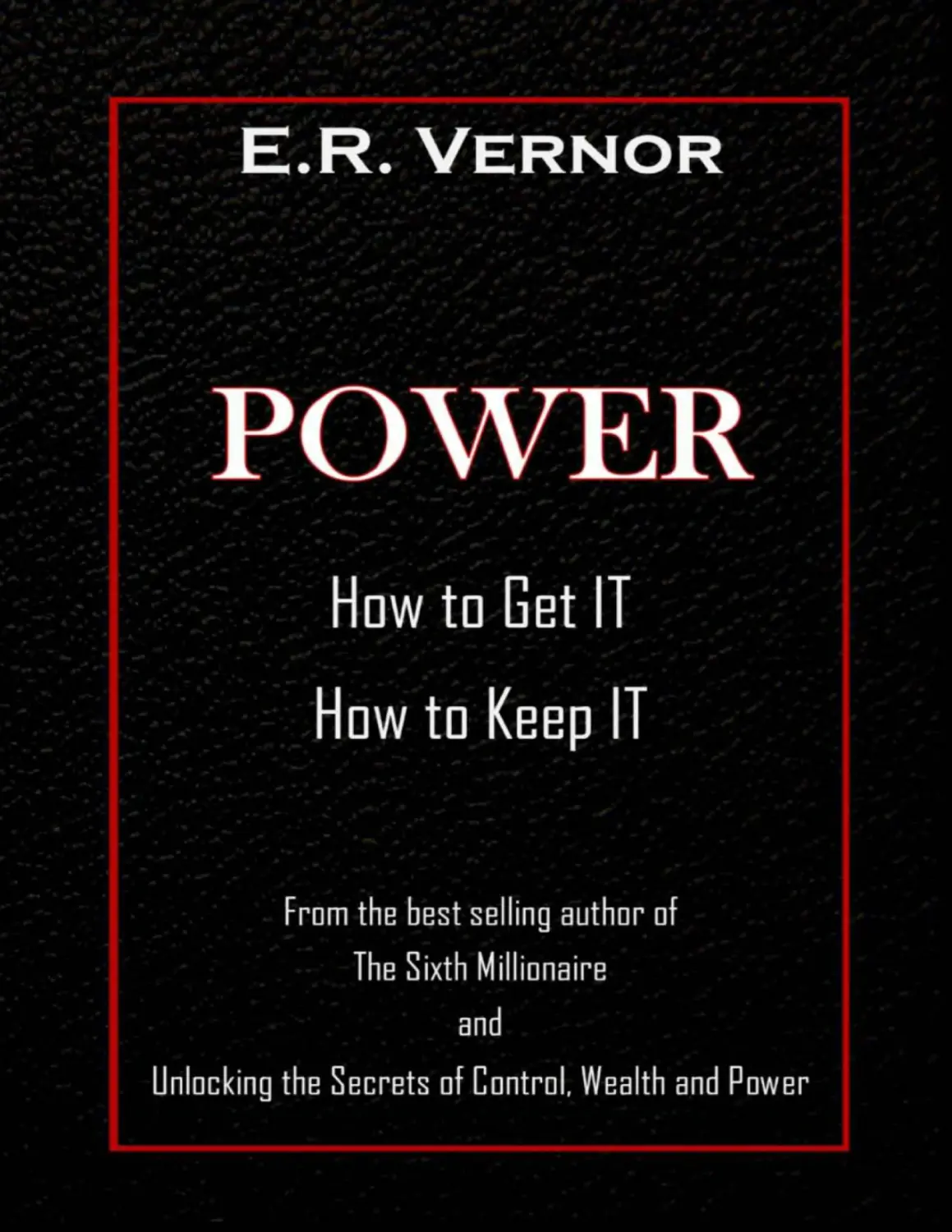
                    Power
How to Get It
How to Keep It

E.R. Vernor

What people have said about the books and Master Thyself! Unlocking
the Secrets of Control, Wealth, and Power:
“This book maybe a self-help book but it doesn’t read like one. This
book is meant for those who are DEAD SERIOUS about changing their
lives. The book written for easy reading, easier note-taking and if you can’t
feel the power in the words that are written in this book you need your
energy checked real talk. I have read at least 15 different self-help/life
changing books and this one takes the cake. Mr. Vernor, you have outdone
yourself with this one. A pleasure to edit, and deeper pleasure to read….”
“This book will make you look deep within and to see what is outside of
your existence, from your personal hang ups to those around you that may
hinder where you’d like to be. It’s no nonsense look at personal
accountability and responsibility and personal evaluation. To cut out
whatever cancers that may hinder you from where you’d like to be, personal
or otherwise, I recommend this book!”
“Sheer Genius…A masterpiece on human psychology at its most basic
element, move over Robert Greene.” ~ Xerxes
“I love E. Vernor’s style and approach about how we can change our
lives or well, not change them. He does not mince words. He also gives
many examples and inspiration from very public figures. Some of those
examples show you to do part of change or the do not sort of things that can
hinder change. I have so far found it enlightening and straight forward.”
“This author makes you think. He presents his information in a clear
and concise manner, so that anyone can understand it. Read it! It’s all been
laid out right there for you. All you need to do is turn the page and read on.
When you reach the last page, you will have gained in the short time it will
take you to read it, the vast knowledge that only the author has. This is one
of my favorite books that he has written.”

“In the opening pages you are greeted by this profound message that
sets the stage for this wonderful released by E.R. Vernor. For anyone who
wishes to improve a few meandering stagnancies in their life or do a
complete overhaul, this book is for you. Harsh, brutal yet motivational
truths analyzing the human animal in frame and form are constructively
presented with the voice of a coach who has practiced the information the
author has presented play-by-play. A soldier in the trenches and a scholar in
the lecture hall, author Eric Vernor takes what works and presents it to the
reader in a clear, concise and applicable manner. Drawing, too, from selfmade millionaires and ambitious individuals like Arnold Schwarzenegger,
Gene Simmons, Oprah and more. Relevant and inspirational quotes from
the author’s influences, alongside noted surveys on human behavior and
rates of success tactics illustrate this book’s message splendidly. Looking to
get a bit more organized? Wondering what to wear/say/act before that big
interview? Want to change how people perceive you as you walk into a
grocery store, office building, award ceremony? Then successful results
await you herein. Purchase and apply.”
“It condenses many of the principles outlined by brilliant strategists of
yesteryear like Sun Tzu and Machiavelli. A very informative read. It
condenses many of the principles outlined by brilliant strategists of
yesteryear like Sun Tzu and Machiavelli, as well as modern giants like
Gene Simmons and Donald Trump. Say what you will about those people,
they were/are extremely successful.” ~ Evelyn Eve
“I would definitely recommend this title to the aspiring entrepreneur,
should they ask me if there were any good books on the subject.”
“I bought this looking for some guidance. Most of the book I felt I
already applied to my life *until* the doing. I’m a huge planner and
organizer and hard worker. However the work is unfulfilling as was most of

the year. This gave me motivation to work harder, to not settle for less, and
enjoy life in the coming year while toning down on attitude and burning
bridges before knowing the risks of doing so. I realize a deluxe version is
being worked on I wish I had waited. My only gripe was it seemed to end
suddenly and the catalog but it also serves as your door to walk through. A
mentor can only walk you so far. I would highly recommend this to anyone
Satanist or not. Even my fiancé found it useful and is in business. Very well
done and I wish I had bought it sooner. Excellent.”

Power How to Get It, How to Keep It.
Cover by
E.R. Vernor
Design and Layout by
Dark Moon Press
Published by
Dark Moon Press
Copyright Dark Moon Press
ISNB: 9798713776466

For a full catalogue of Dark Moon’s publications refer to
http://www.darkmoonpress.com
To contact the author, please refer to
P.O. Box 11496, Ft. Wayne, Indiana, 46858-1496
All rights reserved. No part of this book may be reproduced in part or
whole in any format whatsoever without first contacting the author for
permission.

“See what the problem is in your life, and truly see it as it is without
delusion. Only then can you make plans, set goals and accomplish what you
dream of. Stop dreaming, and see it as a possibility, not a maybe. Only then
can you get past the fear stage.” ~ E.R. Vernor
We are what we repeatedly do. Excellence, then, is not an act, but a
habit.
~ Aristotle

Dedication
To the following people whose works, appearance and actions
inspired this writing:
P.T. Barnum, Alexander the Great, Gene Simmons, Arnold
Schwarzenegger, Hugh Hefner, Will Smith, Dwayne ‘The Rock”
Johnson, Dr. Robert Ing, Magus Anton LaVey, Magus Peter H. Gilmore,
Magister Lang, Matt G. Paradise, Kevin I. Slaughter, Marilyn
Mansfeild, Marilyn Monroe, Lord Byron, Robert Greene, Robert
Johnson, Michelle Belanger, Jack E. Sovel, Starr Weiser, and Tim
Ringenberg.

TABLE OF CONTENTS
Dedication
About the Author
Introduction
Chapter One
Know your own why
Chapter Two
Define Power
Chapter Three
Nothing Ventured Nothing Gained
Chapter Four
Activate your Ambition
Chapter Five
Avoid the miserable people
Chapter Six
Selfish is Good
Chapter Seven
Self Control
Chapter Eight
Moving Forward
Chapter Nine
Mentors and Master Mind Groups
Chapter Ten
Developing Self-Control
Chapter Eleven
Avoiding procrastination

Chapter Twelve
Time Management
Chapter Thirteen
Set Your Boundaries
Chapter Fourteen
Judge a Book by Its Cover
Chapter Fifteen
The Power of Persuasion
Chapter Sixteen
How Not to be Manipulated
Chapter Seventeen
Power, How to Keep It
Chapter Eighteen
Wealth
Chapter Nineteen
Reputation
Chapter Twenty
Be Paranoid
Chapter Twenty One
The Downsides of Power
Afterword
Bibliography

About the Author

Eric Vernor is an expert on showing people how to identify
and maximize their natural strengths for success in life.
He is
the author/co-author of more than thirty books. As a motivational
speaker. Requested for speaking at bookstores, Eric has presented at
Universities, bookstores, and conventions in Buffalo, Indianapolis, Atlanta,
Las Vegas and many more cities on various topics. He is an expert on
showing people how to identify and maximize their natural strengths for
success in life. He is currently the publisher and CEO of Dark Moon Press
LLC and the CEO of Dead Convention, a major horror and paranormal
convention.

Introduction
An introduction to POWER, my why
Success is never an accident.
The path to power is typically thought of as a means to an end, for the
sole benefit of oneself, through such means as coercion, deception, force,
and disregard for people. Indeed, our understanding of power has been
deeply shaped by Niccolò Machiavelli and his 16th-century book The
Prince, and while that is still the truth we do have to look at it more
objectively, and if that is that path we are on, how can it also be used in any
direction? Is there a neutral middle ground to such a thing? I believe so. In
my mind, power is simply the ability to control one’s own path, to be the
captain of ones on ship and have the money, influence, and yes, even the
ability to do good for others if you so desire. “No one poor ever gave you a
job,” quips Gene Simmons of Kiss.
People in power role sometimes lose touch with how other people feel,
lacking in as empathy, generosity, open-mindedness take a backseat for
disregard, rudeness, and control. I perhaps am a bit guilty of that through
cynically feeling that is how people are, and in part from being on the
Spectrum (Asperger’s Syndrome) so getting how people are and
emotionally understanding them, relating to them has been difficult for me
for sure. To adapt, to be able to work with and around them I have been
forced to study people. When I add to that equation my own rough
beginnings as I struggled to get myself out of poverty and as a child who
came from a place of powerlessness in foster homes, the total lack of
control and sense of direction and power in my own life ever since I drew
my first breathe as a premature newborn. For me, it was in part my stubborn

nature to refuse to accept what ‘fate’ had thrown my way, to push past any
obstacles to get where I am today.
A great deal of how I came to learn how to overcome my own obstacles,
if they were physical, mental, (self-induced by refusing to admit I was
wrong or made bad choices as we all do), misuse of time, trusting the
wrong people through wanting to believe all people were inherently good
(boy was I wrong), to overcoming money issues, the realization that I was
responsible for how I chose to think, react or not react, all boiled down to
responsibility. The pursuit of making my life better drove me to research the
why and how of people attempting to overcome the same self-imposed
roadblocks and I stumbled across books and YouTube videos of
motivational speakers like Tony Robbins, wealthy people who had a harsh
but realistic attitude to wealth building and how to work smarter and harder
than anyone else, with the podcasts and the Audible book from strong
willed successful people such as Grant Cardone The 10X Rule and If You’re
Not First, You’re Last, was a huge help, and as I put all the ideas down in
outlines per topic I wrote several books such as Unlocking the Secrets of
Control, Wealth, and Power, to use my time better as I always juggled so
many projects, ideas, books, and new businesses I dove into time
management so out of that came the book, No Excuses Get Sh*t Done, and
getting out of debt to be on my way to my determination to be rich I read a
couple dozen books on wealth and interviewed five millionaire friends of
mine to learn how best to change my thinking and actions, so then I
released it in The Sixth Millionaire: From Broke to Rich. Of course I have
learned a lot since the time of writing each of these and since they are all
vital to the quest for power, I am including the majority of each of those
books in this massive volume where they fit best, however I am also adding
new thoughts, research and new chapters with personal reflections

previously omitted in the earlier books as I tried to just get to the basic idea
and push the core facts out that would help the most. I think perhaps it best
to explain the ‘why’ of a thing when going into a subject as broad as
‘power,’ in order to put it all into proper perspective and tackle each section
in depth so that the fellow traveler can grasp the subtle nuances I left out
before. Unlike some one seeking a quick guide to just finding time to enjoy
life more, which one book can help with, to truly have power and masterly
over your entire life I believe we need to incorporate all those subjects and
more topics into one volume. I went back over old interviews with highlevel people, rewatched cutting edge videos and found new ones, and
ordered even more books to glean more insights insights on how to get a
life full of health, wealth, and happiness. People buy self-help books all the
time not knowing if they are wasting their money, but in this case, the fans
have already said they agreed with some of my thoughts that I put out there
in small excerpts from this in its rough draft in social media blogs, and they
asked for more.
I hesitated to compile this book originally because I didn’t want my
longtime fans to misinterpret my actions and long laid plans as
manipulation, but the more I connected with people after lectures of Master
Thyself, my life coaching students, and other fans emails, I came to see that
they all craved even more of the additional information beyond the nice
‘self—help guru’ it seemed to paint. Although all of it does indeed work, I
did leave much out until now. So, while I poured over the other books and
those in my recommended reading at the back of this book. I wanted to
cover not only the mental aspects of know your why as Robbins always
says, we each have to find what that is, and that is something each one of us
has to dig down deep and ask ourselves our own why. Mine? It was largely
to finally have control over the bleak life I felt trapped in. It was about

having the backbone to say NO. It was to finally carve time for me instead
of giving it away so freely to others who didn’t care half as much about me.
It was not looking over my shoulder of being homeless as I once was. But
in doing so I realized something deep.
We can’t have power until we control ourselves, then as we grow, we
have the look, the money to make change and then can indeed have power
over our lives. Reinvention is the key, but it must be genuine. You can’t
control others either until you can control yourself!
When people say ‘you’ve changed, ‘ say yes, that’s evolving, that’s
growth instead of stagnation. I used to be a doormat, but no more. Just
because I don’t lash out right away just means I am giving people all the
rope they need to hang themselves with. Such maneuvers take time, careful
planning, and developing allies, even from people others might assume are
enemies, so learn to work with people to cultivate alliances even if they
don’t seem likely. That will shock your opponent. Become a sheer force of
will, and see your enemies crushed before you. Power may have a negative
connotation, but, as I said earlier, how you wield it says everything about
you. You can be a force for good, or ‘evil, ‘or, as the cynic like myself is
leaning, simply opt out and live in quiet seclusion when you are not being a
public person and live in luxury without worry away from the masses. Sure,
I will have the money to employ people, give them good jobs, and give to
charity, but my main goal will always be to keep gaining in order to keep
doing the good I want to without draining too much from what keeps it all
going. It, like everything, is free will and choice to use it as you see fit. It is
not for me to judge your how and why, it is up to you. I merely show the
way it has worked for me and those who came before me.
We plan on having great careers, lots of money, vacation homes, etc.,
only to become bitter that none of those dreams came to be. We simplify

and excuse our lack of drive and ambition by making excuses. We blame
the economics of our society or just say “that’s how life is,” or any number
of self-defeating techniques. It is far easier to give up than get up and live
the life you desire. Almost all the famous people quoted in this book were
once the poorest you can image but now they are each instantly
recognizable household names. I asked myself, what makes them different?
What did they do, what common thread or supposed secret did they possess
that others don’t utilize? I refuse to think they are just more intelligent or
better genetically endowed. Yes, those things help, but it is no excuse to not
follow in their path. I intend to unravel those secrets for you to utilize.
Every year during New Year’s Eve celebrations, we feel full of
enthusiasm and start to plan major changes in our lives. We stick with these
resolutions for, on average, two weeks until we start breaking them and get
further discouraged and give up, only to do it all over again the next year. I
wondered why that is, until one day it hit me. Socially we are
subconsciously hammered with the whole idea of everyone does this, and
we should too, even if we are not fully ready to embrace it. Worse yet, when
this peer pressure self-improvement kicks in, most of us don’t seek any sort
of guidance in how to successfully implement these changes properly so
that they are lasting changes. Real lasting changes work only when we
accept the fact that it is harder to stay on track down the road than it is at
the beginning. People who begin a new job or career are usually pumped
up, get up early and get to it, but as the months and years pass, they falter,
lose that enthusiasm, and dread their job. New Year’s resolutions are
exactly that same thing, only it happens in a vicious cycle that we face
every year. At the start of a year, it is so incredibly easy to take initiative,
and you see results from it of course, but big changes take time. That’s
when it begins to sort out those who will stick with it long term and those

who will just give up until the next year when the cycle starts all over again.
You can be one of the former if you make a mental change so that when you
see a flaw you want to fix it, and become greater, instead of getting
discouraged and giving up. That’s what I hope to encourage with this book.
I want to give you the tools to get out of your own way, to push past the
stagnation and frustration. I speak from experience because I still push
myself to improve every day, I know what it is like to have everything
stacked against you and claw your way to a better life. At one point in time,
I was homeless, with ten dollars in my pocket. Two decades later I moved
into a neighborhood consisting of quarter million dollar homes. It wasn’t
easy to do, and I wasted a lot of years, drifting from job to job, unhappy,
like so many other people but, unlike so many others, I felt there was more
to life than just simple survival. Believe me, nothing about my life was
simple. I was born premature, weighing less than three pounds. I was a
foster kid, held back a year in school because I suffered from Dyslexia,
ADD, and though I didn’t know it at the time. Asperger’s Syndrome. I went
from next to nothing to working entry level jobs in fast food and as a
janitor. I lived in a bad neighborhood in a low-income area of town, only to
push past it and keep going. I’ve lectured on the steps of my success to
audiences because I have a passion for reaching out to people, to help them
accomplish what they feel is impossible.
It isn’t easy, but nothing good or lasting is. The individual steps, broken
down, however, are pretty simple. The problem, for most, is that we want
immediate gratification. That’s not how this works. I literally read hundreds
of self-help books, online articles on psychology, watched hundreds of
motivational, success, and will power building videos, searched for
appropriate successful people’s quotes, and then I distilled everything I
learned from it. I put together steps and real practical information on how to

make it work instead of being one of those “gurus” who is all flash and
spouts fortune cookie wisdom that only gets people excited for the short
term. These so-called gurus make tons of money and buy their heart’s
desires but for the buyers, the fans, the hopeful, they are doomed. The
downfall of such hype is that the failure comes after the enthusiasm slows
down. Progress, steady and lasting, is what matters. Who you become
during that time, who you keep pushing to become. If someone takes from
this book only one change, it could be the change that starts the new you,
and that still matters. Changing for the better, and even gradually, is still
going in the right direction.
Financially poor individuals have tend to have poor mindsets, which is
oftentimes the very foundation of why they stay poor. This is being poor
financially and mentally. Motivational speaker Tony Robbins calls it
learned helplessness. Obviously, there are exceptions of course, but we are
talking about the majority of people who never seem to get ahead. These
aspects of their personalities are generationally reinforced attitudes,
enhancing the effects of life’s real hardships, and creates an overwhelming
feeling of helplessness.
Born to be poor myth
The effects of extreme poverty have negative effects, such as severe
malnutrition leads to stunted growth and delayed development in children.
Poor neighborhoods have more people in despair and suffer from factors
like alcoholism and drug addiction. I know, both my parents were
alcoholics and drug addicts, my father did prison time for selling drugs.
Children or adolescents from low-income families, whose parents had
lower levels of education versus the wealthy who can afford tutors and
better schools like high-income families with better-educated parents.
While my grandparents were highly educated (my grandfather had several

degrees, graduated law school magna cum luade and knew many languages)
my father was a genius but never took the time to make sure I did well in
school. Instead it was up to foster care to look after me.
Is that an excuse? Is that a reason to throw in the towel and say because
I was born this way I have no choice? Yet despite being severely challenged
I don’t allow any of my issues to be an excuse, or reason of why I was
homeless. I made bad choices and the consequence came out of it. Having
issues just means you buckle down and learn to do better.
People blame “the system” for their circumstances, but should look
instead at their own values, nurture, habits, and daily behavior. Poor people,
or at least many of them, show behavior referred to as “culture of poverty”.
Those who use blame as a reason for not achieving success will never be
successful. Self-pity parties, victim thinking doesn’t benefit you. Ever see
the Netfilx series Shameless? The entire family will make even my
childhood look good in comparison. Holding onto these beliefs and
behaviors in turn produce self-destructive behavior, they in turn become a
kind of self-fulfilling prophecies. They are those who through their own
choices who are poor because of their self-destructive lifestyle choices,
their own stupid decisions, their choice of friends, their involvement in
crime and drug use, a lack of effort in school, their lack of general
discipline and their inability to plan for the long term. I understand that
while decades of generational poverty instill in people feelings of
powerlessness, inferiority, and a sense of victimization. While I do not
underestimate effects of a negative self-image or of welfare dependency, as
I myself had to use food stamps in the past, it is a means to help you get
back on your feet, not abuse it and pop out one child after another in order
to keep milking the system.

To put it bluntly, the self-destructive attitudes and behaviors that result
from it, that keep them poor, period may be enhanced by discrimination,
bad examples that run rampant around them such as family members in jail
for crime due to poverty but that is weak and shows a total lack of personal
responsibility and blame shifting instead of taking charge of one’s own life.
If you truly believe that regardless of what you do today, it won’t
positively impact tomorrow, you’re not going to try.
Psychologists call this phenomenon “learned helplessness.” The cause
of learned helplessness is being repeatedly exposed to an uncontrollable
event. After many repeated and failed attempts, your brain believes that
success is beyond your control; that you cannot possibly affect the outcome
and you are destined for being miserable. Over time this compounds itself
and becomes part of your thinking, and it can and does become
generational. Unsuccessful and perpetually negative people don’t strive to
become more than they are, it is far easier to whine and wallow in self-pity
than it is to take action to solve their problems. Basically, people get to the
point of thinking, ‘Why bother trying?’ as we become conditioned in this
belief, you give up all hope and effort, even in situations where you actually
do have control and the ability to change the outcome. In effect, you’ve
learned to become reinforce your feeling of helpless and hopeless.
According to Dr. Seligman who coined the term learned helplessness says,
“Optimistic people tend to interpret troubles as transient, controllable, and
specific to one situation. Pessimistic people, in contrast, believe that their
troubles last forever, undermine everything they do and are uncontrollable.”
In short, if we can change the way we explain situations in our minds, how
we frame it to ourselves the events that occur in our lives, we will be less
likely to suffer from learned helplessness. When you’re poor or in the

middle of a financial hardship, it can make you feel powerless to do
anything to change it.
If you thought the first book focused a lot on the mind and reshaping it,
this version is even more of it, with chapter one and two doubling in size,
and I added a great deal to the last chapter on wealth since, obviously, that
is what we all want. But before you can get the wealth you want, the
building blocks of your foundation have to be set in place first. In order to
do this, as I have said before in books, social media posts, and at all of my
online courses and lectures at events, change starts within first. It is about
resolve, not just hope. Too many of us are slaves to societal expectations
such as body image, social status, etc. We don’t do for ourselves. We do
what we feel we must to fit into other’s ideas of what our perfect life should
be. If these are things you want, get them for yourself and not because
someone else tells you it’s what you should do or need. If you join a gym do
it because you want to be healthy, not because you have to look like
whatever airbrushed model is on the cover of a magazine. If you’re
unhappy with your current employment find something that makes you
happy and go for that.

Chapter One
Know your own why
“The only thing that’s keeping you from getting what you want is the
story you keep telling yourself.” ~ Tony Robbins
Before we get into your own quest for power we need to stop and think
about your own why. No. I’m not judging, not my problem if you want to
be the next super villainous world leader, or the Dalhi Lamma. Until you
start believing in yourself, you will never have a good life. You will miss
opportunities, you will let greatness pass you by. This book is all about not
missing those chances and sparking the desire in you to believe in yourself
and reach for what you want instead of watching others have the life you
should be having.
People ask me, “How did you do it? How did you change your life?
How did you just leave the rat race of a hated day job behind to travel the
country to amazing places and live the life of your dreams?”
I just woke up one day and decided I didn’t want to feel like I did, at
that moment, ever again. So I learned how to make changes. I read books,
hundreds of them on the subject. I watch motivational speakers, and I
changed.
I know how it is, to feel unlucky, and criticizing yourself for wasting
years doing what hasn’t worked. It is hard, I know. I spent ten years drifting
aimlessly and not happy. I had no direction nor passion until I began
writing. The most difficult thing in the entire world is to change yourself.

Let go of the pity party of your past because you have the power to make it
better, you and only you. You’re here to break rules, break your own
records, and be ruler of your world. You deserve happiness, wealth, and
confidence, not self-sabotage.
I set out to find why the world works the way it does. What the
similarities are between powerful and successful people and how these
people acted in comparison to those who do not live according to the same
principals. It seemed that consistent and predictable patterns and principles
accompany all the rich and famous in their success. Looking at Sam
Walton, Bill Gates, Warren Buffet, and some famous actors, you see what
made them great it was how they think and how they implement action. The
great thing is, when you copy other successful people, you eventually
become successful yourself. Success leaves clues. I started to implement
these ideas and now that I see them working for myself, I felt compelled to
share it. The ideas expressed here are shared and echoed by many great men
and women, and just like a sports coach, when people have the right
inspiration and someone to help get them past their flaws, they will get so
much farther, and faster than by trial and error alone. Having a mentor, or
pile of books and notebooks filled out with advice, can make all the
difference between success and mediocrity. Replacing negativity, and
frustration with inspiration and purpose will lead to enormous differences in
results. You gain a tremendous advantage over those who do not have help
making tomorrow better.
As I searched far and wide to reveal the secrets and expose the mystery
of how to be better off than those around me, I came to realize one rock
solid truth: You can lie to everyone under the sun but you can’t lie to
yourself. If you don’t like the life you have, get another one. Those of you
familiar with my previous works may be in for a shock at my blunt and raw

tone in this new writing, as it is full of equal parts venom and
empowerment, harsh and uplifting, and it’s as cynical as it is hopeful
because that is real life. To get ahead, to truly get ahead, you must first be
honest with YOU. It is about making your life better and in order to do so
you must first see the world how it truly is, how you behave and think about
it.
Nobody will save you or make you successful, what you will learn from
this is the steps to get their faster. Studies show the major difference
between successful people and those who are not is that successful people
do what is needed. They take steps and keep at it no matter how hard it is to
overcome their situation.
Those who aren’t successful in life get the same access to information,
but they always have some excuse as to why they don’t take that first step
to becoming better. If you have a big enough reason as to why you wish to
achieve something, you will do it. If your reason is not powerful enough of
a motivator, your excuse of why you didn’t accomplish it will be. I am
merely saving my readers the time in having to read all the books I
recommend in the back and the years of additional research. By all means,
do so if you have the time and inclination. Some are listed, for your benefit
in the suggested reading at the end, but I have done my best to take notes
from them all and organize them with my own thoughts and life experiences
as well as quotations by famous and accomplished people in hopes that it
helps you find what it is you sought when you decided to buy this book. I
read hundreds of books and hours and hours of motivational speaker’s
lectures while writing this, and in my spare time doing other jobs, just to
keep focused on the process of keeping on course to improve every aspect
described in this work.

One of my personal favorite authors that started me on the adventure of
how to live better is world best seller Robert Greene, the author of The 48
Laws of Power, The Art of Seduction and Mastery. He says our fascination
with power is rooted in our DNA. The lessons he gives in his books are
distilled from colorful anecdotes lifted from 4,000 years of history. His
books include insights into the scheming of powerful people such as Al
Capone, P.T. Barnum, and Henry Kissinger.
Greene says the struggle for power affects even the most benign human
relationships. “Think of how babies threaten, badger and scheme to get their
way…..Children can be incredibly manipulative…There is no use in trying
to opt out of the game. Instead of struggling against the inevitable … it is
far better to excel at power,” Greene says.
Looking into the lives of powerful leaders in classical studies one can
see how power shaped history. Life consists of a mix of business and
personal, both have similar threads. The ‘soft sell’ to power and selfimprovement books that clutter the shelves may have a few insights,
whereas authors like Greene or Stanley Bing take things even further. Their
writings help you take your planning to the next level in dealing with
people so you will not be taken advantage of. Bing is the pen name of Gil
Schwartz, CBS Publicity Chief who is also a business snarky, straighttalking humorist and novelist. He has written a column for Fortune
magazine for more than twenty years under this penname. He was finally
unmasked by a New York Times writer in 1996. “Bing’ said, “The
underlying essence of business and the workplace hasn’t changed. It’s still
about the struggle of people to understand each other and manage each
other, and about power.”
His most known book is How to Succeed in Business Without Really
Trying, and What Would Machiavelli Do? The Ends Justify the Meanness is

my favorite of them.
Before you think this book is just another modern Machiavelli The
Prince (which if you get past its ancient wording, is still a timeless classic
on power,) I did indeed use so-called softer approach books like 101 Secrets
of Highly Successful People, and The 7 Habits of Highly Effective People:
Powerful Lessons in Personal Change. As in all things, balance is
important, you have to know when to be nice, and when to be aggressive. I
give advice on how to cultivate a mindset for facing the worst parts of
people.
Despite all the tricks in the book, nothing comes easy. Many things
make this world a hard place to exist in, and we all struggle to be happy in
it. Everyone wants to get that genie in the bottle, the winning lottery
numbers, or have a mysterious distant relative suddenly die and leave them
a mountain of cash. You can say money doesn’t make you happy, but it sure
makes a nice down payment. Try asking someone relaxing on their own
yacht if they are miserable as much as a homeless guy in the rain. But who
put each person there? Events? Life happens? No, they each had a choice
and even if someone has a worse hand dealt with them, it isn’t the cards life
deals you, it is how you play the game with what you have that matters.
Most people like to think of themselves as helpless, or at the very least,
a low priority factor in how life turns out. In reality, though, this kind of
thinking will hold a person back more than anything else that life can throw
into their path. Why? It is because the greatest asset that you will ever have
in life is YOU. You truly need to push past such horrid negativity and
understand the value of your own self, you will not utilize the greatness that
is within. Dean Karnazes, marathon runner, and author says, “Most people
never get there. They’re afraid or unwilling to demand enough of
themselves and take the easy road, the path of least resistance…If you’re

not pushing yourself beyond the comfort zone, if you’re not constantly
demanding more from yourself–expanding and learning as you go–you’re
choosing a numb existence. You’re denying yourself an extraordinary trip.”
Ultimately, Power is a book on how to improve your life. I know
because I was there - at the very bottom - and made a choice. I speak from
experience. The changes I have made looking back are so distant from who
and where I was two decades ago and now I get many of my convention
appearances paid for with meals and five-star hotels. Let me tell you, my
new life beats the old one. But if I can do it, anyone can, and those of you
who truly want to change and climb to the mountaintop. Many people have
asked me how I went from such an extreme to someone who has not only
books out there but branched into forming other companies. Hard work,
researching others’ lives for clues and asking questions.
Using the techniques in this book has greatly assisted me in my career,
as well as my personal outlook on life and in general improving every
aspect of my being. I have come to understand that by seeking to improve,
one already begins to do so. Half of the battle to success lies within a
person’s own sense of self, and cultivation of an iron will. Times are
stressful, you are overworked, and taxed to your limits. Yet we must grimly
hold fast to the knowledge that the tempering of our resolve into an iron
will help us prevail over all the hurdles and the fire within will flare to a
roaring intensity at moments of triumph. I owe deep thanks to many people
for this work—to friends who have supported me over the years and many
authors whose books of wisdom I have collected. It is this accumulated
knowledge and experience I pass on to you, my reader, to hopefully assist
you on your way to undefiled wisdom.
The very first step in making your life better, is to look at your life, and
honestly. Take a really good look at the level of effort that you are putting

into your goals each day. To become extraordinary requires effort. Most
people won’t try. They’ll talk themselves out of action before they even get
started. They debate the plan rather than working on it. They make
excuses for our mediocrity. Seth Godin says ever so brilliantly the
following about effort: “People really want to believe effort is a myth…. I
think we’ve been tricked by the veneer of lucky people on the top of the
heap. We see the folks who manage to skate by, or who get so much more
than we think they deserve, and it’s easy to forget that these guys are the
exceptions. For everyone else, effort is directly related to success, that’s the
key to the paradox of effort: While luck may be more appealing than effort,
you don’t get to choose luck. Effort, on the other hand, is totally available,
all the time.”
Let’s be brutally honest. Most people are couch potatoes, who just drift
along, doing only the minimum to get by each day and crash into bed,
waiting to do it all over again tomorrow. Be different than that. Push to be
the fully realized human being you can be! Push yourself to dream bigger,
work smarter not harder, and if you don’t have ambition, get some! Never
forget, you are in charge of your life choices.
We create our future every day by the very act of getting out of bed and
deciding to go to work, school or anything else required of us as responsible
adults. The problem is most adults live life with a defeatist attitude If you
don’t like your life, you have the power to change it!

Chapter Two
Define Power
“Power doesn’t corrupt people, people corrupt power.” ~ William
Gaddis
Power. Ask the majority of people and they will say that power is a
position or title, with authority, control, and a belief in the form of
supremacy over others. Still others believe that power is the ability of each
individual to cultivate themselves. Real power is increased within a person
simply by the choices they make, the actions they take, and the thoughts
they create. It’s not about power over other people, at least that isn’t the sole
focus in this work, that may indeed be a byproduct of mastering yourself
and then being a figure others will rally around that you can have some sort
of power over, so in all honesty it is a merger of the two concepts. Primarily
it’s about power over yourself! Yes, you can do, have, achieve, and create
anything you want out of life. Your own mental control and actions you
take shows you how to harness yours. Your state of mind determines what
you can and can’t do, and that all successful results of other people that
have done so can be modeled and duplicated. I’ve spent years reading a
hundred different books to glean wisdom on the subjects in this book to
give you the best advice I gained from them, and how to use it for yourself.
Gaining power, wealth, and influence is not something that you can do
overnight but it’s a goal that can certainly be achieved if you worked hard
for it and gave it the time, skills and networking that it requires.

Before you ask the question how can I become powerful you must first
ask yourself the question, what is power? Is it being able to get what you
what you want out of life? Is it gaining respect? Is it knowing how to solve
all of your problems easily? I personally believe that if you know what and
why you want it. You have to have solid base to formulate where you are
and where you are going to get there.
Power is truly a state of mind, and of what we all fear, that of not being
in control whatever something bad happens, it’s the opposite of being
broken, of being a victim or feeling helpless. Power allows you to challenge
whatever stands in your way, despite the worst circumstances ever without
cracking and to make your dreams come true, no matter the obstacles you
face. The key elements of power over oneself starts with controlling our
emotions, the destructive ones like fear that takes away our decision
making, or our temper that makes us act hastily and do things we regret.
Being stubborn is one of my most defining traits. No matter what life
hurled at me, I kept going. The persistent person is the one who can’t be
stopped whatever happened to him. Persistence is not commitment but it’s
the ability to keep going.
The masters of power from Nicolo Machiavelli (The Prince) to Sun
Tzu, (The Art of War) understood that the timeless philosophies behind
strategy and psychology were keys to getting what you want in life. People
in history such as Queen Elizabeth I and Napoleon knew the subtle art of
playing the power game, exercising cunning, and understanding human
weaknesses. Whether it is in the boardroom or a cocktail party– their
methods will give you the edge over others who stand in your way but
master yourself first. I know for some people the very word “power’ makes
them think of a despot, a tyrant or filthy rich person who has no regard for
others. Most people gain power by enhancing the lives of others. Tony

Robbins said real success come from helping many people get what they
want. I won’t argue with a giant of a man, who is worth half a billion
dollars earned by coaching millions of people for nearly forty years how to
find what they want out of life. How and why you want to do so, well that’s
up to you, I am not your Jiminy Cricket.
Power has two primary aspects, our personal power and other peoples
perceived power. Perceived power is the power that the people think that
you have. Personal power is the type of power that makes you recover from
your setbacks, reach your goals, and achieve anything you want.
The power of connections helps greatly. We’ll dive into that in a chapter
all by itself on mentors and mastermind groups.
In my quest to understand how some people can be successful, and
others are not, I did come to find that rich people think differently than the
average person. I sought out people I respected for their thoughts. One of
which is a friend on social media, Dr. Robert Ing. Dr. Ing has given
workshops and lectured extensively on forensic intelligence issues under
the auspices of the federal governments of the United States and Canada.
As a technology crime and forensic intelligence specialist he has, and
continues to make frequent appearances on ABC, CBC, CBS, CNN, CTV,
NBC, PBS and other major television news and talk networks. Dubbed as a
modern day Sherlock Holmes he uses a hybrid of the 19th-century art of
detection and 21st-century science of detection to uncover the deadliest of
crimes. I grew fascinated with his work seeing a series of videos on him, as
we share a few interests, such as collecting odd and bizarre items in the
spirit of 15th to 18th-century curiosity cabinets. My collection is featured in
the East York Museum of Curiosities exhibit. However, beyond that, in our
personal conversation, I knew he had valuable insights on how he gained
the level of notoriety he has, so I brought my work to his attention because

we share similar mindset on success and how to best achieve it. His resume
of accomplishments speaks volumes.
“Of all the material things I own, it isn’t the car, the antiques, the real
and rare items, but simply this that I deem to be the most valuable to me.
It’s not so much the physical item, but what it represents; a special moment
in time that transcends time and space itself in the course of a lifetime
lived,” he says, and one beating ‘the other guy’—keeping up with the
Joneses so to speak, “It is very important to be constantly aware of what
people are doing in your area of endeavor. Observe them, see what they are
doing right and wrong. Let these people be your lab rats. Then, based on
your own observations and research develop an action plan for you.
Indeed, the only real formidable competitor lies within you. It is only in
striving to be better than you were yesterday that you may realize victory
tomorrow. Your past accomplishments and failures are the bedrock of your
experience that establishes the battlefield on which present and future
victories will be fought. The culmination of which will be a stronger, more
formidable you.”
You truly can do anything unless your intellect isn’t what it needs to be
or you choose not to—which is always a big point for me. Everything is a
choice.
It has been said, “Happiness comes more easily when you feel good
about yourself without feeling the need for anyone else’s approval.” I
amend that when I speak of networking and impressing those in positions
above you but that will be discussed much later. This statement is so true,
and the biggest way to shake what others think of you. You matter more
than other people so it is time to be selfish. As Gene Simmons of Kiss says,
“Once you learn that the most important commodity you possess is you,
yourself, and no one else’s, you will probably make a lot more money!”

Before you can recognize your own potential for success, you need to
evaluate what you are doing wrong, what is making you unhappy in order
to make things better. Who wants to be a loser? Nobody. Well, maybe the
mooches who live off welfare and pop out kids with deadbeat dads who
should be removed from the gene pool. As for the rest of us, we want to be
winners who vacation in Maui and have “people” to do our errands, clean
our houses for us, etc. We all see fancy homes and envy the stars, which are
really why we buy gossip magazines at the supermarket. The tabloids are
selling because the little people hunger to see how the other half live. The
truly ambitious hardly see these rags as anything useful other than lining for
their pets’ cages; real doers read books like Seven Habits of Highly
Successful People—oh yes, an opinion shared by the wealthiest woman in
the world as well.

Nurture/environment
There is a strong belief in one’s nature is dictated by hereditary, the
nature versus nurture theory. In my opinion, blaming one’s fault for not
doing well on your environment, family or social circles is a huge cop out.
Genetically ones hereditary determination may affect how intelligent you
are if you come from a family of geniuses but not having advantages by
way of the roll of the dice or coming from family wealth is no excuse not to
overcome the lack of it. Too many people in the criminal justice revolving
door use their families, as their excuse. Indeed, entire generations of them
sharing cells, as the reason they commit crimes, which it is the only lifestyle
they know. Poverty and frustration can be enhanced, the environment can
negatively impact you I know this first hand after spending a decade or
more in the ghetto. However, I fought my way out of this depressing
mindset, and am here to say that you too can stop letting what is limiting
you hold you back. Focus on traits and education to overcome what you
can. If you wallow in what is negative, the hours of unproductivity will
snowball into days, weeks and eventually it will go from moths to years on
end. Only you can break the self-fulfilling hopeless prophecy of those who
wail ‘life sucks for me.’ There is always a way out, we just have to ask the
right questions.
Change, as you will hear me repeat often, starts within. Don’t add to
your regrets, successful people make improvement a priority. Instead of
using our environment to hold you back, use it to enrage you, fill your heart
with the desire to get away from your ‘bad luck’ as if it were a race to a
finish line to the pot of gold. Self-determination is the key, to know you
have the power to live your life differently tomorrow. It is our attitude, our
personal values - not those of others - our own self-interest and sense of
personal style and aesthetic that will set you apart. When I was poor, few

knew it. I had a fan once look at me with obvious envy and say “We all
can’t be successful and have nice clothes.” What is funny about that is, I
was on welfare, fighting to keep my home and the clothes that looked like a
thousand dollar suit was a gift from a friend at Christmas, $200 shoes were
discovered at Goodwill and kept them polished, my nice wool overcoat
came from Salvation Army store with a twenty dollar bill in the pocket so it
cost me nothing after I left and discovered inside.
You need to understand what slows you down. What holds you back
from your goals? Self-doubt, adversity of physical limitations? A lack of
money?
These can all be overcome.

Chapter Three
Nothing Ventured Nothing Gained
“Wanting something is not enough. You must hunger for it. Your
motivation must be absolutely compelling in order to overcome the
obstacles that will invariably come your way.” - Les Brown
Ask for what you really want. You have the power right now to control how you
think, how you feel, and what you do. Everything you could ever want, tangible or not, is all within
you if you ask the right questions and seek answers.

As social beings, we’re wired to want to belong and it can be a powerful
unconscious driver. But only when you risk rejection can you have the
chance to get what you really want, and that’s the entire point of the book,
Hell, it’s the point of life to live it to the fullest we can. Of course, you
might not always get what you ask for, but assuming people can read your
mind is a recipe for frustration and resentment. Taking responsibility to let
others know what you want puts you in a best possible position to get it.
Whether it’s standing out, speaking up or owning mistakes, experience
has taught me that though courage doesn’t guarantee success, it always
precedes it. Blaze a braver path in the year to come. You’ll never regret that
you did a year from now. You’ll likely regret that you didn’t.
Ask a successful person and they’ll tell you the key to their personal
success was being willing to take risks and, when those plans failed, learn
from the lessons and moved on. No wallowing in self-pity.
We fret over the risks, focusing on what might go wrong over what
could go right. We discount the cost of inaction, believing we have all the

time in the world.
One of the critical factors that will determine whether you can make the
best use of the opportunity is your willingness to throw your fears aside and
just go for it. People often pass the opportunity since they are afraid of
failure—many people don’t try because they might not get what they want
and quit so they don’t feel like losers. This self-defeatist attitude must be
crushed, or you will not make it. It becomes a self-fulfilling prophecy and
those who do it to themselves will not be willing to see it is their own
doing, but point to it and say, ‘I told you it couldn’t be done.”

Fear of failure
Although avoiding risk might feel safer in the short term, it also puts
one day full of regret, looking back and wondering what if?
Will Smith says “Fear is not real. The only place that fear can exist is in
our thoughts of the future. It is a product of our imagination, causing us to
fear things that do not at present and may not ever exist. That is near
insanity. Do not misunderstand me danger is very real but fear is a choice.”
One of the critical factors that will determine whether you can make the
best use of the opportunity is your willingness to throw your fears aside and
just go for it. People often pass the opportunity since they are afraid of
failure—many people don’t try because they might not get what they want
and quit so they don’t feel like losers.
This negativity leads to fear: Fear of the future. Fear of rejection.
Almost everyone is afraid of failure. Feeling scared can paralyze you,
whether it is stage fright, fear of public speaking or the inability to push you
to try new things. This fear of failure often becomes a barrier to your
achievement. You have to look at the things you tried and didn’t do well as
a life lesson. Look at temporary setbacks as opportunities for growth.
Successful people know that success doesn’t come easy and that they are
bound to stumble often on their way to the top of the mountain. Thomas
Edison failed before inventing the light bulb a thousand times. He was
willing to fail and got something from each and every failure. When you
learn your lessons, when you make a mistake, you make great leaps
forward. In life, you will stumble, you will fall. It only matters if you pick
yourself up again or not, and when you do, how you deal with failure
determines your happiness and success. Make a decision and hold firm to it,
over thinking or second guessing looks weak and makes you doubt
yourself. Tell yourself you can do something, repeatedly, even if you are

afraid of failing. NOT doing something at all is failing completely so what
do you have to lose? As Gene Simmons says, “I fail all of the time. It
means nothing.” Arnold Schwarzenegger agrees with that, saying, “You
can’t be paralyzed by fear of failure or you will never push yourself. You
keep pushing because you believe in yourself and in your vision and you
know that it is the right thing to do, and success will come. So, don’t be
afraid to fail.”
Not every thought needs to come out of your mouth. Not every emotion
needs to be expressed. When you say whatever is on your mind, you risk
hurting others. Loose lips are a habit for 69 percent of those who struggle
financially. Conversely, 94 percent of wealthy people filter their emotions.
They understand that letting emotions control they can destroy relationships
at work and at home. Wait to say what’s on your mind until you’re calm and
have had time to look at the situation objectively.
Fear is perhaps the most important negative emotion to control. Fears
can stop you from achieving financial greatness. Any change, even positive
changes such as marriage or a promotion, can prompt feelings of fear.
Wealthy people have conditioned their minds to overcome these thoughts,
while those who struggle financially give in to fear and allow it to hold
them back.
Whether you fear change, making mistakes, taking risks or simply
failure, conquering these emotions is about leaning in just a little until you
build up confidence. It’s amazing how much confidence helps. I’m not
suggesting you don’t enjoy your life and hoard every dime you make once
you get out of debt, by all means, the point of having wealth is that you can
do things you enjoy if you want to, but do so with moderation!
Transform by believing in yourself, focusing on change by honestly
looking at yourself. By revealing honestly one’s strengths and weaknesses,

we can all change ourselves and become the people we want, build the life
we wish we had as long as we work hard and face truths most would rather
hide from… a great man once said, “We only fall to learn to pick ourselves
back up again.”
Arnold Schwarzenegger said, “You never want to fail because you
didn’t work hard enough. Mohammed Ali, one of my great heroes, had a
great line in the ‘70s when he was asked, “How many sit-ups do you do?”
He said, “I don’t count my sit-ups. I only start counting when it starts
hurting. When I feel pain, that’s when I start counting, because that’s when
it really counts.” That’s what makes you a champion. No pain, no gain. But
when you’re out there partying, horsing around, someone out there at the
same time is working hard. Someone is getting smarter and someone is
winning. Just remember that. Now, if you want to coast through life, don’t
pay attention to any of those rules. But if you want to win, there is
absolutely no way around hard, hard work. Just remember, you can’t climb
the ladder of success with your hands in your pockets.”
To be a big success at anything, you need to build momentum.
Momentum is all about energy and proper timing, almost like being a
stockbroker who knows when to buy or sell to get the biggest bang for his
buck.
Like everything else I talk about, it can’t be expected to happen right
off, but it is never an excuse not to try. Of course, when you start anything
new, you don’t have momentum. The start of anything new is always when
things are the hardest. People may not be returning your phone calls or
emails with a positive response. You don’t seem to be getting anywhere.
But keep at it—sooner or later, if you keep working towards your goals, one
day at a time, you will get into the flow of people and events. You will

impress the right people, who will help you. You will, through them, get
even more contacts and you will gain credibility.
“You have to give up any excuses and justifications and come to terms
with the results you are producing.” ~ Jack Cannfeild, success coach and
motivational speaker
People fear success
It may shock you to read that some people fear success. They fear the
potential negatives of having money. You can lose friends over it as they
think you are too good for them, that they are embarrassed to be around you
if you have money and they don’t. Most fail to achieve more in life because
in their minds, they live under the illusion that they are getting by and that
is ok. They feel they are doing at least as good as their parents or slightly
better, so they settle for just that and don’t bother to do more. So, what if
you get by? What are you missing out on then? Less travel. Embarrassed by
the property owner calling demanding back rent? Do you owe people
money all the time, which strains relationships? Wouldn’t you want a better
vehicle, not just flashy to show off, but one that doesn’t break down and
gets you better gas mileage? Ask yourself what you could do for others if
you had an abundance of money beyond just getting by? What more could
you accomplish in life, the places you could see that you only dream of or
live vicariously through television shows? What price do you pay for not
having money? I know how all of this feels, because it has happened to me.
That was part of my motivation, to push past the pain of doing more than
just ‘getting by.’
“Fear of success, the somewhat counter-intuitive concept that we are
scared of achieving what we want to achieve, may be more subtle, harder to
recognize, and more real than you think.,” says James Sudakow author,
Picking the Low-Hanging Fruit … and Other Stupid Stuff We Say in the

Corporate World, “We often self-sabotage without even knowing we are
doing it.
Often, if you give it everything you have and still fail, you get pats on
the back and respect for having put it all out there. It’s the ‘you left it all out
there on the field’ concept. What if you convinced yourself that you were
putting it all out there and giving it everything you had even though you
knew deep down that you weren’t? You’d still get the pats on the back and
could walk away from it knowing ‘it just wasn’t meant to be.’ Then you
could go back to what you knew.”
People will change when the pain of not doing so becomes unbearable.
Once pain comes, we say “I’ve had it, I want better.” I fooled myself into
thinking that moving from the ghetto to a nice neighborhood and having
thousands of fans was enough. Just because I made just enough in a nicer
place simply meant I worked harder just to be in a better place but not truly
to the next level of abundance. I simply doubled to tripled my income
because living conditions demanded it if I didn’t want to go back to my old
life. My nicer place became just a nicer place of trapping me into worker far
harder to merely maintain it all, I was not earning more with lees effort. I
wanted to change that.
I realized I was caught up in the ‘just ok’ status, even if it was nicer, the
pressure and stress to earn was the same, I just looked better to those who
know me and came by to visit. When you realize your end of the month
budget is still at zero, it is time to do more. Of course, there is only so many
hours in the day, you can’t squeeze more out of your life if you already
work nearly every hour of each day to break even—or can you? I
discovered you can, I just needed to know how.

Don’t feel responsible for everything
As it is true you are fully and 100% responsible for your own choices in
life you are equally not responsible for the choices other people may make.
People carry with them needless guilt, and as Al Pacino said in The Devil’s
Advocate, as the Devil/John Milton, “Guilt is like a bag of fuckin’ bricks.
All ya gotta do is set it down.”
So, correct your internal voice when it exaggerates the negative feelings
that creep into your mind. Avoid focusing on what could have been done
differently, unless you are analyzing things for polishing a speech.
Perfection is a high goal to aim for and we should strive to be the best we
can. Focus on what you have gained from the process and how you can use
it in the future. Outside of that, when it comes to other people, they are
responsible for their own actions; you are not to blame every time
something goes wrong in someone else’s life. (Again, see cutting loose the
dead weight). Never apologize unless you’ve done something you really do
feel bad about, and only if you are truly in the wrong. Accept it,
acknowledge it and move on, dwelling on it won’t help you one bit.
Be responsible for your feelings. Not only is everything not your fault,
it is also not your responsibility. Other people have to be responsible for
themselves and their actions.
Believe it or not, you create your own feelings despite the whine people
like to throw out. “You made me feel…” is total shit. People and events
may have an effect on your emotions, but they truly do not dictate them.
You do.
Embrace change, however uncomfortable. “But this is how we’ve
always done it,” people whine, to justify their aversion to change. But how

it’s always been done might no longer be the best way to do it, I doubt it
ever really was. Every day you invest in something that isn’t producing the
results you do really want is a day you aren’t working on something that
could be. Letting pride or fear keep you sticking with something that is
holding you back only sets you up for more stress in the long run.
Want better? Raise your standards. Surround yourself with better
people, as nice of things as you can afford without harming your situation,
thus empowering in your mind you are worth more than where you were,
and what you had in the past. Not just money, but in the people, the
education - not just college, read books - pick the brains of mentors. You
will be amazed at how things improve.
“There is no hope of success for the person who repels people through a
negative personality,” Hill writes. “Success comes through the application
of power, and power is attained through the cooperative efforts of other
people. A negative personality will not induce cooperation.”
Over the years, many have tried to make business failure a little less
painful, using words like “rebrand” when a choice, course or direction was
chosen that didn’t work out. Others have simply shrugged it off—”oops”—
or worse yet ignore it as if it never happened.
In reality, failure is real. Every entertainer at any level knows it, and
every entrepreneur feels the mistakes made by everyone at their company,
in addition to their own consequences. Add a loss of time, money, or
opportunity and it can be excruciating—if not fatal, especially if they are
ignored.
They’re just opportunities to start again, better and, well, hopefully,
smarter. The truth is that you’ll absolutely learn much more from your
failures than your successes, as Tony Robbins says, people who have it all
are the ones in rehab and poor people make it big because they have had to

learn from mistakes. And, you never want to quit too soon because almost
everything looks like a failure in the middle. Things always look grimmest
right before success - famous people will tell you they were having one
stroke of bad luck after another until they got their big break, had they quit
fame would never have happened. This is why perseverance is so crucial.
Gene Simmons mentions failure in his book Me, INC. “You will have a
string of failures so consistent that it will seem like the world is working
against you. This is normal. Pay it no mind,” he writes. “I fail all the time. It
means nothing. But a crucial, learnable skill is having the ability to fail and
pick yourself back up.”
Recognize failure. Admit and acknowledge failure. One of the toughest
things can be recognizing failure when it’s not clear to us, partly because
hindsight is 20/20 and a bigger part of it is we fail to see it because we don’t
want to. We don’t want to take the responsibility to take the blame for our
failures.
People deny it to themselves. Before you assume anything, look at
things intently, from all possible angles and above, all realize you are biased
and need to look at things’ objectivity. But, it’s important to face it and call
it what it is so you can take the next step.
It’s not about the mistake; it’s about if and how we recover from it.
When something doesn’t work out, look at it simply and realistically and
pick up the pieces and move on. Knowledge is only power if we actually
use it.
Learn from your mistakes and do not dwell on them that just wastes
precious time. There is a huge difference between wallowing it the past and
knowing what you did wrong to learn, grow and gain in the process. Keep
in mind, not every ‘mistake’ is the disaster we think it is. Sometimes failure
is the exact mistake you needed to make.

I love something I heard Tony Robbinssay, one night as I folded towels
as a night auditor at a hotel when I first began researching self
improvement. I listened to one motivational YouTube after another, and it
caught my attention. Tony said, “People claim they fail because they don’t
have time or money when, in reality, what they lack is resourcefulness, not
the resources. The resources are out there.” He was right. There are
mentors, there is money out there. What we initially lack is the drive to go
get it. We need determination, decisiveness. You have to burn the boats, like
warriors of old, so you have no way to retreat, there is only forward
movement.
Our desire fuels us to take action. Ask yourself, what are you willing to
do, how hard are you willing to work on making life better, because it isn’t
easy. Most people will settle for mediocrity, settle for what they have and
only change when life abruptly forces them to do so. Most people fail
because they lack the burning hunger for making it big. Even those who do
better at life after some work will take what they have done and rest on
prior accomplishments and be ok with just getting by. If you choose not to
pursue your dreams, you only aid someone else’s dreams by punching their
time clock instead of being your own boss. The ideas and advice, the
exercises added to this volume are a fundamental foundation to
improvement. Every action we make moves us closer to, or further from
your goal. Ambitious people seek change instead of running from it, and
anticipate problems like a chess game, making plans ahead of the need for
them.
Positive thinking is powerful. Our outlook on life, our perspective of
how things are versus how we think they are effects everything. Henry C.
Link once said, “While one person hesitates because he feels he is inferior,
the other is busy making mistakes and becoming superior.” I like to call it

inside thinking. Our inward work that is, changing our mental attitude and
perception in a proactive manner is determinism, the doctrine that all
events, including human action, are ultimately determined by causes
external to the will.
This of course, as discussed earlier, is no excuse to give up. Fortune can
still be had, even if it is more difficult. Do we use one versus the other of
these two schools of thought? I don’t believe one is of more value, it is how
you use it. The trick of success is to have both ethics. You use the first older
set of traits to prove your worth as a person to people you wish to influence,
show your value to them, and once you gain their trust with the latter
applied skills. In other words, make people believe in you to help you but of
course you have to actually follow through to show you do have good
character. If I had to look at success traits or occurrences for a single
powerful truth that stands out the most, it is that success is one part who
you know, and the other is that you can deliver the goods once you get their
attention. One without the other is nearly negating the value of the other.
Plenty of poor people have integrity, just as conversely plenty of connected
people have no substance or real value to offer a single thing to the world
they live in. One only need to look at reality celebrities, like the entire
Kardashian family or a myriad of other people to prove my point valid.
They may have short-term fame but in the long run, it will fade and no one
will care. If you hold both aspects of ethics with talent, drive and who you
know, the respect is earned, our reputation grows and it communicates far
more eloquently that what we say is not merely rhetoric.

Chapter Four
Activate your Ambition
“Don’t be afraid to be ambitious about your goals. Hard work never
stops. Neither should your dreams.” ~ Dwayne ‘The Rock’ Johnson
Ambition is defined as having a sense of strong desire to achieve
success. Ambition enables you to envision your future, to recognize the
opportunity that you see and if you are clever, you will be able to use it.
You have to want it.
You have to want to aim above mediocrity, Napoleon Hill says: “We
offer no hope for the person who is so indifferent as not to want to get
ahead in life, and who is not willing to pay the price.”
Wealth for example, doesn’t simply appear. You have to work toward it
with patience and persistence. A good starting point is to invest your money
(the earlier the better) and let the power of compound interest build your
wealth. It doesn’t take much time or effort, but it does require action on
your part
Ambition usually comes from the need or your deep and urgent desire to
get what you want above all else. If you keep thinking your goals, if you
desperately dream about something you truly desire, you will then pursue
this with every waking moment achieve your wish. Remember, good
fortune does not just fall from the sky as a gift from the gods. You will
always be on the lookout for useful information, any possible opportunity,
any advantages you can spot and twist to your advantage; you will seek
mentors to help you on your way. If you cannot find mentors, make them

from libraries and search engines online. Ambition will drive you to look
for ways around obstacles; you will break through or go around any barrier
and push until you reach your destination.
Some people misconstrue ambition as a negative behavior. Rich people
are obsessed with success, while average people believe obsession is a bad
word.
“The truth is wealthy people have a healthy obsession with getting what
they want, which includes money,” Siebold writes. “The wealthy see
business and life as a game, and it’s a game they love to win.” Think about
what you want and exactly how you’re going to get it, advises Siebold. It
will take a certain level of discipline to ‘win.’ Like all things, it is your
intent and what you do with it that matters. Money is a tool, to be wielded
for a sliding scale of ‘good’ or evil.’ It is up to each of us as we step further
up the ladder of success to decide what and how to use what power we gain.
Dov Charney, founder and CEO of American Apparel, is also a fan of
Greene’s 48 Laws of Power. He calls them laws of nature and is quick to
add we have the right to decide how to apply its use, “Every single human
interaction involves this power exchange,” he says. “But it doesn’t mean
that power can’t be generous or philanthropic.”
In truth, it is what drives a man to achieve great things for not only
themselves but for the world. Think of Thomas Edison, Nikola Tesla,
Benjamin Franklin, and Leonardo Da Vinci. Without ambition, we would
not have advanced as a civilization, we would not know what cars are and
man would not have walked on the moon.

Be focused, be disciplined.
Where focus goes, your energy goes. If you repeatedly ask the same
questions as everyone else, you’ll end up with the exact same answers they
get the same. The better thing to do is change your question, change your
life for the better. Ask yourself what result, what target are you personally
after. If you know what it is you want the faster you can get there. Laser
focus get you farther than a broader. Our brains do exactly what we ask of
it. You want to lose weight, fine you lose a pound, totally different than
saying my goal is to get to an exact weight specifically. Generalities waste
your time, so ask yourself what your outcome is. Think before you start
your day, before meetings, before you email, fine tune for productivity.
Getting results matter more than being active, being ‘busy’ for the sake to
be doing something wastes your life. When you discipline your mind you
get speed, part of power in a metaphor like the RPMs of your car. You have
breakthrough with your ambition if you know where you are going. When
you know your objective your purpose, your why, is where your emotional
power comes from. Most of us forget our personal mission statement and
lose sight of what we originally want to do. We get sidetracked. A huge
percent, eighty percent Tony Robbins says, of getting what you want is
why, twenty percent is how. This book is your how, as I said earlier, only
you know your why.
Cyril Northcote Parkinson, author of book, Parkinson’s Law: The
Pursuit of Progress., wrote in 1955 that “60% of actions equal results.
Logical work outs equal a better body. Sales calls equal clients and a better
income. If you make a promise the conscious compels us to follow through
with what we say we will do. Parkinson’s Law is about filler which wastes
your time, the adage that “work expands so as to fill the time available for

its completion”. This holds true just as much right now, just as much now as
it did back then. People as a rule do not change, their technology does.
Parkinson’s Law is when work we’ve been given to do expands to fill
the time we give ourselves to get it done. This means that if you give
yourself a week to complete a day’s job, so therefore work required grows
in your mind and with extra facets we conceive of makes it seem even more
overwhelming, so we fill up the whole week, not what time you really could
have done actually done it in.
Some methods are more efficient than others, that is the reason I read so
many books to find out what works for the majority of successful people,
the shared traits and skills. Our massive action plan is how we are getting
there, the roadmap, the business plan on how.

Be quick to seize opportunities
When opportunity knocks, open the door. When you see any opening,
whether it is a job opening or bumping into an important person, take
action. I have met, emailed and approached hundreds of famous people and
who they were never mattered to me, I always saw them as people. Granted
they were known celebrities, authors, heads of companies or what have you
but I saw them as someone more like me than those around me. They were
people who took chances. Hugh Hefner saw an opening for a gentlemen’s
magazine of nude women and acted. Opportunities rarely just happen to our
advantage but when they do, do not second guess. Seize the day, or rest
assured someone else less qualified will beat you to it. You get out of life
not only what you put into it, but how you put into it and what you do with
what you get. It is all about investment. Although Hefner did not know how
the magazine would become successful, he just followed his intuition,
managed to work up some investment, and started the business.
A friend of mine, a famous model and doll maker, Marilyn Mansfield
said, “I just posted the NBC interview video I did the week the TLC show
aired. It was the first interview of my weeklong, ‘media tour’ for that one
show. Such an exciting time in my life. I was talking about how I decided I
was going to make my own dolls when asked where I will go with my
collection from here. I have come such a long way and have made so many
dolls since. Wow. Think it, dream it, wish it, say it, do it, be it. Life is too
short not to.” If more people followed their dreams how much happier
would people be? Think about it for a second. If you did something you
loved and made money from it because you have a passion for it, why not
give it your all and do it full time. You will feel better about yourself, and
your happiness will grow making life better in so many ways you never
thought possible.

Extraordinary people push to be what others admire, as they experience
the adventure of life and discover things that have never done before. When
I first approached my former law professor Kevin Eads to help research and
write Eerie America Travel Guide of the Macabre I needed help from
someone who had the skills that I could get along with. When I approached
the Witch Museum in Salem to be in the book and I asked for images, they
asked me when my crew wanted to come down. At the time I had no
thoughts on jumping into television but I quickly recovered and side
stepped without saying I didn’t have one, I asked Kevin about it and he
excitedly said he would be down for it. Similarly, when Karrie-Ann Versace
had me on her radio show to be interviewed I mentioned the book and Brian
J. Cano was a guest host. Now some of you may know him as the tech guy
on SyFy’s Haunted Collector but I usually happen to be so busy I never
watch television enough to have heard of him. In fact, it wasn’t until I
started doing larger paranormal and horror conventions did, I start meeting
famous celebrities. Well, he and Chris Mancuso of CORE Films heard the
idea and they loved the concept, so we set out to work on the sizzle reel. I
know had the start of a new company I never planned on having. You just
have to pay attention to openings and grab a hold of them when you see
them.
Ambition is a mental state where its might is neither good nor bad; it is
all dependent on how on how you use it. People who reach for more do not
easily give up with any failure—it keeps you from despair and pushes us to
recover yourself from our tragedies. It makes us seek answers to the why
and how of the failure, to overcome it with determination and learn from
our errors. Determination is also thought of as negative, but it is all
perspective, I feel we should never give surrender. Better to live a day as a
lion than a hundred years as a sheep is a good motto to go by. Live life to

the fullest for you only live once. And my reply to a radio host who asked
me about reincarnation? Well, I don’t care if you feel you live more than
once, this is the one you have at the moment, so live in the here and now.
Some of the keys to gaining power are through saving time and energy
by hiring others to do work. The gifts I mentioned can be ongoing, to win
the hearts of others to join you. As mentioned in the previous chapter,
charisma and power draw people to you. If you use this to your advantage,
you can pick from the best and have them with you at all times, making you
far more efficient and you will grow even bigger, far faster than when you
struggled alone. Having a staff, even a small one like mine (I have an editor,
a website designer, an intern, a personal assistant and a driver,) plus my
horror event has nearly twenty staff members. I have expanded what I can
accomplish by using my added free time to create more works of art (which
when they sell is for more than a few books) and if the people you hire are
skilled they will help you achieve even more by advising you. Be careful
and do not let your closeness with people weaken you.
Be careful, some will connect with you as you grow and get more
attention. Power attracts those who are too weak to go after what they
themselves want but will latch onto your ambition. Some people will betray
you, act like a friend or even become as close to you as family then stab you
in the back.
I had one friend who was a radio host, that used to be a major supporter
of mine. Of course, it was at the height of my books in the same genre his
show was about, he benefitted in being close to me. When my luck turned
for the worse for a short period of time, he wanted nothing to do with me
until I was on the rebound. Guess who came out of the past to be my buddy
again?

A girl I used to mentor as a writer. She was a hanger on, bragged to
people she knew me. When I needed a job to make ends meet during a
struggle to bounce back, she made it all about how she owed me, for my
help. Then the attitude changed. She used it to lord the position of reversed
power over my head, that I couldn’t make it without her. When her
narcissistic personality I had thought was left behand during the decade I
didn’t associate with her reared its ugly head again, I was done. I left to get
a better job that I actually liked I became the Devil incarnate. I was
flabbergasted in the double standard as she herself was looking for a better
job and actively seeking interviews. Avoid topics that are sensitive or reveal
your personal weaknesses. Passive-aggressive individuals tend to remember
such things you’ve told them, sometimes even little things in passing. They
will remember it just to use your troubles against you later, she did exactly
that on social media to make me look bad. Too bad for her, my fan
following is well over five thousand and after she culled our mutual friends,
she barely had sixty. Guess its one of may reasons her book didn’t spread
like the best seller she believed it should be.
Don’t bite the hand that feeds you. How you allow people to treat you
sets the stage for others to do the same. In the beginning it is a bit hard then
you realize those who are no longer in your life exited for their benefit and
especially for yours. Make the most of not having anchors around your neck
and welcome any new ones who turn their backs on you and walk away.
The worthy to your cause will stay and fight at your side.
Part of power is dealing with fake people, betrayal, all those who plot
against you. Either misguided jealousy, or a myriad of other reasons can
cause it. I address how to spot it, deal with it, and weather the storm until
the opportune time presents itself to strike back. I have learned to watch
people over long periods of time, pay attention to signs and tip offs, and

hardest of all is biding ones time - even when furious not revealing what I
know right away. Sometimes you have to give people enough rope to hang
themselves.
Such negative people will drag you down if you let them. Let’s dig into
what to do about that now.

Chapter Five
Avoid the miserable people
“Stop letting people who do so little for you control so much of your
mind, feelings, and emotions.” ~ Will Smith
You can’t have better if you have bad apples in your life!
Don’t try to please everyone. This goes along with the ‘don’t be
responsible for everything/everyone’. It causes burnout, guilt (already
covered, useless) and ask yourself why would you want everyone happy?
Not everyone wants the same things so it is not only a waste of effort but
you will only succeed in making them all unhappy and the most important
person - you - will be miserable.
Toxic people need to go. Associate yourself with people of good quality,
for as it is said, it is better to be alone than in bad company. As we go
through life, we have the opportunity to meet a wide variety of different
people. Some become casual acquaintances who we just smile and nod at
when we see them and others don’t merit a second thought after they pass
us by, but a select few will make it into the inner circle and become friends.
It often takes a while to determine whether the person you enjoy spending
time with and you might really enjoy hanging out with a particular group on
weekends, but how do you feel when you’re around them, or especially
after you depart their company? Do they enhance your life, or bring you
down? If they are good and enhance all aspects of your life, your fun,
you’re learning then you can do the same for them (because if you can’t be
a good friend back you will lose them) then hang onto them.

Sadly, even close friends can drift apart, and family can be part of this
as well. Don’t hang on out of guilt and misplaced loyalties. Choose freedom
over family. Freedom over preconceptions. Freedom over people-pleasing.
In the pursuit of living a better life, one of the keys to success is to be
mindful of the people you associate with. This is critical to keep in mind.
Be aware that those who enrich your life should be cherished and those who
pull you down should be cast off, lest they drag you down with them. An
infector can be recognized by the misfortune they draw on themselves, their
endless tortured stories of woe, a long string of broken relationships, and
rocky careers. These people are all around you, and like a plague of locusts
seeming to swarm and grow, ever increasing in the amount of destruction
they bring with them. They can be spotted as emotional and needy people.
They whine, they manipulate others to be able to get what they want. If we
say no, they try to make us feel guilty, and they leave us emotionally
exhausted. These are the people who not only are so weak they cannot
accomplish anything without other people’s help—and do so typically as a
result of emotional blackmail. People like you and I who want to actually
achieve and make something of ourselves cannot waste our time with them.
To be blunt, lose the losers.
That’s right, harsh as it sounds to you that still have a “feel sorry for
others” attitude, it is time to yank the security blanket away and start
kicking people to the curb who mooch your most precious commodity - of
life, your precious time - away from you. Cut all the dead weight. All those
who would slow you down, drag you down to be a part of their pitiful
attempts of their ‘woe is me’ drama filled pity parties. Some people you just
have to rid yourself of, because the ingrates and mooches we know can/will
suck us dry if we let them. By taking our time and wealth and giving
nothing back but guilt, these people should exist solely as an example of

what not to be. As the philosopher, Nietzsche said, “A human being who
strives for something great considers everyone he meets on his way either
as a means or as a delay and obstacle - or as a temporary resting place.”
Author of 48 Laws of Power Robert Greene says in Law 10: Infection:
Avoid the Unhappy and the Unlucky. “People who are perpetually
miserable spread misery like an infection, and they’ll drown you in it.
Avoid these people like the plague. Conversely, if you associate with happy
people, you’ll share in the good fortune they attract and spread. Seek them
out. Infection: Avoid the unhappy and the unlucky.” Remember when we
talked about poor mentality versus successful people?
I call it how it is, flat out. These people put on shows for attention and
you are a sucker if you fall for it and stand around listening to it—or worse
yet, get drawn into playing into their hands and “talking them through it.”
Guess what? You just became their favorite audience member. They have
you hooked and unless you break the attachment, they will lean on you and
bore the Hell out of you at every opportunity as they drag you ever deeper
into their failed and miserable lives. Life is for the living. This is especially
for those who push themselves to be the very best specimen of human being
they can possibly be. Ever notice bad things seem to just keep happening to
certain people? Often they just bring it on themselves by their own actions,
terrible choices, and poor planning. During my bachelor’s degree, I did an
internship with the probation department and listened to story after story
that confirmed this theory. Plenty of the guys in lock up or probation would
go on and on about how they couldn’t help how they ended up in their
situation.
“If a relationship is requiring more energy than it provides you back, cut
them off,” Horsham-Brathwaite, who advises you to also remove friends

from your inner circle who are “overly reliant on your for emotional,
financial and intellectual resources.”
I was asked, “What if these negative people are your family and you
live with them?” “I try to ignore it and that works most of the time but
sometimes it’s too much!” I had to consider that at some time, no matter
how solid you are and able to cut people out, we all have been in this
person’s shoes. So I responded, ignore them as best you can stay positive in
the meantime. Your good example of living better will either inspire them to
do the same (doubtful, but can happen) or it will make them realize your
life does not revolve around them. Without an audience who cares they will
eventually seek easier targets for their show. I speak from experience; I
have cut out half a dozen people this year, some friends, some business
partners that were Hell bent on making bad decisions. You can sabotage
your own life all you like, but I don’t allow it to affect my life. I used to and
learned that lesson well - eventually, you have to reach a point where
enough is enough. To be ungrateful and demanding, even insulting to those
who try to help you is simply unforgivable. Some people will not change,
so you must, even if it means losing those who once mattered to you,
personally or in business. Some people are a cancer that must be cut out so
that you may thrive. When your goal is power, those you associate with can
make or break you. If you associate with infectors, you’ll waste time
extricating yourself, from them and others will lose respect for you due to
guilt by association while in their company. Also, when you leave the lessor
people behind and work with better people, you impress those left in your
life that you have the resolve to do what is needed and they will respect you
more for it. Thus you strengthen what you do have, and can build off of it!
The old joke about how do you get to Carnegie Hall springs to mind,
and the punch line “practice, practice, practice” is not too terribly far from

the truth! It is both hard and yet incredibly simple, utilizing principles found
in dusty tomes of knowledge on the lost art of common courtesy, etiquette,
all the way on to philosophy and psychology. By paying attention to others’
methods of success and spotting their mistakes in order to avoid making
them yourself aids you in sidestepping pitfalls that might be disastrous.
Isaac Newton called this “Standing on the shoulders of giants,” by using the
achievements of others we stand tall. All writers, scholars, and teachers use
the works of other great men and women to expand concepts. Otto von
Bismarck was a Prussian statesman of the 1800s that said it best as he
explained “Fools say they learn by experience. I prefer to profit by others’
experience.” You can follow this example by reading biographies of people
in history. Through history, the likes of Cleopatra and Casanova used
seduction to win the hearts of hundreds, through a combination of charisma
and manipulation. P.T. Barnum and Houdini enthralled audiences.
Determination and cunning led Alexander the Great and Napoleon to
conquer. Seek out how the famous rose to the top. You too can attract
power, wealth, and attention in much the same way.
Ask for what you want out of life, and out of people. Instead of sucking
up to your boss, ask directly! See what they want and then do that.
Put yourself first, take action for your goals. If you don’t you won’t get
things done you need to do.
Stop looking for approval, for validation. Don’t feel you need to agree
with everyone to be liked. Be brutally honest with people, they will respect
you more for it.

Chapter Six
Selfish is Good
“Rest and self-care are so important. When you take the time to
replenish your spirit, it allows you to serve others from the overflow. You
cannot serve from an empty vessel,” says Eleanor Brown.
If you can’t take care of yourself, then you can’t care for others. Being

selfish is critical to your own well-being.
Selfishness is a positive perspective of empowerment. When we think
of selfishness, our conditioned mind usually tends to leap instantly to the
negative connotation of the word. Selfishness is bad. It means that you are
being self-centered and egotistical and no one will like you. We are taught
as children that being selfish is bad behavior and sharing is good. But they
fail to teach us the positive side to selfishness. While the ideal of sharing
has obvious value, it leaves a bad taste in our mouth for the rest of our lives,
because who wants to be known as selfish? When someone calls you selfish
it is not uncommon to feel shame and guilt, right? As we know this lowers
our vibration and closes our heart. This childhood conditioning is important
to understand—and overcome. It is overcome by broadening your
perspective of the term and understanding that it has a powerfully positive
side. Being selfish and self-centered is a paradox if we confuse the two
terms as most do. Selfishness, however, does not mean “doing whatever
you please, it means to put yourself before others, not ignore them
completely.

Reprogram yourself to understand that there is also this good version of
selfishness. It is commonly believed that morality demands we choose
between sacrificing other people to ourselves (which is deemed “selfish”
and therefore bad, and in sacrificing our own needs to satisfy others’ needs
you take responsibility for getting your personal, emotional and physical
needs met, you can be healthy selfishness is being self-focused. Selfish
people tend to take better care of themselves instead of giving too much
energy away serving the needs of everyone else, which means they have
time for themselves to further utilize their time to greater advantage.
Remember the empty well theory, you cannot become selfless without first
becoming selfish!
“If you do not act for yourself, or seek out and embrace those things
which bring you success and happiness, you cannot possibly have a positive
effect on others,” says the author of Positive Selfishness, The Virtue and
Power of Self-Interest, by author Evan Porter says his book is “Throughout
Positive Selfishness you will find techniques that help you discover and
enhance the personal power emanating from your Inner Self. The section
Self-Empowerment brings you to an awareness of your power and ability to
reach goals by pursuing your positive self-interests. It reveals the
opportunity of creating, through a deep understanding of yourself, a life the
way you want it to be. It opens your awareness to the fact that your needs,
desires, and goals are absolutely vital to your happiness and well-being, and
it helps you use that knowledge for self-empowerment.
The obvious goal to become successful is to have a better life, and in
order to do that one needs a better income. The steps that will help you get
to that we have already covered in the first several chapters. To quote one
of my favorite sources of inspiration on living it up, “….while I am alive I
want to enjoy myself, and the way to enjoy myself is to have a lot of

money. Money is the key that unlocks everything: sex, happiness and taking
care of the ones I love by feeding them, sheltering them….” Gene
Simmons.
Steve Siebold, the author quoted earlier in the first few chapters of How
Rich People Think, spent nearly three decades interviewing millionaires
around the world to find out what separates them from everyone else.
Some of his findings are:
Average people think that money is the root of all evil. Rich people
believe poverty is the root of all evil. “The average person has been
brainwashed to believe rich people are lucky or dishonest,” Siebold writes.
Average people think selfishness is a vice he reveals, whereas wealthy
people think selfishness is a virtue. “Self-made millionaires get rich because
they’re willing to bet on themselves and project their dreams, goals and
ideas into an unknown future,” Siebold says, “Average people think
selfishness is a vice. Rich people think selfishness is a virtue. People who
believe their best days are behind them rarely get rich, and often struggle
with unhappiness and depression.”
“The rich go out there and try to make themselves happy. They don’t try
to pretend to save the world,” Siebold told an interviewer for the
publication Business Insider. The problem is that middle-class people see
that as a negative––and it’s keeping them poor, he writes. “If you’re not
taking care of you, you’re not in a position to help anyone else. You can’t
give what you don’t have.” This goes back to what Gene Simmons said
about money and taking care of his family.

The necessity for greed
“…The point is, ladies and gentleman, that greed, for lack of a better
word, is good. Greed is right, greed works. Greed clarifies, cuts through,
and captures the essence of the evolutionary spirit. Greed, in all of its
forms; greed for life, for money, for love, knowledge has marked the upward
surge of mankind… The point is ladies and gentlemen that greed, for lack
of a better word, is good.” ~ Gordon Gekko, Wall Street
It is said that pursuit of money is the root of all evil. Capitalism is an
evil to other philosophers and intellectuals in remote countries. And while
fools believe this, I laugh inwardly at the ideals of the have not’s (or pious
hypocritical ‘haves’ of the world) and remind myself that once I was
homeless and climbed up to a point where I earned three degrees with high
honors and enrolled into law school while building a publishing house that
has sold copies of my work to twelve countries. I tell you this ladies and
gentlemen—I have been poor in the distant past, and I have eaten at fivestar restaurants while in Las Vegas on a weekend vacation paid for by my
hard work - and believe you me, I fully appreciate Charlie Sheen’s
character, Bud Fox when he said in the movie Wall Street, “I never knew
how poor I was until I had money.”
While other people feel content being middle class or on food stamps
because they choose to stay in their place lamenting (or worse being
resentful of those who aren’t) I struggled to master business from both
college and real life, under my friend and mentor, Jack taught me to learn to
think on my feet and never lose sight of the bigger picture I wanted, not to
dream big but to push for it. Never settle, he said, in relationships, quality
or business….life is a business he often said. How we chose to enjoy it or
not is up to us. Jack is one of the shrewdest sharks I know but he lives his
life to the fullest. I joked that he was a de facto Satanist often and he said,

I’m just me. He was and is the best living Milton to Lomax (The Devil who
taught the young attorney how to be even more demanding from life in the
Devil’s Advocate). He was my Gordon Gekko….the difference between me
and the star of these movies is huge. I took the mentor by the hand and
didn’t quit or turn on him. My business saw a two hundred percent increase
in half a year and stayed that way since his coaching. He would take me to
fancy restaurants in his shiny black convertible sports car worth more than
my place of living and bought me my first three figure suit as a lesson in
what the finer things were. I developed a stronger sense of focus than ever
before.

More, the not so bad word
Your intention to do better, to live better all comes from choice. The
moment we look around us and ascertain where we fit in among our peers
and those above us, it is only a matter of time before we decide we want for
more. The want of more is not a bad thing, (see Gene Simmons). If you
question the ‘morality’ of being greedy, first stop and think about the
positives. You can do more for others if you first look out for yourself.
The following is an excerpt from Atlas Shrugged, back in 1957 by Ayn
Rand.
“So you think that money is the root of all evil?” said Francisco
d’Anconia. “Have you ever asked what is the root of money? Money is a
tool of exchange, which can’t exist unless there are goods produced and
men able to produce them. Money is the material shape of the principle that
men who wish to deal with one another must deal by trade and give value
for value. Money is not the tool of the moochers, who claim your product by
tears, or of the looters, who take it from you by force. Money is made
possible only by the men who produce. Is this what you consider evil?
“When you accept money in payment for your effort, you do so only on
the conviction that you will exchange it for the product of the effort of
others. It is not the moochers or the looters who give value to money. Not
an ocean of tears not all the guns in the world can transform those pieces of
paper in your wallet into the bread you will need to survive tomorrow.
Those pieces of paper, which should have been gold, are a token of honor—
your claim upon the energy of the men who produce. Your wallet is your
statement of hope that somewhere in the world around you there are men
who will not default on that moral principle which is the root of money, Is
this what you consider evil?”

This writing stood out to me, as clear as a bell on a cold winter’s night it
rang true to me. The various movies and books that champion a
Machiavellian attitude on wealth and dealings with our fellow man served
to grind in the lessons of common sense. Your friends will slowly slip away
or stab you in the back; lovers grow tired of you looking for the bigger,
better deal as that is the primal nature of mankind. However, if earned hard
and invested wisely, what you gain in life will never leave you. That is the
nature of the beast, as we are all looking for survival and those most fit will
do so well. I recommend The 48 Laws of Power, The Art of Seduction and
The 35 Strategies of War by Robert Greene, What Would Machiavelli Do?
The End Justifies the Meaness by Stanley Bing as well as Get Anyone to do
Anything by David Lieberman. Following the logic of watching others and
learning from their mistakes is priceless as it saves you the error of their
ways. Get used to paying attention to the losers and the winners of the
world and see through it all. Once you see that there is a common
denominator to all successful people in the world, you can emulate them
after a time. Are we all destined for greatness? Of course not. That is where
stratification, genetic potential and Will to Power come into play. But we do
all have the ability to reshape our lives to some degree as long as we are
willing to look directly into the mirror and into our own hearts, deeply
looking past what has been beaten into us as socially acceptable of ethical.
Why deny ourselves what is in our nature to do? Which is, in this writer’s
humble opinion, to survive, above all else and to live as best as we are able
to at any given moment. The harsh reality is money is what is needed to get
what we want, so stop blaming anyone and everyone in the world for your
lack of standing in the world and ask yourself what my mentor did. How
much is enough for you? Only you will know for sure, and it may change
over time. You may be ok with a certain level of income that is steady and

allows you free time to enjoy other things instead of working all the time.
Other people live for the rush, and work, itself, is not work. Money makes
life easier and for people that say it doesn’t buy happiness, well, in the
words of Gene Simmons, “Whoever said `Money can`t buy you love or joy`
obviously was not making enough money.” And in my humble opinion,
should you ever earn it or win the lottery you will agree with me when I say
to you, it sure puts a nice down payment on it!
Although he is listed in the acknowledgements, I dedicate this particular
essay to my mentor Jack, while I raise a glass of fine wine to him, and in his
ideology, for myself as well!

Practicing Positive Selfishness
This section helps you to focus your energy to build an enjoyable and
successful place for yourself in the world. It demonstrates that making wise
choices based on the wealth of knowledge available from your Inner Self
helps you achieve not only loving relationships, but also emotional,
physical, and financial success. You can use positive selfishness to create
happiness and success and please others. It also teaches you to recognize
and let go of situations and relationships that may be harmful to you.
Furthermore, it demonstrates that releasing the mental blockages of limiting
beliefs and attitudes will free you to realize the full potential of your
magnificent Inner Self. And, yes, even this book is all about YOU, intent is
everything. You can help others once you have the life you want.
When we center our focus upon our self and begin to improve
ourselves, this is the positive form of selfishness. You will generally find
that it requires great effort and focus at times. But until we get things right
within ourselves, things will never be right in the reality we create all
around us. When we are selfish in regards to taking the time to focus on
ourselves and what is required to become the best version of ourselves that
we can be, it can never be a bad thing. “The sad thing is most people have
to check with someone before they do the things that make them happy,”
says Kiss bassist Gene Simmons, “We’re all passing through; the least we
can do is be happy, and the only way to do that is by being selfish.”
Studies have shown that acting in your own self-interest you may give
you an advantage in leadership roles, simply because selfish people are
more confident and less likely to give up on goals because they firmly
believe in themselves and ruthlessly go after what they want
unapologetically - they have a drive to succeed. By setting clear boundaries
means knowing where you end and another person begins.

“A positive word of encouragement can help change anyone’s destiny,”
says businessman, filmmaker and real estate owner Adam Kimmell, a great
friend of mine. Nearly 80 percent of those polled say that inspiring leaders
encourage and help employees improve.
Effective leaders create an environment that is safe for employees,
where they feel accepted and respected, those leaders listen, value their
employees’ contribution, and respect their opinions.

Stakeholder capitalism
Capitalism is now the biggest evil in the eyes of the ‘woke’ masses,
where the giant mega corporations solely care about swallowing the world
and using everyone for the shareholders and executives’ maximum profit.
The original idea of capitalism was mom and pop open a store and build a
mini empire to take care of their families, the American dream, has
somehow changed into a monster.
Is there a middle ground? I believe there is a way to make the public
happy, the company and those in-between.
I truly believe there is another way to run a huge business, live very
well, take care of your family while treating people right at the same time.
To truly be selfish, simple do good. Apparently, my thinking is not alone.
The recent times have caused a major shakeup in shifting When considering
compensation, provide both stability and opportunity. Called stakeholder
capitalism is a system in which corporations are oriented to serve the
interests of all their stakeholders. Among the key stakeholders are
customers, employees, shareholders are your local communities. Fobes
article writer Steve Denning says such thinking of big business finds itself
under attack from all sides, “… it has been caught single-mindedly
shoveling money to its shareholders and its executives at the expense of
customers, employees, the environment, and society as a whole and is a
self-defeating attitude. Klaus Schwab, Founder and Executive Chairman in
preparation for the World Economic Forum, where the world’s top business
executives will meet later this month in Davos, Switzerland.”
Endorsed by almost 200 CEOs of the largest corporations. “The
statement rejects the whole idea of ‘maximizing’ one value to the exclusion
of all the others,” as Steve Pearlstein in the Washington Post notes.

“Instead, it acknowledges the need for balance and compromise in serving
all of a company’s stakeholders.”
Cynics may call large corporations’ sudden reversal of four decade of
‘profit over people” sensitivity shift a mere public front of exquisite social
sensitivity and exemplary altruism.
When the firm prioritizes shareholder value above all, the other
stakeholders—customers, employees, suppliers, society—tend to get
shortchanged. What should have been obvious from the start became
apparent after several decades: shareholder capitalism is an unacceptable
form of institutionalized selfishness that breeds on itself. Each individual
act of selfishness leads to another. If one is in business for the long haul, in
my mind it is short sighted to squeeze huge profits off the backs of the
buyers and workers, who will revolt and stop patronizing your business and
the good workers will quit, looking for better jobs. It has been my goal for
my companies to pay my authors double the average royalties, allow them
input on their cover designs, which no publisher does, and for my horror
convention, I pay my key staff unlike most large conventions who operate
on a volunteer basis and make millions. I even want to offer health
insurance. Great people are hard to find so make sure you think about how
to keep them.
Call it buying loyalty from great workers, but if you truly want to retain
the best people to do the maximum work for you, reward them well and
they will be loyal to the end of your days.
Focus more on making the pie bigger than on exactly how to slice it so
that you or anyone else gets the biggest piece, buyers will hear how good
you are, and that carries over bigtime to the buyers. People know people
and if your workers sing your praises, that is the best word of mouth you
can get. If you provide your buyers with quality product, maximum value

for their money, you sell more. Volume of goods and great reviews will
keep you in steady income for the life of your company.
Ayn Rand, a philosopher, and author wrote much on this in her
book, The Virtues of Selfishness in 1973. She chose this book’s provocative
title because she was on a mission to overcome centuries of demonization.
“In popular usage,” Rand writes, “the word ‘selfishness’ is a synonym of
evil; the image it conjures is of a murderous brute who tramples over piles
of corpses to achieve his own ends … and pursues nothing but the
gratification of the mindless whims of any immediate moment.
“Yet the exact meaning and dictionary definition of the word
‘selfishness’ is concern with one’s own interests. You can finally look out
for you and if you do, you just might make the world around you better in
the process. Being called selfish doesn’t feel like a compliment, but the trait
can actually make you a better person, psychology experts say. “When you
take care of yourself first, you show up as a healthy, grounded person in
life,” says Bob Rosen, author of Grounded: How Leaders Stay Rooted in an
Uncertain World. Primitive man sought his own survival, it’s in our nature
to take care of our own needs first, just like saying “No” to people,
“Selfish” has become connected to the negative emotion of fear and guilt.
“People seem to be stuck in the fixed mentality that you’re either selfish or
you’re selflessly give oriented. The truth is that you need to be both. Like
so many things, it does not have to be one or the other, it can be both. But
putting you first means you have the health, wealth, and mental stability to
actually do for others.

Chapter Seven
Self Control
““The main factor behind success is self-control.” ~ Rig Veda
If you wanted to open this book and immediately find out how to have
power, I have a surprise for you. You don’t get power overnight or over
other things around you without first having self-control over your life
itself. It may take years of testing yourself in all manner of ways, to feel and
see the results. Remember, it takes the time to build a reputation and just
moments to destroy it. As Machiavelli said in The Prince, “It is an infallible
rule that a Prince who is not wise himself cannot be well advised.”
Human interactions take place all the time and if you don’t reveal
everything you desire it cannot be twisted and used against you. Others are
cruel and even if most seem nice, it just might be a trick so I advise that you
protect yourself from those who would take away your hard work.
“Discipline comes through self-control,” Napoleon Hill writes. “This means
that one must control all negative qualities. Before you can control
conditions, you must first control yourself … If you do not conquer self,
you will be conquered by self.”
Self-control is vital. Impatience is the lack of the ability to tolerate a
certain emotional stimulus that is currently affecting you. Our emotions are
very powerful. They can control us and make us do rash things. Truly
powerful people is the one who knows how to control their emotions and
master them instead of letting them control them. The more powerful you
are the more will you be able to bear the worst of life’s circumstances while
maintaining your rational thinking.

When it comes to getting rich, the most basic formula is: save more,
spend less. It’s a simple concept, but spending less requires discipline.
Learn to recognize and manage overspending triggers if you want to start
accumulating wealth, of not just monetary, but in all the riches in life, I’m
talking about all manner of wasting time, energy, dwelling on stressful
things that aren’t your burden.
“No person may enjoy outstanding success without good health,” Hill
writes. It’s no coincidence that many millionaires make time in their
schedules to exercise.
If you haven’t mastered your body, the good news is that many of the
causes of bad health — overeating, negative thoughts, and lack of exercise.
A lot of self-control is mastering what you do or do not say, and by not
revealing your intentions too soon. In many endeavors, it means the
difference between winning and of being taken advantage. You have to
know when to strike, and when the moment is right, your instincts and
experiences will cause you to act in your own best interest. Half of what you
do accomplish is dictated by not wasting your time with things you need not
worry about in the first place.
What price do you pay to get some things done? Who truly will benefit
the most from your actions, your shared excitement? Was the effort a waste
of energy even if it worked out? Some costs are not worth the battle and
figuring that out sometimes comes too late. I would much rather have lived
the way I have, where it took me a decade to get where I am so that I truly
absorbed the lessons in life than had everything handed to me and see it slip
through my fingers. Self-discipline is required of those who want more out
of life. For example, if you won the lottery as so many people waste time
and money on, even if they won huge they usually become penniless within

a few years or worse off than before by racking up new debts like several
mortgages and new car payments. Why? Because they lack control and are
living far beyond their means with the same attitudes that made them poor
in the first place. Money does not buy common sense or a shrewder mind.
Sudden riches do not last long because they have any foundation to be
stable on. Master yourself and increase your inner ‘will’ first, grow your
personal accomplishments and then the money comes—and you will use it
better. The “get rich quick” thinker who is desperate for paying off debts
working a daily grind job is a lottery winner hopeful, whereas those who
are determined to get to the top have an action mentality. “While the masses
are waiting to pick the right numbers and praying for prosperity, the great
ones are solving problems,” Steve Siebold, author of How Rich People
Think writes, “The hero (middle-class people) are waiting for maybe God,
government, their boss or their spouse. It’s the average person’s level of
thinking that breeds this approach to life and living while the clock keeps
ticking away.”
I never want to be dependent on the ways to make a living that I used to,
after having advanced upwards, I did the whole trap of needing anything
just to get by so I crushed my dreams. I deeply resented it and for a while it
buried my passions and dreams.
Drugs and excessive alcohol take away your ability to think, (remember
epicurean, not hedonists!) and they will not only waste your money on the
cost but if you spiral downhill and need rehab, they’ll cost you even more.
The dominos keep falling and even faster against the foolish, and rightly so
—stupidity can be quite painful! This level of epic failure can cost you your
job, your reputation, and friends if you are belligerent and take no heed to
advice against your bad behavior under its destructive influences. Granted,
a fine wine with a meal I will partake in, but never do I drink to get drunk.

As with so much else in this book, saying this comes from seeing other fail
in life. I saw the reversal of this rule from having drug addicted and
alcoholic parents from the hippie era. Yes, I take jabs at everyone,
especially family - get real, take the blinders off folks, the family does not
insulate them from being people. Family can often be far worse to you than
other people, because, like friends, they think they can get away with things
because of the ingrained feeling of closeness you share. This is a mistake to
be avoided. If anything, think of more people as potential threats and you
will not be surprised by their underhandedness.
In The Top Five Regrets of the Dying, Palliative Care nurse Bronnie
Ware shared the top regret of her dying patients, and it’s something I’ve
hung up in my home as a constant reminder to do it anyway. “I wish I’d had
the courage to live a life true to myself, not the life others expected of me.”
Learn to leverage failure to your benefit. There’s a little secret behind
the door of every successful person in the world. One that few like to talk
about, one that most prefer to keep hidden from everyone—our failures.
It’s the decision that didn’t pan out as planned. The choices you made
that didn’t produce the outcome you aimed for, or calculated.
The ugly truth is we all have had things not work out as we wished they
would. The best-laid plans of mice and men, as the classic book says. It’s
the decision that didn’t go as planned. Often, the choices you made failed to
yield the outcome you wanted.

Address failure and bounce back
A friend of mine, Laurie Hayes, wrote a book together all on bouncing
back after failure, Limitless How to Reach the Top After Hitting Rock
Bottom. I won’t go into detail over it, as I want you to get a copy to read
both of our personal perspectives, but the heart of the matter is, with enough
focus and self-examination, knowledge and the will to pick yourself back
up again you can overcome nearly anything you set your mind to.
I asked Robert Ing what he felt was the most important aspect of selfimprovement do you feel is lacking in our world today. His response was
thought provoking.
“The most important overlooked aspect is that of internal potential and
validation,” Dr. Ing said, “We live in a society where people are
programmed to seek external validation and instructed to replicate the
success blueprint of another. In order to be respected, one must respect
themselves first. In order to expect responsibility from another, one must
act responsibly. In order to be truly loved, one must truly love themselves.
This is all internal; it is what we already have within us but for whatever
reason, people have difficulty finding the “on” switch. This is partly due to
the fact that we are subjected to so much external stimulation from the feel
good albeit temporal buzz we feel when we partake in “self-improvement”
consumerism. For example, how some people feel they have “upped their
game” because they have a new designer labeled fashion item, or attended
an evangelical style motivational meeting. In order to be successful and
improve oneself, you must realize your own potential within. Selfempowered people do not require external validation with the exception of
actual milestones and benchmarks achieved on the road to achieving their
goals. Self-realization leads to empowerment of the self. The individual

must first and foremost realize that within them, they have the potential and
it is within them that they must first seek empowerment and validation.
Dr. Robert Ing talks about reaching ones full potential despite family or
others that might try to hold you back.
“The most difficult thing for an individual is learning to be unattached
to the expectations of others, whether that expectation be of family, friends
or society as a whole. Let me be perfectly clear here, I am referring to
expectations, not responsibilities or obligations. Externally imposed
expectations are quite often the result of subconscious guilt to a lesser or
greater degree. An individual who places an expectation upon another quite
often does so because they themselves feel guilty for not achieving
something in their own life and thus places this expectation on another so
they can be fulfilled through transference. An individual who has an
expectation placed over them feels guilt leading to an inferiority complex
should they feel they are not interested in, or cannot possibly fulfill the
expectation. It’s really quite a mess on the surface. The key is to be true to
yourself first. What do you want? Understand, that as a living, evolving
person what you want today may change over time but in the fullness of a
lifetime lived your ultimate goal must be simply to be content with you and
your life. This is how you realize your full potential. Start from today to
pursue and live as you want. Start with small changes and steps. Take one
day at a time, and eventually, you will wake up and see that the days have
become weeks, and then months, and eventually years! You see, the
majority of expectations that are placed upon an individual are based on
personal attributes of a person’s life; such as culture, community, religion,
relationship with family/friends, etc. If there are aspects of these attributes
that are not in keeping with your life, the life you desire, you must modify
or eliminate them. Through modification or elimination, you will find that

over time certain expectations will be lessened or completely removed.
However, during the early stages and overall process, you must make an
effort to not let such things distract or stress you as you work each day
towards your own potential on your terms. The transition is never an easy
process.”

Get a grip on your reality
It’s so easy to doubt your own capacity for greatness, instead of being
truly self-aware of our current reality, we listen when well-meaning friends
and family encourage you to stick it out because the job market is too
difficult to find a better job or to pursue our own dreams of selfemployment. But you truly aren’t doing yourself a favor, you are slowing
down success by remaining blind to your flaws. Look in the mirror to see
who is to blame. But whatever you do, do NOT allow others to bring you
down more! Don’t stop your progress because as you keep trying, those in
your life who are negative and envious will put you down. It is your life,
not theirs, so keep pushing towards your goals.
“Most of us are good ‘starters’ but poor ‘finishers’ of everything we
begin,” success author Napoleon Hill writes. “People are prone to give up at
the first signs of defeat.”
Don’t stop until you get what you want. The most successful people
tend to have dealt with, and overcome, failure. “I’ve learned that it doesn’t
matter how many times you failed,” billionaire Mark Cuban told Smart
Business. “You only have to be right once. I tried to sell powdered milk. I
was an idiot lots of times, and I learned from them all.”
Failure is not one single event in life unless you make it that way, by
staying in a rut of depression. Conversely, neither is a success isn’t always a
linear path or just a few good choices, it is about building off of many good
choices and avoiding bad ones.
Thomas Edison famously developed thousands of prototypes of the light
bulb before finding the one that worked, and Albert Einstein was
unemployed for two years after he graduated college.
In many cases, life’s struggles are valuable learning experiences.

Mark Cuban said he was once so poor that he would bring dates home
only to find the electricity had been shut off by the power company. Cuban,
Oprah, and others use their setbacks to push them forward. Prior to starting
his first company, MicroSolutions, Dallas Mavericks owner Mark Cuban
worked as a bartender, a short-order cook, and a carpenter, all jobs he failed
at. On CNN in an interview, the billionaire said that on multiple occasions,
he would come home with a date only to find the electricity had been turned
off by the utility company.

The Power of reinventing yourself
When you examine yourself, truly dig deep and figure out who and
what you want to be, you discover the real you. By making yourself what
you want to be, you reshape yourself into something larger than life. By
mastering all the techniques in this book you will have made many changes,
polishing off the rough edges and transforming yourself into a person of
manners, better looking and with the confidence that will make your ability
to charm people as skillful as an actor.
There are plenty of talented people who never make a choice to do
something different, to reinvent themselves, and to pursue their dreams. It’s
hard to work up the courage to try something different because nobody
wants to feel stupid. Few people want to feel they wasted their lives and
struggle to start from the beginning all over again, because, truth be told,
reinventing yourself is hard work. Going from out of shape to the Olympian
gold medalist is hard work. Transitioning from fast food employee to
successful business owner to proud entrepreneur is hard work. Moving from
years of one crap job to the best-selling writer is hard work. Trust me on
this. So is pretty much every goal worth fighting for.
In 1984, after working for almost two decades of his life in the
insurance industry, Tom Clancy finally published his first book, The Hunt
for Red October.
He was hoping to sell at least 5,000 copies. By the end of the decade, it
had sold over two million copies worldwide and was turned into a
blockbuster. He went on to publish more best sellers and more movies off of
them.

Madonna reinvented herself from the demure girl to the very daring
performer she is today. A lot of people approved her change and this change
made her more popular, much like Marylyn Monroe did years before her.
Betty White, who you might think has been famous forever, wasn’t a
household name until the age of fifty-one on “The Mary Tyler Moore”
show.
Politicians and world leaders as far back as Julius Caesar mastered the
art of public speaking as did Lincoln and the infamous Adolf Hitler. By
knowing how to use charisma and proper wording, you can command
attention. Using dramatic and powerful lines thought out (in my case when
giving interviews) you can make it clear you are an expert on a subject.
Given enough time you will be, for you will become so familiar with the
subjects you have studied and spoken about, you actually make it a selffulfilling prophecy. Always be aware of your audience and avoid boring
them, be quick to change your wording and tone if you notice you are
losing your audience. This goes for individuals as well as large groups. I
can give a lecture to hundreds or to a small room because I realize the size
of the audience is irrelevant. To be a good public speaker you have to think
of the crowd as individual conversations, a relaxed chat. By keeping your
focus going from one to another, you successfully make each person believe
you are directing your talk to them, that they are the single-most important
person of all—and in truth, they are. They all are there to see you, to listen
to you if you are making a point to them. I give the same energy in speaking
to a large group or a small one that I expected to be packed because they
deserve it just as much.
The brain is scared of reinvention. This is because what we tell
ourselves to do might not be safe, and reinvention is a risk. So fear prevents

us from taking risks as surely as if we told our mind to not worry, jumping
off a cliff is ok. Because taking chances on yourself can feel that way.
Reinvention never really stops once you start, but you decide every day
if it will be forward or backward.
Who you think you are or where before you decided to read this does
not have to be who you are forever. Do not limit yourself to being what
others think you should be. Don’t let anyone stop you from doing what you
have your heart set on. Hugh Hefner, the Playboy founder and self-made
millionaire, says “If you let society and your peers define who you are,
you’re the less for it.”
Everyone feels like a fraud at some point, that it isn’t worth the effort
and it can’t be done. Take a hold of the voice in your head that whispers
doubts and strangle it. Sometimes I get frustrated and ask “why isn’t it
happening yet?” We all have doubts. Success typically is around the corner
most people stop at. You can’t see it in the darkness of despair. But you can
see the next step and you do know that if you take that next step eventually
you get to the end of the journey.

Turn weaknesses into strengths
Make your weaknesses your strengths. Introverts listen better, focus
better, and have ways of being more endearing. In a perfect world, you
would be really good at everything you need to have a successful business
and a successful life. Then again, in an ideal world, you’d also have
fantastic hair, abs of steel, and a winning lottery ticket in your pocket.
Here in our imperfect world, we all have to face the fact that we’re good
at some things, just passable at others, and downright horrible at in the rest
of them.
So what can you do about your flaws? Find ways to turn your biggest
weaknesses into strengths.

Recognize and accept your weaknesses
You can’t turn a weakness into a strength if you’re busy denying they
exist. Remember, this book is all about your honesty with yourself So, your
first obligation is to determine what your weaknesses are.
How do we fix our flaws if we don’t see them? Ask others. In fact,
seeking out others may be your next huge step period. Get guidance from
someone you trust.

Chapter Eight
Moving Forward
“The single most important thing you can be to someone else, if only for
an instant; is to be an inspiration.” -~Dr. Robert Ing
Fortune favors the bold.
Sometimes the best defense against a flaw is to overcompensate by
excellent preparation. For instance, I have a very poor sense of direction
and I tend to get lost, especially bad for someone who has to travel as much
as I do. So I use technology to save me, with a GPS for direction and aps on
my cell like Uber, we can solve problems before they even rear their ugly
head.
Similar techniques can apply in other situations. It is so worth the extra
effort to learn more, practice, and achieve at the very least minimal
competence, at least to some degree. That’s especially true if you have
others under you that you expect to do work for you to make your life easier
and more productive, be at least slightly competent, in that way, they will
respect you, which makes managing people go more smoothly. Recall
Alexander the Great. He always led the charge in battle, as did many great
war leaders. This makes those under you far more willing to dig in and do
their part. However, it is up to you to keep an eye on them because people
being what they are, some of them will be lazy and expect others to pull the
entire weight of the task onto others. Be decisive and do not be afraid to cut

loose the anchors that slow you down. This applies to anything in your life,
don’t spend time with people that do not assist you in one way or another.

Move Forward When You Feel Stuck
We all have to start somewhere. And for some, those experiences will
shape you, polish and refine you, help you to become a better version of
yourself, and give you something to reflect on, even if it is bad, as in “What
was I thinking?” Hindsight is always 20/20. But don’t dwell on the bad,
never wallow in it, which breeds frustration, which in turn creates anger and
clouds you from setting things into motion to do better.
When you’ve settled into a job that should have been abandoned long
ago, but you’re holding on in fear that you won’t find anything better, that
you’re not worthy of your dreams, you are destined to stay that way until
you choose to make changes. I have never been happier career-wise earlier
in life, I did everything you can imagine for not even enough to pay rent,
like part-time janitor, scrubbing toilets. It took a willingness to move on,
and trust in my abilities when the dream changed.
It’s so easy to doubt your own capacity for greatness, to listen when
well-meaning friends and family encourage you to stick it out because the
job market is brutal. People sell out their opportunities for perceived
stability. I’m not saying don’t keep a job to pay your bills, but you may
have to do the job you don’t like while working twice as hard outside of
that to change your life. I wrote many books early in my career while in
college, working as a janitor late at night and a second job at the college.
During this time I built my fanbase over the years.
Stop waiting for the situation to get better on its own. It didn’t make
your life suck, you did. At some point, you’ll need to decide whether to
allow yourself to drift aimlessly or dig deep and go for it.

Overcoming setbacks, my friend Robert Ing says, “Tell me about your
failures, your bad experiences, how many times you hit rock bottom and
lost all faith and hope. I want to know your character. Spare me the details
of your success, your victories, and wins. I am not interested in your glory.
Glory is but a fleeting myth but it is by your character that makes you a
legend.”
We all have negative self-doubts. I’m not going to pretend like I don’t
still have them, it is what you do about it that matters.

Persistence
“Let me tell you something you already know. The world ain’t all
sunshine and rainbows. It’s a very mean and nasty place and I don’t care
how tough you are it will beat you to your knees and keep you there
permanently if you let it. You, me, or nobody is gonna hit as hard as life.
But it ain’t about how hard ya hit. It’s about how hard you can get hit and
keep moving forward. How much you can take and keep moving forward.
That’s how winning is done!” ~ Sylvester Stallone
Learn how to handle setbacks, be patient. Most people facing the
slightest problem panic, are scared feel helpless, can’t sleep and seem to
constantly make the wrong decisions. In order to become powerful, you
need to be able to absorb the bad news or tragic events calmly. The more
you can withstand small shocks without doing something reckless.
Powerful people have fears, anger, and sadness, of course. But they do learn
to be resilient enough to withstand it and keep going. I almost lost both of
my business websites when unscrupulous web designers, three in a row
actually, not only bailed on me but took my sites down and demanded
ungodly amounts of money to extort me. I ended up teaching myself how to
do it until I had a real professional take over.
Ignore everyone else, or in the very least use them as a motivator. Use
their negativity as a motivator to get you fired up, show them they are
wrong and that you can make it. As you work toward your dream, it can be
easy to get distracted when you see others achieving their goals easier, or
faster than you. You feel inadequate and unsatisfied with your own
progress. Don’t give up says billionaire lman Fertitta, 59, is worth almost
$3 billion. He is the CEO and sole shareholder of Landry’s, a parent
company that owns and operates more than 500 properties and 40 brands of
restaurants, including Bubba Gump Shrimp Co. and Morton’s The

Steakhouse. He’s also the host of the reality TV show, Billion Dollar Buyer
says, “It’s not easy for anybody. Unless you happen to be a tech baby and
you happen to go to work for the right company and you get a bunch of
options and you wake up and you are worth $100 million. But I had to do it
the hard way, with sticks and bricks, It’s just hard. But don’t give up. You
are going to hit roadblocks. He adds, “Man if I got discouraged and quit, I
would just be working for somebody today. Don’t ever quit.”
When our goals seem too big, it can feel impossible, so break it down
into smaller subsections. By seeing as less massive, you can keep yourself
motivated and take it on as one small part gets knocked down after another
and build momentum. Stop looking for a way out by saying it cannot be
done.

Self-esteem and confidence
In order to make any use of the advice in this, you have to believe in
yourself, even if it means building a larger than life ego. Become your own
biggest supporter.
Oprah Winfrey said she saw herself as an instrument of will, knowing
she was destined for greatness. Even the most egotistical and powerful
people in the world know it isn’t entirely true but they act as if they are.
Gene Simmons says, “If you’re the greatest, it’s okay to say you’re the
greatest. My suggestion to everybody is to be their own greatest fan.
Weaker personas and personalities define that as egotistical or arrogant, but
what it means is their self-esteem isn’t that strong.” Having good selfesteem leads to confidence which, in turn, creates a positive self-image.
You either are one of us who will go after it or you don’t have it in you, stop
the bus and get off. All people are not equal, not everyone has
Schwarzenegger’s Olympian potential. The saying “we are all equal” is a
fairy tale to keep the lesser people content while they stay on the bottom. If
you don’t like it, find a path to make yourself happy and use what you do
have—know your limitations and focus on your natural strengths.

Choose the brighter side of things.
I call this the silver lining view on life. Like everything in life, it is a
choice in how you see things that happen to you, it is a choice in how you
respond to them. YOU can choose how to interpret comments and events,
so always look on the bright side whenever possible - dwelling on the
negative makes you depressed, it makes you lose focus on solving the
problem, so look for positive interpretations. By mastering positive
thinking, you can manifest your reality into existence. This power of
positive thinking, through the use of natural abilities to manipulate other
humans, by wile and guile and therefore circumstances, make life better for
ourselves, our family and the friends we consider family. Positivity is
wisdom and so is understanding human nature.

The Power of Positive Thinking
We all find ourselves feeling stuck in negative thought patterns that
dampen our expectations. We start expecting the worst possible outcomes.
Have you ever thought or said: ‘I don’t think I can.”
This is as common as our negative thoughts behind the negative
expectations have a tendency to tend to breed and multiply on us and if left
unchecked. They will destroy the willpower that made you get to where you
are now.

Mastering your dominant mental disposition
The good news is that turning a negative thought pattern into a positive
one can be done, it just requires persistence. You just need to make a
conscious effort until the positive thought process begins to take over. How
might you ask? Try what I discovered. Willpower can be cultivated. There
are a few simple methods for positive expectation building.
Develop self-awareness to recognize your triggers of sudden negative
expectations. Once you get so used to them being in your head that you stop
noticing them anymore. To combat your own worst enemy, you, you will
need to develop a stronger level of self-awareness. One good way to start is
by performing a check on your attitude often. Pay attention to how you
feel.
However, if you notice that you’re feeling irritable, pessimistic or
stressed, you’re probably focusing more on the negative thoughts. When
that happens, fight it by rising up to the challenge and change the negative
thoughts and give yourself an internal monolog of a pep talk. You talked
yourself into it, you have the ability to turn that around and do the same in
reverse.
Your circumstances have not changed, and you may not be able to alter
it right away, but you do have the power to adjust your attitude you have
about it so instead of being negative, turn it into a positive direction.
You can also work on developing this as an attitude like some people do
with a mantra. Every day when you wake up, affirm your achievable goals
verbally aloud to yourself so that it matches your positive expectations.
Sounds crazy but may help!

Admittedly, this concept that changing your attitude that in turn changes
your reality can seem a bit abstract when you are asking for step by step,
measurable proof. Attitude may seem less tangible than other aspects of a
successful life building, but it’s still one of the most powerful tools in the
box to pick from.
“Everyone has challenges and lessons to learn—we wouldn’t be who we
are without them.”—P. Diddy
When you change your perception, and in doing so, it will change your
reality. I will repeat it as often as a new section makes me think of it, so
bear with more than a few aspects to be reoccurring themes in this book.
One of them being, when you encounter obstacles in your life, try to view
them as opportunities to learn and strengthen your overall perception of
yourself. Unless it is negative people, and we have covered that pretty solid
already. The foundation of a successful life has a lot more to do with
attitude than it does with aptitude, skills can be learned. Attitudes,
especially poor ones are much more difficult and sadly cause a lot of
talented people to self-doubt and self-deprecate. I will take an ignorant
person who tries and wants to be better any day over a talent asshat that
refuses to grow as a human being. Instead of being a negative human being
nobody wants to be around, work on shifting the way you look at the
experiences of your life, you will naturally start forming more positive
thought processes, and what your mind focuses on is where you drift
toward, not away.

Changing your Attitude Changes Your Reality
We live in a fiercely competitive world there are lots of highly talented
people with knowledge and skills. Of course, success requires that you
know what you are doing and that you can deliver what you promise to
people. Life and success is half who you know but the other half as I say
repeatedly is deliver the goods!
In addition to knowledge and skill, what else is required for success?
We have already established that attitude plays a huge role how does
changing our attitude translate into success in less metaphysical terms but in
real world application of practical terms?
Your expectations have a lot to do with what you think you do or do not
deserve because they are a reflection of how you see yourself. Who you are
is a fluid concept you have free will to change anytime you find yourself
not liking who you are. As such, expectations influence how you interact
with the people, people sense a lack of security in you just as much as they
feel your level of commitment and self-worth. They will, in turn, react
according to what you put out. This is like attracts like.
If you feel like you are not deserving of success you will expect only
mediocre results at best, or have things backfire on you. Ever plan to
confront someone thinking you have it all together in your head then when
it comes time to do it you doubt yourself—then it seems to be a disastrous
result, even worse outcome than originally? That is because of your attitude
caused you to fold and stammer through. Because of your low expectations,
you will make choices that limit your ability to succeed. The reverse is also
true, if you have a high sense of self-worth, (ok, call it ego) with the

application of effort in place with it, your results will likely be higher. In
both of these cases, your results will drastically improve.
The ability to adapt to changing circumstances while maintaining a
positive, outlook is a huge part of getting through the bad times. Perspective
has a lot to do with our ability to adapt. If you adjust how you view your
life as an exciting, adventure, you’ll not only expect change, you will
actually look forward to it and stop fighting it.
I get people enthused about what projects I do because I feel passionate
about, and when they join me I am appreciative because I know they are
using their most valuable resource to help me, their time. It’s important that
your appreciation is sincere if you want it to be long lasting so others
believe you are sincere. Also, be appreciative in general. I know it is hard
when you feel life sucks but truly, it can be much worse. Others say, stop
and smell the roses, that is, appreciate what you have. I used to be homeless
and then moved up to the ghetto. As if that is a step up, but trust me,
Indiana winter is no joke. But now I like in a quarter million dollar
neighborhood and despite the fact I am determined to not only stay that well
off but to grow beyond it, I always stop once in a while to look around me
and truly take it all in. Where I was. What they felt like. Then open my eyes
and truly see what I live like now. By cultivating an appreciative point of
view is a vital step in using attitude to make positive changes in your
reality. It can be easy to focus all your energy on reaching your goal. But if
the only thing you can see is your end destination, you’ll miss the small
triumphs along the way. The new experiences and accomplishments provide
us the fuel to keep going. Focus on the next step.
A truly successful life requires that we pay special attention to the areas
that can have the greatest positive impact on our quality of life and our

overall success. Our attitude is one of those things and is perhaps the single
most important elements for bringing together “who you are” into the realm
of what you do. Add that in with who you know that has your back, people
who are in your field or above you and like you? Watch our world. Once
you see firsthand how changing your attitude changes your reality, your life
will be forever altered for the better and you will not want to go back to
how it used to be.
Ever hear the saying “only you can make yourself happy”? Well, it is
true. The American Psychological Association did a survey which found
one of the most important factors to happiness and well-being is selfesteem. Attitude is the bedrock of confidence. It isn’t smug pompousness,
but rather like the self-motivational posters you see in offices. By
developing a positive (but realistic) attitude toward yourself you start to
appreciate your worth. It’s all about self-respect. If you don’t respect or
believe in yourself, why should anyone else?
“I think sometimes people may think that I have too much passion, you
know? I think that you have to believe. That’s one of my biggest mantras,
believe. I wouldn’t be here if I didn’t believe in myself. I see these high
mountains and they’re going up in the sky, and it kind of doesn’t scare me. I
can’t wait to climb it, and go over the top and see what’s on the other side.
And, you know, I have a quote: ‘Don’t be afraid to close your eyes and
dream, but then open your eyes and see.’”—P. Diddy
Average people earn money doing things they don’t love, they hate their
jobs, become miserable and their lives spiral into a black hole of misery and
dissatisfaction. Successful people follow their passion and find a way to get
paid for what they love. It is true what they say, if you love what you do,
you will never “work” a day of your life.

Your reflection speaks
Another thing that is important is to watch yourself in the glass as you
walk when you stroll through a shopping mall. Ever notice how the
downtrodden people walk through life with their heads downcast? The
powerful people always hold their heads high, confident and looking to the
future. Are you hunched over? Looking down? Straighten up. These are
signs of low self-esteem and you radiate it to others around you. A study at
Ohio University says hunching over makes us less likely to think positive
thoughts about ourselves; our body language tells people things about us we
don’t even realize. How you carry yourself reflects what you think of
yourself but never confuse this determined resolve with arrogance.
Learn how to take a compliment graciously and learn to politely accept
praise. Arguing and dismissing a compliment is both insulting to the giver,
looks weak and is perceived as false humility. Always make eye contact,
confident people have no fear of your gaze. They also square their
shoulders with pride, a bit of subconscious chest-puffery. And this goes for
ladies as well as gentlemen—always give a firm handshake when it
becomes clear it is ok to perform this act of social greeting. Firmness in a
grip—notice I didn’t say crushing—conveys a strong belief in yourself and
trustworthiness to the recipient.

Confronting what holds you back
By working from the inside out and focusing on changing your own
way of thinking - which you must do before changing the circumstances
around you - you develop a more positive self-concept. This is done while
seeing yourself honestly, by deliberately removing the internal barriers that
can keep you from doing your best.
A friend told me once, “We are our own biggest roadblocks to our
success and happiness.” I discovered she was right, by looking at my fears
that held me back and others who repeatedly failed to believe in themselves
to force themselves out of the viscious cycle of fear and failure. Another
friend, Aaron W. “Storm” Anderson, explained his thoughts in dealing with
getting past obstacles versus how most people act when he encounters them
in his tattoo shop, “Nearly every day I’m at the shop, someone begins a
sentence with, ‘I wish…’ The reality is that over 90% of those people will
never have more than a wish or a prayer. My wife and I don’t live in a big
house (yet) or drive really fancy cars, but we have definitely accomplished
some pretty cool things. Not a single accomplishment began with, ‘I wish.’
ALL of them started with a Goal followed by a realistic plan that we
immediately put into action. Our Magic is real, but it isn’t hocus-pocus. It’s
supported directly by creativity, strategy, determination, and because goals
always take time, patience.”
Attitude has much to do with not only how we think of ourselves, but
with how we present ourselves on the outside. This trait is character.
Dwelling on the past, whether it be life’s hardships, mishaps, or personal
mistakes does nothing good for you but certainly does wear and tear on you
mentally and physically. If we spend too much time on what we didn’t do
right, how will we move forward? True, we cannot excel without first

understanding what caused problems, but there are limits. A positive
attitude shouldn’t be confused with total arrogance, for that has the flaw of
becoming blind to important warning signs.
I taught a class at Convocation in Troy, Michigan to a packed group of
eclectic pagans, all curious as to my thoughts I will go over in this book,
and expound upon many other related topics I didn’t have time for in two
hours. It was called Power of Vision - Create Your Future.

Self-Empowerment
Self-Empowerment is using your inner self as a guide. By tapping into
the subconscious and using conscious will combined with learning how to
“see” the future, you will make it a reality. In other words, imagine success- if you can see yourself completing something successfully, it motivates
you and once you do it well, that adds to the trophy case. The most common
quality of successful people is they are intensely action-oriented. They are
proactive rather than reactive. Visualizing who you want to be is a proactive
choice. Take initiative because self-empowerment breeds motivated people!
Some things may be beyond your control: however, that is no excuse to
give up. Ninety percent of life is dictated by how you decide to act, react or
do nothing about a situation in life. Your future can happen to you or you
can make it happen, and this takes self-awareness, self-discipline and a
strong sense of purpose to shape your future into what you demand out of
life. Happy and satisfying lives are not accidents by any means; they are
carefully arranged and thoughtfully developed by people with a plan.
As I thought about that and where I wanted to go in life, I realized, the
way to begin is to see what you desire in your mind’s eye.
When you envision your goals to make them happen by accomplishing
smaller goals, first, lay the groundwork. Close your eyes and imagine every
detail of what it is you want to do and aim for it during your work day. You
will discover that your dreams may change over time. Changing your
visions to match your goals based on your needs and desires as they change
is necessary.
By putting it out there - your projection - you also release the pent up
emotions in getting it off of your chest. It then becomes much easier to take
the proper steps to accomplish what you want.

Self-confidence
Self-confidence and believing in your self is one of the hardest skills to
master, at least for me, believing in yourself and knowing that you can do
anything if you wanted to. We all hit low points and doubt ourselves; it’s
about not letting it stop us. People believe whatever you project about
yourself. Learning how to act confident will let the most think that you are
powerful and influential, as the old expression, fake it till you make it says.
A level of self-confidence gives you a distinct edge in every area of
your life. If you lack confidence in yourself, it becomes difficult for others
to put confidence in you. The domino effect is profound in both directions,
trust me. This applies to every type of relationships, both in business and
personal. Confidence does manifest in everything you do, say and how you
carry yourself. Those who walk with their heads held high radiate
confidence and get further than those who shuffle and hang their heads.
Your outlook is heavily influenced by your degree of self-confidence
and mastering your projected attitude is what opens the doors of
opportunity and gives you the courage to walk through them.

Bring your goals to fruition by envisioning what you want in life!
“Our thoughts, feelings, dreams, and ideas are physical in the Universe.
If we dream something, if we picture something, and if we commit
ourselves to it—that is a physical thrust towards the realization that we send
out into the universe.”—Will Smith
We all daydream of a better life. I spoke in the first edition of Hail
Thyself and will recap and expand methods of it here, on envisioning the
life you want, a form of daydreaming with a purpose. The Law of
Manifestation in the book Quantum Success read as a mix between common
sense, science and metaphysics, however, they get it right in a lot of ways.
You can glean insights from a lot of sources. Trust me on this, take a look at
my bibliography and the people I quote in this book as a whole and you will
understand that my reason for expanding the concepts of the original Hail
Thyself! was because I practice what I preach, as in, I read - a lot - and
listen to what the fans say, the questions they have that they want answers
to and that I have learned a lot more that I want to share. Frankly, not
everyone can come to my classes so books are a great tool.
The fundamental rule of believe and make it happen truly works. Your
success, or lack of it, manifest first in your mind long before it can come
into being in the real world. See the abundance and then make plans. No,
this isn’t mumbo jumbo wish for it and hope it happens. It is positive
thinking and as explained later, reverse engineering’s first step. Don’t worry
those details are fully explained here later. As I said at lectures while
touring the country on the original book, new age magic users do a spell for
money or to have a new job, but- and I paused to let it sink in - did you put
in an application? It usually gets a laugh, slow at first, then loud. The point
is people, it takes thought, belief in yourself then action.

Truly stop and consider not just what you want, but what are you
spending your time thinking about. Are you always worried about your bills
and obligations? I know I did a lot until I realized it was having the opposite
effect on my life and actually hindering me, not helping. You see, by
consciously fretting on what we don’t have it is the same as taking no action
or being oblivious to the issues in the first place. By shifting how we really
think, we focus on how to get out of debt, what actions to take to fix our
problems and get things into motion. The more you fear being poor, the
more you are pushing away the wealth you could have, you must shift your
thoughts from desperation to determination. Look for answers not the
problems. WE HAVE TO STOP wasting time and start utilizing it to the
max. You only have a limited amount of time on the earth to draw breath,
how exactly do you want to make use of it is the question you should reflect
on. You can build the life you want living in a dream world, and equally,
you can’t build the palace you want without first opening your eyes to the
choices you have in front of you. A lot of people are clueless of why they
do what they do, dragging along through life like zombies and simply
reacting when they could be acting. Ever notice how confident people seem
to have it all together, wake up with a strong sense of purpose, knock out a
list of goals and celebrate life’s victories, all while most of us can hardly
guess how to make it through the hour? That’s because powerful people
have the confidence and self-awareness to know what they want the
moment their feet hit the ground and know they have the ambition to see it
through. Never fear, I will teach you how to move on from that defeating
stupor.
I will share some tips on making it through the process. Shut your eyes
and imagine your future, not as it might go but the one you want. Where do
you see yourself in a year, five years or further ahead? The clearer you can

paint the scene, the more detailed, the better. Next, you simply ‘unwind’ the
process backward. If you know to be a doctor or lawyer takes going to
Medical school or Law school then take the logical steps to get there. (A
side note: You cannot just do a visualization session and expect a job… you
actually need to apply for jobs too. This falls in with later chapters on how
to dress and take steps to alter the outer you.) Write down what you saw.
What about it truly stands out, what matters most to you?
Setting goals is the next step after “seeing” what you want in your mind.
It’s time to stop dreaming and make it real. A friend once told me all life is
a business. Everything you do is an action that will make your life better
and add to it or it will be an expense, or rather to say in comparison, each
bad choice lessens the quality of your life. When I studied for my business
management degree, I learned that a business plan was a roadmap to a
prosperous business. So too in life, you need to write out an action plan that
will guide you toward that vision. Sometimes it helps if you write your
goals down, form a roadmap to follow.
Next, create a list of bullet points for each separate goal that you wrote
about and then reduce each of these points down into separate goals. Follow
this by making yourself a list of long-term, medium-term, and short-term
goals in mind, create a plan accordingly. You can achieve these goals into
achievable steps. I know this sounds highly like OCD to make lists but
brilliant people have so much on their minds they only accomplish tasks by
keeping track of what needs to be done. I have gotten to the point that I
always carry a small spiral notebook to jot down ideas or list items I
randomly think of throughout the day. It keeps you on track and efficient.
(Later we will talk about time management.) One of the critical benefits of
this exercise is that it does affect your subconscious mind. I call this
“willing dreams into reality.”

Success doesn’t happen overnight but you can and must start today. By
using small steps each day, you will move forward every day, even if you
are only taking small steps at a time. Reexamine your plan consistently to
see if there are flaws or new steps that need to be taken. By staying on top
of it, you will be amazed at the progress you will make toward the future
you have envisioned. Now, let’s look at even more techniques not
previously covered before.

Chapter Nine
Mentors and Master Mind Groups
“One should use great care to select an employer who will be an
inspiration, and who is, himself, intelligent and successful,” ~ Napoleon
Hill
There is no such thing as luck. The opportunities we get we determine
for ourselves. Someone once told me I was lucky because things just
seemed to happen for me. That couldn’t be further from the truth. I worked
for years proving myself until others took notice.
Figure out what is causing your own domino effect of bad events, the
negative people we happen to be around and force yourself to change - it
works in reverse just the same. Instead of doing what the losers do,
gravitate towards prosperous, cheerful people whose company delights and
intellectually stimulates you. People who truly want to become better just
do. They take a hard look at what is helping them make life better and are
realistic enough to examine what slows them down. Then they make a
choice.
Like Attracts Like
You ever wonder why poor people are always friends with other poor
people? There is a simple explanation for it. Stratification. Like attracts
like, because the majority of poor people have the same mindset; therefore,
they like to be around people who think like them, birds of a feather as the
old saying goes. Ever run into a gas station and see the people clogging the
speed of the line buying lottery tickets? Take a good look next time. A vast
majority of them are the poorest of the poor, as they are hoping for the get

rich quick scheme of all time, the state-run golden goose chase. Forty-five
percent of people who play do so thinking they will win, but yet they can’t
afford health care, all the while spending $1,000-$6,000 annually on lottery
tickets and cigarettes.
“Exposure to people who are more successful than you are has the
potential to expand your thinking and catapult your income,” writes selfmade millionaire Steve Siebold, “We become like the people we associate
with, and that’s why winners are attracted to winners.”
Every week, a whopping seventy-seven percent of those who struggle
financially play the lottery. Isn’t that throwing more money into a roaring
fire of debt you already have? You’re going to gamble odds that are
ridiculously equal to being struck by lightning. Hardly anyone who is
wealthy plays the numbers. Wealthy people do not rely on random good
luck for their wealth. They create their own good luck. When someone does
finally win a few hundred dollars, they act all excited as if they forget all
about the money they wasted earlier in the year that far exceeded their
winnings. Ever notice how all the check cashing places, the rent-a-centers
are almost all in lower income neighborhoods? They prey on people to
desperate to see beyond the harsh reality that nice things come at a price
(quality counts, more on that later,) and they rob you by charging 200-300
times the value of the goods. Most poor people have low thresholds for
patience, they want it now, like the red-faced spoiled child at the
supermarket screaming for the strategically placed candy at the checkout
counter. The get-rich-quick schemes are everywhere. Chances are, you
know someone who thinks they have a plan for making millions overnight.
Or perhaps you’ve been scouring the Internet looking for the “next big
thing” in making money online.

“On the outside looking in.” It is the implication that the people who
are at the bottom and envious of the ‘haves’ and dream of being like them.
Ever notice how the pretty folks are happy and successful while others are
drawn to them like moths to a flame? It is because of intelligence and
selective breeding, that is to say, the “like attracting like” theory, begets
offspring with similar characteristics and certainly has its rewards. A look
good, feel good balance factor comes into play. Good health leads to better
performance; less stress from careful planning usually earns them better
income and advancements in life with all the perks. We are, after all, living
in a meritocracy, or should be. Such actions make others want to hang out
with the enthusiastic, energetic doers. After all, who wants to hang with the
whiners and complainers? Doctors know lawyers because people need to be
on their own. If those around you can’t relate to you or are envious of your
success, then why would you want to be around them? Having such a zest
for life and having accomplished much radiates confidence, and along with
wit and charm creates a magnetic pull few can resist - Lord Byron and
others who had wealth and charisma were good examples of this. Socialites
hold fancy parties or hang out in small intimate gatherings of similar nature
people because they want to be able to relate to one another. Of course,
people of a lower standing in life want to be around those who have made it
and you can’t blame them for it. Cliques of power occur because of
stratification as well as the commoner wishing either to be popular by
association or to glean insights from them to better themselves—if they are
clever enough to get access to the “in crowd.”
“Maybe you shouldn’t waste your time hanging out with your friends
who do nothing. Maybe you should be hanging out with people who are
brighter and are further up the ladder of success than you are,” says Gene
Simmons. The more people you know and the closer relations you have the

more powerful you will become. Help other people on your way up and
after, guide them, do them favors and they will become loyal to you. Keep
making such loyal friends and you will become very powerful as people
will turn to you when they need something for them.
Don’t be disappointed if people you look up to don’t welcome you with
open arms. Chances are they see you through eyes that weigh you for what
you are, not what you could be. Like attracts like and you have to earn
respect and help from them, just as they did before you. Once you get up a
few rungs on the social ladder you will understand the hard truths like
avoiding the unlucky and unfortunate. If anything, do the same yourself!
This world of control and power you seek is filled with those with the
willpower, courage, and egoism to follow through with this book’s advice
on how to find prosperity, influence others and get what they deserve.
Success is in part who you know. You first have to become someone of
worth in their eyes first or else why would they want to help you? The
silver lining is, most successful people are willing to help mentor someone
because at one point, someone did it for them. Developing a networking of
positive thinking people, successful people, this process is critical to
success. When you network the right way, you gain customers, clients,
strategic business partners, followers and networking partners and this
translates into more money. Rich people are master networkers, who often
dedicate an hour a day to improving one of their valued relationships.
Billionaire steel tycoon Andrew Carnegie credited his entire fortune to his
mastermind group inspired author Napoleon Hill to create the term in his
1937 book Think and Grow Rich, which in itself was based on the author’s
famed Law of Success, represents the distilled wisdom of distinguished men
of great wealth and achievement, which was reprinted and revised for the
21st century, where he went over several principals he learned from many

wealthy and powerful people during his day. Hill is considered the father of
what can be described as personal success and motivational books, and
during his career he studied 500 rich men and boiled down their success
into thirteen steps. His books breaking down the psychological barriers that
prevent many of us from attaining our own success, which I in turn attempt
to do here.
Nearly a hundred years ago, journalist Napoleon Hill drew similar
conclusions after interviewing five hundred self-made millionaires. “Men
take on the nature and the habits and the power of thought of those with
who they associate,” he wrote in his 1937 bestseller, Think and Grow Rich,
and “…there is no hope of success for the person who repels people through
a negative personality.”
In other words, no one likes to hang out with people who make him or
her feel unimportant or stupid all the time.
In order to take control of our lives, our financial lives in this case, we
need to know where we are making mistakes and where it comes from.
Sometimes we have people in our lives who condition us to live either low
income or live beyond our means. We get told things that are negative
influences. In my family, they always kept saying “Someday we will take a
vacation.” I grew to hate the word someday. It represented the unobtainable
because it never happened. Some of my family were highly successful
doctors, architects and lawyers. Others sadly were not. When the older
wealthy people died they wasted their money prior to their deaths, and did
not have wills, and the rest who lived off of it did not utilize the time with
drive and ambition thus shocked when the gravy train came to a screeching
halt. I grew up seeing an extreme divide between the ‘haves’ and ‘have
nots’ within my own family. It was clear to me how I wanted to live, whose

example I wanted to follow, so when hardship hit me, I knew what do about
it and turned my life around in a decade of hard work.
Once we tap into the certainty that we can succeed, when you truly
believe you can do it, it becomes inevitable that you can. Like people who
go to the gym after weight loss surgery, when you see results from hard
work, it encourages us to do even more. We need to reinforce our obsession.
Motivation can come from seeing results, it can come from hanging
pictures of nice things, like cars or a big house on your wall where you
work to encourage us to keep at it through the hard times.
I have a friend that I visit every year around my birthday, an artist and
musician who is known all over the world. He started off in just an average
middleclass house in Cleveland, now he owns a nearly million-dollar home,
and if you include the furnishings inside and his car, he is worth more than
that. Of course, he doesn’t rub it in and is pretty humble, but I always take it
all in and admire his accomplishments from thirty years of constant hard
work. It does indeed motivate me, and my friend is more than willing to
share his thoughts on business over the years. I have another friend who is
semi-retired (he only works a couple months a year as his insurance
renewals kick in like clockwork every month.) There is an important lesson
here. Hanging out with people who have done well inspires people to
follow suit. Keep in mind, the title of this book and its meaning. Eighty-six
percent of the rich people make a habit out of associating with other
success-minded individuals. On the flip side, the opposite is usually true.
“Self-made millionaires are very particular about who they associate
with,” Corley writes in his book, Change Your Habits, Change Your Life.
“You are only as successful as those you frequently associate with. The rich
are always on the lookout for individuals who are goal-oriented, optimistic,
enthusiastic, and who have an overall positive mental outlook…..they (the

wealthy) also make a point to limit their exposure to toxic, negative
people,” he explains. If you always hang out with the same people, they
will crush your dreams because they don’t have ambition themselves. They
will try to be helpful and talk you out of risks, of believing in themselves?
We are only as successful as the people we spend the most time with.
Tony Robbins says, “Your quality of life is determined by the quality of
your relationships.” Of wealthy, successful people, 86 percent associate
with other successful people. But 96 percent of those struggling financially
stick with others struggling financially.
Billionaires Bill Gates and Warren Buffett agree. They have been
friends for a quarter century, and they say that, by choosing the right group
of friends, you can push yourself to achieve bigger professional goals.
“You will move in the direction of the people that you associate with,”
Buffett says. “Who we associate with and who we look up to matters. It
gives a reflection of who we are and who we are going to be. Tell me who
your heroes are and I’ll tell you how you’ll turn out to be….It’s better to
hang out with people better than you. Pick out associates whose behavior is
better than yours and you’ll drift in that direction.” Who you associate with
also has a direct effect on your reputation, he goes on to say. “It takes 20
years to build a reputation and five minutes to ruin it. If you think about
that, you’ll do things differently. Some friends do bring out the best in you,”
Gates adds, “and it’s good to invest in those friendships.”
Friends can either boost or hinder success. That’s why it’s so important
to review and refine your group of friends as you move up in our career,
says psychologist Cicely Horsham-Brathwaite.
If you want to end your struggles, financial or otherwise, you need to
evaluate each of your relationships and determine if they are a positive
relationship (with someone who can help you up) or a poor relationship

(with someone holding you back). Start spending more and more time on
your positive relationships and less on your poverty relationships. You’ll
see their mindset influencing yours.
Powerful people use a different type of networking to create
opportunities. They grow and cultivate opportunities. They have an
overabundance of opportunities. Always strive to network above your level.
A word of caution, a lesson I learned the hard way. Bond over the things
you both like, and don’t immediately talk business, or they will think that is
all you want from them. Good solid relationships take time, and wealthy
people aren’t stupid, they will sense your true intent. Be their friend first,
business investor second.
“Whatever it is that you want to accomplish in life, a mentor is going to
kick start you on the path to achieving it. By far the hardest part of
accomplishing anything is getting started. We all have dreams and goals,
but until we make a move to act on them, they will always remain just a
dream or a goal,” says the author of Clean Your Own Mirror: 6 Necessary
Duties to Lead and Influence People and MSU coach Dan Gheesling from
the CBS Reality TV show Big Brother. “When you have a mentor, you are
learning from someone who has already arrived at where you want to be.
They know exactly what it takes to get there and what sacrifices need to be
made,” he says.
“You also have the rare opportunity to see what it would be like to be in
the shoes you want to be in. By having a mentor who is where you want to
end up, you can see first-hand what their day to day experience is. This is
extremely helpful in figuring out if you really want to go down that path.”

Three types of mentors
There are many people you can seek out to be mentors, and they
typically fall into three distinct types, the first one being direct. Someone
who is in front of you who will show you how they did it. What is “it”?
Well, you hopefully are finding that out in this book, or at least I sincerely
hope you do.
“I’ve worked for several millionaires and one billionaire and if you do
better than most mentors - even in one small area, or you are smarter than
they are, or conversely ignore what they say and wind up wasting their time
you are out. Usually without fanfare and rarely with an explanation. So
you’d better learn how to fly before you are tossed from the mentor’s nest,”
says Randall Turner.
Ultimately most mentors will hate you. Just kidding. Kind of. The
author of The 48 Laws of Power and several other authors were great
sources of on this thought. “Never outshine the master,” warns Greene,
“Everyone has insecurities. When you show yourself in the world and
display your talents, you naturally stir up all kinds of resentment, envy, and
other manifestations of insecurity. This is to be expected. You cannot spend
your life worrying about the petty feelings of others. With those above you,
however, you must take a different approach: when it comes to power,
outshining the master is perhaps the worst mistake of all.”
“Do not fool yourself into thinking that life has changed much since the
days of Louis XIV and the Medicis,” he continues, “Those who attain high
standing in life are like kings and queens: they want to feel secure in their
positions, and superior to those around them in intelligence, wit, and charm.
It is a deadly but common misperception to believe that by displaying and
vaunting your gifts and talents, you are winning the master’s affection. He

may feign appreciation, but at his first opportunity he will replace you with
someone less intelligent, less attractive, less threatening.”
Rock legend and business tycoon, Gene Simmons, talks of Steve Jobs
and who was given the boot from Apple only to return victoriously to the
company and lead it to become a worldwide innovator. Understanding how
people turn situations around is a form of mentorship. Watch them, or read
about them, and learn from it.
The other source of mentorship is the easiest but requires you get
motivated and research, the indirect mentor. The best place to find these is
the biography of famous people in books. You can discover people’s
methods and gain insights like I did to write this book to discover their
reasons for success and what caused them to stumble so you might avoid
doing so yourself. Read, every day. Some of the most powerful people on
the planet cite reading as something they do for fun and education.
Arnold Schwarzenegger wrote that talks a lot about success and mentors
that I feel are very fitting.
“I am not a self-made man. Every time I give a speech at a business
conference, or speak to college students, or do a Reddit AMA, someone
says it.
“Governor/Governator/Arnold/Arnie/Schwarzie/Schnitzel (depending
on where I am), as a self-made man, what’s your blueprint for success?
They’re always shocked when I thank them for the compliment but say, “I
am not a self-made man. I got a lot of help.
“It is true that I grew up in Austria without plumbing. It is true that I
moved to America alone with just a gym bag. And it is true that I worked as
a bricklayer and invested in real estate to become a millionaire before I ever
swung the sword in Conan the Barbarian.

“But it is not true that I am self-made. Like everyone, to get to where I
am, I stood on the shoulders of giants. My life was built on a foundation of
parents, coaches, and teachers; of kind souls who lent couches or gym back
rooms where I could sleep; of mentors who shared wisdom and advice; of
idols who motivated me from the pages of magazines (and, as my life grew,
from personal interaction).
“I had a big vision, and I had fire in my belly. But I would never have
gotten anywhere without my mother helping me with my homework (and
smacking me when I wasn’t ready to study), without my father telling me to
“be useful,” without teachers who explained how to sell, or without coaches
who taught me the fundamentals of weight lifting.
“Joe Weider brought me to America and took me under his wing,
promoting my bodybuilding career and teaching me about business. Lucille
Ball took a huge chance and called me to guest star in a special that was my
first big break in Hollywood. And in 2003, without the help of 4,206,284
Californians, I would never have been elected Governor of the great state of
California.
“So how can I ever claim to be self-made? To accept that mantle
discounts every person and every piece of advice that got me here. And it
gives the wrong impression — that you can do it alone.
“I couldn’t. And odds are, you can’t either.
“We all need fuel. Without the assistance, advice, and inspiration of
others, the gears of our mind grind to a halt, and we’re stuck with nowhere
to go. I have been blessed to find mentors and idols at every step of my life,
and I’ve been lucky to meet many of them.
“From Joe Weider to Nelson Mandela, from Mikhail Gorbachev to
Muhammad Ali, from Andy Warhol to George H.W. Bush, I have never
been shy about seeking wisdom from others to pour fuel on my fire.

“Whether it’s a morning routine, or a philosophy or training tip, or just
motivation to get through your day, there isn’t a person on this planet who
doesn’t benefit from a little outside help. I’ve always treated the world as
my classroom, soaking up lessons and stories to fuel my path forward. I
hope you do the same. The worst thing you can ever do is think that you
know enough. Never stop learning. Ever.
“You know that wherever you are in life, there will be moments when
you need outside motivation and insight. There will be times when you
don’t have the answer or the drive, and you’re forced to look beyond
yourself. You can admit that you can’t do it alone. I certainly can’t. No one
can.”
Powerful words, from a powerful man. The lesson here is everything is
a mentor. If you are a zero, and have passion for reinvention, then
everything will add to your motivation, from car ads on television, to
passing a fancy restaurant you only dream of being able to afford to dine at,
or even just being able to pay your rent every month without fear of losing
absolutely everything. You’d think that in and of itself would be a kick
enough, but for some people it is not. But, I digress. Look around you, find
more things to inspire you to keep going, to reach for what you want to do.
The wealthiest people do not find success on their own; rather, they use
their passion and energy to inspire others and push forward. People know
people and I was introduced to other like-minded folks who achieved big
themselves and fancied me as a cut of the same cloth as they were. You see,
when someone takes a chance on you, they put their own reputation on the
line so do your damnedest to prove you are worth it. IF you do well, it not
only impresses those who are added to your Rolodex, the mentor is proud
and helps you again. THEY feel egotistical about your triumph and it adds a
feather in their cap.

The Power of Networking
A person’s advancement is as much about who you know as what you
know. Networking involves using personal, professional, academic or
family connections, people who you know that are contacts to assist with a
job search, achieve your goals, or simply put you in touch with others you
need. here’s actually an art to it.
Give Before You Receive
One of the biggest networking mistakes people make is jumping the gun
when asking for a favor. One cardinal key of successful networking: Give
before you can get. Don’t be like one associate I had that I finally grew tired
of who was so blatant that he not only openly tried to use me for all of my
contacts but also to a friend of mine we both knew who worked at Trvl
Channel. He tried to get a full list of who they knew that could help him
break into television to make his own show. You don’t go for the crown
right off; you have to prove you have the same traits your allies admire to
get their respect and help.
“I can’t emphasize this enough—if you want to form a relationship with
another person, you first need to show them how they’ll benefit,” says
professional relationship development expert Keith Ferrazzi, author of
Never Eat Alone: And Other Secrets to Success, One Relationship at a
Time. “You usually bring a small gift to a dinner party, so why wouldn’t you
offer a potential ally a token of generosity when you meet?”
Friends of friends, coworkers, teachers, business owners, college
fraternities (Skull and Bones, the notorious of them all) are all examples of
how to find them. The beauty of social media is, everyone is everywhere, in
all professions. Facebook, Twitter and LinkedIn sleuthing to see if you have
a contact who knows that individual directly, or at least knows someone
who works for the same organization. Look at Tim Ferriss books, Tools for

Titans, and Tribe of Mentors. He lists the famous and wealthiest people he
interviews best social media information.
Explain your game plan to your connection, ask if the person might be
able to introduce you at an upcoming event, something public to put your
best foot forward. A third-party endorsement will give you a powerful
advantage, you stand out, and the contact friend lends to your own
credibility. The more credibility you have, the more likely that person will
trust that you’re worth their time.
Make a list of people who can be instrumental in helping you achieve
that success, especially people you’re hoping to meet, and even individuals
you admire. Jot down why each person is important and form a plan. If I
hadn’t done one horror connection after another I wouldn’t have made
friends with so many stars and vendors for my own horror convention, nor
to the staff members from so many other places that came to work for me to
make it the best event it could be.
When you actually do make a powerful new connection, too many
people drop the ball—failing to connect within a decent (but not too rushed)
meeting and never leveraging the new relationship potential they made. The
frequency and depth of your interaction with them will depend greatly on
the strength of the relationship, which hopefully will grow deeper in time.
For casual connections, important people you aren’t deeply connected to
yet, the occasional retweet or Facebook comment works. For deeper ones,
think along the lines of a thoughtful email or meetup for lunch.
In continuation of the chapter on getting what you want from
people, remember to think of the similarities between you is a quick way to
develop a rapport, which is why we cover rapport building in this book.
Before meeting someone you’d like to develop a relationship with, do an
online search to uncover what they like interested in. Do your homework

shows a sincere interest in the other person as an individual, and not just as
a business relationship. Show interest in what’s important to them, they’ll
be more open to reciprocation. Then it will blossom into a friendship. I
never thought I would be pals with actor Robert LaSardo, or a myriad of
other people. We talk about things that have nothing to do with our career
‘talking shop’ as it were, and have conversations on people, philosophy.
You want real friendships, not make them think you only want to know
them for who they are. I’ve been through that for years myself as a author. I
once in awhile will have dinner with a group of fans after a talk, it helps
them feel connected, and bonds them to you as a person.
Someone told me, “people like people who are like them,” in other
words, the more similar someone is to you, the more comfortable it feels to
connect. We tend to hang out with people like ourselves—the same gender,
ethnicity and academic background, however, don’t overlook the fact that
diversity is key to growing a strong personal network that grows outside of
the circle. In doing so, you’ll gain access to potentially influential
individuals whom you’d otherwise might never meet, but you’ll stand out
from the crowd. They know other people who in turn will introduce you to
still others. I never thought being a large convention owner would put me in
touch initially via shared emails then in person meetings with my city’s
movers and shakers in commerce, city offices with my event. Everyone is a
few levels away from somebody else.
So, seek relationships with totally different people who can introduce
you to brand-new social

Create your own think tank
Mastermind groups offer a combination of brainstorming, education,
peer accountability and support in a group setting to sharpen your business
and personal skills. A mastermind group helps you and your mastermind
group members achieve success. Members challenge each other to set
strong goals, and more importantly, help them to accomplish them. Groups
like this have been around since Francis Dashwood’s Hellfire Club, to the
Skull and Bones Society fraternity.
Attract those around you to get what you want out of them. As a lot of
successful people will tell you, you are in the people business, nobody
works or lives in a vacuum. Find other like-minded people and let your
enthusiasm draw them to your idea. That’s what a lot of people say to me,
that I have done and involved a lot of people to my projects, from my first
book to film ideas. Enthusiasm can excite people and motive them to help
you do things you alone cannot do.
This concept extends beyond your boss and associates; it is also
important to surround yourself with talented and driven people outside your
work. Napoleon Hill’s Think and Grow Rich. Hill describes a mastermind
group as: The coordination of knowledge and effort of two or more people,
who work toward a definite purpose, in the spirit of harmony. Hill calls this
creating a ‘Master Mind’ group. “Without enthusiasm, one cannot be
convincing,” Napoleon Hill writes. “Moreover, enthusiasm is contagious,
and the person who has it, under control, is generally welcome in any group
of people.”
We become like the people we associate with, which is why the rich
tend to make friends with others who are rich. If you surround yourself with
people who have skills you don’t, but get on board with what you think, the

sky is the limit. They says when you have five millionaires as friends, you
are bound to become the sixth.

Benefits of a Mastermind
Mutual support. Is the first thing a mastermind group does. They offer
differing perspectives. Hearing the different views my fellow mastermind
members have allows us to see issues we wouldn’t otherwise become aware
of. A mastermind group is only as good as the people in it, so obviously
pick your partners with care. Any member in your mastermind group
should not only be able to provide you with sound feedback and advice but
should be able to receive some benefit from your feedback as well. Some
qualities you need to look for in a member include should be similar drive
and commitment. You want everyone in the group to be similarly
committed.
Diverse Skill Sets. For me personally, I am very analytical and
approach things from a scientific, engineering perspective. I enjoy
mastermind groups where some people share this perspective, but also gain
valuable feedback from people who are perhaps more abstract and in touch
with their emotions (as opposed to a “cold” analytical approach).
The purpose in a mastermind group is to get feedback, solutions to my
issues and move forward. Members should have different skillsets and of
course their own network of people to add to the resource pool, as these will
help each of you make progress in ways you could never do alone.
Your fellow group members hold me accountable to your goals.
When you understand that like emotions have power, and what you say
or act like influences others, you will be more careful in what you act like
around others. Think of it in opposite direction. Negative thinking stems
from basically three things. A fear of failure, of rejection, and a fear of what
the future will bring. People will be their own worst enemies (quotes on
failing by not trying) especially the baggage of self-criticism and what
others have said negatively about them. When we listen to the negative

voices in our heads that we don’t deserve something or are worthless we
believe it, it becomes a shadow hanging over us. The light of yourself
shining bright, overcoming it has to be stronger, focus on what you have
done to give you strength. Focus on what you want, not what you have been
told.

Give your Ego control
Psychological egoism is the thesis that we are always deep down
motivated by what we perceive to be in our own self-interest. Say what you
will about the ego and narcissism of Gene Simmons, if you read his
biographies full of pomp and conceit, and he admits, “I’ve been arrogant
and selfish all my life” is right that it is better to feel confident and try, even
if you fail than it is to always doubt and never do. Fear is a self-fulfilling
prophecy as those who see themselves as an unlucky or miserable stay that
way increase worry and build up frustration, and the more you focus on one
strong feeling the more it takes hold. Look for the silver lining, keep
yourself going. This is not meant as instructions to live in denial of the bad
things that happen but get over it. The longer you stay down mentally the
more time you waste that you could take action. Remember the old adage
about crying over spilled milk? That’s what I am talking about. Stop
wallowing and move forward. Keep in mind, the more you complain about
what you don’t have it will just keep you from taking action in getting what
you do want, giving you more to whine about!
Each person has but one ultimate aim: his or her own welfare, egoism is
about the motivation for human behavior. By positive reinforcement and
banishing the negative, while bringing a clear picture of what it is we are
after we get what we want from life. By envisioning steps, reverse
engineering and reflect. Reflect on bright and vivid imagery of each goal
you want, this programs your brain, your subconscious, to go after it and
consciously it motivates you.
Envisioning your career, or home isn’t the first step to what is
important. You can and should work on self-image. Vividly paint a mental
image of how you want to look, act, feel and dress like. I go into details on
how in other chapters. See yourself as the whole package. Dwayne Johnson

“The Rock” is a massive inspiration to millions worldwide, sharing his
words of advice for those who feel like giving up when there seems to be no
hope at all, a self-made man loved by millions, who shares his thoughts on
success, says “All successes begin with self-discipline. It starts with you
isn’t an overnight thing. It’s when everyday you get a little better than the
day before. It all adds up. Success at anything will always come down to
this: Focus and effort and we control both…Success isn’t always about
greatness, it’s about consistency. Consistent, hard work gains success.
Greatness will come,” Oprah Winfrey said about always knowing she was
were destined for greatness, if you envision it, it will come. Jim Carrey
wrote himself a ten million dollar check and five years later could actually
cash it! Of course, wealth and what level is subjective. Recalling a speech
from Gene Simmons on his first ten million dollar check his mother said in
broken English, “That’s fine, what are you going to do next?” The simple
truth is, once we reach a level of perceived success, it is subjective in
comparison to others who already have reached or surpassed that. Your
goal, money or otherwise, should not be what you have, but what you want
to accomplish next.
Beyond envisioning, keep a journal for success. Notice I said journal,
not a blog. Unless you are someone like me or Tony Robbins who makes a
living coaching people into how to live better you don’t want to share your
secrets or others will beat you to your goals. Write down great ideas,
because as often as we like to think, “oh I will remember that later” we are
lying to ourselves and possibly forget the one great idea that could have
been the ‘one’ to make us rich by absent-mindedly forgetting and moving
on the next day to something else.

Willpower
“The difference between a successful person and others is not a lack of
strength, not a lack of knowledge, but rather a lack of will.”—Vince
Lombardi
All wealthy and powerful people start off by dreaming, hoping, and
desiring before they became rich. They imagined riches before they saw
them in their bank accounts but imagining what we could have is merely the
first step. Wishing alone will not bring riches. But desiring riches with a
state of mind that becomes an obsession, then planning definite ways and
means to acquire riches, and backing those plans with persistence which
does not recognize failure, will bring riches.
Turning desire for money or success into reality requires sending your
subconscious mind phrases and mantras that support your goal. You have to
repeat out loud what it is that you want, and how you plan to get it, so you
become obsessed with your purpose. Paul Stanley of KISS once said about
his early years struggling up, “I think it was very driven period. It was to
compensate to make myself feel more worthy by achieving things. My
achievements now are my children, my wife. But it was a long road to get
there.” As Ralph Waldo Emerson once said, “Desire is possibility seeking
expression.” If we want something bad enough we will get excited and
motivated, and go after it. For example, my passion for writing, and more
on point, to share the ideas here on this page as I type for my desire this
very second, dictates my actions. Desire creates the very enthusiasm I
mentioned earlier, and if capitalized on, creates forward action, which sees
results. Desire will push past the negative emotions of despair, replacing ‘I
can’t with I WILL. When one side of you screams it is hopeless, shout back
louder with I want, I desire and your force of will can overcome. A dear
friend once told me I was indestructible. After the loss of a lot of things in a

short span of time such as the loss of our home, a lot of my treasured
belongings from a break in, the death of a beloved pet, I somehow had the
strength to keep pushing forward. With determination and perseverance, we
can overcome and push past loss. Our choice (again, choices are
everything) are both attitude (Ego/self-image) and attitude we project. If
you don’t have confidence, fake it until you do. If you have read my
original draft on these subjects you should recall it but I cover it again
regardless as a refresher.
“I remember Zig Ziglar had a good idea when he made a presentation
years ago - he said that although he was real nervous, he decided to pretend
that he wasn’t scared, and was going to be the best speaker the audience has
heard - and it worked.” - Eddy Suckling
“Studies show if you reframe your jitters as you feeling ‘excited’ rather
than ‘nervous’ you perform better!” - Ana Dursin
We all suffer from impostor syndrome at varying degrees. We feel we
are a fake, pretending to be somebody when we know we aren’t there yet.
But guess what? The powerful people were never ‘just that way’ either.
After all, each phase in your career requires a different level of who you
are. Leveling up is awkward, uncomfortable, and very difficult. Re-framing
who you are at this point in your life and design a new you - especially
without methods mentioned earlier on visualization work wonders. Focus
more on who you want to be, ask yourself what your goals are. Charles
Thompson writes, “Framing is a mental structure that is built upon the
beliefs you have about yourself, your roles, your circumstances, and about
other people. It is a structure you use to ascribe meaning to given
circumstances. In other words, the meaning you ascribe to any event is
dependent upon how you frame it in your mind. As such, your frames shape

how you see the world, how you see yourself, how you view others, and
how you interpret your life.
What you manifest, envision, you combine it with will and focus it on a
single emotion of single-minded determination to overcome all obstacles.
As I said in a lecture, we are all spoiled children - we want what we want
and we want it right now. This writing will teach you how to get it, but as a
cunning adult, not a temper tantrum, entitled child like most of society.
I forgot who said it, but I wrote this quote down for myself once,
“Frames can be of a positive or of a negative nature; they can also be within
your control or out of your control. As such, they are either helpful within
the context you are using them, or they are unhelpful. They either expand
your opportunities and the possibilities of the situation, or they limit your
options moving forward. They are therefore appropriate or inappropriate,
good or bad depending on the objectives you have in mind.”
The possession of willpower and self-discipline or their lack is a major
factor in everyone’s life, leading to success or to failure, to taking action or
to being lazy. This applies to major goals, and also to simple, everyday
tasks. Willpower and self-discipline are vital ingredients of success,
especially in material success.
Napoleon Hill says, “Discipline comes through self-control, this means
that one must control all negative qualities. Before you can control
conditions, you must first control yourself … If you do not conquer self,
you will be conquered by self.”
When it comes to getting rich, the most basic formula is: save more,
spend less. It’s a simple concept, but spending less requires discipline.
Learn to recognize and manage overspending triggers if you want to start
accumulating wealth.

The ability to control or reject unnecessary or harmful impulses. The
ability to arrive at a decision and follow it with perseverance, until its
successful accomplishment. It is the inner strength that enables you to
refuse to indulge in unnecessary and useless habits. It is the inner power
that enables you to overcome inner and external resistance and obstacles. It
is the antidote to laziness and procrastination.

Strengthen Your Willpower
Admit it to yourself you have moments of weakness, take action and
move beyond it. It is far easier to lay around and complain than to take
action and have a better life - that is exactly why the world is so full of
unhappy people.
A simple and effective technique to strengthen these abilities, is to do
things, which you would rather avoid doing, due to laziness,
procrastination, lack of assertiveness, shyness, or other reasons. Yes, life is
hard, and even if you keep trying harder and never quitting can feel like you
are beating your head into a wall over and over. Inner conflict escalates
when your conscious will and your subconscious beliefs do not agree.
Repetition sinks habits deeper, making stronger brain neural pathways.
Breaking free of your comfort zone of limited options can be almost
impossible. As human beings, we makeup excuses on why we can and
feeding that only makes it worse. Ask yourself if you have ever uttered this
nonsense:
“What’s wrong with me? It works for others but not for me.”
“Maybe I don’t deserve, maybe I’m not worthy.”
“I just don’t have what it takes. I’m not creative or smart enough.”
“If only I had enough support, money, time, health.”
“I’m a failure.”
By carrying out the opposite thoughts, the reversal effect, in telling
yourself you are worthy, you can be like everyone else, you will get there.
You want to know what make you different than Schwarzenegger, Oprah,
Gene Simmons etc.? The talent perhaps or genetics may have something to
do with it because we are not all equal despite what some want you to

believe, but we all are capable of being more than we were yesterday. These
people all believed that about themselves. So get angry, get determined,
take actions, in spite of your inner resistance and reluctance, you will
become stronger. If we did not have adversity, we would be lazy. Demands
on us create urgency, and we take action. Hunger makes us get up and feed
ourselves, loud sounds make us move, and quickly as if we might be in
danger if not. But these new actions we aren’t used to require repetition,
like everything else. As muscles get stronger by resisting the weight of
barbells, so these skills are strengthened by overcoming inner resistance.

Willpower and Self Discipline Exercises
Popular scientific research contends that willpower is the most
important ingredient in the formula for success. Do things you would
normally be reluctant to do otherwise. In order to have success, we need to
change a lot of areas, but it starts with rethinking how you behave.
Willpower by itself is not enough. If we want to achieve lasting change, we
must have an effective strategy,” says Robbins. So again, goals. Have them.
THEN use willpower to see them through. How you may ask?
When you overcoming the resistance of your normal behavior patterns
you stop doing the things that keep you from doing the new, better ways of
acting and thinking.
We all have things we dread doing, like washing piles of dirty dishes in
the sink that need to be done, and you postpone washing them for later,
which just adds to the problem and it grows until you have a mountain of
them to do. Get up and wash them now. Do not allow laziness control you.
When you do this you are actually strengthening yourself, it becomes easier
to take immediate action, despite laziness and the desire to procrastinate.
The results? You have no mess that takes longer to clean, you have things
sanitary, you have pride when people come over to visit. Now isn’t all that
worth a bit of effort?
Another example is playing games on our devices, or sitting around in
front of the T.V., because you feel too lazy and too tired than to do more
productive things. Do not succumb to the desire to be lazy. Look at what
you desire to have versus what you could be doing to move closer to it.
Think about where you are in life and the sheer amount of time in a single
day we waste. Then all that up in a month or even years. Where else could
you be in a year versus the fact you are just in the same miserable place you

have been stuck at for a long time? Painful isn’t it? People are so full of
what we want but lack the effort to ‘do’ to get it all.
Our burning desire that motivates us, our willpower and the essential
inertia we need to get things done can be depleted, as does any muscle in
the body. We can wear down and feel blah, less so than at the start of our
day when we are all fired up on caffeine and ready to take on the world.
This is why you make stupid decisions, like staying up late watching the
Kardashians, while devouring a box of HoHos instead of getting rest if your
body is tired. So you say, you need to unwind from a long hard day? Fine.
Read a book and learn something useful. Warren Buffet read 500 books
starting his career and still keeps at it. Bill Gates reads fifty a year, and the
list goes on. Rich Habits - The Daily Success Habits of Wealthy
Individuals, by Tom Corley.
When our subconscious is kept on the lookout for a purpose in life,
remember, the very first step in the journey to greatness goes beyond
having a vision; it is to open your mind up to the search. By doing this, your
brain will subconsciously pick up signals. You will notice things that
previously you may not have noticed that are opportunities and being more
aware of your surroundings means you see the subtle things in the world
and the light bulb will come on.
Also keep in mind that it is often the accumulation of many small
victories that are most important aspect of achieving anything. Wars are a
series of min battles, each soldier on the fields’ action lessens or strengthens
the odds of winning.
They boost your confidence. They show you that you’re on the right
path. And they prove to yourself and others that your vision is possible.

Learn and Grow
The harder you work, the further you get. The world you live in is a
cold and unforgiving place, and nothing is free. To fight back you have to
be determined and get over whatever lies in your path or find ways around
the problem. That takes guts and knowledge. It takes the willingness to
always push for more, to become more. Push yourself to do at least one
thing every single day to advance your career, your mind or talent further.
Read a book, finish that research paper to earn a grant, do something to
make progress. Knowledge is power, the more knowledge you have, the
further you can go in life. Knowledge is potential power. An education only
becomes powerful and leads to great wealth when it is organized and
applied to life. It also must be continually sought after. You’re never done
learning, Hill emphasizes:
Successful people never stop acquiring knowledge related to what they
want. Their purpose, business, or profession must always adapt to survive.
Those who are not successful usually make the mistake of believing that the
knowledge-acquiring period ends when one finishes school. Successful
people read books; slack jawed losers read tabloids from supermarket
counters. “Believe me, the library is the temple of God. Education is the
most sacred religion of all” (Gene Simmons). The world’s richest woman,
Gina Rinehart took a lot of flack over an article in which she takes the
“jealous” middle class to task for “drinking, or smoking and socializing”
instead of working hard. College degree won’t cut it. Knowledge is only
potential power, and it will not become useful or lead to great wealth unless
it is organized and applied to life, Napoleon Hill emphasizes:
“Education consists not so much of knowledge, but of knowledge
effectively and persistently applied. Men are paid not merely for what they
know, but more particularly for what they do with that which they know.”

Don’t settle with your degree, some people say you don’t need one to
get ahead, others insist on it. Make it a priority to constantly learn new
things and challenge your mind. There is a reason that many of today’s
successful and wealthy people are voracious readers, such as Warren
Buffett, multi-billionaire.
Smart people never stop learning; regular people watch television and
never shut it off. So make it a goal to read a half-hour or more a day.
After nearly fourteen years of being out of school, I only vaguely knew
what I wanted to do with my life. I did art because I enjoyed it, but it didn’t
pay the bills. I didn’t want to go straight to college out of high school but
did a short term in the U.S. Army. There I learned I had a lot more resolve
than I ever thought. Years later I also learned while writing my first few
books that working for oneself doing research was much harder than school
was by far. By now, armed with better self-image and knowledge I felt it
time to go back to school for business management to operate Dark Moon
Press and publish a magazine called The Ninth Gate better than ever. I was
determined to live off my own efforts and stop relying on punching
someone else’s clock to provide for myself. In writing, I found the couple
years before enrolling that by teaching myself to expand my understanding
of people, history, and the arts, I was actually bored in class because even
an accelerated program was too slow—appallingly, the majority of other
students accepted minimal requirements to get by, while I studied and
realized as long as I made everything in class have a relevance to my
current and future endeavors, I retained the information. Just getting good
enough and paying huge amounts of money for the trouble seemed such an
incredible waste of resources, financial and time. Being average is
something the others seemed to accept. I wanted more than that, knowing

and feeling I deserved it! With ambition and an obsession to excel, I made
Dean’s list first quarter and graduated with Honors.

Articulation and Pronunciation
Gene Simmons says that education is an important first step in striving
for success. People not only judge you by how you look but also by what
you say and how you say it. Articulation shows you pay attention to the
nuances of speaking, and that educational standards have been met when it
comes to your pronunciation of words. People who use slang, Ebonics, and
“text” talk in daily life—even on school papers, one of my former
professors informed me—are never going to command respect. They will
be looked upon as ghetto trailer trash, and deservedly so.
Language - knowing what to say and how, proper pronunciation and
articulation - separates you in the mind of your listener, your reader and
your interviewer. People skills are also important. When you sit in front of
someone while looking for a job or being interviewed for a promotion,
they’re judging you as much as your resume: Who you are, how you act,
what you look like. Remember, if you don’t impress them, there are
thousands more equally qualified people ready and willing to take your
place. It is a dog-eat-dog world and never forget it.

Stop letting things prevent you
Having said that, look to eliminate wastes of your time, like too much
TV, too many hours a week on video games or anything that isn’t a
productive use of your time. It goes back to what I said before on being
overly indulgent. Inactivity of the body or mind makes us like the dullards
we despise. Our minds need to be creative and get exercise by thinking,
reading, playing chess. I love chess even if I am not great at it because it
teaches you to make decisions after weighing costs and risks; it helps you
create not only a single line of strategy but how to think of several at once,
a matter of multiple options and how to see variations in outcomes. This is a
needed tool to see possible outcomes in your other choices in life. I make a
lot of comments earlier about choices but let’s take a harder look at this
topic specifically.

Choices
“There’s a redemptive power that making a choice has. Rather than
feeling like you’re just affected by all the things happening, make a choice.
DECIDE what you’re gonna be, who you’re gonna be and how you’re
gonna do it. Just decide. From that point on, the Universe is gonna get out
your way.”—Will Smith
People limit themselves to the life they have - and often hate - because
they have it ingrained in them that that is all they can ever be, the mantra of
“my father was a ___, so then I have to be.” Or, I can’t leave my job
because of bills. Of course, you need to pay your bills, but do not let that be
an excuse to stay in a rut and dwell on the things that make you bitter.
“Break the rules, not the law, but break the rules. It is impossible to be a
maverick or a true original if you’re too well behaved and don’t want to
break the rules. You have to think outside the box. That’s what I believe.
After all, what is the point of being on this earth if all you want to do is be
liked by everyone and avoid trouble?”—Arnold Schwarzenegger
We are conditioned to think in preprogrammed behaviors in how to act,
to think and that limits our choices instead of thinking outside the box. It is
far better to stand up to someone than be a people pleaser and kiss ass to a
boss than take a risk and do what we really need to do for ourselves. We are
too scared to think for ourselves, out of loss, or conditioning because we see
others around us doing it and taking the safe way through life. Well, people
who desire success and wealth often not only learn what to do to please
others to get ahead but also know the one they must please is themselves
and that requires taking risks.
Our moment to moment choices weave together the tapestry of our
entire lives. These defining single moments can alter the course of our lives.
I will give you an example.

I recall reading that billionaire Mark Cuban did not show up to work
because he wanted to meet an investor for his own company. He listened to
his gut instead of repeating a bland dead end job.
Hard work should have its rewards, and you can use your
accomplishments in life to gain momentum, in both self-esteem and in
productivity. Sometimes it takes me by surprise how far things have
progressed; at others, I wonder why I am not further ahead. I look at life
like this: The line between successful people and unsuccessful people is a
very thin one. I do believe that hunger for more, combined with the restless
nature to always create, is what separates people like us from the inept
bumblers around us. Once you accomplish your goal, move on to the next.
Resting on one’s laurels is not progress. Admire what you have done, but
use it as motivation to keep going.

The Power of ‘More’
Your intention to do better, to live better all comes from choice. The
moment we look around us and ascertain where we fit in among our peers
and those above us, it is only a matter of time before we decide we want for
more. The want of more is not a bad thing, it is all intent, that is to say, why
you want it and what you will do with it once you have what you seek.
Money, power, and control is a tool, to be wielded as the ethics and morality
of the individual chooses. If you question the ‘morality’ of being greedy,
first stop and think about the positives. You can do more for others if you
first look out for yourself. The adage, you can’t give water from an empty
well was told to me when I was dangerously burning myself out doing too
much for other people. Even the egotistical and insanely wealth driven
Simmons understands the balance of earn then give. The front man for the
band KISS was born in Israel and raised in a bullet-hole-speckled, onebedroom home by his mother, a Holocaust survivor, Simmons immigrated
to the United States at the age of eight. He spoke no English and had never
seen a television, refrigerator or paved streets before.
“We came from nothing. My mother was making $35 a week. Rent was
$37.50 a month, but I didn’t know anything,” said Simmons. “I had never
seen a television set, or Kleenex, or toilet paper. We just didn’t have those
things.”
Even once KISS found rock ‘n’ roll success, Simmons continued to live
frugally, at one time living in a $200 a month duplex with a roommate. He
didn’t own a car until he was 34 years old. And now, it’s because he
remembers what it was like to be hungry, Simmons says, that he finds it so
important to give back. Simmons is a major donor to Mending Kids
International, an organization that provides quality surgical care to children
who could otherwise not afford it. He also sponsors more than 140 children

through ChildFund International. While he never says the lust for “more”
when it comes to materials things, in matters of self-motivation, he
embraces it: “Above and beyond the money and the fame and the power
and the stuff is you’re in competition with yourself every day to do better
today than you did yesterday. And we should all aspire to that. ‘More’ is a
good word,” said Simmons. In his biography, Me, Inc, he says more means
you don’t go hungry, you don’t lack the things all of us need and want. The
intent and what you do with what you acquire is up to the individual.

Time management
Time management is more about knowing your priorities clearly than
finding balance, that’s whiney new age yoga bullshit talk. Maximize
yourself to the fullest that you can, and that includes what you chose to do
every day of your life. Time management is mostly about rearrangement of
what you find valuable, not only about how you can deal your time, but
about your goals. It teaches you how to schedule and allocate the hours in
the day that you have. Time management will help discipline you. By
setting priorities you can organize your tasks. The more you get done the
small things early (remember, not procrastination) you can stay focused to
get the big things done. This is a lot like what we talked about earlier, each
small thing achieved encourages you, gives you confidence to do what you
might have said was impossible before.
Make to-do lists and check things off. I do so because I tend to be
forgetful. I carry a mini spiral notebook for ideas when I am out or to-do
lists other than the one above my desk. It feels good to check things off and
you can see what you get accomplished. I also have a mini daily planner to
keep track of my conventions and radio interviews to plan ahead where I
need to be. These things all help with time management. I used time
management on this book to great success. In social media, I had passed the
time on lone nights on other books by posting off-subject blogs that I
continued to post. The subject was random thoughts on my observations on
people and how to make you better - these success tips, off and on and over
a couple of years, were greatly admired and commented on, so I saved
them. Later I added a great deal to them and started organizing them in a
logical fashion, as it made it go faster reworking them. Not to mention
doing this was a great market test - fans of the post are buying since they

already said they like it and left me comments that I pondered and decided
to answer their questions more in depth here. It saved me hours in time
management and inspired more concepts. This book is both a template for
you, my reader, and a chance for me to share the years of learning that I do
indeed hope you glean helpful insight on. Remember Bismarck: It may be
well and good to learn from your mistakes, but I always say it is far better
to learn from others mistakes than make the errors yourself!

Chapter Ten
Developing Self-Control
“Self-control—what lies in our power to do, it lies in our power not to
do.” Aristotle
Self-control is the ability to control our feelings, our emotions and
immediate reactions to what happens to us. Self-control is an effort that’s
intended to help achieve a goal, a force of will that we can tap into to have a
more successful and much more satisfying life. It is the ability to say no to
yourself, and to keep you from negative behaviors that have the opposite
ripple effect that pushes us further from our goals. Failing to control
yourself is just that, failure. Self-control strengthens self-esteem, it builds
up our confidence, develops your willpower, and when those things are in
place life’s opportunities seem to fall into our laps.
We listen to ourselves, so what are you story are you living by that
harms you? In other words, up until this eye-opening course laid out here,
what have you been saying to yourself when you start to make an effort?
We all have fears and doubts, that little voice that whispers negative things,
telling us “I can’t” and we believe it. Every time you engage in negative
self-talk, this defeatist attitude, you’re creating a feedback loop that is a
reminder of your past limitations. So, reprogram how you think, and tell
yourself the opposite. Instead tell yourself a new idea to keep yourself on
track. Our minds interestingly enough cannot tell the difference between
fantasies we feel is real enough, like when we watch scary movies,
physically we feel fear and produce fight or flight chemicals as if it was
actually happening! Take control of yourself with reversing that mantra

with a positive reversal. Take back control of the situation using the phrase
“I CAN” is much more effective at helping you to stick to your new
direction you desire.
Improving your self-discipline means changing up your normal routine,
which is difficult, like adjusting any routine habit we’ve taken years to
develop. Charles Duhigg, author of The Power of Habit, explains that habit
behaviors are derived from the part of the brain called the basal ganglia,
that is, the portion of the brain associated with our emotions, and behavior
patterns. Sticking to your plan is hard work. In general, people are really
terrible at following through with their plans. Look at all the failed New
Year’s resolutions every year!
Self-control is a limited resource that is depleted with its continued use
throughout the day. When we exercise control in one particular situation,
we’re far less likely to keep our heads the next time we’re faced with a
situation that requires yet even more self-control. Roy F. Baumeister, author
of Willpower: Rediscovering the Greatest Human Strength, believes that
after people have made a certain number of decisions, they deplete their
daily allotment of willpower, and their self-control lessens, and that
decision fatigue has a negative impact on any further decisions. Kelly
McGonigal the author of The Willpower Instinct: How Self-Control Works,
Why It Matters, and What We Can Do to Get More of It, agrees, saying,
“Trying to control your temper, stick to a budget or refuse seconds all tap
into the same source of strength. And because every act of willpower
depletes willpower, using self-control can lead to losing self-control … if
you do turn down that tempting tiramisu, you may find it more difficult to
focus when you’re back at your desk.”
The truth is, self-control is a learned skill we all possess, not an innate
characteristic and hard as it may seem, there are many ways to help you

develop your self-control. Some people actively lessen what choices they
have to make by having the same quick go to foods so that you don’t have
to make too many unnecessary decisions. Others have a limited wardrobe, I
fall into both of these categories, but I am hardly alone in this. For example,
Steve Jobs always dressed in jeans and black turtlenecks. Albert Einstein
had one suit, and President Obama wore simply either a blue or grey suit.
As he once said in an interview with Vanity Fair, “I’m trying to pare down
decisions, I don’t want to make decisions about what I’m eating or wearing.
Because I have too many other decisions to make … You need to focus
your decision-making energy. You need to routinize yourself. You can’t be
going through the day distracted by trivia.”

Self-control has three main parts
People, you are responsible for choices you have made; the power in
choosing your direction in life, and even though you are now well on your
way and focusing all of your determination, energies, talent, and skills to
reach your goals, you need to do one more thing before reaching out to the
people that will help you achieve what want.
Monitoring of everything we choose to do—or not do - involves
keeping track of your thoughts and feelings which in turn effects our
actions. In one study, college students who weighed themselves every day,
compared with those who didn’t, were buffered from average increase of
weight gain typically associated with eating while studying, parties (alcohol
is full of wasteful calories) the first year away in school. The same is true
when it comes to personal finances, as I make a point in my book on getting
out of debt and wealth building, From Broke to Riches The Sixth
Millionaire. Keeping track of how much we save and spend relates to
having more money, how many calories versus exercise relates to weight
loss and gain, and time we waste versus being deliberately productive
counts for self-control. Time management truly is self-management.
Our goals become our guidelines that steer us toward desirable
outcomes, and if not followed, there will be consequences.
Strength, as in strength of will, refers to the energy we need to control
our impulses. Numerous factors affect our self-control strength, such as
mental exhaustion and stress, stress will go down when you take these steps
to get things done with less pressure on you feeling the burden of
responsibilities.
Effective self-control hinges on all three ingredients working together.
One of the other critical aspects of self-control is keeping track of your

progress. We accomplish more by checking off our ‘to do’ list as it gives us
confidence. It is progress in front of you, I look at awards, major treasured
purchases as goal posts to evaluate where I have come from.
Attitude. Your mental attitude of how you rate yourself in how you
look, how you take care of yourself, what’s in your bank account (weight,
bank balance) is the end result, the tangible proof of what your actions and
self-control gained you. That affects you feeling about yourself, and how it
effects your motivation. Dominos fall negatively from actions or lack of
them, like I keep saying, consequences, but it also goes in the opposite
direction as well.
Self-control as actually a pattern of your behavior.
Despite what many may think, self-discipline is a learned behavior. It
requires practice and repetition in your day-to-day life. When you
overcoming the resistance of your normal behavior patterns you stop doing
the things that keep you from doing the new, better ways of acting and
thinking. To improve your own self-discipline, use these methods for
increasing your willpower, as that it the start of gaining better control. This
will help you to establish good habits, break bad ones, and improve your
control by making simple changes to your everyday routine.
We’d all like to believe we have the necessary willpower to resist
things, but in reality, it only takes one second to glance at or think of
something we’d rather do instead of what we should be doing and then give
in.
Each person has but one ultimate aim: his or her own welfare, egoism is
about the motivation for human behavior. By positive reinforcement and

banishing the negative, while bringing a clear picture of what it is we are
after we get what we want from life.
Beyond envisioning, keep a journal for success. Notice I said journal,
not a blog. Unless you are someone like me or Tony Robbins who makes a
living coaching people into how to live better you don’t want to share your
secrets or others will beat you to your goals. Write down great ideas,
because as often as we like to think, “oh I will remember that later” we are
lying to ourselves and possibly forget the one great idea that could have
been the ‘one’ to make us rich by absent-mindedly forgetting and moving
on the next day to something else.

Willpower
“The difference between a successful person and others is not a lack of
strength, not a lack of knowledge, but rather a lack of will.”—Vince
Lombardi
Paul Stanley of KISS once said about his early years struggling up, “I
think it was very driven period. It was to compensate to make myself feel
more worthy by achieving things. My achievements now are my children,
my wife. But it was a long road to get there.”
As Ralph Waldo Emerson once said, “Desire is possibility seeking
expression.” If we want something bad enough we will get excited and
motivated, and go after it. For example, my passion for writing, and more
on point, to share the ideas here on this page as I type for my desire this
very second, dictates my actions. Desire creates the very enthusiasm I
mentioned earlier, and if capitalized on, creates forward action, which sees
results. Desire will push past the negative emotions of despair, replacing ‘I
can’t with I WILL. I know, I keep saying that through this but it is true and
I want you to truly get that negative self-talk hurts you more than you know,
and you should focus instead on your positive inner voice! When one side
of you screams it is hopeless, shout back louder with I want, I desire and
your force of will can overcome. A dear friend once told me I was
indestructible. After the loss of a lot of things in a short span of time such as
the loss of our home, a lot of my treasured belongings from a break in, the
death of a beloved pet, I somehow had the strength to keep pushing
forward. With determination and perseverance, we can overcome and push
past loss. Our choice (again, choices are everything) are both attitude
(Ego/self-image) and attitude we project. If you don’t have confidence, fake

it until you do. If you have read my original draft on these subjects you
should recall it but I cover it again regardless as a refresher.
“I remember Zig Ziglar had a good idea when he made a presentation
years ago - he said that although he was real nervous, he decided to
pretend that he wasn’t scared, and was going to be the best speaker the
audience has heard - and it worked.” - Eddy Suckling
“Studies show if you reframe your jitters as you feeling ‘excited’ rather
than ‘nervous’ you perform better!” - Ana Dursin
We all suffer from impostor syndrome at varying degrees. We feel we
are a fake, pretending to be somebody when we know we aren’t there yet.
But guess what? The powerful people were never ‘just that way’ either.
After all, each phase in your career requires a different level of who you
are. Leveling up is awkward, uncomfortable, and very difficult. Re-framing
who you are at this point in your life and design a new you - especially
without methods mentioned earlier on visualization work wonders. Focus
more on who you want to be, ask yourself what your goals are. Charles
Thompson writes, “Framing is a mental structure that is built upon the
beliefs you have about yourself, your roles, your circumstances, and about
other people. It is a structure you use to ascribe meaning to given
circumstances. In other words, the meaning you ascribe to any event is
dependent upon how you frame it in your mind. As such, your frames shape
how you see the world, how you see yourself, how you view others, and
how you interpret your life.
What you manifest, envision, you combine it with will and focus it on a
single emotion of single-minded determination to overcome all obstacles.
As I said in a lecture, we are all spoiled children - we want what we want

and we want it right now. This writing will teach you how to get it, but as a
cunning adult, not a temper tantrum, entitled child like most of society.
I forgot who said it, but I wrote this quote down for myself once,
“Frames can be of a positive or of a negative nature; they can also be within
your control or out of your control. As such, they are either helpful within
the context you are using them, or they are unhelpful. They either expand
your opportunities and the possibilities of the situation, or they limit your
options moving forward. They are therefore appropriate or inappropriate,
good or bad depending on the objectives you have in mind.” This also
heavily applies to us and individuals, going back to the ideas of reshaping
how we see ourselves, others, reshaping and reinventing ourselves and to do
so, you need to have goals.
The pursuit of a single-minded goal that you choose to focus on above
other things may be putting all your eggs in one basket but it is how you do
not lose resolve and get distracted. Of course, sometimes you need to
diversify and spread risks across into many things, it is all subjective to the
moment and with what you are doing at the moment. Take, for example, I
do many things, from art to writing, to publishing other peoples books and
public speaking. I am diverse in what I do, but at large spans of time, I
focus on getting a single project done and move onto the next. I recommend
the book
Willpower: Rediscovering the Greatest Human Strength is a book about
self-control, co-authored by Roy Baumeister, professor of psychology at
Florida State University, and New York Times journalist John Tierney. Let’s
dive into willpower, that thing you need to kick start your desire to achieve
anything, no matter how impossible!

Willpower and Self-Discipline Exercises
“If we all did the things we are capable of doing, we would literally
astound ourselves.” — Thomas Alva Edison
The possession of willpower and self-discipline or their lack is a major
factor in everyone’s life, leading to success or to failure, to taking action or
to being lazy. This applies to major goals, and also to simple, everyday
tasks. Willpower and self-discipline are vital ingredients of success,
especially in material success.
Napoleon Hill says, “Discipline comes through self-control, this means
that one must control all negative qualities. Before you can control
conditions, you must first control yourself … If you do not conquer self,
you will be conquered by self.”
The ability to control or reject unnecessary or harmful impulses. The
ability to arrive at a decision and follow it with perseverance, until its
successful accomplishment. It is the inner strength that enables you to
refuse to indulge in unnecessary and useless habits. It is the inner power
that enables you to overcome inner and external resistance and obstacles. It
is the antidote to laziness and procrastination.
Willpower is defined as ones mental strength or psychological energy
that we uses to push past roadblocks. We can effectively resist temptations
in order to work toward our goals. Popular scientific research contends
that willpower is the most important ingredient in the formula for success.
Do things you would normally be reluctant to do otherwise. In order to have
success, we need to change a lot of areas, but it starts with rethinking how
you behave. However, willpower by itself is not enough. It is the fire and
the spark that gets us going once we hype ourselves up with a desire to act,
useful, but it is limited. “If we want to achieve lasting change, we must
have an effective strategy,” says mega popular life coach Tony Robbins.

Write them down, look at them often. THEN use self-discipline and your
strategy to see them through.
Our burning desire that motivates us, our willpower and the essential
inertia we need to get things done can be depleted, as does any muscle in
the body. Willpower gets used throughout the day, as we feel less energetic
from the stress of the day, less energy from time running here and there, and
slowly you feel your spark of willpower is dwindling. Recall the ideas of
sleep, exercise and better food? All the other things in this are directly tied
in with each other, and for many reasons.
We can wear down and feel blah, less so than at the start of our day
when we are all fired up on caffeine and ready to take on the world. This is
why you make stupid decisions, like staying up late watching the
Kardashians, while devouring a box of HoHos instead of getting rest if your
body is tired. So you say, you need to unwind from a long hard day? Fine.
Read a book and learn something useful. Warren Buffet read 500 books
starting his career and still keeps at it. Bill Gates reads fifty a year, and the
list goes on. Rich Habits - The Daily Success Habits of Wealthy
Individuals, by Tom Corley. You don’t have to turn on the television or your
smart phone to entertain yourself. Willpower is like anything else, you can
work on increasing it by practicing. Also keep in mind that it is often the
accumulation of many small victories that are most important aspect of
achieving anything. Wars are a series of min battles, each soldier on the
fields’ action lessens or strengthens the odds of winning.
They boost your confidence. They show you that you’re on the right
path. And they prove to yourself and others that your vision is possible.

How to Increase Your Willpower
OK, we know that we only have so much willpower, just like our
physical strength, it can wear down during the day as we exhaust ourselves.
As we go about our day, stress and normal self-control depletes our ability
to keep pushing. Let’s see look at things that can factor into increasing our
willpower. Increase your capacity for pressure of life, it is unavoidable.
Trying do so makes you like my student who nearly gave up on life.
Managing stress is a big part of wearing down our resolve.
Take a few deep breaths when we feel overwhelmed helps control our
stress levels and improves our energy. Each victory fuels the next, it boosts
your confidence. Each one you defeat will assure you that you’re on the
right path. And they prove to yourself and others that your vision, your big
end goal is possible.
Dwayne Johnson “The Rock” is a massive inspiration to millions
worldwide, sharing his words of advice for those who feel like giving up
when there seems to be no hope at all, a self-made man loved by millions,
who shares his thoughts on success, says “All successes begin with selfdiscipline. It starts with you isn’t an overnight thing. It’s when every day
you get a little better than the day before. It all adds up. Success at anything
will always come down to this: Focus and effort and we control both…
Success isn’t always about greatness, it’s about consistency. Consistent,
hard work gains success. Greatness will come,” Oprah Winfrey said about
always knowing she was were destined for greatness, if you envision it, it
will come. Jim Carrey wrote himself a ten-million-dollar check and five
years later could actually cash it! Of course, wealth and what level is
subjective. Recalling a speech from Gene Simmons on his first ten million
dollar check his mother said in broken English, “That’s fine, what are you
going to do next?” The simple truth is, once we reach a level of perceived

success, it is subjective in comparison to others who already have reached
or surpassed that. Your goal, money or otherwise, should not be what you
have, but what you want to accomplish next.

Methods for Gaining Self-Discipline
Self-discipline is the number one mental trait required to accomplish
goals, get fit, get a better income, and ultimately, be happy. People with
high self-control are happier than those who lack it. You’ll find you stress
less due to less time wasted debating whether to indulge in behaviors
detrimental to your health, and you’ll discover you are able to make
positive decisions much more easily.
To improve your own self-discipline, make use of these methods for
gaining better control. This will help you to establish better habits, improve
your control by making simple changes to your everyday routine that has a
huge ripple effect you will notice later on.
Remove temptations that keep you from making progress.
Recall the adage, “out of sight, out of mind.” We all have many things
tempting us to put important things off, and we feel the pull even more
when it is something we don’t want to do and gravitate to the things we do
want to do. You know, like play online instead of writing that next book, or
homework assignment. Why? Because we dread doing things that aren’t
fun, and aimless entertainment is a distraction. The consequences in my
case for example would be, if I don’t get the book or course written because
Netflix is minimized on my screen and binge watching my favorite couple
seasons of a show gobbles up my day or more, I don’t teach people valuable
skills. In turn it means I also put off getting paid for my efforts and the
ripple effect is worry, which turns to panic when the cause effect of bad
habits results in a low bank balance!
The first step then is to rid yourself of the obvious temptations and
distractions from your workplace to improve your self-discipline. Let’s say
you are trying to lose weight. Don’t keep items on your desk like snacks,
toss the junk food. In the very least switch them out for better food options

like vegetables. I know, I can’t believe I just typed that either! If you want
to improve your focus while working, turn off your electronics other than
your working computer and remove the clutter from your desk. We’ll go
over these ideas in a separate section of its own later.
What distractions do you have around you, from electronic devices,
snacks, or temptations that you see right now at your workspace that you
could remove? Make a list! Then take action to put them up.
Eat healthy.
Yes, I know what you are thinking, if you are a fan of mine and follow
me regularly on social media my diet of high energy was endless bottles of
Mount Dew and piles, mountains, of chocolate. Fact, for Christmas one
year two people bought me the giant six POUND Hersey bars. I won’t tell
you how long they lasted. I admit it, I used the tasty, high sugar and caffeine
to fill myself at my desk and with the jitters sending this seemingly nitro
fuel to my hands to produce the volume of books per year I accomplish, it
wasn’t the smartest thing in the world. I admit a great deal in the book is
due to the fact I am now teaching you the lessons I had to learn the hard
way to implement. True story, I would often show up at book signings or
conventions and worried fans would ask me if I ate today. That was funny
at first, then it slowly became a wakeup call.
Studies have shown that low blood sugar often weakens a person’s
resolve. When you’re hungry, your ability to concentrate suffers as your
brain is not functioning at a peek level of potential. Hey, I wasn’t too far off
in my old regime I joked and said like Snickers you aren’t you when you’re
Hanrgy. But the bad part is, without real food to follow up, you crash super
hard later. This led me to bouts of exhaustion, and coupled with lack of rest
I would suffer migraines and feel brain dead. Hunger makes it difficult to

focus on the tasks at hand, not to mention making you irritable and
pessimistic. In order to stay on track, make sure that you are well fueled
throughout the day. Snacks, healthy ones at least, ensure that you get
nutrients throughout the day. Eating regulates your blood sugar levels and
improves your decision-making skills, especially that of focus. Remember
when we discussed the chemical dopamine and how is boosts motivation?
Here is a list of food rich in it:
Dairy foods such as milk, cheese and, even though I despise it, probiotic
filled yogurt. Sauerkraut also has both. Unprocessed meats like beef,
chicken and turkey, along with Omega-3 rich fish like salmon. Want to kick
off your day with a breakfast that will add it to your diet? Eggs, and fresh
fruit and vegetables, particularly bananas. Nuts like almonds and walnuts,
(some say that if you look at an open walnut it looks like a brain and helps
the brain function) and if you add in another dopamine rich ingredient, a
favorite of mine, dark chocolate.
Sleep.
Yes, yes, yet another thing I get told I need to do more often. I used to
think that if I slept a few hours I could get so much more done in a day,
especially reading about the suggestion that if you set your alarm an hour
earlier than you truly need you actually gain 365 hours, or nearly a full
work week extra onto your time to get things done. To be fair, that is true
and recommended. However, moderation. I tried cutting back several more
hours thinking, hey if an extra week is good, I can add months of time. Yes,
I ended up getting eight books done a year for several years, but I was
always exhausted. So, I turned to caffeine to keep me going. The unhealthy
habit cycle stuck with me for a long time. Enough sleep makes a big
difference to how efficiently our prefrontal cortex works:

Sleep deprivation (even just getting less than six hours a night) is a kind
of chronic stress that impairs how the body and brain use its energy. The
brain eventually loses control over the stress response. The Big Bang
Theory hit television show’s character Sheldon (I get compared to him as an
fellow Asperger Syndrome Although the Big Bang Theory states that
Sheldon is not on the autism spectrum, Jim Parsons, who plays Sheldon on
the show, has mentioned in several interviews how his character seems to
exhibit some Asperger-like characteristics.) Sheldon’s friends attempt to
reason with him through science to make him sleep.
Bernadette: Okay, Sheldon. What happens to our neuroreceptors when
we don’t get enough REM sleep?
Sheldon: They lose their sensitivity to serotonin and norepinephrine.
Bernadette: Which leads to…?
Sheldon: Impaired cognitive function.
And if you’re wondering how much sleep is enough, that most people
who sleep between six and seven hours a night, live the longer, and more
productive.
Regular physical exercise.
I joked at one of my lectures that I had a gym membership for two years
I paid for and hadn’t stepped into the gym since the day I started the
membership. It got a few laughs, and my point at the time was about action,
or lack of, with what we choose to do or not. However, like everything else
in this, I started to change aspects of my habits and began going regularly.
Three days a week for an hour or more and suddenly despite its cost of
time, I had more energy and stamina, which for a busy author who was on
the go traveling to speak I really needed that. Not only will exercise and
eating better enhances your willpower, it makes you feel better as well.
Exercise in particular is known for making us happy by releasing

endorphins. Getting your body moving for ten to fifteen minutes releases a
neurotransmitter in your brain that has a calming effect on people and keeps
you in control of yourself. The very act of changing locations puts you in a
different perspective.
Conventionally defined “successful” people often exercise regularly.
Why this correlation? It could be a number of factors, as exercise has a ton
of benefits. It could be that regularly exercising is a trait of motivated, goaloriented people, who naturally succeed in other areas of life. It could be that
the stress relief and energy boosts from the activity itself make them more
productive and make them feel better throughout the day. Or it could help to
compartmentalize their life with regular routines. Whatever the case, the
correlation is high.
Don’t wait for it to “feel right.”
Trust me, it never will.
When our behavior becomes a habit, we stop using our decision-making
skills and instead function go into auto-pilot. Then the act of breaking a bad
habit and building a new habit not only requires us to make active
decisions, it will feel somehow off. As a result, our brain will resist the
change in favor of what it is accustomed to. Acknowledge and accept that it
will take a while for your new routine to feel natural. Keep going, work past
the discomfort. It will happen.
Forgive yourself and move on
Guilt is worthless and accomplished zero.
Putting a new plan into action, no matter how well thought out a new
way of thinking won’t always go according to plan. You will have ups and

downs, fantastic peaks of successes, and flat out failures. The key to quality
of life and reaching goals is to keep moving forward. When you have a
setback, acknowledge it, look at your part fully and honestly—lying to
yourself will not help - what caused it and move on. It is easy to get
wrapped up in negative feelings like guilt, anger, or frustration, but these
emotions will not help build improve self-discipline nor help you in any
way make the situation better. Instead, use the drawbacks in your plan as
lessons on what not to do, as experiences for the future. Forgive yourself,
get the hell over it, and get back in the game quickly. The longer you’re off
your game, the harder it is to keep going in a positive direction, let alone
build momentum—none of us are granted ‘extra’ time to make up for loss,
we just have to dig in harder, work smarter.
Here are several things you can do to increase your ability to strengthen
your own self-control:
We are far less likely to succumb to temptation when you focus on the
long-term gains instead. Picture yourself already having accomplishing
your goals and gaining the rewards. This is one key element to human
motivation.
Ultimately, the effort and drive to get started is the single biggest part of
the equation. Sometimes the cure for low motivation may simply be oldschool determination and perseverance, sticking with doing things even
when we don’t want to. Let’s take a hard look at what started this all in the
first place that most of us lack. Our drive, our motivation. This is the second
biggest part of the work at hand.

Chapter Eleven
Avoiding procrastination
“Procrastination is one of the most common and deadliest of diseases
and its toll on success and happiness is heavy.” - Wayne Gretzky
Piers Steel, the author of the book The Procrastination Equation: How
to Stop Putting Things Off and Start Getting Stuff Done, defines
procrastination in this way: “Procrastination is to voluntarily delay an
intended course of action despite expecting to be worse off for the delay.”
I thought hard about this while getting ready to teach my online course
on it, as I life coach up to two dozen students at a time, calling them to
video chat. I knew they all had this problem , even do, as accomplished as I
am with all the books and companies I run, so to do them a service, and you
my readers, I went deep into thought about the subject before I investigated
life hack shortcuts.
Procrastination is stress relief, we do it because we are stressed and
want a break from the pressure we put on ourselves. We need to go deep
and have a self-talk, self-awareness. It becomes a habit we need to spot and
takes on new rituals, like the five second rule by Mel Robbins. When we
just do it, we don’t think about the what ifs, we discover the all in key to
success. Do the things today that help you become what and who you want
to become, it is all the small things that add up to you. In the flash of a
seconds decision of moment to moment new direction! All of us are guilty
of procrastination at times, and with varying degrees of it to some extent,
we’re all of us are plagued by the impulse to put off tomorrow what can be
done today. We delay the things we really don’t want to do in lieu of the fun

activities. Human beings tend to choose what’s more pleasurable– the
immediate procrastinated tasks instead of the actual works. We usually
don’t put things off to harm ourselves or others, but instead it is because we
choose to do something else instead of doing what we need to do because
it’s much so much easier to choose pleasurable activities over ones that to
some degree bring us pain. However, like everything else, cause and effect
has us paying the price for the lack of action we take. It robs us of a sense
of accomplishment, it lets employers, teachers, and our friends who count
on us down. At its heart, procrastination is a type of avoidance strategy.
We all have things we dread doing, like washing piles of dirty dishes in
the sink that need to be done, and you postpone washing them for later,
which just adds to the problem and it grows until you have a mountain of
them to do. Get up and wash them now. Do not allow laziness control you.
When you do this you are actually strengthening yourself, it becomes easier
to take immediate action, despite laziness and the desire to procrastinate.
The results? You have no mess that takes longer to clean, you have things
sanitary, and you have pride when people come over to visit. Now isn’t all
that worth a bit of effort? Another example is playing games on our devices,
or sitting around in front of the T.V., because you feel too lazy and too tired
than to do more productive things. Do not succumb to the desire to be lazy.
Look at what you desire to have versus what you could be doing to move
closer to it. Think about where you are in life and the sheer amount of time
in a single day we waste. Then all that up in a month or even years. Where
else could you be in a year versus the fact you are just in the same
miserable place you have been stuck at for a long time? Painful isn’t it?
People are so full of what we want but lack the effort to ‘do’ to get it all.
If you frequently find yourself doing anything other than the thing you
should be doing, take a step back and ask yourself why that is, and start to

deal with it.
In our fast paced, digitally connected world, distractions are too easy an
excuse for procrastination. It’s so tempting to open a new tab and browse
nonsensical news articles that hold yet more distracting links, and waste yet
more time. But the thing we’re really meant to be doing won’t go away and
much as we wish it would. And putting it off just causes us still more stress.

Stop slacking and do it
The average American watches thousands of hours of television before
even entering school, and unfortunately, it isn’t learning programs like
Sesame Street these days. Laziness is the source of any low achievement,
and it beats a low IQ. The vast majority, at best, live as poet Henry David
Thoreau put it, “…lives of quiet desperation and go to the grave with the
song still in them.” In more common vernacular, as my friend Brooke once
told me, “Most people are just dead inside. So depressing and boring when
people are not motivated.”

Procrastination and how to beat it
Procrastination is death to those who want to get ahead, it wastes your
time. Quitters will throw in the towel whenever difficult tasks are thrust
before them, but those bent on success will overcome the challenges life
offers, seeing it as a fight to charge in on and beat it, with confidence.
Look at where your time goes. Remember what I said a little bit ago
about watching television instead of reading a book? This is also an
indication you waste your time. We all use different props to fill our time
when we’re procrastinating, so try to identify what these are for you. Do
you fill your time browsing social media, play games or scour the Internet
on random gossip links? We need to consciously resist these things, it all
adds up to what could have been - in my case, a new book being written,
which has a ripple effect of bills not getting paid, of fans not getting the
information I researched faster, and it goes on. Understand that NOT getting
your goals met that there are consequences in a bad way just as surely as
there are consequences for maximizing your time. See, that pesky thing
called choices rears its head again. It can be all too easy to click on a digital
device when a task is too boring, difficult to do. In college, we had a class
on becoming a better student and at the start of the class they had us keep a
chart for a week in making a note down exactly where your time goes. Most
people rack up time as watching television or doing errands, taking care of
children, class etc. some of which you cannot avoid; we must be
responsible adults after all - and unwinding from a hard day entertaining
ourselves is important to reduce stress. Try it yourself, you will be shocked
in how many hours are spent nonproductively. Procrastinators frequently
delude themselves regarding the passage of time. If you often tend to get to
the end of the day bewildered as to where the day went, this technique will
make you become aware of exactly what you could do instead.

I know I write four to ten hours a day and get six books out, sometimes
as many as eight per year. Of course, some days are spent doing radio
interviews, signings at stores and the time to travel to conventions, but that
is all time well spent. I will listen to motivational videos on YouTube, read
a book, prep my speaking notes or re-read my own books to be more fluid
at a presentation. All this builds confidence so people think I just know my
material. Well, to a degree, I do, but with so many titles I have written, even
I need a refresher on the content because I get asked to do talks on topics
written years ago.
We tend to procrastinate most when the task we’re facing is at either
end of the scale, if it is too easy we get bored and have little motivation. I
know, painting landscapes for me is incredibly easy and I make good
money at it but don’t do them often because I am not challenged. But who
am I hurting? Me, financially because not only is the ‘easy’ money lost to
me, and also I hurt my fans could own or gift something they want to
purchase. Someone pointed out to me, despite the fact I love to paint a
variety of content, my erotica pieces are not ‘family’ safe and only a few
collectors will buy them because they can’t hang them in their living rooms
even if they like my posts on my art page on social media!
If the task is too difficult, we also procrastinate even more often. The
reasons here are different, obviously. We know the job ahead of us takes
effort, we’re perhaps not sure whether we can do it, scared, or let’s be
totally honest are too lazy to do it. So, we put it off and put it off, doing
anything other than the thing that needs to be done. Finally, it gets done but
usually at the cost of flaws that could have been caught if we had more time
to double check our work. If we want to succeed, our reputation needs to be
perfected, and only by repeatedly being known for putting out quality
do you gain respect. Respect and reputation get you paid, keeps food in

your stomach and a roof over your head. Quality over quantity, and goody
for you if you can accomplish both. Trust me, it is hard but I learned that
my reputation lead me to have others want to co-author books with me and
so I have more output in the same span of time and both of us benefit from
the added fan base being exposed to our efforts. See? The ripple effect that
has more and more good out of it. Deadlines are one way to deal with this,
but a less stressful solution is to tackle the task while there’s still plenty of
time. Notice that you’re taking a leap and pushing yourself and that this
might be the reason for your procrastination. Some people do better with
deadlines, as it pushes them to get things done finally, however, that is
stressful, for me - but if it is a proven method that works for you, and you
spent the other part of your time wisely doing other truly useful things, then
good for you, use what works.
Of course, you can say there are only so many hours in a day. I work
100 hours a week, fifteen hours a day. True, I work from home and do not
have to commute, which helps, but before I shoved my day job, I worked a
full- time job, did the housework, wrote several books a year, published as
many as thirty others and went to college where I received grants,
scholarships, and academic awards for not one but two different degrees.
You can always find people to help you. I know, control freaks have trouble
with this suggestion. Instead of doing something you’re not good at, you’re
better off hiring someone, or asking for a favor from a friend, who can fill
in the skills you lack, either as a contractor as needed or full-time tech or
personal assistant. Besides compensating for your weakness, this will help
empower the people who work for you if you own your own business.
You see, you need to have the will of a fighter, a sense of competition. I
have found that in life if you have someone to compete with (real or even
imaginary) it pushes you to do better, do things faster to get the prize.

Especially when you compete with the others, you may find the others have
the better methods in how they go about it and you can discover new ways
to get ahead. There is no shame in going by others examples if it works.
Remember, everyone needs to grow and think outside of the box. Otto von
Bismarck wrote, “A fool learns from his mistakes, but a truly wise man
learns from the mistakes of others.” He was German Chancellor from 1862
to 1890.
Procrastinators frequently delude themselves regarding the passage of
time. If you often tend to get to the end of the day bewildered as to where
the day went then try shifting your relationship to time. Rather than being
foxed repeatedly by time, make friends with it instead. Start to become
aware of exactly how long each task takes, rather than making a wild guess.
To do this, look frequently at a watch or clock, and learn what really takes
you 15 minutes, what takes 30 minutes, and what takes an hour. Check in
with time regularly, and really notice how each day passes for you.
When procrastinators estimate how long a task will take, they tend to
estimate without factoring in any time for procrastination. They then
procrastinate, and the actual time for the task takes far longer than they
estimated (because it’s task time + procrastination time). They then get
disappointed or discouraged at best, and miss deadlines or give up at worst,
because everything is taking longer than it ‘should’. If you know you
procrastinate, factor that in to your estimation, so you’re not always
‘behind’ time. While wishful thinking might mean you start off hopefully
each day, missing your targets continually is demoralizing, so it’s better to
make an accurate estimate. As you start to procrastinate less, your estimates
will change to include just task time.
. Improve your estimates

When procrastinators estimate how long a task will take, they aren’t
honest with themselves, and the actual time for the task takes far longer
than they estimated, because what it really becomes for people who have
that habit is the time it should take to do the task time and even more time
that they delay by stalling. They then miss deadlines and repeatedly are
always ‘behind,’ and feel bad or make excuses instead of planning ahead to
compensate for it. We tend to procrastinate most when something feels too
easy or too difficult. If it’s too easy, we get quickly bored and lack the push,
the sense of urgency to get it going, and there is little to hold our attention.
Studies show that over 20 percent of the adult population put off or
avoid doing certain tasks. While reading the book Principles of SelfManagement, I discovered that if a task takes away more than twenty-five
percent of our focus or a change in our routine, we feel overwhelmed and
feel incapable of accomplishing it. This in turn leads to self-defeating
thoughts and self-sabotage to avoid accomplishing it at all! We then add to
the problem by letting ourselves to be overtaken by distractions. On the
other side, if a task is less than 10% different from a person’s normal
routine, we often won’t do it because it won’t have enough meaning for
them to do so, or we feel bored.
When you delay non priority things on your list it is not procrastination,
as you have a specific reason for this decision. There is a big difference
between sensibly prioritizing the order in which you do more critical things
first, and delay for later what is less urgent. It does mean the most urgent
things get accomplished for making things better for you first, then you get
the next item started, which could very well be the thing you need to do
later so it does not become a problem as well. If you hear your alarm and
you hear it and tell yourself, “get up!” with a real feeling of urgency you

will start to make it a habit. When you program yourself to take action you
subconsciously program yourself to develop a sense of urgency.
There are other things that are negatives about procrastination, such as
the compounding snowball of detriments to relationships. Imagine putting
off doing tasks assigned for your work and then when it’s time for your
review you don’t get that raise. Delay paying your bills it will cost you in
late fees, or you could get utilities shit off. Or you procrastinate having a
talk after an argument and the emotional breakdown snowballs into further
hostilities. The same applies to relationship with your kids, and with
friendships.
Motivation is a part of power, and I am not talking about charisma and
speeches to motivate others although that is important. No, I am speaking of
self-motivation.
We are motivated to do what is easy. The little things that would
improve our lives sometimes holds us up the most. Our minds are designed
to protect us from change. We hesitate because change is fear. It is a
primitive form of protection to keep you from harm. Hesitation kills our
actions. What keeps us from harm in an ancient way actually harms the
quality of your life.
Those who settle on decisions quickly know what they want, and they
tend to get what they want. Napoleon Hill wrote, “People who fail to
accumulate money, without exception, have the habit of reaching decisions,
if at all, very slowly, and of changing these decisions quickly and often.”
Sure, it’s your job to ensure mistakes aren’t made, but be careful you don’t
let your fear of making a mistake keep you from actually doing better with
your life. Our fears can paralyze us into not taking action. Sometimes you
have to risk doing something less than perfectly in order to simply get it
done or find a better way to do things than before.

The author who talks about the five second rule, by Mel Robbins says,
“If you have an impulse to act on a goal, you must physically move within
5 seconds or your brain will kill the idea.” Our problem isn’t a lack of ideas,
it is the lack of follow through! Mel Robbins explains about failure and
making a comeback, “My husband had a restaurant business that went from
uber successful to total failure in a matter of a few risky decisions, and we
found ourselves in a financial free fall. We were at risk of losing everything
we had spent our lives building—and I was having a hard time dealing with
it. All of a sudden getting out bed was the hardest thing in the world to me.
My alarm clock would go off in the morning, and I knew what I was
supposed to do, I was supposed to get up and get my kids off to school. But
instead I kept hitting snooze. Over and over again.
Every night I would lie in bed and think about what I needed to do. I
needed to get a job, so we could pay the bills. I needed to start being nicer
to my husband, and not let this financial crisis weaken our relationship. I
needed to be a mother that could deal with this kind of crippling fear, so
that my kids didn’t start to feel it too. I knew what I needed to do, but I
simply couldn’t do it. You know things are really bad when your kids start
missing the bus because you’re oversleeping every day. And that was kind
of a wakeup call for me. The five second rule was something that I
developed to get myself to take action when I didn’t want to.
I was so busy feeling sorry for myself that something that is so simple
became so difficult. And if you don’t struggle with getting out of bed in the
morning then your issue is somewhere else, trust me. We all struggle with
SOMETHING.”
Being able to make a quick decision helps immensely. The 5 Second
Rule, a Ted Talk and a great book by Mel Robbins, goes into great depth on
it. Basically, the author explains it by saying, “The 5 Second Rule is simple.

If you have an instinct to act on a goal, you must physically move within 5
seconds or your brain will kill it. The moment you feel an instinct or a
desire to act on a goal or a commitment, use the Rule. When you feel
yourself hesitate before doing something that you know you should do,
count 5-4-3-2-1-GO and move towards action. There is a window that
exists between the moment you have an instinct to change and your mind
killing it. It’s a 5 second window. And it exists for everyone. If you do not
take action on your instinct to change, you will stay stagnant. You will not
change. But if you do one simple thing, you can prevent your mind from
working against you. You can start the momentum before the barrage of
thoughts and excuses hit you at full force. What do you do? Just start
counting backwards to yourself: 5-4-3-2-1. The counting will focus you on
the goal or commitment and distract you from the worries, thoughts, and
excuses in your mind. As soon as you reach “1”—push yourself to move.
This is how you push yourself to do the hard stuff—the work that you don’t
feel like doing, or you’re scared of doing, or you’re avoiding.”
Brilliant in her simplicity. Now, aren’t you glad I read the whole book
and quoted her breakdown so you didn’t have to read every page?
We all get in the place in life where we know what we need to do, but
somehow can’t seem to get up out of bed and get going. All of us feel it, the
trick is to get out of our head, and we hesitate and ask ourselves if we feel
like it. Well of course you don’t! But like motivator Eric Charles says,
“Most of you want sleep more than you want success.”
To get past this we must as ourselves what is or biggest drive to get to,
past the fear and hesitation? The pull to it will help you more than anything.
In other words, what is it that drives you? An important component of
motivation is your self-perceived ability to achieve it. People won’t change
if they believe it is impossible to do so. When life is difficult, people with

low self-confidence back off trying. Our ability to accomplish the task at
hand diminishes if we feel doubt, whereas people that have strong beliefs
are much more likely to continue their efforts when difficulties arise, if not
face challenges with the spirit of tackling challenges like a warrior eagerly
rushing to do battle.
Goals transform our lives, they have power to alter our lives, we create
our own destinies. Sometimes we just have lousy goals of just get through
the day! That doesn’t excite you and make you feel compelled to want
better. We must understand our why. That is, why do we want to change?
Real results happen for you when you know what you really want
something.
Someone I life coached went from depressed, binging Netflix’s,
overweight and felt bored and useless, to the point of not having motivation
they lost their home. Yet in achieving self-mastery with my help, they got a
job, a promotion, which landed a new vehicle. That in turn inspired them to
drive on their time off to do Uber and Lfyt. That drive and spirit of
newfound drive gained over $2,000 a month income and a nice place to
live. Success begets success. They had to create the list of goals and knock
them out one after another after taking steps to achieve them. First however
they needed a plan, goals, to know where they wanted to head for.
With better credit from paying down bills the vehicle was bought, each
action leads to the ability to yield better actions. It fuels your drive, more
actions equals more results and in turn this gives us more self-confidence.
Dopamine in the brain motivates us. Keeping in mind, chemically and
emotionally, Dopamine performs its tasks beforehand, meaning that its real
job is to encourage us to act, either to achieve something good. People who
are willing to work hard have higher dopamine levels in their prefrontal
cortex which controls your impact motivation and reward emotions.

“Dopamine increases when we are organized and finish tasks—
regardless if the task is small or large. So, don’t allow your brain to worry
about things that need to be done. Instead, write these tasks down and then
check them off one at a time. It’s been shown that it’s more satisfying to the
brain’s dopamine levels when we physically check something off of our todo list. Also, write down and check stuff off regardless if you can mentally
remember the tasks.”
How do you boost your productivity? I’m glad you asked!
Motivation happens when your dopamine spikes because you anticipate
something of importance.
The brain can be trained to feed off of bursts of dopamine sparked by
rewarding experiences, and surprising as it may sound, you can actually
create that very effect, and your brain does the rest. The simplest way to
achieve this by setting easy to do incremental goals, thus ensuring better
chances at success which keeps it going. Dopamine begets a positive
reinforcement every time you complete something positive. I have an
example of it for you here:
Remember my student, each domino resulted in the spark to knock
another down. It reached a point where the new employer said what is your
big goal? It was to get a new car, not just another old used car that fell
apart easy and caused more stress by fears of losing a job, and it was a
mark of pride. That small accomplishment pushed them to make another
goal, which was earn more money beyond what was needed per month to
avoid the stress of the things that can just come up suddenly and stress us
out. Also, associate the work with a small reward or yearly with a big one
yields dopamine—treating themselves with small rewards also spikes
dopamine!

The Power of Writing Down Goals
I know what you’re thinking, we think the simple things like writing
things down is so simple you don’t need to. However, it is the fundamentals
of doing the small steps in repetition that makes it stick.
Few people have specific and measurable goals, and even fewer have
written these goals down, and even less have a specific plan to make these
goals a reality. A study about goal-setting carried out in the Harvard MBA
Program had some fascination revelations that are important to look at
before we blow off how overly simple it sounds to just write goals down.
The thirteen percent of the class who had goals, but did not write them
down, earned twice the amount of the eighty four percent who had no goals
written down. That is the power of conditioning themselves, they get more
out of themselves if they know where they are going in the first place. It is
very much like a person piloting a boat or plane, you won’t get where you
want if you don’t have a destination to aim for!
The three percent who had written goals were earning, on average, ten
times as much as the other full ninety three percent of the class combined!
Overall, it showed that people who write their goals down were 80% more
likely to achieve them than people who do not. People have more
excitement about their lives if they can see them happening, if they check
each new thing off the list. My student who changed their life by getting a
job, a car, and those simple things changed their perspective that even more
was possible and then kept reaching for more. People who don’t write down
their goals fail easier than the ones who have plans because they lack the
focus. Writing your goals down not only forces you to get clear on what,
exactly, it is that you want to accomplish, but doing so plays a big part in
motivating you to complete the tasks necessary for your success, and you

can use it as your roadmap to seek extra help like a life coach, a trainer at
the gym, or a mentor.
Doing it sounds simple but stopping to pull that sheet of paper out may
be harder than you think. That’s because oftentimes, we get caught up in
our daily routines and lose track of what we truly desire in life. Most people
are guided by their circumstances, our daily grind and obligations other
force on us to live, so we shelve all thoughts on what we want. But people
who shape their lives according to their goals are happier when they take
life on and creates their own circumstances. If you have a total belief and
inspiration big enough, we will aim for it and find a way to reach them. You
have to ask yourself how you want to be, how you want to even be as a
person. Don’t let how you are, or how your past has been define you. Don’t
limit yourself, which is the wrong approach, the magic starts by taking the
desires, the wild crazy big things you want, then sit down and define them.
Purpose is powerful, you have to know your why you want them than
outcome. The reason we set goals is to become better than you were,
acquire more, and be happy. People get less enthusiastic over time unless
they have a reason, the compelling effect comes from knowing why, and
aiming for it. What we focus on becomes real, and if we do it consistently,
we subconsciously move us towards it. Setting a goal tells you that you
profoundly there is a distinction with where you are versus where you truly
want to be. People are unhappy when the life they have does not match the
version in their heads of what they want. We can avoid that pain by
changing what we do to get there.
Even successful people become dissatisfied, when they look around
after partying, they feel lost, like they have hit a plateau. It is our thirst for
more, or better, that pressure keeps us going. Pressure keeps us motivated to

get to our goals. This is our Gestalt—welcome it and use the pressure as a
positive for consistent action to get what you want. Pressure gets diamonds!
Think about accountability. Post online, tell people what you want to
accomplish and it will help you stay focused and stay on track. People
seeing it will encourage you, an in addition it creates pressure on you to be
held accountable others noticing how your progress. It makes it so you
don’t turn back, you will be watching and that is sometimes all you need to
keep going instead of slacking, whatever it takes to create results. You’ll
exercise more if people keep complimenting you on how fit you look!
Especially if you put out deadline. If we promise people that we will get
things done, we accomplish more, our pride pushes us to do so keeping
your word helps a great deal. Pressure is good, change only happens when
life shows you pain if you don’t change, remember this.
Ask yourself a deep question. What is the cost to you if you do not have
a goal? What will you lose out on? It isn’t just being a negative thinker it is
about realism. The price you pay if you don’t.
Ask youself the hard questions. What areas in life are you dissatisfied
with? Emotionally, spiritually, financially?
We all have some of the same problems, it is universal, it is just a matter
of which ones are your priority or hurting you more by not focusing on.
Link pleasure and pain, using both sides to make us do things we need
to. Think if it as both the carrot and the stick!
Be specific and gives you a deadline that challenging enough to push
you and motivate you to take action.
Think about even longer-term goals. Ask yourself, what is the big one,
the really rub a lamp for a genii wish, the goal you think might be
unreachable? Simply allow yourself to dream and to think about what it is
you truly want.

Now, is when you start to fill in the gap between where you are now and
your dreams? What is the first step? I like to use what I call reverse
engineering. See what others have done that matches your life, pick it apart
and ask what those people did to get there, what actions did they take, jobs
they took, school or people they had to meet to make the initial step?
Success leaves clues if we look hard enough. You find look up the lives of
famous people and read their biographies, articles online, or YouTube
videos.
By envisioning steps, reverse engineering and reflect. Reflect on bright
and vivid imagery of each goal you want, this programs your brain, your
subconscious, to go after it and consciously it motivates you.
Envisioning your career, or home isn’t the first step to what is
important. You can and should work on self-image. Vividly paint a mental
image of how you want to look, act, feel and dress like.
Allow yourself a bit of spending. Keep yourself on a budget, say a limit
of $50 or whatever. In my case, I used it for dual purpose things, that made
me happy yet more successful, like books on self-improvement, or when I
sold a couple paintings I bought several three piece suits on sale. I dressed
up, felt like a million bucks and wasn’t taking away from bill money
because of where the cash came from and they would be useful at speaking
events. Self-discipline is hard. Overcoming what you used to do is tough
because you conditioned yourself slowly over years and forcing a change of
that is reprogramming your instincts, so when you accomplish a major
aspect of any of the parts in this, by all means, reward yourself for the
effort.
Once you begin this, and start accomplishing goals, revisit them often.
It is ok to ponder where you are going and make adjustments to course
correct, or even drop a goal if it no longer helps your life—things change,

nothing is set in stone. Setbacks and roadblocks will happen, the key is
finding a way around them, which is where the coaches and mentors come
in. Pay close attention as you go forward. See what doesn’t work and
reevaluate constantly. Stay committed but be flexible swiftly as needed, it
will only slow you down if you keep at something in the wrong way and
stubbornly feel you need to just push through, unless you are at the gym or
something that you know takes long and tedious effort to show results.
How do we get ourselves going to make all of these changes once we
accept that this journey begins with accepting how we did things before will
no longer work to get you where you want to go? Goals are important. Time
management is important. You’ll learn a lot of techniques that have greatly
helped me be highly effective in my personal life and business, but the
biggest roadblock we have to doing any one of these areas is we put off
doing any of them in the first place! So let’s start with eliminating
procrastination.

Chapter Twelve
Time Management
“Don’t say you don’t have enough time. You have exactly the same
number of hours per day that were given to Helen Keller, Pasteur,
Michelangelo, Mother Teresa, Leonardo da Vinci, Thomas Jefferson, and
Albert Einstein.”
― H. Jackson Brown Jr.
Time is precious, but keep in mind a valuable idea, even though we call
it time management it is a flawed concept. Why? Time management doesn’t
exist.
“Time management is an oxymoron. Time is beyond our control, and the
clock keeps ticking regardless of how we lead our lives. Priority
management is the answer to maximizing the time we have.” John C.
Maxwell
This is so true, we use the phrase time management so often but it is
incorrect. You really can’t manage it. You can’t make it go faster or slower,
and you can’t make up for lost time. What you CAN do is self-manage!
Truth be told the most successful people in the world have the very same
twenty four hours in a day that you have.
As I mention previously, successful people make an entire to-do list
each morning when they wake up. This allows them to map out what needs
to be done first, and so forth, learn to prioritize things and you will feel less
stress. Better yet, find a personal assistant and once you get rich, hire an
entourage! Work smarter not harder—well, I believe in both so that old
saying is partly flawed. Schedule your work, then see what you can pass off

to others to help you get done, and if they are smart, they will learn to
suggest staff help them as the workload gets bigger. Keep an eye on them
and always double check their efforts because, even though you can fire
people for failure, you and your name/reputation and your income are on
the line. You are still responsible for what people under you do. Even if you
didn’t blow it, the other receiving party from you doesn’t know or care.
(Even Ted Turner, head of CNN fired his son at the dinner table.)

Tricks to increase productivity
Kevin Kruse’s new book 15 Secrets Successful People Know About
Time Management, I was intrigued. In it, he interviews seven billionaires,
13 Olympic athletes, and 239 entrepreneurs. The book was an easy read; it
didn’t disappoint.
What stood out to me, in particular, were these time-management tips
from some of the most successful people on the planet.
Richard Branson, founder of the Virgin Group says, “One of my
favorite tricks is to conduct most of my meetings standing up. I find it to be
a much quicker way of getting down to business, making a decision, and
sealing the deal. When given the opportunity, I often like to take things a
step further—literally, with a walking meeting. I think the number one thing
that I take with me when I’m traveling is the notebook … I could never
have built the Virgin Group into the size it is without those few bits of paper
… If you have a thought but don’t write it down, by the next morning it
may be gone forever.”
Deciding on what is truly your priorities is the first and the most
important step. To stay on top of my busy life I make lists and start off with
those in order of importance. At the end of your day, review what you’ve
done and make a new list for the next day. In my follow through, I commit.
I am pretty ruthless about setting priorities. But you have to be sure it is
really and truly a priority, you have to learn to differentiate between the
important and the urgent. What’s important is not always urgent. What’s
urgent is not always important. If a task takes less than five minutes, do it
right away, get it off your mind. Deal with E-mail at set times each day,
instead of checking it constantly—unless you know something really
important is expected that you know you have to take care of immediately.

You have got to eliminate the time wasting that always happens. If you
know that phone calls are taking up too much time, you obviously have the
ability to turn off your phone for as long as you need. That’s what voicemail
is for!
Learn to value your time. Most people don’t value your time, they value
what they can get from you, and will slow your productivity down if you let
them. Set boundaries.
Use your down time (e.g., waiting for meetings to begin) to, for
example, update your to-do list or return calls.
Don’t procrastinate, get projects done early. It takes them off your mind,
I did this all through college and then used my free time to write books. I
did that while working third shift at hotels because I still got paid to work
but in downtime, earned my future at the same time, making the best use of
what was free.
Try to get it right the first time. Going back to repeat your work causes
stress and wastes time. It usually takes a lot more time to fix something.
Some people advise that you stop multitasking. Why? When you try to
do many things at the same time, it is hard to focus and get everything right.
Conversely, it also helps when you get stuck on one by writer’s block to
jump over to another book for a while. That is one of my secrets in
knocking out in the neighborhood of six to eight books in one year!
If the opportunity cost is too high, say no. Learn to say no, another
section in this book will add clarity, but I do not want to be repetitive so
let’s move on. See? Time management!
If you can afford to pay someone to do something, do it. Time is your
most valuable asset if you can pay money to save time…DO IT. I did that
while writing this book - by paying someone to transcribe and entire two-

hour lecture I did with another speaker, we put out two titles at the same
time. All I had to do was edit and add additional commentary, an
introduction, afterword and suggested reading, as did my co-author and
motivational speaker. I often put out a few books a year with co-authors
because it saves me time, gets more titles out, yet it also has a surprise
benefit since it opens your eyes up to another perspectives.
It costs, yes but getting others to do your work is smart, not lazy. Get
interns, like I do with my business, the trivial things anyone can do for you
saves you time to focus on what only you are able to do. It will give you
more time to focus on the most important things. Hire experts, they took the
time to learn specifics, it isn’t your job to know it all - smart and successful
people surround themselves with skilled people. It’s called delegating.
Make the most of every day—if you aren’t waking up trying to make a
better living or enjoying yourself more, then I have no idea why you bought
this book!
You will discover many of the lessons learned here overlap and make
use of other sections, which is the theory of putting it all together.
Remember the words of Aristotle, “We are what we repeatedly do.
Excellence, then, is not an act, but a habit.” Just don’t make it that way in
everything you put your name on because it spreads your “self-made”
reputation out to be just a networker and partner. Use moderation, another
form of common sense practicality.
Value your time and other people will do the same. Mark Cuban, owner
of the Dallas Mavericks, Magnolia Pictures, and Landmark Theatres says,
“Never do meetings unless someone is writing a check.” Time is a limited
aspect of our lives, and you need to get the most out of every day you live.
Matter of doing the right thing at the right time. The reason is simple - there
is always an opportunity cost for the things that you didn’t do. In business

and life, we’re facing this situation and problem very often. Here are some
techniques to do that, which I wasn’t able to share prior to this edition:
In most cases, these distractions are much more tempting than doing the
right things. Get into the habit of switching off email whenever you can,
even if this is only for 15 minutes or 30 minutes at a time. This goes for
social media. There was a meme I saw that said as a writer I spend “x”
amount of time checking email, social media, researching, and the thinnest
part of the pie chart was actual writing. That is because we tend to avoid the
actual ‘work’ then complain that we are not able to find the time!
I’m going to copy the most important parts of my prior work NO
EXCUSES GET SH*T DONE, here on exactly HOW to get the most out of
your time, expanding on what we have already gone over, the methods
helps as much as the mindset.
When I began researching time management I was already doing the
entire goal setting part of this book and wasn’t a procrastinator at all. Even
back in college I was always one of the first to turn in assignments in order
to get them out of the way. After all, I worked a job and was still writing
and running several businesses even then, so I knew the value of digging in
and getting shit done. As I kept looking up the tricks and techniques you’ll
find here, I actually found myself doing them, and little by little I was
clearing things off my ‘to do list.’ In fact, not only did I get all the seasons’
books done4 while writing this, my business taxes were done on time, and I
was making plans for the next season and the year after that as well!
The goal of this is for you to harness your desire to make the most out
of your life. We all have the same 24 hours in a day; how do the most
successful people in the world get more done than the rest of us? Time is
precious, particularly when it comes to running a small business. Yet there
are never more than 24 hours in a day. Some entrepreneurs respond to this

fact of life with focus and determined purpose. Others freak out, get
stressed, and feel helpless and frustrated. Are you in the latter group? You
don’t have to be. With the right approach, you can work to accomplish so
much more. No Excuses breaks down self-discipline techniques, how to
combat procrastination, and time management. Effective and immediate
results can happen if you are prepared to make changes in your habits. The
author shares methods for goal setting that will help you actualize your
dreams.
Properly applied, the various life changing skills you will find here will
reduce your stress, free up time, and get you closer to the life you want.
With the right approach, you can make use of it far better, work
efficiently, productively, and relatively stress-free.

Look at where your time goes
First thing needed is know where your time in the day, in the week is
going! We all to varying degree fill our time up with bullshit, especially
when we’re procrastinating. Start by identifying what these time wasters are
for you. Do you fill your time meant for other things with browsing social
media, Internet? Or TV? Digital distractions are a powerful temptation that
we need to consciously resist. It can be all too easy to click on a social
media icon when a task you have to do is too boring, difficult, or
uncomfortable to do.
Make time your best friend
We frequently delude ourselves regarding the passage of time. If you
often tend to get to the end of the day wondering where the day went then
try start to become aware of exactly how long each task takes, rather than
making a guess. Check your time regularly, and really notice how each day
goes by.

Keep a time log
You can’t manage your time if you oblivious to the fact we all waste the
time we have. Start off by facing the reality of how little time you actually
do use wisely, it will snap you out of any delusions you/we all have that we
are productive and on track to be successful. In college we had to do an
Excel sheet of how we utilizes every hour of the day for a week. It is
important to know where all of your time actually goes. When we
understand how much of our time is actually being wasted all the time it is
quite eye opening. A full 60% of people are unaware of where their time
goes. The majority of it is via social media. When I shut mine down, I get
the most writing done, of my books which bring me an income, or things
like this course! We feel frustrated when things aren’t done in a day, or a
week. If we analyze our use of time we can be more self-disciplined. By
having a clear idea of where you spend your time, you can always review
your productivity and know which areas to improve.
It’s not easy to keep track of every minute but I recommend the app
Rescue Time, or T Sheets, the Mobile Timesheet Tracker, which lets you to
track time using any device. Keep a chart, easily made in Excel or enlarge
this one on a printer and print copies. Write down what you did in each box.

Taking a look at your time audit, and start thinking about where you
might want to redistribute some of your time. The more time you spend on
planning, the execution gets much more effective.
Switch to a new paradigm, a new thinking. Get critical and ask yourself
what produces more for you? What things can you eliminate? Change how
you look at what actually helps you, think like an editor who strips away
your excess verbiage, the lines that aren’t repetitive. So you need to edit
your time, cross out the fluff that isn’t necessary. Eliminate the need for you
doing the activities that do not match up with the value of your time.
Delegate. Type A personalities have trouble here, hands on control
freaks. Think of the positives. Delegating puts your extraneous tasks into
the hands of those best fit for it. There’s no gain in doing things I’m not
good at. What’s the point? If I’m not good at something or that which I
don’t like. Mowing a yard in the summer, raking leaves, and shovel snow?
Hire a kid in the neighborhood, or a legit service. Your time is worth more,

and the stress! Live in an apartment if you aren’t home much, you get
maintenance to boot!
What is the most valuable use of your time? What is the ROI of time for
you? A full 80% of peoples time is catch up on lesser things and the 20%
they didn’t even do that is important.
Instead of doing the leisurely 20-30 minute morning email check, give
yourself five minutes. If you’re up for a challenge, go one better and give
yourself two minutes. Don’t give these tasks any more attention until
you’ve completed everything on your to-do list that day, at which point you
can indulge in some email reading, social networking and feed reading to
your heart’s content. Not that I recommend you spend all your spare time
that way!
These are tasks where 10% of what you do is important and 90% is
absolutely useless. This forces you to tend to the important tasks and get rid
of that which doesn’t help you. Make your criteria for what makes an email
important, and stick with it. That means using the Delete button.
Of course, be a people helper, I am not advocating we shut ourselves off
form others completely and not help people, in fact, following this helps
you do so in a way the works to more peoples benefit. The ones who allow
you to work with you will get the best from you and most likely do better
from it, a win win.
First, when you book appointments it keeps people on your time—and
theirs if they keep meeting you. It keeps both parties accountable. Have
them in the habit of being prepared and with notes or at least an idea in
mind of what they want to cover, like when my students take my life
couching classes, they know ahead from my short videos or reading the
material—or I TELL them ahead what we will be going over. In that way

you are wasting their time either. It is a matter of efficiency all around and
frankly that of respect.
Set time limits and stick to it. When I coach once or twice a month,
unless I am paid to come speak to a group at a specific rate, I keep it at one
hour, period. Especially when I did this book as a class, I limited myself to
30 students and at an hour each, twice a month, it was like a full time job
doing video chats several days in a row to schedule them and almost losing
my voice! When you add in reading the responses from the video emails, or
the questions I get from these lessons here I have them send me back, plus
while traveling to do signings for books and writing, you start to get the
idea what coaches charge a few thousand dollars for speaking to groups and
having coaching clients. You have to love what you do but keep it on
schedule. Speaking of meetings…..
Meetings
Americans sit through some 11 million meetings every day, with little
accomplished outside of stress, arguing, and wasting time. Meetings fall
apart thanks to sloppy agendas, un-articulated ground rules, and other
structural mistakes costing companies $37 billion a year. Studies from the
University of Utah show that people have a terrible time of distinguishing
experts on a given topic from the loudest person in the room. As associate
professor Bryan L. Bonner tells the Wall Street Journal, we rely on “messy
proxies for expertise,” like extroversion, gender, or race instead of actually
listening to the content of what they’re saying. Just because they’re loud
doesn’t mean they’re right.
Technology as a tool
Mark Cuban says that his best life hack is saying yes to email and no to
meetings. Ever feel like you lose days, months or even years of your life to

the abyss that is your inbox? Perhaps you could benefit from a change in
perspective. Your email could be saving you time, and lots of it.
Billionaire investor, owner of the Dallas Mavericks and star of Shark
Tank Mark Cuban swears by email as a life hack. Cuban uses email instead
of in-person meetings or phone calls for everything that he possibly can.
“No meetings or phone calls unless I’m picking up a check. Everything
is email,” says Cuban, “Love it. Live on it. Saves me hours and hours every
day. No meetings or phone calls unless I’m picking up a check. All because
of email. I set my schedule.” He keeps track of his companies by putting the
responsibility on the CEOs. They each give him a weekly report where they
are required to share the bad news first. From his perspective, email is a
productivity tool. Busy billionaire Oprah agrees.
“I really, really, really try to avoid meetings,” Winfrey told J.J.
McCorvey in an interview for Fast Company. She prefers that her staff
instead send her detailed emails. To make her point, the celeb shared a
funny story about how she persuaded Coretta Scott King not to set up a
meeting with her. The late wife of Martin Luther King, Jr. called about
flying from LA to meet with Winfrey to ask for help with a project. Fast
Company reports:
“And I go, ‘Mrs. King, you should just tell me whatever it is on the
phone and save yourself the flight,’ ” Winfrey says. Know what? She did
exactly that. Highly successful people trim time down and get more results
than those who don’t.
When Kevin Kruse’s book 15 Secrets Successful People Know About
Time Management, I was intrigued and bought a copy. In it, he interviews
seven billionaires, over a dozen Olympic athletes, and several hundred
entrepreneurs. The book didn’t disappoint. What stood out to me, in

particular, were these time-management tips from some of the most
successful people on the planet.
If you do find yourself having to do a meeting follow the advice of the
late Apple cofounder Steve Jobs, who kept meetings as small as possible,
and was known to throw people out of the room if necessary. Facebook
COO Sheryl Sandberg brings a notebook with discussion points and action
items to every meeting, and as the bullet points are covered, she then
crosses them off one by one; when all are gone over, the meeting is done.
Richard Branson, founder of the Virgin Group says, “One of my
favorite tricks is to conduct most of my meetings standing up. I find it to be
a much quicker way of getting down to business, making a decision, and
sealing the deal. When given the opportunity, I often like to take things a
step further—literally, with a walking meeting. I think the number one thing
that I take with me when I’m traveling is the notebook … I could never
have built the Virgin Group into the size it is without those few bits of paper
… If you have a thought but don’t write it down, by the next morning it
may be gone forever.”
If things keep getting out of hand, you can do things to regain control
over the situation. In my case I know a lot of people who ate talking on the
phone, they would rather text, it is quicker and less small talk.
For my business as of this writing I have eighty people on staff so I use
social media as group chats to staff to get work done and save us all time
when people can just scroll up and read what is going on and get back to me
or staff members to collaborate. My authors and company as a whole—I
have a nonpublic group that is for passing on company updates, events,
changes in policy. That way unlike email (which are good because you
know it went out and when) you can see who actually read it or posted a
reply. I can even teach my authors tricks I know about marketing or the

authors can connect with one another to collaborate or share how the events
fared versus those that did not. Think outside the box of simple phone calls
and emails. Use technology as the tool it was intended for, not as a time
waster.

Make use of your downtime!
Downtime isn’t considered often enough, but it should be because we
waste so much of our time waiting on others right? Think about it. So many
hours in your life in waiting rooms, lines at the store, time once you are on
a bus or train or the subway, on the bicycle at the gym, airport terminals,
train stations, etc. Yet the choice is yours what you do with it even if you
feel you are being put on hold for what you really want to accomplish
instead of merely sitting. This is all choices that all successful people make
in their downtime is often as critical a factor to their success as much or
even more as anything else they do during their normal working hours.
From success experts as far back as Napoleon Hill to modern top earners
like Russell Branson and Robert Kiyosaki, most agree going the extra mile
in your day job helps build the habit of doing the same for your own clients
and is one of the most important keys to riches, and this came from the
insight of one of my students.
When taking a road trips, which I do often as a writer and public
speaker, I listen to a great many TedTalks on YouTube, or speakers like
Tony Robbins, Grant Cardone or Evan Carmichaels channels, or various
educational radio podcasts, so my time is not wasted. Instead, it can be
enriching and what you learn can help you do even better when you get to
the destination. I repeatedly tell people not to automatically answer emails
the very second they arrive. By batch processing your emails you can catch
upon them, or on phone calls in your down time in a waiting room lobby.
This is making use of technology, not being a slave to it. Answer emails on
your phone, catch up on missed phone calls.
Time wasters
There are a lot of common time wasters, even those of us who feel we
are productive get caught up in them. Eliminate your time wasters No

distractions, no excuses. Lock yourself in your office, at home or otherwise.
A do not disturb sign on the door. Technology is meant to make life more
efficient, yet we use it more and more to surf the net or in the majority of
cases, spend hours a day on our social media feed. If you’re really having
trouble, in extreme cases, download the SelfControl app to block distraction
websites - Facebook, Youtube, even e-mail. Honestly ponder what takes
your time away you the most. The biggest one is social media news feed,
followed by trying to stay on top of how many likes a post has that you
made! Seriously, it wastes precious seconds that add up to minuets.
Email checking? Stop checking them so often. Give yourself set times,
and not at the start of the day, that puts your list to get done secondary to
needy people who email you all night, and a lot of it is spam anyway!
Remember how I said the successful people do email or text rather than
waste time with meetings and long chatty calls? Here are tips on how to
make the most of your email to save you from wasting your own time when
it all comes in!
In part, like Tim Ferris says, only check it once a day. I get mine on my
cell because I have to keep up with my business while on the road, but I still
control how often I check it. Few companies will fail if clients aren’t
responded to immediately, and if it is that urgent, they would call you!
Email is great because people can communicate yet be in different time
zones, or private message from social media. I have writers in the United
Kingdom and Australia, I print merchandise from both the United States
and in China, so their work versus waking hours are different than mine.
Well, I am a night person so that helps, but I digress!
Organize you email
Most of us have cluttered inboxes and struggle to find important
messages. If you are going to take my advice and only periodically check

email so as not to be distracted so much or waste time with every message,
then shouldn’t it be streamlined?. The best way to speed up critical
responses and waste less time on extra shit you don’t need. Just like
watching mindless TV and click bait articles on line, your junk mail is the
same thing in your inbox.
Here’s the biggest tip. The ‘Unsubscribe’ button works great if you have
subscribed to an email newsletter to learn from but if it starts clogging your
mail box, simply get rid of it. If you find you are taking the time to keep
clicking the same emails every day to just click delete because they aren’t
that important for you as you start doing better and better, you’ll spend less
time checking all the boxes and hitting delete. The more I got into
maximizing my time, the more I discovered I didn’t want half the messages
I had subscribed to.
Gmail is great, I switched my business to it, and if it is very critical, I
can keep up with a big client on my cell phone. Gmail offers a variety of
features which will help you dominate your bottomless pit of incoming
mail. If you use some other type, even in a business with “your
business.com name” can be diverted to Gmail, you can if you delegate to a
web designer who is able to help you redirect it through POP3, SMTP by
forwarding.
.
Respect others time as well, even in email, get to the point. You don’t
get a reply back from someone if you write a thesis paper long email, get to
the damn point! They will respect you and most likely get back to you
quicker. Check your email at predetermined times a couple times a day to
stay on top of things, but don’t let it control you. Get into the habit of
switching off email whenever you can, even if this is only for 15 minutes or
30 minutes at a time. This goes for social media as well. Make use of auto

responders, so people know you received it but do respond on your time. I
used to get to my email immediately upon waking up, thinking I should
take care of issues right away because it affected my business. Well, it does,
but not so critical you will miss a billion-dollar deal! By not letting others
distract you from your own critical lists, you get things done according to
priority. The email will still be there in an hour, and unless it is a life and
death emergency, most calls aren’t a MUST response. If you get your musts
done first then get back with people, even if their wants are important to
you, your items are off your list first and you have open space to deal with
the new crisis with your full attention instead of worrying about both things
at once. This is the focus for better results we go over.
A tip of common sense but seldom mentioned is switch how you
respond to a message you get, if it is more efficient for you, don’t respond
to a call by calling back unless you have to do so for a series of immediate
responses. For example, I received a business query from one of my writers
and my focus was elsewhere, but I recalled the question. Once I finished
processing a payment from a buyer via the emails I was focused on, later in
the day while I was handling my daily public relations on social media (i.e.
posted an update on my appearances) I noticed the author was on who had
asked me a question and I responded immediately. This worked on my
timeframe of needs, yet also meant they got their answer right off instead of
having to constantly check their email. In effect you can save both of you
time!
Instead, text people back instead of calling them back and that way their
answers will be saved in your device! You have a note to look back on later
when you have time and don’t have to even waste time jotting notes down
from a conversation! This also to be blunt avoids unnecessary chit chat of
non-essential things. To be fair, if you get to the point and the person is a

friend also, that means in your down time, arrange dinner and instead of
solely focusing on business, that time can be what you each really want it to
be, socializing and talking about fun things! This is prioritizing at its best.
Email and private messaging is the two biggest things after that. There
are ways to control the things we place in our own way to success. In most
cases, these distractions are much more tempting than doing the right
things. There was a meme I saw that said as a writer I spend “x” amount of
time checking email, social media, researching, and the thinnest part of the
pie chart was actual writing. That is because we tend to avoid the actual
‘work’ then complain that we are not able to find the time!
Here are some suggestions I find critical to getting books written, or
even this very work you are reading now. Put your cell on do not disturb—
or simply shut it off. Voicemail exists for a reason! Or if you have kids and
need it on, set it so only priority select few can get through to you by text or
calls. Turn off your alert sounds. All they do is induce panic in you to stop
what you’re doing that is important to you! When my cell rings, I used to
answer immediately, saying to people that they’re my priority for business.
Dan Lox, a multi-millionaire consultant says he only takes set times to do
calls and gets back to people, so that he knows precisely what the call is for
and gets straight to the point.
There are apps that can help you exercise self-control, ones that help
you control yourself while online. Stick.com is a good one that keeps you
committed to your goals and time to accomplish them. Expense Manager is
an app that helps you keep track of how much you are spending and since
you are more consciously aware of it you make better decisions on what
you spend money on.
Poor functioning and unambitious people are always late. Average
people are on time. Successful people are early.

People will think better of you if you are on time, it is a matter of
respect. It is also critical on a first date, a job interview, or any first
impression. They will always remember you for how you looked, acted and
if you were punctual.
Goals basically guide our choices. The more specific the goal, the better
able people are to reach it. You must have a clear vision of what you hope
to accomplish for yourself. After all, if you don’t know where you are
going, it’s easy to get sidetracked. Unfortunately, many people want to get
things done, or wish things would just magically slip by but life doesn’t
work that way! Without an aim, we cannot hit our target.
Record your results, make a list on a white board, or post it where you
can see it often! This reinforcement makes you wake up and truly see it,
reminds us of what we want. It also gives us our purpose!
Make a list of some things you want. Make one of them small,
something you can accomplish in a month to motivate you to do another
(My online students emailed me these, skip unless you want a written
record to look at later). Now, what is a really big goal that make take
several years to accomplish, the really big achievement? Think about it.
Come back to it if you need. And, keep in mind it can and will most likely
change as your life changes, that’s ok!
A to-do list marked off reinforces how you’re chipping away at your
goals. As you feel yourself making more progress, you’ll feel greater effects
of dopamine. Stay on task with small, achievable deadlines. Staying entirely
focused on one task at a time will force you to stick with it and get it done.
The more you do this, the more you’ll see positive results (and more of
them more often, which is why they should be small to start with. Pack the
lineup of one win after another then you will reach for bigger. This is why

the three questions posed to you earlier are so important, you don’t try to
build an empire or buy a mansion if you can’t do a small task or pay for a
small home, do you? In this way you build a faster feedback from your
supporters, which will increase your dopamine levels. We will talk about
the myth of multi-tasking later.
This adds to the next step, if you share results with important people
that encourage you, a support team of friends, family, co—workers or a
boss. Communicating about your outcome, which in turn means that others
will recognize your work, resulting in more positive feedback. Praising and
recognizing the work of other people can also increase your dopamine,
which happens by tracking incremental progress.
Focus on how good you’ll feel when your initial goal is complete.
I have a list of several things that building up self-control does for you.
Gives you a sense of mastery over your life, and helps eliminate selfdestructive behavior, such as addictive, obsessive and compulsive habits.
Self-control helps to keep over-emotional responses in check,
and you’ll have less to apologize over!
Self-control eliminates the feeling helplessness.
It enables you the discipline to control your moods.
It makes you a responsible and trustworthy human being.
It enables you to take charge of your life, and keeps you from
being overly dependent on others.
By setting goals you can achieve more Tony Robbins says,”Goals are
dreams with a deadline.” In going about this, though, we often forget the
basics, like goal setting because we all know about it and thus, we push it
aside. That’s a mistake, because if we fail to revisit the basics, we feel we
no longer need them and fail. That’s a huge reason why the entirety of the
original manuscript for my book is still in these pages. Even if you have

read it before, a fresher is never a bad thing, and since I learned more over
the last few years I snuck in a few new thoughts at random on purpose.
Improve performance Improve the quality of your training Increase your
motivation to achieve. Increase your pride and satisfaction in your
performance.
In the book, Awaken the Giant Within: How To Take Immediate Control
of Your Mental, Emotional, Physical, and Financial Destiny, Tony Robbins
shares his goal-setting approach that he’s used to transform his life, and it’s
the same approach he uses with others in his goal-setting workshops.
Tony Robbins shares a few up-front instructions to get the most out of
his goal-setting exercise:
Write rapidly. The key is to keep momentum and to keep
flowing your ideas, generating possibilities and, knowing why
they inspire you. Robbins says, “For each of these you’ll have
a period of time in which to brainstorm. Write rapidly–keep
your pen moving, don’t censor yourself, just get it all down on
paper. Constantly ask yourself, what would I want for my life if
I knew I could have it any way I wanted it? What would I go for
if I knew I could not fail? Suspend the need to know precisely
how. Just discover what it is you truly want. Do this without
questioning or doubting your capability.”
Keep it simple. Robins says, ”Don’t waste time getting overly
specific with things like, ‘I want a split-level house on time Nob
Hill, in San Francisco, with contemporary furniture and a
splash of color here and there–oh, and don’t forget the Victorian
rose garden.’ Just write, ‘Dream house. Big garden. San
Francisco.’ You’ll fill in the details later.”
Be a kid. Robbins says, “Give yourself the freedom to explore
the possibility of life without limits. Come up with a fun and
outrageous list.”
When you’ve achieved a goal, take the time to enjoy the satisfaction of
having done it. Observe the progress you have made towards other goals

too! If the goal was a significant one or one that you had worked towards
for some time, take the opportunity to reward yourself appropriately, then
move on to the next. Does this sound complicated and you have no idea
where to start? Tony gives you a list of the suggestion:
What would you like to learn?
What are some skills you want to master in your lifetime?
What are some character traits you’d like to develop?
Who do you want your friends to be?
What do you want to be?
What could you do for your physical well-being? (Get a
massage every week? Every day? Create the body of your
dreams? Join a gym–and actually use it? Hire a vegetarian
chef? Complete the Iron Man Triathlon in Honolulu?)
Would you like to conquer your fear of flying? Or of public
speaking? Or of swimming?
What would you want to learn? To speak French? Study the
Dead Sea Scrolls? Dance and/or sing? Study with violin
Virtuoso Itzhak Perlman? Who else would you like to study
with? Would you like to take in a foreign exchange student?
Effective goal pursuits follow the SMART, an acronym which means:
Specific, Measurable, Attainable, Realistic, and Time-based.
Self-development goals
Organized action plans
Write all steps of your goals, organize a day to day prioritized order.
Lists improve productivity.
Delay, delegate and prioritize.
Plan ahead
One of the worst things you can do is jump into your day with no clear
idea about what you want or need to get done. The time you spend thinking
ahead and planning your activities means far less in comparison with the

time you’ll lose by randomly flitting from one thing to the next. Take a few
minutes on Sunday to create a plan for your whole week, by breaking down
your weekly goals into daily tasks, and even those as a checklist or bullet
points, so you only need a glance at this list while working. Remember,
your energy and creativity levels will fluctuate throughout the day, and
depending on the flow of your job even, through the week. Schedule and
complete your most demanding tasks and do meetings for when your
energy starts to decline. This allows you to sit and chat, take notes, in that
way you do your most strenuous activities at your peak times.
Make a daily plan, especially the night before. Subconsciously you may
sleep better knowing you won’t forget critical things. I know I fret and
worry about what I need to do the next day, so I don’t sleep well. So one
day it dawned on me, make lists with a pen and paper on the night stand.
Not only does your mind set itself up top commit to it, you can review it as
a reminder as soon as you wake up. You will feel a sense of purpose, of
urgency to kick start your day. Add in a workout after a boost of caffeine
and you are hitting the ground running way ahead of the rest of most
people!
The night before
At the end of the day, take a few minutes to clear your desk and put
together a list of the next day’s most pressing tasks, remember, prioritize.
When you are done straighten up everything, it really helps. You’ll feel
better sitting down at a clean desk at the start of your day—a messy desk
makes you feel lost and frustrated. My recommendation is start early in the
day, or better yet, at the end of the day for the next days—honestly,
whichever one feels better for you. Some say in the AM when you get up
full of vigor, others, like me do it at night so my hyperactive brain ceases to
worry or dwell on the ‘list’ that still needs done. This may prove to be the

most productive part of your day. Think about the current goal but try not to
overthink of every possible thing you need to do, just initially think of the
biggest ones. One of the fastest ways to overwhelm yourself is to think
about your massive to-do list.
Revisit the to do list or add to it as needed.
Make to-do lists and check things off. I do so because I tend to be
forgetful. I carry a mini spiral notebook for ideas when I am out or to-do
lists other than the one above my desk. If I get a call or am chatting with
someone on social media and they want me for an interview or one of my
authors of web designers needs to relay something to me that is a critical
must do either immediately or for later, I note it so as not to forget. We all
like to think, oh I will remember that it is important—but we don’t always.
Life is busy and we forget things. It feels good to check things off and you
can see what you get accomplished. I also have a mini daily planner to keep
track of my conventions and radio interviews to plan ahead where I need to
be.
Prioritize
Take a look at all the tasks you have on your plate and review the
importance of each of them. Specifically, measure a task’s importance by
what it takes in effort to do, its cost, and on the other hand its benefit.
Separate by relevant versus irrelevant. Stephen Covey, co-author of
First Things First, offers an organizational tool for your to-do list based on
how important and urgent tasks are. Looking at what goes into making up
your day, where do your activities fit into these categories?
A is most critical
Important and urgent — Tasks that must be done. Do them right away.
Complete most important tasks first.

Each day, identify the two or three tasks that are the most crucial to your
day to complete, and do those first ahead of all of them.
Once you’re done, the day has already been a success. You can move on
to other things, or you can let them wait until tomorrow. You’ve finished the
essential.
B “Should” get done. Urgent but not important — Tasks that make the
most “noise,” but when accomplished, have little or no lasting value.
C The things you would like to get done. Important but not urgent —
Tasks that appear important, but upon closer examination aren’t. Decide
when to do them.
D Delegate. Not urgent and not important — Low-priority stuff that
offer the illusion of “being busy.” Also consider hiring experts, they took
the time to the learn specifics of their fields. It isn’t your job to know it all.
Smart and successful people surround themselves with skilled people. It’s
called delegating. Hey even, or especially the important things that we put
off because they aren’t our passion or even skillset. Let’s be honest here,
you aren’t an expert at everything no matter how much of a control freak
we are. A good boss will hire experts who hyper focus on getting things
done right that you don’t want to do in the first place, that is your job to
delegate -the real key is to seek out talented, dedicated employees, so they
can take off your workload to make sure you can focus on what you ARE
truly good at, being an innovator. Running a successful small business
depends upon the owner’s ability to think about what lies ahead and pass
responsibility for specific jobs to others on your team. The bottom line is,
outsourcing makes the best use of your time so you can focus on what you
are good at or enjoy doing! Exceptional people focus on their strengths and
excel at topics, they become top in their field and get paid well as an expert.
Consultants, coaches, advisors, because other people benefit from their

expertise. This is how I got the point where I can write and sell books as a
passive income while sleeping, teach online, life coach and speak at events.
Write down your three or four “important and urgent” tasks that must be
addressed today. As you complete each one, check it off your list. This will
provide you with a sense of accomplishment and can motivate you to tackle
less essential items.
The founder of Life Hacks, Leon Ho, has a on point layout that mirrors
but intensifies what we covered that further helps clarify:
Low cost + High benefit
Do these tasks first because they’re the simple ones to complete, yet
help you get closer to your goal.
Approving artwork created for a sales brochure would likely fit this
category. You could easily decide on whether you liked the artwork/layout,
but your decision to approve would trigger the production of the leaflet and
the subsequent sales benefits of sending it out to potential customers.
High cost + High benefit
Break the high cost task down into smaller ones. In other words, break
the big task into mini ones that take less than an hour to complete. And then
re-evaluate these small tasks and set their correct priority level.
Imagine if you were asked to write a product launch plan for a new
diary-free protein powder supplement. Instead of trying to write the plan in
one sitting—aim to write the different sections at different times (e.g., spend
30 minutes writing the introduction, one hour writing the body text, and 30
minutes writing the conclusion).
Low cost + Low benefit
This combination should be your lowest priority. Either give yourself
10-15 minutes to handle this task, or put these kind of tasks in between
valuable tasks as a useful break.

These are probably necessary tasks (e.g., routine tasks like checking
emails) but they don’t contribute much towards reaching your desired goal.
Keep them way down your priority list.
High cost + Low benefit
Review if these tasks are really necessary. Think of ways to reduce the
cost if you decide that the completion of the task is required.
For instance, can any tools or systems help to speed up doing the task?
In this category, you’re likely to find things like checking and updating
sales contacts spreadsheets. This can be a fiddly and time-consuming thing
to do without making mistakes. However, there are plenty of apps out there
they can make this process instant and seamless.
Busy does not equate accomplishment.
Pareto 80/20 principle. The Pareto principle states that, for many events,
roughly 80% of the effects come from 20% of the causes. Management
consultant Joseph M. Juran suggested the principle and named it after
Italian economist Vilfredo Pareto, who noted the 80/20 connection while at
the University of Lausanne in 1896. Out of 10 things 8 are actually less
critical to get done. Two of the things outweigh all the others.
Productive people do critical things then delegate the rest to other
people.
If you can afford to pay someone to do something, do it. Time is your
most valuable asset if you can pay money to save time…DO IT. I did that
while writing this book - by paying someone to transcribe and entire twohour lecture I did with another speaker, we put out two titles at the same
time. All I had to do was edit and add additional commentary, an
introduction, afterword, and suggested reading, as did my co-author and
motivational speaker. I often put out a few books a year with co-authors
because it saves me time, gets more titles out, and it also has the surprise

benefit of opening your eyes up to another perspectives. It costs money, yes,
but getting others to do your work is smart, not lazy. Get interns, like I do
with my business, and have them do the trivial things anyone can do for
you. This saves you time and allows you to focus on things that only you
are able to do. It gives you more time to focus on the most important things.
In business, automate everything you can, auto responders in email or even
on social media, Tim Ferris became both rich, and when he wrote the book
The Four Hour Work Week, in which he freed up time by delegating and
automating his businesses.
Concentration
Writing things down is powerful and psychologically increases your
need to get things done. Each day, make a habit of creating a list of the
tasks you know you’ll try and avoid. By doing this, it brings these ‘difficult’
tasks to your mind’s attention instead of keeping them locked away
somewhere in your avoidance mode. Single handling is an important way to
maximize your time. Break down larger tasks into smaller ones and turn
them into daily or weekly goals. Smaller steps may seem like the slower
approach to achieving a goal, but it often leads you much more quickly to
where you want to be due to the powerful momentum you get going. Cross
off the list what you get done, you feel accomplished and see what has
fallen off your to do in comparison to the rest of the items yet to go.
It will spur you on to knock them off so you have even less to do later
on. You gain the feeling of accomplishment instead of stressing over what
you still have to do.
Create organizing systems
Being organized saves tons of time, and you don’t have to be the most
ultra-organized person in the world either. Systems aren’t complicated to

implement. Another success tip from me: One way to stay productive is to
maintain a comfortable and well-organized office.
Your chair must support your back since home offices mean you work
longer hours (having no commute is less time wasted). If you are organized,
you are more efficient with your time and get more done. Also, always
knowing where things are can cut your stress level down. I have three filing
cabinets, one for each company I run. In the end, you will be amazed at
how much you get done and how much better you do, not only by your
increased income but also by feeling proud of your efforts.
Streamline everything you can. You cannot wait until things pile up to
fix the mess. A messy desk means you waste time looking for things. You
need to make straightening your desk at the end of each day a part of your
habit. In addition, the excess clutter can also let your mind get distracted
easily because it is constantly trying to make sense of the disorganization.
Keeping your workspace free of clutter will allow you to focus on what you
are doing and get things done more quickly.
If you find that you feel out of control and overwhelmed by your desk
being a mess, you have to get your workspace in order so that you can think
clearly, and tackle jobs as they come to you, you shouldn’t have to sweep a
pile of shit off your desk in order to do something new. Everything in your
office should have a common sense spot of ergonomics, labeled, etc. so that
it makes your workflow simplest, least hands on. I keep my paper above the
printer, labels on a sheet in a folder on the rack above that along with all my
padded mailers. It is about efficiency and speed to send out tons of signed
books as the orders flow in. If you are organized, you are more efficient
with your time and get more done. Once a week, or as need arises, throw
some things away, or create a filing system for documents. Make sure all
items have a place to be stored in your dwelling. Also, it cuts your stress

level down, always knowing where things are. I have three filing cabinets,
one for each company I run. In the end, you will be amazed at how much
you get done and do better with not only your increased income but feeling
proud of your efforts.
Health is a factor here as well. “The surfaces of an office can be
contaminated quickly without regular, thorough cleaning. For example, the
average office keyboard has roughly 7,500 bacteria on it. Think about how
easily you can get sick at work if you do not have a clean workspace, and
you will start to realize how important office cleanliness really is,” says
Delan Cooper, who writes for Gretams, a commercial office cleaning in
Brisbane city. He adds, “Dirty workplaces is their role in triggering
allergies. When filth is left to accumulate in a space, it greatly increases the
amount of dust and allergens in the air. This can lead to dry eyes, scratch
throats and other allergic reactions. It can also cause asthma attacks. All of
these will greatly reduce worker productivity, making it imperative to keep
the office clean.”
Adam Robertson is a professional in the office furnishings industry who
explains how you set up your workspace aids productivity and time saving
productivity can even rise as much as 20%. “Typically, one of the first
things that a business owner should address is the way the office is actually
set up. This is because the layout of the office and the overall environment
can either increase employee productivity or cause people to lose focus. In
addition to choosing the right kind of furniture, another important factor in
doubling productivity in any office space is the lighting. In specific, the
lighting in an office environment must be brightly lit instead of dim.
According to studies on lighting and office productivity, bad lighting can
cause a variety of different problems including eyestrain, fatigue,

headaches, and irritability. Also, it is important to note that dark spaces are
usually responsible for producing depression.”
A neat office tells people you care about things, it speaks how you look.
An organized person is focused and more committed.
“It had long since come to my attention that people of accomplishment
rarely sat back and let things happen to them. They went out and happened
to things.”
- Leonardo da Vinci
We are larger than our challenges. We can overcome things if we set our
minds to it and achieve much more than we think we can. Remember, we
over estimate what can be done in a day and feel overwhelmed. However,
by applying these techniques in this book, you will be amazed at how much
more you can accomplish in a year.
People often say things like “Maybe this is just it,” or “I should settle
for what I have instead.” But frequently that negative perspective is the very
thing that stands in the way of the life they really want. Goals transform
your life in the ways you want puts you in the driver’s seat, giving you the
power to transform your life instead of giving up and feeling the universe is
somehow denying you pleasure. Sure, it is hard work, but as we have
learned here, if you break it down in simple steps and answer the questions
as you read, I think you’ll find it isn’t nearly so difficult as you originally
thought. The joy you feel knocking off one thing or another off your list is
your moment to moment action that might make you smile, but in truth,
accomplishing these things goes beyond the feeling of pride, it truly enables
you to live fully beyond the moment. You’ll simply do instead of over
thinking your actions, you’ll just automatically feel excited about taking on
new challenges instead of dreading the day. a simple as walking cross a
rom, seem natural and executed with ease, you’ll feel less anxious with

your everyday professional and personal daily life. You’ll notice your
growth and were you are in life. Just maybe, you’ll serve as an example for
others around you.
Being Punctual, Critical Habit to Success
People who get the most out of life are not only more driven, they build

a reputation by being well disciplined, they are focused and determined to
do what they have set their minds to. By being disciplined, you also need to
set a schedule of appointments. Treat people with the same respect you
want to be treated with - nobody likes it when you are late. It sets a bad
precedent in people’s minds. They will always be colored by what they
think of you—remember the adage about first impressions? It holds true. A
lack of being punctual is a bad indicator in that it shows you can’t be trusted
to keep your word, that you are unorganized, incapable or lazy, all of which
is disrespectful. Again, bear in mind many others would gladly take your
job, your very place in life, because of someone out there is always hungrier
for success than you.
The most successful people in the world master the simple things first.
Like becoming efficient, practical and organized.

Be organized
Another success tip from me….One way to stay productive is to
maintain a comfortable and well-organized office.
Your chair must support your back since home offices mean you work
longer hours (having no commute is less time wasted). If you are organized,
you are more efficient with your time and get more done. Also, it cuts your
stress level down, always knowing where things are. I have three filing
cabinets, one for each company I run. In the end, you will be amazed at
how much you get done and do better with not only your increased income
but feeling proud of your efforts. Oh, and posters hanging about my corkboard are enlarged book covers, and it is not to be egotistical, rather the
opposite. A writer is only as good as his last book so no resting on one’s
laurels. However, learn when to take a break once in a while because
burnout is bad on your mind, even I take my birthday, Christmas and
Thanksgiving off.

The benefit of taking a break
I am guilty of working through breakfast and lunch and have been
experiencing pain in both my lower back and wrists from typing, so I am
speaking from experience. You might consider it a waste of time to slow
down - and of course don’t break a steady use of solid thought if you are
inspired - but do learn to balance it out. Getting too tired can cause you to
lose focus, and studies show people who take short breaks are more
productive because they come back recharged and refreshed, instead of
getting more frustrated. Staring at a screen when answers don’t seem to
come sometimes has the opposite effect, our concentration plummets and
you begin to make mistakes and errors.
Forcing yourself to take short breaks will give you time to refresh your
mind. You can rest your thoughts from thinking about your tasks for a
while, and I find it helpful, returning with even more inspiration or a new
perspective on a problem.
“…the fact is, as much as most leader-types like to push themselves,
you can’t help anyone if you’re face down on the floor. Self-sacrifice isn’t
noble. It’s wasteful. You only get one shot, and then where does that leave
the people you broke yourself for?” So true. THANK YOU for that and all
the long talks or just nudges of encouragement over the years, Michelle. It
has meant more to me than you know.
Being organized actually ALLOWS you to schedule time off. I liken
myself to Joseph Vargo and Gene Simmons. I am always working. I don’t
have set hours. If an email or a text from someone I need to hear from
comes, I answer it. That’s right, hard work and gunning for the top of the
heap is not 9-5, Monday through Friday. If that is what you want, go work
at a bank, you are not ready to commit to being everything you can be.
When you are hungry for success, you stay that way. Only you know when

you will reach your limit when enough is enough. You will discover your
worth and never settle for less—you can, of course, compromise to get what
you want, simply set the asking price higher when your aim is actually
lower (I did that with my production company, knowing if my show was
picked up they would low ball it and I could agree without losing a dime).
But truly, when it comes down to it, never settle, in business, in
relationships or life itself. Remember always, no one knows how bad you
want something in order to fight for it more than you do. I am not saying
not to hire people to work for you as efficient individuals to do particular
jobs that have great skill sets—but keep in mind you need to stay on top of
things yourself. I work as late some nights as three and four in the morning
and yet wake up when my roommates do for their day jobs to get back on
things.
When I first had the concept of this book, I began by posting small
sections of it on social media to test the reaction of fans on a few parts of
this. Obviously, it went well, and I started compiling the pieces from old
blogs and rants. I took notice of what people said and added material, read
more self-help books (there is a bibliography in back for those of you who
want to read the 2,000 detailed pages I am condensing it to the basics for
you here.) Bear in mind, in the beginning, I never set out to be what I am I
just wrote a book on a whim. I was asked by a radio interviewer recently,
“What do you know about producing TV and music?” I responded, it was
lot more than I bargained for when I started out, so was publishing and
production! I knew nothing about those subjects but was determined. I am
self-taught and have mentors, books, and online research, but the point is, it
was up to me to learn it and actually apply the knowledge. This is what I
hope you do as you read this book, get inspiration from my progress, follow
my footsteps to make your dreams come true.

Manifesting the dream
“The separation of talent and skill is one of the greatest misunderstood
concepts for people who are trying to excel. Talent you have naturally. Skill
is only developed by hours and hours of beating on your craft.”—Will
Smith

Chapter Thirteen
Set Your Boundaries
“ Lack of boundaries invites lack of respect.” ~ Anonymous
Recently we spent a lot of time going over how to make the most of
what you do with your time. Now, here is the hard part. You waste your
time—but what of others who waste your time? Your time, knowledge, and
energy are valuable aspects of your life. Your time is in fact the most
valuable of all.
“If you love life, don’t waste time, for time is what life is made up of.” Bruce Lee
If you really think about it, time is all you have. Your time is your life.
So when other people waste my time, it is very upsetting, you can never
replace is time. Your top priority is you! We have to have boundaries
against people who would waste our time, so think of ways you can limit
how people waste your time. The next part of this will help you in
protecting the only asset you have that can’t be replaced. Drop people and
commitments that do not enrich your life. Yes, be a dick if you have to.
Let’s be blunt. Other people are the biggest time wasters in our lives.
We spend most of our time waiting on others, doing what they want, when
they demand it, catering to their projects and most of the time it does not
benefit our own plans. If what you do doesn’t win you favors, gain some
quid pro qou, then ask yourself if you shouldn’t just say no.

Remember, the time you spend listening to someone caterwaul their
endless troubles to you, or gossip, is taking away from you getting your
work done, or helping a larger amount of people others who do need you
and might very well pay you as a consultant for your time and skill. It’s ok
to help people, but they don’t have the right to keep you from helping a
larger group of people. Until you get to the point where you can say no to
others, and put you first, you will always be dragging behind where you
really want to be.
Reduce the masses access to you. Keep your messenger on social media
off, and only accept limited people for business or very important to you
types, and even ignore them if you have to. Trust me, I would never get all
my books written or other people published as fast as I have if my icon
showed I was online on Skype or Facebook, with over 5,000 friends’ are
you kidding me? Even a Hollywood actor I publish doesn’t always get an
immediate response. I used to feel as a business owner that I had to be
always responding or I would lose critical meetings or fans, or any upward
mobility so I was always 24-7 available. It had the opposite effect. I was run
ragged trying to please more and more people until I was exhausted,
frustrated and feeling used and abused. Quite frankly I was burned out and
resentful instead of wanting to help others I wanted everyone to leave me
alone. Now that is no way to build an empire is it? Plus, it was counter
productive, I was spread so thin the help I gave was less than 100%. I was
frazzled, then one day I decided to say no. The moment you stop being
instantly accessible people value you when you do actually make time for
you. If they don’t get it, you don’t need them. Better to have lasting quality
repeatedly than tons more who don’t matter as much and are just fleeting
bits of your life. Stop putting the subtle message out there that you don’t
value your time in the eyes of others.

Know when to say NO
It seems like the need to say no is absent in most people. You can’t say
no because people will get upset with you, look down on you as if you
kicked their puppy. How dare you put yourself first for once! Society seems
to put peer pressure on us and use shaming tactics to overburden you with
trivial demands, causing stress. However, the opposite is actually true,
saying yes to everyone is stressful, because all the while you grow resentful
of those who continue to put demands on you, and get further behind in the
pursuit of your own happiness. People are afraid of confrontation, and we
are made to feel guilty for saying no. We are fearful of the possible
ramifications.
Your time is precious. Don’t waste it on people and projects that don’t
align with your mission and goals. Value your time and other people will do
the same. Value your time and other people will do the same. Mark Cuban,
owner of the Dallas Mavericks, Magnolia Pictures, and Landmark Theatres
says, “Never do meetings unless someone is writing a check.” Time is a
limited aspect of our lives, and you need to get the most out of every day
you live. It is a matter of doing the right thing at the right time. The reason
is simple: There is always an opportunity cost for the things that you didn’t
do. In business, and life, we face this dilemma often.

POWER OF NO
It seems like the need to say no is absent in most people. You can’t say
no because people will get upset with you, look down on you as if you
kicked their puppy. How dare you put yourself first for once! Society seems
to put peer pressure on us and use shaming tactics to overburden you with
trivial demands, causing stress. However, the opposite is actually true,
saying yes to everyone is stressful, because all the while you grow resentful
of those who continue to put demands on you, and get further behind in the
pursuit of your own happiness. People are afraid of confrontation, and we
are made to feel guilty for saying no. We are fearful of the possible
ramifications.
It is easy to become enablers. If we start taking over the responsibilities
of someone dependent on us, especially when they are fully capable adults,
we’re not doing anyone any favors. When it happens repeatedly the other
person grows to expect it all the time, and you get taken for granted.
Sometimes the people in our life are used to us cleaning up their messes, or
doing everything for them. We become unable to say yes to the truly
important things while we take care of everyone else, while we are always
doing things for others, we may miss out on something really good for
ourselves. Our feelings can become invalid in our minds and it tears us
down, without the other person ever having to say it. The hardest part is
breaking the cycle especially if you are already well known as an enabler. If
we have been saying yes to everyone for a really long time, it’s not going to
be easy to just start saying no right away, as the feelings of guilt are most
likely going to be stronger. The best way to do this is to become more
assertive with your feelings and get your point across to the other person in
a clear manner.

James Altucher and Claudia Azula Altucher clearly show you in their
book The Power of NO, that you have the right to say no: “To anything that
is hurting you. To standards that no longer serve you. To people who drain
you of your creativity and expression. To beliefs that are not true to the real
you. When you do, you’ll be freed to say a truly powerful ‘Yes’ in your life
—one that opens the door to opportunities, abundance, and love,” says the
unapologetic….”
Keep in mind that no matter what, you can never control everybody’s
opinion of you. No matter what you say, people will judge you either fairly
or not, don’t let it ruin your day. If you’re basing your decision whether to
say yes or to say no to the fact that you care about what other people will
say, stop. A true person who cares about you will not ask you to live your
life around them; they will instead encourage you to fulfill your happiness.
If they don’t move on, it’s not worth all the trouble.
You’re the only one who can really identify your priorities in life, your
happiness will be made up of the choices that you make in life - you are the
person who is going to be mostly affected by the decisions you make in
your life.
Your objective should be to take on only those commitments that you
know you have time for and that you truly care about. Be prepared to move
on to more productive tasks. Learn from the experience to avoid wasting
time later on.
Be firm when people take more of your time when you do work with
someone! The biggest reason why things overrun is because you don’t cut
off when you have to. Don’t be afraid to intercept in meetings or draw a line
to cut-off. Otherwise, there’s never going to be an end and you’ll just eat
into the time for later.

Life moves on. Life flows, it moves and it progresses whether you say
no or not. You can spend the rest of your life worrying about being a people
pleaser or you can stand up for yourself. You’re the only one who can really
identify your priorities in life, your happiness will be made up of the
choices that you make in life - you are the person who is going to be mostly
affected by the decisions you make in your life.
Contrary to popular opinion, you are not really obligated to do
something for someone. You’re not obligated to be the subject of anyone’s
whim, not your boss, your spouse, your children (once they reach maturity),
or your parents. The ones we are closest to are the one who gets in the way
of our happiness the most.
Now that you have an understanding of how to reshape your mental
outlook on life, let’s take the next step and clean up your outer packaging.

Chapter Fourteen

Judge a Book by Its Cover
“Dress for the job you want, not the one you’ve got”” ~ Unknown
They say never judge a book by its cover. But we do. You picked up this
book and every other book no doubt—at least to some subconscious level—
by your impression in the wording of the title, or the art drew you to it. We
are a superficial lot and have our likes pretty well developed at a young age.
Appearance is the first thing others judge us on because we see an
individual from a distance and make a judgment call about them before they
ever come near us. By now you may see yourself as polished on the inside
but your outer appearance needs examining as best as you can, because no
matter how you’ve changed your thinking, we are visual creatures and our
first impression is what lasts the longest. If you want to have people listen
to your words, you must first capture their attention.
I used to think of my health as secondary importance. In 2018 I got a
wake up call. In pushing myself and even boasting of sleeping less to do
more, I took it too far. As time went on I felt drained, burned out mentally
and phycially. Eventually I grew weak and dizzy to the point I had to go to
the hospital when I was going to pass out. After being admitted in the ER,
the doctors told me I had four ulcers and was internally hemorrhaging, that
I was down to a few units of blood in me when they start giving gunshot
victims blood transfusions at six units! My stress and a hiatal hernia from
overworking, lifting too much to prove I still had it, plus not getting regular
doctors visits for decades revealed I needed to take a severe look at my life.
From the stress I allowed, the over work and not delegating enough, to
taking on too many projects and not saying no to people. When I wrote
earlier about saying no to others, it made me look at what quality of life I

was building. What good is power and wealth if you aren’t around to spend
it, a friend asked me while I spent a week in the hospital getting
transfusions and iron for my deficiencies. Good point.

Ritual of Routine
Human beings are a creature of habit! Bear this in mind when realizing
you wish to improve. People get into the habit of doing things all the time.
Bad choices, lack of paying attention to details can be reversed only if we
are acutely conscious of the fact we do it. We can change these things with
effort and how we take care of ourselves should be the next move.
Hygiene, Hygiene Hygiene!
As if this was not an expected aspect of gaining a better life, I don’t

know what would be more critical! How we work on making ourselves
more presentable can unlock many doors.
Nails
Women in particular notice two things about guys—their shoes and their

nails. Both show care and concern for the little details of proper grooming.
A man who will go the extra mile to pay attention to the small things will
do the same for them.
Hair
A disheveled head of hair, not shampooing often is an obvious sign of

someone not caring about their looks. An eccentric cut or coloring (unless it
is a music or artistic profession that might benefit from it) and one’s skin
are similar in how we are perceived. Our perceptions are visual first and
foremost because we see people before they speak or any other primary
senses we use. However, another way to manipulate and influence things in
your favor come from a more subtle form and that is by smell.
Scent
It has been proven that certain smells influence people’s moods and

affect their work performance through associated and conditioned

responses. We smell and emotional response things such as pleasantly
scented room as we carry out their work more efficiency with diffusions
lavender through the air which has a calming effect on the brain.
The use of scent to entice others has been around for thousands of years.
Incense was used for religious purposes by the Egyptians, who believed that
they could communicate with the gods by raising scented smoke. This is
how we started using the word perfume - per fumum, which is Latin for
“through smoke”. Myrrh, frankincense, peppermint and rose were common
ingredients in early perfumes. The Egyptians also invented glass and used
glass perfume bottles to store their perfumes. Cleopatra used the smell of
rose petals to enhance the emotions of the love of her followers.
The Persians were the ones who perfected the art of preserving scents;
while the Alexander the Great brought perfume to Greece after invading
Egypt. With the increases in chemistry to create synthetic ingredients to
enhance our attractiveness, this naturally continued and became less
expensive.
People are vain and have perpetuated wearing perfume and cologne as
well as scented soaps and later body washes as part of hygiene in our
modern society. As for myself, I stick with Aspen, it goes very well with
Fresh deodorant, and Irish Spring Body Wash combined. People often fail
to realize, even an expensive body scent can be bad on you as we each have
our own chemistry reaction to the chemical reaction - what smells good on
one person may not on you, so test it on your wrist, blow on the skin and
wait a moment before you smell the area.
Dress Like A King
When I started adding to the new book on success, I nearly didn’t add to

the chapter on attire and improvement. That would have been a big mistake.

After doing more study I located a lot more on the subject that I am happy
to share, from the psychological study of changing your appearance
effectively adding to your thought process to deeper look at how it makes
others see you. I also will be sharing tips and a few exercises you can do to
make the changes more effective.
The effects of wardrobe has on others is a very powerful thing—there is
a reason people call a suit a ‘power suit’. It is the uniform of the successful
man (and often woman). Lawyers, business tycoons, and other
professionals dress to impress and pay plenty to look as powerful as they
are. I always said I will know when I am a huge hit when I can afford an
Armani. Dress like a king and you will be treated like one. People fail to
realize that what you wear will affect your outlook, in how you see yourself
in the mirror, and that adds to self-esteem. People will look at you through
different eyes and the resulting compliments help also.
Science of ‘Dress for Success’
“Dressing for success may sound intimidating, expensive, and a bit

vain; however, keep in mind that your presentation creates credibility,” says
author Michelle Moore
When I started adding to this new draft on success, I nearly didn’t add
to my initial concept on attire and improvement. That would have been a
big mistake. After doing more study I located a lot more on the subject, I
am happy to share the psychological study’s findings of changing your
appearance effectively adding to your thought process to deeper look at
how it makes others see you. I also will be sharing tips and a few exercises
you can do to make the changes more effective.
In 2012 study from Northwestern University created a new term
“enclothed cognition” which was to illustrate the psychological effect
clothing has on its wearer. Researchers found people who wear nicer

clothing are prone to perform better academically. There is actually some
credence to the old “dress for success” mantra. I am admittedly
old fashioned. I grew up in an era left over by grandparents who dressed in
their Sunday best going to church. I actually enjoyed how I felt at a very
young age in a dress shirt, slacks, and suit coat, and I do to this day. Every
time you go out, you reflect an image that tells others how to treat you.
They are sizing you up and making an assumption of what you do for a
living, your income level and your current level of success in life-based
solely on your appearance. Successful people like to maintain an
impeccable image. Why? Because they know that their image is part of
their brand. Your image is an outside indicator of who you are as a person.
A big part of advancing in life is looking the part. A keen sense of style
when it comes to your image can lead to greater opportunities and higher
levels of success I feel important and that builds confidence when you
project it and then others who see you typically think you are somebody
because you dress like it. The old advice to dress for the job you want, not
the job you have, may have roots in more than simply how others perceive
you—many studies show that the clothes you wear can affect your mental
and physical performance. There is a growing body of research suggests
that there is something biological happening when we put on a snazzy outfit
and feel like a new person.
In August 2015 in Social Psychological and Personality Science asked
subjects to change into formal or casual clothing before cognitive tests.
Wearing formal business attire increased abstract thinking, which is an
important aspect of creativity and long-term strategizing. The experiments
suggest the effect is related to feelings of power. I believe the decline of
people having standards, being lazy and a lack society is to blame. I
remember many times in school being asked if I was a professor, as I wore

a suit and tie to class. I was appalled seeing how everyone else came into
school—it was a career based higher learning institution, for paralegals,
CNA’s, and business majors! Professionalism was (and is everywhere)
solely lacking. I say bring back the god old days when people looked and
acted like ladies and gentlemen.
Great men are seldom over-scrupulous in the arrangement of their
attire.~ Charles Dickens, 1800s novelist.
“If you watch old television shows and movies from the 1950s, men
wore suits and ties and women wore nice dresses pretty much everywhere,”
says Andy Teach, author of From Graduation to Corporation and says,
“However, over the years, our society has become less conservative when it
comes to dress code. Certain industries still require dressing conservatively
but others have a more collegiate atmosphere and it’s not unusual to find
employees wearing shorts, T-shirts, and flip-flops to work. You probably
don’t need to wear a suit and tie to a job interview at a laid back company,
but that doesn’t mean you should dress too casually, either.”
“Whether you like it or not, your appearance is the first thing people
notice about you—and first impressions are usually formed within the first
30 seconds, says Brenda Ferguson Hodges, a California-based image
consultant, and career coach. “Appearance affects hiring decisions and
plays a major role. Hiring managers need to be able to visualize you in that
position they are trying to fill.” Nicole Williams, the best-selling author,
agrees. “On a job interview, your attire makes a statement about yourself
before you even open your mouth,” she says. “A scuffed shoe, a messy bag,
or a low cut shirt can speak volumes. You need to wear your ‘power outfit.’
Have a favorite skirt that always makes you feel great when you wear it?
Why not pair that with a blazer? It’s okay to show off your personality

through your clothes, as long as you aren’t wearing a lime green mini skirt.
Stick to business-professional looks.”
Most hiring managers believe that people who dress appropriately for a
job interview are more likely to be successful because they look the part.
Conversely, those who dress inappropriately—too informal, for example—
may be seen as having a more casual attitude toward work and authority, as
well as possessing a lack of understanding of business etiquette.
“It doesn’t matter if this is true or not; what matters is that this is the
perception of many hiring managers. Make no mistake—you are being
judged as soon as you walk into the room and the interviewer has made an
initial impression of you in the first few seconds they see you based on how
you look. That may not be fair but it is a reality in many cases. An
interviewer is expecting you to dress appropriately for the interview. If not,
you are showing the interviewer that you don’t understand the basics of
what it takes to be successful in the workplace. If this is the case, you
already have one strike against you.”
Your appearance not only shows that you’re taking the opportunity
seriously, that you are eager to make a good impression, and that you’d fit
in nicely within the corporate culture; it can also communicate that you
have respect for the interviewer, says Mark Strong, a life, career and
executive coach based in New York.
The most important thing you bring to an interview is confidence. What
you wear and how you wear it helps convey that. If you aren’t comfortable
in your outfit—that will come across in an interview.
They say first impressions count, and it is true you don’t get a second
chance so don’t blow it. Most important non-verbal communication you
make about yourself is your appearance and grooming. In the first few
minutes, the person with whom you are talking will form an impression. I

spoke to the former HR manager of Frito-Lay, who told me you would be
shocked on how some people who would show up in his office looking
nearly like homeless people asking for a job.
Ferguson Hodges says for many people, their “dress for success”
training started with their parents, “but now, due to the state of the
economy, people are so busy and are crunched to find a job, that they are
not taking the time to get trained on the appropriate dress for interviewing.”
Want to know how to start this new you, and see results for yourself? I
have some suggestions. To dress for success, start by cleaning out your
closet. Throw out torn, old, misshapen and the things that doesn’t fit. Once
you’re done, go through all of the remaining items and put together outfits
that take your appearance up a notch.
To make your closet more functional, it must be neat and organized, so
start to arrange items by type, or color so that you can easily pair your
outfits. As I said earlier, you don’t have to spend a lot to look like you
did. A great tip is, if you find a pair of black pants that fit you really well,
don’t just buy one pair. Buy a few so that you have a backup, especially if
they are on sale! Wear your best looks to meetings and everywhere you go.
Keep note of the reactions you get from others. People will take notice,
especially at meeting with clients, doing presentations, or in interviews, and
do this the night before. I do this a week before I start my book signing
tours, and all the jewelry, watches and spare sunglasses (again, and item I
buy more than one of, for my signature look.) Wear only your best-fitting
outfits — always try them on ahead of time to make sure you like the way
you look in them.
Quite often people fail to dress appropriate for where they are going,
especially for job interviews. Lack of interviewing experience, lack of

knowledge, lack of common sense, and lack of research, Teach says. “But
there really is no excuse for not dressing appropriately for a job interview.”
Respect is the cornerstone of power, remember. It shows status and
gives you the air of success. If you don’t have it already, who does it harm
to make other think you do? It becomes a self-fulfilling prophecy, for the
better.
How we choose to look, behave and send the message out to others is
our calling card. It tells people how well you view not only yourself but
others around you. When you take the time to look good, smell good and be
polite you let those around you know it matters. If they respect you for it,
you will get further in life. Grooming is important, and manners even more
so.
Life lesson for those of you following my tips on success, from my
earlier work. A Mirror Darkly.
Clothes DO Make the Man
It has been said, “clothing does not make the man.” But like it or not,

social realities constantly demonstrate otherwise. “Never judge a book by
its cover”. But why then do we, and does it not have some shred of validity?
Humans have the instinct to react when we come across something or
someone. How we perceive it, and more importantly, how we choose to
react to it are factors in this. We have instinctive reactions to our
surroundings and people we encounter, a leftover residual of ‘flight or fight’
buried in our genetic makeup. In the modern world we live in, there are
cultural reactions and social reactions to consider. Any or all of these can
play into any theory as to why we concern ourselves with how people dress.
Dressing professionally for success is recommended unless the social
group/power clique you wish to infiltrate has a different style. Dressing like

the group you want to be a part of is a form of mimicry, and if not done to
an extreme, can ingratiate yourself as ‘one of them”—remember the
expression of when in Rome? It is part of seduction, as we will discuss later
on. I recommend that you do research on the social circles you want to be a
part of to better understand what is expected in certain groups.
Shock value is not the desired goal most often of course, but the
dullards we exist among need a jolt from their collective mass of uniformity
and lack of originality.
People who flaunt being alternative by buying every stitch of clothing
from Hot Topic amuse even the employees of the company. “You laugh at
me because I’m different. I laugh at you because you’re all the same,” a
shirt and sticker reads. An non-herdist sentiment, true, but when it gets
taken to the extreme, going overboard in being what is constantly shifting
as alternative is herdism and bowing gullibly to the corporate fascists.
Instead of being “different” as these consumers believe themselves to be,
they are all the same. Without realizing it they become walking
contradictions at best and hypocrites at worse! If someone truly wishes to
be different than everyone else, it is crucial to create your own look. You
can do this by taking aspects from classic themes or anything else while
maintaining what uniquely makes you YOU. Respect others of course, but
use caution and common sense. I like to wear long dark coats of many
styles but with Columbine not so far off in some people’s minds, a trench
coat sends up warning signs, especially in warmer weather. Granted I may
still do so, but I am well aware of the reaction I will get, depending on what
else I wear with it.
I rarely, if ever, fail to get a job when I get interviewed. It is not only
due to manners, skills, and a bit of wit, but I also dress or bathe as well or
better than my interviewer. Many people forgo such amenities and show up

at interviews with holes in their denim, tee shirts, and various shoe types.
Fine, if the job requires it, but how many do? We are judged by how we
chose to look, and are treated accordingly.
Fashion may change a bit over the centuries, but aspects of what is
professional and color accents change little. What is pleasing to the eye is a
personal choice and, although aesthetics are subjective, there are universally
given elements of harmonious configuration that are undeniably cohesive.
People who wish to inspire others to cultivate a certain look to attract
others to them, be it either for the pleasure of their company or to command
respect. Just as a male bird will have colorful plumage in order to attract a
mate we will dress up when going out on the town. Women put on makeup
and flattering clothing and men will fix their hair and wear appropriate
attire in order to elicit positive responses from others.
Tailoring and maximizing classic styles of elegance does not block
creativity or individuality by any means, in fact, it opens new doors by
providing a wider expanse of choices and means to display your level of
taste and class.
Rude behavior is a common misconception made about many within
nocturnal circles. Being in our late twenties to early thirties but still being
involved in what is mistakenly referred to as an adolescent’s lifestyle, our
polite conduct generates surprise in the general public. They hardly expect
us to be courteous and well groomed. Shocking as it may be, professional
appearance does indeed exist among the damned! How else do you explain
the classic Devil in a tuxedo? Of course, not every person that is
impeccably dressed is an outstanding human being (and to be frank I have
met more than a few) but it does show good breeding, forethought, and taste
—a sign, at least from a distance, of promise compared to the average chap
wandering the streets. Do the clothes themselves do it? No, of course not.

But they, at times, reflect the wearer. We need to raise the bar for ourselves
daily, let alone for those who would follow in our footsteps. No race is
stratified by being trashy. If anything, it is racist to imply that only people
of other ethnic backgrounds are slovenly and cannot dress in a dignified
manner. “Class” is sadly missing in most human beings period is my point.
Poor is no excuse to be a slob either.
Everyone has the right to dress how they wish. But there are
consequences for our choices and we are accountable for them. Do keep in
mind we are judged by the words we speak, how we present ourselves. All
the things that we are evaluated by to make our way through life that create
a better life are formed through choice. We don’t have to accept everyone
and everything…standards do exist for a reason.
Being forced to like or accept something takes away the sincerity of it
and just adds friction and resentment. If one is so concerned about not being
accepted, they’ll do their best to show how their qualities/skills are needed
and leave it up to their “oppressors” to sort it out. If they still don’t budge,
then the “oppressed” should go out and one-up them. This is the land of
freedom and opportunity, right?

Clothing/Style tips

You don’t have to wear a tie. But if you
do, learn to tie it properly. A Full Windsor Knot is a mark of class, the half
Windsor is, in my opinion, a sloppy “I just threw on a tie and never learned
to look polished” look. Those people most likely grab a suit of the WalMart rack and never heard of a tailored suit. And keep in mind color is
vitally important.
Manipulation through Color
Color is another less often used tool in the arsenal of getting what you

want in life. When it comes to color and psychology researchers have
explored the effects of color on mood and behavior. Frank Mahnke
discusses in his book Color, Environment, and Human Response, how color
has a vibration, like music. Artists understand the power of color to
manipulate their viewers of their work to evoke a feeling. Color has an
impact on people in many ways, both psychologically and physically—with
emotional, physiological and psychological effects. To manage the
impression you give, change the way you are perceived and let others see
the positive attributes you have by changing their initial impression of you.
Once you understand that the power of color brings out desired reactions

you want, the emotional effects of color can be used for your advantage in
everyday life, and can even create the image you desire.
Color influences your brain’s nervous system and hormonal activity. For
instance, if you sat in an entirely red room, your pulse and blood pressure
would increase. This was used in whorehouses, as the shade was called
whore red in lipstick. This effect can be seen at funerals, or in court, as
people tend to naturally react more formal towards the person in a black as
it is the color of authority and respect we associate with the robes of judges,
clergy and at times law enforcement.
Personally, I use black as a personal expression—I was jokingly
referred to as ‘the man in black” for years. When I worked at a clothing
store I had first chance at selecting the best of the shipment and with my
discount, took advantage of it. Black is a classic and used often with
tuxedoes and a staple of wardrobe for the Victorian period. It connotes
sophistication, power, elegance, and mystery. There is strength the use of
colors, and especially when they are combined they are even more powerful
still than being separate. I also mix my accessories to emphasize the feeling
with silver, when it comes to my watch, cufflinks, tie clips and frames for
sunglasses. Black, silver (and gold) evoke prestige and luxury which helps
create the impression of prosperity and economic success. By creating the
illusion and following it you will create it. Part of it is in the image in the
minds of others, and within you. When you look in the mirror and feel more
powerful you will act that way.
Using the opposite end of the color wheel you can induce a calming
effect. At times however, you may wish to appear friendly and
approachable by wearing earth tones such as light brown, which are stable,
grounding, gray is neutral, calm. According to color psychology, gray can

also be boring, and conservative. White represents clarity, innocence,
cleanliness, spirituality, purity, hope, as seen in robes worn by the Pope. It
can also be sterile and detached as it is the traditional color worn by
physicians.
Tan come across as warm, and more approachable. Want sympathy in
court or appear more solid at a job interview? Wear calming and nonthreatening colors like green or blues. Blue and green is very calming,
healing, and relaxing. It represents growth. Green stimulates possibility and
is calming, healing, soothing. Its relaxing feeling is associated with healing
and nature. Blue often characterizes dependability, trustworthiness, and
security. Yellow is very happy, warm, and stimulating, whereas purple
represents nobility, and dignity, and is the color related to higher intellect.
For attracting attention use more loud colors such as orange or red,
orange, yellows. Red is associated with everything from lip stain back to
ancient civilization (think whores of Babylon) for enticing men for sex. In
nature, the bottom of a female baboon becomes redder in appearance to
attract the males in much the same way. When blood rushes to parts of the
body, the genitals specifically, it does the same. Red actually stimulates
your pituitary gland and causes the release the hormone epinephrine. Your
body sends out an increase in pulse rate, blood pressure, and also the
circulation of adrenaline which enhances blood pressure. The color red
breathing and raises emotion this biological response causes the human
mind connects red to passionate feelings so Valentine’s Day cards and red
roses have more of an impact on the recipient than just making money for
Hallmark and Russell-Stovers! Psychology suggests that red is the most
dominant and stimulating, passionate, exciting, powerful.

Color psychology can be a simple yet effective way to enhance your
image, carrying over to room decorating, creating a subtle but effective
impact on how people may respond to you. Advertisers have used color
psychology—most often, people will not even know they are being guided
to a particular feeling or thinking pattern.

Costs and Maintenance
Fake It ‘Till You Make It
The idea of “fake it until you make it” is you can create the impression

of having influence by buying the best you can at the moment. Save your
money by buying suits at your local thrift store until you can afford Armani.
The rich didn’t get rich by blowing their money, they saved it. When you
get to a level of wealth where you can afford very nice items, you can and
should treat yourself well—you have earned it. For example, I found a $300
pair of dress shoes and $200 long wool coat at a Goodwill for $30 but also
on my way out the door discovered a twenty dollar bill in the right-hand
pocket. That coat lasted me for eight years until the liner wore out and a
button fell off. Guess what—a new set of buttons and a trip to a seamstress
to put a new satin liner beats $200. So I guess I will wear it for another
decade. If you maintain what you have by keeping it free of hairs, dust, and
fuzz, wash them and dry clean them, you will still look sharp but pay less in
the long run instead of buying items repeatedly that maintenance could keep
you from having to do.

Relationships
Acquiring a mate or getting a job = common sense - common hygiene
wardrobe, and manners. These things go a long way in shaping the reality
you wish to bring into your life. No one likes a rude, slovenly lazy and
smelly person as a mate or an employee. If you do all the things in this
book, attracting someone to you for a night or a lifetime shouldn’t be that
hard.
I find myself feeling older than I am. I catch comments from younger
people or songs on the radio, or even bits of reviews on movies young
people are into and shake my head. The singer Bruno Mars wails about
being willing to catch a grenade for a female that clearly doesn’t care much
for him and acts cold and indifferent. So are we to interpret from that love
means blind sacrifice of your own life? I think not. The Twilight Saga has
the deadpan actress talking to her (again, cold emotionless) lover that,
although she just kissed his rival, he will get her instead. She assures him
that there is no contest between them; she knows who she really desires. All
the while, the aforementioned rival is a puppy falling at her feet; too weak
to stand up and walk away from the puppeteer who keeps him dangling
emotionally. Is this how we teach our youth to be men? To be weak,
expendable playthings so easily tossed aside? Is this how women are to
treat men, like once useful toys until the better deal comes along? Well, if
so, then take my advice gentlemen, be not the cringing cur but the lion who
is strong and silent. As a friend once said to me, second best is still the first
place loser. Become rich, powerful, and not one to be taken advantage of
because the ones who have learned what it is to be a man and not a child
will get the woman who knows how to be an equal partner.
Are you what you would want?

The art of seduction begins within, NOT outside!!! Are you what you
would want? Look deep and be honest. Like attracts like, as above so below
as the axiom goes.
First, it’s very important that you choose the right person to seduce.
This is more a matter of instinct than anything else, but most of us will
attempt to make conversation, or at least some eye contact, with a potential
partner whom we consider to be about as attractive as we feel we are. So, if
you are not happy with the way you look, and moreover who you are on the
inside, then start there! If you have paid attention to all the aspects of this
book so far, you will appreciate the importance of all the steps up to this
point. People are attracted to self-confident, well-dressed and successful
people. If you truly have learned from all of this so far and put it to good
use, you can not only seduce one person but many. This is where real power
comes in to play. You will gain power and control over the masses, but it
begins with the select few who can make or break you. Seek people in
positions of power to have as role models, mentors and advisors. In order to
do that, you have to take the full package and add to it the skills of a
courtier of old. That is to say, a court member in the old days, a person of
good standing—a minor aristocrat who sought favor in an ingratiating
manner.

Be a courtier
Avoid ostentation, that is to say, talk less about yourself. Modesty is
generally preferable to most people so if you keep talking about all of your
accomplishments the other person will not want to be around you. The
opposite is equally true, no one wants to be with a self-deprecating loser
either!
Practice nonchalance until you can just perform this attitude with no
effort. Be self-observant, and master your emotions. If you can mask what
you feel, you gain the upper hand. Consider life like a poker game when
dealing with people and, like chess, every move you make has
consequences, good or bad. Think ahead!
If you have to operate in a position of a subordinate on your way up to
the top of the corporate ladder (or any apprentice of any kind), be careful
not to overdo flattery; it looks suspicious. Equally important is being
careful in asking those above you for favors.
As mentioned previously in discussing clothing, alter your style and
speech according to the person you are dealing with. Don’t ever criticize
those above you in power directly or make fun of your superior’s
appearance or taste.
Be a source of pleasure and never the one to impart bad news if you can
help it.

Seduction
Seduction is the ability to draw those to you that you desire. It is a raw
primal draw, having less to do with love than it does with lust. It is the
desire to be with the attractive, the charismatic and the powerful. Everyone
from Helen of Troy to rock stars have felt the power of seduction and
wielded it to great effect. People want to have the fantasy of luxurious
nights in front of a fire, drinking fine wine in the arms of a beautiful dream
lover. Women were the first to employ charm to get their way in the world,
as men are so easily manipulated by their sexual urges. History is full of
examples, from Cleopatra all the way up to Angelina Jolie.
I do feel natural beauty is a necessary element of seduction, but it can be
accomplished if you are more plain. Cleopatra, by most accounts, was not
the most beautiful woman ever, yet she exuded aspects of a goddess and
held riches and power which drove people to her. Like examples mentioned
previously, she used makeup, perfume and her sense of fashion to draw men
to her.
The thrill of seduction
The excitement of wanting and pursuing someone can give you a sense

of satisfaction in itself—we get a rush from pursuit, in doing the act and
being on the receiving end. It is hardwired in our nature from our days of
being primitives who hunted game, and it carries over now when one is
pursuing a date.
Getting what you want out of life is about being the person you want to
be and who you feel others want to be around. We may not be able to be
Brad Pitt or Johnny Depp, or Megan Fox, Angelina Jolie, etc….but we can
take note of their attributes beyond their fortunate genetic appearances. The

inner traits they possess can be yours—a sense of humor, good grooming,
sexual prowess and more.
The way to get people to move into directions you want them to, either
individually or large groups of people, is through psychology and exploiting
weaknesses that everyone possesses - love, hate, and jealousy. Be alert to
people’s individual psychologies and their basic emotional responses. The
flaw that some—if not most - people have, from Marie-Antoinette to
modern day spoiled brats like Paris Hilton, is that in growing up with
everything handed to them, people like that never have to work at getting
what they want and never learn the art of persuasion or cunning. The higher
you climb the more important it is to be aware of the feelings and minds of
other people because things can easily be taken away from you. Believe me,
there are those jealous people who are waiting in the wings to see you fall.
There are many types of seducers in history, both male, and female, who
can teach us much from their wisdom if we pay close enough attention to
the details: Cleopatra, Lord Byron, Valentino, Marilyn Monroe and many
more. Let us look at the major types and key individuals. Remember what I
said in the beginning of the book about learning from others instead of
learning from our own mistakes? The same thing applies here for doing the
right things. So, now onto some of their secrets and what we can learn from
their words of wisdom.
People with self-confidence draw others to them because normal people
usually lack this trait. We naturally gravitate towards the people who
exemplify what we desire—almost as if it will protect us or shelter us
merely by being around the person who has it. People with energy and a
sense of purpose make themselves look superior and others see them as
almost godlike, like movie stars. Great public speakers and actors can

charm people with a look, a gesture or even by walking through a room
with an entourage. Sometimes the very lack of acknowledgment to others
around them puts them above the ‘mere mortals’ with the projection of
detachment. This sense of mystery is seductive, as people instinctively are
curious, excitable creatures. Mystics like Rasputin had women flocking to
him. This type of seducer sways people by seeming to have all the answers.
Visionaries attract followers because people are desperate for security.
Religious leaders, psychics and politicians especially use the combination
of power and confidence to hold sway over people.
Eloquent charmers use the power of words, carefully selecting what
they say and to whom to get what they want in life. They are emotional in
their speeches, like Malcolm X, Lincoln, and even madmen like Hitler. By
stirring a crowd they capture you and make you believe in anything you
say. Ceaser and Napoleon used to practice acting skills to sway people to
follow them. It is important if you use this style of seduction that you keep
people a bit at a distance or they will figure out your tricks.
Rock stars and other celebrities use aspects that have been in place long
before cameras and you can use their tricks to your advantage. Aristocrat
Lord Byron was a wealthy and extravagant man, a dandy—that is to say, the
type of man who provoked curiosity and awe by being different, by cleverly
mixing masculine and feminine with a flamboyant manner of dressing (rich
clothing, expensive and always a bit beyond what was the typical). He was
the old-time version of David Bowie of Labyrinth. By using a larger than
life persona, he was able to seduce women (and men) with his poetry, flashy
style, and eloquent speaking. (Being financially secure didn’t hurt his
efforts either.) Byron would write naughty poems to women who blushed
and fell for his charming nature. He once confided to a friend (the husband
of Mary Shelly, author of Frankenstein), “No one has been more carried off

than poor dear me—I’ve been ravished more often than anyone since the
Trojan War.”
Giovanni Casanova (1760s) was another infamous dandy and lover who
has few modern day comparisons (save perhaps Gene Simmons who had a
collection of 2,000 women photographed he slept with) as leaving a string
of women conquests behind him. He was charming, used manners, dressed
in finer clothing than most was bold. (People like the brave hearted, as most
are timid). Casanova studied women, understood their needs and fulfilled
what they desired, making himself stand out among others. He was a great
listener and skilled lover (hint, read books on sexual positions, such as The
Perfumed Garden, The Kama Sutra) and he made himself their ideal
companion. He treated a lady like a lady, yet knew when to ravage them,
driving them crazy with passion, not just for the night, but it burned in their
memory and his legend grew. By not seeming self-absorbed he made them
feel he was all in it for them. (This is contrary to the rock star attitude where
you keep people at a distance; you have to use one or the other.) People that
gain a reputation as a charming yet skillful lover will get others purely on
reputation alone.
Rodolpho Guglielmi was an Italian dancer who used his looks and
elegant moves on the dance floor to win the hearts of women. He paid
attention to his clothing and charmed women. He moved to Hollywood and
changed his name to Rudolph Valentino—and became the 1920s Johnny
Depp. He made women lust after him, as his gaze and youthful good looks
mixed with a feminine air, but he had a hard edge to him that seemed to
make him dangerous. In his film The Sheik, he was shown partial nude (and
for his day it was scandalous,) and he often played an exotic seducer in
films after that. He capitalized on his appearance and had many fans—in
fact when he died he had 100,000 people at his funeral. Valentino was the

role model for Elvis Presley. The singer took note of how a dangerous
charmer won the hearts of women by using their own feminine style charm,
but mesmerize them in return, sweeping them off their feet by being the bad
boy. Like Lord Byron before them (who said he was both the Devil and a
vampire,) you can use the old classic archetypes to your advantage too.
Remember, fictional people and famous icons of the past can also be role
models or mentors if you think about it.
People are attracted by boldness. The very certainty in which one acts
without hesitation impresses and seduces others. I can relate to this. I
always have had an ambitious nature. I wrote one book and turned it into a
publishing company. Then I used a book to begin a production company
and kept branching out. I taught myself a great deal and learned from
experts. This success drew people to me. The people I knew were
connected or became powerful themselves. By taking action and
manifesting one grand idea into a real accomplishment I drew others to me
and found that if you believe in yourself others will follow you. This is a
part of the concept of seduction that leaders have. Independence and
confidence is in how you carry yourself. How you dress is both a display of
wealth and position. A finely dressed man who smells good in a pressed
suit will attract more people than a disheveled rude man any day. Women
know this all too well. Marilyn Monroe was a sex siren of the 1960s, who
not only seduced the Kennedy men but the world. She was an unhappy
child; but as soon as she realized the power of her cleavage, she used it to
her advantage. Her daydreaming turned her ambition into a quest for
stardom, where she sizzled on the screen. She learned to deepen her voice
to heighten the breathy tone she became famous for. She mastered makeup
and the use of clothing to attract attention; she did what women long before
she knew—to heighten her visual appeal. Women, and men, who master

how to become larger than life, enthrall us. Suggestive in sexuality by the
hint of skin exposed (with women legs and cleavage, with men, a chiseled
six-pack and toned arms) can cause people to fall for them. Monroe
understood the power of suggestion and mixing it all with the hint of
innocence she raised the libido of men for generations.
One thing to remember, equally important is to examine yourself for
less appealing traits: Being timid, self-deprecation and not paying attention
to the little details of one’s grooming. I never leave the house unless I comb
my hair, I almost never wear regular glasses because of how I think I look
in them (by all means if intellectual librarian works for you then use it) and
try to stay as fit as you can. I make sure every image I put online is as
perfect as I can in lighting, how my expression is and what I am wearing.
How we look is vital as people are shallow and judge you by how you look.
Being healthy is not only attractive, it makes you feel better and you are
more capable of performing all the work you need to maintain your career,
to avoid being sick and stay alert.

Chapter Fifteen
The Power of Persuasion
“There is a reason why the other man thinks and acts as he does. Ferret
out that reason - and you have the key to his actions, perhaps to his
personality.” ~ Dale Carnegie in How to Win Friends and Influence
People.
This section focusses heavily on the nuts and bolts of how to master
dealing with people directly to get where and what you want. It will go into
how to get others to do what you want, how not to be lied to and
manipulated at the same time, and how to deal with people who screw you
over. One must understand the principals of persuasion, and what motivates
other people, to create influence. Everything you want in life comes to you
this way, yet less than 1% of the population has even begun to understand
it, let alone master this ability. You can accomplish anything if you gain
mastery yourself first (most of this book will do that) and after and
exhausting study of human behavior you will draw people to you like nails
to a magnet. People are drawn to power, money even beyond ones looks.
Plenty of common looking people attract the hot lady (look at the multi
billionaire who married Salma Hayek). The blunt fact is we are all looking
for someone to help take care of us, hardwired from primitive man. As
cultured and refined as we like to think of ourselves, we still function as we
always have. The mighty warrior gets the girl after vanquishing dragons,
takes the gold and becomes king. Few have the determination and fall into
simply living to dare pick up the proverbial sword and conquer. In this case
it isn’t the physical strength, but the strength of one’s mind and willingness

to learn and take the risks. These winning strategies will improve your skills
to get people to do what you want, customers buy from you, and achieve
your desires.
Persuasion plays a critical role in those around us. Every attempt by
man, from religion, to politics, to business stems from influence to get
others to listen to us, gain our trust no matter our age, gender or race. Well
over a trillion dollars are attributed to persuasion in everyday commerce of
goods, the Church is one of the wealthiest empires on the planet, mega
corporations down to small companies hire sales professionals.
Advertisers spend billions to learn demographics, produce ads that we
are inundated with from social media, pop ups, junk mail, television and
radio, these things influence our choices in what we wear, eat, what shows
to watch, nearly every facet of our lives. The Art of Rhetoric by Aristotle.
His ideas of ethos, pathos and logos all rings true to this very day, centuries
later. He argued persuasion is three key concepts such as setting an
unshakable foundation for success.
Ethos is the personal credibility of the speaker, “We believe good men
more fully and readily than others.” Pathos is the psychological state of the
listener. We need to know the state of mind of our audience in order to get
them to do what we want. After all, people are self-centric. What benefits
them is what matters. When you connect the two and can find a way to
provide it, they will be attracted to you, and the offer you present to them.
The wealthy and powerful know that mastering communication leads to
wealth, to make deals, to negotiate salaries, even letters of recommendation
is all about influence with words to get ahead.
Part of getting what you want is not losing the total end goal but be
willing to bend if the target audience is willing but has concessions. As

Bruce Lee said, “Be like water.” It requires us to adapt, so learn when to
give, or compromise to some degree.
Most of our choices are automatic, thinking, for most, is just too much
effort. We get booged down from daily life, overwhelmed by so much, we
exist on autopilot.
Smarter people consider more, marketing and
advertising use buzz words, bright colors, catch slogans. As a publisher,
people do judge a book by its cover. I pick fonts based on the emotion they
connotate. Consider this books cover, POWER. I used white to stand out,
and red emphasis as it is a strong, powerful color. Black is as well, it
connotates authority, the leather look was calculated as leather makes one
think of fancy, old, to indicate prestige and importance. Color means
something I go into detail about it on how to dress for success. It matters as
colors psychologically trigger thoughts and emotions in people.
We value the opinions of others. Why do you think books have prepress blurbs, movies have reviews? Restaurants have Yelp reviews; we need
confirmation from others that we trust to decide. I always read amazon
reviews and research a product before buying it unless it is a renowned
company like Vortex scopes or what have you. Why? They have years of
good history with satisfied customers and a lifetime warranty on their
optics. We as consumers want assurance. If you as a person want people to
believe in you, you need to cultivate the same. Reputation takes time.
People consciously and subconsciously. Consciously we weigh the pros
and cons, how a situation presented to us will benefit us. Subconsciously
person have little to no time to process the information being presented.
Such kneejerk responses are by instinct or pure laziness, emotionally done.
Successfully applying the leverage between the two types is key to knowing
how to proceed with certain personality and intellectual levels of people.

The Law of Dissonance is that people trust that which is consistent, we
mistrust things that don’t add up. We seek what works for us, what makes
sense, what feels right. Our instincts and logic combined. Ever hear of
buyers remorse? When we spend money on something then regret it, we
tend to convince ourselves we did the right thing in order to feel better
about it. Dissonance is making people commit to something, contracts or
when someone does a review it is similar, it is endorsing the product.
In marketing, the ‘bait and switch’ is the idea that once someone
commits to the perceived general idea, even if the fine print has clauses that
adjust the deal, most people will stick with it out of feelings of obligation.
Brand loyalty is like what I mention about Vortex. I stick with them for my
high-end scopes because they do work very well. Brand loyalty is why we
buy shirts that have company logos. It is why I can sell shirts and hoodies
of my horror con, Dead Con. People like to show off who and what they
like, it makes them feel a part of things, and endorsement. In my case, it is
free advertising, and the profit of each merch item helps fund my event,
more people attend because I can use the money for advertising, so it is a
double win and no expense to me. Public commitment, when someone posts
on social media they want something, of course, I will private message
them, “hey I saw that you liked such and such, here’s how you order.” Then
I get direct deposit into my bank from the book order, etc. Public
commitment obligates people to your desires.
Dale Carnegie was a mega rich tycoon and author from the 1930s. In his
1936 best seller, How to Win Friends and Influence People, has influenced
greats like Warren Buffett and millions of others to this day. He once said
that the only way to get anyone to do anything is make the other person
want to do it. Getting one small commitment from someone can lead to
another, larger commitment. Secure a small order, discounted to a

wholesaler as a publisher (they see savings, less upfront order to be less
risk) and again, remember “how does it benefit them’? Then they
repeatedly order, thus securing the publisher more future sales. This is how
you get more and more happy stores carrying Dark Moon Press books.
Think even if it is less money wholesale sold versus full cover when I sell
them on my own social media. Repeated buying in quantity is worth more
(and more buyers in new areas) leads to more attention for my company’s
titles, and sales for the authors so they are happy and write more. More
future widgets.
When talking with people, never begin with the points on which we
disagree with, it makes them defensive. We should start by emphasizing the
things on which we partially agree, I do this on social media often to not
piss off fans who buy my work! I make sure to convey that we’re both
striving for the same line of thinking, and if coached properly you can
dissolve disagreements.

Getting others to do what you want
I avoid arguments, they are usually a waste of breath and time. People
are already convinced they are right. If you are the one in charge, they do it
or they look for a new job. If it doesn’t pertain to you and the quality of
your life, what does arguing about it gain you, the feeling of victory, smug
satisfaction you are smarter? Why not let them delude themselves in their
false narrative, if we have nothing to gain from it but “feeling” superior? In
the end the truth of their errors will show everyone and especially
themselves to be the idiot, and you can gloat inwardly. This is why I rarely
get into debates on social media, there is no real winner. You lose time
better spent elsewhere and get angry for no reason.
Not to mention, nine times out of ten times, arguing just results in the
other person even more firmly convinced that he is right. In all reality, it’s
impossible to win an argument. Never tell others they are wrong; they will
only resent you. If you need someone to do what you want and want to
convince them to see things differently in order to continue working with
them for a goal that you truly need them for consider the psychological
manipulations to sway the more subtly to your inward plans. Instead of
starting with “You’re wrong and I’m right,” what if we were to say, “Well I
may be wrong. Let’s take a deeper look at the facts.”
Be disarming, and often causes the other person to be much more
reasonable, or even thank us for having an understanding attitude. It also
makes them more open-minded to what you are trying to get them to do.
This puts them in a less defensive mode and softens the blow. It also makes
you more relatable. You seem ‘like them,’ when you criticize people, they
instantly get defensive and angry, they stop hearing you and only think of
their defensiveness. You aren’t getting them to change their behavior
because they’re primarily driven by reason but by emotion. They’ll just feel

like they’re under attack, and their natural reaction will be to dig in and
fight back.
We are often tempted to interrupt someone when we disagree with them.
But we shouldn’t interrupt because it actually has the opposite results, of
delaying you getting your point heard. They won’t pay attention to our
thoughts while they still have their own rant to finish. We must listen
patiently until they are done and let off steam.
To change others, start with praise and lavish them with more
continually, but don’t be obvious about it they will rightly think you are
sucking up.
When drawing attention to their mistakes, do so indirectly and speak of
your own mistakes first, softening the negative feelings you are bringing
out and make yourself more relatable. I worked under a narcissist,
emotionally unstable boos for some time. Her wounded ego and fragile selfworth wouldn’t allow her to say she was ever wrong and responded to
praise with the underlying suggestion to steer her into how things should be
done. Sometimes you must let others feel something was their idea.,
because people feel much more strongly about ideas that they think of
instead of you. It is much wiser to make suggestions and let the other
person think out the conclusion.
No one likes to feel like they’re being told what to do, and feel we are
the ones in control.
So you may ask, how can we use this to our advantage? When we’re
trying to win someone to what we want instead, can guide them there and
make them let them think the idea was theirs all along. The key is to keep
the other person from saying “no,” as soon a person says “no,” they
immediately withdraws themselves and guards against acceptance. That
conflicts with it.

How to get others to do for you
One of the most powerful life skills you can possess is the ability to
control your response to people and things around you. Such personal
control is an essential in manipulating others. Your ability to positively
manage your reactions affects your planning, your actions, and in turn,
directly affects the extent to which you achieve your goals working with
others. Neuro Linguistic Programming (NLP) is a pseudoscientific
approach to communication, our personal development, and psychotherapy
that was in the 1970s. NLP in a nutshell says that there is a connection
between neurological processes (neuro-), and language (linguistic) along
with behavioral patterns from our learned through experience
(programming) is all about bringing about changes in perception,
communication and our choices of subconscious facial responses.
Understanding how to read NLP helps you to discover what people are
thinking, and gives you the practical tools to make use of it—almost subtle
form of mind reading. I’m a fan of Criminal Minds, a show that ran fifteen
years about FBI behavioral analysis who solved crimes knowing how
people behave, think and act to capture them. They often spoke of a ‘tell,’
gambling, an unconscious and often uncontrollable behavior that serves as a
clue to others that a player is bluffing or lying.
People show much more than they realize, in their facial expression that
registers more than one emotion. With what is called a micro-expression is
a very brief “flashing” of an emotion across the human face. We have
seven universal human emotions to categorize behavior, anger, happiness,
sadness, fear, surprise, disgust, and contempt. blended facial expressions
exhibited by humans, the top hemisphere of the face is the primary
expression. The lower expression is secondary and what they really are

thinking usually is expressed here. In the case of contempt and happiness,
the inner feeling is expressed in the lower half.
Learning these blended expressions can be quite difficult to decipher for
most people, but how to tell when someone is lying to you can be a
valuable skill for those of us in the pursuit of power.
The use of deceiving people in sales, government speeches and the
news often make use of knowing how gullible we all are, as they push the
collective public consciousness through the use of euphemism. This is an
expression that substitutes for another expression, because the original is
discomforting, offensive, or unpleasant. Such generalities are statements
that contain words or phrases with a positive sound, but which are
extremely vague in their actual meaning. They love to have people jump on
the bandwagon, the whole ‘everyone is doing it’ in mass heard speech,
incite us to mistrust ‘illegals,’ when in the past we all came into the country
as immigrants, same or close meaning but used on purpose to paint a
newcomer as a possible enemy to be afraid of. presents information in a
sensationalized and often with violent overtones to instill a sense fear and
anger into the audience; often the targets of the argument are claimed to
be enemies.” This is a classic propaganda technique, used against
Native Americans when called savages in the early years of America,
basically any ignorant racist negative stereotype was an example of this.
News channels constantly manipulate us with sensationalism instead of
facts.
Orwellism is specialized form of euphemism that is actually the
opposite of the real meaning. This term is taken from George Orwell’s
masterpiece 1984, a great film I caught late one night, where I caught the

use of ‘The Ministry of Peace’ was actually the government agency that
dealing with war; the Ministry of Plenty was the agency that concerned
itself with people suffering with starvation.
Doublespeak, on the other hand, sometimes referred to as obfuscation is
deliberately ambiguous or evasive language that seeks to hide something
that is unpleasant, a form of euphemism, but euphemisms are short phrases
and doublespeak consists of several sentences.
How we process the world dictates how we react back, a cause and
effect.
Quickly building relationships by focusing on trust, by discovering
certain words that can turn people on, (especially certain groups of people
who share a herd mentality are far easier to manipulate). In doing so you
can turn objections into understanding, leave people feeling great. Tony
Robbins is a master at all of these techniques, getting people who are down
and wanting direction by coaching them along and encouraging them with
huge enthusiasm and shouting, “SAY I!” to get them to all feel enthused
and in agreement with what he is saying. Just watch his YouTube videos in
front of groups. Keep in mind, again, the why and how you use this can be
manipulation for good or bad, how you choose to use it and for what
reasons is up to you.
Businesses get staff to make more productive and profitable actions, and
create stronger employee cohesion, by using words to create a stronger
sense of ‘team spirit’ just like school’s hype people up in sports. We all
have been conditioned far more than we think to all of these forms of
manipulation. For example, I used a mild form of it in friendly competition
between two of my best-selling authors. They enjoyed out doing one

another, and yet, as each wrote new books that continued to sell, it was I
who made money from both of them selling!
It’s normal for us to give in to something that indulges our ego and
promises us happiness’s. Without getting too much into the topic, we can
say that success is generally about using persuasion both implicitly and
explicitly.

Reciprocity, the Art of the Favor
Once you know what makes people do things, they are easy to
manipulate.
Knowing what people like and don’t like is an important aspect of
persuasion. Subtle methods I learned from Tony Robbins and other
YouTube shows talking about getting others to listen to you, or nail an
interview is based on this. The old saying, “People like people like them,”
is known as building rapport, that is to say making sure people feel they
can trust you when you speak with someone. It should come as no surprise
that this is the sales method of Avon, a Tupperware party, or a friends kid
who wants to sell Girl Scout cookies, we tend to say “yes” to people we
know and like. People from Dale Carneige to Tony Robbins have talked
about the fact hearing our name said over and over is a common sales
technique, helps us like the person we are speaking with because it makes
us feel closer to them, we love to hear our own name spoken. Receiving
compliments and finding similarities between ourselves and another also
helps us be persuade people. If you want others to do favors, show
appreciation frequently and make them feel important.
You can speed up this process by putting people at ease. Try to make
your body language match. Remember, over ninety percent of
communication is not through what you say, it is in how you look and carry
yourself. Through paying attention to the body language of people you are
with, you can master your own posture and manners when you speak, this is
essential in building a rapport because how they feel about you is based off
how they perceive you.
Watch yourself on a recording, watch people in general. You just need
to be self-aware and practice subtly matching how the other person is
carrying themselves, how they sit and use their hands when they talk. By

using the mirror effect (remember to do this subtly or they will catch you
and become annoyed that you are mimicking them). This act is a
psychological trick that plays on their subconscious that they somehow feel
you are like them and then they will open up to you quicker.
You need to wait and do this after someone else does, and not right
away. If someone smiles at you, break the barrier and do the same. People
may be more germ phobic, but if they offer, do not hesitate and shake their
hand back. A firm handshake shows belief in yourself.
Learn to adapt some of their language, speaking patterns and facial
expressions. Just like body movements, this must be done without being
obvious. Once you snare someone into relaxing you have found your edge
and you can start manipulating them with your words.

Projecting Authority
Putting it together with conviction builds a sense of authority in the
minds of those around you. Simply put, people respect others who are
credible experts in their field, which is why product endorsements are so
lucrative for athletes.
How you carry yourself, projection of you dress in say a nice suit, and
subtle things like a nice watch, command respect and power. This is another
aspect of control, we judge, and act based on our first impression of
someone. We follow people who tend to look authoritative and confident
even if we were unsure of the outcome. It saves us time to put our trust in
an authority; people are lazy and can be swayed to ‘buy now” and maybe
unconsciously it helps shift the blame if things don’t turn out to be as
amazing as we’d been led to believe by the authority figure. If you managed
to appear in control, confident and authoritative then people are quicker to
follow you.
You don’t have to tell people everything using words, however your
body language, your assertive tone, your posture and your choice in
wardrobe combined reflect a level of authority that can make people respect
you. Understand that communication and manipulation happens without
saying hardly a thing. Ninety percent of communication is nonverbal. Once
you master body language, like the gamblers tell, you can pick up on cues
and read people others without them even realizing they are saying anything
at all. When we master knowing how the other person thinks, it allows you
to manipulate things in your favor. It helps you avoid making bad business
deals, bad relationships that drain your life, all of which wastes your time,
your money, and your mental anguish.

Communication
Do keep in mind, being competent in speaking is also just as important.
As a public speaker, I had to get over stage fright because I occasionally
find myself speaking in front of a few hundred people at a convention.
Being educated and knowing how to command attention is a learned skill.
As my friend, Dr. Ing says, “The single most important job and survival
skill you need is the ability to communicate. This means the ability to write
and with understanding and clarity. This means the ability to speak; to put
into spoken words your thoughts in a way most may understand.”
Growing up I had always heard about the importance of hard work,
honesty, and many other things, but never communication- but I did read a
lot, I grew my vocabulary. Effective communication is an important life
skill. This enables us to better understand and connect with the people
around us. It is used to negotiate, resolve differences and foster creative
ideas can thrive. One of the great leaders in history that was a profound
speaker was Winston Churchill. What made him so effective was his power
to communicate. Author Walter Isaacson argues in his book The Innovators,
despite our technology, the ability to collaborate effectively is decisive. In
order to innovate, it’s not enough to just come up with big ideas, you also
need to work hard to communicate them clearly. Text speak on social media
makes one look less intelligent. Don’t think for a moment your future
employer doesn’t have people looking you up. Posting images, being
overtly one leaning on religion or politics can get you in trouble. I avoid
bringing it up on my social media because I have fans of all races, sexual
orientation and political leaning. To do something that would alienate them
is foolish and cost me my living. Do I have my own opinions? You bet. But
outside of what I put into my writing; you may never get to know what it is.
Let’s get real. Politicians make all these promises, but your success is not

dependent on politics. Whether one person gets voted in or not does not
determine if you will win. As long as the system provides the opportunity to
succeed, no one individual, politics, or president will dictate your success,
only you can truly help you get ahead.
Schools don’t teach communication. They teach math, although horribly
with common core, history, and other subjects, however, they usually give
next to no guidance on expressing ourselves in a manner that can be
understood others. Then we wonder why our efforts and achievements fail
to resonate with anyone outside our small circle of acquaintances who share
the same secret language in their job field.
We live in a communication age of lightning-fast technology and the
ability to tweet, snap chat, Facebook and blog to millions in a heartbeat. If
you want to be successful, realize it’s time we start taking it seriously and
become articulate, I use spell check and Grammarly to help correct what I
post to sound better because people mistrust public figures who use bad
grammar. Especially an author and publisher!
People who attain enduring power today exhibit five behaviors that
make them stand out from the pack. It isn’t just wealth, a fancy car and the
trappings we think of in shows like Baller. No, that is the icing on the cake,
the end result.
Enthusiasm is one trait I wasn’t expecting, but I have been told many
times it is my enthusiasm about an idea, a project or business that has
gained me so much. From my film projects, to getting authors for my
publishing company, to especially gaining helpers, sponsors and vendors,
stars, for my convention. See, I believe wholeheartedly in what I am excited
about and the passion is contagious. Followers love a leader who will
charge full force in the front of the battle, like Alexander the Great was
always rode in the front of the battle, leading the army against others. This

is the subject of a book on my shelf I read several times for strategies,
Alexander the Great’s Art of Strategy, Partha Bose follows Alexander’s life
and military campaigns and shows how you can employ his leadership
lessons to conquer today’s challenges in commerce, politics, and life. Bose
combines his preeminent knowledge of the business world with his
passionate study of Alexander to bring to life case studies of winning
corporations, like Dell, General Electric, and Wal-Mart—that have followed
the example of one of history’s greatest leaders. Bose says, “Alexander’s
trusting leadership style evoked fierce loyalty from those around him.” One
of my top business advisors agreed, saying in order to utilize people best
play to their skills and be aware their strengths to utilize your help the best.
When you have a dozen people rallying behind you, doing what they do
best because they believe in you and have their own skill to bring to the
table, you gain so much more ground to your goals that you could ever do
alone.

Scarcity
“There are only a couple left!” is something I have done with signed
books on social media, when I needed a bit of quick money to tie me over
until payday, it often worked because people knew I don’t backstock tons of
books and especially before the holidays, the printer and shippers take
weeks to get books in, and the ones I had I would offer to not only
autograph them to be special, but free shipping to save the fans money. For
example, of what others do in sales and fast talking hyped up marketing,
“Don’t miss this rare chance, if you don’t call within the next ten minutes!”
If you’ve ever watched a late-night TV infomercial, you know the tactic
of exploiting scarcity, and it’s a tried and true approach. Our feeling of
being in competition for things others may have that we might not be able
to have is powerfully motivating, as well as the happiness and smugness of
actually possessing the item. Therefore ‘limited, signed editions’ of some of
my hardbacks sold. People want what is rare, the value is higher in scarcity.
Old cars, coins, stamps, all have value due to scarcity.
What we are experiencing here is the impression that we are losing out
on something if we don’t act on something: Our fear of potential loss plays
a large role in human decision making. In fact, people seem to be more
motivated by the thought of losing something than by the thought of
gaining something of equal value. Working in gun sales, we were required
to offer a protection plan for forty bucks, and we gained a bonus on our
checks, but we were coached to make people worry (rightly so to tell the
truth), that if the gun went past its manufactures warranty date they would
be required to pay a transfer of the firearm to us, pay shipping to have it
repaired and another transfer fee to get the weapon back from us. This fear
of having an expensive gun not working, plus the extra costs, made many
buy the protection plan. On the flip side, new guns rarely break, but we

swayed people on the what if factor, and our perceived ‘expert’ or authority
factor to convince new buyers to do so. This is what I rarely tried on older
experienced gun owners, I judged them in how they spoke what they knew
of guns while doing their background check. I know who to not waste my
time on, and nudged new gun buyers knowing they would worry about it.

Give and take
Learn about other people and how to get them to do what you desire.
For example, as a writer, I did over a dozen books on my own and pushed
hard to get a name. Then others wanted to write with me. I let them, even
though some would say they were ridding my coattails, I said I didn’t care
as long as the quality work was there. It paid off in more than one way as it
gave me yet another author to sell at my publishing company which befitted
us both. It saves time on doing a book to get more done, both people push it
so it is seen more, and gives you time to write solo projects. It is a risk,
counting on someone else to do what is needed and it does mean sharing a
piece of the pie. But if they have the skills you need and pull their weight it
is worth it in the end. You accomplish more by tapping others to help. The
fact of the matter is, once you do indeed get to be in a position to help
others, be honest at least with yourself. The virtue in helping others is
goodwill, which means good publicity, and it is a pay it forward without the
lie of it being altruistic, we are honest, and we must be intelligent and pick
quality people to work with. They will either help you in turn and be
grateful and enjoy the mutual gain you both get or run off on their own
later. This is pure psychology folks; people want to be attached to you as
you become someone for the simple fact they hope your coming success
will make them better off. Everyone wants to feel needed and important, so
you can use that to your benefit and make your increased production seem
miraculous in the process. Remember time management? This is another
way to get it. Once you have made it in life, give back. It makes you look
good and people will speak well of you. I feel we need to pay it forward
when others have helped me get where I am today. It has real value when
you can make the lives of those around you better (The Law of Attraction,
which is a great start). We do indeed get back what we put out. It isn’t

hocus pocus, it is real common sense rationalism that those who are
successful people will enrich their lives by having other successful people
around them. If others are better off by what you do and teach them, the
ripple effect grows to our gain as our neighborhoods improve (or we grow
wealthy and move to where others have class) as we build a community of
better people. If you by chance make it in life by hard work, take notice of
those around you that have a small spark that reminds you of yourself. Fan
that flame and help them, because someone did that for you. Another tip on
making yourself successful is this….never give up and don’t let others who
need someone like yourself. People can change, grow and become an inner
metamorphosis to create an outer change.

Getting others to help you
Getting others to do for you, the use of people. No, not mis—use.
Blatantly taking advantage of people will harm your reputation ans cause
you more problems in the long run. I am saying, make use of those with the
right skills, those who want to do for you because they share your vison,
work for you. A lot of times the very nature of some people who have skills
but lack the desire to be the king (can propel you forward. The givers, the
mothering types, take care of you like making your food, your driver, all the
little things that might otherwise take your mental effort away from the
bigger picture, the larger goals only you can take care of. You see, it is a
give and take, they need you for a job, you need them to free up your time.
It doesn’t have to be used for evil, power is what we make of it, what you
do for those around you as well. When individuals use their power to
advance the greater good, the evidence is also clear that they and the people
they empower prove to be happier, healthier and sustainably more
productive. Even if you are truly gaining power to be selfish, it is wisdom
to treat people who work for you well, so they continue to do a good job.
In Robert Greene’s book, The 48 Laws Of Power where he breaks down
points of powerful people in history with their methodology of what worked
and what didn’t, he has a section just this topic. Law 7: Get Other’s To Do
The Work For You, But Always Take The Credit, “Use the wisdom,
knowledge, and legwork of other people to further your own cause. Not
only will such assistance save you valuable time and energy, it will give you
a godlike aura of efficiency and speed. In the end your helpers will be
forgotten and you will be remembered. Never do yourself what others can
do for you.” In short, ruthless as Machiavelli, but has valid points. People
know the name Walt Disney, Stan Lee, Steve Jobs and the like, but who
knows the people that were employed by them? In the passage of time and

fame, no one knows or cares about them. While this may feel like a
potential moral dilemma for many people, greatly depends on your
character. “Time is precious and life is short. If you try to do it all on your
own, you run yourself ragged” says Greene. The biggest companies
outsource globally or hire staff to do differing jobs, it is pure common sense
to get other’s to do the work for you gives you flexibility and time to focus
your energy on the most critical tasks that only you can do. This goes back
to time management, delegation, and creating less stress so you can focus
on what you need to do. If you think it is important to do all the work for
yourself, you won’t go as far as you potentially could with talent around
you. Time is finite for each and every one of us. We are human beings that
require sleep for a full third of our entire lives, eating, traveling, small tasks
that chip away even more of it. It is impossible to do it all ourselves, we
would never get ahead and build empires without others. It is the reason we
hire people. It is the reason fast food gets faster that you don’t even have to
leave home and use apps for Grub Hub, Uber is so popular with people
being busy. Entire companies are built off the saving of our time in the fast
paced world we live in , which is why we have maid services,
accountants, we’re paying for time.
Everyone needs help to get started, and even the wealthy, especially the
wealthy never use their own money, they have investors, who for a profit
loan money to see something happen. When I needed money to do my
convention, I sold tickets, found local businesses to buy ads and
sponsorship packages to pay for the event to make profit, so after it is over
they all are happy getting a great event, a business gets attention, investors
make a profit, everyone wins. Films get angel investors. It is common for
venture capitalists to invest in manufacturing plants and so forth. Two of
my companies took off after fundraisers on Indigogo were supported by

donations after I already had a name and a steady income doing what I
loved. I opted to seek investors and it paid off. The secret is, if you already
have a successful track record of doing well in business, people will get
behind you as investors. Nobody wants to take a chance on a risk, which is
ironically why startup companies who need money the most can’t get loans.
I know because I tried with several businesses, long before Dark Moon
Press. You have to prove you can do what you say. When it came time to
start Dark Moon Productions I used my fame and reached out with
fundraiser platforms to raise money to fund my sizzle reel (that is the short
film to impress TV networks to take your idea) and investors who wanted to
be a part of it. We all donated money on top of it for food, hotels, and gas.
The help from the staff were people who I knew could do the job well, they
were friends (which is important, you have to be able to live with people on
the road for months at a time) but they also knew if we got a green light,
they had a steady job. It was a gamble that just might pay off; being made
partners or major film credits on IMBD can go a long way. This branch of
non-print of my company branched out again to music. People care about
you, but you first have to make them believe in you. You set the stage by
proving yourself capable and worth the value they place in your hands. My
success at being a writer and publisher let others know I was determined
and capable of managing others careers and make money. Build an empire
one step at a time, one small success at a time.
Believe in yourself, believe in other people but use investors if you can.
Multi-millionaires like Gene Simmons and Hugh Hefner, and scores of
other famous business stars all used fans, banks, and private angel investors
to grow their business bigger. Like them, I am a self-made man, who
learned everything I could from the internet research and mentors.

We live in an era of stupid, distracted people and smart phones. The
good news about all this is that it’s now incredibly easy to set yourself apart
from the pack simply by being fully present when you talk to (or especially
listen to) other people and giving them your complete attention. Charisma
isn’t necessarily about quantity, but quality that you give the other person.
Real charisma is a much more subtle manipulation, it makes the other
person feel important; when they finish an interaction with you, they feel
better about themselves than they did before. When you concentrate and
focus your attention on someone as you interact is how you create that
feeling of importance. People desire attention, to feel important. They want
to be recognized and acknowledged. In The Charisma Myth, Cabane
mentions that tech-entrepreneur Elon Musk as an example of someone who
has mastered the art of charismatic presence. He’s very intelligent and a
quiet guy by nature; however, he counterbalances his introverted
inclinations with intense focus and a command presence. he gives people
his full attention to a few people; and in so doing, he makes them feel
special. It takes a significant amount of willpower to focus all your attention
on the person you’re with at the moment, and people can sense when it isn’t
genuine, so focus.
Set your phone on silent and put them away during a meeting, or
interview. In fact, make a bit of a show of it to subtly prove it by turning
your cell of saying you don’t want them to be interrupted, and slip it into a
pocket, jacket or purse. It sends a strong message to the person you’re with
that they have your complete attention. This will win you points.
Look the person in the eye when they’re talking. This is hard for me,
being on the spectrum, we don’t like to connect to people, so I have learned
to force myself to do it. Studies have shown that people who make higher

levels of eye contact with others are perceived as having warmth, of being
trustworthy and that you are sincere. Also, it shows a sense of intimacy to
your exchanges, and leaves the receiver feeling more positive about your
meeting and happier to work with you.
Nod to show that you’re actually listening. In addition to keeping eye
contact, an easy way to convey presence is in nodding your head. But be
sparing. Overdoing it can indicate you’re trying too hard to please and agree
with the person, which decreases their perception of your power, and that
they can manipulate you, it is a delicate balance of attentiveness and
weakness.
Ask clarifying questions of the person speaking. An easy way to show
someone that you’re completely attentive to them is to ask clarifying
questions after he or she has said something, as Dr. Stephen Covey’s The
Seven Habits of Highly Effective People. Basically, you paraphrase what the
person just said and add, “Am I understanding you correctly?” It indicates
you want to understand them, adding to the rapport.
Avoid looking around for what else is going on, which signals to the
other person that you’re not listening to them or would rather be elsewhere.
People want to know you have their undivided attention.
Wait a few moments before responding, that way they don’t think you
were just waiting for your chance to counter, that you actually gave what
they said deep consideration (whether you did or not.)
When someone has spoken, see if you can let your facial expression
react first, showing that you’re giving their statement the consideration they
believe it deserves. Only after pausing then answer. While others may not

know NLP or the tell, they understand how you respond with your face
first, so use that by projecting the emotion you want to lead them with.
Keep in mind, not all of these techniques will be effective every time
and with every person. The stronger their will and higher their intelligence
the more resistant they will be to influence; these methods can help you
become more influential but recognize when you are being influenced as
well. This brings us to the next chapter.

Chapter Sixteen
How Not to be Manipulated
Obviously, if you master the techniques in the previous chapter, you can
spot it when people are doing the same techniques to you. Of course, not
everyone who uses building a rapport with you is out to deceive you but
doing that and the manipulations in this part are sure warnings of behavior
to keep you on your guard.
We live in a world of deception, from politicians lying, to minor abuses
of power by employers, to cheating spouses. People allow themselves to be
manipulated by the people around them for many reasons, be it emotional
insecurity, or even just a desire to please others. If you find yourself being
constantly taken advantage of, there are ways to avoid it and see people
coming. Manipulation can be subtle, so it can be difficult to recognize when
it is happening to you. However, there are common things that manipulators
tend to do, like projecting insecurities onto you, making you doubt yourself.
The next time you think you might be being manipulated, stop and ask
yourself if you doing things because you really want to or because the other
person is trying to make you feel guilty, obligated, responsible or negative
about yourself. A manipulative person will try to make you feel guilty for
not doing what they want. They might achieve this by acting like you are
letting them down or by talking about how much of an inconvenience that
something is on them.
People who spout out lots of facts and figures may also be trying to
manipulate you. They want to make you feel as though you do not know as

much as they do. Someone who does this is trying to convince you that he
or she is intellectually superior to you, and trick you into going along with
them. Thankfully, we all have Google on our phones to fact check people!
Even if they are right, the tactic is a sign regardless. There are many other
signs to figure people out that lie, shift blame, or are hard to get along with
through passive-aggressive behavior. I did a lot of digging on the ‘tells’ and
tactics, as well as how to handle these people.

Getting to the truth
In David J. Liberman’s book, Never Be Lied to Again, he details
common excuses and examples of deceptions people use. The first step he
covers is body language, our unconscious expression of truth.
A word of warning, you may, after gaining this knowledge, you may be
hurt by people you know when it is obvious that someone is lying to you.
The following deception detection techniques are used by police, forensic
psychologists, security experts and other investigators. expression will be
limited and stiff, with few arm and hand movements. Hand, arm and leg
movement are toward their own body the liar takes up less space.
A person who is lying to you will avoid making eye contact. Research
has shown that the eyes look to the left or right depending on whether
they’re lying or not. Their faces convey the most, the ‘smile’ only touches
their mouth, not the eyes. Usually their display of emotion is delayed,
between emotions actions. Most often their facial expressions don’t match
the verbal statement, it doesn’t match up to what they say versus facial
expressions, such as frowning when saying positive feelings. If a person is
speaking something in a calm tone and shows emotions and expressions
after the sentence ends, it is almost as if they are focusing too much effort
on thinking of their story too carefully than to control how they act during
talking. Research conducted at UCLA found that people who lie are more
likely to purse their lips when asked sensitive questions. This is an
instinctive reflex meaning they don’t want to speak., they don’t want to
engage in the conversation you are having. They will avoid eye contact;
sign they’re moving their eyes around as they try to think about what to say
next. Now keep in mind, someone like me on the autism spectrum, has
trouble looking at people, with many introverts also showing the same sign,
so this isn’t foolproof all by itself. Be sure to look for other clues.

Other signs include licking their lips repeatedly is another unconscious
sign they are lying to you.
Liars are uncomfortable facing the person questioning them,
subconsciously turning away, either their head or entire body, often, they
will deflect a subject, and use humor or sarcasm to avoid directly facing the
subject. Likely they will avoid making any direct statements. They imply
answers instead of denying something directly. Also, a guilty person may
speak more than natural, adding unnecessary details to convince you of
something, as they are not comfortable with silence during a conversation.
If you think someone is lying to you, someone is lying, change subject
suddenly, a liar usually will become more relaxed in posture and
expression. The guilty wants the subject changed; an innocent person may
be confused by the sudden change in topics and will want to back to the
previous subject. The reason for that is, is that while lying, the brain and the
body need to work intensely and remain in a state of tension.
Pay attention to key parts of their excuses, their stories. Lairs will often
change their story over time and have inconsistencies in what they are
saying and end up making a mistake when recounting their story. Traci
Brown, body language expert and author of How to Detect Lies, Fraud and
Identity Theft: Field Guide says, “You first have to have a baseline for how
someone acts when they’re being honest. For example, watch how someone
responds to a basic question such as, “Where are you from?” Where do
their eyes go? How does their voice sound? Once you’ve established that
baseline, look for shifts in behavior in four different categories: bodily
movements, facial expressions, tone of voice and content of speech, says
Dr. Lillian Glass, author of The Body Language of Liars. “Those are the
codes of communication,” she says.

Watch their hands. People who don’t show their palms when they lie, it
is an unconscious act of having to threat, of being unarmed. Even more so,
the unconscious signal that they’re holding back information, emotions or
even lying, by always having their hands in their pockets or behind their
back. The idea of hiding something sometimes is expressed with the hands
however, sometimes thy do use their hands displaying signs to pick up on.
Liars fidget a lot, t with their hair, they might show this by tapping their
fingers, or shuffling their feet, playing with something, or shifting in their
chair.
Listen to the volume of the person’s voice. If people are nervous, the
muscles in the vocal cords often tighten up, which is an instinctive response
to stress), which makes the voice to sound very high-pitched, and can be a
sign of dishonesty.
Some people will talk over you loudly to subdue you. They will try to
get you to stop trying to defend yourself and give in to their demands. They
also use other tactics such as blocking your path or standing over you if the
opportunity presents itself.

Dealing with passive-aggressive behavior
Passive aggressiveness is an indirect expression of anger that people do
when they try to upset or hurt you but not in extremely obvious way. The
toughest part of reacting to it is that the person can easily deny that they
aren’t doing anything wrong. Often, people act passive aggressively as a
deliberate and masked way of expressing covert feelings of anger. Most
often when confronted about it, they will accuse you of overreacting, and
deflect by saying innocently “I’m not mad” or “I was only joking., “ or
they will reverse it and accuse you of being too sensitive.
First off, learn to recognize passive-aggressive behavior. They will often
exhibit it with procrastination in dealing with your requests, or purposefully
doing a bad job for you. One I worked with always complained about being
under-appreciate and full of sarcastic remarks and responses constantly.
They are often overly critical of others, and sometimes deliberately become
intentionally inefficiency. This type of person will allow a problem to
escalate through their inaction or just plain shoddy effort, then take pleasure
in the resulting anger you express about it, just to get revenge on you, then
will whine with complaints of injustice, and give you the silent treatment or
childlike will act sullen and argumentative.
In responding and countering this childish behavior, keep your cool,
remain in control of your emotions. Remain calm. Passive-aggressive
people will try to drag you into their wallowing chasm of negativity. They
are looking for a negative response sometimes so they can put the focus
back on you without getting blamed for it. Don’t allow them the
satisfaction. Instead, gain the upper hand - appear in control, and you will
come across as someone whom they cannot just push around.
Be direct with the person and specific. Passive-aggressive people love
to twist your words by using technicalities if you speak using vague

statements passive-aggressive is beating around the bush. Don’t beat around
the bush with them. If you’re going to confront a passive-aggressive person,
be very clear to trap them into making defining statements of their own.
One of the biggest mistakes people make is to being too lenient. Once
you give in to passive-aggressive behavior, you lose your standing and
others will know. It has been said You teach people how to treat you, by
accepting it. This is, at its root, a power struggle. You can remain positive
and calm, while still being strong and firm about how much you are willing
to take. You must stand firm and follow through on the limits you set. Make
it clear that you won’t tolerate this behavior. Then stick to it, proving the
point to them and others that you won’t tolerate that kind of behavior.
The best way to deal with them if you aren’t cutting them off, is use
assertive communication means being assertive and nonreactive, yet
respectful. Show confidence, be collaborative, and express that you want to
solve the problem in a way that works for both people.
Toxic people are needy and disrespectful, who constantly try to
manipulate and control you. How you choose to feel today should not be
dependent on others opinions, to ruin your self esteem through their
negativity and condescending words, instead, surround yourself with
positive people who believe in your dreams, encourage your ideas, and that
support your ambition.
This kind of behavior is a form of abuse. It’s your right to set
boundaries. This is why we cover setting boundaries and cutting people out
of your lives, if they know you are fully capable, they may cool down
knowing they could be next. If they are not contributing anything
significant in your life, ask yourself whether it is worth keeping them
around in your life at all.

Freudian slips and what it means to you
Freudian slips show what people are really thinking, those embarrassing
tell-tale slips of the tongue that reveal our innermost thoughts. Sometimes
they come out when people lie and reveal what they truly think instead if
you catch them off-guard. Michael Motley, a psychologist from the
University of California, Davis, has been studying Freudian slips. “When
we’re thinking about something, we’re priming the relevant words, they’re
being prepared to be spoken in case we need them,” he says. He believes
that there is something in the word that we end up choosing. In some cases,
it often comes out in a moment of stress and thoughtlessness, this dark side
of who we are pops out.
In studying people’s behavior, you can learn to control them, and how
not to be controlled so much by them. If you know that one driving,
important goal that someone else has, if you can arrange situations so that
they only achieve their goal by behaving in certain ways, you can control
their behavior for as long as they continue to pursue that particular goal.
True, equally cunning people can control our behavior. They can only
control our behavior by manipulating the extent of what we ourselves
determine what will be ‘sticks and carrots’ for each of us. By getting to
know our own goals better we will have the best chance of forging the life
we want and spot the enemies around us.

Chapter Seventeen
Power, How to Keep It
Building an empire takes people skills as much as it does business
acumen and strategy. Mark Cuban put it bluntly in an Entrepreneur article
about the keys to being successful in business, “People hate dealing with
people who are jerks. It’s always easier to be nice than to be a jerk. Don’t be
a jerk.”
Technology changes every day, however the vast majority of business
and people to people interaction percent of the things we act like are done
the way they have always been done. However, successful people do. Every
situation they are in they trying to solve a problem and think about how to
re create it, and act on it without doubt and hesitation. Being flexible also
helps so don’t stubbornly hold to only your way of solving a problem. You
must be willing to continually collaborate with others, combine their ideas
with those of others as they innovate. This is yet another way that the
wealthiest and most successful people think differently than those with
lower ambition. Be flexible and quick to adapt to situations. Niccolò
Machiavelli The Prince, expressed that “Whosoever desires constant
success must change his conduct with the times.” You don’t have to stay
stuck in a narrow minded rut, even if you know you tend to do it often. To
start thinking differently, do different things, expose yourself to different
people, and value other ideas, says John C. Maxwell in his New York Times
best-seller How Successful People Think.
Knowing how to address an influential leader in the past holds as true
today as it did back in the courts of the Renaissance. In 1528 Baldesar

Castiglione wrote The Book of the Courtier, (I have a translated copy, wellworn now), in which he explained in detail how to establish manners, the
importance of being well read, and trained in grace, “…a behavioral ideal
that would become an integral part of Western culture…in the notion of the
English ‘gentleman’” still holds true as he wrote out the steps a refined man
needs to understand in winning the affections of the powerful people of the
court. You will find even more useful tips in Emily Post’s books on
etiquette on everything from greeting your hosts to how to properly set a
fine dining table spread for large fancy dinner parties. Nothing in this book
is a new concept—it is simply a condensed version of many concepts that
have worked for centuries. That in itself is a lesson in power; nothing is
new under the sun. If it works, use it.
True class is acting like a lady or gentleman because it is the proper
thing to do. I always hold the door for a lady or elderly person as it is how I
was brought up. Then again, my grandparents raised me when I wasn’t
between foster homes, so that may have had a lot to do with it.
Having class and manners is an instinct- it can be learned but if it isn’t a
part of you already and you are educated enough to fully comprehend the
reading level I write at and don’t have manners then there most likely isn’t
any hope for you at this point in time, but I digress. Manners and proper
etiquette is a forgotten relic of the past, it seems. I see less and less of it
every day. I remember meeting Slash (yes, after a concert long after he left
Guns and Roses) and I thanked him for his time and autograph. He looked
shocked, as if he rarely heard those words, and then smiled. To me, having
class is a disposition, something once taught behavior that for those who get
it will just naturally behave that way on their own. You say excuse me,
please and thank you. Whatever happened to that sort of upbringing?

It is important to truly be genuine for it is very easy to see through it.,
people who fake it always show themselves for what they are, they cannot
help it. One must always be mindful in how you are perceived at all times.
Proper behavior, appearance, and hygiene shows good upbringing and it
does indeed effect those around you. Before you leave the house, brush
your teeth, comb, and style (gel) your hair and use cologne/perfume. If you
think you look good enough to go on a date to a five-star restaurant or visit
the head of a corporation to get a job, chances are you did fine.

Manners and etiquette
Seduction, of the individual or the masses, has another major
component—manners. Proper upbringing includes manners, table etiquette,
and respect to those at various levels for different reasons. I call it mixing
ruthless manipulation with the lost art of etiquette.

The gatekeepers
Keep in mind when you get to feeling too full of yourself that people in
the service industry may consist of rude, stupid people who chose not to
make their lives better like you but that is no excuse to sabotage yourself in
the first place by being rude or haughty to them. A word to the wise here,
unless they deserve it by being rude to you first, be very mindful of the
people I call gatekeepers. Amazing so few people get that doors open or
close with something so simple as a smile or better attitude when you greet
people….keep in mind (hint from the book) People who answer the door,
phone or are a receptionist are the gatekeepers to the ladies and gents in
power you want to speak to. If you upset them, forget about being put on
the top of the list to get through the door of opportunity. Being rude can
ruin you before you even get the chance to try. Then again, if you have so
little class, perhaps it is best you do not get the shot at it! Be nice to people
on your way up because you might meet them again on your way back
down.
When traveling I stay at a lot of hotels for convention lectures. I recall a
time when one of the check-in attendants at the front desk of a fancy hotel
was having a difficult time using the computer as he checked me in late one
night. It just so happened I was a former night auditor at the same hotel
chain and assisted him in getting my reservation pulled up. I am patient
with people in service jobs like restaurants because I did that work. I have
friends in many customer service jobs, I have worked IT and call centers.
Being understanding and mentioning my prior employment puts people at
ease and they not only treat you better, they may even do special favors for
you. You never know who you might make a longtime friend out of, or at
the very least, have a more pleasant time being around. It sure beats having

someone spit in your food; ‘forget’ where your luggage is or any number of
counterproductive mishaps!
Bearing in mind what I said in the start of the book that powerful people
know other powerful people? The same thing applies to the lower stature.
Receptionists and secretaries work together and talk. Housekeepers and
maids, butlers and doormen and the list goes on. They will spread the word
on how you treat them and another fact to keep in mind is that on your way
up, once you get to a position where you ‘have people’ they may very well
be the same ones you will be looking at to work for you even if you forget
who they are as ‘the little people.’

When to be an asshole
Yes, I said that. Political correctness be damned. Just because you
should be the paragon of politeness as much as possible, also be cold,
ruthless and strong. Don’t put up with rude nasty behavior or people trying
to take advantage of you. Gaining power also means not being a doormat. If
others know you are a push over that allows underlings or coworkers to
trash talk you, then you will never get their respect. Command respect by
being swift and exacting in berating people for their attitudes, and repeated
poor performance. If you are a boss, act like one. Make the hard decisions
and fire people if they deserve it. You have no time to waste on those who
do shoddy work. Before you object and feel sorry for them, remember
everything is a choice—they may have others dependent on them to have a
job so maybe they should have kept in mind quality matters, manners
matter, and a paycheck demands real effort and work ethic. If you aren’t in
a position to repay their attitude with equal venom remember two important
things: payback is a dish best served cold, and in the meantime when other
people treat you poorly, walk away, smile and keep being YOU. Don’t ever
let someone else’s bitterness change your day because once you leave them,
it is up to you to control how you feel for the rest of the day. Recall the
comment in the beginning about attitude? Most of what happens to us in life
is how we respond to it.
“I am convinced……….truly convinced, that to be a real man of virtue
one must comport himself with acts of generosity and tender compassion
juxtaposed with a clinical dispatch of abject ruthlessness when called for.
Then and only then……..can real harmony be achieved within oneself. One
cannot know true humanity without that balance.” ~ Simone Tegassy,
French philosopher, 1923

Chapter Eighteen
Wealth
The path to power is not paved with a change in attitude alone, although
the beginnings of wealth building certainly demand it! It is by getting out of
debt first, continuing to do the right things in order and pushing beyond. Of
course the look we cultivate carefully help, but that, again, requires money.
The shitty people in the world has led you to believe that financial
freedom is not something you can willfully create for yourself, they are
bitter through their own flawed logic and failures to do so and want you to
fail as well. The truth is that creating excessive financial wealth does not
come down to luck or talent. It comes down simply to your beliefs,
understanding, and the “pillars” that reinforce every action you take, or
don’t take. Alex Becker’s book The Ten Pillars of Wealth People covered
the ten principals that hold us back. Reject get rich slowly he says. We all
need to find a way to separate your time from your money, let it grow while
we do other things (I’ll cover this later as we go into passive income). We
have to accept responsibility for everything in your life, because if you
don’t accept that YOU made the mistakes that cost you, you are doomed to
repeat them again and again. Have a game plan of action and be clear in
your intentions of what you want, remember goals. Map out the actions you
need to take to achieve these goals. The Eighth Pillar—Focus on what gets
you paid the most. Once you can, hire others to do lower tasks, out source,
automate what brings you an income. It is up to each of us to learn the skills
and mindsets that will help us succeed in achieving our goals in life and that
takes money. The less you worry about money, the more you can focus on

the other aspects of power for yourself in this book, you can’t exactly focus
on rowing a boat if you have a leak and are bailing the flooding water now
can you, you get nowhere fast that way.
I take you on a journey from being poor to fighting through to living
better, to middle class and beyond. Earning more, having fewer debts frees
you to use the same money to have better, and if you keep at it you can then
invest like the truly rich do. It is said if you know five millionaires, you are
bound to become the sixth one. Few of us know millionaires to seek their
advice, and I used to be in a similar situation. I do know at this point of my
life four millionaires, and perhaps on my way to a fifth. I know I am
destined to be the sixth because I have an unshakable, unstoppable will to
propel me forward. What I previously lacked was all the knowledge that I
now present to you in this book and researched the lives of more of them in
order to glean their secrets that I am passing on to you. This book is not
meant to be the end all and be all of financial strategies, but rather the
starting point for you to begin your own journey forward. I have many other
authors, book titles and rich people mentioned in this book, and I truly hope
that is your next step in learning.
Interestingly, one of the top ten reasons most people do not achieve the
life they aspire to or fall short of their goals is because they associate with
people who are not as ambitious or as focused as they are in affecting
change in their lives. Thus, they get assimilated into a life of just getting by
and mediocrity. You are a product of who you associate with, says Tom
Corley, an accountant, financial planner and author of Rich Kids: How to
Raise Our Children to Be Happy and Successful in Life, spent five years
studying the habits of the wealthy. He surveyed 233 wealthy individuals on
their daily habits and compared them with the habits of 128 lower earners.
Then, he documented 334 key aspects that separate the rich from the poor.

Rich people have “rich relationships,” he says in the book. Poor people
have “poor relationships,” and they can be damaging.
“We are only as successful as the people we spend the most time with.
Wealthy, successful people associate primarily with other wealthy,
successful people,” he says. “Poor people associate primarily with other
poor people.” You are a product of who you associate with, says finance
and success blogger Tom Corley.
In rich relationships, by definition in the author’s book, is that the
people aren’t just financially wealthy. They wealthy in other areas of
success and have the right attitude. “They are positive, upbeat and
optimistic. They don’t gossip, Corley’s says “they inspire others by
encouraging and motivating them to pursue their goals and dreams.”
Not only are we judged by the company we keep, but also it is the
company that we keep that encourages us to realize a better life is even
possible, they instead inspire us and encourage our ambitions. You will find
over time as you get to know more and more of this group of people, that as
continue to surround yourself with positive, ambitious and connected
people you will make great strides forward as you see things differently.
Among the wealthy, over ninety percent who had a mentor attributed
their success to that person. Mentors regularly and actively participate in
your growth by teaching you what to do and what to avoid that will slow or
totally derail your growth. Finding such a person is the best and safest ways
to become rich.
Napoleon Hill, who wrote the best seller Think and Grow Rich early in
the 1900s spoke of The Master Mind, a group of many wealthy people who
know one another, and learn from one another or in the very least interact in
some significant way. If you listen to the advice of other smart people, who
want to help you, you will be at an economic advantage, as a group of

coordinated brains will produce more thought-energy than one, single brain.
And just as different batteries will provide different levels of energy
depending on the capacity of their cells, some brains are more efficient than
others.
“Through this metaphor it becomes immediately obvious that the
Master Mind principle holds the secret of the power wielded by men who
surround themselves with other men of brains,” writes Hill. “This form of
cooperative alliance has been the basis of nearly every great fortune, your
understanding of this great truth may definitely determine your financial
status.”
Dale Carnegie, whose Master Mind group consisted of about fifty men,
was not the only one who harnessed the power of great minds working
together in order to grow wealthy.
“Analyze the record of any man who has accumulated a great fortune,
and many of those who have accumulated modest fortunes, and you will
find that they have either consciously, or unconsciously employed the
‘Master Mind’ principle,” writes Hill.
He gives the example of Henry Ford, another self-made billionaire, who
overcame poverty and illiteracy to become one of the richest men in
America, largely due to the fact that he surrounded himself with wealthy
and smart individuals. We become like the people we associate with, which
is why the rich tend to associate with others who are rich. This may explain
why rich people tend to make friends with other rich people. “Exposure to
people who are more successful than you are has the potential to expand
your thinking and catapult your income,” writes self-made millionaire Steve
Siebold. “We become like the people we associate with, and that’s why
winners are attracted to winners.”

Wealth and perspective
Self-made millionaire Steve Siebold has interviewed over a thousand of
the world’s wealthiest people over three decades. As backward as it may
sound, getting rich often has less to do with the money than the mentality,
he writes in his book How Rich People Think .
If you want to grow rich, positive emotions must dominate negative
ones, research shows that positive, happier people are more likely to
perform better at their jobs and are less likely to be unemployed.
Billionaire Mark Cuban put it bluntly in an Entrepreneur article about
the keys to being successful in business, saying “People hate dealing with
people who are jerks. It’s always easier to be nice than to be a jerk….” I
agree, we only need to directly be an asshole to those who deserve it. To do
it to others just gives you a bad reputation. Rich people dream of the future,
while average people long for the good old days. “People who believe their
best days are behind them rarely get rich, and often struggle with
unhappiness and depression,” Siebold writes. “Self-made millionaires get
rich because they’re willing to bet on themselves and project their dreams,
goals, and ideas into an unknown future.”
“Don’t listen to the naysayers who tell you that life is supposed to be a
struggle and that you should settle and be grateful for what you have,”
Siebold writes on Business Insider. You have to think big.
Having said all the positives of greed, be aware of the greed of others.
The expression quid pro quo, or who benefits. That leads us into the next
two categories.
If you’re looking to build wealth, start with visualizing a set amount, a
goal you want to reach. Actor Jim Carrey visualized himself rich, so much
so he put a ten million dollar check in his wallet and one day he cashed it.

That takes drive. Common people lack ambition. To become more of a
person, you have to want it. You have to want to aim above mediocrity,
Napoleon Hill says: “We offer no hope for the person who is so indifferent
as not to want to get ahead in life, and who is not willing to pay the price…
Discipline comes through self-control, that means that one must control all
negative qualities. Before you can control conditions, you must first control
yourself … If you do not conquer self, you will be conquered by self.”
Wealth doesn’t simply drop in your lap unless it is a massive inheritance
or a lucky lottery win. You have to work toward it with patience and
persistence.
To get rich, the most basic formula is: save more, spend less. It’s a
simple concept, but spending less requires discipline. Remember, people
who suddenly come into money waste it because they haven’t changed how
they think that made them poor in the first place. That is one reason why
rich people pass money down and empires stay huge, is that they have been
conditioned on how to keep it and grow it. Money attracts money, rich
people know rich people so they have the leverage to make contacts and
networking most of us have to struggle to get in the first place.
A mentor once told me that no matter how many close people you have
in your network, if you want to be truly great, you must have three essential
people in your life at all times:
A person who is older and more successful than you to learn from.
A person who is equal to you to exchange ideas with.
A person below you to coach and keep you energized.

A great figure of history who embodied this principle was Aristotle,
because he was constantly challenging himself and working to refine his
talents. He exchanged ideas with other Greek philosophers in the
“Academy,” learned from his mentor Plato, and taught a young boy named
Alexander - “Alexander the Great.”
Every great person was, is, or will be successful because of the
company he or she keeps. They will make an impact because of a
successful network of driven peers who provide both inspiration and
healthy competition.
If you want to be remarkable, you must constantly challenge yourself
and surround yourself with remarkable people. If you ask people how
wealthy people got that way, you may hear several explanations like, ‘they
were lucky’, or that they inherited it.
While these statements may be true, they won’t help most of us, who
are not that lucky, that fortunate in picking our relatives or that smart
financially. You can do it without rich uncle dying or winning the lottery.
This work seeks to be that very mentor you need as the research here
explores the ideas, beliefs, and behaviors that enabled these millionaires to
build and maintain their fortunes. A person’s mindset is the key to make
him a success or failure. The right mindset leads to right attitude and habits.
Millionaires have understood this and they use this mindset to become
successful. This book has elaborated in a simple and understandable way as
to how ordinary people can develop the same mindset, attitude and the
habits of a millionaire. “One of the reasons that millionaires are
economically successful is that they think differently,” says Thomas J.
Stanley, The Millionaire Next Door.
Rich people are no different than you, save for the fact they have the
ability to break out of the traps most of us fall prey to, largely the disbelief

that we are always stuck in our current situation because it all looks so
overwhelming in its totality. You can accomplish anything, big or small,
once you master the core ‘make it or break it’ skills, starting with how you
perceive your life and how to respond to it. Everyone is at the mercy of
consequences of their actions, from kings to commoners. How you decide
to respond to them will either make you or break you.
You can’t go from zero to a millionaire overnight, this is not a scam or a
‘get rich quick’ scam. Nothing worth having comes easy. The concepts
discussed in this book are not really secrets; people have utilized them for
decades. It all starts with being honest with yourself, as I said repeatedly in
Unlocking the Secrets of Control, Wealth and Power. It starts with the skill
of mastering your own beliefs.
In short, it’s the ability to actively influence what you believe as
opposed to letting your beliefs control you. It is setting aside time to learn
new things, and let those new things actively change your beliefs. We need
to constantly challenge our viewpoints, and not just take things at face
value.
People cynically say they ‘can’t’ because repeated failure causes pain
and we as people avoid pain. So the answer is not to stop trying, it is about
changing your approach of how you are making changes. Once it starts to
happen, the domino effect begins in the opposite direction, in a positive
way!
If you want to succeed, you must take the time to challenge and change
your preexisting limiting beliefs. This is all about changing you thinking,
acting, and repeatedly doing things completely different. It isn’t easy, even
though all the concepts here in this book are actually easy to understand, it
is hard to make yourself do it.

Most people’s potential is limited by their own lack of belief in
themselves, which drastically effects the results. If you don’t believe in
something you try to do, you don’t feel it, you aren’t as convinced. When
you don’t get the results you think you should, it enhances the negativity. It
is a self-fulfilling prophecy. You point at the lack of results and say look I
was right, it wasn’t going to work.
You have the same amount of time in the day that Warren Buffett does,
or Oprah or anyone else who earned their way to a fortune. It is about being
willing to learn how to change your mindset. How you think will change
your life.
Change the Way You Think About Money
The majority of our population has a love and hate relationship with
money. Some resent those who have wealth while secretly yearn for it
themselves. Yet, absent some fairly specific exceptions, in a prosperous
society of meritocracy such as ours, the reason a vast majority of people
never accumulate any hint of wealth is because they don’t understand the
nature of those who are advantaged enough to understand budgeting,
investing and wealth building.
Why do you have to change? Because the limited beliefs we hold to this
point has only gotten us where we are now, not further ahead in life.
People create their own situations, from what bad spending habits they
have, lack of keeping a budget, to other aspects of their lives. The poor do
not learn from their mistakes, and are most likely too closed minded to
listen to advice when warned ahead of time. Repeated mistakes become
habits, which are hard to change, especially if you’re not aware of them.
I truly hope you can put into action the research contained in this book
that I have compiled. Remember, your success is solely determined by your
own willingness to never quit. Lack of knowing what to do is not an excuse,

especially if you hold in your hands the keys to open new doors to get those
answers.

Ending Self Sabotage
“Your current failures do not define who you are. Stay confident
regardless of your past.” ~ Tai Lopez
As I toured the country giving talks at events based off my other best
seller however, a lot of questions from people beyond self-esteem and the
other topics kept coming up, fans wanted to learn more than what I
provided in the last chapter about wealth. People wanted exact methods,
and techniques. Many Americans are clearly not experts at managing their
own lives let alone their finances and end up broke month after month.
Statistically the average American household income in the United States is
$56,516, according to 2015 data from the U.S. Census. Most reach their
peak earning potential by fifty. The cycle of overspending leaves them
poor, even if their income is well above poverty. A third of higher-income
households, that is to say, ones that bring in $75,000 or more a year still
find themselves living paycheck to paycheck.
The average per-household amount of credit card debt that stands at
nearly $16,000 and nearly nonexistent savings. Nearly seventy percent of
Americans have less than $1,000 in their savings account. It raises the
question: Why are people with relatively good income always broke? Why
are those who are even worse off generationally poor, and the biggest
question I sought to answer is, how to step over the great divide to be and
think more like the 5% wealthy of the country? Far too many books out
there simply are over most of the average reader’s capacity to follow as it
speaks to how people with some disposable income can grow it and make it
grow to new heights. The Sixth Millionaire takes a much more realistic
approach and takes you from the mentality of the poor to the mentality of
the wealthy, then gives steps on how to go from one to another. I teach how

I went from homeless to middle class, and by continuing that will push to
become upper class and beyond.
Aside from providing a more comfortable day-to-day enjoyment of life,
a modest to very substantial net worth can reduce stress and anxiety as it
frees you from worrying about putting food on the table or being able to
pay your bills. For some, myself it was that alone is enough motivation to
start the journey to improving my dismal financial state. I was tired of just
getting by. I knew I had far less at one time but living as I was month to
month was just as frustrating to me. It was of course better than the winter
streets of Fort Wayne in my twenties, but if my hard work and newer
thinking was enough to propel me to a quarter million dollar neighborhood,
why hadn’t I gotten to the next level? What was it that kept me working so
hard all the time to be trapped in a gilded cage of nice things but always
worried one bad month would put me right back where I came from? Doing
risky things, taking chances may be ok if you have a nest egg to fall back
on, the rich don’t hesitate and go for opportunities, but the poor and just
getting by can’t—or shouldn’t take chances until they get more stability.
Amazon recently became the largest internet sales website in the world. Jeff
Bezos’ networth in January 2016 was estimated $59.2 billion ranking him
#4 for richest people in America. He was quoted on risk saying,” The
biggest risk is not taking any risk.”
“When you’re poor, it’s easy to get stuck in a debt trap because you’re
desperate,” said Kristin Wong of Brokepedia. “Whether it’s a payday loan,
debt settlement scam, or even just using a credit card for an emergency, it’s
easy to make rash decisions when you’re stressed, and these decisions
usually keep people broke.”
When you’re broke, stacks of bills and overdue notices are a huge
source of anxiety and dread. But avoiding those problems and failing to

manage your debts only makes them worse, according to Robert Farrington,
founder of The College Investor.
“A lot of young adults are burdened by student loans and other debt, yet
they don’t realize there are a lot of options out there for them,” Farrington
said. “For example, for student loans, there are tons of programs that can
help with lower payments and even forgiveness. But you have to take
positive action and seek out these programs.”
All of us have fears and doubts, we all wonder if we will ever get ahead,
it weighs on us as occasionally passing thoughts, or they can be entrenched
beliefs, passed onto us from years of living the same way. You have to ask
yourself, are these based on actual evidence, or did you just accept the voice
in your head at face value?
Actually, let us take a moment to examine where these ‘voices’ of
doubts and fears come from. This comes from our environment; we live
what we learn from our families and our choices merely serve to continue
it.
But just because something has been true in the past doesn’t always
mean it’s true now or in the future. Remember that.
Self-belief
So how do we actually change our beliefs? How you feel isn’t solely
based on environment. It is based on how you think and talk to yourself.
How we communicate to yourself on how you have it or don’t have it. If
there are areas in your life where you think your actions do not influence
the future, you do have more control, how we chose to react to things
matters. 90% of our life is how you choose to react to the 10% of what
happens to you.
Knowledge

Knowledge is the leverage to pull yourself out of virtually any bad
situation.
We live in a land of abundance, there are free resources everywhere,
like libraries or you can use half.com for buying books for low cost. I spent
months researching this book, pouring over the wisdom of authors like
Steve Siebold, the author of How Rich People Think, and a self-made
millionaire, Dave Ramsey’s The Total Money Makeover, Tony Robbins
Unshakable, and many others to condense down what I thought was the
most relevant parts and boil it down into more laymen’s terms because
sometimes all the charts and numbers get confusing. If things are too
complicated you will get frustrated and not actually be able to make use of
it, so it has less value to you. I spent weeks reading hundreds of articles on
Forbes website, I bought books by money experts, while handwriting pages
of notes as the thoughts flowed one after another.
People might laugh, or make fun of those who are dedicated to living a
life of learning. The irony is that those who laugh and waste their time
living for the weekends, will not live a life nearly as fulfilling as those who
master the skill of changing their beliefs. If you want to change, if you
understand that your beliefs are often at the core of what is holding you
back, the first step is fairly easy. You have to make a choice, so that you can
build better beliefs.
Learned behavior
When people grow up poor, it is partly the families have an inherited
pattern of hopelessness, of bad spending habits, of poor health, and crime in
some cases. I know several friends who are still poor, and they had several
generations of being poor in their families. Part of the issue I kept seeing
repeated is the lack of feeling they could do anything about their situation.
It was always ‘the man’ or society holding them down. Others in the

neighborhood kept saying it was discrimination of race, and I don’t mean to
be dismissive of such things, but stop letting factors you can’t control make
you ignore the things you can change! The biggest one being how you look
at things, the other in what you do about them. It is so very easy to point
fingers at others, and be angry about what you are getting out of life, when
the reality is you have full control of how you choose to react about the bad
things!
Poor people say the rich are lucky, and although some inherit wealth,
those who created it in the first place earned their way to riches, someone,
somewhere, originally had to do it by pulling themselves up by their
bootstraps.
Remember, there is no such thing as luck. Those struggling financially
in life have a way of creating bad luck for themselves. It’s a byproduct of
their habits. Poor people have bad habits, learned from people they grew up
with. In time, this will build up until the inevitable avalanche of more and
more consequences for their action—or lack thereof—like a preventable
health problem, a lost job, a failed marriage due to stress an money issues,
and eventually bankruptcy or house foreclosure. This goes back to the
reinforcement of who you associate with, as n poor relationships, though,
people are unhappy. “They are negative, down and pessimistic. They have a
‘poor, poor me’ victim attitude,” author Rich Kids: How to Raise Our
Children to Be Happy and Successful in Life Tom Corley says, “They don’t
take personal responsibility for their circumstances in life.”
Successful people make their own luck, by setting things in motion by
our thoughts and our actions. They practice awareness so that they can
recognize opportunities when they come along. Moreover, they act boldly,
seizing these opportunities where others might hesitate to act. Their positive

habits lead to opportunities such as promotions, bonuses, new business and
good health.
Look at the ghettos across America. I lived in the ‘hood’ for twenty
years after I was homeless, as I slowly made changes in my life, my work
habits and built my personal drive out of my self-created predicament.
That’s right, self-made. You see, I originally came from a family I came
from a grandmother who never knew being hungry, a grandfather who was
a successful attorney. My parents however, rebelled during the 1960 and
1970s of the hippy movement and were in the drug culture and jail that
came with it. So I went through multiple foster homes, and was robbed of
the ‘silver spoon’ that my father carelessly threw away! Did I follow suit?
Not intentionally, but having lived through examples of both, I decided
which I wanted to be, dug in and built a publishing company after writing a
few books of my own. This spurred me on to develop out of my inhibitions
on public speaking, and as I kept improving I decided to share my ideas and
theories on how to self-improve in the book Unlocking the Secrets of
Control Wealth and Power. Most of it was on changing your mindset, which
is critical to any massive change we want to have happen in our lives.
Successful people believe they’re responsible for their future. They’re
proactive. They have an internal locus of control. That is, they understand
that although it might not be their fault they’re in a given situation, it is
their responsibility to change it.
Successful people grow and change over time. They adapt. They evolve.
They’re not afraid to entertain different points of view. Most importantly,
they’re not afraid to change their minds. They seek knowledge and
experience, and they allow the things they learn to mold them.
“By getting accurate, unbiased knowledge and advice, people can feel
empowered and confident in their personal finance decisions,” Smith said.

“They can then takes steps to make a better financial future.”
Don’t have the time? You have the same time as anyone else on the
planet. It is what you choose to use your time for. Time management, learn
to say NO. I cover all this in depth in my Unlocking the Secrets book. Don’t
have the money? Don’t have the energy? That’s health habits like eating
better, exercising to have better immunity. Don’t have the resources?
Please, information is on the internet and in libraries even if you can’t hire a
life coach, an investor or a direct mentor. Find mentors in books. Don’t
focus on the 1,000 reasons why you can’t do something; focus on the
reasons why you can. As Tony Robbins says, “What we lack is
resourcefulness to get there.” Money is a resource, there is money out there,
and we just need to be resourceful in how to find it. Later in the book I have
a chapter on passive income and methods to gain smaller amounts of money
to get out from under lower debts, so that you can have better credit. Each
small successful step leads you to bigger steps. This domino effect of
improvement will have a ripple effect that encourages your momentum in
doing even better choices for financial freedom.
Here’s something key you must understand. The likelihood of you
making millions overnight is damn near zero. Wealthy people, or those on
their way to it know that getting better takes time. This gives them less
stress and requires them to think less as opinions are shared amongst poor
people, rather than elevated to new thinking grounds. Face facts, making
change is hard, and hard work is frowned on by lazy people who have no
ambition to improve the quality of their lives. I know most of you reading
this are either poor and want answers, or clawing your way up the ladder of
success and want help to get higher faster, so rest assured, you are not
among the lazy.

Truly wealthy people can make money easily and fairly quickly, and not
by crime, schemes or are first-round draft pick athletes who sign on to
multimillion dollar contracts, or pop stars who get “discovered” and find
themselves suddenly famous. These kinds of people are so few and farbetween, that dream has put millions of hopefuls wailing and screeching on
the sidewalks of talent scouting for The Voice, American Idol or what have
you.
Face the fact that most people are not going to create the kind of income
and life breakthroughs they want to make. Not this year. Maybe not ever.
Why? Two reasons!
Belief in themselves
The first is lack of self-trust. They just don’t think they have what it
takes. So they don’t even try. They just muddle along through life, hating
the stack of bills and disconnect notices like they have always done. It is
their self-doubt that is keeping them from achieving their full potential. The
second is a lack of patience even when they try.
Patience
Understand it takes time to make any change worth having, and that
includes building wealth. Ninety-four percent of the rich saved 20% or
more of their income. They began saving long before they became rich.
They used their savings to make more money by taking certain calculated
risks. They don’t gamble because gambling is requires random good luck.
The rich rely on a different type of good luck, that which we make for
ourselves, that of opportunity, through their habits, hard work and by
pursuing their goals. Millionaires like Warren Buffet, Tony Robbins, and
Tai Lopez know that education is the key, “The IT factor. Are people born
with it, is it something you have to train for, is there a price one can pay for
greatness? Most people can better their current situation. If you want to be

great, you don’t have to be born with the It factor. You just need training.
Are you doing the right kind of training to achieve success?” asks Tai.
This guide will take you through the step I have found worked for the
majority of the wealthy I studied, but first let’s look at why we aren’t
already there. After all, you can’t get to where you want if you are stuck in
the past.

Why Do People Stay Poor?
“Ninety-nine percent of all failures come from people who have a habit
of making excuses.” ~ George Washington Carver
The use of the adjective “poor” usually is a description of someone’s
monetary status, but it also has significance in many other ways in their
lives. The wealth divide of ‘us’ versus ‘them’ has reached unprecedented
heights, where only 5% or less own the majority of the wealth. We have
more and more college kids stacking massive amounts of credit cards on
top of federal student loans until the average graduate owes nearly
$100,000 even before Law School or Medical School even starts, which
grows to a quarter million dollars before they even start their ‘good life.’
Debts like these are chains that drag success down, lowering wealth
accumulation. I myself still have college debt like so many other people.
Where does all of this begin, I wondered, beyond my own struggle in the
beginning. I wanted to see as I saw improvements in my life if there were
common threads in what the poor did, and the rich. If there was indeed a
difference, what steps could be done to change, and then from that, how can
more of us reach that next level in life, grow it bigger and become a
millionaire. I did indeed find many things out and am devoting a few
chapters on each class and lifestyle level, sharing what my studies revealed
as I go.
Less and less often do parent read to their kids, especially in the
working poor class, and in the very bad neighborhoods, it has been proven
by gauging learning of children that shootings cause PTSD versus the better
neighborhoods, as trauma leads to lessened cognitive thinking. When you
add in lack of self-discipline and peer pressure to join gangs, concentration
to study to break away from a bad situation is made even worse. Inner city
kids get into drug trafficking, all with the full intent to leave the

neighborhood, only to become high rolling thugs with money and fancy
cars that will be arrested or shot dead in the streets. Those who pursue
sports and get scholarships leave their surroundings and do well, but the
odds are against it. But what of the rest of us, who try, want to do better but
feel trapped being broke? What if you are just getting by and want to be
better? What separates ‘us’ from ‘them’ really?
Unless Your Parents Were Wealthy, Don’t Do What They Did
The definition of insanity is doing the same thing over and over again
and expecting a different result, and that goes for repeating bad habits of
your family. If your parents were not living the life you want to live then
don’t do what they did. You must break away from the actions and results
you grew up with if you want to have a better lifestyle than they had.
To get and maintain the success that your family didn’t have, you have
make a firm commitment to do two things.
First, to get out of debt. You can’t get ahead if your old debts hold you
down. Second, make saving and then once you are ahead you focus on
investing as a priority in your life.
Put ten percent of everything you can into something that will make you
a profit, start small with penny stocks or put it where you can’t get to it
easily, let it build for emergency situations or use it to invest in a business.
There is truth that poor get poorer and rich get richer. But you can break
this cycle of negativity.
Over the years as a writer and speaker, one of my goals has been to help
people shift their mindset. Once a person is willing to change their
perspective and refocus, they will allow themselves to recognize
opportunities in information, meet key influencers in their lives and by
doing so find financial freedom.

Oftentimes, one of the best ways to learn something is to study the
actions of the opposite of what you want. Learn like Billionaire Warren
Buffet, who says, “It’s good to learn from your mistakes. It’s better to learn
from other people’s mistakes.” Study other people success and then emulate
their methods. A wise man once said success leaves clues.
A very wise investor once said to pick the traits you admire and dislike
the most about your heroes, then do everything in your power to develop the
traits you like and reject the ones you don’t. Mold yourself into who you
want to become. You’ll find that by investing in yourself first, money will
begin to flow into your life. Success and wealth beget success and wealth.
You have to purchase your way into that cycle, and you do so by building
your army one soldier at a time and putting your money to work for you.
Unambitious people will always have a ton of excuses as to why they
haven’t done anything yet to accomplish their dreams, ideas, citing family
related problems, an illness, or just about whatever reason they can come up
with to do nothing whatsoever productive with their lives.
The plethora of excuses about lack of education, poor parenting, and
lack of time is exactly what poor people do. The worst part is that they want
others to empathize with them, because misery loves company. People
always say they lack money or resources, when in reality money is out
there, you just have to learn how to go after it with tenacity. You have
recourses, what people truly lack is resourcefulness.

Attitude
Not surprisingly, our attitude is the biggest of all reasons we don’t get
rich. Being a pessimist and letting it control your thoughts puts roadblocks
to our success because we never try to do better. I hear people say, “It’s not
like the sacrifices I could make will result in improved life; the thing
holding me back isn’t that I blow five bucks on fast food on my way to
work or an occasional pack of smokes. It’s that life has proven that I am
never going to get ahead, that it is not worth it to me to live a bleak life
devoid of small pleasures so that one day things might change.”
I’ve been told I look at the silver lining of all situations. I feel it does me
no good in dwelling on the bad things (use them for life lessons on what not
to do sure), but think about what happens when you don’t. Poor people
always see the problems and whine about them, the keep themselves from
thinking about what the solution is. Problems occur for everyone at any
time, but the difference between poor and successful people is that all their
focus goes on the problem itself rather than the solution. You can’t change
what happened, but you can make sure to move on faster in order to focus
on things that matter.
The prevalent pessimistic attribute of the poor is how negative and
pessimistic they are. The self-made millionaires I know tell me that
optimism was critical to their success. When you compare the attitudes, it is
markedly different. The poor had no control over their emotions. All of the
negative emotions that bring people down seem to create one after another,
anger and frustration stems from fear and sadness, as our constant worry
leads to even more unhappiness and mistrust. Anger is perhaps the most
costly emotion of them all, it leads to bad decision making from back
talking someone’s employer (job loss, way to go loser) to fights with a
spouse, which can lead to divorce and problems in kids. In fact, money

issues is the single most cited cause for marriage counseling and divorce
anywhere, next to infidelity. Almost half of the poor in my study admitted
to getting angry regularly and I believe this was causing them some
relationship problems. Think about this even if you are trying to get ahead
and don’t have your anger under control? Who wants to do business with
someone who is always pissed off at something? Who wants to do business
with someone who is sad or depressed all the time?
Living in poverty is bleak and yes, it does cuts off your long-term brain.
It does not matter what will happen in a month, they are trapped by the
overwhelming feeling that nothing matters, and they don’t plan long-term
because it’s best not to hope because they feel if they do they will just get
their hearts broken.
Stress interferes with our ability to make good decisions. The
inescapability of poverty weighs so heavily on the author that s/he abandons
long-term planning entirely, because the short term needs are so great and
the long-term gains so impossible. Families are generationally poor in most
cases because it is conditioning, in seeing things never get better they
accept it as the normal. When poor people survive day to day they can’t
conceive of luxuries of the future, it feels like the check you just received is
already spent on bills and food, gas, and immediate needs to get to the next
weeks living. Seventy percent of us live paycheck to paycheck and in other
countries it is far worse. Most poor thinking people put today’s wants and
desires ahead of any future financial needs.
Poverty is often generational, according to Luke Landes, a speaker and
personal finance writer at Consumerism Commentary. You might be poor
simply because your family always has been, “which is one of the hardest
environments for making progress,” Landes said,”People who should be in
good financial shape may not be, often because the decisions they make

aren’t aligned with their future financial needs, Making conscious decisions
that require some thought about the future isn’t as satisfying in the moment
as choosing something that they perceive to have an immediate positive
effect on happiness.”
In our free market system, anyone can make as much money as they
want. Your background, highest level of education, or IQ is irrelevant when
it comes to earning money. Do not listen to the naysayers who tell you that
life is supposed to be a struggle and that you should settle and be grateful
for what you have.
In many cases, why we don’t have the things we want is because we
waste money on the things we don’t need. In this case, let’s just take a look
at the most common mistakes most people do that take you backwards
financially in order to get a clearer picture of what not to do.
Spend More Than You Make
Poor people spend money that they don’t have. This is king, the easiest
way for anyone to become poor. It doesn’t matter if you make millions or
worse yet, barely get by as it is each month, the same principle applies.
Desiring something better is not a bad thing, but buying things you can’t
afford, because you are not content to wait until you can afford it is a great
way to stay poor.
Failing to Pay Attention To Where Your Money Goes
Learn how to create a budget and stick to it. Most people say that when
they started budgeting it seemed like they had a whole lot more money that
they do. Really, we lie to ourselves all the time or simply just don’t pay
attention. The reason being that they didn’t know where it was all going
before they started to live by budgeting.
The Power of Small Amounts

With dollar you don’t spend, you amass more later. Not spending $20
here and there can make a huge difference in the long run. Billionaire
Warren Buffett has famously lived a modest lifestyle despite his tremendous
wealth. Part of the reason his wealth has grown to such enormous levels is
because he did control his expenses and kept his money invested rather than
spent it frivolously.
“If you buy things you do not need, soon you will have to sell things
you need.” If you are in the habit of overspending, it is critically important
to break the habit now. “Chains of habit are too light to be felt until they are
too heavy to be broken.”
Your savings should be invested into great businesses that will
compound your wealth.
If you have any source of income, it is possible for you to start building
wealth today. It may only be $5 or $10 at a time, but each of those
investments is a stone in the foundation of your financial freedom. People
have budgets to allocate their spending; and while it’s an important way to
get to a better state of finances, most cases poor people spend money they
haven’t even earned yet.

Know Your Weaknesses and Avoid Them
When you go to the store, do you always end up spending way more
than anticipated? I know I am guilty of it, that’s what store have sales,
advertise discounts, on purpose. That is what Impulse buys at the register,
especially what’s called upselling is what cashiers are taught to do to drive
up their bottom line at the end of the day. Maybe you went to meet a friend
for a coffee, but ended up buying a few things because they were on sale
shoes, a nice new jacket, or what have you, all the things what you went in
there for in the first place!
So, if your weakness is the mall, avoid it at all costs. Especially the
mall, they have inflated prices due to where they are located, the price of
real estate and frankly it is a big part of keeping up with the Joneses. So
unless you have a large disposable income, don’t put yourself out in the first
place. All the little things add up, and by the end of the year it is a shocking
amount that could have been better used elsewhere.
Live within your means to someday live beyond your wildest dreams.
Wealthy people avoid overspending by paying themselves first. They save
ten to twenty percent of their net income and invest it or put it into savings,
and live on the remaining amount.
Among those who are struggling financially, almost all are living above
their means, spending money on things they don’t need, especially
additions. Addictions usually stem from trying to fill the void of
unhappiness, which is why we love sugar, or smokers smoke to calm their
nerves, alcoholics drink to numb the edge of a bad day—or bad life. Many
live check to check or far worse, and their debt is overwhelming them. If
you want to end your financial struggles, you need to make a habit of living
on a budget your monthly net pay:

Spend no more than twenty five percent on housing, no matter if you
own or rent. Spend no more than twenty percent on food. Limit
entertainment (or cross it off altogether if you earn less than your essential
boils like food and a roof over your head) like going to bars, movies, or
eating out to nothing more than ten percent of your spending. Avoid auto
loans, and never lease. Ninety-four percent of the wealthy buy instead of
leasing. A lot of rich people keep their cars until the wheels fall off, taking
great care along the way so that they save money in the long run. I have a
chapter in this book on cars and houses, so keep reading!
Jeff Rose, founder of GoodFinancialCents.com, listed his top four
biggest ways people hurt themselves financially, “Not knowing how much
debt they really have and how much interest they are paying. Not having
nearly enough cash savings in emergency funds. Not recognizing they need
to save for retirement. Being oblivious to what is going on with their credit
history. That’s as simple as requesting your credit report which is offered
free on Credit Karma, and you don’t drop your score by looking at it.”

Visualize the Goal
There are huge advantages to setting financial goals.
Once you create them, put them in location where you will see it daily
to continually remind you of WHY you are cutting back on expenses, put it
next to the photos that remind you of the goal.
To quote one of my favorite sources of inspiration on living it up,
“….while I am alive I want to enjoy myself, and the way to enjoy myself is
to have a lot of money. Money is the key that unlocks everything: sex,
happiness and taking care of the ones I love by feeding them, sheltering
them….” says rock star and millionaire Gene Simmons.
If the list isn’t enough, add a picture of something you’re striving to
achieve.
Looking to buy a house? Save the picture and put it where you will see
it. I heard a story of a guy working at a video rental store who saved and
had a picture of a sports car he badly wanted, who worked extra shifts and
one day not only did he drive that car to his job, but walked in and gave
notice and had a better job because he was willing to commit to get what he
wanted. He had the picture of the car taped on his refrigerator that way he
had to look at it before making any frivolous purchase that day. Wells Fargo
advice article posted, “Everyone should avoid the temptation to plow ahead
with no plan, possibly because they think they don’t earn enough to save or
because poor decisions have left their finances in such turmoil that they
don’t want others, including family members, to know. You should never be
embarrassed about what you make or the situation you are in. It might
surprise people to know how many others are in situations similar to theirs.”
They Get A Loan For Everything
I know it is tempting, and yes, I received loans for moving a few times
when I was desperate to get out of the ghetto, or when I wanted extra cash

to amp up my business before a major event so I gambled on buying lots of
books to take that I sold for profit to pay the loan back and then some, but if
you can’t afford the risk and the fees that come with loans, don’t do it.
Especially not the Native American loans, those charge you as much as
400% what you get! Poor, and even ‘rich people’ who fret that they are poor
make this tragic error all the time. Paying extra to ‘have it now’ adds a
percent to the total costs, that’s how credit card companies get you to buy
more. Think about the holidays, like Christmas, or expensive ‘treats’ you
want (remember point one?) By using cash to buy things if you can, or use
a debit card instead of a credit card, to breaking out of the “poor” cycle.
Ever notice what part of town you typically find the rent-a-centers? It isn’t
where the wealthy people live. As Kiyosaki said in his famous book, Rich
Dad, Poor Dad, the poor (and middle class) buy their luxuries immediately
and on credit. The wealthy wait, save up and buy it with cash. Poor people
live on credit, which costs them interest. One of my millionaire friends told
me his opinion was “Poor people are much too much dependent on buying
on credit. If you can’t afford it don’t buy it.” Thomas J. Stanley reported the
same thing at the end of his book, The Millionaire Mind, “Barrowing
money is the worst thing in the world. If you don’t have the money, learn to
do without.” The idea of “debt as a tool” is foreign to the average
millionaire. If they want something they can’t afford, they save up and pay
cash for it later, instead of paying 10,15, or as high as 25% interest on a
credit card! Only use credit if it is for an investment that has a better rate of
return on a business investment and only if you can afford the risk. Living
on borrowed money causes additional stress. I only barrow in the past
because paying it back helped my credit score and I knew I was making
enough off my work. Car payments, student loans, same-as-cash financing
plans, rent to own, all of these only truly benefit the companies raking in

the cash that do the loaning. People who spend less, learn how to earn much
more than they need know this and that’s why they win with money. When
you don’t owe anything to the bank, every dollar they earn stays with you to
spend, to save, and to give, which is a tax deduction. Debt is the biggest
obstacle to building wealth for so many reasons we already covered. Avoid
it every chance you get.
Rome isn’t Built in a Day
We touched on this earlier. Being impatient and getting things on credit
means you are obtaining your desires, but at a much higher end cost, which
deprives you of other things you want, or worse, the things you need and
forgot about. Lack of patience causes us to make snap decisions and not
think things through, we buy in a panic or don’t take care of things that
snowball into bigger problems by not looking at what lies ahead. People
look for quick solutions, for that quick fix rather than examining the
problem for a solution. We live in a culture of Now. We’re constantly
bombarded by messages trying to convince us to buy now, to have what we
want this very moment. Everywhere we turn, from billboards, newspapers,
television, radio, and the internet. Our society doesn’t believe in patience.
Our society is all about I want, I WANT AND I WANT IT NOW.
A friend of mine was talking about what she called ‘Taxmas,” that is,
using a tax return like its Christmas come early. She saw this happen all the
time as she worked at a tax preparation company for several years. Clients
would come in and talk about taking the trip and blow all the money they
just got on a trip to Disneyland, in order to ‘feel good’ but put themselves in
worse conditions. People perpetuate their cycle of debt by immediate needs
being fulfilled, for example, going to a rental place for a washer and dryer,
because to a single mom with many kids to take care of she doesn’t have
the time to wash clothes in a bathtub and hang them to dry (yes, been there,

done that for many years myself but it was worth the work). Instead, they
pay $300 a month instead of using that tax return to outright buy a nice long
lasting set of appliances to make life easier and less long-term costs.
Patience, of course, doesn’t guarantee success, but it dramatically
increases your odds.
Here are ways being less impulsive can help you achieve your financial
goals: Patience lets your money grow. Rich people understand the power of
compounding, which lets your money expand every year with interest in a
savings account, in investments like stocks. Having patience teaches you
discipline. Giving yourself time to shop around for the best price, it’s called
predatory shopping — waiting for bargains and extreme markdowns. I do
this a lot on Amazon, look for who has the same item for less. It also means
you don’t waste gas money hunting and driving around, and the mailman
delivers it to your door with free shipping if you have a Prime account.
There are even more benefits in shopping online (and checking reviews so
you aren’t stuck with bad items) can help you save money. Patience and
waiting makes you aware that you can in fact could live without whatever
seemed so urgent earlier, and the flip side is when you are in no rush and
still want something, waiting allows you to seize opportunities when you
spot them. Looking for free and cheap alternatives.

The Failure of Not Breaking Bad Habits
In not breaking bad habits of say, smoking, drinking, splurging too
much on junk food instead of exercising and proper diet, will lead us to
massive healthcare costs and a shorter lifespan. When you are poor and
have health issues, you most likely don’t have insurance, so doctor bills and
trips to hospitals pile even more staggering bills on top of the pile of normal
bills that come in like clockwork every month. You feel like you are
drowning. Take a look at people on oxygen who smoked all their lives, or
the patients on the show My 600 Pound Life for examples of the end of
where that road leads you. I am not saying that you shouldn’t indulge
occasionally on your favorite foods, or that you should become a marathon
runner to become happy and well off, but do try to maintain a level of
rational moderation. A $20 a month gym membership is much cheaper than
$6 pack of cigarettes every other day. People who binge watch television,
lose themselves in drama of celebrity gossip adds no value to your life.
How much of your valuable time do you waste in front of a screen? Twothirds of wealthy people watch less than an hour of TV a day and almost
sixty percent spend less than an hour a day on the internet unless it is work
related.
Instead, these successful people use their free time engaged in personal
development, networking, volunteering, working side jobs or side
businesses, or pursuing some goal that will lead to rewards down the road.
But 77 percent of those struggling financially spend an hour or more a day
watching TV, and 74 percent spend an hour or more a day using the internet
recreationally. Netflix, and games one after another or spend hours upon
hours on social media for no reason than they are bored, and not focusing
on learning how to self-improve. I prefer to learn from motivational or
educational videos. I listen to videos on growth and success while painting

—which makes me money. Billionaire and author Daniel Lok spent
thousands of dollars on other TedTalks speaker’s classes because as he puts
it, learning from other successful people has paid him back up to $100,000
for his $10,000. Think about it, college takes years and years and costs you
far more. Why not learn from those who have actually succeeded instead?

Invest Your Money In Things That You are Clueless on.
We should know where our money is going and why it is going there.
Don’t just buy a stock because you got a social media article or someone
casually mentioned it. Study up on it. Buy a stock in a company that you
understand how they make money, who their customers are, and if there is
evidence suggesting that the business will continue to thrive. Warren Buffet
buys stock in consumables like energy companies and food—General
Electric because it has been around forever.. As a friend of mine in stocks
and investments told me, “…have a plan on when to bail out, too. Decide
when you’re going to sell and stick to your plan. We can always adjust
plans after careful consideration but to adjust on the fly every time would
remove any consistency that you need to build a foundation.
Keeping up with the Jones
Don’t waste your hard earned money to impress others. Sadly we crave
peer acceptance and the approval of others far less than they worry about
what’s in the bank. Your look won’t save you from the loss of a job but a
nest egg of emergency money will. Warren Buffet says, “I’m not interested
in cars and my goal is not to make people envious. Don’t confuse the cost
of living with the standard of living.”
Most rich people don’t spend their time and money trying to impress
others, with things they don’t need with money they don’t really have.
“They are not in a race,” said Michael Kay, president of Financial Life
Focus and author of The Feel Rich Project: Reinventing Your
Understanding of True Wealth to Find True Happiness. “They know they
have made it, so their attention is not on what others think. In fact, many
wealthy individuals wouldn’t have become rich if they had spent their hardearned money buying things to keep up with others,” he said. Living below

their means and rejecting big-spending lifestyles are key secrets of
America’s wealthiest individuals, according to the bestselling book, The
Millionaire Next Door.
Spending money to appear rich before you actually are is a surefire way
to sabotage your wealth goals. Keeping up with the Jonses thinking will
keep you poor even if you have some success. When society links selfworth to our level of wealth, we sometimes seek to show off what we have
to impress people quickly to avoid the stigma of being perceived as broke.
Dopamine, the brain boast chemical is a quick fix rush in fitting in. When
we live beyond our means to look the part we haven’t reached where it can
be easily done, it actually hurts our chances of ever getting their for real.
This is why you see many couples in rich neighborhoods that if you really
got to know them, they would admit they are drowning in debt from
combined college loans, a mortgage they can barely cover and own
expensive cars that they just make payments on but don’t really own. Just to
keep up with their neighbors, they stress out, argue all the time or turn to
things that become addictions—which of course increases the downward
spiral. Following the crash and loss of where you have climbed, the people
who appear wealthy are embarrassed when they fail, facing the social
stigma of their loss in social standing, as the cliques fade away from them.
Every decision you make is a tradeoff. Really wealthy people who know
how to hang onto what they worked for will make decisions based off
preference, what looks and feels good but may not be designer brands to
show off.
Lack of Saving
Most of the self-made millionaires cultivated the habit of saving money.
Many people are deeply in debt and the idea of saving ten percent of their
income, off the top of each paycheck, is too difficult for them even to

consider, crying that taxes are bad enough why add to the decreased
income? However, start doing it for a little while.
We all are creatures of habit. We adapt quickly to almost any external
condition or circumstance. If you saved back ten percent off the top of your
paycheck, and discipline yourself to live on the rest, you will soon adjust
your lifestyle slightly so that you are quite comfortable on that amount. In
no time at all, living at this level becomes a habit and you won’t even think
about it. You will not even notice the difference in your standard of living
because it will be so gradual. There are other methods we will go over in
this book that focus even more on the idea that increasing your money flow
in is far more important as a follow up to keep your attention on to make
the process build even quicker. Remember, the goal is to have more, not to
set yourself up to think constantly about being poor and forced limitations,
scarcity, and being cheap for the rest of your life. That’s not how I want to
live all of my life. But the difference in your financial life will be absolutely
extraordinary.
Learn from others in how to stay rich once you have it! Learning how to
make millions is one thing, but mastering the art of keeping that fortune
intact is just as hard of a task. Many people get rich, only to blow it.
They Build Multiple Sources of Income
Like me, you most likely have admitted to yourself that living
paycheck-to-paycheck isn’t the way to get rich, and simply relying on one
stream of income won’t cut it. If you unexpectedly lose your job, it might
only take a few months to burn through savings, if you have them to begin
with. The rich are well-aware of this fact, and take steps to protect
themselves.

“When you are not dependent on one source of income, you will not be
as devastated when something bad happens,” said Adam Torres, a Los
Angeles-based certified financial planner and CEO of both Century City
Wealth Management and media, technology and entertainment company
Mr. Century City. “Yes, bad things happen to rich people also. But having
money come in while they are weathering the storm helps.”
Make a side income off of what you already do.
The best ideas for a side hustle come from thinking about the skills you
already have. Most of us have skills or passions that could be a way to earn
a living, especially if it is a relatable skill to what you currently do for a
living. Find a way to turn a passion into a paycheck! After writing down
your skills, write down your ideas, weighing the challenges and
opportunities of each and then investigate others who do the same so you
can tell the average profitability. I didn’t do that with publishing, but when
it came to my speakers business I learned from it.
Devote your effort to two main things, and that is changing your
customers’ lives and making more money. Promote your company at every
chance you get. I always have business cards on me. Reach out to friends
and supporters in your network and ask them to help spread the word about
what you do, make use of being where people are the most, social media,
set up a Facebook page. Tricks that have helped me are signed books and
free shipping, discounts if they get more than one item (bundle similar
items) deals and promotions in the early phase of your business to
encourage people to support you. Launching a business in less than a month
may sound too much, but it actually is the best time to buckle down on your
new side hustle is before you think you’re ready. You are never fully ready,
not to say jump in uneducated, but fear leads to procrastination and we talk
ourselves out of what we need to do.

Before we go too deep into how rich people think, let’s take a step back
and learn the steps to break our cycle of being broke, then we can move
forward from there.

From Red to Black
One of the biggest issues I have with most books and articles I searched
for on getting wealth is that most of them start you off with the assumption
you have ok credit, decent income and want to grow your wealth to
greatness. That’s all fine and dandy, and yes, I cover that as well later on,
but this book equally focuses on the first half of the problem. How to get
out of debt when you HAVE next to know money. Let’s face it, the majority
of Americans are just living paycheck to paycheck (if that) and a huge
problem is how to get to just breaking even on a monthly basis!
There is no timeline here because the quicker you take action, the
sooner you will be on your way to getting out of debt. I don’t know about
you, but every day stressing about finances was a wasted day.

Not Making Savings a Priority
“In my own life, I saw the biggest financial stagnation when I wasn’t
paying myself first, even when I had a nice-paying job,” said personal
finance expert Philip Taylor of PT Money. “When you get paid, make sure
you are saving those first few dollars for your future. Do it automatically
each pay period, and you’re more likely to stick with it,” he said. “You get
ahead financially by making savings a priority.”

You Don’t Course-Correct Your Finances
“There’s almost always a cheaper or better way of doing something, but
you have to get into the habit of questioning and challenging your current
way of going about it,” said Stefanie O’Connell of The Broke and Beautiful
Life. “Use your creativity and critical-thinking skills to find and implement
more cost-effective alternatives, whether it’s renegotiating your insurance
rates, switching banks or planning your next vacation.
The biggest reason people stay poor, according to Elle Martinez of
Couple Money, is “not having a plan for their money.” “It is easy to hope
that there is money left over at the end of the month, but many times, our
behavior gets in the way,” she said.
To curb behavior and work against bad spending habits, she suggested
automating bills, saving and investing as soon as paychecks come in. “It’ll
cushion the blow when emergencies pop up, and you’ll have something for
retirement,” she said, “Wealthy people understand every fee they pay means
less money in their pockets,” said Taylor Schulte, CEO of Define Financial
in San Diego. Think about something like your utilities bills, the late fees
you acquire by not paying a gas, electric and water bill on time. Not only
does it cause unnecessary stress (which leads to panic and furthers the odds
you will do desperate and foolish things when broke—been there, done
that) it can quickly add up.
When you have multiple revenue streams, you won’t be affected as
much by the loss of a job. Being dependent on only one person or one
solution for success is your fault. Winners bring in success from many
different avenues. Let’s face it, being a slave to the good old 9-to-5 job can
limit your financial vulnerability, especially when companies downsize. I
have had that happen to me and made good use of my severance pay. Most
people don’t save back for such emergencies out of lack of money to do so

or they are under the delusion it can’t happen to them. Think about it, if you
lose your job or even having one business taking a turn for the worse and it
might need to close, what steps you can do to soften the blow. Rich people
usually don’t punch someone else’s clock they own the clock and did so by
finding a way to break the chains of being someone else’s lackey. Whenever
someone needs additional income, the stereotypical suggestion offered is to
“get a part-time job.”
But what if you don’t have the time or energy to put in all those extra
hours? Besides, sucking the time away from your already busy life means
you will never enjoy the money you are earning. I know I didn’t. I used to
hold down two or three jobs at once, and even going to college at the same
time. I was an exhausted wreck and truly no better off. It’s not appealing
making money while I was trading time for money.
Bring in More Money
One of best ways to get some quick cash is to sell stuff, something I
have done many times. I sell parts of my personal library after I finish a
book on a particular topic of research then make back what I spent on the
books, and selling my book that I wrote as presales gains money to print
them in the first place. For some people garage sales work but I value my
time and Facebook markets online and other methods like eBay, Craigslist,
or Let it Go as it reaches to make money and get rid of things you don’t
need to a far wider potential than random shoppers. Further you can use that
time to do still other things to make more money simultaneously.
If your job allows, working overtime is another great way to bring in
extra money. If that isn’t an option, consider using your skills or talents to
earn additional cash by finding a part-time job. You can clean someone’s
house for an afternoon, walk dogs, or teach someone how to organize
closets, there are businesses that do that and get paid very well.

Additionally, you might be able to save money each month by shopping
around for better deals on insurance for life, health, home and auto. Look
for discounted rates on cell phone providers, or internet providers. To break
those proverbial chains, you need passive income ideas, that is to say, ways
to make money with little investment of your time and effort on your part.

Passive Income
Passive income is very much the secret shared by author Timothy
Ferriss of The Four Hour Work Week that I read and have been using more
and more of while building my online businesses. Once you figure out that
you can take advantage of systems of automations that allow transactions,
like PayPal for my books and art, especially from my publishing company,
growth comes without requiring a real-time presence of the owner doing all
the jobs required (and outsourcing help works to this end really well.) We
don’t have to trade our time for money one to one. Instead, we invest our
time upfront, creating valuable products and experiences for people, and we
reap the benefits of that time invested later. Creating passive income is not
sound easy. It requires a serious time investment up front— often requires a
hundred hour workweeks in the beginning. But once up and running, and
depending on the content, some sites take fairly minimal maintenance. I did
this when I created an online course, which has broadened out to be an
academy with other courses being added in. In fact, I can add other teachers
to this and get a percent of their sales. The best part is, it is set up to go
directly into my bank through Stripe and my publishing companies email
address through PayPal.
Everyone is an expert at something. Why not create an online course
about your passion? There are a number of ways you can produce and host
your own online course. One very simple way is to use a website like
Udemy.com, or the one I used for my writers course, Teachable.com is very
user friendly. Once you create an online course, it can work for you while
you sleep!
What do you put in your online course? Good question. You can add
video lessons, checklists for completing steps you recommend in your video
lessons, quizzes, small eBooks to supplement the lessons, audio files for

people listening while traveling, informative interviews with likeminded
experts, pretty much any way to share content.
In fact, you can create several packages at different price points. Some
people will want everything, so you can include ‘the works’ for the highest
price point and then have two lower price points so that you can receive the
largest possible volume of orders. I do monthly payment options because
everyone looks to have less outgoing, however, those who pay upfront get it
for a lower total price. My online school on How to be a Successful Writer
course, and my Unlocking the Secrets course both went online early 2017
and I earned a month’s pay off just a few students. I used to think it was a
scam sort of email gimmick, but using social media and email to all the fans
I already had based off a twelve year writing career, it was far easier than I
expected it to be.
My books selling on Amazon, both paperback and eBook (Kindle)
make up a quarter of my income, without any effort of mine after they have
been put up. You’d have to see my course to see how I managed that! My
fans on social media buy my paintings that I do in my spare time. They pay
me for my time dedicated to my craft, and I make about $100 an hour from
most of my work. In fact, my most popular artwork has become prints that
I have done by a firm online (and I only order the copies of 8x10 or
postcards when they are on sale). In this way I make money off prints
before the original is even fry, and often art prints in bulk in a year make me
thousands plus the original is another large one time chunk of income so it
is both passive and active income. I will do a fifty count print run but only
order when pre orders from the social media post of the picture of the art
goes live and sells a few copies right off. I know in advance which designs
to make without even printing one in the first place. Best of all every copy
after a few that cover its total cost is pure profit! Don’t have a talent in art?

That’s fine, do simple saying in a cool font on various colors and clip art
that is copyright free and do items that you can sell on on sites like
Cafepress, Zazzle, Redbubble, and others who just send you a check every
few months if you have a lot of fans. You can do T-shirts, mugs, and other
products. These places make it super simple to submit designs, which
means just like with the stock photography idea above, you can pump out a
ton of designs in an afternoon and leave them up there waiting for people to
buy. This is an example of rolling over one success to create another. Years
ago, I never imagined I could work a few hours a week painting and writing
and have buyers in fourteen countries!
The goal is to work less but never stop doing what got you there in the
first place. When you live in the mindset of trading time for money you will
work yourself into the ground. I know for years to build my company I put
in sixty to eighty hours a week. Now I can get paid for giving a
motivational speech at a college or convention, a manager summit for a
large company and bring in what I used to do in a week or two of punching
a clock. Most people get a second job for more money, or start a business
and heavily barrow. Self-employed, in the beginning, is just as draining if
not more so than working for someone else. It is stressful, takes more time
than working for others. True, it has greater potential of course, and you call
your shots, which is why I did that. As a writer for example, you have to do
a lot of travel, conventions that cost you to travel and hotels, until you reach
a point where you get paid to be there or at least compensated and your
sales of signed books become profit. By expanding my reach doing this
repeatedly with many titles, I discovered I could bring in sales online with
less travel, less expense on my end. There is no such thing as 100% passive
income, after all, the time you put in to build say, 250 books my company
puts out took me a dozen years and every year myself and my publishing

team spend two months each printing season, spring and fall, to put together
the new titles and push to market them. Just because a product sells and is
made by someone else, it needs to have someone, somewhere put in the
effort to create it originally. Many skilled and wealthy people decided to
change their financial situation by learning a new high-paying skill. And
what’s even better, they didn’t learn this skill by going to college. Online
classes are a fraction of the costs, learn from books and mentors means you
cut out the wasted time in a classroom, paying insane amount of money for
degrees that don’t impress anyone to the level of what you may get out of
the framed piece of paper on the wall.
You can live and enjoy your life without being a total monk, trust me.
You can live rich even on a budget, as we will learn in this chapter, use
travel miles, hotel rewards, save money by free breakfast at the hotels (I
have even brought crock pots with me for events when traveling with my
staff to feed us great with much less in costs.) Online rewards programs
help a lot. If you are going to use a credit card, despite the problems
associated with having one, in addition to getting cash back from your
credit cards, why not double down and get even more rewards using a great
online shopping rewards program every time. I get a lot of points I could
use for free traveling, but make sure to make sure to have zero credit card
debt. I pay off my balance every single month. Not only will you earn some
fast and easy money, but you’ll also get coupons and offers to make the
deals even better. Take a look at Ebates.
Hotels and airline miles programs. I travel as an author and speaker
often, so loyalty programs offer a lot of free points these days for things
above and beyond just flying somewhere. I often travel on Amtrak, they
have a rewards point system as well. I stay in variety of different hotels, so I
have a lot of cards in my wallet! Even if you’re going to rent a car or stay

in a hotel, you could be earning credit that you can later apply towards a
free flight or possibly even a semi-free vacation! I have rewards with five
hotels and two car rental businesses. Also, instead of taking taxis to and
from short jaunts, I use Ubber or Lyft because the cars are nicer, drivers are
nicer and it is a third the price!
When you diversify your abilities, you become more like the wealthiest
people like those in this book. They all have multiple revenue streams, and
a huge part of it is passive income where you make money while not being
present.

Downsizing and Passive Income Streams
The key is to spend less, bring in more so that you can live very well
one day and others will ask you how you got there! Here are a plethora of
other ideas I found online as suggestions and done a good share of them
myself:
Make some cash to start paying down debt, as I keep saying, you can’t
get ahead if you are always behind. Selling things, you don’t need on eBay.
Don’t mess around with having a garage sale. Turn the entire world into
your potential customer which saves your precious time instead of wasting
it all day setting up and hoping the kid down the road will not steal comic
books off your table while the old lady fussed at you to haggle your dishes
down a buck. There are better ways to get rid of old things in good shape
you simply don’t need. If you have a spare room in your home, attic space
or a basement. Renting out that part of your home is another way to make
more from what you’ve already got, like Air BNB, I know a lady who rents
a room in her condo out and makes her monthly payment off her tenants
and her regular job keeps her other expenses covered. I have had
roommates, usually friends that I could trust not to rob me blind (be careful,
it did backfire on me a few times) A spare $100 a week is a small price for
a college kid working full time to make do. They will appreciate it and you
get money to ease your own financial stress while making a better money
flow for yourself.
Downsizing is something author Dave Ramesey talks about in his book,
The Total Money Makeover. There was a couple that he spoke to that rented
a room above a garage, spent $30,000 a year on rent and all living expenses.
The wife made $30,000 a year, the husband made $50,000 a year. By saving
his earnings in their savings account for three years solid, they paid cash for
a nice $150,000 home so their living expenses stayed the same in a place

that was ten times the size but totally paid off! All they had to do was pay
utilities and property taxes, which came to half the amount of spending they
did previously. I know most people wouldn’t think of that, or be willing to
tough it out and live in smaller scaled accommodations when they have
enough money to live well on their $80,000 a year combined income. Think
about the long-term gain for a moment. If you were to buy a home for
$150,000 on a normal mortgage, you would end up paying nearly double
that total in interest, so this couple saved a massive amount.
I was proud of the fact I lived in a quarter million dollar neighborhood,
it represented to me for two years how far I had come. However, I took the
advice of Ramsey’s book myself, and when the opportunity presented itself;
I took up my friend Jack on his offer to move in with him to save money.
Now, the neighborhood Jack lives in was only five minutes from my
previous address, so I wasn’t going back down the ladder when it came to
living conditions, by any means. Trust me, it was a step even further up as
my friend wisely invested his inheritance and paid for his home, upgraded
everything in it from furnishings to state of the art kitchen appliances and a
huge 4K television with surround sound! At this point my spending on $700
winter heat bills disappeared along with my internet, cable and other utility
bills. Bulky things went into storage, we sold things neither of us needed,
paid some older bills off (building credit up) and then I was paying almost
half the monthly costs. Keep in mind I travel all year and especially heavy
in the fall, what sense did it make really for me to live in a huge house
when I was gone nearly half the time? My pride in knowing I didn’t own it
didn’t matter to me at all, I was renting either case.
Pay off a credit card (or two or three) can help just as much. The idea is
the less you owe all the time, the more you have to invest, so the money
you were making before all the time might as well be put into investments

instead. Then do yourself a huge favor, cut them up and don’t get another
credit card again. Reducing a fixed expense is the financial equivalent of
creating passive income. This is certainly true when it comes to credit
cards. Let’s say that you owe $10,000 on a credit card, on which there is a
monthly payment equal to 2% of the balance, which is a cost to you of $200
each month. By paying the card off, you’ll be free up $2,400 every year that
would’ve gone to the monthly payments before.
A friend of mine went from being in deep debt due to his ex-wife’s bad
decisions, and like most people felt depressed and that he would never get
out of the debt when divorce lawyers took yet another hit on his expenses.
He told me he kept the downward spiral going and then one day decided to
do something about it. He learned he could save himself even more money
getting his credit reports himself and instead of spending $80 per place
through a lawyer to get the paperwork on what he owed, he simply needed
to call each place. Once each debt was paid down, he asked every place for
a letter of discharge, in order to get proof to his bank that it wasn’t an issue
once he attempted to get a loan. Once things are paid off in favor of your
credit score, it can take several years to show up as discharged so take
active control over it yourself. I was told that companies like Life Lock is a
waste when you can monitor your own score, it doesn’t cost to keep
checking on your score that is an old myth. It’s actually really easy to do
with apps like Credit Karma on your cell phone. Starting out small with a
prepaid $500 credit limit he kept paying it on time, then eventually as his
credit score improved, he was offered $1,500 one from elsewhere. His
advice to me was, once you can keep your normal debts per month under
control, to keep your credit score healthy, keep making monthly payments.
Not paying $20 once in 50 years can take you down 100 points and take
you several months if not years to bring back up. Also, he advised me not to

ask for more credit because the companies will look into you and deny
raising your limits if you are paying above your amount. Why? Because
they only make money off of you from the debt, over paying makes them
less profit. In his case, they reached out to him half a year later and made
the offer for $3,000 limit to woe him to spend more. He refused, knowing it
would encourage him to overspend on high dollar items.
My friend was well on his way out of debt at this point, and paid off the
IRS. He often joked by the time we meet it wasn’t what he owed by then,
but rather whom! In any case, once he paid off the IRS, he received notice
that his prized convertible sports car was his, free and clear with no liens on
it. He had gone from deep in debt to a fantastic credit score, and been living
well for several years. By the time an older family member died and left
him with money he already was upper middleclass with not only zero debt
but great credit. His inheritance allowed him to pay cash for a nice home, a
new Jeep and a nice fishing boat. No mortgage to keep paying on, no rental
payments or car payments. My friend was finally free of the huge debts we
all fear that seem to always be hanging over our heads. Don’t you wish all
you had to pay for is monthly grocery and utility bills, land taxes? Well, you
can do what he did and others like him, even without someone leaving you
money in a will, because he would have accomplished the same thing on his
own without it. People who think and act like he does stick to a plan, know
they will not fix their credit overnight but relentlessly chip away at it until
all you have is the normal bills. Once you think of your debt payments as a
bill you must and do pay, once they vanish from your outgoing, you
suddenly have a few hundred in cash every month you didn’t have freed up
before. What to do with that newfound money is critical in order to reach
that next level in life if you truly want to be wealthy.

Back years ago when my friend was struggling we decided to live
together and he saved money to build his credit up, and as circumstances
happened long after he moved out I was following in his footsteps with
sound business advice that took me from the ghetto to the better
neighborhood. However, it was an added expense, no matter how nice of a
home, it was much bigger than I needed, especially for a guy who was on
the road as much as my career demanded of me. It made no sense to waste
nearly $10,000 a year just to feel successful and proud of how far I ha d
come in life. When the offer to move in with him came up, I quickly put
things into storage and went from a nice place to an even nicer one. It
wasn’t about keeping up with the Joneses, it was about savvy use of what I
had. Of course I kept the same level of income, and decided to invest the
freed up money in the best possible thing. The money I saved per month
once I moved and paid a few bills instead I decided to invest into myself.

Efficiency in what you do
Being self-employed, I know there is no 401K nor social security for
myself once I hit ‘retirement.’ I then decided to spend it on 500 flyers for
stores I searched for with my business partner and put money into stamps,
thus hoping to gain at a minimum of 20% of the five hundred locations. If
you are able to have the product like I do—I outsource my printed books—
then all I do is drop ship to customers directly from the manufacturer, you
won’t even have to get waste your time with receiving product. Having less
clutter makes you feel better and you work more efficiently. I work from
home, so it is even more critical for me to be efficient and know where
things are. I have a dedicated set up of computer to write at and publish,
next to it is my printer and shipping supplies and a bookcase for books I sell
when I go to my speaking engagements. All other sales are drop shipped
from printer to stores, and even directly to some of the venues I speak at
and have the hotels pass them on to me when I arrive. A lean operating
company is less stress and less costs. This means more time for you freed
up to create other products (in my case, write more books) and my clients,
whether it be individuals, my authors who by copies for their own book
signings, or shops who resell in their stores or online they receive the
products faster to make their living. Everyone is happy and it keeps rolling
over!
You see, the publishing company already had some stores and Amazon
sales bringing in fairly steady income, so adding five times the sales this
way while spending less per month to live was an incredible change in life.
I knew this was an opportunity to do even more, but with less use of my
time. During this time I stumbled across the book, The Four Hour Work
Week, which helped me even more. What did it do for me? It taught me not

to do everything myself just because I could didn’t mean I should. I advise
you to do the same, outsource most if not all of your business needs.
If you’re spending too much of your time on an existing business
running it yourself, why not outsource most if not all of your tasks? Yes, it
will require you to give up some control, but in many businesses it’s the
only way to free up your time so you can focus on other tasks that will
result in more income. I use freelancers who work as contract laborers for
my websites, graphic art for covers, and for editing skills for example. Look
for freelancers with a strong work ethic who provide quality results instead
of learning the hard way of who not to hire after the fact.
There are a lot of tasks that you might want to outsource, remember
delegating (a tough one for a control freak like me to learn, trust me,)
experts like bookkeeping, writing, web design, editing, task social media
marketing and so much more. Whenever I chose to stop spending money on
things I didn’t really need and instead put it into my business by investing
in advertising, which means my monthly passive income grows even more.
In a major example of this I learned reading up on Warren Buffett and
billionaire Li Ka-shing, chairman of CK Hutchison Holdings, one of Hong
Kong’s richest men, with a net worth of $31 billion. Who says the most
important thing is cash flow, he said in an interview with Bloomberg earlier
this year. He started as a plastics manufacturer back in the 1950s, and if he
hadn’t watched how he was spending versus keeping or investing, he
wouldn’t have been able to expand into other businesses.
You too can trim down not only what you waste space with but become
more efficient in your workday/life in general. Poor people waste time
doing no productive things, they read trash magazines at the checkout stand
instead of books to educate themselves. They work hard not thinking seventy-seven percent watch more than an hour of TV a day. Seventy-four

percent spend more than an hour a day on the Internet. Ninety-eight percent
don’t read every day because their time is occupied with TV, the Internet or
other time wasters.

Breaking Past to New Levels
Like all manner of success in life, wealth is accumulated, not made in
one fell swoop, and poor people often work as if they will one day be
liberated with some great payday that will wipe their debt. Mimic the rich
by using passive income once you are out of debt with additional streams of
income, by put money in property, art, businesses and other investments
that the rest of us can only dream of owning.
A friend of mine who works in investments shared an article as I wanted
firsthand wisdom on a topic I myself know little about.
Accumulative Wealth, David Clark
I’ve been keenly focused on building wealth lately, having gotten the
expenses out of the way for a failed business venture and immigrating my
wife. The last three months have shown a lot of growth, and for me, a lot of
learning. I’ve learned that picking your own stocks hands down beats
market average gains, for starters. Also, I’ve learned that I should have
rate shopped instead of sticking with my bank just because it’s convenient to
keep everything under one roof or for some sense of misplaced loyalty. And,
I’ve discovered some great apps that make investing easy and inexpensive.
Finally, I’ve been making a little extra dough, selling my Spring cleaning
items on eBay instead of trashing them
As far as brokerage apps go, I’ve been using Robinhood and Acorns.
Robinhood is the brainchild of employees from Trade King and Apex
Clearing. In a nutshell, trade commissions are $0.00. That’s zero dollars
and zero cents. They make their money on the bid/ask spread and—
optionally—a monthly fee for margin trading. Margin is laddered, and the
fee is flat rate per month, dependent on which rung you chose. You lose
some functionality with Robinhood compared to other brokers. Their

trading platform works only on Android or iOS at the moment, and it only
permits long positions on stocks, ETFs, and ADRs. Short selling, options,
bonds, mutual funds, and etc may come in time, as well as Windows and
web apps. For my investing style, it works.
Acorns is different. You nominate bank and credit card accounts for
Acorns to monitor, and it rounds up your transactions to the nearest dollar,
putting the “change” in a basket of funds ranging from low to high risk
tolerance. This is done in periodic $5 transactions so you incur Acorns
transactions far less frequently than the rest of your spending. You can also
make one-time or recurring investments into the basket. It’s an easy way to
sock away a hundred bucks or so each month and let it grow in the market.
In the US, at least, we’re in a low interest rate environment. I wish I learned
sooner: It pays to rate shop when we are. I’ve done all my lending, banking,
and insurance with USAA for nearly two decades. They treat military very
well, but as good as their lending rates can be, their deposit dividends suck.
Navy Federal Credit Union does way better in both regards. There are a
few others worth looking into, like Ever Bank, Synchrony Bank, Ally Bank,
Discover Bank, Capital One, Cit Bank, and credit unions.
That last one is important because, as I so recently learned, many credit
unions will beat high yield banks. You just have to qualify for membership.
Navy Federal, for instance, offers a certificate for 3.00% APR for 1 year.
It’s a special rate, sure. After that, I might have to run in the 2.00-2.10%
range and at longer terms. The best Everbank offers—the one I was
originally leaning toward—is a 1.92% APR certificate for 3.5 years. Both of
these offer some nice yields for their other deposit accounts.

Finally, chances are good you’re sitting on a lot of money, and maybe
even throwing it away or donating it without realizing it. You can sell just
about anything on eBay. I’ve pulled in a few thousand in the past year or so
just getting rid of old clothing and other crap I don’t use, want, or need
anymore. You might be amazed as what will sell and for how much. One
thing for sure is that you can earn interest on the money you make on it, but
unless you have something collectible, it won’t go up in value in your closet
or garage… Or dumpster.
There are positives. I get a lot of points I could use for free traveling, so
I love using the credit card but be smart about it. Try to keep yourself at 30
percent usage or zero credit card debt. I pay off my balance every single
month.
Billionaire Dan Lok believes in earning massive amounts above what
you spend even if you spend a lot of money. “I love using my credit cards.
Buy whatever you damn well want as long as the cash flow from your
businesses and investments supports it.
Besides, why make it if you’re not going to spend it? What are you
saving it for? Till you die?” He adds, he isn’t telling you not to save money.
“Hell no. Because if you don’t, you won’t have money to invest, to grow
and start businesses, and be ready when opportunities come along that
require some money. I’m not saying that. What I am saying is, why not
enjoy the journey while pursuing your F.U. Money? Don’t sweat the small
stuff. If your time is spent pinching pennies, it can’t be focused on
generating dollars. If you generate enough dollars, the pennies won’t
matter.”

Investing and saving for retirement
Rich people pay attention to investment fees — something that many
people don’t even understand. Most people barely understand their 401K.
For example, more than half of workers don’t know they’re paying fees on
their workplace retirement savings accounts, according to a study by the
National Association of Retirement Plan Participants. Yet, those fees can
eat away at your returns. Even small fees can have a big impact. If you
invest $100,000 over 20 years and pay a 1 percent annual fee, your portfolio
value will be about $30,000 less. Tony Robbins talks a lot in his book on
money that I re read twice now, Unshakeable, which he wrote with advisor
and Creative Planning president Peter Mallouk, as “a financial playbook
that dispels fear with facts,” and that his reason for it included his goal to
help others know things.
“I really wanted to write a book to show what you can do when
everybody else is afraid to get that peace of mind,” said Robbins. “I want to
protect people, but I also want them to see how this could be an opportunity
for the greatest growth…You can do all the right things. But if you are
investing like most people are, you don’t even know all the fees you’re
paying,” says Robbins. “You don’t just compound your money over time,
you compound your fees.” That means asking what your advisor charges—
Robbins recommends seeking out registered advisors who are fiduciaries,
meaning they pledge to put your interests ahead of their firm’s or their own
—and looking at the “expense ratio” and any additional fees for funds you
invest in. “If you’re paying more than 1 percent, you’re overpaying,” says
Robbins.
When it comes to investing for your future, Tony Robbins wants to
warn you against a big mistake: trying to time the ups and downs of the
market.

No one can predict the future, Robbins argues, and says legendary
investors like billionaire Warren Buffett and hedge fund titan Ray Dalio
agree.
“Your plan can’t be based on trying to time the market because you’re
going to be wrong,” Robbins tells CNBC’s “Fast Money”, speaking from
the Iconic conference presented by Inc. and CNBC. Robbins says to think
long term. “[Y]ou can’t afford to try to time the market,” he says. “What
you have to do is study the long-term elements, and you have to have a
diversification plan that protects you when you’re wrong.”
His book Unshakeable draws on conversations he has had with some
the best-known investors in the world. It aims to coach the masses that
trying to outperform the market is, for the most part, a bad idea. Better, he
writes, to be average—invest in low-cost index funds, which give you
exposure to the entire market, and keep investing through the market’s
inevitable spikes and corrections. And he cautions against letting fear or
anxiety steer your decisions.
“You’re not jarred by winter when you know it comes every year,”
Robbins likes to say, referencing the market’s long-term pattern of boom
and bust. So for Robbins and Buffett, the best idea is to take the long game,
suggest considering investing in low cost index funds. Robbins talked about
some of the most common mistakes investors make—and how to avoid
them.

Compounding
Failing to take advantage of compounding. That’s essentially returns
you get on your returns. And over time, it can really add up. Robbins uses
the example of someone who invests $300 monthly for eight years until
he’s 27, investing a total of $28,800. Even if he doesn’t invest another
penny, says Robbins, he’ll have close to $2 million when he retires at 65 if
the market continues to compound like it has over time (at 10 percent or
more annually on average). If his friend doesn’t start until he’s 28 and
invests $300 a month until he’s 65, he’ll have invested almost $140,000.
But the amount he makes through compounding will be nearly $300,000
less than his friend, says Robbins. “He’ll be investing longer and more—
and he’ll end up with less.” Bottom line: Time is your greatest asset when it
comes to investing. The sooner you start, the more time you have to benefit
from compounding.
Really rich investors like Warren Buffet and Tony Robbins say that the
biggest mistake of all is not getting into the game, as Robbins puts it.
“People wait, wondering when it’s the right time to get into the market. It’s
never the right time. And it’s always the right time,” he says. “You just have
to get in.”
They Keep Taxes in Mind
Wealthy people surround themselves with knowledgeable tax, and get
the best legal and financial professionals in their corner. To increase your
odds of accumulating wealth, don’t assume you need to be rich to hire an
advisor. On the contrary, investing in a support system now can help you
achieve the wealth you desire. The rich don’t wait until April to start
thinking about their tax returns. They take steps throughout the year to
lessen the impact of taxes. With the help of tax professionals, the wealthy
also avoid making costly tax mistakes. This is also one of the reasons they

are philanthropists and give away thousands to millions of dollars to write it
off and offset their earnings. Additionally, the wealthy protect their savings
by making charitable contributions throughout the year — gifts of cash. If
you itemize on your tax return rather than take the standard deduction, you
can deduct charitable contributions to qualified organizations. The more
you deduct, the more you reduce your taxable income. If you donate clothes
you no longer wear to Goodwill, hang on to your receipts and claim your
tax deduction.
Rich don’t keep all of their assets in one type of account, such as a taxdeferred retirement savings account. Rich people also have investments in
brokerage accounts to limit the impact of taxes in retirement, like your
401k because contributions come out of your paycheck before taxes, which
helps in your week to week paycheck, as it lowers your taxable income
while the money grows tax deferred. Be forewarned, when you withdraw
that money in retirement, it will be taxed at your regular income tax rate —
which is currently as high as 39.6 percent for the wealthiest taxpayers. It is
far better to keep securities, such as index funds, mutual funds and
dividend-paying stocks, in tax-deferred retirement savings accounts and
individual stocks in brokerage accounts.

Depending on one income flow
No matter how big your income becomes, never depend on one source.
Diversity is needed or you can lose everything you have worked for if
things go bad. A business might fail, the stock market could crash, who
knows what. “You need to diversify across asset classes and within asset
classes and across economies and time,” says Tony Robbins. That means
investing, for example, in stocks and bonds and real estate—and in small,
large, domestic and foreign companies, and corporate and government
bonds with different payout dates. That way, even if one sector—or asset
class—loses value, you still have other investments to keep you afloat.
My advice is, live within your means while saving until you can put
back $100,000. Why? You need to prove to yourself that you can go out and
get money. Now, remember what I said about skipping Starbucks and
cigarettes? Here is where skipping unhealthy things may actually help you
beyond your health. Saving that $100,000 shows that you have an ability to
make money and then to keep it. The vast majority of people can’t do either
of those things. The average American has less than $1,000 in savings.
“Once you can earn and save, then you can start building wealth. I’d
recommend multi-family real estate if you are conservative like me. I never
looked to get rich quick, but I did look to get rich,” says Grant Cardone is a
highly successful entrepreneur, New York Times best-selling author.
In order to create wealth, you must make investments that will create
dependable streams of income flows, independent of your main source of
income. Warren Buffett invests in multiple stocks ranging from electricity,
railroads, banks, insurance, soft drinks, food companies and candy.

A Devil’s Advocate
Now, to totally flip things around, as with everything there are two sides
to things and ways to view them. Once you HAVE made a way to financial
freedom and have money far beyond what you need, there are great
rewards. As billionaire Dan Lok says, once you have F.U. Money, why keep
scrimping and saving. This does not negate what we previously learned on
how to get out from under debt or even reaching moderate wealth, that is to
say a few million and your home and vehicle paid fully off. It means if you
are Warren Buffet with no intention of leaving it to ungrateful children or
like the Hilton family, the underserving who would be better deserving of
being cut off to fend for themselves. You earned it, you only live once and
should enjoy it before you die. Especially of you have no children, are
middle aged or more and hit above a few million dollars. Keep enough in
the banks so that it, along with whatever passive income keeps it coming in,
you will be able to maintain your lifestyle and not lose it, live it up to
celebrate your success. Not to the point of stupidity mind you, but think of
Hugh Hefner, he was the dream guy of luxury home, jet, car and beautiful
women. You worked your ass off and don’t need to live like a monk at this
point.

Work for your dreams, not someone else’s
If you really want to start making money and finally be wealthy in 2017
then you need to do something that you are truly passionate about. Without
this passion, you are never going to reach your full earning potential. Focus
on doing what you love and what you are passionate about, not just
something that happens to be in a highly paid field. Really ask yourself and
dig deep to think about what you can see yourself becoming obsessed with.
Obsession is the key to true success and it can lead you to real wealth. As
real, lasting wealth is not just about money.
Look at the fact the median household income of $45,000 to $50,000
and you’re saving 3% of that income when you are starting at age 30 until
retirement age of age 65, you’ll only have $200,000 by then! Try dividing
that by the average life expectancy of 80 and that money dwindles down
superfast. You’ll find yourself a door greeter at Wal-Mart.
If we upped take the advice early in the book about doing 10% savings
annually, you are now retiring with close to $800,000, which means at an
old age you paid off that decent home and car with a bit left over as we
discovered in the chapter on moderate homes and vehicles of the wealthy.
But who wants to work and put back so very little to die old and have lived
broke the whole time? I know I don’t, I am already in my mid-forties as I
write this book and don’t have a million dollars just lying in my savings.
No, the real trick to enjoying life is to find something you are passionate
about and successfully turning it into a great career with a much better rate
of return. A young person can grab Tony Robbing book Unshakable and
amass a fortune by investing in their twenties and maybe thirties, but the
market and mutual funds and the like are only really good if you are already
pretty well off AND have the time to grow it as if I wasn’t there at all and

let compound interest build you an additional million or two on top of what
you should already be pushing to have as a lifestyle already!
Saving and investing for five years isn’t how you become wealthy.
The second problem with most financial wealth books is that by their
teachings of slow wealth, it is made ridiculously overly complex. Again,
using the median family income, the authors of such books ponders what
would happen with a family that is able to put away an additional $10,000
per year. What happens when you do? Let me break it down for you using
myself as an example. $10,000 in a year is not wealthy. $50,000 in five
years is not wealthy. You can skip your $5 Starbucks every day and save
$10,000 and a pack of smokes for about the same, over the next five years,
but if you think $20,000positive result is going to change your life, you’re
not just broke, you’re being really stupid. Of course, you should spend less
than you earn, but if you make $50,000 a year with a couple of kids, what
money do you have left over to save? Even if you skipped $10 vices daily,
in five years that is $100,000. Yes, that seems like a decent chunk, but
consider that is the type of savings that pays for one year of your child’s
college education, or barely. I have two college degrees and owe $75,000! I
can’t wait to save my extra $10,000 beyond bills just for one debt, buy a
decent house and car for $300,000 net, and live month to month all at the
same time. If I did think like that, I would be seventy years old to finally be
debt free. That is not enjoying life, which is waiting to die after busting
your ass for little to leave behind. Basically, these other authors want you to
be just above poor that you were previously so that you can claw your way
to all of your life and somehow be RICH the last few years you’re left as
you become old and sick. It’s just fucking insane. Does that sound like a
good plan to you?

I don’t plan on putting off my hopes and dreams until I’ve worked
myself into the grave.
I’ll use another part of my life ans an example of what not to be. A
family member I know had an insane amount of talent and could have (and
was offered) a second chair at our philharmonic music embassy at a young
age. He certainly had the talent for it. Instead, he only played for his own
enjoyment and taught a few students for money after my wealthy lawyer
grandfather died and left us nothing. The other relative I am talking about
did not pursue his dream life and instead worked at Taco Bell for thirty
years and after that, working at McDonald’s. Here he is in his “Golden
Years” working under the “Golden Arches.”
To make matters worse, their cost of living keeps increasing on all the
essentials we all can do nothing about, like food and gas prices. Safe is an
illusion. There is no such thing as a “safe job, layoffs happen all the time,
just because you work for a car manufacturer and there sales are good,
remember the boom then crash that left Detroit devastated? There is NO
“secure pension” there are no safe stocks. The only one thing you can bet
on is you. You can’t place your hopes and dreams of retirement in the hands
of just your job, a pension plan, a spouse, or even savings plans like your
401(k) plan, you’re basically putting control in the hands of others.
Instead take control of your financial destiny. You begin to think
differently about educating yourself. You start to look at risk differently.
When you stack punching someone else’s clock versus controlling what you
do for a living, the rewards from starting a business of your own doesn’t
seem so much of a chance then does it? Remember what financial advisor
and author Dan Lok says, “don’t think so much of spending less. Think of
earning more.” Dramatically increase your income.

When your physical presence and your direct involvement aren’t
required to make the money. Find ways as you can to make money without
your direct control. When you have a successful business, like Tim Ferris in
his Four Hour Work Week best seller, he learned to automat his business
and hire staff and service companies, out sourcing everything he could so
he was needed even less and then could use his time to do more things. In
not being tied eighty hours a week to his desk he can do whatever he wants,
write another book (Tools for Titans is great), travel the world and start
more businesses with the same model. You to leverage other people’s time,
knowledge, and energy so you make money while you sleep. I will use
myself as an example here. I am a publisher of books. I’ve created some
products that are actually compilations of works with other people. This
way, I don’t even have to come up with the content myself. I’m simply
leveraging the expertise of others to create a product that puts easy money
into my pocket.
There are all sorts of ways to build income by leveraging other people’s
efforts and skill sets. For instance, I have sold thousands of dollars’ worth
of products every year over the Internet using Amazon and never touching
the stock, and drop shipping books to a hundred stores to market them for
me. During this process alone, I’ve demonstrated the power of using
numerous kinds of leverage. I created the product once, yet I keep getting
paid for it every time someone buys it. So I do the work once yet keep
getting paid over and over. That’s leverage. My publishing company sells
books all day, so I make money while I sleep all night on Amazon, all over
the world. Passive income, remember? Just the time to write this book is all
I was deprived of, and during that time, my thirty-four other books where
making me next month’s bills!

Leverage YOURSELF. Remember what I said of Tim Ferris? I copied
his model, as success leaves clues, follow successful peoples examples. I
used my time even more to begin LIMITLESS, a motivational self-help
company. For example, my books make me an ‘expert’ to some people. The
fact I have years in speaking to large groups of people on subjects certainly
adds to that reputation, and being paid to speak? Well, that is a consultant,
and whenever you reach the level of being paid just to say to groups what it
is you yourself just know and excel at, that is the best income. Usually my
travel and rooms are paid for and a hefty fee per hour session, then on top
of that I get to sell books to the attendees! I invest in writing books, as
printing those costs less than cover price, authors earn a profit.
As an artist, I am paid 90% of my money as profit for my time and
talent I cultivated for an average of a few hours work to equate what used to
take me to work a week at a job I despised. My easy money from that?
Making my art into prints, postcards and calendars. When that sell a few
copies, then I order the prints, sign them and ship them off. I buy them in
bulk and when the printer has a holiday sale, leveraging my time and
maximizing profit so much I make a good profit at even wholesale to
stores! I have the graphic art, the website and the sales letter all created by
someone else. That’s leveraging other people’s skill sets to get things done
professionally and FAST.

Get great at what you do
Investing in yourself is the best investment you can make. This means
investing in yourself to become great at something. Commit to being great.
Those that live, breathe, and eat their profession, those that are obsessed,
become great. Successful people invest time, energy, and money in
improving themselves. A man told me once, “The best way you can help
people in need is to not be someone in need.” Help yourself out so you are
in a position to help others. My company LIMITLESS does exactly that,
modeled after Tony Robbins and others in the same career. Motivational
speakers make a lot of money, and early in my new job switch I made $800
for an hour of my time. An hour! Plus after speaking at the university, they
took me to a nice restaurant, treated me to free food and bought books from
me that I signed after dessert! I made well over a grand and built my
reputation. Even better, that reputation lead to great word of mouth, which
the endorsements lead to other books sales and events.
The magic here is Robbins quote, “I discovered a long time ago that if I
helped enough people get what they wanted, I would always get what I
wanted and I would never have to worry.”
I have never met a great who wasn’t all in and completely consumed by
their trade.
The fact is, if you aren’t great, you are average. The rich get great.
Talent makes a huge difference. It also matters if you truly enjoy what you
do for a living, trust me! Working in a factory may make you better money
than flipping burgers, but you will hate it if you are creative just the same.

Chapter Nineteen
Reputation
How we represent ourselves and how others speak of us, and sometimes
neither are true. Regardless, one’s reputation is all that we have so it is wise
to cultivate it because it most certainly precedes you long before you enter a
meeting with anyone. It is up to you to make sure it is a good one. This, I
cannot emphasize enough. Guard your reputation with your life. It is so
very easy to destroy all that you have worked your way up to, just by being
thoughtless. One little mistake and you risk everything. Reputation is the
cornerstone that holds up what you have built. I make friends everywhere,
and like my grandmother who played vaudeville in the old days, I have no
qualms about approaching famous people to talk with them to ask advice or
request an interview for a book, or just plain old hanging out at a VIP party
having a drink or two. My grandmother met Clark Gable, Abbot and
Costello and was a longtime friend of Bing Crosby. (True story, at age six I
believe I answered the phone to a guy who politely asked for ‘Doots’ and
when I was puzzled and asked my uncle who it was later he replied it was
his pet name for my grandmother.) I think I inherited her free spirit of
adventure and a bit of naïve bravery, artists and musician types tend to not
get star struck because we see the same traits in people who have ‘made it’.
The only thing that separates ‘us’ from ‘them’ is the will power to push
until we show the world we if we truly deserve the chances we get.

The Masses
People have a need to follow people greater than themselves. People are
usually gullible and especially in large groups easily swayed, few want to
appear as if they are not part of the ‘in crowd’. People have a need to be
lead. You may not like it, but mass marketing proves me right. So does any
syndicated television show or movie that is in its fourth installment.
Organized religion and politics prove this as well. People need a master of
the flock. Become a guru or expert and you become someone they will
follow.
By using imagery, symbols, slogans and similar icons that are easily
recognized - or becoming part of a group (the bigger and more known the
better) people will respect you and associate you with that ideology and you
become part of something bigger than you were—especially if you climb to
a position of power. Seeking power is hardwired in some of us. Obviously
somewhere deep inside you or you would not have been intrigued enough
to purchase this book. There is no shortcut to power, it will still be hard
work, as nothing easy is worth having. This will guide you and save you
some time.
People are bored, lonely and afraid. They want escapism, which is why
we seek to be entertained through books, television, and movies. It is
through fantasy you can control others by appearing larger than life,
especially if you are part of something they recognize. Case in point, I am a
media representative for many groups, and as a public speaker, I hold some
clout with people when I speak. People respect an ‘authority figure’ out of
pure conditioning. Find a way to take advantage of it. But, also just as
importantly, back it up and make sure you have earned the position, and

stay on top of the subjects you know something about. Not only do you
need to be well versed, you have to keep growing and learning.

Remember Cleopatra of ancient Egypt
Cleopatra was always able to get people to do her bidding without them
realizing she was manipulating them. She was able to charm Julius Caesar
into restoring her to the throne of Egypt, and playing her siblings against
each other. Marc Antony was seduced by her and had her younger sister,
Arsinoe, executed, ridding Cleopatra of any threats to her place as Queen.
I know a lot of this sounds highly selfish, but we are talking about you
here and your life. In saying that I don’t mean to say you have to be totally
selfish.
Gene Simmons may be known for being a rock star but he rivals the
best when it comes to business savvy. Reputation, which in the world of
show business translates into “fame,” is also a key element of his success.
Just as in show business, fame also drives the business world, Simmons has
said, “… you want your name, your reputation and so on to precede you….
therefore, and all businesses intrinsically, and all human beings intrinsically,
are in the fame game,” he says, adding that it’s a disadvantage to appear
anonymous.
“You want … who you are, how you are, how you conduct yourself to
precede you,” Simmons says. “People should know about you.” I agree,
even though everybody has secrets (and I am revealing many of mine here
for a low price) if you lie it is hard to remember it so be as truthful as you
can. Bearing in mind, people will eventually discover the truth and in my
life almost everything is out there. The more public you become, the more
important it is to maintain who you say you are. Like branding a product,
you, as a person, are a commodity. You should always be yourself, but you
should equally consider how to remake yourself. Case in point to clarify, I
chose a pen name to stand apart from everyone else, and it became a brand.
The power of recreating who you are to the world is staggering. People are

always impressed by the superficial appearance of things, the grand, and the
spectacular, what is larger than life. Abraham Lincoln is a good example—
he created an image of himself as the homespun country lawyer with a
beard. He played to the fantasy of the common man’s president. Gene is
known for his tongue and breathing fire and other rockers are known for
their wild behavior. The idea is the same no matter if you are a rock star, a
movie star or an icon of business. You can be anybody even if you are a
nobody. Arnold Schwarzenegger, who came to the United States to pursue a
career as a bodybuilder, went on to become a film star and politician.
Schwarzenegger’s name was difficult to pronounce and his thick
Austrian accent didn’t stop him from achieving big things, explains
Simmons, adding that he’s a huge fan of The Terminator star, and Arnold is
of him. I find it incredible that two men who were poor immigrants can
come to America and find the American dream when people who live here
take it for granted and never try to become more.
Machiavelli’s The Prince (1513) Chapter XIX: That One should Avoid
being Despised and Hated. The point is made here:
“It makes him hated above all things, as I have said, to be rapacious,
and to be a violator of the property and women of his subjects, from both of
which he must abstain. And when neither their property nor their honor is
touched, the majority of men live content, and he has only to contend with
the ambition of a few, whom he can curb with ease in many ways.
It makes him contemptible to be considered fickle, frivolous,
effeminate, mean-spirited, irresolute, from all of which a prince should
guard himself as from a rock; and he should endeavour to show in his
actions greatness, courage, gravity, and fortitude; and in his private dealings
with his subjects let him show that his judgments are irrevocable, and

maintain himself in such reputation that no one can hope either to deceive
him or to get round him.
“That prince is highly esteemed who conveys this impression of
himself, and he who is highly esteemed is not easily conspired against; for,
provided it is well known that he is an excellent man and revered by his
people, he can only be attacked with difficulty. For this reason a prince
ought to have two fears, one from within, on account of his subjects, the
other from without, on account of external powers. From the latter he is
defended by being well armed and having good allies, and if he is well
armed he will have good friends, and affairs will always remain quiet
within when they are quiet without, unless they should have been already
disturbed by conspiracy; and even should affairs outside be disturbed, if he
has carried out his preparations and has lived as I have said, as long as he
does not despair, he will resist every attack, as I said Nabis the Spartan did.”
Sometimes to gain a good reputation you have to know when to say
thank you when you accomplish your goals; remember to thank the people
who helped you get where you are. It is protecting yourself from a bad
reputation, in a way. People are jealous, petty and spiteful and will remain
bitter if they feel slighted. Be a good boss and friend and reward loyalty.

Loyalty
Value loyalty above everything else; you may be what got you where
you are but others helped. Like the Godfather in the Mafia, rewarding
loyalty keeps people at your side. If you reward people well for their help
they will be there for you. You have people watching your back bringing
you valuable information on rivals, in business and in your personal life. I
always tell people I am nice and kind because it is my nature. It is also
selfish. You might think that to be odd, and incompatible, but it isn’t. Who
wants to do anything for you if you are always angry and ungrateful? Those
who always have a foul personality don’t get far in life and nobody respects
them. Recall the adage about honey, instead of vinegar, attracting bees? It
applies to everyone. We ruthless types need others, we need spies, and in
order to get that, you have to treat people right, pay them what they are
worth and give them bonuses—you’ll be glad you did. People who get
treated fairly and beyond will stay loyal, and indeed, go the extra mile,
because they will work harder to prove it. This is a two-way street. When
we went to film Eerie America Travel Guide of the Macabre, I made sure
we had food for everyone and dined on steak the very first night we all got
together. I wanted to make a show of how it would be to work with me,
leave a good impression. Even though I was the one in charge, when there
were not enough beds in the hotel room I insisted my people slept on beds
—not so I could push them harder, but so I put my money where my mouth
was and show that I was willing to endure anything to get the job done. I
slept on the floor for a week and still did fifteen hour days or more. I was
up early to cheer us on and the last to crash after watching the tape shot that
day. A good leader like Alexander the Great led his troops to victory by
instilling loyalty—he was always the forefront, leading the charge to battle,
inspiring the men to follow him to the bitter end. If there are bonuses at the

end of it all, I share. I hire the best and they work hard for me. I pay better
percent when I publish someone’s book and let them help with the cover
design. The love they give back pays for itself.

Chapter Twenty
Be Paranoid
Yes, they are out to get you. Be cheerful, be upbeat but don’t let too
many people learn your tricks—oh this book you ask? I am not giving
everything away. Mind you I read a hundred books and took lots of notes
and couldn’t put all of it here. Besides, if you want to dig deeper, read the
entire bibliography as a starting point. Don’t let fear control you, just be
aware people have reasons for being in your life or they wouldn’t stay there.
Will Smith says of fear, “Fear is not real. The only place that fear can exist
is in our thoughts of the future. It is a product of our imagination, causing
us to fear things that do not at present and may not ever exist. That is near
insanity. Do not misunderstand me danger is very real but fear is a choice.”
Even friendship is selfish; most people don’t want to be alone, so it isn’t
all negative. Keep in mind you need people too; henchmen of the wicked
overlord you know? (See the section on loyalty). If you have followed my
advice so far and put it into motion you are ready for the next part that you
have been waiting for all along. Wealth.
Success isn’t a straight and easy path, but it is my hope this book will
help you focus and avoid the pitfalls. But you have to truly want it.
You say you want better? Raise your standards. Surround yourself with
better people, as nice of things as you can afford without harming your
situation, thus empowering in your mind you are worth more than where
you were, and what you had in the past. Not just money, but in the people,
the education - not just college, read books - pick the brains of mentors.

You will be amazed at how things improve. Human beings will follow
through with who they convinced themselves they are!
Mt friend Robert Ing agreed with me on this in a conversation when we
brought up having to have the power of belief in ourselves, when he said
“This is indeed an excellent summation of a core belief I have always used
in my life. Napoleon Hill once wrote, ‘Anything the mind can conceive and
believe, it can achieve.”. Perception, how we view ‘our’ world is
everything; as it will either make us builders or destroyers. At the end of
our day, our perception honed by our emotions, how we feel, not by stark
logic will be the single most influencer as to the outcome of our personal
endeavors.”
Thomas Edison found thousands of ways NOT to make a light bulb, and
Albert Einstein was unemployed for two years after he graduated college.
Don’t ever let anyone tell you something can’t be done, especially if they
are meaning YOU can’t.
“It’s unrealistic to walk in a room, flip a switch and have the lights
come on. That’s unrealistic—fortunately Thomas Edison didn’t think so.
It’s unrealistic to think you’re going to bend a piece of metal and fly people
over an ocean in a tube of metal. That’s unrealistic, but fortunately the
Wright Brothers didn’t believe that. It just seems like such a ridiculous idea
for me to embrace the idea that it’s not going to happen, “that it’s not real”.
—Will Smith
The multi-billionaire of Dyson vacuums did much the same, going
through 5,126 prototypes before arriving at what became the dual cyclone
bag less vacuum cleaner that made him a fortune. For him, the thousands of
failures were a way of forcing himself to keep going and be creative.

“You don’t have to bother to be creative if the first time you do
something, it works,” he tells Entrepreneur. Creativity is creating something
that no one could have devised; something that hasn’t existed before and
solves problems that haven’t been solved before.”
“There is no hope of success for the person who repels people through a
negative personality,” Napoleon Hill writes. “Success comes through the
application of power, and power is attained through the cooperative efforts
of other people. A negative personality will not induce cooperation.”
“Analysis of several hundred people who had accumulated fortunes well
beyond the million-dollar mark disclosed the fact that every one of them
had the habit of reaching decisions promptly,” Hill says.
If you want to get rich, you need to become obsessed with this desire,
Hill says: “Wishing will not bring riches. But desiring riches with a state of
mind that becomes an obsession, then planning definite ways and means to
acquire riches, and backing those plans with persistence which does not
recognize failure, will bring riches.”
I asked Robert Ing what he felt was missing the most important aspect
of self-improvement do you feel is lacking in our world today?
“The most important overlooked aspect is that of internal potential and
validation. We live in a society where people are programmed to seek
external validation and instructed to replicate the success blueprint of
another. In order to be respected, one must respect themselves first. In
order to expect responsibility from another, one must act responsibly. In
order to be truly loved, one must truly love themselves. This is all internal;
it is what we already have within us but for whatever reason, people have
difficulty finding the ‘on’ switch. This is partly due to the fact that we are
subjected to so much external stimulation from the feel good albeit

temporal buzz we feel when we partake in ‘self-improvement’
consumerism. For example, how some people feel they have ‘upped their
game’ because they have a new designer labeled fashion item, or attended
an evangelical style motivational meeting. In order to be successful and
improve oneself, you must realize your own potential within. Selfempowered people do not require external validation with the exception of
actual milestones and benchmarks achieved on the road to achieving their
goals. Self-realization leads to empowerment of the self. The individual
must first and foremost realize that within them, they have the potential and
it is within them that they must first seek empowerment and validation.”
Rich people believe poverty is the root of all evil while average people
think money is the root of all evil. According to Siebold, there’s a certain
shame that comes along with “getting rich” in lower-income communities.
“The average person has been brainwashed to believe rich people are lucky
or dishonest,” he writes. “The world class knows that while having money
doesn’t guarantee happiness, it does make your life easier and more
enjoyable.”
Rich people think selfishness is a virtue, writes Ayn Rand, in The Virtue
of Selfishness, while average people think selfishness is a vice. Siebold told
Business Insider, “The problem is that middle-class people see that as a
negative — and it’s keeping them poor. If you’re not taking care of you,
you’re not in a position to help anyone else,” he said. “You can’t give what
you don’t have.” Remember the empty well theory we spoke about earlier?
Rich people have a take action mentality, and average people have a
play the lottery and hope for the riches to come to them mentality, which

wastes money, time and creates a false sense of ‘maybe’ tomorrow will get
better on its own.

Rich people follow their passion
Dwayne Johnson, “The Rock”, created himself by pursuing almost
everything that he enjoyed. He trusted each gut instinct and wouldn’t allow
himself to be defeated. Will Smith says his biggest career mistake was
chasing fame over passion, he learned from it and grew. Even the rich and
successful can make mistakes, but they love what they do so and use it to
drive them.
“You have to be burning with an idea, or a problem, or a wrong that you
want to right. If you’re not passionate enough from the start, you’ll never
stick it out.”—Steve Jobs
Siebold theorizes that the wealthy focus on what they’ll gain by taking
risks, rather than how to save what they have.
“The masses are so focused on clipping coupons and living frugally
they miss major opportunities,” he writes. “Even in the midst of a cash flow
crisis, the rich reject the nickel and dime thinking of the masses. They are
the masters of focusing their mental energy where it belongs: on the big
money.”
Rich people know when to take risks and poor people will try to talk
you down from your dreams.
“Don’t listen to the naysayers who tell you that life is supposed to be a
struggle and that you should settle and be grateful for what you have,”
Siebold writes on Business Insider. “The rich see money as a special friend
that can help them in ways no other friend can, and these positive feelings
lead them to build a stronger relationship every day.”
“Stay motivated. People will only talk you down because they are to
scared to go out and pursue their dreams,” says Tai Lopez. Tai wrote the 67
Steps, a great book on what mentors taught him to go from $57 in his

account to owning a home in Beverley Hills as an author and motivational
speaker.
Jay Z wasn’t happy with the results of his early work. “I tried to make
these records that were bigger and would be more popular, which was a
failure,” he tells Oprah. “Going for that success really messed up that
project and set a bad tone. It was a huge learning lesson for me that if I was
going to be successful, I had to be successful with myself. I couldn’t be
successful doing what other people were doing. I had to do what I believed
in and what felt real to me and true to me.”

Rich People don’t quit
“If you don’t fight for what you want, don’t cry for what you lost.”—
Will Smith
Daymond John, who made a comeback after being rejected by banks
twenty seven times started with $40 worth of fabric that he made into hats.
He lived the street hustle, admits he made a slew of mistakes, yet his
burning determination turned his ideas into a $6 billion urban street-wear
brand, FUBU, and a position as an investor on the hit ABC show Shark
Tank.
Johns mother stepped up to help. She took out an equity line on their
home and put up $100,000 so her grandson could set up a mini-factory in
the house.
“My lack of financial intelligence and my lack of having like-minded
people around me was about to be my downfall, “says John, who gives
speeches on motivation and helps fund other businesses. He took to writing
his theories for success into a book, The Power of Broke, as he preaches that
fortitude is born when you’re forced up against the wall.
He agrees with a lot of what we covered here, like advising people to set
goals. “You can’t achieve a goal you can’t see,” John says simply.
“I didn’t know what I wanted to do in life,” says John. “It hit me. … I
was going to live, die, and prosper in the world of hip-hop.”
This realization lead John to become focused on achieving his goal. He
lived his passion of what mattered to him in life. This in and of itself is a
lesson, do what you love and the money will follow.

Chapter Twenty One
The Downsides of Power
With the added wealth also comes surprisingly large amount of
downsides, and if you are prepared to face them ahead, forewarned is
forearmed. Never having to worry about money problems may be the dream
for some but there can be downsides to having a lot of disposable income.
Rich people reveal the downsides to being wealthy.
Whether it’s money, career or family, the super-rich have their own set
of issues. Anyone who wants riches should be careful for what they wish
for. Sometimes, you’ll deal with different problems through no fault of your
own.
The incredibly rich founder of Maxim magazinetalks about this,”Let me
repeat it one more time. Becoming rich does not guarantee happiness. In
fact, it is almost certain to impose the opposite condition—if not from the
stresses and strains of protecting it, then from the guilt that inevitably
accompanies its arrival.”
Warnings from those who have made it vary a great deal, and I felt it
important to mention it in this chapter.
“People are just naturally attracted to the one with the most to offer. Be
Ambitious. Create Goals for success. People do look at your success and
ambition. Most become immediately turned off by those without any.
Success is attractive but be mindful of those that are only around because of
your success and use and abuse you. Find the Balance.” Says Tai Lopez.
You sacrificed a lot. During your years of hard work to earn money, you
might have given up key relationships, cut off future opportunities, and

missed out on life experiences, which happened to me by working far too
many hours a day year after year. I had no social life, relationships of all
types suffered for it as I built a publishing house from one book to nearly
250 titles in just over a decade. Writing more than thirty books took years
away from all the movies and friends parties or other life events I can never
get back. There is always a tradeoff, nothing is free. Unless it is a lottery
win, but I think I have already mentioned the low odds of that happening.
You could be perceived as greedy, ruthless, or a workaholic. If you buy
nice things, people may perceive you as materialistic or as a showoff. Furthermore, your success is someone else’s loss, and the cause of their
resentment. Relatives or friends wanting to borrow money and resenting
you for not helping when they “really need it Sudden lottery winners hear
all the time. One lottery winner said, “My husband’s family won the lottery
about 25 years ago. (A few million, it’s not like they won the 500 milliondollar Powerball.) They had to move away and completely cut off family
members because they were constantly begging for money. No matter how
much they gave it was never enough. Money makes people crazy.”

Friends and family may treat you differently.
You want to believe everyone is a good person, but you can’t afford to
be naïve and walk around with blindfold on and get caught unawares. Being
a millionaire doesn’t mean distrusting everyone who says hello and walks
up to hang out with you in a bar, but be on the lookout for fake friends,
those that only come around when they want something. They might be
more likely to ask you for a loan or get hostile if you don’t pick up the bill
during a meal, you may seem stingy. I heard of a doctor that was surprised
with a $7000 bill for a meal at a family wedding. His niece had apparently
assumed that he would be fine to pay, without even being asked, just
because ‘he’s a doctor so he’s rich’.

Your money becomes a means to attract attention
Your odds of getting hit with lawsuits can increase once you become a
millionaire. If it’s known that you’re wealthy, some vindictive people might
use any and every opportunity to get a piece of your money, as the lazy and
unscrupulous come out with baseless, frivolous lawsuits against you.

Being judged unfairly
People are very critical of the wealthy, deal with people who dislike you
for the simple fact that you’re a millionaire. You’ll deal with their negative
comments often, and frankly it doesn’t matter that you’re a kind person who
treats everyone with respect because there are some people won’t be able to
get past their own insecurities and jealousy over you having the life they
want but aren’t willing to do what you have to get there.
One wealthy person mentioned, “You have something they want. If they
don’t know how to become a millionaire — or if they’re afraid to take risks
— your success infuriates them.” Many a self-made man or woman leaves
the room, and someone says “well, he was lucky” or other derogatory
remarks.

Someone is richer than you
Rich people are human, too. Wealthy people have insecurities and look
at their neighbor’s possessions, as they pass by or visit each other’s homes.
They feel their car isn’t as nice, or that their yacht isn’t as big as the one
next to yours, or you had to buy your furniture, unlike your neighbors who
had theirs passed down from the 17th Century. Some millionaires —
particularly millennial millionaires are much more prone to be insecure and
conscious about how their wealth compares to others according to the
survey, and they often feel pressure to work long hours and keep up with
those peers who have made more money, which creates stress, workaholics
and alcoholism, all of which rapidly falls like dominos that in the end
means poor health, and less time with their friends, their children, their
spouses and family. You learn that money doesn’t change your internal
mindset. Money can buy comfort, but comfort doesn’t always lead to
satisfaction. In and of itself.

Guilt
Money can’t buy the love of your friends and family. Do you help them
all? Can you? Where do you draw the line? Many, especially the suddenly
wealthy, often feel a twinge of guilt and make it your aim to give large sums
to your favorite charities and help those with a legitimate need. There’s
nothing wrong with this. But just know that it’s not your responsibility to
save everyone, and you shouldn’t let others guilt you into giving away your
hard earned money.

Living with the downsides
Other downsides stretch to new parameters with friends and family.
“Most people now want something out of you, and it can be harder to figure
out whether someone is being nice to you because they like you, or they are
being nice to you because of your money,” the anonymous respondent
continued. ”If you aren’t married yet, good luck trying to figure out (and/or
always having self-doubt) about whether a partner is into you or your
money.”

Still, money brings perks
Despite the downsides, there are benefits to having more money, most
respondents said.
“Being rich is better than not being rich, but it’s not nearly as good as
you imagine it is,” said the anonymous respondent, who reported having
$15m after selling a tech start up. “First, one of the only real things being
rich gives you is that you don’t have to worry about money as much
anymore. There will still be some expenses that you cannot afford (and you
will wish you could), but most expenses can be made without thinking
about what it costs. This is definitely better, without a doubt.” Everyone has
problems, but if you amass wealth you aren’t hat as hard when the overall
economy tanks, unless you foolishly risk it in bad stocks or give it all away.

Advice from the wealthy
But you may ask, other than earning massive sums of money and living
the good life, how do you sleep at night? Quite well, and comfortably might
be the quick flippant answer by Oprah and Gene Simmons, who publicly
make no bones about the unapologetic attitude towards wealth. Oprah said
she doesn’t feel guilty about her wealth. “I was coming back from Africa on
one of my trips,” she said. “I had taken one of my wealthy friends with me.
She said, ‘Don’t you just feel guilty? Don’t you just feel terrible?’ I said,
‘No, I don’t. I do not know how me being destitute is going to help them.’
Then I said when we got home, ‘I’m going home to sleep on my Pratesi
sheets right now and I’ll feel good about it.’ “ However, despite that, they
certainly keep it in perspective and do quite the unexpected. They give
back.

Giving Back
Not that giving is bad mind you, I mention philanthropy here as well,
but only when you can afford it. Tax incentives are one reason the wealthy
do it but for most it boils down to the pay it forward mentality. The majority
of self-made rich understand and relate to those who have nothing, like
Gene Simmons helping starving kids, who had nothing after coming to
America yet became insanely wealthy after decades in the rock band KISS
and multiple other ventures in business. He gives to feed dozens of starving
children, as he never forget where he came from. Simmons and Hollywood
icon Johnny Depp did a charity bowling event and lead an all-star jam with
Guns N’ Roses guitarist, to raise funds for Mending Kids, an organization
that raises money to send doctors around the world to perform operations
on kids in need. Simmons called Mark Cuban to broadcast the event on
AXS. It was a big night, raised a lot of money for the cause. For many
wealthy individuals, philanthropic giving is entwined with their deepest
values and family considerations. Against the backdrop of a fast-changing
world, the ultimate goal may be a timeless one of doing good in the world.
While many people espouse the benefits of giving back.
The ability to give when in such a difficult financial position gave him a
sense of freedom — freedom from fear, or from money controlling him, and
that is how he defines of wealth, as he said, “The biggest thing that giving
does, is it teaches your brain there’s more than enough.”
The founder of Microsoft and the Bill and Melinda Gates Foundation
announced he would commit 95 per cent of his wealth to causes, as has his
friend Warren Buffet, who donated about $2.84bn of stock to the Bill and
Melinda Gates Foundation and four family charities as part of his plan to
give away his wealth. Oprah Winfrey is big on charity, as she built an
academy for girls in South Africa. “I want to offer opportunities to girls

who have nothing but the will to learn,” she said. “I’m going to be opening
my school on January 2, and it will be one of the great days of my life to
see 450 girls, most of them orphans who would not have had the
opportunity for education in their lives, come to school.”
Winfrey was the featured speaker at the event, which helped raise more
than $1.4 million for scholarships to Baltimore’s largest Jewish school.
Oprah is far from the only wealthy female to open her heart to those less
fortunate.
Our concept of wealth needs to be changed. Capitalism is an evil to
other philosophers and intellectuals in remote countries. It is said that
pursuit of money is the root of all evil. Even the pursuit of the dollar has
been confused with evil and it is short sighted. You can’t feel wealth and
power are bad when they are the very tools required to be generous.
Why deny ourselves what is in our nature to do? Which is, in this
writer’s humble opinion, to survive, above all else and to live as best as we
are able to at any given moment. The harsh reality is money is what is
needed to get what we want, so stop blaming anyone and everyone in the
world for your lack of standing in the world and ask yourself what my
mentors did. How much is enough for you? Only you will know for sure,
and it may change over time. You may be ok with a certain level of income
that is steady and allows you free time to enjoy other things instead of
working all the time. On the other hand, keep in perspective what you can
do for others if that is what is held you back in pursuing riches. If it is fear,
self-doubt or other debilitating factors, I hope we have laid those to rest.
As I mentioned in the beginning, this book is not meant to be the end all
and be all of financial strategies, but rather the starting point for you to
begin your own journey forward. I have many other authors, book titles and

rich people mentioned in this book, and I truly hope that is your next step in
learning. Read their books, find the autobiographies of the book on Steve
Jobs, or Warren Buffet, or that of Sam Walton of Walmart or even Gene
Simmons book Love, Money Sex, as further sources of wisdom you can use
to go even further.
No matter how good life gets, I try to keep it in perspective and never
forget where I came from. I frequently remind myself that once I was
homeless and climbed up to a point where I earned three degrees with high
honors and enrolled into law school while building a publishing house that
has sold copies of my work to twelve countries. I tell you this ladies and
gentlemen—I have been poor in the distant past, and I have eaten at fivestar restaurants while in Las Vegas on a weekend vacation paid for by my
hard work - and believe you me, I fully appreciate Charlie Sheen’s
character, Bud Fox when he said in the movie Wall Street, “I never knew
how poor I was until I had money.”
While other people feel content being middle class or on food stamps
because they choose to stay in their place lamenting, or worse being
resentful of those who aren’t, I struggled to master business with education
from both college and real life. My friend and mentor, Jack taught me to
learn to think on my feet and never lose sight of the bigger picture I wanted,
not to dream big but to push for it. “Never settle in relationships, quality or
business….life is a business”, he often said. How we chose to enjoy it or
not is up to us. Jack is one of the shrewdest sharks I know but he lives his
life to the fullest.
We can pull ourselves out of the worst scenarios. It takes time and
focus. I too climbed out of no home, no job to pursue my dreams. In order
to do the ‘day to day’ grind to pay your bills and yet still get more done,

you have to find a way to squeeze the most out of your time. If you want it
bad enough you will.
“Think back 5 years ago. Think of where you’re at today. Think ahead 5
years and what you want to accomplish. Be unstoppable,” Dwayne Johnson
said in an interview, “If something stands between you and your success—
move it. Never be denied. Success isn’t overnight. It’s when every day you
get a little better than the day before. It all adds up.”
No book on self-help can give you that kind of planning and required
courage, it can only offer advice and examples on what has worked for the
people who did it before you. The strong in nature survive while the weak
and perish. If you do not learn to seize advantages and opportunities,
someone else will. The conclusion I have reached by way of my own life,
and knowing the four millionaires who have given me advice and
encouragement is this: If you want something bad enough, go for it. There
is no specific timeline or perfectly flawless straight shot to success. The
examples of other people’s methods or life stories offered in this book just
go to show that every successful person’s story is different, but there are a
few key elements that they all have in common that remains the same.
Learn from others, read, ask questions, follow the good traits others have to
reverse engineer the same type of life you want for yourself, and above all,
toughing it out through the hard times will eventually lead to a massive
change in your life.
Mental toughness is a big factor to wealthy and powerful people. They
know that you’re not going to be discovered, saved, or made rich by an
outside unseen force. No one is coming to your rescue, as one of my
millionaire friends told me, “Count on no one but yourself. Believe no one
will save you there are no free hand outs. Know that things that are not
earned are usually not kept in the long run.”

If you want to break free of poverty you have to change the ideology
you were raised with. Wealth does not just happen. It takes a lot of time to
become rich. But you will never have a chance if you don’t change your
ideology from the ‘I can’t’ to an ‘I WILL’ ideology. Everyone has unlimited
potential, we all have the capacity for greatness, but not all of us reach for
it. The circumstances you find yourself in can be changed, and these are
things you can change that wealthy people do, that have nothing your
current level of income.
How the wealthy think
Have you ever you wondered how certain people have gotten so
successful? Sure you have. A great idea, motivation, persistence, and a little
luck helps, but most successful people share certain habits. I cover these in
great detail in Unlocking the Secrets, but if you haven’t read that book yet I
will recap some of my notes for you, but please, read the other book to get
even more in If you’re looking to build wealth, start with visualizing a set
amount, a goal you want to reach. Actor Jim Carrey visualized himself rich,
so much so he put a ten million dollar check in his wallet and one day he
cashed it. At the age of 25, businessman Mark Cuban was working as a
bartender and living in a three-bedroom apartment with six other guys. In
his book, How to Win at the Sport of Business, Cuban describes his struggle
during this period: “I used to drive around, look at the big houses, and
imagine what it would be like to live there and use that as motivation.” It
obviously worked as the Shark Tank star is worth billions.
That takes drive. Common people lack ambition. To become more of a
person, you have to want it. You have to want to aim above mediocrity.
Wealth doesn’t simply drop in your lap unless it is a massive inheritance
or a lucky lottery win. You have to work toward it with patience and
persistence. Mostly, people who succeed the most came from the poorest of

backgrounds and other harsh circumstances. The will to survive and ignore
pain is perhaps where drive and ambition stem from. Key examples of how
some very successful people, despite struggling during different decades in
their lives, persevered and ended up enjoying the good life due to their
determination and grim perseverance.
The co-founder of John Paul Mitchell Systems and Patron Spirits was
actually homeless two times during his life. The first time, he had his twoyear-old with him, the second time, he slept in his car for two weeks while
starting the future $900 million-a-year empire. Fast forward to today,
DeJoria is a billionaire on the Forbes 400 list.
Dominos’ Pizza founder Thomas S. Monaghan grew up poor, and like
myself lived in a foster home for more than six years because his mother
couldn’t afford to care for him and his brother after their father passed
away. Despite that, by the time he was twenty three he had started
Domino’s Pizza.
Tyler Perry’s early production was a complete financial disaster. Perry
ended up living on the streets in Atlanta. Determined to get back on his feet,
Instead of giving up, he kept showing his play at Atlanta churches and
working jobs in construction until he got his big break at the Atlanta House
of Blues.
After countless box office hits, Forbes listed Perry as the highest paid
man in entertainment, making $130 million in 2011. On his blog, Perry
posted a video about how to achieve success, “All you can do is plant your
seed in the ground, water it every day and believe. That is what allowed me
to be in the position I am right now. I would not stop believing.”
The late Steve Jobs was living with his parents and was a college drop
out because he felt it was too expensive. He started Apple at age twenty in

his parents’ garage. When he was 30, Jobs started NeXT and Pixar and
eventually returned to Apple after they let him go years before.
In his commencement speech at Stanford graduates in 2005, Jobs said:
“I’m pretty sure none of this would have happened if I hadn’t been fired
from Apple. It was awful tasting medicine, but I guess the patient needed it.
Sometimes life hits you in the head with a brick. Don’t lose faith. I’m
convinced that the only thing that kept me going was that I loved what I
did. You’ve got to find what you love. And that is as true for your work as it
is for your lovers. Your work is going to fill a large part of your life, and the
only way to be truly satisfied is to do what you believe is great work. And
the only way to do great work is to love what you do. If you haven’t found
it yet, keep looking. Don’t settle. As with all matters of the heart, you’ll
know when you find it. And, like any great relationship, it just gets better
and better as the years roll on. So keep looking until you find it. Don’t
settle.”
They wake up early
Multi billionaires like Virgin owner Richard Branson, and Xerox CEO
Ursula Burns are known to be morning people. Early risers are able to start
their days ahead of everyone else by responding to others in emails and then
are off to do what they do best, all while others are just stirring. They hit the
gym, and the endorphins help even more, exercising and finding some
personal time, early risers also tend to be happier and are more proactive.
Stay busy!
Successful people are not couch potatoes. Achievers like Elon Musk
works eighty hours per week and has said, “That’s the type of work ethic an
entrepreneur needs to have.”
They are always learning

I made use of night jobs that were slow, so I had time to write, like a
third shift night auditor at a hotel, or at my college library it was a chance to
do my homework. I loved working third shifts at jobs like night auditor or
laundry at hotels so I could listen to countless motivational speeches on
YouTube, Ted Talks, and wealthy people like Buffet being interviewed as it
allowed me to learn while I earned. Wealthy people ad those who want to
be never stop learning.
Bill Gates reads about 50 books per year, which breaks down to one per
week. … When asked how he learned to build rockets, he said, “I read
books. You don’t really start getting old until you stop learning. Every book
teaches me something new or helps me see things differently. I was lucky to
have parents who encouraged me to read. Reading fuels a sense of curiosity
about the world, which I think helped drive me forward in my career and in
the work that I do now with my foundation.
Warren Edward Buffett is an American investor, business magnate, and
philanthropist. He is considered by some to be one of the most successful
investors in the world, and as of February 2017 has a net worth: 75.6
billion. “By the age of 10, I’d read every book in the Omaha public library
about investing, some twice. You need to fill your mind with various
competing thoughts and decide which make sense. Then you have to jump
in the water—take a small amount of money and do it yourself. Investing
on paper is like reading a romance novel vs. doing something else. You’ll
soon find out whether you like it. The earlier you start, the better.”
Sir Richard Charles Nicholas Branson is an English business magnate,
investor and philanthropist. He founded the Virgin Group, which controls
more than 400 companies, and is worth $5 billion dollars. Branson says,
“So I’ve seen life as one long learning process. And if I see—you know, if I
fly on somebody else’s airline and find the experience is not a pleasant one,

which it wasn’t in—21 years ago, then I’d think, well, you know, maybe I
can create the kind of airline that I’d like to fly on.”
They write to-do lists the night before.
Successful people are known for writing their to-do-lists the night
before so that they are able to set priorities for the following day. They
number their lists as well to identify which tasks are the most important.
They set goals and visualize.
To achieve success in both finance and life, envisioning one’s goals is
crucial. As a young man, motivational speaker guru Tony Robbins would
go for runs and repeat incantations to himself as a way to stay focused on
his goals. Tony Robbins knows a thing or two about growing a business. He
made his first million by the age of 24 and eventually built a personal brand
that would allow him to rub elbows with the likes of Bill Clinton, and
Oprah Winfrey. He is now a founder or investor in more than thirty
businesses, like a resort in the Island of Fiji and owns Major League
Soccer’s Los Angeles Football Club —with a annual revenue of $5 billion.
Now the business strategist’s net worth is estimated to be at least $440
million.
As individuals visualize the financial wealth they desire, it opens them
up to the possibility of making these outcomes happen, Robbins believes.
Additionally, envisioning goals lets people enjoy the psychological and
emotional benefits of success without having to wait for the fiscal reality of
it. Instead of waiting to be wealthy in order to feel wealthy, a feeling of
wealth helps one create financial success in his or her life. He should know,
he is worth over 500 million dollars.
Joel Brown interviewed a number of high achievers for Entrepreneur
and found that “Ninety-five percent of the successful achievers I have
interviewed practice writing down their goals, plans, or visions for success

on a regular basis.” Successful people do this the night before, or first thing
in the morning so that they are prepared to tackle the challenges that await
them.’’
Andrew Carnegie started with nothing when he arrived in the US from
Scotland back in the year1848. Fifty years later, he was the richest man in
the country once he helped build the American steel industry.
Eventually he crossed paths with journalist named Napoleon Hill,
studied five hundred wealthy people and boiled down their success into
thirteen steps. Carnegie in turn confided in the strategies that turned him
into one of the wealthiest and most successful businessmen of his time.
“It was Mr. Carnegie’s idea that the magic formula, which gave him a
stupendous fortune, ought to be placed within reach of people who do not
have time to investigate how men make money,” Napoleon Hill wrote in the
preface of Think and Grow Rich. He believed in the psychology and shared
thinking patterns of the wealthy that seemed to elude the rest of us.
This has not changed over the last decade. The richest one percent of
people now hold half of the world’s wealth, according to the Credit Suisse
Global Wealth Report.
One of the keys to being rich is having goals, said Michael Kay,
president of Financial Life Focus and author of The Feel Rich Project:
Reinventing Your Understanding of True Wealth to Find True Happiness.
“They know what they care about,” he said. “Maybe it’s passing wealth
to another generation, maybe it’s attaining a particular lifestyle. They are
mindful of not wasting resources on things that have no value.”
Tony Robbins’ book, MONEY Master the Game, looks at the habits of
successful and wealthy people and examines how they play the game of
money. According to Robbins, one of the key habits of these individuals is
asking better questions. “To get results, you can’t just ask the question once,

you have to become obsessed with finding its greatest answer(s),” he said in
a Fortune article. “I have been obsessed with the question of how do I make
things better? How do I help people to significantly improve the quality of
their lives now? This focus has driven me for 38 years to find or create
strategies and tools that can make an immediate difference.”
In the financial world, this can mean moving beyond limiting questions,
like, “Why can’t I hang on to my money?” Instead, individuals should ask
questions such as, “How can I grow the money I have?”
Perseverance and Pushing boundaries
Far too many people don’t excel in life because they are too afraid of
taking the necessary steps to achieve their dreams. Some manifest fear as a
safeguard from failure; others don’t even try, believing that they are
restricted by limits; while too many get caught up in the status quo.
Multi-billionaire Richard Branson talks about facing fears and
limitations we cling to, saying, “I decided to ignore them and push the
boundaries. Had I not, I would not be where I am today.”
Daymond John, who made a comeback after being rejected by banks
twenty seven times started with $40 worth of fabric that he made into hats.
He lived the street hustle, admits he made a slew of mistakes, yet his
burning determination turned his ideas into a $6 billion urban street-wear
brand, FUBU, and a position as an investor on the hit ABC show Shark
Tank. He took to writing his theories for success into a book, The Power of
Broke, where he preaches that fortitude is born when you’re forced up
against the wall.
He agrees with a lot of what we covered here, like advising people to set
goals. “You can’t achieve a goal you can’t see,” John says simply.
“I didn’t know what I wanted to do in life,” says John. “It hit me. … I
was going to live, die, and prosper in the world of hip-hop.”

This realization lead John to become focused on achieving his goal. He
lived his passion of what mattered to him in life. This in and of itself is a
lesson; do what you love and the money will follow.
“Life is a series of pitches. You are always pitching.”
Spending habits of the Rich
People buy elite-brand clothes, jewelry and other expensive goods
because they want to look rich. Real millionaires know better than to waste
money on brands just to be flashy. Paying thousands is just showing off,
something true millionaires rarely do.
When millionaires shop for clothes, they are more likely to head to
Kohl’s, or Target than to Saks and Armani.
When millionaires uncork wine for guests, the average price they paid
for the bottle is just under twenty dollars, with less than ten percent of
millionaires own a bottle that costs a hundred dollars.
It may surprise you that, according to Thomas Stanley’s America’s
foremost authority on the affluent has several books on the wealthy, and is a
millionaire himself. In his book The Millionaire Next Door, and his follow
up book, Stop Acting Rich… And Start Living Like a Real Millionaire. He
writes “more than 80% of millionaires are ordinary people who have
accumulated their wealth in one generation.” The book goes on to say that
most millionaires don’t look the part. The reality is that most millionaires
live surprisingly modest lives. Fully 86% of people who drive luxury
brands (BMW, Mercedes, Lexus, Jaguar and the like) are not millionaires.
These brands tend to attract high earners who also are status-conscious over
spenders, which prevents them from ever accumulating significant assets.
Remember Warren Buffet’s most famous quote? “Rule #1: Don’t lose
money. Rule #2: Never forget rule number one.” The ultra-wealthy live by
this mantra if they are smart as they understand the true cost of losing.

Vehicles Rich People Drive
We tend to think rich people all drive million dollar sports cars. It would
shock most to know will surprise you because a lot of rich people buy
mostly average-priced vehicles. There’s a lesson there, too. Just because
you have a lot of money doesn’t mean you should blow it on a Mercedes or
Maserati. The more I talked to Robert Ing, and my best friend Jack who
inherited a small fortune, but the majority of rich people buy homes and
vehicles that you normally see in average cities, not the ubber rich places
like Beverly Hills.
In a lot of cases, rich aren’t always after the flashiest set of wheels they
can get (unless they are movie stars, which tends to push them to buy the
fancy cars for image sake. My friend and fellow Dark Moon Press author,
Robert LaSardo, told me he owned a nice Porche for several years, but it
was due to expectations from the paparazzi and his agent.) Given the
option, many would rather be inconspicuous and not draw needless
attention to themselves. While super stars that make $10 million a movie
can be excessive, remember Mike Tyson and others who blew all their
fortune on mansions and exotic pet lions and tigers only to go broke! The
super-rich maybe can afford to purchase expensive luxuries, the most
successful people know that living within their means is the path to
sustained wealth.
“Here’s the key question all of you should ask: When do you buy what
you can afford versus what you need when what you need is less than what
you can afford?” former CNBC host and personal finance maven Suze
Orman explained to CNBC Make It at the eMerge Americas conference in
Miami, Florida, in June.
In other words, just because you can afford the more expensive option
doesn’t mean it’s always the best choice.

Self-made millionaire Steve Siebold spent twenty six years interviewing
some of the wealthiest people in the world before condensing his findings
in his book How Rich People Think. He found that the secret to getting rich
“is not in the mechanics of money, but in the level of thinking that generates
it.” Sound like the first couple chapters of this book, right? That is the key
to all of my books like this, change your thinking, and change your life.
Different beliefs, philosophies and strategies of the rich
In addition to having larger bank account balances than most, rich
people have different beliefs, philosophies and strategies. According to
Siebold, there are ways the rich view the world differently from the masses.
“Rich people believe being wealthy is a right while the average person
believes being wealthy is a privilege. World-class thinkers know in a
capitalist country they have the right to be rich if they’re willing to create
massive value for others,” Siebold writes, “The masses think getting rich is
reserved for a lucky few. This distinction in thinking leads the middle class
to the lottery and the world class to work,” he says. “They [the wealthy]
believe if they make life better or easier for others, it’s their right to be rich.
Rich people believe starting a business is the fastest way to make money
while the average person believes starting a business is risky.
The truth is, having a job is no safer than owning a business,” Siebold
argues. “As counterintuitive as this may seem, people who work for
themselves have the power to proactively seek out business and increase
revenues at will.”
Of course, I know from personal experience with being involved with
many businesses and partnerships over the years, some work, some don not
and others just do ok. There are risks involved in starting a business, but
wealthy people “know the greatest risk is not betting on themselves,”

Siebold says. Wealthy people launch businesses and profit from them,
average people settle for the steady paycheck and therefore miss out on the
chance to generate a fortune. As the saying goes, “Some people dream of
success while others wake up and work. The masses almost guarantee
themselves a life of financial mediocrity by staying in a job with a modest
salary and yearly pay raises. If the key to building wealth was excellent
grades in school, every summa cum laude college graduate would be rich,”
Siebold argues. “Amassing money has more to do with street smart savvy
than your ability to memorize information and excel on exams.”
How do you become that way? Get inside the heads of people who are
already rich, Siebold advises, and find out what they think by reading the
autobiographies of weaelthy people, like Warren Buffet’s .
Rich people believe building wealth takes a team while the average
person believes building wealth is an individual effort.
“The world class knows it takes a team to build wealth, and they focus
much of their effort on finding the right people to leverage their actions and
ideas,” writes Siebold. “The greatest fortunes are built through the
collective mental and physical contributions of a world-class team.”
The rich know that money flows from ideas and problem solving, he
writes. “The bigger the solution, the bigger the paycheck,” he says.
“Making money may not be easy, but it is simple. There is no mystery to
getting rich, but this limiting belief stops most people from ever trying.”
Rich people believe money is earned through thinking while the average
person believes money is earned through time and labor.
The middle class think about money in linear terms, Siebold explains,
and “believe the only way to earn more money is to work more hours. The
wealthy know big money requires thinking about it in non-linear terms,” he
writes. “The rich know that creative thinking is the highest paid skill in the

world. Training your mind to find solutions to difficult problems is the real
secret to making money.”
In contrast, the average person sees money as “the great oppressor,” he
writes. “While the world class sees money as a critical resource that opens
up endless possibilities, the middle class is demonizing it and denying its
importance. With a mindset like this, is it any wonder most people don’t
have much?
“The metaphor I like is the avalanche” says Thomas Corley, the author
of Rich Habits: The Daily Success Habits Of Wealthy Individuals. “These
habits are like snowflakes, they build up, and then you have an avalanche of
success.”
Take are hard look at how you spend your day. “Intelligence, talent and
charm are great, but more often than not these aren’t what separate the
wealthiest among us from the poorest. Instead, the differences are in our
daily habits. Do you realize that these subconscious, second-nature
activities make up 40 percent of our waking hours?”, says Success blogger
Tom Corley when he posted 16 Rich Habits: Your autopilot mode can make
you wealthy or poor. He went on to say, “This neural fast lane is meant to
save the brain energy: When a habit is formed and stored in this region, the
parts of the brain involved in deeper decision-making cease to fully
participate in the activity. However, we all know there are good habits and
bad habits.”
Some of the differences between the very rich and very poor are
obvious, while others are more surprising. Here are the most important
attributes you can take up to reach and maintain your financial potential.
The Secrets of the Millionaire Mind by T. Harv Eker wrote a lot I found
will help people change their mindset. At the core of Millionaire Mind are
Eker’s “wealth files”, a list of seventeen ways in which the financial

blueprints of the wealthy differ from those of the poor and the middle-class.
According to Eker:
Rich people believe: “I create my life.” Poor people believe: “Life
happens to me.”
Rich people play the money game to win. Poor people play the money
game to not lose.
Rich people are committed to being rich. Poor people want to be rich.
Rich people think big. Poor people think small.
Rich people focus on opportunities. Poor people focus on obstacles.
Rich people admire other rich and successful people. Poor people
resent rich and successful people.
Rich people associate with positive, successful people. Poor people
associate with negative or unsuccessful people.
Rich people are willing to promote themselves and their value. Poor
people think negatively about selling and promotion.
Rich people are bigger than their problems. Poor people are smaller
than their problems.
Rich people are excellent receivers. Poor people are poor receivers.
Rich people choose to get paid based on results. Poor people choose to
get paid based on time.
Rich people think “both”. Poor people think “either/or”.
Rich people focus on their net worth. Poor people focus on their
working income.
Rich people manage their money well. Poor people mismanage their
money well.
Rich people have their money work hard for them. Poor people work
hard for their money.

Rich people act in spite of fear. Poor people let fear stop them.
Rich people constantly learn and grow. Poor people think they already
know.
Think of savings and investments as two completely different things.
We will discuss investments later on in the book as you haven’t become
more secure first. You can’t get ahead if you are already behind. Try to
stash six months of living expenses in an emergency fund in case you lose
your job or your business goes up in smoke, most don’t succeed, so stack
the odds in your favor, get a mentor, study business and READ. A lot.
Read every day.
Remember earlier in the chapter we talked about riche people like Bill
Gates and Warren Buffet who read hours a day? Reading information that
will increase your knowledge about your business or career will make you
more valuable to colleagues, customers or clients. Among wealthy people,
88 percent read 30 minutes or more every day. Just as important, they make
good use of their reading time, statistics from Tom Corley’s blog report
that:
63 percent listen to audiobooks during their commute.
79 percent read educational career-related material.
55 percent read for personal development.
58 percent read biographies of successful people.
94 percent read current events.
51 percent read about history.
The reason successful people read is to improve themselves. This
separates them from the competition. By increasing their knowledge, they
are able to see more opportunities, which translate into more money.
Comparatively speaking, only one in 50 of those struggling financially

engages in this daily self-improvement reading, and as a result the poor
don’t grow professionally and are among the first to be fired or downsized.
To gain wealth, you must believe in and pursue it; it won’t simply fall in
your lap. If all you do is obsess over bills, obligations and the false belief
that there will never get ahead, it becomes a self-fulfilling prophecy and
you will lack the courage to push in order to dig yourself out of debt, find a
higher-paying job after getting laid off or come back after a bankruptcy, you
can in fact do anything you set your mind to do. Lose the fear and scarcity
mindset and start seeing money for all the good things: freedom,
opportunity, possibility, and abundance.
You have to love what you do. You also want to leave your mark, your
own calling card that your life mattered. To be honest that is one reason
why I am happy I have sold thousands of books to people, it helps people
and it is my immortality to not be forgotten once I am gone. Just because
you do succeed, doesn’t mean you can’t get more than one positive thing
out of it—for you, and the world. In fact, the very best do both very well.
“I want the world to be better because I was here,” remarks Will Smith.
John’s ascent was only possible because of his deep passion for his
work. “I loved what I was doing,” he says. John says that every single
successful person has that one trait in common: They love what they do.
Another trait most wealthy and successful people do? Give back, like
Gene Simmons helping starving kids, never forget where you come from.
Bill Gates donates millions to charities every year.
“The average person has been brainwashed to believe rich people are
lucky or dishonest,” millionaire and author Steve Siebold says, “The world
class knows that while having money doesn’t guarantee happiness, it does
make your life easier and more enjoyable.” Poor people find the answer to

getting money by running out and getting another minimum wage job if the
fast food job they have doesn’t cut it. That is limited thinking. All that does
is waste any extra time you have that pulls you away from what it is you
could do, the things that further you. Think smarter, get a job in the field
related to what it is you really want to do, learn the ropes and climb, meet
people. Networking is a huge key to success. It is who you know and what
you are capable of combined that has gotten me where I am. Neither by
itself will do it. In my early years as a writer, I nearly burned out with two
jobs, writing, struggling to keep my small publishing company going and
make public appearances. Yes, it did pay off in the end but that was out of
extreme stubbornness, few people have that level of willpower.
Dwayne Johnson said becoming one of Hollywood’s highest paid actor
was something he couldn’t imagine growing up, finding himself without a
home as a teenager and broke after playing college football at the
University of Miami. “… I was evicted …completely broke by 23. Every
day I wake up as if that eviction notice is right around the corner waiting for
me, which is why I always say, ‘the wolf is always scratchin’ at the door….
In 1995 I had $7 bucks in my pocket and knew two things: I’m broke as
hell and one day I won’t be.”
We can pull ourselves out of the worst scenarios. It takes time and
focus. I too climbed out of no home, no job to pursue my dreams. In order
to do the ‘day to day’ grind to pay your bills and yet still get more done,
you have to find a way to squeeze the most out of your time. If you want it
bad enough you will.
“Think back 5 years ago. Think of where you’re at today. Think ahead 5
years and what you want to accomplish. Be Unstoppable,” Dwayne Johnson
said in an interview, “If something stands between you and your success—

move it. Never be denied. Success isn’t overnight. It’s when every day you
get a little better than the day before. It all adds up.”
I made use of night jobs that were slow, so I had time to write, like as a
third shift night auditor at a hotel, or at my college library when I made
money at the job, it was a chance to do my homework. Recall time
management earlier in the book.

Successful people don’t settle
“Don’t settle for what life gives you; make life better and build
something.” -Ashton Kutcher
The reason most people settle for less is guilt and laziness, all of which
hampers real progress. This kind of delay going after your dream until the
right opportunity happens’ is actually because you are afraid you’re going
to fail. You believe that if you don’t start, you can’t fail. Sure, this will help
you to avoid failure, but you will never have a satisfying life. The time is
never going to be perfect. The reality is you have to make your own
opportunities through the examples detailed here, and sieve the offers in
front of you. You have to make others believe in you, but in order to be
convincing you have to believe in you first. Sound familiar? It should, we
went over self-confidence before. You either have the backbone to keep at it
when life tries to keep you down or you don’t. No book on self-help can
give your courage, it can only offer advice and examples on what has
worked for people before you. The strong in nature survive while the weak
and perish. If you do not learn to seize advantages and opportunities,
someone else will. While you cry about how is it so-and –so took your same
thought and saw it through to the end and accomplished something,
remember you could have worked harder, acted faster, and been them. You
sabotaged yourself.
“Someday” is worse than anything. I grew up hating that word. My
family always said ‘someday’ we will be able to do more, take vacations or
keep utilities on. You see, even though my grandfather was a pretty well off
attorney, he wasn’t so good and balancing his check book, and he decided
to retire early and squander his money. He died of cancer, and left the
family with nothing but false hope that ‘someday’ things would get better. I
hear it still from people around me. You keep saying that you’ll pursue your

dream someday. If you do seize the day, and then take a moment to look
back on where you came from, there is more than pride in yourself. There is
a sense of peace of mind that comes from not living in fear. And what is
funny about success is, once you have it, it keeps coming. Rich stars keep
getting gift baskets at hotels worth thousands as the temptation to be seen
using the item (advertising folks) when they don’t need to be given
something. When they were poor like the rest of us at one time, they didn’t
get anything. Ironic isn’t it that the higher you go, the better the perks. If
you feel guilty ever, remember it is interest from the bank of ‘life was unfair
to me once.’ And, if you still have pangs of conscious about it, look me up.
I will be happy to relieve you of your burden.

Respect
Powerful people get treated better; I know this from personal
experience. Test it some time, wear a nice tailored suit, use some cologne
and do your hair all slick and walk into a fancy place that on any other day
would guarantee they would look you up and down like you didn’t belong
and see if they don’t greet you with a smile. When you have nothing, few
people want anything to do with you. When you are somebody you get
invited to big parties and spoiled—I certainly enjoyed the VIP pre-opening
for celebrities at Parafest, and hanging out with movie and TV stars. They
didn’t all know me but some did, and those who didn’t just assumed I was
famous or I wouldn’t be rubbing elbows with them. This unspoken
acknowledgment made for some great networking.
Treat yourself right too, especially when it comes to asking for what
you should get, if you have earned your place, know what others like you
are worth and make that your pay scale for what you do; forget guilt. If you
allow yourself to be given peanuts you will always be treated like a pet
monkey. If you have a skill and reach stature that other people know that
you are an expert, people will seek you out to, pay you not only to speak at
colleges but pay your way there and back with a nice hotel and free meal—I
know I have had it happen before. The more you do it, the more it keeps
happening. Do remember the other parts before you get too cocky—like
manners - that also builds respect. Keep a good reputation and treat people
right—we went over this earlier—see how everything fits together?
Remember the earlier parts of the book on clothing, proper dressing, and
color with psychology? Here is where it gets very useful. Always dress for
respect. You command attention and once you have it, the most important
part is to keep it going. Like the villagers storming Dr. Frankenstein’s castle
in the old films, when you disappoint people, they will break out the

pitchforks and torches. People only love you (at least the masses who feed
you with their support of your works) if you stay in their awe. Let them
down and they will crucify you.
If you have a manager or boss you report to, even if you hate them don’t
let it show. If the person is capable, learn from them without trying to
outshine them. Impress them yes but do not anger them or make them feel
you are out for their job. Be patient and bide your time, use what you hear
in the rumor mill but always confirm it or you will look really bad. People
in power do not want to feel threatened by those under them, they are
insecure. (Remember be paranoid?) Another thing to remember is that you
should never joke too much with someone above you or someone whose
favor you seek. If you insult them, they will never forgive you. The higher
you go, you will discover people at the top are just like you in baser ways.
They are fallible, spiteful and emotional.

Naysayers and jealousy
Fame has its downside. Never forget people are envious creatures and
will become jealous of your success. Human nature is predictable. I lost
people in my life due to jealousy as they felt I was moving on beyond them.
They considered I acted too good to be around them, and perhaps they were
right—I knew I was better and meant for more than the city I lived in a
regular job, and work fast food all my life. In college, I gave it my all and
graduated with honors, won scholarships which helped pay my way. I took
a job at the library then to be able to finish homework and write (almost
half my books with Schiffer were done on the computer lab at my college)
and I used my time to earn a paycheck while formatting other people’s
books. I think I doubled the Dark Moon Press catalog during those years as
I made use of my time. I was always thinking and planning how to make
tomorrow better than today and still do. Just because they are too lazy to get
off their ass to push to do what you do, does not mean they will not come to
resent you for it. In fact, seeing you climb further away from you will fuel
jealousy in others. While it may be placidly condoned to be an
underachiever, for some reason those who do achieve greatness and respect
by their peers often become targets of jealousy or outright hatred. It is not
the person those peers truly hate or the successes of other’s they despise.
Rather, it is the image of themselves they abhor deep down. Those who
struggle and conquer defeatist attitudes and triumph are a mirror to others
of what they could be. It is far easier to talk ill of another than it is to
overcome the fears and obstacles life presents everyone.
I believe the higher we push ourselves away from the average, the more
alien and terrifying we become to those we leave behind. Thankless as it
may be, the end results are well worth the ridicule. Self-satisfaction is far
more comforting than acceptance from the masses, and should you find the

means to better provide for yourself without hangers-on, count yourself
fortunate. They despise what they cannot have. The longer one retains
status and power, the worse the hostility may become. Sour grapes yield
good wine, the older the vintage the better. Those worst talked about in their
own lifetimes are hailed as heroes by a great many. Figures such as Lord
Byron,

a

European

dandy

who

although

he

may

have

been

overcompensating for deformities, flaunted his uniqueness among other
aristocrats but had the good sense to indulge as it suited him. If individuals
such as they had not persevered and prospered, indeed, all anti-heroes
would probably have become bitter angry people who wallowed in self-pity.
At least when you push beyond the mediocre, you can look around you in
the comforts you have amassed from your hard work and be pleased with
your results.
Naysayers and backbiters envy most of all what they themselves are too
lazy to strive for. As Christopher Morley said, “There is only one success,
to live your life your way.” Revenge against one’s enemies is to live well.
To enjoy your continued progress while noticing your adversaries suffering
is a joy to behold.
They would not give you any less quarter should the shoe be on the
other foot. It is not solely for selfish purposes, I might add, that I say this.
Should we not prosper so that we can provide a legacy for our families?

Revenge
Revenge is never pretty, but then again, it isn’t supposed to be. You can
get revenge on anyone passively by ignoring them and pretending you
aren’t really bothered, and this is usually the safest option. Revenge against
your critics is massive success. Make sure your enemies hear about you and
drive them crazy, and the one most likely to keep you out of jail I remember
when someone sabotaged and took down both of my companies websites to
hurt me, right before the height of making a major comeback the timing
couldn’t have been worse. I didn’t let it show and kept telling myself I don’t
look good in orange.
Block the person on social networking. If someone bullies you on
Facebook, or constantly bombards you with irritating Tweets or Instagram
photos, don’t let it occupy your life, that’s playing onto their hands, they are
small petty people who thrive on the attention and want to push your
buttons so that it takes away your time and efforts getting what you really
want, success that they will never have. Unfriend them, unfollow them, and
block them. Before long, the memory of their irritating posts will fade into
a distant memory, others don’t truly care, they never had as many friends on
social media as I did so burying them with actually pulling off the things I
promised was probably the best revenge since I know their miserable lives
would simply stay the same. They will always be small minded and
unsuccessful. Remember, if something won’t bother you five years from
now, don’t fret about it now! I know it can be tempting to get into a mudslinging contest online, trading wall posts and having chat-style arguments
in public, they aren’t worth the efforts and people watching are paying
attention to it and not what you want to have them see, which is your life
without the drama, it so is not worth your time. Prove to them that they are
wrong.

On the other hand, you can get revenge more directly by taking legal
action (if warranted), undermining their efforts to embarrass you, sue them
for everything they have to drive the point home to not only them, but
everyone. Make sure people know not to fuck with you, or there will be
Hell to pay. Sometimes it’s about keeping others at bay to not have to suffer
from it again from others. Remember, you set the stage, while one person is
making your life Hell, others see that and think it is ok for them to
challenge you as well.
Know when to keep your mouth shut, letting the cat out of the bag to
friends outside the situation, social media posts, which can be used against
you by allies, enemies and in court, can wreak havoc on your plot long
before you realize it. Timing is everything. You need to look innocent and
the victim, the eyes of those on you while you are gaining (and especially
when you do get famous and powerful) need to to how they will be
precieved, remember what we went over on guarding your reputation in the
Chapter Reputation and the masses.
Wait until you have the resources to exact your master plan of
vengeance. Make sure you have the time, the money, lawyers and all the
details you need to follow through least you be a failed mission from the get
go. Once you start, don’t turn the other cheek. As a child your parents and
teachers told you do not fight and do your best to get along with people.
They meant well trying to protect you from the harsh reality of the world
but they were misguided. In the world we live in, the strong survive off the
blood of those to weak or stupid to protect themselves. Don’t get angry—
well, you can’t help but feel it, just don’t let it control you. Control it,
master it and use it as the fire that keeps you pushing to what you want. The
movie The Count of Monte Cristo is one of my favorite classics. He uses

many tricks of mastering his emotions, determination and amassing wealth
to be able to extract his revenge. Sometimes you can get closer to an enemy
by being friendly. Keep your friends close but your enemies closer as the
wise old saying goes.
Many bullies out there at every age and in every walk of life will try to
push you around. From kids pushing you down to get that piece of candy to
adults who stab each other in the back for a job position or a lover, they will
do awful things to take what it yours or what you are after. I know I was
beaten up constantly mentally and physically as a child growing up a good
share of the time in foster homes, it did a number on my self- esteem. When
a bully comes after you, do not fold open and play nice, do not lie down and
take it. Doormats look weak, as was stated in the part about etiquette. Get
even, but know when to strike back because timing is everything. You can
overreact and too soon. Haste causes problems and you make mistakes that
can cost you. Always hope for the best in people, be prepared for the worst.
Be very careful when you hire people. If you do not watch your back, they
will find a way to take advantage of you. Get everything in writing, the
words ‘cover your ass’ applies.

Power and its use
You may ask why I saved the primary heart of this book for last, like
wealth, power, and control. It is because by now I hope I have laid the
groundwork on exactly what you need to master within and outside of you
to make it far easier to get these things you seek. Without mastering what
has been outlined, it would be a total waste of my efforts—indeed; most of
what I instructed previously should already have you on your way to power.
The fear of not having control over your life and where you are going
can be overwhelming for those of us who are not meant to be mere sheep,
led by a herder, told what to watch, when to sleep. We are told by people all
the time what you can and cannot do. But there will always be those of us
who buck the system and then learn how to use that very same system to
our advantage. Power is neither good nor bad; it is all in how you wish to
wield it. Like a sword of the warrior, it has a double edge to it and can hurt
you as surely as it can help you. The schemes of power and subterfuge
have not changed since time began, it only matters which side you intend to
be on—the master or the slave. As you climb to the top, always be mindful
there are not only roadblocks and people above you who do not want you to
achieve your dreams, rest assured there will always be those under you who
will try to pull you down and take your place in line. Like chess, see the
options and various outcomes that are possible. (I always loved chess
growing up, little did I know it would lay the groundwork for making life
defining choices!) Use everything in your tool box you can. If you are
pretty, smile sweetly and melt the hearts of those around you to disarm
them, if you are just highly intelligent or a good actor, pursue politics,
writing or acting. Know your strengths and know what your weaknesses
are. You can’t be in a band if you have no talent (pop bands may fit in that
category but will never be The Beatles, Elvis, KISS or The Rolling Stones).

We must wear the mask of who the public see and understand we are
playing a part “All the world’s a stage, and all the men and women merely
players; they have their exits and their entrances, and one man in his time
plays many parts…” as Shakespeare said.
Learn to use seduction to sway opinions, use who you know for
information and aid in advertising. This is no different in battle as it is in
business. In fact, Sun Tzu Art of War has been reworked for corporate
climbers, as was Machiavelli’s’ work by Stanley Bing in What Would
Machiavelli DO?, I highly recommend them both. Know when to be kind
and when to be aggressive and swift in vengeance, as Napoleon advised, be
an iron hand inside a velvet glove. Be wary of those who seem weakest for
they are the ones who are most deceptive of all, as they have mastered
misdirection, letting you think what you naturally believe. Sometimes the
most moral acting people are the ones who have the most to hide, think of
corrupt politicians, child molesting priests and crooked CEO’s. Learn as we
said before to act as your allies do, wear their clothing (When in Rome
remember?) and blend in to remain less of a target until you can strike
yourself.
The schemes of the court in old Europe are just as much at play in
modern politics, in business boardrooms and cliques of powerful people in
almost any type of organization, celebrity circles or liberally any group you
become a part of, so watch your back and always be on the lookout for a
threat. If you think this too cynical, then you are reading the wrong book,
for the ways to control wealth and power are filled with intrigue and
enemies. It will take you years to get where you want to go in life so be
patient with yourself, this takes time.
Now that you have mastered all of this book, go back every few months,
go back and take notes, or buy my workbook and fill out the questions. We

all need a refresher after all! But seriously folks, what to do now that you
know where you want to go, have built a strong network and dress sharp?
Why now it is time to build yourself an empire off your talents. But you
need to utilize a few more elements not previously covered. Now, I can’t
tell you specifically what you should do since I don’t know what it is
precisely what you plan on doing with all my lessons in this book, but I can
cite other have done and a history of m y own company for examples and
hope you can find a way to relate it to you.

Demand quality
Executives often talk about their enemies to success, like the economy,
government regulation, and their competition. While these things, of course,
do make a difference in how easily or quickly a person can start a business,
none of these things are the greatest opponent to rising to the top is actually,
you guessed it from this whole entire book - is you.
“I demand more of myself than anyone else could ever expect.”—Julius
Irving
Build the strength to take nothing less than what you deserve, you only
live once, make it count. This applies to what you look like (grooming) to
who you have around you and what you do with the wealth you build to
create an aura of power around you. When Apples founder Steve Jobs
realized in 1999 he needed retail outlets, he made sure to recruited top
talent. CEOs from Target, GAP, and Oracle came to give him input on his
model, as they did tours of his the secret prototype store hidden in a
warehouse in Cupertino, California. No detail was overlooked, Steve Jobs
insisted on only the best, from hand-cut sandstone from Florence, Italy, and
titanium supports for glass supports on staircases. A decade later, sales from
Apple stores were $9.8 billion and they gross more per square foot than any
store in the world and earn more in total dollars, including Manhattan Fifth
Avenue powerhouse stores like Bloomingdale’s that inspired Jobs in the
beginning.
In my case it is being an author and a publisher - and now add in
motivational speaker and event owner. But quality, in your performance
matters, it’s what gets me requested at events because my quality is not just
the books my company puts out but the quality I have in the eyes of those
who request me. This is your own worth, the value in creating awesome

content that your fans value, share on Amazon reviews or re post on social
media with other people, and repeatedly buy from you again, which I bet is
how you heard of this book to buy it. See how my hard earned, hard learned
knowledge I grew from all the techniques detailed in this book got me
where I am? It can work for you as well, no matter what you do for a living,
because let’s face it, we are all in the service industry, we do a job and get
paid for it.
The most obvious revenue streams from content are for a
writer/publisher are eBooks (especially Kindle), print books so people can
get them directly from you signed since that makes it special, and the more
advanced techniques I am learning to implement is on-line learning, and
seminars. These may get less bang per person payment wise but it takes less
time and no travel costs.

Authors are public speaker’s, who make a living writing, and so they
want more bookings, more bookings keep you busy, staying busy means no
time to grow new lines of revenue, so all you have time for is to chase more
events. This applies to other careers as well, I am sure you can relate it to
your life in some manner.
It’s great to be in demand, and be wanted, that was the goal right? That
means the more events more people get to meet me, get exposed to not only
what I write that pays for the trip but they spread the word. However it like
everything, has a down side. It may come down to you’ll always be doing
that which made you your last bit of income. Take for example I never used
to work in November, December and January, as that was my time to write
the most titles for spring releases. But I was so in demand I didn’t turn

down several appearances in November and got a booking at a store in
December before Christmas shopping season was over and well, people
love to read during the winter. A decade of publishing taught me Halloween
to New Years is half the income of an author. I still do it because I need to,
but the goal is to make enough year round to be able to take time off and
not miss the income due to passive sales and online revenue. I think we all
can agree winter travel is bad!
The secret is to think like a CEO.
Michael Gerber’s famous warning “You have to work on the business,
not in the business” should give you pause for thought, I know it did me
when I read it once.
Ask yourself these questions, where do I want to be in three years, like
where do you want to live, how nice of a house, and the real trick is, how
much do you want to work at it versus how big can you get to have people
help you (delegating) so you work less because you can? Just like the
earlier chapters on goals and visualization. See, this stuff is never ending,
always revisit the basics!
Hard work is required here, as much as it took you to get all the way
here, that is, if you actually applied the contents of this book and aren’t
simply reading it for the first time. I’m talking about those of you who are
reading it start to finish a second time and utilizing each chapter as a
checklist of having successfully applied it.
If you truly want to be remembered, and to become rich like Steve Jobs,
or the other famous people cited in this book that are household names
don’t forget they all had humble beginnings, like you, and they had to start

somewhere. These empire builders had common traits that made them
successful. They knew how to create a product that was unique to the
marketplace, they had a product they believed in, and they provided what
people wanted. You just need to figure out what your ‘product’ is and then
set out to stand out, to offer it better than anyone else has before you.
I started in 2004, writing my first book, Embracing the Darkness
Understanding Dark Subcultures and now a dozen years later have a small
publishing company of two hundred titles and fifty happy authors. We now
have been sold as far away as Portugal, the United Kingdom, Australia and
China. I am often amazed, that my one book venture has successfully
grown into what it has. But that is the point, it takes several steps, many
publications, thousands of interviews and public appearances to get where I
have.
Can you spot a logo that has been professionally crafted? Do you feel
confident in their quality when you see it? People are the same way, we
ourselves are a brand. If you use the tools in this book as steps to make a
business, keep in mind that your ethics follow your company as much the
same people see you. You own it, it is an extension of how you treat people.
No matter how great your product or service is, none of it matters if you
don’t present yourself and your company to the world in the same way. In
anything you do, say or act like, you need to bring a high level of ethics to
the table. Don’t cut corners to save money or time. Your customers will see
it for what it is, if not now then later and will be resentful of you.

Building a good reputation, as a human being will take time and effort
as people are suspicious by nature and you will need to prove yourself to
them. It doesn’t happen overnight and can take years to cultivate, I know
from experience, building a personal brand, a publishing company, YOUR
own empire takes time, with a myriad of steps, full of relationship
building and doing a lot of deep soul searching.
Have I made you exhausted yet from everything in this book on what to
do to make your life better, or have I inspired you to start going after it? The
good news is you don’t have to do this all today.
They say it is all in who you know. True that does indeed help. But you
have to be worthy of the attention of the ones who can do something for
you. Otherwise, why would they help you? I feel it is up to you to get their
attention by actions, by your willingness to go the distance and then doors
will open for you. Don’t think small, if it is worth doing it is worth doing
well, and remember, willpower beats everything: more than looks, family
connections or winning the lottery. If I leave you with anything, believe you
can do anything and you will.

Afterword
“You can’t go through life and leave things the way they are. We can all
make a difference, and if I die today, I know I made a difference.”
~ Gene Simmons
This books true purpose is to do more than motive for short periods then
have the reader crushed because the content doesn’t work, just to run out
and buy another book on the topic in hopes it does the trick. I watch
speakers, and know that the best of them make use of digging deep and
spark your feelings of hope, but this takes it to the next level and I hope you
see it takes that that emotion and turns it into much needed action.
However, unlike a lot of motivational books I read to strip down to the bare
bones of real solutions, I give tons of really useful tips and steps for every
section. It does you no good whatsoever to be excited for change and not
really have a clue as to how to apply it in your own life. It isn’t about
working yourself to death for other people, in the hopes they will pat you on
the head and give you a bone. You will either work to accomplish your
goals and dreams or you’ll be used to accomplish someone else’s goals and
dreams.
Demanding more of yourself isn’t about achieving perfection it is about
being honest and open with the part you play in your own life. It is about
learning, stretching, and growing your capabilities instead of buying into
the lie society wants us to believe, that your potential has been used up or
that you have nothing better to do than be a mindless drone like the rest of
the migrating herd. It is about looking ahead and striving for greater future
success instead of always looking over your shoulder reminiscing about

days gone by. It is a conscience decision to take the limits off your potential
and step out of your comfort zone.
“If you find yourself saying ‘I can’t do something’, but you know it in
your heart of hearts that if you do it, you’re going to grow, you’re going to
be a better person, it’s going to contribute to your family or to your kids or
to something that matters, and you keep saying ‘I can’t do it,’ there is no
question—you must do it. You don’t discuss it anymore. You just take
immediate action… You do what’s necessary.”—Tony Robbins
So make the choice today to get off the sidelines of your life. Like Gene
Simmons, I want to leave a legacy after I am gone. I write books, paint
pictures and sell them to people who will get years of enjoyment while
paying my bills. Once the creation is out of my hands I don’t often go back
and look at it. No, I am far too busy creating the next dozen projects to be
enthused about. It doesn’t mean I don’t enjoy them; I love doing them in the
first place and feel all of it is an extension of myself that I leave behind,
parts of who I am for people to try to figure out. If I inspire people to be
like me, I am pleased but if not, that is their loss in life. I hope people enjoy
what I do of course, but first and foremost they are my legacy to show that I
did something while I walked the Earth, these things are my legacy, my
immortality. To the end of my days I will speak my mind that a person has
only the limitations they place on themselves.
Effort makes the difference.
No one cares about you like you do. The least you can do for yourself is
to put in the effort to give your dreams the chance to become the reality you
secretly have longed for, a better job, better credit score, better house and
dream car.
If all that seems too overwhelming, if your dreams and goals seem too
far off, let me offer the simplest of insights while I reflected back on my

own journey and writing this book. Your thoughts and actions are the reason
you are where you are right now. Effort is simply you taking the next step.
Again, and again, and again.
When you look closely at how ordinary people achieve amazing things,
you begin to see it for what it really is - one foot in front of the other. That’s
all. It’s your decision to be amazing. It’s a commitment to take the next
step. It’s your attitude. It’s how you live your life; the little things keep
adding up to big things. It’s about relentlessly moving forward.
Put in extreme effort, The 10X Rule by Grant Cardone talks a lot about
it takes you should set targets for yourself that are ten times greater than
what you believe you can achieve and you have to take actions that are ten
times greater than what you believe are necessary to achieve your goals.
The biggest mistake most people make in life is not setting goals high
enough. Taking massive action is the only way to fulfill your potential.
Refuse to let yourself wallow in self-doubt. You’re alive to succeed.
Stop comparing your current problems to your last 18 failures. They are not
the same. You are not the same. Here’s something to remember: Your entire
life has been a training ground for you to capture your destiny right now.
Why would you doubt that? Stop whining about how unfair life is, it always
has been and always will be. Pull up your bigboy pants and go conquer.
Ask yourself, what can I do better next time? And then do it next time.
If we all spent a decade or two earnestly trying to be better, that’s exactly
what will happen. I didn’t go from homeless to a million dollar a year and
above horror convention in twenty-five years by not learning from my fuck
ups and pushing harder and eliminating my mistakes. The next best thing to
doing something amazing is not doing something stupid. So, learn from
your mistakes and use those lessons to dominate your career, your life.

Power is a seductive mistress; once you give in to her you will always
be wary of her gaze upon you. In order to get where you want to go—and
stay there—you must study people, understand their needs and desires to
work them and sell yourself to them. Those who have power in the past and
our present must be studied because their methods of success can be yours
as well if you pay attention to the patterns. Self-mastery is the key; one
cannot control others until they first learn to control themselves. I hope the
words contained in this have given you renewed courage to seize life by the
horns and go after what you want. But for those who refuse to change or are
insulted because this works’ writings come off as too harsh, then they may
wallow and whine in the gutter like the bottom feeders they clearly wish to
remain.
Keep in mind the advice my business mentor once told me, life itself is
a business remember, conduct it well. Everything in life is either an asset or
a cost. YOU can be either one or the other yourself! Women, and men
(although intimidated by it) find the allure of power to be an attraction. Like
the vampire archetype the seduction of Lilith, or the temptation of the
Devil, you too can will people into your life and gain friendship, investors
and lovers! It does take hard work, not just wishing or day dreaming to have
a good life. It takes time, money and intelligence.
When you see yourself make progress, do not rest on your laurels. Take
a moment to enjoy what you get, reward yourself and certainly enjoy the
spoils of your conquests of all kinds. But I caution you. Do not take this
gain, this momentum for granted. If you lose your momentum, all your
success ends and things become more difficult, forcing you to start all over
again. It is dangerous to do anything when you have lost your momentum.
If your timing is off, other plans made by other people may no longer be in

your favor. So watch out to never lose your momentum through
complacency. Those who are strong enough and determined enough will
reach great heights. You must believe in yourself and let nothing stop you in
your pursuit for a better life.
Never stop learning. Never stop wanting to get more out of life. The
path in front of you is open, and the sky is the limit. All you have to do is
go after it now.

Bibliography
For further suggested reading:
Power recommended reading
Principles: Life and Work, by Ray Dalio
Success with People: Your Action Plan for Prosperity and Success, by
Cavett Robert
The Richest Man in Babylon: Original 1926 Edition, George S. Clason
The 12 Laws of Success: How To Achieve Dramatic New Self Help
Breakthroughs In Your Life, Every Day… Starting Now!, Asoka Selvarajah
Believe and Achieve: 17 Principles of Success , W. Clement Stone
42 Hour Workweek, Tim Ferris
The Richest Man In Babylon, George S. Clason
Crushing It!: How Great Entrepreneurs Build Their Business and
Influence-and How You Can, Too, Gary Vaynerchuk
Crush It!: Why NOW Is the Time to Cash In on Your Passion, Gary
Vaynerchuk
30 Bomb Productivity Tools: Time Management Cure: How To Increase
Your Productivity Through Motivation And Techniques: How To Increase
Your Productivity Through Motivation And Techniques, Rob Willis
Jab, Jab, Jab, Right Hook , Gary Vaynerchuk
5 Second Rule, Mel Robbins
Unlimited Power: The New Science of Personal Achievement, Anthony
Robbins
Forges, Steve and Prevas, John. (2009) Power Ambition Glory Crown
Publishing
Bing, Stanley. What Would Machiavelli Do? The Ends Justify the
Meanness HarperBusiness (January 1, 1900)
V. The Mafia Manager : A Guide to the Corporate Machiavelli St.
Martin’s Griffin May 15, 1997

Bose, Partha. Alexander the Great’s Art of Strategy Apr 12, 2004
Gotham Books
Elliot, A. J., & Maier, M. A. (2007). Color and psychological
functioning. Current Directions in Psychological Science, 16(5), 250-254.
Frank, M. G. & Gilovich, T. (1988). The dark side of self and social
perception: Black uniforms and aggression in professional sports. Journal
of Personality and Social Psychology, 54, 74-83.
O’Connor, Z. (2011). Colour psychology and colour Therapy: Caveat
emptor. Color Research & A
Beyond Soap, Water and Comb: A Man’s Guide to Good Grooming and
Fitness, (January 1, 1999) Marquand, Ed. Abbeville Press; 1st edition
Castiglione, Baldassare. The Book of the Courtier. (March 25, 2002)
Norton Critical Editions
Greene, Robert The Art of Seduction, (October 7, 2003) Penguin Books
Greene, Robert The 48 Laws of Power (September 1, 2000) Penguin
Books
Robbins, Anthony. Awaken The Giant Within: How to Take Immediate
Control of Your Mental, Emotional, Physical and Financial
(2007) Simon and Schuster
Simmons, Gene. Sex Money Kiss ( 2006) Simmons Books/Phoenix
Press
Stern, George A. What Do You Think? A Survival Guide for the
Everyday Challenges of Life AHP Group (August 1997)
Bolles, Richard N. What Color Is Your Parachute? 2014: A Practical
Manual for Job-Hunters and Career-Changers Ten Speed Press; Rev Upd
edition (August 13, 2013)

Woodhouse, Horace Martin 101 Secrets of Highly Successful People
(Aug 26, 2010)
Covey, Stephen R. The 7 Habits of Highly Effective People: Powerful
Lessons in Personal Change, (Nov 19, 2013)
Willpower: Rediscovering the Greatest Human Strength is a book about
self-control, co-authored by Roy Baumeister, professor of psychology at
Florida State University, and New York Times journalist John Tierney.

On Wealth
Here’s a list of books to help you get out of the rat race of debt and
achieve the wealth that you truly deserve.
Rich Dad Poor Dad: What the Rich Teach Their Kids About Money
That the Poor and Middle Class Do Not!
by Robert T. Kiyosaki
The Total Money Makeover by Dave Ramsey
The Intelligent Investor: The Definitive Book on Value Investing. A Book
of Practical Counsel (Revised Edition) by Benjamin Graham
Think and Grow Rich: The Landmark Bestseller Now Revised and
Updated for the 21st Century (Think and Grow Rich Series) by Napoleon
Hill
The Law of Success: In Sixteen Lessons: Complete and Unabridged
Paperback by Napoleon Hill
The Secrets of the Millionaire Mind by T. Harv Eker

The Millionaire Next Door: The Surprising Secrets of America’s
Wealthy by Thomas J. Stanley, PhD, who has studied the wealthy in
America for more than 30 years. Based in Atlanta, he is author of the
mega–best sellers The Millionaire Next Door and his most recent best seller
is Stop Acting Rich… And Start Living Like a Real Millionaire
Steve Siebold, the author of How Rich People Think, and a self-made
millionaire.
George S. Clason’s faux-biblical parables about acquiring wealth have
inspired investors since the 1920s. Like most of the personal finance books
that followed, The Richest Man In Babylon emphasizes saving over
spending.
Rich Dad, Poor Dad. An eighth-grade dropout who spends less than he
earns is smarter than a college professor who can’t make ends meet,
according to Robert Kiyosaki.
Author Wallace Wattle’s The Science of Getting Rich. Even though it
contains nothing that even vaguely resembles “science,” this 1910 book
provided the intellectual framework for thousands of personal wealthbuilding seminars.
Tony Robbins Unshakable and
Think and Grow Rich. Way back in the 1930s, author Napoleon Hill
What Would the Rockefellers Do?: How the Wealthy Get and Stay That
Way, and How You Can Too, Garrett B Gunderson
The Billion Dollar Secret: 20 Principles of Billionaire Wealth and
Success, Rafael Badziag
The Secrets of Getting Rich: Amazing Ways to Build Your Wealth, David
J. Perel
The Total Money Makeover, Dave Ramsey
The Intelligent Investor: The Definitive Book on Value Investing. A Book
of Practical Counsel (Revised Edition), Benjamin Graham

The Law of Success: In Sixteen Lessons: Complete and Unabridged
Paperback, Napoleon Hill
The Secrets of the Millionaire Mind, T. Harv Eker
The Millionaire Next Door: The Surprising Secrets of America’s
Wealthy, Thomas J. Stanley, PhD
Stop Acting Rich… And Start Living Like a Real Millionaire, Thomas J.
Stanley, PhD
How Rich People Think, Steve Siebold
The 10 Pillars of Wealth: Mind-Sets of the World’s Richest People,
Alex Becker
Credit Secrets: The Blueprint to Understand, Raise and Repair Your
Score. How to Get Out of Debt, Restore Your Name and Delete Bad Credit
Using Tips, Law Loopholes and Strategies That Works. Larry Mitchell