/


Автор: Eden D.
Теги: religion islam jews history of peoples islamic world history of jews
ISBN: 978-1-54393-156-3
Год: 2018

Текст
                    ge

Oe

ae

DAVID EDEN |

Bia,
a

£9

Digitized by the Internet Archive
in 2023 with funding from
Kahle/Austin Foundation

https://archive.org/details/mypashtunrabbije0000eden

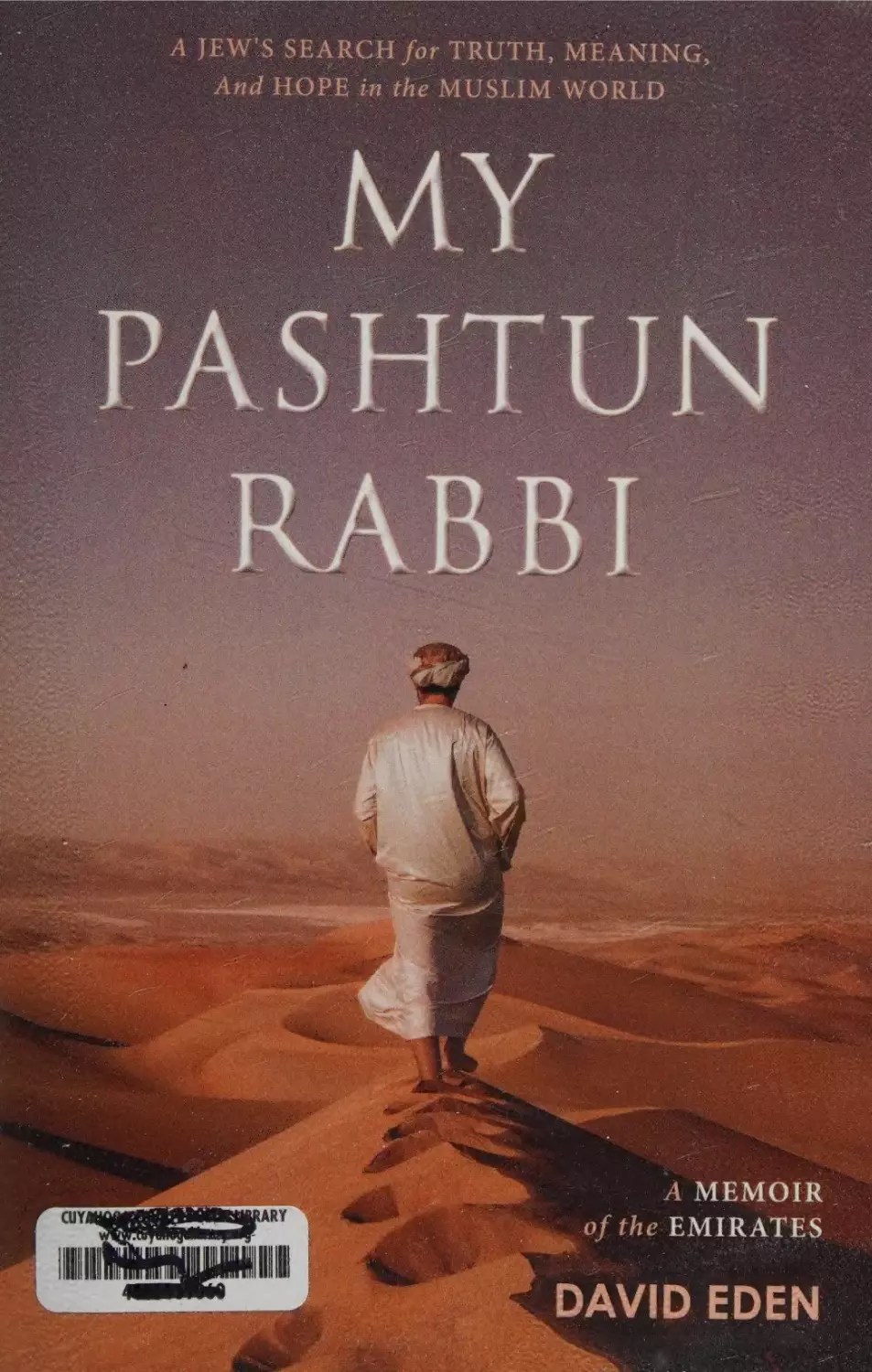
MY
PASHTUN
RABBI

MY
PASHTUN
RABBI
A JEWS

SEARCH for TRUTH,

And HOPE

in the MUSLIM

A
MEMOIR
of the EMIRATES

DAVID

EDEN

MEANING,
WORLD

MY PASHTUN RABBI
Copyright © 2018 by David Eden
All rights reserved.

No part of this book may be reproduced in any form or by any
electronic, or mechanical means, including information storage and retrieval systems,
without permission in writing from the author, except by a reviewer, who may quote brief
passages. Scanning, uploading and electronic distribution of this book or facilitation of such
without permission of the author is prohibited. Please purchase only authorized electronic
editions, and do not participate in or encourage electronic pirating of copyrighted materials.
Your support of the author's rights is appreciated. Any member of educational institutions
wishing to photocopy part of this work should contact the author via Facebook.

ISBN (Print) 978-1-54393-155-6
ISBN (eBook) 978-1-54393-156-3
Printed in the United States of America

First Printing

10987654321

Dedicated to the memories of:
Hilal Al Falahi
Mark Leimsieder

Harvey Horwitz
Sid Rosner

&
Stephen D. Isaacs

CONTENTS

Into the Land of“Insha’Allah, no problem”............c:cceeeeen 1
RULE NAD
DC TeONE sa cast fee cae ce eae

eee stone Eras

oN 21

BLE LOI OF AVION ATIVE f cecch etre ae tages ecea sos acer eeaes cachet

34

PTV TOILE RENE OR aes. oc tere artes eceuev Mees secs terse seek 41

TU CORE SNA PTI! ool Cees 0 eres eae hae Poreae,Regret

BNO Grn AMI eerste cee en eae

et ere

decrat eae ange 49

eee caesar seta: 56

mliia@s nounow ilSCOME NEre fon. cress
neice acuseanccs: 64
Mutton with Rice...or Rice with Mutton uu... cee

69

ADS

iS

CSAIAN orevel1VOGR,Wal rs tes ore eer reyy re oP

USYSEAU AA

IYUUKLA ca crs ycere cmon nee

ceeeo RNR

creme ee eee NO ae 81

URSZER ELS
I NGSara RtRe Gecease veersory ay iaGeetemf

(Soe ume

90

live (Deaeon Barns arcane
one melanie rarcas 96
PURSES

1G carne recat a sess cass ab ce cataecas cesaincteaketeanacer
sotretaks101

EUV Retlea) SO IM ont rea eresvety ancy erotic svc aca see cae Nudes aNiccsWevoa 109
SLOT OUIEY PC See teeter

ore Mea cette ea eens Menten wea ioSaee gastesanns 119

eNO AIMOUSAKIS Ste kiese cess eter aice ors as never
AUSTEN eva
nhlGalCC cinaWee ae

eels ene Peer

carer teente uns 121

ere eerie

Py ae 150

BVViere Ale Rane Stine Mele Menanse Geterecsnvcssessere
cssspecessnnacnaiae =:154
NV TEU QETISECR aye caret teste gecte: teas eveadana teacin ce ceateabeshasue' eneciaarerss 164

PANIES

AAR WNIT AGIs 2 sear creceaitect séesranrathees enlace eo vesoraanened 168

Garner Ota lnTs
tla Mamet omen can ert cece snr esearn ences seis sereh sts ceeece 174

apr

DubariGancelsNewsvean Sree

Te

“My God will take care‘ot mie? i-. neiet-ce
ete eercu aa aatees193

24

Boys arid Girls civil, Jeter

25

Islamic Interest ..1treccses
tetera een
eerie 204

26

CATE YOU JEWISNC sh cipaccuasasveate
serestacee mee tes eee eereeeays210

Me

“We are all. COUSINS: syasinerestere
cater en eens

218

28

Into: Yenren 2cc-233.t eeatste nv ansetstare ave iear tones manera:

226

29

I
iinbatoyen Gphe beypees ee cen ann cu keen Rinne eid eee any ee

30

The Richest Horse Race inthe Worker

31

Beginning of the Ends.

52

To'See foriNivcelt tre. c once

38)

hePashtun Feastc

34

Patiiva’s Birthdayer cet.

tere

eters

eee

eee 183

eee

eee 198

eS ore

pee

2 ecnematen nese
ee ee

enn 253

et

ee

264

eee 272
ees 280

5 ccomeeet san wereees 286

Seas ee

EELUe essa ine sosstnsonssans tee tvatenas sia
Ackniowded Gementser 1 ccc.: cca

eee

293

eve eee Nee state 304
tee enna

tere ee eee 329

IRAN
STRAIT OF HORMUZ

Ras Aal-Khaimah
Umm al-Quwain~@

PERSIAN GULF

ae

[®

ie

Dubai
Fujairah @

oeOs

Abu Dhabi

las

Oe

UNITED ARAB EMIRATES

Al Ain e@ Buraimi
.

UNITED ARAB EMIRATES
SAUDI
ARABIA

OMAN

x

¥a
ae

|

ee
ee

se

==

>

j
f

Z

:

>

°
‘*

ec
6

MY
PASHTUN
RABBI

CHAP

ERs

Into the Land of
“Insha Allah, no problem”

=
THE MORNING

OF THE FIRST FULL DAY OF RAMADAN

AT 8:10

a.m., I stood for the second time in front of a door marked “Women’s
Toilet.” This was a classroom? And my classroom?
Excited to get to my first hour teaching at United Arab Emirates
University, I’d given myself ample time to find my schoolroom. Now I was

ten minutes late. I'd lost another ten trudging in from the gate where my
ride had been obliged to drop me—taxis, their drivers being uniformly
men and non-Emiratis, were barred from the “girls” campus. The only
males allowed to enter were professors, some of us Western expats, and
South Asian laborers, neither of these classes deemed men in the UAE.
Other than what I'd determined from a Xeroxed map, the layout was

unfamiliar. New-faculty orientation had omitted visits to any of UAEU’s
facilities, including its famed Islamic Center. When several in my cohort
pointed this out to the dean, an affable white-haired Canadian, he had
commandeered a van and escorted us on a personal tour. We'd done no
more than cruise by the female campus here at Maqam. At the sight of its
high perimeter masonry wall topped with barbed wire, I had asked whom

DAVID

EDEN

the high security was meant to keep out. The answer I anticipated was

“terrorists.” But the dean let out a peculiar laugh. “It’s not to keep anyone
out! It’s to keep the girls in!”
Now that I was behind the wire, I looked around for signs of the
activities that would motivate young women to flee. There seemed to be
no activity at all. The morning sun was already brutal, the temperature
nudging 100°F. My search for Building 66 took me past a few structures in
generic cement-block architecture, access roads and concrete sidewalks.

I identified the highest thing around, a flagpole from which the UAE's
green-black-white-red banner waved. This would logically be the center.
From there, I could spot one of the major buildings identifiable on my map
and orient. A big bluish one.
I confirmed what was typed on the other paper I clutched: Building
66. Room 04. Standing at the base of the pole, I turned a slow circle, scanning the buildings. No quads. No lawns. A few stunted trees. I can’t recall
now what I had pictured as the women’s campus of the United Arab
Emirates national university. But I’m sure it wasn’t this. The place looked
less like a place to study than an old, nondescript corporate office park.
This was my refuge from the wreckage of the life P’'d fled back in Cleveland?
Doors on distant buildings opened and young women streamed out,
clad head to toe in black. I checked my watch. Seven fifty-three. So, those
buildings were the dorms the map identified. Building 71 was in front of

me. That put Building 66 to my right, a distance of maybe a hundred yards.
As I turned to hurry off in that direction, something in my peripheral vision pulled me up short. Stepping through a door in the wooden
construction fence behind Building 66, amid the rolling waves of girls in
black, a flash of color. I turned back and squinted against the glare—I was
facing east and the sun was still low. Yes, one of the dozens of women

streaming out of the dormitories like flocks of starlings stood out in dramatic chromatic relief. She wore the traditional sheyla, but not in black
-- in flaming, flamboyant, flamingo pink.
The mystery was arresting and kindled a sense that the uniformity
of my new work environment might not be so uniform after all. But that
would have to be filed for later contemplation. I was due at Building 66.
Room 04, which turned out to be—or at least so identified by its sign—a
women’s toilet.

MY

PASHTUN

RABBI

First reaction: panic. Was I, a freshman member of the faculty,

about to make a fool of myself and reveal that I was so stupid I couldn’t
find my classroom? I scampered, sweat pouring from my head, my shirt

soaked, around all three floors of Building 66, scrutinizing the number
above every door. Which brought me back, even more anxious, to Room
04, Women’s Toilet.

I noticed that three young women stood nearby, uniformly attired
and looking bemused. They confirmed this was indeed the room assigned
to the class for which they were registered. I learned their names—Fatima,

Mariam and Sheikha—and asked them to meet me right there for the next
scheduled session. Thus ended Day 1 of Computer-Assisted Reporting.
Class dismissed. The students seemed unfazed. I can’t say the same for
myself. An enrollment of three? And a restroom to teach in?
I braced myself for another trudge in the heat and set off back across

the sand and a sidewalk to Building 71, home to the Mass Communication
department’s administration. Fulminating silently, I fought the loop I was
sliding into. This just couldn’t be true. This was absurd. This was a farce.
But of course it was—all three! Not yet two full weeks in the UAE, I was
already feeling like an old hand.

=
Thirteen days earlier, amid the throng pushing and shoving outside
Dubai Airport’s old Terminal 1, whether by some act of divine providence
or mere serendipity, I had found the driver sent by my new employer. I was
soon sprawled on the back seat of a white Camry and despite full-blast a/c,
dripping sweat. Not just pouring perspiration but pasted to the seat, my

black t-shirt as limp as a dishrag.
As the man at the wheel, a quiet South Asian, negotiated thick traffic we passed a long series of banners lining the airport road. They featured a boy of maybe ten, smiling, in a wheelchair, wearing a form-fitting
Superman leotard-shirt. The banners with the boy, his smile, and wheelchair drove home what I’d just done: Flown a third of the way around
the world to spend three years in a country whose language, customs,

DAVID

EDEN

even its alphabet, were indecipherable to me. Add to that an alien take
on Superman.
I was working over those strange, jet-lagged epiphanies as we tra-

versed a floating bridge and merged onto a congested concrete highway. I
counted twelve lanes. From the ground, Dubai was hardly the vision I’d

peered out at in the bright morning light, nose pressed to the acrylic shield
of an economy-class window: a string of glittering skyscrapers, sharp-cut

rhinestones strung along a sapphire sea. B-roll used on gushing American
TV stories about the Miracle City of the Middle East. From my backseat
vantage point, that skyline was somewhat less inspiring, though very much
a work in progress. Even from this distance, the progress looked frantic.
Most cities, I reassured myself, lose their magic and appeal as one
closes the distance. Just like people. The longer shot is more forgiving.
Manhattan from the last rise going west on the Long Island Expressway,

especially when the old towers were there. San Francisco from the Golden
Gate. Cities like Paris, more breathtaking the closer you get, are the
exception that proves the rule. That generally applied to cities of the past.
Then, of course, there were cities of the past such as Cleveland, the one I'd

just left, its unending rust-belt downturn eased only moderately by the
national real estate bubble.
Dubai, a committed city of the future, was riding a magic carpet,
delirious with nouveau-riches and content with the dreams that money

can buy. Toast of the financial media, the sheikdom gushed wealth: the
world’s tallest building going up and biggest shopping malls, one alleged
to have an indoor ski slope. A secular Mecca. We passed a building that
looked like the conning tower of the world’s largest nuclear submarine,
home to Zayed University, a billboard extolling Dubailand, another the
Dubai Outlet Mall. I was curious to see the place, feel it around me. My

immediate destination, however, lay elsewhere, deep in the desert. Al Ain,
in the sister emirate of Abu Dhabi, sounded quite different from Dubai. It
lay an hour or so south, my driver said—so far, the only words he’d spoken.
Unemployed for more than a year, the divorce to cap a dead-end
marriage stalled short of finalization, I'd applied in a seat-of-the-pants
way for a teaching job. Financial desperation wasn’t my motivator. I had a
decent nest egg tucked away in investments, and the Dow was lounging in

the 14,000 range. I needed something to do. I needed to get out of my life.

MY

PASHTUN

RABBI

My search for jobs at American journalism schools kicked up nothing.
Then I was struck by a new idea: the farther flung the better.
One item in the United Arab Emirates University’s online application had almost turned me off for good, the box marked “Religion.” I stared
at the space a good thirty seconds, debating leaving it blank. But, really,
how could I be surprised? I wanted to teach at a university in the heartland
of the Islamic world. Their place, their rules. I filled in the answer. No way
was I going covert with this element of my identity. I had a hunch my reply
on that question alone would put an end to the matter.
But the prospective employer emailed almost immediately to set
up an interview—a teleconference. One member of the panel of three, a
female professor from Egypt, pointed out that I had neither a PhD nor
non-Stateside teaching experience. Further—now I could practically hear
her looking over the rims of her glasses at the rest of the committee—I had
never taught full time. Valid objections, it seemed to me, all overruled by

her two colleagues, both Americans.

The interview had been followed by a nearly summer-long silence.
I'd pretty much forgotten the idea when an email turned up with two
attachments, a contract and an e-ticket on Emirates to Dubai. Departure
date two weeks away, start date only four. The salary, the equivalent in
local currency of about US$80,000 a year, would put me just under the
IRS’s limit for exemption on foreign-earned income, but would be tax-

free in the UAE. Perks: rent-free luxury housing, a fat furniture allowance,
high-end healthcare, annual round-trip airfare from the US to the UAE
for myself and my son, and an end-of-contract bonus. The escape hatch I'd
been trolling Google for, in the form of an exotic working vacation, with
eighty thousand in pocket money? I didn’t negotiate any terms. Since the
contract wasn’t binding until I got to Al Ain and signed it in person, what
did I have to lose but some time? Time being the thing I had too much of,
I signed the attachment, scanned to a digital copy, attached it to an email
and hit SEND.
In reply UAEU’s Mass Com department chair, one of my two advo-

cates in the interview, emailed her congratulations. I’d been selected over
more than seventy-five other applicants, she said, and was earmarked
to be “our expert in journalism.” The second paragraph departed from
the official-sounding, cheerleading stuff. Dr. Beverly got surprisingly

DAVID

EDEN

personal and noted what had inspired her to push hard for me: the discovery, via Google, of the lawsuit I’d brought against my previous employer,
a Cleveland TV station. Never thought Id hear that cited as a factor in
my favor. “You have courage,” said my prospective boss. “David versus
Goliath. We could use you here.” Her email closed with one more observation, carefully worded. “Our journalism technician scarcely knows
English, yet she is advising the newspaper in both languages.”
A warning? An odd flash of color in a landscape of shimmering,
raven black? Either way, it was what intrigued me most.

2
Cruising out of Dubai, I told myself again that the abrupt, utter
change would be good for me. Life had laid me low. The UAE was on a
high. Maybe the perfect moment for our lives to intersect. For a whole
host of reasons, at any rate, here I was on the sleek, six-lane E-66, headed

into the interior. The landscape outside had turned to something less
urban. Dunes, a few scrub trees. A backdrop to Beau Geste, the world of
the Foreign Legion. The a/c had dried the sweat, and my T-shirt felt almost
crisp. My blue Cleveland Indians cap wasn’t a Panama hat, but I fancied
myself a character from Graham Greene.
Those romantic reflections were pierced by a steady, very annoying two-beat beep. A ping. Ping-ping. Ping-ping. The noise came from the
dashboard, but the driver looked oblivious.
“Is it possible to turn that off?”
He nodded and let up on the accelerator. I watched the needle. When
it dropped below 120 kmph, the irritating sound ceased. “Thank you.”
He acknowledged that with a nod and a glance in the rear-view mirror. How must his latest passenger look to him, a burly, bearded, sleep-deprived middle-aged schlump in sunglasses and a blue cap? Whatever his
thoughts, the driver directed none of them my way. We drove on in restful
silence, packed in a tight caravan of luxury sedans, SUVs, Toyota pickups,
laborer-crammed Tata buses—an Indian make, I remembered from somewhere—and open-sided six-wheelers hauling camels and goats. Hightension lines followed the ribbon of smooth concrete, framing sand dunes

MY

PASHTUN

RABBI

that rolled into the distance like massive breakers on Oahu’s North Shore.
I had seen plenty of deserts, from the Sonora and Mojave to the Negev, but
nothing as arid as this. Nor had my previous experience included a yellow
road sign bearing the image of a camel, a Ghostbusters-like slash bisecting
its midsection.
I was working out what that could mean—dromedaries banned not
to cross the highway? Or banned from it to get to Al Ain¢—when the pingping came back.
I caught the driver’s eye in the rearview mirror, my look imploring.
That got him to speak. “If Igo slower, under one-twenty, it turns off. Over
that, it makes the noise. It’s the radar.”
“Are we in a hurry?”
He shrugged. “It will take us longer to get to the hotel.” Maybe
his usual passengers had limited knowledge of the relationship governing speed, time and distance. With something approximating a smile, he
added, “Inshullah, no problem. We will get there later, inshulluh.”

In-SHULL-uh? The phrase, stress on the middle syllable “SHULL,”
befuddled me.
The highway narrowed to four lanes, fronded palms filing down the
median. Off and on the car pinged, and my nerves resigned themselves to
being worked.

a

ee.

I noted a sign telling us we'd passed into what was to be my home
emirate. The dunes turned red and swelled taller. Shortly, we exited the
highway into that landscape onto a road skirted by a high security fence.
This terrain was familiar from my reconnaissance via Google Earth: the
- border with Oman and the “twin city” of Buraimi, contiguous with Al Ain.
“We'll be at the hotel in maybe, inshulluh, ten minutes,” the
driver said.
The Intercontinental sat at the city’s edge in a walled compound.
It was precisely noon—for me, three a.m.—when I staggered out at the
drive-up. The desk informed me as I checked in that there was a meeting
set by UAEU for nine the next morning. I was confident I could easily

DAVID

EDEN

sleep most of the intervening twenty-one hours. Even through the exhaustion, I felt an eagerness to make my first foray out. Looking from the shade
of the lobby onto the surrounding landscape, I noted that the dominant
life forms were the date palm and the automobile. The land was wide and
flat around the resort compound, but featured no pedestrians. Sidewalks
did flank the roads—and could have fried eggs, literally and fast. Even
the short stretch to the bottom of the Intercon’s drive up looked like heat
stroke waiting to happen. Google Maps had shown me that the Al Ain
Oasis lay just two miles west, beyond the Hilton we’d passed. I'd pictured
myself walking there from the resort compound. So much for that idea.
Walking the other way was a non-starter; the Oman border and its fence
formed the northern boundary of the Intercontinental’s spread.
A bellman, South Asian, took my bags and me to the fourth floor.
Deposited in my room, I opened the sliding door and stepped onto the

balcony. It was the first I'd been truly outside and not under the shade of
a passenger pickup or
hug. The cool interior
curtains, and fell into
And, of course,

drop off. Blast-furnace-hot wind held me in a bear
beckoned. I slipped back inside, drew the blackout
bed.
was suddenly wide-awake. Back home, my career

had blown up. Well, ’'d dynamited whatever bridges might have been
behind me. Fired from the CBS aftiliate where I had spent two years as
managing editor and executive producer of news shows, I’d sued, won a
pyrrhic victory, and walked away with a settlement decent enough it came
with a non-disclosure clause and headlines. Only fair, as I'd surely never
work in TV or mainstream media again.
The marriage, too, was behind me. It had been played out for years;
only paperwork remained. There'd been no ill will, just no will at all. My

wife and I had agreed we'd wait for Max to finish high school, but my
mother-in-law’s death, followed by my court case, kept delaying the inevitable. Now Max was starting his sophomore year of college.
So, surfing the net, I'd spotted an escape hatch and dived for it.
Down a rabbit hole that had deposited me in this air-conditioned room
with its balcony overlooking a swim-up bar. The room was cool, the mattress firm, and I was starting to feel drowsy.
Did I have regrets? Neither I nor the ceiling staring back at me
knew the answer. More pressing to me was the question of whether I had

MY

PASHTUN

RABBI

a future. It involved an unsigned contract and a promise of physical comfort, but I had no idea what I was getting myself into this time.

ae
The next morning gave me a few ideas on that front. The event gearing up in the Intercontinental’s Jebel Hafeet Room seemed less like an
informational meeting for incoming international faculty at an institution
of higher learning than a UN family retreat, for refugees.
For a moment, I thought the doorway in which I stood was a wormhole or some such cosmological portal, taking me back to my first day
of college and the first run to the dining hall. The room before me, curiously circular, felt suffused with the same put-a-good-face-on-it anxiety.
The intervening years, in the trenches of journalism and civil court, had
taught me a few things about reading casts of strangers. This room was
more strained than the freshman dining commons at Miami of Ohio,
thirty-eight Septembers earlier. With pause in the time warp, the read I got
was quiet bedlam ready to erupt into pandemonium. I stepped through.
The Jebel Hafeet crowd had come from everywhere in the world,
some trailing spouses and screaming children, but some like me beyond
that age, and many apparently there solo. I sensed I might not be the
crowd’s only forlorn foreigner who’d come to the end of whatever road
he’d been on. I scanned the throng for another one-man tribe marooned
on this arid shore. Naturally, I gravitated toward voices speaking English.
A diminutive white-haired guy took a seat in an arc of chairs. I blatantly
stared. Finally, it hit me: Ray Walston. The fellow, who looked like Bill

Bixby’s Uncle Martin in the 1960s sitcom “My Favorite Martian,” started
chatting with a middle-aged, American-sounding couple. A blonde in a
floral-print dress teetering on spike heels and an athletic man, they took
seats close to his.
I felt sheepish about gravitating toward my own demographic. Cave

in to lazy cowardice on the first day? Diverse faces, multi-national and
multi-hued, gave me the same message—weve got at least this in common, we're here to make our last stand. Possibly our only stand. And,
as if evoked by that locution, here was General Custer now. But not a

DAVID

EDEN

fellow Yankee. The guy striding in, about my age, could have been cast as
a Pommie officer in Bridge Over the River Kwai. His ruddy complexion,
wavy brown-grey mop, prominent nose, angular chin, blustery, jovial air,
along with the mischievous glint in his eye, screamed “Limey.” The newest
arrival, a bloke if I’d ever seen one, moved to a semi-circle of chairs and

selected a seat near the trio I’d been studying. We each caught the other's
eye and nodded a greeting. Maybe an acknowledgment. Could he, I wondered, be a foxhole buddy here?
“Tony,” he said, extending his hand. “Brisbane.
“David,” I responded, accepting it. “Cleveland.”
That was the extent of our initial meeting.
Soon the meeting got underway and the undercurrent of tension
rose to the surface. We'd all signed on with the understanding that we'd
be billeted a week at the Intercon, then move to university-provided luxury housing. The interim HR director promptly corroborated a rumor that
had apparently been swirling, though of course I’d been oblivious—no

such housing. All hell broke loose. The Jebel Hafeet Room turned into the
cantina bar in Star Wars. The interim HR director, a hapless American,
said he’d found out only days earlier that our prospective landlord, having found someone who would pay higher rents than the university, was
reneging. He had decided against informing us so as to avoid “concern.”

Given the mutiny he had on his hands, I suspect he regretted that call.
Calls of “liar!” rained down on him as the arrows must have at the
Little Big Horn. There was even louder, polysyllabic howling in Arabic.
His story sounded doubtful and many around me voiced their suspicions. He had just found out? Does he take us to be fools? Weren't we
talking about dozens of apartments? And had the university not had a
contract? Of course! was the answer. But that didn’t matter, observed the
Ray Walston lookalike. The upshot, in his encapsulation: UAEU was giving up without a fight; the landlord no doubt had wasta.
Whatever that was, it trumped a written agreement. I thought of the
unsigned one in my black canvas bag, and added wasta to my mental list
of things to find out about, right below in-SHULL-uh. For the moment I
focused on making the acquaintance of Uncle Martin, who seemed to be
in the know. Brian, he said as we shook, from Toronto, but an old Mideast
hand, having just relocated from Oman.

MY

PASHTUN

RABBI

Although agitated voices filled the air the people in my little group
seemed oddly relaxed. Tony gave a summation that was concise if not
entirely sensitive to the concerns of many of our colleagues. “Two months
stuck in the Intercon with free food, a pool, a bar, and a gym? By me that’s
soft duty.”
The athletic guy, Dan, concurred. He was unemployed—looking at

selling real estate—and had tagged along with Carol, the blonde, his wife.
She’d be teaching just three days a week, and happy to hang other days
by the pool. Dan said something about the hotel’s Horse & Jockey Club
being the finest bar in Al Ain. Tony footnoted that there were only three
competitors. Brian afhrmed this, and endorsed the Intercon overall. He

was a new hire like us, but had spent eight years in Oman teaching English
as a second language. UAEU had hired him to teach something called
“UGRU.” That, too, went on my list.
In the life ended two days before, I would have watched, listened,

maybe nodded, and said nothing. When the meeting adjourned, I would
have walked away and resumed whatever I'd been doing. Here I was about
to begin a new teaching job at a major Arab national university as the
“journalism expert,” with no idea what I was supposed to teach, and now
apparently no place to live, just an interim place to stay at a nice hotel. I
wasn't yet doing anything I could walk away and resume.
I began paying attention to people and groups around us, carry-

ing on in languages I didn’t understand, but carrying on vociferously. For
those who’d come here with families in tow, the open-ended prospect of
life in a hotel room had to be daunting. I looked to the groups speaking
in Arabic. They wouldn't be genuine Emiratis, as this meeting was for us
expats. So what countries did they hail from? I’d come here determined to

meet people from all over. But for the moment, I was getting attached to
the North American-plus-an-Aussie tribe.

Brian and I got to chatting and { started in on my questions. “My
driver from Dubai kept saying ‘in-SHULL-uh this’ and ‘in-SHULL-uh
that.’ I’m hearing it this morning, too. What does it mean?”
The UGRUist let out an odd chuckle, like the chirp of baby birds.
“The ‘SHULL-uh’ you heard is actually a slurred form on Allah. A literal
translation is ‘God willing. The phrase is commonly pronounced ‘inshallah’ although purists will say, insha Allah. Everyone says, ‘Inshallah, no

DAVID

EDEN

problem, which means ‘God willing, things will go the way you want.’ But
inshallah, or insha’Allah, means one thing to the person who says it and
another to the person who hears it. So, ‘inshallah, no problem, which you

heard as ‘in-SHULL-uh, no problem, may mean the person wants things
to go your way, or may mean the person just wants you to go away.”
Tony guffawed. “What ‘in-SHULL-uh’ or ‘inshallah’ or ‘insha‘Allah’

means, I believe is the person’s not going to lift a finger to influence the
outcome or take any responsibility. Pure resignation to all-powerful fate.

That way, when something inevitably gets bollixed up, it’s God’s will that
it did. It’s not the person’s fault. Hence, no problem... unless it is for you!”

The absurdist analysis was ominous, but I liked it. Having just lived
through what felt like an era of blame and recrimination, | felt a certain
appeal in such an approach to life.

Brian resumed. “Take us. We were just told our housing doesn’t exist.
To the university, ‘insha‘Allah, no problem.’ They'll simply have everyone
stay here until they find alternatives. They’ve got the funds. For people who
have kids, it’s a different story. Insha’Allah, big problem, if you're a family
of five and just found out you’re sharing one hotel room indefinitely.”
Tony capped the discussion with a smirk. “And while we're sympathetic with their plight, insha‘Allah, no problem for us.” Tony, like Brian,
was a language purist.

eee
After the meeting—which apparently had no business to conduct
other than to convey a hearty welcome and a dose of bad news—new faculty was directed to tables outside the Jebel Hafeet room. There we were to
sign our contracts. I hung back with Tony and Brian, watching people who
moments later had been deeply upset now scrambling to be first to make
the commitment. Behind each table sat a pair of young men in crisp white
robes and headcloths, some tied and others held down by black crowns.
Assisting them were young women draped in black. These were “official
Emiratis” like the ones I had seen at Passport Control at the airport.
“What do you call that here?” Tony asked Brian, pointing not so
discreetly at the Emirati’s attire.

MY

PASHTUN

RABBI

Brian explained that in the UAE the male’s white robe is called

a kandura and the head covering a ghutrah. He mentioned that some
Emiratis tie it with a little tail and others use the black crown, a tagiyyah,
and wear a prayer cap under it. The women’s gown, he went on, is an abaya

and the head covering is a sheyla. “You won't find many here who wear the
veil.” None in the room did, at least at the moment. Brian added that the
UAE, unlike Saudi Arabia, allowed women to drive and to go out in public
unescorted by male relatives. I had yet to meet an Emirati socially, but at
least had made the acquaintance of someone who seemed to know the lay
of the land.
After the rush subsided I went to the proper table, received my “ofhcial” contract and was politely handed a pen. I asked for time to
document. I assumed it was the same one that had been sent to
that I’d printed and brought with me now. But given that I was
make a three-year commitment, | figured it was worth five or ten
to be sure.

read the
me, and
about to
minutes

“Insha’Allah, no problem,” said the young man in white.
But there was a problem. I compared the two versions. The new copy
included a clause the old one hadn't, and it deemed a part of my salary a
bonus that could be cancelled at any time.
“I have

a

problem

with

this

contract,”

I told

the

univer-

sity representative.
“Other people do, too,” he replied, with a smile. “Sign it like the oth-

ers. Insha’Allah, no problem. Everything, insha‘Allah, will be fine. We also
need your passport. It will be returned to you with your three-year visa
after you pass your health test, insha’Allah. Maybe two weeks, insha Allah.”
The medical “screening” had been part of the fine print I’d read back
in Ohio. But nothing about it indicated my passport would be held hostage until I’d passed. I felt duped. Lured in and ensnared. Four uses of

~ “insha’Allah” in a single statement did nothing to put me at ease, either.
But what could I do? Not sign, make a big public snit, and go back to my
terminated life? Quit before I’d begun? I signed the contract and forked it
over, folded into my passport. That didn’t sit well, either. I didn’t even have
a photocopy of the picture and basic-info page. I was trapped.
The unease stuck with me, despite being handed, at the next table, a
check for thirty thousand dirhams—at 3.67 to the USD, nearly eighty-two

DAVID

EDEN

hundred bucks. My furniture allowance. As I had no apartment for the
foreseeable future, I had no reason to spend any of it on furniture. Next, I
was directed to the Union National Bank table. There, Tony stood in front
of Brian and me, arguing with an official.
“If you deposit it with us,” I heard the Emirati man tell him, “you
can use your money right away. We will give you this.” He dangled an
ATM card. “But if you want to use another bank, insha‘Allah, no problem.
HSBC also has a table here. Your paycheck, however, will be deposited in

this account and you can transfer it to another bank later. Insha Allah,
no problem.”
Loud enough for Tony to hear, Brian said, “The university chancel-

lor owns the bank the university uses. They've already set up accounts. The
chancellor is Sheikh Nahyan, if you didn’t know.”
“A son of Zayed,” Tony offered. “One of twenty-some. They run Abu
Dhabi and the UAE.”
I'd read a few things about Zayed on the internet.
“Sheikh Zayed bin Sultan Al Nahyan,” Brian said. “Founder of the
UAE. The man who made it a country. Deceased. He’s a god here. His
picture, by decree, is everywhere. He’d be a saint if this were a Catholic
nation. Abu Dhabi’s got a billion-dirham mosque named for him.
It’s breathtaking.”
Tony grumbled something about “being locked into the company
store.” He harrumphed, “I already have an HSBC account in Brisbane.
They are not going to control my money and me like that.” He stomped off
to the other bank’s table, which so far had no customers.
“Trust me,” Brian said to me quietly. “You want to do it this way.
Tony will find out. His check will take a while to clear. We don’t get paid
until the end of September.”
Following his lead and handing over my check, I was immediately
rewarded with a UNB Visa debit card, packed with thirty-thousand dirhams and ready to hit the town.
$<

MY

PASHTUN

RABBI

But before I could get my first taste of Al Ain beyond the Intercon’s
gates, we were herded to lunch at the hotel’s main restaurant, Arabesque.
The quality of the buffet was encouraging. But we ate in a hurry, as buses
were waiting for us at the hotel’s entrance.
Our first outing was not, as I had imagined, to see the campuses—
segregated by sex—where we'd be teaching. We were taken to the nearby
Al Ain Mall. A mobile phone was, evidently, a necessity. In the UAE,
Brian explained, your mobile phone number is your primary connection
to everything, including utilities, since street addresses aren’t used. (Mail

may be received at the workplace, if one’s employer receives mail; otherwise, rent a post office box, if you can find one.) We were encouraged to

sign up for a prepaid service called Wasel. The phonetic similarity between
Wasel and wasta fed my hunch that the telephone monopoly, Etisalat, also
belonged to someone connected.
Three things stand out from my first venture. Scores of yellow
Smiley Faces hung everywhere in the shopping center, another flashback
to the mid-sixties. A flock of grade-school boys, Emirati by their kanduras, bumper skated on an ice rink. Outside, where I’d just been, it was
115°F. Worse, the whole place reeked. I had never smelled anything quite
like it, except as a child stuck at holiday gatherings with the overlaid cheap
scents of aunts and grandmothers. Each Emirati woman seemed to have a
signature fragrance. Mixed with the score of perfume boutiques misting

their wares, the air was cloying.
Scariest of all, there was only one refuge from that perfumed atmosphere, the food court. There the dense musk of American fast food can-

celled out all else. KFC, Pizza Hut, Hardees and Burger King dominated
the trays of Emirati families, many trailing overweight children. America’s
exports doing their grim work. I couldn’t even escape it here, but there was

a Lebanese Grill and gelato.
I acquired nothing but a Nokia, the same model as Brian’s, an
Etisalat SIM card with my new “050” phone number, and Wasel cards
worth 500 minutes. At 500 dirhams, twenty-seven and a quarter cents per
minute, all on my new university-arranged debit card.

The ride back to the neutral air of the Intercon took just a quarter of
an hour on smooth city streets lined with green lawns and fragile flowers.
We passed the Hilton and I took note; some new faculty was billeted there.

DAVID

EDEN

Only a few pedestrians braved the late afternoon heat, and there seemed
to be nothing out there worth the risk of sunstroke. Still, I returned from
that first field trip determined to avoid being confined. I was locked into
the University’s bank, had surrendered my passport, and was bound by a
contract that guaranteed me nothing until I passed a health exam.
Yearning to get out on my own, or at least not as part of a herd,

I stepped onto my balcony, clutching my phone. I had only one phone
number other than Brian’s. I called Dr. Beverly and she picked me up that
evening in her second-hand Chevy Blazer. She’d heard about the housing fiasco.
“I bet you can do with a few hours away from the hotel,” she said,
pulling out onto the highway.

What I recall from that night tour were a lot of high-beams, several
near accidents in roundabouts, South Asian families curiously lining the
sides of the roads to picnic on the lawns, a humongous pearled jewel-box
sculpture marking one of the main downtown circular intersections, a big
Pizza Hut sign presiding over another, mobile phone stores everywhere,
and lots of signs for “saloons.”
“Saloons?” I asked. “Isn't this a dry country? I mean in the
other sense?”
Beverly laughed. “They're beauty parlors. Barber shops. They just
don’t know how to spell.”
We ended up at Paco’s Mexican cantina in the Hilton. The sixty-something feminist from Nebraska via Ohio U. broke the bad news.
She had been removed from the department’s chairmanship. I’d suspected
there was more to her alacrity in offering me a tour than a desire to welcome the new guy. I might not have known wasta from UGRU or the ins
and outs of insha Allah, but reading blunt omens wasn’t foreign to me. It’s
bad news when the boss who hired you is booted downstairs.
Beverly's follow-up question stunned me. “Are you the new chair?”
My look of astonishment answered her question. It was clear that
she had no clue what was going on and was looking to me, a colleague
who'd been on board only a matter of hours, for answers.
I joked that the situation was Kafkaesque.
“That’s UAEU in a nutshell,” Beverly said, ruefully. “But at least I
can still teach. If the new chair’s not you,” she theorized, “it’s got to be Dr.

MY

PASHTUN

RABBI

Ali from Penn State. The one in Erie, Pee-Ay,” she added with some disdain. “He's originally from Djibouti.” She sipped her Heineken. “I guess I
tried to change things too quickly and angered people with wasta. Watch
out for that! But I need this job. It’s two more years before I’m eligible for
Social Security. Who’s going to hire me back home? | like it here.”
That soliloquy gave me pause. “Well, not that it means much but no
one has said a word to me. Hell, classes start in less than two weeks and |
don’t even know what I’m teaching.”
“T don’t know either!” She laughed, but now I clearly heard the edge
of hysteria in it. “I wonder who’s going to tell us. And now I’ve got no
office. Maybe we can share one.”
“By the way,” she added. “I don’t know whether they know youre
12

Jewish. I haven't told them.”

They? Them? I'd been kidding about the Kafka thing.
Whoever were the they or them who might or might not know, was
their knowing or not knowing a bad thing? Did the faculty/staff know?
Had Beverly brought me here to hint that I’d better lay low?
Was religion going to be an issue?
The contradiction hit me. My being a Jew couldn't be a secret—the
fact was on the application I filed! Yet, Beverly was intimating I’d be wise
to do just what I had decided against, go covert with it. She was giving me
more insight on department politics, but I was distracted through the rest
of our beer and fajitas. The repeated keyword—they—was soon to take on
meanings it hadn’t carried in my prior lives. I’d been in the UAE a few days.
No passport. No housing. No boss. And now a secret religious identity?

ee
The next morning saw us moving on to the big time, Dubai's Festival
City. Set on a man-made canal, this was not a mere mall but a vast shopping
and lifestyle center anchored by IKEA, Panda Hypermarket and the UAE's
only ACE Hardware. Attached were two hotels—an Intercontinental and
Crowne Plaza. Most of the shoppers were South Asian and Western, but

there was a smattering of visible Emiratis, resplendent in their black and
white. I was heartened to find a conveyor-belt sushi eatery.

DAVID

EDEN

The most interesting parts of the excursion were the rides up and
back. Moraig, a New Zealander with a few years in Al Ain, engaged by the
HR department to accompany us, held court on our luxury motorcoach.

Tony, Carol, Dan, Brian and I had boarded Moraig’s bus because it was
free of screaming children. It was one of a fleet UAEU keeps to transport
female students on Thursday to their homes, scattered all across the country and back to their hostels in Al Ain on Saturday night. Angling north
on E-66 to Dubai, Moraig regaled us with advice, a mini crash course in
survival for Western expats.
Two things she said particularly struck me. Tony lit on a third.
When Carol told Moraig that she was the new director of interdisciplinary studies and knew the acting provost, Moraig nodded sagely and
said, “Ah. Wasta.” When Dan told about his plans to get a job selling high-

end real estate in Dubai, Moraig offered him her local savvy, too. “They
keep saying the economy is good. You shouldn't have any trouble.” She
revealed the reason we lost our housing. Prices for Al Ain’s residential real
estate had doubled in six months. The builder was promised more money
so he just broke his contract with the university. “Nothing will happen to
him because he has wasta,” she concluded. “He’s related to Zayed.”
“Wasta?” I asked. I'd given up on figuring out by context what it
meant. Time to ask.
Brian piped up from across the aisle. “Connections. Who you know.”
“If you have wasta, you're golden,” Moraig offered. “Nobody can

touch you. Especially if you are related to Zayed and his family, the al
Nahyan. They run Abu Dhabi and the UAE. You'll see.”
Carol nodded. She’d apparently seen already. And now she was one
of my college’s higher-ups. That struck me as good news, given what I'd
heard from Beverly. I needed an ally.
On the way back to Al Ain, the talk turned to food and spirits.
Moraig said something about “a place to buy pork,” which surprised me.
Tony’s ears pricked up when she mentioned two places that sell alcohol.
The rub, Moraig added, was that expats were supposed to go to the central
police station and register to get a special permit entitling them to buy two
bottles a month. “But don’t worry about it!” she gushed. “You'll see!” The
better liquor store was called Spinney’s on the other side of town, where
she went, and there was another somewhere near the Hilton.

MY

PASHTUN

RABBI

I looked at Tony, who was absorbing this crucial intelligence and
jotting it into a pad.
“Isn’t this against all the rules here?” I asked Moraig.
Tony had a quick response. “You must have missed Rule
Number One.”
“Namely?”
Finishing up whatever he was scribbling, he gave us a broad grin.
“There are no rules.”

ee
It may have been the very day after that trip that Carol—as she, Dan,
Brian, Tony and I lunched at Arabesque—posed the Jewish question. I had
cracked a sardonic joke about something or other and Carol called me out.
“You're Jewish!?” she said, supremely confident of her Jewdar.
I nodded.
“I thought so!” she said, proudly “I knew there was something

about you.”
“It took you this long?” Dan asked. “I figured that out the first time
we met David.”
Tony and Brian hummed their respective confirmations.
“T have a lot of Jewish friends,” Carol added.

Naturally. She was from Florida and knew New York and Jersey
Jews. Curiously, Carol added, “You could be a borscht-belt comedian.”

eS

ee

Finally came the morning for the medical screening, the hoop I
needed to jump through for the return of my passport and finalization of
my contract. Carted off from the Intercon once again, we were dropped
at the regional health center. The air conditioning was broken. The few
women, including Carol, were separated from the men and led away. A
crowd of male South Asians, mostly Pakistanis and Bangladeshis, queued
up. Tony, Brian, and I gamely joined them—but to wait for what we
weren't sure.

DAVID

EDEN

“They've thrown us in with the chattel,” Tony chortled, sweat wet-

ting his brow.
I histrionically wiped my forehead. “I can’t believe they don’t have a
special line for us rather than throw us in with common laborers?” Brian

gave a soft laugh and confirmed the thought that had just struck me.
“We are laborers. Like them. You've signed your contract and they hold
your passport. What can you do? They know that.” Tony let out a guffaw.
“Golden handcuffs, David,” he laughed.

ak
At dusk that day I paid my first visit to the Horse & Jockey Club,
eager to blow off steam. Inside the pub-themed bar Carol and Dan were
cradling wine glasses. Dan took one look at me. “What happened to you?!”
I deflected to Carol, sipping a white wine. “What happened to you?”
She related how the women were taken to an air-conditioned room
and were given the standard tests—BP, urine, blood, chest X-rays. “That
part was quick and easy. Then I had to wait on the bus for hours for the
men. You were one of the last.” She giggled. “You didn’t look too happy.”
“InshaAllah, no problem,” Dan laughed. “Looks like you need
a drink.”
“Insha Allah, big problem!” I was still steamed. “Pll take a beer.”
I peeled off the bandages and revealed my black-and-blue inner arms
where technicians took my blood. Dan plunked a Heineken in front of me.
“They took my blood pressure. Highest ever in my life. I waited in line for
more than an hour for a chest X-ray. Finally, I played the white-man card.”
Dan nodded sympathetically. “Had to do that a lot when I was on
the tennis tour.”
“T hate doing it,” I whined.
“Insha Allah, no problem,” Dan laughed. “You will play that card
again.” He added another wink and shifted to Moraig’s Kiwi accent.
“You'll see!”
Three days into my new-life adventure and my sense of adventure
was wearing thin.

20

CALA PEE Re 2

Rule Number One

AFTER OUR FIFTH OR SIXTH CONSECUTIVE WADE THROUGH
the buffet at Arabesque, enjoyable but increasingly monotonous, Tony and
I decided to make a run for it. Brian lent us his Mitsubishi Lancer and
we ventured out in search of booze. With Ramadan and the school year
fast approaching, and with the prices at the Horse & Jockey Club burning
holes in our wallets, we needed relief.

Tony took the wheel. Moraig had mentioned two options: Spinney’s,
across town, and an anonymous store behind the Hilton. Further intel

revealed the second was near the dormitories for the hotel’s foreign staff.
A gaggle of South Asians hanging out near what looked like dormitories
suggested we'd navigated unerringly. The Mitsubishi deftly slotted into a
space between a Land Cruiser and Range Rover, both with opaque tinted
windows; we peered out at the single-story cinderblock building. It was,
indeed, anonymous. No sign betrayed the establishment’s name or purpose. The two metal doors were marked simply “Entrance” and “Exit”
in English. Another promising indication—anyone selling alcohol here
would engage customers in the expats’ lingua franca.

21

DAVID

EDEN

“Exit” swung open. Caught in the fluorescent light flooding through,
we probably looked like a couple perps sizing up a prospect for armed robbery. Or cops on stakeout. I preferred the outlaw feeling. It fit Tony, too.
Over our first week in the country, I’d learned this much about my

accomplice. Originally a “Bugle boy” from Bugle, Cornwall, he immigrated to Australia after a stint in the Merchant Marine. At 17, he left

Cornwall and had circumnavigated the world several times, with a stopover in Vietnam in the 1960s, ending up in Brisbane. He was a professional rally driver and enjoyed a profitable career in energy, chiefly oil, but
chucked it all to get a PhD and teach, at half his former pay. “I’m glad I did
it. Starting a doctorate in your forties is insane, but I don’t miss the rest.”
Tony was a professor of something called “management information technology,” who at 60 had been “made redundant.” After seven years
at Queensland U. of Technology, winning several teaching awards, he was
one of the casualties when QUT gutted its faculty. With Australia’s university system in a state of general upheaval, Tony saw his best option in
signing on at UAEU’s Business School. It was, he said with a determined
tone of neutrality, a job.
Though my son’s exploits were a favorite topic, Tony never men-

tioned children. He’d been married, too, less than a year, and following
the divorce he and his ex-wife had lived together for two decades.
For years I’d told myself, and more recently found myself telling
Max, struggling to find his niche at college: “All you need in life is one
other person to share your foxhole. Sometimes you share it for life, other
times for a year, a day, an hour—however long it takes to get through a
moment of truth.” Tony was living up to the sense of him I'd gotten the
moment he strode into the Jebel Hafeet Room. Here’s a guy who'd make
a good foxhole buddy. He’d had practice at what I needed to get started
on—seeing a future where none was apparent.

—$$_<0>Clambering out of the Mitsubishi, we stood aside to allow two shop
workers, South Asian, to lug four cases of liquor down the concrete steps.
They proceeded to the Land Cruiser, raised the liftback and stowed the

MY

PASHTUN

RABBI

goods. The SUV’s window dropped a few inches and I caught a glimpse of
a white guthra as a hand reached out to hand the worker a wad of dirhams.
“Td say we've found the place,” Tony said.
“Inshaallah,” | offered. Invoking God’s will might still be in order,
as we'd yet to step inside. There was the issue of a police permit. I eyed the
uninviting building. “So, what if we get carded?”
“Carded?” Tony asked.
Right—he’d be thinking I was talking about a soccer match. “Asked
to present our documents. The permit Moraig told us about with her chipper ‘You'll see!’”
“Ah! Right. No time to visit the police now! So, follow Rule
Number One.”
We stepped through “Enter” to find ourselves in an establishment
that could hardly exist elsewhere in the Arab world. A floor-to-ceiling
room filled full of alcohol. One wall was a display of vodka, the bottom
shelf warehousing 12-dirham liters of Cyrillic-labeled Russian and Indian
jet fuel, the top tiers stocked with Grey Goose, Belvedere, Chopin, Absolut,
Stolichnaya, Russian Standard, Finlandia, Smirnoff, and more, for 80 to
140 dirhams a liter. Absolut was on special: 90 dirhams for two one-liter
bottles. I divided these prices by 3.67, the exchange rate having already
been imprinted on my cerebral cortex. Yep, much better deals than at the
state store back home.
A few boxes of Johnny Walker Blue, selling for a bit more than
500, dominated the top of the whiskey wall. Shelves below were stocked
with JW’s green, black and red labels, Dewar’s, Glenlivet, Glenfiddich,
Ballantine’s, Jack Daniels, Wild Turkey, Four Roses, Canadian Club,
Bushmills, and 12-year-old Chivas Regal on special for 72 dirhams. Indian
scotches—Bagpiper Gold, McDowell’s Green Label, MaQintosh—starting
at 9 dirhams a bottle—filled the lower depths.
“Tony,” I said. “Isn’t Indian Scotch an oxymoron?”

“Nasty stuff, David. One of the more heinous crimes of the
British Empire.”
“The Blue’s half the price it goes for in Cleveland,” I observed.
“No taxes here. After all, what self-respecting government would tax
a product that is officially not sold inside its domain? They needn't keep
the prices low for us. We'd pay anything!”

23

DAVID

EDEN

“And, as you have noted, Muslims don’t drink,” I said, smirking,
“like Jews don’t eat bacon.”

Tony rolled his eyes. “You saw the parking lot. Muslims don’t drink
except the ones that do. I hear that Saudi’s consume more Scotch per cap-

ita than any people on earth.” He turned away. “I’m going to check out
the gin.”
I placed two bottles of Chivas and one of Martel V.S. on the counter
and coolly laid a 200-dirham note beside them. Tony stepped up behind
me with a Gordon’s gin and an Australian Chardonnay. At the register, a

pudgy Indian with thick salt-and-pepper hair and matching moustache
rang up my purchase, picked up the money, looked at me, and asked, “Do
you have a permit?”
“Rule Number One,” Tony murmured, closed-mouthed, the ventriloquist to my dummy.
I enunciated slowly. “I don't. Is that a problem?”
The vendor looked me up and down. “No problem.” He pushed a
button, opening the cash drawer. “I am supposed to ask, however. So I do.”
A believer in Rule Number One himself.
Back at the car Tony plopped his two black-bagged bottles in the
back. I lowered my three to the floor between my feet and said, “When we
walk into the Intercon, everyone will know what’s inside.”
“Indeed,” Tony answered. “And our colleagues among the freshman
faculty will be jealous because they're too timid to venture out to find this
place. We, however, will have a fine run of it.”
As he backed out, a white BMW 750i, its windows opaque, pulled in.
From a tiny spot of shade in front of their dormitory, the cluster of Hilton
workers watched the parade of sin buyers in their overbearing vehicles.
Did they know the people inside paid more for a bottle of sin than they
earned in a week, maybe even a month? Were they even allowed inside
the store?

ie
At the Intercon, once we'd delivered the keys and the Martell to
Brian, Tony joined me in my room. He set up his bar on the balcony’s low

24

MY

PASHTUN

RABBI

bamboo table, while I filled the ice bucket. A hot breeze wafted over us as
we settled into the two wicker chairs. In the pool a lone couple sat at the
swim-up bar.
Over Tony’s shoulder, through the sliding door, BBC World, though
on mute, shouted ominous, flashing-red graphics of the nose-diving financial markets. Had I known what was looming, I would have pulled everything out of the markets, chiefly that life-altering settlement from the TV
station. I naively thought I’d always have that, and the illusion made my
situation feel different from Tony’s and my other UAEU colleagues. I had
a cushion, an escape hatch. The job here was, for many, a one-and-only
option. Within weeks the collapse of Lehman Brothers would be followed
by cascading dominoes and havoc in the world’s financial system, what
would become known as The Great Recession, and my sense of invulner-

ability would be shaken.
“Gin or scotch?” Tony asked, Chivas in one hand, Gordon’s in
the other.
I pointed to the first. “Can’t stand gin.” I chuckled. “Back home I
rarely drink.”
“So you've said. Each time you've ordered a beer, if memory serves.”
He produced a scowl, and a grave look. “There’s no back home for the
moment, young David. This is your home now.”
He had a point. But what was this “young David” crap he was laying

on me since we'd gone on our booze run? I'd take the epithet as a token of
camaraderie, along with his speaking as my senior.
“Hate gin? Just as well,” Tony added. “Less chance of conflict. But P’ll
be sure to save the tidbit, re: your preference in liquor—which you scarcely
touch—for the Al Ain Gazette, when it profiles you.”
I half-smiled, gazing out across the Intercon’s lush garden, its tropical colors muted in the sparse lighting. Drinking habits back home were
- back there—where I drank scotch only with Mark, a high school teacher
and a true foxhole buddy. But here I was drinking it with Tony. Who,
even if he drank gin, had foxhole potential. I idly wondered whether |
did myself. Whether the whole notion was not just palaver you tell your
emerging adult son.
“Right now,” I told him, “Id drink straight out of the bottle.”

25

DAVID

EDEN

“Thankfully, we at last have alcohol. None too soon with Ramadan
and classes quickly approaching.” Cracking the Chivas, Tony poured me
two fingers. “Rocks?”
I nodded.
Pouring the other glass a good two-thirds full with Gordon's, Tony
plunked a few cubes into each. “Cheers.” He passed me my drink and held
up his own.
“To Rule Number One,” he added with a twinkle in his eye, and
took a long drink.
“And to Dan. His advice worked.”
That advice had been to act cool and calm, like you know the drill,
not like just one more Western asshole who blew into town last week.
So far, a Western asshole was what I was stuck with being. Another idle
thought. I drained my first scotch, plunked the glass on the table, and got
up to lean on the railing. The hot breeze was blowing harder. The palms
around the pool swayed, and the moon’s reflection was scattered on the
water. The couple laughed and clinked glasses at the swim-up bar. I sensed
an interrogation coming, and wondered how much I wanted to reveal.
I'd felt subdued since those first days in the UAE. Not that I’m ever a
social butterfly, but I'd been holding back. Watching. Keeping my eyes and
ears open. Trying to get a fix on people, and—to the extent I could—the
place. If] felt like unburdening to anyone, it would be to Tony. But I wasn’t
sure what I had to unload. Looking out at the pool, I tried to get a sounding on how, so far, Al Ain hit me. All I could come up with was a decided
ambivalence. I didn’t dislike the place; I simply hadn’t had any contact
with it. Or didn’t want to believe I had since what I'd taken in so far was
all university rules and retail. I had a nagging hunch that getting beyond
the malls were going to be hard. My eye tracing the perimeter wall around
me here, Oman on the other side, I recalled the barbed wire around the
women’s campus.
“Were you surprised buying booze was that easy?” I asked, turning
back to Tony.
“I suspect the good people behind the Hilton will sell to anyone.”
“And at these prices,” I chortled, “I might have to become
an alcoholic.”

26

MY

PASHTUN

RABBI

“Drinking is about all there is to do,” Tony said. “Unless you love
to shop.” He refilled my glass. Once I’d raised my hand to signal he might
stop, he set the bottle beside the table, on the balcony’s floor. He cocked his
head and studied his gin. “We know each other a bit now,” he said, pausing
for effect and leaning back in his chair. “I know why I’m here. I needed
the job. But what's a Jew doing taking a job teaching at UAEU? Or for that
matter, in the Arab world at all?”
I brought the glass to my mouth and sipped, to buy a moment. The
wind kicked up the blackout curtains inside the room. “Because I could,”
I said, with a big laugh. It was an easy default reply.
“That's an arsehole answer,” Tony responded. “They’re used to
Christians here, especially Pommie types—we’ve exploited the place forever. And while they may hate us, they tolerate us because they need us
and we need their money. But a Jew? Here? If you wanted to get out of
Ohio you could have gone anywhere. So IJ ask again, young David, why
here? And what kind of Jew are you anyway?”
OK, no more arsehole answers. I had two questions now. I'd hit the
second first.
“It depends. I’ve been a lot of kinds of Jew.” I’d been asked versions
of that question before, but I doubted Tony intended it in the same way.
Orthodox, Conservative, Reform—did that stuff mean anything to him? I
eased back into the wicker chair.
Should I say I pay dues to a small Orthodox synagogue? That Yiddish
was spoken in the kosher home in which I was reared? That I’d married
not just a shiksa but also a blonde from Minnesota,

of Scots-German

stock? (She had converted, had “official Jew papers,” something nobody
else in our family possessed.) That I didn’t-really-kinda-believe in God,

but hedged my bets, not willing to discount the possibility of Something?
Basically, a non-observant Jew with baggage.
What kind of Jew indeed. A lot of Jews, as well as gentiles, have
asked me that, and not always in the friendly way Tony had. Not “What
kind of Jew are you?” but “What kind of Jew are you?”
My earliest remembered inklings of myself as a Jew are anchored
in a gentile world. They feature Greenville, Ohio, birthplace of gunslinger
Annie Oakley, with just one Jewish family, ours. As the first Jewish students ever enrolled at East Elementary my brother and I were sent to

27

DAVID

EDEN

the principal’s office during mandatory classroom prayer. Prayer was

addressed to God, but I caught on quick that this was the Christians’ god.
After school, neighborhood boys would chase us home; my brother, slower
than me, was the punching bag. Things got easier when East Elementary
enrolled its first black student, in ‘59.
We were uprooted from that world in the spring, when my father
died. and transported to a Cleveland inner-city “all-Negro” neighborhood, where my mother’s immigrant parents were the last whites and Jews
left. Given a peculiar secular-Jewish upbringing to age seven, I suddenly
had to go to temple every day for a year and say the Mourner’s Kaddish in
memory of my father.
Probably a bit more listener-friendly to jump into the 1960s and
Cleveland Heights, a predominately Jewish neighborhood. Having to
stand my ground again, with the Italian greasers who wanted to kick the
ass of the reputedly tough “Jew kid.” I smiled a moment remembering
those street brawls. I never started one, but I never lost. That, no question,
Tony would appreciate. Toss in, for color, how I came to detest beet borscht

and the stench of gefilte fish in the making before Passover?
All those things were way in the past, and Tony’s interest was present tense.

“Before I came here, my Jewish friends asked me, ‘Why are you going
there? They hate us.’ I’d ask, “Who's us?’ They'd respond, ‘Americans. Jews.
Both.”
“Your friends have a point,” Tony said. “Everybody here loathes
Bush and they hate Israel.”
Sure, they had a point. But I didn’t want to believe that “Jew” or even
“American” had to circumscribe my identity.
Tony pressed on. “And you wanted to come anyway?”
“To see for myself, and I needed to get out of my life in Ohio and do
something. This came along so I grabbed it.” I put the glass on the table.
“I have an old friend. I told you about him. Bob. Former U.S. Air Force
colonel. Commanded nukes in Germany. UN weapons inspector in Iraq
with Hans Blix.”
Tony nodded, pouring what by my count would be his third gin.

MY

PASHTUN

RABBI

I briefly recounted my send-off by Bob, Mark and a few other foxhole buddies. “After a couple drinks, Bob grabbed my shoulders. ‘Do not
tell anyone youre Jewish! Tell them you're Canadian.”
“Because nobody hates Canadians?”
“Precisely. So I countered, “But, what if they ask me whether I’m
Jewish?”
“And he replied?”
“Just tell them you're Canadian.”
Tony laughed. “Right. Asked ‘Are you American or Jewish?’ you
answer ‘Canadian’!”
“At least according to Bob. If anybody checks my UAEU job application they'll see ‘Jewish.’ If any one Googles me they'll find out because of
the whole lawsuit thing. I’m just not advertising it.”
Tony's look was like something out of the silent-film actor’s handbook, yet hard to read. It may have said, “You're naive if you believe that’s
going to work.” He contented himself with a neutral—if slightly slurred—
question. “Does Mohamed know?”
Mohamed, my across-the-hall neighbor, was a new professor, like
us, hailing originally from Yemen but most recently Oklahoma City. So
far the only Arab we'd met in our ranks.
“He hasn't asked and I haven’t told.”
“So,” Tony said. “No Jewdar. We’ll see how long it takes him to figure it out.”
We clanked glasses to that, and downed the last of our drinks. He
poured again for us both. This being my third, I resolved to stop counting.
“You asked what kind of Jew I am.” I sat back, putting one foot on
the table.
“That is the topic.”

I took a deep breath. “I’m the kind of Jew who knows enough to be
- dangerous. I do what it takes within my code. I don’t seek confrontation,
but I also don’t back down from schmucks and assholes no matter who
they are even if I work for them. Journalists, which I guess I’m not any
more, aren't supposed to do that. For anyone, including their bosses. I

guess it’s still the playground in me. You stand up to bullies. That’s the
kind of Jew I am.”

23

DAVID

EDEN

I inhaled, caught my breath, and let out a small laugh. “And I can
daven, but I choose not to.”
“So, you're an arsehole who can daven but doesn’t?” Tony said,
laughing. “Tell me a bit more.”
“I can be the biggest arsehole in the world if that’s the only way to
go.” I drained my glass and Tony refilled it. “Take it right to the endgame.”
I raised my eyebrows and grinned like Jack Nicholson. “If I am not for
myself, who will be for me? I told you about suing the TV station.”
“Somewhat.”
Maybe it was the alcohol or the fact that I was halfway around the
world from back home and felt safe laying out the whole megillah. For the
next thirty minutes, with a refill or two or three, I recounted how I knew

the arseholes were concocting to fire me after a management change. Over
the course of months I had gritted my teeth. TV news is like that. I knew
they wanted to get rid of me. The beginning of the end started after I'd
reported an incident in the control room with a young sports producer,
the GM’s son’s best friend, who had overstepped his authority. Just days
earlier, he had started telling anti-Semitic jokes in my presence, and I let
them slide. But I thought that was odd and knew something was up. He
had grown up on Long Island, and knew his way around Jews. I had mentored him, and we’d gotten along, but his attitude started to change after
the new boss arrived.
Soon after I turned in my written report about the control-room
incident, which included a section about the anti-Semitic jokes preceding
it, the shit started hitting the fan. Memos questioning my poor job performance suddenly started flowing to my inbox. They were building a case to
get rid of me. They thought I was playing “the Jew card.” I knew how both
ends of that game were played. I knew how they thought. Hell, ’'d once
been one of them. I'd been a they! Tony’s eyes nearly exploded from their
sockets when I told him that I began wearing a yarmulke to work—every
day. Another foxhole buddy told me it would drive them crazy, and it did.
“So you sued for religious discrimination?
“No, for wrongful termination and retaliation.”
“And you wore the little black skullcap?”
“No.”

30

MY

PASHTUN

RABBI

I described the large Rasta-like skullcap I wore. Because of where I
sat in our newsroom, my colorful kippah popped up regularly during live
broadcasts. Three months later I was fired for violating a station policy that
hadn't previously existed. A year later after a five-day trial in Cuyahoga
County Common Pleas Court the TV station offered a settlement that my
lawyer told me I couldn’t refuse. Dr. Beverly read an article about that
lawsuit that moved her to hire me.
“It was never about religion, but that’s what they thought. The yarmulke worked its wonders, like a red herring should.”
“So it was about the jokes?”
“No, it was about assholes, or arseholes, or whatever they’e called,
and standing up to them if you can. At least not going down without
a fight.”
My former employers had, without even realizing they were doing
it, or foreseeing the consequences, made my Jewishness the central part

of my newsroom identity. I'd fought fire with fire. It was absurd—worthy
of Kafka, in a low-rent kind of way. Tony’s interrogation got me thinking—Id followed that battle by going to a place where “Jew” would be the
sum of most people’s perception of me. And making that the first thing
they knew about me would virtually guarantee their doing so. I’d have to
let the detail filter out, find its way into context.
Maybe this getting drunk and mawkish had its benefits. Whether it
was Chivas or Tony’s Q&A or just that fact I was calmly reflecting on the

whole firing and lawsuit episode for the first time, my life was revealing
narrative cause-and-effect links I’d missed. Tony took a long sip ofhis gin.
He lifted the bottle of Scotch, I nodded, and he refilled my glass.
I took a sip. “By the way, the young guy got a raise and a promotion.
He had written an apology but they'd told him not to send it to me.” I
cupped the glass between my hands. “I think that worked against them.
- That and the fact they'd kept a secret file on me.”
“Like the Gestapo!” Tony just shook his head. There was a silence.
“And now youre a professor, a teacher. But you could’ve gone anywhere!
Why here?”
Yes, the $64,000 question. What prompts a Jew to go live in an Arab

and Islamic country? Not ready to address that, I deflected. “It usually
takes mea year to drink a bottle of Scotch.”

31

DAVID

EDEN

“I’m confident you'll be picking up the pace,” Tony said.
“Enough about me and my yarmulke. What are you?”
“T’m not. Don’t like any of it. My mum was Welsh Methodist. My
dad’s a Brit, a religion all its own. I’m not big on ‘faith’ or countries run by
it. It’s mucked up the world for too long.”
“Well, then,” I chortled. “I ought to ask you what you’re doing here.
Curious place for an atheist to spend the next four years.”
“This place isn’t run by religion. It’s run by oil and money. Religion
is just one way to control the people who live on top of the oil.”
“That’s an interesting angle. Sounds like the gin talking.”
“It may be, but I’m not a big fan of Israel, I must tell you,” Tony continued, leaning forward as if to compensate for the complete non sequitur.
“Tt calls itself a democratic country, but religion rules it.” OK, there was

the transition. “You know what I mean. We can debate the historical reasons why, but I do not like what they do. Hope that’s not a problem.” He
sat up straight and cocked his head. “Well, is it?”
I said nothing and watched his eyes grow bigger.
“Insha Allah, no problem.” I chuckled.
That might have been the most concise answer to his basic question:
A Jew who doesn’t give his own “chosen people,” or Israel, a free pass.
There are many of us who think Israel ought to do better, even in an insane
world. No, especially in an insane world. Isn’t that what Jews are always
told about themselves? Isn’t that what rips out our hearts and kishkas? The
expectation of being “gooder.” Not that I was going to get into any of that
this far down in the bottle, or mention I was also a Zionist with an asterisk.
Tony cracked a big smile. “Good! Because so far I like your company.”
“Go fuck yourself, my friend.” We laughed even as I was saying it. “I
have plenty of problems with the Israeli government. So do a lot of Jews,
but it is our homeland. Period. Period. Period.”
“Tm not saying [havea problem with Jews, just the Israeli government.”
“Then youre a better man than me.” I was feeling my oats. “I have a
problem with both!”
Tony let out a roar. “What kind of crazy Jew are you? You don’t get
along with other Jews?”
“Sometimes I do.”
“Have I told you one of my Jewish jokes yet?” Tony asked.

32

MY

PASHTUN

RABBI

“No, you haven't.” The breeze was refreshing, but not enough to
sober me up.
“Two Jews meet on vacation,” he started, “and they find out that

each has lost his business and is living off an insurance claim. The first
says that his business was destroyed by a fire while the second Jew says
his was destroyed in a flood.” He looked at me, and I nodded for him to
continue. “The one who lost his business in the fire incredulously asks the
other, ‘How do you start a flood?”
“Tony, I laughed. “It wasn’t about the jokes.”
“T have more.”
“So do I.”
“I know,” he said. “It was about the arseholes. Now—before we call
it a night, and I see whether I can find my way back to my room on all

fours—one more thing.” Ah, so Tony knew the first rule of the theater:
leave them wanting more. His closing line was downright Seinfeldian.
“What the hell’s davening?”

33

CALE
Pe

Ree

The Story of Mohamed

=
THE TWO

WEEKS

PRECEDING

RAMADAN

AND MY FIRST DAY

of school I persisted as a trapped, stateless person. The results of the physical from hell were still finding their way through the system, and lodged
in the bureaucracy somewhere along with them was my passport. OK, no
big deal. The only place I would’ve gone was Buraimi, Al Ain’s poor sister
city across the border in Oman.
I used that time to learn a bit about my fellow expats, in different
ways and to varying degrees stateless right along with me. Most were here
because other options had dwindled or run out. Some came for first jobs,
more for last jobs, a few, like Carol, for career breaks.
Much of my learning about the crew took place over meals at
Arabesque, now the de facto faculty club. Three meals a day. It was there
I learned that Carol was on sabbatical from a Florida university and that
Dan, a onetime pro tennis player, had traveled the world in the ‘70s and
lost glorious matches to some of the biggest Swedish names in the sport.
Carol confirmed that she’d ended up at UAEU because she knew the acting provost. Dan planned to break into the leasing end of local real estate.
Brian was less the elfin Uncle Martin than My Morose Martian.
After the first few days, he kept largely to himself. I made it a point to sit

34

MY

PASHTUN

RABBI

with him at meals, which meant he sometimes sat with the others, too. By
ditching Oman for UAEU, he had nearly doubled his salary. Never married. No children. Sasha, a single mom of British extraction, also teaching
UGRU, had joined him in coming to UAEU. A relationship I never sussed
out, it extended to Brian’s taking Sasha’s little boy under his wing.
The freshman teacher who most intrigued me was Mohamed from
Yemen via Oklahoma. He spoke not only my language, but also that spoken by the UAE's locals. Not a foxhole buddy, precisely, but friendly, a
conversationalist, and eager to be an ambassador of cultural outreach, a
human bridge of the Mideast-West divide. I first noticed him seated by
himself at Arabesque, near a window, drinking coffee. The others had
peeled off and I watched this man because I thought I’d seen him on my
floor of the hotel. When he left I tailed him, discreetly. We rode in the same
elevator to the same floor, where I let him exit first. He stopped directly
across the hall from my door. I introduced myself and he asked whether I
had a laptop and an Internet connection. I did, and was happy to put them
at his disposal. Ice broken.
A naturalized U.S. citizen, he had lived in the states since he was
nineteen, which I judged as about half his life, and had earned a PhD in
electrical engineering at Syracuse. As he had a hearing defect, he’d made
his specialty cochlear implants. Twice married, he had recently finalized
divorce No. 2, and hoped to find Wife No. 3 here. He’d quit his job as an
assistant professor at an Oklahoma university expressly to join UAEU’s
faculty. A native of Sana’a, Yemen’s capital, he wanted to be closer to his
children, who lived there with his first wife, and to his aging parents. He
professed a commitment to his people, the Arabs. Coming back to the
Mideast had a bigger purpose—“to help the Arab world learn to take care
of itself.” I was taken with, even moved by, his strong identification with
the world from which he’d been long absent, and his inspired drive to be
-a part of its emergence and growth. As had Tony, in asking, “What kind
of Jew are you?” Mohamed, in his zeal to serve his people, raised long
dormant questions about how I fit into my own ancient tribe. Was I a Jew
who wasn’t a Jew? A hypocrite as the TV station’s attorney tried to paint
me in the trial?
But my being a Jew kept itself beyond the edge of our wide-ranging
conversations. We talked for hours about what was wrong with America

35

DAVID

EDEN

and the Middle East. My Yemeni colleague’s perspective was refreshing.
A practicing Muslim, although wife No. 2 had been a Polish Catholic

woman, he refrained from alcohol—in itself something of a relief, as I had
my work cut out for me in keeping up with Tony. We bonded first over our
shared disgust with Bush, Cheney and their Orwellian War on Terror. “I
hope, insha’Allah, Obama wins,” he said. “If a black man with a Muslim

father can be elected president of the United States it means anything is
possible now. Maybe even in the Mideast.”
He never said anything in those days about Jews, or about Israel, but
he was upfront with his disappointment with the Emiratis. He decried how
entitled and lazy the UAE’s citizens were, and raged against the discrimination he already had experienced here. He was especially angry over a
shopping trip to Carrefour, the dominant store at Al Jimi Mall. “They cut
in front of me at the checkout line like I didn’t even exist. The Filipina sales

clerk just shrugged her shoulders. I came here because I wanted to help the
Arab people. But already I can’t stand the Emiratis. They look down on
other Arabs.” As a capper, he added, “Everyone knows they are not devout

Muslims.” When I learned he was being paid less than me, I was stunned.
He was plainly worth much more. Was I at a higher pay grade because |
was a white Westerner? I couldn't tell Mohamed about the discrepancy, so

I couldn’t ask.
He'd directed our conversation toward Islam, and so I asked him
about the rift between Shia and Sunni. Mohamed explained the schism to

me in such a way that I got it, for the first time. In a nutshell, the conflict
was an ancient, never-ending, blood-and-succession feud. A religious war
within Islam. A jihad by believers of both factions, one that would never
end. Our world was endlessly trapped in it.
That covered, he moved up to the 20" century, and railed about how
Islam had been hijacked by radical extremists and corrupted by oil wealth.
I asked questions, as a journalist is taught, and an unfrocked journalist
will do just out of habit. He didn’t ask about my religion. Our topic was
Islam, and it was a safe bet he wasn’t in conversation with a fellow believer,

Shia, Sunni or anything else. It steamed Mohamed that the oil-rich Gulf
States had done little to help poorer Arab nations. He explained how all
Arabs trace their roots to Yemen, including the dominant Bani Yas and
the UAE's other twenty-odd tribes, forming a complex pecking order of

36

MY

PASHTUN

RABBI

which the Al Nahyan, a branch of the Al Falahi, resided at the top, and
made conservative Abu Dhabi, not flashy Dubai, the pre-eminent emirate.
As intense as was his virtually instant resentment of his host country, where he had come expecting to feel at home, it was nothing compared
to his love for Yemen and reverence for his father. He told me early on,
and repeated it often, that Pd have to go there with him. The invitation
was sincere, and kind, but still made me laugh. No way was I going where
the kidnapping of tourists and terrorist attacks were apparently everyday
events. I was intrigued, but that would have to be in another lifetime. I
found it hard to get a handle on things in the relatively Westernized UAE.

In Yemen? I'd be lost.
His stories about his father’s exploits did make the notion tempting.
The man sounded like a force to be reckoned with. “My father didn’t go
to school. So, in addition to the Koran, he taught himself English as a boy
so he could read the great books of the world. That’s how he educated
himself.” A nationalist revolutionary, he had led labor movements, been

jailed, exiled, and returned home triumphant to became chief advisor to
the country’s first president after helping overthrow Yemen’s last imam.
The story Mohamed relished telling most highlighted his father’s courage.
I hoped to meet him someday.
As those opening weeks dragged on my Yemeni colleague became
increasingly outraged at the university. “I was promised a villa with three
bedrooms. Now I may have to live in this hotel for months. I can’t have my
children here. They are crazy and liars!” He was even talking, before we
started teaching, about quitting. He had a legitimate beef, along with what
I sensed was a not-brand-new resentment of the wealthier populations
among his people. Hearing about the runaround Mohamed was getting
from the university, I had a feeling we were all in for the same. Given I had
no idea where my passport was, and what impact my health exam results
‘had on my contract, I might already be in the midst of mine.
Hie

Fe

eae

My fellow Western faculty was my main source of diversion from
this futile worry.

37

DAVID

EDEN

Tony and most others were hot to buy cars, “when in Rome” being

their thinking. The UAE is an automotive culture to such an extent that
the USA, in comparison, might as well be Amish from coast to coast. Fullfledged citizenship here seemed to depend on an arcane combination of
tribal affiliation, wasta, proximity to government (itself wasta-linked),
and, by no means least, what one drove. Even vanity plates convey great
status in the UAE, and can easily cost as much, and often more, than a
Maserati or Rolls. Single and double digits command millions of dirhams.
What other effect would oil wealth produce in a traditionally nomadic
society? At any rate, we'd all need wheels. Dan and Brian alone elected to
rent. Mohamed was up for either, so long as he could get a deal. I wasn't so
keen on either the purchase or the rental option. It made no sense to make
any kind of commitment to a machine until my contract was certified,
which until my passport-physical situation clarified was a non-starter.
Back to the worry I was avoiding.
We'd heard tales about Sharjah, the Emirate just north of Dubai,
and its famous used-car market, the Mideast’s biggest. Sharjah is an
industrial city, third largest in the UAE, predominately South Asian, and
loaded with warehouses. Because of high rents in Dubai it had become a
bedroom community for its glitzier neighbor, whose long-running boom
had been driving up rents in Sharjah, as in Al Ain. All over the gritty city,
high-rises were in various states of construction.
Mohamed was itching to check out the car bazaar. He’d found a
taxi that would take him the 200-mile round-trip for 300 dirhams, about
US$81, and asked me to go. I asked Tony to join figuring he could always
use an airing, and a three-way split was better. Since Mohamed spoke
Arabic he could facilitate the trip and any transaction Tony might wind up
getting into. This was no run-of-the-mill hunt for second-hand vehicles.
Tony was set on a Porsche, Mohamed on a Toyota SUV. I was determined

just to venture beyond Al Ain’s city limits, and see what was out there.
UAEU wanted me to see what they thought I should see. While I was
hardly feeling rebellious, yet, I knew there had to be something else.
After piloting us through the two-hour drive up E-66, in blistering
heat, via a Corolla taxi with spotty a/c, our South Asian driver dropped us
off in downtown Sharjah. He said to call his mobile when we were ready
to leave and he’d pick us up. Mohamed told him he’d pay him when we

38

MY

PASHTUN

RABBI

returned to Al Ain. I was surprised to hear that proposal accepted—a
great way to keep a cab at one’s disposal.
We

arrived

in late afternoon’s

scorching

heat, and walked

the

deserted streets, nearly every square foot crammed bumper to bumper
with vehicles from around the globe. The city center was a used-car lot!
Signs for storefront dealers read like an atlas—“Stockholm,” “Florida,”
“New Jersey,’ and “Virginia.” But aside from the used cars, the streets were
empty, and most shops closed until sunset.
“We came at the absolute worst time,” Tony griped.
“We are idiots,” I added.
Mohamed laughed and nodded like a bobble-head. And yes, Tony
and I were certainly The Two Stooges, but Mohamed should have known
better. After that he became the third Stooge, “Mo.” Drenched with sweat,
Tony and I had a pressing need to relieve our bladders. Mohamed led us
to a small neighborhood mosque. “It’s okay because there is no place else.
No one will bother us.”
And so my first visit to an Emirati mosque was made for less than
noble reasons. I almost peed in the place where worshippers wash their
feet before prayer. I mistook it for a trough urinal. Fortunately, Mo stopped
me in time. He directed me to a small restroom with a humble hole in
the floor. Then we found an air-conditioned cafeteria and guzzled freshsqueezed fruit juices, watching the afternoon wane.
After dark, the action started, American Grafhti style.
Vehicles of every make, cruising slowly and being eyed by potential
buyers now lined the once-empty streets. It recalled stories I'd heard of
Bangkok bordellos. Everyone here, of course, was male, chiefly Arabs and
South Asians, and one or another would dash over to a cruising car like
a pelican diving into the sea for a fat fish. There would ensue, as in any
red-light district, a brief conversation. Then buyer and seller would either
drive off together, or return to the sidelines and the parade.
Mohamed explained that if a buyer and seller agreed on a price in
principal, they would peel off, talk further, and if they reached an agreement, proceed to one of the scores of mechanics’ shops, all South Asian, to
get the vehicle “certified” as fit for sale. Cash would then exchange hands.
We enjoyed the pageant, but I saw nothing but trouble in buying
a car this way. A man on the street told Mohamed to be careful because

DAVID

EDEN

many of the cars submerged during Hurricane Katrina had ended up in
Sharjah. We eventually walked into a storefront with the name of one of
the States above the door—Maryland, maybe?—and were escorted into a
dark back office. Served tea by several young South Asian men and greeted
by the proprietor, a big Nigerian wearing a Dallas Cowboys jersey, we were
grateful for the a/c. Mohamed was interested in a Land Cruiser in the
Nigerian’s lot. But when the seller found out I had once been the sports
editor of a Dallas newspaper and, even better, had met Tom Landry, he

wanted to talk football. It was all about the ‘boys, not SUVs. No business
was transacted that evening.

40

CHAPTER

4

Divine Intervention

=
MY COLLEAGUES’ OBSESSION WITH THINGS AUTOMOTIVE, OR
maybe my indifference to them, proved the decisive element of those
weeks, and to a great extent, of the coming year. It all happened, it hit me
later, in a circuitous, insha Allah, kind of way.

The Islamic holy month began that year, 2008, on the first of
September, though officially as of sundown on the last day of August,
which was the day UAEU chose to start classes. I'll never understand why
an Arab university would do that. Ramadan, following a lunar calendar,

comes a bit earlier each year, and over the course of thirty-three years circuits all the seasons. Why not, once in a lifetime of the Christians’ savior,
start classes at the cusp of October? I was confident there was an Emirati

logic that would explain this, but never managed to winnow it out of anyone. All we were told was that starting classes late was out of the question.
Mohamed warned that by the middle of the second week, the students
would be listless from fasting, and we’d accomplish nothing until the
period of atonement ended.
By that final day of August, I had learned that I would be teaching
two days a week, and have four-day weekends. I still didn’t know where
my passport was, or the status of my contract, but the schedule suited me

4]

DAVID

EDEN

just fine. My teaching load comprised three courses: Computer-Assisted
Reporting, Introduction to Language and Communication, and Writing for
Media. The reporting course excited me most. It would surely have the
top journalism students. But the only textbooks for the three courses were
outdated British ones, and I had—getting my assignments so late—virtually no prep time.
University regulations stated that all professors were required to
file course syllabi, so I complied and submitted pure fiction. I don't know
whether my colleagues did likewise. Most were more concerned with
logistics, specifically ground transportation. How would we get from the
Intercon to UAEU’s several far-flung campuses? There were those who'd
rented from EuropCar. Others thought they'd try their luck with hotel
taxis and hope to flag down cabs on the street after teaching. Tony was set
to go to Abu Dhabi in a few days to rendezvous with a doctor and—perhaps—buy the fellow’s second-hand Peugeot, listed on a car-swap website.
Mohamed was inkling more toward a rental; it seemed sensible, since he
made daily reiteration of his threat to quit unless his housing situation was
fixed immediately.
Sticking to my own version of the “when in Rome” approach, I told
myself that something, insha’Allah, would fall into place, and we'd all get
where we needed to be. Moreover, still a passportless, contractless and
stateless person, I deemed it unwise to commit to anything.
Mohamed set out for classes early on the thirty-first by taxi and—as
of teatime—had yet to report back. My first class was at eight the next
morning. I remember the hour of Mo’s return pretty specifically because,
late that afternoon, just a couple hours before the full moon’s appearance
on the eastern horizon would usher in Ramadan, I was seated in the hotel
lobby drinking tea. My companion, Carol, was telling me about her first
day in the classroom.
Mohamed blew in, agitated. By that point in our acquaintance, I’d
fairly say, more agitated than usual. “Dave,” he groused, “the taxis wouldn’t
stop for me! I waited an hour. I cannot do this again!”
Carol, lifting a cup, pinky-extended, asked with concern, “What
will you do?”
Mo had already conceived a plan. “Dave, come with me now before
it gets too late.”

42

MY

PASHTUN

RABBI

Unceremoniously taking my leave of Carol, I hopped with him into
a cab. Our mission: to investigate Emirati-owned car rental agencies clustered in a crumbling part of Al Ain’s idea of downtown. We were, by the
angle of the sun, on a tight timetable. At dusk the city would shut down,
and until then, people would be hurrying home for the last meal before
their first daylong fast. Cabs would be scarce.
Mohamed turned to me from the cab’s front passenger seat, which it
was his habit to occupy on our outings. “We'll go where the locals go and
get a better deal. I'll negotiate in Arabic. EuropCar is a rip-off.” Soon we
were cruising the central streets, flanked by multitudinous mobile phone
stores and “saloons,” looking for the cluster of storefront auto-rental joints.
Mohamed gave it his all, but only grew angry all over again. After
the second drop-in, I stayed outside. By the fifth agency, where I'd found
a shady spot under an awning, Mohamed stormed out, hollering back
over his shoulder in Arabic. He muttered that the manager inside was
an Egyptian.
“He told me that because I am Yemeni, if Iwant to rent a car I have

to leave my passport. I told him he was crazy, that I am an American

citizen and a professor.” Mohamed ranted that “the Egyptian”—everyone seemed to be referred to by nationality in the UAE—had told him it
didn’t matter what Mo claimed he was. Many Yemenis had rented cars in
Al Ain and driven them across Oman’s desert to their country and sold
them. No Yemeni, ergo, could be trusted. “They are all crazy,” Mohamed
pronounced. “Let’s go back to the hotel.” He looked at me a little sheepishly. “I haven't eaten all day and I need food and drink before my fast in
the morning.”
On the nearly deserted street, mind-numbing heat radiating up

from the pavement, Mohamed tried to hail a taxi. This had the same result
youllget in Manhattan during a rush-hour cloudburst. The same result,
Mohamed ranted, he’d had trying to get back from classes. White-andgreen cabs, most Corollas, many driven by men with white or henna-red
beards, did drive by, all with passengers. Mohamed identified these driv-

ers as Bahtan. By his tone, I gathered he had more sympathy with them
than with Egyptians.
“They will be up all night eating,” Mohamed said. “Because tomorrow they cannot eat from sunrise to sunset. Like me.” That reminded him

43

DAVID

EDEN

of his disgust with the UAEU administration. “They are crazy for the first
month of college to be during Ramadan!”
We watched a half dozen more taxis speed past, a few without passengers. “They see me and won't stop,” he grumbled. “You try, Dave.”
I stepped forward and stood stoically in the street, my hand up. A

taxi, a particularly old green-and-white Corolla with bald tires, quickly
pulled over. Through the window, I asked the driver what it would cost to
get to the Intercon.

“Fifteen dirham.” The slight man, with big brown eyes, black hair,
and a short, dark beard, spoke a beautifully accented English. He added a
welcoming smile, a smile filled with something more than a greeting. I had
a sense this man had put in his own time standing on the sides of roads.
“That’s cheap, Dave,” Mohamed said, and jumped into the front
seat. I was more than happy for the sprawling room in the back. The a/c
didn’t hit me so I rolled down the window.
Nearly all of Al Ain’s taxis then were independents driven by what
the Emiratis call Bahtan, Pashtun from the tribal areas of Pakistan and

Afghanistan. They spoke a little English—chiefly the English portion of
“insha Allah, no problem’—and charged whatever fare they could get
away with. Their cabs had meters, more or less decorative. Those in the

know agreed on the fare upfront. To see whether it might lead to conversation—Mo was busy fulminating—I complimented our driver’s English.
“Thank you,” he replied, pulling out into traffic. “I speak better
Arabic, Pashto, and Urdu.”
Maybe, I mused, I should give this man my classes at Maqam, and I
should drive the cab.
“You were kind to pick us up. I think you were the last taxi on
the street.”
He laughed. “Yaya, everyone is going home for the last meal. I was,
too. But I saw you and decided to stop.” He caught my eye in the rearview
mirror. “Maybe this will be good, insha’Allah.”
It was God's will that he took pity on Mohamed and me, and stopped?
Was this an act of Ramadan spirit? Not just a random event in the course
of a day’s traffic? Or was he saying prospectively that, God willing, this
random pick-up of a fare might turn out to be a good thing? For whom?
Small things had, all my life, led to bigger things. I decided to assume that

44

MY

PASHTUN

RABBI

the driver was onto something. What mattered, however, was not a theological-philosophical debate raging in my head, but getting Mo back to the
Intercon before the buffet closed. I wanted no part of what would happen

if he didn’t get fed.
“T'm David,” I said to the driver.
“Noor,” he replied, turning to look me in the eye. “I am Pashtun
from North Waziristan.”
He looked about five-and-a-half-feet tall, maybe 120 pounds soaking wet, and was wearing the traditional Pakistani shirt and pants, light
blue, pajama-like and loose fitting. It occurred to me, somewhat irrelevantly, that I could carry him under one arm.
“He’s Bahtan, too, Dave,” Mohamed said.
“Yaya, | am Bahtan,” Noor laughed. “All taxi drivers in Al Ain
are Bahtan.”
I wondered what, literally, “Bahtan” meant. Eventually, I came to

the conclusion it was the Emirati equivalent of Americans calling all
Hispanics “Mexican.”

Noor seemed personable. We chatted in English the rest of the way.
My gut told me his old taxi was the answer to my transportation problem,
and more. Yes, maybe this would be good, insha’Allah. When he dropped

us off at the Intercon, I asked whether he’d like to be my regular driver.
We quickly agreed on a weekly payment, for the job of ferrying me
to and from Maqam on Mondays and Wednesdays, of one hundred twenty

dirhams. That worked out to sixteen dollars each round-trip, which—
given the Intercon’s location—was really a double round-trip. Seemed to
me I was getting a great deal.

As we entered the lobby, Mohamed chided, “Dave, you could pay
him less.”

FE

Sens

That first morning of Ramadan Noor’s beat-up Corolla pulled up to

the Intercon at 7:25. Noting a few anxious colleagues waiting for taxis that
hadn’t arrived, I invited them to climb in. Twenty minutes before class

time, we de-cabbed at Maqam’s barbed-wire main gate.

45

DAVID

EDEN

“See you at ten?” I confirmed with Noor, shutting the door on the

passenger side.

“Insha’Allah,” he replied with his ready smile, and drove off.
Twenty minutes later, I was staring at the sign that read “Women’s
Toilet.” Room 04.

$e
At Building 71, off the second-story promenade, I found the Mass
Communications office. Inside I made the acquaintance of the secretary,
Mariam, the tiniest adult I have ever met, an Emirati munchkin dressed

from head to toe in black. Not a midget and certainly not a dwarf. Just
teeny. Perfectly proportioned like one of those miniature ponies. By then
I had had a good laugh at my plight.
Mariam listened to my problem amid the office hubbub. I wasn't
sure how much English she understood but she calmly produced a document proving that indeed my class was assigned to Room 04. I told her
the room was a women’s lavatory, whereupon she told me I was wrong. I

replied that I was not. Mariam—whom I would get to know all too well
in the coming months—offered the less-than-germane information that
room assignments and scheduling were the responsibility of a German
company. Ipso facto, said company being German did not make mistakes.

I wondered idly whether she'd have cited Teutonic organizational skills
as proof of national infallibility had she known her interlocutor was a
Jew? Of course, she may have known this—who would have perused my
application if not the intimidating itty-bitty department secretary?—and
maybe that’s why I was assigned Room 04. It was one explanation.
I simply asked for another room. Mariam handed me a form. I

paused before filling it out. With only three students, the class would surely
be cancelled. This had to be a futile exercise. I asked Mariam whether she
could direct me to my office. Handing me a slip of paper with yet another
number, she told me to look for it on the far side of Building 71, also along
the second-story promenade.
Why would I have imagined an office adjacent to my department
with the others?

46

MY

PASHTUN

RABBI

This number did at least belong to an office—no, make that a closet
with two desks and chairs, one computer, and one working telephone.
And a roommate, Dr. Beverly. I’ve had bad first mornings at new jobs.
OK, I had no classroom, probably no class anyway, and no privacy in my
so-called office on the far side. So much for a campus refuge.
“I told you we'd share an office,” my colleague effused. “I know it’s
not much, but....”
I tried to act chipper, which isn’t exactly my default setting. Could
this be happening? Beverly was on the “outs” and now I was relegated to
Siberia with her. The implication was obvious—on the outs before I had
even started. While my irritation, and Mohamed’s influence, may have
been inducing a minor case of paranoia, in my bones I felt that the pintsized Mariam had, as a matter of principle, disliked me from long before
we ever met. Within weeks, a consistent pattern of my being non-informed
about department meetings and everything else would remove all doubt on
that score. Not that I confirmed it immediately, but this day was the start
of the rich—as I no longer joked, Kafkaesque—experience that would be
my tenure at UAEU. The Arabs at the institution resented its dependence
on imported faculty and its turn to English as the primary language of
instruction, and thus went out of their way to jack us at every turn.
Beverly proved sympathetic, and helpful. She was unsurprised by
Mariam’s reaction to the classroom scheduling. “She runs the place. Dr.
Ali will find that out! I sure did.”
What Beverly wanted to know right away were the names of the
girls enrolled in the Women’s Toilet class. She perked up at the mention of
Fatima Al Falahi.
“Oh!” Beverly exclaimed. “She was my student last year. Her family
has a lot of wasta. Her father is related to Zayed. He’s well known. I’ve been
trying to wangle an invite to see their camels for a year. They own some of
the fastest racing camels in the UAE. See if you can get us both invited.”
That bit of intel piqued my interest and sowed yet another seed.
Maybe camels, insha‘Allah, would lead me into the Emirati world. Well,
far more likely the class would be cancelled, I'd be assigned to teach something else, and that would be that. No more Room 04, Women’s Toilet.
But small things, and ridiculous screw-ups, can lead to bigger and
better things.

47

DAVID

EDEN

Arrival back at the campus gate improved my mood considerably.
Noor was waiting in the sand-and-asphalt parking lot. He was as chipper
as I had tried to fake being for Beverly. I opened the passenger door and slid
in, my head pouring sweat under the drenched blue ball cap. Desperate to

feel the weak a/c on my chest, I undid the top buttons of my soaked shirt.
“How was your first class?” he asked, with his big friendly grin.
I took off my cap, wiped a hand over my forehead, thought about
it, and in the end simply laughed. An easy enough question, but I didn’t
know how to answer.
“Noor,” I said, shaking my head. “My class this morning had only
three students enrolled and it was scheduled in the women’s toilet.”
“The women’s toilet?!” ! He looked mortified. “They are crazy, yes?!”
“Yes, the women’s toilet,” I said, trying to laugh. “Naturally, I didn’t
go in.”
On the drive back to the Intercon I told Noor the tale. When he
dropped me off, I asked with a half shrug. “You'll pick me up at 12:45?”
»

“Insha Allah, no problem,” he answered.
Right. This—my passport held hostage, uncertain
tus, uncertain housing, classroom assignment that took
a women’s toilet, and even Mariam—was all God’s will.
lem? I wasn’t quite there yet. Problems are to be tackled,

employment stame to the door of
And so, no probinsha’Allah or no

insha Allah. Besides, it was years since I’d addressed any questions, silently
or aloud, to God.
Noor'’s smile as he departed left me with the feeling I'd be doing that
soon, and that I’d met a special man who could be my “teacher” here. I
laughed to myself. Could he be my Pashtun rabbi?

48

CAVA PALE

RSS

The Girl in Pink

=
INTO MY FHIRD

AND

LAST CLASS THAT

FIRST FULL DAY OF

Ramadan wafted the blur of color I’d glimpsed that morning, stepping
through that door in the fence. She wasn’t an apparition, but did stand out
like an orange atop a bushel of apples—if oranges were pink and apples
were black. By the time she came in, a bit of brash individuality hit me as
a great relief.
My two afternoon classes had also been scheduled to meet in
Building 66, but not in Room 04. For that I gave thanks to my God. I’m
sure He had never in all of eternity heard a prayer like that from a Jew
standing where I was standing. It’s hard to describe the relief I felt just
walking into a real classroom, with real desks.
After Noor dropped me off, releasing me into the crushing mid-day
heat, I diverted through a modern, hi-tech building of reflective glass, the
one I'd navigated by earlier. Its a/c, as I had hoped, worked. Still, a mere
fifty yards in the sun had me raining sweat from every pore. This edifice
was a piece of the one-billion-dollar campus reconstruction underway
throughout Maqam.
With Intro, my first afternoon class, due to kick off at two, I was in
no hurry. In my morning reconnaissance this new building, in front of

49

DAVID

EDEN

Building 71, had caught my attention. Between the two stood that flagpole with the Emirates’ four-colored banner blowing stiffly in the breeze.
Maybe

that building, I’d considered,

would

be my shortcut, both to

the Mass Com office and to the cramped lair I shared with Dr. Beverly.
Maybe I’d be lucky and find an hour of privacy before afternoon classes,
to decompress.

In the back of building, I discovered an oddly dark food court.
Flights of four, five or more girls, all in black from head to toe, sat at tables

huddling around laptops, laughing as students do everywhere. But it
struck me, not a single young woman was sipping coffee or a soft drink or
eating anything. Duh! It was Ramadan. The food court was closed. Still,
I was pleased to see it anchored by Dunkin’ Donuts. A little slice of home »
and a good cup of coffee when I needed one, I put a pin in that.
Building 66 did not feature such extensive catering facilities. One of
the original university structures, built in the mid-seventies, it had been
designed in a functional Arabic style. The white concrete-and-block threestory structure featured an open-air central courtyard to admit cross
ventilation. It struck me immediately as funny that flocks of birds flitted
in and out as often as flights of girls in black. A few vending machines
near the front entrance sold salty snacks, fruit juices and bottled water.

Or at least did the other eleven months of the year. Tucked in one corner,
a stand, also dark, advertised “Magic Corn,” which I later learned was a
Styro cup of boiled frozen yellow kernels loaded with butter and other
flavorful toppings. I noticed after the holiday that the two elderly Filipinas,
who I'd watched sweep the building’s floor in the morning and eyed me as
I stood by Room 04, also oversaw Magic Corn.

eS
Intro, in a second-story classroom, with broken a/c, open windows,
flimsy curtains and no cross breeze, had thirty-five young women signed
up, although I didn’t count to see if they'd all made it. On the whiteboard
I wrote my name. A chorus of voices rang out, “Welcome, Doctor David!”

50

MY

PASHTUN

RABBI

After explaining I wasn’t a PhD, that they should call me “Mr. Eden”
or “Professor Eden,” or simply “David,” I handed out the syllabus. This
was greeted with smiles and “Thank you, Doctor.”
Not wishing to correct again regarding my lack of credentials, I
explained that I did not use PowerPoint and that there would be a midterm and final. Those exams

would be based on the lectures, discus-

sions and the reading, I told them to be prepared because I could call on
them at any time and that twenty-five percent of the course grade would
reflect class participation. These announcements—particularly the last—
sparked commotion.
What I tried to do that day, for the most part, was get a sense of how
much English the students could speak and comprehend. The answer to
both: not much. My mood sank. How could I teach in English to students
who didn’t know enough of the language to understand what I was saying? Would I be teaching English while teaching in English? Wasn’t UGRU
supposed to do that? And how on earth could I evaluate participation if we
had no language in common in which to discuss our subjects?
These questions were secondary, however, in view of the basic fact:

Intro was required for all communications majors. A student couldn’t get
her degree without passing it. So this class included sophomores, juniors

and seniors, with widely varying degrees of preparation. Oddly, it had no
established curriculum. My boss for Intro, Carol, had suggested I invent
my own course. So, I’d combine things I'd taught elsewhere, cherry-picking what struck me as suitable.
“What’s suitable for female students at UAEU2” could be a course
in itself. The cut-and-paste syllabus I'd just handed out included lessons
on the history of language and human communication—verbal, nonverbal, interpersonal and intrapersonal. Other planned lectures included
self-concept, social roles, values, attitudes and beliefs, critical thinking,

‘and something I liked to call “thinking styles.” I knew I'd be pushing it
with the roles of journalism and propaganda in society, and I looked forward to it.
Most students hailed from the seven emirates—Abu Dhabi, Dubai,
Sharjah,

Fujairah,

Ras al-Khaimah,

Umm

al-Quwain,

and Ajman.

A

third called Buraimi and nearby Omani villages home. One came from
Sri Lanka. Unless their families lived in Al Ain, they resided Sunday to

51

DAVID

EDEN

Thursday in on-campus hostels within Maqam’s barbed-wire-crowned
perimeter wall. Many, I learned, were the first in their families to go to

college, even if they had brothers. Some came from large families—three
had more than a dozen siblings, and a dozen had eight or more. One, at 19,
the oldest of eight daughters, revealed that her mother, age 32, was “very
proud” of her for attending UAEU.
I did the math quickly. “Your mother was 13 when you were born?”
“Yes,” she said, beaming from ear to ear. “I am the first, and the first
in college.”
The Sri Lankan, a junior, was the only non-Arab Muslim student
in any of my classes. She spoke competent English and was at UAEU on
an international scholarship. Her hobbies included reading and watching

South Korean love stories on the Internet.
Learning names, normally a big part of my first day in any classroom, presented a challenge. Twenty-one of the students shared the
most-popular Arabic given names for women. The two most common
honored Mohammed’s daughter and Jesus’ mother. Intro had five Fatimas,
four Mariams, and three each of Noura, Amna, Sheikah and Anood.
At a respected co-ed Jesuit university in suburban Cleveland where
I'd once taught, many female students had been named Mary. But they
dressed individually, not uniformly as part of a flock. No student in this
class wore a veil, a neqab, for that I was grateful. I noticed that many of
their sheylas and abayas, some featuring fine embroidery, concealed
designer jeans, denim skirts, colorful ankle-length party dresses, athletic
shoes, and even spike heels. Expressions of self peeked out from under the
black fabrics. I took heart. Perhaps what the abayas concealed—though
not entirely—symbolized their wearers’ affinity for modernity, individuality, the West, and new ways of thinking. All the same, here I was in a
culture in which conformity and near-anonymity were a major part of the
feminine ideal.
I gave in and did something I'd always hated: assigned each samenamed girl a number on the seating chart and asked her to sit in a designated seat. That would let me work out face-place associations. So “Noura
1” was the tall Noura who sat in the first row, as “Fatima 1” was the Fatima
in that row near the door who modeled expensive jewelry. “Fatima 4,” the
Fatima in the fourth row decked out in a sheyla and abaya embroidered

52

MY

PASHTUN

RABBI

with golden thread, traveled to Italy in the summers, and the Sri Lankan

was “Mariam 3,” in row 3, and so on. The only anomaly was “Anood 2”
who sat in the back row. A week later “Anood 3” appeared for the first time
and sat in the third row. I didn’t change their names. Almost immediately
the girls started referring to themselves and addressing one another by
name and number.

eon ae
Fifteen minutes to my next class, but just one floor up. The computer
printout said eight students had enrolled in Writing for Media. All eight
showed up. Seven in black. And the one in pink.
A small class. Maybe I can get to know these students and really teach
them, | thought.
The windows of the corner classroom were wide open and the hot
desert wind stiffened the flimsy white curtains, as it did the flag outside.
Why would I think the a/c would be working in this room, too? Through
the windows I watched dust and sand swirl in tight dirt devils. Behind a
construction wall the new campus was being built atop the sand.
I lined up all eight students in the first row—Black. Pink. Black.
Black. Black. Black. Black. Black—and started learning names. Samah’s
pink sheyla framed a light-complexioned round face with piercing eyes set
behind wire-framed glasses. Instead of a black abaya she wore a faded pink
floral shirt and a floor-length beige skirt. She hailed from Abu Dhabi and
there was little doubt she was someone special. I believe in first impressions. I liked what I saw that day.
Of the seven girls in black, all with darker complexions than Samah,
several modeled elaborate henna tattoos. Latifa, a tall, slim senior, showcased intricate designs on both hands and forearms. She lived in a small
town, between Abu Dhabi and Al Ain, where there was by her own report
“nothing to do.” Her father, a retired UAE Air Force general, had eight

daughters. “I am the eldest and the first one to go to college,” she revealed.
“My father thinks it’s important for us to get educations.” It encouraged
me to hear that her father was not disappointed to have only daughters in

53

DAVID

EDEN

a culture that so revered sons. “He says that daughters are just as good,”
she beamed.
This class was evenly split between the UAE and Oman. The
Emiratis all sat together nearest the door, the Omanis nearest the windows. The seating chart read: Latifa, Samah, Mariam, Hessa ... Reem,

Sendeya, Rhouda, Noura. The door-ward side spoke good English. Among
the UAE-born, Mariam and Hessa both lived right in Al Ain. Mariam had
an identical twin. “We have the same birthmark on our cheek.” Hessa was
one of seven daughters with no brothers and a deceased father.
The window-ward side struggled with the language of instruction—
enough to make me question whether they should have been enrolled
in the class. Would they get anything out of it? Reem, 20, also had an
identical twin attending UAEU; her family lived just across the border in
Buraimi. Sendeya, 19, told the class that she and her husband, her cousin’s

best friend, had married not through an arrangement but for love. That
elicited “oohs” and “ahhs.” In a society that favored brokered marriages
between cousins her union of love, with a boy not from her clan, was still
the exception. Her husband lived in Oman and encouraged her to continue at UAEU, even though her studies kept them apart. She was looking forward to her first anniversary in December. Rhouda, a 22-year-old
junior, hailed from a village not far from Buraimi. She understood English
the least well.
Noura, closest to the window, was as big and broad as a small-college linebacker. Reinforcing the comparison were her bright green
Converse high-tops, a colorful, literal footnote to the black in which she
was clad. That jockish touch, so unexpected, made me like her on sight. It
seemed daring.
As in Intro [handed out a syllabus. Writing
forMedia, whatever that
was supposed to be, was in my take heavy on the “five W’s” plus lede and
nut-graph writing. I’d looked at the textbook and tossed it. My thought
had always been if you can write a good lede and nut graph the rest follows. I said clearly and emphatically that I would not give a midterm and
that no grade would count until I said it did. Until that time, everything
would be practice—and I planned to devote several weeks simply to ledes
and nut graphs.

54

MY

PASHTUN

RABBI

“Your final will test how well you can write the basic elements of a
news story and a real journalistic assignment of five paragraphs. If you can
do that you can write for media. Any kind of media. Most professionals
can't do it well even after years on the job.”
Hearing that, Samah raised a skeptical eyebrow. “Professor, that’s
not how it’s done here.”
I caught her eye. I could feel fourteen others on me. “Samah, that’s
how I do things here.”
She was right, of course. I didn’t have a clue how things were done at
UAEU. And I wondered—was she correcting me, warning me, challenging me or throwing down the gauntlet? Whatever her aim, the feistiness
she showed I liked. Just as much as Noura’s sneakers.

———
At 8 a.m. on Wednesday I stood once again, both humbled and dismayed, before the Women’s Toilet. Room 04. This time I knew this was
where I belonged. But it would be my last visit there, ever.
All three Computer-Assisted Reporting students showed up. I told
them that I hadn't received a new classroom assignment yet and that they
should meet me at my office in Building 71 next time. I tried to explain the
location of that closet in Outer Siberia. If in doubt, check with Mariam in
the Mass Com office for directions. At that suggestion, Fatima Al Falahi
rolled her eyes. Dr. Beverly’s brief gushing about Fatima’s family’s wasta
already had me intrigued and that little bit of wry body language raised
my curiosity even more. Another individual among my students? I certainly hoped so.
But chances were the inquisitiveness would prove moot. Computer‘Assisted Reporting, with only three students and no classroom, seemed
doomed to cancellation. What university could afford to keep it?

55

CHARTERS

6

Noor’s Al Ain

=
AFTER THAT
“How was class
With the
schedule, I not
started calling

FIRST DAY, WHEN NOOR PICKED ME UP HE’D ASK,
in the women’s toilet?”
country and university working on a confusing Ramadan
only relied on Noor to take me to the university, but also
him on non-teaching days to escape my rising claustro-

phobia at the Intercon. No matter where he was or what he was doing, he
always came. “My taxi is your taxi,” he told me, adding, “You pay me what
you want.”
Believe me, I did want, and I tried. Noor got his base rate of 240

dirhams a week, but that was just for taking me to and from school. When
I attempted to pay for trips he made just to drive me around, he refused.
So I tried tipping—something we'd been told during orientation was “not
expected here” by taxi drivers. Noor hardly seemed to expect it, but evidently this was compensation he could accept.
He typically drove fourteen hours a day, seven days a week, taking off just half of Friday, to pray. He paid his Emirati sponsor 1,500 dir-

hams each month for the privilege of working, which left him a monthly
take-home pay of between 4,000 and 6,000 dirhams. Most of that he sent
to his wife and family, in their village in North Waziristan. He shared a

56

MY

PASHTUN

RABBI

two-bedroom flat with three fellow tribesmen, in an older section of Al
Ain. His share of the monthly rent was 1,100 dirhams. This, and many

other things, told me that Noor and I could operate by a natural partnership. I had more money than I needed, and he had something I very much
wanted to acquire: knowledge of the terrain and the ropes.
He had lived and worked in Al Ain for nine years, only occasionally
visiting home, and knew the city well. When I needed something, he knew
where to go among the downtown stores, well off the Westerners’ beaten
shopping tracks, in which Indian and Pakistani shopkeepers sold the

goods I was after, but a lot cheaper than I'd find at the malls. After I broke
my eyeglasses, he took me one evening after iftar to an Indian-owned optician. I bought a pair of blended bifocals and top-quality titanium frames
for 550 dirhams; at the upscale Al Ain Mall, for something comparable, I
had been quoted 2,750.
“There are three prices in the UAE,” Noor explained at the start of

that outing. “The first is for Emiratis, who pay the most. Next is for people
like you. Not as much as the Emiratis, but still too much. And the last is
for the rest of us. That’s the price I will get for you, the Pashtun price.” He
nodded, and added with gravity, “Do not shop with the Egyptians.” I'd
learned that with Mohamed.
He quickly added his opinion about Egyptians and their peculiar
relationship to Emiratis. “Did you know that Emiratis use the same Arabic
word—masri—to designate both an Egyptian and a donkey? They think

the two are the same.” He let out a laugh. “But the Egyptians call Emiratis
metnaakit il-jemel, which means in English something like ‘that which
is fucked by camels.’ He footnoted this information with the point that
Egyptians were widely known to spy for their Emirati bosses. He said his
elderly Emirati sponsor, whom he called a “kind, good man,” referred to
the Egyptians as “dogs of hell.”

ee
Noor’s Al Ain was not the one shown to us by the university or
described on websites I’d visited before leaving the U.S. He preferred the
inland desert city to Dubai and Abu Dhabi. The highways between the

oy

DAVID

EDEN

UAE's three leading metro areas sketch a roughly equilateral triangle, at
the base of the rhino horn crowning the Arabian Peninsula: Dubai sits
at the upper vertex; Abu Dhabi to the west; Al Ain midway between the
Persian Gulf and the Arabian Sea, tight on the border with Oman. Al Ain

boasts a greater native population than any other UAE city, and while it’s
growing fast, Abu Dhabi’s “Garden City”—built around seven oases—
remains livable. For urban congestion, skyscrapers and construction run
amok, the two dominant Gulf cities aren't far away.
“Not so crazy like Dubai,” Noor said. “Abu Dhabi is less crazy. Al
Ain is the nicest.”
He had arrived in the eastern region of the Abu Dhabi emirate at
thirty. His first two years he worked for the municipality and lived in a
labor camp on Al Ain’s outskirts. He moved through a variety of transportation jobs, taxi driver being his least favorite. His longer-term plan
was to buy a sixty-seat Tata bus and get a fat contract from a construction
company to transport South Asian laborers. He had already saved 30,000
dirhams of the 60,000 he estimated he'd pay for a used Tata.
I told him I wanted to see his Al Ain and that he should take me
wherever he thought I should go.
“You'll spend time with me in Sanaiya, the industrial city,” he said.
“You will like it.”
Noor had seen Al Ain grow into the UAE’s fourth largest metropolis, with nearly 400,000 residents. At 900 feet above sea level, with its
arid inland climate, Al Ain was different from the humid coastal sprawls
of Dubai, Abu Dhabi, and Sharjah. Before oil transformed the economy,
those boomtowns had been fishing villages. Of course, they were booming
less furiously in the imploding economy in the fall of 2008 than they had
been even weeks earlier when I arrived.
Al Ain’s name means “the spring,” and its plentiful fresh water long
made it the center of life in this part of the Arabian Peninsula. It has been
continuously inhabited for more than four thousand years. Its archipelago
of sources, the largest being the Al Ain Oasis, adjacent to the Zayed Palace

Museum, still formed an ancient falaj irrigation system, channels of flowing water augmented by nearby mountain runoff, crisscrossing lush farms
and date-palm groves.

58

MY

PASHTUN

RABBI

What gave Al Ain a special panache was its status as the ancestral
home of the Nahyan, Abu Dhabi’s ruling family, and birthplace of Sheikh
Zayed bin Sultan al Nahyan, father of the UAE. Reverence for the deceased
Zayed was palpable all over the emirate—his image was everywhere.
Grand palaces, such as Al Maqam and the Shakboot, dominate
sections of the city, and scores more are reputedly hidden in verdant
landscapes behind tall masonry walls. I never found out if there was any
connection between the Maqam campus and the palace. Zayed’s predecessor as emir of Abu Dhabi, his brother Shakboot, had lived in his namesake
palace. That, fittingly, sat across the street from the building where the
other new faculty and I would end up living, once we were booted out of
the Intercon.
“Some roads just stop because of a palace behind a wall,” Noor told
me. “People say some of them have golden elevators inside.”
$<

Jebel Hafeet, straddling the Oman border and at 4,068 feet the
UAE’s second-tallest mountain, also looms large in the local lore. Zayed,
in his youth, had famously climbed to the summit. Khalifa, his eldest son
and successor as UAE President and Emir of Abu Dhabi, was now king of

the mountain. He was building a grand palace, with heliport, at the top.

Adjacent to the site sat a cafeteria with a large parking lot offering breathtaking views of the Omani desert.
Noor liked picnicking with friends at the foot of the sacred mountain, the Green Mubazarrah, a verdant park cut in the craggy red foothills, boasting hot springs with Jacuzzis. The manmade oasis stands at

the gateway of what Tony called “perhaps the greatest driving road in the
world.” Bollywood had used the switchback grade for the chilling climax
of the film Race. With twenty-one hairpin turns and three lanes (two for
climbing, one for descent) winding some 10 km to the top next to Khalifa’s
palace, it’s a challenge even for a good good car.
Having been almost but not quite to the summit at a UAEU faculty
dinner at the hotel on the mountain, I was eager to go back. Maybe Noor
read my mind. One evening he picked me up at the Intercon and said

59

DAVID

EDEN

that he had a surprise. We drove out of town toward Jebel Hafeet. Noor
announced that we were not having a picnic since he had already had his
iftar meal; he was driving us to the top.
“I just put in a new engine,” he laughed, as we passed the Green
Mubazzarah, blemished by the summer heat with large patches of brown
grass. “It cost five hundred dirham. My friend made it from parts we

bought in Sanaiya. Insha’Allah, I think we can make it up to see the palace.”
With much chugging and gear grinding, we did. A blanket of stars
pricked white pinholes in the cloudless dark sky and a partial moon illuminated the dunes lolling off into the distance. We stayed more than an hour
alone in the empty parking lot, looking at the wonders of the universe.
Just before we left, I asked Noor, “What does your name mean?”
“Light,” he beamed. “‘Noor is light. Why do you want to know?”
“My name, ‘David, means ‘beloved of God.’ And ‘Noor’ means

light. You told me that your middle
Islam.’ There is power in a person’s
His face lit up like the moon
me on the shoulder. I’m not sure

name is Islam. So you are the ‘Light of
name.”
shining over the desert and he slapped
Noor had touched me previously. A
handshake at most. “It will be more fun going down,” he laughed, getting
into the taxi. “I do not have new brakes. Insha’Allah, no problem.”

én
The smooth streets of Al Ain were not paved in gold, but might as
well have been. The city’s annual landscaping budget, at one billion dirhams, matched the total operating budget of UAEU. Narrow, linear gardens lined the city’s boulevards, and nightly after sunset clusters of people,
most of them South Asian, lined the lawns and flowerbeds to picnic on

rugs and kick soccer balls, staying well past midnight.
When I asked Noor about this custom, he said, “Everything else is
brown and desert. This is the only green grass and flowers in Al Ain for
families.” He added that Emiratis stay home, go to malls or drive their
SUVs into the desert at night to barbecue and drink. “It’s too hot to go out
in the day.”

60

MY

PASHTUN

RABBI

He tried to teach me the city by taking me through its twenty-plus
roundabouts, whose designs and names form the basis of locals’ attempts
at giving directions. “Just go straight at the Globe....” “If you get to the
Jewel Box, you've gone too far.” Especially confusing was “Go right when
youre three-quarters round the Zoo,” as that meant the roundabout at
the zoological park, not the attraction itself. Some of these traffic configurations feature impressive public art, including a large coffeepot and

cups, Arabian stallions, and the ornate jewelry box dangling a strand of
huge white pearls. The Zoo roundabout, at the south end of the city by the
entrance to the Mideast’s premier collection of animals, features a grazing
herd of sculpted zebras and giraffes. The Sanaiya roundabout, the gateway
to the industrial district on the southeast side of Al Ain, was notorious as
the most dangerous.
That said, danger is what the traffic circles had in common. Multiple

lanes of vehicles flowed into the vortex, where almost mystically they
accelerated like colliding atoms. Stories circulated about deadly accidents,
and I'd already had a few near misses. But how dangerous were they, statistically? That struck me as an ideal reporting assignment. I’d make my
students’ job to go to police databases and find out.
Noor navigated the roundabouts without ever looking in his side
or rear-view mirrors—or at least I never caught him looking. He floated
through the chaos like a Zen master.
He was right about Sanaiya. It became my favorite part of town. A
third-world industrial suburb, filled with scores of single-bay auto repair
shops, “tyre” shops, paint shops, used-car lots, furniture stores, “saloons”
specializing in “heir cutting,” Bollywood video renters, perfume shops,
spice shops, mobile phone stores, cafeterias, and just about any kind of
retail establishment you could imagine—run by Pakistanis and Afghanis,
many of them Pashtun and Punjabi.
Burned-out and broken-down cars littered many of the streets, stray
cats wandered searching for food, pigeons scratching for anything to eat,
overflowing trash containers hunkered down on corners; old couches and
chairs filled space on sidewalks where there were sidewalks, and other
flotsam and jetsam decorated the ground. I’d spotted almost no litter on
Al Ain’s streets; did it all blow down to Sanaiya?

61

DAVID

EDEN

During the first Computer-Assisted Reporting class at my office in
Building 71, waiting for the course to be cancelled, I had bemoaned the
sameness of Al Ain’s buildings. Everything was brown and white, I complained. Fatima Al Falahi smiled. “My father’s buildings are the color
of apples.”

I tried to think where I'd seen any red buildings.
“Light green,” Fatima added. “He does it to honor my mother, who
loves everything green.”
Of course! A Granny Smith. A Crispin. A Mutsu. Tangy and sweet.
After Beverly told me about Fatima’s family, I'd done a little
research on the clan, which wasn’t easy. The online archives of the country’s English-language papers—The National, Gulf News and the Khaleej
Times—turned up nothing. A trip to the university library revealed that
there really wasn’t any written UAE history that could be considered
authoritative in the academic or even journalistic sense. UAE history was
apparently oral, not printed. The only chronicles I could find were sponsored vanity memoirs, the most respected something called “From Rags to
Riches.” But Noor told me his sponsor, an 86-year-old Emirati who during

Zayed’s reign had gone virtually overnight from laborer in Saudi Arabia
to millionaire, said that without the financial support of Fatima’s grandfather, Sheikh Issa Al Falahi, Zayed might never have become the Emir of
Abu Dhabi and founder of the UAE.
In the days before oil, Sheikh Issa, and his father before him, made
their fortune from /ulus, pearls, harvested in the shallow waters off Abu
Dhabi. Then the emirate’s capital was a Persian Gulf outpost on a barrier
island habitable only a few months of the year—not an air-conditioned
modern metropolis of a million people, boasting an architecturally distinct corniche lined with skyscrapers. But I didn’t recall the apple-green
buildings of Al Ain. I just hadn’t been on the lookout.
After class one day, Noor drove around so we could scout for Fatima’s
father’s trademark. We ran out of fingers and toes on which to count them.
It was true Granny Smith, just short of ripeness—and a refreshing visual
break in sunbaked whites, browns, and endless blue skies.

62

MY

PASHTUN

RABBI

Another afternoon following pick-up, Noor had an informal lesson
for me. He drove to an empty expanse of sand and rocks on the outer edge
of Sanaiya. We walked a short distance onto a gravelly moonscape framed
by a barren, rocky hill.
“What do you see?” Noor asked, as we picked our way amid plastic
bottles and trash.
“I see trash and nothing but a lot of sand and rocks. Is this a
trick question?”
“That is what you see today. You see nothing. But this used to be
where thousands of Pakistanis lived, for free. It was filled with our homes
and shops and we lived here for many years without paying rent to anyone.
Sheikh Zayed gave it to us because of how Pakistan’s leader helped him
create his country. It was ours. Zayed’s gift to the Pakistani people who
came here to build the UAE.”
“Did you live here?”
He nodded.
“W hat happened?”
“9/11 happened. There was a rumor that some Pashtun had weapons. So the government came with bulldozers and destroyed our village.
It was very crazy.” In Noor’s lexicon, I’d come to interpret “crazy” as the
equivalent to “seriously fucked-up.”
“Did they find weapons?” I asked.
Noor shook his head. “But they knocked it down anyway. Now we
pay rent to the Emiratis.”
He turned and started back to the Corolla.
I stared out across the aridity. Did they want the land or want the
- people who lived on it somewhere else?

63

GI A-PGE Ka /

“That’s not how it’s done here”

=
CLASSES DRAGGED THROUGH THE REMAINDER OF RAMADAN.
Mohamed’s prediction turned out to be true. As the holy month moved

forward the students, all female in my case, became increasingly listless.
Much to my surprise Computer-Assisted Reporting wasn't cancelled,
despite its tiny enrollment and lack of, as it were, facilities. Not having
received a room assignment to replace the Women’s Toilet, I continued to

hold class at a table outside my office, or when—as happened often—only
two students showed up, the two usually being Fatima and Mariam, in the
office itself. More problematic yet, no textbook ever arrived. I soon figured
out why. There was no way to teach advanced reporting here. None of the
girls had had basic instruction in reporting or journalism.
So I punted, laid out the five W’s, and treated each class as a tutorial.
One day I discussed media ethics, another the U.S. Constitution’s First
Amendment vs. UAE media laws. We invented the course on the fly; the
syllabus I had been required to file was indeed a work of fiction.
At one class I mentioned having had knee surgery at the Cleveland
Clinic. That grabbed Fatima’s attention. “My mother and grandmother
were in Cleveland one winter with Zayed. It was very cold.”

64

MY

PASHTUN

RABBI

The local media had made a big deal of the UAE president's stay at
the Clinic. Zayed had gone for a kidney transplant, and his entourage had
taken over several floors of the hospital’s hotel. Fatima’s family had been
among them. A hook to explore, which I filed away.
I gave the three students the team project I’d dreamed up while
driving around with Noor: find out which roundabouts are the most dangerous. I suggested they look for police statistics, government data, insurance records, and newspaper accounts. I was betting, silently, on Sanaiya.

“Doctor, there are no records like that here,” Fatima piped up. “How
can we do this?”
“Youre reporters,” I said. “Your job is to figure it out—together.”
Of course, Fatima was almost surely right, but the point was not
so much getting the information as determining where and how to look

for it. Every journalist needs to know how to deal with an assignment
that’s doomed to fail. In my experience, many do. As do, for that matter,
many careers.
Moreover, there was something about Fatima’s confident attitude
that said she would not be easily daunted. She’d have a way of handling the
futility, insha‘Allah, and her two colleagues could learn from it. I might
learn something from it myself.
Nobody else had wanted to take on the task of teaching this course.
I learned why from Dr. Beverly; it had been conceived simply to teach students how to use computers. Word Processing 101, not a reporting course,

let alone one that mined databases to achieve in-depth news coverage. No
professor preceding me had had the experience to direct such a course, so

they didn’t. But it was kept on the books anyway. Her chief sin, Dr. Beverly
believed, had been trying too quickly to change the curriculum.
Ina month on the job, I’d come to understand the mechanics driving
failure of this sort. There had been a rapid succession of MassCom department chairs, all invited to the altar to be sacrificed, with Beverly being the
latest hapless lamb. Now the university’s organization chart listed Dr. Ali
from Erie Pee-Ay, originally from Djibouti, as our chair, which, at least in

a glad-handing, ceremonial way he was.
The department’s undisputed ruler was the not-to-be-messed-with
Mariam. Stories about her powerful wasta, reaching into the chancellor's
office, were as big as she was small. Completing the power structure, or the

65

DAVID

EDEN

“coven” as Dr. B once let slip, were two entrenched female professors—an
Emirati, the “journalism expert” Beverly had referred to in that email,
and her Egyptian factotum. These three decided who toiled where and in
what subject. What the triad practiced wasn’t black magic, just a drab grey.
They made it known they were fond neither of the university's shift to an
English language-based curriculum nor of Western expat teachers taking
their jobs. Beverly suspected they were behind her ouster. The Egyptian
professor was the one who'd objected that I didn’t possess a PhD. Beverly
had managed to hire me despite that, but my teaching assignments came
after her demotion. This no doubt explained why I was given a lavatory

as a classroom, what amounted to a typing course, and two other basic,
non-journalism subjects required for graduation.
Had they checked out the box marked “Religion” on my application?

ee
The expat faculty grapevine did inform us by various means what
subjects were off-limits for classroom discourse: Darwin and evolution,
politics, criticism of the government, criticism of the ruling family, reli-

gion. In the UAE this short list effectively ruled out discussion of about
half of what would constitute—elsewhere—hard news. Yet here I was supposed to teach journalism and communications.

Legends told of professors who'd said something that offended
someone. The stories all ended the same: the teacher was unceremoniously “put on a plane”—unofficially but firmly expelled from the UAE.
Completion bonus cancelled, too. There were even rumors that one out-

spoken expat on the faculty had been detained and jailed. That could give
my antagonize-the-employer personality something to aim for.
Whenever I broached a forbidden topic in the classroom, testing the

limits a bit, I would look upward and speak to a phantom microphone.
Corny shtick but it always brought forth laughs. The students knew I
wasn't supposed to raise those topics, but did they care? Know something
I didn't? I was just making believe there was an “eye in the sky,” and an
ear, catching everything I did and said. Maybe there were. Was one of the
students secretly recording me? Had other new professors tried anything

66

MY

PASHTUN

RABBI

similar, only to find themselves put on planes? Idle questions or not, I
wanted to observe the classes’ reactions.
Once again I heard Samah’s words from that first day. “That’s not
how it’s done here.”

ee

eon,

For Intro, on a day not long after Ramadan had ended, I tried out a
lesson plan I'd used in the States: nonverbal communication.
I walked in, planted my briefcase on the desktop, and sat quietly.
Thirty minutes of silence. Well, not complete silence, but no words. I
spoke only through my eyes, gestures, facial expressions, and inarticulate

sounds. I had used the same technique at an Ohio community college. I
wondered whether it would work here—or would all be lost in translation?
To the students, thirty minutes felt like an eternity.
“Why aren't you talking, Doctor?” Fatima 4 asked, frustrated that I
wouldn't engage in banter as I typically did until everyone had straggled
in. Others piped in similar inquiries.
I smirked and kept mute. After the last students slipped in, ten min-

utes later, I went to the whiteboard and madly scribbled key phrases about
nonverbal communication, in bright colors—Speak with Your Eyes, Facial
Expressions, Body Language, Sound, How You Dress, Posture, Personal

Space, and “It’s Not What You Say, It’s How You Say It.”
Then I sat back down. And belched. Blew my nose. Groucho-ed
my eyebrows.
“What’s wrong, professor?” Noura 1 implored. “Are you mad at us
today?!”
I glared at her. Stood up, strode over, and planted myself in the
seat next to hers, smirked, and batted my eyes. Along with Anood 2, the
captain of UAEU’s women’s soccer team, the class looked up to Noura 1
because of her effervescence and, literally, because of her height. They were
Intro’s yin and yang.
“Doctor, are you flirting with me?” she giggled.

67

DAVID

EDEN

Smatterings of nervous laughter ricocheted off the walls. I rose and
followed the sound to Fatima 4. For her, I frowned. “Why are you unhappy

with me, Doctor,” she asked, frustrated.
My answer, a shrug. I rose and walked around the room, making
eye contact with virtually every student. Long looks. Eye-rolls. A wink.
A squint or two. That produced plenty of giggles. What produced squeamishness was close proximity. (Don’t get too close to, let alone touch,
female students, male faculty had been warned.) Even the flirty Fatima 4
recoiled when I too closely invaded her space. But I expected this reaction.
Getting too close is discomfiting in many cultures.
But not for Anood 2, the soccer star. At the end of the thirty min-

utes, excruciating for many of the students, I stood beside her chair, leaning against the back wall. She looked up at me and offered a knowing
smile. “Doctor,” she began, as the others watched her intently. “I know
what you are doing.”
I fixed my gaze on her and cleared my throat.
She laughed loudly. “You are playing with our heads.”
And I spoke. “Yes. I am.”
A sigh of relief filled the room.
Anood 2 beamed, but shook her head. “We have never seen a class
like this here.”
Not only did we explore nonverbal communication, that day marked
the beginning of an understanding between students and teacher. The six
weeks leading up to it had been a prelude. From that class forward performance art became a key component. Carol had told me to invent the class,
so I did.

68

CHAP

TDERSS

Mutton with Rice...

or Rice with Mutton

=
NOOR

WAS EAGER TO TAKE ME TO LUNCH

AT HIS FAVORITE

Afghani restaurant in the center of Sanaiya.
It sat next to a smelly truckwash on the main highway.
“The menu never changes,’ my host told me with a big grin.
At the sink off the dining room near the kitchen we ritually washed
our hands, alongside other patrons. Noor spotted two seats at a table
beneath a map of Afghanistan and a portrait of the omnipresent Emirati
trinity—Zayed, Khalifa and his half-brother, Crown Price Mohammed.
The trio’s picture seemed to grace the wall of every establishment in the
Abu Dhabi emirate. We squeezed in among the Bahtan.
“Today we have a choice of two dishes,” Noor explained, laughing.
“You get mutton with rice... or rice with mutton. They may also have
soup. He caught my eye. “I will buy you lunch!”
“Okay,” I chuckled, “I’m in the mood for rice with mutton.”
And that’s what we soon had plunked in front of us—two heaping
dishes of mutton biryani. Sides included a big plate loaded with cucumber,

69

DAVID

EDEN

lettuce, tomato, mint and raw onion, two large flat loaves of hot Afghani

naan, plus a liter of bottled water and plastic cups. No soup that day.
After lunch we washed up and Noor paid, explaining when I reached
for cash that he would lose face if other Pashtun saw him let a Westerner
pick up the tab.

$e.
Noor and I had by then developed our own Al Ain version of “taxicab confessions”—since our time together revolved exclusively around
trips in his old 93 Corolla rebuilt many times over.
He never attached his seatbelt but would yank it out and stretch it
across his chest leaving it unbuckled. That way he hoped to avoid a ticket, as
there was a new crackdown. Of course, the measure didn’t affect Emiratis,
most of whom believed seatbelts would kill them in an accident. Noor also
worried one would strangle him if he crashed and nothing I could say
changed his mind. My own seatbelt was always attached the moment I was
in a car. I'd flipped two vehicles, belted, and lived, I told him.
One afternoon, heading to the city center to visit Pakistani shops,
we talked about our children.
“T have one son,” I said. “I am blessed. He is very smart and goes to
a great university. But more importantly, he has a good heart. He's visiting
this winter, so you'll meet him.”
“Just one?” Noor asked, sounding almost alarmed.
“We tried for another, but there was no luck.”
“Yaya,” Noor grinned, broadly. “Give thanks to Allah for one.”
“Yes,” I said. “Al haam doo lielah.” ld had learned that phrase meant,
“Thank God.”
“Yaya, Noor replied. “Allah directs every sperm.”
That pronouncement stuck a new pin into the growing bulletin board in my mind. Could Noor really mean it? Literally? Does He
direct every little sperm that swims? Even those of infidels and non-believers? Orthodox Jews have a thing about not wasting seed. So do many
Christians. Is it the same?

70

MY

PASHTUN

RABBI

We turned onto Khalifa ibn Zayed Street—one of many in Al Ain
named after members of the royal family, making the more or less uniform streets even harder to distinguish.
“I have one brother,” Noor said.
“Just the one? No other brothers?”

“Just one, al haam doo lielah,” he said.

“Sisters?”
“Five!”
“T have two, and had one brother. But my brother, a physician and a
religious man, died suddenly a few years ago and was buried in Atlanta on
my birthday. It was the last big joke he played on me.”
“Oh,” he moaned. “I am very sorry for you, my friend.” Noor’s eyes
turned sad.
“Now I am the family patriarch.”
Noor nodded, took his hands off the wheel, and spun them in the
air. “People in my village asked my father, “Why do you have only two
sons? Why not more?” He paused putting one hand back on the wheel.
“And my father said to them, ‘A tiger has only two.”
“So your father is a tiger?”
“Yaya. He is old, but he works as a teacher in my village. He is a great
man and very respected. A tiger among my people. I miss seeing him and
my mother and family.”

ca
IG meer
Another day Noor asked, “How can I go to America? Do you need to
show your bank account? That’s how it’s done in the UAE.”
“T think you could come as a tourist to visit. There are many
Pakistanis in the US, but I don’t know how many from North Waziristan.”
As far as Americans were concerned North Waziristan was only a
headline, if that. Just another wild, remote tribal enclave where the War

on Terror was being fought. Maybe even Osama bin Laden’s hideout. Few
Americans, it occurred to me, could even tell you the continent on which

Waziristan is located. I knew nothing about its topography or its people.

71

DAVID

EDEN

What did it look like? I pictured a great deal of rock, some of it nearly vertical. Google Earth helped fill in the gaps in my knowledge.
“Yaya, as a tourist,” he said. “But won't they think I will run away

and hide?”

“They would probably think you are Osama’s taxi driver and send
you to Guantanamo.”
“Yaya,” Noor chuckled. “Osama’s taxi driver!”

“Americans think everybody from Waziristan knows Osama.”
Not literally, but Noor got the point. “Americans could be right.
Some say Osama has been given the ‘Golden Word’ by powerful men who
will protect him with their lives.”
We laughed. The Golden Word? I wanted to ask.
But Noor had a question for me. “Where in America are you from?
You told me but I forget.”
I'd told him about Ohio, where it’s cold and snowy in the winter, sitting adjacent to an inland freshwater sea. He listened as I described Lake
Erie again, adding that Canada is on the other side.
“My home is a city called Cleveland,” I said. “On the shore of the
lake. You are from Pakistan, the ‘Land of the Paks’ and North Waziristan,
the ‘Land of the Wazirs.’ I am from Cleve-land... or as we might call it
here, ‘Clevistan.” I laughed at my bad joke. “The land of the Cleves. I am
a ‘Clevistani.”
“Ah, Clevistan,” Noor chuckled. “A very funny name.”
“Trust me. Clevistan jokes are very popular in America.”
Noor swerved to avoid a merging Land Cruiser. “Do you know what
‘Pak’ means?”
I shook my head.
“Our great thinker, the poet Muhammad Iqbal, studied in India
and England. He was a philosopher and poet and had the first idea that
there should be a separate country in India for Muslims. He said that ‘Pak’
means the ‘pure people,’ and that we would be ‘Pakistan.’ But Iqbal did not

live to see Pakistan become a nation for Muslims.”
Sometime I'd ask about the poet’s untimely death, but right now I
was more curious about the name he’d given the country. “So Pakistan is
the ‘land of the pure people’? The spiritually pure?”

Te

MY

PASHTUN

RABBI

“Yaya, we are the pure people.” He intoned the phrase with irony,
and grinned.
“Well,” I said, with a short laugh, “the Clevistanis are certainly
not pure, spiritually or religiously. Though we still have great faith in the
Clevistan Indians.”
“You have Indians in Clevistan? Are they Hindu?”
I let out a belly laugh. “They are a baseball team. Christians for the
most part. Baseball is a sport like cricket, although a little less boring.
The Clevistan Indians haven’t won the championship for longer than I’ve
lived, but each year there is new hope.” (Yeah, right!) I looked him in the

eye. “Noor, there really are no people called the Cleves. I’m just making

another bad joke.”
“Yaya,” Noor said, nodding.
Finally, I’m not sure why, it hit me. “Yaya” was not a foreign word; it
was simply Noor’s version of our informal affirmative, “Yeah.” A curious

opening presented itself. “Some believe those North American natives, the
Indians, are one of the Lost Tribes ofIsrael.”
Noor looked at me with mild astonishment. I had never mentioned
anything to Noor about my being Jewish. He knew I was an American
and a professor, and apparently figured, as did others, that must make me
a Christian. I had just told him my brother was religious, but hadn’t cited
a religion. I remained unsure when or how to tell him. Or, when I did,

what the revelation would do to our friendship. Maybe we were about to
find out.
I'd heard many stories about what had happened to some of the
descendants of Jacob, who took the name Israel. The oldest is that they
were deported to conquering Assyria and got absorbed into that people.
Another is that they became the American Indians. My favorite is the
claim by a 17"-century Portuguese explorer who said they were living way
up in the Andes Mountains. How the hell could they have gotten there?
For that matter, how had the Portuguese guy?
Noor’s eventual reply left me floored. “The Pashtun are descendants
of Israel, from the family of Ibrahim, from our holy prophet.”
“Some Pashtun are descended from Israel? I didn’t know that.”

“Yaya, from the grandson of Ibrahim.”

We

DAVID

EDEN

“I hadn't heard that they became the Pashtun. Makes more sense
than some theories.”
Noor’s version was certainly more plausible than the Lost Tribes’
crossing the Atlantic or Bering Strait to roam the Great Plains, hunt bison,
or trek the Inca Highway chewing the coca leaf. They made their way from
the land of ancient Israel to eastern Afghanistan about three thousand
years ago. One tribe’s name, he noted, is the “Sons of Yusef.”
“The son of Jacob, known as Israel?”

“Yaya, Yusef ibn Yacub,” he said. “Some Pashtun still pray facing
Jerusalem. And when Da’ood wanted to tell someone a secret, he said it
in Pashto.”
“King David spoke Pashto?” I asked, incredulous.
“Yaya, everyone knows that.”
Everyone but me and every other Jew I have ever talked to.
Yet another lesson from Noor. Maybe he was less a rabbi than a
rebbe, a mentor, teacher and guru all in one. A rebbe who had attended a
madrassa, not a yeshiva.

74

CHAPTER

9

The Story Noach’s Ark

=
PICKING

ME

UP

AT

MAQAM

AFTER

COMPUTER-ASSISTED

Reporting, Noor offered his usual greeting, “How was class in the women’s
toilet?” We’d gotten on familiar enough terms and arrived at a who’s-onfirst routine. Sliding into the front seat, I answered simply with a laugh.
Noor ejected the cassette of the Koran. As music is haram, forbidden,
his only soundtrack in the taxi was the scripture, read in the original.
Sometimes I listened, too.

We'd come to talking often about religion—more specifically Noor’s
religion, which he was always eager to share and I was curious about. I
remained mum about my own.

What held me back was not anxiety about Noor’s reaction—it would,
insha Allah, be what it would be. And I knew Noor well enough not to mistake him for a person driven by prejudices, his jokes about Egyptians and
Hindus notwithstanding. My hesitation arose in response to the evident
fervor with which Noor believed all that he recounted. On several occasions, too, I’d agreed to wait in the taxi so he could step into a mosque for
prayer. When had I last prayed? Had I ever prayed with a conviction that
Any One was listening? Let alone directing my every sperm. The question
of how I “believed” Judaism’s teachings had started to nag at me. Noor was

75

DAVID

EDEN

as devout as anyone I had ever met, of any faith. A profession of faith from
me, barely a committed practitioner of my own, would have been forced.
To claim a religion despite my doubts seemed—especially in Noor's taxi—
downright blasphemous.
Rabbi or rebbe, this morning he was all but possessed, and launched
into an account of “Noach’s Ark.” His inspired transport would take us
somewhere unknown to me, and I was curious to explore.

He spoke excitedly, taking both hands off the wheel, the cab doing
110 kmph down Khaled ibn Sultan Street. “The Evil One, Shaytan, sneaked
aboard the big boat because he wanted to sink it and kill everything. He
pulled a... a...” The non-automotive need of his hands became clear: He

had to pull an imaginary something down over his face.
“Mask?”
“Yaya, a mask,” he continued, his hands still engaged in adjusting
this invisible item rather than gripping the steering wheel.
“A donkey mask because, how do you say, he wanted to be....”
“Disguised?”
“Ah, yaya, disguised.” Noor smiled and finally placed both hands
where they belonged, much to my relief. Although I marveled at his driving skills, I was a firm believer in one thing: the nine-and-three grip. We
rolled into the notorious Sanaiya roundabout. “So Shaytan disguised himself as the Donkey and snuck onto Noah’s Ark... and he pulled a mask
over his face to hide from Noach.” Noor merged into the current of cars
before slipping out the other side.
“Noach is called ‘Noah’ in my holy book.”
“Yaya, we say ‘Noach.’ You say, ‘No-ah.’ Yaya. Christians believe that
story. We have the same story in the Koran. Everybody is very bad and
Allah makes a big flood to kill all of the evil, and Noach takes the animals
and the righteous ones on his big ship so they can copulate. But the Evil
One wants to kill everything and he hides and he is a Donkey.”
He said “Christians” as if he assumed he was addressing one. While
I'd done nothing to suggest any fealty to Jesus Christ, his natural inference
that I did was reasonable. Noor and I knew each other well enough by this
point that my failure to clarify was at least a sin of omission. Possibly an
act of bad faith.

76

MY

PASHTUN

RABBI

I laughed. “Is that why the Emiratis use the same word for Egyptians
and donkeys?! They’re calling the Egyptian a jackass?”
“Ah, yaya,’ Noor chuckled, stroking his short, dark beard. “A jackass! An Egyptian. The same.” He naturally let go of the wheel. “So,” hands
flapping in the air, “the Evil One told the Rat to eat a hole in the bottom

of the big ship....”
“The Ark?”
“Yaya, the Ark, as you say, so it will sink.” This, too, was illustrated
with gestures. “But Noach discovered what the Evil One was doing and so
he touched the Tiger, and changed the Tiger into a Cat to catch the Rat.”
“And the Ark was saved?”
“Yaya, Noach changed the Tiger into a Cat... it ate the Rat... and
Shaytan’s plan was... how do you say... ruined?” He took a breath. “Is the
story of Noach I told you like the story in your holy book? The story of the
Rat is not from the Koran, but from another holy book. I study all of the
holy books.”
Another opening had presented itself. I felt a kind of vertigo. “The
story of the Evil One and the Rat is not in my holy book,” I answered,
though I wasn’t sure. “But some of the other parts are similar.”

Noor’s face lit up. “I study all of these stories and I know the Koran
by heart.” That I believed. It made sense that he’d have committed a lot of
his faith’s scripture to memory. How many Jews know the Torah even a
fraction of that well? Certainly not this one.
“There are some differences in our stories. In my holy book, Noah
had three sons on the Ark with him. You mentioned that Noah had
four sons.”
“Yaya, Canaan, that was his other son,” Noor said. “He did not join
Noach on the Ark. Noach pleaded with him to go on the big ship, but he
was an unbeliever and he went to the mountains with the idolaters and
drowned. God told Noach that Canaan was an evildoer.”
“In my book, Noah’s son’s were Ham, Shem and Japeth. They had
many children.”
Noor said something about seventy former idolaters joining Noach,
his sons and their wives, and the animals on the Ark. I noted that there
was nothing in my holy book about seventy converts joining Noah’s family

DAVID

EDEN

on the Ark. The story of the “Curse of Ham,” as related in my book, passed
on to Noor in the vicinity of the Hilton roundabout, left him confounded.
“Noah got drunk and Ham saw his father naked, and told his brothers, who then covered their father while averting their eyes,” I said. “When
Noah awoke, he was angry and cursed Ham’s son, Canaan, Noah’s grandson, not his son in our version, with eternal slavery.”
Noor looked appalled. “Noach was drunk?” His voice rose as he

went on. “He is one of Islam’s five greatest prophets! Noach did not drink!”
Having upset Noor, I wanted to back down, assuage his alarm. The
moment had come, organically, of its own accord. Or was it by the myster-

ies of insha‘Allah? It wasn’t for me to question.
“Our stories are similar, but there are differences.”
“Yaya,” Noor said, calming. “The sky religions are similar
but different.”
“Sky religions?”
“Yaya, the ones that pray to God up there,” Noor said, pointing
through the windshield into the always-blue, always-cloudless sky. “We
do not pray to pieces of stone. Or to cows! God sent Jibril to Mohammed
to reveal the Koran. He corrected the mistakes in the other holy books.”
An assertion I wasn’t going to touch, at least not at that moment.
Obviously I, being a Christian, had it wrong while the Muslims’ book
got the story right. God had sent a software update by way of Jibril
to Mohammed.
“God sent Jibril, his most important angel, to Mohammed to give
the Koran. All four of the great books come from God to His prophets.
There is the Torah to Musef. The Zabur to Da’ood. Jibril gave the Koran
to Mohammed, another holy book to Isa. What do you call yours?” He
glanced at me. “The Christian one?”
Yes, Noor knew, or wondered. But for whatever reason, he could not
simply ask. “Isa is your prophet, yes?” he inquired, looking me in the eye
as he started up the Intercon’s lengthy drive.
I took a breath. “Noor, the Christian book is not my holy book. Isa
is not my prophet.”
“The Christian holy book... the Injil... is not yours?” The pitch of
his voice rose with each word. “You do not follow Isa?” He slowed as we
approached the hotel entrance stopping in front of its large glass doors

78

MY

PASHTUN

RABBI

as South Asian bellmen helped other new arrivals inside. “You... are
not... Christian?”
Knowing Noor as well as I did, i still couldn’t read his tone—was it

incredulity, shock, or possibly some kind of challenge? I looked him in the
eye. The taxi idled. “Noor, my holy book is the Torah.” Getting no reaction,
I went on. “My holy book is not the Injil. I don’t believe in Isa.” There, okay,
I was waffling some, stating what I didn’t believe, not what I did. That was
as close as I could get to anything I’d accept myself as the truth.
Noor’s eyes lit up and he gripped the steering wheel tightly. “The
Torah!? Not the Injil!?” he asked, his voice rising higher. He had known
the names of the Christian scriptures all along. Was our Noach/Noah conversation his way of winkling out the truth? “So you are not Christian?”
That was easy enough. “No, Noor, I am not Christian. I am Jewish.”

“Oh,” he exhaled. “You are Yehuda?” He slowly released his grip
on the wheel. “You are not Christian? You are Yehuda. Not the Injil?
The Torah.”
“Yaya, I am Jewish. I am Yehuda. The Torah is my holy book.”
We sat in silence for what felt like the rest of the afternoon, but could
have been as little as ten seconds. “Am I the first Jew you have ever met?”
“The first,” he replied. “You're the first. I knew you were different.”
“Ts that okay with you? Are we still friends?” I opened my door. Was
this friendship—and my reliable and affordable transportation—finished?
I slid out, shut the door, and leaned down to the open window. “Will

I see you later today?”
“Insha Allah,” Noor replied. “You are Jewish, like King David.”
Suddenly, what I’d come to hear as a matter-of-fact answer carried
massive ambiguity.

I watched as he drove off. I admit to having wondered, as I stood
there under the Intercon’s marquee, whether Noor would return. Of
course, the decision rested not with him any more than with me. Like
everything else in this life, it was a matter not of our wills, allegedly free,
but of God's.
If need be I would get a taxi from the hotel, and scare up another to
get me back.
He returned two hours later five minutes ahead of schedule.

79

DAVID

EDEN

“Hello, my friend,” he said, as I opened the front door. “I am early

for once.”
“Hello, my friend, I thought I might not see you this afternoon.”
“Insha’Allah, no problem,” Noor said, with a smile. “I am early,
you see.”

cen

aa

From that day, Noor always arrived early, or at least on time. I wonder how my life in Al Ain would have played forward had he not returned.
In my heart, though, I believed he would. So, in fact, I did have a capacity

for faith. There was more of God’s will for my Pashtun rabbi and me to
explore. Maybe make some forays into the question of fallible free will, too.

80

CHAPTER

0

Insha’Allah, bukra

=
UAEU’S

IMMIGRATION

OFFICE

HAD

RETURNED

EVERYONE'S

passport but mine. It had now been not two weeks, insha’Allah, no problem, but six and counting, which I was doing daily at this point. Finishing
breakfast one morning at Arabesque with Brian, I mentioned my many
fruitless phone calls.
“You're hearing the same rumors I am,” Brian surmised. “With our
apartments close to being done, they'll be kicking us out of the hotel any
day now.”
Being expelled from the Intercon and still without my passport? My
anxiety ratcheted back up.
A few days before, Brian, Tony and I had checked out our prospective digs, on the opposite side of Al Ain from the Intercon. Small. Cheaply
built. Hardly “luxury,” especially by UAE standards. Brian and Tony
selected units in back. Mohamed refused to come, underscoring his pro-

tests. He’d take whatever was left if he had to. Sort of the housing equivalent of a hunger strike, I gathered. I put dibs on a second-floor unit, with
a tiny dining room, tinier kitchen, and a row of front-facing windows. For
light, my cramped living room had only an airshaft. From the bedroom,

though, I looked across the street at a walled villa and a major road leading

81

DAVID

EDEN

to the gates of the Shakboot Palace—still home to some relative of the emir
the powers-that-be had replaced with Zayed.
One of us, Brian I think, had heard a rumor. Neighbors were angry

that someone had developed the land for which they had other plans.
Someone powerful, someone related to the Zayed. I debated with myself
the question of whether wasta of that sort was desirable in a landlord or to
be feared. The building I noted, was salmon, not apple green.
Brian, often moderately psychic like the 1960’s Martian TV char-

acter he resembled, was saying as we breakfasted, “You don’t want to be
without your passport now. Not with the contract tied to it...”

His advice: Go to the Islamic Institute, where the university's immigration office was housed and my freedom of movement and employment

status were being held hostage, and camp out.
Naturally, I called Noor. Thirty minutes later he dropped me off at

the appointed place. “I will wait for you here. Hopefully, it will be insha‘Allah, no problem.”
His tone of voice was less than encouraging. The Islamic Institute
did little to dispel my misgivings. The place gave me the creeps. I had
visited the UAEU administration and Sharia Law Center several times,
always to deal with HR, and each time I squirmed. This time, I bumped

into Moraig, and she directed me to immigration. She would have accompanied me, she said, but the new HR director, a Canadian, had just started.
Her tone made that news sound ominous. Maybe it was just my mood.
Immigration was a world within a world, commanded by an Emirati

named Saif. To start things off on the wrong note, I asked for “Sa-EEF.”

This was corrected: the name was pronounced “Safe.” Thirty-something,
sporting a crisp white kandura and guthra with a tagiyyah sitting like a
crown on top, Saif was educated at Ohio State, self-entitled, disinclined to
answer his phone, but—lucky for me—in his office. I walked in and took a
seat. Three others waited ahead of me. Attending them each in turn, Saif
opened a metal box and took out a passport, received a sum in dirhams
and relinquished the document.
When it was my turn, I slid to the chair in front of his desk. “I’m
Dr. David”
Saif’s mobile phone chimed and he raised an index finger.
I waited for him to finish his call and started again. “I’m Dr. David.”

82

MY

PASHTUN

RABBI

“Oh, yes,” he said. “You have telephoned.”
“I am trying to find out about my passport,” I explained, calmly. “I
don’t have it back, but my colleagues all have theirs. Is there a problem?”
He opened the metal box and drew out the stack of passports. He
opened each, slowly, studied its photo and glanced at me. “It is not here.
Has nobody called you?”
“Noooo,” I said, trying to suppress an onrush of anxiety.
“Insha Allah, no problem,” Saif replied. “Let me make a call.
Insha Allah, bukra. Come back then. I may have an answer. We will see.”
Bukra? I wondered, getting up, thanking him and leaving, mystified.
Back at the taxi I asked Noor what bukra meant. His definition
started with, “Not good.”
“I gathered. But does “bukra’ mean something else? I mean literally?” I dearly hoped Saif had not said, “God willing, not good.”
“He is telling you, ‘insha’Allah, tomorrow. But when Emiratis say
‘bukra’ it means ‘Forget it.”
“Right. “Tomorrow’ as in ‘never.’ Or mafana. Or ‘fuggetaboudit.”
Two thoughts sprinted through my mind. Had something gone
wrong at the health screening? Or did this passport seizure have something to do with the word “Jewish” on my application? It was a dead heat.
Noor had dealt with the Jewish Question more than enough in our talk

about Noach, Shaytan, the Flood, the Injil and the Torah, so I left my two
worrisome theories unvoiced. I looked forward to getting Brian’s read, but
he wasn’t at dinner. I gave Tony, Carol and Mohamed an overview.
“They probably want more blood,” Tony chortled.
Carol jumped right to my own thinking. “It’s not because you're
Jewish, is it?”
Mohamed, who by then was in on the secret, said, “They found out,

Dave. This isn’t good.”
It would be hyperbolic to say I felt like Anne Frank behind the bookcase, but the walls were suddenly closing in. Was I actually living in a
place in which “they found out you're Jewish” could have so ominous a
set of implications? And what even were the implications? Deportation?

Dismissal? Or just a variety of forms of harassment? Was that my reward
for labeling myself with a yellow six-pointed star?

83

DAVID

EDEN

Carol and Mohamed both looked chagrined. They knew that stoking my paranoid speculations would do me little good. The talk around
the table turned to the imminent move out of the Intercon and into our

new non-luxury apartments. Carol had secured the best unit in the complex via her wasta.

sienna
oo eee,
The next day, after my morning class, Noor dropped me off again at
the Islamic Institute. I waited for more than an hour to see Saif. He told
me the cause of the trouble: I had failed my blood pressure test. “Go and
get mea letter from a doctor with your new blood pressure. Insha‘Allah, no

problem. Then bring me your letter and three hundred dirhams cash and
I can give you your passport. Insha’Allah, bukra.” The payment was the fee
for a three-year visa. But he had concluded again with insha Allah, bukra.
My worries were abated, but only somewhat.
Noor took me to Oasis Hospital, the first built in Al Ain, founded

by an evangelical British doctor. I entered the third door, the entrance
befitting my insurance designation, and had my blood pressure retaken by
an Indian physician. “Normal,” he said, and provided me a letter to that

effect. “You are not the only one who had this problem. It was too hot in
August and many people were dehydrated.”
The following day I saw Saif, happily, for the last time. I gave him
the doctor’s note and the wad of dirhams. In return I got my identity back,
with a three-year visa stamp. I now had the ability to exit the country and
to re-enter. My contract was validated, whatever that really meant.
The timing was propitious as the university informed us that we
would begin moving out of the Intercon the next day, a Jewish High Holy
Day. I didn’t have much to move so I crammed everything into two suitcases and a few boxes.
Noor arrived early the next morning to help with my move. It was
Yom Kippur. I felt compelled to search my soul. The three Rs: Remorse?
Repentance? Regret? Did I regret being in Al Ain and the UAE? It was a
relief to determine that I didn’t, but also a reminder that I had yet to find

84

MY

PASHTUN

RABBI

much purpose in being here. And whose forgiveness, in addition to God’s,
did I forget to seek?
“Today is the holiest of Jewish holidays,” I mentioned as I hefted a
suitcase into the taxi’s trunk. We now talked often, even casually, about
both sky religions. The previous day he had come to my room for the first
time, and I’d given him an illustrated lunar calendar for the Jewish year
5769, just a week old, and a colorful yarmulke. He had beamed in accepting them.

“This is your holiest day?” he asked, moving the bag to accommodate a box.
“Yes, the tenth day of the month of Tishrei. I should be in temple,
fasting, not moving into a new apartment, but the university’s casting us
out of paradise.”
“You are fasting?” Noor inquired, loading the other suitcase into the
back seat.
“No, I’m just supposed to be. I have diabetes, so I really can’t.”
As he descended the hotel’s drive-up, I looked back longingly at
the place that had served me as my point of entry. The Intercon had been
a decent safe harbor, a good place to hunker down—especially during
Ramadan. Brian had been right on that score, as on numerous others.
“On Yom Kippur,” I said, turning back around, “Jews ask God to
forgive us our sins against Him. But He cannot forgive the sins we commit
against other men. For that, we have to ask them.”

“Yaya, it’s the same for us,” Noor replied. “Allah can only forgive us
for our sins against Him, not against other men.”
“And today, if I were at my temple, I would ask God to inscribe my
name in the Book of Life for another year. But there are no synagogues in
the UAE, though I have seen a Christian church. And as far as Iknow] am
the only Jew around here.”
Noor nodded. “That’s because there are no Jews here. Only one
crazy one.”

$$$.

85

DAVID

EDEN

Inquiries turned up the information that our new housing complex
was called “the Falahi Apartments.” Were other clan members investing
in real estate? Mohamed’s refusal to make a choice had gotten him the
worst unit. The accommodations had been rushed to completion and few
of us were thrilled with the result. But I was living in the city, at last, even
if in a hastily thrown-up faculty ghetto.
The afternoon was devoted to buying a mattress. While I believe
the connection was coincidental, Noor’s topic of theological discussion for
that outing was heaven and hell, via a kind of compare and contrast as we
made our way to the Carrefour mega-store at Al Jimi Mall. Every Muslim,
he explained, has two angels, one who records the good and the other the
bad. When the believer dies, Azreal, the angel of death, takes her or him
up into the sky to await Allah’s judgment. The deceased are “lined up in
one hundred and twenty queues, close to the sun.” The image made me
think of the old Bugs Bunny cartoon with an angel and a devil perched on
Bugs’s shoulders, battling for his soul.

“Allah protects the good with a cloud to keep the sun from melting their brains and they are only there for a short time before going to
heaven. The bad are not protected and the sun...” Here he took his hands
off the wheel to make scrambling motions above his head. “Their brains
atemmarenes
“Fried?”
“Yaya, he laughed. “Fried... their brains are fried and they go
crazy and they go to hell. One day in hell is the same as a thousand years
on earth.”
“That’s a long time.”

“Yaya, a very long time in hell.” Noor apparently found the thought
pleasing. Such a sentiment from anyone else would have alarmed me—
taking delight in the torments of the damned. But had I suffered a fraction
of what Noor had thanks to the world’s legions of assholes, I’d relish the
prospect of their brains frying, too, and wholeheartedly believe in a God
who would see to it.
His silence I took as my cue. “Jews don’t have two angels and we
don't have one hundred and twenty lines. We believe that after death the
spirit goes to paradise, ‘Gan Eden, the Garden of Eden.”

86

MY

PASHTUN

RABBI

“Ah, yaya, the Garden of Eden,” Noor said. “We call it ‘Aden.’ You
are ‘Da’ood Aden.”

ae

ee

Through the ongoing process of getting me settled, Noor gave lessons on Islam’s prophets and Armageddon.

“You know Jesus was a Jew?” I asked nonchalantly in the course of
another outing.
“Yaya.”
“We don't believe he was the Son of God.”
“We also do not believe. We believe that God sent Jibril to Mary and
he....” Noor pursed his lips and puffed out a breath ofair. “Jibril make like
that.” He puffed again.

“The breath of life?”
“Yaya. God sent Jibril and he made the breath of life.” He puffed
again. “And Isa was born.”
“So you believe like the Yehuda that Isa is not the Son of God?” It
surprised me that Noor’s affirmation of something at least mystical in

Jesus’s conception prompted me to seek reassurance. Noor’s seminars on
religion had brought me to something from my past, long dormant. “You
believe Jesus was a man. Yes?”

“A man,” Noor verified, puffing out a final breath. “We do not believe
he was the Son of God.”
“Tews don’t believe he rose from the dead, either. We don’t believe

he’s the Messiah.”
“We also don’t believe,” Noor said, firmly. “He was not God’s flesh,

but a man, a great prophet. God chose him for the Injil and gave him the
power to do miracles. He was not killed, but God raised him to heaven.
When it’s time he will come back to fight the Evil One.”
Now we were talking. The Apocalypse. Noor’s understanding of the
Last Times and all that was one of the things I wanted to hear about. How
a Pashtun Muslim viewed the end of this world.

87

DAVID

EDEN

“So, at the End of Days,” I speculated, “Jesus will come down from
heaven and fight the Evil One, the devil. He will fight what people call the
Anti-Christ?”
“Yaya, Jibril will bring him to a tower at a white mosque in
Damascus,” Noor continued. “He will come down as a man dressed in yel-

low robes and lead the Mahdi against the Dajjal, the Evil One. And Isa will
defeat the Dajjal. Then all the sky religions will be one, and follow Allah.”
“So Isa will defeat the devil, and everyone will follow Islam. All

three sky religions?”
“Yaya. Then Isa will ask God to take him back to heaven. But God

will say, ‘No, you live as a man. I am not bringing you back to heaven.”
We'd come to exactly what I wanted to know. The expectation
that all three sky religions would follow Allah was an article of faith Pd
learned about. Even if the tumultuous events described in Revelation were
to come to pass, that was something I just couldn't see. The Jews and the
Christians were both pretty stiff necked, and nowhere more so than in
learning about, let alone accepting, the tenets of Islam. Were Revelation’s

prophecies to be fulfilled would that be any less unlikely? Would reason
close the divide—any more than modernity, with all manner of technological magic, had failed to drive superstition and entrenched dogma into
retreat? The Crusades weren't so long ago.
“So Allah,” I resumed, “says ‘no’ to Isa and instructs him to stay on
earth and live as a man?”

“He tells Isa, “You are a man, you stay with men and lead them.”
God ultimately turns away His only Son and tells Him to live as an
ordinary guy, albeit a leader. This was not going to play well in the Bible
Belt. Noor was undaunted. “When the sky religions are one under Islam,
Isa will live forty years. Isa will pray to God to help him defeat the Ya juj
and the Ma’juj.”
“Gog and Magog.”
“Yaya. Who are destroying the earth. God will listen to Isa’s prayers

and send worms that will...” He now let go of the wheel to make wiggling
motions around his head and shoulders. “The worms will go into their
necks and kill them. And Isa will die like a man and he will be buried in a
grave next to Mohammed in Medina.”

88

MY

PASHTUN

RABBI

A pretty detailed version, even in a nutshell, of Armageddon. Not
the Christians’, and not my faith’s—well, the faith of my ancestors. But
that was a dialogue for another shopping trip.
I'd have to approach the subject carefully and had some brush-

ing up to do. In Israel I had gone to Megiddo, the site where the faithful
believe the End of Days, acharit hagamim, will be enacted. The part I felt
apprehensive—for reasons that weren't so clear to me—about sharing with

Noor: the world was slated to end in the Jewish year 6,000. Not so far off,
really. It is written.

89

CHAPTER.

El

Too Much Red Ink

=
“DOCTOR

DAVID!”

HESSA

CRIED.

HER

EYES BRIMMED

WITH

tears. She moaned, a solitary drop trickling slowly down her round cheek.

The looks of shock and gloom among her classmates concurred.
The young women in Writing for Media had just received back the first
written assignment I had graded closely. Ink redder than the bloody Nile
of Moses’s ten plagues engulfed each paragraph of every 500-word paper,
and the cries that rose up could hardly have been less strident than the
wailing of Pharaoh’s army drowning in the Red Sea.
“You cross out so much,” Hessa lamented.
seventy-two!”

“You

give me

a

“Yes, I did,” I said, with a big smile. “Yours was one of the better papers.”
Even that was sugarcoating things. All the essays were substandard.
With the practice we had put in on ledes and nut graphs I’d been hoping
for better results, limited English notwithstanding. Other faces registered
doom and despair at the news that Hessa’s low “C” was a top grade.
I handed back the last paper, Samah’s.
Hessa’s tears now threatened to drown us all. “But I never get bad
grades. I always get an ‘A.”

90

MY

PASHTUN

RABBI

I had heard the same line, verbatim, from students in Intro. Several
had wept openly, blubbered even, after a pop quiz. A mere “B” engendered
distress. My grades had never provoked emotional displays like this in
a U.S. classroom. But I was not about to cave in to whining, pouting or
tears. A few colleagues had warned me not to give in: “Do it once, they'll
never stop.”
“Don't worry, this grade doesn’t count.”
That pledge, which I was reiterating now, had evidently fallen on
deaf ears. “None of your grades count until later, remember? This is practice. You'll be graded on how much you improve.” Looking from stricken
face to stricken face, I couldn’t resist. “Insha’Allah, no problem.”
“But I am worried!” Hessa lamented. “I am worried I will fail.”
The others, dressed in black, watched the interchange with visible
anxiety. The girl in pink wore a look of worldly acceptance. Even she’d
gotten a B-minus.
“Sometimes, to succeed, we first have to fail,” I assured. “It’s how

we learn.”
“But that is what I am worried about, Doctor,” Hessa whimpered.

“That I will fail.”
“If you were an expert before you started the course then there

would be no point in taking it.”
Samah spoke calmly. “Professor Eden, we're not used to this here.
Everything we do gets a grade that counts. We never get papers with so
many corrections.”
Naturally. Just like students in American public schools, these girls

were passed up the education food chain even if they hadn't gotten a firm
handle on the subject matter.

Samah continued. “Latifa and I are graduating in December. We
can’t flunk.”
With a nod, I stepped back and addressed the room. “I laid on a
lot of red ink. For a reason. You're all smart women and can learn a great

deal about writing for media—which is what the class is about. If you do
the work and show improvement you will get good grades, and graduate.”
“Insha’Allah,” Samah sighed. “From your lips to God’s ears.”

91

DAVID

EDEN

That semi-blasphemous version of insha’Allah I'd not yet heard here.
It was one of my bubbe’s favorite expressions. I smiled at Samah and when
she smiled back I almost thought she winked at me.

Sew

ea

After weeks trying to teach the course in English and drilling the
girls on the fundamentals—to little effect, as the papers showed—I improvised a change to the curriculum. The students had told me they didnt
trust UAE or Arab satellite news channels. I allowed as how virtually every
news source is biased in some way, and announced that we would visit, via
internet, U.S. journalism resources I thought generally trustworthy. To
start, I’d steer clear of news, per se. The students would take turns reading
film reviews, aloud. Their next assignment was to write one.
But the class took things a different direction. Noura arrived last,
and laid a black artist’s portfolio in the middle of the table. She unzipped
it and slid out a sketch. That got everyone's attention.

“Please, Doctor,” she said, pointing at the drawing. “I need words
with it. Help me.”
“What is it?” Latifa asked.
“It’s a drawing about war, Mariam offered.
What Noura had drawn: Images of war surrounded the figure of a
symphony conductor, very Western looking, decked out in a cut-away tux-

edo with tails. Jets emblazoned with the Star of David. Exploding bombs.
Arabs launching surface-to-air missiles. Tanks firing. Soldiers shooting.
Dead bodies scattered on the ground. In the midst of this stood the smiling conductor, waving his baton and orchestrating the mayhem. The cartoon struck a chord, but it was a chord with at least one note of kneejerk
anxiety. I’d been diligent so far in steering clear of Mideast politics.
“Youre a cartoonist?” I asked Noura. Was this the special talent that
had been planted inside those green high-tops? She didn’t need to speak
English because she could speak through art.
“Yes, Doctor,” she said, and smiled.
“Wow!” I exclaimed. Here, one of my retiring, downright reticent
female students had in fact found a way to assert herself and her opinions.

22

MY

PASHTUN

RABBI

Movie reviews could wait a bit. Samah looked at the drawing, and nodded
her approval. “Noura’s a very good artist but I have never seen this before.”
The drawing skills on exhibit were impressive; in fact, they blew me
away. But Noura’s English skills still presented a problem. For us to suggest captions or titles for the cartoons we'd need to understand their aims.
To hear them from the artist, I called on Samah’s services as interpreter.
“Can you ask Noura what help it is, specifically, that she needs
from us?”
Following their exchange, Samah turned to me. “She needs a caption for this one because she’s getting a grade on it for her political science
class. She wants your help naming it.”
Taking this on would derail the class. It would also likely open
another can of worms about my heritage. Perfect. I’d just get the scripted
lesson out of the way first. Save the dangerous part for the closing minutes.

“Very well,” I said. “Let me think about it.” That seemed to satisfy Noura.
It hit me that my plan and Noura’s request dovetailed nicely. Both
were about journalism as a forum for viewpoint. We'd start with the softball stuff.
Online, taking turns, we read an A.O. Scott review in The New York
Times of “Bolt,” the animated tale of a canine super-hero voiced by John

Travolta. We discussed the review’s lede, nut graph, structure, point of
view and how to criticize acting, writing and directing. All, I instructed,
were “necessary parts of a good review. A movie review is much more than
whether you like the film.”
This seemed to register, but chiefly they were impressed to learn
that their teacher, who had written movie criticism for American newspapers, had interviewed celebrities. I got sidetracked talking about Robin
Williams, “Charlie’s Angels,” and a few more. To them, I now had spe-

cial wasta.
Near the end of the class I told the girls that someday, I believed,
they would be able to write and speak their minds, insha’Allah. But, as

always when I let myself talk like that, my gut told me I was a fool, a liar,
or both. I doubted things would progress that way in the UAE. Like many
teachers I harbored a fantasy that I was making a difference. Was I kidding
myself? My best hope was making a difference for one, maybe two students. As a mercenary, parachuting in ior a few years, I needed to believe

DAVID

EDEN

I had a stake in something tangible here. Something more than a tax-free
salary and good perks.
Sure, the government provided young women with a free college

education, but post-graduation they'd find very few good career opportunities. The oft-cited statistic, that 80 percent of UAEU students were
female, was great to run up the UAE public relations flagpole. But enrolling women in college without much for them to do after graduation was
smoke and mirrors. That was already apparent.

As I reflected on this weird mix of cynicism and idealism, utterly
uncharacteristic of me even a few months earlier, Samah saw me struggling. I wanted to direct us to Noura’s political cartoon, but felt apprehen-

sive. That would be a Rubicon crossed. Samah helped me out.
“Doctor,” she said. “Noura’s drawing.”
I nodded, still a bit uneasy. The drawing came back out, and we all
admired it again. No one proposed a title, so I hurriedly offered one: “The
Symphony of War.”
The girls pronounced it good. Good or not, the phrase got me
through a sticky moment. I knew it would help Noura earn an “A.” But I
had, by doing her thinking for her, let myself down. And her, too. Instead
of using this teachable moment Id lucked into, I copped out. My goal
wasn't to get her an “A” in her other course with ideas provided by someone else. It was to encourage her to think for herself. She’d walked into the

session with the perfect object for that lesson tucked under her arm, too.
Walking out to meet Noor, I quizzed myself. I'd just done a bunch
of acrobatics. Why? Was I now a guy who didn’t risk breaking the rules?
Was | afraid “the Jewish question” would come up? The answer to the first
I knew—I wanted the question of my ethnic roots and religious faith to
come up. Per my don't-tell-unless-asked policy, that would be the way to
get the fact out there.
So I'd turned timid?

I was upset with myself, but thought about how there had been
something in Samah’s manner when she reminded me about the drawing.
She might not have Jewdar, but she sensed there was more to the story.
Just as a shrewd journalist should, she went for the subject’s point of discomfort. If my wild fantasy proved prophetic and things in the UAE did
change, the country would surely need people like her and Noura, ready

94

MY

PASHTUN

RABBI

to think for themselves and ask awkward questions. Samah knew how to
push my buttons, and on that basis alone I made a pledge not to let my
skittishness get in the way again.
I was counting on a second shot. Noura’s political cartoons would
be back, that much I was sure of. Samah would see to it.

95

CHAP

TERS i

The Death of Brian

=>
A’ SIZZLING LATE*OCTOBER

GUST BENT Tie PALMS

Init

garden courtyard at the Al Ain Rotana Hotel. Encamped poolside with

Carol and Dan in the fading sunlight, I picked up a solitary frite nesting alongside a two-inch-thick bloody cheeseburger. We'd frequently have
beers and burgers after visits to the Rotana’s popular health club, but this
twilight was singularly, eerily dreamlike.
My Nokia buzzed and I did a double take. I held the device up so
Carol and Dan could read the caller’s name: “Brian.”
I paused deciding whether to answer. “How the hell can a dead man
be calling me?”
“Answer it,” Carol implored. “Let’s see who it is.”
I pressed the talk button.
“Hello?” I said warily.
My greeting was followed by silence.

ee

96

MY

PASHTUN

RABBI

I had been the last friend to see Brian alive. Noor and I had rushed
him to Oasis Hospital at midday. A few hours later a doctor called me,
since I was listed as his local medical contact, and pronounced him dead.
Brian’s name had last flashed on my phone after Noor had deposited me
at the Falahi apartments following my morning class. The weather was
brutal, well over 100°F. A call came in—Brian. Could I come over immediately? He had just been to Carrefour and felt a shooting pain down his
left arm. Every man our age knows what that means.
I was at his flat in a minute. He stood there, ashen. “I didn’t know

who else to call.” He assured me that he was feeling a little better, but I
wanted to call an ambulance. Brian noted that you couldn’t trust emergency services here like back home. He was right. But I knew who to
call—Noor.
We bypassed Al Ain Hospital—it had a grim reputation—and
headed across town to Oasis. Noor wasn’t aware of a medical center with
a bona fide emergency room. The one that might have one—Americanbranded Johns Hopkins-Tawam—was exclusively for Emiratis. At Oasis
I knew the drill, and took Brian directly to Door #3. I stood up tall at the
reception desk, telling the young Emirati woman, “My friend is having a
heart attack.”
She half turned her gaze up from her papers. “Please have him take
a seat. We will call him.”
“You don’t understand,” I pleaded. “He’s having a heart attack!”

“Insha‘Allah, no problem.”
The phrase, which Id come to find charming, boiled my blood.
“tt will only be a few minutes. We will call you.”
Noor stepped up and spoke at length in Arabic. I gave him an interrogatory glance. “I told her that Brian needs to see a doctor right away.” He

added a half smile. “And a few other things.”
“Insha’Allah, no problem,” she said, smiling. “But first we need to get
insurance information.”
“Tl be fine,” said Brian, listening from his seat. “I’m feeling better.
You know how it works around here. Have Noor take you to your afternoon class and we'll have a drink and laugh about it all later. I’m sure it’s
really nothing.”

97

DAVID

EDEN

“Hello,” I repeated into the phone.

Carol arched a blond eyebrow. Dan took a bite from his burger.
“Hello,” I said once more.

Finally, a thick voice mumbled something incomprehensible, in
what I took to be English.
“Who is it?” Carol asked.
I shrugged. I had heard nothing I could understand, and unless
ghosts can shift ethnicity, the man on the phone wasn’t Brian. “Who is
this?” I asked one last time. Surely this wasn’t some sick prank.
The voice spoke rapid-fire. “DoyouknowBrian?”
“Who is this? How do you have Brian’s phone!?”
“DoyouknowBrian?!?!”
“Who is this?!”
A momentary silence was followed by a different, more assured
voice. “This is the Al Ain police. We have Brian’s mobile. Are you Brian’s
family? We need you to pick up the body.”
I stared dumbfounded at Carol and Dan and relayed that information in lip-synch. Then I put the Nokia on the table and turned on
the speaker
“We need you to take the body!” the voice commanded.
“Tam not taking the body. I am not family. I am a colleague from
the university.”
“You must to take the body now!” the voice insisted.
At the next table, another Western couple perked up, exchanging
troubled glances.
“No, I will not.”
“Where is his family?” the voice demanded.
“Canada.”
“We need you to pick up the body now. We cannot keep it.”
“I am not picking up the body,” I said, no less forcefully. “Call
the university.”
I pushed the red button. It felt odd—and ominous—to hang up on
the Al Ain police.

98

MY

PASHTUN

RABBI

The next morning I called the new Canadian HR director and told
him about the police. He assured me that the university would handle
everything. “Don't worry about it,” he said, which immediately made
me worry.
I had been replaying the events of Brian’s demise, on a continuous
loop, most ofthe day. Next I called his friend Sasha. She said Brian’s family
lived in Toronto, his mother had Alzheimer’s and his sister had “mental
issues.” Sasha had the name and number of Brian’s niece. More a remnant
than a family, but that was all the family she was aware of.
The following day an HR representative called to say they couldn't
find Brian’s passport and did I know where it was. She said UAEU couldn’t
do anything about claiming Brian’s body until they found the document.
The police, she added, were annoyed. A few hours later she reported that
Brian’s passport had been found, under his mattress. Who, I wondered,
had gone to Brian’s apartment to conduct the search? That evening my idle
question got an answer. Sasha called, distraught, from Brian’s flat. “Look
at what they’ve done!” she cried, when J arrived.
The place had been tossed. Brian’s ever-tidy living room was a mess;
books scattered, pictures askew, electronics missing. In his bedroom, the
mattress was propped against the wall, sheets and pillows and clothes were

piled in a heap. In the kitchen, drawers had been spilled onto the floor and
left in heap. The laptop I was used to seeing on his desk was gone.
“They told me they'd found his passport,” I said. “Now I see how.”
Sasha related how she had tracked down Brian’s niece who requested
that only his pictures and a few persona! belongings be shipped to Toronto.
She said to give the rest away. Brian kept his pictures in his laptop. “Now
his laptop is gone,” she said. “There are no pictures to send.” She fell into a
chair at the kitchen table and wept. Along with the laptop, several watches,
a camera and other valuables I knew Brian had kept in plain sight were

all missing.

eae
99

DAVID

EDEN

The ensuing day I called the HR director and told him that Brian’s
flat had been ransacked. I reported what had been stolen and noted that
the only people who had access were from UAEU. The director immediately became defensive and denied everything. I suggested, strongly, that
he investigate.
Sasha called me, again in tears. HR had contacted her and said that
Brian’s flat had to be cleaned out, within five days. Further, she said, the
university said it would sell his non-personal belongings to reclaim some
of the 22,000-dirham furniture allowance single professors were allocated.
Together, she, Tony and I hatched a plan. That night we gave away
most of Brian’s remaining possessions to UAEU faculty. Sasha boxed up
some personal items and sent one box to his family. The university took
what was left—which, it gave us some consolation to know, wasn’t much.

———<3e__—Over the following days, more details found their way to me—
thanks largely to Noor, who was outraged over the whole affair and
stepped into the role of Columbo. He could do some things I couldn’t—
not least, speak Arabic and Pashto. From a friend at the hospital he learned

that Brian had died on the exam table. Nothing the doctors tried gave him
“the breath of life.” From Abu Ahmed, our building’s friendly and downtrodden Egyptian watchman, Noor learned that the university had sent an
unsupervised crew to search Brian’s flat. Abu Ahmed was ordered to let

them in but had been unable to stay to watch their work. He worked for
the building’s owner, who it turned out was Fatima’s uncle.
At the Islamic Institute where I had gone to confront the HR director with my new information, he disarmed me by admitting it had all gotten disastrously out of hand. I went away with an empty commitment of
an effort to recover the missing laptop and other items.

In the end, nothing was returned. Insha’Allah, bukra.
No autopsy was performed. The body was kept more than two weeks
in cold storage at an Al Ain morgue. When the police released Brian’s
remains, the university shipped them to the Dubai Airport, accompanied
by Sasha, who saw the UGRU teacher off for his last long trip home.

100

Coe

Pale

en

The Big Lie

=
YOU NEVER FORGET THE DAY, THE FIVE MINUTES, IN WHICH

you come to a shocking new perception, a realization that knocks aside
cherished, romantic and often naive ideas. That moment resides in your
present, but extends into your future, putting an end-point on your past.
Yet there’s an irony to all this when your new perception is: “Nothing

really changes, does it?”
That hit me, along with the thought that most likely nothing ever
will, at the end of a lively session of Intro. As a further irony, this was the

Wednesday following the historic Tuesday on which Americans chose a
black man with a Muslim father as their 44" president. Hope. Hope?

As usual the a/c in my Building 66 classroom was broken and it was
hot and stuffy for early November. I’d scrawled on the whiteboard behind
me, in a rainbow of dry-erase colors, a quartet of buzzwords: Propaganda,
Seek the Truth, Speak Truth to Power, and The Big Lie. My teaching plan
was a lesson and discussion focused on uses and abuses of journalistic
influence, not on the U.S. election.
Noura 1 was anxious to get the subversion going the moment class
started. “We are so excited about Obama. He is our president, too.”

“He is the world’s new hope,” Fatima 4 exclaimed.

101

DAVID

EDEN

That word again. I’d arrived knowing the students would want
me to go off-topic. With their first genuine exam set for the following
Wednesday, they weren’t going to derail me easily. I stood firm. “We will
talk about Obama and the American election another day. Today, we have
other things to do.”
Noura | persisted. “Are you glad he won, Doctor?”
“Yes.” I smiled, trying to hide my jaded journalistic doubt. “Keep
hope alive.”

The class erupted in applause and loud chatter—in Arabic—and
I waited for the moment of youthful political passion to subside. That
“hope” thing. I’d felt that way once myself when I voted for the first time
for president. But Nixon won and my man, McGovern, was crushed. The

rest is history.
When the chatter persisted, I raised a hand and reminded the class
that the midterm was a week away. That did it. Calm—and anxious calm—
was restored. I skipped over to the whiteboard and put big red quotation
marks around “Seek the Truth” and “Speak Truth to Power.”
As I wrote, I all but chanted: “You trust your government. Your
leaders never lie. Politicians are honest and truthful.” I pivoted on one
foot, with a bit of flair, and faced the students. “Right?”
“All politicians lie,” Noura 1 said, with a big laugh.
“All governments lie,” added the Sri Lankan, Mariam 3.
The “choir,” the majority who seemed to blend together in the
background and who by then I had come to see as something between
a Greek chorus and a black-clad cheerleading squad, nodded in agreement. Together, we'd just breached the rules and raised the taboo subject
of politics. But in a generic way since no government or politician was
being identified.
So, I pressed. “Are you saying all governments lie?” That drew uncertain stares. “Are you saying that the UAE government lies?”
“Oh, no, sir!” the choir sang. But the answer was shaded with sarcasm, even laughter. This was getting close to a much more dangerous
taboo: criticism of the powers that be. Probably vastly closer than most in
this group had ever ventured, at least in a public setting, to sedition.
Fatima 4’s hand went up. “Our government doesn’t lie,” she declared,
each word dripping with irony. “It always tells us the truth, Doctor.”

102

MY

PASHTUN

RABBI

“Very good answer,” I intoned, looking up at the ceiling and getting a laugh. That routine hadn't failed yet. The illicit, in all its forms, is
evergreen. Sometimes as I performed my shtick—scribbling madly on the
whiteboard in colored inks—I reminded myself of Professor Irwin Corey,
“the world’s foremost authority” on everything and a staple of TV variety
shows in my youth.
For the next half hour I ad-libbed, hopping around the room and
ranging to the whiteboard to scribble. I drew a big red circle around
Propaganda and did a pirouette. That brought a wave of laughter. For the
first time all semester, I could feel the class’s energy. Was it the vaudeville?
Was shtick the way to go? Rely on my broad, physical material and transcend the language barrier? It worked in the Catskills.
The gleam in their eyes told me something different. It bespoke the
thrill of subversion. In a culture in which one cannot speak freely, it struck
me that doing so could be a drug. I had one more topic to circle. The one
I'd been building up to—The Big Lie. Maybe there was some free thinking
here. I had seen flashes. Something was simmering beneath all the black

and uniformity. The thirty-five young women in this class hadn't just sat
there and played with their sheylas, as other faculty widely complained.
“Who,” I asked, “can give me an example of “The Big Lie’?”
Nothing.
“A lie told so often, so insistently, that it passes as the truth.”
Still silence. Whether it was apprehension, puzzlement or both I
couldn't tell.
“So, someone, tell me a Big Lie! Tell me one!”
To get them going, I batted out a couple softballs. “America invaded
Iraq to bring democracy to the Middle East.” That met with derision.
“George Bush always tells the truth. He is one of the greatest presidents in
American history and has made the world better.”
“No, sir! You are crazy!” Fatima 4 exclaimed, rising to her feet.

The chorus’s cue. “No, sir! No, sir! He is bad.
Noura 1 took the floor. “But, Doctor, we like
hate Bush.”
Anood 2 from the back: “You are just trying
Thinking back to that interval, I recognize
ically, as a “come to Jesus moment”

103

Very bad.”
Americans. We just all
to be funny, Doctor.”
it, somewhat paradox-

in a Muslim classroom. The wiser

DAVID

EDEN

choice would have been to shut the conversation down and go to safe
ground. Wrap up the hour, say, “See you next time.” But I had gone too far,
as I saw it, to wimp out. I’d wimped out with Samah and Noura’s cartoon
and vowed that would be a one-shot. More important, this class had come
along with me and it wasn’t my prerogative to play the authority card.
Even if I was the world’s foremost authority on everything! The girls in
black were coming out of the shells they'd been raised in. I reiterated my
request for a Big Lie.
“Democracy is a Big Lie!” called out Mariam 3, the Sri Lankan, who
had asserted that all governments lie.
In an hour already notable for the unexpected, that took me by surprise. “Democracy is a Big Lie? Why do you say that?”
“It is a lie because democracy in America is a lie,” she offered, earnestly. “Obama only got seventy percent of the vote, and thirty percent
didn’t vote for him. So democracy is a lie.”
I think I kept my poker face, but my silent reaction to that was, Huh?
“First,” I noted, “Obama did not get that many votes. But are you saying
that the fact one candidate didn’t get all the votes makes democracy a lie.
A Big Lie, even?”
Mariam 3 was adamant. “Yes, Doctor. It is a Big Lie.”
The chorus concurred. “Yes, Doctor, yes.”
In the heat of the moment I just didn’t get it. So I glossed over why
Mariam 3 and others felt democracy in America was a Big Lie. In retrospect I blew another richly teachable moment, in my haste—only five
minutes left in class—to get to a more sensational level of discussion. That
evening during my daily debriefing Tony set me straight about how widely
I'd missed the point. Democracy, he informed me, for most of the world,
simply didn’t match the American fantasy. So, because the American fantasy was—it had to be!—a lie, democracy itself was incriminated. Made
sense. But my gut said the girls in Intro were telling me something more.
That in a culture of sameness, with the illusion of consensus, anything
short of unanimity was wrong, false, a failure. Uniformity, conformity
and unanimity, all in the service of nation building and national-identity-preservation. Japan, I’m told, works that way, and Japan certainly does
work. But in the Land of the Rising Sun, I suspect, the key is homogeneity.

104

MY

PASHTUN

RABBI

Obligatory consensus is going to be tougher for the Emiratis as they
become a smaller and smaller minority in their own country.
Making no such open reflections, I pressed on. I had a real Big Lie |

wanted to float with this group. “Now I’m going to tell you a ‘Big Truth.”
The chorus rang out. “What, sir?”
“Sometimes there is very little difference between a Big Lie and a Big
Truth.” I paused for a beat. “Now, tell me which one this is.”
I took a breath, squared my shoulders. “All Muslims are terrorists!”
The chorus was mute. One count. Two count. Three. Four ...
Noura | shot to her feet, towering in the first row. “No, sir, it’s a Big
Lie, a terrible Big Lie!”

I couldn't resist. “What do you mean?! Everyone knows that all
Muslims are terrorists. I see them on TV all the time. Blowing things up.
Suicide bombers. Murderers.”
Noura 1| stood tall. “We are not all like that!!”
“But it’s on TV,” I pushed.
Anood 2, near the back wall, was on her feet as well. “No, sir, that is
a Big Lie! We are not like that. Only a very few. They make us all look bad!”
I grinned, pointedly, and refrained from eyeing the ceiling. “Yes, it’s
a Big Lie. Of course it is. Some infinitesimal minority of Muslims are terrorists. But this unfair stereotype persists. And it persists strongly among
many people, especially in America, because it’s repeated again and again
in the media.”
The lesson I was driving at, how journalism has to be vigilant against
efforts—including its own—to be subverted into the dissemination ofpropaganda, which it more and more is, was lost in the shuffle. It took a back
seat to a more pressing issue in the students’ minds.
“Doctor,” Fatima 4 said, “do you think we are terrorists? Do you
think we are bad?”
“No.” In the brief pause, as I considered how to elaborate, I sensed
the room thirsting for my answer. “I think all of you here are good people.
In any group, there are some bad people who do bad things and make
unthinking people hate everyone in that group. There are many unthinking people in the world, however, including many people in America, and
they think Muslims are terrorists because that’s what they see on TV. And,
after all, TV is reality, right?”

105

DAVID

EDEN

“No, sir,” Anood 2 said, sitting down. “It is not.”
“She is right,” echoed Noura 1, doing the same. “T'V is a Big Lie.”
We weren't going to have time to examine that, not today, so I simply shrugged. With two minutes to go, I went for broke. Not once in this

class had I allowed my religion to come up. We’d talked about theirs, and
just now gotten to prejudices they face because of it. Clearly they had
assumed, with nearly everyone else around, that their teacher, as he was

an American, was Christian. I had done nothing to make them think so
nor had I found any occasion to make a religious declaration—not that I
necessarily would have.
But I had the chance now, in the context of The Big Lie, and in a
roundabout way that appealed to me, via the natural follow-up question. I

hadn’t anticipated this, but it was obviously the place to go. When would I
have another chance to pose the question to an ensemble like this? I moved
to the center of the room and drew in a breath like a flute player. “Tell me
if what I say next is a Big Lie.” A pause for effect, and then I spoke slowly,
without inflection. “All Jews are evil.”

This time Fatima 1 jumped to her feet, balancing on her spike heels.
“Tt is true, sir!”

The chorus reached the top of its range. “It is true! It is true!”
Holy shit, I said to myself. Had they misheard the assertion?
“Now, listen to what I said. ‘All Jews are evil’ Are you saying that’s
true? All Jews, all Jews everywhere, are evil?”

The chorus, usually so retiring, sang out. “Yes, sir!”
“So not all Muslims are terrorists. But all Jews are evil?”

Fatima 1 punched the air. “All!”
I scanned my students’ faces. These were women I laughed with and
who joined me in mocking untruths we'd been fed throughout our lives.

Now I could detect not a trace of the irony that had gotten us on this track.
Nor could I see a flicker of doubt. I was as desperate for a break in their
certainty as they had been for my answer only moments before. Under
their definition, I was evil by association.

The reprieve came from Anood 2, my star, in the back: “Not all
Jews are evil.” Noura 1 and Mariam 3 joined her: “Not all.” Fatima 4 had
visited Venice, the city of Shylock, and had a like view: “No, Doctor, not

106

MY

PASHTUN

RABBI

all.” Two more voices: “Not all Jews” That made six. This sextet hummed
in agreement.
But the choir, directed by Fatima 1, countered with one voice. “Yes,

sir. They are all evil.”
“So that is not a Big Lie?” I asked.
Fatima 1 rang out defiantly. “No, sir, it is The Big Truth!”
The chorus rose to a crescendo. “The truth! The Big Truth!”
There were still those voices saying “no,” but our time was up, class
was over. I’d gotten my comeuppance and been asking for it. Neither the

answer I had sought nor, more disconcerting, the one I had, with breezy
confidence, expected. My students, the educated elite, the country’s rising
female generation, maybe even political leaders, simply wouldn't, I had
convinced myself, hold such blind prejudices. But that’s what they'd been
fed their entire lives. All Jews are evil. What did I expect?
I auto-piloted through campus navigating toward the lot where
Noor would be waiting. I bounced between despair and humiliation—
what an utter chump I’d been, certain that all the Stateside friends saying,
“But they hate us!” had been wrong. There would be little point in sending
home a dispatch with my hopeful finding: “No, guys! Only five out of six
of them do!” Sure, the brightest lights in Intro had taken a less extreme
view—though “not all Jews are evil” is about as moderate as “have you
stopped beating your wife?” Six out of thirty-five. Not odds I would play at
a dog track, even the dollar window.
Have all of the modern hi-tech gadgetry, the smartphones, Internet,
Facebook, Twitter, and globalization, made no difference? Can a teacher

make any difference? I laughed out loud at my stupidity, the parking lot
now in view. Yes, all those wonderful tools made a difference—in service
every hour of the day whipping up the blind hatred I’d gone looking for,
blithely certain of finding instead what I wanted to believe in. Fool that
I was. The object of the anger suffusing me came into sharp focus—the
hand that had fed me all these years, the news media. Ratings and eyeballs
and Google-analytics “uniques.” Hatred and violence and the yearning for
revenge outsell conciliation and understanding. Probably 29 to 6, on average. The same dark forces that had demonized for Westerners the Adnan
chanted from minarets had demonized my kind and me. Id just gotten an
earful, here on the other side of the fence.

107

DAVID

EDEN

Noor’s look, as I entered the taxi, confirmed that I was visibly upset.
Hearing my synopsis, he wrapped the farce up neatly in a box. “They are
spoiled and stupid. All Jews are not evil.”
Naturally, Noor had a grace note to add, with a smile. “I know you.”

In a tone less admonishing than imploring, as his smile faded, he tied
up the package with a ribbon: “But you cannot tell people here that you
are Yehuda.”

108

CHAPTER.

14

The Tiger's Son

=
IT WAS HAPPENING, THE THING ’D VOWED WOULDN'T. I VAC-

illated, moving like a twelve-stepper from liberal rage—“oh why is the
world the way it is?”—through seasoned resignation—“well, this was
inevitable’—and on to recognition: this had happened because I’d let it.
My plan to play-things-by-ear and leave the incidental fact I was a Jew to
filter out to people naturally and organically had been unceremoniously
exposed as the delusion it was. There was nothing at all natural about a
Jew being here. The Diaspora had once sent the children of Israel down the
Arabian Peninsula to Yemen, east to Syria, Mesopotamia and Iran, west

to Egypt and all of North Africa, but not to this little corner on the Gulf.
My adult version of running away and joining the circus had cast
me as both acrobat and clown, but the place I’d found refuge was no
glittering Barnum & Bailey. Secular and globalized as were the images
brought to me via Dubai-dominated media coverage of the UAE, what
lay below the shiny surfaces was as dark as Bob had called it—“Tell them
youre Canadian.”
To that advice, that admonition, Noor had added his own. So far,
every occasion on which I'd failed to listen to my Pashtun friend’s counsel, proceeding per my own half-baked thinking, I'd regretted it. But

109

DAVID

EDEN

acceptance of this prohibition carried another regret, and maybe a deeper
one. Contrary to my hopes and expectations, my life in the UAE was not
going to be about becoming part of an open, international academic community blazing a trail for journalistic bravery with integrity, and reaching
across tribal lines. And if I was going to have a life in the UAE at all, 'd
better get out and find one.
But I'd be damned ifIwas gonna go Canadian.
Boarding the plane in Clevistan, I had identified myself as a member of “a tribe’—the Indians and their long-suffering fans. I even had the
hat to prove it. Oh, yeah, right, I was a Jew, too. We're “a Tribe.” We even
joke about our rituals and bicker about who belongs. But “Jew” was never
the front-and-center, tent-pole, primary aspect of my identity. My family,
three generations under one roof, kept kosher but wasn’t religious. People
are the sum of the values they witness and live. They are not brands with a
big “J” or a little “j,” a big “C” or a little “c,” a big “M” or a little ‘m” stamped

on their foreheads.
Unconsciously emulating my sparsely known father, and the legends of him I’d grown up on, I'd affixed various nouns to myself as I came
of age (in ascending order of importance): kid from the Heights, student
at Missouri J-School, American, journalist, husband, father. “Jew” was

on the list, somewhere between “middle-aged guy in not-quite-retirement” and “onetime Boy Scout.” I was a “J.” Others who judged me maybe
thought differently.
I'd slapped on the yarmulke at the TV station, indeed, when there
was a point to be made, and a principle at stake. Now it was more a ques-

tion of putting on the yellow armband. Hell, a sandwich sign, or a t-shirt
printed in big “Frankie Goes to Hollywood” letters: EVIL JEW. Though

of course a redundancy like that was hardly the kind of thing a writing
teacher ought to go around promulgating.
My life had come to a knotted-up contradiction, an oxymoron, a
paradox. To be who I was I had to turn into what I never had been, an

adherent of crude identity politics. Here, in the UAE, “Jew” headed my
self-conception list. It had become top-of-mind in a way it never really had

been elsewhere.
Right there in the incongruity, I sensed, lay the answer. Insha’Allah,
Id located it.

110

MY

PASHTUN

RABBI

For the few days following my solicitation of The Big Lie, I stayed in
my soul-searching daze. I was dogged by an unshakable, recurrent sense
of picking myself up on my own Jewdar while looking over my shoulder.
The dismissal from the TV station and ensuing trial had forced me to
depths of paranoia I’d never, once it was settled and over, wanted to plumb

again. Now I was taking hourly readings. Noor and Tony were both in my
foxhole, but neither yet knew me well enough to be my reality check, my
canary in the coalmine. What would be the point of asking a friend to
gauge my sanity when the consensus ‘vas that my being in the UAE at all

was the act of a madman? A “crazy Jew.”
Each day, letting people assume that I was a generic gentile, ie., a
Christian, I saw how I was digging myself in deeper. I'd read about people like me, in 1930s Europe, and seen them portrayed in movies. I had

dreams of being back on the witness stand being accused by the TV station’s Catholic attorney of being a phony Jew. By a cruel twist of insha’Allah, I was living their revenge: not just the Jew I’d claimed to be, but a
tawdry cliché.
As I had at other times of crisis, I attempted what I like to call strategic procrastination. My detractors call it hiding out and other things less
laudatory. To me it’s StratPro and it always works.
Such a withdrawal does require a place to retreat to and hole up.
Wait things out. My refuge after the “All Jews Are Evil” class was the very
thing I'd fulminated against: binging on good, old Western media. Shortly
before my Ohio exodus, a friend had recommended a SlingBox and I purchased one before I left. Staying plugged into things in the U.S. preserved

my sanity one moment, threatened to annihilate it the next. The winddown—hallelujah—of the Bush era and heady wind-up toward an Obama
presidency. Redoubled attention to the financial crisis, now remarketed
as “The Crisis,” induced panic. I’d only half-paid attention as the sky was
falling and the financial tsunami circled the globe. It was then that I realized my comfortable nest egg had taken a big hit. I was fucked like everyone else.
When I'd glutted myself on “whose-fault-is-it” coverage, I ventured
outside the faculty ghetto. Nearby there was Pizza Hut, Hardy’s and KFC.
11]

DAVID

EDEN

Reassuringly familiar in their franchised interchangeability with outlets I
knew elsewhere, and popular with most of Al Ain’s demographics. There
was La Brioche, a French-style patisserie, and behind it was Spinney’s, the
liquor store Moraig raved about. Both became regular stops. I had been
looking for the places Emiratis went and then | realized my error: these
were the places Emiratis went. La Brioche and Spinney’s were as popular
as the fast-food chains.
A half-block from my apartment window I looked out at a neighborhood mosque, and the loudspeaker mounted near the roofline that
emitted a muezzin’s pre-recorded chant five times daily. Every morning
before dawn it woke me. Near the mosque | also discovered a hole-in-thewall store.

xe
One evening Noor accepted my invitation to visit. As he passed

through the doorway, his eyes almost popped out of his head. On the wall
facing the entry I had placed my newest piece of art—a bigger-than-lifesize official portrait of Sheik Zayed—one of the variants seen hanging
everywhere. The UAE’s founder has one eyebrow slightly raised, meaning... what, I wondered? The Indian dealer offered no interpretation, but
was happy to part with it, framed, for fifty dirhams.
Noor looked at me in incomprehension.

I shrugged. “When the police bust in to get me, this may give them
a moment’s pause. Meanwhile, I can go out a window. Zayed may save
my life.”

That met with a good long beat. Noor’s look asked, “Have you
already gone around the bend?”
I kept a straight face.
He finally burst out laughing.
There was cut up fruit and peach juice on the table, which drew
Noor’s approval. I booted up the computer and tuned in to Morning Joe as
Mika rolled her eyes at Joe, the all-knowing host. It was near dinnertime
in Al Ain, almost nine a.m. on the East Coast. The eponymous host, as was
his way, was mid-pontification when Noor’s phone rang. Taking the call,

112

MY

PASHTUN

RABBI

he spoke in Pashto, looking troubled. He talked often with his wife, but
not wearing the face I saw now. He rose from the sofa, paced, and held up
his end of the conversation in a way that sounded like questions. His call
wrapped up; Noor looked stricken. He was, in fact, wringing his hands.

“There has been no electricity in our village for ten days.”
“What happened?”
“The Taliban cut the electrical lines,” he groaned. “No one can get
water from their wells because there is no power for the pumps. So my
wife and our children have gone to live with her father in the country.” He
paced and paused. “There, the government cut the phone lines. So they
have no electricity and no telephone. Things are not good for my family.”
I struggled for something to say, but settled for a concerned look.
“In the tribal areas, we are caught between the government and
the Taliban.”
“Between a rock and a hard place.”
Noor looked at me curiously.
“It’s an American expression.”
He nodded and sat back down on the sofa. Reaching to the plate on
the coffee table, he picked up a guava, cut off a chunk, and passed it to me
with his well-manicured fingers. That simple gesture—a friend accepting
my meager hospitality, helping himself to a piece of fruit—let me know
it was fine just to listen, and have nothing to offer in the way of insight
or consolation.
“Yaya, between the Taliban and the government.” Noor chuckled,

selecting another slice. “A rock anda hard place. That’s the way it is. Yaya.”
Joe Scarborough asked Willy Geist, “What have you learned today?”
“Nothing,” I bitched at the screen. “As usual!”
Someone among the pundits mentioned bin Laden.

“Some people, many people, think Osama died years ago,” Noor
said. “Others think he is still alive protected by the Golden Word of powerful people. He is like a phantom, a ghost. It doesn’t matter if he is alive.
He is a legend, and enough believe.”
I reflected on what our conversations, and my inquiries, had taught
me. Noor’s village lies in a valley inside Pakistani Tribal territory, but
less than nine kilometers from the Afghani border. When an American
drone targeted the home of Taliban leader Jalaluddin Haqqana, Noor’s

113

DAVID

EDEN

house—less than a kilometer away—sustained damage, with windows and
doors shattered by the blast.
“Haqqana was a big hero, too,” Noor said. “In the first war, the one
against the Russians, the U.S., Saudis, and UAE give him money to fight.

They give him stinger missiles. Now he has gone from being their friend
and a hero to being a terrorist. Very crazy. They think we are all terrorists.”
Per my wayward riff in Intro, Pashtun Muslims, who were our allies
in the resistance against Russia’s occupation of Afghanistan, were now
our enemies, all branded terrorists, too. Had they changed? Or had the
winds of American foreign policy shifted? We'd retired the Cold War and
replaced it with the War on Terror. Our TV screens needed enemies. Who
else would sell us the beer, cars, soft drinks, pharmaceuticals, and bar-

gain mortgages that kept the economy going? The old adage “the enemy of
my enemy is my friend” holds up only until that enemy becomes my new
friend and you become my enemy because your friends are my new ene-

mies. Maybe the paradox burdening my life wasn’t so bad. Noor headed
into the kitchen and I tried to remember whether I’d even known before
I met him, or let alone cared, that North Waziristan was under regular

bombardment by drones.

“My wife asked again now for me to return home,” he called out. I
heard the sigh that followed. “But there is no opportunity in Pakistan.”

ee
Between taxi-bound lessons in theology I'd connected the dots of
Noor’s life story. He had studied engineering at college, but left after two
years to become an administrator at the madrassa in his home village
where his father taught. “Then the Taliban came into North Waziristan.
They made it not good and I had to leave and come here for work.”
His plan had been to work six months in the UAE, spend six months
at home, and repeat. But he had been back a scant four times in nine years.

In nine years he had been with his family for just one Eid Al Fitr, the holiday following Ramadan, called by some of my fellow Western expats
“the Muslim Christmas.” His wife ordinarily lived at his father’s home
along with his parents, brother, sister-in-law and the two couples’ eight

114

MY

PASHTUN

RABBI

children. They lived as an extended family in a big house with several
houses together. “My wife and children live in one house. My brother and
his family live in another. And my father and mother live with my wife.
Another family lives like that next to us. That is how we live in the tribal
area. Everybody knows everybody.” I recalled him telling me that his wife
was also his first cousin, his father’s sister’s daughter. An uncle, aunt and
eleven cousins also shared the family compound.
“Did I tell you that we have a neighbor who has forty sons?” he
asked, with a grin.
“How many wives?”
“Four, now,” Noor laughed. “You are allowed four wives, and one of
his wives died, so he married again. He has had five wives, but only four

at one time. When he married the fifth wife, his sons said to him, ‘Father,
how come you marry again when we are not even married once?’ They
were not happy. They want to be married, too.”
Noor had only one wife and five living children. Their first two sons,
born breach, did not survive home delivery. A local doctor gave Noor’s
wife “medicine to make them turn,” but they didn’t. After that they went
to the hospital. Now the family was facing an especially difficult time,
without him. Difficult? It sounded more like impossible.
His father, “the Tiger,” had been educated at a British mission school
and still taught at the village madrassa. Noor’s Indian-educated grandfather, he added proudly, was considered “one of the three great scholars in our country.” He took equal pride in the heroism of his father’s
uncle, who was a martyr in fighting the British Raj. The Pashtun warrior
attacked an English military convoy traveling in the mountains and killed
a famous general. “The general was riding his motorcycle and my uncle
jumped up from the side of the road and killed him with his knife,” Noor
related, proudly.
This revelation captivated me. I flashed on images from the 1939
black-and-white classic Gunga Din, based on Kipling’s tale, with Sam
Jaffe in the title role. That’s how I romantically pictured Noor’s forbears’
world—and, for that matter, Noor’s world today. North Waziristan, our
tutorials had brought me to understand, has “semi-autonomous” status.
What that meant, I gathered, was that the central government had thrown
up its hands and given up trying to control this territory. Noor called the

115

DAVID

EDEN

Wazirs “wild men.” His tribe, the Dawar, numbers about 12,000, and are

known among the Pashtun as teachers, businessmen, farmers, and local
government officials. In the UAE they mostly drive vehicles.
“The British captured my ancestor. They offered a big reward and
he was betrayed. They took him to the fort and they shot them with a big
gun—and then they burned their bodies. It was okay to kill my grandfather’s brother because he killed a famous British general... a life for a life...
but not to burn his body. That is haram to Muslims. It was a big insult. In
our tribe, we never forget things like that.”
A phrase from my own upbringing. “Never forget.” Many of my
childhood friends were children of Holocaust survivors. I understood the
phrase, in Noor’s usage, somewhat differently: We kill you, you kill us, but
don’t disrespect us by violating our ancient burial customs. Civilized men
do not insult the dead, and the dead never let the living forget.
All of this, I had become convinced, harmonized perfectly with his
absolute commitment to seeking and submitting to God’s will, living by
insha‘Allah. In my present circumstances, raging inwardly against con-

tradictions I felt had trapped me, I wished Noor could impart his secret.
He continued telling me the history. With Pakistan's independence,
little had changed for the Pashtun. The new government was the old colonial system, with a new name. The tribes still lived by the time-honored
code: Stand up heroically against any and all intruders. An eye for an eye.
Never forget. The Pashtun and the Jews had one trait very much in common. Maybe we are the same ancient tribe.

The Taliban’s rise, however, shifted the tribes’ relations with the
Pakistan and Afghanistan governments. Having maintained, remarkably
well, a balance between the new and ancient orders, the Pashtun were
caught in the crossfire—high-tech lethal crossfire—of the War on Terror.
At the time of 9/11 the Taliban had the support, Noor said, ofnomore than
twenty percent of the people. “Big mistakes by America” and its Pakistani
allies made the Taliban popular. Simply by being the enemy of the U.S.,
the ousted theocratic regime had won the support of half the population.
Maybe Noor and I were sitting in an air-conditioned apartment
watching American TV, but he had taken me a good deal closer to a reality
I knew only with heavy media slant. His stories revealed conditions in his
homeland on a granular level, that of his people’s daily lives that scholars

116

MY

PASHTUN

RABBI

in think tanks, or journalists at newspapers and networks, rarely let themselves imagine. The conflict in North Waziristan, involving the Taliban,
U.S.-launched drones, and vast collateral damage, was hardly a War on
Terror. We'd like it to be that clear-cut, but it isn’t. The region’s history
means nothing could be that simple. History does repeat; the British and
the Russians could have told us as much.
He talked about the army base outside his village. “Every night the
Taliban come and shoot at the base, and the army shoots back. In the
morning the Taliban are gone. Then they come back the next night. It is
very bad. All night they shoot back and forth.” Furthermore, he added
that many of the informers the army pays are really part of the Taliban.
“They tell the army that this person is bad or that person is bad when they
are not. The army kills them. That drives more people to the Taliban. Then
the Americans drop bombs that kill innocent people, and that does the
same. The army comes and shoots women in the fields. They don’t care
who they shoot.”
No longer struggling for words, I said nothing. The phrase “War
on Terror” hit me, the first time I heard it, with Orwellian force. Like

“Homeland Security,” with its creepy Josef Goebbels ring, it sent a shiver
down my spine. The terror inflicted on Noor’s village wasn’t countered
by our troops and our policies—American actions, decided from afar,
brought much of the terror, and kept making it worse.
“People remember. When you kill someone’s wife or child you make

an enemy for life. Forever.”
He sighed. “I want to be home with my wife and family, but I cannot make a living for them there. It is not good.” He paused. “My wife is
angry with me. She suspects I have another wife here and that’s why I don't
come home.”
For the first time, I heard despair in Noor’s voice. Moreover, I saw
it in his eyes. His family was caught between the Taliban, the Pakistani
government, and my American tribe. I wanted to believe that Americans,
had people just known what was going on, would do something about
it. Sure we knew, in general, what was going on. We learned daily about
weddings blown to hell, families wiped out by bad intel or missiles that

sought the wrong kind of heat. Did we believe The Big Lie that all Muslims

117

DAVID

EDEN

are terrorists? No. We'd come to a more convenient version of that: All
Muslims were now the enemy. Collateral damage was just a price to
be paid.
Noor’s predicament had a gravity beyond anything I'd ever had to
face. It was a grim matter of life and death. His troubles, though considerably more fearsome, brought me back briefly to my own. Noor feared that
if 1 made people aware I was Yehuda I could come to harm. My anxiety
didn’t exclude that, but it inclined toward something else. If I told peo-

ple I was a Jew, what were my chances of making any real contact with
the Emirati world—beyond the barbed-wire perimeter of Maqam—outside the Falahi Apartments? But would I claim membership in my ancient
tribe only when and where it was felt safe here? The question was so stark
in my mind I fleetingly thought what Noor said next was his answer.
“I know my God will take care of my family. He directs everything.”
My guest’s faith gave him consolation I could never have offered. For
that I was grateful—though from whom I received comfort was a question
that lodged in my mind.

118

CHAP

EUR. i>

Stereotypes

=
THE LESSON PLAN FOR INTRO FOLLOWING ALL JEWS ARE EVIL
coincidentally was headed: Stereotypes. At the community college in Lake
County, Ohio, where I had taught Interpersonal Communications, it had
been my favorite session. How would it translate to UAEU?
At the end of that class in Northeast Ohio, the whiteboard was filled
with every nasty, angry, mean, evil, awful, banal, derogatory, brutal, offen-

sive, insulting, clichéd, deprecating, and belittling epithet the students
and I could hiss or snarl. We started with religions. The lone Jew, I wrote:
Kike, Yid, Christ-Killer, Shylock, Smart, Cunning, Rich, and a few other
sobriquets, to get things started. We did the same for Catholics, Muslims,
Protestants.

Then we

moved

on to ethnicities:

Polacks, Micks, Wops,

Guineas (most of the students were Catholics of those varieties), Wetbacks,

_ Krauts, and even a few lame epithets for Canadians. (So lame I don’t recall
any.) We branched out geographically to Camel Jockey, Raghead, Chink,
Jap. Moved on to race: Nigger, Spook, Slope, Slant, Gook and, of course,
Honky. Finally, the reliable Homo and Fag. Etcetera. Etcetera. Etcetera. It
took most of the hour to exhaust our collective repertoire of hate speech.
By then we had exhausted all the supposed characteristics of each group.
Shifty, wily, lazy, thieving, etc.

119

DAVID

EDEN

The lesson: Everyone has something bad to say about everyone
else, and in that alone, we’re all stereotypes. The point wasn’t sensitivity,
I told myself, but writing every desensitizing word we could think of that
breeds insensitivity
At the start of this class, I wrote “Stereotypes” on the whiteboard.
To get things started I wrote one word: Blondes. Since every student had
black hair and dark eyes I wanted to start with something easy. Fatima 4
started it off. “Sexy.” Fatima 1 added, “Stupid.” The names Britney Spears
and Paris Hilton were added.
Next I wrote: Muslims,

Christians, Catholics,

Hindus,

Jews. Of

course, the Jews part was easy for Fatima 1. “Evil.” I added a few more.
Anood 2 offered “smart, intelligent, rich.” The girls hadn't heard of the

Reformation and didn’t differentiate between Christians and Catholics.
“The same,” several in the chorus sang out. Hindus were cow worshippers, monkey worshippers, red dots, Bahtan. Muslims were true believers,

the faithful and I added a few more, including terrorist, Fez, camel cowboy, etc.
Unlike the Ohio class I didn’t push for slang that these students
didn't know. But soon the whiteboard had lists of stereotypes—the good,
the bad and the ugly—under every group.
At the end of class Anood 2 said, “Doctor, Iknow what you are doing.”

“What am I doing?”
“You are showing us that there are bad things to say about everyone.
That there are hurtful words that everyone can say about everyone else.”
She paused and added, “Not all Muslims are terrorists. Not all Jews are
evil. Not all Hindus are monkey lovers. We are all people. The same.”
The lesson that day—the same as in Ohio. Maybe a third of the class
got it. The others? Well, this time at least there were a few more than six

who seemed to be on my wavelength.

120

Cer eRe 6

The Camel’s Kiss

=
Pel

NEVER

PORGET

THE

FIRST

PAIR

OF

SOFT

LIPS“1HAT

caressed my own in the UAE. A golden full moon floated low on the desert
horizon, crammed between craggy peaks rising from Oman. Her features
softened by the mid-November twilight, Mahasba took a regal step closer
to me. I felt her deep, dark eyes study my face.
“Now she will kiss you,” Hilal said. “Just wait. Don’t move.”

Indeed, Mahasba lowered her head, flicked her long eyelashes,
moved in, and gently set her lips, her hairy lips, on mine.
“You see!” Hilal exclaimed. “She is very sweet, very gentle. She is
my favorite.”
His father stood nearby, beside a wood fire burning on the sand, and
looked pleased. Around him, other Bedouin men took in the odd scene.

a
The assignment on roundabout safety or lack thereof had been
doomed to failure the moment I assigned it. Yet it had somehow brought
me to this romantic moment. That exercise in futility was the closest I'd

121

DAVID

EDEN

come to sending students out to do genuine reporting. Journalism isn’t
simply about official requests, or about wasta. As I told the fledgling
reporters, it’s often simply about not taking “no” for an answer. Fatima Al
Falahi proved to be a Cassandra, and my misreading, or rather my latest
misreading, became evident.
The Sanaiya roundabout was widely known to be Public Enemy
Number One. But a journalist would verify the conventional wisdom and
that would entail reporting. The police or transportation ministry had to
compile statistics on accidents, injuries and fatalities. Would those stats
be available for public consumption? Maybe there were accident reports
in the local media? It turned out that Al Ain, although the size of urban

Cleveland, had no TV station or daily newspaper, even in Arabic. The
UAE’s media were concentrated where things were happening, and audiences were big, in Abu Dhabi city, Dubai and Sharjah, so it may have been
that UAEU students were in fact the only news-gatherers in town.
Only one student, Fatima, set about pounding the pavement. She
marched into Al Ain’s Central Police Station. “I asked to see a supervisor.
I told him I was there for information about accidents at roundabouts. He
told me it didn’t exist and tried to shoo me away. Then I told him who my
family was.”
Put some wasta into it!
Fatima continued, as if it were the most natural sequitur in the
world. “He quickly apologized and told me he would get me the infor-

mation the next day.” Yet here we were discussing it five days later, and
Fatima was still waiting. Insha‘Allah, bukra. “I told my father about this
and he is proud of me for going to the police, but he doubts they will give
us anything.”
My takeaway was greater curiosity about wasta and its applications.
If Fatima’s family held high cards, how could the police ignore her request?
Would her father play an ace to help his daughter? I thought about my son.
There were times when he ran into a roadblock and I considered using
such wasta as I had in Clevistan. I never did, though. It was less a question
of whether I had any trump to play—generally, I had little—than the fact
that Max would learn more by taking on the problem and finding his own

way or not around it. Fatima’s father might be looking at this from the
same angle.

122

MY

PASHTUN

RABBI

At any rate, I remade the lesson on the fly. “Part of learning is
learning how to deal with failure and move on,” I told the three students.
“Sometimes you can’t get the story and that’s usually a story in itself.” Thus
I pontificated as my preface to cancelling the assignment. Their grades, I
added aloud, would now be based on class participation and an individual project.
After class Fatima stayed behind. “My father wants to meet you,”
she beamed.
Had my lobbying, subtle or not, paid off? My silly asides about camels, dromedaries and anything else I could think of with a hump? Not only
was Fatima blessed with clairvoyance, apparently, she was also able to read
minds. At least this one. With a smile, she added, “He will take you to see
the camels.”
A chance like this was not to be passed up. My best—and likely
only—shot at getting to know Emiratis outside the artificial worlds of the
classroom and shopping mall. To “see for myself.” Hell, to see legendary
racing camels! Maybe learn more about this thing called wasta. I’d been
in Al Ain nearly three months, and people back home kept asking me

what the locals were like. After hemming and hawing awhile, I’d begun to
answer, © They're from India, Pakistan, Bangladesh and the Philippines. As
for the actual Emiratis? Your guess is as good as mine.”
Of course I told Fatima I would very much like to meet her family.
Reaching the door, she turned back. “But please don’t tell Dr. Beverly.”
I grinned and said Id keep the invitation a secret.

ee
A few days had passed since I'd rescinded the roundabout traffic
accident assignment. Like a high-school girl who’s been asked whether
she'd like to go out on a date, but not yet actually been asked out on one,
I waited by the phone—okay, my mobile phone, which was always in my
pocket. Late one afternoon, napping at my apartment—bad cough—I’d
been awakened by the Nokia’s ring. Fatima asked whether I could come
and meet her parents and visit their farm. Right then.
My enthusiasm set off a new round of hacking.

123

DAVID

EDEN

She asked whether I was well enough to go into the desert that night.
I assured her I was.
“Good, because my brothers and I are on our way to pick you
up now.”

Although she and I had spent no time together outside class, she’d
given me thumbnail bios of her siblings. The two coming, Mohammed
and Abdulla, were the youngest of the boys and very smart, Fatima said,
adding ruefully, “They think they are funny.”
In the shade of the car park, I waited with Abu Ahmed, the ever-present Egyptian watchman. The name he used, “Abu,” means “father of,” and

Ahmed was his oldest son. The man’s actual given name I never remembered. To him, I tried introducing myself as “Abu Max.” He spoke no
English, but understood a little. Our chats, given that my Arabic was lim-

ited to ten words, were pretty one-sided.

“The Falahi are coming,” I casually told him.
The name of the family that paid his wages made the poor man visibly anxious. He was masri—“an Egyptian, a donkey, the same!” Naturally,
my news put him on edge. The Falahi controlled his access to the privilege

of living and working in the UAE, and with that his whole life. He had
served as foreman for Fatima’s uncle during the construction and stayed
on when the project was completed. That’s the way it was done here, and
thus each building had its own masri overseer. For that his pay was 1,000

dirhams a month and a free, unfurnished apartment. Abu Ahmed sent
most of his money home to Cairo to support his wife and their seven children, so tenant largesse got him by. How, given that I understood so little
of his language, did I learn all this? I might not be a reporter anymore, but
Noor was about the greatest researcher-stringer one could hope for. I'd
made a point of learning about Abu Ahmed.
A new Toyota Land Cruiser, white, pulled into the parking lot and
Fatima waved from the back seat. The front doors opened and two beefy
young men, wearing traditional white kanduras and white ghutrahs tied in
the Emirati style—with the little tail sticking out—emerged, smiling. The

driver bounded to me and offered his hand. “Our family owns this building,’ he declared. “Our uncle built it. How do you like it? The university
rents many of our buildings.”

124

MY

PASHTUN

RABBI

“That's Mohammed,” Fatima called out. “He’s trying to impress
you.” She rolled her eyes. “My other brother is Abdulla.”
All I could tell at first glance was that Abdulla was bigger. The brothers looked, especially as they were attired, much alike. Together they could
fill out a side of the Ohio State offensive line.
“Our cousin is the chancellor of the university,” the larger told me
proudly. “He is Nahyan.”
In this brief conversation I had learned more about Fatima’s family’s
wasta than she had revealed in three months. She was no wasta-dropper,
but her brothers made up for her reticence. I felt the kneejerk urge to bring
them down a peg, but refrained. The Falahis might think I was just keen
on having a snapshot of myself on a camel, but my real motivation—baldfaced social climbing—was probably nothing to be embarrassed about
at all.
Mohammed handed mea box. “Open it. I think this kandura will fit

you. You are big like us. We just bought it for you at Al Ain Mall.”
I fixed my gaze on him. “First, I am not big like you. But I am big.
What do I wear under it?”
“That is up to you,” he said, with a glint in his eye as our eyes locked.
Abu Ahmed stood close by, nervously taking in our exchange. Not
an opportunity to let go by, I reached over, placed my hand on his shoulder

and pulled him close to me. Fatima watched with
is a good man,’ I said. “He’s always helpful to your
Fatima nodded and smiled. She was onto me.
her, maybe I could use it to Abu Ahmed’s benefit.
chain? Were there six degrees of wasta?
Abu Ahmed grinned, revealing more gaps

curiosity. “Abu Ahmed
uncle’s tenants.”
IfIhad any wasta with
Was wasta like a food
than teeth. He under-

stood, too. Fatima exchanged words with Mohammed,

then he spoke to

the watchman. Next, Mohammed turned to me. “I told him that you are

his boss here. I told him to listen to whatever you told him because you
have wasta now.”
Maybe I was unfairly discounting the impact of the language barrier
in a complex three-party translation. But that all had the ring of the way
a person might convey instructions to a donkey. Inwardly, I cringed, but
I patted Abu Ahmed on the back. “Then he has a boss who values him.”
Mohammed nodded. “Fatima has told us to listen to you.”

125

DAVID

EDEN

That sure changed my interpretation of what had just transpired.
“We will wait here,” he continued, “while you go and change.”
On the way out of my apartment, having done just that, I stopped
at Tony’s. He opened the door and let out a hoot. Before the astonished
Aussie stood a Clevistani Jew in traditional Bedouin dress, the two top

buttons left daringly open. Tony being Tony, he wasn’t flummoxed for
long. “You've gone native! David of Arabia. The beard adds a great deal to
the effect. You really could pass.”

“Bedouin like me,” was what came out of my mouth.

SS
The one thing I knew about the Falahi’s home was that Fatima
called it a “family village.” What that meant I was eager to find out. Was
it a grand, cloistered palace—to rival the Shakboot, utterly inaccessible
behind its walls? Or one of the many McPalaces rising all over Al Ain,
built by Emiratis with nouveau wealth and wasta, which generally went
hand in hand. Through Abu Ahmed I'd learned that Fatima’s uncle, my
landlord, was building a huge McPalace on the city’s edge.
Mohammed careened around a residential roundabout as the SUV’s
tires squealed in front of a two-minaret green mosque. Had their father
built it? In the Falaj Hazzah district, near Al Ain’s zoo, we passed through
an open metal gate. The compound was nothing like what I'd expected,
though I'd been pretty unsure what to expect. Certainly no McPalace. In
the center of the considerable walled space stood an older, stolid two-story
villa with a long front porch, the main house, clearly. Two smaller villas
sat side-by-side farther back. Along the masonry wall to the rear was an
open-air carport. Under its roof I quickly inventoried two dune buggies, a
Chevy Silverado, a flatbed truck, another Land Cruiser, and two Porsche
Cayennes. Mohammed parked on the brick-paved courtyard near the
main villa adjacent to a pair of immense doors of carved wood.
“Come with me, Doctor,” Fatima directed.
I followed her onto the porch. We stepped across a room-sized green
silk Persian carpet in front of a long sofa. In the sunlight from the west
the rug shimmered like a finely knotted and sheared Normandy garden.

126

MY

PASHTUN

RABBI

Mohammed opened the door on the right, Door #2, and I entered a dark,
musty majlis. I guessed it was the majlis where the household greeted
guests; the other door—Door #1—must lead somewhere else. Fatima
grabbed a remote control, pointed it at air conditioners mounted high on
the outside walls, and a cooling breeze began to flow. She excused herself,
leaving me with her brothers.
To my knowledge, I was the only one among my Western colleagues
who had set foot in an Emirati home. Beverly had given it the old college
try, but Fatima had always ducked with an insha’Allah, bukra. It was killing me that I'd promised not to tell Dr. B. I’d been here. So what had I done
to make it beyond Door #2?
The twelve-foot-high walls displayed no pictures or other adornments, which I expected. The lights remained switched off. On a wooden
coffee table sat an enormous fruit basket piled high with grapes, oranges,
tangerines, apples, lychee nuts, and dates. Abdulla pointed to one of many
sofas ringing the large room and motioned for me to sit.

“Abdulla,” I said, adjusting my kandura. “What do you wear
under yours?”
Mohammed

sat next to his larger little brother. “Doctor, what are

you wearing under yours?”
Now I would bust his balls a little. “Boxer briefs,” I answered, coughing. “It was that or letting my boys roam free.”
“So you've seen Seinfeld?” Mohammed inquired. “They show it on
TV here.”
Abdulla let out a yelp. “Ah, you are very funny, Doctor. Fatima has
told us. She has told us everything about you.”
“So, Mohammed, what do you wear?”
He hada twinkle in his eye. “Doctor, if] told you, I'd have to kill you.”
Fatima had told me Mohammed was brilliant, a VAEU sophomore
majoring in chemical engineering. Abdulla was a senior in high school
and even smarter. They were, in their way, a decent comedy team. Maybe
not Laurel & Hardy, but they did both look like inflated Oliver Hardys,
clowning in Sons of the Desert. OK, you'd have to be of a certain age to
remember that classic 1933 film, just as you'd have to have a certain kind
of humor to appreciate the slapstick.

Pg!

DAVID

EDEN

Abdulla laughed. “Mohammed is my brother and my best friend.
He is funny, yes?”
I nodded and coughed.
“There is another joke soon,” said Abdulla. “You will see.”
Fatima returned, wearing a bright yellow-and-green silk sari and
matching headscarf. I had never seen her in any clothing that was not
black. Three other women, of widely varied ages, followed her. I stood to
greet them, keeping my hands at my side.
“This is my mother and sisters,” Fatima beamed. “My mother is
Amna and this is my older sister, Mariam, and my little sister, Sarah.”
“Welcome, welcome, Doctor,” Amna said. She was dressed in a colorful pastel silk sari and headscarf like her daughter. She surprised me,
not just by extending her hand, but also with the flash of a Rolex on her
wrist. I had been strongly warned about touching Emirati women, but I
unhesitatingly took her hand. “A pleasure,” I said, smiling. “You must be
proud of Fatima. She is one of my best students.”
Fatima glowed and spoke briefly in Arabic to her mother. “She wants
me to tell you that she doesn’t speak any English, but that our home is your
home in Al Ain.”
That certainly sounded like a genuine expression of the Bedouins’
legendary hospitality. I looked at Fatima’s mother, smiling with kind eyes.
“She wants me to tell you, Doctor, that she can see it in your eyes,”
Fatima added. “She knows a lot about you already from me, and she
wanted me to tell you that she is very happy you are at our home. She also
said you looked like a Saudi in your kandura.”
“A Saudi?”
Abdulla and Mohammed laughed and slapped each other on the
back. “That’s the other joke,” Abdulla butted in. “My brother bought you
a Saudi kandura.”
“Tt is funny, yes?” Mohammed asked, staring intently over the top
of his glasses.
I glared back. Fatima rolled her eyes at her brothers.
“Saudis are funny?!” I asked, covering my mouth and coughing.
“Yes, Mohammed said.
“Very fanny!” Abdulla chimed in.

128

MY

PASHTUN

RABBI

I had a feeling that whatever humor the Emiratis see in the Saudis

that the Saudis weren't in on the joke. I did a slow burn like Jack Benny.
I stared them both down a good ten seconds. Then let out a big laugh.
“Insha Allah, no problem. I will be Saudi tonight.” I admired my costume.
“It’s comfortable.”
Fatima and her mother looked relieved, and I felt relief myself.
Be a Saudi for a night, why not? Anything beat being a Unitarian or
Presbyterian or whatever it was I pretended the rest of the time.
Amna motioned for me to sit. I returned to the sofa and Fatima

stood with her sisters. “This is Mariam, my big sister.” Mariam, dressed
like her mother, extended her hand, and said in fine English, “We're so

glad you are here. We have been waiting for this day. We know everything
about you.”
Everything? I said to myself. That can’t be good!
A school-age girl, clad in jeans and a blouse, sidled up to Fatima.
“This is my little sister, Sarah.”
“She’s eleven,” Mariam added. “I am the oldest. Then Hilal, Sultan,
Isa, Fatima, Mohammed, Abdulla and Sarah. She is very excited to
meet you.”
Amna carefully watched her youngest boldly offer her hand, like
a girl on an American sitcom. “I love you,” Sarah said. “Fatima tells us
everything. You are her favorite teacher.”
I took Sarah’s small hand and pumped it three times. At that moment
a slight, dark-skinned young African woman entered. She carried a tray
with two white thermoses, six porcelain teacups, and a metal! bowl. She

placed the tray on the table beside the fruit basket. As she leaned down,
I caught the flash ofa gold cross hanging from a chain around her neck.
“Doctor, would you like Arabic coffee or chai tea?” Mariam asked.
“Please, let us serve you.”
I selected chai tea. Her mother poured the steaming liquid into a
cup and handed it to me. “Shukrun, thank you,” I told Amna.

Fatima handed Sarah a plate filled with fruit—a peeled tangerine,
grapes, slices of a red apple, a few lychee nuts. She put it next to my teacup
and sat on the sofa next to me.

129

DAVID

EDEN

“Try the chai tea, Doctor,” Sarah implored, pointing to the black
servant. “Layla just made it fresh. She is from Ethiopia. It is our family’s
special recipe.”
I sipped the hot creamy brew, smacked my lips, and tipped the cup
at Layla. She smiled.
“Drink, Doctor,” Amna implored. “Eat fruit.”

After one cup of tea, Hardy & Hardy excused themselves. When I
finished that first cup Mariam immediately refilled it. I passed Sarah an
apple slice. “Doctor, I love you,” she said again, smiling like a girl with a
crush. “Fatima talks only about your class.”
I glanced at Fatima, who gave me a sheepish shrug. “I tell my family everything we talk about. We talk about interesting things. They have

been waiting to meet you.”
“Drink, Doctor,” Amna reiterated. “Eat more fruit.”
I peeled a lychee nut, popped it in my mouth, and made quick work
of the sweet, velvety flesh. But now I had the big pit to contend with. Should
have gone for the grape. Fatima looked at me, suppressing a laugh. “Just
spit it out, Doctor.” She pointed to a small plate. With what little dignity I
could manage, I complied. I turned to Amna, and asked, “Fatima tells me
that you are fond of camels?”
Fatima rolled her eyes—but duly translated. Amna spoke animatedly as I peeled another lychee. When she stopped, Fatima said, “Doctor,

she said what I told you in class.” What Fatima had said in class was that
her mother would not allow her daughters to marry a man with camels
because they put the camels ahead of their wife and family. “If they have
a choice to be with their wife and family or with their camel, they choose
the camel,” Fatima reemphasized.

“I remember your telling me that,” I laughed. “That’s why I asked.”
“My father will be home soon and he will take you to the farm where
we have the racing camels,” she said. “Hilal is there. We have another farm
where we have more camels, Saudi sheep, and many goats. My mother and
father want you to spend a weekend there with us.”
The comedy duo returned, toting a box. “Doctor,” Mohammed said,
“this is for you.”
“Tt’s not Saudi,” Abdulla noted.

130

MY

PASHTUN

RABBI

Inside was a ghutrah. | unfurled it like a flag to reveal a white-onwhite gossamer silk cloth with a light-blue stripe border framing a large
field of blue cable-ringed stitching.
“Do you like it?” Abdulla asked.
“T like it very much,” I said, holding the ghutrah over my head like
a chupah.
Abdulla and Mohammed slapped each other on the back. Sarah
grabbed hold of a corner. “I love you, Doctor.”
Abdulla and Mohammed slipped away. Layla returned and spoke
softly to Fatima.
“Doctor,” Fatima said, “my father is waiting for you outside now. He
just returned from Abu Dhabi with his new car and is ready to go to the
camels. He will tie the ghutrah on you before you leave. My brothers are
not that good at it.”
Mohammed shot his sister an annoyed look. Fatima guided me
quickly out of the house and onto a back porch. Layla was climbing the
stairs to a kitchen outbuilding. Across the way by a white Land Cruiser
stood Mohammed and Abdulla talking to a man I took to be about my
age with a closely cropped beard and wire-rim eyeglasses framing a round
face. He was dressed very much like a sheikh and supervising two workers
securing a dune buggy to the back of the flatbed truck.
Fatima’s two brothers kissed the sheikh on the crown of his head.
As we approached, she took the ghutrah from my hand. “Father, this is

Doctor David.” She handed the garment to him. He bent forward and
Fatima kissed him on the top of his head.
“Our father’s name is Faraj,” said Mohammed.
“Doctor,” he said, extending his right hand, “welcome to my home.
We are glad you are here. Fatima has told us everything about you.”
There was that everything again. We clasped hands. Faraj moved
- closer and kissed me on one cheek, then the other, as I had seen Emiratis
do in greeting. The kids watched, nodding their approval.

“My father will tie the ghutrah on you now,” Fatima said. “He will do
it in the traditional way.”
Faraj folded the cloth several times, until it looked like an over-sized
cowboy kerchief, and faced me. We stood belly-to-belly, he reached up,
as I was a few inches taller, and wrapped the ghutrah around my head.

131

DAVID

EDEN

He tucked in one end and formed the tail of cloth hanging out the side—
Emirati style.
“Your head looks like one of us now,” Faraj said. “But your kandura

is Saudi.”
His sons laughed.
“That’s what I have been told.” My chuckle gave way to a cough.
Faraj shot them an irritated look and turned back to me. “A Saudi
kandura has two buttons, like a Christian priest, around the neck,” he
said. “Next time we will get you an Emirati kandura.”
My colleague Mohamed had told me that each nationality had its
own twist on a kandura. In Yemen they are called thobes. The variations,
he explained, provided a simple way to distinguish people from different
countries, all wearing similar cultural uniforms. The Emirati version had
a string tie.

“Doctor,” Fatima said, “my father would like to go to the camels now.”

$30
In Faraj’s brand-new Land Cruiser, in the obligatory white, the thick
protective plastic still covering its seats, we hit the road. Faraj jigged and
jagged through neighborhood streets. McPalaces, newly built or seemingly so, rose up behind pastel walls. By comparison, the Falahis’ family village was not just traditional, but understated. Along the highway,
Faraj pointed at other buildings, all in the trademark green, and poked his
chest. “Mine... Mine... Mine.”
“Yes, your color.”
That seemed to please him. “True, Doctor. I pick the color. I pick the

design. I decide everything. Apartments. Offices. In Al Ain. In Abu Dhabi.”
Seeking, I wondered, to impress his daughter’s teacher? Why would
he need to?
Passing Al Ain’s modern soccer stadium and then the Intercon, we

were soon outside the city, going almost due east. Oman’s jagged mountains rose far ahead. From Google maps, I had an idea what was out here:
desert, more desert, and the long, angling fence that demarcates Abu

132

MY

PASHTUN

RABBI

Dhabi from Oman. Out on the open road we sped by the national falconry
research center, built to resemble a Bedouin fort, and angled south, on the
road running hard by the eastern border.
“I picked up this car in Abu Dhabi today,” Faraj said, pushing 180

kmph. “A diesel. Good, yes?”
I nodded, shifting in my seat and crinkling the plastic under my butt.
“Doctor, Iam sorry I don’t speak English well.” He held out his right
hand. “I speak Arabic, Pashto, Baloosh, Hindi, a little German,” he said,

raising a digit for each tongue. I was a bit distracted by the gold Rolex
hanging from his wrist. “And a little English.”
“['m sure youre much better at languages than I am. I know a little
Spanish and a little French. As for Arabic, all I know are hammam, khal-

las, and inshaAllah, no problem.”
He roared and flicked the ghutrah away from his right cheek. Had
my Arabic pronunciation

of the words

“bathroom,”

“enough”

and, of

course, “insha Allah, no problem” been that off-key?
“That is all you need!” Faraj declared. “But in addition to ‘insha’Allah, no problem, there are also ‘insha‘Allah, problem” and insha’Allah, big
problem, and ‘insha ‘Allah, bukra,’ the biggest problem!”
The last part I had already learned. I laughed, which brought on
another coughing jag.
Faraj looked genuinely concerned. “Doctor, are you sick?”
“T have a bad throat. Many of the new professors have had it.”

“It’s the desert. I will fix you later.”
Fix me? It’s a bit disconcerting, when youre driving to a farm, to

hear that you'll be “fixed.”
We passed the easternmost border checkpoint. Buraimi and Al Ain
were both well behind us. Oman’s capital, Muscat, sat somewhere out
ahead, a five-hour drive across one of the world’s ruggedest landscapes.
Recalling Fatima telling me her family had a villa in the coastal city of
Salalah, where Oman’s sultan lived, I wondered how they went back
and forth.
Faraj slowed and pointed to a string of camels being exercised on the
side of the road, a tender on the first in line, wielding his stick and reins,

guiding the whole group. Each animal in the camelcade sported, over its
hump, a blanket. And the color of the blanket? Granny-Smith green.

133

DAVID

EDEN

“Doctor, did you know the Falahi and Nahyan share the same brand
for our camels? We are of one family. Zayed was my uncle. Our name,
Falah, means farmer. We know camels for centuries.”
We passed another string, likewise adorned in green blankets. Out
of the blue Faraj said, “You have no family here. So you are now part of my
family. What is your family name?”
That caught me by complete surprise. “Eden,” I answered, with a
cough. Was it too much to think my host would recognize the name as,
most likely, Jewish?
Whatever associations Faraj made with my surname, he said simply, “Very good, we will call you ‘Eden Al Falahi.’ If you need anything,
Doctor, you call me. You now have wasta. I am your brother. Fatima tells
us everything about you. I know.”
Wasta could just be handed out? Like an honorary degree or signing
privileges at a country club? Was this another dose of Bedouin hospitality,
graciously served up to a daughter’s professor?
Two voices spoke to me simultaneously, like in that old bit from

Looney Tunes. I went with the one wearing angel’s wings. It said, “Why
ask? Why doubt? Go with it.” Had there been a way to work it in idiomatically, I’m pretty sure the voice would have added, “Insha‘Allah.”
The darker doubt kept silent.
I met Faraj’s eyes. “I’m honored to be part of your family. It’s not
easy being a stranger in a strange land.” I couldn’t resist the silly sci-fi quip,
and wondered whether Faraj could have run across Robert A. Heinlein.
His works must be translated into one of the half-dozen tongues that had
been cited.
“Insha Allah, no problem,” Faraj said. “Anything you need, you
come to me.” He paused, as if considering whether he had finished. “I do
not speak left or right. I only speak straight.” He tapped his index finger
against his mouth and pointed forward, and then touched his heart.
That combination of gesture and pronouncement oddly put me
at ease. A bold thing to say to someone you just met. Almost like some
cheesy buddy-movie dialogue. In other words, Faraj was talking my language. The problem I’ve found is that few people lived up to the declaration for long.

134

MY

PASHTUN

RABBI

“I do the same. I tell you what I think, from my heart and head.

What I tell you will always be what I think is true, even if I think it is not
what you want to hear or what I’m pleased to say.”
After those words popped out the inner voice with horns saw fit
to assert itself, asking how my being up front about my ethnic and religious identity fit into that bold claim. For good measure, the devilish voice
tossed in, “And isn’t saying what you think is right what always gets you
into trouble?”
Faraj eased up on the accelerator. “Insha’Allah, no problem. We will

be true friends. Fatima trusts you. She says you are different. She is the
most like me.”
“She is very smart.”
“Yes, Doctor, I know,” he said. “She has a good head for business.
You will help her be smarter.”

$$$
Tall grass fencing screened off large sections of desert along the flat
stretch of rocky road. Faraj took out his phone, a state-of-the-art Nokia,
made a call, and turned off onto a rutted track in the sand. A Bedouin
opened the heavy metal gate, and I entered another new world. Through

the tinted windshield I saw a dozen single-humped camels, a few tied to
metal poles and near a back fence in metal holding pens a huddle of young

Arabian camels of varying sizes and colors.
As we exited the Land Cruiser, I watched two Bedouins squatting

by a fire in the sand, poking white-hot coals with red-hot branding irons.
Two other men wearing dirty kanduras stood nearby. Another calmly
guided a young camel toward the fire and pulled down forcefully on the
- rope tied around its neck. The animal howled as its front legs collapsed
onto the ground, followed rapidly by its hind limbs. Two more men rushed
over and tied red ropes around the camel’s folded legs. I noticed blue lines
drawn in marker on the immobilized camel’s neck, legs and belly.
“Hamood!” Faraj shouted to one of the men overlooking the fire,

and turned to me. “He is ‘Dr. Hamood, the jemel doctor. He is the boss of
this farm, with Hilal, my oldest son, next to him.”

135

DAVID

EDEN

Hamood and Hilal left the fire and greeted Faraj with kisses to each
cheek. Then, like Eskimos, they touched noses. “This is Doctor David. He
is now one of our family. He is your uncle. He is Falahi!”
Hilal clasped my right hand with both of his, leaned forward, I met
him halfway, and we touched noses. “Fatima has told me all about you,
Doctor,” he said. “Do you know why we touch noses?”
Faraj had peeled off to inspect what was happening by the fire. What
exactly did Fatima tell Hilal? Did everyone know everything about me?
What did they really know?
“No, I do not.”
He touched the tip of his nose with his right index finger. “The nose
is the center of our strength. Bedouin touch noses to show our strength.” I

wondered whether that was the Eskimos’ thinking as well.
“Doctor,” Hilal continued, “do you know that you look Saudi?”
“Yes, your whole family has told me.” That gave way to a coughing jag.

Faraj beckoned us to join Hamood and him near the bound camel.
“They do fire now.”
One of the Bedouin pulled a small, L-shaped iron from the coals,
red hot, and stepped to the camel, restrained by four men holding ropes.
A fifth man held a line tied around the camel’s neck. Hamood pointed at
two blue marks at the base of the neck. The man with the branding iron
applied the hot iron to the spots. The camel kicked and howled, struggling against the ropes, but stayed down. Another hot iron was brought
over, and then another, and another until the blue spots on the neck were
seared and the stench of burnt hide filled the air. Faraj kept a tight grip on
my arm. “Oh, this hurts me. They are my children, my family. But the fire
helps them.”
Hamood supervised applications of fire to blue lines on the animal’s
front legs, both above and below the knee. The hide sizzled and the camel
lurched and howled, trying to get to its feet but flopping on the sand.
Unlike horses, I recalled—something to do with their peculiar gait—camels can’t buck, which may be why they bite. The fire was repeated on this
camel's hind legs and other points on its body.
“Why is it they apply the fire to these spots?” I asked.

136

MY

PASHTUN

RABBI

Hilal answered. “They put the fire on the neck because when the
camel runs its head is down. Hamood says this will make it run with its
head up.”
“It has trouble breathing?” I asked, voicing a wild guess.
“Yes, yes,’ Faraj said, looking at me with surprise. “You understand.
It has trouble breathing with its head down, so Hamood puts the fire there.”

“We put the fire on the legs to help the blood flow better,” Hilal continued. “If we didn’t the legs could break. When we do this it helps to make
the bones stronger.”
Faraj said something to Hamood, then added for me, “I said that
you are a jemel doctor like him.”
“So this is how the Bedouin have kept their camels healthy for centuries?” I asked.
“For that long and longer,” Hilal said. “It has always been done
this way.”
“How old is that camel?”
“This camel, he is two,” Hilal answered. “This will make him better.”
Finished with the fire, Hamood ordered the camel’s front and hind

legs untied. The animal rocked quickly to its feet and strutted away, as if
nothing had happened. Soon it stood tied to a metal pole with three other
young camels. Near them were two adults, much larger, one black and
the other brown, both kneeling calmly. Hilal pointed at the largest of the
animals noting that the dark one is a Saudi camel and the other is Emirati.
“They are worth millions of dirham each,” he noted.
“Doctor,” Faraj interrupted. “Hamood asked me why you look like
a Saudi.”
Faraj chuckled and I looked at Hamood. “I am a Saudi-American.”
“Very funny, Doctor,” Hilal said. “You are Saudi-American! Every
American puts something before their name. You are Native American,

~ yes? Fatima tells us about how you joke all of the time.”
As a second-generation Clevistani, I could say I was “native”
American. I contented myself with answering, “My jokes are very bad.”
“Hamood is from Oman and already is a grandfather at age thir-

ty-six,” Hilal offered. “He has worked with jemels his whole life, like his
father and father’s father. He also works with me at the Palace Museum as

137

DAVID

EDEN

a Bedouin guard. He thinks you have a heart for the jemels. Now, follow
me, Doctor.”
Hilal took my hand and we strolled to where a majestic, light-brown
camel stood tied to a pole. The beast stood eight-feet tall, with a strong,
slender neck and a small-for-a-camel nose. It lowered its head when Hilal
neared and he reached out to stroke its smooth neck.
“This is my love,” Hilal cooed. “I come here every night to see her. I
know Fatima told you that I am a lawyer of sharia law and have a big job
as the manager of Zayed’s Palace Museum. But I come to life here where
the air is fresh and I can see all the stars.” He petted the camel’s long, muscular neck. “This is the traditional way of life. As we become part of the
world, we are losing our Bedouin heritage.”
Despite the solemnity of what Hilal had just said, a quiet elation
came over me. After three desiccated months, the UAE was offering me

what I had come for—people from whom I could learn. Well, that was a
silly thought—from Noor, I learned things every day. Emiratis from whom
I could learn. I gazed across the open space toward Faraj, in conversation
with his farmhands.

Hilal continued stroking the camel’s neck. “Her name is Mahasba,”
he said. “She is a champion, but her leg is hurt. Watch how she kisses me.”
He whispered to her. She lowered her head and nuzzled his cheek. “Now
she will kiss you.”

And that brought me to my first, and only, camel kiss.

ng
Al Ain holds a similar esteem in racing-camel circles that Lexington,
Kentucky, does among thoroughbred aficionados. Few would dispute that
the Al Falahi family breeds the finest racing camels in Al Ain. I had seen
plenty of ranches and farms—from the Bluegrass State to Texas—but this
was utterly unexpected. An all-sand farm.
Hilal took pride in his city’s heritage of champion camels. “Ifa camel
comes in fourth, fifth, in our races in Al Ain, it will come in first in Abu

Dhabi and Dubai. That is how good the camels are here.”

138

MY

PASHTUN

RABBI

There are 14,000 racing camels in the UAE. He described Mahasba
as a champion racer, the fastest camel in Al Ain, which made her the fast-

est camel in the UAE, which has the fastest camels in the Middle East,
and probably in the world. She was said to be worth six million dirhams—
which worked out to more than a million six hundred thousand US$.
Hilal’s cousin had recently paid eleven million dirhams for a male.
That dromedary, a single-hump Arabian camel like Mahasba, had bettered
her best time over a certain distance by three seconds, but not in a headto-head match. The cousin could afford the beast. He was Sheikh Khalifa
bin Zayed al Nahyan, first-born son of Zayed, who had succeeded his venerated father as the Emir of Abu Dhabi and President of the UAE. As a
small boy, Hilal unabashedly told me, he had often sat on Zayed’s knee.
Beverly had been right about the Al Falahi wasta. Had I not been
so completely captivated by the landscape and people among who I found
myself, I’d have been gloating. There'd be time for that, later.
“I have been resting Mahasba,” Hilal told me. “She hurt her leg. I
care about her. I do not care about winning races. She is part of our family.
She will race when she is ready. Now she needs to rest.”
Following Mahasba’s kiss, Hilal guided me through an open gate,
bypassing an empty car shed with a blue corrugated roof. Two men
crouched over a short metal box and fed small chunks of scrub wood into
a nascent fire. Around the corner was a single-level white-block house, a
satellite dish dominating its roof. Hilal took off his sandals and I did, too,
stashing them on the porch. Martial music spilled out of the open front
door. Flies buzzed in and out.
Inside, we found Farah, seated in a black leather recliner. He
motioned me toward the matching chair next to his. “Doctor, Professor,
sit, sit. I will fix you soon.”
Couches and more easy chairs ringed the walls of the majlis. A flat- screen hooked up to the satellite dish blared music as elite soldiers in the
army of an Arab country performed extraordinary commando actions,
all choreographed to the thrilling soundtrack. Ah—leading the soldiers,
handsome, charismatic, in a fancy uniform bedecked with medals, was

King Abdullah II of Jordan.
The screen was filled with heroic images. Invincible Jordanian

Bedouin warriors in full modern battledress rappelled down cliffs, jumped

139

DAVID

EDEN

out of helicopters, and shot big guns, all under the watchful eye of their
sovereign. I hadn’t come out here to reflect on such matters and I was the
only one focused on the TV. The men around me didn’t come here for
war-preparedness videos. They had their own version of a cabin in the
woods, only this one was in the desert and camels—not deer or ducks—
were what to bond around. I couldn’t picture Dr. Beverly fitting in here.
“Doctor,” Faraj said, pointing to his throat. “I will fix you now.” He
whispered to Hilal, who disappeared and returned a moment later with a
liter-sized glass bottle. Inside, at the bottom, sat a small disk of golden liquid. He handed the bottle to his father, along with a teacup and a teaspoon.

Faraj poured the thick gooey substance into the cup. “Special rare

honey from Jebel Hafeet. It cost three thousand dirhams. It will fix you.”
He stuck the teaspoon into the half-full cup and handed it to me. He pantomimed dipping the spoon into the vessel and then licking it. I did as
instructed, making a quick calculation. Assuming the bottle had been purchased full, I was consuming a good forty bucks’ worth of this rare elixir.
“The mountain honey cures everything,” Faraj said, assuredly.
The honey gave me a good excuse to sit back. I listened as the
Bedouin chatted among themselves, understanding not a word except the

frequently used khallas and insha’Allah.
“Doctor,” Hilal asked, pointing to a man seated nearby. “He wants
to know how old you are. He thinks you are, maybe, forty-two. Something
like that.”
Well, I could be King Abdullah’s big brother. I smiled in the man’s
direction and we locked eyes. “Tell him that I thank him for making me
much younger than I really am. How old are you, Hilal?”
“Tam twenty-six.”
“You are twenty-six and have a powerful job,” I said, warmly. “That
is very impressive.”
Faraj beamed with pride and touched his index finger to his temple.
“Hilal is very smart up here. But insha’Allah, big problem. He has a big job
with Zayed, but he loves camels the most. He is torn.”
Hilal was still intent on an answer to the other man’s question.
“How old are you, Doctor? Maybe forty-five. Something like that.” Faraj
laughed wholeheartedly. “Doctor, you are now part of the Falahi family. I

140

MY

PASHTUN

RABBI

am forty-seven and the oldest son in my family now. You are my brother.
How old are you?”
Farajs age surprised me. I’d gathered he was at least my age. |
chocked up his weathered look to living in the desert. I licked the last of
the honey off the spoon. “You are my little brother. I am fifty-six.”
Hilal sat straight up. “My uncle, you do not look that old! Do you
color your hair and beard?”
Noor had admitted to me that he colored his hair and beard, as did
many men here. They had to—to support all those “saloons” staffed by
their compatriots.
“What hair I have left, I do not color.”
“Do you smoke or drink?” Faraj asked.
I shook my head and said nothing about how, almost immediately

on arrival in the UAE, I had started drinking a lot for the first time in my

life or about my fondness for Cuban cigars, which I’d found at what I'd
coined a “sin shop” near Al Ain Mall.
He liked that answer. “Good, very good. I do not drink or smoke.”

————
Hamood knelt on a wool rug next to the small metal firebox with
white-hot coals under the carport. He pulled a chunk of dough from a
metal bowl, rolled it into a small ball, and placed it on a metal tray. He
ripped off another doughball and handed it to me. Faraj knelt between us.
“Now you cook Bedouin bread with Hamood. This is our dinner tonight.”
Hamood tore another piece of dough and rolled it rapidly between
the heels of his hands, forming it into the shape of a personal-size pizza
crust. I did the same. “The ingredients are simple,’ Faraj said, ticking
- them off with his fingers. “Flour, water, and plant oil. In the old days it
was a meal.”
Hamood leaned over the fire, blew gently on the coals lifting the
gray ash revealing the hot embers. He grabbed the dough, flipped it on the
heat, and motioned for me to do the same. A minute later he picked up two
flat sticks laying on the carpet and flipped the bread. He gave me the sticks
and I repeated the exercise. Less than a minute later he flicked both baked

141

DAVID

BDEIN

crusts onto a metal tray, using the sticks to scrape off any charred spots.
He tore off a piece, handed it to me, and another portion to Faraj.
Faraj took the first bite. “Good. Even better with Jebel Hafeet honey.”
I broke off a chunk of the hot bread and put it in my mouth.

“Good?” Faraj asked.
I nodded. “There is nothing better than hot bread or pancakes
cooked on an open fire.” That was punctuated with a cough.
“Doctor, you still are not fixed,” Faraj moaned. “Hilal will bring
more honey.”
“Insha’Allah, no problem. I’m sure Ill feel better soon.”
Faraj rose and disappeared around the corner, back toward the farmhouse. Hamood reached into the metal bowl, broke off another doughball,

and handed it to me. Thirty minutes later we had stacked a round metal
tray high with fresh Bedouin bread. Finally, somewhat to my surprise, we
tore it all up, into small pieces. Those went into another large metal bowl.

Se

aa

The full moon was higher in the sky, no longer trapped between two
rocky cliffs. The brisk night wind felt like a refreshing late-summer Ohio
breeze. Away from the city, stars popped like pearls out of the night sky;
I hunted for the Dippers and other constellations I'd learned to identify
as a Boy Scout. Since my arrival in Al Ain there’d been a few ferocious
cloudbursts, followed by flash flooding in the streets and wadis, and sandstorms that blotted out the sun. A cloud floating above was about as rare
as a white buffalo. Every night was a stargazer’s dream.
At the side of the farmhouse a room-size silk carpet had been
placed over the sand. In the middle sat Faraj, cross-legged, two big pillows
stacked behind him. More pillows were piled near the back fence, creating
a bed. “Bring Doctor a chair,” Faraj ordered. A moment later an armchair
appeared on the carpet.
Faraj patted his knee. “Fatima told me it is not good. Problem?”
Obviously it was one piece of everything Fatima had told him
about me.
“Insha Allah, no problem,” I said, taking my seat.

142

MY

PASHTUN

RABBI

Hamood placed the bread bow! next to Faraj. Hilal appeared with a
full bottle of Jebel Hafeet honey and handed it to his father. He sat down

cross-legged between us and produced a small bottle of oil. A Bedouin
carried a tray with two white thermoses; another held a tray with a metal
bowl filled with water and teacups. They placed the trays near Hilal, who
poured steaming liquid into a cup.
“It’s chai tea,” Hilal said, handing it to me.

Sipping the sweet, creamy tea I watched Faraj empty the full bottle
of mountain honey onto the bread. In ancient times honey was “the food
of the gods,” a sign of status and wealth. Surely the bees of Jebel Hafeet
have been making honey since then, and the Bedouin have been harvesting it. It occurred to me they had, from time immemorial, used it as folk
medicine and mixed it with hot bread baked on an open fire under the
desert stars with their jemels. And, obviously, they still used honey as
well to measure prominence. I wondered what a liter had cost before the

Emiratis had struck oil.
“This is our hospitality,” Hilal said, as his father added the oil, pale
amber, to the bowl. “It is part of our Bedouin culture. We like to come out
here in the evening and drink tea and coffee. Sometimes that’s all we do.
Sometimes we barbecue meat. We talk and tell stories and look after the
camels. When we have special guests, we offer them what we offer ourselves.” He paused. “Do you like the tea?”
I nodded. “It’s as good as the chai tea at your home.”
He smiled. “It is the same. It is black tea, condensed milk, and sugar.
Our special recipe.”
Faraj washed his hands in a fresh bowl of water held by another
Bedouin and slid them deep into the bowl kneading the bread-honeyoil concoction.
“If you want more after you finish,” Hilal said, sticking his cup out,
~ “hold it like this and you will be served another without having to ask. If
you are finished and don’t want more, then shake it like this.”
He shook his cup from side to side, the Bedouin serving the tea took
it, rinsed it in the water bowl, and placed it upside down on the tray. I held
mine out straight, he took it from my hand, put it on the tray, refilled it,
and handed it back.

143

DAVID

EDEN

Faraj rinsed his sticky hands in another fresh bowl of water and
dried them with Kleenex. “This is our traditional dish. Before we had so
much, this was our dinner.” He reached into the bowl with his right hand
and popped a piece the size of a donut hole in his mouth. “This was what

the Bedouin ate.”
He reached again into the bowl and offered me a sticky ball. I tossed
it in my mouth. Hamood knelt next to Faraj, pinched off another ball, and
handed it to me. Hilal declined to eat.
“I have sugar in my blood,” he explained. “My family has that problem. Our country has a big problem. We have the second most diabetes in
the world. Did you know?”
“So do I,” I said, chewing. I had it under control—but probably not
after tonight, I thought.
I finished my tea, held the cup out, and it was refilled. After serving everyone else, Hamood finally ate. A small, thin man with a graying
beard, yet only thirty-six, yet already a grandfather. Hilal poured a cup of
tea and handed it to Hamood. | reached into the bowl and took another
chunk. The Bedouin around me ate sticky bread, drank tea and coffee, and
chatted in Arabic, all sitting cross-legged on the carpet. I sat perched on
my throne drinking in the moment.
Here I was in the desert with Faraj, Hilaland Hamood. In the friggin’
desert, under a full moon, surrounded by camels and Bedouin! I was just
so happy to be here. For the first time since I'd hit the ground in Dubai, I

felt at peace. Sitting under the stars, halfway around the world from home,
with a chilling breeze flowing down from the Omani mountains. In savoring the moment, and despite that breeze, I felt a rare, complete stillness.
Even my coughing had stopped. Was it the insanely expensive honey? Was
it that I’d met people | felt instinctively I would admire and could trust?
Or just that for an hour I'd shut off all my internal chatter?
I heard Noor’s soft laugh, and his answer. “No, my friend, it had
nothing to do with you. It was the will of the One who directs everything.”
That One, he had told me, had ninety-nine names.

Faraj rose and moved to the bed of pillows near the fence. “It’s cold
tonight,” he said, taking a shawl from atop one pillow and wrapping it
around his shoulders. “You are not cold, Doctor?”

144

MY

PASHTUN

RABBI

I shook my head. “I am from Northeast Ohio. I don’t get cold until
it’s well below freezing.”
“You are not coughing,” he noticed. “Has the honey helped?”
I nodded and checked my watch; it was past eleven. “You fixed
me. Shukrun.”
That pleased him. “Doctor, if you need anything you call me. In Al
Ain, you have no family so we are your family. You are Falahi. Anything
you need, you call me.”
This time I let his gesture touch me, in the spirit in which I knew it
was made. No longer did I think he was merely being ingratiating, hospitable to his daughter’s professor. My aversion about being told the price of
camels and honey lifted. What would I expect in a very old world so newly
yanked into the one in which everything is measured in money and brand
names? Hadn't everyone around the world been promised that status is
something one can purchase? And who had popularized that idea?
Faraj wrapped the shawl tighter around his shoulders, reclined on

the pillows, and closed his eyes to everything around, even the stars overhead. Hilal and Hamood moved next to my chair. Hamood offered me a
fresh cup, filled this time with Arabic coffee.

I savored a slow, bitter sip. “At what age do camels start racing?”
asked.
“Camels used for running start before one year and stop at hali or
fahtal, at seven,” Hilal said.
“In the first year, they run only one kilometer or so. The furthest
they race is six kilometers.”
I finished the coffee, held the cup straight out, and Hamood took it.
“What happens to a camel when it’s done racing?”
“When it no longer races,” Hilal replied, “we take it out to our other
farm. Or we keep it here and use it to lead other camels like you saw on
~ the road. Or for breeding or milk. My father told me that he wants you
to spend a weekend with us at our other farm soon. We will barbecue
meat then.”
Faraj was dozing and I could hear his heavy breathing “Do you sell
them for meat? Or eat them?”
“No,” Hilal said. “Our camels, we don’t sell for meat. We don’t eat.

You know, it’s like your child. You raise it like your child. You can’t eat it.”

145

DAVID

EDEN

“I have read that camels can live to be fifty years old.” Hamood
handed me a fresh cup of coffee.
“They can live to be very old,” Hilal replied. “Some twenty-five to

thirty-five years old. If they have good eat, good food, good medicine, they
can live a long time.”
I asked Hilal how he knew ifacamel was right for racing. He turned
to Hamood, | sipped the coffee, listened to them talk in Arabic, and
watched Faraj slumbering contentedly on the pillows as Bedouin had done
for ages—before oil gave these tribes “the sugar” and a soft life. Among
the things clawing at me since my arrival was seeing a country consumed
by Western materialism. The government had even started a campaign to
save the national heritage, called “Emiratization,” but many thought it was
already too late. The number-one activity in the UAE, the media proudly
reported, was shopping. Number two: eating in food courts. Only a small
Pacific island had more diabetes per capita than the UAE. The natives
were eating themselves to death, largely on fast food. Quick affluence only
fueled the epidemic. It was like giving whiskey to American Indians.
Hilal preferred hanging out in the desert with the camels. But his
conflict between doing that and his job in the city could only end one way.
The past was the past. Camels were no longer a way oflife, just an expensive hobby.
A stiff breeze stirred the air and Faraj pulled the shawl tighter.
“Hamood said,” Hilal broke in, interrupting my thoughts, “that
there are two things: the first is that the mother is a winner or the father is
a winner. Or the grandmother is a winner or the grandfather is a winner.
If the mother or the father, or the grandmother or grandfather, is a winner, that is the first thing.”
“So it’s just like they do with racehorses. It’s breeding.”
“Yes,” Hilal answered. “The first is breeding. We have a book with all
of it. It goes back a long way.” He said a few words to Hamood, who nodded. “Hamood agrees it is like with racehorses. The second is if the baby
camel gets more milk from its mother. Sometimes that makes it a winner.
But a racing camel does not give much milk. A camel with big... big...”
“Udders?” I asked. “Underneath its belly like on a cow?”
“Yes, with big ones they do not race well. With small ones it
races better.”

146

MY

PASHTUN

RABBI

“So males are better racers?”
“No, Mahasba is a champion. Male is not better. The same.”
I asked what else?
“Tf the foot is small and a circle, it is good for racing and they run
faster. A bigger foot is not good; they run slower. If its nose is big, no good
for racing. No big noses. If it has a small nose, short and beautiful mouth,

soft and beautiful hair... if the coat is brown and white, or brown and
brown... it is good for racing. Like Mahasba. Dark camels are not for racing, only for milk.”
“You mean Saudi camels?”
“Yes,” said Hilal. “Only for milk or other work, not for racing. It

is rare.”
He turned to Hamood and they chatted. My bladder was ready to
burst. The other men had melted away and it was now just us. “Hamood
wants to know if you have another question,” Hilal said.
The natural, or at least predictable, follow-up questions passed
through my mind. “How long has Hamood been a jemel doctor?”
“He has always been a jemel doctor,” Hilal said. “His father taught
him. And his father’s father taught his father. It is like that as far back as
anyone can remember. He is teaching his son now. As a boy he rode camels for Sheikh Mubarak and won big races. These races were not around
tracks like today.”
Hilal related that beginning at age five Hamood rode camels in
cross-country races for Sheikh Mubarak. If you fell off the camel, or if
you didn’t steer your camel the right way, it could run into a tree and the
jockey could be injured or killed. He added that Sheikh Mubarak made a
lot of money selling winning camels Hamood rode.
“Today, everything is different,” Hilal said. “We don't have boy jockeys any more. Now we have robots we glue onto the back of the camel with
~ super glue. We make them from power drills we buy at Ace Hardware,
and we use a remote control. We follow the camels around the racetrack
in our Land Cruisers with the remote control and talk to them through
a microphone as they race. In the old days, with a jockey it used to take
fifteen days to teach a camel to race. Now, with a robot, it takes only three.”
“Only three days?”

147

DAVID

EDEN

“Young camels learn fast. We have to teach it what to eat and not
eat, and the right ways to do things. We tie it to a post for three days so it
understands it needs to listen to us. They are very smart.”
“Fatima has told you about Noor?” I asked.
“She tells us everything,” Hilal replied.
“He told me a story that if you hurt a camel it will wait for the right
moment to exact its revenge, and maybe kill or injure you. He said camels
never forget a good deed or bad.”
“He is right. If you harm a camel, it never forgets. Like an elephant.
And if you are kind to a camel, it will always be your friend. ”
“Like Mahasba.”
“Yes, like Mahasba. The Falahi keep the best camels for our family.
The others we sell to other sheikhs for three, four, ten million dirhams.
That is how much racing camels cost. We have about six hundred camels.
You will see for yourself.”
“Now I see why your mother doesn’t want your sisters to marry a
man with camels.”
“Yes,” Hilal said, “she knows Bedouin men would rather be in the
desert with the camels than in the city with their families. This is my love.
My father and I are always here.”
“Yes, Fatima has told me,” I said, standing up. “I think it’s time for
me to go home.”
Hilal pushed up from the carpet. “I will drive you. My father will
sleep here tonight.”

5x
Abu Ahmed watched the white Hummer pull to a stop near my
entry. It was after one in the morning when Hilal dropped me off, and it
was Abu Ahmed’s job to observe, and sometimes to report. I’m sure the
Egyptian watchman was more than curious about when his “new boss”
would return and who would deliver me. I waved to him as I opened the
vehicle’s door
On the drive back to Al Ain, as the city’s lights sped toward us, Hilal
confided that he intended to never marry. “Uncle, I don’t ever want to. I

148

MY

PASHTUN

RABBI

like to be with the camels too much. I like the old ways. I love my job at the
Palace Museum, but I love the desert more.”
He had stopped me at “uncle.” He had used it earlier that night,
but in front of his father. He said it in such a natural, familial way that

he reminded me of my nephew, Ethan. Faraj had pronounced me “family” and his eldest son immediately took it to heart. Is that how it worked
here? That Hilal was so open, honest and accepting pushed that darker
voice deeper into the recesses of my mind. Tonight had been about being
open and accepting and, I must admit, about opening the mental walls I
lived within and letting insha‘Allah guide the way. The evening I'd just relished—one I would surely remember forever—I owed as much to Noor’s
teachings as to Fatima’s and her family’s generosity.
Something had happened to me—or between Hilal and me—on the
drive. I felt for him, hearing what he’d just said, knowing he was straddling two worlds. The old Bedouin traditions he professed to love, endangered by the sinkhole of oil wealth and its numbing effect on his people. I
was trapped between two worlds myself, but didn’t face Hilal’s dilemma.
Mine was something far different.
Inside my apartment, I peeled off my Saudi kandura, tossed it over
the chair in my bedroom, and looked out my open window at the lights
of the Shakboot Palace. My cough had ceased and I wondered if the cure
really had been the Jebel Hafeet honey. Why not? Was it the magic of the
sacred mountain honey that had made me feel for the first time in the UAE
that maybe, just maybe, a little bit of insha‘Allah living—for once in my
life—would do me good, too?

149

CTA

Les

The Family Farm

=
A WEEK AFTER AN UNPLANNED THANKSGIVING FORTH-AND-

back to Ohio— the reason being emergency surgery for my mother, not
the holiday— I sat at the Falahi’s long wooden dinner table, after being
admitted through Door #1. They wanted to host me sooner but I'd slipped
away from UAEU for a week, unnoticed and without the permission of
the administration. There were no university rules for family medical
emergencies back in the U.S., so I followed Rule Number One. I cancelled
classes and left. I'd done the yo-yo routine before, but never on so long a
string. But nobody at UAEU seemed to miss me.
The Falahi’s fussed over me like I was nobility. It made me a bit
uncomfortable, but I understood. That evening produced an invitation
to overnight at the family farm—a place distinct from the racing-camel
farm—the following weekend.
Where that farm was located, I never in fact learned, though I visited it repeatedly. All I know is that it’s somewhere in the middle of the
red sand dunes along the Abu Dhabi Road, and nothing like any farm I’ve
seen elsewhere. When I was little, our family lived on the last road on the

edge of a small Ohio town, and my brother and I often played in the high
cornfields and woods behind our house. This farm was nothing like that.

150

MY

PASHTUN

RABBI

As the camel facility had led me to expect, it was a farm of sand. There was
no farmhouse as such. There were two single-story block buildings fronted
by a patio of brick pavers. Behind sat a kitchen outbuilding. Down the
way was a fenced-in barnyard filled with flocks of goats and Saudi sheep.
Behind the block buildings spread irrigated vegetable fields covered with
plastic sheeting. Tomatoes, cukes and various greens popped right out of
the desert. I had heard Emiratis boast that, with enough water, Al Ain’s
red sand could grow anything. Apparently, even in the early winter.
That chilly winter night we barbecued. Kebobs of chicken and lamb
sizzled on three small grills. The family sat on a carpet spread on the slab.
I was put, in deference to my knee, at a small table again in an armchair.
A platter with more than a bit of everything was placed before me. Amna,
with no less authority than my Jewish grandmother, directed me monosyllabically to “Eat!” It made me laugh. After dinner Faraj asked the young
Yemeni expat who worked the farm to sing. He asked me to dance with
him and I did, in my way, like Chubby Checker. That made the family
laugh. “Doctor, you're a lot funnier than we are,” Mohammed and Abdulla
chimed in.
Faraj peeled off in the dark and returned in a dune buggy. “Now we
will see the jemels,’ he said from the driver’s seat. Under the dim light of
the crescent moon he aimed the headlights into the dunes and sped off.
Guided by genetic Bedouin radar, he seemed to float above the sand. I held
onto the roll bar to keep from being bounced out. I sensed he was laying
the groundwork for a conversation.
After ten minutes—which takes you a long way in the desert when
youre doing upward of 100 kmph—I spotted the outlines of afence. From
12

the dim moonlight emerged another block structure with a corrugated
roof, a water trough... and more camels than | could count.
A lone attendant appeared, a ghost in the headlights, waving. Faraj

remarked that he had lived out here tending hundreds of camels for years,
residing in a cement-block hut with a metal roof, open windows, no electricity or running water.

ee

151

DAVID

EDEN

“Now we continue your education about jemels,” Faraj said. “He will
show you how to milk.”
I didn’t drink camel milk that night. I’d heard too many stories
from those who had about “stomach problems.” I knew how to milk a cow,
but wouldn't think of drinking raw cow’s milk.
We parked near an open-air shed with a corrugated roof. Nearby
stood a female camel, tied to a pole. Faraj handed me a metal bowl
and I hopped out of the buggy. From a pen the Bedouin pulled out a
baby jemel and led its mother. He let the infant suckle briefly at its mother’s

teats, then pushed it away. He motioned for me to hold the bowl beneath
the teats as he yanked and pulled, extracting the frothy milk. When the
bowl was nearly full, I took it to Faraj sitting in the dune buggy. He produced a funnel and an empty plastic liter water bottle. I poured in the raw
milk, watching it foam up.
On the ride back Faraj grinned from ear to ear. Approaching the
farmhouse, he turned to me. “Doctor, I need you to help me make a plan.”

I nodded. Where was this going? “For my children. You are their uncle
now. Iam concerned about their future.” Another nod. “Later, we can talk
about this.”
He hadn't asked for a response, but I gave one nonetheless.
“Insha Allah, no problem.”
After we returned to the farmhouse, we sat in the family majlis,
admiring Russell Crowe’s gladiatorial prowess. I mentioned that my son
would be visiting over his school holiday. Faraj immediately announced
that we would all return to the farm for Christmas. He would host a party
for us.
This was a generous, gracious gesture. The kind I had long ceased
questioning, and even took somewhat for granted. The Falahis embody,
effortlessly, the desert hospitality we've all heard about.
But there I was again, in a staring contest with the increasingly
tedious dilemma. An invitation to celebrate Christmas presupposed that
my son and I were Christians. How should a Jew, albeit a non-practicing
one, who always bristled at Christmas trees put up in fellow Jews’ homes,
respond to the invite, let alone when his new Emirati family wished him
“Merry Christmas”?

152

MY

PASHTUN

RABBI

I had a little more than two weeks to come up with an answer, and
it had to work for Max as well as for me. What was more, I had not a clue
about the sort of “plan” Faraj wanted me to devise for his children. He
hadn't mentioned it again during that first stay at the farm.

153

CrpAw
Pr

Rats

“We call it Palestine here”

=
THE PENULTIMATE SESSION OF WRITING FOR MEDIA BEFORE |
was due to stand in as a Christian at some camel-draped nativity scene
in a genuine desert, Noura arrived before the other students toting her
portfolio. She laid it on the desk, unzipped it, and pulled out a stack of
drawings. On top was a caricature of an old, weathered Arab man wearily
climbing a ladder that reached into the sky. The ladder had several broken
and missing rungs. The cartoon was more than timely. Things had been
bad in Gaza, but now looked ready to explode into out-and-out war as
missiles rained down on Israel. What would the Jews do?

Mariam arrived followed by Latifa, Rhouda and Hessa. Sendeya and
Reem entered, followed closely by Samah, dressed in that pink sheyla and
floral pink blouse.

Hessa

asked, “Doctor,

is this the day we

are going to talk

about politics?”
“Are we?” the Girl in Pink inquired.

The week before, Samah had given her graduating class’s valedictory
address. Not one for graduations, including my own, I had been shopping
in Dubai with Tony and missed it. That irritated her. She wanted me there
to hear how she made fun of my butchery of Arabic.

154

MY

PASHTUN

RABBI

Mariam helped change the topic. “Noura wants your help with these
like with the other one.”
I welcomed the opportunity to redeem myself; my failure over “The
Symphony of War” cartoon gnawed at mae. This time I planned to do better
and the first drawing on the stack showed promise. Moreover, I'd said all
I had to say in the class, most of it more than once.
“Yes, Hessa. Today we will talk a little about politics.” I pointed to
Noura’s drawing.
The Arab on the broken ladder, sandaled feet planted tirmly on the
bottom rung, reaches up grasping two rungs above his head. But the next
foothold is missing. How does he climb? Does he have the strength to
pull himself up? He’s on a Zeppelin-esque stairway to heaven, a Jacob’s
ladder, but this climb is fraught with missteps; there’s no clear path to
paradise. He’s an Arab Sisyphus pushing an immovabie rock. Finally, with
the semester nearing its end, these students had the opportunity to engage
me on the 800-pound gorilla in the Middle East. Hell, I felt as if I were the

gorilla myself.
“T like the simplicity of this,” I said. “It has a powerful message and
is very good.”
Samah translated and Noura beamed. “She said that the Arabs can’t
seem to find a path to peace, because steps are missing.”
“What do you think?” I wanted to hear her thoughts. If this discussion was to go anywhere, I had to persuade Samah to buy in and help
direct it.
“T think she’s right,” Samah said. “The Arabs cannot climb out of
their hole.”
I looked around the group. “Is anyone here optimistic about peace
in Israel?”
Samah, Mariam and Latifa went around the horn in Arabic. Noura
said something to Latifa. Mariam said something to Samah. I watched,

not understanding a word. They shook their heads.
“To answer your question, Professor Eden,” Samah said, “no. And
it’s Palestine.”
My inner radar perked up. “None of you are optimistic about peace
in Israel?” I should have known better than to ask after “All Jews Are Evil.”

But I hoped this group was different.

155

DAVID

EDEN

“We call it Palestine here, Professor Eden,” Samah reiterated, “and,
no, we are not.”

She’d caught me. At that instant I saw something in Samah’s eyes
that I had missed before—not so much defiance, which was in her tone of

voice, but despair. Why? She was from Abu Dhabi and had spent her whole
life, most probably a privileged one, in the safety and prosperity of the
Emirates. Yet she said “Palestine” with a bitter resolve I hadn’t expected.
That sent up a red flare.

“OK,” I said, calmly. “So now we each know what the other's referring to.”
In the pause that followed we locked eyes. Of course she was right,
but I couldn’t bring myself to say so. Say I also believe the Arabs and Jews
could reconcile their differences—but won't? That the fanatics and politicians on both sides will never let it happen? That the children of Abraham

can’t live under the same tent? They will war forevermore? That would be
a bomb of utter pessimism I didn’t want to drop. It wasn’t my place, I told
myself, to inject my despair about the future of the Middle East—all the
more so because they had just expressed their own. This was not going as I
had pep-talked myself it would. In a way I was blindsided, but I knew, one
way or another, what had been coming.

I blinked first. “What should we call Noura’s drawing?”
Mariam jumped in. “How about “The Ladder to Peace’?”
We settled on “Path to Peace” because there is always a path, even if
the ladder is broken. Noura proclaimed that she'd earn another “A.”
OK, right. As I struggled to push through my hesitation about discussing Mideast politics, what mattered most to Noura was getting an “A.”
Here was a student who had a rare gift for editorial cartooning and she
couldn't appreciate her own raw talent. The next drawing featured a large
caricature of Uncle Sam wearing his tall stovepipe hat standing on a rocky

shoreline tugging an anchor attached to a listing ship with Arabic writing
on its hull.
“What does the writing say?”
“It says, “The world’s economy,” Latifa translated.
Looking at Noura. “So you are saying that America has ruined the
world’s economy?”
She nodded. She had a good point.
»

156

MY

PASHTUN

RABBI

“You're probably right.”
Hessa looked hopeful. “Maybe Obama can fix it.”
The theme-du-jour was “hope and change,” and many students
here felt like Hessa. “He isn’t president for another month. One man can’t
do everything.”
Samah picked up the ball. “Professor Eden, you have to admit that
George Bush and America have really messed things up.”
The subsequent drawing sent chills down my spine. It was a body of
a man with a globe for a head holding the leash of a small, snarling dog.

The dog’s head is turned and it sneers contemptuously back at the man
with the leash. On the dog’s body is a Star of David.
I held the drawing to eye level, blocking my face and not saying a
word. I had seen my share of images of the Jewish dog or the Jewish rat.
A deep resentment welled up and I fought to keep a poker face. I placed

the drawing on the desk and said nothing. The dog is not, to these young
women, the Jews, per se. It is Israel—the nation, not the people—even

though Jews are complicit.
Samah broke the silence. “So, Professor? What do you think?”
Hessa’s turn. “Yes, Doctor, we want to know what you think of this.”

I thought, “No, you really don't.”
But they did, and insisted. I stuck to the professor’s response, avoiding the Jew’s. “I can see this two ways. First, the world is trying to keep
Israel on a leash, holding on, maybe pulling back. Or the dog, Israel, is
leading and controls the world.”
“Yes, yes, Noura said, joyfully. “Both.”
Samah again. “Professor Eden, I think she means that the Jews control the world and that the world is trying to hold them back.”
Hadn’t seen this coming. “So the Jews control the world?” I let
uncertainty inflect the question.
Samah had no doubt. “Yes, they control the media, the
banks, business.”
At that moment, again, I felt like I did in that Intro class. Though
Samah wasn’t asserting that all Jews are evil, simply that the Jews constitute a conspiracy of some sort. “I’ve heard that, often,” I noted. “It’s been
said by many people. Does that make it true?”

157

DAVID

EDEN

Samah was too smart to fall into that trap. She believed it was true,
and—yes, logically—that really had nothing to do with how many people
asserted it. She voiced this with a look, one that said, “You and I know what

we're talking about.”
I asked her to translate to Noura for me. “First, there are only about
fourteen million Jews in the world. How does one minority of fourteen
million people control the world? Doesn't that seem unlikely? That the
Jews exercise a coordinated malevolent global power? Rupert Murdoch is
one of the people who control the media, and he isn’t Jewish.” I wanted to

get to the point that there was something tautological in this whole Jewscontrol-X thing. But tautological was a word few of my students in the U.S.
would have known. I needed a different tack. “Do minorities—and for that
matter, majorities—have fair or proportionate influence in media, government, business? Some do, some don’t. Do the Jews have more influence

than others?”
Samah nodded, seeing I was getting what she meant.
“Yes, more than some minorities, for sure. 3ut more than the British
on their tiny little island? The Vatican? The Saudis with their oil?” I asked.
No one answered. I wanted to underscore it with, “So, it’s more complicated, this question?” But my objective here was, first and foremost, to

encourage these students to think for themselves.
“Now, talking not as teacher but as an editor.” I returned to Noura’s
cartoon. “I can disagree with you and with what you have drawn, but still
support you in putting forward your view.” Seeing how troubled the cartoonist looked, I smiled at her. “As well as appreciate your craft.” Back
to the group. “An editor doesn’t always agree with all of his writers’, or
cartoonists’, opinions, but that doesn’t mean he won't print them, as long
as they hold together. Opinion, however, is different from news, which is
at least theoretically anchored in fact. There are no facts to back up the
notion that the Jews ‘control the world’ That’s simplistic.” Now a slight
turn toward Samah. “I think you know that.”
Time to get focused on the cartoon. “Noura, you are talented and
courageous. In the society I grew up in, expressing opinions is generally

pretty easy. Not so here. While I disagree with your point of view, because
to me it’s about the Jewish dog, I believe I understand why you hold it.”

158

MY

PASHTUN

RABBI

I was looking at Noura, but knew the reply would most likely come
from Samah. Waiting, I asked myself whether I did in fact understand,
as I'd asserted. Because Noura had heard this notion voiced all her life?
Because it was The Big Lie? Or because, yes, we Jews are pretty dispro-

portionately represented in the corridors of finance, entertainment, business and news? Were I an Arab, would I also think the Israelis’ and Jews’

greater power in such spheres was unfair and aimed at keeping me down?
Samah had essentially questioned the very idea of an “Arab people’—there
are Arabs with oil, and Arabs without. Mohamed of Yemen had said the
same. So had Tony, a former oilman.

I went back to Noura’s drawings. The last in the set shot off rockets.
Two small boys faced each other, one holding an Israeli flag, the other a
Palestinian flag. The English headline: “Once Upon a Time in Rafah.” The
speech bubble above the Israeli: “My father told me that YOU Arabs are
evil terrorist animals.” The bubble above the Palestinian: “My father told
me nothing. He was murdered by yours.”
I said nothing. No one said anything. But all eyes fixed on me. And
I wasn't smiling. Suddenly, this wasn’t about teaching journalism or editorial cartoons. How much farther would I have to push to give one of these
young women the motivation to ask the obvious question?
In a simple image with few words Noura had captured the anguish
and hatred of another lost Palestinian-Israeli generation. The cartoon
moved and disturbed me. This time, the two voices spoke in unison.
Samah was right. There was no hope. There is no hope. I resisted. “This is
very powerful. It expresses your point of view clearly.” Samah translated
without being asked. “I see the irony. But I have to say, Noura, I disagree
with your politics.”
I asked the students to take their seats. We'd been standing around
the desk nearly the entire class. I sat on the front edge of my desk. There
were only a few minutes left. I took a deep breath and steadied my eyes on
Samah. “I believe that both sides, Israelis and Palestinians, kill each other
needlessly. It has to stop. Noura, in your drawing you say Israelis murder
Palestinians. But many Israelis say Palestinians murder them. Where's
the truth?”
Samah erupted. “Which side kills more?
“Both sides kill too many!”
lie

159

DAVID

EDEN

“So, you don’t think that the Israelis kill more!?” The pink of her
sheyla highlighted the shade of red her face had turned.
“Both sides kill too many!!”

It was then I knew that Samah wasn’t going to let that go, and good
for her. She was the reporter at the press conference, and I was the spin
master for the contrasting point of view.
“So do you agree that the Israelis have killed more?!”
Mariam and Hessa squirmed uneasily in their seats. Latifa
watched respectfully.
“Anyone can find facts that will support their opinion,” I replied.
“But what is behind the facts? One fact is that there has been too much

killing for too long.”
Samah was seething. “How would you feel if someone took your
land, ripped out your olive trees, and destroyed your homes?!”
I said something about how it wasn’t that simple. But what was
Samah getting at? A knowing look flashed across her face. “Where is your

family from?!”
And she’d done it. Since our earlier near head-to-head, I'd figured
she knew, or had a good inkling. I had repeatedly said that they should feel
free to ask me any question without reservation or fear. Would she be the
first Muslim in the UAE, in all these months, just to come right out and

ask? I'd have to see, but first I had to answer her question.
The answer Samah expected to hear was Eastern Europe, which was
one right answer. My father’s parents traveled to the U.S. from Russia and
Germany in the early 1900s arriving at Ellis Island. They would not have
left what they considered their homeland had it not been for the pogroms.
At 15, my mother’s father, Benjamin Plotkin, the unwanted son of a shochet, a ritual slaughterer of cattle and fowl, followed the railroad tracks
from his home of Klentzi, Ukraine, to Hamburg, with the $25 he needed
to board a ship. He landed at Ellis Island, too. He worked as a New York

subway conductor and farm laborer, served as a doughboy in World War
I, and was a WPA laborer before ending up in Youngstown with a small
candy store, and then Cleveland. My mother’s mother hailed from Minsk,
one of six offspring of a tailor, all of whom immigrated to America. Samah
was pretty sure that the descendants of these bedraggled immigrants and
many like them somehow “controlled the world.”

160

MY

PASHTUN

RABBI

My parents were the first from their families to graduate high school.
Both served during World II and attended college under the G.I. Bill.
Otherwise they could not have afforded it. My father became a chemical
engineer and finished two years of night law school. My mother, widowed
with four young children at 36, had a degree in nursing and supported
us by teaching others how to be a nurse. Like my family, I’m from Ohio,
USA, and a variety of other places. All I offered was, “My grandparents
came to America one hundred years ago from Russia. I am a second-generation American.”
At “Russia,” her eyebrows rose. “My family is from Palestine. I am
Palestinian. It was our home forever.” That statement should not have
taken me by surprise. She had reacted passionately the first time Noura
brought a sketch to class. Had I been that blind? Or, better to ask, had I

been willfully that blind?
“You are from Palestine? But you told us that you are from
Abu Dhabi.”
“I was born in Abu Dhabi, and have lived there my whole life,” she
replied. “But I am not from Abu Dhabi. I am Palestinian. We have family
there still. Have you been? Have you seen what it is like?”
“Once. A few years after the first Intifada. Things were better then.”
On a “mission” sponsored by an Israeli investment group. The mission’s
hosts took us everywhere, except everywhere they didn’t want us to go.
I met Ehud Olmert when he was mayor of Jerusalem, before he became
prime minister, and Uzi Narkiss, the Israeli general who had led the troops

into East Jerusalem and captured it during the ’67 War. To us, a liberation.
I tried meeting her halfway. “I have been to Israel, not Palestine.”
I paused. “I’ve been to Tel Aviv, Jerusalem, Haifa, and Ashdod.” That got
her attention. “I’ve also been to the West Bank, Bethlehem, Hebron and
Jericho. And to all the tourist destinations. Masada, the Dead Sea and

to Petra.”
“Have you been to Gaza?” I felt the heat of her X-ray vision.
“No. The closest was Ashdod. Lots of Russian immigrants.”
A despondent look emanated from her eyes. “I’ve never been to
Palestine, but most of my family is still there. Gaza is my home and I want
to live there someday, but we can’t go. We're not allowed.”

161

DAVID

EDEN

Gaza as it is had never made sense to me—a gaping wound in the
side of Israel that threatened to destroy the patient. Still, I couldn't see
how combining it with the land-locked West Bank, with only a secure
highway or tunnel connecting them through Israel could create one unified Palestinian state. All of the maps being bandied about as solutions
seemed like complete delusions created by kindergartners posing as politicians who could care less about reality on the ground. This wasn't a case
of the Lower and Upper Peninsulas of Michigan. A Palestinian state in
two slices, Israel sandwiched between like pickled tongue? No Mackinac
Bridge could overcome that divide. And then there is Hamas and Egypt.
I heard commotion out in the corridor. Thankfully, the class period
was over. I was ready to deal with Christmas, as ready as I'd ever be. But

there was one more thing I needed to say to Samah. “I believe that you will
be able to live there someday.” When I concluded I felt suddenly like a heel.
She scowled. “I don’t think I ever will!”
“It’s not as bad as you think.” As if I could ever know what she
thought. Maybe I would have the chance someday, but this was not that
day. “I believe by the time you are thirty that you will be able to live in
Palestine.” I’d said it—Palestine. Didn’t kill me. “I believe that with a new
president there will be new hope for peace in Israel and Palestine, and that
there will be two countries living side-by-side.”
She showed no hesitation or lack of emotion. “I don’t think Obama
will make any difference!!”
I truly wished that Obama could make a difference. That anything
could make a difference. Wishing and believing aren’t the same. Hope?
Only if you believe in insha‘Allah, and try as I might, I didn’t. But I still
wanted to believe in Something, if not Someone.

Samah echoed my desperate thought. “Insha’Allah. But I don’t think
it will happen.” She took a deep breath. “It won’t happen until the end.”
I was taken aback. “Do you mean “The End of Days?’ The Apocalypse?”
“Yes. Then. Only then.”
At last, [had something I could say without being a gross hypocrite.
“T believe it will happen well before the end of time.”
I told the students that I would see them the following week, to hand
out the final exam.
Samah exited the classroom silently.

162

MY

PASHTUN

RABBI

“Merry Christmas,” said Hessa as she left.
I doubt that even in my own college years I'd ever so longed for a
semester’s end. And yet wished I could have a “do over.” Correct some of
my errors. Not repeat the same mistakes.

163

CHAPTER

Vy

Wittgenstein

=
RELIEF, AND PERSPECTIVE, ARRIVED JUST BEFORE CHRISTMAS

in the form of Max. When my son emerged from Passport Control in the
newly opened Emirates Airlines Terminal 3, Noor greeted him like longlost family. I wanted to introduce Max to the world I now inhabited, for

how long I didn’t know, maybe even open his eyes to the world a bit more,
as the blinders on my own were being shed.
On Max’s second evening Fatima arranged for him to spend it with
her brother, Mohammed, who was the same age. The report I got afterward was that they ended up in the café at the hotel on Jebel Hafeet where
locals and tourists toke away on hookahs filled with shisha, a fruit-flavored tobacco.
Max returned a bit shaken. I took that at first for a symptom of jet
lag and his end-of-semester fatigue. Not of shisha, as he said he hadn't
smoked any. But he was soon relating the conversation—at moments, confrontation—that had ensued up on the Emirate’s sacred mountaintop and
during the white-knuckle drive down. He confirmed Faraj’s worst fears to
me about Mohammed’s driving.
“I thought we'd go over the edge of the road in his Cayenne and
crash at the bottom.”

164

MY

PASHTUN

RABBI

I had to pick myself up off the floor when Max told me Mohammed

was “one of the five most intellectual people my age” he’d ever met.” This
from a Yale man!? Was Hardy #1 of the Hardy & Hardy comedy team an
intellectual? In the course of the evening, Max and Mo had discussed sub-

jects ranging from Sun Tzu and the virtues of the “Five Tiger Generals” of
the Shu army, to the ethos of the Persian Immortals. Even homosexuality
in ancient Greek military culture. “We almost came to blows over that.
He didn’t believe the Theban Sacred Band were ore-hundred-fifty pairs of
homosexual lover-warriors.”
That blind spot in Mohammed’s learning didn’t greatly surprise
either of us. Nor did his alternative understanding of the Pope, Catholics
and Protestants—it was similar to the grasp expressed by many of my students, who had never heard of Martin Luther. What had provoked the
heat was Mohammed’s reaction to Max’s take on jihad. Mo had protested
angrily that jihad is not political. That argument had been put forward
with such vehemence that he nearly drove them over the edge.
“He quoted Wittgenstein!” Max said, with a mix of wonder and chagrin. “Fucking Wittgenstein.”
“OK, so, jihad’s not political. Then what is it?”
“Under Mo’s definition, I said the Iraq War could be called an
attempt at democratic jihad.”
“And Mo flipped out?”
“By throwing Wittgenstein in my face. “Whereof one cannot speak,
thereof one must be silent!!’ In case I was too dense, he paraphrased it:

‘Shut up’!!!”
All this was amusing on one level, disturbing on others. I tried
to react on neither, but just sat back and let my son give me a lesson in
Mohammed Falahi 101. Possibly the most fascinating Intro course so far.
Most of it ’'d heard from my students. Bush is an idiot and puppet. Others
pulled his strings. Obama won't be any different. The same people who controlled Bush control him.
So far, all PowerPoint.
Never draw a line connecting jihad with politics,” Max quoted.
“Jihad and history is okay, I guess. But never connect it with politics. It’s
religious. Not political. Don’t mix the two.”
“ce

22>

4

165

DAVID

EDEN

This was among the most helpful information I’d gotten all year,
certainly the most illuminating from a native Emirati. Mohammed—who,
in his way, is representative of the best educated and thinking among the
young people I was trying to get to know—was saying “Religion. Politics.

Between them, a firewall.” I knew he was sincere, but all I could see in the
world around me was religion and politics so completely bound together,
stirred up in one pot, there was no distinction at all. Which, in fact, might

prompt Mohammed Falahi to exclaim, “Exactly!”
Still I wanted to holler, “Oh, come on, Mohammed! There’s not even
a principle of separation of church and state—in your country’s politics,
or its faith!” But Max was doing the talking, and channeling my internal

interlocutor. I kept quiet.
“Here’s the part that blew me away. When he was angry, really
beside himself, he said, “We are a people. We are not nation-states. Then
he pointed at me and said, “‘You—meaning, I think, the West—‘made us
into nation-states, and we've been sick ever since because of it. That, if
you truly want to know, is why this region has so many troubles. We are a
people. We are not nation-states.”
Why would Mohammed choose to lecture Max, of all people, about
this? Was he indirectly lecturing me, his elder? Was the real message, “We
are not a tourist attraction?” Or was Mo drawing a line between himself
and his family’s new “Christian” friends?
On two counts, Mohammed had a point, and had given me some
things to think about. Clearly, Max had reacted the same. But on top of
that, I realized how much smarter my son is, in various ways, than me.
Maybe it’s generational smarts. I could not have this talk with Mohammed
or get into all that in-depth discussion about such matters without having

to dodge the “J” question.
I looked at Max. Wittgenstein!? I would have said I was impressed,
and proud of him, but he knew that. I’m sure my face said what I was
thinking: I can learn a lot from this kid. He was pushing the envelope,
and we hadn't even been called on to sing “Away in a Manger” for the
Falahis yet.

Thank Whomever that he was here to help me navigate my First Noél,
on a Muslim family’s farm, no less. It sounded like a Currier & Ives print,
with sand in place of snow. Max was excited about it, and that was enough

166

MY

PASHTUN

RABBI

to get me through. We discussed the incongruity of spending Christmas
in the desert with a Muslim family, the hosts thinking the guests were
garden-variety USA Christians. The “JQ” was gonna be there, hovering.
Was it possible Mohammed had a notion of that, and his suspicion

I'd been less than forthcoming was coming out in his harangue to Max?
My wise son posed the follow-up question I was avoiding. “What happens
when—not if—they wish us ‘Merry Christmas!’?”
I probably looked at the floor.
“Do we tell them?”
Only if “Merry Christmas!” came at the right time for that revelation. And my gut told me that those moments were not going to coincide. When that time would come was not just still problematic, it was
increasingly problematic. The revelation couldn’t be plunked down as a

“Surprise!” for those hosting us for what they took to be the big family
holiday on our religious calendar. That wasn’t kosher.
Max’s feeling was the same—or at least he let me think that. We’d
play it by ear.

And meanwhile, though we'd go to the farm in two days, on
Christmas Eve, we weren't there yet.

167

CHER
Er

hee)

A Christmas Miracle

=
TO BELIEVERS, CHRISTMAS IS A SEASON OF MIRACLES. 'M NOT

a believer, but Christmas with the Falahis nearly changed my mind—that
miracles do happen.
A lot of American Jews, while not believers, celebrate Christmas.

I've heard a variety of explanations. So the kids feel as if they “fit in.” In
what do they “fit” is never made clear. Some Jews celebrate both Christmas
and Chanukah. They’re double dippers as well as red-white-and-blue fitter-inners. I was brought up on the idea—it was a more innocent era—
that conformity for the sake of conforming was what being American
wasn't about. Then there’s the simple fact that the Jewish “tradition” of
dining on Christmas Eve at a Chinese restaurant and catching a movie is
a tired cliché.
That wasn’t, back in the Sixties, something we did. As for our own
calendar, we were something of a “Chanukah-shmanukah” family. There
wasnt much discretionary money so it was never the “Christmas that goes
on for eight days” you might hear about today. The extended family got
together on the first night, the kids each got a silver dollar as gelt. The
other nights saw the Menorah candles lit and chocolate coins. My brother,

168

MY

PASHTUN

RABBI

a coin collector, was the only one who cherished the silver dollars. I traded
mine to him for a paper buck, and snuck his chocolate gelt.
$0

Fatima, Mariam and Sarah rushed out of the kitchen outbuilding
as Sultan, our evening’s chauffeur, pulled up to the farmhouse in his new

white Hummer with plastic on the seats. In the twilight, the Yemeni farmhand tended three fires in low metal boxes feeding in small bits of scrub
wood. Amna, too, emerged from the kitchen and waved.
What sticks most vividly in my recollection of that arrival was how
quickly the family drew Max in, and how naturally he flowed into their

embrace. Mariam took a fast liking to him. Something clicked right away.
Sarah, of course, told Max that she loved him. Fatima was more cautious.

She watched me watch him interact with her siblings and parents. They
escorted us into the main house and saw to it that our bags got deposited

in the boys’ bedroom—a dorm with nine queen-size beds and a bathroom.
That’s where we'd sleep along with other male family members staying
over. The girls had their own dorm. Both adjoined the majlis, as did the

bedroom reserved for Faraj and Amna.
Faraj, I was informed, was “visiting the camels” and Mohammed
and Abdulla had disappeared down the road in the other dune buggy, no
doubt off to comic exploits. I broke off briefly and made my way to the top
of a nearby red dune. All I could see were more dunes rolling in waves off
into the horizon in the waning light. 1wondered how much of that landscape belonged to the Falahis. The sun dropped quickly, dusk descending
into darkness, and with it the temperature. Back at the house I discovered
Max in the kitchen outbuilding with Mariam and Amna, who was pinch-

ing his cheek.
“My mother loves Max!” Mariam exclaimed. “She is adopting him.”
Max shrugged and shot mea sheepish smile. His uncertain look told
me what he was thinking—this Emirati matriarch was going to adopt an
American Jew boy for Christmas!? Once the fires were ready, the women
assembled on the large carpet on the patio of pavers. They wrapped themselves in Kashmiri shawls against the winter air. The men joined us and, as

169

DAVID

EDEN

had become the custom, I was given an armchair and table while they all
sat cross-legged on the carpet.
As exotic feasts go, it would be hard to top the banquet Amna and her
daughters presented. There were more dishes served up than at a twelvecourse banquet on Chinese New Year—and the food was every bit as tasty.

The wood-fired grills produced roasted
with sauces involving yogurt, tomatoes,
bread was abundant, passed with trays
mati rice and platters of hummus and

kabobs of chicken, lamb and beef
onions and eggplant. Hot Arabic
of fresh vegetables. Bowls of basbaba ganoush, also offered three

ways. Different baklavas and a chocolate cake Fatima had made from

scratch. Amna played the Jewish mother. “Eat more!” she exhorted Max.
She piled his plate with at least one of everything. “To try!”
I laughed out loud.
After dinner Faraj disappeared. The women cleaned up and Max
went into the house with Mohammed and Abdulla. Hilal, Sultan and Issa
piled into the Hummer to drive back to Al Ain. The stars overhead pricked
white holes in the dark desert sky. One in particular seemed unusually
bright. But it wasn’t shining in the east. More to the north, I judged,
though I had no compass.
Faraj pulled up in his dune buggy. I knew the drill. We sped beyond
the dune where I had walked earlier and into the lightless, trackless sands,
our way illuminated only by the four-wheeler’s headlights. We followed
that star and when we approached the outlying camel farm the leather-skinned Bedouin stood waiting. Tied to a metal pole in a long shed
under a corrugated roof was a tall female Arabian camel. A very young
one lay tethered nearby. Faraj parked with the headlights illuminating the
camels and called out to the Bedouin.
The baby jemel was brought near its mother. By then I was positioned next to it holding a metal bowl. The Bedouin brought the baby to
its mother and it began to nurse. He let it suckle a bit and then led the
baby away and upon returning took the bowl from me and held it under
the camel’s teats. I grabbed two gently between my fingers and thumb
using both hands, squeezing and pulling. White, frothy foam sprayed into
the container. It was like milking a cow, one of my unheralded skills and
something few Ohio Jews, or Ohio gentiles for that matter, likely know

170

MY

PASHTUN

RABBI

how to do. As I tugged on the teats, the words that came to mind were,
“Insha Allah, no problem.” I couldn’t remember when I'd last milked a cow.
Faraj looked impressed with my animal husbandry. We filled six
empty one-liter plastic bottles with fresh, warm camel milk. On the ride
back to the farmhouse, I expected him to mention once again something

about a plan for his children. He didn’t that night. But when he did I would
be ready.
What happened back at the farm is the stuff of legend. Faraj dropped
me off and I found the women in the majlis, watching a Sandra Bullock
movie. In the boy’s dorm Max and Mohammed were watching something
on a laptop and laughing to bust a gut. No arguments tonight about jihad
and gay Greek warriors.
“What’s so funny?” I asked, eager to wash the sticky camel-milk
residue off my hands.
“We're watching Harold and Kumar Escape from Guantanamo Bay,”
Max drawled.
“It’s very funny!”

Mohammed

chuckled,

with

a squint. “You

know it?”
I almost thought he’d add, “Dude?” Two college sophomores from
virtually opposite ends of the earth had found common ground. Stoner
comedy is universal, even though neither was stoned. No more than fifteen minutes later, once we were all seated in the majlis, Faraj entered with
a tray. On it he bore a pitcher filled with white foamy liquid and several
tall glasses. He placed the tray on a table ceremoniously, and poured two
glasses. He lifted one to his lips and took a long sip. “Ah,” he exclaimed. “It
is very good.” He lifted the other glass. “Doctor, this one is for you.”
This was working out. No eggnog, no mistletoe, but a nice secular
substitute, right here in a tumbler, offered graciously to me. Fresh camel
milk cocktails.
7

Fatima scowled, though, and tried to intercede. “Uncle, do you know

that the first time someone drinks camel milk that they have ‘the problem’? You do not have to drink it. My father says it’s safe to drink without
boiling within one hour of coming out of the camel. He has strained it
several times.”
All the newbie expats had by then heard about what happens when
you got your first taste of camel milk, let alone raw camel milk—a night

gall

DAVID

EDEN

and a day within four seconds’ trot—no pun intended—of the toilet. After
that, the lore went, your body had some kind of magical immunity to
“the problem.”

“InshaAllah, no problem,” I chuckled.
Faraj extended the glass, I accepted it with a tip of my head and
took a healthy gulp. The warm, sweet liquid, surprisingly richer than cow's
milk, went down easily. I wiped the froth from my lips with the back of my
hand and chugged the rest.
“More?” Faraj asked, with a smile.
Fatima rolled her eyes, Mohammed and Abdulla rocked with laughter and Max’s eyes bugged out of his head. I held the glass straight out as if
I had finished my final cup of tea.
Fatima piped up. “Uncle, everyone has ‘the problem’ the first time.
I hope you sleep.”
So did I.
At midnight, as my stomach was gurgling, Amna stood up and proclaimed, “Merry Christmas, Doctor! Merry Christmas, Max!” Her daughters added their voices, “Merry Christmas! Merry Christmas!” Hardy
and Hardy chimed in with their holiday wishes. I didn’t know whether to
laugh, to cry or to apologize. As far as I was aware there wasn’t a Christian
soul within twenty kilometers.
Faraj joined in
the holiday cheer. “Yes, yes, Doctor. Merry Christmas!”
Any minute, Bing Crosby would be crooning from the TV, “I’m
dreaming ofa...”
Faraj patted his belly and looked at me. “Any problem yet?”
I was grateful for a reason to laugh, and did heartily. “Not yet!”
Faraj had cut through the unintended, and I hoped unperceived,
holiday discomfort. I glanced at Max and nodded. In unison, as if we'd
rehearsed it, we said, “Merry Christmas. Thank you for the party.” My son
knows how to “read a room,” and our answer felt right to both of us. There
would be another time, a better time, to reveal the truth.

i

172

MY

PASHTUN

RABBI

The next morning I awoke feeling as if the angels had guided my
sleep. Christmas Miracle Number Two: there was no “problem.” The
Falahis, to a one, couldn't believe it. What made Doctor David different?
I believe my iron gut’s performance, like my milking skills, increased my
street cred.
After a late breakfast that included visiting cousins, we took two
dune buggies and eight people to the camels. The Bedouin and I saw to
the milking, but I abstained from imbibing another drop. Why tempt fate
when youre surely committing blasphemy against the three sky religions?
Later the five males—Max, Mohammed and Abdulla in one dune
buggy, Faraj and me in the other—took off once again over the desert.
Faraj left the boys in our dust, laying on speed in the flat stretches of sand.
As we bounced along and the speedometer climbed Faraj glanced at me
and smiled. “Can't this thing go any faster?” I asked. He saw me and raised
me. We beat the boys to Faraj’s cousin’s farm, a McPalace atop a dune.
The cousin, maybe in his late thirties, met us outside with his young sons.
When the topic of Texas came up, he told me he had been there, at “the

big air force base.” It turned out he was the commander of the UAE’s jet
fighter wing. We all posed for pictures out on the dune.
I drove back, with Faraj goading me to go “faster, faster.” 1 don’t
think I matched his speeds, but I didn’t roll the buggy, either. Another test
I think I passed. The test I was staring down, the final project on which
I was taking an “incomplete,” was the one I’d put myself to. I had to find
the way to come clean with Faraj, Amna, Fatima and the rest of the family.
The holiday with Max seemed in some ways to have opened the course, in
others to narrow it.

173

CHA
ISE

Kaa

“T am not Christian”

=
TWO DAYS FOLLOWING

CHRISTMAS THE MEDIA DECLARED A

new Gaza War.

I followed two competing versions of the coverage. One via
American TV, thanks or not to the SlingBox. CNN, Fox News and the
legacy networks squeezed their “balanced perspective” into a flavorless
product that came out of the package pre-staled, like Wonder Bread. The
“he-said-whereas-he-said” approach purported to show the reasons both
sides had fallen into the new round of the endless conflict. I wasn’t even
sure what the two sides were. Israel and Gaza? Israel and Palestine? Israel
versus Hamas and Iran? My tribe versus another tribe? The Arabs versus
the West? I stared at the screen, racking my brain for a set of premises |
could buy into. Without those, how could I put any faith in a narrative?
The competing

channels, Arab-world

satellite, had the virtue of

being more engaging visually. As I'd told my students: If it bleeds, it leads.
And it bled, so it led, around the clock, in what rapidly became stock
images of horror—like 9/11, with twin towers falling on an endless loop.
Was that the first tower going down? Or was it the twenty-first? Random
violence and unchosen martyrdom as wallpaper. The language barrier
actually helped, as scene after scene hit full force, with no need of words.

174

MY

PASHTUN

RABBI

The versions were, as far as I could see, equally true, equally propagandistic, and equally numbing. Why this Gaza War now? In retaliation
for Hamas rocket attacks? Was that the real trigger?
Al Jazeera's approach to news taught me something. AJ, out of
Doha, Qatar, a state supporter of Hamas, filled the screen with screaming,

sobbing Palestinian women cradling bloody children. But instead of those
screams and sobs, viewers heard pulsating music. The first time I tuned in,
I searched all around the frame. Where was that music coming from? Oh,
it was coming from the studio. Even Fox News hadn’t thought of this—
war footage enhanced by a dramatic soundtrack. MTV does New Wave
Mideast War News. This is what Samah, Noura and the others had grown
up watching. The Arab network was telling me what to feel. They had their
market to feed. Fair enough, I understood the bottom line. U.S. networks
were telling me not to feel a thing, or if 1 do to favor Israel—although war
is “terrible” and “tragically, innocent civilians die.” War was pure programming, put out different ways to different markets. Not news but a news

show, not to be taken seriously, except it is.
Maybe “All Jews Are Evil” was a simple corollary to a larger fact:
That the whole world is evil. Rather than fall prey to those darker voices, I
turned off the Slingbox. As repulsed as I was by the war, that was nothing
compared to how repulsed I was by seeing it turned into spectacle. I would
have given a lot to have Samah, several Fatimas, and a Noura or two with
me. We'd have had a lot to talk about.
When I was fifteen, an earlier Arab-Israeli war had flashed by. It

took all of six days. A modern miracle of biblical proportions. That war
deeply affected us Jewish Baby Boomers. My Cleveland Heights neighborhood, an American shtetl with its dozen shuls centered on Taylor Road,
was home to scores of Holocaust survivors; many tried to play down their
accents and hide the numbers tattoocd on their forearms. We revered

them and whispered about the horrors.
War brought many things, from diverse eras in history, to a head.

The new Jewish homeland hadn’t yet survived two decades. Israel achieved
a swift and decisive victory. Our teenage chests puffed out with pride. Don't
fuck with us! The narrative it spawned created a new mythos of invincibility and swagger. Jews as victors, not victims. For some, those six days
fulfilled biblical prophecy. For others, it sounded the call to make aliyah.

175

DAVID

EDEN

The war produced a number of famous pictures. The most famous
of all features two figures known to many people even today: Moshe
Dayan and Itzhak Rabin—at the time, the defense minister and military

commandant. The picture is generally titled, “At Lion’s Gate, Liberated
Jerusalem, June, 1967.”
There’s a third figure in the photo, far less famous. The third of the

Three Tenors, the one no one seems to be able to remember. Uzi Narkiss,
general of the Central Command, struts alongside his superiors, entering East Jerusalem after leading the assault and capturing it from King
Abdullah’s father. A bloody battle that produced a moment of triumph!
Jerusalem, unified, is finally ours again. I had met Narkiss on my only trip
to Israel. A small man, he reminded me of my zade. Something the old
soldier told me about that day in 1967 stuck like an ice pick in my mind.
Halfway to Jerusalem, he said, an order had come from Dayan: “Halt. Do
not enter East Jerusalem.”

“I decided to ignore it,” Narkiss recalled. “I thought he was wrong.”
Was Dayan right to tell a Jewish general not to attempt to unify
Jerusalem? Was Narkiss right to defy the order? A forty-year-old question, but the world was still living with the outcome. People were still
dying because of it. Would things be different if Narkiss had just fallen
in line? What would Jerusalem and Israel be like today? Would there be a
Palestinian state? Would there have been 9/11 and two Iraq wars and the
War on Terror? Would Israel even exist today? What if?

Twenty minutes later, no answer having come to me, I focused on
things I could do something about. My son and a friend from Yale who
had joined us, Parker, were with me in the heart of Arabia, with a new war
heating up in Israel. Noor, who was constantly with us, I could see was

tense. The phrase “not good” had been more or less his mantra.
Everywhere we went in Al Ain, screens played and replayed the
damning images: bloodthirsty, cold-eyed Israeli soldiers and defenseless
Palestinian civilians. Whatever Samah might point out, and however
much I might squirm so as not to concede, the local coverage presented
storm troopers massacring non-combatants. No one on the civilian side
wielded a weapon higher-tech than a rock. Palestinian Davids up against
Israeli Goliaths. At Al Jimi Mall’s second-level food court, Emirati fami-

lies sat eating KFC and McDonald’s, ignoring the war and bloodshed on

176

MY

PASHTUN

RABBI

the flatscreens all around. These Arabs didn’t seem to care. But why would
they? Their lives were not the Palestinians’. Hell, they had American fast
food and everything else money could buy. Samah would have looked at
me and nodded, not even needing to say, “See? It’s just what I told you.”

SS.
Leave it to Noor to put things in perspective. On the second day
of the war we were standing inside what he called the Famous Chicken
Cafeteria. “Its chicken is famous for being the best in Al Ain,” he’d told me
the first time I accompanied him there. He was, of course, right. I’d become
a regular, and so had many of the expats in my circle. Noor enjoyed that.
He was trusted and welcomed by my friends and took pride in being so.
In ways neither of us had intended, we each had made the other known in
select expat circles. My expat tribe all followed Noor’s exploits and quoted
his wisdom. Many Bahtan recognized Doctor David. We might not be as
celebrated as the chickens, but we got around.
While Noor ordered two whole, particularly famous birds, I turned
to Max. “You and Parker picked a good time to visit. Israel’s at war and as
far as I know you and J are the only Jews in town.”
“Not good,” Noor said from the counter. “It’s not safe here now for
you, Max and his friend.”

Max and I had talked about this on our own. His thinking was
straightforward: We're here, and we're not hopping on a plane and going
home. “At least now I have a sense of what it feels like,” he'd said, “being a
Jew in an Arab country when a war starts.”
“When Israel is at war all Jews are at war,” I pronounced. “Whether
we want to be or not. This isn’t Kansas. Noor knows what he’s talking about.”
|
Noor did indeed. His family lived in a land made a hotspot by the
War on Terror. A war that increasingly looks endless, that might look as if
it started on 9/11/2001, but has roots going back to the Russians, the days
of the Raj, and Alexander the Great. A war that Noor and his people really
have almost nothing to do with, and yet they're trapped on the front lines.

1

DAVID

EDEN

Noor stood next to me holding two white plastic bags. I took one
from him, but kept talking chiefly to Max. “It’s pretty safe being a Jew
insulated from it all in America,” I said.
Noor looked at me, unsmiling. “This is not good for you.” Yes, he
was a worrywart.

ee
The next day I gave the Intro final, without incident, to thirty-six
young Muslim women. None of us mentioned the Gaza War. That was
equally a relief and a disappointment. Not one student knew, not Anood 2
or Fatima 1, after an entire semester that their professor was a Jew. I didn’t
know what I thought, but that only added urgency to my desire to hear
what they thought.
But I already knew that answer: All Jews Are Evil.
There was no time to linger because I had to go immediately to
Writing for Media. Seven of the eight students were present. Samah was
absent. That decided it: I’d hand out the take-home final, talk for fifteen
minutes on whatever topics came to mind, note that the final and course
project were due via email by midnight January 1, and wish them all well.
Ten minutes after class began, still no Girl in Pink. My curiosity got
the better of me. “Where’s Samah?” She wouldn't blow taking the final.
Would she, the class valedictorian? Latifa knew. “She’s driving in from
Abu Dhabi. She’ll be here soon, insha’Allah.”
Hessa asked me what my son and I had done on Christmas. I was
about to launch into an account of the visit to the farm when Samah
entered. No pink today. Dressed all in black, the class’s sole Palestinian—

the only Palestinian I knew here—crossed the classroom as if she were
arriving at a funeral. I focused on her as I continued. “We spent it at the
sheikh’s farm in the desert.”

That amplified Latifa’s curiosity. “What did you do?”
I kept my eyes on Samah. “We drove four-wheelers over the dunes.

Barbecued. I told bad jokes. Ate too much good food. Watched American
movies late into the night. I milked camels and drank fresh milk.” Several
girls giggled at that, but it elicited no reaction from Samah.

178

MY

PASHTUN

RABBI

Hessa needed to know. “Did you have the problem?”
“My stomach was fine.” Probably the most impressive claim I had
made all semester.
Samah sat glumly near the open window paying scant attention.
Mariam spoke from her heart. “Then you had a nice Christmas?”
Not the “nice Christmas” question! Where would this go?
By the window, Samah stirred. She waited—without looking at me,
but I felt it—for my answer.
Latifa persisted. “Did you have a nice Christmas, Doctor?”

I looked at Samah and felt the weight of the world on her shoulders.
I wanted to walk to her desk, but I stayed where I was. A weight almost as
great was tumbling off my own. “Latifa, I do not celebrate Christmas. It’s
not my holiday. But we had a nice time.”
Samah’s eyes met mine. She knew. Her look was a challenge, full

of outright defiance, and yet I sensed she was nearly as relieved as I was.
Mariam asked, “But you went home for Thanksgiving?”
“Thanksgiving is an American national holiday. It’s got religious

roots, but it’s become a secular celebration. People from many religions,
and even from no religion, often celebrate it together. But I don’t celebrate Christmas.”
Mariam looked confused. Samah not at all.
“So...” Mariam asked. “You... are... not... Christian?” She said it
just as Noor had in his taxi.
“T am not.” Pause. “I am not Catholic.” Pause. “I am not Protestant.”
Pause. “J am not Baptist... Methodist... Greek Orthodox... Russian
Orthodox.” Long pause. “I’m not Hindu... Buddhist...”
Samah stopped me. “So you are not Christian!?!”
Didn't I just say that!?! 1held her gaze, willing my question into her

mind. Why won't you ask directly what you want to know? Are you afraid
of the answer? I repeated, “No. I am not Christian.”
Samah’s eyes went lifeless. “I see.”

That wasn’t how I wanted to end the year, but that’s how we did. I
handed out the finals and Latifa and Mariam asked me to take pictures
with them. Hessa gave me a notebook and asked me to write something
and return it later. Noura stuck out her hand for me to shake. As I walked

179

DAVID

EDEN

out of the room, I turned and glanced over my shoulder. Samah was staring out the window.

See

ees

Noor was waiting, as usual, in the parking lot. What stopped my

students from asking, “What are you, Professor? What is your religion?”
Or from putting it as bluntly as, “Hey! Are you a Jew?”
I knew only one thing. Whatever was stopping them wasn’t what
was stopping me from simply coming out with it. War or no war. Whether
they asked directly or not. But when I told Noor he remained adamant,
“You cannot tell anyone you are Yehuda. Especially not now.”
Events were conspiring around me, to make me the kind of Jew I'd
never been. The kind who defines himself first and foremost by his faith
and ethnicity, if not religious ritual. Not by things like education, career,
friends, love, marriage, parenthood. Or by a contemporary moral “Jewish
ethos.” Those had been neatly stacked where they belong—behind the Jew,
American-Style, in me. Being a Jew in the U.S. was relatively safe and easy,
and in some ways that’s a shame because it makes you too soft.
The clarity of my new take on being a Jew I owe largely to hindsight.
I was there, sort of, but not in my conscious thinking. In the moment |
was still resenting the ridiculous predicament I'd made for myself, and
showing it by acting out.

a
Noor and I headed out to get a few Famous Chickens and fixings
for a late dinner as the Yalies went on a jog around the Shakboot Palace.
It was the first time all day that my friend and I had been alone. Out of
the blue, lifting his right hand off the steering wheel and in a voice as pure
and devoid of guile as any man could muster, he said, “Tonight I give you
my Golden Word. In Waziristan when someone gives his Golden Word,
it means he will defend you with his life. It is very serious. I give you my
Golden Word.”

180

MY

PASHTUN

RABBI

His Golden Word? Defend me with his life? Like he said some
Pashtun may be doing for Osama bin Laden? Whether the look on my
face gave me away or not, Noor never let on. What I felt was utter surprise.
Was he serious? His eyes said he meant it. My heart told me he did.
“I give you my Golden Word. I think of you as my elder.”
We were near the Pizza Hut roundabout approaching the Famous

Chicken restaurant.
“Noor,” I asked, “I am the first Yehuda you have ever met?”
“Yaya, the first and only, until Max.”
“And you give me your Golden Word. Why?”
“Tam inspired by your manner,” he replied, without any hesitation.
“You do not try to tell me what to believe. You told me that Jews don’t try
to change any person’s beliefs. I have met many Christians and they say
too much that Isa is God and the Son of God, and that we must believe in

him. Christians do not inspire me.”
I was silent thinking he’d finished.
“You do not act like you are better than other people. You show
everyone respect.” He glanced across at me with a conspiratorial look.

“You are not afraid of anyone, either. And when you act like a fool, you say
so and apologize. Most men I’ve known don’t do that.”
What he’d said, and how gently, numorously he’d said it, pulled at
my innermost ideal. Noor, in his words and actions, defined what a man

should be. What I still struggled to be, a mensch. There were moments
Noor made me feel like both Don Quixote and Sancho Panza. I couldn't

imagine navigating the UAE, tilting at windmills of sand, without him at
my side. In the truest sense a kemosabe.
What could I say in response to a golden compliment like that?
“My people say that the tongue is the spoon that dishes out the
true words of the heart,” Noor continued. “Your tongue dishes out your
true heart. We have much in common. Our sky religions have much
in common.”
We pulled into the parking lot in front of the chicken restaurant.
“Noor, I have a question for you.” He turned off the motor and looked
directly at me. “Have you told your friends about me?”
His face erupted in a huge grin and he laughed. “Yaya, I have told
them that I have an American friend who is a professor. They said, ‘Are

181

DAVID

EDEN

you crazy? You are from Waziristan. America hates us. Americans kill us.

How can you be friends with an American?”
“You're crazy because you are friends with an American?”
“Yaya, they think I am crazy,” Noor laughed. “I told them, “No, my
friend he is a good man. He doesn’t hate us. He wants to understand.”
“Have you told them that Iam Yehuda?”
“No, I told them only that you are an American and a professor.”
“So you haven't told them that I am Jewish?”
“No,” he laughed, flashing his big, toothy smile. “If I told them that
you were Yehuda they would know I was crazy.”

182

Chive

Ree

Dubai Cancels New Year’s

WAR OR NO WARIN GAZA, ALLAH DID NOT SEE FIT TO CANCEL
the UAE's Islamic New Year’s celebrations. But Dubai’s Sheikh Mohammed
bin Rashid Al Maktoum did use the war as an excuse to issue a last-minute
edict cancelling Dubai’s 2009 multi-million dollar secular New Year’s Eve

bacchanalian blowout. I'd already prepaid a three-day New Year’s package
at a fancy hotel and there were no refunds. Thousands of people had paid
millions of dirhams to celebrate here and the Sheikh had pulled the plug,
by decree. There were to be no fireworks and all parties with music and
alcohol were closed down, too.

Rumors had surfaced that the Sheikh had been shot and killed, by
his own son, the day before. Noor, on the drive up to Dubai, had reported
hearing this on the “Pashtun grapevine.” After Zayed died his death was
kept secret for forty days and forty nights while his heirs could divvy up
his portfolio. But Maktoum, a very public figure, was eerily not visible.
Was it the War in Gaza? Or was he dead?
Whether the Sheikh was alive was not, at the moment, my problem. New Year’s having been cancelled, the boys and I did the B-roll runaround of Dubai over several days. The one seen on CNN and in every
fawning story about the Middle East’s Miracle City. It all looks great from

183

DAVID

EDEN

thirty thousand feet, or on a thirty-second video clip, or from atop the
Burj Arabia, the self-proclaimed seven-star hotel made to look like a sixty-story dhow at full sail. We visited Atlantis built on a faux-archipelago

of stone and sand in the Persian Gulf. Hit the Mall of the Emirates with its
indoor ski mountain and the Burj Dubai, destined to become the world’s
tallest building. We hit Jumeirah Beach, the sky blue and cloudless, the air
seventy degrees Fahrenheit, the sand white, the blue water looked crystalline although pollution was widely known to be a big issue as sanitation
trucks dumped their human waste directly into the Gulf. As to the Sheikh
being shot and killed by his son, on our final day there Noor reported
that the Pashtun grapevine had given an update: He was alive but had
been wounded.

$x.
The third day of the New Year I found myself in my Al Ain apartment, briefly alone. Noor and the boys were out on the near-nightly
chicken run, and soon to be back with famous roasted birds. I contemplated Parker’s prayer rug, red and blue, rolled up and ready to go back to
New Haven as a carry-on. I peeled back a corner, and admired the color,
pattern, the density of the pile, and how the thick Afghani wool had been
blended so expertly the carpet felt like one perfectly luxurious fiber.
Noor had insisted that we stop at Global Village on our way back
to Al Ain. At the annual winter “World’s Fair” held at Dubailand, he led
us right to the Afghani pavilion where he did the negotiating, in Pashto,
with rug merchants. I sat and drank tea, played the non-speaking whiteman role, and simply complied when told to produce dirhams. At a nearby
restaurant he treated us to a meal of “mutton with rice” and “rice with
mutton” before departing and we drove south with several handmade
top-quality carpets purchased at a Pashtun price. Alas, that MO—Noor
negotiating this world for me—couldn’t serve me everywhere. I could have
been happy every day in the UAE if it had been possible for Noor simply
to mediate everything. I took stabs at Arabic, but I’d never speak it. I tried
to be a good, liberally educated American cultural relativist and go with
the flow of customs I found baffling, contradictions, and double standards

184

MY

PASHTUN

RABBI

that struck me as downright oppressive. The only place I felt on firm footing without Noor was at the Falahis’ various houses and compounds.
In a short time, I’d be back in the classroom. Unless Fatima enrolled
in my upcoming Writing
for Media or Intro courses, I'd be on my own. |
didn’t yet see how, but I was determined that the second semester would
not be a retread of the first. There were a bunch of questions I intended
to attack head on, even if it meant forcing the issue. “So you are not
Christian?” would likely come up, but I couldn't leave it at that. Spend
another four months vaguely defined by what I am not? No way.
Meanwhile, there was still unfinished business from the fall term. I
switched on the laptop. My inbox showed seven finals and projects turned
in. The eighth girl, whichever of them she was, had already flunked. That
alone made me wince. A failure rate over ten percent? Ouch! I thought
about taking the vodka out of the freezer and mixing in some fresh watermelon juice before the crew returned. Instead I slid the cursor to the first
email in the batch. Nah. I looked down the list. Midway, I saw Samah’s

name. That was the one I clicked. That would be the tough one, so tackle
it first.
Thursday, Jan 1, 2009 at 7:05 PM, via email

Prof. Eden:
How are you? Hope everything is good. Attached are the final
project (movie review), the final exam

and a little thing I’ve been

working on for a while. You might not like it though and that is okay.
| have to say it’s a little honest, or should | say blunt, | don’t know,

but | wouldn't write it any other way. Hope it helps. | also wanted to
remind you of the recommendation letter (which you might not want
to write after reading what | wrote. I'll understand.). Anywho thanks
for a great semester, and let me know if you still want a copy of the
picture we took together. — Samah

I was intrigued. “A little thing I've been working on for a while?” A
bit less apprehensive, too. I clicked the second attachment, called “Diary.”

185

DAVID

EDEN

28'" December, 1:27 AM
| spent a very pleasant day with Dina, a friend that | haven't

seen in ages. | came back home wearing a smile on my face, only

to find my whole family sitting around the TV, which doesn’t happen
often. | knew something was up; they were all fixing their eyes on the
news. As it turned out there was another Israeli attack on Palestinian
territories. | kissed my smile goodbye and joined my family in their
misery. The usual sense of guilt started kicking in as | watched dead

bodies lying indifferently in the street like a giant rug. | bet none of
those people thought their time was up as they were walking down
the street earlier, and again that is the kind of life people lead in Gaza
and the rest of our occupied land, always looking over their shoul-

ders, never knowing what tomorrow carries.

Sometimes | get a very weird thought, | feel different, and not
in a good way. | spend 55% of my time feeling guilty, the other 45%
wondering if anyone else does. | feel like | have it all, a wonderful
family, loving parents, a roof over my head, a bite to eat when

I’m

hungry, a car to drive when I’m bored, money to spend, friends, education, a sense of security. | can do anything and everything without

fear or regret, yet nothing tastes as sweet as it should be. Why can't
my family back in Palestine have that?
It kills me when | hear stories about people dying under the
siege. What kills me more is that the rest of the world doesn’t seem
to care.

Mr. Eden, my Writing for the Media professor, told us about this
book he may write. It is supposed to be about his experience in the
UAE. He told us we can participate in the writing process if we wish; |
remember the first thing | thought was: ok, so | can chip my tooth then

wake up the next morning and decide to write a book about it. Those
Americans, they have no story. No offense, Mr. Eden, you know | love
you, but I’m just trying to be honest. What is your history? You found

a piece of inhabited land, decided to make it yours with no regards to
its original people, sound familiar??

| don't hate Americans, and however opposite to popular Arab/
Muslim opinion, | don’t despise Jews. | just loathe the people that
came in and kicked me and my parents out of our homeland, pulled
out our olive trees, knocked our homes down.

186

MY

PASHTUN

RABBI

31:' December, 9:30 PM

So the war on Hamas continues, or is it the war on every liv-

ing breathing Palestinian? | can’t really decide. With almost 400 victims, 2000 wounded, mosily civilians, Israel had been nice enough to

allow trucks full of medical aid to enter Gaza.
We have a saying in Arabic, “Murder someone

then attend

his funeral.”
1° January/3:01 PM
I’m a very delicate person, | get depressed quite easily, and
sometimes

| cry for no reason. So when we had our last class of

Writing for the Media, | was in a lousy mood.

Israel bombed

the

Islamic University in Gaza and my iriend’s sister goes there and they

couldn't contact her, so everyone was freaked. And my best friend’s
cousin was martyred, and | had to find out about all of this in the
same day.

To top it all off, | had to find that one of my favorite teachers
was Jewish!!! Talk about bad timing.
OK, this might sound Anti-Semitic and all, but | don’t care.
Prince Harry wore a sweater with a [swastika] on its arm sleeve,

the whole world went nuts. But when an insulting cartoon regarding
Prophet Mohammed came out and we got a little mad, “What’s wrong

with those Arabs?!”

I'll take Anti-Semitism; at least I’m being true to myself. | should
have known. We had a conversation in a previous class where he
said that he’d been to Israel, and his family descends from Jewish
roots. There was this student who draws political cartoons, and there

was one about the Palestinian/Israeli conflict that he didn’t care for.
He thinks both sides did a lot of killing, and that is very sad.

Give me a break!!!
If four Israelis die in a bombing, thousands of Palestinians are

killed every day.
The

world

calls these

four “victims

of suicidal

bombing,”

whereas those thousand are worthy of what had come of them. Israel

is just defending itself!!!
One word, Hypocrisy.
| wanted to say look at Israeli then look at Palestinian territories (and he saw both). The blind can witness the difference!
187

DAVID

People

have

in Palestine

FDEN

poor education,

they're starving,

there is no electricity, they are under siege, crossing in or out of borders is out of the question. People had to smuggle sheep so people
could have proper Eid Al Adha celebrations. Every day they knock
down more homes to build more Israeli settlements. And hey, let's
not talk of the separation wall!

Who

can

endure

such

a life? And

who

decided

that on

top of occupying over half of our land, they get to live like kings,
while the rest are caged like animals—yes,

indeed both sides are

equally responsible.

And by the way, if | had to go through what they are living
now every day, | would be more than glad to bomb myself. Call me
a terrorist!
| wanted to say all of that but | choked. | felt my tears nearing
and | struggled to keep my composure.

| never let anyone know of

my vulnerability.
| wanted to feel deceived finding out like this. | needed an outlet for all this rage I’ve been carrying around lately. | wanted to dump
it all on him, but | couldn't.

When the class was finally over, he got up to leave, | tried to
bulk my courage to go over and ask him if it was really true, or is it all
the work of my imagination.
The funny thing is | also wanted to say that Jewish

or not

Jewish you will forever remain my professor, a man | admire greatly.
| wanted to tell him | will always look up to you, and that | don’t hate
Jewish people, and that you should have been honest with us, but |

understand your concerns.
But | didn't. | let my hesitation stand in the way, and again there

was the possibility of him telling me to bugger off (I know he is not
British, | just like using this expression) it's none of your business.

Now | know this is not exactly what Mr. Eden asked of us. He
said tell me what it’s like being you, a Muslim woman

living in the

UAE. | don’t think he expected one of his students writing a raging

political diary instead of “Hi, my name is Samah, I’m 22 years old, |
like swimming and riding ponies, | like going to the movies and hang-

ing out with my friends.”
What can | say, this is what | believe in, that is who | am, and
I'm damn proud of it. Probably none of this would end up in a book,
| don't know, and | can't say | really care since | might not have the

188

MY

PASHTUN

RABBI

chance to read it. But what I’ll always have is this chance | got to
speak up, and | seized it. It doesn’t matter if anyone else reads it. I’m
contented with just that. — Samah

I stared at the screen. It had never occurred to me that any of my

students would “file” a piece to which I would be moved to respond. But
what the hell was I going to say? I started typing, doing my damnedest to
transmit from heart to fingers to screen. My head could only get in the
way. Once I ran out of things that came unbidden, I hit send.
By luck, I heard Noor’s and the boy’s voices, bouncing off one
another in the stairway, which pulled me away from the screen. I couldn't
read what I'd said and start second-guessing it.
“Look at this,” I showed

Max, once

Famous

Chicken

had been

devoured. I handed him the MacBook. “Remember Samah? It’s what she

wrote in her diary the first few days of the war.”
“The one who asked if you're a Christian, right?”
“Yes, Iconfirmed that I wasn’t. Read this and tell me what you think.”

A few minutes later he told me. “This is amazing stuff, Dad. You
were worried that you blew it.”

“Tm not sure I didn’t, but at least one thing, insha‘Allah, worked out.
If Samah had known I was a Jew, I believe she would have quit the class.

We never would have talked at all.”
“And she figured it out herself in the end—which in many ways
worked out better.”
I nodded.
Max noticed the sense of relief in my body language. “How you
gonna reply?
“T already have. Take a look in my sent emails.”
Saturday, January 3, 2009
Samah: Your “little thing” was brilliant and from your heart. |
didn’t want to hear stories about UAE girls riding ponies; | wanted to
hear stories like yours. You have every right and reason to feel the
way you do. As to my religious heritage, nobody in class ever asked
me, “What is your religion?” You asked me, “So you’re not Christian?”

If you asked me directly | would have told you. In fact, many of my

friends in the US told me | was crazy to come to the UAE because
189

DAVID

EDEN

“they hate us.” | said, “ | don’t know that and I'll find out for myself.”

And | am. This story helps explain a lot. So, regardless of what you
may have thought, or do yet think, | wish you all of the happiness and
peace you and your family deserve. And | do wish for peace for all
and that my prediction that you will be able to live in your homeland

will come true. You are one of my all-time favorite students, and you
will always have a special place in my heart.
| added

a

note:

Samah’s

grade

for the

course

was

an

“A.”

— Professor Eden

I re-read Samah’s diary entry more times than I could count. |
stared at some specific things I wanted to address. The faithful of a religion
will find, quite reasonably, the mockery of their great prophet offensive

and objectionable. That’s an important thing to discuss, but that doesn’t
make it the same as the mockery of millions murdered in gas chambers.
Prophets, for the most part, can stick up for themselves. Cartoonists and
members of royal families have—al haam doo lielah—different jobs to do
in our multi-polar world. I wanted to put that forward not to “rebut” what
Samah had said, but to engage with her wholeheartedly in the discussion
of a subject I was grateful to her for putting on the table.
But I refrained. The truth was I don’t see—and I think Samah would
concede the point—moral equivalence between Prince Harry’s sweater
and a cartoon. Much of what Samah pointed out, in contrasts between

how Israel is regarded vis a vis Palestine, reflects a double standard by
“my” media that’s just as egregious as those I’d been bitching about in
the UAE. Samah had made those points, and she knew their truth—my
affirmation of them would just sound condescending. She had achieved
something powerful. I was forced to acknowledge, at least to myself, that
when I stuck up for Israel, I was sticking up for my tribe, which, whatever
our political disagreements, was the thing Samah and I had in common.
We stood by our people, right and wrong.
Maybe I wasn’t so out of place in a world like the UAE. I thought
about Max’s conversation-slash-confrontation with Mohammed. Nationstates versus peoples. I’d have to talk more about that.
Two days later this came from Samah:

190

MY

PASHTUN

RABBI

Monday, Jan 5, 2009 at 11:55 AM, via email
Prof. Eden,
Your words brought tears to my eyes. If the world had more of
your kind, no one would be dying anywhere. You know if | had known
what | know now three or four months ago, my reaction would have

been totally different. | like to believe | had grown, your class, no
wait... let me rephrase that, you, have taught me a lot.
| am not going to sugarcoat it; people do have certain feelings toward Jews around

here. Think of 9/11 and how Americans

wanted to blow every Muslim off the continent, it’s the same thing.
| personally would have pulled out of the course if | had known ear-

lier, fortunately | didn’t, and | got the chance to know you and see
how wonderful and understanding you are. | wouldn't hesitate to take
another course with you, you know... if | wasn’t graduating and all.

The thing is, people tend to get superficial sometimes,

especially

when they’re hurt and can’t find someone to blame, | guess what I’m
trying to say is, |see you as an example of what I'd like to be when I’m

50 something, your religious heritage doesn’t change that.
It was an honor to get to know you, your tolerance and kindness inspired me to never again judge a book by its cover. You nad
tremendous

respect for me and what | believe in, when

someone

else in your position probably wouldn't. | admire your boldness for
coming here and | also thank you for it. | would love nothing more
than to keep in touch with you.
What | sent you were excerpts from my own personal diary,
and I’m glad you liked it. | want to believe | helted you get a glimpse

of what it’s like to be a Palestinian Muslim, ana | hope that when
you go back there someday, you will see things differently, maybe
remember

me, and pray that someday

| might get the chance to

stand where you stand and see the things you got to see.
Thank you for the A, hope it’s not a bribe so | wouldn't tell on
you. (Just kidding.)
As for the recommendation

letter, thank you in advance and

sorry for the trouble, just please let me know when and where to go

to pick it up. Regards, S.A.

Once again, I started typing wanting to assure Samah that when
9/11 happened, only some Americans “wanted to blow every Muslim off

DAVID

EDEN

the continent.” In fact, a small minority but they were the Americans who

dominated the airwaves and Al Jazeera. But I stopped. Samah had brought
our conversation to a fine, sound completeness. If there was more to say,
we'd keep in touch. And something told me that exchange would only
grow better now that it was no longer teacher-student.

192

CHAPTER

23

“My God will take care of me”

A LONG HAUL RETURN FLIGHT TO DUBAI FOLLOWING A TWOweek winter break in a frozen Ohio was a great chance to take stock and
look at that distance I had to travel—those blessed hours when one is no
longer there nor yet here. I had a three-year contract that brought with it
a free place to live, and basically no taxes. The only hardship was the distance from family—something I hadn’t thought would weigh as heavily on
me as it did, and that divorce? Yes, it had to be concluded.
Like many others I had lost, on paper, a good chunk of my assets. My
cushion had thinned, but I was OK—and Max’s tuition had been paid for
the year. I could conceivably hide in the UAE until my contract ran out,
waiting things out until the world economy recovered. Sure, Dubai had
ground to a halt. But Abu Dhabi really ran the UAE, still had the world’s
largest sovereign wealth fund, around six-hundred-billion U.S. dollars, as
well as a gazillion gallons of oil and natural gas in the ground, and I had
friends with wasta. I was getting plugged in.
We at UAEU had all heard that budget cuts were coming, but that
wouldn't affect me much. I might teach an extra course. No big deal. I
confronted what I was thinking: Talking myself into rationales for staying
in the UAE. My main motivator was that my alternative reality back home

193

DAVID

EDEN

was basically a non-starter. Thanks to the lawsuit against the TV station,
my U.S.-based job prospects fell in the slim-to-none range. Nobody hires
a troublemaker, especially in a tight job market. Whenever I went back, I
would once again have to reinvent myself. I had doubts whether I still had
it in me. In Northeast Ohio? At my age? The region had been in a steady,
decades-long decline as its population and heavy-manufacturing base
eroded, and now seemed frozen in permanent depression—economic,
political and psychological.
Other parts of America no longer promised greener pastures.
In some ways I felt displaced, like Noor—though of course I was
much luckier. I could afford to fly home at will, something he couldn't, and

I wasn’t caught between the Taliban and the Pakistani army. Compared to
my friend, I had lots of options.

After fourteen hours of such maunderings, interspersed with surprisingly fine Emirate’s Airline meals and halfhearted naps, I hit Dubai
feeling almost refreshed. I hefted my bag off the carousel. Stepping out, I

welcomed the blue skies and soft morning air over and around the gleaming new Emirates Airlines Terminal 3. Had life in Al Ain and teaching at
UAEU really become my new normal? Or was this buoyant feeling just
relief at having ditched all that bad stuff back in America?
Noor called as I waited by the curb. He was driving up E-66 from
Al Ain and said he’d arrive in “maybe, insha’Allah, ten minutes, maybe

twenty minutes, something like that.” I was fine waiting, and happy just
to hear his voice. Noor didn’t have a fraction of what most of the people
moaning back home still had, whatever bath they'd taken—he just hadn't
been swindled out of it by banks and Bernie Madoff.
Just before he signed off Noor piqued my curiosity. “I have a very big
surprise for my friend.”
“What is it?”
“Tf I told you, it wouldn’t be a big surprise,” he laughed. Click.

eee
Noor pulled up to Terminal 3 in his cousin’s white Camry. Where
was his taxi? Noor popped out of the car, grabbed my hand and pumped

194

MY

PASHTUN

RABBI

it vigorously. “Your trip was good?” He hefted my suitcase, tossed it into
the open trunk, slammed the lid, and a moment later eased into airport
traffic making easy small talk. The longer he held back the big surprise, the
stronger my hunch it was not good.
I took the bait. “Where’s your taxi?”
Noor suddenly looked forlorn. “That is my big surprise. Abu Dhabi
cancelled my taxi.” He watched for my reaction. “I no longer have to be a
taxi driver! Al ham doo lielah.”
This was the big surprise?! He actually thanked God?! I was speechless. He had lost his taxi and livelihood. Abu Dhabi, which meant the
emirate, was accelerating the plan to phase out old taxis and independent Pashtun drivers like Noor and replace them with uniformed drivers
working for taxi companies controlled by Abu Dhabi’s royal family. But I
thought he had another six months?
We drove past the same repetitive series of banners featuring that

wheelchair-bound boy wearing a Superman shirt that greeted me on my
arrival. As we crossed the floating bridge, Noor explained in more detail.
“The government cancelled my taxi early. The Sheikh wants his new taxis
in Al Ain sooner.” He said all this as if it weren’t the world caving in under
and around him. He’d purchased the old taxi from his sponsor and it was
in Sanaiya, being painted white. More important, Noor’s Emirati benefactor agreed to keep sponsoring him so he could stay in the country.
A big smile rippled across his face. “I am looking to buy a Tata bus.”
Right. That had always been the plan.
“But that might not be a good idea now,” Noor continued. “There are
no jobs. Maybe I'll buy a tipper truck. Insha‘Allah, everything will be fine.
My God will take care of me.”
He turned his eyes from the road and looked at me. “I can still drive
you but it would be illegal.”
Right, and would risk having him jailed or put on a plane. No way |
would put him in the line of fire. Bahtan who broke the law were jailed, had
their visas cancelled, and kicked permanently out of the country. There
were other ways Noor could make money, and Tony and I would help. He
had told me countless times that he hated driving a taxi and wanted his
own business.

195

DAVID

EDEN

I put my hand on Noor’s shoulder. “My friend, I think it’s time that I
drive myself.” I paused. “You are more than my driver. You are my friend.

You have given me your Golden Word.”
Noor took me directly to EuropCar in Sanaiya. I rented a 2009 white
Toyota Yaris for 2,000-dirhams a month, which included full insurance.
Then on the way home I followed him and we stopped and bought a couple
of Famous Chickens and the fixings for dinner. In my flat we popped open
cans of peach juice as we devoured succulent roasted bird.

-—2e—_Over the following days Noor spent more time at my apartment,
doing online searches for vehicles he might buy. He reported cash in
hand of 35,000 dirhams and needed at least 60,000 dirhams to purchase
a Tata bus.
“But my family also needs money.” He sighed. “Insha’Allah, if it is
meant to be, I will find it.”
I spoke without thinking. “I can lend you the money.” Even blurting
it out, I wondered at the impetuous statement. Yet my next thought was,
“Why not? I’ve lost that much in the stock market in a blink. Noor is less of
a gamble than all the ‘investments’ to which I entrusted my future.”

Noor beamed. “I thought you would say that. If it is meant to be,
insha Allah, I will ask you. We would write a contract and I would pay you
back with Islamic interest, of course.”
Islamic interest, I had learned from Mohamed of Yemen, meant no
interest at all. But that’s what friends do for friends. I tossed out another
idea. We had kidded about it after a few more trips to buy carpets at the
Global Village. Noor negotiated effectively at the Afghan pavilion with
other Pashtun for hand-knotted kilims and carpets that I bought for a
song and shipped to Ohio.
“We could buy rugs together in Peshawar,” I offered. “And we’d ship
them to America to sell.”
He liked that idea, and we chewed the bones of numerous Famous

Chickens discussing it.

196

MY

PASHTUN

RABBI

I considered how to pledge my support. Noor would certainly never
take a handout nor would | insult him with the offer of one. The loan for a
bus or truck made sense—but what about just day-to-day living expenses
and money to send home? I looked into Noor’s eyes for a moment. What
was | thinking? He knew I was his friend, and he did not need any promises. He had his God, and knew Allah would not let him down. What was
my assurance compared to that?

197

CHAPTER

24

Boys and Girls

=
MY SPRING SEMESTER TEACHING SCHEDULE WAS A MESS. I
had more than twice the number of students I'd had the previous semester.
The all-female Writing for Media section had three times as many pupils
as Samah’s class. I didn’t teach Computer-Assisted Reporting but instead
taught two sections of Intro—one all “boys” and the other all “girls.” The
all-girls class, which was supposed to be capped at thirty-six students had
forty-five. Word had gotten around about “Doctor David” and every one
who wanted in got in. The all-boys’ Intro class totaled thirty-six students—
two-thirds Emirati, rounded out by cliques of Omanis, Jordanians and a
single Syrian and Nigerian.
Tony had insisted I needed to teach “boys.” The Mass Com department would go for that because few Arabic female faculty wanted to deal
with male students. That young men were commonly called “boys” around
UAEU was another non sequitur. Some were husbands and fathers. It was
similar to young women always being referred to as “girls.” Some were
wives and mothers.
Who knew? Maybe I'd meet another Samah or Fatima.
My classes were now conducted on two campuses—Maqam for
the “girls” and Falaj Haza for the “boys.” That campus was a single-story
198

MY

PASHTUN

RABBI

building with an open-air courtyard and resembled a small high school in
the American Southwest. I had just fifteen minutes to travel three kilometers from the “boys” to the “girls” campus. But I could make it work, and
more importantly I’d retained my four-day weekend.

eS

ee

This time she wore green. Samah greeted me on the second-story
promenade of Building 71, opposite my classroom. The start of spring

semester's Writing for Media class was overdue. Only one girl in the new
crop, Hana from Jordan, wore pastels. The others wore black—and this
time a half-dozen hid behind negabs covering their faces. |handed Samah
an envelope, the lime-green sheyla framing her face. It was the first time
I'd seen her since our last class in December, after I’d read her diary.

“This is your letter of recommendation. What are your plans?”
She shrugged. “I don’t know. These are not good times.”
“Are you thinking of going to graduate school?”
“I am thinking about it, but my family isn’t rich. We are
Palestinian, remember?”
As if I could forget! “I think you should try to come to America
for school.”
“You will help me?”
“If you want. Of course, I’ll help you.”

Here came the punch line. “And you will pay for me?!”
I let out a hoot. “That I can't do! I am already paying a lot for
one student.”
She did have a plan. “First, I need to get a job. Then I’ll think
about school.”
I looked at my watch and saw the class period had been underway
for five minutes. Two girls wearing neqabs belatedly approached the doorway, one wearing long black gloves, saw me standing nearby with Samah
and stepped into the lecture hall.
“We are always late to class,” Samah said, watching my new students
straggle in. “You have girls with veils this time.”

199

DAVID

EDEN

“Six.” Then it struck me. “Would you like talk to the class? I have
twenty-six girls and I’m afraid it won't be the same as your class. There are
too many students.”
Samah nodded and followed me into the lecture hall. Surprise—the
a/c was broken. I called the class to attention. “This is Samah. She took this
class last semester and graduated. I asked her to say a few words about me
so you know what to expect in this class.”
Samah stepped in front of the teacher’s desk. A few girls nodded
in recognition. She turned and looked at me. “First, you must know that
Professor Eden will mark up your papers with a lot red ink. Don’t worry.
That’s how you will learn.” She grinned. “He tells a lot of bad jokes and
may look strangely at you. He also butchers Arabic, but at least he tries.”
She chuckled a tad. “He isn’t like other teachers here. You will learn something. Oh, and he doesn’t use PowerPoint. So stay awake.”
As Samah continued, holding sway over the class, I stepped outside. A warm afternoon breeze fluttered the red-green-white-and-black
UAE flag atop its pole, stuck in a sandpit. Beyond, the relentless sun spar-

kled off the reflective glass of a new academic building, my likely home in
the coming year. That was if I decided to stay, which would be somewhat
affected by what I would be teaching.
After five minutes, Samah joined me.
“You told them everything you wanted to tell them?” I asked.
“Yes, Professor Eden. I told them everything they need to know
about you.” She broke out in a big grin. “But don’t worry. I haven't told
anybody your secret.”
On that note, we shared a hearty laugh.
“Samah,” I said, “please feel free to tell any one you wish. It’s not
a secret.”
“T know that, Professor Eden. But they should find out in their own
way. As I did.”
“Do you know if any faculty know?”
She shook her head. “No, but I do know some don’t like you. Not for
that. They are jealous because we all talk about you and want to be in your
classes. Like we did with Dr. Beverly. That’s why you have so many this
time. They don’t like that.”

200

MY

PASHTUN

RABBI

It all made sense to me. Samah had confirmed what I had come
to believe.
That was the last time I saw Samah, although we exchanged emails.

ee
For the first weeks of spring semester the “boys” and I got
acquainted. They ranged in age from nineteen to twenty-six, sophomores
to seniors. Three were married with scraggly beards. Everyone else was
clean-shaven—or had closely cropped facial hair. Yusef, who I quickly
nicknamed “Funny Man,’ bragged he was getting married after graduation in June. Or at least he still hoped so. If he graduated.
The young men self-segregated according to nationality. The five
Jordanians sat in the back by the windows facing the parking lot and they
always wore Western clothing. Six Omanis sat in front of them all wearing
white kanduras and kummahs, that country’s traditional many-colored
round cap.
In the first row near the windows in front of the Omanis sat three
Emiratis—Mohammed Saif, Munther, and a big, beefy sophomore I nicknamed “Abu Dhabi.” He earned his moniker by boasting that “almost one
out of ten of the world’s millionaires” live there. He wasn’t one of them but
dreamed large.
The Syrian sat next to the Nigerian by the door and they both wore
Western clothing. Funny Man—everything he said just came out funny!—
and his best friend, Ali, the oldest student in the class, at 26, completed
that row. He quickly earned the nickname, “Handsome Ali,” because of
his model good looks; he planned to graduate in May with a degree in
urban planning. Handsome Ali had dropped out to work, but realized that
for a young man with little wasta—one who drove a Corolla, for Christ's
sake!—a diploma was his best option for a better future. Others drove
SUVs and, at the worst, Camry’s. One of the Jordanians, Qais, drove a

Mercedes $500. Young men could have cars at UAEU and could come and
go from their hostels. Not so the women. The barbed wire at the boys’
hostels was for show.

201

DAVID

EDEN

Everyone else on that side of the room was Emirati, all wearing traditional white garb. That included all three married men. Few of these
students actively participated.
Like I did the semester before with the girls Intro class, I spent time
listening to each student talk about himself. In English. Language once
again would present a major obstacle, as it did with the girls. Several protested that they “never had to do this before.” Funny Man wondered the
loudest. “Why, Doctor?” he asked, scrunching his thin face. His English
was just so-so, but his comic timing was spot on. “Half of us won’t understand what he’s saying.”
He had a point, but I had a quick answer. “That’s why. Because you
have never done it. You're graduating soon and need to learn to speak
English in public.” I paused. “I need to size each of you up and see how
well you comprehend English.” We teach in English, as Tony said, we don't
teach English.
Several themes emerged from these talks. The first was that Intro,
or a class that taught public speaking and interpersonal communications,
was extremely important for these students. Nearly all, both the “boys”
and “girls,” lacked self-confidence in expressing themselves. I told that
to Carol and gave her suggestions about what I thought the curriculum
needed—if it could get approved and implemented, which was problematic from what Beverly had told me about her efforts to change courses.
Another theme: Everyone has a hero. It was an easy icebreaker and if
a student didn’t mention his hero during the talk another student prodded
him. Zayed topped the list. Not one student mentioned his sons. Or Dubai’s
sheikh. Several said their fathers. The Jordanians said King Hussein and
Queen Noor. None said Jordan’s current ruler, King Abdullah II. One

student, a married Emirati from Sharjah, whose skin was as dark as the
Nigerian’s, announced, “Martin Luther King.” That came as a complete,
and most pleasant, surprise. MLK was an inspiration to a black Emirati.
Did he feel discrimination here, too? At least a half dozen Emiratis said
Saddam Hussein. That raised my antennae. As one put it, “He knew how
to keep his people in line and was strong.” Another added, “Kuwait got
what it deserved.” Two, one an Omani and the other the Nigerian, said
Barack Obama “because he gives the world hope.” One said Superman.

202

MY

PASHTUN

RABBI

That was Handsome Ali. I put a pin in the Man of Steel’s name. I knew a
lot about him. Even where he was really born. And it wasn’t Krypton.
After the individual talks, we jumped into an overview of human
language and communication. I drew a timeline the length of the white
board from 30,000 BCE to the present. First noted were the prehistoric

Paleolithic paintings found in the Chauvet Cave in France. Then Egyptian
hieroglyphics and Sumerian. I drew the flood linkage from Gilgamesh to
Noah. Abraham, Moses, Jesus and Mohammed made appearances. So did
the dates of the Torah, Gospel, and Koran. The Rosetta Stone had its own
special place. Modern communication was represented by the invention
of the printing press and the Gutenberg Bible. The chronology progressed
to newspapers, telegraph, radio, TV, mobile phones, cable and satellite TV,

24/7 news, Internet, Google, MySpace, Facebook, and iPhones. The students agreed that life without mobile phones and the Internet would be
bad. They had known no world without them.
I asked this question: “If the earth is only about five thousand seven
hundred years old, did man walk with the dinosaurs?”
All of the students, all Sunni Muslims, except one, said, “Yes.”

Saif Hamood, the leader of the Omanis, had the answer. “Allah
made everything.”
Only Mohammed Saif, an Emirati sitting in the first row next to Abu
Dhabi, said, “No. But I also don’t believe in Darwin’s Monkey Theory.”
That was an eye-opener. The students might have been alarmed,
or at least bemused, to learn this belief gave them common ground with
evangelical American Christians and Orthodox Jews. The true believers of
the three sky religions all valued God’s handiwork over science.

203

CHAPITERAZ

>

Islamic Interest

=
DINNER

WITH

THE

FALAHIS

QUICKLY

BECAME

A FAVORITE

part of my second-semester routine. With Fatima no longer my student,
I felt no awkwardness about accepting invitations. I had no reason to

question the appropriateness of my being Faraj’s “big brother.” He had
now twice signaled that he hoped to engage me in talking about his children’s—his family’s—future. We'd not yet gotten to that, but there was a
whole spring ahead of us for discussion. | was ready with a response at
any time.

Dinner was usually a late-night gathering, with family drifting in
and out. The women were always in attendance, Faraj and the sons more
intermittently. Hilal was often busy, either at the museum or the racing-camel farm. Sultan, who worked as an EMS supervisor for Al Ain,
did overnight shifts. Issa was a guard at the regional prison. Why would
a sheikh’s son work at a prison? For that matter, what would an Emirati

prison be like? I couldn’t picture a labyrinth full of shivs and gangs, as
on an HBO series. I couldn't in fact picture anything. Unfortunately, Issa
spoke no English, so I could not ask him.
Hardy and Hardy usually claimed to be studying, which meant
playing video games or stalking Al Ain Mall. Eventually they confided

204

MY

PASHTUN

RABBI

that they regularly went looking for fights with boys from other tribes.
Abdulla boasted, “We never lose!” Mohammed explained that they had to
do this, to maintain their clan’s position. My quid pro quo, fighting “greasers” on the streets of Cleveland Heights.
Mariam had a job as temporary assistant to the administrator of Al
Ain Hospital, and hoped she’d be kept on. Fatima was occupied with her
newspaper internship in Abu Dhabi city and graduation in May. That’s
when Abdulla would graduate from high school. Sarah studied hard and
kept up good marks in the sixth grade at a private school. Mohammed was
dealing with the rigors of organic chemistry as a UAEU sophomore, and
being a gadabout.
The little princess was Mimi, Issa and wife Aisha’s two-year-old
daughter, and the only grandchild. She would scamper around the majlis
from one aunt to another and end up on a knee to be bounced and fed.
It is custom that the wife lives with the husband’s family. They lived in
one of the two smaller, modern villas in the family village. Sultan and his
wife, Salama, lived in the other villa and were expecting a baby. Everyone
prayed, insha Allah, that it would be a boy. I smiled, but refrained from
adding my “amen.” A name had already been picked out—Zayed bin
Sultan al Falahi, in honor of the UAE’s patriarch and Faraj’s uncle.

See

ene

But every night after I drove my Yaris back to the apartment, I

brooded. Would I be welcome if they knew the truth? I suspected I would.
But if that was the case wasn’t I some kind of impostor until I came clean?
Just upped and told them that Doctor David is a Jew.
That was another kind of bluster. The moment would, insha ‘Allah,
present itself. I simply had to wait and be ready. I would look for the right
spot and then act. The right time would be coming. That was certain.

ee
My having a rented car didn’t cut into time spent with Noor. If
anything, we saw one another even more. With Tony now earning extra
205

DAVID

EDEN

money by teaching an MBA course two evenings a week in Abu Dhabi

city, the second semester gave me more open social hours. I would do the
odd meal and Rotana health-club routine with Dan and Carol, but after
Brian’s death they were less and less. I’d see my Yemini friend Mohamed—
and, of course, I was practically on full board at the Falahis. Still, my number-one preferred activity was hanging out with Noor. If I kept teaching,
in the UAE or elsewhere, there would always be faculty, expat and not,
for company of my own kind. Waziristani taxi-driver philosopher-theologians would not be so easy to come by.

When the new faculty moved into the Falahi Apartments, we had
been told it was for the duration, that we’d never get better housing. This

pissed off a lot of people, especially faculty with families, trying to live in
six-hundred-or-so square feet. It sent Mohamed, my Yemeni colleague,
over the moon. But just after winter break that all changed, and my small

social circle took a major hit.
Despite the “this is as good as it’s gonna get” edict, the university
announced it would offer new housing to some of us. The relevant wasta
would be a function of families-with-children ana the deliberately vague
“rank.” Since Carol was a bigwig, she and Dan were the first to relocate.
Others would follow and soon we'd be scattered all over the city. Our little academic apartment community, forged at the Intercon and in shared
experiences as expat greenhorns, was to go into Diaspora.

So, no more hanging out as if we were in college. Probably just
as well.
Tony, Mohamed, and I faced a shared decision—move to a new villa,
way out near the Al Ain Airport close to the Abu Dhabi Road, or stay put?
Mohamed had decided to resign from UAEU. He'd finish out the year and
leave in June. Until then he’d stay put. It turned out he’d actually quit
while we were still living in the Intercon because of the broken promise over housing only nobody took him seriously. Since our move to the
apartments, Mo had disconnected socially. He would no longer countenance Tony—“He drinks too much!” which I think was really an objection
to his drinking at all.
In our way, Mohamed and I remained friends. As at the Intercon,
Mohamed would stop over regularly to talk about world affairs or whatever else. Sometimes he popped in to borrow cash to tide him over to the

206

MY

PASHTUN

RABBI

next payday, Islamic interest, of course. Or ask me to accompany him
shopping or to Pizza Hut or Chili’s. Occasionally, he took me to a Yemeni

restaurant for Red Sea fish rubbed with red spice.
“Tt is even better in Sana’a,” he’d say. “You will like it when you visit
with me there.” I always joked that I looked forward to that day—and to
the possibility of being kidnapped, but doubted the time would come. I
wrote it off altogether when I learned of his official quitting.
Indeed, UAEU’s engineering dean had apparently not believed Mo
had resigned over housing. For whatever reason he had been ignoring it,
which set Mohamed off even more. Over the winter holiday his former
university in Oklahoma had come courting with a raise, full tenure, and
a promotion to associate professor. He jumped at the lifeline to return to
the US.
Thus dies, I thought, my fellow teacher’s dream of coming home
to help his people. UAEU, and the country’s caste culture, looked him in
the face and said, “Your people? You're not one of us!” More of that Arab
solidarity Samah had decried as a thin veneer. The backpedaling promise of better housing only added insult to injury. Mohamed flatly told me
he wouldn't return in the fall, under any circumstances. Now I believed
him. He was through being a third-class citizen. Or was it fourth class? If
that meant moving back to Oklahoma, with its tornadoes and cowboys,
so be it.
The news sent me back to the window, with something new to meditate on as the muezzin began his final chant. Here in the heartland of
the Arab world, a sheikh and his family welcomed an American Jew at
their table, but a fellow Arab, because he was Yemeni, was kept down.
Of course, the sheikh and his family didn’t know their American friend,

guest and uncle was a Jew. Or did they suspect but didn’t want to openly
inquire? February and I was right back where I'd been at the end of the
year, stuck between my own personal rock and hard place.

SE
With Dan and Carol living across town, and Tony occupied teaching, Noor became my main man. There were moments he was my sidekick,

207

DAVID

EDEN

but generally—and happily—I was his. I was delighted that he made my
small apartment his second home often bringing friends and cousins.
Opening the door delighted him. He enjoyed the confused looks
of shock and bafflement when his friends came face to face with Zayed
gazing at them from the wall. Noor would laugh and tell them the portrait

was there to “confuse the Emirati police when they come to arrest David.”
That made them laugh, too. We guest workers had certain fears in common, the two-a.m. knock being one.
To provide proper hospitality I kept my refrigerator stocked with
fresh fruit and Noor’s beverage of choice, peach juice. Few of my first-time
guests spoke much English, but Noor brought them to meet his American
friend nonetheless. I enjoyed the status, among Noor’s Pashtun tribe, the
Dawar. It’s a testament to Noor’s human gifts, much more than to any
of mine, that I loved thinking of myself as an exhibit at the Museum of
Natural History. I don’t know whether Noor had told his clansmen that I

was Yehuda. What I knew was that our respective religions made no difference to either of us.
It struck me one evening when Noor and his cousin, Like, were over:
It really was this simple. Noor accepted me, sure. But the point wasn't
acceptance. He would cringe at the arrogance of “accepting” another
human being God had, in His wisdom, put on earth. The point was merely
that he knew. That was, for me, the difference.
Noor’s cousin Like (pronounced “like”), who he had brought to Al

Ain and whose verb/adjective/noun of a name at first rang strange in my
ear, was by now a regular. Noor’s elderly Emirati had also agreed to sponsor Like, and the cousins dreamed of going into business together, sharing
a vehicle. Of course, the vehicle would have to be registered in the sponsor’s name, but the kind, aged Emirati told Noor they would write a contract saying it belonged to Noor. He remembered his own hard days, when
he worked as a common laborer, before the oil boom made him wealthy.
He told Noor that, when he died, he didn’t want his “lazy son” to rip off
Noor and steal the vehicle.
Without his taxi Noor bought old cars in Sanaiya, fixed them up,
and resold them to other Bahtan. My friends hired him to do odd jobs.
For weeks we continued to search the Internet for a used Tata bus. But
there were few on the market, none affordable. One night over a dinner of

208

MY

PASHTUN

RABBI

Famous Chicken, Noor admitted, “Maybe this is rot a good time to buy,
because work is very slow, even in Al Ain. Maybe it isn’t time yet. My God
will take care of me. I have faith. Maybe I will look to buy something else.”
“Noor, do you truly believe that Allah will take care of you?”
I had a good idea of how he’d answer. He didn’t disappoint.
“My God has always taken care of me. When the right opportunity
presents itself, Allah will guide me to make the right decision. Buying a
Tata bus now would be crazy. Maybe a six-wheeler tipper truck that I can
use it to haul sand and stones.”
“A dump truck?”
“Yaya, a truck that tips up and dumps its load, a tipper truck.”

“How much do they cost?”
“Maybe ninety-thousand dirhams for a used one. Something
like that.”
He grinned broadly. “Maybe if I need some money you can loan it
to me? I just sent my family ten thousand dirhams, and only have twenty-five thousand left. Like’s brother-in-law has a good business here and
may help. I brought him here many years ago and he is now very successful. Like and I would like to work together. But he also wants to buy maybe
a twenty-seat bus. Something like that.”
If it came to making a loan, I thought, it would be insha Allah, no
problem. At Islamic interest.

209

CHAPTER

26

“Are you Jewish?”

=
SAIF HAMOOD’S EYES POPPED OUT OF HIS HEAD, A LA MARTY
Feldman as “Eye-Gore” in Young Frankenstein. Following class, after nearly
all of his colleagues had left the room, the Omani student stood before my
desk and asked a simple question: “Doctor, what is your religion?”
Finally, a student with the guts to ask directly. Not quite “Are you
Jewish?” but close enough. Hell, I’d dropped enough hints, and at least one
student, in addition to Samah, had apparently figured it out. Others probably had, too, but for whatever reason it took an Omani, not an Emirati,
to ask.
I asked Saif Hamood to guess but he declined. Spoken words might

fade into the din. So I grabbed a green dry-erase pen, turned to the whiteboard and in big block letters wrote: J E W.

He nodded, turned and met two fellow Omanis standing by the
doorway. They walked out chattering animatedly in Arabic.
Before leaving the classroom, I erased the three letters. Not a good
idea to leave the word J E W floating around out of context on a university
whiteboard. I left myself, more than curious as to what the next session of
this class might bring.

210

MY PASHTUN RABBI
$$

Two days later on the drive to Falaj Haza, I went back and forth in
my thinking. Stick to the syllabus and begin the lesson on nonverbal communication? Nah, that wouldn't work. Thirty minutes of silence as I had
done in the fall with the girls didn’t seem to be in order, or burping either.
“Excuse me, Doctor,” an Omani male student, wearing a bright
kummah, might ask. “You are acting strangely. Is this normal behavior
fora J EW?!”

ea

At the start of the semester Id instituted a one-dirham fine for
tardiness. The kitty would be used for an end-of-term party, of the students’ choosing, and I promised to match the “contributions” one for one.
Arriving fashionably late was a chronic problem in ali classes, but I only
nicked the boys. Call it chauvinism, sexism or anything you want. The
fund, managed by Funny Man and Handsome Ali, was growing quickly.
Collecting a total that day of six dirhams, I noted that the classroom was
unusually full. Saif Hamood was seated, as always, on the aisle in the third

row. As usual, he wore a kandura and kummah. He looked moderately
uncomfortable and his classmates started to look his way. So I sidled up.
“What did you ask me after the previous class?”
He squirmed and looked around at his countrymen. Then he fixed
his large, dark eyes on me. “I asked about your religion.” He habitually
spoke in a soft voice.
“Just so everyone heard what Saif Hamood asked me,” | said, going
for broadcast-quality timbre, “he asked me what my religion is. He is, so
- far, the only person at UAEU who has had the guts.”
The Omanis around him exchanged nods. The rest looked in Saif
Hamood’s direction, puzzled. Apparently, the Omanis had kept the news
among themselves.
“What did I answer?”
He took a deep breath. “You're Jewish.”
His answer was just loud enough for the class to hear.
Pail

DAVID

EDEN

Silence. As in pin-drop.
I moved squarely to the middle of the room. Hands planted on my
hips, I cocked my head. “Is that an issue for anyone?!”
A Jebel Hafeet beehive could not have topped the buzz in the classroom. I tried to read the room. My heart pounded and I wondered whether
the students could hear it. Iwanted to mask even the least unease, and here
I was all but vibrating. They had known me long enough not to jump, I
hoped, to applying a label. Anyway, the deadline for dropping the course
had passed.

In that split second while you read the room and divine whether it
will eat you alive, some things become abundantly clear. Not an epiph-

anic moment, exactly, but something like one. It hit me: I didn't care.
Whichever way my male students reacted to the news that Dr. David was,

in fact, a J E W would be fine. If they chose to see me thereafter only as a
label, well, many people do look no further than the brand, and these boys
had for the most part been raised to be devout consumers.
I’d come to the UAE to teach, a noble-sounding excuse to get away
from my old broken life. But that mission was the last thing keeping me
here now. I'd lost my zeal for teaching at UAEU because it was obvious
that no one in my position could teach there. Sure, I had that three-year
contract but that didn’t mean much. Look at what they did to Dr. Beverly.

I'd make it through today’s class, but another year, or two? Did I even want
to be Dr. David, the J E W, that always being the 800-pound gorilla in the
room? At some point, someone wouldn't like the idea—but I'd probably

get sick of the idea myself well before getting put on a plane. I was getting
ahead of myself. Chosen by fate from among all the Jews in the world, this
Clevistani Yid, who'd played the yarmulke card only when a friend suggested it, had to explain himself and the “Chosen People” to a room filled
with young male Sunni Muslims.
Insha Allah at play? I racked my brain to recall any references I’d
heard to God’s will suggesting He had a sense of humor. I watched the
class, growing strangely calm, merely curious as to what type of storm
would kick up.
The answer: none. I could hardly have asked for a better reaction.
Questioning looks. Puzzled expressions. Confusion. Not much else. I told
myself that I could hold the room for the hour.

212

MY

PASHTUN

RABBI

It struck me then that I'd have felt more on edge among a gathering
of Haredim than I did in this room. Among the black-clad black-hatter
Hassids, | stood out like a goyim in a tan two-piece suit—and sometimes
felt like a gentile. They knew, I always surmised, that “he’s not really one
of us. He’s not a true believer!” Jews are harder on each other than outsiders could ever fathom. Just ask Yeshua, better known to gentiles as Jesus

Christ, the first Reform rabbi. I pictured how things might be in this room
had the students’ first Jew been one of those ultra-Orthodox types.
“So, nobody’s got any problems with the professor’s being Jewish?” I
tried to intone it not as a provocation, but more like, “Hey, if anyone does,
let’s talk about it.”
Abu Dhabi spoke first. “You are Jewish? Really?”
The way he said, with a comic’s high-pitched dramatic lilt, brought
a smattering of laughter. Sometimes I thought he would fit right in with
Hardy and Hardy, the Falahi comedy team. All three were the same girth
and shared a common wit.
“Yes,” I said, with a smile.
“OK with me!” Abu Dhabi yowled.
The class, in its entirety, had the same reaction. What would Bob
and my friends back home say now? How would these boys have reacted
to a confession that I was Canadian? The married man from Sharjah, who
admired Martin Luther King, announced, “Youre the first Jew we have
ever met.”
Heads nodded. No surprise there.
Munther, an Emirati with wire-rim glasses, asked the requisite
question, “So youre not Christian?” There was something charming in his
question this time.
I laughed, still ruing my non-answer answer to that very question in
Samah’s class. “No, I am not Christian. Or Baha’i. Or anything else. 1am
a Jew. An American Jew from Cleveland, Ohio. We are different from New

York Jews and Beverly Hills Jews and from Israeli Jews.”

The room buzzed again. Was it the Cleveland part? Was my hometown a punchline here, too?
Mohammed Saif, the brightest and most open-minded of the
Emiratis present, asked, “That’s why you don’t wear the black clothes and
big black hat?”

213

DAVID

EDEN

“I’m not that kind of Jew. Only some Jews wear the black hat. My

brother did.”
Noor Aldeen, one of the Jordanians in the back, cut to heart of the

matter. “You are Jewish and still came here?” He paused. “Are you crazy?!”
The room erupted in laughter.
I took a few steps toward Noor Aldeen. A strikingly handsome
young man with thick black hair parted down the middle, he had, along

with his best friend, Qais, distinguished himself as a thoughtful student
with a strong command of English. His question was still the right question. Was I crazy?

The young men in this class had gotten to know me, without the Jew
label. That had been my choice; I like to think of it as strategic, not cowardly
or crazy. First indications were it had worked. I stood near Noor Aldeen. “I
came to see your world so I can go back and describe it first hand.”
That’s what I had told others, and it startled me to note that it had
turned out to be an honest answer. I hoped it rang true for the young men
listening. If it sounded phony, I would lose them. I added with a smile,
“But, yes, maybe I’m crazy.”
Noor Aldeen laughed out loud. “No, professor. You are really crazy.”
The uproar that followed filled me with warmth. Why had I expected
anything different? They had gotten to know me first as the teacher, not
the Jew. To them, I was still the teacher. In an ironic sense, their rabbi. I

remembered the hero Handsome Ali had declared, back at the beginning.
I strode to the front of the room and stood before him. “You said that
Superman is your hero?”
He nodded.
“Do you know who created the Man of Steel? And where?”
He shook his head.
I had the class’s undivided attention. The perfect segue. “Superman
was created in the 1930s, in Cleveland, my hometown,” I trumpeted. “By
two Jewish guys.”
Handsome Ali cocked his eyebrow in disbelief. “Superman was created by Jews?!”
“When Hitler was on the rise. He was a fictional Superman created
to counter the propaganda about a ‘Master Race.”
Abu Dhabi wondered aloud, “Who created Batman? Jews, too?”

214

MY

PASHTUN

RABBI

The answer to that, too, was “yes.”
Abu Dhabi smacked his palm to his forehead and the class erupted
in laughter. From the back of the room, Noor Aldeen hollered, “So, professor, are you saying that Jews control the world’s greatest superheroes,

along with everything else?!”
“Not Spiderman!?” Abu Dhabi roared.
“Yup, him, too.” The class let out a collective hoot. Tears, as I’ve said,
don’t come easily, but I could have wept for joy to hear it.

eee

ee

The remainder of the hour felt more like a movie score by John
Williams than a planned lesson. One melody flowing into the next sprinkled with moments of tension, and others of clarity and insight. Qais
shouted that he had always heard stories about Jews murdering entire villages of Palestinians to steal their land at the time ofIsrael’s creation. That,
understandably, did provoke an uproar. Many others nodded in agreement. I thought again about Samah and that helped shape my answer.
“Both sides have killed innocents and it continues.” Though, yes,
today—the latest Gaza conflict may have recently ended but the wounds
ran generations deep. “I believe there should be a Palestinian homeland
along with a secure Israel. It’s time for that. But how?” I took a deep breath.
“Not every American or Israeli Jew agrees with everything the government of Israel does. Does that surprise you?”
“Not all Jews support Israel?” Abu Dhabi asked. “Even in Israel?”
What would normally seem like a wisecrack question coming
from an American college student sounded entirely sincere coming from
Abu Dhabi. How would he know any different unless he had a reason to
go beyond his regional media feed? How often had I done that, prior to
- coming to the UAE? And, no, BBC World hardly counts as “beyond my
regional media feed.”
“Most American Jews support the state of Israel, but some don't.
For many, it’s their biblical homeland, but that doesn’t mean they support
the government in power and its policies. Just like I don't always agree
with the American government I also don’t always agree with what the

215

DAVID

EDEN

government of Israel does, but I don’t live and vote there. I support the

state of Israel and its right to exist as the only Jewish nation in the world.
I do because the Holocaust proved that Jews need a homeland as a last
safe haven.”
Most of the boys looked skeptical, or at least surprised, at my assertions that not all Jews agree with Israel right down the line. I do support my tribe’s claim to a homeland and always have. That’s part of what
belonging to a tribe means. No one, I was sure, had more capacity to grasp
that than these young men. Mohammed Saif pushed the discussion back
to Dr. David, the Jew. “What kind of Jew are you?”

Tony’s question. The question I had asked myself my whole life now
posed by a Muslim student.
“Iam a Jew.” I shrugged. “A Jew is a Jew. We don’t all dress alike,
and we don’t all think alike, but we’re all Jews, equally.” Time for my bottom-line definition of what a Jew is and why. “I believe if you are born a
Jew, you are always a Jew. That’s the way it is in this world. Hitler reminded
us of that. If you have an ounce of Jewish blood in your veins, you may be
killed because of it.”
The mention of the fuhrer created a new stir. Did they know that
his attempt to eradicate the Jews of Europe resulted in the creation of
Israel and sixty years of conflict? The first big domino? That was news to
Noor when I explained it one evening as I played Hatikva, Israel’s national
anthem, on YouTube.
Mohammed Saif took the basic question a step further. “Are
you secular?”
I didn’t look like a religious Jew and certainly didn’t act like one.
Would a religious Jew dare stand in front of a university class filled with
young Muslim men in country without a minion?
“Some religious Jews would say that I’m secular. I was born to Jewish
parents. I’m a Jew. A Jew is a Jew. Jewish law says if your mother is a Jew

then you are a Jew. I belong to an Orthodox synagogue. I was circumcised,
like you were. I was bar mitzvahed at age thirteen. I’ve read the Torah. But
I drive on Saturday and eat bacon. I’m an American Jew. A breed apart.”
Abu Dhabi perked up at the mention of bacon.
Mohammed Saif pressed on. “Do you believe in God?”

216

MY

PASHTUN

RABBI

“Do you, Professor!?” Qais and Nour Aldeen shouted in unison
from the back.

“Do you, Professor!?” Mohammed Saif repeated. “Do you believe in
God?!”
It was a chance to answer a question with a question. I believe and
don't. | hope but doubt. But that was not, insha’Allah, what I intended to
say here.
“Do you?” Looking at the others, I added, “Do all of you believe
in Allah?”
Their answers came fast and unanimous.
“Yes,” Mohammed Saif said. “In Allah and His Prophet.”
“We all do!” Noor Aldeen announced, speaking for the others.
In no American college classroom could this hour ever have happened with such a sincere display of blind faith. Everyone saying they
believed in God?! Maybe at a Baptist Bible seminary. Naw. Or Jerry Falwell’s
Liberty University. Not there, either. And certainly not at Ohio State.
“Do you believe in God?” Abu Dhabi asked.
Here’s the answer I gave. “I hope there is a God. J hope there is
someone who gives us a higher reason for living. I hope that when things
can’t be explained through science or reason that there is something or
someone else.”

217.

CH ABA E

Rey

“We are all cousins”

=
FARAJ WAS AWAY ON BUSINESS IN ABU DHABI ON THIS MARCH
evening. My boys’ Intro class now knew that their professor, Dr. David,
was a Jew and some others still did not. I sat around the table with the

Falahi women. The boys were off working or, now that it was getting late,
stirring up trouble at Al Ain Mall. Little Mimi bounced on Mariam’s knee.
Just as well she was happily oblivious, as the conversation took—out of
nowhere—a somewhat morbid turn.
“Uncle,” Fatima said as Layla cleared the main dishes, “my mother
has a question.” She cut a piece of homemade double-chocolate cake, put
it on a plate and slid it to me. I accepted the serving of dessert and awaited
the question. “She wants to know if she can be buried in America, under
green grass.”
Now that was a curious inquiry. Had I talked with Amna about the
visit Noor and I had recently paid to an old Muslim graveyard, reputed to
hold the remains of a holy man, a “carrier,” near the Al Ain Oasis? That
sacred space was a sandpit and functionally a litter box for feral cats. I
could understand why Amna wanted to be buried someplace else. But the
question concerned being laid to rest under sod, not sand. Much later I

learned her father owned the land on which the cemetery was located.

218

MY

PASHTUN

RABBI

Muslim funeral rites bear similarities to Jewish custom. The body is
wrapped in a simple cloth, a kafan, and buried without a casket, lying on
its right side and facing Mecca; this is to happen within twenty-four hours
of death. Cremation is haram. The Prophet forbids fire to be used on His
creatures. It’s believed that the dead, still possessing their souls, can still
hear and feel. Immolation would only add to their suffering.
Orthodox Jews also require burial within twenty-four hours, unless
the Sabbath interferes. Under strict Jewish law, cremation is also forbid-

den. That’s because when the Messiah comes all of the tribe, including the
dead, will be reunited in Jerusalem—except those who've been committed
to the elements in the form of ashes. Many fundamentalist Christians,
sharing the belief of the “resurrection of the physical body,” also prohibit incineration.
Amna sat at the table awaiting a reply. Flanked by her daughters, she
gazed at me anxiously.
“T will be glad to tell your mother anything I can about how burial
works in my country,” I said, spearing a forkful of cake. “But I should start
by saying I don’t know much about it.”
“My mother hates the sand and the desert,” Fatima said. “She hates
the idea of being wrapped in a shroud and buried under sand. She loves
nature and trees and the color green.”
Gardening, greenery and animal husbandry were her passions, and
she often proudly showed me newborn baby goats or a new Saudi sheep.
These were her jemels, on a smaller domestic scale. In the UAE women
drive vehicles and Amna drove her white Porsche Cayenne all over Al Ain
with its many gardens and flowers lining the roadways.
“That’s why all my father’s buildings are painted green,’ Fatimaadded.
“Like an apple,” I said. “I knew he painted everything green, and
now I know why.”
“To honor our mother. Now, Uncle, she hopes she can be buried ina
green place in Cleveland. She knows there is no desert there!”
Of course she knew. She’d spent a winter there when Zayed was hospitalized at the Cleveland Clinic and had seen the snow, white, not green,

although the city’s nickname is the “Forest City.” I was sure Fatima had no
illusions about my wasta among the Clevistanis, but Amna might imagine
that it was sufficient that I, on my own, could grant her wish.

219

DAVID

EDEN

“Please tell your mother I am more than confident she can be buried
under green grass in a cemetery in Cleveland.”
Fatima laughed, then offered up a new gem. “Did you know that
my family has a beautiful house in the Al Ain Oasis that we don’t live in
any more?”
The Oasis had became my retreat from the harsh desert climate and
the aridity of UAEU. When I could no longer stand the sand, tedium and
the bullshit, I headed there. Alone under the cooling canopy of ancient
date palms and enveloped by green vegetation I felt rejuvenated. Inside,
there were chickens pecking for food and running water in the falaj canals.
Outside, the barren landscape was relieved only with concrete roads and
blocky buildings baked by the relentless sun. People had sought refuge in
this oasis for at least four thousand years. But I hadn't heard of the Falahis’
oasis home.
It made perfect sense that the family would have a home in the oasis.
Amna’s father was Al Ain royalty and Zayed’s palace is located on its edge.
Inside the Palace Museum, where Hilal presided, Faraj’s father was represented by one of the distinguished golden leaves on an exquisite family
tree tracing the UAE founder’s lineage. Now it sunk in deeper why Hilal
had made it a point of showing Max and me his grandfather’s prominent
gilded leaf upon our December visit.
Fatima smiled broadly. “We lived there for a long time, but we moved
out many years ago because the house became overgrown.”
“Overgrown?”
She gave her mother a sly smile. “My mother wouldn’t allow any of
the green plants and trees around the house to be cut, because she could
not bear to hurt them. So we moved here and they have now completely
taken over the oasis house. We will go there for a visit sometime.”
A cynical Westerner would wonder about an Arab tree-hugger, but
then what sensitive soul wouldn't prize greenery living in a vast desert?
I understood now why there was a national law making it illegal to cut
down a desert scrub tree, what they called an “Emirati tree.” It would be
criminal to destroy a spot of shade in the desert. Anyway, I was no longer
that cynical Westerner. Instead, I wondered: Do trees and plants believe
in Allah?

“Maybe I have seen the house but didn’t know it was yours.”

220

MY

PASHTUN

RABBI

Fatima went on a riff about her mother’s tribal lineage, the Bani
Yas, and the legend of a solid gold elevator in her fraternal grandmother’s
Abu Dhabi villa. I remembered how Noor had talked about golden elevators behind walls in Al Ain. He was right! I let that question pass and my
thoughts stuck on the phrase, “solid gold elevator.” The sheer weight of
it, let alone how much power would be needed to lift it, made me wonder
if such a thing could be real. How many pounds of gold would it take to
build it? And how many foot-pounds of force to lift it? Security? It'd be
hard to heist such a thing.
“When my grandmother died, the family tried to decide who would
get the villa and the golden elevator,” Fatima said. “After much debate, my
father decided his younger brother could have it. In exchange he got land
in Abu Dhabi. He may build a skyscraper there.”
However much gold was in that elevator, Faraj got the better end of
the deal. Another skyscraper in Abu Dhabi still made sense, although new
construction in Dubai had ground to a halt and bankruptcies abounded.
These details were new to me. Tonight’s theme seemed to be revelation.
“When my parents married, some in both families were not happy.
They didn’t like that they married outside their clans. My father is of Abu
Dhabi. My mother is of Al Ain. People still grumble. Sometimes we feel
like the black sheep, but my mother and father married because they love
each other.”
I had learned much about the Falahis, but not this. In a culture in

which men commonly have several wives, Amna was Faraj’s one and only.
By everything I witnessed, they were still very much in love. Together they
had created a strong family, one notably well grounded amid a churning world. Each had haltingly intimated to me her or his fears for their
children’s futures. They would bring it up, sigh, and shrug, insha Allah.
In some ways I thought they wanted me to solve the dilemma for them,
_to divine, insha’Allah, a plan for each and just present it as fait accompli.
Faraj relied on Hilal for the family businesses and wanted Sultan
and Issa to find careers they were passionate about, beyond government
sinecures and guaranteed incomes. Both he and Amna wanted their
daughters to get graduate degrees and know English well. The comedy duo
had the talent to be pretty special—Mohammed as a chemical engineer, or

221

DAVID

EDEN

as he might prefer a hegemon, and Abdulla in another science. The family

had serious money—I never knew how much or cared.
But Faraj and Amna knew there was more to living a fulfilled life.
Amna celebrated nature in a dry, dead world. One night in the desert Faraj
said to me, “Doctor, here we have money. We have powerful cars. We have

everything now.” He sighed. Then tapped his heart. “But we are losing our
culture and our way. We are losing our young.”
Old ways die hard, and the fact that Faraj married outside his
kinship group, so closely connected to Al Ain royalty, evidently raised
extended family issues. Did that amount to diluting hard-won wasta? A
dramatic image flashed to mind—Faraj and Amna as a modern Emirati
Romeo and Juliet. But this one surely had a happy ending; the two had
built a strong and caring family.
“My father loves the desert and camels, as you know, Uncle,” Fatima
was saying. “And my mother doesn’t. But they love each other.”
It was time to reveal to my Emirati family who Dr. David really was.
“Fatima, there’s something I would now like to ask you.”
She took the chair next to mine. “What is it, Uncle?”
For a moment,

I thought ’'d made the dumbest choice. Here we

were, in the comfortable family majlis. Whatever unease anyone might

feel in response to what I was about to say, I’d given them little way to deal
with it privately. “You do know that I’m Jewish, don’t you?”
She chuckled. “I thought you were because of things you said in
class, but I didn’t want to ask.”
“You didn’t hear about it from other students? Samah didn’t tell
you? Mohammed hadn't heard from other students at the boys’ campus?”
“No, Uncle, he’s at the other boys’ campus. But from the way you
speak about things I knew you were different and thought you could
be Jewish.”

All the others were looking at us. Those who understood English
better with knowing eyes, those who didn’t as well with rising curiosity.
“Yet you still didn’t ask.”
“I knew that if you thought it was important you would tell me, and
you are.”

222

MY

PASHTUN

RABBI

I began to ask Fatima something else, but she raised a hand so she
could translate for her mother. I was grateful, as Iwas—unintentionally—
being rude.
Amnas face broke out into a big smile. “Cousins!” she exclaimed.
“Muslims. Jews. Cousins.”

Fatima looked back to me. Mariam got Fatima’s attention. “Uncle
just said he is Jewish?”
“Am I the first Jew you have ever met?”
The sisters looked surprised, even incredulous. “Yes, Uncle. Of
course,’ Mariam answered.
Abdulla waddled in. Hardy and Hardy had just returned. Yes, from
Al Ain Mall. I saw no bruises. The cake distracted his focus. “What’s
going on?”
Sultan broke the news. “Uncle said he is Jewish.” Abdulla nodded.

Sarah approached and stood at my side, with her winning smile. “T still
love you!” I watched Mimi bounce on her grandmother’s knee. Sarah cuddled up to her mother. It seemed every night I was there the Falahi women
came together with a warm and sincere family bond, at least one of a kind
[had rarely witnessed in my life—an unconditional flow of love, affection
and respect.
Amna fixed her eyes on me and adjusted her sheyla. “Good, Doctor,
very good.”
Why had I doubted this would be simple? Fatima cut a much bigger
slice of the cake and plunked it on a plate for Abdulla. “My mother also
thought you might be.”
“What about your father?”
“He doesn’t know.”

How would the news sit with Faraj? Would he think I had deceived
him by keeping this information from him? For that matter, did I
think that myself? Mohammed, who’d been busy parking his Cayenne,
joined us. “What’s going on?” he asked, repeating verbatim the other
Hardy's question.
Abdulla, around a bite of cake, answered matter-of-factly, “Uncle
is Jewish.”

His brother turned to me, stunned. “You are Jewish?

223

ee

DAVID

EDEN

I gave hima fierce look, as I always relished yanking his chain. “Shall
I quote Wittgenstein? Do you have any issues?!”
He doubled over, laughing. “Insha’Allah, no problem, Uncle. So Max
is Jewish also?”

I nodded. “By his heritage, yes, but I believe by his choice as well.”
Mohammed suddenly appeared troubled. “Uncle, may I speak to
you privately for a moment?”
I followed him across the majlis to a quiet corner. “Uncle, do you
remember your promise not to tell my father what Max and I did at the
shisha cafe?”
The young man had on several occasions stopped in at my apartment and spent time with me, talking and arguing on a variety of topics, even confiding in me. We had discussed his future and I urged him
to go to college in the U.S., mentioning Case Western Reserve University
in Cleveland.

dos
He looked anxious. “You will keep your promise? If he knows, he
will kill me.”
I smirked like a Cheshire cat and slapped him on the shoulder.
“InshaAllah, no problem. I always keep my promises and protect my
sources, especially people I like! So just don’t piss me off.” I slapped him
hard on the back and walked away.

<x
The next evening Fatima called. Her father was back from Abu
Dhabi, and the family expected me for dinner, at nine.
As soon as |entered the family majlis, Faraj rose from his seat at the
table. He called for Layla. When the family’s Ethiopian maid appeared, her
employer pointed, discreetly, at the small gold cross resting in the nape of
her neck.
He smiled, looking at me. “Christian.”
He brought his hand to his heart. “Muslim.”
Then he tapped mine. “Jewish.”

224

MY

PASHTUN

RABBI

“We are all cousins.” Then he pointed up to the sky. “All the
same God.”
That was all my friend, brother and—as his wife noted—cousin ever
said on the subject.

225

CHAPTER

28

Into Yemen

“THIS IS FRESH. I CAME DIRECTLY FROM THE QAT MARKET.
Next time maybe you'll go with me?”
“When in Yemen,” I answered, accepting a long blue bag “Of course.”
Who wouldn't love to drop in at a folkloric bazaar, as I imagined,
dedicated to a single product. But to a drug? Weed, coca leaves or, as in
this case, qat, Yemen’s national drug.
Observing all the ceremony with which I had taken delivery, way
back in 1970, of my first lid of Acapulco Gold—retail price $15—I accepted

the package of qat offered by Mohamed’s brother, Abdul Ghani. Wrapped
in blue plastic, maybe eighteen inches in length, the sheaf of leafy twigs
surely surpassed the densest Thai sticks I'd ever handled. So, how would
the qat high measure up?
A few days earlier, a trip to Sana’a, Yemen’s ancient capital, had been
among the farthest things from my mind. Yet already, my first big score
on my first day. But is legal procurement a score, exactly? It’s not nearly as
much fun as the illegal kind. No matter, now I was prepared for the evening’s event, the every-Thursday gat and kibitz party convened by leading
lights of the nation’s medical profession. Hosting this gathering was an
esteemed thoracic surgeon, who in fact ran his own hospital. Mohamed

226

MY

PASHTUN

RABBI

had told me many times how he blamed the sorry state of affairs in Yemen
equally on the country’s entrenched dictatorship and its gat addiction. As
with many of Mo’s rants, I listened while sprinkling on a measure of salt.
Even the physicians were hooked, along with the rank-and-file?
I'd flown in with Mo expecting something like a tribal Arab version
of the crowd at a Grateful Dead show. So far, the reality had defied my
expectations at just about every level.

co

se eae

The trip had begun in Dubai, early that morning, midnight, precisely. By 1:30 we were still stuck at the departure gate. At last, one of the
flight attendants—speaking confidentially, not over the PA system—let a
few of us in on the joke. “They forgot to load the luggage.”
Mo turned to me. “That’s Yemenia Airlines for you. Never on time.
Always something idiotic.”
I had a hunch my colleague was speaking literally: never on time, as
in not once in the company’s history. Anyway, our whole venture was fly-

by-night so maybe it was time I learned one of the subtle regional meanings
of inshallah. In the comparable modernity of the UAE, “God willing”
translated to “maybe, maybe not!” A fifty-fifty thing. And at times you got
a nice warm feeling that the speaker, while accepting no responsibility,
had his or her fingers crossed. From what Mo had told me I suspected I
was headed to a land in which the phrase translated more accurately as,
“Fat chance, dude.”
We'd get to Yemen in due course, or we would not. If we did, I would
have roughly a hundred hours to get a sense of the place, about the most

dysfunctional polity I’d ever been. The recovering journalist found himself easing back into reporter/editor think. But having found, finally, the
occasion on which to make a full confession to the Falahis, I felt I was
ready to do what I’d come, unwittingly, to the Mideast to do. Namely, to
get in touch with some of the things my tribal membership meant to me,

or might. How many Clevistani Jews ever had a chance like this to visit
Yemen with a native son?
}

227

DAVID

EDEN

The following Tuesday I had to be back at UAEU to make up for
the class I’d canceled. Sunday, the university had declared, would be an
unscheduled holiday—to honor the eve of Mawlid an-Nabi, the Prophet's
birthday. The actual birthday, however, would be business as usual.
Mohamed fumed that it was like celebrating Christmas on December
twenty-fourth. Out of the blue, a four-day weekend. Anticipating that few
of my students would attend class on the Prophet’s birthday, I was making
it five. When Mo renewed his invitation to visit his country’s capital, I
agreed quickly.
Only later—on the plane, waiting for the luggage to be loaded, did I
stop long enough to weigh the pros and cons. On the negative side: endless
State Department warnings about events in the ancient realm of Sheba,
the Arab world’s poorest country, including deadly Al Qaeda attacks on
the American embassy, the USS Cole bombing and kidnappings of tourists. On the plus side there was Mohamed and his intriguing Yemeni family and country and the remnant of its once illustrious Jewish population.
In particular, there was Yemen’s last rabbi, counted by Mohamed’s family
among its acquaintances. Hands-down verdict: Hell yes! Insha‘Allah, no
problem, I'll go. Having lectured others on critical reasoning, | duly enumerated my contrived rationales.
One: Putting some distance between Al Ain and myself would be
a good way to consider the question glaring at me from the background
of my medium-term future, whether to keep teaching here. It was growing more evident that I would never be UAEU’s “journalism expert.” The
latest department meeting left no doubt that the following academic year
I'd be stuck teaching rudimentary courses, trapped in a prescribed curriculum, PowerPoint obligatory, a prospect about as appealing as gefilte
fish with marmalade. Could I really continue to wear the smiling mask
of fake journalism professor? Sure I could, but could I stand myself if I
did? And really, had I no other options? Was I stranded on the Gilligan’s
Island of this institution of so-called higher learning, like so many of my
colleagues, on a three-year tour?
Two: No, I wasn’t stranded. Faraj, following the success of my
“come to Jesus” moment with the Falahis, had tossed out remarks about
our doing a business together. Or I could take shifts driving Noor’s tipper truck. I didn’t need UAEU to keep up and strengthen the local ties

228

MY

PASHTUN

RABBI

that mattered to me. My commitments in the Emirates were to people,
not to the job that had brought me here. A trip to Yemen was a new way,
a radically different way, to dig into the heart of the Arab world: a strate-

gic retreat of a new kind for Old-Testament soul-searching in an ancient
land. But there was a journalistic strain to the trip, too—Mohamed’s mentions of his family’s acquaintance with Yemen’s last rabbi. While I doubted
Pd write it up for any media outlet, I had a strong curiosity about this
man and his culture—a curiosity that felt personal, connected to my own
strange, stranded presence in the UAE.
To reinforce

this intuition,

the morning

before

our

departure

Mohamed confided the news that the rabbi’s cousin and the family’s
driver, Da’ood, had suddenly vanished from Sana’a. I tried delicately, even

as I shuddered, to ask what the young man’s disappearance might mean.
The bearer of the news

shook his head, echoing Noor’s phrase:

“Not good.”
The newsman side of my nature got the jump on my humanity. I was
alarmed, and concerned about Da’ood’s fate. But the reporter inside me
heard the far-off sound of possibility, which added up to rationale number
three: There was a story out there, unfolding in real time.

a

eis

Someone at Yemenia eventually remembered the luggage, so we
got off the ground and disembarked in Sana‘a at five a.m. The one thing
I'd permitted myself to learn by googling: the capital’s airport, tagged by
IATA as SUH, sits at an elevation of 7,216 feet. There were mountains, I
knew, in this part of the Arabian Peninsula, but that conjured up visions
of the Andes.
Stepping through the plane’s door, braced for rarified high-altitude
air, I was greeted by a most-foul stench rolling across the tarmac. The capital’s obsolete waste-treatment plant, Mohamed cheerfully explained, sits
adjacent to the runway of the capital’s international airport.
“Yemen is beautiful, Dave,” he laughed. “But a lot depends on which

way the wind is blowing.”

229

DAVID

EDEN

Passport control exacted 11,000 rials (US$55) for what was termed

an emergency tourist visa. As we sauntered through customs without a

glance from anyone, Mohamed and I speculated as to what “emergency

tourism” could entail.
His brother, Abdul Ghani, waited outside SUH’s perimeter under
yellow fluorescents in the family’s beaten-up white Land Cruiser. The offroad vehicle looked like it could school all the UAE’s Cayennes and Range
Rovers about what “off road” means. Yemen, so far, was everything I'd
hoped it would be, from the stench onward. Dressed in a crumpled white
stained gown, the native thobe, Abdul Ghani welcomed me to Sana’a. His
cheek bulged. Mohamed embraced his brother, and before he’d even let
go, jumped in with an anxious question. “Have you heard anything more
about Da’ood?” There was nothing to report. Mo sat shotgun and Abdul
Ghani maneuvered out to the main road.
Dawn broke soon, and the morning was devoted to a nap, the afternoon to all the meet-and-greet forms of arrival among a friend’s people
in his land starting with a wonderful meal of hot Yemeni flatbread and a
delicious Red Sea fish crusted with red spice. The company at that meal of
Abdul Ghani’s wife, Aisha, and five-year-old son, Yusef, made the experience about perfect. Next, a trip to the meat market for the purpose of
acquiring a fresh sheep’s liver. On our exit from the family’s high-walled
villa, Mo observed that the daughter of Yemen’s president lived in the
gated compound next door. At the butcher’s shop, a sheep carcass hung
from a hook, slit open—I believe to Mo’s order, entrails spilling onto the
floor like a slimy pink Slinky. The man who did this work, in a blue rubber
suit covered in blood, was eager to have his picture, sura, taken. The men
attending the customers and minding the cash box, were eager, too.
Beyond the meat market, a tiny motorbike carrying three boys
zigzagged past us and we bypassed a truck laden with watermelons and
another piled with cut branches. Ah, yes, the famous qat, Yemen’s addiction. Microbuses, dababs, more jammed with passengers than the most
crowded clown car in the Shriner’s circus—most of those passengers, and
the driver, rhythmically chewing away on qat—careened everywhere. At
a traffic signal, a girl no more than ten, wearing a brown-and-white headscarf that contrasted beautifully with her black skin, approached the Land

230

MY

PASHTUN

RABBI

Cruiser. Without a word, she pushed her up-turned hand through the
open driver’s window, almost into Mohamed’s face.
“This girl is here every day, all day,” Mohamed lamented, handing
her ten rials. “This is her corner. She fights others for this spot. It is like this
now on every street corner. At some spots women offer themselves for sex.
This is what Yemen has come to. It is a big shame.”
Mohamed had not brought me to Sana’a to present the sanitized
version. He pointed to a group of workers holding painter’s poles who were
in no way engaged in anything resembling work. “These men chew qat
all day. If you need work done, you drive here, negotiate a price, and they
work very cheap.”
I noted that they looked moderately out of it, but hardly like dopers
one would see around the grimmer parts of an American city. Mohamed
made clear to me he was not the person to ask about the finer points of
qat’s effects.
Last stop of the preliminary tour was the neighborhood of the
World Bank’s Yemeni branch. Concrete traffic barriers placed to block
vehicular bombings turned the district into a maze. At a security outpost,
Mo stopped the Land Cruiser. Three armed police advanced, proudly displaying their AK-47s. A fourth simply raised the barrier. As we crossed
through, however, an officer, four gold bars on the dark-blue epaulettes
of his light-blue shirt, shouted for Mohamed to pull over. He pointed past
Mohamed at me, and said, “Sura!”
“Sura?” | asked the officer, uncertain.
“Sura!” he responded, pointing at my camera and motioning for the
others to join him. The three abandoned their posts and joined their commander on the stone sidewalk. They wore yellow-and-black camo-uniforms, black boots and helmets, and carried their assault weapons slung
over their shoulders.
“Sura!” the officer said, as they snapped to attention. I clicked off a
few pictures. The soldiers gathered around the camera to see their digital
images flash across the display. They were all smiles.
Mohamed shook his head as we drove on. “I don’t know what it is
about Yemenis and cameras.”

231

DAVID

EDEN

At the next checkpoint an AK-47-laden policeman simply lifted the
metal gate as we approached. I looked across at Mohamed. “They know the
car. My ex-father-in-law lives in this district.”
The father of Mo’s former wife was the prominent surgeon we were
soon to visit. The street was crowded with parked vehicles, and we found
a spot near the walled compound. Abdul Ghani clutched long blue bags
and stood outside the gate talking animatedly with a small elderly man,
his cheek bulging, in a crisp white thobe and a jambiyas, the Yemeni ceremonial dagger, centered in its hilt in an embroidered gold belt that would
make a WWE champion envious. The older man—Mo’s ex-father-in-law’s
constant gardener—opened the gate onto beautiful, illuminated grounds
and we ascended the villa’s exterior staircase.
“Every Thursday night, my children’s grandfather and his colleagues
gather to chew qat. As my guest, you've been invited,” Mo said.
Abdul Ghani, Mo and I stood in the hall serving as foyer to the
upper-story receiving room. We removed our sandals and stepped across
the threshold. Through panoramic windows, the setting sun glistened off
the neighborhood’s white rooftops, framed by mountain peaks and wisps
of grey clouds against a backdrop of blue mountain air. Within the mafraj,
two-dozen middle-aged men occupied thick cushions pushed back against
its walls. Some sported the traditional thobe and jambiyas, others Western
clothing. Distributed randomly among those gathered were bottles of
water, Pepsi and bags stuffed with twigs. I took a look into the blue plastic
bag Abdul Ghani had procured for me. The leaves could have been bay
laurel, ready to go into a spaghetti sauce, but fresh and a darker green.
A man in the group rose and came to meet us. With a firm grip on
my hand, he addressed me in English. “Welcome to my home. Please, sit
here next to me.”
He was Dr. Mohammed, grandfather of Sabah and Akiel, Mohamed’s
teenage daughter and twelve-year-old son, who lived there with their
mother. I took the place of honor offered, a cushion separated from Dr.
Mohammed's by a padded armrest. Mo planted himself between me anda
young man wearing a thobe and jambiyas, with whom he exchanged warm
greetings. Abdul Ghani handed me a bottle of water and moved across the
room. Was the protocol BYOB—bring your own bag? Unsure, I set my
private stash at my feet.

232

MY

PASHTUN

RABBI

Mohamed indicated the man next to him. “This is my cousin, Dave.
His name is also Mohammed and he works with my ex-father-in-law running the hospital. He manages the business.”
His cousin laughed, noting that nearly everyone in the room was
an accomplished medical practitioner. “If someone threw a bomb into
this mafraj, medical care in Sana’a would come to a halt.” In the exchange

that ensued, I learned that he’d taken his degree in my neighborhood, at
Northern Kentucky University, and that—like his cousin—he refrained

from chewing the leaves of the tree that had brought us all together
that evening.
Dr. Mohammed tapped my shoulder. “Here, take this.” He handed
me a small baggie of green sprigs. “These are the tips. They are better.”

“Take it, Dave,” Mo suggested. “It’s the finest quality and superior
to what my brother gave you. The leaves at the tip are considered the best.”
With that endorsement from an avowed non-user, I disdainfully
pushed aside the bag at my feet, and plucked a few tender shoots from my
new baggie. While most of the foliage arrayed around me did look like bay
leaves, undried, this could have been that perfect sprig in a mint julep. My
first hesitant taste of Yemen’s fabled intoxicant put an end to such delicate

thinking. More like hedge trimmings—which I have nibbled while pruning and know to be bitter. The two cousins watched, bemused.
My silent reaction: Yech! Yuck! Ick! But I managed to keep my lips
from curling, and tried for a poker face. When in Yemen.
Soon I had the beginning of a chaw tucked into my own cheek, and
was surveying the gathering. Dr. Mohammed pointed out various figures
in attendance. “That one’s an orthopedic surgeon. He’s a vascular. Behind
him is an orthopedist...” I got it, everyone was a prominent doctor and
they were all chewing away. Were any “on call” for emergencies?
Despite the bitterness pervading my mouth, I shoved in more
leaves, working to build the bulge in my cheek up to the girth of theirs.

Surely the celebrated high would be worth it. It had to be. Why else would
anyone indulge in a drug that makes you look like a cow working her
cud? Mohamed’s cousin Mohammed picked up the exposition. “Every
Thursday, many of the most prominent professionals in Yemen come here.
They chew gat and tackle the world’s problems. They even overthrow the
government. Then they go home, go to sleep, and nothing changes.”

239

DAVID

EDEN

Dr. Mohammed raised his hand, and the mafraj fell silent. “This is
Mohamed’s friend from America, Dr. David. He teaches journalism at the
Emirate’s university.” He looked at me. “Welcome.”
I was dutifully asked the questions about my impressions of Yemen
and was lucky to have been in country so short a time as to be able to beg
off—offering any opinion after just a few hours would be premature, but I
was very happy to be here. Next, naturally, I was expected to weigh in on
Obama, in office all of a few months. There, too, I had the easy way out: too

soon to tell. I did get a chance to clarify that I was not a medical doctor,
and for that matter no kind of doctor at all.
We all got along famously, and after several hours nothing in Yemen,
or the world, had changed. Not even my state of consciousness. All the
work to masticate hedge trimmings, and the indignity that came with it,
for what? I thought of that first time I’d smoked hashish. It took me and
my friends a while to figure out whether we were stoned. Maybe this was
the same way? No, I was grasping at straws. I didn’t have the least buzz on.
Not even the effect of a cold Lone Star on a hot Texas day.
Could qat be a huge letdown?
No matter. Yemen had other excitements to entice the unwary tour-

ist. Two doctors held up their hands for quiet. “If you wish,” one announced,
smiling, “we can arrange your kidnapping.” The other piped in, “We come
from the area where many take place.” The first doctor added, “They treat
you well. Feed you. You just can’t leave. In the last two years, only two
have been killed because they didn’t behave right. Usually youre held for a
month, a ransom is paid and youre let go.”
Mohamed leaned over and said softly, “Seriously, Dave, they could
arrange it.” In a softer whisper, “Let’s not tell them youre Jewish.” It hit me
only then what I'd done. Having finally gotten to the J word in the UAE,
I'd decamped immediately deeper into the heart of aworld in which I had
to keep that aspect of my identity secret. Mo added, “My father said I was
crazy for bringing a Jewish here. It can only cause trouble.” He paused
then added, “He’s sorry to miss you. He’s in Germany for medical care.”
As the pros and cons of my own disappearance got chewed over,
I shoved in more qat, expanding my cheek like a ball player in the dugout. The leaves’ juice isn’t to be spat out like tobacco slosh, but swallowed.
That’s what delivers the high. I soldiered on, it tasted vile, but I got it down.

234

MY

PASHTUN

RABBI

I was asked by someone to weigh in on the question of whether Obama
would be any better than Bush. So maybe it was a good thing my high was
slow in coming.
Dr. Mohammed touched my arm gently. “If you will permit me,
Professor.” He turned to face his guests. “Everyone here tonight hopes that
Obama is successful because the world—and the Arab world—needs him
to be. If Obama can finally resolve the Israel-Palestine problem, then the
twenty-three Arab nations, who love America, would embrace your country.” He then turned back to me. “And you couldn't have any better friends
in the world.”
Mohamed was nodding as his former father-in-law spoke, but
was not at all deferential in his commentary. “We can’t keep looking to
America, or Obama, to solve the problems of the Arab world. Or Yemen’s.
We have to do these things for ourselves. If we want democracy, we have to
do that for ourselves, too. We can’t have America do it for us.”
Our host, now moderator, turned to me. “Professor?”
I took another swig from my water bottle. Nodded to Mo. “Mohamed
makes a good point. Whatever the reasons for America’s invasion of Iraq,
seven years of occupation have shown that democracy cannot be imposed.
It has to be chosen. If it isn’t, it is undemocratic from the start.” I gestured
toward Mohamed. “I tell him he should return to Yemen and run for president. He tells me I am crazy.”
The mafraj broke into cheers and there were several cries of “Yes,
Mohamed for president!”
Yemen’s future president took center stage. “Obama has been president for fifty days. He can’t fix everything at once. Many people are hoping
Obama can get America back on the right path again, but he is not a miracle worker. You all know that Iam an American citizen. I never thought
America would elect a black man president. But he can’t fix our country.
- We must do it for ourselves.”

His last line was met with vigorous nods. How much influence was
gathered in this room? These men congregated to debate issues on which
they took no action? Maybe qat was, as Mohamed had insisted, undermining Yemen’s national will, breeding an insha Allah, bukra nation.

235

DAVID

EDEN

A bit later, on our way to the front gate, I gagged as I spat wads
of masticated green qat into colorful flowerbeds, hoping the old gardener
had gone to bed.
Mohamed watched me retch. “You didn’t like it?”
I took a big gulp from my water bottle, rinsed, spat, quaffed again,
spat again, and kept at it. “No, but I couldn’t spit it out inside.” I picked a
green speck off my black shirt.
“But tell me, Dave,” Mohamed asked. “Did it affect your mind?”

“No!”
“No?”
“No!!”
“Maybe it only affects Yemenis,” Mohamed offered. “Maybe it only
makes us crazy.”
Yemenis didn’t strike me as crazy. They lived in a country beset with
problems. Most nations, facing half so much trouble, would be hooked on

something a lot stronger than these leaves.

$<
At midday on Day 2, as we pulled off the crumbling highway onto
the dirt road, a dozen men scurried quickly along the edge to escape a torrent of traffic. They were holding a yellow-and-green wooden litter, a body
wrapped in a white shroud rocking perilously on top.
“A funeral procession,’ Mohamed noted, somewhat unnecessarily.
He sped up to get ahead of a truck stacked with yellow plastic chicken
coops filled with white clacking fowl. A few kilometers down the dirt road,
about thirty kilometers outside Sana’a, past fields planted with green trees
I now recognized, ruefully, as qat, Mohamed turned off into an empty
parking lot. We strolled to the edge of a cliff. The precipice looked out over
a vast valley stretching far into the distance. Mohamed gestured across the
vista. “This is Wadi Dahr. The Grand Canyon of Yemen.”
Flowing as far as the eye could see, bounded by weathered rock cliffs,
was a panorama from biblical times. Clusters of stone-and-mud homes
pocked the land, amid geometric stonewalls enclosing orchards and fields.
All this, I imagined, had surely been there since the reign of Sheba.

236

MY

PASHTUN

RABBI

“Over there!” Mohamed pointed across the wadi to a tall rock chimney with a magnificent structure perched on top. “That’s Dar Al-Hajr, the
Rock Palace, built by Imam Yahya. It is the national symbol of Yemen.
That is where we are going.”
Another thirty minutes over rugged dirt roads and through several
crumbling stone-and-mud villages that looked like they hadn't changed
in a thousand years, we approached the Rock Palace. It loomed above
us, looking impregnable. This natural redoubt has been inhabited since
prehistoric times and used for defensive purposes since the start of the
first millennium—BCE. Majestically snading the Rock Palace’s entrance
stands a gnarled tree that appears in legends going back seven centuries.
Rising as high as eight stories, at angles something like a pueblo,
though far more vertical, the majestic structure stands on a monolith nearly
of the same height. Inside that rock are burial caves dating to the Iron Age.
There’s a spot that offers a view down into the deep, dark recesses of its
natural stone cistern. That’s what made the place a one-of-a-kind location,

an ideal spot for holing up against a siege. During our self-guided tour—
few tourists were visiting—I marveled at the hydro engineering deployed
to collect rainwater. Shallow catch basins placed at different levels on the
Rock Palace’s many roofs captured precipitation, then conducted down to
fill the deep underground reservoir. The water system enabled the fortress
to hold out virtually indefinitely.
Mohamed had promised “signs of the Jewish” at the Rock Palace.
Inside the thirty-five-room citadel were scores of ornate stained-glass
windows, many crafted by Jewish artisans, and featuring the six-pointed
Star of David formed by two superimposed triangles. Other levels revealed
more wonders—royal sleeping chambers, meeting rooms, sitting rooms,
baths, and a carefully preserved kitchen. The commanding views of the
wadi and the village from various points in the Palace offered glimpses
back in time. The vistas, as I'd begun thinking earlier, had no doubt
changed little over the centuries—at least not once you squinted to filter
out the broken-down cars and trucks littering the road.
Outside we strolled to a royal guesthouse that featured a courtyard with spring-fed fountains. It was a ready-made set for an Arabian
Nights movie.

“T told you.” Mohamed beamed.

237

DAVID

EDEN

“This is an extraordinary place.”
He grew serious. “You saw what the Jewish did here? It is beautiful.
The Jewish were the artists, the craftsmen, the silversmiths. Now they are

gone and it has hurt Yemen terribly. There is nobody that can replace them
and what they meant to us.”
At the fortress’s edge Mo pointed out Bayt Bas, an old Jewish village,

empty of Jews.
I tried to picture their exodus.
“Wadi Dahr is as far outside Sana’a as I will take you,” he cautioned. “Things are not secure outside the capital. They’re really not that
secure here.”

2
Saturday was devoted to less remote touristic highlights. Mohamed
seemed to alternate the grand and picturesque with his own version of
gritty realism. The capital’s traffic, a kind of rolling chaos, was a free-forall. After the parades of luxury cars on the UAE’s superhighways, it was

a nice change. In Yemen, if it had wheels and a motor it was on the road.
A motorbike meant for two riders would carry at least three, two sitting
and one squatting on the luggage rack over the back wheel. Parking was
wherever a car was left, traffic rules and signs just more clutter to ignore,
and one-way streets anything but. If “saloons” and mobile-phone stores
were the main retail businesses in Al Ain, honey shops were tops in Sana’a
selling regional Yemeni honey.
By afternoon, scores of men carrying plastic bags poured out of
neighborhood qat markets, retail locations to which the cuttings were
trucked in fresh daily. We fell in with the flow of traffic, and it took us past
the six-minaret Al-Saleh Grand Mosque. Named by Yemen’s long-serving
chief of state in honor of himself, the $250-million house of worship is
another magnificent monument to Allah’s majesty, but clearly intended
to glorify its sponsor. Mohamed grumbled, “President Saleh said he used
his own money to build the mosque for the people. The problem is that he
thinks the country’s money is his.”

238

MY

PASHTUN

RABBI

A stop at The National Military Museum turned out to be a kitschy

treasure trove-cum-time warp. It housed battlefield relics—armored vehicles, field cannon, swords, battleaxes, flintlocks, mortars,

a Soviet MIG—

all set in a context of heroic, quasi-Soviet murals. Passing into the room
dedicated to Yasser Arafat felt like walking through a Stargate into a parallel reality. The Arafat memorabilia commemorated his leadership in the
struggle for Palestinian rights and his friendship to Yemen. I stared, think-

ing of all the damage Arafat had caused, let alone all the lives his leadership had cost, the billions he stole. Mohamed summed up the exhibit. “He
is loved here. We always honor the wrong men.”
As we drove away from the museum, the summation of the day: of
all the signage I saw during my stay, the acronym spotted that evening
stands out—SNACC. It dominated the facade of the nation’s Supreme
National Authority for Combating Corruption.

At the villa later that night we found Abdul Ghani sprawled on a
sofa in the mafraj, chewing qat, drinking Coke, surfing the net, and watching Yusef watch cartoons. Asked for the latest news on Da’ood, he relayed
there was none. Insha Allah, the brothers agreed, he was unharmed. Still

a missing Jew. Kidnapped? Murdered? Where is he? How much should
I care?

see

eee,

The Christian Sabbath saw my return to Jewish Yemen. On Sana’a’s
outskirts, as we bounced over rock-strewn roads, there loomed an ancient
stone fortress perched on the edge of a cliff. Mohamed was taking his children and me to an abandoned Jewish village that he described as “mostly
forgotten.” We parked in an empty lot and descended a steep path toward
a gigantic fig tree. The ground was littered with copper-laced rocks and
trash. Dung pies drying in the sun ringed the edge of a cistern filled with

lime-colored water. “The Jewish lived there for as long as anybody remembers,” Mohamed said. “I wanted my children to see it with you. It was
famous for its silversmiths and has been long deserted.”
Beneath the shade of the mammoth fig tree, two boys, ten to twelve
at most, spotted us and came running. “Hire me,” one exhorted us in

239

DAVID

EDEN

rudimentary English. “You see this tree? It is more than four hundred
years old. It is where the Jewish came to settle disputes.”

Hired, the boys led us up a rocky path, steep but wide enough for
a donkey cart. We entered the ancient ghost town through a narrower
rock archway. I looked at the fortifications, simple but effective. Men with
spears could readily mount a defense, if there had been any men. Passing

through that old stone gateway took us back in time. Our young guides
scurried about leading us down even narrower stone-paved streets. We
slipped in and out of stone structures, some three-stories high. This was
not an archeological dig to unearth an ancient past, but a living museum,
in ruins. It had been inhabited in my lifetime, or close to, before most of
Yemen’s Jews fled to the new state of Israel. Now its only denizens were a
few squatters hiding in the shadows, living a hand-to-mouth scavenger

existence that filled ancient rooms and courtyards with rubbish.
As I wandered the warren of constricted streets, I found myself in
strange company. The place was filled with Jewish spirits, and I pictured

busloads of landsmen stopping here to connect to our people's rich history.
Their guides would take them to the Rock Palace and more of Yemen’s lost
Jewish heritage. With the exception of Israel, Jewish roots reached deeper
here than anyplace else on earth.

At caves outside the fortress our young guides introduced us to
their siblings. They lived beyond the dung-pie lined cistern, behind filthy
blankets in a grotto dug into the cliffs side. Small heads peaked out from
behind the heavy wool. “My brother and I live here,” the eldest said. His
brother darted inside and three younger dirty children, two girls and a
boy, dressed in rags, followed him back out.
“You see them?” Mohamed said to his children. “This is what Yemen
has come to. These people have no home, so they live here. Their only fuel
is the dung pies. It is a shame.”
Our urchin band took us to what they said was an ancient Jewish
synagogue. It was a mess of tumbled stone, half-collapsed walls, overgrown with weeds. It could have been anything, but in my Jewish-heritage
theme park of the future, it could be a synagogue. But when this village
was restored, insha Allah, as a living Jewish heritage museum, where would
the squatters, our eager guides, go?

240

MY

PASHTUN

RABBI

The question clung to me as we walked back to the Land Cruiser.
Mohamed and I passed out rials to our guides that, he said, “will feed their
family for weeks.”
At sunset Mo and I stood atop a forty-foot battlement near Bab
al-Yaman, the Yemen Gate, a thousand-year-old portal framed by two
Arabesque turrets set in thick clay walls, the iconic entrance to the Old
City. Outside its massive wooden doors throngs of men wearing thobes
adorned with jambiyas, some sporting blazers with kufiya hanging over
their shoulders, milled around. A ragged collection of peddlers hawked
sunglasses, athletic shoes, clothing, spices and food. All the while a steady
stream of people passed in and out through the gigantic opened gateway.
Mohamed swept his hand across the vista. “Tradition says Sana’a
was founded by Noah’s son, Shem. It’s one of the oldest continuously
inhabited cities in the world. Many thousands of Jewish used to live here
and there were many synagogues.”
Inside the Old City we wandered narrow streets flanked by tower
houses—most about five stories, some up to nine. Visible influences dating
from Persian and Byzantine times melded with Islamic geometries and
design. Each grand house, built of stone and clay, covered with gypsum
plaster, was an historical entity unto itself, not yielding a square inch on
the ground or vertically. Here, the din of car horns and tang of car exhaust
abated, but the sounds and smells of an historic urban center filled in.
“About 50,000 people live here,’ Mohamed said. “Some families
from before The Prophet.”
From a perch on a worn stone step, a very old man trying to sell
a single jambiyas watched the street. Across the way an adolescent boy
showed off a selection of the daggers at a tiny stall. All along the narrow
streets micro-shops offered textiles, sunglasses, fruit, lingerie, brassieres,

polished stones, pottery, silver, hot bread, copperware, large sacks of green

-henna—an4d, of course, jambiyas.
Two teenage boys, who had to be brothers, decked out in jeans and
MTV t-shirts, approached us. “Let us show you the Old City,” said the
older brother in serviceable English. “We know all the special places,” the
younger brother chimed in—and they did.
In a basement room they showed us a camel tethered to a millstone,

now resting and chewing a mouthful of grass. The stone floor had a deep

24)

DAVID

EDEN

round groove made by camel hoofs walking over the same path, probably

for centuries. From a rooftop we looked down on a residential balcony
where a horned brown goat stood tied to a stake and chomped on a pile
of fodder. Beyond sat a large flat roof surrounding a central courtyard, a
golden glow spilling out.
“What’s that?” I asked.
“The Grand Mosque,” the older brother said. “We will go there?”
Of course, but first I wanted to buy a few pieces of “Jewish silver.” In
a busy plaza in the heart of the Old City, where peddlers sold hot bread and
purple-red prickly pears, our guides steered us toward a particular dealer.
The cluttered shop’s display cases overflowed with bracelets, earrings,

amber beads, necklaces, rings, and of course daggers with ornately crafted
handles and scabbards. Antiques—swords, jambiyas, and Bedouin rifles—
hung on the walls; whether for sale or simple décor I couldn’t tell. Behind
the locked cases stood two salesmen and I asked to see Jewish silver.

I pointed through the glass to several intricately crafted silver cylin-

ders. The elder salesman, maybe thirty, laid them out on a black felt pad.
“These are Jewish made and were used to carry Koran passages.” | indicated a dagger with a silver hilt and worn leather scabbard inset with a
shield of silver filigree. “This piece is also Jewish.” The man pointed out
where someone had long ago scratched a Star of David on the silver dagger’s handle. “It is at least one hundred years old, maybe older, we don’t
know. All Jewish silver is at least that old. Some much older. That is all

we know.”
Mohamed negotiated and I walked out with two silver cylinders,
one stamped with the symbol of Bayt Baws, the old Jewish town near the
Rock Palace, and the dagger. Final cost: 20,000 rials, the equivalent of two
hundred American dollars. I hoped the brothers got a commission for
leading me there.
The Old City’s al-Qa’ quarter had once been home to more than eight
thousand Jews. At the time of my visit, that number had been reduced
significantly. It stood at zero, unless I counted myself as one, and looked
unlikely to rebound any time soon. The brothers escorted Mo and me
down empty, dark residential streets past several hammams, traditional
bathhouses. There were buildings here that likely predated European civ-

ilization, and had been continuously inhabited since its dawn. My mind

242

MY

PASHTUN

RABBI

wandered to a time back in those olden urban streets, lasting more than

a thousand years, when the Jews alone among the city’s residents believed
in one God, as the first practitioners of the first “sky” religion. Even then,
they would have recited the Shema.
The older brother pointed up. “See! Jewish!” Yes, there it was, inset
in the ornate brickwork of a tall square residence in a stately neighborhood: the Star of David. Down the street, at the upper level of another

magnificent brick villa, were stained glass windows featuring the sixpointed stars.
I saw with my own eyes the external differences between the Old

City’s Jewish and Islamic houses. I learned afterward that Jewish homes
had rooftop courtyards
opened and descended.
that two seldom sat on
being highest, next the

as focus
It was a
the same
diwan or

points, from which all the main rooms
Jewish peculiarity to arrange rooms so
level—the principal entertaining room
sitting room, downward to the kitchen,

and at the lowest level the lavatory—not of course that these houses had
what could be called indoor plumbing back in the day, but as gravity is a
constant, many things roll downhill.
“Once there were many synagogues, a dozen or more, in the Old
City,” the younger brother said. “There are one hundred mosques now,
including the Great Mosque, but no synagogues.”
“It’s prayer time,” the older brother said. “We can look, but cannot

go inside.”
Mo and I were fine with that. From an entrance, we watched wor-

shippers kneel on carpets and touch their foreheads to the floor under a
soft buttery light. The Great Mosque of Sana’a, one of the oldest in the
world, is linked to The Prophet. After he had slipped out of Mecca in
622, the story goes, driven away by rumors of assassination, Mohammed
commissioned the mosque in the nascent days of Islam—not to glorify
rich sheikhs, but Allah. It post-dates by a few hundred years the original
basilica of St. Peter in Rome and Hagia Sophia in Constantinople. Today
it houses the oldest extant copy of the Koran. The Oldest! An Original?
A simple building hemmed into an urban square, for glitz and grandeur
it could not compare to Zayed or Saleh’s mega-mosques. For its feeling
of a humble spirituality, however, and ability to inspire awe there was
no comparison.

DAVID

EDEN

“Things have been this way here since the beginning of Islam,”

Mohamed said. “Islam and the Jewish lived together in peace for a very
long time. It is the shame of Yemen what it has done to its Jewish. There is

no replacement.”
I nodded, avoiding his gaze, not wanting to betray my feelings. Hell,
I asked myself, have there ever been a people who could duplicate the
achievements of the Jews? The presence of so many ghosts was reinforced
by such palpable memory of their contributions to the local culture. Three
artifacts of which I'd acquired to take out of the country, to rescue.
Beyond the Yemen Gate, the plaza was nearly empty. Only a few
pedestrians moved in and out of the Old City. The surrounding city,
beyond, was hardly quiet. The yellow streetlights gave off an eerie glare,
and the traffic’s cacophony filled the air with horn blasts to punctuate the
rattle and roar of engines. The prospect of leaving this haven and its tranquility put me off.
I had once walked the streets of Jerusalem’s Old City, which comprises barely a third of a square mile. The City of David, since the time its
namesake conquered it in the 11" century BCE, has been heavily fortified with strong walls that had been breached in holy wars. Jerusalem was
already a city at least a thousand years old before Sana'a existed, even if
legend had it founded by Noah’s son.
All the same, this place on this spring evening awakened something
in me, an ancestral memory. Many kingdoms had laid claim to Sana’a.
Persians, then Jews, then Christians inhabited the Old City’s most venerable quarter, al-Qati, even before Islam took root. When the Prophet
ordered the building of the Grand Mosque, he decreed that it be erected
in the garden of the Persian governor. A band of Hebrews had settled here
seven hundred years before Christ. My tribe was not the only one with a
vast heritage concealed in, under and around these stone streets.
Beneath my awe and admiration lurked dismay. No, that was too
mild a term. I had passed through the Yemen Gate despondent. Another
nation emptied of Jews. An epic history reduced to trinkets, like those
I carried in my neatly tied parcel. This was the 21* century CE. What
had changed?

244

MY

PASHTUN

RABBI

And, yes, when we met Abdul Ghani in the mafraj, Da’ood remained
missing. I thought of Chevy Chase’s old joke about General Franco, from
Weekend Update. Now as then, it didn’t make me laugh.

en
At last, on Monday afternoon, word of Da’ood had arrived and, in
a way, it was as much an anticlimax as a relief. A jubilant Abdul Ghani
rushed into the mafraj, found his brother and me drinking coffee, and
delivered the news that Da’ood was safe. He clasped my shoulder. “I just
talked to Suliman, Da’ood’s father, and he said he’ll bring his nephew, the

rabbi, to our home after it’s dark to meet you, if they can get a permit to
leave Tourist City, near the American embassy.”
Mohamed moaned. He would be unable to join us as he was spending the final evening with his children. Abdul Ghani burst out with, “I told
Suliman that I'd have qat for them.” He locked eyes with me. “We need to
go the market!”
“The rabbi chews gat?” I couldn't picture it.
Abdul Ghani chuckled. “Everybody in Yemen does. Just not
my brother.”
Off we went to make a score, five-year-old kid in tow. Abdul Ghani

parked the Land Cruiser haphazardly and clambered out. He scooped up
Yusef and carried him across the busy thoroughfare to a teeming neighborhood market. Peddling the leaf from rickety stalls were scores of dealers,
the retail sector of Yemen’s biggest industry, employing 3.5 million people.
This industry is the principal reason Yemen is running out of water; qat
cultivation puts the country further into hydro-deficit each year.

Hundreds of buyers scurried around handing over wads of rials for
‘clear bags of leaves or long branches in blue plastic wrap. I had my trusty
digital camera.
“Sura, sura,” said two young men in thobes, bags of qat hanging
from the hilts of their jambiyas.
“Sura, sura, said the young dealer wearing a Zidane soccer jersey.

245

DAVID

EDEN

I clicked off a few shots and showed the men their images. “A lot of
Americans would love to have pot markets like this,” I told Abdul Ghani.
“But people wouldn’t want you to take their pictures.”
He laughed, squeezed his son’s hand, and set him down on his feet.
“It’s like this everyday here. Yemen is the poorest of all the Arab countries,
but many of us would rather chew gat than eat.” He patted his stomach.
“T do both.”
“Sura, sura,” followed us through the market, our progress slow

because I always obliged the request. But soon enough, three large
bunches of fresh stalks under his arm, the best earmarked for the rabbi

and Suliman, Abdul Ghani led us back to the Land Cruiser. Driving home,
he said, “Suliman said the rabbi wants to meet the American Jew who

teaches journalism with Mohamed in the Emirates. He wants you to write
what is happening to the Jews of Yemen.”
My stories were both still incomplete, but they'd just converged.
I thought it advisable to lay off the qat for the evening. Once was more
than enough.

—— $3
In 2009, the Prophet’s birthday fell on the thirteenth of Adar, Erev

Purim. Meeting Yemen’s last rabbi on this night was ironic. Purim, the
“Hebrew Halloween,” celebrates deliverance from annihilation at the
hand of Haman, an early Persian prototype of Hitler. The holiday’s spirit
is joyous, in mockery of the man who sought to engineer the Jews’ extinction in Babylon. Had Haman succeeded there would thereafter have been
no Jews. Ergo: no Jesus, no Prophet Mohammed. No sky religions.
At half-past nine on the eve of Purim, in a Yemenite Muslim fam-

ily’s mafraj, the nation’s last rabbi shoved a few qat leaves into his mouth,
feeding the already good-sized bulge in his cheek. Still, I was happy I’d
abstained. Yahya Yousef Mousa took a sip of Coke and leaned to his right,
reclining on the pillow armrest separating us. On my right, his uncle,
Suliman, sat cross-legged on the sofa cushion, also chewing gat. He offered
me a branch. “La Ia,” I said, adding a “no, thank you” in English.

Abdul Ghani chortled. “I never thought to ask if you speak Hebrew!”

246

MY

PASHTUN

RABBI

I told him I only knew prayer book Hebrew and was informed that
Yahya and Suliman only spoke Arabic and Hebrew. With Mohamed away
visiting his children, Abdul Ghani offered to act as interpreter. My first
question was whether I had the rabbi’s permission to record our discussion. I did.
A slight man with long, braided peyos, sidelocks, Yahya had classic, even stereotypical Jewish features—deep-set brown eyes, a protruding
hooked nose, wispy moustache and scraggly chin whiskers. Just as I would
picture a Canaanite, who historians think made up the original Hebrews.
He wore a dark blazer over a white thobe with an embroidered tan sumata,
a large shawl, draped over his shoulders. He had an embroidered yarmulke
on his head. A lapel button bore the image of President Saleh.
Suliman’s full head of hair was bound in a turban. Curled peyos
dangled over his long salt-and-pepper beard, the whole accentuating a
prominent hooked nose. He wore a white thobe under a blue blazer. Briefly
studying the men, I couldn’t discern their ages, but I gathered Suliman
was younger than me, and that his nephew, the rabbi, was in his early thirties. Our vintages notwithstanding, it felt very much as if these men were

my elders. By at least a millennium.
Courtesy of CNN International, the Stars and Stripes billowed on
the muted TV in the corner. My next question was what they had learned
about Da’ood. Suliman and Yahya told the young man’s tale, punctuated

with many “inshaAllahs”—an odd phrase to hear, I thought, spoken by
Jews. Of course, I used it all the time, and I was a greenhorn.
Da’ood had gone missing two weeks before. Days before Da’ood
disappeared, the woman he was to marry had cancelled the engagement.
After that disappointment, without telling his father or cousin, Da’ood

vanished from Sana’a. Because of the “troubles,” his family and community feared the worst. An Air Force officer had murdered a Jewish
schoolteacher because the teacher wouldn’t convert to Islam on the spot.
Connected to influential people, the pilot was able pay bribes and got off

with only a hefty fine. The teacher’s family was offered “blood money,” but
refused it. The Jewish community had all known the martyred man, and
was put on edge by the crime. But Da’ood was safe.
It took me a moment to put things together from there. Da’ood had
been spirited out of Yemen? A Jew being smuggled out of a hostile land?

247

DAVID

EDEN

This was a story. Da’ood had contacted them just today from Israel. He had
already met a woman there, another Yemeni Jew. He and his father, however, might never see one another again in this life. Da’ood, like all Jews
who have left Yemen, despite their having been citizens, is barred from
returning. Were Suliman to visit his son in Israel he could not return. Any
reunion would have to take place in Israel.

No doubt an effective mechanism for driving out an unwelcome
population—without, technically, expelling them. Less hew and cry that
way from the international community. After Israel was founded in 1948,
and after violent attacks against Yemen’s Jews, nearly 60,000 were relocated to the Holy Land by the Israeli government in a massive airlift,
Operation Magic Carpet. Today, only a few hundred remain, most living under government protection and restriction, in Tourist City near the
heavily guarded U.S. Embassy, which is where the rabbi, his uncle and
their families lived in isolation.

Now there was one fewer.
It hit me how poignant, for Mohamed, Da’ood’s story would be. It
was a shame he was missing this. He'd made an extraordinary journey of
his own—from scholarship student in the U.S., fearing Jewish professors,
to professor himselfin a foreign land and befriending me. He had potential

to be one of Yemen’s future leaders. Now he might be one of Oklahoma’s
future leaders. Mohamed, too, saw his country as offering him, and his
children, no future. He was determined to move them to America.
Over the next few hours the rabbi and Suliman told me that less
than four hundred Jews remain in Yemen, few hundred in Raidah, a vil-

lage seventy kilometers north, and those in the capital. Two years earlier
the al-Houthi, a radical Shia group backed by Iran with a stronghold in
northern Yemen, had attacked and looted their village, Ghareer, in the
northern province of Sa’ada. The al-Houthi warned the Jews that if they
stayed they would be killed. Their family along with others, numbering
three score, had fled the homes where they had lived for generations. They
abandoned their houses, furnished and decorated with treasures and heirlooms handed down since the days of remote ancestors leaving with no
more than they could carry. A Muslim tribal leader had given them protection and safe passage to Sanaa.

248

MY

PASHTUN

RABBI

They had lived since in Tourist City under the nominal protection of
President Saleh, but conditions were growing desperate. The government
prohibited them from working, citing security concerns. All their silversmithing tools had been left behind in Ghareer. The food rations they were
promised hadn't materialized nor had the three hundred square meters
of free land to build a house that the president promised. To live they had
been forced to sell their personal silver jewelry and exhaust their savings.
In a deadly terrorist attack on the U.S. Embassy, they had been caught in
the crossfire.
In Ghareer, priceless religious artifacts and texts had been burned,
destroyed or stolen by the al-Houthi. A few years before Ghareer’s Jews
had been turned into refugees, a rich American Jew had come to the village and offered Yahya’s father one hundred thousand dollars for a religious book hundreds of years old. The book, which his father had declined
to sell, was destroyed by the al-Houthi.
As wards of the Yemeni government, the rabbi’s family received
55,000 rials (US$275) a month and had the use of a two-bedroom apart-

ment. The family numbers eleven, and includes the rabbi’s father, also a
rabbi, paralyzed and therefore retired after a stroke. Drugs to ease his condition cost twenty thousand rials a month, and he cannot get the medical

attention he needs.
As I listened to the back and
guests, I learned that Rabbi Yahya
yeshiva and that one of his classmates
Zionists, the Satmar are an irritating

forth among Abdul Ghani and our
studied in Brooklyn at a Satmar
was the murdered teacher. To many
and persistent bur denying Israel as

a Jewish state.

I noticed Abdul Ghani shake his head. “The rabbi said that Jews here

are slandered in the market, but that is no big deal—it is a constant. When
something happens in Gaza or Israel, however, it gets more aggressive.” I
asked what it was like for them during the recent Gaza War. As the question was conveyed, I stole a glance at my digital recorder. The red light was
still on.
My interpreter resumed. “The rabbi told the media that Israel was
wrong. He rejected the killing of innocent human beings as being against
all religion, all faith, and all humanity. Many Yemenis were very surprised
to hear his condemnation of Israel. He thinks his statement relieved the

249

DAVID

EDEN

pressure. Others told him that they expected him to side with his friends,
even if they are wrong. They expected him to support Israel, and when he
didn’t they thought it exceptional.”
Exceptional indeed. But Satmar were like that, deeply religious Jews

who in Israel, Brooklyn, and elsewhere were devoutly anti-Zionist, which
enraged other Jews. In Yemen, however, that position was practical and

shrewd. The rabbi was using the lesson of Purim: Do what you can to
live and pray another day. His statement wouldn't fly in the U.S., where
the Jewish establishment would denounce his view as a sell-out. “He’s

a Satmar,” they'd say. Easy to say as long as youre not the last rabbi of
Yemen! Abdul Ghani inquired for me how the rabbi would respond to
diehard American supporters of Israeli.

“The rabbi said that you have to be just in your view. You have to
be right without any fear of how people condemn you or judge you.” I
studied Yahya and Suliman, chewing gat, doing a Q&A with a defrocked
American journalist. Their faces, their peyos, their beards, their head coverings, the qat in their cheeks, the way they sat cross-legged on the cushions—all just shouted, “These men, these Jews, ave authentic. They are the
real thing!” Living anachronisms, yes, but surviving anachronisms.
How about me? Descendant of European Jews, with a driver’s license
issued by the State of Ohio, and a National ID issued by the UAE? A few
months earlier, I'd romanticized myself as a “stateless person” because my
U.S. passport was tied up in bureaucratic foolishness.
Still, we were connected, by a very old commonality. Yes, we originated from the same afflicted ancient tribe, of which in a very real sense all
Jews everywhere are the remnant. But the connection was more specific—

we had all held-on and held-out against a long history of those who would
extirpate us, and often did. We remained a people, albeit one scattered in
bits and pieces around the globe, and some of us, no doubt, “more Jewish”

than others. To this day, “who’s a real Jew” is a flashpoint among my tribe.
Today, Suliman had received the bittersweet news that his son was
safe, in exile, in his people’s ancestral home. But Yemen was his family’s
home. Their roots ran deep here. Whereon an inventive, skilled and thriving people had been reduced to living in cramped government-handout
apartments behind the barricades of a militarized zone. After a 2,700-year
run, since before Nebuchadnezzar’s destruction of the First Temple in 586

MY

PASHTUN

RABBI

BCE, Jews had lived in Sheba’s kingdom. Now the curtain was brushing
the stage floor. Judenrein in Yemen. Would the al-Houthi rid Yemen of
all Jews?

Thad not yet posed a new question, but the rabbi was speaking once
again at some length. The lulls brought by the process of translation were
something of a blessing, as they gave me time to think.
Abdul Ghani interrupted my thoughts. “The rabbi wants me to tell
you this word for word.” He looked at me, to be sure I was listening, and
looked at the voice recorder. “The rabbi said, “We believe in God’s will.
Whatever happens in God’s will will happen. God will never leave us.
People who worship God appropriately and follow their religion, God will

never leave them. If they are following His teaching, they will not be alone.
When you are born and live in a country, it is very difficult to leave. We

will die and live in this country. We will stay here even if it means marching to the sea.”
As the rabbi’s words hung in the air there was a commotion outside
the mafraj. The clock above the TV with its still-flowing U.S. red-whiteand-blue registered almost midnight. Hearing Mohamed’s voice, I went
to investigate. He had returned from the evening with his children and
was escorting an elderly woman into the house. She wore a headscarf and
abaya. Very small in stature, the way she was stooped over made her seem
even smaller. I thought of my bubbe.
Mohamed introduced her as the rabbi’s mother, the sister of the
man accompanying him. “She was waiting outside in a car.” He shook his
head. “She didn’t want to come inside and bother anyone.”
Jewish mothers the world over! “Don’t mind me; [’ll read in the

dark.” I wanted to embrace her.
Abdul Ghani returned from the kitchen with a glass of water. As he
offered it to the rabbi’s mother and she drank it gratefully, Mohamed pulled
me aside. He suggested we should give the rabbi donations. In Hebrew,
~ tzedakah, charity. A true mitzvah. We pooled a good wad of Benjamins. I
was light on cash, so Mohamed advanced me some. At Islamic interest. A
real mensch.
The rabbi accepted the money quietly. He left with funds to cover his
father’s medicine for a while and enough remaining to tide the family over
through several months.

251

DAVID

EDEN

By the next evening, Mohamed and I were back in Al Ain. I had
enough material for several stories. I listened to the recording hearing the
rabbi’s voice so many times I felt I understood his words, even in Arabic,
without Abdul Ghani’s translation. As I began to work on an article,
unsure where I would place it, another memory from the trip to Yemen
kept coming back: the abandoned village.
The crooked streets and jumbled rock walls still spoke to me. But as
they did, I heard Mohamed speak to Sabah and Akiel, showing them the
poverty of the squatters. Look what is becoming of our people. His anguish,
even desperation, echoed in the place’s silence.
So did my own thought in response. Look what has become of mine.

Doe

CHAPTER

29

Jinn or Gin

“YOU WERE IN YEMEN?” FARAJ ASKED, A TWINKLE IN HIS EYE.

The evening after our second Yemenia flight—amazingly close to
on time—touched down in Dubai, my Emirati family had requested that
I attend dinner. Fatima voiced concern when I answered my Nokia that
she hadn't heard from me in a week, and that I hadn’t been answering my
phone. True, I hadn't. It had been left behind in my apartment because it
wouldn't work in Yemen.
I had just handed Faraj a bottle of the finest Yemeni honey I could

find, but nothing close to 3,000 dirhams a liter. The family, sitting around
the dining room table, gave a collective “Ooh.” Amna and Layla had pre-

pared a feast and I was hungry.
“Yes, over The Prophet’s birthday. I went with my col_ league, Mohamed.”
He asked what I did and I told him. The whole megillah. The poverty, the crazy clown buses, the Old City, abandoned Jewish village, Wadi
Dahr, Rock Palace, the Al Saleh Mosque, SNAAC, and the honey stores.
He’d never been there. I finished by describing the qat market and the
party at Dr. Mohammed's villa, but left out the part about my sampling of
the country’s fabled drug.
253

DAVID

EDEN

Faraj had asked me once whether I drank or smoked, and I had
responded in the negative, which was largely true then, but not now. Herel
was at his house after having consumed a tall tumbler of vodka and watermelon juice before I had arrived. I was a bit tipsy, but he didn't notice.
Faraj’s eyes lit up. “Did you try it?!”
We both knew I knew what “it” was. He and the family had accepted
me as a Jew. Would they accept me as a qathead?
ayes
“You did?!”
eledidig

Faraj cocked his head and a smile spread across his face. The family

watched him look at me and smiles spread across their faces, too. And
then he let out a big belly laugh.
“Tam angry with you, brother!” he bellowed.
My heart sank.
“You went to Yemen and tried qat!” He paused for effect. “And you
didn’t take me!”
And my heart bounced back into place.

ee
I felt a tad guilty because I’d never mentioned that I was going to
Yemen. But it was not my nature to report my activities or whereabouts,

even to my family in Clevistan. Fewer questions that way. Since my return

I was in some odd kind of decompression mode, or recompression mode,
whatever scuba divers do to avoid getting the bends. My plan that evening
was to stay home and catch up on American TV via the Slingbox. I’d finished listening to the recording of Rabbi Yahya and had done up a first
draft of an article. | wanted to fiddle around with it, but I kept coming
back to that troubling inner voice: Look what has become of mine.
No, rather, look at what has become of me and mine. I was drinking
too much, and...
The rabbi’s last statement: “We will die and live in this country. We
will stay here even if it means marching to the sea.” He was speaking of
Yemen, of course, but he could also be speaking for all of the Jews in Israel

254

MY

PASHTUN

RABBI

and around the world. Many still spoke about driving Israel’s Jews into the
sea. And here I lived comfortably in an oil-rich Arab country whose maps
show a blank spot where the state of Israel exists. If there are only four
hundred Jews in Yemen how many could there be in the UAE? Me and

who else? Was there even a secret minion? Not that I would join it, but it
would be comforting to know.
My words were not going to save Yemen’s Jews, but I’d finished the
story focusing on my conversation with the rabbi and his account of their
plight, rather than on the disappearance and reappearance of Da’ood. I
had written the piece to sort out my own thoughts. They were coming
into focus as I considered whether I could stomach teaching at UAEU for
another year, trying something else in the UAE, or return to my family in
Ohio. There are about 60,000 Jews in Clevistan, about the same number

that had once lived in Yemen before Israel’s independence. The Diaspora
had taken many of my tribe from The Pale and dropped them in Northeast

Ohio. Where would they be in 2,700 years?
Having told the rabbi I would do my best to fulfill his request, I
was honor bound to seek out a place to publish the story. My gut told
me that if the last descendants of those wandering Canaanites left Yemen,
something would be lost forever. For the world, sure, but I was thinking
more personally.
In the morning I re-read the story and asked, “What would I say to
the Girls in Black if this were a piece by one of them? What would they say
to me?” I know: It’s too long and the lede is wordy. Before I left for school,
I had the article cut back. I was proud of the piece, and back on the horse.
Not back in the game—my newsman days were behind me, but something
was ahead. And I owed my next shot at reinvention—in a circuitous, beautifully insha‘Allah way—to Mohamed of Sana’a.
I'd gone to Yemen with serious doubts about my near-term future
and returned with none. For our mutual good, UAEU and I had to part
| company. With only so many of my three-score-and-ten left, Iwasn’t about
to waste two more years battling school bureaucracy or pretending that
computer-assisted reporting could be taught without databases, much less
that a women’s toilet could double as a classroom. The question remained
open, though, as to how many ofthose years might be spent in the UAE.

255

DAVID

EDEN

While I pondered various next phases for a soon-to-be-58-year-old
self, I immersed my still-57-year-old self in teaching. Detached, in my
mind, from the institution, I focused on my students. No matter my internal questioning I maintained my zeal to try to open as many minds as I
could. One memorable session of Intro with the boys began with a haul of
six tardiness fines, putting our party fund over 100 dirhams, and a pointedly off-topic question from me.
“How many of you believe in jinn?” The digital recorder sat on
the desk.
Jinn, as I understood them, are entities of divine mythology, mag-

ical, made by Allah from “smokeless fire.” They enjoy free will and are
otherwise similar to humans, with one major difference—jinn are ordinarily invisible. And can travel long distances in a flash. (I had encountered nothing in the tradition, written or oral, to the effect that jinn can
leap tall buildings in a single bound.) Quasi-malevolent, jinn like to possess and harass humans, their motives to do so ranging from infatuation to revenge. The human and jinn worlds are supposedly separate, but
we share the same earth and on Judgment Day both will be dispatched,
according to our/their deeds, to Heaven or Hell. I learned from one writing that jinn served King Solomon—another exciting fact suppressed by
my Hebrew School.
Of my thirty-six students, just one refrained from raising a hand:
Mohammed Saif. Not so gullible as to buy into Darwin’s “Monkey Theory”
in a previous class, he wasn’t going to be a pushover, either, for creatures
made from fire—even if the Koran said they existed.
Seated in back, with the rest of the gang of five Jordanians, Nour
Aldeen spoke. “We all believe! Jinn are in the Koran. God created jinn.”

Though jinn were my point of entry, my aim was not to challenge
superstition, but to get a sense of its place in my students’ thinking. How
did knowledge by faith relate to knowledge by empirical methods and
critical reasoning? The ensuing discussion wound up going beyond those
questions, to question the existence of God.
In my test-drive of the lesson plan with Tony, he had advised, “Faith
rules. While truth itself is a valueless commodity, the illusion of truth is
256

MY

PASHTUN

RABBI

omnipotent.” His ability to cook up such Churchillian pronouncements
amused and bemused me, which is a requirement of a good foxhole buddy.
I faced the class and silently intoned, “The illusion of truth is omnipotent.”
Whatever the hell that means. We were already forging ahead. “So,” I
asked out loud, “who’s had experience with jinn?”
That time, the homonym brought a roll of laughs.
“We do not drink,” Handsome Ali said, with a nod and grin.
“Not the kind that gives some of Englishmen red noses.”
More laughs.
“Who has seen ajinn?”
Maroof, our lone Nigerian, spoke up in his lilting English. “You
can't see jinn. With my cousin once, a jinn entered his body and make him
do unnormal, strange actions and say strange words. We tried to get it out
of him, but it take a long time.”

Precisely the sort of testimony I’d asked for. Eyewitness. “A jinn
took over his body and possessed him?” That drew a nod. “How long did
it take to get the jinn out?”
“Two years. It was in his body for two years.”
This elicited

a comment

from Mohammed

Saif, who voiced his

doubt diplomatically. “Some people say jinn do not enter your body. They
say that this is a psychological problem.”
The debate underway, my gaze ping-ponged from one speaker to
another. After letting it rage awhile, I raised my hand. “So we have a divergence of views.” Ping to Mohammed Saif: “You say a jinn is a psychological problem.” Pong to Maroof: “You say that jinn are living and possess
people’s bodies.”
Both signaled their affirmations, many others nodding with them.
I checked the recorder to make sure it was doing its job. I might need a
record of this, not to avoid being put on a plane, but to get myself out
ofjail so I could be put on a plane. “How many of you believe in jinn?
Absolutely believe?”
Again, all raised their hands except Mohammed Saif.

“So, what’s the proof that jinn exist?”
Abu Dhabi replied. “When you go into some places in the desert,
you see some footprints in the sand ard you think they are animals, but
they are jinn.”

257

DAVID

EDEN

“So jinn leave footprints. And that proves they exist?”
Funny Man jumped in. “A jinn does not leave footprints.”
“Maybe they were animals,” Abu Dhabi recanted, with a laugh.
“Maybe I was wrong.”
Again Noor Aldeen’s voice rang out. “I believe because it’s written
in the Holy Koran.”
“So, you do not need proof because you believe?”
Many nodded. Yet Mohammed Saif looked torn.
I pressed on. “Who has had apersonal experience with a jinn?”
The jinn phase of today’s discussion would, left on its own, go in circles. A motorcade of jinn driving their SUVs manically through Al Ain’s
Pizza Hut roundabout. I wasn’t quite ready to turn off, though. “I understand that jinn are in the Koran and some of you deem that to be proof.
For the moment, the question is, ‘How many of you have had a personal,
direct experience with a jinn?”
That tickled Funny Man. “Personal? Me? Myself?”
“Yes, you yourself. With your eyes, ears and other senses.”
He pondered theatrically, and shrugged. “No, not personally.”
Maroof cut in. “My cousin! The jinn entered his blood and it made
my cousin do strange things.”
Enter Abdullah, an Emirati in a middle row, speaking up for the
first time all semester. “Someone videoed a man with ajinn inside him
and a holy man reads the Holy Koran and you see the jinn...” Then he
clapped his hands loudly... “and the jinn leaves him.”
The classroom responded with “oohs” and “ahhs,” whether in
approval or skepticism, however, I could not tell. An important sheikh’s
son turned the tables on me. “Professor, do you see jinn?”
“I have no experience with them. In my world, jinn do not exist. In
America, however, many people believe in ghosts, or at least like believing
that they believe. But the thing I want to focus on is this: There’s no proof
that ghosts are real.”
“Do Christians believe in ghosts?” Funny Man asked.
“Christians are not supposed to believe in ghosts, but many do.”
I marched to the front of the room. “The Koran says jinn exist, but
we ve arrived at no proof, in the form of things we can observe, that they
do. The evidence cited is that the Koran says so.”

258

MY

PASHTUN

RABBI

God, the believers believe, handed down this form of proof, Himself.
The conversation in progress might never take place in an American col-

lege classroom, except possibly at an evangelical Christian institution.

That exchange would be decidedly different and jinn-unfriendly. Maybe
at a yeshiva. The most-orthodox Orthodox Jews, not the so-called Modern

Orthodox, also profess to believe everything in the Hebrew Bible as literally true although different sects argue about the exact meaning of certain
words and phrases. Did man and dinosaurs walk together? Of course they

did. The world had its grand opening only 5769 years ago.
I was trying—and I saw my effort was doomed to failure, if not quix-

otic—to preach to the converted, only its opposite. My point was that jinn
are part of a belief system, not part of rational, empirical knowledge. For
the students before me that premise was a non-starter. And while they
were pretty easygoing, we all knew it was more; it was heresy. The Koran

defines all understanding, rational or otherwise. Period. End of story.
Momentarily, I enjoyed the irony I was trying to get away with. UAEU had
hired me to teach Muslims, but no yeshiva on earth would let “Dr. David”
in its doors to teach Jews.

I strode behind the desk. “We’re done with jinn. Now we'll move on
to a bigger discussion.”
My opening gambit would eat up the hour without getting us to critical reasoning and empirical thinking and all the other things that underpin the Western journalist’s hope for something that passes as objectivity.
So, it was time to drop the big question: “Who believes there is no God?”
Saif Hamood, the Omani who'd asked about my religion, silent
until now, asked, “No God!?”
“No God. Have you ever been asked that question in school?”
“There is no need to ask that question,” Saif Hamood replied. “We
all believe.”
I wondered whether this new provocation, which really was going
too far, would be reported to the administration. What, I wondered,
would happen if I posed the same question in the Kingdom of Saudi
Arabia? Beheading? And then put on a plane? In two boxes, one large and
one small?
“You all believe this in the same way?”
“Yes, Doctor,” many voices called out.

259

DAVID

EDEN

“So all Muslims believe that God exists in the same way?”

Amid the “Yes! Yes! Yes! Yes! Yes!” a single off-key “NO!” from
Mohammed Saif.
“That’s a lot of yesses. All of you must be Jewish to believe in God
all alike.”
Abu Dhabi let out a roar. “No! We are all Muslim.”
“So Sunnis believe exactly as Shia believe?”
The all-Sunni chorus sang out, “No.”
“Similar,” Mohammed Saif said. “But different.”
The chorus shot back. “Yes! Yes!”
Maybe this angle would get me somewhere after all. The same God
but different ways of fulfilling one’s duties to the deity. Maybe I could take
a little poll on henotheism, the view that one’s god is best, but that other

people’s gods may exist, too. I knew plenty of Jews and Christians who
accepted such thinking—though it always sounded more like liberal politics than theology.
“Many in the West think all Muslims are the same,” I said. “Just

as many of you thought all Jews were the same until you met me. But
Muslims are different just as Jews are different. The Sunni and Shia do
many things differently. Regardless of the differences, however, all believe
God exists. Correct?”

That met an affirmative response.
“So what’s the proof that God exists?”
Nour Aldeen jumped to his feet. “Everything! You! Me!”
“Us? We ourselves constitute proof that God exists?”
“Yes!” Nour Aldeen exclaimed. “Us!” The class waited for his next
words. “I have never been to a doctor, but I know I have a heart.”
“How do you know?”
“IT know because of Who makes you.”
“Who makes you? God? Allah?”
“Yes, Who makes you?!”

“Ah, Who does make us?” I took an agonizingly long pause. “A question we are not going to answer today.” I looked up at the imaginary eyein-the-sky. “We are not going to answer Who created man. La, la, la. No,
no, no.

260

MY

PASHTUN

RABBI

The class erupted in laughter. We did get to some wonderful topics. God and prayer give our existence its purpose. Miracles, which
happen all the time, constitute proof of God’s existence. (When I asked

for an example of a miracle, I got the fact that Funny Man was getting
married, Handsome Ali was his “best man,” and even more surprising, I
was invited.) The boys’ belief, and their certainty that they believed, was
affirmed at every turn.
Finally I asked, “Do monkeys believe?”
Maroof responded immediately. “Yes. Yes. Of course.”
“It’s written in the Koran,” Funny Man responded.
I shot him a look. “Monkeys believe in God? Does a monkey read
the Koran?”
“It’s written in the Koran,” Funny Man said.

Mohammed Saif stated the rational alternative. “We do not know.”
Just as it took only one of the Girls in Black to give me hope, one
voice saying—to start—that not all Jews are evil, Mohammed Saif’s
response was enough. It wouldn’t happen that day, and probably not in
that course, and maybe not while I was still breathing God’s good air,
but the possibility of critical reasoning was there. Not a denial of faith,

a renewal of something the Prophet himself had exhorted the faithful to
pursue. Maybe I'd switched my goal in order to reach it, but that felt like
a small victory. The point was the spark was there, and I hadn’t ignited it.
I'd tried. But Mohammed Saif grasped all along, before I asked about jinn,
the depth of what he'd just said. We do not know.
That no one but me paid any attention hardly mattered.
Back at the desk, I clicked off the recorder, and tossed it into my
faded black canvas briefcase. Funny Man and Handsome Ali waited outside the door in the central courtyard. I was due at my next class in fifteen
minutes. I had to drive to Maqam and scarf down my turkey sandwich on
the way.
“Walk with me,” I said, and they followed.
“This was the best class, professor,” Handsome Ali announced,
passing through the archway to the car park. “We’ve always wanted to talk
about these things, but never have.”

261

DAVID

EDEN

“Now we are graduating and we are finally learning something,”
Funny Man offered, with sincerity. “We have never had a class like this

at UAEU.”

I waited for the punch line. None came.

Next to my Yaris, Handsome Ali smiled. “Insha’Allah, Doctor, I'll
see you at the next class.”
Insha’Allah, indeed. It was in His hands. People have been put on
planes for lesser sins.

If Ihad been deported the next day because I had questioned the
very existence of God in a UAEU classroom, it would have been OK.
Young Muslim Arab men and I had engaged in conversation about faith
and God and the world had not come to an end. How I could top that class,
no matter how many years I would teach, was beyond me. There’s a song in
the Passover Haggadah, “Dayenu.” The word means “enough.” It’s used to
thank God for every little thing He had done to help the Hebrews escape
bondage in Egypt. I knew there was no way on God’s brown sandy desert,
unless He willed it, that I could ever teach a class like that again. I would
not ask. He’d done enough. Dayenu.

x
A week after Purim, in which no one had escorted me to Dubai air-

port to put me on a plane, my article about Rabbi Yahya and the plight of
the Jews of Sana’a was picked up by the Jewish Telegraphic Agency (JTA),
which claims the title “global news service of the Jewish people.” The arti-

cle focused on their living situation and broken promises, not the disappearance of Da’ood.
As Mohamed was my host and guide in Yemen I wanted to share
the story I'd written. I was confident that this was what the rabbi wanted
told. I thought Mo would appreciate reading it so I invited him over and
as I recited it aloud I watched him go cold. What had happened? It was a
good story, if a little wordy. When I finished reading he glared at me with
daggers in his eyes and left without speaking. I sent it anyway. Jews and
non-Jews around the world read this via the JTA website:

262

MY

PASHTUN

RABBI

Yemen government breaks promises to relocated Jews
SANAA, Yemen - The religious leader of Yemeni Jews relocated by the government to the capital city from the northern prov-

ince of Sa’ada to protect them from a radical Shia group says that
promises to take care of them have been broken.

In a three-hour meeting on the day before Purim, Rabbi Yahya

Yousef Mousa said pledges of providing money, food and land to
build new homes in Sana’a have not been fulfilled.
Although

he said the government

is once

again paying a

monthly stipend of 5,000 rials ($25) per month per person to the 12
families, and 65 Jews, now living near the American Embassy here
since being forced to leave Ghareer more than two years ago, the
town where they lived for at least 1,000 years, he said conditions are

now getting desperate.
Not allowed to work because of security concerns, Mousa said
families are resorting to selling jewelry and other possessions they

were able to take with them when they were forced to flee under
threat of the al-Houthi, a radical Shia group that has a strong foothold

in northern Yemen.
The

article closely mirrored

our conversation

and

concluded

as

it had:
“We believe in God’s will. Whatever happens in God's will wil/
happen. God will never leave us. People who worship God appropriately and follow their religion, God will never leave them. If they are

following His teaching, they will not be alone. When you are born and
live in a country, it is very difficult to leave. We will die and live in this
country. We will stay here even if it means marching to the sea.”

263

CHAP
TE

Rou

The Richest Horse Race

in the World

=
ON THE WAY TO THE RICHEST

HORSE

RACE IN THE WORLD,

Tony’s Porsche Carrera 996 Turbo’s speedometer tipped past 250 kmph.
The car snugly hugged the even pavement on E-66 taking us from Al Ain

to Dubai on the last Saturday in March.
What was taking us there was the Dubai World Cup, which boasted
more than US$21 million of prize money. This would be the last time that
event would be held at Naq Al Sheba—that horse track was slated to be
replaced the following year by the new billion-dollar Meydan racing complex being built next door, the biggest and most-expensive in the world.

Natch. I felt like the old sports editor again going to find an end-of-an-era
story at a singular event. I might not have made it to a camel race yet (getting up at five a.m. didn’t appeal to me), but there was no way I was going

to miss this extravaganza.
The marine blue Porsche purred along E-66 passing six-wheel
Mitsubishi trucks hauling camels, luxury cars, and South Asian men
hitchhiking. Tony and I had been trying since the fall to gauge the depth
of the world’s economic crash. The only way was to piecemeal the story

264

MY

PASHTUN

RABBI

reading between the lines in the Emirates’ English-language press, keep-

ing an ear to the Pashtun grapevine, picking up anecdotes and observations. The Khaleej Times had slipped into a recent story about new work
visas the fact that the government had cancelled 400,000 foreign worker

permits—essentially exiling about 10 percent of the expat workforce. We'd
heard reliable accounts about expats dumping luxury cars at Dubai’s airport as they fled the country. Tony stole this car, the 2003 Dubai Porsche
Show Car of the year, for a song from a man who was fleeing.
A line I'd not thought of in a good four decades since English Lit
slithered into my head: I am Ozymandias, King of Kings! Look on my
works, ye mighty, and despair!
OK, what the hell. I added the tag this time. “Round the decay of
that colossal wreck, boundless and bare, the lone and level sands stretch

far away.”
“Just as you say,’ Tony answered. He glanced across at me, apparently impressed a Clevistani Jew had heard of Shelley. “Castles in the sand.”
“Blowing in the wind.”

pce
Our plan was to be at Naq Al Sheba by 5 p.m. We had started
planning our day at the races two weeks earlier. I’d investigated VV VIP
packages but we decided against paying from 1,500-to-more-than-3,000
dirhams to sit in the assorted grandstand venues drinking with expat dan-

dies. Instead we'd attend for free with the general public. Rub elbows with
tne Pose
Despite a perpetually blue sky that rarely offered a cloud for shade,

Nad Al Sheba sat bathed in a gray atmospheric haze and steady drizzle.
We parked in a remote lot. That venue offered a clear view of Dubai's skyline, punctuated by the needlepoint top of the Burj Dubai. Rising adjacent
to Nad Al Sheba were dozens of yellow construction cranes, engaged in
building its replacement, Meydan. Next year, the new hippodrome would

host its first Dubai World Cup. A project to be completed at all costs.
A free shuttle bus deposited us near Gate 2 into a teaming mass of
the “common people.” Disembarking into the light rain, we were greeted

265

DAVID

EDEN

by an Emirati policeman hollering “Khallas! Khallas!” He wasn't singling

us out, but directing the order at the wet throng pushing, shoving, line
jumping, and queuing up within a maze of steel barricades, all bottlenecking at the lone metal detector at Gate 2—the only point of “free” entry.
“Khallas|” the officer spit out, sounding like he was clearing his
throat. “Enough!”
Busloads of Western expats drove by in luxury coaches to special
entrances. At Gate 2, however, nobody had been let through in fifteen
minutes. A rumor swept through the crowd that the metal detector had
broken. When a nearby gate mysteriously opened, a swarm broke out of
captivity and ran in its direction. Tony and I joined this rogue human
wave stampeding along a high barbed-wire fence.
A phalanx of police stood in the way, bellowing “Khallas! Khallas!”
The crowd zoomed past and we joined the flow through the free
entry onto an expansive green lawn inside Nad Al Sheba. “This way,’ Tony
directed. We darted among even commoner-looking people who loitered
on the grass in front of half-empty free metal bleachers. We were at the far
end of the track, beyond the finish line, but at least we were in.

We zipped down to the inside rail, running along the dirt track, and
followed the hedges toward the finish line. A Sudanese family picnicking
on a carpet blocked our path; we swung around them and past Egyptian
men sitting in lawn chairs drinking tea. Next we skirted the climate-controlled Al Dhana Marquee, a dining pavilion offering food, drink and a
poor view ofthe track—at 2,400 dirhams a head.
In front of the Maktoum Grandstand and Terrace—sold out at

1,400 dirhams for a sheltered seat and food—we wedged into a spot along
the shoulder-high hedges lining the rail and staked our turf.
On the dirt infield sat a huge video screen. The infield grass, planted
with thousands of white orbs, resembled an alien melon crop. I puzzled on
that only briefly. I was focused on carving out my square foot by the rail.
Next to me a woman in a matching yellow print sari and headscarf sat on
a damp carpet, cradling a wrapped infant.
Tony pointed down the track. “There’s the finish line. I’d say we’ve
found a pretty good spot, and it didn’t cost a dirham!”
I scanned the first row of the Maktoum Grandstand and fixated on
two blondes and a brunette, all spilling ample cleavage. Among them they

266

MY

PASHTUN

RABBI

had nine empty wine glasses lined up on the railing. The brunette puffed
on a long, thin cigarette, and the platinum-er of the blondes sported a
Roaring ‘20s flapper-style hairdo. This was festooned with a big yellow
flower on her bonnet. The natural-er blonde was showing off an oversized,
floppy straw hat that would be much envied at the Kentucky Derby. Not
that this was Ascot, but the Dubai World Cup featured bonnet and costume competitions.

“Look,” I said to Tony, pointing up. “There... and there... and there.”
I waited for him to see what I had. “We could have been sitting with them
up there and out of the rain.”
“Dream on, young David,” Tony said, with a laugh. “I’m just where
I want to be.”
In close proximity to us, two more women,

one wearing a black

neqab and the other a matching pink-and-black polka dot sari and headscarf, sat cross-legged on a folded green blanket. The space the blanket
defined as theirs was littered with plastic food bags, amid which crawled

two moist toddlers.
“You don’t see that at a Clevistan racetrack,” Tony chortled. He was

right, of course.
The two women

looked harried and bored by the prospect of a

horserace. Neither could claim the beauty of those sitting above. But they
reaffirmed my sense that my place was, yes, here on the ground.

a.
It was time for the races. The first was the one I wanted to see most.
It pitted the world’s best Arabian Purebreds against one another on a
short track. The horses’ mythic origin story and place in human history
had always held fascination. They kept company with Allah, Abraham,
Solomon and Sheba, Mohammed, and T.E. Lawrence. Of course there was
Napoleon’s Marengo. The movies had given me “The Black Stallion.”
The steady sprinkle went on as the bell clanged and the Arabians
exploded out of the gate. As they did, a wave of hoi polloi swept toward
the track. Tony and I were crushed like sardines into the prickly hedges.

267

DAVID

EDEN

“T can’t move,” I hollered to him over the roar of the crowd. “And I have a
dozen tiny Bangladeshis crawling up my ass.”
On the mammoth

TV screen across from us the horses charged

ahead, rounding the clubhouse turn, flying past the Irish Village, Bubble
Lounge, and the Clubhouse itself. Under the bright lights and escalating
excitement they pounded toward the finish line.
“Look,” Tony said, holding high the video cam he had retrieved
from his vest pocket. “Here they come!” As the Arabians galloped past the
finish line—and us—the crush ofbodies abated. “Thrilling!”

I grabbed the back of my shorts and yanked down. “My ass will
never be the same!”
All the same, I’ll say there is nothing more thrilling than a stampede
of Arabians. The winner ofthe $250,000 purse, by three and a half lengths,
was Fryvolous, a six-year-old French-bred gelding owned by His Highness
Sheikh Khalifa bin Zayed al Nahyan, ruler of Abu Dhabi and president of
the UAE.

a
pe
One thing Id learned as a sports editor: Far too often the hype is
bigger than the event. Case in point, most Super Bowls.
One championship that lived up to its buildup was the 1982 NCAA
Final Four held in New Orleans’s Superdome between Patrick Ewing’s
Georgetown Hoyas and James Worthy’s North Carolina Tar Heels with a
freshman named “Mike” Jordan in support. I covered that game for The
Minneapolis Star. Sitting courtside with colleague Paul Levy, I witnessed
close-up as “Mike” sank the winning shot with time running out handing chain-smoking Dean Smith his first national title. That’s the day that
jumpstarted the Jordan Legend as “Michael, not Mike” emerged. After the
smoke cleared, the other scribes rushed off to meet deadlines and I, writing on a late deadline for a dying afternoon paper, eyed the now-alone
freshman in the nearly empty locker room. I approached, we shared a few
words, and I filed my column. Reflecting on that moment what had stuck
in my memory these many years was more the look in Jordan’s eyes than
the electrifying game. Did he know what was before him? Was it God’s

268

MY

PASHTUN

RABBI

will? My story about that game would run in The Star’s penultimate edition before it ceased publication.
$$$“

Who won the races that evening fade into background. What
remains is the color of the evening. What was taking place around me not
on the sand and turf. I could always see fast thoroughbreds run but never
again in an environment like this. This was the curtain.
Just before the million-dollar Etisalat Godolphin Mile, an
impromptu Maghrib prayer service convened in front of the white-picket
fence at the base of the Maktoum Grandstand. A diverse group of South
Asian, Omani, and Sudanese men threw down a peculiar collection of
prayer rugs and got down on their knees facing Mecca in the drizzle.
Dozens more worshippers joined in, alternately standing, kneeling, and
lying prostrate.
“I bet you've never seen that before at a racetrack in the U.S.,” Tony
said, pointing in their direction. “Doubt Jews would ever do that.”
I let out a belly laugh. “Never would. Jews don’t pray on their knees.”
Before the third race the rain stopped and dusk set in. Under this
rare cloud canopy the early evening air was soft and cool. The $2-million
UAE Derby was won by 16-to-1 long-shot Regal Ransom, a dark bay threeyear-old colt. But it was what happened after the race directly in front of
me that captured my attention. A tall Sudanese man under a white turban
lifted a small boy from his shoulders and planted him softly on the tarmac.
Then I watched him crumple a betting slip and toss it at my feet. As there
was no legal betting in the UAE, I was intrigued. “You lose this race?” I
asked, looking up at him.
He shook his head in disgust. “I picked the first two winners. Not
the third. Now I have no more reason to stay.” He grabbed the little boy’s
hand and walked toward an exit.
A Florida colt won the last race of the undercard. Big City Man collected a purse of $2 million. That year’s Kentucky Derby winner, Mine
That Trail, would earn just $1.2 million.

269

DAVID

EDEN

The reason for the alien melon field came into sudden focus. The
racetrack lights dimmed and the orbs glowed white and then blue, green
and purple. More long strings of the glowing melons rose into the sky in
a bright rainbow of primary colors. Music blared and tracers burst high
above the racetrack, exploding in arcs of hot white light. Another huge
column of colored orbs rose up, suggesting a Wobbling Tower of Pisa.
Fireworks shot into the sky and exploded in new bursts of color. The crowd
of 25,000 roared. We commoners, I believe, outshouted the stands. After

the last explosion, many families around us packed up and departed. They
had come to see the fireworks, not the ponies.

When the smoke cleared it was time for the three big races. Total
purse: $16 million.
As often happens, the biggest race turned out to be a dud. The title
race, the $6-million Dubai World Cup, with the single biggest winning
purse—$5 million—was won by Well Armed, a six-year-old Kentuckybred bay gelding. A horse with no balls thumped the field winning by

fourteen lengths. Dubai’s Maktoum and his family won most of the races.
But not the biggest. P’'d heard they created the Dubai’s World Cup so they
could show off and win some of the millions of the billion they'd invested
in thoroughbreds.
As if by insha Allah, the instant Well Armed crossed the finish line
the sky opened like a spigot. We common people took off running toward
Gate 2—smack into a bottleneck set up by Emirati police.
“Khallas, Khallas!” several screamed.
“Khallas!” the crowd shouted back.
“Dayenu!” I added for emphasis.
The rain fell in buckets. Bolts of light flashed across the horizon,

striking the world’s tallest lightning rod—the Burj Dubai—and exploding
in crazy arcs of electricity grander than any man-made fireworks spectacle
ever contrived.
“Did you see that?” Tony marveled. “Now that is spectacular.”
“Khallas!” police shouted.
A Sudanese man beside me shouted. “We are not even goats to
these Emiratis!”
“Ma@ hatha, ma’hatha,’ Tony yelled.
“Khallas! Khallas!” an Emirati officer screamed. “Khallas!”

270

MY

PASHTUN

RABBI

“Ma’ hatha, ma’hatha,” Tony yelled again.
Angry men in the crowd raised their fists shouting at the police. We
pushed through the gate.
BOOM... another bolt exploded at the top of the Burj, spitting out
bright photon capillaries.
“What are you saying?” I asked Tony, rain cascading off the brim of
my CBS News cap.
Tony let out a howl. “It’s basic Arabic. It means, ‘What is this?’ But

nobody knows it!”
“Look around,” I hollered. “There are few Arabs here. Mostly Bahtan
and Africans.”
A figurative light bulb lit up over Tony’s head. “Wait, you're right!
Most of these people speak Urdu. They don’t know what ma’hatha means.”
“Neither do I,” I laughed. “But you taught me that dicki is the Arabic
for chicken. And that’s what I’m feeling like right now. A Kentucky Fried
dicki! This crowd is getting mad and it worries me.”
“Not only that, but the sky is falling.”
More busloads of VVVIPs drove past in a slow procession, blocking the way to the shuttles. Police continued to yell “Khallas!” Bahtan
screamed back at them. The Sudanese man hollered, “They treat the horses
better than they treat us! We are not even people to them. We are less
than animals.”
Tony leaned over to me. “Hell, we’re not even P’s to them. He’s right.”
BOOM!... BOOM! Lightning exploded off the top of the
Burj. BOOM!
“Khallas!” Emirati security officers shouted. “Khallas!”
I bellowed at Tony as the rain pelted us. “We could have been
VVVIPs or even just VIPs for fifteen hundred dirhams. We could have
been fed, drunk and dry, but you had to be a man ofthe people!”
Tony turned nose to nose. “Young David, I wouldn’t have missed
this for the world!”

271

CiPA PE

Rar

Beginning of the End

=
NOOR’S USED SIX-WHEEL MERCEDES DUMP TRUCK, BOUGHT
with financing from Like’s brother-in-law, had arrived from Germany by
freighter in late March. From Abu Dhabi it went to Sanaiya for a general
overhaul, including a new paint job and prep for carting loads of sand
and stone. Noor took me to see his truck and it was in pieces. He hoped,
insha Allah, it would be ready by my birthday in early May. Noor hadn't
taken me up on my offer of a loan, and I hated thinking that had delayed
the purchase. There was a lot of work to do, and Noor had little or no savings left to tide him over.
[had a future to think about, too, and in some ways I was on an even

tighter timetable. After the visit to the truckyard, we went to a Punjabi
eatery around the corner.
I spent the second part of dinner describing my latest tussle with

the university. Noor had heard many of my UAEU tales, beginning the
first day with that class at the women’s toilet. He knew all about Beverly’s
situation and about how I'd been intentionally left out of faculty meetings.
He had heard Tony and me, among others, bemoan the “new new direction” UAEU was taking under its latest provost, to attain its pipe dream
of becoming an internationally recognized research institution within

MY

PASHTUN

RABBI

five years. Nobody was happy, especially the Arab faculty. My position,
along with others, was uncertain even if we did have contracts. They could
be nullified at any time. There was talk of a 10 percent faculty reduction.
Apparently Sheikh Nahyan bin Zayed al Nahyan’s wasta didn’t protect
UAEU from budget woes.
We were wrapping up a meal of rogan josh, extra hot, and a double
order of tender lamb ribs. Sweat poured from my face as the remnants
of our meal littered the table. A stack of tiny rib bones had piled up on
a metal tray. This macabre work of sculpture centerpieced a mess that
included scraps of onion naan, clumps of rice, and paper napkins. I used a
few more of those, fresh ones, to mop my brow.
Noor had listened politely as I recapped my petty concerns. For
weeks I had regaled him with the play-by-play of a skirmish with the
department secretary, Mariam, over handing in all of my students’ tests

and written assignments. It was policy, she said, to collect materials so
they could be secured and not used for cheating. So I took a page from
the Emirati playbook, and responded with the equivalent of insha’Allah,
bukra. When I questioned Dr. Ali from Erie, Pee-ay about the alleged policy, he professed ignorance. But of course he wouldn’t know; he didn’t run
things. Rule Number One: there were no policies until it became necessary
to invent one. Now, I related to Noor, I had received an email demanding compliance. I couldn’t obey for two reasons: One, it was a fundamental encroachment on academic freedom. He looked at me as if I must be
kidding. Academic freedom was not a value held in high esteem—or any
esteem—at UAEU. OK, I conceded. I was kidding. Two, a bit less lofty: I'd
returned all the papers to the students and had nothing.
“So what will you do?” Noor asked.
“Nothing. Insha’Allah, bukra.”
“Won't you get in trouble?”
I chuckled. “I’ve learned that when you begin worrying youre in
trouble you already are.”
Noor took a deep breath. “Mohamed has quit.” He let the air out
slowly. “Are you quitting?”
“Mohamed has quit,” I said, with a laugh, “but nobody at the university has acknowledged his quitting yet. He’s never received a response
and it’s been months.”

ae

DAVID

EDEN

“But he’s going back to America.”
“That’s what he thinks, but now that he’s not talking to me I know
nothing. The deadline for officially resigning is tomorrow.”
“Are you sending an email?”
I'd tried to sidestep the question, but he didn’t buy it. I’d already
made up my mind.
“I don't plan to,” I said, and launched

into an explanation

of

my thinking.
The reasons boiled down, again, to two: flexibility and money. First,
while I planned on not teaching at UAEU next year, I didn’t want to ofhcially quit in order to keep my options open. It was common knowledge
that some expat professors never returned after their summer holiday
back home. Instead of officially resigning they just stayed away. Before
they left, they sold off cars and what furniture they could, and—like the
mythical Arabs in an old saying—folded their tents and silently slipped
away. Annually, UAEU lost more than half of its first-year expat faculty.
My plan was still vague. Return to Ohio, finalize my divorce, and
play it by ear. Maybe just not return next school year. No need to send an

email now. Second, I had done the math and realized it would cost me
thousands of dollars to resign through official channels. To begin with I
would have to pay back at least 20,000 dirhams of my housing allowance.
It just made sense to follow Rule Number One: Ignore their rules. What's
more, the Dow Jones had just sunk into 6,5000 territory, less than half of
what it was when I left Ohio in August. Like many others who put their
faith in capitalism, I was screwed.
Noor took it all in. When I finished, he cocked his head and grinned.
“You cannot do it that way, my friend.” He paused. “I understand
why you might not want to teach at the university next year but you cannot break their rules.”
That took me by surprise. “Why not?”
“Because if you don’t follow the rules and don’t come back to teach,
they might not let you back into the country.” He paused. “And then you
won't be able to see the Falahis and Tony and me!”
It hadn't occurred to me that UAEU could certainly have me barred
from returning to the UAE. I had ignored Noor’s advice before and never
to good result.

274

MY

PASHTUN

RABBI

“T think you should send an email,” he continued. “Maybe they will
make things better for you so you stay. If not you can come back and do
another business. Maybe, insha’Allah, with the Falahis.”
That night I sent an email to Dr. Ali tendering my resignation, effective at the end of the spring semester. The next day I told Fatima what I’d
done and she laughed. “I am not surprised. They don’t treat you right. But
you can get another job here. My father trusts you.” Then she asked me
to promise not to leave before her twenty-second birthday in mid-June.
Instantly I responded, “No way I would miss it.”
When I arrived for dinner the following night Faraj was waiting.
“Doctor, Fatima tells me you are leaviig the university. She told me why. I
understand.” He took off his glasses and looked me in the eye. “If you want
I can call Nahyan for you.” I shook my head. Then he pointed to his heart.
“If you need money, I will give you money. If you want a business, we will
do a business. We'll talk more later.”
For him, as for his daughter, any trouble between UAEU and me
was a minor matter—wasta trumps everything but inshaAllah, and Faraj
and his family’s wasta was my wasta.
A future in the UAE, free and clear of UAEU, was open. Few
moments in my life—and it’s been an often-careening roller coaster so
far—have let me feel as free. Free to follow my own will, or that of insha’Allah. Best of all, I had a feeling that we were in sync.
The few weeks that followed gave me ample time to consider the decision, indecision, or non-decision I faced. That thing I do called Strategic
Procrastination. The time also gave me a few object lessons to reinforce or
undermine the various ways I was thinking. The trip to Yemen had reignited my desire to return to America. I had chosen to run away and ended
up here. As Tony had pointed out, I could have gone anywhere. But UAE,
and even UAEU, had added up to the right place and time; going to Yemen
“was a part of the mystical, restorative journey. I had a renewed sense of
where I belonged.

pean

tannins

275

DAVID

EDEN

Noor, while I doubt it was his intention, provided me a clear, stark
picture of life for those who come to work in the UAE and have no wasta
umbrella to shade them. As to wasta, I had it here via my relationship with

Faraj, but I bristled at the very notion of ever using it. That was just not
my style.
One hot Friday April afternoon, Noor drove us toward Oman, past

the falconry center, as Faraj always did on our way to the racing-camel
farm. We wended our way past Zayed, the Second Military College, St.
George’s Syrian Orthodox Jacobite Church, and the camel market. As we

approached the far fringes of the city, Noor gave me a briefing. We were
headed to a private labor camp owned by an Emirati construction company with a reputation for treating its workers well. “I have friends there.
They are all Sikhs, but they have cut their hair and their beards. Today is

their day off.”

I had indeed expressed an interest in visiting such a place. Sikhs
don’t cut their hair or beards for religious reasons. Did they do so here
because of the heat? Or had they stopped believing?
Soon, in a location that can only be called desolate, he pulled to a
stop. Before us stood a whitewashed high wall of concrete block. Saving
the blue metal door planted squarely in the middle, the pale wall radiated
the intense sun. In response to Noor’s solid knock, two tall, thin men,
both with short-cropped dark hair, one cleanly shaven, the other sporting

a thick mustache, welcomed us. As they led us inside, I noted that both
were barefoot.
Noor and these two men exchanged warm greetings in Urdu. The
man with the mustache turned to me and spoke in English. “You are
Noor’s friend and you are welcome here.”
“See, they wear the Sikhs’ pajamas,” Noor whispered as we followed
them farther inside. “But no turbans or long beards.”
The two men led us to a brick-paved courtyard. Two rows of single-story buildings, also of concrete block painted white, created a tunnel
effect. Several gigantic satellite dishes sat on the roofs and in the center of
the pathway, out of two tiny patches of earth, bloomed flowers and small
trees. An alcove running into the building to one side held a four-shelf
metal rack, filled with sandals and tennis shoes.

276

MY

PASHTUN

RABBI

An open door led into a common kitchen space, large but sparse,

with a floor of brown-and-tan tiles. Stone countertops ran along three
walls. Atop these sat five heavy-duty double-burner gas cooktops, hooked
up via rubber hoses to propane tanks on the floor. There was a big metal

sink as well, an air conditioner hanging above it. Between the burners, and
sitting on top of a few, was a collection of clean metal pots, ceramic bowls,
plastic containers, and a variety of coffee mugs. The whole place struck
me as notably tidy for a kitchen serving a group of hardworking manual
laborers. I remarked on that to Noor.
“This is a good place.” He grinned, but added gravely. “Not
like others.”
“How many live here?”
“Let me ask.” He put the question to the clean-shaven man. “He said
maybe thirty-five or thirty-six, something like that. Some come, some

go. These have been here for several years. They have good jobs and send
money back to their families in India.”
Approaching a dormitory, we stepped through a portal left open by
a green metal door that hung ajar. Inside, another clean-shaven Sikh sat
cross-legged on a pillow, watching TV. “Welcome,” he said, and went back
to his Urdu-language satellite program.
The walls here were sky blue. Three pairs of white steel bunk beds
lined the room’s longer walls. Thin mattresses rested on plywood, stacked
with neatly folded blankets and pillows. The lone air conditioner stuck in
the wall above one of the sets of bunks. A fan lazily rotated in the center

of the ceiling. Scattered around were small metal lockers, also painted sky
blue. Under the lower bunks lay piles of clothes, gym bags and personal
belongings. On the walls beside several lower bunks were personal shrines
devoted to gurus. The only other adornments were colorful pictures, of

other gurus, near the door.
|
“This is how they live,” Noor said. “In this room there are fourteen.
Most are married and see their families maybe once every year.’ He added
off-handedly, “I lived like this once.”
Noor’s mustached friend spoke to him in Urdu. I half-listened and
looked around, trying to imagine what it would be like to live in a room
with thirteen men, never see my family, and thus never be with a woman,
while working far from home to support the family I so seldom see. This is

MIG

DAVID

EDEN

how hundreds of thousands of workers live in the UAE. I also lived in this
modern state that runs on something barely better than chattel slavery
and severely restricts workers’ rights—particularly those of South Asian
laborers. Even college professors, if they had a conscience, chafed at being
shackled by restrictive academic chains. Anxiety not to sell out was epidemic among the faculty.
This labor camp, as Noor had pointed out, was one of the best. He

interrupted my thoughts. “The one watching TV is going home next week.
My friend hopes to leave for good next month.”
“I’m sure he can’t wait.” I engaged the man’s eyes and nodded. He
seemed to know why and smiled back. “He’s told me that before,” Noor
continued. “They all dream of being back in India, to stay.”
Noor chatted a moment more with his friend, and said, “Now it’s
time to leave. Let me take you to another camp. The one run by the Al Ain
municipality. I lived there.”
After a short drive we reached another walled compound. A sign,
in all-caps that I gathered mirrored what it said in Arabic: “STRICTLY
PROHIBITED TO ENTER EXCEPT FOR STAFF.”

Noor ignored it and drove in. This desert courtyard, the size of a
football field, was deserted but for an intimidating, ten-wheel tipper truck.
Dwarfed by it, a few men stood in the sand. “Not many are here today,”
Noor observed.
“Odd that there’s no security.”
Noor let out a big laugh. “They think a sign is enough. Usually it is,
but not for us.”
He guided me to the residential compound. We entered an enclosed
quadrant, through an open doorway. Inside, a smaller courtyard of sand
was planted with a dozen big satellite dishes—and a lone tree. Clotheslines
tied to poles were so thickly hung with garments that they obscured the
view. Not that there was a view. At a plastic table with a red-and-whitechecked cloth in one corner a few men, Bangladeshis, sat drinking tea.
They looked up briefly at us and went about their business.
Surrounding the courtyard, beyond brick-paved walkways, were
single-story block dormitories. These, too, were filled with bunk beds.
Inside, in dirty, cluttered rooms, a few men sat and watched TV. The
kitchen was similar to the one at the Sikh camp, with several two-burner

278

MY

PASHTUN

RABBI

cook tops connected by hoses to blue propane tanks. Instead of a metal
sink there were three water faucets jutting out from the tiled wall, and a
large tiled sink rising from the floor. Flies swarmed the counters.
“How many people live here?”
“Maybe a few hundred.”
Noor was already leading me out, back to the car. “And the toilets?

Like everywhere else?”
“Yaya, holes in the ground.”

279

CHALE

Kes

To See for Myself

=
IT TOOK SEVERAL WEEKS FOLLOWING MY EMAIL AND PUNJABI
dinner with Noor before anyone at the university responded to my by-thebook resignation email. Actually, the reply came in reaction to my second
email, asking whether they had received the first. So far, this was going
just as expected.
The respondent was Dr. Ali, who expressed regret and asked me to
reconsider. It was a pleasant enough discussion. He wanted to know what

it would take to keep me. I told him I'd like to know what I would be teaching next year—and would I be the “journalism expert”? That he couldn't
say. Again, no earth-shattering revelation or any grave disappointment.
Insha Allah, bukra.
He said he’d pass my resignation, along with my concerns, up

the food chain. That’s where it languished. Nobody, including the dean,
appeared to know quite what was happening with the budget cuts and big
changes to take place in the fall. In the meantime, my in-class evaluation
had been scheduled. I had watched other first-year faculty scramble and
then panic, preparing for an observation. Like Tony, they had few options
outside UAEU. The university, probably by accident rather than strategy,
had its teachers locked into a desperate game of musical chairs. As part

280

MY

PASHTUN

RABBI

of that strategy, they fostered a palpable tension between the Arabic and
Western faculty. Like my colleagues, I would face a three-person panel “of
my peers,” appointed to pass judgment on my teaching. This despite the
fact I had resigned.
All of my peer-inquisitors were Arabs. Two turned out to be the
Emirati and Egyptian professors from Mass Com. In advance of the evaluation, tiny Mariam ordered that I provide copies of tests, student papers,

PowerPoints, and examples of classroom technology employed. There was
a little problem with that—I had none of those things, and she knew that.
Additionally, she requested I deliver a PowerPoint for each class in which
I'd be observed. By then they all knew I never used that dubious medium.
Jumping through hoops into fire for this gang? That held no appeal. Unlike
everyone else, I didn’t have to. I sent yet another email. This one to the
Potemkin panel, declining the opportunity to be evaluated. The reason
cited: my impending departure from the faculty.
Pyrrhic victories can be satisfying, but the satisfaction doesn’t last.
Letting go of UAEU, I felt liberated but unmoored. The Falahi’s offers and
assurances were sincere. They could come to something in the UAE; they
rang true even in my self-doubting mind. Noor would stay in the UAE,
trust in his God, and make it. His fate and his life gave him no choice, and
his faith insured that he would succeed. Our relationship transcended my
job. Tony would be around for a few more years before calling it a career
and settling in the south of France. I could stay if I really cared to do so. If
it really felt right.
Earlier self-reinventions had been forced more than willed. I could
step back into my world in Ohio, inshaAllah. Even if things didn’t seem
so keen in the U.S. at least now I had a better idea of how to apply Rule
Number One, and a perspective on how to re-approach life. That felt
right-er.
I had come to the UAE to “see for myself,” and I had seen plenty
and heard plenty more. Now my choice was to return home. I had a story
to continue and maybe to tell. One odd Jewish life, among so many in the

Diaspora, had followed a path to the heartland of the Jews’ sworn enemies. The UAE had shown me how that path led back to my own country
and people.

281

DAVID

EDEN

I would return the middle-aged American Jew who taught at the
national university of a conservative princedom in the midst of the oil-rich
Arab world. Who found out that being open about his “Jewishness” didn't
necessarily mean donning a Technicolor yarmulke and an in-their-face
approach. That other paths to disclosure, maybe less direct and imme-

diate, could construct bonds rather than barricades. I would leave as a
teacher whose revelations and provocations may have sown or nurtured
seeds in the minds of several outstanding young people. Their fierce allegiances to their tribes gave this outsider new ways of feeling about his ties
to his own.
I am an American.

I am a Jew. I am not a Jewish-American. No

hyphen for me. The first covers my relationship to my country, the land
that took in my grandparents and is the home of my family. The other
asserts a religious, and some would say an ethnic identity and heritage. I
am an American, who is Jewish, from Clevistan, a struggling village on a
big lake across from Canada.
We Clevistani Jews are different from New York Jews or Chicago

Jews, let alone sabras and Yemeni Yehudas. My particular little lost tribe
settled in the Diaspora’s Rust Belt ninety years ago. The Jews are my people, but America, not Israel, is my nation-state; I have a vote here not there.
For Mohammed Falahi, as for Samah, it’s the identity with one’s people—
the Bedouin, the Falahi/Nahyan, the Palestinians—that comes first. The
Emiratis, like the Kuwaitis and Iragis, live in made-up nation-states and
to a great extent are invented peoples. The Jews are not an invented people.
Today, against all historical and contemporary odds, they have fashioned
a modern nation in their ancient homeland.
What would come next, insha‘Allah, I had little idea, but I was ready
for it. | would, insha‘Allah, in a matter of weeks return to Ohio. To that

the small corner of the world where my ancestors’ wanderings put my
clan, Cuyahoga County, which every four years, the pundits say, decides
for Ohio and therefore for the United States of America, who will be the
next President.
Backin Northeast Ohio we are not facing, al ham do lielah, pogroms,
cold-eyed inspectors at Ellis Island, or the al-Houthi. We're up against
mundanities, aggravations, defeats and pains, both psychic and psychical,
like everyone else. On top of that layer a financial system that’s called our

282

MY

PASHTUN

RABBI

bluffand come crashing down on our heads. I managed to get away, to flee,
and take this break.
But now I'm saying “thank you” and passing them up. In declining my friends’ pledges of wherewithal and support, I’m accepting their
friendship. So what is essential now? That I communicate the decision in
ways that say: Yourfriendship has been, and will be, far more than enough.

I love having found a place in your lives, but I’m ready to go back to mine.

SS
One evening in early May, ina memory

know to be fact rather than

nostalgia, I looked down from that same window into the parking lot of
the Falahi Apartments. Sabah and Akiel were clambering into a familiar
Toyota Prado, their father watching as he conversed with Abu Ahmed.
I bounded down the stairs, bolted out the front door, and strode to
the SUV. Mohamed coolly watched me greet his children. Did they know
about his alienation from his Ohio buddy, their recent traveling com-

panion in their family’s ancestral homeland? Since storming out of my
apartment after I had read my article on the last rabbi of Yemen, Mo had

avoided me.
He spoke parting words to the Egyptian watchman and came over
to the open car door. Akiel pulled it shut, but cracked the window in

the heat. I looked Mohamed squarely in the eye, but kept my voice low.
“What’s wrong? I miss you.”
We stepped away from the vehicle.
“Dave,” he said, “you betrayed me.” He sucked in a breath. “You
wrote a story about the rabbi.”
That much I had figured out. | told him it was my understanding,
following my article’s appearance, that others had been written highlight7 ing the plight of Rabbi Yahya and his family. Had there been ugly repercussions from my article I’d not heard about? What had gone down in
Yemen? I braced myself as I spoke. “Did something happen to the rabbi
and his family?”
“Nothing bad has happened,” Mohamed responded. “But you
betrayed him by writing the story!”

283

DAVID

EDEN

A crucial piece of something had been lost in translation. At the
time it took place, yes, the meeting had been clandestine. It was the rabbi
who asked me to tell his story.
I took a deep breath, letting it out slowly. Here was the cultural difference I just couldn’t quite get squared to. We Jews are faulted for many

things, but being insufficiently blunt is seldom on the list of indictments.
My friends’ and hosts’ indirectness drove me nuts. This moment, however,

was not the one in which to voice my frustration. Mohamed had not asked
me about this betrayal for the same reasons, I surmised, that no one but
Saif Hamood had asked, or could feel right asking, “What's your religion?”

“Mohamed, I wrote the story because the rabbi asked me to.”
He shook his head. “He asked you to do it?”
Many times in my life I had done things without thinking through
the potential repercussions and often for no good reason at all. This was
not one of them. “Yes, both directly and through Abdul Ghani.” I laughed.
“IT guess you don’t know me as well as I thought. I’m lazy! The reason |
wrote the article was that I had given the rabbi my word I would try to
get his story out someplace outsiders might see it.” I chuckled. “Since the
request first came to me via your brother, I figured you knew.”
Mohamed shook his head vigorously and I sensed mutual relief. “T
feel like an idiot.”
And just like that, friends again.

2
A few hours after Fatima’s graduation in mid-May, that male parents were not allowed to attend but male faculty bedecked in cap and gown
were, I stopped at the villa. Against university regulations I had snapped
off several sura of the graduate crossing the stage to receive her diploma
and I showed them to Faraj. With Fatima still in her black graduation
abaya, richly embroidered with golden thread and pearls, and a matching
sheyla with a black mortarboard perched on top, I suggested that I take a
picture of father and daughter.
Faraj liked the idea, left the majlis, and returned a few minutes later
dressed like the prominent sheikh he is. In front of Door #1, he stood

284

MY

PASHTUN

RABBI

next to Fatima, the second of his daughters to graduate from UAEU.
I clicked off several frames. He wanted pictures of the three of us and
told Mohammed to take my camera. We flanked Fatima and her brother
snapped a few photos.
Next I proposed a picture of Faraj kissing Fatima on the cheek. He

leaned over and kissed Fatima, both daughter and father beaming, on
her right cheek. Mohammed got the shot. Then a smiling Faraj looked at
me. “Now you,” he said, touching Fatima’s cheek. “You kiss Fatima here.
You are her uncle and professor.” His gesture took me off guard. I had
been vigilant in maintaining the appropriate social distance from Muslim

women and had been surprised on my first visit when Amna extended her
hand. But never had I kissed any of the women—although I had kissed the
men on both cheeks and touched noses.
Fatima read my hesitation. “You are my uncle,” she smiled. “It
is permitted.”
I kissed Fatima on her left cheek. I was Doctor Uncle David Al Falahi.

CHAPTER

35

The Pashtun Feast

=>
THE

ARRIVAL

OF DARKNESS

AT THE

GREEN

MUBAZZARAH

was timed to coincide with my own. A neon glow illuminated the mountain park’s perimeter and fluorescents lit up the picnic area and ring road.
Noor and Like weren't yet due. I parked the Yaris, walked to the pic-

nic area, and watched families arriving, growing animated after the heat
of the day. In the cooler months, from November through March, the park
at the base of Jebel Hafeet had been a wonderful greenspace, but by June
it had turned spotty brown. Still it had its palms, but the flowing stream
was not even a trickle.

In the middle of the sculpted grounds rose a man-made mini-mountain, and I climbed the steep stone steps to its summit. From that vantage
I could survey all beneath, like Moses on Sinai. Below, a child rode a pony,

led by the animal’s South Asian owner, as other children and their mothers followed. Families were spreading blankets on the scorched ground,
setting up on picnic tables and lighting fires in metal grills. Several luxury
vehicles cruised the perimeter road filled with young Emirati men inside
barking their admiration at clusters of giggling young women in traditional black garb.

286

MY

PASHTUN

RABBI

For weeks Noor had been planning a Pashtun farewell feast. Earlier
in the day, Like and he had gone to the goat-and-sheep market, selected
a young ram, had it slaughtered according to halal law, skinned, cleaned,
and butchered. He told me that every Dawar tribesman in Al Ain was
coming to my last supper, as were a few cousins from Abu Dhabi.
The goodbye to Noor would be the hardest. Fatima’s birthday tomorrow was fixed by the calendar, so here I was saying farewell to my friend on
my penultimate night in the UAE.
To help me arrange my departure, Noor had negotiated with a
Pashtun friend running an airfreight service to ship my possessions to
Cleveland at the Pashtun price, ten dirhams per kilo. Two days earlier, he,
Like, and other friends, had arrived with a flatbed truck to move me out
of the apartment. They transported my furniture to Tony’s flat, where I
was spending the next few nights, and delivered other items purchased by
faculty around town. When I offered to pay, Noor refused. Had anybody
told me that a chance meeting the first day of Ramadan with a Bahtan taxi
driver on an Al Ain street would evolve into this kind of kinship, I would

have scoffed. How could a Pashtun Muslim from North Waziristan and a
middle-aged Jew from Clevistan forge such a golden bond? I didn’t even
know, then, what a golden bond was. Yet the differences between us never
got in the way. Not the religious, cultural, age, geographic, economic and
educational ones. In many ways, they brought us closer; though we had
been driven to this hot, strange land by different realities we were both
strangers, outsiders in a society gorging on nouveau oil riches and losing
itself in the process.
Noor’s life was different from anything even remotely in my expe-

rience. He had lost two children in childbirth and lived separated from
his family for years at a time. The Taliban forced him to leave his job as
a school administrator and he’d migrated to the Emirates to make a liv_ing. He’d lived in labor camps, worked as a municipal laborer, arranged
visas for other Pashtun and driven a taxi. When his livelihood as a taxi
driver was taken away, he went on resolutely believing that his God would
intervene and sustain him and his distant family. And He did. Or at least
Noor saw that He did. He made Noor the driver-owner of a tipper truck.
Nothing fate could deal was capable of reducing this man’s stature.

287

DAVID

EDEN

Noor opened for me portals into a world my kind—Westerners, let
alone Jews—are seldom permitted to glimpse, let alone enter. He allowed
me to know him as a proud Pashtun and devout Muslim, and not only
acted as my guide, interpreter, negotiator, and protector in navigating life
in the Emirates, but also made me family. I was a generation older and he
thought of me as his elder, but above all as a friend. His trustworthy char-

acter and drive to provide for the family he rarely saw, and his faith that
his God would provide for them, were for me both endearing and frighteningly naive. I might not have Noor’s faith in God, but my faith in Noor
was strong. To say I had been humbled by our friendship is inadequate.
Knowing Noor had led me to a question I might never have reached on my

own: What did my God want for me?
A superficial answer was easy. Nothing. I knew in my heart as well
as my mind that He had no divine plan for my life. If He had one, which
I doubted, He hadn’t seen fit to reveal it—and I wasn’t holding my breath.
No Job was I. I had never, not even briefly, believed the God of Moses gave
a damn about what happened to me. I couldn’t tell Noor that.
I had once told Noor that God’s “chosen people” were
because they were anything special back in biblical times,
because He decided to choose someone and it happened to
made us Jews either the luckiest people in human history or

selected not
but simply
be us. That
painted our
backs with the biggest target ever. Whichever, He’d sent us out into the
world on a destiny that was unique.
As a Jew, even in my most agnostic moments, getting little inspiration or solace from ritual and belief, I had never doubted my place within
my ancient scattered tribe. Atop my artificial Sinai at the foot of Jebel
Hafeet, I wondered in how many ways Noor had changed me. It was he,
more than all the other benevolent influences my time in the Emirates had
brought to bear, who showed me where my place with my tribe should put
me—with my family in Clevistan. Separated from his own by eleven hundred miles, he was never more than a prayer away from them. I was seven
thousand miles away from mine.

-——§ oe.

MY

PASHTUN

RABBI

Surveying the Green Mubazzarah,

I caught sight of the white

Corolla. It pulled into the parking lot, followed by Like’s white van, in turn
followed by several other vehicles. Men piled out, each carrying some-

thing, including four big aluminum cook pots. Altogether, I counted a
group of twenty, already setting up for the feast.
Descending from the mountaintop, I watched several of the men

spread a vast red carpet on the ground near a picnic table, and others cover

it with a plastic sheet. The four pots were placed on the rug’s four corners,
amid stacked covered serving dishes.
I called out and waved to get Noor’s attention. He was directing
some men in placement of liter bottles of Al Ain water and Pepsi. Others
distributed plastic cups, rolls of paper towel, loaves of Pashtun bread and
platters of vegetables—an assortment of tomatoes, cucumbers, mint, herbs
and lettuce—on the carpet. He turned and rushed over.
“My friend!” he exclaimed with a big smile, reaching out to seize

my hand. “We are almost ready for your farewell feast! But if you have
changed your mind about leaving we will still have the feast in honor of
you staying.”
I put my arm around his shoulder and pulled him close. “Noor,” I

said, wistfully, “I am leaving.”
“Tony says there are no jobs in America,” he said. “You are a
respected professor here. And the Falahi want to give you a business. You
should stay.”
“Noor, I am returning to Clevistan.”
He sighed. “I thought I would try one last time.”
I had to focus on the activity and the food, or I would break down.
Amid his precarious life, fearing daily for the lives of his wife and children, he was worried about what would become of me.
At each corner of the carpet, men were dipping into the pots and
_ filling the serving dishes with portions of ram and heaping piles of white
biryani rice. Noor had told me earlier in the day that he would prepare the
ram three ways: roasted, boiled, and stewed with tomatoes, onions and
spices. Several Famous Chickens, plopped on platters, sat at intervals on
the plastic.
Noor directed me to sit at the top of the carpet, nearest the pic-

nic table. I knelt on the edge. The others crowded around the rug, and

289

DAVID

EDEN

I recognized several Noor had brought to my apartment for visits. Like
directed the distribution of food, filled a plate with portions of the three
preparations of meat and rice, and handed it to Noor. “This is for you,”
Noor said, placing the plate on the plastic before me.

He reached across me and grabbed a platter with a whole chicken
and placed that in front of me, too. “This Famous Chicken is for you, too.
It’s your last in Al Ain, for now.”
Tearing off a piece of warm Pashtun bread from the pile, I used it to
pick up a chunk of stewed mutton and tomato. The meat was tender and
spicy and I used the bread to mop the plate. Noor watched me closely. I

nodded and he fixed a plate for himself. All around the carpet, the other
Dawar ate, laughed, and talked in Pashto. I was going to miss the sound of
that language, the one King David spoke.
“Thank you, Noor, for having this feast tonight for me,” I said, pick-

ing up a slice of cucumber. “I couldn't think of a better send-off.”
“You can still change your mind,” he said, smiling mischievously.
“You know how much trouble I had making up my mind. And for
once, my mind is made up. Max is meeting me in Rome on the way home.”

Like placed a platter of vegetables within our reach, and sat down
cross-legged next to Noor. He whispered in his cousin’s ear, and Noor
turned to me.
“Like tells me that every Dawar in Al Ain who isn’t working is here,
and that our elder, Ibrahim—” he pointed toward a man with a long,
henna red beard “—has driven in from Abu Dhabi with his son to meet
you. You are well known among the Dawar.”
“T hope that’s a good thing.” I laughed.
“Yaya, it’s good. I have made you very famous—like the chicken.”
“So does that mean I can visit you in North Waziristan?”
“Oh, no,” Noor chuckled. “You would get killed also like the chicken.”
He took several pieces from the platter, added vegetables, and turned
back to me. “When will I see you again? Your leaving is not good for Noor.”
“Tony will still be here.”
“Tony is a good man, but he is not you.”
“Tony is your friend,” I tried to reassure him.
“Inshaallah, we shall see.”

290

MY

PASHTUN

RABBI

“Sometimes, Noor, people come into other people’s lives for a short
time, but stay in their hearts and minds forever.”
“T like to talk to you face to face.”
“You can always talk to me in your head and we will talk on
the phone.”
“But where will you live when you divorce?” he asked, looking concerned.
“Tm not sure. An old friend, Jack, whose wife died from cancer, said

I could stay at his house.”
“That is not good for you.”
“Tt is what it is. Pll find a place to stay and a bed, insha’Allah, until I

figure things out.”
“A bed is not enough. What will you do for work?”
“Tm not sure,” I said, shrugging. “Every college I applied to turned
me down. There are no university jobs in America, and no media jobs. But
[ll find something to do.”
“You still can have a job here,” Noor responded. “The Falahis want

to give you a business. The university asked you to stay. You can have a
nice villa, like Tony.”
“Yes I could,” I sighed, placing my hand on his shoulder. “But I’m
going and, insha Allah, everything will work out with me just as it did with
Allah’s help in guiding you to your tipper truck.”
“My God directs us even in the smallest things because only He
knows His plan for us. But when will you come back to visit me?”
“Noor, you once told me that God directs every sperm, so it is up to
Him to direct my return. I will come back, insha‘Allah, when it is my time.”
“You do not have as much energy as a sperm, my friend,” he said

with a big laugh.
“No, but I make up for it by being stubborn. And I have a longer
shelf life.”
Behind Noor, Like waited while his cousin and I laughed. Beside
him stood Ibrahim.
I stood up, Noor rose beside me, and I placed both hands on his

shoulders. “You know I will miss you the most of anyone here.”
A smile expanded slowly across his face, and his eyes grew winsome.
“More than Tony and the Falahis?”

291

DAVID

EDEN

“I will miss them, but in a very different way. You have been my closest friend here, and in many ways I feel like you are both my little brother
and teacher. I will see you again, insha‘Allah. I promise.”
“When I saw you and Mohamed for the first time on Ramadan,”
he said, reflectively, “I asked myself whether I should stop and how much
should I charge you. I said to myself, ‘Maybe this is what my God wants
me to do.’ So I did and charged you very little. Iknow, insha Allah, that my
God will bring us back together again.”
We turned to Like and Ibrahim. “This man with my cousin is the
elder I told you about,” Noor said. “He is eager to talk with you and so are

others. We will have more time together later.”
Ibrahim offered his hand and I took it. “Let’s walk up the mountain
and talk,” he suggested, pointing to the mini-summit on which Id stood
not that long before. Hand in hand, we ascended. Half way to the top I
turned and looked back. Noor waved and I felt a hole open in my stomach.

292

CHAPTER

34

Fatima's Birthday

?’D SPENT MY EVENING WITH TWENTY-ONE

PASHTUN MEN,

all of whom lived lives that were models of necessity and courage. I slept

fitfully on my own bed, for the last time, now located in Tony’s guest
room. We’d stayed up to all hours in the “foxhole” talking and toasting
before my deployment home. Tony had become that foxhole buddy I had
divined he could be on that first morning in the Jebel Hafeet room, and
our high-speed adventures in his famous marine blue Porsche Carrera 996
Turbo, the 2003 Dubai Porsche Show Car of the Year, were the stuff of

middle-aged male legend and tomfoolery.
This, my final day in Al Ain, was Fatima’s birthday. I'd spend it with
her, and my Emirati family. Giving up the apartment, having sold and given
away a good deal of my stuff, I dropped off my bags at the Intercontinental
and turned in the Yaris at EuropCar. The Falahis’ Egyptian driver picked
me up around noon and transported me to their home. The family wished
for me to stay with them my last night, but ’'d made other plans. For my
final night in Al Ain, I’d booked the same room I'd lived in during the
first two months. It would be easier for the university’s driver, per rules, to
collect me there, at dawn.

293

DAVID

EDEN

Since my announcement that I was leaving, Faraj had kept peppering me with questions and speculations as to what he could do to convince
me to stay. We had virtually the same exchange every time: “If you want
money, I will give you money. If you want a business, we will make a business. Tell me.” To which I replied, “I have to go home, but when I return
we can talk about business.”
But how sincere was he really? For that matter, how sincere was I?

I didn’t have to go home. I wanted to go home. I chose to go home. Yes, |
chose to leave the UAE. But I was, thanks to what my friends and students
here had given me, going to much more than I was going from. But that
didn’t mean | didn’t want to come back. Because I had followed Noor's
advice, repaid thousands of dollars, and jumped through all of the departure hoops, I would, insha’Allah, have no problem gaining reentry. The
dean even left the door open for me rejoining the faculty. That would not
happen, but I thanked him.
There was opportunity here—much more than in Ohio. Maybe after
I got my life in order, I'd consider returning to explore doing some kind of
business with Faraj. If 1 deserved to be included as trusted family, a separation shouldn’t mean anything. Maybe I could straddle two worlds and
make a go of it, both in the USA and the UAE. It wasn’t such an out-ofthis-world thought. An American Jew and an Emirati Muslim—partners.
Of course, I’d have to find a place for Noor.

0
For the week before Fatima’s birthday, Faraj had been in Abu Dhabi.
Fatima assured me that her father would be home in time to say goodbye
to “his big brother.” She added, with her serene confidence, “He will be
here for my party.”

The Egyptian, insha‘Allah, was only a half hour late picking me up at
EuropCar in Sanaiya. Sarah and Mariam greeted me at the door and took
me into the family majlis, where I joined Amna at the table. The “boys”
were not there. Hilal was at the Palace Museum, Issa was at his job at the
nearby prison, and Sultan was asleep after his all-nighter at Al Ain’s EMS
center. As usual, Mohammed and Abdulla were still dozing.

294

MY

PASHTUN

RABBI

“We have been cooking all morning,” Fatima said, carrying a tray.
Layla, following, held another. They unloaded the platters, filled with
eggs and tomatoes, eggs and spinach, several kinds of hummus, and two
covered serving vessels. One contained Iuquiamt, deep-fried dough balls
rolled in sesame seeds and drizzled in date syrup, and the other billaleet,
sweet vermicelli noodles topped with an omelette.
“My mother hopes that you are very hungry,” Mariam said. “We’ve
prepared a special meal.”
Fatima shuffled dishes around the table. “How was Noor’s feast? He
must be very sad you are leaving, like we are.”
They had made this banquet especially for me, and my gut was
not cooperative. “I think the Pashtun stewed ram upset my stomach,” I
answered, playfully clutching my midsection and feigning pain. The fact
was I had little appetite. Whether that
recovery, or an expression of something
It ran smack up against the feast spread
eat. I would eat. Amna had gone all out,

was because my insides needed
more emotional, mattered little.
out before me. I was expected to
as she had for the Christmas Eve

dinner. Arrayed on the table was a breakfast fit for Bedouin royalty.
Fatima sensed my distress. “You will feel better after this,” she said,
motioning to Layla.
The servant handed Fatima a tureen. She removed the top and a
rich, savory aroma wafted up tantalizing my nostrils. “This will make you

feel better.” She ladled soup into a bowl. “It’s vegetable broth, secret spices,
organic spinach from our garden, and fresh shrimp from the Arabian Sea.”

I laughed. “Ill have two, if it cures me like the Jebel Hafeet honey
fixed my cough.”
“Then I think you will have three,” Fatima replied.
A self-anointed soup maven, I had never seen such a broth loaded
with tender clumps of greens and such large succulent shrimp. An Emirati

version of a Vietnamese pho? The Falahi women watched me closely as
Sarah nuzzled close to my side and | slurped down two quick spoonfuls. I
smacked my lips in delight. “Ummm-mm,” I moaned. “This soup is abso-

lutely the best I have ever tasted.”
“This is my father’s favorite,” Mariam related. “You'll get strength
for your trip.”
“Uncle,” Sarah cut in, “you have some spinach stuck on your beard.”

295

DAVID

EDEN

I wiped my mouth with a facial tissue. “Did I get it all?”
“Yes, Uncle,” she beamed.
I turned to Fatima. “I will want at least one more bowl. I feel that
my appetite has improved.” Then I spooned another mouthful. “So tell me,
what’s the plan for today?”
Amna filled a large plate with portions of egg dishes and billaleet.
On a small dish she added hummus with pine nuts and baba ganoush. She
put them before me.
“After we eat, you will go to Zayed’s Palace to be with Hilal and
Hamood,” Fatima said. “Then you will come back and rest until my party.
Now, Uncle, you will have some more soup and eat.”

Lienees
After sunset, Fatima came to retrieve me from the overstuffed blue
chair in an empty bedroom where I had been trying, with no luck, to nap
since I'd returned from the Palace.
“Did I wake you, Uncle?” Fatima asked. “It is time for my party.”

“No, I was just resting my eyes. Is your father here yet?”
“My parents just arrived. They were visiting baby Zayed at
the hospital.”

Six weeks before, Sultana had given birth to a premature son. He
was still in neo-natal intensive care at Johns Hopkins-Tawam Hospital,
but was out of danger. During the first days after the birth of Zayed bin

Sultan Al Falahi, proudly named after Faraj’s uncle, the family shuttled
back and forth to the hospital and kept a constant vigil.
“My father will talk with you later,” Fatima continued. “I’ve told you
that you are the first person in many years he trusts.” She took a deep
breath. “Uncle, my father said he’d buy you a newspaper.”
“Fatima, I don’t think that would be a smart business move.”
“That's what I told him.”
Over that point of agreement, the two of us had a good laugh.
Fatima sighed. “He is very sad that you are leaving.”
While the comment registered, I took it at what I thought was face
value. “I am sad, too, Fatima, but I have to go home.” I reached into my

296

MY

PASHTUN

RABBI

backpack and pulled out a small box. “Here is your birthday present.” I
handed her a gift-wrapped jewelry box with a pink bow. Inside was a uni-

corn necklace, in sterling silver, I’d purchased at the Al Ain Mall.
“Thank you, Uncle,” she said, kissing me on top of my head. “I will
open it after you leave tonight. Now it’s time to join the family.”

SS
ee
i
Dozens of helium balloons with smiley faces and “Happy Birthday”
filled the formal dining room. A three-tiered Barbie cake with a big 22
candle on top and Happy Birthday Fatima in red icing sat in the middle of
a small table with only four chairs. On the main table, where I had dined
with the nephew of Sultan Qaboos, Oman’s ruler, and his retinue a month
earlier, was the evening feast.

Fatima directed me to the side table where Faraj and Amna greeted
me. “Doctor, you sit here,” Faraj said, directing me to the only chair with
balloons tied to it. “This is the seat of honor.”
Mohammed

and Abdulla entered, walked directly to their father,

and kissed him on top of his head. The family was now altogether. There
was nobody else at the party.
“Fatima, when do the other guests arrive?”
“Everyone | want is here,” she said, sitting in the chair between her
father and me. “There are no other guests. This is my family.”
“What about your cousins and friends?”
“No, tonight is only for close family—and for my special present.”
“What’s that?”
She smiled. “You are my special present. You stayed for my birthday.”

=
After dinner, Hilal tapped me on the shoulder. “Uncle, my father
wants to talk to you.”
I had just cut into my second piece of Barbie birthday cake.
“Right now?”

297

DAVID

EDEN

“Uncle, go with Hilal,” Fatima said. “My father wants to talk to his

big brother alone.”
It had been more than a week since Faraj and I had spoken. The last
time he had reiterated his offer to give me money or a business. Again
I'd thanked him and said I needed to go home. His offer intrigued me,
though, and at another time I might have taken him up on it. But this
wasn't that time.
Hilal took me out the back. “I will be driving you later to the
Intercontinental with Sultan. He pointed across the courtyard, “My father
is waiting for you there.” Faraj stood at the end of the carport, between the
two villas where Sultan, Issa and their wives lived, and where Hilal had
his own apartment. “Walk with me, Doctor,” he said, extending his right

hand. We strolled hand in hand past Amna’s vegetable garden and a pen
where she kept several Saudi sheep. Faraj gestured to a new foundation
and courtyard where wooden stakes were planted among new brick pavers. “I am making everything bigger,” he said, with a sweep of his hand.
“Sultan has a new baby and needs more space. Issa needs more.”
I surveyed the site. “I didn’t have much money when I was young so
I worked as a laborer digging foundations and carrying bricks to pay for
college. I worked like the Bahtan do here.”
He nodded. “But you have a good mind. We have many hard workers, but we need more good minds. | fear for my children’s future. I am
worried about what they will do. It is so different today than when I was
young. I want you to help me make a plan for them even after you are back
in America.”
That last statement hit home. In fact, I had spoken frequently with
Fatima, Mariam, Sultan, Hilal, and the comedy duo about their futures. I
had brainstormed many ideas. Faraj wanted his daughters to get graduate
degrees. He often said that Fatima had a good head for business and for
sizing up people. Hilal, too, had voiced the elegiac sense that his country’s
Bedouin culture was being supplanted—by things he did not even name.
“You know that Sultan is interested in importing classic American
cars, I said. “After I return to America, we can see whether he really
wants to do that.” Faraj nodded and I continued. “I’ve told Mohammed
and Abdulla that they should come to America for college, so they can
get a better education. Both are very intelligent and speak good English.”

298

MY

PASHTUN

RABBI

“They have told me. Now, insha’Allah, they have to decide what to
do. But that is what worries me. Will they make the right decisions? Make
any decision?”
I had a ready answer. “We all make wrong decisions in our lives. God
knows, I have made many of my own. When! first arrived in your country,
I thought that coming here was a mistake. I was wrong. Living in Al Ain
has been very good for me. I have come to know your family. But when
you or I make errors, it’s what we do after the mistake that’s important.”
He laughed. “We both have made mistakes, but we make fewer than

others.” He tapped his head. “Because we are smarter. Now walk with me
to the front.”
We strolled across the paved courtyard between the villas, past the
open front gate, and stopped in front of the tall front masonry wall. “It is

hot tonight, but Abu Dhabi is worse,” Faraj kvetched. “I cannot breath the
air there—it is too thick. Al Ain is better.”
He was right—Al Ain’s dry desert climate was the best in the

Emirates. “I agree!”
He put his hand on my shoulder. “Then you should stay! Come back
after you go to Ohio. I will call Nahyan if you want. He will make you a
professor again. He is my cousin.”
It was nice to know that I could change my mind, that the freedom
I had felt soon after returning from Yemen, carrying all the anguish I had
accumulated there, was real. After all, I now had my little corner of Falahi
wasta, but I had dropped out of my other life long enough and it was time
to go back.

“Faraj, I like the weather in Cleveland more than in Al Ain,” I said,
with a grin, “although people in America would think that’s crazy. When
I return, insha‘Allah, we can talk business.”
We stood a moment in silence. He reached out and clasped my hand.
Doctor, you are my brother and do not speak left or right. You are of the
Falahi and I trust that you will help my children.”
His words left me virtually speechless, but I managed a response.
“We speak the same language. I will keep my word.”
Then he pointed to an empty patch of land near the front entrance.
“There I will build homes for Mariam and Fatima. I will begin with two

DAVID

EDEN

rooms and baths for each, so they will always have their own home with

their family. What do you think, Doctor?”
On the eve of my departure, Faraj was reaching out to me and seeking my approval of his plans for the family’s future, as he might consult

a true brother. This was something I had once dismissed as a sincere but
nonetheless ritualized social courtesy, the celebrated Bedouin hospitality, no more. The proclamation Faraj had made on that first night driving to the racing-camel farm had blossomed into something rare indeed.
An American Jew and a member of Emirati royalty had forged a bond of
trust and faith. It was as crazy and unlikely as a friendship between that
Clevistani Jew and a Pashtun taxi driver.

“I think it is a good thing,” I replied, placing my left hand on his
shoulder and squaring up to face him. “It is very good!”
“Then I am happy you agree with your little brother.” He smiled.
“Now it is time for you to go back to Fatima’s party. I will say goodbye now.”
He leaned forward, we closed our eyes, and touched noses. Together
we had power. Pulling away our eyes locked and we gave each other a
knowing nod. Faraj stood there and I turned toward Door #1. I thought
about how far we'd come since the night Mahasba kissed me under the
desert moon.

$e
Hilal parked the white Land Cruiser near the back porch. I heard a

loud commotion behind me, by the door. In the dining room, I had said
my farewells just a moment before to Fatima, Amna, Mariam, Sarah and

Hardy & Hardy. The women followed me out.
My mind flashed through an unedited mental montage of UAE
memories as I stood there listening to the Falahi women arguing passionately in Arabic, picking up a tone of great concern and angst. As I strug-

gled to pick out a few words, to understand their distress, I felt that my
standing here at this exact moment was a matter of insha’Allah—God’s
genuine will or in my Jewish world a true Shehecheyanu moment. I had
a hard time following what was upsetting my Emirati family, but I was

300

MY

PASHTUN

RABBI

where I was meant to be. Perhaps everything that had happened to me in
the last few years—hell, in my entire life—I’d never had under my control.
Does He, as Noor believes, micromanage everything?
Or was that only Noor’s God, not mine?
Faraj said they were the same.
Of course, the underlying question was the strongest: Could I ever
really believe? Maybe, but never as my friends did. Nor should I. The faith
they had permitted me to witness was theirs. It was up to me to find my
own. Some might need an ashram, a chapel, or a bejeweled zillion-dirham
mosque. For me, Clevistan, Ohio, was as good a place as any.
Sultan edged up quietly, holding my backpack. “I will put it in the
car, but I think you should talk to my mother and sisters before we leave.
My mother is worried.”
I turned around and caught Fatima’s eye.
“Uncle, my mother needs you to come see my father now. She is
concerned about him.”
I took a step toward her. “What is it?”

“Our father is...” Mariam said, haltingly. “Uncle, we have never seen
him like this.”
“My mother wants you to go back and see him now,” Fatima pleaded.
Amana looked on anxiously as Sarah clung to her mother’s arm.
“She wants you to go in alone,” Mariam added. “He cannot know
that we asked you to go back.”
In my time with the family, I had never seen the look of concern on
the women’s faces as I did at that moment. Not even when Baby Zayed was
born—because they believed and accepted to their very cores that what
happened to the newborn would be God’s will. But what had happened
to Faraj since we said goodbye? Why couldn't he know they asked me to
return? Why did I have to go in alone?
“What’s wrong?”
“He is weeping,” Fatima sighed. “He says he has lost his brother.”
“He cannot stop crying,” Mariam added. “He’s alone in the majlis.”
I nodded and walked quickly into the villa. Faraj was sitting in
his white leather recliner holding his eyeglasses in one hand, and crying
uncontrollably like I did at my brother’s funeral. I hadn’t shed a single tear
after I learned my brother died, not until I stood graveside. Then a tiny

301

DAVID

EDEN

white butterfly landed on top of his casket, stayed a moment and flitted
away, as it was being lowered into the ground. The dam in my eyes burst.
Buried on my birthday, and every birthday since then I see that butterfly.
Faraj wiped his eyes and waved me away. “Doctor, go! I do not want
you to see me.”
I stood in front of him. “Faraj, my brother, I wanted to come back
and tell you...”
“Go now!” he implored. “You have to get up early to go to Dubai.”
I put both hands on his shoulders. “I have time to say goodbye one
more time to my brother. I came back because I wanted to tell you that I
am happy and honored that you made me a part of your family. I promise
that I will help your children, but now I must go back to America to be
part of my family. I will be back, insha’Allah, to see my Emirati family.
You have my word.”

With nothing left to say, I did what I had seen Faraj’s children do,
in an expression of their love and respect. I bent down and kissed him on
the top of his head.

-——— G3.
At dawn the university's South Asian driver collected me at the
Intercon. We drove in silence.
Except for that ping-ping as he sped up E-66 to Dubai.
He caught my eyes in the rearview mirror. “We do not want to be
late at the airport,” he implored.

I was in plenty oftime for my flight.
“Insha Allah, no problem,” I relented. The sound was oddly soothing now.

Ping-ping.

We pulled to a stop at a bustling Terminal 3. He retrieved my small
black roll-on suitcase from the trunk and I slipped on the backpack. My
HR briefer had explained that UAEU regulations said that the driver
would escort me to Immigration and facilitate my departure. There, my
three-year visa would be canceled and he would take confirmation back
to university.

302

MY

PASHTUN

RABBI

“Where to now?” I asked.
He pointed ahead. “You go there. No problem, insha’Allah.”
Of course. I'd been fooled right up to the last minute. “Ah. You are
not taking me to Immigration? I just go over there?”
“No problem, insha‘Allah.” He pointed to the busy entrance.
BG theres
From there I could play out the scene. “So I just go over there?” |
pointed to the entry to Terminal 3. “Go through that door and leave the
country!?”
He nodded.
“So you don’t need to get a paper to take back to the university?”
He shook his head and laughed. Nonverbal communication. “You
are leaving. No problem, Insha Allah. I don’t need. They don’t care. You
can just go, insha‘Allah. You'll see.”
Indeed I had. I came and saw for myself. The only response that
made any sense popped out of my mouth. “So what youre saying is, ‘Good
luck and good riddance.’ Insha‘Allah, no problem.”
He grinned and nodded. “No problem, insha‘Allah.”
But he had it wrong. I had learned the proper order.
It is, “insha‘Allah, no problem” not “no problem, insha Allah.”
It is “God willing, no problem” not ‘no problem, God willing.”
I finally understood the nuance. You ask God first.
Noor knew that intrinsically.
I let out a small laugh. “So I just follow Rule Number One!”
Tony would like that. ’'d been a good pupil.
The driver nodded and pointed toward Terminal 3.
I turned and took the first step back into my new old life.
Insha’‘Allah, no problem.

303

EPILOGUE

Tony’s emailed directions had been simple enough: Tell the taxi driver to
drop you in front of the Dunes Hotel on Oud Mehta Road. Remember, still
no street addresses in UAE.
This time, however, there was no wheelchair-bound boy modeling
a Superman leotard to seize my gaze as the taxi pulled out of Terminal 3.
I felt a mild nostalgia, as the handicapped Superboy had passed in and
out of my mind from my arrival a bit more than four years earlier. None

of my reflections had given me much sense of what the image was supposed to mean. Some things remain beyond understanding. Lost forever
in translation.
Dubai was rebounding, or so the media said, from the financial crisis. Judging by my taxi, a latest-model Camry, I was willing to believe it. At
home, Obama had recently been sworn in for a second term and the stock

markets were higher than before The Great Recession. But my thoughts
focused on people. Specifically one Pashtun, one Emirati family, and a
certain graduate student.

Noor, as I had departed Clevistan some days before for Istanbul,
had been at the top of my mind. I'd lost touch with him for more than a
year. Emails went unacknowledged. When I called his mobile, someone
else answered. Repeated attempts, in the days leading up to my departure,
equally unavailing, made me fear I might have lost touch with him forever. Tony acknowledged that he had rarely seen or spoken to Noor since
moving to Dubai two years back. That made my mind up and I carved a
month out of my winter schedule and booked a ticket. My apprehensions
about Noor ran the gamut: Had he been “put on a plane”? Or, worse, had

304

MY

PASHTUN

RABBI

he finally written me off as, in Tony’s inimitable phrase, “another Western
arsehole?” Was the bond I felt with him just some Kiplingesque delusion?
Fatima confirmed quickly that she and the family would all be in
residence in Al Ain. I would see them as soon as I got to their emirate.
Samah, like Noor, was incommunicado. The “Girl in Pink” had kept me
apprised for a while regarding life milestones. She’d married, had a son,
and was a PhD candidate at UAEU. Then things went dark. The email I
sent, to tell her I was UAE bound, bounced back. Mysteriously, not two
hours later, via Linkedin:
Hey, remember me? Quick reminder:

UAEU

about five years ago,

writing for the media course. Pain in the neck student. — Samah

My eyes popped out of their sockets. Coincidence? Kismet? Beshert?

An act of inshaAllah? I accepted the “connect request.” Samah, in her
next note, confirmed that she’d lost track of me, and found me by chance.
So my email had indeed ricocheted without reaching her. Her old email
account having been hacked, she’d lost all her contacts, and created a new
electronic address. Linkedin, which she'd just joined, listed me as a con-

nection of aVAEU professor. Her direct email read:
I’ve thought about you quite often in the last year or so, wondering
how you were. The only thing | could remember was the title of
your book, which | googled a number of times btw. I’ve been anxious to read that book for over five years now, throw me a bone

here will ya! Good luck with everything. Keep in touch. — Sam

I was in Istanbul when Tony emailed that he had located Noor.
Everything and everyone was falling into place. In the taxi on my way to
Tony’s, I checked my iPhone for messages. One leaped out:
Hi how ru my friend? Tony told me you are coming.
Good to see u in Al Ain after long time.

Noor with u.

Next, I checked in with Fatima. I confirmed that I would get to

Al Ain on Saturday. That was answered with my instructions: come that
night to the Falahis’ for dinner.
305

DAVID

EDEN

Tony spotted me standing curbside in the yellow cone cast by a street
lamp. “Young David! You’ve made it!” He sported the same cocky, reassuring grin I’d noted in the Jebel Hafeet Room. Baggy shorts, wrinkled blue
t-shirt, and a little more gray in his mop of brown hair, clean-shaven. In
a scene corny enough for a Bucket List sequel, the two old dogs strode
toward each other and engaged in a man hug. Maintenance by internet
of friendship was no substitute for that temporal and intrinsically physi-

cal thing called male bonding. Rare, it hit me, among men growing long
in tooth.
I slid wearily into his and Rozz’s tenth-floor flat, which soon envel-

oped me as snugly as our old Al Ain foxhole. More comfortable, though.
By the time I’d deposited my bag in the guest suite, Tony had a scotch
on ice ready. The sitting room had a spectacular view of the Sphinx and
the largest pyramids outside Egypt (and Vegas), rising up from the Wafi
City Mall.
“TfIrecall,” Tony said, handing me a glass with a wink, “youre not
fond of gin.”
Rozz stepped in with a brace of gin-and-tonics, handed one to her
significant other and took a seat on the sectional. We had met in Al Ain

when she visited from Australia to apply for work. She soon came to live
in Dubai, to teach in Sharjah, to the north, and Tony stayed in Al Ain.
They maintained a commuting relationship for two more years. Mid-way
through my absence, Tony landed a spot at Dubai-based Zayed University

and came to live with Rozz. His most recent employer had been the
American University of the Emirates.

Tony, with another wink, punched a number into his smartphone.
“Hold on,” he said and, with a mischievous sparkle in his eyes, handed it
to me.

“Hello?”
“Hello, my friend! Welcome back to Dubai. Insha’Allah, I will see
you soon!”
Soon, Noor elaborated, would be Friday. He had many tipper truck
jobs over the next two days, inshallah, and would come up, insha’allah,
on his Sabbath. He planned to stop first Friday morning, insha‘allah, at the
Zayed Mosque in Abu Dhabi to hear a renowned imam. Afterward he’d

306

MY

PASHTUN

RABBI

drive, insha Allah, to Dubai. Hearing four insha’Allahs in one utterance
brought a big smile to my face.
I could answer just one way. “Insha’Allah, but where have you been?”
He laughed. “I lost my phone. And I am too busy to check my email.”
Good enough. Instant relief. Hell, I have friends back home I don’t

speak to for more than a year and we stay friends. But they can’t be kicked
out of the country and sent to the wilds of North Waziristan. We can always
find each other when we need or want. How would I ever have found Noor

in “Osamaland”? An interesting question, maybe, but a moot point. He
was safe, enthusiastic and we'd see each other, God willing, Friday.
Signing off, I recalled how uneasy I once felt about how fully Noor

placed his life in God’s hands. I'd been living that way, in some sense,
since the return to Ohio. Not to nearly the extent Noor did, of course, but
to a degree that surprised me. It was in that suspended period, or holding
pattern, I started to write a story about Noor and the other people I had
met in the UAE. The one Samah waited to read.
So all my worry about Noor for nothing? No, not for nothing. Pd
see him Friday, insha‘Allah. Tony and Rozz came up with the idea of a
picnic lunch at the verdant Dubai Creek Park and an evening at the Global
Village, midway between Dubai and Al Ain. My reunion with the two
Australian expats wound up two hours beyond midnight, with video of
their retirement sanctuary in the south of France, and an invitation to

visit the following summer, and to bring along the new woman in my life.

$<
At 1:30 on Friday Noor burst through Tony and Rozz’s doorway carrying a fruit basket and wearing an electric smile. Lying in wait I clicked off
_a few shots on the Sony Digital. Noor’s black hair and beard now sported
streaks of gray, but his dark brown eyes had lost none of their spark. Tony
accepted the fruit basket as my Pashtun friend reached out to embrace me.
Asking how I was, he placed a well-manicured hand on my shoulder and
took a half step back for an appraisal.
Assuring him I was fine, and confirming that he was as well, I added,

“You are showing gray.”

307

DAVID

EDEN

He laughed. “My wife tells me I do not have to color my hair anymore. I am forty-four now.”

“That young!” I laughed.
Before Tony, Noor and I could launch into a chain of reminiscences,

Rozz directed us to the balcony. The Pyramid our backdrop, we settled
into chairs around a small table with a teapot, cups and a few biscuits on a
plate. Tony asked Noor about his family. “Good, al ham doo lielah. I have

moved them out of crazy North Waziristan. My children and their mother
now live in Bantu, a famous ancient Pashtun city. I can afford to send them
to good boarding schools, not government schools, that are respected.”
Tony and Rozz offered their congratulations.
“Yaya, my son is at the famous university school. Third in his class.
He is nineteen and wants to be a doctor. My daughters also are in boarding school. My fourteen-year-old is first in her class.” It would not have
seemed his smile could grow any bigger, but it did.
Tony cocked one eyebrow. “So you are rich now?”
Noor laughed. “Tony, you see that I still drive the old taxi that I
bought when David was here. It still works, insha’Allah. 've moved my
family out of Waziristan. They are safer, insha’Allah.” He picked up the
teapot and poured into three cups. The first two years after I left, Noor
explained, he had struggled to find steady tipper-truck business. Times
were lean, and he had to learn the ins-and-outs of hauling in a who-youknow economy depressed by The Crisis. Some months he had no money
to send home, but he had repaid to Like’s brother-in-law the loan with
which he had bought his truck. Business conditions had improved and
he had branched out adding “trucking contractor” to his list of services.
Because of his good language skills, he could book jobs not only for himself but also for other Pashtun truckers, and take a commission. “My visa
might say that I’m a laborer, but I am a businessman who also does labor.
Before, as a taxi driver I made, insha‘Allah, two hundred dirham a day.
Now I make, insha‘Allah, one thousand on a good day, five hundred on a
bad day.”
This had allowed him to move his wife and five children out of the
tribal lands beset with problems. “There is no law in Waziristan. Every
day, two or three people show up dead on the street. Some hanging from
a wire. It is crazy. People can’t live like that.” He was supporting not only

308

MY

PASHTUN

RABBI

his wife and five children, but also his parents and several cousins still in
North Waziristan. “My father is almost eighty and goes on working as a
teacher. I send him money so he can retire. And sometimes he uses the
money to hire another teacher to take his place. But he does not retire. He

will, insha‘Allah, soon.”
I asked Noor about Like, his cousin, who was one of the few people
Noor trusted with the knowledge that I was Yehuda. Like had sold his
twenty-seat bus and returned to Waziristan. “He had no choice. His brother-in-law went back for a funeral and when he stepped off the bus an old
enemy of his family stabbed him to death, in broad daylight. A vengeance
killing.” Noor shook his head. “Everybody knows who did it, but nothing
has happened to him. Now Like has to keep watch over his brother-in-

law’s family, his sister and their children, and our family.”
Tony and I gawked, speechless.
“Without law,” Noor went on, “there is nothing. Without good education there is nothing. My wife used to ask me to come home, but now she

urges me to stay here. It is the only solution to get the money to buy land
and build a house. For now we are renting.”
Tony asked, “At what age were you betrothed to your wife?”
“She was fourteen, the same age as my daughter now. I was eighteen.” Noor refilled my teacup. “We married when IJ was twenty-one
and my wife, my cousin, was seventeen. My daughter recently asked me,
‘Father, will you decide who I marry? I am of the age for marriage, I said,
‘No. It will not be like that for you. It is important that you get an education first. I will not decide who you marry. It is you who will decide who
you marry later, after you finish school.” He laughed again. “Of course, I

am her father and will make sure it is a good, educated man.”
“Well, Noor, that hardly sounds tribal,” Tony offered. “Sounds

downright modern.”
“No, not tribal. The world is too crazy. The old ways do not work
today. But the tribe is still important. I am Pashtun and Dawar.”
“Noor,” I said. “You sound just like my Jewish mother. Except for
the Pashtun-Dawar part.”
Noor’s face broke out into another big grin, but I heard a question
behind what he said. “David, Tony tells me you call me your rabbi.” He
paused. “Now I am your Jewish mother, too?!”

309

DAVID

EDEN

At Dubai Creek Park, on an open patch of green by a spit of salt
water lapping the shore, the four of us spread out our picnic lunch. The
dhow wharf loomed across the inlet, the official “Dubai Creek.” This being
Friday, the local sabbath, families crowded the vast park along with groups

of South Asian laborers and Filipina clerks enjoying their day off. A smattering of Emiratis frolicked in Children’s City, but the crowd was predominately foreign, though not Western. It was midday and on our way in we
had stopped at a prayer hall so Noor could pray the Dhuhr.
The picnic was delicious. Tony and Rozz picked up and announced
that they had decided to walk back to the apartment, and would meet us
later at the Global Village. A few pieces of fruit and juice cans remained.
In that first clumsy moment alone with a friend after a long absence, Noor
and I sat in silence. Till then reclining on a thick cushion, I shifted up to
my knees. As he had done so often in my old Al Ain apartment, Noor
grabbed a piece a guava and a paring knife. He cut two slices of the fruit
extending the larger toward me. I took a bite of the slippery wedge, juice
running down my chin.
“Tony has told me that you changed your book’s title, again.”
“That’s correct. I now call it My Pashtun Rabbi.”
He cocked one eyebrow.
“A rabbi, like an imam, is a teacher, but so far my book has had

four titles. I like this title best because you have become the star of the
book. It will likely change again by the time it gets published, if it ever
gets published.”
Noor let out a long laugh. “Insha’Allah!”
He had given me my opening. “Tony told me that you are concerned

that things in this book I can’t seem to finish could get you into trouble?”
He nodded. “This is a crazy place. I worry that something will get
someone mad at me and they will make me leave.” He paused. “I am the
only support for my wife and children. Without the money I earn here, I
don’t know what they would do.”
I told him the measures I'd taken. He asked about a picture and I
assured him there was none. Soon, I was telling him the core story beginning at the Women’s Toilet, our meeting on the first evening of Ramadan,
310

MY

PASHTUN

RABBI

the drive to the top of Jebel Hafeet, Brian’s death, our trips to Sanaiya, the
tipper truck, my trip to Yemen, the Falahis, Samah, and my “All Jews Are

Evil” students. A life made possible by the things he had taught me. None
of it even remotely possible without his influence.

“Noor, you have given me your Golden Word. Now I give you mine.
I will never let this book harm you, or your family. God willing, it will be
a good thing.”
“Insha Allah,” he replied, and cut a chunk of guava. “You know, |
told my friends you were coming to visit me. They didn’t believe. You had
been away so long. My friends say to me, ‘If you and David are such good
friends, why don’t you have him take you to America? Why don’t you have
him give you money?” He paused and we locked eyes. “I tell them that
they don't understand. That David and I have a spiritual friendship. That
it is very special. I told them, insha’Allah, that if something happens it is
fine and if not it is also fine. But that I do not want anything from you and
you don’t want anything from me. We talk about many things and respect
each other. We are spiritual friends.”

ee
We had to get to our rendezvous with Rozz and Tony at Global
Village. I rode shotgun in Noor’s taxi, we paid our entry fee and found
them at the Ferris wheel. We wandered the crowded fair and shopped
in pavilions called Morocco, Iran, Iraq, Egypt, UAE, Kuwait, Oman,
Yemen, Afghanistan, Saudi Arabia, Eastern Europe, China and Palestine.
Curiously, one big tent was identified as “Africa.” Rozz suggested that
Noor choose where we'd eat. The food of many nations was to be had.
“T know what he’s going to pick,” I laughed.
Tony furled his brow. “So, Noor, what will it be? Mutton with rice?
Or are you more in the mood for rice with mutton?”
Noor shot me a pleased look. “This is a special occasion. We will
have mutton with rice and rice with mutton. Maybe something else, too.”
Atthe Afghani restaurant, Noor selected the rice/mutton order, which
came with large loaves of naan and the standard vegetables, and added
finger-lickin’-good butter chicken. This being a Pashtun establishment he

311

DAVID

EDEN

also picked up the tab. Tony tried to argue, but I explained how I'd lost
that dispute every time. “Pashtun cannot let a non-Pashtun pay the tab in
a Pashtun eatery.” To him and Rozz, I gathered, this seemed a reasonable

point of etiquette.
Noor went off to find the prayer hall for the Isha, the fifth and last
prayer of the day. It was after midnight as we watched him stroll off into
the still-jammed parking lot. Tony, Rozz and I crammed into Tony’s
Porsche for the cruise back to Dubai. I intended, no matter what, to head
to Al Ain the next day, maybe take the intercity motorcoach. Noor had
offered to come back to Dubai to get me but he had various jobs to see to
and I insisted I’d find a way down, insha’Allah, on my own. I still had to
find a bed, too, but there was time for God to work his will.

creme
ot Sears
Saturday, insha’Allah did its thing. A friend and UGRU colleague
of Brian’s, still teaching at UAEU, happened to call Tony in the morning to see about meeting for lunch. Felicidade, whom I knew moderately

well, was coming to Dubai for an outpatient procedure at the American
Hospital. Tony duly mentioned that I was visiting and intended to travel
later that day to Al Ain. The attractive Portuguese expat offered a lift and
her guest room. It was early evening when we departed Dubai for the
hour-long drive down E-66. Only four other colleagues who started with
us, Felicidade remarked, remained at UAEU. The buildings where I had
taught, 66 and 71, no longer existed. They had been demolished, taking

with them Room 04, the Women’s Toilet. Felicidade promised to give me
a tour of the new, multi-zillion-dollar campus adding, “You won't recogHIZe ites
From the Civic’s passenger seat, I noted familiar landmarks—the
Dubai Outlet Mall, the conning tower of Zayed University, signs to the
still-undeveloped Dubailand and the Global Village.
“Remember a few years ago,” Felicidade was saying, “when Finland
had the top-ranked schools in the world? Well, the Emiratis went to
Finland and hired as many teachers as they could. It lasted about six weeks.

Emirati children, it turns out, are very different from Finnish children.”

312

MY

PASHTUN

RABBI

As we entered the Abu Dhabi emirate, I noted how the road widened
from six lanes to eight. Palm trees now lined the median. “Didn't this used
to be just two lanes each direction?” I asked.
“Not only does Sheikh Khalifa now have his name on the Burj in
Dubai, but E-66 is wider on his side of the border than in Dubai. It shows
who has the money.”

ae
At dusk, once settled in at Felicidade’s, I called Noor, finding him at
a mechanic's shop in Sanaiya. Sometuing on his tipper truck had broken.
Getting it fixed might keep him stuck there late into the night. Insha’Allah,
he’d see me soon, but not till the next night. He had five tipper-truck runs
scheduled for Sunday, insha‘Allah, to deliver the extra-soft sand used to
embed underground cables.
Next I called Fatima to confirm our plan for the evening. “We are
all here, Uncle. My father has just returned from camping in the desert.
Everyone will be happy to see you. Do you still know the way?”
After dark, I was repeating my reply to a Pashtun taxi driver, his
company uniform as prim as his silver Camry: “Go to the Zoo round-

about, make a U-turn, then a right on the first street past the Women’s
Technical College, through the roundabout by the apple-green two-minaret mosque ...”
The meandering ride through Al Ain’s familiar streets gave me time
to collect my thoughts. My eagerness for the reunion and my apprehen-

sions were clouded by an uncertainty as to the gifts I had brought. Lying
now on my lap in a canvas bag were presents for Faraj, Amna and certain
others. The origin of these presents was a long series of random errors and
‘misfortunes. Hilal, my guide and teacher at the camel farm and the family
member I’d grown closest to after Fatima and her father, had died two

years before. The circumstances, when I learned them, struck me as pointless and needless as those that had made Brian’s heart attack fatal. Hilal
had gone to Tawam-Johns Hopkins Hospital in Al Ain to have his hypertension seen to. In a chain of mistakes, whatever could go wrong did go
wrong, I learned of Hilal’s death soon after, but only came to understand

313

DAVID

EDEN

the story a year later when Fatima and Amna

accompanied Abdulla

for a medical procedure—gastric bypass—at the real Johns Hopkins in
Baltimore. Meeting them in Charm City I learned the family’s faith in
God’s will remained unshaken, but its confidence in the UAE knockoff of
a global healthcare brand was finished.
Hilal’s sudden death had devastated the family. Fatima kept me
updated. She asked whether I had photos of her late brother. She wanted to
give them to Hilal’s widow and son, Hilal bin Hilal, born after his father’s
death. I clipped a big selection to an email, but learned months later that

Fatima’s account had been hacked and the photos lost. And now here I
sat with two iPhoto books—one devoted to Hilal—on my lap, two copies

of each.

——— Gx.
Coming through the metal gate, drawn back to welcome me, I noted
that Faraj had followed through on the expansions of the two secondary
villas, but had yet to break ground for the structures near the gate for his
eldest daughters. Light spilled out of Door #1.
Fatima stood at the entrance in a vividly colorful sari and headscarf. She put her finger to her lips as I bounded up the four steps, toting
my heavy canvas bag. “Uncle, I did not tell my family you were coming
tonight. If I did they would have made a big fuss all day, and I know how
you don’t like big fusses. Let’s go in and surprise them, insha’Allah.”
Out through the doorway poured canned laughter. Stepping inside
I spotted the sixty-inch flat-screen TV showing an over-the-top Egyptian
comedy-melodrama. Faraj, in the same white leather recliner in which
I had left him the night of Fatima’s birthday party, gazed at the screen.
Amana, talking to Layla, spotted me first. She threw her hands above her
head. “Doctor, welcome, welcome!”
Faraj jerked his head around and shot to his feet. “Doctor!”
I crossed the cluttered room, we kissed on both cheeks, then
touched noses.
“Brother, sit by me.” He motioned to the sofa.

314

MY

PASHTUN

RABBI

I sat and placed the canvas bag on the floor. The laughtrack from the
TV filled the room. The family majlis, it struck me, was a disaster zone.
Couches were pushed haphazardly into walls and construction materials
littered the floor. “I am doing a project,” Fatima apologized, “making one
room into two. It’s a big problem. I think the contractor is cheating me.”
I raised an eyebrow. Fatima got the implication right away. “I’m
using my own money.”
Mariam hurried in with Sarah, not so little any more, at almost fif-

teen. Wearing a black sheyla and abaya and taller than her eldest sister,
Sarah extended her hand, as she had at age eleven, when she exclaimed,

“I love you.” Faraj watched me shake his youngest’s hand while keeping
an eye on a fierce Egyptian lover’s quarrel playing out on the flatscreen. I
noted how tired he looked—even exhausted.

Mariam sat to my left, Sarah a few cushions away. “How is Max?”
Mariam inquired. She had taken a strong shine to him during his visit.
I told her about his new job in Washington. “Al ham doo lielah|” she
exclaimed. Mariam enjoyed her own new job in UAEU’s accounting
department. A movie aficionada, she also had a new obsession—Japanese
anime. A young man in a white kandura approached, and at first I didn’t
recognize him. Since I'd seen him last in Baltimore, Abdulla had shrunk

by half.
“Doctor, I didn’t know you were coming to Al Ain!”
“Apparently, Fatima wanted to keep it a secret,” I said, getting to my
feet and offering my hand. I sized him up. “You're half the man you used
to be. That’s quite an achievement.”
“Yes, I feel good now.” He paused. “But, Doctor, I hope you have not

forgotten your promise that you'd teach me how to make cheeseburgers?”
If he provided the ingredients and the proper grill, I said, ’'d teach
him. But I felt obligated to add that he really didn’t need cheeseburgers,
that he’d had surgery to reduce his stomach, that I rarely ate a cheeseburger
myself, and my abstinence had nothing to do with cheeseburgers not
being kosher. We were comparing notes on Five Guys when Mohammed
rumbled in. At the sight of me, he did a truly classic Hardy & Hardy double take. Of course, he was Hardy on his own now as Abdulla was a lot
closer to Stan Laurel. Mohammed was twenty-four, a newly minted UAEU

graduate in chemical engineering, and due to begin a job with a company

305

DAVID

EDEN

owned by the crown prince that had something to do with retarding corrosion. Issa, the second-oldest surviving son after Sultan, and the father of
little Mimi, now had four children, all in tow. After sustaining an injury

in an attack by a prisoner at the Al Ain jail, he had been reassigned to test
guns. “I shoot the gun and I say ‘good’ or ‘no good.’ Do you want to come
shooting with me?” he asked.
As I agreed, and was about to ask what we would shoot, Fatima
arrived with a cup of chai tea, set it for me on a small table, and sat to my

right. She stage-whispered, “My father is very tired. We will eat dinner
soon and then he will sleep. I couldn’t tell him you were coming or he
would not have gone camping. He spent three nights in the desert. He will
spend more time with you later during your visit.”
Faraj nodded. He’d heard and approved. Clearly, Fatima now ran
the household. It was time, I felt, for the canvas bag. I reached in and
pulled out four white books encased in plastic. “Fatima, I’ve made two
picture books, and have two copies of each. The first is about Hilal. One
copy is for his son. The other book is about your family and me.”

I handed one Hilal book to Fatima. “Please give this to your mother.”
Fatima grasped it, removed the plastic case, and handed it to Amna. |
handed the other copy, sans plastic, to Faraj. He removed the book from
its slipcover and gazed at a closely cropped noble portrait of his first-born
son. The title above read, “Hilal Al Falahi: A Tribute.”
“Thank you, thank you,” Faraj said, staring at the cover, a tear
welling up in his eye. “Thank you, Doctor. Thank you, brother.” He
removed his glasses, wiping away tears, and rubbed his eyes. Amna
kissed her forefinger and touched the picture of her son. “Masha’Allah.
Masha Allah. Masha Allah.” She pointed toward the ceiling and the heavens. “Masha Allah. Masha’Allah.”
Her daughters crowded around and the women carried the book to
the dining table. Faraj opened the volume and slowly flipped the pages.
“MashaAllah, Doctor,” he intoned. “Masha’Allah.”
Masha Allah was a word I remembered hearing, in Baltimore. When
a Muslim is born, Fatima had explained to me there, his or her death is
already on the books. It had been Hilal’s time. God’s work is unexplainable. Only He has the answer. Now, Fatima further schooled her former

316

MY

PASHTUN

RABBI

teacher. “Uncle,” she said, sitting down next to me once more as the books
were passed around. “Do you know what masha’Allah means?”
“Literally?” I asked. I shook my head.
“Masha‘Allah

means,

‘God has willed it? What

my mother

and

father are saying is that this book is the best gift, that there are no words
good enough to express how they feel. Nobody could have given them

anything better. Nothing. It is priceless.”
I had learned the ins-and-outs of insha’Allah, but had failed to
grasp the significance of what came next. What comes after God’s will
does its work? When God wills it... something real happens. Good. Bad.
Indifferent. But real. Ineluctable. Masha’Allah. The operation of God’s will
then moves to the past tense. God wanted it to go this way, or end this way,
and that’s all there is to it. How could I have missed that?
Right after we'd eaten, Faraj peeled off for bed. Before Mohammed
ran me back to my accommodation, after midnight, Fatima told me I was
expected the next evening as well. I told her Pd like to bring Noor. “Of

course,” she said. “We are your family. I would like to meet Noor.”

li

lca

Felicidade made good on her promised tour of the new UAEU campus. A world I had known had been wiped from the face of the earth.
Buildings 66 and 71 had vanished leaving an empty sand lot. The Women’s
Toilet swept away, too. Like Bizarro World in a Superman comic, the old
Magam girls’ campus had become the boys’ campus. Black was now white.
The boys lived in the girls’ old hostels. The girls had moved to the new part
of the campus. The big news was that the perimeter was now free of barbed
wire. Steel gates granted access via smart cards so everyone’s comings and
goings were tracked and recorded. There was enough covered parking for
everyone, a world-class natatorium, spas, shopping and a fitness center.

“Boys” could have vehicles and come and go at will, but “girls,” if they
lived in hostels, were still confined to campus. As before, the sexes did

not mingle.
I visited on a school day but at six p.m. and the public areas were
nearly deserted. The best that money could buy, the physically modern,

SW

DAVID

EDEN

architecturally distinct, shining-new education plant, with its massive

Crescent Center, smartboards, and iPad-equipped students, remained
devoid of student life.

$e
Noor parked near where the rooms for Mariam and Fatima had not
yet been built. Within Door #1 the family gathered in the messy majjlis.
Faraj, dressed in his sheikh’s finest, rose from his sheikh-white recliner,

stepped to Noor and greeted him warmly. My little brother had shown the
depth and veracity of his true grace just as the rest of the family would.
Mariam, Sarah, Sultan, Issa, Abdullaand Mohammed swarmed Noor with
greetings. Faraj nodded toward me and I watched as he silently departed

through Door #1.
“My father is leaving for a meeting tonight and for the next several
days,” Fatima said. “It was scheduled before he knew you were coming. He
waited before leaving to greet Noor and see you.” She quietly added her
assurance that I would see him again during my visit. “You are here for
a month.”
My whole trip would run a month. But there was no need to tell
Fatima this now. This visit was an end, and an event, in itself. Fatima

turned to Noor. “My uncle says that you know about construction.”
Noor glanced quickly in my direction. I nodded.
“Yaya, I know about such things.”

“Good,” Fatima said. “I have asked the man to come over tonight. I
want you to talk to him. It’s a disaster! Come with me and let me show you.”
During the hubbub of dinner I managed to let Fatima know I'd be
leaving Al Ain within a few days for a stop in Abu Dhabi where I had a
work assignment. She assured me she'd line up time with her father. “But
maybe it wasn’t such a good idea that I made your visit a surprise.”
We agreed that everything would, insha’Allah, work out. On the
return drive to my host’s, Noor offered his assessment of Fatima’s project.
“She is right. The Bahtan builder is cheating her. He is charging Emirati
prices for poor materials and workmanship.” He smiled. “I can help her.”

MY

PASHTUN

RABBI

This time she was not the Giz! in Pink. Just before noon, I sat at

Costa Coffee in the upscale addition to Al Ain Mall, nearly empty but
heavily merchandized for Valentine’s Day. A woman in a crimson blouse
approached, sunglasses perched on top of her black sheyla. Samah gave me
a big, warm, confidant smile. I thought, The Woman in Red, and corrected
myself—the Wife, Mother & PhD candidate in Red. Coffee in hand, she
joined me in the cushy chairs and set her cup on the low table. Samah
confirmed that it was “just by chance” she’d contacted me via Linkedin,
adding “You've been in my head for the last four years.”
I chuckled. “You've been in mine, too. In fact, you are a central character in that little book you've searched for on the internet that isn’t quite
finished yet.”
She gave me a look of curiosity.
“Remember how said writing is rewriting and rewriting and rewriting, and that you have only one chance to tell the story the right way? Well,
that’s not actually always true in journalism. There are deadlines, press
times. With a book, it is true. My ‘little book’ is not just my story, but parts
of a lot of people’s. It’s your story, too. I don’t want to screw that up.”
Samah nodded. “I have to learn how to write as an academic and I
don’t like it at all.”
I told her I was in the UAE because I was intent on a sort of closure,

a completeness, to close some loops. “People ask me what’s become of you
and Noor. I had to come back and see for myself.”
She was curious about me and over the next half hour I filled her in.
Then it was her turn. She began on a bold note, her eyes locked onto mine.
“You changed the way I look at people.”
I’m sure I looked stunned, but no doubt pleased as well.
“Tve told your story to everyone.” Samah lifted her coffee, taking
a thoughtful sip. “I’ve told my family and friends, and I plan to tell my
children and grandchildren. Before I met you I saw all Jews as the same.
All Jews were just Zionists. I would say, “He’s a Jew. They're all the same.’

I’d give it no more thought. Now I give it thought. I look at everyone differently. I would not have done that if not for meeting you.” She returned
the cup to the table. “If 1 had known at the start you were Jewish? I would
319

DAVID

EDEN

have dropped the class. But I didn’t know, and now I see the world through
different eyes. I see it better.”
I was eager to hear more about what her life had become since we
had last seen each other. Her two-year-old son, Saif, was her love and joy,
along with her Emirati husband, now a banker, whom she had met at

UAEU. They lived in university housing, one of the perks of the scholarship that was letting her work toward her doctorate. In two years, once
she had been married five years to an Emirati, she would be permitted,
under a new decree, to become a citizen and acquire a UAE passport. That
would be the first real document of national identity she’d had her whole
life. As a Palestinian, specifically the offspring of native Palestinians, she
had had to rely on a makeshift Egyptian travel document, though Egypt
was in no way her country. Citizenship would come with many privileges,
including “more money, free land, a real passport,” but she admitted to a
certain ambivalence.

“Do you understand what I’m saying?” she said, tilting her head. “I
mean, I am thankful and grateful to this country. It’s given me so much.
Things will be so much easier. I know my life is so much better here...” She
paused and leaned forward. “But something is missing. My family was
from the countryside in Palestine. My mother tells me stories about how
the flowers in the orange groves smelled and I want to smell those flowers.
Those very flowers. I want to walk that same land.”
Naturally, as Samah voiced her longing to know the land of her
parents and grandparents, I thought of the Jews. For two thousand years
many had longed to return to Zion. I had never quite felt that longing, but

I would visit Israel again within a few days transiting through Amman.
“I think I understand. You are a Palestinian Zionist.”
Samah raised her eyebrow skeptically and laughed. “You might call
it that. I don’t. I talk to my son in Arabic, using my family’s Palestinian
dialect so he will always remember where he comes from and how we
speak.” She paused. “Remember when you said you believed there could
be peace in Israel?”

I nodded, struck that she said “Israel.” In previous conversations she
had called it “Palestine.”

320

MY

PASHTUN

RABBI

“As a teacher,” I said, “I wanted to instill hope about the future, not
gloom. But I agree with you. J don’t see peace coming in my lifetime. But
I hope in yours or in Saif’s.”
“Obama has been a complete bust,” she editorialized, shaking her
head, “when it comes to peace in the Middle East. I don’t believe there will
ever be peace in Palestine. The only way there will ever be peace is if only

my people are living there.”
I was innately inclined to ask whether she believed that might happen with the Jews or could only happen—in her view—without them. But
that was not our subject. Our subject was Palestine, not Israel, nor the chimerical two-state solution. The Jews, I knew, might be pushed out again.
The Iranians are crazy enough to try anything. Sorry—some Iranians. I
had to correct my kneejerk inclination to tar all Iranians with the same
brush. Egypt and Syria had begun to writhe in sectarian and political
chaos. All this had fierce implications for Israel, and—for that matter—for
Palestine, too.
Before we parted Samah asked a simple question. “Do you mind if
I call you David?”

Future salutation agreed, we arranged to meet two days later, on my
last evening in Al Ain. The mall had a new indoor playground and Samah
wanted me to meet her son. So, I realized, I had come not for closure, but
for continuity. I left the mall understanding something else, too. That I
was going to Israel the hard way. Not via the simple connection of flights—
one cannot, of course, fly non-stop from UAE to Tel Aviv. I was not going

to link up air connections, but make my pilgrimage overland.

Se
The next evening Noor took me to Sanaiya. Dinner would be the

traditional menu of mutton with rice and rice with mutton. Maybe soup,
too. Just prior to the Asr prayer, the industrial zone was teeming. Walking

the gritty streets I noticed Noor was jumpy, which he’d never seemed
before here with me at his side. My senses also went on point; I noted that

I was the only Westerner among hundreds of Pashtun swarming to pray.
Noor quickly maneuvered us to an Afghani cafeteria.

321

DAVID

EDEN

Over the first course, soup, he explained his concern. “The drones
make everyone crazy. Everybody knows somebody who has been killed by
a drone. I was worried that some crazy person would be angry and jump
out and attack you.”
I acknowledged Noor’s concern. Yet | also felt entirely safe being
with him. His God might not look out for me as he did for Noor—Allah
had no reason to. But I was protected, I knew, by the protection Noor
enjoyed. If there was a Pashtun equivalent of wasta, I felt snug and dry
under its umbrella. Still, after dinner we took care to tread lightly.

x
Samah and Saif were late and I was anxious. Noor was collecting
me for a final dinner with the Falahis. Just as I was giving up, I spotted a
bright yellow blouse and black sheyla. Their wearer was holding the hand

of a curly-haired boy in a green jacket and white t-shirt. I grabbed my digital from the table and clicked off a few shots before my cover was blown.
Samah pointed to me, Saif pranced right up and we exchanged high-fives.
For the next fifteen minutes we huddled around a small table with
soft chairs and “played.” Saif reminded me of my grandnephew, Eliezar,
and I watched his eyes convey amusement as we performed non-verbal
games expressing joy and happiness. The call of the muezzin sounded

throughout the mall. Samah excused herself to go pray. She hoped I'd still
be around when they returned. I watched the boy and his mother stroll
away and sat pondering what had just transpired. Saif will get older, and
someday, Samah has said, she’ll tell him more about the man he met as
“Uncle David.” She’ll tell these stories to his siblings. The seeds of peace?
My mobile rang; Noor would be out front in five minutes.

ee
During my visit I’d shot rifles with Issa, Mohammed and Abdulla at

the Gun Club. Issa proved himself an Emirati Davy Crockett. In addition
to scoring a few near-bulls-eyes on my target at fifty yards I managed to hit
Mohammed's, to my left, too. The sight of the two of us sprawled out prone
322

MY

PASHTUN

RABBI

gave the UAE para-Olympic rifle team practicing nearby a good laugh.
Sultan called me “my father.” He brought his only child, Zayed, to meet me
and urged me to go into business with him by being his American partner
buying and selling vehicles. Issa and he were off to Baltimore in a week for
a checkup at the real Johns Hopkins.
Fatima indeed ran the household. Her mother, sisters, brothers,

nieces and nephews looked to her for decisions. Faraj had once told me
Fatima was the most like him. She earned a good salary working in PR
at the Transportation Ministry in Abu Dhabi where she reviewed press
releases. She suggested that I should start a PR firm in Abu Dhabi and

work with her. But she wanted a fuller life than just a job.
“How can a life be complete if 1am not married and with a family?” she asked. “I’m twenty-six and want to have a husband and children.
Uncle, do you have a husband for me?”
As the family—Faraj was not present—gathered around a large carpet on the pavers in front of the main villa for the dinner, I peeled off for a
closer inspection of the expansion project. I wished Faraj could be show-

ing me how his plan had come to fruition. I glanced over my shoulder and
watched Abdulla and Mohammed grilling cheeseburgers, as I had taught
them, on a hand-held double-sided grill used to cook kebobs over a wood
fire burning in a low metal box.
Fatima had puiled Noor into the house to inspect the latest development of her remodeling project. Aunt Mira, a year younger than me, sat
on the carpet next to Amna. She wore a metal faceplate, called a burqa’ in
the UAE, spoke no English and was, according to Fatima, one of the richest women in Al Ain. When I returned Mariam handed me a plate with a

cheeseburger. Noor, Fatima, Amna and Aunt Mira were fully engaged in a
robust conversation, in Arabic.
Noor brought me up to speed. “There had been a problem with
-Fatima’s mother’s sister. She was seven years old and had never spoken. A
holy man was consulted and he told Fatima’s grandfather that he should
pluck the food from the fingers of a great sheikh, rush home immediately
and feed it to his daughter. In two days, the holy man promised, insha Allah, she will speak and be normal.”
Fatima picked up the story. “Since my grandfather's home was in

the Al Ain Oasis, behind Zayed’s palace, and since every night Zayed fed

328.

DAVID

EDEN

all who came to visit, it wouldn't be a difficult task. The next evening, as
Zayed picked up a piece of food, my mother’s father snatched it from his
hand...” she pantomimed grabbing food ... “rushed home and fed it to his
daughter. As prophesied by the holy man, within two days my mother’s
sister was talking up a storm, never stopped talking, gave birth to eighteen
healthy children—nine boys and nine girls—all at home without a doctor,
and became one of the most-beloved women in Al Ain.”
I'd never heard that story. “What has become of her?”
“At age fifty-three,” Fatima said, “she was killed in a car accident.
Masha Allah.”
I raised my eyebrows. Fatima shrugged.
It was a night to tell stories and Aunt Mira began the next one about
three famous men from Al Ain who had set out by camel to make the
Hajj. Via Noor’s and Fatima’s translation I learned that the three men had,
before embarking, made wagers regarding smoking and divorcing their
wives if they didn’t return within a year. Travails encountered on their
journey made it impossible to get to Mecca for the Hajj on time when out
of nowhere a stranger appeared to them in the desert.
“One of the pilgrims,” Fatima said, “hopped on his back and was
transported instantly to Mecca landing in the middle of the moving
throng. When the stranger, a holy man—a carrier—returned the pilgrim
to his companions a few days later the man described the Hajj in detail.”
“So this carrier is a kind of prophet?” I asked, immediately knowing
that was wrong.
“No!” Noor corrected. “Mohammed was the Last Prophet. A carrier
is a holy man who performs miracles. There have been many and at night
sometimes light shoots up into the stars from their graves.”
“Noor is right,” Fatima added. “Sometimes we see it from the grave
of a holy man buried here in Al Ain, in an old cemetery owned by my
mother’s father’s family. A carrier is a very special messenger from Allah.
They appear all over the world.”

——§ Gg.

324

MY

PASHTUN

RABBI

I waited alone in the Corolla, the passenger door open, parked
near the mosque next to the ADNOC on the Abu Dhabi Road. Noor had
insisted that he drive me to the capital and it was time for the midday
prayer. I grabbed a Diet Pepsi from the sack Noor had brought along,
popped the top and took a swig. Next I picked out a foil-wrapped spicy

chicken shwarma, and nibbled the end. I took a peak at the odometer
while I was at it.
Ten minutes later, back on the highway, we followed the high-ten-

sion lines cutting across the swelling red dunes under the brilliant blue
February sky. Noor was chatting on his mobile. When his conversation
ended I asked, “Noor, your old Corolla has traveled more than seven-hundred-and-thirty-six-thousand kilometers. That’s almost a half million
miles. Is that accurate?”
“Yaya, that is true, It’s had many engines, but the distance is accurate.” He laughed. “On the phone was my friend. I told him that I was
driving you to Abu Dhabi. Everybody who knows me knows our story.” I
nodded. “This friend knows about our spiritual friendship. So he says to
me, ‘Noor, do you think that maybe David is a carrier?’ I tell him that I
don’t know. I say, ‘Maybe he is.”
Harboring no delusions of holiness, I let out a laugh. “Noor, if someone in this car is a carrier it certainly is not me.”
Thirty minutes later he dropped me off at my Abu Dhabi hotel. That
would be the last time, that trip, I was to see Noor. We said our goodbyes
in the parking lot.

ee
A few days later an intercity bus was how I got to Dubai and a final
evening at Tony and Rozz’s flat. Toward the end of the night, before we
turned in, Tony summed up the reasons expats come to the Emirates, and

why they leave. “You know, young David, there are three kinds of us—
missionaries, mercenaries, and misfits. Only the misfits stay. If you come
as a missionary one of two things happens. You leave bitter, your mission

unfulfilled. Or you become a mercenary. I came asa little of each. Now I’m
here for the money. I love to teach but they make it so hard. Haven't sold

325

DAVID

EDEN

out. Never will. So I’ll take their money as long as I can stand what I have
to do to get it. Then I’ll walk away.”
The following morning, in pre-dawn light, the marine blue
2003 Dubai Porsche Show Car of the Year sped north toward Sharjah
International

Airport, a veteran

Aussie

driver at the wheel.

Rozz sat

crammed in the small back seat. Tony got us doing a good two hundred kmph.
“I think a final run in the porker is in order,” Tony announced.
“Dont you? A fitting end to your time in the UAE, wouldn't you say,
Young David?”
I'd booked an early morning Air Arabia flight across KSA, threeand-a-half hours across two time zones, over massive oil fields and the
Empty Quarter, to Amman.

A taxi would take me from Queen Alia

International Airport to the Jordan River, and the crossing near the Dead
Sea. Once I was across the Israeli border, I'd hop a Palestinian sharoot—

inshaallah—up to East Jerusalem and the Damascus Gate.

Crossing Allenby Bridge, a piece of history, I thought of Samah. As
I completed my journey, my own idiosyncratic version of aliyah—literally “going up,” as one can only approach Jerusalem, from whatever direction, by ascending—I thought of my friends and family in the UAE, of my
friends and family in Clevistan. And of my nephew, Ethan, awaiting me in
Jerusalem where he was studying.

——_<ixQ—___On my last night in the Holy City, the Fast of Esther, touching the
ancient stones of the Kotel, the Western Wall, I said the Shehecheyanu and
tucked the requisite personal note to God into a high crevice. I asked Him

to watch out for my family, friends, the Jews, Israel and then boldly asked
Him what he had in store for me. Of course, I never expected any form
of answer.
Stepping back I watched my nephew join other men to daven in the
twilight. I stood at a distance, recalling Tony’s litany: “missionaries, mercenaries, and misfits.”
No, there was a fourth kind of expat who ventured to these parts.

326

MY

PASHTUN

RABBI

The family provider. The miracle worker. The holy man. I thought of
one in particular. He hailed from an ancient mountainous land, and carried a Clevistani on his back to places he could never have reached alone.
Tony was not wrong, just overlooking something. Noor’s friend was, too.
I was hardly a carrier, just another Western arsehole. A missionary
mercenary misfit who'd seen he didn’t fit and was too little missionary and
not enough mercenary to stick it out.
The carrier? Noor Islam, the Light of Islam, from North Waziristan.

ee
God’s will—insha Allah, beshert, Kismet, whatever you want to call
it—works in mysterious ways. In the summer of 2013, a long-time friend
was named the president and chief executive officer of the world’s largest
Jewish campus organization. We hadn’t spoken in several years and I'd
sent him a brief congratulatory note; a month later I was hired on as Hillel
International’s first-ever Chief Administrative Officer. For the first time

in my career, I was a “professional Jew.” Was God playing a cruel cosmic
joke on me? Most likely. Had He directed me to this job and this place at
this time?
Tony and Rozz are retired and live in a village outside of Bezier in
southern France where my new wife and I have visited. Fatima remains
my primary contact among the Falahi family and is starting her own business. During the Summer 2014 Hamas War in Gaza, Samah contacted me
alarmed that I worked for a pro-Israel organization, told me that many of
her family members had been killed by the IDF, and severed our friendship. She told me never to contact her again.
Mohamed is remarried, to a Yemini woman who earned a PhD in
Egypt, and is the chair of his Oklahoma state university's engineering
department. His children moved with him to the Sooner state. His daughter, Sabah, is excelling in college and son, Akiel, is in high school. His

family in Sana’a is under threat of the al-Houthi, who have taken over the
capital city. I have made inquires about Yemen’s last rabbi and his family
and have heard no credible report. Did they march into the sea?

327

DAVID

EDEN

Noor and I communicate frequently via the wonders of social
media and free international phone calls. I think I’m Facebook friends
with nearly every Dawar in the UAE. Noor and I currently own a piece
of land together in Peshawar where he intends to build a home for his

family because they cannot return to “crazy North Waziristan.” Currently
they are renting and saving money to build a house. He tells me during
every conversation that his family prays for me and that everyone in his
tribe knows our story. Some Dawar think, he still tells me, that “you are
a carrier.”
During our last conversation, during Ramadan,

I was lamenting

about something or other to do with my job and saying that “all Jews are
crazy, not just me.” As usual, Noor put me in my place. “David, my friend,
God will take care of you. Everyone is too crazy because the world is too
crazy. So I tell my family that I look forward to the day that you and I can
walk together in Paradise forever. This is a short life and that life in paradise is for eternity.”
I think often about Noor’s wish to “walk together in Paradise forever.” I wonder where that stroll through eternity would take us. And in
who's “Paradise” we would walk? Muslim? Christian? Jewish? Do they

overlap? Surely others would join us. I have some people in mind. Jews,
Muslims, Christians. All cousins, as Faraj said.

What a brilliant adventure that would be.

328

ACKNOWLEDGEMENTS

I'd like to thank the United Arab Emirates University for giving me the
opportunity to teach and to “see for myself.” What impressed me was its

ambition to become a foundational national university. I'd like to thank
my students, many of whom you met in these pages by name, for permitting me to get to know them and educating me about their world. Among
those at UAEU I'd also like to thank are Dean Don Baker and Dr. Beverly
Merrick for hiring me, Dr. Carol Barnett for her camaraderie and guidance, Felicidade Van Acker for her friendship and hospitality, and Dr.
Mohamed Binjbr for sharing his world and transporting me to Yemen.
My sincerest and deepest gratitude goes to my wife, Laurel Hamilton
Eden, a great “reader,” keen editor and thoughtful sounding board. My
deep appreciation also goes to Jess R. Taylor, who helped me shape this
narrative and understand that it is all about the people and telling a story
that matters. And also to my colleague and friend, Joanna Connors, who

helped me bring this story to light, and to Al Margolis for the maps of
the UAE and region. Then there’s Jack Rosen, who gave me a bed when I
needed one, and Bob Stevens, who told me to be a “Canadian.”
This story would never have happened without my dear friends Dr.

~ Tony Jewels and Dr. Rozz Albon. Tony truly is that true foxhole buddy and
Rozz holds her own in that carve out. Laurel and I have visited them a few
times at their new home on a few acres outside a small village near Bezier
in the south of France.
My most sincere love and affection flows to my Emirati family, the
Falahis, especially Faraj and Fatima, who filled my life with warmth and
companionship, and embraced me unconditionally as they welcomed

329

DAVIED

BDEN

me into their home. There generosity is a great testament to their wholehearted embrace of their faith and heritage.
And, finally, my deepest admiration and affection goes to Noor.
Thank you for making me strive to be a better human being and being my
constant reminder of what that person should be. We have become family,
which is another story.

330

a’

eee

ON THE CUSP OF RAMADAN,

AS THE HOT AUGUST

SUN WAS

_ beginning its evening descent ushering in the Holy Month, David Eden,
the newly hired “journalist expert” at United Arab Emirates University,
stood on the side of the deserted road in downtown Al Ain dripping
sweat and hopelessly trying to hail a taxi. As he cursed his circumstance
and was about to give up, a battered Corolla pulled to the curb.
Sometimes a chance encounter can change woncle forever. Rarely is it
with someone so different and from sucha dissimilar world. Even more
Ssscarce stilliswhen ittouches your heart and soul, and becomes weaved

1 pect»when a
anSeaerd Pashtun

out? How ould the f

:

z

= students andfriends as
a the truth is revealed’
~

‘David

Eden, a veteran journalist, was

Award-winning

Managing

an Emmy

Editor and Executive

Producer at Cleveland’s CBS TV station and the
former Editor-in-Chief
of the Cleveland Free Times.

He has worked asa top-level editor, columnist, and
critic for the. Dallas Times

Herald, Detroit News,

The Minneapolis Star, Cleveland Plain Dealer, and
Albuquerque Journal. His work has appeared

in

_ The New York Times, The Hill, Jerusalem Post, and
The Times of Israel, among others. He has taught

ISBN-13:

journalism at John Carroll University and United
. Arab Emirates. University. Eden is ‘a graduate of

Miami University and earned his M.A. from the
University of Missouri School ofJournalism.

ee

978-1-54393-1

ai)i

—