/











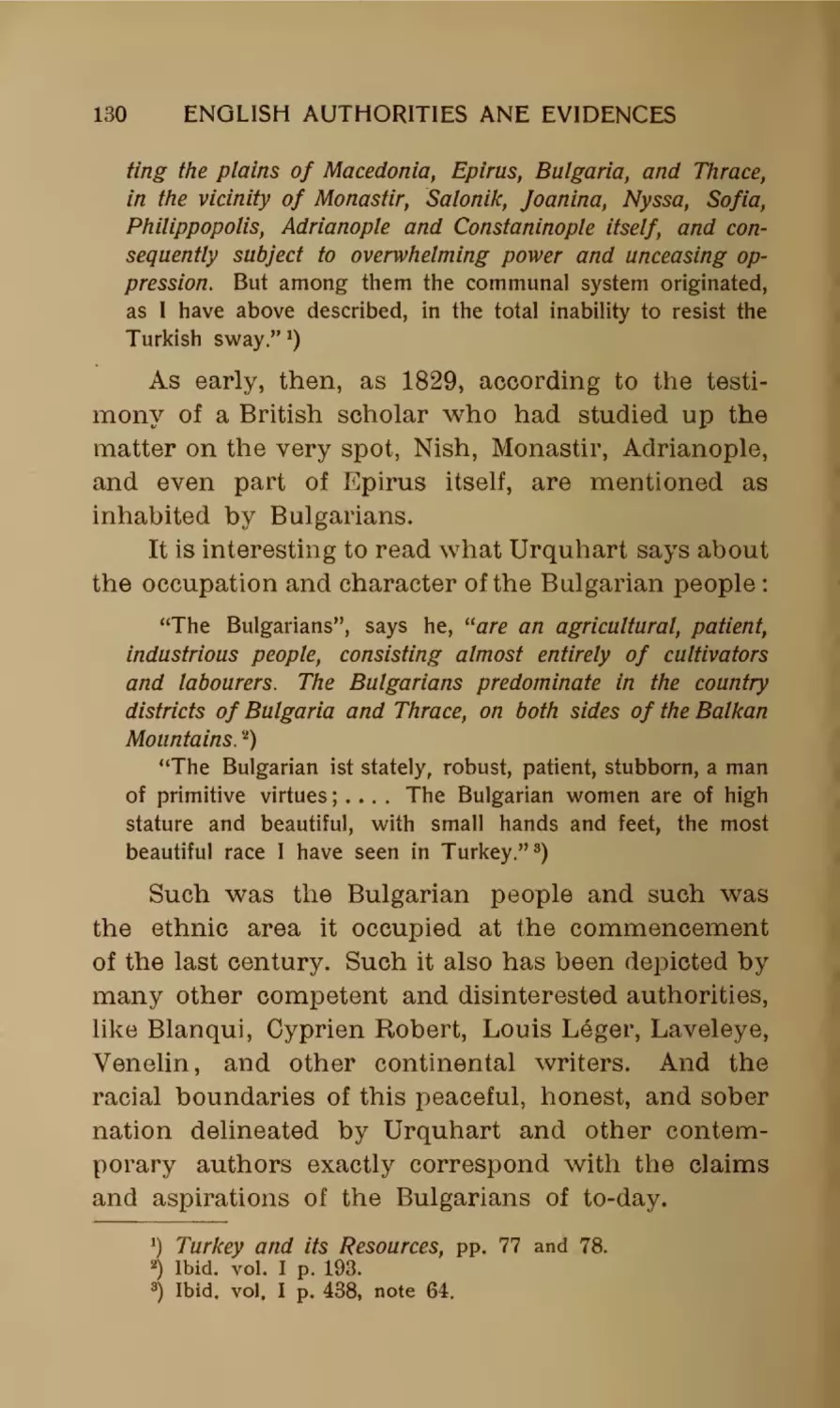
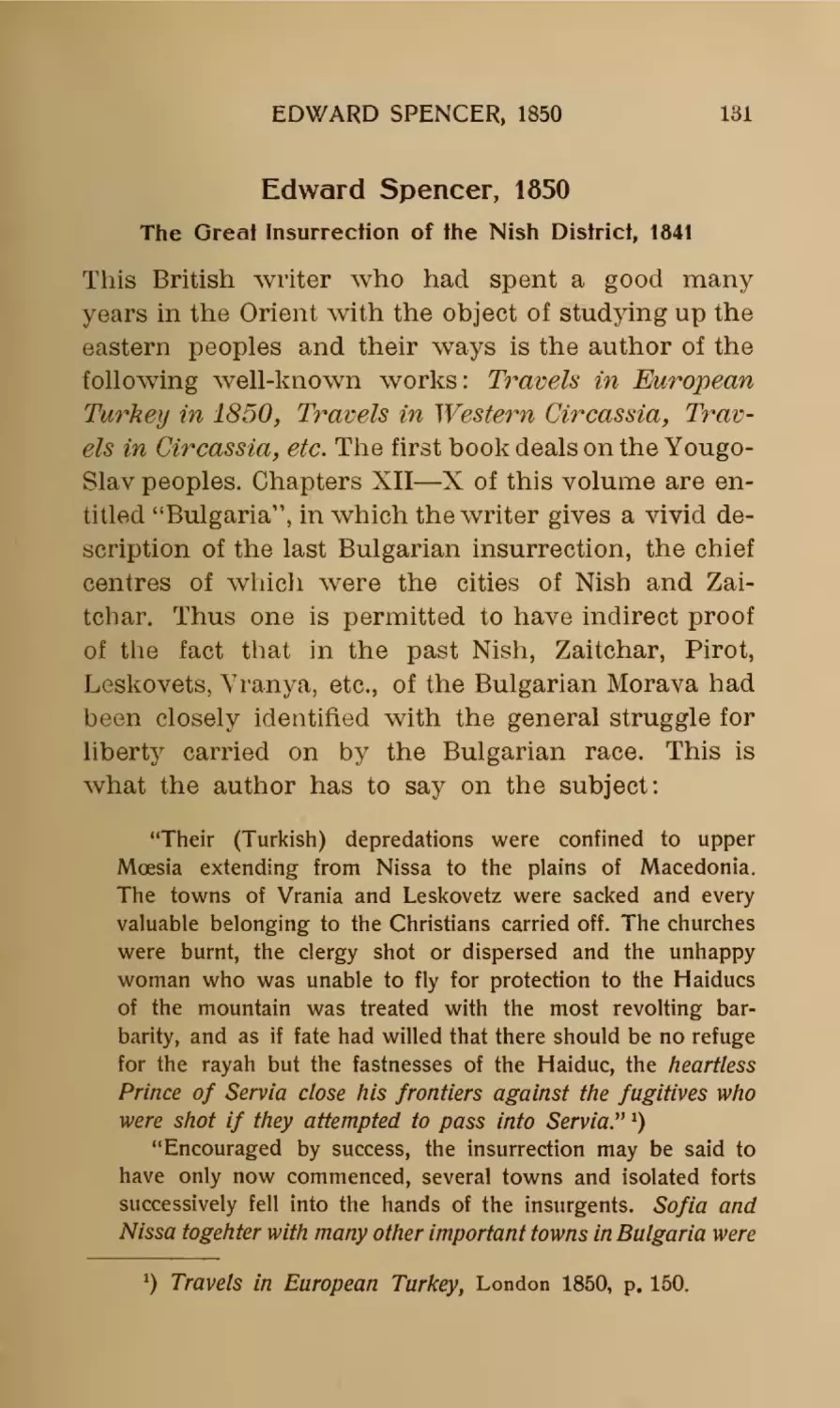
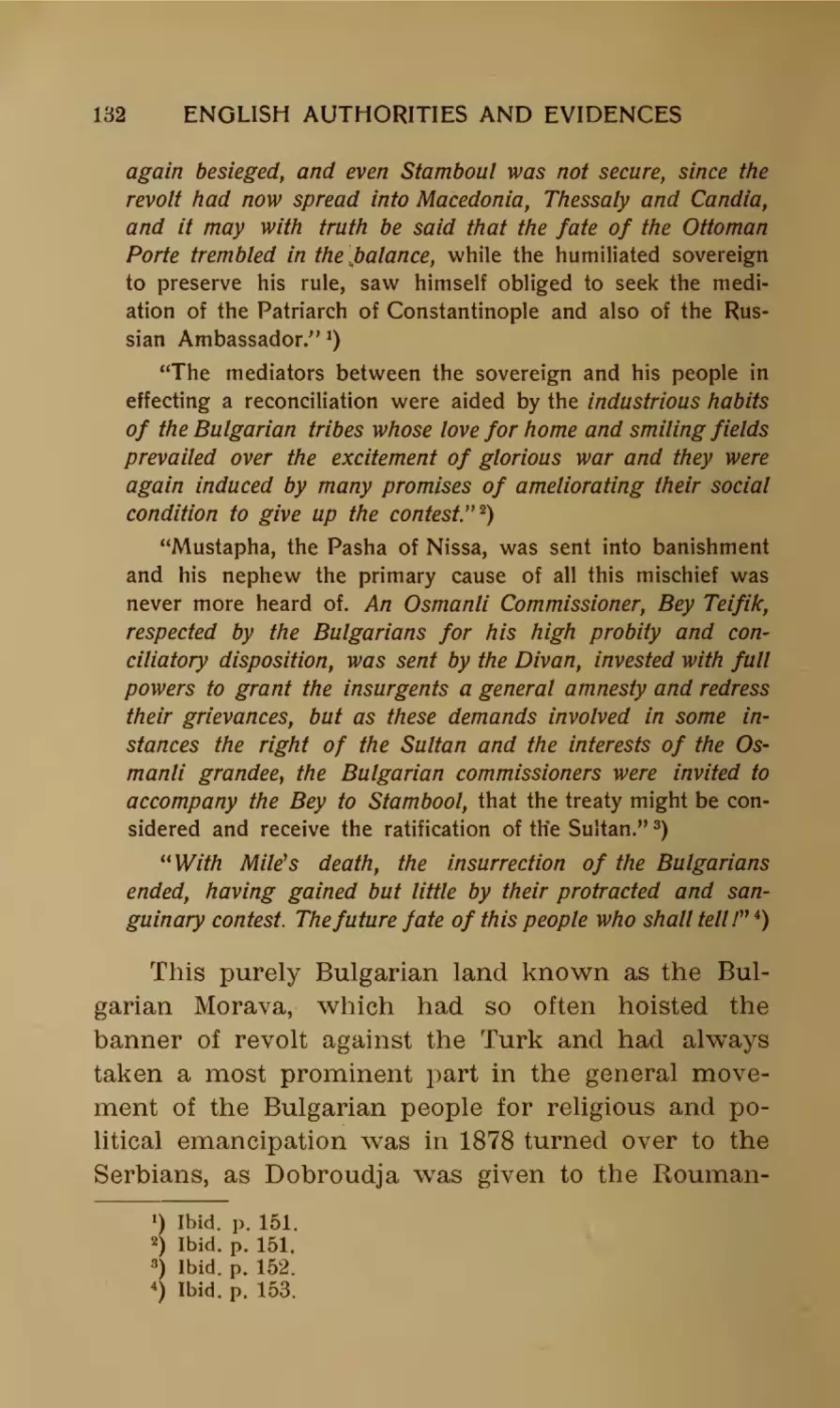
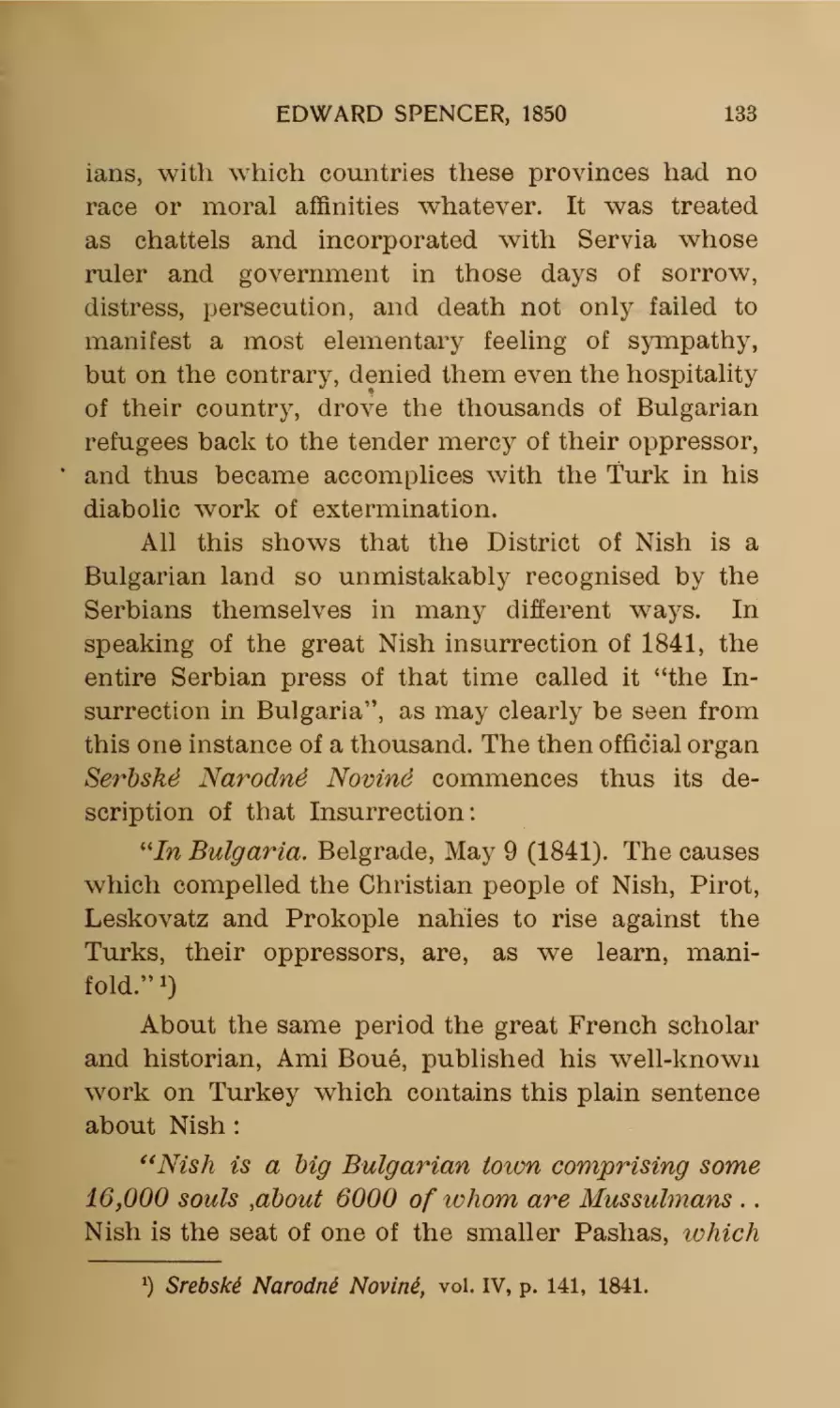
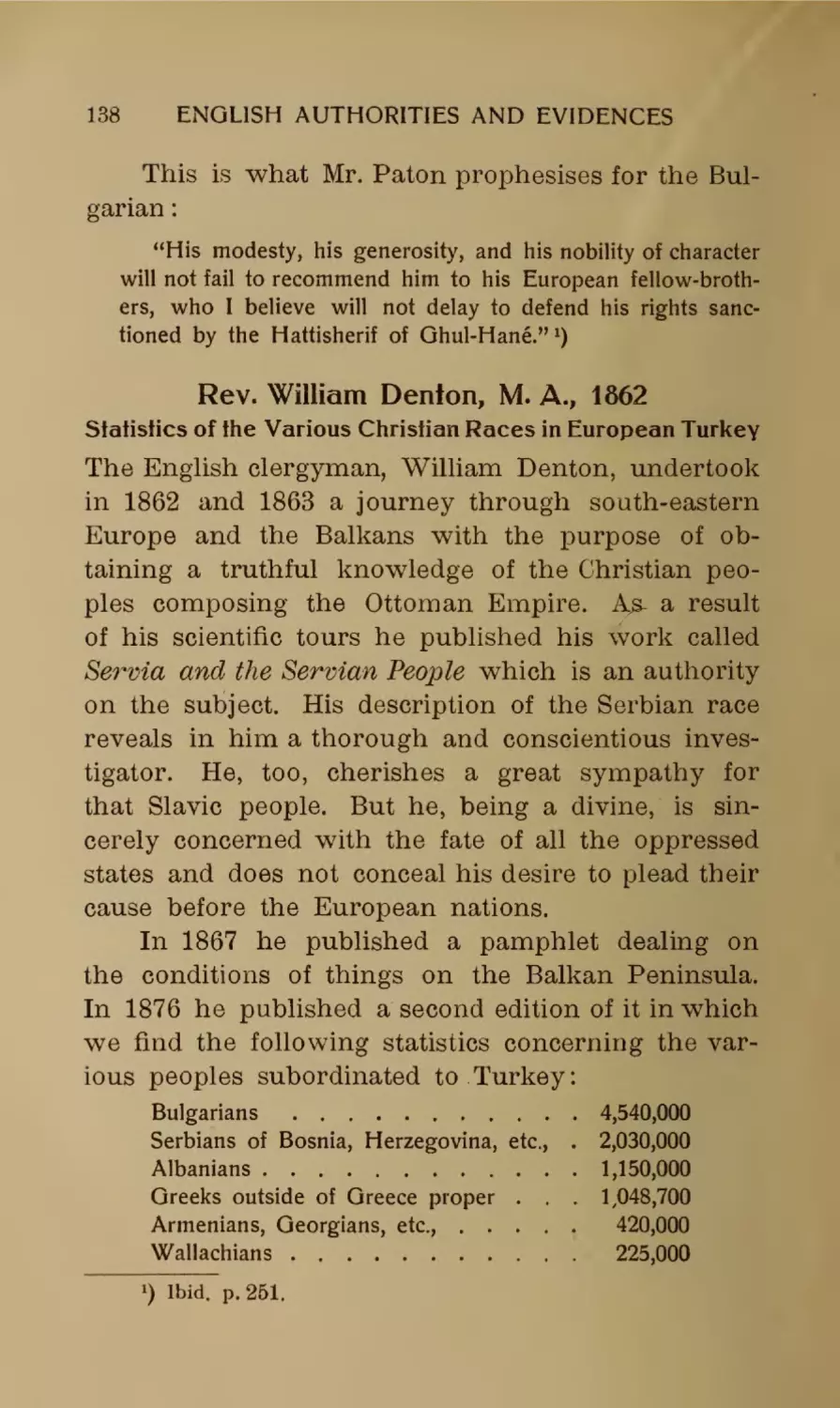
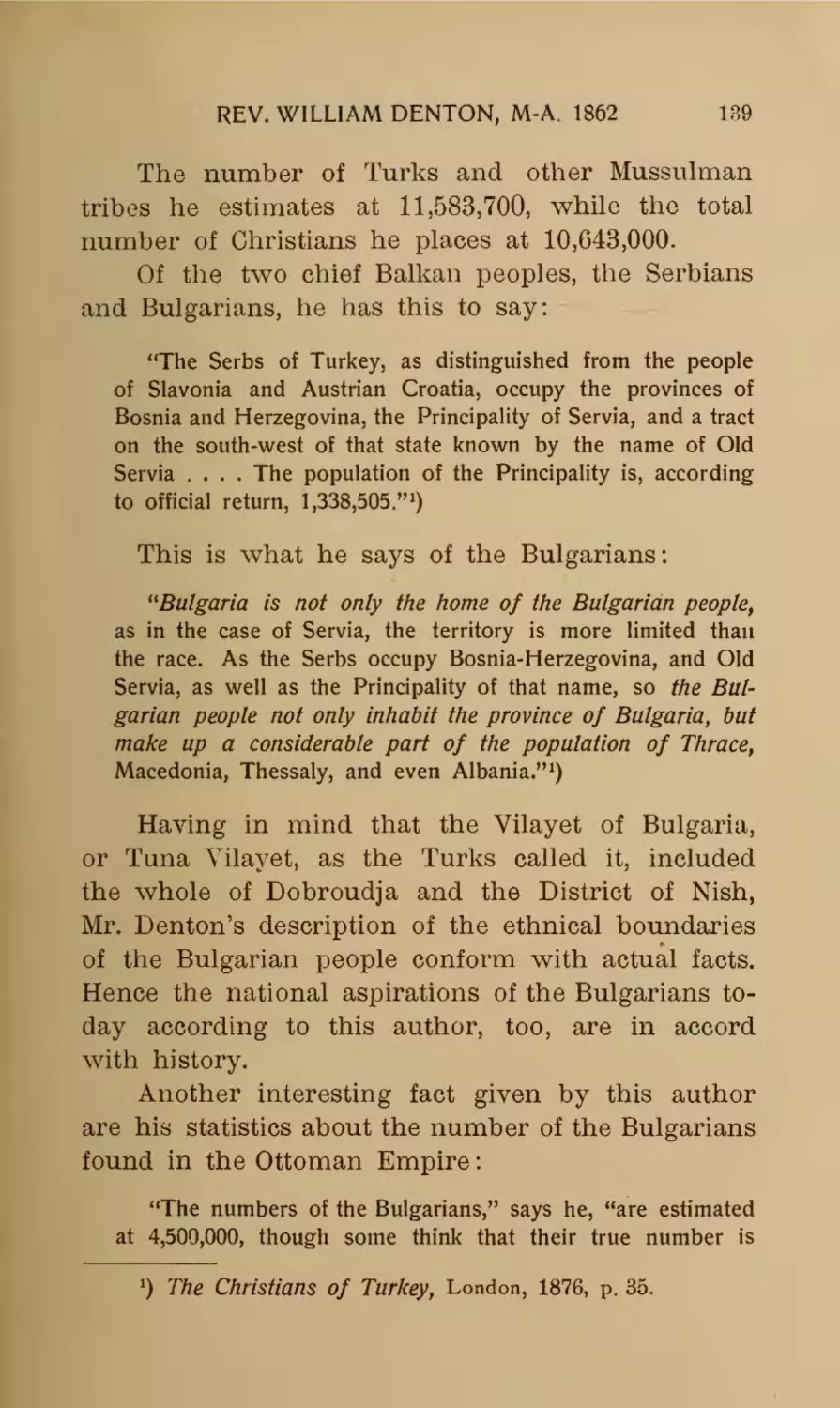
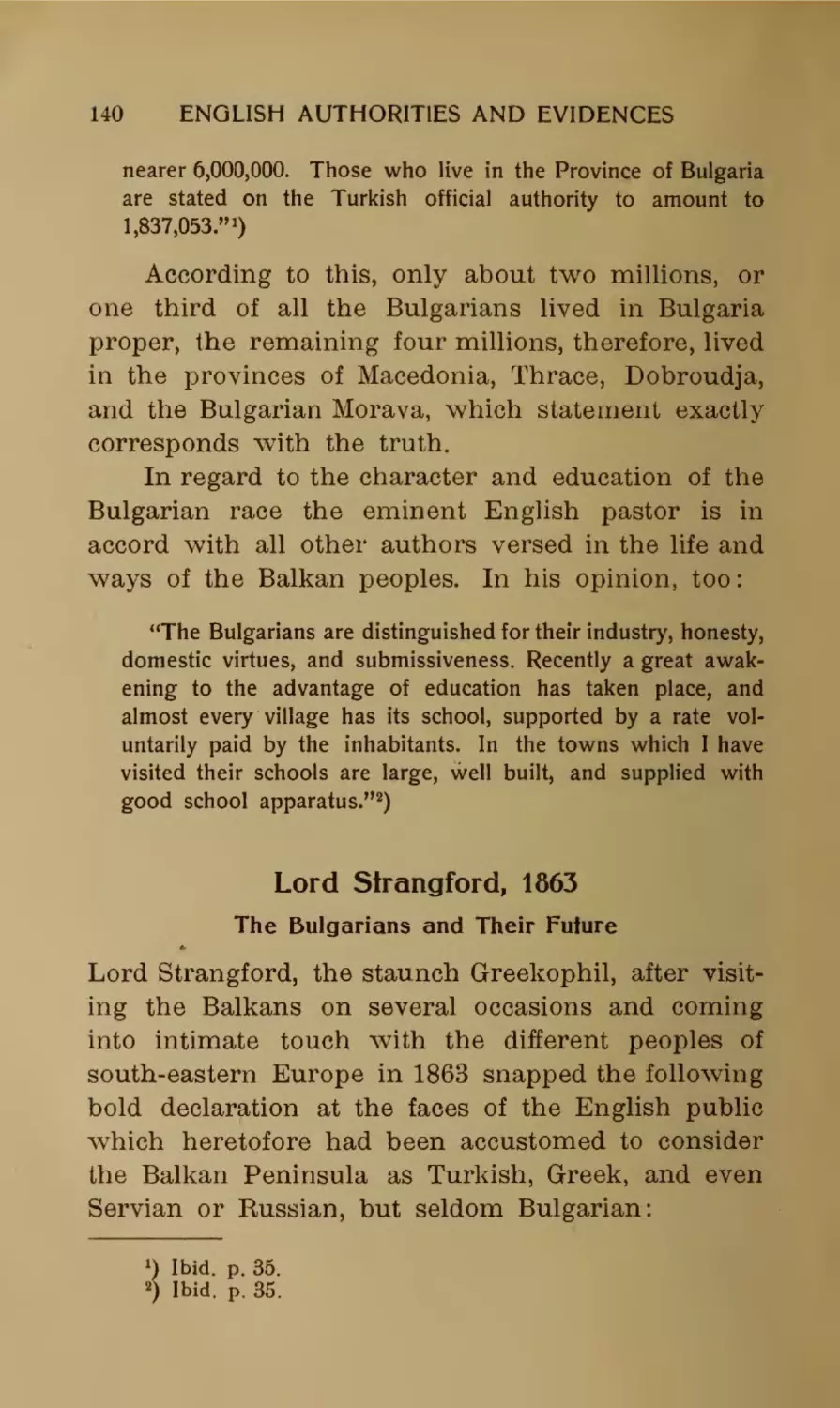
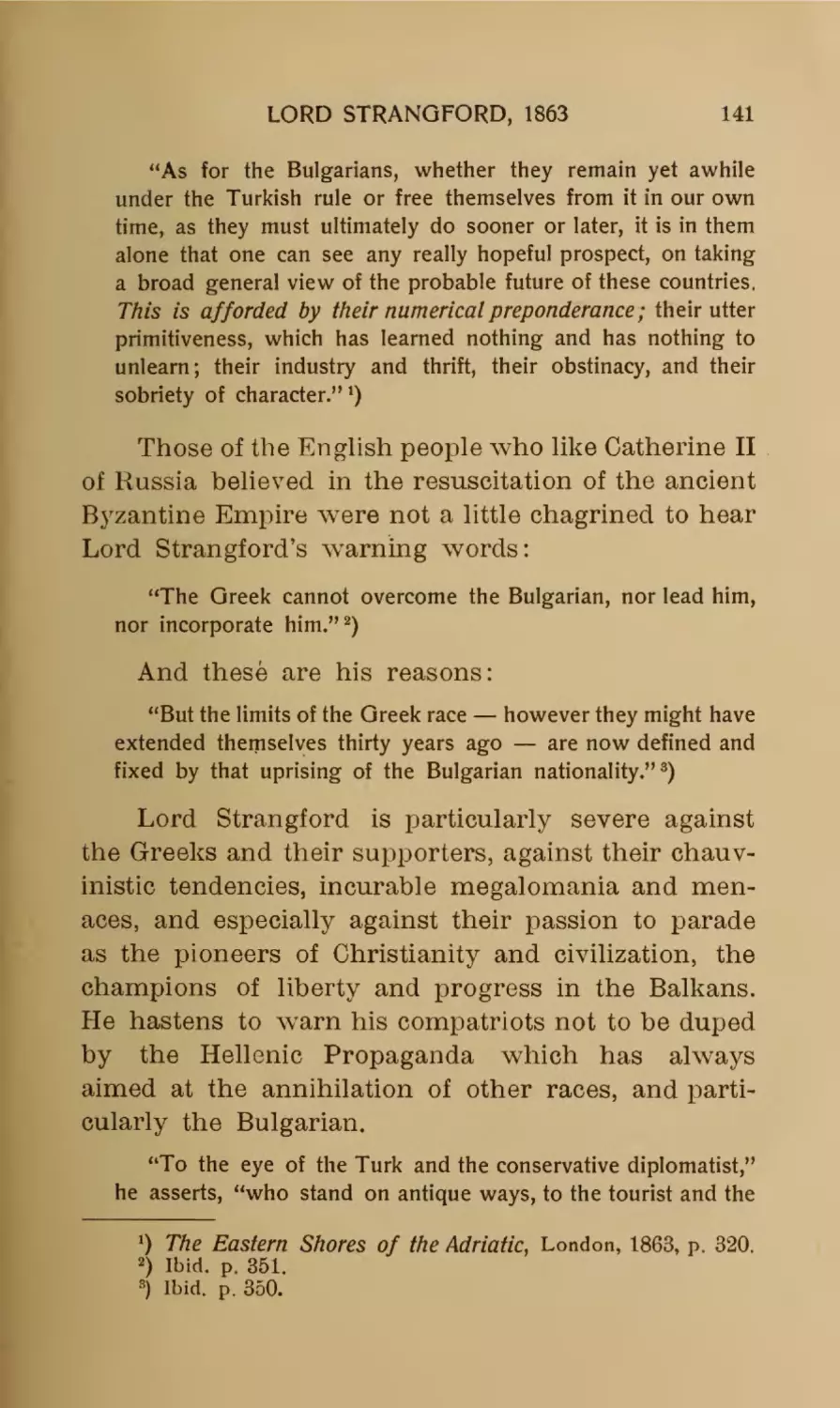

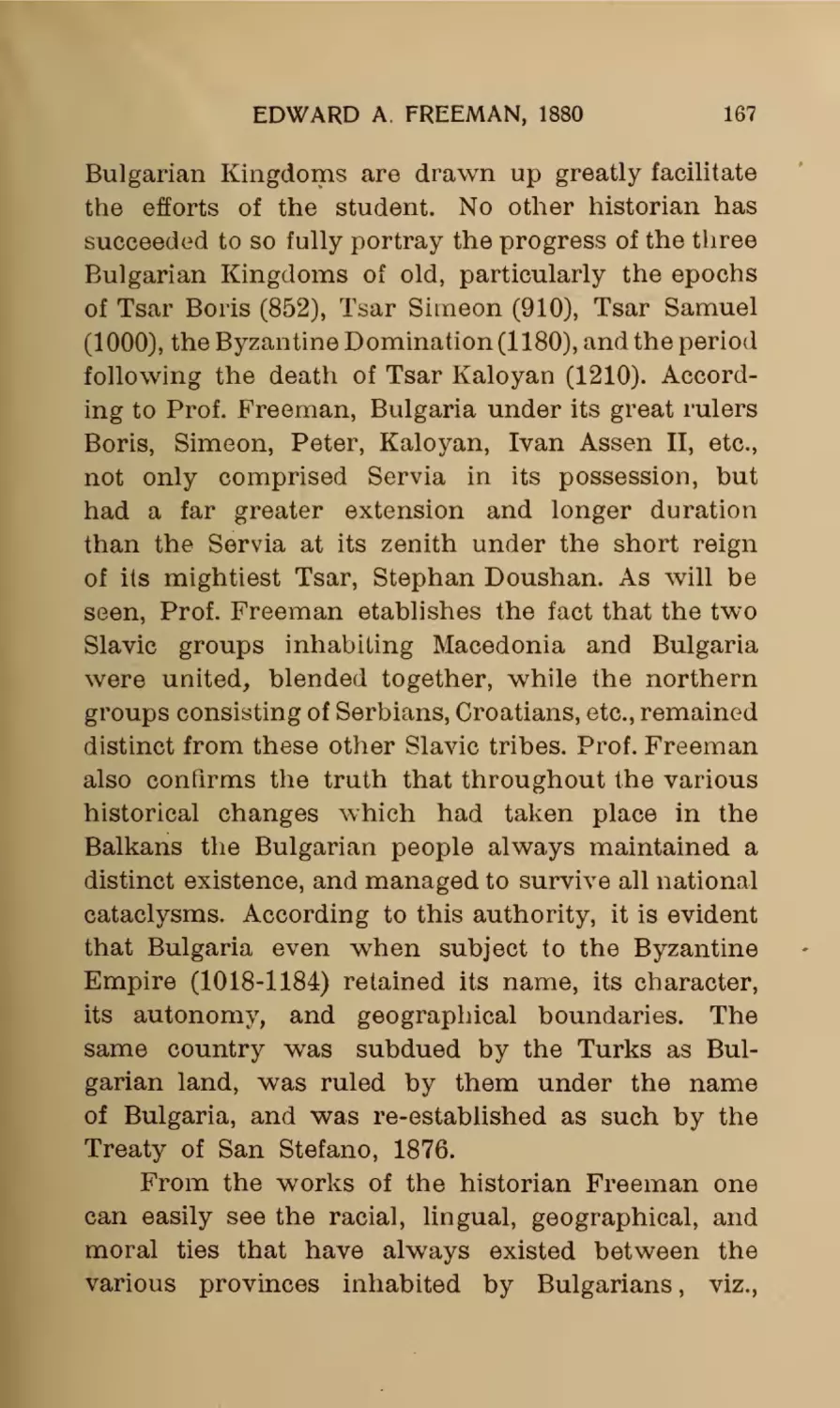
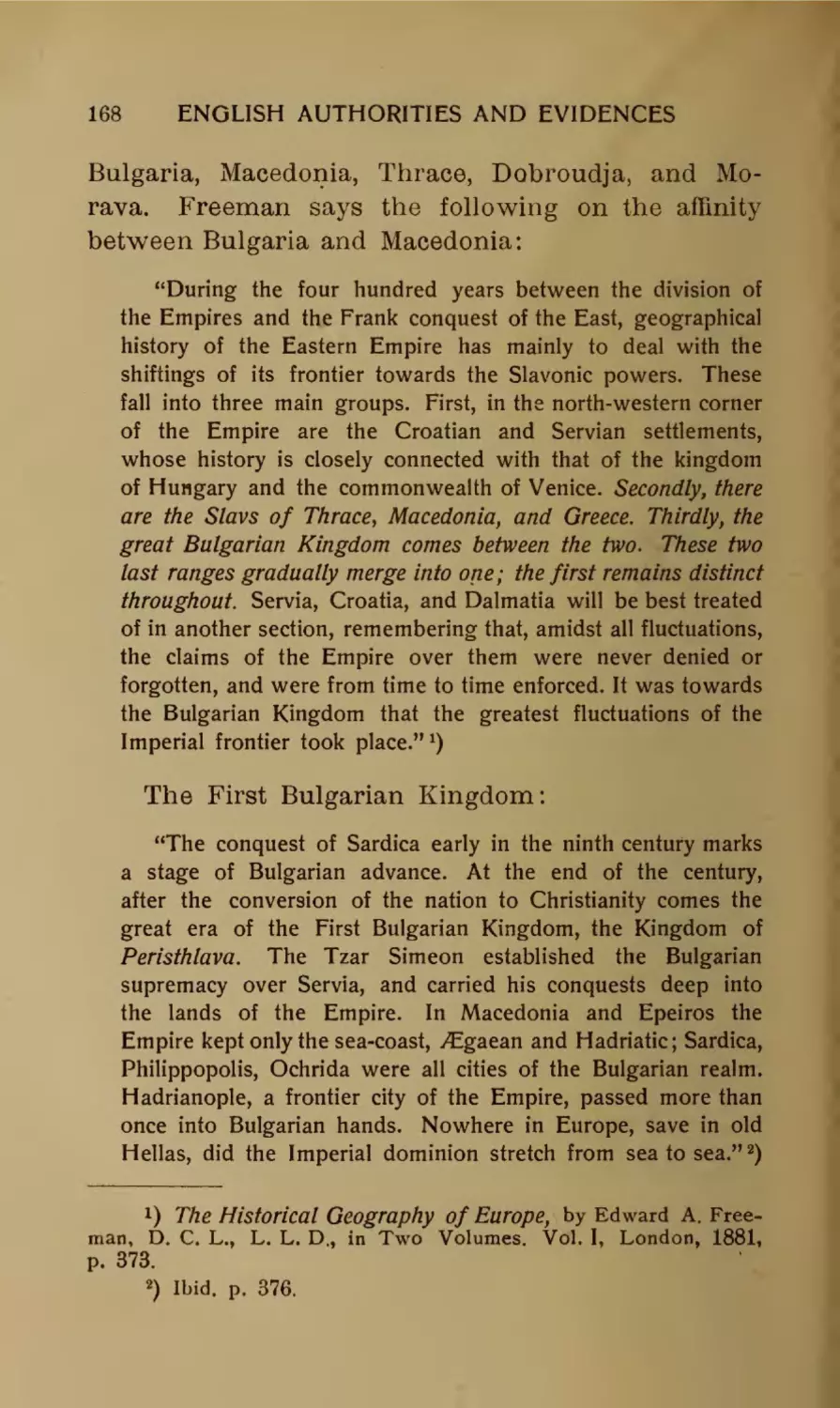
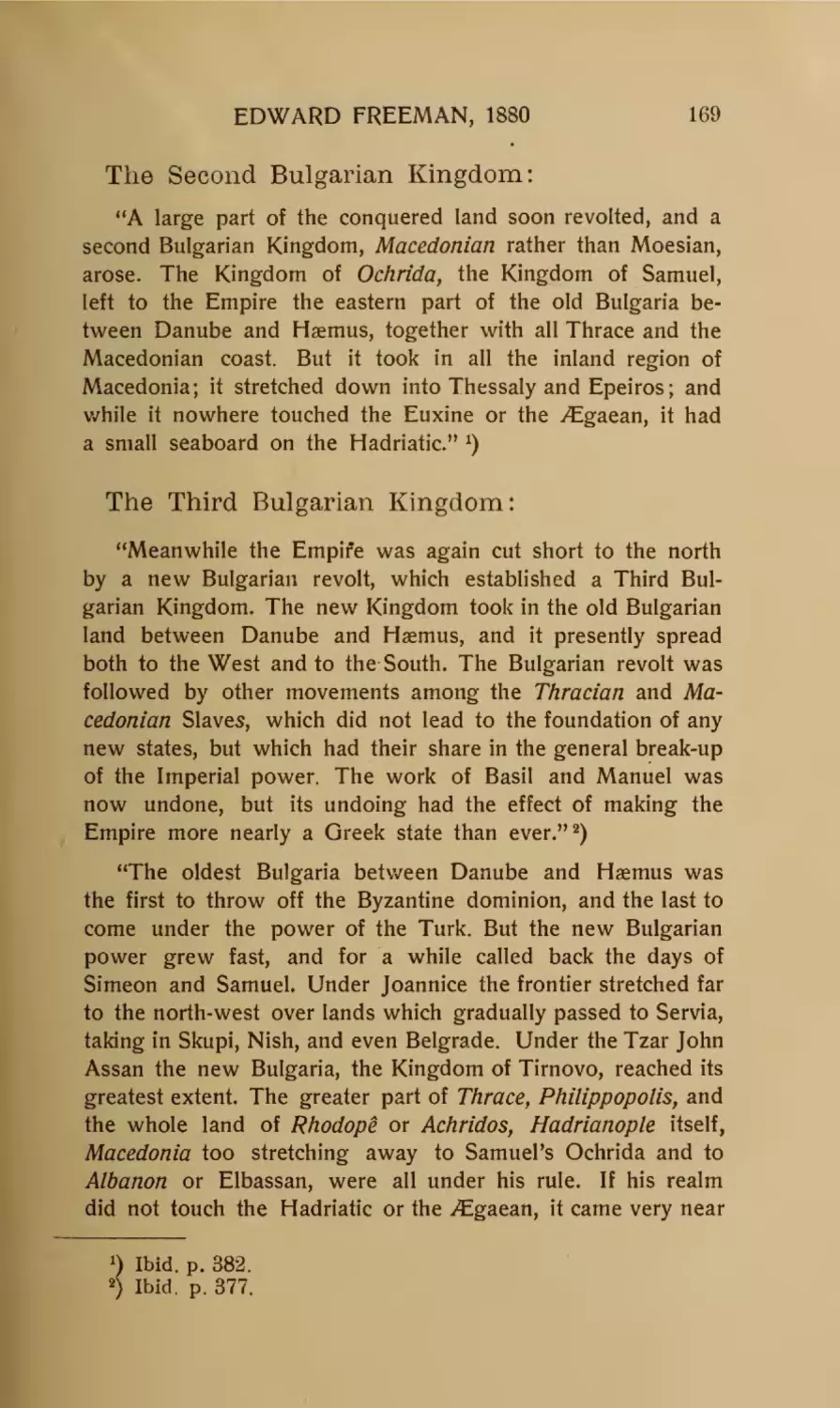
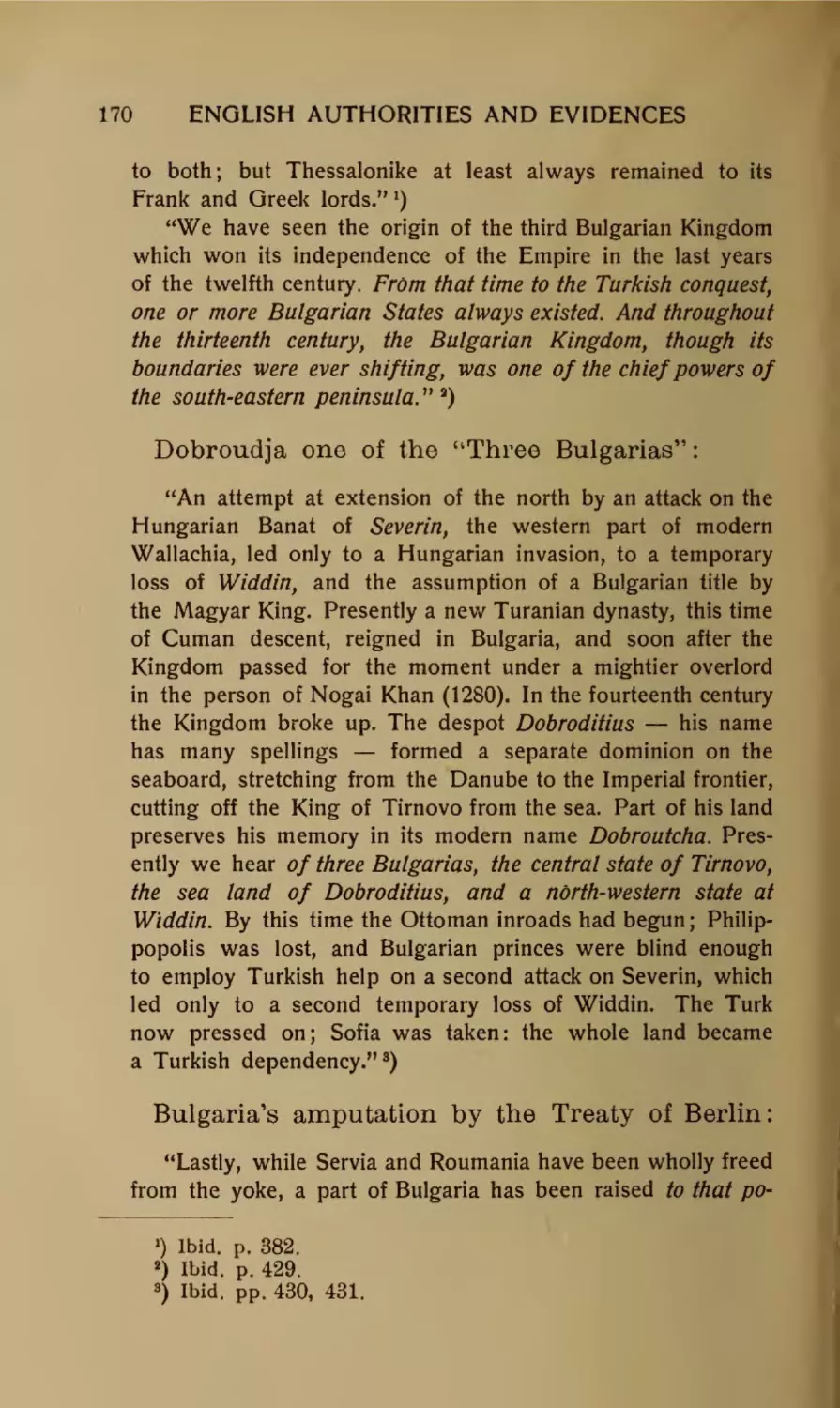












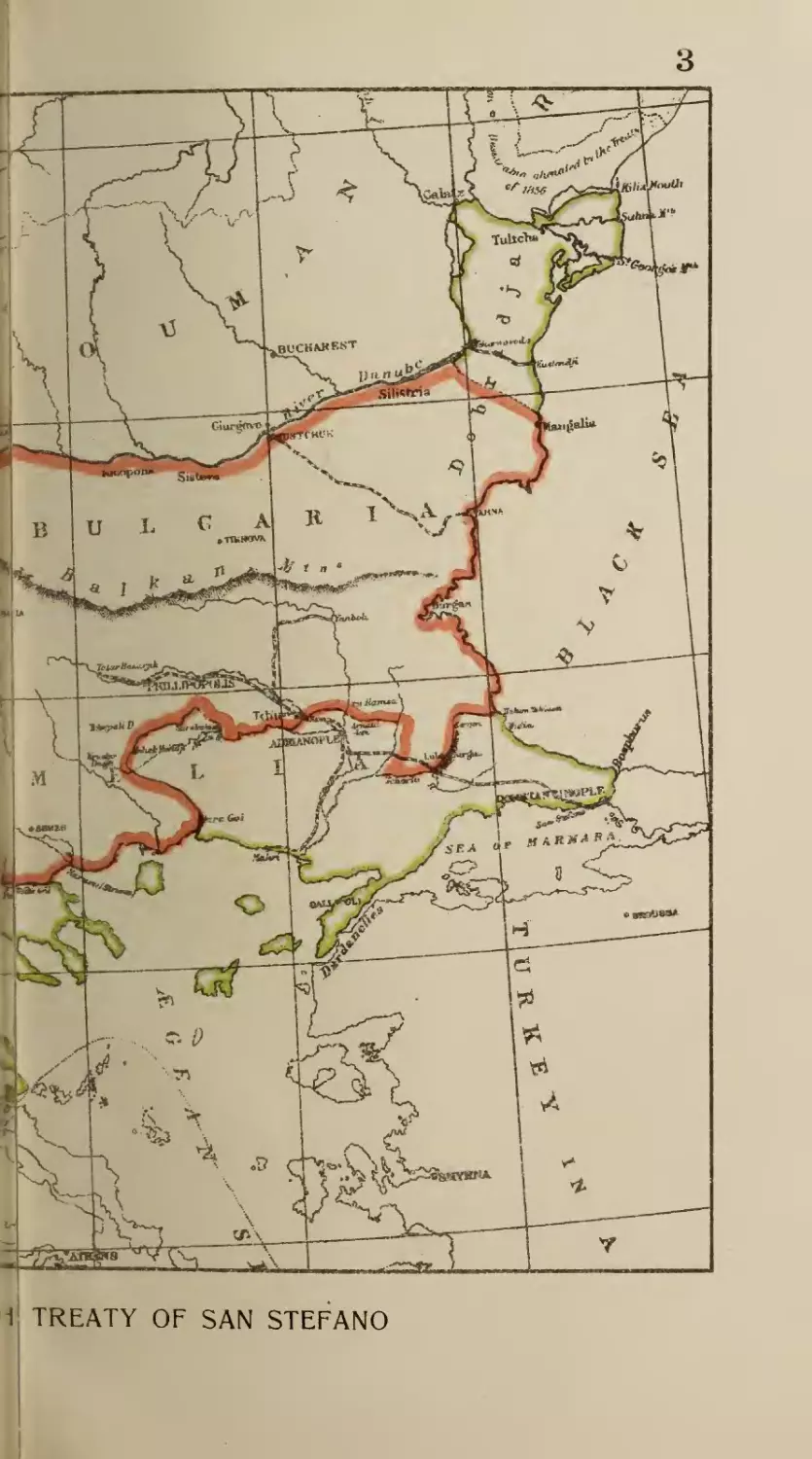


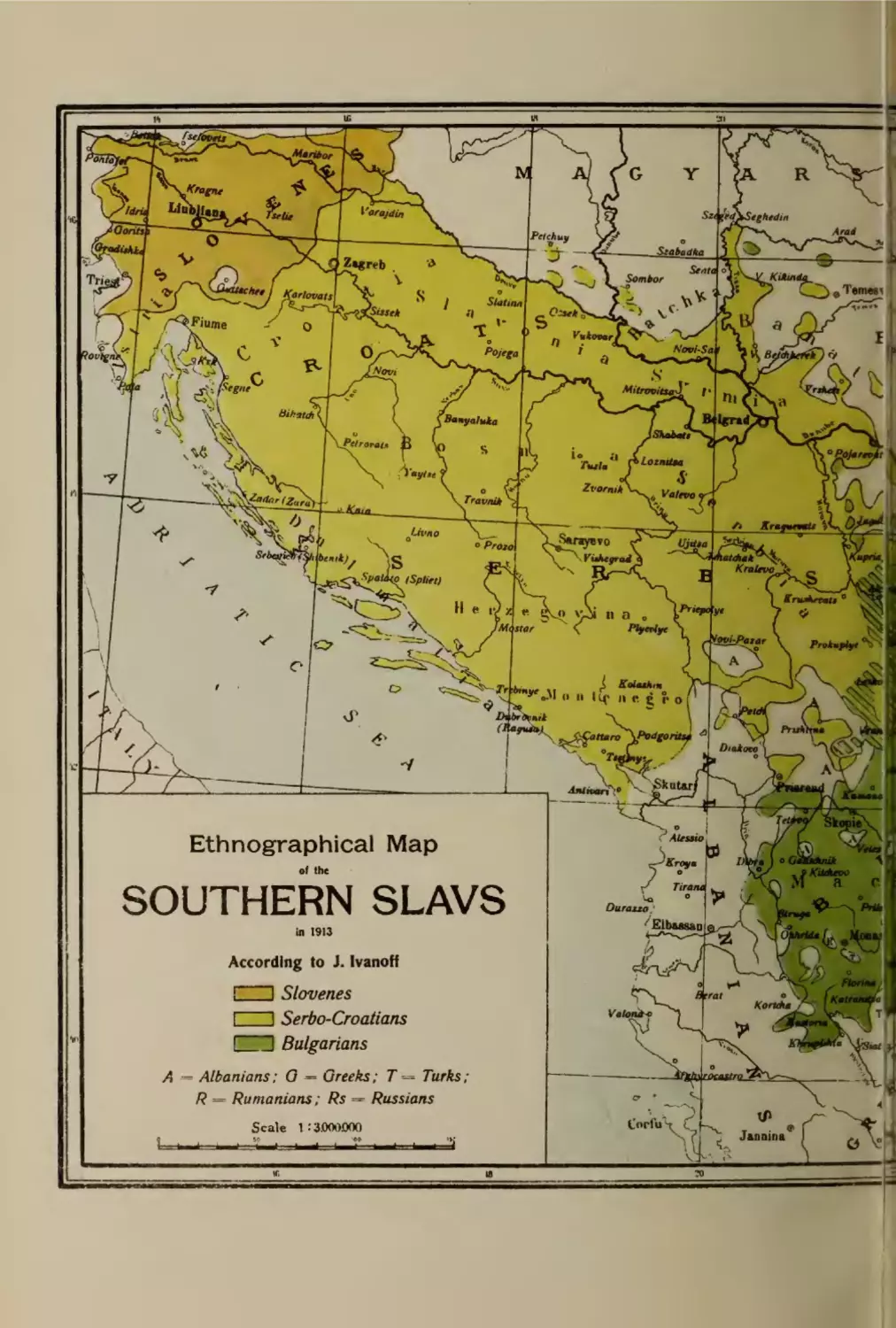
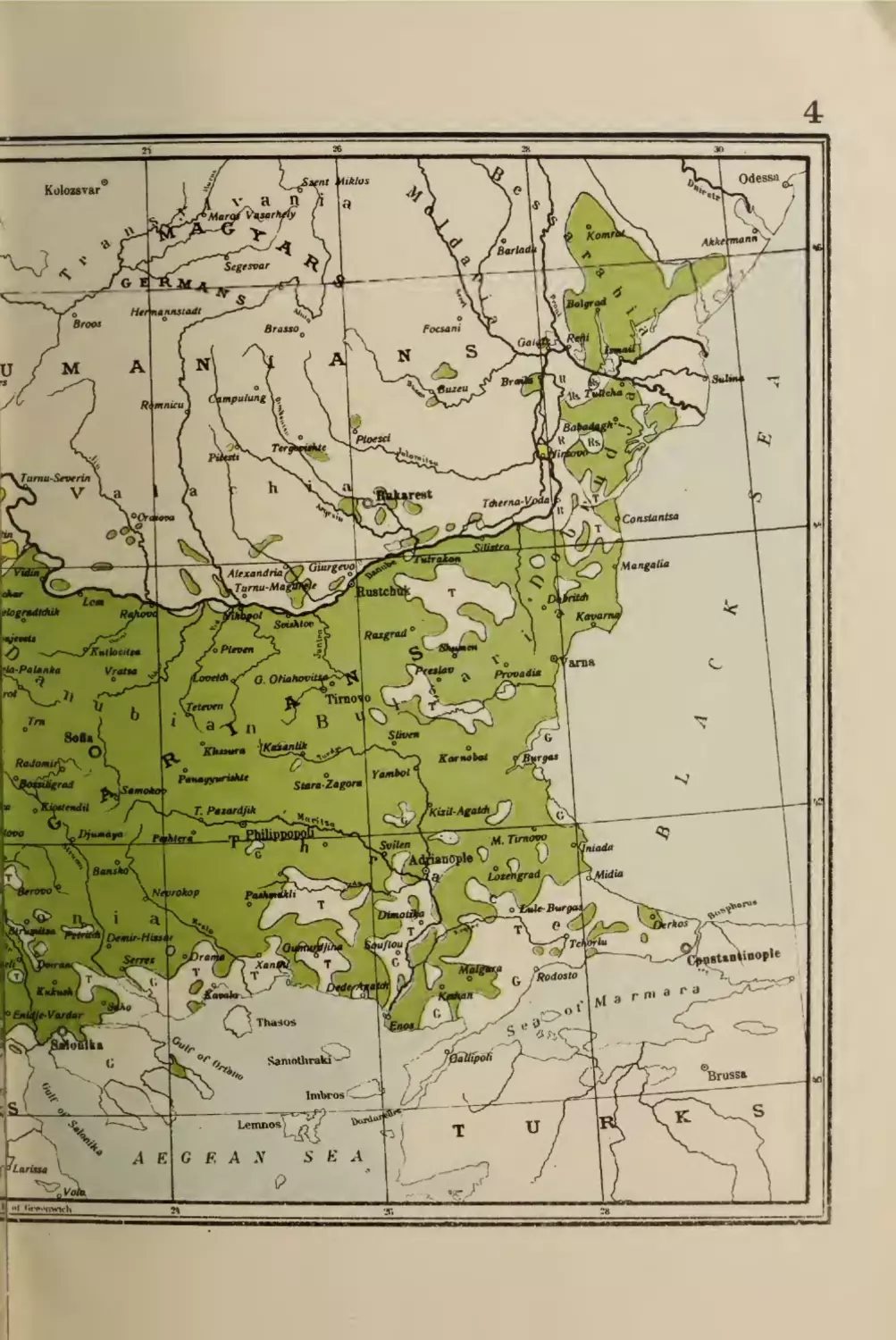


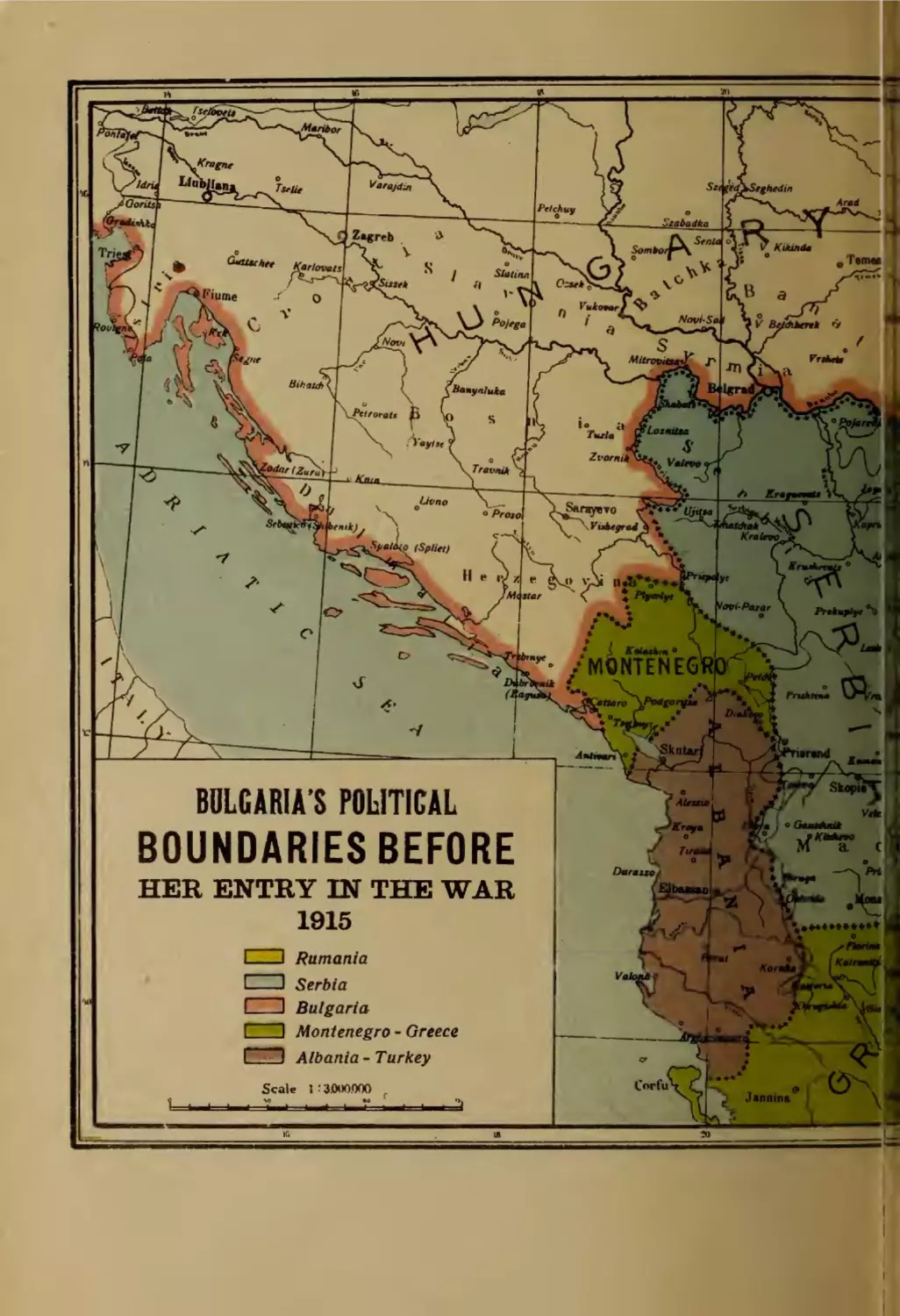




Автор: Stephanove C.
Теги: history ancient history anglo-saxons bulgarians history of peoples
Год: 1919


Текст
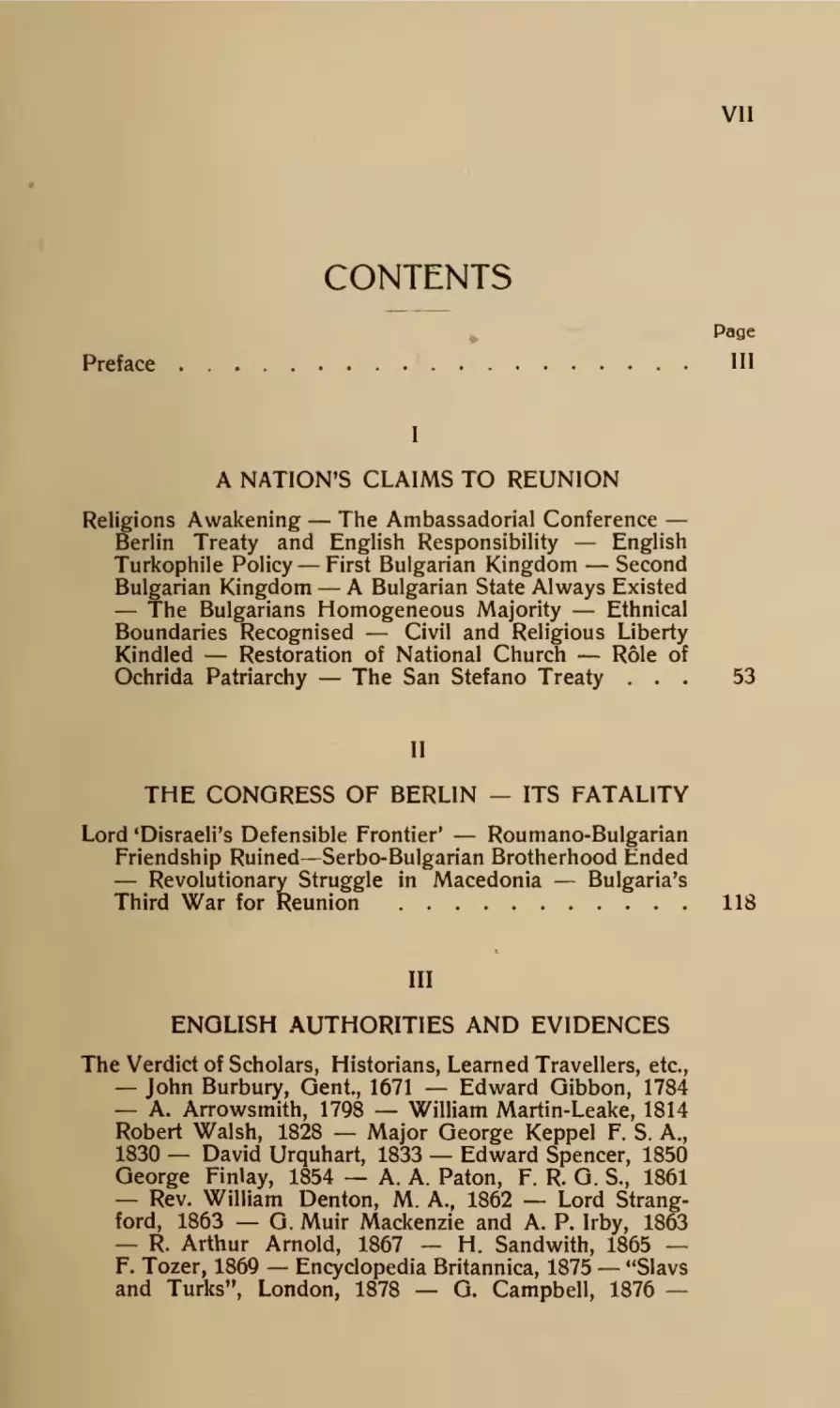
S
THE BULGARIANS
ANGLO SAXONDOM
AND
BY
CONSTANTINE STEPHANOVE, M.A.
(FELLOW OF THE AMERICAN GEOGRAPHICAL SOCIETY)
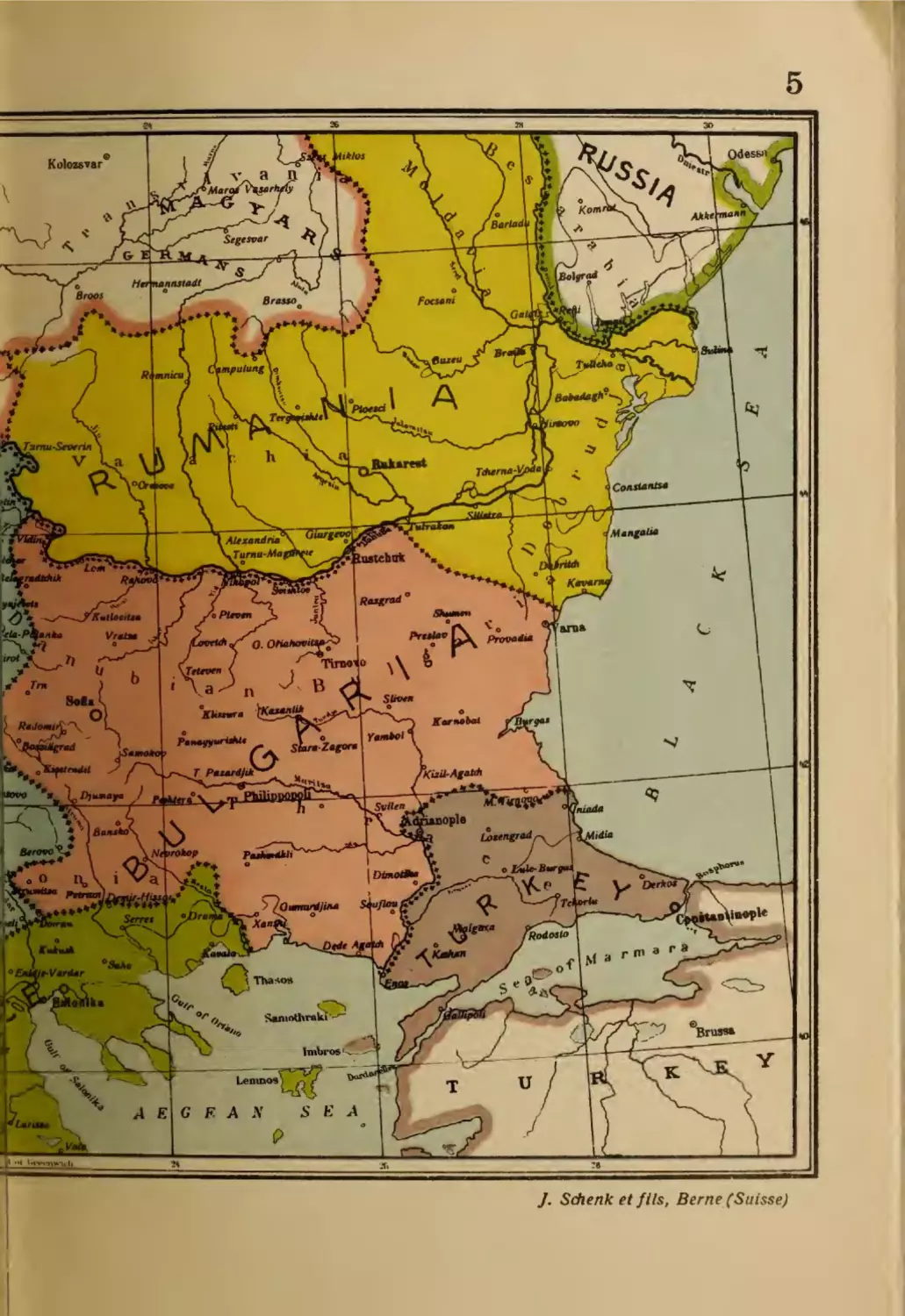
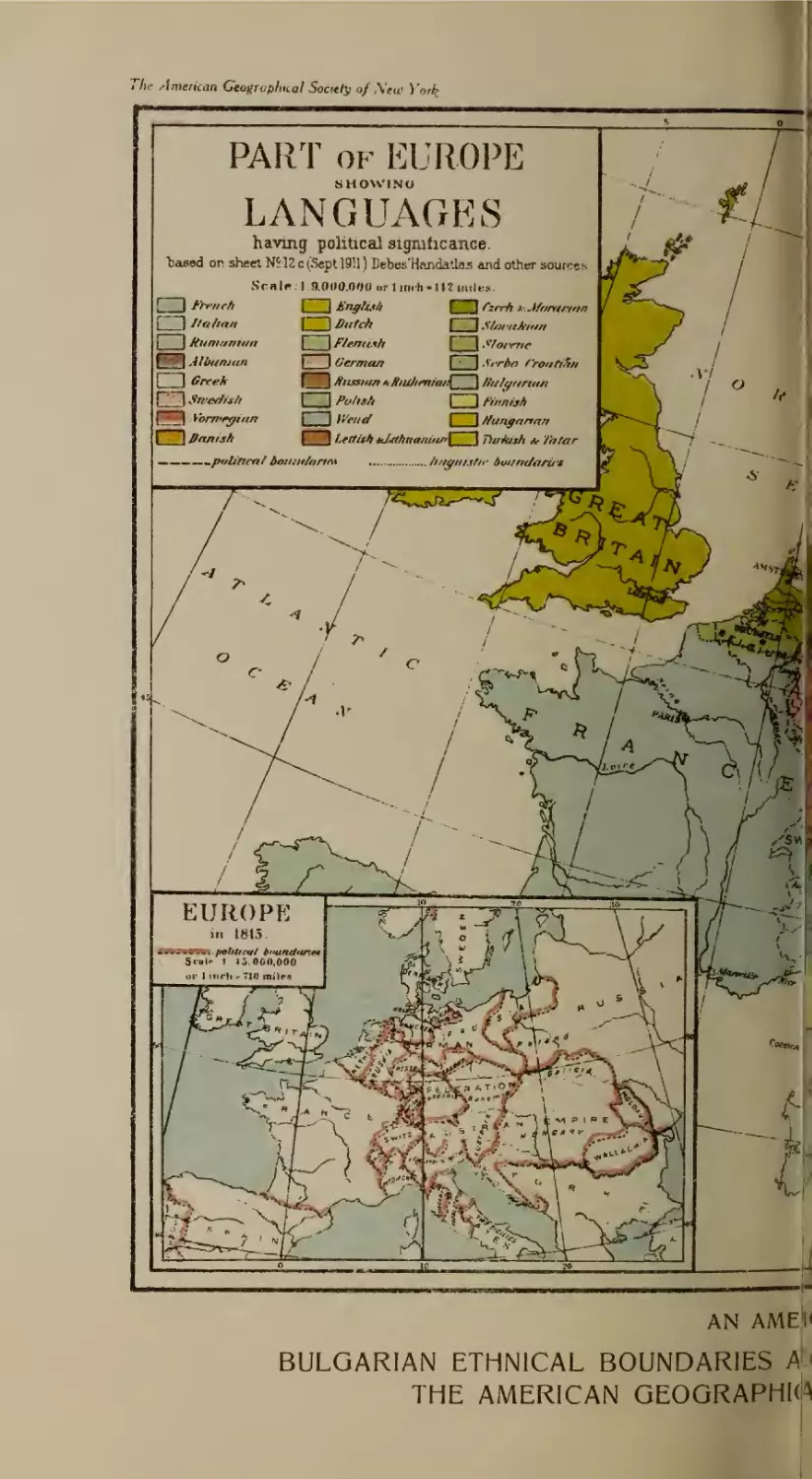
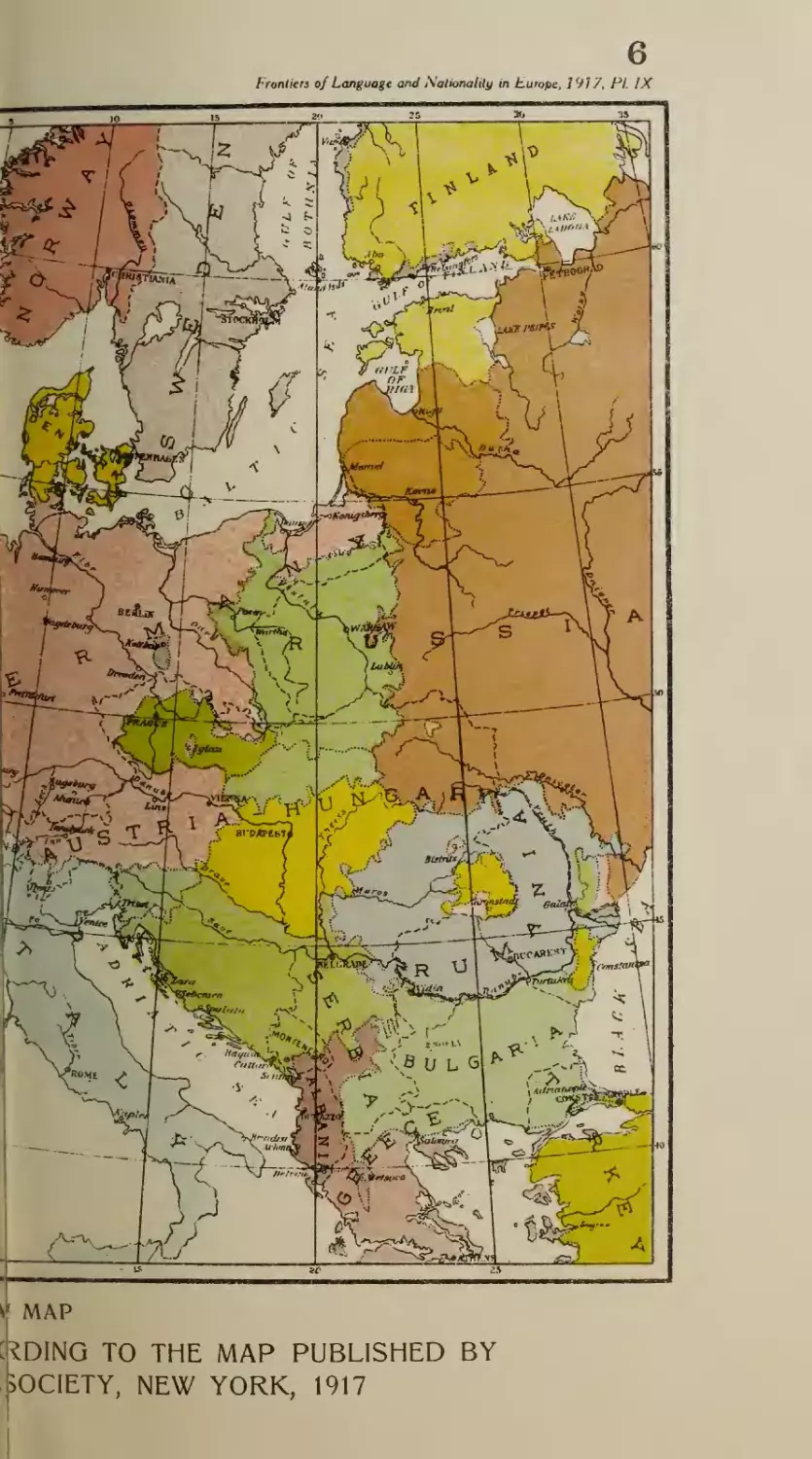
WITH MAPS
Americans have just cause to feel proud that
Robert College gave to many of the leading
Bulgarian citizens their education, so that it has
played a peculiar part in the making of the
— Theodore Roosevelt.
Bulgarian nation.
In the face of British opposition to coercing Bulgaria, the Sultan abandoned his resistance to
-
the union (of 1685).
Sir Valentine Chirol.
America looks upon Bulgaria, as in large part
her creation, and that of England.
—
The History
of Bulgaria
ican history.
—
Sir Edwin Pears.
a repetition of AmerD. M. Markham, M. A.
is
The Bulgarians have proved the most responsive to American Christian influences of any
- Ed. B. Haskell, D. D.
Balkan people.
Bulgaria
is
a
faithful pupil
teacher.
other great American
—
D. Misheff.
The Bulgarians are the Yankees of the Balkans.
(General saying).
Mr. Robert founder of Robert College died without knowing he had played an important part
in founding a new state in Europe.
George B. Washburn, D. D.
BERNE
PAUL HAUPT, LIBRAIRIE ACADEMIQUE
1919
THE BULGARIANS AND
ANGLO-SAXONDOM
THE BULGARIANS
ANGLO SAXONDOM
AND
BY
CONSTANTINE STEPHANOVE, M.A.
(FELLOW OF THE AMERICAN GEOGRAPHICAL SOCIETY)
WITH MAPS
Americans have just cause to feel proud that
Robert College gave to many of the leading
Bulgarian citizens their education, so that it has
played a peculiar part in the making of the
Bulgarian nation.
Theodore Roosevelt.
—
In the face of British opposition to coercing Bulgaria, the Sultan abandoned his resistance to
the union (of 1885).
Sir Valentine Chirol.
-
America looks upon Bulgaria, as in large part
her creation, and that of England.
—
The History
of Bulgaria
ican history.
—
Sir Edwin Pears.
a repetition of AmerD. M. Markham, M. A.
is
The Bulgarians have proved the most responsive to American Christian influences of any
- Ed. B. Haskell, D. D.
Balkan people.
Bulgaria
is
a
faithful pupil of
teacher.
her great American
— D. Misheff.
The Bulgarians are the Yankees of the Balkans.
(General saying).
Mr. Robert founder of Robert College died without knowing he had played an important part
in founding a new state in Europe.
George B. Washburn, D. D.
BERNE
PAUL HAUPT, LI5RAIRIE ACADEMIQUE
1919
rights
reserved
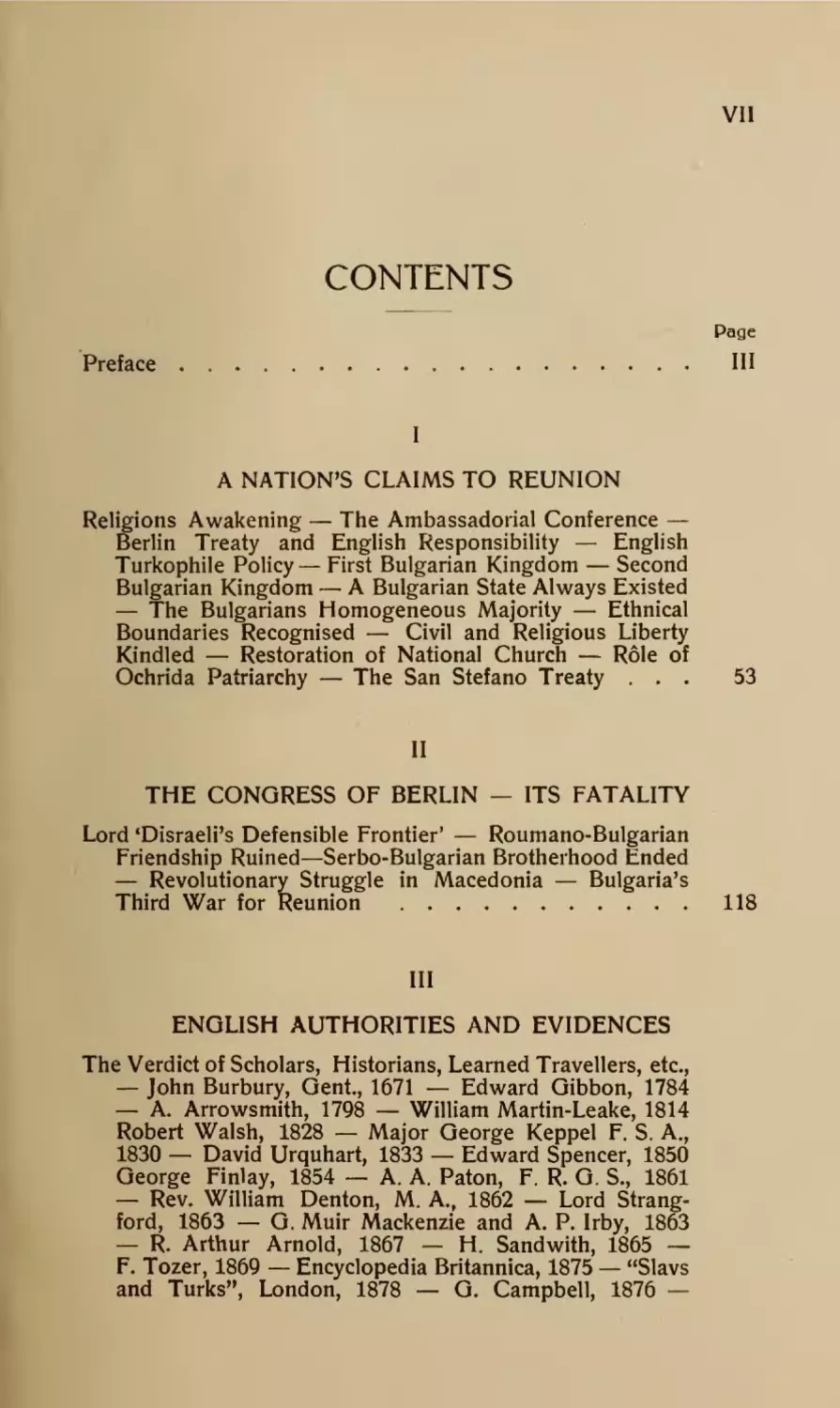
PREFACE
The present volume
thor's
is
memorandum
what systematised.
an enlargement
The aim
bring to the reader's notice
datas,
and
facts
of the au-
notes on the subject,
in
some-
view has been
some
salient
to
events,
connected with the historic march
towards awakening, independence, and race union
—the
—looked
upon chiefly
through the eyes of English and American authorities.
It is surprising what an extensive literature
of
a nation
exists in English
of course,
all
Bulgarian
on the question
to
Anglo-Saxon sources extant, but so
been
at his
command
is
The
treated.
has not been in a position
writer,
draw from
much
as has
believed to be sufficient to
prove as legitimate the territories in the Balkan
Peninsula, occupied and claimed by the Bulgarians,
to
which they are
entitled historically,
ically,yinguistically, geographically,
ethnograph-
and morally.
The Author.
).
SCHENK
Imprimerie
FILS, BERNE
Lilhographie
1919
et
-
VII
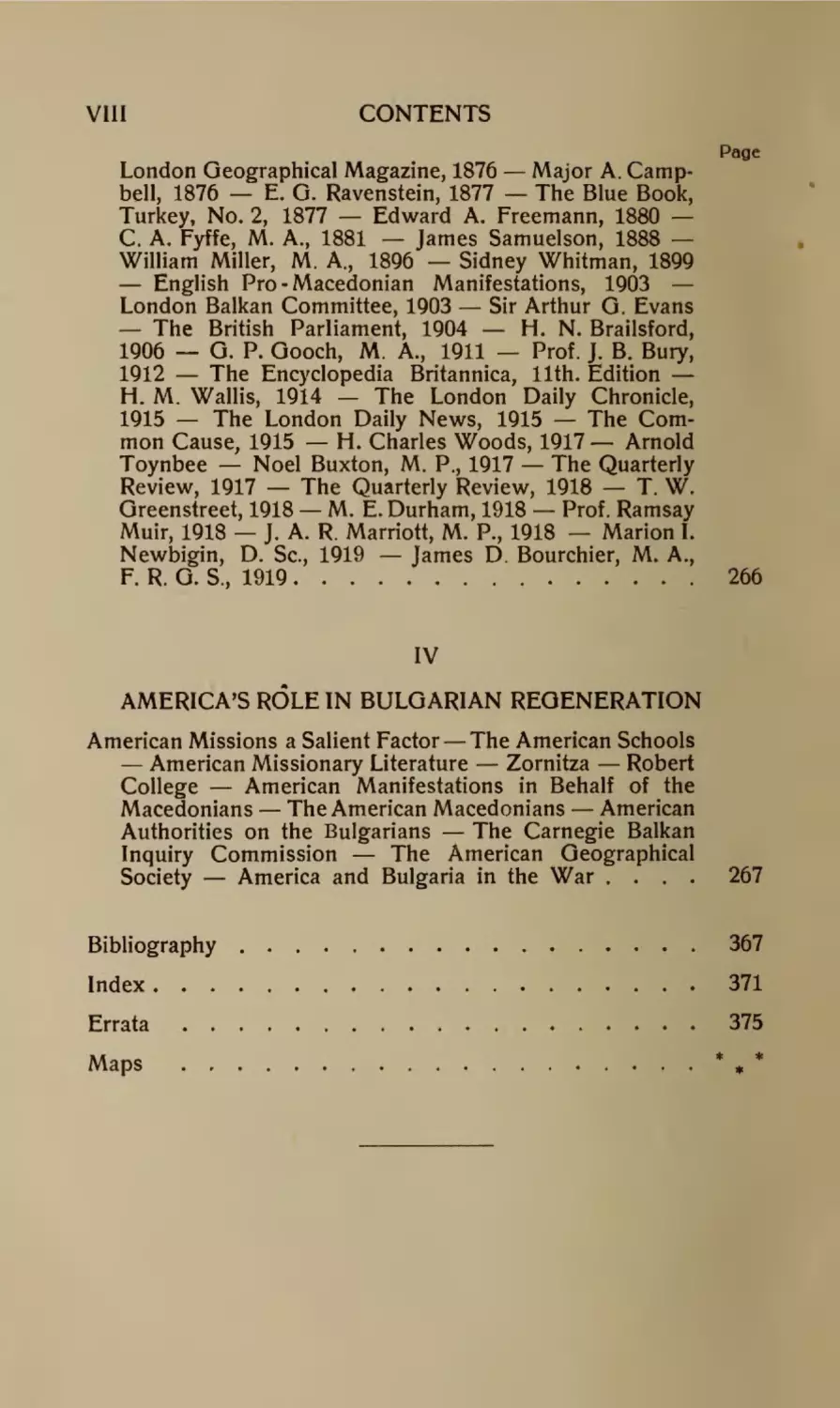
CONTENTS
Page
Preface
Ill
I
A NATION'S CLAIMS TO REUNION
Religions
Berlin
— The Ambassadorial Conference —
—
—
—
—
—
—
—
—
...
Awakening
English
Treaty and English Responsibility
Second
Turkophile Policy
First Bulgarian Kingdom
Bulgarian Kingdom
A Bulgarian State Always Existed
Ethnical
The Bulgarians Homogeneous Majority
Civil and Religious Liberty
Boundaries Recognised
Kindled
Restoration of National Church
Role of
Ochrida Patriarchy
The San Stefano Treaty
—
—
53
II
THE CONGRESS OF BERLIN
—
ITS
FATALITY
—
Roumano-Bulgarian
'Disraeli's Defensible Frontier'
Friendship Ruined— Serbo-Bulgarian Brotherhood Ended
Bulgaria's
Revolutionary Struggle in Macedonia
Third War for Reunion
Lord
—
—
III
ENOLISH AUTHORITIES AND EVIDENCES
The Verdict of Scholars,
Historians, Learned Travellers,
etc.,
— John Burbury, Gent., 1671 — Edward Gibbon, 1784
— A. Arrowsmith, 1798 — William Martin-Leake, 1814
Robert Walsh, 1828 — Major George Keppel F.
A.,
1830 — David Urquhart, 1833 — Edward Spencer, 1850
George Finlay, 1854 — A. A. Paton, F. R. G.
1861
— Rev. William Denton, M. A., 1862 — Lord Strangford, 1863 — G. Muir Mackenzie and A. P. Irby, 1863
— R. Arthur Arnold, 1867 — H. Sandwith, 1865 —
F. Tozer, 1869 — Encyclopedia Britannica, 1875 — "Slavs
and Turks", London, 1878 — G. Campbell, 1876 —
S.
S.,
118
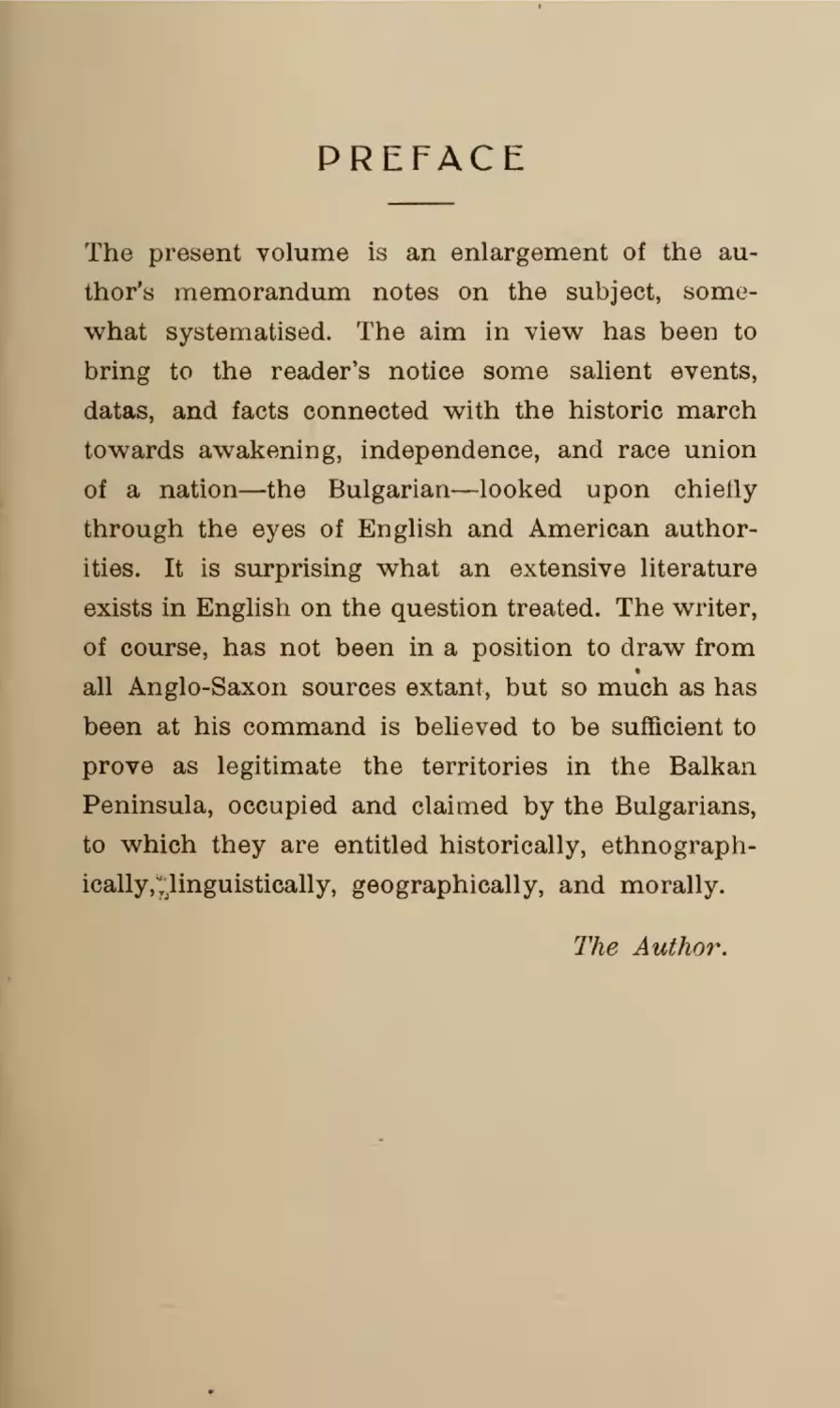
CONTENTS
VIII
— Major A. Camp1876
E. G. Ravenstein, 1877 — The Blue Book,
Turkey, No.
1877 — Edward A. Freemann, 1880 —
C. A. Fyffe, M. A., 1881 — James Samuelson, 1888 —
William Miller, M. A., 1896 — Sidney Whitman, 1899
— English Pro -Macedonian Manifestations, 1903 —
London Balkan Committee, 1903 — Sir Arthur G. Evans
— The British Parliament, 1904 — H. N. Brailsford,
1906 — G. P. Gooch, M. A., 1911 — Prof.
B. Bury,
1912 — The Encyclopedia Britannica, 11th. Edition —
H. M. Wallis, 1914 — The London Daily Chronicle,
1915 — The London Daily News, 1915 — The Common Cause, 1915 — H. Charles Woods, 1917 — Arnold
Toynbee — Noel Buxton, M.
1917 — The Quarterly
Review, 1917 — The Quarterly Review, 1918 — T. W.
Greenstreet, 1918 — M. E. Durham, 1918 — Prof. Ramsay
Muir, 1918 —
A. R. Marriott, M.
1918 — Marion
Newbigin, D.
1919 — James D. Bourchier, M. A.,
Page
London Geographical Magazine, 1876
—
bell,
2,
J.
P.,
P.,
J.
I.
Sc.,
F. R.
G.
S.,
266
1919
IV
AMERICA'S ROLE IN BULGARIAN REGENERATION
—
The American Schools
American Missions a Salient Factor
Zornitza
Robert
American Missionary Literature
American Manifestations in Behalf of the
College
American
The American Macedonians
Macedonians
The Carnegie Balkan
Authorities on the Bulgarians
Inquiry Commission
The American Geographical
America and Bulgaria in the War
Society
267
Bibliography
367
Index
371
—
—
—
—
—
—
—
—
—
....
375
Errata
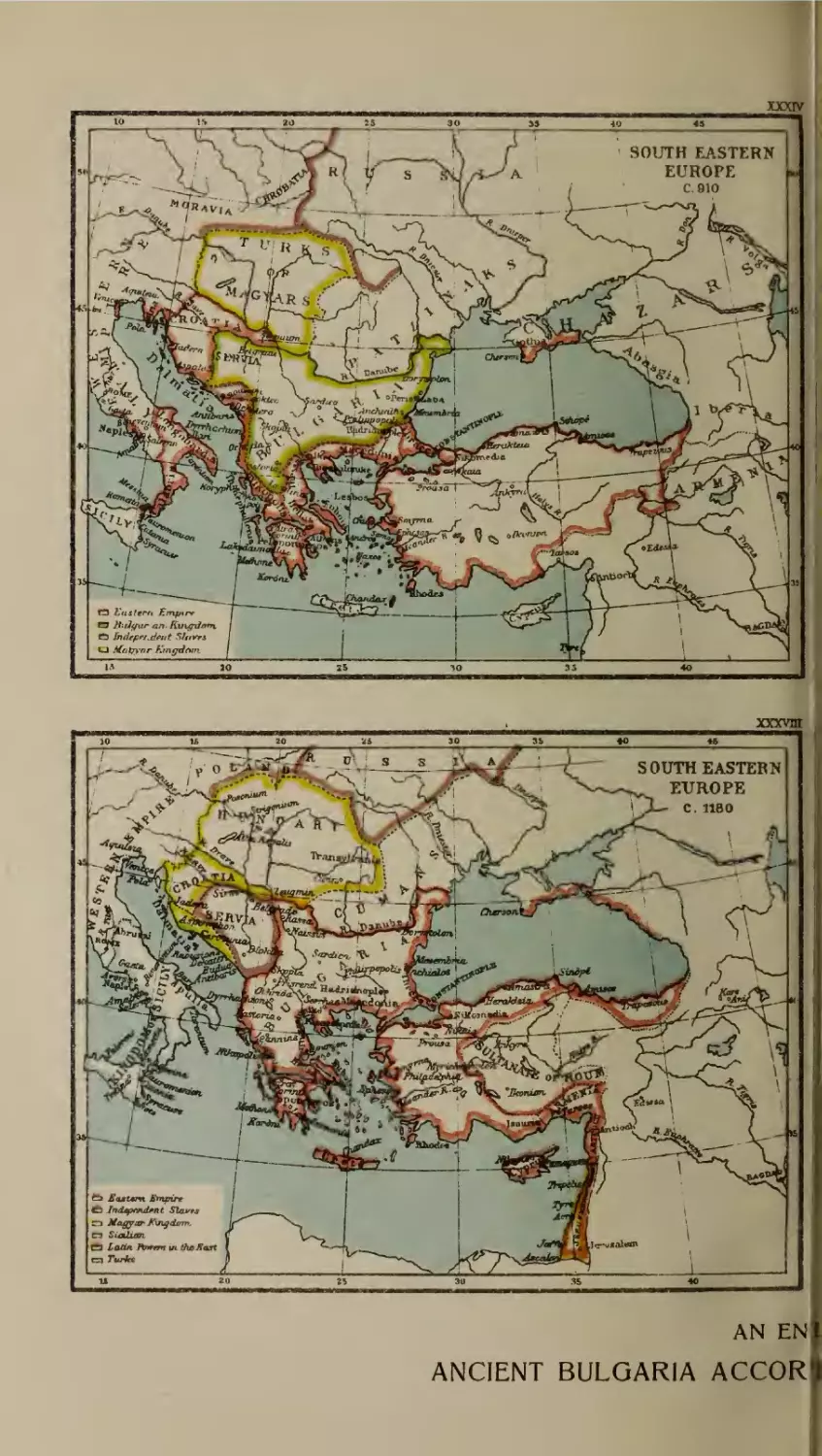
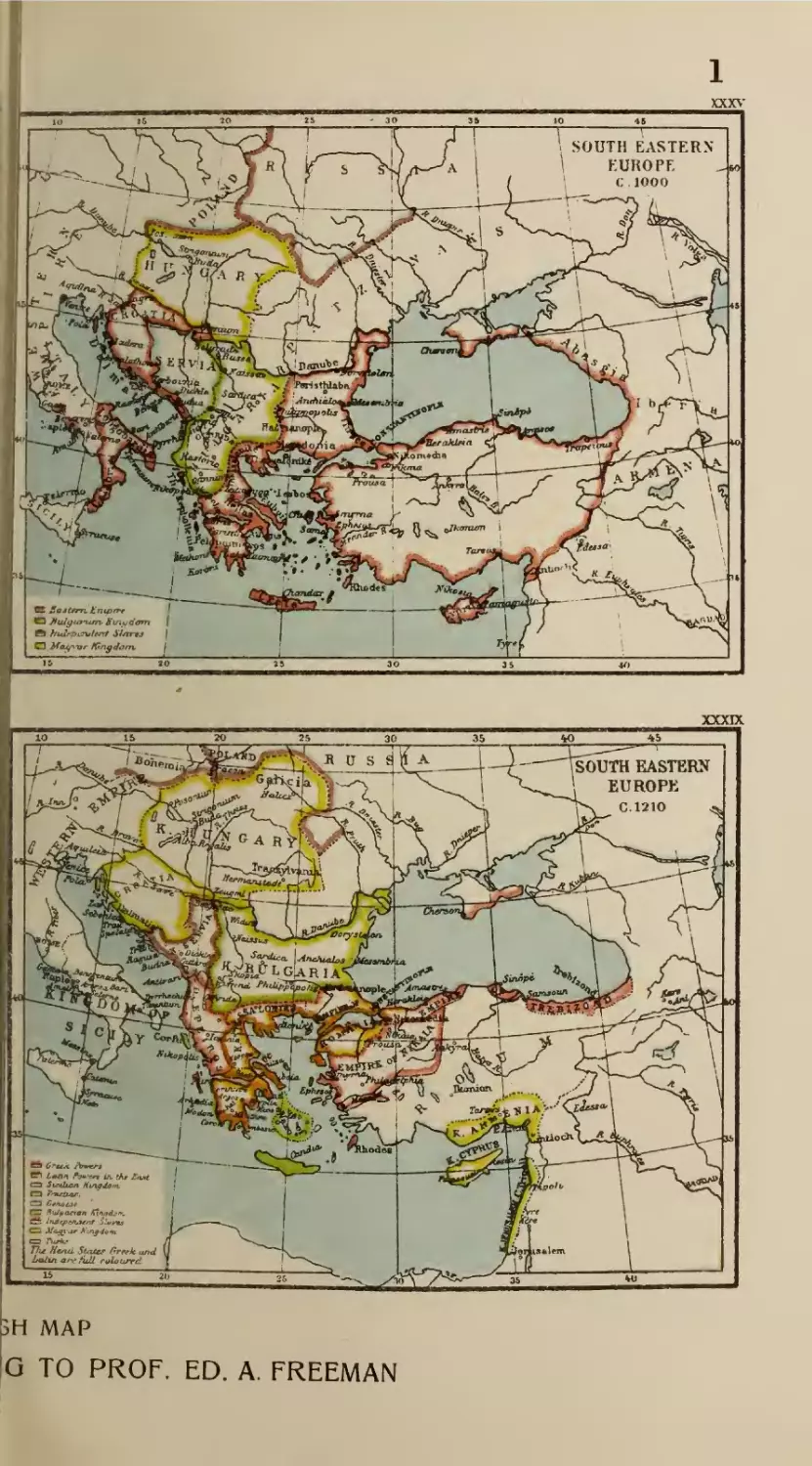
Maps
'.
.
%
*
:
THE BULGARIANS AND
ANGLO-SAXON DOM
THE BULGARIANS
ANGLO SAXONDOM
AND
CONSTANTINE STEPHANOVE, M.A.
(FELLOW OF THE AMERICAN GEOGRAPHICAL SOCIETY)
WITH MAPS
Americans have just cause lo feel proud that
Robert College gave to many of the leading
Bulgarian citizens their education, so that it has
played a peculiar part in the making of the
—
Bulgarian nation.
Theodore Roosevelt.
In the face of British opposition to coercing Bulgaria, the Sultan abandoned his resistance to
the union (of 1885).
Sir Valentine Chirol.
-
America looks upon Bulgaria, as in large part
her creation, and that of England.
—
The History
Sir Edwin Pears.
of Bulgaria is a repetition of
ican history.
—
Amer-
D. M. Markham, M. A.
The Bulgarians have proved the most responsive to American Christian influences of any
- Ed. B. Haskell, D. D.
Balkan people.
Bulgaria
is
a
faithful pupil of
teacher.
her great American
— D. Misheff.
The Bulgarians are the Yankees of the Balkans.
(General saying).
Mr. Robert founder of Robert College died without knowing he had played an important part
in founding a new state in Europe.
George B. Washburn, D. D.
BERNE
PAUL HAUPT, LI5RAIRIE ACADEMIQUE
1919
rights
reserved
PREFACE
The present volume
thor's
is
memorandum
an enlargement
notes on the subject,
The aim
what systematised.
of the au-
bring to the reader's notice
in
some-
view has been
some
salient
datas, and facts connected with the historic
to
events,
march
towards awakening, independence, and race union
—the
—looked
upon chiefly
through the eyes of English and American authorities.
It is surprising what an extensive literature
exists in English on the question treated. The writer,
of
a nation
of course,
all
Bulgarian
has not been in a position
to
Anglo-Saxon sources extant, but so
been
at his
command
is
draw from
much
as has
believed to be sufficient to
prove as legitimate the territories in the Balkan
Peninsula, occupied and claimed by the Bulgarians,
to
which they are
entitled historically,
ically, ^linguistically,
ethnograph-
geographically, and morally.
The Author.
J.
SCHENK
Imprimerie
ef
-
FILS, BERNE
Lilhographie
1919
VII
CONTENTS
Page
Preface
Ill
I
A NATION'S CLAIMS TO REUNION
Religions
Berlin
— The Ambassadorial Conference —
—
—
—
—
—
—
—
—
...
Awakening
English
Treaty and English Responsibility
Second
First Bulgarian Kingdom
Turkophile Policy
A Bulgarian State Always Existed
Bulgarian Kingdom
Ethnical
The Bulgarians Homogeneous Majority
Civil and Religious Liberty
Boundaries Recognised
Kindled
Restoration of National Church
Role of
Ochrida Patriarchy
The San Stefano Treaty
—
—
53
II
THE CONGRESS OF BERLIN
-
ITS
FATALITY
—
'Disraeli's Defensible Frontier'
Roumano-Bulgarian
Friendship Ruined— Serbo-Bulgarian Brotherhood Ended
Bulgaria's
Revolutionary Struggle in Macedonia
Third War for Reunion
Lord
—
—
III
ENGLISH AUTHORITIES AND EVIDENCES
The Verdict of
Scholars, Historians, Learned Travellers,
etc.,
— John Burbury, Gent., 1671 — Edward Gibbon, 1784
— A. Arrowsmith, 1798 — William Martin-Leake, 1814
Robert Walsh, 1828 — Major George Keppel
A.,
1830 — David Urquhart, 1833 — Edward Spencer, 1850
George Finlay, 1854 — A. A. Paton, F. R. G.
1861
— Rev. William Denton, M. A., 1862 — Lord Strangford, 1863 — G. Muir Mackenzie and A. P. Irby, 1863
— R. Arthur Arnold, 1867 — H. Sandwith, 1865 —
F. Tozer, 1869 — Encyclopedia Britannica, 1875 — "Slavs
and Turks", London, 1878 — G. Campbell, 1876 —
F. S.
S.,
118
CONTENTS
VIII
— Major A. Camp1876
E. G. Ravenstein, 1877 — The Blue Book,
Turkey, No.
1877 — Edward A. Freemann, 1880 —
C. A. Fyffe, M. A., 1881 — James Samuelson, 1888 —
William Miller, M. A., 1896 — Sidney Whitman, 1899
— English Pro Macedonian Manifestations, 1903 —
London Balkan Committee, 1903 — Sir Arthur G. Evans
— The British Parliament, 1904 — H. N. Brailsford,
1906 — G. P. Gooch, M. A., 1911 — Prof.
B. Bury,
1912 — The Encyclopedia Britannica, 11th. Edition —
H. M. Wallis, 1914 — The London Daily Chronicle,
1915 — The London Daily News, 1915 — The Common Cause, 1915 — H. Charles Woods, 1917 — Arnold
Toynbee — Noel Buxton, M.
1917 — The Quarterly
Review, 1917 — The Quarterly Review, 1918 — T. W.
Greenstreet, 1918 — M. E. Durham, 1918 — Prof. Ramsay
Muir, 1918 —
A. R. Marriott, M.
1918 — Marion
Newbigin, D.
1919 — James D. Bourchier, M. A.,
Page
London Geographical Magazine, 1876
—
bell,
2,
-
J.
P.,
P.,
J.
I.
Sc.,
F. R.
G.
S.,
266
1919
IV
AMERICA'S RC)LE IN BULGARIAN REGENERATION
—
The American Schools
American Missions a Salient Factor
Zornitza
Robert
American Missionary Literature
American Manifestations in Behalf of the
College
American
Macedonians
The American Macedonians
The Carnegie Balkan
Authorities on the Bulgarians
The American Geographical
Inquiry Commission
America and Bulgaria in the War
Society
267
Bibliography
367
Index
371
Errata
375
—
—
—
Maps
—
—
—
—
—
—
....
***
I
A NATION'S CLAIMS TO REUNION
Truth crushed to earth shall rise again".
—
Wordsworth.
he history of Bulgaria is a long, continuous, and
most desperate struggle for national existence
and self-assertion. For more than thirteen centuries
J.
the Bulgarian nation
was
fated to fight out
its
way
overwhelming political, social,
and racial obstructions and even calamities, that on
many occasions it looked as if it were completely
crushed and blotted out of the face of the globe.
It was by means of his sword that the original
to
life
Volga
against such
man
cleared his
way
in South-Eastern Europe,
by means of his sword he was able to maintain his
position on the Balkans for hundreds of years, and
when he awoke up from his centuries old political
and social lethargy, it was again by dint of arms
that he rose against his tyrants, and through a series
of bloody revolutions which attracted the attention
of the world, and the sympathy of Alexander II of
Russia, his subsequent liberator, in particular, he
was able once more to resume his place among the
living nations, though, unfortunately, in an amputated and crippled form, as we shall see later on.
After
it
had, in the course of six centuries, estab-
on a solid footing on the Balkan Penwhich period it had succeeded in becoming a powerful political and cultural state, the
Bulgarian race was condemned for nearly five hun-
lished itself
insula, during
2
A NATION'S CLAIMS TO REUNION
2
dred years to undergo a double alien bondage, a
that of the Turks, and a religious
one
that of the Byzantine Patriarch. No other people
has ever been so terribly afflicted with so cruel a
destiny as to be forced to bear simultaneously a
secular yoke, such as a Turkish one can be, and an
—
—
political
of the Phanar Religious Orwhich wielded their sway from
the same capital, Constantinople. These two rules
had exerted such a deteriorating influence upon the
Bulgarian people, they had so changed its national
ecclesiastical
one,
that
ganisation, both of
physiognomy, that when
in
the latter part of the
dormant
force through a number of insurrections, Europe
which had almost forgotten it, and had well-nigh
erazed it from its map, could hardly believe that it
was the same race which centuries back had repeatedly made the walls of Bysantium tremble at
its feet, the same people which first among all the
Slavic states embraced Christianity, had created an alphabet and literature of its own, which were subsequently adopted by Russia, Serbia, and other Slav
countries the same stubborn Balkan people which
gave birth to Bogomilism and thus paved the way
for the incoming Calvinism and Lutheranism
the
glory of Western civilization and the pride of the AngloSaxons; and, finally, the same people, which according to Gibbon himself, already in the ninth and
tenth centuries, "had taken its rank among the civnineteenth
century
it
again revealed
its
;
—
ilised
nations"
One
)
significant
the fact that
*)
x
when
thing about
the Bulgarians
in 1762 the Chillender
Gibbon's Rome, Collier's Edition, vol. V.
is
Monk, the
p. 516.
RELIGIOUS AWAKENING
3
them to life by addresthem with the words "O thou foolish and degenerate man, why art thou ashamed to call thyself
Bulgarian ? Have not the Bulgarians had a kingdom
historian Father Paissi, called
sing
:
and a dominion of their own ? Why shouldst thou,
0 imprudent man, be ashamed of thy race, and
shouldst labour in a foreign tongue?" his words
acted magically upon the entire nation which soon
awoke and discovered itself in the same ethnical
boundaries occupied by it prior to the Ottoman
invasion. From that time on, the Bulgarians commenced to feel that they were no more Rown-Mileti,
"Greeks", converted sons of the great Constantinople
but Bulgars. Soon, from Toultcha in
Dobroudja and Nish in the West, down to the Aegean coast, the Ochrida Lake, and the Albanian fastnesses, the once almost forgotten Bulgar race found
itself banded together under the same old name of
Bulgarians. The fervour and energy with which the
little nation set to work for its regeneration were
so great that in 1870 the Porte saw itself compelled to accede to the universal demand of the
Bulgarians for the creation of a National Church of
their own. The old Bulgarian centres, Skopie, Nish,
Ochrida, Toultcha, Tirnovo, Philippopolis, Monastir,
Shtip, Veles, etc., commenced to play a leading role
in that great movement for the religious emancipation
of the Bulgarian people, as they had done in the
past for its educational and political independence.
In 1870, therefore, all of a sudden, as it were,
there was born a new people in the Balkans. After
five hundred years of oblivion, the old Bulgarian
race was reborn, was resuscitated, notwithstanding
the fierce determination on the part of the sultans
Patriarchy,
A NATION'S CLAIMS TO REUNION
4
and the Greek patriarchs to crush in it every sign
of national spirit and self-consciousness.
"Truth
crushed
earth shall rise again",
to
the prophetic
Wordsworth came out too true in the case
of the revived Bulgar people. The American statesman, Daniel Webster, has still more graphically
words
of
elucidated the rebirth of a nation with the famous
passage of his Bunker Hill Oration: "If the true
spark of civil and religious liberty be kindled, it
will
burn
human agency
;
the earth's central
fire,
can not extinguish it like
may be smothered for a
;
it
may overwhelm it mountains may
down, but its inherent and unconquerable
force will heave both the ocean and the land, and
time, the ocean
press
;
it
in some time or other, at some place or other, the
volcano will break down and flame up to heaven".
That
is
exactly
what happened
in the central
part of the Balkans towards the early seventies of
the last century.
twas not a matter of accident, therefore, that in
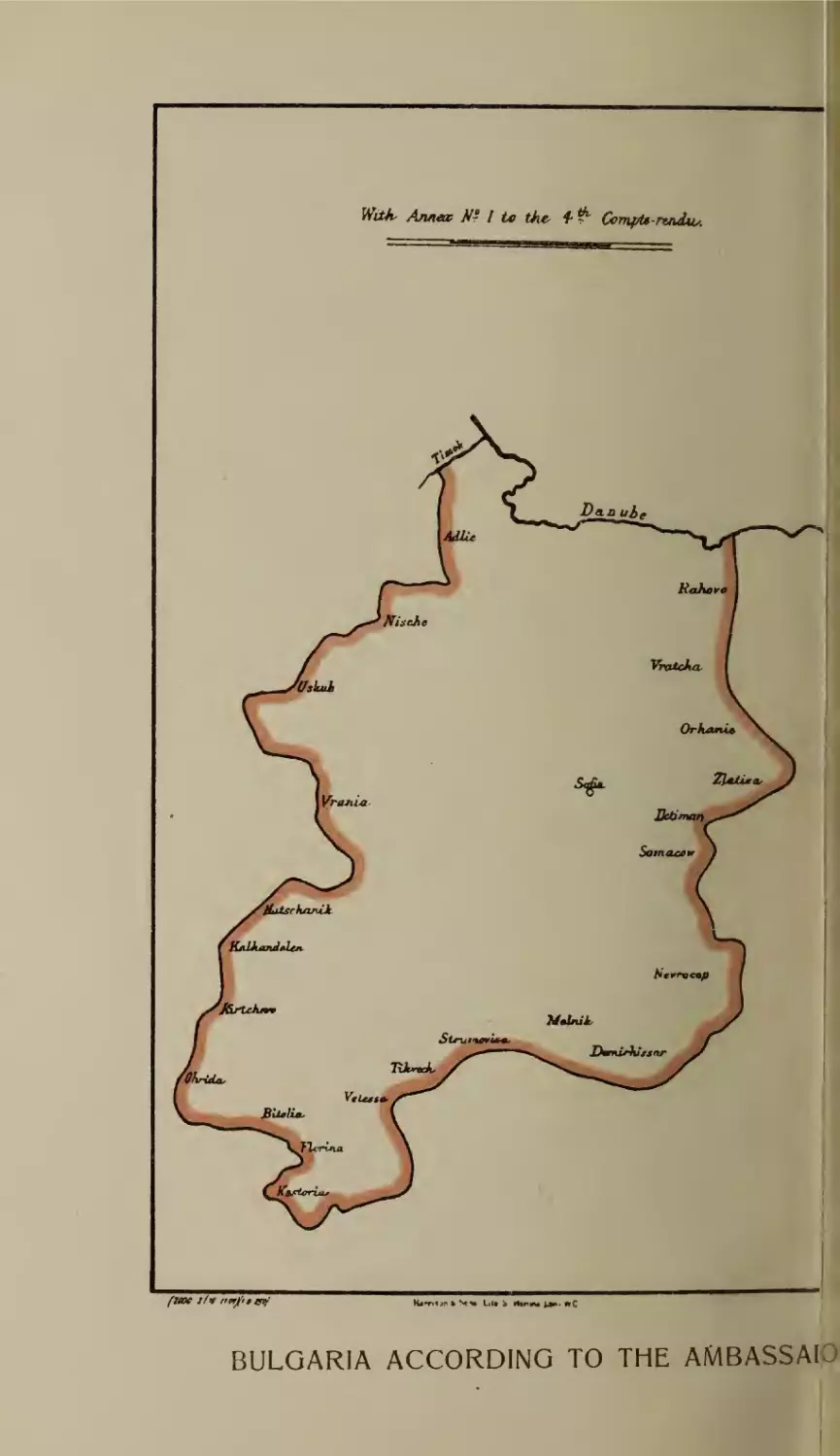
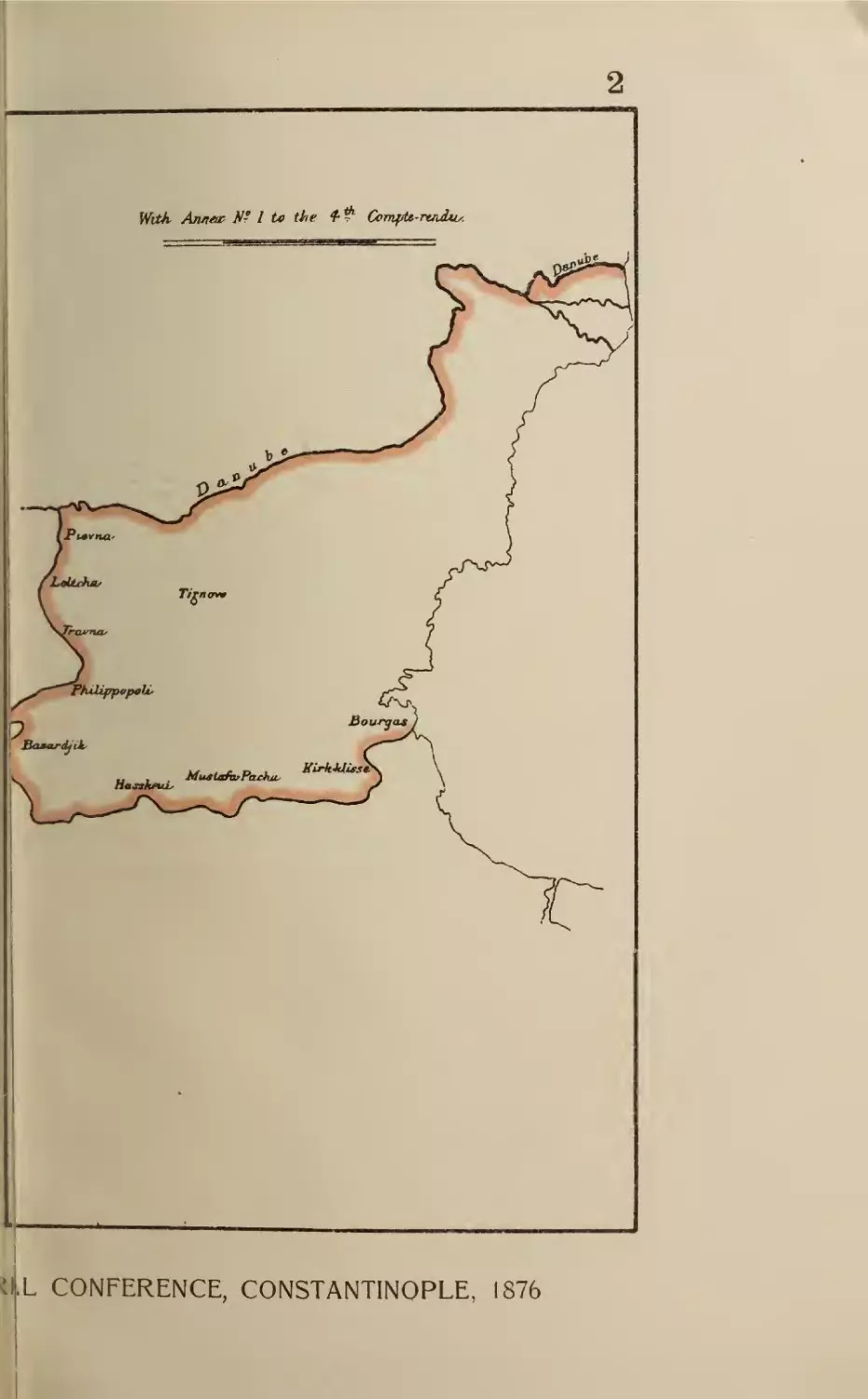
1878, an Ambassadorial Conference was
convened in Constantinople, whose chief object was
I
December
to devise a
way
out of the threatening political vol-
The whole Bulgarian people was in a state of
stormy agitation. It was just on the eve of the
greatest Bulgarian insurrection which ended in the
cano.
terrible
Turkish atrocities
Europe through
its
of Batak, Peroushtitsa, etc.
representatives at Constan-
tinople tried to disburden itself
sponsibility.
from a heavy
A Protocol accompanied
with a
re-
map was
almost involuntarily drawn up in which future Bulgaria was delineated in conformity with historical facts,
traditions, and actualities, corroborated by scholars
versed in the question, and particularly in accordance
THE AMBASSADORIAL CONFERENCE
with the recent investigations of the
5
German
pro-
fessor Kiepert.
The Constantinople Conference resuscitated Bulits main ethnical boundaries. Do-
garia in practically
broudja with its chief city of Toultcha, Bulgarska
Morava with its chief city of Nish, Thrace with its
chief city of Philippopolis, and Macedonia with its
chief cities of Skopie on the north, and Bitolia on
the south, were solemnly recognised as Bulgarian.
And though the Great Powers, distracted by selfish
interests, did not impose their draft upon the Sultan,
one thing, however, remains certain, and that is, the
international sanction of the general boundary lines
of Bulgaria. We shall touch upon this subject again
when coming to deal with America's rdle in Bulgaria's regeneration.
What
the European Concert of
Powers
failed
in 1876, Russia tried to effect alone in the following
year.
In his manifest to the Russian people
Em-
peror Alexander stated that the chief motive for declaring war on Turkey was her failure to execute the
decisions of the Ambassadorial Conference, providing
for the final emancipation of the Bulgarian people.
Gladstone's bitter philippics against the Turkish
misrule silenced the opposition of the Conservative
Party in England, and the Russian armies found
their onrush across the Danube unopposed by other
than Turkish troops. Turkey was crushed and
compelled to sign the San Stefano Treaty which
was drawn up in practically the same lines decreed
by the Constantinople Conference the autumn before.
The San Stefano Treaty was another and more
solemn recognition of the Bulgarian legitimate claims
to national reunion.
6
A NATION'S CLAIMS TO REUNION
England, Germany, and Austria, however, jealous of Russia's political preponderance in the Near
and fearing that the creation of a strong Bulgarian state in the Balkans would prove a mere Russian vanguard towards the Dardanelles, intervened
in behalf of Turkey, and caused to be convoked the
Berlin Congress for the revision of the San SteEast,
fano Pact.
At Berlin Europe went back on its word and
its decisions taken by its representatives
at the Constantinople Conference. Thus a noble
undertaking was undone because of the rival designs
cherished by the various members of the Concert
of Europe.
In this manner Bulgaria was sacrificed at the altar
of the selfish interests of a suspicious Europe. According to the testimony of the best authority on the subject, "The Treaty of San Stefano had created a Bulgaria essentially on the lines agreed to by the Powers
at the Conference of Constantinople. The Treaty of
Berlin divided Bulgaria into five sections, giving
one part (Nish, Pirot, etc.) to Servia, one (Dobroudja)
to Roumania, one to an autonomous province called
East Roumelia, one (Macedonia) to Turkey, and one
to constitute the Principality of Bulgaria under the
suzeraignty of the Sultan; and it was England esrescinded
pecially that insisted
upon
this
and
also
upon the
occupy and fortify the range of
the Balkans all with the object of making it impossible
for the Bulgarians to form a viable state, which
might be friendly to Russia. The Englishmen who
knew Bulgaria, all our friends, understood the folly
and wickedness of this at the time. All England has
learned it since. Thus far the results have been the
right of Turkey
to
BERLIN TREATY
AND ENGLISH
revolution of 1885,
RESPONSIBILITY
which resulted
in the union of
Bulgaria and Eastern Roumelia, the
via, the insurrection in
7
war
with Ser-
Macedonia and the Province
the massacres and unspeak-
of Adrianople, and all
able horrors of the last thirty-nine years in Macedonia,
to
say nothing of lohat Bulgaria has suffered from
Powers ever since the Treaty
the intrigues of foreign
The awful massacres and persecutions
from which the Armenians have suffered since 1886
have been equally the result of this treaty." x)
And we may complete the list by adding the
Balkan wars of 1912, 1913, and indirectly, the present world conflict.
Most writers on Balkan affairs are unanimous in
supporting the above view od that historical injustice done to a whole people. Perhaps it may be
worth while to quote the opinion of one or two
more. Thus Prof. H. P. Judson of Chicago University
has this to say on the point: "English jealousy of
Russia thus severed Bulgaria which was one in race
and sympathy, and in the same time left under the
Turkish yoke the Christians of Macedonia. The latter
provision was simply a calamity for the unfortunate Macedonians. As to Eastern Roumelia, a revolution in 1885 threw off the authority of the Sultan,
and the province was at once annexed to Bulgaria.
This aroused the jealousy of Servia which made
foolish war on Bulgaria. The latter country was completely victorious and only the intervention of Austria
kept the Bulgarian army from entering Belgrade. 2 )
English writers themselves have been candid
enough to admit and condemn the mistakes comof Berlin.
x
)
2
)
Dr. G.B.Washburn, Fifty Years in Constantinople, pp. 183-4.
Europe
in the
19 th Century, pp. 275, 277.
A NATION'S CLAIMS TO REUNION
8
mitted by the English and European diplomacy in
taking the side of Turkey and causing the noble
work
of the Constantinople
Conference
tered at the Congress of Berlin.
to
be shat-
The insurrection
in
Macedonia in 1902-1903 had rendered English conscience uneasy, and the London Balkan Committee
was
the result.
composed
it
Among
was
who was chosen
lets
tled
its
men who
now Lord Bryce,
the distinguished
Mr. James Bryce,
In one of the book-
president.
which were published by the Committee, entiThe Macedonian Crisis, we find the following
significant passage:
"The responsibility which England has expliassumed for the government of Turkey is set
forth in the writings and speeches of leading statescitly
men
of the last half-century."
"There has been", said the
"a certain
by Great
more
Britain
late
Duke
of Argyll,
or less persistent policy pursued
on the Eastern Question ever since
It has
the second quarter of the present century
been the policy of protecting Turkey, with a view
to the repulse of Russia from an exclusive and
dangerous domination over the East of Europe."
"In 1878, at the close of the war, induced by
the Bulgarian massacres of 1876, the Treaty of San
Stefano, concluded between Russia and the Sultan,
took away from the Turks by far the larger part
of the territory we call Macedonia, and made it part,
of the
new
Principality of Bulgaria.
Great Britain
objected to that Treaty as unduly weakening the
Turkish power, and the view
of the British Ministry
was expressed by Lord Beaconsfield in a spech delivered by him as the trusted representative of Great
Britain at the Congress of Berlin. The events of the
ENGLISH TURKOPHILE POLICY
War," he
had
fano,
9
"and especially the Treaty of San SteGreek people into the belief that
the partition of Turkey had finally come.
said,
led the
the time for
was
not confined to the Greeks.
This was a complete mistake, since the object of the
This belief
also
had long been, as everybody ought to
have known, to strengthen Turkey as much as possible."
"The British Ministry procured the meeting of
the Congress of Berlin, and at that Congress it was
their action which procured the substitution for the
Treaty of San Stefano of the Treaty of Berlin,
which handed back to the Turks by far the larger
part of Macedonia (including the districts now in
British policy
insurrection).
By thus
substituting
Berlin for the Treaty of
the Treaty of
San Stefano
at
the
in-
stance of Great Britain, the Concert of Europe as-
sumed directly the responsibility which Russia had
formerly taken upon herself
Into the whole
history of that troublous period we need not enter.
It is sufficient to say, however, that the Treaty of
San Stefano which Lord Beaconsfield vetoed,
ated a greater Bulgaria than the state
now
cre-
bearing
that name, and that the subsequent Treaty of Berlin
handed back to Turkey the very province which,
speaking roughly,
is
now
struggling so violently to
by Great Britain.
Whatever "Peace with Honour" meant for Englishretrieve
men
its
in
deliberate enslavement
1878,
pression,
it
has brought untold misery, opto the population thereby
and outrage
sacrificed."
In another pamphlet, Austro- Russian Reforms,
published by the same venerable body of conscientious English citizens, we find the following still
more
explicit statement:
A NATION'S CLAIMS TO REUNION
10
"If the Treaty of San Stefano, to which Turkey
and Russia agreed in 1877, had been allowed to
stand, the bulk of Macedonia would have been created into an autonomous state, enjoying the same
freedom which was given to Bulgaria and Eastern
Roumelia.
It
was Great Britain who
stood for the
Turkey ; and through her conduct at the
Congress of Berlin in 1878 Macedonia was handed
back to the Turk."
"The despair is our work. We forbade Russia
to liberate Macedonia in 1878, we have refused to
execute the programmes of reform which Lord
integrity of
Beaconsfield
made
Berlin.
at
The insurgents are
figthing only for their legal treaty rights.
Where now
the balance of criminality lie? Perhaps with Europe."
The claims
Bulgarian race to the reunion
of Bulgaria, Macedonia, Dobroudja, Bulgarian Morava,
and Thrace are based on ethnographical, historical,
of the
and geographical grounds, as has been corroborated by
serious and impartial scholars versed in the matter,
such as the Frenchmen, Cousinery, Pouqeville, Reall
clus,
Dejardin,
Ami
Boue, Lejean, Cyprien Robert,
the Geretc.
Blanqui, Ubicini, Louis Leger, Berard,
;
mans, Griesebach, Kiepert, Weigand, Hoffmann,
etc.
the Russians, Gregorovitch, Makousheff, Hilferding,
Kondakoff, Derjavine, Milyukoff, Teploff, Tchitchatthe Belgians, d'Hally, Squarr,
cheff, Bashmakoff, etc.
Heuschling, Crousse, Laveleye, etc.; the Greeks, Came;
niate, Skylitzes, Acropolite, Aravantinos, etc.; the Croa-
Bradashka; the Swiss, Lecomte; the Austro-Hungarians, Kanitz, Karl, Hahn; the Tchechs, Shafaric,
Zach, Erben, Niederle, Iretchek, Oblak, Sis, etc.;
the Serbians, Karadjich, Brkitch, Verkovitch, Davidovitch, as well as by a host of learned Englishmen,
tian,
FIRST BULGARIAN
and Americans
whom we
of
KINGDOM
11
speak in
detail
unanimous
in ad-
shall
in the succeeding chapters.
All these various writers are
mitting the Bulgarian character of these lands, and
of the Bulgarians for their
in justifying the desire
them have pointed out
which have held together these
provinces from time immemorial to the pre-
racial unification.
All
of
the moral bonds
sister
sent day. In order to get a glimpse of the indissoluble
ties
which have kept the Bulgarians of these lands
it is necessary to have in mind the
linked in one,
following historical facts
As early as 679
(A.D.) the original Bulgarians
under
their brave leader, Asparouch, established themselves
in the Balkans.
From
grouping together
of
that time
on commenced the
the various Slavic tribes set-
on the Peninsula. Under Asparouch's equally
mighty successors, Tervel and Kroum, the Bulgarian
state was greatly extended and strengthened. In the
reign of Boris I (852 884) Bulgaria had become the
strongest state in south-eastern Europe. Byzantium
trembled at its approach. Boris had succeeded in
bringing together the various Slavic tribes and in
laying the foundation of the First Bulgarian Kingdom.
In 855 Boris accepted Christianity and thus Bulgaria
paved the way for the new religion among the other
tled
—
Slavic countries.
It
was
Slavic apostles, Cyril
in Boris' time that the great
and Methodius,
laid the foun-
dation of the old Bulgarian alphabet and literature
which subsequently were adopted by Russia and
The kingdom of Bulgaria during
Boris included Macedonia (with Bitolia, Castoria, etc.),
part of eastern Serbia with Belgrade, and part of
Roumania, etc.
other Slavic lands.
A NATION'S CLAIMS TO REUNION
12
The
unification process of the Slavs, started so
and successfully by Boris, was resumed
and carried on with even greater intensity by his
illustrious son and successor, Simeon (893
927),
known as the first Bulgarian Tsar. Under the latter
energetically
—
the frontiers of Bulgaria reached the Black Sea, the
Marmora, the Danube, and touched the Adriaentire Macedonia and Thrace.
Sea
of
tic.
They included
Simeon's
is
considered the golden period in the his-
tory of the Bulgarians. Education, literature, and other
arts flourished in this epoch. Politically, religiously,
and economically, Bulgaria under Simeon reached
its fullest development and power.
All foes to this
greatest
of Slavic
states at
that time,
Byzantium,
Russia, Hungary, Serbia, and the barbaric tribes of
were rendered powerless. Bulgarian unity
and independence were fully established. Simeon
who was endowed with an extraordinary talent for
organisation had no difficulty in uniting to himself
all the Slavic tribes in the Balkans. The Empire he
created was thoroughly Bulgarian. It was so strongly
Bulgarian, that the ethnical, lingual, and moral ties
that were established between Bulgaria and its
sister
provinces Macedonia, Moesia, Thrace, and
Morava were able to survive all the vicissitudes of
the North,
subsequent ages
down
to
our day.
Philippolis, Ochrida, Nish, etc.,
nople, too,
was long
Sofia (Sardica),
were Bulgarian. Adria-
in Bulgarian possession.
In 996 (A. D.) there ascended on the Bulgarian
throne Samuel, another
of the great unificators of the
Under him rose the so-called Second Bulgarian Kingdom, or the Kingdom of Ochrida.
He became master of most of the Balkans, from the
Danube to the Morea. Vodena, Prespa, and Ochrida
Slavs in the Balkans.
SECOND BULGARIAN KINGDOM
13
were in turn made capitals of his Kingdom. Once
more the Bulgaria of Simeon the Great was revived,
with Macedonia as the centre of Bulgarian learning,
and social reforms. From
Samuel's days onward Macedonia retained the intellectual and moral leadership, and as it will be
seen, the Macedonian Bulgarians proved no less able,
patriotic, and succesful pioneers in the Bulgarian
Renaissance which took place some hundred years
ago.
Samuel was the founder of the Bulgarian
National Church with Ochrida as its permanent seat.
In 1018 the Bulgarian Empire was shattered.
After a series of most bloody wars, Basil II of Byzantium finally got the best of Samuel. Bulgaria
religious
awakening,
was made subordinate to Constantinople. But its
existence as an autonomous state, the ethnic unity
of the
four provinces
it
constituted, as well as
its
were recognised by Byzantium
through treaty stipulations. The seat of the Bulgarian
Church remained at Ochrida, while Skopie was the
National
Church,
capital of the Byzantine
strategos
or Viceroy
who
ruled Bulgaria.
The Byzantine nominal domination
lasted
some
one hundred and fifty years. An end was put to it
in 1186 when under the leadership of the brothers
Assen and Peter, descendants of the last King Shishman, Bulgaria rose against the Byzantine ruler and
drove away his garrisons. Under the tsars Assen and
Kaloyan Bulgaria was able to maintain its power
as a strong state in the Balkans, retaining
its hold
Thrace, and extending its sway clear to Belgrade on the Danube.
Thus rose the so-called Third Bulgarian Kingdom.
Assen II (1216 1240) is, perhaps, Bulgaria's great-
upon
Macedonia,
—
Dobroudja,
A NATION'S CLAIMS TO REUNION
14
est
and noblest Tsar. Under the guidance and leadof this pious and wise ruler, the Bulgarian
ership
people was able to reach its fullest national unity.
In his reign Thessaly and Salonica were subordinate
lands of Bulgaria. It became a centre of civilising
and commerce were in a
The country enjoyed an unprecedented wealth and prosperity which were guaranteed
by peace and political security. Tirnovo, the capital
agencies.
Arts,
letters,
flourishing state.
Empire, attained an unheard of opulence and
embellishment. Tsar Assen, being a religious person
and a lover of education, encouraged the building
of churches, monasteires, and schools. Assen II is
the most popular and dearly loved ruler in the
whole Bulgarian history, for he is the embodiment
of Bulgarian national unity and ideals.
After Assen's death, however, Bulgaria became
of the
the victim of
numerous
attacks
on the part of Tartars,
Byzantines, Serbians, and others. Besides, the country
was
by internal dissentions and civil
which rendered it an easy prey to alien onsets and invasions. Servia under Neman and Stephan
Doushan (1331 1355) became master of the entire
Balkan Peninsula. Servia's Empire was, indeed, of
rent assunder
strifes
—
a short duration, but Macedonia, Bulgaria, Albania,
and even Thrace, fell in the hands of the mighty
Doushan. Immediately after his death, however,
these subject provinces broke apart. Doushan's Empire simply facilitated the process of disintegration in
the Balkans, which cleared the path for the arrival
of the Turk. Two small states were formed in Macedonia
the Prilep Kingdom and that of Velbudge.
In Bulgaria proper, there sprung the kingdoms of
Tirnovo and that of Viddin. In the North the despot
—
A BULGARIAN STATE ALWAYS EXISTED
15
Dobroditius founded another independent Bulgarian
called Dobroudja. With the defeat of the
Serbians at Kossovo there came an end to all the
kingdom
petty Bulgarian
kingdoms
also.
But though Bulgaria was shattered
to
pieces,
minor states which grew out of the great
Bulgarian Empire of Assen II preserved their Bulgarian character to the last. The most competent
authority on the subject, Prof. Edward Freeman,
the various
touching this point, says "From that time (the time
of Samuel 1018) to the Turkish conquest, one or more
:
always existed, and throughout the
thirteenth century, the Bulgarian Kingdom, though
Bulgarian
states
boundaries toere ever shifting, teas one of the
chief potoers of the south-eastern Peninsula " l )
its
In another place of his great
work we
find this
statement emphasising the ethnical affinity connecting the Bulgarians, Macedonians, and the other Slavic
around them. "During the four hundred years
between the division of the Empire and the Fran]?:
Conquest of the East, the geographical history of the
Eastern Empire has mainly to deal with the shifting of its frontiers toward the Slavonic powers.
These fall into three main groups: First, in the
tribes
north-western corner of the Ehnpire, are the Croatians
and the Servian settlements whose history is closely
connected with that of the Kingdom of Hungary
and the commonwealth
of Venice.
Secondly, there
are the Slavs of Thrace, Macedonia, and Greece.
Thirdly, the great Bulgarian Kingdom comes between the two. Those two last ranges gradually merge
*)
Historical Geography of Europe, Vol.
I,
p. 492.
A NATION'S CLAIMS TO REUNION
16
into
one; the
distinct
It is
first (the
Croats and Servians) remain
throughout"
evident, therefore, that prior to the
Ottoman
conquest Bulgaria, Macedonia, Bulgarian Morava,
Thrace, and Dobroudja, no matter what form of political existence they maintained, preserved their Bulgarian character to the last. This is an important
fact which some authors are prone to overlook.
In 1393, then,
when the Ottoman lords became full
masters of the Balkan states, Bulgaria, Macedonia,
Bulgarian Morava, Thrace, and Dobroudja were incorporated in the Ottoman Empire as Bulgarian lands.
During the long Turkish dominion, lasting until
1878, though the Bulgarian population inhabiting
them was condemned to endure the political bondage of the Mussulman and the religious oppression
of
the
Phanar Patriarchy,
national conscience
its
and national character were, as we pointed out, able
and persecutions throughout, so
that when the era of national awakening affected
Europe, it awoke Bulgarian, such as the world
or in the words of
had known it centuries back,
Macedonia's greatest bard, Jinziphoff, who, as early
to survive all trials
—
when
as 1862,
the
to
work
and
of Hellenization
was
at its
an effort
obliterate the Bulgarian race and tongue, wrote
greatest intensity
O
fierce determination in
Macedonia, wondrous Land,
Thou
never, never
Greek
shalt be
Thine woods and heaths, and varied strand,
Thine lakes and brooks
that
gush from thee
Thine birds and fish, thine every stone,
Both man and beast, nay, spirits gone
To all the world one chorus swell
—
"I
Bulgar am, here Bulgars dwell
!"
THE BULGARIANS HOMOGENEOUS MAJORITY
Just about that period Lord
had made a
Strangford
17
who
Balkan races, caught,
it as were, the echo of this song and exclaimed
"The Greek can not overcome the Bulgarian, nor
lead him, nor incorporate him" *)
And
special study of the
again:
"The Serbs or certain Serbian
and
ivish us to
circles
believe that they have the
believe
power and
moral right
to annex, if not all, at least certain
Bulgarian lands. They would neglect nothing in their
efforts to work upon the Bulgarians and make them
the
see things as they see
And
by
all
them" 2)
he may be well understood
countrymen who were thinking
in order that
those of his
defferently,
Lord Strangford desired
to
make
clear
the truth he had discovered:
"The vast and homogeneous majority of the Christian population in "European Turkey," as I have said,
"consists of Bulgarians ; neither Greek, nor Servian
has any authority to set himself up and be trusted
as their spokesman."
And
again
"The
entire mass of the rural and non-Mussulpopulation of Turkey in Europe, with the exception of Bosnia, Thessaly, Albania, the Chalcidic
man
Peninsula, and a very
narrow
of the seaboard,
consists not of Greeks, or Slavs, but of Bulgarians." z)
Sir Arthur Evans, the greatest champion of the
belt
Yougo-Slav movement to-day, was more explicit still,
he* gave vent to the following statement made
in behalf of a people whom he had a splendid op-
when
1
)
2
The Eastern Shores of the
)
Ibid. p. 314.
)
Ibid. p. 316.
3
Adriatic,
London, 1864,
p. 351.
3
A NATION'S CLAIMS TO REUNION
18
That was in
Macedonian revolution.
"The fact is", declares he, "that even in this
country
largely owing to interested efforts to disguise the true situation
the great preponderance
of the Bulgar element in Macedonia is only imperI can only say, as my personal
fectly realised.
experience after exploring almost the whole interior
portunity to study on the very spot.
1903, after the great
—
—
of the province, that outside the fringe already reto, and some small urban centres, practically
whole mass of the population is Slavonic, speaking
characteristically Bulgarian dialect. The Bulgarian
shibboleths, such as placing of the article after the
word, extend even to the Uskub region, sometimes
claimed by the Serbs, whose real speech only begins
North of the Shar range. Whereas in certain small
towns, such as Castoria, where the Greek element
was in the majority, it was far outweighed by the
populous Bulgar villages around. This great preponderance of the Bulgar element is a fundamental
factor in the present situation, which has been obscured by statistics drawn from Greek sources." *)
ferred
the
Bulgaria's Ethnical Boundaries Universally
Recognised
But the ethnical boundaries
of
the Bulgarian
race have been firmly established as early as the
beginning
of the
nineteenth century.
to scientific investigation
The impetus
prompted by the French
Revolution had largely contributed to the settlement
of
the racial limits of the Bulgarians.
list of
graphers,
l
)
Long
is
the
Continental investigators, archeologists, ethno-
The
geographers, and learned travellers,
Times, Sept. 30, 1903.
who
ETHNICAL BOUNDARIES RECOGNISED
had
visited the south-eastern part of
availed themselves
of the
19
Europe and had
opportunity to study up
the Balkan peoples, their conditions, and
The work
mode
of
on the very spot.
undertaken and carried on by such men of science
and learning was, therefore, done at a peirod when
Bulgaria was still groaning under the heavy yoke
of the Turks, and when, moreover, her neighbouring countries, Roumania, Serbia, and Greece
were practically freed. In those days, during which
the Bulgarian people was just showing signs of
revival, and was cumulating its national strength,
life
these
historians,
among
the
area
cal
from
investgation
geographers, and travellers were
first to
of
of
recognise the natural and ethni-
the Bulgarians,
their conclusions,
which, as
is
evident
exactly correspond to that
occupied by them in the past, a truth corroborated
by
Anglo-Saxon colleagues, as will be seen
on in this work.
their
later
It is
not within the scope of this book to give
a detailed review of the scientific data obtained
Continental
their special
authors
who had made
the
by
Balkans
object of study, but the utilisation of
the evidences of a few of
them would not be found
superfluous.
The eminent French writer, T. Pouqueville, may
be mentioned among the earliest pioneer scholars
and
travellers of the last century, interested in the
study of the Balkan Peninsula. These quotations from
works devoted to that part of Europe clearly
his
specify the boundary lines between the Bulgarian,
the Greek, and the Albanian peoples, as early as 1805:
"We
far
stopped at Piaco or Doupari, a village not
of Costour (Casforia). As far as
from the lake
A NATION'S CLAIMS TO REUNION
20
here I travelled in a known country, because I could
speak to and communicate with the inhabitants of
the country, but here the scene was changed. / entered the country of the Bulgarians, and I ivas obliged to use the few Slavic words I had picked up
during my sejourn in Ragusa."
And again
"In the valley of Prespa there are about 46 Bulgarian villages. In the district of Ressen are 26 Bulgarian villages
The river Drin with its right
.
.
.
bank forms at this distance the dividing line between the Bulgarian language and that of the Shkipeiari-Gheghi Albanians/' 1)
The Russian historian, V. Gregorovitch, who had
traversed the Balkans in the thirties of the last century, has this to say about the race character of
southern Macedonia:
"The villages between Salonica and EnidjeVardar are inhabited chiefly by Bulgarians. The
villages in the districts of Enidje-Vardar, Voden,
Lerin, Bitolia, as well as those between Bitolia and
*
Ochrida, are inhabited exclusively by Bulgarians,
intermingled here and there with Koutzo-Wallachs
and Turks." 2)
Such an international authority as the learned
French scholar, Ami Boue, whose work La Turquie
d Europe is one of the few thorough books on the
9
Balkan Question, contributes this signal statement
about the ethnical physiognomy of southern Macedonia:
1)
T. Pouqueville: Voyage de la Grece,
Vol.
p. 517,
2
)
Ill,
Paris, 1826, Vol.
II,
p. 59.
Esquisse de voyage dans la Turquie
gorovitch, Moscou, 1840, p. 107.
d' Europe,
par V. Gre-
ETHNICAL BOUNDARIES RECOGNISED
21
"The Bulgarians compose the main kernel of the
population of Macedonia, with the exception of the
south-western part, from Costour (Castoria) and
Bistritza, The mountains between the basin of Lerin
and Costour (Castoria), between Cagliari and
between Ostrovo and Ber (Berea), and between Voden and Niegoush, separate the country
where only BulgaiHan is spoken, from that in the
south, where the Greek is the language of the
(Florin)
Satishta,
peasants."
x
)
"Uskub is pre-eminently
a Bulgarian city," and "Resna and Prespa are
mainly inhabited by Bulgarians."
A third French author, no less known and exhaustive on Balkan matters, is Cyprien Robert. The
following quotation from his writings is confirming
In one place he says:
the investigations obtained by his colleagues:
mark
"Neglecting to
the
march and the
ference of peoples, geographers continue
to
trans-
put Thrace,
Macedonia, and Albania as boundaries of the Bulgarian people. This people in reality constitutes the
—
from
main kernel of the population of Macedonia
the mountain lines between Cagliari, Satishta, Ostrovo, and Ber (Berea), as far as the valleys of Niegoush and Voden only south of this line is to be
found the Greek peasant." 2 )
Ubicini, another Frenchman, an equally renowned
Balkan scholar, makes this categorical statement
;
about the Bulgarian boundaries:
"Among the populations of the Slavic race, direct
subjects of the Porte, the Bulgarians hold the first
)
La Turquie
)
Les Slaves de
1
2
Vol.
II,
p. 230.
Europe, par
Ami Boue,
la Turquie, par
Paris, 1840, Vol.
II,
p. 5.
Cyprien Robert, Paris 1814.
A NATION'S CLAIMS TO REUNION
22
place. Divided
the Black Sea
by the Balkans, the Bulgarians touch
and the Archipelago through Burgas
and Salonica; they extend on
Albania and reach Danube on
Islam (Kladovo)
to
Silist?"a."
the west as far as
from
Fet-
*)
The unanimous testimonies
historical
the north
of these
and other
writers on the ethnical character of the
Balkan Peninsula during the
first
half of the nine-
teenth century have been further strengthened by
a host of other ethnographers and geographers, as
may be
judged from the following conclusions taken
from their works.
The French writer
G. Lejean, in his
book
entitled
the Ethnography of Turkey in Europe, published
in 1861, at a time when Bulgaria was still a Turkish
and possessed neither its own National
Church, nor its own schools, wrote:
"To-day the Bulgarian people is almost bounded
by the Danube, the river Timok, with a line passing
by the towns of Nish, Prizren, Ochrida, Niegoush,
Salonica, Adrianople and Sozopol, the Back Sea and
Burgas. The Bulgarians occupy almost the whole
of Macedonia and their compact mass gradually
pushes the Greeks to the sea, where the latter hold
their ground in a narrow strip of land between
province,
Platamona and Kolakia. From the Struma to the
Maritza the Greek territory forms a very narrow
zone inhabited by seamen and fishermen, while
the Bulgarian, pre-eminently agriculturist,
occupies
heights that dominate the sea-coast.
Outside
perimetre there are Bulgarian foreposts or
remnants of the Bulgarian people among Albanians,
the
of this
*)
VEmpire Ottoman, par
H. Ubicini, Paris 1854,
p. 634.
ETHNICAL BOUNDARIES RECOGNISED
23
Wallachs, Greeks, in the Dobroudja and even in
Asia."
*)
The
perhaps the greatest
is the author of
the Bulgarian people.
late Prof. K. Iretchek,
modern
Tchech historian of
one of the best history of
In his treatise he gives the following delineation
of the ethnical limits of the
"The settlements
of
times,
Bulgarian race
in the ancient provinces of Mcesia, Thrace,
donia,
in the
Bitolia vilayets.
inces,
and Mace-
or according to recent Turkish administra-
tive division,
and
:
the Bulgarians are found
Danube, Adrianople, Salonica,
The boundary
line of the prov-
inhabited by the people speaking Bulgarian,
runs north to the Lower Danube from its mouth
down to Viddin farther on this line extends to the
river Timok, runs along the Serbian frontier which
and turns southward only along
it rarely crosses
the river Toplitza by the town of Procuplie. Climbing along the heights on the right strip of the
Morava, it passes the town of Vrania, comes to the
Tchernogorie, extends as far as the Shar mountain,
passes the upper Debir, and reaches its end on the
right bank of the Ochrida and Prespa lakes, at the
village of Lin. The zone, south of these lakes, the
valley of Coritza and that of the river Dievol have
a mixed population
of Albanians, Bulgarians, and
Wallachs. Farther on the frontier line runs from
Dievol through the lake of Costour (Castoria), the
town of Wallachian Klissura, the towns of Niegoush,
Salonica, Seres, and reaching the environs of Drama,
passes the southern slopes of the Rhodope mountains; thence it approaches the towns of Dimotica,
;
—
l
)
Ethnographie de la
1861, pp. 28, 29.
Turquie
Europe,
par G. Lejean,
A NATION'S CLAIMS TO REUNION
24
Ouzoun-Kiupriu, Bunar-Hissar, and Little Samokov,
and thence on to the Black Sea." *)
Hilferding, a Russian scholar, is another of
the earlier writers on Balkan questions. Among
other things he states, as a matter of course, the
following fact concerning the ethnical delimitation
between Serbians and Bulgarians:
"Shar Mountain stops the further movement of
the Serbian element and serves as a frontier line
between Serbians and Bulgarians. The latter occupy
Macedonia and part of Albania. The Serbian language
of Prizren already approaches the Bulgarian dialect." 2)
A. Synvet, a professor of
perial
Lyceum
Geography
in Constantinople,
in the
Im-
in his text-book,
General Geography of the Ottoman Empire, in speaking of the Bulgarians, says:
"The Bulgarians
Ougrian origin were Slavibranch settled south of
the Danube and formed an important kingdom
which was conquered by Nicephorus in 1017. After
of
cised in Europe. Their chief
the battle of Varna (1444) their kingdom was vanquished by the Ottomans and became part of their
Empire.
That race
Timok
is
to-day bounded by the Danube,
and a
line passing through Nish,
Ochrida, Castoria, Salonika, Adrianople,
and Razgrad. Bulgarians are also found in Albania,
Thrace, and Bessarabia. 3)
The well-known Belgian historian, Emile de
Laveley, has expressed himself in an unmistakable
the
river,
Prisrend,
1
Bulgarska Istoria, Tirnovo, 1888, p. 718.
Oeuvres completes, Hilferding, Vol. Ill, page 141.
3
par
) Traite de giographie gene'rale de Vempire ottoman,
A. Synvet, Constantinople, 1872, page 72.
)
2
)
ETHNICAL BOUNDARIES RECOGNISED
25
manner when
in touching the ethnical complexion of
Macedonia he says: "The whole central and eastern
part of Macedonia is inhabited by Bulgarians, who
extend as far as Salonica and Seres. According to
the well-informed authors Roolus, Kiepert, Ubicini,
Lejean, Crousse, the great majority of the population
of Macedonia is Bulgarian." x )
Louis Leger, the French professor and distin-
guished authority on many subjects, is one of the
few European scholars who possess a thorough
mastery of the Balkan race intricacies. Among the
many of his important works may be mentioned,
his Cyril and Methodius (1868), A Collection of Slav
Popular songs (1882), The Save, the Danube, and the
Balkan (1884), Russians and Slavs (1890), etc. Because of his erudition on Balkan matters he was
made one of the co-editors of the Grande Encyclopedic From his article on Bulgaria we will here
cite the passage which defines the ethnical limits of
the Bulgarian race: "Under the name of Bulgaria,"
says that eminent historian, "is meant 1) The Principality of Bulgaria created by the Berlin Treaty
between the Danube and the Balkans, with Sofia
as capital 2) The group formed by this Principality
and the autonomous province of East Roumelia,
united in consequence of the successful Philippopolis
revolution in September 1885. Of this group we
:
;
shall treat here
;
but
it is ivell to
remark
that
it
does
not embrace all the Bulgarians. It leaves out of
its
Macedonia and western
Thrace, destined in all propability to unite some day
with their free brethren : those of Dobroudja left by
the Bulgarians
limits:
x
)
La
1888, vol.
in
Pitlinsule des Balkans,
Ill,
p. 204.
par Emile de Laveley, Paris
A NATION'S CLAIMS TO REUNION
26
under Roumania; and those of the
of Pirot, Nish and Vranya, which the
Berlin Treaty gave to Serbia." l )
It seems that the particular zeal with which so
many Frenchmen had taken upon themselves the
task of studying up the Balkan racial questions is due
to their spirit of democracy, and largely, no doubt, to
the fact that in Elsace and Lorraine they had a
Macedonian question of their own. The literature
concerned with Balkan history, written by Frenchmen, is at once extensive and exhaustive. What
constitutes an important feature about that literature is, as the readers have already had a glimpse
the Berlin Treaty
districts
of
it,
the
fact
that
the
assertions
of
all
well-
grounded and unbiassed French scholars, are in
accord with the conclusions obtained by other
Continental investigators of unimpeachable integrity
and depth. The author may be pardoned for quoting
from two more French writers who had made the
Balkans their special study.
Leon Lamouche, a French military captain of great
erudition, has had a rare opportunity of coming in
close contact with the various peoples of southeastern Europe, and with the Bulgarians in particular.
Two books on the Balkans have been the fruit of
his efforts to master up the Balkan Peninsula from a
historical, ethnographical, statistical, and military point
of view. In his volume consecrated to Bulgaria it is
worth while to compare with the views of other
writers on the subject the following statements made
by him:
u The Bulgarian people in reality occupy that
part of the Balkan Peninsula, known in antiquity
l
)
La Grande EncyclopMe,
p. 400.
ETHNICAL BOUNDARIES RECOGNISED
under the names
donia."
Thrace,
of Moesia,
27
and Mace-
l
)
"The San Stefano Treaty signed on the 3 rd
of
March, 1878, fully responded to the expectations of
the Bulgarian people. It guaranteed an almost complete independence to the Turkish provinces in
which
the Bulgarians comprised the majority of the population:'
2
)
On March
14,
1917, that
is
a year ago,
when
France was passing through one of the most critical
periods of her existence, the Paris Sociological
Society had invited Georges Bousquet, Honorary
State Secretary, to deliver under its auspices a lecture on an ally of France's direst enemy. Mr. Bousquet who has spent many years in the Balkans is
an authority on this subject. Truth being the guiding principle in his life and labours, he thrilled his
audience of distinguished compatriots, the majority
of them filled with a most bitter hatred for the
country treated, with such hard facts as these:
"Happy Bulgaria! happy Europe too, if the European Powers had adhered to that treaty (of San
Stefano), and had allowed the Bulgarian people to
normally develop itself in this large territory, which
was their historical boundary, watered with the
blood of their ancestors and peopled by their children! We would have been spared many convulsions, and the present conflict would probably not
have arisen, at any rate, not in its actual form and
extent. But the evil genius of the XIX th century
was on the wake. Bismarck was able to persuade
Europe that this Bulgarian reconstitution was nothing
*)
2
)
La Bulgarie dans
Ibid, p. 110.
le
passe
et le present,
Paris, 1892, p. 53.
A NATION'S CLAIMS TO REUNION
28
but a Russian aggrandisement threatening the European equilibrium; he succeeded to persuade even
Russia that in creating at her door a young and
powerful empire she was eventually preparing a
dangerous support for the enemies who might wish
to attack her on that side; and the Berlin Treaty,
and harmonious work
San
divided
Bulgaria
into three parts
Stefano,
of
Macedonia in the South, which was left in Turkish
barbarism North the mutilated Principality of Bulgaria, which was declared independent under the
vague suzerainty of the Sultan, and the strip of
intermediary land, for which a new designation
had to be invented, East Roumelia, and which was
to enjoy an administrative autonomy under the
in 1880, destroying the logical
:
;
political
sovereignty of the Porte.
"Now
enthusiasm has one concrete,
proclaimed since the emancipation
Bulgaria in 1878, constantly re-echoed ever since
definite
of
this patriotic
object,
the spoliation of the Berlin Treaty, namely: to re-
cover the Bulgarian
mouth
Macedonia from the
Bitolia. And now imagine
part
of the Maritza to
of
the despair of the people: this object the Bulgarian
attained at the price of his blood in 1913.
out the Turks.
of the Yardar.
He
He
He drove
horses drink of the water
entered Seres which is his Mul-
let his
hausen! He entered Drama which is his Strassburg He entered Salonica which was his Metz
And then as a result of a mean aggression of his
transdanubian neighbours, he lost everything and
the treaty of Bucharest renewed the iniquity of
!
Berlin.
his
"This treaty the Bulgarian never accepted in
inmost soul, no more than we accepted the
ETHNICAL BOUNDARIES RECOGNISED
treaty of Frankfurt;
29
he swore that he would go
who would tear it up.
"Ah how he wished we might be that people
And how easy it would have been, if we had known
how to speak and act in time in order to draw to
with him
!
us the Bulgarian people, all the scholars of whom
speak our language, and their army, who were
taught by our officers to manage the Creusot cannons,
which we sold to them. But we failed to do all that.
And now
justice requires that
we
secure to Bulgaria
these very territories which in their secret conventheir allies acknowledged to belong
them. To this solution the Entente will have to
come, because it is right, it is logical, it is the nor-
tions in 1912,
to
mal and unalterable application of the principle of
nationalities, for which we are fighting. Woe to us
Woe to our descendants, if under the walls of the
European fortress which we are to erect to-morrow,
was buried the one Bulgarian desire. Be sure the Bulgarian would blow up that fortress."
Not less categorical are the evidences derived
from Serbian sources. The student of history will
have discovered that prior to the latter part of the
nineteenth century all Serbian writers and the Serbian people in general took
it for granted that the
Macedonia, are Bulgarian
lands. President Kupfer of the College de Morges
in Switzerland tells us that, as early as 1771, the
Serbian writer Basil Brkitch in his work, A Description of the Turkish Provinces and of the Christian
Peoples Inhabiting Them, and Chiefly the Serbian
People, says this about the District of Kavalla: "It
is a wonderfully rich land where are to be found
many wealthy Turks. The country is inhabited by
District of Nish, as well as
A NATION'S CLAIMS TO REUNION
30
Bulgarians and Turks, but since the Bulgarians are
more numerous throughout Macedonia, all Turks
speak Bulgarian"
In 1821 there appeared in Vienna the History
of the Serbian People by D. Davidovitch, which book
was reprinted in 1848 under the auspices and at the
expense of the Serbian Government. These lines
contained in it speak for themselves "The limits of
the territories which the Serbs inhabit are, Bulgaria
on the east, Macedonia and part of the Adriatic coast
on the south, the Adriatic Sea on the west, and
:
Hungary on the north."
1867 there was concluded a secret
treaty between the Serbian Government and the
Bulgarian Revolutionary Organisation. Article 2 of
In
April
document reads as follows
"The Empire of the Yougo-Slavs will be made
up of Serbia and Bulgaria. The latter includes the
provinces of Bulgaria, Thrace, and Macedonia."
One of the most noted Serbian authors of the
past century is Verkovitch of Bosnia. He had made
that
a special study of the Bulgarian Popular Songs in
Macedonia, which were published by the Serbian
Literary Society.
In his
introduction
the Serbian
scholar declares "the Slav population in Macedonia
speaks the purest Bulgarian dialect"
The Serbo-Bulgarian Treaty of 1912, in which
Serbia most concretely recognised the Bulgarian
claims to Macedonia as far as the Shar Mountains,
is
the
newest and most solemn Serbian evidence
touching the ethnical physiognomy of that country.
Another striking proof strengthening the Bulgarian legitimate rights over Macedonia is the fact that
the Serbian historians and writers never considered
ETHNICAL BOUNDARIES RECOGNISED
31
Macedonia inhabited by Greeks, while on the other
hand, the Greek authors in speaking of that land never
considered it peopled by Serbians. The entire Greek
and Serbian literature on the ethnical character of
Macedonia, until very recently, or until the Berlin
Congress of 1878, is filled with documental evidences
which completely vindicate the claims of the Bulgarians and Macedonians to be one and the same
people.
the Greek authors on the subject we
here mention P. Aravantinos who in his Historico-Geographical work published in 1856-1857
among other things establishes the following facts
"Pelagonia. Ancient city and territory in Mace-
Among
may
donia.
In that country
is
situated the
Bytolia, also called Monastir
new town
of
and peopled by 20,000
inhabitants ... Its Christian inhabitants speak chiefly
the Bulgarian language."
*)
The reader will be interested to compare the
above statement of these learned and honest Greek
men of letters with the memorandum of the American Missionary staff of Turkey-in-Europe sent by
them in 1913 to Sir Edward Grey and the Prime
Ministers of the other Great Powers, and find out for
himself the striking concord between the Greek and
the American views.
The same Greek author speaking of the ancient
Macedonian town which occupies a central position
of that country says:
"Prilep ... a Macedonian town ... Its inhabitants
to-day count some 1200 families, Mohammedans and
*)
XpovoypaOux xvjs 'Itetpou xwv xe ojjiopa) ^XXyjvcxwv
iXXupix&v Xtopwv, suvT£Tay|/ivy) utco II. A. II. 'ev 'ABy'jiac;
1856—1857, II, pp. 401-402.
xotl
A NATION'S CLAIMS TO REUNION
32
Christians:
the
are of Bulgarian or
latter
Vlach
race." 1 )
As early as 1255 Georges Acropolite in his memoirs
dealing on the subject of Macedonia states explicitly
town
that the
Vodena, Prilep, Veles, Shtip,
of
are "inhabited by Bulgarians"
As a
we may
curiosity
etc.
2
)
be allowed
to cite the
following example of unwilling admission of the Bulgarian character of southern Macedonia on the part
of the Greeks. In 1915, while the Venizelists were
canvassing that region in behalf of their leader, they
addressed the Bulgarian population in this language:
"If
power,
you vote
we
for us,
and
if
come
Venizelos
to
will cede to Bulgaria not only Serres,
Drama, and
Cavalla, but also the
territory, that
German
is,
whole Slavophone
as far as Castoria"
historical
literature,
as
5
)
in
all
other
branches, so in the field of Balkan research con-
works. Very interesting
by Johann Schiltberger, a
Bavarian, whom the Turks made prisoner at the
battle of Nicopol (1396). As a captive of Sultan
Bayazid from 1394-1427, Schiltberger had a rare
tains a rich
is
collection
the book of
of
travel
opportunity of collecting a very valuable information
concerning the lands he visited. In his work is to
be found this striking passage about Bulgaria:
"Among
Bulgarias.
far
these
The
lands
first lies
as the Iron Gates,
(Viddin).
chia,
its
1)
2
I visited
its
all
capital is called
three
Pudem
The second Bulgaria lies opposite WallaThe third is
is Tirnovo (Ternau).
capital
Ibid, p. 137.
)
G. Acropolita, Historia, Ed. Bonnae,
)
Tb
3
above
over against Hungaria, as
May>4,
1915.
p.
125.
ETHNICAL BOUNDARIES RECOGNISED
33
found along the mouth of the Danube; its capital is
Kallacerka (Kaliacra)." x )
Thus this German author corroborates the recognised boundaires between Roumania and Bulgaria,
as were existing at the time he traversed the Balkans.
A. Griesebach,
professor at the University of
made an
extensive journey through the
Balkan Peninsula during the year 1839. He spent
a considerable time in Macedonia and his notes on
the conditions of that country at that period are a
precious contribution to history. Statements like the
following throw abundant light on many questions
connected with Macedonia and its people:
"In front of the Vardar Gate," he writes from
Salonica, "we met many groups of peasants in Bulgarian costumes j who were coming to sell their
produce in the city. West of Salonica one hears no
more the Greek language, as the territory from here,
as far as the Albanian mountains, is inhabited by
Gottingen,
the Bulgarians."
2
)
Professor Griesebach in making this assertion
simply reiterates what other learned travellers have
expressed in regard to the race and language limits
between Greeks and Bulgarians in south-western
Macedonia.
This author, too, has indirectly pointed out that
Macedonia is peopled chiefly by Bulgarians, as is
evident from this passage
"His authority (of the Turkish Governor) extends
over fourteen districts, embracing one half of northern Macedonia, as well as a narrow strip of land
Reise des Joh. Schiltberger, Miinchen, 1857, p. 93.
Reise durch Rumelien und nach Brussa im Jahre 1839.
Gottingen, 1841, II. Band, p. 65.
*)
2
)
4
A NATION'S CLAIMS TO REUNION
34
northern Albania. These districts with their chief
Skopie , Katchanik, Tetovo, Kilchevo,
Libra, Kustendil, Melnik, Stroumitsa, Radovish, Shlip,
Kratovo, Koumanovo, Kriva-Palanka, and Kotchani.
The major part of this territory consists of fertile
and well-cultivated plains, inhabited by Bulgarians" l )
of
towns are:
On
same country,
the ethnical character of the
Macedonia, I shall limit myself to the testimony of the
German scholar Prof. Weigand of the Leipzig University. In his noted work Die Nationalen Beslrebungen der Balkanvolker he makes these statements
"When asked about their nationality, the Slavs
The language
of Macedonia say they are Bulgars
of the population of southern and northern Macedonia
is unquestionably Bulgarian .... Bulgarian is the
language of Ochrida, Bibra, situated north of that
city, at Monastir (Bytolia), Prilep, Scopie, as well
as in the localities lying farthest north in Serbia,
namely, in the vicinities of Vrania." 2)
A very valuable information concerning Dobroudja may be obtained from Paul Georgitch of
Ragusa, who had lived a long time in Bulgaria,
toward the latter part of the sixteenth century. In
his work II Regno di Bulgaria the author has to
say the following in regard to Dobroudja and the
.
.
.
Bulgarians in general:
"H regno
di Bulgaria,"
says he, "is divided into
The first is called Bobrudja, extending from the mouth of the Danube to Varna.
In this province I have lived a long time and traded.
The littoral of Dobrudja is inhabited by Christians.
three provinces.
J
)
Ibid. p. 233.
)
Die Nationalen Bestrebungen der Balkanvolker, Leipzig,
2
1918, P
.
19,
ETHNICAL BOUNDARIES RECOGNISED
The following towns are found
there:
35
Kiustenje,
Mangalia, Baltchik, Varna, Corbis (Garvan), Eihorna,
Franga, Novo-Selo, and Galata. In the interior of the
Dobrudja are the towns of Tultcha, Babaa (Babadag),
Caraso
Cassasui (Kassapkioy), Pas-
(Tchernavoda),
and Pravadia. In Cassasui Babasi the Christians are more numerous than the Turks. The Turks
sarghi,
in these places are all
from Asia,
they are not
fit
for military service, but the natives are brave, and
from them could be recruited a good battalion, though
they have no other weapons than swords, bows,
arrovis."
and
*)
Among
the
many
Italian
historical
evidences
touching Near-Eastern questions we will mention the
history of the journey made by Lorenzo Bernardo
who had traversed the Balkans about the same
period Paul Georgitch did.
It
is
very interesting to
read his description of the various Macedonian towns
he had visited over three hundred years ago. Here
are a few specimens:
"Strouga.
Some
call
it
a town, but in reality
it
a village, the first locality in Bulgaria. It is being
cut through by a small river which derives its source
is
from the Ochrida Lake, and which
of the river Drin.
On
is
the beginning
leaving the Strouga plain one
comes across the boundary-line between Albania and
The Bulgarians speak the Slav language,
but profess the Greek religion." 2)
Monastir (Bytolia) is a Bulgarian town counting
some 1500 houses, with 200 Jews
From Vodena
they entered upon a wide plain which the Turks
Bulgaria.
.
!)
2
)
.
.
See the Works of Prof. Drinoff, p. 533.
Relazione. del viaggio fatto da Lorenzo Bernardo nel 1591
(Rad CXXXVI),
p. 31,
A NATION'S CLAIMS TO REUNION
36
call Vardar-Ova, and the Bulgarians
Slanitsa. Thence
they wended their way towards Salonica, passing
through a wooden bridge spanned over Vardar which
runs from Scopie on the north
This bridge is
.
.
.
Bulgaria and Thessaly" l)
Three hundred years later, in his noted work
Origine ed evoluzione storica delle Nazione balcaniche,
the Italian professor Angelo Pernice rendered this
noteworthy characterisation on Macedonia:
"The frontiers given to Bulgaria by the Congress
of Berlin could not be considered final, because the
Bulgarians occupy the territory extending from the
Danube to the Aegean, and the Black Sea to Ochrida.
The struggle for the reunion of Eastern Roumelia
and the Principality was resumed immediately; that
for the occupation of Macedonia is forthcoming. Macedonia which diplomacy gave back to Turkey is considered by the Bulgarians a purely Bulgarian, land, the
centre of their Fatherland. Here are found the cities
of Ochrida and Skopie which during the nineteenth
century took the initiative in the conflict with the
the limit betioeen
Phanar clergy whose aim was the Hellenisation
may impose its
of
Europe, guided by its interests,
will on the now helpless Bulgarians, but
the Bulgarian people
.
she will not be able
.
to stifle
the national self-con-
in them, nor to prevent the ultimate
triumph of their sacred cause" 2 )
These are but a few examples of irrefragable
sciousness
assertions
as to
the Bulgarian
derived from a voluminous
come from the pen
ject
1
)
of
ethnic boundaries,
on the subexhaustive, and
literature
able,
Ibid, p. 93.
Angelo Pernice, Origina ed evoluzione storica delle Nazione balcaniche, Milano 1915, pp. 229-230.
2
)
AND RELIGIOUS LIBERTY KINDLED
CIVIL
European scholars and lovers
truthful
of
37
positive
knowledge.
The object of the author of these pages in introducing them to the reader is to facilitate the latter
in appreciating the verdict of English and American authorities on the same subject.
In the succeeding chapters of this book we shall
dwell in detail on those Anglo-Saxon evidences, as
fact, that both the English and the
well as on the
American
historians,
publicists,
and educators,
missionaries,
learned travellers,
who
possess genuine
and veracious acquaintance with the Balkan peoples,
are at one with
all
Continental scholars as to the
national claims of the Bulgarian race to self-assertion,
self-determination,
Down
to
and reunion.
the Congress of Berlin that claim of
the Bulgarians was, one might say, universally recognised,
confirmed
and since then solemnly sanctioned and
at several international transactions and
conventions.
Civil
and Religious Liberty Kindled
As we have already remarked, the first real public
and foreign recognition of the ethnographical limits
was the Turkish Firman of 1870
the Sublime Porte had decreed the
of the Bulgarians
by
which
existence
of
the
Bulgarian
National
rather sanctioned the resuscitation of
Church,
or
the ancient
Patriarchy of Tirnovo, and later on of Ochrida, under
the modest name -of Bulgarian Exarchy. Indirectly
the recognition of the Bulgarian National Church
the Sultan of Turkey
foreign
was
also a recognition
Powers represented
by
by the
at Constantinople,
with
A NATION'S CLAIMS TO REUNION
38
whom
in the course of time the Exarchate entered
into regular communications.
The recognition of the Bulgarian National Church
meant everything to the Bulgrian race, for the Imperial decree, at
one stroke
of the pen,
sanctioned
the moral, racial, language, and historical ties that had
held together the various Bulgarian lands, and had
preserved the Bulgarian throughout the darkest and
most critical periods of his existence for centuries
past.
The
of
the Bulgarian National Church,
then, signified in a
most unmistakable and categor-
ical
revival
way
the
turally enough,
Bulgarians,
rebirth of the Bulgarian
it
was
race.
Na-
the general awakening of the
which began with the venerable Monk
and
Paissi (1672), the Father of Bulgarian history,
which made
inevitable the restoration of their na-
tional institutions.
The Bulgarian Exarchy is the life of the BulThe continuity and unity of the
garian people.
Bulgarian National Church, though in 1767 through
the intrigues of the Constantinople Patriarchy formally interrupted, have always existed. The Bulgarian Archbishopric of Ochrida, it will be remembered, was able to retain its independence even
after the Turks had become masters of the Peninsula. It continued so from 1371 until 1767. The
Eastern Church, seeing the ominous signs of race
self-consciousness manifesting themselves among the
Bulgarians during the latter part of the eighteenth
century, resorted to
all sorts
of devices for
stifling
them. Its policy of keeping the Bulgarians in ignorance about their origin, past history, literature, and
traditions,
was
greatly
stimulated
by the secular
CIVIL
dream
of
AND RELIGIOUS LIBERTY KINDLED
the
Greeks for the resuscitation
ancient Byzantine Empire.
39
of the
In this they were receiv-
ing not inconsiderable encouragement from Orthodox
Russia whose diplomacy believed that the realisation
of such a project would enhance in an enormous
degree Russia's prestige in the East, and particularly
among the Balkan peoples. Russia was convinced
that a new Byzantine Empire would be simply a
tool in her hands, and that she would thus be the
virtual lord of the Bosphorus, the Dardanelles, the
Aegean Sea, the Balkans, and Asia Minor.
As late as the beginning of the last century the
Constantinople Patriarchy had absolute control of
the ecclesiastical administration and schools of the
Having a complete mastery of the
psychology of the Turk, and its hierarchical system
being entrusted to faithful and skilful staff of officers
and clerks, the Oecumenical Patriarchate was thus not
only the most potent spiritual organisation in the
Ottoman Empire, but it was in a position to play the
second political factor in it. In virtue of the tremendous prestige which the Patriarchy enjoyed under
the sultans, it had practically its own way, not
merely in matters religious.
Bulgarian lands.
The Hellenisation
of all alien races,
and the
large,
compact, and stubborn Bulgarian people, in particular, was the greatest aim of the Patriarch of Constantinople. In 1767, finally, it had succeeded in
stamping out the Bulgarian Ochrida Archbishopric
its influence with the Sultan Mustapha was so
powerful that the hasty, feeble, and nervous Monarch
was unable to withstand its demand for the abolition of the long-detested Ochrida see, the heart of
Bulgarism.
—
A NATION'S CLAIMS TO REUNION
40
That period coincides with the epoch
press Catherine
of Russia,
of
Em-
the great patron of the
Greek Orthodox Church, and the fiery champion of
new Byzantine Empire to be restored with the
arms and under the aegis of the Russian Monarchy.
Another important event connected with this wild
vista for the restoration of Byzantium was the treaty
of alliance concluded in 1764 between Catherine and
Frederick the Great who until then was an outspoken friend of Turkey. *) A direct result of the
understanding arrived at by Catherine II, Frederick
the Great, and the Oecumenical Patriarchate, were
the rebellions, which subsequently broke out in Morea,
a
Montenegro, Georgia, Crimea, Serbia, Bulgaria, etc.
At that period, therefore, the Constantinople
was at the zenith of its power and energy.
The suppression of the Bulgarian Archbishopric of
Ochrida in 1767 was the greatest triumph achieved
over its direst, most hateful, and dangerous rival,
as the latter was the embodiment of the Bulgarian
Patriarchy
—
race,
the mortal foe of Hellenism. At this date
was "dead" both politically and religiously.
The Bulgarians were thus deprived of the only official
spokesman and defender. At that time the Patriarchy had succeeded in filling all the Bulgarian sees
with Hellenic or Hellenised prelates. The whole of
the Balkan Peninsula was now under its full ecclesiastical jurisdiction and domination.
The Bulgarian
Bulgaria
church, school, social institutions, liturgy, literature,
and even language, were passing through the most
critical point of Bulgaria's existence. That is the darkest
period in the history of the Bulgarian people.
*)
The Turkish Empire, by Lord Eversley, London, 1917,
pp. 212, 213.
CIVIL
The
AND RELIGIOUS LIBERTY KINDLED
entente,
however, between Catherine
41
II
and
the Greek Patriarchy proved a blessing in disguise
to the Bulgarians.
dream
For, as
was
to
be expected, the
Eastern Empire had for
subsequent Oriental Policy of
of restoring the old
a direct result the
of which was the weakening and
dismemberment of the Ottoman Empire. From
that period commences the aggressive attitude of
Russia towards Turkey, which was expressed in the
many conflicts that ensued between the two empires,
ending with the present struggle. Under the plausible
Russia, the aim
final
pretext of defending the Holy Orthodox Church, Russia
never failed
to
occasion
war with
the sultans,
whenever she found it fit to do so. At every defeat
of the Ottoman arms Russia's prestige in the East
was augmented. The treaties of Kainardji (1774),
Bucharest (1812), of Adrianople
(1829),were for Russia political successes of no small
importance. Russia's renown was daily increasing
in the East, especially among the Balkan peoples,
who commenced to look upon the great Orthodox
Empire with sure hope for deliverance from the
tyranny of the Turks. Roumanians, Serbians, Greeks,
and Bulgarians were given by Russia every possible
encouragement towards an armed resistance and
of Jassy (1792),
of
revolt against their
common
quarter of the last century
oppressor.
all
By the
first
these states, with the
exception of Bulgaria, had practically
become
inde-
pendent. Bulgaria, owing to her central position,
was
condemned
sul-
to
remain
in the
clutches of
the
But though firmly
held by the Turk as the last rich prey left in his
hands, a great change had already taken place in
the Bulgarian people, both religiously and politically.
tans
for
another half century.
A NATION'S CLAIMS TO REUNION
42
Russian interference in the affairs of the Ottoman
Empire, though having the appearance of protecting
the spiritual power of the Oecumenical Patriarchy,
was in reality silently and gradually sapping its prestige and influence in the Balkans. Once feeling the
strong arm of their Russian brothers back of them,
the Bulgarians acquired sufficient stimulus to gather
up strength
in their efforts to resist both their political
oppressors, the Turks, and their spiritual tormentors,
As early as 1800 with the same
were, Russia had succeeded in weakening
the Greek priests.
stroke, as
it
the grip on Bulgaria, both of the Sultan and the
Patriarch.
and
As early as that period the spark
religious liberty
garians;
it
was kindled among
of civil
the Bul-
only waited for a favourable wind in
order to "flame up to heaven".
Restoration of the National Church
In 1829 the inhabitants of Skopie, Samokov, and
other districts sent to Sultan Mahmoud a strong
demanding that the Greek bishops be expelled from their Bulgarian dioceses, that "only prelates of Bulgarian nationality" and of "examplary
petition
character" be allowed to occupy a Bulgarian episcopacy, and that "Bulgarian be the language employed
and schools." That bold
"quiet and
rayahs," as the Bulgarians were often called
in the Bulgarian churches
request on the part of the otherwise
faithful
by the sultans, was the death-knell of both the
Turkish power and the Patriarch's jurisdiction in Bulgaria. The religious revolt of 1829 was soon followed
by the revolutionary uprisings of the Nish Bulgarians in 1836, 1841, 1846, the Dobroudja insurrections
in the fifties and sixties, etc.
RESTORATION OF NATIONAL CHURCH
43
led by the Skoptriumph on March 10,
1870, when Sultan Abdul Azis, placed in a dilemma,
was compelled to issue his Imperial firman sanc-
Bulgaria's
religious
ians in 1829, found
the
tioning
its
restoration
revolt,
final
of
the Bulgarian National
Only three years before a "Central Bulgarian Committee" had presented the Sultan through
his Vizier, Midhat Pasha, a petition containing the
following two demands of the Bulgarians:
1) An Independent Administration for Bulgaria
with the Sultan bearing the title of "King of
Church.
the Bulgarians",
An Independent Bulgarian Church with
2)
Synod and Patriarch.
The wise Turkish Vizier counselled
born master
to grant at least
one
of the
own
its
his
stub-
wishes
of
To
once an
the agitated and determined Bulgarian people.
become "King of the Bulgarians" was at
awkward, absurd, and impossible alternative
for a
Sultan, but the second one, that of issuing a decree
an "intangible" and "inoffensive"
such a thing as "Bulgarian Exarchy", was,
no doubt, far the easier and the safer one for the
for the creation of
institution,
mind
of a
Turk,
Bulgarians were
desired firman
of their
by
by the stroke
of the pen, the
the recipients of the long-
which provided
for a national
church
own.
Thus
people
so,
made
this national institution of the
— the "lungs"
of the
Bulgarian
Bulgarian race, founded
Tsar Boris in 865, firmly estabOchrida by Tsar Samuel in 1019 under
the name of the Ochrida Archbishopric, which was
able to maintain its independence throughout the
political changes of the subsequent ages, until 1767,
its
glorious
lished in
A NATION'S CLAIMS TO REUNION
44
when
Greek Patriarchy it was
by a weak sultan
showed its latent power
once more in 1870, and proved that the Bulgarian
most sacred organisation had actually never ceased
to exist, that for over ten centuries it had always been
a growing inspiration to the Bulgarian people,
its true solace and encouragement, true bond that
had kept together the Bulgarians during all their
glorious as well as stormy periods of existence.
Thus in 1870 Bulgaria's religious claims received a
legal and international sanction. Art. 10 of the Imperial
firman enumerated the sees which were thereafter
at the instigation of the
—
closed
fall within the jurisdiction of the Independent
Bulgarian Church. It included the districts of Silistra,
to
Roustchouk, Tirnovo, Shoumen,
Sofia, Vratza, Vidin,
Nish, Pirot, Kiustendil, Samokov, Sliven, Sosopol,
Philippopolis, Stanimaka, Veles, etc.
other districts not stipulated in
it,
As regards the
there
was
inser-
ted the following clause:
"In other places, not enumerated here,
at least
two
thirds
if all
or
of their inhabitants manifest a
come under the authority of the Exarch,
and if their demands were legally examined and
approved, they would be permitted to pass over to
desire to
the Exarchate."
In virtue of this clause of the firman, the ple-
guaranteed by it was in 1872 applied in Macedonia under the supervision of the Turkish authorities and the delegates of the rival Greek Patriarchy. The results were overwhelming: more than
two thirds of the population of the Ochrida and
Skopie districts voted for the Bulgarian Exarchy.
biscite
The Patriarchy was
Balkans.
That event
dealt the severest
is
one
blow
in the
of the strongest argu-
RESTORATION OF NATIONAL CHURCH
ments confirming
in
45
an unambiguous manner the
legitimate claims of the Bulgarians to Macedonia.
The Imperial firman
of 1870,
came
then,
to
sanction the religious, and that means, the race re-
union, of the Bulgarians in Danubian Bulgaria, Dobroudja,
Thrace, and Macedonia.
It
was but one
short step towards their political reunion.
In bringing about the realisation of this signal
triumph of the Bulgarian Church Unity, it must be
borne in mind that American and English factors
and influences had no small share in this national
movement.
out
that
It is
back
present to point
Bulgarian under-
sufficient' for the
of
that
epochal
taking stood:
1)
The establishment
of the
the American Missionary Board,
Balkan Branch
whose
of
chief field
became Bulgaria, as containing the central, largest,
and most compact mass of the inhabitants of the
Peninsula. The burden of this highly philanthropic
exploit was entrusted in the hands of such pious,
able, and fearless workers, as Drs. Long and Riggs,
in Constantinople,
and James
Drs. H. C. Haskell,
F. Clark in Bulgaria,
and G.
H.
J.
J.
House,
Baird and
Bond in Macedonia.
2) The newly-founded American Institution of
Robert College, inspired by two brothers, graduates
of Yale University, and founded by the well-known
H.
American
divines, Dr.
Cyrus H. Hamlin, and his noble
and Dr. Elias Riggs.
The
translation
of
the
Bible into Bulgarian
3)
by Drs. Long and Riggs in co-operation with the
associates Dr. Albert S. Long,
Bulgarian prelate Neophyte of Rilo, a native of
Macedonia, and the Bulgarian greatest poet, Slaveykoff.
A NATION'S CLAIMS TO REUNION
46
4) The foundation in 1862 of the American
Missionary organ, Zornitza, in the Bulgarian tongue,
which soon became the most popular paper through-
out the Balkans.
5)
The presence
in the
Turkish capital
as British Ambassador,
Stratford
character, ability,
a
man
of
of
Lord
great
and humanity, and a firm believer
and reforms.
As it will be seen elsewhere, prominent Englishmen and Americans, found under one or another capacity in Constantinople and other parts of European
Turkey, were most sincere and active sympathisers
and collaborators of the Bulgarians in their struggle
in justice
for national reunion.
Role of the Ochrida Patriarchy
The Ochrida Patriarchy
of Tsar Samuel, unquestionplayed the greatest r61e as a unifying
agency in the whole history of the Bulgarian people.
From the tenth century down to 1870 it was the
ably, has
centre
Bulgarian spiritual awakening, national
of
self-consciousness,
Through
it
racial
were kept
enterprise,
intact the
links
and culture.
which con-
nected the Bulgarian dioceses of Bishop Ivan, who
even under Basil, the Bulgar-slayer (1020), held
firmly to his see composed of the districts of Ochrida,
Dristar, Vidin, Nish, Skopie, Prizren, Liplian, Monastir,
Kastoria,
etc.,
and the
dioceses,
enumerated and
sti-
pulated in the firman of 1870, which were practically the same ones now resuscitated. The Ochrida
Patriarchy in the course of a period extending some
thousand years performed its pastoral part as leader
of a whole people in a most worthy and effective
manner, seldom recorded in the annals of history.
ROLE OF OCHRIDA PATRIARCHY
A "kindly light amid the
what
that
great institution
47
encircling gloom," that is
was
for the
Bulgarian
race for centuries.
Fearlessly and intrepidly
that people through
its
ages-long wanderings,
and struggles, as Moses led the
Israelites
it
led
trials,
through
the Egyptian wilderness and valley of death to the
Promised Land. The great Macedonian apostles Cyril
and Methodius, Clement, Gorasd, Angelarius, Father
Paissi, Neophyte of Rilo, etc., are ever vivid witnesses
of the exalted role Macedonia and the Patriarchy of
Ochrida, in particular, have played in keeping uninterrupted the moral bonds and ethnical unity of
the Bulgarians on the Balkans. The Ochrida Patriarchy is the embodiment of the religious and race
continuity of the Bulgarian people, which found a
most eloquent expression in the revival of the Bulgarian Exarchy in 1870, and in the decisions of the
Ambassadorial Conference of 1876 and the San Stefano Treaty of the same year.
In following
up the history
religious regeneration
of
the Bulgarian
and emancipation which were
crowned with the creation
of the
Bulgarian Exarchy,
these things should be had in view:
The Bulgarian Exarchy was the direct result of
the united efforts initiated by the Macedonian Bulgars.
great ecclesiastical movement which
2) The
brought it into existence, though strong in many
1)
other Bulgarian localities, like Tirnovo, Philippopolis,
Roustchouk, Toultcha, Nish, etc., was originally
conceived and later on most energetically taken up
Sofia,
and supported by the Macedonian Bulgarians, the
Ochridans, Skopians, Bytolians, and Razlogans, in
particular. The ablest and most resolute leaders in
it,
like Father Paissi, Neophyte of Rilo, Miladinoff
A NATION'S CLAIMS TO REUNION
48
Brothers, Purlitcheff, Jinziphoff,
of
etc.,
are
all
natives
Macedonia.
3) It is
and
is,
a continuation of the Ochrida Patriachy,
therefore, the purest
and most sacred Bul-
garian national product.
4)
Since the establishment of the Exarchy in
down
to the Balkan war of 1913, it continued
be more intimately connected with Macedonia than
with Bulgaria proper.
5) The Macedonians in their signal activities
manifested in this, as well as in all other popular
movements, have time and again shown that the
Bulgarian spirit is no less strong in Macedonia, as has
already been asserted by many European and Anglo-
1870,
to
Saxon writers who possess an accurate knowledge
on the question.
The San Stefano Treaty
That striking circumstance explains the fact that
when, as a result of the repeated uprisings and
attitude of the Bulgarian population
during the subsequent seventies, the Ambassadorial
Conference was convoked by Lord Derby, in 1876,
Macedonia, with Uskub, Bytolia, and Ochrida were
included in the future boundaries of Bulgaria, as a
matter of course. So were Dobroudja and the Nish
and Pirot districts, as is clear from the Third Protocol
of the Conference annexed to Report 8, which runs
threatening
as follows:
—
PROJECT FOR AN ORGANIC STATUTE.
1. Out of the territories designated below there
will be formed, conformably with the annexed
map, two Vilayets (Provinces) which will be ad-
BULGARIA
ministered in the forms set forth in detail below.
THE SAN STEFANO TREATY
49
The Eastern Vilayet, which will have Tirnovo
for capital, will be composed of the sanjaks
of Roustchouk, Tirnovo, Tultcha, Varna, Sliven,
Philippopolis (except Sultan Yeri and Achir-Tchelebi), and of the kazas of Kirk-Kilisseh , Mustapha
Pasha, and Kizil-Agatch.
^
The Western Vilayet, with Sofia for capital,
will be composed of the sanjaks of Sofia, Viddin,
Nish, Uskub, Bitolia (except two cazas of the
south), a part of the Sanjak of Seres (three kazas
of the north) and the kazas of Stroumitza, Tikvesh, Veles, and Castoria. *)
The
project embraces ten long articles regulat-
ing the organisation and administration of Bulgaria.
In the
ference
—
by
Germany,
first
session of the Constantinople Con-
from 11
—23
of
December, 1876, attended
the representatives of the seven Powers, Turkey,
and Rusopening speech of the President, Savfet
Pasha, Turkish Minister of Foreign Affairs, and the
speeches of Marquis of Salisbury, Count Ignatieff,
and Count Zichy, the extraordinary envoy of France,
Count Chaudordy presented the projects of the foreign representatives with an explanatory speech, of
sia,
Austria, France, England, Italy,
after the
—
which we take the following passages,
The motives of the Conference are:
"The Conference aims to prevent great and important complications, and will strive to give to the
consolidation of peace a practical and equitable
solution.
In order to facilitate the purpose of our
governments,
we have
the measures
fit
The
as
is
*)
to
set forth in these projects all
secure the success of our work."
nationality principle
was
strictly
observed,
evident from the following passage:
Blue Book, Turkey, N°
2,
1877, p. 153.
5
A NATION'S CLAIMS TO REUNION
50
the
"The Conference could not comprehend under
districts in which the Bul-
name of Bulgaria
garian population does not predominate, nor regions
which were not subjected to the bad administration
giving rise to the excesses committed last summer."
These quotations clearly show that in preparing
the project for future Bulgaria the corresponding
literature and documents had been consulted by
the
members
of the Conference.
Count Chaudordy answers "In the drawing up
of these documents, previous documents on the subject
were consulted, and also notes exchanged among the
:
Powers."
The Austrian representative, Count Zichy, says
"Most of the motives will be found in the Austrian
note (of Count Andrassy) of December 30, 1875,
which all the Powers received."
The ethnical boundaries for Bulgaria drawn up
by the Ambassadors composing the Constantinople
Conference are based, as has been pointed out by
learned persons conversant with the subject, such
as Louis Leger, Bousquet, Dr. G. B.
yukoff, Niederle, Sir Arthur Evans,
Washburn, Milon historical,
etc.,
ethnographical, philological, and geographical datas,
and on the actual
that Bismarck,
state of things. It
who was one
isanoteworthy
of the principal
fact
members
of the Berlin Congress which for political reasons
diminished the frontiers of Bulgaria to a minimum,
possessed a very definite knowledge of the ethnic
area occupied by the Bulgar race. That may be judged
by the following statement elicited from him in
the German Reichstag itself through an interpellation as regards the condition of things in the Balkans
made by Bennigsen, leader of the national Liberals.
THE SAN STEFANO TREATY
51
"The ethnographical situation of Bulgaria," says
it from authentic sources, and as
Bismarck, "as I know
it appears in the best
map I know — that of Kiepert
—
The boundaries of the Bulgarian nationality
descend on the west, almost toithout any mixture,
even beyond Salonica, and reach, in the east, with
a very small admixture of Turkish elements, as far
as the Black Sea. The Constantinople Conference,
however, as may be seen from its decisions, has
is this
:
stopped in East Bulgaria a little to the north of the
Bulgarian nationality, and, in exchange, it may be,
it has in the west added to Bulgaria more territory
inhabited exclusively by Bulgarian population."
The French diplomat, Adolph Avril, has made
Bismarck's words ring with greater resonance and
by commenting upon them
authenticity
in the fol-
lowing manner:
"We have hitherto known the Chancellor in
many forms, but Bismarck as ethnographer has
a great interest of its own. In the first place, it
to show his green competitors and his
is well
ripe rivals, that the Chancellor of the Empire has
felt
bound
to
know, and,
therefore, to investigate
And
so, he is well acquainted with his Kiepert. Secondly, an ethnographic
the
Bulgarian
question.
is more than an opinion,
This
declaration
an event
has a special weight
independently of its inherent value. Let us observe,
declaration
from Bismarck
it is
in passing, that the Chancellor of the
pire
admits,
Bulgaria of
German Em-
speaking ethnographically, the great
the Constantinople Conference and of
the San Stefano Treaty."
and
Mention of Kiepert is here made both by Bismarck
Avril. Not only Kiepert's historical works and
A NATION'S CLAIMS TO REUNION
52
maps had been had
in
view
at the Constantinople
Conference, but the entire literature on the subject.
The French Ambassador Count Chaudordy's own
testimony
made
at
Conference
the
that
is
"in
drawing up of these documents, previous documents on
the subject were consulted" Prof. Kiepert's labour
had come out fresh from the press just in time to
be of service at the Conference. But the distinguished
diplomats must have surely had on their table all
previous ethnographical works and maps, such as
that of the Tchech Shafarik (1842), the Serb Davidovitch
(1848),
and Lejean
the
Frenchmen Ami Boue
(1847),
Serbian Professor Desjardins
(1853), the Austrian Hahn (1861), the Russian ethnographical map exhibited at the Slav Congress in
1867, the map of Mackenzie and Irby, the one
prepared by the Tchech, Erben, the French map of
E. Reclus, etc. All authoritative ethnographers and
maps since are in accord with these historically
established
(1861), the
documents
and
evidences
ethnic limits of the Bulgarians.
to refer to the
Map
of G.
It is
Campbell
to
the
sufficient
here
as
(1877),
the distribution of the Christian races in
showing
European
Turkey; the English Ethnological Map of Ed. Stanford
(1877), the monumental Geographical Work and Atlas
of Prof. Edward Freeman (1881), the Ethnographical
maps published by the Agostini Geographical Institute,
Italy (1916-1918), the Ethnographical Map published
by the London Graphic (January 1918), the maps
of L. Dominian, published by the American Geographical Society of
German professors
the Map edited by
eral
Union
of
New York
(1917),
Kettler (1917),
those of the
and Schafer
(1918),
G. Gabrys, Secretary of the Gen-
Nationalities,
Lausanne
(1918),
etc.
THE SAN STEFANO TREATY
The Russo-Turkish war
in 1877
in order to execute the decisions
53
was declared
and programme
of
the Ambassadorial Conference. Because the decisions
of the
facts,
Great Powers were founded upon historical
actual realities,
and necessity, the action on
was greeted with universal approval. All nations clearly saw that it was a war
of liberation, and the world since then knows Alexthe part of Russia
ander II of Russia as Bulgaria's Liberator.
Tsar Alexander, then, was simply the executor
of the mandate of the Great Powers worded by their
representatives
at
The San Stefano
lines,
the
Constantinople
Treaty, though modified in certain
corresponded in
its
essentials to the ethnical
confines of future Bulgaria,
ference.
It
Conference.
was one more
drawn up by the Con-
international sanction and
and legitimate
ethnical claims of the Bulgarian people. The decisions
on the race limits of the Bulgarians, specified by
the members of the Constantinople Conference, were
founded on justice and realities, as has been pointed
out by all students familiar with that question.
Had the Bulgaria delineated by the Great Powers at
the Constantinople Conference been realised, in the
Balkans would have been formed a state sufficiently
strong to hold the key between Europe and the East,
and to frustrate the imperialistic designs of any
Power, great or small. As Dr. George B. Washburn
has convincingly shown, had Europe stuck to her
word and to historical necessities, it would have
been saved from all those political disturbances, insurrections, and wars, which have persisted in the
solemn recognition
Balkans ever since.
of the historical
II
THE CONGRESS OF BERLIN
ITS FATALITY
Lord Disraeli's "Defensible Frontier"
Unfortunately, the work of the Constantinople
Conference and the San Stefano Treaty, thanks
to the initiative of England, had to suffer a radical
modification. The Berlin Congress was convoked not
because England or any of the other members of
the Power's Concert was against the resuscitation of
Bulgaria in
its
legitimate ethnical extension, or against
a strong Bulgaria, but owing to the fear of a Bulgaria
which might prove a new Russian goubernia in the
Balkans, and thus act as a corridor of the great Slav
Empire in its burning desire to swoop upon Con-
—
a fear which, as subsequent events
have shown, was entirely groundless. The old rivalry
between England and Russia at this juncture was
brought to a clash once more, now with a greater
force, which narrowly averted the repetition of
the Crimean war. English jealousy of Russia compelled Lord Disraeli to assume a determined attitude against the "White Bear". That British statesman, who returned from the Berlin Congress exultstantinople
ing over his success in obtaining the revision of the
San Stefano Treaty, which circumstance really
meant the preservation of the integrity of Turkey
and the signal defeat of Russia's Oriental policy,
little
imagined that forty years
later his
successors
LORD
DISRAELI'S "DEFENSIBLE FRONTIER"
would become the
a treaty which
same Russia the posses-
signatories to
solemnly guaranteed
sion of the
55
to the
same Bosphorus and the Black Sea!
At the Congress of Berlin the Bulgarian race
was
politically
crucified,
was done at
England. "The
justice
and that international
in-
the instigation of Lord Disraeli,
of
British Ministry procured the
meeting of the Congress of Berlin," declared the
Balkan Committee of London, in 1912, "and at that
Congress it was their action which procured the
substitution for the Treaty of San Stefano of the
Treaty of Berlin .... The despair is our work, w e
forbade to liberate Macedonia," is another courageous declaration of Lord Bryce and his colleagues
who formed that body of patriotic Britishers. At
the collapse of Turkey last October, the entire English press was one in emphasising the sad truth
that Turkey's durability was possible to this day,
thanks to a persistence on the part of the English
diplomacy in the past to champion the principle of
r
Ottoman
integrity.
Mr. A.
G-.
perspicacious editor of the
Gardiner, the able and
London Daily News, has
accurately expressed the English public sentiment
of
to-day
when on
the occasion he wrote:
"The
story of Britain's relations with Turkey, both in diplo-
macy and war,
is
the story of a series of mistakes
which a high price has invariably been paid.
The supreme mistake is to be found in the obduracy of British diplomats on the Turkish question
for more than half a century. We fought Russia
and backed Turkey in a bad cause in 1854; ive
for
common toith Continental diplowhen Gladstone with unerring judgment demanded that she be expelled from Europe
buttressed her up, in
matists in 1878,
THE CONGRESS OF BERLIN -
56
bag and baggage"
Disraeli, the real
when
l
)
How wrong
author
ITS
FATALITY
was, in truth, Lord
of the fatal Berlin Treaty,
he wrote: "The
political outposts of Russian power have been pushed
back to the regions beyond the Balkans ; the Sultan's
dominions have been provided with a defensible frontier!" General history which deals with mere facts has
this to say on the part England played in bringing
about the destruction of Bulgaria's efforts towards
in 1878 after
its
realisation
"It was in short the contention of the
English Government that while Russia, in the pre-
reunion.
tended emancipation of a great part of European
Turkey by the Treaty of San Stefano, had but acquired a new dependency, England by insisting on
the revision of Bulgaria, had baffled this plan." 2 )
Like all other political treaties, the Berlin Pact
was conceived through jeolousy, prejudice, hatred,
and rivalry, it was based on flagrant injustice, and,
therefore, could not but prove fatal in its consequences. "The Englishmen who knew Bulgaria, all
our friends, understood the folly and wickedness of
this at the time. All England has learned it since.
Thus far the results have been the revolution,
which resulted in the union of Bulgaria and Eastern
Roumelia, the war with Serbia, the insurrection in
Macedonia and the Province of Adrianople, and the
massacres and unspeakable horrors of the last
thirty-nine years in Macedonia, to say nothing of
what Bulgaria has suffered from the intrigues of
foreign Powers ever since the Treaty of Berlin." 3)
At the Conference of Berlin, British diplomacy
secured just the opposite of what it had in view.
)
London Daily News, Dec. 12, 1918.
C. F. Fyffe, History of Modern Europe,
)
See
J
)
2
s
p. 6.
p. 1050.
LORD
It
did
57
by no means guarantee a "defensible frontier"
Turkey,
for
DISRAELI'S "DEFENSIBLE FRONTIER"
for
it
was
particularly
since
then
Ottoman Empire became most vulnerable,
and that in Europe. Anarchy, misgovernment, insurrections, massacres, international insecurity and
conflicts on the Balkans, and in the world, instead
of order, peace, and tranquillity, which it professed
to inaugurate and safeguard, enmity, mutual jealousies, and bloody strifes, not only between the great
Powers, but also between the Balkan states were
that the
far
of
more
intensified, especially after the conclusion
Lord Beaconsfield's diplomatic "success". Disraeli
as the events subsequently proved, greatly
mistaken in believing that Bulgaria was to play the
pawn of Russia or any other Power. Had he lived
to-day he would have been shocked to witness how
that same little nation in 1915 turned its bayonet
against Tsarism, because a secret treaty had awarded
the possession of the Dardanelles and the control
of the Balkans to it, as has been pointed out by
so many English writers ever since. Mr. Frank Fox
in his book on Bulgaria, touching this feature of
Balkan history, has aptly characterised the situation
in the following plain language
"The way in which,
by the Congress of Berlin, the Treaty of San Stefano
was changed illustrated well the fact that, as regards the Balkan Peninsula, Europe was far more
concerned to advance the ambitions of the Western
Powers, than to ameliorate the condition of the Near
Eastern peoples under Turkish government. The
other Powers' jealousy of Russia vetoed the creation
of the big Bulgaria suggested then, because it was
feared that Bulgarian gratitude to the Power which
had been responsible for her liberation would make
was,
:
THE CONGRESS OF BERLIN
58
— ITS
FATALITY
new Kingdom a mere appanage of Russia. When
was manifest afterwards that Bulgarian gratitude
was not of that high and disinterested quality, and
that the young Bulgarian nation was, though semiEastern in origin, sufficiently European to play for
her own hand, and her own hand only, in national
affairs, Europe had a spasm of remorse." )
the
it
J
Roumano-Bulgarian Friendship Ruined
Until the Congress of Berlin
were
living
Roumania and Bulgaria
and friends. Many
as good neighbours
common ties united the two peoples in the past. For
nine hundred years the intellectual life of the Wallachians and Moldavians
apostles Cyril
was
Slav.
The Bulgarian
and Methodius together with
ianity introduced
literature.
From
eighteenth
all
among them
Christ-
the Slav letters and
the ninth century
down
to
the
the ecclesiastic books and most of
official documents issued by the Wallachian
and Moldavian voivodas were written in the old
the
Bulgarian tongue. 2 )
Roumanian chronicles were written
in Slavic. Their authors were monks. In general, the
Slavic language was considered sacred by the Roumanians, as was the Latin to the Germans and the
French, and Hellenic to the Greeks. The earliest
printed books of the Roumanians were in the Slavic
tongue. And even when Bulgaria succumbed under
The
first
the Turks the Slavic language continued to flourish
Roumanian churches and monasteries. The
in the
first to
1
)
2
)
raise a cry against the attempt to introduce
Bulgaria, by Frank Fox, London, 1915, pp. 193, 194.
Barboulescu, Relations des Roumains avec les Bulgares
J.
et les Serbes, Jassi, 1912.
ROUMANO-BULGARIAN FRIENDSHIP RUINED
the
59
Wallachian language in public worship were
the very clergy and boyars, not only in Wallachia
and Moldavia, but
considered an act
in
Transylvania
also.
It
was
of profanity by them to pray
God in the yet unrecognised and uncultured Roumanian dialect. Prayers should be offered in a sacred
tongue. Such, however, to them was the Slavic. *)
The Bulgarian language was the official medium
of Roumania as late as the reign of Couza (1864),
when for the first time its employment in the churches and in official acts was prohibited. But notwithto
standing
all that,
Slav influences are
still felt
in the
Roumanian culture, language, and customs. The
whole Roumanian life was dominated by those influences. To this day the Slav language is being
used in the Orthodox churches in Transylvania. It
was during the regime of the Phanar princes
that those Danubian provinces commenced to encourage an opposition against the Bulgarian language.
2
)
Throughout the revolutionary period preparatory to the
great struggle of 1876,
the Bulgarian
found in Roumania a most hearty welcome
and encouragement. Braila, Bucharest, Galatz, Jassi,
patriots
had become great centres for Bulgarian inteland insurrectionary activities. Turkish persecution had driven thousands of Bulgarians to Roumania. Hundreds of Bulgarian students flocked across
the Danube. In Braila was founded the Bulgarian
Literary Society which later on was moved to Sofia
and was developed into the Bulgarian Academy of
etc.,
lectual
*)
A. D. Xenopol, Histoire des
2
La Roumanie Inconnue, par
)
PP. 25, 26.
Roumains
vol I. pp. 177, 460.
A. F. Issacenco, Berne 1917,
THE CONGRESS OF BERLIN
60
—
ITS
FATALITY
Sciences. In 1867 a secret agreement was concluded
between the Roumanian Government and the Bul-
garian Revolutionary Organisation for joint action
In 1877 by capturing the GriRedoubt the Roumanians, as allies of the
Russians, had won a great military renown and
against the Turks.
vitza
the eternal gratitude of the Bulgarian people.
for ages past
was
Danube
a most convenient natural boundary
two peaceful neighbours. Their
harmonious and amicable, that when
that separated the
relations were so
towards the close of the Russo-Turkish peace
King Charles of Roumaina was notified
by the Russian Government of its intention of retaining Bessarabia in exchange for which Roumania
was to receive Dobroudja, he wrote to Tsar Alexander a touching letter of protest ending with the
words, "The friendship of a nation is more precious
than a piece of territory."
Once Roumania in possession of Dobroudja, on
the historic and nathe other side of the Danube
an
tural boundary line between her and Bulgaria
end was put to the good relations between the two
countries. From now hence Roumania commenced
to be uneasy about her unlawful acquisition, and
feeling insecure there because of the discontent
created in the hearts of the Bulgarians, one of
the first anxieties of every Roumanian Government was how best to protect Dobroudja from a
future attack on the part of the Bulgarians. How
in 1878,
negotiations,
.
—
pernicious seemed to the
the
of
fact
Berlin
that at
its
treaty
sitting
—
Roumanians the
may
decisions
be surmised from the
on June
28, 1878, the
manian National Assembly passed a
ing with intense resentment and
Rou-
resolution teemdisgust,
which
ROUMANO-BULGARIAN FRIENDSHIP RUINED
61
ended with the words "An annexation to Roumania
of a territory found on the other side of the Danube
is not in the interest of Roumania which does not
tvish to become the cause for future disturbances,
and, therefore, she under no circumstances would
agree to the annexation of Dobroudja." What, however, could a small country like Roumania do
:
against the declared will of an imperialistic Europe
?
Russia, having been assured of the consent and
sanction of England, despatched her general Ehrenroth with the instructions to occupy Bucharest.
Thus Lord Beaconsfield in trying to establish a
defensible frontier for Turkey, that
was
indefensible
and unnatural, ruined the traditional friendship of
two countries which nature had provided with a
frontier at once defensible and natural. Since then
the relations between Roumania and Bulgaria grew
worse day by day. Having been, so to speak, "kicked"
across the Danube, Roumania, obviously enough, began to be deeply interested in the internal development and progress of the Danubian Principality, its
suspicion and jealousy commenced to get gradually
more conspicuous
until she conceived the idea that
in order to insure the safety of
her trans-Danubian
possessions, she needed a greater hinterland south,
was subsequently crystalised in her
ambition to become the owner of the RoustchoukVarna-Shoumen "triangle". That dream led to the
which
desire
unprovoked aggression and invasion in 1913, and to
the treaty of Bucharest, according to which Roumania
wrested from Bulgaria another slice of territory.
The Roumano-Bulgarian conflict of 1916 was another
disastrous sequel of Roumania's imperialistic policy
inculcated in her by the Powers signatories to
62
-
THE CONGRESS OF BERLIN
ITS
FATALITY
The climax of
was reached when
the Berlin Compact.
that nation's
it became an
open secret that a clandestine agreement between
her and Russian Tsarism guaranteed her, besides
territorial appetite
the
acquisition
of
the
long-coveted
"triangle",
a
commercial outlet to the Aegean! How different
this transaction from the declarations of General
Ignatieff who when the condition of the San Stefano
Treaty were published, sent to the Dobroudja Bulgarians a secret letter which General Belotcherkovitch
read to the Toulcha notables and delegates of the Province at a secret meeting held in the hall of the
Literary Society. In that letter Count Ignatieff says
"The cession of Dobrudja to Roumania is dictated by state necessity and in order to justify the
annexation of Bessarabia to Russia. It need not,
however, scare or alarm the Dobrudja Bulgarians,
as it is provisional, and Dobrudja in the near future
will again be united with free Bulgaria"
Such is the sad history of the Roumano-Bulgarian relations ever since 1878, when an evil fate decreed that Dobroudja, the cradle of the Bulgarian
race, the land of Asparouch, Kroum, Simeon, the
free
Assenides, of Dobroditius after
which
had been known
tened, the country
turies
for
to
whom
it
was
chris-
more than seven
cen-
history as Black Bul-
—
Dogaria, Maritime Bulgaria, Danubian Bulgaria,
broudja, should be dealt with as chattels, and that
firm friendship of the two young states be
ruined merely for a "peace of territory."
the
was a direct result of the Berlin Treaty.
not been for the evil designs of the
Great Powers, which were given a concrete form
at Berlin 1878, Roumania and Bulgaria would have
All this
Had
it
SERBO-BULGARIAN BROTHERHOOD ENDED
63
this day remained the best of friends and a
model of neighbours, and the Balkans and Europe
would have been spared so much of unnecessary
turmoil, conflicts, and bloodshed.
to
Serbo^Bulgarian Brotherhood Ended
The
decisions taken at the Berlin Congress proved
equally
disastrous
to
the
brotherly feelings that
united the two small Slavic peoples, the Serbians
and the Bulgarians. Until then Serbs and Bulgars
had taken part side by side in all the struggles directed
against Turkey, whether in the ranks of Austrian,
Hungarian, Italian, Polish, Russian, Transylvanian
French, or Papal armies, or single-handed. It is
sufficient to point out to the
1594,
1612, 1661,
European
coalitions of
1688, 1699, 1718, 1739, 1791,
and
the various Russo-Turkish wars of 1806, 1811, 1829,
which Serbians and Bulgarians
and Macedonian contingents have always responded to the
revolutionary movements of Serbians, Greeks, and
Roumanians. In 1862 a Bulgarian Legion under its
noted chief, Rakovski, composed of tried Bulgarian
fighters come from Bulgaria and Macedonia, proved
1852, 1854, 1876, in
had taken a most
active part. Bulgarian
a great auxiliary reinforcement to the Serbian troops
attacked
that
the
Turkish
garrison
stationed
at
Belgrade.
The purely Bulgarian uprisings
of
Pomoravia,
1806-1809, of Pirot in 1830, of Nish in 1841, of Viddin
1851,
were always
treated as
such by the entire
Serbian press, government, and public opinion, and
when in 1867 there was concluded the secret agree-
ment between
the Serbian Government and the
Bulgarian Revolutionary Organisation, the territories
THE CONGRESS OF BERLIN
64
—
ITS
FATALITY
of Bulgaria proper, Bulgarian Morava, and Macedonia were never considered other than Bulgarian
lands.
Until the Berlin Treaty,
nised by
all
religious
and
of
this
Pomoravia was recog-
as part of Bulgaria irredenta.
political
territory
The
struggles of the inhabitants
were always
unison with the
in
general efforts of the Bulgarians at large for their
regeneration and emancipation.
The Berlin Conference, ho wever, which had turned
over Dobroudja as a "compensation" to Roumania,
in 1878 gave in the same way to Serbia the District
of Nish with Pirot, Leskovets, and Vranya, in spite
of the repeated protests x ) of its wide-awake and
patriotic Bulgarian population. From that fatal date
conflicts, and wars
which
are so closely
between
related in many respects. From that day the eyes of
the Serbians were fixed towards south. The Serbs, too,
were induced to look for more "stable" boundary lines
begin the fratricidal
frictions,
the two Slavic peoples
in order to be sure of the retention of the
which they knew were
point of spirit and traditions.
tories
What abetted
when her
alien
Serbia's policy
in
to
new territhem
in
a southernly
were
found north-west, in the Serbo-Croatian lands under
the yoke of the Habsburg Monarchy, is the fact
another result brought about by the ill-omened Berlin
direction
legitimate national interests
—
one of the protests sent to Alexander II of Russia,
*) In
April 18, 1878, the inhabitants of the District of Pirot among other
things beg of their Great Liberator "not to abandon them under
the yoke of the Serbians'', for "we are all to this day pure Bulgarians, children of Bulgarian forefathers ; we entreat you to
have pity on us, as your most humble children, and to unite us
with our own Bulgarian people, with Bulgaria our Mother Country ."
SERBO-BULGARIAN BROTHERHOOD ENDED
Congress
—
65
that according to a secret treaty Russia,
in 1878, with the purpose of gaining the goodwill of
own acquisition
of Bessarabia and other
wrested from the Turk, had sanctioned the latter's occupation of Bosnia and Herzegovina. That was, indeed, a deadly blow to the race
Austria in her
tracts of territory
aspirations of the Serbians.
The
latter
would have
preferred those kindred provinces to have remained
under the domination of the sultans rather than to
have been transferred to another though more refined rule. The agony felt throughout Serbdom knew
no bounds. And yet, the Serbians themselves in
virtue of the certain stipulations decreed by the
creators of the Berlin Treaty, had become the masters of several districts inhabited by Bulgarians whose
crying protests were heeded neither by them, nor
by selfish Europe, nor even by Russia, their liberator from the Asiatic despots. In fact, Bosnians and
Herzegovinians had little to complain against an
Austrian regime under which they were allowed to
have their own churches and schools, to use their own
language, and to enjoy a communal autonomy. How
was the lot of the unfortunate Bulgarian
which were forcibly incorporated into the
Principality of Serbia! Ever conscious of its own
weakness and of the strong race spirit of the Pomoravians, the Serbian Government employed all
possible means and methods for smothering the last
different
lands
among them. A revolt of these
people was quenched in cold blood by the Serbians.
vestige of Bulgarism
The protest of the inhabitants of the Pirot District, addressed
Russian Civil Administrator of Bulgaria, contains such painful
passages as these: "It is known the world over that the Pirot
District is peopled by Bulgarians, so-called Shopes
The vexations and persecutions of the Serbians against the Bulgarians are
*)
to the
.
.
.
6
66
THE CONGRESS OF BERLIN
Hundreds
—
ITS
FATALITY
were imprisoned,
were shot as "rebels".
These events, obviously enough, were of a nature to foster unfriendly feelings between the two
Slav and neighbouring states. The Bulgarian Principality reduced in area to a minimum was too young
and too weak to come to the rescue of its oppressed
kindred, not only in Serbia, but also in Roumania
and in Macedonia, whose lot now was getting to
be more cruel and unbearable than ever. Patiently
and silently the Bulgarian people endured provocation after provocation heaped upon it on all sides
from its covetous and envious neighbours. The Serbians henceforth could not be looked upon by the
Bulgarians in any other light than as oppressors
and enemies of the Bulgarian race.
The above facts will help one to understand
why in 1885 at the union of Bulgaria and Eastern
Roumelia
two sister provinces severed at the
Berlin Congress
King Milan of Serbia, under the
of the leading
citizens
forced to flee to Bulgaria, or
—
—
pretext of maintaining the balance of power, rushed
with a regular and tried army towards Sofia, expecting to reap a rich territorial crop at the expense
of a small and inexperienced state, as Bulgaria then
was. Russia who in the short period of seven years
had found out that Bulgaria, contrary to her expectations, would never play a Tsarist vanguard in
the Balkans, ordered her military instructors and
abandon the Principality
officers to
to its fate, firmly
believing that a Turkish reoccupation of
it
would
innumerable
They are trying to supplant the Bulgarian books
with Serbian in our schools; they do not permit the use of the
Bulgarian language. They threaten to radically extirpate our
nationality and language, saying they have obtained our land
by conquest''
.
.
.
REVOLUTIONARY STRUGGLE
IN
MACEDONIA
67
present her another opportunity for a rescuing expedition in the Near East. Fortunately for Bulgaria,
—
there existed but
her lieutenants and subalterns
a few native officers holding the rank of captain
were able in a short space of time to drive back the
intruder. Only the threats of Austria prevented the
victorious Bulgarian militia
—
from entering Belgrade.
Revolutionary Struggle in Macedonia
Turkey, on the other side, would have quickly
hurled her army against Bulgaria, had it not been
for the stern counsel given her by England, who, ever
since she discovered how greatly her Premier, Lord
Beaconsfield, had in 1878 underestimated the love for
self-independence of the Bulgarian, has been the
staunchiest friend and promoter of Bulgarian reunion. The coup d'e'tat of 1885 proved a success only
because of the support of the British Government
effectively manifested through Sir William White,
its
worthy representative
If
at Constantinople.
the convocation of the Berlin
Congress
at
which Bulgaria, Roumelia, Macedonia, Pomoravia,
and Dobroudja were cut off from their bigger
was
work
mistaken British
diplomacy, the union of Roumelia and Bulgaria in
1885 was also effected by British statesmen who
were now anxious to repair the evil done to the
Bulgarians seven years earlier.
sister,
If
Bulgaria,
was not
the
difficult
to
of a
guess that the real in-
war between Serbians and
Bulgarians was no other than Austria whose aim
was to distract the attention of the Serbians with
stigator of the fratricidal
visions of territorial acquisition
everywhere
else ex-
68
THE CONGRESS OF BERLIN
cept northwest.
—
ITS
FATALITY
How skilfully the Vienna Government
prottgd may be gathered from the fact
that already in 1880 Austria had, on the strength
of a secret agreement concluded between her and
Serbia, succeeded in inducing the latter to renounce
her claims in Bosnia and Herzegovina, in return for
which Austria pledged herself to support a Serbian
policy in Macedonia. Thus under the patronage of
managed
its
the Habsburgs there
strong
was
laid
Servian propaganda in
the foundation of a
that
ill-fated
land
which ever since the conclusion of the Berlin Treaty
has been an arena where the hostile interests of
Greeks and Serbians clashed with the aspirations
of the preponderating and compact Bulgarian popuwith its brethren of free BulEastern Roumelians did in 1855.
The sublime Porte found it advantageous to
encourage, now the one, now the other faction, believing the principle of divide et impera to be the
only expedient in maintaining in Europe its existence
which was artificially prolonged at the Berlin Con-
lation trying to unite
garia, as the
gress
The
by means
historical
garians
of
Lord
Disraeli's political injections.
enmities between Greeks and Bul-
now augmented by
a determined Serbian
campaign, alternately manipulated by Turkey, Austria,
and Russia, converted Macedonia into a veritable
hell.
The Bulgarian population being the most
formidable element in the Province became the
on the part of all other nationalities inspired and instigated from Belgrade
Athens, and Constantinople, which in turn were
receiving their directions either from Vienna or
target for
attack
Petrograd.
Though according
to Art. 23 of the Berlin
Treaty certain administrative reform measures for
REVOLUTIONARY STRUGGLE
IN
MACEDONIA
69
the amelioration of the lot of the Macedonians were
promulgated, neither Abdul Hamid, nor the Powers
any
made.
efforts to redeem their promises so solemnly
Instead of seeing their condition bettered, the Macedonian Bulgars found themselves hemmed on all
side by inimical camps whose only aim was the weakening of Bulgaria's preponderating strength, and the
directly responsible for their execution exerted
ultimate annihilation of her claims to Macedonia.
What happened? As soon
as the
Macedonians
discovered themselves in 1878 abandoned by Christian Europe and once
more under the clinched
fist of
the Turk, the only avenue of redress left to them was
an armed resistance, the guerrilla and revolutionary
method of
two years
defence.
after
revolts broke
In October 1878, that
is
barely
the fatal Treaty of Berlin, bloody
out at Kresna, Razlogue, and other
and
Kroushevo, Ressen, Dibra, etc. These outbreaks, as
was to be expected, were put down by the Turkish
in 1880 at Ochrida, Prilep, Demir-Hissar,
places,
Government and
soldiery in a most cruel and sanguinary manner always in vogue in Turkey. Thousands of Macedonian Bulgarians who where unable
met a most cruel death at the
an unbridled soldiery, fanatical mob, and
the irresponsible Turkish authorities. These repressions on the part of the tyrannical Turkish regime had
no other effect than to intensify in the Macedonian
people the determination towards a free and honourable existence even at the cost of terrible sacrifices and untold misery. The Macedonian Bulgars,
therefore, resumed their noble cause with redoubled
force, and did all in their power to compel the
realisation of the promises for reform stipulated in
to escape in Bulgaria
hands
of
THE CONGRESS OF BERLIN
70
— ITS
FATALITY
Compact. But all their efforts were
Their Masters proved as harsh and in-
Art. 23 of the Berlin
in
vain.
human
as ever,
Treaty did
little
and the Powers signatories
to the
or nothing towards forcing the Tur-
kish Government to execute the programme of reforms
The only solace and succour they reto.
came from English and American charitable
institutions. The Macedonian inhabitants will never
agreed
ceived
and the spirit of selfAmerican and English philanthropic
forget the untiring efforts
sacrifice of those
men and women who
volunteered to come to the
Balkans and distribute relief to the thousands of wretched people left entirely destitute, crippled, and
forlorn.
The American
who were
missionaries,
there already and
were
in
particular,
familiar with the
hardships and unbearable state of things inherent
with the Turkish administration, proved real ministering angels to the hard tried Macedonian population. The future League of Nations would call
upon no more faithful, honest, and sincere witnesses
in regard to the terrible trials and bitter experiences of
the Macedonian Bulgarian, nor better authorities on
Macedonia's ethnical character. The majority of them
have spent the larger part of their life always in closest
touch with the common people and their families,
and are thoroughly acquainted with the native language, literature, traditions, customs, and aspirations.
Seeing that they could obtain no redress for
their sufferings either from the Ottoman Government
or from the Concert of Europe, the Macedonians,
subsequently joined by the Bulgarians from the
Province of Adrianople, thereby set themselves at
work
to find a
way
of their
own
for putting a stop to
a most shameful and degrading bondage.
In 1893
REVOLUTIONARY STRUGGLE
there
came
into
existence
the
IN
MACEDONIA
powerful
71
Interior
Revolutionary Organisation which welcomed to it
all Macedonians without distinction of race or faith,
men, women and children, all united in one purpose to prepare for the day of a general uprising
against the Turk.
The motto of the new and general revolutionary
movement was "Autonomous Macedonia" or "Macedonia for the Macedonians". This insurrectionary
undertaking was most enthusiastically received
among the Bulgarian population in Macedonia, as well
where it was given the heartiest
and most generous encouragement and support. The
Bulgarian Government on its part had repeatedly
approached both the Serbian and the Greek Governments with the object of gaining their cooperation
These
in working for an autonomous Macedonia.
two countries, however, declared themselves against
as in Bulgaria proper,
such a scheme, for they feared that as the bulk of
was Bulgarian, an autonomous regime might give Macedonia a Bulgarian
physiognomy, in which case a union with Bulgaria
would be a question of time only. The Greek and
Serbian propagandas henceforward redoubled their
energy and set at work with all available means
of hindering aud frustrating the fulfilment of such
a project. The adherents of the Serbian and Greek
propagandas went even so far as to act as informers
and tools of the Turkish authorities in their determined effort to stamp out the dangerous Bulgarian
element. The prisons throughout Turkey were overcrowded with Bulgarian political suspects, mostly innocent and peaceful folk. In the eyes of the Turks
the Macedonian population
all
Bulgarians,
men
or
women, were
comitadjis.
THE CONGRESS OF BERLIN
72
—
ITS
FATALITY
The Bulgarian Governments, in the face of the
exterminating process to which the Bulgar element
in Macedonia was exposed, made several attempts
to come to some agreement with the Greeks and
Serbians in order that some thing beneficent and
efficacious be found for putting an end to the terrible
European Turkey. Bulgaria several times had proposed that an Autonomous Macedonia would be the best solution of the diffistate
of affairs in
culty.
In 1897 she had
made a formal
proposition to this
but both Serbia and Greece received the prowith contempt and hostility. Both Serbia and
Greece, dreading the consequences for their cause
in Macedonia in case the Bulgarian element was
given an opportunity to freely manifest its numerical ascendeney which would he guaranteed under
au autonomous government, always insisted on the
partition of Macedonia. To this scheme neither Bulgaria, nor the Macedonian Revolutionary Organisation would ever consent. This recalcitrancy on the
part of Serbians and Greeks, which clearly betrayed
their real designs in Macedonia, rendered the Buleffect,
ject
garians
From that moment on the
movement resumed its work with
determination. The whole of Macedonia was
more
desperate.
revolutionary
greater
netted with revolutionary bands.
The Macedonians
took the matter of deciding the fate of their country
in their own hands, and commenced to make the
preparations for a great uprising, which, even if it
might again fail as a military undertaking, would
at least cause certain European complications which
would of necessity invoke the interference of the
European Powers.
REVOLUTIONARY STRUGGLE
IN
MACEDONIA
73
The revolution long planned by the Macedonian
Revolutionary Organisation broke out in 1903. The
insurrection lasted about a month. It was most desperate in the Bitolia Vilayet. The Turkish Government greatly encouraged by Germany and Austria
brought over large enforcements from Constantinople
and Asia Minor. The revolted regions were finally
run over by the infuriated Turkish hordes which
succeeded in suppressing the revolts with their wonted
cruelty and barbarism. Over two hundred Bulgarian
villages were burned or destroyed. Some 5000 insurgents fell in this grand Macedonian struggle for
autonomous
rights.
A
terrible persecution followed
Imprisonment,
and death awaited thousands of the
unfortunate Macedonians, the majority of whom had
taken no part whatever in the movement. A bitter
winter found nearly 200,000 of them without homes,
this
so-called Illinden Insurrection.
exile, torture,
food, or shelter.
The Macedonian Insurrection of 1903, though
of any beneficial results for the ill-fated country,
barren
had at least evoked the Austro-Russian Murzteg
Reform Plan for Macedonia, which was intended
simply to deceive the world and retard the liquidation of the Eastern Question until a
moment
favour-
ing their political designs.
The Macedonians
anew had no
finding their hopes frustrated
other alternative
left but a continuation
warfare against the Turks.
The situation in the Balkans due to the unrest
and insurrectionary activities in Macedonia and the
Province of Adrianople grew worse. In England and
of the guerilla
America there was created a great movement in
Hundred of mass-meet-
behalf of the Macedonians.
74
THE CONGRESS OF BERLIN
—
ITS
FATALITY
were held there condemning the apathy of Europe
and the inactivity of the Great Powers. The interest
manifested in England induced King Edward to broach
the Macedonian Question with Emperor Nicholas of
Russia, and in 1908, at their meeting at Reval, there
was drawn up another Reform Programme for Macedonia. Germany again stepped in and strengthened
the hands of Abdul Hamid to resist the scheme
of the English King and the Tsar of Russia, so that
this programme of reforms also remained a dead
ings
letter.
It should be remembered that Bulgaria in the
meanwhile made another attempt to convince Serbia
in the advisability of demanding of Turkey an autonomy for Macedonia. Serbia again gave an evasive
answer, at the same time intimating that should the
Skopie District be recognised as part of Old Serbia
such a project would be "considered". This suggestion
was greatly resented by the Macedonians themselves.
Obviously enough, neither could any Bulgarian
government give its sanction to a partition scheme.
Serbia's
Macedonian policy was daily receiving a
support from Vienna to the detriment of
Serbo-Bulgarian relations.
The lot of the Macedonian people during that
interval was becoming more deplorable from year to
year. In 1908, however, all of a sudden there broke
out the Young Turk revolution. The inauguration
firmer
of a constitutional regime in the Ottoman Empire
was, indeed, greeted with enthusiasm by nearly all
peoples found under Turkish dominion, especially
by the Bulgarians, who believed that under guaranteed
government they would no more be exposed to
persecution and extermination, and would be al-
REVOLUTIONARY STRUGGLE
IN
MACEDONIA
75
lowed to assert their racial unity and strength. Their
hopes and joy, however, were of a very short duration. The Young Turks soon proved a more dangerous foes to national self-consciousness and race
separatism than were the old Turks. The Huriet of
the exalted Ottoman reformers soon betrayed its
was discovered that the proclaimed
constitutional rule was a sham, and that the
leaders of the new Turkish party had no sincere
desire of regenerating the Empire. The traditional
true hue.
It
system of espionage, persecution, repression, and
wholesale murder was now employed with more
refined and concerted methods. In various places
soon ensued local revolts which were suppressed
in the usual Turkish way. An era of unheard of
terror followed, which brought to nought all hope
for bettering
the
condition of
the Christians, and
particulary of the Bulgarians in Macedonia.
The Young
Turks who knew that the most dangerous element
in Turkey was the Bulgarian acted accordingly,
namely, they turned their whole energy towards
its elimination as a preponderating race,
and its
final assimilation or annihilation. They were especially intent on getting rid of the Bulgarian educated
class. Once more the Bulgarian Macedonians were
fated to go through a most terrible ordeal.
In the face of this danger which aimed at the
complete effacement of Macedonia's ethnical character,
the Bulgarian
strained to
Government
make another
effort
in 1911
was con-
towards an agree-
ment with Serbia. The reign of terror instituted
by the Young Turks had become so unbearable and
destructive, that it was believed, should its infernal
work be allowed to continue, all Christian races in
76
THE CONGRESS OF BERLIN
—
ITS
FATALITY
the Ottoman Empire
would run the sure risk of
thoroughly denationalised, or exterminated.
Under these circumstances Bulgaria's ouvertures with
Serbia in 1912 found the latter responsive, as a result
of which the Serbo-Bulgarian Treaty of that date
became a fact. An understanding with Greece and
being
Montenegro for joint efforts against the Turks followed with no serious hitch.
As is known to all, the Serbo-Bulgarian Treaty
was another official recognition by Serbia of the
Macedonia. The jealousy,
and hatred, however, of her neighbours, abetted by
the intrigues of some of the Great Powers, shattered
the noble results achieved by the Balkan Alliance.
From a war of liberation, it degenerated into a war of
self-extermination. While yet the war with Turkey was
going on and the Bulgarian armies were engaged in
fighting the Sultan's forces at Tchataldja, the Serbs
and the Greeks who had occupied the larger part
Bulgarian character
of
Macedonia treated it as a conquered territory,
and its Bulgarian population was insolently and
harshly dealt with, and in many places was punished
with death, because of its stubbornness to stick to its
nationality. As has been conclusively described in
the Report of the Carnegie Balkan Investigation
Commission, the Macedonian Bulgars under the Serb
and Greek Occupation were handled in some respects
more harshly than was the case under the Turks.
All Bulgarian churches and schools were closed, and
the Bulgarian priests, teachers, and intelligenzia
were driven away from their homes. Many of them
were foully murdered. The second Balkan war was
rendered inevitable. Bulgaria was compelled to engage in a second armed conflict, now against its former
of
BULGARIA'S THIRD
WAR FOR REUNION
77
allies, for the freedom of Macedonia, for which she had
plunged in the risky and unequal struggle against
the Ottoman Empire.
Serbia, Greece, Montenegro, and later on Roumania and Turkey arrayed against her, she had to
bow to superior forces, or as the Times then aptly
put it, to force majeure.
At the Bucharest Treaty Macedonia was wrung
from Bulgaria by Serbs and Greeks. Turkey recovered Thrace with the city of Adrianople, while Roumania succeeded in snatching part of her old territory. Thus all the efforts of the Country which bore
the brunt of the Turkish war and had entered the
fight explicitly for the liberation of its kindred in
Macedonia, were in vain.
Bulgaria's Third
War
for Reunion.
When, the great war broke out
in
1914,
barely
Balkan war, and the two
belligerent groups were doing all they could to win
the Balkan states on their side, public opinion in
a year
after
Bulgaria
its
last
was decidedly
parties
principle,
the
for a strict neutrality.
All
had declared their adherence to this
and while the Radoslavoff Cabinet was
maintaining close relations with the Central Powers,
because of the loan the latter had granted it (which
had previously been refused by the Entente Governments), and because
of the industriall and comdependence of Bulgaria on the Germanic
countries, the sympathies of the people in general
were, nevertheless, decidedly with the Entente. And
though there were Russophobes and Germanophobes,
there were only Anglophiles in the Land.
mercial
78
THE CONGRESS OF BERLIN
Radoslavoff himself
and followers
-
was one
ITS
FATALITY
of the colleagues
founder of the great
party bearing his name, the outspoken policy of
which was to further an English Anti- Russian
diplomacy in the Near East.
If in 1878 the clash between the English and the
Russian interests had occasioned the drafting of the
Treaty of Berlin which proved so fatal to Bulgaria,
the Balkans, and to Europe, in 1914 the Alliance of
England and Russia created a dilemmatic situation
for Bulgaria no less fatal in its sequels. Only several
months earlier Tsar Nicholas in reviewing the Fifth
Roumanian Cavalry Squadron which had invaded
Bulgaria during the war of the former Balkan allies,
had gone so far as to salute it and to speak of
the soldiers as "heroes that had recently covered
themselves with fresh glory". That incident sent a
thrill of undescribable disgust in the heart of every
Bulgarian. The Bulgaro-Russian relations, bad as
they were then, became all the more stringent.
Russia's conduct during that period was exceedingly
provocatory and insolent. England and France
could not have committed a more serious mistake
of Stambouloff, the
than they did by entrusting the management of
the Entente diplomacy in the Balkans in the hands
of Russian agents. The success of the Central Powers
in having Bulgaria on their side was not due to
their popularity in that thoroughly democratic country,
but rather to the tactlessness of the Entente diplomacy which imagined that Bulgaria could be won by
means of a Cossack knout. Not that Russophilism
was extinguished among
the Bulgarians; far from
such a thought. Russia of Alexander II, the Liberator,
will always be popular in Bulgaria. It was the Russia
•
BULGARIA'S THIRD
WAR FOR REUNION
79
and Nicholas II that was intensely
Country owing to the repeated encroachments of their bureaucratic governments
upon Bulgaria's independence and sovereignty.
of
Alexander
III
disliked in the
In the meanwhile the condition of things on
was not bettered in the least. Mace-
the Peninsula
was now
donia
suffering
blood-blind
a
violence
in
the hands
All
Bulgarian schools and churches were closed,
Bulgarian priests, schoolmasters, and prominent
all
men were
of
an
irresponsible Serbian regime.
driven abroad or put out of the way.
Mr. H. N. Brailsford thus described the deplorable
country under the Serbians in 1913.
grows more and more unbearable
for the Bulgarians
a perfect hell. I had opportunity
of talking with peasants from the interior. What
they tell us makes one shudder. Every group of
four or five villages has an official placed over it,
who, with six or seven underlings, men of disreputable antecedents, carries out perquisitions, and
on the pretext of searching for arms steals everything that is worth taking. They indulge in flogging
and robbery, and violate many of the women and
girls .... Bands of Servian terrorists (komitadjis)
state
of that
"The
situation
—
by the Government swarm all over the
They go from village to village and woe
any one who dares to refuse them anything." )
recruited
country.
to
1
Throngs
Macedonian refugees with haggard
crowded the cities and towns
of Bulgaria, a most ominous warning to those who advocated an Entente policy which demanded of the
same wretched people to take up arms side by side
with their cruel oppressors
the Serbians Dr. Edof
faces and tattered apparel
—
l
)
Manchester Guardian, Nov.
8,
!
1913.
80
THE CONGRESS OF BERLIN
ward
B. Haskell, a well
who had been
—
ITS
known American
Missionary,
a witness of Bulgaria's passing through
these excruciating
trials,
on returning
ted States has painted the picture in
when
FATALITY
in speaking
on
this point
its
to
the llni-
true colours,
he says:
"It
must
be admitted that the Entente made a stiff demand
upon Bulgarian idealism in asking her to help save
Serbia without substantial rectification of the Bucharest Treaty of 1913. But even so the sympathies
of the masses were so strongly Anglo-Russian, that
a referendum would have enlisted the Bulgars on
our side. When the Bulgarian mobilisation was
effected
the Bulgarian
quiet their
men hy
had
were
officers at the outset
telling
them
that they
to
to
none but Serbs, and that if ordered against
the English or Russians they might throw away their
fight
arms." Dr. Haskell was able to penetrate into the
secret of the Entente's failure to gain the hearts of
the Bulgarian people, as is made plain by the following statement:
"This background is necessary to an under-
standing of Bulgaria's attitude in the present
war
—
her determination to unite the Bulgarian race under
one flag, her offer to join our Allies, and help them
capture Constantinople if they only would grant her
the Bulgarian-speaking part of the Balkan Peninsula.
Had England been free to conduct the negotiations,
Bulgaria would have taken her natural place with
the world's democracies. But England was in the
anomalous position of "fighting for the freedom of
the small nations" as a partner of Russia, then the
most tyrannical autocracy extant. The irony of this
situation was keenly realised in Bulgaria. And Russian autocracy would consent to no step toward
BULGARIA'S THIRD
WAR FOR REUNION
81
wrongs save the vague promise
patch of Macedonia after the war." x )
Add to this the exasperating attitude, manoeu-
righting Bulgaria's
of a small
verings,
and threats of invasion, on the part
and one may complete the picture
of the
Serbians,
delin-
eating those agonising stages previous to her being
that
thrust,
is
just
the word, into the
bosom
Germany. The Bulgarians though admirers
man
iron discipline,
German
of
Ger-
educational system and
learning, nevertheless did not in the
Germay
of
least intend
her struggle against England. In
fact, as soon as Great Britain broke relations with
Kaiser Wilhelm's Empire, it was felt throughout the
Country that the vital interest of Bulgaria dictated
to keep away from the European tangle. But could
she, though, remain deaf to the cries of agony
coming from her kindred in Macedonia, and continue to be an insensible witness of the systematic
persecution and extermination of the Bulgarian population there, which an iniquitous treaty forced under
to join
a
new
in
yoke, a bondage that in point of discrimination
and cruelty vied with the worst epochs of Ottoman
tyranny ? Nay, the Serbian and Greek rule in Macedonia was far more dangerous to the Bulgarians,
for while the Turkish oppression was due to ignorance,
indolence, and
of the
new
aiming
wanton misgovernment,
that
masters was a well-premeditated policy
at the utter annihilation of the Bulgarian
element.
"We can endure it no longer!" was the piercing
shout of an immense throng of Macedonians
mostly
wretched victims of Serbian and Greek inhuman
—
*)
The Truth
Nov. 1918.
About Bulgaria, Oberlin Alumni Magazine,
7
THE CONGRESS OF BERLIN
82
-
ITS
FATALITY
treatment
— which had gathered around the rampant
statue
Tsar Allexander
of
II,
Bulgaria's Liberator,
in front of the Bulgarian National
One
stifled
of the
Assembly.
throng mounted the steps and in a
voice addressed the mournful gathering:
"Brethren, across the Rilo Mountains our kindred
by our
The
Bulgarian
former allies.
Government does those
martyrs eternal injustice in delaying to rescue them
from shame and death.
"Posterity will brand the Bourbon (pointing
are daily being crucified and done to death
Tsar Ferdinand's palace), and his "coterie" of ministers as traitors to their race if they should still
persist in their policy of non-possumus , thus allowing
the complete destruction of the Bulgarian population
in Macedonia. By the time they get ready to act for
the deliverance of that sorely tried and martyred
Bulgarian land, there will be left no Bulgarian to
at
Are we to show ourselves less patriotic
than the Greeks in 1897, who though hoping against
liberate.
hope
in their grapple against the Turks, nevertheless,
hurled themselves in an uneven combat. They lost,
in truth, as every body knew they would, their defeat,
however, saved Crete from the bloody claws of the
Asiatic."
During that eventful summer of 1915 the poliatmosphere was strongly electrified throughout
Bulgaria; it needed the tiniest spark to enkindle it
and create a mighty explosion.
It should be had in mind, that in the Rados-
tical
lavoff
Ministry,
as in all Bulgarian Cabinets,
there
were several Macedonians. The chief of Staff (Jostoff)
was a Macedonian. The ablest and most popular
cavalry general (Taneff) is a Macedonian. The Mace-
BULGARIA'S THIRD
WAR FOR REUNION
83
donian movement in Bulgaria had at its back energetic
and most powerful representatives in the Government,
the army, the press, the university, the church, the
The Macedonian Benevolent Association was
a mighty factor, which exercised a deciding influence
upon the course of events. "Macedonia delivered" was
the watchword of all except a few far-sighted individuals
who predicted that the war would be a long one, and
trade, etc.
that Bulgaria, as a small country, could not hold long.
"How
"Cowards," exclaimed the crowds.
selfish
and pusilanimous to think of what would happen to
!"
Bulgaria when Macedonia is dying an agonising death
At this juncture fifty thousand Macedonian revolutionary veterans were waiting only for the signal
army of liberation.
The Government and the King, though favouring a Bulgaro-German alliance, hesitated long before
taking a decision. The Opposition was composed of five
parties out of eight, the remaining three making the Government. Thus strong and led by able and tried chiefs,
to join the
with the grand old statesman Gueshoff at the head,
was strictly against an adventurous undertaking. J )
The people and army were, indeed, willing to
hurl themselves against the Serbians and Roumanians, but what if Russia the Liberator appeared back
of the Serbians and Roumanians?
"No, we will never lift our hand against our
liberators," was the cry heard from many quarters.
An ambitious King and a weak Government
were placed in a very dilemmatic situation. A war
it
of
liberation against Bulgaria's Liberator, certainly,
would be a very dangerous
enterprise.
*) The
Opposition had secretly requested
troops in Macedonia.
England
to land
THE CONGRESS OF BERLIN
84
—
ITS
FATALITY
In the meanwhile Serbia's conduct towards Bul-
was becoming exceedingly intolerable, and her
was pursuing its policy
extermination with unabated vigour. The Entente
garia
administration in Macedonia
of
were given to bargaining with BulMacedonian population was exposed
to a life of dishonour and ignoble death. "Macedonia completely liberated from the Serbians," was
the answer on all sides given to the Entente emissaries. "Free Macedonia, and the whole nation will
gladly join your forces in the war. No more prorepresentatives
garia while the
mises, but tangible proofs; Macedonia free
"tangible proof",
is
the only
the only inducement for the Bul-
embark
into a third war. That could be
through an occupation by English, French,
and Italian troops." So argued the Bulgarians before
the advocates of the Entente Powers.
To these pleadings of a mortally wronged people the
Entente gave vague and evasive answers, or no answer at all. Savinski, the Russian minister at Sofia,
assured the Bulgarian Government that at the end
of the war, if victorious, the Entente would see to
it that Macedonia is given to Bulgaria. Serbia would
have no objection to this then as she would be
richly recompensed at the expense of Austria.
"Yes, but the Macedonia you are going to hand
us over by that time would be a wilderness," was
the blunt reply the Russian diplomat received.
One day late in August of the fatal summer of
garians to
effected
1915, Mr. 0' Berne, the British Minister to Bulgaria,
in
talking
two
to
"Gentlemen,
I
of
his
Bulgarian friends said
see your point,
it
is too late. Nobody understands
macy has blundered."
it
is just,
you.
but, alas,
Our
diplo-
BULGARIA'S THIRD
WAR FOR REUNION
85
By this assertion Mr. O'Berne simply wanted
say that the Entente diplomacy had blundered
in authorising Russia to have carte blanche in
to
dealing with the Balkan States.
While the negotiations between the Entente and
Bulgaria were going on,
sleeves in witnessing
to
her
act,
Germany was not
She must have been laughing
idle.
liking.
It
how
was her
everything
war on her
staying
her shirt
was coming
excellent opportunity to
and she acted accordingly.
Bulgaria a loan, the
in
means
Besides promising
of carrying
on an even-
she promised best of all
Bulgaria's reunion. No doubt, the Bulgarians in
Macedonia would have far more preferred to weltual
come
as
side, etc.,
liberators
English
rather
than
German
but fate had decreed differently. They were
perfectly sure that had even a small contingent of
Entente forces come and occupied Macedonia and
thus guaranteed the country against the unbridled
and arbitrary Serbian authorities, the action would
have been greeted in both Macedonia and Bulgaria
with an unbounded enthusiasm, which would have
stifled every vestige of Germanophil tendencies in
the mind of the over-ambitious Tsar Ferdinand and
his no less zealous First Minister. l )
troops,
The present
was
the person delegated to England
in Sept. 1915, with the instruction to inform the British Foreign Office of the fact that
an English immediate occupation of Macedonia would best solve
Bulgaria's difficulty. Such an action would produce a magical
effect in favour of the Entente both in Macedonia and Bulgaria,
that no King or Government would be able to remain in their
places one day in any other capacity except as friends and allies
of the Entente Powers. At all events, Bulgaria's war party would
have been deprived of its strongest and most plausible weapon.
The writer of these lines, with the knowledge and encouragement of Mr. O'Berne, the Brithish Minister at Sofia, arrived in
*)
by the Macedonian
writer
circles
in Sofia,
THE CONGRESS OF BERLIN
86
—
ITS
FATALITY
"Should England and her big Allies effect such
I and my colleagues would be the
a beautiful plan,
welcome them as liberators. We would go
with him who would help us free Macedonia. But
to
first
that has
to
things in
it
of
be done quickly for the condition of
under the Serbians and Greeks admits
no delay."
x
)
The discovery
Bulgaria,
was adding
many
of a
Serbian plan of invading
way to Constantinople
thus opening the
oil to
the
fire.
There had come
to
pass
other events and incidents which were of a
nature to strengthen and
facilitate
the Germanophil
policy of Tsar Ferdinand and the willing Radoslavoff
Cabinet.
A
mobilisation order
would have been a
any time before August 1915, for
though the clamour for the liberation of the Macedonians was strong, the people in general were
risky business
war
The
ghastly sights of the recent Balkan struggles were
still fresh in the memories of the nation.
Many
warnings against war w^ere sent to the Govennment
averse to another experience of
horrors.
from various parts of the country. Certain regiments
had openly declared they would throw away their
arms should they be mobilised. The patriots, however,
prevailed. As we remarked, the series of events helped
the Government which seems chose the psychological
moment
London
to issue the call for general
summons
due time and disburdened himself of the important
History will one day reveal why
on the part of the Macedonians
were not complied with by England and her Allies, which would
have changed the whole course of the war.
in
secret at the proper quarters.
that suggestion and entreaty
These are exactly the words of Premier Radoslavoff,
)
spoken to the present writer, prior to his starting for England
to ask her intervention in behalf of Macedonia.
x
BULGARIA'S THIRD
WAR FOR REUNION
87
of the country's military forces. The mobilisation
was effected quickly and without a hitch. Riots, indeed,
had occurred in some quarters, but nothing happened which hindered the mobility of the armies. *)
Those who are acquainted with the real
facts con-
nected with that Bulgarian mobilisation, will
testify,
though the Bulgarian King and Government
had resorted to that measure according to a secret
agreement concluded between Bulgaria and the Central Powers, King Ferdinand and his Cabinet, nevertheless, entertained a last hope that Serbia would
thus be frightened to terms and be compelled to
evacuate Macedonia. 2 ) The Serbian Government and
General Command, however, greeted the Bulgarian
mobilisation with derision, insolence, and a clenched
fist. This conduct on the part of the Serbians helped
to stir up the disgust of even the least warlike spirits
among the Bulgarians. Then came the rash and
peremptory Russian ultimatum which in a way
differed but little from Austria's note to Serbia a
year before. The Russian ultimatum, Sept. 23, in
which Bulgaria was treated as a Russian satrapy
touched the nation to the quick. "Down with
Tsarism and Absolutism," "Long live free Macedonia," was the exultant echo heard throughout,
which was simply the alarm signalling Bulgaria's
that
should be remembered that two weeks before, Bulwas preceded by a call for general drill of
all Macedonian legions, to the number of 50,000 able-bodied and
fiery men, which event was received with great enthusiasm.
*)
garia's
It
mobilisation
2
) The future historian would some day also make mention
of a plan much discussed and recommended by influential circles
in Bulgaria, providing for a sudden dash of the Bulgarian army
into Macedonia, after the liberation of which, backed by a fait
accompli, Bulgaria
vices to
its
Cause.
was
to turn to the Entente
and
offer
its
ser-
THE CONGRESS OF BERLIN
88
march
Macedonia's
to
—
ITS
FATALITY
The opposition
aid.
leaders,
Gheshoff, Daneff, Ghenadieff, Stambolyiski, Sakizoff,
did
Malinoff,
all
they could to induce the Govern-
ment and King to abstain from a conflict which
was bound to be a fatal one. They even resorted
to threats, but it was too late. Patriotism got the
best of prudence. It was a case of "For my Country if
it's
right,
but
my
Country right or wrong." In
case the country and
the road and the allies
But,
"You can
you can
fool
this
cause were in the right, only
it chose were the wrong ones.
its
some
people
of the
some
fool all the people
all
the time,
of the time, but
you
people all the time" are the
prophetic words of the greatest American President
can never fool
all the
and statesman, which apply
fitly to
the Bulgarians in
those critical and unsettled times. Europe had deceived
them
so
many
It failed to
at the
Congress
practice so
since.
redeem
times since
execute
many
In 1912
of
of its
— 13
it
despoiled
them
in 1878.
promises solemnly incurred
Berlin, it failed to see put in
its
pledges given to
the Tsar
of
them ever
Russia failed
to
his signature affixed to the Serbo-Bulgarian
Treaty. The Petrograd Protocol settling the Roumano-Bulgarian territorial disputes was flagrantly
trampled upon with the connivance of some of the
Great Powers. The London Peace Treaty between
Turkey and the Balkan Allies was soon shattered
to pieces, no matter if it was drawn up under the
auspices and sanction of Russia, England, and
France.
In July 1913, when Turkey, too, had the courage
reoccupy Thrace, in spite of the London Treaty
stipulations and the threats of Sir Edward Grey
that "the Porte's action was done at her own risk,"
to
BULGARIA'S THIRD
WAR FOR REUNION
89
and that "Europe would not tolerate her violation
of Europe's will," were heeded by none. The Daily
Chronicle, the English offlciose at that time, wrote
the following scathing editorial on the shameful
treatment accorded Bulgaria by the Powers responsible
:
"Europe comes very badly out of this affair. She
held Bulgaria back by a promise at a time when
Ferdinand's troops could have captured Constantinople; when the tables turned, and the promise
had to be redeemed, she made shabby, unconcealed
default. Bulgaria has lost heavily by deferring to
her; Turkey and Montenegro have gained heavily
by defying her. The Concert which has put such
a premium on disobedience to its mandates cannot
expect anyone to comply with them in future. Bulgaria has for years pursued a policy of avowed and
acknowledged deference towards the wishes of the
Great Powers. Her correctness and readiness to oblige, paralleled by no other Balkan State, have got
them round not one, but half a dozen dangerous
corners. Her reward is to-be thrown by the Chancelleries to the other minor States as a bone for
them all to gnaw at. The lesson will not be lost
upon her or upon anybody else. It will make it
infi. iitely
Europe
difficult
any
in the
future for the Concert of
recommendations listened
to, or any of its promises believed.
Every minor
State must recognise that the way to get on is to
to get
of its
make
difficulties for the Concert. In this way the
Concert comes out of the long tangle vastly, perhaps
weakened, and incalculably less capable of
overcoming any similar tangle in future than it
was until two months ago. It is a very real disaster,
fatally,
THE CONGRESS OF BERLIN
90
-
ITS
FATALITY
and goes far to remove the legitimate satisfaction
which we have all felt over the preservation of
Europe's peace. Diplomacy has saved us for the
present, but blunted its strongest peace-weapon for
the future. In the crucial instance three Powers
seem to have been chiefly responsible
Germany,
France, and ourselves each of whom was and is
bargaining with Turkey for Asiatic advantages, and to
please the Porte threw over the obligation of Europe." 1 )
The Entente's failure to win the most ententophil Bulgaria on its side was that it had fooled it
—
;
too
many
times in the past.
Its greatest
mistake in
— 1915
was that it resorted to
more promises and they were proferred by no other
than Tsar Nicholas of Russia, who as the same
the fatal year 1914
then declared, "by not fulfilling his
word pledged on the Serbo-Bulg avian Treaty, is the
real cause of the second Balkan war."
"No more promises, but deeds we want," was
the answer given by the Bulgarians to all pourparlers of the Great Powers with the distrustful
Bulgarian people.
"We will go with him who would
free Macedonia, or help us free it ourselves."
While Macedonia was groaning under exceptional laws, 2 ) most draconian in their wording and apEnglish
officiose
—
plication, the Entente,
Russia,
tory,
resorted
1
through its unhappy mandato promises, and thereby
Daily Chronicle, Sept. 3, 1915.
Miss Edith Durham, the well known English authoress,
as well as many other English and American publicists, who have
written a great deal concerning the exceptional regime inaugurated
in Macedonia after the Bucharest Treaty, recently in Manchester
Guardian, Feb. 3, 1919, in again referring on that subject in her
defence of Albania, writes All of us who have studied the terribly
severe regulations passed by Serbia for her conquered territories
regulations in which the statement of the police was
in 1913
)
2
)
:
—
BULGARIA'S THIRD
WAR FOR REUNION
91
Emperor Nicholas, in truth, was a Pandora of promises never fulfilled. In many respects
he used to recall Byron's famous description of his
great-grand-father and namesake, Nicholas I
blundered.
"Resplendent sight! Behold the coxcomb Czar,
The autocrat of waltzes and of war
!
A
Calmuck beauty with a Cossack
And generous
Now
wit;
spirit where'tis not frost-bit
half dissolving to a liberal thaw,
But harden'ed back when'er the morning's raw;
With no objection to true liberty,
that it would make the nations free.
How well the imperial dandy prates of peace?
Except
How
How
Then
fain, if
Greeks would be
Greece?
his slaves, free
nobly gave he back the Poles their Diet,
Poland to be quiet!" l)
told pugnatious
The English bard and
patriot,
part of the nineteenth century
who
in the early
disgusted with
felt
the underhanded manoeuvres of certain of the Great
Powers, because
was constrained
of
using Greece as their
"Will Gaul or Muscovite redress ye
True, they
cat's
paw,
further to exclaim:
may
?
No
!
lay your proud despoilers low;
But not for you will Freedom's altars flame.
Shades of the Helots
!
triumph o'er your foe
Greece! change thy lords, thy state
Thy
glorious day
is
is
still
the
o'er, but not thy years of
same;
shame." 2 )
Perspicacious Bulgarians, and even Russophils
themselves, bitterly regretted that the Entente's diplo-
macy
in the Balkans
was entrusted
in the
hands
of
accused in which a man
acquainted with a malefactor and did not denounce him
was liable to five years' penal servitude; and numbers of others
similarly drastic and unjust
feel that while an annexed Slav
would have an easy time under Italy, the annexed Albanian or
Bulgar would have scant reason for admiring the manner in which
the Jugo-Slavs "circulate President Wilson's aims."
*) Byron,
The Age of Bronze X.
2
Childe Harold, II, LCXVI.
)
to
be
sufficient evidence of guilt of the
who was
—
—
;
92
THE CONGRESS OF BERLIN
—
ITS
FATALITY
thoroughly incompetent, awkward, and irresponsible
The Tsarist agents tried in turn the
Oriental methods, backing them with moral suasion
varied with corruption. Failing in all these, they
finally resorted to bullyism and threats. An English
statesman attributed Bulgaria's national catastrophy
in 1913 to the fact, that Dr. Daneff, the ideologue
of Russophilism in Bulgaria, "trusted Russia too far."
As a matter of fact the great Slav Empire during
individuals.
the last years of
its
existence
was
distrusted
by
all
the Balkan States, Greece and Bulgaria in particular.
Greece was able to take possession of the Cavalla
Region, thanks to her brother-in-law, the German
Kaiser, who according to his own words, "fought
like a tiger for it." The second Balkan war was
mainly due to Tsar Nicholas' lack of seriousness,
tact, and firmness. Both Serbia and Bulgaria had
become the spoiled children of 'Mother Russia'. Add
Austria as their 'Step-mother', and the nucleus of a
political imbroglio is formed. Serbia and Bulgaria
played the pet in succession until 1913 when the
latter paid the penalty of the hide and seek game
that was in vogue for years in the Balkans.
Russia's blunders and mismanagement of the
was Germany's great and
long-sought-for opportunity. The Bulgarian delegates
come to Paris for the purpose of concluding a loan
were told out of courtesy for the Great Northern
Ally, "The road to a loan leads via Petrograd." BulEntente's interests in Sofia
necessities comand turn even to
Russia for aid. Her representatives were brusquely
informed in Petrograd, "You are a thoroughly exhausted country, you have no more an army, you
garia's financial sores
and pressing
pelled her to swallow the bitter pill
BULGARIA'S THIRD
WAR FOR REUNION
93
can obtain no loan with us." London gave a civil
but also a negative answer.
Russia had misled the Entente, and "some one
blundered".
Germany's agents
in the
meanwhile had scoured
the Country and had quickly found out that the
economic aud material resources of the Land were
good and that Bulgaria could still muster the best
army in the Balkans. Germany, therefore, acted accordingly. She gave the little nation all she needed,
only to gain it on its side. And, as was hinted
guaranteed Bulgaria the attainment of
her full naher historic and most sacred dream
tional reunion. And, it should be remembered, that
among the Balkan states Germany had the reputation of an ideal nation, all powerful, learned, severe,
and disciplined, and, besides, at that period she was
before, she
—
winning victory after victory which was a most effective
preaching. Russia had deceived Roumania in 1878, had
sold Bosnia and Herzegovina to Austria, and though
Tsar Nicholas had affixed his name to the SerboBulgarian Treaty, he signally failed to fulfil his solemn
obligation. Germany, on the other side, though not
bound with an oath, was nevertheless, able to realise a
gently requested wish of small Hellas. No Balkan
state, therefore, would have been willing to trust its
fate to Russia, while all of them both revered and
dreaded Bismarck's Germany. But on the other
side there were England, and France! The democratic Bulgarian always cherished a great fascination and admiration for England's constitutional
form of government, model institutions, and social
structure. Besides, England ever since 1878 had
been Bulgaria's best and strongest friend. And yet,
THE CONGRESS OF BERLIN
94
how was
had
it
that
that
—
ITS
FATLLITY
same democratic England
tyrannous and bureauunion which guaranteed
her the possession of the Bosphorus and the control
of the Balkans? Moreover, English statesmanship
and press since the fiasco of the London Treaty
to
ally
cratic Russia,
when
1913,
herself with
and
Sir
that, in a
Edward
Grey's warning to Turkey
support either in Paris or PeEngland would not undertake
anything for the Balkans alone. The practical Bulgar
had been fooled, lied to, imposed upon, disappointed,
and intrigued against so often by the Great Powers,
that now in his last and most desperate effort he
failed to elicit a true
trograd, preached that
was
to
make
for his race unification
he had decided
burning
to join the devil himself in order to effect his
national desire.
General
garian
Jostoff,
the Chief of Staff of the Bul-
army during
the war, prior to Bulgaria's en-
try into the conflict
we
had
said:
"We
hate Austria, and
admire Germany for her great organiand learning, there is little that
unites us with the German people. It is far preferable that, if we are to fight, we should fight on the
side of England. But if England's "monstrous" alliance
with Tsarism will have in store for us nothing but
catastrophes as of yore, then we shall be compelled
to clasp hands this time with the "Schwabs", and
do or die in the struggle. We tried the Entente in
1912, and the result was the second Balkan war,
the Bucharest Treaty, and another Turkish invasion.
Over the Rilo mountains our brethren with outstretched arms and stifled voices are entreating us
not to prolong their agonies. They are repeating
to us the words of Damy Groueff, the great revo-
though
sation,
discipline,
BULGARIA'S THIRD
WAR FOR REUNION
95
is better to have an
end with horrors than horrors without end." England and France, it seems, do not understand our national woes. England or Germany are for us the
question of "To be, or not to be" of Hamlet, which
must be solved by us without much delay. Though
our Government and Dvoretsa (the court) seem to have
caught the German bait, it will be a race between
England and Germany as to who would reach the
Balkans
us
first. Would to God that England and
lutionary hero and martyr, "It
— —
Bulgaria could fight shoulder to shoulder."
General Jostoff, in concert with all other Macedonian military leaders who in reality were the
greatest factors and inspiration towards an immediate
action, had, as was already stated, duly apprised
England of the fact that an English occupation of
Macedonia would solve the Eastern question, win
the Bulgarian people on its side, and save Bulgaria
from another bloody conflict. In so doing the
general conflagration might be arrested and short-
"He
swore that he ivould go
toith him who would tear up that treaty (of Bucharest)", to repeat the words of Mr. Georges Bousquet. "Ah, how he wished toe might be that people!
And how easy it would have been, if toe had known
how to speak and act in time in order to draw to
us the Bulgarian people."
It is a strange fact that while so many Entente
writers and publicists were calling attention to the
great role Bulgaria could play on either side in
case she joined the war, the Entente Governments
did so little to win her over. For a time the Bulgarians had commenced to believe that England,
France, and Russia were simply jesting with her.
ened.
(the Bulgarian)
96
—
THE CONGRESS OF BERLIN
ITS
FATALITY
The Entente had greatly underestimated Bulgaria.
Once in the fray, however, everybody was astonished
at the vigour and dash manifested by the Bulgarian
army which the Tsar's courtiers styled "no more an
army", thinking the last two Balkan wars had thoroughly sapped its vitality, cohesion, and mobility. It,
however, proved exactly what Mr. A. G. Hales had described it in John Bull, only ten days before its trumpets
announced the letting loose of the dogs of Mars. Mr.
Hales knew what he was talking about, for he had
lived in the Country, and had studied the Bulgarian
He is one of
seen revolutionary life in
Macedonia in company of regular guerilla fighters.
Here are his prognostic words about the sturdy Bulgars whom he would have liked to be his companions in the world's struggle:
"The moments are pregnant with great events.
The hand of the little kingdom of Bulgaria is on
the dial-plate of destiny. This small Power may demilitary organisation at close quarters.
those Britishers
cide the
who had
whole course
of the
the 400,000 superb soldiers
the Bulgarian flag that
war.
who
It is
not so
much
will
fight
under
makes the Bulgar friendship,
moment, as the geogra-
or enmity of such grave
phical position of the kingdom.
Bulgaria's
400,000
men
are
Situated as she
is,
worth two millions
any other theatre of the war. Will the
Bulgars march in step with us? I pray it may be
so, for then the fall of Constantinople and the rounding up of the Turkish army will be well within
measuring distance, for Bulgaria can sweep behind
the Sultan's forces and paralyse them, and so set
our fine army in the Gallipoli Peninsula on the
move; and the fall of the Turkish forces, with the
in almost
BULGARIA'S THIRD
swiftly following
mean
WAR FOR REUNION
opening
the death-knell of
97
of the Dardanelles,
Germany.
If,
will
however, the
present mobilisation of Bulgarian troops
means
that
moment
they strike at us on behalf of
Germany, the scales of fate are going to swing for
a time at least in the Kaiser's favour. Fighting
on our side, Bulgaria will prove the last straw that
breaks the camel's back, and the Kaiser knows it.
at a given
Fighting against us,
the Bulgarians are going
to
provide at least another year's breathing space for
our foes. They are so situated that they can strike
Serbia in her weakest spot, or they can help her.
They can wound Turkey
out of the
fire,
to the death,
and they can
let
or pull her
German munitions
or they can
prevent supplies from getting there at all. They can
hold up an Austrian army, or they can help it on
go freely into the
to
Sultan's keeping,
conquest.
"Let us look at the Bulgar squarely, whether
we
count him friend or foe, and let us remember
that 400,000 does not represent nearly his full fight-
have
to
ing capacity, for as soon as
the
war drum
who
are
all
the Bulgar-Macedonians,
join in.
beats,
warriors, will
They are mountain-bred, and
better
men
never faced steel on the field of battle. I know them,
for I have fought with them, and if they come on
our side, I'd be happy if I could make my third
visit to their rugged mountain strongholds as comrade and friend. The Bulgarian regular soldier has
no superior in Europe; he is dauntlessly brave,
superbly trained, hardy as a wolf, and a fighter to
his finger-tips. The Bulgarian officer is simply superb.
He eats, drinks, and dreams the First Napoleon's
atmosphere. You may find many of them who know
8
98
THE CONGRESS OF BERLIN
-
ITS
FATALITY
nothing of Caesar's Commentaries, but you won't
one who does not know Napoleon's military
code backwards. They love their work and live for
it and in it, and make no bones about dying for it.
find
They carry the map
of
Europe
in their heads,
the Bosphorus to Berlin, and they
know by
from
personal
contact and exploration every mountain and
moun-
tain pass in and adjacent to their own territory. If
they come into the war against us, they will bring
genius, experience, hardihood,
and daring
of a
high
order to bear against us. They loathe the Turk, des-
and
distrust the German, but they
our allies robbed them of victory
in the last war with Turkey.
"How will the Bulgars go ? Possibly God knows,
but I doubt if anyone else does, even the Bulgars
themselves. They are out to make the best terms
they can for themselves; but a mere frontier incident, the outbreak of an old feud may, and very
possibly will, decide their course for them. A few
shots fired, a wild hour or two with the steel may
put the fat in the fire, and bring the fiery nation
to its feet with a spring that will overleap all the
councils of their leaders, for they are a passionate
breed, and often act on impulse. Such an incident
may arise on the Turkish borders, where their oldtime enemies are watching with all their eyes. Then
all would be well for us.
But unfortunately, there
on the Serbequally
threatening
is a danger
great
ian frontier, for they have not forgotten that Serbia
took them by the gullet when they were weak from
Turkey's heavy wounds. So the vexed problem
stands it may unravel itself any hour, but I doubt
if any living man can say with certainty in which
pise the Austrian,
consider
;
we and
BULGARIA'S THIRD
WAR FOR REUNION
In the history of the world
direction.
have often held the balance
of
power
99
nations
little
in their
hands
does to-day; it is no new situation.
Geography is a greater factor sometimes in worldshaking events than millions of armed men, and
so it will be to the end. But this is not a time to
as
Bulgaria
—
philosophise
this is the hour for swift and farreaching action. We have not much time to look
now,
armed
for
neutrality
is
an impossible position
for Bulgaria.
"Unarmed neutrality was dangerous enough;
armed neutrality is equivalent to a man looking
with a lighted
fire stick for
a lost needle in a bale
gun cotton. On which frontier will the torch and
gun cotton come together, the Turkish or the Serbian?
The man who finds that out can measure the distance to a mile between our troops and Constantiof
nople."
That
is
exactly the r61e Bulgaria played in the
war. Everyone can easily surmise
different
would the
well-disciplined,
results
and highly
how
have been
diametrically
if
the sturdy,
patriotic Bulgarian
army
had joined issue with the Entente phalanxes with
which it was in sympathy. Unfortunately, during
those pivotal
moments
the
Entente
forces
failed
supreme occasion. Though it had
repeatedly condemned the iniquitous Bucharest Treaty
and had recognised the condition of the Macedonian
population as unsupportable and inhuman, it, nevertheless, showed a deaf ear to the supplications
for relief constantly sent forth from that martyred
to
rise
to
the
It failed to respond to the united appeals for
help of the most democratic people in the Balkans.
land.
Bulgaria's case at that critical juncture
was
explicit.
—
THE CONGRESS OF BERLIN
100
ITS
FATALITY
Premier Radoslavoff, no matter how great his shortcomings and diplomatic inaptitude were, made the
position of his country plain, when on the eve of
Bulgaria's entry into the world conflict he made
Entente the following declaration: "We will
to extend our frontiers
but for one goal,
until they embrace our oppressed kindred folk. But
that end must be guaranteed to us beyond all doubt.
If we are to fight alone, we are ready to do so. If
we are asked to fight side by side with Greece,
to the
—
fight
Serbia,
and Roumania,
on the
side of the Allies,
new Balkan
a
in
we
Alliance
are equally ready to
to do the same. To the Entente we say, "Give us back
Macedonia, and we will fight your battles with our
utmost zeal and determination."
The appeals of the Bulgarian race directed to
their best friends were not heeded by the latter.
The Entente showed that it could not prevail upon
wrongs done to
"They cannot prevail in Belgrade
the Belgrade factors to redress the
Bulgaria* in 1913.
Serbia is face to face with defeat, how can
they prevail upon it in the future when victorious ?
now when
Tsar Nichola's word was impotent in the capital of King
in 1913." That was the logical conclusion
arrived at by the practical Bulgar. That circumstance
tipped the scale in favour of Austria, which was no
less detested by the Bulgarian people than was
Russian Tsarism. Bulgaria in virtue of her central
position could not long remain neutral, she was
bound to join the war. She had |to choose between
Peter
the prospect of becoming a political dependency or
cat's
paw
Russian autocracy, and a corridor of the
economic imperialism embodied in the
of
German
"Drang nach
Osten" policy.
It
was, indeed, a case
WAR FOR REUNION
BULGARIA'S THIRD
The Bulgarians chose a
and Charybdis.
of Scylla
German economic dependence
dom
of a
The
to the ignoble thral-
Russian moujik.
die
was
cast,
101
the Rubicon passed
Bulgarian people was called
embark
to
—
the
into a third
bloody conflict for the liberation of its kindred in
Macedonia, and for its national reunion. Whatever
its faults, it proved faithful to man's noblest impulses,
that it is never criminal or out of season to spring up
to the
rescue of one's
own
children and effect their
deliverance from the ravisher and oppressor.
On
Sept. 18,
the Macedonian legions in
1915,
Bulgaria, over fifty thousand strong,
regular military
On
drill.
It
was
were
called to a
a rare historic event.
Sept. 23 there took place the general mobili-
sation of the Bulgarian army.
On
Oct. 13,
after
Serbia's
defiant
rejection to
evacuate Macedonia, the Bulgarian Tsar issued his
all the ministers, in which the
Bulgarian forces were ordered to "clear and liberate
manifest signed by
Macedonia from the enemy."
The Bulgarian people and army, no matter
what their various convictions had heretofore been,
were now, when summoned by the war trumpet to
fulfil their sacred duty and liberating mission towards their oppressed brethren, filled with enthusiasm, and united in an exalted resolve.
If the
American war with Spain in 1897 for the deliverance
of the Cubans
an alien race
was a popular war,
though the opposing voices were many and power-
—
—
then Bulgaria's action in 1915 in behalf of
its kindred could not be anything but an intensely
popular movement. If the sinking of the Maine was an
ful,
incident
which occasioned the
conflict,
there were
THE CONGRESS OF BERLIN
102
—
ITS
FATALITY
a hundred incidents between Serbia and Bulgaria,
and provoking, which made the second
two countries inevitable. For
the Bulgarians the new conflict was another war
of liberation. It was a last and supreme effort towards the freedom and unification of the Bulgar-
more
far
real
clash between the
ian race:
"Behold the day, behold the hour,
Let every slave awake.
Behold the day, behold the hour,
Let every tyrant quake,
Five centuries' oppression cease
And this eternal shame,
Behold the day, we raise the flag
In holy freedom's name.
Macedonia, Martyr Mother,
'Gainst the foes are comrades calling,
Macedonia, there no further
Shall thy sons base yoke endure!" 1 )
hand and face turned towards
where they knew their
brethren were breathlessly waiting and listening
Once with
rifle
in
the Macedonian highlands,
hear their blessed steps, the Bulgarians felt
magic thrill of the liberating mission they
were performing, the enchanting feeling of being
to
the
Those
liberators.
who
assert that Bulgaria's
war was not undertaken with
full
support
politician.
exceedingly
is
the people, are simply playing the
of
It is
third
the enthusiasm and
true that the Bulgarian people
was
averse to another bloody conflict.
true that the
Bulgarians
distrusted
It
both their
King and Government because of their leanings
towards the Central Powers, and particularly, Austria
and Turkey, the Powers that had been the
greatest enemies of the Bulgarian race in the past.
*)
Macedonian revolutionary song.
BULGARIA'S THIRD
It
is
WAR FOR REUNION
103
and his first Minister,
were continually threatened with having
true that Tsar Ferdinand
Radoslavoff,
heads rolling in the streets of Sofia if they
should drag the people into another war. It is also
true that there took place numerous anti-war demonstrations, disturbances, and riots in many localities
throughout the country. But all these manifestations lasted while the nation was thinking only of
itself, of its own interests and immediate future, and
their
was considering
the terrible risk
it
was making by
plunging into a new bloody conflict. As soon, however, as the Bulgarian heard the bugle calling all
to the ranks of the Osvoboditelna Armia (the Army
of Liberation), he was completely transformed. The
thought of being a rescuer, liberator, saviour, and
own brother, had made a new man of
Those who accuse the Bulgarian that he entered into the war for selfish ends and for territorial
that
of his
him.
aggrandisement, are uttering blasphemies upon a
people who now a third time sacrificed everything at
the altar of freedom.
conflict out of
spirit
of
more
No other people joined
this
huge
with greater
and abnegation, and thereby
nationalistic motives,
self-sacrifice
with more furious dash,
than did the Bulgarians
hand and heart to heart with their Macedonian and Dobroudjan brethren. Perhaps the soul
hand
in
of their
in the
King and rulers may not have been clean
manner
the liberating action
was
conceived,
managed, and carried on, the people, however, once
stretching its saving hand to its down-trodden kin,
did its sacred duty as nobly, bravely, and thoroughly,
as has seldom been recorded in the pages of history.
The Bulgarian felt he was called to perform a supernatural mission, he could not describe it what.
THE CONGRESS OF BERLIN -
104
He knew
that thousands
countrymen had
garian race.
many
FATALITY
upon thousands
of his best
bones in the long struggle
and independence of the Bul-
laid their
for the rights, liberty,
so
ITS
memory revolved the names of
men and even women who had given
In his
ideal
their lives for the noble cause. He could not help
being enraptured with the thought he, too, now has
the opportunity of enrolling himself in the ranks
of the glorious host marching towards liberation
and death. He was caught in the whirlwind of
patriotism, carried away by the thought that he must
not fall behind of the heroes who had already filled a
patriotic grave, who had fulfilled their noble task
as valliant
"Departed
To
men,
—
spirits of the
heroes long before us gone,
glorious strife are us exhorting our lives to atone;
Stand bravely,
strike, or
bravely
'Tis sweet to die for God, for
fall,
e'er facing death with mirth
Home, and Land
that
gave
us birth."
Only in the
dition
of
»)
such a psychological conone account for the pheno-
light of
mind may
menal dash and military
exploit of the Bulgarians,
war for reunion. In less than
a month they had become masters of the situation
in Macedonia. The Macedonia guerilla phalanxes
also in this their third
had scoured the country in advance of the regular
army, had broken all important telegraphic and
railroad communications, while the native population,
long yearning to embrace their brother-liberators,
had done everything to facilitate their march. Hundreds of local revolutionary bands had overrun the
country, hindering and bewildering the enemy at
every step. Nish, Skopie, Shtip, Veles, and soon Mol
)
Macedonian revolutionary song.
BULGARIA'S THIRD
WAR FOR REUNION
105
nastir and Ochrida, the heart of the Macedonian revolutionary movements, were wrested from the grip
stubborn enemy. There were many heroes
of the soil that the Macedonian population fervently awaited to greet and embrace. The colonels
of
the
Protogheroff, Drangoff, Darvingoff, Theodore Alexandroff,
the
'silent
general'
plain
in
garb,
all
of
them
long revolutionary fame, and the
General Boyadjieff of Ochrida, whose march
all,
through Macedonia, now cleared of the last enemy
soldier, was a veritable triumphal procession worthy
greatest of
of
any monarch.
At his native town of Ochrida the population
in extasy over "our general". It was an exceedingly touching welcome. The people had strewn
the streets with flowers, green twigs, and their most
precious tapestry. As the hero-general was passing
on to his own home, he was stopped by an imposing grey-haired man:
was
"General," he said looking fixedly at the warrior,
"the desire long burning in
Macedonia
not the
is free.
Now
I
my
may
heart
die."
is fulfilled
That
—
man was
only one to die of joy for witnessing his
land finally delivered.
more approwelcome and of
congratulation uttered throughout Macedonia by its
"Christ
is
Risen," for
priate expression,
people
who now
lack of a
were the words
of
for the first time after a
lasting nearly five centuries
was
serfdom
able to test liberty
again.
If
Mr. H. N. Brailsford, the eminent English writer
and author
Future, one
Macedonia, its Races and Their
very few masterly works on
the subject, had happened to be among the Maceof
of the
106
THE CONGRESS OF BERLIN
—
ITS
FATALITY
donians during those happy days when they felt
be themselves, he would have easily discovered
the secret of why in 1903 when in asking a group
of Ochrida shepherd boys "what are you?" they had
to
answered him "we are Christians." Those Christians,
however, failed to respond with the significant greeting of "Christ is Risen" in 1912, 1913, though they
at
first
gladly
greeted
of Bulgaria's allies,
the
arrival
of
the troops
Serbia and Greece. Only
their real kin, the Bulgarian liberator,
made
when
his ap-
pearance among them did the Macedonian "Christian"
welcome him with "Christ is Risen." The German
soldiers who were the comrades of the liberators
and living witnesses of that strong feeling manifested by the Macedonian population towards their
Bulgarian brothers, were amazed at the fraternal
bond linking the two together. The correspondents
of European and American papers had at the time
turned the attention of their readers to that wonderful fact.
It
is
sufficient
to
point to the vivid descrip-
welcome the Bulgarian army of liberation found in Macedonia, made by L. E. Brown,
an American publicist and in 1913 special correspon-
tion of the
dent of the Chicago Daily News with the Serbian
and Entente armies. His account is all the more
valuable for all his articles published in that paper
were conspicuous for their Ententophil tendencies
and an inborn hostility towards the Central Powers
and Bulgaria. Being a daring man, he risked many
a journey which brought him in contact with the advancing Bulgarian troops, and thus enabled him to come
into intimate touch with the kindred affection existing
between the Macedonians and the Bulgarian army.
BULGARIA'S THIRD
WAR FOR REUNION
107
After describing the joy and exultation of the local
population at the approach of the Bulgarian forces,
he wrote these remarkable lines in the Chicago
Daily Neios:
"Serbia, thanks to the second Balkan war, be-
came mistress of foreign territories the population
of which in its great majority is Bulgarian. That
circumstance placed it in the position of a child
which, having swallowed up a large number of
apples, could not digest them."
But on mingling with the people and, like Mr.
Brailsford, asking them of what nationality they
were, Mr. Brown received the abrupt reply
"We are Macedonians."
"Why do you answer me in Bulgarian," he inquired, "when I am asking you in Serbian?"
"The
priest, a
man
of colossal stature
and
now
almost doubled with age, replied
'Because Bulgarian is the language of all the Slavs in Macedonia.'
"At Bitolia/' continues Mr. Brown, "we found
:
American physicians. One of them told me
been in nearly all the villages of western
'I have
Macedonia in order to distribute relief to the population which in certain localities was infected with
spotted fever and diphtherite. Three of the gendarmes who accompanied us were killed by the population. If the local inhabitants can have their way,
they would destroy everything Serb in Macedonia. I
cannot say how many Macedonians are armed. If
a large number of them are able to procure arms,
and if the Bulgarians cross Vardar, a big revolt
will surely break in Macedonia; I have tended thousands of those humble villagers. They are very grateful, and would tell you of the eventual revolt with
several
THE CONGRESS OF BERLIN
108
—
ITS
FATALITY
an unconcerned frankness. The Serbians are not
ignorant of this state of mind existing among the
population, so most of them have taken flight to Old
Serbia or
Greece.''
"Another American physician
in Veles
when
who happened to
the Bulgarians arrived told us,
be
'The
Bulgarian army will find in Macedonia every support on the part of the population ." x )
9
And, indeed, that is just what the liberators come
from Bulgaria found in Macedonia. Them it welcomed as seldom an army was ever welcomed. To
them the Macedonian population disclosed its ageslong aching heart and unconsciously greeted with
its wonted endearing term of mingled piety and
patriotism: <( Christ is Risen!", which in ordinary
language means, "God be thanked, we now are free I"
Those
superficial politicians
and philosophers,
both abroad and in Bulgaria itself, who declare that
Bulgaria's third war for reunion was not a popular
one, forget that "blood is thicker than water*', that the
ways of kith and kin are not as the ways of their
stiff-brained kings and princes, and smooth-tongued
diplomatists.
While the Entente statesmen were preaching that
they were fighting for the rights and freedom of
the small peoples, the Bulgarians were already putting these same precepts in practice in Macedonia,
though on the side of the Germanic Powers, whom
nothing but the desire of freeing their oppressed brethren had induced to join. Bulgaria, formally on the
side of
l
)
Germany, was
in reality fighting the battles of
The Chicago Daily News, Nov.
24, 1915.
BULGARIA'S THIRD
WAR FOR REUNION
109
the great Western democracies. In plunging in a third
terrible war she was animated by no other motives
than the desire to see applied the great Entente principles of nationalities and self-determination to her
down-trodden brethren in Macedonia and later on
in Dobroudja, whose population in point of origin,
language, history, traditions, and conscience has been
recognised both by the Entente and the Central
Powers
as Bulgarian.
That is why the Christian of Macedonia and
Dobroudja greeted the Christian of Bulgaria who
came to break his shackles of bondage with" Christ
is
Risen."
It
stands to reason that
when
a
man
is
freed
from centuries-long life of basest and most calamitous
thraldom he should feel like resurrected, and should
sing the joyous song of "Christ is Risen." Vazoff,
the most popular poet among the Bulgarians, being
the incarnation of his race in
sufferings, feelings, ideals,
poem
moment when his
to a thrilling
free
and reunited.
and
all its
long struggles,
aspirations, gave vent
written on that extraordinary
people found
This
"Away yonder over
is
itself
once more
a typical stanza:
Pirrin's
snowy peaks,
For ages long has groaned an ancient race,
Its land of prisons, graves, one vainly seeks
The paradise of yore to find. Those days
Are gone, a Brother-Saviour's come Behold,
!
A
heavenly joy, exultant cries untold
Are bursting
forth
from him that has arisen
"Christ
is
—
Risen!"
Those were glorious days for the Bulgarian
who had thrown themselves once more with
might and main, heart and soul, in a reckless
people
THE CONGRESS OF BERLIN
110
struggle for the
—
ITS
FATALITY
emancipation of a brother
whom
a selfish and scheming Europe had condemned in
the light of the twentieth century to endure a mon-
Europe
had tolerated a state of things in the Balkans, which
was a disgrace to its civilisation. Macedonia was
the last victim of its sinister designs, and as such
strous and barbarous bondage. For centuries
it
was, in the language
of
Byron,
still:
"The desolated Land, the ravaged isle,
The fostered feud encouraged by beguile
The aid evaded and the cold delay,
Prolonged but in the hope to make a prey."
That martyred corner of Christian Europe, according to Mr. Noel Buxton, was by the aid of the
Bulgarian arms in 1912 suddenly changed for the
on the Balkans was
healed, the fog dispelled .... A great and notable
nation had obtained recognition through the war.
Its persistence, its purpose, its deep reserve now
stood revealed, added to the world's stores of national character. For centuries the Bulgarian refused
to compromise with the Turk. Other nations sought
to lighten the weight of the yoke by taking service
with the tyrant or bowing the head. The maxim
'The sword never strikes the head that is bowed',
undermined the soul of other nations, never his.
Influence and wealth went to others; all seemed
lost by the policy of defiance. Bulgarians would not
"The
better.
blight that
had
lain
A
kind of faith made them
ready to pay even death for ultimate gain. The
spirit wins at last, and the indomitable spirit of
the Bulgars has come by its just reward" l )
balance
l
)
advantages.
Bulgaria, by Frank Fox, London, 1915.
BULGARIA'S THIRD
WAR FOR REUNION
111
In 1915 the Bulgarians in their patriotic yearning and even hypnosis for national unification little
cared whether the motives of the great belligerent
nations were pure and unselfish, so long as they were
sure their own motives in liberating their oppressed
brethren were clean and sincere. Firmly convinced
liberating
in their
right to turn
them
action,
that
no nation had the
aside in their determination to
themselves for the freedom of their terrorin Macedonia and Dobroudja, they
plunged ahead into a gigantic undertaking. "If the
sacrifice
ised
brothers
Germanic Powers are struggling
servation, as they claim, so are
for their self-pre-
we
for the preser-
vation of the Bulgarian race from a wholesale extermination.
The Entente Nations proclaim they are
engaged in the
for
the
freedom of the world,
and self-deterwhat we ourselves have
conflict for the
principle
mination, well, that
of
is
nationalities
just
been and are doing for the last forty years, risking
our very existence in this last attempt." So argued
the impetuous Bulgarian patriot.
By the end of 1916, thanks to the spirit of an
army moved by the liberating idea, the Bulgarian
race saw itself once more united. Macedonia, Dobroudja, Bulgarian Morava once more clasped a
sisterly
hand with the Mother-Country. The claim
of these Bulgarian provinces to be one, has, as we
have seen, and as we shall be told in detail by
Englishmen and Americans in the coming chapters,
always been recognised by Europe and America.
An enemy though Bulgaria had to be of the Ente te
Powers, they had never questioned her right of reunion within these legitimate ethnical limits. To the
sober minds in England, and America in particular,
112
THE CONGRESS OF BERLIN
-
ITS
FATALITY
the justness of Bulgaria's cause has generally been
admitted. The following excerpt from an editorial
published in the English weekly, The Nation, soon
after Bulgaria's capitulation, breathes thoughts which
are typical
of
Anglo-Saxon
fair-play
and love
for
facts
has surrendered unconditionally in
"Bulgaria
the military
sense.
in the Balkans
The whole
territorial
question
remains for the Peace Conference
Mr. Wilson has preached to us from the
to settle.
hard text that
we must
learn to be just even to
do not wish to be just. We have
no doubt that impartial justice would assign the
greater part of Macedonia, including the western
area, rather to Bulgaria than to Serbia. Serbia
herself admitted the justice of this claim when she
those to
whom we
signed the treaty of alliance and partition in 1912.
She admitted it again tohen at the last moment she
to cede Macedonia. She admitted
most eloquently of all ivhen, on annexing the country,
she withheld the parliamentary vote from the Macedonians, and governed by martial law. It would
be fairly safe to say that all the foreigners who
had lived in Macedonia before 1912, whether consuls
or American or French missionaries, would say with
virtual unanimity that the Slav population teas Bulgar
by intense conviction. The minority, oddly enough,
looked rather to Greece than to Serbia. Serbian
pretensions are of recent origin, and date from the moment when Serbs began to despair of winning Bosnia.
consented in 1915
it
When
Austria closed that outlet, Serbia, seeking for
a road to the sea, turned her gaze
and then
must be
to
satisfied,
first to
Albania,
Her just claims to a port
whatever the ultimate solution
Macedonia.
WAR FOR REUNION
BULGARIA'S THIRD
113
may be. But we doubt whether any peace can be
permanent in the Balkans which leaves Macedonia
under Serbian rule by mere right of conquest. The
desire of the population ought to be the determining
and means must be found to ascertain its
had two years of Serbian rule. It has since
lived for nearly three years under mixed Bulgarian
and German sway. Neither period was one of happiness, and it is possible that the Bulgars have done
much to alienate the original sympathies of the population. The Serbs now have their chance to win
those whom as yet they had only conquered. When
the moment comes for a Conference, we would
suggest that a small Commission of expert American
and European investigators be sent to ascertain,
under every guarantee for free speech, the real defactor,
will. It
sires
of
the
When
population.
those
are
known
will rest with the Conference to give them effect,
with this stipulation, that minorities shall either be
protected or assisted to migrate, and that the roads
and ports shall be opened to every neighbouring
State. Serbia needs, and for long will need, the most
generous aid which we can give her, but it would
be a false kindness which helped her to rule over
it
an unwilling population, under the constant threat
of a revanche" )
The editor of the Nation has tackled the Balkan
problem squarely. A mature statesman and diplomat
cannot escape coming to the same conclusion. The
Balkan questions, and the Macedonian in particular,
are touchstones on which the great Peace Confe1
rence of Paris will try
*)
TheZNation, Oct.
5,
its
mettle.
The "impartial
1918.
9
—
THE CONGRESS OF BERLIN
114
justice"
President Wilson
of
ITS
FATALITY
does not
mean one
thing to France in the case of Elsace-Lorraine which
was wrung from her in 1870, simply because France
is a great Power and is to-day one of the factors
that are shaping the "new order of things" in the
world, and another thing to Bulgaria which in 1878,
eight years later, was deprived of Macedonia, Bulgarian Morava, and Dobroudja, which are more Bulgarian than Elsace and Lorraine are French.
The World Magna Charta
either stands
or
falls
The
of President
Wilson
according to the success of
and
self-determination realised along historic lines, which
are guaranteed by the Wilsonian programmes, approved by all nations and now adopted by the Peace
its
application.
Conference, can not
principles
fail to
of nationalities
bring about the ages-longed-
for aleviation of the world's racial woes.
application
of
The
true
these principles in the Balkans will
inevitably lead to
a legitimate reunion of the var-
ious rival peoples inhabiting
it.
To
that solution
the Bulgarians, the most democratic people in southeastern Europe and the most ardent and sincere
supporters of the Entente's peace programme, lay their
hope
last
for their national
Powers
and because
solution the Entente
logical,
it is
unification.
will have
it is
the
to
"To
thai
come, because
normal and un-
alterable application of the principle of nationalities
for which we are fighting," to again quote the
ringing words of the French writer Georges Bousquet.
who it seems has a deeper
Balkan conditions and history
Continental statesmen, has through the
President Wilson,
knowledge
of
the
than many
Washington Post, the officiose
of the
present
Ame-
BULGARIA'S THIRD
WAR FOR REUNION
115
rican government, very clearly pointed out the proper
way by which permanent peace among the Balkan
may
be obtained. Under the headline of The
Balkan Problem that paper recently wrote editorially these significant words:
"It was only natural that during his visit to
Rome the speeches of President Wilson should be
states
scanned with the closest attention, as it was known
that the thorny question of the Balkans was one
of the chief themes of his conversations with Italian
statesmen.
9
of the Balkan problem has been/
says President Wilson, "that these states toere always
"The
accessible
difficulty
to
secret influence, that they
were always
being penetrated by intrigue of some sort or another."
This is the Balkan question in a nutshell. The
affairs
of
the peninsulaa for a century past have
been a source of anxiety to European statesmen.
But, though it sounds like a paradox, there never
really was a Balkan question. That is to say, if the
Balkan states had been left to themselves, they had
no differences that .they could not have settled by
common consent. Nor have they to-day.
"The Balkan problem was a purely artifical
product. It was due not to an essential conflict of
interests of the slates themselves, but to the conflict
of interests of the great powers surrounding them.
Germany, Austria and Russia each desired to do-
minate the Near East. The route to the Orient lay
through the Balkans. Each of the opposing powers
took one of the Balkan states under its wing and
played it off against the others. Serbia, Bulgaria,
Greece and in a lesser degree Roumania were each
in turn the catspaw of the rival poioers. Great
THE CONGRESS OF BERLIN
116
—
ITS
FATALITY
Britain and Italy had no interests in seeing either
Germany, Austria or Russia triumph in its ambitions,
and aided Turkey to resist the 'drang nach osten'
of the Teutons/'
*)
That is exactly what the Balkan question has
been in the past. The fatality of the various European treaties was due to the "conflicts of interests
of the Great Powers that prompted them." Now that
Germany, Austria and Russia's intrigues are
nated, the Peace Conference's
those
iniquitous
compacts
elimi-
duty is to rectify
brought to existence
first
and political interests. Specifically for Bulgaria the wrongs
done to her by the Congress of Berlin must be
righted. Great Britain, through whose initiative it
was convoked, now has both the reasons and the
moral duty to see that fatality rescinded.
The impartial chronicler will some day write
through
down
1)
selfish designs, imperialistic ends,
of Bulgaria, that
She entered into the world
—
conflict
—
her
third war
explicitly for the liberation of her oppressed kindred, and for the reunion of the Bul-
garian race.
She did not array herself against the Entente,
but only against the persecutors and exterminators
of her unredeemed brethren.
3) If Roumania's and Italy's attack on AustroHungary, their ally, in behalf of their terra irredenta is considered just and plausible, Bulgaria's
action against Serbia and Roumania should be considered far more justifiable and patriotic, for while
the Roumanians and Serbians under Austria were
allowed greater freedom and more cultural privi2)
'
J
)
The Washington Post,
Jan. 5, 1919.
BULGARIA'S THIRD
WAR FOR REUNION
117
leges than their compatriots enjoyed in the mothercountries, the Bulgarians under Serbia and Roumania were ground down under exceptional regimes
and condemned to maintain a most wretched exisas Mr. Brailsford and
tence
"a veritable hell"
—
—
other eye-witnesses have
fitly
characterised
During the war she did not send a
4)
it.
single of
her soldiers outside of her ethnic frontiers, in spite
of the demand and even the threats of the Central
Powers, and thus remained faithful to her declaration that her's ivas again a ivar of liberation, not
of conquest.
5) Though she was helped in many ways by
her allies, Bulgaria accomplished the liberation of
Macedonia, Morava, and Dobroudja almost singlehanded. 1 ) The Balkan war too, against Turkey in 1912
was won, as all military critics admit, at Lule-Burgas
and Koumanovo by the Bulgarians.
6) America who had a true knowledge
of the
her actual intentions, did not
consider it justified to break relations with her
whose struggle for independence and reunion so
closely resembled that of the United States, in spite
Bulgaria's
of
the
some
situation,
great
of the
pressure applied at Washington by
Entente Nations. 2)
*) At
Skopie a German general was filled with such an
admiration for the Bulgar army's bravery and exploits, that he
exchanged his own boots for a pair of sandals of a Bulgarian
soldier and sent it as a Christmas present to friends in Germany with the inscription: "These won the victory."
2
Mr. R. H. Markham, M. A., an American educator, and
)
director of the American Gymnasium at Samokov, a man of
strong convictions and independent thinking, prior to his leaving
Bulgaria on his return to his native country, wrote in Mir, Sept. 11,
1917: "Bulgaria's history is a repetition of America's history ."
But America does not know that. Who has told it her? Hundred of voices are assuring her that Bulgaria is in the struggle
for booty and conquest."
.
118
THE CONGRESS OF BERLIN
—
ITS
FATALITY
7) The territories occupied by the Bulgarian army
during the war have been recognised as her legitimate possession historically, ethno graphically, geo-
graphically,
and morally.
The above facts speak for themselves.
With few exceptions, all serious European writers
that have studied the racial conditions in the
Balkans are agreed that Bulgaria, Macedonia, Thrace,
Bulgarian Morava, and Dobroudja are Bulgarian
lands.
We
will
show
in the following chapters that
most Anglo-Saxon scholars, writers, travellers, missionaries, and educators have done their share in
confirming Bulgaria's just claims to those lands.
Ill
ENGLISH AUTHORITIES AND
EVIDENCES
The Verdict
ot Scholars, Historians,
Learned
Travellers, etc.
he frequent
A which
conflicts
between Russia and Turkey
took place during the eighteenth and
nineteenth centuries helped a great deal to attract
the attention of the western nations to the pitiful lot
Balkans. Not only
and American publi-
of the Christian peoples of the
Continental, but also English
scholars, and historians ventured to traverse
Balkans and the Near East with a view to
acquainting the world with conditions entirely uncists,
the
known
to
it.
The
results of the investigations
made
on the spot by various English, and later on,
American pioneers, constitute an exceedingly precious contribution to the history of the countries
and peoples treated.
It must be borne in mind that nearly all the authors,
educators, etc., who visited the Balkans
with the purpose of studying up the various peoples
inhabiting it, were, by virtue of their classic training, Greekophil. Many of them, too, were greatly elated over the Serbians because of their heroic and
desperate struggles against the Turks. There was
also, and not an insignificant body of Westerners,
particularly Englishmen, who professed a great liking and preference for the Turk. Certain authors,
historians,
ENGLISH AUTHORITIES AND EVIDENCES
120
and Brophy, for example, always spoke
extremely disparagingly of the Bulgar race.
Nevertheless, nearly all serious authors, Englishmen and Americans included, were agreed on one
point, namely that the Bulgarians form the most numerous and compact element in European Turkey. The
ethnical delimitations of the several peoples dwelling
in the Balkans have been adequately and, in general,
like St. Clair
quite accurately delineated by Anglo-Saxon writers,
such as W. Arrowsmith, 1 ) Edward Gibbon, 2 ) Leake, 3 )
Walsh, 4 ) Keppel, 5) Urquhart, 6 ) Spencer, 7 ) Paton, 8 )
Denton, 9) Lord Strangford, 10 ) Tozer, ») Clarke, 12)
Mackenzie and Irby, 13 ) Freeman, 14) and many others.
John Burbury, Gent., 1671
Morava Serbo-Bulgarian Boundary Line
One
of the
Near East
It
is
English books dealing on the
volume written by John Burbury.
earliest
the
the result of a journey through the Balkans
is
made by Lord Henry Howard,
the inscription on
its
front page,
is evident from
which reads:
as
"A Relation of a Journey of the Right Honourable My
Lord Henry Howard from London to Vienna, and thence to
Constantinople in the
2
)
3
)
4
)
5
)
6
)
7
)
8
)
9
)
10
n
)
)
12
)
i:t
)
14
J
Company
of his Excellency
Count Les-
Europe, London, 1798.
Decline and Fall of the Roman Empire, London, 1784.
Researches in Greece, London, 1814.
Travel in Turkey and Constantinople, Paris, 1828.
A Journey Across the Balkans, London, 1833.
Turkey and its Resources, London, 1833.
Travels in European Turkey, London, 1850.
Researches on the Danube and the Adriatic, Leipzig-, 1861.
The Christians in Turkey, London, 1867.
The Eastern Shores of the Adriatic, London, 1864.
Researches in the Highlands of Turkey, London, 1869.
Turkey, New York, 1876.
The Slavonic Provinces in Turkey in Europe, London, 1877.
Historical Geography of Europe, London, 1882.
JOHN BURBURY,
GENT.,
121
1671
Knight of the order of the Golden Fleece, Councellor
ley,
of State to his Imperial Majesty, etc.,
and extraordinary Am-
bassadour from Leopoldus Empereur of Germany to the Grand
Signior Sultan Mahomet Han the Fourth written by John Burbury, Gent.,
The
historical
concerned,
from
p.
London
is
1671.
evidence, as far as Bulgaria
is
found in the following passage taken
125 in which
is
said
"From Lagodina we got
:
across the light
wooden
bridge
of Morava which separates Serbia from Bulgaria."
As early, then, as 1671 it was considered as a
matter of fact that the river of Morava was the
boundary line between the two Slavic states Bulgaria and Serbia.
The above statement is rendered doubly more
significant and authentic from the commentaries
made upon this book in 1897 by the Servian statesman and publicist, Stoyan Novakovitch, who in his
own words reiterates the same fact thus:
"From Lagodina they passed over
the light
wooden
of Morava which separates Serbia from Bulgaria."
bridge
1
)
The same Servian authority whose love for
had not been tainted by political
considerations, makes the following commentary on
veracity, evidently,
the next page:
Musan-Pasha-Palanka, where the
women came out to meet
the diplomatic body, throwing in their path small pieces of
butter and bread, and wishing the Ambassador great success
"Thence they came
writer describes
in his mission."
how
to
the Bulgarian
2
)
*) Notes on the Travels in the Balkan Peninsula during the
Seventeenth and Eighteenth Centuries, in Godishnitsa, edited by
N. Tchoupitch, XVII, 1897, p. 84.
2
)
Ibid. p. 85.
ENGLISH AUTHORITIES AND EVIDENCES
122
Edward Gibbon,
1784
The Great Bulgarian Insurrection
When
the
in 1195 (A. D.)
monumental work, The History of
the
Decline and Fall of the Roman Empire, of Gibbon,
the great English historian, appeared in 1784, Bulgaria
was groaning under
the yoke of the Turks, and the
outside world
knew and
little
little
cared to
know
of the Bulgarian race. Perhaps Gibbon himself little
imagined that a hundred years hence that same
race to which he had devoted not a few of his
precious pages would again rise up and reclaim its
proper place among the modern nations, which it
occupied centuries back.
Two
passages from his history, bearing on anare particularly important and in-
Bulgaria,
cient
The Bulgarians have often been stigmatised
uncultured and barbarian. Gibbon's historical
information, however, has prompted him to make
the following noteworthy assertion in regard to Bulgaria's status as early as the tenth century:
structive.
as
"During the reign of Simeon 893—927 Bulgaria assumed
a rank among the civilised powers of the earth."
Gibbon has also established the fact, which later
on has been corroborated by other English historical
writers, namely, that a close affinity had existed
between Bulgaria, Thrace, and Macedonia even
during the early period of their existence. He
has this to say about the great Bulgarian insurl
)
Gibbon's Rome, Collier's Edition, vol. V,
p. 518.
EDWARD
against
rection
reckless rule of
the
its
GIBBON,
123
1784
Byzantine Empire
under the
Emperor, Isaac Angelus,
profligate
during the twelfth century
"The honour of the Monarchy and the safety of the capital
were deeply wounded by the revolt of the Bulgarians and Wallachians. Since the victory of the second Basil, they had supported, above a hundred and seventy years, the loose dominions of the Byzantine princes .... By the
Isaac, their sole
means
were driven away,
and
royal nuptials;
to
command
of subsistence, their flocks
contribute
towards the
their fierce warriors
of
and herds
pomp
of the
were exasperated by
the denial of equal rank and pay in the military service. Peter
and Asan, two powerful
chiefs, of the race of the ancient (Bul-
own rights and the national freedemoniac impostors proclaimed to the crowd, that
glorious patron, St. Demetrius, had for ever deserted
garian) kings, asserted their
dom
their
;
their
the cause of the Greeks;
banks of the Danube
and
the conflagration spread
from
of Macedonia and Thrace.
After some vain efforts, Isaac Angelus and his brother acquiesced in their independence and the imperial troops were
soon discouraged by the bones of their fellow-soldiers that
were scattered along the passes of mount Haemus. By the
arms and policy of John, or Joannices, the second kingdom
the
to the hills
;
of Bulgaria was firmly established."
Ever since that great
x
)
political event, Bulgaria,
Macedonia, and Thrace have been one in all political
and religious movements for their emancipation from
an alien yoke. Such was the case recently with their
revolutionary struggle against the Turks, the Bal-
kan war against the Ottoman dominian in 1912, the
second Balkan war between the allies in 1913, and
the Bulgarian-Serbian war in the world conflict
in 1915.
l
)
Gibbon's Rome, Henry G. Bohn, London, 1855, vol. VI.
p. 532, 533.
124
A.
ARROWSMITH,
1798
— W. MARTIN-LEAKE, 1814
A. Arrowsmith, 1798
Serbo-Bulgarian Boundary Line
In his
work
Europe
entitled
this
writer
comes
to
confirm the fact established by his predecessors on
the question of Morava being the boundary line
between Bulgaria and Serbia, as is manifest from
the following quotation:
"The Western
Timok, folNishava between Palanka and
Pirot, thence bends westward towards Nish, crosses Morava
which it cuts below Leskovetz, leaving Vrania in Serbia.
Skopie, Koumanovo and Shtip are in Macedonia. Servia
lows
frontier of Bulgaria runs along
Stara-Planina, traverses
occupies the territory north of Serbian Morava."
William Martin-Leake, 1814
Extent of the Bulgarian-Speaking Districts
Some
glimpses
the
into
true
ethnic character of
Macedonia may by gathered from the work of Mr.
William Martin-Leake who had spent a considerable
time in the Balkans, and Greece in particular, with
scientific mission. As a classic scholar and one devoted to scientific investigation in Greece proper,
his views, though tinged with Greekophil tendencies, are based on facts. This passage reveals a good
deal as to the preponderance of the Bulgarian element in South Macedonia:
"The most southern
garian language
of
the
is in
Macedonia some
Eastern the
Districts
common
of Greece,
use,
are:
On
where the Bulthe
West
villages in the vicinity or Koritza,
hills
side
and on
bordering the great plains of Thessa-
and Edessa. The former district is insulated
among Greeks and Albanians, but the latter may be considered
lonica,
Pella,
ROBERT WALSH,
125
1828
as the Southern extremity of the modern Bulgarian dialect,
extending from thence with scarcely any interruption through
the Northern part of
all
Macedonia proper, as well as
its
acquired provinces of Peonia, Pelagonia, etc., and from thence
throughout the whole of Mcesia, and the interior of Thrace,
and the neighbourhood of Constantowns in Macedonia, however, and even
as far as the Danube,
All the great
tinople.
some
entire
districts
in
the southern part
of this province,
by Turks, who have displaced both
Greeks and Bulgarians, and have colonised in this and the
neighbouring province of Thessaly in greater force than in
any other part of Greece." 1 )
occupied
are
chiefly
Robert Walsh, 1828
The Danube Bulgaria's Northern Frontier
This writer gives an emphatic answer to the
question what constitutes the northern confines of
the Bulgarian race. In specifying the Danube as
Bulgaria's boundary on the north he simply confirms
of
a
well-established truth
Dobroudja
find
the
light
on
is
that
the
a part of Bulgaria. In his
Province
book we
following passage which throws sufficient
this point:
"The vilayet of Bulgaria extends from the mouth of the
Danube, as far as Timok, below Viddin. The river Danube
forms its northern frontier and the range parallel to the Balkan mountains forms its southern limit
But the Bulgarian population spreads beyond these confines: it has penetrated into the mountain chains, and it occupies a considerable
territory in Roumania, as well as in the country on the other
side of the Balkan mountains, where it has replaced the inhabitants of that region, which have disappeared in the conflicts between Turks and Greeks. The number of these peaceful
x
)
Researches in Greece, London 1814,
p. 375.
ENGLISH AUTHORITIES AND EVIDENCES
126
and industrious peasants
is
continually increasing and one
may
prophesise that in a short time the entire deserted and fallow
land found south of the Balkans between the mountains and
x
the sea will be peopled by them."
)
Major George Keppel
The Bulgarians
Some
and Proprietors of ihe Land
Cultivators
interesting
physiognomy
F. S. A., i830
as
sidelights
Thrace
to
the
ethnical
may
be obtained from the
work of this British officer, which was prepared
from notes taken during his travels through the
Balkans. Here are some characteristic passages:
of
"The Bulgarians
are a fine healthy looking race,
and very
industrious in their habits, they cultivate the land, tend their
market
butter, cheese, and
At Adrianople and Philipseveral works of handicraft."
flocks, rear cattle for sale, carry to
poultry,
and cut wood
in the forest.
popolis they are occupied in
"Generally speaking the Bulgarians are proprietors of the
land they
cultivate.'
12
)
and Koombalari belong to a cluster
Greek villages, the first we had seen since our departure
from Adrianople, the inhabitants we met with having been
"Eski Pylos,
Petra,
of
always either Turks or Bulgarians.
1
''
The Greeks and Bulgarians
differ:
"In many respects there is a great contrast between the
Greek and Bulgarian and this is the more remarkable seeing
that they inhabit the same country and profess the same
religion.
"They speak
with one another.
l
)
9
)
p. 310.
different
languages, and do not intermarry
The Greek
is
vain, noisy, fond of innovation
Travel in Turkey and Constantinople, Paris, 1828, pp. 147, 148.
A Journey Across the Balkans, in II vols., London, 1833,
MAJOR GEORGE KEPPEL
F. S. A., 1830
and anxious for improvement. The Bulgarian
devoutedly attached to his national habits."
"By eleven
at night
Chokcheh-kieu
we
is
127
modest, quiet
*)
reached the Bulgarian village of
and notwithstanding the
were immediately admitted." 2 )
(southern
lateness of the hour,
Thrace),
At Adrianople:
had caused him the (Greek bishop)
especially the Bulgarians. He had
after divine service entreated them to remember that though
the Russians were in temporary possession of Adrianople, it
was to the grand Seignior only that they owed allegiance." 3 )
"The Adrianople
flock
and
considerable anxiety,
How
the Russian bratoushkas (brethren)
were
received by the Bulgarians at Adrianople:
"The Russian soldiers (marching to Constantinople) had a
song which was "Paidom Tzarigrad", which song became so
general, that it was caught up by the Bulgarian children in
the streets."*)
"The affairs of the Bulgarians are referred in each village
a junta of old men, who may be considered in the absence
the Turkish authorities, as a sort of provisional government
to
of
for the time being."
5
)
David Urquhart, 1833
Thrace, Macedonia, the District of Nish Bulgarian Lands
writer we have one of the best
on the questions concerned with the internal administration of the Ottoman Empire of his
day, and therefore, of the various Christian peoples
comprised in it. His long and careful study of the
In
this
British
authorities
Eastern Question has enabled him to speak with
*)
2
)
3
)
4
)
5
)
Ibid. p. 42, 43.
Ibid. p. 139.
Ibid. p. 215.
Ibid. p. 233.
Ibid. p. 307.
ENGLISH AUTHORITIES AND EVIDENCES
128
great positiveness and accurateness seldom manifested
by other writers.
Those who assert that Bulgaria's claims to Macedonia and other Bulgarian lands are of very recent
origin will find themselves
at a loss to explain or
refute the irrefragable testimony of a thorough
and
conscientious investigator such as the books of David
Urquhart have revealed him
to be.
The circumstances which prompted Urquhart
to
undertake a series
Turkey are these
of studies
and investigations
towards the early part of the
nineteenth century and as was the case throughout
the last hundred years, England's policy was conspicuous for its friendly attitude towards the Empire
in
of the Turks,
:
firmly believing that the integrity of
Turkey was a necessity for the maintenance of safe
communications between India and the Mother-Country. England, therefore, was anxious to see Turkey
regenerated and envigourated. It was felt that its anarchical administration could be remedied and improved if its economical conditions were properly
studied up and the proper cure discovered. It was under
the auspices and direct charge of the British ruler
himself x ) that Urquhart sailed for Constantinople in
*)
Urquhart's
first
work "The Resources of Turkey
1
'
contains
the following interesting dedication
"To His Majesty, the Most Gracious William IV,
Sire,
with pride and pleasure that I avail myself of your royal
permission to dedicate this volume to your Majesty.
glad that an opportunity is presented me not only
I am
to show my loyal esteem of my Sovereign, but also to bear testimony of the highly dignified and humane feelings which the English
Monarch is manifesting in the regeneration and welfare of the
It
is
Country concerned.
I
am
Sir,
Your Majesty's most devoted and
grateful servant,
DAVID URQUHART."
London, May
20, 1833.
DAVID URQUHART,
He was
1829.
1833
129
given a royal welcome at Stamboul
as personal representative of the English King,
when
work
and
up the economic
Empire, he was
the
Ottoman
conditions
of
social
and
accorded the greatest facilities and co-operation on
the part of the Turkish authorities. The dedication to
the English King of his greatest book entitled Turkey
and Its Resources, published in London, 1833,
setting out at
reveals
its
almost
was bound
fore,
official
to
character. Urquhart, there-
be Turkophil
order, since his mission
medy
to study
was
of
to find
the genuine
out a true re-
was preyOttoman Empire. Under this
circumstances his views on the ethnic questions
connected with the various races of which the Turkish Empire was composed are of great importance.
There could be adduced many passages from his
three books dealing on the East
the one already
ing
for the internal disintegration that
upon
the friendly
—
cited, the second being The Spirit of the East, 1838,
and the third, The Mystery of the Danube, 1851, but
for our purpose which is to show that all thorough and
impartial authors who have made the Near-Eastern
Question a special study are agreed that the ethnic
character of the Balkans is chiefly Bulgarian suffice
to point out to the following two excerpts which we
find in his first
open the eyes
work. These striking instances will
of
many
of those
who
are addicted
Bulgarian aspirations towards
Dobroudja, and
the District of Nish, are merely a fancy of sick chauv-
to
believe that the
a national reunion in Macedonia,
inists
:
"The portion of the Bulgarians that have conformed to
Islamism occupied the mountainous and remoter parts of the
country.
The portion that maintained
their creed
was inhabi10
ENGLISH AUTHORITIES ANE EVIDENCES
130
ting the plains of Macedonia, Epirus, Bulgaria,
and Thrace,
of Monastir, Salonik, Joanina, Nyssa, Sofia,
Philippopolis, Adrianople and Constaninople itself, and consequently subject to overwhelming power and unceasing oppression. But among them the communal system originated,
as I have above described, in the total inability to resist the
Turkish sway." *)
in the vicinity
As
mony
as 1829, according to the testi-
early, then,
of a British scholar
who had
studied
up the
matter on the very spot, Nish, Monastir, Adrianople,
and even part of Epirus itself, are mentioned as
inhabited by Bulgarians.
It is interesting to read what Urquhart says about
the occupation and character of the Bulgarian people
:
"The Bulgarians", says
and
he, "are
an
agricultural, patient,
consisting almost entirely of cultivators
industrious people,
The Bulgarians predominate in the country
of Bulgaria and Thrace, on both sides of the Balkan
Mountains. 2 )
labourers.
districts
"The Bulgarian
of primitive
stature
and
ist stately,
virtues
;
.
.
beautiful,
beautiful race
I
.
.
robust, patient, stubborn, a
The Bulgarian women
with small hands and
have seen
in
Turkey."
man
are of high
feet,
the most
3
)
Such was the Bulgarian people and such was
the ethnic area
it
occupied at the
commencement
Such it also has been depicted by
many other competent and disinterested authorities,
of the last century.
like Blanqui,
Venelin,
Cyprien Robert, Louis Leger, Laveleye,
and other continental
writers.
And
the
boundaries of this peaceful, honest, and sober
nation delineated by Urquhart and other contemporary authors exactly correspond with the claims
and aspirations of the Bulgarians of to-day.
racial
J
)
2
)
3
)
Turkey and
its
Resources, pp. 77 and 78.
Ibid. vol.
I
p. 193.
Ibid, vol,
I
p. 438,
note 64.
EDWARD SPENCER,
Edward Spencer,
The Great Insurrection
This British writer
131
1850
1850
of the Nish District, 1841
who had
spent a good
many
years in the Orient with the object of studying up the
eastern peoples and their
ways
following well-known works:
is
the author of the
Travels in European
Turkey in 1850, Travels in Western Cir cassia, Travels in Cir cassia, etc. The first book deals on the YougoSlav peoples. Chapters XII X of this volume are en-
—
"Bulgaria", in
titled
which the writer
gives a vivid de-
scription of the last Bulgarian insurrection, the chief
centres
tchar.
of which were the cities of Nish and ZaiThus one is permitted to have indirect proof
of the
that in the past Nish,
fact
Zaitchar,
Pirot,
of the Bulgarian Morava had
with the general struggle for
liberty carried on by the Bulgarian race. This is
what the author has to say on the subject:
Leskovets, Yranya,
been closely
etc.,
identified
were
to upper
Macedonia.
The towns of Vrania and Leskovetz were sacked and every
valuable belonging to the Christians carried off. The churches
were burnt, the clergy shot or dispersed and the unhappy
woman who was unable to fly for protection to the Haiducs
"Their
(Turkish)
depredations
confined
Mcesia extending from Nissa to the plains of
the
of
barity,
for the
mountain was treated with the most revolting barand as if fate had willed that there should be no refuge
rayah but the fastnesses of the Haiduc, the heartless
Prince of Servia close his frontiers against the fugitives
were shot if they attempted to pass into Servia" x )
who
"Encouraged by success, the insurrection may be said to
now commenced, several towns and isolated forts
successively fell into the hands of the insurgents. Sofia and
Nissa togehter with many other important towns in Bulgaria were
have only
J
)
Travels in European Turkey,
London
1850, p. 150.
ENGLISH AUTHORITIES AND EVIDENCES
132
again besieged, and even Stamboul was not secure, since the
revolt had now spread into Macedonia, Thessaly and Candia,
and it may with truth be said that the fate of the Ottoman
Porte trembled in the balance, while the humiliated sovereign
to preserve
his
rule,
saw himself obliged
to seek the medi-
ation of the Patriarch of Constantinople and also of the Rus-
sian
Ambassador/'
l
)
"The mediators between the sovereign and his people in
effecting a reconciliation were aided by the industrious habits
of the Bulgarian tribes whose love for home and smiling fields
prevailed over the excitement of glorious war and they were
again induced by many promises of ameliorating their social
condition to give up the contest."
2
)
"Mustapha, the Pasha of Nissa, was sent into banishment
and his nephew the primary cause of all this mischief was
never more heard of. An Osmanli Commissioner, Bey Teifik,
respected by the Bulgarians for his high probity and conciliatory disposition, was sent by the Divan, invested with full
powers to grant the insurgents a general amnesty and redress
their grievances, but as these demands involved in some instances the right of the Sultan and the interests of the Osmanli grandee, the Bulgarian commissioners were invited to
accompany the Bey to Stambool, that the
sidered and receive the ratification of the
treaty
might be con-
Sultan."
3
)
"With Mile's death, the insurrection of the Bulgarians
ended, having gained but little by their protracted and sanguinary contest. The future fate of this people who shall tell!"*)
This purely Bulgarian land
Morava, which had so
garian
known
often
as the Bul-
hoisted
the
of revolt against the Turk and had always
taken a most prominent part in the general movement of the Bulgarian people for religious and political emancipation was in 1878 turned over to the
Serbians, as Dobroudja was given to the Rouman-
banner
*)
a
)
3
)
4
)
Ibid. p. 151.
Ibid. p. 151.
Ibid. p. 152.
Ibid. p. 153.
EDWARD SPENCER,
133
1850
with which countries these provinces had no
moral affinities whatever. It was treated
as chattels and incorporated with Servia whose
ruler and government in those days of sorrow,
distress, persecution, and death not only failed to
manifest a most elementary feeling of sympathy,
but on the contrary, denied them even the hospitality
of their country, drove the thousands of Bulgarian
refugees back to the tender mercy of their oppressor,
and thus became accomplices with the Turk in his
ians,
race or
diabolic
work
of extermination.
shows
that the District of Nish is a
Bulgarian land so unmistakably recognised by the
Serbians themselves in many different ways. In
speaking of the great Nish insurrection of 1841, the
All
this
entire Serbian press of that time called
may
it
"the In-
from
one instance of a thousand. The then official organ
Serbske" Narodne" Novine commences thus its desurrection in Bulgaria", as
clearly be seen
this
scription of that Insurrection:
"In Bulgaria. Belgrade, May 9 (1841). The causes
which compelled the Christian people of Nish, Pirot,
Leskovatz and Prokople nahies to rise against the
Turks, their oppressors, are,
fold."
as
we
learn,
mani-
J
)
About the same period the great French scholar
and historian, Ami Boue, published his well-known
work on Turkey which contains this plain sentence
about Nish
:
"Nish is a big Bulgarian town comprising some
16,000 souls .about 6000 of whom are Mussulmans
Nish is the seat of one of the smaller Pashas, which
.
')
Srebski Narodni Novine, vol. IV,
p. 141, 1841.
ENGLISH AUTHORITIES AND EVIDENCES
134
consists
essentially
of a Christian Bulgarian popu-
lation .... The valleys and the tributaries of the
Bulgarian Morava facilitate the populous region
with an abundant crop in due season. The warlike
Albanians of Toplitza and of upper Albania always
molest the Serbians and stifle every Bulgarian
revolt." 1)
The English writer Edmund Spencer,
harmony with actual facts, is describing
the great
and most bloody Bulgarian uprising
Bulgarian
Morava.
The claims
of the
of the
then, in
Bulgarians to the Nish
District are legitimate, at least as legitimate as are
Roumania's claims
Bucovina,
to Transylvania,
or Serbia's to Bosnia, Herzegovina, Dalmatia,
etc..
etc.
In 1878, however, the Great Powers, notwithstanding the many protests of its inhabitants, transferred
it
to Serbia.
George
Finlay* 1854
Ochrida Capital of Bulgaro-Slavonic Kingdom
Prof. J. M.
Bury
in his work,
Roman Empire,
The History of the Eastern
states that during the ninth century
"the Slavs of Bulgaria spoke the
same tongue
as
the Slavs of Macedonia." Gibbon indirectly informed
us that when in 1195 the Bulgarians rose against
the Byzantine Empire, the insurrection spread
throughout Macedonia and Thrace, thus strengthening
the conclusion that the three provinces were not
only kindred in race and language, but in spirit
as well. These truths will make clear the following
description of the Bulgarian Tsar Samuel's Kingdom
*)
Recueil
pp. 60, 61, 76.
d' Miner aires
dans
la
Turquie
d' Europe,
Vienne, 1854,
A. A.
PATON,
135
F.R.G.S., 1861
—
which shows that Macewith Ochrida as its centre
donia was then a Bulgarian national stronghold, as
taken from the History of the
it has been ever since
—
Byzantine and Greek Empire
George Finlay, the
great English authority not only on ancient Greece,
but on modern Hellas as well, in whose revolutionary struggles he took an active interest, and where
he preferred to live and die
of
:
"Samuel, King of Bulgaria,
established
Achrida.
the
The
central
site
end
at the
administration
was well adapted
of the tenth century
of
with his Slavonian subjects in Macedonia,
armies with their best
Achrida had
recruits.
many advantages
:
As
it
his
for rapid
a
dominions at
communication
who
furnished his
military position
also
commanded an important
point in the Via Egnatia, the great commercial road connecting the Adriatic with Bulgaria, as well as with Thessalonica
and Constantinople, and afforded many facilities for enabling
Samuel to choose his points of attack on the Byzantine towns
of Macedonia, Hellas, Dyrrachium, and Nicopolis. Here, therefore, Samuel established the capital of the Bulgaro- Slavonic
kingdom he founded." 1 )
A. A. Paton, F. R. G.
The Greater Part of Turkey
in
S., 1861
Europe Composed
of Bulgarians
was published at Leipzig the work
Researches on the Danube and the Adriatic.
Mr. Paton, its author, a prominent member of the
Royal Geographical Society, thus contributed his
share in disseminating true information concerning
the Near East. This book contains a comparative
study of the various south-eastern peoples found in
Austro-Hungary and the Ottoman Empire. His obIn 1851 there
entitled
x
)
Finlay's History of the Byzantine
I, p. 438.
Collier's Edition, 1893, vol.
and Greek Empires,
ENGLISH AUTHORITIES AND EVIDENCES
136
and investigations were obtained from
servations
his
extensive travels which took place during the
period from 1850—1856.
As do all other English authors who had closely
and unbiassedly studied up the conditions in the East,
Mr. Paton among other things lays stress upon the
fact that the Bulgarians form the bulk of the Christian
population on the Balkans, as may be judged from
these passages taken from his volume already referred to:
"In spite of this indisposition towards European science,
education and civilisation, on the part of the Turks,
that
if
would be unwise
it
present treaties did not exist
land
fit
to
I
hold
Ottoman supremacy, even
for there is no race in the
to disturb
take their place
—
—
certainly
who are so numerous and who extend
and almost touch the gulf of Salonica
all
—
not the Bulgarians
through Macedonia
they being utterly
on the business
The Greeks are equally unfit to take the place
of the Turks,
for they have a very feeble numerical basis
in Turkey, except in Thessaly and Epirus, and even there
have easily been put down; their rule, moreover, would be
utterly unacceptable to the Slavic population forming the great
deficient in the courage
and capacity
to carry
of an Empire.
—
majority of Turkey in Europe."
What
is
that
Slavic
x
)
population which forms
the great majority of Turkey in Europe?
point
all
those
who wish
ment may obtain
it
On
this
to find a positive state-
from the following quotation
taken from Mr. Paton's book
"The greater part of Turkey in Europe is composed not
of Greeks with idle dream of a Byzantine Empire, but of
Bulgarians who hate the Phanariot supremacy in church and
state
1
)
"
)
Researches on the Danube and the Adriatic,
1861, vol.
2
)
2
II,
p. 348.
Ibid. p. 290.
Leipzig,
PATON,
A. A.
It is
interesting to
F. R. G. S., 1861
137
notice that throughout his
two large volumes, Mr. Paton does not say a word
about the Serbians in connection with the solution
of the Turkish problem in Europe, though, on
the other side, he devotes a large part of his work
on the Serbian race of which he always speaks
with admiration. Having a splendid opportunity of
acquainting himself with both the Serbian and the
Bulgarian peoples, his opinion on their character is
all
the
more valuable and
"The Bulgarian
says in one place.
authentic.
differ
from
the
Servian" he
*)
In what does the Bulgarian differ from his
neigbour? The answer he gives us is this:
"The Bulgarians are an agricultural people. The Bulgarian
does not possess neither the warlike spirit of the Serbian, nor
the mercantile energy and ability of the Greek. The Bulgarian
is
a shepherd
is
an artisan or small manufacturer, and rarely a
on a large
and
scale."
cultivator in the villages; in the cities
he
capitalist
2
)
"The Bulgarian,"
asserts Mr.
Paton on another page, "has
not given evidence of those intellectual qualities which manifest
themselves after years of
political organisation or as a
a long material prosperity, but he
is not devoid of
household virtues which help to enrich a state and
render impossible the propagation of vice and misery
the
great defects which eat away the European society life. His
love for work and thrift constitute the principal resources of
the Ottoman Empire the Bulgarians are the chief producers
of those rich agricultural products which fill our ships and
our magazines it is they who furnish our Glasgow and Manchester working class with wholesome food." 3 )
result
of
those
—
;
;
1
)
Ibid, p. 289.
Ibid. p. 290.
)
Ibid.
)
2
3
p.
352.
ENGLISH AUTHORITIES AND EVIDENCES
138
This
garian
is
what Mr. Paton prophesises
"His modesty,
will not fail to
ers,
for the Bul-
:
who
I
and
his nobility of character
to his
European fellow-broth-
his generosity,
recommend him
believe
will
not delay to defend his rights sanc-
tioned by the Hattisherif of Ghul-Hane."
x
)
Rev. William Denton, M. A., 1862
Various Christian Races in European Turkey
Statisiics of the
The English clergyman, William Denton, undertook
and 1863 a journey through south-eastern
Europe and the Balkans with the purpose of obtaining a truthful knowledge of the Christian peoples composing the Ottoman Empire. A> a result
of his scientific tours he published his work called
Servia and the Servian People which is an authority
on the subject. His description of the Serbian race
reveals in him a thorough and conscientious investigator.
He, too, cherishes a great sympathy for
in 1862
But he, being a divine, is sincerely concerned with the fate of all the oppressed
states and does not conceal his desire to plead their
that Slavic people.
cause before the European nations.
In 1867 he published a pamphlet dealing on
the conditions of things on the Balkan Peninsula.
In 1876 he published a second edition of
we
it
in
which
find the following statistics concerning the var-
ious peoples subordinated to Turkey:
Bulgarians
Serbians of Bosnia, Herzegovina,
4,540,000
etc.,
.
Albanians
Greeks outside of Greece proper
Armenians, Georgians, etc.,
Wallachians
!)
Ibid. p. 251.
2,030,000
1,150,000
.
.
.
1,048,700
420,000
225,000
REV. WILLIAM
The number
of
he estimates
tribes
number
DENTON,
M-A. 1862
Turks and
at
other
139
Mussulman
while the
11,583,700,
total
he places at 10,643,000.
Balkan peoples, the Serbians
chief
two
Of the
and Bulgarians, he has this to say:
of Christians
"The Serbs of Turkey, as distinguished from the people
and Austrian Croatia, occupy the provinces of
Bosnia and Herzegovina, the Principality of Servia, and a tract
on the south-west of that state known by the name of Old
Servia .... The population of the Principality is, according
of Slavonia
to official return, 1,338,50s." 1 )
This
is
what he says
"Bulgaria
is
not only the
as in the case of Servia,
the race.
As
the
of the Bulgarians:
home of
territory
the Bulgarian people,
is
more
limited than
the Serbs occupy Bosnia-Herzegovina, and
Servia, as well as the Principality of that
Old
name, so the Bul-
garian people not only inhabit the province of Bulgaria, but
make up a considerable part of the population of Thrace,
Macedonia, Thessaly, and even Albania." 1 )
Having
Tuna
in
mind
that the Vilayet
of
Bulgaria,
Turks called it, included
Dobroudja
and
the District of Nish,
the whole of
Mr. Denton's description of the ethnical boundaries
of the Bulgarian people conform with actual facts.
Hence the national aspirations of the Bulgarians today according to this author, too, are in accord
with history.
Another interesting fact given by this author
or
Vilayet,
as the
are his statistics about the number
found in the Ottoman Empire
"The numbers
at
4,500,000,
l
)
of the Bulgarians
of the Bulgarians," says he, "are estimated
though some think that
their
The Christians of Turkey, London, 1876,
true
number
p. 35.
is
ENGLISH AUTHORITIES AND EVIDENCES
140
Those who live in the Province of Bulgaria
on the Turkish official authority to amount to
nearer 6,000,000.
are
stated
1, 837,053."
only about two millions, or
one third of all the Bulgarians lived in Bulgaria
proper, the remaining four millions, therefore, lived
According
to this,
in the provinces of Macedonia, Thrace,
Dobroudja,
and the Bulgarian Morava, which statement exactly
corresponds with the truth.
In regard to the character and education of the
Bulgarian race the eminent English pastor is in
accord with all other authors versed in the life and
ways of the Balkan peoples. In his opinion, too:
"The Bulgarians
are distinguished for their industry, honesty,
domestic virtues, and submissiveness. Recently a great awakening to the advantage of education has taken place, and
its school, supported by a rate volby the inhabitants. In the towns which I have
schools are large, well built, and supplied with
almost every village has
untarily paid
visited their
good school apparatus." 2 )
Lord Strangford, 1863
The Bulgarians and Their Future
Lord Strangford, the staunch Greekophil, after visiton several occasions and coming
into intimate touch with the different peoples of
south-eastern Europe in 1863 snapped the following
ing the Balkans
bold declaration at the faces of the English public
to consider
which heretofore had been accustomed
the Balkan Peninsula as Turkish, Greek, and even
Servian or Russian, but seldom Bulgarian:
*)
2
)
Ibid. p. 35.
Ibid. p. 35.
LORD STRANGFORD,
141
1863
"As for the Bulgarians, whether they remain yet awhile
under the Turkish rule or free themselves from it in our own
time, as they must ultimately do sooner or later, it is in them
alone that one can see any really hopeful prospect, on taking
a broad general view of the probable future of these countries.
This is afforded by their numerical preponderance ; their utter
primitiveness, which has learned nothing and has nothing to
unlearn; their industry and thrift, their obstinacy, and their
sobriety of character."
x
)
Those of the English people who like Catherine II
Russia believed in the resuscitation of the ancient
Byzantine Empire were not a little chagrined to hear
of
Lord Strangford's warning words:
"The Greek cannot overcome the Bulgarian, nor lead him,
nor incorporate him."
And
2
)
these are his reasons:
—
"But the limits of the Greek race
however they might have
extended themselves thirty years ago
are now defined and
—
fixed by that uprising of the Bulgarian nationality."
3
)
Lord Strangford is particularly severe against
the Greeks and their supporters, against their chauvinistic tendencies, incurable megalomania and menaces, and especially against their passion to parade
as the pioneers of Christianity and civilization, the
champions of liberty and progress in the Balkans.
He hastens to warn his compatriots not to be duped
by the Hellenic Propaganda which has always
aimed at the annihilation of other races, and particularly the Bulgarian.
"To the eye of the Turk and the conservative diplomatist,"
he asserts, "who stand on antique ways, to the tourist and the
*)
The Eastern Shores of the
2
Ibid. p. 351.
Ibid. p. 350.
)
3
)
Adriatic,
London, 1863,
p. 320.
ENGLISH AUTHORITIES AND EVIDENCES
142
trader, the Bulgarian is
merely a Greek Christian
own; he
only with a vernacular patois of his
'Rum
like
is
another,
one
of the
'Greek Nation', spiritually and intra-nationally
Mileti' or
administered by the Patriarchate, and nothing more. Yet
it is
antipathy to that Greek administration which has called his
sense of nationality into existence and which
He
is
the very breath
on having bishops and clergy of his
own race and speech he will not tolerate an alien priesthood
who are so often both the originators and the instruments
of oppression and tyranny; he seeks to obtain the established
use of his language as an instrument of prayer and eduof his
life.
insists
;
cation."
*)
And, as if he had made a signal scientific discovery he assures his countrymen of the fact that:
"The
lation
entire
mass of
of Turkey
in
the rural
and non Mussulman popu-
Europe, with the exception of Bosnia,
Thessaly, Albania, the Chalcidic peninsula, and a very narrow
belt of the seaboard, consists not
of Greeks and Slavs, but of
Bulgarians. They are not true Slavs, nor do they as yet think
of themselves as such, whatever they
strong influences."
And
may end by doing under
2
)
again, lest
he be misunderstood, he declares
"The vast and homogeneous majority of
population in European Turkey, as
I
have
the
said,
Christian
consists of
Bulgarians ; neither Greek, nor even Servian has any right or
authority to set himself up and be trusted as their spokesman," 3 )
less
The illustrious English lord and scholar is not
vehement against the Serbians and Russians
who under
in
the plausible
view the absorption
name
of
Yougo-Slavia had
of the Bulgarians as a dis-
tinct people, as is evident
from
this quotation:
"The Servians, or certain parties in Servia, believe, and
wish us to believe, that they have both the power and the
)
Ibid. p. 316.
Ibid. p. 314.
)
Ibid. p. 310.
2
:i
LORD STRANGFORD,
moral right to annex to their
own
the country inhabited by Bulgarians
;
143
1863
rule
some,
if
not
all,
of
they are sparing no effort
work on the Bulgarians, and induce them to see the fitness
in the way they do themselves; it is possible, nor
to
of things
undesirable, that with time and trouble they
is
it
in
so assimilating them
may
succeed
but in the meanwhiles, they seek to
;
represent the relationship of the Bulgarians with themselves
as ready-made kinship already existing,
tual identity.
The Bulgarian
of the Illyrian,
is
and amounting to
vir-
not akin to the various fragments
or true South-Slavonic family, in the
Servian,
one another. In origin
and descent he is different from them, though on this no
stress be laid, so long as the ethnologists know nothing of
his forefathers, and even if they did, are all conjecture and
no fact as regards the precise nature and value of hereditary
transmitted aptitudes. In condition, habits, and character, he
same degree they
is
are connected with
widely different; and he
speaks a Sclavonic dialect,
ern
German
criticism,
is
is
hardly less so in language.
He
which, according to mod-
it is
true,
one
of the
two
sole living descen-
dants of the old Cyrillic tongue."
"But
from it;
it is
it
not the Servian's Sclavonic dialect;
has lost
its
declensions;
it
it
stands apart
has a different phonetic
by corruption, partly by archaic retention; it
and postfixes it to its noun; and its
structure is more analytic than the synthetic structure which
made Niebuhr call the Servian the honestest language in all
Europe. In fact, his language differs from the Servian in
nature as well as in analogy
though hardly so much in
amount
exactly as the Danish differs from German." 1 )
character, partly
uses a definite
article,
—
—
During the
latter
half of the last century the
Servian, Greek, and Russian propagandas
were assuming such an aggressiveness among the Bulgarians
that Lord Strangford and his friends in England
feared that the Bulgarian national self-consciousness
would be unable to cope successfully with them.
As co-editor of the Pall-Mali Gazette, Lord Strang!)
Ibid. pp. 310, 311.
ENGLISH AUTHORITIES AND EVIDENCES
144
repeatedly expressed his apprehension about
ford,
the future of the Bulgarian people.
Ev. Gheshoff,
Iv.
who was
of Bulgaria,
Owens
in
the
former Prime
in the
sixties
Minister
a student of
College, Manchester, sent a letter to that paper
which he begged
to reassure
English public opinion
of the existence of a strong national feeling in his
was
country, which
was soon followed by an
letter
Mall
difficult to stifle.
written by
Gazette,
Mr. Gheshoff's
editorial in the Pali-
Lord Strangford, which
ran thus:
"We
are exceedingly glad to hear of at least
one Bulgarian who is satisfied to call himself Bulgarian and nothing more. It is a different matter,
however, whether on the authority of one person
we shall be justified in correcting our belief that in
Bulgaria there
which sees
does not exist a party or a school
in the fusion of the Bulgarians with the
Serbians or Russians the only solution of
destiny. Russians
have
of
own
now
future
its
for a long time,
work for the Serbisation and
unhappy Bulgarians, and that
themselves
set
Russification
in their
and Serbians,
at
the
country, while their emissaries in Eu-
same
they can to
persuade the world that such a Serbisation or Russification has always existed or that it was a fait
rope,
at
the
accompli.
If
time,
per chance
are doing
we have
all
exaggerated the
results of the effort of these propagandas,
difficult for
us
which
show
in
will
totally
to point out to authoritative evidences
that these agencies
effacing
have succeeded
among
the national conscience
the Bulgarians of being a distinct people
withstanding
not
is
it
all this,
it
.
.
.
Not-
must be painful from Bul-
garian point of view to read article after article
full
LORD STRANGFORD,
about a certain
of inaptitudes
1863
new
Byzantine
145
Em-
which would be set up as a rampart against
Russia. The most ingenious invention of the Greeks,
pire
undoubtedly, is that they shall be the soul of
the newly-constituted organism of Eastern peoples.
What would the Bulgarian say of the perspective
of a soul hellenized? The Bulgarian, besides, must
awaken up with a soul Wallachian, because the
Danube connects him with Wallachia." *)
This is a remarkable document which throws
abundant light upon that epoch during which the
neighbours
of
Bulgaria believed to have succeeded
.
from Europe.
Lord Strangford's
experience and researches in the Balkans, however,
had led him to the conclusion arrived at by all
persons familiar with the conditions in that part of
the world, namely, that the Bulgarians are a very
difficult people to curb or efface, which, as he clearly
points out, is due to "their numerical preponderance,
their utter primitiveness , which has learned nothing
and has nothing to unlearn, their industry and thrift,
their obstinacy and their sobriety of character."
In giving expression to the above truth, Lord
in
obliterating
Strangford
it
has made the discovery of the secret
which has made it possible for the Bulgarian race
to be able to emerge safe through five centuries of
a most desperate effort on the part of the Turks
to convert it to Mohammedanism, or on the part
of the Oecumenical Patriarchy to hellenize it. Lord
Strangford, therefore, in 1865
knew more about
the
real character of the Bulgarians than did Lord Bea-
consfield in
convert
J
)
Iv.
1878 whose fears lest Russia should
Bulgaria into a Russian satrapy
,
future
Ev. Gheshoff, Spomeni, pp. 40, 41.
ii
ENGLISH AUTHORITIES AND EVIDENCES
146
caused the convocation of the Congress
of Berlin at
which the national boundaries of the Bulgarians
were reduced to a minimum. The far-sighted English
writer, were he alive to-day, would give vent to
no better and saner description of Bulgaria's selftendencies than
assertive
him over
written by
fifty
is
found in
passage
this
years ago:
—
"But Bulgaria
by which I mean a great deal more than
map-maker's misleading conventionality of the country
though she very properly
north of the Balkans so called
makes use of the cognate Russian language as a means and
standard whereby to cultivate her own, refrains from Russian
the
—
•
work and dances but sluggishly to the piping of Panand Yougoslavists, and Danubianists." *)
political
slavists,
And
be out
to
make
of place to
which are no
the picture complete,
it
may
not
add the following two quotations
less applicable to the present condition
of things in the
Balkans:
"The Wallachian
is
the bravest warrior in the world, be-
descended from the Romans, to say nothing of
the Dacians. So says Madame Dora d'Istria." 2 )
cause he
is
"The Servian, who knows the value of sacred bards, and
uppermost over here just at present, is an eager fiery warrior
of the Cross, athirst for civilization, and anxious to help the
Greek in carrying the torch of liberty." 3 )
is
G. Muir Mackenzie and A. P. Irby, 1863
Race
Ethnical Limits and Character of the Bulgarian
Among the authoritative works devoted to the Balkan Question must be mentioned the two large
volumes come from the pen of the illustrious Eng)
The Eastern Shores of the
)
Ibid.
)
Ibid. p. 325.
J
a
3
p. 325.
Adriatic, p. 323.
G.
MUIR MACKENZIE AND
A. P. IRBY, 1863
147
and writers, the ladies Mackenzie and
Their labours are the result of an extensive
and prolonged journey in the Balkan Peninsula
during the years 1862 and 1863. Their work was
first published in 1867, but a second edition followed
ten years later containing in addition a study of
Bosnia made by Miss Irby, between the years 1875
and 1877. Their being women and possessing a
mastery of the local idiom of the countries they
were visiting made it possible for them to penetrate
lish travellers
Irby.
most remote corners of the Balkans, and
in touch with the most intimate life of
the Balkan peoples. The reader is at .once filled
with the conviction that he is being offered no second-hand information. Their description of the character, manners, and ways of the people is vivid,
thorough, and based on personal observation. In order
to have their knowledge of the country studied well,
rounded, they would apply to everybody, and crossexamine every individual, both native and foreigner,
men of the same religion or race, or adherents to
into
to
the
come
a different creed of hostile faction,
Bulgarians, Wallachians, Serbians,
Greeks,
consuls,
foreign
were resorted to for
They were among the very few Eu-
missionaries, alien residents,
information.
— Turks,
ropean writers
to
all
understand the causes
of the re-
ligious quarrels between the Greeks and the Bul-
Their desire to get into the reality of the
Greeko-Bulgarian religious quarrel led them to institute a sort of inquiry of their own. The leading prelates representing the Oecumenical Patriarchy, as well
garians.
as the
spokesmen of the
This difficult talk the
performed with a sincere im-
most prominent
religious
Bulgarians were interrogated.
two English
women
ENGLISH AUTHORITIES AND EVIDENCES
148
and love for truth, which is evident in every
work. They would readily praise the
Serbian, or Bulgarian, or Greek for the noble traits
they had discovered in either of them, but they
would spare no one whenever his ugly side of
character presented itself to them. They were great
admirers of the Bosnians, and of the Serbian race
partiality
page
of their
in general.
The
intellectual superiority of the Greeks,
is often alluded to whenever a comparison is
be made between the Hellene and his neighbours. In a nutshell, the work of Mackenzie and
Irby is a mirror of the life and conditions of the
Balkan peoples, such as they appeared to them, no
more, no less. Here and there a speck might dim
too,
to
certain
parts of the description, the picture on the
whole, however,
as far as
of the
it
was
author
is
a true reflection of the original,
possible for the eye and the
to
encompass
mind
it.
Mackenzie and Irby was written
with such a vividness, such a faithfulness in the presentation of details, and such an aptitude for narrating historical datas and facts, that the great Gladstone enthusiastically honoured it with a preface,
and thus rendered the work doubly more valuable. What Gladstone thought of it may be gathered
from the following memorable lines taken from his
The book
of
preface
"No diplomat, no consul or traveller has furnished us, up to the present, with a book so valuable on this question, as that of the Misses Mackenzie and Irby concerning the Slavonic Provinces of
Turkey. I don't know of any publication which gives
us an account so comprehensive, so real and impartial, of the actual state of the oppressed peoples,
G.
MUIR MACKENZIE AND
of their relations
each other."
As
far
with
the
A. P. IRBY, 1863
149
Government and with
x
)
as Bulgaria
is
concerned the work
of
authors constitutes one of the most
precious and authentic contributions to its more
recent history. It is accompanied with an ethnolothese English
gical
map which
helps to better ellucidate certain
no little importance. According to their map
the western frontiers of the Bulgarians commence
from beyond the Bulgarian Morava and the District
of Nish, embrace Skopie, and stretch down to the
Tcherni Drin, southwest of Gramos Mountains. Dobroudja and part of South-Bessarabia are included
facts of
within the limits of the Bulgarian race.
Like their predecessors, Mackenzie and Irby consider
it
most
essential to specify the race limits of
the Bulgarian people.
Here
is
a significant passage
touching this feature
"By Bulgaria we understand not that insignificant portion
same termed the Turkish Province of Bulgaria, but the
whole tract of country peopled by Bulgarians." 2 )
of the
In their chapter entitled Bulgaria Viewed
Salonica,
we
from
find this statement
"We
have said that Salonica is geographically Bulgarian
words, it is one of the ports of that country with a
Slavonic-speaking population which stretches from the Aegean
to the Danube. Indeed, Salonica itself forms a point on the
in other
boundary which, in this part of Turkey in
Europe, divides the Slavonic population from the Greek. To
a certain extent this frontier coincides with the line of the old
Roman road between Salonica and the Lake of Ochrida;
ethnographical
*) Travels
in the Slavonic Provinces of Turkey-in-Europe,
by G. Muir Mackenzie and A. P. Irby, with a Preface by Right Hon.
W. E. Gladstone, M. P. Second Edition Revised. London, 1877, p. IX.
2
)
Ibid. p. 68, 69.
ENGLISH AUTHORITIES AND EVIDENCES
150
nevertheless,
some
miles of country, inhabited by Bulgarians,
south of the Via Egnatia, Greek colonies
stretch
and
lie
to
the
towns the population is mixed, in
part consisting of Osmanli Turks. The other boundary cities
are Monastir, Vodena and Yenidje, in all of which dwell few
or no Greeks, whereas in Salonica itself there are only about
north of
it,
in
the
500 families of Slavs."
And
l
)
again:
"The mountain chains
of the
Bulgaria into three sections
Balkan and the Rodope divide
— northern, central, and southern."
is that which lies between the ranges
and the Rodope. Here we visited the schools
supof Adrianople, Philippopolis, Samokove, Sophia, Nish,
ported and managed by the Christian communities without
pecuniary aid from the government or bishop."
"Southern Bulgaria lies, as we have already indicated,
between the Rodope and the frontiers of ancient Greece.
Such schools, as we there visited, were smaller and poorer
than elsewhere, but we did not see those of Istib and other
towns lying on the more northernly route between Salonica
and Skopia" 2 )
"Throughout the places we have hitherto mentioned, the
Greek Bishop contents himself with ignoring the Bulgarian
school, or from time to time expelling an energetic teacher." 3)
"Central Bulgaria
of the Balkan
—
That
is
what these authors say about the char-
acter of the Bulgarians:
"The Bulgarians
are distinguished
in all
essentials
from
neighbours the Greek, the Rouman, and the Turk; they
their
differ
in
a
few points
of character
kindred, the Croato-Serbs.
a deficiency in what
ponding superiority
is
The
from
their
called esprit politique,
in the
own
western
chief of these latter points
is
and a corres-
notion of material comfort. Unlike
the Serb, the Bulgarian does not keep
his
self-respect
alive
with memories of national glory, nor even with aspirations
of glory to
J
)
2
)
3
)
come
Ibid. p. 65.
Ibid. p. 81.
Ibid. p. 82.
;
on the other hand, no amount
of oppression
MUIR MACKENZIE AND
G.
can render him indifferent to his
A. P.
IRBY, 1863
field, his
151
horse, his flower-
garden, nor to the scrupulous neatness of his dwelling."
"How
tell under identical
and government is exemplified in towns where Greeks have been dwelling side by
by side with Bulgarians for centuries. The one is commercial,
ingenious, and eloquent, but fraudulent, dirty, and immoral;
the other is agricultural, stubborn, and slow-tongued, but
honest, cleanly, and chaste. ... A lady told us that in the
society of Greeks she could not be three weeks without becoming the confidante of a chronique scandaleuse, among the
Bulgarians she had lived for months, and never heard a
strongly difference of race can
conditions of climate,
religion,
single story.
"The Christian Bulgarian
least
at
his
is
is
reproached as being timid, but
the timidity of shrinking,
not of
servility,
hides from those he fears, he does not fawn on them."
he
x
)
Here are several interesting details about some
Macedonian towns visited:
of the
"Yenidje numbered about 6,000 homes, half Bulgarian, half
the only Greeks being the bishop and the school-
Turks
.
master.
.
.
The
principal
poses, but none of the
men speak Greek for commercial
women know it." 2 )
"Above on the rock,
minarets seeming
pur-
head of the cascade, its glitbesprayed out of the river,
stands Vodena, the Bulgarian "City of Waters", once the Mace•
donian Edessa." 3 )
"The population of the town and district of Prilip is Bulgarian, and one of the most prosperous places in southern
tering
Bulgaria."
at the
to
rise
4
)
"The books stored at Veles and escaped distruction during
more than 400 years of subjection to the Ottoman it was his
Christian middleman, the Greek bishop, who ordered the bonfire that consumed them on the market place." 5
)
"At Nish, a town on the Serbian frontier, the (Greek)
;
bishops anticipated an inimical demonstration by accusing the
)
Ibid. p. 68.
Ibid. p. 70.
)
Ibid. p. 94.
*)
2
3
4
)
5
)
Ibid. p. 96.
Ibid. p. 128.
ENGLISH AUTHORITIES AND EVIDENCES
152
elders of the Bulgarian
The
elders
were
ing, without
of a plot to join the Serbs.
and without a hear-
being allowed to say farewell to their families or
home
to send
community
called before the Pasha,
were hurried
for extra clothing, they
riages and sent off into banishment."
into car-
l
)
"Any arrangement which would disincumber
the
thrifty
and well-disposed Bulgarian of the yoke of his present barbarous master would certainly prove a gain to civilization, and
in one respect especially to ourselves. Its immediate result
would be the development of the resources of the country
and,
among
plain
of
others, of
Salonica
is
resource of cotton.
its
stated
The
vast desert
to be peculiarly adapted for the
growth of Sea-Island cotton and a neighbouring district, not
far from the town of Seres, is so favourable to the culture,
;
that a
man who
alized
a profit of
the Bulgarians."
What
planted the third of an acre with cotton re-
L
60.
This cultivation
the
hands of
)
the secret
is
is in
2
power
that
had preserved
the Bulgarian people from extinction during ages-
long political
garians,"
and religious bondage
?
declare Mackenzie and Irby,
"The Bul-
"may thank
have preserved at
once their nationality and their purity of manners
while living under the yoke of strangers, and often
side by side with people the most depraved"
The* above selections from the monumental history of the Balkan peoples will no doubt give one
an adequate idea of the character, geography, and
their united family
life
if they
race rights and aspirations
unison with
all
of
the Bulgarians.
In
conscientious authors versed in the
history of the Balkan Peninsula, the ethnical boundaries of the Bulgarian people according to these English writers,
Aegean
x
)
2
)
Sea,
extend from the Danube to the
and the Drin on the Albanian border
too,
ibid. p. 138.
Ibid. p. 66.
R.
ARTHUR ARNOLD,
1867
153
Black Sea, and including the cities so intimately connected with the past and recent history
to the
of the Bulgarians, viz., Nish, Skopie, Bitolia, Ochrida,
Castoria,
Toultcha,
Vodena, Enidje, Serres, Drama, Adrianople,
etc.
Mackenzie and Irby was translated
Into Serbian it was reninto several languages.
dered by no lesser a personage than Tcheda Miatovitch, the well-kown Serbian statesman and many
times a Serbian Minister, who in his preface gives
a most rousing praise and recommends it to
it
The book
of
countrymen as a just and impartial authority
on the countries and peoples treated.
We should not omit to state this memorable
event which took place in the very same year the
first edition of the book of Mackenzie and Irby was
published. In the same year, 1867, in the month
of April was concluded a treaty between the Serbian Government and the Bulgarian Revolutionary
Organization, the Art. 2 of which reads as follows:
"The Empire of the Yougo-Slavs is composed
of Serbia and Bulgaria (Bulgaria is to include Bulgaria, Thrace, and Macedonia). " x )
his
R. Arthur Arnold, 1867
Dobroudja Bulgarian
From the Levant, which he published
he had traversed the Balkans and Asia Minor,
during the year 1867, Mr. Arthur Arnold in speaking of Dobroudja considers it for granted that it is a
Bulgarian land, and that the Danube is the northern
In his book
after
l
)
Prof.
P.
Milyukoff:
The Bulgarian Relations and
Perioditcheski Pregled, Vol. V, p. 63.
Macedonian Question.
the
ENGLISH AUTHORITIES AND EVIDENCES
154
boundary - line between Bulgaria and Roumania.
The following quotations need no commentaries:
"The Danube widened as the waves of the Kilia waters
were joined to our course, and just above this junction the
Turkish Bulgarian town of Toultcha rose upon the terra firma
of Bulgaria. Below Issaktcha, the second Danubian town in
Bulgaria, on a range of sloping hills, there is a conspicuous
tumulus raised by the Rumanians during their inglorious war." )
l
And
again:
"North of the Danube Turkey possesses Moldavia and
Wallachia united under Prince Charles of Prussia. The people
of those provinces are separated by the Danube from Bulgaria, one of the finest provinces of Turkey."
When
in
1878
Dobroudja
to
Roumania
the Congress
in
)
Berlin
of
order
2
to
ceded
compensate
the latter for her loss of Bessarabia to Russia, the
entire public opinion violently protested against this
what Timpul,
the leading Roumanian papers, declared on
arbitrary deed.
one
of
this occassion
It is
sufficient to cite
on January,
28, 1878:
on the left bank of the Danube;
exchange we must follow along
this bank as far as Galtatz, and there cross over to the right
bank, in order to get possession of a piece of land from
Bulgaria, which will ever remain an object of envy and regret
for the new state (Bulgaria), and later on be probably taken
back by her; for whatever is unnatural, cannot be lasting. Of
all that is offered to us, it is in our interest to get only what
naturally belongs to us, what was always ours, and which is
"Roumania
is
situated
but by the proposed
territorial
neither Bulgaria, nor Dobroudja."
A month after this, in February 24, 1878, the
Roumanian government handed a memorandum to
the Powers, in which
')
2
)
From
the Levant,
Ibid. p. 127.
it
is
said:
London, 1868, Vol.
II.
p. 224.
H.
SANDWITH,
"The exchange proposed
loss
of Bessarabia
will
is
155
1865
disastrous to Roumania.
make very hard and
The
painful to the
Roumanian government the possession of Dobrudja, separated
as it is from Roumanian territory by a large and wide river.
Thus the exchange of Bessarabia for Dobrudja, not taking
into account considerations of historical character and of legal
and political nature, but only the material, economic, and administrative interests of the state, will have for Roumania
dangerous results, for the acquisition of Dobrudja without
Bessarabia only constitutes a complication, a heavy burden,
and may be, a constant peril."
These declarations made by the Roumanian
government, parliament, and press, supported by the
Roumanian
harmony with the
entire
from
whom we
sages, that
the
public
is
are
in
perfect
assertions of the English writer
excerpted the preceeding two pas-
Dobroudja
Danube
opinion
is
a Bulgarian land, and that
the natural boundary-line between
the two countries divided by
it.
H. Sandwith, 1865
Statistics
on the Balkan Peoples
In the year 1865 there appeared a booklet entitled
Notes on the South Slavonic Countries in Austria
and Turkey in Europe. It contains historical and
political
information in acfdition to a paper read at
a meeting of the British Association of Bath,
The work
also includes a coloured
Map
1864.
of the South
Slavonic Countries in which are delineated the areas
occupied by the various Balkan races, in accordance
with the following statistical datas x )
:
l
on the South Slavonic Countries, Edinburgh and
) Notes
London, 1865, p. 66.
ENGLISH AUTHORITIES AND EVIDENCES
156
1.
2.
Turkey
In
Bulgarians variously stated from 4,000,000 to
6,000,000
Croato-Serbs
2,633,000
In Austria
Croato-Serbs
2,757,602
Slovenes
1,171,754
Bulgarians
22,000
H. F. Tozer, 1669
The Bulgarians "the Largest Element"
"The Bulgarians, who form
the largest element in the Christian
population from Salonica to the confines of Albania, are a
very interesting people, and are highly spoken of for industry
and honesty.
alities
They
are the
most numerous of all the nationTurkey, and are estimated at
inhabiting European
between
five
and
six millions."
1
)
u
Struga .... Close by the same church is a large school
for Bulgarian children. There were 200 of them there, and
very clean and orderly they looked as they sat at their desks,
much
an English school. The master was
and the children are taught to read and write
both Greek and Bulgarian, two days in the week beeing devery
in the style of
a Bulgarian;
voted to the
latter
language."
2
)
Encyclopedia Briiannica, 1875
The Province
It
was mainly upon
tings
of
of Bulgaria.
datas
those authors that
drawn from the wriwas published in the
Encyclopedia Britannica, 1875, the well
on Bulgaria. In
Vilayet,
v
)
p.
)
detailed descriptian of the
as Bulgaria
was
called
article
Tuna
by the Turks, the
Researches in the Highlands of Turkey, London, 1869,
176.
2
its
known
Ibid. p. 199.
"SLAVS
AND
TURKS", LONDON,
157
1876
Encyclopedia contains the following characterisation
of the then Turkish Province of Bulgaria
"The Province
(of Bulgaria or
Tuna
vilayet)
is
politically
divided into the Sandjaks of Rustchuk, Nissai, Widdin, Tirnova,
Sofia,
Varna and Tultcha.
principal
Its
towns
are Widdin,
Nikopoli, Sistova, Rustchuk, Rassova, and Hirsova along the
Danube, Kustendil,
Baltchik,
and Varna on the
coast,
and Baba-
dag, Bassarjyk, Shumna, Tirnova, Lovats, and Vratza ....
number
inconsiderable
of Bulgarians are to
the province that bears that name.
No
be found beyond
They form
important element in the whole region, from the
much or less
Danube to the
a
Aegean, and from the Black Sea to Eastern Albania."
x
)
"Slavs and Turks", London, 1876
The Limits of the Bulgarian Race.
In
News published
1876 The Illustrated London
a
Balkan races, which
on were printed in book form under the title
series of articles touching the
later
of Slavs and Turks. On p. 93
passage dealing on Bulgaria:
"Thus
far
we have spoken
we
find the following
of Bulgaria proper
and the
in-
habitants peopling this Province. The territory, however, which
inhabited by Bulgarians
is
is
much more
extensive than the
country so called Bulgaria .... The Bulgarians are scattered
throughout the
some
five
territory
from Danube
to the
Aegean, and from
Albania and modern Greece. They count
to six millions of people, and are the most numerous
Black Sea
the
to
race in European Turkey. 11
G. Campbell, 1676
Campbell's Handbook and
This
is
)
the Balkans
the author of the well-known
Handbook of
l
Map on
the Eastern Question,
Campbell's
and the Camp-
Encyclopedia Britannica, 9th Edition, vol IV.
p. 516.
ENGLISH AUTHORITIES AND EVIDENCES
158
Map
belVs
of European Turkey.
In Chapter
I
we
which emphasises the Bulgarians
the predominating element in Turkey in Europe:
find this passage
as
"There is no reliable census of the population of European Turkey. The best estimates put it at about 8,000,000 or
excluding the tributary states.
9,000,000,
including Constantinople
it
is
should think that
I
probably more.
The
estimates
would give about 3,500,000 Mohammedans, and 5,500,000 Christians in a population of 9,000,000. Looking to the extent and
populousness of the Bulgarian country, I should say that these
cannot be less than from 4,000,000 to 5,000,000 of Bulgarians,
if we take all the Greek towns, country,
Aegean, they can scarcely be under (rather,
say with Crete over) 2,000,000; add to the Greeks
I should
the Christian Albanians and the Jews
that would give
Then
possibly more.
and islands
of the
—
non-Mohammedans
say 4,000,000 of
or with
from 8,000,000, to 9,000,000 altogether."
the Bulgarians
*)
The London Geographical Magazine, 1876
Balkan Racial
Statistics
During that period the European press manifested
an unusual interest in Balkan events and conditions.
The London Geographical Magazine, edited by C. R.
Markham,
published a lengthy statistical account
dealing with the various Balkan peoples.
Among other things the Magazine included this
item about the
number
Turkey and
Roumania,
"Some
in
statistical
of
Eastern
Turkish
hordes
part
is
It
scarcely
the population
merations,
:
)
Serbia,
information on the populations of that
Europe which
will
European
and Greece:
of inhabitants in
is
now
prove acceptable
at
devastated
the
by the
present time.
necessary to state that no regular census of
has ever been taken. There have been enu-
more
or less trustworthy, on the male inhabitants,
A Handbook
don, 1826, pp. 23, 24.
of the Eastern Question, with a Map, Lon-
THE LONDON GEOGRAPHICAL MAGAZINE,
and the figures
we
mations to the
truth.
give
in
have largely availed ourselves of
Petermann 's Mitteilungenr
The population
159
below are therefore merely approxi-
We
some
the results of Dr. Yakshity's researches,
appeared
1876
part
of this
of
which have
x
)
of
Europe are as
follows
Provinces
still
Servia
.
.
under the Turks
....
8,207,000
1,340,000
.
Roumania
Montenegro
4,300,000
125,000
The Magazine throws some
2
)
on the large
light
Bulgarian element found in both Serbia and Rou-
mania, as
are
is
from
clear
this passage:
"The populations of Servia, Roumania, and Montenegro
comparatively homogeneous. In Servia there are about
155,000 Rumanians, 150,000 Bulgarians, 17,000 gipsies, 400
Jews, and a few hundred foreigners."
"In
Rumanian
there are, in addition to 3,640,000
or "Valakhs", 350,000 Bulgarians,
From which
mania proper at
it
Rumanians
15,000 Rumanians, etc."
3
)
follows that in Serbia and Rou-
that time there
were found more
than half a million Bulgarians.
Major A. Campbell 1876
Morava Bulgarian Land
The English Blue Book
of
1877,
among
other
documents, contains an article on the subject "Military
News" written by Major A. Campbell, British military Attache with the Turkish General Staff during
Edited by Clement R. Mar) The Geographical Magazine,
kham, London, Vol. Ill, p. 259.
x
2
)
3
)
Ibid. p. 260.
Ibid. p. 260.
ENGLISH AUTHORITIES AND EVIDENCES
160
the Serbo-Turkish
war
in 1876.
The General HeadAug 25,
quarters of the Ottoman forces at that time,
were
1876,
Henry
at
Elliott,
tinople,
Nish.
In
one
of his
reports to Sir
the British Ambassador in Constan-
Major Campbell wrote the following from
Nish:
"We met on the way a group of Circassians and bashibozouks driving before them sheep, goats, and other booty.
On arriving in the city we found out that the military authorities
of the (Turkish) General Headquartes had given sauf conduits
to the venders of the booty stating that it had been taken
from the enemy and not from the Bulgarian population.''
1
This
is
another though indirect proof that the
population of Morava
is
Bulgarian.
E. G. Ravenstein, 1877
Statistical
Datas Aboui the Balkans
The Jownal of the Statistical Society of London,
published in that year a detailed and careful description
of
the numerical strength of the various
peoples found in Russia and Turkey.
In the chapter allotted to Turkey, there
is
to
be found the following note which will help one
to form an adequate opinion of the race ascendency of the Bulgarians:
—
Turkey has been divided into ten divisions, acThe Dobruja includes the Sanjaks of Tulcha and Varna. Bulgaria includes
the Sanjaks of Adrianople, Philippople, Sofia, Sliven, Ruschuk,
Turnov, Vidin, Nish, Uskub and Monastir (Bitolia), in all of
which the Bulgarians predominate." *)
"Note.
cording to the predominating nationalities.
')
The Populations of Russia and Turkey, Journal of
London, 1877, vol. 40, p. 449, Table I.
Statistical Society of
the
E. G.
The following
mation
RAVENSTEIN,
1877
161
are categorical confir-
statistics
of Bulgaria's legitimate claims to
Macedonia,
Thrace, Dobroudja, and the Nish District:
"Table
II.
— Turkey. Details of Area and Population.
Preponderating Nationality
365,000 Turks
Population
Vilayet of Adrianople
Constantinople
685,000
.
Philippople (Filibe)
.
512,000
.
347,000
.
Sofia
.
.
.
162,000 Bulgarians
.
.
303,000
.
.
357,000
168,000
.
Gallipoli
.
Danube
.
53,000 Greeks
138,000
.
.
60,000
.
.
194,000
.
.
Vilayet of
385,000
.
Total 1,689,000
.
Kossova
Nish (Nissa)
.
.
.
313,000
265,000
»
.
322,000
»
.
803,000 Bulgarians
389,000
.
.
310,000 Albanians
936,000
.
.
455,000 Albanians
Prisrend and Prishtina
Total
Monastir
(Bitolia)
Population
.
.
.
against 4,247,000
*)
.
.
Preponderating Nationality
163,000
.
.
223,000
.
.
112,000
.
.
385,000
.
154,000
.
.9,661,000
Mohammedans."
.
.
245,000
Total 1,282,000
Turkey in Europe
224,000 Bulgarians
.
234,000
.
»
.
Uskub
Vilayet of Saloniki
80,000
Preponderating Nationality
Population
.
855,050 Bulgarians
327 000 Bulgarians
604,000
382,000
Vidin
»
Preponderating Nationality
104. 000 Turks
124,000
.
»
.
Population
Tulcha
»
80 000
99,000
Total 1,615,000
Vilayet of the
286.000
.
.
,,
.
59,000 Greeks
100,000
»
60,000 Turks
234,000 Bulgarians
237,000 Albanians
119,000
.
456,000 Albanians
.
2,575,000 Bulgarians
J
)
Ibid. pp. 450-451.
12
ENGLISH AUTHORITIES AND EVIDENCES
162
When
one takes into consideration the fact that
the Greek Patriarchy
are considered as "Greeks", and the Bulgarian Pomaks as Turks, the preponderancy of the Christian
Bulgarian element in European Turkey becomes all
the more apparent. The author has also given us
a table of statistics of the Dobroudjan population,
which, it should be noticed, does not mention the
Roumanians at all. Thus, according to Table IV,
in Dobroudja there are
the
Bulgarian adherents to
Turks
Greeks
184,000
11,000
Bulgarians
57,000
l
According to the same authority there
were, in Albania 35,000 Bulgarians.
The Blue Book, Turkey No.
2,
)
are, or
1877
The Constantinople Conference
This English Blue Book contains the discussions,
conclusions, projects, and protocols of the Euro-
pean Conference of Ambassadors which was convened in Constantinople in December, 1876, at the
invitation of Lord Derby, the then British Foreign
Secretary. The distinguished diplomats who constituted it were Marquis of Salisbury, special British
Delegate, Sir Henry Elliott, British Ambassador,
Baron Werther, German Ambassador, Count Zichy,
Austro-Hungarian Ambassador, Baron Calice, special
Austro-Hungarian Delegate, Count Bourgoing, French
Ambassador, Count Chaudordy, special French Delegate, Count Ignatieff, Russian Ambassador, Count
Corti, Italian Ambassador, and others.
J
)
Ibid. pp. 460-477.
THE BLUE BOOK, TURKEY
The
No.
2,
1877
163
had compelled
Powers to hasten the introduction of an autonomous rule in the '-affected
regions", in which "the Bulgarian population was
great uprisings in Bulgaria
the European Concert of
predominating", in order to prevent the recurrence
of similar outbreaks which endanger the peace of
Europe. Marquis of Salisbury in the course of the
discussions and in reply to the opposition of the
Ottoman delegates declared:
"The Ottoman Plenipotentiaries have complained that there
was nothing in the English programme to authorise the new
delimitations that have
administrative
been
traced.
But
this
manner of proceeding was a necessary condition of the task
we were called to perforin. We were charged to furnish guarantees against the bad administration in Bulgaria. The word
"Bulgaria" does not indicate a region, the geographical limits
of
which have been
definitively traced. In giving
it
a practical
had to keep account of the
the word and even of the sense in which it is ac-
interpretation, the Plenipotentiaries
origin
of
tually used.
The
limits of the functions of the Plenipotentiaries
have thus been indicated. The Conference could not compre-
hend under the name of Bulgaria districts in which the Bulgarian population does not predominated
The Italian Ambassador, Count Corti, further
rendered plain the aims of the Conference by saying:
"Were
the Plenipotentiaries of the protecting
Powers
really
preoccupied solely to secure a privileged position to the Bul-
would have been more convenient to conbut in making these changes
in the administrative districts, they have no other aim than to
unite and group together the various regions which were the
theatre of sad events, against which public opinion was strongly
garian element,
stitute
it
only one single Province
;
roused, and which proves the impossibility of continuing the
present order.
It
is
owing
to this,
that the sanjaks of Sliven
and Philippopolis, and some kazas have been detached from
the Vilayet of Adrianople, as well as other districts from the
ENGLISH AUTHORITIES AND EVIDENCES
164
Vilayets of Salonica and Bitolia.
ceed to a
posing
totally
new
Hence
was
natural to pro-
this organisation in their project, the Plenipotentiaries
have striven
to
group together as much as possible Christian
and Mussulman
elements.
This
is
a measure,
character of which cannot be disputed.
fied
it
organisation of these countries. In pro-
It
is
the practical
sufficiently justi-
by the peculiar conditions of the Ottoman Empire."
In the
session of the Constantinople Con-
first
from
—
23 of December, 1876, attended
by the representatives of the seven Powers Turkey,
Germany, Austria, France, England, Italy, and Rusference,
11
:
after the opening speech of the President, SavPasha, the Turkish minister of Foreign Affairs,
and the speeches of Marquis of Salisbury, Count
sia,
fet
and Count Zichy, the extraordinary Envoy
of France, Count Chaudordy, presented to the foreign representatives six projects, the third of which
Ignatieff,
is the project for the Organic Statute
having the following form:
"Bulgaria
—
of Bulgaria,
Project for an Organic Statute.'"
"Out of the territories designated below there will be
formed conformably to the annexed map two Vilayets (provinces) which will be administered in the forms set forth in
detail
below.
"The Eastern Vilayet, which will have Tirnovo for capital,
will be composed of the sanjaks of Rustchuck, Tirnovo, Toulcha,
Varna, Sliven, Philippopolis (except Sultan Yeri and AchiTcheleby), and of the kazas of Kirk-Kilissa, Mustapha Pasha,
and
Kizil-Agatch.
"The Western Vilayet, with Sofia for capital, will be composed of the sanjaks of Sofia, Vidin, Uskiub, Nish, Bitolia
(except two kazas of the south), the three northern kazas of
the Seres sandjak, and the kazas of Strumitsa, Tikvesh, Veles
and Castoria."
The
project embraces ten long articles regulating
the organisating and administration of Bulgaria.
THE BLUE BOOK, TURKEY
No.
2,
165
1877
In presenting this draft delineating the ethnical
boundaries of the Bulgarian people again in revolt,
Count Chaudordy emphasised the
"The Conference aims
to
fact that:
prevent great
and important
complications, and will strive to give to the consolidation of
peace a practical and equitable solution. In order to
we have set forth
the purpose of our governments,
projects
all
the measures
fit
facilitate
in these
to secure the success of our
work
.
drawing up of these documents, previous documents on
the subject were consulted and also notes exchanged among
In the
the Powers.
1
'
')
At its session held on January 4, 1878, Savfet
Pasha, the Turkish Minister for Foreign Affairs, made
the following declaration which was an unwilling
Turkish
official
by
ered
the
recognition of the ethnical area cov-
Bulgarian
which Europe now
race
through its Ambassadorial Conference was trying to
deliver from Turkish oppression and misgovernment:
"In reading the
first
article
it
is
evident that the plan of
no other result than the
grouping into two vilayets of all the Bulgarians found in
the European Turkey, in order to form two administrative
divisions in which the Bulgarian element exclusively predominates. Such a scheme is unacceptable to the Imperial Government .... Independently of that which concerns the Mussulman population, living in the sandjaks and cazas of which
the two Vilayets are to be made up, as also independently
of the grave inconveniences which will be caused to the Christian Bulgarian population through the formation of a vilayet
extending from Viddin down to the ports of Salonica, the
attention
of the Conference must be called to another
circumstance, namely, that under the proposed territorial division according to which the Bulgarian element will have an
exclusive predominance, there will be incorporated certain parts
inhabited by Greeks." 2 )
the proposed delimitation will have
')
2
)
The Blue Book, Turkey No.
Ibid,
p 325.
2,
1822, p. 324.
ENGLISH AUTHORITIES AND EVIDENCES
166
The Blue Book, therefore, which
work done by the eminent members
contains the
of
the Con-
stantinople Conference, constitutes a bona fide inter-
national
document which has solemnly recognised
the just and proper racial extension of the Bulgarians, to
which they have been
striving ever since. 1 )
Edward A. Freeman,
1880
Extent and Continuity of the Bulgarian Ethnical Limits
The
are
historical
known
all
works and maps
over the world.
of Prof.
In getting out his
Historical Geography of Europe, in
1881,
he was assisted in
Freeman
two volumes,
many ways by such eminent
scholars as Prof. Pauli of Gottingen, Prof. Steenstrup
of
of
Copenhagen, Prof. Romanos of Corfu, J. B. Galiffe
Geneva, Dr. Paul Turner of Budapest, Prof. A. W.
Ward of Manchester,
Mrs. Humphry Ward,
Rev. H. F. Tozer, Prof. Morfill,
Arthur Evans, and others.
works were re -edited by
Prof. E. B. Bury of Cambridge University, perhaps
the greatest Byzantine scholar to-day, and the third
edition of Prof. Freeman's labours appeared in 1903
With an Atlas to the Historical Geopraphy of Europe
by Ed. A. Freeman, Edited by E. B. Bury, London.
Thus Prof. Freeman's literary productions were given
an unusual sanction. Their authentic value, therefore,
After
his
death
is difficult to
Sir
his
question.
As far as Bulgaria is concerned, one can find in them
quite a comprehensive study of its origin and historical development clear to our own day. His maps
in which the growth and extension of the ancient
»)
See pp.
48—53
of this book.
EDWARD
A.
Bulgarian Kingdoms are
the
efforts
of the
FREEMAN,
167
1880
drawn up greatly facilitate
No other historian has
student.
succeeded to so fully portray the progress of the three
Bulgarian Kingdoms of old, particularly the epochs
of Tsar Boris (852), Tsar Simeon (910), Tsar Samuel
(1000), the Byzantine Domination (1180), and the period
following the death of Tsar Kaloyan (1210). According to Prof. Freeman, Bulgaria under its great rulers
Boris, Simeon, Peter, Kaloyan, Ivan Assen II, etc.,
not only comprised Servia in its possession, but
had a far greater extension and longer duration
than the Servia at its zenith under the short reign
of its mightiest Tsar, Stephan Doushan. As will be
seen, Prof.
Freeman
etablishes the fact that the
two
groups inhabiting Macedonia and Bulgaria
were united, blended together, while the northern
groups consisting of Serbians, Croatians, etc., remained
Slavic
from these other Slavic tribes. Prof. Freeman
throughout the various
historical changes which had taken place in the
Balkans the Bulgarian people always maintained a
distinct existence, and managed to survive all national
distinct
also confirms the truth that
cataclysms. According to this authority,
that Bulgaria
even
when
it is
evident
subject to the Byzantine
Empire (1018-1184) retained its name, its character,
autonomy, and geographical boundaries. The
same country was subdued by the Turks as Bulgarian land, was ruled by them under the name
of Bulgaria, and was re-established as such by the
Treaty of San Stefano, 1876.
From the works of the historian Freeman one
can easily see the racial, lingual, geographical, and
moral ties that have always existed between the
various provinces inhabited by Bulgarians
viz.,
its
,
ENGLISH AUTHORITIES AND EVIDENCES
168
Macedonia, Thrace, Dobroudja, and Mo-
Bulgaria,
Freeman says the following on the
rava.
affinity
between Bulgaria and Macedonia:
"During the four hundred years between the division
of
the Empires and the Frank conquest of the East, geographical
history of the Eastern
Empire has mainly
to
deal with the
These
main groups. First, in the north-western corner
of the Empire are the Croatian and Servian settlements,
whose history is closely connected with that of the kingdom
of Hungary and the commonwealth of Venice. Secondly, there
shillings of
frontier
its
towards the Slavonic powers.
into three
fall
and
Kingdom comes between
are the Slavs of Thrace, Macedonia,
Greece. Thirdly, the
great Bulgarian
the two.
last ranges gradually
merge
into one; the first
These two
remains distinct
throughout. Servia, Croatia, and Dalmatia will be best treated
remembering that, amidst all fluctuations,
them were never denied or
forgotten, and were from time to time enforced. It was towards
of in another section,
the claims of the Empire over
the Bulgarian
Kingdom
The
First Bulgarian
"The conquest
1
)
Kingdom:
the
marks
At the end of the century,
of Sardica early in the ninth century
a stage of Bulgarian advance.
after
greatest fluctuations of the
that the
Imperial frontier took place."
conversion of the nation to Christianity comes the
First Bulgarian
great era of the
Peristhlava.
The Tzar Simeon
Kingdom, the Kingdom
established
the
of
Bulgarian
and carried his conquests deep into
In Macedonia and Epeiros the
Empire kept only the sea-coast, yEgaean and Hadriatic; Sardica,
Philippopolis, Ochrida were all cities of the Bulgarian realm.
supremacy over
lands
the
of
Servia,
the
Empire.
Hadrianople, a frontier city of the Empire, passed more than
once into Bulgarian hands. Nowhere in Europe, save in old
Hellas, did the Imperial dominion stretch from sea to sea." 2 )
1
)
The Historical Geography of Europe, by Edward A. FreeL., L. L. D., in Two Volumes. Vol. I, London, 1881,
man, D. C.
p. 373.
2
)
Ibid. p. 376.
EDWARD FREEMAN,
169
1880
The Second Bulgarian Kingdom:
"A
large part of the conquered land soon revolted, and a
second Bulgarian Kingdom, Macedonian rather than Moesian,
arose.
The Kingdom
of
Kingdom
Ochrida, the
of Samuel,
Empire the eastern part of the old Bulgaria between Danube and Haemus, together with all Thrace and the
Macedonian coast. But it took in all the inland region of
Macedonia; it stretched down into Thessaly and Epeiros; and
while it nowhere touched the Euxine or the yEgaean, it had
a small seaboard on the Hadriatic." *)
to
left
the
The Third Bulgarian Kingdom:
"Meanwhile the Empire was again cut short to the north
new Bulgarian revolt, which established a Third Bulgarian Kingdom. The new Kingdom took in the old Bulgarian
land between Danube and Haemus, and it presently spread
both to the West and to the South. The Bulgarian revolt was
followed by other movements among the Thracian and Macedonian Slaves, which did not lead to the foundation of any
new states, but which had their share in the general break-up
of the Imperial power. The work of Basil and Manuel was
now undone, but its undoing had the effect of making the
Empire more nearly a Greek state than ever." 2 )
by a
"The oldest Bulgaria between Danube and Haemus was
first to throw off the Byzantine dominion, and the last to
come under the power of the Turk. But the new Bulgarian
power grew fast, and for a while called back the days of
Simeon and Samuel. Under Joannice the frontier stretched far
the
to the north-west over lands
which gradually passed to Servia,
Under the Tzar John
taking in Skupi, Nish, and even Belgrade.
Assan the new Bulgaria, the Kingdom
greatest extent.
The
of Tirnovo, reached
its
greater part of Thrace, Philippopolis, and
the whole land
of Rhodope or Achridos, Hadrianople itself,
Macedonia too stretching away to Samuel's Ochrida and to
Albanon or Elbassan, were all under his rule. If his realm
did not touch the Hadriatic or the yEgaean,
*)
2
)
Ibid. p. 382.
Ibid. p. 377.
it
came very near
ENGLISH AUTHORITIES AND EVIDENCES
170
both; but Thessalonike
Frank and Greek lords." )
to
least
at
always remained to
its
l
"We
which
have seen the origin of the third Bulgarian Kingdom
its independence of the Empire in the last years
won
From that time to the Turkish conquest,
one or more Bulgarian States always existed. And throughout
the thirteenth century, the Bulgarian Kingdom, though its
boundaries were ever shifting, was one of the chief powers of
of the twelfth century.
the south-eastern peninsula. "
Dobroudja one
2
)
of the
"Three Bulgarias"
"An attempt
at extension of the north by an attack on the
Banat of Severin, the western part of modern
Wallachia, led only to a Hungarian invasion, to a temporary
loss of Widdin, and the assumption of a Bulgarian title by
the Magyar King. Presently a new Turanian dynasty, this time
of Cuman descent, reigned in Bulgaria, and soon after the
Kingdom passed for the moment under a mightier overlord
in the person of Nogai Khan (1280). In the fourteenth century
his name
the Kingdom broke up. The despot Dobroditius
Hungarian
—
many
—
formed a separate dominion on the
seaboard, stretching from the Danube to the Imperial frontier,
cutting off the King of Tirnovo from the sea. Part of his land
has
spellings
preserves his
we
ently
memory
in its
modern name Dobroutcha.
sea
Widdin. By
the
Pres-
hear of three Bulgarias, the central state of Tirnovo,
land of Dobroditius, and a north-western state at
Philipthis time the Ottoman inroads had begun
was lost, and Bulgarian princes were blind enough
to employ Turkish help on a second attack on Severin, which
led only to a second temporary loss of Widdin. The Turk
now pressed on; Sofia was taken: the whole land became
;
popolis
a Turkish dependency."
3
)
Bulgaria's amputation
by the Treaty
of Berlin:
"Lastly, while Servia and Roumania have been wholly freed
from the yoke, a part of Bulgaria has been raised to that po-
J
)
Ibid. p. 382.
Ibid. p. 429.
)
Ibid. pp. 430, 431.
)
2
3
C. A.
FYFFE, M.
171
A., 1881
of practical independence, which she formerly held. The
Russian treaty of San Stefano (1878) decreed a tributary principality of Bulgaria, whose boundaries came most nearly to
sition
those of the third Bulgarian
Kingdom
at
greatest extent.
its
what no Bulgarian state had had before,
a considerable yEgaean sea-board. This would have been the
effect of splitting the immedate dominion of the Turk in two.
It would also have had the fault of adding to Bulgaria some
districts which ought rather to be added to free Greece. By
the Treaty of Berlin (1878), the Turk was to keep the whole
north coast of the JEgaean, while the Bulgarian nation was
But
was
it
split
into
to have
three parts,
in
three different political conditions.
The oldest and latest Bulgarian land, the land between
Danube and Balkan, forms, with the exception of the corner
ceded to Roumania, the tributary Principality of Bulgaria.
The land immediately south of the Danube, the southern Bulnorthern Roumelia, according to the comgaria of history
recieves the diplomatic name of Eastern Roumelia,
pass
a name which would more naturally take in Constantinople.
—
—
Its
political
nomy
1
condition
is
described as 'administrative auto-
would seem, between bondage and
Meanwhile in the old Macedonia land for which
Basil and Samuel strove so stoutly, the question between
Greek and Bulgarian is held to be solved by handing over
Greek and Bulgarian alike to the uncovenanted mercies of
,
a half-way house,
it
freedom.
the Turk."
»)
C. A. Fyffe, M. A., 1881
Hellenisation a Failure in Bulgaria
Conference
— The
— The
Constaniinople
Congress of Berlin
Almost simultaneously with the works
of
Freeman
there appeared in England the historical productions
of
another great British author, those
of C. A. Fyffe.
In the History of Modern Europe, we find this statement in which is emphasised the fact pointed out
*)
Ibid. pp. 454, 455.
ENGLISH AUTHORITIES AND EVIDENCES
172
by Lord Strangford and ""others, viz., the inability of
the Greek Patriarchy to 'overcome, lead, or incorporate', in other words, to hellenise the Bulgarians,
inspite of five centuries of unceasing efforts
connivance and under the patronage
"The influence
of the Greeks, great as
below the
did not in reality reach
of
it
surface,
with the
Turk.
the
appeared to be,
except in Epirus.
The bishops were felt to be foreigners and extortioners.
There was no real process of assimilation at work, either in
Bulgaria, or in the Danubian Provinces. The slow aud plodding Bulgarian peasant, /too stupid for the Greek to think
own unchanging tastes aud
sang to his children the songs which he had
learnt from his parents, and forgot' the Greek he had heard
in the Church'jwhen he" re-entered Tiis home." )
him
of
as a rival, preserved his
nationality,
x
The Constantinople Conference
in 1876 at
the ethnical boundaries of the Bulgarians were
up and given
international recognition
at the initiative of England.
by Tsar Alexander
II
Once Britain assured
Balkans and no intentions
acquiring Constantinople,
great Slav
was convoked
himself that Russia had no
territorial designs in the
of
which
drawn
its
suspicions
of
the
Empire subsided.
"Lord Derby," writes
Fyffe, "then Foreign Secretary,
im-
mediately expressed the satisfaction with which the Govern-
ment had received these assurances; and the following day
an invitation was sent from London to all the European
Powers proposing a Conference at Constantinople, on the
of a common recognition of the integrity
man Empire, accompanied by a disavowal on
basis
each of the Powers of
advantage."
all
aims
the
part
of
aggrandisement or separate
2
)
)
History of Modern Europe,
)
Ibid. vol.
1
2
at
of the Otto-
Ill,
p. 520.
New
York, 1887, vol
II,
p. 250.
C. A.
FYFFE, M.
was England,
It
for the so-called
173
A., 1881
therefore, that
was responsible
European Conference which resus-
citated Bulgaria in its national limits.
*)
English suspicion of Russia's actual designs in
the Near East was, after the latter's signal successes
on the battlefield, aroused anew, and the Congress
of Berlin was the result, again at the initiative of
Great Britain. The English motives for the convocation of the Congress of Berlin according to Fyffe,
as well as all other historians,
were these:
"The new Foreign Secretary had not been many days
when
summed up
office
a Circular, despatched to
all
in
the foreign Courts,
the objections of Great Britain to the Treaty of
San Stefano. It was pointed out that a strong Slavic State
would be created under the control of Russia, possessing important harbours upon the shores of the Black Sea and the
Archipelago, and giving to Russia a preponderating influence
over political and commercial relations on both those seas." 2 )
And
"It
ment
further on:
was, in short, the contention of the English Governthat while Russia,
in
the pretended emancipation of a
great part of European Turkey by the Treaty of San Stefano,
had but acquired a new dependency, England, by insisting on
the division of Bulgaria
Turkey an
to
south of the Balkans."
had baffled this plan and restored
dominion over the country
military
effective
3
)
"Lord Beaconsfield," says Fyffe, "returned to London, bringing, as he said, peace with honour. It was claimed, in the
despatch to our Ambassadors, which accompanied the publication of the Treaty of Berlin, that in this Treaty the cardinal
x
) See pp. 48, 51 of this book for detailed account of the decisions of the Constantinople Conference.
2
)
3
)
Ibid. vol. Ill, pp. 514, 515,
Ibid. vol.
Ill,
p. 520.
ENGLISH AUTHORITIES AND EVIDENCES
174
objections raised by the British
Government
to the Treaty of
San Stefano had found an entire remedy. 'Bulgaria,' wrote
Lord Salisbury, 'is now confined to the river-barrier of the
Danube, and consequently, has not only ceased to possess
any harbour on the Archipelago, but is removed by more
than a hundred miles from the neighbourhood of that sea.
On the Euxine the important port of Bourgas has been restored to the Government of Turkey and Bulgaria retains less
than half the sea-board originally assigned to it, and possesses
no other port except the roadstead of Varna, which can hardly
be used for any but commercial purposes. The political outposts of Russian power have been pushed back to the region
beyond the Balkans ; the Sultan's dominions have been provided with a defensible barrier.' "
;
Bulgaria
was thus
sacrificed
because
it
was
feared she might prove a "Russian outpost".
English writers since have admitted the fallacy
All
of
the British diplomacy that brought about the dis-
memberment
of
the Bulgarian people.
Fyffe aptly
concludes
and
anticipations,
so far as they related to Eastern Europe,
have hitherto
"Lord Beaconsfield's
in
ideas,
been contradicted by events"
purposes,
1
)
James Samuelson, 1888
Sisterly Feeling
We
lish
have seen Gibbon, Finlay, Bury, and other Enghistorical
which had
in
between Bulgaria and Macedonia
writers testify
of
the close affinity
between Bulgaria and Macedonia
We have
the same fact time and again by
existed
the earlier periods of their existence.
been assured of
Anglo-Saxon authors dealing with the renaissance
*)
Ibid. Vol. III. p. 523.
WILLIAM MILLER, M.
A.,
1896
175
era of the Bulgarian race. James Samuelson, the
author of Roumania, Past and Present, in his valuable
work, Bulgaria, Past and Present, too, has in an
inderect manner demonstrated the intimate relationship of the two Provinces. In speaking of the Philippople revolution which brought about the reunion
of North and South Bulgaria or East Roumelia,
he thus explains why Turkey did not send her
armies to occupy the vassal state:
"At
Conference they
the
Germany and
melia with an armed force;
trusting
(the
Russians),
advice from
by
Rou-
suported
Austria, urged the Porte to occupy Eastern
but her statesmen, besides dis-
such a hostile quarter,
knew
that
she
would have to reckon, not with the Bulgarians alone, but
with Macedonia, where a rising was imminent" 1 )
William Miller, M. A., 1896
Bulgaria, Macedonia, Dobroudja, Nishava,
etc.,
Parts of a Whole
Among
the
modern English
historical
writers on
the Eastern Question, William Miller occupies a very
prominent place. He is the author of a number of
scholarly books dealing with the Eastern peoples,
two of his best known being The Balkans, published
in 1896, and Travels and Politics in the Near East,
published in 1902. The first has already seen two
editions and two second impressions. Having travelled a good deal in the countries treated he was
thus enabled to offer to his readers a first-hand information elucidated in a clear and masterly manner.
He
in love
is
with his task, and he is equally fair to,
all the Balkan races. Impar-
and sympathetic with
l
)
Bulgaria, Past
and
Present, London, 1888, p. 82.
ENGLISH AUTHORITIES AND EVIDENCES
176
and penetration are two distinguishing features
His book The Balkans is devoted to
a vivid narration of the history of Roumania, Bulgaria, Serbia, and Montenegro.
Like most of his
countrymen and fellow-historians, he has demonstrated in unmistakable terms Bulgaria's claims to
the lands which have always been considered Bulgarian. Thus one cannot help observing this noteworthy fact incidentally pointed out by him. In his
tiality
of his writing.
chapters devoted to Bulgaria in tracing the origin
of the
Bulgarian race he says
"It
was not
until the
:
year 679 that the Bulgarians crossed
from Bessarabia and established themselves in the region
south of the Danube, At first they were concentrated on the
shore of the Black Sea, in the Dobrudja and at Silistria." x )
In this
manner
Prof. Miller confirms the general
assertion that Dobroudja
is
the cradle
of
the Bul-
garian people.
In discussing the territorial transactions resorted
Treaty of Berlin, and in
deploring the unmerited treatment accorded to Roumania by depriving her of Bessarabia in order to
satisfy Russia, he says this of the barter the Province of Dobroudja was exposed to:
to
by the framers
"The Treaty
of
of the
San Stefano signed March
fied the suspicions of the
3,
1878,
justi-
Roumanian people. While, on
the
one hand the Porte formally recognised the independence of
Roumania Russia, on the other, acquired from Turkey the
district between the Danube and the Black Sea, known as
the Dobrudja, with the object of exchanging it for the
southern part of Bessarabia
The extra piece of land
awarded to Roumania was taken not from her (Russia), but
from Bulgaria." 2 )
)
The Balkans, Second
)
Ibid. p. 116.
x
2
edition, 1908, p. 124.
WILLIAM MILLER, M.
Thus
A.,
177
1896
this writer, also, recognises
Dobroudja as
Bulgarian homeland.
In his estimation Macedonia
is closely connected
Bulgarian
people. This is
with the history of the
w hat he says about Tsar Samuel and his Kingdom
the center of which was Macedonia, at the beginT
ning
of the tenth century:
which Samuel succeeded was Macedonian
At first, indeed, he fixed his residence
at Sofia, the present capital: but he soon moved to Macedonia,
and established himself in a rocky and beautifully-wooded
island in the lovely lake of Prespa. The travellers who have
seen the place have still been able to trace the ruins of his
castle, or Grad, from which the island derives its present
name. Amid the cluster of the vine and the glow of the
pomegranate, the columns of four churches still rise in silent
grandeur; while a second island, called Mali Grad, or „little
castle", testifies alike by its title and carved stones upon it to
the past glory of the Bulgarian Tzar. Yet nearer the Adriatic
did Samuel penetrate, for above the lake of Ochrida two ruined
fortresses still remind the natives of their ancient lord. Further
westward the Albanian town of Berat owned his sway, while
in the south Joannina, the present Albanian capital, and the
coast opposite Corfu were parts of his empire. In the north
his dominions included Nish and Belgrade; in the east he
held most of the towns on the Struma and the Vardar and
thus connected Macedonia with Sofia and the east of Bulgaria." *)
"The Empire
to
rather than Bulgarian
How
.
.
.
closely the fate of Bulgaria
was
allied to
may
be judged from these lines
written in connection with Tsar Samuel's sad end:
that of
Macedonia
"With him perished
the
flushed with his success,
pressed
on
into
last
hope of Bulgaria
refused
Macedonia.
all
But the
offers
of
.
.
.
Basil
peace,
Bulgarians,
fired
and
by
Gabriel's example, disputed every position with the Greeks."
*)
2
)
Ibid. pp. 152—154.
Ibid. pp. 156, 157.
13
2
)
ENGLISH AUTHORITIES AND EVIDENCES
178
the
So we see
population
Bulgarian,
common
how
of
fighting
as early as the eleventh century
and
Bulgaria
for
the
same
for
was
their
fatherland and independence.
Miller also, in unison with
writers,
Macedonia
cause,
attests
the
fact
most other
historical
that the Bulgarian lands
during the Byzantine bondage (1018-1188), preserved
their Bulgarian spirit and character, as is evident
from the following passage:
the testimony of Greek writers themselves we learn
countrymen behaved like 'robbers' to the helpless Bul-
"From
that their
garians entrusted to their care. Above the strategi, who resided
in the chief towns such as Ochrida, Prespa, Durazzo, there
was a Governor-general whose seat was at Skopie in MaceUnder the Qreek rule the Bulgarians had a foretaste
of the coming Turkish domination.
"One national institution was allowed to retain much of
its former independence.
The Bulgarian Church had always
donia.
been closely connected with the
life
of the people
.
.
.
Ochrida
thus became the centre of Greek influence in Bulgarian lands.
The territorial jurisdiction of the Church was, however, the
.
same as under the old Bulgarian Czars. The "golden bulls" of
Emperor Basil enumerated no fewer than thirty bishoprics
the
of the Bulgarian community, with
hunderd and eighty-five
which included all Mace-
six
priests in their respective dioceses,
donia, parts of Albania, and Thessaly, Sofia, Vidin, Prisrend,
network of
Greek Emperors,
fully as widespread as the temporal dominion of Simeon or
Samuel had been." *)
and even Belgrade, between them.
In short, the
the Bulgarian hierarchy was, even under the
The Bulgarian National Church,
as
we have
already pointed out in the First Chapter of the
present volume, though formally suppressed in 1767,
was in reality ever a living force which kept to*)
Ibid. pp.
159—161.
WILLIAM MILLER, M.
A.,
gether the Bulgarian race through
of
national existence.
its
179
1896
all
the vicissitudes
Another evidence
of the
Bulgarian character of Macedonia, Nishava, etc.,
luded to by William Miller, is the following:
al-
"At the close of the twelfth century, the newly-established
Second Empire of Bulgaria accordingly included a wide extent
of country. Belgrade, Nisch, and all the present Kingdoms of
Serbia east of Morava were Bulgarian, and the Tsar's dominions stretched from the mouth of the Danube to the Struma
and the Vardar. In Macedonia, too, a Bulgarian noble, named
11
Strez, established himself as an independent prince. x )
This
what the author says
of the extension
boundaries in the reign of the great
Bulgarian Tsar Assen II who ascended the throne
in 1218
is
of Bulgaria's
:
"His Empire reached the Black Sea, the Aegean, and the
Adriatic.
Bulgaria proper, part of Serbia, including Belgrade,
Macedonia,
all
all
Albania
as
far
as
Durazzo obeyed
his
command." 2 )
Towards the second half of the fourteenth cenon the eve of the Ottoman invasion, there existed
tury,
severel Bulgarian Kingdoms.
"Shishman
III
According
to
Miller,
reigned in Tirno^o, Sracimir in Vidin, while
a third independent prince, Dobrotitch, established himself in the
low-lying region of Dobroudja, which
still
bears his name,"
3
)
which once more confirms the fact that the province of Dobroudja succumbed under the Turks as
Bulgarian land.
According to Miller, the Congress of Berlin ina great injustice upon the Bulgarian people
flicted
1
)
Ibid. p. 170.
Ibid. pp. 175, 176.
)
Ibid. p. 187.
)
2
3
ENGLISH AUTHORITIES AND EVIDENCES
180
which had been resuscitated by the Constantinople
Conference and the San Stefano Treaty. Through
the nefarious provisions of the Berlin Treaty,
"Not only were the Bulgarians in Eastern Roumelia and
Macedonia separated from their kinsmen in the new principality,
but the
handed over
Bulgarian-speaking
Serbia" x )
to
Space does'nt permit
from
tations
make use
of other
quo-
historical
works.
The
to
Prof. Miller's
was
of Pirot
district
above given evidences are explicit enough at that.
The following passage from his big volume, Travels
and Politics in the Near East, may be found timely
and appropriate. In speaking of Macedonia he says
"Of
all
the Christian races of the Balkans, the Bulgarians
at present
hold the strongest position in this debatable land.
Historically
there
is little
Greek and Servian writers
doubt, despite the endeavours of
to
minimize their claims, that various
times in the days of the old Bulgarian Tsars Macedonia
almost entirely under their sway."
was
2
)
Sidney Whitman, 1899
Roumania and Dobroudja
The Reminiscences of the King of Roumania, Edited
from the Original by^Sidney Whitman, is one of
the most valuable historical works on Roumania
and, indirectly, on the various Balkan questions. Its
contents
embody
the late King Carol's
mation, and are "a truthful
record
of
own
infor-
what had
in Roumania in his own time." A
more authentic book on Roumania's recent history
been achieved
than this one there does not
»)
2
)
exist.
It is
the noble,
Ibid. p. 213.
Travels
and
Politics in the
Near
East, London, 1908, p. 273
SIDNEY WHITMAN,
genial,
and well-informed King that speaks
In reality King Carol
page.
181
1699
its
is
author,
in every
it
being
only penned by the hand of a trusted friend and
writer.
former Roufilled with
consternation at being informed by the Russian
representative that the Russian Government had
decided to retain Roumanian Bessarabia in exchange
for which she was to receive Dobroudja.
According to the testimony
manian King,
entire
of the
Roumania was
To the remonstrances
of the
Roumanian minister,
Ghika, General Gortchakoff retorted:
"Whatever arguments you employ, they cannot modify a
which is unalterable. You are opposed by a political
decision,
necessity."
As
*)
we have
pointed out in Chapter
II,
the re-
between the Roumanian and the Bulgarian
people until then w ere the most affectionate possible.
Neither the good King Carol, nor his Government,
people, or press desired the political deal which was
to be imposed upon them, and the Roumanians did
lations
T
they could to oppose the transaction. In the
because Bessarabia was part of their own
flesh, and secondly, because Dobroudja was not, while
"the friendship of a nation is more precious than a
all
first place,
piece of territory,"
2
)
as
is
seen from this passage
"The Congress was at length opened by Prince Bismarck
on June 13, 1878, after Count Shouvaloff had succeeded in making terms with England, whereby Russia was
at Berlin
1
) Reminiscences of the King of Roumania,
London, 1899, p. 304.
2
) See. p. 60 of this book.
New York
and
ENGLISH AUTHORITIES AND EVIDENCES
182
allowed to annex Bessarabia and Batoum in return for the
division of Bulgaria."
That
how
is
x
)
this
news was received
in
Rou-
mania
"As soon as the Articles referring to Roumania became
known, the greatest consternation arose, and even the most
peaceful of the people declared they would rather not acquire
independence
"The
such a price
at
.
.
on the right bank of the Danube is not given
to us in exchange for Bessarabia ; we take it simply as a war
indemnity, and because Europe gives it to us." 2 )
territory
Dobroudja
It
was given
anians took
for
Roumania is an alien territory.
upon her, and the Roum-
to her, forced
it
war
as
indemnity, as an outcome of the
by the Congress of Berwas impossible to resist Europe."
fatal decision on, the Roumanian and
division of Bulgaria decreed
lin,
and because
From
that
"it
the Bulgarian peoples from best of friends turned
the direst of enemies.
Here
the reason why. Once on the other
Danube, Roumania felt exposed to the
ire and attack of the wronged neighbour from whom
Dobroudja was wrested. Therefore, Roumania from
the very beginning desired to be protected against
such an eventuality. Thus the Roumanian delegates
at the Congress of Berlin were instructed, since
is
side of the
Bessarabia
was
lost to
Roumania
"To endeavour to obtain the greatest possible territorial
compensation on the right bank of the Danube, possibly even
as far as the line Roustchuk-Varna.'
What more
an integral part
*)
3
)
eloquent proof that Dobroudja
of Bulgaria
!
Reminiscences of the King of Roumania, pp. 317, 318.
*)
Ibid. pp. 320, 321.
3
Ibid. p.
)
J
318; also see pp.
58—63
of this book.
is
ENGLISH PRO-MACEDONIAN MANIFESTATIONS
183
English Pro-Macedonian Manifestations, 1903
Public Protests
In
July
1903,
there
in Macedonia.
Behalf of Macedonia
broke
the
Insurrection,
Illinden
known
17,
in
It
out
greatest
the
so-called
uprising
ever
was a purely popular move-
ment
led by the powerful Central or Interior Macedonian Revolutionary Organisation and the Exterior
Macedonian Committee. After these representative
bodies of the Macedonian population had in vain
implored the aid and intervention of the European
Powers against Turkish anarchy and misrule, and
after they had repeatedly warned them of the terrible condition of things in Macedonia which had
driven
its
pelling
on
inhabitants to exasperation, and
them
that
date
to resort to
arms
proclaimed a
was com-
in self-defence, they
Macedonian
general
uprising in a supreme effort for autonomous rights
and
final deliverance
from the tyranny
of the Turks.
which made
Ottoman Empire quake was rendered futile because the bloody hand of the Red Sultan was secretly encouraged by plotting Germany, Austria, and
even Russia, who feared the rising up of a strong
and stubborn Bulgaria, for all the world knew that
an autonomous Macedonia meant another East
Roumelia. The Illinden Insurrection in reality was
a Bulgarian movement, as were all other popular
The
gigantic revolutionary undertaking
the
enterprises in Macedonia, since the bulk of the Mace-
donian population
more
Bulgarian,
and in
spirit
even
nationalistic than that of Bulgaria proper
itself.
is
should be noticed that there never was a Serbian
or Greek insurrection in Macedonia. The foreign
It
ENGLISH AUTHORITIES AND EVIDENCES
184
press and public opinion always treated the Mace-
donian uprisings as Bulgarian.
The
sympathy
Macedonian Bulrights and
freedom was evoked in England and the United
States. Hundreds of mass-meetings took place throughgreatest
for the
gars in their heroic struggle for
human
out those countries, highly protesting against the ana-
Turkish rule in Europe and earnestly
their respective governments and upon
Europe to take the necessary steps for putting an
end to a shameful rule tolerated at the very door
chronism
calling
of
upon
of Christian nations.
In August 17, 1903, at St. James Hall, London, there
took place one of the most notable gatherings in behalf
of Macedonia. It was presided by the Bishop of Worcester. Mr. James Bryce, now Lord Bryce, introduced the
following resolution which was unanimously adopted:
"Resolved
;
1) That the long-continued and incurable misgovernment
Macedonia, and the failure of all attemps to introduce reforms under Turkish control, have made it necessary that the
direct rule of the Sultan should cease in those provinces, and
be replaced by an administration directed by persons not
amenable to or dismissible by the Turkish Government.
in
2)
That the action taken by Great Britain
obligations under the Treaty of Berlin,
such staps as
may be
and devastations
it
her duty
now
in her
power
in 1878,
require
and her
her to take
to arrest the massacres
proceeding in Macedonia, and make
in the first instance, to
which signed the Treaty of
urge upon the other Powers
Berlin,
the advantages of such
policy as that suggested in the foregoing resolution.
That having regard to the imminent danger of famine
the homeless refugees of Macedonia, relief is urgently
called for, and that the Balkan Committee be requested to
organise a fund to meet the prevailing distress."
3)
among
ENGLISH PRO-MACEDONIAN MANIFESTATIONS
185
Besides the numerous mass-meetings held all
over England, various distinguished personages raised
their voice of protest in the Times and other papers.
The Bishop of Hereford in a letter published
in the Times wrote:
"How
long will our Government remain
nothing but look on in apparent acquiscence ?
.
silent
England have, indeed, been far too patient in
younger generation of Englishmen have not realised
English responsibility in regard to
and do
The people of
this matter. The
.
But for
how
great
the action
of
our representatives Macedonia would have been free from the
miseries of the Turkish misrule during the last quarter of a
is
century.
heart
What a
and a
to the tender
responsibility
it.
was incurred when with a light
was handed back
cynical temper this province
mercies of the Turks."
Preaching at Christ Church on Sunday, Sept. 13,
eminent English divine, Rev. F. B. Meyer,
delivered a scathing sermon, branding as criminal
Europe's and England's passivity towards the terrible ordeal the Christians were undergoing, all
through the fault due to the selfish interests of the
Great Powers.
1903, the
"What has happened
her voice was
dumb and
to
Great Britain," he asked, "that
her hand not upraised in defence of
We have much to regret in our action when the
San Stefano was signed, that we had thrown Mace-
the helpless ?
Treaty of
donia and other
districts
back
to the mercilessness
of the Turk.
1 '
At the Trade Union Congress held in September
year, the Standing Orders were specially
suspended in order to pass the following resolution
the
same
"This Congress views with horror the fact that the Turkish
Government has again allowed the massacre of a large number
of Bulgarians, and calls upon His Majesty s Ministers to at
}
once take such steps as will prevent the continuation of such
outrages."
ENGLISH AUTHORITIES AND EVIDENCES
186
The
1903, wrote
Pilot, Sept. 12,
"The news from Macedonia, even allowing
for exagger-
any passage of history since the
Europe
The most shocking fea-
ations, transcends in horror
great Asiatic invasions of
ture
of the
whole
lutely preventable
that the
which
is
.
.
situation
.
.
The
is
truth
.
.
that the massacres are absois,
we
are afraid, not merely
Central European Powers shrink from a great war,
an excusable
fear,
but that they, as well as the
smaller Balkan States, are glad to get the Bulgarian Mace-
donians out of the way."
The Speaker,
"The
Sept. 12, 1913,
wrote
real risk at present lies in procrastination.
Bulgaria
cannot remain for ever
idle while her brethren are exterminated; and Turkey, secure
in the immunity she has hitherto enjoyed, is not improbably
preparing to push her repressive operations across the Bulcertainly does not desire war, but she
These risks would vanish on the first announcement that Europe had decided to send a fleet to Salonica, and to place the administration of Macedonia under a
European Governor."
garian frontier.
The Daily
Chronicle, Sept. 16, 1903, wrote:
"In plain English,
if
the
Powers do not immediately
From
may mean
vene, Bulgaria will declare war.
will be perfectly justified.
It
inter-
every point of view she
the destruction of the
Bulgarian State and the ruin of the people.
Even then she
has counted the cost, and will fall in the noblest of all possible causes. For the moment she appears to have inspired
some sense of shame even in Russian and Austrian diplomatists. They have now turned their 'very serious representations' to the Porte, and even to Yildiz. They have protested
to the Sultan against the 'horrible excess' in Monastir and
Adrianople. Such protests are useless. The only language
the Sultan understands is the appearance of battleships. To
that kind of protest he has never yet failed to listen. And
we too, have a fleet
we who by the Treaty of Berlin are
more responsible than either Russia or Austria for the present
—
THE LONDON BALKAN COMMITTEE,
abominations.
yet be time.
It
Or
is
but
late,
is
if
our
fleet
187
1903
moved
our Prime Minister
still
there might
weighing 'the
balance of criminality'?"
The London Balkan Committee, 1903
British Responsibility
It
was the Bulgaro-Macedonian
July
that
1903,
17,
gave rise
great insurrection of
that organisation
to
such as Mr. James
Bryce, its distinguished president, Lord Fitzmaurice,
Lord Stanmore, Bishop of Worcester, Hon. Herbert
Gladstone, Sir Arthur Evans, Mr. H. N. Brailsford,
Mr. Noel Buxton, and others.
In one of their appeals to England entitled Our
Duty to Macedonia, the Balkan Committee gave
composed
of leading British citizens,
utterance to the following truths:
"The massacres and outrages which are now devastating
Macedonia could never have taken place but for the action of
Great Britain twenty-five years ago.
of San Stefano, to which Turkey and Russia
had been allowed to stand, the bulk of Macedonia would have been created into an autonomous State,
enjoying the same freedom which was given to Bulgaria and
Eastern Roumelia. It was Great Britain who stood up for the
integrity of Turkey; and through her conduct at the Congress
of Berlin in 1878 Macedonia was handed back to the Turk.
"The six Great Powers, led by this country, undertook the
"If the Treaty
agreed
in 1877,
responsibility
of re-instating
Ottoman
Clause LXII. of the Berlin Treaty,
that Christians
grounds.
It
is
were not
to suffer
is
from
rule
was
in
Europe.
clearly
disabilities
on
set
By
forth
religious
notorious that this clause has been repeatedly
broken; and that the present
rection
it
mode
of suppressing the insur-
nothing less than a crusade against the Christians
of the Bulgarian Church.
"The duty
of calling
Turkey
to account for her breach of
the Treaty, and for her brutal contempt of civilised methods,
belongs jointly to the six Powers.
to
Great
Britain,
who championed
But
it
belongs especially
the cause of Turkey twenty-
ENGLISH AUTHORITIES AND EVIDENCES
188
five years
ago.
The oppressed Christians of Macedonia, who
demand
are being rapidly exterminated, have every right to
of Great Britain that she should take the first place in demanding their freedom, as formerly she took the first place
in restoring them to misrule.
"The despair is our work. We fobade Russia to liberate
Macedonia in 1878. We have refused to execute the promises
of reforms which Lord Beaconsfield made at Berlin. The insurgents are fighting only for their legal treaty rights.
does the balance of criminality lie?"
In
its
booklet bearing the
of
title
Where
The Mace-
donian Crisis, published in London, 1903, the same
venerable body of English citizens addressed their
countrymen with these appealing words:
"The responsibility which England has
government of Turkey is set forth
for the
speeches
of
the
explicitly
assumed
and
in the writings
leading statesmen of the last half-century.
There has been,' said
more or less persistent
the late
Duke
of Argyll,
'a certain,
policy pursued by Great Britain
on
the Eastern Question ever since the second quarter of the
present century ...
It
has been the policy of protecting Turkey,
with a view to the repulse of Russia from an exclusive and
dangerous domination over the East of Europe.'
"In 1878, at the close of the war, induced by the Bulgarian
massacres of 1876, the Treaty of San Stefano, concluded between
Russia and the Sultan, took away from the Turks by far the
new Principality of Bulgaria. Great Britain
larger part of the
objected to that Treaty as unduly weakening Turkish power.
"The
British Ministry
procured the meeting of the Con-
gress of Berlin, and at that Congress
it
was
their action
which
obtained the substitution for the Treaty of San Stefano of the
Treaty of Berlin, which handed back to the Turks by far the
larger part of Macedonia (including the districts now in insurrection). By thus substituting the Treaty of Berlin for the
Treaty of San Stefano at the instance of Great Britain, the
Concert of Europe assumed directly the responsibility which
Russia had formerly taken upon herself.
ARTHUR
SIR
"Indeed,
we
J.
EVANS,
did our utmost during the seventies to curb
Russia's genuine desire to enforce
sity of
189
1903
upon
the Porte the neces-
keeping his Sublime promises. Into the whole history
we need not enter. It is sufficient to
however, that the Treaty of San Stefano, which Lord
of that troublous period
say,
Beaconsfield vetoed, created a greater Bulgaria than the State
now
bearing that name, and that the subsequent Treaty of
Berlin
handed back
ing roughly,
to
now
is
Turkey the very province which, speakstruggling so
violently
to
retrieve
its
deliberate enslavement by Great Britain.
Whatever 'Peace with
Honour' meant
it
to
Englishmen
in 1878,
has brought untold
misery, oppression, and outrage to the populations thereby
sacrificed."
Sir Arthur
Who
Ihe
).
Evans, 1903
Macedonians are
This learned English archeologist and ethnographer
was one
of the persons chosen by the London Balkan
Committee as member of the British Relief Party
charged with the task of visiting Macedonia and
distributing
called out
aid to the victims of Turkish
soldiery
from the East to crush the insurrection.
In the columns of the Times, Sept. 30, 1903, he
published this article touching the Macedonian
Question
"Sir,— As one
who
has had exceptional ;opportunities for
studying the Macedonian problem from
the
inside,
I
may
perhaps be permitted to point out some of the most essential
/ have traversed Macedonia at different times in almost every direction— from the
^Egean side, from Albania, from the Kossovo vilayet, from
conditions of the present situation.
and from the Bulgarian Principality. I have spent
months there engaged in archaeological researches in the most
out-of-the-way districts, and though my main objects were
scientific and not political, I had perhaps all the better opportunity for forming an unbiassed judgment on the condition
Servia,
ENGLISH AUTHORITIES AND EVIDENCES
190
Nor, perhaps, do these impressions lose
of the country.
in
value from the fact that they were formed before the begin-
ning of the actual insurrectionary movement.
No Macedonians, but Bulgars:
me
"Let
begin by correcting an almost universal
fallacy.
There are
Roumans— the relics of the Latin-speaking provincials of Rome's
Illyrian provinces, who still hold their own in the Pindus
range and in the neighbouring towns. There are Greeks, including more or less superficially Hellenized Roumans. There
are "Turks," including Mahomedan Bulgarians, and some true
Turkish villages in the Vardar valley representing a settlement
earlier than the Ottoman conquest. There is an infusion of
Skipetars or Albanians on the western and northern fringe.
There are no "Macedonians."
There are Bulgars.
Spanish Jew population
But there are no "Macedonians."
Finally, there is the large
The Greek claim
"77 is
to
Macedonia a dream:
an unpleasant duty
but the Greek claim
truths,
in Salonika.
to
to
have
to tell one's
Macedonia,
friends
at least as
home
regards
is a dream. In
Greek population, but even
the greater part of the interior of the country,
some
in
towns there
of the
that
on an
case,
is
a fair
as in Monastir, for example, the statistics rest
artificial
basis.
The
truth
is
that a large
those described as Greeks are really Roumans.
Hellenism found a
recent years
among
the
representatives
of
number
Till
of
within
propaganda
Romance-speaking
fertile field for
the
gifted
race of the Pindus region. To-day Janina has quite forgotten
its
Rouman
origin,
and has become a centre
of Hellenism.
Athens, the nearest civilized centre, offered natural attractions
to the quick-witted mercantile
good or
evil,
element
the tide has turned.
A
in the
towns. But, for
counter propaganda, of
which Bukarest is the centre, has made itself felt, and the
Rouman civic element east of Pindus is probably lost to Hellenism notwithstanding the fact that much money is expended
by Greek committees in the endeavour to gain recruits for
Greek nationality. Parents are actually paid to send their
children to the Greek schools."
ARTHUR
SIR
What
J.
EVANS,
191
1903
the "Bulgarophone Greeks" are:
"One of the most comic results of this competitive ethnography was a map published some years ago under Athenian
auspices and circulated in this country. According to this
Macedonia was for practical purposes divided into two elements the Greeks and the 'Bulgarophone Greeks' as if some
Celtic enthusiast should divide Britain between the Welsh and
Macedonia, indeed, is full of artificial
the 'Anglophone Welsh
distinctions, the true lines of ethnic demarcation being continually crossed by classifications founded on religious adherence (for the time being) to the Greek Patriarch or to the
Bulgarian Exarch. A Bulgar village may for political purposes
be bribed or coerced into accepting allegiance to orthodox
—
—
!
'
Greek
ecclesiastical
superiors.
placently described by those
(which
'spiritually'
But these
guage of
artificial
friends
shadow and
found
in
means nothing)
as the
Hope
annexations do not go very
of race
of
misled by such
the
inhabitants are then
com-
effected their spiritual transfer
the villagers remains Bulgar,
lying instincts
The
Its
who
are only held in
of Hellas.
The lanand the deep undertemporary suspense.
far.
Greece can only regret that she should be
artificial
lose
pretensions; that she should grasp
the substance which might have been
an understanding, on a reasonable basis of give and
The late M. Tricoupi, to my
much more clearly. He was well
a narrow fringe to the south and some
take, with her Slavonic neighbours.
personal knowledge,
aware
that,
except
saw
things
sporadic centres of no great magnitude in the interior of the
province, the Greek element had no real hold on Macedonia.
His chief anxiety, for which he had solid grounds, came,
in-
deed, from that direction, but not from the Bulgarian quarter.
That cool political observer would certainly have refrained
from qualifying, as did the present Greek Premier, an exceptionally industrious and peaceful population who for fifteen
centuries have been tillers of the Macedonian soil, and only
now owing
to
indescribable
oppression have been goaded
into revolt, as 'Bulgarian wolves', apparently recent intruders
Greek fold The brigands of Pindus and Olympus have
been rarely recruited from the Bulgar element. I myself was
once dogged for nearly ten days by a brigand band along
the Pindus border, but they were not Bulgars."
into a
!
ENGLISH AUTHORITIES AND EVIDENCES
192
The
great
mass
of the
Macedonian population
Bulgars
"The
fact is that
even in
this
country
—largely owing to
— the great prein-
terested efforts to disguise the true situation
ponderance of the Butgar element
perfectly realised.
after
I
in
can only say, as
exploring almost the whole
Macedonia
my
interior
that outside the fringe already referred to,
is
only im-
personal experience
of
the province,
and some small urban
mass of the population is Slavspeaking characteristically Bulgarian dialects. The Bulgarian shibboleths, such as the placing of the article after
the word, extend even to the Uskub region, sometimes claimed
by the Serbs, whose real speech only begins north of the Shar
range. Where, as in certain small towns such as Kastoria,
the Greek element was in a majority, it was far outweighed
centres, practically the whole
onic,
by the populous Bulgar villages around.
This great prepon-
derance of the Bulgar element is a fundamental factor in the
present situation, which has been much obscured by statistics
drawn from Greek
sources. It is liable to be very imperfectly
by foreigners and even by Consuls whose experience
Macedonia has been mainly confined to towns like Salonika
realised
of
or Monastir."
The
British Parliament,
May
5,
1914
Sessions Devoted to the Macedonian Question
The
Illinden Insurrection in Macedonia, in 1903, fright-
ened Europe into
Programme was
action,
and the Murzsteg Reform-
the result.
and Austria were selected
The very
its
fact that Russia
mandatories was a suf-
guarantee for the failure of bringing any
amelioration in the lot of the Macedonian population.
Things in Macedonia remained unchanged. The
activities of the Revolutionary Organisations on that
account were resumed. The situation assumed an
ugly aspect and presaged no good for the peace in
the Balkans or in Europe. It was feared that Bui-
ficient
THE
BRITISH PARLIAMENT,
would not be
garia
MAY
in a position
to
1904
5,
193
restrain the
people at the incessant persecution
and avowed determination of the Turkish government to exterminate the Bulgarians in Macedonia
indignation of
its
and the province
of Adrianople.
Europe, Bulgaria, and Macedonia were the three
factors involved in the solution of the Macedonian
problem. The Macedonian Revolutionary Organisation
had demanded autonomy for Macedonia, the Bulgarian government had given it its greatest support,
and England, as will be seen from the discussions
in Parliament, manifested its unreserved sympathy
for such a measure. It, however, was chiefly a Bulgarian question posed for solution before the
Western Powers. The other Balkan states stood
aloof, and were inimically disposed to the introduction of local self-government in that ill-fated Province.
It was felt throughout Europe that Russia and
Austria had failed abominably in their reformatory
action, that the Balkan political volcano was at the
point of another irruption and the peace of Europe
again at stake.
At that juncture the Macedonian Question imposed itself upon the attention of the British Parliament itself. It occupied the two Houses of Parliament. The sitting of the House of Lords on May 5,
1904, was devoted wholly to the discussion of the
Austro-Russian Reform action and the deplorable
state ofaffairs in Macedonia. The Times l ) gave a
detailed account of the speeches delivered by various
members
parts of
l
)
of that House on the subject
which were produce below
The Times, May
of
Macedonia,
:
6,
1904.
14
194
ENGLISH AUTHORITIES AND EVIDENCES
"Earl of Spencer rose to ask the Secretary of State for
Foreign Affairs whether the independence from interference
by the Turkish Government of the European officers appointed
and direct the gendarmerie in Macedonia has
been duly secured, and what powers have been placed in their
hands, and what progress has been made by the civil agents
appointed by the Austrian and Russian Governments to supervise the improvements in the civil administration of the Macedonian provinces which have been promised. He said,
This matter, which is one of great importance, has already
occupied the attention of both Houses of Parliament during
the present Session; but I think the time has come when it
is desirable to get an authoritative declaration from the Secretary of State for Foreign Affairs as to the existing state of
affairs in Macedonia. We have had two discussions upon this
matter in your lordships' House, and on both those occasions
the noble marquis made exceedingly important statements.
What had happened at that time was that two of the Great
European Powers, with no doubt, the consent, and I suppose
the approval, of the other Great Powers, were proceeding to
carry out, and tried to carry out, certain important reforms
in Macedonia. Those reforms were intended to improve the
ordinary administration of law and justice and to effect a reto reorganize
—
organization of the constabulary. At that time there
hope
would be
was con-
and if they
had been effected we might have looked forward to peace
being maintained in Macedonia and to an end being put to
the disastrous troubles there. The scheme of reform of the
administration was accompanied by a proposal that two European civil assistants should be appointed to see that these
reforms were properly carried out. / think this proposal was
made at the instance of the noble marquis; and I am sorry
to think that he made it an alternative to a much greater and,
as it seems to me, a much better proposal— namely, that the
government of Macedonia should be under the control of one
siderable
that the reforms
effected,
Christian Governor. From that we hear of the work of these
two civil assistants, I am afraid that very little has been done.
So far as we know the two civil assistants have remained
where they landed and have been altogether useless. With
regard
to
the
question
ceedingly important,
it
of
which
European
the gendarmerie,
was proposed
that a
is
ex-
officer
THE BRITISH PARLIAMENT, MAY
195
1904
5,
should become the head of the gendarmerie; that he should
have the complete control, as we understood it, of the police
in Macedonia, and that he should have sufficient power to
carry out his duties. It was a long time before anything was
done, but after a time a distinguished Italian general— General
de Giorgis was appointed, and he proceeded to Constantinople. There he remained for many weeks endeavouring to
get the arrangements for his administration carried out. After
a time he succeded to a certain extent, and went to Mace-
—
donia to
commence
We
his duties.
learn that the proposals
were intended to be carried out have really been almost
unavailing, or at any rate so minimized that it will be impossible for the Inspector-General to carry out his work effecthat
tively.
"...
I
should
like to
know,
that
further,
We
General has effective power.
whether the Inspector-
are told in another place
he has the power to order and control the European
under him, but we do not hear whether the European
under him have the power to order and control the
Turkish officers and the men under them. It seems to be a
prevalent idea that they, and even the Inspector-General, will
be mere reporting officers and will really have no effective
officers
officers
control over the police
should
like
to
and
the
administration of justice. I
are correctly informed, or
know whether we
scheme will be
and we know, that
this scheme which Austria and Russia were to carry out is
the minimum that would be acceptable. On previous occasions
the noble marquis has made some very important statements
on this matter. On the first occasion he said
We have
whether the noble marquis can say that
effective
in
its
operation.
We
this
are told,
:
made
it
perfectly plain
should fail
selves
to
to all
concerned
produce the desired
the full liberty
that,
result,
we
—
1
if this
scheme
reserve to our-
to take into consideration
and
to pro-
pose alternative measures.' Speaking on the motion of my
noble friend Lord Newton, on February 15, he said:
'I do
earnestly hope that the experiment now being tried, to which
we are to some extent committed, will be given a fair trial,
and if, having received such a trial, it fails to produce the
result we anticipate, then I think noble lords will be amply
—
justified
in
asking the Government to carry out the pledges
ENGLISH AUTHORITIES AND EVIDENCES
196
and calling upon them to put forward more
measures of reform? What will the noble marquis
now say? I fear from what we hear that these schemes have
failed. If they have failed, we may call upon him to fulfil
his pledges and to take some further steps in order to secure
peace and quiet in these districts. It is of immense importance
they have given
drastic
that
this
should be done now.
winter,
when
now
the time
is
is
it
We
have passed the trying
almost impossible to carry on warfare, and
when
there is great fear that there
may
be
a recurrence of those terrible encounters which resulted in so
much bloodshed during last year— encounters in which many
lives were lost, great cruelty was perpetrated on the unfortunate
inhabitants of the country, villages were destroyed, and all
the horrors of civil war were present. I fear there is now great
alarm
lest
The only hope is
on these reforms being carried
that they may rely on what the Powers may do.
these encounters should recur.
that the population
out effectively,
I
think
it
was
may
rely
said in another place that
was an
it
was evident
in the
on the part of the population to rely upon the assurances and the sincerity of the
European Powers instead of exposing themselves once more
needlessly to the perils and sufferings of a perfectly useless
struggle. That is an important statement; and I cannot help
thinking, from what I hear, that there is a great deal of force
and truth in it
that the population do rely upon the Great
Powers, and rely a great deal more upon the influence and
interest of this country than, possibly, upon those of any
other country. This throws a heavy responsibility on all the
Great Powers, and among them, no doubt, on Great Britain
and the noble marquis who so ably presides over the Foreign
Office. I most earnestly and sincerely hope, in the face of the
difficulties which exist in these districts, the terrible suffering
that is going on, and the obstinate determination of the Sultan
to refuse these reforms or any change of government unless
he is absolutely pressed, that the noble marquis will consult
with the Great Powers and see whether they cannot support
and give greater effect to the mandate which has been issued
and received by Russia and Austria, and really bring pressure
to bear on the Sultan in order that these reforms in Macecountry that there
inclination
—
;
donia
may
take place.
(Cheers.)
THE BRITISH PARLIAMENT, MAY
5,
197
1904
"Lord Newton said that without usurping the function of
should like to answer one of the
questions which the noble lord had placed on the paper,
the Foreign Secretary, he
(Laughter.)
He
could say without the slightest hesitation that
no progress whatever had been made by the
civil
agents, and
he did not see any prospect of progress being made by them
in the future. These two gentlemen, who represented the
had been established for someThey had never left that
town, and they were the objects of the mingled pity and contempt of all the Europeans in the neighbourhood. With reference to the general situation, he gathered from the noble
earl that he thought everything could be be put right if sufHe
ficient pressure was put upon the Turkish Government.
would remind the House that this work had been taken out
of the hands of Turkish Government and had been delegated
collective
wisdom
of Europe,
thing like four months at Salonika.
by Europe to the Austrian and Russian Governments.
action
"It
had been as
was
everything
Their
nearly as possible a complete failure.
generally taken for granted in official circles that
was going
to
end
in
a favourable manner; but
every independent person took an extremely gloomy view of
the future, not only because of the incapacity and unwilling-
ness of the Turkish Government, but because of the profound
distrust universally felt as to the attitude
the Austrian
and Russian Governments
—a
and
intentions of
view not surpris-
for no instance could be mentioned in which either Government had shown the slightest disposition to improve the
ing,
condition
of Turkey
in
Europe or
in
The
object
of
much
as
unsound condition
for
Asia.
Russia was to weaken the Turkish Government as
possible and to keep the country in an
very obvious reasons.
As a matter
of fact
the
situation in
Macedonia was very little better than it was a year ago and
little removed from a state of war.
He deprecated isolated
action by this country, and suggested an international conference representing the various interests concerned, in which
the interests of both Mussulman and Christian populations
should be considered. Such a conference or congress would
have the immediate effect of restraining the revolutionary
bands and would have the best possible effect in the future.
(Hear, hear.)
ENGLISH AUTHORITIES AND EVIDENCES
198
—
I do not know whether
noble earl will be content with the answer my noble
"The Marquis Of Lansdowne.
the
friend so kindly volunteered
my
on
but it is perhaps
by a few words. With
some of the observations he addressed to your lordships I
certainly do not disagree. Let me say at once that he will
necessary that
me
not find
of
should supplement
in the
behalf,
it
ranks of the incurably optimistic
officials
whom
who
in
I
he has spoken. 1 am, on the contrary, one of those
regard with great apprehension the condition of things
the
that
Balkan Peninsula, and think, with
we have
too
much reason
my
noble friend,
to be disappointed with the
progress which has up to the present time been achieved in
the carrying out of the
does, that
if
scheme
of reforms;
the rate of progress
is
and
I
feel,
not accelerated
we
as he
shall
be confronted with a situation giving rise to the gravest anxiety. In one or two of my noble friend's observations I certainly do not concur. I do not, for exemple, agree with him
when he tells your lordships that the intervention of Austria
and Russia has had the effect of relieving the Porte from all
responsibility in this matter. I do not think that is the case.
We all know that, however promising may be the measures
of reform put forward for the acceptance of the Turkish Govern-
may be
ment, and however readily those reforms
there
is
always
left
a great deal of
room
accepted,
for the exercise of
those arts of delay and obstruction in which
I
am
afraid
it
must be said the Turkish officials are usually found to excel.
Again, I do not agree with my noble friend in his belief that
the agreement which has been concluded between Turkey and
Bulgaria is not worth the paper on which it is written. In
my belief that agreement is likely, at any rate, to lead to
some useful result; and it will have this result amongst others,
that it will greatly strengthen the hands of the Bulgarian
Government in checking the insurrectionary movements which
have used Bulgarian territory as a base of operations, and
which the Bulgarian authorities have had great difficulty in
restraining.
"Lord Tweedmouth said that on the
last
occasion
when
the
noble marquis spoke on this subject he suggested that the
Government might be assisted
in
the future by action being
taken by membres of both Houses to encourage them and
H. N. BRAILSFORD, 1906
strenghten their hands.
What was
199
the situation to-day? Their
member of their House,
had not the character of being an anti-Turk.
They had heard what he had seen during his recent visit to
the Balkan provinces, and they had heard him describe the
imminent danger of massacre. Exactly the same thing was
hinted at by The Times Correspondent in that day's paper.
The snow had gone, and now was the time when an outlordships had heard the statement of a
who
certainly
break was
the
as
likely to occur.
In face of that, could they accept
statement they had just heard from the noble marquis
or say that
satisfactory,
hope
it
seemed
indicate
to
any great
of successfully battling with the situation in these coun-
He
acknowledged the difficulties of the situation
which the Government had to face. Still
it seemed
to him that the speech of the noble marquis was
almost a confession of impotence. All the Great Powers were
agreed that the present situation should be put an end to.
The duty of carrying out the views of the Powers had been
entrusted to Russia and Austria. He thought it was an unfortunate thing that these two Powers should be the very
Powers which had the greatest interests in these territories.
It was also an unfortunate thing that one of those Powers
should at this moment have it hands very full elsewhere.
Was there no hope that the other Great Powers might be
able to bring some influence to bear upon them to force them
tries ?
and the
to take
fully
difficulties
some
action?"
H. N. Brailsford, 1906
"The Bulgarians Strong
The author
of
the
in all
Broom and
other literary productions
is
Three Vilayets."
the
one
of
War-God and
the
greatest
on Balkan matters. Up to 1903 he was
a favourite with the Greeks because of the stand he
authorities
took in behalf of the Cretans then struggling to
throw off the tyranny of the Turks. During 1903,
as a member of the British Relief Fund, he spent
a considerable time in southern Macedonia,
in
the
Bitolia
Vilayet,
chiefly
where he was engaged
ENGLISH AUTHORITIES AND EVIDENCES
200
in the philanthropic
the
unfortunate
consequence
thus
offered
of
work
victims
of
of
distributing
Turkish
the great July revolution.
a very
rare
opportunity
relief
savagery
to
to
in
He was
become
familiar with the ethnography of the country
and
with the conditions of things prevailing there. Because of his knowledge of the Balkan Question he
was one of the original membres of the London
Balkan Committee, and in 1913, when America took
the initiative in investigating the conduct of the
Balkan states during the first and second Balkan
conflicts, he was selected as the British member of
the Carnegie International Inquiry Commission.
His book Macedonia, Its Races and Their Future
is a masterly written volume in which it becomes evident from the first page that the author is thoroughly
versed in the subject, and that he is speaking from
the very scenes he is describing and through the
very persons and nations he is discussing.
We shall limit ourselves to a number of passages
from his Macedonia which will help to illustrate
his views on various phases of the life and conditions of the country dealt with, chiefly with reference to Bulgaria's claims to Macedonia.
When, therefore, one comes across such a categorical statement as this, he will understand that
it
was not made
i(
at
random:
The Bulgarians are strong
Monastir, and Skopie)."
in all three vilayets (Salonica,
*)
Mr. Brailsford had witnessed the enthusiasm
with which the greatest Bulgarian national holiday,
that of St. Cyril and St. Methodius, is celebrated in
x
)
Macedonia,
Its
Races and Their Future, London, 1906,
p. 7.
H. N.
BRAILSFORD,
201
1906
According to him what excited fear and
dread in the Ottoman realm was
Macedonia.
festival of Saints Cyril and Methodius when
remember that they are a nation." x )
"Perhaps the
the Bulgarians
Like most other writers he has discovered what
Macedonia and the backbone of its population actually are:
"One is compelled to write of "Turks" in dealing with
Macedonia, but really the term has no ethnological meaning,
as little as that other term "Greeks". The first step is to
realise that roughly in Macedonia proper
the Macedonia which
—
—
and asks for autonomy
there are neither Greeks nor Turks .... This Macedonia is
an agricultural country .... The townsmen are parasites." 2 )
revolts,
which claims
to
be a unity
These truths are further elucidated by passages
like these:
"Slav (and particularly the Bulgarian dialect) is the one
language with which no native of the northern and central
districts can dispense" 3 )
The
Macedonia is the rural Macedonia, a land of vilwhere we may ride for weeks without encountering so much as a hamlet, whose native language is
other than Bulgarian or Albanian." 4 )
real
lage communties,
The Bulgarian
ethnical
claims
are
indirectly
defined by such excerpts as these
"As
for the
Greeks they are nowhere a
north of Castoria,
island of Thasos,
village
people
save in the peninsula of Chalcidice, the
and along the coastline
Aegean.
of the
5
)
"Macedonia was never Greek, but such Hellenic civilisation
as it possessed was ruined long before the coming of the
*)
2
)
Ibid. p. 37.
Ibid. p. 80.
3
)
Ibid. p. 86.
4
)
5
)
Ibid. p. 87.
Ibid. p. 88.
ENGLISH AUTHORITIES AND EVIDENCES
202
Turks, and long before the rise of the Servian and Bulgarian
Empires.
It
was ruined by an unconscious conspiracy between
Empire and the barbarians."
the Byzantine
*)
In agreement with the assertions made by other
English scholars on the subject, Mr. Brailsford reitthat
erates the fact
was under
it
Bulgarians that the southern Slavs
ganised entity,
the
or-
viz.,
"The purely Slavonic
Slovenes,
Croats,
sway of
became an
the
races whether they
were
called Serbs,
or Antai, had undoubtedly peopled Mace-
donia by the end of the seventh century. But they pretended
no national cohesion, and were not politically a menace to
They were rather settlers, not conquerors. It required the infusion of non-Slavonic blood to fire them with
political ambitions and to organise them into a rival to the
Eastern Empire. This impulse came from the Bulgarians
(Volga-men), a non Aryan people." 2 )
to
Byzantium.
Some such
exist in
throw light on
and self-consciousness which
assertion as this will
the Bulgarian spirit
Macedonia:
"History and ethnology and comparative philology
take
what
ians are Bulgarians to-day,
Bulgaria
may
The Macedonand progressive
side in the controversy they please.
has
known how
to
because a free
attract
them.
Servia
did
not
exercise an influence so compelling, and the Servian cause
Macedonia proper is in consequence a negligible and artimovement. It exists only so far as it pays its way, and
in
ficial
Turks encourage it as a counterpoise to the
manacing Bulgarian agitation. The very fact the Turks smile
upon it is a proof that it is innocuous and doomed to futility.
As things are to-day, the Servian consuls are about as likely
to win the Macedonians, as the American missionaries are
to convert them to Protestanism." 3)
in so far as the
x
)
2
)
3
)
Ibid. p. 94.
Ibid. p. 95.
Ibid. p. 103.
BRAILSFORD,
H. N.
The
mother"
"real
"There
is
this
Macedonians
of the
guessed from these lines
203
1606
may
be
:
difference
between the
rival
propagandas,
while the Bulgarians are working for the autonomy of
Macedonia, the Servians and the Greeks aim only at its
that
annexation to their
activities
seem
to
own
The
country.
be for the
result
profit of their
own
is
that
their
while
land,
the Bulgarians are undoubtedly creating a spirit of local Mace-
donian patriotism. The Servian movement
is
a purely
official
guided and financed in Belgrade; whereas despite
the sympathy of Sofia, the Bulgarian Revolutionary Committee
agitation,
is
a genuine Macedonian organisation."
What
x
)
are the Greek claims to Macedonia?
"The legend that Macedonia is a Greek province, like Crete
and Cyprus, a true limb of Hellas Irredempta, is firmly planted
in the European, and especially in the English mind. Lord
Salisbury advanced this curious argument in the crudest form
against the Treaty of San Stefano
The Greeks are not a
Macedonian race, though they have a powerful Church and
a considerable party in Macedonia. If one takes the linguistic
.
.
.
no villages in European Turkey whose
mother tongue is Greek, save along the coasts of the Aegean
and the Black Sea, in the peninsulas of Chalcidice, and the
Thracian Chersonnese, and in the extreme south of Macetext, there are practically
donia near the Thessalian frontier."
No
better
argument
2
)
for the
principle
of self-
determination in favour of the Bulgarian may be
advanced than what Mr. Brailsford says of the revolutionary movement in Macedonia:
"The insurgent movement is in reality a genuine movement,
prepared by Macedonians, led by Macedonians, and assisted
by the passionate sympathy of the vast majority of the Slav
x
)
2
)
Ibid. p. 376.
Ibid. pp. 105, 106.
ENGLISH AUTHORITIES AND EVIDENCES
204
population. There
is
hardly a village that has not joined the
organisation. In the larger towns, like Monastir, there are
Bulgarians who are not active and willing members?'
A
better
moral
few
x
)
and more veracious description of the
unite the people of Macedonia and
ties that
Bulgaria can hardly be found:
"The Treaty
to
of
San Stefano, which closed the Russo-Tur-
war, brought a momentary and elusive hope of liberty
kish
Macedonia.
If
we
could but dismiss the habits of thought
twenty years, see the map of the Balkans without the artificial lines which diplomacy has traced upon it, and think
of
away
the political suggestions conveyed by such purely geo-
graphical
terms
as
'Bulgaria'
and 'Macedonia', there
is
no
reason in history or in the nature of things why these two
regions should have been subjected to such different fates. In
both the population
is
predominantly Slavonic, and
in
both
up arms
to co-operate with the liberating Russian invader. Both had
revolted from the Greek form of Orthodoxy and freely joined
there
is
a minority of Turks and Greeks. Both took
the Bulgarian Exarchist Church.
When
the Berlin Congress,
influenced by the dread which England entertained of creating
a great
Bulgaria that might have been a powerful ally of
Russia, ordained that Bulgaria should return to Turkish rule,
a reckless despair seized the abandoned population which had
just
seen
Their
first
Struma
its
liberties
instinct
won by
was one
blood and
of protest.
valley rose in arms, seized passes,
by
treaty.
districts
of the
ratified
Two
and
for
some days
more ambitious conwas revealed to the authorities, but Europe had given
its decision.
... It was a period of much suffering, in which
progress was slow and painful. The Greeks were active and
defied the Turkish troops. At Ochrida a
spiracy
hostile, persecuting
any teacher
who
dared to propagate the
Bulgarian language, and opposing the extension of the 'Shis-
Church with the familiar weapons
and denunciation." 2 )
matic' Bulgarian
*)
2
)
Ibid. p. 113.
Ibid. p. 114.
of bribery
H. N. BRAILSFORD, 1906
The above
is
205
a merited slap at those superficial
who brand the Macedonian
population as devoid of nationality, self-consciousness,
and will to self-determination, liberty, and reunion.
or interested individuals
How was
it
possible for a people lacking national
feeling to be capable of starting a native
movement on
political
and with so thorough
and equipment?
so large a scale
an organisation, discipline,
That the Macedonian revolutionary movement
was
a native product,
garian enterprise
may
and that
it
was
chiefly a Bul-
be judged from the following
quotation
"It
was
in
1893 that a group of influential Macedonian Bul-
garians met together
house
in a certain
in
Resna (southern
Macedonia), and founded the Internal Organisation. x ) ....
Year by year the Committee became more and more a genuinely national organisation
.... The
Organisation included
compromise and guile,
the wealthy merchant of the towns, and the educated professional man, as well as the younger and hotter heads
It had its correspondents in every centre, its couriers, its treasthe cautious peasant with his habit of
urers,
agents
its
experts for explosives,
among
the Turks,
its
"While the Committee was a
and
official
its
hired
records."
2
)
secret society within the bor-
ders of Macedonia, in free Bulgaria
as a political organisation.
medical service,
its
archives,
There
it
is
established
in Bulgaria
itself
openly
an immense
of Macedonian origin.
It numbers
perhaps as
two hundred thousand persons, and it forms half of
the population of Sofia .... The Committee naturally made
the most of the opportunities which it possessed in Bulgaria.
It found Macedonians in every service and profession, officers
priests, journalists, diplomatists, teachers, and even university
It formed
branches of its organisation among
professors.
them. It made the Macedonian question the chief political
population
many
as
issue in Bulgaria.
x
)
2
)
Ibid. p. 115.
Ibid. p. 117.
It
has
its
newspapers,
its
deputies in the
ENGLISH AUTHORITIES AND EVIDENCES
206
chambers, and there have even been ministers of Macedonian
origin. It holds mass meetings openly and presses its claims
at every election."
It is
remarkable with what minuteness Mr. Brails-
ford has portrayed the origin, character, and exteninfluence
sive
Movement.
It
is
the
of
Macedonian
Revolutionary
more than convincing
and
real local conception
local
that
it
undertaking.
was
a
Their
brethren in Bulgaria, naturally enough, accorded it
But its
its unstinted support and encouragement.
greatest aid and stimulus abroad they received from
number
Macedonian exiles and refuThe greatest number of such people were
the large
gees.
of
found in Bulgaria.
Why
did there exist in Bulgaria such a strong
sympathy
for
the Macedonians has been well ac-
counted for by Mr. Brailsford:
"The Macedonians are
and
if
their
kinsmen and
their neighbours,
they should wish to shut their eyes and repress their
sympathies, they are constantly met by the sight of the broken
refugees of Turkish oppression,
time of
in
tongue.
crisis
The
elsewhere."
ties
and
tell
their
who crowd
tail
over the frontier
of suffering in
of blood are no weaker
in
2
)
Inspite of the strong race, language,
ties
common
Bulgaria than
that bind the
two
countries,
and moral
Mr. Brailsford
is
anxious to emphasise the significant fact that:
"Important as the
in Bulgaria, they
so far as to compromise the
of the movement.
little
1)
2
)
town
It
of Resna.
Macedonian Committee
have never gone
genuine Macedonian character
activities of the
have been and may again be
had
It
Ibid. pp. 117, 118.
Ibid. p. 119.
is
its
origin not in Sofia, but in the
led not by Bulgarians, but by Mace-
H. N.
BRAILSFORD,
207
1906
The fact that their bands are often equipped in
some times led by Macedonians long resident
in Bulgaria, in no way robs the Committee of its local character. The Greek and Servian- movements in Macedonia are,
on the other hand, the creation of the Greek and Servian
donians
l
)
.
.
.
Bulgaria, and
Governments, and they are directed with very
and Servian
little
disguise,
The unique feature
of the Bulgarian (Macedonian) Committee is that it is a democratic organisation, whose policy and programme are directed
by Macedonian public opinion"*)
from
the Greek
consulates.
Why the revolutionary movement
initiated,
ians
is
of Macedonia is
maintained, and carried on by the Bulgar-
further explained
"The other Macedonian
The Albanians are recent
herdsmen, wandering
by the circumstance that
stocks are not peoples of the soil.
invaders.
The Vlachs
are
nomad
and cosmopolitan merchants,
whose families are scattered all over the Levant. The Greeks
are townsmen, reared on abstractions, who care nothing for
the soil of Macedonia and very much indeed for Hellenism." 3 )
carriers
As for the Serbians, Mr. Brailsford does not
even mention them as a distinct race in Macedonia.
The peoples spoken of in his book as constituting
Macedonia are the Bulgarians, the Greeks, the Albanians, and the Vlachs.
According to Mr. Brailsford, too, the real Macedonian is the Bulgarian. Any history of Macedonia
is
in fact a history of the Bulgarian race.
garian Macedonian
is
raises revolutions, that
the
man
that
The Bul-
revolts,
that
works and pleads the Mace-
donian cause, fights and dies for Macedonia. This truth
has been most adequately illustrated by that profound obsever. To the race that has been playing the
P 120.
»)
Ibid.
2
Ibid. p. 121.
Ibid. p. 122.
)
3
)
.
ENGLISH AUTHORITIES AND EVIDENCES
208
hero in
all
the struggles which had for their aim
autonomous and
the realisation of an
free Macedonia,
the eminent English authority devotes these characteristic lines
"The Bulgarians
but by their
Macedonia are to be judged not by
and civilisation they have attained,
courage and their determination in striving for
better things.
The
title
of
of morality
standard
the
history of their ten years' struggle
to our sympathy.
If
they lack
some
is
their
of the dignified
gracious virtues which their Albanian neighbours prossess,
and
let
us remember that the honour of the Albanian stands rooted
in
unfaithfulness.
He renounced
his
religion,
and received
as his reward the right to bear himself erect, to carry
and
to hector
garian held
to
an overman amid a race of
it,
to
his faith which the centuries
serfs.
weapons
The Bul-
had bequeathed
him, bowed himself to his daily task and his habitual suf-
learned to lie before men that he might be true to
God, and acquired the vices of a slave that he might keep
the virtues of a martyr." )
ferings,
x
G. P. Gooch, M. A., 1911
The Treaty of Berlin
The author
English Democratic Ideas in the
Seventeenth Century, and Historians in the Nineteenth
Century, etc., in his more recent work, History of
Our Time, has presented the reader a general view
of
of
important historical events. Cold facts dispassion-
ately treated are the feature of his book.
This
historian
in
Berlin simply confirms
torical scholars
"The Treaty
speaking of the Treaty of
what
so
many
other his-
have said on the subject
of Berlin," he asserts, "while diminishing the
left abundant material for future disturbances; and the history of the
years that have followed is the record of the attempt of his
possessions of the Sultan in the Balkan peninsula,
Ibid. pp. 170,
171
G. P.
M.
209
A., 1911
subjects to complete their emancipation.
Christian
step
GOOCH,
was taken
in 1885.
Though
The
first
the Treaty of San Stefano
had given Bulgaria the major part of Macedonia, the Berlin
Congress confined her to the north of the Balkans, and replaced Eastern Roumelia under the Sultan. But the desire for
reunion was too strong for treaties. The Governor-General (of
Roumelia) was seized and Prince Alexander of Battenberg
marched south to Philippopolis. The Sultan loudly protested,
and the Tsar recalled his officers; but when Lord Salisbury
approved the union, the danger of war passed away. The
bloodless triumph of Bulgaria whetted the appetite of Servia.
Milan declared war on Bulgaria
Alexander led his troops
.
to victory at Slivnitsa.
When
.
.
the road to Belgrade lay open,
Austria stopped his advance by an ultimatum.''
l
)
In regard to the second Balkan war, 1913, the
author says the following:
"Scarcely
to quarrel.
was peace signed with Turkey than
the Allies
began
Servia declined to abide by the treaty of Mace-
donian partition concluded before the war, and King Ferdinand
an evil moment, attacked his late comrades. While locked
in struggle with Servia, and Greece, Bulgaria was invaded
in
from the north by Roumania, and the Turks recaptured Adrianople."
2
That
)
is
the verdict of the historian
actly corresponds
with
Prof.
J.
which
ex-
facts.
B. Bury, 1912
Bulgarian and Macedonian Slavs Spoke the
same
Language
J.
M. Bury,
Regius
professor
of
Modern History
at Cambridge
perhaps the greatest Byzantine scholar living, in his History of the Eastern
Roman Empire has shown the many ties that existed
University,
x
Our Time, London,
)
History of
)
Ibid. p. 131.
2
1911, pp. 121, 122.
15
ENGLISH AUTHORITIES AND EVIDENCES
210
between Bulgaria and Macedonia
history.
Among
in
their
other things this passage
earlier
is of
parti-
cular interest:
"The Christianisation of Bulgaria was an idea which must
have been present to Emperors and Patriarchs for years before it was carried out, and Constantine must have entertained the conviction that the reception of his religion by the
Bulgarian Slavs would be facilitated by procuring for them
and Liturgy in their own tongue and in an alphabet
which was not Greek. That he had some reason for this
belief is shown by the resistance which Glagolitic offered in
Bulgaria to the Greek (Cyrillic) alphabet. In the tenth century
the Slavs of Bulgaria spoke the same tongue as the Slavs
of Macedonia, and it was for them, in the first instance, that
the new literature was intended." x )
Scripture
Prof.
Bury has
also assured us that
it
was Ma-
not Bulgaria, which was the cradle and
centre of Bulgarian religious and cultural awakening.
cedonia,
The Bulgarian religious books were written in the
Macedonian vernacular which was the same as the
one in vogue in Bulgaria proper, as is evident from
the preceding as well as the following passages
"He
:
(Constantine) translated the Scripture into the dialect
of Macedonian Slavonic which was entirely different from the
Slovak tongue spoken in Moravia. It is true that the Macedonian was the only dialect which he knew." 2 )
Further evidence
between the Slavs
donia
may
of the close affinities existing
in Bulgaria
be seen from
Prof. Bury's narration
to Salonica, as early as
x
)
A
2
)
of
Ibid. p. 398.
in Macetaken from
Tsar Kroum's expedition
836 (A. D.)
History of the Eastern
p. 399.
and those
this quotation
Roman
Empire, London, 1912,
THE ENCYCLOPAEDIA BRITANNICA,
"We
EDITION
11th
211
have no evidence as to the object of the expedition
but it has been conjectured that the Mace-
to Thessalonica,
donian Slavs, infected by rebellious movements of the Slavs
in Greece, were in a disturbed state, and that the Bulgarian
Monarch seized the opportunity to annex to his own kingdom
by peaceful means these subjects of the Empire. In support
of this guess
it
may be
power seems
his
to
pointed out that not
have extended as
far
many
years later
west as Ochrida, and
no record of a conquest of these regions by arms.
there is
The Encyclopaedia Britannica,
11
11 th Edition
Bulgarian Lands and Ethnical Limits
As we pointed out on p. 44 of this volume, the Imfirman of 1870 which sanctioned the independence of the Bulgarian Church specified fifteen dioceses. Those dioceses are ethnically Bulgarian, for as Mr.
H. Charles Woods asserts, "the Turks never recognised
the jurisdiction of the Bulgarian Church in districts
where the great majority of the population did not
perial
demand
it."
edition in
generally
The Encyclopaedia Britannica in its latest
touching upon this point confirms the
established
fact,
out by the Sultan in 1870
that the
firman given
had created a Bulgarian
National Church or Exarchate,
"with jurisdiction over
Pirot and Veles,
to
these in case
desired."
We
fifteen
dioceses,
including Nish,
other dioceses in dispute to be added
the
two
thirds
of the Christian
population so
2
)
saw
that
plied to the Skopie
more than two
in 1872
thirds
was apwhich gave
this last clause
and Ochrida
districts
majority in favour of the
Exarchy.
*)
2
)
A
History of the Eastern Roman Empire, p. 371.
Encyclopaedia Britannica, 11th Edition, Vol. IV, p. 781.
ENGLISH AUTHORITIES AND EVIDENCES
212
The following passage
attests the validity of the
evidences brought out by so
ities
introduced heretofore
many
individual author-
:
"The victorious advance of the Russian army to Constanwas followed by the treaty of San Stefano (March 3 rd
tinople
,
1878), which realised almost to the full the national aspirations
of the Bulgarian race.
All the provinces of European Turkey
which the Bulgarian element predominated were now included in an autonomous principality, which extended from
in
and from the Danube to the JEgean, enclosing Ochrida, the ancient capital of
the Shishmans, Dibra and Kastoria, as well as the districts
of Vranya and Pirot, and possessing a Mediterranean port at
Kavala. The Dobrudja, notwithstanding its Bulgarian poputhe Black Sea to the Albanian Mountains,
was not included in the new state, being reserved as
compensation to Roumania for the Russian annexation of
Bessarabia Adrianople, Salonica and the Chalcidian peninsula
were left to Turkey. The area thus delimited constituted threefifths of the Balkan Peninsula, with a population of 4,000,000
lation,
;
The
inhabitants.
great powers, however, anticipating that this
extensive territory would
become
a Russian dependency, in-
and on the 13th of July of the same year was signed
the treaty of Berlin, which in effect divided the 'Big Bulgaria'
of the treaty of San Stefano into three portions. The limits of
the principality of Bulgaria as then defined, and the autonomous province of Eastern Rumelia, have been already
tervened
;
described."
*)
At the Congress of Berlin, therefore,
"The remaining portions
(of
San Stefano Bulgaria), includ-
ing almost the whole of Macedonia, and part of the Vilayet
of Adrianople, was left under Turkish administration. Vranya,
Pirot
and Nish were given to Serbia, and the transference of
to Roumania was sanctioned. This artificial division
Dobrudja
of the Bulgarian nation could scarcely be regarded as possessing elements of permanence"
*)
2
)
2
)
Encyclopaedia Britannica, Vol. IV, p. 772.
Ibid. p. 782.
H. M. WALLIS, 1914
213
H. M. Wallis, 1914
The Serbo-Greek Policy of Extermination
in Macedonia
was one of the eye-witnesses
of the terrible events which took place in the Balkans after the first war in 1912. Prof. Will S. Monroe
in his book Bulgaria and Her People in speaking
of him says, "Mr. Wallis spent six months in the
This English writer
Balkans, distributing relief on behalf of the Society
of Friends of England to the victims of the first
Balkan war. He had recently made a study of the
region devastated by the Greeks during the Second
Balkan war. He expresses the conviction that Macedonia is one of the most beautiful and fruitful
parts of Europe. It is the seat of one of the most
ancient civilisations but little known to-day. For five
centuries it was vilely governed by the Turks. Since
1887 it has been the cockpit of the rival sectaries,
patriarchists Greek and Bulgarian exarchists. It was
traversed by the Turkish army in the first Balkan
war, but it suffered surprisingly little. It was ruled
by the Bulgarians for six months (to June, 1913).
The conquerors paid for what they took; discipline
was rigid no looting was allowed. There was some
local friction, due to fanatical Greek ecclesiastics.
The skirmishes at Pangaion and Nigritta were the
consequences of Greek troops intruding upon districts
;
under Bulgarian administration."
^
l
)
In describing the terrible devastations, extermination, and suffering in the regions covered by
him, that venerable gentleman in a long article published in the Quarterly Review, 2)
x
)
2
)
Bulgaria and Her People, Boston,
The Quarterly Review, April, 1914,
throws plenty
of
p. 374.
vol. 220, pp.
506—523.
(
ENGLISH AUTHORITIES AND EVIDENCES
214
on many questions
light
world
is
regard to which the
in
in the dark.
still
In connection with the disappearance of the
Macedonian Bulgars
Macedonia, Mr. Wallis
in Eastern
declares
far
as
human agency
obliterated.
By
shot,
can effect it, they have been
and bayonet, by torture and fire,
by proscription, imprisonment, and forcible exile, the whole
non-Greek, element has been destroyed or chased out. Nor
have destruction and proscription stopped at Bulgarians, Roman Catholics and Protestants, and a mixed multitude of
Turks, Kutzo-Vlakhs, and Jews have been impartially maltreated, robbed, and expelled at the point of the bayonet.
"Whither? into Bulgaria."
"So
Who
shell,
were the
tive policy
?
This
chief authors of such a destruc-
is
the answer given
"The Greek method was
to
by Mr. Wallis
send ahead of their army
seeming-friendly emissaries, often wearing Bulgarian dress,
warn the country people
to
remain
in
their
villages.
who
Next
day the cavalry arrive a cordon is drawn around the doomed
hamlet or town; the men are summoned to surrender their
arms, then rounded up and shot; search for money and valuables follows; then the pillagers give themselves up to an
orgy of rape. Last comes an indiscriminate killing of women,
children and elders. This was common form, not in one val;
ley, or in the
tire
path of this or that regiment, but over the en-
area of the war from a
outside
of the line
Bulgarian races.
of
little
north of Salonika to Petritch
was extended to outside
fighting. It was meted out
on the Bulgarian march.
It
The Kutzo-Vlakhs
districts
to
non-
are docile, wooden-faced,
slow-spoken breed, hereditary herdsmen, and of no particular
politics.
But they are not Greeks!
"Such were the methods; what was the object? The extermination of the non-Hellenic elements
New
Greece,"
in the
population of
H. M. WALLIS, 1914
215
The same policy of extermination employed by
Government in southern Macedonia was
resorted to by the Serbians in Northern Macedonia
the Greek
:
"Slav Macedonian," says Mr. Wallis, "
—
a
euphemism
de-
signed to conceal the existence of Bulgarians in Macedonia.
And their acquisitions under the treaty of Bucharest went
most extravagant pretensions. They took adBulgarians' need to conclude peace at any
price to deprive them of territories to the east of the Vardar,
for example, Chtipe and Radovish, where Bulgarian patriotism glowed most vividly and where the sacrifices accepted by
the Bulgarian patriots for the sake of freeing Macedonia, had
always been exceptionally great. This was adding insult to
beyond
their
vantage
of the
injury."
"Mr.
sition,
Skerlits,
a Serbian deputy
with these memorable words
results
and member
of the oppo-
closed his speech in the skuptchina on Oct. 18,
as everything.
:
'We do not regard
Enlarged Serbia does not
a country in which the
number
of policemen,
1913,
territorial
spell for
us
tax-collectors,
and controllers has been doubled. New Serbia, greater Serbia,
must be a land of greater liberty, greater justice, greater
general well-being."
Mr. Wallis
considered
it
fit
to
reprint
the
notorious Serbian decree on public security intro-
duced in Macedonia, saying "this document is so
characteristic and so important that, despite its
length, we quote it in extenso" The decree ends
with the words, "Executed at Belgrade, Sept. 21,
1913,
—
Peter."
The author then
lets the Serbian sober minds
themselves characterise the exceptional regime thus
created for the unfortunate Macedonians 'liberated'.
"In the words of the socialist Serbian paper Radnitcke
Novind," continues Mr. Wallis, "If the liberation of these territories is a fact, why then is this exceptional regime established
there ?
If
the (Macedonian) inhabitants are Serbians,
why are
ENGLISH AUTHORITIES AND EVIDENCES
216
they not
made
constitutional
the equals of all the Serbians?
rule
Why
is
the
not put in operation according to which
Serbians are equal before the law"? If the object of the
wars was unification, why is not this unification effectively
recognised, and why are these exceptional ordinances created,
such as can only be imposed upon conquered countries by
conquerors? Moreover, our constitution does not admit of
"all
rules of this nature."
"As a matter of fact," goes on the British writer, "if one
know what Macedonia is, one might guess it from
the publication of these ordinances. Clearly Macedonia was
did not
not 'old Serbia' unified, since the population
'rebels in
a perpetual
state
of
revolt'.
is
treated as
"
The above statements coming from a person
of
unimpeachable character, and
who has seen with his own eyes the horrible
effects of a draconian governmental policy aiming
at the complete annihilation of the compact and
dangerous Bulgarian element in Macedonia
are
highest probity,
of
—
as veracious as they are convincing.
The exceptional regime inaugurated in Macelast only until the autumn of
1915. It was the real and only cause for the third
Serbo-Bulgarian war following within a period of
donia in 1912 could
less
than three years.
The London Daily Chronicle, 1915
Macedonia Bulgarian
in
Point of Race, Language,
Religion, and Feeling
It
must be
admitted
that
the
English press in
general, even during the war, in discussing the Bal-
kan questions, was not carried away by sentimentalism. Fairplay and love for facts have been conspicuous characteristics of British writers and public
opinion even when dealing with the enemy.
LONDON DAILY NEWS,
217
1915
Whatever English authors might say against
the foreign policy of the various Bulgarian cabinets,
they have invariably admitted the rights and claims
of the Bulgarian race to national reunion.
The iniquity created by the Bucharest Treaty,
1913, was most strongly emphasised in Great Britain.
The following quotation from the editorial of the
Daily Chronicle, June 12, 1915, is a typical one. It
cried its timely warning as to the evil consequences
that Treaty was sure to produce, which unfortunately, came out too true:
"Through the Bucharest Treaty large
which are Bulgarian in respect
tracts
of Macedonia
to race, dialect, religion,
and
were annexed to Serbia and Greece.
Serbia received the major part of them; and because of the
brutal methods by which she administered them up to the
national sympathies,
breaking
among
out
of
the
war,
she created a great desperation
The causes of that hopelessness may
be eliminated only by means of a certain exchange of territories, and until that is effected, Serbia and Greece, on one
side, and Bulgaria, on the other, in the course of whole generatious will never be good neighbours. A feeling of revenge
would continue to exist and paralyse every action of the Balkan
states, as it has been paralysing it since the month of August."
its
population.
The London Daily News, 1915
Bulgaria's Claims Legitimate
No
of
less
explicit
the Daily
and unbiassed
is
this
News published almost
at
statement
the
same
time
"It is plain to all that the difficult situation in the Balkans
due to the fact that thus far the co-operation of Bulgaria
has not been secured. As long as Bulgaria stands aloof, all
will keep aloof. Her stand and her claims are known to everyis
ENGLISH AUTHORITIES AND EVIDENCES
218
body. Slav in
for the
its
very bones, she has risked and done
freedom of Slavdom. She
much more
is
much
ready to risk and do as
same sacred cause, but one must first
Her claims should be fairly treated
and it is not beyond the powers of diplomacy to bring about
an understanding which would guarantee the moderate and
for the
treat the question with her.
legitimate Bulgarian aspirations."
1
)
The Common Cause, 1915
Macedonia Should be Returned
to
Bulgaria
The Common Cause of April, 1915 published an
from the pen of Mr. H. N. Brailsford in which
that well-known English authority on the Balkan
Question described what he saw in Macedonia under
Serbian rule, and thus points out to the real cause
of the coming Serbo-Bulgarian conflict:
article
"It is an ungrateful task," writes he, "to describe the lot of
Macedonia under the domination of the Serbians. The details
are narrated in the Report of the Carnegie International
mission of which
call
I
was a member. To-day we
Com-
prefer to re-
only with what bravery the Serbians have been fighting
against far
suffering
of
nevertheless,
more superior
typhus to-day
are
bound
to
forces,
at
the
and
how much
moment
speak out the
they are
of victory.
We,
facts as they are.
They have abolished the Bulgarian Church; they have driven
the Bulgarian bishops and teachers; they have appropriated the churches and schools of the Bulgarians, and have
forced the notables of the villages, under the threat of exile,
to declare themselves loyal Serbian subjects, Serbs by race
and choice. They are governing by a sort of military law the
away
parallel of which
porary militarism.
is difficult to
If
find in the annals of contem-
Serbia as a result of this
war
is
to
obtain from Austria extensive Serbian territories and an Adriatic
she should return to Bulgaria the incontested part of
Macedonia, with the cities of Bitolia and Ochrida. I say to
littoral,
l
)
The London Daily News, March
13, 1915.
,
'return',
THE WESTMINSTER GAZETTE,
because in 1912 in
Bulgarian
Treaty — Serbia
its
219
1915
'scrap of paper'
— the
Serbo-
recognised those territories as Bul-
Macedonia has
garian and renounced all rights over them.
played the principal role in the birth of the present world war.
It will continue to menace the peace for another generation,
if a definitive rdgime in the Balkans do not give satisfaction
.
to its nationalistc wishes."
.
.
x
)
The Westminster Gazette, 1915
The Bulgarians
Striving for Unification
almost a year since the world conhad begun, that paper published a lengthy
article about Bulgaria which among other common-sense thoughts contained the following lines
which show how well-informed their author was
on the actual situation in the Balkans
In July, 1915,
flict
:
becomes more evident day by day, that since the Buchwas not revised to satisfy the ethnical requirements in the Balkans, there is little hope for lasting peace
or co-operation in the Near East. As a manly nation which
"It
arest Treaty
has confidence in
future, the Bulgarian people is striving
and without any doubt would not be satisfied until it realises it. Its ideal boundary line established by
the Treaty of San Stefano was so rectified as to cover a great
and unified Bulgaria. Whatever divergences of opinion may
exist on this point, it is a fact, that the Macedonians of the
for
its
its
unification,
Exarchist eparchies (since
it
is
a question of religion, race,
and language) to-day demand as they did forty years ago,
their union with their brethren of the Kingdom. 2 )
'
1
'
Frank Fox, 1915
Bulgaria
in the First
Balkan War
This British -writer is the author of a series of popular books, like England, Sioitzerland, Italy, etc.
His work entitled Bulgaria is another very valuable
»)
2
)
The Common Cause, July 9, 1915.
The Westminster Gazette, July 5, 1915.
ENGLISH AUTHORITIES AND EVIDENCES
220
contribution to Balcanica literature.
sult
his
of
visit
to
the
It is
a direct re-
Balkans during the
first
Balkan war against the Turks in the capacity of
correspondent of the London Morning Post.
Mr. Fox's book is written in a very unaffected
style, and its contents are an impartial portrayal of
the events, states, and individuals treated. He
us in his introduction that unlike most of his
contemporaries he is no respecter of nations or persons, neither pro, nor anti, his object being to delineate both the good and bad sides of the Bulgarian
people. Needless to say, the author has remained
throughout the book true to his resolve to present a
faithful description of what he saw and experienced
in the Balkans during those memorable stages of
Balkan history.
It is interesting to read what his mental attitude was before „ setting out on his journalistic
mission in the Balkans, and his subsequent imtell
pressions
:
"The view
feelings
of
a
of the
man
man
with
of the street
some
was my view
interest in flocks of
.
.
.
The
sheep on
hearing that war had broken out between the wolves and the
would represent
jackals
which
I
packed
my
fairly
mind
in
us a glimpse
of
well the attitude of
kit." 1 )
The following passage,
too, gives
his attitude towards the Bulgarians in particular:
"It is well to put on record that mental foundation on
which 1 built up my impressions of the Balkans generally,
and of the Bulgarians particularly, for at the present time
(1914) I think it may safely be said that the Bulgarian people
are somewhat under a cloud, and are not standing too
*)
Bulgaria, London, 1915, pp.
4, 5.
FRANK FOX,
221
1915
high in the opinion of the civilised world.
honest record of
praise
my
them very highly
in
some
an
have to
Yet, to give
observations of them,
I
shall
respects. Whilst
it
would be
going too far to say that the praise is reluctant, it is true
that it has been in a way forced from me, for I went to Bulgaria with the prejudice against them that I have indicated.
And
—
that
I
—
I
may add
to make this explanation complete
but
came from the Balkans not a pro-Bulgarian
with a feeling of general liking for
whom
all
national and racial issues,
Christian era."
This
is
some
of
which are older than the
*)
his opinion of the Bulgar race:
"They are kept so miserable and yet
so amiable, those
I
the peasant peoples
a cruel fate has cast into the Balkans to fight out their
little
naturally are really
The Bulgarians
peoples.
in particular
learned to regard with something of affection. Their
temper and
their industry,
and
good
their patience recall Tolstoy's
pen-pictures of the Russian peasants."
2
)
"The Bulgarian peasants are indeed very
close
to
the
Russians of the south .... Simple, laborious, religious, frugal,
they deserve better than to be food for powder." 3 )
The following
incident
is
a typical one of the
character of the Bulgarian, and constitutes a
real
strong evidence against the assertion that the Bulgarians are cruel and barbarous:
"We eat our simple meal of goat's flesh stewed with rice.
Then, smoking cigarettes made of the tobacco of the district,
Colonel Tchobanoff and I talk over the position as well as
my bad French will allow. He is sincere and cheerful. His
chief care is to impress
upon me the
fact that in
making war
the Bulgarians had not been influenced by dynastic considerations
nor by military ambition.
0 Bulgaria,
2
)
3
)
pp. 5, 6.
Ibid. p. 205.
Ibid. p. 206.
It
was
a
war
dictated
not
ENGLISH AUTHORITIES AND EVIDENCES
222
by a court circle or a military clique, but by the irresistible
wish of the people.
"Whilst we were talking the sound of a rifle shot came
up from the village. A junior officer was sent out to make
inquiries. Soon he returned with two soldiers leading between
them
a Turkish prisoner.
"I learn the facts.
The Turk has
tried to rush past a sentry
standing guard over the ammunition park.
The
sentry had
had not hit the man, but had grappled with him
wards and taken him prisoner.
fired,
"
I
after-
nerved myself to see the Turk shot out of hand. The
war warranted it. He had tried to rush a sentry on
rules of
guard over an important military station. But the Bulgarian
officers decided to hear his story, and a kind of informal
court-martial
in Turkish,
was constituted. The proceedings, which were
were translated to me, as I was acting in a way
as friend of the accused to 'see fair play'.
was clear enough. He had lived in Arand was not a soldier. When the Turkish
army had evacuated the district he had not left with them,
but had stayed in his old village. That night he had gone
out of his hut to the village well. Returning, a sentry had
challenged him, and he had become frightened and tried to
run away.
"The Turk
jenli
all
his
story
life
man was
telling the truth. The
him go with a warning.
This showed justice and courage, and a good 'nerve' to. In
some armies, I suspect, the Turk would have been shot, or
hanged first and left to explain afterwards, if he could. And
this was among the Bulgarians, who some insist are a blood1
thirsty, cut-throat race with no sense of justice or of mercy!" )
"It
was
clear
that the
Bulgarians believed him,
The
and
let
simplicity of the Bulgarian Commissariat,
and the extremely frugal ration of the Bulgarian
soldier would explain in favour of the Bulgarians
many complaints and accusations of alleged maltreatment of
l
)
war
prisoners
:
Bulgaria, pp. 117, 118, 119.
FRANK FOX,
"The extraordinary
simplicity of the commissariat helped
the Bulgarian generals a great deal.
cheese, sometimes even bread alone
a satisfactory ration.
223
1915
When meat
obtained, they were obtained
:
;
The men had bread and
and that was accounted
and other things could be
but there were long periods
when
the Bulgarian soldier had nothing but bread and water,
(The water, unfortunately, he took where ever he could get
it, by the side of his route, at any stream he could find. There
was no attempt
to ensure
pure water supply for the army.)
do not think that without the simplicity of the commissariat
it would have been possible for the Bulgarian forces to have
got as far as they did. There was an entire absence of
tinned foods. If you travelled in the trail of the Bulgarian
army, you found it impossible to imagine that any army had
passed that way because there was none of the litter which
is usually left by an army. It was not that they cleared away
their rubbish with them
it simply did not exist. Their bread
and cheese seemed to be a good fighting diet." *)
I
;
;
Mr.
Fox has
army
this to
say on the conduct of the
Bulgarian
"Now, with regard
to the conduct
of the troops.
has been said about outrages in this war.
I
Much
believe that in
Macedonia, where irregular troops were at work, outrages
were frequent on both sides; but in my observation of the
main army there was a singular lack of any excess. The war,
as I saw it, was carried out by the Bulgarians under the
most humane possible conditions. At Chundra Bridge I was
walking across country, and I had separated myself from my
cart.
I arrived
at the bridge at eight o'clock at night, and
found a vedette on guard. They took me for a Turk. I had
on English civilian green puttees, and green was the colour
of the Turks. It was a cold night, and I wished to take refuge at the camp* fire, waiting for my cart to come. Though
was a Turk, they allowed me to stay at their
two hours. Then an officer who could speak
French appeared, and I was safe; the men attempted in no
way to molest me during two hours. They made signs as
of cutting throats, and so on, but they were doing it humour-
they thought
camp
*)
I
fire for
Bulgaria, pp. 94, 95.
ENGLISH AUTHORITIES AND EVIDENCES
224
ously and they
showed no
there irregularly, and
to be there."
I
intention to cut mine.
could not explain to them
Yet
how
I
I
was
came
»)
The nefarious work
Fox
of the Berlin
Treaty
is
thus
described by Mr.
"At
first
an attempt was made by the Powers to exert
upon Turkey, so that her Christian provinces
peaceful pressure
should be granted local autonomy. The project of the Powers
proposed that the districts inhabited by Bulgarians should be divided into two provinces the Eastern Prov-
for Bulgaria
:
ince,
with Tirnovo as capital,
was
to
include the
Sandjaks
of Roustchouk, Tirnovo, Toultcha, Varna, Sliven, Philippopolis
not including Sultan-Eri and Achir-Tchelebi), the kazas of KirkKilisse,
Mustapha Pasha, and Kasilagatch; and the Western
Province,
with Sofia as capital, the Sandjaks of Sofia, Vidin,
Nish, Uskub, Monastir, the three kazas of the north of Seres,
and the kazas
of Stroumitza, Tikvesh, Veles
and KastortaP
2
)
"The position after the Treaty of Berlin in the Balkans
was this: four virtually independent small nations held old
Turkish provinces, and each desired eagerly, and claimed on
grounds, extensions of their territory at the expense
one another. Each was tempted to try the means to its end
of intrigue with one of the great Powers. These Powers, still
keeping in view their own ambitions, looked upon and treated
the Balkan States as instruments to be used or to be discarded without reference to the happiness of the Balkans and
with sole reference to the 'European situation'. Put a group
of hungry and badly trained boys in a cakeshop; set over
them as a Board of Appeal unjust, selfish, and intriguing
masters; and you may not expect peace. That has been for
historical
of
nearly a century the position in the Balkans."
3
)
Like most other close students of the Balkan
Question, Mr. Fox has hit at the root of the real
cause of the Balkan conflicts when he says the intrigues of selfish
x
)
2
)
3
)
Europe ruined the Balkan Alliance
Bulgaria, pp. 93, 94.
Ibid. p. 67.
Ibid. pp. 194, 195.
FRANK FOX,
225
1915
the following quotation characterises well the real
aims Europe had in the Balkans
"If Europe had had an unselfish interest in the Balkans it
would have welcomed the Balkan League and made every
effort to consolidate its unity. True, the Balkan League had
as its first task the robbing of Turkey of her European provinces. But Turkey was herself in the position of a robber;
and it had come to be a matter of practical agreement among
the European Powers that the Christian provinces of Turkey
would soon have to pass from under the rule of the Sublime
Porte. The only question left was 'how' ? The Balkan League
offered to answer that question in a way satisfactory to all
But the selfish interests of Europe were
unselfish interests.
not served by the League. Austria, dreaming of one day marching down to the Aegean, saw that that hope would be shat-
tered
if
a
strong Balkan
Federation
held the Balkan Pen-
insula."
In unison with so
many
other profound students
of the conditions in the Balkan Peninsula, Mr. Fox
has drawn the conclusion that the Balkan states, if
let
alone by European interested quarters, would
way
easily find a
to
an amicable understanding and
a friendly settlement of their respective difficulties:
"Agreed
that
these peoples
the
of
Near East are very
cantankerous and very prone by nature to ply at one another's
throats,
still
I
maintain that
interference, there
Balkans, and
could
make
if
if
would be a
western Europe ceased from
better chance of peace
in the
she interfered benevolently and unselfishly, she
the certainty of peace."
2
)
Europe, an unselfish Europe, if she had wished,
she could have saved the Balkan alliance:
"It would be perhaps too much to say that if the European Powers had been benevolently neutral to the Balkan
*)
Bulgaria, p. 195.
2
Ibid. p. 202.
)
16
ENGLISH AUTHORITIES AND EVIDENCES
226
League
it
would have survived and
set firm foundations of a
But it is reasonable to believe that an
actively benevolent Europe, acting with firmness and impartiality and without seeking to serve any selfish aims, would
have succeeded in keeping the League together and saving
Balkan Federation.
wars which began in 1913 and will
soon as the present exhaustion has been
relieved.
Instead of an actively benevolent there was an
actively malevolent Europe." )
the
series
of fratricidal
be continued
as
!
H. Charles
Bulgarian
Woods, 1917
Hegemony Imaginary Danger;
Solution of the
The author
of the
ihe
Proper
Macedonian Question
Cradle of ihe War, one of the
few authorities on the Balkan Question, wrote in
the Near East of May 5, 1917, 2 ) an article in which he
called attention to the causes of the conflict in the
Balkans, and the territorial rights of the Bulgarians.
It
he remembered that Bulgaria
will
had
to
at that
period
be treated as enemy.
"At the beginning of 1913," says Mr. Woods, "and before
the end of the Balkan war, Serbia and Greece had concluded
Salonika a
at
would not
secret convention
stipulating that
the
Greeks
any objection against the appropriation by
the Serbians of Monastir (Bitolia), a city ceded to Bulgaria
by the Serbo-Bulgarian Treaty of 1912, on the condition that
raise
Belgrade Government recognised the possession of SaThat agreement was followed by a more
the
lonika by Greece.
explicit pact between Serbia and Greece, which was the cause
of the second Balkan war, ending with the Peace of Bucharest. That treaty which, unfortunately, was lauded in all
the countries now allies of England, was explained by a
desire for the maintenance of equilibrium in the Balkans and
*)
8
)
Bulgaria, p. 197.
VEcho de Bulgarie, 2 Juin, 1917.
CHARLES WOODS,
H.
1917
227
for the warding off of an imaginary danger of Bulgarian hegemony, a non-existing danger, since the Serbs and Roumanians with their kinsmen of the Danubian Monarchy would
always be numerically superior to the Bulgarians of Bulgaria
and Macedonia
together.
The Bucharest Treaty simply postponed the
solution of the Eastern Question:
"However, instead
of attaining the
end
it
had
in view, the
Treaty of Bucharest and the events which followed
it
simply
postponed the solution of the many questions of the Near
East which had suddenly shaken the foundations of the Concert of Europe. It was evident that the losses suffered by
Bulgaria filled her with
the
first
desired in Macedonia,
means
a determination to
herself of
and probably in Thrace, whether by
by dint of arms."
of pourparlers or
Fairplay toward Bulgaria
"The
Allies
have
declared
principle of nationalities.
we
avail
occasion for the restitution of the territories ardently
should think
nifies that
when
will
it
If
is
Mr.
Wood's warning
themselves
in
this declaration is
favour of the
maintained, and
be honourably maintained, that
sig-
the hour comes, the peoples of Europe, the
would obtain all that they merit and
would be united with the countries to which they belong."
Bulgarians included,
According to this writer, the Macedonian Question
would be best solved thus:
Macedonia and above all in what conways of settling the
question of nationalities: the language, the plebiscite, and
the Serbo-Bulgarian Treaty. If one should choose the first of
these methods, he is bound to have recourse to measures
determining the spheres in Macedonia where are employed
"In the case of
all
cerns Serbia and Bulgaria, there are three
the forms of speech characteristically Bulgarian or Serb.
The
information furnished us on the subject by Balkanicus in his
Serbian work, Bulgaria's Aspirations, is of considerable
ENGLISH AUTHORITIES AND EVIDENCES
228
importance, because he admits the use of the
article in the
Macedonian idiom. And though the author makes
minimise that
fact, his
testimony
is
decisive, as the
efforts to
Bulgarian
language is the only Slav idiom which employs the article at
the end of words.
"Theoretically the plebiscite would be a satisfactory means
of reaching a solution. It is certain that the Serbians would
be the losers by a great unanimity. Should they wish to try
it, they would easily discover it in the concessions which the
late Sultan and his predecessors had made to the Bulgarian
Exarchate; for the Turks never recognised the jurisdiction of
Church in districts where the great majority of
the Bulgarian
the population did not
"The
demand
manner
it
of deciding the Macedonian
and the easiest for adoption. The
Serbo-Bulgarian Treaty of 1912 gave to Bulgaria much less
than was adjudged her by the Treaty of San Stefano. The
Serbians would certainly secure more advantageous conditions
by means of that Treaty than by any other solution of the
question on the basis of language or plebiscite."
Question
Mr.
third
is
and
the
Woods
last
simplest
certainly has expressed the conflict
between Serbia and Bulgaria in a most real and
concrete form. The facts could not be stated any
better or
more
unbiassedly.
Arnold Toynbee
1
)
The Majority of ihe Macedonian Population Bulgarian
Here we have a writer noted for his extreme YougoSlav leaning. Politics with him has the precedence
over other considerations. Yet he, too, could not
making the following significant statement
touching the Balkan problem
help
:
"The settlement of Bukarest practically excluded Bulgaria
from Macedonia, although the majority of the Macedonian
population is Bulgar in nationality.
l
)
Nationality
and
the
War, London, pp. 237—342.
NOEL BUXTON,
M.
P.,
229
1917
sovereignty down the Vardar from Uskub
committed a crime against the principle of
nationality which can only be atoned by the retrocession of
"By extending her
Yevyeli, Serbia
to
the
whole
territory in question to Bulgaria.
"This line would leave
to the
South-Slavonic Federation
and the railways that connect Uskub with
to Bulgaria it
Mitrovitza, Nish, and the Egri Palanka Pass
would assign Ochrida, the Basin of Monastir, the middle
course of the Vardar, and all the country between the Vardar
both Uskub
itself
:
and the Struma."
Toynbee is one of the few foreign writers
has gone so far as to affirm that Uskub is "as
Serbian as Nish." Evidently he is ignorant of the
testimony of the best authorities on the subject, like
Ami Boue, Ed. Spencer, Washburn, and others, who
have never considered either Skopie or Nish other
than purely Bulgarian centres.
This is his view
Mr.
who
:
"The Vardar
the junction of
or Belgrade.
rises
its
on South-Slavonic
head-waters,
is
soil,
and Uskub,
at
as truly a Serb city as Nish
Below Uskub, however, the whole basin of the
by a Bulgar population which extends as
river is occupied
far westward as the Albanian frontier. The nationality of
this population is not in doubt ; it is as Bulgar in sympathy
as in dialect, and it regards the Serbian regime as a foreign
domination."
Noel Buxton, M.
Impartial Justice to All
P.,
1917
Balkan States; Bulgaria not
Guilty of Perfidy
The author
1913,
The
of the
books, With the Bulgarian Staff,
War and the Balkans,
conjointly with his brother
1915, which he wrote
Roden Buxton, has been
230
noted
ENGLISH AUTHORITIES AND EVIDENCES
as
the
most
energetic
London Balkan Committee. His
member
of
the
have always
been directed towards bringing about a mutual
understanding among all of the Balkan states. He
went so far in his desire to see the Balkans regenerated, that in 1908 he did all he could to encourage the premature constitutional regime of the
Young Turks, believing that a renovated Turkey
would become a worthy member of a Balkan Alliance. The Young Turks, unfortunately, soon showed
that they were in reality but the old Turks in a new
garb and with a cropped beard. His great interest
in the Balkan peoples had induced him to visit the
Balkans nearly every year, so he has been thoroughly versed in the actual conditions of things in
that part of Europe. During the memorable year
1915, he was unofficially delegated to the Balkans
by Sir Edward Grey's Cabinet with the object of
winning Bulgaria on the side of the Entente. He,
therefore, is well posted on the real political hitches
and obstacles which stood in the way of such a
mission. He is persona grata among all the Balkan
peoples, and particularly with the Bulgarian Macedonians, for the freedom of which he has been an
earnest and indefatiguable worker. When negotiating with the Bulgarians he discovered that the
Macedonians were a most important factor in bringing
the
transactions
to
a
efforts
successful
issue.
He
found out that the condition sine qua non for
winning the Bulgarians' co-operation in the war
was an immediate evacuation of Macedonia by the
Serbians, thus putting an end to the Serbian exterminating
there.
crusade
against
the
Bulgarian
element
As we have pointed out elsewhere, a mere
NOEL BUXTON,
M.
P.,
231
1917
occupation of Macedonia by English troops would
have solved the difficulty and gained the hearty
and not negligible aid of the Bulgarian people.
It
was
wrote his
in the light of these facts that Mr.
article
number
in the July
1
that
Buxton
of the
Nine-
nearly two years since
teeth Century, 1917, )
Bulgaria had been compelled to strike at Serbia, and
is,
thus inevitably join the side of Germany:
"It
would be a new aud grave mistake, on the
Entente," writes Mr. Buxton,
"if
it
part of the
should for particular reasons
wish to solve the Balkan question by favouring or punishing
The Balkan question must be
this or that Balkan people.
considered as a whole and not in the spirit which the events
the
of
war might
create
a given
at
moment.
It
should be
solved with a view not only of the future of Europe but of
the entire world.
America
is
in
stand this than the belligerents
point of view on
the
a position to better underof
The American
Near East because of
Europe.
subject of the
missions should serve as the directing principle to the
its
Allies."
In the following lines Mr. Buxton poses as a true
diplomat, guided by a wide survey of actualities
"Some
Serb; in
only
way
believe that the policy called pro-Bulgarian
reality, a policy in
favour of the Bulgarians
of favouring the Serbians
.... The
is antiis
the
British Minister
though warned more than once, that if
she would throw herself in the
arms of Germany, which would result in the annihilation of
Serbia, hesitated, being under the influence of two currents,
and abstained from making a decision."
for Foreign
we do
Affairs,
not satisfy Bulgaria,
Besides the fault of vacillation, Mr. Buxton
butes to
attri-
diplomacy the inability to
comprehend the great strategic importance of the
Balkans
l
)
the
Entente
L'Echo de Bulgarie, Ao£it
1,
1917.
ENGLISH AUTHORITIES AND EVIDENCES
232
"At
it
attention
first little
was believed
strongest,
felt
That
is
why
that the
and the Entente should not
beginning the
the
in
selves with furnishing
Edward Grey hoped
mixing into the
knew
was paid to the Balkans, because
enemy should be beaten where it
war material
Allies
scatter
its
forces.
contented themLater on, Sir
to Serbia.
from
Those familiar with the Near East
was condemned to failure."
to prevent the other Balkan states
conflict.
that that policy
Mr. Buxton further lays stress upon the method
which should be adopted for solving the Balkan
problem according to the principle that no particular state should be favoured to the detriment of
its
neighbours:
"The Powers of the Entente held in their hands all the
avenues of success, for every one of the Balkan states hoped
to realise its unity with their support and at the expense of
Austria and Turkey
Their sole faith was in the decision
of England, Russia and France to impose upon the Balkan
.
.
.
states a policy of compensations.
to extend
was
It
on the north, Greece
Serbia and
in
to obtain all the territories to
seems
Sir
Roumania were
Asia Minor, and Bulgaria
which she had rights"
Lloyd George was
of
the
same
him
opinion, for that reason the author appealed to
such a course
for the espousal of
of action:
"But," continues, Mr. Buxton, "the Entente diplomacy did
not care
to take
of that attitude,
a decisive
step.
As an
inevitable
consequence
favourable opportunity of
Since that chance was lost through the
it let
slip the only
shortening the war.
fault of our diplomacy, it was very natural to assert that
Bulgaria was from the very first allied with our enemies.
That
all
along
it
was believed
is now made
possible to gain the co-oper-
entirely clear from the documents contained in the Report of the Dardanelles Inquiry
Commission. The assertion that Bulgaria was acting perfidiously is maintained by those who have lost their touch with
Balkan matters and have forgotten the interests of Great
ation of Bulgaria
Britain"
THE QUARTERLY REVIEW,
233
1917
The Quarterly Review, 1917
"The Final Settlement
Under the above
published an
title
whose name may
familiar with
that
anonymous
in the
well-known
and
British review
man
who are
written by a
article,
be guessed
his style
Balkans"
by
at
all
his detailed
knowledge
Balkan questions. Its every page breathes
erudition and reveals a masterly grasp of Balkan
of the
conditions, of the relations affecting the various Bal-
kan
and the ethnical, lingual, geographical,
and economic difficulties to be encountered in the path to a final and lasting solution of
the long-mooted Balkan enigma. A more comprehensive, sincere, and impartial treatment of this
states,
strategical,
subject
article
is difficult to find. The author introduces
by these impressive paragraphs
his
:
"
'We
pause or falter until we have secured for
of Europe their Charter of Independence,
and for Europe itself and for the world at large their final
emancipation from the reign of force.'
"These memorable words were addressed urbi et orbi by
the head of the British Government on Nov. 9, 1915, when
the war had already lasted more than a year and three months.
Other British statesmen have been equally emphatic in their
declarations both in the earlier and later periods of the war.
Especially noteworthy in regard to the Balkan Peninsula are
shall not
the smaller states
the
words spoken on
Minister in the
House
'"Our policf, said
Sept. 28,
1915,
by the then Foreign
Commons.
Sir Edward Grey,
of
'has been to secure
agreement between the Balkan States which would ensure to
each of them not only independence but a brilliant future
based as a general principle on the territorial and political
union of kindred nationalities. To secure this agreement we
have recognised that the legitimate aspirations of all the Balkan States must find satisfaction ... The policy of the Allies
ENGLISH AUTHORITIES AND EVIDENCES
234
to
is
further the national aspirations of the Balkan States
without sacrificing the independence of any of them.'
"It is unnecessary to add to these quotations. The words
which appear at the beginning of this article were spoken
a few weeks after the rupture with Bulgaria, and show that
the noble programme with which we undertook the war has
not been modified, as indeed it could not be, by that unfortunate event. Whatever may have been the attitude of the
Kings and Governments of Bulgaria, Greece and the other
Balkan States in the course of the war, we are absolutely
pledged to maintain the independence of all these states at
its close and to ensure to each and all just settlement based
'on the territorial
In other words,
and
we
political
union of kindred
are solemnly
bound
nationalities'.
to carry out a
com-
readjustment of frontiers which will assign to each of
plete
these
regions which rightly belong to them,
the
states
we
accordance with the sacred principle which
our banner
when drawing
the sword."
The author then turns
inscribed
in
on
x
)
attention to the impor-
tant fact that:
"The
first
and fundamental
principle,
in
adequate settlement of the various Balkan
arriving to
conflicts,
is
Economic and commercial
principle of nationality
an
the
consi-
derations take the second place.
"Thirdly, respect should
be shown for the more recent
decisions of Europe.
"Fourthly, natural features."
The author further
kan
2
)
elucidates his plan of a Bal-
territorial delimitation, saying:
"Proceeding generally on these
lines,
we may
venture to
sketch the main features of a possible Balkan settlement. In
making
hand,
this
attempt
the relative
nothing
;
on the
it
is
best to discard statistics
;
on the one
dimensions of the several states matter
other,
no trustworthy
statistical
data exist in
regard to the populations of the regions under dispute.
*)
2
)
The Quarterly Review, London, 1917,
Ibid. p. 356.
p. 353.
The
THE QUARTERLY REVIEW,
335
1917
and salnamis are worthless; the
on the subject
are as little deserving of notice as the data provided by the
propagandist publications which have appeared in London and
old Turkish nufuz-tefteri
adduced
figures
the
since
Paris
in the controversial literature
beginning of the war.
The
best sources of
information are the works of impartial and conscientious trav-
who
ellers
have spent some time
who
in
the
regions they de-
have made
and dialects for
purely scientific purposes, in regard to Macedonia, some of
the former consuls of the disinterested powers and some of
more
scribe,
especially those
in recent years
a study of the various populations, languages
their
military
officers
who
spent years in the heart of the
country engaged in the application of the Mtirzsteg reforms
— among
them may be mentioned especially Capt. Leon
Lamouche, an excellent linguist and a careful student of the
subject— are competent authorities in regard to local racial
conditions. Sometimes it is possible to obtain a sidelight from
statistics
not intended for the outer world, such as the figures
quoted in R. von Mach's 'Der Machtbereich des bulgarischen
Exarchate (Leipzig, 1906), which were compiled for ecclesiastical-administrative purposes only." J )
The Rournano-Bulgarian boundary-line
is
given
thus
the
"To begin with Rumania. The natural boundary between
Rurnan and the Bulgar is the Danube from Vidin to its
mouth.
ulation
To
the north-west of Vidin, however, the
overlaps the Danube, extending to the
spreading far into Serbia (the Kraina
district).
Ruman
pop-
Timok and
There are also
Rumanian colonies on the south bank of the Danube near
Rahova, Nikopolis and Sistova, and numerous settlements in
the Dobrodja,
many
considerable
are
of recent date.
On
the other hand, there
Bulgarian settlements in Rumania,
in
the
neighbourhood of Craiova and Oltenitza, and even round
Bucarest. The natural boundary, however, cannot be maintained as regards the lower Danube from Silistria to the sea,
inasmuch as special treatment is necessary for the Dobrodja.
J
)
The Quarterly Review, pp. 356, 357.
ENGLISH AUTHORITIES AND EVIDENCES
236
"The Dobrodja, apart from
for the most part since
its
duced
speaking Christians of
several isolated
Kuman
1878 the colonists
of
Gagaous (Turkish-
descent) in the south and with
now
constitute
full
it
be true
more than
half of the entire
raised against the retention
In any case
region by Rumania.
Rumania should have
If
country assigned to Rumania in
of the
no objection can be
population,
colonists, intro-
inhabited by Turks,
Russian colonies in the north.
the portion
in
of this
is
and Bulgarians, with a mixture
Tartars,
that
Rumanian
1878,
access to the
it
is
necessary that
sea,
and
that the
channels of communication should be entirely Rumanian. This
is
not the case with regard to her ports on the
Braila
and Galatz
— inasmuch
Danube
as the lower course of the river
from Reni to the apex of the delta
is
subject to Russian
Constanza and
•Mangalia should continue to be Rumanian; Rumania has
already incurred great expense in providing Constanza with
a harbour and with railway access to the interior." *)
control.
It
is,
therefore, desirable that Sulina,
The author would
Roumania because it
leave Northern Dobroudja
necessary that the latter
should have access to the sea. Now, however, with
Bessarabia in her possession, that necessity is satisfied, and the friendship of the two countries, Bulgaria
and Roumania, requires that Danube again become
their old, traditional, and natural barrier. In regard
to southern Dobroudja he says:
to
"It is
is
otherwise with the southern portion of the Dobrdoja,
assigned to Bulgaria by the Berlin Treaty, but appropriated
by Rumania
The Bulgarian element in the Dobrodja
two groups, the northern and the southern.
The northern group, extending from a little north of Conis
in 1913.
divided into
stanza to Tulcha, is isolated by Turkish and Tartar strata
from the southern, which extends south and south-west in
compact masses from near Mangalia to Baltchik and Dobritch,
where it again encounters the Moslem element. Baltchik,
Dobritch and Kavarna should obviously be returned to Bulgaria; and the best arrangement, from every point of view,
The Quarterly Review, London, 1917,
p. 357,
THE QUARTERLY REVIEW,
would be a return
to
1917
the decision of the
237
European Confe-
rence at Petrograd in March, 1913, which accorded Silistria
(mainly a Turkish town) to Rumania, together with a small
circumjacent territory, and
drew
a line thence to the seacoast
south of Mangalia. This arrangement would give back
to Bulgaria a district which is mainly Bulgarian, wherever it
is not Turkish, and would revive a European decision which
a
little
ought not to have been set aside by the Treaty of Bucarest."
The Southern Bulgarian frontier
"Proceeding southwards,
we
*)
:
encounter the problem of the
future Bulgarian frontier in Eastern Thrace. Putting aside the
question of Constantinople, there
European decision
at
is,
for this frontier, a recent
hand. The Treaty of London (April 1913)
on the Black Sea to Enos
on the ^gean. All the Great Powers signified their approval
and agreed to appoint a commission to carry out the delimitation on the spot. But the war between the Balkan Allies
followed; and the Young Turks determined to tear up the
treaty, the ink of which was scarcely dry, and to filch from
Bulgaria, now beset on all sides, the portion of Eastern
Thrace assigned to her by its provisions and, above all,
Adrianople. That they were secretly encouraged by the Powers
which connived at, if they did not instigate, the invasion
of Bulgaria by Rumania, is more than probable in view of
what followed. The sequel forms one of the darkest pages
in the history of European diplomacy. The same Powers,
after blindly facilitating at Bucarest the preparation of an
arrangement which sowed the seeds of permanent discord in
the Balkans, which threw Bulgaria into the arms of Germany,
and laid the mines for the great European explosion, with all
its calamitous consequences for Serbia and Rumania, now
proceeded to accept from the Young Turks certain stipulated
concessions and other favours in return for their acquiescence
traced the frontier line from Midia
the violation
in
of
the Treaty of London.
sold for Turkish bakshish;
known
cincts
wrote at the time, was heard within the preSublime Porte and in the Embassies at Con-
jurnalist
of
the
stantinople.
l
)
The Treaty was
and the chink of money, as a well-
The Quarterly Review, pp. 357, 358.
ENGLISH AUTHORITIES AND EVIDENCES
238
"The Enos-Midia line is perhaps the best that can be
drawn in the circumstances, and hardly deserves the animadversions of its Greek critics. There is a Greek fringe on the
Black Sea and JEgean coasts, but the Hellenic population is
nowhere found in considerable numbers in the interior except
on the western side of the Maritza valley, that is to say in
western Thrace, where it extends from the sea to Soflu and
Demotika, and even to the neighbourhood of Adrianople. But
the greater portion of the interior between the treaty-line and
the Maritza
inhabited by Turks and Bulgars; the Turks,
is
common
must disappear from Europe, and the
Bulgars will remain the only considerable population in this
by
consent,
territory. In the
north the districts of Lozengrad (Kirkkilisse)
and Malo Trnovo, extending
to
old Bulgarian frontier,
the
almost exclusively Bulgarian. From the Maritza to the
are
which is generally recognised as the boundary of
Macedonia, apart from the Greeks already mentioned, the
mountainous interior is inhabited by Pomaks (Mahometan
Bulgarians, who under pressure from the Turks embraced
Islam, at various periods, in the 17th century and who still
speak Bulgarian), Turks and Christian Bulgarians
further
west, the valley of the Mesta is almost exclusively Bulgarian
to within a few miles of the sea.
Mesta,
;
"From
the estuary of the
Greek fringe on the seacoast
Mesta
is
to that of the
Struma the
interrupted by compact Tur-
kish populations in the districts of Sari-Shaban and Pravishta.
The population
except
at
of the interior
is
almost entirely Bulgarian,
Melnik, where there
is
an isolated Greek colony
the Bulgarian element approaches the coast in sporadic groups
near Kavala.
fulfil
its
merce
That port must become Bulgarian
if
it
is
to
evident destiny as the outlet and inlet for the com-
of the Bulgarian
and Rumanian back-country, the central
The necessity for this would be in-
region of the Peninsula.
creased
if
Constantinople
fell
trade of the Bulgarian and
into non-Turkish hands, as the
Rumanian
ports
and the Danube would be at her mercy.
ward to a time when the lower Danube
several bridges, and when the Danubian
the future
rangements
Balkan Confederation,
in
their
mutual
will
interests.
on the Black Sea
We
will
may
look for-
be spanned by
States, members of
make commercial arThe hope of attaining
THE QUARTERLY REVIEW,
1917
239
access to the JEgean is already entertained in the Rumanian commercial world. Again, if Salonika must remain
free
Greek, Kavala will largely take the place of that port as the
for the Bulgarian populations of central
distributing centre
and even western Macedonia. Greece can never possess the
back-country of these important ports and, if she is allowed
to retain one of them, it is the most she can hope for. Furthermore it should be remembered that British and other
foreign trade, which Germany and Austria-Hungary hope to
oust from the Peninsula, will be excluded from these regions
unless the Macedonian seaports are left in the hands of the
state which controls the interior. The creation of a Greek
Dalmatia on the /Egean coast would be alike injurious to the
prospects of western commerce and to the prosperity of these
ports and of the regions which derive their supplies from
;
them.
"The coast-line would therefore be Bulgarian from Enos
the mouth of the Strymon. The Greek boundary would
begin here. The river, which broadens into Lake Tachyno,
would form a convenient frontier, the boundary turning off
to the west at the head of the lake so as to include Nigrita,
which is a Greek town; it would then pass to the south of
Kukush, which, before its destruction by ex-King Constantine,
was inhabited by some 7000 Bulgarians; the surrounding
district, also devastated by that monarch, was partly Bulgarian,
partly Turkish. Conceivably the boundary might be carried
over the head of Lake Tachyno so as to include the town
of Serres, which is partly Turkish, partly Greek (the former
to
Bulgarian minority here
is
probably extinct)
;
but in that case
the free navigation of the river should be guaranteed to Bulgaria.
to
From below Kukush
the
would deflect slightly
and Vodena to
while Neausta and Verria would fall to Greece.
the frontier
south-west, leaving Yenidje-Vardar
Bulgaria,
Yenidje-Vardar
is
a strong Bulgarian centre,
a considerable Turkish population
Town,' so called from
its
;
beautiful cascades,
population as well as in name.
possessing also
while Vodena, the 'Wateris
Bulgarian in
Neausta, on the other hand,
mainly Greek, though the surrounding district is partly Vlach
and partly Bulgarian, while Verria is Turkish and Greek. The
frontier, continuing westward, would traverse the Turkish
is
district
of Kailar,
the
greater part of which,
with the town
ENGLISH AUTHORITIES ADN EVIDENCES
240
of that
name and Koshani, would
fall
to Greece,
would ad-
Lake Castoria, leaving Vlacho-Klisura
(a Vlach town) with Zagoritchane and Mokreni (both Bulgarian) to the north, and before reaching the lake would de-
vance
in the direction of
flect to
the south-west, so as to separate the Bulgarian district
of Khrupishta
from the Greek Anaselitza, eventually meeting
the Albanian frontier in
of the Devol.
some
As
Mount Grammos
in the case of Serres, a
close to the source
loop might be
made
symmetry so as to give the town
Castoria, where the Greeks predominate, to Greece.
at
"The
sacrifice
of
frontier thus
indicated
is
of
perhaps the best possible
boundary between the Greeks and Bulgarians in
Macedonia, always assuming that Salonika is to remain Greek.
It does not differ materially from the line offered by M. Venizelos at the time of the London Conference, which extended
from the Gulf of Orfano to the southernmost point of Lake
Prespa. At this time the intention of Serbia to repudiate the
treaty of 1912 had not been disclosed; and M. Venizelos,
concluding that central and western Macedonia would be
ethnical
Bulgarian in accordance with
he
its
terms, said to the writer that
admitted the Bulgarian claim to access to the Aigean,
fully
he was ready, howwhich he believed would make
a tolerable commercial substitute for the great Macedonian
emporium.
but that he could not give up Salonika
;
ever, to yeld the other ports,
"The
ion
:
Is
principle of nationality
Salonika to be Greek
is
not involved in the quest-
? In this case, as in that of the
other seaports, the paramount claims of the back-country take
the
first
place.
The Bulgarian peasant element, speaking
a
which presents the nearest approach to the old Slavonic, the language of SS. Cyril and Methodius, descends to
the sea-coast west of the town; but the fact, which was recognised by the Treaty of San Stefano, possesses no significance unless central and western Macedonia accrue to Buldialect
Greece is already abundantly provided with seaports
and can never possess the Macedonian interior, on which
Salonika depends for her future prosperity. A customs barrier
must prove a serious drawback to that prosperity, which, in
any case, Greece will hardly be disposed to encourage at
In the future, commercial rivalry
the expense of Piraeus.
garia.
THE QUARTERLY REVIEW,
241
1917
between the Jews and Greeks will result in the impoverishment of the Hebrew element, hitherto by far the wealthiest
The population was Jewish,
in the city.
garian, in the order
Turkish, Greek, Bul-
named, before the Balkan wars
;
to-day,
under Greek rule, the Turkish population has diminished, the
Greek has increased, and the Bulgarian has been almost
exterminated. The Jewish still remains the first in wealth
Greeks and
and numbers, but its prosperity has declined
;
Jews, as
The
is
ideal
well known,
solution
do not not
would be
live
a Jewish
happily together.
republic and a free
port under the protection of the Powers.
"We
Greek frontier, which, after reaching
on Mount Grammos above the source of the
Devol, now becomes the Greco-Albanian boundary from that
point to the coast of the Adriatic opposite the northern end
of Corfu. For this the line drawn by the London Conference
Albanian
return to the
soil
may be accepted, with certain modifications introduced
by the report of the International Commission issued at Florence in the winter of that year. This line, which leaves Konitza and Jannina to Greece, and Kortcha (wrongly assigned
to Bulgaria by the Treaty of San Stefano), Argyrokastro and
Delvino, with its port Santi Quaranta, to Albania, on the
whole satisfies ethnical conditions. There is a Greek minority
in Argyrokastro; and Khimara, with a few other villages on
the coast, has been more or less Hellenised; but, on the
other hand, the Albanian element extends sporadically as far
of 1913
south as Parga.
"Returning once more to the source of the turbulent Devol,
where Greek, Albanian and Bulgarian territories would meet,
we may follow the northward trend of the Albanian frontier
as traced by the London Conference. No change seems requisite till we reach Dibra. This town is mainly Albanian
with a considerable Bulgarian minority, and should, with a
portion at least of its kaza, which forms a salient in Albanian
territory,
be restored to Albania. The existence of a strong
was recognised by the Turkish Go-
Bulgarian element here
vernment
and
numerous contingents of volunteers from this place which joined the Bulgarian army in 1912.
But there can be no question as to the predominantly Al-
was
in
the
creation
of a Bulgarian archbishopric,
further indicated by the
17
ENGLISH AUTHORITIES AND EVIDENCES
242
Down to the middle of the last
Drin might have been regarded as the natural
eastern boundary of Albania; but the Albanians, encouraged
banian character of the town.
century
the
by the Turkish Government, have pressed forward towards
the north-east, and existing conditions must be taken into
consideration."
*)
The Serbo-Bulgarian
frontier:
remains to trace the Serbo-Bulgarian frontier. Had
been undertaken some forty or fifty years ago by
an impartial committee of experts, they would probably have
drawn their line from the western end of the Shar range, at
"It
this task
White Drin, continuing it along
Morava to a
point (near Alexinatz) a little above its confluence with the
'Serbian' Morava. The popular names of these rivers betray
the nationality of the dwellers on their banks. A line would
have been drawn from this point to the confluence of the
Timok and the Danube. The Timok valley, where it is not
Rumanian, is Bulgarian. The Treaty of San Stefano gave
Nish to Serbia, but otherwise closely followed the above
hypothetical line. The San Stefano boundary, if it could be
restored, would still make the best and most symmetrical
frontier. But we must take into account the process of Serbisation which has taken place during nearly forty years in
the regions east of this line given to Serbia by the Berlin
Treaty. A new generation has sprung up, which regards
itself as Serb.
The line of the Berlin Treaty from the Danube
the junction of the Black and
the watershed and the course of the 'Bulgarian'
southwards may therefore stand, except, perhaps, as regards
district of Pirot, which forms a salient into Bulgarian
territory and should be restored to Bulgaria.. At Mount Golem,
the
a
little
west of Kustendil, the frontiers assigned by the Treaty
and Turkey met; and from this
of Berlin to Bulgaria, Serbia
point the Serbo-Bulgarian Treaty of 1912
cluding the 'contested zone'
lines, as will
left
be seen from the
drew the
lines
for Russian arbitration.
map
of the secret
in-
The
annexe
at-
tached to the treaty, met at the northern end of Lake Ochrida.
The
J
)
treaty
was
set aside
by Serbia owing to the disappoint-
The Quarterly Review, pp. 360-365.
THE QUARTERLY REVIEW,
ment
of her
fully realised.
243
1917
hopes elsewhere, but those hopes
will
now
In the circumstances, Russian arbitration
be
would
and the best treatment of the 'contested
would probably be an equal division, effected by
a line drawn from the westernmost point of the Dibra kaza
to Mount Golem. This would give Kalkandelen, Uskiib and
Kumanovo to Serbia, Kichevo and Kratovo to Bulgaria.
"The other frontiers of Bulgaria have been already defined.
They would include the genuinely Bulgarian element in the
kingdom, in Macedonia, in Thrace, and in southern Dobrodja.
Whether Bulgaria would rank third or fourth in the list of
Balkan States would depend upon the treatment which Greece
will receive at the hands of the future Congress. If Greece
hardly be reverted to
;
zone'
obtains her legitimate expansion in the islands of the Levant
and on the coast of Asia Minor, she may take the third place.
be found for her repentance and the concessions
in these regions unwisely refused by King Constantine might
be allowed to M. Venizelos. Albania, the youngest state and
the oldest nation in the Balkan family, would come fifth on
the list. She would receive a new dynasty and a cantonal
system of government which would correspond best with the
peculiar diversity of her local traditions and usages. Little
Montenegro, enriched with her natural seaboard and a considerable increase of territory, would come last. All the Balkan
States would be provided with abundant access to the sea,
and their commercial future would be assured. Their frontiers
would, in the main, be identical with ethnical limits, and
would largely coincide with the boundaries furnished by natural
features, while respect would be shown to recent European
Room may
decisions."
The
;
*)
article
concludes with these warning lines
must prevail in the work of reconstruction in the
The principal obstacle to a sound and just arrange-
"Justice
Balkans.
ment
will
probably be found in the existence of certain pre-
liminary compacts which have been
made under
the stress of
circumstances and in the pressure which will be brought to
bear on the future Congress for the satisfaction of vindictive
l
)
The Quarterly Review, pp.
175, 176.
ENGLISH AUTHORITIES AND EVIDENCES
244
and predatory aims. The preliminary compacts cannot be disat present; we must only hope that in some respects
they will be found capable of modification. With regard to the
other difficulty, we must trust to the firmness and statesmanship of our representatives and to the chivalrous sense
of justice which will inspire the diplomacy of the Allies.
'Before we attempt to rebuild the temple of peace,' said the
present Prime Minister at the Guildhall last January, 'we must
cussed
see that the foundations are solid
cated justice.'
Henceforth,
when
the
must be on the rock of vindiThere can be no other basis for a permanent
time for rebuilding comes,
settlement in the Balkans."
it
1
)
The Quarterly Review,
1918.
July issue of 1918, that periodical published
another lengthy article on the Balkan problem, enIn
its
The Four Treaties of Bucharest, written eviby the same hand that had penned the
preceding scholarly discussion on the future Balkan
titled
dently
is nothing
author has simply reiterated old historical
boundaries. In this article in reality there
new
its
;
truths in a clearer and
more
Thus
in
upon the consequences
of
concise form.
speaking of the Berlin Treaty he declares
"It
is
unnecessary to
that fatal
act.
Not one
dwell
of
the
statesmen
who
signed the
have believed in his heart that the tripartite
of the Bulgarian race would be a permanent arrangement. It could only serve for the nonce as a check to Russian
designs
For some years the Christian populations, exhausted by the war and hoping against hope for the realisation of the promised reforms, remained quiescent. The first
shock to the artificial structure raised at Berlin came in September, 1885, when Eastern Rumelia proclaimed its union with
Bulgaria. All the world expected that the Sultan would crush
Treaty
can
division
x
)
The Quarterly Review,
p. 703.
THE QUARTERLY REVIEW,
the revolt, and Turkish troops assembled
the Bulgarians
245
1918
on the
frontier.
But
were aided by British diplomacy which had
executed a complete volte face under the able direction of Sir
William White; and that remarkable man, though opposed
by all his colleagues, induced the Sultan to stay his hand.
to Bulgarian union came from the West, not the
While Prince Alexander was hurrying all his forces to
the Turkish frontier, King Milan of Serbia suddenly declared
war and invaded Bulgaria." *)
The danger
East.
Here he simply refreshens one's memory on the
of general history to which we have had
recourse on so many occasions.
In regard to the causes of the second Balkan
verdict
war
the author says:
Europe was overthrown, but the
was soon dimmed by
sordid disputes among the victors. The Central Powers, in
confident anticipation of the defeat of the Balkan Allies, had
refrained from interference; but Austria in pursuance of her
usual policy, now began to foment their mutual jealousies.
"It soon appeared evident that Bulgaria, whose central
position exposes her to encroachment on every side, would
be expected to satisfy all claims and in these circumstances
her wisest course would have been to buy off Rumania, who
"The Turkish Empire
splendour of
this
in
great achievement
.
;
demanded
a considerable
slice of
her territory, although the
question between the two nations had already been settled
As between Serbia and Bul-
by the Protocol of Petersburg.
garia,
all
had apparently been elimwhich minutely defined
possibility of a conflict
inated by a treaty
(March
13, 1912)
the territorial claims of both nations,
reserving the final dis-
posal of a certain contested area for the decision of the Tsar.
But Serbia repudiated
the treaty
;
and
the opposition orators
Skupshtina at Belgrade were still denouncing Russian
arbitration and advocating an appeal to the sword when the
war party at Sofia broke away, and General Savoff, without
in the
knowledge
the
of his
Government, gave orders
to attack the
— of
Serbian and Greek armies.
This rash step
more immediate causes were
the fear of the officers that the
l
)
The Quarterly Review, pp.
166, 167.
which the
ENGLISH AUTHORITIES AND EVIDENCES
246
insist on going home for the harvest,
of the Macedonian chiefs at the forcible
denationalisation of their kindred by the Serbian and Greek
authorities— put Bulgaria out of court and gave her enemies
their chance. Two days later the troops were recalled and
General Savoff was dismissed, but it was to late. The armed
forces of Rumania, Turkey, Serbia, Greece and Montenegro
closed around the culprit State as the champions of order and
the sanctity of treaties Bulgaria was crushed
and in the first
peasant soldiers would
and
the exasperation
;
;
week
of August,
together with a
battlefield,
the space
met
1913 the delegates of the victorious
number
at
allies,
from the
days a complete re-arrangement of
In
terri-
Balkan Peninsula was anounced to an astonished
Had General
world.
fresh
officers
Bucarest for the division of the spoil.
of eight
tories in the
of military
Savoff stayed his hand the result would
hardly have been different, for the military coteries surround-
ing King Constantine and the Serbian Crown-Prince were
Three days before General Savoff's adventure King Constantine had left Athens for the front taking
determined on war.
with
him
The
the declaration
of war already drawn up."
*)
third Treaty of Bucharest, the chief cause
conflict in 1915 and 1916, is thus
being characterised by the author of the Article
Balkan
of the
"The
third Treaty of Bucarest (August 10, 1913)
old-fashioned type.
toribus spolia,
It
is
and
is
of the
based on the ^venerable principle Vic-
and, like most
Treaties of Vienna
alities.
It
of
its
predecessors, e.g. the
takes no account of nationassigns practically the whole of Macedonia to Serbia
Berlin,
and Greece, the greater part
falling to Serbia,
Rumania a considerable portion
and hands over
Bulgarian territory to
which she has no ethnological or geographical claim. Of the
conquests made by the Balkan allies in 1912, Macedonia,
to
•
of
which the verdict of the scientific world declares to be mainly
is handed over to alien rule, while a portion of
Bulgarian,
Thrace, which the Greeks themselves declare
to
be mainly
Greek and Turkish, is left to Bulgaria. Nothing could be
more inconsistent or more likely to engender future trouble." )
l
)
The Quarterly Review, pp. 169, 170.
)
Ibid. pp. 170, 171.
x
2
THE QUARTERLY REVIEW,
The Treaty
"To
criticise
of
247
1917
Bucharest 'obsolete':
in detail
the unjust territorial
arrangements
would be to flog a dead horse.
Like the Treaties of Vienna and Berlin, it is already obsolete.
According to the Carnegie Commission, it registered
of the third Treaty of Bucarest
the 'illegitimate pretensions of victorious nationalities'
ing to Mr. Asquith,
it
tinued discord in the
Balkans.
however,
Burrows,
this
in Principal
Review
classes
why any
asks
the Treaty of
answer
is
it
accord-
;
has been the especial source of conIt
has found
who
in the
champion,
a
number
last
with 'recent European decisions',
of
and
superior moral validity should be attributed to
London and
that those
The
the Protocol of Petersburg ?
arrangements possess the sanction of
Europe, while the Treaty of Bucarest has no better claim to
general respect than the fiat of the Kaiser, which as yet at
least,
is
not equivalent to a European decision.
He
regards
as 'suspect' the suggestion of a future Balkan settlement im-
posed 'from above' (i.e. by Britain, France, Italy and the United
States on the conclusion of the war) and perfers in its stead
the 'compromise' between Serbia and Greece embodied in
the Bucarest Treaty, which 'still forms the only solid basis
for our hopes of a Balkan Confederation.' In other words,
these two States only
for Rumania disappears from the
—
scene— are
kans.
to regulate at will the future situation in the Bal-
Dr. Burrows forgets that Serbia
with another neighbour which
the
made
a 'compromise'
when
she quickly discarded
opportunity occured of obtaining larger gains by other
means.
(1912)
An
excuse for setting aside her treaty with Bulgaria
was discovered
that a treaty
unchanged.
is
in the doctrine
rebus sic stantibus
—
binding only so long as circumstances remain
This elusive principle, by which
Germany might
have triumphantly defended her attack on Belgium,
forth be frequently invoked in the Balkans unless
higher sanction for the ultimate
will
hence-
we
find a
settlement than the Greco-
'compromise' and the Treaty of Bucarest.
competent writer has said that
Serbian
—
A
very
'The settlement of Bucarest was imposed against the teachand of experience in professed
pursuance of a Balkan balance of power
The Balkan
ings of equity, of ethnography
wars and the Treaty of Bucarest have
left
an aftermaht of
ENGLISH AUTHORITIES AND EVIDENCES
248
and
wars Of extermination,
*
nexation. " x )
the seeds
of future wars of an-
1
The question
of Monastir:
"The Powers, Dr. Burrows
truly asserts, contributed noth-
ing to the formation of the Balkan League
and the friends
Greece and Serbia consequently maintain that they should
be superseded by those States as the arbiters of the future
Balkan situation. Greece, he thinks, has shewn its fitness for
this high vocation by its noble spirit of self-sacrifice
it has
;
of
—
watchword
the argument that town
cheerfully acquiesced in the loss of Monastir, 'the
of
its
Irredentism, the test case for
should weigh more than country in determining ethnology.'
This thoroughly Hellenic town, Hellenic
lence,
partial
was
visited
authority,
by
it
Sir Valentine Chirol,
in 1881.
seems par excela high and im-
'With the exception of the Arch-
bishop and the Hellenic Consul,' he writes, 'there
is
scarcely
a family in Monastir that can lay claim to pure Greek blood.'
Another eminent authority, Sir Arthur Evans, whose Serbophil sentiments are well known, declares that the population
of the town is predominantly Bulgarian and that Bulgarian is
the language of the market. Mr. H. N. Brailsford, who spent
a long time in the Monastir district and who speaks Greek
and Bulgarian, writes 'The so-called Greeks of Monastir are
:
Vlachs to a man.'
The
who
writer,
has frequently visited
Monastir, can add his testimony to these
The population
of Monastir
the genuine Greeks
when
are
is
few
;
pronouncements.
Turkish, Bulgarian and Vlach
until
the Serbian
occupation,
the era of colonisation and forced conversions began,
there were practically
The question
no Serbs
in the
town."
2
)
of Kavalla:
"The fate of Monastir is indeed a 'test case,' not only of
Greek magnanimity, but of the vaunted equity of the Treaty
of Bucarest. Another instance of both is to be found in the
fate of Kavalla. Not twice in three years, as Dr. Burrows
*
*)
2
)
Nationalism and War in the Near East,
The Quarterly Review, pp. 171, 172.
Ibid.
p. 121.
p. 356.
THE QUARTERLY REVIEW,
supposes, but thrice
249
1918
was M. Venizelos ready
to concede that
commerce of the interior and a set-off to the retention of Salonika
by Greece. Dr. Burrows regards ethnology as a bar to the
admission of Bulgaria to Kavalla, a town which before the
war was pre-eminently Turkish and is now perhaps rather
'Hellenic' than Monastir. In the 'Quarterly Review' of last
October the present writer, while insisting on nationality as
the fundamental principle of the Balkan settlement, adduced
certain considerations which must also be taken into account
in the interests of the various populations and the law of
port to Bulgaria as a necessary outlet and inlet for the
Europe.
ficient
Among
these
was
the right of
access to the sea; this
was
all
insisted
the nations to suf-
upon
in the case
Rumania, Serbia and Montenegro, as well as Bulgaria, and
it has been recognised by the leaders of the Entente Powers
in the case of Poland. The more or less cosmopolitan character of the principal seaport in the Balkan Peninsula, which
is noticed by Sir Thomas Holdich in his recent work, will
not be denied by those who, like the writer, have resided in
most of them." 1 )
of
This
is
a verdict of scientific investigation about
Macedonia
"The third Treaty of Bucarest, which embodies the SerboGreek 'compromise' for the division of the spoil, can only be
cleared of the imputation of injustice by the production of
proof that Macedonia is mainly a Serbian land and that whatever is not Serbian is Greek. With regard to Macedonia a
voluminous literature has appeared since 1913. Since the outbreak of the great war practically all this literary activity has
been on one side, as was only to be expected; and it would
be strange indeed if it had not influenced the public mind to
a large degree. But partisan literature and partisan statistics
cannot prevail against facts. For the scientific world the Bulgarian character of Macedonia is a chose juge'e : it has been
established by the testimony of a long series of eminent and
impartial travellers
Pouqueville,
and
Ami Bout,
scientific investigators
such as Leake,
Cyprien Robert, Lejean, Tozer, Macken-
0 The Quarterly Review,
p.
173.
ENGLISH AUTHORITIES AND EVIDENCES
250
and Irby, Irecek, Lamouche, Weigand, Victor Berard,
Evans, Chirot, and a host of others, alt writing before the war
and some even before the outbreak of any national contro-
zie
versy.
—
what most persons know— that there
and 'Valaques grecisants' in Macedonia, Dr.
Burrows proceeds to 'join issue with what he incorrectly
describes as my 'main argument'. The existence of these nonGreek 'grecisants is of course due to the ecclesiastical and
educational monopoly which the Greeks enjoyed for centuries
in Macedonia. Had they employed better instruments for their
propaganda, their privileged position would have enabled
them to hellenise the whole ignorant Christian population.
With the disappearance of this monopoly the numbers of their
partisans among the non-Greek populations has enormously
declined. A word only need be said with regard to the 'official Greek figures for 'East Macedonia
compiled in 1915,
while that region was under Greek rule, which afford an
amusing instance of how deftly the Bulgarian element is eliminated on paper as well as by other means. The Greeks,
"After pointing out
'Bulgares'
are
1
1
1
,
who
are
represented as the great majority, are divided into
'Greek-speaking Greeks' (169,290) and 'Non-Greek-speaking'
Greeks (16,627); of the former a considerable number are
unquestionably Patriarchist Bulgarians, who,
in the
region to
which these statistics apply, are generally bilingual, Greek
being the language of commerce. The 'Non-Greek-speaking
Greeks,'
a singular category,
are practically
all
Patriarchist
Bulgarians, inasmuch as there are scarcely any Vlachs or Christian Albanians
till
recently
in
were
this
part
of the country;
these Bulgarians
styled 'Bulgarophone Greeks,' but the adjec-
compound,
now
anathema. For the
tive 'Bulgar,'
even
same reason
the Exarchist Bulgarians are put
(33,255).
half
are
slopes."*
Lastly
in a
of
'Pomaks'
the
—the
so-called
Moslem
is
'Turks'
down
(145,857)
Bulgarians of
the
as 'Slavs'
at
least
Rhodop
*)
*) In this case there is some excuse for the misnomer, as
Mahometans of all nationalities, e. g. the Moslem Greeks of Crete,
are commonly described as 'Turks.' The Serbians have similarly
banned the tell-tale adjective 'Bulgarska' by which the eastern
confluent of the Morava has been known from time immemorial.
l
) The Quarterly Review, pp. 173, 174.
T.
T.
W. GREENSTREET,
251
1918
W. Greensfreei, 1918
Bulgarian Soldiers' Artistic Exhibition
During May, 1918, the spacious lecture hall
beautiful Military
Club building
verted into an art gallery
at Sofia
of the
was con-
where the Bulgarian
sol-
diers from the front had sent various articles of skill
worked out by them in the trenches during leisure
hours.
was wonderful how deadly weapons,
It
shrapnell cups, broken fragments of various destruc-
were turned into most exquisite ornamental pieces by the Bulgar fighters. All kinds of
artistic labour was represented in that extraordinary
tive missiles
exhibition. Painting, too, constituted a feature of the
art collection. It
was an unusual
event,
and proved
the most unique display of national handicraft in the
history of the Country.
To
all
foreigners
strated the fact that the Bulgar
he
as
is
is
it
demon-
as good an artist
a fighter.
Among the throng of alien visitors were noticed
many war prisoners. Lieutenant T. W. Greenstreet
of the British
He
is
army
of Salonica
was one of them.
London Univer-
professor of literature at the
That Britisher was so fascinated by the soldiers'
the UEcho de Bulgarie
the following, letter in which he described his
sity.
exhibition that he sent to
impressions
"Sir, in
two hours
my
of
visit to the exhibition of Military Art
absorbing interest aroused by the fine
I
spent
artistic
shown in the majority of the exibits. The choice of
was uniformly very good and most pleasing.
"Whether the work of the trained or the natural but untrained artist, and the work of the latter was present, the
sense
subject
ENGLISH AUTHORITIES AND EVIDENCES
252
whole showed a keen appreciation and a healthy understand-
power
ing of the purpose and
"The
of
art.
and incidents
were good indeed, showing knowledge and
pictures portraying the accidents
soldier's life
though often the
full
skill
of
the
artist
of a
skill,
was unexpressed by
reason of hurried execution.
"The modelling was in most cases of merit some exceeHere and there was a lack of expression, but
in the main this was finely shown.
"Another thing worthy of praise was the decorated album
covers, with generally an adherence to what I understand is
purely Bulgarian. The artists succeeded in producing most
dingly good.
effective designs.
"What pleased me most was the water colour exhibits.
Here was shown, very frequently, quite a remarkably accurate
appreciation of and fidelity to nature. Trouth in colour, softness of
light,
economy
"In
absence of hardliness, but occasionally too much
of shade.
work was evidence
classes of
all
of
good teaching and
thoughtful and enthusiastic study and execution.
"The
offers
various works were not, in several
for the
mark of
things were little
cases,
a
value as works of
their
noticed.
Many good
art.
Sentiment in that laudable virtue,
which I have found is a Bulgarian charhad moved many in their offers, so I hope those
artists whose good works add only a mite to the fund will
rejoice in what deserves to be a highly successfull issue to a
most generous effort.
"That work of such quality in such quantity can be done
charitable generosity
acteristic,
such a time says
at
"Had
me
for
I
to belive that so
on the road
for the virility of Bulgarian art.
young
it
would have been difficult
had travelled so far
a nation
to high art.
"Everything
service
much
not seen these things
seemed
I
saw
graciously impressed me.
to be the
motto of
Sincerity
and
all,
Advance Bulgaria!
T.
W,
Greenstreet,
Lieutenant Royal Irish Fusiliers"
l
)
UEcho
de Bulgarie,
May
29, 1918.
*)
M.
E.
DURHAM,
253
1918
M. E. Durham, 1916
Serbian's Vain Claim to Macedonia
Durham is an authority on Balkan matters. She
one of few Britishers who possesses a thorough
knowledge in regard to the Balkan Peninsula, Montenegro, Albania, Epirus, and southern Macedonia
in particular. She has traversed the Balkans repeatedly and during the first Balkan war was engaged in relief work in Albania and Macedonia. Up
to 1913 she was an ardent admirer of the Serbians,
Miss
is
especially of the Montenegrins.
The
terrible atrocities,
however, perpetrated by the Serbs and Montenegrins
in Albania alienated her strong affection for the south
Slav peoples. Since then she has been the champion and ideologue of the Albanian race hemmed
on all sides by enemies intent on stifling every
vestige of Albanian nationality. The Bulgars, too,
have not been spared by her, but in the following
instance, being irritated at a flagrant perversion of
truth, she has indirectly raised her voice in behalf
of the Bulgar cause in Macedonia. This is her blunt
answer to the question " What to do with Bulgaria"
asked and discussed by the editor of the London
Nation, being provoked to write it by a Serbian
contributor. Her letter speaks for itself
"Sir,— A correspondent, Mr. Yovan Tanovitch, in to-day's
The Nation states "Macedonia is Serbian land, Och-
issue of
:
rida, Prilep,
terbury,
& c,
and Skoplje are
to the Serbian people
what Can-
are to the British.
"Are they? In the spring of 1904 I lived for rather over
months in Ochrida superintending a hospital for Slav
three
peasants who had been wounded in a revolution which they
had made for the purpose of being united with Bulgaria. They
called themselves Bulgar, and their aspirations were Bulgar.
ENGLISH AUTHORITIES AND EVIDENCES
254
The majority of the Christian villages both in that neighborhood and around Resna and Monastir had been burnt and
pillaged by the Turks because their inhabitants also had all
revolted.
The bands of revolutionaries all, when possible, took
shelter not in Serbia but in Bulgaria.
This
is
only fourteen
years ago.
"At
time
this
Serb books
I
was
learning Serbian, and tried to buy
Monastir but could find only very elementary
schoolbooks because the Serb propaganda was then in its
infancy. At Ochrida a Serbian schoolmaster, one George
in
Tassitch from Serbia proper,
On
school.
vited to a
the feast of
little
St.
party given
was
struggling to run a Serbian
Slava,
February, 1904,
at the
I
schoolhouse, and
was
in-
all
the
Serbs of the town were said to be present to celebrate the
Slava.
We
were photographed
in
a group
the Serb schoolmaster and his family and
and myself, consisting of about
is
now
fifty
all
people.
which included
the schoolchildren
This photograph
possession of Mr. Noel Buxton, and remains
in the
as a striking piece of evidence.
"In
1913
place,
The
was
order
of
town.
I
again visited Ochrida.
and looked
spactacle,
like a
large Bulgar
closed.
the
day.
It
was
a
melancholy
crushed rather than a liberated
school, the biggest building in the
Forcible
Serbizing
When, may
I
appeared to be the
ask has Canterbury ever
say, to France, and had to be
conquered and have its French schools closed, its French priests
dismissed ? The comparision is ludicrous. A just comparision
would be Calais. If we now, having got into Calais, insist
on staying there, on making the population learn English and
adopt the English Church the case would be simular. We lost
revolted in order to belong,
Calais
many
centuries ago.
The Serbs
lost Ochrida.
Neither
any claim. Next to the Bulgars the claim of the
Albanian certainly comes. The writer referred to Rizov as
Bulgarian Minister to the Court of Berlin. Reznov, whom I
know, is most enthusiastically Bulgar. He comes from Resna,
not far from Ochrida. Is in fact a Macedonian Bulgar. Had
Serb propaganda begun a hundred years ago it is possible
that the Slav population would have been Serbized. It owes,
of us have
however,
its
entire education to Bulgaria.
The dialect spoken
RAMSAY MUIR,
PROF.
is not that of Serbia. And
Bulgar than a Serb. Rizov
the physical type is certainly
is
a typical Bulgar.
Af. E.
Prof.
255
1918
Ramsay
—
more
Yours
Durham:'
etc.,
l
)
Muir, 1918
Macedonia "Should Form Pari
of Bulgaria"
Manchester University in his recent
book Nationalism and Internationalism, though with
sympathies naturally on the side of "our little ally",
Serbia, which, however, never went so far as to
overshadow the truth about the ethnical character
of the Balkans, in one of the remarkable passages
found in this work says the following as regards
Macedonia
Muir
Prof.
of
"Serbia naturally desired a compensation. She also deman-
ded
trol.
its commerce an outlet independent of Austrian conShe obtained Macedonia which is traversed by a rail-
for
road line reaching Salonica.
"But that territory inhabited chiefly by Bulgarians should
form part of Bulgaria: 2 )
1
J.
A. R. Marriott, M. P. 1918
The Eastern Question
work come out
The book which
of
is
a
very recent historical
the pen of this prolific writer.
than a year passed through
a second edition, is a very comprehensive and highly
suggestive volume dealing with the various phases
of the Near-Eastern problem. Though on the whole
the author is not favourably disposed towards the
Bulgarians, his book is crowded with passages revealing well-established facts in regard to the real
character, claims, and aspirations of the Bulgarian
x
)
2
)
in less
The Nation, London, Nov. 2, 1918.
Nationalisme et Internationalisme. Paris, 1918,
p.
157.
ENGLISH AUTHORITIES AND EVIDENCES
256
Speaking
race.
Union
which were
the
of the Philippopolis
revolution for
northern and southern Bulgarias,
artificially severed by the Berlin Congress
of
of 1878, Prof. Marriott says:
was otherwise in 1885. The Bulgarians had found
They had not learnt the art of parliamentary
government, but what is more important, they knew the meaning of nationality." )
"It
themselves.
l
England
in 1885
was
Beaconsfield in 1878; this
different
is
from England
the reason
of
why:
"The policy of England in 1885," continues the author,
"was inspired by a different motive. 'It you can help to build
these people into a bulwark of independent States and thus
screen the 'sick man' from the fury of the northern blast, for
God's sake do it.' Thus wrote Sir Robert Morier from St. Petersburg to Sir William White in Constantinople at the height
of the Bulgarian crisis in December, 1885. Bulgaria, it will
be observed, was to come into being not as the cat's-paw of
Russia,
but as a barrier against her advance towards ConCould anyone have foreseen such a possibility in
stantinople.
1
1878?
'A Bulgaria, friendly to the Porte, said Lord Salisbury in December, 1885, 'and jealous of foreign influence,
would be a far surer bulwark against foreign aggression than
two Bulgarias, severed in administration, but united in considering the Porte as the only obstacle to their national devel-
opemenV >v)
Such, indeed, Bulgaria has been striving to be
came into existence. In so doing she
ever since she
has been pursuing exactly the policy outlined by
Lord Salisbury to be a barrier to Russia's advance
to Constantinople, and not to be hers or anybody
else's cat's-paw.
x
)
»)
The Eastern Question, Second Edition, Oxford, 1918,
Ibid. p. 355.
p. 354.
J.
M
MARRIOTT,
A. R.
The author thus describes
257
1918
P.,
Serbia's
traitorous
action in her desire to frustrate the reunion of the
Bulgarians in 1885
"The chance
to stab a friend
and a
back was
The question of
rival in the
too tempting for a Balkan kinglet to refuse.
union of the two Bulgarias, though answered with em-
the
phasis by the Bulgarian people,
balance
in the
;
withdrawal of
moment without
ical
still
hung
in the diplomatic
the Bulgarian army, thanks to the action of the Tsar
Russian
his
instructors;
were raw and inexperienced; the
exceedingly precarious."
officers,
was
at a crit-
left
such officers as remained
own
prince's
position
was
*)
During those trying times it was again the Mawho proved to their free brethren in Bulgaria the brothers "in need" as they were the
brothers "in deed". In the words of Prof. Marriott:
cedonians
"His peasant subjects
rallied
superbly
to
support;
his
Bulgarians from Macedonia flocked to the assistance of their
kinsmen, and in a three days' battle at Slivnitza (Nov. 17 19)
—
they inflicted a decisive defeat upon the Serbians."
2
)
We
have shown repeatedly elsewhere that in
every national movement the Bulgarians and the
Macedonians have been one, have struggled together,
fought, suffered, and rejoiced together.
The historian Marriott, discussing the Greek
claims to Macedonia, declares
"The Greek claim to a Hellenised Macedonia rests partly
upon Byzantine past, and partly upon the possibility of a
Byzantine future
'Hellenism',
;
but in the present
a close
writes
it is
mainly
observer, 'claims
ecclesiastical.
these
(Mace-
donian) peoples, because they were civilized by the 'Greek
Orthodox' Church
x
)
2
)
3
)
.
.
." 3
)
The Eastern Question,
p. 357,
Ibid. p. 357.
Ibid. p. 410.
18
ENOLISH AUTHORITIES AND EVIDENCES
258
While the author does not deny the pretensions
Serbians in Macedonia, he nevertheless, makes
conclusive statement about them:
of the
this
"Serbian pressure towards the south
is
denial of access to the Adriatic than to the
Dushan's Empire."
Like
all
x
)
other historical writers, Prof. Marriott,
emphasises the intimate
too,
due rather to the
hope of reviving
ties
linking Macedonia
and Bulgaria:
"The success
of the Philippopolis revolution in 1885
and
the subsequent union of Eastern Roumelia and Bulgaria again
rendered acute the Macedonian situation. The events of 1885
seemed once more
to
bring within the sphere of practical
dream of Greater Bulgaria actually
San Stefano
Geologically and geographically
A good commerBulgaria is drawn towards the Aegean
cial harbour on the Aegean is essential to the full economic
development of Bulgaria.
^Ethno graphically also her claims are strong. It is perhaps
rather too much to say, with a distinguished American author'great bulk of the population of Macedonia has
ity, that the
by the educational efforts of the Bulgar people, been to a
politics the realisation of the
defined
at
very large extent Bulgarised in
The people have
'for
its
sympathies in recent years.
a quarter of a century been educated
have fought as Bulgars in 1895, 1903, and 1912;
were annexed (as Bulgars) to Bulgaria by the Russians in
1878, and by the Serbs in 1912; were assigned to the Bulgar
," 2
Church by the Turks in 1872 and 1897,
)
as Bulgars
;
.
Here
it
must be added
.
.
that this author forgets
only in the days of the ancient
Bulgarian kingdoms, but ever since, and particularly
to
state
that not
during the
was
that
x
)
2
)
Ottoman dominion,
it
was Macedonia
the centre of Bulgarian religious and in-
The Eastern Question, Oxford, 1918,
Ibid. p. 411.
p. 413.
MARION
I.
NEWBIGIN,
259
1919
awakening, that Bulgaria's greatest teachers
and reformers during the last two hundred years were
Macedonians. This intimate relationship between
the people of Bulgaria and Macedonia has been corroborated by all historians who have made this
tellectual
feature their special study.
Bulgaria's role in Macedonia
is
set forth
thus
:
"In 1895 Bulgaria stood forth as the avowed champion of
the oppressed peasantry
of Macedonia"
l
)
These passages from Mr. Marriott's book are
worth reading, for they throw light on two most
important facts explaining how Bulgaria was drawn
into the conflict on the side of the Central Powers
"What more
natural than that
when German avalanche
descended upon Serbia in the autumn of 1915 Bulgaria should
have co-operated in the discomfiture of a detested rival?" 2 )
"Serbia
while
was anxious to attack Bulgaria
was still incomplete.
her mobilisation
believed
attack."
that
the
Allies
intervened to
September,
in
It
is
restrain the
generally
Serbian
3
)
Marion
I.
Bulgaria's
Newbigin, D. Sc., 1919
Need
of the
Aegean Coast
In her new labour, Geographical Aspects of Balkan
Problems, Miss Newbigin, has presented to the public
a scientific treatment of that question, thus filling a
long-felt gap.
Like Prof. Marriott, this author, too, emphasises
geographical necessity of Bulgaria for a free
outlet on the Aegean, viz.,
the
*)
2
The Eastern Question,
Ibid. p. 497.
s
) Ibid. pp. 497, 498.
)
p. 415.
ENGLISH AUTHORITIES AND EVIDENCES
260
"An important
feature of the Bulgarian part of the road,
from Trajan's Gate onwards, is the difficulty of communication
southwards over the Rhodope with the Aegean seaboard. The
Struma valley, despite the elevation of the land through which
it flows for a part of its course, is best marked natural line
of communication here, a point which has also much influence
on Bulgaria's policy." *)
This is an interesting passage showing that
even a purely scientific writer could not abstain
from calling one's attention to certain political perversions in connexion with the Macedonian question
"Still
beyond Uskub, we come to a
/. e.,
was recognised by Serbia in her secret treaty
farther south,
region which
with Bulgaria of March, 1912, as falling into a Bulgarian zone,
but which
is
nevertheless
now
partly Serbian
and partly Greek,
was
Not unnaturally, Serbian authorities now
"Macedonian Slavs" is as much more appropriate
Bulgaria receiving in 1913 an insignificant part of what
once Macedonia.
that
find
name
for those peoples than "Bulgarians", while the Greeks
have suggested that "Bulgarian" is not a race name at all,
but merely means "countryman", as contrasted with "town-
dweller!"
2
)
Miss Newbigin corroborates the fact so generally
stated
by other Balkan
scholars,
namely:
"The history of Greece generally has not been the history
of Macedonia, because the Greek peasant could not escape
In the peninsula generally only the Slav or Slaviby water
cised Bulgar can, it would seem, keep through centuries of
Turkish oppression an unabated passion for the arable land of
the inland basins."
3
)
The following two passages contain valuable
hints as
to the
proper solution
of the
Greeko-Bul-
garian conflicts:
J
)
Geographical Aspect of Balkan Problems,
pp. 97, 98.
2
)
3
)
Ibid. p. 141.
Ibid. pp. 167, 168.
New York,
1919,
JAMES
D.
BOURCHIER,
"The Greek tends, as we have seen,
where the Mediterranean mode of life
261
1919
to
is
follow the coast
possible,
and can
extend a certain distance inland into the 'continental' area,
especially where his own plants can thrive. But here comes
he cannot compete with the Slav
and he must either become Slavicised, or return
the land which is climatically and agriculturally his." )
a time when, as Greek,
cultivator,
to
1
On that account, urges the author, "It is another
matter whether Greece was wise in insisting on
her new boundary with Bulgaria including so much
arable land in South Macedonia, land in which the
characteristic
Greek mode
tohose present occupants
of
loill
life
is
Greek rule and which are scarcely
tract Greek settlers" 2 )
to
James D. Bourchier, M.
The
former
distinguished
likely
to
at-
A., F. R. G. S., 1919
and Conciliation
"Justice
not possible,
not be easily reconciled
in
the Balkans"
English
professor
of
whom
a mere chance drew to the joursoon became no less distinguished
as correspondent of the Times in the Near East.
He is undoubtedly the greatest authority on Eastern matters, and especially on the Balkan Question.
His powerful mental grasp and large heart
have enabled him to penetrate into the knotty and
ugly Balkan puzzles with a rare success. Suffice
it to
say that the Encyclopedia Britannica is indebted to him for its positive information in regard
to the Near-Eastern problems.
He knows more
about the Balkan states' history than do their best
classics
nalistic career,
1
)
Geographical Aspect of Balkan Problems,
p. 184.
2
)
Ibid. p. 180.
New
York, 1919,
.
ENGLISH AUTHORITIES AND EVIDENCFS
262
scholars.
He was one
of the
chief factors for the
He
creation of the Balkan Alliance.
no less a
and had
his advice been heeded to, the Alliance would have
been preserved, to the general good of all parties
is
friend of Mr. G-ueshoff than of Mr. Venizelos,
concerned.
The Contemporary Review in its February number published an article by him entitled "Justice and
Conciliation in the Balkans",
on the subject
treated.
is
a master-piece
a timely warning to
new
order of things in the world"
gathered in Paris.
The Balkan Question was
the creators of "a
now
which
It is
mismanaged at Berlin 1878, at Bucharest 1913, will
it be mismanaged again now by the Paris Peace
Conference ?
Here is Mr. Bourchier's statesmanlike counsel
and recommendation for a rational and lasting solution of the Balkan problem based on "justice and
conciliation", based on hard, cold facts:
"The arrangement
of Bucarest," declares he,
allowed to stand, not only because
it
will
inevitably
lead to fresh
we want
We
"cannot be
unjust, but because
Balkans and
conflicts in the
possibly to another European war.
says Lord Phillimore, but
is
it
want a
lasting peace,
a just peace.
We
want
it
because no peace but a just peace can be counted upon as
lasting,
but also for higher reasons.
speak of a just peace
justice,
the
suum
? Is
it
In
what sense do we
retributive justice or distributive
cuique of the
Roman
jurists?
Retribution
there should be, he says, in order to prevent powerful States
from wantonly engaging in war, but it should not take the
form of deprivation of territory without regard to the wishes
of the population of that territory. The justice which should
be the principal object in the (future) treaty is distributive
justice, justice to nations, peoples, and races.'
In this sense
we must reply to those who tell us that Bulgaria by her
treachery and ruthlessness has 'forfeited' all claim to Mace-
JAMES
donia.
is
It
guilty
misdeeds
D.
BOURCHIER,
263
1919
not a question of punishing Bulgaria, even
is
of
all
we
the enormities
of
which her foes
never hear) accuse her
;
(of
if
with regard to the
ance of criminality' some strange surprises
may be
she
whose
'bal-
in store
when another Carnegie Report appears. It is a question
of punishing the Macedonian Bulgars by severing them permanently from their kith and kin and subjecting them to the
merciless processes of compulsory assimilation applied by their
for us
bitterest enemies.
"No right anywhere exists," said President Wilson in his
message to the Senate in January, 1917, "to hand people
about from sovereignty to sovereignty as if they were property. That is what has been done by the Treaty of Bucarest.
The greater part of Macedonia has been handed over to the
Serbians, who, even thirty years ago, never made any ethnic
claim to its possession. At the time, and for many years
later, nothing was heard of a Serbian movement. The Serbians never discovered that they had any interests in Macedonia till 1885, the year of King Milan's unsuccessful attack
on Bulgaria the new propaganda was encouraged by Austria
in order to divert popular attention from Bosnia and Herzegovina, and was welcomed by Turkey as a counterblast to
the more dangerous Bulgarian movement. During the writer's
visits to Macedonia in the nineties little was heard of it beyond
amusing stories of the good pairs of boots, suits of clothes
and even dinners which the poorer class of Bulgarian peasants
obtained by sending their children to the Serbian schools
the children learned to read and write Serbian, and after
leaving school found the knowledge they had acquired was
more or less useful for reading and writing Bulgarian.
;
what has
"Meanwhile,
happened
in
the
country
itself
during these thirty years? In 1878, as soon as the Bulgarian
population in the Vardar and Struma Valleys heard of the
decision of the
Powers
down arms by
at Berlin,
it
revolted, but
was induced
a European Commission.
For a time,
under the statesmanlike guidance of Stamboloff and the
Exarch Joseph, it remained quiet, awaiting the realisation of
to lay
But the Turkish yoke grew more and
and the younger generation lost patience.
In 1895 came a partial outbreak in the Melnik district, and in
the promised reforms.
more
intolerable,
ENGLISH AUTHORITIES AND EVIDENCES
264
1902 revolts
in 1903,
in the districts or
came
Monastir and Razlog.
Lastly,
the great insurrection in Western Macedonia,
repressed, like
predecessors, with the utmost barbarity by
its
who were
in many cases aided by a number of
Greek bands. More than one hundred Bulgarian villages were
burnt, and some 80,000 peasants were homeless in the mountains at the approach of winter. The Powers intervened with
the Turks,
reforms; the Young Turks then tried their hand,
and their blind and indiscriminate severity brought about a
Balkan combination and the extinction of the Ottoman Em-
ineffective
pire in Europe.
"In the sad history of this period one fact stands out: all
shake off the Turkish yoke were made by the
the sacrifices were theirs.
As Lord Bryce
observes, there is no poetic justice in history, yet it seems
hard to believe that for those who made those sacrifices there
the efforts to
Bulgarians,
all
no better fate in store than subjection to their deadly foes,
no hope of national unity. Some 18,000 young Macedonians
fought by the side of their kinsmen at Lule Burgas
when
the survivors sought to return to their homes they had to
choose between renunciation of their nationality or perpetual
exile. It would have been better for them had Lule Burgas
been lost, for the victorious Turkish army would have occupied Macedonia, and whatever horrors might have ensued the
prospect of eventual liberty would not have been destroyed.
Most of them might have perished, but 'better an end with
is
;
horrors,'
says the
Bulgarian proverb, 'than horrors without
end.'"
Why
Macedonia
is
"To those who know
Bulgarian
the country
it
:
may seem
superfluous
which was generally admitted in years
past, but since the war the public has undoubtedly been much
misled on this point by a voluminous and unrebuked partisan
literature. Efforts are even made to deny that the language
to insist
on
this fact,
of the people
to quote
cialists,'
is
Bulgarian; with regard to
Weigand, a very high authority
he says, 'are unanimous that it
:
it
is
enough
is Bulgarian, and
The language in the
some respects to Serbian,
the politicians cannot alter the fact'
north-west naturally approximates in
this,
'All linguistic spe-
JAMES
but even here
it
BOURCHIER,
possesses
Language
garian.
D.
265
1919
the distinctive features of Bul-
all
not a necessary test of nationality; the
is
in Attica, for instance, may be regarded as politiGreeks though the language of the home betrays their
Albanian origin. The best test of a man's nationality is what
he believes himself to be. In Turkish times the Macedonian
Albanians
cally
Slav peasant when asked as to his nationality invariably
am
plied, '/
a Bulgarian.
To-day he would be
1
afraid to
re-
make
such an avowal, but his national consciousness remains the
same.
"Another indication almost equally convincing is to be
found in the reluctance of the Bulgarians to consent to any
division of Macedonia. The Serbians and Greeks have always
demanded partition, the Bulgarians have consistently opposed
it,
declaring that rather than hand over
a portion
of
their
kindred to alien rule they would welcome the creation of a
Macedonian autonomous
The difference
State
nexation.
an arrangement
the
all
claim to an-
more than once prevented
In 1897 Greece could have
in the past.
of Bulgaria
aid
and renounce
of aims
had
against Turkey had she been willing to
Macedonian autonomy. In 1912 Bulgaria only
a delimitation with Serbia in case autonomy should
prove impossible; could she induce the Congress to maintain
the integrity of Macedonia and to grant it autonomy, she
would now resign all her claims, like the real mother who
besought King Solomon to spare her child.
consent to
agreed
to
"In regard to the geographical distribution of the Bulgarian
element
in
Macedonia the following
unquestionable importance:
(1)
The firman
Exarchate,
granted to
in
of
—
official
documents possess
February 29th, 1870, establishing the
with which the exsequatur was
accordance
seven Bulgarian
metropolitans,
whose dioceses
covered the greater part of Macedonia. These bishops have
all
been expelled by the Serbs.
The establishment
of the two autonomous "Bulgarian"
by the Constantinople Conference in 1876. The southern
vilayet, with its capital at Sofia, embraced the greater part
of Macedonia.
(2)
vilayets
(3)
The Treaty
of
San Stefano, which included
donia in the "Big Bulgaria."
all
Mace-
ENGLISH AUTHORITIES AND EVIDENCES
266
(4)
The Reform
gramme
in
area
laid
down by
the
Miirzsteg pro-
1904 (after the Bulgarian revolt of the previous
year). This excluded
"Old Serbia" and the Greek
districts in
the extreme South.
"The opportunity which now presents itself for a settlement of the Balkan question in accordance with the principle
of nationalities is unique. The three great Empires which held
portions of the Balkan races in bondage and whose ambitions
were a constant menace to their independence are in liquidation. It will now be possible for Rumania, Serbia, and
Greece to attain the full measure of their legitimate expansion.
Rumania will probably become a State numbering 15,000,000
inhabitants, Serbia will number 12-13,000,000, Greece about
8,000,000, Bulgaria,
if
or at most 5,500,000.
in
justice is done, will count
Had
about 5,000,000
such an arrangement been possible
1913 the lamentable war of that year would hardly have
taken place, for the three first-named States would have been
the much greater and legitimate gains within
and would hardly have grudged Bulgaria the
smaller portion which is her due. Is it not possible that today, influenced by the hope of a lasting pacification if not by
a higher motive, they may "turn away from the savagery of
interests to the dignity of the performance of the right"?
Once the legitimate aspirations of each of these States have
been realised, the true aim of statesmanship will be to attain
a permanent peace and to reconstitute the Balkan Alliance,
no longer with a military programme, but with a view to
joint progress and mutual aid. So long as Macedonia remains
a Bulgarian Alsace-Lorraine there will be an open sore in the
bosom of the Peninsula and no real peace.'
satisfied with
their
grasp
1
IV
AMERICA'S ROLE
IN
BULGARIAN
REGENERATION
American Missions a Salient Factor
"Accept our deep and heartfelt sorrow at the death of your
husband who fifthy years ago with unexampled self-sacrifice
came to Bulgaria, then enveloped in darkness, with the high
and noble mission to bring to her light and love."
— P. PESHEFF,
1
)
"Bulgaria is the only country in Europe in which the
United States has played an important role in the development of a State."
p ro f. W. S. MONROE.
_
"The
difference between a Bulgarian and an American is
the difference between a man of simple culture who does not
question the justness of the laws of his community, and consequently does not violate them, and one living in a community with varied, complex laws, written and unwritten,
which he believes he should respect and which he does
respect so long as they do not interfere with his happiness
or prevent him from gaining the sort of distinction which
his fellow men call success."
p ro f. G. A. DORSEY.
—
would not be far from the truth to say that in
no other country has America exerted a more
powerful influence for good than in Bulgaria. Though
It
thousands of leagues apart, the United States seem
to have been in a closer and more intimate touch
with that Balkan state than with any other country
on the American Continent itself. In no other land
in the world have American ideas and principles
been more sincerely studied and espoused than in
Bulgaria.
Bulgarian Minister of Education in a letter to the
tinguished American missionary and educator in Bulgaria
widow
of the late
— Rev. Dr. H. C.
and
dis-
Haskell.
AMERICA'S ROLE IN BULGARIAN REGENERATION
268
A number
most potent American factors had
been brought into play on the Peninsula, during
of
the last seventy years, and,
to
her
spirit of toleration,
seems, Bulgaria, thanks
has proved the greatest
it
them; thereby making the best of the
opportunities thus offered her to come into contact
with Western and American ideas and culture.
attraction to
It
was
in
the
fifties
of
the last century that
in Constantinople there followed a series of events
which, though of international character and importance, had nothing to do with diplomacy, then
the omnipotent medium of dealing between nations.
and organisations in the
Orient, religious establishments included, were in
reality but more mild and unobtrusive political
agencies, encouraged, supported, and protected by
All
foreign
institutions
Great Powers of the West. Austria,
and Russia were vying with each
other in promoting the progress and welfare of
such societies and missions which, because of the
intense rivalry governing their activities among the
the
several
France,
Italy,
various peoples, and their sectarian zeal, were aptly
called religious
propagandas. People in the Balkans
conceived a prejudice against similar
organisations, and looked upon them with no small
suspicion and even enmity. The prestige of those
in
general
'inspired' religious
propagandas depended on the
in-
which was exerted upon the Porte in Constantinople. Even the
most benighted peasant of the Near East knew, as
fluence
of the respective countries,
a matter of course, that back of these organisations
stood politics, and back of politics diplomacy, and
behind diplomacy were arrayed the armies and
navies, always on the alert to defend the ever-in-
AMERICAN MISSIONS A SALIENT FACTOR
269
creasing privileges and prerogatives of the different
European propagandas.
About the year 1860, however, there arrived and
settled in Turkey a foreign representation which was
a purely religious body of men whose chief aim was
to enlighten and save humanity, and vindicate truth
wherever found. It was in the thirties of the last century that America had sent its first missionary workers
in the Balkans. The Crimean war had attracted the
attention of even the United States towards the Near
East.
Then
for the first time foreign correspondents
were allowed to the scenes of action. English and
American newspaper men considered themselves
happy to be able to survey at short distance the
bloody Sebastopol charges. England's prestige in
consequence of Russia's defeat in that war of 1854
was enormously enhanced in the East and in the
Ottoman Empire in particular. She thus became the
decisive political factor in the capital of the sultans.
Together with Englishmen, Americans, too, became
persona grata with the Porte. Even to-day people
in the East make no great distinction between
the one and the other. Intuitively they take them
same people. And in reality are they not
them Anglo-Saxon ?
The American Episcopal Church and the American Board of Foreign Missions could find no more
for the
both
of
propitious
moment
for
the establishment of
new
work. And from that
period on begin the noble endeavours of American
religious organisations in south - eastern Europe,
the history of which is intimately connected with
the history of Bulgarian regeneration. Seventy years
ago, therefore, was laid the foundation of the Balkan
stations of their philanthropic
AMERICA'S ROLE IN BULGARIAN REGENERATION
270
branch of American Missions. A religious lighthouse was planted at the Golden Horn and Bosphorus from which commenced to radiate spiritual
gleam, truth, service, and self-abnegation, virtues
almost forgotten in that part of the globe which
had once been the centre of Christianity, and the
seat of the greatest of empires.
The establishment
Missions in
branch
American
the Balkans was not a welcome event
of a
of the
eyes of Orthodoxy. It was received inimiby the various representatives of the Eastern
Church, especially by the Greek Patriarchy. The
in
the
cally
Russian Synod, as well as the Russian Government,
looked upon it as an indirect enhancement of English influence in the Orient, and, on that account,
treated it as another hostile agency. Even the leaders
of the Bulgarian clergy were warned to beware of
the allurements of the American Protestant 'agents',
which could 'bring nothing but evil and perdition
to one's soul/ And if we are to speak the facts,
until very recently the general mass of the Bulgarian people, though by nature the least bigotted race
in the East, considered the American missionary but
a disguised English political forerunner, whose aim
was the
religion,
destruction of 'Holy Orthodoxy',
its
native
besides the ruin of "Mother" Russia,
the
The interest of the
world powers came into a clash, that
great protectress of Slavdom.
two greatest
of Orthodox Russia against that of Protestant England. The sympathies of all the Christian races in
the East, as Orthodox, were, naturally enough, on
the side of Russia. Nevertheless, English diplomacy,
tact,
The
and iron
will,
always got the best
of
Tsardom.
duel for supremacy at Stamboul invariably ended
AMERICAN MISSIONS A SALIENT FACTOR
271
in favour of the Bluejacket who was ever on the
watch at the Dardanelles.
But though the American religious pioneers in
the Balkans did not at
in
their
new
field,
first
find a
warm
reception
work
they, nevertheless, set at
with their wonted indefatiguability, earnestness, and
determination.
One noteworthy
fact in
connexion with the open-
ing of the Balkan field of the American Missionary
undertaking was the circumstance that when the
first group of missionary workers arrived in Constantinople they little imagined that their greatest
and most successive work would be developed
among
the Bulgarians.
not even heard of that
that
when
In
fact,
name
some
of
before.
them had
It is
related
they reached in Constantinople they were
astonished to hear of the existence in the Balkans of
a "compact, very industrious
and sober
race,
Some
and
them
had been disappointed at discovering that European
Turkey was not inhabited by Hellenes, whose language they had studied in school preparatorily to
their coming to work among them.
the most populous in the Peninsula."
In 1856 Dr. Albert
S.
Long, one of the
of
first
missi-
and author,
had made a tour through Bulgaria, and on returning
to Constantinople was filled with enthusiasm and
hope, as he had discovered a rich and exceedingly
promising field for missionary work, among a
people "burning for knowledge and education."
That was the signal for starting up a noble enterprise, and for the establishment by the American
Missionary Board of one of its most important
branches in the world. The able and energetic
onaries, a distinguished classical scholar
272
AMERICA'S ROLE IN BULGARIAN REGENERATION
apostles come in the Balkans
Rev. G. Merriam, Rev. Drs. J. F.
Clarke, G. L. Marsh, J. W. Baird, J. H. House, and
others, successively established themselves in Bulgaria and some of them, later on, in Macedonia,
American
at
religious
that period,
where
their
work was
daily prospering, inspite of
the stubborn opposition of the Bulgarian Exarchate and
By 1890 the American Missions in Bulgaria
could claim to their credit a well-equipped Colleclergy.
and Theological Institute, and a modern Girl's
at Samokov, one boarding school
Lovetch,
and another at Monastir (Macefor girls at
donia), not to mention the springing up of Protestant
primary schools in nearly every important city and
giate
Boarding School,
village
throughout the Balkans. Protestant churches
were found in many centres, with the result that thriving Congregational parishes, at first under Missionary
supervision, were built up at Bansko, Radovish, Monastir, etc., in Macedonia, and at Sofia, Philppopolis,
Lovetch, Samokov, and other places, in Bulgaria
proper. The Bansko, Sofia, Philippopolis, Varna,
and Lovetch Protestant communities are the largest
of their
kind in the Balkan Peninsula.
Though
the Evangelical parishes and followers
have generally been looked upon with disfavour by
their Orthodox brethren, chiefly because the Bulgarian cherishes a traditional fondness for the unity
Church, the consensus of opinion is
that the Missionary converts are people of strong
convictions, profoundly religious, and irreproachable
of his national
in their dealings.
The
prestige of the Protestant communities
particularly increased during the
lutionary
movement and Balkan
was
Macedonian revothe Wars. The
AMERICAN MISSIONS A SALIENT FACTOR
273
Macedonian leaders soon discovered that the Protestant
members
were noted
loyalty.
It
of the revolutionary organisations
for their exceptional devotion, zeal,
was
and
found that the Evangelical centres
proved the strongest and most buoyant revolutionary
agencies. Gotse Deltcheff, the founder of the Macedonian Revolutionary Organisation, repeatedly told
friends that he wished all the Macedonians were
Protestant. The revolutionary poet Yavoroff once
wrote "The Evangelical families and communities
in Macedonia are the best educated class of the
people. You can tell a Protestant family the moment you enter the house. A row of books is always to be found in a conspicuous corner. The
:
Protestants
are
intelligent,
'workers'.
Thus
Protestant
member
earnest,
and
faithful
has not been known a
the Organisation to have be-
far there
of
trayed the Cause."
In 1903, John Macdonald, the English writer,
undertook a tour through Macedonia. One Sunday
he happened to visit the Bansko Evangelical church.
To his great surprise he found the spacious church
building overcrowded with people who, he learned,
constituted the regular Protestant community. Men,
women, and children pressed to greet him, and to
inquire "when would England come to liberate
Macedonia?" His astonishment knew no bounds
when he discovered that the entire congregation,
including old men,, old women, and children from
seven years up belonged to their respective revolutionary branches, each one regularly and joyfully
bringing his weekly dues to the local treasurer. Such
a perfect organisation he found to exist throughout
Macedonia.
19
274
AMERICA'S ROLE IN BULGARIAN REGENERATION
It
happened again
at
Bansko that the same
Mr. Macdonald one mid-night had the opportunity
of seeing a revolutionary
band composed of young men
belonging to the Protestant quarter. Their intelligent and earnest faces, and their martial bearing
moved him to tears. He was unable to restrain himself from kissing each one of them, saying, "I have
never seen such a fine and disciplined revolutionary
organisation.
Macedonia is worthy of freedom.
The Turkish Government in the course of time
commenced to accuse the missionaries and their
schools and churches as being one of the principal
causes for the insurrectionary disturbances in Macedonia and throughout its domains. The Turk was
right, only he had to learn too late the truth that
"if the true spark of civil and religious liberty be
kindled, it will burn."
As a matter of fact, the American missionaries,
on account of their guarded attitude in regard to political movements, have, as a rule, suffered not a small
measure
odium on the part
of
peoples in the East.
Many
of
the
Christian
a hot-headed youngster
had to be expelled from missionary schools because
of an overflow of patriotism which could not be
tolerated in such strictly religious and neutral institutions.
Whatever may be
missionaries in
that
is,
general,
said
against the American
one thing
is
certain
and
that they are the least tainted class of people
They are perhaps the only body of
matter what their shortcomings and
deficiencies
are sincere devotees of truth. They
are to-day, as in the past, recognised, even by their
worst opponents, as the uncontaminated conscience
in the world.
men who, no
,
AMERICAN MISSIONS A SALIENT FACTOR
of
nations.
They may be accused
of
275
everything
but distortion of facts. Down-trodden humanity
owes much to the Missionary, and especially the
else
American Missionary, for acting as the spokesman
and pleader of its cause, and the fearless denunciator
of its oppressors. Whenever the native of Congo is
ground down by an unheard of treatment at the
hands of his European masters, it is the Missionary
that would raise the cry of "Congo Horrors". When
the heathen commences to feel the sting of a civibondage, it is again the voice of the Missionary that is raised in his behalf. When the great
Christian nations take to parading with high-sounding policies purporting to be directed to the betterment and reformation of their colonies, the Missionary turns to them and yells, "Yes, Sir, but not
by means of your infernal weapons, the opium, the
rum, and the gun-powder!"
When in 1876 an English Government, pledged
to uphold the integrity of the Ottoman Empire,
declared there were "no massacres" of Bulgarians,
three American missionaries were courageous enough
lising
controvert a British Prime Minister's statement,
and the world since then knows that, in truth, there
were massacres, which led to Gladstone's famous philippics and Tsar Alexander's liberating dash across
the Danube. Gladstone and Alexander of Russia, indeed, have always been getting the credit for saving
Bulgaria from the grip of the sultans, but those
to
who
are
versed in the actual facts
know
that the
American apostles and educators, Rev. Dr. Long
and President Washburn in Constantinople, and
Rev. Dr. J. F. Clarke in Stara-Zagora and at the very
scenes of bloodshed and carnage, are the men whose
great
276
AMERICA'S ROLE IN BULGARIAN REGENERATION
prestige
was
risked in their decision to brave the
world by speaking out the ugly
facts,
and thereby
save a nation.
Such edifying examples of manfulness may be
by the thousand. The American missions, if destroyed, should have to be invented, for
they have proved an organic necessity for the defence of truth and the preservation of man's conmultiplied
:
science.
The world-role played by
sionary organisations
is
the American miswell characterised, and that
by no other than a former secretary of the Bulgarian Exarchy in Constantinople, one of the greatest
enemies
to foreign religious
propagandas, the Ame-
rican missionary societies included. Mr. D. Misheff, a
distinguished Bulgarian writer, deputy, and
Bulgarian
Academy
member
one of his
recent productions, touching the Bulgaro-American
of the
makes
relations,
of Sciences, in
following
the
portrayal of
the
American missionary
"American and English pioneers, some with their speech,
their pen, third by means of their enlightened
influence and authority, prepared the Bulgarian war of liberation in 1877, and paved the way for the rush of the armies
of Alexander II across the Danube in pursuit of the Ottoman
hordes. These men were Gladstone, Schuyler, McGahan, Dr.
Long, President Washburn, Sir Edwin Pears, and others.
Without the initiative of these philanthropic men, Tsar Alexander
of Russia would have found his decision blocked by the veto
others with
:
of suspicious Europe.
"But
it
must be remarked here
Bulgaria in 1878, did the
religiously,
educationally,
ence of American factors
the Bible in 1864
was an
that
— 76
much
earlier
than the
and the liberation of
Bulgarians commence to waken up
and politically, thanks to the influin the Balkans. The translation of
exploit of Americans, headed by the
time of the insurrections of 1875
AMERICAN MISSIONS A SALIENT FACTOR
277
Dr. Riggs, and assisted by the Bulgarian
Neophyte of Rilo, and the Bulgarian poet, Slaveykoff.
Among the most prominent Bulgarian workers for the regeneration of Bulgaria were alumni of American and English
schools at Constantinople and Malta. The American professors
and missionaries in European Turkey had the best opportunity of studying and acquainting themselves with the Balkan
peoples. They know the Balkans better than do the Russians.
Prior to Bulgaria's independence no Russian lived in Bulgaria.
This was due to political causes. The American missionaries
and educators are the only foreigners who have made their
residence in Bulgaria, Thrace, and Macedonia, and mingled
freely with the people. They not only employed the Bulgarian
language in their churches and schools, but published books
and periodicals in the Bulgarian language, which were read
learned scholar,
prelate,
throughout the Balkan Peninsula. The oldest Bulgarian paper
to-day,
was founded by an American. Among its
may be mentioned the eminent scholar Robert
Zornitsa,
noted editors
Thomson, and A. Tsanoff, a graduate of Amherst College.
Bulgarian literature owes a large number of its best productions to American authors. In nearly every Bulgarian house
throughout the Balkans one will find such books which have
been handed down from generation
cious inheritance. Zornitsa
to generation as a pre-
older than the Bulgarian Exarchy.
is
It was edited in
Bulgarian because the American religious
workers had discovered that the compact mass of inhabitants
in the Balkans was composed of Bulgarians. For the same
reason the schools they opened there were known as Bul-
garian schools, in which teaching
was
carried
on
in the Bul-
garian or vernacular tongue.
"In general, no other alien organization has worked so
long and so disinterestedly among the Bulgarian people as
have the American missionary societies. No other strangers
have been able to so intimately acquaint themselves with the
everyday life of the Balkan nations, in general, and the Bulgarian race, in particular, as the American religious representatives,
missionary workers, and educators.
the Bulgarians while in
affliction
and
bondage and
in time of joy.
in
They have
They have seen
freedom, in time of
lived
and mingled
with them, speak their language, have become familiar with
their
home and
public
life,
their
manners and customs,
their
278
AMERICA'S ROLE IN BULGARIAN REGENERATION
temperament, their mind and soul. According to their testimony, there doesn't exist, and not only in the Balkans, another people more modest, more quiet, more industrious, more
more tolerant. Preachers of the Gospel, of
and true culture, the missionaries live and act in view
of what is just and in harmony with their religious precepts.
democratic, and
truth
Whatever they say or do, the truth is their guiding principle.
They hold allegiance to no party, serve no individual, and
are bound to no creed but their own spiritual convictions. In
view of such irrefragable evidences corroborating the important
part Americans have taken in the regeneration of the Bulgarian people, are we not justified in admitting that Bulgaria
owes its revival and independence no less to America than to
Russia? Taking into consideration her democratic bent of
mind, her democratic institutions, her spirit of toleration, her
personal initiative of founding and maintaining her own schools,
a faithful pupil of her great American teacher.
love truth cannot disregard this mighty testimony: Having spent their lives in Bulgaria, the American
missionaries and educators are the most competent persons
Bulgaria
is
who
All those
to
refer
whether the Bulgarians are an intolerant
of the atrocities and
which they are being accused. They are living
to,
as to
people, and whether they are capable
crimes
of
witnesses of the national catastrophes of the Bulgarians during
1913, 1914
and 1915, and as such, they best know,
Bulgarians had done
the
all
in
their
understanding with their neighbours, in
though
to an
1915 they were com-
power
pelled to enter the war, not to fight their
to
that
come
Liberator Russia,
nor to array their bayonets against England and France, neither
any
for
territorial
conquest, as ill-intentioned people persist
in asserting, but chiefly to free their
realise the
One
reunion of their race."
oppressed brethren, and
l
)
American
workers who founded the Balkan missionary branch
was to controvert the long-existing theory advanced
by the Oecumenical Patriarchy and other interested
quarters that the Balkans are inhabited mainly by
of the first duties of the original
Greeks.
l
)
America and Bulgaria, Bern, 1918,
p.
9—13.
AMERICAN MISSIONS A SALIENT FACTOR
279
The late Dr. J. F. Clarke, as we said, was one of
American missionaries in the Balkans, having
begun his missionary and educational work in
1857. He had traversed and lived in various paris
of Bulgaria, Thrace, and Macedonia, and had a good
mastery of the Bulgarian, Turkish, and Greek languages. As early as 1874, writing from Monastir,
the
first
Macedonia, he says
"Of the Christians, about 2,000 are known as Bulgarians,
the rest being called Greeks, though, as a matter of fact there
are scarcely any Greeks in the
city.
This place
of considerable population of decided
is
the centre
and earnest Bulgarians,
but a large part of the Christian population are Hellenised
Bulgarians of pure origin. These latter, like the Bulgarians in
and about Phillippopolis, during the past few years, are increasingly proclaiming their true nationality, and glorying in it."
Prior to the revision of the San Stefano Treaty at
the
Berlin,
same authority wrote
to
one
of
the
editors of the missionary organ, Zornitsa, the following
dated January 30, 1878
letter,
"During
maya
I
was
element
these
my
stay
able to
among
places
are
the
in
the
:
districts of
notice a complete
Razlogue and Djouabsence of a Greek
Some of the inhabitants of
who frequently go to Salonica
population.
merchants
who
have acquired a good use of the Greek language,
however, themselves declare that they are, as they are,
pure Bulgarians. Their households are not at all familiar with
and
they,
Greek tongue. I often recall to my mind the assertions
one of my colleagues in Philippopolis that the majority of the
inhabitants of that city were Greeks, because they used the
Greek language. A census, however, that was subsequently
taken, showed that four fifths of them were Bulgarians and
that a large percentage of the rest were of Bulgarian descent.
Having lived ten years in Philippopolis, and possessing
a good knowledge of the conditions of things here, I confess
this to be a fact, at least prior to the construction of the
the
of
280
AMERICA'S ROLE IN BULGARIAN REGENERATION
line after which a number of Greeks from other
came and settled in the city. I am also convinced
that the Greek population in Macedonia is very small compared with that of the Bulgarians .... Among the Macedonian
railroad
places
refugees 4,000 are found in Djoumaya, 3,000 of
been registered by me.
About nine tenths
whom
of the
have
men
can
seems
that the large number of the Greek merchants who come from
Janina and other parts for carrying on trade in these places
Greek, nevertheless, they are genuine Bulgarians.
talk
It
have induced some foreigners to conclude that the population
is Greek.
The chans upon the highways are usually run by
them. Such Greeks I found to be the inkeepers at Batak two
years ago
when
the ruined village
was being
Greeks generally come alone, returning
two or three
These
rebuilt.
to their families every
years."
About the same time we hear of another American educator and author, Edson A. Clark, who
had devoted his life and ability in behalf of the
Balkan races. In his book, History of the Ottoman
Empire, he gives a detailed account of the Greeks and
the Serbians. In the small space allotted to the Bulgarians,
however,
gotten people, but
of
whom
now
he speaks as long-for-
quickly recuperating from
the Hellenism g hypnosis, there are found passages
which are of vital significance to the student of history.
He, too, considers
it
warn
highly important to
his readers of the fact that
u
The Bulgarians are the most numerous of all the Christian
peoples at present within the limits of the Turkish Empire l )
In other words, the author
upon the world the
press
fact,
is
anxious
to
im-
that not Hellenes,
but Bulgarians, constitute the bulk of the population
in European Turkey.
l
)
Clark's Turkey, Collier's Edition,
New
York, 1898,
p. 152.
AMERICAN MISSIONS A SALIENT FACTOR
281
The reasons given for the inability of Hellenism
and thus eliminate the Bulgar race in
to assimilate
the Balkans are
:
"This long, weary, but at
last successful struggle
was
of
and peculiarly Bulgarian character. There was no
violence, no outburst of popular fury. It was the passive but
most stubborn display of steadfast determination of the Bula singular
garian people."
1
)
Thus spoke the
truth through the
mouth
of
an
observer and historian in behalf of a
down-trodden and forelorn race which in those
dark days had no other defender but truth.
It was that "singular and peculiar character" and
"most stubborn display of steadfast determination",
that later on gave birth to the Bulgarian National
Church in 1870, and Bulgaria's political independence in 1878.
When in the Congress of Berlin the Bulgarian
lands were dismembered for fear lest Russia should
convert them into her vanguards to Constantinople
and to suit the imperialistic designs of some of the
European powers, the missionaries of the European
Turkey Station who had spent years in the Balkans
and knew the real facts, were among the first to
impartial
protest against the political crucifixion of a people
long enough a martyr.
Rev. Dr. J. H. House, as
is
also
of
one
of the
we remarked
before,
missionary pioneers and founders
the Balkan branch of the American Board for
Foreign Missions.
He
is
a noted scholar, preacher,
He has passed most of his
chiefly among the Bulgarians.
and a rare organiser.
in the Balkans,
life
x
)
Clark's Turkey, Collier's Edition,
New
York, 1918,
p. 152.
282
AMERICA'S ROLE IN BULGARIAN REGENERATION
He
is to-day continuing his noble work in Macedonia as director of the Salonica Industrial Institute
founded by him.
In a letter
the
Zornitsa,
adressed
to
one
of
the
editors
which was dated March
20,
of
1879,
he says
"All the evidences
which
I
was
able to collect
make
it
of the population in Macedonia delineated by the Treaty of San Stefano is Bulgarian. Those of
clear that the majority
the inhabitants
who
style themselves
Greeks are either Vlachs,
or Hellenized Bulgarians"
Another missionary authority on the ethnical
boundaries
W.
of
the Bulgarian people
is
Rev. Dr.
J.
American religious worker
in the Balkans. Having spent most of his active
years in Macedonia, he had the opportunity to master
the native Bulgarian tongue as few foreigners have
done. He is a classical student and one of the
Baird, also a veteran
translators of the Bulgarian Bible.
Dr. Baird in a letter addressed to the editors of
Zornitsa, dated
March
23,
1879 says:
you take as a basis the home language, I dont think
the non-Mussulman population of the Kaza of
Bitolia there could be found more than 125 genuine Greek
households. I doubt whether in the Kaza of Prilep there exist
more than 10 Greek households. In that of Tikvesh there
"If
that
among
may be counted about
12 households (nearly all of
The District of Vodena is wholly Bulgarian, though the majority of them are Greekomans (Grecicized Bulgarians). In the city of Velessa the number of Greek
families is about 10, while at Istib there are found some 25
of them. As far as Radovish, Stroumitza, and Doiran are concerned, you know that in them the Bulgarian population is
predominating"
possibly
them new
settlers)
.
.
.
AMERICAN MISSIONS A SALIENT FACTOR
283
"Should one reckon as Greeks the Hellenes, the Albanians,
and the Vlachs, then their member will be larger, and yet
very small again in comparison with that of the Bulgarians."
In 1873 the American Board having decided to
extend
its
field
also
to
Macedonia,
Monastir was
selected as chief centre. Because of the existence of
several nationalities in that province,
the mission-
had first to ascertain the language most in
use in which they could carry on their work most
successfully. The question was long discussed by
both the Americans and the native representatives.
aries
This is the way the difficulty was finally solved,
according to the testimony of Rev. Dr. J. W. Baird
"We chose a committee composed of us Americans with
one native member representing the Bulgarian, Greek, and
Vlakh population. It was unanimously adopted by the committee
thus
constituted
that
the
best
way
of
settling
the
problem would be for its members to tour the city on a
market day when people from the whole district flocked
into it. In the evening, at the close of its arduous labor,
confessed by all, that the language most known and
it was
spoken by all, Greeks, Vlakhs and Turks included, is the
Bulgarian. Hence, we adopted this as the language in our
schools and churches which we opened in Macedonia."
when Macedonia was occupied by the
and Greeks all the Bulgarian schools and
churches were closed. At first the Serbians hesitated
to disturb the American institutions, but finding them
to be strong Bulgarian centres, they finally decided
In 1913
Serbs
to close
them
too.
"In the name of King Peter, I inform you that
your establishment must be shut up, unless the
Serbian language is exclusively taught," declared
one day the Serbian Commandant to Rev. W. P.
Clarke, in charge of the American mission at Monastir.
284
AMERICA'S ROLE IN BULGARIAN REGENERATION
''With the greatest pleasure," replied the Mis-
sionary," but
how
can that be done
no Serbian students among us
when we have
?"
"That makes no difference," retorted the Commandant, "such are my orders."
Finding their work blocked by the new masters
Macedonia, the members of the American Balkan
Mission were finally compelled to send the following
note of protest to Sir Edward Grey, as well as to
the prime ministers of the other Great Powers, dated
Aug. 5, 1913:
of
—
"Sir,
It
is
known
a well
fact
that for
more than
fifty
years American Protestant missionaries have carried on religious
and educational work
in
various parts
of
Balkan
the
work they have been without political
purposes or political alliances, and, on principle, have conPeninsula.
sistently
In
this
avoided
of these facts,
interference in political affairs.
all
work has been conducted, the people among
been conducted, and the manner of conducting
value at this time
kan Peninsula
is
when
garian peasants
in
of
last
and about
by them was
vestigation
the
whom
it,
it
has
may be
of
the fate of large portions of the Bal-
century the attention of
rican missionaries in Constantinople
to investigate
view
about to be decided.
About the middle
made
In
a brief statement as to the places where this
so
region
was made
in
that religious societies in
that
Ame-
was
attracted to the Bul-
city,
and the impression
favourable
that
it
was decided
from which they came. This inthe late fifties, and its result was
Great Britain and the United States
America decided to inaugurate missionary work in the
among the Bulgarians. The Methodist Episcopal Church of North America, took as its field the
region between the Danube and the Balkan Mountains, and
began its work in 1857; while the region south of the Balkans was assigned to the Missionary Society of the Congregational Churches of America, which society sent out its first
of
Balkan Peninsula, mainly
missionaries in 1858.
AMERICAN MISSIONS A SALIENT FACTOR
These missionaries located
at
285
Adrianople. Others followed
them, and in turn, Stara Zagora, Philippopolis, Sofia and Samo-
kov were occupied before 1870. The work was extended to
the Razlog district, and in 1871 the first Bulgarian Protestant
church was organized in Bansko.
tourof investigation, the city of Monastir
most favourable centre for work in Macedonia, and in the fall of that year two missionary families
were located there. From this centre the work was extended
all through Macedonia, and churches or preaching stations
were established in Monastir, Ressen, Prilep, Vodena, Vardar
In 1878, after a
was
selected as the
Enije, Kafadartsi, Velles, Skopia, Prishtina, Radovish, Raklish,
Strumitsa and
its villages, Velusa and Monospitovo. In 1894,
opening up of the railway lines which converge
after
the
upon
Salonica, that city
was made
a
new
centre of
work with
supervision over the outlying districts, from Mitrovitsa on the
north-west and
New
Mehomia on
preaching
stations
Doiran, Koukoush with
Gurmen (Nevrokp
its
district),
the north, to
were
Drama on
established
in
the east.
Koleshnitsa,
Todorak and Mezhdurek,
Drama, Tetovo and Mitrovitsa.
villages
Although it was originally the plan of the Mission to
work among the Mohammedans of European Turkey as well
as among the Bulgarians, as a matter of fact the work has
been confined, with the exception of the recently established
Albanian branch, almost exclusively to the Bulgarians. The
Bible was translated into modern colloquial Bulgarian and has
been circulated all through Bulgaria, Macedonia and Thrace.
Over six hundred hymns and sacred songs have been prepared in Bulgarian for the use of the religious communities
connected with the Mission in Bulgaria and Macedonia. The
The lanliterature of the Mission is prepared in Bulgarian.
guage of preaching in all the places of assembly, except
Prishtina and Mitrovitsa, where Servian is used, is Bulgarian.
Schools of gymnasium rank have been established in Samokov
and Monastir, and an Agricultural and Industrial Institute in
Salonica. Primary schools have long been maintained by the
Mission in many cities and villages in Bulgaria, and in the
following places in Macedonia Monastir, Todorak, and Mezhdurek (Koukoush district), Vardar Enije, Koleshino, Monospitovo, and Strumitsa, Drama, Bansko, Banya, Mehomia, and
t
:
AMERICA'S ROLE IN BULGARIAN REGENERATION
286
Eleshnitsa in the Razlog
guage
instruction
of
district.
In
these places the lan-
all
has been, and
Bulgarian, although
English has also been introduced of late years in the Girls'
is,
Boarding School of Monastir.
After years of acquaintance with Macedonia, either through
residence or travel, or both mingling with the people
and
living
homes, we are fully convinced that the great bulk of
the population in the region which we have indicated as the
in their
Macedonian field of our work, is Bulgarian in origin, language,
and customs, and forms an integral part of the Bulgarian
nation.
We
desire to call
your Excellency's attention
to this
simple
statement of facts with the hope that it may be of some assistance in securing a just and righteous solution of the mo-
mentous problem of Macedonia's future; and we also hope
whatever the solution may be, the necessary measures
will be taken to guarantee full religious liberty for all under
the new administration of the country, and to insure the same
freedom to carry on religious and educational work which
that,
has been enjoyed in the past.
A
statement identical with this has been sent to the Min-
isters of
Signed
Foreign Affairs of
:
all
the Great Powers.
—
CLARKE, D. D.
European Turkey, for 54 years.
F.
J.
Missionary
in
Missionary
in
J.
W. BAIRD, D. D.
European Turkey,
ROBERT THOMSON,
Missionary for 30 years
in
for 40 years.
of Edinburgh,
Constantinople and European Turkey.
Historicus in his work, Bulgaria and her Neighbors, in speaking
of the
Missionary evidences con-
cerning the ethnical character of the Balkans says
"Mr. Jenny,
in
1882
:
after
living eight years
in
Macedonia, writes
'Not one in twenty of the Christian population in
Macedonia
a Greek,
is
large majority
or
uses the Greek language.
are Bulgarians.
Wallachians and Albanians, and
Next
use the Greek.
more
the
pass
The
numbers come the
last of all the
of the Wallachians
than
in
compliments
Few
of
Greeks.
of the
the
Some
women
day
in
can
tha
AMERICAN MISSIONS A SALIENT FACTOR
These are
language.
Two
287
counted as Greeks by the Greek
all
Greek party would leave
Greek church and join the Bulgarian if they dared to.
The declared aim of the Greek party is, by fair means and
foul, to require the Greek language to be used in all the
churches and schools, so as to make a stronger claim before
the Powers that Macedonia should be ceded to Greece. This
nine-tenths of the population do not desire. It is understood
in many places that if one expresses a strong desire for Bulparty.
thirds
of the so-called
the
garian school he will be accused of being an insurrectionist,
and
sent,
if
possible, to exile ....
Greek bishops many,
the
To
escape
as in several
this
tyranny of
and
of the cities
vil-
lages near Salonica, have joined the Catholic party, so as to
secure the aid of the Austrian and French consuls."
In the
fall
of
1913,
when
after
x
)
the national
catastrophe of the Bulgarians, their jealous neigh-
bours in adding insult to injury, were spreading
broadcast stories of atrocities alleged to have been
committed by the Bulgarian army and authorities,
the
New York Commercial
Advertiser published an
interview obtained from the Rev. L. D. Woodruff,
a missionary just come from the Balkans where he
had been an eye-witness of the terrible events that
had transpired there. The interview which elucidates
many
points runs thus
"Fresh from the Balkans, where he served under the Red
Cross with the Bulgarian army, the Rev. L. D. Woodruff, an
American missionary from Cleveland, in an interview with
a Globe
representative
and
to-day denied reports of Bulgarian
door of the Greeks the massacres
and outrages described frequently in press despatches as the
atrocities
work
laid
to the
of the Bulgarian army.
Regarding the cabled statement of M. Pierre Loti to a
London newspaper, alleging that the Turkish prisoners had
been starved and later slaughtered by the Bulgarians followl
)
Bulgaria and Her Neighbors, by Historicus,
1917, p. 63.
New
York,
AMERICA'S ROLE IN BULGARIAN REGENERATION
288
fall of Adrianople, Mr. Woodruff stated that as he
had been appointed by the British consul chairman of the
committee which had charge of the relief among Turkish
prisoners at Adrianople he was in a position to deny Loti's
ing the
charges.
was the first non-combatant to enter Adrianople after
bombardment," the missionary said. "After conferring with
the British consul I was put in charge of the work of relief
among the Turkish prisoners, who had been confined on an
island in the river. I found the prisoners in a bad way. During
the siege we ran out of food and the majority of the prisoners
almost died of starvation. This condition, however, was in no
"I
the
way
attributable to the Bulgarians,
who
did everything possible
after the fall of the city to relieve conditions.
"I was given carte blanche by the Bulgarian commander
draw on the Bulgarian military supplies for anything I considered necessary for the wellbeing of the prisoners. The
statement of Mr. Loti that the prisoners were compelled to
to
eat bark
is
absurd, for starving
men
cannot eat solids
at
all.
We
were compelled to feed the prisoners on liquids for days
before it was safe to give them meat. The Bulgarians released
all the Turkish doctors from confinement, and allowed them
to work under me.
"Mr. Loti says again that the prisoners,
after
being starved,
were slaughtered, the Bulgarian soldiers cutting their throats.
This is a lie. There was no wanton killing in Adrianople after
the Bulgarians had captured the city. I was there throughout
those long, terrible months, and I know."
In support of his contention that it was the Greeks and
not the Bulgarians who committed a majority of the atrocities
during the second Balkan war, Mr. Woodruff showed the
originals and translations of more than a dozen letters written
by Greek officers and men to their parents or families. One
of these said: "From Serres to the frontier we have burned
all the Bulgarian villages." This was from J. C. Tsigarides, of
the Seventh Division, Nineteenth
Regiment, Twelfth Squad-
Rhodope.
Another, from a sergeant, proudly
ron, at
feat
in
massacring
committed to
tell
fifty
of
the
writer's
who had been
be transferred. The other letters
committed by the Greek troops.
his care to
of similar atrocities
tells
Bulgarian peasants
all
AMERICAN MISSIONS A SALIENT FACTOR
"The cause
many decades
is
of
humanity and
the only country in the
and
treats
civilization
in the Balkans," the
A
has been set back
missionary said. "Bulgaria
Balkans that has religious freedom
The Turks are
her subject people with tolerance.
treated so well in Bulgaria, that theit
creasing.
289
monthly salary
is
number
is steadily in-
paid by Bulgaria to the Turkish
muftee, the Jewish chief rabbi, and the Armenian high priest
to their own people in their
by the craven intervention of Roumania and the intrigues of the great powers, Bulgaria is defeated. Servian and Greek oppression holds the Macedonian
Bulgarians in suffering, compared with which Turkish misrule would be a welcome relief.
"The Servians demanded that the Bulgarian teachers and
priests sign a paper stating that they were Servians. The
teachers refused and were exiled. The priests were told that
if they refused to sign away their nationality, their wives and
daughters would be turned over to the Greeks, and the argument won the signature of most of the priests.
"While the Bulgarians were for months bearing the white
man's burden in the trenches of Chataldja, the Servians and
Greeks busied themselves with a military occupation of fourfifths of Macedonia, an aggression that constituted an act of
war on Bulgaria. These aggressions were directly inspired by
some of the great powers, who devoutly wished for the
overthrow of the Balkan federation.
"As a result of the indolence and the intrigues of the
great powers, the Macedonian question is still unsolved and
150,000 Macedonian refugees have sought shelter in Bulgaria.
The suffering of these people during the coming winter will
be acute; they cannot return to live under Greek oppression.
Bulgaria is impoverished by three wars and is looking to the
American people for help for her people." x )
to
give
religious
respective faiths,
instruction
And
yet,
Of the younger American missionaries, none
is
on Balkan matters,
and especially on Macedonia, than Rev. Dr. Edward
B. Haskell, the son of the late Rev. Dr. H. C. Haskell,
better qualified to give opinion
*)
Commercial Advertiser, New York, Sept,
14, 1913.
20
290
AMERICA'S ROLE IN BULGARIAN REGENERATION
one
of
those religious and intellectual representatives
of the
American Board that would have done credit
Theology to any University in Amer-
as professor of
ica
or elsewhere.
Dr. Haskell, junior, entered his
missionary career in the Balkans in 1891, where he
devoted twenty-one laborious years among the Macedonians, that is from 1894 till 1914. Thus he was
thrown in touch with the everyday life of that
unhappy people during one of the most troublous
periods of its existence
when the revolutionary
movement was passing through a phase of highest intensity and desperation. His work of looking after the
spiritual, educational, and material needs of the population necessarily required of him to scour the country
from one end to the other. Being a classical scholar
of the Phi Beta Kappa order, he f&und it an easy
task to learn the language of the bulk of the people
which is the Bulgarian tongue. Very few Bulgarians
possess such a thorough knowledge of the ethnical,
.
—
and social features
an independent thinker and whatever he says or writes is dictated from the store of
datas he has been accumulating during his long experience in the Balkan Peninsula. The last four years
he spent in Bulgaria and is, therefore, well familiar
also with the important political events which took
place in that country since. He left Bulgaria soon
after America declared war on the Central Powers,
and his statements, made public through the press
of the United States, on that account carry still
more weight
philological, geographical, political,
of
Macedonia.
He
is
"For twenty-one years," declares Dr. Haskell, "I scrambled
trails and mingled with her people, dipping from the common dish at their low tables and sleeping
over her mountain
AMERICAN MISSIONS A SALIENT FACTOR
291
on the earth floors of their huts. Back from the coast / found
them everywhere supposing and calling themselves Bulgarians,
speaking dialects which differ no more from the language of
Sofia and Philippopolis than the differences between Maine,
Ohio, and Kentucky. Our own Immigration Commission, after
careful
(Senate
made
Document No. 662)
investigation,
its
report
in 1911
to
U. S. Senate
form of a "Dic-
the
in the
tionary of Races or Peoples". On p. 27 it says
'Of Bulgarian dialects the most important to mention is the so-called
Macedonian? Some have claimed that there is an independent
:
Macedonian language and therefore race or people. But this
would appear to be one of the patriotic misrepresentations
not unknown amongst the partisan philologists of this region.
"Dr. Nicholas Murray Butler vouches for the non-partisan
character of the 'Report of the International Commission to
Inquire into the Causes and Conduct of the Balkan Wars,'
issued by the Carnegie Endowment for International Peace.
On p. 24 it tells us how plebiscites were taken by imperial
order, in the Uskub and Ochrida districts in 1872, in which
'more than two-thirds'
(in
reality
Moslems declared themselves
nine-tenths)
of
the
non-
and accordingly
were granted Bulgarian bishops. How the Serbs drove out
those bishops is told on p. 165. Everyone wishing really to
understand the Balkan situation should read this report, with
its description of the measures taken
to denationalize the
Bulgarian population during and after the Balkan Wars
pp. 158-207."
Bulgarians,
l
)
Here is another no less convincing and documented statement about Bulgaria's ethnical surface:
"The missionary
hasn't
the Britannica article
of the
native
races)
the nerve to differ from the im-
who
have written on Macedonia. Says
"Almost all independent authorities (not
posing array of experts
:
agree that the bulk of the Slavonic po-
pulation of Macedonia
is
Bulgarian."
The "Dictionary
of Races
or Peoples" in volume 5 of the American Immigration
mission reports, published in 1911
662.
l
)
Among
as Senate
other material on pages 25-28
Oberlin Alumni Magazine, Nov. 1918.
we
Com-
document No.
find the state-
AMERICA'S ROLE IN BULGARIAN REGENERATION
292
ment: "In
fact, all of central
down
in population
strip
to the
(European) Turkey
Aegean
sea,
is
Bulgarian
excepting a narrow
along the coast." So confident
is Leon Dominian on this
word "Macedonians" in his great book,
Language and Nationality in Europe", issued
point that he uses the
"Frontiers of
by the American Geographical Society, 1917, "to denote the
Bulgarian-speaking element in Macedonia."
And
be
to
still
has affixed a silent
or
he continues:
this point. The Serbian has
The Bulgarian has it and has it postMoreover, every Bulgarian word ending in a consonant
definite article at
fixed.
explicit
moment on
"Let us dwell a
no
more
little
yer)
to
all.
letter called
show gender
yer-golem or yer-maluk (big
or euphony.
The Serbian
dis-
from the Shar mountains and Lake Ochrida on the west, to the Black sea, use the
post-fixed, definite article and write their consonant-ending
nouns with the silent letter affixed when they can write at all.
Here are two decisive "shibboleths" betwen Serb and Bulgar. There is a third which an American will not catch without explanation. This is the ending of surnames. Such names
are a recent innovation among the Bulgars and are formed by
the possessive ending ov (off), ev (eff), or the adjective ending
penses with
Wishing
ski (sky).
whom
eevahn) of
smith's
this silent letter. All Slavs
to designate the Ivan (John,
you were speaking you
Ivan" or "Paul's Ivan," that
is
said,
pronounced
"the black-
Ivan Kovatchov or
it was a woman you used the feminine posand she was Ivanka Pavleva (or Pavlova). It
Hence
is well known that all Serbian surnames end in itch.
the name ending is an absolute criterion between Bulgar and
Serb. I have scoured the country from the Drin river and Shar
Ivan Pavlev.
If
sessive ending
mountain to Adrianople without discovering a native Slav with
any but the Bulgar name ending, unless he were a paid agent
of the Serbian propaganda— and then his father's name ended
in off.
American Macedonians are a case
"But
it
ment there
in
the
is
not necessary to take
are thousands of
districts
men
of Monastir,
my
in point
testimony. At this
in this country
mo-
who were born
Ochrida, Kastoria,
ertc.
I
con-
AMERICAN MISSIONS A SALIENT FACTOR
stantly
see their
names and business advertisements in Bulall names in off. If one ad-
garian publications issued here
vertises
in
the
—
Bulgarian language a meeting for the Bul-
garians^ say of Granite City,
be
men
held by Serbia and Greece.
The
half his hearers will
111.,
now
from parts of Macedonia
folly
293
king aud government in joining Ger-
of the Bulgarian
many, and our consequent sympathy for the other two claimants to Macedonia, have not changed the nationality of the
Macedonians nor their aversion to being ruled by alien races.
Let a referendum be taken of the Macedonians in and about
Chicago,
St.
Louis,
Steelton, Buffalo,
Indianapolis,
etc.,
and the
Toledo, Cleveland, Akron,
be decisive." 1 )
result will
In touching the question of American influences
makes the following
in Bulgaria, Dr. Haskell
lations
revel-
:
"It is generally
influence
conceded that Robert College and mission
was what decided Bulgaria
to v/ithstand the trem-
endous pressure of her big allies to break diplomatic relations
with the United States. There are some other indications
that not all the seed has fallen "on stony ground". A British
"diplomatist," on page 96 of "Nationalism and War in the
Near East," Oxford, 1914, says "The short quarter century
following Bulgarian emancipation had been made use of in
making up arrears of progress at a pace such as can be
paralleled only in the development of newly-opened reservations in the western states." On page 21 of the preface
he calls Bulgaria "the most progressive" Balkan democracy.
One element in the progress is not unrelated to American
:
influence. In 1912 Bulgaria spent for education exactly double,
per inhabitant, the amount spent by any other Balkan state.
In 35 years of independence she reduced the illiteracy of her
non-Moslem population to 35 per cent., while that of Rumania stood at 65 per cent, after 50 years of freedom, and that
of Serbia
after
and Greece
at
83 and 57 per
80 years of freedom.
In religious
iness for temperance work, the
ciation
*)
movements
for
cent.,
Young Men's
social betterment,
Springfield Republican, Nov.
8,
respectively,
tolerance and read-
1918.
Christian Asso-
and the
like,
Bul-
AMERICA'S ROLE IN BULGARIAN REGENERATION
294
so far outdistances any other Balkan state as to be in
garia
a
by
class
who
herself.
I
never heard of a Balkan missionary
did not heartily sympathize with every effort of the other
Balkan races to emulate the Bulgars on these
"Nor
did
I
ever hear of a missionary
sympathize with the legitimate
Balkan state
;
who
political
who
aspirations of every
Rumania
did not wish
lings.
did not heartily
to recover Bessa-
rabia and Bukovina, Serbia to gain the Sandjak of Novi Bazar,
Bosnia, Herzegovina and any other Jugo-Slav territory
whose
people wish to unite with her, Albania to regain her auto-
nomy, Bulgaria to secure Bulgarian-speaking Macedonia, and
Greece to annex the remaining Greek islands and those parts
of Asia Minor whose inhabitants are Greek."
Dr. Haskell gives a truthful answer to those
who
could not understand
garians
this
failed
why
join their
to
the democratic Bul-
traditional
friends
in
war
"In judging Balkan states we must get their point of view.
To them this war was a struggle between Austria and Russia
for hegemony of the Balkans. A Bulgar charged with 'taking
side
of
might
autocracy'
against Russian
retort
autocracy.'
:
When
'Yes,
Austrian
the Russian
autocracy
czar
throned, the Serbs interned in Bulgaria sorrowfully
was deavowed
had lost her best friend. Practically all AngloAmerican experts on Balkan matters condemned the 1913
Bucharest Treaty, which put a million Bulgars under Rumanian,
Greek or Serbian rule, as unjust. How easy it would have
been, simply by remedying injustice, to have renewed the
Balkan league, saved Rumania, Greece and Serbia the woes
of the past three years, and ended the war by the summer
of 1916! Why was it not done? Because blind Russian autocracy backed local chauvinism instead of co-operating with
British democracy in its efforts to remedy injustice. British
business men, journalists and members of legation, who were
that Serbia
in
touch with the negotations
lized,
frankly
affirm
this
to
at Sofia
be
true.
before Bulgaria mobi-
And even
then King
Ferdinand and the small Radoslavoff parlamentary majority,
elected previously
on other
issues,
the Anglo-Russian sympathies of the
with difficulty overcame
mass
of the nation."
AMERICAN MISSIONS A SALIENT FACTOR
295
In regard to the question of barbarous acts of
which the Bulgarians are being again accused, Dr.
Haskell says
:
who was
"Dr. Boddy of the American Red Cross,
when
the Bulgars took
it,
told
me
Nish
at
that they kept perfect order.
Conspicuous posters warned the troops that any man caught
woman would be hanged, and
a big gallows was erected to be ready for the first offender.
When the Germans reached the town, however, they did not
impose the same restrictions on their troops. At night the
Bulgar quarters would be still and dark while the German
quarters were ablaze with light and resounding with dinking
songs and carousal." : )
looting or laying hands on a
As the Carnegie Inquiry Commission in 1913
proved that the "accusers were found more guilty
than the accused," Dr. Haskell warns his countrymen to be on their guard in regard to the repeated
charges of cruelties hurled against the Bulgarian
The following passages elucidate many ob-
people.
scure points
"There
tian
:
a wide-spread feeling to-day that
is
she took the
atrocities.
wrong
It
American Chris-
has amounted to nothing in Bulgaria because
influence
side in the
scarcely
the action of a
war and because she committed
condemn a whole people for
just to
is
Bourbon King, and
it
is
only right to remind
ourselves that a willingness on the part of Bulgaria's neigh-
bors to rectify the iniquities of the 1913 Bucharest
Treaty
would have made it impossible for the King to enlist her
against them. As to atrocities— most of them did not happen.
When Balkan races vilify one another the old resident among
them discounts their charges about 75%- I have learned, for
instance,
gar
that a horrible
was not
Bulgarian
written by
publication.
It
"hymn
of hate" attributed to a Bul-
him and has not appeared
is
part
of
a
"fabricated"
campaign, such as those races fabricate easier than
*)
Bulgaria Points the Way,
issue of Asia, 1918.
published
in
the
in
any
slander
we
fabri-
November
296
AMERICA'S ROLE IN BULGARIAN REGENERATION
is as unable now as in 1913 to get any
charges against her circulated outside her borders, and unsportsmanlike advantage is being taken of the
Bulgaria
cate ships.
reply to the
coming Peace Congress.
life has mostly been
have formed warm friendships
situation in order to influence the
My own
quarter century of mission
spent in Macedonia, where
I
members of all the Balkan races.
period of work among them has been too
with
I
realize
short,
that the
and the hu-
man and financial forces employed too inadequate, to transform the national life. The Bulgars have proved the most
responsive to American Christian influence of any Balkan
people. Yet it would be presumptious to claim that all their
progess is due to it. It has had some share however, in producing the following results:
A
tolerance unapproached elsewhere in the Le-
religious
vant.
most of the ecclesiastics, as everywhere, are
and desirous to persecute. They have instigated
sporadic outbursts of mob fanaticism, and cases of official
In Bulgaria
intolerant
injustice.
ment on
States
But
I
never
knew
of a prosecution or an imprison-
a religious accusation.
Bulgaria alone of the Balkan
recognizes the legality of marriages performed for
its
by Protestant pastors, exempts such pastors from
military service the same as Orthodox priests, and frees their
church building from taxation.
The temperance cause has made great progress in Bulgaria. Many temperance societies have been organized, which
publish a monthly organ, and an extensive literature created.
subjects
The Ministry
of Education co-operated with the late Dr.
J.
F.
Clarke in sending this literature to every school in Bulgaria
and Macedonia.
From 1907
end of 1910 Dr. Clarke
to the
published 350,000 copies of temperance tracts with 4,422,200
pages.
Undoubtedly Bulgaria
will
be the
to adopt any temperance legislation."
first
Balkan State
1
)
and incontestable facts,
brought out by a divine whose whole life has been
All these are eloquent
devoted to spreading spiritual
and brotherhood.
*)
light,
The Missionary Review of the World,
truth,
New
justice,
York, 1919.
THE AMERICAN SCHOOLS
297
In connexion with American missionary activities
in the Balkans,
noteworthy
one should call attention to one more
very clearly pointed out by His-
fact
toricus
"
the American missionaries in their reports from 1874
make no
mention of any Serbians in Macedonia, although they speak
of Bulgarians, Greeks, Vlachs and Turks. As the American
to 1914 as they appear in the "Missionary Herald,"
Missionaries are not
any
political
men
of
any
political bias or
propaganda, their testimony
is
of
working
for
great value,
they are not passing travellers, but permanent residents
for
in the country,
whose language they
are acquainted with,
and
with whose people both in town and in villages they are in
constant
contact.
A. B. C. F.
It
is
M. announced
was divided
into
three
worthy of notice that in 1880 the
that as by the Berlin Treaty Bulgaria
parts
—
—
Bulgaria, Eastern Rumelia,
and Macedonia
for the future instead of European Turkey
Mission, the Board would employ the term "Mission to the
Bulgarians." Up to 1891 Missionary work in Macedonia was
carried on entirely in the Bulgarian language." 1 )
one of the strongest historical evidences
preponderancy in the Balkans. By
virtue of their numerical superiority, the Bulgarians
imposed their language on the American and other
missionary establishments in the Balkans, which
subsequently ended in converting the "European
Turkey Mission" into the American Missions to .the
This
of
is
Bulgarian
Bulgarians.
The American Schools
As has been hinted elsewhere, the task of the American
was not narrowed down to mere
missionaries
preaching of the Gospel. In Bulgaria their educational
work has been one of the most precious assets of
x
)
Bulgaria and Her Neighbors,
p. 25.
298
AMERICA'S ROLE IN BULGARIAN REGENERATION
To the credit of the American
must be attributed the existence of
the two model schools at Samokov, now a Boy's
Gymnasia and a Girl's Gymnasia, enjoying full recognition of the Bulgarian Ministry of Education and
the University. In their fifty years of continual growth
these two schools have done no small share in the
the American Board.
religious toilers
general education of the Bulgarians throughout the
Balkans. Next the American Colleges in Constantinople,
these two institutions are the best organised foreign
They virtually are
by the Government
on the same footing as Robert College and the
American College for Girls.
Both of them have a great future before them.
Samokov with the American schools is to Bulgaria
what Northfield with Moody's institutions is to the
United States, and probably more.
schools in south-eastern Europe.
colleges, for they are recognised
"Nearly
all
testant mission
their
pastors and preachers connected with the Pro-
work
in Bulgaria
school
training in this
;
and Macedonia have received
...
A
considerable
former students occupy important positions
number
in the public
of
and
Through the example and instruction
an uncouscious influence is exerted for the
building of character. Spiritual culture is more ideal and more
The American
solid at Samokov than anywhere else
private
of
its
life
of Bulgaria
teachers,
School for Girls
at
Samokov
is
another institution that has
exerted large influence in Bulgaria.
Zagora
in
and was the
1863,
first
It
was opened
school of
its
at Stara-
rank in the
girls. This institution has been
by the finest type of American college
women ... the graduates occupy important posts as teachers
in the national schools, nurses, and religious and social workers.
The wives of most Protestant pastors in Bulgaria and Macedonia have been educated at the Samokov school. Throughout
country for the education of
directed from the
the
first
Kingdom Samokov graduates
service.
.
.
It
is
the
are distingnished for social
testimony of competent Bulgarian
critics
AMERICAN MISSIONARY LITERATURE
299
that the school has rendered significant service to the nation
not only in preparing teachers of superior character, but fitting
Bulgarian women to become home-makers, housekeepers,
and
intelligent mothers."
*)
The other American
institutions, the Girl's
Board-
ing School at Lovetch, the Girl's Boarding School
and the Industrial School at Salonica
have each in its own way been exceedingly useful
at Monastir,
as elevating agencies in the education of the Bulgarian
people.
American Missionary Literature
another very important factor in the civilby the United States in Bulgaria.
Here in the first place should be mentioned the
translation of the Bible into Bulgarian as early as
1864. The Bulgarian Bible is the first vernacular
work in the Balkans. Rev. Dr. Elias Riggs, the noted
American linguist, had long contemplated to satisfy
the crying need for a purely Bulgarian Bible.
Until that period the Bulgarian churches employed
old Slavic and Greek both of which were unintelligible to the common people. Providence had decreed that to the American missionary scholars
should also go the chief glory of giving to the BulThis
is
ising role played
garian race just awakening from
its
centuries-long
and religious lethargy a standard translation
of the Scriptures in its spoken language. After several years of arduous but sweet labour exerted by
four pious and inspired men, two American divines,
Rev. Dr. Riggs and Rev. Dr. Long, and two Bulgarian
learned representatives, the prelate Neophyte of Rilo
political
*)
Bulgaria and Her People, by W.
pp. 339, 340.
S.
Monroe, Boston, 1914,
300
AMERICA'S ROLE IN BULGARIAN REGENERATION
and the Bulgarian formost
poet, P. Slaveykoff, the
Mission presented the Bulgarian race with a Bible
of its
own and understood by
all.
That exploit
is
an
epochal event in the history of the Bulgarian people,
and it alone was sufficient to create a powerful moral
bond between America and
Bulgaria.
To
this
day
the "Protestant Bible" or the "American Bible", as
it
was
derogatively called by a hostile clergy, re-
mains the Bible of the people.
The revised
edition
attempted by the Holy Synod in 1912 was declared
a failure by most Bulgarian scholars. Though the
language of the revised one is in many respects
more polished and modernised, it lacks the inspiration and the simple dignity of the original. Bibles,
like poets, are born, not made.
The American Bible proved a godsend to a
nation
that was fast recuperating from the effects
a
of a double bondage. It is difficult to point out to
another country in which the Bible has played so
striking a r61e in the regeneration of a nation.
It proved once more its heavenly mettle and telling
force it had in the glorious days of Luther, Calvin,
Wickliffe, Huss, etc. The Bulgarian Bible meant the
resuscitation of the Bulgarian nation from the fetters
of Hellenism, the triumph of the Bulgarian language,
Bulgarian National Church and schools, over the
deadliest and secular enemy of the Bulgarian race.
From the Danube to the Aegean, and the Black
Sea to the Albanian highlands, the Bulgaro-American
Bible and literature soon became an indispensable
medium which indirectly bespoke the spiritual, lingual, and ethnical union of the Bulgarians.
If the character of a people may be judged by
the place the Holy Writ occupies in it, then the Bui-
AMERICAN MISSIONARY LITERATURE
301
garians are to be ranked as a class in themselves
in south-eastern Europe.
There
is
hardly a Bulgar-
ian family without
its
the Scriptures.
estimated that biblical literature
It is
Bible,
or at least parts of
which had been issued by Americans in Constantinople, Samokov, Lovetch, Salonica, is five times
more voluminous among the Bulgarians than in the
other Balkan states put together. All those familiar
with the use of the Bible and its veneration by the
Bulgarian family will testify that it is a unique instance in the East where it is usually being considered only a priest's and church property.
The translation of the Bible into Bulgarian
popular language was followed by the introduction
among the people of many valuable religious works,
such
as,
gress,
the Evidences of Christianity, Pilgrim's ProDictionary, Sunday School Lessons,
Bible
a rich collection of selected hymns,
numerous other
The amount
the
country
to.
selected books
and
etc.,
besides
tracts.
of English literature brought into
supply the increasing demand of
the American schools, their graduates, and friends,
is
almost astounding.
The American missionaries
have thus been instrumental in supplying the country
with a large stock of English books, both originals
and translations. It is chiefly through the American
missionaries, their stations, and institutions, that the
Bulgarian has had the rare opportunity of coming
into close touch with English literature and the
American and English daily press and periodicals.
The Bulgarian Evangelical communities have not
been lacking in responsive efforts either, and a series
of very instructive books, and as many as half a
dozen periodicals, etc., stand to their credit.
AMERICA'S ROLE IN BULGARIAN REGENERATION
302
The
store
service of having so enrichad the literary
the country
of
is
sufficient to
morally repay
the noble efforts of the American missionary and
home
his
patrons.
Zornitsa
When
and
its
the European Turkey Mission
was founded
success surpassed the expectation of
its or-
it was soon felt that a missionary organ
would greatly facilitate the work of the new field.
The Mission indeed was established in Constantin-
iginators,
ople, but its area of activity gravitated
towards the
central part of the Balkans, chiefly in the territories
inhabited by Bulgarians.
provinces
of,
The
Bulgaria proper,
fact that the
Turkish
Thrace, Macedonia,
Dobroudja, and Bulgarian Morava, were Bulgarian
lands, in which the Bulgarian language predominated, necessitated the American Mission to adopt
that language as the official medium not only in
its preaching but also in its publications, chief of
which was Zornitsa. The paper was founded in
1862 by no other than Rev. Dr. Albert S. Long, later
on for many years professor in Robert College, and
has continued its existence almost uninterruptedly
day. It is sufficient to mention the names
subsequent editors, such as Rev. Nehemiah
Byington, Robert Thomson, Andrea Tsanoff, and
others in order to have an idea about the eminent
to
this
of
its
staff of
which
its
editorship
was made
up. Zornitsa
European Turkey Mission, besides
becoming a most important means for spreading of
knowledge among the people, came out to be a
as an organ of the
categorical proof of the ethnical preponderance of
ZORNITSA
303
the Bulgarian race in the Balkans.
aim
a foreign body of
for
tural
is
the
sumum bonum
It
was but na-
men whose
of the
principal
people whose lands
they had chosen for their activities to publish
official organ in the most popular tongue.
its
Why
was not the organ of the American MisTurkey in Europe published in the language
Hellenism which had never ceased to claim the
sion in
of
Balkans as the heirloom of ancient Byzantium, or
language of the Turks, the rulers and masters
of the Peninsula, or in that of the Serbians whose
dreams of a renewal of the Doushan's empire has
lately been revived, but in the dialect of the most
oppressed, most backward, and detested race the
Bulgarians? The answer is plain. Zornitsa, in order
to prove a useful and successful paper, had to be
edited in the Bulgarian language, because as we
have seen, the great majority of the people inhabiting the territory of the American Balkan Mission was
in the
—
Bulgarian.
It is
a very significant fact then that Zornitsa
was
started up by the Americans as a Bulgarian
monthly, and that in Constantinople, the very seat
of the Oecumenical Patriarchy which did all in its
power
it
to frustrate the project.
looked as
in bringing
if
the Patriarchy
about
its
For a time, indeed,
was going
to
suppression, because
succeed
it
had
succeded in gaining the support of the Russian and
Armenian spiritual authorities, and even of the Russian Government. Its most convincing argument was
the great danger Zornitsa presented to Orthodoxy.
"Beware of the Anglo-Saxon snares," "Beware of
Protestantism," was its inceasant cry to all adherents
of the Eastern Church.
304
AMERICA'S ROLE IN BULOARIAN REGENERATION
The Turkish Government was finally scared into
taking a decision to stop the sheet, for it was further
warned that the spreading of such a publication
among the Bulgarians would create a general awak-
among
and submissive rayah. On
numbers of it saw the light.
More than a year elapsed before the sixth number
followed, thanks to the perseverence and firm deening
that peaceful
that account only five
T
termination of Dr. Long,
its able founder and editor.
That the Porte really feared the existence of a paper
in the language of its most faithful and numerous
Christian subject race is evident from the following
incident. Mr.
Brown, the Secretary
of the
American
Legation in Constantinople, in the course of a conversation with Ali Pasha, the Grand Vizier, turned
to him with the question:
little
how
about the permit in regard to that
missionary paper
why is it delayed so long?"
"Because it is a political organ, Sir," replied
"Sir,
—
the Vizier.
"Not at all, Sir," resumed Mr. Brown, "that is
a purely religious newspaper, I assure you."
"Yes, but what religion," inquired the wily Turk.
"The Protestant," answered the American
di-
plomat.
"But Protestantism is republicanism, Sir," exclaimed the Pasha.
The apprehensions of the Turks in regard to
the danger from the "little newspaper," indeed, came
out too true. But for that neither the American
Legation, nor its editors, are to blame. The missionaries in publishing it never failed to maintain
its strictly religious character. The paper, sure enough, preached true religion and morality, which,
ZORNITSA
of course,
meant
spiritual protest.
305
And
if
Protestantism
and other lands meant revolufreedom and independence, it could produce
in England, America,
tion,
nothing else among the Bulgarians. Zornitsa in disseminating Gospel truths and religious freedom among
a down-trodden people, simultaneously infused in
them the
associated ideas of civil and political
cipation.
The kindling
emanand religious liberty
was an inevitable result. From Toultcha in Dobroudja
and Nish in Morava to the Aegean Sea, and from
the Black Sea to Ochrida and the Shar Mountains,
Zornitsa was a messenger of good tidings. It was
impatiently awaited by a large multitude of readers.
It wasi ndeed a "Protestant paper", but it was printed
in the Bulgarian language which heretofore had been
forbidden by the Porte and anathematised by the
Greek Patriarch. The opposition of the Bulgarian
of civil
was too weak to check the temptation of
mass of people to read a Bulgarian paper,
no matter by whom edited. To be sure, there were
a number of Bulgarian papers run by the natives
themselves, but they were subject to constant
interruption and persecution on the part of the
priesthood
the great
Turkish authorities. Zornitza, being a Missionary
paper and enjoying the protection of the American
Legation, had a steady circulation, besides,
it
offered a
and serious reading matter. Every Bulgarian parish, reading society, or office, used to receive it.
Many individuals who could afford it used to take
substantial
pride in being
from hand
to
a reputation for
out, the
name
its
subscribers.
hand.
itself,
Its
It
was passed over
popularity had created such
that as Dr. Haskell has pointed
many
of Zornitza in
be employed as a synonym
of
places
came
to
"newspaper".
21
306
AMERICA'S ROLE IN BULGARIAN REGENERATION
The important mission of Zornitsa among the
all the more conspicuous after the
fatal Congress of Berlin when Macedonia was again
given back to Turkey and thus separated from Bulgaria, its sister province. The Porte from now hence
introduced a severer censorship and would allow no
Bulgarian papers in Macedonia. The Missionary 'Zornitsa was the only newspaper in Bulgarian which
the Turkish Government dared not proscribe. Therefore, that historic journal grew to be one of the most
vital mediums of communication between the BulBulgarians became
garians in Macedonia and those in Bulgaria and elsewhere. Through its columns the Bulgarians throughout the Balkans were able to keep in touch with
each other and to maintain the ties that linked them
together.
upon
How
strong a unitive influence
may
the Bulgarian race
be.
it
exerted
judged from the
fact that the Serbians, after Austria
had
in 1881 suc-
ceeded to turn their attention from Bosnia and Herzegovina to Macedonia, in finding out what Zornitsa
meant to the Bulgarian people, tried to buy it over.
The following
land, one of
letter of Mr.
its
former
Robert Thomson
editors,
is
of Scot-
self-explanatory:
"While I was editor of Zornitza in Constantinople," says
Mr. Thomson, "one day came to me the first secretary of the
Serbian Legation there.
I
cannot
recall the exact date,
but
it
any rate was prior to the appearance of Novini, the Exarchist paper, because until then Zornitsa was the only paper which the Turkish authorities ad-
was,
I
think, in 1895.
It
at
mitted to Macedonia.
The Secretary informed me
that
if
I
should agree to pub-
an edition of Zornitsa in Serbian, the Serbian Legation
would guarantee all its expenses. I at once suspected his
lish
motives, but told him that
my
I
would present the questio
colleagues for consideration. After a deliberation
my
n
to
col-
ROBERT COLLEGE
leagues and
show
I
307
concluded that the plan of the Serbians was to
world that the managers of Zornitsa, finding out
that it was not received everywhere in Macedonia, were compelled to publish a Serbian edition, from which there could
the
be derived a particular conclusion.
When
him
the Secretary
of the
asked
came
to see
me
again, and
impossibility of complying with
me "Why".
I
I
informed
his request,
he
replied that his proposition concealed a
motive, that our paper was being sent everywhere
Macedonia, and that we did not wish to become instruments in the hands of others.
During that epoch we had subscribers in all the cities and
many of the villages in Macedonia and Thrace, from the
Albanian frontier on the west, to the Black Sea and the Marmora
on the east, and from San Stefano, Dede-Agatch, Salonica
and Vodena on the south, to the Bulgarian frontier on the
north. Only in the region so-called "Old Serbia," north-west
of Shardagh, we had no subscribers."
political
in
Zornitsa
now
continues
to
come
out
published in Plovdiv, Bulgaria, and
Bulgarian paper in existence.
to
this day,
is
the oldest
however, is prohibited in Macedonia under its new masters who have
banned not only all Bulgarian books and literature,
but the use of the Bulgarian language itself.
It,
Robert College
Almost simultaneously with the establishment of
the American European Turkey Mission, the translation of the Bible into Bulgarian, and the starting
up of Zornitsa, there were laid the foundations at
the Bosphorus of another American institution whose
promoters little imagined that their tiny undertaking
was soon to blossom up into a mighty factor in
the education and upbuilding of the various races
V Zornitsa, Sept.
16, 1917.
308
AMERICA'S ROLE IN BULGARIAN REGENERATION
comprised in the Ottoman Empire, and particularly
of the Bulgarian people for the resuscitation and
regeneration of which it was to play a singular and
most potent
The
r61e.
idea for the opening of an American
first
institution of learning in the beautiful capital of the
James
and William D wight, graduates of Yale University.
That was away back in 1857. An American merchant
of philanthropic propensities had visited the Balkans
and had been favourably impressed with the project
of raising up a non-sectarian American school in
Constantinople where the youth of the Eastern
sultans had been launched and encouraged by
peoples
may
secure
a
solid
Christian
education.
New York and Dr. Cyrus
Hamlin, the first principal of the newly created
boarding school at Bebek (Bosphorus), in laying its
corner-stone had in view the education chiefly of
Levantines, Greeks, Armenians, Turks, etc. The
obscure Bulgarians were not reckoned as an element upon which the school might depend, much
Mr. Christopher R. Robert of
which was
"Neither Dr. Hamlin nor
less
as rivals in the intellectual field
just
opening up for
all.
Mr. Robert ever thought of the Bulgarians as stu-
dents of the College, and Mr. Robert died without
knowing
founding
that
a
he had played an important part
new
Washburn,
state
in
Europe."
*)
So
in
writes
and venerable educator,
for forty years president of Robert College, and
for fifty years its most worthy professor and
inspirer.
The professors of Robert College were
Dr.
the
late
greatly surprised to see such a considerable
l
)
ton and
number
Fifty Years in Constantinople, by George Washburn, BosNew York, 1909, p. 39.
ROBERT COLLEGE
of
Bulgarian pupils
1869
— 70
alities.
of
very
start.
In the years
were enrolled 41 Bulgarians
Armenians, and 11 of other nationperiod no other higher institution
in the College
Greeks, 11
to 17
at its
309
At that
abroad
learning
counted
as
many
Bulgarian
students.
The Bulgarian young men, fired by an extraordinary zeal for education, soon gained the sympathy
of their instructors and won an enviable reputation
and men. Because of their numeric superiority and efficient scholarship they obtained
ascendancy in many respects in the life of the
College, which did not delay to evoke the jealousy
of their Greek rivals. Greeks and Bulgarians always
hostile competitors in politics were no less so on
the College premises. Unable to devise any other
as scholars
means
to
counteract the increasing popularity of the
Bulgarian students at Robert College, the Greeks
resorted to intrigues, and President
Washburn him-
66
admits in his book, that the Greeks considered
our establishment as a Bulgarian College, and they
hated the Bulgarians." 1 )
self
Notwithstanding the terrible experience through
which the Bulgarians were
fated to go prior to their
independence, their number in the College always
surpassed that of the other nationalities. It is a
remarkable fact, that during more than twenty-five
years of its history the Bulgarians constituted the
majority of its students. That circumstance gave
the professors and the authorities of the Institution
a real encouragement, particularly as the quality of
the work done in the class-room was not of an
x
)
Fiftly
Years in Constantinople, p. 257.
AMERICA'S ROLE IN BULGARIAN REGENERATION
310
inferior kind. The prestige of the College grew day
by day, as did the reputation of the Bulgarians
with their friends and patrons, especially with
Americans and Englishmen.
Here it should also be said that since 1871,
side by side with Robert College, there commenced
its enobling activities at Scutari on the Asiatic coast
of the Bosphorus, one more American institution,
equally significant as a civilising agency
the
American School, now College, for Girls, at present
moved to Arnout-kuey. As far as the Bulgarians are concerned, it proved no less a blessing to
—
them
as a nation than did
boys.
Prof.
its
sister institution for
Monroe has well expressed
r61e in Bulgaria's regeneration
when
dignified
its
saying
* Another American institution that has exercised large in-
fluence in Bulgaria
Constantinople.
from numerous
is
the
Women
American College for
Like Robert College
nationalities
it
the
of
has drawn
Near East
;
in
students
its
and
like
Robert College, Bulgaria has been most largely represented
in its student body, and the Bulgarian graduates have exerted
measure of influence. About twenty-six per cent,
number of alumnae have been Bulgars, and
many other Bulgarian women have pursued courses in the
college and taken the courses in the secondary school. All
these women have exerted a strong influence among their
The Bulgarian women who have studied in Conpeople
stantinople College have rendered most efficient social service
in their country as teachers, nurses,
and social workers.
Many of them have married prominent statesmen and publicists. The Constantinople College has been well characterized
by the Bulgarians as 'the institution that trains the mothers
of our statesmen and leaders.'" )
the largest
the
of
total
.
.
.
l
What
on,
later
l
)
a great historic role Robert College, and
the
American College
for
Bulgaria and Her People, pp. 335-337.
Girls,
have
ROBERT COLLEGE
311
played in the rebirth of the Bulgarian race may be
from the recent voluminous work of Dr.
judged
George B. Washburn, for half of century its most
worthy president and professor. In his book, Fifty
Years in Constantinople, one may see for himself
the phenomenal fact that the history of the College
is
intimately associated with the history of the Bul-
garian people.
from
this
A
passage
glimpse of
may
it
be gathered,
:
"For twenty years," says President Washburn, "the great
majority of the graduates were of this nationality. During the
previous decade the Bulgarians had awakened from the sleep
centuries.
of
Patriarch
They had thrown
off the yoke of the Greek
and had begun to dream of es-
of Constantinople
caping from that of the Turk.
held in ignorance by a double
It
was
a nation of peasants,
When
yoke.
seek enlightenment, their attention was
they began to
directed to Robert
first
College by Dr. Long, then an American missionary in Bulgaria and later a professor in the College."
And again
"Through the long, hopeless years before the dawn
independence, young Bulgarians were
fitting
of
themselves there
under Christian and American influence to be leaders of their
people out of the bondage of serfdom into the freedom of
self-government.
ready for
It
it."
When
the
of President
that Bulgaria
came,
they
were
)
was mainly due
diplomacy
opportunity
l
to
the efforts and inborn
Washburn and
was saved from
Prof.
Long
the Turkish barbar-
ous rule. Here is the noble mission America played
during those eventful days, as sketched out by Dr.
Washburn himself
x
)
See Bulgaria and Her People, by W.
S.
Monroe,
p. 329, 330.
AMERICA'S ROLE IN BULOARIAN REGENERATION
312
"While these things were happening
in
Constantinople,
we communiHenry Elliott and to our
friends in England. The Turkish Government denied the truth
of these statements to Sir Henry, and in the confusion which
prevailed here at that time, it is very likely that the government
really knew very little of what was going on in Bulgaria. It
was under Abdul Azis that the massacres were planned and
commenced. But we had to face a more serious difficulty.
It was to be expected that the Turks would deny everything;
but Mr. Disraeli, the English Prime Minister, declared in Parliament that the reports for which we were responsible, and
which he must have known came from us were "mere coffee
house babble", and without any foundation — that he had
official information to this effect. We begged Sir Henry Elliott
the reign
continued in Bulgaria, and
of terror
about
cated information
it
to Sir
send one of his own secretaries to Bulgaria to investigate
and report to him. After excusing himself for some time he
sent for me one day and told me that he had at last received
orders to do so, and that he would send Mr. Baring down to
see me before he started, which he did. But before that 1
had learned from Sir Henry himself that he was not only
sending his youngest secretary, who knew but little of the
country and none of the languages, without any interpreter
who knew Bulgarian, but that he was to get his information
from the Turkish authorities, and to be in the country only
to
two or three
days.
I
protested in vain, although Mr. Baring
Henry told me that he was acting under
instructions from home. This made it clear that there was to
be no real investigation, and What was wanted by Mr. Disraeli
was an official report to confirm his statements that nothing
serious had happened in Bulgaria. There was nothing left
for us to do but to defend our honor and our veracity.'* )
agreed with me.
Sir
l
It
ter
was
a duel between an English Prime Minis-
and a group
citizens
of highly philanthropic
whose only
incentive
American
in their firm deter-
even a Lord Disraeli was their complete knowledge of the actual facts. Lord Beaconsfield
was finally defeated, and here is how it happened
mination
x
)
to face
Fifty
Years in Constantinople, pp. 108, 109.
ROBERT COLLEGE
313
This controversy "brought us into specially intimate relations
with England, with statesmen of both parties, the press and
embassy.
It
was
a unique
ask for ourselves, and
knowledge
position.
we were
We
had no favors
to
believed to have a better
what was going on
Turkey than any one
were
such that they had confidence in our wisdom and our devotion to their interests. Both parties sought our advice and
aid. They did not always follow our advice, but in the case
of the Bulgarians we were able to be of great service to them
in some of the most critical periods of their existence. We
came into conflict with English government only once. That
was when Disraeli was prime Minister, and the Turks were
massacring the Bulgarians. It is too long a story to be told
here, but having first appealed privately to England in vain,
we appealed to the world, and Mr. Disraeli denounced our
On
else.
of
in
the other side our relations with the people
statements in parliament as "coffe-house babble".
It
was then
Horace Maynard, our ambassador, came to the rescue
and sent Consul General Schuyler's report which first moved
Mr. Gladstone to enter upon the campaign which aroused the
indignation of Europe and led to the Conference of Constantinople, the Russo-Turkish war and the independence of Bulthat
garia.
As our graduates came
to the front in the organization
and development of the country
seek our advice and aid." *)
This
is
it
was
natural
for
them
to
a most precious document in regard to
America's unofficial intervention in behalf of the
Bulgarians, for
which the latter feel eternally inby Dr. Washburn's testimony
debted, as vouchsafed
"The Bulgarians
fail
to count us
are
among
a
grateful
and they never
people,
the founders of the kingdom.
be seen that American influence
and only incidentally political."
in Bulgaria
was
It
chiefly
will
moral
That was the first grand and humane action
on the part of Robert College in favour of a people
*)
See Bulgaria and Her People, by W.
S.
Monroe,
p. 334.
314
AMERICA'S ROLE IN BULGARIAN REGENERATION
whose only defence was truth which the leaders of
that institution had determined coute que coute to
investigate and proclaim to the world. The revelof the actual facts by these intrepid men in
connexion with the Batak and other massacres in
Bulgaria in 1876 thrilled the world, drove Europe
to action, and brought about the independence of
one more Christian state in the Balkans.
lation
But the interest of Robert College did not stop
Very few people know that the famous Constantinople Conference convoked in the autumn of
the same year was again the work chiefly of President Washburn, and his great friend, Sir Henry
there.
Elliott,
the able British
Ambassador
in
Turkey
at
that time. The detailed reports of that British diplomat containing evidencies collected by his Ameri-
can friends induced Lord Derby, the then British
Foreign Minister, to convoke an Ambassadorial Conference in order to devise a radical plan of reforms in
Turkey, and particularly for Bulgaria. At that international conference, as has already been discussed
elsewhere, the ethnical boundaries of the Bulgarian
people were drawn up, which have always been
recognised by dependable authorities. l )
The motives which were prompting the leaders
Robert College in their efforts to bring about the
Ambassadorial Conference have clearly been defined
of
by President Washburn thus:
"This Conference was for
many reasons
greatest interest to the College.
If
successful,
a matter of
it
the
would insure
a long period of peace to Turkey and quiet and peace to the
x
)
See pp.
48—53 and 162—166
of the present volume.
ROBERT COLLEGE
315
European provinces. It would check any advance of Russia,
and give the Bulgarians a chance to educate the nation. We
were brought into somewhat intimate relations with it by the
fact that England had been a leader in the plan of the Con-
and that her representatives believed that we knew
more of the people and the situation in Bulgaria than any
one else in Constantinople. Lord Salisbury and sir Henry Elliott
were the English delegates." )
ference
l
The Constantinople Conference, at which the
boundary lines of the Bulgarians were solemnly delineated, was inspired and initiated by
Americans and Englishmen. It is, therefore, mainly
racial
the
result
of
the united
efforts
Anglo-Saxons,
of
most enthusiastically supported by General Ignatieff,
the Russian Ambassador at Constantinople, whose
desire to see another brother nation freed from
Turkish
oppression led
to
the
war
of
liberation
in 1877.
should moreover be noticed that the lands
recognised as Bulgarian by these Anglo-American
It
ever since their dismemberement
authorities have,
Congress of Berlin, been incessantly struggling for reunion with Bulgaria, their mother country.
The diplomats and statesmen into whose hands
lie the destinies of the Balkan States and Balkan
peace can ill afford to disregard the words of warning given out by President Washburn, than whom
can be found no more competent authority on the
question. For fifty years the history of the Bulgarian
at the
people, past and present,
Few knew
him.
extension
College
l
)
of
had been ever vivid before
better than
the
him
Bulgarians
was thrown
in
the ethnographical
with
whom
most intimate
Robert
contact.
Fifty Years in Constantinople, pp. 116, 117.
AMERICA'S ROLE IN BULGARIAN REGENERATION
316
The following passage,
already been referred
to,
the iniquity done to
and
Berlin,
demand
to
parts
of
which have
will ever serve to proclaim
Bulgaria at the Congress
its
of
rectification:
was of course a hard one for
would have been better for England and for
the people of European Turkey if it had been allowed to
"The
treaty of San-Stefano
Turkey, but
all
it
stand.
The
Sultan
himself had no reason to thank England or
The secret convention by which
England acquired Cyprus was a little better than a theatrical
trick of Lord Beaconsfield's. The treaty of Berlin which was
signed July 13, 1878, was one of the most important events
of the nineteenth century in European history, but it was not
made in the interest of anyone in the Turkish Empire. I do
not know that it professed to be, although Lord Beaconsfield
congratulated himself on having ''consolidated" the Empire,
an euphemism for having reduced the size of it. Each Power
sought only to further its own interests and ambitions, and
for the people chiefly concerned the result has been a succession of wars, revolutions and massacres down to the preAustria for their intervention.
sent day.
.... This
may
take
was most
college
treaty
of
the lines
not the place to discuss the treaty, but
we
whom
the
illustration
from the people
in
interested at that time, the Bulgarians.
The
San Stefano had created a Bulgaria essentially on
agreed to by the Powers at the conference of Con-
stantinople.
five
is
a single
The
sections,
treaty of Berlin divided the Bulgarians into
giving one part to Servia, one to Roumania,
one to an autonomous province called East Roumelia, one to
Turkey (Macedonia), and one to constitute the Principality of
Bulgaria under the suzerainty of the Sultan; and it was England
especially that insisted upon this, and also upon the right of
Turkey to occupy and fortify the range of the Balkans all
with the object of making it impossible for the Bulgarians to
form a viable §tate, which might be friendly to Russia. The
Englishmen who knew Bulgaria, all our friends, understood
the folly and wickedness of this at the time. All England has
learned
it
since.
ROBERT COLLEGE
317
have been the revolution of 1885,
union of Bulgaria and Eastern Roumelia,
the war with Servia, the insurrection in Macedonia and the province of Adrianople, and all the massacres and unspeakable
Thus
far
the
which resulted
results
in the
horrors of the last thirty-nine years
—
in
Macedonia, to say
nothing of what Bulgaria has suffered from the intrigues of
foreign Powers ever since the treaty of Berlin. The awful
massacres and persecutions from which the Armenians have
since 1886 have
suffered
treaty."
been
equally
the
results
of
this
*)
In 1885 during the Philippopolis revolution for
the union of Northern and Southern Bulgaria, Robert
College acted once
The
desire
of the
more
the saviour of Bulgaria.
Bulgarians for reunion
was not
Tsar Alexander III of Russia. It is
said he even urged the Sultan to invade Eastern
Roumelia, and in order to expose its stubborn protege, recalled all Russian officers from the country,
thus severely handicapping the military resistance
of the young Principality. Happily for Bulgaria, her
old American friends in Constantinople were paternally watching over her destinies. Fortunately, too,
as English Ambassador in Turkey at that time was
the well-known diplomatist, Sir William White, a
man of large heart and a great friend of President
Washburn. Sir William White, though single-handed,
for nearly of all his collegues were on the side of
Russia, warned Turkey that any rash act on her part
might cost her her existence. The Sultan was
awed and dared not to move, and thus the day was
won for Bulgaria and her reunion realised.
How great an influence Robert College exerted
upon the Bulgarian national policy at that period
may be gathered from the declarations of President
to the liking of
*)
Fifty Years in Constantinople, pp. 183-184.
318
AMERICA'S ROLE IN BULGARIAN REGENERATION
Washburn who
the
anti-Russian
says, "the Russian press attributes
movement
in
Bulgaria to the in-
newspaper went
have expended two and
a half millions English pounds to realise that success. It is an incontestable fact that the influence
of Robert College represented a serious factor in
fluence of Robert College
;
so far as to declare that
a Russian
I
Bulgaria against the intrigues of Russia."
But the
Robert College
was not limited to this or that people with which
its professors and promoters came in touch.
"In
our College work," says Dr. Washburn, "we did nothing for the Bulgarians which we did not do for
civilising
other nationalities."
mission
of
In the case of the Bulgarians,
however,
Robert College demonstrated most conspicuously its regenerating force. For years it kept
on supplying the young nation with its best manhood, and had well merited the exalted reputation
of being "the nursery of Bulgarian statesmen", as
the American College for Girls
was
the "institution
"statesmen and leaders".
Robert College in many ways has done more for Bulgaria, than Oxford or Cambridge for England, or Yale
or Harvard for the United States, and that is not putting it too strong. There has seldom been a Bulgarian ministry without its Robert College graduate
and there have been cabinets with nearly half of
its members being alumni of that institution, while
the number of Robert College graduates occupy-
that trains the mothers" of
its
ing important posts in the country
On
is
a very large
this point the historian William Miller
"To Robert College were turned the eyes of
the young Principality for its future officials, and
in a large measure thanks to that institution that
one.
says
:
ROBERT COLLEGE
319
bondage of five centuries, was able
assume its place among the independent states.
I have before me the full list of the graduates from
Robert College, and it is remarkable how many of
them have risen to high posts in Bulgaria. To begin
with Dr. C. Stoiloff, the present Prime Minister, the
Bulgaria, after a
to
classmate of
Panaretoff,
St.
professor at the
same
and one time special envoy to England.
Most all judges, editors, educators, have obtained
their training in that American seat, and it is not
an exaggeration to state that "Robert College created
college,
Bulgaria."
*)
Mr. George
Freeman has
also very
adequately
described the significance of that institution as an
educator of young Bulgaria.
"But no notice
of the
Turkey would
be complete," says he, "without a few words on that
admirable offspring of American thought, the Robert
College at Constantinople, on the western shore of
of the Bosphorus and once described by a Russian
religious or educational institutions in
Russia in Turkey. From
it came some of the men who may be said to have
created modern Bulgaria, working in conjunction
with other European countries. The present prime
minister of Bulgaria, Mr. John Gueshov, was a graduate of Robert College, as was Mr. Stoilov, one of
as the greatest
enemy
his predecessors,
sprang
of
now dead, and many others who
when the young nation needed
to the front
and organizers. Others of the various Christof Turkey derived their inspiration and
education from the same source, and when the time
comes will no doubt be found serving their people
and country as the Bulgarians have theirs." *)
leaders
ian
races
*)
Travels and Politics in the Near East, London, 1898, pp. 414,415
AMERICA'S ROLE IN BULGARIAN REGENERATION
320
Perhaps no other person can speak with more
Edwin Pears, who,
authority on this matter than Sir
Washburn, spent nearly all his life
and as a lawyer and corresthe London Daily News was able to
like President
in
Constantinople,
pondent
of
wield a great influence in behalf of the oppressed
races in the Ottoman Empire. He was a particular
friend of the American professors and missionaries
throughout Turkey, and was the first to publish a
report on the Turkish
in Bulgaria.
atrocities
This
what he says on Robert College: "Two influences must be noted as having great importance;
from that time to the present upon Bulgarian history, the first is that England steadily supported
the independence of Bulgaria and opposed the
is
Russian intention to force its people to accept her
yoke ....
"As my readers have probably noticed, the United
States has never declared war upon Bulgaria; the
explanation is that Bulgaria has received from
America more aid in finding her soul than from all
other countries. This influence came mainly from
the great American institution known as Robert
College in Constantinople.
The
late Dr.
Washburn,
the Principal of that College for nearly forty years,
was
a
man
magnetic influence, resembling that
Rugby. Every year saw a number of
of
of Arnold, of
graduates in the College of various races, but notably
Bulgarian,
who were hard
students,
and whose minds
had been trained to accept the ideals of America.
Stambuloff, though not himself there trained, spoke
in
very high terms of the value
')
of its
work. His
The American Review of Reviews, November, 1912,
p.
568.
ROBERT COLLEGE
successor, Stoiloff,
was a
321
graduate, and a
man
greatly
He was
one of the earliest graduates, and with him was
Mr. Panaretoff, who since the commencement of the
world war has been the able representative of Bulrespected both in Bulgaria and in England.
garia in Washington.
but
strictly
straight
Clear-headed and thoughtful,
in his
diplomatic and private
conduct, he has earned the respect of
ica
who
all in
Amer-
take an interest in Eastern politics."
One cannot
fail,
therefore, to imagine
how
x
)
great
and world-wide influence Robert College, together
with its sister institution for girls, has been exerting
in South-Eastern Europe and Asia. They, indeed,
have been playing a phenomenally useful and ennobling role for the enlightenment of the Eastern
world. They have been faithful interpreters of American ideas, principles, and culture. The twin Colleges looming up dominantly upon the shore of the
Bosphorus may justly be said to be America in
the East.
Bulgaria,
where American influence has been
and effective, has often been sporesembling rather a part of the United States
than of Europe. In no other country in the East has
there been formed such a nobility of character of
the Anglo-Saxon type as in Bulgaria. In no other
country in the Balkans is there such an aversion
to sham, frivolity, chauvinism, and national depravity.
What the Bulgarians would have succeeded in making of themselves, had they been allowed to develop
freely within their natural ethnical boundaries, has
often been pointed out by competent writers. Natparticularly strong
ken
of as
*)
Contemporary Review, November, 1918,
p. 486.
22
322
AMERICA'S ROLE IN BULGARIAN REGENERATION
ional
adversities
and calamities
due
to
political
blunders and foreign intrigues, at all events, have not
been able to stifle their democratic spirit, their sobriety, and their yearning for education and progress.
Robert College, the American College for Girls,
and the various American schools
and institutions in the Balkans and the United States,
have during the last several decades greatly facilitated the spreading of Anglo-Saxon ideas among
the Bulgarians. x ) English literature and language
have been advancing among them at an unbelievable
fast pace.
English is spoken by more people in
Bulgaria than is the case anywhere in South-Eastern
Europe and the East. 2) It may only be a story, but
when William J. Bryan visited Belgrade in 1912, and
wished to see the Serbian King, he had to be informed: "His Majesty is sick and therefore unable
to avail himself of the honour of meeting your Excellence," because no interpreter could be found. The
various American factors operating in Bulgaria proper have helped to increase the study of the English
in Constantinople,
L
is enough to mention that in 1912 there were six
) It
ministers graduates of American colleges. The president and
the secretary of the Bulgarian Academy of Sciences are of AngloSaxon education. The president of the Supreme Court is a Robert
College graduate. Alumni of Pensylvania, Chicago, Harvard, and
other American universities founded the English-Speaking League
at Sofia, perhaps the only society of this kind in the East. The
pastor of the First Evangelical Church in the Bulgarian capital,
the largest in that part of the world, is a graduate of Princeton.
A Yale man occupies the chair of English at the Sofia University.
The list of Bulgarians who have obtained their education
in the United States is a considerable one.
2
) Sir Charles Eliot in his work, Turkey in Europe, London,
1918, p. 356 says: "I was entertained by a Bulgarian who spoke
excellent English. This is a result of the educatiou given at Robert
College on the Bosphorus, which is much frequented by the
Bulgarians, many of whom after leaving rise to prominent posisitions. Among the higher officials at Sofia English is spoken
more commonly than French."
AMERICAN MANIFESTATIONS
323
language and literature. English has long been introduced in the University and in some of the gymnasias. A considerable English library has thus
been brought to existence in the land. English
literature is very popular among the Bulgarians. It is
being read mostly in the original, but a good many
of the English classics have been translated. Most
of the productions of Shakespeare have long been
rendered into Bulgarian. Though the majority of the
translations
is
imperfect, nevertheless,
it is
a
phenom-
enal fact that of Shakespeare's plays, like Macbeth,
The Merchant of Venice, Coriolanus, etc., have each
more than three different translations, while Hamlet
has gone through
five.
American Manifestations in Behalf of the
Macedonians
Public Appeals and Profests
During and
of 1903, in
after
public sentiment
terrible
the
great Macedonian revolution
the United States, as well as in England,
was
persecution
greatly
Macedonians ivere exposed.
held in
made
many
places at
to
which the
Public meetings were
which strong
protests
were
against the misrule of the Turks and the pas-
sivity of the
to
aroused against the
and slaughter
European Powers. Petitions were sent
Government urging it to use its
in concert with England and the other
the American
good
offices
great nations for putting a stop to the unbearable
state of affairs in
Macedonia.
In September of that year a double committee
composed
of leading
Americans was constituted
issued the following appeal:
who
AMERICA'S ROLE IN BULGARIAN REGENERATION
324
The Cry from Macedonia.
What Paul saw
donia, who called
before us in
man of Macehim for help for his country, we have
the flesh. The suffering and destitution, resulting
in the spirit, the vision of the
to
from insurrection in Macedonia, are extreme. Forty thousand
Macedonians have managed to cross the border into Bulgaria.
Several times that number remain in Macedonia, homeless,
their herds and crops destroyed, perishing of cold and starvation. Everyone is familiar to some extent with the conditions which have prevailed in that unhappy country for the
last two years and more, the active agitation of the Macedonian revolutionists, the rising in rebellion of a portion of
the Macedonian people, the attempt of the Turkish authorities
to suppress the revolution with the utmost severity by overwhelming force. With the rights and wrongs of the Macedonians
we
are
not
now
concerned with the
we cannot help being
human beings and fellow
women and children, who are perishing
concerned, but
relief of
Christians, of innocent
fellow
by the hundred, and will perish by the thousand, most cruelly,
unless Christian Europe and Christian America come to the
rescue.
The
New
York Committee.
The Philadelphia Committee.
Signed,
Hon.
Signed,
SETH LOW,
Ex.
Mayor
of
Rt.
Rev. H. C.
POTTER,
BISHOP EDWARD
S.
CREEGAN,
D.D., LL.D.
ANDREWS,
:
HENRY O. DWIGHT, LL.D.
CHARLES H PARKHURST,
D.D.
JOHN P. PETERS, D.D.
WM. HAYES WARD, D.D., LL.D.
DAVID BURRELL, D.D.
ROSS STEVENSON, D.D.
J.
J.
MORRIS K. JESUP
ROBERT S.MACARTHUR,
JOHN S. KENNEDY
in
W. WHITAKER,
Rt.
Rev. A.
MACKAY-SMITH,
D.D., LL.D.
BISHOP CYRUS
D.
FOSS,
D.D.
D.D.
D.D.,
LL. D.
LL.D.
D.D.
GEO. W. WICKERSHAM
EVERETT P. WHEELER
Rev. O.
New York
D.D.
C. C.
Rt.
FLOYD W.TOMKINS, D.D.
CHARLES WOOD, D.D.
KERR BOYCE TUPPER, D.
D.,
LL
.D.
MERVIN J. ECKELS, D.D.
JAMES CRAWFORD, D.D.
TALCOTT WILLIAMS, L.H.D.
Hon. JOHN WANAMAKER
JOHN H. CONVERSE
LEWIS H. REDNER
RUDOLPH BLANKENBURG
FRANK CARSON
E.
The Pan-American Conference of Bishops, held
Washington during the month of October of the
AMERICAN MANIFESTATIONS
same
year,
at
325
which over hundred delegates from
West Indies, Canada, and other
the United States,
were present,
places
at
a session devoted to the
discussion of the conditions and sad plight of the Ma-
cedonians, passed the following resolution
That
Resolved,
expression of
its
this
council desires to put on
record an
horror and indignation at the wholesale at-
that have been and are still being perpetrated upon
our fellow Christians in the Province of Macedonia. We offer
them our profound sympathy in the fiery trials through which
they are passing, and we pray God in His mercy to send them
deliverance. We would further express the hope that the moral
rocities
government of this great republic may be
thrown into the scale in favor of such reforms as may give
to the Macedonian people the protection of law against ininfluence Of the
justice
and
terrible
persecutions are
oppression.
And where those who survive these
now perishing from disease, cold and
commend to all Christian people the prompt and
employment of whatever measures may contribute to
the succor of this afflicted people, and especially such con-
hunger, we
energetic
tributions as
may
relieve their sore necessities.
The following resolution bearing the names of
some of the most prominent citizens of the State
of Connecticut, including its Governor, was addressed
to
Congress, in February, 1914:
To the Congress of the United States
We, the undersigned citizens of the state
desire to express our horror
atrocities that
have been and
of Connecticut,
and indignation of the shocking
still
are being perpetrated
upon
our fellow-Christians in Macedonia, by the forces of a govern-
ment with which our country holds diplomatic relations, and
would, furthermore, most respectfully urge upon the Congress
through
of these United States,
its
good
offices,
in
nations, England, France
ment
its
chief executive, that
co-operation with the
and
Italy,
of the Treaty of Berlin, 1878,
it
use
other Christian
toward the speedy fulfilwhich guarantees to those
326
AMERICA'S ROLE IN BULGARIAN REGENERATION
Christians
humane
rule
and protection from lawlessness and
traditional outrages.
Signed,
Abiram Chamberlain
O. Vincent Coffin
Morgan G. Bulkeley
Bishop C. B. Brewster
Rev. Joseph H. Twitchell
Timothy D wight
Norris G. Osborn
George M. Gunn
Arthur
F.
Eggleston
John R. Buck
Charles E. Perkins
Arthur Perkins
W. O. Atwater
J. M. Van Vleck
B. P.
Raymond
Newman Smyth
George P. Fisher
John P. Studley
Ezekiel G. Stoddard
Eli Whitney
Welch
Henry P. Wright
Henry Wade Rogers
Pierce N.
Charles H. Smith
Livingston W. Cleaveland
George B. Martin
Andrew W. Phillips
Lewis N. Welch
Russel H. Chittenden
Edward
L. Curtis
C. J. Winchester
A. R. Cruttenden
William P. Baldwin
M. B. Copeland
Theodore Munger
Alexander Troup
C.
W.
Pickett
etc.
Another almost similar petition addressed to
Congress was signed by such eminent Americans
as Bishop Brewster of Hartford, Senator Hoar of
Massachusetts, Prof. G. P. Fisher of Yale University,
Morris K. Jesup, Bishop Potter, and others.
The Bulgarians from Macedonia and Bulgaria
living in the United States to the number of twelve
thousand sent a petition to Congress in which they
asked the United States Government to exert its
benignant influence in behalf of their countrymen,
stating that hundreds of them had been massacred
by the Turks, that thousands of them were filling
the Turkish prisons, many of them were driven
from hunger and exposure,
while those who had managed to escape had fled
to Bulgaria in a destitute condition.
All these manifestations of sympathy in America
were evoked by the Macedonian population in revolt.
into exile or perishing
THE AMERICAN MACEDONIANS
327
As has been made plain by the historian at so
occasions, Macedonia that revolts is always
Bulgarian Macedonia. That great armed struggle
many
against Turkish tyranny, in 1903,
was again under-
taken by the Macedonian Bulgarians no longer able
endure an unbearable regime that aimed at
to
and that of their national aspirafreedom and reunion with their kith and
their annihilation
tions for
kin in Bulgaria.
In that year the Central
Macedonian Revolu-
tionary Organisation sent to America a special delegate
ment.
who made
several visits to the State Depart-
President Roosevelt and Secretary
Hay were
sympathy with the Macedonians strugand according to their own assurances the United States Government had informed
England that she could count on America's moral
support in any attempt on the part of Great Britain
greatly
in
gling for liberty,
for bringing
Berlin Treaty
about the fulfilment of Art. 23 of the
which guaranteed to Macedonia a local
autonomy.
The
w as
attitude of the President of the United States
encouragement to the Macedoand did a great deal to stimulate England
in taking the initiative for the drawing up of the
reform programmes subsequently undertaken in
T
in itself a great
nians,
behalf of Macedonia.
The American Macedonians
Their Loyalty to Bulgaria, their Mother Country
The periodical persecutions
of
the Bulgarians in
Macedonia under Turkish regime, which assumed
a w orse aspect under Serbian and Greek occupation
T
328
AMERICA'S ROLE IN BULGARIAN REGENERATION
drove thousands of the unfortunate natives abroad,
chiefly to Bulgaria and the United States. In America,
though about the newest of the many colonies of
Europeans, they already have their own independent
organisations
establishments
and newspapers
brought to existence no more under, but completely
isolated from the poisonous Balkan partisan athmosphere and influences.
The American Macedonians under the free and
beneficent guidance of the United States have time
and again manifested their loyalty and race feeling
,
,
to
the Bulgarian cause.
At their
last
convention
held at Chicago in December, 1918, and consisting
of some 201 delegates representing over 40,000 Macedonians, they passed the following significant resolution
of
sent
imise
President Wilson,
to
which no
political
the importance
monger would dare
to
min-
:
RESOLUTION
Macedono-Bulgarian Convention, Held at Chicago, Illinois,
on December 1-6, 1918, for the Freedom of Macedonia and the
Unity of the Bulgarian People.
of the
Honorable
WOODROW
WILSON,
President of the United States of America.
PARIS, FRANCE.
Mr. President,
We, the undersigned, authorized by the two hundred and
one delegates, representing 40,000 Bulgarians from Macedonia,
now residing in various places throughout the United States
of America, and assembled in convention in Chicago, Illinois,
December 1 st-6th 1918, for the purpose of exchanging views
about the future fate of our land and people, consider it, before all, our sacred duty to express our profound gratitude
to the great
American people
us from the day
for the oppressed.
for the kind hospitality
of our arrival in this country
—
shown
as asylum
THE AMERICAN MACEDONIANS
we would wish
Furthermore,
329
emphasis upon the
to lay
invaluable services of the American pioneers and missionaries
and the splendid influence of
their
institutions
among our
people during the past seventy years.
We
take the liberty so submit for the earnest consideration
of the President of the
United States of America, the follow-
ing facts
First
We were born, raised and brought up in the various
towns and villages of Macedonia, such as Skopie (Uskub),
Tetovo Dibra, Ochrida, Kostur (Kastoria), Lerin, Vodena,
Bitolia (Monastir), Prilep, Veles, Ghevgeli, Doiran, Kukush,
Radovish, Shtip, Maleshevo, Kotchane, Kratovo, Kumanovo,
Palanka, Demir-Hissar, Seres, Drama, Salonika, Ressen, Struga,
Tikvesh, Enidje-Vardar and their respective districts, all of
which are at the present under Greek and Servian yoke.
Driven out of our homes by the terrible Turkish misrule
and oppression, we found refuge in America, the land of
liberty, where we enjoy freedom and justice. Yet, we cannot
forget the land of our fathers where we have left our wives
and children and our homes
this being the most sacred
duty of every man.
:
—
Second We, who
:
for
more than
half a century
have struggled
against the Turks and fought for liberty, lived to see our ideals
frustrated by the terms of that ignominious treaty of Bucharest
(1913), against the injustice of
which we immediately raised a
voice of protest from America. This treaty as an act of violence
brought
new
many
painful complications in the
Balkans and
war broke out threw Bulgaria on the
the great
when
side of Ger-
against Servia, a circumstance that benefited for the
time being
Third
Germany
We
:
struggled
forefathers
alone.
whose fathers and
Greek church
Bulgaria was brought
are a part of that people
against the yoke
of the
and long before the commonwealth of
were the founders and builders
into existence
organization
Fourth
:
— the
We,
of our church
Bulgarian Exarchate in Constantinople.
the
Macedonian Bulgarians,
living
in
the
United States of America from only a small part of 1,200,000
Bulgarians in Macedonia, who speak nothing but Bulgarian,
but we wish it be known that our will is expressed herein free
of any foreign influence and pressure whatsoever.
AMERICA'S ROLE IN BULGARIAN REGENERATION
330
Fifth
:
We
shall
say nothing herein whatever relative to
who
opinions of scientists, travelers and ethnographers
the
have ascertained the Bulgarian nationality of the Slavic population of Macedonia, but we take the liberty to declare that
it would be absolutely unjust to leave us under Servian and
Greek yoke now
after the principle of self-determination
and
national unity has been so solemnly proclaimed.
In
view of
the above facts, the Convention adopted
all
the following
Resolution
In the
of
name
of the
great
:
principles
which the President
United States of America has proclaimed and has made
the basis of his world policies, the Convention
most
respect-
begs the President of the United States of America to
kindly exercise his best efforts at the Peace Conference so
that our native land, Macedonia, be included within the future
boundaries of our common fatherland Bulgaria, and prevent
from accomplishing a great injustice those who again will
try to break up our land and subject us to foreign domination.
fully
—
The Convention places its implicit confidence in President
Wilson and trusts that he will gladly defend a just cause, it
being one of his sacred purposes to secure freedom for every
nation and thus insure a safe and lasting peace for the future
generations.
The Convention
sincerly believes that the President of the
United States of America
will take a firm stand in behalf of
our freedom and national unity and wishes him success in
his great mission.
Respectfully submitted,
Rev. D.
NACKOFF,
President of the Convention.
ALEXANDER
BELIEFF,
Secretary of the Convention.
On
Jan. 15, 1919 the Macedono-Bulgarian
mittee sent to the Peace Conference a
which begins and ends thus
:
Com-
Memorandum
THE AMERICAN MACEDONIANS
331
MEMOIR
Respectfully submitted by
Macedono - Bulgarian Central
the
Committee, representing forty thousand Bulgarians from Macedonia in the United States of America, to the President of
of America, and to the Governments of the
and Neutral Powers of Europe, and their representatives
the United States
Allied
at the Peace Conference, Paris.
As
a supplement to the resolution
garian Congress held in Chicago,
of the
December
1
Macedono-Bul1918, and
— 6th,
attended by two hundred and one delegates, representing the
thousand Bulgarians from Macedonia, at present refugees
throughout the United States of America— and in support of
the just and lawful demands therein, the Macedono-Bulgarian
forty
Central Committee in Chicago considers
be a sacred
to
it
duty to bring to the attention of the world the cause of the
Macedonian Bulgarians through the medium of this Memoir.
The members of this Committee do not doubt that the
facts
enlightenment of
herein represented will help in the
American, as well as European public opinion, and be of
assistance to the Delegates of the Peace Conference in a just
settlement of the Macedonian question.
Memoir was made
this
so
much more
The publishing
of
imperative through
oppressed and enslaved peoples
Peace Conference, we the Macedonian Bulgarians alone, will be deprived of proper representation but we wish to emphasize that if small democratic
Bulgaria, who until recently enjoyed the sympathies and sup-
the circumstance that while
be represented
will
all
at the
;
port of
all
It
democracies, lost those sympathies,
great
through no
it
was
own.
was our suffering under foreign yoke
fault of her
garia align herself with Autocratic
sentative of brute force
people) in a time
when
that made BulGermany (who as repre-
was never popular with
the Bulgarian
the Democracies of Europe failed to
give proper support to the just appeal of the free Bulgarians
in
favor
Bulgaria
in
of
was
their
consanguineous
in duty
our opinion,
it
is
bound
brethren
in
Macedonia.
to enter the great conflict, and,
unjust to blame her for going in with
the side which, although in the wrong, promised her support
in the realization of her ideals.
to find
fault
Who
would
dare, for instance,
with France for sacrificing herself that Alsace-
AMERICA'S ROLE IN BULGARIAN REGENERATION
332
Lorraine might be free
;
dare blame England,
who
be
safeguarded,
risking her
Italy for
her Irredenta,
etc. ?
in order that Belgian
Who would
independence
threw her might into the great struggle,
all ?
We, the Macedonian Bulgarians, who have suffered
much during a half century of struggle for liberty against
so
the
Turks, raise our voices in behalf of the union of the Bulgarpeople, in the
ian
Unity, for which so
was
Europe since the seventeenth century, and which
of
fields
name of the great principle of National
much blood has been shed on the battle-
so solemnly proclaimed by the President of the United
of America.
States
This principle was the guiding element
of the world's democracies in the recently
German
Autocracy.
that the
Peace Conference
It
in
was
It
is
in the
is
name
ended war against
of this
assembled
same
Principle
in Paris.
the ignominious treaty of Bucharest of 1913, which
spite of
all
known
facts
and existing
treaties divided
our
country and subjected the greater part of us to foreign domination, that brought Bulgaria into the war.
The
after
impartial
the
investigation
second Balkan
of the
War show
Carnegie Commission
the terrible situation of
Macedonia under Servian and Greek domination. Schools
were closed. Teachers and clergymen were maltreated, killed,
hanged. Everything Bulgarian was destroyed. People were
compelled to change the Bulgarian suffixes to their names;
they were forbidden to sing their national ballads. Efforts
were made to kill the national consciousness by all means.
The terror became so unbearable as to compel Bulgarians
and Turks to forget the centuries old national hatred for each
other and at some places unite for the purpose of secretly
fighting their
Having
in
common
oppressors.
mind the above mentioned
facts, the
Macedono-
Bulgarian Central Committee holds that a great injustice will
be done to
us, the Bulgarians in
Europe would
Macedonia,
if
to punish official
and subject us
no doubts whatsoever
that the Representatives of the Great Powers at the Peace Conference,, as well as all well informed circles, could not help but
see the essential difference between the pure and just ideals
of the Bulgarian people and the selfish aspirations and dark
Bulgaria,
to foreign domination.
partition our country
We
entertain
THE AMERICAN MACEDONIANS
plots of irresponsible factors
many
in
instances
has
333
and the Bulgarian Court which
trifled
with
the
sentiments
of the
own
people and traded with the national ideals for their
self-
aggrandizement.
We
cannot refrain from raising our voice in protest against
Crown and the Bulgarian Bureau-
such transactions of the
all
cracy, especially that
—
at the
time the treaty between Bulgaria
and Servia was secretly signed— designating the purely Bulgarian districts of Skopia, Kumanovo, Tetovo and Dibra as
"disputed zone" and leaving
sian
it
for the arbitration of the Rus-
Emperor.
The
roots of the
evil,
however,
lie
fending factors for the anomalous
Balkans were
Imperialistic
and Bureaucatic Russia.
tempt
in
deeper.
The
chief of-
situation
political
in the
Germany with Austria-Hungary
After the failure of Servia in her at-
1885 to prevent the union between the then Princi-
and Eastern Rumelia, Austria- Hungary in
away from the Servian
speaking peoples within its boundaries, by means of generous
gifts and medals bestowed upon the powerful in Belgrade,
succeeded in artificially creating a movement in Servia for
annexations in Macedonia. This movement later found full
pality of Bulgaria
order to turn the attention of Servia
support in Russia after the
latter realized that
the Bulgarian
people will never allow her to use them for the accomplish-
ment
of her
own
selfish
aims of expansion.
On
the
other
animated
by her so-called "Megali Eadea"
(Great Idea) for restoring the Byzantine Empire, in which
she was encouraged by Germany, has always been working
toward undoing whatever understanding and good-will was
possible between the Balkan Nations. Such were the offendhand,
Greece,
ing factors responsible for the anomalous
Balkans which
silently
agree
made
it
situation
in
the
possible for the forces of reaction to
on various arrangements by means of which
were exploited and their lawful interests
the misled peoples
traded upon.
No,
we
cannot but declare once more that
it
is
unjust to
identify the pure ideals of the Bulgarian people with the selfish
aspirations
of
the
Court,
and sincerely hope that the
present Peace Conference will not repeat the gross mistake
of the
Congress
of Berlin in 1878, after
it
was so solemnly
AMERICA'S ROLE IN BULGARIAN REGENERATION
334
declared that might
diplomacy
is not right, that brute force and secret
be no more, that secret treaties and aggressive
will
no longer
alliances will be
We
ica,
tolerated.
appeal to the President of the United States of Amer-
the President of the French Republic, the Prime Ministers
Great Britain and
Italy, and all the Delegates to the Peace
Conference to kindly exercise their influence in behalf of our
of
and decide the Macedonian Question according to
The Committee cannot believe
for a moment that the great American people would fail to
just cause,
the Principle of Nationalities.
hear our sincere appeal; that France, the birthplace of
civili-
and the mother of liberties, will forget her heroic and
glorious past and fail to raise her voice for the freedom of
the Macedonian Bulgarians; nor can we think that England
would betray her traditions as a friend to all the oppressed.
zation
We
to the Peace Conabove all considerations to please, and in
the name of humanity conscientiously cast their vote in behalf
ference
firmly believe that the Delegates
will
rise
of the enslaved
Macedonian people.
Perhaps some interested parties
make an
will
effort to
question the Bulgarian nationality of the Slavic population in
Macedonia
we
efforts
in spite of all the facts herein presented.
the control of the Great
Powers
these
after eliminating all external
pressure over the population, and after
all
To
submit the proposition of a plebiscite taken under
now
Bulgarians from Macedonia
tries to return
back
home
.
.
a
chance
is
given to
refugees in foreign coun-
.
Macedonia, the cradle of Bulgarian national consciousness,
the birthplace of Slavic Letters and Literature, separated from
the
Commonwealth
of
Bulgaria and eking out a miserable
existence under foreign yoke
Macedonia,
!
which through
centuries long and bitter struggle has cherished the ideals of
the
Bulgarian as a mother cherishes her offspring, hoping
and praying
for a glorious future;
Bulgarian genius,
foundation
nation
fought
nants,
;
for
this
in
an
who
and
enlightened
Macedonia
the gigantic
Macedonia, the mother of
has patiently laid stone by stone the
independent
of the brave people
struggle,
true
who
to their
Bulgarian
courageously
national cove-
could never have been, or ever shall be either Greek
or Servian
!
Macedonia ought
to
be Bulgarian
in order that
AMERICAN AUTHORITIES ON THE BULGARIANS
the
Principle
among
of Nationalities
may
find
its
full
335
application
the nations of the Balkans.
"We
have learned the lesson of time, and
we know
three
things of worth
Only to sow and sing and reap
And what shall you gain if you
in the
land of our birth.
take us, and bind us and
beat us with thongs,
And
drive us to sing
underground
in a
little
whisper, our sad
songs ?"
Respectfully submitted, this 15th day of January, 1919, by
the
Macedono-Bulgarian Central Committee (Chicago,
NACKOFF
D.
C. M.
C. D.
STOYKOFF, M. D.
KAP1DANCHEFF
G.
50YADJIEFF,
K. C.
III.)
REV. N. PAVLOFF
REV.
D. D. S.
CHRiSTOFF
SHISHKOFF
JOHN K. SHOUKANOFF
L.
K.
J.
ELIEFF
BANEFF
American Authorities on the Bulgarians
Bulgarian Character and Racial Aspirations
American
literature,
though young, has nevertheless
contributed a considerable
number
of valuable
works
on the Balkans and the Bulgarians. Space does not
permit for a review of all of those productions. A large
number of them are concerned mostly with the Macedonian question, as for example, E.L. Curtis' The Turk's
Lost Provinces in Europe, Sonnichsen's Confessions
of a Macedonian Bandit, Tsanoff's Pawns of Liberty,
Bulgaria^by Historicus, The Carnegie Balkan Report,
Dominian''^Frontiers of Language and Nationality, etc.
Prof. Monroe's vivid and authoritative work, Bulgaria
and Her People, is also largely concerned with the
various features and conditions in Macedonia during
1913.
It is
profusely illustrated and
American book on the
is
a most interesting
subject. Sloane's
The Balkans
another serious discussion on the question. The
conclusions drawn by the authors of these volumes,
as well as by other writers, dealing with the Eastern
is
>
336
AMERICA'S ROLE IN BULGARIAN REGENERATION
question are essentially the same arrived at by the
majority of European writers. They all consciously
or unconsciously admit the race affinity between
Macedonia and Bulgaria. Most of them have described
the Bulgarians as the most democratic, tolerant, and
progressive people in the Balkans. Mr. Herbert L. Bridg-
man,
Prof. G. A.
Dorsey
of
Chicago University, and
who had studied the question on the spot, have,
been particularly won over by the homely but
others
wholesome
virtues of the Bulgarian.
Dorsey
Prof.
goes so far as to consider the average Bulgarian
more moral than
the average Ohioan.
*)
He was
—
by the Bulgar's greatest virtue
his love for his land and his industriousness 2 ), unparalleled anywhere, and thus discovered the mystery
of the Bulgar's power of tenacity which had saved
the race in the past and cannot fail to guarantee it
its merited place among the most progressive peogreatly impressed
ples of Europe.
x
) "The average man in Bulgaria to-day," says Prof. Dorsey,
probably as honest as the average man in Ohio. He is at least
as moral. He drinks less, he smokes less, he does not gamble
He is a moral man
The more I see of them the more I am
impressed with their sobriety, earnestness and honesty (Chicago
Tribune, Dec. 1910).
2
) The secret power that had preserved the national character of the Bulgarian people from Turkish oppression and Hellenism is found in this typical Bulgarian folk-song
"is
.
.
.
.
"The Tsar
(Sultan) to Peter turned and spake
thou Peter, first boyar,
single request have I with thee,
And thou should'st frankly answer it,
How came it thou shouldst boyar be,
A boyar and head-tchorbadji ?
People say a better boyar thou art
O
A
Than
—
I,
O
and
my
illustrious Vizier.
most blessed Tsar,
Since thou begst I needs an answer give,
How a boyar I came to be,
A boyar and head-tchorbadji:
Sire, o
.
AMERICAN AUTHORITIES ON THE BULGARIANS
337
Perhaps no other writer has analysed so well the
staying and masculine powers of the Bulgarian peas-
Theodore Roosevelt, who seems to
have studied him more closely than most Continental
politicians and public men. His portrayal of the
awaking Bulgarian is at once a true description, a
warning, and a prophecy. These passages taken from
his masterly Outlook editorial on The Story of the
ant
citizen
as
Balkans, published during the Balkan-Turkish war,
1912, are typical Rooseveltian
"But
it
soon became evident to keen observers that the
furnace of centuries had toughened the Bulgarian into a
man
marked and forceful type. No other nation has traveled
so far and so fast as Bulgaria has traveled in the last third
of a century. Americans have just cause to feel proud that
of
Robert College gave to many of the leading Bulgarian citizens
their education, so that
making
of the
it
has played a peculiar part in the
Bulgarian nation.
The
dreadful
experiences
which the Bulgarians had passed for more than
twenty generations seemed to have purged the dross from
their natures, and to have left nothing but tempered steel
behind. They possessed great sobriety and steadfastness of
character, and in an unfortunate little war with Servia early
showed that they were also of an unexpectedly good military
type. They were very patriotic. Every Bulgarian, even the
through
Nine sons have
I,
And
nine daughters-in-law,
When to the fields we go,
Nine ploughs we take with us,
Mine added to them, makes them ten
When to the vineyards we wend our way,
Nine hoes we carry in our hands,
Mine added to them, makes them ten
Hence why am I now a boyar,
A boyar and head-tchorbadji.
The Tsar to Peter these words spake
;
:
—
O
thou Peter, boyar chief,
May thou long thy wealth enjoy,
Since with thy brow's sweat has
it
been earned."
23
AMERICA'S ROLE IN BULGARIAN REGENERATION
338
poorest,
felt
the keenest devotion to his
country.
Moreover,
must be remembered that patriotism with the Bulgarian
did not mean a mere emotion to be appealed to by a Fourth
of July oration, nor even the emotion of a higher type which
makes good men and good women try to do their civic duty.
To the Bulgarian patriotism meant a fierce intensity of conviction, a passionate clinging to independence and national
success as the one alternative to the most frightful slavery.
For many centuries the Bulgarian had crouched hopelessly
under the Turkish whips. Anything he earned beyond a bare
living was usually taken from him by his oppressors. And
when at long intervals a few of his number, like maddened
slaves, rose in aimless revolt, the vengeance wreaked on the
whole nation was terrible, and that vengeance fell with appalling cruelty upon women and children quite as much as
upon men. It is but thirty-five years since the Bulgarians submitted to atrocities such as in America have never been endured except by victims of Indian outbreaks. Every Bulgarian,
rich or poor, became a soldier, carefully drilled, well trained,
commanded by men who made military science a study of
the most practical kind ....
Under these circumstances the whole Bulgarian nation was
an army, and an army of the most formidable kind. There
was in the national character both a toughness and a sobriety
it
that rendered the
people willing to take a long look ahead,
and carefully and laboriously prepare as their foresight demanded. Patient, self-reliant, possessing prudent caution in
preparation, great speed and decision in action, and iron resolution—no wonder that the Bulgarian people has borne
itself so wonderfully, that the Bulgarian army has shown such
extraordinary qualities.
"Not
the rise
of Japan
itself
has been more striking and
unexpected than the rise of Bulgaria. Whatever may be the
decision of the European Powers regarding the Balkan war—
decision which it is too much to be feared will probably be
governed largely by selfish political considerations— the sympathy of the people of both Europe and America ought to be
wholly with the people of the Balkans in their heroic struggle
for liberty:' l)
The Outlook, Nov.
23, 1912.
AMERICAN AUTHORITIES ON THE BULGARIANS
339
Such a laudatory statement about the Bulgarians
a former president of the United States
must assuredly rest on truthful datas. That Mr. Roosevelt knew what he was talking about may be gathered
from the fact that in the year his article was pub-
made by
status of progress in that new
country stood very high in comparison with that of
its long emancipated neighbours.
The educational institutions of a nation, such
lished the general
number
as the
scholars,
of schools,
teachers,
etc.,
go a great deal towards determining the intellectual
high water-mark
The
nation.
of that
figures are a
most impartial and eloquent witness of true progress:
Budget for Public Instruction
Year
State
Bulgaria
Serbia
.
.
.
....
Montenegro
Thus,
.
.
.
.
.
.
appears from
it
Fr.
1912
1912
1912
1912
1912
.
.
.
.
.
and the
.
.
.
.
.
.
.
.
.
.
.
.
.
25,272,948
7,538,545
11,908,38a
606,000
22,875,008
the above items, that
Bulgaria spends nearly twice as
cation
.
.
much
for the edu-
intellectual uplifting of
as do all the rest of the Balkans,
her people
e.,
Serbia, Greece,
schools,
teachers, and
and Roumania
i.
and Montenegro put together.
The exact number
of
scholars, for Bulgaria, Serbia,?Greece
in 1912
was:
Schools
State
Bulgaria
Servia
Greece
.
.
.
....
....
Roumania
.
.
.
5,301
1,337
3,796
5,252
Teachers
.
.
.
.
.
.
.
.
12,715
3,059
5,811
11,532
Scholars
.
.
.
.
.
.
.
.
504,879
146,396
306,481
598,888
That means that per thousand inhabitants, the
number of pupils was, for Bulgaria
Greece 116, Roumania 88, Serbia 51.
average
121,
340
AMERICA'S ROLE IN BULGARIAN REGENERATION
It is
evident that Bulgaria, even in this domain,
The combined figures of the schools,
and teachers of both Greece and Servia
very much lower than the school figures for
holds
first place.
scholars,
fall
Bulgaria.
In
the
education
garia holds first
of
per
schoolgirls
Greece
place.
the
of
woman,
Bul-
too,
Thus the average number
thousand
is,
for
Bulgaria
47,
Roumania
29.5, Serbia 10.8.
difference in literates among the conscripts
34.5,
The
army
in the
of
these various states
is
also
great.
In Bulgaria, out of every 100 conscripts during
youngmen had primary
number of these are high
1906, 74.81 per cent of the
school education.
A
large
school and university graduates.
In Greece, during 1909, only 55 per cent could
read and write and in Serbia during 1906 only 47.87
per cent.
"Anyone," says Dr. Haskell, "can verify from
encyclopedia and year books, as I have done, the
statements of Prof. W. S. Monroe on pp. 235, 236 of
Bulgaria and Her People, Boston, 1914. He shows
that in 1913, when Serbia and Greece had been free
from Ottoman rule more than 80 years, Roumania
more than 50, and Bulgaria only 36, the illiteracy
of new recruits in the Greek army was 30 per cent,
in the Roumanian 41, and in the Bulgarian 5. Serbian army statistics were not given, but the illiteracy
of the whole Serbian nation was 83 per cent. In
1912 Bulgaria spent for education U 1.20 per capita,
Serbia 60 cents, Greece 50 cents, Montenegro 40 cents."
Prof.
Monroe does not mention Roumania which
was spending 65 cents per capita for
at that date
the education of her citizens.
AMERICAN AUTHORITIES ON THE BULGARIANS
341
Unlike most other countries, Bulgaria consists
who comprise over
°f me total population. As has been asserted
80
by all authorities on the question, the Bulgarians
form the strongest agricultural element of the Balkan
of
small independent farmers
%
And that, in truth, is their greatest claim
hegemony among the Balkan peoples. As such the
Peninsula.
to
Bulgarians dislike a military career and officialdom in
For this reason the growth of the proand industrial schools in the country has
been extraordinary, as may well be judged from the
fact that in 1912 Bulgaria had 102 such institutions,
Roumania 83, Switzerland 27, Greece 1, while Serbia
general.
fessional
none.
The majority
of
University take law as
the students
it
of
the Sofia
guarantees them a more
independent future.
From an economical standpoint, Bulgaria is better
off than are the rest of the Balkan States. On April
1, 1914, the total Bulgarian public debt came up to
1,288,589,579 francs and 73 centimes, or an average
per capita of 259 francs and 27 centimes.
The Greek public debt before the war, not counting the debts incurred sincet he war, amounted up
to 393 francs per capita. The Servian public debt
was 245 francs per capita, while Roumania had
358 francs per capita. Thus, at the end of two
tremendous wars, the Bulgarian public debt was
less than even the public debts of the other states
before the war.
Bulgaria has largest area of her land under
cultivation and Greece the least. Only 33 per cent,
of the land in Greece is under cultivation.
The production of grain and cereals in Bulgaria
is large enough to take care of her own people and
342
AMERICA'S ROLE IN BULGARIAN REGENERATION
plenty to spare for exportation to Turkey, Greece,
and Belgium. During the summer of 1910, the Bulgarian soil produced over 600,000,000 bushels of
grain, or over 40,000.000 bushels more than the
entire output of Turkey and Servia combined.
In time of good crops, Servia is able to export
between 10 and 15 million francs' worth of grain.
While during normal years, Bulgaria exports grain
for from 70 to 80 millions of francs.
To Greece
alone Bulgaria used to
worth
sell
over 10 millions of francs'
of grain yearly.
Live stock breeding
quite extensive in Bulgaria.
is
war she had 538,271
Prior the
or 184,719
horses,
more than are raised in Greece, Servia and Montenegro combined.
Another point
of
of interest is to
compare the length
the railroad lines in each one of these Balkan
States. That will show the care which each state
has taken in raising the commercial and the economical high water-mark.
1912
Bulgaria
Servia
1911
Greece
1909
Montenegro
Turkey (in Europe)
.
.
.
1,205 miles
578
978
»
1911
11
»
1909
965
•
There are actually over 1,382 miles
»
of railroads
while Greece, with more
half
longer
period of her political
than
a century
independence than that of Bulgaria, has a much
more inferior network of railroads than has "unin operation in Bulgaria,
civilised" Bulgaria.
It is
a noteworthy fact that culturally the Bul-
garians throughout the Balkans even prior to Bui-
AMERICAN AUTHORITIES ON THE BULGARIANS
garia's liberation stood
bours. Mr.
J.
higher than their free neigh-
McGahan, the eminent American
A.
who
343
cor-
Balkans in 1876, at the
time of the Batak massacres, wrote this about the
schools in Bulgaria then
respondent,
visited the
"In England and in Europe in general people have a very
wrong opinion
to
be frank,
of the Bulgarians.
1
had always learned, and
myself until recently believed that they were
I
savages no superior in point of civilization to the American
You
Indians.
I
can conceive
my
amazement, however, when
discovered that almost every Bulgarian village had
its
school,
had escaped destruction were in a flourishing
state. They are being maintained by a voluntary tax, without
any Government encouragement, but, on the contrary, in spite
of innumerable obstacles created up by the very state author-
and those
ities.
that
Tuition
available
in
schools
the
is
find a single Bulgarian child
education
free,
equally
It
the percentage of literacy in Bulgaria
general,
is
would be difficult
who cannot read and write.
both for rich and poor.
than that existing in England or France."
is
to
In
not smaller
x
)
Mackenzie and Irby as early as 1863 were surprised to find so many Bulgarian schools in Macedonia. And, in truth, the following educational status
of enslaved Macedonia and free Serbia is highly instructive
:
The Bulgarian population in Macedonia numbering some 1,200,000 people, and Serbia with a
total population of 2, 800,000, had during the year
1908—1909
:
Macedonia
Teachers
Scholars
....
....
Primary schools
1,359
2,'873
.
.
Progymnasia
Secondary schools
.
11
l
)
J.
1,336
3,069
146,540
.
1,304
.
.
.
.
.
78,519
1,258
86
15
.
Serbia
.
.
.
.
.
.
.
.
.
Gymnasias and
25
(
the University.)
A. McGahan, The Turkish Atrocities in Bulgaria.
AMERICA'S ROLE IN BULGARIAN REGENERATION
344
has been established that the Bulgarian population of Macedonia proportionally counts more men
of higher education, physicians, lawyers, diplomats,
teachers and professors, officers, merchants, divines,
etc., than free Serbia, Greece or Montenegro. There
has been no Bulgarian cabinet without its Macedonian
member. As high as 30 per cent of the officials
It
and
intellectual class in Bulgaria are of
Macedonian
origin. 1 )
Notwithstanding the above
facts,
Serbians whose national education
the Greeks and
falls
below
that
Macedonians, are to-day Macedonia's political
masters, and which once more recalls the famous words
of derision uttered by Lord Strangford from the
Balkans in 1863: "The Serbian who knows the value
of sacred bards, and is uppermost over here just
at present, is an eager fiery warrior of the Cross,
athirst for civilisation, and anxious to help the
of the
Greek
in carrying the torch of liberty."
The Carnegie Balkan
Inquiry
2
)
Commission
in 1913
Bulgaria ihe "Least Offender"
Between Bulgaria and Macedonia
Eihnical and Moral Affinity
One
in
of the noblest decisions ever
behalf
of
truth
was during
made by America
1913, when the
enemies of Bulgaria, after despoiling her of the fruit
her victories, resorted to a calumniatory crusade
against her, accusing her of unspeakable barbarities.
of
J
to say that to-day there are two Macedonians
) Suffice
(Lyaptcheff and Djidroff) in the new coalition Ministry, four ministers holding diplomatic posts (S. Radeff, Kosseff, H.-Misheff, G. Radeff), the Rector of the Sofia University (Gheorgoff) is a Macedonian, the president of the Supreme Court (Karandjouloff),
a Robert College graduate, is from Macedonia, etc.
2
)
See
p.
146 of
this
volume,
etc.
THE CARNEGIE BALKAN INQUIRY COMMISSION
345
Crushed, robbed, isolated, and humiliated, she had
no other recourse left to her defence but an appeal
to humanity by requesting the constitution of an
international committee for the investigation of the
conduct of all the belligerents.
When Dr. Ghennadieff, the Bulgarian Minister
Foreign Affairs, begged for the formation of
such a commission, America through the Carnegie
Endoivment for International Peace promptly responded to Bulgaria's ardent entreaty. The members
composing the Carnegie Balkan Commission were
among the ablest, most competent, and honest men
that could be found, viz., N. M. Butler, President of
of
Columbia University, Director of the Commission
Baron d'Estournelles de Constant, Senator of France,
and a Member of the Hague Conferences, assisted
Francis de Pressense"
by Victor Be'rard
Justin
Godart, Lawyer and a Member of the French Chamber
;
,
,
of
Deputies; Dr. Joseph Redlich, Professor of Public
Law
at
University
the
of
Vienna
;
Br. Walther
Schucking, Professor of Law at the University of
Marburg; Francis Hirst, Editor of the "Economist",
London, Dr. H. N. Brailsford, the well-known British
author; Professor Paul Milyukoff, Member of the
Douma, and the best Russian authority on European
questions
Dr. Samuel T. Dutton, Professor of Col;
umbia
University.
In spite of
its
great
many
obstacles raised in
Commission succeeded
the Carnegie
and
difficult
in
its
path,
performing
task diligently and faithfully.
President d'Estournelles in his introduction to the
Report says
" ^ot the slightest
doubt can be cast
should not have accepted the responsibility of organising a mission of
upon
its
:
impartiality ...
I
346
AMERICA'S ROLE IN BULGARIAN REGENERATION
whose
disinterestedness and justice
fully assured ... I
am
I
had not been
to-day presenting the Report
which has been drawn up in truth, independence*
and complete disinterestedness."
Mr. Herbert Bridgman, editor of the Brooklyn
Standard- Union,
who
visited the
Balkans during those
terrible times, in speaking of the Report, says,
that
act
Bulgaria rose high above
and by taking the
for
initiative
its
"By
opponents,
a general investi-
gation deserves the respect and approval of
all
the
Bulgaria waited long for her vindication and
world.
it." The Independent
most heavily upon the
has finally succeeded in obtaining
said:
"The accusations
fall
Greeks who not only caused the second war, but
committed the worst atrocities over the defenceless
population in Macedonia." The New York Sun wrote:
"Atrocities have been committed by all, but the
Bulgarians have been the least offenders."
The verdict of the Carnegie Report is that
"the Bulgarians committed atrocities only under provocation," that "Bulgaria
is
the victim of her treach-
allies and of the intrigues of some of the
Great Powers" In the Report the "unfounded claims
of the Serbians and the Greeks on Macedonia are
revealed with overwhelming objectivity and impartiality, as well as Bulgaria's right to Macedonia.
In the opinion of the members of the Commission
who carried on the inquiry, Macedonia is a Bulgarian land. In the book, the first of its kind in
erous
the literature of the world, Europe and America in
the utterances of their most illustrious
animous
work
ity
in
their
men
opinion and conviction.
science, enlightenment, righteousness,
and
civilisation
all
speak
to us.
In
it
are unIn this
human-
the truth
THE CARNEGIE BALKAN INQUIRY COMMISSION
about Macedonia
is
brought
to light.
347
The members
the International Commission investigated Mace-
of
donia in all the periods of her history, namely, the
period before 1878, after the Berlin Treaty, during
the time
of the cultural
and
ecclesiastical struggle
with the Greeks, during the time of the uprisings
and wars with the Turks, the Greeks and the Serbians, at the time of the Balkan wars, and after
dismemberment of Macedonia at Bucharest. All
qualities which characterise the consciousness and ethnic physiognomy of a people are revealed. The actors and leaders in all of the abovethe
of the
mentioned periods are described. These warriors,
always of one and the same nationality, always equally
zealous and self-sacrificing , are Bulgarian Macedonians.
They
struggle in behalf of their language,
their schools, their church, their ethnic identity, their
unity and the rights of their fatherland.
war on
They wage
the Turks and the Greeks separately,
and
prowess of Turks, Greeks, and
Serbians. They carry on the struggle in Europe
also with the pen and the spoken word. They offer
up whole hecatombs for national justice and for the
freedom of their fatherland. The members of the
Carnegie International Commission of Inquiry in
their Report do not point out one single victim given
by the Greeks and Serbians in their propaganda
with arms, nor do they mention any uprising of
the Greek or the Serbian Macedonians for the sake
fight against the united
Macedonia, in spite of the fact
that both Greece and Serbia claim that Macedonia
is inhabited by their fellow-countrymen.
"After the treaty of Bucharest, when the northwestern part of Macedonia was joined to Serbia and
of the liberation of
348
AMERICA'S ROLE IN BULGARIAN REGENERATION
the
southwestern part
to
Greece,
the soldiers of
these two countries discovered with horror that the
people in the annexed provinces were neither Greeks,
nor Serbians, x ) as they had been taught at school
or mistakenly led to believe
by
their press, but Bul-
garians. Such being the case, the Greeks and the
Serbians began a
new
struggle with the Bulgarians
by inaugurating a persecution of the
Bulgarian teachers, priests, and prominent citizens.
After they had freed the villages and cities of
these intelligent Bulgarian elements, they began to
in Macedonia,
violate the conscience of the defenceless population
by compelling them in whole masses to declare that
they were either of Greek or Serbian origin."
As in 1876, when a secret and independent
American Commission proved to the world the
truth about the Batak and Peroushtitsa massacres
persistently screened and minimised by Turkey's
European protectors, and thus brought about Russian
intervention, so by the Carnegie Balkan Report
America laid before the world the bare facts in
connexion with the conduct
ents
of the
showing that the accusers
Balkan belliger-
of Bulgaria
were
in
^"The Servian soldier, like the Greek," says the Report, "was
firmly persuaded that in Macedonia he would find compatriots, men
who could speak his language and address him with jivio or zito. He
found men speaking a language different from his, who cried hourrah I
He misunderstood or did not understand at all. The theory he had learned
from youth of the existence of a Servian Macedonia and a Greek
Macedonia naturally suffered but his patriotic conviction that Macedonia must become Greek or Servian, if not so already, remained
unaffected. Doubtless Macedonia had been what he wanted it to
become in those times of Douchan the Strong or the Byzantine
Emperors. It was only agitators and propagandist Bulgarians who
instilled into the population the idea of being Bulgarian. The agitators must be driven out of the country, and it would again become what it had always been, Servian or Greek. Accordingly
they acted on this basis" (see pp. 50, 51)
;
THE AMERICAN GEOGRAPHICAL SOCIETY
reality greater sinners. In this
prestige before the
It
also
way
349
Bulgaria's moral
world was saved.
vindicated the
strong desire of Mace-
donia and Bulgaria to reunion.
The Carnegie Balkan Report, particularly Chap-
brought out by most distinguished experts
both continents, will forever constitute one of
ter First,
of
the greatest
documents
of the ethnical claims of the
Bulgarian race to Macedonia.
The American Geographical Society of
Bulgaria's Ethnical and Linguistic
New York
Area Defined
Under the title of Frontiers of Language and Nationof Europe by Leon Dominian, the American Geographical Society has presented the world with an
authoritative and up-to-date work, undoubtedly the
best of its kind that has been produced in the United
ality
States. It
has arrived just in time to greatly
facilitate
enormous task devolved upon the Peace Conference. It comes from the pen of an author, who, be-
the
sides his other qualifications as a scholar,
College graduate, and a pupil of Dr.
is
a Robert
Washburn,
its late
and very distinguished president. He has thus had the
opportunity of obtaining a first-hand information
concerning the various racial and philological questions of Europe
and the south-eastern part
of
it
in
particular.
The publication
of
the
book by the American
Geographical Society is, moreover, a sufficient guarantee for its unbiassed character and scientific
importance. The framers of any treaty of peace
which will have as its object a final, rational,
and lasting solution of the nationality problems
on the Continent, will not fail to find in it a most
AMERICA'S ROLE IN BULGARIAN REGENERATION
350
his
and
help
indispensable
himself has
made
inspiration.
comprehensive production.
him
The author
plain one of the chief aims of
It
was prepared by
the earnest belief that the application of
"in
geographical knowledge could provide an acceptable*
settlement of the Eastern Question. Never has it
been realized better than at present time that an
ill-adjusted boundary is a hatching-oven for war.
A scientific boundary, on the other hand, prepares
the way for permanent goodwill between peoples."
Chapters IX and X are devoted specifically to
the study of the Balkan Peninsula, its inhabitants,
and language problems.
In speaking of the geographical and economical
necessities which are prompting the various Balkan
states in formulating their national policies, Mr.
Dom-
inian has this to say in regard to Serbia and Bulgaria
"The seaward
thrust
Serbia towards the Adriatic is
narrow Drin valley, cutting across
of
naturally directed along the
Bulgaria's trade and in~
the long chain of the Dinaric Alps
.
dustrial development is likewise
hampered by
.
.
favorable issue towards southern seas."
the lack of
a
1
)
In regard to the territory covered by the Ser-
bian language, the author does not deviate from
the verdict given by
graphers
all
learned linguists and ethno-
:
"The Serbian language predominates everywhere from the
Drave and Morava rivers as well as up
to the section of the Danube comprised between its points
of confluence with these two rivers. Serbian in fact extends
slightly east of Morava valley towards the Balkans slopes
lying north of the Timok river, where Roumanian prevails as
Adriatic coast to the
l
)
Frontiers of
York, 1917,
p. 180.
Language and Nationality of Europe, New
THE AMERICAN GEOGRAPHICAL SOCIETY
language of the upland.
the
Albanian
To
351
the south contact with the
obtained."
is
"The area of Serbian speech," says
he,
"thus delimited
includes the independent kingdoms of Montenegro
Within the
territory of the
Dual Monarchy
it is
and
Serbia.
spoken
in the
provinces of Croatia, Slavonia, Bosnia, Herzegovina, and Dal-
matian
l
)
The above passage serves to indirectly delineate
boundary between Serbia and Bul-
the language
garia.
According
to the
same authority the Macedonians
a distinctive area formed by the twin valleys of
and Struma and surrounded by a mountainous
bulwark assuming crescentic shape as it spreads along the
Balkan ranges and the mountains of Albania and the Pindus...
"Occupy
the Vardar
East and south of the mountains Bulgarian speech predominates in districts peopled exclusively by Macedonians. The
Greek element
is
practically entirely absent here
begins to appear in small numbers."
Subsequently
Mr.'
Dominian
scription of the inhabitants of
;
the Serbian
2
)
gives a detailed de-
Macedonia
of Macedonia," says he, "may be divided
groups according to their vernaculars. The number
of individuals in each group is estimated as follows
"The inhabitants
into four
Bulgarians
Greeks
.
.
.
Roumanians
Albanians
.
1,172,136 or 81.50% of the total Christian
»
»
190,047 » 13.22% »
»
63,895 »
4.44% » »
»
»
12,006 »
0.84% » »
population
The Bulgarians form a compact mass containing slight
in northern and central Macedonia. Many of the occasional Greek communities encountered
within this area are former Slav or Albanian centers having
passed under the sphere of the Greek religious propaganda
which has been actively carried on as means of increasing
admixture of alien elements
*)
Frontiers of
s
Ibid. p. 204.
)
Language and
Nationality, pp. 181, 182.
AMERICA'S ROLE IN BULGARIAN REGENERATION
352
the
Hellenic domain.
the
Patriarchate
the
title
of
at
The instrument of Hellenization was
The Patriarchs, bearing
Constantinople.
Oecumenical considered themselves as apostles of
After the fall of Byzantium, and
Greater Greece idea.
the
notably
after
closing
the
of
the
Bulgarian Patriarchate
Okrida, the Oecumenical Patriarchate of Constantinople
the only official church
influence,
Its
directed
of
was
established in Turkey for Christians.
through schools and churches, aimed
The
was directed to
number of Christians of alien denomination and, at the same time attempt to
enforce the use of Greek speech among non-Mohammedans." )
above
all
to Hellenize Christians.
clergy
convert to Orthodoxy the greatest possible
x
What
is
the language of the Macedonians
"The language
of the
Serbian and Bulgarian.
Macedonians
is
?
intermediate between
however,
pronounced to have led generally to merging.
Travelers in the land of the Macedonian Slavs soon learn
that a knowledge of Bulgarian will obviate difficulties due to
ignorance of the country's vernaculars. Serbian, however, is
is
Its affinity with the latter,
sufficiently
This relation has
not as readily intelligible to the natives.
favored the Bulgarian side whenever controversy arose and
compilers of linguistic or ethnographic
maps have
generally
abstained from differentiating the Macedonian from the Bulgarian area. The impossibility for Bulgarians to regard the
terms of the treaty of Bucarest as
Extension of the
Sea
line
was
the
final
Rumanian boundary
was also an encroachment on
predominant language."
The border
garian language
"The area
line
is,
therefore, obvious.
to the
soil
Tutrakan— Black
where Bulgarian
2
)
between the Greek and Bul-
is:
of Bulgarian speech
awarded
to
treaty of Bucarest in 1913 attains the Albanian
Greece by the
boundary near
Lakes Prespa and Kastoria. The upper valley of the Bistritza
peopled by Macedonians. The former
river crosses a region
Turkish caza of Kastoria contained a majority of Bulgarian
*)
Frontiers of
2
Ibid. p. 206.
)
Language and
Nationality, p. 205.
HTE AMERICAN GEOGRAPHICAL SOCIETY
353
The domain of Greek speech begins
and extends eastward halfway between
Kailar and Kochana. Greek predominance is maintained around
speaking inhabitants.
south of Lapsista
Karaferia.
The environs
of Salonika
contain a slight excess
Greek inhabitants over Bulgarians, but the Greek element
The
is not as closely attached to the land as the Bulgarian.
line of lakes on the north of the Chalcydic peninsula forms
the boundary between Greeks and Bulgarians, the latter element
of
extending north of these inland waters
ian frontier."
present Bulgar-
to the
x
)
The Kavalla
District is
peopled mainly by Turks
and Bulgarians:
"In the first half of 1913 negotiations between the Greek
and Bulgarian governments were in progress for the division
of lands conquered from the Turks. At that time the Greek
government was willing to recognize Bulgarian sovereignty
over the cazas of Kavalla, Drama, Pravista, Serres, DemirHissar and Kukush. This was done on Mr. Venizelos' understanding that these districts were sparsely inhabited by Greeks,
and that Kavalla was natural seaport of the districts of Strumnitza, Melnik, Jumaya, Nevrokop and Razlog.
"Many of the districts thus offered to Bulgaria were peopled mainly by Turks. According to Turkish statistics the
caza of Kara-Shaban does not contain a single Christian village. Its population consists almost entirely of Turks num-
bering about 15,000.
of 30,000,
reckoned
garian
is
at
of Kavalla, having a population
The Greek element
is
about 4,000, while some 3,500 Pomaks or Bul-
Mohammedans
The population
tricts is
The caza
likewise largely Turkish.
are scattered in
of the
many
villages."
Drama and
Serres dis-
'overwhelmingly Bulgarian'
"Of the 50,000 inhabitants of the caza of Drama fully onewere Turks, the number of Greeks hardly attained 4,000,
half
while the Bulgarian element consisted of 20,000 inhabitants
divided into equal numbers of Exarchists and Pomaks. In the
caza of Serres, the Bulgarians number approximately 40,000,
l
)
Frontiers of
Language and Nationality
t
p. 207.
24
354
AMERICA'S ROLE IN BULOARIAN REGENERATION
while the Greek population comprises 27,000. The caza of
Demir-Hissar contains 33,000 Bulgarians out of a population
of 50,250.
The Greeks number about 250.
at all. The population of
no Greeks
are
In
this
Kukush there
caza consists
mainly of 20,000 Turks out of a total of 23,000 inhabitants.
It should be remembered that the Turks emigrated en masse
from
and that, barring
by the Greeks, the population of all this
section of southeastern Macedonia is now overwhelmingly
this district after the treaty of Bucarest,
forcible expulsion
Bulgarian."
l
)
Turkish historians and authorities on the Bulgarian character of the region:
"After the Turkish conquest Turkish historians particularly
and Sa'asddin, constantly refer to the Macedonians as Bulgarians. This belief was held by the Turks
until the end of their rule of the province. The first BulgarEvlia Tchelebi
ian bishop authorized by the Turkish
for the diocese of
government was appointed
Uskub and southern
ment followed census-taking
Bulgarian predominance."
the
in
distircts.
district
This appoint-
which indicated
2
)
Southwestern Macedonia mainly Bulgarian
:
"In southwestern Macedonia the inhabitants of the districts
of Kastoria, Fiorina and Kailar are generally Bulgarians.
Even in the Mohammedan villages, as, for example, Grevena
and Nedilia, nothing but Bulgarian is heard. The fundamental
Bulgarian character of the entire region is furthermore established by place names which are Bulgarian in spite of secular infiltrations of Greeks, Albanians and Turks.
"This portion of Macedonia along with the Vodena, YenijeVardar and Salonica districts which were lately allotted to
Greece, constitute an interesting linguistic zone. Here alone,
of all Bulgarian speaking regions, have been preserved forms
peculiar to the old Bulgarian language. The speech of the
inhabitants
of Kastoria in particular reveals antiquated styles
which are found only
in
the
first
manuscripts prepared for
the use of Christian Slavs.
l
)
>)
Frontiers of
Ibid. p. 210.
Language and
Nationality, pp. 207, 208
THE AMERICAN GEOGRAPHICAL SOCIETY
355
"At the Ambassadorial Conference of Constantinople in
1870 the cazas of Kastoria and Fiorina were included within
the boundaries
was
of the
have Sofia as
likewise comprised the
to
garia.
strate
proposed autonomous province which
The treaty of San Stefano
its capital.
districts under the newly created Bul-
These considerations suffice in themselves to demonBulgarian nationality of the inhabitants of the
the
present northern confines of Greece."
Serbian claims rest on 'occupation':
"The Serbian claim on portions of Macedonia acquired
Balkan war of 1913 rests largely on a relatively
short term of military occupation at the height of the Serbian
after the
might
the
in
fourteenth century. This
is
made
the basis of
The crowning of Dushan, their most rethe city of Uskub however did not change
an historical plea.
nowned
ruler,
in
the national character
districts
surrounding
of the inhabitants of the
it."
city
or the
1
)
The Bulgarian character
of
Macedonia recognised
by the Serbians themselves
"Only in recent years have Serbian claims on Macedonia
been set forth by Serbian scholars. Historians like Raitch,
Solaritch and Vouk Karadjitch formerly concurred in setting
southern Serbian frontiers at the Shar mountains. In 1860
Serbian scientific societies had joined in the publication of
Macedonian songs collected by Verkovitch under the title of
'Bulgarian Songs'. Serbian writers of the period around 1870
describe inland inhabtants of Thrace, Rumelia and Macedonia
Bulgarian, while they recognized the
as
Greeks."
coast dwellers
as
2
)
Of Salonica the author says:
"Salonica
itself
is
by no means a Bulgarian
excellent type of the polylingual cities of the
a population
of
of
160,000
inhabitants,
it
city,
Near
but an
East.
contains
Greeks and an equal number of Europeans and Turks
*)
2
)
Frontiers of Language
Ibid. pp. 211, 212.
and
Out
20,000
Nationality, pp. 210, 211.
res-
AMERICA'S ROLE IN BULGARIAN REGENERATION
356
Its Bulgarian population is negligible.
The most
numerous element is made up of Jews who, it is estimated,
constitute about one half of the population. Next to Constan-
pectively.
is the best harbor in the Balkans. It is coveted
by the Bulgarians on the plea that the population of the
country environing Salonica is mostly Bulgar." )
tinople, Salonica
x
The
valley of Maritsa 'mainly Bulgarian':
"The extreme southeastern angle
east of the Maritza river,
Europe.
in
Numerous
The
of the Balkan Peninsula,
probably the most polyglot region
is
valley of the Maritza
is
mainly Bulgarian.
colonies of Greek settled along the coast between
the Dardanelles and the Black Sea entrance of the Bosphorus
ply their trade as fishermen or sailors.
traffic is
almost entirely in their hands.
mainly farmers.
The pretty Coastwise
The Bulgarians are
Their properties are scattered east to the
very walls of the world-metropolis which brings fame to the
region.
Within Constantinople
owned and
ally
languages are therefore
of Europe.
the
of
The
Why
"We
common
2
)
fall to
in this a factor
than language in the
political unit
Bulgaria:
which may exert greater weight
eventual formation of an independent
comprising the elongated zone of coastland
closing the Dardanelles, the Sea of
A
in this peninsula extremity
however is in constant use by most
whereas Bulgarian is restricted to the
Thrace should
have
truck gardens are gener-
latter
inhabitants,
Slavic element."
itself
exploited by Bulgarians. Bulgarian and Greek
Marmora and
in-
the Bosphorus.
convenient boundary for this territory in the Balkans might
start
at
the
Gulf of Saros, and, coinciding thence with the
heights overlooking Rodosto, might reach the course of the
From here to the Black Sea coast the administrative
boundary of the vilayet of Constantinople might be converted
into an international frontier. This delimitation would leave
the valley of the Maritza in Bulgarian hands. This award is
justifiable not because the beauty of the river banks is proChorlu.
x
)
*)
Frontiers of Language
Ibid. pp. 215, 216.
and
Nationality, p. 213.
THE AMERICAN GEOGRAPHICAL SOCIETY
357
-
hymn, but rather on the
grounds of Bulgarian linguistic preponderance in this valley.
Substantial coincidence between Bulgarian political and linguistic boundaries on the southeast would then have been
claimed in the Bulgarian national
obtained."
x
)
Mr. Dominian,
was
confines
of
the
alumnus,
a Robert College
as
in a position to
become
familiar with the race
nationalities
represented
at
that
American institution. The Robert College
teaching staff and authorities could not help acquiring
great
a thorough acquaintance with the ethnical extension
of the various
peoples in the Near East.
ing the efforts
made
to
establish
daries of the Bulgarians, Mr.
In describ-
the racial boun-
Dominian
is
confirming
the opinion of his learned professor, Dr. G. B.
Wash-
burn, viz.
"Several attempts have been
made
in the past to create
would extend as far as the country's language was spoken. Towards the end of 1876 an international
conference was held in Constantinople to put an end to the
a Bulgaria which
intolerable condition of the Christians inhabiting this
The delegates decided
portion
form two
new Turkish provinces, the boundaries of which would coincide
with ethnographic limits of the Bulgarian people. Sofia and
Tirnovo were selected as the chief towns of the new provinces.
The Sultan's government succeeded in blocking the execution
of this project. War with Russia followed and Russian victories forced Turkey to sign the memorable treaty of San
Stefano on February 10, 1878.
"The boundary then decided upon was pratically identical
with that provided by the Ambassadorial Conference of Constantinople. Bulgaria however obtained in addition a band of
territory in Thrace and access to the Aegean through the
seaport of Kavalla, and the Principality lost Dobroudja to Roumania and a portion of the sanjak of Nish with the towns
of Nish and Leskovatz to Serbia. Russia at San Stefano had,
of the Balkan Peninsula.
*)
Frontiers of
Language and
to
Nationality, p. 220.
358
AMERICA'S ROLE IN BULGARIAN REGENERATION
therefore, merely enforced execution of the
agreement reached
by the representatives of European powers. The treaty
she imposed on the Porte was from the linguistic standpoint
an improvement on the ambassadorial plan elaborated at
jointly
Constantinople."
*)
The Bulgarian
struggle for reunion
ing recognised by the author
is
thus be-
:
"Unfortunately for Bulgaria, the unity of the naiton failed
to receive the
sanction of Europe at the treaty of Berlin in
of the sound
on which it rested. Political
on the plea of which many international blunders have been committed, prevailed. After
spite
scientific basis
and
strategic considerations,
this
act of injustice Bulgarians
organized themselves to rec-
laim the land of which they had been despoiled.
On
February
1913 Bulgar guns and bayonets, backed by Bulgar deter-
19,
mination, had almost reestablished the national unity for which
they
had
success.
striven.
Only
This
in the
able to occupy
new
effort
was not crowned with
winter of 1914-1915 were the Bulgarians
with their arms the territories of Bulgarian
speech which had been allotted to Serbia by the treaty of
Bucarest."
2
)
So speaks the scholar, the
historian.
scientist,
and the
Bulgaria's case could not be stated
more
and dispassionately. The Bulgarians would not wish for a clearer presentation
truthfully, concisely,
of their national claims.
America has by means of its various factors
done its duty in defining the legitimate demands of
the Bulgarian people whose whole history is a veritable martyrology in an attempt to realise its national unity. In its long effort to that end America
and England have been its greatest and most sincere
supporters and inspirers.
l
)
*)
Frontiers of Language
Ibid. pp. 214, 215.
and
Nationality, pp. 214, 215.
AMERICA AND BULGARIA
IN
THE WAR
359
America and Bulgaria in the War
How Bulgaria was Conquered
Bulgaria
was
national
crisis.
recently fated to go through another
The Entente's
declaration and assur-
ances, however, at the time of the
all territorial
armistice,
that
questions in the Balkan Peninsula will
be deferred till the convocation of the General Peace
Conference which alone will be competent to solve
them justly, conforms with the wishes of the entire
Bulgarian nation, as it does with the interests of
the Balkan peoples in general. Bulgaria has always
been a strong supporter of the idea for the creation
of an International Tribune for the solution of the
Balkan ethnical conflicts.
Had America entered the war from the very
and the famous fourteen points of President
Wilson been known at a much earlier period, the
Bulgarian nation would have never plunged into
the world conflict. One cannot imagine how greatly
the mind of the people and the army were affected
by America's interference on the side of the Entente.
Throughout the country it was felt that Germany
must be on the wrong side to have arrayed herself
against all the world, and that she had committed
the greatest blunder by provoking America, too, to
take up arms against her.
By loosing America's
neutrality and friendship, Germany simultaneously
first,
lost Bulgaria.
The following dispute took place be-
tween a Bulgarian statesman and a German professor
who was visiting Sofia at the time the United States
declared war on Germany. In the course of the
discussion the Bulgarian frankly turned to the learned
Teuton and said
360
AMERICA'S ROLE IN BULGARIAN REGENERATION
"My dear Sir, let us be honest with ourselves,
your diplomacy by exasperating America too against
you has completely alienated Bulgaria from you and
has doomed the Central Alliance. The final victory
is with the Anglo-Saxons."
.
The German professor said not a word to this.
Once the principles of nationalities and selfdetermination enunciated by President Wilson, the
Bulgarians
felt
a continuation of the fight on their
That was perhaps the severblow the Radoslavoff Cabinet received, and it
was plain even to the Germans, that public opinion
in the little country was radically affected. The Opposition consisting of six parties against the two
that formed the Radoslavoff Cabinet became bolder
in demanding that the Government declare to all
the belligerent nations, that since the Country was
fighting for exactly the same principles America
stands for, it sees no justifiable reason for continuing the war simply for Germany's sake. Germany
was frightened, and since then she did all she could to
compel Bulgaria to break off relations with America.
part entirely useless.
est
time several of the leading oppoMir, Narode, Preporets, managed to elude the censorship authorities and let out
their papers to the public which eagerly devoured
them. In strong and patriotic language they urged
for the necessity of putting a stop to the war, and
insisted on the fall of the Radoslavoff Ministry and
the recall of another which would liquidate the war
and enter into an understanding with the Entente
Just about that
sition
papers,
like
Powers. The papers were confiscated by the police, but thousand of copies reached their destination.
THE WAR
361
Germany was applying
a great
AMERICA AND BULGARIA
In the meantime
IN
both upon King and Prime Minister
for a rupture with America. On February 27 last,
word was spread throughout Sofia that the insistance
pressure
from the Central Powers was so great and
attitude so threatening
was
that night to be convoked, all said, to
with the request
their
that the Ministerial Council
comply
of Bulgaria's allies.
Those were moments of great suspense for the
It was known, however, that none of the
ministers, even the Premier himself, wished to
deprive Bulgaria of the friendship of the American
Republic. Pesheff, the Minister of Education, and
the backbone of the Cabinet, had the courage to
declare to his colleagues that he would resign
should such a decision be taken. His stand was
followed by nearly all of the other ministers. In
the morning, to the relief of the whole nation,
it was announced that the Ministry had decided for
the maintenance of its traditional friendship with
nation.
Of course, it should be pointed out here
that public opinion throughout the land was deadly
America.
against rupture.
Robert College graduates and oth-
er graduates of
American and English
whose name
legion in Bulgaria, did their best to
is
universities,
strengthen the hands of the Government in withstanding the intrusion.
It should also be pointed out here that, luckily
both Bulgaria and the United States, in Sofia
America's representative was Mr. D. I. Murphy. Even
the German officials had often confessed thoir admiration of his tact, good common sense, and geniality.
At any rate, they could not hate him as a man. He
managed to be always on good terms with every-
for
AMERICA'S ROLE IN BULGARIAN REGENERATION
362
body, and certainly, his gentlemanly conduct deservedly earned him the reputation of being the per-
sona grata even with the enemies of his country.
better person could have been selected as
mediator in behalf of the Bulgarian Government,
and he, it was, who was entrusted with the difficult mission of negotiating for peace in September
No
last.
The Amerian representative at Sofia will have kept
Government in touch with the series of events
preceding the armistice. He must have, no doubt,
told Washington how on several occasions the Bulgarian people and army apprised both their Government and the Central Powers that they would not continue the war simply for war's sake or to please
any of their allies, they that had entered the war implicitly for the liberation of their race, and since
his
according to the declaration of President Wilson,
all
ethnical questions will be decided at the general
it absurd and even a
crime to keep on the struggle.
The crash of the Radoslavoff Government under
these circumstances was inevitable. The arrival of
the democratic cabinet of Mr. Malinoff filled the
army with sure hope for a speedy end of the war.
The new Cabinet, however, which declared that its
chief duty was to work for a speedy peace, found
its realisation a most difficult and dangerous task,
because of the presence in the country of German,
Austro-Hungarian, and Turkish forces. It appeared
not to be acting fast enough and the troops on the
Conference, they considered
front finally carried out their threats.
The army
literary
turned homewards.
The
threw away
I
its
rifles
and
Division which showed
AMERICA AND BULGARIA ON THE WAR
363
was also induced to abandon
and join in the general retreat. 1 )
At present all is calm in Bulgaria. The people
is filled with the hope for a rational solution of
the Balkan conflicts, according to the stipulation contained in the Wilsonian programme, and as guaranteed by the various declarations made by the Entente Powers. The entire nation has an unbounded
faith in the asssurances given out by England, France,
and Italy, and particularly, by America through the
a temporary resistence
its
positions
voice of President Wilson.
It
firmly believes that
ethnical disputes in the Balkans will not be
all
misma-
naged or their solution influenced by the selfish interests of this or that great power or group of powers,
as has always been the case in the past, but that the
Peace Conference would see to it that every race be
allowed to
within its legitimate ethnographical
boundaries, and be accorded the freedom to choose
its own form of government.
Those who clamoured against President Wilson
for not declaring war on Bulgaria must now feel
very uncomfortable in their little selves. President
Wilson, undoubtedly, must have been thoroughly
posted on the true condition of things in Bulgaria
to have remained firm to the last in his determination to preserve his friendship for the country
which, as Sir Edwin Pears recently put it, America
has ever considered as its creation. By this action,
it
is
now
live
plain to
more proved
*)
all,
President Wilson has once
the far-sighted statesman he
The Roumanian Bureau
is.
He
of the Press in urging the Entente
them reinforcements against the Bolshevist movement,
stated that such a danger "was coming also from Bulgaria, where
Bolshevism (sic) had existed during the war and to which in realitywas due Bulgaria's military defection in September."
to
send
AMERICA'S ROLE IN BULGARIAN REGENERATION
364
alone
is
responsible for the turn of events in Bul-
garia, which shortened the terrible world slaughter,
and proved a great blessing to sickened humanity.
History repeats itself. What America accomplished for Bulgaria in 1876, she has performed
again to-day.
America has remained faithfull to her conviction
no matter who her rulers may be, or
what outside intrigues may represent her aims to
be, is struggling for the liberation of the lands which
have been recognised as Bulgarian and sanctioned
as such by so many international acts, in which
America, though tacitly and indirectly, has played a
that Bulgaria,
leading part, as are, for example, the Protocols of the
Constantinople Conference of the Great Powers in
1876, the Reports on the Turkish atrocities in Bulgaria,
prepared by the American Commission of Inquiry,
the Carnegie Inquiry Commission of 1913, etc.
If Bulgaria was lost to the Entente in 1915
through a highly blunderous diplomacy, x ) through
a similar short-sighted dealing Bulgaria would have
x
)
News
On
this point
Mr. Noel Buxton writing in the
(April 30, 1919) says
London Daily
:
"Whereas it is now denied that Bulgaria was at any time
willing to join the Allies, there are incontrovertible witnesses to
the contrary; for instance:
a) The Dardanelles Commission Report, which contains
sufficient evidence that the co-operation of Bulgaria was expected,
and was considered obtainable.
Ambassador Morgenthau's recent book.
O'Beirne, who was appointed our Minister at Sofia in
the spring of 1915, and whose tragic loss (along with Lord
Kitchener) was such a heavy one to the Diplomatic Service.
b)
c)
Mr
He insisted that even up to Sept. 6, 1915, a few days before
Bulgaria mobilised, the Bulgarian Government had refused to
sign the agreement with Turkey
that the intention to fight
against the Allies had not been formed and that it arose only
when the ultimatum was sent to Bulgaria by Russia."
;
;
AMERICA AND BULGARIA ON THE WAR
been completely
had
in 1876,
lost
it
365
not been for
the interference of the United States.
What
the diplomacy of Europe has failed to
accomplish in the past, the Peace Conference and
bound
the future League of Nations are
permanent
to realise,
cheer the hearts of
the oppressed. As far as the Balkans is concerned,
President Wilson, has found the sure panacea for its
if
sores.
tranquillity
The 11th point
of his
8 contains the necessary
"The
is
to
programme
and
explicit
of
January
formula:
relations of the several Balkan nations to
one another
should be determined by friendly counsel along historically
established lines of allegiance and nationality, and international
guarantees of the
territorial
integrity
political
of
the
and economic independence and
Balkan States should be
several
entered into."
And
of
the 3th and 4th points of his
Feb. 11 last
is
no
less explicit
programme
:
"Every territorial settlement must be made in the inand for the benefit of the populations concerned, and
not as a part of any mere adjustment for compromise of claims
amongst rival states.
(3)
terest
well-defined national aspirations shall be accorded
utmost satisfaction without introducing new or perpetuating old elements of discord and antagonism that would
be likely to break the peace of Europe, and consequently, of
(4) "All
the
the world
.
.
These are the real weapons with which Bulwas conquered and which are conquering
the world. With his World Magna Charta President
Wilson won the affection and the confidence of the
Bulgarian people and army. By it he has most
garia
clearly
a
shown
neighbourly
in
what manner may
spirit,
lasting peace,
and mutual understanding
AMERICA'S ROLE IN BULOARIAN REGENERATION
366
between the several Balkan states be established on a
firm foundation, and future differences, conflicts, and
bloodshed be prevented. Thus only will the beautiful and rich Balkan Peninsula be converted into a
land of progress and culture
a land of paradise.
Under the above conditions can an ideal state
—
be created, not only in the Balkans, but
world at large under these conditions alone
national conflicts would be solved, and the grand
of things
in the
all
idea
of the
possibility.
;
"Federation
of
the
Word" become
a
BIBLIOGRAPHY
Abbot, G.
Argyll,
Turkey in Transition, London, 1909.
F.,
Duke
of,
The Eastern Question, 2 Vols.
Arnold, A. Arthur,
From
the Levant,
London
1868.
London, 1798.
Austro-Russian Reforms, Published by the London Balkan ComArrowsmith,
A., Europe,
mittee, 1903.
Baker, Turkey in Europe, London, 1838.
Bath,
Marquis
of,
Observations on Bulgarian Affairs,
London,
1889.
Henry C, Between the Danube and the Black Sea; or
Years in Bulgaria, London, 1876.
Barkley,
Blue Book, Turkey, No.
2,
1877.
Henry Noel, Macedonia,
its Races and their Future,
London, 1906.
Bulgaria of To-day, Published by the Bulgarian Ministry of
Commerce and Agriculture, London, 1907.
Brailsford,
Burbury, Gent. John,
Constantinople,
Bury,
Prof.
J.
M.,
A
Relation of a Journey from London to
London
1871.
The History of
the Eastern
Roman
Empire,
London, 1912.
Buxton, Noel, With the Bulgarian Staff, London, 1913.
The War and the Balkans, 1915.
—
Campbell, G., Handbook of the Eastern Question, with a Map,
London, 1876.
Chirol, M. V., Twixt Greek and Turk; or Macedonia and Epirus,
Edinburgh, 1881.
Christoff, A. T.,
The Truth about Bulgaria, Kansas
City, America,
1918.
Denton, Rev. William, The Christians of Turkey, London, 1867.
Dicey, Edward, The Peasant State, London, 1913.
BIBLIOGRAPHY
368
by the American Immigration
Commission.
Dominian, Leon, Frontiers of Language and Nationality in Europe,
Dictionary of Races or Peoples,
New
York, 1917.
Draganoff, Macedonia and the Reforms, London, 1908.
Durham, M.
E.,
The Burden of the Balkans, London, 1905.
Turkey in Europe, London, 1908.
Eliot, Sir Charles,
Encyclopedia Britannica, 9th. Edition, Vol. IV.
—
11th. Edition, Vol. IV.
Evans, Sir Arthur, The Eastern Shore of the Adriatic.
The Adriatic Slavs and the Overland Route to Constant-
—
inople.
Eversley, Lord, The Turkish Empire, London, 1917.
Finlay,
George, History of the Byzantine and Greek Empires,
Collier's Edition, 1893.
Forbes, Nevill, and others, The Balkans (Clarendon Press, 1917)
Fox, Frank, Bulgaria, London, 1915.
Freeman, Edward A., Historical Geography of Europe, 1881;
Edited by E. B. Bury, London, 1903.
Fyffe, C. F., History
of Modern Europe,
Gallenga, A.,
Two Years of
Roman
Empire, 1784.
New York,
1887.
London, 1877.
Gibbon, Edward, The History of the Decline and Fall of the
—
the Eastern Question,
The History of the Decline and Fall of the Roman Empire,
Henry G. Bohn, London, 1855.
Gibbons, H. A., The New Map of Europe, London 1915.
Gladstone, W. E., The Turkish Atrocities in Bulgaria and the
Eastern Question; The Eastern Crisis, A letter, London, 1897.
Gooch, G. P., History of Ou Time, London, 1911.
Green, Francis Vinton, The Campaign in Bulgaria, 1877—78,
London, 1903.
Gueshoff, The Balkan League, London, 1915
Historicus, Bulgaria and Her Neighbors, New York, 1917.
Hogarth, D. G., The Near East, London, 1905.
Judson, Prof. H. P., Europe in the 19th Century,
Keppel, Major F. S. A., A Journey Across the Balkans,
London, 1833.
Leake, William Martin, Researches in Greece, London, 1814.
London Geographical Magazine, 1876, Vol. III.
Macdonald, John, Czar Ferdinand and His People,
1913.
New
York,
BIBLIOGRAPHY
369
Mach, Richard von, The Bulgarian Exarchate, London, 1907.
Mackenzie and Irby, Travels in the Slavonic Provinces of Turkey
in Europe, London, 1877.
Markoff, M., Bulgaria's Historical Rights to Dobrudja, Berne, 1918.
Marriott,
J.
A.
R.,
Miller, William,
—
Travels
The Eastern Question, Oxford, 1918.
The Balkans, 1896.
and
—
Public
Near
and Their
Politics in the
Misheff, D., The Bulgarians
Instruction
in
East, London, 1908.
Past, Lausanne, 1919.
Switzerland and in
the
Balkans,
Lausanne, 1919.
—
—
America and Bulgaria, Berne, 1918.
The Truth About Macedonia, Berne, 1917.
Mitrany, D., and others, The Balkans (Clarendon Press, 1917)
Monroe, Will. S., Bulgaria and Her People, Boston, 1914.
Nationalism and War in the Near East, by a Diplomatist (Clarendon Press 1915).
Newbigin, Marion, I., Geographical Aspects of Balkan Problems,
New York, 1919.
Paton, A. A., Researches on the
Danube and
the Adriatic, Leipzig,
1861.
Ravenstein, E. G., The Populations of Russia and Turkey, Journal of the Statistical Society of London, 1877, Vol. 40.
Redcliffe,
Lord Stratford de, The Eastern Question.
Report of the International Commission to Inquire into the Causes
and Conduct of the Balkan Wars, Published by the Carnegie Endowment for International Peace, Washington, 1914.
Rose, Dr. J. Holland, The Making of Bulgaria.
Samuelson, James, Bulgaria, Past and Present, London, 1888.
Sand with, H., Notes on the South Slavonic Countries, Edinburgh
and London, 1865.
Seymour, Prof. Charles, The Diplomatic Background of the War,
New Haven, 1915.
Sloane, William, The Balkans,
New
York, 1914.
Sonnichsen, Albert, Confessions of a Macedonian Bandit,
York, 1910.
New
Spencer, Edward, Travels in European Turkey, London, 1850.
Standford, Slavonian Provinces of Turkey, London, 1876.
Stephanove, Constantine, We the Macedonians, Berne, 1919.
Strangford, Lord, The Eastern Shores of the Adriatic, London, 1863.
Schurman, The Balkan Wars, 1912—13, (Clarendon Press, 1915)
25
BIBLIOGRAPHY
370
The Macedonian
Crisis,
Published by the London Balkan
Com-
mittee, 1903.
The Quarterly Review, London, 1917, April, 1914, Vol. 220.
Toynbee, Arnold, Nationality and the War, London.
and others, The Balkans, (Clarendon Press, 1917)
Tozer, H. F., Researches in the Highlands of Turkey, London, 1869.
Tsanoff, Prof. Radoslav, Bulgaria's Case, Reprinted from the
Journal of Race Development, Jan. 1918.
Corrinne and Radoslav, Pawns of Liberty, A Balkan Tale
—
—
of Yesterday,
New
—
—
i
York, 1914.
and
its Resources, London, 1833.
The Spirit of the East, 1838.
The Mystery Of the Danube, 1851.
Villari, Luigi, The Balkan Question, London, 1905.
Walker, M. A., Through Macedonia, London, 1864.
Wallis, H. M., The Devastation of Macedonia, Quarterly Review,
April 1914, Vol. 220, pp. 506—523.
Walpole, R., Travels in Turkey, London, 1820.
Walsh, Robert, Travel in Turkey and Constantinople, Paris, 1882.
Waring, L. F., Serbia, London, 1918,
Washburn, George B., Fifty Years in Constantinople, Boston, 1913.
Watson, R. W. Seton, The Rise of Nationalities in the Balkans,
Urquhart, David, Turkey
1917.
J., Travels Through Turkey, London.
Whitman, Sidney, Reminiscences of the King of Roumania, New
York and London, 1899.
Winlow, Clara Vostronsky, Our Little Bulgarian Cousin, Boston,
Webster,
1913.
Wyon,
R.,
The Balkans from Within, London, 1904.
INDEX
Abdul
—
Asis, Sultan, 43, 312
69, 74
Abdul Hamid,
Achir-Tchelebi, 49
Adrianople, 7, 12, 24, 168, 186,
201, 209, 126, 288
— Province
— Treaty
— Vilayet
of,
of,
193
41
of, 161, 163
Adriatic (Hadriatic), 12, 168, 169
Aegaean Sea, 39, 62, 168, 169,
171, 258, 259
Aeropolite, 10, 32
Agostini Geographical Institute, 52
Albania, 3, 14, 17, 20. 22, 33,
112 179
Albanians, 124,
125,
161,
134,
201, 208
Albanon see Elbasson.
Alexander II of Russia,
1,
5, 53,
275
of Russia, 317
60, 78, 79, 82, 172,
Alexander III
Alexander Battenberg, Prince of
Bulgaria, 209, 245
Alexandroff, Theodore, 105
Ali Pasha, Grand Vizier, 304
Alsace-Lorraine,
331, 332
16,
114,
266,
Ambassadorial Conference Constantinople see Conference,
Ambassadorial.
America, 73, 111—115, 117, 184,
200, 231, 267,
359—366
American Manifestations in behalf of Macedonia, 323—327
—
—
—
—
—
Mission,
31,
45,
70,
112,
202, 231, 267,
Missionaries,
—
—
—
—
—
—
Legation in Constantinople,
304—305
Missionary Society of the
Congregational Churches of
America, 284
European
Turkey
302—307
Gymnasiums,
117,
Mission,
297—299
Schools see Samokove, Lovetch, Monastir, Constantinople.
War
with Spain, 101
Geographical Society of
York, 52, 349—358
Andrassy, Count, 50
Angelarius, 47
Angelus, Isaac, Byzantine
peror, 123
New
Em-
Anglophiles, 77
Anglo-Saxon, 37, 48, 112, 118
Anglo-Turkish relations, 128, 129
Aravantinos, 10, 31
Archipelago, 22, 173, 174
Duke of, 8
Archidos, see Rhodope. •
Armenians, 7, 138
Arnold, Arthur, 153
Arrowsmith, 120, 124
Asia, 23
Asiatic Invasion in Europe, 186
Asparouch, 11, 62
Assenides, 13, 62
Assen II, 13—15, 62, 167, 179
Atrocities, alleged Bulg., 287, 288
Argill,
Austria, 6, 65, 68, 73, 74. 94, 102,
112, 116, 186, 192—199, 209,
225 245
Austro-Hungary, 135, 239, 333
Philanthropy, 70
Russian Murzsteg Reform
Episcopal Church, 269
Plan for Macedonia, see
Board of Foreign Missions,
Murzsteg.
269
Avril, Adolph, 51
274—275
character
of,
INDEX
372
Baird, Dr. J., 45, 272, 282, 283,
286
Balkan Alliance, 88, 100, 224—
226, 230, 238, 240, 262
League, Confederation.
Balkan Committe, London, 8, 55
Balkan Peninsula, 1, 14, 15, 19,
—
—
—
—
—
—
—
25, 26, 57, 80, 89, 138, 147,
212, 225, 233
Peoples, Statistics, 155, 156
Question, 146, 200, 224,
233, 262
231—
States, 93, 94, 114, 115,
162,
174, 186, 217,
233, 250, 365
160—
232—
Wars,
77,
76,
7,
111,
117,
123, 196
I War, 219, 358
II
War,
92,
of, 226),
94,
209 (cause
246
Bansko, 274, First Bulgarian Protestant Church, 285
Baring, Secretary to Sir Eliot, 312
Bashibozouks, 160
Bashmakoff, 10
Basil II of Byzantium, 13, 46,
123, 169, 177, 178
Batak, 4, Massacres of, 314, 343
Batoum, 182
Bayasid, Sultan, 32
Beaconsfield (Disraeli), Lord, 8
garia, 84,
364
Bessarabia, 24, 60—62, 65, 149,
154, 155, 175, 176, 212
Bible, translation of, 45, 276—
277, 285, 299—301
Bishop of Hereford, 185
Bishop of Worcester, 184, 187
Bismarck, 27, 50, 51, 93, 181
Bitolia (Bytolia), 5, 20, 35, 186
Vilayet of, 164, 199, 200
Black Sea, 12, 22, 24, 51, 173, 176
Blanqui, 10
Blue Book, 159, 162—166
Bogomilianism, 2
Bond, Dr., 45
Boris I, 11, 12, 43, 167
Bosnia and Herzegovina, 17, 65,
68, 93, 112, 134
Bosphorus, 39, 270, 308
Boue, Ami, 10, 20, 133
Bourchier, James D.„ 261—266
Bourgas, 174
Bourgoing, 162
Bousquet, Georges, 26, 50, 95, 114
Boyadjieff, General, 105
Bradashka, 10
—
Brailsford, 79, 105, 106, 117, 187,
199—208, 218, 219, 248
Bridgman, Herbert, 336
Britain, diplomacy in the East,
8, 9, 54—57, 61, 67, 78, 81,
89—90, 128, 129, 162—166,
10, 54, 57, 61, 67, 68, 145,
172—174, 183—179, 192173, 174, 188, 312, 313, 316
Belgium, 247
199, 204, 216, 217, 231—234,
Belgrade, 7,
179, 209
—
11,
13,
160,
177,
—
Bulgarian, 177, 179
Belieff, Alex.,
244, 256, 267, 270, 316
British Association of Bath,
—
330
Belotcherkovitch, General, 62
Berard, 10
Ber (Berea), 21
Berat, Albanian town, 177
Berlin Congress Treaty, 6—9, 25,
Parliament,
155
192—199
Relief Fund, 199
Relief Party, 189
Brkitch, 10, 29
—
Brophy, 120
Brown, Secretary American Legation in Constantinople, 304
60— Browne,
28, 31, 50, 54—57,
62, 64—66, 68, 78, 88, 116,
146, 154, 170—174, 180—182,
184—189, 204, 208, 209, 212,
106
Bryan, W., 322
Bryce, Lord, 8, 55, 184, 187, 264
Bucharest, Treaty of, 28, 41, 61,
224, 242, 244, 246, 247, 256,
262, 281, 306, 315, 316, 327,
333, 358
O'Beirne, British Minister to Bul-
77, 80, 215, 217, 219, 226,
227, 237, 244, 246, 247, 249,
262, 263, 347, 354, 358
26,
Bucovina, 134
INDEX
373
58—67, 77—80, 86, 88, Bulgarian treatment of war
soners, 222—224
96—99, 163
Songs (Verkovitch), 355
Empire of, 13, 15; Second
pri-
Bulgaria,
—
89,
Bulgarian Empire, 179
—
—
—
—
Kingdom of, 15, 168, 170
First Kingdom (Peristhlava),
11,
168
Second
Kingdom
(of
Och-
—
—
—
—
—
—
tolerance, 289, 296
railroads, 342
Commissariat, 222
Literacy, 293, 339—341
Agriculture, 341, 342 export,
;
342
Third Kingdom, 13, 16, 171 Bulgarian Academy of Sciences, 59
Bulgaro-Slavonic Kingdom, 134, Bulgarian Literary Society, 59, 62
135
Bulgarian Revolutionary CommitBulgaria, Black, 64
tee, 203, 205, 206
Maritime, 64
Bulgarian Revolutionary OrgaDanubian see Dauubian Bulnisation, 30, 60, 63, 153
garia.
Bulgaro-Russian Relations, 78
Bulgaro-German Alliance, 83
Central, 150
South, 150
Bunker Hill Oration, 4
Principality of, 6, 8, 11, 25, Burbury 121, 121
Burrows, Principal, 247—249
28, 66, 171, 189
Province of, 140, 149, 156, Bury, Prof., 134, 174, 209—211
157; Eastern, 224; Western, Buxton, Noel, 110, 187, 229—
224
232, 364
Eastern Vilayet of, 164
Roden, 229
Western Vilayet of, 164
Byington, Nehemiah, 302
Bulgarian Central State of Tir- Byron, Lord, 91, 110
novo, 170. 179
Byzantium, 2, 11, 12, 39, 136,
Sealand of Dobroditius, 170,
145, 202
179
Byzantine Domination, 13, 167,
Northwestern State of Viddin,
169, 178
rida), 12, 134, 169,
177
—
—
—
—
—
—
—
—
—
—
—
170, 179
Bulgarians, 15,
17, 23—25, 32,
96-99, 110, 111, 126,
129—130, 136—138, 140—146
32, 50,
150, 151, 156, 157, 160, 167,
175, 189—192, 199—208, 220,
221, 280, 281, 313, 336, 353—
356
Bulgarian army, 223, 224, 337, 339
Exarchate, 96, 97, 329
officier, 97
soldier, 96, 97, 251, 337, 339
—
—
—
—
—
—
—
—
—
schools, 140, 172, 339—341
children, 127, 156
women, 121, 130
Church see National Church.
338
language, 58, 59. 107,
patriot,
228, 264, 292, 329,
—
354—357
Holy Synod, 300
201,
351—352,
Caesar's Commentaries, 98
Cagliari, 21
Calice, Baron, 162
Calvinism, 2
Cameniate, 10
Campbell, 52, 157
Campbell, Major, 159—160
Candia, 133
Carnegie Investigation Commis-
—
sion, 76, 200, 218, 263, 295,
332, 344—349, 364
Members of, 345
Carol (Charles), King of Roumania, 60, 180, 181
Castoria (Kostour), 18, 19, 23,
24, 49, 354, 355
Catherine of Russia, 40, 141
INDEX
374
Central Bulgarian Committee, 43,
330, 331
Macedonian
Revolutionary
Organisation, 327
—
—
Powers,
117, 245
77,
102,
78,
106,
Chalcidic Peninsula, 17, 142, 201,
203, 212
Charybdis
see Scylla and Char-
Croatians, 15, 139, 158
Crousse, 10, 25
Cuba, 101
Cuman, 170
Curtis, E. L., 336
Cyril and Methodius, 11, 25, 47,
200—201, 240
Tongue, 143
Alphabet, 210
58,
Cyrillic
—
Cyprus, 203
ybdis.
Charles, King of Prussia, 154
Chaudordy, 49, 50, 162
Chicago Daily News, 106—107
Dalmatia, 134
Chirol, Sir Valentine, 248
Daneff, Minister, 88, 92
Chilendar Monk see
Chokcheh-Keui, 127
Danube,
Piassi.
Christianity, Christians,
—
11, 138,
158, 185
in Macedonia, 279
Christ Church, London, 185
Circassians, 160
Clarke, Dr. J. F., 45, 272, 275,
279, 286, 296
Clarke, Rev. W. P., 283
Clark, Edson, 280
Clement, 47
Concert of Powers, 5, 6, 9, see
also Great Powers.
Ambassadorial at
Conference
,
Constantinople,
6, 8,
47
— 50,
12, 22—24, 125, 154, 155,
174, 179, 182, 224
Vilayet of, 161
Danubian Bulgaria, 45, 125, 154
Principality, 61, 62
—
—
—
—
Monarchy, 227
238
States,
Danubianists, 146
Dardanelles, 6, 39, 58, 97
Inquiry Commission, Report
of, 232, 364
Darvingoff, Colonel, 105
Dovidovitch, 10, 30
Debir, 23
Dejardin, 10, 52
Delcheff, Gotse, 273
—
162—166, 171—174, 180, Denton, 120, 138—140
265, 266, 313—315, 335, 357, Derby, Lord, 48, 162, 172, 314
53,
—
358
European
Petrograd, 237
Connecticut Resolution, 325
Constantine, King of Greece,
at
239, 243, 246
Constantinople, 110, 128, 130,
135, 171
American Colleges, 277
American College for Girls,
—
—
Dievol (Devol), 23, 240, 241
Dimotica 23
Disraeli see Beaconsfield, Lord.
Djoumaya, 279—280
Djidroff, Minister, 344
Dobritch, 230
Dobroditius, 14, 62, 170, 179
Dobroudja,
307, 308, 310
Contemporary Review, 262
Corfu, 177
—
—
Corti, Count, 162
Cousinery, 10
Craiova, 235
Crete, 82, 199, 205
Crimean War, 54,
Turkish War.
Croatia, 168, 169
see
5/10, 13,
60—62.
15, 16,
67,
109, 111, 117, 125, 132, 139,
25,
3,
34,
45,
64,
149, 153—155, 162, 170, 175—
182, 212, 235, 236, 357
Cradle of Bulgarian people,
176, 177, 179
Province
of,
176
Dominian, Leon, 52, 335, 349—
358
RussoDorsey, Prof. G. A., 267, 336
Doushan, Stephan, 14, 167
INDEX
375
Doushan, Empire'of, 258, 303, 355 Fox, Frank, 57, 219—226
France, Missionaries of, 112, 114
Drama, 23, 28, 32
Frederick the Great, 40
Drangoff, Colonel, 105
Freeman, Ed. A., 15, 120, 166—171
Drin, 20, 35, 242
G., 319
Tcherni, 149
—
—
Durazzo, 179
Fyffe,
171—174
Durham, M. E., 253
Dwight, James and William, 308
Dyrrachium, 135
Eastern Question,
8, 73, 95,
Gabriel, 177
Gabrys, 52
127, Galatz, 154
255—259
Gardiner, 55
East Roumelia see Roumelia.
Echo de Bulgarie, 251
Edessa, 124
Edward, King of England, 74
Ehrenroth, 61
Elbassan, 169
Eliot, Sir Charles, 318
George, Sir Lloyd, 232
Georgitch, 34
Henry, 162, 312—315
Encyclopedia Britannica, 156, 157,
211 212 261
England, 6—8, 54, 57, 67, 70, 72,
80, 84—86, 93—95, 111, 112
English Anti-Russian diplomacy,
78
philanthropy, 70
Blue Book see Blue Book.
language and literature in
Gibbon,
174
Elliott, Sir
—
—
—
Bulgaria 296, 299—302, 318,
319 323
Enidje (Vardar), 151, 239
Enos (Midia-Enos), 237—239
Entente, 77,
78, 80, 84, 86, 90,
95, 96, 99, 111, 114, 117, 231,
232, 359, 363
Epirus (Epeiros), 130, 136,168, 169
Erben, 10
Esky-Pylos, 126
Europe, 63, see Great Powers.
Evans, Sir Arthur, 17, 50, 187,
189—192, 248
Exarch Joseph, 263
Exterior Macedonian Committee,
183
Ferdinand, Tsar of the Bulgarians, 82—87, 103, 209
Finlay, 134, 135, 174
Firman, Imperial, 37, 43—46, 211
Fitzmaurice, Lord, 187
Germany,
5, 81, 85, 93—95, 100,
117, 231, 239, 331, 360
Ghenadieff, Minister, 88, 345
Ghika, Roumanian Minister, 18
Gheorgoff, Prof. Jv., 344
2,
120,
122,
123,
134,
Gladstone, W. E., 5, 55, 148, 275,
276, 313
Hon. Herbert, 187
Glagolitic Alphabet, 210
Glasgow, 137
Globe, The, 287, 288
Golden Horn, 270
Gooch, G. P., 208, 209
Gorasd, 47
Gortchakoff, General, 181
Grammos Mountains, 149, 240,
241
Great Powers 5, 27, 49, 53, 62,
—
184—189,
192—199, 224—227, 237, 268,
69, 70, 74, 88, 89,
284, 284, 316, 317, 323, 358,
363, 364
Greece, 15, 72, 91, 124, 125, 135
Greeks, 17, 22, 126, 136, 137, 141,
142, 151, 161, 172, 260, 261,
279, 280, 353
Greek occupation, regime, cruelties in Macedonia, 76, 81,
178, 214, 241, 287, 288, 330,
332, 347, 348
Bishops, 150, 151, 172
Greeko-Bulgarian Relations, 147,
172, 190—192
—
Greenstreet, T. W. 251
Gregorovitch, 10, 20
INDEX
376
Grey, Sir Edward. 31, 88, 89, 94,
230, 232, 233, 284
Griesebach, 10, 33
Groueff, Dame, 94
Gueshoff, Ivan Ev., 83, 144, 262
Haemus,
123, 169
Hahn, 10
Haiducs, 131
Hales, 96
d'Hally, 10
Hamlet, 95
Hamlin, Dr. Cyrus, 45, 308
Haskell, Rev. Dr. H., 45, 267,
289 290
Haskell,'
290
Rev.,
Edward,
80, 289,
294
Hattisherif of Ghul-Hane, 138
Hay, Secretary, 327
Hellas, 135
Hellenic Propaganda, 141, 143,
145, 172, 190, 191, 201—203,
214, 250, 257, 336
Insurrections, Adrianople, 51
Bitolia Vilayet, 73, 264
Demir Hissar, 69
Dibra (Debir), 69
—
—
—
—
—
—
—
—
—
—
—
—
—
—
Kresna, 69
Kroushevo, 69
Melnik
Nish, 42, 63
Ochrida, 69
Pirot, 63
Prilep, 69
Raslogue, 69, 264
Ressen, 69
Scopie, 43
Western Macedonia, 264
OrganiInterior Revolutionary
sation, Macedonian, 71, 72,
183, 192, 193, 205
FloInternational Commission
rence, 241, 256, 258
Irby see Mackenzie and Irby
Iretchek, 10, 23
Iron Gates, 32
Issaktcha, 154
Herzegovina see Bosnia and Herzegovina.
Heushling, 10
Janina, Joanina, 130, 177
Hilferding, 10, 24
Historicus, 286, 287, 297
Jenny, 286
Hoffmann, 10
Holdich, Sir Thomas, 249
House, Rev. Dr. J. H., 45,
281
Howard, Lord Henry, 120
Hungarian Invasion, 170
Hungary,
—
12,
Kingdom
32
of 15, 168
J assy, 59,
Treaty
of,
41
Jinziphoff, 16, 48
272,
Joannice (John), 123, 169
John Assan, 169
John Bull, 96
Jostoff, General, 82, 94, 95
Journal of the Statistical Society
of London, 160—162
Judson, 7
Huriet, 35
Kainardji, Treaty of, 41
Kalacerka (Kaliacra), 33
Ignatieff, Count, 49, 62, 162, 164, Kaloyan, 13, 167
Kanitz, 10
315
183—192 Karadjich, 10
Illinden Insurrection,
see also Bitolia Vilayet In- Karandjouloff, President Supreme
Court, 344
surrection
Karl, 10
Illustrated London News, 157
Insurrection against Roman Em- Kavarna, 236
Kavalla (Cavalla), 29, 238—239,
pire, Bulgarian, 125, 134
248—249, 357
Insurrections in Macedonia, 8,
18, 56, 67—77, 105, 203, 323 Keppel, 120, 126—127
INDEX
Kettler, 52
Kiepert, 5, 10, 25, 51
Kirk-Kilisseh, 49, 238
Kizil-Agatch, 49
Kolakia, 22
Kondakoff, 10
Koombalari, 126
Koritza, see Coritza.
Kossovo, 15
Kossova, Vilayet of, 161, 189
Kostour see Castoria
Koukoush, 239
Koumanovo, 117
Koutzo-Wallachs, 20
Kroum, 11, 62, 210
Kupfer, 29
377
Lovetch American School, 272,
299
Lozengrad, see Kirk-Kilisseh
Lule-Bourgas, 117, 264
Lutheranism, 2
Lyaptcheff, Minister, 344
Macdonald, John, 273, 274
Macedonia, 5, 10, 12, 15, 16, 26,
81—83, 77—118, 167,
36,
175—180, 183—189, 209—211
216—217, 235, 237, 250, 255,
279, 280, 282—287, 353, 354
Bulgarian Schools in, 343, 344
Macedonians, 15, 81—83, 183—
—
192
Macedonian-Bulgarians,
Lagodina, 121
Lamouche, 26, 235
Landsdowne, Marquis
—
of,
198
Resolution
—
—
—
Lecomte, 10
Leger, Louis, 10, 25, 50
Lejean, 10, 22, 25
Lerin, 20
of,
326—335;
328—335
83
population
tion,
Bulgarian,
228,
255, 259, 264, 265
Question, 192— 199,226— 228
Revolutions,see Insurrections
Slavonic Language, 210
Mackenzie
Leskovetz, 64, 124, 131, 133
and
Irby,
52,
120,
146—153
Lin, 23
London Balkan Committee,
184,
187—189, 200, 230
Common
- Daily
69,
Macedonian Benevolent Associa-
Laveleye, 10, 24
League of Nations, 70, 365
Leake, 120, 124—125
—
46.
70, 79, 264—265
in America, 293,
Cause,
218—219
von Mach, 235
Magna Charta, 114, 365
Mahmoud, Sultan, 42
Maine, 101
Makousheff, 10
Daily News, 55, 217, 320, 364 Malinoff, 88, 362
Geographical Magazine, 158 Malo-Tirnovo, 238
Graphic, 52
Malta, American School at, 277
Morning Post, 220
Manchester, 137
Peace Treaty, 88, 237
Maritza, 13
Valley of, 356, 357
Pilot, 186
Markham, D. M., 117
Royal Geographical Society, Maynard, Horace, Ambassador,
135
313
Speaker, 186
Marmora, 12
Times, 77, 185. 189, 193, Marsh, Dr. G. L., 272
199, 261
Marriott, 255
Nation, 112—113
McGahan, 276, 343
Long, Dr. Albert, 145, 271, 275, Merriam, Rev. G., 272
299, 302, 304, 311
Mesta, 238
—
—
—
—
—
—
—
Chronicle,
89,
185,
216—217
;
—
—
—
Lorraine, see Alsace-Lorraine,
Loti, Pierre,
287—288
Methodius
thodius.
see
Cyril
and Me-
INDEX
378
Meyer, Rev.
F. B.,
Neman,
185
Miatovitch, Tcheda, 153
Midhat Pasha, 43
Midia, 237
Miladinoff, Brothers, 47
Milan, King of Servia, 66, 209,
Nicephorus, 24
245
Mile, revolutionist, 132
Miller, William,
Nicholas,
175—180
Mohammedans,
3,
Niebuhr, 143
Niederle, 10, 50
Niegoush, 21, 23
Nigrita, 239
Nineteenth Century, 231,
Nish (Nyssa), District of,
283;
204, 248,
286, 299
3,
5,
29, 64, 129, 131—134,
139, 148, 151, 177, 179, 211
see
26,
Bitolia.
American School,
Montenegro, 76, 159
Nishava, 124,
175—180
Nogai Khan, 170
Novakovitch, 121
Montenegrins, 253
S.,
213, 267,
5, 10, 16, 23,
64, 111, 117, 118, 121, 132,
149, 159—160, 242
Morava
100
Nicopolis, 135, 235
31, 158, 161
Monroe, Prof. Will.
310—313, 335
Morava, Bulgarska,
of Russia, 74,
Nicopol, 32
Mokreni, 240
Moldavia, 154
Moldavians, 58
Monastir,
Emperor
78, 79, 90, 93,
Milyukoff, 10, 50
Misheff, D., 276—278
Missionary Herald, 297
Moesia, 12, 26
—
14,
Neophyte of Rilo, 45, 47, 277, 299
Newbigin, Marion I., 259
Newton, Lord, 195, 197
New York Committee, 324
New York Sun, 346
River, 134
Morava, Serbian, 242
Morea, 12
Morgenthau, American
Oblak, 10
Ochrida, 12, 20, 23, 24, 105, 134,
178, 211, 229,
Ochrida
40,
Ambas-
sador, 364
Morier, Sir Robert, 256
253—254
Archbishopric,
38,
39,
45
Ochrida, Kingdom of, see Second
Bulg. Kingdom.
Ochrida Lake, 3, 35, 149, 177
Oltenitza, 235
Organic Statute of Bulgaria, 48,
Mousan-Pasha-Palanka, 121
49, 164
Muir, Prof. Ramsay, 265
Ostrovo, 21
Murphy, D, I., American Consul
Osvoboditelna Armia, 103
General at Sofia, 361, 362
Ottoman Conquest, 16, 24, 74,
Murzsteg Reform Plan, 73, 192,
124, 170, 190, 259
235, 266
Empire, see Turkey in Europe
Mussulmans, 133, 139
—
—
Invasion, 179
Ougrian, 14
Ouzun-Kiupriu, 24
Mustapha Pasha, 49
Mustapha, Sultan, 39
Napoleon's Code, 98
National Church, Bulgarian,
Paidom
3, 13,
38—40, 178, 179, 204,
211, 218, 228, 281, 300
Near East, 135—136, 173, 175,
225, 231, 232
22, 37,
Neausta, 239
Tsarigrad, 127,
Paissi, 2, 3, 38, 47,
Palanka 124
Pail-Mall Gazette, 143—144
Pan-American Conference of Bishops, 324
Panaretoff, Prof.
S.,
319, 321
INDEX
Panslavists, 146
Paton, 120, 135—138
Patriarchate, Oecumenical, 38-42,
142, 145, 147, 172, 278, 303
Peace Conference, Paris, 112—
114, 116, 262, 331, 359, 362,
379
Protogheroff, Colonel, 105
see Viddin.
Pudem
48
Purlitcheff,
Quarterly Review, 233—250
363
Pears, Sir Edwin, 276, 320, 363
Radnitcke* Novine, Serbian paper, 215
Pelagonia 31, 125
Pella, 124
Peonia, 125
Peristhlava,
see First
Kingdom.
Pernice, 36
Peroushtitza, 4
Pesheff, Minister, 267, 361
Peter, Bulgarian Tsar, 13, 167
Peter, King of Servia, 215, 283
Petermanrf s Mitteilungen, 159, 162
Petra, 126
#
Petrograd, 92
Phanar, 2, 16, 36, 59, 136
Philadelphia Committee, 324
Philippopolis, 3, 5, 12, 25,
126, 209, 279
Revolution, 175, 317
American School, 285
Piaco or Doupari, 19
49,
—
—
Pindus,
Bulgarian
Radoslavoff,
Bulgarian
190—191
Pirot, 26, 64, 124, 131, 180, 211,
242
Pirrin, 109
Platamona, 22
Poland, 91
Pomaks, 238
Pomoravia, 63, 64, 67
Pouqueville, 10, 19
Prespa, 12, 20, 21, 23, 177
Prilep, 31, 151
Kingdom of, 14
—
Pravishta, 238
Prisren, 24
Procuplie, Prokople, 23, 133
Protest, Missionaries' to Sir Ed.
Grey, 284—286
Protestantism, 202, 303, 304
Protestant Propaganda, 270—273
Protestant churches, literature,
influence in Macedonia, 285
Protocol of Petersburg, 88, 245,
247
77, 82,
86,
100,
Premier,
103,
360—
362
Ragusa, 20
Rahova, 235
Rakovsky, 63
Raslogue, 279, 285
Ravenstein 160—162
Razgrad, 24
Reclus, 10
Renaissance, Bulgarian, 13
Ressen, 6, 20, 21 205
Reval Reform Programme, 74
Revolutions, see Insurrections.
Rhodope,
23, 150, 169,
260
Riggs, Dr. Elias, 45, 277, 299
Rilo Mountains, 82, 194
Rizoff, D., 254,
255
Robert, Christopher, 308
Robert College, 293, 298,
323, 337, 349, 361
—
—
—
—
foundation
of,
309—
308
pupils of, 309, 311, 318, 320
alumni, 319, 321—322
influence on Bulgarian regeneration, 311—323
Robert, Cvprien, 10, 20
Rodosto, 356
Roman Empire, 122
Roman Road, 149
Rome, 115
Roolus, 25
Roosevelt, President, 327, 337, 338
Roumania,
11, 26, 58—62, 64,
115, 116, 117, 125,
134, 154, 159, 176, 180-182
Roumano-Bulgarian Relations,
77,
6,
78,
58—62,
181, 182, 235
Roumelia, East,
6, 7, 25, 28, 56,
175, 180, 183, 209, 212, 244,
250, 257, 259, 316, 317
INDEX
380
(Reunion of North and South
6, 12, 14, 63—67, 71, 72
107, 138, 159, 167. 171, 229
Serbia,
Bulgaria)
Roum-Mileti, 3, 142
Roustchuk, 49
—
Russia,
5, 6, 8, 12, 28, 39. 41,
53, 54—57, 145, 146, 160—
162, 294, 318, 320
Russian Synod, 270
Russian Policy, 173, 176,
182,
Serbian regime, policy in Macedonia, 65, 66, 68, 71, 79, 81,
85, 87, 90, 102—104, 107,
108, 112, 113, 215, 216, 218,
229, 253, 254, 263, 283, 289,
307, 330, 332, 347, 348
181—
186—187, 192—199, 257
Russians, 25, 127
Russophiles, 91—92
Russo-Turkish War, 53, 63, 204
231
Old, 139
Serbians, 14, 17, 24, 30, 116, 137,
138, 203, 207, 355
Serbo-Bulgarian Treaty, relations,
63—67, 76, 88, 90, 93,
153—155, 219, 227, 228, 242,
30.
245, 247, 332
Safvet Pasha, 49, 165
Sakizoff, Minister, 88
Salisbury, Marquis of,
49, 162,
163, 174, 203, 209, 256, 315
Salonica, 14, 23, 24, 25, 28, 36,
124, 135, 149, 150, 152, 170,
186, 239, 355
Vilayet of, 161, 164, 200
American Industrial Institute,
283, 299
Samokove, 117, 272
American Schools, 272, 285,
—
—
— Bulgarian War, 216, 257, 363
— Conflict, 218
— Greek policy Macedonia,
213—216
— Treaty of Salonica, 226, 247,
249
— Turkish War, 160
Serbian Language, 143
— Propaganda, 143, 144
in
Serbskd Narodni Novine, 133
Seres, 23, 25, 28, 239
Severin, 170
297
Shafer, 52
Samokove, Little, 24
Samuel, Bulg. King, 12, 13, 15, Shakespeare, 323
43, 46, 134, 135, 167, 177, Shar Range, 18, 23, 24, 30
Shari-Shaban, 238
178
Samuelson, James, 174 178
Shishman, 13, 212
Sandwith, 155, 156
Ill, 179
San Stefano Treaty, 5, 6, 8—10,
Shouvaloff, Count, 181
—
—
47, 48, 51, 53—57, 167,
171, 173, 176, 181, 185—189,
203, 204, 209, 212, 219, 228,
240, 242, 265, 316, 357
Sardica see Sofia.
Saros, Gulf of, 356
Satishta, 21
28,
Save 25
Savoff, General, 245, 246, 260
Serbian Deputy, 215
Schiltberger, 32
Schuyler, Consul General, 276,
313
Scutari, Constantinople, 310
Scylla and Charybdis, 101
Scerlitz,
—
Shtip, 3
Silistra, 22, 176, 235,
237
Simeon,
First Bulg. Tsar, 12, 13,
62, 122, 167, 168, 178
Sis,
10
Sistowa, 235
Skylitzes, 10
Skopie, 3, 5, 34, 178
Vilayet of, 200, 211
Slanitza, 36
—
Slavdom, 218
Slaveykoff, P. R., 45, 277, 300
Slavic Empire, 172
Language, 58, 59, 134, 201,
209. 210
—
INDEX
Slavic Tribes, 11, 12
Slavonic, 139, 149
—
—
—
—
Powers,
15,
381
Tartar, 14
Tchataldja, 76
Tchitchatcheff, 10
168
148—149
Tchernogorie, 23
Tchobanoff, Colonel, 221
Teffik Bey, 132
Tribes, 202, 204
Slavs, 17, 25, 59, 134, 136. 260, Teploff, 10
Tervel, 11
265
of Bulgaria and of Mace- Teutons, 116
Thessalonica see Salonica.
donia, 210, 211, 215
Thessaly, 14, 17, 36, 125, 132,
Slavinski, 84
Sliven, 49
136, 169
Thomson, Rev. Robert, 277, 286,
Slivnitza, 209, 257
Sloane, 335
302. 306, 307
Slovak Tongue of Moravia, 210 Thrace, 126, 237, 238, 356
Society of Friends of England Thracian Slavs, 169
213
Timok, 22, 23, 24, 124, 125, 235,
242
Sonnichsen, 335
Sofia (Sardica) 12, 49, 131—132, Timpul, 154
168, 177, 265, 185, 318, 355, Tirnova, 3, 14, 49, 357
357
Kingdom of, 14, 169
Fall of, 170
Tolstoy, Count, 221
Spencer, Ed., 120, 131—134
Toplitza, 134
Spencer, Earl of, 194, 195
Toynbee, Arnold, 228—229
Stambolyiski, 88
Tozer, 120, 156
Stamboul, 129, 132
Trade Union Congress, 185
Stambouloff, 78, 263, 320
Trajan's Gate, 260
Stanford, 52
Transylvania, 58, 134
Stanmore, Lord, 187
Tsanoff, Andrea S, 277, 302
Stara-Planina (Balkan Mountains) Tsanoff, Dr. Radoslav A., 335
Tuna Vilayet (Bulgaria), 139,
124, 125
156—157
Stara-Zagora, 275, 285
School of, 298
Turanian Dynasty, 170
Stoiloff, Dr., 319, 321
Turkey in Europe, 17, 54—57,
Strangford, Lord, 17, 120, 140—
73, 128, 129, 132, 135—138,
146, 172, 344
140, 160, 164, 172, 187, 203,
Stratford, Lord. 46
212, 245
Strez, Prince (Bulg. Noble), 179 Turkish rule, oppression, atroStrouma, 22, 177, 179, 204, 229,
cities, 4, 5, 7, 8, 28, 56, 57,
238, 260. 263
68, 69, 71, 73, 75, 81, 141,
Stroumitza, 49
165, 183—189, 192—199, 200,
Strouga, 35. 156
204, 206, 263, 311, 317, 323
Strymon, 239
—327, 339
Sultan, 5, 6, 28, 56, 186, 208, 209, Turkish Conquest see Ottoman
211
Tweedmouth, Lord, 198—199
Sultan-Yeri, 4
Turkish Conduct towards MisSynvet, 24
sionaries, 274
Provinces,
Empire,
18, 54,
143
—
—
—
—
Tachyno, Lake
of,
Taneff, General, 82
239
Vlacks see Wallachians
Vranya, 23, 26, 64, 124, 131
INDEX
382
154, see Roumania
Wallachians, 23, 58, 138, 145,
207, see Roumanian
Wallis, H. M., 213—216
Walsh, 120, 125
Washburn, Dr. O. B., 7, 50, 53,
Wallachia,
275, 276, 308, 309—312, 315,
317, 320, 349, 357
Washington, 117
Washington Post, 114
Webster, Daniel, 4
Weigand, 10, 34, 264
Werther, Baron, 162
Westminster Gazette, 219
White, Sir William, 245, 256,
317
Whitman, Sidney, 180—182
Urquhart, 120, 127—130
Uskub, 18, 21, 355
University Graduates, 318
Harvard, 318
Pensylvania, 318
Princeton, 318
Yale, 308, 318
—
—
—
—
Vardar,
20, 28, 107, 177, 179,
229, 263. see also Enidje
Vardar Gate, 33
Vardar Ova, 36
Varna, 24, 49, 174
Vazoff, Ivan, 109
Velbudge, Kingdom
Veles, 3, 151, 211
Venelin, 130
of,
Wilhelm, Kaiser, 81
Wilson, President, 112—115, 228, Venice, Commonwealth
168
263, 330, 331, 360, 362—365
Wordsworth, 4
World Magna Charta, 114
Venizelos,
Woods, H.Charles, 211, 226—228
Woodruff, Rev. L. D., 287-289
Verkovitch, 10, 29
Yakshity, 159
Yenidje, see Enidje
Venizelists,
262, 353
14
of,
32,
15,
243,
Verria, 239
Via Egnatia, 135, 150
Viddin (Pudem), 23, 125, 179,
235
—
Kingdom
of,
14
Yougo-Slavs, 17, 146, 153, 228
Vodena, 12. 21, 151, 239, 282
Volga man, 1, 202
Y M. C. A 293
Young Turks, 24, 230, 237, 264
Zach, 10
Ubicini, 10, 21, 25
United States, see America
Union of Bulgaria and East
Roumelia, 56, 66, see Roumelia
Zagoritchani, 240
Zaitchar, 13
Zichy, Count, 49, 50, 162, 164
Zornitza, 46, 277, 279, 282,
302—307
ERRATA
6
8
10
14
17
17
25
28
39
45
67
72
75
106
123
124
139
147
153
155
156
157
159
165
171
175
179
181
184
192
193
195
197
203
206
208
222
224
— suzerainty
— speech
14 figthing — fighting
13 monasteires — monasteries
15 defferently — differently
footnote London, 1864 — London, 1863
31 propability — probability
1880 — Treaty in 1878
7 Treaty
3 receiving not inconsiderable — receiving
line
«
26
32
suzeraignty
spech
«
«
«
line
in
«
«
«
23
«
21
17
18
23
inconsiderable
Clarke
Clark
which Bulgaria, Roumelia,
—
no
— which Roumelia,
— ascendancy
particulary — particularly
L. E. Brown — L. E. Browne
30 Ottoman dominian — Ottoman dominion
28 vicinity or Koritza — vicinity of Koritza
footnote London, 1876 — London, 1867
line 33
talk
task
footnote The Bulgarian Relations — The Serbo-Bulgarian Relations.
preceeding — preceding
line 16
28 descriptian — description
7 Kustendil — Kustendji
18 In Rumanian — In Rumania
footnote 1822 — 1877
line 18
recieves — receives
4 inderect — indirect
22 severel — several
headline 1699 — 1899
line 27
staps — steps
paragraph headline May,
1814 — May
1904
line 29
ofaffairs — of
23 justice — justice
13 could be be put — could be put
headline 1606 — 1908
— tale
22
10 prossess — possess
27 good 'nerve' to — good 'nerve* too
17 Kastorta — Kastoria
«
«
«
ascendeney
«
«
«
«
«
«
«
5,
affairs
«
«
line
«
«
c
tail
5,
ERRATA
384
Page 235
«
«
«
«
«
«
236
241
247
251
252
253
page
line
335
27
«
9
«
«
40
29
32
«
2
«
—
235
— Dobrodja
— do not
aftermaht — aftermath
exibits — exhibits
belive — believe
Dobrdoja
do not not
live
who
Britishers
possess
«
«
«
«
«
«
«
«
267
286
295
296
303
305
315
317
357
368
«
5
«
39
12
13
33
14
21
27
29
12
possesses
live
—
Britishers
—
— in that
dinking — drinking
progess — progress
inceasant — incessant
wasi ndeed — was indeed
dismemberement — dimemberment
collegues — colleagues
pratically — practically
Ou — Our
fifthy
in tha
fifty
AN ENI
ANCIENT BULGARIA ACCORl
MAP
G TO PROF.
ED.
A.
FREEMAN
With,
Annex
M
I
U
the-
f
f-
Ccmptt rvidvs.
li
Rahove
1
Nische
|
Vmrii-a
Ectimat)
Somacew
-
L
">«^
Drnnirfu'fsnr
I
J
Txk^ck.
~J
fOhrida,
Velzsta.
I
\f"Unna
C
K&rlorla,
S
\
S
BULGARIA ACCORDING TO THE AMBASSAI
ILL
CONFERENCE, CONSTANTINOPLE,
1876
5
7ie American Geographical Society of
PART
New
of
York
EUROPE
SHOWING
LANGUAGES
having
based
or.
sheet N«12
Scale
I
I
[ID
i
!
I
.
1
j
Italian
f
I
Rumanian
|
I
I
I
I
I
j
—
)
Debes'Handatlai and other sources
9.000.000 or
French
1
inch » 11 Z miles
.Moravian
Jinglis/i
\
\
Cxrrh
Dutch
\
|
Sfm-aJeiun
|
Sforrne
\~
:
|
I
Flemish
j
)
German
\
I
Serbo
\
\
Russian kRitilieniaiK
\
llulaurian
I"
I
1
/»w>/»
I
I
I
I
!
Lettish eJ\tthtiajtaw \
F^l Albaman
I
political significance.
c (Sept 1911
Greek
Swedish
Vorweyiun
Danish
it
f'roatiUtt
i
/WwA
I
piilificnl boii;if/urin\
°
1 Hungarian
1
Ttnliish
*
Hfiaiustir boiiridaru't
EUROPE
in
1815.
/t
'
>',S„.
3
zl^'i:
AN
AME1<
BULGARIAN ETHNICAL BOUNDARIES AO
THE AMERICAN GEOGRAPHIC
Frontiers of
S
Language and Nationality
MAP
RDING TO THE MAP PUBLISHED BY
SOCIETY, NEW YORK, 1917
in
Europe, 7977, PI.
IX
Paul Haupi, Libmire-Ediieur, 5erne
Untersuchungs-Methoden des Eisens und
geb. 18.—
Riidisiile,
Brosch. Fr. 15.—
—
Stahls.
;
Bestimmung und Trennung der chem.
Nachweis,
Elemente. 9 Bande. Davon erschienen
Fr. 30.15 geb. 33.50;
:
Bd.
1
brosch.
Bd. 2 brosch. 34.65 geb. 38.—
;
Bd. 3 u. 4 je brosch. 42.— geb. 45.50; Bd. 5 brosch.
70.— geb. 75.—.
Reichesberg, Der
Arbeiterschutz
internationale
Fr. 2.50
Bensaude, L'Astronomie nautique au Portugal
—
Fr. 13.75
Histoire de la Science nautique portugaise Fr. 5.50
Bircher,
Die Schlacht an der Marne,
brosch.
Fr. 14.
geb. 18.—
Sganzini,
Kurih,
Ideenassoziationen
Brosch. Fr. 24.
—
.
.
.
.
Fr. 1.50
Grundlagen des linearen Kontrapunktes,
—
geb.
27.—
Voraussetzungen der theoret. Harmonik und der
to-
nalen Darstellungssysteme, Brosch. Fr. 6.60 geb. 9.—
Torikaia, Koktoprazipitinogene und Koktoimmunogene,
Geb.
Fr.
30.—
Vorentwurf mit Erlauterung fur eine Verfassung des WeltVolkerbundes. (Vom Komitee fiir Vorbereitung des
Fr. 2.50
Volkerbundes, Bern.)
—
m
Imprimerie
-
J.
Schenk
et Fils,
Berne
-
Lithographie