/
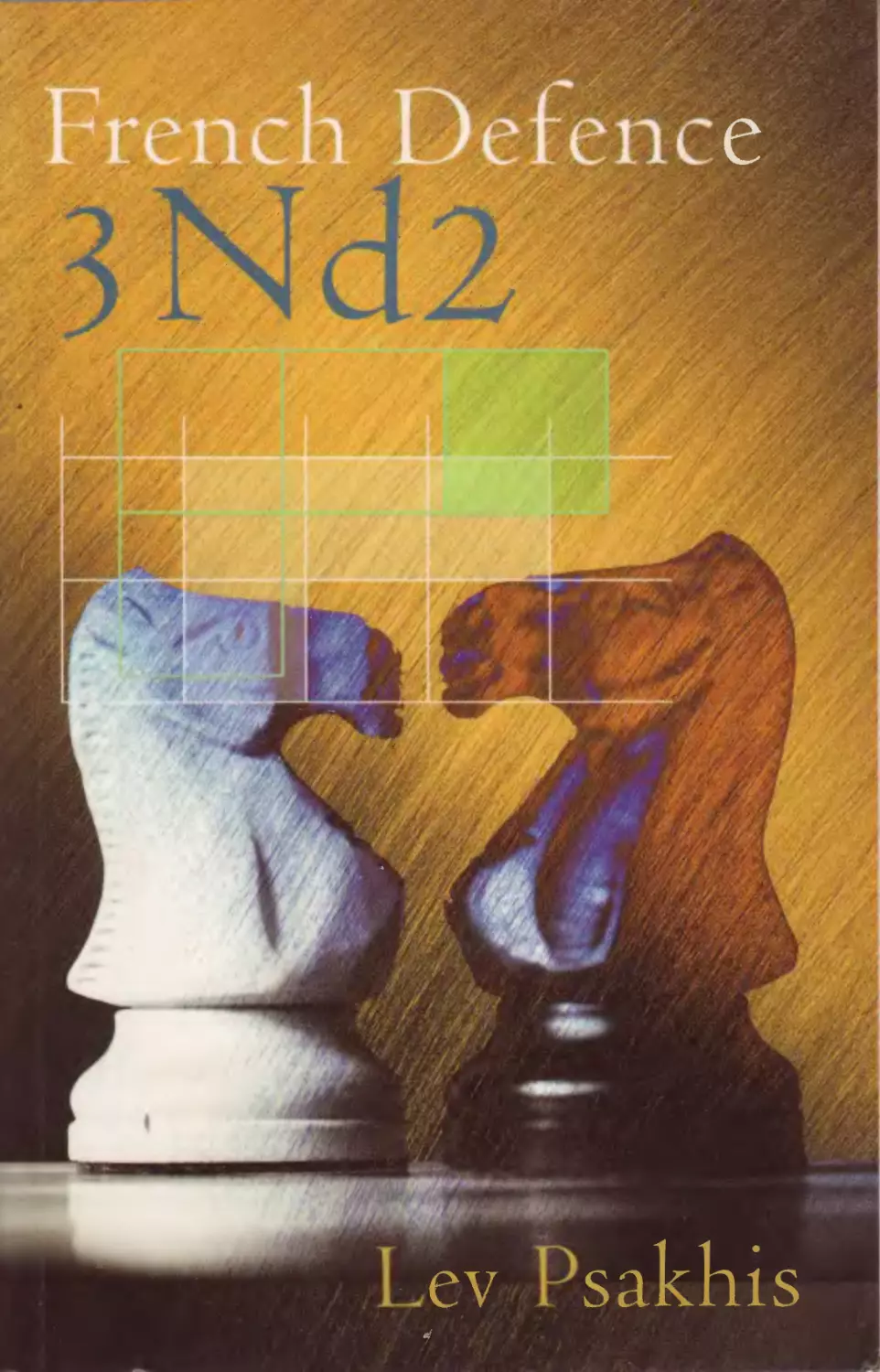


Автор: Psakhis L.
Теги: chess board games chess combinations chess tactics french defence
ISBN: 0-7134-8825-5
Год: 2003
Текст
e
'" ,'" "'-
,/
;
r
<f
- ev sakhis
I
French Defence 3 Nd2
Lev Psakhis
Translated by John Sugden
@
B.T. Batsford Ltd, London
First published in 2003
Lev Psakhis 2003
ISBN 07134 8825 5
British Library Cataloguing-in-Publication Data.
A catalogue record for this book is
available from the British Library.
All rights reserved. No part of this book may be
reproduced, by any means, without prior pennission
of the publisher.
Printed in Great Britain by
Creative Print and Design (Wales), Ebbw Vale
for the publishers,
B.T. Batsford Ltd,
The Chrysalis Building
Bramley Road,
London, WI0 6SP
Distributed in the United States and Canada by Sterling Publishing Co.,
387 Park Avenue South, New York, NY 10016, USA
A member of ChrysalifBOoks pic
A BA TSFORD CHESS BOOK
Contents
Preface 5
Symbols and Abbreviations 6
1 Rare Continuations and 3...i..e7 7
2 3 liJd2liJc6 (C03-C04) 31
3 3 lLJd2 liJf6 (C05-C06) 61
4 3 liJd2 c5 4 liJgf3 and Rare Alternatives (C07) 154
5 3 liJd2 c5 4 exd5 iYxd5 (C07) 175
6 3 lLJd2 c5 4 exd5 exd5 (C08) 217
7 3 liJd2 c5 4 exd5 exd5 5 liJgf3 tbc6 (C09) 251
Index of Variations 283
Index of Games 288
Preface
Way back in 1982, the question
"What am I going to do against the
king's pawn?" became an utter
torment for me. The openings of my
youth - Ruy Lopez and Sicilian -
were affected by some "holes" that
were difficult to plug, and the
problem of choosing a new defence
was nothing short of a life-and-
death matter! It was then that I
decided to join that large group of
strong grandmasters who cannot
imagine life without the French
Defence - and I have never
regretted this decision!
In my view, the French Defence is
like a beautiful, proud lady who
doesn't give her heart away easily.
You may spend hours on end in the
study of long and complicated
variations, but that isn't enough to
grasp all the secrets of this difficult
opening. You have to devote
yourself to it "heart and soul" - only
then, perhaps, will you penetrate its
numerous mysteries.
It is quite impossible even to
begin learning the French without
studying some memorable games by
great masters of the past such as
Nimzowitsch, Botvinnik and
Petrosian. I have also had much
pleasure analysing games by
contemporary players - names that
spring to mind are Korchnoi,
Uhlmann, Vaganian, Yusupov,
Mikhail Gurevich, Shirov, Anand
and many, many more. In general it
shouldn't be forgotten that the
essential struggle in these games
takes place not in the opening itself
but in the complex, intricate
labyrinths of the middlegame.
The French is less exposed to the
winds of chess fashion than, say, the
Najdorf Variation of the Sicilian. I
have nonetheless endeavoured to
provide up-to-date material,
although considering the speed at
which theory develops today, the
reader must be alert and indeed
wary - for by the time this book
comes out, the assessment of some
variations may have turned a full
180 degrees.
It is owing to the sheer rate of
expansion of French Defence theory
in recent years that three books are
now required to deal with the whole
opening, compared to just one as
was the case with my earlier The
Complete French, published in
1992. The present work deals with
the ever popular Tarrasch Variation,
3 tiJd2. A second volume will
analyse some rare lines (2 d3, 2
'iV e2 etc.) as well as the Exchange
Variation (3 exdS exdS) and the
currently fashionable Advance
Variation, 3 eS. A third volume will
be devoted to 3 4Jc3.
In conclusion, I would like to
wish you as much pleasure from
reading this book as I had from
writing it, even though it was an
extremely difficult labour! I hope
the book will help you in your study
of this rich opening which, in my
view, is called a defence only
through a misunderstanding.
Lev Psakhis
Rishon Ie Zion, Israel
March 2003
Symbols and Abbreviations
+ check
:t slight advantage for White
=+= slight advantage for Black
+ clear advantage for White
+ clear advantage for Black
+- decisive advantage for White
-+ decisive advantage for Black
- equal game
good move
" excellent move
!? move deserving attention
?! dubious move
? weak move
?? blunder
0() with compensation
f1 with counterplay
only move
t with initiative
0() unclear
Ch Championship
corr correspondence game
zt Zonal Tournament
izt Interzonal Tournament
ct Candidates Tournament
01 Olympiad
1: Rare Continuations and 3...iLe7
Tischbierek - Hertneck
German Championship,
Altenkirchen 2001
1 e4 e6 2 d4 d5 3 lDd2
Doctor Tarrasch' s move, which
White has been using successfully
for over 100 years now, and which
has thus withstood the hardest test -
that of time. With 3 lDd2 White is
not laying claim to a large
advantage (if that is his aim he must
turn to 3 lDc3), but attempting first
and foremost to limit the
counterplay which his opponent can
hope for in the case of, say, 3 lDc3
iL b4.
Among the great adherents of this
move, I should first name Anatoly
Karpov, although these days,
unfortunately, he has given up 1 e4.
The Tarrasch Variation is very
successfully employed by Tiviakov
and Rublevsky.
Perhaps the only defect of the
move is that White is exerting no
great pressure on the centre and thus
allows Black to carry out the freeing
advance c7-c5.
In this chapter, and in the present
game in particular, I shall examine
some comparatively rare continuat-
ions for Black. (The only one that
stands out, perhaps, is 3...iLe7!?)
The analysis of the most popular
replies (3...lDf6 and 3...c5) will be
given in later chapters.
3...b6
Probably the most popular of the
"second-rate" moves. Practice has
also seen:
(A) 3...lDe7 4 lDgf3 Maintaining
the tension in the centre. Black's
task is simpler after 4 e5 ltJfS 5 c3
c5, let alone after 4 exd5 exd5.
White has a slight advantage after 4
iLd3 c5 5 dxc5 lDd7 6 lDb3 tlJxc5 7
tUxc5 'iYa5+ 8 iLd2 'iYxc5 9 lDf3
dxe4 10 iLxe4, V ogt - Garcia
Gonzales, Cienfuegos 1976.
4...lDd7 In reply to 4...tUg6 White
has the pleasant choice between 5
e5 and 5 h4!? Another line that can
hardly be recommended to Black is
4.. .c5 5 dxc5 "iV a5+ 6 iLd3 'iYxc5 7
0-0 lDbc6 8 a3 iLd7 9 b4 'iYc3 10
1;Ib 1 lDe5 11 iLb2t Donev-Ernst,
Swiss Team Ch 1996. The dubious
4...g6?!, with its serious weakening
of the dark squares, is well enough
answered by 5 h4!?, with the sample
continuation: 5...h6 6 h5 g5 7 e5 c5
8 c3 cxd4 9 cxd4 lDbc6 10 lDb3
6 11 iLd3 + Geller-Makarov,
Ukrainian Ch, Kiev 1959. 5 iLd3
8 Rare Continuations and 3...iLe7
White also has S iLe2 cS 6 0-0 cxd4
7 tLJxd4 tLJc6 8 tLJxc6 bxc6 9 b3
iLe7 10 iLb2 iLf6 11 iLxf6 'iixf6 12
exdS cxdS 13 c4 Kaminski-Murey,
Cappelle la Grande 1993. 5...c5 On
S...g6, White can choose between
the sharp 6 h4!? and 6 0-0 iLg7 7 c3
cS 8 exdS exdS 9 dxcS tLJxcs 10
i.b5+ i.d7 11 i.xd7 + 'iixd7 12
tLJb3 Kasparov- Abdel Razik, Cairo
open 2001. 6 0...0 After the less
energetic 6 c3 cxd4 7 cxd4 dxe4 8
tLJxe4 tLJdS 9 0-0 iLe7 10 a3 0-0 11
i..c2 C[j7f6 12 tlJe5 tlJxe4 13 i..xe4
ltJf6, it is rather hard to speak of any
advantage for White; Emms-Murey,
Paris 1994. ECO recommends 6
exdS tLJxdS 7 0-0 iLe7 8 tLJe4 .
6...cxd4 7 ltJxd4 tDc5 8 i.b5+ 1t.d7
9 'ii e2 tLJc6 10 iLxc6 bxc6 11 c4
Kholmov-Petrosian, Rostov 1980.
(B) 3...f5
Is it worth weakening eS like this,
without cause or justification? 4
exf5 exf5 5 tlJdf3! White's other
knight will be excellently placed on
e2. Instead, 5 tLJgfJ more or less lets
the advantage slip: S...l2Jf6 6 iLd3
(or 6 c4 iLd6 7 cxdS 0-0 8 iLe2
tDxdS 9 0-0 <it>h8 10 el i.e6=
Geller-Benko, Cura9ao ct 1962)
6...iLd6 7 0-0 0-0 8 c3 tLJc6 9 b4
<it>h8 10 bS tLJe7 11 tLJeS 'iie8 12
el tLJe400 Gufeld-Gusev, Moscow
1970. 5...tLJf6 6 iLd3 iLd6 White
also has an obvious advantage after
6...iLe7 7 iLgS tLJe4 8 iLxe7 'iixe7 9
tLJe2 4+ (9...0-0 10 O-O ) 10 c3
'iYxb2 11 0-0 0-0 12 c4 dxc4 13
iLxc4+ <it>h8 14 b 1 'iVa3 IS tLJeS,
Karpov-Enevoldsen, Skopje 01
1972. 7 tLJe2 0-0 8 0-0 4Je4 Or
8... tLJc6 9 c4 tLJb4 10 cS tLJxd3 11
'iYxd3 iLe7 12 b4 'iie8 13 tLJf4
Bradvarevic- Milic, Yugoslav Ch,
Sombor 1957. 9 c4 c6 10 'iib3 <it>h8
11 tLJc3 dxc4 12 iLxc4 tLJxc3 13
bxc3 f4 14 iLa3 + .
(C) 3...g6?! A dubious move;
Black seriously weakens the dark
squares in his camp, without
compensation. 4 tLJgf3 Or 4 eS iLg7
S iLd3 c5 6 c3 tLJc6 7 tLJe2 6 8
tLJf3 ltJge 7 9 O-O Boronyak-
Havasi, Hungarian Team Ch 1995.
4...i.g7 5 c3 b6 6 i.d3 iDe7 7 0-0
0-0 8 e1 cS 9 tLJfl tLJbc6 10 e5t
Panna-Czemiak, Athens 1968.
(D) 3...h6 I didn't believe my
eyes when I saw this move
appearing in games by strong
players. Black doesn't want to
commit himself to any plan, and
makes a defiant waiting move
which may prove useful or hannful,
as the case may be! 4 ltJgf3 ltJf6 5
iLd3 It is quite possible that S eS is
stronger. 5...c5 6 dxc5 Black has a
good game after 6 c3 cxd4 7 cxd4
dxe4 8 tLJxe4 iLb4+ 9 iLd2 iLxd2+
10 'iYxd2 4Jxe4 11 iLxe4 tlJd7 12
0-0 tLJf6= Nevednichy-Eingom, Bad
Worishofen open 2002. 6...dxe4 7
tLJxe4 t2Jxe4 8 iLxe4 xdl + 9
<it>xdl iLxc5 10 <it>e2 0-0 11 iLe3
i.xe3 12 <it>xe3 with chances of a
minimal advantage; Marciano-
Bricard, French Ch, Narbonne 1997.
(E) 3...a6 Finally we come to a
normal "human" move!
E . z A " <I'E / S
/.:: / '/' I I Z
, '/
t ' ft. , '. t fi i
i ''''''' i.''''''
. W.
"""'
" ''// I'/ '''//. 'l"/."-0 'l"/."-0
? $
J1 J1 &i J1 .ill
. ..z'.....I''l''/I I'' W "/-: ,.....I' "I' ' .....
( .
. - -/. .
White now has a wide choice of
continuations of differing value:
(E1) Black is set no problems by
4 exd5 exd5 5 i.d3 .td6 6 tDe2
tiJc6 7 c3 iff6!? 8 0-0 lUge7 9 el
i.f5 10 .txf5 xf5= Zapata-
Vladimirov, Salamanca 1991.
(E2) 4 c3 is not dangerous for
Black either: 4...c5 5 dxc5 Or 5
exd5 exd5 6 tDdf3 lUc6 7 .te3 tDf6
8 dxc5 l2Je4 9 lbe2 i.xcs 10 .txc5
t2Jxc5 11 lUf4 i.e6 12 i.e2 0-0 13
0-0 e8= Dvoirys-Karlsson, Europ-
ean Cup, Orebro 1995. 5....txc5 6
t2Jb3 .tb6 7 exd5 exd5 8 tDo tDf6
9 i.e2 0-0 10 0-0 l2Jc6 11 lbfd4
e8= Manolov-Legky, Cannes open
2000.
(E3) The cunning 4 .td3 is
interesting; White attempts to
improve on 4 lUgD lbf6!? Now
4...c5 is answered by 5 dxc5 4Jd7?!
Instead S....txc5 6 lUgf3 would
transpose to C07. 6 b4! a5 7 exd5
'ii'f6 Or 7...exd5 8 e2+ .te7 9
c3 + . 8 b1 fie5+ 9 tDe2 axb4 10
dxe6 ifxe6 11 0-0 i..xc5 12 lUf4
and White's advantage is obvious;
Psakhis-Giaccio, Andorra open
2000.
Rare Continuations and 3...i.e7 9
(E4) 4 e5 c5 It is worth
considering 4... d7!? with the
obvious purpose of exchanging the
light-squared bishops: 5 lDdD
(Black equalizes after S c4 dxc4 6
.txc4 .tbS 7 lbe2 lbc6! 8 1i'b3
i.xc4 9 tDxc4 .tb4+ 10 <&t>f1 bS as
in Dvoirys-Dreev, Odessa 1989; or
5 c3 .tbS 6 tDdB i.xfl 7 <&t>xfl c5 8
g3 lbc6 9 g2 cxd4 10 cxd4 lbge7
11 tDe2 1i'b6 12 i.d2 h5, Dvoirys-
Eingom, Odessa 1989) 5....tb5 6
.txb5+ (or 6 t2Je2 c5 7 c3 lbc6 8
.te3 cxd4 9 lUexd4 .txfl 10 <&t>xfl
lUge7 11 g3 tDxd4 12 cxd4 lbc6=
Oll-Topalov, Zaragoza 1992)
6...axb5 7 tDe2 tDd7 8 ifd3! c6 9
lbg5 (Black has quite a good game
after 9 h4 h6 10 :h3 tDe7 11 h5
lUb6 12 ltJh4 ltJc4 13 f4 b4 14 b3
tDa3 15 .txa3 xa3 16 fl if a8f1
Prusikhin-Eingom, Bad Wiessee
open 2001) 9...i..e7 10 h4 a5+! 11
.td2 b4 12 tDxh7 (in Kuijf-Eingom,
Tilburg 1994, White was unsuccess-
ful with the sacrificial line 12
g3?! ltJh6 13 ltJxe6!? fxe6 14
ifxg7 tDf7 15 lUf4 tiJf8 16 h3
h5!+) 12...c5! 13 lbgS i.xgS 14
i.xg5 b3+ 15 c3 bxa2=. 5 c3 i.d7!?
This move seems to me more
logical than 5...tDc6, although the
latter too has its supporters. There
can follow: 6 lbdD (Black has no
great problems in the case of 6
ttJgf3 cxd4 7 cxd4 tDh6 8 .td3 t2Jf5
9 lUb3 .te7 10 0-0 h5 Gujvan-
Eryomenko, Alushta 2001)
6.. .I1:Jge 7 7 i.d3 cxd4 8 cxd4 lbf5 9
lbe2 .te7 10 0-0 (or 10 a3 1i'b6 11
h4 i.d7 12 h5 ltJa5 13 :b1 .tb5 14
h6 tDxh6 15 i.xh6 gxh6 16 xh6
.txd3 17 xd3 'i¥b3°o Kupreichik-
Dolmatov, Yerevan zt 1982)
10...'i¥b6 11 a3 .td7 (11...aS!?) 12
i.c2 1:tc8 13 b4 Dvoirys-
Dolmatov, USSR ch, Odessa 1989.
10 Rare Continuations and 3...iLe7
6 iLd3 b6 7 ltJdf3 iLb5 8 ltJe2
ltJc6 9 0-0 iLxd3 10 xd3 ltJge7=
Heine Nielsen - Karlsson, Sweden-
Denmark 1993.
(E5) 4 ltJgf3 The most popular
move in the position. 4...ltJf6 After
what is probably Black's best move,
4...cS, the play will transpose into
variations examined in the chapters
devoted to C07 and C08. Occasion-
ally Black plays 4...ii.d7, to which
White usually reacts with S exdS
exdS 6 4JeS iLe6 (nothing is
basically altered by 6...ltJf6 7 iLd3
iLd6 8 0-0 0-0 9 e 1 e8 10 4JdB
iLbS 11 iLgS iLe7 12 iLfS with the
initiative; Grachev- Pokrasenko,
Novosibirsk open 2001) 7 iLd3 ltJf6
8 0-0 iLd6 9 f4 0-0 10 <it>h 1 ltJe8 11
fSt Losev-Kumayev, Moscow Ch
2001. 5 e5 White can hardly count
on gaining much from S exdS exdS
6 iLd3 ltJc6 (or 6.. .iLd6 7 0-0 0-0 8
c3 iLg4 9 b3 4Jc6 10 a4 e8==
Malevinsky-Mariasin, USSR 1979)
7 c3 iLd6 8 0-0 0-0 9 el e8 10
xe8+ xe8 11 ltJf1ltJe7!? 12 c2
h6 13 iLe3 iLd7== Sorokin-Volkov,
Yekaterinburg open 1997. Another
line occasionally seen is S iLd3 cS 6
exdS (Black gradually equalizes
after 6 dxcS dxe4 7 ltJxe4 ttJxe4 8
iLxe4 xd 1 + 9 <it>xd 1 iLxcs 10
e2 f6 11 iLe3 iLxe3 12 xe3 4Jd7
13 4Jd2 ltJcs 14 iLf3 as== Guigonis-
Legky, Clichy Masters 1999; for
6...iLxcs, see C07) 6... xdS (in the
case of 6...ltJxdS, Black's pawn on
a6 is not improving his position in
comparison with the well-known
line 3 ltJd2 cS 4 4Jgf3 ltJf6 S exdS
4JxdS; however, 6...exdS is
perfectly playable, for instance: 7
e2+iLe7 8 dxcS 0-0 9 ltJb3 e8
10 iLe3 ltJbd7, and Black comfort-
ably regains his pawn; Cooper-
Eingom, Metz open 2000) 7 dxcS
ii.xc5 8 0-0 ltJbd7 9 e2 0-0 10
ltJe4 ltJxe4 11 iLxe4 hS 12 e 1
ltJf6 13 iLd3 iLd7== Pierrot-Giaccio,
Argentine Ch, Buenos Aires 2000.
5...ltJfd7 6 iLd3 A complex game
with chances for both sides results
from 6 c3 cS 7 iLe2 ltJc6 8 0-0 cxd4
9 cxd4 f6 10 el fxeS 11 dxeS g6
12 ltJb3 iLg7 00 Asrian-Sakaev,
Istanbul 01 2000, or 6 c4 dxc4 7
iLxc4 (Black shouldn't be afraid of
the other capture either: 7 4Jxc4 bS
8ltJcd2 iLb7 9 iLd3 cS 10 iLe4 iLc6
11 c2 J:ta7 12 0-0 iLe7 13 dl
c7°o Kotronias-Eingom, Metz
open 1998) 7...ltJb6 8 iLb3 iLd7 9
0-0 iLc6 1 0 e 1 iLb4 11 a3 iLxd2
12 iLxd2 iLdS 13 iLc2 ltJc6 14 iLe3
h6 (14... e7 IS ltJgS!?) IS e2
e7 16 b3 O-O-O Womacka-
Eingom, Bundesliga 1998. The
pawn structure here is highly
reminiscent of the Queen's Gambit
Accepted. 6...c5 7 c3 ltJc6
Usually this type of position arises
from a different variation, highly
popular in our own day: 3 4Jd2 ttJf6
4 eS ltJfd7 S c3 cS 6 iLd3 ltJc6 7
0-0. In comparision with that line,
Black has now made the move
a7-a6, which is of no great use
(though it is not directly harmful,
which is something!). However, the
closed nature of the position gives
him a right to such eccentricities,
and it isn't at all easy for White to
exploit the extra tempo. 8 0-0 iLe7
More effective than 8.. :iib6, which
allows White to gain the advantage
with 9 dxc5 'VJic7 (or 9.ooiLxc5 10
'it' e2 f6 11 exf6 l2Jxf6 12 l2Jb3 iLd6
13 l2Jbd4 ttJxd4 14 cxd4 Zakic-
Rosenthal, Budapest 1991) 10 ttJb3
ttJxcS 11 ttJxc5 iLxc5 12 e 1 iLd7
13 'VJie2 !iLa7 14 iLf4 Coenen-
Kuijf, Bundesliga 2001. On the
other hand 8...b5, trying to utilize
the pawn on a6, deserves attention.
There can follow: 9 el iLe7
(9. ooc4!? 10 iLc2 iLe7 11 b3 ttJb6°o
Ghizdavu-Padevsky, Skopje 1972)
10 ttJf1 iLb7 11 ttJg3 h5! 12 ttJe2
g5!? Sequera-Lebredo, Santa
Clara 1994. Finally, 8...g5!?, a wild
move but a typical one in this kind
of position, leads to great
complications: 9 dxc5 (Black would
obtain a good game after either 9
c4!? g4 10 cxd5 exd5 11 ttJe 1 ttJxd4
12 ttJc2 ttJxc2 13 iLxc2 ttJb6
Dvoirys-Dyachkov, Russian Ch,
Elista 1995, or 9 h3 h5 10 g4 hxg4
11 hxg4 'iVb6 12 'VJia4 'VJia7! 13
ltJxg5 cxd4 14 ttJdB b5+
Dgebuadze-Legky, Metz open
2001) 9...g4 10 ttJd4 ttJdxe5 11
ttJ2b3 iLd7 12 iLe2 g8 13 f4 gxB
14 ttJxB 'VJic7 15 ttJg5 g7 16 iLh5
.i1..e7 with chances for both sides;
Adams-Legky, French Team Ch
2001. 9 e1 White doesn't have
that much choice; he can hardly go
in for 9 dxc5?! ttJcxe5 10 ttJxe5
ltJxe5 11 ttJb3 ttJxd3 12 'VJixd3 iLd7
13 a4 0-0 14 c4 iLc6+. 9...cxd4
Here too 9... g5 !? is worth thinking
about, but 9... 'iVb6 10 dxc5 once
again gives White the better
chances, for instance: 1000.ttJxc5 11
.i1..c2 'iic7 12 ttJf1 h6 13 l2Jg3 g6 14
h4t Jansa-Mischustov, Bundesliga
2002. 10 cxd4 'VJib6 11 l2Jb3 a5 12
a4 'VJid8 Controlling the g5-square;
Rare Continuations and 3...iLe7 1 J
White preserves a small plus after
12...l2Jb4 13 iLg5 l2Jxd3 14 'VJixd3
iLb4 15 iLd2 h6 16 ecl
Tzenniadianos-Giaccio, Elista 01
1998. 13 iLb5 On 13 'VJie2 ttJb4 14
iLbl b6 15 iLd2 iLa6 16 'it'e3 c8,
Black has everything in order;
Shahade-Giaccio, Andorra open
2000. 13...ttJb4 14 ttJc5 Black
gradually attained eq.uality after 14
iLd2 0-0 15 c 1 liJb8! 16 ttJc5
ttJ8a6 17 ttJxa6 bxa6 18 .i1..e2 iLd7
19 'iVb3 'iVb6 in Mephisto-
Speelman, AEGON 1996. 14...b6
15 ttJd3 0-0 16 ttJxb4 .i1..xb4 17
iLg5 iLe7 18 h4 Korneev-Giaccio,
Burgas open 2000.
4 ttJgfJ
White has practically no chance
of gaining an advantage with 4 exd5
exd5 The more risky 4...'VJixd5 is
also playable, although White's
chances are somewhat better after 5
ttJgB ttJf6 6 .i1..c4 'VJid8 7 'VJie2 iLe7
8 ttJe5!?, when it turned out that
8...'VJixd4?! (a safer line for Black is
8...0-0 9 ttJdB iLb7 ) 9 ttJdB 'VJie4
10 iLe3 0-0 11 0-0-0 gave White
excellent compensation for the
pawn in Losev-Totsky, Minsk open
1996. 5 ttJdfJ iLd6 6 iLd3 Nor does
White achieve much with 6 iLg5
ttJe7 7 .i1..d3 0-0 8 ttJe2 c5 9 c3
ttJbc6 10 h3 'VJic7 11 0-0 h6 12 iLe3
12 Rare Continuations and 3...i.e7
c4 13 i.c2 i.f5 Novopashin-Gulko,
V olgodonsk 1981. 6...i.g4 7 c3
ttJd7 8 'iVc2 ttJgf6 9 i.g5 h6 10
e3 c5 11 h3 i.e6= Miles-Nikolac,
Wijk aan Zee 1979.
Black also has good defensive
chances after 4 c3 dxe4 White
retains a small plus in the case of
4...i.b7 5 i.b5+ c6 6 i.d3 c5 7 e5
ttJc6 8 ttJdB 'iVd7 9 ttJe2 Dorfman-
Gulko, USSR Ch, Frunze 1981. 5
ttJxe4 i.b7 6 ttJg3 Black is close to
equalizing after 6 'iV c2 ttJf6 7 i.d3
ttJxe4 8 i.xe4 i.xe4 9 'iV xe4 'iV d5,
Mohr-Nogueiras, Elista 01 1998. A
complex game with mutual chances
arises from 6 b5+ ttJd7 7 'iVe2
ttJgf6!? 8 ttJxf6+ gxf6 9 ttJB i.d6
10 0-0 c6 11 i.a6 xa6 12 'iVxa6
'iVc7°o Tzenniadianos-Socko, Euro-
pean Club Cup, Halkidiki 2002.
6...ttJf6 7 ttJfJ ttJbd7 8 i.c4 i.e7 9
'iVe2 0-0 10 0-0 c5 11 e1 'iVc7°o
Fabrega-Giaccio, Jaque Mate 1994.
4 e5 doesn't look entirely logical,
given that Black has already
prepared an exchange of light-
squared bishops. 4...ttJe7 Black can
also play 4... a6 at once, but why
hurry with the bishop exchange?
White can't avoid it anyway. 5 c3
'iVd7 6 ttJdfJ Black has an excellent
game after 6 g4?! c5 7 f4 cxd4 8
cxd4 i.a6 9 ttJe2 h5, Gipslis-
Dvoretsky, Odessa 1972. 6...c5 7
i.d3 i.a6 8 ttJe2 i.xd3 9 'iVxd3
ttJbc6 10 0-0 ttJg6 00 Kitts-Gulko,
USA 1986.
4... ttJf6
Without any doubt the best move.
White has no problem in gaining an
advantage from 4...i.b7 5 i.b5+!
This forces c7-c6, a move which
Black would of course like to avoid,
and is more convincing than 5 i.d3
ttJf6 6 e5 ttJfd7 7 0-0 iLe7 8 c3 c5 9
el ttJc6 10 ttJf1 h6 11 i.e3 'iVc7
12 a3 c4 13 i.c2 b5°o Ziiger- Hort,
Nuremberg rapid. 5...c6 6 d3 i.e7
7 0-0 dxe4 8 ttJxe4 ttJf6 9 ttJxf6+
i.xf6 10 i.f4 0-0 11 'iVe2 'iVd5 12
i.e4 'iVh5 13 a4! with a big
advantage; Kasparov- Agdestein,
Tilburg 1989.
Black's position is equally dismal
in the case of 4...dxe4 5 ttJxe4 i.b7
6 i.b5+! c6 After 6...i.c6 7 d3
ttJd7 8 'iVe2 i.e7 9 ttJeg5!, Black is
already at a loss for a good
continuation; Kotronias- Perie,
Linares open 2002. 7 i.c4 Or 7
i.d3, which could transpose into
Kasparov- Agdestein ( above); the
text move doesn't look at all bad
either, for example: 7...ttJf6 8
ttJeg.5! i.d6 8...h6? 9 ttJxf7 xt7
10 ttJe5+ e8 11 'iV d3 leads to an
immediate loss (or win, depending
on which colour you are playing!);
J.Littlewood- Troger, Clare Benedict
Cup, Lucerne 1963. 9 'iVe2 'iVc7 10
ttJe5 i.xe5 11 dxe5 ltJfd7 12 i.f4 +
W ells- Petersen, Copenhagen open
1995.
5 ttJe5!?
An interesting and relatively new
move, which sets Black some
problems. White has also tried to
gain an advantage in the following
ways:
(A) 5 exd5 exd5 Black may also
recapture with his knight 5...4Jxd5!?
6 ttJe5! ? .t b 7 7 ttJdf3 f6! 8 ttJc4
'it'd7 9 c3 ttJc6 10 il.e2 0-0-0 11 0-0
g5! with mutual chances;
Kindermann-Hertneck, Bundesliga
2001. 6 12Je5!? i-b7 White retains
the initiative after 6...c6 7 ..td3 ..td6
8 0-0 0-0 9 el as 10 tbf1 c5 11 c3
i..a6 12 i..xa6 :xa6 13 ..tg5;t
Ivanovic-Karlsson, Eksjo 1980. 7
il.b5+ 8 "iY e2 J..e7 9 i..d3 0-0 After
the premature 9...c5? Black's
position is already hard to defend:
10 il.b5+ ttJfd7 11 dxc5 bxc5 12
g4! g6 13 0-0, and the black
monarch is forced to lead a
wretched life in the centre of the
board; Hracek- Hertneck, Bundes-
liga 1994. 10 0-0 c5 11 c3 ..td6 12
lbdf3t Cafferty- Marovic, Amster-
dam 1972.
(B) 5 e5!? ttJfd7 Of course Black
could also play 5...4Jg8, but frankly,
dear reader, I don't want to waste
my time and yours analysing that
move. 6 c4!? White shows he is
ready to take the fight to his
opponent even on the queenside,
utilizing his spatial advantage. The
game Gufeld-Gulko, V olgodonsk
1981, saw instead 6 i..d3 c5 7 0-0
i.a6 8 c4 cxd4 9 e 1, allowing
Black to obtain good counterplay
with 9...l2Jc5 10 il.f1 ttJc6. But 6 c3
seems to be quite a good alternative,
for example 6...il.a6 (or 6.....te7 7
b4!? i..a6 8 b5 J..b7 9 a4 a6 10 1tbl
axb5 11 axb5 c6 12 bxc6 ttJc6 13
i.b5t Kotronias-Skalkotas, Athens
Acropolis open 1989) 7 ..txa6 ttJxa6
8 'iVe2 l2Jab8 9 0-0 iLe7 10 c4 c6 11
b3 0-0 12 ..tb2 with a small but
secure advantage; Jansa-Beutelhoff,
Badenweiler open 1990. 6...ii.b7
The game Mkrtchan-Riazantsev,
Kasparov Cup 1996, went 6..,dxc4 7
xc4 ..tb7 8 0-0 il.e7 9 "iYe2 0-0 10
Rare Continuations and 3....te7 13
ttJe4 ttJc6, and now 11 a3!? would
have promised White some
advantage. 7 cxd5 il.xd5 8 il.c4
il.e7 It is hard to recommend
8.....txc4 9 ttJxc4 b5 10 ttJe3 ttJb6
11 0-0 ..te7 12 it'd3 a6 13 "iY e4 ttJd5
14 a4! b4 15 J..d2 with a clear plus
for White; Kotronias-Shulman,
Gausdal 1994. 9 i.xd5 White's
position is also preferable after 9
0-0 c6 10 e2 0-0 11 l2Je4 a5 12
i..f4 :e8 13 i..d3 ttJf8 14 ttJc3;t
Sokolov-Gulko, Moscow Ch 1983.
9...exd5 10 ttJn ttJf8 11 ttJe3 ttJe6
12 a4+ c6 13 0-0 0-0 14 ttJf5 and
White undoubtedly has the
initiative; Fritz 7 - Gulko, Internet
2002.
(C) 5 ..td3 ..ta6 Black calmly
carries out the key strategic idea of
exchanging light-squared bishops.
Practice has also seen 5...c5. There
can follow: 6 c3 il.e7 7 0-0 0-0 8
:el (it is worth considering 8 e5
ttJfd7 9 :el;t) 8...i.a6 9 i.c2 dxe4
10 ctJxe4 4Jbd7 11 ttJxf6+ tDxf6 12
i.f4t Brodsky-Totsky, Perm 1997.
6 .txa6 tDxa6 7 exd5 "iYxd5
7...exd5 8 "iYe2+ "iYe7 9 ctJe5! is too
dangerous for Black. 8 c4 "iWb7 9
0-0 i.d6 9... O-O-O?! 10 ttJe5! :xd4
11 ttJxf7 :g8 12 "iYe2 brings Black
to the brink of defeat; Kuijf-
Hertneck, Tilburg 1994. 10 b3 0-0
11 i.b2 c5 12 d5!t Adams-
Hertneck, Gannisch 1994.
(D) 5 ..tb5+ It seems to me that in
this particular case, this check
brings White little profit. 6...c6 6
i.d3 i.a6!? In Psakhis-Yusupov,
Baku 1979, Black played 6.....te7
and White worked up a dangerous
initiative: 7 it'e2 ..tb7 (7...0-0 8 0-0
c5!?) 8 0-0 dxe4 9 tLJxe4 ttJbd7 10
t2Jeg5! 0-0 11 1te I!, and Black is
hard pressed to find a defence
against the simple but powerful
threat of capturing on e6. 7 ..txa6
14 Rare Continuations and 3...i..e7
ttJxa6 S eS ttJd7 9 0-0 cS 10 c4
lbc7! Campora-Gulko, Biel 1988.
S...i..b7 6 i..bS+ c6 7 i..d3
7...lbbd7
Perhaps not the best move, but
White's position is better in any
case. For example, it is extremely
dangerous at this point for Black to
}2lay 7...dxe4 S ttJxe4 iixd4 9
tiJxf6+ gxf6 10 ttJxti! 1tgS 11
"iYhS + .
White also has the better chances
after 7...SJ..e7 S exdS exdS 9 0-0 0-0
10 e1 cS!? In a game Belikov-
Alekseev, Black fell into a fairly
simple trap: 10...ttJbd7? 11 i..a6!
iic7 12 i..xb7 iixb7 13 ttJxc6
iixc6 14 xe7 fe8 15 xe8+
xe8 16 lbf1 + . 11 c3 ttJbd7 12
ttJdfJ i..d6 13 il.gS I.Zaitsev-
Totsky, Russia 1996.
Slbxd7 lbxd7 9 eS cS 10 c3
We can now sum up the results of
the opening: the passivity of Black's
dark-squared bishop ensures White
a small but clear positional
advantage.
10...a5 11 iie2 iics 12 0-0
l.e7?!
.-\n improvement is 12...cxd4 13
:\d l.a6.
13 iig4 + 'it>f8 14 e1 i..a6 IS
i..b1 cxd4 16 cxd4 a7 17 ttJfJ h6
IS SJ..d2 c7 19 a3 ii eS 20 h4 c6
21 iif4 'it>gS 22 hS
White's play may not have been
the most convincing, but he has held
on to the initiative, largely thanks to
the position of the black king.
22...gS 23 iig3 'it>g7 24 ttJh2 fS
2S exf6+ i..xf6 26 i..g6 iibs 27
iih3! iid6 2S i..c3 eS?
A blunder in a difficult position.
If 28... hc8!?, White continues 29
ttJg4 + .
29 dxeS ttJxeS 30 SJ..xeS! xeS 31
xeS 1-0
Adams - Morozevich
Sarajevo 2000
1 e4 e6 2 d4 dS 3 lbd2 i..e7!?
In the first edition of this book I
devoted literally just a few lines to
this move, but eleven years is a long
time, and in the interim period
3...i..e7!? has experienced a genuine
boom. In the right hands it has
become a formidable weapon! The
well-known innovator Oleg
Romanishin was the first to employ
it in top-class chess with varying
success, but in the last few years
many elite players have incorpor-
ated it in their repertoire. In my
view, Morozevich and Lputian have
contributed the greatest number of
new ideas to the theory of the
variation.
The main idea of 3....i.e7 is that
Black first wants to see what plan
White will adopt, before deciding
on a corresponding course of action.
Another point of some significance
is that in this line Black avoids the
numerous exchanges that can occur
following 3...cS.
4 .i.d3
One of the most popular replies,
and, for Black, one of the most
dangerous. Two others that merit
serious attention are 4 li)gf3 and 4
eS!? The latter will be examined in
the next game. We will now look at
the alternatives.
(A) Obviously 4 exdS exdS S
.i.d3 ltJf6 sets Black no real
problems and basically steers
towards the Exchange Variation.
(B) 4 c3!? is a good deal more
interesting. 4...cS The usual answer
although of course 4...dxe4 S ltJxe4
is perfectly playable too, leading to
positions very similar to the
Rubinstein Variation. In Gelfand-
Begun, Minsk 1983, the contin-
uation was very interesting: 5...ttJd7
6 ltJf3 b6 7 ..tbS iLb7 8 ttJeS .i.xe4
9 .i.xd7+ f8 10 .i.a4 lbf6 11 lbc6
'iVd6°o. 5 dxcS Black's task is
simpler in the line S exd5 'iVxdS 6
dxcS (or 6 l2JgB tZJf6 7 .i.c4 1Vd8 8
0-0 0-0 9 tlJb3 ltJbd7 10 dxcS ltJxcs
11 ..te3 'iVc7 12 liJxcs .i.xcs 13
.i.xcs ir'xcS= Connolly-Orr,
Bunratty Masters 2001) 6... 'iVxcs 7
tZJe4 c6 8 .i.d3 liJd 7 9 l2Jf3 ltJgf6
10 'iVe2 lbxe4 11 ..txe4 flic7 12 0-0
0-0 13 a4 tZJf6 14 ..tc2 b6=
Dvoirys-Morozevich, Samara 1998.
S.....txc5 Black has lost a tempo
Rare Continuations and 3....i.e7 15
with his bishop of course, but it isn't
clear if White can make anything
out of his unimpressive extra move
c2-c3. Unclear complications arise
from S...l2Jf6!? 6 exdS 'ifdS (or
6...exdS 7 ttJb3 0-0 8 ttJf3 as!? 9 a4
.i.g4 10 .i.e2 ltJbd7 11 .i.e3 1:tc8 12
0-0 li)xcs 13 ltJxcs .i.xcs 14 .i.xcs
1:txcS= N aiditsch - Glek, Bad
Zwesten open 2000), for example: 7
b4 (a pawn is a pawn, and it takes
quite a lot of ingenuity for Black to
obtain enough counterplay) 7...aS 8
ltJgf3 0-0 (in Sennek- Reefat, Dhaka
open 2002, White gained the
advantage after 8...tZJc6 9 jLc4 iYh5
10 1:tb 1 ltJd5 11 jLxdS exdS 12 O-O!
axb4 13 cxb4 1:txa2 14 1:te 1 .i.e6 IS
bS + ) 9 .i.c4 hS 10 0-0 lbd5 11
.i.xdS 'iVxdS 12 a3 b6! 13 c4 hS
14 ..tb2 bxcS IS bS f6 16 ttJe4 tZJd7
with approximate equality in a fairly
complicated position; Emms-
Hodgson, British Ch, Scarborough
2001. 6 exdS A more difficult game
for both sides results from 6 tDgf3
tZJf6 7 eS 6! 8 ttJd4 (8 'iVa4+
ltJfd7 9 h4 ttJc6 10 'iVg3 oo )
8...tZJfd7 9 flig4 0-0 10 tZJ2B tbc6
11 ..th6 g6 12 0-0-0 ltJdxeS 13 f4
f6! 14 .i.xf8 xf8 Onischuk-
Morozevich, Bundesliga 1999, or 6
tlJb3 Ji.b6 7 eS tlJc6 8 llJf3 f6! 9
.i.bS ..td7 10 .i.xc6 bxc6 11 0-0
tlJe7 12 ..te3 0-0 13 e 1 ltJg6 14
tZJc5 f7 , Adams- Morozevich,
Cannes 2001. 6...exdS 7 ltJb3 .i.b6
8 .i.bS+ Black scarcely needs to
fear 8 'iVe2+ tlJe7 9 i.e3 lbbc6 10
lbf3 0-0 11 ..txb6 'iVxb6 12 iVd2
.i.g4, when his active pieces
compensate for his nominal pawn
weakness; Ivanov-Gausel, Gausdal
Arnold Cup 1991. 8...l2Jc6 9 l2Jf3
ltJf6 10 0-0 0-0 11 1:te1 lbe4 12
.i.e3 ..tg4 with a roughly equal
game; Hermansson Nielsen,
Swedish Team Ch 2000.
16 Rare Continuations and 3....i.e7
(C) 4 ttJgfJ
A strong, solid move, and one of
the most popular in this position.
4...ttJf6 Black doesn't have a great
deal of choice, since, for example,
4...c5?! 5 exd5 exd5 6 dxc5 ltJf6 7
ltJb3 0-0 8 .i.e3 ttJc6 9 c3 .i.g4 10
.i.e2 'Viic7 11 0-0 leads to a clear
plus for White; Benjamin-Shabalov,
USA Ch playoff, Seattle 2000. 5 e5
The timid 5 exd5 is adequately
answered by either 5...exd5=, which
leads to the Exchange Variation, or
5...ttJxd5, for example: 6 ttJe4 ltJd7
7 .i.d3 c5 8 dxc5 ttJxc5 9 ttJxc5
'Vii a5+ 10 c3 'Viixc5= V ajda- Ionescu,
Bucharest 2001. Black similarly
comes close to equalizing after 5
.i.d3 c5 (the restrained 5... b6 also
occurs quite often; there can follow
6 0-0 dxe4 7 ltJxe4 .i.b7 8 'Viie2
ltJxe4 9 .i.xe4 .i.xe4 10 'Viixe4 'Viid5
11 'Viie2!? ttJc6 12 c3 0-0 13 .i.f4
.i.d6 and Black has almost
equalized; Kholmov - Totsky,
Pardubice 1996) 6 dxcS (there is
obviously no danger at all for Black
in 6 c3 cxd4 7 cxd4 dxe4 8 ltJxe4
.i.d7 9 0-0 ltJxe4 10 .i.xe4 .i.c6 11
.i.c2 .i.d5 12 .i.e3 ltJc6 13 ltJe5
0-0= Todorovic-Antic, Yugoslav
Ch, Herceg Novi 2001. But it is
worth considering 6 exd5 ltJxd5 7
0-0 0-0 8 dxc5, for example:
8...ltJd7 9 ltJe4 ltJxc5 10 ltJxc5
.i.xc5 11 'Vii e2 'Vii c 7 12 'Vii e4! f5 13
'Vii e2 with some initiative for White;
Morovic Fernandez - Botto, Graz
1978) 6...dxe4 (or 6....i.xc5 7 eS
ttJfd 7 8 c4 ltJc6 9 'Vii e2 ltJb6 10 0-0
.i.e7 11 cxd5 ttJxd5 12 ltJe4
Bondarets-Finnan, Lvov 1999) 7
ltJxe4 (or 7 .i.xe4 ttJa6!, and now
White has no advantage after either
8 0-0 ltJxcs 9 'Viie2 'Viic7 10 c4
ltJfxe4 11 ltJxe4 0-0 12 b3 b6 13
ltJxc5 .i.xc5 14 .i.b2 .i.b7==,
Kozakov- V. Gaprindashvili, Alushta
2000, or 8 .i.d3 ttJxc5 9 .i.b5+ .i.d7
10 .i.xd7+ 'Viixd7 11 0-0 0-0=,
Georgiev- Lputian, Sarajevo 1998)
7.. .ltJxe4 8 .i.xe4 'Viixd 1 + 9 'it>xd 1
.i.xc5 10 'it>e2 (10 .i.e3 .i.xe3 11
fxe3 ttJd 7 12 'it>e2 'it>e 7 13 1:thd 1
ltJc5 14 .i.d3 .i.d7 gives equality,
Heuer-Romanishin, Tallinn 1977)
1 0...f5!? 11 .i.d3 ttJc6 12 .i.f4 h6 13
h4 'it>f7 14 1:tad 1 'it>f6, and White
can't stop the freeing move e6-e5;
Kholmov Smirnov, Suetin
memorial, Tula 2002. 5...ttJfd7
5.. .ltJe4 6 .i.d3 ttJxd2 7 .i.xd2 is not
unfavourable to White, for instance:
7...c5 (White has the more attractive
}2osition after 7...b6 8 b4! c5 9 c3
tLJc6 10 1:tb 1 , while the incautious
7...0-0?! had unpleasant consequ-
ences in Chandler-Short, Brighton
1981: 8 h4! h6 9 c3 ltJd7 10 ltJg5!
c5 11 'Viih5 cxd4 12 cxd4 6 13
.i.c3 .i.b4 14 'it>f1! .i.xc3 15 bxc3
2 16 1:td 1 'Viixa2 17 1:th3 b6 18
.i.h7+! with a powerful attack) 8
dxc5 .i.xc5 9 0-0 ltJc6 10 c3 .i.d7
11 'Viie2 h6 12 .i.e3!? 6 13 .i.xc5
'Viixc5 14 1:tad 1 0-0-0 15 1:tc I! 'it>b8
16 b4 6 17 a3 1:tc8 18 fel, and
the verdict on the position is
somewhere between and + ; Van
der Sterren-Timman, Amsterdam
1999. 6 c3 In answer to 6 c4, Black
obtained quite good prospects with
6...cS 7 cxdS exdS 8 dxcS 0-0 9
lDb3 lDc6 1 0 e2 4JxcS 11 0-0
i..g4 12 i..e3 lDe6! in
Klaman-Petrosian, USSR 19S7;
6.. .cS is an extremely rare move, but
I like it better than the more popular
6...dxc4, after which two
continuations promise White a small
J2lus: 7 lDxc4 lbb6 8 h4 h6 9 1:th3
ct)c6 10 a3 llJd5 11 'fic2 d7 12
1:g3 i..f8 13 lDe3 Van der Wiel-
B6hm, Hilversum 1983, and 7
i..xc4 lDb6 8 i..b3 lDdS 9 0-0 b6 10
lDe4 il.b7 11 !tel lDd7 12 i..gS
i..xgS 13 lDfxgS h6 14 tDf3,
Kholmov-Suetin, Moscow 1987.
6...c5 7 .ii.d3 Clearly, 7 dxcS?! lbc6
8 il.bS 0-0 9 'iVe2 'iVc7 can only
benefit Black; Tomescu-Lputian,
Porto San Giorgio open 1999.
7... b6 The strongest move in the
position, 7...lDc6, transposes to COS,
which we shall examine later.
Sometimes Black plays 7. oocxd4 8
cxd4 b6, but it seems to me that the
release of tension in the centre is
rather to White's advantage; for
example in Yurtaev-Shetty, Calcutta
open 2000, he retained a minimal
plus with 9 0-0 a6 10 il.xa6 lDxa6
11 el 0-0 12 lDf1 !tc8 13 i.d2
tDab8 14 'iYb3 'fie7 IS ac 1. 8 'iVe2
Naturally White prevents the bishop
exchange which could only be
Rare Continuations and 3... e7 17
useful to his opponent. Black easily
copes with his difficulties after 8
lDfl a6 9 il.xa6 lDxa6 10 lDg3
hS!?oo (he has more problems with
10...cxd4 11 cxd4 1:c8 12 0-0 0-0
13 lDhS g6 14 lDg3 lDb4 15 il.h6t
Bauer-Sharif, French Team Ch
2002). He also comes close to
equality after 8 0-0 il.a6 9 lDe 1 !
c8!? 10 'iVg4 0-0 11 lDdf3 fS 12
'iVg3 4Jc6, Kalezic-Drasko,
Yugoslav ch, Subotica 2000. 8...a5
At least this is consistent! White's
advantage is obvious in the case of
8.. .lDc6 9 a3! il.b7 10 0-0 'iVc7 11
el c4 12 il.c2 lDf8 13 lDfl, when
Black's light-squared bishop cuts a
pathetic figure and serves as a poor
advertisement for my beloved
opening; Rogic- Levacic, Croatian
Ch, Porec 1994. A complex game
resul ts from 8... cxd4 9 cxd4 a5 10
tzJfl a6 11 i.xa6, as in
Ehlvest-Lputian, Manila izt 1990; at
this point Lputian recommends
11..,lDxa6!? 12 lDg3 (or 12 a3 'iVc8
13 lDe3 lDc7, intending 'iV c8-a6=)
12...h5 13 h4 'iVc8°o. 9 0-0 Similar
J2ositions arise from 9 a3 a6 10 c4
4Jc6 11 cxd5 i.xd3 12 'iV xd3 exd5
13 0-0 0-0 14 el !tc8°o
Maksimovic-Drasko, Yugoslav Ch,
Podgoriea 1996. It is also worth
considering 9 c4, for example:
9.00il.b7 10 cxd5 i.xdS 11 il.e4
il.xe4 12 'iVxe4 lDa6 13 dS exd5 14
iixdS;t; Smirin-Pelletier, Biel 2002.
9...il.a6 More convincing than
9...cxd4 10 lDxd4!? (10 cxd4 is not
bad either: 1 0... a6 11 il.xa6 1:xa6
12 a4 0-0 13 lDbl!? 1:a8 14 lDc3
lDc6 IS e3, and in view of his
spatial advantage, the position
should be rated as somewhat
preferable for White; Mitrakanth-
Shetty, India 1999) 1000.4Jc5 11
il.bS+ il.d7 12 !te 1 0-0 13 a4 tzJba6
14 lD2f3 Tkachiev- Bauer, French
18 Rare Continuations and 3...i..e7
Team Ch 2002. 10 c4 lbc6 11 cd5
i..xd3 12 "iYxd3 exd5 13 "iYf5 Black
also has a good game after 13 1iD3
0-0 14 e 1 4Jb4, Saltayev-
Shtirenkov, Sevastopol 1986.
13...lbfS 14 dxc5 bxc5 15 dllbe6
16 lbfl 0-0 17 lbg3 b8 18 bl
lbcd4 19 lbxd4 tlJxd4 20 'it'd3 f6==
Gallagher-Sharif, French Team Ch
2002.
4...c5
The most interesting and thematic
continuation. If Black plays instead
4...lbf6 or 4...C£Jc6, the struggle
takes on an altogether different
character:
(A) First, a few words (literally)
about the rare but interesting line
4...dxe4!? 5 lbxe4 lbc6 6 lbf3 If 6
c3, then 6...eS equalizes at once.
6...lbb4!? 7 i..c4 ttJf6 8 "iY e2 0-0 9
c3 lbbd5 10 lbxf6+ i..xf6 11 "iYe4
c5 with a solid position; Spraggett-
Vallejo Pons, Dos Hermanas open
1998.
(B) 4...lbf6 I don't like this as
much as the other knight move. 5 e5
lbfd7 6 "iYg4 For 6 lbgB!? c5 7 c3,
see COSo Complex play also results
from 6 c3 b6 7 "iYg4 g6 8 h4 hS 9
"iYe2 iLxh4 10 tbdB i..e7 11 lbh3
lbfS 12 i..e3 as 13 "iY d2 i..a6 14
i..c2 Brodsky- Riazantsev, Krasno-
dar open 1998. 6...g6 7 h4 h5 8
"ifg3 Delchev-Mollov, Linares
1997.
(C) 4...lbc6 5 lbgf3 Practice has
also seen S c3 dxe4 6 iLxe4 (or 6
liJxe4 eS==) 6...lbf6 7 i..B 0-0 8
lbc4! (8 lbe2 eS! 9 xc6 bxc6 10
0-0 "iY dS 11 dxeS "iYxeS 12 lbB
"iYdS leads to equality; Kveinys-
Begun, Minsk 1988) 8... d6!
(recommended by Seirawan; the
game Ye Jiangchuan - Seirawan,
Elista 01, went 9 b4! lbbd7 10 tlJe2
::tb8 11 0-0 b6 12 bS tlJdS! 13 1iD3
.tb7 14 dl ) 9 lbe2 CiJe7 10 0-0
lDg6 11 g3 b8, intending b7-b6,
with good chances of equality.
5...lbb4 6 i..e2 Black has no
problems after 6 i..bS+ c6 7 i..a4
aS 8 i..b3 dxe4 9 lbeSlbf6 10 0-0
cS, Lastin-Kostenko, Tula 1999.
6...c5 The alternative 6.. .dxe4 7
lbxe4 lbf6 8 tlJxf6+ xf6 occurs a
good deal more frequently, although
it seems to me that White's chances
are somewhat better after 9 0-0
(another line that doesn't look bad
for White is 9 c3 lbdS 10 "iYc2 "iYe7
11 a3 cS 12 c4 lbb6 13 dxcS "iYxcs
14 i..e3 "iY c7 IS c 1 .i.d7 16 0-0
0-0 17 fdl Liss-I.Botvinnik,
Israeli Team Ch 2002), for example:
9...0-0 10 c3 tlJdS 11 i..d3 (or 11
::tel b6 12 tlJeS i..b7 13 i..B )
11...b6 12 "iYc2 g6 13 el b7 14
i..h6 i..g7 IS i..xg7 rJ;;xg7 16 i..e4
'it'c8 17 i..xdS!? (a familiar plan; the
white knight is stronger than the
black bishop, which may look
attractive but can't find any objects
to attack) 17...i..xdS 18 liJeS with a
slight but enduring plus; Adams-
Seirawan, Bennuda 2000. 7 c3
Black has quite a good position after
7 exdS lbxdS 8 lbb3 cxd4 9 0-0
liJgf6 10 lbbxd4 0-0 11 c4 lbb4 12
b3 "iYc7 13 lbbS 1iD8 14 i..b2 lbc6,
Kotronias - Lputian, Yerevan zt
2000. 7...lbc6 8 0-0 cxd4 9 cxd4
dxe4 10 lDxe4 lDf6 11 lDc3 0-0 12
a3 a6 13 i..d3 b5 14 i..c2 il.b7
Shchekachev - Hillarp Persson,
Amsterdam open 2000. Such
positions with a white isolated pawn
arise much more frequently in the
Queen's Gambit or Nimzo-Indian
Defence than in the French!
5 dxc5
There are no real alternatives; S
exdS "iYxdS 6 lDgB cxd4 7 0-0 lDc6
8 e4 ..wd7 9 ttJb3 l2Jf6 10 xc6
'it'xc6 11 lDbxd4 cS 12 "iYe2 0-0
was equal in Skembris- Halkias,
Greek Ch, Agios Nikolaos 2000.
5...lDf6! ?
JliNIA :
a _.iL%. 1S
._ ¥ .r .
..L. ..L ..L
,...., i .'.....,
.. .
i .
r. r
m m
mA.
.., :,, .. ..",
1t 1t 1t 1]
.....:;.,...../:0Ii. :.I.. '/"....., "' ,.....
; M.J.Ilv
g :d
Black doesn't want to waste time
recapturing the pawn; he prefers to
exert pressure on the centre. For
several years he successfully
employed 5...lDd7, but in time
White managed to find ways of
dealing with it: 6 exd5 6 l2JgB
lDxcs 7 bS+ i.d7 8 i.xd7+ ir'xd7
9 exdS 'iVxdS gives equality, while 6
b4 a5 7 b2 i-f6 8 i.xf6 xf6 9
lDgB ax b4 10 exdS exdS 11 0-0
lDe7 12 tbb3 0-0 leads to unclear
play; W olff-Lputian, Tilburg 1992.
6...exd5 7 b4! Straight away taking
the bull by the horns and showing
his opponent that he doesn't mean
to part with the pawn! A less
convincing line is 7 tDb3 lDxc5
Rare Continuations and 3... e7 19
(Black also has 7...lDgf6 8 e3 0-0
9 l2JB l2Je4 10 0-0 l2JdxcS 11 l2Jxcs
lDxcs 12 lDd4 lDxd3 13 "iYxd3
i-d6= Labib- Minasian, Linares
open 2001) 8 lDxcs (8 bS+ ..td7 9
i.xd7+ "iYxd7 doesn't promise
White much either; two examples
are 10 lDd4 lDf6 11 lDgB 0-0 12
0-0 d6 13 gS lDfe4 14 ..te3
1:iad8 = Brinck-Claussen- Antonsen,
Danish Team Ch 2001, and 10 i.e3
lDa4! 11 "iY e2 tbf6 12 0-0-0 0-0 13
lDh3 1:.fc8 Kacheishvili- Lputian,
Yerevan zt 2000) 8... xcS 9 tbB
tZJf6 10 "iYe2+ (Black's position is
fine even optically after 10 0-0 0-0
11 f4 g4 12 g3 fib6 13 1:ibl
12Je4, Zaragatski- Vysochin, Gocher
open 2000) 10...i.e7 11 ..tbS+ i..d7
12 0-0 0-0 13 i..xd7 fixd7 14 i.e3
1:ife8 IS "iY d3 a6 16 c3 h6 1 7 1:iad 1
..wa4=. 7...a5 8 a3! axb4 9 ..tb2!
White's plan relies on this little
trick. Now 9.. . f6? is refuted by 10
axb4!. The sharp 9...bxa3 also gives
White the advantage: 10 ..txg7 f6
11 xh8 i.xh8 12 a2 lbxcs 13
ltJe2 tbe7 14 0-0 lDc6 IS "iYc 1 ! ? (or
15 tbb 1 b2, as in Belov- Vysochin,
Ano Liosia open 2000; and now,
according to Belov' s analysis, 16
c3 ! e6 1 7 l2Jd4 lDxd4 18 cxd4
tbe4 19 fib 3 would have
guaranteed White a plus) 15...ltJxd3
16 cxd3 iVgS 17 h4! "iYh6 18 d4
i.e6 19 ..wc3 f6 20 1:tb 1 and Black
has serious problems, Potkin-
V ysochin, Kiev 2001.
6 "iYe2
White avoids the exchange of
queens and prepares to complete his
development in comfort. The play
also takes an interesting course after
the main alternative: 6 exd5 The
pawn can't be retained with 6 b4 as
7 c3 dxe4 8 lDxe4 xe4 9 ..txe4
xd 1 + 10 <it'xd 1 axb4 11 cxb4 i.f6
12 b l1:ixa2°o. 6..."iYxd5 Things are
20 Rare Continuations and 3...i..e7
easy for White after 6.. .exd5 7 ttJb3
0-0 8 ttJe2 ttJbd7 9 i..e3 c7 10
.i.d4 as 11 a4 etJe4 12 .i.xe4! dxe4
13 ttJc3 Kengis-Ambroz, Berne
1992. 7 ttJgf3 ttJbd7 Many games
have gone 7..:iYxc5 8 0-0, and only
now 8.oolLJbd7 (the knight is better
placed here than on c6, since from
d7 it takes a more active part in the
defence of the kings ide; the bishop
will be comfortably deployed on b7)
9 "iY e2 (in response to 9 a3 "iY c 7 10
c4, Black should consider 10. ooa5)
900.0-0 10 ttJe4 "iYc7 11 g5 b6 12
h4 (White cannot be happy with
12 ttJxf6+ ttJxf6 13 i.xf6 .i.xf6 14
"iYe4 g6 15 "iYxa8 i:.b7 16 "iYxa7
1:ta8 17 "iYxa8+ lLxa8, when the
black bishops are sweeping the
whole board) 12....t.b7 13 adl
lDc5 14 .i.g3 "iYc6 15 ttJe5 "iYc8°o
Yegiazarian-Lputian, Armenian Ch,
Yerevan 1999. 8 0-0 A difficult
choice for White. It looks as if he
can't keep his pawn. Thus, in
answer to 8 b4, Black has 8...a5 9
i..c4 "iYh5! 10 c3 ttJd5 11 .i.xd5 (11
3 meets with the powerful
rejoinder 11...lLJxc3!) 11..."iYxd5 12
.i.b2 (in Kholmov-Morozevich,
Penn 1998, 12 3 allowed Black a
formidable initiative: 12....i.f6! 13
bl ttJe5 14 0-0 ttJd3 15 a3 0-0 16
1:tdl lDf4 17 b2 "iYf5 ) 12...axb4
13 cxb4 xa2 14 xa2 iixa2 15
"iY a 1 "iY xa 1 + 16 .i.xa 1 ttJf6==
Turov-Shulman St Petersburg 1998.
Nor does 8 ttJb3 create problems for
Black: 8...a5!? (8...tZJxc5 is also
adequate for equality after either 9
4Jxc5 lLxc5 10 0-0 i..d7 11 c4 'ii'hS
12 f4 1:td8= or 9 b5+ d7 10
xd7+ ttJcxd7 11 i..g5 c8 12 c3
"iYxd 1 + 13 xd 1 ttJd5== Delgado -
Reinaldo Castineira, Havana 2002)
9 c4 "iYh5 10 e2 e5 11 0-0 a4 12
lDbd2 ttJxc5 with a comfortable
game; Kudrin-Short, Isle of Man
open 1999. 8...ttJxc5 In
Unzicker-Short, Zurich 2001, Black
castled first and recaptured the
pawn next move: 8...0-0 9 ttJb3 (9
"iYe2 ttJxc5 10 i.c4 "iYhS 11 b3 b6==)
9...ttJxcS 10 ttJxc5 i..xc5 11 "iYe2 b6
12 b3 .i.b7 13 i:.b2 'iWh5 with an
excellent game. 9 c4 Obviously, 9
.i.b5+ d7 1 0 xd7+ ttJcxd7 11
"iYe2 c8 is to Black's liking.
9..."iYd6 10 "iYe2 10 b3 a6 11 a4 b6
12 b2 b7 13 ttJe5 d8 14 ttJdB
"iYxdl 15 fxdl 0-0 led to
approximate equality in Brynell-
Shulman, Goteborg 1999. 10...0-0
11 ttJb3 ttJa4!? Black is also in
good sh3:pe after 11.. . b6 12 d 1
c7 13 eS xe5 14 ttJxe5 lLb7
15 ttJxc5 xc5 Van der Wiel-Glek,
Wijk aan Zee. 12 d1 "iYc7 13 i..b5
ttJb6 14 ttJe5 a6 15 d3 ttJbd5 16
lLd2 .i.d6= Gufeld-Lputian, Las
Vegas Continental open 2001.
6...ttJc6
Here 6..."iY a5 can hardly be
recommended: 7 c3!? xc5 8 ttJgf3
Clearer than 8 e5 ltJfd7 9 ltJgB iV c7
10 ttJb3 ttJc6 11 f4 g5! 12 ttJxg5
ttJdxe5 13 0-0 d7oo, Rublevsky.
8...dxe4 Black is practically
compelled to release the tension in
the centre, since after 8...ttJc6 9 0-0
0-0 10 e5 ttJd7 11 ttJb3 6 12 i..f4
White's advantage is obvious. 9
lbxe4 lbxe4 10 it'xe4!? lbd7 11
i..e3 jVa5 12 0-0 lZJf6 If I2...lbcs,
then 13 jVeS!. 13 jVh4 h5 14
xh5 lbxh5 15 fd1;t Rublevsky-
Sakaev, Panonno 2001.
White also has the pleasanter
game after 6...dxe4 7 lbxe4 Better
than 7 i..xe4 lbxe4 8 lbxe4 0-0
which forfeits White's chances of
advantage, for example: 9 liJf3 lLJa6
10 c4 ctJxcS 11 .i.d2 .i.f6 12 0-0
c7== Lau-Glek, Bundesliga 2001.
7...lbxe4 8 .i.xe4 .txc5 9 ttJf3 0-0
10 .td2 f6 11 O-O-O;t.
However, 6...0-0 may be a good
alternative to the text. 7 lbgf3 a5!?
Preventing b2-b4 and hoping to
regain the pawn in comfort,
preferably with the knight! 7.. .i.xcs
gives White an excellent game after
e.g. 8 e5 lDfd7 9 lDb3 i.e7 10 h4
c7 11 i..f4 f6 12 exf6 jVxf4 13
xe6+ f7 14 fxe7, Karpachev-
Poddubny, Russian Ch, Elista 2001.
8 a4 This at least secures the
knight's position on b3. In reply to
8 a3, Black should consider
8...lbfd7!? Black also has quite a
good game after 8 0-0 lba6 9 exdS
exdS 10 lbb3 a4 11 lLJbd4 lLJxcs 12
bS lbfe4 13 a3 ..tg4 14 h3 .thS
15 tiJf5 .tf6, Womacka-Ojurhuus,
Gausdal 2002. White similarly
failed to gain an advantage with 8
c3 lbfd7 9 exdS lbxcs 10 i..bS exdS
11 0-0 lDc6 12 llJd4, Almasi-
Radjabov, Pamplona 2001; at this
point Radjabov recommends
12...lbxd4! 13 cxd4 lbe6 14 lbf3
.tf6!? 15 i.e3 lDc7+. Finally, it is
\\'orth considering 8 0-0 lLJa6 9 exdS
(or 9 eS lbd7 10 lbd4 t2JdxcS 11 f4
.006 12 lb2f3 .td7 13 a3 lbe4
Kotronias-Barsov, Montreal 2002)
9.. .exdS 10 lbb3 a4 11 t2Jbd4 lbxcs
12 i.b5 i..d7 13 i..f4 e8 14 .txd7
'O'xd7 IS S!? with prospects of a
Rare Continuations and 3... i..e 7 21
minimal plus; Malakhov- Del Rio
Angelis, European Team Ch,
Halkidiki 2002. 8...lba6 9 e5 In
Hachatrian- Lputian, Annenian Ch,
Yerevan 2001, White played 9 lbb3,
and Black replied with the interest-
ing 9...lbb4 10 exdS lbxd3+ 11
xd3 lbxdS 12 .te3 b6! 13 0-0-0
bxcS 14 .txcS .ta6 with active play
for the pawn. 9...4Jd7 10 4Jb3
ctJaxc5 11 lbxc5 lbxc5 12 0-0 i.d7
Not a bad alternative to the text,
perhaps, is I2...lbxd3 13 jVxd3 b6
14 1:1e1 .ta6 15 jVd1 c8==
Carlsson-Kruppa, European Club
Cup, Halkidiki 2002. 13 i..b5 i..xb5
14 axb5, Korneev-Oel Rio Angelis,
Cutro open 2002; and now 14... c7
would have promised Black a good
game.
7 tDgf3
The game is roughly equal after 7
c3 d4! 8 lbgf3 dxc3 9 bxc3 lbd 7 10
lbb3 lbxc5 11lbxc5 ..txc5 12 e5 b6
13 0-0 i.b7, Marinkovic- Antic,
Belgrade 2001.
7...lbb4
The sharpest and most interesting
move. Black postpones regaining
the pawn for the moment; first, he
attends to his opponent's dangerous
light-squared bishop. The following
continuations are also popular:
22 Rare Continuations and 3...i.e7
(A) 7...i.xc5 8 0-0 'iic7 8...0-0
transposes into variation B (below).
9 a3!? The most dangerous move
for Black to meet; White prepares to
seize some space on the queenside
and activate his dark-squared
bishop. Black has no problems after
9 c4 dxc4 10 lbxc4 eS 11 i.e3
i.xe3 12 lbxe3 0-0=, or 9 b3 lbd4
10 lbxd4 i.xd4 11 b 1 0-0 12 i.a3
:d8= Popovic-Kindermann,
Austrian Team Ch 2000. Black
answers 9 c3 with 9.. .i.d7 (9.. .i.e7
is more passive: 10 :e 1 0-0 11 eS
t2Jd7 12 t2Jb3 f6 13 exf6 t2Jxf6 14
lbbd4 lbxd4 IS cxd4 Korneev-
Peric, Burgas open 2000) 10 h3
(White cannot be satisfied with 10
b4 i.d6 11 i.b2 lbeS 12 lbxeS
i.xeS, or 10 eS lbg4 11 lbb3 i.b6
12 i.f4 f6) 10...lbhS! 11 'iidl (after
I1lbb3 lbg3 12 iVc2 dxe4 13 i.xe4
lbxe4 14 'iixe4 i.d6 IS i.e3 lbe7 it
is White who has to think about
maintaining equality; Zagrebelny-
McDonald, Hastings Challengers
2000) 11...lbf4 12 exdS lbxd3 13
dxc6 i.xc6 14 lbb3 0-0-0=
Rizouk-Barsov, Hampstead 2001.
9...i.d7 On 9...i.e7, White easily
seizes the initiative with 10 c4 dxe4
11 t2Jxe4 b6 12 b4 i.b7 13 i.b2
lbxe4 14 i..xe4;!; Popovic-Hausner,
Bundesliga 1989. Black can't be
satisfied with 9...a6 either, since this
transposes into the difficult
variation 3.. .a6 4 t2JgfJ cS S dxcS
which Black must now play with a
tempo less. White has no problem
obtaining the advantage with 10 eS!
lbd7 11 el! bS 12 lbb3 i.e7 13
i.f4 lbb6 14 tDfd4 + Tiviakov-
Minasian, European Ch, Ohrid
2001. Black also has no easy time
defending himself after 9...aS 10
exdS tDxdS 11 lbc4!? 0-0 (11.. .lbf4
12 i.xf4 'iixf4 13 adl 0-0 14
'iie4 + ) 12 lbceS i.d6 13 :el . 10
e5 White likewise obtains a good
game with 10 exdS lbxdS 11 lbe4
i.e 7 12 g3!? h6 13 i.d2 0-0-0 14 c4
lbf6 IS b4 Ramesh-Cosma, Andorra
open 2000. 10...lbg4 11 b4 lbd4!?
If 11...i.b6, then 12 i.b2t. 12 'iid1
i.b6 White also retains the initiative
after 12...lbxf3+!? 13 lbxf3 i.e7 14
'iie2 f6 IS i.f4 0-0 16 exf6 'iixf4
17 fe7 :£7 18 h3 lbf6 19 c4
V .Gaprindashvili- Itkis, Alushta
2000. 13 i.b2 lbxf3+ 14 lbxf3
i.a4 15 'iie2 0-0-0 16 :acl t
Kotronias- Barsov, Patras open
2001.
(B) 7...0-0 8 0-0 i.xc5 9 e5 There
is little promise for White in 9 a3
as! (more convincing than 9...:e8
10 eS lbd7 11 b4 i.f8 12 i.b2 lbb6
13 :adl as 14 bS lba4 IS i.al lbb8
16 t2Je4 with the initiative;
Kengis-Nevednichy, Pavlodar 1987)
10 lbb3 i.e7 11 exdS exdS 12 h3
:e8 13 dl lbe4= Ofstad-
Shulman, Stockholm open 1998.
9...lbd7 10 t2Jb3 i.e7 11 c3 Black's
task is simpler after 11 c4 as 12
cxdS exdS 13 a4 f6, Asrian-
Kacheishvili, Yerevan zt 2000.
11...a5 12 a4! b6 Or 12...f6 13 exf6
lbxf6 14 lbbd4 lbxd4 IS lbxd4
6, SJackson-M.Buckley, British
Team Ch 2002; and now 16 i.f4!
guarantees White a plus. 13 lbbd4
'LJxd4 14 cxd4 lbb8 15 i.b1 i.a6
16 'iic2 g6 17 :e1 lbc6 18 i.h6
:e8 19 'iic1 'iic7 20 'iif4 t
Faibisovich-Szymanski, Pardubice
Czech open 2000.
(C) 7...a5!? 8 0-0 Also worth
considering is 8 a4!? for example
8...lbb4 (8...0-0 9 0-0 transposes to
Tiviakov-Lputian, analysed later) 9
exdS 'iixdS 10 i.bS+ i.d7 11 lbb3
i.xcs [11...i.xbS!? 12 'iixbS+
lbd7] 12 0-0 i.b6 13 i.xd7+ 'iixd7
14 :dl Tiviakov-Degraeve, Bled
01 2002. 8...0-0 An unsatisfactory
alternative for Black is 8...a4 9 c4!
d4 10 eS ttJd7 11 ttJe4! t2JdxeS 12
4JxeS t2JxeS 13 i..f4 t2Jxd3 14 iYxd3
0-0 IS ttJd6 iY as 16 iYxd4 .tf6 17
.teS i..xeS 18 iYxeS b6 19 b4!
'ii'xb4 20 cxb6 + Dervishi- Drasko,
Arco open 2001; White's passed
pawn and powerful knight give
Black plenty of problems. 9 c3
Black scarcely needs to fear 9 c4 a4
to d 1 i..xcs 11 exdS exd5 12 cxdS
ttJb4 13 ttJe4 ttJxd3 14 t2Jxf6+ (14
1:xd3 ttJxe4 IS iYxe4 :e8 16 iYf4
iib6 ) 14...iVxf6 IS 'iYxd3 i..f5 16
iibs b6 17 .tgS iY g6 18 i..e3 i..xe3
19 t2Jh4 iYf6 20 t2JxfS i..xf2+ 21
xf2 iYxfS+ == Asrian- Lputian,
Annenian Ch, Yerevan 2000; or 9
e5 tbd7 10 t2Jb3 a4 11 tbbd4
lbdxeS! 12 t2JxeS ttJxd4 13 iYhS fSoo
K veinys- Pelletier, Zurich Christmas
open 2001. However, it is not quite
so easy for Black after Tiviakov' s 9
a4!? as Black's queens ide counter-
play is halted. A possible contin-
uation is 9...ttJd7 10 ttJb3 (Weaker
is 10 exdS exdS 11 t2Jb3 t2Jxcs 12
lDxcs i..xcS== when Black has
nothing to worry about) 10...t2Jxcs
11 t2Jxc5 .txcS 12 c3;t Tiviakov-
Lputian, European Ch, Ohrid 2001.
9...lbd7 In Benjamin-Shabalov,
USA Ch, Seattle 2000, White seized
the initiative after 9...a4 10 eS t2Jd7
11 b4!? axb3 12 t2Jxb3 t2JaS 13 i..f4
lDxb3 14 axb3 :txal 15 :txal4JxcS
16 i..c2;t. 10 e1!? Black equalizes
easily in the case of 10 exdS exdS
11 i..c2 t2Jxcs 12 t2Jb3 e8 13
l2Jxcs .txcS 14 iYd3 g6 IS i..gS
iib6 16 i..b3 d4 17 cxd4 t2Jxd4 18
l2Jxd4 i..xd4, Hansen-Lputian,
Istanbul 01 2000; or 11 lbb3 a4 12
l2Jbd4 t2Jxcs 13 i..e3 t2Jxd3 14
xd3 i..f6 IS h3 t2JaS== Medvegy-
Short, Gibraltar Masters 2003.
Rare Continuations and 3....1L.e7 23
10...ttJxc5 11 .1L.c2 b6 12 4Jd4
4Jxd4 13 cxd4 .ta6 14 iYe3 4Jxe4
15 ttJxe4 dxe4 16 'iVxe4 g6 17 d5!
i..b7 18 i..h6 i..xd5 19 iYe2 e8 20
i..a4 i..g5! and thanks to his
powerful dark-squared bishop,
Black acquired excellent compens-
ation for the exchange in Korneev-
Romero Holmes, Mislata 200 1.
8 4Jb3
Playing to keep his pawn is
probably White's most promising
option. Black easily obtains a fully
viable game after 8 .tb5+ i..d7 9
O-O!? ttJxc2 10 .txd7+ ttJxd7!
Black also got a nice game after 8
e5 t2Jd7 9 ttJb3 t2Jxd3+ 10 iYxd3 a5
11 .te3 a4 12 lbbd2 0-0 13 0-0
ttJxc5= Zagrebelny- Morozevich,
Aeroflot open, Moscow 2003.
A game Ganguly-Goloshchapov,
Sanghi Commonwealth Ch 2000,
went 8 exd5 iYxd5 9 lbb3 i..d7
Another line that merits attention is
9...t2Jxd3+ 10 iYxd3 iYxd3 11 cxd3
b6!? . 10 0-0 ttJxd3 11 xd3
iYxd3 12 cxd3 .tb5 13 :td1 i..a4!
14 d4 t2Jd5 15 i..d2 0-0 16 el b6!,
and once again Black has powerful
play for the pawn.
In addition to the text move, the
calm 8 0-0 enjoys considerable
popularity. Black replies 8...t2Jxd3 It
isn't simple to demonstrate an
24 Rare Continuations and 3...i.e7
advantage for White after 8...0-0!?,
for instance: 9 eS (or 9 t2Jb3 as 10
a4 [10 exd5 t2Jxd3 11 jVxd3 ttJxdS
12 :dl a4 13 ttJbd4 i.xcs 14 c4
t2Jf6 IS jVe2 6= Savicevic- Antic,
Serbian Ch, Leskovac 2002]
10...b6!? 11 eS t2Jd7 12 c6 [White
has to give the pawn back; after 12
cxb6 ttJxd3 13 cxd3 jVxb6 14 ttJbd4
ttJc5 Black has an excellent game]
12...ttJxc6 13 ttJbd4 ttJdxeS! 14
ttJxeS ttJxd4 15 jVg4 ttJf5, and
White still has to show that he has
enough for the pawn; Radovanovic-
Voj inovic, Serbian Ch, Leskovac
2002) 9...ttJd7 10 ttJb3 a5 11 a4
ttJxd3 12 cxd3 ttJxc5 13 ttJxcS
i.xcs 14 i.e3 (14 d4 i.e7 IS i.d2
b6 16 :tb 1 i.d7 enables Black to
equalize without trouble; Heim-
Johannessen, Be gen open 2001)
14...d4! 15 i.f4 'fidS 16 ttJg5 i.e7
1 7 :fe 1 i.xgS 18 i.xgS f6 19 i.d2
i.d7= Xie Jun-Matveeva, Women's
World Ch, New Delhi 2000. 9 cxd3
i.xc5 10 ttJb3 i.e7 11 i.g5 White
has no objection to exchanging the
dark-squared bishops, as Black's
remaining bishop will not be all that
active. He can acquire a small plus
with 11 e5 ttJd7 12 ttJfd4 0-0 13
i.f4 ttJcS 14 jV g4 h8 IS ttJxcS
i.xcs 16 ttJf3;t, Svidler-Radjabov,
Moscow 2002. 11...h6 12 i.h4
'ifb6!? More convincing than
12...0-0 13 eS ttJd7 14 i.xe7 jVxe7
IS :acl;t, or 12..,i.d7 13 e5! (the
most consistent move; the
alternatives suit Black: 13 i.xf6?!
i.xf6 14 exdS i.b5!+, or 13 :acl
dxe4 14 dxe4 6 IS :fdl i.a4!
16 jVc4 i.xb3 17 axb3 0-0=
Ponomariov- Morozevich, Istanbul
01 2000) 13...ttJg8 14 i.xe7 ttJxe7
15 ttJc5 i.c6 16 tlJd4 6 1 7 :fc 1;t
Luther-Duppel, Boblingen open
2000. But it is not easy for White to
gain any real advantage after
I: . d- 13 e5 t2Jg8 14 i.xe7
(perhaps White should play 14
g3!? here.) 14...ttJxe7 15 ttJcS
6! (New. 15...i.c6 16 ttJd4 jVb6
17 :fc 1;t is uncomfortable for
Black.) 16 :fcl :c8 17 d4 i.c6 18
:c3 jVd8 19 acl 0-0 20 jVd2 b6
and Black had almost equalized,
Baklan- Arizmendi Martinez, Saint
Vincent open 2003. 13 e5 A weaker
line is 13 i.xf6? i.xf6 14 exdS 0-0
IS dxe6 i.xe6+. But it is worth
considering 13 :fc 1 !?, maintaining
the central tension, for example
13...dxe4 14 dxe4 i.d7 IS ttJeS
i.bS, as in Matulovic- Itkis,
Bucharest 2000; and now in
Matulovic's view, 16 jVf3! :d8 17
:c3 0-0 18 a4 i.e8 19 ttJg4 would
have promised White the better
chances. 13...ttJg8 14 i.g3! Black
has an easier time after 14 i.xe7
t2Jxe7 15 t2Jfd4 i.d7 16 :ac 1 0-0 17
jVd2 fc8= Leko-Morozevich,
Sarajevo 2001. 14...i.d8 Black can
expect only trouble - quite a lot of
it, too - from 14...aS IS i.f4 a4 16
i.e3 jV a6 17 ttJcS (or 17 ttJbd4 i.d8
18 i.d2 ttJe7 19 i.b4 0-0 20 :ac 1;t
Ye Jiangchuan-Barsov, World Ch,
Moscow 2001) 17...jVaS 18 b4!
axb3 19 ttJxb3 jVa4, Vuckovic-
Drasko, Herceg Novi 1999; after 20
t2Jfd4!? + White's chances are
clearly better. 15 i.f4 ttJe7 16
i.e3;!;.
8...ttJxd3+
In reply to 8...a5, White should
consider 9 i.b5+ The chances are
roughly equal after 9 i.gS a4 10
ttJbd2 a3 11 b3 0-0 12 0-0 h6 13
i.xf6 i..xf6 14 e5 i.e7, Markovic-
Antic, Yugoslav Team Ch, Herceg
N ovi 2001. 9....i.d7 10 exd5 ttJfxd5
11 a40-0 12 0-0 jVc7 13 d1 fd8
14 i..g5;!; Batsanin-Nikitin, Tomsk
open 1999.
Black could also try 8...0-0!? 9
0-0 a5 10 i.g5 10 a4 b6 11 eS ttJd7
12 cxb6 lbxd3 13 cxd3 jVxb6 .
10...h6 11 i..xf6 11 i.h4 dxe4 12
i.xe4 g5 13 a3 lbbd5 14 i..g3 lbxe4
IS iixe4 a4 16 lbbd4 i.xc5 is not
so easy to evaluate. 11...i..xf6 12 e5
iJ..e7 13 i.b5!? and White has
slightly the better chances, Popovic-
Antic, Yugoslavia 2002.
9 cxd3 a5
It is hard to recommend 9...i.xcs
10 lbxc5 iiaS+ 11 i.d2 iVxcs, as in
F edorchuk- Malaniuk, Swidnica
open 1999, since after 12 c 1, with
e4-e5 to follow, White's slight
advantage is obvious.
10 i.g5
Unclear play arises from either 10
0-0 a4 11 lbbd4 i.xc5 12 e5 lbd7
13 i.d2 0-0 14 a3 b6, Pavlov-
Finnan, Alushta 2002, or 10 a4 b6!
(Also worth considering is 10...dxe4
11 dxe4 O-O! [11...b6? 12 5+!]
12 0-0 b6! 13 dl iic7 14 i.g5
bxc5 15 ac 1 i.a6== Rublevsky-
Radjabov, FIDE World Cup,
Hyderabad 2002) 11 e5 lbd7 12 c6
'LJc5 13 lbbd4 i..a6 14 lbb5 lbb3
15 b1 i..b4+ 16 f1 0-0 17 d4 f6
\vith a crazy position that is very
hard to assess; Adams-Morozevich,
Wijk aan Zee 2000.
10...a4 11 lbbd2 h6
Rare Continuations and 3...i.e7 25
The mistake 11...dxe4 12 dxe4
lbd7 allows White to keep a clear
advantage with 13 i..xe7 iixe7 14
c1 0-0 Or 14...lbxc5 15 5+
lbd7 16 0-0 0-0 17 c7 + . 15 iie3
a5 16 0-0 xc5 17 iia3!
Almasi-Timman, Pamplona 1999.
12 i.xf6!?
It is worth considering 12 i.h4 g5
13 i.g3 i.xc5 oo , or 12 i.e3!?, for
example: 12...iia5 13 0-0 i.xc5 14
exd5!? i.xe3 15 lbc4 iVa6 16
iixe3t Ganguly-Hanley, British
Ch, Torquay 2002.
12...i..xf6 13 e5
Funnily enough, there has only
been one game with such a natural
move as 13 exd5!? It isn't at all
simple for Black to find a
satisfactory reply, for instance:
13...iixd5 White has the superior
chances after 13...a3!? 14 d4 (14 d6
axb2 15 bl b6! 16 d4 bxc5 17
dxc5 xa2) 14...axb2 15 5+
iid7 16 iixb2 iixd5 17 3!?, or
13...i.xb2 14 b 1 a3 15 d6. 14 lbe4
i.e7 15 d4 0-0 16 lbc3 iid8 17 0-0
ii a5 18 lbe5 + Kotronias-Ostenstad,
Gausdal 2002.
13...i.e7 14 c1
Adams wants to reserve the d4-
square for a knight. Losev-
Radjabov, Alushta Spring 2001,
26 Rare Continuations and 3...i.e7
went 14 d4 iYaS IS 0-0 0-0 16 fcl
b6 17 iYe3 b8 18 c2 iLa6 19
ac 1 fc8, and Black obtained
quite good compensation for his
pawn.
14... aS?!
Possibly this very move is the
cause of all Black's subsequent
troubles. White's task would be
harder in the case of 14... aS IS
iYe3 i.d7 Black can also consider
IS...b6!?, which leads to extremely
interesting play after e.g. 16 c6!?
(stronger than 16 cxb6 i.d8 17 iYcs
iYxc5 18 xcS .i.xb6 19 c2 0-0 20
ctJf1 iLa6 21 <it>e2 iLbS Godena-
Morozevich, Istanbul 01 2000)
16..."iYbS 17 c2 i.a6 18 e2 (18
ctJd4 iYxd3 19 "iYxd3 i.xd3 20 c3
i.a6) 18...i.cS 19 ctJd4tz. 16 0-0
0-0 17 c2 fc8 18 fcl c7 19
d4 b6 20 iYc3 iVa6 21 b4 axb3 22
ctJxb3 i.a4tz Pogonina-Matveeva,
Russian Women's Ch, Elista 2002.
15 iYe3! 0-0
After 1S...d4 16 xd4 'i'xd4 17
ctJxd4 xcS 18 0-0 o-o;t, there are
roughly equal chances of White
winning, or of Black drawing.
16 0-0 i.d7
On 16...iYc7 17 d4 b6, White has
the excellent rejoinder 18 b4! axb3
19 axb3 bxcS 20 b4! a4 21 bxcS + .
17 c2 iYa8 18 fc1 c8 19
ctJO!
While Black endeavours to regain
his pawn, transferring all his pieces
to the queens ide for that purpose,
Adams is preparing for active play
on the opposite wing.
19...iYa7 20 d4 iYa6 21 liJg3 b6
22 c6 i.e8 23 ltJhS
White's activities have clearly
been the more successful. On the
kingside there is a smell of burning!
23...iYbS 24 g4 a7
Objectively, 24... xc6 2S xc6
iLxc6 was stronger, although after
26 gS! Black's position is
unenviable.
2S g5 hxgS 26 ctJxgS ac7 27
<it>h I!
White's attack now develops so
swiftly that Black has no time to set
up a defence.
27... xc6 28 xc6 xc6 29 gl
xb2 30 ctJxg7 iYc3 31 ctJxe8 1-0
An excellent victory for Adams,
though I am not convinced that he
won the theoretical duel.
Adams - Morozevich
Dortmund 2001
1 e4 e6 2 d4 dS 3 ctJd2 i.e7 4 eS
Adams and Morozevich are
probably the leading experts on the
3...i.e7 variation; in their games
against each other (never mind
anyone else) it has occurred six
times. Incidentally, Morozevich is
currently ahead in this contest by
3 th points to 2th - a splendid feat!
Adams played 4 eS in the first and
last of these six games.
4...cS
The most logical and natural
reply, but also a risky one, as the
position of the bishop on e7 gives
White extra possibilities. A closed
game with some advantage to White
results from 4...f5 S ltJdf3 b6 6 e3
' d7 7 ltJh3 as 8 b3 .ta6 9 .txa6
xa6 10 iYe2 e6 11 0-0 llJe7 12
d2 i..d8 13 a4 , Van der Wiel-
Kuijf, Bundesliga 2002, or from
.t...b6 S iYg4 An alternative is 5 c3
'I'd? 6 h4 .ta6 7 iYg4 <&t>f8 8 tLJdf3
h5 9 iYh3 i..xfl 10 <&t>xfl 5+ 11
!iJe2 llJh6 12 .txh6 xh6 Schlager-
Hartmann, Bundesliga 1989. 5...g6
6 i..bS+ e6 7 .ta4 i.a6 8 e3 hS 9
' dl 4Jh6 10 4Je2 iYe7 11 0-0 lbd7
12 :leI eS 13 t2Jf3 t2JfS 14 t2Jg3
Sulypa-Kononenko, Puchko
memorial, Alushta 2001.
A line deserving attention is
...tLJh6!? S t2Jdf3 t2JfS 6 i..d3 b6 7
e2 i.a6 8 e3 i.xd3 9 iYxd3 eS 10
!ZJg3 llJxg3 11 hxg3 Hebert-
unni, Canada 1974. Finally, an
example of how not to play this
yariation: 4...hS S e3 gS 6 .td3 b6 7
b4 cS 8 a3 as 9 b5 cxd4 10 exd4
d7 11 f4 a4 12 fxgS .txg5 13
df3 i.h4+ 14 g3 .te7 IS tDh3
f8 16 0-0 <&t>d7 17 ttJfgS 1-0
Korchnoi-Rivas, Pamplona 1995.
Quite a lot of Black's moves in this
short game deserve either one or
t\vo question marks.
5 dxeS
Together with the text move, two
others are quite popular: 5 c3 and,
especially, 5 'if g4!? Let us examine
them in turn.
(A) S e3 'tJe6 5...cxd4 6 cxd4
8c6 usually just amounts to a
transposition. 6 tLJdf3 Or 6 t2Jb3
c4!? 7 lbd2 f6 8 tLJdf3 fe5 9 ctJxe5
8f6 10 lZJxc6 bxc6 11 tDf3 0-0 12
l.e2 llJe4 13 0-0 c5= Dvoirys-
Lastin, Russian Ch, Moscow 1999.
Rare Continuations and 3... i..e 7 27
Black also has a good game after 6
lZJgf3 cxd4 7 cxd4 6 8 lbb3 as! 9
a4 i..b4+ 10 .td2 .txd2+ 11 <&t>xd2
f6 - the position of the enemy king
in the centre ensures him good
counter-chances; Coratella-Glek,
Porto San Giorgio open 2001.
6...exd4 6... 6 presents White
with the additional possibility of 7
.td3!? cxd4 8 cxd4 i..b4+ 9 <&t>f1!?
.td7 10 a3 i..e7 11 llJe2 h5 12 h4
Matulovic-Despotovic, Smederevo
1981. 7 exd4 i..b4+! 8 i.d2 iYb6
Another quite good line is 8...iYa5 9
llJe2 i.xd2+ 10 iixd2 iYxd2+ 11
xd2 f6 12 exf6 gxf6 13 llJf4 llJge7
14 e1 f7= Korchnoi-Short, Wijk
aan Zee 2000. 9 i.xb4 Nor does
Black have any cause for worry
after 9 a3 i.xd2+ 10 iYxd2 ctJa5! 11
4 i.d7 12 c1 lbe7 Ginsburg-
Gdanski, Bundesliga 1999. 9...
xb4+ 10 'iid2 i..d7 11 i..d3 lbge7
12 llJe2 :le8 13 a3 xd2+ 14 llJxd2
f6= Rozentalis-Gdanski, Warsaw
1999.
(B) S iYg4
The most uncompromising move,
usually leading to positions that are
highly interesting, hard to assess,
even baffling (in my view at least).
Of course Black can't give up his
g7-pawn. He has four ways of
defending it:
28 Rare Continuations and 3...il.e7
(B1) 5... f8?! Probably the
weakest choice. 6 dxc5 iic7 71ZJgf3
ltJc6 8 b5 f6, Nevednichy-Antic,
Yugoslav Team Ch, Herceg Novi
2001; now 9 lZJb3 would have left
White a pawn up with a big
advantage.
(B2) 5...g6 I would not venture to
recommend this move either. 6 dxc5
f5 In the event of 6...il.xcs 7 lLJb3
.i.e 7 8 4JB 4Jc6 9 c3 hS 10 it' g3 h4
11 'iVf4 'iVc7 12 .i.bS, Black must
suffer on account of his weakness
on the dark squares and his lack of
counterplay; Collins-OfT, Bunratty
open 2000. White also has an
excellent game after 6... ltJc6 7 lLJgfJ
il.xcs 8 'Db3 iLf8 9 iLgS iic7 10
0-0-0 .:i.d7 11 .i.bS! Conquest-
Efimov, ED-Cup Algavre 1999. 7
iVg3 lZJd7 8 i..b5!? iia5 9 .i.xd7+
iLxd7 10 c3 iVxc5 11 l2Je2 iLd8 12
lZJb3 Vie7 13 h4 .i.c7 14 h5, and
frankly I would not give two cents
for Black's position; Adams-Short,
Sarajevo 1999.
(B3) 5...g5?!? The reader must
forgive all the punctuation marks; I
don't know how else to express my
complicated attitude to this move.
Scepticism is mixed with
admiration, but the former none-
theless predominates! 6 'iVh5!?
Blocking Black's kings ide and
setting him some difficult problems.
Wild complications arise from 6
dxc5, for example: 6...hS! (Rogulj-
Furlan, Bled 2000, went 6...iic7 7
ii g3 lLJd7 8 ltJdD ctJh6 9 iLxgS
llJf5 10 'iWf4 xcS 11 iVa4; White
has the better chances, although
Black's play can undoubtedly be
improved) 7 il. bS+ .i.d 7 8 iY e2 ii c 7
9 l[)b3 .i.xbS 10 VixbS+ lDc6 11 f4
0-0-0 12 ctJf3 g4 13 lLJfd4 CUxd4 14
ctJxd4 iLxc5+ Adams-Morozevich,
Frankfurt 1999. 6...lZJc6 Black is in
a bad way after 6.. .cxd4 7 llJdD!
lLJc68 lLJh3 (the gS-pawn is White's
chief target!) 8...iic7 (or 8...i..d7 9
lLJhxg5 iLxgS 10 i..xgS it'c7 11
0-0-0 lbb4 12 llJxd4 'iVxeS 13 f4 +
Blehm"Szymanski, Poland 2000) 9
ctJhxgS lLJxe5 (9.. .iLxgS 10 i.xgS
l2JxeS 11 lZJxd4 + ) 1 0 bS+ i..d7 (in
answer to 10...<iitd8 Blehm suggests
11 <&t>d 1 ! ! d3 12 c3+; Black is
helpless against the numerous
threats) 11 tDxe6! tDxD+ 12 gxD
'iVxc2 13 .i.xd7+ xd7 14 'iVxd5+
+- Blehm- Ionescu, Budapest zt
2000. 7 lLJgf3 7 lZJdD is also worth
considering. 7...h6 Or 7...lLJb4 8
dl! cd 9 lLJb3 + . 8 i..b5 iLd7 9
i..xc6 bxc6 10 dxc5 xc5 11 0-0
i..e7 12 c4 with an obvious plus for
White, Berelovich - Y u Shaoteng,
Saint Lo open 2000.
(B4) 5...<&t>f8 The move
considered best by the majority of
experts, though I believe White still
retains the better chances. 6 dxc5
The most popular reply, but I am
not convinced it is better than either
6 4JgfJ!? hS 7 iVg3 lDh6 8 dxcS
lDfS 9 iih3 g8 10 .i.d3, or 6
tDb3!? with the possible contin-
uation 6... ctJc6 7 lZJxcs lLJxeS 8
dxeS .i.xcs 9 iLd3 ..td7 10 ltJh3t,
W ells- N .Pert, Southend 2002.
6...lLJc6 In Korneev- Reinaldo
Castineira, Padron open 2002, Black
equalized with 6...hS!? 7 iVg3 lLJh6
8 .i.d3 h4 9 ii e3 d7 10 lLJgD
lLJxcS=. 7 ctJgf3 Black has quite a
good game after 7 lZJdfJ xcS (the
immediate 7...f6!? leads to complic-
ated play with chances for both
sides: 8 i..f4! [8 'iV g3 fxe5 9 lbxe5
lLJxe5 10 iixe5 il.xc5 11 ltJD lZJf6
Akopian- Pelletier, Aubervill iers
open 2002] 8....i.xcs 9 i..d3 fS [too
dangerous is 9...iYb6 10 ctJh3 iYb4+
11 c3 iYxb2 12 0,,0 xc3 13 iLbS
fxeS 14 fcl Pokorna-Matveeva,
Bled 01 2002 when White has a
great advantage in development] 10
... g3 'Dge7 11 'De2 'Dg6 12 h4;t
.-\kopian-Radjabov, FIDE Grand
Prix, Moscow 2002) 8 i.d3 f6! 9
... g3 fxeS 10 'DxeS 'DxeS 11 jVxeS
8f6 12 i.gS i.d6cx> Annas-Knaak,
Cienfuegos 1980. 7...h5!? An
:nteresting idea - Black sets about
harrying the white queen with his
pawns. Not 7...f6 8 tDgf3 fxeS 9
..::JxeS lbxeS 10 iYxeS i.xcs 11 i.d3
..::Jf6 12 0-0 i.d6 13 e2 jVc7 14
t ! i..xf4 IS lbf3 d6 16 c41'
Kotsur-Radjabov, Bled 01 2002. 8
ii'g3 In Liss-I.Botvinnik, Israeli
Team Ch 2000, Black obtained an
excellent game after 8 'ii' a4 'ii' c7 9
'j' f4 f6 10 'Dh4 (or 10 i.bS gS! 11
"j'e3 g4) 10...'ii'xe5+ 11 'ii'xeS lDxeS
12 f4 gS! 13 fxeS gxh4 14 'Df3
xc5 15 ltJxh4 g7 16 .i.f4 .i.d4.
Complex positions, probably not
'..1nfavourable to White, arise from 8
"i'f4!? gS!? 9 'ii'e3 'Dh6 (9...d4 10
"tre4 g4 merits attention) 10 i..d3
..::Jg4 11 e2 i.xcS (it is hard to
:-ecommend 11...i¥c7 12 lOb3 :g8
13 h4 gxh4 14 i..f4 t F edorchuk-
\. ysochin, Swidnica open 1999) 12
8b3! i.e7 (it is too dangerous for
Black to play 12...i..xf2+ 13 <it'd 1
b6 14 fl :g8 IS h3 'Dh6 16 h4!
',\"ith strong pressure, Blehm-
Hausner, Czech Extraliga 1999) 13
h3 tDh6 14 tDfd4 t Kotsur-
\..Gaprindashvili, Lausanne open
2001. 8...h4 9 'ii'f4 g5 10 'fia4 Or
I 0 e3 'Dh6 11 i.d3 lZJg4 12 iYe2
'flic7 13 tDb3 g8 14 0-0 'DgxeS IS
d2 tDxd3 16 'ii'xd3 :g6
Popovic-Kosic, Yugoslav Ch, Banja
Koviljaca 2002. 10...i.d7 11 i.b5
a6 12 i.xc6 i.xc6 13 jVd4 'Dh6
\\"ith perfectly respectable compens-
3tion for the pawn; Adams-
\forozevich, Sarajevo 1999.
5...'Dc6 6 lDgf3 i..xc5
Rare Continuations and 3...i.e7 29
Black can also consider 6...i¥c7,
which virtually forces White's
reply: 7 i.bS i.xcS 8 'Db3 i.b6 9
0-0 'Dge7 10 i.f4 i.d7 11 :c 1 lZJg6
12 i.g3 'DaScx> Kuzmin- Romanishin,
Leningrad 1979.
7 'Db3 i.b6 8 d3
Vysochin-Malykin, Kiev 2000,
went 8 i.f4 'Dge7 9 i..d3 tDg6 10
.i.g3; now Black obtains quite a
good game with 10...0-0!? followed
by t7-f6.
8...f6!
Morozevich has astutely
identified the eS-pawn as the main
enemy, and accordingly sets about
eliminating it. In Schiissler-
Karlsson, Swedish Ch 1977, White
acquired an advantage after
8...l2Jge7 8 lbb3 i.b6 9 0-0 'ii'c7 10
'ii'e2 i.d7 11 c3 h6 12 'Dbd4 a6 13
b3 i..cs 14 a4 0-0 IS i.f4;t .
9 'ii'e2 fxe5 10 'Dxe5 'Df6 11
O-O? !
A critical moment in the game.
After the correct 11 i..b5!? i..d7 12
i..xc6 bxc6 13 0-0, White's chances
would at least be no worse.
11...'Dxe5 12 'ii'xe5 0-0 13 i.g5
In answer to 13 'figS, Morozevich
suggests 13...eS! 14 'ii'xeS ltJg4 IS
30 Rare Continuations and 3...i.e7
iVh5 g6 16 i.xg6 hxg6 17 iVxg6+
c;t>h8 18 h3 iVf6 19 iVxf6+ lbxf6 + .
13...i.c7 14 iVd4!? h6
It was worth considering 14...e5
15 iVh4 h6 16 i.d2 e4 with the
initiative.
15 i.h4?!
A further inaccuracy, after which
Morozevich seizes the initiative and
doesn't relinquish it for the rest of
the contest. 15 i.f4!? was stronger,
leading to unclear play after
15...i.b6 16 4lbg4 17 i.g3 e5.
15...e5
Black has finally set his pawn
centre in motion. His position
already deserves preference. The
rest of the game is not important for
the opening, and I shall give it with
very brief notes.
16 iVc5
If 16 iVe3, then 16...e4 17 i.e2
i.xh2+! 18 c;t>xh2 lbg4+ 19 i.xg4
iVxh4+ 20 i.h3 f3! +.
16...i.e6 17 ad1 c8 18 iVe3!
e4!?
18...iVe8!?
19 i.xe4 i.xh2+! 20 c;t>h1
Or 20 c;t>xh2 lbg4+ 21 c;t>g 1 lbxe3
22 i.xd8 lbxdl 23 i.e7 xf2 24
xdl f7+.
20...iVd6?!
20...lbg4!?
21 i.xf6 i.f4 22 iVf3?
22 iVxa7!.
22... xf6 23 i.xd5 i.e5!! 24
i.xb7 iVe7! 25 iVe4 f5!
Practically all Black's moves
deserve exclamation marks. White
is already defenceless.
26 fe1 f4! 27 iVe3 h4+ 0-1
Morozevich avenged himself
brilliantly for his defeat in the
preVIOUS game.
2: 3 'Dd2 ttJc6 (C03-C04)
Simic - Sermek
Maribor 1998
1 e4 e6 2 d4 d5 3 tbd2 lbc6
This somewhat strange move is
far from new. In the far-off 1920s it
found a place in the opening
repertoire of Aron Nimzowitsch,
\vho never neglected a chance to
play something original! Aftetwards
it cropped up now and again in
games by such strong players as
Boleslavsky, Bronstein, Korchnoi
and Vaganian, but never became
truly popular. All the same it cannot
be dismissed as a "marginal" line. In
our own day its appearances in
tournament practice are not so rare;
it occurs particularly often in the
games of Rogers, Kruppa and the
young Russian player Riazantsev.
To be quite honest, I don't have
all that high an opinion of 3...tbc6. I
didn't like it in 1991 when I was
working on The Complete French,
and I still don't! But that is just my
personal opinion with which anyone
is entitled to disagree, and to retain
the same degree of comprehensive-
ness as my earlier work all more or
less significant variations should be
analysed. Therefore this variation
will be accorded no less attention
than any other, including some
more popular ones. But aside from
any subjective condemnation, this
move does prove to have some
purely technical defects. The chief
one is that by placing his knight on
c6, Black is either renouncing his
natural counterplay based on c7-cS,
or at any rate postponing it for quite
a long time. Yet any coin has two
sides, and it is also possible to look
for some merit in this variation. In
the first place there is the complex
and original nature of the ensuing
positions (though I'm not convinced
that everyone would take that for a
merit!); and secondly, in playing
this move you can be one hundred
per cent sure that your opponent
will not have spent entire days and
nights analysing it.
4 c3
The second most popular reply.
White's most frequent choice is 4
tbgf3, which will be analysed in
detail in the notes to the next game,
Kupreichik-B6hm. The text move
gives Black the opportunity to open
up the centre, but contains more
than a drop of poison.
32 3 1:i:Jd2 1:i:Jc6
Black isn't set any real problems
by 4 i.b5 a6 Simplest; after 4 1:i:Jf6
5 e5 1:i:Jd7 6 c3 ttJb6 7 f4 i.d7 8
i.d3 1:i:Ja5 9 1:i:Je2 g6 10 1:i:JB, as in
Palac-Naumkin, Montecatini Terme
open 2000, White's spatial
advantage ensures him a lasting
initiative. 5 i.xc6+ bxc6 6 1:i:Jgf3 c5
7 0-0 1:i:Jf6 8 exd5 'it'xd5 9 c4 'it'd6
10 dxc5 'it'xc5= Rausis-Naumkin,
Porto San Giorgio open 2001.
4...e5
Logical and strong. In accordance
with classical precepts, Black goes
into battle in the centre of the board
and obtains very substantial
equalizing chances. Let us look at
the alternatives: -
(A) On 4...1:i:Jh6, White can obtain
an excellent game in various ways,
e.g. 5 e5 1:i:Jf5 6 1:i:Jgf3 iJ..e7 7 iJ..d3
g6 8 0-0 h5 9 :tel b6 10 1:i:Jn iJ..b7
11 g3, guaranteeing him a clear plus
with no prospect of counterplay for
his opponent; Gipslis- Y offie,
Belgrade 1968.
(B) 4...f5 doesn't bring Black
much joy either: 5 exf5 Apart from
this, White can very well close the
centre, hoping to utilize his palpable
advantage in space; for example 5
e5 1:i:Jh6 6 1:i:JdB! 1:i:Jf7 7 h4 i.d7 8
i.d3 i.e7 9 1:i:Je2 1:i:Ja5 10 1:i:Jf4 g6 11
'it'e2;t Kaplinsky-Gusev, USSR
1967. 5...exf5 6 i.d3 Black's
defensive task is a little easier after
6 i.b5 1:i:Jf6 7 1:i:JdB i.d6 8 1:i:Je2 0-0
9 0-0 1:i:Je7! 10 1:i:Jf4 c6. 6...i.d6 7
1:i:Je2! 1:i:Jge7 8 1:i:Jf3 0-0 9 'it' c2! 'it' e8
10 i.d2 i.d7 11 0-0-0, Keres-
Petrosian, USSR Ch, Moscow 1950;
Black has no compensation at all for
the weakness in the e-file.
(C) A rather more popular line is
4...dxe4 5 1:i:Jxe4, which recalls the
Rubinstein Variation - though it
isn't so simple to explain what the
black knight is doing on c6 in such
a position! 5...1:i:Jf6 On 5...'it'd5,
White's simplest choice is 6 1:i:Jd2 e5
7 1:i:JgfJ, transposing into the Simic-
Sermek game; instead 6 1:i:Jg3
promises no advantage after 6...e5,
while the complications arising
from 6 i.d3 e5 7 'it' e2 i.e6 are none
too clear, for instance: 8 1:i:Jg5 (or 8
1:i:JB exd4 9 0-0 0-0-0 10 1:i:Jd4
1:i:Jxd4 11 cxd4 'it'xd4) 8...exd4 9
i.e4 'it'd7 10 ltJe6 fxe6 11 'it'h5+ g6
12 iJ..xg6+ hxg6 13 'it'xh8 0-0-0 14
iJ..g5 dxc3 15 bxc3 i.e7, Yanovsky-
Muratov, Moscow Ch 1988. 6
1:i:Jxf6+ 'it'xf6 7 1:i:Jf3 h6 8 i.b5 iJ..d7
9 0-0 i.d6 10 'it'e2 0-0-0 11 1:i:Jd2!
<&itb8 12 1:i:Je4 with a strong initiative
for White; Jansa- Johannsson, Dubai
01 1986.
(D) 4...1:i:Jf6 Merely provoking
White into a gain of space that
cannot be unfavourable to him. 5 e5
1:i:Jd7 6 i.d3 f5 Black is not in a
position to offer prolonged
resistance after 6...i.e7 7 1:i:JdB 0-0
8 h4! f6 9 1:i:Jg5 + Dahne-Bostra,
Germany 1967. 7 g4!? White takes
the bull by the horns at once, in the
hope of exploiting Black's
development problems; in addition,
the relatively quiet 7 1:i:Je2 1:i:Jb6 8
1:i:Jf4 g6 9 h4 'it'e7, as in Klinger-
Rogers, Biel 1986, promises Black
no easy time after 10 g4!?
7...ltJdxe5!? The least one can say is
that the commander of the black
pieces is no coward! After 7...g6? 8
gxf5 exf5 9 .txf5 4Jdxe5 10 .txc8
lZJd3+ 11 <iitfl White's advantage is
obvious. 8 dxe5 ltJxe5, and now
instead of 9 .te2?! fxg4 10 ltJb3
i.d6, which led to great and obscure
complications in W atson- Rogers,
Bor 1986, Watson's analysis
indicates that White should have
played 9 tDdB! ltJxd3+ 1 0 xd3
fxg4 11 4Je5 d6 12 f4 + .
E A. . B
I " I / m; 1 " ' / I ' m; 1 " ' I
.
%:I
,..."' ''''''
m"
I
w . /. f/,..... <'l /.
-%
cL0J1
f' .3
, ,J , ,,//--///.'w , 'w
-%
J1 &i J1 crn
..... ,...../ . 7. '/-:'...../ : / ,.....
Jli[J:
5 exd5
White doesn't have that much
choice. Against the other capture, 5
dxe5, Black equalizes without much
trouble by 5...ltJxe5 He also has
q ite a good game after 5...dxe4 6
.tfa4 (nor has White any trace of an
advantage after 6 e2 ltJxe5 7
!!Jxe4 e7 8 e3 .tf5 9 tDc5 0-0-0,
Sarthou-Drasko, Montpellier open
2000, or 6 tDxe4 xd 1 + 7 xd 1
xe5) 6... d5 (in Sherzer-Anand,
Prestwich 1990, Black obtained an
excellent game with 6.. .e3 7 fxe3 g6
8 lZJgfJ g7 9 c4 tDh6 10 ltJe4
0-0 11 lOf6+ <ifth8 12 0-0 lOxe5, yet
10 lZJd4 would have confronted him
\vith serious problems) 7 f4 (or 7
.tt'xe4 xe5 8 ltJgfJ iixe4+ 9 4Jxe4
l.f5 10 ltJg3 g4 11 b5 i..xfJ 12
gxB 4Jge7 13 .tg5 f6 14 .te3
3 4Jd2 4Jc6 33
0-0-0== Xie Jun-Hamdouchi, Cap
d' Agde 1994) 7...exB 8 ltJgxB
.td7 (an improvement on Sorokin-
Doroshkevich, Voronezh 1988, in
which Black had nothing but trouble
after 8....te6 9 .tc4 c5 10 .txe6
fxe6 11 4Je4 d5 12 0-0 0-0-0 13
.tg5) 9 f4 4Jge7 10 .tc4 4Jg6! 11
"iVe3 "iVc5 12 xf7+!? <iftfl 13 e6+
<ifte8 14 exd7+ <iftxd7 15 4Je4
xe3+ 16 .txe3 :te8 1 7 0-0-0+
c8, Sermek-Mohr, Ljubljana/
Portoroz 1993. White gave plenty of
checks, of course, but achieved
nothing more than that. 6 4Jgf3
ltJf3+ 7 xf3 Or 7 4JxB tbf6
(simplest, but 7.. . e6 also deserves
consideration) 8 e5 ltJe4 9 .td3
ltJc5 10 .tc2 .tg4 11 h3 .th5 12
.te3 .te7, with chances for both
sides in Belikov-Gusev, Odessa
1991. Incidentally, it strikes me that
positions of this sort can be seen
much more often in the Open
Variation of the Ruy Lopez than in
the French Defence. 7...ttJf6 8 .td3
.td6 9 h3 0-0 10 0-0 e7 11 :tel
e5 12 4Jn :te8= Cherniaev-
Shliakhtin, Smolensk 1992.
An equally harmless line is 5
ltJgf3 exd4 A recommendation for
those who enjoy facing problems is
5....tg4 6 a4 dxe4? 7 ltJxe5 d7
8 ltJxd7 xd7 9 b5 + Yaremenko-
Kuzovleva, Lvov open 2000. To be
fair, after the correct 6....td7 White
only has a small plus. 6 cxd4 Or 6
ltJxd4 4Jxd4 7 cxd4 dxe4 8 ltJxe4
4Jf6 9 e2 ltJxe4 10 xe4+ e7
11 iixe7+ .txe7 with a fairly
unpleasant ending for White;
Ambrosi-Naumkin, Porto San
Giorgio 0Een 2001. 6...dxe4 7 4Jxe4
b4+ 8 ttJc3 ltJge7 9 a3 d6 10
.tc4 0-0 11 0-0 g4 12 .te3 d7
with approximate equality in
Mongontuul-Riazantsev, Moscow
Ch 2000.
34 3 CiJd2 CiJc6
Finally, White has S i.bS exd4 6
cxd4 dxe4 7 CiJxe4 i.b4+ A more
complicated game results from
7...i¥d5 8 i¥e2 i.e6 9 CiJf3 a6 10
CiJc3 i.b4 11 i.a4 0-0-0 12 i.b3
i¥f5, Stevic-Baklan, European
Junior Ch 1993. 8 CiJc3 CiJge7 9
CiJge2 0-0 10 0-0 a6 with lifeless
equality; Gutsko-Lukyanov, Kiev
open 1999.
S...i¥xdS 6 CiJgfJ
Clearly, after the timid 6 dxeS it is
White who has to worty about
maintaining the balance. Black
recaptures with 6...CiJxeS, and
answers 7 CiJgfJ with 7...i.g4 Of
course Black also has a good game
after 7.. .CiJd3+ 8 i.xd3 i¥xd3. 8
i.e2 0-0-0 9 0-0 i.d6 10 CiJxeS
xe2 11 i¥xe2 i.xeS 12 CiJxfJ
i.d6, V asquez- Zarnicki, Rio
Gallegos 1986. White's troubles are
only beginning.
6...exd4
Against the blatantly weak
6...i.g4?!, White has little difficulty
securing an advantage. He answers
with 7 i.c4 i.xfJ Actually, Black
may be able to put up more
stubborn resistance with 7...i¥d7,
when White has the pleasant choice
between 8 dxe5 0-0-0 9 i¥a4, and 8
d5 - with the better game in either
case. But who wants to think about
"stubborn resistance" after a mere
seven moves? 8 i¥b3! Now Black is
already at a loss for a good
continuation, for instance: 8...i¥d7
8...CiJaS 9 a4+ i¥d7 is
immediately refuted by 10 i.xf7+
<iftd8 11 i¥xd7+ <iftxd7 12 CiJf3 exd4
13 CiJxd4+- Keres- Botvinnik, USSR
Ch, Moscow 1955; this may well be
the worst game in the great
Botvinnik's long career. 9 CiJfJ exd4
After 9...0-0-0 Black is in a very
bad way: 1 0 f7 exd4 11 0-0 CiJa5
12 i¥ e6 i.d6 13 CiJd4 1-0
Emms-Zhang, Beijing 1993. 10 0-0
CiJaS 11 i.xf7+ <iftd8 12 i¥e6 i¥xe6
13 i.xe6 dxc3 14 CiJgS CiJh6 IS
i.h3, Keres-Christoffel, Ziirich
1961; only a miracle can help Black
now.
7 i.c4
A critical position for the fortunes
of the 4 c3 line. Black has opened
up the centre and even gained a
pawn, but his somewhat backward
development means he has to play
with extreme accuracy.
7...i¥fS
The most popular move, but not
the only one.
Now and again Black has played
7...i¥cs 8 0-0 It is worth
considering 8 cxd4 CiJxd4 9 CiJxd4
i¥xd4 10 0-0 with excellent play for
the pawn. 8...dxc3 9 bxc3 i.fS 10
i¥ a4 i¥ as, and now in place of 11
"iVb3 0-0-0 12 i.xf7 CiJh6 13 CiJc4
i¥a6= as in Gufeld-Vaganian, USSR
1973, Gufeld suggests 11 :e 1 +
i.e7 12 "iVb3 with the initiative.
7...i¥d8 is hardly to be
recommended. White can utilize an
old recommendation of Keres: 8 0-0
i.e7 9 CiJe4 CiJf6 10 CiJxf6+ i.xf6 11
:e1+ i.e7 12 i.gS and Black is
under unpleasant pressure.
36 3 CiJd2 CiJc6
xe6 13 CiJc4 CiJe7 14 i.e3 CiJd5,
White already has to think seriously
about defence; Miiller- Hecht,
Bodensee Cup 2000. 9...fxe6 10
a4 Again, capturing on d4 with
the knight gives Black no problems:
10 CiJxd4 CiJxd4 11 cxd4 0-0-0 12
a4 <t>b8 13 CiJb3 CiJe7 14 CiJc5
CiJc6== Stocek-Naumkin, C
ppelle la
Grande 1994. 10 0-0-0 11 ttJb3! eS!
The incautious 11 i.c5? lands Black
in serious trouble: 12 CiJxc5
xc5
13 b4!
c4 14 CiJxd4 CiJxd4 15 cxd4
a6 16
xa6 bxa6 17 :tel with a
big advantage, Adorjan-Hiibner,
Graz 1972. 12 cxd4 e4 13 CiJeS
CiJxeS 14 dxeS a6=.
White can hardly count on
achieving much by 8 cxd4 i.e6 9
0-0 0-0-0 10 i-xe6+ Or 10
a4
<t>b8 11 hIe 1 CiJf6 (also, Black can
very well consider 11.. .il.xc4,
especially since White has used up a
tempo moving his rook) 12 il.xe6
fxe6 13 a3 il.d6 14 CiJrI CiJd5 15
CiJe3
h5, with approximate
equality in Balaskas-Skalkotas,
Nikea open 2000. 10...
xe6 The
most solid move; 10...fxe6, aiming
for counterplay on the f-file, leads
to more complex play. There can
follow: 11
a4 <t>b8 12 t2Jb3 CiJf6
13 il.g5 h6 14 il.h4 il.d6 15 hIac 1
g5 with mutual chances, Medina-
Hecht, Biisum 1968. 11 hIe1
dS
12
a4 i.d6! Stronger than 12...f6
13 CiJb3 g5 14 i.e3 <t>b8 15 hIacl
i.d6 16 CiJc5 CiJge7 17 b4 with
initiative for White in Geller-Lein,
Tbilisi 1967. 13 t2Jb3 CiJge7, and
according to Tigran Petrosian there
is no reason to speak of any
advantage for White.
8...CiJxd4 9 cxd4 il.e6
In the case of 9. 00i.d6 10 0-0 CiJe7
11 hIe 1 0-0 12 CiJe4, Black will have
to think how to neutralize the
activity of the enemy pieces.
10
a4+!? i.d7 11
b3 0-0-0 12
0-0
There is clearly no sense in 12
i.xfl? - after 12...CiJh6 13 i.d5
hIe8+ 14 <t>rI c6, Black has very
good compensation for the pawn.
12...i.d6!?
More convincing than 12...i.e6?!
13 hIe1 i.xc4 14 lZJxc4 f6 Hoping to
curb the white knight's activity, but
Black's backward development
promises nothing good. Not that he
had much choice - 14.ooCiJf6 15 hIe5
d7 16 hIb5
xd4 17 i-e3 gives
him serious problems, while
14...i-d6 loses to 15 CiJxd6+ cxd6
16 i-d2 <t>b8 17 hIaclCiJf6 18 hIe7
hId7, when White has both a
material and a positional plus;
Korchnoi-Hug, Palma de Mallorca
1972. IS i.e3 15 d5!? also deserves
attention. lS...
dS 16 i.f4! The
pressure in the c-file will be
positively intolerable for Black.
16...gS 17 i.g3 CiJe7 18 hIac1 tbc6
19 hIe8! A most distressing case,
where Black can't afford to take the
rook, but ... he can't afford not to
take it, either! The end of the _game
is near. 19...
xd4 20 hIxd8+ 'iixd8
21 CiJaS+- Horvath-Kuligowski,
Naleczow 1986. White conducted
the attack with great verve.
13 CiJo
As a matter of fact, it isn't too
clear whether Black can get enough
Elay for his pawn after 13 i.xfl
ttJh6 14 i.d5 c6 15 i.f3 CiJg4 16
h3!?
13...f6! ?
An attempt to Improve on the
well-known game Sokolov-
Vaganian, Biel izt 1985, in which
White's advantage was obvious
after 13...CiJh6?! 14 hIe 1 f6 15 i.xh6
gxh6 16 g3 hIhe8 17 i.fl! hIxel +
18 hIxel
b8 19 i.e6.
38 3 CiJd2 CiJc6
The most popular and logical
move, and probably best. White
doesn't let his opponent carry out
the freeing move e7-e5 as easily as
after 4 c3; he makes Black's task
much harder.
4...t2Jf6
Without any doubt the best move
in the position. Of course there are
other replies at Black's disposal, but
they have completely disappeared
from tournament practice and I
don't think it is worth devoting
serious analysis to them.
In answer to 4...e5, White has a
perfectly simple way to . gain t e
advantage: after 5 Sl.b5! hIS lead In
development is too great, for
example S...exd4 6 0-0 d7 7 exdS
CiJb4 8 'it' e2+ .i.e7 9 d6 cxd6 10
CiJd4 + F oltys- Zita, Moravska
Ostrava 1946.
The over-optimistic 4...f5?!
leaves Black with too many
weaknesses in his camp. 5 exf5 exf5
6 i.b5 i.d6 7 0-0 White controls
the important e5-square, and
nothing but trouble awaits Black in
the open e-file, for example:
7...tDge7 Or 7...tDf6 8 c4! 0-0 9 c5
i1..e7 10 i.xc6 bxc6 11 tDe5 +
Boleslavsky-Bondarevsky, Parnu
1947. 8 c4 0-0 9 hIel a6 10 i..a4
dxc4 11 tDxc4 i.b4 12 tDcd2 <t>h8
13 a3 i.a5 14 b4 i.b6 15 CiJc4 and
Black is in a bad way, Vaganian-
Gusev, Moscow 1972.
After the provocative 4...tDge7 5
c3 tDg6 6 h4 i.e7 7 h5 CiJrs 8 'it'b3
dxe4 9 CiJxe4 'it'd5 10 i.d3 'it'b3 11
axb3 h6 12 Sl.f4 i.d8 13 b5 CiJd7
14 .i.xc6 bxc6 15 b4, White's
chances, once again, are clearly
better; McShane-Crouch, British
Ch, Hove 1997.
Slightly more popularity is
enjoyed by 4...'2Jh6 and 4...g6,
although they too can definitely be
counted among the second-rate
moves.
Thus, 4...t2Jh6 does nothing at all
to further Black's main strategic
idea of pressurizing the enemy
pawn centre, and allows White to
acquire a plus by simple .mea s, f?r
example: 5 c3 The contInuatIon In
Kasparov- Vasilenko, Baku 1974,
doesn't look so convincing: 5 e5 f6
6 i.b5 i.d7 7 i.xc6 i1..xc6 8 CiJb3
CiJf7 9 i.f4 f5 10 h4 i1..e7 11 'it'd2
b6 12 c3 .i.b7 13 .i.e3 'fid7, and
although of course White's position
is not bad, Black's defensive
resources should not be underrated
either. A line that looks quite good
is 5 i.d3 f5 (in the event of 5...CiJb4
6 i.e2 c5 7 0-0 c4 8 c3 CiJc6 9 b3
cxb3 10 axb3 i.e7 11 i.d3 0-0 12
c2, Black is condemned to
difficult defence; Rossolimo-Fuller,
Hastings 1949) 6 exd5 exd5 7 0-0
i.e7 8 hIel 0-0 9 c4! i.f6 10 cxd5
CiJxd4 11 tDxd4 i.xd4 12 CiJo i.b6
13 i.g5 + Geller- Maric, Skopje
1967. 5...fS 6 exd5 exdS 7 i..d3
i.d6 8 0-0 0-0 9 :leI f6 10 'it'b3
with an excellent game, Tseitlin-
Muratov, USSR 1977.
4...g6 seriously and quite
needlessly weakens the dark
squares. 5 c3 It is also worth
considering 5 e5!? or 5 i.b5. The
latter occurred in Frolov- Zorman,
Pula PCA open 1994, which
continued 5...CiJge7 6 0-0 i.g7 7
hIe 1 0-0 8 e5 4Jf5 9 xc6 bxc6 10
tDb3, with an obvious plus. 5...i.g7
6 i.d3 Or 6 i.b5!? i.d7 7 0-0 CiJge7
8 hIe 1 0-0 9 'it'e2 a6 10 i..d3 f6 11
h4 .te8 12 CiJb3 i.f7 13 CiJc5 'it'c8
14 i.f4 :le8 15 e5 f5 16 i.g5 +
Estrin- Troianescu, Polanica Zdroj
1971. 6...tDge7 White has an easy
game in the case of 6.. .CiJh6 7 0-0
(of course 7 e5 also looks very good
for White, but is it worth his while
to close the centre?) 7...0-0 8 1!el f6
(hoping finally to bring his knight
into the game. Occasionally Black
has continued 8...f5, which brings
him the headaches that are usual in
this type of position: 9 exd5 exd5 10
b4! a6 11 a4 1:i:Jf7 12 i.a3 1:te8 13
b5 4Jb8 14 'ifb3, and White has the
initiative on all parts of the board,
Mikhalchishin-Pytel, Debrecen
1969) 9 b4 a6 10 a4 1:te8 11 'ifb3
CiJe7 12 i.b2 b6 13 c4 Sokolsky-
Korchnoi, USSR Ch, Kiev 1954. 7
0-0 0-0 8 lle 1 Once again,
maintaining the tension in the centre
is favourable to White, whereas
Black can defend more easily after 8
e5 ttJf5 9 1:te 1 f6, for example: 10
exf6 'it'xf6 11 ltJe5 ttJxe5 12 dxeS
e7 13 1:i:Jf1 c5, Liss-Zonnan, Biel
open 1994. 8...a5 Black's position is
just as forlorn after 8...f6 9 b3 1:tf7
1 0 a3 dxe4 11 tbxe4 1:i:Jd5 12 'it'd 2
b6 13 1:tadl a5 14 c4 ttJdb4 15 d5,
Faibisovich-Chepukaitis, St Peters-
burg 1996. 9 e5!? b6 10 tDf1 i.a6
11 c2 lZJb8 12 h4 c5 13 lZJlh2
ttJd7 14 h5, and Black has nothing
with which to oppose his
opponent's direct attack; Jansa-
Karlsson, Gausdal 1991.
5 e5
3 li:Jd2 li:Jc6 39
White has no choice; after 5 i.d3
1:i:Jb4 6 'it'e2 1:i:Jxd3+ 7 xd3 i.e7 8
0-0 Or 8 e5 ttJd7 9 1:i:Jb3 a5 10 0-0
b6 + Bondarevsky-Saigin, USSR
1945. 8...0-0 9 c4 dxc4 10 'it'xc4
i.d7 11 1:te1 a6 12 ttJf1 i.b5 13
c2 c5 14 e3 c8, he may as
well abandon any thought of the
initiative; Cela- Topalov, Balkaniad,
Hania 1989.
5...lZJd7
5...ttJe4 is a rarity In modem
tournaments - and no wonder!
White takes over the initiative
without any great problems, for
example: 6 c3 The only drawback to
the equally popular 6 i.d3 is that
Black has the chance to exchange
off his opponent's dark-squared
bishop, thus reducing White's
attacking potential: 6...tLJxd2 (after
6...f5 7 exf6 tbxf6 8 c3 ..td6 9 0-0
0-0 10 1:te 1 .td7 11 ttJe5 i.e8 12
tbdD li:Je7 13 llJg5! c8 14 liJg4
Black is not to be envied; Slapikas-
Dambrauskas, Lithuanian Ch,
Vilnius 1996) 7 i.d2 tbb4 8 i.xb4
(after 8 i.e2 c5 9 c3 lZJc6 10 dxc5
i.xcs 11 0-0 ..td7 12 i.d3 'VJJJc7 13
e2 li:Je7 White's advantage is
merely symbolic; Marinkovic-Lazic,
Belgrade open 1989) 8...i.b4+ 9 c3
i.e7 10 i6d2 (in the well-known
game Vaganian-Murey, Moscow
1972, Black succeeded in extin-
guishing his opponent's initiative
after 10 h4!? d7 11 h3 c5 12
dxc5 'it'c7 13 'VJJJe2 i.xc5 14 1:tg3 g6
15 h5 0-0-0) 10...c5 (premature
castling only adds to Black's
Eroblems: 10. 000-0 11 h4! c5 12
tDg5 h6 13 jLh7+ <it>h8 14 i.c2
cxd4 15 cxd4 ..td7 16 0-0-0 with a
menacing initiative, Timoshchenko-
Panbukchian, Vama 1977) 11 dxc5
i.xc5 12 0-0 0-0 13 1:tae 1 i.d7 14
tbg5 g6 15 h4 h6 16 li:Jf3 g7,
Malakhov- Kremenetsky, Moscow
40 3 CiJd2 CiJc6
open 1996; White has only managed
to preserve a small plus. 6...CiJxd2
This doesn't lead to full equality,
but is nonetheless preferable to
6...f5 7 exf6 CiJf6 8 i.bS i.d6 9 0-0
0-0 10 r!e 1 CiJhS 11 i.xc6 bxc6 12
CiJeS CiJf4 13 CiJdf3 + Rausis-
Fedukin, corr 1994. 7 i.d2 i.e7
Black can try to exchange the
light-squared bishops by 7...aS 8
i.d3 b6 9 e2 tDb8, but such a
slow strategy allows White to work
up an initiative on the kingside in
the total absence of counterplay
from his opponent: 10 CiJgS! g6 11
f3 fiJe7 12 tLJh3 h6 13 t:bf4 CiJc6
14 0-0, Jansa-Sahovic, Nis 1985.
Black also faces a difficult
defensive task after 7...f6 8 Sl.bS
Sl.d7 9 e2 e7 10 0-0 0-0-0 11 b4
f7 12 a4 Zapata-Lein, Manhattan
1980. 8 Sl.d3 b6 9 h4!? In the game
Landenbergue-Hug, Garmisch
1994,9 0-0 i.b7 10 tDel hS 11 f3
d7 12 h3 0-0-0 13 f4! g6 14 fS!
dg8 IS f6 led to extreme suffering
for Black. 9...i..b7 10 tbg5 jLxg5
11 xg5 d7 12 h5! h6 13 Sl.h4
tDe7 14 g4, and White's
advantage is plain to see; Delchev-
Todorov, Bulgarian Ch, Dupnica
1998.
A very important position for the
fate of the whole variation with
3...CiJc6. Black's pieces are very
cramped in their activities, but we
should not underestimate his
counter-chances which are based on
undermining the white pawn
structure on the kings ide with f7 -f6,
or, after some preparation, on the
queens ide with c7-cS. Utilizing his
space advantage, White has
excellent opportunities for free-
ranging piece play. His kings ide
prospects are not bad; cavalry raids
such as tLJf3-gS may form an
essential part of his plan.
On his sixth move White can
choose between at least eight
perfectly acceptable continuations:
6 tDb3, 6 b3, 6 c3, 6 c4, 6 g3, and
three moves with his light-squared
bishop. In our day, the most popular
moves are 6 tDb3, 6 c3, 6 i.e2 and
6 bS. The last three will be
analysed separately.
6 CiJb3
Clearing the path of the
dark-squared bishop and preventing
Black from carrying out the
important freeing move c7-cS in the
near future. Let's also take a close
look at the alternatives:
(A) 6 c4 A somewhat illogical
move. It seems to me that White is
unnecessarily handing Black control
of the dS-square, and that the
character of the resulting positions
recalls the respectable Queen's
Gambit Accepted rather than a
slightly dubious variation of the
French Defence. 6...dxc4 6...f6 is
considerably weaker. After 7 cxdS
exdS 8 i.bS a6 9 i.xc6 bxc6, White
has the extremely pleasant choice
between 10 a4 and 10 c2 i.b7
11 0-0 fxeS 12 dxeS cS 13 CiJb3 d4
14 i.gS i.e7 IS i.xe7 xe7 16 e6!
with advantage, Gavashelishvili-
Vaganian, Spartakiad 1967. 7 CiJxc4
Complex play similarly results from
7 i..xc4 l2Jb6 8 i..b5 i..d7 9 ..te2
lbb4 10 0-0 i..c6 11 a3 l2J4dS 12
lbe4 ..te7 13 i..d3 'i6d7 14 i..gS
bS IS i.xb5 'it'xbS, TseitIin-
Pesochin, Leningrad 1971. 7...l2Jb6
8 a3 tiJe7!? Or 8.00i..e7 9 tiJxb6
axb6 10 i..e3 .i.d7 11 iLd3 l2Ja7 12
'iie2 i.c6 13 0-0 'it'd 7 , as in
Malishauskas- N aumkin, N orilsk
1987; White's position is freer, but
Black has entrenched himself very
effectively. 9 i..d3 l2Jc4 10 iLc4 h6
11 0-0 iLd7 12 i..e3 .i.c6 13 cl
'ifd7 14 'it'e2 lDd5 15 l2Jd2 i.e7,
with complex positional play and
mutual chances; Malishauskas-Hug,
Biel izt 1993.
(B) 6 b3 White hopes to bolster
his valuable pawn chain d4/eS, but
this rather passive plan doesn't set
Black any serious problems. 6...f6
Black could temporarily postpone
this move by continuing 6.00i..e7 7
i.b2 0,,0 8 a3, and only now 8...f6 9
i.bS (Black has no reason to
complain about the outcome of the
opening after 9 i..d3 fxeS 10 dxeS
lbcs 11 0-0 i..d7 12 'it'e2 .i.e8 13 b4
l2Jxd3 14 cxd3 .thS Hansen-
Larsen, Copenhagen 19S4) 900.a6 10
i.xc6 bxc6 11 exf6 i..xf6 12 0-0 cS
13 %Ie 1 'it'e7 with quite a good
game, Mednis-Byme, USA Ch
1963. 7 b2 fxe5 It is worth
considering 7...i.e7 8 g3 0-0 9 i.h3
f5 1 0 g2 b6 11 0-0 iLa6, Purtov-
Sergienko, Gyongyos open 1996. 8
dxe5 Unclear play arises from 8
l2JxeS tiJdxeS 9 dxeS i..c5 10 i..d3
'if g5. 8...iLe7 9 g3 Preparing to
attack the pawn on e6. White
doesn't achieve much with 9 i.d3
l2Jcs 10 0-0 l2Jxd3 11 cxd3 0-0 12
a3 as 13 :c1 i..d7 14 'iie2 i..e8 15
'ife3 i.g6, Tal-Zarnicki, Buenos
Aires open 1987. A more complex
g me results from 9 i..bS 0-0 10 0-0
e8 11 c4 tiJd8 12 cxdS exd5, and
3 l2Jd2 l2Jc6 41
now, to prevent a knight blockade
on e6, White sacrificed a pawn with
13 e6 liJxe6 14 hlel i..f6 15 i..xf6
xf6 16 l2JgS 'it'g6, Wells..Prie,
Berne 1980. White has some
compensation for the sacrifice.
9...0-0 10 iLh3 4Jc5 11 0-0 'tie8 A
bid for queens ide counterplay also
looks logical: 11.. .a5 12 'ii' e2 a4 13
a3 axb3 14 cxb3 'it'e8 IS l2Jd4 'it'g6
16 f4 l2Jxd4 17 i.xd4 b6 with
chances for both sides, Benko-
Portisch, Budapest 1956. 12 'tie2
h5 13 i.g2 d7 14 c4 %Iad8 15
adl i.e8 16 cxd5, Rozentalis-
Bauer, Bundesliga 1999; and now,
after the correct 16...exd5!, Black
could very well have counted on
seizing the initiative.
(C) 6 g3 Another of this group of
moves that aren't too dangerous for
Black. 6...b6!? Black could even
comply with his opponent's
intentions: 6...f6 7 'it'e2 fxeS 8 dxeS
i.e7 9 l2Jb3 0-0 10 i.h3 l2Jcs 11
lbbd4 iVe8 12 0-0 as 13 %Ie 1 'iihS
with a fully viable game, Hodgson-
Naumkin, London 1993. 7 c3 a5
Now White is hardly able to avoid a
bishop exchange. 8 h4 i..e7 9 ..td3
i..a6 10 ..txa6 llxa6 11 'iV e2 %Ia8,
with unclear and complex play in
which both sides have their chances;
Korolev- Monin, corr 1986.
(D) 6..td3
42 3 CfJd2 CfJc6
6...f6 A risky continuation but not
a bad one. Another possibility is
6... CfJb4, which also preserves
chances of equality. White of course
retains his bishoE with 7 i..e2, and
after 7...c5 8 c3 ttJc6 he has quite a
good choice between 9 i..d3
(transposing into the extremely
fashionable line 3 CfJd2 CfJf6 4 e5
CfJfd7 5 c3 c5 6 i..d3 CfJc6 7 CfJgfJ!?)
and 9 0-0, after which, strange to
say, some variations arise that have
been comparatively little studied.
White has in effect gained a tempo
as a consequence of Black's knight
sortie, and his key pawn on d4 is
solidly defended - yet his bishop on
e2 isn't particularly active; 9.. .cxd4
(the most frequent reply, but of
course not the only one. White
acquired a tangible plus in a
well-known game Geller-Va_ganian,
USSR 1975, which went 9...'Wb6 10
CfJb3 a5?! 11 dxc5! iJJc7 12 i..f4
CfJxc5 13 CfJbd4 i..d7 14 CfJb5 iVb6
15 i..e3 iJJd8 16 c4!, and Black's
chances of a successful defence are
not great. Black seems to be taking
quite a risk with 9...f6 10 exf6 iJJxf6
11 c4!?, when White's lead in
development promises trouble for
his opponent. In answer to 9... a5, a
typical move in such positions,
White plays 10 a4, and there can
follow: 10...cxd4 11 cxd4 CfJb4 [it
seems to me that White has
somewhat the better chances after
11...f6 12 exf6 CfJxf6 13 CfJb3 i..d6
14 i..g5 0-0 15 %Ic 1 h6 16 i..h4
Nedev-Kovacevic, Elista 01 1998, or
11...iVb6 12 CfJb3 a5 12 a4 CfJb4 13
i..b5 i..e7 14 i..g5 iJJd8 15 i..xe7
iJJxe7 16 CfJc5! 0-0 17 CfJd3 CfJb6 18
CfJb4 iib4 19 %Ia3, Nisipeanu-Soln,
Ljubljana 2002] 12 CfJbl!? i..e7 13
CfJc3 CfJb8 14 llJe 1 CfJ8c6 15 i..e3
iVb6 16 %Icl 0-0 17 f4, and White's
spatial advantage, together with his
stable pawn structure, guarantees
him a slight edge; Pavasovic-Soln,
Bled 2000) 10 cxd4 f6 11 exf6 (in
Torre-Hug, Geneva 1977, the play
took on an unusual character: 11
%Ie 1 f5!? 12 CfJf1 i..e7 13 CfJe3 CfJf8
14 g3 g5 15 h3 CfJg6, with mutual
chances) 11...CfJxf6 (Black's
attempts to achieve equality with
11...iJJxf6 have not been distin-
guished by success, for instance: 12
ttJb3 i..d6 [12...h6 is too slow: 13
i..b5! i..d6 14 i..xc6 bxc6 15 iJJc2,
and after the practically forced
15...CfJb8 it is clear that Black faces
a thankless task of defending his
weak pawns and the dark squares on
which his opponent's pieces are
soon going to settle] 13 i..g5 iJJf7
14 i..h4! - a typical manoeuvre; the
exchange of dark-squared bishops
favours White - 14...0-0 15 i..g3
[15 CfJg5!? deserves attention]
15...i..xg3 16 hxg3 e5 17 dxe5
CfJdxe5, Spasov-Drasko, Star Doiran
1995; now 18 CfJc5 would have
retained a small plus) 12 CfJb3 (the
knight releases the dark- squared
bishop and intends to jump to c5 if
the occasion arises. Black defended
successfully after 12 CfJe5!? CfJxd4
13 iJJa4+ CfJc6 14 CfJdfJ i..d7 15
CfJxd7 iJJxd7 16 i..g5 CfJe4 17 i..e3
i..d6, Geller- Doroshkevich, USSR
Ch, Yerevan 1982) 12... i..d6 13
i.. g5 iJJ c 7 14 i..h4 0-0 15 i.. g3 CfJh5
16 i..xd6 iJJxd6 17 i..b5, and the
initiative is undoubtedly in White's
hands; Spasov-Johansen, Manila 01
1992. It was rather to my own
surprise that I discovered that 9
O-O!? may be better than its
mediocre reputation! 7 exf6
Problems arise only for White after
7 0-0 fxe5 8 CfJxe5 CfJdxe5 9 dxe5
CfJxe5 10 iJJh5+ CfJf7 11 c4 (of
course not 11 i..xh7 g6! 12 iJJxg6
iJJh4+) 11...iJJg5, Taborov-Shilman,
USSR 1977. After the game
Chiburdanidze Zatulovskaya,
Tbilisi 1976, which went 7 tLJgS!?
fxgS 8 "it'hS+ g6 9 i..xg6+ hxg6 1 0
iVxg6+ 1;e7 11 lbe4 i..h6 12
i.xgS+ i..xgS 13 "it'g7+ +-, it
seemed that 6...f6 was refuted; and
yet a mere two years later it turned
out that things were not so simple!
In Chekhov- Yurtaev, Vilnius 1978,
Black replied with the counter-
sacrifice 7. ootLJdxeS!. There follow-
ed 8 dxeS fxgS, and only now 9
'iihS+ g6 10 i.xg6+ 1;d7. At this
point Chekhov blundered a piece
away with 11 tZJf3? hxg6, and found
himself in a lost position, as the
rook cannot be taken: 12 'iixh8
b4+. In fairness we should note
that even the better 11 f4!? (Black
has a clear plus following 11 i..d3?!
tLJxeS 12 tLJf3 i..b4+ 13 f1 tbxf3
14 gxf3 i..e7 IS i.d2 "it'e8,
Brynell-Prie, European Team Ch,
Haifa 1989) 11...gxf4 12 i..d3 "it'e8
13 "it'e2 b6 leads to unclear play;
while 13 "it'gS, as in Ristic-Ebilia,
French Team Ch 1997, turns out
rather in Black's favour after
13..:iVf7 14 0-0 h6!. 7...'iixf6 8 0-0
After 8 tLJf1 eS (in the event of
8...i..d6 9 tLJe3 0-0 10 0-0 i..f4 11
c3 "it'f7 12 "it'e2 h8 13 tDg4 i..xcl
14 axcl, White's prospects are to
be preferred, since he controls all
the key squares in the centre;
Kveinys-Meier, Berne 1992) 9 lbe3
tLJd4 10 tLJxd4 exd4 11 tLJxdS "it' eS+
12 "it'e2 "it'xe2+ 13 i..xe2 i..d6 14
i.f4 i.xf4 15 tLJxf4 tLJb6, Black
maintains approximate equality.
8.....td6 Taking the poisoned pawn
is too dangerous for Black:
8.. .tLJxd4 9 tbxd4 "it' xd4 1 0 e 1
tLJf6 (or 10...tbcs 11 tLJf3 "it'f6 12
.i.g5 'iixb2 13 tLJe5!), and now the
tactical refutation is 11 tLJe4! iVb4
12 ltJgS i.cs 13 tLJxe6 i..xe6 14
3 tLJd2tLJc6 43
xe6+ 1;f7 IS xf6+ gxf6 16
"it'hS+ 1;e7, Ghinda-Urzica,
Romania 1984. At this point, after
17 c3 ifb6 18 "it'f3, Black has
hardly anything with which to
oppose his opponent's lasting
initiative. 9 c4 0-0 Yet again,
excessive greed with 9...tLJxd4 10
tLJxd4 "it'xd4 invites punishment: 11
tLJf3 "iV f6 12 g5 "iV f7 13 cxd5 0-0
14 dxe6 "it'xe6 15 e 1 with a big
advantage, Oimitrov- Prie, Sofia
1990. 10 cxd5 This occurred in
Sznapik-Drelinkiewicz, Polish Ch
1976. 10...tLJxd4 11 dxe6 tLJc5, and
Black can look to the future with
hope.
6...a5
An essential link in Black's plan.
White's activity on the kingside is
detennined by the pawn structure
itself, so naturally Black has to seek
chances on the other side of the
board. The most widespread
alternatives to the text move are
6...!1L.e7 and 6...f6.
(A) 6...i..e7
A useful waiting move. A word or
two about 6...a6?! White
immediately assumes the initiative
with 7 tLJg5! "it'e7 8 c3 b6 9 i..d3 + .
In Hiibner-Hug, Biel 1986, Black
44 3 CDd2 ttJc6
continued 9...i.b7?!, and now 10
CDxh7 (Hubner) would have given
White a decisive plus. 7 iLbS On 7
c4?!, Black obtains a good game
either with the simple 7.. .dxc4 8
i.xc4 ttJb4, or with 7...f6 8 cxdS
exdS 9 bS 0-0 10 0-0 fxeS 11
iLxc6 bxc6 12 dxeS ttJb6 Keres-
R.Byrne, Buenos Aires 1964. A
more intensive struggle arises from
a different pawn move: 7 c3 0-0 (or
7...f6 8 i..bS fxeS 9 dxeS [9 i..xc6!?
bxc6 10 ttJaS may look great for
White, but 10...0-0 11 lDxc6 e8
12 ttJceS ttJxeS 13 ttJxeS i..a6 gives
Black excellent compensation for
the pawn] 9...0-0 10 e2 e8 11
tDbd4 tDcs 12 0-0, Ljubojevic-
Hiibner, Montreal 1979; now Black
should have continued 12...i..d7!?
with complex play) 8 i..d3 f6 9 "iVe2
(9 h4?! fxeS 10 dxeS tDdxeS 11
iLxh7+ <&t>xh7 12 ttJxeS ttJxeS 13
hS+ g8 14 "iVxeS i.d6 Klaman-
Tolush, USSR Ch 1947) 9... e8! 10
0-0 fxeS 11 dxeS 'iVhS, and Black
threatens, at an appropriate moment,
to carry out quite a favourable
exchange sacrifice on f3. 7...ttJcb8
The tempo factor is not so
significant in closed positions, and
Black can take some time
reorganizing his forces. He has a
number of plausible continuations at
his disposal, of which only 7...a6?!
can definitely be called inadequate.
White easily acquires a plus with 8
i..xc6 bxc6 9 tDaS (incidentally, 9
O-O!? is not at all bad either; White
is assured of the better game after
either 9...cS 10 c4!? or 9...aS 10
iLd2 a4 11 ttJaS) 9...tDb8 (Black
can't be satisfied with 9...i..b4+ 10
i.d2 i..xaS 11 i.xaS, when he will
have to conduct a difficult defence)
10 0-0 cS 11 c4! (Mark Tseitlin
employed an interesting idea: 11
iLe3 cxd4 12 ttJxd4 0-0 13 b4!
i.xb4 14 ttJac6 ttJxc6 IS tDxc6 "iVh4
16 b 1 as 17 ttJxb4 axb4 18 i..cs
:d8 19 :txb4, and the difference in
strength between the bishops is
acutetly felt; Tseitlin-Naumkin, St
Petersburg 1992) 11...0-0 (the
position arising after 11. ooc6 12 'if a4
0-0 13 i.e3! cxd4 14 tDxd4 can
only appeal to a chesspJayer with
strong masochistic tendencies!) 12
dxcS iLxcs 13 i..gS! 'ifd7 14 ttJb3
i..a7 IS cl! i..b7?! 16 cS! + and
Black found himself hemmed in
inside his own camp, from which he
didn't manage to break loose;
Estevez-Hiibner, Leningrad izt. No
particular theoretical value is
attached to 7...0-0 8 0-0, and now
8.. .a6 9 i..xc6 bxc6 10 tLJaS leads to
variations already familiar, which
are none too pleasant for Black;
while 8...l2Jb6 9 :tel iLd7 10 iLd3
tDb4 11 i.f1 as 12 c3 ttJc6 13 ttJcS
is too passive, Estrin-Aijala, corr
1978. The move 7...f6 transposes
into the line 6...f6 7 iLbS i.e7, and
7...aS 8 a4 transposes to 6...aS 7
..tbS i..e7 8 a4. In this last variation,
only 8 0-0 is of independent
significance, but after 8. ooa4 9 ttJbd2
:as 1 0 d3 ttJb4 11 i..e2 cS, as in
Estrin-Sloth, corr 1980, can White
hope for any advantage? 8 0-0
Another move that can be
recommended is 8 h4!?, postponing
castling for a few moves; there can
follow 8...h6 9 h3 b6 10 "iVe2 as
11 g3 i..f8 12 c4, as in Tal-Fichtl,
Halle 1974; and now instead of
12...c6? 13 cxd5 cxdS 14 a4! i.a6
IS d2, when White had the
initiative on all parts of the board,
Black should first have played
12...a4! 13 ttJbd2, and only then
13...c6 14 cxdS cxdS, when White
only has a small plus. 8...0-0 Black
can immediately set about preparing
an exchange of light-squared
bishops by 8oo.b6 - not that this
brings him all that much relief.
White continues 9 "it'e2 (9 i..d3!?
can also be recommended; 9...a5 10
c4 i..b7 11 ife2 tLJf8 12 i..e3 dxc4
13 .i.xc4 .i.d5 14 ac 1 a7 15 h4
h6 16 h5 with the initiative,
Oral-Socko, Istanbul 01 2000) 9...a5
10 i..e3 0-0 (or 10.....ta6 11 a4 c6
12 i..xa6 tLJxa6 13 %Ifc 1 0-0 14 c4
dxc4 15 xc4 with a large spatial
plus; Rebel Century-Van Wely,
Maas- tricht 2002) 11 d3 iLa6 12
c4! dxc4 13 i..xc4 c6 14 fd 1 i..xc4
15 "it'xc4 + Janosevic-Suetin, Titovo
Uzice 1966. 9 i..f4 A plan whereby
White tries to preserve the
light-squared bishop from exchange
- albeit usually without success - is
also possible: 9 .i.d3 b6 10 'iie2 a5
11 i..f4 i..a6 12 c4!? i..xc4 13 i..xc4
dxc4 14 ifxc4 tDa6 15 a3, with a
small but clear advantage; Xie Jun-
Brunner, Shanghai 2000. 9...b6 10
!tel!? This modest-looking move
combines at least two quite good
ideas: in the first place, a retreat of
the white bishop to b 1 b comes
more attractive, and secondly the
rook supports the advance c2-c4. In
Gruenfeld-Hug, Munich zt 1987,
White gained the initiative after 10
"it'e2 a5 11 a4 i..a6 12 c4! c6 13
cxd5 exd5 14 i..xa6 tLJxa6 15 e6!.
10...e6 A recommend- ation of
Gufeld's is worth consider- ing:
10...i..a6 11 i..xa6 tLJxa6 12 "it'e2
ltJb8, but again White's advantage
is evident after 13 c4!. Black's task
proved even harder in
Gufeld- Hubner, Sukhumi 1972,
when after 10...i..b7?! 11 i..d3!
l2Ja6 12 c3 c5 13 i..b 1 the white
bishop plays the key role in the
attack on the king. 11 1l.d3 1l.a6 12
e4! dxe4 13 i..xe4 i..xe4 14 xc4,
and Black will have to conduct a
lengthy defence.
3 tLJd2 tLJc6 45
(B) 6...f6
7 i..bS Maintaining the central
tension is in White's interest. After
7 exf6 "it'xf6 8 i..g5 "it'f7 9 i..b5
i..d6 10 0-0 0-0, the chances are
equal. 7....i.e7 Wasting time on
7...a6 8 xc6 bxc6 is too dangerous
for Black, given the insecure
position of his king. White obtains a
clear plus by simple methods: 9 0-0
c5 (it is also hard to recommend
9... e7 10 tLJa5! tLJb8 11 ..tf4 f5 12
"it'd 2 h6 13 "it'c3 + Kharitonov-
Fedulov, USSR 1975) 10 c4!
(White's lead in development
naturally outweighs Black's strong
pawn centre and his pair of passive
bishops) 10...dxc4 (10...c6 is just as
forlorn for Black: 11 exf6 gxf6 12
"it'e2 1;f7 13 :tel lDb6 14 tLJc5 +
Bronstein- Barshauskas, Latvian Ch
1947) 11 lDa5 lbb6 12 exf6 gxf6 (in
Bronstein-Szabo, Saltsjobaden izt
1948, Black played 12. oo'ifxf6 and
White conducted the attack
brilliantly: 13 dxc5 iff5 14 .tg5
"it'c5 15 "it'd8+ 1;f7 16 %Iad I! and it
is hard for Black to defend against
the numerous threats) 13 i..e3 !
(much stronger than 13 tLJxc4 tLJxc4
14 iia4+ "it'd7 15 'iixc4 ..tb7)
13...cxd4 (or 13...tLJd5 14 dxc5
4Jxe3 15 'if a4+ 1;f7 16 fxe3 with a
powerful attack) 13...cxd4 14 xd4,
46 3 CfJd2 CfJc6
and the defects in Black's position
are plain to see. The exchange
7...fxeS 8 dxeS increases White's
opportunities: 8...i.e7 (8...CfJcS? is
weak on account of 9 CfJgS! i.d7?!
10 i.xc6 bxc6 11 "it'hS+ g6 12
"it'f3+- Tal-Vaganian, Dubna 1973)
9 CfJbd4 CfJdb8 10 CfJgS!? (10 c3 0-0
11 h4 CfJd4 12 cxd4 is not bad
either; Peshina-Muratov, Blago-
veshchensk 1988) 10...i.xgS 11
"it'hS+ g6 12 "it'xgS "it'xgS 13 i.gS
i.d7 14 CfJxc6 CfJxc6 IS i.f6 g8
16 i..e2 CfJd4 17 i.dl cS 18 c3 with
an endgame advantage, Estrin-
Bagirov, Baku 19S8. 8 i.f4 White
concentrates on developing his
pieces and controlling eS. He also
has a good game after 8 0-0 fxeS 9
dxeS 0-0 10 i.xc6 bxc6 11 CfJaS
CfJb8 12 c3!? cS 13 c4! c6 14 i..d2,
Mikhalchishin- Ili6, Skopje open
1991, or 8 exf6 i.xf6 9 0-0 0-0 10
e 1 e8 11 i.f4. 8...0-0 9 exf6
gxf6 10 0-0 CfJb6 11 e1 i.d6 12
i.g3, and the shaky pawn centre
causes Black considerable
problems; Botvinnik- Boleslavsky,
USSR Ch, Moscow 1944.
7 a4
A typical and perfectly
understandable move, impeding
Black's queenside counterplay.
However, sometimes White
doesn't prevent the further advance
of the black a-pawn but sets about
preparing aggressive operations on
the other half of the board. 7 i.f4
Or 7 i.d2!? i.e7 8 i.bS CfJa7 9 i..e2
a4 10 CfJc 1 cS 11 CfJd3 cd4 12 CfJxd4
with a slight edge, Kuzmin-
Panchenko, Irkutsk 1983; a game
between the same opponents in
Kishinev, 197 S, had gone 7 i. bS a4
8 CfJbd2 a3 9 0-0 axb2 10 i.xb2
CfJaS 11 "it'e2 i.e7 12 a4 0-0==.
7...i.e7 7...a4 8 CfJcl a3 9 b3 f6!
(Drasko) is not bad for Black either.
Another move to have been seen is
7...b6!?, and after, say, 8 a3 i.a6 9
i.xa6 xa6 10 "it'd3 CfJcb8 11 c4!
dxc4 12 "it'c4 c6 13 0-0 i..e7 14 a4
0-0 IS CfJbd2 e8 16 CfJe4, the
initiative is with White in spite of
the exchange of bishops; F erguson-
McDonald, British Team Ch 2000.
8 h4 The game Timman- Drasko,
Sarajevo 1984, developed along
similar lines: 8 c3 b6 9 h4 i.a6 10
i.xa6 xa6 11 h3 h6 12 g3 i..f8
13 hS CfJe7, with unclear play. It is
very difficult for White to achieve
anything concrete on the kingside.
8...h6 9 h3 b6 10 .g3 i.f8 11 hS
i.b7 12 a4 CfJe7 13 d2 "it'c8, and
again there are chances for both
sides; Chandler- Timman, Amster-
dam OHRA 1984.
7...b6
The insertion of 6.. .as 7 a4
doesn't alter the verdict on 7...f6.
The game Morovic Femandez-
Beliavsky, Tunis izt 1985,
continued 8 i..bS fxeS 9 dxeS CfJcs
10 i..gS "it'd7 11 CfJbd4 CfJe4 12 i.e3
i.e7 13 CfJd2 CfJxd2 14 "it'xd2, with
the better game for White.
Another possibility, which is
relatively popular, is 7 ...i..e7. White
replies 8 i.b5 Or 8 h4 b6 9 ..tg5 h6
10 i..xe7 'Dxe7 11 h5 c5 12 .i.b5
'ikc7 130-0 .i.a6 14 .i.xa6 J:txa6 15
.ike2 with a minimal plus,
l\ verbakh-A.Zaitsev, USSR Ch,
Alma-Ata 1968. 8...lba7 A line that
cannot be recommended to Black is
8...0-0 9 0-0 f6 10 exf6 tlJxf6 11
i.xc6 bxc6 12 lbeS iVe8 13 .i.d2 +
Matulovic-Ilic, Yugoslav Team Ch,
Herceg Novi 2001. White also has
the advantage after 8...ltJcb8 9 h4!
(9 0-0 is quite good too: 9...b6 10
'We2 0-0 11 .i.d2 c6 12 .i.d3 .i.a6 13
i.xa6 ltJxa6 14 J:tfclliJdb8 15 ltJel
c5 16 dxcS i.xcs 17 ltJxc5 lDxc5 18
%1a3 with the initiative, Tiviakov-
Rogers, Valle d' Aosta open 2002;
however, the text is more energetic)
9.. .h6 (Black is in a lot of trouble
after 9...f6 10 exf6 ..txf6 11 lDg5!,
or 9...b6 10 lDg5! h6 11ltJxe6! fxe6
12 'iVh5+ f8 13 J:th3 .ta6 [or
13... g8 14 J:tB i.f6 15 exf6lDxf6
16 g6+ Charbonneau-}acimovic,
Istanbul 01 2000] 14 J:tB+ g8 15
1Vf7+ h7 16 ..txh6! Georgiev-
Bomgasser, Halkidiki 1990;
White's attack developed with
terrifying speed!) 10 h5 b6 11 J:th3
..ta6 12 1:tg3 .i.f8 13 fl! c6 14
i.xa6 ltJxa6 15 <it>g 1 with a small
but clear plus, Adams-Brooks,
Sutton open 1997. 9 i..e2!? It
doesn't p y to be too greedy with 9
.i.xd7+ xd7 10 ltJxaS; after
10...b6 11 ltJb3 .i.a6 12 i.gS 0-0 13
.i.xe7 i/xe7 14 d2 tDc6 IS lDc 1
f6! Black has very good compen-
sation for the pawn, Shaw-Kruppa,
Cappelle la Grande open 2000. A
complex, interesting game results
from 9 .i.d3 b6 (things are easier for
White after 9...cS 10 dxcS ikc7 11
ik e2) 10 0-0 (10 .i.d2!?, attempting
to forestall the freeing move c7-c5,
is worth thinking about. It is hard
for White to achieve an advantage
3 ltJd2 ltJc6 47
with 10 c4 i.b7 11 0-0 0-0 12 'iVe2
e8 13 i..f4 dxc4 14 ..txc4 lDf8
Sargissian-Riazantsev, Moscow
Kasparov Cup 1997) 10.. .i.b7
(Black shouldn't be in a hurry to
castle - 10...0-0 11 c3 c5 12 i.c2
J:te8 13 J:te 1 lbc6 14 h4, and
White's threats on the kings ide are
extremely unpleasant; Rogers-Hug,
Biel 1986) 11 d2 (or 11 i.f4 cS
12 lDc 1 c4 13 i.e2 0-0, with an
inevitable b7-b5=) l1...cS 12 dxc5
ltJxcs 13 ltJxcs bxc5 14 "iVf4 c4
Liberzon-Vaganian, Baden-Baden
1980. 9...b6 9...c5 10 dxc5 lDxc5 11
ltJxc5 i.xc5 12 0-0 0-0 13 c3
guarantees White a slight but
persistent advantage. 10 0-0 Or 10
h4 h6 11 c3 cS 12 .i.e3 ltJc6 13 .i.b5
c7 14l2Jbd2 i.a6 with chances for
both sides, Tseshkovsky-Savon,
USSR Ch, Leningrad 1974.
lO....i.b7 Also after 10...0-0 11 .i.e3
c5 12 c3 lDc6 13 lDe 1 i.a6 14 i.xa6
J:txa6 15 f4 f5 16 exf6 J:txf6 1 7 e2
1:ta8, White has no great advantage;
Tiviakov- Vysochin, Cairo 2002. 11
..te3 c5 12 c4!? cxd4 13 liJbd4 0-0
14 cd5 i..d5 and Black is close to
equalizing, Hmadi-Beliavsky, Tunis
izt 1985.
8 .i.f4
White often plays 8 h4 first, since
he can't do without this move
anyway. There can follow: 8...i.a6
9 ..txa6 1:xa6 10 h5 h6 11 J:th3
liJe7 12 iVe2 :a7 13 ..td2 i/c8 14
ltJh4 with the initiative, Ivanovic-
Prie, Meudon 1984.
8 c3 is also encountered quite
frequently. 8.....te7 9 b4 Of course,
this position can be reached by
completely different routes! In
Hubner-Larsen, Montreal 1979,
White played 9 i.d3 which amounts
to the loss of a tempo: 9...i.a6 10
i..xa6 xa6 11 0-0 a8 12 1:te 1 liJf8
48 3 tDd2 ltJc6
13 4Jbd2 4Jg6 14 4Jf1 "iV d7, with
approximate equality. 9...h6 Or
9.. .i..a6 10 i..xa6 %Ixa6 11 i..g5 h6
12 i..f4 "iVa8 13 h5 with a slight
edge, Tseitlin-Monin, USSR 1978.
10 .ie3 .ib7 11 liJc1 liJa7 12 ltJd3
cS 13 ltJf4 with the initiative,
Geller- Vaganian, USSR Ch, Vilnius
1980.
Finally, 8 i..gS iLe7 9 iLxe7
"iVxe7 10 c3 0-0 11 i..d3 f6 12 ef6
"iVxf6 13 0-0 eS leads to dead
equality; Campora-Drasko, Sarajevo
1986.
8...i..e7 9 c3
In Spassky-Drasko, Sarajevo
1986, White seized the initiative
after 9 h4 i..b7 10 c3 ifc8 11 i..b5
11 ltJd 8 12 i.. g5! i..f8 13 h 5 h6 14
i..h4.
9...i..a6 10 iLxa6 %Ixa6 11 ltJc1
ltJcb8 12 h4!
There is hardly a single game in
this variation that doesn't feature
this move!
12...c5 13 %Ih3 lDc6 14 %Ig3 g6 IS
hS
We can now draw our conclusions
from the opening, which I believe
has turned out in White's favour.
His kingside initiative is plainly
developing at greater speed than
Black's activities on the opposite
wing, which in any case have no
substantial objects of attack.
lS...:ta7 16 ltJe2 %Ib7 17 n
"iVa8 18 gl
The king has reached a safe place
and thereby completed the final
preparations for the attack.
18... a6 19ltJgS bS
On 19...h6 20 tbxf7! xf7 21
hxg6+ g7 22 i..e3, with the
extremely unpleasant threat of
ltJe2-f4, there is no rescuing the
black king.
20 "iVd3! c4 21 "iVf3 bxa4?! 22
%Ih3! i..xgS 23 hxg6! i..xf4
A more stubborn defence was
23...fxg6 24 i..xg5 + , though
White's advantage is obvious even
then.
24 %Ixh7 :tf8 2S g7! :tg8 26 %Ih8
ltJe7 27 "iVhS!
Kupreichik is in his element!
27.....txeS
He also fails to save himself with
27...ltJf8 28 %Ixg8 ltJx£;8 29 ltJf4
ltJg6 30 "iVh7 ltJ6e7 31 ttJh5+, when
it is only a short wait before the
white pawn completes its splendid
career.
28 dxeS %Ib8 29 "iVh7 "iVc8 30 f4!
ltJcs 31 %Ixg8+ ltJxg8 32 "iVxg8+
e7 33 "iVh7 "iVg8 34 "iVh6 :txb2 3S
ltJg3 ltJe4 36 ltJxe4 dxe4 37 %Id1!
1-0
Black resigned in view of the
uncomplicated variation 37...%Ib8 38
f5! a3 39 f6+ e8 40 "iVh8, leading
to quite a picturesque final position.
Egin - Kruppa
St Petersburg 1997
1 e4 e6 2 d4 dS 3 ltJd2 ltJc6 4
ltJgf3 lDf6 S eS ltJd 7 6 c3!?
An old variation which conceals a
fair amount of poison.
6...f6
Undennining the white pawn
centre undoubtedly constitutes
Black's main strategic task. He has
also tried 6...b6, though without
much success. There can follow: 7
i..d3 as At least this is consistent,
whereas 7...i..b7 is too slow: 8 0-0
e7 9 el 0-0-0 10 e2 e8 11
tLJfl f6 12 b4 fxeS 13 dxeS and
,
White's initiative clearly develops
faster; Gorelov- Bronstein, Moscow
1972. 8 'iie2 tLJcb8 Black is
prepared to spend several tempi on
realizing the eternal dream of
French Defence fans - the exchange
of light-squared bishops. 9 0-0 i..a6
10 c4! Naturally, unnecessary
exchanges don't come into White's
Elan! 10...c6 11 b3 i..e7 12 d1
tiJf8 13 tLJf1 tLJbd7 14 a3, and
White's large spatial plus ensures
him the better chances; Rozentalis-
Bauer, Wichern open 1998.
7 i..bS!?
Pinning the black knights and
thereby reducing the pressure
against the vital eS-pawn. White
also has a few other moves at his
disposal which merit close attention.
3 tLJd2 tLJc6 49
(A) 7 i..d3 leads to complex play.
7...fxeS The usual reply. White has
the better chances after either 7...fS?
8 tLJf1 tLJb6 9 g4! i..e7 10 gxfS exfS
11 gl g6 12 h4! Silva-Hook,
Lugano 01 1968, or 7...g6 8 e2
i..g7 9 i..bS!? 0-0 10 0-0 fxeS 11
i..xc6 bxc6 12 tLJeS, Georgadze-
Sveshnikov, USSR. 8 dxeS tiJdxeS
It is worth considering 8...g6!?
After, for instance, 9 i..bS i..g7 10
i..xc6 bxc6 11 a4 tLJxeS 12 tiJxeS
.txeS 13 tLJf3 i..d6 14 c6+ i..d7,
White's advantage is not all that
evident; after all, he did have to lose
an important tempo with his bishop.
9 tLJxeS tLJxeS 1 0 hS+ tLJti 11
i..xh 7 i..e7 It would be worth trying
out 11.. .i..d7!?, hoping to castle
queens ide - which White, naturally,
will try to prevent: 12 tLJf3 f6 13
tLJgS i..c5 (or 13...eS!?) 14 f4 i..b6,
with complex play. Alternatively
Black can head for somewhat the
worse endgame with 11... gS 12
'iixgS tLJxgS 13 i..g6+ 1;e7 14 f4
f6 IS i..c2 tLJf7 16 tLJf3 cS 17
i..e3 i..d6 18 0-0 b6 19 tLJeS, when
White has the initiative owing to the
unfortunate position of the black
king; Gaprindashvili- Bagirov,
Tbilisi 1971. Finally, White's
advantage is obvious after the sharp
11...eS?! 12 tLJf3 i..d6 13 0-0 f8
14 tLJh4 i..g4 IS g4 xh7 16
tLJg6+ e8 17 e6+, Tringov-
Seirawan, Nis 1979. 12 tLJf3 i..f6 13
g4!? White needs to act extremely
fast. In Prins- Yanofsky, Karlsbad-
Marienbad 1948, Black quickly
seized the initiative after 13 h4?! eS
14 i..gS f8 IS 0-0-0 e4 16 i..xf6
xf6. 13...eS 14 gl!? The
consequences of 14 gS i..fS IS gxf6
g6 16 h4 i..e4! ? are unclear.
14...e4 IS gS This occulTed in
Marinkovic- Drasko, Cacak 1991 ;
and now, according to Drasko' s
50 3 tiJd2 tiJc6
analysis, Black could have obtained
a good game with lS...i..xc3+! 16
bxc3 exfJ, for example: 17 i..a3 Or
17 "it'g6 "it'e7+ 18 i..e3 "it'eS 19 d2
h7!? 20 "it'h7 i..fS . 17...i..e6! 18
0-0-0 "it'd 7.
(B) The move enjoying the
greatest popularity, though in my
view without justification, is 7 exf6.
Black then has quite good chances
of equalizing: 7..."it'xf6 8 i..bS
Black has no reason at all to be
afraid of 8 tiJb3, as he easily obtains
a good game with 8..,i..d6
(incidentally, 8...eS doesn't look
bad either: 9 dxeS tiJdxeS 10 "it'xdS
i..e6) 9 i..e2 (or 9 i..gS "it'tI 10 i..e2
0-0 11 0-0 eS 12 dxeS tiJcxeS 13
i..h4 c6= Vioreanu-Riazantsev,
Rimavska Sobota 1996) 9...0-0 10
0-0 h6 11 i..e3 b6 12 c 1 i..b7 13
g3 ad8 14 tiJe 1 eS IS tiJg2 tiJe 7,
and already it is White who has to
worry about maintaining equality;
Braga- V aganian, Buenos Aires 01
1978. There is slightly more venom
in 8 i..e2, but this shouldn't worry
Black either. He continues
developing with 8...i..d6 (8...eS isn't
so convincing: 9 dxeS tiJdxeS 10
iib3! i..d6 11 tiJxeS "it'xeS 12 tiJf3
"it'fS 13 i..e3 0-0 14 0-0-0 tiJe7 IS
i..d3, with some advantage to White
in Akopian-Budnikov, USSR Ch,
Moscow 1991) 9 0-0 eS 10 dxeS
tiJcxeS 11 tiJxeS tiJxeS 12 tiJf3 c6
13 tiJxeS i..xeS 14 f4 i..d6 IS i..hS+
g6 16 el + tI 17 i..e3 e8, and
despite the position of his king in
the centre, Black achieved a
satisfactory game in Tayeb-
Rahman, Novi Sad 01 1990. 8...it.d6
It would also be interesting to try
8...eS!?, which has hardly ever been
seen in practice. 9 0-0 White simply
has no time for 9 tiJf1, as Black
would equalize at once with 9.. .eS!
10 dxeS (or 10 tiJe3 exd4 11 cxd4
tiJb6 12 0-0 0-0=) 10...tiJcxeS 11
tiJxeS "it'xeS+ 12 i..e3 c6 13 i..e2
tiJf6, Ginzburg-Debamot, Buenos
Aires 1993. 9...0-0 White's problem
is that preventing the freeing move
e6-eS is a very complicated task, if
possible at all. 10 e1 Black is set
no problems by 10 "it'e2 eS, or by 10
"it'a4 a6! 11 i..xc6 bxc6 12 c4 cS! 13
b4 cxd4 14 cS i..f4 IS "it'xc6 a7,
Paoli- Portisch, Asztalos Memorial
19S8. Incidentally, in this last line
White couldn't play 12 "it'xc6?
because of 12...tiJb6! trapping the
queen. 10...eS 11 "it'b3 "it'ti with
unclear play.
(C) Finally, the over-aggressive 7
tiJh4?! has unpleasant consequences
for White after 7..."it'e7! 8 i..d3
fxeS! 9 "it'hS+ "it'ti 10 i..g6? hxg6
11 "it'xh8 e4 12 ltJb3 The white
queen is in danger, and 12 "it'h7? gS
13 tiJg6 tiJf6+ leads to immediate
defeat. 12...tiJf6 13 fJ i..d7 14 fxe4
dxe4 IS 0-0 0-0-0 + Rovner-Tolush,
USSR 1946.
7...fxeS
Stronger than 7... it.e 7 8 0-0 0-0 9
exf6 it.xf6 1 0 e 1 e8 11 tiJfl a6
12 it.a4 eS 13 iib3 with the better
game, Mikhalchishin- Dizdar,
Prague 1980.
8 dxeS i..e7
8...a6 hardly merits serious
attention; after 9 iLxc6 bxc6 10 0-0
c5 11 iia4 a5 12 iig4 iie7 13 c4
i.b7 14 el, the position looks too
dangerous for Black; Lukin-Lastin,
St Petersburg, Chigorin Memorial,
1999.
9 0-0 0-0 10 e1
10...iie8
By bringing his queen across to
the kingside, Black reduces the
threat of an attack by White on that
part of the board. In Kotronias-
Drasko, Balkan Team Ch 1994,
Black played the nondescript
1 o... n, and White effortlessly
assumed the initiative: 11 c4! tDb6
12 cxdS iixdS 13 iie2 ttJb4 14
d 1 a6 IS i.c4 tDxc4 16 tDxc4
iic6 17 i.gS. In Kotronias-
Djurhuus, Gausdal open 1992, the
consequences of 1 0...a6?! were
even more unpleasant; Black is
merely helping his opponent to
work up an attack. 11 ii.a4 ttJb6?!
Clearly 11...tDc5 is stronger; after
12 iLc2 d4 13 cxd4 tDxd4 14 tDxd4
iixd4 15 tDf3 iixdl 16 xdl iLd7!
White only has a slight advantage.
12 iLc2 d4 13 iLe4! dxc3 14 bxc3
ttJd7 IS iic2 h6 16 tDc4 tDcs 17
d1 iLd7 18 iLh6! and the attack is
already irresistible.
3 tDd2 tDc6 51
11 tDn tDcs 12 tDg3 a6 13 iLn
as
13...b5 14 b4! gives White a slight
but enduring edge.
14 tDd4 iLd7 IS iig4 iin 16 f4
i.e8 17 ii.e3;!;
The likely conclusion is that 6
c3!? presents Black with genuine
problems.
Speelman - Drasko
Olympiad, Moscow 1994
1 e4 e6 2 d4 dS 2 4Jd2 ttJc6 4
ttJgf3 tDf6 S eS tDd7 6 iLe2
This move has perhaps come to be
White's chief weapon against the
whole 3...tDc6 variation.
Subsequently, according to
circumstances, White will either
castle or carry out the typical
manoeuvre tDd2-fl-e3, after which
the knight will directly influence the
fight for the centre.
6...i.e7! ?
Black reckons that f7-f6 can very
well be postponed for one or two
moves, while from e7 his bishop
can quickly and actively enter the
fray. He also has at his disposal a
few second-rate moves (their
supporters must forgive the
52 3 tDd2 tDc6
expression!), as well as one realistic
alternative to the text: 6...f6. Let us
look at them in order.
The Croatian grandmaster
Kovacevic has had some success
with 6...a6, a move which at first
sight appears pretty odd. Black
takes control of the b5-square for
any eventuality, and waits with
interest to see what plan White will
adopt. 7 lZJn White has a slight
edge after 7 0-0 f6 8 exf6 fixf6 9
tDb3 iLd6 10 iLg5 fif7 11 c4 h6 12
iLh4 0-0 13 iLg3, Palac-Kovacevic,
Croatian Ch 1992. 7...f6 8 exf6
tDxf6 9 tDe3 iLd6 10 0-0 0-0 11 c4
b6 12 a3 <it>h8 13 fic2 eS 14 dxeS
lZJxeS, Rogic- Kovacevic, Croatian
Ch, Pula 1998. Now 15 cxdS would
have kept the initiative in White's
hands.
Another eccentric move, 6...lZJaS,
was convincingly dealt with in
Lobzhanidze- Vysochin, Groningen
open 1996: 7 a3 cS 8 c3 cxd4 9
cxd4 tDb6 10 b3 iLd7 11 iLb2 c8
12 0-0 iLe7 13 iLd3 a6 14 fie2 with
an excellent game.
The last of this batch of
"semi-marginal" moves is 6...b6.
Black intends to get to grips with
the White pawn centre only after
completing his own development. 7
0-0 The verdict on the position is
not so clear after 7 tDf1 iLb7 8 tDe3
f6 9 exf6 fixf6 10 tDg4 fig6 11
tDh4 fif7 12 f4 0-0-0 13 lZJf3 fif5
14 g3 tDf6 15 tDe3 fig6 16 c3 tDe4,
Lobron-ReefschUiger, Bundesliga
1982. 7...iLb7 8 e1 8 c4!? is active
but also has a minus side - Black
takes control of d5 and also
mobilizes his light-squared bishop:
8...dxc4 9 tDxc4 tDb4 10 iLg5 iLe7
11 fid2 tDd5 12 ac 1 0-0 13 a3
e8 with mutual chances, Kokorev-
Riazantsev, U fa 2000. 8...iLe7
8...fie7 9 tDf1 f6?! doesn't look too
promising for Black: 10 exf6 gxf6
11 c4! 0-0-0 12 cxd5 exd5 13 iLf4,
and White's advantage is obvious;
Ponomariov- Malakhatko, Kiev
1997. Also 8...f5 is hard to
recommend in view of 9 exf6 fixf6
10 tDfl h6 11 tDe3 0-0-0 12 i.b5!
i.d6 13 i.xc6 i.xc6 14 tDg4 fif5
15 tDge5 with impressive centraliz-
ation, Kholmov-Panchenko, USSR
1986. 9 lZJn tDaS!? 10 c3 cS 11
i.d3 tDc6 12 a3 c4 13 i.b1?! bS,
and in this closed position Black has
his full share of the play; Prusikhin-
Rustemov, Morso 2002.
The perfectly logical 6...f6 enjoys
considerable popularity.
White has set up a strong pawn
centre so Black attacks it, in
accordance with generally accepted
principles. 7 exf6 fixf6 White has
an easier time after 7...tDxf6, which
grants him almost complete control
of the key square e5. There can
follow: 8 0-0 iLd6 9 c4 (perhaps an
even simpler line is 9 e 1 0-0 10
iLb5! a6?! 11 iLxc6 bxc6 12 c4! c5
13 dxc5 iLc5 14 lZJb3 iLa7 15 c5 +
Psakhis-Prie, Chicago 1983;
however, Black could improve with
10...iLd7) 9...0-0 (in Khalifman-
Timman, Reykjavik 1991, 9...b6?!
encountered virtually a forced
refutation: 10 cxd5!? exd5 11 iLb5
iLd7 12 e 1 + tDe7 13 iLxd7+
fixd7 14 tDe5 f5 15 a4+ + ) 10
c5 (a thematic move; White
concentrates on fighting for control
of the weak dark squares in his
opponent's camp. In answer to 10
e 1, Black has the excellent
10...4Je4!. White then has no shred
of advantage after either 11 cxd5
exd5 12 tDxe4 dxe4 13 iLc4+ <&t>h8
14 xe4 iLf5 15 iLg5 iLxe4! 16
iLxd8 iLxB 1 7 gxB axd8 18 iLd5
iLxh2+ 19 <&t>xh2 xd5, Grischuk-
Muratov, Moscow 1995, or 11 iLd3
tDxd4! 12 iLxe4 dxe4 13 lDxd4
iLxh2+ - Radulov-Skalkotas,
Plovdiv 1982) 10...iLf4 11 iLb5 (it
is also worth considering 11 tDb3
iLxcl [or 11...4Je4 12 iLb5 iLd7 13
fie2] 12 lDcl lbd7 13 iLb5! e5! 14
iLxc6 bxc6 15 tDxe5 tDxe5 16 dxe5,
as in Rusakov-Barash, corr 1986;
now 16... e7!? 17 tDd3 iLa6 18 f4
ab8 leaves White with a slight
edge) 11..i.d7 (on 11...l2Je4, it
seems to me that 12 iLxc6 bxc6 13
a4!? promises White more than 12
tDxe4 dxe4 13 ..txc6 bxc6 14 iLxf4
exB 15 g3 b8 16 b3, though in
this last line his position is quite
good too) 12 e1 e8 13 iLxc6!?
(or 13 tDfl iLxcl 14 xcl lDh5 15
iLxc6 iLxc6 16 tDe5 iLb5 17 t2Jg3
tDf4 18 c3, which is not
unfavourable for White either;
Psakhis- Malaniuk, Leningrad 1979)
13...iLxc6 14 tDfl lDe4 15 iLxf4
xf4 16 tDg3, with a small but
stable plus for White; Short-
Vaganian, Naestved 1985. To
conclude the examination of
7...llJxf6, I should mention that
since the first edition of this work
was published over ten years ago
there have been practically no new
games of importance for this
variation. A bad sign for Black! 8
3 lbd2 lDc6 53
tDf1 An alternative to this move
isn't simple to find. After, say, 8
tDb3 iLd6 9 0-0 0-0 10 i..g5 g6
11 iLh4, as in Oervishi-
Kesmaecker, Istanbul 01 2000,
Black could very well go in for
11...e5!? 12 dxe5 tDdxe5 13 xd5+
iLe6 14 dl h6 with very good
play for the pawn. 8...i.d6 Black is
taking too big a risk with 8...e5, on
account of 9 tDe3! (an important
improvement on 9 dxe5?! 4Jdxe5 10
xd5+ iLe6 11 iib5 a6 12 a4
0-0-0 13 tDxe5 fixe5 14 c3 iLb4!!
15 cxb4 iLc4 16 lbe3 iLxe2 17
<&t>xe2 tDd4+ 18 <&t>e 1 :the8 with a
powerful attack, Makarichev'"
V aganian, Tbilisi 1973) 9.. .e4 10
lDxd5 fid6 11 iLc4! (in Makarichev
-Hubner, Amsterdam 1975, White
obtained a won position after 11 c4
exB 12 iLf4!? fixf4? 13 tDxf4
iL b4+ 14 <i1tfl 0-0 15 iLxB, but
aftetwards Makarichev himself
demonstrated that the correct
12...fxg2! 13 gl 'it'xf4! 14 i..h5+
g6 15 fie2+ <&t>f7 16lDxf4 iLb4+ 17
<&t>dl tDf6! would have given Black
excellent compensation for the
queen) and Black's king, stuck in
the centre for a long time, is hard to
defend against the well co-ordinated
actions of the white pieces: 11.. .exf3
12 0-0 (a good alternative is 12
iLf4!?, for example 12... g6 [or
12...fxg2 13 gl fie6+ 14 <&t>d2
iLd6 15 el tDde5! 16 dxe5 iLb4+
17 c3, Varlamov-Monin, USSR
1979] 13 lDxc7+ <&t>d8 14 B! lDb6
[14...tDxd4? is thoroughly bad;
Uter-Landwehr, Bundesliga 1980,
continued 15 d5 ltJc2+ 16 <&t>d 1
ltJxa 1 1 7 ltJe6+ e8 18 .i.d3 g4+ ,
and now the si plest way to win
would be 19 B xg2 20 :tel] 15
iLd3 iLg4 16 g3 iLf5 17 xg6
hxg6 18 tDxa8 lDxa8 19 0-0-0 +
Dolmatov-Sisniega, Graz 1978)
54 3 ttJd2 ttJc6
12...ttJb6 (White's attack is
irresistible after 12... g6 13 ttJxc7+
<&t>d8 14 ttJe6+ <&t>e7 IS xf3 ttJf6
16 el) 13 el + ttJe7 (or 13...<&t>d7
14 e6!) 14 ttJxe7 iLxe7 IS iLgS
ttJxc4 16 xe7+ xe7 17 iLxe7
<&t>xe7 18 f3; with the material
roughly equal, Black's pieces are
undeveloped and unable to help
their monarch, Panchenko-Kovtun,
Briansk 1978. 9 ttJe3 Practice has
also seen 9 iLgS f7 10 ttJe3 h6 11
iLh4 b6 12 c3 iLb7 13 a4 a6 14
iLg3 iLxg3 IS hxg3 0-0 16 0-0-0 eS
with unclear play, Chandler-
Mariotti, Wiesbaden 1981. After 9
tDg3 0-0 10 0-0, as in Belov-
Batuev, Kolontaevo 1998, it is
worth considering the stock measure
10...eS!? 11 dxeS ttJdxeS 12 xdS+
iLe6. 9...0-0 White's chances are
preferable following 9...b6 10 0-0
(more convincing than 10 c4 ttJe7!?
11 cxdS 4JxdS 12 ttJxdS exdS 13
0-0 0-0 14 iLgS! g6 IS iLh4 iLb7
16 iLd3 h6 1 7 iLg3 iLxg3 18
hxg3 cS!= Krasenkov-Naumkin,
Kusadasi 1990) 10 0-0 iLb7 11 ttJg4
(in Chandler- Balashov, Wijk aan
Zee 1982, Black equalized after 11
c3 h6 12 iLd2 f7 13 iia4 a6 14
ae 1 ttJf6 IS c4 0-0 16 cxdS tDxdS
17 ttJxdS exdS. But it is worth
looking closely at 11 b3 0-0-0 12
iLb2, with the perfectly
understandable aim of preventing
the freeing move e6-eS or at least
making it more difficult; there can
follow 12...hS!? 13 c4 ttJe7 14 c2
dxc4 IS ttJxc4;t as in Kundin-
A.Rabinovich, Israeli Team Ch
2002) 11...iifS 12 h3 0-0-0 13 el
hS 14 iLd3!? (Black had excellent
kingside play after 14 ttJe3 f6 IS
c4 ttJe7! 16 a4 gS 17 as g4! 18 hxg4
hxg4 19 ttJxg4 g7 Ivanov-
Naumkin, Moscow 1994) 14... f8
IS ttJgeS ttJcxeS 16 dxeS iLe7 17
a4!? a6 18 iLg6 g8 19 iLgS iLxgS
20 ttJxgS f8 21 a3 with
advantage, Rogic-Soln, Bled 2000.
10 0-0
. J. S
... &\ . ...
..L ..L
,..... .... ....
&\ fA\ ... W
_..L i
..... .
.
it % ., it W A % " it % "0
. . .
.
r"' 'Er r'"
1 0... g6 Other continuations
don't stand up to serious criticism.
Thus, 10... f7 11 c4 ttJf6 12 cS
iLf4 13 g3 iLh6 14 a3 iLd7 IS b4 a6
16 'iib3 iLe8 17 tDg2 iLxcl 18
xac 1 gives White a big spatial
advantage without any counterplay
from his opponent; Nunn-
Landenbergue, Nuremberg active
1990. The consequences of
10...ttJb6 were even more
unpleasant for Black in Dolmatov-
Yurtaev, Sochi 1978: 11 tDg4 g6
12 h3! eS 13 ttJgxeS! i..xeS 14 dxeS
i..xh3 IS ttJh4! e4 16 f4 i..d7 17
i..d3 iid4+ 18 <&t>hl + . And finally,
10...b6 11 ttJg4 iig6 12 h3 ttJe7 13
iLd3 ttJfS 14 e 1 iLb7 IS ttJgeS
looks, to put it mildly, rather
unimpressive for Black, as in
Y andemirov- Budnikov, Voronezh
1988. 11 c4 Another quite good
plan for White involves 11 g3 ttJf6
12 tDh4. There can follow: 12... e8
13 f4! ttJe7 14 ttJg4 ttJe4 IS iLd3
tDfS 16 ttJf3 cS 17 c3 b6 18 e2
iLb7 (amusingly, this position
occurred in two games by Vaganian
within a short space of time...) 19
el (the correct plan; White has to
exchange the black knight or at least
drive it away from the important
e4-square. In Velimirovic-
Vaganian, Rio de Janeiro izt 1979,
White played the less convincing 19
tiJgeS a6 20 iLe3 c4 21 iLc2 bS 22
g4 iiJe7 23 iiJd2 iiJg6 with unclear
play) 19... hS 20 tiJf2! tDxf2 21
'ii'xf2 cxd4 22 cxd4 11ae8 23 'iWg2 +
Mnatsakanian- Vaganian, Yerevan
1980. 11...l2Jf6 White also has the
better chances after 11...dxc4 12
lDxc4 tDb6 13 lDce5 lDxe5 14 dxe5
iLe7 IS i.d3 Estrada Nieto -
Sahovic, Belgrade 2001. 12 c5
More logical than 12 g3 b6 13 lDh4
iVe8 14 f4 tDe7 15 lOD cS==
Grischuk-Riazantsev, Moscow
open. 12....i.f4 13 el .i.d7 14 tDf1
iLxc1 White's task is perfectly
simple after 14...tDg4 15 i..d3 iVf6
16 h3 xcl 1711xcl tDh6 18 .i.bS!,
and the now inevitable occupation
of eS gives him rosy prospects;
Malaniuk-Short, Lvov 1984. 15
xc1 ttJe4 16 iLd3 f4 17 tDg3
af8 Kindennann-Hug, Beersheva
zt 1985; and now 18 c2!?
(Kindermann) 18...tDb4 19 tDeS
'iV e8 20 tiJxe4 dxe4 21 .i.xe4 tDxc2
22 iVxc2 would have guaranteed
White good chances.
7 tDn
3 tDd2 tDc6 55
White has more difficulty
developing an initiative after 7 0-0
0-0, since his knight is too passively
placed on d2; in Brodsky-Kruppa,
Ordzhonikidze zt 2000, Black
equalized quickly: 8 c4 f6! 9 exf6
i.xf6 10 lDb3 <it>h8 11 .i.e3 dxc4 12
i.xc4 eS 13 iLbS exd4 14 tbfxd4
lDxd4 IS SLxd4 c6. Similarly, there
is little promise for White in 8 b3 f6
9 SLb2 Or 9 exf6 .i.xf6 10 .i.b2 e5
11 dxeS tiJdxeS 12 iiJd4 tiJg6==
Bernard-Prie, Clichy open 1991.
9...fxeS 10 ttJxeS tiJdxeS 11 dxeS
.i.c5 12 c4 i.d4! 13 iLxd4 tDxd4 14
tiJf3 ttJxe2+ IS iVxe2 cS with
mutual chances, Podlesnik- Drasko,
Yugoslav Ch 1988.
7 .. .0-0
Black handled the opening
unsuccessfully in Psakhis-Drasko,
Sarajevo 1981: 7...f6 8 exf6 i..xf6?!
Black understands the importance of
the eS-square and arranges nearly
all his minor pieces to defend it, but
allows the white knights too much
freedom. Possibly 8...tDxf6 is better,
but in that case what was the point
of 6....i.e7 ? 9 tbe3 ttJb6 10 liJg4!
iVd6 11 0-0 iLd7 12 a4! 0-0-0 13
as tDc4 14 b3 tD4xaS IS iVd2! and
Black's position is already hopeless
in view of the threatened i.c l-a3.
White also retains a plus after
7...b6 8 tDe3 ..tb7 On 8...aS, White
has the strong 9 b3!? iLa6 10 c4,
avoiding the bishop exchange. 9 a3
tDcb8 10 c4!? dxc4 11 iLxc4 i.a6
12 b3! c6 13 iVc2 jtxc4 14 bxc4
lDa6 IS 0-0 0-0 16 iLb2, Milov-
Prusikhin, Bundesliga 2002.
Black similarly fails to attain full
equality with 7 ...tDcb8!? 8 tDg3 cS
9 c3 b6 10 h4 i..a6 11 i..xa6 tDxa6
12 hS h6 13 0-0 0-0 14 ttJh2,
Kindermann-Klinger, Dubai 01
1986.
56 3 ti:Jd2 ti:Jc6
8 ti:J e3
Black is set fewer problems by 8
lbg3 f6! 9 exf6 ti:Jxf6 The awkward
placing of White's knight is quite
evident. 10 0-0 iLd6 11 c4 b6 Or
11...dxc4 12 iLxc4 h6 13 elltJdS
with chances for both sides. 11...b6
12 b3, Dvoirys-De Sonsa, Paris
1993. At this point 12...ltJe7!? 13
lbeS cS 14 iLb2 'iIlc7 IS iLfJ iLb7
would have led to equality.
8...f6 9 exf6 lbxf6 10 0-0 iLd6
Black has lost an important tempo
in bringing his bishop to d6. On the
the hand the manoevres of the white
knight have also taken quite a lot of
time, and e3 isn't the most active of
places for it!
11 c4 b6
A crucial position for the whole
variation with 6 iLe2.
12 a3
White takes control of the
b4-square and prepares to seize
some space on the queenside. His
attempts to gain an advantage with
12 b3 have been unsuccessful:
12...ltJe7 It is also worth consider-
ing 12...iLb7 13 iLb2 iLf4!? 14 a3
(14 ltJeS? is weaker in view of
14...tDxeS IS dxeS ltJe4 + , while on
14 g3 it would be interesting to try
14...iLh6!?) 14...'iIle8 IS 'iIld3 d8
16 cxdS exdS 1 7 g3 iLxe3 18 fxe3
ltJg4, Ponomariov-Bauer, Enghien
les Bains 1999. 13 lbeS It is White
who may face difficulties after 13
i..b2 i..b7 14 cl ti:Je4 IS c2ltJg6
16 g3 e7 17 cxdS exdS 18 ltJeS
i..xeS 19 dxeS ad8, Lobron-
Drasko, Sarajevo 1984. 13...i.b7 14
i.fJ Or 14 i.b2 dxc4! IS i.xc4
ltJfdS 16 g3 i.xeS 1 7 dxeS 'ill e8=
Radulov-Bricard, Lyon open 1995.
White's passive dark-squared
bishop gives Black cause for
optimism. 14...cS IS iLb2 'iIlc7 16
cxdS exdS 16...ltJexdS?! isn't so
convincing: 1 7 ltJ3c4 iLe7 18 dxcS!
bS 19 ltJd6! with the initiative. 17
c1 ad8 18 h3 as 19 ltJd3 ti:Je4,
with chances for both sides;
Marinkovic-Drasko, Serbia 1994.
12...aS
Holding up White's plan.
However, Black also obtained quite
a good game with 12...ltJe7!? 13 b4
dxc4!? 14 ltJxc4 ti:JfdS IS iLd3 h6
16 iLd2 ltJfS 17 'iIle2 'iIlf6, Psakhis-
Drasko, Sarajevo 1986.
13 'iIlc2
In Smagin-Rogers, Belgrade
1986, White's inexact play allowed
Black to seize the initiative: 13 b3
ltJe7 14 iLb2 ltJe4 IS iLd3?! ltJg6
16 g3 iLb7 1 7 iLxe4 dxe4 18 ltJe 1
'ill gS.
13...iLb7 14 d1 'iIle8 IS iLd2
On IS cxdS, Black can consider
either IS...exdS 16 ltJfS 'iIld7!?, or
IS. .. tDxdS ! ? .
lS... hS 16 iLe1 iLf4?!
An inaccuracy! According to
Drasko's analysis, Black should
have played 16.. .ltJe4 17 ltJf1 'ill g6!
with approximate equality.
17 ltJn ltJe4 18 ltJg3 'ill g6 19
iLd3
Speelman has somehow
unobtrusively regrouped his forces
to good effect, and has seriously
come to grips with the pride of
Black's position - the centralized
knight.
19...tLJe7 20 tLJeS iVh6! 21 cxdS
tLJxg3 22 hxg3 i.xeS 23 dxeS
tLJxdS 24 iVe2 g6 2S ac1 g7 26
iLd2 cS
White's slight advantage IS
obvious, but the fact that he is
missing both his knights makes it
difficul t to organize a breakthrough
into the Black camp.
27 e1 a4!? 28 i..c4 i..c6 29 i..gS
tLJc7!? 30 i..f6 iVn 31 g4 bS 32
i..a2 c4 33 gS tLJdS 34 iVg4 a7 3S
i..b1 1:td7 36 cd1 c8 37 d4
c3!?
Black has gradually managed to
create counterplay, and this
interesting game will soon rightfully
end in a draw.
38 bxc3 tLJxc3 39 i..xg6 iVxg6=
40 xe6+ n 41 h3 xd4 42
iVxc8+ iVe8 43 c7 iid7 44 iVb8+
e8 4S iVc7 d7 46 b8 1/2_1/2
Nurkic - Naumkin
CelIe Ligure open 1996
1 e4 e6 2 d4 dS 3 tLJd2 tLJc6 4
tLJgfJ tLJf6 S eS tLJd7 6 i..bS
3 tLJd2 tLJc6 57
For a long time this move was
considered strongest, but now that
verdict has been revised - perhaps
without full justification!
6...a6! ?
Some other moves too are often
seen in practice, but without
achieving much for Black:
(A) The characteristic move 6...aS
enjoys moderate popularity. Black
counts on bringing his knight to a 7
shortly, to clear the way for the
advance of the c-pawn. The
interesting question, of course, is
whether it wouldn't have been
worth carrying out that advance as
early as move three, without such
contortions. White continues simply
with 7 0-0 7 c3 tLJa7 8 i..d3 c5 9 0-0
may transpose. 7...i..e7 The
fashionable waiting move; 7.. .tLJcb8
8 el b6 9 i..d3! (9 c3 i..a6 10 i..a4
i..d3! isn't so clear) 9...i..e7 gives
the same result by transposition.
Black has considerable problems
after 7...tLJa7 8 i..d3 c5 9 c4!? (it is
also worth considering 9 c3 tLJc6 10
el cxd4 11 cxd4 a4!? 12 tLJbl!
i..e7 13 tLJc3 tLJb6 14 i..c2! - White
has successfully regrouped his
pieces and holds the initiative)
9...cxd4 (White has the better
chances after either 9...tLJc6 10 cxd5
exd5 11 dxc5 tLJc5 12 tLJb3 tLJxd3
13 iVd3 i..e7 14 1:tdl, or 9...dxc4 10
tLJxc4 tLJc6 11 i..e4! cxd4 12 i..xc6
bxc6 13 iVxd4 c5 14 iVg4 i..a6 15
tLJd6+! + Y anovsky- N aumkin,
Moscow 1995) 10 cxd5 tLJc5 11
dxe6 i..xe6 12 tLJb3! tLJxb3 (or
12...i..xb3 13 axb3 i..e7 14 i..c4! b5
15 i..d3, and Black's queenside has
been seriously weakened; two tempi
are a price worth paying for this!
Topalov-Drasko, Vrnjacka Banja
1991, continued 15... b8 16 i..f4
b7 17 1!cl iVd5 18 iVe2 0-0 19
58 3 ctJd2 ctJc6
fd 1 tDb3 20 c3! with a large plus
for White) 13 axb3 h6 14 iLe4 iLc5
15 iLd2 ctJc6 16 iLxc6+ bxc6 17
iVc2 .i.b6 18 iVxc6+, with a
difficult defence ahead for Black;
Palac- Kovacevic, Croatian Ch,
Slavonski Brod 1995. After 7....i.e7,
the game may continue: 81:le1
8...ctJcb8 The French is rather a
funny defence - in this opening,
pieces returning to their starting
squares hardly surprise anyone!
Black hopes to exchange the
light-squared bishops, and the
closed nature of the position permits
him to use up a pair of tempi to do
so. After 8...ctJa7 9 i.d3 c5 10 c4!
dxc4 11 ctJxc4 ctJc6 12 .i.e4 cxd4 13
.i.xc6 bxc6 14 ctJxd4, Black is not
to be envied; Palac- N aumkin,
Fonnia 1994. 9 .i.d3!? b6 10 c4!
i.b7 Black is also a long way from
equalizing after 10....i.a6 11 iVe2!?
ctJc6 12 a3 dxc4 13 ctJxc4. 11
cxdS!? In Georgiev-Naumkin, Ano
Liosio open 1997, White obtained
the better game with 11 iVc2 h6 12
a3 ctJa6 13 cxd5 iLxd5 14 ctJe4 c5
15 iVe2, but the text move is even
more energetic. 11...iLxdS 12 tDe4
0-0 13 ctJfgS!? h6 14 iVhS!? ctJc6
IS ctJh7! and White's attack is hard
to withstand, Kantsler- Zilbennan,
Rehovot 2001.
(B) On the immediate 6...ctJcb8,
White proceeds in a similar manner:
7 0-0 b6 8 e1 iLe7 9 ctJn!
Stronger than 9 c3?! iLa6 10 iLa4
iLd3! 11 ctJfl iLg6, when the black
bishop is no weaker than its oppos-
ite number; Jimenez Zerquera-
Suetin, Havana 1968. 9...iLa6 10
iLa4 cS 11 c3 bS 12 iLc2 ctJc6 13
dxcS! iLxcs 14 b4 iLe7 IS iLd3!
with an obvious plus, Psakhis-
Landerberque, Geneva 1992.
(C) 6...iLe7 has hardly any
independent significance, only after
7 0-0 a6 I would like to recommend
8 iLa4, when a sample continuation
is: 8...ctJb6 9 iLb3 liJaS 10 c3 ctJb3
11 axb3 cS 12 dxcS iLxcs 13 b4
iLe7 14 ctJb3, with a slight edge for
White; Belov-Riazantsev, Vladimir
2002.
(D) Finally, in answer to 6...f6,
White has a good choice between 7
0-0 fxeS 8 dxeS iLe7 9 iLxc6 bxc6
10 ctJd4 ctJxeS 11 iVhS+ ctJf7 12
ctJxc6 iVd6 13 ctJxe7 iVxe7 14 1:le1
with the initiative, Antunac- Hubner,
Students 01, Dresden 1969; and 7
exf6 iixf6 8 ctJn iLd6 9 ctJe3 0-0
10 0-0, when the position is highly
reminiscent of the line 6 iLe2 f6 7
exf6 iVxf6 - but the placing of
White's bishop on b5 merely
increases his attacking potential,
Martin del Campo-Comas Fabrego,
Novi Sad 01 1990.
7 iLa4!?
It seems to me that this
rarely-played move gives White
more chances than the stereotyped
exchange 7 iLxc6 bxc6, after which
Black has more or less learnt how to
solve his opening problems.
There can follow: 8 tLJb3 A
logical move. White declines to
waste time castling, and intends to
come to grips with the black
queenside pawns without delay.
Black has no problems after 8 c4
dxc4! 9 tLJxc4 (in Prusikhin-
Pedersen, Morso 2002, White
J2layed the perfectly innocuous 9 0-0
b6 10 c2 dS 11 tLJe4 cS! 12
dxcS iLb7 13 el tLJd7 14 tLJed2
tLJcs IS tLJxc4 d3) 9...tLJb6 10
tLJxb6 cxb6 11 0-0 iLe7 12 iLe3 0-0
13 tLJd2 dS 14 3 iLd7 IS acl
as 16 a3 fc8 Gligoric-Szabo,
Saltsjobaden izt 1948. If instead 8
0-0, Black replies with the calm
8...iLe7; on the other hand 8...cS can
lead to obscure complications after
9 c4!? iLb7 10 a4 dxc4 11 tLJxc4,
for instance 11...iLxB 12 gxB cxd4
13 dl cS 14 b4! iLe7 IS bxcS
iLxcs 16 xd4 iLxd4 17 tLJd6+ e7
18 d4, Strelnikov-Shurkaev,
Kharkov 2000. 8...aS Black wants
to drive the enemy knight off its
good square, and postpones opening
the centre for a couple of moves.
The alternative 8...cS has also been
frequently seen. White usually
replies 9 iLgS (obviously 9 dxcS
tLJxcs 10 0-0 iLe7, or 9 aS c6!?,
does not frighten Black) 9.. .iLe7 10
tLJaS (in Franco-Guimard, Buenos
Aires 1977, White gained a big
advantage with 10 iLxe7 xe7 11
3 tLJd2 tLJc6 59
c3 0-0 12 dxcS tLJxcs 13 tLJxcs
xcS 14 d4 S IS b4 iLd7? 16
a4 6 17 xb6 cxb6 18 as bS 19
d2, but in the middle of this,
Black missed an excellent tactical
chance: IS...aS! 16 a4 axb4!)
10...tLJb8 (a line that deserves
further practical tests is 10...tiJxeS!?
11 dxeS iLxgS 12 tLJc6 d7 13
tLJxgS h6 14 tDxf7 xf7 IS 0-0 0-0
16 d2 iLd7 17 tLJaS ab8,
Yudasin-Orasko, Tbilisi 1987) 11
iLe7 e7 12 c3 (rough equality
results from 12 dxcS xcS 13 d2
tLJc6 14 tLJxc6 xc6 IS 0-0 0-0 16
c3 as, Solak-Pcola, Holon 1995)
12. . .0-0 13 0-0 c4 (or 13.. . cxd4 14
cxd4 cS IS dxcS xcS 16 d2 with
a slight edge) 14 b4 cxb3 IS axb3
cS 16 cl a7 17 e3 c7 18
fc 1, and Black still has a fair
amount of work to do to obtain
equal chances; Y emelin- Riazantsev,
St Petersburg 1996.
9 iLgS Black answers 9 iLd2 with
9...cS! (stronger than 9...a4 10 tLJaS
tLJb8 11 c4 dxc4!? 12 tLJc4 dS, as
in Yemelin-Riazantsev, St
Petersburg 1997; here 13 c I! iLa6
14 c2 would have ensured White
the better chances) 10 tLJaS c6! 11
tLJb3 (11 tLJxc6? 6) 11.. .cxd4 12
tLJbxd4 cS 13 tLJbS iLa6 14 a4 6
IS 0-0 iLe7, with excellent
compensation for the pawn;
60 3 l:£Jd2 l:£Jc6
Stojanovic-Drasko, Serbian Team
Ch 2000. 9...i.e7 10 h4 In
Hamdouchi- Drasko, Montpellier
open 2000, White adopted an
interesting idea - 10 i.d2!? a4 11
l:£Ja5 and now 11... a6!? 12 c4 c5
,
13 'iixa4 c6! would have led to
unclear play. Similar themes also
cropped up in Timoshchenko-
Panchenko, Kishinev 197 S: 10
iLxe7 'iixe7 11 'iid2 a4 12 l:£Ja5 a6
13 c4 c5! 14 cxdS exdS IS 0-0 0-0
16 dxc5 l:£Jxe5 17 l:£Jxe5 xe5, with
complications. 10...h6 11 i.e3 a4
12 ttJc5 lDxcs 13 dxcS .i.a6 14
fid4 'iib8!. This occurred in a game
Potkin- Riazantsev, Moscow 1999,
in which Black had the advantage
after IS b3?! S 16 O-O-O?! <&t>d7.
According to Riazantsev' s analysis,
White should have played 15 fia4!?
iLc4 16 fixc6+ <&t>d8! 17 l:£Jd4 fic8
18 b3D a6 19 bxc4 xc6 20
l:£Jxc6+ <&t>d7 21 cxd5 exd5 22 l:£Jxe7
<&t>xe7 23 0-0 a8 24 tb1 b8 25
xb8 fixb8 26 iLd4 fib5 27 a4
fia6 28 c3 h5 29 a5 g6=.
7...b5
White's simplest answer to
7...4Jb6 is 8 iLxc6+!? bxc6 9 l:£Jb3
when the position of Black's knight
on b6 is simply atrocious, while that
of White's on b3 is excellent! Also
7...f6 promises nothing good for
Black: 8 c4!? Incidentally, White
also has the better chances after 8
exf6 'i¥xf6 9 .i.xc6 bxc6 10 0-0
iLd6 11 c4 0-0 12 c5 iLf4 13 l:£Jb3
eS 14 iLxf4 fixf4 IS l:£JeS l:£JxeS 16
dxeS fixeS 17 'iid2 fif6 18 l:£Jd4
iLd7 19 fe 1 , Garcia Martinez-
Riazantsev, Ubeda open 2001.
8...dxc4 9 iLxc6 bxc6 10 l:£Jxc4
l:£Jb6 11 b3 'iid5 12 0-0, and Black
has no compensation for the
spoiling of his pawn structure.
8 iLb3 f6
This, at least, leads to a more
complex game than 8...l:£JaS 9 c3
tZJxb3 10 axb3 c5 11 dxc5 tZJxc5 12
0-0 l:£Jd3 13 b4 l:£Jxc 1 14 fixc 1 .i.e7
IS l:£Jd4 iLd7 16 f4 with very good
prospects for White, Pavlov-
Shabala, Ukrainian Junior Ch 1999.
9 exf6 fixf6 10 c3 iLd6 11 l:£Jf1
h6 12 l:£Je3 fin 13 l:£Jg4 l:£Jf6 14
l:£Jxf6+ fixf6 15 0-0 0-0 16 l:£Je1?!
A strange move. The simple 16
e 1 would have retained a small but
clear plus.
16....i.d7 17 f4 iLe8 18 iLc2 l:£Je7
19 e2 iLg6 20 iLxg6 xg6 21
lLJd3 l:£Jf5 22 .i.d2 4:Jh4 23 f2 4:Jf5
24 fn l:£Jh4 Ih- 1 12
3: 3 tiJd2 tiJf6 (C05-C06)
Psakhis - Kobalija
Vienna open 1996
1 e4 e6 2 d4 d5 3 lZJd2 ltJf6
A sharp and complex variation,
which has had, still has, and I am
sure will always have its supporters.
Black provokes the advance e4-e5
and thereby pennits his opponent to
create a powerful pawn centre. If
White succeeds in consolidating this
centre, the advantage will be on his
side; if not, the consequences for
him may be truly catastrophic.
4 e5
Black is set no problems by 4
Sl..d3 c5 More convincing than
4...dxe4 5 ltJxe4 ltJxe4 6 Sl..xe4 c5 7
ltJfJ cxd4 8 iVxd4 iVxd4 9 ltJxd4 a6
10 f4 ltJd7 11 Sl..d2 Sl..c5 12 ltJb3
Sl..e7 13 O-O-O;t Brodsky- Malaniuk,
Kherson 1989. 5 dxc5 Both 5 exd5
xd5 6 ltJgfJ cxd4 and 5 c3 cxd4 6
cxd4 dxe4 7 ltJxe4 lead to variations
examined under C07, which are not
all that favourable for White.
5...dxe4 6 tDxe4 ltJxe4 7 Sl..xe4
xd1 + 8 xd1 Sl..xc5 9 e2 Or 9
f4 ltJd7 1 0 e2 ltJf6 11 Sl..fJ e7=.
9...ltJc6 Another possibility is
9...f5!? 10 Sl..fJ ltJc6 11 Sl..xc6+
bxc6 12 c4 Sl..d4 13 ltJfJ Sl..f6°o
Rogers-Cavendish, British Ch,
Plymouth 1989. 10 ltJf3 Sl..d7 11
Sl..e3 Sl..xe3 12 xe3 h6 13 :ad1
e7 14 :d2 :hd8 15 :hd1 Sl..e8
with equal chances, Donev-Kuemin,
Swiss Team Ch 2001.
4...ltJe4
The strongest move, 4...ltJfd7,
will be examined in subsequent
games. 4...ltJg8 is played extremely
rarely, even though, of course, in
the French Defence, pieces
returning to their starting squares
can hardly astonish anyone. 5 Sl..d3
The most logical. Naturally White
also has other moves that deserve
consideration, for example 5 c3 b6 6
ltJh3!? d7 7 ltJdfJ Sl..a6 8 Sl..xa6
ltJxa6 9 d3 ltJb8 10 0-0 ltJc6 11
b4 ltJce7 12 ltJf4;t Todorovic-
Nikolic, Kladovo 1990; or 5 ltJdfJ
62 3 tDd2 tDf6
b6 6 i..g5 d7 7 h4! h5 8 ltJh3 c5 9
c3 i..a6 10 i..xa6 ltJxa6 11 e2
ltJc7 12 ltJf4t Karaklajic- Korchnoi,
Leningrad 1957. Finally, S ltJgf3 cS
6 dxc5!? occurs relatively often;
there can follow 6...i..xc5 7 ltJb3
i..b6 8 i..d3 ltJc6 9 0-0 c7 10 :el
ltJge7 11 c3 h6 12 i..e3 i..xe3 13
:xe3 a6 14 e2, again with a slight
plus for White; Gheorghiu-
Troianescu, Romanian Ch,
Bucharest 1968. 5...cS Black may
have a serious alternative to the text
in the quiet 5...b6, hoping
eventually to achieve the strategic-
ally advantageous exchange of
light-squared bishops: 6 c3 (6 ltJe2
slightly eases Black's task: 6... d7
7 0-0 .ta6 8 i..xa6 lZJxa6 9 ltJf4 c6
10 ltJf3 ltJc7 11 :el;t Vasiukov-
Zilbennan, Frunze 1979. It is worth
considering 6 ltJgf3 d7 7 e2 a5
8 0-0 i..a6 9 c4 ! , for instance
9.. .ltJc6 10 b3! dxc4 11 bxc4 ltJxd4
12 ltJxd4 xd4 13 ltJb3 d7 14
f3! with a strong initiative for the
pawn, Georgiev-Zilbennan, Manila
01 1992) 6... d7 7 tDe2 (7 e2
doesn't stop Black from carrying
out his plans: 7... a5! 8 h4 h5 9 ttJh3
i..a6 10 i..xa6 ltJxa6 11 ltJf4 g6 12
tDf1 ltJh6 Kopec- Hoi, Copenhagen
open 1982) 7...i..a6 (7...ltJe7 8 0-0
i..a6 9 i..b 1 transposes, while
7...ltJc6 8 ltJf3 i..b7 allows White
too big a spatial advantage and total
freedom of action) 8 i..b 1 !? (of
course White would also have rather
the pleasanter position after 8 i..xa6
ltJxa6 9 ltJf4 c5 10 0-0 g6 11 ltJf3
tDe7 12 e2 7 13 c4!?t Svidler-
Hook, Philadelphia open 1995; but
the bishop exchange just isn't to his
liking. He can also, incidentally,
consider 8 i..c2!?) 8...c5 (or 8...ltJc6
9 0-0 ltJge7 10 el g6 11 tDf3t) 9
0-0 tDc6 10 ltJf3 f6 11 exf6 gxf6 12
e 1 i..d6 13 ltJf4, and White had
the initiative in Kudrin-Nikolic,
Belgrade 1988. 6 c3 ltJc6 7 ltJe2
i..d7 8 lZJf3 'ilic7 White has an easy
game in the event of 8.. .cxd4 9 cxd4
'iib6 10 ltJf3 :c8 11 a3 ltJa5 12 b4
ltJc4 13 ltJc3 t Y udasin-Shtyrenkov,
USSR 1987. After 8...ltJge7 9 0-0
ltJg6 10 :el :c8 11 g3 6 12 h4,
the initiative is again with White.
Another unfavourable line for Black
is 8...cxd4 9 cxd4 ltJb4 10 i..bl
i..bS 11 0-0 'iib6 12 e 1 i..xe2 13
xe2 ltJe7 14 a3 ltJa6 15 i..d3 +
Geller-Yukhtman, USSR Ch, Tbilisi
1959. 9 0-0 c4 With his backward
development, Black has an obvious
interest in keeping the position
closed. 10 i..c2 h6 Not 10...0-0-0?
11 ltJg5. 11 b3 ltJaS 12 b4 In Stein-
Bagirov, Leningrad 1963, White
was in no hurry to close the
queenside and retained the initiative
with 12 e 1 0-0-0 13 ltJf4 i..e8 14
ltJd2 b8 15 e3 ltJe7 16 e2t.
12...ltJc6 13 b5 ltJaS 14 b1 0-0-0
IS h4! b8 16 hS, and White is
stronger on all parts of the board;
Junior 7 - Gulko, Man versus
Machine 2002.
SltJxe4
The rare S tlJgf3!? has not been
investigated at all. A possible
continuation is S...ltJxd2 Or 5.. .c5 6
c3 ltJc6 7 i..b5!? 6 i..xd2 b6 7
ltJg5!? h6 8 ltJh3 d7 9 a4 a5 10
ltJf4 i..a6, leading to complex play;
Smirin-Efimov, Bratto open 1997.
Othetwise, the only realistic
alternative to the text move is 5
i..d3, which Black usually answers
with 5...ltJxd2 A less satisfactory
line is 5...f5 6 exf6! l2Jxf6 7 l2JgD
(it is also worth considering 7
ltJb3!? or 7 l2Jh3!? The latter
occurred in Baikov-Rychagov,
Moscow open 1996, which went:
7...c5 8 c3 ltJc6 9 ltJD i..d6 10 0-0
c7 11 el 0-0 12 ltJhg5! + )
7...i..d6 (7...c5!?) 8 0-0 0-0 9 el
c5 10 dxc5 i..xc5 11 ltJb3 i..b6 (a
more interesting possibility is
11...i..xf2+!? 12 xf2 "iVb6+, even
though after the accurate 13 <it>e2
ltJg4 14 d2! e5 15 h3 + Black's
attack is beaten off) 12 ltJbd4 ltJc6!
13 c3 d6 14 i..e3 ! + Anand-
Mariotti, Thessaloniki 01 1988.
Another line that can scarcely be to
Black's liking is 5...c5 6 l2Jxe4 dxe4
7 i..xe4 cxd4 (or 7... xd4 8 iVxd4
cxd4 9 l2Jf3 i..c5 [9...i..b4+ 1 0 e2
ltJc6 11 dl + ] 10 a3!? a5 11 b3 f6
12 i.. b2 ltJd 7 13 exf6 ltJxf6 14
i..d3 + Karpatchev-Artamonov,
Moscow Ch 2001) 8ltJf3 i.c5 9 0-0
ltJc6 10 a3 a5 (or 10... c7 11 b4
i.b6 12 el i.d7 13 i.b2 0-0-0 14
cl b8 15 c4! + ) 11 b3 i.d7 12
i.b2 6 13 c3 (13 d3!? also
merits attention) 13...dxc3 14 i.xc3
d8 15 ltJd2 ! 0-0 16 l2Jc42;
Gavrilakis-Skalkotas, Greek Ch
1990. 6 i..xd2 c5 After 6...b6 7 c3
d7 8 ltJe2 i..a6 9 i..c2 c5 10 0-0
l2Jc6 11 el! i.e7 (or 11...i.xe2 12
xe2 cxd4 13 c4! dxc4 14 'ii'xc4 a6
15 i..e4 c8 16 acl+-) 12 dxc5!?
bxc5 13 ltJf4, Black has difficulty
finding anything with which to
oppose White's initiative; Geller-
Skalkotas, Athens 1988.
3 4:Jd2 4:Jf6 63
7 dxc5!? It isn't at all simple for
White to choose between several
quite good continuations. Thus, in
Gelfand- Malaniuk, Sverdlovsk
1987, he acquired a plus with 7 g4
"iVb6!? (or 7.. .ltJc6 8 ltJf3 f5 9 exf6
xf6 10 g3;!;) 8 bll2Jc6 9 dxc5
xc5 10 ltJD 4:Jb4 11 0-0 i..d7 12
i..e2 g6 13 f4 + . The logical 7 c3
is also freg_uently seen; there can
follow 7... 6 8 ltJD (of course
White cannot be happy with 8 "iVb3?
c4! 9 xb6 axb6 10 i.c2 b5 11 a3
b4 t) 8...l2Jc6 (after 8...cxd4 9 cxd4
i.e7 10 0-0 ltJc6 11 i.c3 .td7 12 a3
c8 13 c 1 White keeps a small but
secure plus, Chernyshov-Odessky,
Pardubice Czech open 2001. The
risky 8...c4!? leads to interesting
lay: 9 .i.c2 xb2 1 0 b 1 xa2 11
tiJg5 h6, and now White must either
force a draw with 12 al "iVb2 13
bl a2=, or else continue two
pawns down with 12 4:Jh7 i..e7 13
h4 ltJd7 14 h3 f5, though the
possibility of repetition remains
available for a long time;
Gurevich-Crouch, Hastings 1991) 9
0-0 xb2 (the faint-hearted 9...i..d7
10 dxc5 i..xc5 11 b4 i..e7 12 e2
0-0 13 ltJg5t favours White. It is
also hard for Black to defend after
9...cxd4 10 cxd4 ltJxd4 IIl4g5!) 10
bl a3 11 ltJg5 cxd4 12 W'h5 g6
13 f3 e7 14 cxd4 with a
powerful initiative for the pawn,
Chernyshov- Monin, Budapest 1993.
64 3 tfjd2 tfjf6
7...tfjd7!? Stronger than 7...tfjc6 8
lZJf3 i.xc5 9 0-0 i.d7 (in Geller-
V aganian, Yerevan 1982, Black
came up against severe problems
after 9...a6 10 a3 h6 11 e2 c7 12
fel b6 13 b4 i.e7 14 c4 dxc4 15
i.xc4 + ) 10 c3 h6 11 b4!? i.b6 12
a4 a6 13 b5 axb5 14 axb5 xal 15
xa 1 tfja5 16 iV a4! and White's
initiative is not easy to neutralize;
Akopian-Naumkin, Vilnius 1988. 8
ltJf3 ltJxc5 9 i.e2!? It's important
for White to preserve his bishop. In
the event of 9 0-0 i.e7 10 i.e3
tfjxd3!? (10...i.d7 isn't so
convincing: 11 tfjd4 0-0 12 i.e2!
c7 13 f4 a6 14 c3 ac8 15 hl
g6 16 iVel;t Jansa-Kindl,
Bundesliga 1987) 11 cxd3 0-0 12
cl b6! 13 a3 i..a6 14 b4 iVd7 15
tDd4 fc8 16 'iib3 i.b5 17 f4 i.a4=
Black equalizes with no great
problems, Rasik- Przewoznik,
Bielsko Biala open 1990. 9...i..d7
10 0-0 i..e7 Nothing in the P.9sition
is basically altered by 10... c8 11
i.e3 a6 12 c3 iVc7 13 i..d4 i.e7 14
d2;t Tiviakov-Anceschi, Monte-
catini open 1995. 11 c3! 11 c4 dxc4
12 i..xc4 i.c6=. 11...0-0 12 i..e3,
and though White's advantage may
be only slight, his position is a
delight to play!
5...dxe4
6 i.c4
I believe this move gives White
more chance of an advantage than 6
i.e3 c5, when play may continue: 7
dxc5 There is no sense in 7 i.b5+.
After 7...i.d7 8 i..xd7+ tfjxd7 9
tfje2 cxd4 10 xd4 a5+ 11 tfjc3
i.c5 White has no chance of an
advantage, Chabanon-Lepelletier,
French Ch, Narbonne 1997. 7...tfjd7
8 g4 8 d4?! i.xc5 9 xe4
i.xe3 10 xe3 a5+ =. 8...tfjxc5
Practice has also seen 8... a5+ 9 c3
(after 9 i.d2 xc5 10 xe4 xe5
11 xe5 tfjxe5 White's advantage
is merely symbolic) 9...tfjxc5 10
i.c4!? tfja4 (it is worth considering
10...i.d7 11 :dl tfjd3+ 12 i.xd3
exd3 ) 11 b4 c7 12 i.b5+ i.d7
13 i.xd7+ xd7 14 tfje2 d5 15
i.d4 with advantagae to White,
Svidler- A vni, Groningen open
1993. 9 i.b5+ Black is in .good
shape after 9 i.xc5 i.xc5 10 iVxg7
(or 10 'it'xe4 'iiD6 11 0-0-0 i.d7 12
tfjf3 i.c6 13 g4 0-0 14 i..d3 i.xf2
15 bl h6= Bologan-Rahman,
Calcutta 1992) 10... a5+ 11 c3 f8
12 tfjh3 (the greedy 12 xh7 takes
White to the brink of defeat after
12...i.a3! 13 bl xe5 14 i.e2
i.xb2! 15 xb2 h8, and the queen
is trapped; Seppeur- Dobosz,
Bundesliga 1994) 12...i.a3! 13
bl! i.xb2!? 14 xb2 xc3+ 15
d2 iVcl+ 16 e2 i..d7 17 xd70
xd7 and there is no telling how
this will all end! 9...tfjd7 A clearly
weaker line is 9.. .i.d7 10 0-0-0 h5
(or 10... tfjd3+ 11 i.xd3 exd3 12
xd3 a5 13 bl xe5 14 tfjf3t)
11 f4 a5 12 i.xd7+ tfjxd7 13
xe4 0-0-0, as in Hertneck-
Damaso, Debrecen 1992; now after
14 c4+ b8 15 tfjf3 White would
simply keep his extra .pawn with an
excellent position. 10 ttJe2 a5+ 11
tfjc3 a6 12 i.xd7+ White has no
trace of an advantage after 12 i.a4
xe5 13 xe4 xe4 14 tDxe4 b5
15 i..b3 i..b7= Kalegin-Danielian,
Moscow pen 1995, or 12 iLe2
ttJxe5 13 iYxe4 iLd7 14 0-0 iLc6=.
12...i..xd7 13 i..d4 13 'it'xe4 allows
Black to obtain active play with
13...i..c6 14 'it'f4 iLa3! 15 iLcl
i..xg2 16 ltgl c6 17 ltxg7 O-O-O .
13...iLc6 14 0-0-0 Or 14 0-0 0-0-0
15 ltfdl ltxd4!? 16 ltxd4 'iVxe5 .
14...0-0-0 15 b1 White could
consider 15 iVf4!?, and after for
example 15...ltd7 16 <&t>bl ..tb4 17
a3 bxc3 18 iLxc3 Black is still a
long way from achieving equality.
15...ltxd4!? Practically a forced
exchange sacrifice. 16 llxd4 'it'xe5
17 lthd1 On 17 ltc4!? f5 18 'it'e2,
Black continues with 18...'it'c7! 19
f3 b5 20 d4 i..c5 . 17...i..c5 18
lt4d2!? Black's game is very simple
to play after 18 ltxe4? i..xe4 19
'it'xe4 'it'xh2!? 20 f4 1!d8 21 1!xd8+
xd8. Nor has 18 ltc4 stood the test
of time; after 18...f5! (18...b5?! is
weaker: 19 1:txc5! 'it'xc5 20 ltJxe4
'it'e7 21l2Jd6+ b8 22 'it'g3 'iVc7 23
ltJxf7 + ) it is already White who has
to play with extreme accuracy to
l? eserve equality, for example: 19
e2 (or 19 ltxc5 'it'xc5 20 'it'xg7
1:te8+) 19.. .1:td8! 20 :xd8+ (20 f4
ltxdl+ 21 'it'xdl 'it'd6 22 'it'xd6
i..xd6 ; 20 b4 1:txd 1 + 21 ltJxd 1
£l.b6) 20...<it>xd8 21 'ii'd2+ <it>e8! and
by now I like Black's position
better, Potkin- Daschian, Moscow
1998. 18...h5 19 'ii'g3 'ii'xg3 20
hxg3 f5 .
6...a6
White benefits from 6...llJd7 7
ltJe2 c5 8 c3 cxd4 9 cxd4 i..b4+ 10
.i.d2 'ii'a5 11 l2Jc3 Olenin-
Moskalenko, Yalta open 1995.
Similarly Black can hardly count
on equalizing with 6...c5 7 d5 ltJd7
Or 7...exd5 8 'it'xd5!? xd5 9 iLxd5
ttJd7 10 £l.f4 f5 11 f3!t. White's
chances are again better after
3 ltJd2 tjjf6 65
7... 6 8 c3 ltJd7 9 f4! exd5 (it's
difficult for Black to finish his
development after 9...exf3!? 10
ltJxf3 exd5 11 'it'xd5 'it' e6 12 iLf4
'ii'xd5 13 iLxd5 l2Jb6 14 i..e4 -+:) 10
'it'xd5 g6 11 ltJe2 iLe7 12 CDg3
i..h4 13 0-0, with an obvious plus
for White; Onischuk- Hertneck, Biel
1997. 8 dxe6 fxe6 9 f4!? If 9
i..xe6?!, then 9...ttJxe5 10 'it'xd8+
<&t>xd8 11 iLg5+ i..e7==-. However, 9
ltJh3 !? may be an excellent
alternative to the text, for instance
9...ttJxe5 (9...ttJb6? 10 'ii'xd8+
xd8 11 iLe2 iLe7 12 ltJ_g5! + ) 10
'it'h5+ ttJf7 11 tbg5 g6 12 g4 ltJe5
(12...iLg7 13 i..xe6! ltJe5 14
'it'xe4 + ) 13 i..b5+ c:J;;e7 14 'it'h4!
'it' a5+ 15 i..d2 'it'xb5 16 i..c3 with
an attack, Kindennann-Dobosz,
Berne open 1995. 9...exfJ 10 ltJxfJ
ltJb6 After 10...i..e7?! 11 'it'e2 ltJb6
12 i..d3 i..d7 13 ttJg5! Black is
already defenceless, Delchev-
Raicevic, Nis 1997. 11 'it'xd8+
xd8 12 i..d3 c4 13 i..e4;t.
7 a4!?
White has perfectly logically
decided to restrain his opponent's
queens ide activity. But then, the
Black side is also by no means easy
to play after 7 ltJe2, for example:
7...b5 Or 7...c5 8 c3 cxd4 (8...ltJc6 9
i..b3 cxd4 10 cxd4 iLb4+ 11 i..d2
0-0 12 i..c3;t) 8...cxd4 9 cxd4 i..b4+
66 3 4:Jd2 4:Jf6
10 i..d2 i..xd2+ 11 'tixd2 4:Jc6 12
i..b3! 0-0 13 dl, and it isn't
entirely clear how Black can defend
his e4-pawn; Kolev-Sulava, Istanbul
01 2000. 8 i..b3 cS In the case of
8...i..b7 9 0-0 4:Jd7 10 4:Jf4!?, a
sacrifice on e6 is already threatened.
9 c3 i..b7 Stronger than 9...cxd4 10
cxd4 i..b4+ 11 i..d2 "i..xd2+ 12
'ti xd2 i.. b 7 13 i..c2 f5 14 exf6 gxf6
15 0-0 + Kuporosov. Przewoznik,
Karvina 1992. 10 0-0 4:Jc6 11 i..e3
i..e7 11...'tih4!? 12 f4 d8!?t. 12
4:Jg3 and once again Black's pawn
on e4 is in great danger; Komeev.
Lima, Elgoibar 1997.
7...b6 8 4:Je2
8 dS?! is weak on account of
8...i..b7! 9 dxe6 'tixd1 + 10 xdl
fxe6 11 i..xe6 4:Jc6 12 i..e3 4:JxeS
and Black has already seized the
initiative; Imanaliev- Malaniuk,
Frunze 1987.
However, it is worth looking
closely at 8 4:Jh3, for example:
8...i..b7 9 ltJf4 4:Jc6 10 i..e3 Similar
variations result from 10 c3, but I
think the text is more precise.
10...4:Je7 11 0-0 Of course White
may also play 11 'ti g4 g6 12 0-0 h5
13 'tie2 i..h6 14 :tad 1 t Pedzich-
Przewoznik, Polish Ch, Warsaw
1990, but why waste time? Black
has to play g7-g6 anyway. 11...g6
12 'tie2 4:JfS 13 fd1 i..h6 14 as!
and White holds the initiative right
across the board, Aseev- Lputian,
Lvov 1984.
8...i..b7 9 0-0 cS
Black is simply compelled to
create tension in the centre, as
othelWise White will latch on to the
weak e4-pawn without any
hindrance, for example: 9...4:Jc6 10
c3 4:Je7 11 4:Jg3 cS 12 i..e3 'tic7 13
'tie2 4:Jg6 14 i..b3 + and Black is
already at a loss for a good
continuation; Giorgadze- T oria.
Tbilisi 1986.
10 c3 ltJc6 11 i..e3
It seems to me that White has
acquired a definite plus, chiefly
thanks to that same ill-fated pawn
on e4 which, although not exposed
to immediate danger, seriously
limits Black's possibilities.
11... c8! ?
White's advantage is obvious
after 11...g6 12 4:Jg3 cxd4 13 cxd4
i.g7 14 4:Jxe4 4:JxeS IS dxeS 'tixdl
16 fxd1 i.xe4 17 i.xb6 +
Marinkovic-Legky, Vrnjacka Banja
1989.
12 i.b3 cxd4 13 cxd44:Jb4!?
Or 13...4:Ja5 14 i..c2 4:Jc4 15
1 + .
14 4:Jf4 g6
Nothing is altered by 14.. .4:Jd5 15
4:Jxd5 i.xd5 16 i.xd5 'ti xd5 1 7
'tie2 + .
IS 'tig4 4:JdS 16 4:JxdS i..xdS
Of course not 16...exd5? 17 f3!
when the end of the game is not that
far off.
17 i..xdS 'tixdS 18 fc1 xc1 +
19 xc1 i..g7
Black also has a fairly unpleasant
position after 19...i..e7 20 'tie2 7
21 i..h6!.
20 iie2 fVb70 21 b4! +
White's advantage is large, but
owing to the tenacity of my young
opponent, the game was prolonged
beyond move 50.
21...0-0 22 b5 axb5 23 xb5
a8!
If23..J b8, then 24 :bl !+.
24 h3
A stronger line was 24 :c6! :b8
25 1:xb6 :xb6 26 xb6 'iixa4 27
d8+ i..f8 28 h3 + .
24...h5! 25 :c7 <it>h7 26 i..d2
Here White has 26 xb6 xa4
27 ifb7 <it>g8 28 'iixe4 + .
26... <it>g8 27 :c6 b8 28 <it>n
i..f8 29 i..e3 a7 30 e2 i.g7 31
c4 a8 32 c8+ :xc8 33 xc8+
<it>h7 34 c4
Or 34 c6!? 'iia6+ 35 ifb5.
34... d7 35 i.g5 a7 36 i..d8
a5 37 g4! hxg4 38 hxg4 e3! 39
fxe3 a8 40 i..xb6 g2+ 41 <it>d3
'iixg4 42 'iic2! 'iif5+ 43 <it>c3 f3
44 a5! f6 45 exf6 xe3+ 46 <it>c4
i.xf6 47 a6 f3 48 b5! e5
Or 48...iid5+ 49 c5 ifb3+ 50
<it>c6 f3+ 51 <it>d7+.
49 dxe5 i..xe5 50 a7 h6 51
a2! a8 52 "iVe6
The accurate way was 52 d2+!
g5 53 d8 e4 54 a8= e2+ 55
c5 c2+ 56 <it>d5.
52... e4 53 'iic4 iihl 54 <it>a6
i..g3 55 i.e3+ g5 56 e6+ 1-0
Rublevsky - Lputian
World Championship,
New Delhi 2000
1 e4 e6 2 d4 d5 3 liJd2 liJf6 4 e5
ltJfd7 5 ltJgf3
3 t'iJd2 tDf6 67
It may be that 5 c3, 5 i..d3 and 5
f4 are seen more frequently (we
shall examine them later on), yet the
supporters of 5 t'iJgf3 are increasing
in number not just daily but hourly
Garry Kasparov has recently joined
them. The move is especially
popular in Israel, mainly thanks to
some improvements by Mark
Tseitlin. White has to be prepared
for the toughest measures in the
struggle for the initiative; for
example, in literally half the games
with this variation, the d4-pawn is
sacrificed.
However, before the serious
business starts, I should like to say a
couple of words about 5 c4, which
leads to positions highly reminiscent
of the Queen's Gambit Accepted.
Black answers with 5...dxc4 6 ltJxc4
tDb6 7 ltJf3 i..d7 8 i..e2 i..c6 9 0-0
iLe7 10 ttJa5 d5 11 e3 b4,
when his control of d5 gives him
reason to be hopeful; Haas-
Bykhovsky, Mendrisio open 1989.
5...c5 6 c3
White obviously sets his opponent
no problems with either 6 i..b5 ltJc6
7 i..xc6 bxc6 8 c3 b6 9 0-0 a5!,
or 6 ..td3 cxd4 7 0-0 liJc6 8 el
i..b4!? 9 :e2 c7 10 e1 b8!,
68 3 I:£Jd2 I:£Jf6
Gromer-Czerniak, Argentine Ch,
Buenos Aires 1940.
6 c4 deserves just a little more
attention. There can follow: 6...l:£Jc6
After 6...cxd4 7 cxd5 exd5 8 i..b5!
a6 (8... 6 is probably stronger) 9
i..xd7+ i..xd7 10 I:£Jxd4 I:£Jc6 11
ltJ2f3 i..e7 12 0-0 0-0 13 h3, White
can hope for a small plus; Yurtaev-
Driamin, Tomsk open 1998. 7 cxd5
exd5 8 i..d3 Black is quite happy
with 8 i..b5 i..e7 9 0-0 0-0 10 :el
6 11 i..xc6 (or 11 i..d3 ltJxd4 12
I:£Jxd4 cxd4 13 1:£Jf3 I:£Jc5 14 I:£Jxd4
I:£Jxd3 15 i¥xd3 i¥g6=) 11...bxc6 12
1:£Jf1 :e8 13 dxc5 i..xc5 14 i¥ c2 f6=
Nevednichy-Itkis, Romanian Team
Ch 2001. 8...i..e7 It is also worth
considering 8...g6!? 9 0-0 i..g7 10
i¥e2 (or 10 dxc5 0-0 11 I:£Jb3
I:£Jdxe5=) 10...cxd4 11 e6 I:£Jc5! 12
exf7+ xf7 Khalifman-Bareev
,
USSR Ch 1986; or 8...cxd4 9 0-0
I:£Jc5 10 I:£Jb3 l:£Je6!? 11 i..b5 a6 12
i..xc6+ bxc6 13 I:£Jfxd4 c5 Emms-
Poldauf, Leningrad 1990. 9 0-0 0-0
Complex play also arises from
9...cxd4 10 :el I:£Jc5 11 I:£Jb3!?
I:£Jxb3 (11.. .l:£Jxd3 !? 12 i¥xd3
I:£Jb4 oo ) 12 'iVxb3 0-0 13 h3 g6!? 14
i.h6 :e8 Speelman-Lputian,
Rotterdam 1988. 10 :e1 :e8 11 a3
a5 12 h3 h6 13 I:£Jn cxd4 14 I:£Jg3
I:£Jc5 15 i..c2 d3! 16 i.xd3l:£Jxd3 17
i¥xd3 i..e6= Kristensen- Yusupov,
Saint John open 1988.
6...l:£Jc6
Black also quite often plays
6...b6, preparing a bishop exchange.
The drawback is that the pawn
occupies a very important square
which by rights should belong to the
queen. 7 i..b5!? It is worth looking
at 7 h4!?, for example 7...i..e7 8 h5
h6 9 d3 i..a6 10 i..xa6 I:£Jxa6 11
'.'e2 !:i:Jc7 12 :h3, and despite the
exchange of bishops White has
somewhat the better chances.
,
Smagin-Shulman, St Petersburg
1994. Black's task is simpler after 7
i..d3 i..a6 8 i.xa6 I:£Jxa6 9 0-0 (or 9
c4 dxc4 10 I:£Jxc4 b5) 9...l:£Jc7 10
:e 1 i..e7 11 1:£Jf1 c4!? 12 I:£Jg3 b5
(12...h5!?) 13 i.e3 h5!? 14 i¥d2
I:£Jb6 15 i..g5 d7! Vyzmanavin-
Psakhis, Irkutsk 1986. 7...i.e7
White retains a plus after 7.. .a6 8
i.a4 b5 9 i.c2 cxd4 10 cxd4 I:£Jc6
11 0-0 6 12 I:£Jbl! h6 13 I:£Jc3t
Vasiukov-Bagirov, USSR Ch 1973,
or 7...i.a6 8 a4 i.xb5 9 axb5 i.e7
10 0-0 1:£Jf8 11 c4! I:£Jg6 12 dxc5
bxc5 13 I:£Jb3 + Smirin- Weinzettl
,
Pula zt 2000. 8 0-0 0-0 9 :e1 a5 In
the event of9...l:£Ja6 10 ltJflI:£Jc7 11
i.d3 i.a6, White of course avoids
exchanges with 12 i.bl!. 10 ltJn
i.a6 11 a4 i.xb5 12 axb5 :e8 13
I:£Jg3 ltJf8 14 I:£Jh5 with unpleasant
pressure on the kingside, Kasparov-
Short, Zurich 2001.
7 i..d3!
We have finally arrived at what
has become one of the standard
positions in the French Defence. On
his last move White didn't have
much choice. Black easily equalizes
after 7 i..b5 i¥b6 8 i¥a4 a6 9 i..xc6
bxc6 10 0-0 a5 11 :el i..a6=
Upton- Psakhis, Ostend 1993. He
also has an easy game in the event
of 7 i..e2 i¥b6! Or 7...f6 8 exf6
i¥xf6 9 I:£Jfl i..d6 10 l:£Je3 0-0 11
0-0 i¥e7= Kotenko-Pushkov
,
Krasnodar 2002. 8 ltJb30 cxd4 9
cxd4 a5! 10 a4 After 10 :bl a4 11
l:£Jal i..b4+ 12 f1 f6! there can be
problems only for White. 10...i..b4+
11 n 0-0 12 g3 f6 13 exf6 I:£Jxf6
14 g2 i..d7= Chiburdanidze-
Vladimirov, USSR 1979.
7....iLe7
At this point Black has a truly
immense choice of continuations,
leading to positions widely differing
in character. The most fashionable
move is perhaps 7.. .i..e7 . In
addition, 7...g6, 7...cxd4 and
7 ..: iD6 are highly popular. The
last-mentioned will be examined in
the next game. Unfortunately, the
format of a monograph does not
permit all sensible variations to be
accorded sufficient attention. The
one thing I can recommend with
assurance is not to get carried away
by material gains; in particular,
White nearly always acquires
excellent compensation for his pawn
ond4.
The following, then, are the
continuations seen most frequently:
(A) 7...f6 8 exf6 Instead, 8 tbgS
leads to complications that are
obscure but in all probability not
unfavourable to Black: 8...fxgS
(Black can also consider 8...ltJdxeS
9 dxeS xeS!? 10 bS+ ltJc6! 11
ltJgf3 .i.d6 12 tDf1 0-0 13 4Jg3 tbe7
14 0-0 iVc7 with quite good
compensation for the piece, Matros-
Kastanieda, Moscow 1993) 9 'iihS+
g6 10 iLxg6+ hxg6 11 'iixg6+ <it>e7
12 f3 (or 12 tDe4 ltJdxeS! 13
i..xgS+ <&t>d7 14 ltJf6+ <&t>c7 15
tDe8+!==) 12... dxeS! (not 12...
3 ltJd2 ltJf6 69
i.h6? 13 i.xgS+ i.xgS 14 'iig7+
<it>e8 IS xg5 iVxgS 16 iVxgs + ) 13
i.xgS+ <it>d7 + . Black is also quite
happy with 8 0-0 fxeS 9 dxeS
tDdxeS 1 0 xeS ltJxeS 11 'iihS+
tDn. 8...ltJxf6 White has a very
good game after 8...iVxf6 9 0-0
d6 (9...cxd4 10 cxd4 i.d6 may be
stronger, but this line will be
examined under a different
move-order: 7.. .cxd4 8 cxd4 f6) 10
dxcS (1 0 e 1 merits attention;
Black must reply 10...cxd4=:= 11
cxd4 tDb6;t, and not 10...0-0? 11
lLxh7+! xh7 12 xe6, Kasparov-
Rodgaard, Torshavn simul 2001)
10... xc5 11 iLc2 0-0 12 b3
xb3 13 axb3 e7 14 iLgSt
Emms-Greger, Copenhagen open
1995. 9 0-0 i.d6 10 dxc5! xcS 11
b4 iLd6 12 bS llJeS 13 llJxe5 iLxeS
14 i.b2;t Ehlvest-Andersson,
Reykjavik 1991.
(B) 7...a5 8 0-0 g6 (Instead
8...gS!? leads to great
complications, e.g. 9 dxcS g4 10
d4 dxeS 11 i.bS i.d7 12 el
1if6 , Christiansen-Kraii, USA Ch,
Seattle 2002.) 9 e1 Degraeve-
Hertneck, European Team Ch, Leon
2001, went 9 dxcS dxeS 10 ltJxeS
4JxeS 11 llJf3 4Jxf3+ 12 iVxf3
i.xcs, but after 13 i..h6 i.f8 14
i..bS+ i.d7 IS iLxd7+ iVxd7 16
i.xf8 <it>xf8 1 7 c4 ri;g7 White's
pawn sacrifice proved inadequate
not only for an advantage but even
for equality. 9...i.g7 10 h4!
Stronger than 10 tDf1 cxd4 11 cxd4
jVb6 12 i.c2 0-0 13 h4 f6! 14 hS
fxeS IS hxg6 e4 Minasian-Luther,
World Team Ch, Yerevan 2001.
10...0-0 Or 10...cxd4 11 cxd4 'iib6
12 a4 ltJxd4 13 tZJxd4 iVxd4 14
4Jf3 . 11 b5 cxd4 12 cxd4 gxb5 13
ltJb3 f6 14 exf6 xf6 IS i.g5;t
Smirin-Luther, World Ch, Moscow
2001.
70 3 d2 4:Jf6
(C) 7...cxd4 8 cxd4
Again Black faces a difficult
choice between 8...tDb6, leading to
a long period of positional play, and
8...f6, after which tactics will playa
considerably greater role:
(C1) 8...tDb6 Now Black's plan
involves pushing his a-pawn as far
as possible, thus creating a basis for
queens ide counterplay. On the other
side of the board the initiative
belongs wholly to White. In such
positions with divided spheres of
interest, you can always predict
interesting play. 9 a3!? This
prophylactic move may well be
more accurate than 9 0-0, since
White can profitably bring his rook
into the fight via h3. After White
castles, play may continue 9.. .iLe7
10 a3 as 11 b3 iLd7 12 iLb2 a4 (or
12... <&t>f8!? 13 tDe 1 hS! 14 f4 g6 15
g3 g7 16 h3 a4 17 b4 tfja7°o
Zarnicki- Dolezal, Buenos Aires
open 2001) 13 b4 c8 14 cl tDa7!
with quite good prospects of
counterplay for Black, Degraeve-
Apicella, Strasbourg 1992. 9...i.d7
10 b3 a5 11 i.b2 a4 At least Black
has no problem choosing his moves
- he has only one reasonable plan!
In Forster-Temirbaev, World Team
Ch, Lucerne 1997, 11...iLe7 led to a
bad position: 12 h4 h6 13 h3 <&t>f8
14 h5 a4 15 b41:LJa7 161:lcl SLb5 17
iLb 1 c8 18 c5 !?t. 12 b4 CiJa7 13
e2! Of course White shouldn't
allow the bishop exchange.
13...iLe7 14 h4!? h5 Or 14... c8 15
hS + . 14...h5 15 h3 It is worth
considering 15 :c 1, with the
standard idea of sacrificing the
exchange by c l-cS!. 15...g6 16
g3!? c8 16...iLxh4 17 tDxh4
'ii'xh4 18 lDf3 'ii'e7 19 .i.c I! is too
dangerous for Black. 17 lDg5t Tal-
Hecht, Nice 01 1974.
(C2) 8...f6 Or 8...f5 which almost
always transposes, although White
does have an independent option in
9 h4!? iLe7 10 lZSb3 tDf8 11 i.g5
tDg6 12 d2 h6 13 i..xe7 tfjgxe7 14
hS;t Mohr"'Lputian, European Team
Ch Pula 1997. 9 exf6 There is little
,
}2romise for White in 9 0-0 fxeS 10
ttJxeS tLJdxe5 11 dxeS tDxeS! 12
hS+ tDf7 13 el! (not 13 iLxh7?
g6! 14 'ii'xg6 'ii'h4+) 13...iL.d6C 14
f4! (14 tDf3 g6 IS i.bS+ <&t>f8! suits
Black very well) 14...g6!? IS xdS
0-0= Belikov-Riazantsev, Voronezh
1999. To the aggressive 9 gS!?,
Black can very well afford to reply
in the most uncompromising way:
9...fxgS!? (White has the better
chances after 9...tLJdxeS 10 dxeS
fxgS 11 hS+ <&t>d7 12 tDf3, for
example 12...g6 13 'ii'g4! iLe7 14
tDxgS iLxgS IS iLxgS aS+ 16
iLd2 tDxeS 17 d4 tDxd3+ 18
xd3 Zarnicki-Hebert, Yerevan 01
1996) 10 hS+ g6! (10...<&t>e7 11
tDf3! tDf6 12 iLxgS with an attack)
11 iLxg6+ hxg6 12 xg6+ <&t>e7 13
tfjf3 (Black would employ the same
method of defence against 13 tDe4
or 13 tDc4) 13... tDdxeS! 14 tDxeS
xeS 15 dxe5 <&t>d7 16 0-0 iLe7-+
Carlsson-Olsson, Stockholm 2002.
9...tDxf6 Or 9... xf6 10 0-0 iLd6
(1 0...tDxd4?! is too dangerous: 11
tDxd4 xd4 12 tfjf3 jfl)6 13 'ii a4
jflJ4 14 c2 tDf6 IS iLe3t Lauk-
Kastan, Estonian Team Ch 2002) 11
ttJb3 0-0 12 i..g5 f7 13 i.h4! h6
14 .i.g3;t - Nunn. 10 0-0 ..td6 11
:tel It is also worth considering 11
b3 0-0 12 ..tb2 6 (or 12...'ife8 13
e5 'ii'h5 14 'ii'xh5 'bxh5 15 g3 + )
13 lbeS! lbxd4 14 lbdc4! dxc4 IS
ctJxc4 ..txh2+ 16 xh2 'iV c7+ 17
g 1 with excellent play for the
pawn, Ramesh-Joseph, Sanghi
Commonwealth Ch 2000. 11...0-0
12 tbb3 From here the knight
controls some important squares on
the queenside. Black has more
chance of equality after 12 12Jfl
c7 13 i..gS i.d7 14 cl ae8 15
i..b 1 6 V orobiov-Rychag v,
Moscow 1997. 12... c7 13 e2
a5!? In the event of 13.....td7 14
4Je5 :ae8 15 i.gS, White's slight
edge is indisputable. 14 i.e3 Or 14
a4!? lbb4 15 ..tbl .td7 16 ..tg5;t. A
weaker choice is 14 i..gS a4 15 ctJcS
4Jxd4! 16 4Jxd4 ..txc5==. 14...a4 15
4Jbd2 ..td7 16 a3 ae8 17 ac1
'ifa5 18 h3 'iia8 19 ..tb5 with a
minimal plus for White, though
Black's position should not be
underestimated either; Pavasovic-
Atlas, Dresden zt 1998.
(D) 7...g6
One of the most interesting and
ambitious plans. Black severely
restricts the scope of his chief
enemy - the bishop on d3 - and
3 'bd2 'bf6 7 1
aims to postpone f7-f6 for a while,
so as to carry it out with greater
effect later. Now White has to
choose between 8 0-0 and the
aggressive 8 h4!?
(D1) 8 0-0 ..tg7 9 el The type
of game resulting from 9 b3?! suits
Black: 9...0-0 10 ..tb2 f6! 11 exf6
'iVxf6 12 c4 cxd4 13 cxdS exdS 14
..tb5 'iVd6+ Vogt-Bareev, Budapest
1988. The same goes for 9 i..b5 0-0
10 lte 1 fVb6 11 'if a4 a6 12 i..xc6
bxc6 13 t2Jb3 c4 14 'ba5 c5CX)
Smirin-Bareev, Moscow PCA 1994.
9...0-0 9... 6!? will transpose. 10
ltJn Black has an excellent game
after 10 h4 cxd4 11 cxd4 f6 12 exf6
'iVxf6! 13 4:Jb3 eS 14 dxeS 4Jdxe5
Roiz-Psakhis, Israeli Ch 2000.
10...cxd4 More exact than 10...f6 11
exf6 'iixf6 12 lbe3! cxd4 13 t2Jg4
'if e 7 14 cxd4 4Jxd4 15 t2Jxd4 i.xd4
16 i.xg6;t Blees - Vallejo Pons,
Capablanca- B2 1997. 11 cxd4 'ii'b6
Black increases the pressure on his
opponent's pawn centre. In the case
of 11...f6 12 exf6 llJxf6 13 .tb5!
'tJe7 14 tUg3 a6 15 ..ta4 b5 16 i.b3,
White's chances are preferable;
Glek-Barsov, Utrecht open 1999. 12
..tc2 f6! 13 exf6 ttJxf6 14 ..ta4!?
Black is in good shape after 14 b 1
d7 IS h3 lDb4 16 b3 ..tbSCX), or
14 ctJg3?! llJe8!; while 14 b3? is
thoroughly bad for White in view of
14...lbg4 15 i..b2 e5!. 14...ttJe4 15
..txc6 bxc6 16 ctJg3 e5! with a
splendid game, Svidler-Brynell,
Torshavn 1997.
(D2) 8 h4!? 'ifb6 Black doesn't
have that much choice; 8.....tg7 9
h5! doesn't look too promising for
him! 9 h5! Black has no problems
after 9 'iVa4 e7!? 10 0-0 0-0 11
e 1 f6! 12 exf6 xf6 13 4Jf1 cxd4
14 cxd4 1::txf3!? 15 gxf3 xd4
Velimirovic-Drasko, Yugoslav Ch,
Podgorica 1996. 9...g5!? After
72 3 iiJd2 iiJf6
9. ..iLg7, Black's problems will be
very hard to solve: 10 :h4! g5 (or
10...gxh5 11 iiJf1 lbf8 12 lbg3 lbg6
13 lbxh5! :g8 14 dxc5 'iVxc5 15
iLe3 'iVf8 16 iLxg6 hxg6 17 lbxg7+
'iVxg7 18 iLh6 + Gallagher- Ziiger,
Leukerbad open 2002) 11 iiJxg5
cxd4 12 cxd4 iiJxd4 13 h6! .i.xe5
14 'iVh5 iiJc5 15 iL b I! and Black
can't defend against the numerous
threats, Zalkind-Sarkar, Witley
1999. 10 ctJxg5 cxd4 11 cxd4 iiJxd4
Black could consider 11... 'iVxd4! ?OC);
on the other hand 11...h6?! left him
with very serious problems after 12
iiJgB iiJxd4 13 iiJxd4 'iVxd4 14 iiJB
'iVg4 15 g3 iLe7 16 iLf4, Degraeve-
Hacat, Ontario open 2002. 12 iiJdf3
ctJxf3+ It is worth considering
12....i.c5. White should probably
continue simply with 13 O-OOC), for
13 iLxh7? iiJxB+ 14 'iVxB iiJxe5 15
'iVf6 :xh7! 16 iiJxh7 iLxf2+ led to
his downfall in Alikhanov- Potkin,
Russian Ch, Krasnodar 2002. 13
iiJxf3 lbc5 In Smirin-Gurevich, Dos
Hennanas 2001, White was in finn
possession of the initiative after
13...h6 14 0-0 iib4 15 i.e3 iiJc5 16
iiJd4! iiJxd3 17 'iVxd3 t . 14 O-O!
Clearly stronger than 14 iLc2
'iVb4+! 15 f1 i.e7 16 iiJd4 ..td7
17 a3 'iVc4+ 18 gl iiJe4+ Blees-
Tal Shaked, W_ijk aan Zee 1998.
14...iiJxd3 15 'Wxd3 h6 16 iLe3
'iVd8 17 iiJh2! iLg7 18 iiJg4! with
advantage, Degraeve- Brynell, Euro-
pean Team Ch, Leon 2001.
8 0-0 a5!?
In recent years the most popular
move. Only 8...iib6 can compete
with it, but we will examine that
move in the context of the next
game. Interestingly, in the modem
treatment of this variation, Black is
counting not so much on winning
the d4-pawn as on forcing White to
exchange on c5, and to this end he
sometimes uses risky and extrav-
agant methods!
The following moves are also
seen:
(A) 8...0-0 I think Black does
better not to hurry with castling. 9
:e1 f6 10 exf6 ctJxf6 Or 10...iLxf6
11 :xe6 iiJb6 12 :el cxd4 13
iiJxd4 iiJxd4 14 cxd4 iLxd4 15
iiJBt. 11 iiJf1 cxd4 12 cxd4 iLb4
13 iLd2 iLd6 14 iiJg3;t Pavasovic-
Havlicek, Graz open 2001.
(B) 8...:b8 9 :e1 Clearer than 9
'iVe2 cxd4 10 cxd4 iiJb4!? 11 iLb 1
b6 12 :dl iLa6 13 'iVe3 c80C) Graf-
Efimov, Skopje open 2002. 9...b5
10 dxc5! After 10...b4 11 iiJg3 'iVa5
Black's game is not bad. 10...ctJxc5
11 iLc2 b4 Or 11... 0-0 12 iiJd4 'iV c 7
13 iiJ2B . 12 iiJd4! iLd7 13 ctJxc6
iLxc6 14 cxb4! xb4 15 a3! :b7
The rook is forced to leave the
important fourth rank, as 15...:d4
16 b4! iiJe4 17 'iV e2 iiJxd2 18 .i.xd2
undoubtedly favours White. 16 b4
iiJd7 17 'iVg4t Delgado-Herraiz,
Mondariz open 2001.
(C) 8...g5!?
A remarkable idea, irrespective of
its objective value. I should add that
this blow on the flank, aimed at
pressurizing the White pawn centre,
has become a stock device in the
French Defence as a whole.
In the first few games with this
variation, Black came close to
scoring 1000/0, but gradually White
demonstrated that he too has his
trumps. At this point he can choose
between:
(C1) 9 h3?! Perhaps the least
successful move, completely failing
to stop Black from canying out his
plans. 9...h5 10 g4 White can hardly
back out! He has major problems
after 10 "ife2?! cxd4 11 cxd4 g4 12
hxg4 hxg4 13 tbh2 .tc5!, or 10 1:.e 1
g4 11 hxg4 hxg4 12 liJh2 g3!.
10...hxg4 11 hxg4 iib6 12 "iWa4
cxd4 13 cxd4 f6! 14 lbb3 "ifc7 15
e1 f5! + Paavilainen-Vaisser,
Tallinn 1986.
(C2) The passive 9 b3?! is also
hard to recommend. After 9...cxd4
10 cxd4 'iWb6 11 .i.b2 h5! 12 h3 g4
13 hxg4 hxg4 14 4Jh2 g3 15 liJhf3
4Jdxe5, White was in serious
trouble in Beshukov- Potkin,
Russian Ch, Krasnodar 2002.
(C3) 9 b4!? An interesting
attempt to distract Black from the
struggle for the centre, by means of
a pawn sacrifice. 9...cxd4 10 cxd4
lbxb4 Bad alternatives are 10...g4
11 b5! liJb4 12 liJelltJxd3 13 liJxd3
h5 14 a4, and 10....txb4? 11 tbb3
3 'tJd2 tbf6 73
g4 12 tLJg5 h6 13 tbxe6! fxe6 14
..tg6+ ci;e7 15 xg4fZ Rasik-
Borovikov, European Junior Ch, Sas
van Gent 1992. 11 ..te2 Or 11 ..tb 1
b6 12 a3 tbc6 13 tbb3 ..ta6 14 e 1
c4 15 .i.e3 b5 16 tbfd2 h5
Conquest-Summerscale, British
Team Ch 2001. 11...4Jf8 12 4Jb3
ttJc6 After 12...tbg6 13 ..te3 ci;f8 14
"if d2 h6 15 h4! gxh4 16 .i.xh6+
ci;g8 17 i.e3 White obtained
excellent compensation for the
pawn in Gipslis-Ulibin, Moscow
open 1992. 13 h3 ltJg6 14 tbh2
..td7 15 a4 a5 with complex and
unclear play, Etchegaray-Romero
Holmes, French Team Ch 2001.
(C4) 9 .i.b5!? cxd4 9...'ifb6!? and
9...g4 are worth considering. 10
tbxd4 4Jdxe5 11 "ifh5! .i.f6 12 f4
gxf4 13 :xf4 .i.d7 14 ltJ2f3! tbxf3+
15 xf3!? lOxd4 16 xd7+ ci;xd7
17 "ifxti+ occurred in Gipslis-
Schmittdiel, Ostrava 1992; now
after 17..."ife7! 18 :xf6 ltJe2+ 19
f2 lOxcl 20 :xcl af8, Black
would have had no worries at all.
(C5) 9 dxc5!? This move rates as
strongest. 9...g4!? White easily
acquires a plus in the case of
9...tbxc5 10 .i.b5! (10 c2?! g4 11
liJd4 tbxe5 oo ) 10. ooa6 (or 1 O. .. d7
11 "ife2 a6 12 .i.xc6 bxc6 13 c4!
:b8 14 b3 "ifa5 15 "ife3 and Black
has weaknesses all over the board,
Rachels-Arencibia, Manila izt 1990)
11 ..txc6+ bxc6 12 b4 ltJd7 13 tDb3
g4 14 tbfd4 tbxe5 15 .i.f4 +
Smirin-Poldauf, Groningen open
1990. The play takes a more
interesting course after 9...tbdxe5
1 0 b5 !il.d7, for example: 11 "ife2
"iWc7 12 hIe1 liJg6 13 lDb3 g4 14
lbfd4 e5 15 tbc2 a6 16 ..ta4 h5
Rublevsky-Volkov, European Ch,
Ohrid 2001. 10 ltJd4 ltJdxe5!?
Taking with the other knight gives
White more chances of a plus:
74 3 Cjjd2 Cjjf6
10...Cjjcxe5 11 i.b5 .i.xc5 12 f4
(another interesting I ine is 12 1:te 1
.i.d6 13 f4 gxB 14 Cjj2xB CjjxB+
15 xB iLxh2+! 16 fl 'ii'h4 17
.i.e3 with great complications,
Hebden-Summerscale, rapidplay,
Bradford 2001) 12...Cjjc6 (12...gxB
13 It)2xB + ) 13 Cjj2b3 iVb6 14
lDxc5 iVxc5 15 .i.xc6 bxc6 16
iV xg4 .i.a6 1 7 1:te 1 ;to 11 .i. b5 In
Gasanov- Izoria, Baku 2002, White
ran into difficulties with 11 lD2b3?!
lDxd3 12 iVxd3 e5 13 lDxc6 bxc6
14 i..h6 f6 15 f4 gxB 16 iVxB :g8,
when Black's powerful pawn centre
gives him reason for confidence.
11...i..d7 12 lD2b3 In Smirin-
Radjabov, Sarajevo 2002, Black
defended successfully after 12 f4
lDxd4 13 .i.xd7+ iVxd7! 14 cxd4
tDc6 15 'ii'xg4 .tf6 16 liJB tDxd4
17 It)eS iVc7OCJ. 12...h5!? 13 1:te1
lDxd4 14 lDxd4 .i.xb5 15 1:txe5
.i.d7 16 b4 .i.f6 17 1:tel iVc7 with
completely unclear play, Emms-
Lalit, Southend 2001. White could
consider 13 .i.f4, but so far, in
principle, Black has coped quite
successfully with the problems of
defence in this sharp variation.
9 el
It was worth considering 9 a4!?,
for instance: 9...cxd4 10 cxd4 lDb4
11 .tb5 More convincing than 11
i.b 1 b6 12 1:te 1 .i.a6 13 lDf1 1:tc8
14 1:ta3 b5! 15 axb5 .i.xbS 16 h4
It)c6 17 .i.g5 Cjjb6 with chances for
both sides, Babaev-Gleizerov,
Barlinek Lasker Memorial 2001.
11...0-0 12 lDb1!? ltJbS 13 1:tel
It)Sc6 14 lDc3 .i.d7 15 .i.f4 hS 16
iVd2, and White has the better
chances owing to his large spatial
plus; Kalod-Korchnoi, Leipzig
2002.
A complicated game results from
9 iVe2 cxd4 10 cxd4 a4 11 a3 lDb6
12 iVe3 .i.d7 13 iVf4 It)a7! 14 1:td1
.tb5 15 iLxb5+ liJxb5 16 liJf1 liJc4
Van den Doel-Gurevich, Haarlem
open 1998.
Finally, a line that suits Black
very well is 9 b3 a4!? On 9...iVb6
10 .i.a3!? cxd4 11 .i.xe7 ci;xe7 12
cxd4 lDxd4 13 lDxd4 iVxd4 14 lDB
iVb6 15 iVd2, White has quite good
compensation for the pawn. 10
bxa4 Or 10 c4 cxd4 11 cxd5 exd5
12 bxa4 lDdxe5 13 lDxe5 lDxe5=
Chemyshov-Hausner, Prague 2000.
10...c4 11 i..c2 iVa5 12 It)b1 h6 13
.ta3 lDb6 14 h4 i..d7 15 h5 lDxa4
with at least equal chances, Sulskis-
Lputian, Las Vegas open 2001.
9...cxd4
The game takes on a completely
different character after 9...c4 This
move is particularly recommended
to chessplayers over forty! 10 .i.c2
b5 11Cjjf1lt)b6, and now play may
continue: 12 liJg3 h5! 13 h4!? Or
13 iVd2 b4 14 iif4 a4! 15 a3 bxc3
16 bxc3 1:taS 1 7 lDe2 :bS 18 iV g3
g6t1 Bauer-Nielsen, Bundesliga
2000. 13....i.xh4 14 liJxh4 iVxh4 15
.i.e3 ci;d7 16 iVd2 iVdS 17 .i.g5
f8, with an unclear game in which
both sides have their trumps;
Smirin-Shabalov, Vilnius 1988.
Black also occasionally plays the
interesting waiting move 9...a4,
with the possible continuation 10
dxc5 Or 10 ttJfl a3! 11 b3 cxd4 12
cxd4 'iiD6 13 ..tc2 ttJdb8 14 ttJg3
h5°o Motylev- Ravi, Calcutta open
2002. 10...ttJxc5 11 ..tc2 f6 12 exf6
After 12 ttJf1 O-O!?, White will still
have to take on f6 sometime.
12...i.xf6 13 f1 0-0 14 i.e3!?
Black has an easy game in the event
of 14 ttJe3 a3! 15 ttJg4 axb2 16
..txb2 d7 17 :e2 h8 Ulibin-
Shulman, Calcutta 1999. 14...ttJe4!?
15 a3 Not 15 i.xa4? .i.xc3!.
15...liaS 16 ttJd4 ltJxd4 17 i.xd4
e5 18 .tb6!? lib5 with approximate
equality.
On 9...lib6, White's simplest
course is 10 dxc5 ttJxc5 Or
10...i.xc5 11 iVe2 a4!? 10...ttJxc5
11 iLc2 a4 12 lDn iLd7 13 ttJg3 hS
14 h4;t Pavasovic-Soln, Pula open
2000.
10 cxd4 lib6
A most important position for the
assessment of the whole variation
with 5 ttJgf3. Black has finally
decided to go after material gains,
and White has no useful move to
maintain the status quo.
A word about Black's
alternatives:
Difficult problems face him after
10...ltJb6 11 ttJb I! Stronger than 11
3 ttJd2 CiJj6 75
ttJf1 ..td7 12 ttJg3 (or 12 ttJe3 a4 13
g3 ttJa5 14 h4 h6 15 ttJg2 ltJc6 16
ttJf4 lDc4 17 a3 b5 Bauer-Hausner,
Austria 2000) 12...h5! 13 liJe2 g5!
14 lDc3 g4 15 ttJd2 ttJxd4+
Sutovsky-Short, Isle of Man open
1999. 11...a4 12 tDc3 .td7 13 h4!
ttJb4 14 i.bl h6 15 h5 i.c6 16 a3
ttJa6 17 h2! with a strong
initiative, Smirin- Bauer, European
Ch, Saint Vincent 2000.
It is also hard to recommend
10...g5 11 h3 h5 12 lDf1 After 12
g4 hxg4 13 hxg4 'iiD6 14 1i a4 ttJf8!
15 a3 i.d7, B lack has a very good
game. 12...g4 13 hxg4 hxg4 14
tzJ3h2 i.b4 Or 14...ltJxd4 15 lixg4
i.c5 16 i.g5! lib6 17 .te3 + . 15
:e3 with the initiative.
11 b1!?
The knight heads for its rightful
place on c3. Other moves promise
White nothing good. Thus, 11 a3 is
effectively answered by 11...gS!, for
example: 12 h3 h5 13 ttJf1 g4 14
hxg4 hxg4 IS lD3h2 xd4 16
ttJxg4 ltJc5 17 i.c2 lixd1 18 :xdl
b6+ Nisipeanu-Lputian, European
Team Ch, Batumi 1999.
On 11 lie2, Black employs the
same idea: 11...g5! 12 h3 h5 13ttJfl
ttJxd4 14 tDxd4 lixd4 IS 4Jh2!? g4
16 hxg4 hxg4 17 ltJxg4 :g8 18
ttJh6 g7+ Rublevsky- Lputian,
Montecatini Tenne 2000.
The game Netzer-Barsov, French
Team Ch 2002, went 11 lia4
4!? Black should consider
11...ttJdb8 12 lic2 i.d7, or
11...g5!? 12 lixb4 Or 12 i.b5
lixa4 13 i.xa4 ttJb6 14 i.d 1 i.d7=.
12...ltJxb4 13 i.b1 a4 14 a3 ttJc6
15 .i.d3 ltJb6=.
11... xd4 12 ttJxd4 lixd4 13
ttJc3 b6
76 3 tiJd2 tiJf6
13...i.c5 is weaker on account of
14 i.e3! Clearer than 14 tiJb5
xf2+ 15 hl 0-0 16 i.g5 i.b4!
Vuckovic-Solak, Belgrade 2000.
14... h4 15 g3 h3 16 i.f1! f5
17 g4 g6 18 i.d3 f5 19 exf6 xf6
20 tiJxd5 + .
14 g4
This move is played almost
automatically, but possibly in future
White will concentrate on 14
i.e3!?, for example 14...d4 15 tiJa4
a7 16 i.d2 0-0 17 c1 Dembo-
Matveeva, Bled 01 2002. Also there
is 14 c2!?, when play may
continue: 14...tiJc5 15 i.e3 d8 16
i.xc5 i.xc5 17 ad1 b6 18 tiJe4!
i.b4! Or 18... e7 19 tiJxc5 xc5
20 e2 . 19 e3 with compens-
ation for the pawn, Dembo-Bhat,
Budapest 2001.
14...0-0! ?
It looks too dangerous to play
14... f8 15 tiJb5 tiJc5 16 i.e3 i.d7,
Calzetta-Mkrtchian, Vama 2002; at
this point White should consider 17
tiJd6!? .txd6 18 exd6 xd6 19
g3 tiJe4 20 i.f4!t .
14...g6 can transpose into the
main line by 15 tiJb5 0-0 16 .th6
tiJc5, but White has additional
possibilities, for instance 15 .tg5
i.xg5 16 xg5 0-0 1 7 h6
Gonnally- Ulibin, Port Erin open
2001; or 15 i.h6!?
15 i.h6 g6 16ltJb5
If White takes the exchange 16
i.xf8 i.xf8, he must be careful not
to end up in the worse_.position after
17 tiJa4 4! 18 xb4 axb4 .
Instead 17 i.b5!? causes Black the
most trouble in completing develop-
ment, for exa ple 17...tiJc5 Or
17...d4 18 tiJd5 xb5 (18... c5 19
i.xd7 xd5 20 i.a4 + ) 19 tiJc7
'it'xb2 20 tiJxa8 tiJxe5 21 g3 + . 18
a4 i.e7 19 ad1 c7 20 h4t
Nedev-Bauer, Bled 01 2002.
16...ltJc5 17 d4
Analogous variations arise from
17 .te3!? .td7 Or 17...f5!? 18
'it'h3 . 18 a4 d8 19 .tf1 b6 20
i.h6, Dembo-Erdos, Hungary 2001.
17...i.d7!?
Lputian simply Insists on
sacrificing the exchange! In Smirin-
Ulibin, Croation Team Ch, Pula
2000, Black was in a good deal of
trouble after 17... d8? 18 acl a6
19 .te3! tiJxd3 20 xd3 d4 21
.txd4 + .
18 i.xf8 xf8 19 a4 f6 20 exf6
White can't hold on to the
remnants of his pawn centre; 20 f4
loses to 20...fxe5 21 fxe5 :f4 22
e3 i.g5!.
20...i.xf6 21 e3 i.xb2
It is worth considering 21...e5!?,
though admittedly Black then has to
reckon with 22 ec 1 i.h4 23 f4!?
22 a2 i.f6 23 c1 d4 24 g3
ltJxd3 25 xd3 i.c6 26 e2 e5 27
ltJd6 b4=
The chances are roughly equal,
and 35 moves later the game ended
in a draw.
Psakhis - Bruk
Tel-Aviv 1991
1 e4 e6 2 d4 d5 3 tiJd2 tiJf6 4 e5
ltJfd 7 5 tiJgfJ c5 6 c3 ltJc6 7 .td3
b6
A mere 10-15 years ago, this was
considered not simply the best, but
virtually the only move. In the
meantime, much has changed;
nonetheless, 7 ... b6 still has
numerous adherents and is worthy
of serious analysis.
80-0
8...cxd4
Another move quite frequently
seen is 8...i.e7, to which White's
best reply is thought to be 9 dxc5!
More convincing than 9 "tWa4?! a6!
10 i..bl cxd4 11 cxd4 a7!, when
White cannot avoid material loss,
though he does obtain the standard
compensation for it: 12 3 ctJxd4
13 liJxd4 it'xd4 14 f3 6 15
it'd 3 h6 16 'iVe2 tbb8!?,
Tischbierek-Knaak, East German
Ch, Plauen 1980. Interesting play
also arises from 9 1Iel 0-0 (9...a5,
which may be a better move, was
examined under the previous game;
while after 9...g5 10 tbf1 g4 11
dxc5! iLxc5 12 tLJd4 lbdxe5 13 iLf4
liJxd3 14 'i'xd3, White has excellent
compensation for the pawn,
Rushkin-Korzubov, Minsk 1985) 10
f1 (Black can be satisfied with 10
dxc5 lbxc5 11 ..tc2 £6!, just as
much as with 10 c4! cxd4 11 cxd5
exd5 12 b3 f6!) 10...cxd4 11
cxcd4 g6!? (11...f6 12 exf6 xf6 13
g3 iLd7 14 a3 a5 15 b3 1Iae8 16
i.b2 gave White a small plus in
Nunn-Short, London 1978) 12 i.c2
f6 13 exf6 xf6 14 i.a4 e4C()
Nedev-Lputian, Istanbul 01 2000.
9...'iVc7 White has an easy game
3 d2 4:Jf6 77
after 9... xc5 10 .i.c2 c7 (or
10...f5?! 11 exf6 i.xf6 12 tDg5! g6,
Kashtanov-Totsky, St Petersburg
2000; now 13 tDdf3! would have
given White a plus) ll1Iel ctJd7 12
if e2 0-0 13 lbfl f6 14 exf6 ctJxf6
15 ..tgS ..tc5 16 ..th4;t Djeno-Glek,
Recklinghausen open 1999. 10 4Jb3
liJdxeS In the event of 10...liJcxe5
11 i..f4 tDxf3+ 12 xf3 'iVd8!? (or
12...e5 13 .tg3 it'c6 14 fel! e4 15
xe4!! dxe4 16 ..txe4 it'f6 17 c6!,
and White's brilliant play brought
him ample dividends in Chandler-
Henley, Surakarta 1983) 13 'iVg3
0-0 14 .tc7 'it'e8 15 .tb5 a6 16
.ta4, there is no doubt whatever that
White holds the initiative; Smirin-
Bystrov, Belorussia 1987. 11 ctJxeS
Black also has no simple defensive
task after 11 iLf4 liJxf3+ 12 'iVxfJ,
for instance: 12...e5 13 ..tg3 'ii'd8
(the verdict on the position is
scarcely altered by 13...'iVd7 14
i..b5! e4 15 'iVe3 a6 16 .ta4 h5 17
h3 h4 18 .i.h2 0-0 19 1Iadl t
Sal taev- Zhang Pengxiang, Asian
team Ch 1998) 14 1Iadl 0-0 15 'ii'e2
.tf6 16 i.e4! .te6 17 c4 with
unpleasant pressure, Polovodin-
Mariasin, Beltsy 1979. 11...iVxeS
Or 11...lbxe5 12 iLf4 f6 13 "iWh5+!.
12 f4 'Wic7 White also has the better
chances after the alternative retreat
12...iff6 13 il.e3 0-0 14 it'e2 ..td7
15 <it>h1 g6 16 tLJd4 Pavasovic-
Borovikov, Bled 2000. 13 ..te3 .td7
14 h1 .tf6 In Tschbierek-Knaak,
Halle 1981, Black went over to
totally passive defence with
14... d8 15 .td4 f6 16 'iVg4 g6 17
h4 cJ;;f7 18 ..te5 'ii'c8 19 tiJd4, and
in the end even won, though this
was no thanks to the dubious
qualities of his position. 15 lLJd4 36
16 'Wih5, and Black is at a loss for a
good continuation; Ramesh-Hoang
Thanh Trang, Balatonlelle 2001.
78 3 tiJd2 tiJf6
A move enJoYIng considerable
popularity is (or, more exactly, was)
8...g6,
to which White again replies 9
dxc5! Considerably stronger than 9
c4?! cxd4 10 cxd5 exd5 11 tiJb3
jLg7 12 e2 0-0 13 e6 tiJde5 14
tiJxe5 tiJxe5+ V.I vanov-
Zlochevsky, Riga 1993. A fairly
good line for White is 9 :e 1 jLg7
10 dxc5!? c7 (the e5-pawn is the
Erincipal target; after 10. ootiJxc5 11
ttJb3 ttJxd3 12 xd3 c7 13 jLf4
h6 14 h4 jLd7 15 tiJbd4 a6 16 jLg3
'iib6 17 e3 White's advantage is
obvious, Tseitlin-Luther, Europa
Cup, Budapest 1996) 11 tiJb3 (or 11
jLb5!?) ll00.tiJdxe5 12 jLf4 0-0 13
tiJbd4!? tiJxf3+ 14 xf3 e5 15
i.g3t. 9... c7 Again 9...tiJxc5
turns out badly for Black: 10 tiJb3
tiJxd3 (or 10.ootiJd7?! 11 :el i.g7
12 i.f4 0-0 13 d2 + ) 11 xd3
i.g7 12 i.f4 0-0 (in Tkachiev-
Kindermann, Biel 1995, Black
continued 12.. .i.d7!? 13 :fe 1 h6,
and now 14 i.e3! c7 15 i.c5
would have given White a huge
plus) 13 d2 i.d7 14 :fel a5 15
i.h6 + Kasparov-Bareev, Cannes
2001. 10 tiJb3 Black equalizes after
10 i.b5 i.g7 11 c4 0-0 12 cxd5
exd5 13 tiJb3 tiJdxe5 14 i.f4 i.g4.
10... dxe5 Black's problems are
difficult to solve after 10...i.g7 11
tiJfd4! (11 tiJbd4 tiJcxe5 12 tiJb5
tiJxf3+ 13 xf3 xc5 14 i.e3 also
merits attention; Damaso-Popov,
Skopje open 2002) 11... xe5 12 f4!
f6 (or 1200.'iib8 13 f5!! e5 14
i.g5! exd4 15 cxd4 tiJxd4 16 f6
i.xf6 17 i.xf6 tiJxf6 18 :xf6 with a
powerful attack; Korneev-
Gleizerov, Katowice open 1992) 13
f5! (White doesn't bother to look
for new methods of attack - and
quite right too!) 13.oogxf5 14 i.xf5!
tzJxd4 ( 14... exf5 15 tiJxf5 0-0 16
tiJh6+ xh6 17 i.xh6 i.xh6 18
xd5 leaves Black with no chance
of salvation) 15 tiJxd4 exf5 16 tiJxf5
tiJxc5 17 xd5 i.xf5 18 xc5+
Sutovsky- Yudasin, Israeli Ch 1994.
11 tiJxe5 tiJxe5 12 i.f4 i.g7 13 :e1
0-0 14 c4! f6 The verdict on the
position is not altered by 14.00i.d7
15 cxd5 exd5 16 i.f1 i.c6 17 tiJd4
:fe8 18 b4;t, when White clearly
dominates the board; Gershon-
Johannessen, W orId Junior Ch,
Marina d'Or 1998. 15 :c1 Perhaps
15 cxd5!? exd5 16 i.e2! is even
more precise. 15... fi 16 cxd5
exd5 17 tiJd4 with a small but
steady advantage to White,
Tkachiev-Komarov, French Team
Ch 1996.
9 cxd4 tiJxd4
On 9...i.e7, White's simplest
course seems to me to be 10 ttJb3
Of course he can also continue 10
:e 1 and insist on sacrificing his
Eawn, for example: 10...tiJxd4 11
ttJxd4 xd4 12 tiJf3 (it is also
worth considering 12 tiJb3!? a4
13 i.c2 ) 1200.'iib6 13 c2 (more
Erecise than 13 a4 4 14 c2
ttJc5! 15 i.d2 a4 16 b3 a3 17
i.f1 i.d7 18 tiJd4 0-0+ Liberzon-
Korchnoi, Beersheva 1978)
13... c5 14 e2 'iib6 15 i.e3 i.c5
16 c2 i.xe3 17 :xe3 h6 18 :cl
with the standard compensation,
Nunn-Farago, Helsinki 1981.
10...a5 11 a4 tZJb4 White has the
initiative after either 11...lDdb8 12
i..g5! iVd8 13 i.xe7 iVxe7 14 :c 1,
or 11...'iVd8 12 lDel!? ttJb4 13 'iVg4
g6 14 b5 Jaracz-Ostrowski, Polish
Team Ch, Suwalki 1999. 12 i.b5
0-0 13 :e1 iVd8 14 i.f4 lDb8 15
clt Rachels-Short, Manila izt
1990.
10 lDxd4 iVxd4 11lDf3 6
It is hard to recommend 11...iVg4,
in view of 12 h3 iVh5 13 i.f4 i.e7
Or 13...f5 14 iVa4 iVf7 15 1:tacl + .
14 i.e2, and the queen itself
becomes an object of attack. The
incautious 14...0-0 allows White to
surround it with 15 ltJh4! xh4 16
g3 i.g5 17 gxh4 i.xf4 18 h5 +
Saltaev- V orobiov, Moscow 1998.
12 iVa4
White also quite often plays 12
iV c2, which usually transposes by
12...iVc5 13 iVe2, though 12...h6
leads to independent variations.
There can follow: 13 i.f4 Another
interesting line is 13 a4, for instance
13...i.e7 14 a5 'iVd8 15 i.e3 0-0 16
a4!?t1 J.Polgar - De la Riva,
Andorra 2000. Practice has also
seen 13 i.e3 i.c5 14 i.d2 i.e7 15
:ac 1 (complex play likewise results
from 15 iVa4 f8!? 16 b4 g6 17
3 lDd2 lDf6 79
:ac 1 iVd8 18 i.e3 ci;g7 19 :c2
ltJb6CX) Pcola-Feigin, Prague 1995)
15...0-0 16 i.e3 iVd8 17 iVe2 :e8
18 c3!f Soltis-Kogan, USA Ch
1983. 13...iVd8 White's pressure is
highly unpleasant in the event of
13...i.e7 14 acl 0-0 15 i.e3 iVd8,
Nunn-Sisniega, Mexico City 1977;
at this point, according to Nunn' s
analysis, 16 e2! f5 1 7 exf6 lbxf6
18 i.d4 would have preserved the
advantage. White also has a good
game after 13...g5 14 i.e3 i.c5 15
ae 1 i.xe3 16 S.xe3 (16 fxe3!?)
16...g4 17 lDd2 :g8 18 i.e2
Nunn-Mrdja, Lublin 1978. 14 iVa4!
.il.e7 15 i.e3 ci;f8! Or 15...0-0 16
:aclf. 16 :ac1 g6! 17 h4 with
strong pressure and lasting
compensation for the pawn,
Ehlvest-Dolmatov, Novosibirsk
1993. In such variations, the most
important thing is to remember that
you have sacrificed the pawn, not
lost it!
The prophylactic 12 a3 also
deserves attention, for instance:
12...lDc5 Or 12... e7 13 b4 0-0 14
..te3 iVd8 15 iVc2f. 13 ..tc2 a5 14
iVd4 a4 15 i..e3 ..td7 16 :ac1 with
a strong initiative, Iordachescu-
Gendre, Vins du Medoc open 2002.
12...iVb4
The verdict on the position is not
altered by 12...i.e7 13 iVg4! g6 In
Tischbierek-Konrad, Aschach open
2001, the continuation was 13...ci;f8
14 :b 1 f6 15 i..e3 'iib4 16 iVh5
ttJxe5 17 lDxe5 fxe5 18 'iVxe5 i.f6
19 'it' c7. 14 ..th6 , or by 12...a6 13
a3 'iVc6 14 iVg4 "iic7 15 ..tf4 lDb8
16 :fc1 tZJc6 17 b4 g6 18 :abl
i.g7 19 a4!, when White holds the
initiative on all parts of the board;
Rozentalis-Legky, Cappelle la
Grande open 2002.
13 iVc2
80 3 tiJd2 tiJf6
13...iVc5
Pursuing the white queen is a
perfectly sensible strategy for Black.
Let us briefly look at the
alternatives:
(A) 13...i.e7 14 a3 Or 14 i.d2!?
14...iVc5 15 iVb1 h6 16 i.f4 i.g5
17 i.g3 0-0 18 b4 t Smirin-
Alvarado, Las Palmas open 1997.
(B) 13...h6 14 i.d2 iVb6 Or
1400.iVc5? 15 iVa4, intending
:al-cl + . 15 :ac1 i.e7 An
unsatisfactory line is 15...i.c5 16
iVa4! a5 (or 16...0-0 17 b4 i.e7 18
:xc8 :fxc8 19 iVxd7+-) 17 a3,
intending b2-b4 + . 16 iVa4 iVd8 Or
16...a6 17 :c2 O-O!? 18 iVg4! h8
19 iVh5! with a strong attack, Sax-
Vigh, Magyarorszag 1986. 17 1:.c2
f8 Or 1700.0-0 18 iVg4 + . 18 :fc1
tiJb6 19 iV g4 with a powerful
initiative for the pawn.
(C) The play is considerably more
tense after 13...tiJc5 14 i.d2 Or 14
i.xh7!? i.d7 15 i.d2 iVg4 16 h3
iVh5 17 i.d3 i.e7 Soloviev-
Weinger, USSR 1975. 14...iVa4 In
the case of 14...'iib6 15 i.xh7 i.d7
16 tiJg5 i.e7 1 7 :fc 1 1:.c8 19 'iib 1,
White's chances are somewhat
better; Ramesh-Barua, Common-
wealth Ch, Bikaner 1999. 15 b3 15
i.xh 7 is insufficient for an
advantage: 15. 00i.e7! 16 i.g5 iVxc2
17 i.xc2 f6! 18 i.f4 f7==
Omelchenko-Schadursky, 1970.
15...iVd7 The queen shouldn't stray
too far from the king; thus, 15...iVg4
16 h3 iVh5 1 7 i.b5+ i.d7 18
i.xd7+ xd7 19 b4 tiJa6 20 :acl
led to a quick catastrophe for Black
in Muratov-Bykhovsky, Moscow
1975.16 i.e2 Also after 16 i.b4 b6
17 tiJd4 iVd8, it is hard to breach
Black's massed defences. 16...i.e7
17 i.e3 b6 18 b4! iVa4! An
improvement on 18...tiJa6?! 19 a3
i.b7 20 tiJd4! + . 19 iVb2 tiJe4 20 a3
i.a6! 21 i.xa6 iVxa6 22 tiJd4 :c8,
and both sides can be satisfied with
the results of the opening; White
continues to hold the initiative, but
Black has excellent defensive
chances in addition to his extra
pawn; Estrin-Mulder van Dijkstra,
corr 1974.
14 iVe2
Other possibilities are 14 iVb1!?,
and 14 i.xh7 b6 Or 14...iVxc2 15
i.xc2 i.c5 16 i.f4 with a
complicated ending. 15 iVb1!? i.a6
16 i.e3 iVb5 17 1:.d 1 i.c5 18 i.d3
iVa4 19 i.xa6 iVxa6 20 i.d4 :c8°o
Tseitlin- Bukhman, Leningrad 1972.
14...i..e7
White answers 14...iVb6 with 15
i.e3 Similar variations result from
15 f4 iLe7 16 :acl 'iVd8 17 :c3
ltJb8!? 18 ltJd4 iLd7 19 'ii'g4 g6°o
Agnos-Moskalenko, Agios open
1995. 15...Sl.c5 16 iLd2 iLb4 17
iLf4 ltJf8 17...iLe7!? 18 a3 iLe7 19
ac1 iLd7 20 iLe3 d8 21 h4t
Anand- Lees, Philadelphia open
1986.
15 iLe3
John Nunn's favourite 15 iLd2
also gives quite good possibilities,
for instance: 15...0-0 16 :acl i¥b6
17 iLb1 f5 18 exf6 ltJxf6 18...iLxf6
is strongly answered by 19 iLa5!
xa5 20 'ii'xe6+ h8 21 'ii'h3. 19
i.c3 iLd7 20 :fe1 Nunn-Mednis,
Budapest 1978.
15... 'ii' a5
Or 15...'ii'c716:acl 'ii'd817 :c3
0-0 18 'ii'c2 f5 19 exf6 ltJxf6 20
..td4 iLd6 21 tLJe5 King- Kuij f,
Amsterdam 1982.
16 a3
White restricts the black queen's
mobility and intends to combine
active kingside operations with play
on the opposite side of the board.
16 :ac1 may not be a bad
alternative to the text, for example:
16...0-0 17 c3 1Wd8 The careless
17.. .:e8 loses with surprisingly
speed: 18 i.xh7+! xh7 19 ltJg5+
i.xg5 20 'ii'h5+ g8 21 iLxg5, and
White's attack is irresistible; Kolev-
Herraiz, Linares open 1996. 18
ac1 f5 19 exf6 iLxf6 20 :c7 'ii'e8
with unclear play, Nedev-Mohr,
Pula zt 2000.
16...'ii'd8 17 :ac1 0-0 18 :c3
lZJb6 19 'ii'c2 g6 20 iLh6 :e8 21
d2
It is obvious that White has
enough compensation for the pawn.
His pieces are active, while the
3 iiJd2 iiJf6 81
black king feels none too secure.
White subsequently obtained a
slight endgame advantage which he
successfully exploited. But this of
course is quite another story, so I
shall give the rest of the game
without notes.
21...d4 22 :b3 tLJd5 23 tLJg5 ltJe3
24 ltJxf7 ltJxfl 25 'ii'f4 f8 26
ltJxd8 xf4 27 iLxf4 iLxd8 28
xfl b6 29 b5 c5 30 h6 b6
31 :fJ a5 32 :f6 i.e7 33 :f4 c5
34 e1 :a7 35 d2 :17 36 <&t>d3
b7 37 fJ :xf4 38 xf4 fi 39
d2 d5 40 b4 axb4 41 axb4 iLe7
42 xd4 h5 43 c3 d8 44 e3
c7 45 d4 d8 46 c4 c6 47
b5 b7 48 h4 xh4 49 il.xb6
e1+ 50 d3 g5 51 iLd4 h4 52
e3 g4 53 fxg4 i.xg2 54 i.e2 ci;;e7
55 iLfJ h3 56 e2 1-0
Saltaev - Gurevich
Cappelle la Grande 2001
1 e4 e6 2 d4 d5 3 tLJd2 ltJf6 4 e5
tLJfd7 5 f4
Undoubtedly the most aggressive
move. White strives to attain the
maximum: he sets up the extremely
powerful pawn chain c3/d4/e5/f4,
and thereby seizes so much space
that he often simply cannot hold
back! In this variation the course of
the play tends to be extremely
interesting, with mutual sacrifices
and unconventional positional ideas.
Black is compelled to strike against
his opponent's centre, and nonnally
has most success not with the
standard queens ide play involving
bS-b4, but by going into battle on
the opposite wing with f7-f6 or even
g7-g5 !
5...c5
82 3 t[jd2 CDf6
6 c3
After 6 dxc5 ii.xc5 there can be
problems only for White, for
example: 7 g4 0-0 8 tlJgf3 f5 9
1ih3 1ib6 10 ii.d3 i..f2+ 11 e2
tlJc5+ Perez- Tatai, N etanya 1973.
6 ltJgf3 is more worthy of
attention. 6...l2Jc6 7 i..d3 Smagin's
favourite 7 tlJb3 leads to rough
equality: 7...c4 8 tlJbd2 b5 9 ii.e2
'iD6!? (or 9...4Jb6 10 4JrI ii.d7 11
tlJe3 ii.e7 12 0-0 fic7 13 ii.d2 f6 14
i..e 1 0-000 Malakhov- V olkov,
European Club Cup, Panormo 2001)
10 ltJf1! f6 11 tlJe3 fxe5 12 fxe5
ii.e7 13 c3 0-0 14 0-0 b4= Smagin-
Gurevich, Essen 2001. 7... fib6 In
the event of 7...cxd4 8 tlJb3 tlJc5 9
tlJxc5 ii.xc5 10 a3 as 11 0-0, White
has excellent prospects on the
queens ide. 8 dxc5 8 c4 would suit
Black: 8...cxd4 9 cxd5 tlJc5 10 ii.b 1
exd5 11 0-0 d3 12 hl ii.f5oo
W ahls- Xia, Beijing 1993. 8...4Jxc5
9 ltJb3 tlJxd3+ 10 xd3 JLe7 11
ii.e3 c7 12 c3 ii.d7 13 0-0 :c8 14
h1 a6 15 fid2 t[ja5 with equality,
Wahls-Matamoros Franco, Biel
open 1995.
6...tlJc6
White has no problem keeping a
small plus after 6...b6 7 ltJdf3 It is
also worth considering 7 ii.b5!?
ii.a6 8 a4, or 7 tlJh3!? ii.a6 8 ii.xa6
tlJxa6 9 0-0 ltJc7 (9...g6 10 g4! h5
11 f5!) 10 f5!? exf5 11 1Wf3!1'
Glek-Moskalenko, Odessa 1989.
7...ii.e7 Or 7.. .ii.a6 8 ii.xa6 tlJxa6 9
fS ti1c7 10 fid3 cxd4 11 cxd4 ii.b4+
12 f2 + Matanovic-Popov,
Yugoslav Ch, Vrnjacka Banja 1962.
8 tlJe2!? g6 On 8...ii.a6, White
carries out the standard break with 9
f5! exf5 (9...ii.xe2 10 xe2 exf5?!
11 e6) 10 tlJf4. 9 g3 ii.a6 10 JLh3
c6 11 0-0 cxd4 12 cxd4 b5 13
.hIf2 b4 14 ii.e3 Zagrebelny-
Temirbaev, Akmola 1998.
7 tlJdf3
Smagin and Serper have
frequently played 7 4Jgf3, not
without success. Gradually,
however, Black has discovered the
key to this variation. 7...a5 On
7...cxd4, White does well to
consider 8 tlJxd4 (Black has an
easier time after 8 cxd4 a5!?, for
instance: 9 a4 .tb4! 1 0 f2 [10
.td3?! 'iD6 11 0-0 ltJxd4 12 h 1
f5 13 tlJxd4 1ixd4 14 tlJf3 'iD6+
Davies-Hanley, British Team Ch
2001] 10...f6 11 g3 'iD6 12 exf6
tlJxf6 13 <it>g2 0-0 14 ltJbl tlJe4+
Smagin-Gurevich, USSR Ch 1986)
8...ltJxd4 9 cxd4 a5 10 a3 b5 11
ii.d3 b4 12 0-0 g6 13 tlJb3 'iD6 14
ii.d2t Serper-McDonald, Oakham
1988. In answer to 7...'iD6, White
continues 8 tlJb3 (8 c4? is weaker:
8...cxd4 9 cxdS exdS 10 lLJb3 lLJcS!
11 lLJxcs ii.xcs 12 a3 d3 ! +
Smagin- Kindennann, Dortmund
1991) 8...cxd4 (or 8...aS 9 a4 iLe7
10 iLe2! f6 11 exf6 iLxf6 12 0-0
cxd4 13 lLJbxd4 lLJxd4 14 lLJxd4 0-0
IS iLe3 t Smagin-Schafer, Bundes-
liga 1999) 9 cxd4 (again 9 lLJxd4!?
deserves attention) 9...iLb4+ (or
9...aS 10 a4 f6 11 iLbS iLe7 12 0-0
0-0 13 hl;t) 10 f2!? as 11 a4
!t.e7 12 h4!? f6 13 g3 0-0 14 iLd3
with the initiative, Chemyshov-
Hetenyi, Tapolca open 1999. 8 iLb5
White cannot easily count on a plus
after 8 a4 ii.e 7!? 9 iLe2 f6 10 0-0
0-0, while 8 iLe2 even hands the
initiative to Black: 8...iib6 9 dxcS
ii.xcs (9...lLJxcS!? 10 lLJd4 a4 11 a3
iLd7=) 10 lLJb3 iLf2+ 11 f1 lLJcS!
12 lLJ bd4 lLJe4 13 g3 fS! =+ S etper-
Glek, Frunze 1988. 8...'fib6 9 'iWa4
exd4 10 exd4 lLJdb8! 11 'fib3 ii.d7
12 iLxe6 'it'xe6 13 0-0 a4 14 'fie3
ii.e7= Smagin-Kindennann,
Bundesliga 1997 . Incidentally, to
avoid some of these variations that
are rather unpleasant for him, Black
can perfectly well play 6...cxd4!? 7
cxd4, and only then 7...lLJc6.
7... iib6
A logical move, increasing the
pressure on the d4-pawn. Of course,
there are quite a few other lines
3 lLJd2 lLJf6 83
available to Black at this point, and
I would like to examine the
following:
(A) 7...e4 Black releases the
tension in the centre and prepares a
quick counter-attack on the
queenside. 8 g4 b5 White has an
excellent game after 8...hS 9 gxhS
lLJb6 10 lLJe2 :IxhS 11 lLJg3 :Ih8 12
h4 ii.d7 13 hS;t Hort-Basman,
Harrachov 1967. 9 lLJe2 lLJb6 10
ltJg3 a5 11 iLg2 b4 12 0-0 a4 13
a3! bxe3 14 bxe3;t Beliavsky-
Bagirov, USSR 1974. In this
variation not much has changed in
the past 10 years.
(B) 7 ...exd4!? 8 exd4 Or 8
lLJxd4!? lLJxd4 (8...lLJcS!?) 9 cxd4
lLJb8! 10 lLJf3 lLJc6;t. If Black wants
to avoid this line, he should
exchange on d4 on move six. After
8...cxd4, Black has:
(B1) 8...i..b4+ 9 iLd2 A more
complex game results from 9 f2
f6 10 g3 0-0 11 g2. 9...'fib6 10 a3
iLxd2+ 11 'fixd2 lLJa5 12 :Id1;t
A.Ivanov-Rasidovic, Biel open
1990.
(B2) 8...f6 9 ii.d3 iLb4+ 10 iLd2
'fib 6 11 a3 In Berkes- Trumic,
Neum 2002, White acquired an
endgame advantage with 11 lLJe2 gS
12 exf6 lLJxf6 13 lLJxgS lLJxd4 14
lLJxd4 'it'xd4 IS ii.xb4 'fixb4+ 16
'fid2;t. 11...ii.xd2+ 12 'it'xd2 0-0 13
lLJe2 h6 14 b4!? a6 15 :Ie1 :In 16
iLg6 :Its 17 iLb1 t Speelman-
Skembris, Novi Sad 01 1990.
(B3) 8...lLJb6 With this move
Black initiates a well thought out
strategic plan. Allowing his
opponent complete freedom to
operate on the kings ide, he prepares
to go into action on the other wing
- and an essential part of his
strategy is the advance of his
a-pawn.
84 3 tDd2 tDf6
White's large spatial advantage
gives him hopes of seizing the
initiative, but only with extremely
accurate play. 9 ii.d3 On 9 g4,
Black can consider 9...h5!? 10 gxh5
ii.e7. Complex play arises from 9
tDe2 a5 10 tDc3 ii.d7 11 i..d3 a4 12
0-0 g6 13 g4 tDc4 14 f2 b5°o De la
Riva Aguado - Vallejo Pons,
Mondariz zt 2000. 9...h5 White can
answer 9...ii.d7 with 10 g4!?, for
instance: 10...g6 (10...h5!? 11 gxh5
xh5 12 ltJe2 i..e7) 11 ltJe2 c8 12
a3 f5 13 gxf5 exf5 14 h4 t Moroz-
Krivoshey, Yalta 1996. 10 tDe2
ii.d7 11 0-0 a5 Black may prefer
not to hurry with this stock move;
for example he can first play 11...g6
12 tDc3 ii.e7, but then 13 a3 a5 14
b3! f8 15 g3 a4 16 b4 tDa7 17
tDd2 c8 18 ii.b2 'ii'e8 19 'ii'e2
turns out in White's favour,
Tiviakov-Daly, Port Erin 1998. 12
tDc3 Similar variations result from
12 a3 g6!? (after 12...a4 13 'ii'el, the
incautious 13...tDa5?! quickly
proved catastrophic: 14 f5! exf5 15
e6! fxe6 16 'ii'g3 f7 17 lLJf4 g8
18 tDg6 with a deadly attack, Wade-
Uhlmann, Skopje 1968) 13 b3
ii.e7!? 14 g3 a4 15 b4 tDa7 16 tDc3
c8 1 7 ii.d2 f8 18 'ii' e2 tDc4 with
completely unclear play, McShane-
Daly, Cardiff 1997. 12...g6 The
necessity for this move was
splendidly demonstrated by the
game Lputian-Agzamov, Riga 1985,
in which Black suffered a crushing
defeat with 12... c8 13 a3 tDa7?!
14 h3 tDc4 15 f5! "iib6 16 h 1 ii.e7
17 'ii'e 1 tDxb2 18 ii.xb2 'iVxb2 19
tDxd5! exd5 20 e6. 13 a3 Black's
game is more or less in order after
13 'ii'e2 a4 14 i..e3 tDb4 15 i..bl
tDc4 16 i..f2 "iib6°o H iibner-
Enklaar, Nijmegen 1982, or 13 a4
tDb4 14 ii.e2 ii.e7 15 ii.e3 c8 16
g3 f8 17 h3 g7 18 g2 tDc4
Matanovi6- Pietzsch, Moscow 1963.
13...a4 14 .tc2 .te7 Or 14...tDe7 15
g3 tDf5 16 f2 "iib8 17 .td3 'ii'd8
18 .td2 c8 19 e2 .te7 20 .te 1,
and White is ready to start the
assault; Kudrin- Zenn, Las Vegas
open 2002. 15 tDg5!?, Tiviakov-
Ryan, Isle of Man open 1999. Now
Black should probably have
resolved on 15...lLJa5!? 16 tDxa4
.txa4 17 .txa4+ ltJxa4 18 'ii'xa4+
'ii'd7, with some compensation for
the pawn.
(B4) 8...f5!? Not a bad
}2rophylactic move. 9 i..d3 i..e7 10
tiJe2 tDb6 11 gl Or 11 h3 0-0 12
g4 a5! ? 13 0-0 (stronger than 13
a4?! tDb4 14 ii.b 1 i..d7 15 f2 c8
16 gl h8 17 g2 ii.e8!oo Ye
Jiangchuan-Short, Lucerne 1989)
13...i..d7, and by bringing his
bishop to g6 Black solidly defends
his king. Similar positions arise
from 11 0-0 ii.d7 12 tDc3 0-0 13
h 1 ii.e8 14 h3 ii.h5 15 i..e2 c8
16 g 1 a6 17 g4 ii.g6°o Moroz-
Moskalenko, Ukrainian Team Ch,
Alushta 1999. 11...0-0 12 g4 ii.d7
Another line that isn't at all bad for
Black is 12...a5!? 13 a3 a4, for
example 14 tDc3 ii.d7 15 gxf5 exf5
16 ii.c2 h8 17 b 1 i..e8 18 'ii'd3
c8 19 ii.e3 ii.h5 with unclear play,
Yudasin-Ferguson, Calgary open
1996. 13 a3 In Ganguly-Barua,
Indian Ch, Nagpur 2002, White
:elayed too conventionally with 13
tDc3 i.e8 14 h3 i.g6 15 a3 c8 16
'iVc2 ltJc4 17 'iig2 tD6a5 18 i..c2
ltJxa3, and ended up in a bad
position. 13...lDa5!? 14 b3 c8 15
n ltJa8! 16 gxf5 exf5 17 i..d2
'iVb6 with chances for both sides,
McShane-Hertneck, Bundesliga
2001.
(C) 7...i..e7 8 i..d3 'iVa5 Black
may also play 8...f5, leading to
positions similar to the foregoing
variation. There can follow: 9 ttJe2
0-0 10 h3 c4 11 i..c2 b5 12 ltJg5
ltJb6 13 g4 as 14 tDg3 .hIa7 IS h4
e8 16 i..d2 b4 Korchnoi-Larsen,
Belgrade 1964. 9 ltJe2 Black has an
easier task in the event of 9 fl
cxd4 10 cxd4 b6 11 i..d2 JL b4 12
i..e3 i..a6 13 ltJe2 i..e 7= Botvinnik-
Uhlmann, Vama 01 1962. 9...cxd4
10 ltJexd4 ltJc5 11 JLc2 iib6 12
'iVe2 i..d7 13 0-0 g6 14 hl ltJxd4
15 ltJxd4;t Losev- Doroshkevich,
Briansk 1975.
(D) 7...'iVa5
Remarkably popular In the
mid-seventies, this move is rarely
seen in present-day tournaments. 8
i..e3! Without any doubt the
strongest. White can hardly count
on an advantage from 8 tDe2 b5 9
i..d2 (9 dxc5 b4!) 9...b4 10 cxb4 (or
10 g4?! bxc3 11 bxc3 ltJb6 12 i..h3
3 ltJd2 ltJf6 85
ltJc4 13 0-0 hS+ Garcia Martinez-
Korchnoi, Skopje 01 1972)
10...tDxb4 I1ltJc3 c4 12 a3 ltJc6 13
b3 cxb3 14 'iVxb3 .hIb8= Matanovic-
Portisch, Ljubljana-Portoroz 1973.
Obviously 8 dxc5 iVxc5 9 i..d3 6
is not dangerous for Black either. It
is White who will have to play
carefully after 8 f2 i..e7! (Black
prepares to go into action against
the enemy king. A less convincing
line is 8...b5 9 i..d3 [stronger than 9
ltJe2 b4 10 i..d2 .i.a6=] 9... b4 10
ltJe2 tDb6 11 <&t>g3!? bxc3 12 bxc3
.i.a6 13 h4 .i.e7 14 h5 .i.xd3 15
'iVxd3 'it' a4 16 f5 with some
advantage to White, Savon- Portisch,
Petropolis izt 1973) 9 .i.d3 (Black
can feel comfortable after 9 g3!? b5
10 i..h3 b4) 9... 6! 10 tDe2 f6!
Continuing with the plan to go after
the king. 11 exf6 (a better reply is
hard to find, as 11 3 'iVxb3 12
axb3 cxd4 13 cxd4 0..0 14 i..d2 g5!
can scarcely be recommended to
White; nor can 11 g3 gS!? 12 .hIe 1
cxd4 13 tDexd4 gxf4+ 14 i..xf4
fxe5 15 ltJxe5 ltJdxe5 16 xe5
ltJxe5 17 i..xe5 g8+ with great
complications which should,
however, be favourable to Black
rather than White; Adorjan-
Vaganian, Teesside 1974) 11...i..xf6
12 g3!? (12 el cxd4 13 cxd4
e5!? - Speelman) 12...cxd4 13 cxd4
0-0 14 :el e5! 15 fxe5 ltJdxe5! 16
dxeS (16 lZJxe5? leads to an
immediate mate with 16. 00i..xe5+ 17
dxeS 'iVf2) 16...i..h4+! 17 xh4
xf3!! 18 .hIfl! 4+ 19 i..f4 'iVe7+
20 i..g5 'it'e6! and Black's inspired
play was soon rewarded with the
full point; Reshevsky- Vaganian,
Skopje 1976. 8...b5 Or 8...f6!? 9
f2 i..e7 10 g3 0-0 11 g2 b5!? 12
a3! cxd4 13 tDxd4!;t Istratescu-Del
Rio, Cappelle la Grande 1998.
White also retains a plus after
8.. .cxd4 9 ltJxd4 ltJxd4 10 i..xd4
86 3 ti:Jd2 ti:Jf6
ti:Jb8 (the game Short-Bomgasser,
Sol ingen 1986, ended quickly with
10...b6? 11 a4! ii.a6 12 b4 ii.xfl 13
bxa5 ii.xg2 14 ti:Je2 ii.xh 1 15
ti:Jg3+-) 11 ti:Jf3 ii.d7 (or 11...ti:Jc6
12 ii.e3 .i.d7 13 .i.d3 g6 14 0-0
.i.c5 15 'ii'e 1 .i.xe3+ 16 'ii'xe3
Savon- V aganian, Yerevan 1976) 12
ii.d3 ii.b5 13 f5!? with a small plus
for White. 9 dxc5 It is also worth
considering 9 a3 c4 10 ti:Je2 'ii'c7 11
g4 ti:Jb6 12 ltJg3 ltJa5 13 ti:Jd2! ii.e7
14 ii.g2 ii.d7 15 0-0 0-0-0 16 f5
Istratescu- Rodriguez Herreros,
Linares 1998. 9...b4 10 ti:Jd4! Black
is given no particular problems by
10 a3 b3! 11 ti:Je2 (or 11 'ii'xb3
ii.xc5 12 ii.xc5 'ii'xc5 13 5
iVe3+ =) 11...ii.xc5 12 ii.xc5 ti:Jxc5
13 ti:Jed4 ti:Jxd4 14 ti:Jxd4 0-0 15
ii.e2 ii.a6= Dolmatov-Prandstetter,
Hradec Kralove 1981. 10...'ii'xc5 In
Tseshkovsky- V aganian, Vilnius
1975, the incautious 10...ii.b7? led
to a quick loss: 11 a3! bxc3 12 b4
'ii'd8 13 ti:Jgf3 a6 14 ti:Jxc6 .i.xc6 15
ltJd4+. 11 'ii'a4! bxc3 Neither
11...ti:Jxd4 12 .i.xd4 'ii'e7 13 'ii'c6
:b8 14 .i.xa7 nor 11....i.b7 12
.i.b5 + brings any relief. 12 'ii'xc6
cxb2 13 :bl 'ii'a3 14 f2 :b8 15
f5! .i.b7 16 'ii'c7 .i.a6 17 ti:Jgf3! +
Adorjan-Watson, New York 1980.
A critical position for the fate of
the variation. At this point White
has the basic choice between four
moves: 8 a3, 8 h4, 8 ti:Je2 and 8 g3.
The two last-mentioned will be
examined in subsequent games.
8 h4!?
An interesting and fairly fresh
idea which was introduced into
practice by ex- World Champion
Boris Spas sky in 1988. Funnily
enough, the move has defensive
functions as well as aggressive ones.
In recent times Black's counterplay
has rarely proceeded without
g7-g5!?, and with the text move
White prevents that advance for a
long time. The interesting and
original positions that so often arise
in this variation have proved
attractive to large numbers of
players, though I ought to add that
recently the results have been quite
good for Black.
The prophylactic 8 a3 is also
played relatively often. 8...cxd4
Black can also try to maintain the
central tension with 8...a5, for
example: 9 ti:Je2 (the following
plans are also of interest: 9 b3!?
cxd4 10 cxd4 ii.e 7 11 ti:Je2 f6 12
h4!?00 and 9 g3 ii.e7 10 ii.h3 cxd4
11 cxd4 0-0 12 ti:Je2 f5 13 g4 'ii'd8
14 ti:Jg3 ti:Jb6 15 gxf5 exf5 16 'ii' c2
g6 17 ii.f1! McShane-Brynell,
Bundesliga 2000) 9...f5 (9...a4!?) 10
h3 ii.e7 11 g4 g6 12 ti:Jg3 cxd4 13
cxd4 ti:Jrs 14 :h2 ii.d 7 00
A.I vanov-Ostenstad, Gausdal 1991.
9 cxd4 ti:Ja5 On 9...a5 10 ti:Je2 ii.e7,
White immediately plays 11 f5!
with the possible continuation:
11...f6 (11...exf5?! 12 ti:Jf4 + ) 12
ltJf4 fxe5 13 ltJxe6 ii.f6 14 ti:Jfg5!?
and White's pieces are getting
unpleasantly close to the black king,
Van der Wiel-Pliester, Vlissingen
1997. The game takes on a
completely different character after
9...iLe7 10 b4 0-0 (more effective
than 10...f6 11 iLd3 0-0 12 iLb2
:0 13 ltJe2 ttJf8 14 4Jc3 iLd7 15
ltJa4 and White has the initiaive,
Van der Wiel - Van Haastert,
Leeuwarden 2001) 11 iLd3 f5 12
4Je2 'ii'd8 13 glltJb6 14 g4 'ii'e8°o
Ravi-Radjabov, Biel open 2000. 10
ttJe2 In Delchev-Kunosic, Bihac
1999, White employed an
interesting idea: 10 b4 4Jc4 11
iLxc4!? dxc4 12 4Je2 iVc6 13 d5!
'ii'xd5 14 'ii'xd5 exd5 15 ltJc3 .
10...'ii'b3 11 ttJc3 White may also
keep the queens on with 11 "iVd2 b6
12 ltJc3 ttJc4 13 'ii' f2 iLa6 14 h4
:c8 15 :h3 ttJb8f1 Grischuk-
Volkov, Elista 2000. 11...iVxd1+ 12
xd1 a6 13 c2 Black equalizes
immediately in the event of 13 iLd3
ltJb3 14 :bll1Jxcl 15 :xclltJb6=.
13...b5 14 b3, Bauer-Apicella,
French Ch 2000; now after
14...ltJb8!?, with ltJb8-c6 to follow,
we can hardly speak of any real
advantage for White.
8...cxd4
In principle Black is virtually
unable to do without this move if he
wants to obtain substantial
counterplay, although sometimes he
delays the exchange for a while.
Thus, 8...a5 enjoys a certain
popularity. Play may continue: 9 a3
For 9 a4 cxd4 10 cxd4, see 8...cxd4
9 cxd4 a5 10 a4. 9...iLe7 10 b3
cxd4 White retains some advantage
after either 10. 000-0 11 iLd3! f5 12
ltJe2 cxd4 13 cxd4 :f7 14 h5 ltJf8
15 f2 iLd7 16 iLe3t Kim-
Bagirov, Moscow Geller Memorial
2001, or 10...h5 11 ltJh3 cxd4 12
cxd4 f5 13 iLe2 g6 14 0-0 4Jdb8 15
iLb2 ltJa6 16 iLc3 iLd7 17 'ii'd2
Fedorov-Volkov, Moscow open
1996. 11 cxd4 f6 12 iLd3 0-0 13
ltJe2" h8 14 i.b1 'ii'd8 15 'ii'd3 f5
3 4Jd2 4Jf6 87
16 tLJg5, again with a good game;
Bauer-Kinsman, French Team Ch,
Drancy 1998.
A line that deserves attention is
8...iLe7 9 h5 h6 10 a3 White's
position is weakened too much by
10 g3?!. In Ghinda-Arencibia, Novi
Sad 01 1990, Black obtained
excellent counterplay with 10...cxd4
11 cxd4 f6 12 a3 fxe5 13 fxe5 0-0.
Then 14 b4? a5! 15 b5 4Jcxe5! 16
dxe5 ltJxe5 gave him an irresistible
attack. 10...cxd4 10. ..a5 allows
White to stabilize his pawn structure
with 11 b3!? 11 cxd4 l2Ja5!? 12
ltJe2, Zagrebelny- Luther, Schwerin
1999. Now Black could have
achieved approximate equality with
12... b3! 13 ltJc3 Or 13 'ii'd2
6=. 13...'ii'xd1+ 14 xd1 ltJb3
15 :b1ltJb6=.
Finally, the interesting 8...h5
produces completely different types
of pawn structure. 9 a3 Or 9 ltJe2 g6
(9...iLe7 10 f5!?) 10 g3 cxd4 11
cxd4 C£Je7 12 4Jc3 l2Jf5 13 f2 C£Jb8
14 a3 ltJc6°o Ulibin- Temirbaev,
Krasnoiarsk open 1998. 9...c4 9...a5
10 b3!. 10 .i.e2 ltJa5 11 ltJd2 .i.e7
12 ltJgfJ ltJf8 13 ltJg5 ltJh7 14 f2
g6 15 :b1 .i.d7 with a very solid
position, Dolmatov-Volkov, Russ-
ian Team Ch, Tomsk 2001.
9 cxd4
88 3 tDd2 tDf6
9...ii.b4+! ?
The most uncompromIsIng
continuation; Black is not just
defending but bidding for the
initiative. Some alternatives are also
seen:
(A) 9...h5!? We have encountered
this idea already. 10 lLJe2 f5 11 tDc3
'it'd8 12 i..d3 tDb6 13 a3 i..d7 14
b3 a6 with unclear play, Ulibin-
Gleizerov, Lasker Memorial,
Barl inek 2001.
(B) 9...a5 10 h5 10 a4 i..b4+ 11
f2 f6 12 i..e3 0-0 13 g3 fxeS 14
fxeS i..cS! (the simple 14...tDe7!? is
not bad either) IS dxcS 'it'xb2+ 16
i..d2 lLJdxeS led to complications
not unfavourable to Black, in Oll-
Barsov, Dutch Team Ch 1996.
10...a4 11 a3!? :la7 12 'it'c2! lLJdb8
13 i..d3 i..d7 14 tDe2 h6 15 ii.e3
occurred in Kotsur-Stamenkovic,
Sofia 1994. White has succeeded in
consolidating his position, and his
advantage is now clear.
(C) 9...f6 10 a3 Completely
unclear play results from 10 i..d3
i..b4+ 11 e2 i..e7!? (more precise
than 11... 0-0 12 i..e3 as 13 'it' c2 fS
14 g4! lLJdb80 IS a3 i..e7 16 f2
.i.d7 17 gxfS exfS 18 lLJe2 lLJa6 19
:lag 1 + Psakhis-Franke, West Berlin
1988) 12 hS (perhaps 12 b3 as 13
a3 sets Black more problems)
12...0-0 13 'ifc2 fS 14 a3 as IS g4
'it'd8! 16 gxfS exfS 17 tDh3 tDb6
Conquest-Gurevich, CI ichy 1993.
There is no promise for White in 10
tDe2 i..e7 11 :lh3 0-0 12 a3 as 13
tDc3 fxeS 14 fxeS :lxB IS gxB
lLJxd4 16 f4 tDfS Gruenfeld-
Schneider, New York Mayor's Cup
2001. 10...i..e7 11 i..d3 0-0 12lLJe
a5 13 h5 'it'a7 14 :lh3! a4 15 ii.e3
f5 16 f2!;!:; Psakhis-Kaidanov,
Protvino 1988.
(D) 9...i..e7 10 tDh3 White has no
advantage in the event of 10 g3 as!?
(more convincing than 10...f6 11
.i.h3 fxeS 12 fxeS 4+ 13 f2
:lf8 14 g2;!:;) 11 f2 a4 12 lLJe2 f6
13 g2 0-0 14 hS a3 IS b3 fS==
Adams- Dimitrov, Elenite 1993.
There are unclear complications
after 10 hS 0-0 11 .i.d3 f6 12 .i.b 1 !
(12 lLJe2?! fxeS 13 fxeS ii.b4+ 14
f1 tDdxeS IS dxeS tDxeS gives
Black powerful play) 12...fxeS 13
fxeS i..b4+ 14 e2 lLJdxeS! IS dxeS
tDxeS 16 :lh4! 0 i..d7 Istratescu-
Dimitrov , Yugoslavia 1997. 10...f6
11 i..d3 f5 In the case of 11...0-0 12
a3! as 13 i..c2 a4 14 'if d3 fS IS g4,
White's threats should not be
underestimated. 12 i..e2 lLJf8 13 h5
i..d 7 14 lLJf2 0-0-0 15 a3 tDa5 16
b4 lLJc4 17 tDd3 + Conquest-
Williams, Hastings open 1995.
10 f2 f6 11 i..e3
At this point it's quite risky for
White to play 11 g3 0-0 12 lLJh3
White will have a most unpleasant
time after 12 tDe2? fxeS 13 fxeS
tDdxeS! 14 dxeS tDxeS IS tDxeS
i..d6 16 i..f4 i..xeS 17 i..xeS 'it'e3+,
or 12 i..d3? tDxd4! 13 tDxd4 fxeS
14 fxeS (or 14 tDc2 exf4+ IS i..xf4
i..d6!? 16 i..xd6 'it'xd6+ 17 h3
eSt) 14...tDxeS IS i..c2 tDg6! +
Ljubojevic-Gurevich, Linares 1991.
12...fxe5 13 dxe5 An even worse
choice is 13 fxeS? :lxB+! 14 gxB
lLJxd4 IS f4 ltJfS+ 16 h2 tDxh4 +
Fedorchuk-Shemiakin, Ukrainian
Team Ch 1998. 13...tDc5 14 h2
tDe4°o Sax-Luther, Bad Zwesten
open 2002.
11...0-0
White manages to keep a small
plus after 11...i..e7 12 'ifd2 0-0 Or
12... 'it' as!? 13 i..d3 tDb6 14 'it'xaS
tDxaS IS b3 tDc6 16 hS !;!:;
Istratescu-Topalov, Budapest zt
1993. 13 :d1! as 14 ltJe2 Stronger
than 14 g3?! a4 15 ii.d3 'ii'd8! 16
liJe2 f5 17 h5 lbb6== Beliavsky-
Kindennann, Munich 1991. 14...a4
IS a3 ltJaS 16 ltJe3;t Yudasin-De la
Villa Garcia, Leon 1992.
12 ii.d3?!
Black seizes the initiative after 12
:e1 fxeS 13 fxeS iLe7 14 'ii'd2 Or
14 3 iVxb3 15 axb3 ltJb6.
14...lbdxeS!? IS dxeS d4 16 ii.gS
Or 16 i.f4!? ii.b4 17 :xc6 bxc6 18
'ii'c 1 ii.a6 . 16...ii.b4 17 'ii'd3
4JxeS 18 'ii'e4 ii.d6t Zagrebelny-
Bagirov, Abu Dhabi open 1999. He
also has a good game in the case of
12 4Je2 as 13 a3 iL.e7 14 b3 'ii'd8!?
IS 'ii'd2 fxeS 16 fxeS ltJdxeS! 17
dxeS ltJxeS, with numerous threats;
Stratescu- Itkis, Baile Herculane
1996.
Perhaps White's best continuation
is 12 a3 iLe7 13 b4 fxeS 14 fxeS, as
in V okarev- Kotek, Pardubice 1997,
which went 14...ltJdxeS IS dxeS d4
16 ii.gS ii.xgS 17 hxgS ttJxeS, and
now 18 'ii'e2! throws a good deal of
doubt on the correctness of the
sacrifice.
12...fxeS 13 fxeS
If 13 dxe5, then 13...iLc5 + .
13...ltJxd4 14 ltJe2?
3lbd2lbf6 89
Too optimistically played! White
should have settled for 14 ii.xh7+
xh 7 15 ii.xd4 ii.cs 16 g3 ii.xd4
17 lDxd4 4Jc5 with mutual chances;
Salov-Stijzhkin, USSR 1991.
14...ltJxeS!
Black already has an excellent
choice of moves. He can consider
14...ltJxf3!? 15 i.xb6 lbfxe5+ 16
g3 ltJxb6 with splendid
compensation for the queen. And
again it is White who is struggling
to draw after 14...i.c5 15 ii.xh7+
xh7 16 ii.xd4 ii.xd4+ 17 'ii'xd4
'ii'xd4 18 lbexd44Jxe5.
IS ii.xd4
Or 15 ttJexd4 ltJg4+ 16 e2 e5+-.
lS...ltJg4+ 16 g3
The best chance now was 16 <iitg 1
ii.c5 17 3 'ii'xb3 18 axb3 ii.xd4+
19 ltJexd4 e5 20 ltJb5 e4 + , but it's
hard for White to settle for a
difficult ending after a mere sixteen
moves!
16...iid6+!
After 16...ii.d6+ 17 xg4 e5+ 18
g3 exd4+ 19 f2, the king would
escape from pursuit.
17 xg4 eS+ 18 g3 exd4+ 19
<&t;f2 ii. g 4
White has no chance at all of
defending his monarch, and the
game ends literally in a few more
moves.
20 :let ae8 21 ltJexd4 i.a5 22
b4 'ii'xb4 23 g3 hS 24 :b1 ii.e7+
0-1
Anand - Shirov
4th game, World Championship
Final, Teheran 2000
1 e4 e6 2 d4 dS 3 ltJd2 ltJf6 4 eS
ltJfd7 S f4 eS 6 e3 ltJe6 7 ltJdfJ
'ii'b6 8 ttJe2
90 3 tDd2 tDf6
In The Complete French (1992) I
only briefly mentioned this move,
but a lot has happened since then.
The line has attained fair popularity
and was tested at the very highest
level, albeit with varying success.
This position can, incidentally, be
reached by a different move-order:
3 4Jc3 tDf6 4 e5 ttJfd7 5 ttJce2!? c5
6 c3 ltJc6 7 f4 'ifb6 8 tDf3. But then,
transpositions abound in this whole
system!
8...f6
The move 8...i..e7 hardly has any
independent significance. After, say,
9 g3, Black simply replies 9...f6!?
The more creative type of player
may prefer something like 9...a5,
with the possible continuation 10 h4
a4 11 h3 db8 12 hS cxd4 13
cxd4 (or 13 tDexd4!?) 13...ii.d7 14
0-0 llJa5 Lalic-Speelman, Hastings
2000. 10 i..h3 cxd4 11 cxd4 O-O!?
and we shall examine this variation
later. Alternatively, 9 a3 f6
transposes into 8...f6 9 a3 i..e7!.
In the event of 8...a5 9 a4 SL.e7 10
g3 0-0 11 i..h3 cxd4 12 cxd4 f6 13
i..xe6+ <iith8, as in Gorin- V olkov,
Bydgoszoz open 2000, we reach a
well-known theoretical position
with the insertion of a2-a4 and
a7-aS. The assessment of the
position is not altered by this extra
pair of moves.
A line occurring a good deal more
often is 8...cxd4 9...cxd4 It is worth
considering 9 tDexd4!?, for example
9... tDxd4 10 tDxd4 tDb8 11 i.e3
tDc6 12 i.d3 tDxd4 13 cxd4 i..d7 14
o-o;t Nunn-Howell, London 1993.
9...i..b4+ Or 9...f6 10 a3!? (10 g3
ii.e7 11 i..h3 leads to positions we
shall examine later. A less accurate
choice is 1 0 c3 i..e7 11 i..d3 0-0
12 a3 fxeS 13 4Ja4 'it'c7 14 dxe5,
when Black seized the initiative
with some brilliant play: 14...b5!!
15 i..xb5 i..a6! 16 i..xa6 'it' a5+ 17
tDc3 'it'xa6 18 'it'e2 iVb6 19 iVb5
g5! Hellers- Andersson, Haninge
1993) 10...i..e7 11 tDc3 0-0 12
t2Ja4! 'it'c7 13 i..d3;t. If instead
9...i..e7, White can choose between
10 tDc3!? 0-0 11 a3;t (incidentally
the sharp 11 f5!? is also possible,
e.g. 11...'it'a5 12 fxe6 fxe6 13 ii.e3
tDb6 14 a3 tDc4 15 i..xc4 dxc4 16
o-o;t Smagin- V accani, Nimes open
1991), and 10 g3 0-0 11 i..h3 f6! -
which again transposes into lines we
shall examine further on. To give
the game independent significance,
Black can choose 11.. .as (instead of
11...f6 in the last variation), for
example: 12 0-0 a4 13 a3 'it'a7 14
c2 f5 15 exf6 tDxf6 Ljubojevic-
Hubner, Wijk aan Zee 1986. 10
llJc3 Stronger than 10 <&t>f2 0-0 11
a3 i..e7 12 g3 f6 Kahn-Farago,
Budapest 2001, or 10 i..d2 f6 11
SL.xb4 'it'xb4+ 12 'it'd2 'it'xd2+ 13
<&t>xd2 tDb6 14 ttJc3 i..d7 15 b3 <iite7
16 i..e2 i..e8 and White's edge is no
more than microscopic, Chandler-
Rajkovic, Vrsac 1981. 10...f6 11 a3
Sl.xc3+ Or 11...Sl.e7 12 i..d3 f5 13
Sl.e3 0-0 14 g 1 a5 15 'it' e2;t
Sax-Skok, Nova Gorica open 2001.
12 bxc3 tDa5 13 a4 'it'c7 14 'it'c2,
again with a small plus for White;
Ehlvest- Dolmatov, Clennont-
Ferrand 1989.
9 a3!?
A fashionable move. With b2-b4
White aims to cut the Gordian knot
and relieve the tension in the centre.
The snag is that he falls dangerously
behind in development. The
following plans are also employed:
(A) 9 exf6 ltJxf6 10 g3 cxd4 After
10...i.d6 11 i.g2 0-0 12 0,,0 cxd4
13 4Jexd4!? (13 cxd4 eS! 14 fxeS
lDxeS IS l2JxeS i:.xeS==) 13...eS 14
fxeS 4JxeS IS ikb3! 'iVxb3 16 axb3
,
White kept a minimal plus in the
ending; Jansa-Libeau, Munster
1992. 11 l2Jexd4 i:.c5 12 i:.g2 0-0
13 0-0 ltJe4 14 hl St.d7 15 1Wb3
'iVa6= Ortega Hennida-Gleizerov,
Corte Ingles open 1998.
(B) 9 'iYb3!? A rare but
interesting move. 9...cxd4 Or
9.. .fxeS 10 fxeS 1Wxb3 11 axb3 cxd4
12 cxd4 4Jb4 13 <iitd I! with some
advantage owing to the weakness of
e6. It is worth considering
9..."iVc7!? 10 iVxb6 4Jxb6 Black
doesn't fully equalize with 10...axb6
11 lLJexd4 ttJxd4 12 ltJxd4! t2Jcs 13
i.e3 i.d7 14 a3t. 11 ctJexd4 .i.e7
12 i:.e3 0-0 13 O-O-O Dvoirys-
Ulibin, Leeuwarden 1997.
(C) 9 g3
This line also enjoys a fair amount
of popularity, and Black has to play
extremely accurately to avoid
3 ltJd2 4Jf6 91
landing in a highly unpleasant
situation within a short time.
9...cxd4 10 cxd4 White failed to
achieve an advantage with 10
l2Jexd4 fxeS! 11 fxeS (he cannot be
happy with 11 4Jxe6 e4!? 12 t2Jfd4
l2Jf6+) 11...4JcS (not 11...4JdxeS?!
12 t2JxeS t2JxeS 13 iihS+ ltJg6 14
i..d3 eS 15 .txg6+ iixg6 16 'iVxeS+
+ . White also preserves a small plus
after 11...4Jxd4 12 cxd4 .i.b4+ 13
'ittf2! 0-0 14 'ittg2 i:.e7 IS iLd3 J::tf7
16 h4;t Psakhis-Dizdar, Zagreb zt
1993) 12 i:.h3 i:.e7 13 0-0 0-0 14
e2 tDxd4 IS 4Jxd4 :xfl + 16
<iitxfl i:.d7== Atlas-Luther, Austrian
Team Ch 2001. 10...St.b4+ Black
can also very well play 10...i:.e7 11
i:.h3 O-O!?, but I should point out
that this position is much more
frequently reached by the
move"order 8 g3 cxd4 9 cxd4 i:.e7
10 i:.h3 f6 11 ltJe2 0-0. We will
therefore leave the analysis of this
interesting line until the next game.
11 ltJc3 White has been having
trouble with 11 i:.d2 fxeS 12 fxe5
0"0, for instance: 13 .tg2 (or 13
iLxb4 'iVxb4+ 14 <it>f2 4Jdxe5! 15
dxeS xB+! 16 <it>xB iVe4+ 17 <it>f2
iixhl-+) 13...ltJdxeS! 14 dxeS
4JxeS IS liJed4 (an eg ally hopeless
choice is IS lbf4 iNe3+ 16 <it>fl
i:.xd2 17 4JxeS 'iVxeS 18 'iVxd2 gS,
92 3 ttJd2 ttJf6
Slobodjaniuk- Moskalenko, Alushta
1994) IS...ttJd3+ (or IS...ttJc4 16
i.c3 eS + ) 16 <it>e2 tDxb2 17 ifb3
"iVa6+ 18 <it>f2 i:.xd2 19 "iVxb2 "iVd3!
20 ad 1 "iV e3+ 21 <it>f1 b6! -+
Hamann-Uhlmann, Halle 1963.
11...fxe5 Black can also maintain
the central tension by 11...0-0 12
a3 ! ? i:.e 7 13 i:.h3 (after 13 i:.d3
fxeS 14 dxeS, the stock sacrifice
14..,ttJdxeS!? IS fxeS tlJxeS 16 i:.e2
ttJxB+ 17 St.xB i:.d7 gave Black a
fierce attack in Socko- Nikolenko,
Pardubice open 1994) 13...fxeS! 14
.i.xe6+ 'itth8 IS ttJxdS "iVd8 16
..txd7 (or 16 ttJxe7 "iVxe7 17 dS e4
18 ttJgS ltJcS ) 16.. .i:.xd7 17 dxeS
i:.g4 18 0-00 i:.cS+! 19 i:.e3
i:.xe3+ 20 ttJxe3 ifb6 with rich
prospects; Smagin- Dimitrov, Prilep
1992. 12 fxeS 0-0 13 i.f4 i.e7 14
a3! 14 tba4 "iV as+ IS ttJc3 ifb6
leads to a draw, while in some
alternative lines White can only
dream about such a result! For
example, 14 "iVd2? g5! 15 eDxg5
i.xgS 16 i.xgS ttJxd4 + Dolmatov-
Bareev, Elista 1997; or 14 i.h3?
"iVxb2 IS "iVc 1 (White loses with IS
i.xe6+ <iith8 16 c 1 i:.b4! 17 i:.d2
ttJdxeS-+) IS..."iVxcl+ 16 xc1,
Anand-Sisniega, Philadelphia 1987
- Black should now continue
16...ltJdb8 17 ltJbS tlJa6 + . 14... f7
Another interesting line is 14...gS!?
IS ttJa4 "iVd8 16 i:.e3 g4 17 ttJh4
ttJdxeS ! ? 18 dxeS ttJxeS , when the
consequences are hard to predict;
Lupulescu-N.Pert, Patras 2001. 15
h4 ttJf8 16 ttJa4 'iVd8 17 c1 St.d7
18 b4 b6°o Ghinda- Prandstetter,
Bucharest 1980.
9...i:.e7
Additional possibilities arise for
White after 9...cxd4 10 cxd4
Incidentally, 10 ttJexd4!? also
deserves attention. 10...St.e7 11
ttJc3!? Of course White may simply
play 11 b4 - for this see below,
under the notes to 10 h4. His
backward development gives rise to
problems after 11 ttJg3 0-0 12 i:.d3
fxeS 13 fxeS ttJdxeS ! ? (or
13... xB!?) 14 dxeS tlJxeS IS
St.e20 St.d7! 16 J::tfl [J (16 l2JxeS?
led to disaster in Kengis- Djurhuus,
Gausdal 1991: 16..."iVf2+ 17 <it>d2
ac8! ! 18 ifb3 i:.gS+ 19 <it>d3
J::tf4! !-+) 16...ttJg4 17 iVd4 'iixd4 18
ttJxd4 ttJxh2 19 xf8+ xf8 20 ttJB
i:.d6 21 ttJh 1 ltJg4+. Black can also
be quite happy with 11 g3 0-0 12
exf6 ttJxf6 13 i:.g2 ttJe4=. 11...0-0
12 ttJa4 iV c7 13 i:.d3 ttJb6 14 ttJc3;t
Morozevich-Moskalenko, Moscow
1994.
Nor is there much point in 9...aS
10 g3! An unsatisfactory choice is
10 g4?! i:.e7 11 i:.g2 0-0 12 "iVd3
cxd4 13 cxd4 fxeS 14 fxeS J::txB!?
IS i:.xB t2JdxeS! 16 dxeS ttJxeS +
Sendur- Kaidanov, Istanbul 01 2000.
10...i:.e7 Or 10...cxd4 11 cxd4 i:.e7
12 i:.h3 fxeS 13 fxeS O-O!? 14 ttJf4;t
(obscure complications result from
14 i:.xe6+ <it>h8 IS St.xdS ttJdxeS!
16 dxeS i:.g4 17 f1 ad8,
A.Ivanov-Adu, Sioux Falls 2001).
11 i:.h3 ttJf8 12 o-o;t Vasiukov-
Kaminik, Wildbad 1993.
10 h4!?
White begins active operations on
the kingside and forestalls any
counterplay based on g7-gS. Black
has no problems obtaining a good
game after the hasty 10 f5?! cxd4!,
e.g.: 11 fxe6 Or 11 cxd4 fxeS 12
fxe6 lbf6! 13 dxeS ltJg4! 14 ltJed4 C
0-0 + Morozevich-Gleizerov,
Alushta 1993. 11...lZJc5! + .
The play is a good deal more
interesting in the case of 10 b4 cxd4
10...cxb4?! is weaker; after 11 axb4
White has a powerful pawn centre.
11 cxd4 A type of game that very
well suits Black arises from 11
lbexd4 lbxd4 12 cxd4 0-0 13 iLd3
(or 13 iLe3 as 14 bS iVd8! IS i:.d3
fS 16 0-0 a4 17 g4 ltJb6 Mateo-
Nogueiras, Santa Clara 2001)
13...fxeS 14 fxeS 1ixf3! (Black is
also all right after 14...aS IS bS a4
16 h4 h8 17 .te3 'iWaS+ 18 e2
ltJb6<x> Bologan-Gurevich, Frankfurt
open 2000; but the text is stronger)
15 gxf3 i.h4+ 16 e2 lbxeS 17
i:.f4 tiJc6 . 11...0-0 On It...aS, it
makes sense for White to sacrifice a
pawn with 12 bS!?, but not to allow
the game to open up on the
queenside. There can. follow
12.. .iVxb5 13 lDc3 'ifb6 14 1:tb 1
iYd8 IS i:.d3 Lanka-Glek, Zillertal
open 1993. 12 1ib1 White doesn't
have that much choice. Black has an
excellent game after either 12 ltJg3
gS!? 13 b5 lDxd4! 14 ltJxd4 gxf4 IS
ttJhS fxeS 16 tDb3 lOf6 17 lOxf6+
iLxf6 + Zontakh- Radosevic,
Belgrade 1993, or 12 lbc3 fxeS 13
dxeS (13 fxeS? 1:txB is wholly bad
for White, and so is 13 ltJa4? 'i/c7
14 dxeS lbdxe5 ! + ) 13...lbdxeS! 14
fxeS tDxeS 15 i:.e2 .i.d7! with
splendid compensation for the
piece, Smirin- Psakhis, Las Vegas
1999 . Similarly, problems can only
arise for White after 12 d3 'iIIc7
13 'ill c2 (or 13 lbc3 tDb6 14 lbbS
d8 IS i..e2 ltJc4 16 0-0 i:.d7 17
ltJc3 bS! + ) 13...bS! 14 exf6 ltJxf6
3 t:tJd2ltJf6 93
15 lbg3 'ifb6 16 d3 as+
Sax-Luther, Bundesliga 1993.
12...a5!? Black could also choose
the less forcing 12...a6!? 13 fVd3 (or
13 lbg3 fxeS 14 dxeS lbdxeS 15
fxeS ltJxeSt) 13... d8! 14 g3 ltJb6
with very good prospects on the
queenside, Hellers- Andersson,
Haninge 1993. 13 b5 a4!? 14
exf6!? At this point 14 lZJc3?! is too
dangerous for White: 14...ltJcxeS!
IS fxeS fxeSf1 Shirov-Gurevich,
Munich 1993. 14...ltJxf6 15 ltJc3
llJd8 16 i..d3 llJf7, with roughly
equal chances in a complicated
position.
10...0-0 11 :h3
. A S<l'
1 .¥ r l
.
'. '.:. i r"'
/..y,: ,...../
1 .
m
,. . K. ..<t... .. ..'"
i i i
W$ 1 1 t
% itf...' 4S 'E!
,..... ....
.... 4J it
: f
g
The rook on the third rank is
ready to perfonn important
functions in both attack and
defence.
11...a5
A standard move in this type of
position. Later, according to
circumstances, Black plans either to
block the queenside with as-a4 or to
prepare an exchange of
light-squared bishops.
A clearly weaker choice is
11...ltJa5?! 12 b4 cxb4 13 axb4
lbc4 14 lbg3 as Perhaps Black
should have resolved on the
sacrifice 14...fxeS IS fxeS ltJdxeS!?
94 3 ltJd2 I:iJf6
16 dxeS I:iJxeS, with some
counterplay. 15 iLd3! f50 Black
loses quickly with IS...fxeS 16
i.xh7+! <it>xh7 17 lDgs+ <it>g8 (or
17.. .i.xgS 18 hxgS+ <it>g8 19
hS+-) 18 h5 ltJf6 19 g6 'ilic7
20 ltJhS i.d8 21 fxeS+. 16 tbgS
d8 Black is also in a bad way after
16.. .i.xgS 17 hxgS g6 18 tbhS! f7
19 lDf6+ + . 17 hS ..txgS 18
'ilixg5!, and already White's attack
is virtually irresistible; Anand-
Shirov, Frankfurt 2000.
A line more worthy of attention is
11...cxd4 12 cxd4 fxeS Or
12...ltJaS!? 13 b4 ltJc4°o. 13 fxeS
fS! Unfortunately, 13...ltJdxeS?
doesn't work: 14 dxeS 4JxeS 15
ttJxeS f2+ 16 d2, and the king
successfully escapes. 14 tDf4
l2JcxeS!? IS dxeS tiJxeStz Nijboer-
Gurevich, Escaldes zt 1998.
12 b3!?
A good prophylactic move. In
Finkel- Zifroni, Ramat Aviv 2000,
White faced considerable dangers
after 12 ltJg3?! cxd4 13 cxd4 fxeS
14 fxeS ltJdxeS!? A different
sacrifice was no less worth
considering: 14.. . xf3 !? 15 gxB
tbxd4 16 f4 4Jb3 17 bl 4.Jxcl 18
'ilixc 1 g 1, with more than enough
compensation. IS dxeS ltJxeS 16
i.e2 i.d6 with numerous threats.
12... c7
Black has to remove his queen
from its active post, as othelWise he
can't develop his light-squared
bishop. In some games he played
12... d8, after which there can
follow: 13 ttJg3 Or 13 e3 b6!? 14
ltJg3 (14 fS fxeS IS fxe6 exd4 gives
Black a good game, but 14 c4!? is
worth considering) 14...i.a6 15
i.xa6 1:txa6°o. 13...ttJb6 If Black
persists with his plan of 13...b6 14
iLd3 iLa6, he lands in serious
trouble: IS i.xh7+! <it>xh7 16
ttJgS+L Nor is 13...f5? satisfactory:
14 ltJgS ltJb6 IS hS h6 16 g6!
hxgS 17 hxgS iJlc7 18 h?! +-.
line worth taking more senously IS
13...cxd4 14 cxd4 l2Jb6 IS i.d3 fS
16 ltJe2 a4 17 b4 i.d7 18 tbc3
ltJa7°o Brodsky-Dgebuadze, Wijk
aan Zee open 2001. 14 .td3 f5 15
i.c2 i.d7 16 i..e3 cxd4 17 cxd4 a4
18 b4 tLJa7f!. with a wealth of
possibilities for both sides; Smirin-
Psakhis, World 2S-minute Ch, Las
Vegas 1999.
13 ltJeg1!?
This move may look rather odd,
but White has to complete his
development and forestall the
advance b7-b5-b4, which would
totally demolish the pride of his
position - his pawn centre.
13...a4
An interesting move, but 13...b6
is also worth considering, for
example: 14 i.e3 Or 14 .id3 cxd4!
IS cxd4 (IS i.xh7+? xh7 16
ltJgS+ fxgS 17 hxgS+ <it>g8 18 "ifhS
fails to 18.. .ltJdxeS! 19 fxeS xeS+
20 ltJe2 .i.a6 -+) IS.. .fxe5 16 fxeS
ltJcxeS!+. 14....i.a6 IS i.xa6 :xa6
with approximate equality.
14 b4 fxeS
Of course Black could also play
14...cxd4 15 cxd4 f5, but with the
centre stabilized, White would
retain excellent attacking chances.
15 fxe5 liJdxe5!?
No less strong than typical!
Shirov doesn't let his opponent
complete his development in
comfort; he stirs up a fight on all
parts of the board.
16 dxe5 liJxe5 17 ttJxe5!
A sensible decision. There is no
point in leaving Black's dangerous
knight on the board.
17..: xe5+ 18 "iVe2 i.xh4+?
Black is merely wasting precious
time to win a completely useless
pawn. After the simple 18..."iVc7!
followed by e6-e5, he would have
adequate compensation for the
piece. Now things turn out quite
differently.
19 dl! f6?
I am convinced that Shirov
perfectly well understood the need
to exchange queens: 19...'i'xe2+0
20 i.xe2 ..tfl 21 ..te3 e5 22 iLxf2
:xf2 23 g3;t, with fairly good
drawing chances. But the
unfavourable state of the match
dictated a different course.
20 ttJf3! "iVxc3
Black cannot be happy with
20...e5 21 %Xxh4 e4 22 f4, or with
20...g5 21 ttJxh4 White also has 21
%Xhl!? 21...iVxf1+ 22 iVxfl xn+
23 e2 xcl 24 :xcl gxh4 25
xh4 + .
21 b2 b3+ 22 cl e5C 23
xh4
Another possibility, and not at all
a bad one, was 23 liJd2 i.xh3 24
lDxb3 f2! 25 5 .i.g5 26 b1
..tf5 27 ..td3 axb3 28 .txf5 xf5 29
bxc 5+ .
3 ttJd2 ttJf6 95
23... f5 24 dl! e4 25 'it'xb3
axb3 26 liJd2+
F our pawns, even in the centre,
obviously cannot compensate for
two pieces. With cool play, Anand
conducts the game to victory
unhindered.
26...e3 27 tbo :ae8 28 dl c4
29 e2 .i.e4 30 <it>c1 %Xe6! 31 c3
%Xg6 32 %Xh2 d3 33 .i.d3 cd3 34
<it>b2 d2 35 <it>b3 %Xg3 36 <it>b2 g5!?
37 \t>c2! %Xc8 38 d3 g4 39 .i.e5!
cl 40 hl g2 41 lbh4 1-0
A most interesting game, which
incidentally gave Anand the title of
World Champion!
Vasiukov - Gurevich
Moscow 1987
1 e4 e6 2 d4 d5 3 ttJd2 ttJf6 4 e5
lbfd7 5 f4 c5 6 c3 ttJc6 7 lbdf3
"iVb68 g3
8...cxd4
This move reduces the tension in
the centre and initiates some
interesting counterplay.
8...f5 leads to a completely
different type of position, for
example: 9 ttJe2 Black has quite
good prospects in the event of 9 h3
e7 10 g4 0-0 11 ttJe2 "iVd8! (not
wasting time with 11...a5 12 gxf5
96 3 tiJd2 tiJf6
exf5 13 i..g2 1:td8 14 0-0 tiJf8 15
1:tb 1 cxd4 16 tiJexd4 i..c5 17 i.e3;t
Jansa-Franke, Bad Worishofen open
1988) 12 :gl cxd4 13 cxd4 tiJb6
(13...i..h4+?! 14 tiJxh4 xh4+ 15
tiJg3 !, intending g4-g5) 14 <it>f2
i:.d7 15 tiJg3 i..e8 16 i..d3 i..g6CX)
and Black's position is practically
impossible to breach; Szuk-Farago,
Hungarian Team Ch 1994. 9...i..e7
9...a5 10 i..h3 h5!? also leads to
unclear play. 10 .th3 0-0 Or
10.. .cxd4 11 cxd4 tiJdb8 12 0-0
i..d7 13 1:tf2 tiJa6 14 tiJc3 0-0-0 15
1:tb 1;t Sulskis-Schmidt, Koszal in
1998. 11 g4 cxd4 12 cxd4 d8 13
0-0 tiJb6 14 a3!? White takes
control of the b4-square and
prepares dl-d3. Stereotyped play
on the kingside promises him less:
14 <it>h 1 iLd7 15 1:tg 1 .te8 16 tiJg3
iLg6 17 gxf5 exf5 18 i..fl 1:tc8 19
b3 tiJa8!? 20 i..e3 tiJc7 21 1:tc 1
tiJe6CX) Sznapik- Farago, Prague zt
1985. 14...iLd7 15 b3 i..e8 16 gxf5
exf5 17 d3 i..g6 18 lbg3 <it>h8 19
1:ta2;t Ljubojevic- Timman,
Reykjavik 1987.
Another move with a certain
popularity is 8...a5!?, which White
most often answers with 9 tiJe2 In
Karpov- Ljubojevic, Brussels 1986,
White played 9 a4!? There
followed 9...cxd4 10 cxd4 i..b4+ 11
<it>f2 g5!?, reaching a position in the
main line, only with the insertion of
a2-a4 and a7-a5 - which shouldn't
give Black any extra problems. The
continuation was 12 h3 f6 13 iLe3
0-0 14 :c 1 !? 1:tf7, with a double-
edged position. 9...a4 10 a3!? It
probably doesn't pay White to let
the black pawn advance further.
Black has a good game after 10
i..h3 cxd4 11 cxd4 a3 12 b3 i..b4+
13 <it>f2 tiJdb8!? 14 i..e3 i..d7 15 g4
h5 16 gxh5 1:txh5 17 i..f1 tiJe7 18
tiJg3 :h8 19 1:tc 1 tiJbc6 20 h4
0-0-0= Khalifman-Volkov, Russian
Team Ch, St Petersburg 1999.
10...tiJdb8 In Lupulescu- Ionescu,
Romanian Ch, Tusnad 2001, White
acquired a clear plus after 10...i..e7
11 h4 ! ? f5 12 h5 tiJdb8 13 i..h3
iLd7 14 g4 cxd4 15 gxf5 exf5 16
tiJexd4. 11 i..h3 i..d7 12 0-0 ltJa5
13 f5!? A necessary pawn sacrifice;
otherwise Black has an easy,
{?leasant game. 13...exf5 14 tiJf4
tzJb3 15 ltJxd5! c6 16 ltJf4 tiJxa1
17 d5 b6 with wild complications
in McShane-Poldauf, Bundesliga
1998.
8...i..e7 is virtually without
independent significance; Black
usually captures on d4 before long,
bringing about a transposition.
9 cxd4
9...i.. b4+
Some sharp play, favourable to
White, arises from 9...f6 10 .th3 It
is also worth looking very closely at
10 iLd3!?, for example 10....te7 11
<it>f1 0-0 12 <it>g2 fxe5 13 fxe5
tiJxd4 ! ? 14 tiJxd4 tiJxe5 15 i..c2
i..d7 16 ltJgfJ tiJxfJ 17 tiJxfJ 1:tac8
18 1:te 1. The play is sharp, but I
prefer White's chances; Pokojow-
czyk-Knaak, Berlin 1982. 10...fxe5
11 fxe5 .tb4+ 11...i..e7 will be
considered under a different
move-order: 9...i..e7 10 .th3 f6. 12
\t>n 0-0 12...ltJf8 is too passive;
after 13 tlJe2 tlJg6 14 g2 0-0 15
i:.g4 .i.d7 16 h4 White's advantage
is obvious, Portisch- Tal, European
T earn Ch, Oberhausen 1961. 13
\t>g2 13 .i.xe6+ \t>h8 14 g2
ltJdxeS!? favours Black. 13...
liJdxeS!? A bold, typical sacrifice
that is largely obligatory, as
13...<&ith8!? 14 .i.g4 ltJaS IS t2Jh3
promises nothing good for Black.
14 dxeS ltJxeS IS e2!? Black can
be perfectly satisfied with either IS
"iiD3 li.cS! 16 'iixb6 li.xb6 17 i.f4
ltJd3 18 li.d6 (or 18 t2Je2? eS ! )
18...1:[n 19 1:[f1 eS!! 20 i.xeSD
i.xh3+ 21 liJxh3 e8! Sma_gin-
Rosiak, Skopje 1987, or IS d4
'iixd4 16 ltJxd4 ltJd3 17 i.e3 li.d2!.
lS...l2Jc4 After IS...ltJxB 16 ltJxB
eS 17 i.xc8 :axc8 18 ltJxeS (or 18
1:[dl!? e4 19 ltJd4) 18..."iVe6 19 li.f4
:fS 20 1:[acl 1:[e8 (if 20...:cf8, then
21 iVe3 ! + ) 21 iibs + , White
managed to neutralize his
opponent's initiative in Ermenkov-
Knaak, Bulgaria-GOR 1983. 16 b3
i.c3 17 :bl eS Or 17...ttJd6 18
i.xe6+ \t>h8 19 i.xc8 :axc8 20
'iid3 + . 18 "iVd3 "iVa5 Black's
activity is only temporary in the
case of 18...e4 19 "iVxdS+ \t>h8 20
"iVxe4 ltJd2 (if 20...ltJd6, then 21
"iVd3+-) 21 li.xd2 i.xd2 22 f1
i.e3 23 liJgS Sznapik- Votruba,
Athens 1984, or 18.. .i.e 1 19 xc8
"iVf2+ 20 \t>h3 :axc8 21 bxc4 e4 22
"iVxdS+ \t>h8 23 b2+ Dvoretsky-
Gedevanishvili, Kutaisi 1978. 19
bxc4 e4 20 'it'xdS+ 'iixd5 21 cxdS
exf3+ 22 ltJxf3 i.xh3+ 23 <it>xh3
:xf3 24 :xb7 with a big endgame
advantage, Rigo- Iljushin, Aviles
2000.
9....te7!? (see next diagram) is of
considerably more interest, for
instance 10 ..th3 Black shouldn't be
afraid of 10 f2 gS! 11 h3 (or 11
3 ltJd2 ltJf6 97
i:.h3 hS! 12 fxgS ttJdxeS 13 ltJxeS
ltJxeS 14 \t>g2 tLJg6 + . There can be
problems only for White after 11
fxg5 lbdxeS 12 g2 ltJc4! 13 i..xc4
dxc4 14 ltJe2 .i.d7 IS :fl 0-0-0
Vajda - Hoang Thanh Trang,
Budapest 2001) 11...gxf4 12 gxf4
f6!tz. 10...0-0 Or 10...f6!? which
almost always leads to a
transposition, although in .this. case
there is perhaps more pOInt In 11
\t>f1 !? (11 i.xe6?! ltJdxeS! is bad
for White. Against 11 4Je2 Black's
best course is simply to castle,
transposing to the main line,
whereas 11. oofxeS 12 fxeS merely
gives White the f4-square for his
knight; then 12...0-0 13 1:[f1! h8
[or 13....tb4+ 14 .td2!] 14 a3!? as
IS b3 "iVa6 16 ltJf4 leads to
advantage for White, Ghinda-
Popescu, Romanian Team Ch,
Eforie Nord 1997), for example:
11...ltJb4!? (or 11...0-0 12 <ittg2
<it>h8! [the piece sacrifice 12...fxeS
13 fxeS ltJdxeS!? is interesting but
to all appearances unsound: 14 dxeS
ltJxeS IS "iVe2 ltJc4 16 b3 .i.f6 17
:bl h8 18 "iVf2 d4 19 "iVe2 ltJd6
20 i:.a3 .i.d7 21 i:.g4 + Adams-
Carton, British Ch, Swansea 1995]
13 b 3 !? as 14 a4 fS IS ltJe2 ltJ b4 16
i:.e3;t Adams- Illescas Cordoba,
Yerevan 01 1996) 12 \t>g2 "iVa6 13
ltJe2 ltJb6 14 ltJc3 ltJd3 IS t2Je 1
tlJxc 1 16 :xc 1 tlJc4!? was unclear
98 3 ttJd2 ttJf6
in Dobrovolsky-Glek, Odessa 1989.
11 ttJe2 If now 11 <it>£1, Black has
no kings ide weaknesses and can
initiate powerful counterplay on the
other wing: 11...a5! 12 <it>g2 a4 13
ttJe2 (or 13 a3 "ifa6) 13...a3! 14 b3
ttJb4! with at least an equal game,
Perez-Gleizerov, Mondariz open
2000. 11...f6!? An interesting
alternative is 11...f5 12 ttJg5 ttJdb8.
12 :n!? A comparatively new try
for an advantage. Black has a good
game after 12 exf6 ttJxf6 13 0-0
.td7=. Turbulent complications, not
unfavourable to Black, arise from
12 .txe6+ <it>h8, for example: 13
exf6 (White is in for big trouble if
he plays 13 .txd5 fxe5 14 fxe5
ttJdxe5! 15 dxe5 ttJxe5 16 .tf4
[another bad line is 16 ttJf4?! .tb4+
17 <it>£1 :xf4! 18 gxf4 .th3+ 19
<it>e2 ttJg4 20 ttJd4 "if c5 21 .te6 d8
with an overwhelming attack,
Savon-Gleizerov, Cheliabinsk 1991]
16 i.f4 ttJxB+ 17 i.xB .tb4+ 18
<it>£1 .th3+ 19 .tg2 "ifc6! 20 .txh3
"ifxh 1 + 21 <it>£2 .tc5+ -+ Lukianov-
Gleizerov, Moscow 1987. Another
try that looks unconvincing is 13
.txd7 .txd7 14 0-0 .th3 with
excellent play on the light squares)
13...ttJxf6 14 .txc8 :axc8 (the
simple text move appears more
convincing than the more popular
14....tb4+ 15 .td2 [Black has an
easier task in the case of 15 <it>£1
:axc8 16 <it>g2 "if a6! ? 1 7 :£1 ttJe4
18 .te3 .td6 19 a3 ttJa5 20 ttJe5
ttJc4 Jansa-Kindermann, Austrian
Team Ch 1995] 15....txd2+ 16
"ifxd2 ttJe4 17 "ifd3 "ifa5+ 18 ttJc3
ttJb4 19 "ife2 :axc8 20 0-0 ttJxc3
21 bxc3 :xc3 22 "ife7!t
Malakhov- Williams, Tallinn 1997)
15 0-0 ttJe4 16 a3 ttJa5 1 7 "if d3
'iib3! 18 :dl g5!? Malakhov-
Ulibin, Oberwart open 1999.
12...<it>h8!? Black can also consider
12...ttJdb8 which leads to a more
placid game, e.g. 13 :£2 i:.d7 14
<it>£1 a5 15 <it>g2 ttJa6 16 ttJc3 ttJc7
1 7 .te3 "if a 7 18 ttJa4 fxe5 19 fxe5
.te8 McShane-Kindermann, Lipp-
stadt 1998. 13 :f2!? It isn't easy to
find anything more convincing for
White. Two lines that suit Black
very well are 13 ttJc3 fxe5 14 fxe5
:xB! 15 "ifxB ttJxd4 t Krupkova-
Gleizerov, Viking Games 1997, and
13 'iib3 "ifxb3 14 axb3 ttJb6=. A
positional continuation that deserves
attention is 13 :£2 "ifa6 14 ttJc3
ttJb6 15 b3 .td7 16 a3 :ac8 17 .tfl
"ifa5 Sprenger-Gleizerov, Barlinek
open 2002. 13...fxeS 14 fxeS
ttJdxeS! ? IS dxeS .t b4+ 16 ttJc3
ttJxeS 17 a3 .tcS with obscure
complications, Harikrishna- Visser,
Wijk aan Zee 2001.
10 <it>f2
1 O...gS!?
This remarkable move, which
may serve as a trademark for the
entire variation, made its
appearance in 1984 (probably first
in a game Yudasin-Kaplun), and
breathed new life into the 3...ttJf6
system. Earlier Black had made
prolonged and unsuccessful
attempts to create substantial
counterplay with less committal
continuations. Thus, practice has
also seen:
(A) 10...a5 11 g2 f5 12 ttJe2
ttJdb8 13 a3 e7 14 ttJc3 d7 15
h3 ttJa6 16 1:[h2 0-0 17 <&t>h1 e8
18 e3 ttJc7 19 d3 with a large
spatial advantage for White,
Matanovic-Uhlmann, Zagreb 1965.
(B) Similar positions arise from
10...f5 11 g2 Black also has quite
a few problems after 11 ttJe2 iic7
12 e3 ttJb6 13 a3 e7 14 ttJc3 a6
15 d3 d7 16 iie2 Padevsky-
Pietzsch, Kecskemet 1966. 11...
ttJdb8 White conducts the fight in
much the same way after either
11...iid8 12 d3 ttJb6 13 ttJe2 d7
14 h3 e7 15 g4! g6 16 ttJc3
Liberzon-Uhlmann, Le pzig 1965,
or 11. . . e 7 12 ttJe2 "'WI c 7 13 h3
ttJb6 14 ttJc3 a6 15 g4 g6 16 1:[h2;t
Jansa-Riefner, Bundesliga 1988. 12
ttJh3!? Not a bad move, but it is
also hard to find an antidote to the
standard plan of 12 d3 d7 13
ttJe2 a5 14 h3 ttJa6 15 g4 .
12... d7 13 ttJf2 ttJa6 Perhaps
13...a5!? was a little more
accurate. 14 1:[b1 ttJc7 15 ttJd3 e7
16 e3 ttJa5 17 f2 b5. 18 b4
xd3 19 xd3 ttJc6 20 b5, and
Black soon suffocated from lack of
space in his own camp; Suetin-
Uhlmann, Sarajevo 1965.
(C) 10...f6 11 g2 0-0 Or
11...g5!? 12 h3! (stronger than 12
lbe2 g4 13 ttJh4 1:[g8 14 iid3 f5 15
h3 h5 16 hxg4 hxg4 t V ogt-
Korchnoi, Zurich 1999, or 12 exf6
g4 13 f7+ <&t>f8 14 ttJe5 iixd4 15
'iixd4 lbxd4 16 d3 ttJxe5 17 fxe5
xf7= Mahesh Chandran - Barna
,
Indian Ch, Nagpur 2002) 12...gxf4
13 xf4, which transposes into the
10...g5!? line. 12 d3 fxe5 White
gains an obvious advantage from
12...ttJxd4 13 e3 fxe5 14 fxe5
c5 15 xd4 xd4 16 ttJxd4
'iixb2+ 17 c2 ttJxe5 18 ttJgB
3 ttJd2 ttJf6 99
ttJxB 19 ttJxB b6 20 ii e2, when the
piece is much stronger than the
three pawns; Yakovich-Bareev,
USSR 1985. Nor can Black be
entirely happy with 12... <&t>h8 13
ttJe2 fxe5 (the sharp 13.. .g5!? 14
exf6 gxf4 15 xf4 ttJxf6 16 1:[fl
doesn't lead to equality either) 14
dxe5! e7 15 h4 ttJc5 16 ttJg5 h6
17 b I! d4 18 ttJe4 ttJxe4 19 xe4
d7 20 d2 1:[ad8 21 ttJcl;t Van
der Wiel - Rubingh, Leeuwarden
1993. And finally, White retained
the initiative after 12...g5 13 h3!
gxf4 14 gxf4 <&t>h8 15 iie2 e7 (or
15...ttJxd4 16 ttJxd4 fxe5 17 xh7
exd4 18 d3 with an attack) 16
e3 ttJb4 17 b 1 a5 18 h4 t Solak-
Berg, European Team Ch, Batumi
1999. 13 fxe5 ttJxd4!? Black is
condemned to prolonged suffering
after 13... e7 14 ttJe2 g6 15 1:[£1
1:[f7 16 h4 ttJf8 17 h5 + Gudok-
Onikienko, Ukrainian Team Ch,
Alushta 1999. 14 ttJxd4 ttJxe5 15
ttJgf3!? It is White who may
encounter problems after 15 f4
ttJxd3 16 iixd3 d6 17 xd6
iixd6 Krist jansson-Carlsson,
Copenhagen open 1999. 15...ttJxf3
16 ttJxf3 e5 17 c2!? e6 18 b3
1:[ad8 19 1:[0 and for the piece
sacrificed, it it is hard to say how
real Black's compensation is.
11 h3
100 3 ttJd2 ttJf6
By a natural method, White stops
the further advance of the black
g-pawn. The following contin-
uations have also been seen:
(A) 11 iLh3?! h5! 12 fxg5 Taking
with the knight is unsuccessful: 12
ttJxg5 "iYxd4+ 13 "iYxd4 ttJxd4 14
ttJe2 ttJc2 15 1::tb 1 i:.c5+ 16 <&t>g2 b6,
and Black already holds the
initiative; Yudasin-Kaplun, USSR
1984. 12...ttJdxe5 13 ttJxe5 ttJxe5
14 <it>g2 ttJg4 15 ttJO Black
shouldn't be afraid of 15 i:.xg4
hxg4 16 iVxg4 e5 1 7 iV e2 "iYxd4 18
i:.f4 iLf5 19 "iYxe5+ iVxe5 20 i:.xe5
.te4+ 21 ttJf3 O-O Vartapetyan-
Moskalenko, Yalta open 1996.
15...e5!? 16 ttJxe5 ttJxe5 17 dxe5
h4tz Moroz- V ainennan, Chernovtsy
1985.
(B) 11 i:.e3 g4!? Not a bad
alternative, perhaps, is 11...f6, for
example: 12 i:.h3 fxe5! (it is hard to
recommend 12...gxf4?! 13 gxf4
fxe5 14 fxe5 1::tf8 15 ttJe2 i:.e7 16
b3 i:.h4+ 17 ttJg3 ttJe7 18 <it>g2,
when White is clearly stronger on
the kings ide, Efimenko-Finnan,
Moscow open 2002; or 12...0-0 13
ttJe2!? <it>h8 14 i:.xe6 fxe5 15
ttJxg5! exf4 16 ttJxf4 ttJf6 17 <it>g2
i:.d6 18 1:t£1 ! t Dobrovolsky-
Tibensky, Trinec 1988) 13 fxe5 0-0
14 1:tc 1 ! ? (essential prophylaxis; in
answer to the natural 14 i:.g4 Black
has the brilliant 14...i:.c5!, for
example 15 i:.xe6+! [15 dxc5
"iYxb2+ 16 <it>£1 ttJdxe5 17 h3 b6 -+]
15...<it>h8 16 dxc5 iVxb2+ 17 i:.d2!
g4! + Emms-Kosten British Ch
1985. Also 14 i:.xe6+ <&t>h8 15 <it>g2
ttJdxe5!? suits Black perfectly well)
14...<&t>h8 15 i:.g4! i:.e7 16 "iYd2,
Watson-Dimitrov, Haifa 1989; at
this point it is worth looking closely
at 16...l2Jdxe5!? 17 dxe5 d4 18
i:.xg5 i:.xg5 19 iVxg5 "iYxb2+tz
with unclear complications. 12 ttJd2
Or 12 ttJh4 i:.e7! 13 b3 i:.xh4 14
gxh4 h5! 15 i:.d3 f5 wi th an
excellent game. 12...f6 13 ltJb3 In
the event of 13 "iYxg4?! i:.xd2! 14
i:.xd2 "iYxd4+ 15 <it>e 1 "iY e4+ 16 <it>f2
ttJdxe5!, there can be trouble only
for White; Gufeld-Hummel, Las
Vegas 2000. 13...fxe5 14 dxe5 On
14 "iYxg4, Black can choose
between the simple 14...exf4 with a
roughly equal game, and the sharp
14...ttJf6 15 iVg7 exd4!? 16 "iYxh8+
<it>f7 1 7 i:.c 1 e5! 18 iLg2 e4tz.
14...i:.c5!? 15 ttJxc5 ttJxc5 16 i:.g2
d4 17 i:.c1 h5, with chances for
both sides; Y akovich- Machulsky,
Toliatti 1985.
(C) 11 fxg5 ltJdxe5
E A B
, i i i
. i
. . .... '..../. /.../.
.
.&g m
. zf' r.' '.....,
. ,.....,
%.. "f.... %"'"
ft W
li E!
12 ltJxe5 Complex play, which is
little investigated, results from 12
<it>g2 ttJg6 13 h4 iLd7 14 ttJh3 i:.f8
15 b3 iLg7 16 i:.b2 0-0-000
Lane-Blackburn, British Ch,
Scarborough 2001. 12...ttJxe5 13
<it>g2 If 13 i:.e3, the most acute
riposte is 13...ttJc4!? (White retains
a minimal plus after 13...ttJc6 14
ttJf3 i:.d7 15 1::tc 1 i:.d6 16 "iYd2
0-0-0 17 i:.e2 <it>b8 18 <it>g2 <it>a8 19
1::th£1;!; Anand-Ravikumar, India
1985) 14 iLxc4 dxc4 15 ttJf3 (the
unfortunate 15 1::tc 1 ?! is simply a
waste of time, and hands the
initiative to the opponent after
15...fic6! 16 tDB bS 17 tDeS fidS
18 :tfl i..b7+ Ghinda-Foisor,
Romania 1986) IS.....td6 16 c2
fic6! 17 :thel (or 17 adl!? dS!
18 4Jd2 bS 19 tDe4 fifS+) 17...fidS
18 tDd2 b5 19 tDe4 ..te7 20 ltJc3
fid7 21 dS 0-000 Serebro-Kaplun,
Dniepropetrovsk 1987. 13...tDe6
Now 1300.lZJc4 is less effective: 14
ltJB ..td7 15 i..d3! ? (a less
convincing line is IS b3 tDd6 16
i..f4 ltJe4 1 7 c 1 ..td6 18 ..td3 h6
19 h4 eS! 20 ..txeS ..txeS 21 ..txe4
i..xg3 CJ 22 ..txdS d6! with
complications, Glek- V aisser,
Tallinn 1986) IS...0-0-0 (or
15.....tf8 16 iVe2 ..tg7 17 i..f4t) 16
b3 ltJd6 17 a3 ..tc3 18 c2 fic6 19
:ta2! ..ta5 20 i..f4 + Maeder-
Dijkstra, corr 1987. 14 lbf3 ..tf8!?
15 b3 Black is all right after IS b 1
..tg7 16 b4 ctJxd4 17 i..e3 eS 18
..td3 i.g4 19 i.xd4 exd4 20 :te 1 +
i..e6 21 ltJh4 0-0-0 Bochkarev-
Borovikov, Alushta 1999. 15...i.g7
16 i.b2 i.d7 17 d2 h6 Black has
to undennine White's kings ide
pawn structure, as otherwise he will
have to forget about active play for
a long time. 18 :tel A weaker line is
18 fif4 eS! 19 tDxeS (19 dxeS?
i..h3+!) 1900.i.h3+! 20 f3 4JxeS
21 dxeS hxg5+. Black can also be
satisfied with 18 ..te2 0-0-0 19 h4
hxgS 20 hxgS f6 (20... b4!?) 21
gxf6 i.xf6oo. 18... b4 18...0-0-0
allows the unpleasant 19 ltJeS!. The
complications arising from 18. ooeS
are not in Black's favour: 19 tDxeS
tDxeS 20 dxe5 d4! 21 i..e2 :td8 (not
21...hxgS? 22 fixd4 fie6 23 ..tB+-)
22 ..tB hxgS 23 g4! + . 19 ..te3 Or
19 f4 fie7 20 ..td3?! hxgS 21
tDxgS ..th6! Konguvel- Lahiri,
Commonwealth Ch, Bikaner 1999.
19...fie7 20 h4 hxg5 21 hxg5 :txh1
22 <it>xh1 :te8, and Black is very
3 4Jd2 4Jf6 101
close to full equality; Glek-Shmirin,
Kharkov 1987.
11...gxf4
Black can also try maintaining the
central tension by 11...f6 12 i..e3
0-0 13 cl :tfl, with unclear play.
12 gxf4
It is White who faces problems
after 12 ..txf4 f6! 13 <it>g2 fxe5 The
slow 13.....tf8 is weaker: 14 :tbl!?
..tg7 IS i..d3 0-0 16 exf6 tDxf6 with
unclear play, Yudasin-Moskalenko,
Lvov 1984. 14 tDxe5 The
assessment of the position is not
altered by 14 dxeS ..te7 IS :tb 1 ltJf8
16 ltJgS tDg6 1 7 fihS ..txgS+
Delchev-Dreev, Amhem 1988.
14...ttJdxe5 15 dxe5 ..td7 16 a3
..te7 17 b4 0-0-0 18 ctJf3 <it>b8 19
fid2 :tdg8, with at least equality;
Rossmann-Knaak, East Gennan Ch,
Eilenburg 1984.
12...f6
In Yudasin-Hertzog, Berne 1989,
Black's attempt to solve all his
problems combinatively ended in
failure: 12...tDc5? 13 dxcS ..txcS+
14 <it>e2 1:tg8 IS 'iib3! tDb4 16 a3
..td7 17 <it>e 1 ..tf2+ 18 <it>d 1 ..txg 1
19 axb4, and after a small amount
of excitement, White won. The sly
12.....te7!? is a good deal more
102 3 !:iJd2 tDf6
interesting; on the natural 13 :th2,
Black's 13...!:iJcS! gains consider-
ably in strength.
13 i.e3
The only move! 13 <it>g2? comes
up against an uncomplicated and
pretty refutation: 13...:tg8+ 14 <it>h2
fxeS IS fxeS tDdxeS t, with the
possible sequel 16 i.f4 i.d6 17
4JxeS 12JxeS 18 St.bS+ St.d7 19
St.xd7+ <it>xd7 20 'iVhS !:iJfJ+!! 21
fixfJ fixb2+ 22 !:iJe2 xe2+! 23
fixe2 St.xf4 mate.
13...St.e7! ?
Gurevich prepares to bring his
knight to g6 and complete his
queenside development with
i.c8-d7 and 0-0-0. Black can
already be said to have coped
successfully with the problems of
the opening. It would hardly have
paid him to play 13...fxeS 14 fxeS,
since this would merely make f4
available to a white knight.
14 fid2 4JfB 15 i.d3 i.d7 16
!:iJe2 0-0-0 17 ac 1
This natural move is simply a loss
of time. A considerably stronger
move is 17 a3!?, with the idea of
continuing b2-b4 and then carrying
out the knight manoeuvre
!:iJe2-c3-a4-cS. There could follow:
17...!:iJg6!? In the case of 17...fxeS
18 dxeS cS 19 :tac I! i.xe3+ 20
fixe3 fixe3+ 21 <it>xe3 <it>b8 22
hg 1, White's advantage is evident;
Frolov-Bussmeyer, corr 1988. 18 b4
Or 18 !:iJc3 fxeS 19 !:iJa4C fic7 20
dxeS :tdf8 . 18...:tdfB!? 19 b5
4Jd8!? 20 4Jc3 4Jn 21 l2Ja4 'iVd8
22 :thc1 + <it>b8, and it is not at all
clear who will get to the enemy king
first.
17...<it>b8 18 !:iJc3 fxe5 19 fxe5
!:iJg6 20 !:iJa4 fib4 21 St.xg6 'iVxa4
21.. .hxg6 22 tDcs would have
given a quieter game, but as usual
Gurevich is striving for
complications.
22 b3 fi a6 23 i.d3 fib6 24 <it>g2
St.e8!
The bishop's transfer to an active
post is the sign that Black has
finally seized the initiative.
25 :thfl St.h5 26 <it>h2 1:tdfB 27
St.e2 St.a3
Black starts a fight for control of
the c-file, and at the same time
prepares to bring his knight to the
important square fS. His pressure
increases with each move, but
Evgeny Vasiukov conducts a
stubborn defence and in the end his
persistence pays off: on move 40, in
severe time trouble, Black makes a
tragic mistake which completely
alters the course of the game.
28 cdl tDe7 29 St.h6 c8 30
tDh4!? i.xe2
Better 30...i.b4! 31 fie3 :tc3 32
i.xhS :txe3 + .
31 fixe2 tDc6 32 fig4 tDb4 33
:tf2 :thg8 34 fif4 !:iJc6 35 <it>h1
i.b4 36 :tf3 i.e7 37 !:iJg2 :tg6 38
tDe3 fi a6 39 1:!f2 4Jb4 40 fd2
tDxa2? 41 1:ta1 fib5!?
If 41...:tcl 42 :txcl !:iJxcl, then
43 fin i.d8 44 i.f8 + .
42 dxa2 a6!? 43 :gl :xgl+ 44
xgl iVxb3 45 :f2 i.b4! 46 h2
a5 47 fig4 :c6 48 g8 1;a7 49
fixh7 :c3! 50 :n i.a3 51 :c7!
:xe3?
Better 51.. .i..c I! 52 xc3 iVxc3
53 tLJg4 a4 .
52 i..xe3 xe3 53 ':xb7 a6 54
:a7 b5 55 c2!+ f4 56 g2
g5 57 <itth1 iVc1 58 iVxc1 ..txc1
59 :b7! a4J 60 :b6 i..e3 61
:xe6 iLxd4 62 :e8 1;b5 63 e6 1-0
Belov - Kozyrev
St Petersburg 2001
1 e4 e6 2 d4 d5 3 ltJd2 t2Jf6 4 e5
t2Jfd7
5 c3
As we have seen, 5 f4!? leads to
complex and interesting but wholly
unclear play, in which some quite
good chances arise for Black not
only to neutralize his opponent's
threats but to seize the initiative for
himself. After the text move, the
game assumes a rather different
character; White is not striving for a
big advantage but trying first and
foremost to restrict his opponent's
possibilities.
5 i.d3 is almost certain to lead to
a simple transposition, except that
3 tLJd2 tLJf6 103
with 5...b6 Black may gIve the
game a relatively novel direction,
for instance: 6 tLJe2 On 6 e2
,
Black achieves the exchange of
Bishops all the same with 6...a5!.
On the other hand 6 tLJgf3 i..a6 7
iLxa6 tLJxa6 8 0-0 c5 9 c4 tLJc7 10
cxd5 tLJxd5! 11 tLJe4 iLe7 doesn't
set him too many problems;
Campora-Gulko, Biel. 6...i..a6 7
i..xa6 l2Jxa6 8 0-0 c5 9 c4!? t2Jc7 10
tLJf4! Stronger than 10 cxd5 tLJxd5
11 tLJe4 i..e7 12 dxc5 bxc5! with an
excellent game. 10...cxd4 11 cxd5
t2Jxe5 It is hard to recommend
11...tLJxd5 either: 12 tLJxd5 exd5 13
tLJf3 + . 12 dxe6 with an attack,
Tal-Granda Zuniga, Tennas de Rio
Hondo 1987.
5...c5
Black can hardly do without this
move anyway, so he may as well
play it at once. On 5...b6, White has
a wide choice of continuations that
merit attention. The most promising
seems to me to be 6 tLJh3 Black's
problems are simpler after 6 ltJe2
i..a6 7 ltJf4 i..xfl 8 xf1 c5 9 1tJf3
ltJc6, Dvoirys- Bashkirov, St Peters-
burg 1999. 6...c5 In Gruenfeld-
Karlsson, Skara 1980, Black played
too passively: 6...i..a6 7 i..xa6
tLJxa6 8 0-0 c6?! (8...c5 would lead
to more "nonnal" positions) 9 g4
tLJc7 10 tLJf4 fie7 11 tLJf3 0-0-0 12
a4 with a strong initiative. 7 i..b5!?
a5 Black can scarcely be pleased
with 7...a6 8 i.a4!? b5 9 i..c2t,
while if7...i..a6, then 8 a4!? doesn't
look bad. 8 0-0 i..a6 9 a4 1\V c8 10
c4! tLJc6 11 cxd5 t2Jxd4 12 dxe6
fxe6 13 iLxa6 xa6 14 tLJf3 with
an obvious plus for White,
Psakhis-Shestakov, USSR 1980.
6 i..d3 tLJc6
Perhaps not a bad alternative to
the text move is 6...b6, hoping - and
1 04 3 Cf:Jd2 Cf:Jf6
not without justification! - to
defend more easily after an
exchange of light-squared bishops.
To achieve this important strategic
goal, Black is prepared to use up a
few tempi and accept a certain
backwardness in development.
Accurate and powerful play is
required from White if he wishes to
set his opponent real problems.
In his struggle for the initiative
White usually chooses one of the
following continuations:
(A) 7 f4 This move isn't seen too
often, but brings good results.
7...i.a6 8 i.b1!? White increases
his chances of initiative by keeping
this bishop on the board. Less
convincing alternatives are 8 .i.xa6
Cf:Jxa6 9 Cf:Je2 g6!? 10 0-0 hS 11 Cf:JB
i.e7 12 i.e3 tDc7 13 b3 c4 14 b4 as
IS a3 bS 16 g3 Cf:Jb6°o Marciano-
Kasimdzhanov, Bastia 1997, and 8
Cf:JdB i.xd3 9 ik xd3 Cf:Jc6 10 Cf:Je2
c4 11 ikc2 g6 12 0-0 bS 13 g4
hS!? Georgiev- Dimitrov, Bulgaria
1995. 8...Cf:Jc6 9 lLJdf3 cxd4 10 cxd4
:c8 11 Cf:Je2 f5 12 0-0 It is also
worth considering 12 Cf:JgS!? - then
after, for example, 12...i.b4+ 13
<it>f2 Cf:Jf8 14 i.e3 h6 IS Cf:JB Cf:Jg6
16 h4 hS 17 Cf:JgS, Black was
condemned to total passivity in
Graf- Priehoda, Leipzig 2002.
12...i.e7 13 :f2 0-0 14 h3;t
Ivanchuk-Moskalenko, Lvov 1988.
(B) 7 a4?! White excessively
weakens his queenside pawn
structure and allows his opponent to
equalize easily with, for instance,
7 ...cxd4!? 8 cxd4 Cf:Jc6 9 lLJe2 Cf:Jb4
10 i.b1 i.a6 11 1LJf3 :c8 12 Cf:Jc3
ikc7 13 i.e3 ikc4! Arzumanian-
Borovikov, Ukrainian open Ch,
Alushta 1999.
(C) 7 ike2 Cf:Jc6 Unclear play also
arises from 7.. .as 8 i.bS il.a6 9 a4
ikc8 Karpov-Shestakov, Kuibyshev
1970. 8 tzJgf3 Or 8 Cf:JdB?! cxd4 9
cxd4 Cf:Jb4 10 i.bS ikc7!+. 8...cxd4
9 cxd4 Cf:Jb4 10 0-0 Cf:Jxd3 11 ikxd3
i.e7 12 :e1 a5 13 Cf:Jn i.a6, and
Black's position already deserves
preference; Abramian- Botvinnik,
USSR 1938.
(D) 7 ikg4 i.a6 8 i.xa6 Cf:Jxa6 9
Cf:Je2 Cf:Jc7 10 0-0 f5!? 11 exf6 White
could consider 11 ikg3!?, maintain-
ing his strong pawn centre.
11...Cf:Jxf6 12 ikh3 i.d6 13 Cf:Jf3 0-0
14 Cf:Jf4 ikd7 15 Cf:Jd3 ikfi=
N eikirkh- Dvoretsky, Moscow 1969.
(E) 7 ika4 a5 8 Cf:Je2 On 8 Cf:JgB
i.a6 9 i.xa6 Cf:Jxa6 10 0-0, as in
Bronstein-Bagirov, USSR Ch 1973,
I think that the correct reply
10.. .i.e7!? 11 c4 0-0 achieves
equality. 8...i.a6 9 i.xa6 lLJxa6 10
0-0, and again 10...i.e7 gives Black
quite good prospects.
(F) It is now time to look at the
main lines. 7 lLJe2 i.a6 8 i.xa6
Similar positions also arise from 8
Cf:JB i.xd3 9 ikxd3 Cf:Jc6 10 0-0
i.e7 11 b3 0-0 12 .i.d2 a6 13 g3 bS
14 <it>g2 b4°o Ljubojevic-Short, Biel
izt 1985, but ought White to allow
the bishop exchange at all? His
results with the awkward-looking 8
i.b 1 have been anything but bad,
e.g. 8...Cf:Jc6 9 lLJB cxd4 (White's
advantage is evident after 9...b5 10
0-0 b4 11 e 1 i..xe2 12 1ixe2 cxd4
13 cxd4 'iib6 14 i.e3 i.e7 15 i.d3
:c8 16 ac 1 + Sznapik- Hort,
Helsinki 1979, but the cautious
9..J c8 10 0-0 'VJJic7 is worth
considering; Anand- Timman,
Tilburg 1991, continued 11 e 1
i.e7 12 i..d2 'Da5 13 'Df4 'Dc4 14
i..c 1, and now Black should have
played 14...cxd4 15 cxd4 i..b4p) 10
cxd4 ..tb4+ 11 ..td2 i..xd2+ 12
iYxd2 iie7 13 a3 (by the threat of a
queen exchange Black has
practically forced his opponent to
make this move) 13... 'Da5 14 i..c2
lic8 15 b3 0-0 16 0-0 lic7CX)
Rozentalis" Moskalenko, Odessa
1989. White also occasionally plays
8 i..c2, with the possible contin-
uation 8...cxd4 9 cxd4 'Dc6 10 'DD
lic8 11 ..te3, Vysochin- Efimenko,
Ukrainian Ch, Ordzhonikidze 2001;
and no\v it is worth giving close
attention to Korchnoi's recommend-
ation 11...tiJb4!? 12 i.b1 "ifc7 13
0-0 lZJc2 14 i..xc2 iYxc2 15 c 1
'VJJixd 1 16 lixc8+ ..txc8 17 lixd 1
i..a6 with at least an equal game.
8...tLJxa6 9 0-0 l2Jc7 The move
9...i..e7 has practically no
independent significance. On the
other hand Black quite often plays
9... b5 to prepare queenside counter-
play, and in this case the knight on
the edge of the board is by no
means badly placed. There can
follow 10 a4!? (White very sensibly
begins active operations while
Black's development is still
incomplete. He has had no great
success with 10 f4 g6, for example
11 tDD h5 12 .i.e3 it.e7 13 "if e 1 c4
14 iYg3 tDb6 15 lZJg5 lZJc7°o
Sinprayoon-Short, Thessaloniki 01
1984. The active move 10 12Jf4 also
enjoys some popularity; a possible
continuation is 10...1Vb6 11 lbo
iLe7 12 tiJh5!? 0-0 13 i.g5 'VJJid8 14
3 tiJd2 12Jf6 105
'VJJid2 Zapata-Arboleda, Medellin
1987) 10...b4 (there are consider-
able dangers for Black in 10...'iib6
11 axb5 xb5 12 c4! dxc4 13 4Je4
cxd4 14 12Jxd4 'VJJixe5 15 lixa6 'VJJixe4
16 lie 1 'Wb7 1712Jxe6!) 11 c4! 12Jc7
(Black hasn't much choice, since
both 11.. .i..e7 12 cxd5 exd5 13 lDf3
0-0 14 12Jf4 and 11...'Db6 12 'ti'c2!
are in White's favour) 12 tiJf4 12Jb6
(or 12...i..e7 13 cxd5 exd5 14 dxc5
xc5 15 12Jb3 ) 13 dxc5 i..xc5 14
iYg4 g6 15 cxd5 tLJbxd5 16 tLJe4,
and White clearly has the initiative
although breaching Black's defence
is not at all simple; Sturua-
Shabalov, Hamburg open 1999. 10
'tJf4 The play assumes a different
character after 10 f4 f5!? (10...g6
doesn't look too bad either: 11 lOf3
h5!? 12 g3 jte7 13 h3 'ti'c8 14 g4
hxg4 15 hxg4 'iWa6 16 g2 O-O-O
Campora-Nikolic, Belgrade open
1988) 11 exf6 (Black has an
excellent game after 11 liJf3?! i..e7
12 i..e3 c4! 13 hl b5 14 gl
12Jb6!? 15 g4?! fxg4 16 xg4 g6 17
h4 <ittd7!!, and the "light-square"
strategy soon brought him dividends
in the shape of a full point;
Bednarski-Petrosian, Lugano 01
1968) 11...lOxf6 12 'DD iLd6 13
g3 0-0 14 12Je5 cxd4! 15 cxd4
12Je4!p Kan-Botvinnik, Nikolina
Gora 1952. In Rozentalis- Hebert,
Montreal 2002, Black equalized
easily after 10 c4 i..e7 11 tDf4 i.g5!
12 tDf3 xf4 13 i..xf4 dxc4 14
i.g5 'VJJi c8 15 dxc5 12Jd5==. 10...i..e7
10.. .c4 is a little premature; White
seizes the initiative with 11 b3
(stronger than 11 a4 a6 12 b4 b5 13
as "ife7 14 el 0-0-0 15 g4 h6 16
tLJf3 g5tz Wolff-Korchnoi, Biel izt
1993) 11...b5 12 'iWg4 g6 13 12Jf3
12Jb6 14 h4 h5 15 'VJJig312Jc8 16 bxc4
bxc4 17 lib 1 t Stein-Gorenstein,
Moscow 1967. 11 'VJJig4 The most
popular move, but of course White
106 3 tDd2 C£Jf6
can also very well continue 11 C£Jf3
0-0 12 :el as 13 a4!? with a
minimal plus. 11...g6 12 :e1 Also
worth consideration is 12 C£Jf3 c4 13
h4 hS 14 g3 bS IS C£Jh3! as 16
tDfgS and White's kings ide
initiative must not be under-
estimated, Berelovich- Y usupov,
Bundesliga 2002. 12...c4!? It is
obviously in Black's interest to try
to keep the position as closed as
possible! In Razuvaev-Bagirov,
USSR Ch 1973, White acquired the
advantage after 12...tDb8?! 13 dxcS
bxcS 14 c4! C£Jc6 IS cxdS exdS 16
tDf3 d7 17 e6! + . 13 lZJrJ b5 14 h4
h6 15 C£Jh3 a5 16 h5 g5 17 tDh2 f5
18 exf6 C£Jxf6 <X> Grischuk- Zakharov,
Moscow 1997.
(G) 7 C£Jh3!?
Probably the strongest move; its
advantage over 7 lZJe2 is that the
white queen isn't restricted in its
movements and can come into play
at any moment. 7.....ta6 8 ..txa6
lZJxa6 9 0-0 Sometimes White
doesn't wish to waste time castling
and immediately brings his queen
into battle with 9 g4!?, which in
practice achieves good results, e.g.
9...hS 10 e2 C£Jc7 11 C£Jf3 c4 12
0-0 bS 13 lZJfgS t Pilgaard- N iki tin,
Cappelle la Grande open 2002. On 9
C£Jf4, Black can simplify the
position somewhat with 9.. .cxd4 10
cxd4 tDb4 11 0-0 :c8, or else set
about constructing resilient
fortifications with 9...C£Jc7 10 g4
g6 11 0-0 hS 12 g3 c4 13 C£Jf3 bS,
leading to complex and interesting
play; Manik-Koutsin, Bratislava
open 1994. 9...C£Jc7 White holds the
initiative after 9.. ...te7 1 0 g4 g6
(10...0-0 is extremely dangerous for
Black; after 11 C£Jf3 C£Jc7 12 ..th6
lZJe8 13 tDhgS! White's threats are
hard to parry) 11 C£Jf3 hS 12 g3
C£Jc7 13 ..tgS ..txgS 14 tDfxgS 'ilie7
IS lZJf4 0-0-0 16 h4 t Spasov-
Dragiev, Bulgarian Ch, Plovdiv
1999. Black can also hardly be
pleased with the way the play
develops after 9...bS 10 g4
(White's main problem is that he
has such a wide choice of lines
guaranteeing him the better game!
Thus, in addition to the text move, it
is worth thinking seriously about 10
a4!? b4 11 c4 C£Jb6 12 e2 C£Jc7 13
cxdS lZJbxdS 14 dxcS ..txcS IS lZJe4
..te7 16 g4t Sennek-Hatem,
Cairo open 2001, or 10 1ZJf3 lZJb6 11
a4!? bxa4 12 :xa4 lZJb8 13 dxcS!
lZJxa4 14 xa4+ d7 IS g4 with
more than sufficient compensation
for the exchange, Mainka-Pelletier,
Essen 2000) 10...C£Jb6 (there is no
improvement in 10... 6 11 1ZJf3
h6 12 lZJf4 c4 13 lZJhS :h7D 14
..td2 lZJc7, Gelfand-Shabalov,
Vilnius 1988; here Gelfand
recommends IS b4!? as 16 a3 :ta6
17 C£Jf4 a7 18 :adl, and having
stabilized the position on the
queens ide, White can go ahead
unhindered on the other wing) 11
C£Jf3 d7 (Black also has quite a
few problems after 11...c4 12 ..tgS
d7 13 ..th4 lZJc8 14 lZJf4 lZJe7 IS
C£JhS lZJfS 16 ..tf6! :g8 17 C£Jh4,
Stoica- Doroftei, Romania 2000) 12
dxcS!? tDxcs 13 tDf4 g6 14 e3
tDc4 IS xcS! .txcS 16 b3 tDb6 17
4Jd4 and Black has a difficult
defence ahead of him, Akopian-
Short, European Ch, Cap d' Agde
1996. 10 g4 c4!? It is only in a
closed position that Black can hope
to defend successfully, given his
backward development and chronic
spatial disadvantage! White has an
easy, pleasant game after 10...ttJb8
11 liJf3 h6 12 ttJf4 g6 13 h4 lZJc6 14
h5 g_5 15 CiJe2 iLe7 16lZJh2 <it>d7 17
f4 'iig8 18 f5, Lalic-Gonzales, Dos
Hermanas 1998; or 10..: Vc8 11
tDf3 if a6 12 t2Jf4 h6 13 e3 gS (or
13...0-0-0 14 dxcS bxcS IS b4!) 14
tDhS d3 15 dxcS bxcS 16 1:tad 1
g6 17 ttJf6+! ttJxf6 18 exf6 +
Akopian-Gonzales, Ubeda open
1996. 11 llJf3 h6 12 lDf4 g6 13 h4
b5 14 e1 e7 15 b3 ttJb6 16 bxc4
lDxc4 17 h5! with the initiative,
Gallagher-Pelletier, Swiss Ch,
Pontresina 2000.
7 t2Je2
The only alternative to the text
move is 7 ttJdf3, which became
quite fashionable in the early
nineties. 7... a5!? This is the line
continually adopted by Mikhail
Gurevich; a better recommendation
would not be easy to find! Black
3 lDd2 lDf6 107
also q ite often plays 7...cxd4 8
cxd4 'iWaS+!? (8...f6?! is hardly to
be recommended: 9 exf6 lDxf6 10
ttJh3! d6 11 0-0 c7 12 el 0-0
13 ttJhgS! eS 14 dxeS ttJxeS IS
i..xh7+ <it>h8 [or IS...tDxh7 16
liJxeS+-] 16 liJh4! ttJxh 7 1 7 xeS
iLxe5 18 4Jg6+ g8 19 xd5+ +-
Karpatchev-Starostits, Leutersdorf
open 2002; though to be fair, not
everything is quite so simple after
10.. .i..b4+ 11 i..d2 "ifib6. For
positions resulting from 8...i..b4+ 9
i..d2 a5 10 ttJe2, see the variation
7 ttJe2 cxd4 8 cxd4 6 9 ttJf3
..tb4+ which will be examined later)
9 i..d2 6 10 liJe2!? (White
cannot very well count on an
advantage with 1 0 c3 i..e7 11
ltJe2 f6 12 exf6 t2Jxf6 13 0-0 0-0 14
d2 iLd 7 15 1:tad 1 iLd6==
Varga-Radulov, Budapest 2001)
10...ifxb2 11 0-0 "ifib6 12 1:tbl d8
13 tDf4!? with good compensation
for the pawn. 8 d2 b6 9 liJe2 Or
9 c2 h6!? (after 9...cxd4 10 cxd4
ltJb4 11 xb4 xb4+ 12 <it>fl h6 13
ltJe2 0-0 14 h4 ttJb8 15 tDgS! +
White's initiative proved very
dangerous in Ljubojevic- Timman,
Tilburg 1987) 10 h4 cxd4 11 cxd4
ltJxd4 12 ttJxd4 jVxd4 13 tDf3 g4
14 i..e3 "ifib4 + IS iLd2 "if g4, and the
game Holzke-Bunzmann, Bundes-
liga 2002, ended in a draw by
repetition. 9...iVxb2!? Unclear play
likewise results from 9...c4 10 iLc2
xb2 11 ttJgS! h6!? 12 1:tbl
"ifxa2!? 13 liJxt7! <it>xt7 14 ttJf4
Yurtaev-Gurevich, Manila 01 1992,
but it makes sense for Black to
maintain the central tension for a
while. 10 0-0 a3 11 b1 Or 11
:e 1 i..e7 12 ttJf4 c4! 13 i..c2 g6.
11...g6 12 ttJf4 liJb6 13 h4 i..e7 14
h5 g5 15 tDe2 h6 with chances for
both sides, Zapata-Rodriguez,
Santos 2001.
108 3 CiJd2 CiJf6
7...cxd4
In our day this is practically the
only move Black ever plays, but I
shall also fairly briefly review the
chief alternatives - largely in order
to justify the title of this work.
Practice has seen:
(A) 7 ..J b8!? 8 0-0 b5 9 f4 In
Geller-Bandza, USSR 1983, White
seized the initiative after 9 CiJf3 b4
10 CiJf4 il.e7 11 :el a5?! 12 c4
dxc4 13 il.xc4 cxd4 14 il.xe6!, but
Black's play can be improved
without any trouble; he should
consider 10...bxc3 11 bxc3 cxd4 12
cxd4 CiJb4 13 il.b 1 il.a6. 9...g6 10
CiJrJ b6 11 il.e3 b4 12 il.c2 il.a6
13 :f2 bxc3 14 bxc3 a5 with
complex play, Solozhenkin-
Bykhovsky, Moscow-Leningrad
1986.
(B) The move 7 ... b6 has
virtually no independent signific-
ance (it occurs much more often
after a preliminary exchange on d4).
White simply finishes his
development: 8 CiJrJ f6 After the
passive 8...il.e7, White has no
trouble at all in obtaining a highly
Eromising position by 9 0-0 0-0 10
ltJf4. There can follow 10...<it>h8 11
il.c2 :g8 12 d3 g6 13 a3 c7 14
b4 b6 15 CiJh3 a5 16 b5 + Tarrasch-
von Gottschall, Dresden 1892. 9
exf6 CiJxf6 10 0-0 il.d6 11 dxc5!?
il.xc5 In the event of 11... xc5 12
CiJed40-0 13 e2 :e8 14 il.e3 a5
15 CiJg5, White's advantage is
obvious; Tarrasch- Kiirschner,
Nuremberg 1889. 12 b4 il.d6 13
il.e3 c7 14 CiJed4;t.
(C) 7...f6 This once popular move
can only be encountered today in
the first rounds of open
tournaments.
8 CiJf4!? White also sometimes
Elays 8 exf6 CiJxf6 (or 8... xf6!? 9
ltJf3 il.d6 10 0-0 0-0 11 il.g5 f7)
9 CiJf3 il.d6 10 0-0 0-0, when Black
can be satisfied with the outcome of
the opening. 8... e7 9 ttJrJ It's hard
for White to obtain any advantage
with 9 'ii'h5+ f7! 10 exf6 (or 10
il.g6 hxg6 11 xh8 cxd4 )
10...gxf60 (not 10... xh5? 11
fxg7 !) 11 xf7 + <it>xf7 12 1tJf3 cxd4
13 cxd4 il.d6 14 0-0 CiJf8 ! =
Gufeld- Root, Los Angeles 1987.
Black also does well enough out of
9 exf6 xf6 10 CiJf3 cxd4! 11 O-O!?
(on 11 cxd4?! .i.b4+! it is White
who starts to have problems) 11 0-0
dxc3 !? (White has the better
chances after either 11...CiJc5 12
:el il.e7 13 cxd4 CiJxd3 14 xd3;t
or 11... CiJde5 12 CiJxe5 CiJxe5 13
il.b5+ CiJc6 14 :e 1 il.e7 15
xd4!?) 12 CiJxe6 xe6! 13 :el
CiJde5 14 CiJxe5 CiJxe5 15 il.f4! (15
h5+ g6 16 xe5 xe5 17 xe5+
1;£7 ] 8 xd5 i.e6 19 b5 b6 20
bxc3 i.g7+) 15...i.d6 16 i.xe5
i.xe5 17 h5+ g6 18 xe5 ifxe5
19 xe5+ f7 20 bxc3 ..¥Le6==
Lukin-S.Ivanov, St Petersburg
1994. 9...fxeS 10 dxeS l2JdxeS 11
l2JxeS l2JxeS 12 hS+ l2Jn 13
i.xh7! gSC 14 xgS l2JxgS IS
i.c2 l2Jn 16 t2Jg6 with the better
ending, Motwani-De Jager, Dutch
Team Ch 1996.
8 cxd4 f6
Without any doubt the most
logical move; Black quite rightly
fears that he won't be able to attack
the enemy pawn centre once White
has completed his development.
Among the alternatives, the
following are seen quite often: -
(A) 8...tbb6
In the mid-1980s this placid move
was more popular than today. 9 0-0
9 l2JB nearly always leads to a
simple transposition, though some-
times White tries to save time by not
castling, e.g. 9...St.d7 10 a3!? as 11
c3 h6 12 h4 a4 13 i.c2 l2Je7 14
<;t>f1 i.c6 15 h3 d7 16 h5t
Rogic- Jurkovic, Kastav 2002.
9...i.d7 10 l2Jf3 Another move that
is no less worthy of attention, 10
f4!?, has already been examined
under 5 f4. From time to time White
3 l2Jd2 l2Jf6 109
plays 10 a3, hoping to curb Black's
activity on the queenside. Play can
proceed: 10...a5 11 b3 a4 (after
11.. .i..e7 12 i.b2 g6 13 l2JB <;t>f8 14
1¥d2 g7 15 i..cl White seized the
initiative in Rublevsky- Whiteley,
Oviedo 1992) 12 b4 l2Ja7 13 l2Jc3
i.e7 14 i..b2 0-0 15 e2 c8 16 f4
f5ex> Lobron-Hecht, Bundesliga
1984. 10...aS Or 10...i.e7 11 l2Jf4
(the game Tal-Schmidt, Porz 1981,
saw the interesting 11 l2Jg3!? h5 12
i.e3 l2Jb4 13 i.b 1 a5 14 a3 tDc6 15
lZJd2! g6 16 lZJe2 <it>f8 17 l2Jf4 <it>g7
18 B; almost imperceptibly,
White created serious threats against
the black king) 11...g6 12 l2Jh3!?
l2Jb4 13 i..bl i..b5 14 :el a5 15
i..h6 a4 16 l2Jfg5t and White's
dark-square strategy proved quite
effective in Brynell-Bjork, Swedish
Team Ch 2002. 11 i.gS!? It is also
worth considering 11 a4, to stop the
further advance of the black a-pawn
even at the cost of weakening the
b4-square. There can follow
11...i.e7 12 l2Jf4 tDb4 13 i.bl c8
14 lDh5!? (or 14 b3 g6! 15 g3
l2Ja8ex» 14...0-0, and now it was
worth playing 15 b3! ?;t, instead of
15 h4 i.xa4! 16 xa4 xcl 17
xc 1 l2Jxa4 18 b3 tbb6 19 iff4
which led to obscure complications
in Psakhis-Stolyar Alma-Ata 1978.
11...i..e7 12 i..xe7 'iixe7 13 tDg3 g6
14 a3 a4 IS h4 hS 16 l2Je2! l2JaS 17
lZJf4, and White's chances are
clearly to be preferred; Korneev-
Dizdar, Werfen 1993.
(B) 8...aS
The ideas of this varIatIon
strongly recall those of the previous
one. 9 0-0 It may be worth
postponing castling with 9 tbB!?,
for example 9...i.e7 10 h4 tDb6 11
h5 a4 12 a3 i.d7 13 h3 h6 14 g3
i..f8 15 c3, Sennek-Sentic,
Belisce open 1999.
110 3 ti:Jd2 ti:Jf6
9...a4 Or 9...ti:Jb6 10 ti:JB (the
alternative 10 f4 is also worth
studying; there can follow 10...g6
11 ti:JB h5 12 a3 a4 13 i.c2 i.d7 14
ti:Jg5! ti:Je7 15 :B Tiviakov-
Vogel, Hoogeveen Essent open
2000) 10...i.e7 11 ti:Jc3 i.d7 12 b3
c8 13 i.d2 ti:Jb4 14 i.e2 0-0 15 a3
ti:Jc6 16 i.d3 with a slight edge,
Rozentalis- Hebert, Montreal 2001.
10 ti:Jo It is also hard for Black to
meet 10 f4. White's choice between
these two moves has to be made
purely on the basis of his taste,
experience and habits. Gufeld-
Pupols, Las Vegas open 2002, went
10 f4 g6 11 a3 tDb6 12 ti:JB ti:Ja5 13
ti:Jc3 i.d7 14 i.c2 ti:Jac4 15 g4 t.
10...i.e7 After 10...a4 11 b3 ti:Jdb8
12 i.g5 i.e7 13 iid2 i.xg5 14
ti:Jxg5, White's chances are better;
Wells-Daly, Linares zt 1995. Black
also fails to equalize with 10...ti:Jb6
11 ti:Jf4!? g6 (or 11.. .i.e7 12 ti:Jh5!
g6 13 ti:Jf6+! i.xf6 14 exf6 iixf6 15
i.g5 iig7 16 iid2 f6 17 i.h6, and
Black's position is already
indefensible, as in Ponomariov-
Bunzmann, Lausanne 1999) 12
ti:Jh3!? ti:Jb4 13 i.e2 h6 14 ti:Jf4
i.d7 15 a3 ti:Jc6 16 i.d3 ti:Je7 17
h4 t Hamdouchi- Bukal, Bolzano
open 1999. 11 ti:Jc3 Some
interesting play also follows from
11 ti:Jf4 g6! 12 ti:Je2 h6. 11...ti:Jb6 12
a3! After the incautious 12 i.b5
i.d7 13 ti:Jxa4?! ti:Jxa4 14 i.xa4
ti:Jxe5!, the initiative passes to
Black. 12...i.d7 13 i.c2! a5!?
Black hasn't much choice. The
passive 13...ti:Jb8 condemns him to
difficult defence, while after
13... ti:Ja5 14 ti:Jxa4 ti:Jxa4 15 i.xa4
i.xa4 16 iixa4+ iid7 17 iid 1 5
18 i.d2 ti:Jc4 19 i.c3 he failed to
acquire proper compensation for the
pawn; Smirin-Gleizerov, Vienna
open 1998. 14 bl iia8 15 h4 h6
16 h5 ti:Jd8 17 ti:Jd2 iic8 18 e1
Glek-Bunzmann, Bad Wiessee open
1998.
(C) 8...iib6 9 ti:Jo
9...f6 In our day 9...i.b4+ is
unpopular, which is not surprising.
White has no problem obtaining a
pleasant position and the initiative:
10 i.d2 (another line just as worthy
of attention is 1 0 f1!? i.e7 [or
10...f6 11 ti:Jf4! fxe5 12 ti:Jxe6 e4 13
i.f4! exB! 14 i.c7 + Spielmann-
Stoltz, Stockholm 1931] 11 a3
tbf8?! [Euwe gives 11...0-0 12
h4! + ] 12 b4 i.d7 13 i.e3 ti:Jd8 14
ti:Jc3 + Alekhine-Capablanca, A VRO
1938) 1 0...f6! (on 10...i.xd2+ 11
iixd2 4 12 :cl iixd2+ 13
xd2 ti:Jb6 14 b3! i.d7 15 ti:Jf4 0-0
16 h4, Black's position, though
indeed sturdy, is dreary and boring,
offering no chances of counterplay;
Korneev-Moskalenko, Sants open
1999) 11 exf6 xf6 12 0-0 0-0 13
c 1 .id7 14 .if4, retaining a small
but clear plus. 10 exf6 On 10 tDc3
fxeS 11 dxe5, Black should
probably continue simply with
11...i.e7 (the greedy 11...tDdxe5?
allows White an irresistible attack
with 12 xe5 tDxeS 13 'ii'hS+ tDf7
14 ..tb5+! rj;e7 15 0-0) 12 0-0 0-0
13 e 1 12JcS oo Gavrilakis-Gdanski,
Novi Sad 01 1990. Black also has
quite a good game after 10 0-0 fxe5
11 dxe5 tbcxe5 12 lDxe5 lDxe5 13
tDf4 tDxd3 14 tDxd3 .i.d6 IS h5+
g 16 'ii'h6 d4 !? 1 7 ..tf4 .i.f8 18
iih3 eS 19 ..txe5 'ii'xe5 20 'ii'xc8+
xc8 21 4Jxe5 i..g7-= Pirrot-
Kindennann, Bad Worishofen open
1992. 10...4Jxf6 11 0-0 ..td6, with a
complex and interesting position
which I shall examine in detail
when it arises, as in practice it often
does, from a different move-order:
8. . . f6 9 exf6 tDxf6 1 0 ttJf3 i..d6 11
0-0 iib6.
9 tDf4!?
This interesting move, a
dangerous one from Black's point
of view, often leads to long, forced
variations. White's most frequent
choice here, 9 exf6, will be
examined in subsequent games.
9 f4?! is unworthy of serious
analysis - 9...fxe5 10 fxeS Or 10
3 tDd2 tDf6 111
dxeS .i.cs 11 4Jf3 iib6 12 a3 i.f2+
13 <it>f1 tDcS! t Shirazi-Madsen,
American open 1979. 10...tDxd4 11
0-0 White has big problems after 11
tDxd4 h4+ 12 g3 xd4 13 tDf3
i.b4+ 14 <it>e2 g4. 11...'ii'b6 12
hl tDxe5 13 tbf4 g6!+
Kupreichik- V aisser, Sverdlovsk
1984.
9...tDxd4
I can only recommend 9...'ii'e7 to
players with a speculative streak!
The simplest way for White to
continue is 10 tDf3!? A weaker
choice is 1 0 h5+ f7 11 exf6
lDxf6 12 xf7+ xf7, but 10 exf6
is worth considering, e.g. 10...tDxf6
11 tDf3 'ii' c 7 12 0-0 ..td6 13 g3 0-0
14 :te 1 e5 15 dxe5 lLJxe5 16 lLJxe5
i..xe5 17 iib3 t Gufeld-Sevillano,
Los Angeles open 1995. 10...fxe5
11 dxe5! ltJdxe5 Possibly Black
obtains more chances from 11... tbc5
12 .ic2 g6 13 h4 ltJe4! Van
Wessel-Werle, Amsterdam open
2002. 12 lLJxe5 lDxe5 13 'iVh5+ tDn
14 0-0 g6 15 ife2, and Black is at a
loss for a good continuation;
Vysochin-Borovikov, Pavlograd
2000.
10 ifh5+ <it>e7
11 exf6+!?
112 3 tDd2 tDf6
The most precise move-order.
After 11 tDg6+ hxg6 12 exf6+ (not
12 xh8? lDxe5 + ), Black has an
extra possibility, not at all a bad one
either: 12...<it>xf6!?, when there can
follow: 13 xh8 <it>fi 14 0-0 The
position still favours Black after 14
f4 tDc5 15 ..tb 1 f6 16 0-0 ..td7 17
h3 e5!t McLaughlin-Shire, corr
1998. 14...lDcs IS ..tb1 White
would lose at once with 15 h3? e5
16 e3 tDxd3 1 7 xd3 ..tf5-+.
lS...eS 16 tDb3 In Prandstetter-
Vavra, Czech Team Ch 1997, White
chose 16 b4 tDce6 17 a3 tDf4! 18
h4, but after the correct 18.....th3 ! +
the game would hardly have lasted
much lo ger. 16...tDcxb3 17 axb3
..te6 18 iih7 f6 with a splendid
game for Black, Barle- Portisch,
Ljubljana- Portoroz 1973.
11...tDxf6 12 tDg6+
After 12 h4? e5 13 tDh5 d7
14 tDB tDxB+ 15 gxB h3-+
White was material down and
without an attack either; Lengyel-
Almasi, Budapest 1998.
12...hxg6 13 xh8 <it>fi
The interesting 13...eS has not
stood the test of time. White simply
plays 14 tDf3! The alternative gives
Black an easier time: 14 ..txg6 e4
15 0-0 tDe2+ 16 <it>hl tDf4 17 ..th7D
lDd3 18 b3! d6! (Black loses at
once with 18... a5? 19 tDB! tDxh7
20 tDh4 tDxc 1 21 axc 1 +- ) 19 a4
tDxcl 20 axcl f4! 21 BD (not
21 ..txe4? dxe4 22 tDc4 ..te6-+)
occurred in Dzhandzhava-Dreev,
Lvov 1987, and now Black should
have decided on 21... xd2!? 22
fxe4 h6 23 :Ic7+! ..td7D 24 e5
tDe4! + . 14.....tfS IS ..txfS tDxf3+
16 gxf3 gxfS 17 ..tgS as+ 18 <it>n
e4 Or 18...<it>f7 19 <it>g2! e420
h3 ! + . 19 h3! <it>e6 20 <it>g2 ..te7
21 he1 ..tb4 22 fxe4!! ..txe1 23
xfS+ <it>fi 24 eS with an attack,
Kholmov-Jurek, Decin 1996.
14 h4
There can be problems only for
White after 14 f4 lDc6!? Other
moves worthy of interest are
14... tDh5!? and, especially,
14...iib6 15 O-O! ..td7! (15...tDc2+?
16 <it>h 1 tDxa 1 17 tDB gives White
an attack) 16 <it>h 1 ..tb5 17 h3
..tc5 18 tDB tDxB 19 xB ..txd3
20 xd3 tDe4 Vlasov-
Grishanovich, St Petersburg 2000.
IS h4 eS! 16 fxeS White cannot
be pleased with 16 tDB e4 17 tDe5+
tDxe5 18 fxe5 a5+ 19 ..td2
..tb4! + , or with 16 0-0 e4 17 ..te2
tDd4 t Radlovacki-Rasidovic, Yugo-
slav Ch 1991. 16...lDxeS 17 ..te2
6 18 g3 After 18 tDB tDxB+
19 ..txB ..tf5, the white monarch's
doom is merely a matter of time.
Nor is there any salvation in 18
tDb3 i..g4 19 f2 ..tb4+ 20 <it>f1
..txe2+ 21 xe2 tDeg4-+. 18.....tg4!
19 tDf3 tDxf3+ 20 gxf3 ..tfS + De la
Paz-Matamoros Franco, Santa Clara
1996.
Black also feels quite comfortable
in the case of 14 0-0 eS IS tDf3
White has to allow his pawn
structure to be ruined - the only
question is on which wing! The text
move is at any rate more interesting
than IS tDb3 tbxb3 (White has the
better chances after IS... tbfS 16
gS e6 17 :Iac 1 :Ic8 18 :Ixc8
\i'xc8 19 :Ic 1 \i'd7 20 tDcs .i.xcs
21 1:txcS e4 22 'iib8 !+- Kosteniuk-
Slavina, rapidplay, Minsk 2001) 16
axb3 fS 17 xfS gxfS 18 gS
cS 19 \i'h3 (or 19 \i'h4 \i'd6 20
xf6 \i'xf6 21 \i'xf6+ xf6 22 :IaS
b6 23 :Ia6 e4+ Kramer-Chemin,
Somerset 1986) 19...\i'd7 20 xf6
<it>xf6 21 :Iac 1 b6 22 :Ic3 g6 23
\i'h4+ e6 with a splendid game for
Black, whose king feels fine in the
centre of the board; Horvath-
Barsov, Val Thorens 1996. 15...
ttJxf3+ 16 gxf3 f5 The most solid
move. Lovers of tactical complicat-
ions can spend a couple of days,
quite fruitfully too, analysing
variations like 16...tDhS 17 .i.xg6+!
<it>xg6 18 hl! \i'h4! 19 \i'xf8 h7!
20 \i't7 \i'h3 21 1:tg 1 i.fS! 22 \i'xdS
:Id8 23 \i'xb7 e4!, or 16...e4!? 17
fxe4 tDhS 18 :Ie 1 \i'h4 19 :Ie3
\i' g4+ Nurkic-Salami, Opatija 2000.
17 .i.xf5 gxf5 18 g5 .i.c5 Or
18.. ..i.e7 19 \i'xd8 (19 \i'h3 g6 20
1:tfd 1 tDhS!?) 19.. .:Ixd8 20 :Iac 1
1:td7 21 :Ic8 d4 22 .i.xf6 xf6
Berg-Jorgensen, NOIWegian Team
Ch 2002. 19 h3 \i'd7 20 :Iad1 d4
21 1:tfe1 :Ie8 22 .i.xf6 <it>xf6 23
h1 g6 with unclear play,
Zlochevsky-Barsov, USSR 1987.
14...e5 15 lbf3!
3 tDd2 tDf6 11 3
15...tbxf3+
I am not convinced that the sharp
and interesting 15...e4 solves all
Black's yroblems. White captures
with 16 ttJxd4, and on 16... b4+ he
continues with 17 d2 Obscure
complications result from 17 fl
exd3 18 gS d7 19 g3 g8 20
g2 'iib6 21 i.xf6 gxf6 Luther-
Matamoros Franco, Capablanca-B 1
1997. 17... xd2+ 18 xd2 \i'a5+
19 d1 exd3 20 tbb3 \i'c7 21 :Ic1
\i'e5 22 :Ie1 \i'xb2 If 22... g4+ 23
f3 tDe4!?, a_.good enough answer is
24 1:txe4!? it'xe4 2S 1:tc7+ <it>g8 26
\i'e7 with a small but clear plus. 23
\i'd4 \i'xa2 24 :Ic7+ d7 25 \i'xd3
1:tc8 26 :Ixb7 + Agnos-Emms,
British Ch, Southampton 1986.
16 gxf3 f5 17 xf5 gxf5 18
g5
The play has taken on an
extremely forcing character, and it
is hard for either player to deviate
from the main line. Thus, after 18
:Igl :Ic8 19 \i'gS e6 20 \i'g6
\i' as+ 21 d2 1i'bs 22 :Ic 1 :Ixc 1 +
23 xc 1 \i' d3, the black king has
found excellent shelter in the centre
of the board, in contrast to his
oppposite number whose problems
are only just beginning; Smyslov-
Libeau, Munster 1994.
18...\i'a5+
Black too needs to proceed with
extreme care! Several lines were
tried out before players settled on
the text move.
Thus, on 18... c5, White obtains
the advantage with 19 O-O-O!, for
instance: 19...d4 20 \i'h3 \i'd7 21
xf6! <it>xf6 22 :Ihg1 :Ig8D 23
\i'h4+ g5 Yandemirov gives
23...<it>t7 24 \i'hS+ g6 2S :Ixg6!+-.
24 \i'h6+ :Ig6 25 \i'h8+ \i' g7 26
\i' c8 + Y andemirov- Moskalenko
USSR 1985.
114 3 ttJd2 tiJf6
After 18...SLe7 19 0-0 'if d6 20
1:[ac11:[d8 211:[fd1 d4 22 h3 e6
23 1:[e1 ttJd5 24 i..xe7 xe7 25 f4!
White has succeeded In
consolidating his position and
creating strong threats against the
enemy king; Yandemirov-Firman,
Pavlograd 2000.
The game Timman-Morozevich,
Wijk aan Zee 2000, saw the
interesting 18... c8 19 0-0 c4 20
h3 d7 21 1:[adl e6 22 J:tfe1
ttJd7 23 1:[e2 a5 24 f4!, but it seems
to me that White's chances should
still be preferred.
19 n g6!
The whole idea of the defence
rests on this tactical ploy! y
threatening to jump to h5 with his
knight, Black practically forces his
opponent to take on f6, which
abruptly diminishes White's
chances of attack.
By way of alternatives, it is worth
mentioning the much less popular
19...i..e7 20 g2 1:[d8, when play
may continue 21 he 1 d4 22 ac 1
d3 23 c4+ d5°o Luther-
Kindennann, Baden-Baden 1995;
and also 19...d4 20 1:tcl iLe7 21
g2 ttJd5! .
20 ..txf6 a6+ 21 g2 xf6 22
a4!
In the ending after 22 'ifxf6+,
White's prospects are less than rosy:
22... xf6 23 liac 1 iLd6 24 1:[hd 1
e6 25 1:[c3 g5 26 1:[dc 1 <&t>d7 with
sufficient compensation for the
exchange, Van der Wiel-Timman,
Brussels 1986.
22... c6!
Trying again to tempt his
opponent with a queen exchange,
Black gains some valuable time for
the defence. A weaker choice is
22... e6?! 23 adl b6 24 1:thel
iLe7 25 1:[c 1 iLd6 26 1:[c6 +
Miroshnichenko- N osenko, Ukrain-
ian Ch, Ordzhonikidze 2001.
23 iVb3 iLh6
One of the crucial moments in the
game. Black takes control of the
c I-square, but it is quite possible
that this natural move is not best
and marks the beginning of his
troubles. It was worth considering
23.. .iLc5, shutting off the only open
file from an invasion by the enemy
pieces. There could follow 24 1:[ac 1
b6 25 1:[hel f6 26 'ife3 iid6 27
h6 a5 28 1:[gl f8 29 iih4+ g5
30 iia4 e8, and in this picturesque
position Black retains at least equal
chances; Kurnosov- I1jushin, Samara
open 2002.
24 1:[hdl1:[d8 25 1:[d3
By a cunning manoeuvre White
brings a rook to the c-fil e all the
same.
25... f6
In Y andemirov- Vysochin, Minsk
1997 - a game between two leading
specialists in the 9 tiJf4 variation -
White acquired a clear plus after
25...lid6 261:[adl e6 27 1:[c3 'ii06
28 iia41:[c6 29 iih4t.
26 1:[c3 d7 27 1:[c5
Great complications arise after 27
c2 d4 28 :Ic7 d5 29 :Ih7 (29
b3!? xb3 30 axb3 :Ib8!)
29.....tg7 30 h4 (30 c7? :Id7 31
c8 e4 32 :Ih3 g5-+) 30... g8 31
c7Q :Ie8t1 Miroshnichenko-
Finnan, Alushta 2002.
27...b6 28 :Ib5 d4 29 a4! ..tf8 30
a5 ..tc5 31 axb6 axb6 32 a6
With his powerful and ingenious
play, White has managed to open up
another file for his rooks. The black
king can no longer feel secure.
32... c7 33 c4!
Believe it or not, it is only with
White's last move that we see an
innovation! The game Belov-
Smikovsky, Berlin 1998, went 33
:Ibxb6+?! ..txb6 34 :Ixb6+ d6 35
:Ib7 d8 36 :If7+ g5 with
advantage to Black. After the text
move, Black is far from being in
such good shape!
33... g5 34 b4 ..td6 35 e6!
By now everything is more or less
clear; Black is no longer able to
defend against the numerous threats.
35...e4 36 h4+! xh4 37 fxe4
h7 38 f6+ g4 39 f3+ 1-0
The one moral to be derived from
studying this game is: don't go in
for forced variations unless you
have an improvement up your
sleeve for move forty or
thereabouts!
Marciano - Benitah
French Championship Preliminaries,
Besan on 1999
1 e4 e6 2 d4 d5 3 tbd2 tbf6 4 e5
tbfd7 5 ..td3 c5 6 c3 tbc6 7 tbe2
cxd4 8 cxd4 f6 9 exf6 xf6
3 tbd2 tbf6 11 5
Eleven years ago I didn't even
mention this move which was
hardly ever seen in practice and was
left on one side by theoretical
investigations. In our time the
situation has radically changed, and
the text move has become a serious
competitor to the main line
9...tbxf6, which we shall examine
later.
We may count it among the merits
of 9... xf6 that Black exerts
immediate pressure on the d4-pawn
and that the important advance
e6-e5 is not so far off. There is just
one disadvantage, albeit a
substantial one: quite often the
black queen becomes an object of
attack for the opponent's minor
pIeces.
10 tbf3
Such a natural move is often made
automatically, yet it is also worth
considering the gambit 10 0-0, for
instance: 10...tbxd4 11 tbxd4 xd4
12 tbf3 f6 The other retreat is
extremely dangerous for Black:
12...tfb6 13 tbg5! tbf6 14 .i.xh7!
tbxh7 15 h5+ e7 16 f7+ with
a powerful attack. 13 ..tg5 ti
Black will hardly be able to
organize a successful defence after
13... xb2 14 tbd4! - White's lead
in development is just too great. 14
116 3 tDd2 tDf6
'tic2 i.d6 15 1!acl! + Rublevsky-
Dyachkov, Russia 1998.
10...h6
A logical continuation - Black
prevents an annoying sortie by the
white bishop to gS. He also has two
other replies at his disposal:
(A) 10... d6 11 g5 fi 12 0-0
Approximate equality results from
12 h4 eS (not 12...h6? 13 c2 0-0
14 g6+- ) 13 dxeS tDdxeS 14
ltJxeS xeS IS 16 c2 g6 16 'iV cS ! ?
f8 17 xf8+ (not 17 xdS??
ifb4+ 18 f1 xh4-+) 17... xf8,
Robovic-Kindennann, Munich open
1992. 12...0-0 White's advanta.ge is
evident after 12...h6? 13 1!
lbf8D 14 h4 d7 IS b4! xb4
(IS..,a6!?) 16 tDeS! tDxeS 17 dxeS +
Svidler-Zarubin, Russian Team Ch,
Azov 1996. 13 h4 e5!? Or 13...h6
14 1!cl !?, aiming to answer 14...eS
with IS g3 ! . But then the
straightfolWard 14 g3 is quite
good too: 14... xg3 IS hxg3 eS 16
dxeS tDdxeS 17 tDxeS tDxeS 18
tDd4 Egin- Janturin, St Petersburg
open 2002. 14 dxe5 It may seem
astonishing, but Black's game is not
at all bad after 14 tDg5 f6 (the
other retreat with the queen is less
effective: 14.., e8 IS .i.xh7+ h8
16 dxeS! iixeS 17 f4 xb2 18
g6!, and it isn't simple for Black
to defend against the many threats)
15 ifb3 tDb6 16 g3 \i'h6 17 dxeS
tbxeS 18 ..te4 d7 19 xdS+ h8,
with definite compensation for the
pawn; Sokolov-Maier, French Team
Ch, Drancy 1998. 14... dxe5 15
tDxe5 The tempting IS xh7+ only
leads to a draw: IS... h8 16 tbxeS
tDxeS 17 c2 h5! 18 g3 g4
19 B xB+! 20 gxB cS+ 21
ttJd4 xf3 22 d2 h3 23 xf3
xB 24 eS xd4+ with
perpetual check, Popovic- Maier,
French Team Ch 2002. 15... xe5
16 d2 c7 17 ad1 ..ta5 18 c2
h5 19 .i.g3 with a small but
secure advantage to White, Luther-
Maier, Gennan Ch, Bremen 1998.
(B) 10... b4+ 11 d2 White can
hardly expect any advantage from
11 4Jc3 eS 12 gS d6!?
11... xd2+ 12 xd2 0-0 13 0-0 e5
14 dxe5 14 tDc3 exd4 15 lDxdS
d6 16 ..tc4 comes up against the
highly unpleasant retort 16... xB!
17 llJf4+ h8 18 gxB tDdeS 19
e2 d3 ! + as in the game
Berkovich-Mikhalchishin, USSR
1976. 14...lDdxe5 15 tDxe5 lDxe5 In
the case of lS... xeS 16 bS!?
..tg4 17 B i..e6 18 fel d6 19
acl f6 20 xc6 bxc6 21 ifc3,
the initiative is undoubtedly with
White; Matulovic- Korchnoi, Ohrid
1972. 16 c2 It is also worth
considering 16 tDd4!?, for instance
16...tDc6 17 lDxc6 bxc6 18 l:ac 1
d7 19 b4! Trifunovic-Matanovic,
Belgrade 19S4. 16... e6 17 4Jd4
f7 18 :ad1 ':ac8 19 f5 c4 20
b1 tbc6 21 tDxc6 bxc6 22 c1!
Gufeld-Williams, Lloyds Bank
1994.
11 0-0
Your hand automatically reaches
out to play this natural,
unobjectionable move, which
indeed of course is the most popular
one. However, from time to time
White makes the attempt to gain an
advantage by less routine methods,
of which the most interesting are the
following: -
(A) 11 a3 d6 12 e2 0-0 Better
than 12...e5?! 13 dxe5 tbdxe5 14
tbxe5 xe5 15 i.g6+ + . 13 d3!?
!td8 14 h4 tbf8 15 g4!? e5
Khamrakulov-Carrasco, Villa de
Albox open 2001.
(B) 11 tbf4 b4+ 12 n 0-0
Unclear complications arise from
12..,g5 13 tbg6 :Ig8. 13 tbg6 !tf7
14 h4 e5 15 i.g5 e6 16 dxe5
tbdxe5 17 liJfxe5 lbxe51' Kofidis-
Luther, Athens open 1993.
(C) 11 b1 d6 12 d3 tbf8!?
White has the better chances after
either 12...tbb4 13 'iVg6+ 'iVxg6 14
xg6+ e7 15 a3 or 12...e5?! 13
dxe5 4JdxeS 14 4Jxe5 4Jxe5 15
xd5 d7 16 f4 tbc6 17 O-O
Kumosov-Dyachkov, Samara open
2002. 13 0-0 d7 14 d2 g5! 15
e3 !tg8 with complex and
interesting play, Borocz- Hoang
Thanh Trang, Budapest 1998.
(D) 11 e2!? d6 This leads to a
more complicated game than
11... b4+ 12 d2 iLxd2+ 13 xd2
0-0 14 0-0 e5 15 dxe5 tbdxe5 16
tbxe5 tbxe5 17 tbd4 Kholmov-
Rapoport, Minsk open 1997. 12
3 tbd2 tbf6 117
g6+ e7 13 0-0 !td8 After
13...tbf8 14 d3 i.d7 15 d2, the
rook on h8 is shut out of the game
for a long time. 14 a3 It is worth
considering 14 !te 1 !? tbb4 15 iYb 1
tbf8 16 d3 f7 17 d2 g8 18
tbg3 with a minimal edge,
Tiviakov-Drasko, Fonnia 1995.
14... f8! In the event of 14...tbf8
15 d3 d7 16 e3 e8 17 d2
g6 18 b5!, the insecure position
of Black's king in the centre of the
board allows White to count on a
plus; Grigoriants-Iljushin, Russian
Ch, Moscow. 15 d2 g8 16 iLe3
tbfS 17 d3 d7= Sokolov-
Diachkov, Nizhny Novgorod open
1999.
(E) 11 f4 i.b4+ 12 n!? In
the modem treatment of the French
Defence, renunciation of castling by
either White or Black is a common
occurrence! The game Kotronias-
Ulibin, Ano Liosio open 1997, saw
12 i.d2, and Black gradually
equalized by 12... d6 13 0-0 0-0 14
!tc 1 :Id8 15 b5 tbdb8 16 iYb3 a6
17 d3 tbd7 18 !tfe 1 tbf8==.
12...0-0 13 e2 g5!? 14 g3 g7
15 gl iLe7 16 h3 f6 Rogic-
Seifert, St Veiter Lemans 2002.
(F) 11 iLe3 d6 12 !tel 0-0 13
tbc3 !td8 14 a3 In Yurtaev-Volkov,
Sochi 1997, White started an attack
without any preparation, leading to
some interesting play: 14 i.b 1 tLJf8
15 g4!? f4 16 h4 e5 17 g5 e6 18
xf4 exf4+ 19 fl d6 .
14...4Jf8 15 i..bl i..d7 16 g4! i..f4
White can also be pleased with
16...e5 17 g5 hxg5 18 tDxd5t. 17
h4! e5 18 g5 fi 19 gxh6 gxh6
Black is in trouble after 19...exd4 20
:Igl!. 20 dxe5 iLg4 21 !tg1 h5,
Volzhin-Zhang Pengxiang, Gyula
2000; and now the simple 22 iLxf4
xf4 23 tbxd5 would have
guaranteed White a clear plus in this
118 3 ltJd2 11¥6
pretty wild position. The variation is
not forced, of course, but offers
plenty of food for thought.
11... d6
12 c2
One of the most logical moves.
White is constructing a dangerous
battery - c2 plus 'it'd3 - and Black
will have to play with redoubled
care. Incidentally, we shall see this
same idea cropping up again
repea tedl y.
White also has some other plans
that deserve attention: -
(A) 12 a3 In principle White aims
to carry out the same plan with
minimal adjustments, and takes
control of b4 in case this may be of
use. 12...0-0 13 c2 1:d8 14 'it'd 3
lbf8 15 b4 I believe White's main
hopes have to be linked to play on
the kingside. 15... d7 Better than
15...eS?! 16 dxeS ltJxeS 17 tDxeS
xeS 18 11bl e6 19 f4 c7 20
tiJd4 t Rozentalis- Milicevi6, Canada
open 1995. On the other hand,
15...a6!? is worth considering. 16
b2 e8! 17 'it'e3 a5 18 b5 ltJe7
19 a4 g6 20 :Iac1 iLxc2 21 11xc2
lbf5== Sarakauskas-Sakalauskas,
Lithuanian Ch, Kaunas 2001.
(B) 12 b1 Yet another version
of the basic plan. 12...0-0 13 iVd3
d8 14 g3!? A drawing line is 14
h7+ rJ;f7 IS ltJg3 ltJf8 16 'it'h8
ltJg6 17 'it'h7 ltJf8==. 14...e5! If
Black delays with 14...ltJf8, there is
unpleasantness in store after IS
f4!, for instance: IS...eS (or
IS... xf4 16 ltJxf4 gS 17 tiJe2 d7
18 e3 i.e8 19 ttJeS! ltJxeS 20
dxeS 'it' g7 21 ltJd4 + Shevelev-
Rabinovich, Tel-Aviv 1997) 16
dxeS xeS 17 ltJxeS ltJxeS 18
xeS 'it'xeS 19 c2 il.e6! 20 ltJf4
f7 21 :Ifel;!; Todorovi6-Dimitrov,
Belgrade 1995. 15 dxe5 ltJdxe5 16
tbxe5 xe5 17 tbf4 xf4 18 xf4
h3 19 :Id1 g5!? with an excellent
game, Potkin-Radjabov, Moscow
1998.
(C) 12 4Jc3 Quite a popular
move, and although it seems to me
that this knight is heading in the
wrong direction, White frequently
succeeds in obtaining congenial
positions. 12...0-0 13 ..te3 Black has
no problems after 13 a3 :Id8 14 :Ie 1
ltJf8 IS b4 (or IS c2 il.d7 16 e3
e8+) IS.....td7 16 .tb2 e8 17 bS
tiJe7 18 4Je2 hS 19 tOeS tiJeg6==
W ang-Gleizerov, Cappelle la
Grande open 1998. 13...:Id8 It is
also hard to demonstrate any
advantage for White after
13...tOb6!? 14 1:tcl d7 IS bl
e8 16 'iVd3 'it'fS!. 14 :Ic1 The
most widespread move, but there
are two other ideas that I should like
to bring to your attention. In the
first place White has 14 ltJel !?,
followed by f2-f4. Secondly, I like
the way he played in
Timoshchenko- Moreno, Benasque
open 1996: 14 c2!? lbf8 IS h3
d7 16 tiJh2 il.xh2+ 17 rJ;xh2 e8
18 'it'd2 il.g6 19 iLa4! with an
obvious advantage. 14...lbf8 15 h3!
d7 16 lbh2 xh2+ 17 rJ;xh2,
with a small but stable plus;
Zapata-Ostos, Valencia zt 2000.
(D) 12 i.e3 0...0 An attempt to
hide his king on the other wing
failed to solve Black's problems in
Delchev- Zaja, Bled open 1998:
12...4Jb6 13 4Jg3 iLd7 14 :el!
d8 15 l2JeS ..te8 16 4JhSt. 13
:c1!? A good preparatory move.
On the immediate 13 i..b5, Black
obtains quite a good game by
13...4Jb6 (he doesn't eq alize with
either 13...4Je7 14 cl f7 15 d2
4Jg6 16 ..td3 tbf6 17 iic2 tbe7 18
i.f4 Marinkovic-Drasko, Yugo-
slav Ch, Niksic 1997, or 13...lLJdb8
14 ctJg3 a6 15 i..a4 ctJe7 16 4Je5!?
i..xeS 17 dxe5 iixe5 18 ..tcSt
Vajda-Kasimdzhanov, Zag an 1997
- still less with 13...a6?! 14 .txc6
bxc6 15 :tc 1 i.b7 16 4Jd2 :fc8 17
l2Jb3 a5 18 f4 Palac-Soln, Baden
Mitropa Cup 1999) 14 :cl .td7 15
"iVd2 4Jb4! 16 .txd7 4Jxd7 17 b3
(or 17 i..f4 i.xf4 18 l2Jxf4 4Jxa2 19
1:tc 7 co) 17... 4Jc6 18 :Icd 1 :If?==
Slugin-Dyachkov, Voronezh open
2000. 13...:d8 If 13...eS, then 14
tbc3! looks strong, but it is worth
considering 13...a6!? to prevent a
sortie by the white bishop. 14 i..b1
The Italian grandmaster Godena has
often played 14 b5!? with success,
but I have not found any advantage
for White after 14...4Je7!? (stronger
than 14...4Jdb8 15 iVd2 d7 16
i..f4 i..e8 17 xd6 xd6 18 ltJe5,
and White has achieved all he could
have wished for; Godena-Vezzosi,
Saint-Vincent open 2000) 15 'iid2
lDg6, for instance: 16 d3 liJdf8 17
:Ife 1 d7 18 :c2 i.a4 19 b3 e8
F edorchuk-Bunzmann, Yerevan
2000. 14...ltJf8 15 d2 .td7 16
i.f4 i.xf4 17 tDxf4 ..te8 18 iie3;t
Faibisovich-Jedynak, Pardubice
open 2001.
(E) 12 4Jg3!? White marshals his
forces on the kingside, hoping to
3 tDd2 4Jf6 119
create threats against the black king.
12...0-0 13 i.c2
A tense struggle also develops
from 13 i.e3 d8 14 :cl tbf8 15
b 1 d7 16 h3 e8 17 4Jh2 g6°o
Blehm-Gleizerov, Cappelle la
Grande 1995. Another fairly
common move is 13 b 1, which
Black usually answers with 13...:d8
(after 13...:f? 14 4JhS 1Wd8 15 g6
:e7 16 ..tf4 tbf8 17 i.d3 i.xf4 18
lDxf4 d6 19 d2 white managed
to keep a small plus in Rizouk-
Ulibin, Abu Dhabi 2001) 14 :e 1
l2Jf8 15 liJe5!? (Black equalizes in
the event of 15 jf d3 i..d7 16 d2
i.e8 17 "iVe3 g6 18 xg6 'iYxg6
19 4Je2 1:td7== Onischuk- Agdestein,
Bundesliga 1999) 15... d7
(15...4JxeS? loses to 16 dxeS i..xeS
17 l2JhS i.xh2+ 18 xh2 i¥xf2 19
g4+-. White also has the better
chances after 15...iih4 16 f4 i..d7
17 tbB iig4 18 d2 4Jg6 19 iid3
0Jce7 20 liJeS xeS 21 dxeS
Yemelin-Chigvintsev, Tula 1999)
16 f4 i.e8 17 e3 :ac8 18 fl
h4 19 "iVd2 i.b4 20 'iie2 i.aS 21
'iif2 .i.b6 22 a3, and Black still has
to work fairly hard for equality;
Fedorchuk-Nalivaiko, Alushta 2001.
13... d8 14 el The game follows
roughly the same channel in the
case of 14 a3 4Jf8 15 :e 1 iLd7 16
120 3 ctJd2 ttJf6
ttJeS ..te8 17 f4 :ac8 18 ..te3 ..tc7
(or 18.....txeS 19 fxeS h4 20 :tf1
with an attack) 19 1:tc 1 1:tJe7 20
g4 Savicevic-Dimitrov, Ulcinj
1998. 14...ttJf8 Perhaps it doesn't
pay Black to hurry with this move
which concedes the eS-square to his
opponent's knight. It may be better
to settle for the waiting move
14...a6; at any rate, White didn't
manage to demonstate the latter's
deficiencies in Adams- Visser,
Dutch Team Ch 2000, which
continued IS a3 ..tb8 16 tDhS f7
17 ttJh4 ttJf8 18 ttJg3 ..td7 19 ..te3
f6 20 ttJf3 ..te8. 15 ttJe5! h4
Capturing on eS is obviously bad:
1S...lbxeS? 16 dxeS i..xeS 17 lbhS
loses outright, but then Black's
position is also unenviable after
IS... xeS?! 16 dxeS h4 (not
16...1:tJxeS?? 17 1:tJhS+-) 17 ttJhS!
:td7 18 :te3 :tf7 19 f4, Tiviakov-
Hertneck, European Team Ch, Leon
2001. The sole alternative to the text
move is IS.. .i.d7, for example 16 f4
..te8 17 ..te3 :tac8 18 :tc 1 :tc7 19
..tb 1 :tdc8 Rublevsky- J acimovic,
World Team Ch, Yerevan 2001. 16
f4 .i.d7!? Again it hardly pays
Black to hurry with 16.....txeS; after
17 dxeS d7 18 ..te3 ..te8 19 d2
(19 ..tcS!?) 19.....tg6 (or 19...ttJg6
20 ttJe2 e7 21 a3 d7 22 ..tf2
:tdc8 23 b4 ttJge7 24 ..ta4t
Malaniuk-Likavsky, Pardubice open
1998) 20 f5 exfS 21 lbxfS iihS 22
f2 xfS 23 ..txfS :te8 24 cS
f7 2S ..td6, White has somewhat
the better chances; Navara-
Radjabov, Aviles 2000. 17 ..te3
..te8 18 :to :tac8! 18...ttJe7 allows
the fonnidable break 19 fS!? ..txeS
(19...exfS 20 :tf4 'ii'f6 21 ttJxfS + )
20 dxeS exfS (20...lbxfS 21 xfS
exfS 22 ttJxfS e4 23 d2! + ) 21
:tf4 'ii'gS 22 f3 ttJeg6 23 :txfS
'i/ie7 24 :f1 + Motylev-Iljushin,
Russian Ch, Samara 2000. 19 :c1
:tc7! 20 d2 :tdc8 21 ..tb1 ..tb4!
Still Black restrains himself! In
Vokarev-Gleizerov, Krasnodar open
1998, he played 21... xeS, which
brought him nothing but suffering
after 22 dxeS b6 23 b3 e7 24 fS!
ttJxeS 2S :txc7 xc7 26 fxe6. 22
f2, Nadyrhanov-Shapar, Krasno-
dar 2001; and now, according to
Nadyrhanov's analysis, Black
should have continued 22...tZJxeS!
23 dxeS! ..tbS 24 :txc7 :txc7 2S
:tdl t2Jd7 26 h3 e7 27 ttJe2 cS==.
12...0-0
It is also worth looking at
12...gS!?, for example 13 a3 ttJf8 14
..te3 d7 IS :tc 1 ttJg6 16 ..txg6+
xg6, and Black has reason to be
confident; Kholmov- Ljukin,
Marganets 1999.
13 ..te3
The immediate attack with 13
d3 :td8 14 h7+ rJ;f7 IS ttJg3
ttJf8 16 h8 ttJd7 17 h7 ttJf8
gives White no trace of advantage.
13...:td8
13...:tn seriously inhibits the
queen and gives White an
interesting possibility: 14 d2
Alternatively 14 ttJg3 ttJf8 IS d2
d7 16 ttJhS e7 17 iLf4 ..txf4 18
tDxf4;!; Emms-Zaja, Istanbul 01
2000. 14...4Jrs 15 a3 i..d7 16
4Jg5!? 1:te7 17 f4! e8 Not
17...hxgS? 18 fxgS+-. 18 l2Jf3! g6
19 i..a4!t Hamdouchi-Zhang
Pengxian , Cap d' Agde 2000.
14 d2
Preparing a favourable exchange
of dark-squared bishops. White also
has a pleasant game after the
preventive 14 a3!?, for instance:
14...4Jrs 15 d2 d7 Possibly
IS...eS 16 dxeS 4JxeS 17 Si.d4;!; is
the lesser evil. 16 f4 i..xf4 17
4Jxf4 e8 18 e3;!; Palac- Troselj,
Rijeka open 2001.
14 d3 doesn't look so
convincing: 14...4Jf8 15 a3 Si.d7 16
d2 e8 17 4Jf4 1:tac8 18 :ac1
ti, and Black's massed defences
are very difficult to break down;
Rozentalis- Borchgrevink, Gausdal
2001.
14....i.b4
Black tries to exploit White's
omission of a2-a3. After 14...4Jf8
IS i.f4 i.xf4 16 4Jxf4 i.d7 17
:fe 1 :ac8 18 J:te2 i.e8 19 J:tae 1 !
f7 20 a4!, he faces a difficult
and thankless defensive task; Wang
Pin-Hoang Thanh Trang, Shenyang
1999.
15 d3 i.d6 16 a3 4Jrs 17 d2
i.d7 18 i.f4! i..e8 19 xd61:txd6
3 t'tJd2 t'tJf6 1 21
We can now state the results of
the opening: White has managed to
preserve a small but stable plus,
while Black's chances of active
counterplay are minimal.
20 tlJg3!?
On 20 1:tfel g6 21 a4!?, a
sensible reply is 21.. ..te4! 22 .txc6
xf3, with excellent chances of a
successful defence.
20... g6?!
This only Increases Black's
problems. He should consider
20...eS, with the possible
continuation 21 dxeS 4JxeS 22
4Jxe5 xeS 23 1:tfel f6 24 4JfS
1:td7 2S 'ifd4 'ifxd4 26 lbxd4
Kindermann- Bunzmann, Lippstadt
1998.
21 .i.a4 .i.e4 22 tlJe5!
Tactics in the service of strategy!
The knight is invulnerable -
22...t'tJxeS? 23 dxeS fixe5 loses at
once to 24 f4!.
22...4Je7 23 1:tfe1 .th7 24 1:tac1
1:tc8 25 1:tc3 1:txc3 26 xc3 t'tJeg6
27 i.e8!
The beginning of the end.
27... e7
This loses immediately, but a
satisfactory defence for Black was
not to be found in any case.
28 i.ti+ <it>h8 29 lZJf5! exf5 30
tlJxg6+ 4Jxg6 31 J:txe7 4Jxe7 32
c7 :c6 33 d8+ 4Jg8 34 g3 1:tc2
35 b4 1:td2 36 xd5 f4 37 gxf4
:d3 38 a4 1:ta3 39 a5 b6 40 d8
bxa5 41 bxa5 1:ta4 42 f5 1-0
Vokarev - Gleizerov
Koszalin open 1999
1 e4 e6 2 d4 d5 3 4Jd2 4Jf6 4 e5
4Jfd7 5 d3 c5 6 c3 4Jc6 7 4Je2
cxd4 8 cxd4 f6 9 exf6 tlJxf6 10 0-0
122 3 ttJd2 !:[jf6
After 10 !:[jf3 the play almost
always transposes, although some
lines with independent significance
are of course possible; for instance
10...i.d6 Black may also play
10... c7 and answer 11 i.f4 with
the unpleasant check 11...i.b4+. 11
i.f4 i.xf4 It is also worth
considering 11... a5+ 12 d2
i.b4, with the possible continuation
13 ttJc3 0-0 14 0-0 t2Je4 15 i.xe4
dxe4 16 ttJg5 xd4 1 7 xd4
1:txf4= Babula-Pastor, Moravia
1996. 12 4Jxf4 a5+ 13 iid2
xd2+ 14 xd2 0-0 15 1:the1 15
ttJe2!? lS... e4+ 16 i.xe4 1:txf4 17
i.d3 i.d7! An improvement on
17... ttJxd4 18 e3 ttJxfJ 19 xf4
ttJxel 20 1:txel i.d7 21 e5!
Tal-Timman, France 1986. 18 e3
1:tafS 19 1:te2 i.e8 20 1:td2 1:tg4 with
a comfortable ending, Sorokin-
Dreev, Borzhomi 1988.
It is hard to believe that Black can
have serious problems after 10 f4
b6 11 ttJrJ i.b4+ 12 i.d2 0-0 13
0-0 i.d7 14 i.c3!? i.d6 IS d2
ttJb4 Gufeld-Jones, Las Vegas
1999.
10...i.d6 11 tlJf3
White may also try advancing his
f-pawn, but it isn't clear whether
this will bring him any dividends,
for instance: 11 f4 0-0 11.. : io6!?
12 h1!? doesn't alter anything, as
12...ttJxd4 looks too dangerous: 13
xd4 xd4 14 ttJc4! c5 15
i.e3t. 12 ttJf3 b6! 13 hl i.d7
14 ttJc3 Black's task is even simpler
after 14 a3 ttJa5!? 15 ttJc3 ttJb3 16
1:tb 1 ttJxc 1 1 7 xc 1 1:tac8=
Kislov- Betkowski, Polanica Zdroj
open 1995. 14...ttJe7! IS ttJeS i.e8
Black has deployed his pieces
effectively and achieved equality.
16 g4?! After this over-activity,
White ends up with problems that
are hard to cope with. 16..J:td8! 17
a3?! e4! 18 e2 i.xeS 19 dxeS
t2JcS + Rodin- Ulibin, Minsk 1997.
In the diagram position, which is
critical for the whole variation,
Black has a difficult choice to make
between three quite good
continuations: 11...0-0, 11... c7
and 11... 6. The two
last-mentioned will be examined in
subsequent games.
11...0-0
12 i.f4
The most natural move. White
offers the exchange of dark-squared
bishops which is strategically
advantageous to him, and which
Black cannot very well decline. Of
the large number of alternative
continuations, there are two which I
believe deserve detailed examin-
ation: 12 i.g5 and 12 tDc3. Moves
such as 12 b3, 12 a3, 12 h3, 12 tDg3
and the like, which ocasionally
occur but are colourless and
unappealing, scarcely call for
serious analysis.
(A) 12 i.g5 i.d7 Black also
obtains quite good equalizing
chances with 12...e5, for example
13 dxe5 xe5 14 xe5 i.xe5 15
ifd2 (15tDc3 ifc7! 16h3i.xc317
1:tc 1 "i'e5! 18 i.xf6 ifxf6 19 1:txc3
i.e6=) 15..:ii1J6 16 tDc3,
Ptacnikova- V algardsson, Reykjavik
2001; and now 16... g4!? 17 ttJxd5
ifd4 would have promised him a
good game. Another move to be
seen is 12...ife8, when there can
follow 13 i.f4!? (13 1:tel allows the
double-edged 13...tDg4 14 h3 e5!?
15 hxg4 e4! ) 13...e5!? (13...i.xf4
14 xf4 e5 15 dxe5 xe5 16
i.e2;t) 14 dxe5 xe5 15 tDxe5
i.xe5 16 3! i.g4 17 1:tael;t
Sokolov-Kobalija, Moscow open
1996. Finally, 12.00 6!? 13 tDc3!?
will be examined under a different
move-order: 11... 6 12 c3 0-0
13 i.g5. 13 i.h4 Black is perfectly
happy with 13 c 1 i.e8 14 tDg3!?
6, or 13 tDc3 i.e8 14 if e2 i.t7
15 1:tfel a6 16 a3 ifc7 17 i.xf6
gxf6 Belozerov-Maiorov, corr
1997. 13...i.e8 14 ifb1 The tactical
try 14 i.xh7+? xh7 15 tDg5+ g8
16 tDxe6 meets with a tactical
refutation - 16. 00i.xh2+! 17 h 1
ife7 18 tDxfS i.d6! 19 tDg3 ifxfS +
Brady-Comas Fabrego, Andorra zt
1998. Nor does White gain any
trace of advantage from 14 tDg5
ifd7 15 i.g3 (or 15 1 h6 16
h7 xh7 17 i.xh7+ h8 18 i.g3
1:tf6! 19 i.c2 i.h5 20 B e5!=
Belenkov- Petrienko, USSR 1987)
15...i.h5 16 i.xd6 ifxd6 17 ifd2
h6 18 h3 g4 t Brady- Illescas
Cordoba, Andorra zt 1998. 14...h6
3 d2 f6 123
15 i.g6 i.xg6 16 ifxg6 ife8 17
ifxe8 1:taxe8 18 i.g3 tDe4=
Horvath-Kindennann, Bundesliga
1996.
(B) 12 c3 e5!? The game
Novgorodsky-Ulibin, Kstovo 1997,
took an interesting course: 12...i.d7
13 1:tel tDg4!? 14 b5 (not 14 h3?
tDxf2 15 xf2 ifh4+ 16 g 1 1:txB
17 gxB ifg3+ 18 f1 ifxh3+ -+)
14...i.xh2+!? (14...i.b8 15 i.g5!
if e8 16 h3 tDf6;t) 15 tDxh2 xf2
16 if d2 ifh4 1 7 1:te3! a6, and at this
point the elegant 18 i.c2!! would
have guaranteed White a plus:
18...axb5 19 tDB h3+ 20 gxh3
ifxh3 21 if g2! + . Black obtains a
solid, sturdy position from 1200.ife8
13 1:tel h8 14 h3 i.d7 15 i.e3
1:td8 16 1:tcl i.b8°o Magalotti-De la
Villa, Andorra zt 1987. 13 dxe5
xe5 14 xe5 i.xe5 15 h3 i.d7
16 i.g5 i.c6 17 1:tc1 ifd6=
Mikhajlichenko- Y akymov, Ukrain-
ian Team Ch, Alushta 2001.
12...i.xf4
The game Korneev- Heyman,
Metz open 1998, went 12...ifc7 13
i.xd6 ifxd6 14 ifd2 e5 15 dxe5
tDxe5 16 tDxe5 ifxe5 17 f3 i.d7 18
1:tfe1 ifd6 19 tDd4, landing Black
in a standard type of position where
he faces a prolonged struggle for
survival.
124 3 ttJd2 ttJf6
He likewise fails to equalize with
12...ttJhS 13 Sl.xd6 iixd6 14 iid2
..td7 IS iie3!? 1:tae8 16 g3 ttJb4 Or
16.. .eS 17 dxeS ttJxeS 18 ttJxeS
1:txeS 19 iixa 7 ..tg4 20 ttJd4 . 17
a3 lbxd3 18 'it' xd3 .
And finally, 12...ttJxd4 comes up
against the unpleasant retort 13
..txh7+! <&t>xh7 14 iixd4 ..txf4 IS
4Jxf4 + .
13 ttJxf4
13...ttJe4!?
Again Black faces the problem of
choosing between several
continuations of equal, or almost
equal, worth. The other moves
frequently seen are: -
(A) 13... b6 14 iid2 Black has
no reason to be afraid of 14 1:tb 1
..td7 (considerably weaker replies
are 14...<&t>h8 IS ttJgS! e5 16 ttJxh7!
<&t>xh7 [16...i..g4? 17 Cf:jxf6+!] 17
iihS e4 18 ttJg6+ <&t>g8 19 iixdS+
1:tf7 20 ..tc4 ttJd8 21 iixe4 ..te6 22
dS + , and 14...ttJxd4?! 15 ttJxd4 eS
16 tDxdS! iixd4 17 tDxf6+ xf6 18
"iWc2t Zapata- Arencibia, Bayamo zt
1987) IS 1:tel ae8 16 a3 ttJe4!? 17
g3 gS 18 ..txe4 gxf4 19 ..tc2 1:te7
with a fully satisfactory position,
Kobalija- Smikovsky, Moscow
1996. On the other hand it is quite
possible that 14 1:te 1 !? is stronger
than the text move; at any rate, after
14... ttJe4 (14... <&t>h8 IS ttJgS!) IS g3
iixb2 16 ..txe4 dxe4 17 1:txe4 eS 18
ttJxeS ..tfS 19 1:te2 White's chances
are clearly better, Krasenkov-
Gedevanishvili, Tbilisi 1987. 14...g6
On 14...<&t>h8, the quiet IS ttJe2! (IS
ttJg5 is less clear: 15...ttJxd4! 16
..txh7 ttJxh7 17 ttJg6+ g8, and
White should probably be content to
give perpetual check with 18 ttJe7+
<&t>h8 19 g6+ <&t>g8 20 ttJe7+,
Fedorchuk-Kovalev, Kharkov 2000
- seeing that 18 ttJxh7 ne8! 19 iigS
eS 20 tiJe7+ xh7 21 iihS+ iih6
22 1Wxe8 ttJB+!? 23 gxB ..th3 leads
to wholly unclear play) lS.....td7 16
1:tadl 1:tae8 17 bl eS 18 dxeS
ttJxe5 19 ttJxeS 1:txeS 20 ttJd4
guarantees White a stable advant-
age, Anka-Berkes, Pecs open 1998.
The consequences of 14...i..d7 are
similar: IS 1:tac 1 ae8 16 fe 1 e7
17 c3 ttJd8 18 ttJeS;t Gruenfeld-
Hertneck, Holon open 1987. IS
ttJe2 It is worth considering IS
1:tae 1 !? ttJxd4 16 ttJeS with a strong
initiative for the pawn. lS.....td7 16
a3 ae8 17 'it'gS ttJe4 18 iig4 Not
18 'it'h4? 1:txB ! 19 gxB ttJd2.
18...ltJf6 19 h4 eS 20 dxeS xe5
It would be interesting to try
20... g4!? 21 exf6 ..txB 22 ttJf4!
(not 22 gxB ttJeS! + ) 22...ttJeS 23
1:tfe 1 1:txf6 24 1:txeS 1:txeS 2S gxB
iid4, but after 26 ttJg2! I like
White's position better. 21 ttJxeS
1:txe5 22 iid4, Ivanchuk-
Brenninkmeijer, Arnhem 1987.
Now the correct 22....i.f5! 23 xb6
axb6 24 ..tb5 ..td7! would have
promised Black equal chances.
(B) 13...iid6
14 g3 The play also turns out
quite well for White after 14 lbe2!?,
for example 14....td7 (or 14...e5 IS
dxeS tDxeS 16 tDxeS 'iVxeS 17
'iVb3!?, and Black should have
settled for 17...'&t>h8 18 'iVb4!;t,
whereas the adventurous 17... tDg4?!
18 tDg3 :xf2? 19 :xf2 tDxf2 20
'&t>xf2 d4+ 21 f1! i.g4 22 .te2
brought him to the brink of defeat in
Nadyrhanov-Maiorov, Russia 1997)
IS 1:te 1 (15 lbg3 g6 16 a3 tDg4 17
'iV d2 xB!? 18 gxB tDxd4 is not
unfavourab Ie for Black; Hakki-
Knaak, Novi Sad 01 1990) IS...e5
16 dxe5 tDxeS 17 tDxeS iixeS 18
tDd4! ii gS 19 tDf3 ii f4 20 ii c 1;t
Petrov-Radjabov, Moscow 1997.
14... 4 A comparatively new idea
which has come into vogue in the
last few years, following Black's
failure to equalize with more
traditional lines. Thus, 14...lbg4
should simply be answered by IS
iid2!, transposing to the variation
13...t2Jg4 14 iid2 'iVd6 15 g3 -
rather than the tempting IS i.xh 7 +
'&t>xh 7 16 l2JgS+ '&t>g8 1 7 fi xg4 eS!
18 dxeS iih6! 19 iih5 xf4! 20
xh6 gxh6 21 gxf4 hxg5 22 fxgS
i.fS 23 f4 f7 24 adl d4!, giving
White problems that were hard to
resolve in Borovikov-Gutman,
Marganets 1999. White's game is
simple to play in the case of
14....i.d7 IS el ae8 16ltJeS e7
3 t2Jd2 t2Jf6 125
17 cl e8 (the sharp 17...gS
merely led to a further worsening of
Black's position and the creation of
extra weaknesses after 18 tDhS
tDxhS 19 t2Jxc6 bxc6 20 'iVxhS g7
21 e5, Andreev-Galinsky, Ukrain-
ian Ch, Sevastopol 2000) 18 a3 !;t.
And final!y, 14...eS IS dxeS tDxeS
16 tDxeS 'iVxeS 17 'ii03! '&t>h8 (there
is no improvement in 17.. . d7 18
fel 'iVd6 19 adl c6 20 e6t
Timman-Kuijf, Dutch Ch,
Hilversum 1987) 18 'iVb4!? d8 19
fel 'iVd6 20 'iVxd6 xd6 21 acl
.td7 22 c7 c6 23 b4! can hardly
be to Black's liking, Navara-Ma Yu,
Groningen 1999. 15 b1 .td7 16
!:leI ae8 17 c2! Black has a
considerably easier time after 17 a3
Wb6 18 b4 tDxd4! 19 tDxd4 eS=.
17... 6 According to Vokarev's
analysis, the long and virtually
forced variation 17.. .gS 18 a3! 'iVb6
19 tDxgS tDxd4 20 ttJxh7! eS 21
lZJxfS .tg4 22 ttJxd5! .txd 1 23
ttJxb6 l2JB+ 24 '&t>h 1 .txc2 2S tDfd7
tDg4 26 ttJdS gives White a big
advantage. 18 b4! a6 19 h4
Stopping any counterplay based on
g7-gS. The tempting 19 'iVd3 ttJe4
20 xe4 dxe4 21 xe4 g6 led to
unclear play in Godena-Ulibin,
Montecatini Tenne open 1997.
19...g6 20 a3 '&t>g7 21 'iVd2 ttJxd4
22 xd4 'iVxd4 23 ttJxd4 e5 24
ttJfe6+! xe6 25 xe5;t V okarev"
V olkov, St Petersburg 2000.
(C) 13...tDg4 14 d2! The most
natural and strongest move. Black is
more or less in order after 14 4Je2
iVd6! (more convincing than
14... f6 IS h3 ltJh6 16 .i.b5! .i.d7
17 .i.xc6 .i.xc6 18 4Jc3!t, or 14...eS
15 ltJxeS 4Jcxe5 16 dxe5 t2JxeS 17
iLc2! iLg4 18 f3 .i.e6 19 b3 iif6 20
d2t Nadyrhanov-Sirotin, Krasno-
dar 2002) 15 h3 (after 15 ttJg3?! eS!
16 dxeS ttJgxe5 17 4JxeS 4JxeS
126 3 !1:Jd2 !1:Jf6
Black has a very good game, largely
thanks to the bad position of the
white knight) IS...1:txB 16 hxg4
1:tf7 17 f4 i.d7 18 a3 1:tafS 19 iVc2
g6 00 Guseinov-Yakymov, St Peters-
burg 2001. Black can also be
pleased with the way the struggle
develops after 14 g3 gS! IS tiJg2
iVf6 16 i.e2 !1:Jh6 17 'iYd2 (or 17
!1:Je3 !1:JfS! 18 !1:JxfS exfS 19 !1:JeS!?
f4!?00) 17...!1:JfS 18 1:tadl (Black
already holds the initiative after 18
iVxgs+? iVxgS 19 !1:JxgS !1:Jfxd4 + )
18...h6! (18...g4 also leads to
complex play: 19 !1:JeS tDcxd4 20
!1:Jxg4 iV g7 21 f4 !1:Jc6oo Renet-
Hertneck, Altensteig 1987) 19 !1:Je3
(not 19 h4? g4 20 !1:JeS cxd4 21
!1:Jxg4 iV g7 22 !1:J4e3 !1:Jxe2+ 23
iVxe2 !1:Jd4 24 iVg4 !1:JB+ 2S hl
d4! + Annakov- Seferian, Moscow
1997) 19...a6! (the white knight
must be kept out of bS!) 20 iVc3
iV g7 21 !1:JxfS 1:txfS 22 iV e3 i.d 7 00
Godena- Illescas Cordoba, Andorra
zt 1998. 14...iVd6 15 g3 i.d7 It is
hard to recommend IS...eS 16 dxeS
iVh6 17 h4! !1:JgxeS 18 !1:JxeS !1:JxeS
19 i.e2;!; Komeev-Matamoros
Franco, Linares open 1994. 16 h3!?
!1:Jh6 Or ] 6...eS 17 dxeS !1:JgxeS 18
!1:JxeS !1:JxeS 19 i.e4 i.c6 20 iV d4!
1:tad8 21 1:tad I;!; Petrov- J anturin,
Pardubice open 1998. 17 1:tfe1 !1:Jf5
18 i.b5! 1:tf6 19 i.xc6 i.xc6 20
tDe5 and Black is condemned to a
difficul t defence, Komeev-
Matamoros Franco, Linares open
1998.
14 4Je2
This is where White has to make
quite a difficult choice between four
fairly good continuations. In
addition to the text move, practice
has seen: (see next diagram)
(A) 14 !1:Jh5!? This, at any rate, is
the most active. 14...g6!? Instead,
14...!1:JgS IS !1:JeS! !1:JxeS 16 dxeS
!1:Jf7 17 1:te 1 + is unsatisfactory for
Black, but 14... 6 is also worth
considering, e.g. IS i.xe4 (or IS
!1:Jg3 !1:Jxg3 16 hxg3 iVxb2 17 1:tb 1
iVxa2 18 !1:JgS! h6 19 !1:Jh7! 1:tfS!f1
Panchenko-Bareev, Sochi 1987)
IS.. .dxe4 16 !1:JeS !1:JxeS 17 dxeS e3!
18 hl exf2 19 iVg4 iVc7 20 iVg3
1:tfS!oo Komeev-De la Villa, Spanish
Team Ch, Ponferrada 1997. 15 !1:Jg3
!1:Jxg3 Similarly, I don't really
understand how White is to fight for
an advantage after IS...4JgS!? 16
!1:JeS (or 16 !1:JxgS iVxgS 17 i.bS
iVf6!00) 16...!1:Jxd4 17 f4 6f1
Oral-Tibensky, Slovak Ch, Trencin
1995. 16 hxg3 iVb6 17 iVa4 a6!
Stronger than 17...i.d7 18 i.bS!. 18
1:tab1 Approximate equality results
from 18 1:tad 1 i.d7 19 if a3 !1:Jxd4
20 !1:Jxd4 iVxd4 21 i.xg6 'iif6 22
i.b 1 i.bS Spasov-Ulibin, Tunja
1989. 18...i.d7 19 i.e2 e5! The
most clear-cut solution, but
19... !1:JeS is by no means bad for
Black either; after 20 iVd 1 !1:JxB+
21 gxB i.bS 22 1:te 1 i.xe2 23
iVxe2 1:tf6 24 1:tbdl -:afS 2S 1:td3 gS
26 g2 iVc7, White has no more
than a token advantage; Marciano-
Apicella, French Ch, Basse Vichy
2000. 20 dxe5 !1:Jxe5 21 iVa3!?
There is dead equality after 21 iVdl
!1:JxB+ 22 i.xB d4. 21...1:tae8 22
:tbdllDg4 23 tDd4 xe2! 24 tDxe2
Sl.b5! with interesting complic-
ations, Rublevsky-Ulibin, Russian
Ch 1998. .
(B) 14 g3
14...iYf6!? White has somewhat
the better chances after 14...l2JgS IS
l2JeS!? (IS tDxgS iixgS 16 tDe2
e5!?=) IS...tDxeS 16 dxeS xf4!?
17 gxf4 lDh3+ 18 <it>hl l2Jxf4 (not
18... h4?! 19 a4 it'h5 20
e2!+-) 191:tgl ..td7 (or 19...it'f8?!
20 1:tc I! d7 21 1:[c7 1:td8 22 1:[xb7!
g6 23 f3! + Almasi-Ulibin,
Croatian Team Ch, Pula 2000) 20
g4!? (better than 20 g4 it'f8 21
1:tg3 ..tc6 ) 20.. :iVf8 21 'iff3 l2Jxd3
22 xd3 c6 (22... xf2? loses to
23 f1 c5 24 h4 g6 2S xh7!+-,
but Black can consider 22...i-e8) 23
gl it'f7 24 d4 Svidler-Volkov,
Frankfurt open 1999; Black's
position is very solid, but he is the
one who has to fight for the draw.
Some sharp, unclear play arises
from 14...gS IS tDhS (a playable
alternative is IS l2Jg2!? it'f6 16
..txe4 dxe4 17 4JeS xeS 18 dxeS
i6xeS 19 cl ) IS...eS! (more
interesting than 1S.....td7 16 t2JeS
e8 17 g4 h8 18 1:tadl Wang
Hao Yan - Ross, Canadian pen
2001) 16 lbxeS! tDxd4! 17 tia4
3 l2Jd2 l2Jf6 127
ifb6 18 i-xe4 ! (a line that looks
tempting for White is 18 1:tad 1
l2Jxf2! 19 :txf2 tDe2+ 20 hl it'xf2
21 iic2, but after 21...1:tf7! 22
..txh7+ <it>f8 Black has very good
counterchances) 18...dxe4 19 ad1
tDf3+! 20 l2Jxf3 exf3 21 1:tfe I!
..tfS LJ 22 'if c4+ 1:tf7 ex> Dabetic-
Stamenkovic, Yugoslavia 1991. 15
h4! h6 Black fails to achieve his
aims with 1S...gS 16 ..txe4 gxf4 17
c2 fxg3 18 fxg3 iig7 19 h2
d7 20 it'd2;t Georgiev- Arencibia,
Varna 1987, or with lS... h6 16
xe4 dxe4 17 tDeS xf4 18 gxf4
it'xh4 191:tel xf4 20 iig4 xg4+
21 4Jxg4 l2Jxd4 22 1:txe4 . 16 xe4
White hasn't a great deal of choice
either; 16 h5 lDgS 17 lDxgS hxgS 18
llJg6 f7 + favours Black, while 16
l2JeS l2Jxd4 17 tDg4 iid8! 18 xe4
dxe4 19 l2Jxh6+ h7D (not
19...gxh6? 20 iig4+ rl;f7 21 iihS+!
rl;e7 22 lDg6+ <it>d7 23 fd 1 +-) 20
iYhS e8 21 t2Jf7+!? (or 21 iixe8
1:txe8 22 l2Jf7 l2Jf3+! 23 rl;g2 eS==)
21... g8 22 l2Jg6! (better than 22
lDd6? xhS 23 lDxhS eS + )
22...lDf3+! 23 rl;g2 xf7 24 ttJxf8+
rl;xf8 2 S h8+ rl;f7 26 iihS+ rl;f8
culminates in a forced draw;
Godena-Gleizerov, Cattolica 1994.
16...dxe4 17 ltJe5 d8 18 ltJxc6 18
tDhS?! it'fS 19 g4 'i6f8! is not bad
for Black. 18...bxc6 19 iia4!?
White has not managed to gain
advantage from 19 iic2 gS ! (delay
is fatal - 19.....ta6? 20 fel g5 was
prettily refuted by 21 hxgS hxgS 22
1:txe4! ! gxf4 23 xf4+- in Xie
Jun- Apicella, Cap d' Agde 1994) 20
hxgS (20 t2Jg2!?) 20...hxgS, for
example: 21 lDe2 'iVf3 22 ltJc3!? (22
d2? loses to 22... f7! 23 'ifxgS
1:th8 24 it'f4+ e7!-+ 2S xf3 exf3
26 l2Jf4 1:[h6 and the white king is
past rescuing; Kotronias-Ulibin,
128 3 tDd2 t£Jf6
Halkidiki 1992) 22....ta6 23 fe 1
i.d3 24 fid2 fifSoo. 19...1Wxd4 I
don't so much like 19.. .gS 20 lLJg2
b8 21 b3 xd4 22 'iixa7 b7 23
'iVa8 1:d8 24 1:tacl!? :g7 2S hS!
i.b7 2611aS + Rublevsky-Komarov,
Yugoslav Team Ch 1999. 20 'iixe6
i.d7 21 'iVe2 e3 22 1:ad1 exf2+ 23
1:txf21We3!? 2411g6 i.e6 with good
chances of equalizing.
(C) 14 fiel
14...ltJg5! 14...'iVf6 isn't so
convincing: IS tDe2 e5 (or IS.00i.d7
16 fi e3 CiJd6 1 7 tDeS .te8 18 CiJg4!
e7 19 ltJf4 i.f7 20 fe1 'iigS 21
ltJe5 + Dzhakaev-Sobyanin, Russia
2001; nor can Black improve with
15. ooltJd6 16 ii c5 fi d8 1 7 ltJg3 ltJf7
18 1:tae 1 ) 16 dxeS tDxe5 1 7 CiJeS
fixeS 18 f3 CiJf6 19 fic3
I vanchuk- Ruzhiale, Kramatorsk
1989. Black similarly fails to
equalize with 14...iVd6 IS ltJe2 .i.d7
16 'iVe3 ltJf6 (16... ae8 17 i.xe4
dxe4 18 tDgS eS 19 ltJxe4 leaves
Black with insufficient compens-
ation for the pawn; Barkhagen-
Olsson, Swedish Ch, Linkoping
2001) 17 tDeS . 15 4Jxg5 iixg5 16
i.xh7!?+ White just as often plays
16 tDe2, when there can follow:
16.. .1If6 (I don't think Black should
exchange queens; Korneev-
Moskalenko, Salou open 2000, went
16...'iVxcl 17 1Iaxcl a6!? 18 a3
.i.d7 19 f4!? ac8 20 g3;!;) 17 'iie3
i.d7 (after 17... e5 18 dxeS CiJxe5
19 :ad 1 ltJg4 20 11 cS i.e6 21 11 d4
White retained a minimal edge in
Tiviakov- Maksimovic, Cheliabinsk
1990. Sometimes Black plays the
prophylactic move 17...a6, with the
possible continuation 18 :ad 1 i.d7
19 ltJc3 .i.e8 20 fe 1 .i.h5 21 f3
1:tae8 22 .if! .i.f7 23 fid2 h6°o
Spasov- V olkov, Antalya open
2002) 18 i.b5 (some fairly complex
play similarly results from 18 1:tad 1
:Iac8 19 tDc3 .ie8 20 1:tfe 1 i.f7 21
i.b5 tDd8 22 c 1 a6 23 .i.d7 :c4
Godena-De la Villa Garcia, Saint
Vincent open 1999) 18...CiJb8!
(White has a small but stable
advantage in the case of 18.. .1:tac8
19 i.xc6 1:txc6 20 1:tfc 1 1:tfc8 21
:xc6 1:txc6 22 ltJc3 c4 23 d1
Dautov-Bagirov, Istanbul 01 2000)
19 xd7 liJxd7 20 :ac 1 :ac8 21
xc8 xc8 22 4Jf4 1LJf8 23 CiJd3
1:c2== Reinaldo Castineira-Herraiz
Hidalgo, Havana 2002. 16...<it>xh7
17 CiJxe6 'iif6 Black is faced with a
struggle to draw after 17 ...'iixc 1 18
ltJxf8+ <it>g8 19 :axc 1 <it>xf8 20
fel .tfS 21 £3, Sermek-Zueger,
Ptuj zt 1995. 18 tDxfB+ fixfB 19
1Ig5 i.f5 On 1900:iVfS, White has
the choice between 20 fixf5+ .i.xfS
21 1:tfe 1 <&t>g6 22 f3 <&t>f6 23 1:tad 1
gS!, when Black is close to
equalizing, Berelovich- V olkov,
Minsk open 1998; and 20 'iVh4+!?
<&t>g8 21 ae1 i.d7 22 e3 1:te8 23
1:txe8+ .i.xe8 24 h3;t Dvoirys-
Gleizerov, St Petersburg zt 1993. 20
1:tfel :d8 21 :e3 :d6 22 f3 f6
23 1:te1 <&t>g8 24 1:tg3 i.e6== Godena-
Ziiger, Horgen 1994.
14...1:txf3!
This exchange sacrifice is
practically forced, since 14...tbg5?!
leads to a stable plus for White after
15 tbe5 15 4Jxg5 is not bad either:
15...'iixg5 16 f4 'iif6 17 'iid2 .
15...4JxeS 16 dxe5 'iib6, as in
V.Ivanov-Zarubin, Russia 1995; and
now 17 d2! !:i:Jf7 18 c3.
15 gxfJ
15 .i.xe4 dxe4 16 gxB exf3 17
4Jg3 4Jxd4 18 el 'Wd5 19 hl
.i.d7 is not unfavourable to Black;
Malishauskas- Ulibin, U zhgorod
1988.
15...l2Jg5 16 hl!
A strong move, revealing White's
underlying wish to utilize the g-file
for more than just defensive
purposes! The tasks facing Black
would be a good deal simpler after
16 f4 4Jh3+ Sharp play also arises
from 16...!:i:Jf3+ 17 g2 'iih4!
(stronger than 17...liJh4+ 18 hl
e5!? 19 dxe5 i.g4 20 B! tDxB 21
.i.xh7+ <&tth8 22 'iid3 4Jb4 23 3
tbd2 24 'Wxb4 4Jxfl 25 :xfl xe2
26 f2 + Oral-Schnepp, Bundesliga
1998) 18 xB 'iih3+ 19 4Jg3 e5 20
e3 exf4+ 21 d2 (21 xf4 ?
'ifh6+ 22 <it;B .i.h3 is too dangerous
for White) 21...fxg3 22 hxg3 'ifh6+
23 f4 'iif6 and the white king has
further ordeals to endure before it
reaches a safe haven; Antonov-
3 tbd2 tbf6 129
Balinov, USSR 1987. 17 hl 'iih4
18 'W d2 Black can be quite happy
with 18 'i6e 1 !:i:Jxf4 19 tzJxf4 'iixf4
20 'We3 'Wxd4 21 'iixd4 4Jxd4°o.
18...t2Jxf2+ 19 g2 tbxd3 20 'iixd3
.i.d7 21 h3!? Black is in good shape
after either 21 :B .i.e8! 22 :h3
.i.g6 or 21 f5 exf5 22 ltJf4 e8!?
23 3! :e4! when the
incautious 24 'iixd5+? e6 25 'iid6
.i.c4! confronted White with some
extremely awkward problems;
Heyken-Gleizerov, Loosdorf 1993.
21..J f8 22 h2 e8 23 'iie3 'iif6
with fully adequate compensation
for the exchange.
16...e5!
Black doesn't have that much
choice; 16...'iif6 17 f4 tbh3 18 'iid2
e5 19 dxeS tbxe5 20 .i.c2! favours
White. The game Zaw Win Lay-
Majella, Jakarta 2001, went
16...tbxf3 17 .i.xh7+ h8 18 4Jgl!
4Jxh2 Or 18...4Jxgl 19 'iih5+-. 19
'iih5 4Jxfi, and now White could
have won at once with 20 4Jh3!
'iif6 21 .i.d3+ g8 22 'iie8+ 'iif8
23 i.h7+.
17 dxe5 t2JxfJ!?
Probably the strongest
continuation, but White also has
difficulty achieving anything
concrete against 17...tbxe5!? 18
4Jgl! In the event of 18 4Jd4 'iif6
19 .i.c2 .i.d7 20 .i.b3 .i.c6 21 g 1
f8, Black has more than adequate
compensation for the small material
deficit; Brodsky-Savchenko, USSR
1988. 18...'iif6, for example: 19
.i.e2 .i.d7 20 'iixd5+ Or 20 e 1
.i.c6 21 cl d8 22 3 h8t
and White can no longer prevent the
advance of his opponent's passed
pawn; Tiviakov-Shaw, Groningen
open 1999. 20...<t>h8 21 adl 21
ac 1 also suits Black perfectly well:
21... c6 22 xc6 bxc6 23 'iid4
130 3 tiJd2 tiJf6
tiJe6 . 21...tiJgxf3 22 'iid6 i..c6 23
xf6 gxf6 24 xf3 xf3 25 1:td6
d4+ 26 1:txc6 xc6== Khamrak-
ulov-David, Condom open 2002.
18 .i.xh7+!
I believe White is running a
greater risk with 18 ltJg1 fxe5 19
i.c2 The verdict on the position is
no different after 19 i.e2 .i.f5 20
'if d2 d4 21 Itfe 1 'if d5+ 22 D d3 t
Lhagvasuren-Gleizerov, Chelia-
binsk 1991. Nor has Black anything
to fear from 19 f4 tDg4 20 d2 d4
21 f3 i.e6 . 19...d4 White can
also hardly count on success after
19... g4 20 d3 f6 21 a3 .i.g4
Tiviakov-Stellwagen, Dieren open
2001. 20 1:te1 .te6 21 .tb3 .td5+
22 f3 d6 23 1:te4!? 1:td8, and the
strong passed pawn, together with
the exposed position of the white
king, ensures Black excellent
chances; Popovi6-Kindennann,
Vienna 1994.
18... h8D 19 gl cd4!
In this varIatIon, any deviation
from the long string of forced
moves is punished with the full
force of the law! In Vokarev-
Temirbaev, Yekaterinburg open
1997, Black played 19.. .i.g4 20
ltJxD ltJxe5, and retribution was
immediate: 21 i.e4! f6 22 iixd5
xf3 23 1:tad I! 1:te8 24 1:td3 g5
25 i..g2 .te2 26 l1g3 i.xfl 27
1:txg5+- .
20 xf3!?
White would be ill advised to play
20 1:te1? i.g4! 21 1:te3 h4! White
answered 21...iif8? with the
striking 22 i.e4!!, which at least
enabled him to salvage half a point:
22...dxe4 23 1:txe4 .i.d7! 24 1:txd4
xd4 25 'ifxd4 i.c6+ 26 D i.xf3+
27 xf3 xD+ 28 gl 1:tf8 29
h4+ g8== Kholmov-Ulibin,
Sochi 1989. 22 tiJxf3 xf2 23
xd4! .i.xf3+ 24 1:txf3 xd4! 25
1:th3 g5! + .
A move much more worthy of
attention is the little investigated 20
i.d3!?, for instance 20....i.g4 21
c1! f8 Not 21... xgl 22 f4
i.e2 23 xg 1 1:tc8? 24 1:tfe 1 i.xd3
25 xd4+- Szuk-Peter, Budapest
2000. 22 e3 1:te8 with interesting
play, in which Black still has to
show whether the activity of his
pieces compensates for the material
lost.
20...i.g4 21 tDxd4 i.xd1 22
1:taxd1 xh7 23 1:tg1!?
In the space of a couple of moves,
the situation on the board has
literally turned through 180 degrees;
the material advantage is now, if
anything, on Black's side (unlike
White he has a queen!), but now his
king is in a weak position while his
opponent's pieces are active; the
white passed pawn should not be
forgotten either.
White has two alternatives to his
last move, though I hasten to add
that up until now Black has handled
the complex defensive problems
with full assurance.
Thus, he meets 23 f4 with
23... b6 24 f5 xb2! 25 1:d3 After
25 f6 gxf6 26 1:td3 1:tg8! White has
to settle for 27 h3+ g70 28
g3+ with perpetual check, since he
would actually lose with 28 g 1 +
<it>f8 29 tDe6+ f7 30 h7+ xe6
31 xg8 iVbl+. 25... e80 26 f6 Or
26 h3+?! g8 27 f6 "iVxd4 28 f7+
<&t>f8 29 h8+ e7, and now it is
White who must struggle to draw.
26... e1 27 h3+ g6 28 g3+
h5= Kramnik-Ulibin, USSR Ch
1991.
Practice has also seen 23 d3
6! 24 b3 e8 Or 24..J tf8!? 25
f4 'fig6cx:>. 25 f4 'fig6! 26 e3 Or 26
f5 'fig4 . 26...'fib6 27 d1 After
27 d3 iVg6 or 27 tDf5 <t>g6!, the
draw is not far off. 27...'fih6! 28
f3 'fig6!, and a peaceful outcome
is most probable; Timoshchenko-
Gleizerov, Cheliabinsk 1989.
23... 'fib 6 !
An improvement on 23...iVf8 24
d3! 'fixf2! 24... e8 is weaker in
view of 25 f3! iVb4 26 tDf5! 'fie4
27 xg7+ <&t>h8 28 gg3 + Motylev-
Kalezic, Niksic 2000. 25 lZJe6 g6 26
:h3+ g8 27 1:xg6+ fi 28 f6+
'fixf6 29 exf6 xe6 30 f3 + .
24 tDf5!? g5!
The only move. Black would lose
with either 24...g6 25 :d4! e8 26
h4+ g8 27 h6! or 24...'fie6 25
xg7+ h8 26 :g5+-.
3 tDd2 tDf6 1 31
25 xg5
It was worth considering 25 f4!?
25... xf2 26 tDd4
Or 26 d4 'fifl + 27 g 1 'fif3+ 28
g2== .
26...iVf4 27 g7+ h8 28 llg3
'fie4+ 29 tDf3 g8 30 e1
At this point 30 h3+!? makes no
difference: 30... g7 31 e1 'fib4
32 h4 'fixb2 33 f4 Or 33 gl+
f8 34 f4+ e7 35 xg8 'ficl +.
33... <&tth8=.
30...'fif5= 31 tDd4 'fih5 32 g2
g4! 33 tDf3 'fif5 34 xg4 iVxg4+
35 f2 1;2-1;2
The exposed position of his king
means that White can't hope for
victory.
An interesting game in which
Black achieved the draw with
extreme difficulty; and it is
perfectly possible that improve-
ments for the White side will not be
long coming. For his part, Black
should take a closer look at
17...l2Jxe5!?, in order if possible to
avoid the long forced variations in
which a draw is the most he can
dream of.
Ye Jiangehuan - Yu Shaoteng
Rei Bei Zonal 2001
1 e4 e6 2 d4 d5 3 tDd2 tbf6 4 e5
tDfd7 5 i.d3 e5 6 e3 lZJe6 7 lZJe2
exd4 8 exd4 f6 9 exf6 tDxf6 10 0-0
i.d6 11lZJf3 'fie7
In contrast to the previous game,
Black prevents the exchange of
bishops.
12 i.g5
Apart from this move which has
become remarkably popular of late,
there are at least three others that
deserve detailed attention.
132 3 tiJd2 tDf6
(A) 12 g3 At the cost of a slight
weakening of his kings ide, White
intends after all to carry out the
exchange of dark-squared bishops
which is not without benefit to him.
12...0-0 13 .tf4 Black has no reason
to be worried about 13 hIe 1 eS 14
dxeS tDxeS IS tDxeS i..xeS 16 .tf4
.tg4 17 cl 'fid6 18 .txeS 'fixeS==
Kotsur-Kozyrev, Elista 2000. After
the text move, Black's usual choice
is between:
. A m*
:1 . ' :1
e;
'.... l :t "''1, ''''
.:1..
'. :1.".
¥
ill .
'"...., : p
, "" & ' "r"
it .4:) illr
.3W@ ...1 , ..'
W
(AI) 13...tDh5 14 .txd6 'fixd6 15
tDe3 !ild 7 16 tDe5 !ile8 1 7 e 1 g6
18 tDxe6 i.xe6 19 e5;t
Vaulin-Kaidanov, USSR 1985.
(A2) 13...eS 14 dxe5 tDxeS 15
ltJxe5 .i.xe5 16 hIel d6 17 .i.xe5
'fixeS 18 iVb3 h8!? 19 tDf4 'fid6
20 'fie3! Kindermann - ReefschHi-
ger, Bundesliga 1986.
(A3) 13...tDg4!? is worth
considering, for instance: 14 SLxd6
Black takes over the initiative after
14 'fi d2 eS IS dxeS tDgxeS 16
lDxeS tDxeS+, while in the event of
14 cl .txf4 IS tDxf4 xf4!? 16
gxf4 'fixf4 17 .te2! .td7 18 'fid2
fS! 19 lbel eS 20 dxeS xeS he
has fully adequate compensation for
the exchange, Kokarev-Kozyrev, 5t
Petersburg 2001. 14... xd6 15 l2Je3
e5 Instead, IS....td7 looks too
dangerous for Black: 16 SLxh7+
<it>xh7 17 tDgS+ <it>g6 18 'fixg4 eS!
19 tDe6+ <it>f7 20 iYxg7+ xe6 21
f4, Olsson-Berg, Swedish Ch,
Linkoping 2001. 16 dxeS 'fih6
Black's problems are not solved by
16...tDgxeS 17 tDxeS 'fixeS, in view
of 18 tDxd5! ; and now on
18...tDd4!?, as in Lakos-Gleizerov,
ObelWart open 1999, the correct
continuation 19 SLc4! tDf3+ 20
'fixB! xB 21 fe 1 'fie6! 22
4Je7+! would have guaranteed
White a large plus. 17 h4 tDgxeS 18
l2Jg5!? .tg4!? Stronger than 18...d4
19 tDe2 g6 20 i.e4!t. 19 i.xh7+
<it>h8 Not 19...'fixh7 20 tDxh7 .txdl
21 tDxf8 .tg4 22 f4! and the white
knight extricates itself. 20 xd5
ad8 21 'fieS g6 22 ttJee4 iVg7 23
f4 tDd3 24 'fi e3 .tfS with obscure
complications; Losev- Moskalenko,
Moscow 1995.
(A4) 13....txf4 14 tDxf4 'fib6
Black puts pressure on White's
weak pawns while White has not yet
entirely completed his development.
15 'fid2 Black's game is simpler to
play after IS b3 <&t>h8! ? (stronger
than IS... tDxd4?! 16 tDxd4 eS 17
l2JxdS! iVxd4 18 .tc4 t) 16 .tc2
(the superficially active 16 ltJg5
promises White no advantage after
16...eS 17 tDxh7!? tDxh7 18 iVhS e4
19 ltJg6+ <it>g8 20 'fixdS+ !!f7 21
.tc4 lDd8! 22 ttJe7+ f8= Dvoirys-
Gurevich, USSR Ch 1986) 16...SLd7
17 ef ae8 18 cl (18 'iid2
meets with the unpleasant retort
18...g5! 19 4Jxg5 4Jxd4t) 18...e5!
(18...ttJxd4? loses to 19 'iixd4
'iixd4 20 4Jxd4 eS 21 .tg6!+-) 19
4JxeS (or 19 dxeS ltJg4 20 4Jd3
lDcxe5 21 ttJfxeS xeS 22 xeS
lDxeS 23 lbxe5 'ifxf2+ 24 <it>h 1 .th3
2S 'iigl d2 ) 19...4Jxd4 20 llJxd7
xe 1 + 21 'iixe 1 1lJf3+ 22 <it>h 1
llJxd7 23 iV e3 'ifxe3 24 fxe3 c8=
Przewoznik- F oisor, Timisoara 1987.
But another line that deserves
further practical tests is IS b 1 !?
.td7 16 b4, for example 16...g6 17
.tc2 a6 18 'ii d3 ltJe4 19 'ii e3 lbd6
20 .td3 ae8 21 h4;t Bagirov-
Volkov, European Team Ch,
Batumi 1999. 15...<it>h8 16 'ife3 An
immediate draw results from 16
lDgS ttJxd4 1 7 .txh 7! ttJxh 7 18
lbg6+ <it>g8 19 lbe7+, Gelfand-
Ivanchuk, USSR 1985; but it is
worth considering 16 .tc2!? .td7
1 7 b3 ae8 18 :ad 1, fortifyi g the
all-important d4-pawn. 16...'iNxb2
16....td7!? 17 ab1 'iia3 18 ttJg5
'iid6 19 fe1 .td7 20 ltJfxe6 .txe6
Not 20..J ae8?? 21 lbxf8!+-. 21
'iixe6 'iixe6 22 lbxe6 Rozentalis-
Ivanchuk, Tallinn 1986.
(A5) 13....td7
E S
t .. t
a;..E.
,... ' n ",}:: .
.. t.
{ . " .
// ,
m
"' r; " ..
it 4);ftf .,
ft % U 4J % % 0
/. . .
. {"" ,...., ,,/..
W
3lDd2lDf6 133
Without any doubt the most
popular reply. 14 1:tcl Another line
seen quite often is 14 e 1 !? ae8
(Black fails to gain full equality
from 14...4Jg4 15 :cl ..1xf4 16
4Jxf4 xf4 17 gxf4 'iixf4 18 .i.f1!
f8 19 i.g2;t Rozentalis - Moska'"
lenko, Lvov 1985) 15 1:tcl xf4 16
lDxf4 iib6 17 d2 ! (more accurate
than 17 :e3 lDxd4! 18 lbxd4 eS 19
llJxd5 llJxd5 20 .i.c4 exd4 21
.txdS+ <it>h8 22 b3 'iif6 23 f3
'iVb6= Georgiev- Petrov, Greek
Team Ch, Halkidiki 2002)
17...11Jxd4 (or 17...<it>h8 18 i.bl as
19 h4;t) 18 lDxd4 eS 19 ttJxdS!
lbxdS 20 ltJf3!! xf3 21 .i.e4 f6
22 .txdS+ <it>h8 23 'ii e3 !;!; K veinys-
Djurhuus, Oslo 1992. 14...i..xf4 It
isn't easy to play the Black side
after 14...lDg4 IS 'iid2 (clearer than
IS .i.bS i..xf4 16 4Jxf4 xf4!? 1 7
gxf4 'iixf4 ) 15...<it>h8 16 b4 a6 17
a4 iib8 18 bS axbS 19 axbSt
Armas-Hertneck, Dortmund open
1988; or 14...ltJhS IS .txd6 iVxd6
16 lDc3 a6 17 e 1 g6 18 lDeS ttJxeS
19 1:txe5 'iib6 20 'if d2 4Jg7 21 i..fl
ac8 22 dl;t Oll-Barsov,
Tashkent 1986. 15 lbxf4 'iib6 16 b3
1:tae8 17 1:te1 liJxd4! Black solves
complicated strategic problems by
tactical means! A less convincing
line is 17...g6 18 i..b 1 e7 19 c3!
4Je8, Yakovich-Beliavsky, USSR
Ch 1986; now the cool 20 J:td3!
lDg7 21 lDeS lDxeS 22 xeS would
have ensured White a clear plus. 18
ltJxd4 e5 19 llJxd5!? Or 19 lbde6
.txe6 20 xeS lDg4!t. 19...lDxd5
20 .tc4 On 20 lDf3 <it>h8 21 SLc4, as
in Gonzalez Rabago-Ferragut, Pinal
del Rio 2000, Black has the strong
move 21...ttJf6!. Then 22 ltJxeS?
fails to 22.. .1:txe5! 23 1:txe5 4Jg4
with a winning attack. 20...exd4 21
.txd5+ <it>h8 22 xe8 xe8 with
approximate equality.
134 3 I:£Jd 2 !:iJf6
(B) 12 h3 With this move White
controls the g4-square and thereby
secures e3 for the development of
his bishop. 12...0-0 13 i..e3 i.d7
Black can also consider 13...e5!? 14
dxeS llJxe5 IS llJxe5 ii.xeS 16 ltJd4
f7 17 ne 1 <it>h8 18 :c 1 .td7 with
unclear play, Nikolenko-Zarubin,
Moscow 1994. 14 1:Ic1 1:tae8 Or
14...a6 15 a3 1:Iae8 (in Marjanovic-
Popov, Yugoslav Team Ch 1996,
Black obtained quite a good game
with 15...ltJh5 16 'ifc2 h6 17 SLh7+
<ith8 18 SLg6 ItxD! 19 gxD 4Jf4 )
16 'if c2 'iD8 17 fe 1 e7 18 lbc3
i.e8 with rough equality, Gavrikov.
Lputian, USSR Ch 1986. White
similarly achieves nothing in
particular after 14... i..e8 15 tLJg5
iVd7 16 f4 llJe7!? (16...h6 17 lUf3
tbe4 18 lbe5;t) 17 ifc2 SLg6 18
SLxg6 tbxg6 19 Itce 1 ae8=
Daniliuk-Mesropov, Voronezh
1991. 15 a3 Ite7 16 tiJe5 i..e8 Not
16.. .i.xe5 17 dxeS ifxe5 18 iLcs
'iixb2 19 !:iJd4!+-. 17 f4 'iib6, with
complex play in which White
probably retains a minimal plus.
(C) 12 ltJc3 a6 13 SLg5 White's
plan is clear and comprehensible: he
wants to bring this bishop to g3 to
offer an exchange that would be
fairly advantageous to him. If he is
intent on keeping the dark-squared
bishops on the board, he can
continue 13 h3 0-0 14 .te3, for
instance: 14....td7 15 1:Icl 1:tae8
(15....i.e8!? is also worth consider-
ing; then if 16 lUgS fie7 17 f4 h6
18 ctJf3 lbh5! 19 ttJe5 tLJg3 20 Itf3
tbf5, Black equalizes without
trouble, Yudasin-Dolmatov, USSR
1985) 16 Ite 1 (Black has no
particular problems after 16 llJa4
e7 17 liJe5 a5! 18 b3 .i.a3 19
c2 !:iJb4°o Malaniuk-Gurevich,
USSR Ch 1986) 16...1:Ie7!? (this
move, preparing to bring the bishop
across to h5, seems to me more
convincing than 16...'iD8 17 lDa4
:e7 18 ctJc5 SLe8 19 a3, when
19...iLh5? fails to 20 ltJxa6 bxa6 21
xc6 lbe4 22 iV c2! + ) 17 ltJeS iLe8
18 f4 llJh5 19 'ii'd2 'iD6 20 <it?hl
iLxe5 21 fxe5 ltJg3+ 22 <it>h2 !:iJf5==
Handke- Vuckovic, Bennuda 2002.
13...0-0 Instead of this natural
move, Black sometimes plays
13...tbg4. In reply, White has quite
a good choice between 14 i.h4!?,
which deserves to be tested in
practice, and 14 tLJh4! ? i.xh2 +
(14...llJf6!?) IS <ithl i..g1 16 g3!
llJxf2+ 17 1:Ixf2 i.xf2 18 h5+ g6
19 .txg6+ <&1td7 20 !:iJxd5! xg3 21
i..f5! with a fearsome attack,
Psakhis-Doroshkevich, Vladivostok
1978. 14 .i.h4
White consistently pursues his
plan. Instead, 14 1:Ie I? is a mistake
in view of 14...ltJg4! 15 g3 (15 h3 is
wholly bad: 15....th2+ 16 f1
tbxf2 ! 1 7 xf2 if g3+ 18 <it'e3
Itxf3+ 19 ifxf3 xg5+ 20 f2
llJxd4-+) 15...'iVn 16 SLe2 1Ld7 17
h3 llJf6 18 i.e3 h6t Tompa-
Rozentalis, Groningen open 1995.
Apart from this, there is only one
alternative to the text move, namely
14 1:Ic 1, to which Black can reply
14....i.d7!? (14...liJg4 is already
sufficient to equalize: 15 h3 tbh2 16
lbxh2 .txh2+ 17 <bh 1 i..f4 18 .txf4
iVxf4 19 liJe2 'ij'h4 20 f4 .td7==
Zapata- Yusupov, Tunis izt 1985).
White then has to play IS .th4! all
the same, transposing back to the
main line, since IS el?! lbg4!
once again favours Black, e.g. 16 g3
(not 16 h3? .th2+ 17 <it>f1lbxf2! 18
<&1txf2 g3+ 19 <&1tfl 'ii'xg5-+)
16...h6 17 i..e3 (White is in a very
bad way after 17 .i.h4 iib6 18 lba4
'ilia7 19 .i.bl ttJxf2!-+ Xie Jun-
Dgebuadze, Linares open 1997)
17.. J:tf6 18 .tb 1 ..te8t Sigur-
jonsson - Timman, London 1975.
14...ltJh5! This is the only way
Black can stake his claim to active
play! No easy future awaits him
after 14.. .g6 15 .i.g3 SLxg3 16 hxg3
if g7 17 if d2 SLd7 18 Itad 1 Itae8 19
SLc2, with a small but clear
advantage to White; Kobalija-
Williams, Menorca 1996. Much the
same consequences follow from
14... d7 15 el (in the case of IS
.tg3 i..xg3 16 hxg3 eS 17 lbxeS
lbxeS 18 dxe5 xeS 19 el gS
20 iib3 .tc6, Black achieves
equality; Piskunov- Vastrukhin,
Krasnodar 2002) 15... ae8 (care-
fully preparing the long-awaited
e7-eS; Black would still be a long
way off equalizing after IS....tf4 16
i.g3, or 15...<&t>h8 16 cl i.f4 17
i..g3 l2Jh5 18 i..xf4 xf4 19 i..b 1
f6 20 ttJa4 Matulovic-
Marjanovic, Yugoslav Ch 1979) 16
:cl .tf4 (the passive 16...iib8 17
i..b 1 h8 18 .i.g3 .txg3 19 hxg3 eS
20 dxe5 lbxe5 21 lbxe5 :xe5 22
d4 led to a typical position with a
small plus for White in the game
T imosh chenko- Doroshkevi ch, USSR
1976) 17 :c2!? (17 ..tg3 isn't at all
bad either: 17...'Dh5!? 18 i.xf4
'Dxf4 19 SLf1;!;) 17...fib8 18 ce2
b5 19 a3 g6 20 .tbl g7 21 'ilid3;!;
Palac-Vallin, French Team Ch
3lbd2lbf6 135
2002. 15 c1 Problems can only
arise for White after IS i..g3 lbxg3
16 hxg3 g6! (Black is bringing his
queen to g7, where it will not only
attack the pawn on d4 but also
prepare countelJ?lay against the
white king) 17 'iVd2 'iig7. A good
deal more often White plays 15
:el !?, with the possible
continuation 1S...g6 16 .tg5!? (this
move doesn't look entirely logical;
White has spent quite a lot of time
preparing a bishop exchange, and
now suddenly changes plans. It
must not be forgotten, however, that
Black has weakened the dark
squares on his kingside with 15...g6,
so that it may now suit White to
keep his bishop! A weaker line is 16
.i.f1 h6! [now White can no longer
escape an exchange of his bishop
for the opponent's knight. In
Rogic- Beliavsky, Portoroz 1996,
Black played the less convincing
16...'ii'g7 17 i..gS! h6 18 .te3 d7
19 g3 SLe8 20 .tg2 gS] 17 i..g3
lbxg3 18 hxg3 Itf6 19 'ij'd2 gS 20
lbh2 g7 21 i..e2 i..c7 22 i..h5
.tb6t Rodriguez- Yusupov, Thessa-
loniki 01 1988) 16... g7 (some
interesting complications, which,
however, most probably favour
White, arise from 16...lbxd4 17
ttJxd4 .i.xh2+ 18 <&t>h 1 :xf2 19
:e3! i..f4 20 ttJxdS! exd5 21
:e8+ <&1tt7! 22 :e7+ xe7 23
ii.xe7, and now 23.. .ii.h3?! fails to
24 gxh3! lbg3+ 25 <&1tg 1 i..e3 26
.i.g5! ii.xd4 27 'ij'a4! !+-) 17 i..e3
.i.d7 (it is worth considering
17... ttJf4!? 18 .i.f1 g5 oo ) 18 SLfl
ltJf4!? (after 18...:ae8 19 g3 Ite7
20 g2, I think White's position
deserves preference) 19 g3!? g5 20
<1t>h 1 (White stands badly after 20
gxf4? gxf4+ 21 SLg2 fxe3 22 xe3
f4) 20...g4!? 21'De5 (the play also
takes an interesting course after 21
136 3 tlJd2 tDf6
tDh4 .te7!? 22 gxf4! .txh4 23 .te2
h5 24 gl <it>h8 2S B g3 !tt)
21.. .i..xeS! 22 dxeS g6 23 'ii'xg4
tDcxeS, with possibilities for both
sides. 15...g6!? Quite possibly,
IS...h6 16 el! gS!? would also
repay close investigation. The text
move gives a crucial position for the
fortunes of the 12 tDc3 a6 variation.
The most popular continuations
are the following:-
(C1) 16 tDa4 b8!? An
interesting and relatively fresh idea;
Black moves his rook out of range
of possible sallies by the white
knight. He has not been successful
in his attempts to obtain good play
from 16...bS 17 tDcs tDxd4!? (it
would be interesting to try
17 ... xfJ!? 18 xfJ lDxd4 19 'ii'e3
.txcS ) 18 tlJxd4! (18 tDxe6?
tDxB+ 19 gxfJ .txh2+ 20 <it>h 1
loses to the elegant 20... 'ii'd7!! 21
e 1 .tb8-+ Matulovic- Marinkovic,
Vmjacka Banja 1991) 18....txcS 19
'ii'c2! f4 (19.. .tDf4!? 20 fd 1
tDxd3 21 xd3 f4) 20 tDf3 .tb6
21 c6 fib8 22 .te7 + Matulovic-
Marinkovic, Yugoslav open Ch
1994. On 16....td7, White continues
17 tZJcS (1 7 .tgS is not bad either;
the complications arising from
17...bS 18 tDcs xB 19 xB
tDxd4 20 ii'dl SLxh2+ 21 <it>h1 'ii'eS
22 g4 turn out in White's favour
after all; Popovic-Stamenkovic,
Yugoslav Ch, Niksic 1997)
17... ae8 (in the event of 17... xf3
18 'ii'xB tDxd4 19 'i' e3! .txcS 20
.te7! b6 21 .txcS bxcS 22 iVxd4
'ii'xh2+ 23 <it>xh2 cxd4, White
retains a small endgame advantage)
18 tDxd7 'ii'xd7 19 e 1 i..f4 20
c3;!; Ziegler-Gdanski, Goteborg
1989. And finally, after 16...'ii'g7!?
17 tDb6 b8 18 .txa6! tDxd4 19
xd4 (or 19 tDxd4!? bxa6 20 tDxc8
bxc8 21 xc8 1::txc8 22 e 1 .tb4!
23 'ii'g4! tDf4 24 dl fS 2S .tgS!
h5!==) 19...bxa6 (the ending arising
from 19... xd4 20 lDxd4 bxa6 21
tDxc8 :bxc8 22 lbxe6 xc 1 23
xc 1 e8 24 tDd4 .teS 2S tDB
iLxb2 26 c6 is not unwelcome to
White) 20 tDxc8 fxc8 21 xc8+
xc8 22 fib6 'i'fS!?, Black is close
to equalizing, although he still has
to play with some accuracy;
Ilandzis-Spirakopoulos, Greece
2001. 17 e1 Also 17 .tgS!?, the
standard move in such positions, is
worth considering. 17...'fig7 18
..txa6!? If 18 .tf1, then 18... xf3!
19 gxf3 ..tf4 looks excellent.
18... xf3 19 gxf3 'fie7 Black also
has a very good game after
19...'ii'xd4 20 JLg3 tlJxg3 21 hxg3
'ii'a7!. 20 :xe6!? Black can
similarly be perfectly h ppy with 20
..tbS ..txh2+ 21 <it>g2 f4 22 h 1
'ii'xh4 23 xh2 'ii' gS+ 24 <it>h 1
tDxd4! - Gurevich. 20.....txh2+ 21
<it>g2 bxc6 22 ..txc8 xc8 23 tlJc5
"ii'f4!, and already it is White who
has to think how to maintain the
balance; Adams-Gurevich, Bundes-
liga 2001.
(C2) 16 .tb1 'ii'g7 17 tDa4 Black
feels comfortable enough after 17
<it>h 1 .td7 18 e 1 t7 19 tDe2 <it>h8
20 a3 :afS Marjanovic-Timman,
Sarajevo 1984. 17..J:txf3! An
effective bid for the initiative,
though Black also has quite a good
game after 17....td7 18 tDb6 ae8
19 tDxd7 xd7==. 18 gxfJ Not 18
'iWxB? xd4-+. 18...lDf4! 19 i.g3
i.d7 20 tDb6 White is very badly
elaced after 20 tDc5 ltJxd4 21 lDxd7
tiJfe2+ 22 g2 xd7 + . 20... f8 21
tDxd7 xd7, with more than
adequate compensation for the
exchange; Guseinov-S .Ivanov,
USSR 1985.
(C3) 16 .te2 .tf4! Driving the
enemy rook off the c-file is
important for Black, even though he
has no reason to complain about the
outcome of the opening after
16...'iWg7 17 tDa4 .tc7!? (stronger
than 17...h6 18 tDb6 b8 19 .tg3
tDxg3 20 hxg3 g5 21 .txa6! +
Sznapik-Pokojowczyk, Poland
1986) 18 tDc5 .tb6 19 .tg5 lDf4==
Tolnai-Spycher, Zurich open 1988.
17 b1 bS!? White's advantage is
obvious after 17...'i¥g7 18 lZJa4! g5
19 tDxg5 .txg5 20 .txg5 tDf4 21
.txf4 xf4 22 tDb6;t, or 17....th6?!
18 tDa4 .td7 19 tDc5 ae8 20 e 1
SLc8 21 b4 SLg7 22 c 1 t
Tolnai-Bareev, Voronezh 1987. 18
.tg3 tDxg3 19 hxg3 .th6 20 i..d3
b6 21 'tJe2 a7== Fluvia Frigola-
Moskalenko, Badalona open 1999.
(C4) 16 .tg3?! is hardly to be
recommended: 16...ltJxg3 17 hxg3
g7 18 i..bl g5! 18...i..d7 19 lZJa4
g5 is also perfectly playable, but
why waste precious time? 19 e1
Black also has a splendid game after
19 'i¥d3 g4 20 lDh2 h5 21 lDe2 i..d7
22 B ltJe7! + Acs- Rabinovich,
Budapest 1998. 19....td7 The
immediate 19...g4!? also deserves
attention. 20 1V d2 The verdict on
the position is no different after 20
d3 g4 21 tDe5 tDxe5 22 dxeS
i..c5t Rosentalis- Vaisser, Bamaul
1984. 20... xfJ! 21 gxfJ tDxd4 22
3 ltJd2 tDf6 137
g2 f8 23 ':h1 h6 + Smagin-
Vaisser, Bamau11984.
(CS) 16 e1 'iWg7 17 .tn!? With
a couple of good prophylactic
moves White has fortified his
position on the kingside. Black has
an easier game after 17 SLb 1 .td7
18 SLg5 ae8 19 tDa4 .tf4 20 SLxf4
xf4 U nzicker- Rozentalis, Bundes-
liga 1995. 17....i.d7 It is worth
considering 17...h6!? 18 tDa4 g5 19
tDb6 b8 with chances for both
sides. 18 SLgS! Black's game is
simple to play in the case of 18 tDa4
xB !? 19 gxB tDxd4 20 tDc5 f8
21 SLg2 .tc8 22 .tg3 ltJf4, Liang
Jinrong-Hjartarson, Students' W orId
Ch, Chicago 1983. 18...h6 Another
possibility is 18... ae8 19 g3 h6 20
i..e3 tDf6 21 tDeS tDxe5 22 dxe5
i..xe5 23 i..xh6 xh6°o Timofeev-
Ilyushin, Russian Ch, Krasnodar
2002. 19 .te3 fi Or 19...tDf4!? 20
g3 g5. 20 g3 af8 21 .tg2 tDf6 22
h3 g5, with complex and unclear
play; Karpov-Mestel, London 1984.
12...0-0
13 c1
Black's simplest answer to 13
'ii'c2 is 13...l2Jb4!?, for example: 14
'ii'xc7 .txc7 IS SLb1 SLd7 16 tDeS
i..bS 17 e1 .txe2 18 xe2 fe8=
Votava-Haba, Czech Extra League
2001.
138 3 tDd2 tDf6
The play is considerably more
interesting after 13 tDg3 .td7 It also
isn't simple for White to gain
advantage against 13.. .h6 14 .txf6
xf6 15 cl t7 16 .tbl .td7 17
a3 f8 18 d3 g5 Dervishi-Berg,
Yerevan 1999. 14 :Ie 1 ae8 Or
14...tDg4 15 .td2!? with the
powerful threat of 16 .txh7+. White
would seem to have the better
chances after 14...h6 15 .td2 iib6
16 .tc3 .tf4 17 c2 tDb4 18 .txb4
'ilxb4 19 tDe5 .te8 20 e2;t
Kozakov-Finnan, Pavlograd 2000.
Finally, 14...iib6 comes up against
the powerful retort 15 .txf6! gxf6!
(the only move, since the natural
15... xf6 allows 16 i.xh7+!, when
Black is virtually lost; there can
follow 16...<it>xh7 17 tDg5+ <it>g8 18
'ilh5 .te8 19 h7+ <it>f8 20 tbf5!
xf5 21 tDxe6+ <it>e7 22 xf5+-
Komeev-Piskov, Linares 1996) 16
d2 t7C 17 tDh5 d8! 18 h6t
Frolov- Borovikov, Nikolaev zt
1993.15 .tb1 .tf4 16 :Ie3 .txg5 17
tbxg5 f4= Brodsky-Alavkin,
Krasnodar 2002.
A move which seriously competes
in popularity with the text is the old
13 .th4.
Once again Black has a wide
choice of replies; I wish to pick out
four of them:
(A) 13....td7 14 .tg3 .te8 After
14. . .:Iae8 15 tDc3 .txg3 16 hxg3 e5
17 dxe5 tDxe5 18 .te2 .tc6 19
d4, the initiative is undoubtedly
with White; Bagirov- V olkov, Biel
open 1999. 15 e1 White can
consider 15 tDg5!? d7 16 .tb5,
and Black has quite a few problems
with his weak squares. 15....th5 16
tDe5 .txe5 17 dxe5 tDd7 18 e2t
Baklan-Poldauf, Bundesliga 1997.
(B) 13...tDg4 14 .tg3 Stronger
than 14 h3 xf3 15 hxg4 t7 16 g5
g6 17 d2 iib6== Brodsky-
Nosenko, Ivano-Frankovsk 1988.
14....txg3 15 tbxg3 g6 16 d2
g7, Zapata-Agudelo, Colombian
Ch 1989; now 17 .te2! would have
emphasized White's slight edge.
(C) 13...e5 14 dxe5 tDxe5 15
tbxe5 .txe5 16 .tg3 .txg3 17
tDxg3 Black is not set any problems
by 17 hxg3 e5 (17...iib6 is also
perfectly playable: 18 iib3 xb3
19 axb3 .td7, with approximate
equality) 18 d2 .td7 19 ael
ad8 20 iib4 tDg4!, and Black's
game should on no account be
underestimated; as in Yemelin -
Riazantsev, Moscow 1999. 17...
b6! An important move which
takes the key central squares under
control. Black has to suffer quite a
lot after 17....tg4 18 iib3 <it>h8 19
i¥b4! ac8 20 fel t, or 17... f4
18 iib3 .td7 19 ae 1 .tc6 20 tDf5
:Iae8 21 c3! .td7 22 g3 f3 23
xe8 tDxe8D 24 tbd4;t Tal-
Bronstein, Tennas de Rio Hondo
1987. 18 d2 Dead equality results
from 18 iib3 xb3 19 axb3 .td7==.
18....td7 19 fe1!? It is also worth
considering 19 h3 .tb5 20 .txb5
xb5 21 adl ad8 22 d4;t
Psakhis- Riazantsev, Ubeda open
2001; or 19 adl ad8 20 h3 h8
21 fe 1 .tc6 22 tDf5;t. 19 ... ae8
Mikhail Gurevich recommends
19...4Jg4 20 e2 ae8 21 ael
e5!? with interesting play. 20 h3
.tb5 21 .tc2!? xe1+ 22 xe1 e8
23 xe8+ SLxe8 24 SLb3 Svidler-
Gurevich, Haifa 1995.
(D) 13...tDh5 14 'fic2!? In our
day, White pins his hopes of an
advantage on this very move. Black
equalizes with no problems after 14
.tg3 tDxg3 IS hxg3 g6, for
example: 16 cl (or 16 ltJc3 iig7
17 SLbS 1:txB 18 xf3 l2Jxd4 19
'ij'd3, Gelashvili-Ilyushin, Students'
World Ch, Golden Sands 2000; and
now 19.. .e5! 20 a4 SLe6 would
have led to interesting p lay)
16...'fig7 17 .tbS .td7 18 'fid2 f5
19 SLd3 t7== Kotan-Gdanski,
Cappelle la Grande open 2002. He
also has quite a good game in the
event of 14 cl g6 IS iid2 a6 (the
standard exchange sacrifice
IS.. . xf3!? is worth considering
too: 16 gxB .txh2+ 17 <&t>h 1 .i.d7 )
16 'if e3 SLd7 17 SLg5 1:tae8 18 SLh6
f6 19 h 1 i¥b8 20 .tc2! tiJg7
Fedorchuk-Moskalenko, Alushta
1999. 14...h6 Of course not 14...g6?
IS .txg6! xf3 16 .txhS+-. Now
White has no simple choice to make
between 15 .i.h7+ h8 16 i..g6,
and the immediate 15 SLg6.
(Dl) 15 .th7+ <&tth8 16 .tg6
xf3!? White also has nothing in
3 4:Jd2 tDf6 139
particular after 16...tDf4 17 tDxf4
.txf4!? 18 .tg3 .td7 19 fel i¥b6
20 ad 1 .txg3 21 hxg3 f6 22 e3
SLe8 Vescovi-Poldauf, Groningen
open 1993. 17 gxf3 17 .txhS is not
too dangerous for Black: 17... f8
18 .i.g3 .i.d7 19 ac 1 f6 20 .i.h4
1:tff8cx:> as in Goldenberg-Kozyrev,
Montreal 2001. 17 ...i.xh2+ Not
17...l2Jf4? 18 tbxf4 xf4 19 g3 + .
18 hl Or 18 g2 tDf4+ 19 tDxf4
'fixf4 20 g3 i.xg3 21 fxg3 iVf6
22 adl .i.d7== Wieder-Namyslo,
Schwabisch Ground open 2002.
18...tDf4 19 tDg3 'ij'd6! More
convincing than 19... xg3 20 fxg3
ltJxg6 21 'fixg6 ltJxd4 22 ac 1 t. 20
1:tad1 e5 21 f5 xf5 22 'fixf5
f8, and B lack has no reason at all
to complain about the results of the
opening; Emms- Williams, British
Team Ch 1999.
(D2) 15 .tg6 xf3 Once again,
the surgical solution of the problem
is the one I like best! Another move
to have been frequently seen is
IS...tbf4, with the possible
continuation 16 lDxf4 SLxf4 (after
16... xf4!? 17 i..g3 f6 18 acl
.txg3 19 hxg3 'ij'd6 20 fe 1 .td7
21 e3, Black is still a long way
from equalizing; Eliseev-Kozyrev,
Russia 1998) 17 fel (similar
positions result from 17 ad 1 .i.d7
18 'fi e2 'if d6 19 SLb 1 g5 20 SLg3
t7 21 'fid3 Potkin-Nosenko, Kiev
2001) 17....td7 18 adl ac8 19
'fi e2 SLd6 20 SLg3 SLxg3 21 hxg3
f6 22 .tb 1;t Kramnik-Saric,
USSR-Yugoslavia, Leningrad 1991.
16 gxf3 Again Black has no
problems after 16 SLxhS 1:tf8 (it isn't
simple to evaluate the positions
resulting from 16...SLxh2+ 17 <it>hl
f5!? 18 ..tg6 .td6 19 i..xfS exfS )
17 .tg3 .td7 18 adl ac8 19 'fid2
f6= Shahade-Strugatsky, USA Ch,
Seattle 2002. 16...SLxh2+ 17 hl
140 3 l'tJd2 l'tJf6
l'tJf4 18 ttJg3 iVb6!? Wild, unclear
complications similarly arise from
18...iVd6 19 ad 1 eS 20 .th7+!
<&t>h8 21 fe 1 gS 22 dxeS iVe7 23 e6
xh7 Potkin-Ilyushin, Russian
Ch, Krasnodar 2002. On 18....txg3,
it is worth considering 19 fxg3
l'tJxg6 20 iVxg6 iVf7 (the game
Potkin-Kozyrev, Russian Ch,
Krasnodar 2002, took an interesting
course: 20.. .l'tJxd4!? 21 ac 1 l'tJc6
22 b4 iVd7 23 .tf6 a6 24 a4 <&t>f8)
21 iVxf7+ <&t>xf7 22 g4 l'tJxd4 23
acl l'tJc6 24 b4! a6 2S a4t
N avara- Vallejo Pons, Oropesa del
Mar 2000. 19 acl!? White loses
outright with 19 .th7+? <it>h8 20
ad 1 l'tJxd4 21 xd4 iVxd4 22
<&t>xh2 gS Aagaard-Gleizerov,
Hoogeveen Essent open 2000.
Black can answer 19 l'tJhS with the
powerful 19...eS! (though it is also
worth considering 19...l'tJxhS 20
.txhS iVxd4 21 iVg6 .td7! 22 iVt7+
<&t>h8 23 .tg3 .txg3 24 fxg3 l'tJe
Iuldachev-Bagirov, Abu DhabI
2002). Nor is there much promise
for White in 19 ad 1 l'tJxd4 20 iV a4
.td7!? (Black suffered a terrible
rout in Iuldachev-Gleizerov, Abu
Dhabi 2002, which went 20...l'tJxg6
21 iVe8+! <&t>h7? 22 l'tJhS! .teS 23
g I! l'tJf4 24 l'tJxf4 l'tJxB 2 S l'tJg6!
iVc6 26 iVh8 mate! An improve-
ment was 21...l'tJf8, though after 22
.tf6! White's attack would still be
very strong) 21 .tf7+ <&t>xf7 22
iVxd7+ <&t>g8 23 xd4 iVxd4 24
<&t>xh2 gS! + Miroshnichenko-
Borovikov, Alushta open 2001.
19....td7 20 <&t>xh2 l'tJxd4 21 iVc7
tbxf3+ 22 <&t>h1 l'tJxg6 23 iVxd7
l'tJf8 24 iVa4 l'tJg6, with interesting
complications; Morovic Femandez-
Strugatsky, Philadelphia World
open 2002.
13...l'tJg4
Another move that occurs quite
frequently is 13....td7, completing
Black's development. In reply,
White's best continuation is 14 .th4
Black has a good game after 14 a3
ae8 IS b4 a6 16 l'tJg3 .tf4 17
i.xf4 iVxf4 18 bS axbS 19 i.xbS
iVd6== Rozentalis-Kozyrev,
Montreal 2001, or 14 iVc2 i.e8! IS
.th4 (of course, IS i.xf6. gxf6
doesn't frighten Black eIther)
IS...h6 16 g3 i.hS and already
White has to worry about
maintaining the balance; K veinys-
Poldauf Groningen open 1990. 14
, . .. .
.th4 ae8 White has the InItIatIve
after 14...iVb6 IS iVd2 .te8 16 .tg3
.txg3 17 ttJxg3 .thS 18 eS . The
prophylactic 14...<&t>h8 IS worth
considering, e.g. IS a3 ae8 16 b4
a6 17 .tg3 .txg3 18 l'tJxg3 iVf4 19
.tbl e7 with roughly equal
chances; Van der Hoeven-
Dgebuadze, Ghent open 2002. 15
.tg3 .txg3 More convincing than
IS...<&t>h8 16 .tbS! .txg3 17 l'tJxg3
iVf4 18 .txc6 .txc6 19 "iVd2 iVxd2
20 l'tJxd2 and Black will have no
easy def nsive task in the ending;
Brodsky- Vartapetyan, Nikolaev zt
1995. 16 hxg3 Or 16 l'tJxg3 iib6 17
iVd2 eS 18 dxeS tDxeS==. 16...iVd6
17 .tb5 ttJd8! with about equal
chances, Robovic-Jurek, Bad Ragaz
open 1993.
I don't so much like 13...tLJhS,
when there can follow 14 tLJg3 tDf4
IS .i.bl .i.d7 White's game is still
preferable after IS...h6 16 .i.xf4
..i.xf4 17 'it'd3 g5 18 c3;t or
IS..:iVf7 16 c3 .i.d7 17 c2 g6 18
.i.h6;t Murugan-Babu, Indian Ch
1988. 16 el ti 17 ifc2 g6 18
tLJeS! tDxeS Better than 18....i.xeS
19 dxeS 6 20 ..i.xf4 xf4 21
liJh5! + Emms- Williams, British Ch,
Scarborough 2001. 19 dxeS ifxc2
20 i..xc2 ..i.b4 21 edl;t.
In the event of 13...a6 14 .i.h4 g6,
White has no trouble seizing the
initiative by simple, one might even
say routine play: IS ..i.g3 The game
takes on a wholly different character
after IS e I ?! l2JhS! 16 ..i.g5 if g7
17 'iid2 ..i.b4 18 l2Jc3 xfJ! 19 gxfJ
l2Jxd4 Zapata- Bradford, Linares
1992. lS...tDhS 16 i.xd6 xd6 17
d2 l2Jf4 Here the exchange
sacrifice isn't so convincing:
17... xfJ 18 gxfJ .i.d7 19 e3 1:f8
20 <it>hl 1:f6 21 gl + . 18 ife3 ..i.d7
19 l2JeS l2Jxe2+ 20 .i.xe2 ac8 21
a3 lDxeS 22 dxeS ifb8 23 h4t
Grigoriants-Gabdushev, Bor 2000.
Lately 13...h6 has gained in
popularity, e.g. 14 ..i.h4 (Or 14 .i.d2
.i.d7 IS b4 a6 16 a4 8 I 7 bS
axb5 18 axb5 lDa5 19 e 1 lDc4 20
..i.xc4 dxc4 21 l2Jc3 Rublevsky-
Ulibin, Aeroflot open, Moscow
2003, when possible is 21...l2Jd5!?
with an interesting game) 14...l2JhS
IS .Jibl g5 16 i.g3 lbxg3 17 l2Jxg3
ifn 18 ifd3 ..i.d7 Brady-Ulibin,
Port Erin open 2002.
14 tLJg3
Black has an easy game after 14
h3?! xf3! IS hxg4 It doesn't pay
to accept the sacrifice: IS gxfJ?!
4Jh2! 16 .i.xh7+ (White's position
is also unenviable after 16 c;t>g2
l2Jxfl 17 xf1 f7 + ) 16...c;t>xh7 17
3 tLJd2 tiJf6 141
'it'd3+ c;t>h8 18 fe I eS 19 tLJg3
'it'f7 + Terentiev-Chemin, Kharkov
1984. 15... ti 16 .i.bl g6 17 d2
.i.d7 18 f4 ifb6= Hellers-Chemin
,
Wijk aan Zee 1986.
14...g6
Here 14...i.f4 IS i.xf4 ifxf4 can
hardly be recommended, since
White has an obvious plus after
either 16 bS d7 17 c3 1:ac8 18
ifc1 iff6 19 h3;t Sokolov-
Piacentini, Metz open 2001, or 16
b1 i.d7 17 ifd3 g6 18 ce1 t.
With 14...h6 Black weakens his
king position too much, allowing
White to create unpleasant threats
with a battery of queen and
light-squared bishop: IS d2 ife7
The game goes White's way after
IS.. .eS 16 dxeS l2JgxeS 17 l2Jxe5
xeS 18 bl iff7 19 ifc2 gS 20
f4! Komeev-Supriyanto, Jakarta
1997. Black also has problems in
the case of lS... 6 16 Sl.c3 j:.f4 17
c2 eS 18 dxeS l2JcxeS 19 d4
if as 20 l2JxeS l2Jxe5 21 c5 t
Ledger-Johannessen, Bergen 2000.
16 .i.b 1 A forced draw results from
16 h3?! l2Jxf2 ! 1 7 c;t>xf2 ifh4 18
c;t>gl ifxg3 19 ..i.el iff4== Varga-
Peters, Budapest 1991. 16....i.d7
Unfortunately (for Black!), the
tempting piece sacrifice 16...l2Jxd4?
fails to 17 l2Jxd4 ifh4 18 h3 ltJxf2
142 3 4:Jd2 4:Jf6
19 xf2 xf2 20 4:Jhl!! (this
remarkable move refutes Black's
idea, wheras after 20 4:Jge2? eS 21
i.e 1 l:xg2+ the white king is
quickly mated) 20...l:f6 (or
20... xd2 21 xd2 .i.f4 22 el
f6 23 dl + ) 21 4:Jf3 iVhS 22
c2, and with an appropriate blend
of attack and defence White quickly
conducted the game to victory;
Kupreichik-Chemin, Sverdlovsk
1984. 17 .i.c3!? White also holds
the initiative after 17 'iic2 gS
(17...4:Jf6 18 4:Jh4) 18 iVd3! (after
18 h3 tDf6 19 h4 g4 20 4:JeS 4:Jxd4
21 'iig6+ 'iig7 Black succeeds in
holding the position) 18...fig7 (on
18...iVf7, Chemin gives 19 h3 4:Jf6
20 h4! g4 21 4:JeS .i.xeS 22 dxe5
liJxeS 23 iVe2 + ) 19 4:Jh5!? (this
looks more convincing than 19
ce 1 i.xg3 0 20 fxg3 f7 21 h3
4:Jf6 22 e3 Tseshkovsky-
Chemin, USSR Ch, Minsk 1987)
19...iVn 20 .i.c3!1' and if, for
example, 20...fif5 21 h3! xd3 22
xd3 tDf6 23 4:Jxf6+ xf6 24 4:JeS,
White's endgame advantage is
evident. 17 .... e8 Black fails to
solve his defensive problems with
either 17...i.f4 18 iVd3 + or
17... xg3 18 fxg3 + , when
according to Tiviakov's ana ysis
18...4Je3? fails against 19 'Wd3
4:Jxfl 20 h7+ <&ttn 21 .i.g6+ <&ttf6
22 xfl+-. 18 iVd3 gS It would be
more prudent to play 18...g6, even
though after 19 ce 1 + White's
advantage would be all too obvious.
19 :ce1 i.xg3 20 fxg3! lbf6D 21
iVe3 i.d7 22 h4!? + Tiviakov-
Gleizerov, Port Erin 2001.
IS 4:Jd2
A comparatively new plan. The
white knight heads for b3, where it
will be excellently placed to defend
the d4-pawn without being molested
by the black pieces. Previously the
most popular move was 15 4:Jh4!?,
when the continuation could be:
lS...eS It's hard for Black to
equalize with IS...4:Jf6 16 d2! l:t7
17 h3 .i.d7 18 4:Jf3 6 19 .i.e3
Geller- Vaisser, Delhi 1987. 16 .i.e2
ttJf6 17 dxeS .i.xeS 18 b4! More
energetic than 18 b3 .i.f4 19 .i.xf4
'iixf4 20 4:Jf3 a6 21 d2 xd2 22
ttJxd2 .i.d7 with full equality,
Nurki6-Dolmatov, Lugano 1986.
18....i.f4 19 .i.xf4 'iixf4 20 bS
4Jd4! 20...4Jb4? is weaker on
account of 21 4:Jxg6! hxg6 22 a3
i.e6 23 axb4 iVxb4 24 d3 +
Geller-Dolmatov, Moscow 1985. 21
tbf3 4:Jxe2+ 22 tDxe2 'iid6 23
tbed4 i.d7 24 e1 a6 with hardly
more than a nominal plus for White,
Smagin-Dolmatov, USSR Ch 1986.
White likewise gains no real
advantage from the tempting IS
i.bS i.d7 16 4:Jh4 4:Jf6 17 iVd3
fi! More precise than 17...<&ttg7?!
18 .i.xc6 bxc6 19 e2 l:n 20 tLJf3
h6 21 i.d2 Sokolov- Yusupov, Sth
match game, Riga 1986. 18 fe1 18
4:Jxg6? loses material to 18...4:Je4!
19 4:Jxe4 dxe4 20 iVxe4 hxg6! 21
xg6+ g7 + . 18...4:Jg4 19 4:Jf3
e8 with mutual chances, Sokolov-
Yusupov, 9th match game, Riga
1986.
15...e5
Black should consider
withdrawing his knight: 15...4Jf6 16
tDb3 ..i.d7 The dark-square
weakness in Black's camp makes
itself felt after either 16... 6 17
.te3 .td 7 18 :e 1 :ae8 19 a3 tDd8
20 :c3 l:iJf7 21 c2 cbg7 22 c5
Brynell-Hedman, Swedish Team Ch
2001, or 16... g7 17 d2 ..i.b4 18
e3 4Jg4 19 ii'e2 tDh6 20 .tb5
..i.d7 21 ..i.xc6 bxc6 22 tDc5t
Tiviakov-Komarov, Kherson 1991.
17 tDc5 .txc5 The passive 17.. .a6
18 'i'd2 :ae8 19 b4 leaves Black
with nothing to show for his
problems. 18 :xc5 6 19 .te3
'ifxb2 This way he will at least have
some extra material on his side. 20
:b5 xa2 21 :xb7 :ab8 Better
than 21.. .SLc8 22 :c7 lbb4 23 it.h6
with a powerful initiative. 22 :xb8
1:Ixb8 23 h4, with sharp play in
which both sides have their chances,
as in Tzermiadianos-Spirakopoulos,
Ikaros open 1995.
16 SLe2 tDf6 17 dxe5
An alternative, which to all
appearances is every bit as good, is
1 7 ..i.xf6 :xf6 18 tDde4! dxe4 19 d5
SLf5 20 dxc6 bxc6 21 .tb5 6 22
SLxc6 :af8 23 e2 + Kosteniuk-
Misiano, Biel 2002.
17...SLxe5 18 b4!
The result of the opening is a
clear plus for White; he holds the
initiative on all parts of the board.
18...'iib6
He could consider 18... d6 19 b5
tLJd4 20 tDf3 .
19 b5 tLJd4 20 4Jf3! tLJxf3+
In the event of 20...tDxe2+ 21
tLJxe2! d6 22 tDxe5 ii'xe5 23 .tf4
'i'h5 24 f3, the difference in
strength between the bishops is
plain to see.
3 tDd2 tDf6 143
21 .txf3 ii'xb5 22 :e1 tLJe4
Or 22....txg3 23 hxg3 tDe4 24
.i.h6, and Black is in a bad way.
23 ..i.h6 :e8 24 a4! a5 25
.i.xe4 dxe4 26 tLJxe4
The beginning of the end; Black is
no longer able to defend against the
many threats.
26...'iid8 27ltJd6! .i.xh2+
27....txd6 is just as hopeless: 28
3+ SLe6 29 :xe6 :xe6 30
'i'xe6+ h8 31 h4!+-.
28 <it>xh2 :xel 29 Wid5+ ..i.e6 30
Wid4 1-0
Wang Pin - Matamoros Franco
Linares open 1998
1 e4 e6 2 d4 d5 3 ltJd2 4Jf6 4 e5
tLJfd7 5 c3 c5 6 .i.d3 tDc6 7 4Je2
cxd4 8 cxd4 f6 9 exf6 tDxf6 10 4Jf3
.td6 11 0-0 'iib6
From here the queen exerts
pressure on the pawns on d4 and b2,
yet it must be said that White
needn't pay too much attention to
this.
12 tDc3
The most popular move - and no
wonder, since it sets Black the
greatest problems.
144 3 tiJd2 tiJf6
Of the immense selection of other
continuations at White's disposal,
the following deserve the most
attention: -
(A) 12 a3 0-0 13 b4 On 13 'iic2, a
perfectly adequate equalizing line is
13.. .e5 14 dxe5 ltJxe5 15 t2Jxe5
.i.xe5 16 .i.f4 .i.xf4 17 xf4 'ii d4=
Losev-Danielian, Kherson 1990.
13...e5! Simplest, although after
13....i.d7 14 ..tg5 :ae8 15 :cl e5
Black has nothing to worry about
either. 14 dxeS On 14 'ifb3 <it>h8! 15
dxe5 t2Jxe5 16 t2Jxe5 .i.xe5 17 .i.b2
,
there is an unpleasant surprise in
store for White: 17.. ..i.xh2+! 18
<it>xh2 ltJg4+ 19 <it>g 1 (19 <it>g3 is
worse: 19...t2Jxf2! 20 .i.xg7+! xg7
21 'ifb2+ :f6 + ) 19...'iih6 20
.i.xg7+! <it>xg7 21 'iic3+ <it>g8 22
'iic7 .i.f5, and already Black's
position is slightly preferable.
14...ltJxe5 15 ltJed4 Two other lines
are also quite favourable to Black:
15 t2Jfd4 .i.d7 16 .i.g5 :ae8, and 15
lbxe5?! .i.xe5 16 a2 (if 16 .i.e3?!,
then 16....i.xh2+!) 16...t2Jg4 17 t2Jg3
.i.d4 18 t2Jh 1 .i.d7 19 h3 ltJe5 t.
15....i.g4 16 h3 .i.h5 17 .i.e3
t2Jxf3+ 18 ltJxf3 'iid8= Przewoznik-
Matlak, Porabka 1986.
(B) 12 b3 One of the most
popular continuations. 12...0-0 It is
also worth considering 12...e5, for
example 13 dxe5 t2Jxe5 14 t2Jxe5
i..xe5 15 :bl (15 i..e3 iVd6 16 :cl
.il.xh2+ 17 <it>h 1 .il.e5 leads to
unclear complications) 15...0-0 16
i..f4 'ii d6 17 'ii d2 ltJg4 18 i..xe5
'iixe5 19 t2Jg3 i..d7 20 :bd 1 i..c6
21 i..e2, and the verdict on the
position is somewhere between "="
and " ", Brynell-Rozentalis,
Gausdal 2001.
Now White has to choose the
place for his dark-squared bishop:
f4 or b2.
(B1) 13 .i.f4 .i.xf4 White
preserves a slight plus after either
13.. .l2Jxd4 14 lbfxd4 e5 15 i.e3
exd4 16 .i.xd4 'iic7 17lbg3 .i.g4 18
iV d2 .i.f4 19 .i.e3 .i.e5 20 :ac 1
Slobodjan-Kindennann, Bundesliga
1997, or 13...'iic7 14 i..xd6 'iixd6
15 :c 1 <it>h8 16 .i.b5! t2Jg4 17 lbg3
.i.d7 18 .i.xc6 .i.xc6 19 :el
Rausis-Berg Jensen, Gausdal 2000.
14 ltJxf 4 ltJe4 After 14. . . t2Jxd4 ? ,
Black can expect nothing but
trouble: 15 t2Jxd4 e5 16 tiJxd5 !
'ifxd4 17 lbxf6+ 1:1xf6 18 'if c2 + . In
practice, 14....i.d7 is seen much
more frequently; there can follow
15 :cl (in Handke-Schuler,
Hamburg 2002, White's cavalry
attack with 15 t2Jg5 ltJxd4 16 'ifb 1
lbe4 17 .i.xe4 xf4 18 .i.xh7+ h8
19 .i.g6 could have been fittingly
rebuffed by 19....i.b5! 20 :el t2Je2+
21 c;t>h 1 :xf2oo. White has a merely
nominal plus in the case of 15 :e 1
:ae8 16 iVd2 <it>h8 17 .i.c2 'ifb4!?
18 :adl 'iixd2 19 :xd2 t2Je4 20
.i.xe4 :xf4 21 .i.c2 :e7, Komeev-
Matamoros Franco, Eigoibar 1997)
15...:ae8 16 .i.bl :e7 (or
16... t2Jxd4 17 iVxd4 iVxd4 18 t2Jxd4
e5 19 ltJfe2 exd4 20 ltJxd4 :c8 21
f3 Rausis-Farago, Bundesliga
1996) 17 :e 1 lbe4 18 t2Jh3, with
some hope of a minimal plus;
Rausis-Topchy, corr 1994. 15 ltJe2
White has no trace of advantage
after 15 g3 ltJxd4! 16 ..i.xe4 dxe4 1 7
ltJxd4 e5 18 ltJde6 ..i.xe6 19 ltJxe6
iVxe6 20 iVe2 iVf5= Ledger-N.Pert,
Hastings Challeng- ers 1999.
lS.....i.d7 The exchange sacrifice
15..JlxfJ?! doesn't work: 16 gxfJ
ltJg5 17 f4 ltJf3+ 18 <it>h 1 e5 19
ltJg 1 !, and White easily beats off his
opponent's premature attack. It is
likewise hard to recommend
15...ltJd6?! 16 iVd2 ..i.d7 17 l:Iadl
ltJf5 18 ..i.b 1 a5 19 ltJc3 ltJce7 20
ltJe5 ..i.e8 21 l:Ifel + when White's
control of e5 guarantees him a
lastinig initiative, Hansen- Brynell,
Goteborg 1998. 16 ..i.xe4 White can
hardly count on any real advantage
from 16 ltJg3 tbxg3 1 7 hxg3 l:If6 18
iV d2 ..i.e8 19 g4 i..g6 20 ..i.xg6
l:Ixg6= K veinys- Matlak, Polish
Team Ch, Lubniewice 2002.
16...dxe4 17 ltJgS l:Iad8 18 ltJxe4
..i.e8 Or 18.. .e5!? 19 dxe5 ..i.g4 . 19
ltJcs ..i.hS= Marciano- Kindermann,
Austrian Team Ch 1999; at this
point 20 ltJxe6?! l:Ife8 21 ltJxd8
..i.xe2! 22 l:Ie 1 ltJxd4 t is too
dangerous for White.
(B2) 13 ..i.b2
13...i.d7 There isn't much point
in 13...iVc7; after 14 l:Icl tbg4 15
ltJg3 ..i.f4 16 l:Ic2 ..i.d7 17 l:Ie 1
White's chances are to be preferred,
Palac-Caselas, Villa de Albox open
3 ltJd2 ltJf6 145
2001. 14 ltJg3 A relatively new
idea, 14 tbc3!?, is interesting. At
any rate, in Tiviakov- Hagen,
Copenhagen 2002, White easily
achieved a clear plus: 14...SLe8 15
iVe2! ..i.f7 16 ltJa4 iVc7 17 tbeS
..i.h5 18 iVe3 ltJg4 19 iVh3 + .
14...<it>h8 A useful prophylactic
move. White retains the initiative
after 14...l:Iae8 15 ltJe5 l:Ie7 16 l:Icl
..i.e8 17 <it>h 1 ltJb4 18 ..i.b 1 ..i.b5 19
l:Ie 1 a5 20 f4;t Rizouk- Baron
Rodriguez, Malaga open 2002.
White's task is considerably harder
after 14.. ...i.f4, for example: 15 ltJe5
..i.e8 16 ltJxc6 SLxc6 17 SLa3 l:If7 18
ltJe2 ..i.h6 19 ..i.c 1 ..i.xc 1 20 l:Ixc 1
..i.b5°o W essman- Brynell, Kirseberg
1988. Another move worth
considering is 14...ltJb4!?, with the
possible continuation 15 ..i.b 1 l:Iae8
16 a3 ltJc6 17 ltJe5 l:Ie7 18 ltJxd7
ltJxd7 19 ..i.c2 ltJf6, and White's
advantage can only be detected
under a microscope; Adams-Rojo
Gomez, Spanish Team Ch, Cala
Galdana 2001. 15 <it>h1!? White
hopes eventually to establish his
knight on e5 and fortify it with
f2-f4. lS...ltJb4!? The game
Balogh-Hoang Thanh Trang,
Budapest 2002, took an interesting
course; Black played 15.. .l:Iac8,
whereupon White sacrificed a pawn
with 16 ltJe5!? ltJxd4 1 7 f4 ..i.c5 18
l:Ic 1 ..i.c6 19 ..i.b 1, obtaining good
compensation. 16 ..i.b 1 If 16 ..i.e2,
then 16.. ...i.b5 all the same.
16.....i.bS 17 l:Ie1 ltJg4 18 <it>gl eS!
with unclear complications,
Rublevsky-Matlak, Ostrava 1992.
(C) 12 l:Ib1 0-0 13 ..i.f4 The type
of game resulting from 13 b4 a6 14
i.f4 i.xf4 15 tiJxf4 i.d7 16 l:Ie 1
l:Iae8 17 b5 axb5 18 l:Ixb5 iVc7=
suits Black entirely; Kuzmin-
Farago, Kiev 1978. 13.....i.xf4
Again, just as in the variation with
146 3 tlJd2 tlJf6
13 b3, Black fails to achieve full
equality with 13...lZJxd4 14 lZJfxd4
e5 15 SLe3 exd4 16 SLxd4! 'iic7 17
h3 SLd7 18 J:tc 1 a5 19 "ifb3;t. It is
also hard to recommend 13...4Jb4
14 SLxd6 'iixd6 15 tlJc3 4Jxd3 16
xd3 SLd7 17 tlJe5 with the
initiative. 14 tlJxf4 t2Je4 15 4Je2
..i.d7 with roughly equal chances.
(D) 12 SLd2
A solid, reliable move which has
a good many supporters. White is
bringing the bishop to c3, where it
will hinder, as far as possible, the
freeing advance e6-e5. 12...0-0 Or
12...e5 13 dxe5 lZJxe5 14 4Jxe5
i.xe5 15 i.c3;t. Black would lose at
once with 12...'iixb2?, in view of 13
r!bl a3 14 b3 'iia4 15 SLb5
xa2 16 l'iJc1+-. 13 .i.c3 .i.d7 14
lZJg3 After the rash 14 4Je5?! SLxe5
15 dxe5 4Jg4, Black seizes the
initiative. He also has quite a good
game in the event of 14 'iid2 ae8
15 ael e7 16 4Jg3 tlJg4! 17 h3
(17 'ii$5 4Jh6 18 :te2 xf3!? 19
gxf3 ttJxd4 is not unwelcome to
Black) 17...4Jh6 18 SLbl SLf4! 19
c2 g6°o Zinn-Uhlmann, East
Gennan Ch, Magdeburg 1964.
14...SLf4!? Black doesn't wait for
4Jf3-e5 but transfers his bishop to
an active post. In Penrose-Uhlmann,
Leipzig 01 1960, White obtained the
better game after 14... ae8 15 'De5
e7 16 c 1 SLe8 17 <it>h 1 SLxe5 18
dxe5 4Jd7 19 f4 (if 19 c2, then
19...SLg6!) 19... ef7 20 h5 g6 21
'iig4 . 15 4Je5 SLe8 16 <it>h1!?
tlJxe5 17 dxe5 tlJd7 18 el!? After
18 SLd4 'VJJic7 19 'iig4 4Jxe5 20
SLxe5 i.xe5 21 xe6+ i.f7 22
'iih3, Black's position already
deserves preference. 18...'iixf2 19
n b6 20 i.d4 'iib4 21 lbf5!
SLg5! 22 SLc3 'iic5. White
undoubtedly has enough for the
pawn, ensuring him comfortable
equality - but nothing more;
Rublevsky- Tal Shaked, Groningen
1997.
(E) 12 SLf4
12...SLxf4 On the less than wholly
logical 12...1Wc7, White's path to an
advantage is not complicated: 13 g3
0-0 14 el e5 15 dxe5 4Jxe5 16
ltJxe5 i.xe5 17 'iVb3 SLxf4 18 4Jxf4
f7 19 "ifb4!t Kveinys-Palac,
Zillertal open 1993. 13 tlJxf4 'iixb2
14 el If 14 lbg5 0-0 15 4Jgxe6
..i.xe6 16 tlJxe6 f7 17 SLf5 e7 18
'iid3 "ifb4 19 ab 1 'VJJid6, Black
successfully defends against the
threats; Emms-Kinsman, British
Team Ch 2000. Similarly 14 bl
brings White no particular
dividends, e.g. 14...'iixa2 (more
convincing than 14...'iia3? 15 4Jg5
0-0 16 l2Jfxe6 ..i.xe6 17 l2Jxe6 1:tf7
18 1:tb3 "iVd6 19 1 t) 15 l2Jg5 0-0
16 :e 1 (16 l2Jgxe6 ..i.xe6 1 7 l2Jxe6
1:tf7 18 "iV c 1 1:tc8 gives B lack reason
to be confident. Nor should he be
afraid of 16 l2Jh5?! h6 1 7 l2Jxf6+
1:txf6 18 l2Jh7 1:tf7 19 ..i.g6 1:te7 +
Tompa-Farago, Hungarian Ch,
Budapest 1967) 16.. .h6 17 l2Jgxe6
..i.xe6 18 l2Jxe6 1:tf7 19 1:te3 "iV a5 20
1:tb5 "iV a2 Liicke- Kindennann, Bad
Worishofen 1990. 14...0-0 15 l2Jxe6
Other moves deserving attention are
15 :e2 and, e pecially, 15 1:te3, for
example: 15...Wb6 16 l2Jxe6 ..i.xe6
17 1:txe6 1:tae8 18 1:txe8 1:txe8 19
1:tbl "iVc7 20 3 l2Ja5 21 "iVa3t
N adyrhanov- Maiorov, Krasnodar
2000. 15.....i.xe6 16 1:txe6 Or 16
1:te2! ? 16...1:taeS 17 1:txeS 1:txeS IS
"iVc1 In the case of 18 1:tb 1 "iVxa2 19
1:txb7 l2Je4! 20 "iVc2 (or 20 ..i.xe4
dxe4 21 l2Je5 1:tf8!) 20...iVxc2 21
..i.xc2 l2Jg5!? 22 ..i.b3 l2JxfJ+ 23
gxfJ 1:td8 24 1:tb5 l2Jxd4 25 ..i.xd5+
<&t>f8, it all comes down to a level
ending; Bagirov-Uhlmann, Moscow
1960. lS..."iVxc1 + 19 :xc1 1:tcS 20
l2Je5 l2Je7 21 1:txcS+ 'l2JxcS=
Brunner-Kindennann, Nuremberg
1990. Perhaps move 15 is the place
to look for an improvement for
White.
(F) 12l2Jf4!? 0-0
3 l2Jd2 l2Jf6 147
131:te1 ..i.d7 13.....i.xf4?! 14..i.xf4
"iVxb2 15 ..i.d6 :e8 16 ..i.c5 looks
extremely unappetizing for Black.
His dark-squared bishop plays too
important a role to disappear from
the board for such a paltry gain as a
pawn! Occasionally Black plays
13...l2Je4?!, but this move doesn't
promise him an easy life either, for
instance 14 g3 (after 14 ..i.xe4 SLxf4
15 ..i.c2 "iV c7, White can hardly
count on anything) 14.....i.xf4 (or
14.....i.d7 15 ..i.xe4 dxe4 16 :xe4
1:tae8 17 d5! + ) 15 SLxf4 'iixb2 (or
15...e5? 16 l2Jxe5 ..i.f5 17 l2Jxc6
"iVxc6 18 B+- Keres-Esposito, Mar
del Plata 1957) 16 1:te2 "iVa3 17
..i.xe4 dxe4 18 1:txe4;t. 14 ..i.e3!? An
alternative is 14 l2Jxe6, with the
possible continuation: 14...1:tfe8 15
..i.f5 ..i.b4 (it is worth considering
15...l2Ja5!?, for instance 16 ..i.g5
..i.xe6 1 7 ..i.xe6+ 1:txe6 18 1:txe6
..i.xh2+ 19 <&t>xh2 "iVxe6==. On the
other hand 15...1:te7? is weaker in
view of 16 ..i.g5! 1:tae8 17 l2Jxg7!
1:txg7 18 ..i.xd7 1:txe 1 + 19 "iVxe 1
l2Jxd7 20 "iV e6+ 1:tf7 21 "iVxd6 l2Jxd4
22 "iVxd5 + Keres-Bannik, USSR Ch
Moscow 1957) 16 ..i.d2 ..i.xd2 17
"iVxd2 l2Je7! (the time for forced
moves has arrived. Black is in
trouble after 17...l2Je4?! 18 ..i.xe4!?
dxe4 19 l2Jeg5! + , when 19...exfJ?
loses outright to 20 "iVd3 g6 21
"iVc4+ <&t>g7 22 "iVf7+ <&t>h6 23 h4+-)
18 l2Jxg7!? (there isn't much choice
for White either, as 18 g4? l2Jxf5 19
gxf5 l2Je4 20 "iV e3 SLxe6 21 fxe6
1:txe6 favours B lack) 18... <&t>xg7 19
"iV g5+ l2Jg6 20 ..i.xd7 l2Jxd7 21
"iVxd5 l2Jf6, and White may already
have to worry about equalizing.
14..."iVc7 On 14..."iVxb2 15 :bl
"iVxa2 16 1:txb7, White's pieces are
too active. Recently Black has been
opting for this position in postal
games only. Similar variations arise
148 3 tDd2 tDf6
from 14..J:tae8!? 15 g3 xb2 16
bl xa2 17 xb7. 15 g3 ae8
The premature 15...e5 gives Black
nothing but problems after 16 dxe5
tDxe5 17 tDxe5 ..i.xe5 18 c 1 d8
19 tDxd5! ?t Quillan-Walton,
British Team Ch 2002. 16 c1 b8
17 tDg5 h6 18 tDrJ tDg4 19 ltJg6
f6t1 Cabrilo-Prandstetter, Tmava
1981.
12...0-0
Usually 12.....i.d7 ends up
transposing, though some variations
of independent significance are also
possible, for example: 13 a3 On 13
e 1, Black does best simply to
castle, since 13...ltJxd4? loses to 14
tDxd4 xd4 15 tDb5! 6 16 ..i.e3
..i.c5 17 ..i.xc5 xc5 18 c 1 +-. The
play takes an interesting course after
13 ..i.g5 ltJxd4!? 14 tDxd4 xd4 15
tDb5!? (the mistaken 15 ..i.g6+?!
leads to the worse ending after the
forced continuation 15...hxg6 16
xd4 ..i.xh2+ 17 <it>h 1 ..i.e5+ 18
h4 :xh4+ 19 ..i.xh4 0-0-0+)
15... e5 16 f4 e3+ 17 c;t>hl 6
18 ..i.xf6 (in the event of 18 a4!?
O-O! 19 a5 c5, White's initiative is
only enough to hold the balance)
18...gxf6 19 a4 ..i.xb5 20 ..i.xb5+
<it>e7 t1 Howell- Luther, Hastings
1994. 13...tDxd4!? 14 tDxd4 xd4
15 tDb5 The game Timoshchenko-
Dittmar, Seefeld open 1997, was
one of those which prove that
grandmasters are only human. It
lasted just one more move: 15
..i.g6+?? hxg6, and in view of 16
xd4 ..i.xh2+, White resigned.
15... e5 16 f4!? This is more
interesting than 16 g3 ..i.xb5 17
..i.xb5+ c;t>n 18 :el f5 19 ..i.d3
h3 20 ..i.f1 f5= Xie Jun-Kuijf,
Wijk aan Zee 1998. 16.....i.c5+ 17
<it>h1 b8 18 b4 ..i.b6 Or 18...a6 19
bxc5 axb5 20 e2 0-0 21 ..i.xb5
c7 22 ..i.e3 ..i.xb5 23 xb5;t Ye
J iangchuan- Ho lzke, Groningen
open 1996. 19 ..i.b2, with good
compensation for the pawn.
:I A S
t :Jt
,..... .1 ..' // 'l- .I.1 ".Ih ""
. .t.
h. " z.l
. ,. .
,...../ W/.
ki c.U
%"
J1 W . J1
.... "" .I.1 ....
, M
g "@j
13 ..i.e3
Some other moves are also seen:
(A) 13 a3 <it>h8 The premature
freeing attempt 13.. .e5?! is refuted
quite easily by 14 tDxd5! tDxd5 15
..i.c4 tDxd4 (or 15.. ...i.e6 16 tDg5
xd4 17 xd4 tDxd4 18 tDxe6
tDxe6 19 ..i.xd5 + ) 16 ..i.xd5+ ..i.e6
17 ..i.xe6+ tDxe6 18 ..i.e3 ! + Tseitlin-
Preuschat, Bremen 1999. On
13.....i.d7, White's simplest course is
to head for the main lines by 14
..i.g5 or 14 ..i.e3; whereas 14 b4 ..i.e8
15 tDa4 c7 16 tDc5 ..i.xc5 1 7 bxc5
..i.h5 18 ..i.b2 tDe4 offers him no
trace of advantage, Seger-
Kindermann, German Ch, Gladen-
bach. 14 ..i.e3 ..i.d7, transposing to
the variation 13 ..tg5 ..i.d7 14 a3
<it>h8. Of course, 14..:iixb2? fails to
15 ltJa4+-. White also retains some
advantage after 14...a6 15 :cl 'fic7
16 h3 'fin 17 ltJg5 'fie7 18 f4;t
Tseitlin-Schulz, Berlin open 1991.
(B) Similarly, 13 e1 rarely
produces variations with independ-
ent significance. 13.....i.d7 14 a3
The only move leading to relatively
fresh situations. White is in trouble
after 14 ltJeS? ltJxe5 15 dxe5 ltJg4
16 ..i.e3 4Jxe 3 1 7 xe3 :xf2 ! 18
<it>xf2 ..i.c5-+ Shamkovich- N ei,
Kharkov 1956. 14...lZJg4!? The
passive 14.. .a6 15 b4 ac8 16 lba4
'fic7 17 4JcS :ce8 18 ..i.b2 g6 19
c 1 completely surrenders the
initiative to White; Djeno-Detelic,
Velika Gorica open 2002. 15 h3
This suits Black perfectly well, but
then so does 15 xh7+ xh7 16
ltJg5+ <it>g8 1 7 1Wxg4 'fixd4.
15...ltJxf2!? 16 xf2 ltJxd4f1.
(C) On 13 ..i.g5,
Black can choose beDNeen
13... h8 and 13.....i.d7.
(C1) 13...<it>h8!? A move with
interesting tactical implications.
Capturing the poisoned pawn is too
hazardous: 13...'fixb2? 14 ltJb5 iLe7
15 :e 1, and the black queen is in
great danger. 14 ttJa4 'fie7 15 :e1
3 ltJd2 ltJf6 149
White can consider 15 h3,
preventing the black knight's sortie.
The careless 15 :e 1 !? brings White
to the very brink of defeat after
15...ltJg4!, for example: 16 ..i.h4
..i.xh2+ 17 <it>h 1 ltJxd4 18 ltJxd4
..i.g 1 ! -+ Goloshchapov- Herraiz,
Menorca 1996. 15...lZJg4!? An
interesting alternative is 15... n;
after e.g. 16 ..i.h4 ..i.f4 17 :c3 e5,
Black's chances are not at all worse.
16 h3 ltJh2 17 ltJe5!? White has no
advantage after 17 4Jxh2 ,j"xh2+ 18
<it>h 1 f4 19 'fih5 g6 20 xf4 :xf4
21 iLxg6 'tie7!oo Kosashvili-Ulibin,
World Junior Ch, Santiago 1990.
17...iLxe5 18 dxe5 ltJxfi 19 h5
h6! It scarcely pays Black to go in
for obscure complications with
19...g6 20 iLxg6 'fig7 21 i.bl!!
tDxe5f1. 20 .i.f6!? Or 20 g6 f5
21 'fie8+ <it>h7 22 g4 ltJg3!? 23 fxg3
'fixe5 24 <it>g2 'iW d4=. 20...gxf6 21
'fixh6+ <it>g8 22 exf6 xf6! 23
xf6 'fih2+ 24 <it>xf1 'fih1 + 25 <Jte2
'iWxe1 26 f4!? 'fig 1 ! 27 h7+!=
Akopian-Ulibin, Minsk 1990.
(C2) 13...iLd7
14 :e1 Pressure against the
e6-pawn and control of e5 are the
basis of White's plan. Black obtains
a comfortable game after 14 a3 <it>h8
15 ..i.c2 (or 15 tba4 'fic7 16 1:tc 1
..i.e8 17 b4 ..i.h5! 18 b5 4Je4 19
150 3 4:Jd2 ltJf6
..i.e3, as in Leko- Arkhipov, N ettetal
1991; now after 19...:xfJ! 20 gxfJ
'iie7, it would have been hard for
White to find an adequate defence)
15.....i.e8 16 1:[e 1 ltJe7 17 'iid2 1:[c8
18 1:[ab 1 ..i.g6 19 ..i.xg6 ltJxg6==
Bakalarz-Bartel, Poland 2001. Nor
has Black any problems in the event
of 14 1:[c 1 !? ..i.e8 (it is also worth
considering 14...'iixb2 15 ltJb5
ltJe4!, when the best White can do is
probably to repeat moves with 16
1:[bl 'iixa2 17 1:[al 2 18 1:[bl
'iia2== Mamedov-S.Buckley, Baku
2002) 15 ltJa4 'iic7 16 ..i.h4 ..i.h5 17
..i.g3 ..i.xfJ 18 'iixfJ ..i.xg3 19 hxg3
'iie7== Tolnai-Farago, Dortmund
1988. 14...1:[ae8 Some interesting
variations also arise from 14...ltJg4,
for example: 15 ..i.h4 ltJh6 (both
15...<it>h8? 16 ..i.xh7! 'iixb2 17 1:[cl
and 15...'iixb2 16 ltJb5 ..i.e7 17
..i.g3! are in White's favour) 16
..i.g3 ..i.e7 (stronger than
16.....i.xg3?! 17 hxg3 1:[f6 18 ltJa4
'iic7 19 1:[cl 1:[af8 20 ltJc5t Van der
Wiel-Short, Biel izt playoff 1985)
17 ltJa4 'iia5 18 ..i.c2! (Black has no
cause for worry after 18 ltJc5?!
..i.xc5 19 dxc5 'iixc5 20 ltJg5 ltJf5
21 ..i.xf5 exf5 22 1:[c 1 'ii d4==
Hresc-Farago, Linz open 1988, or
18 a3 1:[xfJ! 19 gxfJ tLJxd4 20 ltJc3
..i.f6 ) 18...ltJf5 19 a3 ltJxg3 20
hxg3 'iic7 21 1:[cl!;t Nijboer-
Farago, Dieren open 1988. Quite
often Black prefers the prophylactic
14...<it>h8!?, with the possible
continuation 15 ltJa4 (on 15 ..i.c2,
Black can choose benNeen the
greedy 15...'iixb2!? and 15...1:[ac8!?
16 a3 ltJe7 17 1:[b 1 ..i.e8 18 'iie2
[not 18 1:[xe6? ..i.xh2+ -+] 18.....i.h5!
19 'iixe6 ..i.xfJ 20 gxfJ ltJe4! with
quite favourable complications,
Sennek- Farago, Maribor 1994. In
answer to 15 ltJe5, Black can simply
withdraw his bishop or else
contemplate 15...'iixd4!? 16 ltJb5
'iixe5 17 1:[xe5 ..i.xe5 with sufficient
compensation for the queen)
15...'iia5 16 a3 (or 16 iLd2?! 'iid8
17 1:[cl ltJg4! and White already has
some very difficult problems to
solve, since 18 h3 ltJxf2! favours
Black, as does 18 ..i.g5 8! 19
..i.h4 ..i.xh2+ 20 <it>fl 2 + F emandez
Garcia- Illescas Cordoba, Spain
1986) 16...ltJxd4 17 ltJxd4 ..i.xa4 (if
17...'iixa4, then 18 'iixa4 ..i.xa4 19
ltJxe6;t) 18 b3 'iib6! 19 ltJxe6
..i.xb3f1 Miralles- Illescas Cordoba,
France 1990. 15 a3 It is also
difficult to find a reply to 15 1:[c 1.
White does less well with 15 ltJe5?!
'iixb2 16 ltJxd7 ltJxd7 17 'iih5 g6
18 ..i.xg6 'iVxf2+ 19 <it>h 1 hxg6 20
'iixg6+ <it>h8== Amason-Apicella,
Reykjavik 1993, or 15 1:[e2?! ltJg4!
16 h3 1:[xfJ! 17 gxfJ?! ltJh2!.
15...<it>h8 We have seen several
times already how useful this move
is. In Kudrin-Rozentalis, Toronto
open 1998, Black failed to solve his
opening problems with 15...ltJg4 16
..i.h4 g6 17 h3 ltJh6 18 ltJa4 'iic7 19
1:[c 1 tLJf5 20 ..i.g5! t. 16 ..i.c2 1:[e7
Black perfectly sensibly prepares to
defend his king. After 16...a6 17
'iid3 g6 18 ..i.h6 1:[g8 19 ..i.a4! 'iic7
20 ..i.xc6 ..i.xc6, as in Siklosi-
Mencinger, Austrian Team Ch
1995, White has 21 ltJe5, not a
difficult move to find - which
would have gained a clear plus. In
the event of the aggressive 16...h6
17 ..i.h4 g5 18 ..i.g3 ..i.xg3 19 hxg3
1:[e7 20 ltJa4 'iic7 21ltJc5 + , equality
is something Black can only dream
about; Kudrin- Whatley, Dallas
2001. 17 'iVd3 Or 17 b4 e8 18 b5
ltJd8 19 ltJe5 ltJf7 20 h4 'iic7°o
Amason-Haugli, Abybro 1989.
17...'iid8 18 ltJe5 ..i.e8 19 1:[ad1
..i.h5, and Black's position is very
solid, although frankly speaking I
would prefer to play White; Lukin-
Seifert, Katowice open 1991.
13...i.d7
Taking the pawn with 13... xb2
is more than dangerous. White
immediately sets about hunting the
q!leen with 14 b5 i.b8 15 b1
\ixa2 16 a1 b2 17 a4! liJe4 18
i.c1 +-.
Nor does Black achieve his aims
with 13..:iVd8 14 e1 14 i.gS jj'e8
IS i.h4 jj'hSGO. 14...jj'e8 14...<ith8?
is unsatisfactory: IS i.gS! 6 16
c 1 lDxd4 17 liJxd4 jj'xd4 18
liJbS + . 15 e5! i.xe5 Or IS...liJxeS
16 dxeS i.xeS 17 i.cS + . 16 dxe5
xe5 17 i.c5 liJxd3 18 jj'xd3 ti
19 xd5!? b6 20 i.b4 Tal-Diez
del Corral, Malaga 1981.
13...a6, which aims to secure the
"rightful" post on c7 for the queen,
is more worthy of attention. There
can follow: 14 a3 jj'c7 15 c1 i.d7
16 h3 Quite probably 16 el!? is
stronger than the text, as White has
no need to be afraid of 16...lDg4 17
i.xh7+ <ith8 18 liJeS!? i.xeSD 19
jj'xg4 i.xh2+ 20 'it>h 1 'it>xh 7 21
jj'hS+ 'it>g8 22 jj'xh2 . 16...i.e8 17
g5!? jj'e7 18 f4 h6 19 f3 liJh5!
20 e5 4Jg3= Svidler-Dolmatov,
Russian Ch, St Petersburg 1998.
3 liJd2 liJf6 151
14 a3
White intends to seize some space
on the queenside at a suitable
moment, and gets rid of the
headache over the b2-pawn. In
answer to 14 liJe5, Black does best
with the simple 14...i.e8!? Winning
a pawn with 14...i.xeS IS dxeS
jj'xb2 16 exf6 xc3 17 fxg7 jj'xg7
18 jj'd2 is too dangerous, in view of
Black's exposed king position. 15
1:te1 i.h5 16 jj'd2 ae8 17 ac1
e7cx:> Psakhis-Shilov, Krasnoyarsk.
14 c 1 is not bad, though not all
that constructive. By continuing,
e.g., with 14... ac8 15 liJe5 i.e8 16
iid2 'it>h8 17 i.b1 iid8 18 f4 a6 19
f3 i.h5, Black achieves a
comfortable game; SuI skis- Zhang
Zhong, Linares open 2001. Of
course this is just one variation, and
both sides had the option of
deviating literally at every move.
A more intensive struggle
develops after 14 :Ie1 <ith8!? White
answers 14..J 1ae8 with 15 4Je5 :te7
(once again, capturing the pawn
concedes a strong initiative to
White: 15...jj'xb2 16 4Jxd7 liJxd7
17 bS i.f4 18 b 1 jj'xa2 19 i.xf4
1:txf4 20 i.xh7+!. In addition, Black
cannot be _pleased with IS...i.xeS?!
16 dxeS iixb2 17 i.d2! 4Je4 18
152 31:£Jd24:Jf6
4:Jxe4 dxe4 19 xe4 + Sznapik-
Lechtynsky, Polanica Zdroj 1974)
16 a3 ! (finally White reverts to the
natural idea of playing on the
queenside) 16...i.e8 17 b4 jj'd8 18
f4 a6 19 4:Ja4 l2Ja7 20 lDcs + with a
huge spatial advantage, Rozentalis-
Kindennann, Bundesliga 1999. 15
1:tc1 If White is too fond of
prophylactic moves, he can easily
end up in an awkward situation: IS
h3 a6 16 c 1 4:Je7 17 4:Ja4 i.xa4 18
xa4 lbfS 19 SLg5 i.b4!t Barden-
Uhlmann, Hastings 19S9. Another
line that brings White no dividends
is IS 4:JeS i.e8 16 4:Ja4 'i'a5! 17
.td2 jj'c7 18 c 1 i.hS !?== Tal-
Wiedenkeller, Trud-Rockaden 1986.
And finally, after IS a3 h8 16
lDgS!? i.h5 17 iVb 1 4:Jxd4 18 lDa4
i.xh2+! 19 h1 jj'd6 20 i.xd4
jj'f4!, it is very difficult - if not
impossible! - to repel Black's
attack. 15... ac8 Black also
maintains the balance after
15..J ae8 16 4:Je5 :te7 17 jj'd2
i.e8==, or IS...i.e8 16 4:Ja4 (16 gS
i.h5! 17 f3 ae8) 16...jj'd8!? 17
cS i.xcs 18 xcS i.h5 19 i.e2
e4== Campora-Kindennann,
Thessaloniki 01 1988. 16 llJe5
Unclear play arises from 16 4:Ja4
ii as 1 7 ttJcS i.xcs 18 :!xcS
jj'xa2cx:>. 16...i.e8 17 4:Ja4 jj' a5 18
i.d2 Possibly 18 4:JcS!? i.xcs 19
1:txcs jj'xa2 20 jj' d2 would have
given more chance of advantage.
18...iid8 19 l2Jxc6 xc6 20 xc6
SLxc6 21 4:Jc5 4:Je4! Bednarski-
Farago, Svendborg 1981.
14...i.e8
Perhaps the most popular move,
but of course that doesn't mean it is
best! It seems to me that 14...jj'd8!?
gives Black more chance of a fully
equal game, e.g.: 15 h3 c8 16 e1
'it>h8 17 :c1 e8 After 17...e5?! 18
dxeS xeS 19 xeS i.xeS 20
i.xa 7 il.xc3 21 1:txc3 1!xc3 22 bxc3
jj'aS 23 i.d4 + the white bishops are
in control. 18 c2!? a6 Or
18.. .jj'hS!? 19 1:tce2 jj'h5! An
improvement on Geller-Uhlmann,
Skopje 1968, in which White
exploited his opponent's passive
play to obtain a clear .plus: 19 ... c7
20 .tc 1 bS 21 ..tb 1 llJd8 22 'i'd3!
jj't7 23 4:JeS + . 20 i.c1!? ce8! 21
i.bl e5=.
14... ae8 also has its adherents.
White usually replies 15 e1 If IS
b4, it is worth thinking about
15...jj'd8, for instance: 16 cl e5
17 dxeS 4:JxeS 18 4:JxeS i.xeS, and
White can't count on any real
advantage; Gofshtein-Willms,
Eupen rapid. 15...a6 It isn't so
simple to find any other useful
move. 16 l2Je5!? The most logical
move, although White also has a
good game after 16 c 1 'it>h8 17 h3
jj'd8 18 i.bl e7 19 4:JeS i.e8 20
f4 t Tseitlin-Brglez, corr 1990.
16...jj'c7 17 f4, and White's big
spatial advantage guarantees him a
pleasant game.
154Je5!?
White has recently been having
considerable trouble with his
attempts to gain advantage from 15
g5, for example: 15...ltJe7! Of
course not IS...i.hS?! 16 i.xh7+!
xh7 17 xhS xgS 18 xgS
'iVxb2 19 tDxdS! + Tseitlin-Seifert,
Warsaw open 1989. 16 h3 Black is
not given any serious problems by
16 xe6 i.xh2+ 17 <it;xh2 xe6 18
<it;g 1 i.hS= Liang Jinro g- Luther,
Lippstadt 1997, or by 16 ii c2 i.g6
1 7 i.xg6 xg6 18 ae 1 ac8=.
16...i.e7 Or 16...i.b8!?, with
similar ideas, which is not bad
either. 17 a4 If 17 c2, then
either 17...i.g6 or 17...h6!? 18 f3
lbhS promises Black good play.
17...i.xa4 18 xa4 f5 19 :ae1
xe3 20 fxe3 jj'd6= Ye
Jiangchuan-Zhang Zhong, Shanghai
2000.
15...i.xe5
The most uncompromising move,
but I would prefer the cautious
IS...lZJe7 16 c2 1:c8 17 f4 g6 18
i.f2, or alternatively IS...<it;h8 16
a4 c7 17 f4 i.hS 18 e1. In
either case White has a small plus.
16 dxe5 xb2 17 exf6 xe3 18
fxg7 xg7 19 d2
3 tDd2 tDf6 153
White obviously has more than
adequate compensation for the
pawn: the fearsome dark-squared
bishop has no opposite number, and
the black king is very exposed.
Furthermore, even in the worst case,
if White's initiative should peter
out, Black will find it hard to avoid
opposite-bishop positions with their
inherent drawish tendencies.
Black's task is simpler after 19 f4,
which limits the activity of White's
more important bishop. There can
then follow 19... f6 20 1:b1 i.g6
21 i.xg6 1:txg6 22 1:tn Or 22 f5
xg2+ 23 <it;h 1 f8!, but of course
not 23... g4? 241:tb2!+-. 22...d4 23
i.el <it;h8 24 i.b2 g8 25 'iWd2 e5+
Boleslavsky-Pietzsch, Berlin 1967.
19...1:tn
More often, Black plays 19... e5
20 i.e2 The weak 20 f4? allows
Black to consolidate by 20... xd3
21 'iixd3 i.g6 22 d2 i.e4 23 i.d4
g6 + Wang Pin-N.Pert, Edinburgh
1997. 20...l2Jf3+ 20...i¥g6!? 21
i.xf3 xf3 22 i.d4 g6 23 fe1
h6 24 e2 f5 25 ae1 t
Wittmann-Demuth, ObelWart open
2002.
20 f4 d4 21 jLf2 +
White's attack develops easily
and naturally, and it becomes more
and more difficult for Black to find
a defence against the many threats.
21...'iif6 22 f5 e5
Or 22...exfS!? 23 i.c4 + .
23 e1 <it;h8 24 i.h4 d6 25
f3 i.d7 26 i.g5 g8 27 'iih4 e7
28 1:tan d5 29 f6 e3 30 i.h6
1-0
4: 3CDd2 c5 4CDgfJ and Rare
Alternatives (C07)
Spasov - Dreev
Moscow Olympiad, 1994
1 e4 e6 2 d4 d5 3 ltJd2 c5
The most frequent and natural
reply to 3 ltJd2. Black opens up the
game in the centre, taking advantage
of the none too active placing of the
white knight. Except in the variation
4 exd5 jj'xd5, he is prepared to
accept an isolated pawn. By way of
compensation for this pawn
weakness (but then, is it really
weak?), he is able to develop his
pieces quickly and comfortably,
with genuine prospects of counter-
play. White's nonnal choice is
between 4 ltJgB and 4 exd5. In the
present chapter we will examine the
fonner.
4 tZJgfJ
A popular and fashionable
continuation. The play very often
transposes into other systems, but
by no means always; there are many
variations of fully independent
status.
4 dxc5 is hardly to be
recommended. If White wants to
play this move, he should patiently
wait for the black bishop to move
first. Now Black plays 4...i.xc5 in
one go, with no loss of tempo.
There can follow: 5 i.d3 Or 5 lZJb3
i.b6 6 i.b5+ ltJc6 7 exd5 exd5 8 a4
ltJge7 9 ltJe2 0-0 10 0-0 i.g4==
Bronstein-Makarichev, Reykjavik
open 1990. 5...ltJc6 6 ltJgfJ ltJf6
The alternative development of this
knight, 6.. .ltJge7, is also _perfectly
playable, e.g. 7 0-0 0-0 8 'We2 lZJg6
9 ltJb3 i.d6 1 0 e 1 i.d7 11 i.e3
ltJf4 12 i.xf4 i.xf4== Chistiakov-
Bronstein, Moscow Ch 1946. 7 jj' e2
7 0-0 gives Black the additional
possibility of 7...dxe4 8 ltJxe4 ltJxe4
9 i.xe4 jj'xdl 10 1:1xdl f6 11 c3
i.d7 12 i.e3 i.xe3 13 fxe3 e7==
Rubinetti-Ivkov, Skopje 01 1972.
7...0-0 It is worth considering
7...ltJb4, for example 8 e5 ltJd7 9
ltJb3 ltJxd3+ 10 cxd3 i.e7 11 h4 h6
12 ltJfd4 ltJc5 13 h3 ltJxb3 14
ltJxb3 g6 with unclear play, Adams-
Botterill, British Team Ch 1997. 8
0-0 After the over-hasty 8 e5 ltJg4 9
0-0 f6! Black seizes the initiative,
e.g. 10 lZJb3 i.xf2+ 11 xf2 ltJxf2
12 jj'xf2 fxe5 13 i.xh7+ xh7 14
ltJg5+ jj'xg5 15 jj'xfS jj'f6 +
Ibrahimoglu-Uhlmann, Siegen 01
1970. 8...jj'c7 This gives a more
complicated game than 8...ltJb4 9 a3
ltJxd3 10 cxd3 i.d7 11 e5 ltJe8 12
3 4:Jd2 c5 4 4:Jgf3 and Rare Alternatives 155
lbb3 iLe7 13 iLe3 I:iJc7, when Black
has a solid and yet very passive
position; Bruzon- Pecorelli, Cuban
Ch, Villa Clara 1999. 9 c3 Again
Black is in perfectly good shape
after 9 eS lLJg4! 10 lLJb3 (or 10
SLxh7+ <it>xh7 11 4:JgS+ <it>g8 12
xg4 'ii'xeS 13 4:JdB 'Wf6!?)
10...i.b6 11 i.f4!? (Black has the
better chances in the event of 11
i.xh7+ <it>xh7 12 4:JgS+ <ittg8 13
xg4 lLJxeS 14 dl [not 14 hS?
xc2 + ] 14...i.d7, Kholmov-
S.Ivanov, St Petersburg 1996; or 11
lLJgS 4:JcxeS!? 12 i.xh7+ <itth8 13
h3 f6! 14 hxg4 fxgS 15 i.d3 4:JB+!)
11...f6 12 1:1ael 4:JcxeS 13 lLJxeS
lLJxeS 14 St.xeS xeS IS xe5 fxeS
16 xe5:=. 9....i.b6!? with unclear
and interesting play.
4...lLJf6
A natural developing move. Black
has, however, at least four other
reasonable moves at his disposal.
Two of these - 4...a6 and 4...ttJc6 -
will be examined in the context of
the next games. Here are the other
two: -
(A) 4...c4 I think this move makes
much more sense if White has
already played 4 exdS exdS,
whereas now he has an interest in
maintaining the tension in the
centre. 5 i.e2!? Probably the
simplest solution. Some interesting
play likewise results from S e2
i.e7 6 g3 lLJc6 7 c3 lLJf6 8 i.g2 0-0
9 0-0 bS 10 4:JeS i.b7,
Benjamin-Korchnoi, New York
1996. It is also worth considering S
g3!?, for example: S...4:Jf6 6 eS
ttJfd7 7 a4!? (7 i.g2 bS!) 7...lLJc6 8
i.g2 i.e7 9 0-0 lLJb6 10 elCX)
Adams-Korchnoi, Biel izt 1993.
5...lLJc6 6 0-0 i.b4 7 c3 i.a5 8 c2
lLJge7 9 b3 cxb3 10 axb3 0-0 11
i.d3 4:Jg6 12 i.a3 e8 13 e5, with
an obvious plus for White; Tseitlin-
Korchnoi, St Petersburg 1997.
(B) 4...cxd4 5 lLJxd4 In the
majority of games White plays S
exd5 'iixdS, transposing into the
variation 4 exdS 'iixd5 5 lLJgf3 cxd4
- which will be examined in detail
in the next chapter. Yet the text
move too enjoys a certain popularity
which is growing all the time.
Now Black has:
(B1) 5...a6 6 ..td3 Not a bad
alternative is possibly 6 exdS, for
example: 6... xd5 7 lLJ4B!? lLJf6 8
St.d3 lLJc6 9 0-0 i.cs 10 a3 0-0 11
b4 i.a7 12 i.b2 McShane-Vogler,
Bundesliga 200 I. 6...dxe4 Or
6...4Jf67 0-0 .i.e7 8 e5 4Jfd7 9 el
4:Jc6 10 4Jxc6 bxc6 11 g4 g6 12
lLJB as 13 i..h6 Yemelin-
156 3 t:i:Jd2 c5 4 t:i:Jgf3 and Rare Alternatives
Chuprikov, Russian Team Ch,
Smolensk 2000. 7 t:i:Jxe4 i.e7 S 0-0
t:i:Jf6 9 b3 t:i:Jbd7 10 i.b2 t:i:Jxe4 11
t2Jxe6!? With the quiet 11 .i.xe4
t:i:Jf6 12 i.d3 i.cs 13 t:i:Jf3 b6 14
e2 i.b7 IS adl "ife7 16 t:i:Je5,
White retains a small plus; Svidler-
Speelman, Oviedo 1992. 11...fxe6
12 ..txg7 i.f6Q 13 i.xhS i.xhS 14
.i.xe4 .i.xal 15 hS+! f8 16
xa1, with excellent compensation
for the piece; Y akovich- Tolnai,
Kecskemet 1991.
(B2) S...t:i:Jc6 6 t:i:Jxc6 Probably 6
i.b5 is stronger, but then once
again, rather tediously, we transpose
to the line 4 t:i:Jgf3 t:i:Jc6 5 i.bS cxd4
6 t:i:Jxd4 - see the notes to the game
Tseitlin-Psakhis. 6...bxc6 7 i.d3
White hasn't a scrap of advantage
after 7 c4 t:i:Jf6 8 cxd5 cxd5 9 .i.bS+
i.d7 1 0 e2 i.b4 11 exd5 t:i:JxdS,
Tseitlin- Eingorn, Sochi 1985.
7...t:i:Jf6 It is worth considering
7.. .i.d6 8 e2 'ii' c7!?, for instance
9 t:i:Jf3 dxe4 10 "ifxe4 t:i:Jf6 11 h4
ii.a6! 12 c4!? :d8 13 .i.gS (not 13
O-O? i.xh2 + 14 t:i:Jxh2 :xd3 + )
13...'ii'a5+ 14 <it>e2 Ponomariov-
Krivoshey, Kiev 1997. S e2 Black
has a simpler task after 8 0-0 c7!?
9 e2 i.d6 10 tiJf3 dxe4 11 i.xe4
t:i:Jxe4 12 xe4 0-0 13 d 1 f6 14
i.e3 e5 IS c4+ <&t>h8 Baklan-
Komarov, Vrnjacka Banja 1998.
S...i.e7 9 0-0 0-0 10 b3 as 11 i.b2
a4 12 a3!co Hamdouchi- Fernandez,
Coria del Rio 2002.
(B3) 5...t:i:Jf6 6 exdS A completely
different type of position arises
from 6 eS t:i:Jfd7 7 ttJ2f3 (7 f4?! is
not to be recommended: 7... t:i:JxeS! 8
t:i:Jxe6 i.xe6 9 fxeS t:i:Jc6 10 t:i:Jf3
ii.cs 11 ii.d3 f6 12 exf6 xf6t
Rozentalis - Leer-Salvesen, Gausdal
2001. A line more worthy of
attention is 7 i.bS!? a6 8 i.xd7+
..txd7 9 g4 t:i:Jc6 10 tiJ2f3 t:i:Jxd4
11 t:i:Jxd4 "ifc7 12 "ifg3 "ifc4co
Sutovsky-Kosic, Yerevan 01 1996)
7...t:i:Jc6 8 ..tbS! (the only move to
keep up the pressure. Black is quite
happy with either 8 t:i:Jxc6 bxc6 9
iLd3 .i.a6! 10 0-0 i..xd3 11 "if xd3
..te7 12 c4 0-0 13 c2 a5 14 dl
a4== Svidler-Dreev, Rostov open
1993, or 8 .i.f4 iYb6 9 b 1 h6 10 h4
a6 11 c3 c7 12 t:i:Jxc6 bxc6 13
iLd3 as 14 0-0 i.a6= T odorovic-
Dimitrov, Yugoslav Team Ch 1996)
8..."ifc7 (8...iYb6!? is also
interesting, e.g. 9 0-0 a6 10 it.a4
tiJcs 11 it.b3 a5 co Smirin- Rechlis,
T el- Aviv 1996) 9 0-0 a6 (taking the
pawn is too dangerous for Black:
9... t:i:Jcx e5 10 t:i:JxeS xeS 11 e 1
f6 12 tlJf3 a6 13 it.gS g6 14
xdS! axbS 15 t:i:Jh4 with a strong
initiative, Nikolenko-S.Ivanov,
Polish Team Ch, Lubniewice 1994)
10 t:i:Jxc6 bxc6 11 it.a4 it.e7 12 c3
0-0 13 e 1 with a minimal plus for
White; Eingom-V.Ivanov, Azov
1991. 6... xd5
The excellent move 6... t:i:JxdS
transposes after 7 t:i:J2f3 into the
variation 4 t:i:Jgf3 t:i:Jf6 S exdS t:i:JxdS
6 t:i:Jb3 cxd4 7 t:i:Jxd4, which will be
3 'Dd2 c5 4 'Dgf3 and Rare Alternatives 157
examined later. 7 tlJbS!? An
ambitious move. With 7 tD2tJ we
reach quieter positions in which it is
hard for White to lay any claim to
an advantage for example 7...'Dc6
(7.. .ii.cs is not at all bad either; then
if 8 ii.e2 'Dc6 9 c4 ii.b4+ 10 .i.d2
a5 11 lbxc6 bxc6 12 a3 xd2+
13 i¥xd2 i¥xd2+ 14 <it>xd2 c5,
White has no more than a token
advantage, Smagin-S.Ivanov,
Russian Ch 1998. Black can also
consider 7...a6!? 8 d3 e5!?) 8 e2
(or 8 lbb5 ii.b4+!? 9 c3 i¥xdl + 10
<it;xd 1 a5 11 tDd6+ <it;e7 12
'Dxc8+ 1:axc8== Yudasin-S.Ivanov,
St Petersburg Ch 1997) 8...ii.e7 9 c4
d6 10 0-0 0-0 11 'Db5 iVb8 12
it.g5 b6 13 it.h4 it.b7 14 i¥c2 d8==
Delgado - Matamoros Franco,
Varadero 2000. 7...tlJa6 8 'Dc4
Obscure complications follow from
8 St.e2!? xg2 9 SLf3 gS 10 a4
i¥h4! 11 1:g1!? it.c5 12 i¥e2 0-0 13
b3 tlJb4 14 lDc4 a6 Yemelin-
S.Ivanov, Russia 1996. Another
move often seen is 8 c4, to which
Black's simplest answer is 8... f5
(a less convincing line is 8...i¥c6 9
a3 !iL.e7 10 b4 0-0 11 lbd4 i¥d7 12
'D2f3 with a slight advantage to
White, due above all to the terrible
position of the black knight on a6;
A vrukh- Zifroni, Israeli Team Ch
2002) 9 !iL.e2 (on 9 i¥tJ xtJ 10
'DxtJ ii.b4+ 11 llJd2!?, as in
Vorobiov-S.Ivanov, Russian Team
Ch 1998, Black's simplest contin-
uation is 11...tlJe4 12 a3 ii.xd2+ 13
ii.xd2 tlJxd2 14 <it;xd2 <it;e7==)
9...!il.e7 10 0-0 0-0 11 lbd4 c5==.
8...i¥xd1 + 9 <it;xd1 iLc5 10 f3 0-0
11 c3 i.d7 12 a4 ltJdS 13 ii.d3
fd8 14 <it;e2 ii.e7 IS !iL.d2 tlJcs,
with roughly equal chances in a
complex ending; McShane-
Kindennann, Bundesliga 2001.
S exdS
S eS tlJfd7 amounts to another
transposition, this time to 3.. .4Jf6 4
e5 lDd7 5 tDgtJ c5, and is examined
in Chapter 3.
S ii.bS+ is absolutely hannless,
but for some reason has supporters
even among the strongest category
of players. It leads to numerous
exchanges and makes no claim at all
to an advantage. There can follow
S...ii.d7 6 !iL.xd7+ tlJbxd7 It is also
difficult to make progress against
6...i¥xd7 7 exdS (or 7 e5 tlJe4 8 0-0
'Dc6==) 7...i¥xd5 8 c4 i¥d7 (or
8... d8 9 lbb3 cxd4 10 lbbxd4
ii.b4+ ==) 9 dxc5 (it is quite unclear
whether White has enough for the
Eawn after 9 'De5 i¥xd4 10 i¥a4+
tzJc6 11 tlJdtJ i¥e4+ 12 ii.e3 'Dg4
13 tlJxg4 i¥xg4; Forster-Hubner,
Mitropa Cup, Leipzig 2002)
9...ii.xc5 10 0-0 tiJc6 11 i¥e2 d8==.
7 eS ltJe4 8 lZJxe4 dxe4 9 lZJgS cxd4
10 i¥xd4 i¥aS+ 11 d2 iYxeS 12
i¥xe5 lbxe5 13 tlJxe4 The game has
proceeded with giant strides from
the opening to a complex ending.
White also has nothing to speak of
after 13 ii.c3 'Dc6 14 0-0-0 e3 15
fxe3 h6 16 lbtJ d8 17 'De5 'Dxe5
18 ii.xe5 f6== Ye Jiangchuan-
Psakhis, World Ch, Moscow 2001.
13...lbc6 14 0-0-0 :d8 IS c3
ii.e7! 16 xd8+ <it;xd8 17 e1 f6=
158 3 0Jd2 c5 4 0Jgf3 and Rare Alternatives
and it is hard for either player even
to dream of winning; Ye
Jiangchuan- Psakhis, World Ch,
Moscow 2001.
5...0Jxd5
This type of pawn structure arises
much more often from the Sicilian
Defence than from the French -
aside, of course, from the currently
popular Rubinstein Variation.
5...exd5 leads to standard
positions with the isolated queen's
pawn; for this, see Chapter 6.
In the good old days Black quite
often played 5..:iVxd5, but today
this move has gone out of fashion -
even though it isn't so simple to
find a way for White to gain the
advantage. There can follow: 6 i.c4
jj'c6 White has an easy, pleasant
game after 6...jj'd8 7 0Jb3!? cxd4 8
bxd4 i.e7 9 0-0 a6 10 c3 0-0 11
i.b3 Zhdyniak-Zavadka, Lvov
open 2000, but it is worth
considering 6..,jj'd6!? 7 dxcS jj'xcS,
for example 8 jj'e2 i.e7 9 0Jb3 jj'c7
10 0JeS 0Jc6co. 7 a4 The most
frequent reply, but the simple 7
O-O!? is not bad either; then 7.. .i.d6
8 dxcS jj'xcS 9 jj' e2 0-0 10 0Je4
liJxe4 11 jj'xe4 0Jd7 12 i.e3 gives
White the initiative, Keres-
Katalymov, USSR Team Ch 1963.
7...a6 A natural move, and at the
same time a cunning trap. 8 O-O! In
a good ten games, White
triumphantly carried out his idea - 8
i.bS?! axbS 9 axbS - only to
encounter the pretty refutation
(though perhaps that is too strong a
word!): 9.. .jj'xfJ!! 1 0 xa8! (White
obviously can't be happy with either
10 jj'xfJ xal 110Jb3 a4!? 12
jj'g3 0Jbd7 13 jj'c7 a8 14 dxcS
i.e7 IS c6 bxc6 16 bxc6 0Jcs 17
liJd4 0JdS + Ravinsky-Chistiakov,
USSR 1948, or 10 0JxfJ?! xal 11
0-00Jbd7 12 el b6) 10...jj'xg2 11
jj'fJ (not 11 xb8? jj'xhl + 12 0Jf1
jj' e4+ 13 i.e3 <&t>d8 14 dxcS+
0Jd7-+) 11...jj'xfJ 12 0JxfJ 0Jfd7
13 0JeS! (Black has the better
chances after 13 f4? b6! 14 xb8
0Jxb8 IS i.xb8 i.b7 16 <&t>e2
cxd4 + ) 13.. .cxd4 14 0Jxd7 <&t>xd7 IS
xb8 i.d6 16 a8 e8, with rather
a strange ending in which both sides
have their chances; Boleslavsky-
Chistiakov, Kharkov 19S6.
8...0Jbd7 9 jj'e2!? i.e7 10 0Je5
0Jxe5 11 dxe5 0Jd7 12 a3! b6 13
f4 g6 14 i.d3 i.b7 15 i.e4 with a
large spatial advantage for White;
Badev-Minchev, Bulgarian Team
Ch, Pamporovo 2001.
60Jb3!?
Here White has a wide choice of
alternatives of roughly equal value:
3l:iJd2 c5 41:iJgf3 and Rare Alternatives 159
(A) 6 g3 cxd4 Or 6...l:iJc6!? 7
.i.g2 I:iJc6 8 0-0 .i.e7 9 I:iJb3 i..f6 10
I:iJfxd4 I:iJxd4 11 lbxd4 0-0=
Glek-Nenashev, Frunze 1988.
(B) 6 dxcS iLcs 7 l:iJe4 iLe7 8
i.c4 White's gains are minimal
after 8 iLbS+ ..td7 9 iLxd7+ xd7
10 0-0 0-0 11 e2 I:iJc6 12 c4 lZJf6
13 lZJc3 1:fd8== Slobodjan-
Berelovich, Koszalin open 1998. A
line more worthy of attention is 8 c4
I:iJf6 9 xd8+ xd8 10 I:iJc3 I:iJbd7
11 .i.e2 b6 12 0-0 .i.b7 13 dlt
Nunn-Ivkov, Bundesliga 1983.
8...0-0 9 0-0 I:iJc6 10 c3 h6 11 ii e2
'iic7 12 I:iJg3 I:iJf6 13 lbe4 1:d8 14
4Jxf6+ .i.xf6= Anand-Andersson,
Reggio Emilia 1988.
(C) 6 c4 I:iJf6 7 ltJb3 cxd4 8
iYxd4 ..td7!? 9 iLgS iLb4+ 10
lLJbd2 h6 11 a3 I:iJc6! 12 'iih4
..te7= Van der Wiel-Korchnoi,
Brussels 1986.
(D) 6 lLJe4 cxd4 7 '£Jxd4 i..e7 8
iLc4 I don't think 8 g3 is effective;
the game Rozentalis-Sarakauskas,
Lithuanian Ch, Vilnius 2002,
continued 8...0-0 9 i..g2 f5! 10 lDc3
I:iJxc3 11 bxc3 e5 12 tiJbS, and now
Black could have obtained an
excellent game with 12...l:iJc6!?
Approximate equality also results
from 8 iLe2 0-0 9 0-0 eS 10 I:iJbS
lLJc6. 8...0-0 9 0-0 a6 10 1:iJf3 I:iJc6
11 'iie2 'iic7 12 1:d1 1:td8=
Tal-Andersson, Wijk aan Zee 1973.
(E) 6 iLbS+ iLd7 7 iLxd7+ I:iJxd7
8 0-0 iLe7 8...cxd4 9 I:iJxd4 iLe7 is
also sufficient for equality, e.g. 10
c4 I:iJSf6 11 b3 0-0 12 Jtb2 a6 13
'iie2 c7 14 1:tacl 1:ad8
Chiburdanidze- N ogueiras, Biel
1988.9 c4 Or 9lbe4 cxd4 10 ifxd4
0-0 11 :dl bS! 12 c3 c7 13 a4
a6== Guimard- Bronstein, Goteborg
izt 19S5. 9...I:iJSf6 10 I:iJb3 0-0 11
.i'e2 1:tc8 12 iLe3 cxd4 13 I:iJbxd4
a6 14 a3 c7= Dorfman-Beliavsky,
Bundesliga 2002.
6...cxd4
I believe this is more accurate
than 6...4}d7, when the reply 7
..tgS!? sets Black some problems.
The little investigated 7 g3!? is also
interesting, e.g. 7...cxd4 8 iLg2
i-b4+ 9 .i.d2 e5 10 0-0 0-0 11
1:el! f6 12 I:iJfxd4!t Svidler-
Beliavsky , Yugoslavia 199 S. The
more popular 7 c4 also merits
attention; there can follow 7...1:iJ5f6
8 dxc5 'iic7 9 g3!? I:iJxcs 10 iLg2
I:iJxb3 11 'iixb3 ..td6!? 12 0-0 0-0
13 1:tdl eS Beliavsky-Nikolic,
Barcelona 1989. 7...i.e7 8 i.xe7
'iixe7 9 i.bS!? cxd4 10 iVxd4 0-0
It isn't in Black's interest to head
for an endgame when White has a
queenside pawn majority. In
Popovic-Raicevic, Yugoslav Ch
1991, White gained a big advantage
after 10..:iVb4+ 11 'iixb4 ttJxb4 12
0-0-0 e7 13 1:td4! I:iJdS 14 1:el + .
11 0-0-0 a6 12 i.c4 I:iJSf6 13 1:he1
bS 14 i.dS! I:iJxdS IS xd51:ta7 16
'iid6! 'iixd6 17 1:xd6t Popovic-
Nikolic, Yugoslavia 1991.
7 I:iJbxd4
7...i.e7
Black does well to reject
7...iLb4+ 8 iLd2 Of course not 8
160 3 tiJd2 c5 4 tiJgf3 and Rare Alternatives
c3?1 ltJxc3! 9 bxc3 i..xc3+ and
Black wins. 8...i..xd2+ 9 it'xd2 0-0,
as White can take over the initiative
with simple and logical play: 10
i.c4! 4Jb6 Black gets into even
more trouble with 10...b6?! 11 0-0-0
i.b7 12 hel c8 13 .txdS i.xdS
14 l2Jf5! exf5 15 xd5 l2Jc6 16
l2Je5 ! + Kengis-Glek, Bonn 1993. 11
i.e2 it'f6 12 it'e3 l2Jd5 13 it'eS it'e7
14 0-0-0 + Kengis-Glek, Zillertal
open 1993.
8 i.d3
Perhaps the most ambitious plan,
and from Black's point of view the
most unpleasant. White hopes to
combine active piece play with the
exploitation of his pawn majority on
the queenside. Of the other
possibilities, the following are worth
mentioning:
(A) 8 g3!? 0-0 9 i..g2 bS!? A
splendid idea! Black forestalls his
opponent's queenside activity.
White succeeds in gaining a
minimal plus after either 9...i.f6!?
10 0-0 ttJe7 11 i.g5!? .i.xg5 12
l2Jxg5 h6 13 liJe4t Parma-
Sofrevski, Skopje 1968, or 9...i.d7
10 0-0 l2Jc6 11 liJxc6 i.xc6 12 tDe5
'fIc7 13 liJxc6 'iixc6 14 ii'e2
Jansa-Korchnoi, Nice 01 1974. 10
0-0 a6 11 'iie2 iib6 12 c3 l2Jd7 13
i..gS i..xg5 14ltJxg5 4J7f6= Emms-
Bronstein, Menchik Memorial 1994.
(B) 8 i.e2 Probably the most
hannless reply. 8...a6!? Black
doesn't want to lose time castling
but prepares to develop his queen
on c7, where it will be supporting
the freeing move e6-eS. However,
8...0-0 9 0-0 i..f6 is also quite
adequate to maintain the balance,
e.g. 10 c4 tDe7 11 .i.e3 tDbc6 12
it'd2 e5 13 l2Jxc6 l2Jxc6 14 l:tadl
i..f5= Ivkov-Boleslavsky, Belgrade
1956. 9 c4 liJf6 10 0-0 it'c7 11
it'c2!? On the somewhat ineffective
11 l:te 1 ?, Black seized the initiative
with 11...e5! 12 tiJc2 0-0 13 .i.g5
l:td8 14 c 1 tiJc6 15 tDd2 .i.f5! t in
Eingom-Dreev, Lucerne 1993.
11...0-0 White was now intending to
answer 11... eS?! with 12 tiJf5. 12
i..gS b6 13 i.d3 h6 14 .i.h4 i..b7
IS i.g3 i.d6== Wahls-Gulko, Berne
open 1994.
(C) 8 i.c4 0-0 9 0-0 liJc6 10 c3
Nor should Black be afraid of 10
l2Jxc6 bc6 11 it'e2 i.b7 12 tlJe5
it'c7 13 i.d2 i.d6 14 f4 c5 15 l:tael
tDe7°o Kruppa-Dokhoian, Uzhgorod
1987. 10....i.f6 11 el l2Jxd4 12
tiJxd4 1ib6 13 tiJf3 tlJe7 14 l2JgS
l2Jg6 IS ii'hS i.xgS 16 ii'xgS eS=
Kramnik-Illescas, Dos Hennanas
1996.
8...0-0 9 0-0 tiJd7
Black doesn't achieve equality
with 9...i.d7 10 l2Je5 tDc6 11
l2Jdxc6 i..xc6 12 l2Jxc6 bc6 13 it's,
when White has a small but stable
plus; Anisimov-Goloshchapov, St
Petersburg Chigorin Memorial
2000. More or less the same goes
for 9....i.f6 10 c4 tlJb4 11 i..e4 it'e7
12 a3! ? liJ4c6 13 l2Jxc6 l2Jxc6 14
it' c2 g6 15 i.e3 l:td8 16 1:tad 1
A.Ivanov-Gulko, USA Ch 1995.
3 tDd2 c5 4 tDgf3 and Rare Alternatives 161
10 c4ltJ5f6 11 i.f4! ltJh5 12 i.e3
Together with his active minor
pieces, White's extra pawn on the
queenside guarantees him a slight
but enduring advantage.
12...g6?!
It was probably better to bring his
knight back towards the centre with
12.. .tDhf6.
13 1:e1 a6 14 1:c1 1:e8
Black is playing too passively, but
after 14...e5 15 lhe2 f5 16 c5! e4 17
i.c4+ g7 18 i..d4+ ltJhf6 19 tDg5
liJxc5 20 tDf4 he could hardly resist
for long.
15 i.f1 i.f8 16 a3! b6
16.. .e5 17 tDb3 e4!? would have
led to more interesting play.
17 b4 i.b7 18 lLJb3 lLJhf6 19
i.d4 a5 20 c5!
White consistently implements his
plan.
20...bxc5 21 bxc5 a4 22 liJbd2
i.c6 23 ltJe5 ltJxe5 24 i..xe5 ltJd7
25 i.d6 i.xd6?!
A serious mistake; Black should
have kept the dark-squared bishops
on with 25...i.h6, when his position
is fairly solid.
26 cxd6 i.d5 27 lLJe4! tDf6 28
4Jxf6+ iixf6 29 d7! +
The intrepid pawn successfully
takes on the whole Black anny
single- handed!
29...1:ed8 30 1:c7 iib2 31 iic1!
iib6
Exchanging with 31...iixc 1 32
1:exc 1 doesn't help. After the
virtually forced 32...<it>f8 33 1:c8
e7 34 i..b5 i.b7 35 1:1c7!, White
wins with no trouble.
32 iif4 1:ta7 33 1:txa7 iixa7 34
i.b5+- iia5 35 1:b1 iib6 36 1:b4
i.c6 37 i.xa4 iic5 38 1:b8 1-0
Svidler - Sakaev
St Petersburg Ch, 1996
1 e4 e6 2 d4 d5 3 ltJd2 c5 4 liJgf3
a6
An interesting move which
pennanently stops the white bishop
from coming to b5 and has just one
defect: the relative loss of precious
time, which is, however, not at all
simple for White to exploit.
At this point White has various
interesting plans. Of the two most
popular, one involves opening the
e-file by 5 exd5 exd5 and playing
against the opponent's isolated
pawn; this will be thoroughly
examined in Chapter 6, under a
162 3 tDd2 c5 4 tDgf3 and Rare Alternatives
different move-order: 4 exd5 exd5 5
liJgB a6. The other popular plan
features 5 dxc5, maintaining the
central tension.
5 dxc5
A word about White's other
possibilities: -
(A) 5 i.e2 cxd4 6 ttJxd4 i.c5!?
Black can very well continue on
conventional lines with 6.. .liJc6 7 c3
4Jf6 8 exd5 exd5 9 4J2B i.d6 10
.t g5 0-0 11 0-0 h6 12 i..h4 1:te8°o as
in Berelovich-Gurevich, Hoogeveen
open 2001, but the text is more
interesting. 7 4J2b3 dxe4! 8 liJxc5
ifa5+ 9 c3 ifxc5, and it isn't so
easy for White to demonstrate that
his bishop pair and spatial
advantage fully compensate for the
sacrificed pawn; Komeev- Kiriakov,
Russian Team Ch, Maikop 1998.
(B) 5 i.d3 c4!? I like this better
than 5.. .lLJc6 6 exd5 exd5 ( or
6..: Wxd5 7 i.e4 ifd7 8 tDc4 t) 7 0-0
c4 8 1:tel+ .te7 9 i.f1 f6 10 c3!
i.g4 11 b3! cxb3 12 ifxb3! ifc7 13
tDe5 Yudasin-Gurevich, Phila-
delphia 1994. 6 i.e2 tDc6 7 0-0 tDf6
8 e5 Or 8 exd5 exd5 9 el i.e7 10
tbfl 0-0 11 c3 e8= Batsanin-
Kiriakov, Russian Team Ch,
Novokuznetsk 1999. 8...tDd7 9 c3
b5 10 a3 4Jb6 11 tDel h5 12 g3 g6
13 liJdfJ i.e7, with quite good
prospects of counterplay on the
queenside; W ahls- Kindennann,
Bundesliga 1998.
(C) 5 c3!? A move with a fair
amount of venom. White wants to
play with, not against, an isolated
d-pawn, in return for which he will
obtain some advantage in space and
the initiative on the kingside.
5...tDc6 An immediate exchange in
the centre is worth considering:
5...cxd4!? 6 cxd4 (6 lLJxd4!?)
6...dxe4 7 tDxe4 tDd7!? 8 i.d3
tDgf6 9 0-0 i.e7 10 ife2 0-0 11
i.g5 4Jd5°o Rowson-Kiriakov, Isle
of Man open 1999. 6 i.d3 cxd4 7
cxd4 dxe4 After 7...tDge7 8 0-0
tbg6 9 a3 .te7 10 b4 0-0 11 .tb2
tDf4 12 i.c2 b6 13 e5 + White
achieved all his ambitions in
Ivanchuk-Nikolic, Amber rapid
1998. He also retains a plus in the
case of 7...lLJf6 8 e5 lLJd7 9 0-0 i.e7
10 tDb3 a5!? 11 a4 tDb4 12 i.bl b6
13 1:el i.a6 14 i.d2 Varavin-
Iljushin, 5t Petersburg 2000. 8
tDxe4 i.e7 Black doesn't entirely
succeed in extinguishing his
opponent's initiative with either
8...liJb4!? 9 i.bl i.e7 10 tiJe5 tDf6
11 lLJg5 0-0 12 0-0 g6 13 lbgB lLJc6
14 i.g5t Smirin-Dolmatov,
Klaipeda 1988, or 8...i.b4+ 9 tDc3
ltJf6 10 0-0 0-0 11 a3! i.e7 12 i.c2
b6 13 1:tel i.b7 14 ifd3, Emms-
Muller, Bundesliga 2001; in both
cases, the character of the struggle
rather resembles a Queen's Gambit
or Nimzo-Indian Defence. 9 0-0
tDf6 Or 9... 4Jb4!? 10 i.b 1 4Jf6°o. 10
a3!? White sets his opponent more
problems by restricting the black
knight than by playing 10 i.e3 0-0
11 lzJe5 i.d7 12 ifB J:c8 13 J:adl
tDxe4 14 i.xe4 f5! 15 i.xc6 i.xc6
16 4Jxc6 bxc6== Smirin-Short, Elista
01 1998. 10...0-0 11 i..e3 d5
Black can expect nothing but
trouble from 11.. .i.d7 12 1:tc 1 1:c8
13 ife2 xe4?! 14 i.xe4 .tf6 15
1:fdl ife7 16 b4, with a large
spatial advantage; Brodsky-
Skorchenko, Krasnodar 2002. 12
1:tc1 ifb6 Nadyrhanov-Skorchenko,
Krasno- dar 2002, went 12...eS 13
liJxe5 llJxe3 14 fxe3 4Jxd4, and
now White missed the pretty
combination 15 ifh5! g6 16 1:txf7!!
1:txf7 17 liJxf7+-. 13 ifc2 h6 14
liJc5 1:td8 15 b4 i.d7 16 c4, and
the active placing of all White's
3 tDd2 c5 4 tDgf3 and Rare Alternatives 163
pieces gives Black quite a few
problems; Short-Kiriakov, Isle of
Man open 1999.
5...i.xc5 6 i.d3
6...tDc6
The only nonnal alternative to
this move is 6...tDf6, which in any
case very often transposes. Let us
look at some lines which have
independent significance. 7 0-0
After 7 if e2 liJc6 (better than
7...dxe4 8 tDxe4 tDxe4 9 ifxe4 tDd7
10 0-0 tDf6 11 ifh4 0-0 12 i.g5 t
Arzumanian-Butsenko, Alushta
2001), White's simplest course is 8
0-0, which will be examined under a
different move-order (6...tDc6 7 0-0
l2Jf6 8 ife2); although it is also
worth cons idering 8 exd5 ! ? tDxd5
(or 8...ifxd5 9 tDe4;t) 9...i.e7 10 c4
(Black has an easier game after 10
0-0 if c7 11 tDg3 tDf4 12 i.xf4
'it'xf4 13 i.e4 i.d7 14 fdl ifc7==
Agnos- Kiriakov, Peristeri 1996)
10...i.b4+ 11 f1 tDf6 12 liJxf6+
gxf6 13 i.h6 i.e7 14 a3;t
Chernyshov- Kiriakov, Orel 1992.
7...dxe4 On 7...0-0, White can
continue 8 ii'e2 liJc6, which again
transposes into lines we examine
later; but here too he has quite a
good alternative in the shape of 8 e5
lDfd7 9 tDb3 i.e7 10 c3 tDc6 11
e 1 f6 12 exf6 tDxf6 13 tDbd4;t
Rogers-Hamdouchi, Cap d' Agde
1998. Another line not to be
recommended is 7...ifc7 8 a3 i.e7;
Arnason-Dreev, Reykjavik open
1990, continued 9 e 1 O-O?! (better
9...dxe4 10 tDxe4 tDbd7;t) 10 e5!
tDfd7 11 tDb3 tDc6 12 i.f4 tDb6 13
c3 tDc4 14 ife2 b5 15 tDbd4!, and
White had attained everything he
could have been dreaming of:
spatial advantage, fortified pawn on
e5, and excellent kingside prospects
in the absence of any counterplay
from his opponent. 8 tDxe4 i.e7 Or
8...tDxe4 9 i.xe4 ifxdl 1 0 xdl
tDd7 11 c4 tDf6 12 i.c2;t Solak-
Legky, Trignac open 2002. 9 ife2
tDbd7 10 c4 0-0 11 i.g5 h6 12
tDxf6+ tDxf6 13 i.h4 i.d7 14 ad1
ifc7 15 l2Je5 i.c6 16 b4! and White
has the initiative, Gelfand-
Dolmatov, Moscow open 1989.
70-0
7...tDge7
Choosing the square for
developing the king' s knight is not
easy. Whether it goes to e7 or f6, it
seems to me that White retains some
advantage. Before we look in detail
at the "serious" continuations, a few
words must be said about 7...tDb4,
to which White usually replies 8
i.e2 In Komeev-Legky, Metz open,
164 3 liJd2 c5 4 tDgf3 and Rare Alternatives
White failed to breach the enemy
defences with 8 lDb3 i.b6 9 e5 lDe7
10 tDbd4 .td7 11 .te3 tDxd3 12
cxd3 lhg6 13 e 1 0-0 14 .i.g5 'ilib8.
8...l2Jf69 a3! dxe4 10 axb4 exf3 11
bxcS fxe2 12 xe2 d7 13 dl
0-0 14 ltJc4 tDdS 15 tDe5t
Belikov-Legky, Spasskoe 1996.
7...tDf6 is a good deal more
popular, although I think White has
not just one but several ways of
gaining the initiative against it. Play
may continue: -
(A) 8 e5?! A natural but
ineffective move; the e5-pawn
immediately becomes an object of
attack. 8...llJg4! 8...l2Jd7 is clearly
weaker on account of 9 iVe2 flic7
10 4Jb3 .tb6 11 .tf4 + . 9 lZJb3 .ta7
10 i.f4 Or 10 'iYe2 iVc7 11 i.f4
i.b8 12 1:tfe 1 f6!. 10...i.b8 11 1:te1
f6! 12 tDbd4 tDxd4 13 tDxd4
liJxe5 + Soloviev-Gutman, Pardub-
ice open 2001.
(B) 8 exd5 exd5 Black can also
consider 8...lDxd5 9 lDe4! i.e7 10
c4 l2Jf6 11 a3 c7 12 b4 liJxe4 13
.i.xe4 .i.f6 14 a2 .i.d7 15 i.e3
Anand-Gurevich, Wijk aan Zee
1990. 9 :el+ iLe7 Or 9...iLe6 10
l2Jb3 i.b6 11 c3! 0-0 12 .tg5 i.g4
13 ii.c2t Anand-Piskov, Moscow
1989. 10 tDO!? 0-0 11 tDg3 iVd6
12 i.g5 h6 13 i.d2 1:td8 14 lDh4
with the initiative, Adams-Larsen,
Aarhus 1997.
(C) 8 a3!? 0-0 White has an
excellent game after 8...iVc7 9 b4
i.e7 10 i.b2 b5 (or 10...dxe4 11
liJxe4 tDxe4 12 .txe4 0-0 13 c4
Glek-Blees, Lyon 1990) 11 1:tel 0-0
12 exd5 tDxd5 13 c4 bxc4 14
lUxc4 t Saltaev- Kiriakov, Halkida
open 1996. Similarly Black cannot
count on equalizing with 8...dxe4 9
liJxe4 tDxe4 10 i.xe4 'iYxd 1 11
:xd 1 i.d7 12 b4 i.e7 13 .i.b2 i.f6
14 i.xf6 gf6 15 tDd4 Eingom-
Giemsa, Cuxhaven 1993. 9 b4 i.e7
10 e5!? The character of the
position is not changed after 10
i.b2!? b5 11 1:tel i.b7 12 e5 ltJd7
13 lDb3 flic7 14 liJbd4 l2Jb6 15
tDxc6 i.xc6 16 tDd4;t with a very
nice game for White, Glek-
M.Gurevich, Austrian Team Ch
2002. 10...tDd7 11 i.b2 iVc7 12
1:te1 b5 12...f6 13 exf6 liJxf6 14 c4!
suits White very well. 13 ltJb3
i.b7!? More precise than 13...tDb6
14 liJfd4! tDc4 (not 14...tDxe5? 15
4Jxb5! axb5 16 i.xe5 d7 17
.i.xg7! rJ;;xg7 18 fIi g4+ Wh8 19
d4+ +-) 15 lDxc6 iVxc6 16 i.d4 +
when White controls all the dark
squares and Black's light-squared
bishop cuts a miserable figure;
Kholmov-Kiriakov, Penn 1998. 14
ltJbd4 tDb6 15 ltJxc6 i.xc6 16 tDd4
with a slight edge for White,
although Black does have chances
on the queens ide; Varavin-Kiriakov,
Nizhny Novgorod open 1999.
(D) 8 iVe2 The most popular
move. 8... c7 The game develops
on similar lines after 8...0-0 9 a3 (or
9 e5 lDd7 10 4Jb3 e7 11 c3 b5 12
l2Jbd4 iLb7 13 1:tel liJc5 14 i.c2
Hulak- Raicevic, Yugoslav Ch
1976) 9.....ta7 (the premature 9...e5
lands Black in a lot of trouble: 10
3 ti:Jd2 c5 4 ti:Jgf3 and Rare Alternatives 165
exd5 ii'xd5 11 tDe4! i.e7 12
ti:Jfg5t) 10 c4!? <it>h8 11 b4 dxc4 12
ltJxc4 b5 13 tDce5 ti:Jxe5 14 ti:Jxe5
i.b7 15 i.b2;t Efimov-Contin,
Cutro open 2002. White also has a
slight advantage after 8...tDb4 9 e5
ltJxd3 10 cxd3 ti:Jd7 11 ti:Jb3 i.e7 12
ltJfd4;t.
9 a3!? White gains nothing more
than equality from 9 exd5 tDxd5 10
ltJe4 iLe7 11 iLc4 tDf4=. Another
plan, involving 9 c3, is also less
dangerous to Black than the text. He
simply answers 9...0-0, and obtains
quite a good game after 10 e5 tDg4
11 tDb3 i.a7 12 tDg5 (not 12
xh7+ <it>xh7 13 tDg5+ <it>g8 14
jVxg4 ii'xe5 15 ii'h5 f5+) 12...f5!
13 h3 tDge5 14 iLf4 iLb8 15 1:tfe 1
W1e7°o Forster-Dizdar, World Team
Ch, Lucerne 1997. 9...i.a7!? He
can also consider 9. 00i.d7, for
example 10 e5 (or 10 c4 dxc4 11
xc4 tDg4 12 g3 h5!?f1) 10...tDg4
11 b4 tDd4!? 12 ii'dl i.a7 13 i.b2
tDxB+ 14 tDxB i.b5! 15 1:tc 1 i.c4
\vith unclear play, Borge-Gurevich,
European Club Cup, Eupen 1997.
Black also frequently plays 9...0-0,
\vith the possible continuation 10 e5
'Dg4 (stronger than 1000.tDd7 11
!Db3 i.e7 12 i.f4 'iib6 13 1:tfe 1;t)
11 b4! (there is little danger for
Black in 11 i.xh7+ <it>xh7 12 tDg5+
<it>g8 13 ii'xg4 ii'xe5 14 tDdB W1f6
Kveinis- Legky, USSR 1987)
11...i.e7 12 i.b2 f6 13 exf6 i.xf6
14 i.xf6 1:txf6, as in
Smagin-Eingorn, USSR Ch 1986;
and now with 15 i.xh7+ <it>h8 16 h3
1:txB 1 7 hxg4 White could have
acquired a small plus. 10 b4 White
has been unsuccessful in his
attempts to gain advantage from 10
exd54Jxd5 11 4Je4 (or 11 g3 0-0
12 c4 tDf6 13 tDe4 tDxe4 14 xe4,
as in Campora-Dreev, Moscow
GMA 1989; and now Black ought to
think about 14...e5!? 15 i.xc6 W1xc6
16 tDxe5 ii'f6 ) 11.. .0-0 12 ltJg3 g6
(or 12...tDf4!?, with a view to 13
i.xh7+? <it>xh7 14 tDg5+ <it>g8) 13
WI e4 f5! 14 W1h4 f4 with sharp and
unclear play, Gruenfeld-Eingorn,
Zagreb izt 1987. 10...tDd4! 11
tDxd4 i.xd4 12 1:ta2!? A roughly
equal game would result from 12
1:tbl 0-0 13 c4! (13 exd5 exd5=)
13.. .dxc4 14 tDxc4 e5 15 i.e3 1:td8!
16 1:tbc 1 i.e6 17 tDa5 'iib6,
Gofstein-Psakhis, Hertzliya 1993.
12...e5 13 c4 i.g4 14 ii'e1,
Brodsky-Moskalenko, Donetsk zt
1998; and now Black should have
continued 14.. .dxc4! ? 15 tDc4 1:td8
16 1:tc2 i.e6, with quite good
chances of equality.
8 a3
166 3 tDd2 c5 4 tDgf3 and Rare Alternatives
We have seen several times
already how this move plays an
esential part in White's most
dangerous plans. The following
moves are also seen: -
(A) 8 e5?! ttJg6 9 tDb3 ii.a7 10
e2 c7 11 e1 i..b8 12 i..xg6
hxg6 13 i..f4 i..d7= Smirin-Nikolic,
Paris 1994.
(B) 8 ttJb3 i..a7 Or 8...i..d6 9
e2 i..c7 10 ii.gS h6 11 ii.h4;t. 9
exd5 In Tseshkovsky-Dolmatov,
Minsk 1982, Black defended
successfully after 9 iVe2 ttJb4 10
d 1 0-0 11 i..gS f6 12 ii.e3 i..xe3
13 xe3 'iiJc7 14 eS ttJec6!.
9...exd5 10 e1 Or 10 i..f4 0-0 11
c3 h6 12 d2 i..g4 13 tDfd4 ttJxd4
14 tDxd4 i..xd4 IS cxd4 i..fS=
Matanovic-Korchnoi, Havana 01
1966. 10...0-0 11 i..e3 White has
achieved the important exchange of
dark-squared bishops and thereby
minimized his opponent's chances
of active play. 11...ii.xe3 12 xe3
h6 13 d2 'iiJd6 14 c3 ii.g4 15
ttJbd4 ttJxd4 16 ttJxd4 ttJc6, and
both sides can be satisfied with the
outcome of the opening - White has
preserved a minimal plus, but Black
doesn't need very great exertions in
order gradually to neutralize it;
Polovodin-Psakhis, Irkutsk 1983.
(C) 8 'iiJe2!? 0-0 Black may also
play 8...ttJb4 9 tDb3 tDxd3 10 cxd3
i..b6 11 i..e3 0-0 12 eS tDfS 13
i..xb6 xb6, with a robust but very
passive position; Khalifman-
Korzubov, Lvov 1985. 9 ttJb3 ii.a7
10 exd5!? White doesn't gain much
from 10 eS tDg6 11 c3 f6! 12 i..xg6
hxg6 13 ltJbd4 ttJxeS 14 ttJxeS fxeS
IS xeS i..b8= Van der Wiel-
Christiansen, Moscow izt 1982.
10...exd5 11 i..e3 Better than 11
i..gS h6 12 ii.h4 d6! 13 i..g3
f6=. 11...i..b8 12 fe1 c7 13 h3
b6 14 g3 ttJg6 15 ttJbd4;t Gelfand-
Ulibin, Junnala 1985.
(D) 8 c3 0-0
9 1:te1!? Standard positions with
an isolated black queen' s pawn arise
from 9 exdS exdS 10 ttJb3 i..d6 11
el h6 12 h3 i..fS 13 i..e3 1:te8 14
tDbd4 (or 14 i..cS!? d7 IS i..xfS
tDxfS 16 d3) 14...ii.e4! IS c2
tDg6°o Wolff-Yennolinsky, USA Ch
1993. It is worth considering 9 e2
tDg6 10 ltJb3 i..d6 (on 10...dxe4 11
ii.xe4 i..d6 12 i..e3 'iiJc7 13 adl
d8 14 c4!, the activity of the
white pieces gave Black plenty of
problems in Rozentalis-Nikolic,
Moscow 01 1994) 11 i..gS c7 (or
11... f6 12 i..e3 ltJf4 13 i..xf4 i..xf4
14 adl;t) 12 exdS exdS 13 h3 (13
i..xg6 fxg6! ? 14 'iiJ d3 i..e6°o )
13...ttJf4 14 ii.xf4 ii.xf4 IS adl
i..e6 16 ttJbd4, and the complete
control of d4 guarantees White a
plus, even if only a minimal one;
Kholmov-Dolmatov, Volgodonsk
1983. 9...l2Jg6 Or 9...bS 10 tDb3
ii.b6 11 exdS ttJxdS 12 i..e4 a7 13
i..gS! f6 14 ii.xdS exdS IS i..e3;t
Bojkovic- Zhukova, Belgrade 2001.
10 exd5! exd5 Black has to play an
unpleasant ending after 10... xdS
11 ltJb3 i..a7 12 i..xg6! hxg6 13
xdS exdS 14 i..e3;t. 11 ttJb3 i..d6
In Speelman-Schiissler, Thessalon-
3 tDd2 c5 4 tDgf3 and Rare Alternatives 167
iki 01 1988, Black chose a different
method - 11...iLe7 12 h3 iLf6 13
e3 b6 14 tDbd4 tDa5 ! ? 15 if c2
c4 16 1:tad 1 - but failed to obtain
equal chances. 12 i.g5 Or 12
tDg5!? 12...tDce7 13 i.xg6 hxg6 14
.iWd2 f6 15 iLf4 g5 16 iLxd6 ifxd6,
and White has about the same
chance of acquiring a slight
advantage as Black has of
equalizing; Hansen-Giaccio,
Istanbul 01 2000.
8...0-0
Black probably shouldn't play
8...a5, as after e.g. 9 c4! d4 10 e5
g6 11 1:tel 0-0 12 tDe4 b6 13
t2Jxc5 bxc5 14 tDg5! White's
advantage is obvious; Gufeld-
Hasanov, Alushta 1993.
9 b4 i.a7
White's game is easy to play after
9...i.d6 10 i.b2 tDg6 11 1:te1 ifc7
12 exd5! exd5 13 c4! A good
decision; White prefers active piece
play to a long and tedious siege of
the isolated pawn. 13...dxc4 14
t2Jxc4 i.f4 15 g3 i.h6 16 tDfe5 with
strong pressure, Gufeld-Lutikov,
Jurmala 1978.
10 i.b2ltJg6
White retains a slight advantage
after either 10...b5 11 tDb3 i.b7 12
'iWe2 tDg6 13 g3;t Xie Jun-Zhukova,
Shanghai rapid 2001, or 10...d4 11
e5 tDg6 12 1:tel b5, Hoffmann-
Nikolic, Enschede 2002, when after
the correct 13 i.e4 i.b7 14 tDb3
Black would still be a long way
from equalizing.
11 e5!?
11 c4 gives Black the pleasant
choice between 11.. .dxc4 12 tDxc4
b5 13 tDce5 tDcxe5 14 tDxe5 tDxe5
15 i.xe5 ifg5= Ermenkov-Nikolic,
Tunisia 1985, and an alternative that
leads to more complex play:
11.. .d4!? 12 e5 tDcxe5 13 tDxe5
tDxe5 14 iLxh7+ <it>xh7 15 ifh5+
<it>g8 16 ifxe5 f6.
11...tDf4
White has the better chances after
11...ifc7 12 c4 tDcxe5 13 tDxe5
tDxe5 14 iLxh7+ <it>xh7 15 ifh5+
<it>g8 16 i.xe5 if d8 17 ltJO! f6 18
cxd5!? Rodriguez-Giaccio, Buenos
Aires 1998.
The sharp 11...f6!? is worth
considering, e.g. 12 i.xg6 hxg6 13
tDb3 i.d7 In response to Svidler's
recommendation of 13...g5 14 h3
fxe5 15 tDxe5 1:txfl! 16 1:txfl
i.xfl+ 17 <it>xfl iff6+ 18 <it>gl
tDxe5, it would be interesting to try
19 ife2 tDB+ 20 ifxB ifxb2 21
1:t£1 t. 14 tDc5 xc5 15 bxc5 i/e7
16 ifd2 i.e8 with a double-edged
position, Nedev-Nikolic, European
Club Cup, Neum 2000.
12 tDb3 i.d7
Black could have had better
chances of equalizing after
12...tDxd3 13 cxd3 d4! 14 el f6.
13 ifd2ltJxd3 14 cxd3 f6!?
A line that deserves further tests is
14...tDe7 15 i.d4 b6!? 15...i.b8 16
a4! tDf5 17 i.c5 1:te8 18 a5 f6 19
1:tae 1 fxe5 20 tDxe5 + left Black
with two idle bishops and
considerable problems in Kengis-
168 3 iDd2 c5 4 iDgf3 and Rare Alternatives
Lees, Vienna 1990. 16 a4 iDf5 17
i.e3 it'b8 18 iDbd4 iDxd4 19 i.xd4
lIe8, and Black's position is better
than it looks; Motylev- Iljushin,
Sochi 1998.
15 lIae11Ie8
15...fxe5 16 iDxe5 lIf5 17 it'e2
iDxe5 18 i.xe5 would make no
fundamental difference.
16 iDe5 i.xe5 17 lIxe5;t
We can now state the results of
the opening. The white bishop is
clearly stronger than its black
counterpart, and this ensures White
a small but persistent advantage.
17...fxe5 18 iDxe5 iDxe5 19 i.xe5
lIxe5 20 bxe5 ioe6 21 i.d4 it'h4 22
f4 lIfi 23 iVe3 it'e7?!
After the correct 23...it'h6 24 lIB
i.b5, Black's position would still
not be easy to breach.
24 1If3 h6?! 25 lIg3 <it>h7 26 h3
i.d7 27 <it>h2 i.e8 28 it'e2!+-
The beginning of the end! The
white queen edges closer to the
black monarch, who can do nothing
to fend off these unwanted
attentions.
28...<it>g8 29 it'g4 it'd7 30 i.e5!
After 30 iVg6 lIxf4 31 iixg7+
it'xg7 32 i.xg7 + , Black would still
be able to prolong his resistance.
30...lIe7 31 i.f6! lIfi 32 it'g6
<it>f8 33 i.e5 <it>g8 34 it'xh6 it'e7 35
.:tg4 i.b5 36 it'g6 i.e8 37 lIg5
lIxf4 38 it'xg7+ it'xg7 39 lIxg7+
<it>f8 40 .:txb7 lIa4 1-0
Tseitlin - Psakhis
Israeli Ch 2000
1 e4 e6 2 d4 d5 3 iDd2 e5 4 iDgf3
iDe6
5 i.b5
White steers clear of 5 exd5 exd5
which would lead to the main
theoretical lines, and heads for less
well investigated positions.
Another move occasionally seen
is 5 e3, which frankly would have
much more point if Black had
chosen 4...a6 instead of 4...iDc6.
There can follow 5...exd4 6 exd4
dxe4 7 iDxe4 i.e7 7...i.b4+ 8 i.d2
i.xd2+ 9 it'xd2 iDf6== is not bad
either. 8 i.d3 iDf6 9 0-0 0-0 10 iDe3
Black's game would be simpler to
play after 10 i.e3 iDb4 11 i.b 1 b6
12 a3 (or 12 iDg3 i.b7 13 a3 iDbd5
14 it'd3 it'd6 15 iDe5 g6 16 i.h6
lIfc8 17 h4 i.f8oo Kosintseva-
Matveeva, Russian Women's Ch,
Elista 2002) 12...iDxe4 13 i.xe4
iDd5 14 iDe5 i.b7 15 it'd3 f5 16
i.B i.d6 with chances for both
sides, Chemiaev-Bagirov, Biel open
2001. 10...iDb4 11 i..b1 b6 12 lIe1
i..b7 13 iDe5, Plaskett-Short, British
Team Ch 2000; and now either
13...lIe8!? or 13...iDe6!? would lead
to unclear play.
At this point Black basically has
the choice between five
continuations, of which the most
popular is:
5...exd4
3 ctJd2 c5 4ctJgf3 and Rare Alternatives 169
The alternatives are:
(A) 5...a6 6 i..xc6+ A more open
type of position results from 6 exd5
axb5 7 dxc6 bxc6 (a line deserving
attention is the sharp 7...c4!? 8 cxb7
- a pawn going so far so soon is a
rare event! - 8... xb7 9 c3 tDf6 10
ctJf1 tiJd5 11 i.g5 f6 12 i..d2 g5
Lanka-Lputian, Riga 1980) 8 dxc5
xcS 9 e2 (Black is set some
problems by 9 0-0 ctJf6 10 c4!? 0-0
11 ifc2 !JLe7 12 b3 b4 13 dl "fic7
14 i.b2co Tseitlin-Gulko, Novo-
sibirsk 1971) 9...lL)f6 10 0-0 (or 10
ctJb3!? b4+ 11 c3 d6 12ctJbd4)
10...0-0 11 lOb3 (of course, after 11
ctJe4?! ctJxe4 12 ifxe4 if d5 13
"iixd5?! cxd5 14 i.e3 i.d6 15 c3
e5, it is already White who needs to
defend; Bohm- V aganian, Moscow
1975) 11...!JLd6 12 i.g5 iJic7 13
lIfdl ctJd5 14 c4 bxc4 15 ifxc4
a6 16 ifc2 c5, with a complicated
and roughly equal game; Illescas
Cordoba-Gulko, Linares 1990.
6...bxc6 7 0-0 Or 7 c3 ctJf6 8 e5
tiJd7 9 0-0 cxd4 (in Rohde-Gulko,
USA Ch 1989, Black maintained the
tension in the centre for a while
with 9.. . e7 10 r!e 1 0-0 11 4Jfl
r!b8 12 ctJg ; then after 12...cxd4?!
13 ctJxd4! 'i/c7 14 g4! his position
started to arouse misgivings) 10
cxd4 a5 11 lIe 1 i.e 7 12 ctJf1 0-0 13
ctJg3 i.a6 14 i.e3 c5 Rohde-
Vaganian, New York 1994. 7...ctJf6
The rare move 7...cxd4 also
deserves attention; there can follow
8 4Jxd4 c5 9 4Jc6 'iJic7 10 exd5
exd5 11 lIe 1 + i.e6 12 l2Je5 i.d6 13
ctJdB 11:1e7= Suetin- Petrosian,
Moscow 1967. 8 e5 ctJd7 9 c4 It is
similarly hard for White to count on
a plus after 9 dxcS i.xc5 10 c4 as
11 ctJb3 a6 12 ctJxcS ctJxc5 13
'iJid4! 4Je4, Sutovsky-Shulman,
European Junior Ch, Holon. 9...i.e7
10 dxc5 tDxc5 11 tDd4 b6!? 12
ifg4 0-0 13 liJ2f3 f5 14 'iJihS ctJe4
with mutual chances, Sutovsky-
Psakhis, Haifa 1996.
(B) 5...dxe4 6 ctJxe4
6...i.d7 White has a pleasant
game following 6...ifaS+ 7 ctJc3
cxd4 8 lbxd4 d7 9 0-0 lbf6 10
f4 'iib4 11 ctJde2 a6 12 a3 if c5 13
d3 'iJih5 14 if d2;t Keres-Shishov,
Tbilisi 1946. 7 e3 A line deserv-
ing further tests is 7 O-O!? cxd4 (or
7...ctJxd4 8 i.g5 f6 9 ctJxd4 cxd4 10
i.h4 i.e7 11 c3 xb5 12 ifh5+
f8 13 "fixb5 ifd5!co Tal-Uhlmann,
Tallinn 1977) 8 g5!? 'iib6 9 ife2
f6 10 .i.h4 0-0-0 11 c3 4Jh6 12
ctJxd4 ctJfS Luther-Casper,
Bundesliga 1998. Obscure complic-
ations arise from 7 i.g5 if a5+ 8
ctJc3 h6!? (on 8... a6 9 i..xc6 xc6
10 d5!? i.xd5 11 0-0 i.c6 12 ctJe5,
170 3 I:jjd2 c5 4 1:jjgf3 and Rare Alternatives
White has very good compensation
for the pawn; Nicevski-Uhlmann,
Skopje 1976. In the famous game
Tal-Uhlmann, Moscow 1971, White
worked up a winning attack after
8. .. cxd4 9 I:jjxd4 i.. b4 ?! 1 0 O-O!
i..xc3 11 bxc3 iVxc3 12 I:jjfS! exfS
13 lIel+ i..e6 14 iVd6!. Black's
play can probably be improved on -
for instance it is worth considering
9...ii.e7 - but so far no intrepid
souls have come forward to repeat
the variation) 9 ii.d2 cxd4 10 I:jjxd4
iVc7! (an improvement on 10...
I:jjxd4 11 ii.xd7+! <it>xd7 12 ii.e3 eS
13 ii.xd4 exd4 14 iVxd4+ <it>c8 IS
0-0-0 I:jjf6 16 I:jjbS!! ii.b4 17 iV c4+
<it>b8 18 iVf4+, and White's attack
proved irresistible in Tischbierek-
Casper, Germany 1986) 11 I:jjxc6
ii.xc6 12 iVe2 I:jjf6 with about equal
chances. 7... iV a5+ 8 l:jje3 exd4
After 8.. .lId8 9 dS! exdS 10 ii.d2
ii.d6 11 iVe2+ I:jjce7 12 ii.xd7+
lIxd7 13 I:jjxdS iVa4 14 ii.c3, White
holds the initiative; Kengis-
K.Petrosian, Belgorod 1989. 9
I:jjxd4 ii.b4 10 0-0 ii.xe3 11 bxe3
Or 11 ii.xc6!? ii.xc6 12 I:jjxc6 bc6
13 bc3 lId8°o. 11...l:jjge7 12 b1
0-0 13 ii.d3 I:jjxd4 14 exd4 ii.e6 15
e4;t Stein-Uhlmann, Moscow 1971.
(C) 5...l:jjf6 6 exd5 iVxd5
6...exdS?! 7 0-0 c4 8 b3 ! + . 7 e4
iVd8 Or 7...iVd6 8 dxcS iVxcs 9 0-0
ii.d7 10 I:jjb3 iVd6 11 iVe2 ii.e7 12
ii.e3 0-0 13 I:jjcs t Kapengut-
Kholmov, USSR 1973.8 0-0 exd4 9
I:jjb3;t.
(D) 5...ii.d6 6 e5!? ii.b8 7 dxe5!?
I:jjge7 It is hard to recommend
7...iVaS 8 I:jjd4 i..d7 9 i..xc6 i..xc6
10 iV g4 ! t. 8 0-0 I:jjg6 9 lIe 1 0-0 10
ii.xe6 bxe6 11 b3!? More
convincing than 11 b4 as. 11...iVa5
12 ii.b2 iVxe5 13 e4 f6 14 lIe 1 iVe7
15 exf6 gxf6 16 I:jjf1 I:jjf4 17 I:jjd4;t
Gufeld-Portisch, Tbilisi 1971.
6 I:jjxd4
On 6 0-0, Black has quite a good
choice between 6...ii.d6 7 lIe 1
I:jjge7 8 eS ii.c7 9 I:jjxd4 ii.d7= and
6...l:jjf67 eS I:jjd7 8 I:jjb3 a6 9 ii.xc6
bxc6 10 iVxd4 cS 11 iVg4 iVc7 12
lIe 1 ii.b7 13 ii.d2 aS oo Christiansen-
Van der Sterren, Wijk aan Zee
1977.
6...i..d7
7 I:jjxe6
In answer to 7 ii.xe6, Black can
choose between 7...ii.xe6 8 I:jjxe6
bxe6 transposing to the main lines,
and 7...bxe6 which leads to less
familiar play. There can follow 8
0-0 Or 8 c4 ii.d6 9 iVe2 l:jje7 10 eS
ii.c7 11 0-0 0-0 12 cS I:jjg6 13 1:jj2f3
f6= as in Mithrakanth-Dolmatov,
Calcutta open 1999. 8...ii.d6 9 iVe2
Or 9 c4!? 9...iVb8!? 10 1:jj4f3 l:jje7
11 e5 ii.e7 12 I:jjb3 After 12 b3?!
I:jjg6 13 lIe 1 f6! 14 i.b2 0-0 IS c4
ii.b6 Black seized the initiative in
Christiansen- Y usupov, Munich
1992. 12...iVb5=.
7 ...ii.xe6!?
For a long time this move had a
serious rival in 7...bxe6, but
gradually White succeeded in
finding reliable ways to develop an
initiative, for instance: 8 i.d3 iVe7
Similar positions result from
3 iiJd2 c5 4 iiJgf3 and Rare Alternatives 171
8...iiJe7 9 0-0 tDg6 10 4Jf3 il-e7 11
el 0-0 12 c4 dxe4 13 ..txe4 f5 14
..tc2 'iic7 15 ..tg5! ..txg5 16 iiJxg5
Godena-Naumkin, Fonnia 1995. It
is also hard for Black to equalize
with 8...i..d6 9 'iie2 C£'Je7 10 e5!
ii.c5 11 0-0 iiJg6 12 iiJf3 0-0 13 c4
6 14 h4t Brynell-Ellers,
Bundesliga 1999. And finally, the
risky 8...e5 also leads to advantage
for White: 9 0-0 iiJf6 1 0 e 1 ..td6
11 exd5! cxd5 12 iiJf3 'iie7D 13
..tf4 ..tg4 14 ..tb5+ f8 15 ..tg5!?
and Black's pawn centre is
subjected to enonnous pressure;
Kundin-Kostanovich, Israeli Team
Ch 1998. 9 'iie2! 4Je7 Black
underwent a severe ordeal after
9.....td6 10 iiJf3 dxe4 (or 10...tDe7
11 e5!) 11 'iVxe4 iiJf6 12 'iih4 :b8
(White is quite happy with either
12...iiJd5 13 a3! or 12...'iia5+ 13
ii.d2 'iih5 14 'iixh5 tDxh5 15 0-0-0
iiJf4 16 ..tfl 1;;e7 17 g3 iiJd5 18
i.g2 Adorjan-Webb, London
1975) 13 0-0 h6 (after 13... iiJd5 14
el! e7 15 'iig4 g6 16 c4!
White's initiative assumed a
menacing character in Yudasin-
Gulko, Biel izt 1993) 14 b3 iiJd5 15
c4 iiJb4 16 ..te4 ..te7 17 'iif4
o ll- Akesson, Haninge 1991. 10 4Jf3
iiJg6 11 0-0 It is also worth
considering 11 e5 b8 12 0-0 ..te7
13 el c5 14 c4! 0-0 15 h4 Tal-
Korchnoi, Moscow 1971. 11.....te7
Or 11.. .i..d6 12 e 1 liJf4 13 ..txf4
ii.xf4 14 c4! . 12 c4 dxe4 13 ..txe4
f5 Or 13...0-0!? 14 ..tc2 e5 15
lLJg5! h6 16 'iih5t Shamkovich-
Vaganian, Dubna 1973.
8 ..txc6+
White doesn't gain a scrap of
advantage with 8 'ii e2 liJf6 9 0-0
iLe7 10 exd5 Or 10 e5 i..xb5 11
xb5+ tDd7 12 iiJf3 'iic7 13 c3 0-0
14 e 1 fd8 15 il-e3 a6== Horvath-
Yusupov, Bundesliga 1995; in the
absence of his light-squared bishop,
White is unable to create any
threats. 10...'iixd5 11 ..txc6+ 'iixc6
12 ltJf3 a6 13 i..g5 1::tc8 14 c3 e4=
Narciso Dublan-Psakhis, Andorra
open 2000.
8...bxc6
9 c4!?
White is obliged to attack his
opponent's pawn centre if he hopes
to fight for the initiative. Black has
a good game after 9 0-0 iiJf6 A
different arrangement of his pieces
is not bad either: 9.. ...td6!? 10 'ii e2
lLJe7 11 e5 ..tc7 12 b3 iiJg6 13 iiJf3
0-0 14 ..tb2 iiJh4== Tseitlin-
Korchnoi, Beersheva 1992. 10 'iV e2
Or 10 exd5 cxd5 11 c4 i.e7 12
'iia4+ 'iVd7 13 'iixd7+ xd7 14 b3
..tb4!+ Kremenietsky-Eingom,
Tallinn 1980. 10.....te7 11 b3 0-0 12
..tb2 a5! 13 a4 'iib6 14 ad1 fd8
15 g3 'ii a6= Geller-Gufeld, Gori
1968.
9.....tc5
F or a long time I considered that
this was not just the best move but
virtually the only one, but a
combination of circumstances has
forced me to change my mind.
172 3 tiJd2 c5 4 tiJgf3 and Rare Alternatives
Black's other moves in this
position are:
(A) 9...dxe4 10 'iVa4! More
convincing than 10 tiJxe4 ..tb4+ 11
1i>e2 aS 12 ..te3 e7 13 'iid2
'iixd2+ 14 i..xd2 tiJf6. 10... b6 Or
10... d7 11 ltJxe4 tiJf6 12 ltJxf6+
gxf6 13 ..te3 c5 14 'iixd7+ <iitxd7 15
O-O-O+;t Kengis-Oll, Adelaide open
1990. 11 4Jxe4 i..b4+ On
11...iib4+ 12 'iixb4 i..xb4+ 13
1i>e2, White retains a slight ed e. 12
1i>e2! !i.e7 13 b3 tiJf6 14 tiJxf6+
Not 14 i..e3?? tiJxe4-+. 14...i..xf6
15 i..e3 'iic7 16 adl;!; Kholmov-
Gavrilov, Moscow 1988.
(B) 9...ltJf6 This move is scarcely
to be recommended. 10 'iia4 'iid7
In the event of 10...iic7 11 exd5
exd5 12 0-0 ..te7 13 cxdS ltJxd5 14
tiJe4 0-0 15 i..d2, Black has quite a
few problems with his weak pawn;
V orobiov- Kozlov, St Petersburg
2001. 11 e5 tiJg8 Black has an even
harder time with 11...l2Jg4 12 ltJf3
h5 (the threat was 13 h3; after
12.....tc5 13 0-00-0 14 h3 ltJxf2 15
1::txf2 f6 16 f4 Wic7 17 Wic2 +
White's advantage is evident;
Kengis- Votava, Prague 1993) 13
0-0 b8 14 a3 ..te7 15 b4 :b7 16
f4 ltJh6 17 i..xh6 xh6 18 c5,
with a huge spatial advantage to
White; Tseitlin- V aganian, USSR
1971. 12 0-0 t:i:Je7 After 12... c5?!
13 :dl! f5 14 ltJb3 ..tb6 15 ..te3!,
Black can't defend the weak dark
squares in his camp from invasion
by the enemy pieces; McShane-
Levitt, Southend 2001. 13 4JO c5
The best chance. Against the
pseudo-active 13...h6 14 ..td2 g5?!,
White easily gained a decisive
advantage by 15 :ac 1 ..tg7 16
..tb4! 0-0 17 cxd5 exdS 18 ..txe7
'iixe7 19 xc6+- Oll-Rozentalis,
Antwerp open 1993. Black also fails
to solve his problems with 13...tiJg6
14 ..te3 f6 15 exf6 gxf6 16 ac 1 e5
17 cxd5 cxd5 18 iVa5 + . 14 c2
4Jc6 15 1::tdl d4 16 e4 b8 17 h4
..te7 18 h5 h6 19 g4, and Black is
condemned to a difficult defence;
Arizmendi Martinez- Karpov,
Manises exhibition 2001.
(C) 9... a5!? A relatively new
move and not at all a bad one; it
enables Black to equalize without
any great problems. 10 exd5 Or 10
'ii c2 'ii a6! 11 1::tb 1 b4 12 exd5
cxd5 13 0-0 tiJf6== Ehlvest-Chemin,
European Team Ch, Pula 1997. But
interesting is 10 iib3!? with the
possible continuation 10.. . d8 11
iib7 iib6 12 jixb6 axb6 13 cxd5
cxd5 14 exd5 :xdS 15 l2J b3 with
chances of gaining a small advant-
age, Tseitlin-Nisman, Ramat-Aviv
2003. 10...cxd5 11 cxd5 'iVxd5 12
'iia4+ 'iid7 13 jixd7+ xd7 14 0-0
Black is also satisfied with 14 tiJc4
tiJe 7 15 1i>e2 ltJd5 16 tiJe3 ..tc5 1 7
tiJxd5 exd5 18 d 1 he8+ 19 <t>f3
<it>e6== Gallagher-Komarov, French
Team Ch 2002. 14...ltJf6 15 :d1
ttJd5 16 tiJe4 iLd6== Kolev-
Matamoros Franco, Dos Hennanas
open 2002.
3 iiJd2 c5 4 iiJgf3 and Rare Alternatives 173
10 'iVa4
The only move to maintain the
tension. Black has no difficulties
after 1 0 e2 e8 11 0-0 iiJe7 12 b3
0-0 13 b2 f6! 14 ad1 'iVe8 15
<it>h1 'iVti= Smirin-Dolmatov, Haifa
1995, or 10 0-0 iiJe7 11 b30-0 12
b2 iiJg6 13 'iih5 'iVa5 14 'iVe2
i..a3! 15 xa3 'iVxa3= Sutovsky-
Khuzman, Haifa 1996.
Another line that looks just as
harmless to Black is 10 exd5 exd5
11 'iV a4+ Or 11 exd5 'iVxd5 12
a4+ (12 0-0 iiJf6=) 12...'iVd7 13
xd7+ <it>xd7 14 iiJe4 b6!
(14... e7 15 e3 ) 15 f4 iiJe7 16
0-0-0+ iiJd5 17 iiJc3 <it>c6= Glek-
Yus pov, Germany 1991. 11...'iVd7
12 i¥xd7+ <it>xd7 13 exd5 exd5
Black can be satisfied with the
outcome of the opening; following
the queen exchange his king feels
perfectly at ease in the centre of the
board, and nothing is about to attack
the isolated pawn. Play may
continue: 14 iiJb3 Complex
positions also arise from 14 f3 e8+
15 <it>d 1 iiJe7 16 iiJb3 b6 17 a4 a6
18 a5 i..a 7= Gofstein- Psakhis,
Rishon Ie Zion active 1995.
14... e8+ 15 <it>d1 i..b6 16 i..d2
ttJe7 17 e1 e8= Godena-Psakhis,
Catania open 1995.
10...iiJe7
It would be fairly unpleasant to
play the Black side after 10...'iVd7
11 0-0 iiJe7 12 e1 d8 Or 12...0-0
13 cxd5 exd5 14 exd5 iiJxd5 15
iiJe4 . 13 iiJf3 0-0 14 e3 xe3 15
xe3 'iVe7 16 ae1 d4 17 a3!
d7 18 'iVa5 with a lasting initiative
for White, Krays- Zifroni, Israeli
Team Ch 1996.
11 exd5!
Black's task would be simpler -
by a long way! - after 11 exd5 exd5
12 0-0 0-0 13 b3 The position
remains equal after 13 iiJb3 b6 14
g5 e8 15 fe 1 'iVd6=
Sutovsky- Psakhis, Isle of Man open
1999. 13... e8! 14 i..b2 It is White
who could already be facing
difficulties after 14 a3 xa3 15
'iVxa3 iiJg6, intending iiJg6-f4 and
'iVd8-g5 . 14..:iVb6 15 iiJf3 iiJg6
16 exd5 exd5 17 ad1 e4=
Vydeslaver-Komarov, Paris 1996.
11...exd5 12 iiJb3 b6 13 e5!
A splendid idea! According to
previous theory and practice the
position had been considered equal,
but after this high-class move, such
an assessment is something Black
can only dream about! As long as
White controls the key square d4, he
needn't bother about giving his
opponent an isolated pawn. A much
174 3 iiJd2 c5 4 iiJgf3 and Rare Alternatives
weaker choice is 13 0-0 0-0 14 ..tg5
h6! 15 ..th4 After 15 ..txe7 'iixe7
16 'iixc6 dxc4 17 'iixc4 ac8t
Black has a very fine game for the
pawn. 15...dxe4! 16 ad1 'iie8=
Kal ezic- Komarov, N iksic 2000.
13.....te7 14 0-0 0-0 15 ..tg5 f6
It is hard to suggest anything
better, as after 15...i..e5 16 i..xe7
'iixe7 17 'iixc6 fd8 18 ab 1 t
White's advantage is obvious.
16 ..tf4 ..te5
After 16... e8 17 ..txc7! 'iixc7 18
iiJd4 ac8 19 ael 'iid7 20 h3, it is
difficult for Black to oppose
White's pressure in the e-file and
against the c6-pawn; W ells- N .Pert,
Hastings 2002.
17 ae1 'iie7
. S.
. .
/ g' .L
'.... i. ' f{'''
%"<% 'l,<""J
mi
g
% .
% %" %"
it ..
r
18..td2?!
Mark Tseitlin IS rightly
considered one of the greatest
connoisseurs of this variation, in
which he has some superb analysis
and numerous victories to his credit
- he had had this position on his
chessboard long before the present
game. And yet the first move he
plays over-the-board gives his
opponent counter-chances. A few
months later, in the game
Tseitlin-Rabinovich, Israeli open
Ch, Tel-Aviv 2001, he introduced
an improvement with 18 ..tel!, and
easily gained a big advantage after
18...g5 Or 18.....txh2+ 19 <it>hl iiJf5
20 g4 iiJe7 21 iiJd4. 19 g3 'iid7 20
..txg5 ..txb2 21 ..te3 iiJf5 22 'ii g4+
<it>h8 23 ..td4 + .
18.....txh2+!
The start of an amusing bishop
dance.
19 <it>h1 i..e5 20 f4 iiJf5! 21 f3
i..xb2 22 b1 e5! 23 fxe5 fxe5
Black has managed to pick up
three pawns for his piece, and can
look to the future with cautious
optimism.
24 'ii g4 g6 25 iiJa5
A step in the wrong direction.
Complex play would result from 25
bf1!? 'iid7 26 iiJa5 f7!?C().
25...e4! 26 b7?
A terrible mistake in time trouble.
Better 26 a3 ab8 27 xb8
xb8C().
26...exf3! 27 xe7 f2-+
In the space of a couple of moves
the situation on the board has
radically changed, and Black's win
is now only a matter of time.
28 <it>h2 f1='ii 29 'iih3 ti 30
xti <it>xti 31 'iixh7+ ti:Jg7 32 iiJb7
'iif6 33 iiJd6+ <it>e6-+ 34 <it>gl b8
35 ..tel b1 36 'iig8+ <it>e5 0-1
5: 3 tDd2 c5 4 exd5 Wixd5 (C07)
Oral - Khuzman
European Team Ch, Batumi 1999
1 e4 e6 2 d4 d5 3 tbd2 c5 4 exd5
xd5
I am firmly convinced that
defending an isolated pawn on dS is
not Black's greatest problem in the
French Defence. Nonetheless, more
and more players are favouring
4...'iixdS, a line which involves
complex and unclear play with risks
for both sides. The ensuing
positions are above all reminiscent
of sharp lines in the Sicilian
Defence, and this may come as an
unpleasant surprise to players who
choose 3 tDd2 in order to play a
quiet game with as few dangers as
possible.
In this chapter we shall analyse
five games which demonstrate the
basic plans for both sides.
5 tbgf3
Black is not set any problems by 5
!tJb3 cxd4 6 'iixd4 tbf6 7 tbf3
'iixd4!? 8 tbbxd4 a6 9 g3 b6 10
i..g2 i..b7 11 0-0 tbbd7 12 c4
i..c5!? 13 tbb3 i..e7= Gavric-Kosic,
Novi Becej 1998.
A considerably more popular
move is 5 dxc5,
E.J. e. B
i i :Ji
,..... ?L.
i
%'
*
%
it % " it ' / % " it % "0
, .
., . .... 1% . .... ....
z . f;j W / A 0 [J ' /
( z.
' - -/.'% .
but again Black can obtain equal
chances, e.g. 5...i..xcS 6 tDgf3 ttJf6
7 i..d3 The comparatively rare 7
i..c4 is worth considering. There
can follow 7...'iid6 (it is also
difficult for White to meet
7...'iic6!?, for instance 8 'iie2 tDbd7
9 tbb3 a6 10 a4 i..d6 11 0-0 c7°o
Adams-Bareev, Halkidiki 2002, or
7...'iid8 8 'iie2 0-0 9 tbb3 i..e7 10
i..d2 a6 11 0-0-0 bS 12 i..d3 i..b7fl
Martinovic-Omstein, Smederevska
Palanka 1981. I don't so much like
7...'iihS 8 e2 0-0 9 0-0 [or 9
tbf1!? tDc6 10 tbg3] 9...tbc6 10
tbe4 tDxe4 11 'iixe4 with some
advantage to White) 8 0-0 0-0 9
'iie2 (in the event of 9...'iixdl 10
xdl i..e7 11 tDbd4 a6 12 a4 d8,
White has no more than a token
176 3 tjjd2 c5 4 exd5 "ikxd5
advantage) 9...'iic7 10 4Jb3 ..td6 11
..tgS 4Jbd7 12 ..td3 b6 13 4Jbd4 a6
14 adl ..tb7== Li Ruofan-Yu
Shaoteng, Beij ing open 1997.
7...0-0 Black can very well put off
castling for a couple of moves and
play 7...b6, for example 8 'iie2 i..b7
9 4Jb3 ( or 9 b3 4Jc6 10 i..b2
O-O-O!? 11 ..tc4 'iifS oo ) 9...4Jbd7 10
..tgS h6 11 i..f4 0-0 12 0-0-0 'iihS
13 4Jbd4 i..e7 14 hgl 'iWaS==
Lastin-Komarov, Yugoslav Team
Ch 1999. The game Rublevsky-
Kalichkin, Krasnodar 1997, also
took an interesting course: 7... 0.c6 8
'iie2 tbb4 9 i..bS+ i..d7 10 ..txd7+
'iixd7 11 4Jb3 ..te7 12 0-0 0-0 13
i..f4, and I find it hard to believe
that White has any real advantage
after 13...'iia4!? 14 4Jbd4 4Jc6. 8
'ii e2 More aggressive than 8 0-0
b6!? 9 4Jb3 ltJbd7 10 ..tgS i..b7==.
8...4Jbd7!? Black chooses the
correct place for his knight; White
would have the better chances after
8...4Jc6 9 4Je4 i..e7 10 0-0 4Jd4 11
4Jxd4 'iixd4 12 ..td2, as in
Miroshnichenko-Gunnarsson, Ohrid
2001. 9 b3 Black has an excellent
game in the event of 9 4Jb3 'iWhS!
10 0-0 (or 10 ..tgS h6 11 ii.xf6
tbxf6 12 0-0-0 b6==) 10... b6 11 i..f4
'iig4!? 12 ..tg3 ..tb7 13 4JeS 4JxeS
14 'iixeS ac8== Mainka-Glek, Bad
Zwesten 1999. In the famous game
Kasparov-Anand, Reggio Emilia
1991, White tried out a different
way of fighting for the initiative: 9
4Je4 b6! 10 4JxcS 'iixcs 11 i.e3,
but this proved unsuccessful, for
with some precise and powerful
play Black achieved at least
equality: 11...'iic7 12 i..d4 i..b7 13
0-0-0 4JcS! 14 ..teS 4Jxd3+ IS
xd3 'iic4!. 9...4Jg4!? An
alternative deserving further
analysis is 9. ..as!? 10 i..b2 b6 11
0-0-0 i..b7 12 hel (12 g4!?)
12...a4 with chances for both sides,
Rublevsky- Beliavsky , Novosibirsk
1995. 10 0-0 There are obscure
complications after 10 4Je4 i..b4+
11 c3 tbcS!? 12 ..tc2! fS! .
10...4Jde5! 11 ..te4 Or 11 tbxeS
'iixeS!==, and if 12 'iixg4? then
12...'iixal 13 'iihS fS + . 11...4Jxf3+
12 tLJxf3 'iib5 13 i..f4 White
acquires no advantage whatsoever
from 13 h3 4Jf6 14 i..b2 4Jxe4 IS
'iixe4 f6== Svidler-Savchenko,
Russian Team Ch, Kazan 1995.
13...4Jf6 14 :ad1 'iig4 15 'iic4
llJxe4 Black stands badly after
IS...bS?! 16 'iixcs 4Jxe4 17 'iic6! + .
16 'iWxe4 f6 17 h3 'iig6 18 'iic4
..tb6, and Black is close to
equalizing; Rublevsky-S.I vanov,
Russian Ch 1998.
5...cxd4
White has a small but clear
advantage after S...4Jc6 6 ii.c4 'iid8
7 dxcS i.xcs 8 0-0 4Jf6 9 'iWe2 'iic7
10 4Je4 i.e7 11 el ..td7 12 b32;
Nunn-Levitt, London 1983.
6 i.c4 'iid6
Black is condemned to difficult
defence after 6... 'ii c5 7 e2 tbc6 8
4Jb3 More convincing than 8 4Je4
6 9 i..f4 tbf6 10 0-0-0 4Jxe4 11
'iixe4 i..cs, Karpatchev-Arbakov,
Moscow Ch 2001. 8... 'iib6 9 0-0
4Jge7 1 0 d1 4Jf5 11 ..td3 4Jd6 12
a4 a6 Perhaps there is more chance
of defending successfully with
12...0.b4 13 as 'iic7 14 i..f4 liJxd3
IS 'iWxd3 'iic42;. 13 a5 'iia7 14 a4!
4Jb5 15 ..txb5 axb5 16 axd4!
4Jxd4 17 4Jfxd4 with a fonnidable
initiative, Beliavsky- Nikolic, Wijk
aan Zee 1984.
The move 6...'iid8 has more
supporters; it has been studied a
good deal less than 6...'iid6, which
undoubtedly is a good point in its
favour. Play may continue: 7 0-0
There is less danger to Black in 7
tDb3 lDc6 (considerably more
complex play results from 7.....i.b4+
8 ..i.d2 ..i.xd2+ 9 'iixd2 tDf6 10
l2Jbxd4 0-0 11 0-0-0 'ifc7 12 'iie2
l2Jc6 13 tDxc6 'iixc6 [13...bxc6!?]
14 tDe5! 'iixg2 15 hel! [15 hgl
e4], Maksimovic-Kosic, No i
Becej 1998; and now 15...b5! 0 IS
unclear) 8 tDbxd4 lDxd4 9 'iixd4
(the verdict is the same after 9
l2Jxd4 a6 10 i..e3 'if c7 11 i..b3
l2Jf6= Popovic-Chernin, Austrian
Team Ch 2002) 9...'iixd4 10 tDxd4
i..d7 11 i..f4 c8 12 i..b3 tDf6 13
0-0-0 i..c5 14 he 1 0-0=
Skripchenko- Radziewicz, Leon
2001. From the diagram, Black has
the choice between:
(A) 7.....i.e7 An old continuation
which has gone quite out of fashion
in recent years. 8 tDb3 tDc6 9
l2Jbxd4 More convincing than 9
e2 ..i.f6 10 dl tDge7 11 c3 a6 12
i..e3 0-0 13 tDfxd4 'ii c7 14 tDxc6
l2Jxc6 15 ..i.c52; Rossolimo-
Stahlberg, Amsterdam 1950.
9...t2Jxd4 10 tDxd4 a6 11 i..e3 i..f6
12 c3 tDe7 13 'iih5, with unpleasant
pressure in Smyslov-Stahlberg,
Helsinki 01 1952.
(B) 7...t2Jc6 8 tDb3 tDf6 It is
\vorth considering 8...a6 9 l2Jbxd4
xd4 10 tDxd4 (Black should
hardly be afraid of 10 'iixd4 'iixd4
3 tDd2 c5 4 exd5 'iixd5 177
11 tDxd4 b5 12 ..i.e2 ..i.b7 13 c4
bxc4 14 ..i.xc4 tDf6= Horvath-
Chernin, Hungarian Team Ch
1998), and now not 10...tDf6
transposing to Rublevsky- Thomsen
(see below), but 10...'iic7!? 11 ..i.b3
..i.d6, for example 12 e 1 ..i.xh2+
13 hl ..i.e5 14 tDxe6! ..i.xe6 15
..i.xe6 lDf6 16 ..i.b3 0-0= Rublevsky-
Beliavsky, Groningen 1997. 9
'iie2!? It would be equally
interesting to try 9 tDbxd4 lDxd4 10
tDxd4 a6 11 i..f4!? i..e7 12 c3 0-0
13 'iffJ iib6 14 i..b3 i..d7 15
ad 12; Rublevsky- Thomsen,
Moscow 01 1994. Also on 11 e 1
White retains a small advantage
after 11.....i.c5 12 ..i.e3 0-0 13 ..i.b3
'iic7 14 c3 ..i.d6 15 h3 b6 16 ..i.g5
..i.b7 17 ..i.c22; Naiditsch-Hiibner,
German Ch, Saarbriicken 2002.
9.....i.e7 9...a6 10 a4 ..i.e7 gives
roughly the same result: 11 d 1
'iic7 12 tDbxd42;. 10 d1 0-0 Or
10.....i.d7 11 tDbxd4 'iic8!? 12 ..i.g5
0-0 13 tDxc6 ..i.xc6 14 tDe5! + . 11
tDbxd4 'iic7 12 tDxc6 bxc6 Black
has an even harder task in the case
of 12...'iixc6 13 tDe5 'iie4 14 ..i.g5!
'iixe2 15 ..i.xe2 tDd5 16 ..i.xe7 tDxe7
17 ..i.fJ + . 13 ..i.g5 ..i.b7 14 'iie5!?
'iixe5 15 lDxe5 fd8 16 tDd7!2;
with a small but clear advantage in
the ending; Keres- Eliskases,
Noordwijk 1938.
(C) 7...l2Je7 8 tDb3 'iic7 Or
8...tDg6 9 tDbxd4 a6 10 'iie2 ..i.e7
11 c3 0-0 12 ..i.d3 'iic7 13 h4! with
excellent attacking chances, Kolev-
Martinez Gonzalez, Mallorca open
2000. 9 'iie2 tDg6 10 tDbxd4 a6 11
..i.xe6!? White also has the initiative
after the quieter 11 ..i.b3 ..i.e7 12
el 0-0 13 ..i.g5 ..i.d6 14 'iid3t
Yandemirov-Nikitin, Tomsk open
1997. 11...fxe6 12 tDxe6 ..i.xe6 13
'iixe6+ ..i.e7 Better than 13...'iie7?
14 'iic8+ 'iid8 15 'iixb7 +
178 3 tiJd2 c5 4 exd5 'ilxd5
Forster-Vaganian, Biel 1994. 14
4Jg5 4Jc6, and with the draw in
hand, White can try playing for a
win, e.g. by 15 'iVti+ d7 C 16
'iVf5+ e8 17 4Je6 'iVe5 18 'it'xe5
4Jgxe5 19 4Jc7+ f7 20 4Jxa8
xa8 .
(D) 7...a6 8 4Jb3 Or 8 e2 4Jc6 9
d 1 4Jge7 10 4Jb3 'iic7 11 4Jbxd4
4Jxd4 12 4Jxd4 i..d7 13 i..g5
Leventic-Kosic, Donji Vakuf 2001.
8...'iic7!? 9 e2 Black has no
particular cause for worry after 9
i..d3 4Jc6 10 4Jbxd4 4Jxd4 11
4Jxd4 i..d6 12 h3 4Je7 13 1:te 1 0-0
14 'iih5 tDg6 15 4Jf3 b5°o Adams-
Dreev, Hastings active 1995, but it
is worth looking carefully at 9
xd4!? 'Dc6 10 h4, for example:
10...i..d6 (10...ttJf6 11 i..f4 i..d6 12
i..h6! doesn't look attractive for
Black) 11 i..d2 4Jge7 12 d3!
4Je5! (Black will need plenty of
defensive skill after 12...i..d7 13
1:tad 1 [13 i..c3 e5! 0 isn't so clear]
13...0-0-0 14 4Jg5! 4Jg6 15 h3
lbge5 16 e2 i..e7 17 i..f4t
Belov-Nikitin, Moscow open 1999)
13 4Jxe5 i.xe5 14 1:tad 1 b6 15 1:tfe 1
i..b7, and White can just claim a
minimal advantage; Bojkovic-
Kiseleva, Kragujevac 2000. 9...i..d6
10 ttJbxd4 ttJe7 11 :d1 The most
popular move and the most
dangerous for the opponent. White
can also try for an advantage with
11 i..g5 4Jbc6 12 4Jxc6 4Jxc6 13
1:tadl 0-0 14 c3 Vuckovic-
Machelett, Gennan Ch, Binz 1995,
or 11 lle 1 liJbc6 ( 11... O-O? 12
tZJg5 ! t) 12 tZJxc6 4Jxc6 13 b3 ! ?
(Black gradually levels the game
out after 13 'iie4 .i.d7 14 'ilh4 'De7
15 i.d3 0-0-0 16 i.e3 tZJg6 1 7 c4
tDf4 18 i..b6 xc4 19 i..xc4 i..c7=
Vokarev-Nikitin, Russian Team Ch,
Maikop 1998) 13...i..b4 14 d2
xd2 15 ti'xd2 0-0 16 a4
Malakhov- Belozerov, Russian
Under-20 Ch. 11...4Jbc6! 11...0-0?
is tactically refuted by 12 i..xe6!+-.
12 4Jxc6 After 12 g5?! tZJxd4 13
4Jxd4 0-0 Black already has
equality; and now 14 xe6? fxe6
15 4Jxe6 i..xh2+ 16 hl 'iVe5! 17
xe5 i..xe5 18 4Jxf8 xf8 19
1:td8+ f7 20 i..xe7 xe7 even
gave him an endgame advantage in
Zapata-Dreev, Wijk aan Zee 1995.
12...4Jxc6 13 d2 13 i..d3 i..d7 14
b3 0-0-0=. 13...ltJe5 Or 13...i.e7 14
f4 'iixf4 15 i.xf4 f6 16 d2 . 14
xd6 'iixd6 15 1:txd6 4Jxc4 16
:d4 4Ja5 17 1:tg4!;t Yandemirov-
Kozlov, Tula 2002.
7 e2!?
The last word in fashion! For
many years this move was sidelined
by theory, and the only continuation
to be employed at high level was 7
0-0 4Jf6 8 4Jb3 - which we shall
examine in the next two games. 7
e2!? owes its resurrection mainly
to Smagin and, especially,
Rozentalis, who have both used it
with success in extremely important
games.
Another move White sometimes
plays is 7 i..b3, when there can
follow: 7...4Jc6 Not such a bad
alternative is 7...tbf6 8 tbc4 'iid8 9
'ii'xd4 'iixd4 10 tbxd4 c5 11 tbb5
l2Ja6 12 f4 0-0 13 tbbd6 tbc7 with
a minimal plus for White, Topalov-
Dreev, Wijk aan Zee 1996. 8 tbe4
'ii'd8 9 0-0 e7 10 'iV e2 tbf6 11
1:td1 0-0 12 c3 e5 with a perfectly
good position for Black, Hansen-
S.Ivanov, Swedish Team Ch 2000.
Finally, on 7 tbb3, Black has the
excellent reply 7... 'iib4+.
7 ...tbf6!?
7...tbc6 is less effective in view of
8 l2Je4 'iic7 A line not to be
recommended is 8...iib4+ 9 d2
iib6 10 0-0 e7 11 f4 'iid8 12
adl, when White has a huge lead
in development. 9 0-0 tbf6 In the
event of 9..,a6?! 10 dl tbf6 11
l2Jxd4 d 7 (after 11... tbxe4 12
'ii'xe4 tbxd4 13 'ii'xd4 e5 14 'iie4
White's bishop pair in an open
position gives him an obvious
advantage) 12 tbxf6+ gxf6 13 e3
l2Je5 14 b3 h5 15 h3 c5 16 f4!
Black's affairs are not in the best
shape; Potkin-Rustemov, Russian
Ch, Elista 2001. 10 d1 Less clear
alternatives are 10 tbxf6+ gxf6 11
d1 c5 12 a3 d7 13 b4 b6 14
b2 tbe5!fl Reinderman-
Schwartzman, Wijk aan Zee, and 10
g5 tbxe4 11 'iixe4 d6!? 12 fel
0-0 13 tbxd4 xh2+ 14 hl tbxd4
15 'ii'xd4 d6 - when White has
quite good compensation for the
pawn but cannot lay claim to
anything more; Pedersen-Ostenstad,
_.\.rs 1999. 1 0... e7 11 tbxd4 0-0 It
is worth considering 11... tbxd4!? 12
:xd4 0-0. 12 tbxc6 bxc6 13 g5
d5 14 xe7 'iixe7 15 'iid2 b8
16 b3 with a small but steady
advantage to White; Sermek-
Khuzman, Dresden zt 1998.
8 tbb3 tbc6 9 g5
3 tbd2 c5 4 exd5 'iixd5 179
9...a6! ?
The most popular reply and
probably the strongest, taking
contro I of b5 and preparing to
develop the light-squared bishop on
an active square. The following
moves are also seen: -
(A) 9...e5?! 10 0-0-0 i..e6 11
he1 tbd7 12 xe6 'iixe6 13
tbfxd4 tbxd4 14 tbxd4 'iixa2 15
'iib5! + Dochev-Kholmov, Decin
open 1998.
(B) 9... d7 10 0-0-0 0-0-0 11
tbbxd4 More convincing than 11
tbfxd4 'ii e5 ! 12 e3 tbxd4 13
xd4 'iixe2 14 xe2 c6 15 f3 b6
16 e5 tbd7 17 a6+ b7== Palac-
Lamoureux, Nice 1994. 11...tbxd4
12 xd4 1ib6 13 'iie5 'iic5 14
hd1 e7 15 e2 'iixe5 16 tbxe5t
Palac- Touzane, Nice 1994.
(C) 9... e7 10 0-0-0 e5 On
10...0-0 11 tbbxd4 'iic5 12 h4 d8
13 tbxc6 xdl+ 14 xd1 bxc6 15
tbe5, White acquires a large plus.
The moves 10...h6 11 h4 make
practically no difference compared
with the main line, but White has an
additional and dangerous possibility
in 11 tbbxd4!?, for instance:
11...hxg5 12 tbxe6 iib8!?
(12...ii.xe6 13 xd6 xc4 14
'iie3!?t) 13 tbexg5 'iif4+ (not
13...0-0? 14 xf7+ xf7 15 'iic4
180 3 !1Jd2 c5 4 exd5 'VJIxd5
ttJd5! 16 'VJIxd5 iff4+ 17 bl + ) 14
bl 0-0 15 g3 iVf5 16 h4, when the
two pawns and the active placing of
all his forces constitute adequate
compensation for the piece;
Tzenniadianos-Skempris, Greek
Team Ch 2001. 11 ..tb5! tbd7 On
11.. .i..g4, White has a good choice
between 12 iixe5!? 'iWxe5 13 4Jxe5
SLxd 1 14 lbxc6 SLe2 15 i..xe2 bxc6
16 tbxd4 0-0 1 7 tbxc6;t as in
N evostrujev- T .Ivanov, Novosibirsk
1995, and 12 he 1 !? SLxD 13 _8xD!
0-0-0 14 SLxc6 'VJIxc6 15 'iYxe5,
again with advantage. 12 i..xe7
'ii'xe7 13 hel! White also has the
better chances following 13 h4 0-0
14 ..txc6 bxc6 15 l2Jbxd4 c5 16
'ii'e4! as in Nadyrhanov-Kobylkin,
Krasnodar 1999, but he needs his
rook in the centre more than his
pawn on h4. 13...0-0 14 .txc6 Or 14
tDbxd4 tbxd4 15 1:txd4 f6;t.
14...bxc6 15 12Jbxd4 iVf6 16 12Jxe5
lDxe5 17 'iVxe5 'iixf2 18 d2 'iVh4
19 l2Jxc6 + .
D) 9..:ii'b4+ 10 .td2 'iWb6 11
0-0-0 SLd7 White has an easier
game after 11....te7 12 .tg5 h6?!
(12...0-0!? 13 4Jbxd4 .td7 - Dreev)
13 h4 0-0 14 4Jbxd4 ..td7 15
lbxc6 ..txc6 16 4Je5, with the
initiative; Ye Jiangchuan - Dreev,
Beijing 2000. 12 Ji.g5 SLc5!? In
Rozentalis-Glek, Antwerp open
1993, White acquired an obvious
advantage after 12...0-0-0 13 4Jfxd4
ttJb4 (or 13... 4Ja5 14 4Jxa5 'VJIxa5
15 i..f4 t) 14 a3 !1Jbd5 15 i..xd5
exd5 16 f3 i..d6 17 g3 . 13 ttJe5
4Jxe5 14 'iWxe5 i..d6 15 'ii'xd4
'iixd4 16 l2Jxd4 with a minimal plus
for White in Yu Shaoteng - Peng
Zhaoqin, Wijk aan Zee 2002.
10 0-0-0 b5 11 i..d3
A critical position for the whole
variation with 7 iie2!? Black has
so far managed to keep his extra
pawn, but needs to proceed with
special care owing to the position of
his king in the centre and White's
lead in development.
11.....tb7! ?
In practice 11....td7!? is seen
extremely rarely; there can follow
12 <t'b1 l:1c8 13 l:1he1 e7 14 h4
iib4 15 lbe5lbxe5 16 iYxe5 0-0 17
iixd4 ..tc6= Roiz-Harikrishna,
Istanbul 1998.
Apart from that, the only real
alternative to the text move IS
11....i.e7,
to which White usually replies 12
<it>bl More convincing than 12
tUbxd4 tDxd4 13 tbxd4 'lid5!? (it is
also worth considering 13 iVcS!?,
for example 14 i..e3 iV c7 IS g4
i..b7 16 hgl lbdS 17 gS lbb4
Korneev-Matamoros Franco,
Malaga open 2001) 14 i.xf6 (after
14 h4 iVxa2 IS c3 i..d7 16 i..b 1
c4 17 1:d3 !:td8, White has
problematic compensation for the
pawn; Stevenson-Bryson, Scottish
Ch, Edinburgh 1999) 14...i..xf6 IS
bl iVcs: 16 i..e4 b8 (16...
Ita7!? is also perfectly possible; 17
i..c6+ f8! 18 iV e3 Wg8 19 d2 hS
20 .i.e4 g6, and it isn't at all simple
for White to exploit the somewhat
awkward situation of the enemy
king, while Black's bishop pair may
soon become a fonnidable weapon;
Dovliatov-Barsov, Abu Dhabi open
1999) 17 i..c6+ f8 18 iV e3 g8
19 iVg3 eS 20 i..e4 g6 21 h4 g7
22 hS d8== Oral-Zifroni, Panonno
2001. 12....tb7 Complex play also
arises from 12...i..d7 13 hel d8
14 i..h4 i..c8 IS g4!? Ganguly-
Prasad, Indian Ch, N agpur 2002. I
don't so much like the popular
move 12...e5, to which White has
the strong reply 13 i..xf6 ! (the
alternatives suit Black perfectly
\vell: 13 !:the 1 i..g4 14 i..xf6 i..xf6
15 iV e4 i..xB 16 gxB f8 !
Rozentalis- Khalifman, Bundesliga
2001, or 13 h3 i..e6 14 hel !:tc8!
[14...4:Jd7 leads to disaster after IS
JLxe7 xe7 16 i..e4! hc8 17
.1xc6 xc6 18 liJxeS lL)xe5 19
xd4 + Anka-Almasi, Gyula 1997]
15 i..h4!? [or IS g4 tLJd7 16 i..xe7
'fllxe7 17 i..e4 4:Jb4 Smagin-
\1arjanovic, Yugoslavia 1994]
15...4:Jd7 16 i..g3 0-0 17 liJxeS
dxeS 18 i..xeS 4:JxeS 19 xeS
'iWxeS 20 !:txeS i..f6== Breyther-
Lamprecht, Hamburg Ch 1998)
13...gxf6 (White has the better
chances after either 13...iVxf6 14
3lbd2 c5 4 exd5 iVxd5 181
il.e4 + or 13...i..xf6 14 lbbxd4
lDxd4 IS liJxd4 iVcs 16 hel t
when the black king has big
problems getting castled, seeing that
16...0-0? is met by 16 iVe4!) 14
lbh4. The knight heads for fS, the
black pawn centre is blockaded on
the light squares, and White is ready
to undennine it from two directions
with c2-c3 or f2-f4; the position of
the black king is also insecure. All
these factors pennit us to assess the
position in White's favour. Play can
proceed: 14...h5 (possibly more
consideration should be given to
14...i..e6 IS lbfS iVc7, although
after 16 f4 the initiative is with
White) IS lDfS iVc7 16 i..e4 a7 17
f4! with splendid compensation for
the pawn, Rozentalis- Rustemov,
Esbjerg 2001. 13 lDbxd4 liJxd4 14
lbxd4 0-0 Another interesting line is
14...liJd5 15 h4 h6 16 .i.xe7 'fkxe7
17 i..e4 'iib4 18 a 1 0-000 A.Ivanov
- Lee Wang Sheng, Washington
Eastern open 1999. Black has a very
hard time after 14... cS IS h4! 0-0
16 :he 1 (threatening 17 4:Jf5 or 17
4:Je6), for instance 16... fe8 17
lbB! h6 18 lbeS! hxgS?! 19 hxgS
g6 20 gxf6 i..xf6 21 f4! and the
classic practitioner of this variation
soon scored another victory;
Rozentalis- Luther, Panonno 2001.
And finally, the game Hansen-Glek,
Esbjerg North Sea Cup 2002,
proceeded on interesting lines with
14.. .i..dS IS !:the 1 !? i..xa2+ 16
xa2 iVxd4 17 b 1 iVcs 18 f4 h6
19 iVB c8 20 iVh3, when White
has quite enough play for the Eawn.
15 he1 iVxd4!? 16 i..xh7+ 0xh7
17 xd4 i..xgS 18 f4 i..f6 19 dd1
g6, and the resulting position with
unbalanced material is extremely
hard to evaluate; Senl1ek-Naumkin,
Porto San Giorgio open 1999.
182 3 4:Jd2 c5 4 exd5 'iIIxd5
12 lbbxd4lbxd4 13 lbxd4
13...'illdS!
The natural 13...0-0-0 is prettily
refuted by 14 i..xbS! 'iiD60 In
Smagin- Levitt, Amantea 1993,
Black lost quickly with 14...axb5?
15 4:Jxb5 'iib4 16 xd8+! <&t;xd8 17
d 1 + <ittc8 18 d4+-. IS 'iIIc4+ i..cs
16 b4!? axbS 17 'iIIxcS+ 'iIIxcs 18
bxcS i..xg2 19 hg1 i..dS 20
lbxbS .
14 i..xf6 gxf6 lSlbxbS!?
This more or less leads to a forced
draw, but White has no chance of an
advantage from IS <ittb1 'iIIeS!?
Black can also consider 15.. . d8!
16 lbxb5 'iIIxg2 17 4:Jc7+ <itte7 18
hgl 'iIIxh2. 16 lbxbS <itte7! 17
'iIIxeS fxeS 18 lbc3 i..xg2 19 hg 1
i..c6=.
Another line that suits Black is IS
f3 'ill eS 16 'ill n 0-0-0 17 lb b3 fS,
with at least an equal game; Peng
Xiaomin- Rahman, Asian Ch,
Calcutta 2001.
lS...'illxa2! 16lbc7+ <itte7 17 'iIIhS
i..h6+!
In this very check lies the tactical
justification of Black's plan!
18 'iIIxh6 'iIIa1+ 19 <ittd2 'iIIaS+ 20
<ittc 1
After 20 <itte2 'iIIxc7+ it is already
White who has to think about
equalizing.
20... 'iIIxc7
Black could already have repeated
moves, but Sasha Khuzman is
seized with the lust for battle -
fortunately not for long!
21 he1 i..dS 22 i..e4 i..xe4 23
xe4 'iIIaS 1;2-1;2
As to 11...i..b7!?, it would still be
interesting to know what Rozentalis
might have prepared against this
move.
Istratescu - Atalik
Bucharest 1996
1 e4 e6 2 d4 dS 3 lbd2 cS 4 exdS
'iIIxdS S lbgf3 cxd4 6 i..c4 'iIId6 7
0-0
7...lbf6
There is little point in playing
7...lbc6. For one thing White can
simply reply 8 ltJb3 which should
transpose, since 8...eS 9 lbgS lbh6
10 f4! is quite dangerous for Black;
Seger- Barsov, Essen open 1999 . For
another thing, White has 8 lbe4
'iIId8 9 'iIIe2 ile7 Or 9...lbf6 10 dl
'iib6 11 a3!? ile7 12 b4 lbxe4 13
'iIIxe4 i..f6 14 i..g5 i..xg5 15 lbxg5
h6 16 lbf3 Motylev-BuUovcic,
Herceg Novi 2000. 10 d1 ttJf6 11
c3 0-0 12 lbxd4 lbxd4 13 xd4
'iIIc7 14 i..d3, which promises him a
small but stable plus; Geller-
Krogius, Bad W orishofen 1992.
8 liJb3
Recently 8 e1!? has acquired a
certain popularity. There can follow
8...liJc6 Or 8...i..e7, when 9 liJe4
liJxe4 1 0 xe4 liJc6 transposes back
to the main line; on the other hand,
9 liJb3 0-0 10 liJbxd4 liJc6 11 liJxc6
iVxc6 12 iVe2 a6 13 liJe5 iVc5 in no
way promises White the better
game; Mainka-Fernandes, Portugu-
ese Team Ch, Barreiro 2001. 9 liJe4
lZJxe4 It is worth looking very
closely at 9...iVd8!?; at any rate, in
Kharlov-Rustemov, Russian Ch,
Krasnodar 2002, White didn't
achieve much success with 10 i..b5
i..d7 11 i..g5 il.e7 12 i..xf6 il.xf6!?
13 tiJd6+ cJ;e7 14 liJe4 'iib6. 10
:txe4 i..e7 Better than 10...iVc5?!
11 i..d3 i..e7 (11...i..d7!?) 12liJxd4
lZJxd4 13 xd4 i..f6 14 c4 iV d5 15
e2 with the initiative, Hracek-
Lamprecht, Bundesliga 2002. 11
ttJxd4 0-0 On 11...e5, the reply 12
.i.f4! looks unpleasant for Black
(whereas there doesn't seem to be
anything all that terrible for him
after 12 iVf3 liJxd4 13 iVxf7+ cJ;d8
14 iVxg7 iVf6); but after 12...exf4
13 liJxc6 iVxdl + 14 xdl bxc6 15
del cJ;f8 16 xe7 i..e6 17 lxe6
fxe6 18 c7 Black can play 18...h5!
tfar weaker is 18...g5 19 cJ;fl %le8
20 xa7 1;le7 21 a6 c7 22 a5
h6 23 e5 with advantage to White,
Hracek- Borovikov, Pardubice open
2002) 19 cJ;f1 %lh6 20 cJ;e2 f6 21
xc6 d8 22 a4 cJ;e7 23 a6 %ld7 co
Efimenko-Petrik, Cappelle la
Grande open 2003. 12 i..f4 "iY c5,
Kasparov-Gelfand, Astana 2001;
and now in Kasparov's opinion,
\\'ith which I entirely agree, 13
l.d3! would have guaranteed White
the better chances, e.g. 13... d8 The
nature of the position is not altered
3 liJd2 c5 4 exd5 iVxd5 183
by 13.. .liJxd4 14 xd4 i..f6 15 c4
iVd5 16 iVe2 b5 17 b4 a6 18
1;ld 1 + . 14 l2Jxc6 iVxc6 15 iVe2 i..f6
16 c4 iVb6 17 b1;t.
8...liJc6
White's game is easy to play after
8...a6 9 liJbxd4 i..e7 1 0 el 0-0 11
iVe2 It is also worth considering 11
c3!? 11...liJc6 12 liJxc6 bxc6 13
l2Je5 c5 14 iVf3 1;la7 15 i..f4t
Bashkov- V oloshin, Czestochowa
open 1992.
9 liJbxd4
Without any "doubt the strongest
and most popular move. White's
attempts to gain advantage with 9
el or 9 iVe2 have been
unsuccessful. Nonetheless these
moves deserve serious analysis: -
(A) 9 e1 a6!? Black also has
quite a good game after 9...i..d7 10
g3!? (10 i..g5 0-0-0 gives equality
after either 11 i..h4 "iY c7 12 i..g3
i..d6 13 i..xd6 iVxd6 14 tiJbxd4
liJxd4 15 "iYxd4 iVxd4 16 liJxd4== or
11 iVe2 iVc7 12 liJbxd4 liJxd4 13
liJxd4 i..d6 14 h3 h6 15 i..d2 cJ;b8co
Jonkman-Kasimdzhanov, W jk aan
Zee 1999) 10...i..e711 i..f4'ifb412
iVd3 c8 13 a4!? (hoping to exploit
the vulnerable position of the black
queen) 13...0-0 14 a5! (after 14
i..d2?! iVb6 15 liJbxd4 liJxd4 16
184 3 1:£Jd2 c5 4 exd5 'iIIxd5
1:£Jxd4 fd8 17 il.c3?! il.c5 it was
already White who had to struggle
for equality in Ljubojevic-
N ogueiras, Reggio Emilia 1985)
14...il.d8 15 il.d2 'iIId6 16 1:£Jbxd4
1:£Jxd4 17 1:£Jxd4 e5 18 1:£Jb5 'ill c5
with approximate equality,
Ljubojevic-Nikolic, Tilburg 1987.
10 il.gS A move containing some
poison. Black has no problems after
either 10 g3 'iIIc7 11 il.f4 il.d6 12
il.xd6 'iIIxd6 13 1:£Jbxd4 0-0 14 il.f1
b5 15 il.g2 il.b7== Ljubojevic-
Speelman, Brussels 1988, or 10 a4
il.d7 11 1:£Jbxd4 1:£Jxd4 12 1:£Jxd4
'ill c7 13 il.d3 il.d6 14 h3 0-0 15 c3
il.h2+ 16 <itth 1 il.f4== Hebden-Knott,
British Team Ch 2001. 10...i..e7!?
In Mainka-Zviagintsev, Mainz rapid
2001, Black was in some difficulties
after 10...b5 11 il.f1!? il.b7 12 a4 b4
13 1:£Jfxd4 1:£Jxd4 14 'iIIxd4 'iIIxd4 15
1:£Jxd4 il.c5 (or 15...1:£Je4 16 il.e3
c8 17 1:£Jb3!) 16 1:£Jb3 il.b6 1 7 a5
il.a 7 18 il.xf6 gxf6 19 a4!. 11
1:£Jbxd4 1:£Jxd4 12 'iIIxd4 'iIIxd4 13
1:£Jxd4 il.d7 14 l1ad1 c8 with
excellent chances of equalizing.
(B) 9 'ill e2 il.e7 I don't so much
like 9...a6 10 il.g5!? (More
convincing than 10 dl 'iIIc7 11
1:£Jbxd4 1:£Jxd4 12 xd4 il.d6 13
i.g5 b5 14 i.b3 i.c5 15 d3 i..b7
16 adl 0-000 Zapata-Sarkar,
Connecticut Foxwoods open 2000)
10...'illc7 11 adl b5 12 i.d3 i.d6
13 i.xf6 gxf6 14 i.e4 i.b7 15
1:£Jbxd4 1:£Jxd4 16 xd4 d8 17
fdl Georgiev-Dochev, Bulgarian
Team Ch, Pamporovo 2001. 10
il.gS Black has no cause for worry
after 10 dl e5 11 il.b5 (a weak
alternative is 11 h3 a6! 12 a4 il.e6
13 1:£Jbd2 0-0 14 il.xe6 'iIIxe6 15
1:£Jc4 1:£Jd7, and White was a pawn
down without compensation in
Karlsson-Lein, Vestmannaeyjum
1985) 11.. .i..g4 12 1:£Jbd2 1:£Jd7 13
h3 i..xB 14 1:£JxB 0-0 15 c3 il.f6 16
il.e3, and with much effort White
succeeded in regaining the pawn
and equalizing - which cannot
exactly be called a great
achievement; Lobron- Henley,
Indonesia 1983. 10...0-0 After the
over-energetic 10...e5 11 i..b5! 0-0
12 fel e4 13 il.xc6 bxc6 14 il.xf6
il.xf6 15 'iIIxe4, Black not only
failed to retain his extra pawn but
lost another one into the bargain;
Zapata-Moran, New York open
1993. 11 fe1 White bends all his
efforts to prevent the freeing move
e6-e5. Black has an easy game after
11 adl e5 12 h3 il.e6 13 i..b5
ac8 14 c3 'iIIc7 15 cxd4 e4 16
1:£Jfd2 a6 17 i..xc6 'iIIxc6== Zapata-
Pogorelov, Santo Domingo open
2002. 11...a6 12 ad1 bS 13 il.d3
i..b7 14 c3! ac8 The alternatives
are hardly satisfactory: 14...1:£Jd5 15
cxd4 1:£Jf4 16 il.xf4 'iIIxf4 17 il.e4!
ad8 18 1:£Jc5! with unpleasant
pressure, Zapata-Lima, Capablanca
Memorial 1994; or 14... a7?! 15
i..b 1 1:£Jd5 16 1:£Jbxd4, Hansen-
Lamprecht, Hamburg 1999, and
now 16...1:£Jxd4 17 xd4 g6 . IS
il.b1 fd8 16 1:£Jbxd4 White may
have more chance of gaining
advantage from the less trivial 16
cxd4!?, for example 16...'illd5 17
il.xf6 il.xf6 18 il.e4 'iIIh5 19 l1c 1 t.
16...1:£Jxd4 17 1:£Jxd4 'ill cS 18 il.e3
'ill c7 19 a3 1:£JdS= A.I vanov-Gulko,
USA Ch, Key West 1994.
9...1:£Jxd4 10 'iIIxd4
By means of this cynical move (I
will not shrink from the expression),
White takes the game straight into
an ending, cutting out the
middlegame and virtually eliminat-
ing any risk of loss (as well as any
great chance of victory!). He hopes
to utilize the proverbial - and partly
mythical - advantage of the
queenside pawn maJorIty, and in
return allows Black not only an
extra pawn in the centre but a free,
pleasant game. Black has relatively
few problems to solve on his way to
equality. The one thing he needs to
avoid is exchanging too many
pieces, which might transform
White's mythical asset into a real
one. The more interesting 10 lDxd4
will be examined in later games.
10...Sl.d7
Perhaps the most accurate reply -
allowing Black to avoid some
problematic continuations - but of
course not the only one. He also
achieves good practical results with
10...'iVxd4 11 tiJxd4 i..d7 The rare
11.. .i..c5 also deserves attention,
e.g. 12 liJb3 il.e7 13 il.f4 il.d7 14
.i.e2 liJd5 15 il.g3 h5! 16 h3 h4 17
i..h2 0-0-0= Akopian-Shirov,
Merida 2000. A perfectly playable
move is 11...a6, taking control of
the important b5-square, e.g. 12
.i.f4 (White can hardly count on an
advantage with either 12 a4 .tc5 13
l2Jb3 i..d6 14 i..e2 e5!? 15 .i.f3 :b8
16 !:tdl il.c7 17 il.e3 e4= Kholmov-
Dokhoian, USSR Ch, Klaipeda
1988, or 12 !:te 1 il.d7 13 i..f4 il.c5
14 !:tad 1 !:tc8 15 il.b3 0-0 16 liJf3
1:tfd8 17 c3 <it>f8= Radulov-
Yusupov, Surakarta 1983. Quite
3 ttJd2 c5 4 exd5 'ilixd5 185
often White plays 12 i..e2, but again
Black has no problems after e.g.
12...e5!? [the game Van der
Wiel-Chernin, Wijk aan Zee 1986,
saw instead 12...i.d7 13 i.f4 ltJd5
14 il.g3 i.c5 15 l1fd 1 !:tc8, and now
White could have seized the
initiative with 16 liJf5! il.f8 17 c4
liJb6 18 liJd6+! i.xd6 19 !:txd6 + ]
13 lDb3 [or 13 lDf3 i..d6 14 dl
il.c7 15 iLg5 il.e6=] 13....te6=
Y andemirov- T .Ivanov, Krasnoiarsk
open 1998) 12...il.c5!? (it makes
sense for Black to drive the white
knight a bit further from the central
squares) 13 liJb3 .tb6!? (stronger
than 13.. .il.e7 14 il.e2 liJd5 15 il.g3
i..d7 16 il.f3 !:tc8 17 c3 0-0 18 !:tfd 1
i.c6 19 lba5t Gipslis-Uhlmann,
Moscow 1967) 14 i..e2 il.d7 15
lDd2 liJd5 16 i..g3 liJe3! ?,{Z Rasik-
Sokolov, European Team Ch,
Debrecen 1992. 12 iLe2!? One of
the few plans to set Black at least
some problems (another fairly good
move, 12 il.f4!?, transposes into the
main game Istratescu'" Atalik). White
intends to post his bishop on 13 and
organize some pressure against the
Black queenside. He has no chance
of advantage with either 12 b3 il.c5
13 il.b2 0-0 14 !:tad 1 !:tfd8 15 !:tfel
il.e8 16 <it>f1 a6= Z viagintsev-
Rustemov, Russian Ch, Samara
2000, or 12 !:te 1 !:tc8! 13 i..b3 il.c5
14 il.e3 liJg4 15 !:tad 1 liJxe3 16
xe3 !:td8 1 7 !:ted3 <it>e7
Shevelev- Haimovich, Israeli Team
Ch 1999. 12...il.c5!? The d4-square
is more or less the ideal position for
White's knight, and as I have said
before, it is in Black's interest to
drive it away from the centre.
However, 12...!:tc8!? also deserves
consideration, e.g. 13 c4 il.d6 14 b3
0-0 15 !:tdl !:tfe8 16 i..b2 il.b8 17
il.f3 e5 18 liJc2 b5=. 13 liJb3 il.b6
14 a4 Practice has also seen 14 il.f3
186 3 1:LJd2 c5 4 exd5 xd5
:c8! (better than 14...0-0-0 15 i.f4
1:LJd5 16 i..xd5 exd5 17 i..e5 , or
14...i..c6 15 i..xc6+ bxc6 16 liJd2!
0-0 17 tbc4;t Gavrilov" V aingorten,
8t Petersburg 2001) 15 c3 i..c6 16
i.xc6+ 1:txc6 17 .tf4 e7 18 adl
1:LJe4 19 e5, Matulovic- Rustemov,
Skopje open 2000; at this point it
was worth considering 19...f6 20
i..d41:td8 211:tfel1:LJg5==. 14...aS! A
relatively new idea - Black quite
rightly declines to arrange his
queens ide pawns on light squares.
After 14.. .a6 15 ..tf3 0-0-0 16 ..td2!
(with ideas of 17 a5, 17 ..ta5 or
17 i..c3) Black experiences some
difficulties, e.g. 16...i..c6 17 i..xc6
bxc6 18 i..c3 1:thg8 (or 18...1:td5 19
1:LJd2! i..d4 20 1:LJc4 1:LJg4 21 h3 1:LJh6
22 1:tadl;t Zifroni-Khuzman,
Tel-Aviv 1996) 19 1:tfel! (controll-
ing e4) 19..J td5 20 liJd2 1:LJg4 21
e2 gd8 22 f!f1 0 .td4 23 1:LJc4
:c5 24 i..xd4 :xd4 25 b3 with a
distinct endgame advantage,
Tiviakov-Chernin, Podolsk 1993. 15
c4 The situation is not altered by 15
i..f3 1:tc8 16 c3 i.c6 17 i..xc6+
1:txc6= as in Lobzhanidze-Luther,
Cappelle la Grande open 2002.
15....tc6 16 .i.f4 tDe4 17 i..o 1:LJc5
18 i..xc6+ bxc6 19 1:LJxcs i..xcs 20
l:tfd1 e7= Motylev-Ivanchuk,
FIDE GP, Moscow 2002.
11 il.f4
Clearly 11 xd6 i..xd6 12 i..e3
:c8 13 i..b3 i..c5 leads to a
completely equal ending.
On 11 i..e2 Black can choose
between capturing on d4, which
leads to variations we have looked
at already, and playing 11...11 c7,
which similarly gives equality after
e.g. 12 c4 .i.c5 13 ifh4 h6 14 .tf4
i..d6 IS i..xd6 xd6 16 fdl ifc7,
Van der Wiel-Glek, Tilburg 1994.
A line deserving practical tests is
11 h4 i..e7 12 i..gS i..c6°o.
White has quite often played 11
i..e3, to which the best reply is the
simple 11... xd4 A more complex
game, with more dangers to Black,
results from 11...1:tc8 12 "ii'h4!? i..e7
(or 12...'i6b4 13 b3 b5 14 a3 ifc3 15
i..d3 + ) 13 ..tb3 i..c6 14 adl c7
15 1:LJd4 t Mikhalchishin- Repkova,
Dortmund open 1995. 12 i..xd4 :c8
13 1:LJeS Similar positions also arise
from 13 i..b3 i..c5 14 1:tadl ctJe7 15
1:LJe5 :hd8 16 1:LJxd7 xd7 17
i..xf6+ gxf6 18 :xd7+ xd7 19
1:td 1 + e7 20 fl f5= Pavlov-
Borovikov, Ukrainian Team Ch,
Alushta 2002. 13...i..c5 14 :ad1
ctJe7 14...i..xd4 15 xd4 ctJe7 16 f4
1:thd8= is not bad either. 15 ttJxd7
i..xd4 16 xd4 1:LJxd7 Or
16...:hd8!? 17 f4 lDb6 18 i..b3
1:thd8 19 f!fdl f!xd4 20 1:txd4 a5==
Chandran- V akhidov, Raipur 2002.
11...'ii'xd4 12ltJxd4 c8!
A weaker choice is 12...i:.e7 13
:ad 1 0-0 14 .i.e2! 1:tac8 15 c4
1:tfd8 16 b3 :c5 17 fel .te8 18
.i.o b6 19 h3 hId7 20 a4
Spasov- Tal, Manila izt 1990, but
perhaps 12...i..cS is not a bad
alternative to the text, e.g. 13 f!adl
Or 13 lbb3 i..b6 14 ..te2 ..tc6 15
adl ltJd5 16 i..g3 0-0-0= Kornev-
Kashtanov, 8t Petersburg 2002.
13... c8 14 c3 0-0 IS il.e2 i..a4! 16
b3 tlJd5 17 i.d2 i.xd4 18 cxd4
c6= Panarin-Kobylkin, Krasnodar
2002.
13 .te2!?
There is no sense at all in 13
l.b5?!, as the centralized position
of Black's king ensures him
excellent chances in the ending, e.g.
13...i..xbS 14 liJxbS liJdS IS i..g3
:xc2 16 I:iJxa7 i.e7 17 .fcl 11xcl +
18 :lxc1 <&t>d7, and White faces no
easy struggle to draw; Skjoldborg-
S.Ivanov, Stockholm 2000.
Black also has no problems after
13 b3 .i.cS 14 :1ad1 0-0 IS c3 Or
15 tZJf3 fd8 16 c4 i..e8 17 h3 <&t>f8
18 ii.e5 liJe4 19 i..d4 i..xd4 20
8xd4 as, and White already has to
tight for the draw; Roschina-
Tukmakov, Geneva open 2002.
15...:1fd8 16 11fel The position is
likewise equal in the case of 16 h3
f8 1 7 fe 1 h6 18 <&t>f1 a6 19 <&t>g 1
5 20 i..e5 l:iJe8= Chevelevitch-
Rausis, Hamburg 2002. 16...i..e8 17
c2 Black has the better chances
3fter 17 l2Jxe6 fxe6 18 xe6+ i..f7
19 .txc8 :xc8 20 i..e3 i..xe3 21
:xe3 i..xa2 22 a 1 i..c4 23 xa 7
a6, Antonio-Ravi, Asian Ch,
Calcutta 2001; the white rook is
stuck in a trap from which it didn't
manage to extricate itself. 17 ... xd1
3 tiJd2 c5 4 exd5 'it'xd5 187
18 xd1 as 19 a3 a4 20 i..a2 i..c6
21 ltJe3 h6, and Black's position is
more pleasant, at least to the eye;
Spasov-Glek, Porto San Giorgio
open 2000.
13...i..cS
A good, sensible move, but
perhaps an even stronger line is
13...liJdS!? 14 i..g3 hS! This invites
White to create weaknesses on the
kingside. It is more convincing than
14...i..c5 15 liJb3 i.b6 16 c4! liJe7
1 7 i.d6! tDf5 18 i.a3, when
White's dark-squared bishop is very
active. IS c4 Or 15 h4 i..c5 16 liJb3
i.b6 17 c4 lbe7!? 18 il.d3 f6, with
at least equal chances; Acs- Tal
Shaked, Budapest 1997. lS...h4! 16
cxdS hxg3 17 hxg3 eS 18 l2JrJ i..d6
19 ac1 e7 20 liJd2 fS 21 liJc4
cS 22 liJxd6 <&t>xd6 23 l:txcS xc5,
with very good compensation for
the pawn; Gutierrez-Matamoros
Franco, Malaga open 2001.
14liJb3 i..b6!
The right place for this bishop is
on the queenside! After 14...il.e7 15
c4 0-0 16 i..e3 b6 17 a4 e5 18 h3
i..e6 19 fcl fd8 20 a5 b5 21 a6!,
big problems arose for Black in
Istratescu- N avrotescu, Bucharest
1992.
IS c3
In the event of IS c4 liJe4!?
15...<itte7 16 acl hd8 17 fdl
i..a4= is not bad either. 16 i..d3
liJcs 17 liJxcs i.xcs 18 i..eS i..c6
19 .tc3 <&t>e7 20 fd 1 hd8, White
hasn't a shred of advantage;
Kutuzovic-Saric, Croatian open Ch,
Pula 1999.
lS...<&t>e7 16 a4
After further exchanges with 16
ltJd2 liJd5 17 i..g3 hd8 18 I:iJc4
i..c7 19 i..xc7 xc7 20 l:iJe5 i..a4!
21 g3 f6 22 liJf3 e5t the centralized
188 31:LJd2 c5 4 exd5 'iIIxd5
posItIon of Black's king plays an
increasingly important role;
Gharamian-Zatonskih, Batumi open
2001
16...l2JdS
An alternative sufficient for
equality is 16...a6 17 as i..a7 18
fd 1 hd8 19 l2Jd4 i..e8 20 i..e3
i..c5 21 i..B 1:LJd5, Istratescu-
Khuzman, Biel open 1993, but I like
the text move better.
By now it is quite possible to state
the results of the opening: White has
not acquired an advantage, but then,
to be frank, he was not exactly
going all out for one.
17 i..g3 as 18 fd1 g5 19 i..eS
The initiative already passes to
Black after 19 .tB l2Jf4 20 .txf4
gxf4 21 .txb7 b8 22 .tB .txf2+
23 <ittxf2 xb3 24 d2 hb8.
19... hd8! 20 i..o c4 21 i..xdS
exdS 22 xdS!
The white pawn on a4 would
constantly need defending after 22
i..d4 i..xd4 23 xd4 xd4 24 tDxd4
c8t.
22... xa4 23 e1! i..e6 24 bS
e4 2S n i..xf2+ 26 <ittxf2D
i..xb3 27 xb3 xeS 28 xb7+
d7 29 xd7+ <ittxd7 30 a1 fS
Ih- l h
Adams - Seirawan
3rd Match Game,
Bermuda 2000
1 e4 e6 2 d4 dS 3 l2Jd2 cS 4 1:LJgO
cxd4 S exdS 'iIIxdS 6 i..c4 'ill d6 7
0-0 l2Jf6 8 l2Jb3 l2Jc6 9 l2Jbxd4
l2Jxd4 10 1:LJxd4
This move produces
incomparably more interesting,
tense and complex play than the
pusillanimous 10 'iIIxd4. At this
point Black usually plays either
10...a6!?, which will be examined
later, or:
10....td7
With this move Black controls the
b5-square and unambiguously
reveals his wish to place his king on
the queenside. Before proceeding to
analyse this double-edged variation,
I would like to draw your attention
to some other possibilities for
Black.
The Hungarian grandmaster
Chernin, a great expert on the whole
4...'illxd5 variation, has successfully
played 10...'illc7 a few times. After
11 'ill e2 a6 it has proved very
difficult for White to obtain an
advantage, e.g. 12 i..gS Or 12 l2Jf3
i..d6 13 el b5 14 i..d3 i..b7 15 a4
b4 16 l2Je5 0-000 Ponomariov-
Chernin, Bled 1999. 12...i..d7 13
l2Jo Or 13 i..h4 0-0-0 14 i..g3 i..d6
15 i..xd6 'iIIxd6=. 13...i..d6 14 fe1
0-0-000. This occurred in Szuk-
Beliavsky, Hungarian Team Ch
1997, and now IS l2JeS already
forced a level ending: lS...i..xeS 16
'iIIxeS 'iIIxc4 17 i..f4 i..bS 18 b3!
l2Jd7 19 bxc4 l2JxeS 20 cxbS l2Jg6
21 i..g3 axbS 22 a4 bxa4 23 xa4
eS.
10...i..e7 is also occasionally
seen. Black intends first of all to
bring his king into safety and then
to start looking for counterplay.
White usually answers 11 b3
However, some other continuations
also deserve attention, e.g. 11 il.e3
0-0 12 i¥f3 i¥c7 13 il.b3 il.d7 14 h3
ac8 IS !:tadl bS 16 !:tfel !:tfe8 17
f4;t Onischuk-Gulko, New York
open 1998, or 11 !:tel 0-0 12 c3 eS
13 lDf3 i¥c7 14 3 il.d6 IS h3 h6
16 .te3 .td7 17 !:tadl e4 18 lDd2
l.c6 Ehlvest-Lobron, Reykjavik
open 2002. 11...0-0 12 .tb2 !:td8
On 12...i¥f4?! 13 i¥e2! i¥e4 14
"i'd2! White's chances are clearly
better, for instance 14.. .!:td8 IS
:fel i¥h4 16 !:tadl il.cs 17 !:teS! +
Geller-Vaganian, USSR Ch,
\Ioscow 1976. The premature
12...eS?! also leads to trouble: 13
::JbS! i¥xdl 14 !:tfxdl il.fS IS !:tacl
:: fd8 16 il.xeS !:txdl + 17 !:txdl
xc2 18 !:tc 1 and White's pieces
lre much more active, Tal-
.....-hlmann, Moscow 1967. 13 i¥o
01>6 14 !:tad1 .td7 15 il.d3;t.
11 c3
The most logical move. White
;_ -. es additional support to his
'L-_:g:ht and thereby releases his
_=cn for active operations. Of the
. _ erous alternatives, I wish to
-.\. attention to the following: -
3 lDd2 c5 4 exd5 i¥xd5 189
(A) 11 !:tel 0-0-0 It is also worth
considering 11...i¥c7 12 i¥e2 il.cs
13 c3 il.xd4!? 14 cxd4 !:tc8 IS b3
0-0 16 il.gS lDdS 1 7 i¥hS il.c6==
Sokolov- Andersson, Tilburg 1987.
12 c3 i¥c7 13 i¥e2 il.d6 14 h3 h6!?
15 lDb5 il.h2+ 16 <itth1 il.xb5 17
il.xb5 il.f4= Franzen-Dizdar, Stary
Smokovec 1985.
(B) 11 lDb5 i¥xd1 11...i¥cs 12
i¥e2 !:tc8 13 b3! looks dangerous
for Black. 12 !:txd1 !:tc8 13 b3 a6
14 lDd6+ il.xd6 15 !:txd6 lDe4!?
Black can also consider IS...il.bS 16
il.xbS+ axbS 17 !:tb6 !:txc2 18 !:txb7
0-0 19 !:txbS !:td8 with adequate
counterplay. 16 !:td4 b5=.
(C) 11 il.b3 il.e7!? 12 il.g5 0-0
13 !:tel !:tfd8 14 c3 i¥c5 15 il.h4 b5
16 a3 !:tac8 with about equal
chances, I vanchuk-Gurevich,
Moscow 1988.
(D) 11 il.e3 i¥c7 12 i¥e2 Or 12
il.d3 a6 13 !:tel il.d6 14 h3 0-0 IS
il.gS il.eS 16 c3 h6== Armas-
Vaganian, Bundesliga 1990.
12...0-0-0!? A quieter game results
from 12...il.cS 13 !:tad 1 0-0 14 il.gS
lDdS IS il.xdS exdS 16 c3 !:tfe8 1 7
i¥d2 il.d6== Akopian- Ehlvest,
Yerevan 1988. It is hard to
recommend 12...lDg4?! 13 i¥xg4
i¥xc4 14 !:tad 1 + . 13 a4 h5! 14 h3
Not 14 lDbS? il.xbS IS axbS lDg4
16 g3 lDxe3 1 7 fxe3 il.cS + .
14... c5 with obscure complic-
ations, Tal-Lobron, Marseille 1989.
(E) 11 a4!? i¥c7 12 b3 il.c5
Instead 12...a6!?, probably the
strongest move, gives a position
examined under Tiviakov-Ionov,
our next "main" game, where it
occurs in note "A" to White's 11 th
move. 13 il.b2 i¥f4 14 g3 i¥h6 15
i¥o 0-0-0 16 il.a6! and White's
advantage is evident; Tseshkovsky-
Gurevich, USSR Ch, Minsk 1987.
190 31:LJd2 c5 4 exd5 'iIIxd5
(F) 11 b3!?
The only move that approaches 11
c3 in popularity. White prepares to
develop his bishop on b2, from
where it will help to create
numerous and varied threats. There
can follow: 11...0-0-0!? The most
uncompromising move; Black's
task is a good deal more
complicated if he chooses any of the
alternatives. Thus for example, on
11...h5, White has at his disposal the
brilliant idea 12 l2Jb5! (this looks
like an oversight) 12...iVe5 13
iVel!! 'it'xal (13..: o8 is strongly
answered by 14 g3, intending
i..c I-f4 + ) 14 1:LJc7+ <it>d8 15 1:LJxa8
i..d6 (or 15...b6? 16 c3! iVxa2 17
iVe5+-) 16 iVa5+ <it>e7 17 c3 +
Miles-Nenashev, Agios Nikolaos
1995. White's method is similar in
the case of 11...iVc7 121:LJb5! iVe50
13 iVel! iVxel 14 xel i..xb50 15
i..xb5+ 1:LJd7 16 d 1 0-0-0 17 i..g5
f6 18 i..e3 with the better ending,
Tiviakov-Keitlinghaus, Groningen
open 1991. Nor does 11...i..e7 give
White too much of a problem in
obtaining a plus: 12 a4! (after the
automatic 12 i..b2, Black's task is
much simpler: 12...0-0 13 iVe2 fe8
14 ad 1 'tWb6 15 1:LJf3 ad8 16 1:LJe5
i..c8 17 1:LJg4 1:LJxg4 18 iVxg4 i..f8=
Khalifman-Kholmov, Minsk 1985)
12...a6 (if 12...0-0, then 13 i..a3; or
if 12...iVc7, then 13 1:LJb5) 13 e 1 !
iVc7 (Black is faced with a difficult
defence after 13... d8 14 i..b2 i..c8
15 iVe2!? iVc5 16 1:LJf3 0-0 17 1:LJe5
iVc7 18 iVf3t Tiviakov-Kholmov
,
Moscow open 1992) 14 i..b2!?
(similarly Black is not to be envied
after 14 iVf3 0-0 15 1:LJf5!? i..d8=
16 1:LJxg7!? <it>xg7 17 i..b2, with a
powerful initiative; Tiviakov-
Andersson, Haninge 1992) 14...i..b4
(perhaps the least of the evils was
14... 0-0-0 15 1:LJf5 exf5 16 xe 7
1:LJg4 17 g3 iVc5 18 iVe2 he8 19
xe8 xe8 20 iVd2 ) 15 1:LJf5!
0-0-0 (after 15.. .i..xe 1 16 1:LJxg7+
<it>e7 17 iVxe 1, a glance at the
position is enough to tell you that
the black king hasn't much chance
of surviving the concentrated attack
of the white pieces) 16 i..e5 6 17
a5 'ill c6 18 c3 i..f8 19 1:LJd4 iV c5 20
iVf3! Tzenniadianos-Mamedova
,
Nikea 1999.
And now White has:
(F1) 12 St..e3 The least dangerous
move for Black to face. 12...iVc7 13
iVo .td6 14 h3 .th2+!? IS <it>hl
i.eS 16 ad1 hS 17 i.bS a6 18
i.xd7+ xd7= Nedev-Hug,
European Team Ch, Pula 1997.
(F2) 12 i..b2 iVc7 12...iVf4!? is
not bad either, e.g. 13 iVf3 i..d6
13...i¥xB?! 14 tDxB i.d6 15
e5 ) 14 i¥xf4 i.xf4 15 1:tfel h6
: 6 a4 a6 17 tDB i.c6°o Gruenfeld-
Lein, New York 1981. 13 i¥e2 h5!
: 3.. .i.d6 could turn out to be a
simple waste of time, as Black will
:ater have to place his bishop on c5
:0 develop his initiative. 14 llJf3 Or
I-t h3 llJg4! !, when the usual
ontinuation is 15 l2JB, transposing
ack to the main line; it is too
dangerous for White to play instead
15 hxg4 hxg4 16 f4 gxB 1 7 l2JxB
.i.c6 18 l2Je5 i.c5+ 19 1:tf2 1:th4
\\"ith a fearsome attack, or 15 f4?!
::Jh6! 16 ifxh5 i.c5 17 i¥e5 l2Jf5
18 i¥xc7+ xc7 19 c3 i.c6! + when
despite the pawn minus, Black's
3dvantage is obvious; Gruenfeld-
Lobron, New York 1985. Black also
seizes the initiative after 14 1:tfd 1 ?
8g4 15 g3 i.c5. On the other hand
it is worth considering Geller's idea
14 a4!? l2Jg4 15 g3 a6 16 l2Jb5!?
axb5 17 axb5 b8, with wild and
unclear complications; Geller-
aumkin, Palma de Mallorca 1989.
14...l2Jg4 It isn't often you get the
chance to place your pieces so
actively when playing Black!
Instead 14...i.c6 is weaker, as
\Vhite doesn't need to waste a
tempo on h2-h3 but can play 15
!De5! l2Jg4 16 1:tad 1. The game
Dvoirys-Eingorn, Kharkov 1985,
then concluded very quickly with
16.. .1:txd I? 17 1:txd 1 i.d6 18 l2Jxg4
and Black resigned, seeing that on
18...hxg4 White has the decisive 19
xe6+. But Black's task had
become quite dificult in any case,
e.g. 16...,i,d6 17 l2Jxf7!, or 16...i.a3
1 7 i.a 1 l2Jxe5 18 i.xe5 i.d6 19
xd6! 1:txd6 20 ife3 with strong
pressure. 15 h3 White can't be
happy with either 15 1:tfd 1 i.c5 16
d4 i.xd4 17 1:txd4 i.c6t, or 15
adl i.d6! 16 h3 i.c6! 17 1:tfel (in
the famous game Tseshkovsky-
3 tDd2 c5 4 exd5 ifxd5 191
Glek, Philadelphia open 1990,
White was crushed after 1 7 1:txd6
ifxd6 18 hxg4 hxg4 19 l2Je5 1:th4!
20 l2Jxg4 1:tdh8 21 B i¥ g3)
17...i.h2+!? 18 hl :xdl+ 19
1:txd 1 i.e5 with initiative to Black.
15...i.c6 The game Svidler- Psakhis,
Haifa 1996, went 15...i.d6?! 16
1:tfe 1 i.c6, and now White should
think about 17 hxg4!, e.g. 17...hxg4
(not 17...i.xB? 18 i¥xB hxg4 19
ifxg4 i.h2+ 20 f1 +-) 18 l2Je5 g3!
19 i.d4, with excellent chances of
beating off Black's onslaught and
emerging with an extra piece. 16
1:tfd1 Taking the knight is suicidal!
Thus, 16 hxg4 i.xB 1 7 gxB (or 1 7
if xB hxg4 18 if g3 i.d6 19 i¥ xg4
i.h2+ 20 hl _gl + -+) 17...hxg4
18 ife5 i.d6 19 e4 gxB 20 ifxB
i.a3! 21 ifg3 i.xb2 22 ifxc7+
xc7 + Arkhipov-Panzer, Lippstadt
1994. On 16 l2Je5!?, Black has the
pleasant choice between 16...i.a3!?
1 7 i.xa30 l2Jxe5 18 1:tad 1 l2Jxc4 19
ifxc4 ife5= Dvoirys-DokhOian,
Aktiubinsk 1985, and 16...l2Jxe5 17
i.xe5 i.d6 18 i.xd6 ifxd6 19 1:tad 1
ifc5 20 1:txd8+ 1:txd8 21 1:tdl
1:txd 1 + 22 ifxd 1 h4= Geller-
Arkhipov, Moscow 1986. 16...i.c5
17 hxg4! White also maintains the
balance after 17 1:txd8+ i¥xd8 18
hxg4 hxg4 19 i.xe6+! fxe6 20
ifxe6+ iLd7!? 21 ifc4 gxB 22
ifxc5+ i.c6, with about equal
chances; Lanka-Glek, Moscow Ch
1989. 17...hxg4 18 i.e5! White
would lose prettily with 18 l2Je5? g3
19 ltJg4 gxf2+ 20 l2Jxf2 iih2+ 21
fl 'ifhl +! 22 l2Jxhl 1:txhl mate.
18...1:txd1 + 19 ifxd1 ife7 20 ltJh2
ifg5! 21 i.g3 1:txh2! 22 i.xh2 Here
White had virtually his last chance
to lose: 22 xh2 ifh6+ 23 gl
i.xg2-+. 22...g3 23 i.xg3 ifxg3 24
ifn iff4 25 1:td1! i.d6 26 1:txd6=
Kopylov-Kahn, corr 1988.
192 3 l2Jd2 c5 4 exd5 xd5
(F3) 12 a4!?
... : }, :
V7_ %8;
r i 'i< tit
-'HH ": "' " W<i?,OHH
El.
,\i; r.'
, !
' r.,
%" f''<
.. ,
: ¥M
g
A relatively new move, and
without any doubt the most
dangerous one for Black. 12... c7
13 e2 a6 It is hard to suggest
anything better. White has the
superior chances after either 13. oohS
14 l2JbS i.xbS IS axbS l2Jg4 16 g3
i.cs 17 <it>g2, when the best advice
that can be given to Black is to go
into the worse ending with
17... eS as in Veinger-Kriiger,
corr 1994; or 13...i.cS 14 l2JbS
i.xbS IS axbS hS 16 i.b2 l2Jg4 17
g3 1:th6 18 1:ta4! + aiming to bring
the rook to c4, Ljubojevic-Lobron,
Reggio Emilia 1985. 14 i.b2
Interesting complications also arise
from 14 b4!? l2Jg4 (or 14...i.xb4 IS
i.xa6 d6 [White likewise has a
good game after IS.. .i.e8 16 l2Jf3!
bxa6 17 xa6+ <it>b8 18 1:tbl l2JdS
19 i.e3, with an attack] 16 l2JbS
xa6 [or 16... dS 17 1:tbl ! + ] 17
if c4+ i.c6 18 xb4 i.xbS 19
xbS with some advantage in the
ending. Black also has plenty of
dangers to face after 14... eS IS
l2JbS!? axbS 16 axbS <it>b8 1 7 c3
i.d6 18 i.e3 ) IS g3 eS (IS.00i.xb4
16 i.xa6!! bxa6 17 xa6+ 'iib7 18
c4+ c7 19 xb4+-) 16 l2JbS!?
(a typical but nonetheless pretty
move! ) 16... ax b S (or 16. . . 'iib 8 !? 1 7
i.xf7! axbS 18 axbS i.fS 19 c4+
<it>d7 20 f3 l2Jf6 21 1:td 1 + <it>e7 22
i.e3 and the attack continues) 17
axbS <it>b8! (after 17...'iib6 18 c3
i.d6 19 h3, White's attack is strong)
18 h3 (18 c3 1:tc8 19 i.dS 'iib6 20
h3 1:txc3!! 21 hxg4 1:txg3+ 22 i.g2
i.xbS! 23 xeS+ i.d6 + ) 18...l2Jf6
19 i.e3 i.xh3! 20 1:tfb 1 i.g4, and
Black seems to be able to hold on.
14...h5 15 l2Jb5!? axb5 16 axb5
<it>b8 17 b6 xb6 18 i.e5+ i.d6 19
e3 ifc6 20 :fd1 l2Jd5, Tiviakov-
Naumkin, Ischia 1998. Here White
could find nothing better than a
draw by perpetual check: 21 1:txd5
exd5 22 a7+ <it>c8 23 a8+ <it>c7
24 a5+ <it>b8 25 ifa8+. However.
it will not surprise me if someone
succeeds in strengthening White's
attack.
11... c7
Preparing to develop the
dark-squared bishop on the active
square d6. Seeing that 11...0-0-0
would transpose into lines we
consider later (see the notes to
White's and Black's 12th move).
the only true alternative is the
somewhat passive but solid
11...i.e7, when play may continue:
12 e2 White similarly has
difficulty seeking an advantage with
12 f3 c7 13 i.b3 0-0 14 i.g5
l2JdS IS i.d2 cS 16 1:tadl i.f6 17
i.cl 1:tfd8°o Khalifman-Khuzman.
Kuibyshev 1986, or 12 1:te 1 0-0 13
f3 c7 14 i.d3 (14 i.b3 i.d6 15
h3 eS=) 1400.1:tfe8! IS i.gS l2JdS 16
i.xe7 1:txe7! (16...l2Jxe7 17 i.xh7+
<it>xh7 18 xf7, with an attack) 17
1:tadl i.a4!= Sokolov-Nogueiras.
Brussels 1988. 12...0-0 13 i.g5
1:tac8 14 i.b3 c5 15 i.f4 i.d6 16
i.xd6 xd6 17 1:tad1 b6=
Y akovich- Khuzman, U zhgorod
1987.
12 e2!
In answer to 12 i.b3, Black can
choose between the quiet 12...SLd6
13 h3 0-0 14 :e1 <it>h8 15 SLc2
h2+ 16 <it>h1 i.f4== Ennenkov-
Hansen, Groningen open 1988, and
the sharper 12...0-0-0 with the
possible continuation: 13 e2
Better than 13 f3?! h5! 14 e2
!tJg4 15 g3 e5 16 liJf3 h4, when
Black seized the initiative in Zapata-
Klinger, Havana 1986. 13...h5 14
h3 i.d6 15 i.g5 The chances are
equal after 15 lLJb5 SLxb5 16 xb5
h2+ 17 <it>hl i.f4==. 15...SLh2+ 16
h1 i.f4 17 i.xf4 Not 17 i.xf6
gxf6 + . 17... xf4 18 c4+ c7 19
'it'xc7+ <it>xc7 with a level ending,
Estrada Nieto - Rustemov, Koszalin
1997.
On 12 i.d3, Black again has the
interesting 12...0-0-0!? It is also
\vorth considering 12...a6!? 13 i.g5
d6 14 h3 h6==. 13 f3 h5!? 14 h3
g4!? 15 hxg4 hxg4 16 "ifg3 i.d6
17 f4 g5! with fascinating
complications, Pare- Poulsen, corr
1 991 .
E a
"/ O". '/. % WA / I",;.: I//."/h
t · t .,, t
e;}.s..
,..J.'. \? t.
,. .
.'
.
r '.
ill
7,f' """' " %"/h
11 11
: ... . H'
12...i.d6
The most frequent move, but that
definitely doesn't mean it is best. At
any rate, White now has the
opportunity to play for a win
\vithout taking much risk. The other
3 liJd2 c5 4 exd5 xd5 193
continuations that Black quite often
chooses are as follows: -
(A) 12...a6!? 13 SLg5 The game is
level after 13 a4 SLd6 14 h3 0-0 15
iL.g5 i.f4!? 16 SLxf6 gxf6 17 SLd3
e5 18 f3 :tab8 19 g3 i.h6 20
:tfe 1 "if g5 21 :te4 f5== Repkova
Eid-Mamedova, Asian Women's Ch
1998, or 13 :dl SLd6 14 h3 0-0 15
iL.d3 SLh2+ 16 <it>h 1 i.f4 17 tDf3
iL.xc 1 18 :taxc 1 :tfd8= Xie Jun-
Andersson, Tallinn rapid 1998.
13...SLe7 It is also worth consider-
ing 13...0-0-0!? 14 :tad1 0-0 15
f4!? :tfe8 16 <it>h1 :tad8 17 i.b3
iL.c8 18 :td3 tDd5= Adams-
Andersson, Biel 1991.
(B) 12...i.e7 13 tDb5!? On 13
i.g5, Black equalizes without much
trouble: 13...0-0 14 adl (or 14
1:fe 1 tDd5!? 15 i.xe7 tDxe7 16
:adl :tad8 17 i.b3 tDg6 18 "ife3 a6
19 :td2 i.c8== Coenen-Khuzman,
European Club Cup, Panonno 2001)
14...:tfe8 (14...tLJd5 15 i..xe7 4:Jxe7
16 tDxe6!? xe6 17 i.xe6 fxe6 18
"ifxe6+ :tV 19 :td7 c5C 20
:xb7 ) 15 iL.h4 tLJd5 16 i.xe7 (or
16 i.g3 tDf4 17 i.xf4 xf4==)
16...tDxe7 17 :td2 tDg6 18 :tfd 1
lDf4 (or 18.. .1:tad8) 19 f1 ad8 20
b5 6!== Rozentalis-Glek,
Germany 1992. 13... c6 Black
can't be satisfied with 13... 8 14
g3! 0-0 15 i.f4 d8 161:tfdl a6 17
tDc7 :tc8 18 tDxe6! fxe6 19 i.xe6+
<it>h8 20 xd7 liJxd7 21 d 1 +
Adams-Glek, European Ch, Cap
d'Agde 1996. 14 i.f4 0-0 15 :tad 1
a6 16 tLJd4 jV c5 17 i..e5 b5 18 i.d3
:tfe8 19 :tfe1 t Ye Jiangchuan-
McDonald, London 1997.
(C) 12...iL.c5?! 13 i.g5 0-0
13...i.xd4 is weak: 14 cxd4 0-0 15
i.xf6 gxf6 16 g4+ <it>h8 17 h4 + .
14 i.xf6!? White also has an
excellent game after 14 :tadl i.e7
194 3 l2Jd2 c5 4 exd5 fixd5
IS :tfel with the initiative. 14...gxf6
IS fig4+ h8 16 fih4 fid8 Not
16...fieS? 17 l2JB fifS 18 i.d3+- or
16...i.e7? 17 i.d3+-. 17 :tad1 fS 18
fihS fie8 19 :tfe1 t Geenen-
Goormachtigh, Brasschaat 1990.
(D) 12...0-0-0 13 a4! White is
preparing to go into action on the
queens ide, and this move forms an
essential link in his aggressive
plans. Black would have an
excellent game in the event of 13
i.e3 l2Jg4! 14 fixg4 fixc4, or 13
i.gS h6 14 i.xf6 gxf6==.
13...hS!? White is in full
command after 13...l2Jg4 14 g3 hS
(14...a6? loses at once to IS ttJxe6!
fxe6 16 "iYxg4; Black also has a hard
time defending after 14...l2JeS IS
i.f4 i.d6 16 i.xeS! i.xeS 17 l2JbS
i.xbS 18 axbS + , when the presence
of opposite bishops merely
increases White's attacking
chances) IS i.gS! :te8 16 l2JbS fi cS
1 7 i.f4, and Black is at a loss for a
good continuation; Rachels-
Rahman, Los Angeles 1991. Black's
game is also difficult in the case of
13...i.d6!? 14 g3!? (preparing to
transfer his bishop to g2 as and
when appropriate. White also
preserves some advantage with 14
h3 i.h2+ [if 14...a6, then IS b4!
with an attack; Black can consider
14...hS!?] IS <it>hl i.f4 16 as!?
i.xc 1 1 7 :tfxc 1 hS 18 a6! b6 19
i.bS l2Jg4 20 g3 l2Jf6 21 :ta4!
Ioseliani-Supatashvili, Tbilisi 1986)
14..,hS IS ttJbS i.xbS 16 axbS b6
(Anand's recommendation deserves
attention: 16...<it>b8 17 i.e3 i.cs 18
i.f4 i.d6 ) 17 :ta4! h4 (after
17...<it>b8?, White had the pleasure
of conducting a strong attack while
possessing extra material: 18 i.gS!
h4 19 i.xh4 ficS?! 20 i.xf6 gxf6
21 :tfal :td7 22 fiB !+- Adams-
Djurhuus, Oakham 1992; Black
can't stop the white bishop from
coming to g2) 18 fiB ! . 14 h3!? At
least two other continuations for
White are of interest. The first is 14
b4, when there can follow 14...l2Jg4
] S f4 i.d6 16 h3 eS 17 l2JbS! i.xbS
18 axbS 6+ 19 <it>h 1 exf4 20
i.xf4 i.xf4 21 :txf4 Manik-
Balogh, Slovak Team Ch 1997. The
second is 14 l2JbS i.xbS IS axbS
l2Jg4!? (IS...i.cS 16 i.gS!) 16 g3
i.cs 17 'ittg2 (the game develops on
similar lines after 17 b4 i.b6 18
<it>g2 fieS! 19 h3 [19 fixeS l2JxeS
20 i.e2 l2Jd3 21 i.e3 eS 22 i.xb6
axb6==] 19..."iYfS! 20 hxg4 hxg4 21
i.f4D gS 22 fieS :th2+! 23 <it>xh2
fih7+ 24 <it>g 1 gxf4 with an attack)
17...fieS! (the only move. After
17...<it>b8?! 18 :ta4 :the8 19 h3 l2Jf6
20 i.gS :td7 21 :tfa 1, White's
attack is already practically
irresistible; Adams-Lautier, Biel
1 991 ) 18 i. f4 fi fS ! 1 9 B gS ! 20
i.c 1 l2Jf6 21 b4 i.b6 22 i.e3 "iYe5
23 i.xb6 "iYxe2+ 24 i.xe2 axb6,
and White has little chance of any
real advantage; Leko-Naumann,
World Junior Ch, Duisburg 1992.
14...i.cS 15 b4! On IS l2JbS??
i.xbS 16 axbS l2Jg4! 17 hxg4 hxg4,
it is Black who wins! lS... xd4 16
cxd4 i.c6 On 16... <it>b8, White has
two good continuations: 1 7 i.gS ,
or 1 7 bS :c8 18 i.d3 l2JdS 19 "iY f3
f5 20 a5t Kosashvili-Djurhuus,
World Junior Ch, Santiago 1990. 17
bS i.dS 18 i.xdS :xdS 0 Black has
no choice; he would lose with either
18...exdS? 19 "iYf3+- or 18...l2JxdS?
19 i.gS l2Jc3D 20 "iYf3 :xd4 21
fcl :c4 22 i.d2+-. 19 g3! <it>d7D
20 i.f4 "iYb6 21 :ac1 with a large
plus for White in Jansa-Marjanovic,
Zenica 1986. This game greatly
influenced the development of the
whole line with 12...0-0-0.
13 l2JbS
The simplest and most natural
move. White has no trace of
advantage after 13 h3 i.h2+ A
more complex game results from
13...0-0 14 i.gS i.f4 IS i.xf6 gxf6
16 i.d3 <it>h8 17 "iYhS fS 18 :fel
.1e5 19 tDf3 i.f6 20 :ad 1 i.c6 21
g5;t Zapolskis- N ovikov, Lithuan-
ian Ch, Vilnius 1995. 14 <it>h1 i.f4
IS i.bS 0-0 16 i.xd7 l2Jxd7=
Sokolov-Ehlvest, Moscow 1988.
Black is also in perfectly good
shape after 13 g3 0-0 14 tDbS i.xbS
IS i.xb5 :fd8 16 a4 a6 17 i.d3
:d7 18 as :ad8 19 i.c2 i.e7=
Vajda-Miljanic, Bucharest 2002.
13...i.xbS
Black would lose material with
13... xh2+ 14 <it>hl "iYeS IS f4!.
14 i.xbS+ <it>e7 IS g3!
White has to restrict his
vpponent's bishop. Instead, IS h3
.i.h2+ 16 <it>h 1 i.f4 leads only to
equality .
lS...:hd8
For the moment Seirawan
:-eserves his options. His main
?roblem is his complete lack of
:ounterplay. Ideally he should try to
':,ring about an exchange of
jark-squared bishops, something
-;1."hich doesn't at all fit into White's
3 tDd2 c5 4 exd5 "iYxd5 195
plan. Let us look at the other
possible continuations.
The superficially active lS...hS?!
is hard to recommend, since after 16
h4! Black has merely created a
weakness in his own camp without
comEensation. There can follow
16...0g4 Or 16...:ac8 17 i.g5 'iib6
18 :ad 1 :cS 19 i.a4 + . 17 <it>g2 a6
18 i.a4 :hc8 19 i.gS+! <it>f8 20
:ad1 bS 21 i.c2 b4 22 i.e4 +
Psakhis-Herzog, Vienna open 1991.
The position has opened up a little,
and the white bi.shops have begun to
deploy their full strength.
Quite a few games have gone
lS...a6 16 i.a4 Better than 16 i.d3
"iYc6! 17 i.gS h6 18 i.e4 "iYc7==
Sokolov- Ehlvest, Reykjavik World
Cup 1988. 16...:hd8 17 "iYf3 h6 18
i.e3 Or 18 i.b3 :ab8 19 :dl a5 20
a4 "iY c6 21 <it>g2 l2Jd7! 22 i.c2 l2Je5
23 "iYxc6 bxc6== Ivanchuk-Ehlvest,
Manila 01 1992. 18...:ac8 19 i.d4,
Rozentalis- Djurhuus, Oslo 1992.
Now the correct continuation is
19...bS 20 i.b3 i.cS! 21 i.xcS+
Black has no reason at all to be
afraid of 21 i.xf6+ gxf6 22 "iYh5
:d2 . 21..."iYxcS 22 a4 After 22
'iib7+?! :c7 23 "iYxa6?? :a7-+ the
white queen is trapped. 22...:d2!
and according to Djurhuus the
chances are equal.
196 3 l2Jd2 c5 4 exd5 "fIIxd5
It is also worth considering
15...h6, preventing White's bishop
sortie to g5, for instance 16 i.e3
1:thd8 17 i.d4 1:tae8 18 a4 a6 19
i.d3 'ittfB, and Black has made good
preparation for e6-e5; Brajovi6-
Miljani6, Yugoslavia 1992.
16 1:te1 fB
In the well-known game
Sokolov- Andersson, Clennont-
Ferrand 1989, Black failed to cope
with the problems arising from
16...1:tae8 17 "fIIfJ a6 18 i.n! The
bishop heads for its rightful place on
g2. 18..."flle6 19 "fIIxe6 1:txe6 20 i.g2
1:te7 21 i.e3 i.e5 Or 21...1:tcd7 22
i.b6 1:tc8 23 1:tadl + . 22 i.xe5+
1:txe5 23 i.xb7 1:tb8 24 i.xa6 :xb2
25 a4, and the passed pawn,
supported by all White's pieces,
proved very difficult to stop.
White also retained the initiative
after 16...h6 17 f3 e5 18 n
1:td7 19 a4 a5 20 b5 1:td5 21 i.f4
"fIIb6 22 1:te2 1:tad8 23 1:tae1 t in
Jansa-Smagin, Tmava 1987.
17 f3
Summing up the results of the
opening, I would say that White has
retained a small but lasting
advantage, while Black is
condemned to tedious defence over
the course of many, many moves.
17..."flle7?!
A first inaccuracy; it was better to
play 17... g8 18 i.g5 i.e7 .
18 a4 a5
It wouldn't pay Black to place his
pawns on light squares; after 18...a6
19 i.f1 i.c5 20 i.g2, the white
bishop would just be waiting for the
moment to play cat and mouse with
them.
19 e3 l2Jd5 20 i.d4
20...i.e5?
One mistake often brings another
in its wake. Even after the better
20... g8 21 i.c4 tDf6 22 1:tadl i.c5
23 i.e5 White's chances would be
superior, but now Black can't avoid
losing material.
21 i.xe5 xe5 22 h5!+-
Black can't simultaneously
defend his h7-pawn and stop c3-c4,
which would win a whole piece.
22...b6 23 "fIIxh7 tDf6 24 "fIIe2
I believe that after 24 "fIIh8+!?
e7 (or 24...l2Jg8 25 1:tadl) 25
xg7 1:tg8 26 1:txe6+! xe6 27
1:te 1 + +- the game would have been
over before move 65. The
remainder has no direct bearing on
the opening and can only serve to
demonstate Adams's endgame tech-
nique, which as usual is excellent.
24...1:td5 25 1:tad1 1:tad8 26
i.e2!? g6 27 i.fJ :txd1 28 1:txd1
1:txd1+ 29 xd1 e5 30 "fIId3 g7
31 h3 fB 32 "fIId8+ g7 33 d3
'ittfB 34 d1!? "fIIe7 35 Sl.b3 ltJd7!
36 "fIIe3 g7 37 h2 tDe5 38 i.e2
d6 39 h4! 'ittfS 40 gl g7 41
h5 gxh5 42 "fIIg5+ fB 43 "fIIxh5
e7 44 "fIIh4+ f8 45 "fIIh8+ e7
46 "fIIh4+ fB 47 b4!? axb4 48
exb4 tDa6 49 "fIIe4! tDxb4D 50 Sl.b3
"fIIe7 51 n g7 52 e2 f5?!
52...<it>f8!, with a view to 53 <it>d2
'i'd7+ 54 <it>c3 tDc6.
53 i¥g8+ <it>f6 54 i¥b8 i¥c5D 55
'i'd8+ <it>g6 56 'it'e8+ <it>g5 57 i¥g8+
<itth6 58 i¥ e6+ <it>g5 59 i¥f7 f4 60
g4! i¥d6 61 i¥f5+ <it>h6 62 g5+ <it>h5
63 f3!+- l2Jd5 64 i¥f7+ <ittxg5 65
'i'xd5 1-0
Tiviakov - Ionov
European Ch, Ohrid 2001
1 e4 e6 2 d4 d5 3 tDd2 c5 4 exd5
'i'xd5 5 tDgf3 cxd4 6 c4 'i'd6 7
0-0 tDf6 8 tDb3 tDc6 9 tDbxd4
CUxd4 10 tDxd4 a6!?
Not at all a bad alternative to
10.. . d7. Black believes with some
justification that fianchettoing his
bishop will give him more in the
\vay of active possibilities, and
taking control of the important
b5-square is an advantage anyway.
The only snag I can see is that
Black's development is delayed by
one move. Ten years ago, the moves
lO...a6 and 1 0... d7 were about
equally popular, but now 10...a6 has
relegated its rival to the sidelines of
hess fashion.
11 b3
A good prophylactic move. The
most popular reply, 11 1:te 1, will be
3 tDd2 c5 4 exd5 i¥xd5 197
analysed in the notes to the next
game. Of White's other moves, the
following should be mentioned: -
(A) 11 a4!? A natural move,
clamping down on the opponent's
queens ide activity. 11...i¥c7
Preparing a standard piece
configuration with i¥c7 and d6.
Occasionally the passive 11... e7 is
played; there can follow 12 b3 0-0
13 b2 1:td8 (13...b6?! 14 i¥B 1:tb8
15 a3 i¥xd4 16 iLxe7 e8 17
1:tfdl + ) 14 i¥B i¥c5 15 1:tfdl i¥h5
16 i¥xh5 tDxh5 17 tDB;t Larsen-
Barcza, Moscow 1962. It is also
worth considering 11. .. d7 12 b3
i¥c7, for example 13 i¥e2 iLd6 14
h3 0-0-0 15 e3 e5°o as in
Thorsteinsson- Kjartansson, Reyk-
javik 2001; at this point White went
in for the stock sacrifice 16 tDb5!?
axb5 17 axb5 iLe6 18 1:tfd 1 <it>d7,
with obscure complications. After
11...i¥c7, White's usual choice is
between two plans:
(AI) 12 i¥e2 Actually, 12 d3
should not be forgotten either. Black
can then choose between the
standard 12... d6 13 h3 0-0 14 1:tel
h6°o and the more ambitious
12... c5 13 c3 d7 14 g5 iLxd4
15 cxd4 tDd5 16 1:ta3 h6 1 7 i¥h5!?
Sulskis- Atalik, New York 1998.
12... d6 It is worth considering
198 3 tDd2 c5 4 exd5 'JiIIxd5
12...i.c5!?, for example 13 t2Jf3 0-0
14 b3 Sl.d7 15 i.b2 :ad8 16 :adl
SLc6 17 4Je5 iLe4! = Yandemirov-
Gleizerov, Voronezh 1988. 13 h3
There is no danger to Black in 13
tiJf5?! i.xh2+ 14 <it>hl <it>f8!
(14...iLf4!? 15 tDxg7+ <it>f8 16
'it'f3 C e5! leads to a more complex
game; not, however, 14...0-0? 15
CDxg7 rtixg7 16 f4! + ) 15 4Jg3!
(Black benefits from both 15
4Jxg7?! h5! 16 g3 4Jg4 and 15 g3?!
exf5 16 <it>xh2 'it' c6! + ) 15. . . h5 ! 16
<it>xh2 h4 1 7 <it>g 1 hxg3 18 fxg3 e5!
with complications quite favourable
to Black; Van der Wiel-Glek,
Tilburg 1994. 13...0-0 14 dl
Similar variations result from 14
i.g5 b6 15 :adl iLh2+ 16 <&t>hl
i.f4 17 .txf4 xf4 18 f3 i1xf3
19 lDxf3 iLd7=. Another line that
suits Black is 14 b3 e5 15 t2Jf3 e4
16 tDd4 e8 17 Sl.b2 Sl.h2+ 18 <it>h 1
i.f4= Kartmann-Glek, Bad Swesten
open 1997. 14...Sl.d7!? This is
probably more accurate than 14...b6
15 i.g5 i.h2+! (of course, 15...i.b7
16 i.xf6 gxf6 17 4Jxe6! .th2+ 18
<iilh 1 fxe6 19 xe6+ <it>h8 20 :d7
c6 21 :xb7 xb7 22 <it>xh2 only
benefits White) 16 hl iLe5 17
:a3! i.b7 18 :te3 i.f4 19 i.xf4
'JiIIxf4 20 c3;t Ljubojevic-Hiibner,
Wijk aan Zee 1988. 15 iLg5 h8!
16 i.d3 i.h2+ 17 <it>h1 i.f4=
Rasmussen-Hansen, Danish Ch
playoff 1993.
(A2) 12 b3 enjoys greater
[?opularity. 12...i.d6 13 h3 On 13
f3 i.d7 14 i.b2 i.c6 15 <it>hl !?,
Black should simply play 15...0-0
with approximate equality. Instead,
in Lau-Glek, Sauerland open 2001,
he chose the over-active 15...0-0-0?!
16 i1e2 ttJg4?!, and could have
landed in serious trouble after 17
t2Jg5! tDxh2 18 :tfd 1 :the8 19
:xd6! :txd6 20 Sl.e5 f6 21 Sl.xd6
'JiIIxd6 22 t2Jxe6 + . 13...0-0 14 i.b2
This variation contains some of the
richest transpositional possibilities I
have ever come across. The diagram
position, for instance, can be
reached by a good ten different
routes!
14...e5!? Often 14... d7 merely
leads to another transposition, but
there are also continuations that
have independent significance, e.g.
15 el (15 e2 e5 leads to the
main line. Black is all right after 15
f3 iLe5 16 fe 1 iLc6 17 'Jill e2
iLe4 18 i.d3 iLh2+ 19 <it>h 1 Sl.xd3==
Van W ely- V aisser, Brussels zt
1993) 15...1:ad8 16 f3 :tfe8 17
:tad 1 i.c8 18 :e3 i.f8 19 :ted3
iLe7=, when it is very hard for
either p layer to improve his
position; Ljubojevic-Seirawan.
London 1982. I don't so much like
14...b6 15 e2, when there can
follow: 15...i.b7 16 :tad 1 :fe8 17
t2Jf3 (Black's task is simpler after
17 :d3 i.e4 18 :e3 7 19 f3
i.d5=) 17...lOd5 (or 17...4Jh5!? 18
:d4! ..tc5 [or 18...t2Jf4 19 'JiIId2
:ad8! 20 :xd6! xd6 21 xd6
xd6 22 e5 xf3 23 gxf3 llJxh3+
24 <it>g2 :d5 25 i.xd5 exd5 26 i.g3
lbg5 27 dl;t] 19 J:tg4 g6 20 tDe5
:ad8 21 :g5!?t Nisipeanu-
Thesing, BundesIiga 2000) 18 J:tfe 1
(18 :d4!?, on the analogy of the
previous varIatIon, was worth
considering) 18...h6!? (in Van der
\Viel-De Jager, Netherlands 1996,
Black lost without a fight:
18...i.b4?! 19 :txdS! i.xdS [or
19...exd5 20 xe8+ i.f8LJ 21 i.a3!
dxc4 22 "if x a 8 ! iLxa8 23 :te8 h6 24
:xa8 cxb3 2S cxb3+-] 20 i.xdS
xel 21 xa8 iLxf2+ 22 xf2 + )
19 :td4!? with numerous threats. 15
f3 On 15 lLJe2, Black has two
quite good choices: IS...i.fS 16
8g3 i.g6 co , or IS...:te8 intending
c8-e6, with equal chances.
15...i.d7 If IS...e4, then 16 l2Jd4
usually leads to a transposition,
\v hereas in the case of 16 ..txf6 exf3
17 ..tb2 fxg2 18 xg2 i.eS 19
.i.xeS "ifxeS, it is only Black who
can lay claim to any advantage;
.-\ntonio-Gulko, Istanbul 01 2000. 16
'i'e2 e4 Or 16...:tae8!? 17 l2Jd2
Black also has a good game after 17
8d4 ae8 18 i.c 1 "iV a5 ! 19 d 1 !
'i'e5 20 g3 tDhS, with the initiative
on the kings ide; Tiviakov- Dreev,
Podolsk 1992. 17...i.h2+! 18 <it>h1
l.e5 19 i.xe5 i1xe5 20 :tfet :tae8
21 e3 c7 22 i.fl :e6, with a
comfortable position for Black;
Hellers- Korchnoi, Europa Cup
1987.
(B) 11 c3 "ifc7
An alternative possibility is
11...i.e7 with a solid position after,
3 tDd2 c5 4 exd5 "ifxd5 199
for instance, 12 'ii' e2 0-0 13 :te 1
:te8 14 i.g5 bS IS "iff3 i.d7 16
b3 iVc5 Teschner-Hort, European
Team Ch, Oberhausen 1961. 12
"ife2!? Black equalizes after 12 i.d3
iLd6! 13 h3 i.d7 (Black needn't
hurry to castle, but then after
13...0-0 14 i.g5 [or 14 "iff3 b6! 15
i.gS i.b7==] 14...l2JdS IS i.c2 bS 16
l2JfS!? i.h2+! 17 cJthl ..tb7 he has
no particular cause for worry either)
14 "iff3 (or 14 a4 i.h2+! IS <it>hl
iLf4 16 i.xf4 "ifxf4 17 "iff3 iVxf3
18 l2Jxf3 cJ;e7== Liss-Khuzman,
Israeli Team Ch 1999) 14...0-0 15
i.g5 .t.h2+ 16 h 1 i.e5 17 :ae 1
..txd4 18 cxd4 l2JdS 19 "ife4 fS 20
i1e2 6= Tiviakov-Kramnik,
Kherson 1991. Some interesting
variations, full of subtle points, arise
from 12 .t.b3, for example 12.....td6
13 h3 (a line deserving further tests
is 13 hl!? 0-0 14 i.g5 tDe4 15
i.h4 eS 16 l2Jc2 l2Jcs 17 i.dS i.fS
18 l2Je3 i.g6 with unclear play;
Rublevsky-Khalifman, Neum 2000)
13...0-0 (Black has no particular
problems after 13...i.h2+!? 14 <it>hl
i.f4 either, for instance: IS ..ta4+
b5 16 "iff3 iLxc 1 17 "ifxa8 0-0 18
"ii c6 xc6 19 tDxc6 .t.xb2 with an
excellent game, Tiviakov-Glek,
Esbjerg 2002) 14 :tel (if 14 "iff3,
Black has a good reply in 14...b6 IS
:te 1 i.b7==. He also equalizes from
14 g5 l2Je4 15 iLe3 iLh2+ 16 <it>hl
iLf4 17 "iff3 i.xe3 18 "ifxe3 lLJf6 19
f4 bS 20 :tae 1 e8== Tiviakov-
Hiibner, Vehlo 2000) 14...eS (or
14...i.h2+ 15 <it>hl i.f4 16 "iftJ
iLxc 1 17 :taxc 1 d7 18 cd 1
:tad8== Rogic-Savchenko, Pula open
1994) IS l2Jc2 (after IS ltJf3 h6! 16
e2 .tf5 17 .tc2 e4 Black
experiences no difficulties) lS...h6
16 tDe3 :td8 1 7 tDc4 i.e6! 18 "if e2
:tac8! 19 l2Jxd6 "ifxd6 20 :td 1
"ifc6== Zapata-Nogueiras, Wijk aan
200 3 ctJd2 c5 4 exd5 "fIIxd5
Zee 1987. 12...SLd6 Or 12. ooSLe7 13
i.g5 0-0 14 :fe 1 (Zapata-Smyslov,
Subotica 1987, went 14 i.b3 h6 15
i.h4 i.d7 16 :fel :ae8! 17 ctJf3
i.b5 18 iVc2 i.c4=) 1400.:e8 15
i.b3 lDd5 16 i.xe7 ctJxe7 17 adl
ctJg6 18 ctJf5 i.d7= I vkov-
Bronstein, Leningrad 1957. As is
usual in practically all these
variations with i..f8-e7, Black
obtains boring but thoroughly solid
positions. 13 h3 Or 13 ctJf3 b5 14
i.d3 i.b7=. Unfortunately (for
White!), 13 ctJf5 fails against
13...i.xh2+ 14 <&t>h1 0-0 15 ltJxg7
xg7 16 g3 b5! 17 i.b3 i.xg3! 18
fxg3 "fIIxg3 Spangenberg-Porro,
Argentine Ch 1994. 13...0-0
And now:
(B1) 14 i.g5 l2Je4!? In
Rogic-Psakhis, Zagreb zt 1993,
Black committed two blunders in
succession with 1400.b5? 15 i.d3
iLb7?, and lost immediately to 16
i.xf6 gxf6 17 "fIIg4+ h8 18 "fIIh4
f5 19 i.xf5! +-. As usual, of course,
Black can simply play 14...i.h2+ 15
h 1 SLf4 with good chances of
equalizing. 15 i.e3 Black has an
easy game after 15 i.h4 ctJd2! 16
"fIIxd2 "fIIxc4 17 i.g3 i.xg3 18 fxg3
b5+ Kosashvili-Holzke, Biel open
1989, or 15 'iV xe4 iV x c4 16 i.. f4
i.xf4 17 "fIIxf4 i.d7 18 "fIIe3 J:[ae8=
Palac-Keitlinghaus, Prague 1990.
15...b6!? Or 15...b5 16 i.d3 SLb7,
when Black has no particular
problems either. 16 i.d3 i.b7 17
:ad1 i.h2+ 18 h1 i.f4 19 :fe1
lDf6 20 c4 fd8= Liss- Zifroni,
Israeli Team Ch 1999.
(B2) 14 i.b3 h6!? Or 14...b5 15
i.g5 i.b7 16 :adl ctJe4 17 i.cl
ae8 18 a4 b4= Xie Jun-Psakhis,
Moscow 1992. I don't so much like
14...e5 15 ctJc2!? h6 16 dl e4 17
i.e3 i.f5 18 i.d4 i.h2+ 19 hl
i.e5 20 l2Je3;t Gelashvili- Dochev,
Kavala 1999. 15 "fIIfJ b6! and the
best White can do now is probably
16 "fIIc6!?=, as Black's chances are
preferable after either 16 i.xh6?
i.b7 17 e3 gxh6 18 'iVxh6 i.h2+!
19 hl "fIIf4! + Mohr-Beliavsky,
Maribor 1996, or 16 "fIIxa8 i.b7 17
'iVa7 :a8 18 "fIIxa8+ i.xa8.
(B3) 14 i.d3 i.h2+ It is also hard
for White to get anywhere against
14...h6 15 :el b6 16 i.d2 i.b7 17
bladl :fd8= Emst-Barsov,
Hoogeveen open 1997. 15 'itth1 i.f4
16 el d8 17 i.xf4 'iVxf4 18
blad1 iL.d7 19 ctJfJ i.a4=
Bank-Glek, Copenhagen open 1996.
(B4) 14 a4 b6 As usual, Black can
equalize (or almost) with 14.ooSLh2+
15 hl i.f4 16 i.xf4 "fIIxf4 17
blfel i.d7 18 gl :ac8 19 i.b3
:fe8 Barua-Vakhidov, Asian Ch,
Udaipur 2000. Another perfectly
playable line is 14...i.d7 15 i.b3 e5
16 ctJf3 e4=. 15 i.g5 i.b7 16 :ad1
l2Je4 17 iL.h4 i.e7 18 i.xe7 "fIIxe7
19 i.d3 ctJc5 20 iL.c2 a5= Barua-
Akopian, Ubeda open 1996.
(B5) 14 :d1 h6 White preserves a
minimal advantage after 14...e5 15
lDc2!?, or 14...b5 15 i.d3 i.b7 16
a4! b4 17 cxb4 iL.xb4 18 i.g5
Sokolov-Speelman, Reykjavik
1988; but 14...i.h2+ 15 hl i.f4
works perfectly well! 15 i.d3 Or 15
i.b3 b6 16 i.e3 e5 17 lbc2 i.b7 18
lbb4 i.c5 19 l2Jd5 i.xd5 20 i.xd5
ad8 21 i.xc5 xc5 22 i.b3 a5=
Xie Jun-Spassky, Marbella 1999.
15...b6 16 c4 d8 17 i.e3 i.b7 18
ac1 i.f8!? 19 a3 e5 20 lbf5 a5=
Prasad- Y u Shaoteng, Asian Ch,
Calcutta 2001. It is amusing how
Black keeps employing the same
methods of defence no matter what
move White plays.
(C) 11 b3 The fianchettoed
bishop is always a formidable
weapon. Black needs to play with
exceptional accuracy to avoid facing
a mating attack in the very opening.
He usually tries to escape such
punishment in one of the following
ways: -
(C1) 11...i.e7 In my view, not the
best solution. 12 i.b2 0-0 Things
didn't turn out a y better for Black
after 12...b5 13 VtJ b8 14 i.d3
i.b7 15 ifh3 + in Ghizdavu-
Padevsky, Varna 1973; the black
king was stuck in the centre for a
long time. 13 ifo c7 14 fe1
.td6 Or 14...b5 15 i.d3 (15 ifxa8?
.tb7 16 'iVxfS+ i.xfS 17 i.f1
l2Jg4 + ) 15...i.b7 16 ifh3 g6 17 a4!
bxa4 18 xa4, and already it is very
difficult for Black to find a defence
against the many threats; Stein-
3 lbd2 c5 4 exd5 xd5 201
Uhlmann, Moscow 1967. 15 h3
i.d7 16 lbo e5 17 ifh4 with a
small but clear advantage to White;
Dvoirys-Kholmov, St Petersburg
open.
(C2) 11...i.d7 12 i.b2 ifc7
Black can't be happy with either
12...b5 13 i.d3 i.e7 14 'iVe2 0-0 15
ad1 t, or 12..."it'f4 13 ife2 i.d6 14
g3! ifg4 15 xg4! lbxg4 16 adl
i.c5, Ernst-Rogers, Lugano 1989,
when 1 7 lbtJ! would have given
Black an awkward defensive task.
13 ife2 0-0-0 Black's position
doesn't inspire much optimism
anyway, but the careless 13...i.d6?
comes close to losing outright: 14
tiJf5! 0-0-0 15 tiJxg7! tiJd5 (or
15...i.xh2+ 16 \t>hl f4 17 tiJh5+-)
16 .txd5 exd5 1 7 h5 hg8 18
ad 1 + Tiviakov-Smyslov, Rostov
1993. 14 tiJO! i.d6 Probably the
least of the evils. Black's problems
are hard to solve after 14...i.c6 15
tiJe5 b8 (15...i.d6? 16 tiJxt7+-, or
15...i.d5 16 i.xd5!? lbxd5 17 c4
tiJf6 18 c5 !? + ) 16 ife3! tiJd5 17
i.xd5 i.xd5 18 c4 + Tiviakov
Degennan, Gausdal 1993, or 14...h5
15 adl i.c5 16 i.e5 ifc6 17 h3 +
Psakhis-Nikolic, Sochi 1982. 15
lbe5 iLe8 16 ad1 with unpleasant
pressure on the Black position.
(C3) 11...ifc7
202 3 ti:Jd2 c5 4 exd5 xd5
12 i.b2 A varIation to Black's
liking is 12 f3 i.d6 13 h3 0-0 14
i.b2 b5 15 i.d3 i.b7 16 e2 ti:Jd5==
Maiko-Kobylkin, Ukrainian Team
Ch, Alushta 1999. The course of the
struggle is a good deal more
interesting after the sharp 12 e2,
for example 12...i.c5 (obscure
complications arise from 12...i.d6!?
13 tiJf5!? i.xh2+ 14 \t>hl 0-0 15
ti:Jxg7 e5!? [White's attack is very
dangerous after 15...\t>xg7? 16 i.b2
f4 17 h5 i.e5 16 i.h6! i.xal 17
xa 1 Tseshkovsky-Stirenkov,
USSR 1989] 16 g3 [16 i.h6 xe2
1 7 i.xe2 i.e5 18 ad 1 ]
16... xal! [16... xe2 17 i.xe2
\t>xg7 18 i.b2 e5 19 \t>xh2 e8 20
ad 1 Geller-Stahlberg, Goteborg
izt 1955] 17 c3 b5 18 i.d3 d8
Rubin-Glek, corr 1989. A typical
line which it is as well to play only
in a correspondence game and with
your chess software running!) 13
i.b2 (Geller- Kindennann, Dort-
mund 1989, went 13 ti:Jf5 0-0 14
ti:Jxg7 \t>xg7 15 i.b2, and now
15.. . g8! would have repulsed
White's bold but inadequately
prepared attack) 13...0-0 14 adl
b5 15 i.d3 i.b7 16 lbf3 (16 lbxb5?,
playing for a draw, loses to the cool
16... c6!) 16... f4!?, and now
there is equality after either 17
e5!? xe5 18 ti:Jxe5 fd8 19
a3!?, intending b3-b4 and c2-c4, or
1 7 ti:Je5 g5 18 g3 ad8==
Kotronias- Kindennann, Debrecen
1989. 12...i.d6 13 ti:Jo On 13 h3,
Black easily equalizes with 13...e5!?
(13.. .i.d7 also deserves attention,
e.g. 14 e2 0-0 15 adl ad8 16
ti:Jf3 i.e7 17 ti:Je5 i.b5!== Yudasin-
Ehlvest, USSR Ch, Moscow 1988)
14 el 0-0 15 ti:Jf3 b5 16 i.f1!? e4
17 ti:Jd2 i.h2+ 18 \t>hl i.e5 19
i.xe5 xe5, and a simple glance at
the position is enough to tell you
that Black's chances are no worse;
Xie lun-Vallejo Pons, Pamplona
1998. 13...bS The cunning 13...b6 is
worth considering, e.g. 14 e2 i.b7
15 ad 1 0-0 16 i.xf6 gxf6 1 7 i.d3
f5 with a good game, Odeev-
Danielian, Moscow 1998. I don't so
much like the way the game
develops after 13...0-0 14 i.xf6
gxf6 15 d4 f5 16 h4 e8 17
if g5+ \t>h8 18 ad 1 i.f8 19 fe 1
Kotsur-Goloshchapov, Russia Cup
final 1999. 14 i.d3 i.b7 A critical
position for the assessment of the
whole variation with 11 b3. In
games played up until now, Black
has succeeded in resisting his
opponent's attack, but will he
continue to do so in future? IS e1
Two lines equally hannless to Black
are 15 i.xf6 gxf6 16 e2 c8! and
15 e2 ti:Jd5 16 i.e4 (or 16 g3 ti:Jc3
17 i.xc3 xc3+) 16...0-0 17 g3 f5
18 i.d3 ae8 19 i.e5 lbc3 20 e3
i.xe5 21 ti:Jxe5 f4 Kholmov-
Gretarsson, Pardubice open 1999.
However, a preliminary 15 a4!? is
worth considering. lS...0-0 Not
15...i.xf3? 16 xf3 i.xh2+? 17
\t>h 1 +-. 16 ti:JeS White hasn't a
shred of advantage after 16 a4
fd8!? 17 'iYe2 i.b4 18 fl bxa4!
19 xa4 a5== Psakhis-Chemin,
USSR Ch, Minsk 1987. 16... ad8
16.. . fd8 is also perfectly playable,
e.g. 17 e3 lbe4! 18 i.xe4 i.xe4 19
h5 i.xe5 20 i.xe5 xc2 21
i.xg7 \t>xg7 22 e5+ f6 23 xe4
xe4 24 xe4 d6== Yurtaev-
Vakhidov, Abu Dhabi open 1999.
17 e2 Or 17 ti:Jg4!? ti:Jd5!?, with a
view to 18 ti:Jh6+ \t>h8 19 g4 f5!.
17...ti:JdS! 18 g4 fS 19 h4 ti:Jb4
with equal chances, Tiviakov-
Psakhis, Rostov 1993.
(D) 11 i.d3!?
This move is constantly played by
World Champion Ponomariov - a
better recommendation would be
hard to find! 11....Jtd7 Black aims to
develop this bishop on the a8-h 1
diagonal, but without weakening his
queens ide. Practice has also seen
11...g6!? 12 tDf3 i.g7 13 i.bS+
e7 14 'it'xd6+ <it>xd6 IS i.e2 e7
16 dl b6 17 i.d2 as 18 i.c3
b7= Ponomariov-Glek, Bad
Wiessee 1999; and 11...'it'c7 12 'it'e2
.td6 13 liJfJ b6 14 i.g5 liJdS 15
e4 i.b7 16 adl h6 Popovic-
Jeremi6, Yugoslav Ch, Banja
Koviljaca 2002. 12 tDf3! 'it'c7 It is
also worth considering 12.. .i.c6, for
example 13 'it'e2 (or 13 :el i.e4!
14 i.xe4 'it'xdl 15 i.c6+ 'it'd7=)
13...lbg4 14 i.e4 i.xe4 IS 'it'xe4
'iD4 16 c4 lbf6 17 'it'e2 i.e7 18 a3
.i'a5 19 b3 0-0 20 .tb2 fd8=
Vysochin-Kruppa, Kiev 2001. 13
:e1 i.d6 14 e2 Black also has
distinct problems to solve after 14
g5 0-0-0 15 iie2 i.c6 16 iDeS
.1xe5 17 'it'xeS 'it'xe5 18 :xe5
Ponomariov-Savchenko, Torshavn
2000. 14...liJdS In the event of
14...i.f4 15 .txf4 fixf4 16 iDeS
:d8 17 1:adl 0-0 18 c4 i.c8 19 g3,
\Vhite retains a small plus;
.-\.rizmendi Martinez-Matamoros
Franco, Havana 2001. IS a3 liJf4 16
3 lbd2 c5 4 exd5 'it'xd5 203
i.xf4 i.xf4 17 g3 i.h6!? I think
this is more precise than 17.. .i.d6
18 adl d8 19 c4 g6 20 b4 b6 21
'it'e3 0-0 22 'it'h6t Ponomariov-
Hubner, Istanbul 01 2000. 18 ad1
d8 19 liJeS g6, and once the black
bishop settles on b7, the chances
may be considered absolutely equal;
Berelovich-Borovikov, Ukrainian
Ch, Ordzhonikidze 2001.
11...'it'c7
The alternative 11...i.d7 is also
quite popular, although I wouldn't
take the risk of recommending it.
There can follow: 12 c3 A complex
game also results from 12 i.e3, for
instance 12...'it'c7 13 'it'fJ Sl.d6 14
h3 0-0 15 i.gS i.h2+ 16 hl i.e5
17 adl h6<x> Timofeev-Filippov,
Kazan 2001. 12...'it'c7 Or 12...0-0-0
13 'it' e2!? (Black is happy with 13
i.g5 'it'c5 14 i.xf6 gxf6 15 'it'fJ
'i6 g5 16 ad 1 .tc5 17 .i.c2 f5=
Tiviakov-Glek, Bastia rapid 2001)
13...'it'c7 14 a4 i.d6 15 h3 dg8 16
tDf3! i.c6 17 e 1 g5, with excellent
chances of counterplay; Korneev-
Vega Holm, Dos Hennanas 2001.
13 .JtgS This is more dangerous for
Black than 13 'it'fJ i.d6 14 h3 0-0-0
(Black also has very good chances
of equalizing with 14.. .i.h2+ 15
hl i.e5 16 i.g5 [16 i.e3!?]
16...i.xd4 [or 16...h6 17 i.h4
0-0-0= as in Morovic Fernandez -
204 3 tDd2 c5 4 exd5 xd5
Nogueiras, Havana 2002] 17 cxd4
i.c6 18 "if e3 tDdS 19 i.xdS i.xdS==
Adorjan-Seirawan, Baden 1980; but
then, you don't always like to think
purely about equalizing!) IS i.gS
l:hg8 !? (B lack also has everything
in order after IS...i.h2+ 16 hl
i.eS 17 :fel h6 18 i.h4 i.f4 19
i.xf6 gxf6 20 e4 i.eS==
Agnos- Akopian, Ubeda open 1996)
16 adl h6 17 i.h4 gS! 18 xf6
gxh4 19 Sl.c2 .i.c6 20 l2Jxc6 xc6,
with a fully viable game; Nunn-
Buhmann, Bundesliga 2002.
13...0-0-0 It isn't simple to find
another move for Black. In the
well-known game Ivanchuk-Glek,
Frunze 1988, White acquired a large
plus after 13... tDe4?! 14 .th4! f4
(or 14.....td6 IS "ife2 tDcs 16 tDf5!
i..xh2+ 17 hl 0-0 18 tDxg7 e5
19 xe5 i.xe5 20 lbh5 lDxb3 21
axb3 fS 22 fe 1 i.h8 23 ad 1 +
Wahls-Lautier, Biel 1990) IS g3!
h6 16 "ife2, and the black king
didn't manage to find a safe place.
White also keeps some advantage in
the event of 13...Sl.d6 14 i..xf6 gxf6
IS hS cSO 16 f3 eS 17 g3
0-0-0 18 fe 1 gS 19 i.c4! i.cs
20 i.f1! i.xd4 21 cxd4 .i.c6 22
ac 1 with highly unpleasant threats;
Tzermiadianos-Luther, Kavala open
1991. 14 i.xf6 gxf6 15 h5 i.e8
16 ad1 Sl.e7 17 fe1 c5 18 e2
i.d7 19 Sl.c2! i.d6 20 i.e4, and the
initiative is White's; Tzermiadianos-
Kotronias, Ankara zt 199 S.
12 f3
12 e1 transposes into the next
"main" game, Brodsky-Glek.
In answer to 12 i.g5, it is worth
considering 12...i.d6 13 i.xf6 gxf6
14 h3 Or 14 hS c5!, with
unclear play. 14...Sl.d7 15 c3 0-0-0
16 h5 df8 17 "ifh4 f5, with quite
a good position for Black; Sulypa-
Pogorelov, Pobla de Lillet 2002.
12...i.d6
13 h3
Recently, thanks above all to
improvements by Rublevsky, the
move 13 h1!? has acquired
considerable popularity. Its main
idea is that White later hopes to
occupy h3 with a rook, increasing
his attacking potential. There can
follow: 13...0-0 Or 13.. . d7 14
g5 .i.eS 15 c3 h6 16 e3 0-0 17
fe1 ad8<X) Blehm-Kasimdzhanov,
Zagan 1997. 14 g5 tDd7 15 c3
tDe5 The game Rublevsky-
Zviagintsev, Poikovsky 2001, took
an interesting course: IS...bS 16
c2 b7 17 h3 g6 18 f4 fe8 19
ad 1 fS 20 a4 bxa4 21 xa4 tDcS!?
22 .txe8 xe8, and Black obtained
quite good compensation for the
exchange. 16 h5 tDg6 17 i.c2 It is
worth considering 1 7 ad 1 !?, for
example 17...i.f4!? (not 17...h6? 18
tDxe6+- or 17... cS?! 18 g4! + )
18 g3!? i.xgS 19 xgS bS 20 f4
i.b7+ 21 gl, and if White
manages to cany out f4-fS he will
have plenty of opportunities on the
kingside. 17...h6 Better than 17...b6
18 ael i.b7 19 e3 c5 20 g4
with powerful threats, Rublevsky-
Morovic Fernandez, Poikovsky
2001. The interesting 17.. .i.f4!? has
yet to be tried in practice. 18 i.e3
Black's task is simpler after 18 tiJD
bS!? (or 18...tiJf4!? 19 "fWh4 tiJg6)
19 ad 1 .i.f4! 20 .i.xf4 tiJxf4 21
"fWeS "fWxeS 22 tiJxeS== Ivanchuk-
Anand, Reggio Emilia 1991.
18...tiJf4 19 "fWo, with some
initiative for White. Thus for
example, after 19...tiJdS, as in
Potkin- Rodriguez Guerrero, Linares
open 2002, an interesting
continuation would be 20 "fW e4 fS 21
d3 tiJxe3 22 fxe3 .i.xh2 23 e4,
envisaging 23....i.eS 24 exfS .i.xd4
2S fxe6 with an attack.
13...0-0 14 .i.gS tiJd7!?
Black transfers his knight via eS
to g6 to defend his monarch.
White's chances are to be
preferred after 14...b5 15 .i.xf6 gxf6
16 "fWxf6 .i.eS 17 "fWh4 .i.b7 18 c3
h8 19 f4!? g8 20 f2 .i.xd4 21
cxd4 g6 22 fS!, with a material
and positional advantage; Yudasin-
Ornstein, Trnava 1983.
A more interesting line is
14....i.h2+!? IS hl .i.e5 16 adl
b6! , and after 1 7 .i.xf6 .i.xf6 18
"fWxa8 .i.xd4 19 "fWe4 .i.xb2 Black
obtained fully adequate compen-
sation for the exchange in
Yakovich-Eingorn, Kharkov 1985.
IS c3
lS...tiJeS! ?
3 tiJd2 c5 4 exd5 xd5 205
A line seen no less frequently is
lS...bS 16 ad1 Of course it
wouldn't pay White to play 16
"fWxa8 .i.b7 17 xf8+ tiJxf8, when
the black queen looks stronger than
White's none too active rooks.
Black also has quite a good game
after 16 fe 1 .i.b7 17 "fWh5 tiJcs 18
.i.c2 g6 19 "fWh4 fe8 20 e3 .i.dS
21 ae 1 "fW d7== Asrian-Savchenko,
European Ch, Ohrid 2001. And
finally, on 16 .i.c2, Black can again
equalize, by 16....i.b7 17 "fWhS g6 18
"fWh4.i.h2+! 19 hl .i.eS 20 adl
.i.g7 21 fe 1 tiJb6, and White
cannot create any real threats;
Djurhuus-Lahlum, Bergen open
2000. 16....i.b7 16...tiJc5 17 .i.c2
.i.b7 18 "fWhS .i.e4<x> is not bad
either. 17 "fWg4 tiJcS!? Black has to
proceed with special care. White's
advantage is evident after
17....i.h2+ 18 hl tiJeS 19 tiJxe6!
fxe6 20 "fWxe6+ h8 21 f4 +
Soko lov- N ogueiras, Clennont-
Ferrand 1989, while the thoughtless
17.. . fe8? loses at once: 18 tiJxe6!
xe6 19 .i.xe6 tiJeS 20 "fWd4 fxe6
21 "fWxd6 "fWxd6 22 xd6 tiJf7 23
b6 1-0 Korneev-Matamoros
Franco, Coria del Rio open 2001. 18
.i.f6 g6 19 fe1 tiJxb3 20 axb3
fe8 with equal chances, Adams-
Levitt, London 1989.
16 hS tiJg6 17 .i.c2
The position remains approx-
imately equal after 17 .i.e3 .i.h2+
18 h 1 .i.f4 19 tiJD .i.xe3 20 fxe3
h6 21 ad 1 .i.d7== Asrian-
Harikrishna, Yerevan 2000.
17...b6
Or 17...bS, which is about as good
as the text move.
In Tiviakov-Barsov, Ubeda open
1999, Black carried out one of his
typical manoeuvres, but at an
unsuitable moment: 17....i.h2+?! 18
206 3 ti:Jd2 c5 4 exd5 xd5
\t>h 1 .tf4 19 .txf4 xf4 20 ti:Jf3! f6
21 ad 1 with a big, almost decisive,
advantage.
18 .te3 .tb7 19 ti:JrJ h6 20 fd1
ti:Jf4 21 .txf4 .txf4
It is obvious by now that Black
has coped successfully with his
opening problems, and the game
ends peacefully after literally just a
few more moves.
22 ti:Je1 ad8 23 e2 c6 24
d3 .tb8 25 ad 1 "iV c7 26 ti:JrJ g6
27 e3 xd3 28 .txd3 f4 112- 1 12
Brodsky - Glek
Wijk aan Zee 1999
1 e4 e6 2 d4 d5 3 ti:Jd2 c5 4 exd5
xd5 5 ti:JgrJ cxd4 6 .tc4 d6 7
0-0 ti:Jf6 8 ti:Jb3 'tJc6 9 'tJbxd4
'tJxd4 10 ti:Jxd4 a6!? 11 e1
Finally we have come to the most
popular move in the position. It has
been the object of controversy for a
good ten years now.
11... c7!?
This move leads almost by force
to some long, complicated
variations which have been subject
to constant reassessment. After the
waiting move 11....td7!?, the play
is less well researched. There can
follow 12 c3 c7, when White has
to choose between two interesting
continuations:
(A) 13 e2 .td6 14 h3 In the
present conditions White's standard
sacrifice doesn't work: 14 ti:Jf5
.txh2+ 15 \t>h 1 0-0 16 ti:Jxg7 \t>xg7
1 7 e3 ti:Jg8! 18 .td3 f5 and Black
easily beats off the attack; Coenen-
Glek, Eupen open 1993. He
likewise has no particular problems
after 14 .tg5 0-0 (or 14...0-0-0!? 15
ti:Jf3 h6 16 .th4 .tc6; but not
14....txh2+?! 15 \t>hl .tf4 16 .txf6
gxf6 17 .txe6! + ) 15 .txf6 (in
Hjartarson-Nogueiras, Thessaloniki
01 1988, Black equalized
comfortably after 15 g3!? ae8 16
i.d3 ti:Jd5 ! 1 7 ad 1 i.e 7 18 h4
i.c5!=) 15...gxf6 16 .td3 f5 17
h5 \t>h8 with unclear play,
Gruenfeld-Bruk, Tel-Aviv 1990.
14...0-0 Another, more risky
method involves 14...0-0-0, for
example 15 a4 b8 16 a5 c8 17
.td3 tLJd5 18 f3 ti:Jf4 with chances
for both sides, Belov- Danielian,
Moscow open 1998. 15 .tg5 .th2+
It isn't so easy to decide whether to
give check or play 15....tf4
immediately, with the possible
continuation: 16 .txf6 gxf6 17 .td3
\t>h8 18 h5 f5 19 ti:Jxf5!? exf5 20
e7 c6 21 xd7 g8! 22 g4 (if
22 f3, Black unexpectedly wins with
22... 6+) 22... xd7 23 .txf5
i.h2+! 24 xh2 "fWd6+ 2S gl g7
with approximate equality,
Howell-Speelman, Irish zt 1993.
Another quite good choice is
IS...tDe8 16 ad 1 h6 17 i.c 1 tDf6.
16 h1 i.f4 17 i.xf4 This time if
White plays 17 i.xf6 gxf6 18 i.d3
fS 19 "fWhS, Black can't reply
19... h8? because of 20 tDxfS! exfS
21 e7 "fWc6 22 xd7 g8 23 f3!
xg2 24 xg2 "fWxd7 2S iLxfS with
a big advantage; instead he
continues 19...i.c6!?cx:>, when
combinations don't work for White:
20 i.xfS?! exfS 21 tDxfS h8 22
h4 i.eS 23 f4 "fWd7! 24 xeS f6
2S cS i.xg2+ 26 xg2 b6, and the
white rook is lost; V orobiov-
Danielian, Moscow 1998. 17..."fWxf4
18 gl fe8 19 "fWe5 "fWxe5 20
xe5 b5= Palac-Savchenko,
Yerevan 01 1996.
(B) 13 i.b3 0-0-0 Or 13...i.d6 14
h3 (not 14 tDfS? i.xh2+ IS \t>hl
0-0-0-+) 14...0-0-0, which almost
always leads to a transposition. 14
. e2 Black defends successfully
after 14 "fW f3 i.d6 IS h3 h6!, for
instance 16 a4 (or 16 i.e3 b8 17
a4 eS 18 tDc2 i.c6 19 "fW e2 tDdS==
Kosten-Speelman, England 1991 )
16... b8 17 "fWe2 gS! 18 i.e3 i.h2+
19 h 1 i.f4== Adams- Akopian,
\V orId Ch, Las Vegas 1999.
14...i.d6 15 h3 b8 A good
prophylactic move. An alternative,
perhaps, is IS... hg8 16 tDf3 i.bS!
1 7 c4 i.c6 18 i.e3 gS 19 cS i.f4
aiditsch- Luther, Miinster open
1999. 16 a4 In Zapata-Ivanchuk,
anila izt 1990, the incautious 16
gS allowed Black to seize the
initiative with 16. ooh6 17 i.h4?!
:hf8 18 ad 1 ? gS 19"fWf3 i.h2+ 20
hl i.f4! 21 i.g3 eS + . 16...h6!? In
.-\dams- Akopian, Halkidiki 1992,
Black delayed with 16...i.c8, and
came under a strong attack after 17
35 hg8 18 tDf3! h6 19 i.e3 tDd7
3 tDd2 c5 4 exd5 "fWxd5 207
20 i.a4 i.cs 21 b4 i.xe3 22 "fWxe3
gS 23 bS. 17 i.e3 i.h2+!? On
17...gS, White can go in for 18
tDbS!? axbS 19 axb5 i.cs 20 "fW c4!
with a powerful attack. N or is
17.. . he8 very convincing: 18 tDf3!
i.c6 19 as tlJd 7 20 tDd4 i.e4 21
i.a4 eS 22 tDc2! and Black has a
difficult defence ahead of him;
Adams-Speelman, England 1991.
18 h1 i.f4 19 i.xf4 xf4 20 tbrJ
Or 20 "fWeS+ "fWxeS 21 xeS gS==.
20...i.c6 21 "fWe5+ "fWxe5 22 tDxe5
hf8 23 ad1 xd1 24 xd1
c7= Breyther-Glek, Hamburg
open 1995.
12 i.b3
The game Smagin-Akopian,
Yerevan 1988, illustrates how easy
it is for White to end up in a lost
position: 12 i.d3 i.d6 12...i.cS 13
c3 0-0 14 i.gS i.xd4 IS cxd4 tDdS
is also sufficient for equality. 13
tDf5 Or 13 g3 0-0 14 ii.gS i.eS 15
c3 h6==. 13...i.xh2+ 14 h1 f8!
15 g3 exf5 16 xh2 The assessment
of the_.position is not altered by 16
i.f4 c6+ 17 xh2 i.e6 18 c3
hS!t. 16...h5! 17 ii.f4 iib6 18 g2
i.e6 19 c4 h4 20 rJ hxg3 21 i.xg3
f4 22 i.f2 h2+ 0-1.
White also has no trace of
advantage after 12 b3 i.d6 Black
can also consider 12...i.cS; then if
13 tDfS 0-0 14 tDxg7 xg7 IS i.b2,
208 3 ti:Jd2 c5 4 exd5 flxd5
the attack is repulsed by a
manoeuvre we have seen before:
15..J g8! 16 fiB i.e7 17 e4 b5
18 i.e5 i.b 7! 19 g4+ (better than
19 i.xc7?! i.xe4 20 flf4 bxc4 21
i.e5 i.f5 22 flh4 h6! +
Ponomariov- Kruppa, Ukrainian
Team Ch, Alushta 1999) 19... f8
20 xg8 ti:Jxg8 21 fI g3 fI c5 22
flg7+ e8 23 flxg8+ i.f8, and
Black's position deserves prefer-
ence. 13 h3 0-0 14 iLb2 b5 15 iLd3
In Lobron- Petrosian, Plovdiv 1983,
White played too passively with 15
iLfl d8 16 fle2 iLb7 17 c4 iLc5
18 ad I bxc4 19 flxc4 1iD6 20 a3
a5, and Black was close to taking
over the initiative. 15...i.b7 16 ti:JfJ
ad8 17 fle2 flc6!= Xie Jun-
Gulko, San Francisco 1995. Indeed,
if White wants to have the bishop
on b2, why not put it there a move
earlier?
Black similarly faces no particular
problems after 12 fle2!? i.d6
12...i.e7 is too passive, but
12...i.c5 has occurred in practice:
13 c3 0-0 14 Jtg5 Jtxd4 15 cxd4
ti:Jd5 16 ac 1 !? (16 i.xd5 led to an
immediate draw in Tal-Korchnoi,
Brussels 1988: 16... exd5 17 i.e7
:le8! 18 i.d8 :lxe2 19 i.xc7 :lxe I +
20 xel i.e6=) 16...1iD6 17 flg4!,
and now Black should have settled
for the modest 17... h8D with a
slight advantage for White, instead
of 17...f5? 18 fiB flxd4 19 i.xd5
exd5 20 c7, when White's attack
was only strengthened by the
presence of opposite bishops;
Speelman- N ogueiras, Barcelona
1989. 13 i.g5 O-O! A dangerous line
for Black is 13...i.xh2+ 14 hl
i.d6 15 i.xe6 fxe6 16 ti:Jxe6 i.xe6
17 flxe6+ i.e7 18 e3 ,; while
13...flc5? loses outright to 14
i.xe6! i.xe6 15 ti:Jxe6 fxe6 16
flxe6+ d8 17 i.xf6+ gxf6 18
adl c7 19 flf7+ c6 20 xd6+
flxd6 21 e6+- Tzenniadianos-
Dochev, Panonno open 2001. 14
i.xf6 On 14 g3, Black equalizes
with 14...ti:Je4! 15 flxe4 flxc4 16
ad 1 (or 16 i.f4 i.xf4 17 gxf4
i.d7 18 b3 flc7+ Van der Wiel-
Nogueiras, Rotterdam 1989) 16...e5
1 7 ti:Jc6! ? fI xe4 18 xe4 i.f5==.
14...gxf6 15 fI g4+ Or 15 i.d3 fI c5
16 adl d8 17 flg4+ flg5 18
flh3 f5<XJ. 15... h8 16 flh4 i.e7 17
i.n f5 18 flh5 i.f6= Y urtaev-
Prakash, Chalapathi 2000.
12...i.d6
Black has a last chance to steer
clear of the sharp, forcing variations
by playing either 12...i.e7 or
12... d7.
(A) 12...i.e7!? 13 flfJ 0-0 14 c3
Black's game is easier to EJay after
14 i.f4 i.d6 15 i.xd6 xd6 16
adl flc7 17 c3 (or 17 flg3 flxg3
18 hxg3 i.d7 19 4JB fd8 20 ti:Je5
i.e8=) 17...i.d7 18 fle2 ad8 19
d3= Kobalija- Almasi, Cappelle la
Grande 1997. 14...i.d6!? 15 h3 e5
16 ti:Jc2 e4 17 fI e2 fI c5 18 ti:Jd4
e8 19 i.e3 fle5 20 f4 exfJ 21
ti:JxfJ flg3, and Black completely
equalized in Akopian- Vaisser,
European Ch, Ohrid 2001.
(B) 12...i.d7 13 flfJ!? Two
alternatives that suit Black are 13
.i.g5 0-0-0 14 c3 i.d6 15 i.xf6 g?,f6
(15....i.xh2+?! 16 \t>hl gxf6 17 h5
.i.e5 18 iVxt7, with a view to
18... df8 19 tiJxe6!) 16 iVh5 df8
17 g3 iVc5= Kotronias-Kramnik,
Halkidiki 1992, and 13 iVe2 0-0-0
14 i.g5 i.d6 15 ltJf3 h6 16 i.h4
.i.c6= Jepson-Danielian, Hallsberg
1993. 13...i.d6 More convincing
than 13...0-0-0 14 i.f4 i.d6 15
.i.xd6 iVxd6 16 ad 1 Beliavsky-
Nogueiras, Madrid active 1988. 14
h3 White has to lose some precious
time; Black has the advantage after
14 tiJf5?! i.xh2+ 15 hl O-O-O! 16
ltJxg7 (or 16 tiJe7+ b8 17 g3
'iYc5! + ) 16...i.e5 17 iVe2 (or 17
i.g5 .i.c6 18 tiJxe6 [18 i.xf6 i.xf3
19 i.xe5 1iD6 20 e3 i.c6 21
l2Jxe6 hg8 gave Black a decisive
advantage in Petrov-Kruppa, St
Petersburg 1998] 18...fxe6 19
.i.xe6+ tLJd7! + ) 17...i.d4! (17...
i.c6? comes up against the pretty
refutation 18 tiJxe6! ! fxe6 19
i.xe6+ +-) 18 c3 i.b5 19 iVf3
.i.c6 + Gurevich- Akopian, Aguadilla
1989. White cannot expect more
than a draw from 14 .i.xe6 fxe6 15
l2Jxe6 i.xe6 16 xe6+ t7! 17
1iD3 i.xh2+! 18 hl g6 19
'iVd3+ t7 20 1iD3= Belikov-
Danielian, Y unnala 1991. 14...0-0-0
15 i.g5!? Or 15 c4 e5!? (Black
mustn't waste time; 15...h6?! 16
i.e3 e5 had unfortuna te con-
sequences in the shape of 17 c5 !
i.f8 [this is wholly bad, but White
still has the initiative after
17...i.xc5!? 18 tiJe6!? i.xe6 19
i.xe6+ fxe6 20 iLxc5 b8 21 ac 1
<it>a8 22 iVg3] 18 c6! bxc6 19 i.c4
<it>b8 20 ltJb3 and White's attack is
practically irresistible, Pokorna-
Maric, World Cup, She yang 2000)
16 tiJc2 e4 17 iVe2 c5 with a
promising position. The more
interesting 15 i.e3 gives Black
some difficulty, e.g. 15... b8 16 c4
3 tiJd2 c5 4 exd5 iVxd5 209
e5 (or 16.. .i.c5 17 .i.f4 .i.d6 18
i.xd6 iVxd6 19 ad 1 ) 1 7 c5!
i.xc5 18 ec 1 iV a5 19 xc5 iVxc5
20 tiJe6, Berelovich- Zatonskih,
Hlohovec 1996; and now Black
should have continued 20...iVc6 21
iVxc6 i.xc6 22 tiJxd8 xd8 22
i.xt7 .i.d5!?, when the verdict on
the position is somewhere between
and =. 15...iVc5!? Black has a
harder task in the case of 15.. .i.h2+
16 hl i.e5 17 iVe3 (if 17 adl,
then 17....i.xd4! 18 xd4 i.c6 19
iVc3 xd4 20 'iYxd4 d8=)
17...i.xd4 18 iVxd4 i.c6 19
iVa7!? . 16 i.e3 16 iVe3 leads only
to a draw after 16...iVc7 17 iVf3
iVc5=. The greedy 16 i.xf6?! gxf6
17 iVxf6 is too dangerous for White;
with 17... hg8 18 adl g6 Black
obtains fonnidable play just for the
one paltry pawn. 16...'iWe5 17 g3
iVe4 18 ad1 i.c6 19 iVxe4 i.xe4
20 f3 The verdict is no different
after 20 i.g5 i.g6 21 c3 i.c7 22
g2 d7 23 tiJe2 xdl 24 xdl
d8 25 xd8+ i.xd8= Georgiev-
Komarov, Vrnjacka Banja 1998.
20...i.g6 More convincing than
20.. .i.d5 21 c4 .i.c6 22 tiJxc6 bxc6
23 g2 . 21 tiJe2 h6 22 g2 i.c7,
and White's advantage (if any!) can
only be detected under a magnifying
glass; Almasi-Kindennann, Bundes-
liga 2000.
210 3 tiJd2 c5 4 exd5 fIIxd5
13 lbf5
This is where White bums his
boats! Chessplayers who are
incapable of memorizing opening
variations as far as move 40 (I
myself am one such!) are likely to
prefer the quieter 13 h3, when play
may continue: 13...0-0 It is worth
considering 13...i.f4, for example
14 ifB i..xc 1 15 Itaxc 1 0-0 16
cdl SLd7 17 e2 ad8, and Black
is close to equality; Brodsky-Glek,
Russian Team Ch, Tomsk 2001. 14
i..g5 b5 The careless 14... d7? led
to a speedy end in Adams-Luther,
Oakham 1990: 15 Itxe6! h6 16 i..e7
i..h2+ 17 h 1 tbc5 18 Ite2 1-0.
Another continuation that looks
none too impressive for Black is
14....i.f4 15 .i.xf6 gxf6 16 "iVh5
<it>h8 17 B!, and White succeeds
in creating awkward threats against
the king, e.g. 17...Itg8 18Ite4 b5 19
"iVh4 i.g5 20 xg5 Itxg5 21 Itg4!
xg4 22 hxg4 with some advantage
to White in Berelovich-Savchenko
,
Ordzhonikidze zt 2000. A line more
worthy of attention is 14.. .i..h2+ 15
h 1 i.e5 16 c3 b6!? (better than
16... h6 17 Cbf3! i.xc3 18 cl d7
19 xc3 xdl 20 Itxdl hxg5 20
l2Jxg5 ) 17 i.c2 h6! as in
Thorsteinsson- Johannesson, Reyk-
javik 2001; now White found an
entertaining way to force a draw,
with 18 Itxe5!? "iVxeS 19 f4 d5 20
.i.xf6 gxf6 21 g4+ h8 22 "iVh4
g7==, and it is hard to say whether
he had anything better. 15 c3
Complex play, which is not,
however, unfavourable to Black
,
results from 15 i.xf6 gxf6 16 iYh5
i.b7 17 c3 (or 17 "iVh6 i..e5 18
Itad 1 h8 19 f4 Itg8! 20 fxeS
:xg2+ 21 fl g6 22 ife3 :tag8,
with a severe ordeal in store for the
white king; Tissir-Matamoros
Franco, Malaga open 2002)
17...<1th8 18 'iVh6 g8 19 'iVxf6+
g7 20 g4 (stronger than 20 B
Itag8 21 g4 'iVc5, with an attack)
20...Jte7 21 "iVe5 iLd6 22 "iVf6
i..e7= Efimenko-Savchenko
,
Ukrainian Team Ch, Alushta 2001.
15...i..b7 Not 15... ttJd 7? 16 xe6!.
16 i.c2 d5 17 "iVh5 Very similar
variations result from 1 7 "iV g4 Itfe8!
18 ifh4 g6 19 SLe4 f5!==. Black
similarly has no problems after 1 7
SLe4 fe8 18 "iV d3 g6 19 ad 1
Itac8 20 a3 iLh2+ 21 h 1 i..f4==
Jaracz-Gdanski, Polish Ch, Warsaw
2001. 17...g6 18 "iVh4 SLh2+ 19
h1 iLf4 20 SLe4 ab8!? 21 Itad1
iLxg5 22 "iVxg5, Adams-Gulko,
Groningen 1993. And now by
simply playing 22..."iVf4 23 "iVxf4
ltJxf4, Black could have obtained
equal chances.
13...i.xh2+ 14 h1
14...0-0!
At the end of the 1980s Black
usually continued 14... f8, but
came up against serious problems
after 15 g3 Quite possibly 15 "iVd4!
is even stronger, e.g. 15...h6 (Black
can scarcely be h ppy with 15...exf5
16 "iVxf6! h6 17 d4 i.d6 18 i.d2
iVc5 19 h4) 16 g3 exf5 17 .i.f4
iVc6+ 18 <it'xh2 <it>g8 (or 18....i.e6
19 .i.d6+ <it'g8 20 1:txe6 fxe6 21
i.xe6+ <it>h7 22 .i.xf5+ <it>g8 23
iVe5 + ) 19 11e7 .i.e6 20 .i.xe6 fxe6
21 .i.e5 with a strong attack,
Beliavsky- Hertneck, Munich 1991.
15...exf5 Jon Speelman once pulled
off some high-class bluff against me
with 15....i.xg3?!? 16 lDxg3 b5 17
g2! h5!, and scored a brilliant win
after 18 1lJf1?? .i.b7+ 19 f3!? h4 ,
Psakhis-Speelman, Moscow GMA
1990. However, after the correct 18
"ti'd4!, with a view to 18...h4 19 .i.f4
iVc6+ 20 lDe4! + , the result might
have been different! 16 .i.f4 e6+
17 <it>xh2 .i.e60 18 .i.d6+!? Those
who like a superior endgame are
more likely to play 18 "iid6+ xd6
19 .i.xd6+ <it>e8 20 1:tad 1 llJe4 21 f3
lbxd6 22 1:txd61:tc8! (22...1:td8?! 23
b6 1:td2+ 24 <it>h3 + ) 23 c3 c7 24
J.xe6 fxe6 25 exe6+ <it'fl 26 <it>h3,
when Black will have to struggle for
the draw; Hiibner-Nogueiras,
Barcelona 1989. 18...<it'e8 19 e4!
For perfectly understandable
reasons, White wants to support his
bishop on d6. Less convincing
options are 19 'it'd4 1:td8 20 1:tad 1
h5!? 21 <it>gl h4! Jansa-Hubner,
Bundesliga 1990, and 19 .i.xe6?!
fxe6 20 1:txe6+ <it>fl 21 1:te7+ <it>g6
when the black king feels perfectly
comfortable. 19...1:td8 Unsatisfact-
ory alternatives are 19...lbe4 20 c5
liJxd6 21 cxd6! <it>d7 22 1:tc 1 + and
19...h5 20 c5 h4 21 f3! <it>d8 22
j"xe6! fxe6 23 1:txe6 + Adams-
Pomes, Terrassa 1991. 20 e5 b5 21
j"xe6 fxe6 22 iVb3, with a fearsome
attack for White in the game
Gallagher- Kelecevic, Winterthur
1996.
15 lDxg7!
3 'tJd2 c5 4 exd5 xd5 211
E A ..
i '//
A i[1i
iD Di
..
' mU ?3J"
i i f
J.1. J.1. J.1.
..... /...../ . .. .'/...../w / '
, N % rlh
gr
15...1:td8!
Black is in serious trouble after
15... <it>xg7 16 'it'd4!! Clearer than 16
'it'd2 lDg8! 17 g5+ <it>h8 18 f4 f6.
16...e5 Unsatisfactory tries are
16... d8? 17 .i.h6+! <it>g6 18 h4
'it'c5 19 c3 'it'h5 20 .i.c2+ <it>xh6 21
'it'xf6+ +- and 16....i.d6 17 i.h6+
<it>g6 18 1:te3! lDh5 (or 18...1:td8 19
'it'h4 1ia5 20 1:tf3+-) 19 .i.xfS .i.xfS
20 'it'g4+ <it>h6 21 1:th3 'it'e5 22 f4,
when White after all gets through to
the enemy king. 17 'it'h4 llJg4 18
f3!? Black has a somewhat easier
time after 18 .i.h6+ lDxh6 19 g5+
<it>h8 20 'it'xh6 .i.e6! (20...1ie7 21
<it>xh2 f6 22 f4 .i.f5 23 1:te3 1:tad8 24
1:tael e4 25 g4 J.xg4 26 1:txe4;t
Sturua- Tukmakov, Berne open
2000) 21 'it'f6+ <it>g8 22 <it'xh2
.i.xb3 23 axb3 e4+ 24 <it>gl1:tfe8 25
1:ta4!? (27 1:te3 11e6 28 Itg3+
'it'xg3!) 25 ad8, and White has no
more than a minimal plus;
Mortensen- Lechtynsky, Copen-
hagen 1983. 18...'it'd8 19 .i.g5! f6
20 .i.e1! .i.f4 Or 20...b6 21 fxg4
.i.f4 22 j"xf4 exf4 23 ad 1 'it' c7 24
g5 ! + V olzhin- Veresagin, V olgograd
1994. 21 .i.xf4 'it'd4 Or 21...exf4 22
1:tadl!. 22 .i.g3 llJe3, Geenen-Van
Geldorp, Belgium 1990. The
simplest course now was 23 'it'xd4
exd4 24 .i.n 1:te8 25 e3+-.
212 3 d2 c5 4 exd5 xd5
16 f3
In the early days of this variation
White nonnally continued 16 e2,
but gradually Black discovered
reliable methods of defence:
16...<it>xg7 17 g3 i..xg3 Not 17...bS?
18 <it>xh2 i..b 7 19 i..gS "if c6 20
1:tg 1 + . 18 fxg3 Instead 18 1:tg 1 ?!
hands the initiative to Black:
18...bS! (another _.possibility is
18... c6+ 19 f3 'ii'd6! 20 h2
<it>h8 ! Schafer-Thiel, Bundesliga
2002) 19 1:txg3+ <it>h8 20 i..gS
lLb7+ 21 <itgl (or 21 f3 fiJh5! 22
1:th3 f6 23 xhS fxgS-+) 21..,fiJe4!t
and it will rather be White who will
have trouble on the g-file; Kobalija-
Kasimdzhanov, Wijk aan Zee 1998.
18..."ifc5!? Dreev's recommend-
ation deserves to be tested in
practice: 18...i..d7!? 19 i..f4 cS 20
i..eS i..c6+ 21 <it>h2 g6 22 i..xf6
<it>xf6 23 1:tfl + <it>g6 24 i..xe6 "ifh5+
25 xh5+ xhS 26 ii.xf7+ <it>gS 27
1:tadl 1:txdl 28 1:txdl 1:tf8==. Things
went less well for Black in Adams-
Dreev, Debrecen 1992, which
continued 18...bS 19 .i.f4 .i.b7+ 20
<it>h2 c5 21 .i.e5! <it>g6 [ 22 .i.xf6
<1t>xf6 23 f1 +! <tt>g6 (23...<tt>e7?
loses by force to 24 1:txf7+! <it>xf7
2S 'ii'xe6+ <tt>g7 26 'ii'f7+ <it>h6 27
'ii'f6+ <it>hS 28 .i.f7+ <it>g4 29 'ii'f4
mate) 24 .i.xe6! 'ii'hS+ 25 'ii'xhS+
<it>xhS 26 .i.xf7+ <it>gS 27 1:tadl + and
in the ending with a pawn minus,
Black's chances of survival are
slim. 19 i..f4 'ii'h5+ 20 "ifxh5 4Jxh5
21 i..c7 More precise than 21 i..eS+
f6 22 g4 fxeS 23 gxhS bS+.
21...1:td7 22 i..e5+ f6 23 g4! fxe5 24
gxh5 bS 25 <ith2 Not 2S xeS?
d2 + . 25... d2+ 26 <it>h3 e4 27
1:txe4 e5+ 28 <it>g3 <it>f6= V orontsov-
Savchenko, St Petersburg 1993.
16... <it>xg7
17 i.h6+
The play hereabouts is practically
all forced; any deviation from the
main I ine has to be paid for. After
17 g3?! b5! there are problems only
for White, e.g. 18 <it>xh2 Or 18 .i.f4?
i..b7 19 .i.xc7 .i.xf3+ 20 <it>xh2
lZJg4+ 21 <it>g 1 1:td2 22 fl c8 +
Ye Rongguang-Dolmatov, Moscow
open 1992. 18....i.b7 The black
bishop feels fine on the long
diagonal! 19 f4 There is no relief
for White in either 19 i.h6+ <it>g6
20 f4 'ii'cS! + , with the idea of 21
e5 xe5! 22 xeS lDg4+
winning, or 19 e2 d4!? 20 f4
ad8 with an attack. 19... c6 20
1:tgl 1:tdl! 21 e3! The only move
to avert immediate disaster!
21...1:txal 22 "ifg5+ <it>f8 23 'ii'c5+
<it>e8 24 'ii'xc6+ .i.xc6 25 xa1
fiJg4+ 26 'itth3 fiJxe3 27 fxe3 d8
28 a4 1:td2 29 axb5 axb5 and the
virtually forced line of play has
culminated in an ending with a large
plus for Black; Kotronias-Chemin,
Munich open 1992.
17... g6
. A S
:I: :I: :I:
:I: :I: ..r
,
%
A -
ft ft mft
... .
18 c3!?
A complex game results from 18
c4 'tJh5! C 19 e3 f5 20 g4 Or 20
g3 b6 21 xh2 .i.b7 + . 20...'tJf6 21
gxf5+ exf5 22 'iig2+ 'tJg4! 23 f3
d7! 24 .i.c2 White would lose
with 24 fxg4 .i.c6 25 gxf5+ h5!-+.
24....i.g3! 25 'iVh3 Stronger than 25
fxg4 .i.c6 26 .i.xf5+ g7 27 .i.e4
.ixe 1 28 .i.h6+!? Gufeld- Ravi,
Calcutta 1994; now after 28... g8
there would be hard times ahead for
White. 25...'tJxe3 26lixe3 'iif4f1.
Ponomariov's idea 18 1:tad1? has
been refuted: 18...lixd1 19 lixd1,
and now 19...e5! Much stronger
than 19...'iie5? 20 .i.e3 i¥h5 21
'tWxh5+ xh5 22 xh2 'tJg4+ 23
ittg3 'tJxe3 24 fxe3 + Ponomariov-
Sadvakasov, Lausanne 1999, or
19....i.d7 20 lid4 'iie5 21 .i.e3 .i.c6
22 lig4+! 'tJxg4 23 i¥xg4+ f6 24
'i'h4+ g7 25 .i.d4+- Komeev-
\T akhidov, Ubeda 1997. 20 xh2
\Vhite is in a bad way after either 20
c3 'tJg4 21 .i.f8 e4 22 'iie2 .i.f5-+
or 20 g3 'tJg4 21 .i.c 1 .i.f5 22 c3 e4
23 1We2 1:td8-+ Radovanovic-
\Takhidov, Chania open 2000.
3 'tJd2 c5 4 exd5 'iixd5 213
20...'tJg4+ 21 gl xh6, and in the
game Zaw Win Lay - Khalifman,
Bali 2000, White decided with good
reason to cease resistance.
. A S
:I: :I: :I:
:I: :I:..
% z. .
.,
, .m . i'r
J1 m J1
r.' r.'
18...'tJh5!
18...lid5?! is thoroughly bad in
view of 19 .i.c2+ lif5 20 'iie3+-.
On the other hand it is worth
considering 18...e5!?, for example:
19 .i.c2+ Not 19 xh2? 'tJg4+.
19...e4 20 lixe4 Not 20 .i.xe4+?
'tJxe4 21lixe4 .i.d6 22 lih4 'iic5 23
'iid3+ 'iif5-+. An equal game results
from 20 g3 'ii e5 21 .i.f4 'iih5 22
.i.xe4+ 'tJxe4 23 'iixh5+ xh5 24
lixe4 .i.xg3 25 fxg3 .i.e6=.
20...'tJxe4 21 'iixe4+ xh6 22
'iixh7+ g5 23 'iig7+ h5=
Salai-Revuckij, Hlohovec 1997.
At one time 18...'tJd5 was
popular, but the game Adams-
Dreev, Wijk aan Zee 1996, put a
stop (at least for the time being!) to
the development of this variation.
Adams introduced the strong
innovation 19 liad1! There is less
danger to Black in 19 .i.c 1 .i.f4 20
.i.xd5! .i.xc 1 21 e4+ f5 22 liaxc 1
fxe4 23 1:txe4 lid5 24 1:tg4+ lig5 25
1:txg5+ xg5, Berelovich-
Savchenko, Groningen open 1993;
the game soon ended in a draw.
Another line that suits Black is 19
lie4 xh6 20 1:tg4! 'tJf4! 21 g3
214 3 CfJd2 c5 4 exd5 'fixd5
d3! 22 'fixf4+ 'fixf4 23 gxf4! (not
23 xf4 .i.xg3 24 fxg3 fS! -+)
23....:.h3 24 <it>g2 hS, and White
has a lengthy struggle for the draw
ahead of him; Khalifman-Gulko,
World Team Ch, Lucerne 1993.
19...fS Black would lose with either
19...<it>xh6 20 xdS xdS 21 iVf6+
<it>hS 22 e3+- or 19.. ..i.f4 ? 20
.i.xf4 CfJxf4 21 'fi g4+ <it>h6 22 'fih4+
<it>g7 23 xd8+-. White also has the
advantage after 19....i.eS 20 .i.cl
<it>g7 21 'fihS f6 22 .i.h6+ <it>g8 23
.i.xdS exdS 24 xdS .i.e6 2S
dxeS! fxeS 26 'fi gS+ + . 20 .i.c I!
.i.d6 Black could put up more
resistance with 20....i.eS, for
example 21 .i.xdS! ? (or 21 c4 CfJb4!
22 ':'xd8 'fixd8 23 xeS CfJd3 24
'fi g3+ <it>fl 2S .i.gS CfJxf2+ 26 'fixf2
'fixgS 27 cS !;t) 21... xdS 22 xdS
exdS 23 'fie3 <it>fl 24 'fixeS 'fixeS
2S ':'xeS .i.e6 26 .i.e3, with only a
small advantage to White. 21 .i.xdS
exdS 22 xdS .i.d7 23 'fih3 .i.f8 24
e3, and Black has no chance of
beating off the onslaught of White's
excellently co-ordinated pieces.
:a !J:at
i% i i
i i .
' ' ' .
A
%,, ,u..I %" "
ft ftE
ru.' 0 ru' \t
19 .i.c1
The last word in fashion. White
can also try his fortunes with 19
e4 <it>xh6 20 h4, when there can
follow: 20...'fieS!? It would be
interesting to try 20....i.f4, but
20...<it>g7? is unsatisfactory in view
of 21 'fixhS .i.f4 22 g3! .i.d2 23
d 1 +-. 21 xh2 White's attack
doesn't bring the expected results
after 21 g4 .i.d7!? 22 'fixfl (other
tries are 22 'fixb7 'fic7-+; 22 xhS+
'fixhS 23 'fif6+ 'fig6 24 gS+ <it>hS
2S .i.d 1 + <it>h4 26 'fid4+ <it>xgS-+; or
22 'fih3 .i.c6+ 23 B 'fif6 24 xhS+
<it>g7 + ) 22....i.e8 23 xhS+!? 'fixhS
24 'fif8+ <it>gS 2S 'ficS+ (or 2S
'fie7+ <it>xg4 26 xe6+ <it>B 27
'fixb7+ <it>f4-+) 2S... dS!? 26 .i.xdS
.i.d6-+. Black's defence also holds
after 21 'fixfl d7 22 'fif8+ 'fi g7 23
'fiB 'fifl 24 'fig4 'fig6 2S 'fih3
.i.c7-+ Berelovich-Barsov, Dieren
open 1999. White's best option is
probably 21 .i.d 1 <it>g7 22 xhS fS
23 xh7+! <it>xh7 24 'fihS+ <it>g7 2S
'figS+ <it>h7=. 21....i.d7 22 'fixti
.i.c6 23 f4 'fifS 24 'fixfS exfS 2S
.i.fi d2 26 .i.xhS xg2 27 .i.e2+
xh2+ 28 <it>xh2 e8= Luther-
Schlecht, Boblingen open 2000.
From time to time White chooses
another bishop retreat: 19 .i.e3 fS
Black's only reply. 20 g4 Some
entertaining complications arise
from 20 g3 .i.xg3! 21 fxg3 bS 22
.i.d4! .i.b7 23 xe6+ <it>gS 24 .i.e3+
f4 2S gxf4+ <it>fS 26 eS+ 'fixeS 27
'fixb7 CfJg3+ 28 <it>h2 'fixe3, and all
White can count on is perpetual
check. 20...CfJf6! 21 gxfS+ Better
than 21 .i.c2? hS!? (or 21....i.eS!?)
22 gxfS+ exfS 23 'fi g2+ CfJg4! 24 f3
.i.g3 2S fxg4 hxg4 26 .i.d4 xd4 27
cxd4 .i.d7 0- 1 Sax- Tukmakov,
Croatian Team Ch, Pula 200 I.
21...exfS 22 'fig2+ White doesn't
achieve his ends with 22 g 1 +
.i.xg 1 23 xg 1 + CfJg4 24 xg4+
fxg4 2S .i.c2+ g7 26 .i.d4+
xd4-+. 22...CfJg4 23 f3 bS! An
important improvement on the game
Rublevsky-S.Ivanov, Elista 1997, in
which White conducted a brilliant
attack after 23.. ..i.d7?! 24 .i.d4!
iVg3 (or 24...<it>gS 2S :e7! 'iVg3 26
fxg4! .i.c6 27 :g7+ <it>h6 28 gS+
<it>hS 29 .i.d 1 + <it>h4 30 :xh7+
'it>xgS 31 :g7+ +-) 2S fxg4 .i.c6?
(2S... iVxg2+ was better: 26 <it>xg2
.i.d6 27 .i.c2 <it>gS!oo) 26 J:te6+ <it>gS
27 J:txc6 bxc6 28 iVxh2 + . 24 .i.c2
On 24 .i.d4, Black has the choice
between 24...hS 2S fxg4 .i.b7 26
gxfS+ <it>h6 27 :e4 (or 27 :e6+
<it>h7 28 :e4 :g8 29 .i.xg8+ :xg8
30 iVf3 :g4! 31 :ael .i.d6! + )
27...:g8! 28 iVf3 :g3 29 .i.e3+
'it>g7 30 .i.d4+ <it>f8 31 .i.e3==
Barua- Harikrishna, Asian Ch,
Udaipur 2000, and 24...<it>gS! 25
.i.e3+ (or 25 e6 .i.g3 26 .i.xc8
axc8 27 fxg4 .i.xel 28 :xel iVc6
29 gxfS+ iVxg2+ 30 <it>xg2 <it>xfS 31
<it>f3 :e8 0-1 Sarakauskas- Dochev,
Tanta open 2001) 2S...<it>h4!! with
excellent winning chances. 24... <it>f6
If 24...<it>f7, then 2S .i.gS! is strong.
25 .i.d4+ :xd4 Perhaps even
simpler is 2S...<it>gS, e.g. 26 xfS
.ixfS 27 fxg4 .i.xg4 28 iVxh2
xh2+ 29 <it>xh2 :e8== Komeev-
Matamoros, Coria del Rio open
2003. 26 cxd4 .i.b7 27 ..txf5 'tJf2+
28 iVxf2 <it>xfS 29 iVg2 iVg3!, and
the nonnal outcome of all this sharp
play would be a draw.
. A .
T t t
, . ' I
4)
r0 f'
A .
r r A\'
JJ2 m
,..... /
19....i.f4!
3 'tJd2 c5 4 exd5 iVxd5 215
It is also hard for White to gain
any advantage against 19...f5 20 g4
Or 20 .i.xe6 'tJg7!? 21 xc8 :axc8
22 g3 .i.xg3! 23 :g 1 'tJhS 24 fxg3
iVc6 25 iVxc6+ J:txc6 26 g4 'tJf6 27
gxfS+ <it>xfS 28 .i.gS :d3==
Winsnes-S.Ivanov, Swedish Team
Ch 2001. 20....i.d7! At this point
20...bS is not so convincing: 21
gxhS+ <it>g7 (or 21...<it>f6 22 iVe3+-)
22 iVg2+ <it>f7 (Black loses at once
with 22...<it>h8? 23 .i.gS :f8 24
iVxh2 .i.b7+ 25 <it>gl iVg7 26 iVeS
:g8 27 f4 h6 28 1Wxg7+ :xg7 29
:xe6 hxgS 30 :h6+ +-) 23 iVh3
iVc5 24 .i.e3 iVeS 2S .i.gS iVcs 26
.i.xd8 .i.b7+ 27 f3 :xd8 28
:xe6!+- Adams-McDonald, British
Team Ch 1997. It is also difficult to
find a safe refuge for the black king
after 20...'tJf4 21 gxfS+ exfS 22
:gl+! <it>f6 (if 22... xgl, then 23
.i.xf4 followed by :alxgl +-) 23
<it>xh2 'tJe2+ 24 <it>h 1 'tJxg 1 2S
.i.gS+ <it>xgS 26 :xg 1 + <it>f6 27
iVhS, with an attack. There is more
point in considering 20...'tJf6 21
.i.xe6 <it>g7!?O (not 21....i.xe6 22
:xe6 <it>f7 23 .i.gS! <it>xe6 24 'iVxfS+
with a crushing attack) 22 'iVxfS :f8
23 .i.h6+! <it>xh6 24 gS+ <it>g7 2S
gxf6+ <it>h8! 26 :ad 1, with
sufficient compensation for the
piece. 21 .i.xe6 Here 21 gxhS+
promises White nothing substantial:
21...<it>g7 22 iVg2+ <it>h8! 23 .i.gS
(not 23 iVxh2?? .i.c6+ 24 <it>gl
:g8+ -+) 23.. ..i.eS! 24 .i.xd8
:xd8!? (or 24...iVxd8 2S J:txeS .i.c6
26 .i.dS iVh4+ 27 iVh2 .i.xdS+ 28
:xdS iVe4+ 29 'iVg2 iVh4+ ==
Blehm-S.Ivanov, Krynica 1997) 2S
:gl c6 26 f3 iVe7 27 'iVh3 :d3,
and the activity of Black's pieces
compensates for the lost material;
Hennansson-S.Ivanov, Swedish
Team Ch 1999. 21....i.c6 22 xf5+
216 3 tlJd2 c5 4 exd5 xd5
g7 23 iLe4 f8 24 'ii' g2! liJg3+!?
Unfortunately, 24...iLxe4 25 1:txe4
tlJf6 fails to 26 1:tb4! + . 25 fxg3
.txg3 26 1:te2 .txe4 27 xe4 1:tae8
with some compensation for the
pawn.
20 g4 tlJg3+!
Black takes the opportunity to do
serious damage to his opponent's
pawn structure.
21 fxg3
Marciano-Barsov, Toulouse open
1997, went 21 g2 iLxc 1 22 1:taxc 1
b5 23 iLc2+ g7 24 xg3, leading
to a drawn ending.
21....txc1 22 1:taxc1
I .t S
:l:W :I: :I:
f <' f.l
. . w
ft
"' "'
A
ft
..... .. ,, . .. h
'3J
-
/ / I /
22...b6!
One last refinement! It is very
important for Black to keep control
of c5. After 22...i.d7 23 e3 i..c6+
24 h2 'iJJe7 25 1:tfl!, White's
chances are superior.
23 iLc2+
Here 23 ji'e3 iLb7+ 24 h2
meets with the powerful retort
24... c5!.
23... g7 24 .te4 1:ta7 25 1:tc2
.i.b7 26 1:th2
Nothing is altered by 26 1:tf2
.i.xe4 27 xe4 e7 28 1:te5 Or 28
ji'e3 'iJJc5 29 'iJJf4 dl+ 30 <itth2
1:tad7, and White is unable to create
any real threats. 28..:iVb7 29 1:te4
e7 30 1:te5 b7, with inevitable
repetition of moves; Rogovoi-
Biriukov, St Petersburg 1998.
26...i.xe4 27 xe4 b7!
The key move! Once the queens
are exchanged, Black will have no
cause for worry, despite being a
pawn down.
28 1:txh7+ g8 29 iYxb7 xb7
30 1:th2 1:td3 31 <ittg2 1:td2+
Simplest, although 31...1:tbd7 32
e2 b5 33 1:thl 1:td2 34 <it>f2 1:t7d3
35 1:the 1 ci;g7 is also sufficient to
maintain the balance; McShane-
Levitt, British Team Ch 1998.
32 h3 xh2+ 33 ci;xh2 d7 34
1:te2 <ittg7 35 h3 b5 36 b3 1:tc7 37
1:te3
Or 37 1:tc2 g6 38 <it>h4 1:tc5 39
c4 e5==.
37...<it>f6 38 1:tf3+ g5 In-In
At the moment the ball is in
White's court. Perhaps he will
manage to find an improvement,
somewhere between moves forty
and fifty!?
6: 3 'tJd2 c5 4 exd5 exd5 (C08)
Ivanchuk - Korchnoi
Stein Memorial, Lviv 2000
1 e4 e6 2 d4 d5 3 ltJd2 c5 4 exd5
exd5
Black is prepared to accept an
isolated pawn, obtaining in return
the opportunity for fast develop-
ment and active piece play. White's
plans are associated with the
d5-pawn to some extent or other; he
will blockade it, pressurize it, attack
it. Black, for his part, needs to
remember the old rule that attack is
the best form of defence, and that,
in addition to the weak (?) pawn, the
position contains strategic factors
such as open lines and active pieces.
5 ltJgfJ
The other popular move, 5 b5+,
will be analysed in the notes to the
game Akopian-Bauer.
5...a6
Quite a good waiting move. Black
prevents a check on b5, and gives
his bishop, in certain circumstances,
a comfortable retreat along the
a7-g1 diagonal.
From time to time Black plays the
quite interesting 5...c4, which has
the undoubted merit of not being
too well investigated.
Among elite players who have
used this line, Korchnoi and Nikolic
are especially prominent. White can
probably count on no more than a
small plus. Play may continue: 6 b3
The most popular reply. White
cannot gain a scrap of advantage
with "neutral" and fairly passive
moves, such as 6 c3 'if a5!? 7 e2
d6 8 0-0 CfJe7 9 1::te 1 0-0 10 CfJf1
CfJbc6 11 d2 'ifc7 12 b3 b5==
Matanovic-Korchnoi, Leningrad
1964; or 6 g3 ltJc6 7 'ife2 e7 8
g2 CfJf6 9 0-0 0-0 10 c3 rJ.e8 11
1::te 1 d6 12 'if d 1 f5 13 ltJf1
'ifd7+ Osborne-Gulko, Berne 1992.
N or does 6 a4?! present Black with
any problems; White holds up b7-b5
for a long time, but Black is by no
means obliged to aim for that move!
Kosteniuk- Psakhis, Aeroflot open,
218 3 ltJd2 c5 4 exd5 exd5
Moscow 2002, continued 6.. .ltJc6 7
b3 cxb3 8 ltJxb3 .i.g4 9 .i.e2 .i.d6
10 0-0 ltJge7 11 tLJe5 .i.xe2 12
'Wxe2 0-0==. The only real
alternative to the text move is 6
.i.e2, which leads to complex play,
e.g. 6...ltJc6 (it is also worth
considering 6....i.d6; then after 7
0-0 ltJf6 8 c3 0-0 9 ltJe5!? ltJc6 10
qjxc6 bxc6 11 b3 cxb3 12 axb3
'fic7 13 ltJB ltJe4 Tukmakov-
Planinc, USSR-Yugoslavia 1965,
White's advantage is not at all
obvious) 7 0-0 iLd6 8 b3 cxb3 9
axb3 (but not 9 ltJxb3?! l2Jge7 10 c4
0-0 11 c5 iLc7 12 iLd3 iLf5 13 iLg5
f6 14 iLh4 e8, and already Black's
position is a little more attractive;
Mephisto- Bronstein, Aegon 1992)
9...ttJge7 10 el (following the
exchange of dark-squared bishops
with 10 .i.a3 .i.xa3 11 xa3 0-0 12
el .i.f5 13 l2Jf1 'fid6 14 a4 a6 15
llJe3 .i.e4 16 c4 ad8 17 c5 'fig6°o,
Black managed to obtain adequate
counterplay in Gufeld-Gulko, New
York open 1989. White also gains
little from 10 .i.b2 0-0 11 ltJe5 .i.f5
12 llJdB c8 13 c4 a6 14 .i.d3
..txe5 15 ltJxe5 ltJxe5 16 .i.xf5
ltJxf5 17 dxe5 dxc4, Zapata-
Nogueiras, Havana 1980) 10...0-0
11 tbfl .i.f5 12 llJh4!? ..te6 13 c3
'fi d 7 14 .i.d3 ltJg6 15 llJxg6 hxg6
16 .i.a3! and White's chances are to
be preferred; Larsen-Sloth, Esbjerg
1978. 6...cxb3
7 .i.b5+ The immediate 7 axb3
has also undergone serious tests.
Black usually continues 7.. ..i.b4
(7...qjc6 also leads to complex play.
e.g. 8 .i.d3 .i.d6 9 0-0 ltJge7 10 :e 1
0-0 11 c3 Gallagher- N emet, Villars
1995; and now with the correct
11. ..1:te8!? 12 .i.a3 .i.xa3 13 xa3
'fid6 14 al 'fif6 oo , Black could
have achieved approximate
equality) 8 llJe5!? (Black has no
reason to be afraid of 8 .i.a3 'fie7 9
'fi e2 .i.xa3 1 0 xa3 .i.e6 oo ; he also
equalizes after 8 ..tb5+ ..td7 9
.i.xd7+ l2Jxd7 10 0-0 llJe7 11 .i.a3
.i.xa3 12 xa3 0-0 13 c4 ltJc6!? 14
el [or 14 cxd5 qjb4 15 d6 ltJf6 16
ltJc4 b5 17 'fid2!? ltJfd5 oo ] 14...ltJf6
15 ltJf1 e8 16 ltJe3 e4 1 7 a2
h6= Short-Korchnoi, Hastings)
8...4Jf6 (against the less active
8...ltJe7, White obtains the better
game by 9 .i.d3 0-0 10 0-0 .i.c3 11
a4 llJbc6 12 ltJdB) 9 .i.d3 0-0
(9...iLc3 10 iLa3!? .i.xal 11
'fix a 1 t) 10 O-O?! (Peter Svidler
suggests 10 .i.b2! as a possible
improvement for White) 10...iLc3
11 a4 i.d7! 12 tDxd7 ltJbxd7=
Svidler-Korchnoi, Groningen 1996.
7....i.d7 "In spite of the wide
choice, there is no alternative," a
prominent Soviet politician used to
say - and in this particular case he
would be quite right! Black's game
is in a forlorn state after either
7...ltJd7?! 8 'fie2+ .i.e7 9 axb3
qjgf6 10 it-a3 f8 11 .i. b2 ltJ b6 12
0-0 .i.g4 13 fe 1 + Popovic-
Bykhovsky, Yugoslav Team Ch, or
7.. .ltJc6 8 ltJe5! bxc2 9 'fi e2! 'fi e7
10 0-0 .i.d7 11 .i.xc6 bxc6 12 e 1
.i.e6 13 ltJdB! Pukshansky-
Bodisko, corr 1980. 8 'fie2+ 'fie7
Black can hardly be satisfied with
8....i.e7 9 .i.xd7 ltJxd7 10 ab3 ltJgf6
11 .i.a3 f8, Marjanovic-Dokhoian,
Yerevan 1989; and now 12 .i.b2!?;t.
9 .i.xd7+ llJxd7 10 axb3 ltJgf6 A
game Tompa-Nikolic, Yugoslavia,
ent 10...ltJh6 11 .i.a3 (a less
convincing line is 11 a5 llJb6 12
!ZJfl iVxe2+ 13 xe2 ltJf5 14 c4 f6
15 c5 llJc8 16 ltJe3 l2Jxe3 17 fxe3 a6
18 d3 ltJa7== Beliavsky-Nikolic,
Belgrade 1991) 11... xe2+ 12
xe2 i.xa3 13 1:txa3 a6 14 1:ta5
tzJf6 15 ltJe5 , and Black is as far
away from equality as the heat of a
sultry Israeli summer is from the
cool of autumn. On the other hand
10...f6 is worth considering; at any
rate in Adams-Nikolic, Neum 2002,
Black equalized with no great
problems after 11 ltJf1 xe2 12
ittxe2 .i.d6 13 llJe3 llJe7 14 .i.a3
.1xa3 15 xa3 f7 16 ltJe 1 ltJf8 1 7
!ZJd3 llJe6==. 11 ltJf1! ? The knight
heads for e3, to exert pressure n
the d5-pawn - the sole weakness In
the Black camp. After 11 ltJe5 e6
12 0-0 d6 13 f4 0-0 14 c4 .i.b4 15
!DdB Beliavsky-Nikolic, Novi Sad
01 1990, Black could have equalized
\vith 15...a5 - Beliavsky. 11...
'i'xe2+ 12 xe2 .i.b4 13 .i.a3
xa3 It is worth considering
13....i.c3 14 1:ta2 llJe4 15 ltJe3
y-df6. 14 xa3 0-0 15 ltJe3;t with
some advantage to White. It seems
to me that 5...c4!? deserves further
study.
3 (j:jd2 c5 4 exd5 exd5 219
6 .i.e2
Probably the most frequent move,
but 6 dxc5, which we shall analyse
in the notes to the Adams-Gurevich
game, is not far behind it. in
popularity. First, let us examIne
some rare moves which pose no real
problems to Black:
6 c3 is too passive to have any
theoretical value whatever. 6...ltJc6
7 .i.d3 c4 8 .i.c2 .i.d6 Exchanging
queens is not at all bad either:
8...'iWe7+ 9 e2 xe2+ 10 xe2
.i.d6 11 el ltJge7 12 ltJf1 0-0 13
ltJg3 f5 14 f1 f4 with. the
initiative, Djuric- Yusupov, Sarajevo
1984. 9 ltJn llJge7 10 .i.g5 f6 11
.i.h4 0-0 12 ltJe3 .i.e6 13 g3 .i.fi
14 ltJh4 g6 15 0-0 d7 16 d2
1:tae8 with comfortable equahty,
Jaracz-Nenashev, Bad Wiessee open
2000.
6 c4 is just as harmless: 6...ltJf6 7
i..e2 ltJc6 8 cxd5 ltJxd5 9 0-0 White
could try 9 lbb3!? 9...cxd4 10 ltJb3
.i.e7 11 ltJfxd4 0-0 12 i..f3 i..f6 13
e1 a5! 14ltJxc6 bxc6, and Black's
strong dark-squared bishop and play
on the b-file more than compensate
for the slight damage to his paw
structure; Rossolimo- Korchnol,
Wijk aan Zee 1968.
And finally, a third move in the
second-rate category is 6 e2+,
which is met by 6....i.e7 7 dxc5 ltJf6
As often happens in similar
positions, Black easily regains the
pawn by taking advantage of t e
awkward position of the whIte
queen. 8 ltJb3 0-0 9 .i.e3 In Adams-
Conquest, England 1996, the game
was about equal after 9 'iV d 1 .i.g4
1 0 e2 ltJbd7 11 .i.e3 e8 12 0-0
c7 13 h3 .i.h5 14 llJfd4 .i.g6 15
.i.d3 ltJc5 16 .i.xg6 hxg6 17 llJB
ltJa4. 9 ... e8 1 0 d3 a5 11 .i.e2 a4
12 ltJbd4 ltJa6 13 c6 ltJb4 14 d1
220 3 l2Jd2 c5 4 exd5 exd5
l2Jxc6 15 0-0 a3 16 b3 ctJe4 with an
excellent game, K veinys- Eingorn,
Klaipeda 1983.
6...cxd4
Anyone afraid of an "IQP" is not
a French Defence player!
Of course Black has other options
too, of which the most interesting is
6...c4!? For this, see our next
"main" game, Zagrebelny-Gurevich.
The neutral 6...ltJc6 is of no
particular significance, as in answer
to 7 0-0, either 7...cxd4 or 7...c4
would transpose into the main lines.
It isn't at all simple to
demonstrate an advantage for White
against 6...l2Jf6 7 0-0 iL.e7
Black often assents to the loss of a
tempo for the sake of posting his
bishop actively on the gl-a7
diagonal. 8 dxc5 iL.xc5 9 ltJb3 iL.a7
The eternal dilemma: should the
bishop be placed on a7 or b6? I
suspect the latter is no worse, for
example: 9...iL.b6 10 g5 (White
obtains no more than equality from
10 'if d3 0-0 11 iL.e3 iL.xe3 12 'if xe3
e8 13 'if d3 iL.g4 14 fe 1 l2Jc6 15
l2Jbd4 'if c7 16 ac 1 e4,
Winsnes-Karlsson, Swedish Team
Ch, 1996) 10...0-0 11 c3 :e8
(11...l2Jc6 occurred in Vogt-Dizdar,
Halle 1987, and led to equality after
12 l2Jbd4 e8 13 el iL.g4 14 h3
iL.xfJ 15 iL.xf6 'if xf6 16 ti)xB d4.
However, in the event of 12 iL.xf6
'ifxf6 13 'ifxd5, does Black have
enough co pensation for the
pawn?) 12 "it'd3 (Black has no
particular problems after 12 l2Jfd4
h6 13 iL.h4 l2Jc6 14 el iVd6 IS
iL.B xe 1 + 16 'if xe 1 l2Je5.
Akopian-Dreev, Tilburg rapid 1992)
12...h6!? 13 iL.h4 g5! 14 g3 l2Je4
15 l2Jfd4 (or 15 iL.xb8!? xb8 16
l2Jfd4 'if f6 (0 ) 15.. .l2Jc6 16 ae 1 'if f6
17 iL.B iVg6 (Black can also
consider 17...iL.f5 18 l2Jxf5 'ifxf5 19
d 1 ad8(0), and Black's activity
guarantees him full equality
Vuckovic-Brynell, Istanbul 01 2000.
I don't much like the bishop retreat
with 9...iL.e7; after 10 iL.e3 0-0 11
l2Jfd4 e8 12 e 1 l2Jbd7 13 l2JfS
iL.f8 14 iL.d3 l2Je5 15 iL.d4 l2Jxd3 16
'ifxd3 l2Je4 17 l2Jg3, White's slight
advantage is obvious, Chandler-
Razuvaev, Kesthely 1981. 10 iL.g5
There is no danger at all to Black in
10 c4 0-0 11 cxd5 'ifxd5!? 12 'ifxdS
l2Jxd5 13 d 1 l2Jb4 14 iL.f4 l2J8c6
15 iL.d6 e8= Marjanovic-Dizdar.
Sarajevo 1984. 10...0-0 11 c3 e8
Black didn't find enough compens-
ation for his pawn after 11...l2Jc6?
12 i.xf6! 'ifxf6 13 'ifxdS i.g4 14
fe 1 ae8 15 h3 i.xB 16 i.xf3
'ifh4 17 'ifd2, Torre-Dizdar, Ne\\'
York open 1989. 12 l2Jfd4 l2Jc6 13
iL.f3 e5 An interesting alternative
is 13...h6 14 iL.h4 g5!? 15 g3
l2Je4. 14 iL.e3 h6 15 e1 'ifd6 16
'if d2 iL.g4 with approximate
equali ty, Rogic- Kovacevic.
Vinkovci 1995.
70-0
7 l2Jxd4 is less precise on account
of 7...l2Jf6 8 0-0 iL.c5 9 l2J2b3 a7
10 iL.B 0-0 11 iL.g5 l2Jc6, and Black
deployed his pieces effectively in
Losev-Nikolenko, Moscow 2002.
7...tbc6
Quite a rare move. Black usually
continues 7.....td6, preparing a
set-up with knights on c6 and e7,
which is standard for this variation;
but a great master has the right to
his own opinion. After the usual
move, let us see how events may
proceed: 8 lLJb3 Of course White
may play 8 e 1 first, and only after
8...tbe7 follow with 9 tbb3; though
it isn't entirely clear whether the
rook move is all that necessary. In
any event, Black has to play with
extreme precision: 9...ttJbc6 10
!LJbd4 (after 10 ..tgS 0-0 11 ..th4,
Black meets with no obstacles on
his way to equality: 11...'iib6! 12
!Dfd4 tbg6 13 ..tg3 ..te7 14 a4
xd4 IS 'iixd4 'iixd4 16 tbd4
.1f6== Yudasin-Dolmatov, USSR Ch
1986) 10...0-0 11 ..te3 'iic7 (or
11.....tg4!?) 12 h3 tbfS (in
unn-Vaganian, Baden 1980, Black
obtained quite a good game with
12.....td7 13 'iid2 tbg6! 14 tbxc6
bxc6 IS c4 as 16 a3 ..te6!) 13 tbxfS
.i.xfS 14 'iixdS ..txc2 IS ac 1 ad8
16 'iic4 ..tfS 17 3 ..te6==
Geller- F orintos, Moscow 197 S.
8...lLJe7 The only alternative is
...tbc6, but the play generally
:ransposes. 9 tbbxd4 White can also
',-ery well play 9 'iixd4, for example
9...0-0 10 ..tf4 tbbc6 11 'iid2 ..txf4
3tbd2 c5 4 exd5 exd5 221
12 'iixf4 tbg6 13 'iid2 'iif6,
Oral-Gutman, Pardubice open 1998,
but his advantage in this case can
only be detected under a
microscope. Another move
occasionally seen is 9 ii.gS, when
there can follow: 9...tbbc6 10 ii.h4
(White is naturally not averse to an
exchange of dark-squared bishops,
but in the meantime Black succeeds
in obtaining adequate counterplay)
10...'iib6 11 ii.g3 ..txg3 12 hxg3
0-0 13 tbfd4 tbfS 14 c3 and now, in
Beliavsky's view, 14...aS! leads to
unclear play, whereas after
14...tbfxd4? IS cxd4 ..tfS? 16 'iid2
White's advantage is obvious;
Beliavsky-Eingorn, Moscow GMA.
9...0-0 10 c3! A simple and strong
move. White prepares to bring his
bishop to the ideal square d3, after
which problems may arise for the
black monarch. Perhaps because of
the very simplicity of this plan, it
isn't at all easy for Black to hinder
its realization. He has a much easier
time against the standard move 10
..te3, for instance: 10...tbbc6 11
'iid2 'iic7 12 h3 tbg6 13 fdl
tbce7! 14 ac 1 bS== with a pleasant
game, Jansa-Psakhis, Tallinn 1983.
Nor is there too much danger for
Black in 10 ..tgS tbbc6 (10...'iic7
11 ..th4 tbg6 12 ..tg3 tbf4 doesn't
look at all bad either) 11 tbxc6 (the
standard move 11 ..th4 meets with
the no less standard retort 11... 6!
12 bl tbg6 13 ..tg3 tbf4 14 el
..tg4 IS ..txf4 ..txf4, with
comfortable equality; Boudy-
Psakhis, Cienfuegos 1983) 11...bxc6
12 c4 'iib6! 13 b3 ..te6 14 tbd4
..td7, and equality is not far off.
10...tbbc6 11 ..td3 h6 12 ..tc2 e8
Or 12...tbg6 13 tbfS ..tc7 IS ..te3
e8 16 ..wd3 with an unpleasant
initiative for White, B.Stein-Sakaev,
Gausdal 1992. 13 'iid3 lLJg6 14 ..te3
222 3 CfJd2 c5 4 exd5 exd5
.tg4 15 h3 CfJxd4 16 CfJxd4 'iih4 17
CfJf5 .txf5 18 'iixf5 and Black has a
difficult and thankless defence
ahead of him; Rodriguez-Dokhoian,
Sochi 1988.
8 e1 iLe7 9 CfJb3 CfJf6
10 CfJfxd4
It is with this knight that White
usually prefers to recapture. On 10
CfJbxd4 0-0 11 .tg5, there can
follow 11...h6 12 .th4 g5! 13 .tg3
CfJe4 14 c3 f5 with a promising
game, Danilovtsev-Kiriakov, Omsk
open 1998.
10...0-0 11 .tf4
Perhaps the most awkward move
for Black to face, whereas he would
easily solve his problems after 11
.tg5 h6 12 .th4 g5! 13 .tg3 CfJe4
14 .td3 CfJxd4 15 CfJxd4 .tc5 16
CfJb3 .ta7 17 .txe4 dxe4 18 .te5
iLf5== Geller-Dolmatov, USSR Ch
1980, or 11 .tB 'iic7! 12 CfJxc6
bxc6 13 .tf4!? 'iixf4 14 xe7 b8
15 'ii e2 'ii d6 16 'iV e5 'iixe5 17
xe5 iLe6== Frolov-Sakaev,
Moscow 01 1994.
11....td6!?
An interesting moment. Korchnoi
himself offers an exchange of
dark-squared bishops which would
seem to be welcome to White, but
Black's good development and
active position enable him to count
on gradually equalizing the chances.
After 11. .. CfJe4 12 c3 CfJxd4 13
'iixd4 iLe6 14 .td3 iLf6 15 .te5
.te5 16 'ii e5, Black's position is
fairly unpleasant; Agzamov-
Dolmatov, USSR Ch 1981.
12 .txd6 'iixd6 13 c3
Or 13 CfJxc6 bxc6 14 c4 a5==.
13... e8 14 'iic2 iLg4 15 .txg4
Perhaps White should have kept
the bishops on. After 15 .td3 CfJe5
Or 15...iLh5 16 CfJf5;t. 16 h3 iLd7
17 adl e7 18 e3 ae8 19
de1;t he would retain a little
pressure.
15...CfJxg4 16 CfJfJ
16...CfJce5?!
What looks at first sight like a
minor inaccuracy will greatly
influence the further course of the
game. It is hard to disagree with
Vassily Ivanchuk's recommendation
of 16...'iVf4!? 17 ad1 There is no
danger to B lack in either 1 7 'ii d:
'iixd2 18 CfJbxd2 CfJge5 19 e3 CfJc4
20 CfJxc4 dc4== or 17 h3 CfJge5 18
CfJbd4 CfJxB+ 19 CfJxB d4= .
17... xel + 18 xe1 CfJce5 19 CfJbd4
e8!? 20 d1 h6 21 h3 CfJxfJ+ 22
CfJxfJ CfJf6t1.
174Jbd4 xfJ+ 18 4JxfJ 'iic5 19
h34Jf6 20 'iib3 b6 21 :tad1 :te4 22
ttJd2 xe1 + 23 xe1;t
White has succeeded in acquiring
a small but distinct advantage, and
even such a master of defence as
Viktor Korchnoi fails to withstand
the persistent pressure. The
concluding phase of the game may
serve as an illustration of
I vanchuk' s splendid technique,
though fortunately for French
Defence fans it has no direct bearing
on the opening lines. Enjoy it!
23...a5 24 a3 h6 25 4JfJ e8 26
xe8+ liJxe8 27 4Je5 4Jf6 28 'ii a4
\t>h7 29 4Jc6 g6 30 4JeS ct;g7 31
fif4 g5 32 'iVd2 4Je4 33 'iie2 'iid6
34 4Jg4 'iie6 35 'iid3 h5 36 'iid4+
g8 37 liJe3 4Jf6 38 fJ f8 39 ct;n
e8 40 b4 axb4 41 cxb4 ct;d7 42
a4 c8 43 ct;e2 h4 44 ct;d2 ct;b7 45
d3 a6 46 ct;c3 'iic6+ 47 ct;b3
. e6 48 ct;b2 b7 49 ct;a3 'iid6 50
b3 'iie6 51 a5 bxa5 52 bxa5 ct;a6
53 ct;b4 'iid6+ 54 'iic5 'iib8+ 55
tttc3 'iib 1 56 4Jc2 1-0
Zagrebelny - Gurevich
Metz open 2002
1 e4 e6 2 d4 d5 3 4Jd2 c5 4 exd5
exdS 5 4JgfJ a6 6 ..te2 c4!?
3 4Jd2 c5 4 exd5 exd5 223
An interesting move and a serious
alternative to 6...cxd4 which we
examined in the last game. It
radically alters the character of the
struggle; Black seizes some space
on the queenside at the cost of a
slight delay in the development of
his pieces.
70-0
Black is obviously quite all right
after 7 c3 ..td6 8 0-0 4Jc6 9 :te 1 +
4Jge7 10 a4 :tb8 11 4Jf1 0-0,
Pazos-Nikolic, Yerevan 01 1996.
An equally harmless line is 7
liJe5, for instance 7.....td6 8 0-0
liJe7 9 :tel 0-0 10 4Jfl 4Jbc6 11
liJxc6 4Jxc6 12 c3 :te8== Balashov-
Kiriakov, Moscow 1996.
White may also play 7 b3, which
in practically all variations leads to
a transposition.
7.....td6
Preparing to develop his knight on
e7. Occasionally Black plays
7...4Jc6, but the defect of this move
is that after 8 :tel the bishop has to
occupy a passive square with
8.....te7. There can follow: 9 b3 b5
There is a difficult defence in store
for Black after 9...cxb3?! 10 axb3
4Jf6 11 ..tb5! 0-0 12 ..txc6 bxc6 13
4Je5 (it is also worth considering 13
xe7!? 'iixe7 14 ..ta3 'iid8 15 i..xfS
'iixfS 16 :ta5;t) 13...'iic7!? 14liJxc6
..td6 15 4Je5 'ii c3 16 ..ta3 ..txa3 1 7
xa3;t Hait-Gutop, Russia 2000. 10
a4 ..tf5 10.. ...te6 encounters the
tactical refutation 11 axb5 axb5 12
xa8 'iixa8 13 bxc4 dxc4 14 4Jxc4!
..txc4 15 ..txc4 bxc4 16 d5 liJb4 17
d6 'iid5 18 4Jd4 'iixd6 19 ..ta3 with
a very strong attack; Oelchev-
Raicevic, Yugoslav open Ch, Nis
1997. 11 c34Jf6 124JeS!? xe5 13
dxe5 4Je4 14 4Jxe4 ..txe4 15 ..te3
0-0 16 ..td4 'iic7, Unzicker-
224 3 CfJd2 c5 4 exd5 exd5
Uhlmann, Lugano 01 1968. Now
after 17 bxc4 bxc4 18 i.f3, it seems
to me that White's chances are
preferable.
8 b3!
If White doesn't undermine his
opponent's queens ide pawn
structure sooner or later, Black will
have opportunities to seize the
initiative on that part of the board.
Now Black faces a simple
Hamlet-like choice: to take on b3,
or not to take! I should add that the
positions arising from 8...cxb3 are
more congenial to me personally,
although of course the other
solution too has its adherents.
8...cxb3
Sharper play is likely to follow
from 8...b5, a move which is
continually being reassessed.
White's most frequent reply is 9
1:tel At the end of the 1980s the
great master of attack Efim Geller
won some striking games with an
immediate 9 a4, but subsequently
Black managed to find good
defensive measures. It pays him to
take the most uncompromising
course: 900.c3!? (in the good old
days 9...i.b7 was thought to be the
most reliable continuation, but this
natural move was beautifully
refuted in Geller-Dreev, New York
1990: 10 bxc4 bxc4, and now there
came a bolt from the blue with 11
ii.xc4! ! dxc4 12 CfJxc4, giving
White two pawns and a strong
attack for the piece. The game
continued 12...ii.e7 [12...CfJe7 1.3
CfJxd6+ 'iixd6 14 ..ta3 'iic7 15 ne 1
CfJbc6 16 d5 brings Black no relief
either] 13 nel 'fic7 14 nbl [with the
terrible threat of 15 nxb7-
14...'iixc4 15 nxb7 CfJc6 16 CfJd2
and by now it is clear that White' 5
threats are irresistible. No wonder
that after this game, 900.ii.b7 wen:
out of fashion!) 10 axb5! (naturally,
10 CfJb I? b4 does not enter into
White's plans) 10...cxd2 11 ii.xd2
CfJf6 ! (of course, after 11. 00 CfJe7? 1:
c4 CfJg6 13 c5 ..tf4 14 bxa6 0-0 1 S
b4 CfJa6 16 g3 ii.xd2 1 7 'iixd2
Black's chances of successfu;
defence are minimal; Mannion-
Buchanan, Scottish Ch 1988. His
prospects are just as dismal in the
case of lI00.i.b7? 12 bxa6 CfJxa6 1:'
i.xa6 1:txa6 [13. 00i.xa6? loses at
once to 14 nxa6 nxa6 15 'fie2+] 14
'fie2+ 'fie7 15 'iixa6!! [another
brilliant idea of Geller's] 15...i.xa6
16 nxa6 'iic7 [in Geller's vie\\",
Black's only way to continue
serious resistance was 16...'fid8 1-
nfal CfJe7 18 nxd6 'iixd6 19 na8-
<&t>d7 20 nxh8 CfJc6! 21 b4! 'iif6 2:
<&t>f1;t] 17 1:tel+ <&t>d7 18 c4, and
White's attack is irresistible despite
the material deficit; Geller-Kekki.
1986) 12 c4 dxc4 ! (of course not
12...0-0? 13 c5 ii.c7 14 b6 ii.xb6 1 S
cxb6 'iixb6 16 ..ta5 + ) 13 bxc4 0-0
White clearly has some compens-
ation, but how substantial is it? A
any rate, after 14 c5 ii.e7 15 ne 1
ii.e6 16 1 ii.d5 1 7 ii.a5 'fie 8
Black's advantage was obvious ir:
Georgiev- Nikolic, Elenite 1993. T (\
return to move 9, it is wort!:
considering the patient 9 c3
(preparing a2-a4), which Black
usually answers with 9...CfJe7
(however, the rare but very logical
move 9...CfJf6 also deserves
attention. It led to complex and
interesting play in Onischuk-
Nikolic, Wijk aan Zee 1997: 10 a4
b7 11 CfJe5 0-0 12 f4 'iJic7 13 bxc4
dxc4 14 'iJi c2 CfJc6) 10 a4 ..tb 7 11
a3 ..txa3 12 xa3 0-0 13 'iJi a 1
ttJd7 (or 13...CfJbc6 14 axb5 axb5 15
bxc4 bxc4 16 bl 'iJic7 17 CfJel;t -
T imoshchenko ) 14 :b 1 'iJi c 7 15
!Del ..tc6 16 g3 CfJb6 17 axb5 axb5
18 CfJc2;t Timoshchenko-Dolmatov,
ab Chelni 1988. 9...CfJe7 10 a4 I
have said already that in this
variation White cannot do without
play on the queenside. This
assertion is supported by the game
Zapata-Nikolic, Wijk aan Zee open
1995, which went 10 CfJfl 0-0 11
g3 CfJbc6 12 c3 CfJg6 13 ..tfl 'iJic7
14 ..td2 ..td7 15 bxc4 bxc4 16 'iJi c2
f5, and Black had the initiative on
both wings. 10.....tb7 Practically the
only move, as 10...c3?! 11 CfJfl b4
12 CfJg3 0-0 13 ..td3, intending
f3-h4, gives White an obvious
plus; Serper-Legky, USSR 1986.
11 CfJe5!? This interesting move
)f Vladimir Akopian' s is probably
\\ l1ite's best way of fighting for an
3 CfJd2 c5 4 exd5 exd5 225
advantage, though I should add that
White may first insert 11 bxc4 bxc4.
Then 12 CfJe5 will transpose,
whereas in these circumstances
. Geller's remarkable idea no longer
works: on 12 ..txc4 dxc4 13 CfJxc4,
the none too complicated refutation
is 13.....tb4! 14 c3 ..td5 15 cxb4
..txc4 with a big advantage to
Black, Ivanchuk-Dolmatov, Irkutsk
1986. White also, incidentally, gains
few dividends from routine play
such as 12 CfJfl 0-0 13 ..txa3 ..ta3
14 xa3 'iJid6 15 a2 CfJd7 16 c3
fe8= Kosten-Dolmatov, Palma
open 1989; Black will always have
sufficient counterplay in the b-file.
At move 11, an equally innocuous
line is 11 axb5 axb5 12 xa8 ..txa8
13 CfJfl CfJbc6 14 CfJg3 0-0 15 c3
..tb7 16 b4 'iJic7, Kanatov-Kiriakov,
Tomsk open 1998. 11...0-0 12 bxc4
bxc4 It is hard to recommend
12...dxc4 13 ..tB CfJd5 14 CfJe4 e8
15 CfJxd6 'iJixd6 16 ..ta3 with
powerful pressure, Spasov- Dreev,
Tunja 1989. 13 ..tfJ CfJbc6 14 CfJn
'iJic7 15 ..tf4 CfJd8 Black is in
trouble after 15...CfJg6?! 16 CfJxg6
hg6 17 ..txd6 'iJixd6 18 :bl + . 16
..tg3 CfJe6 17 :b1! and White had
the initiative in Akopian- Piskov,
USSR 1988.
9 axb3
Clearly, 9 CfJxb3 CfJe7 10 c4 0-0
11 cxd5 CfJxd5 12 ..tc4 CfJf6 13 ..tg5
b5 14 ..td3 h6 15 ..th4 CfJbd7 suits
Black well enough; Kupreichik-
Gurevich, Sverdlovsk 1984.
9...CfJe7
Black has to be careful; 9...CfJf6?
meets with the powerful retort 10
..tb5! + CfJc6 11 e 1 ..te6 12 ..txc6+
bxc6 13 CfJg5 'iJid7 14 CfJxe6 fxe6 15
'iJie2 with advantage, Beliavsky-
Eingom, USSR Ch 1989.
226 3 CfJd2 c5 4 exd5 exd5
White has a minimal edge after
9...CfJc6 10 ..tb5! CfJge7 11 ..txc6+!?
bxc6 12 ..ta3;t Yandemirov-
Kazakov, Russian Cup, Tomsk
2002.
10 1:te1
White prepares to bring his
queen's knight to the kings ide via
fl. Black can be quite satisfied with
the way the game develops after 10
CfJe5 0-0 11 CfJdf3 CfJbc6 12 1:te1
..tf5 13 ..td3 1:tc8 14 c3 ..txd3 15
ji'xd3 CfJg6 16 CfJc6 1:tc6=
Malaniuk-Eingom, Lvov 1984.
The sharp 10 c4! ? deserves
further practical tests. There can
follow: 10...CfJbc6 Not 10...0-0? 11
c5 ..tc7 12 b4, intending b4-b5 + . 11
cxd5 Black has no complaints about
11 ..tb2 0-0 12 c5 ..tc7 13 ..tc3 ..td7
14 b4 CfJa7 15 1:tel ..tb5, when his
gains on the queens ide are evident;
McShane-Gurevich, Copenhagen
2001. 11...CfJxd5 12 ..tc4 CfJce7 13
CfJe4 ..tb4 14 CfJe5 0-0 15 ji'f3 with
interesting possibilities on the
kingside, Tiviakov- Russek, Ubeda
open 1998.
10...0-0 11 CfJn
White consistently implements his
plans. By concentrating his pieces
on the kingside he hopes to unsettle
the black monarch. If he plays
passively, his opponent has
excellent chances of seizing the
initiative, e.g. 11 c3 CfJbc6 12 ..td3
..tf5 13 i..xf5 CfJxf5 14 ..ta3 1:tc8 15
..txd6 CfJxd6 16 CfJfl CfJb5 17 ji'd3
CfJa5 J.Ivanov-Eingom, Belgrade
GMA 1988.
Black shouldn't be afraid of an
exchange of dark-squared bishops
either: 11 ..ta3 CfJbc6 12 ..txd6
ji'xd6 13 CfJfl ..tf5 14 ..td3 ..tg6 15
c3 1:tae8 with equality, Marjanovic-
Tukmakov, Moscow open 1989.
11...CfJbc6
The rare move 11.. ...tb4 is wortt
considering; after 12 ..txd2 i..xd:
13 ji'xd2 CfJbc6 14 CfJg3 ..tg4 15
CfJe5 ..txe2 16 1:txe2 CfJxe5 17 de5
1:tc8, Black was close to neutralizing
his opponent's initiative ire
Tseshkovsky-Gurevich, Palma opere
1989.
. J. " . *
' /. % "
,. ' ",{ ' ..
:J: .:J: :J:
ii1,J"f .u./
:J:
.t '
.
'-'L
)1 , %"
it A it
....., ,,/ 0 "....., ,,/."
/. "/ g 'lt;t / / 4JW '/
::?1 . .
7-' . ./.
12 CfJe3
Another interesting move is 11
c3!?, depriving the black bishop of
the b4-square. 12.....tf5 A perennial
dilemma is whether to put the
bishop on f5 or g4. The latter als0
has its supporters: 12.....tg4 13 i..a3
..txa3 14 1:txa3 1:tc8 15 ..td3 ji'd6 16
1:ta2 ji'f6 with complex play.
Sznapik-Eingom, Polanica ZdroJ
1984. 13 CfJe3 ..tg6 14 CfJh4 ..te4!?
14...ji'd7 15 CfJxg6 hxg6 16 i..f3
..tc7 17 ii.a3;t. 15 f3 ..tg6 with
chances for both sides, Wahls-
Gurevich, Gennany 1994.
12...h6
A useful move preparing to
develop the bishop on e6. In the
classic game Geller- Korchnoi.
Moscow 1975, White seized the
initiative after 12...i.f4 13 ..td3
..te6 14 ..ta3 1:te8 15 c3 ji'c7 16
1:ta2 1:tad8 17 1:tae2 ji'a5 18 ji'a1 g6
19 b4 ji'c7 20 b5 axb5 21 ..txb5
1:ta8 22 ji'b2.
It is also worth considering
12.....tb4!?, a characteristic move in
such positions. PI y may continue:
13 ii.d2 ii.xd2 14 .xd2 'iid6 IS c4
ii.d7 In Hennigan-Gurevich,
Philadelphia open 1989, obscure
complications arose from 1S...ii.e6
16 cS 'iif4 17 b4 tbfS 18 1:ted1
llJxe3 19 fxe3 'iih6 20 1:ta3 ii.g4 21
1:tda 1 1:tae8 22 bS axbS 23 ii.xbS
xB 24 gxB 1:te6. 16 cS 'iif6 17
d3 1:tad8, with some initiative for
White, though Black has plenty of
defensive resources; Tseshkovsky-
Gurevich, USSR Ch 1986.
Incidentally, the immediate
12...ii.e6 has also been played.
White gained nothing tangible from
13 c4 If 13 tbgS, then 13..:iVc7!?
doesn't look bad. 13...h6 14 ii.b2
b4 IS 1:tO 'iid7 16 1:ta4 ii.d6 17
'iVaI 1:tad8 18 1:tdl ii.b8, Bosman-
Gurevich, Dutch Team Ch,
Enschede 2002.
13 c3 ii.e6 14 ii.d3 'iid7
Complex play also results from
14...1:tc8 IS ii.a3 ii.xa3 16 1:txa3
iVd6 17 1:ta2 1:tfd8 18 1:tae2 1:tc7,
Kosteniuk-Kiriakov, Port Erin open
2000.
In principle we can already give a
verdict on the opening. I think
Black can be perfectly satisfied. He
has successfully completed his
development, has no pawn
weaknesses, and can face the future
with optimism.
IS 1:ta2
In Geller-Skalkotas, Malta 01
1980, Black gradually equalized the
chances after IS ii.a3 1:tfd8 16
xd6 'iixd6 17 1:ta2 'iif4 18 1:tae2
"iif6 19 'iVai tbg6! 20 ii.xg6 'iixg6
21 'iia3 'iid3=.
IS...tbg6
3 tbd2 c5 4 exd5 exd5 227
An interesting but slightly risky
plan. The fighter Gurevich doesn't
see a way to play for a win with the
pawn structure as it is, so he is
prepared to alter it - even if
somewhat for the worse.
16 ii.xg6 fxg6 17 ii.a3 ii.xa3 18
1:txa3 gS 19 1:ta2 1:tae8 20 tbeS
tbxeS 21 dxeS 'iic6 22 'iid3 1:tc8 23
1:tc2 <&t>h8 24 h3 ii.g8 2S 1:tcc1 1:tf4=
Adams - Gurevich
Bundesliga 2001
1 e4 e6 2 d4 dS 3 tbd2 a6 4 tbgf3
cS S exdS exdS 6 dxcS jLxcs 7
tbb3
Black now has no easy choice to
make. His bishop has four
reasonable retreat squares. I prefer
a7 or b6, though the alternatives
also have their advocates.
7...ii.b6
A good move, keeping the bishop
in an active position. The following
are also seen: -
(A) 7...ii.d6 It is difficult for
Black to equalize with this move. 8
ii.d3 tbe7 9 0-0 h6 or 9...0-0 10
ii.gS tbbc6 11 ii.h4 h6 12 jLg3 ii.g4
13 c3 1:te8 14 1:tel 'iic7 IS 1:te3 fS
16 ii.xd6 'iixd6 17 ii.e2;t Aseev-
Epishin, Sevastopol 1986. 10 h3
228 3 CfJd2 c5 4 exd5 exd5
CfJbc6 11 CfJbd4 0-0 12 c3 CfJxd4!
An improvement on 12.. .i..c7 13
i..e3 'ii d6 14 1:te 1 CfJxd4 15 i..xd4
CfJc6 16 i..c2 i..d7 17 'iid3t
Timoshchenko- V aganian, USSR
1977. 13 CfJxd4 i..c7 with a minimal
advantage for White.
(B) 7...i..e7 8 i..e2 White also has
good prospects in the event of 8
i..d3 i..g4 (if 8...CfJf6, then 9 0-0
i..g4 simply transposes, but White
also has at his disposal an
interesting and aggressive plan
involving queens ide castling: 9
i..g5!? i..g4 10 h3 i..h5 11 'ii e2!?
0-0 12 O-O-O! CfJc6 13 1:the 1 1:tc8 14
<&tbl 1:tc7 15 i..e3!t Yudasin-
Gurevich, Baku 1986) 9 0-0 CfJf6 10
1:te 1 0-0 11 c3 (White failed in his
efforts to gain advantage with 11
i..g5 CfJbd7 12 CfJbd4 i..c5 13 c3
'iic7 14 'iic2 i..h5 15 i..h4 i..g6 16
i..g3 fib6 17 i..xg6 hxg6= Lukin-
Dolmatov, Klaipeda 1988, or 11 h3
i..h5 12 CfJbd4 CfJbd7 13 i..g5 i..c5
14 c3 fib6 15 fib3 1:tfe8 16 'iixb6
i..xb6 17 <&tfl CfJe4= Adams-
Gurevich, Reykjavik 1990)
11...CfJc6 12 i..g5 h6!? (astonishing
though it may seem, such a natural
move as 12...1:te8?! had awkward
consequences for Black after 13 h3
i..h5?! 14 i..xf6 i..xf6 15 1:txe8+
'iixe8 16 g4! i..g6 17 i..xg6 hxg6 18
g5 i..e5 19 'iixd5 1:td8 20 'iic4 'iid7
21 <&tg2 + Zapata-Dolmatov,
Amsterdam 1986) 13 i..h4 fib6,
and now 14 h3!? ;t gives White a
small plus, whereas 14 i..c2 CfJe4!
15 'iixd5 i..xB 16 gxB i..h4 17
'iie4 i..xf2+ 18 <&tfl g6 favoured
Black in Einarsson-Dolmatov,
Reykjavik 1988. 8...CfJf6 9 0-0 0-0
10 CfJfd4 CfJc6 11 i..f4 CfJe4 12 i..f3
i..f6 13 c3 1:te8 14 CfJc2 i..e6 15
CfJe3 a5 16 i..xe4! dxe4 17 CfJc5
i..c8 18 CfJc4t Sokolov-Chemin,
USSR Ch, Riga 1985.
(C) 7...i..a7 Of course, in their
underlying ideas and in the
character of the ensuing positions.
this move and 7. 00i..b6 may be
described as twins. Basically the
only difference is whether Black
wants to allow an exchange of
dark-squared bishops on b6 or on
a7.
8 i..d3 Black easily solves his
}2roblems against the passive 8 i..e2
tiJf6 (he likewise has nothing to
comE lain about after 8...CfJc6!? 9
0-0 tiJge7 10 i..g5 h6 11 i..h4 0-0
12 'iid2 'iid6 13 1:tadl i..g4 14 i..g3
'iif6 15 'iixf4 'iixf4 16 i..f4 CfJg6 17
i..g3 1:tad8= Sokolov-Psakhis.
USSR Ch, Lvov) 9 0-0 (not falling
into the elementary trap 9 i..g5?
i..xf2 ! + 10 <&tf2 CfJe4+ ) 9.00 0-0 10
i..g5 CfJc6 11 c3 1:te8 12 i..h4 (12
1:tel? allows another small
combination with 12...i..xf2+! 13
<&tf2 CfJe4+ 14 <&tg 1 CfJxg5 15 CfJxg5
'iixg5 16 i..B 1:txe 1 + 17 'iixe 1 i..g4
18 i..xg4 'iixg4 + ) 12...'iid6 13 1:tel
CfJe4 14 CfJbd4 i..g4 15 'iid3 'iih6
16 i..g3 CfJxg3 1 7 hxg3 1:te4 t
Kovalev-Eingom, USSR 1983.
Against 8 i..g5, it makes sense to
choose the double-edged 8...CfJf6
(see the analogous position in the
7.. .i..b6 variation. If instead
8...CfJe7, White obtains an excellent
game by simple means: 9 'iid2
tObc6 10 O-O-O!? [White may also
imInediately offer a favourable
exchange of dark-squared bishops:
10 ..te3 ..txe3 11 'ii xe3 0-0 12
0-0-0..tg4 13 'iitbl a5 14 a3 1:te8 15
f4 ..txB 16 'iixB King-Eingom,
Calcutta 1992] 10...0-0 11 ..td3
.1g4 12 'iif4! ..txB 13 'iixB 'iid6
14 'iitbl h6 15 ..th4 1:tae8 161:thel
lUe5 1 7 'ii g3;t Popovi6- Eingom,
Dortmund 1988) 9 'iie2+ (in the
classic game Keres- Botvinnik,
World Ch, Moscow 1948, the future
World Champion obtained a good
game after 9 tiJfd4 0-0 10 ..te2 'ii d6
11 0-0 tbe4 12 ..te3 tbc6 13 tbxc6!
i.xe3! 14 fxe3 bxc6=) 9.. ...te6 10
lUfd4 'ii e 7 11 0-0-0 tbc6 12 tbxe6
fxe6 13 g3 0-0 14 ..th3 1:tae8 15
he 1 h6 16 ..txf6 'iixf6! 1 7 ..txe6+
h8, with very good compensation
for the pawn; Popovi6-Dizdar,
Sarajevo 1984. Black answers 8
e2+ with 8...'iie7 9 ..tg5 (the
cunning 9 ..td2, aiming to place the
bishop on c3, is worth considering;
on the natural 9.....te6, the white
bishop changes track with 10 ..te3!?
lUc6 11 ..txa7 1:txa7 12 'iie3 ..tg4
13 'iixe 7 + tbgxe 7 14 ..te2 0-0 15
0-0 ..txB 16 ..txB;t Georgiev-
Eingom, Moscow 1985) 9...'iixe2+
10 ..te2 tbc6 11 0-0 h6 (B lack can
also try playing a bit more actively
with 11...f6 12 ..tf4 ..tf5 13 c3
lUge7 14 hIadl g5!? 15 ..tg3 h5 16
i.d6 ..tc2 1 7 1:td2 ..txb3 18 axb3
d8 19 ..ta3 h4= Zelci6-Bogdanov,
Graz open 2001) 12 ..tf4 lzJf6 13
ad 1 0-0 14 c3 1:te8 15 1:tfe 1 ..tg4
16 h3 ..th5 17 g4 ..tg6 18 tbfd4 h5
with unclear play, Ivanchuk-
Eingom, Moscow 1988. 8...'iie7!+
An important move! 9 'ii e2 White is
of course averse to losing a tempo
with 9 ..te2, against which Black
has indeed no problem in
3 tbd2 c5 4 exd5 exd5 229
equalizing: 9...tbf6 10 0-0 0-0 11
..tg5 (or 11 tbfd4 tbc6 12 c3 'ii d6
13 ..tB 1:te8 14 ..te3 tbe5 15 ..tf4
iYb6= Kuzmin-Psakhis, Irkutsk
1983) 11...h6 12 ..th4 g5!? 13 ..tg3
tbe4 14 ..txb8 1:txb8 15 'iixd5 (a
more cautious line was 15 tbfd4
'iif6 16 c3 ..td7 with approximate
equality), and now in Alzate-
Lebredo, Bayamo 1984, Black
could have obtained the advantage
with 15...tbxf2 16 1:txf2 'iixe2 17
tbbd4 ..te6 + . 9...tbc6 10 0-0 The
simplest answer to 10 ..tg5 is
10...f6; then after 11 ..tf4 ..tg4 12
0-0 'iixe2 13 ..txe2 tbge7 14 1:tad 1
1:td8 15 1:tfe 1 'iitf7, Black is much
closer to equalizing than White is to
acquiring a plus; Vilela-Eingom,
Polanica Zdroj 1984. 10.....tg4 11
h3 ..th5 12 ..tf4 'iixe2 13 ..txe2
tbf6 14 c3 0-0 15 hIfe1 1:tfe8=
Matanovi6-Korchnoi, Wijk aan Zee
1968.
8 'iie2+!?
In recent years it is only with this
move that White has managed to
give his opponent any trouble.
Black's task is simpler after 8 ..td3
'iie7+! The most precise reply. With
such an active dark-squared bishop,
Black has no reason to be afraid of
an ending. To those who enjoy
defending inferior positions, I can
230 3 CfJd2 c5 4 exd5 exd5
recommend 8...CfJe7 9 0-0 CfJbc6 10
1:el 0-0 (or 10...ii.g4 11 c3 h6 12
h3 ii.h5 13 ii.e3 0-0 14 ii.xb6 ji'xb6
15 ii.e2 a5 16 a4 ii.xB 1 7 ii.xB
1:fd8 18 1:e2!;t Beliavsky-Eingom,
USSR Ch 1984) 11 ii.e3 ii.c7 12 h3
h6 13 c3 ji'd6 14 ji'c2 ji'f6 15
CfJbd4 ..td7, as in Kosteniuk-
Mamedova, Warsaw 2001; now
White has 16 1:e2;t. Similarly
Black's game is not so easy after
8...CfJf6 9 0-0 0-0 10 ii.g5 (or 10 h3
CfJc6 11 1:el h6 12 ii.e3 1:e8 13
il.xb6 1:xel+ 14 ji'xel 6 15 c3
ii.e6 16 CfJfd4, with a minimal but
persistent advantage; Tiviakov-
Kiriakov, Copenhagen 2002)
10...CfJc6 11 ji'd2, for example:
11.....tg4 12 ji'f4!? il.c7 13 il.xf6
ii.xf4 14 ii.xd8 1:xfd8 15 CfJfd4
CfJb4 16 ii.e2 ii.xe2 1 7 CfJxe2 ii.e5
18 CfJbd4;t Peters- Akopian, Los
Angeles 1991. 9 ji'e2 CfJc6 10 ii.g5
Black's game is easy and pleasant in
the case of 10 ii.e3 ii.xe3 11 ji' e3
ji'xe3+ 12 fxe3 CfJf6 13 c3 0-0 14
CfJbd4 1:e8 15 <&t>d2 CfJe5 16 CfJxe5
1:xe5= Ennenkov-Psakhis, Calcutta
1988. 10...ji'xe2+ 11 <&t>xe2 h6 12
ii.e3 ii.xe3 13 <&t>xe3 CfJf6 14 CfJfd4
1;2-1;2 Yudasin-Dreev, Alekhine
Memorial, Moscow 1992.
There are some other
continuations White sometimes
chooses. There is little danger to
Black in 8 ..tg5 CfJf6 After the
passive 8...CfJe7 9 ji'd2 CfJbc6 10
ii.e2 0-0 11 0-0 h6 12 ii.e3 1:e8 13
1:ad 1 ii.g4 14 fe 1 ii.xe3 15 ji'xe3,
White's position deserves
preference; Matulovic- Andersson,
Titovo U zice 1978. 9 ji' e2+ In
response to the somewhat odd 9
ji'd2 ji'e7+ 10 ji'e2, Black's
simplest course is 10...ji'xe2+ 11
ii.xe2 CfJe4 12 ii.e3 CfJc6 with a
roughly equal game; on the other
hand after 10...ii.e6 11 0-0-0 h6 1:
ii.e3 ji' c7 13 CfJfd4 0-0 14 B a5 15
CfJb5 ji'd8 16 CfJc5, White had the
initiative in Jaracz-Gurevich, Metz
open 2002. 9...ii.e6 10 CfJfd4 e7
11 CfJxe6 fxe6 12 g3 ji'b4+ 13 c3
ji'e4 14 ii.g2 ji'xe2 15 <&t>xe2 l2Jc6
Sermek-Dizdar, Croatian Team Ch.
Porec 1998.
Once again, the cautious 8 ii.e1
gives Black little difficulty: 8...l2Jf6
9 0-0 0-0 10 ii.f4 10 ii.g5 merel
permits Black to start incisive actior
on the kingside with 10...h6 11 ii.h4
CfJc6 12 c3 g5! 13 ii.g3 CfJe4+
10...CfJc6 11 l2Jfd4 CfJe4 12 c3 f6
13 ..te3 ii.c7 14 l2Jo 1:d8 15 CfJbd4
ii.g4t1 Rogic-Dizdar, Croatian Cl:
1992.
8...ji'e7
It is worth considering 8...CfJe7 9
ii.e3 ii.g4 Another perfectl
playable line is 9... CfJbc6 10 ii.xb6
(or 10 0-0-0 0-0 11 ii.xb6 xb6 1:
CfJfd4 CfJf5 13 ji'd2 Heim-Solem.
Norwegian Team Ch qualifier 2001.
now after 13...CfJfxd4 14 CfJxd4 e8.
B lack has quite good chances 0:-
equalizing) 10...iVxb6 11 e:
ji'xe3+ 12 fxe3 0-0 13 ii.d3 CfJf5 1
..txf5 ii.xf5 15 c3 1:tae8= Iuldachey-
Gurevich, Ghent open 2001. 10
i..xb6 'iixb6 11 'ii'e3 Obscure
complications result from 11 0-0-0
4Jbc6 12 xd5 i.e6 13 dl 4Jb4 .
11...'ii'xe3+ 12 fxe3 liJbc6 13 f2
0-0 14 i.d3 ac8= Comas Fabrego-
Dreev, European Junior Ch,
Arnhem 1988.
9 liJfd4
Perhaps not a bad alternative to
the text is 9 i.g5!? 'ii'xe2+ Black
has to conduct a difficult defence
after 9...f6 10 i.f4 liJc6 11 i.d6!
xe2+ 12 i.xe2 i.f5 13 c3 0-0-0
14 i.c5, Palac-Nikolic, European
Team Ch, Batumi 1999. 10 i.xe2
h6 11 i.e3 i.xe3 12 fxe3 4Jf6 13
1::[d1 liJc6 14 4Jfd4 liJxd4 15 exd4
i..f5, and Black is close to
equalizing; Van der Wiel-Ree,
Rotterdam open 1990.
In Rozentalis-Karlsson, Copen-
hagen 1988, White managed to do a
fair amount of damage to his
opponent's pawn structure with 9
.td2 liJc6 10 i.c3 4Jf6 11 i.xf6
gxf6. However, thanks to his lead in
development, Black secured equal
chances after 12 c3 g8 13 'ii'xe7+
xe7 14 4Jfd4 4Jxd4 15 liJxd4
xd4 16 cxd4 i.f5 17 f3 ac8.
9...i.g4!
White has an easy game after
either 9...liJc6 10 i.e3 or 9...4Jf6?!
10 i.g5 h6 11 i.xf6 gxf6 12 0-0-0
.iWxe2 13 i.xe2 4Jc6 14 f4 0-0 15
f3, when Black's position, though
probably defensible, is highly
unpleasant; Motylev-Nikolic, Euro-
pean Club Cup, Halkidiki 2002.
10 f3
10 'ii'xe7+ liJxe7 11 i..e3 liJd7;!; is
perfectly playable, but Adams is
trying for more.
10...i.d7 11 i.f4 liJc6 12 0-0-0
'iWxe2 13 i.xe2 liJge7
3 CfJd2 c5 4 exd5 exd5 231
14 4Jxc6!
An important exchange,
compelling the black bishop to
occupy a passive position. After 14
he 1 4Jxd4 15 4:Sxd4 0-0-0, Black
is not far off equalizing.
14...i.xc6 15 i.d3 0-0 16 hel
fe8 17 i.e3 i.c7
Possibly a better option was
17.. .i.xe3+ 18 xe3 4Jg6 19 xe8+
xe8 20 i.xg6 hxg6 21 4Jd4;!; with
reasonable chances of gaining a
draw after 80 moves or so; not
exactly a rosy prospect.
18 g3 4Jg6 19 f4;!;
White's advantage is not all that
great, but the total lack of any
counterplay for Black, added to
Mickey Adams's deadly technique,
gradually tells.
19...liJf8 20 i.f5 4Jd7 21 i.d4 a5
22 i.c3 a4 23 4Jd4 4Jc5 24 i.b4
i.d6 25 4Jxc6 bxc6 26 i..xc5 i.xc5
27 i.d7 xe1 28 xe1 a3 29 i.xc6
axb2+ 30 <&ttb1 d8 31 d1 d4 32
a4 i.b4 33 <&ttxb2 i.c3+ 34 b3
c8 35 i.b5 g6 36 f1 <&ttg7 37 f2
<&ttf6 38 e2 h5 39 h3 i.a5 40 <&ttb2
c3 41 i.d3 c5 42 <&tta2 i.c3 43
e4 g5 44 <&ttb3 d5 45 i..e2 h4 46
fxg5+ xg5 47 gxh4 gl 48 f4+
<&tte5 49 fl g3 50 i.d3 xh3 51
a5 xh4 52 a6 h8 53 a7 a8 54
xf7 i.a1 55 e7+ d6 56 i.e4
1-0
232 3 CiJd2 c5 4 exd5 exd5
In future Black will probably have
to give 8 'it'e2+ closer attention.
Blehm - Gurevich
Cappelle la Grande open 1998
1 e4 e6 2 d4 d5 3 CiJd2 c5 4 exd5
exd5 5 CiJgf3 CiJf6
Perhaps the most popular move in
the last few years. It came into
fashion at the end of the 1980s,
largely thanks to improvements by
the (then!) young Russian players
Bareev and Dokhoian. Subsequently
a good many French Defence
specialists were to incorporate it
into their "active" opening
repertoire.
6 b5+
White also has:
(A) 6 c3 is too passive to give
Black any real problems. 6...ttJc6
Black can also consider 6... e7,
with the possible continuation 7
dxc5 xc5 8 b5+ CiJc6 9 0-0 0-0
10 CiJb3 b6 11 g5 a6 12 a4
g4 13 h3 h5 14 e1 a7=
Rublevsky-Lputian, World Team
Ch, Lucerne 1997; but it isn't
entirely clear whether it is worth
wasting time with the bishop. 7
d3 c4 8 c2 d6 9 0-0 0-0 10
el g4 11 CiJn e8 12 CiJe3
h5= Vazquez Gonzalez-Del Rio
Angelis, Mirabal rapidplay 2001.
(B) 6 dxc5 i..xc5 7 CiJb3 b6 I
think the bishop is placed a good
deal more actively here than on d6
or e7, but then we all have our own
opinions - Sergey Dolmatov, for
instance, prefers 7.. . e7 and is not
unsuccessful with it! He twice
played this way against such a
fonnidable opponent as Adams, and
had no problem equalizing in either
game: 8 d3 (more active than 8
e2 0-0 9 0-0 f5 1 0 e 1 CiJc6 11
c3 CiJe4 12 e3 g6 13 CiJbd4 i..f6
14 'it'a4 'it'c7= Adams-Dolmatov.
Hastings 1989) 8...0-0 9 0-0 g4 10
h3 h5 11 i..f4 CiJc6 12 e 1 e8
13 c3 'it'd7 14 e2 d6, Adams-
Dolmatov, Buenos Aires 1991.
Black has successfully finished his
development and has no cause to
complain about the outcome of the
opening. 8 b5+ The modest, not
to say passive, 8 i..e2 may serve as
an alternative, but White shouldn't
of course count on gaining an
advantage with it; 8...CiJc6 (8...0-0 9
0-0 CiJe4 doesn't look bad either:
after 10 c3 CiJc6 11 CiJbd4 g4
Black has comfortable equality) 9
0-0 h6 10 c3 0-0 11 CiJbd4 CiJe4 12
e3 e8 13 e1 i..g4 14 'it'a4 'it'f6
15 adl ad8 with a splendid
game, Adianto- Vaisser, Tilburg
1993. 8...CiJc6 Or 8... d7 9 'it'e2--
CiJe4!? (9...'it'e7 10 xd7+ CiJbxd7
11 'it'xe7+ rJ;;xe7 12 i..g5;t) 1 0 e3
0-0 11 i..xd7 CiJxd7 12 0-0 CiJdf6 13
d4 e8 14 iiD5 e6<x> Stevic-
Kaminski, European Junior Ch
1993. 9 'it'e2+ Black easily obtains
equal chances after 9 0-0 0-0 10 h3
a6 11 d3 CiJe4 12 c3 e6=.
9...Sl.e6!? 10 tDbd4 'it'c8 11 0-0 0-0
12 ltJxe6 'it'xe6 13 'it'xe6 fxe6 14 c3
-1Jg4! 15 i.d2 e5 16 i.e1 e4 17
xc6 bxc6 18 liJd4 liJeSt and
Black went on to win, Adams-
Bareev, Biel 1991.
(C) 6 .i.e2
This modest move retained a
certain popularity until about the
middle of the 1990s, but in the last
few years has lost all its attraction
for White, since Black has found
several ways to equalize. 6...4Jc6
6....i.d6 will transpose after 7 dxc5
xc5 8 0-0 0-0 9 lZJb3 (Black
shouldn't be afraid of 9 a3 1:e8 10
b4 f8 11 b2 a5 12 b5 tObd7 13
c4 b6= Dvoirys-Bareev, Podolsk
1990) 9.. .i.b6 10 4}fd4 lDc6. 7 0-0
d6!? Black hopes to post his
bishop on the a7-g1 diagonal, and to
this end is prepared to pay the
significant price of a tempo. It
seems to me that this move
promises him more in the way of
active possibilities than 7...cxd4,
\vhen there can follow: 8 tDb3 i.e7
9 lDfxd4 (9 lDbxd4 also leads to
complex play with. unclear
consequences: 9...0-0 10 c3 e8 11
i..g5 h6 12 i.h4 g5 13 i.g3 e4 14
'i'a4 i.d7 15 i.b5 ltJc5 16 ii'c2 i.f6
3 tDd2 c5 4 exd5 exd5 233
17 adl 'iib6 Timofeev-
Dolmatov, Moscow Aeroflot open
2002) 9...0-0 10 i.f4!? (this at least
requires some precise play from
Black, whose task is quite simple in
the event of 10 i.g5 h6 11 .i.h4
'iiD6 12 c3 .i.d7 13 i.f3 a5 14 1:e 1
1:ae8= Wahls-Short, Bundesliga
1990. If instead White plays 10
i.e3, then 10...tDe5 11 c3 1:e8!?
gives a complex game) 10...lbe4
(more convincing than 10...i.d6 11
i.xd6 f6xd6 12 "iid2 lbe4 13 iie3
f5 14 lDxc6 bxc6 15 ad 1 "it' g6 16
ii'f4! with a small but clear plus,
Dvoirys- Hoang, Cheliabinsk 1990)
11 iLf3 (aiming towards the
d5-pawn, White underlines the
somewhat shaky position of the
black knight. Black can cope with
his difficulties much more simply in
the case of 11 c4 i.f6 12 i.e3 dxc4
13 ..txc4 tOeS 14 ..te2 ..td7 15 cl
1:e8 16 ltJb5 tDc6== Wahls-
Dolmatov, Bundesliga 1992; or 11
c3 i.f6 12 'it' c2 a5! 13 a4 tDxd4 14
lDxd4 i..xd4 15 cxd4 'iiD6==
Fedorchuk-Potkin, Kiev 2001)
11...i.f6 12 c3 1:e8 13 'it'c2 tDg5!?
14 i.xg5 i.xg5 15 fe 1 ttJe5 16
adl i.f6 17 i.e2!? Tiviakov-
Kosten, Imperia 1991 ; and now
after the correct 17...g6, I don't
think it would be easy for White to
gain even a slight advantage. 8 dxc5
i.xc5 9 ltJb3 i.b6 10 i.g5 10 c3
0-0 may transpose. 1 0...h6!? 11
iLh4 0-0 12 c3 e8 13 l2Jfd4!? In
Onischuk-Kramnik, Tilburg 1997,
the incautious 13 e 1 ?! merely
weakened f2 and handed the
initiative to the opponent: 13...g5 14
i.g3 lDe4 15 lDfd4 f5! + . 13...tiJxd4
13...g5 14 iLg3 tDe4 15 f4!? 14
tDxd4 i.xd4 15 cxd4 'it'b6=.
6... d7
234 3 tDd2 c5 4 exd5 exd5
7 xd7+
White doesn't have that much
choice. He gains nothing by 7 'it' e2+
e7.
Dvoirys played the rather strange
move 7 e2 a couple of times, but I
find it hard to believe that White
can count on an advantage from it:
7...lDc6 8 0-0 cxd4 9 lDb3 e7 10
lDbxd4 Or 10 tDfxd4 0-0 11 tDxc6
bc6 12 e3 e8 13 c4 d6=
Wahls-Bruk, Berne zt 1990. 10...0-0
11 iLe3 lDe4 12 lDxc6 bxc6 13 c4
iLf6 14 iLd4 iLe6, with unclear
play; Dvoirys-Zlotnik, Nab Chelni
1988.
7...lDbxd7 8 0-0
The premature 8 dxcS permits
Black to develop his bishop
comfortably and obtain a good
game: 8... xcS Another perfectly
playable line, incidentally, is
8...'it'e7+ 9 'it'e2 'it'xe2+ 10 <&ttxe2
c5 11 tDb3 b6 12 dl 0-0 13
<&ttfl fe8 14 f4 :e4 15 i.g3 h6
16 lDbd4 g6 with approximate
equality, Yudasin-Psakhis, Tel-Aviv
1993. 9 0-0 0-0 10 lDb3 b6 11
e1 e8! 12 xe8+ 'it'xe8 13 lDbd4
lDeS 14 gS?! Better 14 lDxe5
'it'xe5 15 e3=. 14...lDe4 IS h4
lDxf3+ 16 lDxf3 'it'bS! 17 b1
e8t Bitman-Zlotnik, Moscow
1979.
8... e7 9 dxcslDxcs
A critical position for the whole
variation. Black's pieces are quite
active, and the d5-pawn, the one
ostensible weakness in his camp.
has not yet come under attack and is
unlikely to be attacked in the near
future. Hence we may well conclude
that White has not gained all that
much out of the opening.
10 lDb3
The most popular move. The
white knight is endeavouring to
reach the important square f5, but
Black is not too afraid of this.
Another line White has adopted
with varying success is 10 tLJd4
'it'd7 Essential circumspection; after
10...0-0 11 lDf5 e8 12 lDxe7-
xe7 13 lDf3 c8 14 e3 tDfe4 15
el tDa4 16 d4 e6 17 'it'd3 a6
18 adl b5 19 iiD3, White has
somewhat the better chances:
Baklan- Knaak, Bundesliga 1997. 11
lD2 f3 If 11 lD2 b 3, then 11. .. tDce4
transposes into the 10 lDb3
variation; on the other hand the
incautious 11.. .lDa4?! cannot be
recommended in view of 12 'it'D
0-0 13 lDf5 d8 14 h6! and Black
is in trouble, Psakhis- Del Rio
Angelis, Linares open 2001. Black
has no reason to fear 11 'it' f3 0-0 1:
lDf5 d8 13 d 1 e8 14 lDf1
lDce4 15 c3 b6 16 e3 :e5,
Arnason- Bareev, Moscow 1990.
11...0-0 Apart from this natural
move it is worth considering
11... d6!?, with the aim of keeping
the white knight out of e5. There
can follow 12 'it'e2+ (12 g5 lbfe4
13 e3 0-0 is not very dangerous
for Black either) 12...lDce4 13 iiD5
c8 14 c3 'it'xb5 15 lDxb5 c5 16
f4 0-0 1 7 :ad 1 a6== Rasmussen-
Gurevich, Frankfurt open 2000. 12
lLJe5!? Consistent, at least! Black
easily solves all his problems in the
event of 12 g5 liJce4 13 xf6
lLJxf6 14 c3 c5 15 :el :fe8 16
'i'd3 a6 17 h3 g6 18 :adl 'it'c7 19
lLJd2 g7== Jansa-Psakhis, Andorra
1995; White has practically no
possibility of increasing the pressure
on the d5-pawn, and Black's bishop
is powerful. Quite often White
develops his bishop first with 12
i..f4, and only after 12...:fe8
continues with 13 lDe5 (in answer to
13 :el f8 14 lDe5, Black has
quite a good choice between
14...'it'a4!? and 14...'it'd8 with the
possible continuation 15 c3 iiD6 16
'i'c2 g6! 17 :adl d6! 18 lDdB
'i'c7 19 g3 lDce4== Ak pian-
Bareev, Debrecen 1992) 13...'iVa4!?
(perhaps the most active position for
the queen, but there is still not much
for White to boast about in the case
of 13...'it'c8 14 'it'B lDce4 15 :adl
.i.d6 16 lDd3 'it' c4 1 7 lDf5 f8 18
4Je3 'it'a4 19 e5 :ad8; the activity
of Black's pieces is fully adequate
to maintain the balance) 14 c3 d6
15 lbg6! (there are grave
consequences - for White, that is -
after the careless 15 :el? 'it'xdl 16
:taxd 1 lDa4 1 7 :b 1 lDh5-+)
15...'it'd7 16 xd6 'it'xd6 17 lDh4
g6 18 lDhB a6! 19 'it' c2 b5 20 :fe 1
!Da4== Adams-Bareev, Groningen
1993. 12...iVc8 The alternative
3 lDd2 c5 4 exd5 exd5 235
queen retreat 12...'it'c7 is probably
not bad either, though less popular:
13 f4 iiD6 14 lDf5 :fe8 15 e3!
(or 15 lDxe7+ :xe7 16 'it'd4 lDe6 17
'it'xb6 axb6==) 15...'it'e6 16 lDxe7+
'it'xe7 17 lDd3 lDe6 18 c3 c7 19
h3 :ad8, with rough equality in
Breyther-Beliavsky, Berne open
1995. 13 f4 On 13 g5, Black
quickly obtained comfortable
equality with 13...lDce4!? (in the
good old days Black usually
continued 13...:e8; then after 14
lDd3 lDxd3 15 'it'xd3 'it' g4 16 e3
c5 17 h3 White acquired a small
but steady advantage in
Botvinnik-Bronstein, 15th game,
World Ch match 1951) 14 h4
c5 15 c3 :e8 16 lDd3 b6==
Balashov- Dokuchaev, St Petersburg
open 1994; at this point the
over-optimistic 17 B? led to
immediate disaster in the shape of
17...lDxc3! 18 bxc3 'it'xc3-+.
13...:e8 14 'it'f3 lDce4 15 :adl
d6 16 lDd3 'it'c4!= Tiviakov-
Bareev, Belgrade 1993.
The recently fashionable line 10
:el 0-0 11 lDn also calls for close
attention:
E &
,,// t /t. ',:
, t .t t.
.
/ .
w "/ w ,.
.:t
%" %" %"«
itj. 0' "- j. ,p
!:'\
'g 'GJ
11...:e8 Some other contin-
uations for Black are also worth
considering, for example: 11...'it'c7
12 e3 :ad8 13 c3 :fe8 14 d4
236 3 CiJd2 c5 4 exd5 exd5
CiJe6 15 i..e5 (or 15 'ii'c2 tDxd4 16
CiJxd4 i..c5 oo ) 15...iib6 16 'it'c2
tDg4 1 7 ad 1 tDxe5 18 xe5 d4!
with equality (but not 18...i..f6? 19
exd5 xd5 20 xd5 tDf4 21 d2
'it'a6 22 g3 + Yemelin- Dolmatov,
Russian Ch, Elista 1996). Nor
should we overlook Black's stock
move 11.. .a5!?, attempting to seize
some space on the queenside; there
can follow 12 i..e3 a4 13 a3 'it'c7 14
i..d4 fd8 15 CiJe3 CiJfe4 16 'it' e2
i..f6 17 adl g6, and Black can be
hopeful about the future,
Kengis-Piskov, Bad Godesberg
1995. 12 i..e3 a5!?
This move is a cornerstone of
Black's strategy. Subsequently,
depending on circumstances, he will
either push this pawn to a4 or else
throw its neighbour into the fight to
ensure counterplay on the queenside
with a rapid b5-b4. An immediate
12...b5, with similar ideas, is also
seen in practice. Another move with
a certain popularity is 12...CiJfe4,
when play may continue: 13 c3 'it'd 7
(alternatively 13... c8 14 'ii'c2 'it'a5
15 CiJd4 [Korchnoi ' s recommend-
ation of 15 i..xc5!? and CiJf1-e3;t is
worth considering] 15... 'it' a4 16
'ii'e2! i..f6 with mutual chances, Xie
Jun-Korchnoi, 4th match game,
Wentzou 1995) 14 'it'c2 'it'a4 15
'it'xa4 CiJxa4 16 e2 a6 17 i..d4 i..f8
18 CiJe3 ad8 19 d 1 g6 20 f1
b5°o Y andemirov-Goloshchapo\".
Tomsk open 1999; evaluating the
chances in this ending is not so
simple - the active position of the
knight on e4 probably compensates
for the relative weakness of the
isolated pawn. 13 e2!? Probabl
the most accurate move - the rook
on the second rank will be useful
both for defending the b2-pawn and
for attacking the d5-pawn, but in
view of the remarkable popularit:
of this variation in contempora
practice, I also wish to take quite a
detailed look at some other
possibilities for White. First, I
consider that there is little danger to
Black in 13 i..d4 CiJe6 14 i..e5 (the
bishop should be preserved; after 14
tDe3 tiJxd4 15 'it'xd4?! c8 16 'it'd3
i..c5 17 tDd4 iib6 Black alread)
holds the initiative, Ramesh- Ravi.
Calcutta open 2001) 14...i..c5 15
CiJe3 CiJe4 16 e2 tD6g5! 1 7 tDxg5
'it'xg5 18 i..d4 CiJxf2! 19 xf2
i..xd4 20 'it'xd4 'it'xe3 21 'it'xd5
e7= Sermek-Dizdar, Pula 1993.
Secondly, after 13 CiJd4 (the great
Bent Larsen once said that winning
an isolated pawn is better than
blockading it!) 13...'it'd7 14 'it'B g6
15 adl tiJce4 16 h3 b5 17 i..h6 b4
18 'it'd3 i..c5 19 i..e3 :ac8 White
failed to obtain a scrap of advantage
in Ponomariov-Short, World Cup.
Shenyang 2000. Thirdly, White's
achievements are likewise none too
impressive after 13 c3 a4 14 a3 (or
14 i..d4 CiJe6 15 CiJe3 CiJxd4 16
'it'xd4 "iVa5 17 CiJf5 i..c5 18 'it'h4
iib6 Boudre-Dizdar, Montpellier
1998) 14...CiJb3 15 :bl 'it'd7 16
'it' c2 CiJa5 1 7 e2 tDc4 18 be 1
tDxe3 19 CiJxe3 i..c5= Ponomariov-
Dizdar, Slovene Team Ch, Bled
1999. And fourthly, 13 'ii'e2 'it'd7 14
lDd4 a4 15 a3 ce4 16 5 'iic7
1 7 hIad 1 lDd6 18 'ii d3 lDc4 19 c 1
i.c5 led to equality in Gurevich-
Bareev, Hastings 1993. 13...b5 14
i.d4 lDe6 15 i.e5 lDg4 15...i.c5!?
16 liJe3 lDg5 also deserves to be
tried. 16 g3 b4 17 hId2 Problems
arose only for White following the
premature exchange sacrifice 17
xe6?! fxe6 18 tDd4 f6 (18...e5!?
also looks excellent; the idea is 19
4Je6 'iid7 20 'ii g4 f6) 19 'iixg4
h5 20 'iidl h4 21 f4 e5+
Rozentalis-Bareev, Elista 01 1998.
17...'iib6! 18 h3!? 18 hIxd5 i..c5 19
'iVd2 lDf6, as in the game Lastin-
Goloshchapov, Moscow open 1999,
looks too dangerous for White.
18...ttJf6 19 lDe3 lDe4!? 20 lDxd5
'i'b7 21 hId3 SLe5! with interesting
play.
10...lDce4
It is not worth seriously
onsidering 10...0-0 11 lDxe5 xc5
12 g5 :c8 Or 12...d4?! 13 'iid3
h6 14 h4 hIc8 15 hIfel 'iVb6 16
...f5 + Matulovic-Puc, Yugoslavia
1970. 13 e3! hIe6 14 lDe5 :e6 15
8g4 i-e7 16 tlJe3 hIe5 17 i-h4t
Tal-Benko, Skopje 1972.
White's simplest answer to
10...lDfe4 is 11 e3! ?t. This is
learer than 11 'iie2 0-0 12 hIdl
:e80 13 e3 lDa4! 14 c3 i..f6 15
3lDd2 c5 4 exd5 exd5 237
l:d3 'iic7! Psakhis-Bruk, Tel-Aviv
1990.
11ltJfd4
The white knight is straining to
reach the key square f5, and Black
needs to hinder this perfectly
understandable intention! Occasion-
ally White uses the other knight for
the same purpose, but in that case I
think Black's task is less difficult:
11 lDbd4 'iic8!? After 11.. .0-0 12
liJf5 i.c5 13 i.e3 i.xe3 14 lDxe3
6! 15 'iid4C 'iixd4 (Spasov's
suggestion 15.. .ltJg5!? is met by 16
'iixb6 lDxfJ+ 17 gxfJ axb6 18 hIfd 1
hIfd8 19 hId4t) 16 lDxd4 lDd2! 1 7
hIfe 1 lDc4 18 b3 lDxe3 19 hIxe3
hIfe8 20 hIxe8+! hIxe8 21 fJ, White
has a small but distinct endgame
advantage, as in Spasov'" Kaminski,
Krynica zt 1998. Black is also faced
with a difficult defence after
11... 'iid7 12 ltJe5!? 'iic8 13 fJ ltJc5
14 hIe 1 0-0 15 ltJg6 hxg6 16 hIxe7
1W d8 17 ]:te2 Komeev-Weischede,
Groningen open 1995. 12 e3 0-0 13
e3!? hIe8 14 lDe2 d6! Short has
also tried 14...b6 with some success:
15 d4 c5 16 lDe3 'ii e6 1 7 hIe 1
hIad8 18 'iia4 lDh5, Ye Jiangchuan
-Short, Beijing 2000. However,
14... d6 looks more natural. 15
d4 lDh5!? A recommendation of
Mikhail Gurevich. It can be seen as
an attempt to improve on Black's
play in Ye Jiangchuan"'Gurevich,
Belfort 1999, which went 15...'iic6
16 lDe3 hIad8 1 7 hIe 1 b8 18 'ii c2
lDh5! ?oo. 16 lDg5 lDf4 17 lDxe4
dxe4! 18 xg7 hIe6!, with an
attack.
Black is similarly set no real
problems by 11 e3 0-0 12 'iid3
'iie7 13 hIfd1 hIfd8 14 d4 d6 15
c3 hIe8 16 hIe1 a6 17 i..xf6 lDxf6
18 g3 hIe4!= Marinkovic-Vaganian,
Bundesliga 1991.
238 3 tDd2 c5 4 exd5 exd5
11...ii'd7!
11...0-0 cannot be recommended
in view of 12 tDf5 e8 13 tDxe7+!
'ii'xe7 14 e3 'ii'e5 15 d4 ii'f4 16
f3 tDd6 17 ii'd2 ii'xd2 18 lDxd2
with a clear advantage to White,
Parma-Puc, Ljubljana 1969.
12 ii'fJ
White consistently pursues his
strategy. There is perhaps only one
realistic alternative to the text move
,
namely: 12 fJ tDd6 13 tDc5
Centralizing the knight with gain of
tempo. 13...ii'c7 Or 13...'ii'c8, when
again Black's chances are not bad:
14 tDd3 0-0 15 b3 (or 15 el d8!
16 e3 b6 1 7 c3 1::te8 18 f2
xel+ 19 ii'xel ii'd7== Akopian-
V aganian, World Ch, Groningen
1997; Black also has quite a good
game after 15 c3 1::te8 16 f4 tDf5
1 7 tDxf5 ii'xf5 18 ii d2 tDd7 19
adl tDb6 20 b3 f6 21 fel
1::tac8== Hansen- Brynell, Bundesliga
2002) 15...tDf5 16 tDxf5 ii'xf5 17
e3!? fe8 18 ii'd2 a6 19 ael
1::tac8 20 f2 d6 21 fe2 tDd7
Hansen-Brynell, Reykjavik zt 2000;
the verdict on this position is
somewhere between " " and "==".
14 tDd3 0-0 15 b3 White has
succeed in limiting the activity of
the black knights; he will place his
bishop on b2 or e3 according to
circumstances. 15... fe8 It is worth
considering 15... tDd7!? 16 e3
fe8 17 ii'd2 f6 18 ad 1 ac8 19
tDf2 lDe5== Rowson- Kaminski.
Bratislava 1993. 16 <it>h1 Knaak's
recommendation 16 ii'd2! would be
interesting to try out in practice. On
the other hand the natural 16 b2?
meets with the powerful rej oinder
16... tDc4!. 16... ii'b6!? 17 e3
Again, if 17 b2? then 17...tDc4+.
17... d8 18 f2 ii'a5 19 a4 c8 20
e1 a6 21 g4 h6 Svidler-Bareev.
Russian Ch, Elista 1995.
12...0-0
13 tDf5
Against Kasparov's 13 ii'f5.
Black should decline the exchange
of queens with 13...iic7!? The
original game with this variation
went 13... fc8 14 el f8
(Kasparov gives 14... d8!? aiming
for d8-b6) 15 c3 ii'xf5 16 tDxf5
g6 17 tDe3 e8 18 dllDc5 19 g4
h6 20 h4t with an obvious plus for
White; Kasparov-Kharitonov, USSR
Ch. 1979. 14 f4 ii'c4 15 ii'h3
fe8 16 c3 f8 17 ad1 ac8 18
a3 'ii'a4 19 tDc1 a6= Korneev-
Zlotnik, Lorca open 2001.
13... d8 14 e3
Black shouldn't be afraid of 14
tDbd4; after 14... b6 15 dl g6 16
tDh6+ <t;g7 1 7 h3 ac8 18 c3 fe8
19 e3 4Jd6 he comfortably
equahzed the chances in
Borge-Nielsen, Danish Ch, Taastrup
1998.
14..J:tc8
Gurevich and Vaganian, the
greatest specialists in the 5...tDf6
variation, prefer the text move to the
other popular reply 14...g6, though I
should add that the two lines often
simply transpose. There can follow:
15 lzJh6+ 15 l2Jg3 is no less popular,
but I feel it is less dangerous to
Black: 15.. J:te8 16 1:tfd 1 (after 16 c3
a5 .17 tDd4 a6 18 adl l2Jg4,
WhIte faces a difficult defence'
Kotronias- Psakhis, Halkidiki 1992)
16..:ii'c8 17 c3 as! 18 a4 :ta6 19
lDxe4 dxe4 20 'ii'e2 iLc7 21 h3 iLb8
22 :td4 'i'e6t2 Godena-Bareev
,
Aosta open 1989. 15...<iti>g7 16 1:ad1
:tc8 Or 16...b5!? 17 lLJd4 e8 18
h3 b5 Or 18.. .lDd6 19 lDg4 tDxg4
20 'i'xg4 'ii'xg4 21 hxg4 1:te4 22 g5
:txe3 !?, Gurevich. 19 c3 as 20 lZJg4
hS 21 lDxf6 iLxf6 22 tDe2 b4 with
,
unclear play; Berelovich-Gurevich,
Hoogeveen open 1999.
15 c3 g6
Black can also try playing on the
other wing: 15...a5 16 ttJbd4 a4 17
a3 g6 18 lLJg3 lDd6 19 ad 1 liJc4
with chances for both sides
,
Akopian- V aganian, World Ch
Groningen 1997. '
In the event of 15...1:te8 16 1:fdl
:e5 17 4Jg3 'Dxg3, as in Miralles-
Gurevich, Bundesliga 1999, it is
worth considering 18 'ii'xg3!?, when
Black still has some work to do to
equalize.
164Jg3 e8 17 fe1
On 1 7 :!fd 1 , Black adopts the
same plan: 17 ...a5! 18 ltJxe4 ltJxe4
19 liJd4 g5 20 i.g5 liJgS with
3 tiJd2 c5 4 exd5 exd5 239
equality, Kotronias-Zysk, Munich
open 1992.
17...a5!? 18 a4
It would be more circumspect to
play 18 tiJd4 b5==.
18...b5!
The results of the opening can
now be spelt out - they are
undoubtedly congenial to Black,
who holds the initiative on the
queens ide while the forces on the
other wing are roughly balanced.
19lDxe4 dxe4
An even stronger reply was
19 ...ltJxe4!?, for example 20 ltJd2
bxa4 21 ltJe4 1:te4+.
20 "iVd1 'iVb7! 21 lDc5 'ii'c6 22
tDb3?!
An inaccuracy. Blehm could have
restored equality at once with 22
b4!.
22...bxa4 23 lDd4 b7! 24 'ii'xa4
.i.b6! 2SlZJbS i.xe3 26 fxe3 'iVb8!
Gurevich resourcefully keeps up
the pressure. Unexpectedly, the
white king' s position has become
somewhat insecure.
27 h3 :eS + 28 ltJd4 'i'xb2
Black starts reaping the harvest!
29 1:te2 'ii'xc3 30 n ltJhS 31
'ii'd7 f8 32 'ii'd6 'iVcs
240 3 CiJd2 c5 4 exd5 exd5
He could have won more quickly
with 32...CiJg3!? 33 'it'xe5 CiJxe2+ 34
<&t>h2 'it'xe3. However, after the
move played, White is still unable to
organize effective resistance.
33 'it'xc5 xc5 34 a1 a8 35
tDb3 b5 36 CiJd4 d5 37 a4 CiJf6
38 ea2 c5 39 c2 ac8 40 e2
CiJd5 0-1
Akopian - Bauer
Enghien les Bains 2002
1 e4 e6 2 d4 d5 3 CiJd2 c5 4 exd5
exd5 5 b5+
Quite a popular move, which in
recent years has occurred frequently
in top-level tournaments. Black has
two replies of roughly equal value at
his disposal.
5... d7
This is the move I prefer, as I
think that the exchange of
light-squared bishops is rather in
Black's interest - even though, in
general, a player with an isolated
pawn will avoid unnecessary
exchanges. The alternative 5...CiJc6
will be examined in the next game.
6 'it'e2+
Confronting Black with a choice -
either to consent to a queen
exchange which is quite favourable
to White, or else temporarily (if all
goes well!) to sacrifice a pawn.
Black is also set some problems by
6 xd7+, but they are not at all
insoluble: 6...'it'xd7!? Ten years ago
I was convinced that 6...CiJxd7
equalized easily, but these days I
have some doubts about that
verdict! White continues 7 CiJe2!? (a
cunning move that gives Black a
good deal more trouble than 7 tDgf3
ttJgf6!? - which transposes into the
variation 5 CiJgB CiJf6. In answer to
7 dxc5, Black of course plays
7 ... xc5 [after 7...CiJxc5 8 'it'e2+!?
e7 9 5+ 'it'd7 10 'it'xd7+ he
would have to defend for a long
time in a slightly worse ending] 8
CiJb3 i.b6! [avoiding the variation
8...tDgf6?! 9 CiJxc5 CiJxc5 10 CiJe2
0-0 11 i.g5;t] 9 'it'xd5 [or 9 CiJf3
CiJgf6=] 9...CiJgf6 10 'it'd3 0-0 11
CiJB! [White is in serious trouble
after 11 CiJe2 CiJe5! 12 'it'xd8 axd8
13 0-0 CiJeg4! + attacking f2]
11... e8+ 12 e3 xe3 13 fxe3
6 14 0-0-0 xe3 15 'it'd4 e2
I vanchuk-Cabrilo, Manila izt 1990)
7...CiJgf6 (Black doesn't achieve full
equality with 7.. . d6 8 0-0 CiJe7 9
CiJB c4 1 0 f4 'it'c7 11 'ii'd2 0-0 12
fel;t Larsen-Uhlmann, Palma de
Mallorca 1970, or with 7...c4 8 b3
cxb3 9 axb3 a6 10 0-0 d6 11 c4
CiJe7 12 c5 i..c7 13 CiJf3
Ivanchuk-Bareev, Tallinn 1986; in
both cases White's game is simple
and pleasant to play) 8 0-0 d6 (or
8... e7 9 dxc5 ttJxc5 10 CiJB 0-0 11
c3 e8 12 i.f4 i.f8 13 'it' c2 'it' a5 14
i.e5 'it' a6 15 CiJf4;t Psakhis- Bareev.
Haifa rapid 2000) 9 dxc5 CiJxc5 10
CiJB 0-0 11 i.e3 tDce4 12 i.d4 i.c 5
13 c3 e8 14 'it' c2 i.xd4 15 CiJexd4
'it'd 7 16 adl;t Zapata-Psakhis.
World Ch, Las Vegas 1999. Black
has excellent defensive chances, but
has to forget about active play for a
long time. 7 'it'e2+!? If now 7 ltJe2,
Black has the excellent retort 7...c4!
(with this kind of pawn structure,
the black knight needs to be on c6,
not d7!) 8 0-0 (or 8 b3 cxb3 9 axb3
d6 10 c4 ltJe 7 11 i..a3 i..xa3 12
xa3 0-0 13 0-0 tLJbc6==) 8...i..d6 9
b3 cxb3 10 axb3 tiJe7 11 c4 0-0 12
ltJB ltJbc6 13 ltJc3 i..b4 with
comfortable equality, Zapata-
Psakhis, World 25-minute Ch, Las
Vegas 1999. 7... e7 8 dxcS ltJf6 9
tLJb3 0-0 10 i..e3 ltJa6 11 ltJf3 1:tfe8
White can't hold onto the pawn any
longer. 12 0-0 ltJxcs 13 i..xc5 i..xcs
14 lbxc5 'it'c6 IS 'it'd3 'it'xcs 16
fe1 1:te4, and Black equalized in
Xie Jun-Korchnoi, match, Wenzhou
1995.
6...i..e7
To those who like defendi g a
slightly inferior endgame, 6..:iie7
can be recommended. White usually
continues 7 i..xd7+ More
convincing than 7 'it'xe7+ iLxe7 8
.1xd7+ tLJxd7 9 dxc5 ltJxc5 10 ltJb3
a4! 11 ltJe2 i..f6 12 c3 tf:je7 13
0-0 0-0 14 '::d 1 1:tfd8== Flohr-
Botvinnik, Moscow 1933; the
excellent placing of Black's knight
fully compensates for the relative
\veakness of the d5-pawn.
Incidentally, the bishop mustn't be
3 tiJd2 c5 4 exd5 exd5 241
forgotten about; 7 ltJgf3?? i..xb5
would lose at once. 7...llJxd7 8 dxcS
4JxcS!? The character of the
stru_ggle is not basically altered by
8....xe2+ 9 ltJxe2 i..xc5 10 ltJb3
iLb6 11 i..f4 (it is worth considering
11 a4!? a6 12 a5 i..a7 13 0-0 ltJe5
14 tLJf4 0-0-0 15 1:te 1 ltJc6 16 i..e3
d4 17 .td2;t Ernst-Chemin,
Subotica izt 1987) 11...tf:jgf6 12 B
0-0 13 0-0-0 1:tfc8 (White
maintained powerful pressure after
13. ..1:tac8 14 ltJc3! 1:tc4 15 i..g3
%:tfc8 16 b I! d4 17 ltJb5 1:txc2 18
ttJd6 '::8c6 19 tLJf5! in Beliavsky-
Bareev, Munich 1994), and now
once again 14 tLJc3;t is strong,
whereas in Balashov-Korchnoi, Bad
Lauterberg 1979, Black managed to
fortify his position after 14 ltJbd4
g6! 15 g4 a6! 16 i..g3 1:te8 17 b3
1:tac8==. 9 lbb3 'it'xe2+ 10 ltJxe2
tLJxb3 Black also continues to suffer
after 10...tLJa4, for instance 11
tLJbd4 0-0-0 12 b3 ltJc5 (or
12...i..b4+ 13 .td2 i..xd2+ 14 c;t>xd2
ltJc5 15 B;t) 13 B tLJe7 14 i..b2
ltJc6 15 O"O-O;t Gipslis- Furman,
USSR Ch, Moscow. 11 axb3 i..cs
12 i..d2! ltJe7 13 ltJf4 0-0, Karpov-
Korchnoi, 16th game, World Ch
match, Baguio 1978; now White
would have the advantage, albeit a
slight one, after either 14 0-0 1:tfd8
15 ltJd3 iLb6, or Mednis' s
suggestion 14 ltJd3 i..b6 15 i..b4!
1:tfe8 16 iLxe7 1:txe7+ 17 d2.
7 dxcS ltJf6 8 ltJb3
White has been wholly
unsuccessful in his attempts (over
many years) to gain advantage from
8 tLJgfJ 0-0 9 0-0 1:te8 10 ltJb3
There is just as little danger to Black
in 10 i..xd7 ltJbxd7 11 ltJb3 i..xc5
(it is also hard to make anything
against 11...tLJxc5!?, for instance 12
tf:jxc5 [or 12 i..e3?! ltJxb3 13 axb3
c5 14 'it'd3 i..xe3 15 fxe3 ltJg4 16
242 3 'lJd2 c5 4 exd5 exd5
1:tae 1 6+ Panchenko- V aganian,
USSR 1982] 12...iLxc5 13 'it'd 3
6 14 c3 'lJe4=) 12 'it'd3 iLb6 13
i.f4 (or 13 i.d2 'lJf8 14 i.c3 'lJe6
15 i.e5 'lJe4 16 1:tad 1 'lJ6g5=
Beni- Korchnoi, Luhacovice 1969)
13...1:te4 (or 13...'it'e7!? 14 1:tfel
4 15 i.d2 'it'c4=) 14 g3 'it'e7
15 1:tadl a6!? 16 'lJbd4 g6=
Barua- Psakhis, London 1994. In all
these variations, the activity of
Black's pieces means that he
doesn't have to worry too much
about the fate of his isolated pawn.
10...i.xcs 11 'it'd3 i.b6 12 i.gS
Black obviously has the initiative
after 12 i.xd7 'it'xd7 13 i.g5 'lJe4
14 1:tadl 'lJc6 15 'it'xd5 'it'xd5 16
1:txd5 'lJb4 t Tseitlin- Vaganian,
Moscow 1982. 12...iLxbS It is
worth considering 12...'lJc6!? 13 c3
(practically a forced move, as 13
iLxf6?! 'it'xf6 14 'it'xd5 iLe6 favours
Black) 13...'lJe5! 14 'lJxe5 iLxb5 15
'it'xb5 1:txe5 16 iLh4, Kholmov-
Goloshchapov, Alushta 1998; now
after 16...'iWe8! (Goloshchapov) 17
'it'd3 'lJe4, Black has a comfortable
game. 13 'it'xbS t2Jbd7 14 1:tad1 Or
14 1:tfel 'it'c7 15 c3 1:te4! 16 'lJbd2
a6= Matanovic- Petrosian, Zagreb
1965. 14...'it'c7 IS 'it'd3 1:te4 16 c3
1:tae8 17 iLh4 'lJeS= Nisipeanu-
Lastin, European Ch, Ohrid 2001.
8...0-0
.. /, "z. S
. , / "
z I ,.-: /,
l' :AJlff/ ti t
,....J . .'...../
! f. .
,...3
m.. m..
it.. <'#/. j.ftt Jf
; ¥ flF)"
'0}
9 iLe3
In 1983 the move 9 iLg5
underwent some serious testing, as a
result of which it disappeared from
tournament practice. Black
continues 9...1:te8 10 0-0-0 a5!?
White similarly has no advantage
after 10...a6!? 11 iLxd7 t2Jbxd7 12
'lJh3 iLxc5 13 'it'B 6 14 1:thel
1:txe 1 15 1:txe 1 h6 16 iLxf6 'lJxf6=
Ivanovic- Yusupov, European Team
Ch, Plovdiv 1983. 11 t2JD Or 11 a4
'lJa6 12 'lJh3 'lJc7! 13 iLxd7 'it'xd7
14 'it' e5 'lJe6 15 iLxf6 iLxf6 16
'it'xd5 'it'a4 with an attacking
position, Dvoirys-Gruenberg, Sochi
1983. 11...'lJg4 12 iLe3 a4 13
'lJbd4 iLxcst Kholmov-Ehlvest.
Volgodonsk 1983.
9...1:te8 10 'lJD
If White plays 10 0-0-0 Black
seems to have a strong answer in
10...aS Dolmatov prefers 10.. .a6!?,
when Black easily copes with his
problems, e.g. 11 iLxd7 (or 11 iLd3
a5! 12 'lJB a4 13 'lJbd4 iLxc5 14
iLf5 'lJc6 15 iLxd7 'it'xd7=
Sareen- Dolmatov, Calcutta open
1996) 11...'lJbxd7 12 'it'd3 'it'c7 13
'lJB 'lJxc5 14 'lJxc5 iLxc5 15 iLxc5
'it'xc5= Barua-Dolmatov, Calcutta
1996. 11 a4 'lJa6 12 iLxd7 There
can be difficulties only for White
after 12 c6 iLxc6 13 t2JB t2Jc7! 14
iLxc6 bxc6 15 'lJe5 iLd6!
Marjanovic-Dizdar, Sarajevo 1988.
12...'it'xd7 13 iibs 'it'xb5 14 axb5
'lJc7 IS c6!? In the event of 15 b6
'lJe6 16 'lJB a4 17 'lJbd4 iLxc5!?
18 'lJb5 iLxe3+ 19 fxe3 1:ta6, the
advantage is with Black; the
outcome is similar after 15 'lJh3?!
a4 16 'lJd4 iLxc5 17 'lJf5 a3! 18
b 1 iLxe3 19 'lJxe3 axb2 20 b6
'lJb5 21 b2 d4 + Gurgenidze-
Psakhis, USSR 1985. lS...bxc6 16
bxc6 a4 17 'lJd4 a3 18 b3 'lJe4
Holmsten- Psakhis, Linares open
2001.
10...a6
10...tLJg4 IS hardly ever
encountered in practice, and for
good reason! After 11 0-0-0 tLJxe3
12 xd7! xd7 Or 12...tLJxdl
(Gufeld) 13 xe8 tLJxb2 14 e 1 + .
13 e3, White's advantage is
evident; Gufeld-Kosten, Hastings
open 1994.
10... xc5 is (or more exactly,
used to be) a good deal more
popular, though I would not go so
far as to recommend it! White
simply captures the bishop: 11
ttJxc5 Stronger than 11 .txd7
ttJbxd7 12 tLJxc5 tLJxc5 13 5 c8
14 0-0 a6 15 4 e4 16 d2
l2Je6== Tseshkovsky- Uhlmann,
Manila izt 1976. 11... a5+ 12 d2
xb5 13 0-0-0 .tg4 White has a
pleasant, easy game in the case of
13... b6 14 tLJxd7 tLJxbd7 15 <&ttb 1
e4 16 d3 xd3 17 !txd3
Karpov-Korchnoi, 22nd game,
World Ch match, Baguio 1978. 14
h3 Forcing Black to take a decision
about his light-squared bishop; 14
d4 is less clear on account of
14...tLJe4!, as in Stoica-Uhlmann,
Bucharest 1979. Then after 15 f4!
.1h5 16 !the 1 tLJc6 1 7 tLJxe4 dxe4
3 tLJd2 c5 4 exd5 exd5 243
18 xe4 xe4 19 xe4 g6, Black
obtained good compensation for the
pawn. 14... h5 Or 14... xf3 15
gxB tLJc6 16 hg 1 with dangerous
Elay on the g-file. 15 g4 g.6 16
tDh4 tLJa6 17 tLJxg6 hxg6 18 tDxa6
xa6 19 b1 ad8 20 f3t
Tseshkovsky-Vaganian, Lvov 1978.
11 d3
It is extremely hard for White to
Elay for an advantage with 11 xd7
tDbxd7 12 0-0 The more aggressive
12 0-0-0 allows Black to create
active play on the queenside without
delay: 12...tLJxc5 13 hel tLJxb3+
14 axb3 a5 15 <&ttbl tLJe4t.
12...tLJxc5 13 ad1 c7 14 tLJxc5
xc5 15 tLJd4 e4 16 h3 ae8=
Kasparov-Korzubov, Daugavpils
1978.
11... a4
In simple psychological tenns it is
difficult to play for a long time with
a pawn less, and the aim of this
natural move is to re-establish
material parity as soon as possible.
Occasionally Black has played
11...a5?!, but in Karpov-Bareev,
Tilburg 1994, White acquired an
obvious advantage with 12 a4
Better than 12 0-0 a4 13 tLJbd4
xc5 14 c3 g4 15 h3 Rozentalis-
Bareev, Voronezh 1987; now after
15... xd4!? 16 cxd4 h5 Black
would have a good game. 12...tLJg4
Or 12...tLJa6 13 xa6! + . 13 0-0
tLJa6 14 c6! xc6 15 d4 tLJb4 16
f5 d7 17 xd7 xd7 18 h3.
White's simplest answer to
11...tLJg4 is 12 0-0 a5 13 a4 ,
transposing into Karpov- Bareev. On
the other hand 13 h3 tLJxe3 14 xe3
.tf6 15 f4 .txb2 16 abl "iif6
leads to complex and unclear play,
Dvoirys-Bareev, Kharkov 1985.
12 tLJfd4
244 3 tL'Jd2 c5 4 exd5 exd5
This move clearly sets Black the
greatest problems. A thoroughly
weak choice is 12 O-O? i..xb3 13
axb3 i..xcS+; and the outcome is
very similar after 12 0-0-0 ..txb3 13
axb3 i.xc5 14 d2 i.xe3 15 fxe3
tL'Jc6 + Kim-Potkin, Moscow 1998.
Finally, unclear play results from
12 tiJbd4 ..tcS 13 0-0 Black
equalizes very easily after 13 h3
tL'Jc6 14 c3 tL'Jxd4 15 tL'Jxd4 .i.xd4!
16 cxd4 b5== Asrian-Dolmatov,
Krasnodar <?pen 1997. 13....i.d7 14
h3 tL'Jc6 IS d1 iib6 16 b1 tL'Je4=
Gelfand-Psakhis, Minsk 1986.
12...ttJbd7
13 0-0-0
Castl ing on opposi te wings
always creates the conditions for
complex and interesting play.
The less ambitious 13 0-0 leads to
approximate equality after
13...iLxb3 It is also worth consider-
ing 13...tL'Jxc5!? 14 tL'Jxc5 i.xc5, for
instance 15 it'f3 (or 15 c3 ..txd4 16
cxd4 'it'd7 17 f3 b5==) 15...'iio6 16
liJf5 i.xe3 17 fxe3!? ..td7 18 tL'Jd4
e7 00 Larsen- Portisch, Tilburg
1978. 14 tL'Jxb3 The ill-advised 14
axb3?! pennits Black to seize the
initiative with 14.....tc5 15 c3 ..txd4
16 cxd4 tiJb8 17 ac 1 tL'Jc6+
A.lvanov-Shereshevsky, Minsk
1985. The entertaining 14 c6 gives
Black no cause for worry either;
after 14...bxc6 15 axb3 ..tc5 16
i6 d 1 'iio6 1 7 lta4 a5, the chances
are equal; Kosashvili-Sjodahl,
European Junior Ch, Amhem 1989.
14...ttJxcS IS it'f3 Again White has
to be careful; 15 ad I? allows
Black to carry out the stock
manoeuvre 15...tbxb3 16 axb3
i..xc5! 17 f3 i..xe3 18 fxe3 b6
19 de 1 e5 + Sahovic- Korchnoi,
Biel 1979. lS...ltJxd3 16 cxd3 c8
17 ac1 d7 18 ..td4 h6=
Kobalija-Gavrilov, Moscow Ch
1995.
13...i..xb3
There have been few practical
tests with 13...tL'JxcS, but it isn't
entirely clear to me whether White
can gain any advantage after 14 tL'JfS
tL'Jd3+! In the classic game
Tal-Portisch, Montreal 1979, White
brilliantly played out his trumps
after 14.....tf8?! 15 ttJxc5 ..txc5 16
f3 ..txe3+ 17 4Jxe3 c8 18 SLf5
c5 19 :d4 c6 20 b4!? b5 21
a4 + , but in justice I would point out
that not everything is so clear if
Black plays 18... c7!? - for
instance 19 ..txc8? loses at once to
19... xe3! 20 it'f5 g6-+. IS it'd3
i.f8, and now 16 i.gS h6 17 i.h4
leads to a forced draw by 17 ...gS!
18 .tg3 .tb5 19 it'd4 e4 20 iVd2
e2= Rublevsky-Bareev, Frankfurt
2000.
14 ttJxb3
Black's task is simpler in the
event of 14 axb3 i.xc5!?, for
example 15 it'tJ ltJe5 16 it'h3 'iio6
17 liJf5 J..xe3+ 18 tbxe3 a5 Van
W ely- Brenninkmeijer, Zwolle.
14...tL'JxcS
Premature activity with 14...aS
allows White to seize the initiative:
IS a4 More convIncIng than 15
4.Jd4 i..xc5 16 it'f3 a4 17 a3 ltJe5==
Yakovich-Shereshevsky, USSR
1985. lS...l2Jxcs 16 i..bS! 4.Jxb3+
17 cxb3 it'c7+ 18 <&ttb1 ed8 19
i..d4! Rublevsky-Bareev, Polanica
Zdroj 1997.
IS it'f3
I believe that after IS l2Jd4 4.Ja4!?
it is White who needs to exercise
caution, for example 16 c30 Not 16
<&ttb I? i..a3!. 16... c8 17 i.c2 4.Jb6
18 it'd 3 g6 Yudasin-Psakhis,
Beersheva 1993.
lS...l2Jxb3+
For a few moves the play has
proceeded on more or less forced
lines, but at this point Black has a
reasonable choice. One option is
lS...l2Jxd3+ 16 IIxd3 as 17 l2Jd4
Instead, 17 <&ttb 1 looks very
dangerous for White after 17...a4 18
d4 a3 19 b3 4.Je4, intending
.1e7-f6 with play on the h8-a 1
diagonal. 17...a4!? Taking control
of the b3-square. White seized the
initiative after 17... 4.Jd7 18 IIb3!
!De5 19 it'h5 i..f6 20 lId 1 g6 21
'iWh3 it'e7 22 <&ttb 1;t in Zapata-
Dolmatov, Tilburg 1993. 18 a3 The
advance of the black pawn has to be
stopped. After 18 4.Jf5 a3 19 4.Jxe7+
3 4.Jd2 c5 4 exd5 exd5 245
it'xe7 20 b3 4.Je4 21 i..d4 a6==
Black has a satisfactory game.
18...4.Jd7 19 i..f4! The greedy 19
it'xd5? loses to 19...l2Jc5. White is
also at a loss for a good
continuation after 19 IIdd 1 4.Je5 20
it' g3 i..h4 21 'it' f4 l2Jc4 22 4.Jf3
4.Jxe3 23 fxe3 i..f6t Podlesnik-
Dizdar, Pula open 1999. 19...4.JcS
20 lIe3 .i.f6 21 xe8+ it'xe8 22
it'xdS c8! Hennigan-Knaak,
Bundesliga 1996. Black has definite
compensation for the pawn, but
whether it is enough for equality is a
good question.
Another move deserving further
practical tests is IS...l2Ja4. After 16
it'h3 g6 17 he1 i..f8 18 it'h4 bS
19 i..d4 IIxe1 20 xe1 i..g7°o Black
obtained a good game in Dervishi-
Vaganian, Panonno zt 1998.
16 axb3
With 16 cxb3 White keeps his
king position safe but does too
much hann to his pawn structure.
After 16...it'a5 17 <&ttbl i..c5 18
i..d2 'iib6 19 i..e 1 i..b4+ Black had
the initiative in Kacheishvili-
Vaganian,Yerevan zt 2000.
16...'it'aS
Preparing to exchange the
dark-squared bishops, which will
ensure the safety of the d5-pawn.
17 <&ttb 1 i..cs 18 i..xcs
After avoiding the exchange by
18 i..gS White fails to acquire even
a shade of advantage, e.g. 18...l2Je4!
19 i..xe4 Or 19 it'f5 ltJxg5 20 it'xg5
ad8 ! 21 h4 'iib6 22 h5 it' e6==
Istratescu-Knaak, European Club
Cup 1991. 19...dxe4 20 it'fS g_6 21
it'dS it'bS 22 .i.h4IIe6 23 c3 6=
Rublevsky-Psakhis, Istanbul 01
2000.
18...it'xcS
246 3 t:tJd2 c5 4 exd5 exd5
19 iVf4
Attempting to improve on 19
he 1 'iVb4 20 xe8+ xe8 21 h3 a5
22 g4 h6= Arzumanian-Lastin,
Russian Cup, Tula 2001.
19...t:tJe4
It is worth considering 19...a5 20
he 1 b5= with sharp play.
20 he1! ac8
20...t:tJxf2? loses to 21 xe8+
xe8 22 f1 +-.
21 e2 g6
Summing up the results of the
opening, I would say that Black has
practically obtained equal chances;
we cannot speak of any real
advantage for White.
22 de1 iVd6
22...<ittg7!?, preparing t:tJe4-f6,
doesn't look bad either.
23 'it'xd6 t:tJxd6 24 <itta2 <ittf8 2S
<itta3 IIxe2 26 xe2 t:tJe4 27 b4!? bS
28 <ittb3 t:tJf6
28... e8!? was sufficient for
equality, but by now perhaps Bauer
was playing for an advantage.
29 eS e8 30 f4
Vladimir Akopian is taking quite
a risk; a simpler and stronger line
was 30 xe8+ <ittxe8 31 <ittc3 <itte7
32 <ittd4 <ittd6=.
30... c8?
A serious mistake which allows
White to gain a distinct advantage
and quickly convert it into a win.
According to analysis by Hecht,
after 30... xe5 31 fxe5 t:tJd7 32
<ittc3 <itte7 33 <ittd4 <itte6 34 i.e2
t:tJxe5 35 <ittc5 t:tJc4 it would be
Black who could play for the full
point.
31 i..e2 hS 32 g3 c6 33 i..f3
d6 34 <ittc3 +
By now White's advantage is
obvious, and Black can no longer
put up any real resistance.
34... c6+ 3S <ittd3 c4 36 c3 d4 D
37 i..b7! dxc3 38 bxc3 t:tJg4 39 e2
t:tJf6 40 i..xa6 t:tJdS 41 i..xbS 1-0
Brynell - Schmidt
Naestved 1988
1 e4 e6 2 d4 dS 3 t:tJd2 cS 4 exdS
exdS S bS+ t:tJc6
This move too has a good many
adherents.
6 iVe2+
The strongest continuation, 6
t:tJgB, transposes into the main lines
examined in Chapter 7. For the
present we shall look at some
variations that have outlived their
golden age and gone out of fashion.
The pusillanimous 6 dxc5 is
unworthy of serious attention.
(Chessplayers with a more robust
nervous system try not to give away
tempi so lightly!) 6...i..xc5 7 tiJb3
i..b6 8 l2Je2 l2Jf6 9 0-0 0-0 10 i..g5
h6 11 i..h4 :e8 V arga- Vaisser,
Budapest 1989.
6 l2Je2 has long since passed the
peak of its popularity, but at the
beginning of the 1980s it featured in
the opening repertoire of Anatoly
Karpov and other elite players.
Personally I don't see that there is
much to be said for placing the
knight on e2 rather than its rightful
square £3, except that sometimes
White can offer an exchange of
dark-squared bishops on f4. In
reply, Black has several plausible
continuations to choose from: -
(A) Against 6...a6?! White
effortlessly gains the advantage with
7 jtxc6+ bxc6 8 0-0 i..d6 9 dxc5
i..xc5 10 4Jb3 ..td6 11 !iLf4 4Jf6 12
c4! 0-0 13 cxd5 l2Jxd5 Or
13...cxd5!?;t. 14 i..xd6 xd6 15
:c1 t Konguvel-Girinath, Mumbay
1999.
(B) 6...c4?! is also hard to
recommend: 7 0-0 i..d6 8 b3 cxb3 9
i..xc6+! bxc6 10 axb3 l2Jf6 11 !iLa3
0-0 12 l2Jf3 e8 13 i.xd6 xd6 14
e1;t Ponomariov-Farago, Croatian
Team Ch, Pula 2000.
3 d2 c5 4 exd5 exd5 247
(C) 6...iib6?! doesn't deserve
serious attention either: 7 a4 l2Jf6 8
0-0 iLg4 9 h3 iLh5, and now after
10 dxc5! i..xc5 11 tiJb3! White's
position is preferable, whereas 10 c3
cxd4 11 g4 i..g6 12 tDxd4 O-O-O!?
led to wild complications in
Bronstein-Gulko, Moscow 1968. I
am very fond of that game and
would like to take this opportunity
to reyroduce it in full: 13 a5 c7 14
a6 xd4 15 axb7+ b8 16 cxd4
!iLc2! 17 e2 h5 18 g5 g4!? 19 f4
f6 20 hxg4 hxg4 21 ..ta4? ..tf5 22
iVa6 i..c5! 23 dxc5 xc5+ 24 <&ttg2
'iie3 25 a3 i..e4+ 26 xe4 'iixe4+
27 <&ttg3 h3+ 28 <&ttxg4 iVg2+ 29
f5 fxg5 30 xh3? :f8+ 31 g6
gxf4+ 32 <&tth7 xh3+ 33 <&ttxg7
h8+ 34 <&ttg6 g8+ 35 <&ttf5 h7+
36 <&tte5 'ir' e4+ 3 7 d6 1:tg6+ 38
<&ttc5 1:txa6 39 i..xf4+ <&ttxb7 40 i..b5
a5 0-1.
(D) Black has quite often chosen
6...i..d6, but gradually White has
discovered ways to deal with this
move: 7 dxc5 i..xc5 8 tLJb3 i..b6 On
8.. .!iLd6, White easily attains a
major strategic goal - the exchange
of dark-squared bishops - which
ensures him the better chances: 9
0-0 lOge7 10 i..f4! 0-0 11 i..xc6
bxc6 12 e 1 !iLa6 13 !iLxd6 xd6
14 ltJg3 ..tc4 15 l2Jd2 c5 16 c3t
Tseshkovsky-Farago, European Ch
1977.
248 3 'lJd2 c5 4 exd5 exd5
9 a4! ? Threatening, though that
may be too strong a word, to push
the pawn further. After 9 i..e3 i..xe3
10 i..xc6+ bxc6 11 fxe3 'lJf6! 12
'it'd4 0-0 13 'lJg3 e8 14 0-0 'lJe4,
Black's position is perfectly
satisfactory, Tal-Vladimirov,
Yerevan 1982. Black can also be
happy with 9 0-0 t:tJge7 10 i..f4 0-0
11 'ii'd2 i..g4 12 h3 i..xe2 13 i..xe2
'lJg6 14 i..h2 'it'f6 15 i..f3 :ad8=
Karpov-Unzicker, Munich 1979.
However, it is worth looking at 9
'it'd3!? 'lJge7 10 i..e3 0-0 11 i..xc6!
bxc6 12 i..c5 :e8 13 0-0 'lJg6 14
:fe 1 i..d7 15 'it'c3;t Georgiev-
Prandstetter, Prague zt 1985. As can
easily be seen, the plan that brings
most danger to Black involves a
bishop exchange followed by
seizure of the weakened dark
squares. 9...a6 In the event of
9...ltJge7 10 a5 i..c7 11 i..f4 i..xf4
12 'lJxf4 'it'd6 13 'it'd2 0-0 14 0-0
i..f5 15 a6 :ab8 16 axb7 :xb7;t
Black's position is fairly solid, but
passive; Mikhalchishin- Vladimirov,
V olgodonsk 1981. White also has
the better chances after 9... 'it'h4 10
0-0 'lJf6 11 i..f4, for instance 11... a6
12 i..g3 h5 13 i..xc6+ bxc6 14 a5
i..a7 15 'lJed4 'it'xdl 16 :xadl i..g4
17 f3 i..e6 18 i..d6!t Rublevsky-
Vaganian, PCA 1996. 10 i..xc6+
bxc6 11 as i..a7 12 'it'd3 'it'f6 Or
12...'lJe7 13 i..e3 i..f5 14 'it'c3
i..xe3 15 fxe3 0-0 16 ltJed4 'it'd6 17
0-0 i..e4 18 'lJc5;t Kupreichik-
Dolmatov, USSR Ch 1981. 13 i..e3
i..xe3 14 'it'xe3+ 'lJe7 IS 'it'd4 'it'g6
16 'it'cs 'it'f6 17 0-0 0-0 18 ltJbd4
,
and Black has a difficult and
thankless defensive task ahead of
him, as in Tischbierek- Uhlmann
,
Potsdam 1985.
(E 6...'lJf6 Probably the most
precIse answer.
7 0-0 i..d6 8 dxcS i..xcs 9 ltJb3
i..b6 In Tseshkovsky-Gulko, Lvov
1978, Black played too passively
with 9...i..e7 10 'lJbd4 i..d7 11 'lJg3
'lJxd4 12 i..xd7+ 'it'xd7 13 'it'xd4
0-0 14 'it'd3 :ac8 15 'lJf5t. 10
ltJed4 O-O! Black is prepared to give
up material to fight for the
initiative! 11 'lJxc6 Black also has a
wealth of possibilities after 11 i..xc6
bxc6 12 ttJxc6 'it'd6 13 'lJcd4 'lJg4
14 g3 'it'g6 Solak-Navrotescu,
Bucharest 2001. 11...bxc6 12 i..xc6
ltJg4! 13 g3 'lJxfl 14 'it'xdS ..th3,
with a strong initiative for Black;
Yudasin-Vaganian, USSR Ch 1983.
Of course this variation is not all
forced for White, but in the last 20
years he has not discovered, or at
any rate revealed, any substantial
improvement.
6...i..e7
In contemporary practice 6...'it'e7
is virtually never seen, since after
the exchange of queens, the three
possib Ie results of the game will be
narrowed down to two - not such a
popular ap.proach in our day! 7 dxcS
'it'xe2+ 8 ttJe2 i..cs 9 ltJb3 i..b6 10
a4! 10 i..d2 is also well worth
recommending, for example
10...'lJge7 11 ..tb4 a6 12 i..c5! i..c7
13 i..xc6+ 'lJxc6 14 0-0-0 i..e6 15
'lJed4;t Euwe- Botvinnik, World Ch
1948. 10...tLJge7 11 as i..c7 12
i..xf4 i..f4 13 tLJxf4 a6 14 i..xc6+
bxc6 IS tLJcS + Szabo- Barcza,
Saltsjobaden izt 1952.
Another line that looks none too
attractive is 6...i..e6 7 tLJ&f3 tLJf6 8
0-0 i..e7 9 dxcS 0-0 10 ttJb3 tLJe4
11 i..xc6 bxc6 12 ltJfd4 i..d7 13
i..e3 with advantage, Tukmakov-
Kholmov, Vilnus 1975.
7 dxcS l2Jf6 8 tLJb3
After this move, Black will at
least need some time to restore the
material balance, whereas his game
is easy and pleasant in the case of 8
l2Jgf3?! 0-0 9 0-0 i..xcs 10 ltJb3
i..b6 11 i..gS Or 11 c3 i..g4 12 d3
d6 13 tLJbd4 tLJe4 14 h3 i..h5 15
i..e3? f5, Fridstein- Petrosian,
Moscow Ch 1951. 11...h6 12 i..h4
gS 13 i..g3 tLJe4 14 lIad1 lIe8! An
important improvement on
14...tLJxg3?! 15 hxg3 lIe8 16 IIxd5!
xd5 17 xe8+ + Scekic-
Todorovic, Subotica 2002. IS IIfe1
i..g4t.
8...0-0 9 .i.e3 lIe8
Black can also perfectly well play
9...a6 10 i..d3 Black similarly has a
good game after 10 i..a4 lIe8 11
0-0-0 ttJg4 12 ltJf3 i..f6 13 IIhe 1
tLJxe3 14 fxe3 lIe4! Kupreichik-
Gulko, USSR 1973. 10...d4 11 i..gS
as 12 a4 i..e6 13 tLJf3 i..xb3 14
3 ltJd2 c5 4 exd5 exd5 249
cxb3 i..cS= Hiibner-Uhlmann,
Palma de Mallorca 1970.
In addition, the sharp 9...tLJaS!?
deserves practical testing. It led to a
good game for Black in Sax-
Vaganian, Rio de Janeiro 1979: 10
tLJf3 a6 11 i..d3 lIe8 12 tLJfd4 i..g4
13 f3 tLJb3 14 tLJb3 d4 IS fxg4
i..xcS .
10 tLJf3
The self-confident 10 0-0-0 gives
Black the opportunity to start an
attack against the king right away,
with 1 O...aS! 11 a4 i..d7 12 tLJf3
tLJa7 13 tLJfd4 Or 13 c4?! ltJxb5 14
cxb5 i..xc5 15 ltJxc5 IIc8 16 <&ttb 1
1:txc5 17 d3 1:tc4! Vasiukov-
Botterill, Hastings 1978; on 18 b3,
Black intends 18... c8! + . 13...tLJe4
14 i..xd7 xd7 IS tLJbS tLJxbS 16
xbS xbS 17 axbS a4 .
1 0...a6!?
Black is not risking much with
10...tLJe4 either, e.g. 11 0-0-0 Or 11
0-0 tLJxc5 12 dl tLJe4 13 tLJbd4
c7, with a roughly equal _game.
11...tLJxcS 12 i..c4 12 d2?!
ltJxb3+ 13 axb3 a6 14 i..e2 ltJb4!.
12...tLJxb3+ 13 i..xb3 i..e6 14 d2
c7 IS <&ttb1 tLJaS Prandstetter-
Portisch, Bratislava 1983.
11 i..d3!
It doesn't pay to remove this
bishop far from the centre: 11 i..a4?
ltJe4 12 0-0-0 i..xc5! 13 tLJfd4 i..d7
14 ltJxc6 bxc6 15 IIhe 1 i..b4 16 lIft
c7 with a splendid game, Sax-
Petrosian, Rio de Janeiro izt 1979.
11...d4!?
A temporary pawn sacrifice
enables Black to create play against
the enemy king. It would also be
interesting to try 11...i..g4 12 0-0-0
ltJe5, even though in Smyslov-
Uhlmann, Cienfuegos 1973, Black
failed to obtain equal chances: 13 h3
250 3 'lJd2 c5 4 exd5 exd5
i..xfJ 14 gxfJ iic7 15 bl 'lJed7
16 c4!t.
12 lbfxd4 4.Jxd4 13 'lJxd4 i..xc5
14 c3 4Jg4 15 0-0 iih4 16 h3 4Jxe3
17 fxe3
17 ...i..xh3!
White's next move is almost
forced. Some interesting complic-
ations ensue.
18 gxh3
Or 18 jLc4 jLe6 19 jLxe6 fxe6.
18...i..xd4 19 cxd4 g3+ 20 <&tth1
xe3 21 i.xh7+ h8
Not 21...<&ttxh7? 22 iih5+ <&ttg8 23
iixt7+ <&tth7 24 f2 + .
22 iih5 iixh3+ 23 iixh3 xh3+
24 <&ttg2 :xh7 25 :xfi :d8=
The resulting endgame is equal,
and a draw was agreed after a few
more moves.
26 :'xb7 h4 27 :'dl hxd4 28
xd4 xd4 29 <&ttf3 <&tth7 1;1-1;1
7: 3 tLJd2 c5 4 exd5 exd5 5 tLJgf3 tLJc6
(C09)
Rublevsky - Vaganian
Elista 01 1998
1 e4 e6 2 d4 d5 3 lLJd2 c5 4 exd5
exd5 5 ltJgf3 ltJc6
This classical, age-old variation is
perhaps not as popular in our own
day as, say, the fashionable S...ltJf6,
but it remains sound and reliable.
White faces considerable problems
in his quest for an advantage, just as
he did earlier - 10, 20 or 30 years
ago.
6 ..t b5
There is no alternative to this
move. It is obvious that against 6 c3
Black easily obtains equal chances:
6...cxd4 7 ltJxd4 ltJxd4 8 cxd4 ..td6
9 ..td3 1We7+ 10 1We2 1Wxe2+ 11
'it;xe2 ltJe7= Lutz-Aulinger,
Bundesliga 2002.
6 dxc5 is illogical - White should
wait for a move by Black's
dark-squared bishop before making
this exchange. As it is, he is losing a
tempo compared with 6 ..tbS ..td6 7
dxcS. There can follow: 6.....txc5 6
ltJb3 ..tb6!? Black similarly has no
particular problems after 7.....td6 8
..td3 (or 8 ..te2 h6 9 0-0 tLJf6 10
tLJfd4 0-0 11 ltJxc6 bxc6 12 ..te3
1::te8= Levchenkov- Maiwald, Kato-
wice open 1993) 8...ltJge7 9 ltJbd4
..tg4 10 h3 ..thS 11 ..te3 ..tg6 12
0-0 0-000 Diep- V aganian, Aegon
1996. 8 1We2+ Black can also be
quite satisfied with 8 ..tbS ltJge7 9
0-0 0-0 10 c3 ..tg4 11 ..te2 1Wd6 12
tLJfd4 ..txe2 13 ltJxe2 1::tad8 14 ..tf4
1Wf6 IS 1Wd2 h6 16 ..te3 ..txe3 17
1Wxe3 tLJfS 18 'it'd2 d4= Sokolov-
Howell, Bundesliga 1996. 8...1We7 9
..tg5 f6 10 ..te3 ..txe3 11 1Wxe3
1Wxe3+ 12 fxe3 ltJge7 13 i.b5 0-0
14 i.xc6 ltJxc6 15 0-0-0 i.f5=
Barhagen- Brynell, Swedish Ch,
Link6ping 2001.
Against the passive 6 ..te2, Black
equalizes just as easily: 6...cxd4 It is
also worth considering either
6...c4!?, or 6.....td6 7 dxcS ..txcS 8
ltJb3 ..tb6 9 0-0 tLJge7 10 ltJbd4 0-0
11 ..te3 ..tg4 12 c3 1::te8 13 e 1
1Wd7 with complex play, Muller-
Wagner, Munster 1990. For
6...ltJf6!?, see the variation S...ltJf6
6 ..te2 ltJc6, examined in the
previous chapter. 7 0-0 !Le7 The
amusing 7.. ...tcS!? should also be
noted. Of course, Black is not even
dreaming about holding on to the
pawn, but bringing his bishop to b6
without loss of tempo is in itself a
252 3 CiJd2 c5 4 exd5 exd5 5 CiJgf3 CiJc6
good idea! In Chechelian-Gulko,
Moscow 1974, there followed 8
CiJb3 ..tb6 9 CiJbxd4 CiJge7 10 b3 0-0
11 ..tb2 ..tg4 12 CiJxc6 CiJxc6 13
1Wd2 e8=. 8 4Jb3 ..tf6 9 CiJbxd4
CiJge7 10 c3 0-0 11 ..t.f4 It is worth
considering 11 ..te3!? 11.....tg4 12
h3 ..th5 13 CiJb5 ..tg6 14 CiJd6 1Wb6
15 1Wb3 d4= Nijboer-Uhlmann,
Amsterdam 1990.
6...i.d6
Without any doubt the most
popular move, but of course not the
only one. The dubious 6.....td7?!
and 6...a6?! also occur with notable
regularity, as do two other moves
that deserve much more serious
analysis: 6...cxd4 and 6...1We7+. Let
us look at them in that order.
(A) 6.....td7?! 7 0-0 Or 7 dxcS!?
..txcS 8 CiJb3. 7.....td6 There is
likewise no relief for Black in
7...CiJf6 8 el+ i.e7 9 dxcS 0-0 10
CiJb3 c8 11 i.e3 i.g4 12 i.e2 as
13 a4 1Wd7 14 c3 + Lau-Fichte,
Sauerland open 2001. 8 dxc5 i.xc5
9 c4! CiJge7 10 cxd5 CiJb4 11
i.xd7+ 1Wxd7 12 CiJe4 + Bronstein-
Samaja, Argentina 1979.
(B) 6...a6?! 7 ..txc6+ bxc6 8 0-0
cxd4 Clearly, 8...CiJf6 9 e 1 + ..te7
10 1We2 a7 11 CiJeS cannot be to
Black's liking. Nor can 8.....td6 9
dxcS ..txcS 10 CiJb3 ..td6 ( or
10.....tb6 11 ..te3 ..txe3 12 el + )
11 1Wd4 f6 (this looks very ugly, but
11...CiJf6 12 el+ ..te6 13 ..tf4! +
doesn't inspire much enthusiasm
either) 12 ..tf4 CiJe7 13 fel 0-0 14
..t.xd6 1Wxd6 IS 1Wcs 1Wxcs 16
CiJxcs, and Black has no
compensation at all for the
weakness of the dark squares in his
camp; Gligoric-Stahlberg, 3rd
match game 1949. 9 e1+ ..te7 10
CiJb3! <it>f8 Black's king remains in
the centre out of harsh necessity,
since after 10...CiJf6 11 CiJfxd4 ..td7
12 1We2 + he still can't get rid of the
awkward pin on the e-file. 11 1Wxd4
..td7 12 ..td2 b8 13 ..ta5 1Wc8 14
..tb6 h5 15 ..tc5 + Keres-Koberl,
Szczawno Zdroj 19S0.
(C) 6...cxd4
This risky move has repeatedly
occurred in the games of such
players as Botvinnik, Korchnoi,
Dolmatov and Vaisser. 7 CiJxd4 It is
also worth considering 7 1W e2 +, for
instance 7...1We7 (Black has a tough
defence ahead after 7. ....te7 8 0-0 a6
9 ..txc6+ bxc6 10 CiJxd4 cS 11 CiJc6
1Wd6 12 CiJxe7 CiJxe7 13 el a7 14
b3 0-0 IS ..ta3 Kosashvili- V aisser,
Tel-Aviv 1990) 8 CiJxd4 (8 ctJe5
..td7 9 ..txc6 bxc6 10 0-0 looks
very tempting, but White has yet to
find a way to break down his
opponent's defence after
1 0... d8! J [not 10...f6? 11 'iWh5+
g6 l2 4Jxg6 1Wn 13 1We2+ +-], e.g.
11 4Jb3 f6 12 ..tg5!? [Anand
recommends 12 f4!?] 12...fxg5 13
4Ja5 1We8!! 14 %:tfel c7!? 15 1WfJ
..tb4 16 1Wg3 ..td6 17 c4 l2Jf6! +
Svidler"'Oolmatov, Haifa 1995)
8...1Wxe2+ 9 4Jxe2 (Black has an
easier time after 9 xe2 ..td7 10
4J2b3 i.d6 11 ..tg5 !? f6 12 ..te3
4Jge7 13 ..td3 4Jb4 14 4Jcl t7 15
c3 4Jxd3 16 4Jxd3 %:the8==
McShane-Gdanski, Bundesliga
2000) 9...ltJf6 10 c3 ..tc5 11 ltJb3
..tb6 12 fJ a6 13 ..td3 0-0 14 ..tg5
4Jd7 15 O-O-O Hiibner- Korchnoi,
Merano 1980. 7.....td7 8 ttJ2f3
Black has good defensive chances
in the event of 8 1We2+ 1We7 9 lD2b3
1Wxe2+ 10 4Jxe2 4Jf6 11 ..te3 a6 12
..txc6 .i.xc6 13 0-0-0 0-0-0 14 ..td4
ltJd7 15 ltJg3 %:tg8 16 fJ g6,
Brodsky-Oolmatov, Novgorod open
1995. 8...l2Jf6 This is currently the
most popular arrangement of
Black's pieces. White also retains a
small plus after 8...i.d6 9 0-0 tDge7
10 ..td3 (or 10 ..tg5 0-0 11 %:te 1 %:te8
12 c3 a6 13 ..tfl 1Wc7 14 g3 4Jg6 15
'iib3 Ljubojevic"'Hiibner, Turin
1982) 1 0...h6 11 i.e3 0-0 12 'it'd2
4Jxd4 13 4Jxd4 4Jc6 14 c3 1W f6 15
%:tad 1 Yemelin-Gdanski, Vantaa
1999. 9 0-0 ..te7 10 %:tel It is also
worth considering 10 ..txc6!? bxc6
11 4Je5 %:tc8 12 tDxd7 1Wxd7 13
'it'fJ g6 14 b3 0-0 15 ..tb2, with a
small but secure plus for White;
Adams-Vaisser, French Team Ch
2000. 10...0-0 11 ..tg5!? h6 12 ..th4
1:tc8! Recommended by Bauer. In
the game Bauer-Vaisser, French
Team Ch 2000, Black played the
wholly inappropriate 12.. .%:te8?! 13
..txc6! bxc6 14 liJe5 %:tc8 15 1Wf3 g5
16 ..tg3 ..tfS 17 h4 + . 13 c3 liJxd4
14 4Jxd4 ..txb5 15 lDxb5 %:tc4!2;.
3 4Jd2 c5 4 exd5 exd5 5 4Jgf3 '£Jc6 253
(D) 6...1We7+ 7 ..te2!?
This leads to a more intensive
struggle than 7 'it' e2, after which
White is only laying claim to a
minimal edge, e.g. 7...iVxe2+ 8
<i!txe2 cxd4 9 4Jxd4 ..td7 10 4J2fJ
4Jf6 (probably the most accurate
move; White's chances are to be
preferred after 10.. .liJxd4+ 11 4Jxd4
..tc5 12 ..te3 ..txb5+ 13 4Jxb5
i.xe3 14 <i!txe3 d7 15 :hd 1 4Jf6
16 fJ %:the8+ 17 <i!tf2 Smirin-
Korchnoi, Biel 2002, or 10...i.d6 11
%:te 1 4Jge7 12 fl a6 13 i.d3 0-0
14 c3 %:tfe8 15 h3 4Jxd4 16 4Jxd4
Akopian- Lputian, Annenian Ch
1997) 11 %:te 1 4Jxd4+ 12 4Jxd4
0-0-0 13 i..d3 i..c5 14 c3 :'de8+ 15
<i!tfl %:txe 1 + 16 xe 1 4Jg4! with
quite a good game for Black,
Hiibner- Korchnoi, Merano 1981.
Now Black's usual choice is
between three continuations: -
(D1) 7...g5?! A crazy sort of
move! With energetic and precise
play, White now acquires a clear
plus. 8 0-0 The timid 8 h3?! is
weaker: 8...g4 9 hxg4 .i.xg4 10
dxc5 0-0-0 11 4Jb3 ..txfJ 12 gxfJ
..tg7 13 1Wd3 1Wf6°o Psakhis-
Weinzettl, Hartberg 1991. 8...g4 9
1:tel ! Not a difficult move, but an
attractive one. 9...gxf3 10 ..txf3
..te6 11 c4! Black's pieces on the
254 3 ctJd2 c5 4 exd5 exd5 5 ctJgf3 lOc6
e-file are feeling rather
uncomfortable. 11...0-0-0 12 cxd5
tiJxd4 13 dxe6 fxe6 Or 13.. .liJf6 14
4Jb3 iVc7 15 liJxd4 J:txd4 16 e2
..td6 17 ..tg5+- Kuporosov-
Weinzettl, Wattens 1992. 14 liJb3 + .
(D2) 7...cxd4 8 0-0 if c7 Black
also has no easy time defending
after 8...iVd8 9 tDb3 ..td6 10 tDbxd4
'Dge7 11 b3! (more convincing than
11 c3 i.g4 12 :i.g5 0-0 13 1::Iel d7
14 h3 ..t.h5 15 1W d2 J:tfe 8 16 1::Iad 1
Geller-Spassky, Suhumi 1968)
11...0-0 12 ..tb2 tDg6 13 c4! tDce7
14 cl lbf4 15 c5 i.b8 16 :el
lDxe2+ 17 iixe2 tDg6 18 c6 +
Tal-Holm, Kapfenberg 1970.9 lbb3
lbf6 Playing the White side is even
simpler after 9.. ...td6 10 tDbxd4 a6,
since a well-known theoretical
position has arisen where White has
an extra tempo: 11 c4!? (utilizing
his lead in development to open up
the game in the centre) 11.. .liJf6 12
..tg5! (12 cxd5 l2Jxd5 13 'Db5 +
would also be good enough for
White, but he is already aiming for
more) 12...tDe4 13 cxd5 tDxd4 14
'it'xd4 tDxg5 15 1Wxg7! tDxf3+ 16
..txf3 1::If8 1 7 :ac 1 +- T al- I.Zaitsev ,
Moscow 1969. 10 lLJbxd4 a6 11
c4!? ..te7 12 cxdS ttJxdS, and now
White has the pleasant choice
between 13 liJb5 axbS 14 1WxdS b4
15 1We4 J:ta5 16 ..tf4 Rublevsky-
Korchnoi, St Petersburg 2001, and
13 tDxc6!? bxc6 14 1Wc2 with a
small but stable advantage.
(D3) 7...iVc7 8 0-0 Black can
defend more easily after 8 c4 lLJf6 9
0-0 ..te6 10 dxc5 ..txc5 11 ctJb3
..t.e7 12 tDbd4 liJxd4 13 tDxd4 0-0
14 tDxe6 fxe6 15 cxd5 exd5
Tal-Bronstein, Tbilisi 1969. 8...tDf6
Black is in a bad way after 8...c4 9
1:.el iLe7 10 b3 b5 11 a4 ..t.f5 12
4JD! 4Jb4 13 lbe3 + Bondarevsky-
Garcia Gonzales, Sochi 1964. 9
dxc5 Similar positions result from 9
J:te 1 i.e6 10 dxc5 ..txc5 11 liJb3
..t.b6 12 lDfd4 (12 ..t.d3 is also
played, with the possible
continuation 12...liJg4 13 J:te2 tDce5
14 tDxe5 'Dxe5 15 ..t.b5+ <&t>f8 16
iVel 'Dc4 17 c3 Mohr - Morovic
Fernandez, Pinamar 2002) 12...0-0
13 i.e3 1:.fe8 14 c3 i.d7 15 tDb5
1Wd8 16 i.xb6 1Wxb6 17 liJ5d4 with
a minimal advantage for White,
Kosten-Korchnoi, Hastings 1988.
9...i.xc5 10 liJb3 iLe7 11 i.g5 0-0
12 c3 .ie6 13 bd4 1::Iad8 14 1Wa4
and again White's chances are
preferable, even though Black
retains excellent chances of defence;
I vanchuk- Korchnoi, Manila izt
1990.
It=f . It=f
a -iL%iBJ a
," .. m"-i"
:.t :.t :.t
,..... r .'"...3
m" ' . '-
i t
.'....., 4i.
i f' ii' "' %" %"«
it it [i it ;m
{''''''f rrf)-''''''' 'W
g '@}
7 dxc5!?
The most accurate move in the
position. Black can answer 7 0-0 in
two ways:
(A) 7...cxd4! This restricts
White's possibilities, as he will now
have to put a piece on d4 sooner or
later, which may not always suit his
plans; and Black's isolated pawn
will be relatively safe, at least
temporarily. The game usually
continues 8 'Db3 On 8 tDxd4, Black
can very well pick up a pawn with
8... xh2+ 9 <it>xh2 "iWh4+ 10 c;t;gl
1Wxd4 11 1:.e 1 + liJge7 12 ..txc6+
bxc6 13 c3 f6 14 b3! 0-0 15 ..ta3
..te6, and White's initiative is only
sufficient to maintain the balance;
Geller-Ivkov, Skopje 1969.
8...liJge7 9 liJbxd4 White can
hardly hope to gain anything
tangible with 9 i.xc6+ lDxc6, for
example: 1 0 e 1 + ..te7 11 lDfxd4
0-0 12 ..tf4 lDxd4 13 xd4 ..tf5 14
c3 d7== Averbakh-Botvinnik,
USSR Ch, Moscow 1951. 9...0-0,
transposing into the variation 7
dxc5!? .i.xc5 8 0-0 ctJge7 9 ctJb3
i.d6 10 lDbd4 0-0 - which we shall
analyse in detail in the context of
the game Zapata-Sega, Santos 2001.
(B) 7...c4 is inadvisable, as White
easily seizes the initiative with 8 b3!
cxb3 Or 8oo.c3? 9 lDbl 'it'a5 10
'it'el + lDge7 I1lDxc3 0-0 12 ..td3 + .
9 c4!? ttJge7 10 cxd5 lDxd5 11
xb3 0-0 12 lDe4 lDa5 13 b2
..te7 14 i..d2;!; Keres-Stahlberg,
Marianske Lazne 1965.
7...i.xc5
7...fie7+ rarely occurs In
present-day tournament practice,
and this is perfectly understandable
- White acquires an initiative too
easily, e.g. 8 e2 More convincing
than 8 ..te2 ..txc5 9 0-0 (on 9 tDb3
..tb6 1 0 xd5 tDf6 11 'it'd 1 i.g4,
Black has powerful play in return
for the pawn) 9...lDf6 10 lDb3 i.b6
11 .i.g5 0-0 12 'iVd2 'iVe6!==
Ostojic-Vaganian, Vrnjacka Banja
1971. 8...i.xc5 9 tDb3 xe2+
Black would be taking too much
risk with 9.....tb6?! 10 tDe5! i.d7
(or 1 0... f8 11 ..tf4 f6 12 ..tg3 h5
13 h4 iiJge7 14 0-0-01' Karpov-
Korchnoi, Leningrad 1971) 11
lDxd7 <i!txd7 12 0-0 xe2 13 i.xe2
lbf6 14 ..tf4, with a clear endgame
advantage, as in Short... Korchnoi,
Brussels 1987. 10 xe2 ..t.b6 White
similarly has the better position after
3 lDd2 c5 4 exd5 exd5 5 lDgf3 ttJc6 255
10...i.d6 11 ..tg5! f6 12 ..th4 lDge7
13 i.g3 il.xg3 14 hxg3 ..tg4 15
<i!td2 f7 16 lDfd4;!;. 11 ..te3 ..tg4
12 h3 ..th5 13 ..txb6 axb6 14
ttJbd4 liJge7 15 1:he1 0-0 16 n;!;
Tal-Korchnoi, USSR Ch, Moscow
1973.
80-0
A rare variation of some interest
is 8 lDb3 ..td6 White's simplest
answer to 8.....tb6 is 9 0-0 0-0,
transposing into quite a favourable
line which will be analysed in detail
in the notes to the next "main"
game. Black has no particular
problems after 9 i.e3 ..txe3 10 fie2
e7! (10..:iWb6?! 11 lDfd4 l2Jge7
12 'iYxe3t) 11 xe3 'iVxe3+ 12
fxe3 lDge7 13 0-0-0 0-0 14 iLxc6
bxc6 15 tDfd4 ..tf5== Robatsch-
Tatai, Venice 1969. 9 d4!? Black
has an excellent game after 9 .tg5
liJge7 10 ..th4 0-0 11 ..tg3 lDf5! 12
..txd6 liJxd6 13 i.e2 tDc4,
Bednarski-Sorensen, Copenhagen
1981. 9...ttJf6 10 0-0 A very good
answer to 10 ..tf4 is 10oo.'it'e7+.
10...0-0 11 .i.xc6 bxc6 12 ..tf4 Or
12 ..t.g5 ..tf5 13 c4 dxc4, and
Black's two bishops compensate for
the defects in his pawn structure.
12.....t.xf4 After 12...i.f5 13 ..txd6
xd6 14 e5! xe5 15 lDxe5 fc8
16 lDd4, Black still has some work
256 3 ltJd2 c5 4 exd5 exd5 5 ltJgf3 ltJc6
to do to gain a draw; K veinys-
Uhlmann, Dresden open 1996. 13
iVxf4 iVb6 14 fe1 c5 15 iVe3 tiJe4
16 c4 i.b7, and Black is close to
equalizing; Beliavsky- V aganian,
USSR Ch, Minsk 1979.
8...ltJge7
Black can scarcely be advised to
play 8...ltJf6 9 e1 + ..t.e6 10 ltJb3
..t.b6 11 ltJbd4 0-0 A practically
forced sacrifice of a pawn. 12 ..t.xc6
bxc6 13 ltJxc6 iVd6 14 ltJce5 ltJg4
15 ltJxg4 ..t.xg4 16 iVd3, and
Black's compensation is of course
insufficient for full equality;
Prusikhin-Miezis, Morso 2002.
9 c4!?
An interesting idea which has
only recently come into fashion.
The most popular move, 9 ltJb3,
will be the theme of the next game.
9...0-0
It is hard to recommend 9.....t.b6
10 cxdS iVxdS 11 ltJc4 iVxdl 12
xd 1 ..t.c7 13 b3! with the initiative,
Kuzmin-Mascarinas, Polanica Zdroj
1977. Another line that doesn't look
too attractive for Black is 9...a6 10
..t.xc6+ bxc6 11 lZJb3 ..t.a 7 12 cxdS
cxdS 13 e 1 0-0 14 ..t.e3 .
10 ltJb3 ..t.d6
10.....t.b6 11 ..t.xc6 bxc6 12 cS
..t.c7 leads by transposition to the
main line.
11 i.xc6
White aims to blockade his
opponent's queens ide with c4-c5,
then establish a knight on d4 and
begin exploiting the weakened dark
squares in the enemy camp. Should
he succeed in exchanging the
dark-squared bishops, his advantage
will be obvious.
A frequent alternative to the text
move is the immediate 11 c5.
retaining the light-squared bishop
for the present. There can follow:
11.....t.c7 12 ..t.g5 Black has no
reason to be afraid of 12 ltJbd4 ..t.g4
13 ..t.e2 'it'd 7 14 ..t.e3 ad8 15 e 1
fe8 16 'fib 3 ltJg6= Dvoirys-
Yandemirov, Chigorin Memorial, St
Petersburg 1999; but 12 ..t.d3!? ltJg6
13 i.g5 is worth considering.
12.....t.g4 Black can also play 12... f6
at once. The game Kobalija-
Lputian, Elista 01 1998, then
continued 13 ..t.h4 ..t.g4 14 ..t.g3
..t.e5! IS b 1 a5; the black pieces
are active, and it isn't simple for
White to find a use for the knight on
b3. 13 e1 f6 14 ..t.h4 Or 14 ..t.d2?
d4 IS iVe2 <i!th8=. 14.....t.e5 In
Dvoirys-Vaganian, Yerevan 1997.
14...ltJf5 led to interesting play with
a small plus for White: IS ..t.g3
ltJxg3 16 hxg3 fS!? 17 ..t.xc6 bxc6
18 ltJbd4. 15 b1 ltJf5 16 ..t.g3.
Glek-Lputian, Wijk aan Zee 1999.
Now after 16...ltJfd4, I fail to see
any trace of advantage for White.
11...bxc6 12 c5 ..t.c7 13ltJbd4!?
The knight has nothing to do on
b3! Black would have an excellent
game after 13 ltJfd4 a5! In the
classic game Keres- Portisch, Bled
1961, Black was faced with big
problems after 13...iVd7 14 e 1
ttJg6 15 ..t.d2 ltJeS?! (15...aS!) 16
..t.aS ..t.b8 17 iVe2 'fib7 18 ..t.c3:t.
14 a4ltJg6 15 g3 ..t.h3 16 e1 iVd7.
13.....t.g4
In the game Shovunov-Diu,
Russian Ch, Elista 2001, Black
played 13...h6 to keep the white
bishop away from g5, and ended up
in an awkward position after 14 :el
i.g4 15 1Wa4! ..t.xf3 Or 15...'it'd7 16
llJe5 i.xe5 17 :xe5 . 16 ctJxf3
1Wd7 17 ctJd4, when White retains a
small plus without having to face
any counterplay from his opponent.
14 ..t.g5
It is worth considering 14 "iV a4
1Wd7 15 :el, with complex play.
14...f6 15 i..h4 iLe5!
A splendid move! The square e5
belongs to the bishop, not the
knight. After 15...lDg6 16 g3 ctJe5
17 'it'a4! xf3 18 gxf3 'it'd7 19 f4
lbd3 20 xc6 'ifxc6 21 lbxc6,
White emereged with an extra pawn
in Dvoirys-Shulman, Nizhny
Novgorod open 1998.
16 'it'd2
It is wholly unclear whether
White has enough for the pawn after
16 'if a4 i.xf3 17 4Jxf3 i.xb2 18
:abl ..t.c3 19 :b7 :e8 20 :fbl
d4! ? .
16.....t.xf3 17 ctJxf3 'it'd7
It is clear by now that Vaganian
has at least equalized. Black's
3 ctJd2 c5 4 exd5 exd5 5 ctJgf3 4:Jc6 257
pieces are active, there are no pawn
weaknesses in his camp, and the
strong passed pawn on d5 is not to
be ignored.
18 :ae1 ctJg6!
Better than 18... ttJf5 19 ..t.g3
ttJxg3 20 hxg3.
19 ..t.g3 :fe8 20 :e2 :e7 21
fel ae8 22 f1
22 ctJxe5!? ctJxe5=.
22... 'it'b7 23 'it'd3 iYb4
Almost imperceptibly Black has
taken the initiative into his own
hands, and White is forced to
defend passively. Rublevsky quite
correctly decides to exchange off
the minor pieces.
24 ctJxe5 ctJxe5 25 ..t.xe5 :xe5 26
:xe5 fxe5 27 'it' c2 e4 28 'it' c3 'it' a4
Black could have considered
28...iYxc3!? 29 bxc3 :b8 30 c4!
f7! 31 cxd5 cxd5, when White
will have to work hard for a draw.
In the event, Black won after a
time-trouble blunder from his
opponent.
Emms - Casper
Bundesliga 2002
1 e4 e6 2 d4 d5 3 lDd2 c5 4 exd5
exd5 5 ctJgf3 ctJc6 6 ..t.b5 iLd6 7
dxc5 ..t.xc5 8 0-0 ctJge7 9 ctJb3 ..t.b6
258 3 ltJd2 c5 4 exd5 exd5 5 ltJgf3 ltJc6
In the last few years 9.. .i.b6 has
lost its fonner popularity, being
virtually squeezed out of
tournament practice by 9.. .i..d6 -
although attempts at rehabilitating it
continue to be made. I have
remarked more than once already
that the bishop on the a7-g1
diagonal is nearly always
excellently placed, yet in this
particular variation White can easily
bring about its exchange, thus
diminishing Black's chances of
counterplay.
10 %:tel
The strongest reply. White wants
to exchange bishops in comfort.
Other continuations set Black no
great problems, for example: -
(A) 10 i..g5 0-0 11 ltJbd4 Or 11
i.xc6 bxc6 12 %:te 1 %:te8 13 ltJbd4
i.d7 14 c4 c5 Rossmann-Casper,
East Gennan Ch 1976. 11...1Wd6 12
1Wd2 ltJg6 13 %:tfe1 f6 14 i..e3
ltJce5= Mikenas-Stolberg, USSR Ch
1940.
(B) 10 h3 0-0 11 i.f4 Black
equalizes after 11 ctJbd4 1Wd6 12
i.e3 i.c7! 13 %:te 1 a6 14 i.f1 ltJxd4
15 i.xd4 ltJc6== Bruk-Gausel,
European Team Ch, Haifa 1989.
11...ttJg6 12 i..h2 a6 13 i.e2 1Wf6
14 c3 %:te8= Rudakovsky-
Boleslavsky, Kiev 1940.
(C) 10 ..te3 i.xe3 Black takes the
opportunity to damage White's
pawn structure slightly. White has
no problem obtaining a small plus
after 10...0-0 11 1Wd2 i.g4 12 i..e2
i.c7 13 i..f4! ltJg6 14 i.xc7 1Wxc7
15 h3 Petrosian- Kasparian, Tbilisi
1949. 11 i..xc6+!? Black's game is
simpler to play in the case of 11
fxe3 0-0 12 1W d2 'iib6 (more
convincing than 12...i.f5 13 i.xc6
bxc6 14 ltJfd4 i.g6 15 1Wc3 1Wd6 16
1Wc5 Rodriguez-Giaccio, Villa
Martelli 1997) 13 a4 i.f5 (or 13...a6
14 i.xc6ltJxc6 15 a5 'iib4 161Wxb4
ltJxb4 17 ltJbd4 ) 14 ltJfd4,
Botvinnik- Boleslavsky, Leningrad!
Moscow 1941; now after the correct
14.. .i.e4!, Black would be close to
equalizing. 11...bxc6 The other
recapture is much weaker:
11...ltJxc6? 12 %:tel d4? 13 ltJbxd4!
winning a pawn. 12 fxe3 0-0
12...i.g4 is probably also adequate
for equality, e.g. 13 1Wd4 i.xf3 14
%:txf3 0-0 15 %:tafl (B lack's task is
very simple after 15 c4 dxc4 16
1Wxc4 ltJg6== Matanovic-Gligoric,
Sousse izt 1967) 15...ltJg6 16 ctJc5
1We7 17 a4 %:tae8 18 b3 ltJe5 19 %:tf4
ltJg6== Geller-Ivkov, Sousse izt
1967. 13 1Wd2 1Wb6 The assessment
of this position depends on whether
or not White will succeed in
establishing himself on c5. 14 1Wc3
%:tb8 Attempting to restrict the
mobility of the white knight. White
retains a small advantage after
14.. .i.a6 15 %:tfe 1 %:tfe8 16 ltJc5
%:tad8 17 ltJd4 Gligoric- Matanovic,
Bad Pynnont zt 1951, but the
preliminary 14...a5!? is worth
considering, e.g. 15 1Wc5 1Wc7 16 a4
i.a6 17 %:tfe 1 :Ifb8 18 e4 'iib6 19
ltJfd4 i.c4== Geller-Stahlberg,
Copenhagen 1960. 15 %:tab1 Black
has an easier time after 15 ltJfd4
i..a6 16 ltJf5 ltJxf5 1 7 %:txf5 i.c4 18
%:tf3 %:tfe8 19 %:tg3 g6== Van der
Wiel-Korchnoi, Brussels 1987.
15...%:te8 Eyeing White's weak
pawn. In Tal-Porath, Amsterdam izt
1964, White gained an obvious
advantage after 15...i.a6 16 %:tf2!
i..c4 1 7 ctJe5 %:tb 7 18 ltJa5 %:tc 7 19
ltJaxc4 dxc4 20 ltJxc4 + . 16%:tfe1 An
old recommendation of Botvinnik' s,
16 ltJc5 ltJf5 1 7 %:tfe 1, deserves
attention. 16...ctJg6 The knight is
heading for the central square e5. 17
ctJc5 i..g4 18 ttJd4 ctJe5 19 b4 %:tbd8
20 e4, Botvinnik-Boleslavsky,
USSR Ch, Leningrad/Moscow
1941; now after 20...f6!, Black
would have had good chances of
defending.
(0) 10 c3 0-0
Now White has a wide choice of
continuations, the following five
being the most popular: -
(01) 11 4Jbd4 This kind of
method is adopted by 90% of
chessplayers when contending with
an isolated pawn. First the pawn is
blockaded, then protracted
manoeuvres b gin. 11...i.g4 In the
event of 11... d6 12 el h6 13
'it'a4 4Jxd4 14 4Jxd4 4Jg6 15 'it'd 1
'it'f6 16 ..te3 liJe5 17 4Jc2 4Jg4 18
i.xb6 'it'xb6 19 4Jd4, White has
slightly the better chances; Aagaard-
Hansen, Copenhagen 1997. 12 'it' a4
The routine 12 i.e2 is weaker;
Black has no problems after
12...4Jxd4 13 liJxd4 i.xe2 14 4Jxe2
4Jc6 15 4Jf4 d4! 16 cxd4 i.xd4
Renet-Korchnoi, Paris 1990.
12...i.d7 13 i.e3 a6 14 liJxc6 Or 14
i.xc6 bxc6 15 4Je5 i.c7! 16 4Jxd7
'it'xd7==. 14...bxc6 IS i.xb6 'it'xb6
16 i.d3 i.fS 17 i.xfS 4JxfS 18 'it'f4
g6= as in Nadyrhanov-Fominykh,
Alushta 1994.
(02) 11 4Jfd4 'it'd6 It is also
worth considering 11...4Jxd4 12
3 4Jd2 c5 4 exd5 exd5 5 4Jgf3 4Jc6 259
4Jxd4 4Jf5 (naturally, this idea can
also be employed against 11 4Jbd4)
13 4Jxf5 ..txf5 14 ..td3 (or 14 'it'f3
..te4 15 'it'g3 d4==) 14...'it'f6 15 'it'B
..txd3 16 'it'xd3 ad8 17 a4 d4==
Zapolskis-Kekki, Finland 1992. 12
el Nothing is substantiaqy altered
by 12 e2 4Je5 13 ..tf4 CLJ 7 g6 14
..tg3 'it'f6 15 a4 a6 16 4JB d8 17
a5 ..ta7, with adequate counterplay;
Alonso-Zapata, Linares 1992.
12.....td7 13 a4 a6 14 ..to 4JeS IS
as i.a7 16 i.f4 4J7g6 17 ..tg3 f6,
and again Black can be satisfied
with the outcome of the opening;
Hoffmann-Cifuentes Parada, Capa-
blanca Memorial 1995.
(03) 11 ..tgS Another fairly
innocuous move. 11...h6 11...f6 is
not bad either; there can follow 12
i.f4 (or 12 i.e3 ..txe3 13 fxe3
'iib6==) 12...4Jg6 13 ..tcl 'it'd6 14 c4
..te6 15 cd5 i.xd5== Rykalin-
Kupreichik, Chigorin Memorial, St
Petersburg 2001. 12 ..txe7 Black
also has everything in order after 12
..th4 'it'd6! 13 ..tg3 'it'f6. 12...4Jxe7
13 4Jbd4 4JfS 14 'it'd3 'it'f6 IS
adl 4Jd6 Schmittdiel-Eingom,
Austrian Team Ch 2000.
(04) 11 ..td3!? Without any
doubt the most thematic move.
11...h6 Preparing ..tc8-g4, which
doesn't work at once because of the
trivial 12 ..txh7+. I don't much like
11.. ...tf5 - White can too easily
acquire a small but stable
advantage, for example by 12 el
'it'd7 13 ..te3 ..tc7 14 'it'c2 i.xd3 15
'it'xd3 ad8 16 adl;t; Sennek-
Sinowjew, Vienna open 1991.
White also benefits from 11...'it'd6!?
12 e 1 liJf5 13 ..txf5! ..txf5 14
..te3 ..txe30 15 xe3;t; Tiviakov-
Van der Wiel, Groningen 1994. 12
el! It is obvious that Black can be
perfectly happy with both of the
nearly identical positions that arise
260 3 CiJd2 c5 4 exd5 exd5 5 CiJgf3 CiJc6
from 12 h3 d6! 13 CiJbd4 CiJxd4
14 CiJxd4 ..txd4 15 cxd4 ..t f5 16
el ..txd3 17 xd3 CiJc6=
Smagin-Neverov, Nab Chelni 1988,
and 12 CiJfd4 CiJxd4! 13 CiJxd4 ..txd4
14 cxd4 ..tf5= Kupper-King, Swiss
Team Ch, 1999. 12.....tg4 13 ..te3
e8 Or 13.....tc7 14 ..te2 CiJf5 15
..tc5 e8 16 h3 ..txB 17 ..txB
xel+ 18 xel CiJh4 19 dl!
Godena- Portisch, Reggio Emilia
1992. 14 ..txb6 xb6, Blauert-
Balashov, Dortmund open 1992;
and now 15 h3!? would have
emphasized White's small advant-
age, e.g. 15.....txf3 16 xf3 a5!? 17
abl a4 18 CiJd2;t.
(D5) 11 el!? will be examined
under a di fferent move-order - 10
el 0-0 11 c3.
10...0-0
Il\ : };
a .E. e;f ....
I ., t % . y,; . ' { t % I " t
h:
"., ( . ,.. '
Ii . .
x
fJ. .fJ.
J1 m J1 m J1 .ill
. . , .... o . .... , ....
/. ,,, ... . "
:'H'% % ftF)
gr
11 ..te3
Sticking to his chosen plan.
Occasionally White plays 11
..tg5, to which the most frequent
reply is the natural 11...h6 It is hard
to recommend 11...f6?! 12 ..te3!
CiJe5 (or 12.. ...tg4 13 ..txb6 axb6 14
..te2 ..txB 15 ..txB CiJe5 16 ..te2
CiJ7c6 17 d2;t Tal-A.Zaitsev,
Moscow 1969) 13 ..txb6 xb6 14
CiJfd4 CiJ7g6 15 d2 a6 16 ..tf1
and the d-pawn is quite weak while
Black lacks strongpoints in the
centre; Handke-Muller, Gennan Ch,
Altenkirchen 2001. 12 ..th4 Not 12
..txc6?! hxg5 13 ..tb5 g4+. 12...f6!?
Recommended by Anatoly Karpov;
a rather odd-looking move but not a
bad one, restricting White's dark-
squared bishop. In the famous game
Karpov- V aganian, Budapest 1973,
White seized the initiative after
12...g5 13 ..tg3 CiJf5 14 d2! CiJxg3
15 hxg3 f6 16 c3 ..tf5! 17 xd5
ad8 18 c4 ..td3 19 a4 ..txb5
20 xb5 g4 21 CiJfd4 CiJxd4 22
cxd4!. 13 ifd2 a6 14 ..to <&t>h8 15
..tg3 CiJf5 16 adl CiJxg3 17 hxg3
c7 18 xd5 ..tg4 19 d6 f7,
with some compensation for the
pawn; Vogt-Casper, Frankfurt 1977.
A considerably more popular
move is 11 c3. Incidentally, this
position can easily arise from the
Alapin variation of the Sicilian
Defence. In reply, Black's usual
choice is between two continuations
of roughly equal value:
Il\ /: };
a .E. e;f ? ....
t %E h .y,;?£t t t
:
"" I!:.' . ..
.
.
4i fJ
:f' " %" %"«
, ' ....., / ,
/ /" Y£1 / /..:. "
?-. . ./.
(A) 11...CiJf5 12 ..td3 Not 12
..tg5?, which loses a pawn to
12. .. ..txf2 + 13 <&t>xf2 'iib6+ 14
CiJbd4 CiJcxd4 15 CiJxd4 CiJxd4 16
xd4 xb5+. As an answer to 12
c2, I would suggest 12...CiJh4!? 13
CiJxh4 xh4 14 ..te3 ..tc7 15 g3
h5 16 ..te2 ..tg4= Kerkhof-
Vaisser, Ostende open 1992. 12...h6
White has gradually discovered how
to gain advantage against 12...ii.c7.
He plays 13 ii.c2 ! (with the
unpleasant threat of 14 d3. Great
complications result from 13 c2
ltJh4!, for example 14 ltJbd4 [not 14
ii.xh7+? \t>h8 15 ltJg5 f6 16 ltJe6
:e8-+] 14.. .ltJxd4 15 ltJxd4 ltJxg2!?
16 \t>xg2 h4 17 ii.xh7+!? xh7
18 xh7+ \t>xh7 19 ltJb5, Smagin-
Velimirovic, Yugoslavia 1992; and
now after 19.. .ii.b8! Black would
have had no reason to worry about
his position) 13...g6 (or 13... d6 14
d3 g6 15 g3 ii.b6 16 ii.f4 d8 17
:ad 1 ii.e6 18 ltJe5 t Strikovic-
Arsovic, Yugoslav Team Ch 1999)
14 ii.xf5 ii.xf5 15 ii.h6 :e8 16
:xe8+ iixe8 17 xd5 (White
simply has to take the pawn; after
the cowardly 17 ltJfd4 e5 18 g3
ii.b6 19 ii.f4 f6t the initiative is
finnly in Black's hands;
Kharlov-Rublevsky, Novosibirsk
1995) 17...ii.e4 18 d 1 (of course
not 18 g5 ii.xf3 19 gxf3 e2! )
18...ltJe5 19ltJfd4 e7 20 e2, and
I don't see that Black has any
particular compensation for the
pawn; V.Ivanov-Balashov, Moscow
1999. 13 ii.c2!? Preparing a set-up
that is already familiar: ii.c2 and
d3. 13... d6!? Black needs to be
extremely careful. He is incurring a
fair amount of danger with 13...ii.e6
14 d3 :e8 (not 14...g6? 15 ii.xh6!
ltJxh6 16 :xe6!) 15 ii.f4 (15 g4?!
ltJh4! gives White nothing) 15... f6
16 g4!? g6 17 h3 ltJfe7 18 xg6
ltJxg6 19 ii.g3, and White has an
endgame advantage; Smagin-
Strikovic, Cacak 1991. Things are
just as unpleasant for Black after
13...a5 14 d3! a4 15 ltJbd4 g6D
16 ltJxf5 ii.xf5 17 d 1 ii.xc2 18
iixc2 \t>g7 19 ii.f4 t. 14 ii.xf5!?
White can't count on gaining a
3ltJd2 c5 4 exd5 exd5 5ltJgf3ltJc6 261
perceptible advantage from 14 d3
J:[d8 15 ii.e3 ii.xe3 16 fxe3 g6
Ivanchuk-Lobron, Dortmund 1995.
14...ii.xf5 15 ii.e3 ii.g4 16 ii.xb6
axb6 17 h3 ii.h5, and the verdict on
the position is somewhere between
"" d "+,, T .. k L .
= an =, IVla ov- autler,
Groningen 1995.
(B) 11...ii.g4
12 ii.e3 On 12 ii.d3 ltJg6 13 ii.e3,
it is worth considering 13.. .ltJge5!?
14 ii.xb6 xb6 15 ii.e2 ii.xf3 16
ii.xf3 :ad8, and White can't
prevent d5-d4 with equality;
Shovunov-Tregubov, Russian Team
Ch, Maikop 1998. 12...ltJg6 An
interesting and fairly new idea.
Black fails to equalize with
12...ii.xe3 13 :xe3 d6 14 ii.d3 h6
15 h3 ii.d7 16 d2 :ad8 17 :dl
:fe8 18 ii.c2;t, Tiviakov-Cifuentes,
Malaga open 2003, or by 12...:e8
13 h3 (13 ii.xb6 xb6 14 ii.e2 a5!
15 d2 ii.xf3 16 ii.xf3 a4 17 ltJd4
ltJxd4 18 xd4 xd4 19 cxd4 \t>f8
only leads to equality; Smerdon-
V olzhin, Australian Ch, Canberra
2001) 13...ii.h5 14 a4!? (White
hopes to seize some space on the
queens ide) 14...ii.c7 (if 14...a6, then
15 ii.xb6! xb6 16 ii.e2, intending
a4-a5;t) 15 ii.c5 a6 16 ii.xc6! ltJxc6
(or 16...bxc6 17 ltJbd4! ii.d6 18
ltJxc6! ltJxc6 19 :xe8+ xe8 20
262 3 4:Jd2 c5 4 exd5 exd5 5 4:Jgf3 4:Jc6
..txd6 + ) 17 :xe8+ xe8 18 xd5
and White has a clear plus,
Smagin-Cvitan, Biel open 1995. 13
h3 ..txe3 14 :xe3 ..txf3 15 xf3
d4! 16 cxd4 4:Jxd4 17 4:Jxd4 xd4
18 :b3 b6= A.I vanov-Christiansen,
USA Ch, Seattle 2000.
B A ' , S <I'
' ,. "
/.
I " t Wffi ' Bi "" '. t J m l " t
%,
,....., z . ,.....,
4)
A t
.,
4> 4> 4>
J.h J.h m J.h .ill
; "" f"" ""
t::::f, gr
11.....txe3
The most popular reply, but that
doesn't by any means prove that it
is best! I believe White has more
problems in his pursuit of an
advantage if Black plays 11.....tf5,
when there can follow: 12 c3 White
can only count on a token advantage
after 12 ..txb6 xb6 13 ..td3 ( 13
a4!? is worth considerin_g) 13.. .:ad8
14 c3 ..txd3 15 xd3 4:Jg6
Kobalija- V eresagin, Russian Team
Ch, Orel 1997. 12.....te4 13 4:Jfd2
Black has a fully satisfactory game
after 13 ..td3 ..txe3 14 :xe3 4:Jf5 15
:el :e8!? 16 c2 4:Jd6,
Pokojowczyk-Casper, Berlin 1982,
or 13 4:Jbd2 ..txe3 14 :xe3 b6 15
'ifb3 4:Jf5 16 :ee 1 4:Jd6 1 7 ..tfl
xb3 18 axb3 a5!= King-Casper,
Bundesliga 1993. 13.....tg6 14 tlJn
:e8 15 'ifd2 f6 16 a4 a6 17 ..txc6
4:Jxc6 18 4:Jc5 :e7 19 b4 4:Je5, and
Black has practically neutralized his
opponent's initiative; Smagin-
Casper, Bundesliga 1992.
White has an easy, pleasant game
after 11.....tg4 12 ..txb6 I suspect
that 12 h3 is no worse at all than the
text, and sets Black a difficult
defensive task, e.g. 12.....txf3 (if
12.....th5, then 13 ..txb6 gains in
strength; thus, 13... xb6 would be
bad in view of 14 ..txc6! 4:Jxc6 15
xd5, and the black bishop is under
attack from the queen) 13 xf3
..txe3 (Black is even worse off
fo 11 owing 13. oo4:Je5 14 h5 4:J 7 g6
15 :ad 1 a6 16 ..tfl :c8 17 ..txb6
xb6 18 :xe5 4:Jxe5 19 xe5
:xc2 20 :d2 + Psakhis-Lputian,
Yerevan 1988) 14 :xe3 :c8 15 c3
d6 16 :dl :fd8 17 h5, with a
clear plus for White; W o lff- Lputian,
Tilburg 1992. 12... xb6
B .<I'
I " t Bi ''' t I " t
%:
%
,....., ' r. . ,....,
4)
A t
I-
%..
it it ....., ,. ,
;
t::::f, g r
Not everyone would be willing to
defend the sort of position that
results from 12...axb6. A game
Beliavsky-Vaganian, USSR 1974,
continued 13 c3 d6 14 ..te2 4:Jg6
(or 14.. ...txf3 15 ..txf3 :fd8 16 g3!
f6 17 e2 g6 18 ..tg2, and Black
is going to have to suffer for a long
time; Agnos-Rossiter, Oakham
1988) 15 h3 ..te6 16 ..tfl 4:Jf4 17
d2 h6 18 e3, and Black's weak
pawns offer a splendid object of
attack. 13 ..txc6! 4:Jxc6 14 xd5
4:Jb4 15 e4 ..txf3 16 gxf3 After a
series of virtually forced moves,
White comes out a pawn up, though
Black does have some compens-
ation for it. 16...l:.ad8!? After
16..: g6+?! 17 xg6 fxg6 18 l:.e7
l:.f7 19 1:txf7 \t>xf7 20 l:.d 1 \t>e7 21
c3 ltJa6 22 ltJa5, White's advantage
is little short of decisive,
Szelag-Wisniewski, Brzeg Dolny
2001; while in the event of 16...a5
17 ltJd4!? l:.ad8 18 c3 ltJc6 19 ltJxc6
bc6 20 1:te2, Black is faced with a
tedious struggle to draw,
Lobzhanidze- Berelovich, Cherkessk
1997. 17 l:.ad 1 In I vanchuk-
Dokhoian, Yerevan 1989, Black
obtained genuine compensation for
the pawn after 17 l:.e2 l:.d6!? 18 c3
l:.e6 19 c4 l:.g6+ 20 \t>h 1 f6 21
f4 h4. 17...l:.xdl 18 l:.xdl ltJxa2
19 l:.d7 f6 20 ltJd4 Or 20 l:.xb7
xb2 21l:.xa7 + . 20... gS+ 21 \t>n
cl+ 22 \t>g2 xb2 23 l:.xb7 c3
24 l:.xa7 lZJb4 2S l:.a4 ifcs 26 lZJfS,
and the white pieces dominate the
whole board; Dvoirys- Tondivar,
Leeuwarden 1994.
12 l:.xe3 ii.g4
Black also fails to equalize with
12...ltJf5 13 l:.e2 a6 14 ii.xc6 bxc6
15 ltJfd4 irD6 16 ltJxf5 ii.xf5 1 7
d4!, when White has a distinct
endgame advantage; J ansa- Tisdall,
Gausdal 1987.
13 h3
13 c3, increasing White's control
of the crucial d5-square, is about
equal in value to the text move.
There can follow: 13... d6 The
variations arising from 13...ltJf5 are
also in White's favour: 14 l:.e 1 ltJh4
15 ii.e2 lZJg6 (similarly Black
cannot be pleased with 15...l:.e8 16
ltJxh4 xh4 17 f3! ii.e6 18 ii.b5
d8D 19 ii.xc6 irD6+ 20 d4
bxc6 21 f2! intending ltJb3-c5 + ,
Smagin-Ortega, Amantea 1994) 16
h3 ii.xf3 17 ii.xf3 ltJf4 18 d2, and
3ltJd2 c5 4 exd5 exd5 5ltJgf3ltJc6 263
Black has no compensation at all for
his weak pawn; Marciano-Apicella,
Besancyon 1999. 14 h3 ii.hS Or
14...ii.xf3 15 xf3 l:.ad8;t. IS e2
l:.ad8 16 ltJfd4 ii.g6 Following the
exchange of all the minor pieces by
16...ltJxd4?! 17 lZJxd4 ii.xe2 18
ifxe2 ltJc6 19 l:.d 1 ltJxd4 20 xd4,
it becomes clear that the fall of the
d5-pawn is only a matter of time:
20... c6 21 d2 l:.d6 22 l:.ed3
1:tfd8 23 c4! +- Kharlov-
Villavicencio, Linares 1997. 17 ii.f3
ltJeS 18 if e2 ltJxf3+ 19 if xf3;t
Macieja-Movsesian, Czech Extra
League 2001.
13...ii.hS 14 ifd2 ii.xf3
The position remains advantage-
ous to White after 14...a6 15 i.xc6
ltJxc6 16 ltJfd4 i.g6 17 ltJxc6 bxc6
18 l:.c3 irD6 19 l:.c5 i.f5 20 if c3
i.d7 21 ltJd4, Smagin-Lalic, Zenica
1987. The white pieces have settled
snugly on the dark squares.
lSl:.xf3 b6 16 a4
. S*
I " t % . "/ t %; I " t
:
%
'....':F " . '''.J
,"' %
Jl t
it
4i ' Ef it
f' ' Z: f'
it it
,...../ ,. y,; ,...../
..... / / '/,
; ,
,
We can now state the results of
the opening, and they cannot in any
sense be called comforting for
Black. He has managed to create no
real counterplay, and is simply
forced to watch passively as White
improves his position in his own
good time.
264 3 4:Jd2 c5 4 exd5 exd5 5 4:Jgf3 4:Jc6
White could also continue 16
i.xc6 bxc6 1 7 :le 1 lDg6 18 ii c3
:lab8 19 :lfe32; as in Breder-Casper,
Bundesliga 2002, but the text move
looks even more convincing.
16...4:JeS 17 :le3 f6 18 :lael J:[fd8
19 4Jd4 a6 20 ii.n
White's pressure in the e-file is
becoming simply unbearable.
20...4J7c6 21 4:Jxc6 iixc6 22 as
'iVcs 23 b4 'iVc7 24 c3
Emms has succeeded in
blockading his opponent's pawns on
light squares. They can now become
easy prey for the white bishop in
virtually any endgame.
24...:ld7 2S :ldl :lad8 26 'iVd4
4:Jc6 27 g4 lte7 28 :lxe7 'iVxe7 29
g3 iieS 30 ii.g2 g6 31 'iVf4 'iVxc3
32 :xdS :f8?
A more stubborn defence was
32...iie 1 +! 33 \t>h2 :lxd5 34
ii.xd5+ \t>g7 + .
33 :ld 7 :In 34 ii.dS 1-0
A good technical game.
Zapata - Sega
Santos 2001
1 e4 e6 2 d4 dS 3 4:Jd2 cS 4 exdS
exdS S 4:Jgf3 4:Jc6 6 ii.bS ii.d6 7
dxcS ii.xcs 8 0-0 4:Jge7 9 4:Jb3 ii.d6
10 :le 1
This solid move is one of the
three most popular continuations.
The others are 10 4:Jbd4 and 10
ii.gS; they will be examined
separately. For the moment, let us
look at the consequences of some
alternative moves which may not
occur so often but are by no means
bad: -
(A) 10 h3!? White's position is so
sturdy that he is quite entitled to
some judicious prophylaxis!
10...0-0 11 c3 ii.c7 This leads to
more complex play than 11.. .ii.f5 12
ii.d3 :le8 13 :e 1 'iVd7 14 ii.e3
:lad8 15 ii.xfS 4:Jxf5 16 'iV d3 4:Jxe3
17 :xe3 :lxe3 18 iixe3 iie7;
White's advantage here is little
more than symbolic, Velimirovic-
Uhlmann, Arandjelovac 1976. 12
ii.e3 4:JfS 13 ii.cs :e8 14 :el
:lxel+ IS 'iVxel as! 16 ii.n b6<x>
Ivanchuk-Lputian, Yerevan 1989.
(B) 10 c3 Another of these none
too aggressive but sensible and
useful moves. 10...0-0 After
10...4Jg6 11 ii.d3 0-0 12 i..g5!
4:Jce7 13 h3 h6 14 ii.e3 4:Jf4 15
ii.xf4 ii.xf4 16 4:Jbd4, White has
little problem obtaining a small but
secure plus as in Dolmatov-
Skomorokhin, Novgorod open
1995. A move that looks more
attractive for Black is 10...ii.g4;
then after, for example, 11 ii.e2 0-0
12 4Jfd4 .i.xe2 13 xe2 e8 14
ii.g5 h6 15 i..xe7 ii.xe7 16 :lad 1
ii.f6, he obtains fully equal chances,
Smirin-Schmidt, Polanica Zdroj
1989. 11 ii.gS Black answers 11
ii.d3 with the standard 11...h6 (it is
important to take control of g5. In
Baklan-Nunn, Bundesliga 2000,
Black played too passively with
11... c7 12 h3 4:Je5 13 4:Jxe5 ..txe5
14 1:tel 4:Jc6 IS 'iVhSt) 12 h3 (12
ttJbd4 iLg4 13 a4 d7 14 c2
1;IacR 15 a3 iLb8 16 1;Iel d6 gives
a roughly equal game, Ye
Jiangchuan-Galego, China-Portugal
1996) 12...iLf5!?, when play may
continue: 13 ttJbd4 (or 13 iLxfS
ttJxf5 14 d3 f6 15 1;Iel 1;Ifd8 16
iLd2 iLc7=) 13...iLxd3 14 xd3
d7 15 iLe3 1;I8d8 16 1;Iadl 1;Ife8
17 1;Ife 1 iLb8 18 1;Ie2 ttJg6=
Rublevsky-Rychagov, Moscow
Aeroflot open 2002. 11...iLg4 12
iLe2 Black has an easy game after
12 iLh4 fib6 13 iLd3 (or 13 iLe2
a5! 14 iLxe7 iLxe7 15 :b 1 1;Iad8==)
13...ttJe5 14 iLe2 ttJc4 15 iLxe7
iLxe7 16 xd5 ttJxb2 17 1;Iab 1
ttJa4 Velimirovic-Ljubojevic,
Niksic 1978. 12...h6 13 .th4 :e8
14 ttJfd4 iLxe2 15 ttJxe2 b6, with
active play which compensates for
the relative weakness of the isolated
pawn; Brynell- Johannessen,
Gausdal 2001.
(C) 10 ttJfd4 0-0
11 iLg5 After the outwardly
active 11 h5, Black easily
equalizes with 11...ttJe5 12 h3 a613
iLd3 ttJxd3 14 cxd3 a5! 15 iLe3 a4
16 ttJd2 ttJg6= Aronin- Portisch,
Moscow 1959. He likewise has no
problems with 11 c3 a6 12 iLe2
c7 13 h3 ttJe5 14 iLf3 h6 15 1;Iel
iLd7 16 ttJc2 ttJxf3+ 17 xf3
3 ttJd2 c5 4 exd5 exd5 5 ttJgf3 ttJc6 265
:lae8= Glavina-Psakhis, Villara-
bledo active 1995. 11...iic7 12 h3 It
is hard to recommend 12 g3, as after
the natural 12.. .h6 13 iLxe7 iLxe7
14 c3 a6 15 iLd3 ttJe5 16 iLf5 g6 17
iLxc8 1;Iaxc8 18 ttJf3 ttJc4 it is
already White who has to think how
to maintain the balance;
Lobzhanidze- Zhadanov, Moscow
open 1999. 12...h6 13 iLe3 a6 14
iLe2 :d8 15 c3 ttJf516 ttJxf5 iLxf5
17 ttJd4 iLe4 18 iLf3 iLe5=
Sax-Ivkov, Hilversum 1973.
(D) 10 d4 This move can hardly
be dangerous to Black. 10...0-0 11
h4 Or 11 a4 which is worth
about the same, e.g. 11.. .iLf5 12
ttJbd4 iLe4 13 c3 c7 14 h3 iLc5
15 1;Iel fib6= Ivanovic-Uhlmann,
Skopje 1976. 11...iLf5 12 ttJbd4
iLe4 13 iLe3 iia5 14 a4 a6 15 iLe2
ttJg6 16 g4 c7 and by this time,
problems can only arise for White;
Akopian- Psakhis, Yerevan 1988.
(E) 10 iLe3 0-0 11 iLc5 iLg4
More precise than 11.. .iLxc5 12
ttJxc5 fib6 13 iLxc6 ttJxc6 14
ttJb3;t Zagorovsky-Rittner, corr
1968. 12 iLxd6 xd6 13 c3,
Estrin-Zagorovsky, COlT 1965; and
now 13... f6 14 iLe2 1;Iad8 would
have equalized easily.
(F) 10 iLd2 The favourite move
of Grandmaster Gufeld, who, as a
passionate adherent of the King's
Indian Defence, was prepared to
fianchetto his dark-squared bishop
in any game, even by such strange
means. 10...0-0 11 iLc3 iLg4 12
ttJbd4 Or 12 iLe2 iLh5 13 1;Ie 1 iic7
14 h3 a6 15 ttJfd4 iLg6 16 iLd3
ttJe5 with mutual chances,
Mestel-Balshan., European Team
Ch, Skara 1980. 12...iib6 Black is
close to equalizing after 12...iLh5
13 1;Ie 1 iLg6 14 ttJh4 fib6 15 a4 a6
16 ttJxg6 hxg6 17 ttJxc6 bxc6 18
266 3 !£jd2 c5 4 exd5 exd5 5 !£jgf3ltJc6
ii.f1 !£jf5<x> Gufeld-Lputian, Moscow
1981. 13 ii.e2 !£jg6 More
convincing than 13...ii.b4 14 ii.xb4
iixb4 15 :b 1 ii.xf3 16 !£jxf3;t. 14
h3 ii.xf3 15 !£jxf3 !£jf4 16 b3 :ad8
17 ii.d3 h6= Gufeld-Prandstetter,
Tbilisi 1988.
(G) 10 ii.xc6+!? A very
interesting move which gives Black
real problems. 10...bxc6 11 iid4 A
characteristic manoeuvre. White's
plan involves exchanging the
dark-squared bishops and then
trying to occupy the crucial square
c5. There is no promise for him in
11 ii.e3 0-0 12 ii.c5 ii.g4! 13 ii d3
a5! 14 a4 ii.xc5 15 ltJxc5 iid6 16
!£jb3 !£jg6, when the initiative is
already in Black's hands; Ingerslev-
Bronstein, Moscow 01 1956.
11...0-0 12 ii.f4 !£jf5!
The white queen has to be driven
from d4 at any price! Endless
suffering awaits Black after
12...ii.f5?! 13 ii.xd6 iixd6 14 iic3
:ac8 15 ltJc5 .i.g6 16 b4!? ltJf5 17
:fel :fe8 18 h3 iic7 19 :xe8+
:xe8 20 :el :xel+ 21 iixel,
Sznapik-Agdestein, Nordic Team
Ch, Pohja 1985; the numerous
exchanges have merely increased
Black's problems. From the
diagram, White has no simple
choice to make between 13 iia4 and
13 iid2.
(Gl) 13 iia4 a5!? Black doesn't
want to see any of White's pieces on
a5. White easily seizes the initiative
after 13...c5 14 ii.xd6 iixd6 15
iia3! ii.a6D 16 :fel :ac8 17 :adl
:fd8 18 :e5! t Istratescu-Magai,
Moscow 01, or 13...'ifb6 14 .i.xd6
!£jxd6 15 !£je5!;t. However, Black
may ahve a good alternative to the
text move in 13...ii.e6!?, with the
possible continuation 14 :ad 1 (or
14 ii.xd6 iixd6 15 ii a5 :fb8 16
iic3 a5 17 :fdl c5== Godena-
Vaganian, Reggio Emilia 1996)
14...c5 15 ii.xd6 iixd6 16 !£jg5 c4
Nisipeanu- Vaganian, Bundesliga
1999. 14 :fel Of course Black's
pawn is invulnerable: 14 iixc6??
:a6 15 iia4 .i.d7-+ trapping the
white queen. 14...ii.e6 15 :adl
Dynamic play, not unfavourable to
Black, results from 15 !£jg5 c5 16
ii.xd6 iixd6 17 c4 iif4 18 ltJxe6
fxe6 19 ii c6 !£jd4, Smagin-
Balashov, USSR Ch, Kiev 1986.
15...c5 16 ii.xd6 iixd6 17 c4 Black
is also in perfectly good shape
following 17 !£je5!? :fb8 18 c4
:b4 19 iia3! (recommended by
Artur Yusupov. On 19 iic6?! iixc6
20 !£jxc6 :xc4 21 ltJbxa5 :c2,
Black seized the initiative in
Nedev-Yusupov, Dresden zt 1998)
19...ltJh4! 20 !£jd2! with interesting
possibilities for both sides. 17...d4
18 iia3 :fc8 19 !£jfd2 White has
some work to do to draw after 19
:e5 a4 20 !£jxc5 ltJh4 21 :de 1
!£jxf3+ 22 iixf3 .i.xc4+ Pirrot-
Yusupov, Gennany 1992. Now the
game Wahls-Yusupov, Hamburg
1991, ended quickly after 19...iib6
20 :e5 !£jd6 21 :xc5 !£jxc4 22
!£jxc4 ii.xc4 23 :xc8+ :xc8 24
!£jxd4 :d8 25 iia4 ii.xa2 26
iixa2=, but in Yusupov's view
Black could have tried for an
advantage with 19...a4! 20 !£jcl
irD6 21 ltJd3 ltJd6 22 :c 1:+ - and I
find it very hard to disagree with the
opinion of someone who is not only
an old friend but also a great
connoisseur of this variation.
(G2) 13 iid2 ii.e6 Black
completes his development and is
ready to start fighting for the
advance c6-c5. White has the better
chances in the event of 13...irD6 14
:ad 1 :d8 15 :fe 1 ii.f8 16 ii.e5
i.d7 17 i.c3t Sznapik-Prandstetter,
Prague zt 1985; but it is worth
considering 13...ii.e7!?, for instance
14 ltJfd4 ltJxd4 15 if xd4 ii. f5 16 c3
ii.c2== as in Yemelin-Dolmatov,
Novgorod open. 14 :fel After 14
ii.xd6 ltJxd6, the black knight has a
wide field of action. 14...cS IS ltJgS
It is worth considering 15 c4!? d4
16 ii.xd6!? ltJxd6 17 ltJe5. lS...h6
16ltJxe6 fxe6 17 ii.xd6 ifxd6 18 c4
:f6, with unclear play; Georgiev-
Vaganian, Eupen active 1996.
10...0-0
. au 2
a ..S.: .&J.
I " :1 / . ' . "/ :1 \1 1 " :1
%.
% :::
'."J " ' ".J
4)
.i t '
% % %
,4;J , $) %.,
it J. ft ;..j J }$
; M
g?
11 i.d3
At the time when I was writing
the first edition of this book, the text
move was the last word in fashion
and had virtually ousted all other
continuations from tournament
practice. At present the furore
surrounding it has departed and
many players have reverted to the
3 ltJd2 c5 4 exd5 exd5 5 ltJgf3 ltJc6 267
good old 11 ii.g5, yet 11 ii.d3
remains popular and has some
devoted supporters.
Let us take a look at some
alternative continuations: -
(A) 11 ltJfd4 if c7 The most
frequent reply, but 11.. .a6 12 ii.fl
ltJe5!? is not at all bad either, e.g.
13 c3 ltJ7g6 14 g3 ii.g4 15 f3 ii.d7
16 ii.g2 irD6 1 7 if c2 ltJc4°o
Kremenetsky-Gulko, Moscow Ch
1981. 12 h3 White can try to restrict
his opponent's dark-squared bishop
by 12 g3, but he thereby weakens
the light squares in his own camp,
and Black obtains quite good
counterplay with 12...ltJe5 13 ii.f1
a6 14 ii.g2 ii.g4 15 f3 ii.d7 16 c3
:fe8 17 if c2 ltJc4== Zapata-
Adgestein, Thessaloniki 01 1984.
12...ltJeS 13 ii.d3 ii.d7 14 ii.f4
ltJ 7 g6 IS ii.xg6! ? hxg6 16 ii.xeS
ii.xeS 17 iff3 ifd6 18 :adl :fe8,
and with his two bishops, Black can
look to the future with confidence;
Sutovsky- Psakhis, Israel i Ch,
Tel-Aviv 2000.
(B) 11 c3 ii.g4 The main
difference between 11 c3 and 11
ii.d3 is that in the present case
Black can immediately bring his
bishop to this active square. There is
little point in playing 11...a6 and
driving the white bishop to a square
where it wants to go anyway, e.g. 12
ii.d3 h6 13 h3 ii.f5 14 ii.e3 ii.xd3
15 ifxd3 if c7 16 a4, and White
preserves a small plus as in
Tseshkovsky-Dolmatov, USSR Ch,
Frunze 1981. 12 ii.e2 The insertion
of 12 h3 ii.h5 makes no substantial
difference, e.g. 13 ii.e2 :e8 14
ltJbd4 a6 15 ii.e3 ii.c 7 16 ltJxc6
ltJxc6 17 ltJd2 ii.g6! 18 ltJfl ii.e4°o
Diickstein-Beliavsky, Le Havre
1977. 12...:e8 13 ltJfd4 Or 13
ltJbd4 a6 14 ii.g5 h6 15 ii.h4 irD6
16 irD3 ii.c5! 17 iixb6 ii.xb6=
268 3 ltJd2 c5 4 exd5 exd5 5 ltJgf3 ltJc6
Karpov-Korchnoi, 4th match game,
Moscow 1974. 13...ii.xe2 14 1:.xe2
d7 15 llJf3 White obtained no
particular dividends from 15 ltJb5
i.e5 16 ltJc5 f5 17 1:.xe5!? xe5
18 ltJd3 f6 19 ltJc7 d4 20 c4 ltJg6
21 ltJxa8 1:.xa8== in Ljubojevic-
Short, Linares 1990. 15...h6 16 i.e3
1:.ad8 17 i.c5 i.b8! 18 ltJbd4
llJg6= Ljuboj evic- Andersson,
Belfort 1988.
(C) 11 h3 h6 On 11...ii.f5, White
acquires a small plus without any
problem: 12 ii.d3 ii.g6 13 c3 ltJf5
14 ii.g5 d7 15 'iWd2 1:.fe8 16
1:.xe8+ 1:.xe8 17 1:.dl t Ivanchuk-
Gligoric, Yerevan 1989. An
immediate 11.. .ltJf5!? is worth
considering, e.g. 12 c3 i.c7 13 i.d3
d6 14 c2 g6 15 g3 if.b6 16 i.f4
f6 17 g5, Beliavsky-Vaganian,
Sochi 1986; and now 17... d6 18
ii.f4 f6 is sufficient for equality.
12 ii.d2 ii.f5!? Black develops his
bishop on a good square at the first
pportunity. With 12...ii.c7 13 ii.c3
'ild6 14ltJbd4 i.b6 15 d2llJg6 16
1:.ad 1 i.d7 17 i.fl 1:.fd8 18 g3 1:.ac8
19 ii.g2, he failed to achieve
complete equality in Ljubojevic-
Vaganian, Moscow 01 1994. 13 ii.c3
ii.c7 14 ltJbd4 ii.g6 15 ii.d3 ii.h5
16 ii.e2, Y anovsky- Hait, Moscow
1997; now 16...ii.g6!? 17 ltJh4 ii.e4
would have given approximate
equal ity.
. /: /-
a ..s. e;
:1 ' .':1 :1
-...../ . .
.4) .....
" g
:1
A
'%" %" %"«
ft ft
- . ../'.....,, ///.....
: M.Jv\,:6 ftF)
gr
11...h6! ?
An excellent prophylactic move.
Its importance is demonstrated by
the game Akopian-Vladimirov,
Moscow GMA 1990, which went
11...ltJg6?! 12 ii.g5! d7 An
awkward move, but then 12... c7
13 ii.xg6 hxg6 14 xd5 ltJb4 15
d2 ltJxc2 16 1:.ec 1 ii.f5 17 ltJbd4
ltJxd4=:J 18 1:.xc7 ltJxB+ 19 gxB
ii.xc7 20 'ifb4! + doesn't look too
impressive for Black either -
Akopian. 13 c3 ltJf4 14 ii.fl f5 15
ii.h4 h5 16 ii.g3 ii.g4 17 d2
h6 18ltJfd4 + .
White also gains an advantage
effortlessly after 11...ltJb4 12 ii.g5
ltJxd3 13 xd3 f6 14 ii.h4 ii.f5 15
d2 d7 16 ii.g3;t Kudrin-Gulko,
USA 1988.
The game Tseshkovsky-Gulko,
Novosibirsk 1971, took an
interesting course: 11... c7 12 c3
ltJg6!? 13 i.xg6 hxg6 14 xd5
i.g4 15 h3 1:.ad8 16 e4 i.xf3 17
xf3 ltJe5 18 e2 ltJd3 19 1:.0
1:.fe8, with quite good compensation
for the pawn.
12 h3
. /; f-
a ..s.
:1 .'t :I
'. ..., ! A\1 ._""'f4f
' i 0 '."
,
A ft
ft ft ft
. , _....." /i' n ". ..., _....."
E! . / % YJJ / E! / W //-:
Z :%'i
0. - -/
12...ltJf5
The start of a good plan. Black
aims to develop his queen on f6 and
rook on d8, then withdraw his
bishop to f8 in preparation for
g7-g6. Once this set-up is
completed, both the d5-pawn and
the black king will feel perfectly
secure.
Practice has also seen:
(A) 12...ii.f5 Not the most
effective move, I feel. 13 ii.e3
Similar positions arise from 13 c3
ii.e4 (Black may also play
13.00ii.xd3 at once, but this doesn't
rid him of his difficulties. The game
Pavasovi6-Rezan, Croatian Team
Ch, Pula 200, continued 14 xd3
'fJJc7 IS ii.e3 J:[ad8 16 J:[e2 ltJg6 17
J:[ae 1 ltJgeS 18 ltJxeS ii.xeS 19
ltJd4 ) 14 ltJbd4 ii.xd3 IS 'fJJxd3
'fJJd7 16 ..te3 J:[ad8 17 J:[ad 1 J:[fe8
18 ltJb3 !? b6 19 ltJbd4 Adams-
Vaganian, Manila izt 1990. 13..J e8
14 c3 ii.g6!? White's path to an
advantage is simpler after 14...ii.xd3
IS 'fJJxd3 'fJJd7 16 ii.cS ! (a typical
example of play against the "IQP";
after the exchange of minor pieces
Black is deprived of any
opportunities for action, and can
only defend passively) 16...ltJg6 17
ii.xd6 'fJJxd6 18 J:[e3 ltJceS 19 ttJxe5
J:[xeS 20 :xeS 'fJJxeS 21 J:[d 1 ltJf4
22 'fJJe3! + Hansen-Andersson,
Helsingor 1999. 15 ii.xg6 ltJxg6 16
'fJJ d2 ltJce5 17 ltJxe5 1:xe5 18 J:[ad 1
'fJJe7 19 ltJd4! ii.c5 20 ltJc2! with a
minimal plus for White, Godena-
Lputian, Reggio Emilia 1998.
(B) 12...ii.c7 I would not venture
to recommend this move either. 13
c3 Or 13 ..te3 J:[e8 14 'fJJd2 'fJJd6 IS
'fJJc3 ii.e6 16 ii.cs 'fJJd7 17 ltJfd4
Akopian-Lputian, Yerevan 1989.
13...'fJJd6 14 i.e3 b6 Black also has
quite a difficult time after 14...J:[d8
IS ii.cS 'fJJf6 16 ltJbd4 ltJg6 17
ltJxc6! bxc6 18 ii.d4 'fJJd6 19 b4
ii.b6 20 J:[e3 Emms-Bologan,
Bundesliga 1995. 15 ltJbd4 ltJxd4
3llJd2 c5 4 exd5 exd5 5 llJgf3 llJc6 269
16 ii.xd4 ltJc6 17 ii.c2 ii.a6 18
'fJJd2, with a small but distinct
advantage to White; Sermek-
Farago, Slovene Team Ch, Bled
2000.
13 c3
White has not had success with
his attempt to seize the initiative by
13 ii.d2 ii.c7!? 14 ii.c3 'fJJd6 15
ii.b5 Or IS ii.xfS ii.xfS 16 ltJbd4
ii.e4 17 ltJxc6 bxc6==. 15...ii.b6! 16
llJbd4 After 16 a4? d4 17 ii.d2 J:[d8
18 llJc 1 ?! llJe3! + the advantage was
already on Black's side in
Adams-Lputian, Ljubljana 1995.
16...ltJfxd4 17 ltJxd4 ii.d7, with
equality - Lputian.
Mt / 1
a .a. &J
r <. < 1'
,....., I '..' f
, I] , ....
1 !
!f'0;
mJl ft
, . ,. .., ft,
/ ,. g / / W ""
%
,.-% - ./.
13...'fJJf6
Great complications follow from
13...ii.c7, for instance 14 ii.c2 'fJJd6
15 'fJJd3 g6 16 'fJJd2 16 g4 looks
quite risky for White: 16.. .ii.b6! 17
g2 (or 1 7 ltJfd4 llJfxd4 18 ltJxd4
<ittg7==) 17...ii.xfl! 18 <ittxfl 'fJJg3+
19 <itte2 ltJh4!? (I would not go in
for 19...'fJJxh3 20 gxfS ii.xfS 21
'fJJxfS gxfS, as in Kuthan- Eingom,
ObelWart open 1996; after 22 <ittfl,
White's three minor pieces are more
than enough for the queen) 20
llJxh4 ! (there can be trouble only
for White after 20 'fJJe3? ii.xg4 21
hxg4 1:ae8 22 ltJxh4 'fJJxh4 23 <ittd2
270 3 f:Dd2 c5 4 exd5 exd5 5 f:Dgf3 Ci:Jc6
1:txe3 24 1:txe3 iih2+ Akopian-
Yusupov, Baden-Baden 1996)
20. ..1:te8+ 21 ii.e3 'Wxh4 and a
complete analysis of this position
would fill a small monograph! The
completely new move 16 dl
deserves attention, e.g. 16...hS
(16...\t>g7 17 d2!? l:th8 18 1:tdl
looks excellent for White) 17 ii.gS
ii.d7 18 d2 1:tae8 19 ad 1;t
Motylev-Roghani, World Team Ch,
Yerevan 2001. 16...h5 17 ii.xf5
Black easily maintains the balance
after 17 gS .i.d7 18 g3 .i.d8 19
f4 ii.b6 20 <ittg2 fe8= Sennek-
Farago, Slovene Team Ch, Bled
1996. 17....i.xf5 18 'ti'h6 :tfe8 Or
18...ii.e4!? 19 ltJbd2 fS<x>. 19 ii.e3
ii.e4! More precise than 19...'WfS 20
xfS+ \t>xfS 21 ad 1 1:tad8 22
:xdS! 1:txdS 23 ii.h6+ \t>g8 24
:xe8+ \t>h7 2S ii.d2 + Smagin-
Lalic, Sochi 1987. 20 tlJbd2 f8 21
lixf8+ <;t>xf8 22 lDd4 .i.b6=
Sennek- Lputian, Montecatini
Tenne open 1999.
14 c2
B A
t 't
,..... /i" ....
_& A\' f
. -
t ,...
?j ?j it
.jL. ,,
, ,Q" rJ J' ,
/ //. 0 / / /..;. '/
.
,. . ./.
14...:td8
It is harder for Black to fight for
equality with 14...ii.e6 15 d3
fe8 On IS...g6, White is ensured
an advantage by either 16 d2!? gS
17 d3! g7 18 i..e3 liJeS 19
ltJxeS xeS 20 g3, Adams-Pein,
Sheffield 1991, or 16 g4!? ii.d7 17
iid2. 16 ii.d2 Black is not afraid of
16 ltJbd4 ltJcxd4 1 7 ltJxd4 ltJxd4 18
h7+ \t>fS 19 cxd4 gS! 20 ii.e3
g7=. His defence is more difficult
after 16 g4!? ltJh4 17 h7+ <ittfS 18
ltJxh4 xh4 19 <ittg2 f6 20 ii.e3
gS 21 ltJd4 g7 22 xg7+ \t>xg7
23 lDfS+ i..xfS 24 ii.xfS with an
endgame advantage to White,
Tzenniadianos-Palamidas, Glifada
1995. 16...g6 17 :te2!? The
optimistic 17 'ifbs presents no
}2roblems to Black: 17...tlJh4! 18
liJxh4 xh4 19 xb7 (after 19
f1 ?! tlJeS! 20 ltJd4 tlJc4 21 ii.c 1
ii.d7! the initiative is with Black,
Renet-Uhlmann, Novi Sad 01 1990)
19...ii.xh3, and now the game is
drawn after either 20 1:te3! ii.xg2!
21 <ittxg2 h2+ 22 \t>f1 (Emst-
Vaganian, Copenhagen open 1988)
22...i¥hl+ 23 <itte2 h5+ 24 <ittfl
hl +, or 20 xc6 ii.h2+! 21 \t>hl
.i.xg2+ 22 'it>xg2 g4+. 17....i.f8
18 aelltJd6 19 ltJbd4 ii.d7 Better
than 19... tlJe4 20 tlJxe6 xe6 21
ii.b3! ltJxd2 22 xd2 + Wolff-
Benjamin, San Francisco 1991. 20
ii.b3 ltJxd4 21ltJxd4 xe2 22 xe2
ii.c6 23 ii.e3;t Chemyshov-
Uhlmann, Dresden open 1995.
15 d3
The timid IS ltJbd4 leads to dead
equality: IS...ltJfxd4 16 ltJxd4
lDxd4 17 xd4 xd4 18 cxd4 .i.d7
19 .td2 ac8 20 ii.b3 ii.c6=
Serper-Psakhis, Irkutsk 1986.
15...g6
Black has nothing but problems
after IS...ii.fS?! 16 ii.f4 g6 17
ii.c7!? 1:td7 18 ii.h2 1:td8 19 :tad 1
ii.e6 20 ltJeS t Zagrebelny-
Uhlmann, Schwerin 1999.
B A ..
/ i i
'uu . x.' z:P'
R .J J
i
z:f'
it
it A it'
....."...../// '" / ....".. ./// "
z // D Z z /..;. w "
.
, . - /.
16 d2
The bizarre 16 iY d2 has also
undergone serious testing. There
can follow: 16...i.f8 17 tDh2 In
Asrian-Lputian, Armenian Ch,
Erevan 1995, the white queen found
itself in a trap after 17 iYf4 g7 18
iYc7? (18 i.e3!? was stronger,
leading to unclear play) 18..: Jd6!,
and the attempt to extricate it ended
in disaster: 19 tDc50 i.xh3! 20
gxh3 iYxB 21 e3 iYh5 22 tDd7
ttJf5 23 i.xf5 iYxf5 24 tDc5 d4! -+.
In Sermek-Furlan, Slovene Cup
2002, the game was level after 1 7
i.xf5 i.xf5 18 tDfd4 1::te8 19 1::td 1
1::te4 20 B 1::te5 21 iYf2 1::tae8=.
17...iYg7! In the event of 17...tDh4
18 iY e2 i.f5 19 g4 i.xg4 20
iYxg4 d4 21 cxd4 tDxd4 22 i.e4!,
White's two bishops ensure him a
clear edge, Smagin-Uhlmann,
Berlin 1988. 18l2Jg4 d4! 19 iYe2! 0
White cannot be pleased with 19
i.xf5 gxf5! 20 h2 dxc3 21 iYxc3
iYxc3 22 bxc3 i.g7+. 19...h5 20
i.xfS hxg4 21 i.xg4 dxc3 22 bxc3
iYxc3 23 i.g5 i.xg4 24 iYxg4 1::te8=
V.Ivanov-Ulko, Moscow 1998.
16...tDh4
Frankly I don't see how White
can obtain a scrap of advantage
against 16...a5!?, for example 17 a4
b6 18 i.e3!? Or 18 iYe2 i.a6 19
3 tDd2 c5 4 exd5 exd5 5 tDgf3 tDc6 271
d3 xd3 20 iYxd3 e5!? (I don't
so much like 20...d4 21 cxd4 tDfxd4
22 fxd4 tDxd4 23 i.c3 tDxb3 24
i.xf6 i.h2+ 25 <it>xh2 1::txd3 26
1::tad 1 1::txd 1 27 1::txd 1 ;!; Brodsky-
Lputian, Wijk aan Zee 1999) 21
xe5 i.xe5 22 iYB (or 22 1::tad 1 d4
23 cxd4 xd4 24 i.c3 c6=)
22.. .d4! 23 cxd4 tDxd4 24 xd4
i.xd4= Psakhis- Lputian, Rostov
1993. 18...i.a6 19 iYd2 tDxe3 20
iYxe3 <it>g7!? 21 i.d3 Of course
White can't play 21 iYxb6??
because of 21...ttJb4! 22 cxb4 i.h2+
-+. 21...1::te8 22 iYd2 i.c4 23 tDbd4
tDxd4 24 xd4 i.c5= Rublevsky-
Dolmatov, Russian Ch 1998.
17 tDbd4 tDf5
In the event of 17... xB+ 18
iYxB iYxB 19 xB <it>g7 20 1::tad 1,
White's advantage is obvious.
18 i.e3!?
An interesting idea. Zapata has
nothing against exchanging one
bishop or even both of them, since
his complete control of d4 ensures
him a good game in any event. In
Short- Y e Jiangchuan, Yerevan 01
1996, the game was level after 18
i.b3 i.c5 19 i.e3 It was worth
considering 19 tDxf5!? i.xf5 20
1Wb5. 19...tDxe3 20 iYxe3 <it>g7 21
272 3 tlJd2 c5 4 exd5 exd5 5 tlJgf3 tlJc6
adl i.b6 22 iYd3 a6 23 e2
i.e6!=.
18...tlJxe3 19 xe3 i.c7 20 :dl;!;
White keeps up the pressure in the
e- and d-files. Black's chief problem
is his lack of any counterplay.
20...i.b6 21 iYe2 <&ttg7 22 i.b3
tlJaS 23 iY c2 tlJx b3
Or 23...tlJc4 24 i.xc4 dxc4 25
iYe2 + .
24 iYxb3 i.d7 2S del i.c6 26
e7 <&ttg8 27 'iVb4 d6 28 a4!
i.xd4
Of course the exchange of Black's
important bishop goes against the
grain, but 28... b8 29 a5 i.d8 30
tLJxc6 xc6 31 e8+ is worse.
29 tlJxd4 +
White's advantage connot be
disputed, but taking the final step on
the road to victory is not so simple.
29...aS 30 iYcs i.xa4 31 xb7
i.d7 32 e3 c8 33 iYa3 a4 34
iYb4 <&ttg7 3S a7 b6 36 iYa3 d6
37 fJ iYeS 38 iYal!
You get. the impression that
Zapata is prepared to use all 64
squares of the chessboard to attain
victory!
38... b8 39 iYcl i.e8 40 e3
iYf6 41 iYel i.d7 42 iYe2 bb6 43
e7 i.e6
After 43... xb2!? 44 xf7+ iYxf7
45 iYxb2 iYe8 46 c4 it wouldn't
be easy to find a safe place for the
black monarch.
44 iYc2 1-0
Basically, not all that much in the
position has changed over the
course of the last ten moves, but
weary of a defence that is difficult,
protracted, and above all unlikely to
succeed, Black decided to cease
resistance.
Karpov - Korchnoi
12th game, Candidates Final match,
Moscow 1974
1 e4 e6 2 d4 dS 3 tlJd2 cS 4 exdS
exdS S tlJgfJ tlJc6 6 i.bS i.d6 7
dxcS i.xcs 8 0-0 tlJge7 9 tlJb3 i.d6
10 tlJbd4
A fairly popular variation which
underwent serious testing during
this very match, the first between
Karpov and Korchnoi. Six times the
players uncompromisingly selected
this variation as the battlefield for
their theoretical duel - and all six
games ended in draws! A better
advertisement for Black's opening
set-up would be hard to find,
especially when you recall how
formidable Karpov was with the
white pieces in those years.
10...0-0
'a . :'t!r
a ..E. 1 r ""
:.t . :.t :I :.t
,...../ ,...../
&
A :.t
.'%..
{J
" ,, ,,«
it.j. J,,- } J4]
a w
11 c3
The move most frequently played.
White prepares a queen sortie to a4
and hopes to force Black into an
eventual knight exchange. Among
the numerous moves and plans at
White's disposal, the following
deserve to be mentioned: -
(A) 11 h3 h6 A situation we have
seen before: each player wants to
prevent an annoying excursion by
his opponent's bishop. It is also
worth considering 11... tDxd4!? 12
tDxd4 (or 12 iYxd4 i.f5 13 c3 i.e4
14 tDg5 tDf5 15 iYd 1 iYf6 16 e 1
i.c5 Tukmakov-Uhlmann,
Hastings 1972) 12...i.c7 13 i.d3
iYd6 14 g3 iYf6 15 c3 i.b6 16 i.e3
tDc6, and Black is close to
equalizing; Suta-Khasin, corr 1969.
Another fairly good alternative to
the text move is probably 11...i.c7,
for example 12 el iYd6 13 i.g5
tDg6 14 i.f1 tDxd4 15 iYxd4 f6! 16
i.e3 tDe5cx>. 12 c3 a6 13 i.a4 i.c7
14 el iYd6 15 i.e3 i.d7 16 i.c2
fe8 17 iYd3 tDg6 with chances for
both sides, Kristjansson-Gdanski,
European Ch, Ohrid 2001.
(B) 11 b3 A certain weakening of
the dark squares on the queens ide
may be counted among the defects
of this natural move. 11...i.g4 It is
also worth considering 11...iYa5;
then after, for example, 12 i.b2
i.a3 13 i.xa3 iYxa3 14 el i.g4
15 i.xc6 tDxc6 16 iYd2 i.xB 17
tDxB ad8, Black equalized in
Karaklajic-Petrosian, Belgrade
1956. 12 i.b2 'ifb6 13 i.e2 Black
can be perfectly happy with 13
tDxc6 bxc6 14 iLd3 h6 15 h3 i.h5
16 i.e2 fe8 17 e 1 i.c5 18 tDd4
i.g6== Shamkovich- Vaganian, Sochi
1970. 13... fe8 14 h3 i.h5 15 iYd2
ad8 16 adl i.g6 17 fel i.c5
18 i.fl i.e4cx> Gipslis-Korchnoi,
USSR Ch, Riga 1970.
(C) 11 i.d3 tDg6 You can
likewise hardly speak of any real
advantage for White after 11...h6 12
h3 tDxd4 13 tDxd4 tDc6 14 tDf5
i.xf5 15 i.xf5 iYf6 16 i.d3 fe8
17 bl ad8cx> Bauer-Vaisser,
French Ch, Narbonne 1997. 12 i.g5
i.e7 Or 12...iib6!? 13 i.xe7 iYxe7
14 i.xg6!? hxg6 15 h3 i.d7 16 c3
ad8 17 el iYd6 18 iYd2 fe8,
and Black neutralized his
3 tDd2 c5 4 exd5 exd5 5 tDgf3 tDc6 273
opponent's initiative without any
particular problems in Spasov-
Dolmatov, Manila izt 1990.
(D) 11 i.g5 f6!? Perhaps the most
interesting move in the position.
Black hopes to bring a knight to e5
and quietly finish his development
under its cover. The more
conventional 11..:iWc7 leads to some
complex play, e.g. 12 el (on 12
h3, it is worth considering either
12...h6, with the possible
continuation 13 i.xe7 i.xe7 14 e 1
i.f6 15 c3 ilb6== Kaufman-
R.Byrne, USA Ch, New York 1972;
or 12...f6!?, when after 13 i.e3 tDe5
14 el a6 15 i.f1 i.d7 16 <&tthl
fe8 17 i.f4 ad8 Black's chances
were no worse in Wade-Bronstein,
Tallinn 1971) 12...iLg4 13 iLe2 a6
14 h3 i.h5 15 c3 h6cx>. In addition,
11...iib6! 12 i.d3 i.g4 deserves to
be studied. 12 i.e3!? Black's game
is much simpler to _play after 12
iLh4 iL g4 ! 13 iY d2 'fib6 14 i.xc6
bxc6 15 i.g3 c5, when the initiative
is already in his hands; Kupreichik-
Uhlmann, Sweden 1969. 12...tDe5!
13 el a6 14 iLfl <&tth8 15 h3 i.d7
16 c3 c8 17 a4 e8, and in this
complicated position each player
has his trumps; Geller-Uhlmann,
Amsterdam 1970.
(E) 11 i.e3!?
This move is undoubtedly the one
that gives 11 c3 the most
274 3 tlJd2 c5 4 exd5 exd5 5 tlJgf3 tDc6
competition for popularity on the
"opening market". The two moves
are related by a major strategic aim:
White considers his knight on d4 to
be the best feature of his position,
and wishes to give it maximum
support. 11...i.g4 It doesn't pay
Black to refrain from this move,
which greatly restricts his
opponent's possibilities. In
Matulovic- Balashov, Y ugoslavia-
USSR 1979, Black failed to
equalize with 11...iYc7 12 h3 a6 13
i.d3 tlJg6 14 e 1 e8 15 c3 i.d7
16 'ii' c2 tlJa5 1 7 ad 1 tlJc4 18
i.cl . 12 h3 On 12 iYd2 iYc7
(another line that looks quite good
for Black is 12.. . c8 13 fe 1
tlJa5!?, for instance 14 b3 tlJac6 15
h3 i.h5 16 i.e2 i.g6 17 c3 a6 18
tlJxc6 tDxc6 19 ad 1 i.e4=
Matulovic-Portisch, Odzaci 1978)
13 h3, the play can transpose with
13...i.h5, but Black has an
additional possibility which is not
bad at all: 13...i.xB!? 14 tlJxB
ad8 15 c3 tlJe5 16 tlJxe5 i.xe5 17
fe 1 a6 18 i.d3 tlJc6, and it is quite
hard for White to demonstrate even
a slight advantage: Sokolov-
Lputian, USSR Ch, Riga 1985.
12...i.h5 Or 12...tlJxd4!? 13 i.xd4
i.h5 14 e 1 tDc6 15 i.xc6 bxc6 16
iYd3 f6 17 tlJh4 c5= Sokolov-
putian, USSR Ch 1984. 13 iYd2
'We7 Or 13... c8!?, which is quite
good too; Black hopes to construct a
battery with i.b8 and iYd6, which
will make the white king feel
nervous. There can follow 14 c3
(after 14 i.e2 i.b8 15 c3 iYc7 16 g3
iYd7 17 <it>g2 i.g6, Black can be
content with the results of the
opening; Pachman- Portisch, Bled
1961) 14...tlJa5! 15 i.f4 tlJc4=
Tompa-Farago, Hungarian Ch 1976.
14 ltJh4 In Marjanovic-Marovic,
Banja Luka 1979, Black employed
roughly the same method of defence
as in the last note: 14 i.e2 a6 15
fel tlJa5!? 16 b3 ac8 17 adl
i.g6 18 i.d3 fe8. He also has no
cause for worry after 14 i.d3 a6 15
tlJh4 i.e5 16 tlJxc6 tlJxc6 17 c3
ad8 18 tlJf5 i.g6 19 i.c5 fe8 20
fel tlJa5= Marjanovic-Rychagov,
Greek Team Ch, Halkidiki 2002.
14...i.g6!? 15 tlJxg6 hxg6 16 i.xe6
bxe6 17 e4 iYd7 18 tlJb3 dxe4 19
tlJe5 iYe7= Matulovic-Suetin,
Belgrade 1974.
11...i.g4 12 iYa4
a6 / 2
a eJi a%
," . 7' '''1{ ' ..
:.t. .:.t :.t
.....'.: .. '.""J
A.:.t. .
I , .f
Jfl E .
iif" ''' %'' 0%..«
it.! fjj Jij
White consistently implements his
plan. Black has an easy game after
the passive 12 i.e2 a6 The
character of the game is not very
different after 12... e8 13 i.e3 (or
13 i.g5 iYd7 14 iYd2 tlJg6 15 i.d3
a6 16 fel tlJge5= Bemard-
Uhlmann, Leipzig 1972) 13...a6 14
iYd2 i.c7 15 i.f4 tlJg6 16 i.g3
i.b6 17 fel iYf6 with mutual
chances, Calvo-Lalic, Dos
Hennanas 2001. 13 i.e3 iYe7!?
Black always faces the question of
which way round to arrange his
queen and dark-squared bishop. He
does it one way in this game; in
Dam-Uhlmann, Amsterdam 1990, a
classic French Defence expert chose
the other solution: 13...i.c7 14 h3
i.h5 15 iYd2 'ii'd6 16 g3 iYd7 17
<it>g2 i.g6, obtaining an excellent
game. 14 h3 SLh5 15 1;!el. If instead
15 tDh4, Black has quite a good
choice between 15...i.g6 16 xg6
hxg6= and 15...i.xe2 16 xe2 i.e5
1 1;!ad 1 1;!fe8 18 iY g4 i.f6, again
wIth approximate equality.
12...i.h5
The rare move 12...tDxd4 is worth
considering; after 13 tDxd4 tDg6!?
14 h3 i.c8 15 1;!el iYf6 16 i.e3
iYe5 17 tDf3 h5, Black has quite
good . c ances on the kingside;
Mukhltdlnov-Petrosian, Tashkent
1951.
Fairly often Black chooses
12...iYd7!?, when there can follow:
13 i.e3 After 13 i.g5 a6 14 i.e2
1;!fe8 15 1;!fe 1 4Jg6 16 1;!ad 1 1;!e4 1 7
iYc2 1;!ae8, White was already in
difficulties in Gerhold-Uhlmann
,
Wattens open 1995. Black's
position is also very solid in the case
of 13 1;!e 1 a6 14 i.e2 tDxd4 15
iYxd4 4Jc6 16 iYdl i.c5 17 i.f4
fe8, Kupreichik- Farago, Hastings
1984. 13...a6 14 i.e2 4Jxd4 15
iYxd4 tDc6 16 iYd2 fe8 17 1;!adl
1;!ad8 18 i.b6 i.c7 19 i.xc7
iYxc7= as in Karpov- Korchnoi, 16th
mat.c game, Moscow 1974 (this
posItion was actually reached in 18
moves as the result of an earlier
transposition).
t=t ;t=t/
YiJ r_
1. ! ' 1 ' / 1
,...../ . 1
. "....
A l ..1.
.
..
' fit:rf. m ' "-0
J1. m . m J1. .
....., ,.....
; ...."0 ///'.....
t=s 7" W
13 i.e3
3 4Jd2 c5 4 exd5 exd5 5 iDgf3 4Jc6 275
O viously, greed will be quickly
Qunlshed; after 13 i.xc6?! bxc6 14
4Jxc6 tDxc6 15 iYxc6 1;!c8 16 iYa4
i.xf3 17 gxf3 1;!c4, only a miracle
can save the white king. Of the
other "normal" continuations I
would mention the following: - '
(A) 13 1;!el iYc7! 14 i.fl A
frequently recurring idea: White
plans to transfer his bishop to g2.
There is likewise hardly any danger
to Black in 14 h3 .tg6 15 5 a6
16 .tfl h6 17 iLxe7 ttJxe7!
Karpov-Korchnoi, 8th match game,
Moscow 1974. 14...a6 15 g3 lba5!
16 4Jh4 lDc4 17 iYc2 1;!fe8 18 i.g5
lDc6= Sokolov- Vaganian
Montpellier ct 1985. '
(B) 13 i.d3 h6 It is worth
considering 13.. .i..c5!?, for instance
14 1;!el h6 15 .i.e3 .tb6 16 h3 iYd6
17 i.e2 :lfe8 18 1;!adl iYf6= as in
Karpov-Korchnoi, 14th match
game, Moscow 1974 (the move-
order in the actual game produced
this position in 17 moves). 14 i.e3
a6 15 1;!fel iYc7 16 h3 lDa5! 17
lDh4! lbc4 18 iYc2 tDxe3 19 1;!xe3
i.h2+ 20 <it>hl i.f4= Karpov-
Korchnoi, 10th match game,
Moscow 1974.
(C) 13 i.e2 a6 14 .i.e3 iYc7 15
h3 4Ja5 16 1;!adl 1;!ad8 17 1;!fel h6
18 tDh4 i.xe2 19 1;!xe2 tDc4=
Howell-Psakhis, Bled 1995.
13...iYc7 14 h3
276 3 ltJd2 c5 4 exd5 exd5 5 iLJgf3 iLJc6
14... aS!
A typical manoeuvre in this sort
of position; the strongly placed
knight on c4 will fully compensate
for the weakness of the d5-pawn -
which, incidentally, has not even
been attacked yet, and is not likely
to be attacked in the near future! I
must add, though, that Black's
sound positional idea includes some
tactical inspiration.
IS i.d3 c4 16 bS 'ii'd7 17
i.xc4 dxc4 18 fdlltJf5!
What follows is practically forced.
19 iixc4 i.xf3 20 gxf3 l2Jxe3 21
fxe3 'ii'xh3 22 ttJxd6 'ii'g3+ 23 <it>n
'ii'xf3+ 24 <it>el iVg3+ 'h-th
Emms - Hansen
Esbjerg North Sea Cup 2000
1 e4 e6 2 d4 d5 3 iLJd2 c5 4 exdS
exdS S gf3 c6 6 i.bS i.d6 7
dxcS i.xc5 8 0-0 lDge7 9 lDb3 i.d6
10 i.gS
Statistically this is the most
frequent reply to to 9...i.d6; it has
retained its popularity for a decade
now. White's idea is simple - at
some stage he will offer an
exchange of dark-squared bishops
on g3. This exchange will be to his
advantage, abruptly reducing
Black's chances of active play.
10...0-0
11 J:tel!?
There is only one real alternative
to this natural and strong move,
namely 11 i.h4. It constituted a
formidable weapon for White in the
1970s, but gradually Black
discovered ways to deal with it:
11..:ii1>6! The most logical retort.
The white bishop has departed to
the edge of the board in pursuit of
its important mission, and the black
queen on this square can no longer
come under attack. Another line
repeatedly seen is 11...i.g4 12 i.e2
(Black's task is simpler after 12
i.g3 i.xg3 13 hxg3 6 14 i.d3
[or 14 i.e2 !tfe8 15 fd4 i.xe2 16
lLJxe2 1;1ad8 17 ttJed4 lLJxd4 18
'ii'xd4 iixd4 19 xd4 c6== Espig-
Uhlmann, Berlin 1979] 14...'tJe5
[the sharp 14...f5!? also deserves
attention, e.g. 15 d2 i.xB 16 gxB
lLJe5 17 <it>g2 f4! 18 !tael 'ii'f6+
Donev-Maier, Swiss Team Ch
2001] 15 J:tel lLJ7c6 16 i.e2 i.xB
17 i.xB lLJxB+ 18 iixB d4 19
adl a5== Ivanovic-Farag_o, Pristina
1973) 12...!te8 (on 12... 6, a line
that is quite unpleasant for Black is
13 i.xe7 xe7 14 'ii'd4! 'ii'xd4 15
fxd4 i.d7 16 !tad 1 J:tfd8 17 !tfe 1
<it>f8 18 c3. Admittedly White has
only a minimal plus, but from now
on only two possible results are at
stake; Kuzmin-Uhlmann, Leningrad
izt 1973) 13 1;1el 6 14 ..txe7! (a
familiar ploy. Black would have an
excellent game after14 ttJfd4 g6!
15 lLJxc6 !txe2 16 J:txe2 bxc6 17
i.g3 i.e7 18 h3 i.xe2 19 'ii'xe2 a5+
V ogt-Uhlmann, East German Ch
1974) 14...!txe7 (of course,
14...ltJxe7 15 'i'd4! is again
possible) 15 'ii'xd5 !td8 16 V gS
i.xf3 1 7 i.xf3 lDe5 18 i.d5, and
Black hasn't enough compensation
for the pawn; Navara-Uhlmann,
Bundesliga 2002. 12 i.d3 Black has
no problems after either 12 a4 iLg4
13 .tg3 fd8 14 iLd3 lLJg6 15 e 1
iLxB 16 it'xB tDge5, Smirin-
Zifroni, Israeli Ch 1992; or 12 iLe2
4Jf5! 13 if xd5 4:Jb4 14 if d2 4Jxh4
15 llJxh4 d8 16 iLd3 lLJxd3 1 7
cxd3 iLe6 with a splendid game for
the sacrificed pawn, Dervishi-
Akobian, Yerevan 1999. 12...a5! 13
a4 Or 13 c3 a4 14 lbbd4 lbg6 15
iLg3 iLxg3 16 hxg3 iLg4==.
13...lDf5! With energetic and
accurate play, Black frustrates
White's efforts to gain an
advantage. 14 iLg5!? The only
move to maintain the balance. Black
has the better chances after either 14
iLxf5 i.xf5 15 4Jfd4 iLe4+ or 14
iLg3 iLxg3 15 hxg3 tDxg3 16 e 1
lLJh5 17 iid2 iLg4 + Beliavsky-
Gulko, Daugavpils 1"974. 14...h6 15
.i.d2 .i.e6 16 .i.c3 fdS 17 lLJbd4
lbfxd4 lS11Jxd4 i..d7!= Rozentalis-
Psakhis, Sevastopol 1986.
E A "Z. I *
' / "
7,
r.', . -& t' t
, ....I' %. . ,...../
. .
. .
g
, "/ ""' "'"
, ,j. .,q, , , :m
"M/, .
g d
11...iLg4
The most natural and popular
move. There are also three other
continuations that Black employs
quite regularly: -
(A) 11...a6 12 iLd3 This
aggressive move sets Black more
problems than 12 iLxc6 bxc6 13
iLxe7 iLxe7 14 tDbd4 ..td7 15 tDe5
iLf6! 16 tDdxc6 i.xc6 1 7 tDxc6
3 lLJd2 c5 4 exd5 exd55lLJgf3lLJc6 277
'iVd6= Torre-Short, Thessaloniki 01
1988. Uhlmann repeatedly demon-
strated the futility of White's efforts
in the variation 12 i..e2 h6 (or
12...i.f5 13 lLJfd4 i.g6 14 iLd3
ii c 7 15 h3 lDxd4 16 tDxd4 lLJc6 1 7
i.xg6 hxg6 18 c3 fe8= Anand-
Yusupov, Riga 1995) 13 iLxe7
(Black is obviously in perfectly
good shape after 13 iLh4 1Wb6! 14
liJfd4 i.e5 15 iLxe 7 tDxe 7 16 iLB
i.f6 17 c3 iLd7 18 iid3 fd8=
Baum-Uhlmann, Dresden 1978)
13...iLxe7 14 c3 iLf6 15 iid2 i.f5!?
16 iLd3 iLg4 17 lLJbd4 1Wb6=
Pokojowczyk-Uhlmann, Berlin
1982. 12...i..g4 13 iLh4 tDe5 14
4Jbd4 :eS 15 h3 iLxf3 16 lLJxf3
with a minimal plus for White,
Yudasin-Uhlmann, Leningrad 1984.
(B) 11...f6 An interesting move,
but scarcely the strongest; Black is
weakening the e6-square too much.
12 iLh4 'iVb6 White's chances are
also preferable after 12...i.g4 13
i.g3 iLxg3 14 hxg3 'iV d6 15 iLe2
1:ad8 16 tDfd4;t Coenen-
Gunnarsson, European Club Cup,
Panonno 2001. 13 i..xc6 More
convincing than 13 iLe2 iLe6 14
iLg3 lDe5 15 4Jfd4 i.d7 16 a4 a6
17 a5 iic7= Gipslis-Korchnoi,
Amsterdam 1976. 13...bxc6 14 iLg3
tDf5 15 i.xd6 tDxd6 16 iid4! with
unpleasant pressure in Jansa-Djukic,
Nis 1977.
(C) 11...iic7 Not too aggressive,
but a solid move which does give
White some problems in his pursuit
of an advantage, e.g. 12 c3 With 12
SLh4, White practically forces
12...lDf5, when play can continue:
13 iLg3 lLJxg3 14 hxg3 a6 (White
benefits from 14...1Wb6 15 iixd5!
SLxg3 16 ifc5 ifxc5 17 lbxc5 i.d6
18 lLJe4 iLe7 19 iLxc6 bxc6 20
ltJe5, with the initiative; Nenashev-
Naumkin, Moscow 1984) 15 iLd3
278 3 tlJd2 c5 4 exd5 exd5 5 tlJgf3 tlJc6
i.d7 16 c3 ae8 17 iYd2 h6 18 i.c2
xel+ 19 xel tlJe7 20 tlJbd4 e8
21 iYd3 g6, and Black gradually
neutralized his opponent's initiative
in Moberg-Andersson, Swedish
Team Ch 1999. In answer to 12 h3,
Black usually continues 12...h6
(12...i.f5!? is also worth
considering, e.g. 13 tlJbd4 i.g6 14
i.d3 a6 15 i.xg6 hxg6 16 c3 fe8
17 iYd2 tlJa5! with equality in
Tischbierek- Y usupov, German Ch,
Bremen 1998), when there can
follow 13 i.xe7!? tlJxe7 14 i.d3
i.d7 15 c3 fe8 16 tlJfd4 tlJc6!? 17
tlJb5 i.h2+ 18 <it>hl iYf4, with
chances for both sides, Sulskis-
Shulman, Swidnica 1996. 12...a6
Instead 12...h6 can hardly be
recommended to Black, as the
exchange on e7 fits into White's
plan anyvvay: 13 i.xe7!? tlJxe7 14
liJbd4 (stronger than 14 h3 a6 15
i.d3 i.d7 16 tlJfd4 g6 17 iYB <it>g7
18 e2 ad8 19 ae 1 tlJg8! 20
tlJc2 tlJf6 with an excellent game
for Black, Rocha-Korchnoi, Sao
Paulo 1979) 14...a6 15 i.d3 i.d7 16
h3!? g6 (Black also has difficulty
equalizing with 16... fe8 17 iib3!
i.c5 18 e2! iib6 19 tiJe5t
Hiibner-Korchnoi, Johannesburg
1981) 17 iYc2 ae8 18 e3 <it>g7 19
ael iib6 20 tlJe5!, and with his
powerful and natural play White has
acquired a tangible plus; Hansen-
Andersson, Skelleftea 2001. 13
i.d3 On 13 i.e2, Black's usual
continuation these days is 13...i.d7
(White retains a minimal plus after
13...i.f5 14 i.xe7 tlJxe7 15 i.d3
i.xd3 16 iYxd3, or 13...i.e6 14
i.xe7!? i.xe7 15 tlJfd4 i.d6 16 g3
fe8 17 i.g4!? Balashov-Portisch,
Bugojno 1978) 14 i.e3!? tlJd8!?
(14...tlJe5 15 tlJxe5 i.xe5 16 g3 )
15 iYd4!? tlJf5!? 16 iYxd5 tlJxe3 17
fxe3 i.c6 - the active bishop-pair
probably compensates for the slight
material deficit; I vanchuk- Y usupov,
Brussels 1991. 13...i.g4 14 h3 i.h5
15 i.e2 fe8 16 tlJfd4 Black can
also be satisfied with 16 i.xe7
tlJxe7 17 tlJfd4 i.g6 18 i.d3 tlJc6
19 i.xg6 xe 1 + 20 iYxe 1 hxg6 21
tlJB d8= Hort- Portisch, Montreal
1979. 16...i._g6 17 i.d3 tlJe5
17...tlJxd4 18liJxd4 tlJc6! also gives
approximate equality. 18 i.xg6
hxg6 19 e2 tlJe4= Svidler-
Andersson, Klooster 1996.
. ,, .
/ " "
I " i WA . h . " . "" ' i % I " i
;..,:. /
:I. .
,....., . r. ,....,
A i a
A
5:J f'
it it .. it,
,
g
12 i.h4!?
Consistently pursuing the plan of
exchanging bishops. Of White's
other continuations, I would
mention the following: -
(A) 12 e3 'fie7 White has a
pleasant game after 12...tlJe5 13
i.e2 tlJ5 g6 14 tlJfd4 i.xe2 15 iYxe2
h6 16 i.xe7 tlJxe7 17 adl a6 18
iYB Kasparov-Zifroni, Tel-Aviv
1994. Nor does Black succeed in
solving all his problems with
12... e8 13 h3 i.h5 14 tlJbd4 iYc7
15 ifa4 ac8 16 tlJh4!t
Kupreichik-Gulko, USSR Ch 1981.
13 h3 i.h5 14 i.e2 a6 A good
prophylactic move. Black takes
control of b5 and waits to see what
his opponent will undertake.
Instead, 14...h6 loses time: 15 .i..xe7
tlJxe7 16 tlJfd4 i.xe2 17 iYxe2 a6
18 iYf3 ad8 19 ad 1, when
White's advantage, though minimal
and I would almost say symbolic, is
nonetheless there; Karpov-
Korchnoi, 18th match game,
Moscow 1974. 15 ltJh4 Or 15 fd4
i.g6!cx>. 15...i.xe2 16 xe2 ad8
17 iYc2 h6 18 i.xe7 i.xe7 19 ltJf3
d7 20 dl fd8= Hansen-
Andersson, Skelleftea 2001.
(B) The play takes an interesting
course after 12 h3 i.h5 13 i.xc6
bxc6 14 bd4 c8 15 c4!? The
rash 15 iY e2 e8 16 ltJf5?! leads to
advantage for Black: 16...lDxf5! 17
i.xd8 xe2 18 xe2 i.xf3 19 e8+
i.f8 20 gf3 lbd6 + . 15...h6 White
has somewhat the better chances in
the event of 15... e8 16 cl! f6 17
i.e3 'ti'd7 18 iYa4 i..f7 19 cst
Tseshkovsky- Dvoretsky, Spartak-
iad, Riga 1975. 16 i.xe7 Or 16 i.h4
g5!? 17 i.g3 i.xg3 18 fxg3 dxc4 19
g4 i..g6 20 iYe2 c5!= Tseshkovsky-
Gulko, Sochi 1975. 16 i.xe7 17 g4
i..g6 18 ltJeS i.cs 19 b4 i.xd4 20
iYxd4 i.e4!, and Black has solved
his opening problems; Dabulawicus
-Barnsley, corr 1993.
(C) 12 i..e2
An old variation, which for a long
time now has been bringing White
no gains out of the opening.
12... e8 Similar variations result
3 llJd2 c5 4 exd5 exd5 5ltJgf3ltJc6 279
from 12...h6 13 i.h4 (White has
been unsuccessful in his attempts to
seize the initiative with 13 i..xe7
i.xe7 14 h3 [or 14 fd4 i.xe2 15
xe2 i.f6 16 c3 e8 1 7 f3 xe2
18 iYxe2 ilb6cx> Dorfman-Gulko,
Moscow] 14...i.h5 15 c3 i.f6 16
h2!? [at least this is more
interesting than the routine 16 4Jfd4
i.xe2 1 7 xe2 ilb6 18 f5 ad8
19 iY c2 d4! = Dementiev- Vaganian,
Kirovokan 1978] 16.....tg6 17 ltJg4
d4! 18 xf6+ iYxf6 19 tiJxd4 ad8
20 ilb3 lbxd4 21 cxd4 i.e4! 22
ad 1 lixd4= J ansa- Prandstetter,
Prague zt 1985) 13..J1e8 14 lbfd4
i.xe2 15 :xe2 iib6 16 i.g? i.xg3
17 hxg3 xd4 18 iYxd4 'jWxd4 19
lbxd4 4Jc6= Unzicker-Uhlmann,
Tallinn 1977. 13 c3 White increases
his control of d4. Practice has also
seen 13 fd4 i.xe2 14 iYxe2 iYd7
15 i.xe7 :xe7 16 iif3 ae8 17
xe7 iYxe7 18 g3 ltJxd4 19 xd4
iYe4 20 dl i.e5= Degraeve-
V aisser, French Ch, Val d'Isere
2002. 13...h6 14 i..h4 There is
likewise nothing to frighten Black
in 14 i..xe7 xe7! 15 tiJfd4 ltJxd4
16 lbxd4 ..txe2 1 7 xe2 ilb6 18
xe7 i.xe7 19 ilb3 i.c5 20 iYxb6
i.xb6= Schmidt-Uhlmann,
Bundesliga 1996. 14...iYb6! A
standard move in this type of
position; 14...iYd7 is considerably
weaker, since after 15 i.g3 i.xg3
16 hxg3 ad8 17 iYd2 ltJg6 18
adl iic7 19 fd4 Black is
condemned to passive defence;
Berelovich-Korobov, Ukrainian Ch,
Ordzhonikidze 2001. 15 i.xe7 An
alternative just as harmless to Black
is 15 tDfd4 i..xe2 16 xe2 4Jxd4 17
xd4 lbc6 18 f5 i.e5 (attempting
to play for the win. In three of my
own games I played 18...i.f8, and
all three ended with the same result:
19 ltJxh6+!? gxh6 20 xe8+ xe8
280 3 ClJd2 c5 4 exd5 exd5 5 ClJgf3 ClJc6
21 'iig4+ with perpetual check) 19
1;!d2 1;!e6 20 ClJe3 d4 21 cxd4
i.xd4= Brynell-Vaganian, Bundes-
liga 2000. lS...1;!xe7!
16 'iixdS Black has a sound,
sturdy position in the event of 16 h3
i.e6 17 i.f1 1;!d8 18 ClJfd4 i.c8 19
'ii c2 g6 20 1;!xe7 i.xe7=
Hjartarson-Short, Linares 1989.
16...1;!d8 The game Psakhis-
Vaganian, Moscow 1981, proceeded
entertainingly with 16.. .1;!ae8 17
"iVd2 a5! 18 h3?! i.g3! 19 ClJbd4
i.xf3, and now to save myself I had
to play the amazing 20 i.f1 ! !
(White would lose with 20 i.xf3
ClJxd4 21 cxd4 'iixb2!-+). After
20...i.xf2+ 21 <it>xf2 ClJxd4 22 cxd4
i.d5, I went on to draw the game,
albeit with some effort. 17 'ifbs,
Hjartarson-Farago, Esbjerg 1985.
fB( u.
... ;'a ... ..
.L =.L?;
..u. W , < ' "u"'r:IP
g: -
" .
!
"J"u' 'j1 j1
it J1
... .{...../ 0 ..u . \!l
; - /.
, , , /.
At this point Black missed a
remarkable tactical chance:
17...i.xf3! 18 'iixb6 i.xe2!!, and
wholly unexpectedly the white
queen is trapped. White would just
have to settle for the worse ending
with 19 'iixd8+ ClJxd8+.
B . 'z Z S .
,'; 'I
/.
r .. .:f i
.u.. :. . ..u.,
. .
A i
/. A
.
4J
_0 .. ..«
it it it
,...../
12...1;!e8
A useful move for all
eventualities.
There is no point in wasting a
tempo on 12...h6, after which Whi!e
continues with his main strategIc
plan: 13 i.g3 a6 Possibly Black
should prefer a different method:
13... i.xg3 14 hxg3 ClJf5!? 15 'ii d3
i.xf3 16 'iixf3 ClJfd4 17 ClJxd4
ClJxd4 18 'iid3 "iVb6, with a minimal
advantage for White; Balashov-
Lputian, USSR Ch, Riga 1985. 14
iLe2 1;!e8 IS ClJfd4 iLxe2 16 1;!xe2
'iid7 17 i.xd6 'iixd6 18 'iiel <it>f8!
A good idea! The king in person
hastens to assist his forces. 19 'iic3
ClJxd4 20 ClJxd4, with a small but
distinct advantage; Kasparov-
Bareev, Cannes rapid 2001.
Black has quite a solid position
after 12...'iic7 13 i.g3 ad8
White's task is simplified by
13.. .i.xg3 14 hxg3 1;!ad8 15 c3 ClJg6
(or 15..."iVb6 16 i.d3 ClJg6 17 'ii 2
i.xf3 18 gxf3 + Karpov-Kuzmln,
Leningrad izt 1973) 16 i.e2 1:tfe8
17 ltJfd4 i.xe2 18 1:txe2 ltJgeS 19
'ifc lDxd4 20 lDxd4, and once
agaIn I have reason to use that
phrase which has become rather a
bore by now, even to me: "with a
sm ll but distinct advantage" to
WhIte; Bojkovic-Sedina, Warsaw
2001. 14 i.d3 The verdict on the
position is the same after 14 i..e2
tt)fS IS i.xd6 'iixd6 16 h3 i.xf3 17
iLxf3 'iif6 18 1:tb 1 ltJfd4! 19 ltJxd4
ltJxd4= Hjartarson-Andersson,
European Team Ch, Debrecen 1992.
14...ttJg6 15 c3 d4! 16 if..xg6 hxg6
17 cxd4 'iib6 18 1:te3 i.xg3 19
hxg3 ltJxd4 20 ltJbxd4 i..xf3 21
'iixf3 1:txd4= Hansen-Proehl
,
Bundesliga 2000.
13 i..g3
White occasionally prefers 13 c3
to the text move. There can follow:
13...a6 It is also worth considering
13...'iib6, and if then 14 iJ..xe7
iLxe7 15 'iixdS ad8 16 'iic4 i.xf3
17 gxf3 i.d6, Black has enough
compensation for the pawn;
Laubsch-Uhlmann, Dresden open
2000. 14 i.e2 "iib6 15 lbfd4 i..xe2
16 'iixe2!? The last word in fashion.
In the event of 16 1:txe2 ltJxd4 17
lZJxd4 ltJc6! 18 lZJfS, Black just
needs to play the correct 18...i.eS!
19 'iid3 'iibS!== as in Khalifman-
Uhlmann, Plovdiv 1986 - thus
avoiding the fairly transparent trap
18...iJ..f8?? 19 lZJh6+ +-. 16...lDxd4
Against the prophylactic 16...h6!?,
White again appears to have nothing
to speak of. 17 '£Jxd4 '£Jg6 18
'iixe8+ 1:txe8 19 1:txe8+ i.f8 20
iLg3 'iixb2 21 1:tdl f6 Nisipeanu-
Farago, Ljubljana 2002.
13...i.xg3
White preserves a slight edge after
13...a6!? 14 i.d3 h6 IS c3 d7 16
iLc2!? 1:tac8 1 7 'if d3 i.fS 18 'if d2
3 ltJd2 c5 4 exd5 exd5 5 ltJgf3 ltJc6 281
i.xc2 19 'iixc2;t Emms-Schaller
,
Bundesliga 2001.
14 hxg3 b6
15 a4!
The only way - but an effective
one - for White to fight for an
opening advantage.
Clearly, 15 i.e2?! ltJf5 16 'iixd5
ltJb4 17 'iic4 ltJxg3 is in Black's
favour.
The play is a good deal more
interesting after 15 i..d3 a5! Black
provokes a weakening of the White
q eenside. After e.g. IS...h6 16
if d2 i..xf3 1 7 gxf3 f8 18 i..fl
1:tad8 19 1:tad 1 ltJfS 20 1:txe8+ 1:txe8
21 'iif4, White's chances may be
rated as .better; Sokolov-Spraggett,
Montpelher ct 1985. 16 i..xh7+ It is
White who has to play carefully
after 16 a4 ltJfS! 17 1:txe8+ 1:txe8 18
.i.xfS .i.xfS 19 'iid2 h6 20 1:te 1
1:txe 1 + 21 ltJxe 1 d4, Przewoznik-
Lputian, Lvov 1986. 16...<it>f8! 17
i..d3 Or 17 'ii d2 i..xf3 18 gxf3 a4
19 lDc 1 lDd4 2 0 g2 1t' f6 +
Georgiev- V aganian, Russian Cup,
Elista 1998. 17...a4 18 ltJbd2 lLJf5!
19 1:txe8+ Or 19 i.xfS 1:txel+ 20
'iixel i.xfS + . 19...1:txe8 20 lZJn
'iixb2,. and White has no easy
defensIve task; Sokolov- V aganian,
6th match game, Minsk 1986.
282 3ltJd2 c5 4 exd5 exd5 5ltJgf3ltJc6
lS...h6
It is worth considering lS...a6 16
i.xc6 i.xf3!? 16...bxc6 17 'iid4
'iixd4 ISltJfxd4 + . 17 'iixf3 bxc6 18
'iie3!?, and the position should be
evaluated as something between "="
and " ".
White also retains a minimal
advantage after lS...1:tad8 16 'iid3
i.fS 17 'ii d2 a6 18 i.xc6 ltJxc6 19
ltJfd4 i.g6 20 as;t V orobiov-
Akobian, Moscow 2000.
Black quite often chooses lS...hS,
when there can follow: 16 'iid3 i.fS
17 'iid2 i.e4 In Agnos-Lputian,
Linares 1996, White had the
initiative after 17...a6 IS i.fl 1:tacS
19 ltJbd4 i.e4 20 c3;t. 18 ltJfd4
ltJxd4 19 'iixd4 ltJc6 20 'iixb6 axb6
21 1:te2, and again Black is obliged
to defend; I vanchuk- Vaganian,
Novgorod 1995.
16 'iid2 i.xf3 17 gxf3 1:ted8
An innovation which cannot,
however, alter the assessment of the
position - which is, at least, more
pleasant for White. The earlier game
I vanchuk- Y usupov, Brussels 1991,
continued 17.. .1:tadS IS f4 a6 19
il.fl 1:td6 20 a5 'iic7, and now
Ivanchuk recommends 21 1:te2 .
18 il.d3 'iic7 19 cJi>g2 'iid6 20
1:te2 cJi>f8 21 1:tael
It is fairly clear that White has the
initiative.
21...ltJg8
If 21...1:teS, then 22 'iie3! gIves
Black quite a few problems.
22 i.bS ltJce7
Unfortunately (for Black!),
22...1:teS loses to 23 1:txeS+ 1:txeS 24
1:txeS+ cJi>xeS 25 'iid4!.
23 ltJd4 a6 24 i.d3 1:te8 2S 'iic3
1:tac8?
After the correct 25.. .1:tadS!,
White would still have had quite a
lot of work to do to convert his
positional advantage into something
concrete.
26 ltJfS!
An attractive small combination a
la Capablanca.
26...ltJxfS
Or 26...1:txc3 27ltJxd6+-.
27 i.xf5! d4
Nothing is altered by 27...1:tcdS 2S
1:txeS+ 1:txeS 29 1:txeS+ cJi>xeS 30
'iixg7 ltJf6 31 'iixh6+-.
28 1:txe8+ 1:txe8 29 1:txe8+ cJi>xe8
30 'iic8+ 'iid8 31 'iixb7+- ltJe7 32
i.d3 as 33 b4! gS
Or 33...axb4 34 a5, and if
34...'iixa5 then 35 i.b5+.
34 'iibS+ cJi>f8 3S bxaS ltJdS 36
a6 1-0
Index of Variations
(Page numbers are italicized)
1 e4 e6 2 d4 dS 3 lDd2
Chapter 1
3...b6 7
3.. .Cf:je7 7
300.fS 8
3...g68
3...h6 8
300.a6 8
3. 00i.e7 4 i.d3 15.
4 exd5 1 5
4 c3 1 5
4 lDgf3 1 6
4 e5 26
Chapter 2
3...l2Jc6 4 c3 31
4 i.bS 32
4 lZJgf3 e5 38
4.oofS 38
4...ltJge7 38
400.g6 38
4...Cf:jf6 5 .td3 39
S eSltJe4 39
S...ltJd7 6lZJb3 40
6 c4 40
6 b3 41
6 g3 41
6 i..d3 41
6 c3 48
6 i.e2 51
6 i..bS 57
284 Index of Variations
Chapter 3
3.oolZJf6 4 i.d3 62
4 e5 lDg8 62
4...lDe4 62
4...lDfd7 5 c4 67
5 lDgf3 c5 6 i.b5 67
6 i.d3 67
6 c4 68
6 c3 b6 68
6...lDc6 7 i.b5 68
7 i.e2 68
7 i.d3 i.e7 69
7...f6 69
7...a5 69
7oo.cxd4 70
7. . . g6 7 1
7...'iib6 79
5 f4 c5 6 dxc5 82
6 lDgf3 82
6 c3 b6 82
6...lZJc6 7 lDgf3 82
7 lDdf3 c4 83
7...cxd483
700 .i.e7 85
7...'iia585
7...'iib6 8 h4 86
8 a3 86
8 tiJe2 89
8 g3 95
5 i.d3 b6 103
5... c5 6 c3-see 5 c3 c5 6 id3
5 c3 b6 103
5oo.c5 6 i.d3 b6 103
6...lDc6 7lDdf3 107
7 lDe2 b8 108
7...'iib6 108
Index of Variations 285
7...f6 108
7...cxd4 8 cxd4lZJb6 109
8... a5 109
8...'iib6 110
8...f6 9 lZJf4 111
9 exf6 xf6 115
9...lZJxf6 10 lZJf3 122
10 f4 122
10 0-0 i.d6 11 f4 122
IllZJf3 0-0 122
11... c7 131
11...'iib6 143
Chapter 4
3...c5 4 dxc5 154
4lZJgf3 c4 155
4...cxd4 155
4...lZJf6 155
4...a6 161
4...l2Jc6 168
Chapter 5
3...c54 exd5 xd5 5lZJb3 175
5 dxc5 175
5 lZJgf3 lZJc6 176
5...cxd46 i.c4 c5 176
6... d8 176
6... d6 7 e2 178
7 ,)tb3 178
7lZJb3 179
7 0-0 lZJc6 182
7...lZJf6 8 lte 1 183
8lZJb3 a6 183
8...4Jc6 9 1:te 1 183
9 e2 184
286 Index of Variations
9lZJbxd4 lZJxd41 0 'iixd4 184
10 lZJxd4 'iic7 188
10...i.e7 188
10...i.d7188
10...a6 11 i.b3 197
11 a4 197
11 c3 199
11 b3 201
11 i.d3 203
II1:te1206
Chapter 6
3...c54 exd5 exd5 5 lZJgf3 c4 217
5...a6 6 c3 219
6 c4 219
6 'fie2+ 219
6 i.e2lZJc6 7 0-0 cxd4-see 6...cxd4
7...c4-see 6...c4
6...lZJf6220
6...cxd4220
6...c4223
6 dxc5 227
5...lZJf6 232
5...lZJc6-see Chapter 7
5 i.b5+ i.d7 240
5...lZJc6 6 'iie2+ 240
6 lZJgf3-see Chapter 7
Chapter 7
3...c5 4 exd5 exd5 5 lZJgf3 lZJc6 6 c3 251
6 dxc5 251
6 i.e2 251
6 i.b5 i.d7 252
6...a6252
6...cxd4252
6...'iie7+ 253
Index of Variations 287
6...i.d6 7 0-0 254
7 dxc5 'iVe7+ 255
7...i.xc5 SlZJb3255
S 0-0 lZJf6 256
S...lZJge7 9 c4 256
9lZJb3 i.b6 257
9...i.d6 10 1:tel 264
10 h3 264
10 c3 264
10 ltJfd4 265
10 'iVd4 265
10 i..e3 265
10 i..d2 265
10 i..xc6+ 266
10 ltJbd4 272
10 i.g5 276
Index of Games
Adams-Gurevich, Bundesliga 2001 227
Adams-Morozevich, Dortmund 2001 26
Adams-Morozevich, Sarajevo 2000 14
Adams-Seirawan, 3rd Match Game, Bermuda 2000 188
Akopian-Bauer, Enghien les Bains 2002 240
Anand-Shirov, 4th Game, World Championship Final, Teheran 2000 89
Belov-Kozyrev, St Petersburg 2001 103
Blehm-Gurevich, Cappelle la Grande Open 1998 232
Brodsky-Glek, W ijk aan Zee 1999 206
Brynell-Schmidt, Naestved 1988 246
Egin-Kruppa, St Petersburg 1997 48
Emms-Casper, Bundesliga 2002 257
Emms-Hansen, Esbjerg North Sea Cup 2000 276
Istratescu-Atalik, Bucharest 1996 182
Ivanchuk-Korchnoi, Stein Memorial, Lviv 2000 218
Karpov-Korchnoi, 12th Game, Candidates Final Match, Moscow 1974 272
Kupreichik-Bohm, Polanica Zdroj 1981 37
Marciano-Benitah, French Championship Prelims, Besan90n 1999 115
Nurkic-Naumkin, Celle Ligure Open 1996 57
Oral-Khuzman, European Team Championship, Batumi 1999 175
Psakhis-Bruk, Tel-Aviv 1991 76
Psakhis-Kobalija, Vienna Open 1996 61
Rublevsky-Lputian, World Championship, New Delhi 2000 67
Rublevsky-Vaganian, Elista Olympiad 1998 251
Saltaev-Gurevich, Cappelle la Grande 2001 81
Simic-Sermek, Maribor 1998 31
Spasov-Dreev, Moscow Olympiad 1994 154
Speelman-Drasko, Moscow Olympiad 1994 51
Svidler-Sakaev, St Petersburg Championship 1996 161
Tischbierek-Hertneck, German Championship, Altenkirchen 2001 7
Tiviakov-Ionov, European Championship, Ohrid 2001 197
Tseitlin-Psakhis, Israeli Championship 2000 168
Vasiukov-Gurevich, Moscow 1987 95
V okarev-Gleizerov, Koszalin Open 1999 121
Wang Pin-Matamoros Franco, Linares Open 1998 143
Ye Jiangchuan-Yu Shaoteng, Hei Bei Zonal 2001 131
Zagrebelny-Gurevich, Metz Open 2002 223
Zapata-Sega, Santos 2001 264
..... ,'.
"
Fre
ch 0
"
"-
','\
'e
" "
'"
<,, ..(
:' \ ' . '
.... -""
-. '-
. "
"'
Past and present, the French Defence has been and remains a popular
choice against White's King's pawn opening, with top class grandmasters
such as Korchnoi, Morozevich, Bareev and Short continuing to practise it
with success. Since the publication of The CompLete French in 1992 - a
highly acclaimed standard work on the subject - the volume of theory has
increased to such an extent that the author has produced three volumes to
cover the whole opening. This first volume - dealing with the sequence
1 e4 e6 2 d4 dS 3nd2 - features a wealth of illustrative games as well as
up-to-date theory. Known as the 'Tarrasch variation', it has long been
known to provide excellent attacking prospects for White but, as the
younger generation has amply demonstrated, Black has many exciting
counterattacking resources too!
Grandmaster Lev Psakhis is a former Soviet champion now living in Israel.
He has been a lifelong adherent of the French Defence and serves as trainer
to world No 1 player Judit Polgar.
Other chess books avauable from B T Batsford
The Complete Benonl
Lev Psakhis
o 7134 7765 2
Practical Chess Psychology
Amatzia Avnl
o 7134 8713 5
For more information on Batsford Chess books
write to:
UK £15.99
US$ 22.95
CAN$ 35.95
ISBN 0-7134-8825-5
www.batsford.com
B T Batsford
The Chrysalis Building
Bramley Road
London W10 6SP